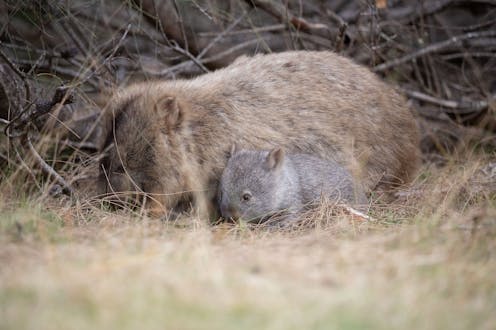
It was hard to watch. In a now-deleted Instagram reel, American influencer Sam Jones is filmed picking up a young wombat, separating it from its mother, and running with it back to the car for a pose. In the background, the distressed mother tries to follow. At one point, Jones says: “Momma’s right there and she’s pissed. Let’s let him go.”
We have spent our careers working with wildlife. Seeing a joey separated from her mother for social media content was unsettling. The encounter will have made stress levels soar for the baby and mother.
Unfortunately, we are seeing a rise in people directly interacting with wildlife through feeding them or taking risks to get close to them, often driven by the pursuit of social media attention. These interactions can hurt wildlife in many different ways.
While there’s a natural tendency to want to connect with wildlife, wild animals often see humans as a threat. When we get too close, we can trigger fear responses such as increased heart rates and heightened stress hormones. Indeed, the consequences of interfering with wildlife can be far-reaching.
Jones was lucky not to have been injured – wombats weigh up to 40 kilograms and have teeth and claws they can use for defence. She could still come down with scabies – wombats often have mange, caused by the parasitic mite which gives us scabies.
Others have been less lucky. People feeding dingoes on K’Gari has brought these wild canids closer to people, leading to attacks. In response, authorities have occasionally opted to kill dingoes.
Official approvals are required to capture and handle wildlife. Engaging in these activities without the necessary permits is typically illegal. These regulations are to safeguard wildlife from harm and protect humans as well.
Instagram clip shows US influencer Sam Jones picking up a baby wombat.
What was wrong with the influencer’s behaviour?
What many people found difficult to see in the clip was the clear distress seen in both joey and mother.
Wombat joeys are fully dependent on their mothers for between 18 months and two years – one of the longest periods for any marsupial. Interfering with this bond stresses both animals.
The incident also took place on a road, increasing their risk of being hit by a vehicle – one of the biggest threats to wombats.
Wildlife are exactly that – wild life. When we interact with wild creatures, we interrupt what they are doing. This can harm the individual – and often, the group – by inducing physical or psychological stress, and changes in behaviour.
We want to connect – but it’s bad for the animals
Many of us draw a mental line between our pets and wild animals. Our cats and dogs jump up for a pat and seek our affection. Wouldn’t wild creatures enjoy the same thing?
It took thousands of years to domesticate dogs, cats and other animals. Wild animals, on the other hand, perceive us very differently – often as a potential threat.
When we feed wildlife food they are not used to, it can make them sick, or contribute to long term metabolic issues.
Visitors often feed chips to quokkas on Rottnest Island, but these salty snacks can sicken the animals, which should be eating grasses, stems and leaves.
Tourists flock to areas with wild kangaroos and often offer them food. But as they become used to our presence, they can still lash out. People have been injured, some badly.
Feeding captive animals is relatively safe, but feeding wild animals is a bad idea for them and for us. Lubo Ivanko/Shutterstock
Touching animals comes with risks, from being scratched by koalas to being bitten by snakes. When a US wildlife expert was filmed touching a huge great white shark off Hawaii, dozens of people tried to follow suit – despite the risks.
Then there’s the disease risk. Wombats suffer from sarcoptic mange, while other marsupials may have toxoplasmosis, which can trigger miscarriages and neurological issues. Handling wild birds can give us the dangerous disease psittacosis.
If you don’t have a permit, you should stay at a safe distance and watch the animal. The goal is to avoid interfering, and respect the animal’s autonomy and what it’s trying to do, whether that’s finding food, finding a mate, sleeping, or just lounging about.
Are more people trying to interact with animals?
After the COVID pandemic, many of us have been seeking outdoor experiences. Camping is on the rise, as is ecotourism.
At the same time, some influencers are trying to interact with wildlife, perhaps mimicking famous figures such as the late Steve Irwin. Irwin’s father, Bob, recently called for harsher penalties for influencers entering crocodile territory after many close calls.
Watching trained wildlife handlers can give us false confidence. We might think: if they do it, why can’t I?
Seeing trained wildlife handlers can give us a false sense of confidence – and even entitlement. Pictured: someone holding a baby crocodile at Australia Zoo on the Sunshine Coast. tatjanajessica/Shutterstock
The problem is, wildlife handling is risky. Bites are common, even for trained experts. When we undertake wildlife research, we use gloves, cages, hoods and so on to reduce the risk to us and the stress to the animal.
Wildlife carers who take on the role of rearing wombat joeys have to be well trained – and dedicated. Joeys need to be fed special milk suited to marsupials – cow’s milk is no good. They have to be fed round the clock in the early months.
In many cases we are aware of, untrained individuals have attempted to rescue wombats or kangaroo joeys only to discover they can’t meet their specific care needs. Unfortunately, this often results in the joeys being abandoned or handed over to wildlife carers in poor condition.
This doesn’t mean that interactions with animals are off-limits. Zoos and wildlife sanctuaries provide opportunities to handle captive animals under expert supervision. Volunteering with wildlife carers or training to become a carer are viable ways to engage with animals responsibly.
Influencers don’t have to grab an animal from the wild to show how amazing it is. You can show natural behaviour by following an animal from a safe distance or use existing footage.
If you can’t captivate an audience with the wonders of wildlife without harassing a wild animal, then perhaps it’s time to rethink and refine your social media strategy.
When we are out in the bush, it’s natural to be fascinated by the presence of wild creatures. But we must find ways of building our connection with nature without harming what we see – and without risking harm to ourselves.
Julie Old is a Director on the Board of The Wombat Foundation, and a member of the Australian Mammal Society.
Dale Nimmo is a member of the Ecological Society of Australia, and receives funding from the Australian Research Council
Hayley Stannard and Robert Davis do not work for, consult, own shares in or receive funding from any company or organisation that would benefit from this article, and have disclosed no relevant affiliations beyond their academic appointment.
The newly found fossil (right) alongside a mirrored reconstruction (left).Maria D. Guillén / IPHES-CERCA / Elena Santos / CENIEH
In a system of caves in the Atapuerca Mountains in Spain, nearly 50 years of systematic archaeological excavations have unearthed evidence of increasingly ancient human occupation.
The result of this systematic work has yielded human traces stretching from the Bronze Age to hundreds of thousands of years into the past – before modern humans like us (Homo sapiens) even existed.
In new research published in Nature, our team shares another find from Atapuerca: the earliest human remains ever found in Western Europe. We discovered fragments of face bones from a species of extinct human previously unknown in this region, dating from between 1.2 million and 1.4 million years ago.
Sima del Elefante
Back in 2022, during our annual field season, our team unearthed a series of bone fragments from a cave called Sima del Elefante (Pit of the Elephant). The fragments are from the left side of the mid-face of an adult human.
In 2008, a human jawbone more than 1.1 million years old had been found at the same site. The new fragments were found around two metres deeper than the jawbone, which suggests they are even older.
Since the discovery, our team has spent more than two years meticulously studying the remains. We wanted to find out which species of ancient human they belonged to, and understand the lives and environment of these long-extinct cousins.
Which species does the face belong to?
Evidence from the Gran Dolina site, not far from Sima del Elefante, has shown that a species of ancient humans known as Homo antecessor once populated the Atapuerca region. Direct dating of H. antecessor fossils has shown they lived in the region around 850,000 years ago.
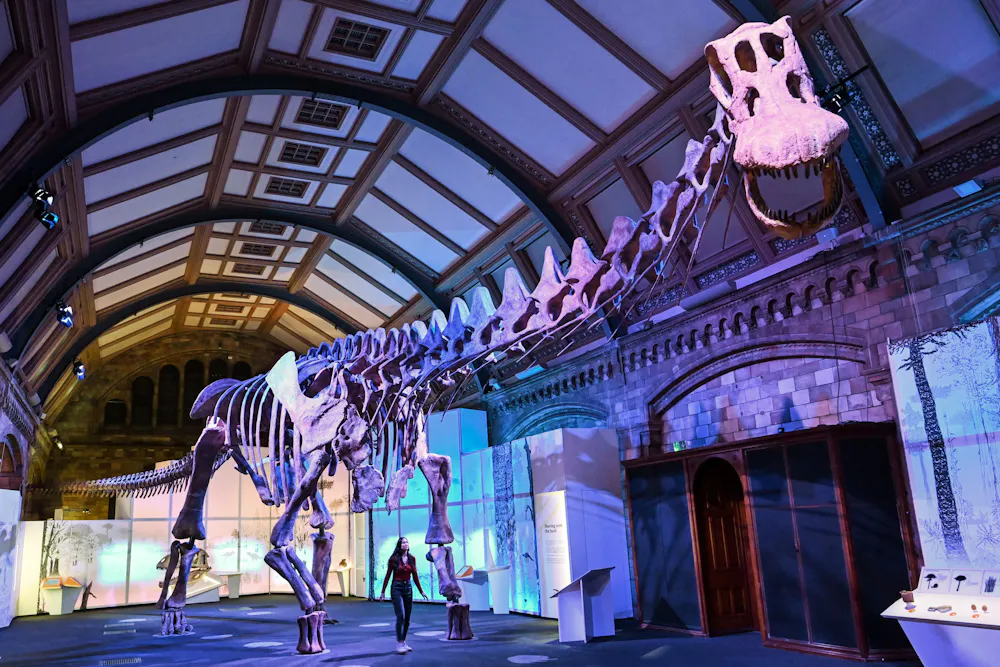
Since the 1960s, archaeologists have uncovered evidence of ancient human occupation in a network of caves at Atapuerca in northern Spain, listed as a UNESCO World Heritage Site. UtaUtaNapishtim / Wikimedia
The first question we asked about the new face fossil was whether it belonged to H. antecessor. This species had a relatively modern-looking face: quite vertical, rather than the strongly sloping shape often seen in older species.
The shape of our new face bones was not a match for H. antecessor, so what could it be?
We compared the remains to those of other earlier hominin groups, including ones from the Dmanisi site in the Republic of Georgia, which have been dated to around 1.8 million years ago. The Sima del Elefante face differs from the Dmanisi hominins, especially in the area around the nose.
However, it does share some similarities with Homo erectus, the first human species to spread from Africa to Asia, beginning around 2 million years ago, and now also found in Western Europe. The similarities include the lack of a projecting nose and the forward-projection of the midface.
However, key details about the Sima del Elefante face are still missing. For now, we are classifying it as Homo aff. erectus, which means it appears to be closely related to H. erectus but lacks some defining features.
Beyond the hominin fossils
At Sima del Elefante, we recovered stone tools and the remains of animals alongside the hominin fossils. The marks of use on the tools as well as the cut marks found in the animal remains suggest that this species practised butchery in the cave.
We also know, thanks to pollen and the remains of small animals, that the ancient humans lived in an environment dominated by a humid forest landscape.
Evidence of stone tools was also found near the ancient face fossil at Sima del Elefante. Nature / Maria D. Guillén / IPHES-CERCA
Our discovery opens new possibilities for understanding the origins and population dynamics of the earliest human settlements in Western Europe.
From the fossils at Dmanisi, we know that hominins had left Africa at least 1.8 million years ago. Now, the Sima del Elefante finding tells us that within a few hundred thousand years, hominins had made it to the westernmost part of Europe. What’s more, the shape of their faces had evolved during that time.
The finding also raises questions about whether there were two populations of different hominins living in the Atapuerca region at the same time. Did H. antecessor and H. aff. erectus coexist? Or had H. aff. erectus died out by the time H. antecessor arrived?
If the latter is true, what drove one species to extinction while another flourished? In this second scenario, we need to consider the factors behind both the extinction of the species and their dispersal.
Earlier research has suggested that hominin populations were strongly affected by climate and other environmental conditions. Hominins may have spread into Europe when conditions were kind, and died out when the climate became less hospitable.
There is still much work ahead of us. Year after year, we return to Atapuerca to continue unearthing evidence that pieces together the story of our origins. Each new discovery is a step forward in understanding our past.
We acknowledge all the members of the Atapuerca research team involved in the recovery and study of the archaeological and palaeontological record from Sima del Elefante site.
The research of the Atapuerca sites is funded by the Spanish Ministry of Science and Innovation and European Regional Development Fund “ERDF A way of making Europe”.
Fieldwork at Sima del Elefante is supported by the Junta de Castilla y León and the Fundación Atapuerca.
Laura Martín-Francés receives support from the EU-Horizon Program – Marie Sklodowska-Curie.
Source: The Conversation (Au and NZ) – By Milad Haghani, Associate Professor & Principal Fellow in Urban Risk & Resilience, The University of Melbourne
The recent rollover of two army trucks carrying Australian Defence Force (ADF) personnel responding to ex-Tropical Cyclone Alfred was unprecedented for a domestic emergency operation.
Thirty-two soldiers were hospitalised in the twin incidents, which occurred when a convoy of military vehicles was en route to assist flood-affected residents of Lismore. The accident reignited debate over the sustainability of the ADF’s expanding role in disaster response.
We are relying on the military more frequently because Australia’s renowned voluntary emergency workforce is shrinking. Not enough people are fronting up to fight the fires and floods, and other calamities that regularly blight the Australian landscape.
Unless the volunteer army is revitalised, the burden on the ADF will continue to grow, as will the related risk of compromising Australia’s national security.
Response and recovery model
Australia’s disaster response system operates as a multi-agency model, combining career emergency personnel, trained volunteers, and when necessary, ADF assets.
Each state and territory manages its own emergency response through a multitude of agencies. In Victoria, the State Emergency Service (SES) specialises in floods, storms and tsunamis while the Country Fire Authority (CFA) is responsible for fire suppression and rescues across most of the state.
These agencies have career personnel who oversee operations, manage logistics, coordinate mobilisations, and provide leadership. However, the vast majority of frontline responders are volunteers.
In New South Wales, the Rural Fire Service (RFS) has over 70,000 volunteers across approximately 2,000 brigades, making up the vast majority of its workforce. The service has only around 1,200 paid staff. The NSW SES is also heavily volunteer-driven, with around 10,000 volunteers, supported by approximately 460 paid staff.
Volunteers form the backbone of these emergency services.
Major distraction
When disasters exceed the capacity of emergency services, the ADF is called in to provide additional support.
Operation Bushfire Assist for example, involved more than 6,500 ADF personnel, including 3,000 reservists who were deployed to tackle the 2019–2020 Black Summer bushfires. It was the largest ADF mobilisation for domestic disaster relief in Australian history.
The defence force serves Australian communities during times of need. But it is not a civilian disaster agency.
The ADF’s core mission is defence and combat capabilities, not firefighting, flood rescues, or storm recovery. Requests for assistance have traditionally had to be balanced against military priorities.
Last year, a Senate inquiry into Australia’s Disaster Resilience warned this growing reliance may not be sustainable.
ADF disaster assistance also comes at a financial cost. It is estimated the relief work during the 2022 floods in Queensland and NSW as well as the 2019–2020 bush fires exceeded $90 million.
Every time the ADF is deployed for disaster relief, it diverts personnel and resources from other defence priorities.
Fewer volunteers
The ADF keeps getting called up because there is often no one else to do the work.
The number of operational CFA volunteers in Victoria has plummeted from 36,823 in 2014 to 28,906 in 2024. The pattern is repeated to varying degrees across all emergency services, including the SES and CFA.
The current volunteer base is also ageing, and younger Australians are not stepping up at the same rate.
Australians aged 55 years and over are more likely to volunteer than younger Australians.
To reduce the burden on the military, there is no other option than an all out effort to revitalise the volunteer emergency workforce.
Boosting emergency volunteering
Awareness is an issue. Many young people have no exposure to emergency services volunteering.
Recruitment efforts may not be reaching them effectively. Traditional, long-term volunteer commitments may not suit younger generations. The solution could be more flexible, short-term, or event-based volunteering options.
A national campaign to highlight the role and importance of emergency volunteers as a social responsibility
could help shift attitudes and increase participation and retention.
Incentives could help too, starting with tax deductions on costs incurred while volunteering such as mileage, travel and uniforms. And consideration should be given to a proposal in the United Kingdom to offer council tax discounts to residents who engage in community volunteering.
Removing barriers is also important. Some volunteers leave due to excessive paperwork, slow on-boarding or financial burden. Reducing red tape while maintaining safety standards could improve retention.
Businesses and higher education also have a role to play.
Corporate volunteer programs that allow employees to assist emergency services during work hours could expand the volunteer pool. More universities should be incorporating volunteering into their personal development programs.
A strong volunteering culture helps keep us safe. Without it, we risk becoming even more vulnerable to deadly natural disasters.
Milad Haghani does not work for, consult, own shares in or receive funding from any company or organisation that would benefit from this article, and has disclosed no relevant affiliations beyond their academic appointment.
Compost applied to agricultural soils in Australia each year contains tonnes of microplastics, our research has revealed.
These microplastics can harm soil and plant health and eventually enter food crops, potentially posing a risk to humans.
In Australia, more than 51% of organic waste – including garden and food waste from households – is recovered and processed. Much of it is turned into compost.
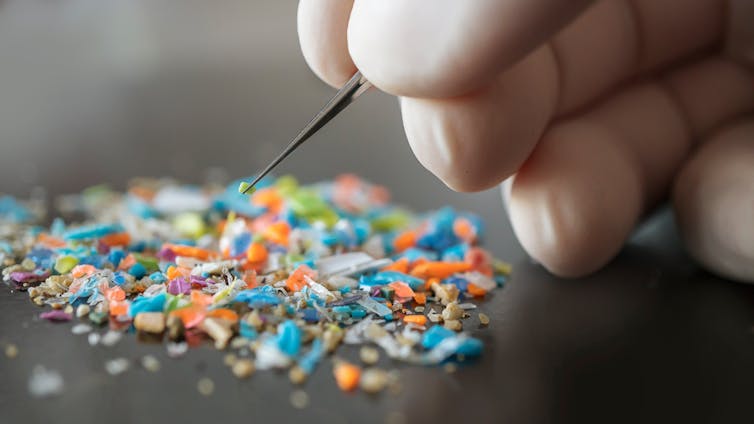
However, every kilogram of compost we sampled in our study contained thousands of tiny pieces of plastic, invisible to the naked eye. They come from a range of potential sources, including compostable waste bags used by households to store food scraps.
Without swift and effective action, composting may become an environmental crisis, rather than a solution.
The research revealed every kilogram of compost contains thousands of tiny pieces of plastic. SIVStockStudio/Shutterstock
The problem with microplastics in compost
As Australia’s landfill sites become exhausted, finding new uses for organics waste has become crucial.
Composting is widely promoted as a solution to managing organic waste. It is comprised of decomposed plant and food waste and other organic materials, which is applied to farms and gardens to enrich the soil and improve plant growth.
Many local councils provide residents with kitchen caddies and “compostable” plastic bags to collect food waste. These bags can also be bought from supermarkets.
These bags usually contain some plant-based substances. However, some contain fossil-fuel based material. Others may contain “bioplastics” such as that made from corn starch or sugarcane, which require very specific conditions to break down into their natural materials.
Research shows some compostable bags are a source of microplastics – plastic particles smaller than 5 millimetres.
Once applied to soil, microplastics can accumulate over time, posing risks to soil health. For example, research shows microplastics can alter soil structure, limit plant growth, hinder the cycling of nutrients and disrupt microbial communities. This in turn may affect farm productivity.
Microplastics can also further degrade into “nanoplastics” small enough to be absorbed by plant roots. From there they can enter stems, leaves, and fruits of agricultural products consumed by humans, posing potential health risks.
Internationally, evidence is growing that compost can introduce significant amounts of microplastics into soil. However, little is known about whether organics applied to farm soils in Australia contain microplastics. This study sought to shed light on this.
What we found
My colleagues and I investigated microplastics in processed organic waste. We took samples from 11 composting facilities in Victoria.
We found every kilogram of compost contains between 1,500 and 16,000 microplastic particles. In weight, this equates to between 7 and 760 milligrams of microplastics per kilogram of compost.
In Australia, about 26% of compost produced at organic waste processing facilities is used in agriculture. So, we estimate that between 2.7 and 206 tonnes of microplastics is being transported to Australian agricultural land from compost each year.
Most microplastic particles we found were “microfibres” and “microfragments”. Microfibres usually derive from synthetic fabrics. Microfragments come from larger plastics, such as packaging material.
We then analysed bin bags marketed as compostable or biodegradable, and found their physical and chemical characteristics were very similar to some microfragments we found in organic waste.
The microfragments may be coming from other sources as well, such as plastic containers and bags, and plant string scooped into the bin when people collect garden waste.
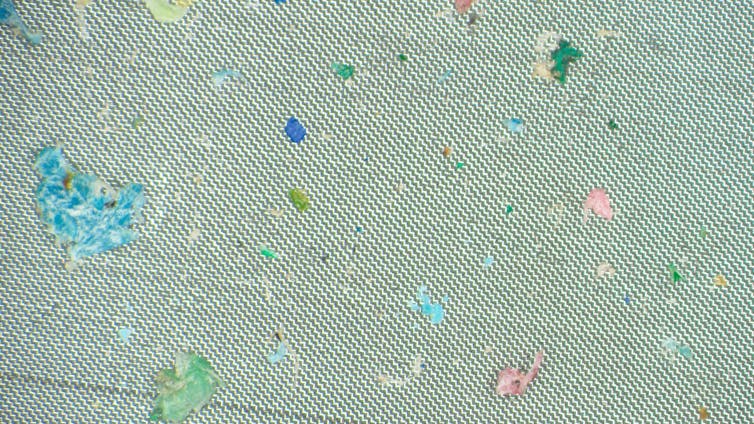
Various microplastic particles from compost samples as seen under the microscope. Hsuan-Cheng Lu
Where to now?
This study provides the first evidence of microplastics in processed organic waste in Australia. It underscores the need to better understand what happens to microplastics during the composting processes, and how microplastics affect soil health.
But these policies do not adequately address the risks of contaminants such as microplastics. In fact, there are no national standards in Australia regulating microplastics in processed organics.
The absence of clear guidelines leaves composting facilities, waste processors, and end users vulnerable to unintended plastic pollution.
To address this serious environmental issue, urgent action is needed.
Authorities should take steps to limit the flow of microplastics into compost, including developing guidelines for composting facilities, waste management companies and households.
Monitoring should also be used to track microplastic levels in processed organics, identify their sources and assess the impact on soils and food safety.
Shima Ziajahromi receives funding from EPA Victoria, EPA NSW, Water Research Australia, Queensland Government through an Advance Queensland Industry Research Project, co-sponsored by Urban Utilities, Sydney Water, SA Water, Water Corporation (WA) and Eurofins Environment Testing Australia. This project was funded by EPA, Victoria.
Frederic Leusch receives funding from the Australian Research Council, EPA Victoria, EPA NSW, Qld DESTI, Water Research Australia, Seqwater, Urban Utilities, Sydney Water, SA Water, Water Corporation and the Global Water Research Coalition. This project was funded by EPA Victoria.
Hsuan-Cheng Lu receives funding from EPA Victoria. This project was funded by EPA, Victoria.
Source: The Conversation (Au and NZ) – By Ferdi Botha, Senior Research Fellow, Melbourne Institute: Applied Economic & Social Research, The University of Melbourne
Australia already has the highest gambling losses globally. Now, new data show that between 2015 and 2022, the number of Australian men involved in sports betting has increased substantially. And for younger men, the rate of betting has surged more than 60%.
The latest data from the comprehensive Household, Income and Labour Dynamics in Australia (HILDA) Survey shows that in 2015, 5.9% of all men bet on sports. By 2022, 9.3% of men did. This represents a 57.6% increase in seven years. And among men who gamble, almost a quarter bet on sports, up from 14% in 2015.
The HILDA survey follows about 17,000 people every year and collects information on various aspects of their lives. The survey asked several questions in 2015, 2018, and 2022 related to gambling – including gambling types, spending, and gambling harm.
As more men gamble on sports, spending on sports betting has also risen. In December 2022 prices, men’s typical average self-reported monthly spend sports betting climbed from A$85.95 in 2015 to almost $110 in 2022.
The rising trends in sports betting are especially concerning given evidence gambling is strongly associated with undesirable consequences such as poor social, financial and psychological outcomes.
Younger people are betting more
Underlying the increase in sports betting are notable differences across age groups, shown in the figure below.
The increase in sports betting over this period occurred mainly among younger Australians. In fact, the rate of sports betting jumped by between 62% and 66% in men aged 18 to 44.
Because younger people tend to gamble more online than in venues like a casino or the pokies, aggressive online advertising on social media and the use of betting apps make sports betting easier and more accessible.
In all three survey years, the prevalence of sports betting is lower among older age groups, especially people aged 45 and older. In 2022, for example, 2.7% of Australians 65 and older reported betting on sports, whereas 14.9% of people aged 25–34 did.
Gambling harm is becoming worse
There are also worrying trends regarding gambling harm.
Gambling harm is measured using the Problem Gambling Severity Index, which is constructed from responses to nine questions about the frequency of gambling-related risks or harms over a 12-month period. Respondents’ gambling behaviours are then classified as either “non-problem”, “low-risk”, “moderate-risk” or “high-risk”.
Among those men engaged in at least some sports betting, the proportion reporting high-risk gambling problems grew from 6.3% in 2015 to 8.7% in 2022. Based on 2022 population estimates from the Australian Bureau of Statistics, this suggests that among male sports gamblers, just over 105,000 are high-risk gamblers – a significant minority.
And while more young men engage in sports betting, younger age groups are also increasingly likely to experience gambling harm. In 2022, almost one in five of all Australian men aged 18 to 34 reported at least some gambling harm.
What can be done?
Gambling behaviours are based on self-reported data so tend to be under-reported. The estimates reported in this article, although higher than existing estimates, are likely even higher in reality.
Living in the same household as a high-risk gambler negatively affects the health and well-being of other people in the household. The adverse effects of high-risk gambling therefore extend indirectly to many other Australians beyond the gambler.
Sports betting is done almost entirely online and younger people encounter advertising mostly online. This is one reason why younger groups are more at risk and why urgent intervention is required.
Initiatives to completely ban gambling advertisements have been proposed. Such measures have support from the public and from advocacy groups.
The findings reported here underscore the urgent need to protect younger Australians and in particular men, who are at greatest risk of gambling harm. To do so requires a reversal of the rising trend in sports betting. Banning sports betting advertising is one effective way this can be achieved.
Ferdi Botha is affiliated with ARC Centre of Excellence for Children and Families over the Life Course.
The staff member worked at Nepean Hospital’s birth unit in Western Sydney while infectious with hepatitis B between 2013 and 2024.
Authorities say 223 women are in the process of being informed they and 143 of their children are at low risk of exposure. The local health district says it is not aware of any patients who had tested positive to hepatitis B as a result.
The hepatitis B virus infects liver cells and is not to be confused with other types of hepatitis viruses, including the better known hepatitis Aand C.
The virus is spread by bodily fluids, such as blood, and enters the body though penetrated skin or mucous membranes such as the mouth, genitals or eyes.
This means the virus is most commonly spread by people having unprotected sex, from mother to baby, or by using shared items such as needles or hygiene products. The virus can survive outside the body for at least seven days.
In rare cases, hepatitis B has been known to spread from a health-care worker to a patient during certain medical procedures. This is when the health-care worker may injure themselves and expose their patients to their blood.
Symptoms of acute infections include fever, loss of appetite, nausea, vomiting, abdominal pain, fatigue, dark urine, pale stools and jaundice.
If not cleared by the body within six months the disease can progress to its chronic (long-term) form. This can lead to cirrhosis of the liver, liver failure or liver cancer.
How common is it?
Globally, hepatitis B is the most common serious liver infection. There are about 254 million people with chronic hepatitis B infection globally in 2022, with 1.2 million new infections each year. About 1.1 million people a year die from it, mostly due to cirrhosis and liver cancer. The worst infected regions are Africa and the Western Pacific.
In Australia, there were 205,549 chronic cases as of 2022. Most of the 6,000–7,000 newly detected cases in Australia each year are chronic cases.
Only 72% of hepatitis B cases in Australia are diagnosed. This means the remaining 28% could be unwittingly carrying the virus, potentially spreading it to others, and missing the opportunity for treatment.
Babies of infected mothers, Aboriginal and Torres Straight Islander people, people who engage in unprotected sex, men who have sex with men, intravenous drug users, and people receiving tattoos or piercings with unsterilised equipment are all at a higher risk of hepatitis B infection. Most chronic cases in Australia are in migrant groups from areas with higher rates of hepatitis B.
Acute cases can be cleared by the body, aided by antiviral drugs. However if the infection becomes chronic the symptoms of liver cirrhosis and cancer need to be monitored and treated for the rest of someone’s life. This includes having regular liver-function tests, taking antiviral medication, adopting a healthy diet and avoiding alcohol.
Due to the nature of its transmission, hepatitis B often has negative social stigma associated with it. This may lead to people being reluctant to be tested or if they test positive, they may be reluctant to share their status with others, or seek treatment.
We do not know the personal circumstances of the health worker with hepatitis B at the centre of this health alert, including details of their diagnosis and treatment. It’s also important to note that hepatitis B infection alone does not automatically disqualify health-care workers from practice. Their risk to patients depends on a whole range of factors including levels of virus in their blood.
Information about hepatitis B vaccination is available. Patients affected by the Nepean Hospital health alert can call 1800 716 662 for more information and support.
Thomas Jeffries does not work for, consult, own shares in or receive funding from any company or organisation that would benefit from this article, and has disclosed no relevant affiliations beyond their academic appointment.
An open letter signed by 100 Christian leaders, calling for the granting of humanitarian visas to Aotearoa New Zealand for families of Palestinians trapped in Gaza has been handed over on the steps of Parliament.
The letter was presented yesterday on Ash Wednesday to opposition Labour Party MP Phil Twyford, who was joined by six other members of Parliament.
Minister for Immigration Erica Stanford and Associate Minister for Immigration Chris Penk were invited to receive the letter, but both declined the invitation.
The open letter was signed by leaders from Anglican, Baptist, Presbyterian, Catholic, Quaker, non-denominational and Methodist movements, and leaders from organisations and groups such as Caritas, Student Christian Movements and Te Mīhana Māori.
Granting immediate emergency humanitarian visas to Palestinians in Gaza who have family in New Zealand;
Providing sustained diplomatic pressure on the Israeli government to allow visa-holders to safely evacuate from Gaza and humanitarian aid to freely enter; and
Providing robust resettlement assistance once these families arrive in New Zealand.
Hoped for troops withdrawal The letter comes after the end of the first phase of the Gaza Ceasefire agreement — which was due to see Israel withdraw its military forces from the border between Gaza and Egypt.
Christians United for Refuge spokesperson Esmé Hulbert-Putt said: “When we first prepared this letter, we hoped and prayed that we would see the withdrawal of military forces from the border.”
She added that this opening, alongside strong diplomacy and visa pathways, would allow for the family reunification that Palestinians in Aotearoa had been asking for for more than a year.
Following this handover, a separate group, organised by Aotearoa Christians for Peace in Palestine completed a 10km pilgrimage in Auckland, Christchurch and Wellington, symbolising the distance between Bethlehem and Jerusalem and the many military checkpoints along the way.
These pilgrimages each involved praying at the arrivals terminals of the respective international airports — in prayerful hope that one day these doors would open to families of Palestinians in Gaza.
Christian pilgrims have staged airport protests around New Zealand calling for humanitarian visas for Palestinians from Gaza. Image: Christians United for Refuge Aotearoa Campaign
Keith Rankin, trained as an economic historian, is a retired lecturer in Economics and Statistics. He lives in Auckland, New Zealand.
Opinion-Analysis – by Keith Rankin.
Keith Rankin, trained as an economic historian, is a retired lecturer in Economics and Statistics. He lives in Auckland, New Zealand.
Former ambassador Phil Goff is the latest (so far) and (probably) the least of many ‘statesmen’ who have invoked Munich and the ‘resolute’ Winston Churchill (a backbench MP in 1938) in the cause of good-war mongering. (Refer Winston Peters sacks Phil Goff as UK High Commissioner RNZ 6 March 2025, and What Was Actually Wrong With What Phil Goff Said?, Giles Dexter, RNZ and Scoop, 7 March 2025.)
The Munich narrative is central to the ‘Good War’ morality trope, through which democracies (especially the United States) justified wars of aggression; what used to be called ‘gunboat-diplomacy’ in the British days of empire. It’s the now-commonplace narrative that frames any putative war to be fought by a ‘liberal democracy’ against an ‘autocracy’ (ie fought by us against them) as a contest between Good and Evil; and if we don’t “stand up to” Evil – anywhere and everywhere – then Evil goes on to ‘win’, and subsequently to dominate and exact tribute as a regional or global hegemon.
The corollary of the Munich narrative is that Good should never give up, even if Evil is winning on the battlefield; Good neither surrenders to Evil nor negotiates with Evil. Not ‘at any cost’. The logical conclusion of this is that, if that’s what it requires for Good to prevail, life on Planet Earth could be forfeit; better Dead than Red or Black. Earth’s tombstone, left for a future intergalactic explorer to discover, might read: “At Least ‘Atila the Hun’ [substitute any Eurasian ‘Devil’] Did Not Win”. Peter Hitchen (see below, p.27) notes: “one day, this dangerous fable of the glorious anti-fascist war against evil may destroy us all [through our rulers’ vanity]”.
Phil Goff is an example of persons who know just enough fragments of popular history to think they can use a historical argument to substantiate their rhetoric. A little knowledge is a dangerous thing, meaning that superficial knowledge may be more problematic than ignorance. On the Munich question, Phil Goff is in good company. Peter Hitchens, in The Phoney Victory (p8, p20), cites the former Prince of Wales (now King) as making the same mistaken views about World War Two and the Ukraine-Russia War, as moral crusades.
(Meanwhile, as well as trying to cut disability benefits as a result of boxing itself into a corner, Keir Starmer UK government – unlike the political leadership of Canada and the European Union – is doing everything it can to appease Donald Trump on international trade and other matters.)
For readers’ interest, Stevan and Hugh Eldred-Grigg have written a New Zealand take on World War Two that does not follow the ‘Good War’ trope: Phoney Wars: New Zealand Society during the Second World War, Otago University Press 2017.
Were Neville Chamberlain’s actions at the September 1938 Munich Conference wrong?
No, neither with foresight nor hindsight. If Britain and/or France had signed a pact with Czechoslovakia similar to the one they signed with Poland in 1939, they would have been committed to declaring at most a phoney war. Neither had the capacity to wage war on Germany nor to come to Czechoslovakia’s aid. At best, British hostilities against Germany in 1938 would have been as ineffective as they were in Archangel, Russia, in 1918.
Popular sentiment was absent in 1938 in the United Kingdom towards war with Germany. That situation had changed by March 1939 after Germany fully annexed Bohemia and Moravia, the territories that make up twenty-first century Czechia. Due in part to changed popular sentiment, the British and French responded differently when Poland was similarly threatened in 1939. The western ‘powers’ declared war on Germany following the first attack on Poland, but did almost nothing to fight Germany or to protect Poland during what became known as the ‘Phoney War’. (The phoney war ended with the German conquest of France in May 1940.)
The 1939 declaration of war was arguably more duplicitous than the 1938 declaration of peace. Poland’s half-century-long tragedy – far worse than anyone today, except for a few professional and amateur historians, realise – began to unfold. (France briefly invaded Germany’s Saarland in 1939, southeast of Luxembourg, before withdrawing. Nowhere near Poland.) The war in 1939 in Poland, remote to the United Kingdom, was far from ‘phoney’.
Examples of invoking or evoking ‘appeasement’ and /or ‘Munich’ and/or Churchill on behalf of ‘democracy’:
Peter Hitchens gives these post-WW2 examples (pp.13-17):
President Harry S Truman, in December 1950, re the continuation of the Korean War
Anthony Eden, 1956, to justify the Suez War (which first brought Israel into an external war of aggression)
President Lyndon Johnson in July 1965, justifying the escalation of the Vietnam War
US Secretary of State George Shultz in February 1984, re conflict in Nicaragua
US Deputy Secretary of State, Lawrence Eagleburger, in August 1989, before the US invasion of Panama
George Bush (senior) in June 1990, re the first war against Iraq (noting that the initial response to the immanent invasion of Kuwait was not unlike Churchill’s lesser-known response in 1938, to the German reoccupation of the Rhineland [“more talks”])
Bill Clinton’s 1999 comparison of Slobodan Milosevic to Hitler, in the context of the probable secession of Kosovo from Milosevic’s Serbia
UK Prime Minister Tony Blair, in 2003, justifying the second invasion of Iraq
President Trump’s aids in June 2017, referring to Barack Obama’s Cuba initiative
Winston Churchill’s worst Appeasement, and Atrocities
The worst act of appeasement that I can think of was Winston Churchill’s kowtowing to Joseph Stain at Yalta (Crimea) in the second week of February 1945 (ref Hitchens p.6 and Wikipedia citing Leo McKinstry, “Attlee and Churchill: Allies in War, Adversaries in Peace”, Atlantic Books, 2019, Ch 22). According to McKinstry “When Churchill arrived at Yalta on 4 February 1945, the first question that Stalin put to him was: ‘Why haven’t you bombed Dresden?’.”
Ten days later, Churchill did indeed firebomb Dresden, immolating 25,000 people – mostly civilians and refugees. Stalin (metaphorically) said “jump”, Churchill said “how high?”. And Churchill delivered.
Dresden was far from Churchill’s only actual or intended atrocity. Operation Gomorrah, on Hamburg at the end of July 1943, was a worse 24-hour atrocity than Dresden. The malevolent intent of that ‘raid’ lies in the biblical name given to the operation. While it was largely a test-run and forerunner for later bombings – including a forerunner of the firebombing of Tokyo exactly 80 years ago – it killed more than 35,000 mostly civilians “in their homes”.
(As a single event the firebombing of Tokyo on the night of 9 March 1945 – Operation Meetinghouse – caused easily more deaths [100,000] than Dresden, Hamburg, Hiroshima [70,000] or Nagasaki [35,000]. In the mainstream media, I saw no 80th-anniversary commemoration stories of this ‘worst-ever in the history of the world’ attack on civilians. Now is a timely time for us to be reminded about this kind of aerial megadeath.)
The third Churchill atrocity to mention was the Bengal famine of 1943, which killed three million people. Encyclopedia Britannica says that “the 1942 halt in rice imports to India did not cause the famine, and the 1943 crop yield was actually sufficient to feed the people of Bengal. It was ultimately special wartime factors that caused this difficult situation to become a disastrous famine. Fearing Japanese invasion, British authorities stockpiled food to feed defending troops, and they exported considerable quantities to British forces in the Middle East”. Churchill’s atrocities have been justified on the basis that the casualties were to them while saving some of our lives. But the people of Bengal were, at least notionally part of us, citizens and civilians of the British Empire.
In Wikipedia: “Madhusree Mukerjee makes a stark accusation: “The War Cabinet’s shipping assignments made in August 1943, shortly after Amery had pleaded for famine relief, show Australian wheat flour travelling to Ceylon, the Middle East, and Southern Africa – everywhere in the Indian Ocean but to India.” Indeed, Bengal was required to export rice to Ceylon to support British naval operations there. Of Churchill’s major atrocities, this was the only one to be mentioned in Netflix’s recent over-the-top account Churchill at War.
The Netflix ‘docuseries’ does at least mention Churchill being sidelined by the Americans in late 1943 and 1944. Churchill was sidelined from the top table of war-command largely on the basis of his penchant for atrocities and his unwillingness to confront Germany head-on (an unwillingness that could have been interpreted as ‘appeasement’, and probably was understood as such by the Americans). Churchill indulged in a number of side-wars, including a successful invasion of Madagascar in 1942; an invasion that put paid forever to the 1940 German fantasy of resettling Eastern European Jews there.
The Americans took much longer than Churchill to become convinced about the merits of holocaust-scale bombing than did the British. It would seem that the British burning of Hamburg – which was bombed because it was there, easily accessible from Britain – left quite a bad taste upon some American commanders, and indeed upon President Roosevelt himself. (We note that the atrocious American incendiary bombings of Japan in March 1945 were undertaken after Harry Truman became Vice President, and in the context that Roosevelt was seriously ill, and died soon after the February Yalta ‘Peace’ Conference.)
Churchill’s final atrocity to mention here never actually happened, except to create an environmental disaster on a Scottish Island (Gruinard, Britain’s mysterious WW2 ‘island of death’ Myles Burke, BBC, 22 April 2024). It partly explains some of Churchill’s reticence towards the D-Day invasion of Occupied France. Churchill had another plan, which he seems to have kept secret from his Allies: biological warfare, Anthrax.
“The plan was to infect linseed cakes with Anthrax spores and drop them by plane into cattle pastures around Germany. … The proposed plan would have decimated Germany’s meat supply, and triggered a nationwide anthrax contamination, resulting in an enormous [civilian] death toll. … The secret trials carried on until 1943, when the military deemed them a success, and scientists packed up and returned to Porton Down. As a result, five million linseed cakes laced with Anthrax were produced but the plan was ultimately abandoned as the Allies’ Normandy invasion progressed, leading the cakes to be destroyed after the war.” The test programme on Gruinard was cynically called ‘Operation Vegetarian’. “Gruinard was not the only site where the UK conducted secret biological warfare tests, but it was the first. The consequences of what happened there stand as a grim testament to both the dangers of biological warfare and humanity’s capacity for destruction.”
Have Bill Clinton and subsequent US presidents drawn inspiration from Brezinski’s 1997 essay as a clarion call for world domination?
Zbigniew Brezinski’s call for US world hegemony seems not much different to what Richard Evans claims was Hitler’s aim: “Hitler’s obvious drive for European and eventually world conquest.” (Zbigniew Brzezinski, “A Geostrategy for Eurasia,” Foreign Affairs, 76:5, September/October 1997; review of Peter Hitchens’s Eurosceptic take on the Second World War, by Richard J Evans, New Statesman, 26 Sep 2018.)
Evans’ claim about Hitler is obvious hyperbole; Germany never could have had the capacity to “conquer” the world. (Think of the socio-geographic limits to the Roman Empire.) But the Nazi imperial vision for Germany was to create a mega-state in Central Eurasia that would have hegemony over the rest of the world. Is there any country in the twentieth or twenty-first century which has sought such ‘unipolarity’; sought to be the world’s one-and-only superpower, which expects other countries to say “how high?” whenever it says “jump”?
Perhaps there is? Did Brezinski – Henry Kissinger’s 1970s’ foreign policy rival – spell it out in 1997?
Finally
‘Appeasement’ is like ‘Antisemitism’; the powers-that-be only have to say either word to silence commonsense debate about peace and war and genocide. As Hitchens points out (p.27): “We have mythologised the experience so completely that [politicians] only have to say the word ‘appeasement’ to silence opponents and bring legislators and journalists to their side, on any wild adventure.” Phil Goff is a hapless victim of what Joseph Mali and Shlomo Sand have called “mythistory”.
Wars since the 1930s are no more ‘moral’ than were wars before that time. (Indeed, if we wish to personalise it, WW2 at its core was a war between Hitler and Stalin; neither men are commonly described as ‘moral’.) In fact, recent wars are less moral. WW2 became the first major war in which civilians were actively targeted as a predominant military gambit. This approach to war is now becoming entrenched, with drones replacing soldiers, and civilians evermore in the firing line.
We should not be coerced into supporting wars on the basis of narratives by powerful know-not-much persons or cliques dropping words like ‘appeasement’, ‘Munich’, ‘Churchill’ or ‘Hitler’. Wars are very costly, but the costs are not usually paid – at least in the short term – by those elites who promote them from far away.
*******
Keith Rankin (keith at rankin dot nz), trained as an economic historian, is a retired lecturer in Economics and Statistics. He lives in Auckland, New Zealand.
Source: The Conversation (Au and NZ) – By Tanya Hill, Honorary Fellow at University of Melbourne and Senior Curator (Astronomy), Museums Victoria Research Institute
As the full moon rises tomorrow (Friday March 14), it will be a special sight for those in Aotearoa New Zealand. It will also be worth a look for people along the east coast of Australia.
Rather than being full and bright, the Moon will be partway through a lunar eclipse, the first of two lunar eclipses to occur this year.
New Zealand is in for a treat as the Moon will rise during totality – when the Moon passes completely into Earth’s shadow. Instead of turning dark, the Moon takes on a reddish glow that’s colloquially referred to as a “blood moon”.
Along the east coast of Australia, totality will happen while the Moon is still below the horizon; by the time the Moon rises, it will be in part-shadow.
A red Moon in Earth’s shadow
When it’s a full moon, the Sun and the Moon are located on opposite sides of the sky. With Earth in the middle, it can cast a large shadow blocking the Sun’s light from reaching the Moon.
However, during most full moons we don’t see an eclipse because the Moon’s orbit is slightly tilted – by just five degrees – compared to Earth’s orbit around the Sun. Most months the full moon passes either above or below Earth’s shadow. But twice a year, the path of the Moon takes it through the shadow instead.
When the Moon is fully immersed in shadow, the reason it turns red is entirely due to Earth’s atmosphere.
The first eclipse from the Moon
The Blue Ghost Mission 1, which successfully landed on the Moon on March 2, will be the first to image an eclipse from the Moon. As we experience the lunar eclipse, the Blue Ghost 1 lander will see a total eclipse of the Sun thanks to Earth moving in front of it.
Being on the Moon during totality and looking up at the Earth, it should see the atmosphere lit up as a ring of red.
Only the low-wavelength red sunlight passes through the atmosphere because the bluer light is scattered away. This is also the reason why sunsets have red, orange and pink hues.
Importantly, the atmosphere also refracts or bends the light, redirecting it into Earth’s shadow and making the Moon appear red.
When and where to look
Lunar eclipses are brilliant to watch – they are perfectly safe and you don’t need special equipment. Since the Moon will be low in the sky, you will need a clear view of the eastern horizon, perhaps from somewhere high up. It’s a leisurely event, so it’s also great to have good company.
Since this eclipse happens at moonrise, you can use the website timeanddate.com to check the moonrise time for your location and also to determine the eclipse magnitude, which is a measure of how much of the Moon is in shadow.
An eclipse magnitude of 1 or more means the Moon is fully in shadow or has reached totality.
If it is less than 1, it refers to the greatest fraction of the Moon’s diameter that is eclipsed. Imagine a diameter line across the Moon: where the edge of the shadow falls along that line will denote the magnitude of the eclipse.
How lunar eclipse magnitude is measured: the fraction of an imaginary diameter that is in shadow. For Brisbane, it will be 57% of the line, therefore the magnitude is 0.57. Tanya Hill/The Conversation
Across New Zealand, the Moon will rise during totality. The farther north, the longer totality will be. By the time the Moon moves out of the shadow, twilight will have ended and the sky will be lovely and dark for the later part of the eclipse.
On the east coast of Australia, the eclipse will be visible against the bright twilight sky. This will make it much harder to see from southern New South Wales, Victoria and Tasmania, since only a small part of the Moon will be in shadow.
Trick of the eye
But wait, there’s more. Watching the Moon when it’s low on the horizon also creates an interesting effect called the Moon illusion.
Our brains trick us into thinking the Moon is much bigger than it usually is. But if you use your thumb to cover up the Moon when it’s low in the sky and then measure it again later in the evening when the Moon is up higher, you’ll see the Moon hasn’t really changed in size at all.
The illusion likely occurs because we instinctively think the sky is shaped like a dome and that the Moon is closer to us when it’s overhead and farther away when it’s near the horizon. After all, that’s what happens when a bird flies off into the distance.
But the Moon is much farther away than a bird; its distance doesn’t change over the course of a night.
If our brains are telling us the Moon is farther away when it’s on the horizon, the Ponzo illusion demonstrates why we are tricked into thinking it appears bigger. In the image below the two moons are exactly the same size, but the perspective provided by the railway tracks makes us see the horizon one as larger.
If you aren’t able to see this eclipse, the second total lunar eclipse for 2025 will happen during the early hours of September 8.
It will be visible from across Australia, while New Zealand will see the eclipsed Moon setting at sunrise: almost an exact opposite to tomorrow’s eclipse.
Tanya Hill does not work for, consult, own shares in or receive funding from any company or organisation that would benefit from this article, and has disclosed no relevant affiliations beyond their academic appointment.
Aboriginal and Torres Strait Islander readers are advised this article contains the name of a deceased person.
The High Court of Australia has handed down a landmark judgement on native title law in Australia.
Commonwealth vs Yunupingu was about whether the Gumatj Clan in the Northern Territory would be entitled to compensation from the Commonwealth for acts that affected their native title rights and interests.
The court ultimately found the Gumatj Clan was eligible for compensation, holding the Commonwealth liable.
The case has been described as one of the most significant tests of native title since the famous Mabo proceedings in 1992.
Where did the case come from?
The late Yunupingu, on behalf of the Gumatj Clan of the Yolngu People in North-East Arnhem Land, sought compensation for land subject to bauxite mining in the Gove Peninsula.
The clan is seeking an estimated $700 million in compensation as the mining activity winds up, leaving their land damaged.
The Crown authorised the mining in the area without the Gumatj Clan’s consent between the 1930s and ‘60s.
The mining lease, originally granted to Nabalco, is now held by Swiss Aluminium and operated by Rio Tinto.
What were the laws at play?
Commonwealth vs Yunupingu deals with how native title and constitutional law overlap.
Native title law recognises the connection Aboriginal and Torres Strait Islander Peoples have to their lands. It is based on their traditional laws and customs dating back long before British invasion, and continues today. It’s governed by the Native Title Act, which includes provisions for compensation when native title rights or interests are impaired or taken away.
Under section 51 of the Constitution, the Commonwealth must pay an owner fairly if they acquire their property. This is called the “just terms” guarantee.
This section was famously the subject of the film The Castle, with lawyers arguing it was about “the vibe” of the Constitution.
The case was also about section 122, which concerns how the territories are governed.
There were three main issues that were debated before the High Court: whether native title land can be acquired, whether the just terms guarantee applies to the territories, and what role pre-Constitutional mining agreements play.
What were the legal arguments?
The Commonwealth told the High Court it doesn’t have to pay for taking away native title rights because those rights are “inherently defeasible” and therefore not property able to be “acquired”. Defeasible means it can be cancelled.
It’s a technical legal point, but amounts to arguing native title rights can’t be transferred and therefore can’t be acquired by the Commonwealth.
It also argued the just terms guarantee doesn’t apply to the territories in the constitution, except in specific circumstances.
Finally, the Commonwealth said it took ownership of the minerals found in the area before the Constitution was created by granting leases that “reserved” mineral rights to the Crown. This meant, the Commonwealth said, it could have these rights without having to pay native title holders.
Lawyers for the Gumatj Clan countered these points.
They told the court native title rights are covered by the just terms guarantee.
They said to make sense of the Constitution, it must be read as a whole. Therefore, laws about the territories are also subject to the guarantee.
People living in the territories of Australia should still be entitled to fair compensation for property that is acquired and not be excluded because they are in a territory rather than a state.
Lawyers for the Gumatj Clan submitted that “reserving” of minerals within the early pre-Constitution leases meant the leaseholders were given rights to everything except the minerals in the ground. No rights to minerals were granted at all – not to the leaseholders and not to the Crown.
This would mean native title holders with rights to the minerals in those lands would continue to have those rights. As the Commonwealth affected these rights through legislation and mining leases, they must pay the owners fairly.
What did the court find?
In getting to this point, the Federal Court has sided with the Gumatj Clan, but the Commonwealth appealed to the High Court.
After hearing detailed arguments over three days in August, the High Court Justices dismissed the appeal.
In doing so, it found that taking away native title rights is like taking property. As a result, the just terms guarantee applies and means the Gumatj Clan should be fairly compensated.
It also agreed with the clan that the guarantee applies to territories as well as the states.
The court found the early pre-Constitution pastoral leases did not have the effect of taking away any non-exclusive native title rights over minerals, meaning the Gumatj Clan continued to have their rights until the legislation and mining leases took place in the 1930s to ’60s.
The matter will return to the Federal Court to resolve the remaining legal issues.
What does all this mean?
Ultimately, the decision by the High Court is significant. It will allow for some acts that have caused profound harms to First Nations people from 1911 to be covered by compensation.
This decision follows a 2019 High Court judgement, commonly referred to as Timber Creek, which awarded compensation under the Native Title Act for the first time. The case was described as the most significant native title case to follow Mabo, opening the door for “billions of dollars” to be claimed by First Nations Peoples for impacts on their lands.
This case solidifies that precedent and takes it further by formally expanding the range of acts for which native title holders could apply for compensation.
Until now, there has been a widespread assumption that compensation under the native title system would only be available for acts that occurred after the introduction of the Racial Discrimination Act in 1975, but this case proves otherwise.
This is limited to acts done by the Commonwealth, which may mean this will largely have implications for acts done in the territories, because the Commonwealth managed the Territories after federation until 1978 (NT) and 1988 (ACT).
Beth Butchers is the recipient of an Australian Government Research Training Program Scholarship. Beth is a researcher and teacher at the University of Newcastle School of Law and Justice, Australia.
The Australian Law Reform Commission has launched its final report on how the justice system deals with sexual violence. The Safe, Informed, Supported: Reforming Justice Responses to Sexual Violence report found there are widespread barriers to victim-survivors’ access to, and engagement with, the justice system.
More than a year in the making, the report makes 64 recommendations to improve victim-survivors’ experiences and outcomes.
These include recommendations that centre safe, informed and supportive services, such as justice system navigators, independent legal services, and safe places to disclose.
Importantly, the inquiry also recommended independent legal advisers be introduced to help victim-survivors navigate the court system and advocate for their rights. It’s a measure supported by academic research, including my own, soon to be published by the Australian Institute of Criminology.
High rates of sexual violence
More than one in five women have experienced sexual violence since the age of 15.
Women experience sexual violence at greater rates than men, but research suggests non-binary and transgender people are victimised at similar or higher rates than cisgender women.
The justice system relies on victim-survivors’ confidence that they’ll be kept safe if they report sexual violence.
In reality, however, many will avoid or delay reporting because they fear police and justice system responses.
So as stark as the statistics above are, they only reflect reported sexual violence. Actual rates are likely much higher.
The Personal Safety Survey found that 92% of women did not report their most recent experience of sexual violence to police. This suggests there continues to be low reporting rates and a reluctance for victim-survivors to engage the justice system.
Even if they do report, the criminal justice system has been found to re-traumatise victim-survivors, leading to unsatisfactory experiences and outcomes.
Humiliated and confused
The Australian Law Reform Commission set out to inquire into justice system responses to sexual violence in August 2023.
This inquiry formed part of the government’s $14.7 million 2023–24 budget commitment to strengthen and harmonise consent laws and transform experiences and outcomes for victim-survivors.
The commission heard from victim-survivors, practitioners, ministers and other experts which informed the terms of reference.
The commission’s report is the latest piece of evidence in a growing body examining victim-survivors’ negative experiences in the courts. My forthcoming report shows they feel violated, scared, humiliated and confused when engaged with the justice system.
A key reason for this is because they have no independent lawyer advocating for them in court. They are often surprised to learn the prosecutor represents the public’s interests and not their own, which has contributed to feelings of alienation and exclusion from the justice process.
The commission heard victim-survivors are frequently exposed to character attacks at trial. In my study, 77% stated they are commonly asked about their prior sexual experiences, digital communications and counselling/medical records in court.
This made many victims feel like they were on trial rather than the perpetrator.
The Australian Law Reform Commission’s report seeks to address these problems. Recommendation nine calls for independent legal advisers to provide legal advice – and, to a more limited extent, representation – throughout criminal proceedings.
Having legal representation would enable the victim’s lawyer to challenge any request from either the prosecution or defence counsel to access and question victim-survivors’ private records, such as sexual assault counselling communications.
What can be done?
The criminal justice system already has legislation in place restricting the sorts of questions that can be asked of victims in court, such as in relation to their counselling records or prior sexual experiences.
However, my research shows these restrictions are not well enforced, exposing victim-survivors to offensive and humiliating questioning at trial. Independent lawyers for victim-survivors would better protect against this.
Victim lawyers already exist in New South Wales and Queensland to offer protections of victims’ counselling records. Federal government pilots for victims’ lawyers are also underway in Victoria, the Australian Capital Territory and Western Australia.
Evidence shows introducing lawyers for victim-survivors does not compromise the rights of the accused perpetrator. Instead, it allows victim-survivors to give better evidence in court, to feel more empowered, and to stay engaged in a process that has been known to re-traumatise them.
There is strong support for the introduction of independent lawyers for victim-survivors of sexual violence in research and practice evidence, and among lived experience advocates.
To ensure the promises of the inquiry are fulfilled, the government must continue to be guided by expert research evidence and the lived experience advisory group it appointed to support the implementation of the recommendations.
The author would like to acknowledge the work of researchers Michael Salter, Delanie Woodlock, Zarina Vakhitova, Andi Brown and PhD candidate Jessica Woolley for collaborating on the research this article reports.
Mary Iliadis receives funding from the Australian Institute of Criminology, the eSafety Commissioner, Australian Government Department of Foreign Affairs and Trade and Department of Justice and Attorney-General Queensland.
Source: The Conversation (Au and NZ) – By Lisa M. Given, Professor of Information Sciences & Director, Social Change Enabling Impact Platform, RMIT University
False and misleading health information online and on social media is on the rise, thanks to rapid developments in deepfake technology and generative artificial intelligence (AI).
This allows videos, photos and audio of respected health professionals to be manipulated – for example, to appear as if they are endorsing fake health-care products, or to solicit sensitive health information from Australians.
So, how do these kinds of health scams work? And what can you do to spot them?
However, the worldwide growth in health-related misinformation (or, factually incorrect material) and disinformation (where people are intentionally misled) is exponential.
An emerging area of health-related scams is linked to the use of generative AI tools to create deepfake videos, photos and audio recordings. These deepfakes are used to promote fake health-care products or lead consumers to share sensitive health information with people they believe can be trusted.
A deepfake is a photograph or video of a real person, or a sound recording of their voice, that is altered to make the person appear to do or say something they haven’t done or said.
Up to now, people used photo- or video-editing software to create fake images, like superimposing someone’s face on another person’s body. Adobe Photoshop even advertises its software’s ability to “face swap” to “ensure everyone is looking their absolute best” in family photos.
While creating deepfakes isn’t new, healthcare practitioners and organisations are raising alarm bells about the speed and hyper-realism that can be achieved with generative AI tools. When these deepfakes are shared via social media platforms, which increase the reach of misinformation significantly, the potential for harm also increases.
How is it being used in health scams?
In December 2024, for example, Diabetes Victoria called attention to the use of deepfake videos showing experts from The Baker Heart and Diabetes Institute in Melbourne promoting a diabetes supplement.
The media release from Diabetes Australia made clear these videos were not real and were made using AI technology.
Neither organisation endorsed the supplements or approved the fake advertising, and the doctor portrayed in the video had to alert his patients to the scam.
This isn’t the first time doctors’ (fake) images have been used to sell products. In April 2024, scammers used deepfake images of Dr Karl Kruszelnicki to sell pills to Australians via Facebook. While some users reported the posts to the platform, they were told the ads did not violate the platform’s standards.
In 2023, Tik Tok Shop came under scrutiny, with sellers manipulating doctors’ legitimate Tik Tok videos to (falsely) endorse products. Those deepfakes received more than 10 million views.
What should I look out for?
A 2024 review of more than 80 scientific studies found several ways to combat misinformation online. These included social media platforms alerting readers about unverified information and teaching digital literacy skills to older adults.
Unfortunately, many of these strategies focus on written materials or require access to accurate information to verify content. Identifying deepfakes requires different skills.
Australia’s eSafety Commissioner provides helpful resources to guide people in identifying deepfakes.
Importantly, they recommend considering the context itself. Ask yourself – is this something I would expect this person to say? Does this look like a place I would expect this person to be?
The commissioner also recommends people look and listen carefully, to check for:
blurring, cropped effects or pixelation
skin inconsistency or discoloration
video inconsistencies, such as glitches, and lighting or background changes
audio problems, such as badly synced sound
irregular blinking or movement that seems unnatural
contact the person who is endorsing the product to confirm whether the image, video, or audio is legitimate
leave a public comment on the site to question whether the claims are true (this can also prompt others to be critical of the content they see and hear)
use the online platform’s reporting tools to flag fake products and to report accounts sharing misinformation
encourage others to question what they see and hear, and to seek advice from health-care providers.
This last point is critical. As with all health-related information, consumers must make informed decisions in consultation with doctors, pharmacists and other qualified health-care professionals.
As generative AI technologies become increasingly sophisticated, there is also a critical role for government in keeping Australians safe. The release in February 2025 of the long-awaited Online Safety Review makes this clear.
The review recommended Australia adopts duty of care legislation to address “harms to mental and physical wellbeing” and grievous harms from “instruction or promotion of harmful practices”.
Given the potentially harmful consequences of following deepfake health advice, duty of care legislation is needed to protect Australians and support them to make appropriate health decisions.
Lisa M. Given receives funding from the Australian Research Council. She is a Fellow of the Academy of the Social Sciences in Australia and the Association for Information Science and Technology. She is an Affiliate of the International Panel on the Information Environment.
Source: The Conversation (Au and NZ) – By Jonathan W. Marshall, Associate Professor & Postgraduate Research Coordinator, Western Australian Academy of Performing Arts, Edith Cowan University
Big Name, No Blankets.James Henry/Perth Festival
In the Perth Festival exhibitions brochure, artistic director Anna Reece noted that the city is “uniquely positioned in relation to Southeast Asia considering proximity and shared time zones”.
Together with the gripping yet inhuman dance work Larsen C, it was the presentation of Australian First Nations and contemporary Southeast Asian storytelling that most resonated for me in this year’s festival.
Big Name, No Blankets
Big Name, No Blankets chronicled the history of the Warumpi Band, the first rock band to be nationally broadcast singing in an Aboriginal language.
When I saw their clip for Jailanguru Pakarnu on ABC TV in 1987, it felt like an electrified message expressing an experience of modern life very different to that of white city dwellers like me.
The Warumpi band was founded at the Papunya settlement (“Warumpi”), 240km north of Alice Springs, by Butcher brothers Sammy (on guitar) and Gordon Tjapanangka (drums), singer George Rrurrambu Burarrwanga, and white guitarist Neil Murray.
The band soon attracted a following in regional Black and mixed race communities, later touring Australia’s major cities and the world. They eventually broke up under the pressures of being away from Country. The stage show shares the name of the 2013 documentary profiling Rrurrambu, but this production is told from the perspective of Sammy.
Big Name, No Blankets makes for inspiring rock stomp. James Henry/Perth Festival
The songs go off. Taj Pigram as Rrurrambu does a fantastic rendition of the frontman’s open legged bounce, emphatic gestures and shreddingly powerful vocals.
The feature film Samsara looks at contemporary Balinese arts, and was performed with live musicians.
Filmmaker Garin Nugroho collaborated with gamelan percussion orchestra Yuganada, and the double act of DJ Kasimyn on noise, beats and drone, and Ican Harem performing death metal vocals and throat singing.
Nugroho was inspired by 1930s Euro-American cinema, especially German Expressionism.
His straightforward depiction of village life and training in ritual dance recalls early ethnographic cinema. His tendency to use theatrical tableaux – sometimes framing the elegiac choreography of Indonesian Australian dancer Juliet Widyasari Burnett – evokes the work of American Surrealist and dancer Maya Deren.
The film Samsara was performed with live musicians. Corey James/Perth Festival
In order to secure a dowry and wed the high born Sinta (Burnett), Darta (Ario Bayu) passes through a black, volcanic expanse to perform a dark version of the masked monkey dance. In return, the monkey god demands the couple’s son, who is shown lips drawn, teeth flashing, turned animal.
Absorbing as the film was, the live music dominated. The gamelan percussion tended to be played in alternation with the noise materials, rather than the two being combined. Kasimyn’s harsh electronica and Harem’s otherworldly growls signalled cosmic chaos.
The gamelan compositions had a staggered, rhythmically stepped feeling, featuring the blurring tonal colours and polyphony characteristic of the instrument. This one-off “cine-concert” was a rare and absorbing event.
The Mahabharata
The Mahabharata offered an on-stage retelling of Southeast Asian mythology.
From Canadian company Why Not Theatre, this is the first contemporary stage adaptation of the Hindu epic by artists of Southeast Asian descent, contrasting with the famous 1988 production by Franco-British and international artists led by Peter Brook.
Told in two parts, the first two and a half hours were quite similar to Brook’s staging, taking the form of simplified storytelling alternating with moments of high drama.
This is the first contemporary stage version of the Mahabharata by artists of Southeast Asian descent. Apurva Gupta/Perth Festival
The kingdom is in crisis. The ruler Janamejaya has ordered all the snakes burned because one had killed his father. The storyteller (Miriam Fernandes, also co-creator of the piece) arrives to tell the king to wait and hear how it was that the snake, reincarnated out of a line of frustrated rulers, came to swear vengeance against the king’s family.
The storyteller recounts the tale of the great rivalry between his heirs: the rightful rulers of the Pandava clan, who nevertheless used treachery and broke the rules of war to win their kingdom from the many-times-wronged (if vain and unscrupulous) Kaurava clan, who also had a claim.
The battle between the cousins, related in part two, destroys the known world. Standing before a line of ropes hanging down at the back of the stage, the storyteller tells the audience that, while she spoke to the king, the snakes remained frozen in the air above the flames. It was a poetic image she asked us to hold in the back of our minds throughout.
The second part of the show departed more from Brook’s precedent.
Jay Emmanuel as Shiva the Destroyer. Apurva Gupta/Perth Festival.
Live projections amplify the on-stage action. They show close-ups of actors faces during a failed attempt at reconciliation; walls of flames as conflict approached; and bold, abstract images for the portion representing the Bhagavad Gita, one of the most important sections of the original Hindu epic, here presented as an operatic solo.
The company’s most innovative touch was to eschew depicting the battle. Instead, the god Shiva the Destroyer (Jay Emmanuel) continuously circled, stamped and posed about the stage.
After the bloodshed, a survivor asks an observer: who showed themselves to be the greatest warrior on the battlefield? The onlooker claimed only to have seen Shiva’s feet, crushing everything into dust.
Larsen C
The most intriguingly otherworldly offering in the festival was Christos Papadopoulos’ Larsen C. Misleadingly promoted with the tagline “have you ever seen a glacier dance?”, Papadopoulos’ production did nothing of the kind, offering a disturbingly sexy portrait of hidden bodily rhythms.
The Antarctic ice shelf after which the production was named was but one of many images used to generate choreography.
Papadopoulos is concerned with the emergence and withdrawal of bodily sensation in groups and individuals. He relates this feeling to a story of himself driving and suddenly feeling like he was travelling to his grandfather’s house, down to “the sense of taste”; or when people on a train, engaged in their own internal rhythms, come into synchronicity as the carriage takes a turn.
Papadopoulos’ choreography explores this “unknown territory” lying “inside the core of the body” where rhythm and sensation exist, which can surface to govern movement, independent of conscious control.
Larsen C had a dark eroticism. Pinelopi Gerasimou/Perth Festival
The performance has a dark eroticism, enhanced by stretchable shiny black costumes which sometimes hug, sometimes obscure, flesh.
Dancers shudder in horizontally staggered lines, or work at tiny movements in different parts of the stage. Heads are often obscured by a drop at the back of the stage.
Georgios Kotsifakis stands with his back to us, the sheen of his costume marking a diagonal across his shoulders and down to the curve of his buttocks.
Dancers excel at an almost Noh theatre-like slide sideways, effected by rotating the flat of the feet at the ankles. Elsewhere, there is a communal rising and falling, as if skating.
Catching these micro-rises of energy morphing into briefly shared exchanges requires the audience to fall into the dance’s temporality. Here, perhaps, a glacial time frame is evoked. For long periods nothing seems to happen, then bodies come into receding parallel lines, or scatter.
An atmospheric hiss gradually morphs into deep minimalist techno, the dancers briefly smiling and getting down, crafting pulsing, slippery trajectories. This too melts away, and we are back to sideways slides, performers staring ambiguously outwards.
Shimmering percussion comes in, highlighting this as a work of repetitions with slight variation. The piece concludes with an almost deformed dance, both of Alexandros Nouskas Varelas’ elbows and forearms awkwardly scissoring on one side of his body as he disappears sideways into black space.
While much of the festival revolved around humans as mythic storytellers, Larsen C offered an explicitly post-human message – that, deep in our core, our bodies are producing strange, irregular rhythms and structures, the emergence of which can be both unnerving and ecstatic.
Jonathan W. Marshall does not work for, consult, own shares in or receive funding from any company or organisation that would benefit from this article, and has disclosed no relevant affiliations beyond their academic appointment.
Cats and milk often go hand in hand in popular culture. But on dairy farms, cats do much more than enjoy a saucer of milk – their mousing skills are essential. That’s because dairy farms often have a problem with rats and mice due to their large grain and feed stores and a continuous supply of water and shelter.
Cats are thought to have been domesticated to protect granaries from rodents some 9,000 years ago. In our time, cats are widely used to keep rat and mouse numbers down around houses, farms, horse barns and factories.
But while you can make tax deductions on the upkeep of your working cats in the United Kingdom and United States, Australia’s thousands of working farm cats are not eligible. By contrast, farm dogs and horses in all three countries are recognised for the work they do. Their care is a tax-deductible business expense.
Our new research explores how cats are used as working animals on dairy farms. We found many dairy farmers preferred using cats over using poison for rodent control. For all farmers, the cost of sterilisation was too much, which can create problems of unchecked breeding. Registration fees are also a barrier.
If the care and upkeep of working cats was tax deductible, Australian farmers could manage their cats better without extra financial strain.
Why are working cats needed?
Dairy farming is Australia’s third-largest agricultural industry after cattle and wheat, and Australia is the world’s fourth-largest dairy exporter.
Within the industry, there are major changes underway. Small dairy farms are declining due to economic pressures. Financial returns are dropping and recent natural disasters have taken their toll.
To find out about how small and medium scale dairy farms rely on cats, we interviewed 15 dairy farmers in New South Wales and Queensland who had between three and 60 cats on their farms. Our sample of farmers is not representative, as we restricted the study to dairy farmers who had enrolled their cats in a free desexing program.
The dairy farmers we interviewed had come to rely heavily on their cats for ratting and mousing. Cats were not optional – they were essential for pest control.
Dairy farms are increasingly automated, with automatic milking machines taking over from humans. But rodents can cause real problems by nibbling through crucial wiring and rubber hosing, causing expensive and disruptive equipment breakdowns. As one farmer told us:
cats are cheaper than an electrician bill.
Another said:
we haven’t had [an equipment] breakdown in seven years since the cats turned up […] That on its own is worth thousands, plus no [downtime] with the milking machines out of action […] yeah, the pluses are just massive.
Rodents also eat and contaminate cattle feed and can spread diseases to livestock and humans. More mice and rats means more snakes, posing risks to humans, working dogs and cattle.
One farmer told us:
the cats […] work everyday where baits are only ever any good while you’ve got bait out.
Most of the farmers we interviewed said they would never farm without cats. “We couldn’t do without them now. Otherwise, you’d be overrun with rats”, one said.
Of our 15 interviewees, ten had previously relied on rat poison. The farmers told us poison was less effective, expensive and unsafe. Rat poison poses risks to wildlife, working dogs, pets and children. Rats and mice are also developing resistance to some poisons. Rat poison has to be continuously applied and can be expensive.
One farmer said:
baiting’s not great for the other wildlife, and we’ve got dogs and I’d prefer not to use the baits.
By contrast, the farmers told us working cats offered a long-term, low-maintenance solution. Farmers reported fewer rodents and fewer snakes.
Farmers clearly saw their cats as working animals. As one said:
they’re dead set working cats because of […] the saving on repairs, the saving on baiting and yeah, the cats are doing their job, they’re basically working for
me.
While some farmers saw the cats as purely functional, others appreciated their companionship, especially during solitary early morning milking.
Is it time for cat deductions?
While our interviewees reported strong upsides to using working cats, there are downsides.
Registration fees and permits can cost thousands of dollars, as an average sized dairy might have 20 or more working cats. There are other costs too, from desexing to tick treatment to vaccination to microchipping. Our recent research suggests desexing would reduce the risk from cats going feral.
As one farmer said:
the cost is too great to have to get all those cats done [sterilised] ourselves.
For farmers, these fees may be having unintended consequences such as added stress from financial worries and damage to mental health if farmers are forced to euthanise cats and kittens for population control. Waiving registration costs for working cats and providing funding to ensure cats are desexed would reduce the impact on wildlife.
At present, the Australian Tax Office recognises horses and dogs as working animals – provided they have been “trained for their role from a young age” and are not pets.
State and federal laws would have to be updated so working cats would be considered domestic cats, not feral cats, and biosecurity laws in states such as Queensland would have to be clarified. Tax rules would have to be changed too, as working cats would not meet the training requirement for working animals, given cats are natural predators of rodents.
But if these changes were made and farm cats were legally recognised, dairy farmers would have clear incentives to ensure their working cats are desexed, vaccinated and cared for.
Jacquie Rand is a registered specialist veterinarian in small animal internal medicine and has an honorary position at the University of Queensland. She is the executive director and chief scientist of the Australian Pet Welfare Foundation, which is largely funded by philanthropic gifts but also receives funding from the Queensland government’s Gambling Community Benefit Fund, the city of Ipswich and from many state, national and international granting bodies. She is affiliated with the Australian Veterinary Association and the Australian and New Zealand College of Veterinary Scientists,
Caitlin Crawford is employed by the Australian Pet Welfare Foundation as a research officer.
Rebekah Scotney is affiliated with the Veterinary Nurses Council of Australia, the Australian and New Zealand Laboratory Animal Association and the Australian Psychological Society.
Pauleen Bennett and Vanessa Rohlf do not work for, consult, own shares in or receive funding from any company or organisation that would benefit from this article, and have disclosed no relevant affiliations beyond their academic appointment.
Great question Zavier, and one that palaeontologists (scientists who study fossil animals and plants) are interested in all around the world.
And let’s face it, kids of all ages (and I include adults here) are fascinated by dinosaurs that break records for the biggest, the longest, the scariest or the fastest. It’s why, to this day, one of most famous dinosaurs is still Tyranosaurus rex, the tyrant king.
These record-breaking dinosaurs are part of the reason why the Jurassic Park movie franchise has been so successful. Just think of the scene where Dr Alan Grant (played by New Zealand actor Sam Neill) is stunned by the giant sauropod dinosaur rearing up to reach the highest leaves in the tree with its long neck.
But how do scientists work out how big and heavy a dinosaur was? And what were the biggest dinosaurs that ever lived?
Calculating dinosaur size
In an ideal world, calculating how big a dinosaur was would be easy – with a nearly complete skeleton. Standing next to the remarkable Triceratops skeleton on permanent display at Melbourne Museum makes you realise how gigantic and formidable these creatures were.
By measuring bone proportions (such as length, width or circumference) and plugging them into mathematical formulas and computer models, scientists can compare the measurements to those of living animals. They can then work out the likely size and weight of dinosaurs.
Every palaeontologist has their own favourite formula or computer model. Some are more accurate than others, which can lead to heated arguments!
In palaeontology, however, we are not always blessed with nearly complete skeletons. In a process called “taphonomy” – basically, what happens to the bones after an animal dies – dinosaur skeletons can be broken up and bones lost.
The more fragmented the remains of a dinosaur are, the more error is introduced into size and weight estimates.
The reconstructed skeleton of a Patagotitan on display in London’s Natural History Museum. Getty Images
Enter the titanosaurs
If we could travel back in time to South America during the Cretaceous period (about 143 million to 66 million years ago), we’d find a land ruled by a group of four-legged, long-necked and long-tailed, plant-eating sauropods. They would have towered over us, and the ground would shake with every step they took.
These were the titanosaurs. They reached their largest sizes during this period, before an asteroid crashed into what is now modern day Mexico 66 million years ago, making them extinct.
There are several contenders among the titanosaurs for the biggest dinosaur ever. Even the list below is controversial, with my palaeontology students pointing out several other possible contenders.
But based on six partial skeletons, the best estimate is for Patagotitan, which is thought to have been 31 meters long and to have weighed 50–57 tonnes.
A couple of others might have been as big or even bigger. Argentinosaurus has been calculated to be longer and heavier at 30–35 metres and 65–80 tonnes. And Puertasaurus was thought to be around 30 metres long and 50 tonnes.
But while the available bones of Argentinosaurus and Puertasaursus suggest reptiles of colossal size (the complete thigh bone of Argentinosaurus is 2.5 metres long!), there is currently not enough fossil material to be confident of those estimates.
An artist’s reconstruction of Spinosaurus, thought to have been the largest carnivorous dinosaur. Getty Images
Spinosaurus rules North Africa
An ocean away from South America’s titanosaurs, Spinosaurus lived in what is now North Africa during the Cretaceous period.
By a very small margin, Spinosaurus is currently thought to have been the largest carnivorous (meat-eating) dinosaur, weighing in at 7.4 tonnes and 14 meters long. Other Cretaceous giants are right up there, too, including Tyranosaurus rex from North America, Gigantosaurus from South America, and Carcharodontosaurus from North Africa.
Spinosaurus is unique among predatory dinosaurs in that it was semi-aquatic and had adapted to eating fish. You can see in the picture above how similar its skull shape was to a modern crocodile.
Palaeontology is now more popular than ever – maybe because of the ongoing Jurassic Park series – with a fossil “gold rush” occurring in the Southern Hemisphere.
The latest Jurassic Park movie – in cinemas from July 2025 – is about finding the biggest prehistoric species from land, sea, and air.
Members of the public (known as “fossil forecasters”) are making new discoveries all the time.
So, who knows? The next discovery might turn out to be a new record holder as the biggest or longest dinosaur to have ever lived. There can be only one!
Hello curious kids! Do you have a question you’d like an expert to answer? Ask an adult to send your question to curiouskids@theconversation.edu.au
Nic Rawlence receives funding from the Royal Society of New Zealand Marsden Fund.
Source: The Conversation (Au and NZ) – By Karinna Saxby, Research Fellow, Melbourne Institute of Applied Economic and Social Research, The University of Melbourne
The mental health of trans, nonbinary and gender-diverse Australians is worse than the general population and the gulf is getting wider.
This is the first time the mental health of trans, nonbinary and gender-diverse Australians has been tracked over time for so long using data that represents the whole population.
Here’s why we’re so concerned, and what we can do to help alleviate the distress.
Since 2022, the HILDA survey has included questions on gender identity. This allowed us to identify people who were trans (whose gender identity is not typically associated with their assigned sex at birth), nonbinary (who describe their gender outside of the female/male binary), gender-diverse (whose gender identity differs from the sex they were assigned at birth, including people who don’t identify as male or female), or cisgender (whose gender identity and expression matches the biological sex they were assigned at birth).
So we were able to compare the mental health of Australians who identified as trans, nonbinary or gender-diverse to that of Australians who identified as cisgender.
What we found
Across the 22-year period, trans, nonbinary and gender-diverse Australians consistently reported worse mental health than cisgender Australians.
Between 2001 and 2010, they scored five to seven points lower on mental health, which is a clinically relevant difference.
Between 2011 and 2022, the difference was even greater. Trans, nonbinary and gender-diverse Australians scored eight to 13 points lower than cisgender Australians. We found these increasing disparities over time were even greater for young people (under 30 years old).
These trends remained even after controlling for other characteristics such as household income, education level and living in rural areas.
What’s behind this?
Several studies and reports indicate what could be behind these differences in mental health.
These experiences have profound and lasting impacts on mental health and health behaviours, such as seeking help for physical and mental health issues.
Trans, nonbinary and gender-diverse populations are more likely to experience gender dysphoria – the psychological distress that can arise when a person’s gender identity does not align with their sex assigned at birth.
Gender-affirming medical care (for instance, with puberty blockers, hormonal therapy or surgery) can help combat gender dysphoria. However many aspects of this care, particularly surgeries, are not currently funded in the public system in Australia. And not everyone has access to gender-affirming care, including young people who wish to start puberty blockers in Queensland’s public health system.
What can we do?
Improving trans, nonbinary and gender-diverse mental health requires urgent action at multiple levels if we are to avoid the devastating consequences for these Australians and their families.
1. Reduce stigma and discrimination
We need to reduce stigma and discrimination against trans, nonbinary and gender-diverse Australians. We know discrimination or stigma directed at an individual (including harassment or abuse) and broader structural discrimination (for instance, through laws and policies or broader community attitudes) impacts the mental health of minority groups.
Governments must implement policies that protect against discrimination, including banning harmful conversion practices in all states and territories. These practices, which attempt to change or suppress a person’s gender identity, have been shown to cause lasting psychological harm.
Trans, nonbinary and gender-diverse Australians also need legal protections in education, employment, and health care to help lessen and prevent the negative mental health impacts of discrimination and social exclusion.
2. Make services inclusive
Trans, nonbinary and gender-diverse community-controlled organisations should be adequately funded to provide peer support, mental health services and training for other health workers.
There must be a concerted effort to depoliticise this area of health care and acknowledge that gender-affirming care is essential, evidence-based medical treatment.
We hope the National Health and Medical Research Council review of clinical guidelines for gender-affirming care in young people will help consolidate the evidence and counter misinformation to ensure that trans, nonbinary and gender-diverse Australians receive the care they need.
Trans, nonbinary and gender-diverse people, and organisations that represent them, coauthored the paper mentioned in this article. We also value the contributions of Ricki Spencer and Ian Down (from LGBTIQ+ Health Australia).
If this article has raised issues for you, or if you’re concerned about someone you know, contact QLife (call 1800 184 527 or chat online, 3pm–midnight, every day) or call Lifeline on 13 11 14 (24 hours a day).
Karinna Saxby has previously received funding from the Department of Health and Aged Care.
Dennis Petrie receives funding from the Commonwealth Department of Health and Aged Care, the Department of Social Services, the National Health and Medical Research Council, the Australian Research Council and the Medical Research Future Fund.
Glenda Bishop receives funding from the Medical Research Future Fund.
Zoe Aitken receives funding from the Australian Research Council, the National Health and Medical Research Council, and the Medical Research Future Fund.
Sara Hutchinson Tovar does not work for, consult, own shares in or receive funding from any company or organisation that would benefit from this article, and has disclosed no relevant affiliations beyond their academic appointment.
Signing off his 26-year parliamentary career three years ago, the retiring Labor MP Joel Fitzgibbon lamented a power imbalance that allowed the majority party routinely to railroad the national legislature.
In a refreshingly frank valedictory speech, the former minister claimed the House of Representatives had become nothing more than a rubber stamp for executive government.
And he criticised the practice of compelling MPs to vote in blocs, irrespective of their own judgement:
not only do governments typically hold the numbers; they are using them more ruthlessly within their party structures […] party discipline is strangling our democracy in an era when the world is changing so dramatically.
Voters apparently share his unease. The combined primary vote share of the Labor-Coalition duopoly has been declining since the 1980s from around 90%, to around 68%. The remainder is going to minor parties and independents.
Now, successive opinion polls suggest both major parties are likely to fall short of the 76 seats required for a simple majority. And Fitzgibbon has fretted in The Australian that the primary threat to national politics and governance may come from voters themselves. That is, if they should have the temerity to install crossbench MPs beyond the discipline of the two major parties.
Labor and Coalition supporters alike are now shaking in their boots, as are the parties of government. Of course, the minor parties have the champagne on ice, relishing the chance to hold the country to ransom. The Greens are salivating.
Holding the country to ransom? Salivating? It’s as if the voters have no deliberative intent.
What’s changed for Fitzgibbon? Perhaps this is nothing more than the familiar slouch into conservative chauvinism to which so many ex-parliamentary Labor men succumb.
The rightward drift of progressively-striped former legislators is a well-worn path, with names like Graham Richardson, Stephen Loosely, Gary Johns and John Black springing to mind.
Teal threat
Less openly canvassed are the unconscious gender biases, and the major party self-interests that are driving them.
One answer to “what’s changed?” is the electoral embrace of the Teals – seven conspicuously competent professional women defiantly occupying once blue-ribbon Liberal seats. These new MPs (six of whom came in at the last election) were successful because voters wanted to break free of the suited duopoly and the limited solutions it proffers.
While hardly radical, they have been outspoken on climate change policy, corruption in public administration, and the absence of serious structural taxation reform. To old-guard politicos for whom traditional binaries dominate, their needling from the crossbenches may seem almost insolent.
Their presence, which involved circumnavigation of the established party “meritocracies”, is viewed by many in the major parties as an existential threat to the two-party system. Yet it is the widely perceived mediocrity of the two-party dominance that is their very attraction to voters.
Denying people power
Fitzgibbon is hardly the first to hyperventilate about the perils of a hung parliament where crossbench MPs may have a role in assuring confidence and supply numbers to one side or the other. But his solution to this alleged problem is novel to the point of bizarre.
Despite calling Australia’s system “hyper-partisan”, he proposes that Anthony Albanese and Peter Dutton might collude ahead of the election in order to agree
that whoever has the most seats post-election will be guaranteed supply and confidence for 18 months hence.
Leaving aside that the independent MPs are in fact, independent, Fitzgibbon’s fix flies in the face of the very chamber whose dwindling primacy he formerly eulogised. That is, he proposes an arrangement between two opposing blocs that would pre-emptively close out non-major party MPs, despite their authority deriving from the people.
This is not to say the question of any crossbench intentions in a hung parliament situation are beyond the limits of public conjecture. But a preventative neutering of their participation in the construction of a parliamentary majority (should it come to that) is a drastic and potentially counter-representative act.
Hung parliaments can work
Unlike many democracies, Australia has limited experience of minority governments at the national level.
The only recent example was the aforementioned Gillard-Rudd term (2010–2013). Notwithstanding leadership turbulence, a record number of bills were passed, despite the sense of numerical precarity and the need for clause-by-clause negotiation with cross bench MPs.
Legislating 561 bills – much higher than the previous Labor term – it also encountered higher resistance from the Coalition opposition, with 22% of bills opposed outright. Important legislative reforms included
That parliament’s reputation proved the old adage that history is written by the winners. By repealing the carbon price and hobbling other priorities, the subsequent Abbott government and its media enablers were able to depict the 44th parliament as extreme and dysfunctional.
It was neither.
Two-party cartel
In the current parliament, Teals like Allegra Spender have shown more interest in bold tax reform, while others like Zali Steggall have pushed harder on climate change and truth in political advertising.
It cannot be known which of the current crop of crossbench MPs will be re-elected or whether there will be more. But the trend in successive elections suggests Australians are tiring of the old parties and are looking for other options.
Suggesting clever tricks to freeze out these voters smacks of desperation and worse, cartelism. It is likely to hasten the demise of blocs which only recently combined to write new election campaign finance laws that give them the edge.
Voters are awake to this.
Mark Kenny does not work for, consult, own shares in or receive funding from any company or organisation that would benefit from this article, and has disclosed no relevant affiliations beyond their academic appointment.
Luxury hiking developments are popping up around Australia – fancy lodges, hot showers and extensive walking infrastructure.
While many opt for these deluxe alternatives to a backpack and tent, they can also stop independent hikers with smaller budgets from accessing national parks if not carefully planned.
National parks are open to all and are arguably some of Australia’s least locked-up lands. They are fundamental to Australia’s tourism offerings with 53 million domestic visits to national parks in New South Wales alone.
National parks are meant to support nature and community. Can remaking sections of them for a select clientele get in the way of these goals?
Why do we have national parks?
The primary purpose of national parks is to conserve nature and cultural heritage. A secondary purpose is for people to engage with and enjoy nature.
Parks agencies use many tools to support conservation and recreation, including building infrastructure or limiting the number of visitors.
Outdoor infrastructure – such as raised boardwalks on hiking trails and cabins for accommodation – can increase visitor comfort and improve physical access. It also helps protect habitat and reduces soil damage and problem behaviours by visitors.
Capping visitor numbers can prevent crowding and lessen physical and social impact. For example, visitors to Lord Howe Island is limited to the number of guest beds.
Infrastructure such as raised boardwalks can serve to protect the environment by reducing soil erosion and compaction — the Overland Track, Tasmania. Alex Cimbal/Shutterstock
Today’s national park visitors come from diverse backgrounds. They increasingly use parks as meeting places and have less outdoor survival experience. There is also a growing number of people seeking – and willing to pay for – “hero” experiences – exciting luxury activities that showcase unique aspects of a place.
This means parks agencies must cater to a broad audience. To do this, they are diversifying their offerings from basic experiences to include higher-cost adventures.
An example of the latter includes multi-day hiking routes, such as the Three Capes Track in Tasmania and the Milford Track in New Zealand.
They take place on well-established, high-quality trails maintained by parks agencies and catering to a limited daily number of independent fee-paying walkers. can you please say how much they cost, with a link? Readers will be interested.
Often, the trips are guided by private operators at extra cost.
While these projects may boost tourism, some fear they may exclude visitors on a budget.can we please attribute this – who holds these fears, and can we please provide a link?
Everyday Australians may find it increasingly difficult to enjoy national parks — Wilsons Promontory National Park, Victoria. I. Noyan Yilmaz/Shutterstock
Privatisation by stealth?
One of the main concerns with these developments is that private businesses profit from public assets with little benefit to conservation, the primary purpose of national parks.
Private operators are building luxury lodges and being granted concessions to operate guided hiking experiences in national parks.
Independent hikers can still visit the Three Capes Track in Tasmania, though the experience is no longer as accessible, affordable or spontaneous as it once was.
Increased infrastructure on the Three Capes Track in Tasmania has reduced accessibility for some hikers. Mandy Creighton/Shutterstock
The Falls to Hotham Alpine Crossing master plan
People are raising similar concerns about the Falls to Hotham Alpine Crossing master plan.
This master plan proposes a multi-day walking experience across the Victorian Alps.
It is a clear example of the tension between tourism development and accessibility.
A 2022 community consultation by the Victorian government noted “high levels of concern” for the plan. It centred on increased visitor numbers, the prospect of unprepared and inexperienced walkers, environmental damage, and the costs to stay in huts.
The proposal includes a longer walk, environmentally sensitive track upgrades, and new campsites.
The inclusion of commercially operated huts “tailored for those who desire an added level of comfort” is a concern for those opposed to the development.
Concerned community members worry the Falls to Hotham Alpine Crossing master plan will negatively impact the environment and attract unprepared and inexperienced walkers. Ainslie Holland/Shutterstock
Are there pros to development?
Advocates argue private investments in protected areas can support well-managed, sustainable tourism opportunities while generating revenue for conservation.
License fees from luxury lodges and guided tours may help fund park maintenance. Visitor caps and track upgrades protect against environmental degradation and offer controlled access that minimises visitor impact and reduces seasonality of visitation.
But opponents worry these projects prioritise profit over public access.
If national parks become exclusive spaces for wealthier visitors, they risk losing their purpose as places for all Australians to enjoy.
Sustainable tourism
The primary and overriding purpose of national parks is nature conservation. Recreation and tourism are secondary and should not undermine the park’s environmental and cultural integrity.
Visitor caps and serviced experiences are part of the toolkit to cater to an increasingly diverse population while protecting the very attraction visitors come to see.
Tourism development in protected areas, however, needs a social license and local community engagement is an important sustainability principle.
For national parks to operate as they are intended, free or low-cost options and access must be available alongside premium experiences.
This means that low-cost experiences such as facilitated by tent platforms or simple shelters need to be part of the spectrum of offerings.
National parks belong to everyone and their management must reflect this.
While tourism developments can offer benefits, they must not come at the cost of accessibility, affordability, or most importantly, environmental integrity.
Often, taxpayer money is invested in establishing these experiences.
Pascal Scherrer has received research funding from the NSW NPWS in the past.
Isabelle Wolf has received funding from the NSW NPWS in the past.
Jen Smart receives funding from the NSW NPWS Hawkweed Eradication Program for her PhD Scholarship.
Editor’s note: this article contains examples of offensive and abusive language.
Researchers have been reporting a disturbing rise in sexist, misogynist behaviour from students in school classrooms.
This includes Australian studies which show how the extreme views of the “manosphere” (online anti-women and anti-women’s empowerment communities) have infiltrated schools.
Last year, my colleagues and I reported on abusive behaviour of male students towards their teachers. This included students using language such as “slut” or describing women as “rapeable”. It also included reports of male students working in groups to physically intimidate female students and staff.
Following on from our research on schools, we are surveying university teachers about their experiences of antisocial language and behaviour.
So far, we have received 59 survey responses and done seven interviews. Most respondents so far are women and academics from minority backgrounds.
They are a mix of permanent and casual academic tutors and lecturers. They come from all around Australia, and teach mainly in education courses as well as the humanities, business, politics, health, human resource management and journalism.
Interviewees have spoken of a noticeable increase in disrespectful behaviour from some first- and second-year male students.
This includes examples of students watching sport or doing online betting during classes. As one respondent told us:
Young male students eat snacks during class and swing on chairs. They leave crumbs and rubbish behind and leave their chairs out and they leave all of the equipment. It’s someone else’s job to clean up after them.
Women in positions of authority are not respected. One respondent told us how male students question the teacher’s expertise in front of class members, saying “this has surged over the past year”.
Or as another respondent said:
They call their female tutor Miss. Hey Miss. Sorry Miss.
But the behaviour can extend beyond rudeness to intimidation. As one interviewee told us:
During tutorials over the past three years, behaviour has grown progressively worse from [a] largely Anglo-Australian cohort of [education students]. They sit exclusively in groups (gangs) and isolate students from other cultural backgrounds.
Another respondent described how students will gang up after classes and physically intimidate her.
If one male has a question, they wait until after class. All of the males stay behind. They are tall. They surround me to ask their question. If they don’t like the answer they ask, ‘who is higher than you? I will take this higher’. The behaviour is designed to unsettle. They have the power as a group. They know it.
Respondents also described a growing number of examples in which male students are readily expressing homophobic and sexist views during class discussions.
As one interviewee told us:
The anti-LGBTIQA+ backlash from students really shook me […]. There have been several examples of transphobia, homophobia and misogyny in my classes especially in recent years; managing these interactions in class is getting increasingly difficult as opinions are becoming more polarised.
Another academic described how misogyny and homophobia had become part of their classrooms:
Just last week, a student expressed their opinion that it was ‘OK to persecute lesbian and gay people’ because ‘they do not have children and contribute nothing to society, just like childless, single straight women’ and therefore do not ‘deserve the protection of the law’.
Problems with student evaluations
Previous Australian research has shown how anonymous student evaluations can be a platform for abusive comments against university staff.
This includes homophobic, violent and sexist commentary.
Academics in our study also singled out evaluations an an issue. One noted how she was described as “bossy” or “opinionated” for discussing diversity content with male teaching students.
Others described how they were changing the way they were teaching in relation to students’ aggression and potential feedback.
I have stopped challenging students for fear of the feedback as I am on probation. I can’t do a good job ethically and morally. I don’t want to teach any more. I am so sad about it. I grieve for it.
Another respondent explained:
Student evaluations are a real problem in this context, they have always been problematic, but with an ever more polarised discourse and the necessity to take firmer stands in class [this] make you inevitably unpopular with some students […].
Research has shown student evaluations can often contain abusive and harmful language. AYO Production/ Shutterstock
Staff are not supported
A key theme from our research so far is that, on the whole, staff do not feel supported by their universities when they experience sexism, abuse or other threatening behaviour from students. There may be official policies and guidelines but these are not stopping problematic behaviour.
Respondents told us staff are “made to feel they don’t know how to handle the situation enough” or as though “I am the problem”.
Another tutor reported:
The culture is that we need to be soft in our approach and keep students happy. They have to work to survive, they are under pressure. As a tutor, there isn’t backup or support for behaviour issues.
Our research is ongoing and draws on a modestly sized sample. Yet it suggests there are concerning trends not only in our schools but in our universities.
Universities should be places that nurture informed social critique and different viewpoints. But not to the point of abuse.
This suggests diversity education – around gender, race, sexuality and acceptance of differences – should be a core part of the university curriculum for all students.
Universities also need to do more to foster cultures that support and respect women and minority groups.
Professor Ed Palmer, Dr Sarah McDonald, Dr Eszter Szenes and Dr Daniel Lee all contributed to the research on which this article is based.
Samantha Schulz does not work for, consult, own shares in or receive funding from any company or organisation that would benefit from this article, and has disclosed no relevant affiliations beyond their academic appointment.
It feels like everything is slowly but surely being affected by the rise of artificial intelligence (AI). And like every other disruptive technology before it, AI is having both positive and negative outcomes for society.
One of these negative outcomes is the very specific, yet very real cultural harm posed to Australia’s Indigenous populations.
The National Indigenous Times reports Adobe has come under fire for hosting AI-generated stock images that claim to depict “Indigenous Australians”, but don’t resemble Aboriginal and Torres Strait Islander peoples.
Some of the figures in these generated images also have random body markings that are culturally meaningless. Critics who spoke to the outlet, including Indigenous artists and human rights advocates, point out these inaccuracies disregard the significance of traditional body markings to various First Nations cultures.
Adobe’s stock platform was also found to host AI-generated “Aboriginal artwork”, raising concerns over whether genuine Indigenous artworks were used to train the software without artists’ consent.
The findings paint an alarming picture of how representations of Indigenous cultures can suffer as a result of AI.
How AI image generators work
While training AI image generators is a complex affair, in a nutshell it involves feeding a neural network millions of images with associated text descriptions.
This is much like how you would have been taught to recognise various objects as a small child: you see a car and you’re told it’s a “car”. Then you see a different car, and are told it is also a “car”. Over time you begin to discern patterns that help you differentiate between cars and other objects.
You gain an idea of what a car “is”. Then, when asked to draw a picture of a car, you can synthesise all your knowledge to do so.
Many AI image generators produce images through what is called “reverse diffusion”. In essence, they take the images they’ve been trained on and add “noise” to them until they are just a mix of pixels of random colour and brightness. They then continually decrease the amount of noise, until the correct image is displayed.
The process of creating an AI image begins with a text prompt by the user. The image generator then compares how the words in the prompt associate with its learning, and produces an image that satisfies the prompt. This image will be original, in that it won’t exist anywhere else.
If you’ve gone through this process, you’ll appreciate how difficult it can be to control the image that is produced.
Say you want your subject to be wearing a very specific style of jacket; you can prompt it as precisely as you like – but you may never get it perfect. The result will come down to how the model was trained and the dataset it was trained on.
We’ve seen early versions of the AI image generator Midjourney respond to prompts for “Indigenous Australians” with what appeared to be images of African tribespeople: essentially an amalgam of the “noble savage”.
Cultural flattening through AI
Now, consider that in the future, millions of people will be generating AI images from various generators. These may be used for teaching, promotional materials, advertisements, travel brochures, news articles and so on. Often, there will be little consequence if the images generated are “generic” in appearance.
But what if it was important for the image to accurately reflect what the creator was trying to represent?
In Australia, there are more than 250 Indigenous languages, each one specific to a particular place and people. For each of these groups, language is central to their identity, sense of belonging and empowerment.
It is a core element of their culture – just as much as their connection to a specific area of land, their kinship systems, spiritual beliefs, traditional stories, art, music, dance, laws, food practices and more.
But when an AI model is trained on images of Australian Indigenous peoples’ art, clothing, or artefacts, it isn’t also necessarily fed detailed information of which language group each image is associated with.
The result is “cultural flattening” through technology, wherein culture is made to appear more uniform and less diverse. In one example, we observed an AI image generator produce an image of what was mean to be an elderly First Nations man in a traditional Papuan headdress.
This is an example of technological colonialism, wherein tech corporations contribute to the homogenisation and/or misrepresentation of diverse Indigenous cultures.
We’ve also seen pictures of “Indigenous art” on stock footage websites that are clearly labelled as being produced by AI. How can these be sold as images of First Nations art if no First Nations person was involved in making them? Any connection to deep cultural knowledge and lived experience is completely absent.
Besides the obvious economic consequences for artists, long-term technological misrepresentation could also have adverse impacts on the self-perception of Indigenous individuals.
While there’s currently no simple solution, progress begins with discussion and engagement between AI companies, researchers, governments and Indigenous communities.
These collaborations should result in strategies for reclaiming visual narrative sovereignty. They may, for instance, implement ethical guidelines for AI image generation, or reconfigure AI training datasets to add nuance and specificity to Indigenous imagery.
At the same time, we’ll need to educate AI users about the risk of cultural flattening, and how to avoid it when representing Indigenous people, places, or art. This would require a coordinated approach involving educational institutions from kindergarten upwards, as well as the platforms that support AI image creation.
The future goal is, of course, the respectful representation of Indigenous cultures that are already fighting for survival in many other ways.
Glen Stasiuk received funding from Australian Research Council (ARC) in 2010 – project completed 2015
John McMullan does not work for, consult, own shares in or receive funding from any company or organisation that would benefit from this article, and has disclosed no relevant affiliations beyond their academic appointment.
Our new study, published this week in the journal Science Advances, compared changes in 745 proteins found in seabirds with and without plastics in their stomachs.
We focused on young sable shearwaters (seabirds, Ardenna carneipes). They were less than 90 days old and appeared healthy. Despite their young age, the birds with plastic in their stomachs had signs or symptoms of neurodegenerative disease, as well as kidney and liver disease.
We also found evidence of significant damage to the lining of the stomach, likely from microplastics that became embedded in the tissue. It meant proteins that should only be found in the stomach were detected circulating in the blood.
While our findings don’t directly relate to human health, this work paints a distinct picture of the insidious and slow impacts plastic can have on a bird’s health – even if it doesn’t kill them.
Some studies have found health impacts of plastics (such as increased exposure to heavy metals), while others have not. Why is that?
An initial study looking at plastic exposure might start out by just looking at what’s known as a single response. This could be the condition of the animal’s body, for example.
While important, such studies don’t account for the diversity of conditions an animal could realistically experience. If you’ve recently been unwell, you might respond to a health test differently than if you were fully healthy. Birds will, too.
Recently, a handful of more in-depth studies have documented a range of plastic impacts on birds; these were harmful, but not severe enough to cause death. For example, birds that consumed plastic had higher cholesterol, were smaller and had shorter wings, and had plasticosis, an inflammatory condition that leads to scar tissue formation.
But consider a loved one with an invisible, chronic health condition. To a stranger they might appear healthy, but their quality of life is actually impacted by their condition. The same is true for birds and other wildlife.
Thankfully, we have more fine-grained tools at our disposal.
The diversity of shapes, types, and colours of plastic items ingested by a single sable shearwater chick in 2022. Jennifer Lavers
Studying proteins
Proteomics is the study of protein composition and regulation, and the role these play in the body. While commonly used in the medical field and other disciplines, omic technologies (including proteomics) are rarely used in wildlife studies.
Certain key proteins are well-known markers of disease. For example, we found low levels of a protein called albumin in the blood of birds with plastic. Having less albumin is a sign of poor liver function.
Birds with plastic also had less of a protein called brain-derived neurotrophic factor. This protein plays a crucial role in the growth and survival of neurons (nerve cells), including those involved in the development of the birds’ ability to recognise each others’ song.
Our results suggest while not all birds die from plastics exposure, they may have health issues and suffer from reduced cognitive functions, including those needed for courtship (such as song). This may make it more difficult for them to successfully find mates and produce chicks.
Many of the health impacts from plastic exposure have been documented beyond the point of exposure – that is, the stomach. While our findings revealed notable damage to the stomach lining, changes have now been reported in liver, kidneys, spleen and brain of these chicks.
This suggests ingested plastic can have wide-ranging, potentially whole body consequences, and we’ve barely scratched the surface.
We must listen closely
It’s important to remember that all the worrying health impacts we found via protein analysis were documented in very young birds that were seemingly healthy.
So what does this mean for other wild species that haven’t yet benefited from proteomics analysis or other in-depth studies? Could these findings change our understanding of how microplastic exposure affects human health? This is a task for future research, but it’s not an easy one.
The reality is, we may never have comparable data for most of the world’s wild species. For our lab alone, it’s taken a decade of laying the groundwork to understand the complexity of this problem in a single bird species, one that’s relatively accessible and easy to work with.
For humans, we may never be able to put a number on the impact of plastics because of the huge array of personal, environmental and social determinants of health.
So, there’s a lot we can learn from these birds. As a society, it’s in our best interest to listen to the story they’re trying to tell us.
Acknowledgements: The authors would like to acknowledge research collaborator Alexander Bond from the Natural History Museum, UK.
Jennifer Lavers (Métis Nation ᓲᐊᐧᐦᑫᔨᐤ) receives funding from Detached Cultural Organisation and Pure Ocean Fund.
Alix de Jersey receives funding from Pure Ocean Fund, Holsworth Wildlife Endowment, the Natural History Museum, and Detached Cultural Organisation.
Jack Rivers Auty receives funding from The Pure Ocean Fund, Holsworth Wildlife Endowment, The Natural History Museum Science Investment Fund, and Detatched Cultural Organisation.
But we still don’t know a lot about the economic, employment and financial experiences of this community. Recent legal changes around how gender is administratively recorded in New Zealand may change this, however.
Our new research uses the growing body of data from a wide range of government agencies to look at the economic outcomes for people belonging to the trans and non-binary community – in particular in terms of employment and wage gaps.
The results should be a source of some concern for this already marginalised group.
Identifying the community
Our study focused on transgender individuals whose gender identity differs from the sex they were assigned at birth, as well as those who do not identify as exclusively male or exclusively female. Different terms exist for this group, such as non-binary, transgender person of another gender, or gender-diverse.
Under the previous Labour government, New Zealand took steps to recognise people of diverse sexual orientations and gender identities. For example, the Births, Deaths, Marriages, and Relationships Registration Act 2021 introduced a new self-identification process for amending the sex on birth certificates.
And since 2013, Waka Kotahi (the New Zealand Transport Agency) has allowed people to define the gender they identify with on their driver license application.
We used data from the Integrated Data Infrastructure (IDI), a database hosted by Stats New Zealand. The IDI uses data from agencies such as the Department of Internal Affairs, NZTA and Inland Revenue.
Stats NZ identifies and links the same individuals across different data sets using a particular characteristics (for example, name and birth date). Each person is then assigned a unique identifier.
To identify transgender and non-binary people, we used two datasets. The first was birth records, which contain assigned sex at birth. The second was self-reported gender in driver license applications.
We compared the driver license gender with birth-record sex to identify cisgender people (those whose birth record sex matches their driver license gender), transgender people (those whose birth record sex does not match their driver license gender which is either male or female), and gender-diverse people (those whose driver license gender is gender diverse).
Our research then mapped out socio-demographic characteristics of transgender and gender diverse people compared to cisgender people.
Measuring the gaps
Looking at the data, we found transgender and gender-diverse people were, on average, younger, less likely to be married or have children, and more often living in major urban areas when compared to cisgender people.
In addition, a substantially higher share of gender-minority people are prescribed medication for anxiety or depression.
Using various datasets from the IDI, we used empirical models to estimate two different economic outcomes for the period April 2022 to March 2023.
The first measured whether someone was categorised as “not in employment, education or training” (NEET). Our second indicator looked at differences in earnings from wages and salary.
We found individuals who identified as gender-minority were significantly less likely to be in employment, training or education compared to cisgender people. Transgender women and gender-diverse individuals were 10-12 percentage points more likely to be NEET than similarly situated cisgender men.
These trends also extended to earnings. Gender-diverse people earned around 60% less than cisgender men – in part due to less stable employment patterns.
Our study has limitations, of course. For example, it relies on data from those who have driver licences, which can vary by age or location. In 2018, rural residents aged 25-64 had higher full-licence rates (88%) compared to their urban counterparts (77%).
Moreover, not all transgender and gender-diverse people change their gender when applying for or renewing their driver license.
But the 2023 Census questionnaires on sexual orientation, gender identity and variation of sex characteristics presents the opportunity to learn more and establish a much needed, robust evidence base about this population.
The authors thank Tabby Besley, Managing Director at InsideOUT Kōaro, for her feedback.
The authors do not work for, consult, own shares in or receive funding from any company or organisation that would benefit from this article, and have disclosed no relevant affiliations beyond their academic appointment.
Artist’s impression of a red dwarf (left) and a white dwarf orbiting each other, resulting in radio pulses.Daniëlle Futselaar/artsource.nl
In the past three years, astronomers have discovered a mysterious new type of radio source. We call these long period transients.
These objects emit bright radio signals that repeat every few minutes to every few hours. We have found about a dozen examples, but we still don’t understand which type of star could emit radio pulses in this peculiar way.
In new research published in Nature Astronomy today, we have discovered a new long period transient. Furthermore, we identified the stars responsible for the mysterious radio flashes – a breakthrough never achieved before.
Spoiler alert: they’re not the typical “cosmic lighthouses” you might expect.
What is a cosmic lighthouse?
You may have heard of cosmic objects called pulsars – they’re a type of neutron star.
Neutron stars are the remnants of extremely massive stars when they’ve reached the end of their life. Pulsars are rotating neutron stars; as they spin, they emit a beam of radio emission that we can detect on Earth. This is why pulsars are often called cosmic lighthouses – they “show” us a radio pulse on every rotation. We know of thousands of pulsars in our Milky Way galaxy.
You might think that sounds extremely similar to the mysterious long period transients I just described, and you’d be right.
However, the pulsars we know typically flash every second. These new objects show much slower repetition. According to theories about the evolution of neutron stars, pulsars that rotate this slowly shouldn’t exist.
So, is there another option?
White dwarfs are the other suggested source of long period transients. White dwarfs are the remnants of low-mass stars (like our Sun) at the end of their life, making them the smaller sibling of neutron stars.
The central stations of the International LOFAR Telescope, a radio telescope in Europe. LOFAR/ASTRON, CC BY
A cosmic detective hunt
Using the international LOFAR radio telescope in Europe, my colleagues and I discovered a new object: ILTJ1101+5521.
Ploughing through the LOFAR data, we found seven bright pulses. Taking a closer look at the timing of these pulses, we found that they arrive every two hours (every 125.52978 ± 0.00002 minutes to be exact).
This made ILTJ1101 a new example of a long period transient.
We compared the location of the radio pulses to optical catalogues, which list stars and galaxies that telescopes have observed in visible light. And there it was – we found there was a faint red star exactly at the location of our radio pulses.
However, the properties of the radio pulses indicated these radio signals couldn’t be generated by this red star alone.
A hidden companion
Many stars have a stellar friend. The two stars are bound to each other and orbit each other. Known as binary stars, such pairings are incredibly common. About 50% of the stars with a mass similar to our Sun have a binary companion.
To investigate whether this was true for the red star at the location of our radio pulses, we took a spectrum. A spectrum shows how much light the star emits at each wavelength.
Each type of star emits a unique spectral “fingerprint”. Over different observations, we saw the fingerprint of the red star shift to slightly longer or shorter wavelengths. This effect is known as the Doppler effect, indicating that the star is moving away from us in one observation and moving towards us in the other. That’s similar to how the pitch of an ambulance siren changes as it moves towards you and then recedes in the distance.
The only way this type of movement can be achieved is if the red star is in a binary with another star. We found that the two stars orbit each other every two hours– that’s their orbital period.
It matches up perfectly with the puzzling slow repetition of the radio pulses we detected.
What is the companion?
Alongside spectra, we also had photometry measurements of ILTJ1101. Similar to the spectra, the photometry measurements show the amount of light the stars emit at different wavelengths. However, the spectra only covered a limited wavelength range, whereas the photometry measurements were taken over a much broader range of wavelengths.
From these photometry measurements we found a small excess of blue light. This light is not expected from the red star alone, and cannot be produced by a neutron star.
A white dwarf, however, perfectly fit the brief.
This is how we figured out that the radio pulses from ILTJ1101 are coming from a white dwarf in a binary system with a red star.
Mystery solved? Not quite
Does this mean all long period transients are white dwarf binaries? Probably not.
Some of these long period transients show very clear pulsarcharacteristics. Additionally, the periods of some long period transients are only 18 minutes, which would be extremely short for an orbital period of a white dwarf binary. There is one other long period transient that is likely to be associated with a white dwarf.
The current landscape of long period transients is sparse. We need to find more of them to get a full understanding of these mysterious objects and how they work.
However, we now know that white dwarfs, with a little help from a stellar friend, can produce radio pulses just as bright as neutron stars.
Iris de Ruiter acknowledges support through the Australian Research Council Centre of Excellence for Gravitational Wave Discovery (OzGrav) and the CORTEX project of the research programme NWA-ORC which is (partly) financed by the Dutch Research Council (NWO).
Anthony Albanese didn’t mince words in responding to Donald Trump’s refusal to grant Australia an exemption from the United States’ tariff on aluminium and steel. “This is not a friendly act,” the prime minister declared bluntly.
It’s hard to think when an Australian government has used such strong language about the United States.
The not-unexpected decision is less important for itself – we only export $800 million-plus worth of aluminium and steel annually to the US – than for its wider implications and portends. These are economic and political, but how far reaching they’ll be is near-impossible to predict.
Australia could be hit by future tariffs Trump has in mind. More generally, if the American tariffs trigger an international trade war, that will have serious fallout for us.
An even more basic question is: will the realignment the Trump administration is bringing to the US’s international outlook lead to a weakening in the Australian-American relationship?
There are differing views on how Australia should handle Trump.
One approach suggests assuming (or hoping) the Australia-US relationship is so grounded in common interest, military ties and history that things will return to normal after a few disruptive years.
Another view says we must accept the US is becoming an unreliable partner and that, while its national interest might mean it would come to Australia’s aid if needed, we have less reason than before to assume it would do so. On this view, Australia has to put aside the old “great and powerful friends” mindset and understand it is likely to be much more on its own than it has previously thought.
Crossbencher Jacqui Lambie says, “America is no longer a reliable ally – hopefully that will change, but in the meantime we can’t keep assuming that America has our back, Trump clearly doesn’t have anyone’s back except his own”.
Similarly, there are varying opinions on how an Australian government should approach the Trump administration. Some argue, don’t poke the bear. Others say, stand up to a bully.
Albanese started by attempting an accommodating stance. He said he wouldn’t provide a running commentary on the president’s statements. He emphasised the positives from his February phone call with Trump, in which he argued the case for an Australian exemption and Trump said he would consider it.
The softly-softly line was not surprising when Australia was hoping for a carve out. But having found the special Australia-US relationship doesn’t make us “special”, now Albanese and his government are not pulling their punches, at least in their rhetoric. Albanese said the tariff rebuff was “against the spirit of our two nations’ enduring friendship”. Industry Minister Ed Husic went a lot further: “Let’s call a spade a spade. I think this is a dog act after over a century of friendship.”
Wisely, the government won’t retaliate with reciprocal tariffs, which it rightly says would only be self-defeating, hurting Australian consumers.
The government insists it will fight on for the exemption but success is surely unlikely (with the caveat nothing is certain with Trump).
In the difficult economic times looming, Australia will need where possible to team up with friends. Lowy Institute’s lead economist Roland Rajah points to potential opportunities to work with like-minded countries, including the Europeans, Japan and Canada for common interests. He notes Australia’s collaboration with other nations during Trump’s first term to push for a Trans-Pacific trade agreement after the US pulled out.
The Coalition immediately jumped on the US rebuff to argue it showed Albanese’s weakness, highlighted by the PM being unable to obtain another call with Trump.
“I want to make sure that we’re a government that can deal with our trading partners effectively and clearly the prime minister hasn’t been able to do this,” Peter Dutton said.
Dutton points to the Coalition’s success in getting an exemption under Trump Mark 1. It’s a more convenient than convincing argument. Joe Hockey, who was ambassador, reported how unhappy American officials were with that carve out. Given the universality of this tariff, there is no evidence there was any way of avoiding it.
Trade Minister Don Farrell is likely right in saying the administration probably decided from the start against exemptions.
When pressed on how the Coalition would have dealt with the issue, Dutton said: “We would have looked at a more comprehensive trade deal with the United States, I think in relation to the civil nuclear industry, in relation to rare earths and critical minerals. There is an enormous play for us in that space.”
Dutton is presumably putting this forward as what the Coalition, if elected in May, would pitch to the Americans.
The longer-term response from either side of politics to the Trump administration on key issues is not clear.
How would the Albanese government deal with US pressure to lift defence spending more or faster than the present plan of taking it from about 2% of GDP to around 2.4% by 2033-34?
Former Labor defence minister Kim Beazley told The Australian, “we do have to bear in mind what Trump’s saying and the others are saying. We have to up our spending to 3, 3.5%”.
We don’t know how high the Coalition would push defence spending. It is committed to an increase beyond Labor’s, but is yet to provide detail.
Malcolm Turnbull, in a frank character assessment of Trump this week, sent a megaphone message that Australia must stand up to him.
Turnbull spelled out a shocking truth about Trump. “It appears the more dependent you are on the United States, the closer you are to the United States, the more he feels he can extract value from you […] stand over you, extort you.”
International affairs expert James Curran, professor of modern history at the University of Sydney, was amazed at the strength of Albanese’s “not a friendly act” words. Curran describes it as a “gross overreaction”, given that so many countries will be subject to Trump’s tariffs. He says there are far bigger issues at stake in the relationship.
Curran doesn’t believe the Australian-American relationship will be seriously undermined by the Trump administration – although things will be “rattled and unsettled for a while” – because it is “so thick and deep”. But, he says, “forget the sentiment and talk of mateship, because they don’t count with the president”.
“With Trump, “you have to find a middle path, between poking him in the eye and getting down on your knees.”
Not an easy brief, for whomever forms the next government.
Michelle Grattan does not work for, consult, own shares in or receive funding from any company or organisation that would benefit from this article, and has disclosed no relevant affiliations beyond their academic appointment.
The publication by the Newcastle Herald of a political advertisement by Clive Palmer’s Trumpet of Patriots party stating “there are only two genders – male and female” has provoked a backlash that has seen the advertisement removed from the paper’s online edition.
The publisher, Australian Community Media, has apologised for printing it in the first place, and a scheduled appearance of the ad in The Age has been cancelled.
This raises a question about freedom of speech, particularly political speech.
There are three reasons why this advertisement does not deserve the protection of the free-speech principle.
The first is that it is factually wrong. The second is that it attacks people for an attribute of birth, and the third is that it is unjustifiably harmful, being calculated to arouse prejudice for political gain.
It is factually wrong because there are people in the community who are trans or gender-diverse. The Royal Children’s Hospital in Melbourne has a Gender Service clinic to assist children and adolescents in this situation. It states on its website that being trans or gender-diverse is seen as part of the natural spectrum of human diversity.
The clinic’s website also draws attention to the risk of harm to these often vulnerable young people. It states that they experience considerably higher rates of depression, anxiety, self-harm and attempted suicide compared with their cisgender peers because of their experiences of stigma, discrimination, social exclusion, bullying and harassment.
More generally, the British philosopher A. C. Grayling has developed a scheme for assessing harm arising from prejudice against people on the grounds of certain attributes.
In his scheme, he identifies what he calls attributes of birth: race, nationality, skin colour, gender, sexual orientation and disability among them. This provides valuable guidance about the attributes that deserve the most robust protection.
It is not necessary for the editor of a newspaper to be familiar with any of this in order to see that an advertisement of the kind published in the Newcastle Herald was totally indefensible. All that had to be done was to substitute race or skin colour for gender and ask: would we publish such an advertisement?
On top of that, since 1984 Australia has had a Sex Discrimination Act, the latest iteration of which makes it an offence to discriminate against a person on the grounds of gender identity or intersex status, making it clear that these are protected attributes under the law.
Australian Community Media said it has checks in place for political advertising, “but on this occasion the process failed and the advertisement was not reviewed before publication”.
The obvious question is, why not? Even at face value the advertisement is factually wrong as a matter of general knowledge, which would be as good a starting point as any for making a decision about whether to publish it.
The ad goes on to say: “We must stop confusing children in schools. Give them a safe and normal environment to grow and develop in and let them decide who they are when they become adults.”
This is the purest humbug. It pretends to stand for the protection of all children from “confusion”, while exposing some children to the risk of serious harm.
Nor can the ad be defended as a statement of opinion. It is unambiguously purporting to be a statement of fact.
At The Age, journalists reportedly wrote a formal letter of complaint to management after discovering the same ad was booked for the front page of that paper on Wednesday March 12.
However, The Age and News Corp newspapers have published other Palmer ads that have aroused indignation. On March 7, the front page of the Age carried an ad that read: “We don’t need to be welcomed to our own country.” On March 11 the front page ad said: “Too much immigration destroys infrastructure.”
Race is clearly an undertone in both of these, but they are directed at practices and policies, not at people’s personal attributes. In this way, they are categorically different from the ad about gender.
In no civilised country is the right of free speech absolute, although political speech enjoys a high degree of protection.
The point at which, by convention as well as law, democracies draw the line at free speech is the point where the speech does harm to others.
These limitations are derived from the harm principle developed by that champion of free speech, John Stuart Mill, in On Liberty. It remains a relevant standard even in the coarsened political atmosphere in which we live.
The fact that certain views may arouse indignation or even anger in others is not on its own a ground for suppressing them. Where unjustifiable harm is done, however, the law and ethics step in.
Denis Muller does not work for, consult, own shares in or receive funding from any company or organisation that would benefit from this article, and has disclosed no relevant affiliations beyond their academic appointment.
The 2022 election catapulted a new movement into Australian federal politics, with the election of six “teals”. The teals are part of a broader wave of “community independents” who are challenging the major parties, especially the Liberals and appealing to voters who want politics done differently.
As the 2025 election draws close, the Community Independents Project, which was founded in 2021 to support the grass root independents, will not only seek to retain the gains made but to increase the representation in the lower house.
We are joined on the podcast by the executive director of the Community Independents Project, Tina Jackson, who was a key figure behind Zali Steggall’s successful campaign against Tony Abbott in Warringah. Steggall was a forerunner of the teals.
On what makes a “community candidate” different from other Independents like Andrew Wilkie (Clark, Tasmania) or Dai Le, (Fowler, NSW) Jackson explains,
What distinguishes a community independent is that they’re selected by their communities through a grassroots process. It’s […] ground-up and not top-down. So communities decide they want better representation.
They listen to their communities. For example, they hold kitchen table conversations to find out what matters to them, their values and their issues, and then they search for a candidate that represents those issues and values. They run selection processes, then select and campaign for their chosen candidate. So every community has their own tweaks on this community-before-candidate theme, but at its heart, this bottom-up approach is what defines a community independent.
On the kind of issues these independents might be campaigning on now that the “Morrison” factor is gone, Jackson says each campaign will decide what issues to tackle, and a lot of the issues from the 2022 campaign aren’t going away,
The issues are not always the same. The need for climate action hasn’t gone away nor has the issue of integrity in politics nor equality. […] The community independents are already pursuing action on these in parliament. Concerns around cost of living obviously have grown [and] is going to be a much bigger issue this election.
In regional areas, they will be driven by their particular issues – might be education, might be health, local infrastructure and so on, and all of the community independents will be reflecting those issues and values that they’re told about by their communities. The other thing to say is there might not be the Morrison factor, but there is concern about Trumpian politics coming to Australia and there is a real sense that democracy is fragile and that we need to do everything to protect it. I think that is another layer this time around.
Jackson nominates three candidates she is most hopeful about and how they are challenging the notions of safe seats,
There are a lot of really exciting campaigns, but there are three in particular that I think [are] worth keeping an eye on. So one is Caz Heise in Cowper, and that’s in the mid-north coast of New South Wales around Port Macquarie and Coffs Harbour. The second one is Alex Dyson in Wannon in rural southwest Victoria. And [there is] Nicolette Boele in Bradfield in Sydney’s north.
These three, I think, are three in particular to watch. But if I could also add, no matter how many community independents win, communities have already won by being engaged in the political process, they’re making their seats marginal and there’s now no such thing as a safe seat.
While funding from Climate 200 remains a strong asset for the group, Jackson says it’s the “people power” that helps the most,
Well, it’s important to clarify […] that Climate 200 is a crowdfunding platform, and they have around 35,000 donors, and [Simon Holmes à Court’s] contribution is relatively small. So it’s Climate 200, not Simon, that helps fund campaigns. But Climate 200 is only one source of funding, and [in] reality, the campaigns need to raise a huge amount themselves, and they raise that directly.
There are also other funding sources like the Regional Voices Fund for regional campaigns. Cash is important because there are hard costs like signs and tee-shirts and flyers and so on. But what really drives the movement is the volunteers. It’s their time and their talent, not the cash. The value of the human capital behind the movement, it really is immense. So I’m not trying to underestimate the funding, because funding is, of course, important, but the real driving force behind the movement are the tens of thousands of volunteers. So without this people power, campaigns simply would not get off the ground, let alone succeed.
Michelle Grattan does not work for, consult, own shares in or receive funding from any company or organisation that would benefit from this article, and has disclosed no relevant affiliations beyond their academic appointment.
A New Zealand-based Filipino solidarity network has welcomed the arrest of former Philippine president Rodrigo Duterte by Interpol on charges of crimes against humanity on a warrant by the International Criminal Court (ICC).
“We congratulate the human rights activists — both from the Philippines and around the world — who held the line and relentlessly pursued justice for Filipino victims of the former Duterte regime,” said the Aotearoa-Philippines Solidarity (APS) in a statement.
“This arrest is a long time coming, with Duterte having been complicit in the extrajudicial killings of activists, trade unionists, indigenous peoples’ advocates, peasants and human rights lawyers since he was president back in 2016.
“His brutal and merciless so-called ‘war on drugs’ also led to the deaths of thousands of Filipinos — many of which were not involved in the drug trade at all or were merely drug addicts and low-level drug peddlers.
“Their only ‘crime’ was that they were poor, as documented by many human rights watchdogs that Duterte’s fake ‘drug war’ disproportionately targeted poor Filipinos.”
The APS statement said that Duterte had admitted to these crimes when he faced an inquiry before the Philippines’ House of Representatives in October last year.
“In that hearing, the former president admitted the existence of ‘death squads’ composed of ‘gang members’ and Philippine police personnel who would ‘neutralise’ drug suspects – both when he was president and as mayor of Davao City.
Police ordered to ‘goad suspects’ “He also [revealed] that he [had] instructed members of the Philippine National Police (PNP) to goad suspects to fight back or attempt to escape so they would have a reason to kill them.”
The APS noted that all these actions constituted crimes against humanity, the very charge laid against him by the ICC. Since the initial charges were laid against Duterte in 2017 by human rights activists, many had anticipated the day he would finally face justice.
“This arrest is a historic step towards justice and a reminder to all that no one is above the law. The APS extends our best wishes to the bereaved families of those killed during Duterte’s unjust ‘war on drugs’ and also its survivors,” the statement said.
The APS said challenge now was to ensure that justice was meted out by the ICC and Duterte was punished for his crimes.
“Let us not allow this monumental victory slip from our hands and ensure that all evidence against Duterte is brought to light and he faces consequences for the human rights violations he committed against the Filipino people.”
The statement said that Duterte’s arrest also served as a “warning to the US-Marcos regime” that any abuse of their powers and attacks on human rights would not go unpunished.
The continuation of indiscriminate military operations which violated international humanitarian law would also lead to the downfall of President Ferdinand Marcos Jr — who is the son of the 1970s dictator who declared martial law.
“Unjustified” and “not the way that friends and allies should be treated”. That’s how Prime Minister Anthony Albanese and Foreign Minister Penny Wong have described the latest shot in United States President Trump’s trade war.
Effective today, there is a 25% tariff on all imports of steel and aluminium into the US – including on Australian products.
Australia’s direct economic hit will be relatively small – less than A$1 billion of steel and aluminium was exported to the US in 2023, according to data from UN Comtrade.
But the tariffs pose a more fundamental challenge to Australia’s trade strategy and how we manage key alliances in an era of resurgent protectionism.
No longer a hypothetical
Trump’s plan was announced in February, but Australia was hoping to negotiate an exemption, as in the previous Trump administration. They have not been successful.
This development shifts analysis from hypothetical to immediate. Steel and aluminium exports to the US represent just a tiny fraction – 0.2% – of Australia’s total exports, so experts expect the impact will not be widely felt.
Australia’s few ageing aluminium smelters pose no threat to the US’ aluminium producers, contrary to claims from US trade adviser Peter Navarro.
Steel is slightly different. Bluescope Steel will experience the biggest direct hit. It exports around 300,000 tonnes of semi-processed steel annually to the US. It will now be subject to tariffs.
While BlueScope is Australia’s largest single exporter of steel to the US, it also has a plant in Ohio that employs 4,000 workers and will see some initial short-term benefits from the tariffs that will hike up the price of Canadian steel imports.
In the long term, however, tariffs are an “own goal” in the trade game. Data from tariffs in the last Trump presidency have demonstrated their limited impact on generating jobs and negative effects on domestic industries that rely on these inputs.
Ripple effects
The next challenge for Australian steel and aluminium exporters, as well as their upstream and downstream counterparts, is how to navigate the uncertainty in global markets, as global supply chains adjust.
China may increase exports of cheaper steel and aluminium to Australia, putting further pressure on local producers, and potentially sparking further anti-dumping investigations.
More than 40% of Australia’s high-tech engines, 50% of aircraft and space parts and almost 60% of machine tools are sent to the US. These industries are at significant risk.
It’s also a worry for services suppliers, who export $6.2 billion worth of professional and other services each year. Australia’s largest exports to the US are financial services, gold, meat, transportation services and vaccines.
Many more exporters are watching anxiously in case these tariffs spark a global trade war and Australia is caught in the crossfire. The overnight tariff skirmish between Canada and the US shows the dangers of escalation.
The absence of Australian steel and aluminium from the US Trade Representative’s 2024 report on trade barriers highlights the arbitrary nature of this decision. Australian steel and aluminium have never been viewed as a threat to the US until now. They are inconsistent with the agreed tariffs between the two countries.
The Australian government might consider whether to bring a dispute to the World Trade Organisation (WTO), but due to the dismantling of its appeal body (also at the hands of the US), the WTO is currently something of a toothless tiger.
Australia’s commitment to (mostly) free trade means the government will refrain from imposing reciprocal tariffs on the US. This rationale makes sense: even reasonable retaliatory measures would be unlikely to protect Australian interests and instead merely escalate tensions.
While it’s cold comfort to affected Australian businesses, experts agree that Trump’s tariffs will become an “own goal” for the US, with prices certain to rise, causing additional pain for consumers and producers alike. Financial markets are already showing stress.
Damaging to the alliance
The failure to secure an exemption despite Australia’s strategic alliance with the US sends a concerning signal about how the US values its Australian relationship. Public support for the US alliance weakens in the face of apparent bullying and flouting of international rules.
What emerges is a trust deficit that extends beyond government relations to public sentiment. Many Australians may begin questioning whether the “special relationship” with the US delivers tangible benefits during times of economic tension.
Under the latest Trump administration, Australia has suffered a serious decline in trust that the US would act responsibly in the world, according to polls from the Lowy Institute.
In 2024, the same poll showed that an astounding 92% of Australians view political instability in the US as an “important” or “critical” threat to Australia’s vital interests.
Rethinking relations
Trump’s tariffs test Australia’s ability to balance different facets of its relationship with the US – security, cultural and economic interests.
It also raises questions about how Australia can best navigate an increasingly unpredictable global trade environment where traditional alliances provide less economic loyalty than they once did.
These tariffs are more than just a tax on specific materials. They are a timely reminder to Australian businesses of the importance of market diversification. But it also shows that the current US administration has thrown out the rule book. For at least the next four years, it is nothing like business as usual.
Lisa Toohey receives funding from the Australian Government for a research project on Weaponised Trade, funded under the Defence Strategic Research Grants Program.
The Palestine Solidarity Network Aotearoa (PSNA) has launched an open letter calling on the Aotearoa New Zealand government to take action on the future of the besieged enclave of Gaza.
The network is asking Foreign Minister Winston Peters to speak up for the people of New Zealand to at least condemn Israel’s use of humanitarian aid as a weapon of war.
It also wants the government to call for international humanitarian and human rights law to be applied.
The PSNA says New Zealand has an internationally respected voice, and “we are asking the government to use this voice” for a lasting peace.
Israel says this is because it wants to extend the first phase of the ceasefire agreement rather than negotiate phase two which would see the agreed withdrawal of Israeli troops from Gaza. The renewed blockade on food, water, fuel and medical supplies has been widely condemned as a breach of the ceasefire agreement and the use of “starvation as a weapon of war” by Palestinian groups, international aid organisations and many governments.
The United Nations Secretary General António Guterres has called for “humanitarian aid to flow back into Gaza immediately”. Israel has refused this request.
Compounding the crisis is US President Donald Trump’s recently declared intention to permanently remove all the Palestinian people of Gaza and send them to other countries such as Egypt and Jordan so Gaza can be rebuilt as a US territory in the Middle East — in his words “the riviera of the Middle East”.
Israel has accepted this US proposal but Palestinians and the vast majority of governments and civil society groups around the world are appalled at the scheme.
To this point our government has not commented on either Israel’s new blockade of humanitarian supplies into Gaza or the US President’s plan for ethnic cleansing of the Palestinian territory.
Back in December 2023, when the government was commenting, the Prime Minister stated “…Israel must respect international humanitarian law. Civilians and civilian infrastructure must be protected…Safe and unimpeded humanitarian access must be increased and sustained.”
None of this has happened in the more than 14 months since.
We are asking our government to speak out once more on behalf of the people of New Zealand to, at the very least, condemn Israel’s use of humanitarian aid as a weapon of war and to call for international humanitarian and human rights law to be applied.
We believe the way forward for peace and security for everyone who calls the Middle East home is for all parties to follow international law and United Nations resolutions so that a lasting peace can be established based on justice and equal rights for everyone in the region.
New Zealand has an internationally respected voice which can make a strong contribution to this end. We are asking the government to use this voice.
Labour supports sanctions against Israel Meanwhile, the opposition Labour Party said it would support Green Party co-leader Chloe Swarbrick’s member’s bill calling for sanctions against Israel for its illegal occupation of the Palestinian Territories.
“The International Court of Justice (ICJ) declared the decades-long occupation illegal and called for Israel’s withdrawal, and for countries like New Zealand to take action,” Labour associate foreign affairs spokesperson Phil Twyford said in a statement.
“The New Zealand government recently voted at the UN General Assembly for a resolution calling for sanctions against Israel on this issue.
“Labour has been calling for stronger action from the government on Israel’s invasion of Gaza, including intervening in South Africa’s case against Israel in the International Court of Justice, creation of a special visa for family members of New Zealanders fleeing Gaza, and ending government procurement from companies operating illegally in the Occupied Territories.”
Twyford said New Zealand had long recognised Israel’s occupation of the West Bank, Gaza and East Jerusalem as illegal.
In 2016, the then National government co-sponsored a successful Security Council resolution that Israel’s settlements in the Occupied Territories were illegal.
Over the past two years, there has been some progress in improving the JobSeeker payment. But payment levels remain below the poverty line.
That’s according to Australia’s Economic Inclusion Advisory Committee’s 2025 report, released this week a fortnight ahead of the federal budget on March 25. This committee advises the Federal Government on ways to enhance economic inclusion and reduce disadvantage.
The committee is chaired by former Labor minister Jenny Macklin. It comprises experts in social security and economics, as well as leaders from the community sector, advocacy organisations, unions, business, and philanthropy. I am one of its members.
This year’s report focuses on the adequacy of supports, including JobSeeker payments, Commonwealth Rent Assistance and Remote Area Allowance. It also looks at how systems could be reformed.
The report makes ten recommendations. Of these, the highest priority is for the government to substantially increase the base rates of JobSeeker and related working age payments.
Doing so could deliver big economic and social benefits. Research shows a possible return to society of $1.24 for every dollar invested in increasing the JobSeeker rate.
A wide range of voices
In forming its ten recommendations for 2025, the committee consulted with a wide range of people with lived experience of economic exclusion and the social security system.
This spanned groups across a wide variety of backgrounds and circumstances, including people experiencing homelessness or unemployment, those living with a chronic condition or disability, and women who have experienced domestic violence.
We also commissioned research on some important questions. These included the benefits of increasing income support payments, how much money it costs to support healthy living, how to address family and domestic violence, and other impacts and costs of poverty in Australia.
Income payments were assessed against budget standards, which reflect the cost of living healthily. Daisy Daisy/Shutterstock
An investment in society
For this year’s report, the committee commissioned research from economics consulting firm Mandala to put a dollar figure on the possible social and economic returns from increasing the JobSeeker payment.
This research was the first of its type produced for Australia, and found society could earn a return of $1.24 for every dollar invested in increasing the JobSeeker rate.
This is because increasing the adequacy of JobSeeker payment would boost our national economic output through improved mental health, higher productivity and longer working lives.
It would also lead to decreased use of the healthcare system, and reduce levels of contact with the criminal justice system.
The cost of living
Further research by the University of New South Wales assessed levels of income support payments against “budget standards”.
These budget standards reflect the amount of money a family needs to purchase the goods and services required to enjoy an acceptable and healthy standard of living.
Researchers found single private renters in capital cities would need an increase of nearly 45% in total payments to cover their costs.
Single public renters in Fitzroy Crossing, a very remote town in Western Australia, would need an increase in support of nearly 67% to cover the extra costs of food and transport.
Other impacts of poverty
Other research examined the impact and costs of poverty to Australia. Some disturbing facts were uncovered.
Department of Social Services data show that despite two increases in Commonwealth Rent Assistance (CRA) since 2023, more than 200,000 of the 1.35 million recipients of CRA in December 2024 were paying more than half their income in rent.
People receiving JobSeeker are 14 times more likely to lack a substantial meal at least once a day.
And analysis by the Australian Institute of Health and Welfare shows that people receiving JobSeeker are significantly more likely to die by suicide than the general Australian population.
International comparison
Despite recent increases, Australia remains near the bottom of OECD advanced economic nations when it comes to the adequacy of out-of-work payments for the short-term unemployed.
We rank better for the long-term unemployed. But as a percentage of median household disposable income (adjusted for household size), our benefits have fallen by more than any other of 24 high-income OECD countries.
The JobSeeker payment, and related income supports, have mainly been indexed in line with the consumer price index (CPI).
This has caused their relative base rates to fall significantly below existing benchmarks like the Age Pension, creating severe hardship for our neediest citizens.
Increasing JobSeeker and other payments would improve the lives of Australians in poverty. There would also be big benefits for health and productivity, with flow-on effects for our national economy.
Addressing family and domestic violence
Family and domestic violence is a major health, economic, and welfare issue in Australia.
The committee commissioned research by Social Ventures Australia and Professor Roslyn Russell on the effect government payments have on a victim-survivor’s decision to leave a violent relationship.
The research found 45% of wage earners permanently leave a violent partner the first time they try to leave. But among those receiving income support, this figure falls to 26%.
Many victim-survivors do not access government emergency financial support payments when leaving a violent relationship.
The research shows how elements of the system’s current design and delivery create barriers for victim-survivors to access and maintain an income at a time of crisis.
The committee found making it easier for survivors of family and domestic violence to interact with the social security payments system should be a priority.
Peter Whiteford receives funding from the Australian Research Council, and has received funding from the Department of Social Services. He is a member of the Economic Inclusion Advisory Committee. The Hon. Jenny Macklin AC is the Chair of the Economic Inclusion Advisory Committee and an Honorary Enterprise Professor of Social and Political Science at the University of Melbourne. She was Minister for Families, Community Services and Indigenous Affairs (2007–2013) and Minister for Disability Reform (2011–2013).
Ice baths have become increasingly popular over the past few years. Fitness enthusiasts and casual exercisers around the world are embracing this trend that was once reserved for elite athletes.
Ice baths (also known as “cold water immersion”) are exactly what they sound like. They involve immersing your body in cold water for a set amount of time.
Social media is filled with videos of people plunging into freezing water, claiming this helps with everything from recovery after exercise to mental health.
But do ice baths live up to the hype? Here’s what the evidence says.
Ice baths for recovery after exercise
One of the main reasons people use ice baths is to reduce muscle soreness and improve recovery after exercise. Athletes, including endurance runners, weightlifters and football players, commonly use ice baths.
And there’s plenty of evidence to suggest ice baths can improve recovery after exercise.
Ice baths do this by reducing post-exercise inflammation, muscle swelling, and muscle damage, while improving the clearance of metabolites, such as lactate.
So, if you are someone who needs to perform bouts of intense exercise on back-to-back days, ice baths could be a good option.
But they shouldn’t be used all the time, even if you are an athlete.
As mentioned above, one of the ways ice baths work is by reducing inflammation in the muscle tissue that occurs after exercise. While this helps muscle recovery, this inflammation also acts as a signal that tells the body to adapt and become stronger.
For this reason, using ice baths too often (that is, after most training sessions) may blunt training-related increases in strength, endurance and power, as well as muscle growth.
Notably, ice baths don’t seem to harm aerobic fitness. This means you might be OK to use them as often as you want after aerobic training sessions.
More recently, ice baths have gained traction in the broader fitness and wellness communities. Proponents suggest they can enhance mental health, immune function, and overall wellbeing.
But the research in this space is sparse.
We recently did a systematic review examining all the published research looking at ice baths and health outcomes in the general population (rather than athletes).
We found only 11 studies, some of which used cold showers instead of ice baths. The evidence suggested regular cold water immersion might lead to small reductions in stress, small improvements in sleep quality and self-reported quality of life, and might reduce how often people get sick (such as with a cold or the flu).
However, many of these findings came from single studies, so they should be interpreted with caution until more research is conducted. Also, we didn’t explore how ice baths (and cold showers) may have caused these effects, so we don’t know exactly how they work.
Beyond exercise recovery, many people tout cold water immersion for general health and wellness. OlgaBerlet/Shutterstock
Are there any risks?
While there isn’t any research examining the dangers of ice baths at a population level, there are some possible risks.
In rare instances cold water immersion has been shown to lead to cold shock. This condition is caused by a rapid fall in skin temperature and can lead to gasping, hyperventilation, high blood pressure, and, infrequently, cardiac arrhythmia (irregular heartbeat), which can be fatal if not treated quickly.
There’s also some evidence to suggest staying in an ice bath too long (more than 30 minutes) can increase the risk of hypothermia, which is when body temperature falls dangerously low.
5 tips if you’re thinking of trying an ice bath
If you’re considering trying ice baths, there are a few things worth keeping in mind.
1. Don’t go too cold: Even though the word “ice” is in the name, most research has shown that 10–15°C is cold enough to optimise their effectiveness.
2. Don’t stay in too long: Ice bath durations vary quite broadly in the research, with some lasting as little as three minutes, and others as long as 30.
However, the most common range is 10–20 minutes, which seems to be more than enough to get any health and post-exercise benefits. So if you’re new to ice baths, starting with around 10 minutes total, broken up into 3–5-minute bouts, is a good place to start.
3. Enter slowly: Your stress response peaks in the first 30 seconds of cold water immersion, before fading away. To minimise your chance of getting severe cold shock, wait for this response to disappear before immersing your upper chest and face in the water (or even better, keep your face out of the water at all times).
4. Monitor how you’re feeling: Pay attention to how you’re feeling in the ice bath. While shivering is normal, dizziness or numbness might be a sign you should hop out.
5. Use them strategically: If you’re training to improve muscle strength, power, or size, consider using ice baths sparingly, rather than as a daily routine.
The authors do not work for, consult, own shares in or receive funding from any company or organisation that would benefit from this article, and have disclosed no relevant affiliations beyond their academic appointment.
Set in 2042, new play The Robot Dog revolves around Janelle (Kristie Nguy), of Cantonese heritage, and her partner Harry (Ari Maza Long), a First Nations man.
Janelle’s mother, Wing Lam (Jing-Xuan Chan as a ghostly apparition), has recently passed. Janelle and Harry have temporarily moved back to Wing Lam’s home to finalise her belongings and reckon with her tragic death.
Part and parcel of the home is a robot dog called Dog (depicted by a real robot dog trundling around the stage), a therapy bot designed to be of service to humans, and an artificial intelligence (AI) smart house interface called Hus. Hus knows an alarming amount of information about the residents and is resolute at attempting to keep them on track with their daily tasks and responsibilities.
These two technological beings are in tension throughout. Hus works to maintain timelines and productivity (and offers inane daily motivational quotes); Dog seeks to understand the complexities humans experience in the face of grief and loss, despite his programming.
Dog seeks to understand the complexities humans experience in the face of grief. Tiffany Garvie/MTC
Part of the outstanding Asia TOPA Festival, which has transformed Melbourne’s cultural landscape into a vibrant and eclectic stage of storytelling and celebration, Melbourne Theatre Company’s education show The Robot Dog is co-written by Hong Kong born interdisciplinary artist Roshelle Yee Pui Fong and Luritja writer and technologist Matthew Ngamurarri Heffernan.
Through the vehicle of a family drama, the play emphasises the value of embodied knowledge and how this can never be replaced by artificial intelligence and technology.
Measuring values
The notion of robotic pets as a strategy for providing company and care for those who live alone or are elderly is not just a future imagining. It is a contemporary reality designed to battle an epidemic of isolation and loneliness.
Dog represents the best of AI with his aim to help the humans in his life. He appears to listen and learn from humans, evolving his emotional repertoire. Hus, on the other hand, represents the idea of AI as an omniscient and omnipresent being, wielding knowledge as power.
Both Hus and Dog are voiced by Chan in a masterclass performance of embodied knowledge, showcasing how nuanced vocal characterisation can create great emotion and context.
Jin-Xuan Chan plays Janelle’s mother, Wing Lam, and voices Dog and Hus. Tiffany Garvie/MTC
In the wake of her mother’s death, Janelle is struggling with complex emotions of anger, grief and disconnection. Her sense of cultural alienation seems compounded by the remnants of her mother’s life around her.
She finds herself frustrated at not being able to read the ingredients on a bag of salty Cantonese pork floss. She is again frustrated when the true value of her mother’s red Cheongsam cannot be calculated by the AI technology: Hus describes it as a mixture of polyester and mould, instead of understanding the garment as an invaluable material representation of her mother and her story.
To counter this feeling of disconnection, Hus encourages Janelle to use the “language augment” microchip that gives you instant fluency in your chosen language.
Eventually, in her frustration, she does. She becomes immediately able to read and speak the Cantonese language. But, of course, this approach has shortcomings. Some forms of knowledge cannot be passed down through the soulless automation of AI. They exist as spiritual, tactile and embodied understandings of equal and significant value.
Likewise, Harry ignores many calls from his mother because she speaks so fast in Language. He feels shame that he cannot keep up.
He experiences racial profiling in his workplace and uses the language augment to support his application for promotion, framing the idea of language acquisition as an economic benefit – rather than a personal reclamation of culture and belonging.
Intersecting cultures
The story moves through complex territory navigating cultural disorientation, systemic racism, dystopian AI futures and the ghosts and ancestors of our pasts.
At the centre of many narrative threads and ideas is a blending of two distinct cultures we don’t often see interwoven in this way. This intersection of Cantonese and First Nations Australians comes sharply and hilariously into focus in a debate about whose culture lays claim to the blue, red and white checkered plastic “Hong Kong/Blakfulla” bags that all Janelle’s mothers earthly belongings have been packed away in.
Reflecting the many intersecting complexities in the play, the bags function as a symbol of cultural tension and of grief, most notably when Harry attempts to “clean up” with little regard for what may be important to Janelle.
At the centre of the play is a blending of two distinct cultures we don’t often see interwoven in this way. Tiffany Garvie/MTC
The Robot Dog is a frank look at a possible future relationship between humans and AI, suggesting we are unlikely candidates for easy programming and will resist subordination to the pulse and rhythm of technological apparatus.
At the core of the play is a proverb, a key line of text from the show, “to forget one’s ancestors is to be a brook without a source, a tree without roots”.
Perhaps this suggests we may respond and adapt to new technological possibilities in our environment, but we remain anchored to ancient wisdom which exists in places that technology may never be able to reach.
The Robot Dog is at the Melbourne Theatre Company’s Southbank Theatre until March 21, before touring to Ballarat and Mildura.
Sarah Austin works for the University of Melbourne, and the Melbourne Theatre Company is a department of the University.
But an even more devastating catastrophe could happen at one of New Zealand’s most iconic tourism destinations, Piopiotahi/Milford Sound. And it is unclear how this disaster can be prevented.
The outcome of the Whakaari tragedy was that tourism on the island ceased immediately. The risk of tourism-related deaths there was considered too high to be acceptable to New Zealand society.
This is also clear from the inquiry and prosecutions that followed the tragedy and the civil law suits initiated on behalf of those killed or injured.
Our new analysis backs this up. We estimate the risk to life on Whakaari in 2019 was more than a hundred times greater than international risk acceptability criteria used to calculate tolerable risk levels from natural hazards.
Our research also estimates the statistical risk of tourism-related fatalities at Milford Sound to be about 50 times higher than at Whakaari.
This is because an earthquake-generated landslide can fall into the sound and turn it into a violent, long-lasting maelstrom of waves up to 17 metres high. This would devastate the shoreline and any vessels present, including cruise ships.
Our hazard estimate is based on the 16 landslide deposits of more than a million cubic metres that lie on the bed of Milford Sound. All of these must have fallen since the sound became ice-free about 17,000 years ago.
This animation shows how a landslide triggers a maelstrom of tsunami waves in a Norwegian fiord. Milford Sound would be similar.
The number of visitors (more than a million per year) and employees exposed to this hazard means that, on average, such an event could kill about 750 people every 1,000 years (based on visitor numbers at 2019 levels). Obviously, this would be catastrophic.
The consequences of this catastrophe would be much more severe and far-reaching than the Whakaari tragedy because of the large number of likely fatalities. Also, any cruise ships, with thousands on board, would be severely affected, perhaps even sunk.
An unpredictable, unpreventable disaster
Currently New Zealand has no specific regulations governing the degree of risk to which tourists may legitimately be exposed. But there is widespread international agreement that the maximum level of societally acceptable risk to life from natural hazards at a site is about one death per 10,000 years.
About a million people visit Milford Sound each year. Shutterstock/lembi
The occurrence of an earthquake-triggered landslide tsunami at Milford Sound cannot be predicted in advance. Nor can preventive measures ameliorate it.
The only warning would be the earthquake itself, giving people, at most, about seven minutes before the tsunami waves arrived. Because the wave run-up onto the shore would be about 100 metres high, escape would be impossible.
The only way to mitigate this catastrophe is to reduce the number of people exposed to the risk to about 1,000 per year, which in effect means closing Milford Sound to mass tourism.
This would, however, be an extremely contentious measure because of the international status of Milford Sound as part of a UNESCO world heritage area under New Zealand government auspices, and because the catastrophe might not occur for many centuries.
Stopping tourism has been the chosen solution at Whakaari. But the much smaller scale of the tourist operations there, and the correspondingly lower national impact of closure, contrast starkly with the Milford situation.
The alternative strategy at Milford would be for New Zealand society to collectively decide to accept the risk that, at any time in the future, hundreds of tourists could be killed. Beyond that, there would be the corresponding impacts on tourism and New Zealand’s reputation.
However, if we know a landslide-triggered tsunami at Milford Sound has the potential to kill hundreds of people and cause severe damage, the risk to life ought to be grossly unacceptable and only manageable by abandoning mass tourism at the site. These are the choices we face.
Tim Davies received funding from MBIE via GNS Science as part of the Resilience to Nature’s Challenges research programmes from 2014 to 2024.
Source: The Conversation (Au and NZ) – By Dylan Hicks, Lecturer Active Communities & Social Impact / PhD Sports Biomechanics, Flinders University
For decades, sport coaching has been built on the idea that there is one correct way to perform a skill.
This has often been referred to as a gold standard technique that every athlete should replicate.
Whether it is basketball players trying to shoot like Steph Curry or Caitlin Clark or a runner attempting to sprint like Noah Lyles, aspiring athletes have generally been encouraged to copy the techniques of their heroes.
Traditional coaching has lent on the work of sports biomechanists to discover the “optimal” technique for skills in various sport disciplines.
These techniques, usually developed based on “averages” of what elite level athletes do, are used by sport coaches as the template against which all other athletes are measured.
That is, if we can replicate the technique of a higher-performing athlete, success will follow.
However, this approach ignores a crucial reality: no two athletes are built the same.
Every athlete has unique physical characteristics. Whether it is hand size, limb length, physical strength, running gait or neuromuscular coordination, they all contribute to how an athlete expresses their individual “movement signature”.
Forcing athletes to copy the technical features of the best athlete in the world may be unachievable.
The quick release, high arc shooting style of Curry has turned him into the leading three-point shooter in NBA history. But it is his unique expression of movement and his individual technique that allows him to knock them down from the logo (near half-way).
Steph Curry has revolutionised the NBA with his long-range shooting.
Yet, other long-range sharpshooters such as Luka Dončić (LA Lakers) and Kevin Durant (Phoenix Suns) have their own variation of shooting technique, which achieves the same thing: putting the ball in the basket.
If we forced them both to shoot like Curry, this variation would likely detract from their techniques and their shooting performance would almost certainly decline.
Variability is important
It is the “variability” in technique at the elite level of sport where the myth of a single optimal technique begins to unravel.
Many coaches have traditionally viewed deviations from what is considered optimal technique as an error, but researchers suggest movement variability – a concept that explains the natural changes in technique – is a normal part of skilled performance.
So, if elite athletes display a natural variation performing the same skill, even after years of training, why do we encourage our aspiring athletes to eliminate it?
And this variability is not exclusive to basketball.
For example, in sprinting, the top speed technique of Lyles, the Olympic 100m champion, is built on a powerful piston action of the legs and aggressive arm drive, which differs to that of rising Australian sprint star Gout Gout, whose technique relies on a more fluid stride pattern where he almost appears to be bouncing down the track.
The variation in Gout’s technique compared to that of Lyles’ is not a flaw, but a unique solution to the same movement challenge: maximising speed.
Interestingly, a recent systematic review suggests movement variability is essential for athletes who need to adapt their existing technique to different environments or physiological conditions such as fatigue.
This is not a technique which has been engineered by focusing on what’s deemed optimal. It is exploiting the variability which lies within the athlete’s possible solutions.
If there is only one optimal technique in this situation, the highlight reel never emerges.
Lessons for coaches and athletes
So, what is the way forward for sport coaches?
Encourage athletes to explore a variety of techniques and discover what works best for them, based on their unique characteristics.
But it also relies on the coach placing the athlete in situations where they can be creative and expand their movement bandwidth.
This is not to say coaches should let athletes perform a series of random movements and expect good technique to just happen.
There remain key performance indicators for all skills which adhere to biomechanical principles of efficient and effective movement.
But these indicators sit on a continuum – they are not fixed.
Elite sport simply offers insight into the techniques of top performers, not a defining set of movement criteria essential to specific sport skills.
For sport coaches, the goal is not to develop athletes based on a rigid technical model of one size fits all, but rather for athletes to develop a technique that aligns with their own strengths and physical characteristics.
So the next time someone says “just shoot it like Steph or Catilin”, reconsider it and find a way to shoot it how it feels best.
This is where true mastery begins.
Dylan Hicks does not work for, consult, own shares in or receive funding from any company or organisation that would benefit from this article, and has disclosed no relevant affiliations beyond their academic appointment.
In Australia’s arid and semi-arid zones lives a highly elusive predator. It’s small but fierce and feisty, with big eyes, long hind legs and a pointy nose. A carnivorous marsupial, it comes out at night to hunt its favourite foods: insects and spiders.
It’s rare for people to see this animal in the wild, owing to a combination of its remote habitat, habit of hiding underground in the daytime, small size, camouflaged coat, and fast speed. For anyone lucky to see one in the wild, they’re very easy to confuse with a mouse.
But this animal isn’t a rodent – it’s a marsupial known as a kultarr (Antechinomys laniger). And only recently have scientists – including us – started to get a better grasp of their unique behaviour and crucial role in the ecosystem.
A cousin of the Tasmanian devil
The kultarr is a cousin of the Tasmanian devil (Sarcophilus harrisii), as well as dunnarts, antechinuses and phascogales.
Antechinuses and phascogales are known for “suicidal reproduction” or semelparity – dying after reproducing. Even though naturalist John Gould first described kultarrs as a type of phascogale (Phascogale laniger) in 1856, they do not reproduce in this way.
This small marsupial was given its unique genus name by Australian scientist Gerard Krefft in 1867. In 1906, a subspecies was named by British zoologist Oldfield Thomas.
Australian palaeontologist Mike Archer suggested it was a type of dunnart in 1981, but more recent studies have confirmed kultarrs and dunnarts are cousins, and likely originated from a common ancestor.
Nevertheless, some clarity is needed as there are differences between the two subspecies we recognise today (A. l. laniger and A. l. spenceri). These include their geographic range, the length of their tail and body, mammary glands and some cranial features.
Perhaps there is more than one species of kultarr?
Kultarrs are found across most states and territories except Victoria and Tasmania. They are about the size of a mouse, weighing up to 30 grams. Their fur is brown, fawn or sandy coloured, and their belly fur is white. They also have a long tail with a brush‐like tip, and large elongated hind legs.
Although the long legs of the kultarr make it look like it hops, it is a quadruped. So rather than hopping like a kangaroo, kultarrs walk or run using all four legs at speeds of up to 13.8 kilometres per hour. In comparison, the average human walking speed is roughly 4 km per hour.
Like the Tasmanian devil, the kultarr is a fierce predator, although its prey is smaller – mainly consisting of arthropods. Studies of kultarrs in captivity have shown they have a very simple digestive tract and digest food very quickly, in about an hour.
During the daytime, kultarrs hide in cracks in the soil or burrows made by other animals such as native hopping mice. These cracks and burrows keep the kultarrs safe from predators while they sleep and provide a stable temperature that helps save energy. At night they come out in search of food and mates.
Kultarrs also use torpor, a reduction in metabolic rate and body temperature, to save energy. They can adjust their body temperature to as low as 11°C, and stay in torpor for around 2–16 hours, particularly at times when temperatures are low and food is scarce.
As kultarrs are so elusive and rarely observed by field researchers, much of what we know about their biology is based on studies of them in captivity.
For example, captive studies have provided information on their reproduction and their behaviour, such as warming up on heat rocks after using torpor to save energy.
Two recent studies analysed historic footage of a captive colony of kultarrs to learn more about their behaviours.
The studies found the most common behaviours displayed in captivity were exploration of their environment and foraging for food. They were also looking out for potential predators by staying alert.
These behaviours are important when breeding animals for conservation actions, such as translocation and reintroduction, which involve relocating animals from one area to another to avoid threats or reintroducing captive bred animals into their former habitat.
The studies highlight the importance of having captive colonies of native marsupials to further understand behaviour and other aspects of their biology that are difficult to study in the wild, particularly in elusive nocturnal species like the kultarr.
Being a marsupial, kultarrs give birth to underdeveloped young that are permanently attached to the nipples for 30-48 days, as shown here. Hayley Stannard
A kultarr colony
Very few captive colonies of marsupials exist in research institutions.
In 2007, we established a kultarr colony at Western Sydney University. We learned a huge amount about kultarr biology during the six years the colony was operational. It helped provide new knowledge to aid species conservation and inform translocation or reintroduction programs.
Threats to kultarrs include habitat degradation, natural flooding events, fire and pesticides. Introduced and native predators, such as feral cats, foxes, owls and snakes, also prey on kultarrs.
Whole populations of kultarrs may migrate to new locations seasonally. We think that’s the case because researchers will do extensive surveys, find many, and then survey again, and there are none. Unlike rodents that boom after rainfall in response to better conditions – more food and habitat (plant growth) – kultarrs appear to be more readily seen in drier conditions.
The International Union for Conservation of Nature listed the kultarr as “data deficient” in 2008. Eight years later, it upgraded the species to the status of “least concern”.
But there is still a great deal we don’t know about these elusive little animals, particularly the current population stability – and even if there is more than one species of kultarr out there.
The authors do not work for, consult, own shares in or receive funding from any company or organisation that would benefit from this article, and have disclosed no relevant affiliations beyond their academic appointment.
With the sudden departure of New Zealand’s Reserve Bank Governor, one has to ask whether there is a pattern here — of a succession of public sector leaders leaving their posts in uncertain circumstances and a series of decisions being made without much regard for due process.
It brings to mind the current spectacle of federal government politics playing out in the United States. Four years ago, we observed a concerted attempt by a raucous and determined crowd to storm the Capitol.
Now a smaller, more disciplined and just as determined band is entering federal offices in Washington almost unhindered, to close agencies and programmes and to evict and terminate the employment of thousands of staff.
This could never happen here. Or could it? Or has it and is it happening here? After all, we had an occupation of parliament, we had a rapid unravelling of a previous government’s legislative programme, and we have experienced the removal of CEOs and downgrading of key public agencies such as Kāinga Ora on slender pretexts, and the rapid and marked downsizing of the core public service establishment.
Similarly, while the incoming Trump administration is targeting any federal diversity agenda, in New Zealand the incoming government has sought to curb the advancement of Māori interests, even to the extent of questioning elements of our basic constitutional framework.
In other words, there are parallels, but also differences. This has mostly been conducted in a typical New Zealand low-key fashion, with more regard for legal niceties and less of the histrionics we see in Washington — yet it still bears comparison and probably reflects similar political dynamics.
Nevertheless, the departure in quick succession of three health sector leaders and the targeting of Pharmac’s CEO suggest the agenda may be getting out of hand. In my experience of close contact with the DHB system the management and leadership teams at the top echelon were nothing short of outstanding.
The Auckland District Health Board, as it then was, is the largest single organisation in Auckland — and the top management had to be up to the task. And they were.
Value for money As for Pharmac, it is a standout agency for achieving value for money in the public sector. So why target it? The organisation has made cumulative savings of at least a billion dollars, equivalent to 5 percent of the annual health budget. Those monies have been reinvested elsewhere in the health sector. Furthermore, by distancing politicians from sometimes controversial funding decisions on a limited budget it shields them from public blowback.
Unfortunately, Pharmac is the victim of its own success: the reinvestment of funds in the wider health sector has gone unheralded, and the shielding of politicians is rarely acknowledged.
Greenpeace flagship Rainbow Warrior has arrived back in the Marshall Islands yesterday for a six-week mission around the Pacific nation to support independent scientific research into the impact of decades-long nuclear weapons testing by the US government.
Forty years ago in May 1985, its namesake, the original Rainbow Warrior, took part in a humanitarian mission to evacuate Rongelap islanders from their atoll after toxic nuclear fallout in the 1950s.
The Rainbow Warrior was bombed by French secret agents on 10 July 1985 before it was able to continue its planned protest voyage to Moruroa Atoll in French Polynesia.
Escorted by traditional canoes, and welcomed by Marshallese singing and dancing, the arrival of the Rainbow Warrior 3 marked a significant moment in the shared history of Greenpeace and the Marshall Islands.
The ship was given a blessing by the Council of Iroij, the traditional chiefs of the islands with speeches from Senator Hilton Kendall (Rongelap atoll); Boaz Lamdik on behalf of the Mayor of Majuro; Farrend Zackious, vice-chairman Council of Iroij; and a keynote address from Minister Bremity Lakjohn, Minister Assistant to the President.
Also on board for the ceremony was New Zealander Bunny McDiarmid and partner Henk Haazen, who were both crew members on the Rainbow Warrior during the 1985 voyage to the Marshall Islands.
Bearing witness “We’re extremely grateful and humbled to be welcomed back by the Marshallese government and community with such kindness and generosity of spirit,” said Greenpeace Pacific spokesperson Shiva Gounden.
“Over the coming weeks, we’ll travel around this beautiful country, bearing witness to the impacts of nuclear weapons testing and the climate crisis, and listening to the lived experiences of Marshallese communities fighting for justice.”
Gounden said that for decades Marshallese communities had been sacrificing their lands, health, and cultures for “the greed of those seeking profits and power”.
However, the Marshallese people had been some of the loudest voices calling for justice, accountability, and ambitious solutions to some of the major issues facing the world.
“Greenpeace is proud to stand alongside the Marshallese people in their demands for nuclear justice and reparations, and the fight against colonial exploitation which continues to this day. Justice – Jimwe im Maron.“
During the six-week mission, the Rainbow Warrior will travel to Mejatto, Enewetak, Bikini, Rongelap, and Wotje atolls, undertaking much-needed independent radiation research for the Marshallese people now also facing further harm and displacement from the climate crisis, and the emerging threat of deep sea mining in the Pacific.
“Marshallese culture has endured many hardships over the generations,” said Jobod Silk, a climate activist from Jo-Jikum, a youth organisation responding to climate change.
‘Colonial powers left mark’ “Colonial powers have each left their mark on our livelihoods — introducing foreign diseases, influencing our language with unfamiliar syllables, and inducing mass displacement ‘for the good of mankind’.
“Yet, our people continue to show resilience. Liok tut bok: as the roots of the Pandanus bury deep into the soil, so must we be firm in our love for our culture.
“Today’s generation now battles a new threat. Once our provider, the ocean now knocks at our doors, and once again, displacement is imminent.
“Our crusade for nuclear justice intertwines with our fight against the tides. We were forced to be refugees, and we refuse to be labeled as such again.
“As the sea rises, so do the youth. The return of the Rainbow Warrior instills hope for the youth in their quest to secure a safe future.”
Supporting legal proceedings Dr Rianne Teule, senior radiation protection adviser at Greenpeace International, said: “It is an honour and a privilege to be able to support the Marshallese government and people in conducting independent scientific research to investigate, measure, and document the long term effects of US nuclear testing across the country.
“As a result of the US government’s actions, the Marshallese people have suffered the direct and ongoing effects of nuclear fallout, including on their health, cultures, and lands. We hope that our research will support legal proceedings currently underway and the Marshall Islands government’s ongoing calls for reparations.”
The Rainbow Warrior’s arrival in the Marshall Islands also marks the 14th anniversary of the Fukushima nuclear plant disaster.
While some residents have returned to the disaster area, there are many places that remain too contaminated for people to safely live.
Source: The Conversation (Au and NZ) – By Raquel Peel, Research Supervisor, University of Technology Sydney, Adjunct Senior Lecturer, University of Southern Queensland and Senior Lecturer, University of Notre Dame Australia
Some friendships outlast romantic connections and can prove to be more meaningful. Friends help us get through day-to-day challenges and make the tough stuff more bearable. For older people, a close circle of friends is associated with living longer.
But having close friends can also involve conflict and even break-ups. Breaking up with a friend can be as devastating as breaking up with an intimate partner.
For most of us, friendship is the first close relationship we will form outside of the home environment. Learning to communicate and manage conflict with friends starts in childhood, and shapes our personal and social development, as well as our self-esteem.
So how can deal with conflict in adult friendships in a healthy way? And how do you know if it’s time to call quits on the friendship?
How is conflict different in friendships?
Relationships with friends are often seen as needing less work to maintain than other kinds of relationships. They might be less structured than work relationships and less involved than romantic relationships. The dynamic of our friendships is often very different to how we relate to work colleagues and romantic partners.
Some of the characteristics we display with friends might be also very different to how we behave with others. Male friendships, for example, often involve using insults to show a close bond. For some people, it can be difficult to transition to a relationship where you can be yourself, be vulnerable and have difficult conversations.
Having these deeper conversations with friends means conveying concern, empathy and solidarity. Again, this might look different than in other relationships, especially among men, who often opt for a direct approach when communicating with friends. A direct approach is a way of showing concern, but might sound like an interrogation.
It’s also important to be able to regulate our emotions. This means being able to recognise, manage and respond to your own emotions (such as anger or envy), allowing you to de-escalate situations and avoid conflicts getting out of hand. Research has shown people with better emotional regulation tend to be more popular, have more friends and are more successful maintaining long-term friendships.
Are you ready to forgive?
If you’ve been fighting with a friend and want to repair the relationship, you will need to be open to forgiveness. This will help restore connection, security, happiness and meaning in your relationship.
But people’s willingness to forgive differs across gender and personality types, with some being more willing to forgive than others.
Our willingness to forgive will also depend on how we perceive the issue. Active transgressions (such as physical altercations, insults, lies and gossip) are often perceived as more severe and harder to forgive than passive transgressions (such as failing to act by not apologising).
However, if an interaction with a friend has left you feeling mistreated (physically or emotionally), consider what you are willing to stand for or let go. Weighing-up if the value of the friendship warrants the work to maintain it can be very difficult.
In some cases, conflict might be a result of you outgrowing the friendship. Letting the connection go might be better for your mental health.
I want to repair my relationship with my friend. But how?
Before you repair a relationship, you first need to acknowledge your own feelings, your friend’s experience, and how the interaction has affected the relationship.
When bringing up your grievances with a friend, initiate a conversation about the issue with honesty, discuss the issue in context and find a way forward together, using these core tenets:
Connection
Intimacy in friendships means having honest conversations and spending quality time together. Ask your friends real questions and give them honest advice. With a foundation of open communication, you can solve disagreements and differences when they arise.
Express your own feelings and views using “I feel like” statements rather than blaming the other person with “you do this” or “think that” statements. Instead, show empathy and acknowledge your friend’s perspective.
Forgiveness
When you’re ready, asking for and granting forgiveness can be a powerful way to reconnect. You can do this verbally or non-verbally, such as with a hug.
But try not to negotiate conditions (“I will forgive you when…”). This might be a sign you’re not ready yet.
Boundaries
If a friendship is hurting you, affecting your wellbeing and functioning, it may be beyond repair. Feeling physically unsafe or being subject to verbal abuse or manipulation are signs of victimisation, not healthy conflict. Consider creating distance and seeking support elsewhere from people you can trust.
Raquel Peel does not work for, consult, own shares in or receive funding from any company or organisation that would benefit from this article, and has disclosed no relevant affiliations beyond their academic appointment.
Australia has failed to win an exemption from Donald Trump’s 25% tariffs on aluminium and steel, but the government has vowed to fight on for a carve out.
The White House spokeswoman, Karoline Leavitt, told Australian media in Washington “there will be no exemptions” from the tariffs, which come into effect imminently. Pressed on why, she said “America First steel”.
She said, “If they want to be exempted, they should consider moving steel manufacturing here”.
Deputy Prime Minister Richard Marles said the government would continue to lobby for an exemption. He pointed out it had taken the Coalition government many months to win a carve out from tariffs under the first Trump administration.
“Tariffs don’t make any sense, it’s an act of kind of economic self harm. We’ll be able to find other markets for our steel and our aluminium and we have been diversifying those markets. But we’re obviously really disappointed with this.
“I would say, though, we’ll keep advocating to the United States on this issue. Last time around it was nine months before we got an exemption in relation to steel and aluminium out of the Trump administration in its first term. So, we’ll keep pressing the case, we’ll keep diversifying our own trade. But look, there’s no hiding this, we’re really disappointed with this decision.”
Opposition deputy leader Sussan Ley said the government “just hasn’t done enough”.
“All of the other leaders of the Quad and AUKUS, Japan, India, the UK, travelled to the US, and they had face-to-face meetings, and they did what they needed to do. They advocated fiercely in their country’s interests, but this prime minister has been nowhere to be seen.”
But given no exemptions are being provided, a personal trip by the Albanese would likely have had little effect. The PM made the case for an exemption to the president in a call some weeks ago. In that conversation Trump indicated he would consider Australia’s case, but the government quickly became pessimistic about the administration giving it a special deal.
BlueScope, while expressing disappointment, saw one silver lining. “BlueScope produces more than 3 million tonnes of steel per annum at its NorthStar BlueScope plant in Delta, Ohio. As the US tariffs come into effect the company expects to see the positive impact from an improvement in steel prices.”
Former prime minister Malcolm Turnbull this week predicted Trump would shy away from exemptions this time around. While some observers said Turnbull’s broad attack on Trump, whom he called a bully, could work against Australia’s lobbying, it almost certainly was irrelevant, given all representations were rejected.
The Australian concern is less the direct impact of the tariffs – our exports of steel and aluminium to the US are limited – but the fallout from an international trade war that could be sparked by Trump’s policies.
Michelle Grattan does not work for, consult, own shares in or receive funding from any company or organisation that would benefit from this article, and has disclosed no relevant affiliations beyond their academic appointment.
Keith Rankin, trained as an economic historian, is a retired lecturer in Economics and Statistics. He lives in Auckland, New Zealand.
The plan in Germany is to use the ‘lame-duck’ Parliament that was voted out on 23 February 2025 to alter that country’s constitution. To do this, a two-thirds majority is required in Parliament, and the Chancellor-elect (Friedrich Merz) believes he will not be able to get such a majority in the new parliament, which convenes at the end of March.
To achieve this change in Germany’s constitution, the provisional coalition (CDU/CSU/SPD) will need the support of either the Green Party (in the new parliament) or the ‘liberal’ (ie like New Zealand’s ACT) Free Democratic Party (who will not feature in the new parliament). Hitherto – before 2025 – the CDU, the FDP, and the SPD, were the main supporters of the debt brake. They understood it – in 2009, when it was added to the Constitution – as a means of hobbling any future government which might oppose fiscal austerity; as a means of baking-in, for all foreseeable time, their particular macroeconomic philosophy.
(New Zealand, though with a less formal constitution, has the 1989 Reserve Bank Act and the 1994 Fiscal Responsibility Act effectively baked in. And for similar reasons; to make it extremely difficult for a future government to undertake reforms similar to the very popular macroeconomic policies that were implemented, and successful, in the late 1930s.)
Germany has less than two weeks to break its self-imposed shackle. If they miss that deadline, if they have to use the new parliament, they will have to do something like what Adolf Hitler did in 1933 with the Enabling Act. The irony is that the parties expected to vote against the emergency measure will be the parties – strong in Eastern Germany – who, if in power, would benefit most from a general release of the debt brake.
For the Green Party it will be a case of ‘Which side are you on?’; the Establishment or the Anti-Establishment? This vote may be ‘make or break’ for the German Greens. Historically, the Greens have been opposed to the use of the debt brake to hobble progressive domestic policies. Will they now favour a piece of unprincipled political manoeuvring so that Germany can put itself in a position to make war on Russia or in support of Israel?
A Case for Comparison: New Zealand’s ‘Constitutional Crisis’ of 1984
Robert Muldoon was New Zealand’s caretaker Prime Minister in the week of so after his political defeat in the 14 July 1984 election. The constitutional crisis unfolded the following Monday.
Before and during the election campaign, the Labour Party’s ‘Finance Minister in Waiting’ Roger Douglas had indicated a desire to devalue the New Zealand Dollar by around twenty percent. This set up a ‘one-way-bet’ within the monied community; sell New Zealand dollars for another currency, wait for the election, then buy-back New Zealand dollars. At best there would be windfall capital-gains of 20%; at worst there would be no losses.
So, in the weeks leading up to the election, a financial crisis took place on account of the dramatic rundown of foreign exchange reserves. After the election, Douglas and Prime Minister elect David Lange wanted Robert Muldoon to immediately devalue the New Zealand dollar by twenty percent. Muldoon was reluctant to grant the one-way-speculators their maximum windfall profits; he favoured a much smaller five-percent devaluation.
This reluctance was presented as a constitutional crisis, because the ‘lame duck’ Prime Minister (and Finance Minister) disagreed with the incoming administration. Though eventually Muldoon conceded. Subsequently, the foreign exchange crisis has always been dubbed a constitutional crisis – a crisis of democracy – because the outvoted ‘lame-duck’ government was reluctant to give way to the government-elect. On the matter of the best policy, Muldoon was correct; a 5% devaluation would have been optimal. But nobody seemed to care about that; the barely contested narrative was that in a proper democracy the incoming parliament is always right, even when it’s wrong!
On this basis, what Friedrich Merz is planning to do should be a political scandal. But it probably won’t be. In the end, its all about who’s pushing the narratives, and whose interest it is to buy into which narrative.
Friedrich Merz’s double narrative
In Merz’s first narrative, public debt is bad, so bad that it must be curtailed through a country’s constitution. In his second narrative, Russia is worse; and the United States has become an unreliable ally. Merz still wants to have it both ways. He wants Germany (and the European Union) to continue to be self-hobbled on social spending, including those automatic stabilisers that prevent recessions turning into depressions. He wants to have access to unlimited public debt only for a limited purpose; freedom to wage war, to pursue military spending (despite his country not being under military threat). Mainly as a concession to his putative coalition partner, Merz will agree to use public debt (beyond that presently allowed for) to provide some improvements in public capital infrastructure. He continues to promulgate both an anti-public-debt narrative and an anti-Russia narrative. He wants to perpetuate a forever stalemate in the Russia-Ukraine war, and to promote a baseless domino theory narrative about Russia’s global military ambitions. Germany borders neither Russia nor Ukraine.
Certainly, there is an argument for Germany to have a defence force in balance with the totality of the public sphere, especially in a liberal democracy which sets its own foreign policy. In that context, any German government should be able to persuade the entire parliament (not just two-thirds) to proceed by removing the debt brake without privileging military spending. The recently elected German government should be able to do this with the Bundestag-elect. But in the present context, the constitutionally dubious proposal is not about self-defence, but in about the pursuit of a geopolitical narrative which posits an urgent need for Western Europe to escalate the Russia-Ukraine War.
Historical Military Conflicts between Russia and Foreign Powers since Tsar Peter the Great
While Russia expanded eastwards in much the same way as the United States expanded westward, there has never been anything like evidence that Russia would like to become a global hegemon. As such, Russia has never attacked German territory with expansion in mind. Russia did ‘liberate’ Eastern Europe at the end of World War Two, and continued to control most of Eastern Europe (including a portion of Germany). But that was the end of a vicious conflict in which Germany coveted much of Russia’s territory. Russia (or Soviet Union as the Russian Empire was then) never sought to extend its living space into Germany, though it did inadvertently in 1945 (in the former East Prussia, the Kaliningrad enclave today).
World War One started on 1 August 1914, when Germany declared war on Russia. And the Soviet Union’s ‘Great Patriotic War’ began when Germany invaded the Soviet Union on 22 June 1941.
Other great power military invasions of the Russian Empire included that by Sweden in the 1700s (Sweden was a ‘great power’ then), repelled by Tsar Peter the Great. Then there was Napoleon’s invasion by France in 1812, the subject of Tolstoy’s novel War and Peace. Then there was the conflict in the 1850s in Crimea, involving United Kingdom and France and Florence Nightingale (Crimean War); and an abortive invasion by United Kingdom and United States on the incipient Soviet Union in August 1918 (at Archangel and at Vladivostok). (In addition, Russia fought Japan in Manchuria in 1905; Japan opened hostilities. Both Russia and Japan were emulating the prior European powers’ aggression towards China.)
The Domino Theory as applied to Russia
We should mention the Soviet Invasion of its neighbour, Afghanistan, in 1979. This serves as an analogue for the present Russia-Ukraine war. It this stage we should note several things: that Afghanistan was the neighbour of the Soviet Union, the Soviet Union had genuine concerns about western-power game-playing in Afghanistan, that Afghanistan was not intended by Soviet Russia as the first domino of a global military campaign, and that the world is still dealing with the unforeseen consequences of post-1976 foreign-power-meddling in Afghanistan. The 1989 outcome, a withdrawal of the Soviet Union from Afghanistan, should not be seen as a credible template for an end to the present war. (‘Game playing’, for the West, is a semi-formal process, representing an application of game theory, a branch of economics.)
Despite the historical record being one of Western European aggression towards Russia – and not vice versa – the present conflict in Ukraine is being increasingly framed (without evidence) as Russia waging a ‘domino war’, meaning that once the Ukrainian domino is knocked over, there will be no halting Russia’s alleged ambitions to control the western world. (Indeed, in the White House rhetorical fracas on 28 February, the comment by Ukraine’s Volodymyr Zelenskyy that set off Donald Trump was the suggestion that Trump might “think differently” when Russia had secured territory on the Atlantic coast of Europe.)
In three years, Russia has not had sufficient military power to fully appropriate the Oblast of Donetsk, in Ukraine. Under what conceivable scenario might the Putin military machine have the capacity or competence to threaten Germany or indeed any part of the European Union?
This is not the first time of course that the domino theory has been applied to Russia. Many of us will remember how North Vietnam was portrayed as a ‘Communist’ stooge – a Soviet Union proxy – and that if the Communists won in Vietnam they would be all around the Pacific Rim next.
1885 and all that
Going further back into history, there was the Russian Scare, which peaked in New Zealand in 1885. New Zealand’s major cities still have the gun emplacements constructed in 1885, to protect the colony from the Russians! Near the albatross colony at Taiaroa Head, Otago, there is a disappearing gun that’s still in pristine condition. And the similar gun at Auckland’s North Head is also a major tourist attraction.
It’s worth noting that the 1880s was in New Zealand a period of fiscal austerity – the global Long Depression, and in New Zealand – in which defence spending was being pushed despite what was, for all practical purposes, a public sector debt brake.
What was happening in and around 1885 was conflict in Afghanistan between the United Kingdom and the Russian Empire; conflict in which the United Kingdom was portraying Russia as a domino-style aggressor. (Refer the Panjdeh Incident. This period in British military history was sometimes known as the Great Game, and it includes the Crimean War.)
Russia has always seen Ukraine as being part of Greater Russia. Indeed, Kyiv was Russia’s foundation city. In 2022, Russia’s Plan A was to do to Ukraine exactly what the United States did to Iraq in 2003; use military force to bring about regime change through conquest. Aggression, indeed. That war was apparently within the ‘international rules’; or was an ‘acceptable’ departure from those rules. (And, as of now, civilian casualties in Ukraine have been fewer than those of Iraq in the Iraq War.)
Russia’s Plan B has been to redraw the former provincial boundary between Russia and Ukraine, as Russia did in Georgia in 2008 with the effective incorporation of South Ossetia into Russia. (In 2008, there was no subsequent domino invasion of the wider world, and the West was not as invested in Georgia as it came to be in Ukraine.) These border disputes reflect that the former Soviet Union provincial boundaries might not have been optimised for a world in which former republics have become nation states.
From 1999, the United States has overseen the process in which a new state, Kosovo, has been created through a split that Serbia was forced to accept; it was a commonsense rationalisation arising from the breakup of the former Yugoslavia, despite the supposed sanctity of international borders.
None of these issues warranted escalation into a world war. Nor does the present Ukraine dispute. Nor did the Third Balkan War (1914); a war that did (but needn’t have) become World War One.
The irony is that Plan B, the plan Russia is following, is the lesser plan; a partial military conquest is always lesser than a full conquest such as the 2003 Iraq War. And a second irony is that, if hostilities do not end this or next month, then Russia (which seems to have settled for some form of Plan B) may end up achieving its original Plan A goal.
War is a nasty business. There should always be alternatives to war, so that conflicting security concerns can be understood and managed peacefully. It requires international ‘players’ seeking mutual optimisation rather than ‘victory’ for one party over another.
What has been the game of the United States and its European proxies?
Three Well-Informed Realists
John Mearsheimer is an American international relations scholar and practitioner who distinguishes between the ‘liberals’ and the ‘realists’ in places like Washington. He’s firmly in the realist camp. And he’s able to evaluate the debates between the two groups. This short clip on YouTube is an interview with John Anderson, former Deputy Prime Minister of Australia (under John Howard). He traces how, from the time of Bill Clinton’s presidency, the liberal foreign policy hawks have always pushed for the ongoing eastward expansion of Nato after the fall of the Soviet Union in 1991. And how realists (including former senior European political leaders Nicolas Sarkozy and Angela Merkel) opposed this, especially the push to get Nato into Ukraine and Georgia; but were outmanoeuvred by the ‘liberals’. Journalist Peter Hitchens echoes this realist view, also in an interview with Anderson, noting how democracies will get into wars on the basis of overhyped narratives, and on account of those same narratives find it almost impossible to get out of these wars.
Jeffrey Sachs is an esteemed Harvard and Columbia University development economist, who’s been a consultant on global economic development and has been a first-hand witness to much geopolitical policymaking over the last four decades. You can see and hear Sachs in this long clip; in an address/discussion to the European Parliament in late February 2025. He connects the 1990s’ United States expansionist project to the philosophy of Zbigniew Brzezinski, for example outlined here in A Geostrategy for Eurasia, Foreign Affairs 1997; though noting that American unipolar hegemony builds on British Empire principles that go back to Lord Palmerston in the 1850s, and to the early twentieth century theories of Halford Mackinder. Brzezinski was an important figure, United States’ rival foreign policy guru to the pragmatic realist Henry Kissinger in the 1970s. It was under Brzezinski’s period in power as National Security Adviser, in the late 1970s under Jimmy Carter, that the Cold War – dampened in the early 1970s under Richard Nixon’s presidency – reheated; and that the United States started meddling in Afghanistan.
Peter Turchin is the Russian-born American cliodynamicist (scholar of long period history with the use of long-period statistics) who wrote in End Times (2023) and a number of other important books in the last quarter-century. He has substantial insights into the political and business dynamics of the United States, and of Russia along with its historical satellites such as Belarus and Ukraine. Turchin sees – for the 1990s – the United States, Russia, and Ukraine as true plutocracies (or ‘oligarchies’), subject to the power and foibles of the very rich. For the United States, that influence has waxed and waned throughout its history, but has always been there. Russia, Turchin observes, ceased to be a plutocracy after what was effectively a coup in the late 1990s on the part of the former military/bureaucratic establishment. Belarus never got started as an oligarchy. But Ukraine continues as a true plutocracy, and the United States liberal establishment invested heavily into ensuring that Ukraine would remain so. He says in End Times “By 2014, American ‘proconsuls’, such as veteran diplomat Victoria Nuland, had acquired a large degree of power over the Ukrainian plutocrats.” On this basis, it would seem to be true that the American Lobby in Ukraine operated much as the Israel Lobby operates in the United States. (And we sort-of know the stories of the Bidens’ interest [Joe and Hunter] in Ukraine.)
Conclusion
Germany is dowsing the embers of a twice-vibrant democracy. A war that might have been a small regional war threatens to become a world war, as big liberal-mercantilist (money-focused ‘economically conservative’ and ‘socially liberal’ political classes who are indifferent to unselected genocides and mass-suffering-events) economic powers such as Germany (and the United Kingdom) become less democratic and more bellicose. If we treasure our democratic principles, we should at least take notice.
The Russia-Ukraine War is a mucky border conflict between two countries with a long and intertwined shared history, and with more than enough ‘stirring of the pot’ from outside to convert a regional security dispute into an existential global security threat. It can be settled with a deal that reflects the military situation, rather than by democratically compromised sabre-rattling from Western Europe. After a fluid war in 1950 followed by an extended bloody stalemate – and a change of government in Washington – the 1953 Korean War cease-fire enabled the Republic of Korea (South Korea) to become an economic superpower. An independent capitalist Republic of Ukraine (or, if necessary, West Ukraine) might do the same.
(In that context, we note that Korea’s Volodymyr Zelenskyy, Syngman Rhee, “refused to sign the armistice agreement that ended the [hostilities], wishing to have the peninsula reunited by force”. Syngman Rhee’s country was saved, though not by him.)
*******
Keith Rankin (keith at rankin dot nz), trained as an economic historian, is a retired lecturer in Economics and Statistics. He lives in Auckland, New Zealand.