A decision by the Broadcasting Standards Authority to uphold a complaint against a 1News broadcast last November is a warning to news media, says the Palestine Solidarity Network Aotearoa.
1News described violence in the streets of Amsterdam on November 7 and 8 following a soccer match as “disturbing” and ‘antisemitic’ and stated the graphic video of beatings were Maccabi Tel Aviv fans under attack just for being Jewish.
Videographers who took the footage which 1News had used, complained to their news agencies that this description was wrong. The violence had been perpetrated by the Israeli Maccabi Tel Aviv fans against those they suspected of being Arab or supporters of Palestine.
The visiting Israelis were the attackers — not the victims, said the PSNA statement, as widely reported by global media correcting initial reports.
Before the match these same Maccabi fans had gathered in large groups to chant “Death to Arabs” — a racist genocidal chant which if used with the races reversed (“Arabs” replaced by Jews”) “would have been rightly condemned in purple prose by Western news media such as TVNZ”, said PSNA co-chair John Minto in the statement.
“But no such sympathy for Palestinians or Arabs,” he added.
Requested broadcast correction PSNA said in its statement that it had immediately requested that TVNZ broadcast a correction. TVNZ refused, though admitting they had got the story wrong.
PSNA then referred a complaint to the BSA which upheld the complaint as failing to meet the accuracy standard.
Minto said in the statement that the BSA decision should be seen as a warning to news media to be aware that Israel was using “fabricated charges of antisemitism, to justify and divert attention from its genocide in Gaza and silence its critics”.
“Just because [Israeli Prime Minister] Benjamin Netanyahu and the then US President Joe Biden made statements turning Amsterdam attackers into victims, doesn’t mean TVNZ news should automatically parrot them,” Minto said.
“That’s effectively what the BSA concluded.”
Framing violence: How Israel shaped the narrative and the impact on Dutch politics Video: Al Jazeera
Minto also pointed to what he called a recent fabricated hysteria about antisemitism in Sydney, which the New South Wales police found to be completely based on hoaxes by a criminal gang.
“In the US, Trump is using the same charge as an excuse to close down university courses and expel anyone who protests against the Israeli genocide in Gaza,” Minto said.
“Of course, we strongly condemn the real antisemitism of anti-Jewish, Nazi-type Islamophobic groups,” Minto says.
Call for media ‘self education’ “It should be easy for professional reporters and editors to tell the difference between criticism of Israeli apartheid, ethnic cleansing and violence on one hand, and on the other hand Nazis and their fellow travellers who condemn Jews because they are Jews.
“The BSA is, in effect, demanding the news media educate themselves.”
In a half-hour report on 16 November 2024 headlined “Media bias, inaccuracy and the violence in Amsterdam”, Al Jazeera’s global mediawatch programme The Listening Post said “one night of violence revealed … Western media’s failings on Israel and Palestine”.
“In the wake of an ugly eruption of violence on the streets of Amsterdam, the media coverage of the story [was] put under the microscope with editors scrambling to revise headlines, rework narratives, and reframe video content.”
In an investigative documentary, The Full Report, on 22 January 2025, Al Jazeera’s Dutch correspondent Step Vaessen reported how Israel had framed the violence, shaped the narrative, manipulated the global media, and impacted on Dutch politics.
Source: The Conversation (Au and NZ) – By Amitrajeet A. Batabyal, Distinguished Professor, Arthur J. Gosnell Professor of Economics, & Interim Head, Department of Sustainability, Rochester Institute of Technology
President Donald Trump has long been preoccupied by the trade deficit — the gap between what the U.S. sells to the rest of the world and what it buys from it. He recently declared the issue a national emergency and used trade deficit data to calculate so-called “reciprocal tariffs” targeting nearly 100 countries. Although those specific tariffs are now on pause, Trump’s concern with the trade deficit persists.
As an economist, I know there are two basic ways for a country to reduce a trade deficit: import less or export more. While Trump has focused on the former strategy, a more productive path may lie in the latter – especially by looking at untapped opportunities in rural America.
New research is starting to fill that gap. Economists recently found that urban businesses export significantly more than rural ones – a difference with significant implications for national trade.
The urban-rural export gap
Looking at data from the Census Bureau’s Annual Business Survey as well as trade statistics from 2017 to 2020, researchers used econometric techniques to measure the urban-rural export gap. They also examined two categories of potential causes – “explained” and “unexplained.”
The first is due to differences in what economists call “endowments” – for example, a region’s digital infrastructure, its access to renewable energy and its opportunities for high-tech employment. These endowments can be observed and therefore explained.
The second is due to what economists call “structural advantage.” This refers to attributes of a region that matter for export performance but can’t be observed and, as a result, remain unexplained.
They found that most of the urban-rural export gap is due to explained differences. That means rural businesses could close the export gap if they were provided with similar endowments – meaning comparable access to renewable energy, similar digital infrastructure and analogous opportunities for high-tech employment – to their urban counterparts.
Even more strikingly, the unexplained component was negative – which means rural businesses outperform expectations given their characteristics. That suggests rural regions have significant untapped export potential.
Several factors collectively account for the urban export advantage. First, urban regions have a greater concentration of highly educated science and technology workers. Urban businesses also tend to be larger and more tech-savvy, and because they have better access to broadband, they use cloud technology more frequently. Urban areas also have more foreign-born business owners who may leverage their international networks.
However, many of these differences suggest possible policy solutions. For instance, since cloud adoption depends on broadband availability, it follows that investing in digital infrastructure could boost rural exports. Also, rural manufacturers, especially in sectors like metals manufacturing, show comparable or higher export intensity per worker than their urban counterparts. So encouraging rural manufacturing would be one way to reduce the urban-rural export gap.
Rethinking trade and rural development
I think this research has important policy implications.
First, it shifts some of the focus away from other countries as the root cause of the trade deficit. And second, it bolsters the case for what economists call “place-based policies” targeting specific geographic areas – as opposed to “people-based policies,” which provide support directly to individuals.
The 2022 CHIPS and Science Act had special significance to rural areas.
During the Biden administration, three major laws – the Inflation Reduction Act, the CHIPS and Science Act and the Infrastructure Investment and Jobs Act – directed significant federal funds to rural areas. About 43% of funds from those laws – or US$440 billion – was designated as either “rural relevant” or as “rural stipulated,” meaning the funds were either geographically targeted or designed to address disproportionately rural challenges.
Such massive investments in rural regions have led researchers and policymakers to question whether rural export underperformance stems from differences in observable endowments – in other words, things like access to broadband – or from inherent disadvantages that are much harder to deal with.
In my view, this research provides compelling evidence that much of the urban-rural export gap is due to unequal distribution of productive assets, rather than inherent rural disadvantages. With appropriate investments in digital infrastructure, human capital and support for export-capable industries, America’s rural regions could play a much larger role in global trade. These findings also suggest the value of continued federal support for rural development efforts.
In other words, if the U.S. wants to shrink its trade deficit, one answer could be more innovation in rural manufacturing.
Amitrajeet A. Batabyal does not work for, consult, own shares in or receive funding from any company or organization that would benefit from this article, and has disclosed no relevant affiliations beyond their academic appointment.
Bindi Irwin has reportedly been rushed to hospital in the United States to undergo emergency surgery for a ruptured appendix.
According to brother Robert Irwin, “she’s going to be OK”, however the 26-year-old was forced to miss an annual gala event honouring her late father Steve Irwin.
So what is the role of the appendix, and in what circumstances can it rupture? Here’s what you need to know about appendicitis.
What is the appendix?
The appendix is a finger-like pouch attached to the large intestine. It can be found on the right of our lower abdomen.
For a long time, there was a theory that the appendix was an evolutionary remnant which may have played a role in our ancestors’ digestion, but wasn’t overly useful for modern humans following contemporary diets.
However emerging research has shown the appendix could play a role in the body’s immune function and microbiome, particularly in the gut. The gut microbiome may be disrupted by infection or antibiotics and the appendix may help the gut flora replenish and recover.
That said, most people who need to have their appendix removed to treat appendicitis do completely fine without it.
What is appendicitis, and what are the symptoms?
Appendicitis is typically a bacterial infection. Most commonly, appendicitis starts with blockage of the appendix, caused for example by a hardened piece of stool or swelling. Once blocked, bacteria in the appendix are not cleared as normal, but build up. In turn this leads to inflammation and infection of the appendix, and in some instances the appendix can burst or rupture.
The more time that elapses before someone with appendicitis is treated, the greater the risk the appendix may rupture.
Rupture is more common in children, accounting for roughly one-quarter of all cases. This is especially so for younger children, who might not have the words to describe their symptoms and might not show the classic signs, both of which can delay diagnosis.
But even in adults, sometimes the symptoms can be hard to discern from other things.
Typically, early symptoms of appendicitis can be vague, and can easily be mistaken for something else, such as viral gastroenteritis. They might include a lack of appetite, vomiting, diarrhoea, low grade fever, together with general tummy pain around the belly button.
Over hours or days the pain increases in severity and becomes localised to the right lower part of the abdomen.
How common is appendicitis?
Across the country, more than 40,000 Australians are hospitalised with appendicitis each year. The condition is responsible for around 180 of every 100,000 hospitalisations.
It’s estimated that about one in 12–15 people will experience appendicitis in their lifetime.
Appendicitis is more common in children and young people. The “peak” age group for appendicitis is between about age 10 and 30, but it can certainly happen in other age groups too.
For the most part the diagnosis of appendicitis is made clinically – in other words, by talking to the patient and examining them. There may be a role for blood tests and scans to help make the diagnosis, but these tests may not be able to distinguish between appendicitis and other causes of abdominal pain.
For most people, appendicitis is treated with a surgery called an appendicectomy (where the appendix is removed) together with intravenous antibiotics.
Some people may be treated only with antibiotics. However research suggests removing the appendix, alongside antibiotics, is more effective.
Nowadays an appendicectomy is generally a keyhole (or laproscopic) surgery, meaning it’s minimally invasive, doesn’t leave a big scar, and sees patients back on their feet sooner.
Some patients will be able to be discharged from hospital the day after surgery, while others will stay a few days. Hospital-in-the-home is a positive alternative which can help patients get home sooner, even many children treated for a ruptured appendix.
An appendicectomy can be performed whether the appendix has burst or not. But the surgery is more complex, and the recovery longer, if the appendix has ruptured.
For a minority of people, appendicitis can have complications, for example infections and scars inside the abdomen or at the site of surgery. Untreated, appendicitis can be life-threatening and even in the setting of well-organised health systems such as ours in Australia, there are instances of death due to appendicitis. This is thankfully rare, with mortality rates as low as 0.02% of appendicetomies performed in Australia.
Fortunately, for most people, a bout of appendicitis and its treatment with surgery does not leave a long-lasting legacy and a return to full health and life is a few quieter weeks away. Hopefully this will be the case for Bindi Irwin, and we join the rest of Australia in wishing her a quick and complete recovery.
Warwick Teague does not work for, consult, own shares in or receive funding from any company or organisation that would benefit from this article, and has disclosed no relevant affiliations beyond their academic appointment.
A group of New Zealand academics at Otago University have drawn up a “Declaration on Palestine” against genocide, apartheid and scholasticide of Palestinians by Israel that has illegally occupied their indigenous lands for more than seven decades.
The document, which had already drawn more than 300 signatures from staff, students and alumni by the weekend, will be formally adopted at a congress of the Otago Staff for Justice in Palestine (OSJP) group on Thursday.
“At a time when our universities, our public institutions and our political leaders are silent in the face of the daily horrors we are shown from illegally-occupied Palestine, this declaration is an act of solidarity with our Palestinian whānau,” declared Professor Richard Jackson from Te Ao O Rongomaraeroa — The National Centre for Peace and Conflict Studies.
“It expresses the brutal truth of what is currently taking place in Palestine, as well as our commitment to international law and human rights, and our social responsibilities as academics.
“We hope the declaration will be an inspiration to others and a call to action at a moment when the genocide and ethnic cleansing of Palestinians is accelerating at an alarming rate.”
Scholars and students at the university had expressed concern that they did not want to be teaching or learning about the Palestinian genocide in future courses on the history of the Palestinian people, Professor Jackson said.
Nor did they want to feel ashamed when they were asked what they did while the genocide was taking place.
‘Collective moral courage’ “Signing up to the declaration represents an act of individual and collective moral courage, and a public commitment to working to end the genocide.”
The declaration commits its signatories to an academic boycott as part of the wider Boycott, Disinvestment and Sanction (BDS) campaign “until such time as Palestinians enjoy freedom from genocide, apartheid and scholasticide”, they had national self-determination and full and complete enjoyment of human rights, as codified in the Universal Declaration of Human Rights.
The declaration says that given the International Court of Justice (ICJ) has ruled there is a “plausible” case that Israel has been committing genocide, and that all states that are signatory to the Genocide Convention must take all necessary measures to prevent acts of genocide, the signatories commit themselves to an academic boycott.
BDS is a campaign, begun in 2005, to promote economic, social and cultural boycotts of the Israeli government, Israeli companies and companies that support Israel, in an effort to end the occupation of Palestinian territories and win equal rights for Palestinian citizens within Israel.
It draws inspiration from South African anti-apartheid campaigns and the United States civil rights movement.
The full text of the declaration:
The Otago Declaration on the Situation in Palestine
We, the staff, students and graduates, being members of the University of Otago, make the following declaration.
We fully and completely recognise that: – The Palestinian people have a right under international law to national self-determination; – The Palestinians have the right to security and the full enjoyment of all human and social rights as laid out in the Universal Declaration of Human Rights;
And furthermore that: – Israel is committing a genocide against the Palestinian nation, according to experts, official bodies, international lawyers and human rights organisations; – Israel operates a system of apartheid in the territories it controls, and denies the full expression and enjoyment of human rights to Palestinians, according to international courts, human rights organisations, legal and academic experts; – Israel is committing scholasticide, thereby denying Palestinians their right to education;
We recognise that: – Given the International Court of Justice has ruled that there is a plausible case that Israel has been committing genocide against the Palestinian people in Gaza, that all states that are signatory to the Genocide Convention, which includes Aotearoa New Zealand, have a responsibility to take all necessary measures to prevent acts of genocide;
We also acknowledge that as members of a public institution with educational responsibilities: – We hold a legal and ethical responsibility to act as critic and conscience of society, both individually as members of the University and collectively as a social institution; – We have a responsibility to follow international law and norms and to act in an ethical manner in our personal and professional endeavours; – We hold an ethical responsibility to act in solidarity with oppressed and disadvantaged people, including those who struggle against settler colonial regimes or discriminatory apartheid systems and the harmful long-term effects of colonisation; – We owe a responsibility to fellow educators who are victimised by apartheid and scholasticide;
Therefore, we, the under-signed, do solemnly commit ourselves to: – Uphold the practices, standards and ethics of the Boycott, Divestment and Sanctions (BDS) campaign in terms of investment and procurement as called for by Palestinian civil society and international legal bodies; until such time as Palestinians enjoy freedom from genocide, apartheid and scholasticide, national self-determination and full and complete enjoyment of human rights, as codified in the Universal Declaration of Human Rights. – Adopt as part of the BDS campaign an Academic Boycott, as called for by Palestinian civil society and international legal bodies; until such time as Palestinians enjoy freedom from genocide, apartheid and scholasticide, national self-determination and full and complete enjoyment of human rights, as codified in the Universal Declaration of Human Rights.
The Otago Declaration congress meeting will be held on Thursday, May 15, 2025, at 12 noon at the Museum Lawn, Dunedin.
The reshuffle announced by Anthony Albanese is a mix of continuity and change, with those in the government’s top rank staying in their previous ministries, as the prime minister had earlier flagged, but some big movements down the line.
Tanya Plibersek, in the past a left factional rival to Albanese, has received what many see as another hospital pass, moving from environment and water to social services.
But her new portfolio does include domestic violence, a policy passion of hers, and is less tricky in terms of her left-leaning electorate than her previous post.
Plibersek’s former portfolio is taken by Murray Watt, a can-do Queenslander who is likely to speed up development approvals.
His appointment will be welcomed by the development-oriented Western Australian Labor government, which played a key role in frustrating Plibersek’s attempt to get a deal with the crossbench on the “nature positive” legislation.
Watt’s previous post of employment and workplace relations – which he held for less than a year – goes to Amanda Rishworth, formerly in social services.
After the sensational factional removal of Mark Dreyfus, the prized attorney-general position goes to Michelle Rowland, who was communications minister. Rowland was a senior telecommunications lawyer with Gilbert + Tobin, but lacks Dreyfus’ distinguished legal background.
Ed Husic, also the victim of the factional power play in the right, is replaced by Tim Ayres, from the left, in both cabinet and the industry portfolio. Ayres, formerly an assistant minister, is a close confidant of Albanese.
On another front, the Muslim Husic is replaced in cabinet by another Muslim, Anne Aly, promoted from the outer ministry, and taking a grab bag of responsibilities: small business, international development and multicultural affairs.
Aly’s promotion may partially soothe the Muslim voices who have reacted sharply to Husic’s treatment. The Jewish community will be less placated: with the demise of Dreyfus there is no Jew in the ministry. Josh Burns, who is Jewish, has been made a special envoy for social housing and homelessness.
The post of special envoy for social cohesion has been scrapped – Albanese said “we will continue to work as a whole government of social cohesion”.
Sam Rae, a numbers man for Deputy Prime Minister Richard Marles, whom Marles shoehorned into the ministry, becomes minister for aged care and seniors, a testing job for a man who made his reputation in running Labor campaigning.
One of the most potentially significant moves is the shift of the National Disability Insurance Scheme to come under Health Minister Mark Butler.
In the last term Bill Shorten, father of the scheme, who was responsible for the NDIS and government services, undertook significant reform of the NDIS, which had become a sink for money.
Albanese told his news conference the NDIS belonged with health. The question is whether Butler will continue to drive the reform process, which still has a significant way to go. The junior minister for the NDIS will be Jenny McAllister, praised by Albanese for her grasp of detail.
Anika Wells, who was put in cabinet in January, continues up the escalator, moving from aged care to communications.
She will still hold sport. She comes from Queensland, which is preparing for the 2032 Brisbane Olympics, and Albanese is anxious for continuity in the role. Responsibility for sport is being moved from the Department of Health to the Department of Infrastructure.
Some sources question the linkage of communications and sport as presenting potential conflicts of interest, given the communications portfolio deals with gambling advertising and broadcast rights.
Tony Burke remains in home affairs but will get responsibility for the Australian Federal Police and ASIO, which came under Dreyfus (originally both were in home affairs under the Liberals).
But the attorney-general will be “cross sworn” into both agencies. Albanese said there had been issues about information-sharing during the so-called caravan incident. This was a reference to the criminal hoax involving a caravan found in Sydney filled with explosives, when there were problems in communications between various state and federal agencies.
Newcomer to the ministry Daniel Mulino, from the Victorian right, who has a PhD in economics from Yale, was an obvious choice for assistant treasurer, in the outer ministry. Andrew Charlton, former economic adviser to Kevin Rudd, has been appointed cabinet secretary and an assistant minister.
Another new minister, Jess Walsh, takes early childhood education and youth, in the outer ministry.
The highly qualified Andrew Leigh continues as an assistant minister. His failure to be promoted is the price for not being in a faction. He will be assistant minister for productivity, competition, charities and treasury – dropping employment but adding productivity.
Given treasurer Chalmers’ current emphasis on productivity, this should give some more scope to Leigh.
One notable new special envoy post is for men’s health, which goes to Dan Repacholi, a champion sporting shooter.
Nationals re-elect leader David Littleproud
Nationals leader David Littleproud has retained the leadership, holding off a challenge from Senator Matt Canavan, who called for a drastic realignment of policy including ditching the 2050 net zero emissions commitment.
Kevin Hogan was elected deputy. A supporter of Littleproud, he replaces Perin Davey, who lost her Senate seat at the election.
The Nationals do not release vote numbers.
Bridget McKenzie remains Senate leader of the party.
Littleproud said the party would review “all our policies”.
A major issue is whether it will hold to the 2050 commitment, about which there is considerable internal scepticism.
Michelle Grattan does not work for, consult, own shares in or receive funding from any company or organisation that would benefit from this article, and has disclosed no relevant affiliations beyond their academic appointment.
An interview with Paula and Bridgette Powers – identical twins who witnessed their mother’s carjacking – recently went viral. The way they spoke and gestured in unison has captivatedglobal audiences.
Bridgette and Paula Powers have gained global attention for the way they speak.
Genetically, identical twins are clones. They result from the splitting of an early embryo, meaning they share the same genes.
In contrast, fraternal twins are the result of two eggs being fertilised by two different sperm. On average they share 50% of their genes – the same as any siblings who share both their biological mother and father.
So, when identical twins talk and gesture in unison (known as synchrony), is it down to genes? The answer can be complicated.
Genes aren’t the only influence on looks, language and like-minded thinking. Let’s break down the factors that might lead some twins to speak – and apparently think – in unison.
A close bond in a shared environment
Almost all twins, even “identical” ones, show some differences in physical, mental and emotional traits. They also regard themselves as distinct individuals and typically don’t like being referred to as “the twins”.
Yet we know most people naturally mimic the way those close to them speak and move, even without realising it. This phenomenon is called automatic mimicry and may be part of healthy social development, helping people synchronise behaviours and share emotions.
For identical twins who grow up in the same home, school and community, the effect of a shared environment and close bond may be particularly intense.
Paula and Bridgette Powers, for example, have shared an environment: not only the same parents, home and upbringing, but also the same job, running a bird rescue charity.
Twins may know each other so well they can intuitively sense what the other twin is about to say — and may feel like their brains are in sync. The Powers sisters have explained:
our brains must think alike at the same time.
In contrast, twins who grow up apart share many personality traits, but without years of shared interaction they are less likely to develop synchronised speech or mirrored behaviours. However, they do display many of the same unusual habits and idiosyncrasies.
What about genetics?
Studying identical and fraternal twins separated at birth can help us unravel how much of our behaviours – intelligence, personality and temperament – are influenced by genes and environment.
Even when identical twins grow up apart, they tend to closely resemble one another – not only physically, but in their personality, interests and behaviours. Fraternal twins, in general, are much less alike. This tells us genes matter.
One of us (Nancy) was a researcher with the Minnesota Study of Twins Raised Apart, which lasted from 1979 to 1999 and looked at more than 100 sets of twins (and triplets) separated at birth and raised apart. Twins were separated for various reasons, such as the stigma of single motherhood, inadequate family resources and maternal death.
The study comprehensively examined factors affecting a wide range of psychological, physical and medical traits. Researchers wanted to understand the impact of differences in their life histories on both identical and fraternal twins, reared apart and how they affected the current similarities and differences between them.
A striking finding was identical twins raised apart are as similar in personality as identical twins raised together. For example, the Minnesota researchers found little difference in traits such as wellbeing and aggression, whether identical twins were raised together or apart.
This shows genes play an important role in shaping our personality. Genes also affect the way we process speech and language.
Sharing identical genes may mean identical twins also respond to situations in similar ways. This is because their brains lead them to behave in comparable ways. This genetic closeness, which underlies their behavioural resemblance, explains why they may independently say or do the same thing, without any need for a mystical explanation.
The Minnesota study also found when identical twins were reunited they formed closer relationships with each other than reunited fraternal twins did. This suggests perceptions of similarity in behaviour might draw people together and help keep them connected.
We now know genes and environment each account for half the person-to-person differences in personality. However, the life events we individually experience remain the most important factor shaping how our unique traits are expressed and who we ultimately become.
What about a secret ‘twin language’?
Parents of identical twins may be left baffled as their children, even as toddlers, seem to communicate through babbles and gestures that no one else can understand.
Parents may observe young twins communicating without words.
Each twin pair has their own way of communicating. Twins’ private speech, also called idioglossia, cryptophasia or a “secret language”, refers to verbal and nonverbal exchanges most other people don’t understand. This is different to synchronised speech.
Private speech is displayed by about 40% of twins. However, estimates vary wildly – ranging from as low as 2% to as high as 47%. That’s mainly because researchers define and measure it differently.
Private speech usually fades as children age, at about three years of age. But some twins continue to use it into early childhood.
Why are we so fascinated by twins?
Twins continue to fascinate us. That is clear in the wealth of media attention they receive, their popularity in scientific studies, and their presence in myths and legends across all continents.
Perhaps it is because when we see identical twins who look and act so much alike, it challenges our belief that we are all unique.
But even identical twins are not exact replicas of one another. Genetic changes, events in the womb, and/or life experiences can conspire to create differences between them.
Nevertheless, most identical twins are more alike and socially closer than any other pair of people on the planet.
Bridgette and Paula Powers appear in an episode of Australian Story airing on Monday on ABCTV and ABC iview.
Jeffrey Craig has received funding from the National Health and Medical Research Council. He is the Patron of the Australian Multiple Birth Organisation, and a Member of the International Society of Twin Studies.
Nancy Segal does not work for, consult, own shares in or receive funding from any company or organisation that would benefit from this article, and has disclosed no relevant affiliations beyond their academic appointment.
A woman is tossed ashore, bedraggled and alone. She is believed to be a survivor of a shipwreck, possibly from the Britannia or the Britomart, both lost in the Bass Strait that year.
In 1846, the colony of Melbourne was gripped by panic as rumours spread that a white woman had been shipwrecked off the coast of Gippsland and was being held by a group of First Nations people at Port Albert.
It was Angus McMillan, a Scottish pastoralist and perpetrator of several massacres of Gunaikurnai people, who first claimed to have seen a white woman at a First Nations camp near the area. Her alleged captivity captured the colonial imagination, with newspapers speculating wildly about the fate of a “virtuous” white woman lost in the Gippsland bushland.
The legend of the “white woman of Gippsland” became one of the most enduring myths of colonial Australia. Though never verified, it was used to justify violent “rescue missions” and brutal massacres across Gunaikurnai Country.
Nearly two centuries later, Andrea James’ The Black Woman of Gippsland reclaims this history.
Restaging myth
Written and directed by the Yorta Yorta and Gunaikurnai playwright, a descendant of the Thorpe and Pepper clans, The Black Woman of Gippsland restages the myth as a contemporary mystery centred on truth, memory and survival.
Based on real events and set on James’ grandmother’s Country, it continues a powerful tradition of First Nations storytelling on stage.
This play continues a powerful tradition of First Nations storytelling on stage. Pia Johnson/Melbourne Theatre Company
James’ play flips the colonial script. It shifts attention away from the imagined white captive and toward the real lives, losses and resistance of the Gunaikurnai people.
Through a bold act of theatrical truth-telling, the audience is drawn into a story that refuses silence and resists erasure.
Set in the present, the myth’s long shadow stretches into the life of Gunaikurnai PhD student Jacinta, played by the staunch Chenoa Deemal. Jacinta’s research into the so-called white woman legend draws her into a tangled web of historical violence and intergenerational trauma.
Ursula Yovich is deadly as Aunty Rochelle. Pia Johnson/Melbourne Theatre Company
Ursula Yovich is deadly as Aunty Rochelle, the no-nonsense family protector whose warmth and authority ground the story. Zach Blampied brings levity to Jacinta’s teenage cousin, Kyle, through his likeable, easygoing presence. Ian Bliss delivers a chilling portrayal of a small-town sergeant shaped by denial and quiet menace.
Through these contemporary perspectives, The Black Woman of Gippsland exposes the myths Australia continues to uphold and the truths it still refuses to hear.
Resisting realism
Blending projected imagery and stylised design, the production resists realism in favour of memory, spirit and sensation.
The set (Romanie Harper) and lighting (Verity Hampson) gives a dreamlike, immersive atmosphere. James Henry’s sound design and vocals by Yovich add emotional and cultural depth.
The production resists realism in favour of memory, spirit and sensation. Pia Johnson/Melbourne Theatre Company
Most strikingly, colonial records have been transformed into song and passed on to the Gunaikurnai community, with the guidance of Elder Wayne Thorpe and choreography by Brent Watkins.
This is theatre that breathes beyond the stage, reconnecting culture and story across generations.
Grief, strength and resistance
Though grounded in a specific place, The Black Woman of Gippsland speaks to a broader national truth. Colonial myths have shaped Australia’s identity, often justifying violence in the name of “civilisation”.
As a Ngemba woman from another part of this continent, I recognise the grief, strength and resistance woven through this story. This is not my Country, but the violence this myth enabled is something all our communities feel.
James has created a moving and necessary work that centres stories long denied. Pia Johnson/Melbourne Theatre Company
The Black Woman of Gippsland speaks powerfully to cultural survival, intergenerational knowledge and the urgent need for reckoning, even when it is deeply uncomfortable.
The Black Woman of Gippsland is not easy viewing, nor is it meant to be. It asks us to sit with the silences in this nation’s history and challenges us to listen not just with empathy, but with accountability.
The truth is complex, and Australia has a long history of turning away when First Nations voices speak too clearly.
Still, with generosity, rage and care, James has created a moving and necessary work that centres stories long denied. The question audiences must ask is how long awareness can stand in place of action – and whether we are willing to move beyond it.
The Black Woman of Gippsland is at the Melbourne Theatre Company as part of the YIRRAMBOI Festival until May 31.
Bianca Williams does not work for, consult, own shares in or receive funding from any company or organisation that would benefit from this article, and has disclosed no relevant affiliations beyond their academic appointment.
Fresh, stringent security measures have been imposed in New Caledonia following aborted political talks last week and ahead of the first anniversary of the deadly riots that broke out on 13 May 2024, which resulted in 14 deaths and 2.2 billion euros (NZ$4.2 billion) in damages.
On Sunday, the French High Commission in Nouméa announced that from Monday, May 12, to Friday, May 15, all public marches and demonstrations will be banned in the Greater Nouméa Area.
Restrictions have also been imposed on the sale of firearms, ammunition, and takeaway alcoholic drinks.
The measures aim to “ensure public security”.
In the wake of the May 2024 civil unrest, a state of emergency and a curfew had been imposed and had since been gradually lifted.
The decision also comes as “confrontations” between law enforcement agencies and violent groups took place mid-last week, especially in the township of Dumbéa — on the outskirts of Nouméa — where there were attempts to erect fresh roadblocks, High Commissioner Jacques Billant said.
The clashes, including incidents of arson, stone-throwing and vehicles being set on fire, are reported to have involved a group of about 50 individuals and occurred near Médipôle, New Caledonia’s main hospital, and a shopping mall.
Clashes also occurred in other parts of New Caledonia, including outside the capital Nouméa.
It adds another reason for the measures is the “anniversary date of the beginning of the 2024 riots”.
Wrecked and burnt-out cars gathered after the May 2024 riots and dumped at Koutio-Koueta on Ducos island in Nouméa. Image: NC 1ère TV
Law and order stepped up French authorities have also announced that in view of the first anniversary of the start of the riots tomorrow, law and order reinforcements have been significantly increased in New Caledonia until further notice.
This includes a total of 2600 officers from the Gendarmerie, police, as well as reinforcements from special elite SWAT squads and units equipped with 16 Centaur armoured vehicles.
Drones are also included.
The aim is to enforce a “zero tolerance” policy against “urban violence” through a permanent deployment “night and day”, with a priority to stop any attempt to blockade roads, especially in Greater Nouméa, to preserve freedom of movement.
One particularly sensitive focus would be placed on the township of Saint-Louis in Mont-Dore often described as a pro-independence stronghold which was a hot spot and the scene of violent and deadly clashes at the height of the 2024 riots.
“We’ll be present wherever and whenever required. We are much stronger than we were in 2024,” High Commissioner Billant told local media during a joint inspection with French gendarmes commander General Nicolas Matthéos and Nouméa Public Prosecutor Yves Dupas.
Dupas said that over the past few months the bulk of criminal acts was regarded as “delinquency” — nothing that could be likened to a coordinated preparation for fresh public unrest similar to last year’s.
Billant said that, depending on how the situation evolves in the next few days, he could also rely on additional “potential reinforcements” from mainland France if needed.
French High Commissioner Jacques Billant, Public Prosecutor Yves Dupas and the Gendarmerie commander, General Nicolas Matthéos, confer last Wednesday . . . “We are much stronger than we were in 2024.” Image: Haut-Commissariat de la République en Nouvelle-Calédonie
New Zealand ANZAC war memorial set alight A New Zealand ANZAC war memorial in the small rural town of Boulouparis (west coast of the main island of Grande Terre) was found vandalised last Friday evening.
The monument, inaugurated just one year ago at last year’s ANZAC Day to commemorate the sacrifice of New Zealand soldiers during world wars in the 20th century, was set alight by unidentified people, police said.
Tyres were used to keep the fire burning.
An investigation into the circumstances of the incident is underway, the Nouméa Public Prosecutor’s office said, invoking charges of wilful damage.
Australia, New Zealand travel warnings In the neighbouring Pacific, two of New Caledonia’s main tourism source markets, Australia and New Zealand, are maintaining a high level or increased caution advisory.
The main identified cause is an “ongoing risk of civil unrest”.
In its latest travel advisory, the Australian brief says “demonstrations and protests may increase in the days leading up to and on days of national or commemorative significance, including the anniversary of the start of civil unrest on May 13.
“Avoid demonstrations and public gatherings. Demonstrations and protests may turn violent at short notice.”
Pro-France political leaders at a post-conclave media conference in Nouméa last Thursday . . . objected to the proposed “sovereignty with France”, a kind of independence in association with France. Image: RRB/RNZ Pacific
Inconclusive talks Last Thursday, May 8, French Minister for Overseas Manuel Valls, who had managed to gather all political parties around the same table for negotiations on New Caledonia’s political future, finally left the French Pacific territory. He admitted no agreement could be found at this stage.
In the final stage of the talks, the “conclave” on May 5-7, he had put on the table a project for New Caledonia’s accession to a “sovereignty with France”, a kind of independence in association with France.
This option was not opposed by pro-independence groups, including the FLNKS (Kanak Socialist National Liberation Front).
French Overseas Territories Minister Manuel Valls . . . returned to Paris last week without a deal on New Caledonia’s political future. Image: Caledonia TV screenshot APR
But the pro-France movement, in support of New Caledonia remaining a part of France, said it could not approve this.
The main pillar of their argument remained that after three self-determination referendums held between 2018 and 2021, a majority of voters had rejected independence (even though the last referendum, in December 2021, was massively boycotted by the pro-independence camp because of the covid-19 pandemic).
The anti-independence block had repeatedly stated that they would not accept any suggestion that New Caledonia could endorse a status bringing it closer to independence.
New Caledonia’s pro-France MP at the French National Assembly, Nicolas Metzdorf, told local media at this stage, his camp was de facto in opposition to Valls, “but not with the pro-independence camp”.
Metzdorf said a number of issues could very well be settled by talking to the pro-independence camp.
Electoral roll issue sensitive This included the very sensitive issue of New Caledonia’s electoral roll, and conditions of eligibility at the next provincial elections.
🔴 Mesures administratives 🔴
À l’approche de la date d’anniversaire du début des émeutes de 2024, le Haut-commissaire, en lien avec les élus et responsables du monde économique, annonce les mesures suivante du 12 au 15 mai 2025 :
— Haut-commissariat en Nouvelle-Calédonie 🇫🇷 (@HC98800) May 10, 2025
Direct contacts with Macron Both Metzdorf and Backès also said during interviews with local media that in the midst of their “conclave” negotiations, they had had contacts as high as French President Emmanuel Macron, asking him whether he was aware of the “sovereignty with France” plan and if he endorsed it.
Another pro-France leader, Virginie Ruffenach (Le Rassemblement-Les Républicains), also confirmed she had similar exchanges, through her party Les Républicains, with French Minister of Home Affairs Bruno Retailleau, from the same right-wing party.
As Minister of Home Affairs, Retailleau would have to be involved later in the New Caledonian issue.
Divided reactions Since minister Valls’s departure, reactions were still flowing at the weekend from across New Caledonia’s political chessboard.
“We have to admit frankly that no agreement was struck”, Valls said last week during a media conference.
“Maybe the minds were not mature yet.”
But he said France would now appoint a “follow up committee” to keep working on the “positive points” already identified between all parties.
During numerous press conferences and interviews, anti-independence leaders have consistently maintained that the draft compromise put to them by Minister Valls during the latest round of negotiations last week, was not acceptable.
They said this was because it contained several elements of “independence-association”, including the transfer of key powers from Paris to Nouméa, a project of “dual citizenship” and possibly a seat at the United Nations.
“In proposing this solution, minister [Valls] was biased and blocked the negotiations. So he has prevented the advent of an agreement”, pro-France Les Loyalistes and Southern Province President leader Sonia Backès told public broadcaster NC la 1ère on Sunday.
“For us, an independence association was out of the question because the majority of [New] Caledonians voted three time against independence,” she said.
More provincial power plan Instead, the Le Rassemblement-LR and Les Loyalistes bloc were advocating a project that would provide more powers to each of the three provinces, including in terms of tax revenue collection.
The project, often described as a de facto partition, however, was not retained in the latest phases of the negotiations, because it contravened France’s constitutional principle of a united and indivisible nation.
“But no agreement does not mean chaos”, Backès said.
On the contrary, she believes that by not agreeing to the French minister’s deal plan, her camp had “averted disaster for New Caledonia”.
“Tomorrow, there will be another minister . . . and another project”, she said, implicitly betting on Valls’s departure.
On the pro-independence front, a moderate “UNI” (National Union For Independence) said a in a statement even though negotiations did not eventuate into a comprehensive agreement, the French State’s commitment and method had allowed to offer “clear and transparent terms of negotiations on New Caledonia’s institutional and political future”.
The main FLNKS group, mainly consisting of pro-independence Union Calédonienne (UC) party, also said that even though no agreement could be found as a result of the latest round of talks, the whole project could be regarded as “advances” and “one more step . . . not a failure” in New Caledonia’s decolonisation, as specified in the 1998 Nouméa Accord, FLNKS chief negotiator and UC party president Emmanuel Tjibaou said.
Deplored the empty outcome Other parties involved in the talks, including Eveil Océanien and Calédonie Ensemble, have deplored the empty outcome of talks last week.
They called it a “collective failure” and stressed that above all, reaching a consensual solution was the only way forward, and that the forthcoming elections and the preceding campaign could bear the risk of further radicalisation and potential violence.
In the economic and business sector, the conclave’s inconclusive outcome has brought more anxiety and uncertainty.
“What businesses need, now, is political stability, confidence. But without a political agreement that many of us were hoping for, the confidence and visibility is not there, there’s no investment”, New Caledonia’s MEDEF-NC (Business Leaders Union) vice-president Bertrand Courte told NC La Première.
As a result of the May 2024 riots, more than 600 businesses, mainly in Nouméa, were destroyed, causing the loss of more than 10,000 jobs.
Over the past 12 months, New Caledonia GDP (gross domestic product) has shrunk by an estimated 10 to 15 percent, according to the latest figures produced by New Caledonia statistical institute ISEE.
What next? Crucial provincial elections As no agreement was found, the next course of action for New Caledonia was to hold provincial elections no later than 30 November 2025, under the existing system, which still restricts the list of persons eligible to vote at those local elections.
The makeup of the electoral roll for local polls was the very issue that triggered the May 2024 riots, as the French Parliament, at the time, had endorsed a Constitutional amendment to push through opening the list.
At the time, the pro-independence camp argued the changes to eligibility conditions would eventually “dilute” their votes and make indigenous Kanaks a minority in their own country.
The Constitutional bill was abandoned after the May 2024 rots.
The sensitive issue remains part of the comprehensive pact that Valls had been working on for the past four months.
The provincial elections are crucial in that they also determine the proportional makeup of New Caledonia’s Congress and its government and president.
The provincial elections, initially scheduled to take place in May 2024, and later in December 2024, and finally no later than 30 November 2025, were already postponed twice.
Even if the provincial elections are held later this year (under the current “frozen” rules), the anti-independence camp has already announced it would contest its result.
According to the anti-independence camp, the current restrictions on New Caledonia’s electoral roll contradict democratic principles and have to be “unfrozen” and opened up to any citizen residing for more than 10 uninterrupted years.
The present electoral roll is “frozen”, which means it only allows citizens who have have been livingin New Caledonia before November 1998 to cast their vote at local elections.
The case could be brought to the French Constitutional Council, or even higher, to a European or international level, said pro-France politicians.
This article is republished under a community partnership agreement with RNZ.
Tim Wilson’s victory over independent MP Zoe Daniel to reclaim his Melbourne seat of Goldstein has grabbed post-election headlines.
He is the only Liberal to achieve such a feat since six Teals stormed inner-city blue-ribbon seats at the 2022 election. Wilson’s return to parliament has triggered talk of a possible tilt for the Liberal Party leadership.
How remarkable was his victory in Goldstein? Could his successful campaign be a template for other Liberals hoping to seize back territory from the Teals?
Coalition fightback
Other coalition candidates also triumphed over high-profile independents.
The Liberal Party has retained Bradfield, with Gisele Kapterian edging out Teal candidate Nicolette Boele.
Frontbencher Dan Tehan held off a strong challenge from Alex Dyson in Wannon. Likewise, backbencher Pat Conaghan, who was challenged by Caz Heise in Cowper.
Meanwhile in Kooyong, Amelia Hamer fell just short of Teal MP Monique Ryan.
Growing support
Despite the setbacks in some seats, the community independents movement is stronger than ever in 2025.
Curtin’s Kate Chaney was widely tipped to lose her seat, but she was returned with a small two-party preferred swing.
Independent Dai Le who is not aligned with the Teals, was returned in Fowler. So, too, Andrew Gee in Calare.
Independents received strong support from a number of quarters.
Climate 200 funded 35 candidates, up from 22 three years ago. The Regional Voices Fund supported 13 non-metropolitan independents. The volunteer armies knocking on doors were larger than ever before.
Voters responded. On the latest count, Labor’s primary vote was less than 35%, while support for the Liberal Party declined to around 32%. Minor parties and independents picked up 33% of the vote, with the Teals doing particularly well, according to ABC election analyst Antony Green:
All these Teals won from second place last time. This time they are winning from first place.
Wilson’s success in Goldstein bucked these national trends. So how did he do it?
Learning the lessons from 2022
At the last electon, Wilson ran using the same messaging as the national campaign – national security and the economy.
Wilson repeatedly referred to Daniel as a Climate 200 “fake independent” and reframed the local focus of independents as “parochial”. His campaign was negative and unsuccessful.
Wilson’s 2025 campaign had a distinct shift in tone. It is clear that he learned many lessons from his Teal rival.
This time around, he embraced social media with a focus on community and “listening”. Despite a reputation for being combative, his posts showed a positive, hyper-local campaign that did not mention his rival at all.
When he tapped into national themes, he focused on low inflation, affordable homes and community safety.
Tim Wilson campaign advertisement for the seat of Goldstein.
Like the Teals, he also managed to muster an army of volunteers. These grassroots efforts began almost a year before the election, kicked off with forums to hear from the community. Door knocking and high visibility across the electorate made a difference.
The Jewish vote
Goldstein is home to a significant concentration of Jewish voters and securing their vote was vital.
The Israel-Gaza conflict, and the firebombing attack on the orthodox Adass Israel synagogue in nearby Ripponlea, brought the issue of antisemitism to the fore in the lead up to the campaign.
For Wilson, this was the only issue on which he went negative. Daniel’s campaign described his line of attack as “brutal, hostile and abusive”.
But it paid off with Wilson recording swings of up to 7.56% across Caulfield and Elsternwick, where the Jewish population is largest. This enabled him to recover much of the ground lost in 2022.
Teal campaign more negative
Daniel’s task as an independent MP was to convince voters she delivered for her community. But this was difficult to showcase, given the crowded nature of the crossbench in the 47th parliament.
Daniel still had a strong grassroots movement behind her. But her messages about Dutton, emphasising his hard man, “Trumpian” character, brought a more negative tone to her campaign.
Daniel recorded large swings of up to 10% in suburbs such as Moorabbin and Bentleigh, which have a lower socio-economic base than the other parts of the electorate and have traditionally voted Labor.
But the “Golden Mile” that stretches along the bay from Brighton to Black Rock swung heavily toward Wilson. In wealthier suburbs, such as Hampton, he secured swings of up to 10% in the two-party preferred count.
With such narrow margins, these shifts were enough to change the outcome.
Building momentum
Wilson won in part by adopting the campaign strategies used by the Teals. We should expect to see more candidates – including from the major parties – using these tools in future elections.
Despite Daniel’s defeat, support for community candidates grew in 2025. But to overcome institutional barriers and the vagaries of preferences, independents will need to continue to build on their momentum.
In 2028, the new election donations laws will also be in effect, which will limit the war chests raised by community independents.
Campaigning skills and strategy will prove more important than ever.
Phoebe Hayman receives funding from the Department of Education via a Research Training Scholarship.
Amy Nethery does not work for, consult, own shares in or receive funding from any company or organisation that would benefit from this article, and has disclosed no relevant affiliations beyond their academic appointment.
These plays focused on armed conflict and displacement in Tamil Eelam, Sri Lanka. Shakthidharan’s new play shifts settings across the Palk Strait to the contemporary struggles of a remote Indian village fending off the ravages of modernity.
The Wrong Gods, directed by Shakthidharan with Hannah Goodwin, is an ambitious play with an all-female and brown cast. It traces the triumphs and tribulations of single mother Nirmala (Nadie Kammallaweera), fighting to protect her family and valley from the “new” world built on the promise of progress.
In an era of multiple crises, the play draws attention to global Indigenous connections to the natural world – in striking contrast to the extractive and capitalist logics of most modern development.
The ‘old’ and the ‘new’
Nirmala is worried as her daughter, Isha (Radhika Mudaliyar), is loosing interest and confidence in Indigenous practices. Nirmala is determined to ensure Isha not only remembers what to do in the valley but understands why.
Isha is a curious girl with a soaring imagination. Her dreams appear wild: she wants to finish school and become a scientist. A few school lessons in the city open Isha to a new world, to “new gods”, unlike the gods she’s used to of the river and her natural surroundings.
Nirmala insists her daughter remain in the valley; Isha seeks to venture out and discover a different world. Brett Boardman/Belvoir
When Lakshmi (Vaishnavi Suryaprakash) arrives uninvited, Nirmala and Isha are cautious and weary. But Lakshmi has big plans for the valley. She introduces Nirmala to new farming methods and crop varieties. To sweeten the deal, Lakshmi offers to pay for Isha’s university education.
Nirmala and Isha are both initially doubtful about Lakshmi’s intentions. To mark their differences, Isha points out to Lakshmi she is an upper caste woman from the city whose entire world view is different to hers.
This is the only reference to caste in the play, and its introduction here feels tokenistic. The reference points to longstanding social inequalities in which lower caste groups have been denied greater access to employment, education and cultural capital, but Shakthidharan passes over it too quickly. This aspect of the plot warranted further attention.
Nirmala accepts Lakshmi’s offer. Isha is overwhelmed with joy at the thought of pursuing an education. Armed with enthusiasm and a thirst for “new” knowledge, she immediately departs for the city.
Personal and political battles
The Wrong Gods speaks to the harms of “saviours” whose actions are masked under the guise of progress and empowerment.
Nirmala and her village are viewed by Lakshmi as backward, vulnerable and in need of protection. Lakshmi is cast in a paternalist role: she sees her intervention not only as justified economically, but as the morally correct thing to do.
Lakshmi’s words – however promising and life changing they sound – reproduce elite and exclusionary ideas that ignore ways of living that have survived thousands of years.
The Wrong Gods speaks to the harms of ‘saviours’ whose actions are masked under the guise of progress and empowerment. Brett Boardman/Belvoir
After several years, Isha returns to the valley as the scientist for the organisation her mother has been mobilising against. With Lakshmi by her side, Isha tells her mother the dam project will flood the valley and displace the farmers. Nirmala is devastated and furious.
After a few tense moments that see Nirmala and Isha locked in an aruval (machete variety) battle, they realise Lakshmi had known about this outcome from the beginning. This realisation is far too late.
Nirmala decides to stay in the valley and fight – even if it means dying. She tells her daughter to return to the city to inform people about their plight and prevent the further depletion of native lands and waterways.
‘Development’ for whom?
The Wrong Gods is a critique of progress and modernity, and Shakthidharan carefully strikes the right balance between the personal, structural and political.
As Nirmala’s protest actions grow stronger, she must face the reality her daughter is trying to negotiate the needs of two worlds. The interactions between characters and their competing views moves seamlessly across the unfolding scenes, while the audience gets a clearer sense of the entanglements of the challenges playing out in Nirmala and Isha’s lives.
Costumes by Keerthi Subramanyam, who also designed the set, contribute to the play’s critique of progress. Nirmala wears a saree and carries a small purse for food. While Lakshmi wears a churidar set during her first meeting when she is trying to woo favour, she wears a suit on her second visit. Like Lakshmi, Isha returns to the valley wearing a power suit, evoking a sense of authority and upward economic mobility.
Costumes by Keerthi Subramanyam contribute to the play’s critique of progress. Brett Boardman/Belvoir
The Wrong Gods grapples with the more-than-human worlds at stake amid multiple crises. Through his play, Shakthidharan suggests we should begin addressing the growing needs of our planet by overcoming structural challenges. Doing so may prevent us from reaching solutions which do not displace people or deplete natural resources. Brilliant acting by the cast makes clear the profound emotions of bearing witness to an environmental destruction that is entirely preventable.
We must prioritise and embed local knowledges to address some of the biggest challenges facing us today. Failure to do so will only worsen both man-made and natural crises – and there will be no gods, right or wrong, to save us.
The Wrong Gods is at Belvior Theatre, Sydney, until May 31, then Melbourne Theatre Company from June 6 to July 12.
Niro Kandasamy does not work for, consult, own shares in or receive funding from any company or organisation that would benefit from this article, and has disclosed no relevant affiliations beyond their academic appointment.
Have you ever imagined what Antarctica looks like beneath its thick blanket of ice? Hidden below are rugged mountains, valleys, hills and plains.
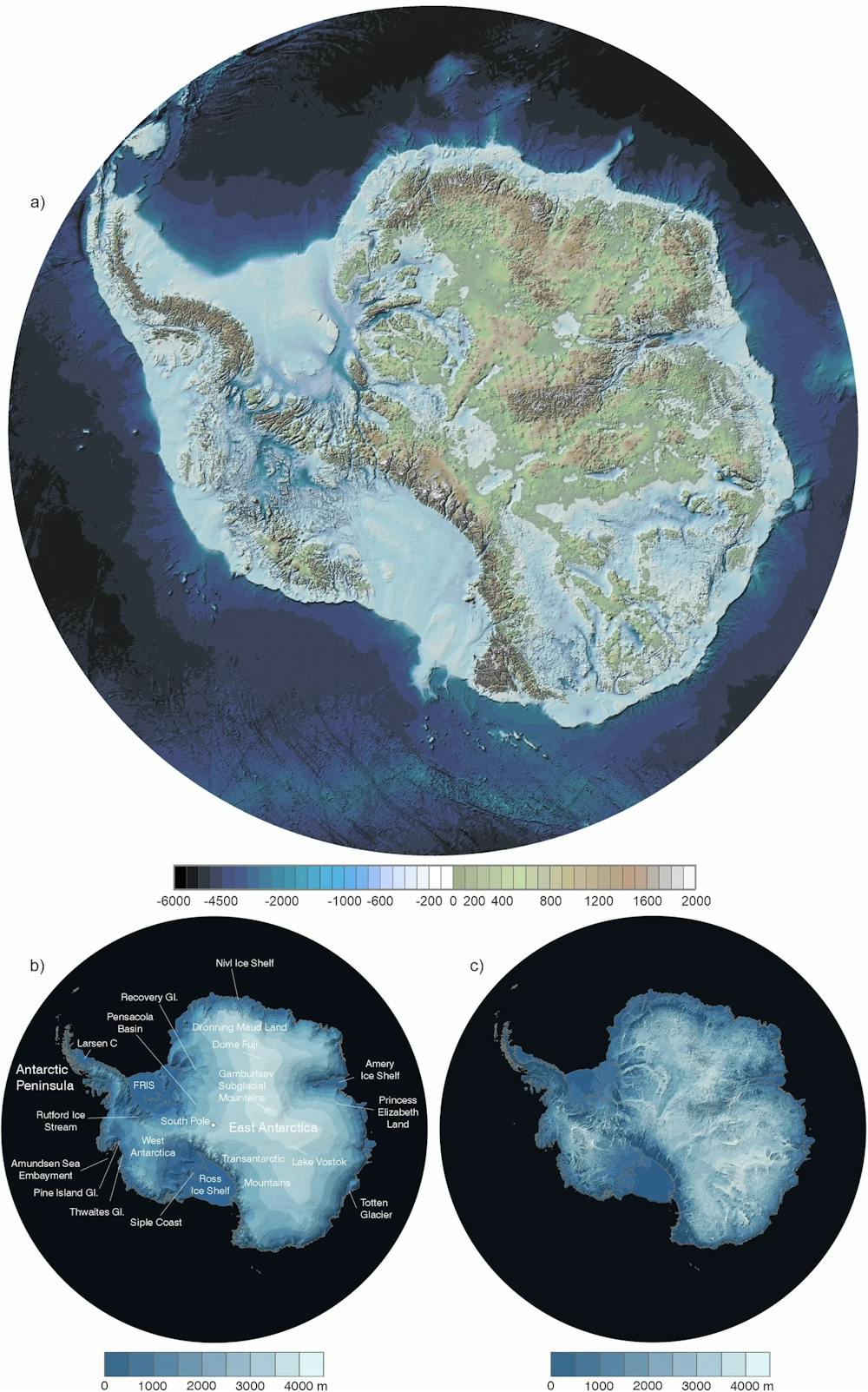
Some peaks, like the towering Transantarctic Mountains, rise above the ice. But others, like the mysterious and ancient Gamburtsev Subglacial Mountains in the middle of East Antarctica, are completely buried.
The Gamburtsev Mountains are similar in scale and shape to the European Alps. But we can’t see them because the high alpine peaks and deep glacial valleys are entombed beneath kilometres of ice.
How did they come to be? Typically, a mountain range will rise in places where two tectonic plates clash with each other. But East Antarctica has been tectonically stable for millions of years.
Our new study, published in Earth and Planetary Science Letters, reveals how this hidden mountain chain emerged more than 500 million years ago when the supercontinent Gondwana formed from colliding tectonic plates.
Our findings offer fresh insight into how mountains and continents evolve over geological time. They also help explain why Antarctica’s interior has remained remarkably stable for hundreds of millions of years.
Because the mountain range is completely covered in ice, it’s one of the least understood tectonic features on Earth. For scientists, it’s deeply puzzling. How could such a massive mountain range form and still be preserved in the heart of an ancient, stable continent?
Most major mountain chains mark the sites of tectonic collisions. For example, the Himalayas are still rising today as the Indian and Eurasian plates continue to converge, a process that began about 50 million years ago.
Plate tectonic models suggest the crust now forming East Antarctica came from at least two large continents more than 700 million years ago. These continents used to be separated by a vast ocean basin.
A map of the topography (a) and surface elevation (b) of Antarctica, measured in metres above sea level; (c) shows ice thickness in metres. Pritchard et al., Scientific Data (2025), CC BY
The collision of these landmasses was key to the birth of Gondwana, a supercontinent that included what is now Africa, South America, Australia, India and Antarctica.
Our new study supports the idea that the Gamburtsev Mountains first formed during this ancient collision. The colossal clash of continents triggered the flow of hot, partly molten rock deep beneath the mountains.
As the crust thickened and heated during mountain building, it eventually became unstable and began to collapse under its own weight.
Deep beneath the surface, hot rocks began to flow sideways, like toothpaste squeezed from a tube, in a process known as gravitational spreading. This caused the mountains to partially collapse, while still preserving a thick crustal “root”, which extends into Earth’s mantle beneath.
Mountain building causes deep crustal rocks to deform, fold and partially melt. Jacqueline Halpin
Crystal time capsules
To piece together the timing of this dramatic rise and fall, we analysed tiny zircon grains found in sandstones deposited by rivers flowing from the ancient mountains more than 250 million years ago. These sandstones were recovered from the Prince Charles Mountains, which poke out of the ice hundreds of kilometres away.
Zircons are often called “time capsules” because they contain minuscule amounts of uranium in their crystal structure, which decays at a known rate and allows scientists to determine their age with great precision.
These zircon grains preserve a record of the mountain-building timeline: the Gamburtsev Mountains began to rise around 650 million years ago, reached Himalayan heights by 580 million years ago, and experienced deep crustal melting and flow that ended around 500 million years ago.
Most mountain ranges formed by continental collisions are eventually worn down by erosion or reshaped by later tectonic events. Because they’ve been preserved by a deep layer of ice, the Gamburtsev Subglacial Mountains are one of the best-preserved ancient mountain belts on Earth.
While it’s currently very challenging and expensive to drill through the thick ice to sample the mountains directly, our model offers new predictions to guide future exploration.
Geologists Jacqueline Halpin and Jack Mulder stand on the Denman Glacier during recent fieldwork. Jacqueline Halpin
For instance, recent fieldwork near the Denman Glacier on East Antarctica’s coast uncovered rocks that may be related to these ancient mountains. Further analysis of these rock samples will help reconstruct the hidden architecture of East Antarctica.
Antarctica remains a continent full of geological surprises, and the secrets buried beneath its ice are only beginning to be revealed.
Jacqueline Halpin receives funding from the Australian Research Council through the ARC Australian Centre for Excellence in Antarctic Science (ACEAS) Special Research Initiative.
Nathan R. Daczko receives funding from the Australian Research Council.
Samuel Beckett is justly regarded as one of the greatest playwrights of the 20th century – and unquestionably one of the most demanding. Few of his works illustrate this more clearly than Happy Days, first performed in 1961, and currently playing at the Sydney Theatre Company.
The premise of this visually arresting two-act play – notable as Beckett’s first play to feature a central female character – is simple and simultaneously astonishing.
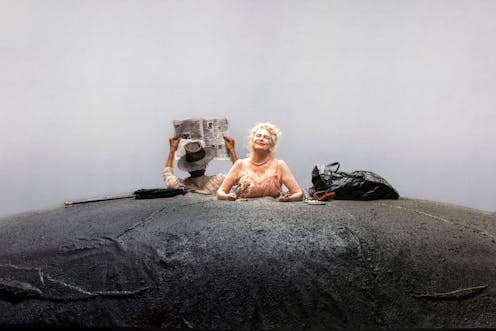
A middle-aged woman, Winnie, is buried in a low mound of scorched earth in a barren, sun-blasted landscape. She is buried up to her waist in the first act, and up to her neck in the second.
Her near-silent and largely unseen husband, Willie, isn’t buried himself but appears to lack the means (and possibly the desire) to dig her out. No explanation is ever given for Winnie’s predicament.
Each day starts and ends with the piercing ring of a bell. These are Winnie’s only markers of time. She fills the interminable hours with relentless chatter: an increasingly hopeless attempt to hold despair at bay, while clinging desperately to a sense of routine.
She rations out her dwindling resources and ritually inspects her few remaining possessions: a toothbrush, a lipstick, a mirror, a parasol, a magnifying glass, a comb and, more disturbingly, a small revolver.
Tackling a psychologically complex character
Beckett’s authorised biographer, James Knowlson, points out that when Happy Days premiered, its “starkness and boldness” surprised and bewildered audiences more accustomed to naturalistic forms of theatre.
Critics were initially divided on the play. But with its existential exploration of universal themes such as isolation, time and endurance, it has since become regarded as not only one of the most significant works in Beckett’s oeuvre, but one of the greatest achievements in theatre history.
Indeed, the esteem in which Happy Days is now held can be seen in comparisons made between Winnie and Shakespeare’s Hamlet.
This parallel isn’t nearly as far-fetched as it might seem at first. For one thing, Winnie directly quotes from Shakespeare’s famous tragedy early in the first act.
Pamela Rabe was initially hesitant to take on the role of Winnie when approached by former artistic director Kip Williams. Brett Boardman//Sydney Theatre Company
Also, much like Hamlet, she is a character of great psychological complexity, prone to lengthy reflections on the nature of existence, the passage of time and mortality. Her monologues, like Hamlet’s, are freighted with irony, melancholy and flashes of mordant humour.
That such a link can be made speaks not only to the strength of Beckett’s writing, but also to the extraordinary challenge – and opportunity – presented by the role of Winnie, for any actor brave enough to take it on.
Pamela Rabe delivers a truly mesmeric performance as Winnie in the Sydney Theatre Company’s outstanding rendition of Happy Days. She seems highly aware of the role’s magnitude:
People talk about it being the kind of female Hamlet. I think, well, Jesus, in Hamlet there’s at least another 12 people on the stage.
Initially approached by former artistic director Kip Williams, Rabe was hesitant to take on the part. She admits playing Winnie was “definitely not on my bucket list”. However, the challenge ultimately proved irresistible.
Rabe described the process of getting to grips with Beckett’s “meticulous” dramatic prescriptions and constructing Winnie’s world as
part maths, part archaeology, part slapstick, and very much a privilege. She’s endearing, mercurial, resourceful, wilful, occasionally a bit silly but always full of life.
Winnie’s monologues are laced with both melancholy and biting humour. Brett Boardman//Sydney Theatre Company
A contemporary spin with wit and pathos
The production, conceived and directed by Rabe and renowned lighting designer Nick Schlieper, does justice to Beckett’s original vision, while offering a new spin on this most canonical of plays.
Consider, for instance, the creative team’s striking decisions when it came to set design and staging. While their choices honour Beckett’s stated demand for “maximum simplicity”, they also depart in key visual respects. Gone are the “scorched earth” and “blazing sun” Beckett called for in his original stage directions.
Instead, Schlieper offers us something approximating a post-apocalyptic tableau: the stage is framed by a narrow proscenium-like window, behind which Winnie, and occasionally Willie (played excellently by Markus Hamilton) appear. This window is set against a monochromatic and featureless void.
The ash-coloured mound, which brings to mind Mark Rothko’s desolate final abstract expressionist canvases, is amorphous and otherworldly – a monstrous fusion of congealed lava and nuclear slag. Everything is beautifully rendered and deeply unsettling.
These eerie abstractions heighten the play’s existential stakes, forcing the audience to reckon with the sheer horror of Winnie’s situation, while showcasing the talents of an actor capable of infusing the bleakest of scenarios with wit and pathos.
They also ensure the production feels contemporary and resonant – particularly in an age haunted by environmental catastrophe and ecological collapse – without retroactively imposing present day values and concerns onto the past.
Something tells me Beckett, who consistently eschewed easy and all too often reductive interpretations of his work, would have approved.
Alexander Howard does not work for, consult, own shares in or receive funding from any company or organisation that would benefit from this article, and has disclosed no relevant affiliations beyond their academic appointment.
President Donald Trump has begun eroding the United States presence in Antarctica by announcing deep funding cuts to his nation’s science and logistics on the icy continent.
More cuts are foreshadowed. If carried through, US science and overall presence in Antarctica will be seriously diminished – at a time when China is significantly expanding its presence there.
Since 1958, the US has been a leader in both Antarctic diplomacy and science. Shrinking its Antarctic presence will diminish US capacity to influence the region’s future.
Why the US matters in Antarctica
The US has historically focused its Antarctic influence in three key areas:
1. Keeping Antarctica free from military conflict
The US has built considerable Antarctic geopolitical influence since the late 1950s. Under President Dwight D. Eisenhower, it initiated (and later hosted) negotiations that led to the development of the 1959 Antarctic Treaty.
It was also key to establishing the fundamental principles of the treaty, such as using the Antarctic region only for peaceful purposes, and prohibiting military activities and nuclear weapons testing.
2. Governing Antarctica together
The US was influential in developing the international legal system that governs human activities in the Antarctic region.
In the 1970s, expanding unregulated fishing in the Southern Ocean led to serious concerns about the effects on krill-eating species – especially the recovery of severely depleted whale populations.
The US joined other Antarctic Treaty nations to champion the Convention on the Conservation of Antarctic Marine Living Resources (CAMLR), signed in 1980. It prioritises conservation of Southern Ocean ecosystems and all species, over maximum fish harvesting.
The US also contributed to the 1991 Protocol on Environmental Protection. Among other measures it prohibits mining and designates Antarctica as “a natural reserve, devoted to peace and science”.
3. Scientific research and collaboration
The US operates three year‑round Antarctic research stations: Palmer, Amundsen-Scott and McMurdo.
McMurdo is Antarctica’s largest research station. Amundsen-Scott is located at the South Pole, the geographic centre of Antarctica, and the point at which all Antarctic territorial claims meet. The South Pole station is thus important symbolically and strategically, as well as for science.
The US has the largest number of Antarctic scientists of any nation in the continent.
US scientific work has been at the forefront of understanding Antarctica’s role in the global climate system, and how climate change will shape the future of the planet. It has also played a major role in Southern Ocean ecosystem and fisheries research.
This research has underpinned important policies. For example, US input into models to predict and manage sustainable krill yields has been pivotal in regulating the krill fishery, and ensuring it doesn’t harm penguin, seal and whale populations.
The US influence in Antarctica extends beyond the list above. For example, the US has a significant Antarctic-based space program. And US citizens make up most Antarctic tourists, and the US plays a significant role in regulating tourism there.
The full extent of the Trump administration’s cuts is still to play out. But clearly, if they proceed as signalled, the cuts will be a major blow not to just US interests in Antarctica, but those of many other countries.
The US has the best-resourced logistics network in Antarctica. Its air transport, shipping and scientific field support has traditionally been shared by other countries. New Zealand, for instance, is closely tied with the US in resupply of food and fuel, and uses US air and sea logistics for many operations to the Ross Sea region.
And joint research programs with the US will be affected by reduced funding in Antarctica directly, and elsewhere.
For example, reported cuts to the climate programs of NASA and the National Oceanic and Atmospheric Administration (NOAA) may hamper satellite coverage of the Antarctic and Southern Ocean. This would affect Australian scientists collecting data on ocean temperature, sea-ice state and other metrics used in climate research and weather forecasting.
Worrying times ahead
China has signalled its intention to be a key geopolitical player in Antarctica and has greatly expanded its Antarctic presence in recent years.
Both China and Russia, are increasingly active in their opposition to environmental initiatives such as marine protected areas.
A smaller US presence creates greater opportunities for others to shape Antarctica’s geopolitics. This includes pressure to erode decades-long protection of the Antarctic environment, a push for more intensive fish and krill harvesting, and potentially reopening debate on mining in the region.
Lynda Goldsworthy and Tony Press co-authored the chapter Power at the Bottom of the World in the new book Antarctica and the Earth System.
Lynda Goldsworthy, research associate with IMAS, UTAS, undertakes occasional contract work with the Deep Sea Conservation, is a member of AFMA’s SouthMac advisory group ) and of CSIRO National Benefit Advisory Committee.
Tony Press receives funding from the Australia-Japan Foundation (Department of .Foreign Affairs and Trade)
There’s a blaze of light across the sky! A fireball is seen by thousands, and mobile phone and dashcam footage soon appears on social media.
But what have people just seen? A mix of social media hashtags suggests confusion about what has streaked overhead. Was it a Soviet Venus probe? Was it one of Elon Musk’s satellites or rockets? Was it a meteor? Was it a comet?
While these objects have some similarities, there are crucial differences that can help us work out what just passed over our heads.
Shooting stars, meteors and comets
Shooting stars can often be seen on dark, clear nights in the countryside as brief flashes of light travelling across the sky. Usually, they are gone in just a second or two.
To capture a shooting star with this level of detail, your camera settings need to be just right, because they are very brief flashes of light. Andrew Xu/Flickr, CC BY-NC-ND
Shooting “stars” are not stars, of course. They are produced by dust and pebbles burning up high in the atmosphere, typically above 50km in altitude. Comets are often a source of this dust, and regular showers of shooting stars happen when Earth travels through comets’ orbits.
Sometimes shooting stars burn with colours that reflect their composition – including iron, magnesium and calcium.
Meteors and shooting stars are actually the same thing. But when people talk about meteors, they often mean bigger and brighter events – bolides. Bolides result from rocks and boulders plunging into Earth’s atmosphere, resulting in bright flashes of light that can outshine all the stars and planets in the night sky.
Bolides can reach the lower atmosphere and sometimes produce audible sonic booms. Occasionally pieces of the bolide – meteorites – even make it to Earth’s surface.
The Chelyabinsk fireball was a bolide.
While bolides can survive longer than shooting stars, they also don’t last for long. As they are initially travelling at tens of kilometres per second, they don’t take long to traverse the atmosphere.
The Chelyabinsk meteor, the largest bolide known to impact Earth in over a century, shone brightly for only 20 seconds or so.
If you see something blaze across the sky, it almost certainly isn’t a comet. Comets are so far away from us that their vast speeds are imperceptible to the human eye. Furthermore, while comets are sometimes depicted as fiery, their glow is more subtle.
Space junk
Maybe the bright flash you just saw was space junk? Perhaps. The number of orbital rocket launches and satellites has increased rapidly in recent years, and this has resulted in some spectacular reentries, which are often discarded rocket stages.
Like meteors, space junk travels at vast speeds as it travels through the atmosphere and it begins burning up spectacularly. Also like meteors, you can see colours indicative of the materials burning up, such as steel and aluminium. However, there are a few things that distinguish space junk from meteors.
When rockets and satellites are launched into orbit, they typically travel along paths that roughly follow Earth’s curvature. So when space junk begins to enter the atmosphere, it’s often travelling almost horizontally.
Space junk also travels at slower speeds than shooting stars and meteorites, entering Earth’s atmosphere at roughly 8km/s rather than tens of kilometres per second.
Because of these factors, space junk can take minutes to enter the atmosphere and travels hundreds of kilometres in the process. Over this time, the space junk will slow down and break up into pieces, and the more solidly constructed parts might make it down to Earth.
The slower pace of space junk fireballs gives people time to grab phones, take footage and post on social media, perhaps with a little colourful commentary added for good measure.
A Russian rocket reenters the atmosphere over south eastern Australia.
Rockets
While space junk can produce a light show, rockets can also put on amazing displays. If you happen to be near Cape Canaveral or Vandenberg Space Force Base in the United States, or Wairoa in Aotearoa New Zealand, then it’s not unexpected to see a rocket launch. You get smoke, flames and thundering noise.
But in other parts of the world you may get a different view of rockets.
Rockets that bring satellites into our orbit accelerate to 8km/s. As they do, they travel many hundreds of kilometres at over 100km altitude. American satellite launches often travel near the coast, passing major cities including Los Angeles.
As rockets approach orbit, they are more subtle than the flames and noise of liftoff. Rockets produce plumes of exhaust gases that rapidly and silently expand in the vacuum of space.
While these plumes are typically seen near launch sites, they can be visible elsewhere, too.
Sometimes rocket engines are ignited after reaching an initial orbit to boost satellites to higher orbits, send probes into the Solar System or slow rockets down for reentry. Rockets may also vent excess fuel into space, again producing plumes or spirals of gases. While not necessarily a common occurrence, these have been seen all over the world.
A deorbit burn over Western Europe.
Do look up
There’s a lot to see in the night sky – the familiar Moon, stars and planets. But there’s the unexpected, too – something blazing across the sky in minutes or even mere seconds. While fireballs may be puzzling at first, they are often recognisable and we can figure out what we’ve just witnessed.
Have you had the good fortune to see a fireball for yourself? If not, pop outside on a clear dark night. Perhaps you will see something unexpected.
Michael J. I. Brown receives research funding from the Australian Research Council and Monash University.
ER Report: Here is a summary of significant articles published on EveningReport.nz on May 12, 2025.
Victoria’s planning reforms could help solve the housing crisis. But they are under threat Source: The Conversation (Au and NZ) – By Brendan Coates, Program Director, Housing and Economic Security, Grattan Institute An aerial drone view of northern Melbourne suburbs. Elias Bitar/Shutterstock The federal election campaign was dominated by the housing crisis. But the real power to solve it rests with the states. In Victoria, reforms are underway that
Footy’s ‘code wars’ are back, but which is actually the No. 1 Australian sport: the NRL or AFL? Source: The Conversation (Au and NZ) – By Tim Harcourt, Industry Professor and Chief Economist, University of Technology Sydney NRL Photos, Matt Turner/AAP, Wikimedia, The Conversation, CC BY Every now and then, so-called “code wars” erupt between the major Australia winter football codes: the National Rugby League (NRL) and the Australian Football League (AFL). This
A prisoner voting ban shows again how few checks there are on parliamentary power Source: The Conversation (Au and NZ) – By Stephen Winter, Associate Professor in Political Theory, University of Auckland, Waipapa Taumata Rau Getty Images Justice Minister Paul Goldsmith’s recent announcement that the government would reinstate a total ban on prisoners voting was in keeping with the coalition’s overall tough-on-crime approach. The move was called “ridiculous” and
‘We’re just doing our best’ – cultural backlash hits Auckland kava business By Coco Lance, RNZ Pacific digital journalist A new Auckland-based kava business has found itself at the heart of a cultural debate, with critics raising concerns about appropriation, authenticity, and the future of kava as a deeply rooted Pacific tradition. Vibes Kava, co-founded by Charles Byram and Derek Hillen, operates out of New Leaf Kombucha
‘Fighting more frequent now’ – researcher warns of escalating West Papua conflict By Caleb Fotheringham, RNZ Pacific journalist The escalation of violence in West Papua is on par with some of the most intense times of conflict over the past six decades, a human rights researcher says. The United Liberation Movement for West Papua (ULMWP) claims that Indonesia killed at least one civilian and severely injured another
Homer’s Iliad is a rap battle Source: The Conversation (Au and NZ) – By Joshua Forstenzer, Senior Lecturer in Philosophy and Co-Director of the Centre for Engaged Philosophy, University of Sheffield The Anger of Achilles by Jacques-Louis David (1819). Kimbell Art Museum Homer’s Iliad is one of the foundational stories of European civilisation. The Iliad is a long poem – an
Major brands don’t need to kowtow to Trump: they have the power to bring people together Source: The Conversation (Au and NZ) – By Michael Beverland, Professor of Brand Management, University of Sussex Business School, University of Sussex Whatever you think of his personality or politics, it’s impossible to deny the success of Donald Trump as a brand. Supporters and detractors across the world are transfixed by his second term as
Meteorites and marsquakes hint at an underground ocean of liquid water on the Red Planet Source: The Conversation (Au and NZ) – By Hrvoje Tkalčić, Professor, Head of Geophysics, Director of Warramunga Array, Australian National University UAESA / MBRSC / Hope Mars Mission / EXI / Andrea Luck, CC BY Evidence is mounting that a secret lies beneath the dusty red plains of Mars, one that could redefine our view
Why doesn’t Australia make more medicines? Wouldn’t that fix drug shortages? Source: The Conversation (Au and NZ) – By Peter Coomber, PhD Candidate, Pharmaceutical Supply Chains, The University of Queensland IM Imagery/Shutterstock About 400 medicines are in short supply in Australia. Of these, about 30 are categorised as critical. These are ones with a life-threatening or serious impact on patients, and with no readily available substitutes.
Farmers fear dingoes are eating their livestock – but predator poo tells an unexpected story Source: The Conversation (Au and NZ) – By Rachel Mason, PhD candidate in Conservation Biology, Deakin University Kristian Bell/Shutterstock Killing carnivores to protect livestock, wildlife and people is an emotive and controversial issue that can cause community conflict. Difficult decisions about managing predators must be supported by strong scientific evidence. In Australia, predators such as
‘Cutting off communications’ – did Trump really just turn his back on Israel? ANALYSIS: By Robert Inlakesh Israel is in a weak position and Prime Minister Benjamin Netanyahu’s extremism knows no bounds. The only other way around an eventual regional war is the ousting of the Israeli prime minister. US President Donald Trump has closed his line of communication with Israeli Prime Minister Benjamin Netanyahu, according to various
View from The Hill: if Jacinta Nampijinpa Price became Liberal deputy it would be a wild ride Source: The Conversation (Au and NZ) – By Michelle Grattan, Professorial Fellow, University of Canberra Jacinta Nampijinpa Price’s confirmation she will run for Liberal deputy has put the members of an already shell-shocked party into a new spin. Tuesday’s leadership contest, where the numbers are said to be tight, is a battle for the direction
Dumped minister Ed Husic labels Deputy Prime Minister Richard Marles ‘factional assassin’ Source: The Conversation (Au and NZ) – By Michelle Grattan, Professorial Fellow, University of Canberra Industry Minister Ed Husic, dumped from the frontbench ahead of Anthony Albanese’s announcement of his new ministry, has made an excoriating attack on Deputy Prime Minister Richard Marles, describing him as a “factional assassin”. Marles, chief of the Victorian right,
Philippine advocacy group condemns NZ military pact with Manila, rejects election violence Asia Pacific Report The Aotearoa Philippines Solidarity national assembly has condemned the National Party-led Coalition government in New Zealand over signing a “deplorable” visiting forces agreement with the Philippine government “Given the Armed Forces of the Philippines’ appalling human rights record and continuing attacks on activists in the Philippines, it is deplorable for the New
The federal election campaign was dominated by the housing crisis. But the real power to solve it rests with the states.
In Victoria, reforms are underway that promise a bigger boost to the housing aspirations of younger generations than anything that occurs in the federal parliament.
Yet these reforms are now under threat of being killed off in the Victorian parliament. If that happens, Victoria will have fewer homes and they will be more expensive, and many more younger Melburnians will be locked out of home ownership.
We need to build more homes
At the heart of our housing problem is the fact we just haven’t built enough homes.
Australia has among the least housing stock per person in the developed world. This is especially true in places where people most want to live: close to jobs, transport, schools and parks.
The reason is simple: we’ve made it hard to build more townhouses and apartments in the most desirable parts of our biggest cities.
And the politics of land-use planning – what gets built and where – favour those who oppose change. The people who might live in new housing in established suburbs – if it were to be built – don’t get a say.
The result is a vast “missing middle”: prime inner-city land, close to jobs and transport, with housing rising only one or two storeys. Melbourne, like Sydney, is one of the least-dense cities of its size in the world, despite the city’s population having risen by 875,000 in the past decade alone. That is the equivalent of almost two Canberras.
It’s a myth that most Victorians want a quarter-acre block if that means living a long way from jobs, transport, shops and parks. Research by both Grattan Institute and Infrastructure Victoria shows there is substantial demand for townhouses and apartments in established suburbs, if only we built more of them.
If Melbourne’s middle suburbs – those between two and 20 kilometres from the CBD – were as dense as those of Toronto, that increase in density alone could accommodate all of the 800,000 extra homes the state government plans to build over the next decade.
The flow-on effect is high prices and rents, a stagnating economy because fewer people can live close to jobs, and further expensive and environmentally damaging sprawl into farmland and floodplains.
Recent research showed that 8,000 completed apartments in Melbourne remain unsold. Yet this is less than 3% of all apartments in Melbourne, and is unsurprising given past sharp rises in interest rates and increased barriers in selling to foreign buyers.
That some newly built homes have taken longer to sell is not a reason to prevent the building of those extra homes that so many future Melburnians want to live in.
Victoria’s planning reforms are our best chance
Housing can become more affordable if we allow more homes to be built where residents most want to live.
Victoria’s new Townhouse and Low-Rise Code will streamline development approval processes for developments of three storeys or less in residential zones across the state. Where developments meet the code, those new homes will no longer need a planning permit and will be exempt from third-party appeals. This is already the case for knock-down rebuilds.
These reforms have the potential to unlock hundreds of thousands of extra homes in the coming decades in areas with some of the best infrastructure, amenities and public spaces.
These changes do not dictate where housing must be built in Melbourne: they simply permit more housing where demand is highest.
Yet these reforms are now under threat. The Victorian Liberals and the Greens have teamed up to launch an inquiry into the state Labor government’s reforms. The inquiry is scheduled to report on Tuesday, just one day before the deadline for disallowing the reforms lapses.
Together, the Liberals and the Greens have the power to revoke the changes in the upper house of the Victorian parliament. That would be a disaster for housing affordability in Victoria.
The Victorian parliament shouldn’t stand in the way of young families who want to buy a townhouse in the suburb they grew up in, or seniors downsizing to an apartment in their local neighbourhood.
These reforms are about allowing more homes, and creating a better, healthier, and more vibrant Melbourne.
Grattan Institute began with contributions to its endowment of $15 million from each of the federal and Victorian governments, $4 million from BHP Billiton, and $1 million from NAB. In order to safeguard its independence, Grattan Institute’s board controls this endowment. The funds are invested and contribute to funding Grattan Institute’s activities. Grattan Institute also receives funding from corporates, foundations, and individuals to support its general activities, as disclosed on its website.
Joey Moloney and Matthew Bowes do not work for, consult, own shares in or receive funding from any company or organisation that would benefit from this article, and have disclosed no relevant affiliations beyond their academic appointment.
NRL Photos, Matt Turner/AAP, Wikimedia, The Conversation, CC BY
Every now and then, so-called “code wars” erupt between the major Australia winter football codes: the National Rugby League (NRL) and the Australian Football League (AFL).
This animosity likely stems from a phenomenon known as “the Barassi Line”, a cultural and geographical divide based on football preference which runs from Eden, NSW, through Canberra and up to Arnhem Land.
Recently, NRL chair Peter V’Landys claimed victory over the AFL in a strongly worded salvo:
Rugby league has reaffirmed its standing as the No. 1 sporting code in Australia and the Pacific after the Australian Rugby League Commission (ARLC) announced record-breaking attendances, TV audiences, participation, revenue and assets.
But is he right to state the NRL as Australia’s No. 1 sport?
A uniquely Australian battle
The battleground in Australia is unique: most nations have only one major football code, soccer. Australia though has four – Australian rules football (AFL), rugby league (NRL), soccer and rugby union.
More competition is good for the consumer and, in this case, the consumer is the Aussie sports fan.
The way these fans watch, play and pour money into each sport is closely tracked by each league. And the competition for talent, fans, sponsors and eyeballs via TV, digital media and streaming grows every year.
Thanks to Australian sports media experts SportsIndustryAU, we can now make a direct comparison between the codes.
What the numbers say
It’s important to note the NRL’s recent chest-beating refers to audiences in Australia and the Pacific, explaining the code’s push into Papua New Guinea (PNG) and potentially further expansion in New Zealand.
In terms of revenue, the AFL earned 39% more than the NRL in 2024: $1.04 billion compared to the NRL’s $744.8 million.
In terms of profit, the NRL’s was 51% higher than the AFL in 2024. This was in large part due to the NRL having only half the operational expenses of the AFL.
However, if we look at operating profit (gross profit minus operating expenses), the AFL was 13% higher than the NRL before it made its annual distributions to clubs. The AFL distributes its profits among its 18 clubs, with smaller clubs receiving more than the more powerful teams.
In terms of TV audience, the NRL was 10% larger in terms of average aggregated audiences for free-to-air and paid subscription services in 2024: 153.7 million to the AFL’s 140.3 million. However, AFL matches go longer and the season features more games than the NRL. Also, these figures do not include streaming numbers, which will be part of future broadcast deals.
In terms of attendance and membership, the AFL is a clear winner.
The AFL welcomed 8.4 million fans through the gate in 2024, compared to 4.3 million for the NRL.
For membership, the AFL’s clubs boasted 1.32 million collectively in 2024. In the NRL, there are slightly more than 400,000 club members (based on club data – the NRL does not release membership data).
In terms of participation, Ausplay – a national tracking survey led by the Australian Sports Commission – estimates 641,390 Aussie rules players, compared to 531,323 for rugby league (which includes touch football and Oztag).
No clear-cut answer
While more of the numbers point to an AFL advantage, this heavyweight battle will never be completely settled, and both codes’ future expansion plans will further muddy the waters.
The NRL has just announced the Perth Bears will join in 2027 or 2028. This team revives the old North Sydney Bears with a new Western Australia base. This will bring the number of NRL clubs to 19.
A possible 20th team is slated for New Zealand, or Ipswich in the western Brisbane corridor.
Similarly, the AFL is expanding, first to Tasmania, which is set to become its 19th club in 2028.
Beyond that, it’s possible the league will look to the Northern Territory, Canberra or another team in Western Australia or South Australia to join as the 20th team.
One key advantage for the NRL is its international appeal.
For two years, it has hosted games in Las Vegas. And after the NRL’s successful Magic Round in Brisbane, CEO Andrew Abdo floated the possibility of taking the event overseas, with Hong Kong and Dubai reportedly expressing interest.
Of course, as a domestic game, Australian rules football cannot logically expand beyond our shores.
But whether beyond our boundaries or within, the NRL vs AFL rivalry will continue, and an unequivocal winner will never really be settled on.
Tim Harcourt does not work for, consult, own shares in or receive funding from any company or organisation that would benefit from this article, and has disclosed no relevant affiliations beyond their academic appointment.
Justice Minister Paul Goldsmith’s recent announcement that the government would reinstate a total ban on prisoners voting was in keeping with the coalition’s overall tough-on-crime approach.
The move was called “ridiculous” and “stupid” by opposition spokespeople, largely because it contradicted findings by the Supreme Court and the Waitangi Tribunal.
But behind those concerns about the ban placing an “unreasonable limit on the electoral rights guaranteed under the New Zealand Bill of Rights Act” lies a broader constitutional question to do with parliament’s relationship with the courts.
In short, removing prisoner voting rights will damage a critical but fragile check on government power – what is known as the “judicial declaration of inconsistency”.
An ‘executive paradise’
New Zealand has been described as an “executive paradise” by constitutional lawyer and former prime minister Geoffrey Palmer. There is no upper house, no federal structure, and the courts lack the power to strike down unconstitutional legislation.
The constitution itself is a collection of statutes and conventions that, for the most part, can be changed by a simple parliamentary majority. The 1990 Bill of Rights Act is a cornerstone of that constitution, but is an ineffectual check on government power.
When parliament considers a bill that is potentially inconsistent with “the human rights and fundamental freedoms” set out in the Bill of Rights, the attorney-general delivers a report explaining the inconsistencies.
This is supposed to be a deterrent, and one might think it would be the end of the matter. Unfortunately, that is not the case. Adverse attorney-general reports have appeared regularly (there have been 15 since 2021) without blocking legislation.
Parliament’s habit of passing legislation that does not comply with the Bill of Rights is why the recently developed judicial declaration of inconsistency is constitutionally important.
The declaration is a “soft” legal power. It doesn’t strike down laws or rewrite them. Rather, it is a “weak form” of review that enables affected citizens to petition the court to declare a law inconsistent with the Bill of Rights. This should then spur parliament to fix the problem.
The declaration aims to start a constitutional dialogue between the two branches of government. Enabling citizens to hold parliament accountable, it is a vital instrument in a system otherwise heavily dominated by the executive branch.
Constitutional dialogue in action
The High Court issued the first such declaration in the case of Taylor vs Attorney-General in 2015, declaring a total ban on prisoners voting was inconsistent with the Bill of Rights Act. The government appealed, but the Supreme Court affirmed the declaration in a landmark 2018 decision.
What happened next, however, was just as important. If the declaration was to initiate a constitutional dialogue, it was up to parliament to respond – which it did. In 2020, it rescinded the ban on voting for prisoners incarcerated for less than three years.
Then, in 2022, it amended the Bill of Rights to require the attorney-general to notify parliament when a superior court issues a declaration of inconsistency. And it required a ministerial report to parliament on the government’s response within six months.
Those measures put in place a framework for constitutional dialogues. And this process played out in the next (and to date only) declaration of inconsistency. This was in 2022, when the Supreme Court declared prohibiting 16-year-olds from voting was inconsistent with the Bill of Rights.
In 2023, the government tabled its response and introduced a bill to enable 16-year-olds to vote in local elections. The government initially announced it would do the same for parliamentary elections. But that idea was dropped when it became clear this wouldn’t get the necessary super-majority support of 75% of MPs.
Chief Justice Helen Winkelmann: courts and parliament could work together. Getty Images
An over-powered parliament
Although modest, parliament’s responses were constitutionally important because they modelled a new framework for accountability. Chief Justice Helen Winkelmann suggested the process illustrated how courts and parliament could work together in the “gradual and collaborative elaboration” of New Zealand’s constitution.
An evolving constitutional dialogue would enable the courts to pose a modest check on New Zealand’s over-powered parliament. So, those who hoped they were seeing the dawn of a new constitutional convention will be disheartened by the move to ban all prisoners from voting.
The current government has already terminated the bill enabling 16-year-olds to vote, without mentioning this contradicted the Supreme Court’s declaration of inconsistency.
Should parliament now ban prisoner voting, it will have nullified all substantial responses to declarations of inconsistency. That would be a profound constitutional setback.
Parliament regularly flouts the Bill of Rights. We are now seeing it double down by rolling back its previous responses to judicial declarations.
New Zealanders already have comparatively little constitutional protection from parliament. Reinstating a total ban on prisoner voting will undermine the practice of constitutional dialogue between the two branches of government. And it will weaken a fragile check on government power.
Stephen Winter does not work for, consult, own shares in or receive funding from any company or organisation that would benefit from this article, and has disclosed no relevant affiliations beyond their academic appointment.
A new Auckland-based kava business has found itself at the heart of a cultural debate, with critics raising concerns about appropriation, authenticity, and the future of kava as a deeply rooted Pacific tradition.
Vibes Kava, co-founded by Charles Byram and Derek Hillen, operates out of New Leaf Kombucha taproom in Grey Lynn.
The pair launched the business earlier this year, promoting it as a space for connection and community.
Byram, a Kiwi-American of Samoan descent, returned to Aotearoa after growing up in the United States. Hillen, originally from Canada, moved to New Zealand 10 years ago.
Both say they discovered kava during the covid-19 pandemic and credit it with helping them shift away from alcohol.
“We wanted to create something that brings people together in a healthier way,” the pair said.
However, their vision has been met with growing criticism, with people saying the business lacks cultural depth, misrepresents tradition, and risks commodifying a sacred practice.
Context and different perspectives Tensions escalated after Vibes Kava posted a promotional video on Instagram, describing their offering as “a modern take on a 3000-year-old tradition” and “a lifestyle shift, one shell at a time”.
On their website, Hillen is referred to as a “kava evangelist,” while videos feature Byram hosting casual kava circles and promoting fortnightly “kava socials.”
The kava they sell is bottled, with tag names referencing the effects of each different kava bottle — for example, “buzzy kava” and “chill kava”.
Their promotional content was later reposted on TikTok by a prominent Pacific influencer, prompting an influx of online input about the legitimacy of their business and the diversity of their kava circles.
The reposted video has since received more than 95,000 views, 1600 shares, and 11,000 interactions.
In the TikTok caption, the influencer questioned the ethical foundations of the business.
“I would like to know what type of ethics was put into the creation of this . . . who was consulted, and said it was okay to make a brand out of a tradition?”
Criticised the brand’s aesthetic Speaking to RNZ Pacific anonymously, the influencer criticised the brand’s aesthetic and messaging, describing it as “exploitative”.
“Their website and Instagram portray trendy, wellness-style branding rather than a proud celebration of authentic Pacific customs or values,” they said.
“I feel like co-owner Charles appears to use his Samoan heritage as a buffer against the backlash he’s received.
“Not to discredit his identity in any way; he is Samoan, and seems like a proud Samoan too.
“However, that should be reflected consistently in their branding. What’s currently shown on their website and Instagram is a mix of Fijian kava practice served in a Samoan tanoa. That to me is confusing and dilutes cultural authenticity.”
Fiji academic Dr Apo Aporosa said much of the misunderstanding stems from a narrow perception of kava as simply being a beverage.
“Most people who think they are using kava are not,” Aporosa said.
‘Detached from culture’ “What they’re consuming may contain Piper methysticum, but it’s detached from the cultural framework that defines what kava actually is.”
Aporosa said it is important to recognise kava as both a substance and a practice — one that involves ceremony, structure, and values.
“It is used to nurture vā, the relational space between people, and is traditionally accompanied by specific customs: woven mats, the tanoa bowl, coconut shell cups (bilo or ipu), and a shared sense of respect and order.”
He said that the commodification of kava, through flavoured drink extracts and Western “wellness” branding, is concerning, and that it distorts the plant’s original purpose.
“When people repackage kava without understanding or respecting the culture it comes from, it becomes cultural appropriation,” he said.
He added that it is not about restricting access to kava — it is about protecting its cultural integrity and honouring the knowledge Pacific communities have preserved for upwards of 2000 years.
Fijian students at the Victoria University of Wellington conduct a sevusevu (kava ceremony) to start off Fiji Language Week. Image: RNZ Pacific/Koroi Hawkins
‘We can’t just gatekeep — we need to guide’ Dr Edmond Fehoko, is a renowned Tongan academic and senior lecturer at Otago University, garnered international attention for his research on the experiences and perceptions of New Zealand-born Tongan men who participate in faikava.
He said these situations are layered.
“I see the cultural appreciation side of things, and I see the cultural appropriation side of things,” Fehoko said.
“It is one of the few practices we hold dearly to our heart, and that is somewhat indigenous to our Pacific people — it can’t be found anywhere else.
“Hence, it holds a sacred place in our society. But, we as a peoples, have actually not done a good enough job to raise awareness of the practice to other societies, and now it’s a race issue, that only Pacific people have the rights to this — and I don’t think that is the case anymore.”
He explained that it is part of a broader dynamic around kava’s globalisation — and that for many people, both Pacific and non-Pacific, kava is an “interesting and exciting space, where all types of people, and all genders, come in and feel safe”.
“Yes, that is moving away from the cultural, customary way of things. But, we need to find new ways, and create new opportunities, to further disseminate our knowledge.
‘Not the same today’ “Our kava practice is not the same today as it was 10, 20 years ago. Kava practices have evolved significantly across generations.
“There are over 200 kava bars in the United States . . . kava is one of the few traditions that is uniquely Pacific. But our understanding of it has to evolve too. We can’t just gatekeep — we need to guide,” he said.
Dr Edmond Fehoko . . . “Kava practices have evolved significantly across generations.” Image: RNZ Pacific/ Sara Vui-Talitu
He added that the issue of kava being commercialised by non-Pacific people cannot necessarily be criticised.
“It’s two-fold, and quite contradictory,” he said, adding that the criticism against these ventures often overlooks the parallel ways in which Pacific communities are also reshaping and profiting from the tradition.
“We argue that non-Pacific people are profiting off our culture, but the truth is, many of us are too,” he said.
“A minority have extensive knowledge of kava . . . and if others want to appreciate our culture, let them take it further with us, instead of the backlash.
“If these lads are enjoying a good time and have the same vibe . . . the only difference is the colour of their skin, and the language they are using, which has become the norm in our kava practices as well.
“But here, we have an opportunity to educate people on the importance of our practice. Let’s raise awareness. Kava is a practice we can use as a vehicle, or medium, to navigate these spaces.”
Vibes Kava co-founder Charles Byram . . . It’s tough to be this person and then get hurt online, without having a conversation with me. Nobody took the time to ask those questions.” Image: Brady Dyer/BradyDyer.com/RNZ Pacific
‘Getting judged for the colour of my skin’ “I completely understand the points that have been brought up,” Byram said in response to the criticism.
Tearing up, he said that was one of the most difficult things to swallow was backlash fixated on his cultural identity.
“I felt like I was getting judged for the colour of my skin, and for not understanding who I was or what I was trying to accomplish. If my skin was a bit darker, I might have been given some more grace.
“I was raised in a Samoan household. My grandfather is Samoan . . . my mum is Samoan. It’s tough to be this person and then get hurt online, without having a conversation with me. Nobody took the time to ask those questions,” he said.
The pair also pushed back on claims they are focused on profit.
“We went there to learn, to dive into the culture. We went to a lot of kava bars, interviewed farmers, just to understand the origin of kava, how it works within a community, and then how best to engage with, and showcase it,” Byram said.
“People have criticised that we are profiting — we’re making no money at this point. All the money we make from this kava has gone back to the farmers in Vanuatu.”
Representing a minority Hillen thinks those criticising them represent a minority.
“We have a lot of Pasifika customers that come here [and] they support us.
“They are ecstatic their culture is being promoted this way, and love what we are doing. The negative response from a minority part of the population was surprising to us.”
Critics had argued that the business showcased confusing blends of different cultural approaches.
Byram and Hillen said that it is up to other people to investigate and learn about the cultures, and that they are simply trying to acknowledge all of them.
Byram, however, added that the critics brought up some good points — and that this will be a catalyst for change within their business.
“Yesterday, we joined the Pacific Business Hub. We are [taking] steps to integrate more about the culture, community, and what we are trying to accomplish here.”
They also addressed their initial silence and comment moderation.
‘Cycle so self-perpetuating’ “I think the cycle was so self-perpetuating, so I was like . . . I need to make sure I respond with candor, concern, and active communication.
“So I deleted comments and put a pause on things, so we could have some space before the comments get out of hand.
“At the end of the day . . . this is about my connection with my culture and people more than anything, and I’m excited to grow from it. I’m learning, and I’m utilising this as a growth point. We’re just doing our best,” Byram said.
Hillen added: “You have to understand, this business is super new, so we’re still figuring out how best to do things, how to market and grow along with not only the community.
“What we really want to represent as people who care about, and believe in this.”
Byram said they want to acknowledge as many peoples as possible.
“We don’t want to create ceremony or steal anything from the culture. We really just want to celebrate it, and so again, we acknowledge the concern,” he added.
This article is republished under a community partnership agreement with RNZ.
The escalation of violence in West Papua is on par with some of the most intense times of conflict over the past six decades, a human rights researcher says.
The United Liberation Movement for West Papua (ULMWP) claims that Indonesia killed at least one civilian and severely injured another last Tuesday in Puncak Regency.
In a statement, ULMWP interim president Benny Wenda said Deris Kogoya, 18, was killed by a rocket attack from a helicopter while riding his motorbike near Kelanungin Village.
Jemi Waker, meanwhile, sustained severe violent injuries, including to both his legs.
The statement said Waker had refused to go to hospital, fearing he would be killed if he went.
Human Rights Watch researcher Andreas Harsono said that over the past month he had received an unusually high number of messages accompanied by gruesome photos showing either Indonesian soldiers or civilians being killed.
“The fighting is much more frequent now,” Harsono said.
More Indonesian soldiers “There are more and more Indonesian soldiers sent to West Papua under President Pradowo.
“At the same time, indigenous Papuans are also gaining more and more men, unfortunately also boys, to join the fight in the jungle.”
He said the escalation could match similarly intense periods of conflict in 1977, 1984, and 2004.
A spokesperson for Indonesia’s Embassy in Wellington said they could not confirm if there had been a military attack in Puncak Regency on Tuesday.
However, they said all actions conducted by Indonesia’s military were in line with international law.
They said there were attacks in March and April of this year, instigated by an “armed criminal group” targeting Indonesian workers and civilians.
Harsono said if the attack was on civilians, it would be a clear breach of human rights.
Confirmation difficult However, he said it was difficult to confirm due to the remoteness of the area. He said it was common for civilians to wear army camouflage because of surplus Indonesian uniforms.
India and Pakistan have seen the scenario play out before: a terror attack in which Indians are killed leads to a succession of escalatory tit-fot-tat measures that put South Asia on the brink of all-out war. And then there is a de-escalation.
The broad contours of that pattern have played out in the most recent crisis, with the latest step being the announcement of a ceasefire on May 10, 2025.
But in another important way, the flare-up – which began on April 22 with a deadly attack in Indian-controlled Kashmir, in which 26 people were killed – represents significant departures from the past. It involved direct missile exchanges targeting sites inside both territories and the use of advanced missile systems and drones by the two nuclear rivals for the first time.
These changes have coincided with domestic political shifts in both countries. The pro-Hindu nationalism of Indian Prime Minister Narendra Modi’s government has heightened communal tensions in the country. Meanwhile Pakistan’s powerful army chief, Gen. Syed Asim Munir, has embraced the “two-nation theory,” which holds that Pakistan is a homeland for the subcontinent’s Muslims and India for Hindus.
This religious framing was even seen in the naming of the two countries’ military operations. For India, it is “Operation Sindoor” – a reference to the red vermilion used by married Hindu women, and a provocative nod to the widows of the Kashmir attack. Pakistan called its counter-operation “Bunyan-un-Marsoos” – an Arabic phrase from the Quran meaning “a solid structure.”
The role of Washington
The India-Pakistan rivalry has cost tens of thousands of lives across multiple wars in 1947-48, 1965 and 1971. But since the late 1990s, whenever India and Pakistan approached the brink of war, a familiar de-escalation playbook unfolded: intense diplomacy, often led by the United States, would help defuse tensions.
In 1999, President Bill Clinton’s direct mediation ended the Kargil conflict – a limited war triggered by Pakistani forces crossing the Line of Control into Indian-administered Kashmir – by pressing Pakistan for a withdrawal.
Similarly, after the 2001 attack inside the Indian Parliament by terrorists allegedly linked to Pakistan-based groups Lashkar-e-Taiba and Jaish-e-Mohammed, U.S. Deputy Secretary of State Richard Armitage engaged in intense shuttle diplomacy between Islamabad and New Delhi, averting war.
And after the 2008 Mumbai attacks, which saw 166 people killed by terrorists linked to Lashkar-e-Taiba, rapid and high-level American diplomatic involvement helped restrain India’s response and reduced the risk of an escalating conflict.
As recently as 2019, during the Balakot crisis – which followed a suicide bombing in Pulwama, Kashmir, that killed 40 Indian security personnel – it was American diplomatic pressure that helped contain hostilities. Former Secretary of State Mike Pompeo later wrote in his memoirs, “I do not think the world properly knows just how close the India-Pakistan rivalry came to spilling over into a nuclear conflagration in February 2019.”
A diplomatic void?
Washington as peacemaker made sense: It had influence and a vested interest.
During the Cold War, the U.S. formed a close alliance with Pakistan to counter India’s links with the Soviet Union. And after the 9/11 terror attacks, the U.S. poured tens of billions of dollars in military assistance into Pakistan as a frontline partner in the “war on terror.”
Simultaneously, beginning in the early 2000s, the U.S. began cultivating India as a strategic partner.
A stable Pakistan was a crucial partner in the U.S. war in Afghanistan; a friendly India was a strategic counterbalance to China. And this gave the U.S. both the motivation and credibility to act as an effective mediator during moments of India-Pakistan crisis.
Today, however, America’s diplomatic attention has shifted significantly away from South Asia. The process began with the end of the Cold War, but accelerated dramatically after the U.S. withdrawal from Afghanistan in 2021. More recently, the wars in Ukraine and the Middle East have consumed Washington’s diplomatic efforts.
Since President Donald Trump took office in January 2025, the U.S. has not appointed an ambassador in New Delhi or Islamabad, nor confirmed an assistant secretary of state for South and Central Asian Affairs – factors that must have hampered any mediating role for the United States.
And while Trump said the May 10 ceasefire followed a “long night of talks mediated by the United States,” statements from India and Pakistan appeared to downplay U.S. involvement, focusing instead on the direct bilateral nature of negotiations.
Should it transpire that Washington’s role as a mediator between Pakistan and India has been diminished, it is not immediately obvious who, if anyone, will fill the void. China, which has been trying to cultivate a role of mediator elsewhere, is not seen as a neutral mediator due to its close alliance with Pakistan and past border conflicts with India. Other regional powers like Iran and Saudi Arabia tried to step in during the latest crisis, but both lack the power clout of the U.S. or China.
This absence of external mediation is not, of course, a problem in itself. Historically, foreign interference – particularly U.S. support for Pakistan during the Cold War – often complicated dynamics in South Asia by creating military imbalances and reinforcing hardline positions. But the past has shown external pressure – especially from Washington – can be effective.
Breaking the norms
The recent escalation unfolded against the backdrop of another dynamic: the erosion of international norms since the end of the Cold War and accelerating after 2001.
More recently, Israel’s operations in Gaza, Lebanon and Syria have drawn widespread criticism for violations of international humanitarian law – but have resulted in limited consequences.
In short, geopolitical norms have been ebbed away and military actions that were once deemed red lines are crossed with little accountability.
For India and Pakistan, this environment creates both opportunity and risk. Both can point to behaviors elsewhere to justify assertive actions that they have undertaken that, in previous years, would have been deemed a step too far – such as attacks on places of worship and sovereignty violations.
Multi-domain warfare
But what truly distinguished the latest crisis from those of the past is, I believe, its multi-domain nature. The conflict is no longer confined to conventional military exchanges along the line of control – as it was for the first five decades of the Kashmir question.
Both countries largely respected the line of control as a de facto boundary for military operations until the 2019 crisis. Since then, there has been a dangerous progression: first to cross-border airstrikes into each other’s territories, and now to a conflict that spans conventional military, cyber and information spheres simultaneously.
Reports indicate Chinese-made Pakistani J-10 fighter jets shot down multiple Indian aircraft, including advanced French Rafale jets. This confrontation between Chinese and Western weapons represents not just a bilateral conflict but a proxy test of rival global military technologies – adding another layer of great-power competition to the crisis.
In addition, the use of loitering drones designed to attack radar systems represents a significant escalation in the technological sophistication of cross-border attacks compared to years past.
The conflict has also expanded dramatically into the cyber domain. Pakistani hackers, claiming to be the “Pakistan Cyber Force,” report breaching several Indian defense institutions, potentially compromising personnel data and login credentials.
Simultaneously, social media and a new right-wing media in India have become a critical battlefront. Ultranationalist voices in India incited violence against Muslims and Kashmiris; in Pakistan, anti-India rhetoric similarly intensified online.
Cooler voices prevailing … for now
These shifts have created multiple escalation pathways that traditional crisis management approaches weren’t designed to address.
Particularly concerning is the nuclear dimension. Pakistan’s nuclear doctrine is that it will use nuclear weapons if its existence is threatened, and it has developed short-range tactical nuclear weapons intended to counter Indian conventional advantages. Meanwhile, India has informally dialed back its historic no-first-use stance, creating ambiguity about its operational doctrine.
Thankfully, as the ceasefire announcement indicates, mediating voices appear to have prevailed this time around. But eroding norms, diminished great power diplomacy and the advent of multi-domain warfare, I argue, made this latest flare-up a dangerous turning point.
What happens next will tell us much about how nuclear rivals manage, or fail to manage, the spiral of conflict in this dangerous new landscape.
Farah N. Jan does not work for, consult, own shares in or receive funding from any company or organization that would benefit from this article, and has disclosed no relevant affiliations beyond their academic appointment.
Source: The Conversation (Au and NZ) – By Joshua Forstenzer, Senior Lecturer in Philosophy and Co-Director of the Centre for Engaged Philosophy, University of Sheffield
Homer’s Iliad is one of the foundational stories of European civilisation. The Iliad is a long poem – an epic – thought to have first been put down in writing in the eighth century BC, though the story is set several hundred years before, perhaps as early as the 12th or 13th century BC.
It explores a few crucial violent weeks within a much longer war between an alliance of Greek city-states and the city of Troy over Helen, the most beautiful woman in the world. In it, we find ancient Greek gods and humans sharing a common reality. They concurrently star as the central characters of both a mythological and an earthly dramatic encounter, on which the fate of a people rests.
In his work, public philosopher Cornel West argues that there is a “gangster” inside all of us. The challenge, West teaches, is to learn to keep these “gangster elements” in check so that we can still live with decency and integrity in an often violent and unjust world. This struggle, I contend, is at the heart of both Homer’s Iliad and the art of battle rap.
This article is part of Rethinking the Classics. The stories in this series offer insightful new ways to think about and interpret classic books and artworks. This is the canon – with a twist.
Battle rap is an art form where two or more MCs confront one another in a freestyle rap that includes boasts, insults, wordplay and disses (related to but not to be confused with rap beefs like the Kendrick Lamar and Drake feud).
The history of this kind of verbal jousting goes back at least to flyting – poetic duels usually involving rhyming insults, widespread in northern Europe in the late medieval era. (See Assassin’s Creed Valhalla for its recent reimagining.) And it also has African roots. But its latest iteration is thought to have emerged in the hip-hop scene in New York in the 1980s. The 1981 Busy Bee versus Kool Moe Dee battle at the Harlem World club in New York is an important part of hip-hop lore.
The rap battles featured in 8 Mile brought the scene mainstream attention.
It was arguably the 2002 film 8 Mile, however, that starred real battle rap legend, Eminem, that made the art form well known beyond hardcore rap aficionados. Today it is a pop culture streaming event, with millions of followers and official leagues.
The object of a battle rap is to display flow, braggadocio and quick wit. Humour is often a plus, but lyrically dexterous, rhythmic, creative “burns” are the name of the game.
So what do the Iliad and battle rap have in common?
Both art forms encourage us, the listeners, to react, reflect and ultimately select with which speaker to side. We are thrust into the centre of the action without much of a narrator to explain things.
Both the Iliad and rap battles are part of the oral poetic tradition, since we think the Iliad was orally recited for generations before it was put down in writing. They are therefore both addressed to a live audience.
Emily Wilson, who translated The Iliad in 2023, gives a lively contemporary reading.
The Iliad is a story of war between Greeks and Trojans, but also of “beefs”. Menelaus versus Paris over the hand of Helen. Achilles versus Agamemnon, the king of the Greeks who wrongs him by expropriating one of his slaves. And Achilles versus Hector, the Trojan prince who kills Patroclus, Achilles’s closest friend.
The high moment of the poem is arguably the encounter between Achilles and Hector. Before they battle to the death, Hector offers Achilles a deal: whoever wins won’t disrespect the other’s body.
In response, Achilles belows: “Curse you, Hector, and don’t talk of oaths to me. Lions and men make no compacts, nor are wolves and lambs in sympathy: they are opposed, to the end. You and I are beyond friendship: nor will there be peace until one or the other dies.”
Achilles is calling out Hector’s attempt at showing nobility of character, because Hector tries to separate the duty to wage conflict from rage and disrespect of his enemy. Achilles flatly rejects the proposal. For him, the only reason to fight is to satiate his grief-induced rage and so no respect can be given even after death.
The battle of Hector and Achilles as imagined in Troy (2004).
Ultimately, Achilles kills Hector and desecrates his body, but Hector was clearly the better man. Two worldviews collide. Which one should we side with?
In a battle rap, the question of how we judge which MC to be victorious is always at stake. Do we side with the MC who best “rocks the mic” by pleasing the audience, or the one who more lyrically and intelligently cuts the opponent to the bone?
Here are five more themes shared by The Iliad and battle rap.
1. The pursuit of fame
Battle rap has made gifted MCs into street rap legends. Long before record deals were the prize, MCs battled for respect and street fame.
This pursuit of legendary status also lies at the very heart of The Iliad, as Achilles is warned by his mother, the goddess Thetis, that he will die if he fights in the Trojan war, but in return his “glory never dies”.
2. Communal belonging
Battle rappers and the warriors in The Iliad act in their own name but they also represent wider groups heralding from different places. They all, in some way, carry responsibility for and aim to bring reflected fame to their respective communities.
3. Displaying skill
Most battle raps take the form of a take down of the opponent, but the real object is to demonstrate verbal prowess. Simply entertaining will not cut it. “You now have to make sense of what you say, in order for us to give you the power,” summarises hip-hop legend KRS-One.
The Iliad opens with a muse telling the audience that the epic will recount the “wrath of Achilles”, but in fact we find skilful interventions in speech that make us wonder whether the reasons for conflict can ever justify the grief it causes.
4. An honour code
What is truly worth living and dying for are central themes in The Iliad, as in battle rap. There we find talk of loyalty, honour, respect, courage, friendship and fame.
The overt answers given can be taken as embraces of a certain kind of toxic masculinity where dominance, rage, cunning and violence are celebrated, but maybe these answers subtly point to their ultimate hollowness.
Lurking behind the repeated injunction to “be the best”, battle rap and Homer’s epic invite the question of what is truly worth admiring: skill, dominance, wealth, integrity, courage, beauty, truth, justice, love or glory? They provide no singular answer.
5. Creativity and living within the ‘funk’ of life
Instead, we are left to sit within what West calls the “funk of life” – the mess of it all. From there, we can see that the stories we tell ourselves have the power to shape and define our actions and our very lives.
So the main question becomes: at a time when simplistic stories of violence and domination are presented to us as easy answers to complex social realities, can we create new and richer stories of our own?
Joshua Forstenzer’s work receives funding from the Yale Center for Faith and Culture as part of its Templeton-funded Life Worth Living project (https://lifeworthliving.yale.edu/).
Source: The Conversation (Au and NZ) – By Michael Beverland, Professor of Brand Management, University of Sussex Business School, University of Sussex
Whatever you think of his personality or politics, it’s impossible to deny the success of Donald Trump as a brand. Supporters and detractors across the world are transfixed by his second term as US president.
And so far, many corporate brands appear keen to get alongside him. The leaders of Tesla, Amazon and Meta were all prominent guests at Trump’s inauguration in January 2025.
By then, Mark Zuckerberg had already shifted company policy on fact checking to be more aligned with the political wind. Weeks later, retail giants Walmart and Target had rolled back diversity, equality and inclusion (DEI) initiatives.
Even the NFL, which had so infuriated Trump in his first term with its support for diversity, has come to heel.
So now that Trump is back in town, is the only option available to big US organisations to swing to the right? Well, not necessarily.
Our research suggests that the rise of populism actually represents an opportunity for brands to rebuild a sense of shared national identity.
And the most well-known brands are the best placed to do this. Their familiar place in people’s everyday lives gives them huge power as non-political agents of collective identity which can cross divides of race, class, geography and age.
A great example of this was during the presidential election campaign when Trump’s team wanted to organise a publicity stunt involving the Republican candidate “working” at a branch of McDonald’s in Pennsylvania.
Trump’s love of the golden arches is well known, but McDonald’s is a strongly non-political brand. So what should it do? Refuse and risk a backlash, or accept and be accused of taking sides?
In the end, the company’s response was a masterclass in neutrality.
McDonald’s told its employees that the company was neither red (Republican) nor blue (Democrat), but golden. Referring to both presidential candidates’ love of McDonald’s, the company made it clear that the permission granted to Trump illustrated one of their core values, stating: “We open our doors for everyone”.
The plan worked. And this was partly down to McDonald’s being widely thought of as an authentic brand which connects people.
Research has shown that people really value a company’s place in local communities. And McDonald’s is a place which hosts children’s birthday parties, where you can catch up with friends, where you might even have had your first ever job.
This kind of power to unify is something other brands can do too. As something our earlier research shows, brands can benefit from bringing people together, by creating a sense of shared identity.
Brand new
In New Zealand for example, ANZ Bank was widely applauded for a campaign featuring Indian immigrants. The advert tells the story of a father and son and their mixed cricketing loyalties (the parent to India, the child to New Zealand).
It is a tale of immigrants achieving their version of the national dream, through hard work and trademark Kiwi humour. This kind of narrative-driven campaign does not pitch one side against another, but instead highlights the things that bind people together.
Similarly in the UK, the department store John Lewis has become a seasonal advertising staple as it reminds customers of their shared rituals over Christmas. And Kraft’s “How do you love your Vegemite” campaign allowed new immigrants to participate in local snacking rituals, helping them feel Australian.
In the US, a 1971 Coca Cola commercial (one of the most lauded adverts ever) presented a united multi-cultural collection of young people as a response to the anti-Vietnam war counter-culture.
So far, American brands have struggled to navigate the ever-shifting pronouncements coming from the White House in Trump’s second term. Amazon for example, quickly went back on its decision to list the cost of tariffs on products after it was branded a “hostile move”.
But one brand does stand out. And that’s Ford.
Perhaps it was inevitable that the car maker which came to symbolise successful 20th century American manufacturing would get this right. And the company’s decision to extend employee discounts to all consumers in what it describes as “unprecedented times” is a clever move.
Some might call it a cynical tactic to embrace Trump’s tariffs and encourage Americans to buy American. But the firm (which will likely take a huge hit from more expensive imported parts and materials) is doing much more than that.
Its new campaign (with the slogan “From America for America”) reminds US citizens that the brand is part of their lives, regardless of their political home. Supportive full-page print ads go further, setting out the firm’s long history spent backing the people of America.
One Ford executive says that the campaign is about “authenticity” and Ford being a brand “that all consumers can rely on, especially in these uncertain times”.
Authenticity is much prized when the political landscape is so polarised. And while divisions cannot be healed solely by brands, they can help to remind us of shared values and a sense of community. And in doing so, dial down those political tensions.
The authors do not work for, consult, own shares in or receive funding from any company or organisation that would benefit from this article, and have disclosed no relevant affiliations beyond their academic appointment.
Source: The Conversation (Au and NZ) – By Hrvoje Tkalčić, Professor, Head of Geophysics, Director of Warramunga Array, Australian National University
UAESA / MBRSC / Hope Mars Mission / EXI / Andrea Luck, CC BY
Evidence is mounting that a secret lies beneath the dusty red plains of Mars, one that could redefine our view of the Red Planet: a vast reservoir of liquid water, locked deep in the crust.
Mars is covered in traces of ancient bodies of water. But the puzzle of exactly where it all went when the planet turned cold and dry has long intrigued scientists.
Our new study may offer an answer. Using seismic data from NASA’s InSight mission, we uncovered evidence that the seismic waves slow down in a layer between 5.4 and 8 kilometres below the surface, which could be because of the presence of liquid water at these depths.
The mystery of the missing water
Mars wasn’t always the barren desert we see today. Billions of years ago, during the Noachian and Hesperian periods (4.1 billion to 3 billion years ago), rivers carved valleys and lakes shimmered.
As Mars’ magnetic field faded and its atmosphere thinned, most surface water vanished. Some escaped to space, some froze in polar caps, and some was trapped in minerals, where it remains today.
Four billion years ago (top left), Mars may have hosted a huge ocean. But the surface water has slowly disappeared, leaving only frozen remnants near the poles today. NASA
But evaporation, freezing and rocks can’t quite account for all the water that must have covered Mars in the distant past. Calculations suggest the “missing” water is enough to cover the planet in an ocean at least 700 metres deep, and perhaps up to 900 metres deep.
One hypothesis has been that the missing water seeped into the crust. Mars was heavily bombarded by meteorites during the Noachian period, which may have formed fractures that channelled water underground.
Deep beneath the surface, warmer temperatures would keep the water in a liquid state – unlike the frozen layers nearer the surface.
A seismic snapshot of Mars’ crust
In 2018, NASA’s InSight lander touched down on Mars to listen to the planet’s interior with a super-sensitive seismometer.
By studying a particular kind of vibration called “shear waves”, we found a significant underground anomaly: a layer between 5.4 and 8 kilometres down where these vibrations move more slowly.
This “low-velocity layer” is most likely highly porous rock filled with liquid water, like a saturated sponge. Something like Earth’s aquifers, where groundwater seeps into rock pores.
We calculated the “aquifer layer” on Mars could hold enough water to cover the planet in a global ocean 520–780m deep — several times as much water as is held in Antarctica’s ice sheet.
This volume is compatible with estimates of Mars’ “missing” water (710–920m), after accounting for losses to space, water bound in minerals, and modern ice caps.
Meteorites and marsquakes
We made our discovery thanks to two meteorite impacts in 2021 (named S1000a and S1094b) and a marsquake in 2022 (dubbed S1222a). These events sent seismic waves rippling through the crust, like dropping a stone into a pond and watching the waves spread.
The crater caused by meteorite impact S1094b, as seen from NASA’s Mars Reconnaissance Orbiter. NASA/JPL-Caltech/University of Arizona
InSight’s seismometer captured these vibrations. We used the high-frequency signals from the events — think of tuning into a crisp, high-definition radio station — to map the crust’s hidden layers.
We calculated “receiver functions,” which are signatures of these waves as they bounce and reverberate between layers in the crust, like echoes mapping a cave. These signatures let us pinpoint boundaries where rock changes, revealing the water-soaked layer 5.4 to 8 kilometres deep.
Why it matters
Liquid water is essential for life as we know it. On Earth, microbes thrive in deep, water-filled rock.
Could similar life, perhaps relics of ancient Martian ecosystems, persist in these reservoirs? There’s only one way to find out.
The water may be a lifeline for more complex organisms, too – such as future human explorers. Purified, it could provide drinking water, oxygen, or fuel for rockets.
Of course, drilling kilometres deep on a distant planet is a daunting challenge. However, our data, collected near Mars’ equator, also hints at the possibility of other water-rich zones – such as the icy mud reservoir of Utopia Planitia.
What’s next for Mars exploration?
Our seismic data covers only a slice of Mars. New missions with seismometers are needed to map potential water layers across the rest of the planet.
Future rovers or drills may one day tap these reservoirs, analysing their chemistry for traces of life. These water zones also require protection from Earthly microbes, as they could harbour native Martian biology.
For now, the water invites us to keep listening to Mars’ seismic heartbeat, decoding the secrets of a world perhaps more like Earth than we thought.
Hrvoje Tkalčić receives funding from The Australian Research Council.
Weijia Sun works for Institute of Geology and Geophysics, Chinese Academy of Sciences. He receives funding from National Key R&D Program of China.
About 400 medicines are in short supply in Australia. Of these, about 30 are categorised as critical. These are ones with a life-threatening or serious impact on patients, and with no readily available substitutes.
However, medicine shortages in Australia are not new. We know from past experience that six classes of medications are the most likely to go short: antibiotics, anaesthesia and pain relief treatments, heart and blood pressure medications, hormonal medications, cancer treatments and epilepsy medications.
Australia has a very small pharmaceutical manufacturing industry. It mainly makes vaccines and some generic medications (ones no longer protected by a patent). In fact, Australia imports 90%of its medications.
Most raw ingredients are also imported, including the active pharmaceutical ingredient. This is the ingredient that has a therapeutic effect, such as salbutamol to manage asthma or atorvastatin to lower cholesterol. Australia also imports the inactive ingredients known as excipients. These include fillers, bulking agents and preservatives.
Then there are medication delivery devices (such as inhalers or syringes) and packaging (which has to be sterile) to source.
A shortage in one ingredient or component – in Australia or internationally – will affect the production and supply of the finished product. This can lead to shortages.
So during a shortage of medications, raw materials or other components, suppliers prioritise larger and therefore more valuable markets.
Australia’s Pharmaceutical Benefits Scheme (PBS) has an underpinning pricing mechanism to provide affordable medicines for Australians. But this also makes the market less attractive to medication manufacturers.
Therefore, countries where markets are bigger, and offer larger profit margins, are more attractive. This restricts the type and range of medications offered to the Australian market, including when supplies are short.
Australia needs medicines, raw ingredients and sterile packaging, all of which can be in short supply. RGtimeline/Shutterstock
So could ramping up local manufacture help?
The answer is maybe.
But developing Australia’s limited pharmaceutical manufacturing would take many years to reach a level and capacity for sustainable supply.
Increasing local manufacturing would address access to some medicines. However, domestic manufacturers also need access to raw ingredients. These could also be made locally.
For pharmaceutical manufacturing to be viable and profitable in Australia there must be “economies of scale”.
Considerations include the availability of raw materials, production costs (including labour), access and availability of infrastructure and specialist facilities. To justify their investments, companies will ultimately need to sell enough product to cover these and other costs.
But Australian manufacturers struggle to achieve economies of scale due to the small domestic market. So they would need to export some of their products to supplement domestic sales.
To boost Australia’s pharmaceutical manufacturing industry, all states and territories would need a coordinated approach to planning and investment. This would also need bipartisan political support and a strategic long-term commitment.
What could we do in the short term?
Health authorities stockpiling medicines is the obvious short-term solution to Australian medication shortages. However, we’d need to carefully manage the stored medicines to ensure supply meets demand. We’d also need to make sure medicines are used before they expire. If not carefully managed, a stockpile risks unnecessary expense and waste.
Currently, state and territories manage the use of medications in their own hospitals. However, we could standardise medication use in hospitals nationally. With co-operation among states and territories this would allow manufacturers and suppliers to better plan production and distribution of medicines. Not only would this provide more certainty for suppliers, it would reduce the states and territories competing with each other for medicines in short supply.
We also need to review the pricing mechanism for medicines to make the Australian market more attractive for pharmaceutical imports. This would also help Australia move higher up the priority list when medicines are in short supply.
Peter Coomber is currently employed by Queensland Health as Senior Director Central Pharmacy, and is a RAAF Reservist Pharmaceutical Officer.
Lisa Nissen receives funding from NHMRC/MRFF and other state and commonwealth research grant schemes. Lisa was previously the state president for the Pharmaceutical Society of Australia (Qld) branch (2008-2015) and a member of the national board. She has previously held positions on the TGA advisory committee for vaccines and advisory committee on scheduling of medicines. Lisa is a current member of AHPRA’s Scheduled Medicines Expert Committee.
Killing carnivores to protect livestock, wildlife and people is an emotive and controversial issue that can cause community conflict. Difficult decisions about managing predators must be supported by strong scientific evidence.
In Australia, predators such as dingoes and foxes are often shot or poisoned with baits to prevent them from killing sheep and cattle. Feral cats and foxes are also killed to protect native wildlife.
But research elsewhere suggests public perceptions of how predators affect ecosystems and livestock are not always accurate.
Our recent study sought to shed light on these controversies. We examined the scat, or poo, left behind by dingoes, foxes and cats. We focused on the mallee region of Victoria and South Australia where there are calls to resume dingo culling to stop them killing livestock.
A contentious issue
Our study took place in the Big Desert-Wyperfeld-Ngarkat reserve complex in the semi-arid mallee region of Victoria and South Australia. This continuous ecosystem comprises about 10,000 km² of protected native mallee bushland, and is entirely surrounded by crop and livestock farming areas.
Fox-baiting is conducted along the boundaries of Victorian-managed reserve areas. Dingo baiting occurs in the South Australian-managed section of the park.
Prior to the change, Victorian farmers and authorised trappers could control dingoes on private land and within public land up to 3km from farms. Farmers say they have lost livestock since dingoes were protected.
What are predators eating in the mallee region?
We collected and analysed 136 dingo, 200 fox and 25 cat scats to determine what each predator in the area was eating and how their diets differed.
Livestock was not a major part of the diet of dingoes, foxes or cats. Some 7% of fox scats contained sheep or cattle remains. This was more than that of dingoes, at 2% of scats. No feral cat scats contained livestock remains.
The dingo diet was dominated by kangaroos, wallabies and emus, which comprised more than 70% of their diet volume.
Cats and foxes consumed more than 15 times the volume of small native mammals compared with dingoes, including threatened species such as fat-tailed dunnarts.
Our data must be interpreted with caution. Scat analysis cannot differentiate between livestock killed by predators and those that are scavenged. It also can’t tell us about animals that a predator killed but did not eat.
In 2022–23, when we collected the scats, rainfall in the area was high and prey was abundant. So, while we found livestock were not likely to be a substantial part of these predators’ diets at the time of our research, this can change depending on environmental conditions.
For example, fire and extended drought may force predators to move further to find food and water. They may move from conservation areas to private land, where they could prey on livestock.
A taste for certain prey
A predator’s poo doesn’t tell the full story of how it affects prey populations.
To understand this further, we used motion-sensing wildlife cameras to assess which prey were available in the ecosystem. We compared it to the frequency they occurred in predator’s diets. This allowed us to determine if dingoes, foxes or cats target specific prey.
We found foxes and cats both consumed small mammals proportionally more than we expected, given the prey’s availability in the study area. Cats consumed birds at a higher rate than expected, and dingoes consumed echidnas more than expected.
Further intensive monitoring work is needed to determine how these dietary preferences affect the populations of prey species.
Embracing the evidence
The findings build on a substantial previous research suggesting foxes and cats pose a significant threat to native mammals, birds, reptiles and other wildlife, including many threatened species. Our results suggest foxes may cause more harm to sheep than dingoes overall – a finding consistent with research elsewhere in Victoria.
Dingoes were the only predator species that regularly preyed on kangaroos and wallabies. These species are abundant in the region. They can also compete with livestock for grazing pastures, consume crops and degrade native vegetation.
Currently, dingoes are killed on, or fenced out of, large parts of Australia due to their perceived threat to livestock.
Lethal control of invasive species remains important to protect native wildlife and agriculture. But such decisions should be based on evidence, to avoid unforeseen and undesirable results.
Non-lethal and effective alternatives exist to indiscriminately killing predators to protect livestock, such as protection dogs and donkeys. These measures are being embraced by farmers and graziers globally, often with high and sustained success.
In Australia, governments should better embrace and support evidence-based and effective approaches that allow farming, native carnivores and other wildlife to coexist.
Rachel Mason conducted this research with grant funding from the Victorian Department of Energy, Environment and Climate Action. She is a current member of the Australian Mammal Society, the Australasian Wildlife Management Society, and the Ecological Society of Australia.
Euan Ritchie receives funding from the Australian Research Council and the Department of Energy, Environment, and Climate Action. Euan is a Councillor within the Biodiversity Council, a member of the Ecological Society of Australia and the Australian Mammal Society, and President of the Australian Mammal Society.
Israel is in a weak position and Prime Minister Benjamin Netanyahu’s extremism knows no bounds. The only other way around an eventual regional war is the ousting of the Israeli prime minister.
US President Donald Trump has closed his line of communication with Israeli Prime Minister Benjamin Netanyahu, according to various reports citing officials.
This comes amid alleged growing pressure on Israel regarding Gaza and the abrupt halt to American operations against Ansarallah in Yemen. So, is this all an act or is the US finally pressuring Israel?
On May 1, news broke that President Donald Trump had suddenly ousted his national security advisor Mike Waltz. According to a Washington Post article on the issue, the ouster was in part a response to Waltz’s undermining of the President, for having engaged in intense coordination with Israeli PM Netanyahu regarding the issue of attacking Iran prior to the Israeli Premier’s visit to the Oval Office.
Some analysts, considering that Waltz has been pushing for a war on Iran, argued that his ouster was a signal that the Trump administration’s pro-diplomacy voices were pushing back against the hawks.
This shift also came at a time when Iran-US talks had stalled, largely thanks to a pressure campaign from the Israel Lobby, leading US think tanks and Israeli officials like Ron Dermer.
Then, seemingly out of nowhere, Trump publicly announced the end to a campaign designed to destroy/degrade Yemen’s Ansarallah-led government in Sana’a on May 6.
Israeli leadership shocked According to Israeli media, citing government sources, the leadership in Tel Aviv was shocked by the move to end operations against Yemen, essentially leaving the Israelis to deal with Ansarallah alone.
After this, more information began to leak, originating from the Israeli Hebrew-language media, claiming that the Trump administration was demanding Israel reach an agreement for aid to be delivered to Gaza, in addition to signing a ceasefire agreement.
The other major claim is that President Trump has grown so frustrated with Netanyahu that he has cut communication with him directly.
Although neither side has officially clarified details on the reported rift between the two sides, a few days ago the Israeli prime minister released a social media video claiming that he would act alone to defend Israel.
On Friday morning, another update came in that American Defence Secretary Pete Hegseth would be cancelling his planned visit to Tel Aviv.
Can Trump and Netanyahu remake the Middle East? Video: Palestine Chronicle
Is the US finally standing up to Israel? In order to assess this issue correctly, we have to place all of the above-mentioned developments into their proper context.
The issue must also be prefaced on the fact that every member of the Trump government is pro-Israeli to the hilt and has received significant backing from the Israel Lobby.
Mike Waltz was indeed fired and according to leaked AIPAC audio revealed by The Grayzone, he was somewhat groomed for a role in government by the pro-Israel Lobby for a long time.
Another revelation regarding Waltz, aside from him allegedly coordinating with Netanyahu behind Trump’s back and adding journalist Jeffrey Goldberg to a private Signal group chat, was that he was storing his chats on an Israeli-owned app.
Yet, Waltz was not booted out of the government like John Bolton was during Trump’s first term in office, he has instead been designated as UN ambassador to the United Nations.
The UN ambassador position was supposed to be handed to Elise Stefanik, a radically vocal supporter of Israel who helped lead the charge in cracking down on pro-Palestine free speech on university campuses. Stefanik’s nomination was withdrawn in order to maintain the Republican majority in the Congress.
If Trump was truly seeking to push back against the Israel Lobby’s push to collapse negotiations with Iran, then why did Trump signal around a week ago that new sanctions packages were on the way?
He announced on Friday that a third independent Chinese refiner would be hit with secondary sanctions for receiving Iranian oil.
Israeli demands in Trump’s rhetoric The sanctions, on top of the fact that his negotiating team have continuously attempted to add conditions the the talks, viewed in Tehran as non-starters, indicates that precisely what pro-Israel think tanks like WINEP and FDD have been demanding is working its way into not only the negotiating team, but coming out in Trump’s own rhetoric.
There is certainly an argument to make here, that there is a significant split within the pro-Israel Lobby in the US, which is now working its way into the Trump administration, yet it is important to note that the Trump campaign itself was bankrolled by Zionist billionaires and tech moguls.
Miriam Adelson, Israel’s richest billionaire, was his largest donor. Adelson also happens to own Israel Hayom, the most widely distributed newspaper in Israel that has historically been pro-Netanyahu, it is now also reporting on the Trump-Netanyahu split and feeding into the speculations.
As for the US operations against Yemen, the US has used the attack on Ansarallah as the perfect excuse to move a large number of military assets to the region.
This has included air defence systems to the Gulf States and most importantly to Israel.
After claiming back in March to have already “decimated” Ansarallah, the Trump administration spent way in excess of US$1 billion dollars (more accurately over US$2 billion) and understood that the only way forward was a ground operation.
Meanwhile, the US has also moved military assets to the Mediterranean and is directly involved in intensive reconnaissance over Lebanese airspace, attempting to collect information on Hezbollah.
An Iran attack imminent? While it is almost impossible to know whether the media theatrics regarding the reported Trump-Netanyahu split are entirely true, or if it is simply a good-cop bad-cop strategy, it appears that some kind of assault on Iran could be imminent.
Whether Benjamin Netanyahu is going to order an attack on Iran out of desperation or as part of a carefully choreographed plan, the US will certainly involve itself in any such assault on one level or another.
The Israeli prime minister has painted himself into a corner. In order to save his political coalition, he collapsed the Gaza ceasefire during March and managed to bring back his Security Minister Itamar Ben Gvir to his coalition.
This enabled him to successfully take on his own Shin Bet chief Ronen Bar, in an ongoing purge of his opposition.
However, due to a lack of manpower and inability to launch any major ground operation against Gaza, without severely undermining Israeli security on other fronts, Netanyahu decided to adopt a strategy of starving the people of Gaza instead.
He now threatens a major ground offensive, yet it is hard to see what impact it would have beyond an accelerated mass murder of civilians.
The Israeli prime minister’s mistake was choosing the blocking of all aid into Gaza as the rightwing hill to die on, which has been deeply internalised by his extreme Religious Zionism coalition partners, who now threaten his government’s stability if any aid enters the besieged territory.
Netanyahu in a difficult position This has put Netanyahu in a very difficult position, as the European Union, UK and US are all fearing the backlash that mass famine will bring and are now pushing Tel Aviv to allow in some aid.
Amidst this, Netanyahu made another commitment to the Druze community that he would intervene on their behalf in Syria.
While Syria’s leadership are signaling their intent to normalise ties and according to a recent report by Yedioth Ahronoth, participated in “direct” negotiations with Israel regarding “security issues”, there is no current threat from Damascus.
However, if tensions escalate in Syria with the Druze minority in the south, failure to fulfill pledges could cause major issues with Israeli Druze, who perform crucial roles in the Israeli military.
Internally, Israel is deeply divided, economically under great pressure and the overall instability could quickly translate to a larger range of issues.
Then we have the Lebanon front, where Hezbollah sits poised to pounce on an opportunity to land a blow in order to expel Israel from their country and avenge the killing of its Secretary General Seyyed Hassan Nasrallah.
Trigger a ‘doomsday option’? Meanwhile in Gaza, if Israel is going to try and starve everyone to death, this could easily trigger what can only be called the “doomsday option” from Hamas and other groups there. Nobody is about to sit around and watch their people starve to death.
As for Yemen’s Ansarallah, it is clear that there was no way without a massive ground offensive that the movement was going to stop firing missiles and drones at Israel.
What we have here is a situation in which Israel finds itself incapable of defeating any of its enemies, as all of them have now been radicalised due to the mass murder inflicted upon their populations.
In other words, Israel is not capable of victory on any front and needs a way out.
The leader of the opposition to Israel in the region is perceived to be Iran, as it is the most powerful, which is why a conflict with it is so desired. Yet, Tehran is incredibly powerful and the US is incapable of defeating it with conventional weapons, therefore, a full-scale war is the equivalent to committing regional suicide.
Robert Inlakesh is a journalist, writer, and documentary filmmaker. He focuses on the Middle East, specialising in Palestine. He contributed this article toThe Palestine Chronicleand it is republished with permission.
Jacinta Nampijinpa Price’s confirmation she will run for Liberal deputy has put the members of an already shell-shocked party into a new spin.
Tuesday’s leadership contest, where the numbers are said to be tight, is a battle for the direction of the party as much as one between the two personalities.
It’s essentially a contest between the moderates and the conservatives. Sussan Ley, deputy for the past three years, carries the flag for the moderates (although she is aligned to the old Scott Morrison faction, which is led by Alex Hawke, one-time Morrison numbers man).
Her opponent, Angus Taylor, who’s been shadow treasurer, leads the conservatives.
Neither Ley nor Taylor has impressed during the last term, but that’s become beside the point.
Taylor has embraced the ambitious Price, who has defected (amid great bitterness) from the Nationals, to boost his support as part of a joint ticket.
Whether the combination will work for or against Taylor’s chances remains to be seen. There are fears in the Ley camp it may attract some undecideds, but it possibly could frighten off others.
Price was elevated spectacularly to national prominence as the most effective “no” campaigner against the Voice. She is forceful and articulate, and the conservative base of the Coalition loves her.
But, leaving aside the complication that she’s a senator, her performance in the Voice campaign doesn’t automatically translate into qualifications for deputy which, if done properly, is a demanding, multi-faceted job.
The Liberal deputy needs deep roots in the party, not having just arrived in controversial circumstances. They have to do a lot of work with the party organisation, not just the parliamentary party.
In the latter, the deputy is there in part to protect the leader’s back and to keep track of the mood of colleagues, which requires having long-standing relationships of familiarity and trust with them.
Some would argue the ideal deputy is a person who does not have their eyes on the leadership, which Price clearly has.
The deputy needs a broad grasp of policy areas, because they will be a high profile public spokesperson for the party, and will be hit with questions on every issue that’s running.
The deputy also has to be comfortable with media across the spectrum, because that’s part of the job. Price’s natural home has been on Sky News. On Sunday, she appeared on Sky’s highly opinionated program Outsiders.
If the Liberals are to get themselves back into shape, they must seek to regain their appeal in the urban areas that went teal in 2022, and to women. Indeed, they have to tap into professional women in those places. It is unlikely Price, unless she undergoes a major political makeover, would be attractive to that constituency.
In their bid for the support of women, the Liberals need a root-and-branch debate about how to get more women candidates, but Price is already totally against quotas.
If Price becomes deputy it will be a wild ride for the party – and for its leader.
Other names mooted as possible deputies are Dan Tehan, from Victoria, who’s been immigration spokesman, and Queenslander Ted O’Brien, the energy spokesman. Either would be less fraught for the party than Price. O’Brien would have the problem of being welded on to the nuclear policy, which will be at least overhauled and perhaps ditched by the Liberals.
Ley is set to have a running mate, but the name has not yet been disclosed.
Another option would be for the loser out of Ley and Taylor to become deputy. Awkward, but perhaps the cleanest way forward. Ley is used to the role; Taylor would be entitled to stay shadow treasurer and would be at the centre of things (what things are left).
Nationals’ identity battle
In the Nationals, the leadership contest – to be decided Monday – is also a battle over identity.
The Nationals under David Litteproud held almost all their seats at the election but one-time resources minister Matt Canavan – a Barnaby Joyce supporter back in the day – says they need a new direction.
Critical to his pitch are energy and climate issues. The Nationals signed up reluctantly to net zero emissions by 2050 in the Morrison prime ministership, when Joyce was leader (although he indicated he personally didn’t favour doing so). They were dragged to the deal with great reluctance.
Canavan, who is a senator, said in his leadership pitch, “We should scrap the futile and unachievable goal of net-zero emissions by 2050. Net zero makes everything more expensive and it is not helping the environment given that the US, China and India are no longer even paying lip service to it.”
Littleproud, describing the challenge as “healthy for our democracy”, is favoured to see off the Canavan bid. Regardless, it is a reminder the Nationals remain a divided party, as they have been for years.
Michelle Grattan does not work for, consult, own shares in or receive funding from any company or organisation that would benefit from this article, and has disclosed no relevant affiliations beyond their academic appointment.
Industry Minister Ed Husic, dumped from the frontbench ahead of Anthony Albanese’s announcement of his new ministry, has made an excoriating attack on Deputy Prime Minister Richard Marles, describing him as a “factional assassin”.
Marles, chief of the Victorian right, in large part drove factional changes which saw Husic, from the New South Wales right, and Attorney-General Mark Dreyfus, from the Victorian right, pushed out of the lineup for the revamped ministry.
In the shakeout, Marles’ numbers man, Sam Rae, will be elevated from the backbench to the ministry, despite having only been in parliament for a single term.
Husic said on Sunday, “I think when people look at a deputy prime minister, they expect to see a statesman, not a factional assassin”.
Asked on the ABC whether that meant he was saying Marles had put his own ambition to boost his numbers ahead of the good of the party, Husic said, “I think a lot of people would draw that conclusion”.
“I think he needed to exercise leadership, he’s part of the leadership group. We’ve got to be able to manage these things in an orderly way.”
“There will be a lot of questions put to Richard about his role, and that’s something that he will have to answer and account for.”
Husic said Prime Minister Anthony Albanese had called him on Saturday – it had been only a brief call – and they will meet on Monday. He looked forward to that being a constructive discussion about the role he could keep playing.
Husic, the only Muslim in cabinet, in part blamed his outspokenness on Gaza for his demotion.
“You can’t celebrate diversity and then expect it to sit in a corner, silent.
“You need to speak up when you bring those different views to either a cabinet table or to a caucus.
“I certainly took the view that you need to speak up to the communities that you care about. I certainly tried to help us navigate wretchedly difficult issues such as what we’re seeing has unfolded in Gaza post the horrors of October 7.
“I don’t think I could ever stay silent in the face of innocent civilians being slaughtered in their tens of thousands and being starved out of Gaza.
“So I tried to find the way to be able to speak at the cabinet table and speak elsewhere, to be able to make sure that communities we represent know that their voices are heard.
“You should have the ability to speak up on the issues that you believe in. You should have the ability to question.
“I would hate to think we get to a situation like Trump Republicans who know something’s wrong and and don’t speak. I’m not saying that’s the case here, but there’s a role, a value in questioning,” he said.
Husic is reported to have clashed with Foreign Minister Penny Wong in cabinet over the Middle East issues. He also had differences with Treasurer Jim Chalmers on some economic issues.
Husic said he would have liked Albanese to have intervened over his demotion but the PM had declined to get involved.
He blamed Marles for putting Albanese into such a position. It was “especially disrespectful of the deputy prime minister to put the prime minister in a terrible place where he was being asked to intervene”. But if Albanese had exercised the great authority he had coming out of the election, “no one would have quibbled”.
“We’ve obviously got to be able to avoid these type of episodes […] the factional grubbiness,” Husic said.
Because of the factional numbers after the election, the NSW right was due to drop a minister. Husic said he chose not to push it to a factional vote to decide who went. “I did not want to put my colleagues through a national ballot.”
Michelle Grattan does not work for, consult, own shares in or receive funding from any company or organisation that would benefit from this article, and has disclosed no relevant affiliations beyond their academic appointment.
The Aotearoa Philippines Solidarity national assembly has condemned the National Party-led Coalition government in New Zealand over signing a “deplorable” visiting forces agreement with the Philippine government
“Given the Armed Forces of the Philippines’ appalling human rights record and continuing attacks on activists in the Philippines, it is deplorable for the New Zealand government to even consider forging such an agreement,” the APS said in a statement today.
Activists from Filipino communities and concerned New Zealanders gathered in Auckland yesterday to discuss the current human rights crisis in the Philippines and resolved to organise solidarity actions in Aotearoa New Zealand.
The visiting forces agreement (VFA), signed in Manila last month, allows closer military relations between the two countries, including granting allowing each other’s militaries to enter the country to participate in joint exercises.
“By entering into a VFA with the Philippines, the coalition government is being complicit in crimes against humanity being perpetrated by the AFP and the regime of President Ferdinand Marcos Jr. against the Filipino people,” the statement said.
Having such an agreement in place with the Philippine military tarnished New Zealand’s global reputation of respecting human rights and having an independent foreign policy.
“The APS reiterates its call to the New Zealand government to junk the VFA with the Philippines and to end all ties with the Philippine military,” the statement said.
Mid-term general election tomorrow “Assembly participants also discussed the mid-term general election campaign in the Philippines “and the violence borne out of it”.
“Elections are typically a bloody affair in the country, but the vote set to occur on Monday [May 12] is especially volatile given the high stakes,” the statement said.
“The country’s two dominant political factions, the Marcos and Duterte camps, are vying for control of the country’s political arena and there is no telling how far they would go to obtain power.”
The statement said there were reports of campaigners going missing, being extrajudicially killed and also being detained without due process.
“We expect electoral fraud and violence will again be committed by the biggest political dynasties especially against the progressive candidates representing the most marginalised sectors.
“The Philippine government must do everything it can to avoid further bloodshed and violent skirmishes that aim to preserve power for the competing political dynasties.”
The statement said that the APS called for the immediate and unconditional freedom for Bayan Muna campaigner Pauline Joy Panjawan.
“Her abduction, torture and continuing detention on trumped up charges speak volumes about the reality of the ongoing human rights crisis in the Philippines.
With yesterday’sassembly, the APS renewed its commitment to raise awareness over the human rights crisis in the Philippines and to do everything it could to raise solidarity with the Filipino people struggling to “achieve a truly just and democratic society”.
ER Report: Here is a summary of significant articles published on EveningReport.nz on May 11, 2025.
Indonesia’s Pacific manoeuvres – money, military, and silencing West Papua ANALYSIS: By Ali Mirin On April 24, 2025, Indonesia made a masterful geopolitical move. Jakarta granted Fiji US$6 million in financial aid and offered to cooperate with them on military training — a seemingly benign act of diplomacy that conceals a darker purpose. This strategic manoeuvre is the latest in Indonesia’s efforts to neutralise Pacific
Who killed Shireen Abu Akleh? Film names Israeli soldier but Biden, Israel ‘did best to cover up’ Report by Dr David Robie – Café Pacific. – NERMEEN SHAIKH: We begin today’s show looking at Israel’s ongoing targeting of Palestinian journalists. A recent report by the Costs of War Project at Brown University described the war in Gaza as the “worst ever conflict for reporters” in history. By one count, Israel has killed
Who killed Shireen Abu Akleh? Film names Israeli soldier but Israel ‘did best to cover up’ Democracy Now! NERMEEN SHAIKH: We begin today’s show looking at Israel’s ongoing targeting of Palestinian journalists. A recent report by the Costs of War Project at Brown University described the war in Gaza as the “worst ever conflict for reporters” in history. By one count, Israel has killed 214 Palestinian journalists in Gaza over the
Pacific region hopes for ‘climate-conscious’ pope, says PCC leader By Christina Persico, RNZ Pacific bulletin editor The leader of the Pacific Conference of Churches (PCC) has reacted to the election of the new pope. Pope Leo XIV was elected by his fellow cardinals in the Conclave on Thursday evening, Rome time. Leo, 69, formerly Cardinal Robert Prevost, is originally from Chicago, and has spent
Absurd attack on free speech by Israel Institute over social media comment By Gordon Campbell The calls by the Israel Institute of New Zealand for Peter Davis to resign from the Helen Clark Foundation because of comments he made with regard to an ugly, hateful piece of graffiti are absurd. The graffiti in question said “I hated Jews before it was cool!” On social media, Davis made
On April 24, 2025, Indonesia made a masterful geopolitical move. Jakarta granted Fiji US$6 million in financial aid and offered to cooperate with them on military training — a seemingly benign act of diplomacy that conceals a darker purpose.
“There’s no need to be burdened by debt,” declared Fiji Prime Minister Sitiveni Rabuka during the bilateral meeting at Jakarta’s Merdeka Palace.
More significantly, he pledged Fiji’s respect for Indonesian sovereignty — diplomatic code for abandoning West Papua’s struggle for self-determination.
This aligns perfectly with Indonesia’s Law No. 2 of 2023, which established frameworks for defence cooperation, including joint research, technology transfer, and military education, between the two nations.
This is not merely a partnership — it is ideological assimilation.
Indonesia’s financial generosity comes with unwritten expectations. By integrating Fijian forces into Indonesian military training programmes, Jakarta aims to export its “anti-separatist” doctrine, which frames Papuan resistance as a “criminal insurgency” rather than legitimate political expression.
The US $6 million is not aid — it’s a strategic investment in regional complicity.
Geopolitical chess in a fractured world Indonesia’s manoeuvres must be understood in the context of escalating global tensions.
The rivalry between the US and China has transformed the Indo-Pacific into a strategic battleground, leaving Pacific Island nations caught between competing spheres of influence.
Although Jakarta is officially “non-aligned,” it is playing both sides to secure its territorial ambitions.
Its aid to Fiji is one move in a comprehensive regional strategy to diplomatically isolate West Papua.
Flashback to West Papuan leader Benny Wenda (left) meeting Fiji Prime Minister Sitiveni Rabuka in Suva in February 2023 . . . At the time, Rabuka declared: “We will support them [ULMWP] because they are Melanesians.” Image: Fiji govt
By strengthening economic and military ties with strategically positioned nations, Indonesia is systematically undermining Papuan representation in important forums such as the Pacific Islands Forum (PIF), the Melanesian Spearhead Group (MSG), and the United Nations.
While the world focuses on superpower competition, Indonesia is quietly strengthening its position on what it considers an internal matter — effectively removing West Papua from international discourse.
The Russian connection: Shadow alliances Another significant yet less examined relationship is Indonesia’s growing partnership with Russia, particularly in defence technology, intelligence sharing, and energy cooperation
This relationship provides Jakarta with advanced military capabilities and reduces its dependence on Western powers and China.
Russia’s unwavering support for territorial integrity, as evidenced by its position on Crimea and Ukraine, makes it an ideal partner for Indonesia’s West Papua policy.
Moscow’s diplomatic support strengthens Jakarta’s argument that “separatist” movements are internal security issues rather than legitimate independence struggles.
This strategic triangulation — balancing relations with Washington, Beijing, and Moscow– allows Indonesia to pursue regional dominance with minimal international backlash. Each superpower, focused on countering the others’ influence, overlooks Indonesia’s systematic suppression of Papuan self-determination.
Institutionalising silence: Beyond diplomacy The practical consequence of Indonesia’s multidimensional strategy is the diplomatic isolation of West Papua. Historically positioned to advocate for Melanesian solidarity, Fiji now faces economic incentives to remain silent on Indonesian human rights abuses.
A similar pattern emerges across the Pacific as Jakarta extends these types of arrangements to other regional players.
It is not just about temporary diplomatic alignment; it is about the structural transformation of regional politics.
When Pacific nations integrate their security apparatuses with Indonesia’s, they inevitably adopt Jakarta’s security narratives. Resistance movements are labelled “terrorist threats,” independence advocates are branded “destabilising elements,” and human rights concerns are dismissed as “foreign interference”.
Most alarmingly, military cooperation provides Indonesia with channels to export its counterinsurgency techniques, which are frequently criticised by human rights organisations for their brutality.
Security forces in the Pacific trained in these approaches may eventually use them against their own Papuan advocacy groups.
The price of strategic loyalty For just US$6 million — a fraction of Indonesia’s defence budget — Jakarta purchases Fiji’s diplomatic loyalty, military alignment, and ideological compliance. This transaction exemplifies how economic incentives increasingly override moral considerations such as human rights, indigenous sovereignty, and decolonisation principles that once defined Pacific regionalism.
Indonesia’s approach represents a sophisticated evolution in its foreign policy. No longer defensive about West Papua, Jakarta is now aggressively consolidating regional support, methodically closing avenues for international intervention, and systematically delegitimising Papuan voices on the global stage.
Will the Pacific remember its soul? The path ahead for West Papua is becoming increasingly treacherous. Beyond domestic repression, the movement now faces waning international support as economic pragmatism supplants moral principle throughout the Pacific region.
Unless Pacific nations reconnect with their anti-colonial heritage and the values that secured their independence, West Papua’s struggle risks fading into obscurity, overwhelmed by geopolitical calculations and economic incentives.
The question facing the Pacific region is not simply about West Papua, but about regional identity itself. Will Pacific nations remain true to their foundational values of indigenous solidarity and decolonisation? Or will they sacrifice these principles on the altar of transactional diplomacy?
The date April 24, 2025, may one day be remembered not only as the day Indonesia gave Fiji US$6 million but also as the day the Pacific began trading its moral authority for economic expediency, abandoning West Papua to perpetual colonisation in exchange for short-term gains.
The Pacific is at a crossroads — it can either reclaim its voice or resign itself to becoming a theatre where greater powers dictate the fate of indigenous peoples. For West Papua, everything depends on which path is chosen.
Ali Mirin is a West Papuan from the Kimyal tribe of the highlands that share a border with the Star Mountain region of Papua New Guinea. He graduated with a Master of Arts in international relations from Flinders University, Adelaide, Australia.
NERMEEN SHAIKH:We begin today’s show looking at Israel’s ongoing targeting of Palestinian journalists. A recent report by the Costs of War Project at Brown University described the war in Gaza as the “worst ever conflict for reporters” in history.
By one count, Israel has killed 214 Palestinian journalists in Gaza over the past 18 months, including two journalists killed on Wednesday — Yahya Subaih and Nour El-Din Abdo. Yahya Subaih died just hours after his wife gave birth to their first child.
Meanwhile, new details have emerged about the killing of Shireen Abu Akleh, the renowned Palestinian American Al Jazeera journalist who was fatally shot by an Israeli soldier three years ago on 11 May 2022.
She was killed while covering an Israeli army assault on the Jenin refugee camp in the West Bank. Shireen and another reporter were against a stone wall, wearing blue helmets and blue flak jackets clearly emblazoned with the word “Press”.
Shireen was shot in the head. She was known throughout the Arab world for her decades of tireless reporting on Palestine.
AMY GOODMAN: Israel initially claimed she had been shot by Palestinian militants, but later acknowledged she was most likely shot by an Israeli soldier. But Israel has never identified the soldier who fired the fatal shot, or allowed the soldier to be questioned by US investigators.
But a new documentary just released by Zeteo has identified and named the Israeli soldier for the first time. Below is the trailer to the documentary Who Killed Shireen?
DION NISSENBAUM: That soldier looked down his scope and could see the blue vest and that it said “press.”
ISRAELI SOLDIER: That’s what I think, yes.
SEN. CHRIS VAN HOLLEN: US personnel have never had access to those who are believed to have committed those shootings.
DION NISSENBAUM: No one has been held to account. Justice has not been served.
FATIMA ABDULKARIM: She is the first American Palestinian journalist who has been killed by Israeli forces.
DION NISSENBAUM: I want to know: Who killed Shireen?
CONOR POWELL: Are we going to find the shooter?
DION NISSENBAUM: He’s got a phone call set up with this Israeli soldier that was there that day.
CONOR POWELL: We just have to go over to Israel.
DION NISSENBAUM: Did you ever talk to the guy who fired those shots?
ISRAELI SOLDIER: Of course. I know him personally. The US should have actually come forward and actually pressed the fact that an American citizen was killed intentionally by IDF.
FATIMA ABDULKARIM: The drones are still ongoing, the explosions going off.
CONOR POWELL: Holy [bleep]! We’ve got a name.
DION NISSENBAUM: But here’s the twist.
Who Shot Shireen Abu Akleh? Video: Zeteo/Democracy Now!
NERMEEN SHAIKH:The trailer for the new Zeteo documentary Who Killed Shireen? The film identifies the Israeli soldier who allegedly killed Shireen Abu Akleh as Alon Scagio, who would later be killed during an Israeli military operation last June in Jenin, the same city where Shireen was fatally shot.
AMY GOODMAN:We’re joined right now by four guests, including two members of Shireen Abu Akleh’s family: her brother Anton, or Tony, and her niece Lina. They’re both in North Bergen, New Jersey. We’re also joined by Mehdi Hasan, the founder and editor-in-chief of Zeteo, and by Dion Nissenbaum, the executive producer of Who Killed Shireen?, the correspondent on the documentary, longtime Wall Street Journal foreign correspondent based in Jerusalem and other cities, a former foreign correspondent. He was twice nominated for a Pulitzer Prize.
We welcome you all toDemocracy Now!Dion, we’re going to begin with you. This is the third anniversary, May 11th exactly, of the death of Shireen Abu Akleh. Talk about your revelation, what you exposed in this documentary.
DION NISSENBAUM: Well, there were two things that were very important for the documentary. The first thing was we wanted to find the soldier who killed Shireen. It had been one of the most closely guarded secrets in Israel. US officials said that if they wanted to determine if there was a crime here, if there was a human rights violation, they needed to talk to this soldier to find out what he was thinking when he shot her.
And we set out to find him. And we did. We did what the US government never did. And it turned out he had been killed, so we were never able to answer that question — what he was thinking.
But the other revelation that I think is as significant in this documentary is that the initial US assessment of her shooting was that that soldier intentionally shot her and that he could tell that she was wearing a blue flak jacket with “Press” across it.
That assessment was essentially overruled by the Biden administration, which came out and said exactly the opposite. That’s a fairly startling revelation, that the Biden administration and the Israeli government essentially were doing everything they could to cover up what happened that day to Shireen Abu Akleh.
‘Who Killed Shireen?’ Zeteo premiered an explosive investigative documentary that reveals the identity of the soldier who shot Shireen Abu Akleh.
NERMEEN SHAIKH: Well, let’s go to a clip from the documentary Who Killed Shireen?, in which Dion Nissenbaum, our guest, speaks with former State Department official Andrew Miller. He was Deputy Assistant Secretary of State for Israeli-Palestinian Affairs in 2022 when Shireen was killed.
ANDREW MILLER: It’s nearly 100 percent certain that an Israeli soldier, likely a sniper, fired the shot that killed or the shots that killed Shireen Abu Akleh. Based on all the information we have, it is not credible to suggest that there were targets either in front of or behind Shireen Abu Akleh.
The fact that the official Israeli position remains that this was a case of crossfire, the entire episode was a mistake, as opposed to potentially a mistaken identification or the deliberate targeting of this individual, points to, I think, a broader policy of seeking to manage the narrative.
DION NISSENBAUM: And did the Israelis ever make the soldier available to the US to talk about it?
ANDREW MILLER: No. And the Israelis were not willing to present the person for even informal questioning.
NERMEEN SHAIKH: That was State Department official — former State Department official Andrew Miller, speaking in the Zeteo documentary Who Killed Shireen? He was Deputy Assistant Secretary of State for Israeli-Palestinian Affairs in 2022 when Shireen was killed.
I want to go to Shireen’s family, whom we have as guests, Anton Abu Akleh and Lina, who are joining us from New Jersey. You both watched the film for the first time last night when it premiered here in New York City. Lina, if you could begin by responding to the revelations in the film?
LINA ABU AKLEH: Hi, Amy. Hi. Thank you for having us.
Honestly, we always welcome and we appreciate journalists who try to uncover the killing of Shireen, but also who shed light on her legacy. And the documentary that was released by Zeteo and by Dion, it really revealed findings that we didn’t know before, but we’ve always known that it was an Israeli soldier who killed Shireen. And we know how the US administration failed our family, failed a US citizen and failed a journalist, really.
And that should be a scandal in and of itself.
But most importantly, for us as a family, it’s not just about one soldier. It’s about the entire chain of command. It’s not just the person who pulled the trigger, but who ordered the killing, and the military commanders, the elected officials.
So, really, it’s the entire chain of command that needs to be held to account for the killing of a journalist who was in a clear press vest, press gear, marked as a journalist.
NERMEEN SHAIKH: And, Anton, if you could respond? Shireen, of course, was your younger sister. What was your response watching the documentary last night?
ANTON ABU AKLEH: It’s very painful to look at all these scenes again, but I really extend my appreciation to Zeteo and all those who supported and worked on this documentary, which was very revealing, many things we didn’t know. The cover-up by the Biden administration, this thing was new to us.
He promised. First statements came out from the White House and from the State Department stressed on the importance of holding those responsible accountable. And apparently, in one of the interviews heard in this documentary, he never raised — President Biden never raised this issue with Bennett, at that time the prime minister.
So, that’s shocking to us to know it was a total cover-up, contradictory to what they promised us. And that’s — like Lina just said, it’s a betrayal, not only to the family, not only to Shireen, but the whole American nation.
AMY GOODMAN: Mehdi Hasan, you’ve backed this documentary. It’s the first big documentary Zeteo is putting out. It’s also the first anniversary of the founding of Zeteo. Can you talk about the proof that you feel is here in the documentary that Alon Scagio, this — and explain who he is and the unit he was a part of? Dion, it’s quite something when you go to his grave. But how you can absolutely be sure this is the man?
MEHDI HASAN:So, Amy, Nermeen, thanks for having us here. I’ve been on this show many times. I just want to say, great to be here on set with both of you. Thank you for what you do.
This is actually our second documentary, but it is our biggest so far, because the revelations in this film that Dion and the team put out are huge in many ways — identifying the soldier, as you mentioned, Alon Scagio, identifying the Biden cover-up, which we just heard Tony Abu Akleh point out. People didn’t realise just how big that cover-up was.
Remember, Joe Biden was the man who said, “If you harm an American, we will respond.” And what is very clear in the case of Shireen Abu Akleh, an American citizen who spent a lot of her life in New Jersey, they did not respond.
In terms of the soldier itself, when Dion came to me and said, “We want to make this film. It’ll be almost like a true crime documentary. We’re going to go out and find out who did it” — because we all — everyone followed the story. You guys covered it in 2022. It was a huge story in the world.
But three years later, to not even know the name of the shooter — and I was, “Well, will we be able to find this out? It’s one of Israel’s most closely guarded secrets.” And yet, Dion and his team were able to do the reporting that got inside of Duvdevan, this elite special forces unit in Israel.
It literally means “the cherry on top.” That’s how proud they are of their eliteness. And yet, no matter how elite you are, Israel’s way of fighting wars means you kill innocent people.
And what comes out in the film from interviews, not just with a soldier, an Israeli soldier, who speaks in the film and talks about how, “Hey, if you see a camera, you take the shot,” but also speaking to Chris Van Hollen, United States Senator from Maryland, who’s been one of the few Democratic voices critical of Biden in the Senate, who says there’s been no change in Israel’s rules of engagement over the years.
And therefore, it was so important on multiple levels to do this film, to identify the shooter, because, of course, as you pointed out in your news headlines, Amy, they just killed a hundred Palestinians yesterday.
So this is not some old story from history where this happened in 2022 and we’re going back. Everything that happened since, you could argue, flows from that — the Americans who have been killed, the journalists who have been killed in Gaza, Palestinians, the sense of impunity that Israel has and Israel’s soldiers have.
There are reports that Israeli soldiers are saying to Palestinians, “Hey, Trump has our back. Hey, the US government has our back.” And it wasn’t just Trump. It was Joe Biden, too.
And that was why it was so important to make this film, to identify the shooter, to call out Israel’s practices when it comes to journalists, and to call out the US role.
AMY GOODMAN: I just want to go to Dion, for people who aren’t familiar with the progression of what the Biden administration said, the serious cover-up not only by Israel, but of its main military weapons supplier and supporter of its war on Gaza, and that is Joe Biden, from the beginning.
First Israel said it was a Palestinian militant. At that point, what did President Biden say?
DION NISSENBAUM: So, at the very beginning, they said that they wanted the shooter to be prosecuted. They used that word at the State Department and said, “This person who killed an American journalist should be prosecuted.” But when it started to become clear that it was probably an Israeli soldier, their tone shifted, and it became talking about vague calls for accountability or changes to the rules of engagement, which never actually happened.
So, you got to a point where the Israeli government admitted it was likely them, the US government called for them to change the rules of engagement, and the Israeli government said no. And we have this interview in the film with Senator Chris Van Hollen, who says that, essentially, Israel was giving the middle finger to the US government on this.
And we have seen, since that time, more Americans being killed in the West Bank, dozens and dozens and dozens of journalists being killed, with no accountability. And we would like to see that change.
This is a trajectory that you’re seeing. You know, the blue vest no longer provides any protection for journalists in Israel. The Israeli military itself has said that wearing a blue vest with “Press” on it does not necessarily mean that you are a journalist.
They are saying that terrorists wear blue vests, too. So, if you are a journalist operating in the West Bank now, you have to assume that the Israeli military could target you.
NERMEEN SHAIKH: Well, let’s go to another clip from the film Who Killed Shireen?, which features Ali Samoudi, Shireen Abu Akleh’s producer, who was with Shireen when she was killed, and was himself shot and injured. In the clip, he speaks to the journalist Fatima AbdulKarim.
FATIMA ABDULKARIM: We are set up here now, even though we were supposed to meet at the location where you got injured and Shireen got killed.
ALI SAMOUDI: [translated] We are five minutes from the location in Maidan al-Awdah. But you could lose your soul in the five minutes it would take us to reach it. You could be hit by army bullets. They could arrest you.
So it is essentially impossible to get there. I believe the big disaster which prevented the occupation from being punished and repeating these crimes is the neglect and indifference by many of the institutions, especially American ones, which continue to defend the occupation.
FATIMA ABDULKARIM: [translated] We’re now approaching the third anniversary of Shireen’s death. How did that affect you?
ALI SAMOUDI: [translated] During that period, the occupation was making preparations for a dangerous scenario in the Jenin refugee camp. And for this reason, they didn’t want witnesses.
They opened fire on us in order to terroriSe us enough that we wouldn’t go back to the camp. And in that sense, they partially succeeded.
Since then, we have been overcome by fear. From the moment Shireen was killed, I said and continue to say and will continue to say that this bullet was meant to prevent the Palestinian media from the documentation and exposure of the occupation’s crimes.
NERMEEN SHAIKH: That was Ali Samoudi, Shireen Abu Akleh’s producer, who was with Shireen when she was killed, and was himself shot and injured.
We should note, Ali Samoudi was just detained by Israeli forces in late April. The Palestinian journalist Mariam Barghouti recently wrote, “Ali Samoudi was beaten so bad by Israeli soldiers he was immediately hospitalised. This man has been one of the few journalists that continues reporting on Israeli military abuses north of the West Bank despite the continued risk on his life,” Mariam Barghouti wrote.
The Committee to Protect Journalists spoke to the journalist’s son, Mohammed Al Samoudi, who told CPJ, quote, “My father suffers from several illnesses, including diabetes, high blood pressure, and a stomach ulcer . . . He needs a diabetes injection every two days and a specific diet. It appears he was subjected to assault and medical neglect at the interrogation center . . .
“Our lawyer told us he was transferred to an Israeli hospital after a major setback in his health. We don’t know where he is being held, interrogated, or even the hospital to which he was taken. My father has been forcibly disappeared,” he said.
So, Dion Nissenbaum, if you could give us the latest? You spoke to Ali Samoudi for the documentary, and now he’s been detained.
DION NISSENBAUM: Yeah. His words were prophetic, right? He talks about this was an attempt to silence journalists. And my colleague Fatima says the same thing, that these are ongoing, progressive efforts to silence Palestinian journalists.
And we don’t know where Ali is. He has not actually been charged with anything yet. He is one of the most respected journalists in the West Bank. And we are just seeing this progression going on.
AMY GOODMAN: So, the latest we know is he was supposed to have a hearing, and that hearing has now been delayed to May 13th, Ali Samoudi?
DION NISSENBAUM: That’s right. And he has yet to be charged, so . . .
AMY GOODMAN:I want to go back to Lina Abu Akleh, who’s in New Jersey, where Shireen grew up. Lina, you were listed on Time magazine’s 100 emerging leaders for publicly demanding scrutiny of Israel’s treatment of Palestinians, the horror.
And again, our condolences on the death of your aunt, on the killing of your aunt, and also to Anton, Shireen’s brother. Lina, you’ve also, of course, spoken to Ali Samoudi. This continues now. He’s in detention — his son says, “just disappeared”.
What are you demanding right now? We have a new administration. We’ve moved from the Biden administration to the Trump administration. And are you in touch with them? Are they speaking to you?
LINA ABU AKLEH: Well, our demands haven’t changed. From day one, we’re calling for the US administration to complete its investigation, or for the FBI to continue its investigation, and to finally release — to finally hold someone to account.
And we have enough evidence that could have been — that the administration could have used to expedite this case. But, unfortunately, this new administration, as well, no one has spoken to us. We haven’t been in touch with anyone, and it’s just been radio silence since.
For us, as I said, our demands have never changed. It’s been always to hold the entire system to account, the entire chain of command, the military, for the killing of an American citizen, a journalist, a Palestinian, Palestinian American journalist.
As we’ve been talking, targeting journalists isn’t happening just by shooting at them or killing them. There’s so many different forms of targeting journalists, especially in Gaza and the West Bank and Jerusalem.
So, for us, it’s really important as a family that we don’t see other families experience what we are going through, for this — for impunity, for Israel’s impunity, to end, because, at the end of the day, accountability is the only way to put an end to this impunity.
AMY GOODMAN: I am horrified to ask this question to Shireen’s family members, to Lina, to Tony, Shireen’s brother, but the revelation in the film — we were all there last night at its premiere in New York — that the Israeli soldiers are using a photograph of Shireen’s face for target practice. Tony Abu Akleh, if you could respond?
ANTON ABU AKLEH: You know, there is no words to describe our sorrow and pain hearing this. But, you know, I would just want to know why. Why would they do this thing? What did Shireen do to them for them to use her as a target practice? You know, this is absolutely barbaric act, unjustified. Unjustified.
And we really hope that this US administration will be able to put an end to all this impunity they are enjoying. If they didn’t enjoy all this impunity, they wouldn’t have been doing this. Practising on a journalist? Why? You know, you can practice on anything, but on a journalist?
This shows that this targeting of more journalists, whether in Gaza, in Palestine, it’s systematic. It’s been planned for. And they’ve been targeting and shutting off those voices, those reports, from reaching anywhere in the world.
NERMEEN SHAIKH:And, Anton, if you could say — you know, you mentioned last night, as well, Shireen was, in fact, extremely cautious as a journalist. If you could elaborate on that? What precisely —
ANTON ABU AKLEH: Absolutely. Absolutely. Shireen was very careful. Every time she’s in the field, she would take her time to put on the gear, the required helmet, the vest with “press” written on it, before going there. She also tried to identify herself as a journalist, whether to the Israelis or to the Palestinians, so she’s not attacked.
And she always went by the book, followed the rules, how to act, how to be careful, how to speak to those people involved, so she can protect herself. But, unfortunately, he was — this soldier, as stated in the documentary, targeted Shireen just because she’s Shireen and she’s a journalist. That’s it. There is no other explanation.
Sixteen bullets were fired on Shireen. Not even her helmet, nor the vest she was wearing, were able to protect her, unfortunately.
NERMEEN SHAIKH: Mehdi Hasan, you wanted to respond.
MEHDI HASAN: So, Tony asks, “Why? Why would you do this? Why would you target not just a journalist in the field, but then use her face for target practice?” — as Dion and his team reveal in the film. And there is, unfortunately, a very simple answer to that question, which is that the Israeli military — and not just the Israeli military, but many people in our world today — have dehumanised Palestinians.
There is the removal of humanity from the people you are oppressing, occupying, subjugating and killing. It doesn’t matter if you’re an American citizen. It doesn’t matter if you have a press jacket on. It only matters that you are Palestinian in the sniper’s sights.
And that is how they have managed to pull of the killing of so many journalists, so many children. The first documentary we commissioned last year was called Israel’s Real Extremism, and it was about the Israeli soldiers who go into Gaza and make TikTok videos wearing Palestinian women’s underwear, playing with Palestinian children’s toys. It is the ultimate form of dehumanisation, the idea that these people don’t count, their lives have no value.
And what’s so tragic and shocking — and the film exposes this — is that Joe Biden — forget the Israeli military — Joe Biden also joined in that dehumanisation. Do you remember at the start of this conflict when he comes out and he says, “Well, I’m not sure I believe the Palestinian death toll numbers,” when he puts out a statement at the hundred days after October 7th and doesn’t mention Palestinian casualties.
And that has been the fundamental problem. This was the great comforter-in-chief. Joe Biden was supposed to be the empath. And yet, as Tony points out, what was so shocking in the film is he didn’t even raise Shireen’s case with Naftali Bennett, the prime minister of Israel at the time.
Again, would he have done that if it was an American journalist in Moscow? We know that’s not the case. We know when American journalists, especially white American journalists, are taken elsewhere in the world, the government gives a damn. And yet, in the case of Shireen, the only explanation is because she was a Palestinian American journalist.
AMY GOODMAN:You know, in the United States, the US government is responsible for American citizens, which Biden pointed out at the beginning, when he thought it was a Palestinian militant who had killed her. But, Lina, you yourself are a journalist. And I’m thinking I want to hear your response to using her face, because, of course, that is not just the face of Shireen, but I think it’s the face of journalism.
And it’s not just American journalism, of course. I mean, in fact, she’s known to hundreds of millions of people around world as the face and voice of Al Jazeera Arabic. She spoke in Arabic. She was known as that to the rest of the world. But to see that and that revealed in this documentary?
LINA ABU AKLEH: Yeah, it was horrifying, actually. And it just goes on to show how the Israeli military is built. It’s barbarism. It’s the character of revenge, of hate. And that is part of the entire system. And as Mehdi and as my father just mentioned, this is all about dehumanizing Palestinians, regardless if they’re journalists, if they’re doctors, they’re officials. For them, they simply don’t care about Palestinian lives.
And for us, Shireen will always be the voice of Palestine. And she continues to be remembered for the legacy that she left behind. And she continues to live through so many, so many journalists, who have picked up the microphone, who have picked up the camera, just because of Shireen.
So, regardless of how the Israeli military continues to dehumanise journalists and how the US fails to protect Palestinian American journalists, we will continue to push forward to continue to highlight the life and the legacy that Shireen left behind.
NERMEEN SHAIKH:Well, let’s turn to Shireen Abu Akleh in her own words. This is an excerpt from the Al Jazeera English documentary The Killing of Shireen Abu Akleh.
SHIREEN ABU AKLEH: [translated] Sometimes the Israeli army doesn’t want you there, so they target you, even if they later say it was an accident. They might say, “We saw some young men around you.” So they target you on purpose, as a way of scaring you off because they don’t want you there.
NERMEEN SHAIKH: So, that was Shireen in her own words in an Al Jazeera documentary. So, Lina, I know you have to go soon, but if you could just tell us: What do you want people to know about Shireen, as an aunt, a sister and a journalist?
LINA ABU AKLEH: Yes, so, we know Shireen as the journalist, but behind the camera, she was one of the most empathetic people. She was very sincere. And something not a lot of people know, but she was a very funny person. She had a very unique sense of humor, that she lit up every room she entered. She cared about everyone and anyone. She enjoyed life.
Shireen, at the end of the day, loved life. She had plans. She had dreams that she still wanted to achieve. But her life was cut short by that small bullet, which would change our lives entirely.
But at the end of the day, Shireen was a professional journalist who always advocated for truth, for justice. And at the end of the day, all she wanted to do was humanise Palestinians and talk about the struggles of living under occupation. But at the same time, she wanted to celebrate their achievements.
She shed light on all the happy moments, all the accomplishments of the Palestinian people. And this is something that really touched millions of Palestinians, of Arabs around the world. She was able to enter the hearts of the people through the small camera lens. And until this day, she continues to be remembered for that.
AMY GOODMAN: Before we go, we’re going to keep you on, Mehdi, to talk about other issues during the Trump administration, but how can people access Who Killed Shireen?
MEHDI HASAN: So, it’s available online at WhoKilledShireen.com, is where you can go to watch it. We are releasing the film right now only to paid subscribers. We hope to change that in the forthcoming days.
People often say to me, “How can you put it behind a paywall?” Journalism — a free press isn’t free, sadly. We have to fund films like this. Dion came to us because a lot of other people didn’t want to fund a topic like this, didn’t want to fund an investigation like this.
So, we’re proud to be able to fund such documentaries, but we also need support from our contributors, our subscribers and the viewers. But it’s an important film, and I hope as many people will watch it as possible, WhoKilledShireen.com.
AMY GOODMAN:We want to thank Lina, the niece of Shireen Abu Akleh, and Anton, Tony, the older brother of Shireen Abu Akleh, for joining us from New Jersey. Together, we saw the documentary last night, Who Killed Shireen? And we want to thank Dion Nissenbaum, who is the filmmaker, the correspondent on this film, formerly a correspondent with The Wall Street Journal. The founder of Zeteo, on this first anniversary of Zeteo, is Mehdi Hasan.
NERMEEN SHAIKH:We begin today’s show looking at Israel’s ongoing targeting of Palestinian journalists. A recent report by the Costs of War Project at Brown University described the war in Gaza as the “worst ever conflict for reporters” in history.
By one count, Israel has killed 214 Palestinian journalists in Gaza over the past 18 months, including two journalists killed on Wednesday — Yahya Subaih and Nour El-Din Abdo. Yahya Subaih died just hours after his wife gave birth to their first child.
Meanwhile, new details have emerged about the killing of Shireen Abu Akleh, the renowned Palestinian American Al Jazeera journalist who was fatally shot by an Israeli soldier three years ago on 11 May 2022.
She was killed while covering an Israeli army assault on the Jenin refugee camp in the West Bank. Shireen and another reporter were against a stone wall, wearing blue helmets and blue flak jackets clearly emblazoned with the word “Press”.
Shireen was shot in the head. She was known throughout the Arab world for her decades of tireless reporting on Palestine.
AMY GOODMAN: Israel initially claimed she had been shot by Palestinian militants, but later acknowledged she was most likely shot by an Israeli soldier. But Israel has never identified the soldier who fired the fatal shot, or allowed the soldier to be questioned by US investigators.
But a new documentary just released by Zeteo has identified and named the Israeli soldier for the first time. This is the trailer to the documentary Who Killed Shireen?
DION NISSENBAUM: That soldier looked down his scope and could see the blue vest and that it said “press.”
ISRAELI SOLDIER: That’s what I think, yes.
SEN. CHRIS VAN HOLLEN: US personnel have never had access to those who are believed to have committed those shootings.
DION NISSENBAUM: No one has been held to account. Justice has not been served.
FATIMA ABDULKARIM: She is the first American Palestinian journalist who has been killed by Israeli forces.
DION NISSENBAUM: I want to know: Who killed Shireen?
CONOR POWELL: Are we going to find the shooter?
DION NISSENBAUM: He’s got a phone call set up with this Israeli soldier that was there that day.
CONOR POWELL: We just have to go over to Israel.
DION NISSENBAUM: Did you ever talk to the guy who fired those shots?
ISRAELI SOLDIER: Of course. I know him personally. The US should have actually come forward and actually pressed the fact that an American citizen was killed intentionally by IDF.
FATIMA ABDULKARIM: The drones are still ongoing, the explosions going off.
CONOR POWELL: Holy [bleep]! We’ve got a name.
DION NISSENBAUM: But here’s the twist.
NERMEEN SHAIKH:The trailer for the new Zeteo documentary Who Killed Shireen? The film identifies the Israeli soldier who allegedly killed Shireen Abu Akleh as Alon Scagio, who would later be killed during an Israeli military operation last June in Jenin, the same city where Shireen was fatally shot.
AMY GOODMAN:We’re joined right now by four guests, including two members of Shireen Abu Akleh’s family: her brother Anton, or Tony, and her niece Lina. They’re both in North Bergen, New Jersey. We’re also joined by Mehdi Hasan, the founder and editor-in-chief of Zeteo, and by Dion Nissenbaum, the executive producer of Who Killed Shireen?, the correspondent on the documentary, longtime Wall Street Journal foreign correspondent based in Jerusalem and other cities, a former foreign correspondent. He was twice nominated for a Pulitzer Prize.
We welcome you all toDemocracy Now!Dion, we’re going to begin with you. This is the third anniversary, May 11th exactly, of the death of Shireen Abu Akleh. Talk about your revelation, what you exposed in this documentary.
DION NISSENBAUM: Well, there were two things that were very important for the documentary. The first thing was we wanted to find the soldier who killed Shireen. It had been one of the most closely guarded secrets in Israel. US officials said that if they wanted to determine if there was a crime here, if there was a human rights violation, they needed to talk to this soldier to find out what he was thinking when he shot her.
And we set out to find him. And we did. We did what the US government never did. And it turned out he had been killed, so we were never able to answer that question — what he was thinking.
But the other revelation that I think is as significant in this documentary is that the initial US assessment of her shooting was that that soldier intentionally shot her and that he could tell that she was wearing a blue flak jacket with “Press” across it.
That assessment was essentially overruled by the Biden administration, which came out and said exactly the opposite. That’s a fairly startling revelation, that the Biden administration and the Israeli government essentially were doing everything they could to cover up what happened that day to Shireen Abu Akleh.
NERMEEN SHAIKH: Well, let’s go to a clip from the documentary Who Killed Shireen?, in which Dion Nissenbaum, our guest, speaks with former State Department official Andrew Miller. He was Deputy Assistant Secretary of State for Israeli-Palestinian Affairs in 2022 when Shireen was killed.
ANDREW MILLER: It’s nearly 100 percent certain that an Israeli soldier, likely a sniper, fired the shot that killed or the shots that killed Shireen Abu Akleh. Based on all the information we have, it is not credible to suggest that there were targets either in front of or behind Shireen Abu Akleh.
The fact that the official Israeli position remains that this was a case of crossfire, the entire episode was a mistake, as opposed to potentially a mistaken identification or the deliberate targeting of this individual, points to, I think, a broader policy of seeking to manage the narrative.
DION NISSENBAUM: And did the Israelis ever make the soldier available to the US to talk about it?
ANDREW MILLER: No. And the Israelis were not willing to present the person for even informal questioning.
NERMEEN SHAIKH: That was State Department official — former State Department official Andrew Miller, speaking in the Zeteo documentary Who Killed Shireen? He was Deputy Assistant Secretary of State for Israeli-Palestinian Affairs in 2022 when Shireen was killed.
I want to go to Shireen’s family, whom we have as guests, Anton Abu Akleh and Lina, who are joining us from New Jersey. You both watched the film for the first time last night when it premiered here in New York City. Lina, if you could begin by responding to the revelations in the film?
LINA ABU AKLEH: Hi, Amy. Hi. Thank you for having us.
Honestly, we always welcome and we appreciate journalists who try to uncover the killing of Shireen, but also who shed light on her legacy. And the documentary that was released by Zeteo and by Dion, it really revealed findings that we didn’t know before, but we’ve always known that it was an Israeli soldier who killed Shireen. And we know how the US administration failed our family, failed a US citizen and failed a journalist, really.
And that should be a scandal in and of itself.
But most importantly, for us as a family, it’s not just about one soldier. It’s about the entire chain of command. It’s not just the person who pulled the trigger, but who ordered the killing, and the military commanders, the elected officials.
So, really, it’s the entire chain of command that needs to be held to account for the killing of a journalist who was in a clear press vest, press gear, marked as a journalist.
NERMEEN SHAIKH: And, Anton, if you could respond? Shireen, of course, was your younger sister. What was your response watching the documentary last night?
ANTON ABU AKLEH: It’s very painful to look at all these scenes again, but I really extend my appreciation to Zeteo and all those who supported and worked on this documentary, which was very revealing, many things we didn’t know. The cover-up by the Biden administration, this thing was new to us.
He promised. First statements came out from the White House and from the State Department stressed on the importance of holding those responsible accountable. And apparently, in one of the interviews heard in this documentary, he never raised — President Biden never raised this issue with Bennett, at that time the prime minister.
So, that’s shocking to us to know it was a total cover-up, contradictory to what they promised us. And that’s — like Lina just said, it’s a betrayal, not only to the family, not only to Shireen, but the whole American nation.
AMY GOODMAN: Mehdi Hasan, you’ve backed this documentary. It’s the first big documentary Zeteo is putting out. It’s also the first anniversary of the founding of Zeteo. Can you talk about the proof that you feel is here in the documentary that Alon Scagio, this — and explain who he is and the unit he was a part of? Dion, it’s quite something when you go to his grave. But how you can absolutely be sure this is the man?
MEHDI HASAN:So, Amy, Nermeen, thanks for having us here. I’ve been on this show many times. I just want to say, great to be here on set with both of you. Thank you for what you do.
This is actually our second documentary, but it is our biggest so far, because the revelations in this film that Dion and the team put out are huge in many ways — identifying the soldier, as you mentioned, Alon Scagio, identifying the Biden cover-up, which we just heard Tony Abu Akleh point out. People didn’t realise just how big that cover-up was.
Remember, Joe Biden was the man who said, “If you harm an American, we will respond.” And what is very clear in the case of Shireen Abu Akleh, an American citizen who spent a lot of her life in New Jersey, they did not respond.
In terms of the soldier itself, when Dion came to me and said, “We want to make this film. It’ll be almost like a true crime documentary. We’re going to go out and find out who did it” — because we all — everyone followed the story. You guys covered it in 2022. It was a huge story in the world.
But three years later, to not even know the name of the shooter — and I was, “Well, will we be able to find this out? It’s one of Israel’s most closely guarded secrets.” And yet, Dion and his team were able to do the reporting that got inside of Duvdevan, this elite special forces unit in Israel.
It literally means “the cherry on top.” That’s how proud they are of their eliteness. And yet, no matter how elite you are, Israel’s way of fighting wars means you kill innocent people.
And what comes out in the film from interviews, not just with a soldier, an Israeli soldier, who speaks in the film and talks about how, “Hey, if you see a camera, you take the shot,” but also speaking to Chris Van Hollen, United States Senator from Maryland, who’s been one of the few Democratic voices critical of Biden in the Senate, who says there’s been no change in Israel’s rules of engagement over the years.
And therefore, it was so important on multiple levels to do this film, to identify the shooter, because, of course, as you pointed out in your news headlines, Amy, they just killed a hundred Palestinians yesterday.
So this is not some old story from history where this happened in 2022 and we’re going back. Everything that happened since, you could argue, flows from that — the Americans who have been killed, the journalists who have been killed in Gaza, Palestinians, the sense of impunity that Israel has and Israel’s soldiers have.
There are reports that Israeli soldiers are saying to Palestinians, “Hey, Trump has our back. Hey, the US government has our back.” And it wasn’t just Trump. It was Joe Biden, too.
And that was why it was so important to make this film, to identify the shooter, to call out Israel’s practices when it comes to journalists, and to call out the US role.
AMY GOODMAN: I just want to go to Dion, for people who aren’t familiar with the progression of what the Biden administration said, the serious cover-up not only by Israel, but of its main military weapons supplier and supporter of its war on Gaza, and that is Joe Biden, from the beginning.
First Israel said it was a Palestinian militant. At that point, what did President Biden say?
DION NISSENBAUM: So, at the very beginning, they said that they wanted the shooter to be prosecuted. They used that word at the State Department and said, “This person who killed an American journalist should be prosecuted.” But when it started to become clear that it was probably an Israeli soldier, their tone shifted, and it became talking about vague calls for accountability or changes to the rules of engagement, which never actually happened.
So, you got to a point where the Israeli government admitted it was likely them, the US government called for them to change the rules of engagement, and the Israeli government said no. And we have this interview in the film with Senator Chris Van Hollen, who says that, essentially, Israel was giving the middle finger to the US government on this.
And we have seen, since that time, more Americans being killed in the West Bank, dozens and dozens and dozens of journalists being killed, with no accountability. And we would like to see that change.
This is a trajectory that you’re seeing. You know, the blue vest no longer provides any protection for journalists in Israel. The Israeli military itself has said that wearing a blue vest with “Press” on it does not necessarily mean that you are a journalist.
They are saying that terrorists wear blue vests, too. So, if you are a journalist operating in the West Bank now, you have to assume that the Israeli military could target you.
NERMEEN SHAIKH: Well, let’s go to another clip from the film Who Killed Shireen?, which features Ali Samoudi, Shireen Abu Akleh’s producer, who was with Shireen when she was killed, and was himself shot and injured. In the clip, he speaks to the journalist Fatima AbdulKarim.
FATIMA ABDULKARIM: We are set up here now, even though we were supposed to meet at the location where you got injured and Shireen got killed.
ALI SAMOUDI: [translated] We are five minutes from the location in Maidan al-Awdah. But you could lose your soul in the five minutes it would take us to reach it. You could be hit by army bullets. They could arrest you.
So it is essentially impossible to get there. I believe the big disaster which prevented the occupation from being punished and repeating these crimes is the neglect and indifference by many of the institutions, especially American ones, which continue to defend the occupation.
FATIMA ABDULKARIM: [translated] We’re now approaching the third anniversary of Shireen’s death. How did that affect you?
ALI SAMOUDI: [translated] During that period, the occupation was making preparations for a dangerous scenario in the Jenin refugee camp. And for this reason, they didn’t want witnesses.
They opened fire on us in order to terroriSe us enough that we wouldn’t go back to the camp. And in that sense, they partially succeeded.
Since then, we have been overcome by fear. From the moment Shireen was killed, I said and continue to say and will continue to say that this bullet was meant to prevent the Palestinian media from the documentation and exposure of the occupation’s crimes.
NERMEEN SHAIKH: That was Ali Samoudi, Shireen Abu Akleh’s producer, who was with Shireen when she was killed, and was himself shot and injured.
We should note, Ali Samoudi was just detained by Israeli forces in late April. The Palestinian journalist Mariam Barghouti recently wrote, “Ali Samoudi was beaten so bad by Israeli soldiers he was immediately hospitalised. This man has been one of the few journalists that continues reporting on Israeli military abuses north of the West Bank despite the continued risk on his life,” Mariam Barghouti wrote.
The Committee to Protect Journalists spoke to the journalist’s son, Mohammed Al Samoudi, who told CPJ, quote, “My father suffers from several illnesses, including diabetes, high blood pressure, and a stomach ulcer . . . He needs a diabetes injection every two days and a specific diet. It appears he was subjected to assault and medical neglect at the interrogation center . . .
“Our lawyer told us he was transferred to an Israeli hospital after a major setback in his health. We don’t know where he is being held, interrogated, or even the hospital to which he was taken. My father has been forcibly disappeared,” he said.
So, Dion Nissenbaum, if you could give us the latest? You spoke to Ali Samoudi for the documentary, and now he’s been detained.
DION NISSENBAUM: Yeah. His words were prophetic, right? He talks about this was an attempt to silence journalists. And my colleague Fatima says the same thing, that these are ongoing, progressive efforts to silence Palestinian journalists.
And we don’t know where Ali is. He has not actually been charged with anything yet. He is one of the most respected journalists in the West Bank. And we are just seeing this progression going on.
AMY GOODMAN: So, the latest we know is he was supposed to have a hearing, and that hearing has now been delayed to May 13th, Ali Samoudi?
DION NISSENBAUM: That’s right. And he has yet to be charged, so . . .
AMY GOODMAN:I want to go back to Lina Abu Akleh, who’s in New Jersey, where Shireen grew up. Lina, you were listed on Time magazine’s 100 emerging leaders for publicly demanding scrutiny of Israel’s treatment of Palestinians, the horror.
And again, our condolences on the death of your aunt, on the killing of your aunt, and also to Anton, Shireen’s brother. Lina, you’ve also, of course, spoken to Ali Samoudi. This continues now. He’s in detention — his son says, “just disappeared”.
What are you demanding right now? We have a new administration. We’ve moved from the Biden administration to the Trump administration. And are you in touch with them? Are they speaking to you?
LINA ABU AKLEH: Well, our demands haven’t changed. From day one, we’re calling for the US administration to complete its investigation, or for the FBI to continue its investigation, and to finally release — to finally hold someone to account.
And we have enough evidence that could have been — that the administration could have used to expedite this case. But, unfortunately, this new administration, as well, no one has spoken to us. We haven’t been in touch with anyone, and it’s just been radio silence since.
For us, as I said, our demands have never changed. It’s been always to hold the entire system to account, the entire chain of command, the military, for the killing of an American citizen, a journalist, a Palestinian, Palestinian American journalist.
As we’ve been talking, targeting journalists isn’t happening just by shooting at them or killing them. There’s so many different forms of targeting journalists, especially in Gaza and the West Bank and Jerusalem.
So, for us, it’s really important as a family that we don’t see other families experience what we are going through, for this — for impunity, for Israel’s impunity, to end, because, at the end of the day, accountability is the only way to put an end to this impunity.
AMY GOODMAN: I am horrified to ask this question to Shireen’s family members, to Lina, to Tony, Shireen’s brother, but the revelation in the film — we were all there last night at its premiere in New York — that the Israeli soldiers are using a photograph of Shireen’s face for target practice. Tony Abu Akleh, if you could respond?
ANTON ABU AKLEH: You know, there is no words to describe our sorrow and pain hearing this. But, you know, I would just want to know why. Why would they do this thing? What did Shireen do to them for them to use her as a target practice? You know, this is absolutely barbaric act, unjustified. Unjustified.
And we really hope that this US administration will be able to put an end to all this impunity they are enjoying. If they didn’t enjoy all this impunity, they wouldn’t have been doing this. Practising on a journalist? Why? You know, you can practice on anything, but on a journalist?
This shows that this targeting of more journalists, whether in Gaza, in Palestine, it’s systematic. It’s been planned for. And they’ve been targeting and shutting off those voices, those reports, from reaching anywhere in the world.
NERMEEN SHAIKH:And, Anton, if you could say — you know, you mentioned last night, as well, Shireen was, in fact, extremely cautious as a journalist. If you could elaborate on that? What precisely —
ANTON ABU AKLEH: Absolutely. Absolutely. Shireen was very careful. Every time she’s in the field, she would take her time to put on the gear, the required helmet, the vest with “press” written on it, before going there. She also tried to identify herself as a journalist, whether to the Israelis or to the Palestinians, so she’s not attacked.
And she always went by the book, followed the rules, how to act, how to be careful, how to speak to those people involved, so she can protect herself. But, unfortunately, he was — this soldier, as stated in the documentary, targeted Shireen just because she’s Shireen and she’s a journalist. That’s it. There is no other explanation.
Sixteen bullets were fired on Shireen. Not even her helmet, nor the vest she was wearing, were able to protect her, unfortunately.
NERMEEN SHAIKH: Mehdi Hasan, you wanted to respond.
MEHDI HASAN: So, Tony asks, “Why? Why would you do this? Why would you target not just a journalist in the field, but then use her face for target practice?” — as Dion and his team reveal in the film. And there is, unfortunately, a very simple answer to that question, which is that the Israeli military — and not just the Israeli military, but many people in our world today — have dehumanised Palestinians.
There is the removal of humanity from the people you are oppressing, occupying, subjugating and killing. It doesn’t matter if you’re an American citizen. It doesn’t matter if you have a press jacket on. It only matters that you are Palestinian in the sniper’s sights.
And that is how they have managed to pull of the killing of so many journalists, so many children. The first documentary we commissioned last year was called Israel’s Real Extremism, and it was about the Israeli soldiers who go into Gaza and make TikTok videos wearing Palestinian women’s underwear, playing with Palestinian children’s toys. It is the ultimate form of dehumanisation, the idea that these people don’t count, their lives have no value.
And what’s so tragic and shocking — and the film exposes this — is that Joe Biden — forget the Israeli military — Joe Biden also joined in that dehumanisation. Do you remember at the start of this conflict when he comes out and he says, “Well, I’m not sure I believe the Palestinian death toll numbers,” when he puts out a statement at the hundred days after October 7th and doesn’t mention Palestinian casualties.
And that has been the fundamental problem. This was the great comforter-in-chief. Joe Biden was supposed to be the empath. And yet, as Tony points out, what was so shocking in the film is he didn’t even raise Shireen’s case with Naftali Bennett, the prime minister of Israel at the time.
Again, would he have done that if it was an American journalist in Moscow? We know that’s not the case. We know when American journalists, especially white American journalists, are taken elsewhere in the world, the government gives a damn. And yet, in the case of Shireen, the only explanation is because she was a Palestinian American journalist.
AMY GOODMAN:You know, in the United States, the US government is responsible for American citizens, which Biden pointed out at the beginning, when he thought it was a Palestinian militant who had killed her. But, Lina, you yourself are a journalist. And I’m thinking I want to hear your response to using her face, because, of course, that is not just the face of Shireen, but I think it’s the face of journalism.
And it’s not just American journalism, of course. I mean, in fact, she’s known to hundreds of millions of people around world as the face and voice of Al Jazeera Arabic. She spoke in Arabic. She was known as that to the rest of the world. But to see that and that revealed in this documentary?
LINA ABU AKLEH: Yeah, it was horrifying, actually. And it just goes on to show how the Israeli military is built. It’s barbarism. It’s the character of revenge, of hate. And that is part of the entire system. And as Mehdi and as my father just mentioned, this is all about dehumanizing Palestinians, regardless if they’re journalists, if they’re doctors, they’re officials. For them, they simply don’t care about Palestinian lives.
And for us, Shireen will always be the voice of Palestine. And she continues to be remembered for the legacy that she left behind. And she continues to live through so many, so many journalists, who have picked up the microphone, who have picked up the camera, just because of Shireen.
So, regardless of how the Israeli military continues to dehumanise journalists and how the US fails to protect Palestinian American journalists, we will continue to push forward to continue to highlight the life and the legacy that Shireen left behind.
NERMEEN SHAIKH:Well, let’s turn to Shireen Abu Akleh in her own words. This is an excerpt from the Al Jazeera English documentary The Killing of Shireen Abu Akleh.
SHIREEN ABU AKLEH: [translated] Sometimes the Israeli army doesn’t want you there, so they target you, even if they later say it was an accident. They might say, “We saw some young men around you.” So they target you on purpose, as a way of scaring you off because they don’t want you there.
NERMEEN SHAIKH: So, that was Shireen in her own words in an Al Jazeera documentary. So, Lina, I know you have to go soon, but if you could just tell us: What do you want people to know about Shireen, as an aunt, a sister and a journalist?
LINA ABU AKLEH: Yes, so, we know Shireen as the journalist, but behind the camera, she was one of the most empathetic people. She was very sincere. And something not a lot of people know, but she was a very funny person. She had a very unique sense of humor, that she lit up every room she entered. She cared about everyone and anyone. She enjoyed life.
Shireen, at the end of the day, loved life. She had plans. She had dreams that she still wanted to achieve. But her life was cut short by that small bullet, which would change our lives entirely.
But at the end of the day, Shireen was a professional journalist who always advocated for truth, for justice. And at the end of the day, all she wanted to do was humanise Palestinians and talk about the struggles of living under occupation. But at the same time, she wanted to celebrate their achievements.
She shed light on all the happy moments, all the accomplishments of the Palestinian people. And this is something that really touched millions of Palestinians, of Arabs around the world. She was able to enter the hearts of the people through the small camera lens. And until this day, she continues to be remembered for that.
AMY GOODMAN: Before we go, we’re going to keep you on, Mehdi, to talk about other issues during the Trump administration, but how can people access Who Killed Shireen?
MEHDI HASAN: So, it’s available online at WhoKilledShireen.com, is where you can go to watch it. We are releasing the film right now only to paid subscribers. We hope to change that in the forthcoming days.
People often say to me, “How can you put it behind a paywall?” Journalism — a free press isn’t free, sadly. We have to fund films like this. Dion came to us because a lot of other people didn’t want to fund a topic like this, didn’t want to fund an investigation like this.
So, we’re proud to be able to fund such documentaries, but we also need support from our contributors, our subscribers and the viewers. But it’s an important film, and I hope as many people will watch it as possible, WhoKilledShireen.com.
AMY GOODMAN:We want to thank Lina, the niece of Shireen Abu Akleh, and Anton, Tony, the older brother of Shireen Abu Akleh, for joining us from New Jersey. Together, we saw the documentary last night, Who Killed Shireen? And we want to thank Dion Nissenbaum, who is the filmmaker, the correspondent on this film, formerly a correspondent with The Wall Street Journal. The founder of Zeteo, on this first anniversary of Zeteo, is Mehdi Hasan.
Leo, 69, formerly Cardinal Robert Prevost, is originally from Chicago, and has spent most of his career as a missionary in Peru.
He became a cardinal only in 2023 and has become the first-ever US pope.
PCC general secretary Reverend James Bhagwan said he was not a Vatican insider, but there had been talk of cardinals feeling that the new pope should be a “middle-of-the-road person”.
Reverend Bhagwan said there had been prayers for God’s wisdom to guide the decisions made at the Conclave.
“I think if we look at where the decisions perhaps were made or based on, there had been a lot of talk that the cardinals going into Conclave had felt that a new pope would need to be someone who could take forward the legacy of Pope Francis, reaching out to those in the margins, but also be a sort of a middle-of-the-road person,” he said.
Hopes for climate response Reverend Bhagwan said the Pacific hoped that Pope Leo carried on the late Pope Francis’s connection to the climate change response.
He said Pope Francis released his “laudate deum” exhortation on the climate shortly before the United Nations climate summit in Dubai last year.
“The focus on care for creation, the focus for ending fossil fuels and climate justice, the focus on people from the margins — I think that’s important for the Pacific people at this time.
“I know that the Catholic Church in the Pacific has been focused on on its synodal process, and so he spoke about synodality as well.
“I know that there were hopes for an Oceania synod, just as Pope Francis held a synod of the Amazon. And I think that is still something that’s in the hearts of many of our Catholic leaders and Catholic members.
“We hope that this will be an opportunity to still bring that focus to the Pacific.”
He said they were confident Pope Leo would pick up many of the issues Francis was well known for, like speaking up for climate change, human trafficking and the plight of refugees; and within the church, a different way of meeting and talking with one another — known as synodality — which is an ongoing process.
“I think any pope needs to be able to challenge things that are happening around the world, especially if it is affecting the lives of people, where the poor are getting poorer and the rich are getting richer.”
Pope Leo appeared to be a very calm person, he added.
This article is republished under a community partnership agreement with RNZ.
IMO, this sounds like an expression of sorrow and regret about the conflict, and about the evils it is feeding and fostering. Regardless, the institute has described that comment by Davis as antisemitic.
“‘You cannot claim to champion social cohesion while minimising or rationalising antisemitic hate,’ the institute said. ‘Social trust depends on moral consistency, especially from those in leadership. Peter Davis’s actions erode that trust.’”
For the record, Davis wasn’t rationalising or minimising antisemitic hate. His comments look far more like a legitimate observation that the longer the need for a political-diplomatic solution is violently resisted, the worse things will be for everyone — including Jewish citizens, via the stoking of antisemitism.
The basic point at issue here is that criticisms of the actions of the Israeli government do not equate to a racist hostility to the Jewish people. (Similarly, the criticisms of Donald Trump’s actions cannot be minimised or rationalised as due to anti-Americanism.)
Appalled by Netanyahu actions Many Jewish people in fact, also feel appalled by the actions of the Netanyahu government, which repeatedly violate international law.
In the light of the extreme acts of violence being inflicted daily by the IDF on the people of Gaza, the upsurge in hateful graffiti by neo-Nazi opportunists while still being vile, is hardly surprising.
Around the world, the security of innocent Israeli citizens is being recklessly endangered by the ultra-violent actions of their own government.
If you want to protect your citizens from an existing fire, it’s best not to toss gasoline on the flames.
To repeat: the vast majority of the current criticisms of the Israeli state have nothing whatsoever to do with antisemitism. At a time when Israel is killing scores of innocent Palestinians on a nightly basis with systematic air strikes and the shelling of civilian neighbourhoods, when it is weaponising access to humanitarian aid as an apparent tool of ethnic cleansing, when it is executing medical staff and assassinating journalists, when it is killing thousands of children and starving the survivors . . . antisemitism is not the reason why most people oppose these evils. Common humanity demands it.
Ironically, the press release by the NZ Israel Institute concludes with these words: “There must be zero tolerance for hate in any form.” Too bad the institute seems to have such a limited capacity for self-reflection.
Footnote One: For the best part of 80 years, the world has felt sympathy to Jews in recognition of the Holocaust. The genocide now being committed in Gaza by the Netanyahu government cannot help but reduce public support for Israel.
It also cannot help but erode the status of the Holocaust as a unique expression of human evil.
One would have hoped the NZ Israel Institute might acknowledge the self-defeating nature of the Netanyahu government policies — if only because, on a daily basis, the state of Israel is abetting its enemies, and alienating its friends.
Footnote Two: As yet, the so-called Free Speech Union has not come out to support the free speech rights of Peter Davis, and to rebuke the NZ Israel Institute for trying to muzzle them.
Colour me not surprised.
This is a section of Gordon Campbell’s Scoop column published yesterday under the subheading “Pot Calls Out Kettle”; the main portion of the column about the new Pope is here. Republished by Asia Pacific Report with permission.
ER Report: Here is a summary of significant articles published on EveningReport.nz on May 10, 2025.
Tracing radiation through the Marshall Islands: Reflections from a veteran Greenpeace nuclear campaigner SPECIAL REPORT: By Shaun Burnie of Greenpeace We’ve visited Ground Zero. Not once, but three times. But for generations, before these locations were designated as such, they were the ancestral home to the people of the Marshall Islands. As part of a team of Greenpeace scientists and specialists from the Radiation Protection Advisers team, we
USP World Press Freedom Day warnings over AI, legal reform and media safety World Press Freedom Day is not just a celebration of the vital role journalism plays — it is also a moment to reflect on the pressures facing the profession and Pacific governments’ responsibility to protect it. This was one of the key messages delivered by two guest speakers at The University of the South Pacific
Labor likely to gain 5 senators, cementing the left’s Senate dominance Source: The Conversation (Au and NZ) – By Adrian Beaumont, Election Analyst (Psephologist) at The Conversation; and Honorary Associate, School of Mathematics and Statistics, The University of Melbourne I previously wrote about the Senate the morning after the election. About half the Senate is elected at each House of Representatives election. Those up for election
The Kiwi heart surgeon, his wife and the film maker in Palestine Auckland film maker Paula Whetu Jones has spent nearly two decades working pro bono on a feature film about the Auckland cardiac surgeon Alan Kerr, which is finally now in cinemas. She is best known for co-writing and directing Whina, the feature film about Dame Whina Cooper. She filmed Dr Kerr and his wife Hazel
Glyn Davis to quit as the prime minister’s top public servant Source: The Conversation (Au and NZ) – By Michelle Grattan, Professorial Fellow, University of Canberra Glyn Davis, Anthony Albanese’s hand-picked Secretary of the Department of the Prime Minister and Cabinet, will leave the post on June 16. Albanese paid tribute to Davis for rebuilding the public service. “One of the key priorities of our government’s
Keith Rankin Analysis – Make Deficits Great Again: Maintaining a Pragmatic Balance Analysis by Keith Rankin. Donald Trump is a mercantilist, as noted in Trump’s tariffs: Short-term damage or long-term ruin? ‘The Bottom Line’, Al Jazeera, 11 April 2025 (or here on YouTube). But the United States, in today’s world, is not a mercantilist country. Or at least not a successful mercantilist country, though it is inhabited
It’s almost winter. Why is Australia still so hot? Source: The Conversation (Au and NZ) – By Andrew King, Associate Professor in Climate Science, ARC Centre of Excellence for 21st Century Weather, The University of Melbourne This year, for many Australians, it feels like summer never left. The sunny days and warm nights have continued well into autumn. Even now, in May, it’s still
Labor has promised to tackle homelessness. Here’s what homeless people say they need Source: The Conversation (Au and NZ) – By Robyn Martin, Associate Dean, Social Work and Human Services, RMIT University Pressmaster/Shutterstock The 2025 election is over and now it’s time for Labor to deliver on campaign promises to address homelessness. Action on homelessness is long overdue. Affordable housing options remain scarce and public and community housing
View from The Hill: two ministers and the Nationals discover the limits of loyalty in politics Source: The Conversation (Au and NZ) – By Michelle Grattan, Professorial Fellow, University of Canberra Labor’s extraordinary election result has triggered a power play that has exposed the uglier entrails of Labor factionalism. Even before the new caucus met in Canberra on Friday, the Labor right had dumped two of its cabinet ministers: Attorney-General Mark
What’s the difference between probiotics and prebiotics? A dietitian explains Source: The Conversation (Au and NZ) – By Evangeline Mantzioris, Program Director of Nutrition and Food Sciences, Accredited Practising Dietitian, University of South Australia Simply Amazing/Shutterstock If you walk through your local pharmacy or supermarket you’re bound to come across probiotics and prebiotics. They’re added to certain foods. They come as supplements you can drink
What will the Antichrist look like? According to Western thought, an authoritarian king – or the pope Source: The Conversation (Au and NZ) – By Philip C. Almond, Emeritus Professor in the History of Religious Thought, The University of Queensland Composite image by The Conversation. Images courtesy of TruthSocial/@realDonaldTrump and Wikimedia Commons The US presidency and the papacy came together on May 3 when Donald Trump posted an AI-generated photograph of himself
We’ve visited Ground Zero. Not once, but three times. But for generations, before these locations were designated as such, they were the ancestral home to the people of the Marshall Islands.
As part of a team of Greenpeace scientists and specialists from the Radiation Protection Advisers team, we have embarked on a six-week tour on board the Rainbow Warrior, sailing through one of the most disturbing chapters in human history: between 1946 and 1958, the United States detonated 67 nuclear bombs across the Marshall Islands — equivalent to 7200 Hiroshima explosions.
During this period, testing nuclear weapons at the expense of wonderful ocean nations like the Marshall Islands was considered an acceptable practice, or as the US put it, “for the good of mankind”.
Instead, the radioactive fallout left a deep and complex legacy — one that is both scientific and profoundly human, with communities displaced for generations.
Between March and April, we travelled on the Greenpeace flagship vessel, the Rainbow Warrior, throughout the Marshall Islands, including to three northern atolls that bear the most severe scars of Cold War nuclear weapons testing:
Enewetak atoll, where, on Runit Island, stands a massive leaking concrete dome beneath which lies plutonium-contaminated waste, a result of a partial “clean-up” of some of the islands after the nuclear tests;
Bikini atoll, a place so beautiful, yet rendered uninhabitable by some of the most powerful nuclear detonations ever conducted; and
Rongelap atoll, where residents were exposed to radiation fallout and later convinced to return to contaminated land, part of what is now known as Project 4.1, a US medical experiment to test humans’ exposure to radiation.
This isn’t fiction, nor the distant past. It’s a chapter of history still alive through the environment, the health of communities, and the data we’re collecting today.
Each location we visit, each sample we take, adds to a clearer picture of some of the long-term impacts of nuclear testing—and highlights the importance of continuing to document, investigate, and attempt to understand and share these findings.
These are our field notes from a journey through places that hold important lessons for science, justice, and global accountability.
Our mission: why are we here? With the permission and support of the Marshallese government, a group of Greenpeace science and radiation experts, together with independent scientists, are in the island nation to assess, investigate, and document the long-term environmental and radiological consequences of nuclear weapons testing in the Marshall Islands.
Our mission is grounded in science. We’re conducting field sampling and radiological surveys to gather data on what radioactivity remains in the environment — isotopes such as caesium-137, strontium-90 and plutonium-239/240. These substances are released during nuclear explosions and can linger in the environment for decades, posing serious health risks, such as increased risk of cancers in organs and bones.
But this work is not only about radiation measurements, it is also about bearing witness.
We are here in solidarity with Marshallese communities who continue to live with the consequences of decisions made decades ago, without their consent and far from the public eye.
Stop 1: Enewetak Atoll — the dome that shouldn’t exist
At the far western edge of the Marshall Islands is Enewetak. The name might not ring a bell for many, but this atoll was the site of 43 US nuclear detonations. Today, it houses what may be one of the most radioactive places in the world — the Runit Dome.
Once a tropical paradise thick with coconut palms, Runit Island is capped by a massive concrete structure the size of a football field. Under this dome — cracked, weather-worn, and only 46 centimetres thick in some places — lies 85,000 cubic metres of radioactive waste. These substances are not only confined to the crater — they are also found across the island’s soil, rendering Runit Island uninhabitable for all time.
The contrast between what it once was and what it has become is staggering. We took samples near the dome’s base, where rising sea levels now routinely flood the area.
We collected coconut from the island, which will be processed and prepared in the Rainbow Warrior’s onboard laboratory. Crops such as coconut are a known vector for radioactive isotope transfer, and tracking levels in food sources is essential for understanding long-term environmental and health risks.
The local consequences of this simple fact are deeply unjust. While some atolls in the Marshall Islands can harvest and sell coconut products, the people of Enewetak are prohibited from doing so because of radioactive contamination.
They have lost not only their land and safety but also their ability to sustain themselves economically. The radioactive legacy has robbed them of income and opportunity.
One of the most alarming details about this dome is that there is no lining beneath the structure — it is in direct contact with the environment, while containing some of the most hazardous long-lived substances ever to exist on planet Earth. It was never built to withstand flooding, sea level rise, and climate change.
The scientific questions are urgent: how much of this material is already leaking into the lagoon? What are the exposure risks to marine ecosystems and local communities?
We are here to help answer questions with new, independent data, but still, being in the craters and walking on this ground where nuclear Armageddon was unleashed is an emotional and surreal journey.
Stop 2: Bikini — a nuclear catastrophe, labelled ‘for the good of mankind’
Unlike Chernobyl or Fukushima, where communities were devastated by catastrophic accidents, Bikini tells a different story. This was not an accident.
The nuclear destruction of Bikini was deliberate, calculated, and executed with full knowledge that entire ways of life were going to be destroyed.
Bikini Atoll is incredibly beautiful and would look idyllic on any postcard. But we know what lies beneath: the site of 23 nuclear detonations, including Castle Bravo, the largest ever nuclear weapons test conducted by the United States.
Castle Bravo alone released more than 1000 times the explosive yield of the Hiroshima bomb. The radioactive fallout massively contaminated nearby islands and their populations, together with thousands of US military personnel.
Bikini’s former residents were forcibly relocated in 1946 before nuclear testing began, with promises of a safe return. But the atoll is still uninhabited, and most of the new generations of Bikinians have never seen their home island.
As we stood deep in the forest next to a massive concrete blast bunker, reality hit hard — behind its narrow lead-glass viewing window, US military personnel once watched the evaporation of Bikini lagoon.
On our visit, we noticed there’s a spectral quality to Bikini. The homes of the Bikini islanders are long gone. In its place now stand a scattering of buildings left by the US Department of Energy: rusting canteens, rotting offices, sleeping quarters with peeling walls, and traces of the scientific experiments conducted here after the bombs fell.
On dusty desks, we found radiation reports, notes detailing crop trials, and a notebook meticulously tracking the application of potassium to test plots of corn, alfalfa, lime, and native foods like coconut, pandanus, and banana. The potassium was intended to block the uptake of caesium-137, a radioactive isotope, by plant roots.
The logic was simple: if these crops could be decontaminated, perhaps one day Bikini could be repopulated.
We collected samples of coconuts and soil — key indicators of internal exposure risk if humans were to return. Bikini raises a stark question: What does “safe” mean, and who gets to decide?
The US declared parts of Bikini habitable in 1970, only to evacuate people again eight years later after resettled families suffered from radiation exposure. The science is not abstract here. It is personal. It is human. It has real consequences.
The Rainbow Warrior arrived at the eastern side of Rongelap atoll, anchoring one mile from the centre of Rongelap Island, the church spire and roofs of “new” buildings reflecting the bright sun.
n 1954, fallout from the Castle Bravo nuclear detonation on Bikini blanketed this atoll in radioactive ash — fine, white powder that children played in, thinking it was snow. The US government waited three days to evacuate residents, despite knowing the risks. The US government declared it safe to return to Rongelap in 1957 — but it was a severely contaminated environment. The very significant radiation exposure to the Rongelap population caused severe health impacts: thyroid cancers, birth defects such as “jellyfish babies”, miscarriages, and much more.
In 1985, after a request to the US government to evacuate was dismissed, the Rongelap community asked Greenpeace to help relocate them from their ancestral lands. Using the first Rainbow Warrior, and over a period of 10 days and four trips, 350 residents collectively dismantled their homes, bringing everything with them — including livestock, and 100 metric tons of building material — where they resettled on the islands of Mejatto and Ebeye on Kwajalein atoll.
It is a part of history that lives on in the minds of the Marshallese people we meet in this ship voyage — in the gratitude they still express, the pride in keeping the fight for justice, and in the pain of still not having a permanent, safe home.
Now, once again, we are standing on their island of Rongelap, walking past abandoned buildings and rusting equipment, some of it dating from the 1980s and 1990s — a period when the US Department of Energy launched a push to encourage resettlement declaring that the island was safe — a declaration that this time, the population welcomed with mistrust, not having access to independent scientific data and remembering the deceitful relocation of some decades before.
Here, once again, we sample soil and fruits that could become food if people came back. It is essential to understand ongoing risks — especially for communities considering whether and how to return.
Our scientific mission is to take measurements, collect samples, and document contamination. But that’s not all we’re bringing back.
We carry with us the voices of the Marshallese who survived these tests and are still living with their consequences. We carry images of graves swallowed by tides near Runit Dome, stories of entire cultures displaced from their homelands, and measurements of radiation showing contamination still persists after many decades.
There are 9700 nuclear warheads still held by military powers around the world – mostly in the United States and Russian arsenals. The Marshall Islands was one of the first nations to suffer the consequences of nuclear weapons — and the legacy persists today.
We didn’t come to speak for the Marshallese. We came to listen, to bear witness, and to support their demand for justice. We plan to return next year, to follow up on our research and to make results available to the people of the Marshall Islands.
And we will keep telling these stories — until justice is more than just a word.
Kommol Tata (“thank you” in the beautiful Marshallese language) for following our journey.
Shaun Burnie is a senior nuclear specialist at Greenpeace Ukraine and was part of the Rainbow Warrior team in the Marshall Islands. This article was first published by Greenpeace Aotearoa and is republished with permission.
World Press Freedom Day is not just a celebration of the vital role journalism plays — it is also a moment to reflect on the pressures facing the profession and Pacific governments’ responsibility to protect it.
This was one of the key messages delivered by two guest speakers at The University of the South Pacific (USP) Journalism’s 2025 World Press Freedom Day celebrations this week, the UN Human Rights Adviser for the Pacific, Heike Alefsen, and Fiji Media Association’s general secretary, Stanley Simpson.
In her address to journalism students and other attendees on Monday, chief guest Alefsen emphasised that press freedom is a fundamental pillar of democracy, a human right, and essential for sustainable development and the rule of law.
“Media freedom is a prerequisite for inclusive, rights-respecting societies,” Alefsen said, warning of rising threats such as censorship, harassment, and surveillance of journalists — especially with the spread of AI tools used to manipulate information and monitor media workers.
UN Human Rights Adviser for the Pacific Heike Alefsen (from left), USP Journalism programme head Dr Shailendra Singh, and Fiji Media Association’s general secretary Stanley Simpson . . . reflecting on pressures facing the profession of journalism. Image: Mele Tu’uakitau
AI and human rights She stressed that AI must serve human rights — not undermine them — and that it must be used transparently, accountably, and in accordance with international human rights law.
“Some political actors exploit AI to spread disinformation and manipulate narratives for personal or political gain,” she said.
She added that these risks were compounded by the fact that a handful of powerful corporations and individuals now controlled much of the AI infrastructure and influenced the global media environment — able to amplify preferred messages or suppress dissenting voices.
“Innovation cannot come at the expense of press freedom, privacy, or journalist safety,” she said.
Regarding Fiji, Alefsen praised the 2023 repeal of the Media Industry Development Act (MIDA) as a “critical turning point,” noting its positive impact on Fiji’s ranking in the RSF World Press Freedom Index.
World Press Freedom Day at The University of the South Pacific on Monday. Image: USP — the country rose four places to 40th in the 2025 survey.
However, she emphasised that legal reforms must continue, especially regarding sedition laws, and she highlighted ongoing challenges across the Pacific, including financial precarity, political pressure, and threats to women journalists.
According to Alefsen, the media landscape in the Pacific was evolving for the better in some countries but concerns remained. She highlighted the working conditions of most journalists in the region, where financial insecurity, political interference, and lack of institutional support were prevalent.
“Independent journalism ensures transparency, combats disinformation, amplifies marginalised voices, and enables people to make informed decisions about their lives and governance. In too many countries around the world, journalists face censorship, detention, and in some cases, death — simply for doing their jobs,” she said.
Strengthening media independence and sustainability Keynote speaker Stanley Simpson, echoed these concerns, adding that “the era where the Fiji media could survive out of sheer will and guts is over.”
“Now, it’s about technology, sustainability, and mental health support,” he said.
Speaking on the theme, Strengthening Media Independence and Sustainability, Simpson emphasised the need for the media to remain independent, noting that journalists are often expected to make greater sacrifices than professionals in other industries.
“Independence — while difficult and challenging — is a must in the media industry for it to maintain credibility. We must be able to think, speak, write, and report freely on any matter or anyone,” Simpson said.
According to Simpson, there was a misconception in Fiji that being independent meant avoiding relationships or contacts.
“There is a need to build your networks — to access and get information from a wide variety of sources. In fact, strengthening media independence means being able to talk to everyone and hear all sides. Gather all views and present them in a fair, balanced and accurate manner.”
He argued that media could only be sustainable if it was independent — and that independence was only possible if sustainability was achieved. Simpson recalled the events of the 2006 political upheaval, which he said contributed to the decline of media freedom and the collapse of some media organisations in Fiji.
“Today, as we mark World Press Freedom Day, we gather at this great institution to reflect on a simple yet profound truth: media can only be truly sustainable if it is genuinely free.
“We need democratic, political, and governance structures in place, along with a culture of responsible free speech — believed in and practised by our leaders and the people of Fiji,” he said.
USP students and guests at the 2025 World Press Freedom Day event. Picture: Mele Tu’uakitau
The new media landscape Simpson also spoke about the evolving media landscape, noting the rise of social media influencers and AI generated content. He urged journalists to verify sources and ensure fairness, balance and accuracy — something most social media platforms were not bound by.
While some influencers have been accused of being clickbait-driven, Simpson acknowledged their role. “I think they are important new voices in our democracy and changing landscape,” he said.
He criticised AI-generated news platforms that republished content without editorial oversight, warning that they further eroded public trust in the media.
“Sites are popping up overnight claiming to be news platforms, but their content is just AI-regurgitated media releases,” he said. “This puts the entire credibility of journalism at risk.”
Fiji media challenges Simpson outlined several challenges facing the Fiji media, including financial constraints, journalist mental health, lack of investment in equipment, low salaries, and staff retention. He emphasised the importance of building strong democratic and governance structures and fostering a culture that respects and values free speech.
“Many fail to appreciate the full scale of the damage to the media industry landscape from the last 16 years. If there had not been a change in government, I believe there would have been no Mai TV, Fiji TV, or a few other local media organisations today. We would not have survived another four years,” he said.
According to Simpson, some media organisations in Fiji were only one or two months away from shutting down.
“We barely survived the last 16 years, while many media organisations in places like New Zealand — TV3’s NewsHub — have already closed down. The era where the Fiji media would survive out of sheer will and guts is over. We need to be more adaptive and respond quickly to changing realities — digital, social media, and artificial intelligence,” he said.
Dr Singh (left) moderates the student panel discussion with Riya Bhagwan, Maniesse Ikuinen-Perman and Vahefonua Tupola. Image: Mele Tu’uakitau
Young journalists respond During a panel discussion, second-year USP journalism student Vahefonua Tupola of Tonga highlighted the connection between the media and ethical journalism, sharing a personal experience to illustrate his point.
He said that while journalists should enjoy media freedom, they must also apply professional ethics, especially in challenging situations.
Tupola noted that the insights shared by the speakers and fellow students had a profound impact on his perspective.
Another panelist, third-year student and Journalism Students Association president Riya Bhagwan, addressed the intersection of artificial intelligence and journalism.
She said that in this era of rapid technological advancement, responsibility was more critical than ever — with the rise of AI, social media, and a constant stream of information.
“It’s no longer just professional journalists reporting the news — we also have citizen journalism, where members of the public create and share content that can significantly influence public opinion.
“With this shift, responsible journalism becomes essential. Journalists must uphold professional standards, especially in terms of accuracy and credibility,” she said.
The third panelist, second-year student Maniesse Ikuinen-Perman from the Federated States of Micronesia, acknowledged the challenges facing media organisations and journalists in the Pacific.
She shared that young and aspiring journalists like herself were only now beginning to understand the scope of difficulties journalists face in Fiji and across the region.
Maniesse emphasised the importance of not just studying journalism but also putting it into practice after graduation, particularly when returning to work in media organisations in their home countries.
The panel discussion, featuring journalism students responding to keynote addresses, was moderated by USP Journalism head of programme Dr Shailendra Singh.
Dr Singh concluded by noting that while Fiji had made significant progress with the repeal of the Media Industry Development Act (MIDA), global experience demonstrated that media freedom must never be taken for granted.
He stressed that maintaining media freedom was an ongoing struggle and always a work in progress.
“As far as media organisations are concerned, there is always a new challenge on the horizon,” he said, pointing to the complications brought about by digital disruption and, more recently, artificial intelligence.
Fiji rose four places to 40th (out of 180 nations) in the RSF 2025 World Press Freedom Index to make the country the Oceania media freedom leader outside of Australia (29) and New Zealand (16).
Niko Ratumaimuri is a second-year journalism student at The University of the South Pacific’s Laucala Campus. This article was first published by the student online news site Wansolwara and is republished in collaboration with Asia Pacific Report.
USP Journalism students, staff and guests at the 2025 World Press Freedom Day celebrations at Laucala campus on Monday. Image: Mele Tu’uakitau
Source: The Conversation (Au and NZ) – By Adrian Beaumont, Election Analyst (Psephologist) at The Conversation; and Honorary Associate, School of Mathematics and Statistics, The University of Melbourne
I previously wrote about the Senate the morning after the election. About half the Senate is elected at each House of Representatives election. Those up for election include six senators out of 12 for every state and all four territory senators. So 40 of the 76 senators were up for election.
State senators elected at this election will start their six-year terms on July 1, while territory senators are tied to the term of the lower house.
At a double dissolution election, all senators are up for election, and this truncates the terms of senators. With Labor and the Greens so dominant at this election, the Coalition may try a double dissolution if they win the next election.
Senators are elected by proportional representation in their jurisdictions with preferences. At a half-Senate election, with six senators in each state up for election, a quota is one-seventh of the vote, or 14.3%. For the territories, a quota is one-third or 33.3%. Half a quota on primary votes (7.1% in a state) is usually enough to give a party a reasonable chance of election.
It’s likely to take at least another three weeks to get final Senate results. All votes need to be data entered into a computer system, then a button is pressed to electronically distribute preferences. It’s only after this button press that we know final outcomes and margins.
At the 2019 election (the last time these state senators were up for election), the Coaliition won 17 of the 36 state senators, Labor 11, the Greens six, One Nation one and Jacqui Lambie one. The right won by 18–17, with one for Lambie.
Queensland’s senators split 4–2 to the right, Tasmania 3–2 to the left with one for Lambie and the other states were tied at 3–3.
The four senators from the ACT and Northern Territory were last up for election in 2022. At that election, left-wing independent David Pocock and Labor won both ACT seats, while the NT went one Labor, one Country Liberal Party (CLP).
At this election, it’s likely Labor will gain a senator in every mainland state at the expense of the Coalition, while the Greens, One Nation, Lambie and Pocock will hold their existing seats.
The most likely outcome of this half-Senate election is 18 Labor out of 40 (up five), 13 Coalition (down five), six Greens (steady), and one each for One Nation, Lambie and Pocock (all steady). This would give the left a 25–14 win with one for Lambie.
In 2022, the 36 state senators (not up for election in 2025) were 14 Coalition, 13 Labor, six Greens and one each for One Nation, the United Australia Party (UAP) and Tammy Tyrrell. During the last term Lidia Thorpe defected from the Greens, Fatima Payman from Labor and Tyrrell from the Jacqui Lambie Network.
If Labor wins 18 seats at this half-Senate election, they will have 30 total senators out of 76, the Coalition 27, the Greens 11, One Nation two, and one each for Pocock, Lambie, the UAP, Thorpe, Payman and Tyrrell. Labor and the Greens alone would have 41 of the 76 senators, above the 39 needed for a majority.
Counting Thorpe and Payman with the left, and the UAP with the right, the left would have an overall 44–30 majority with two others (Lambie and Tyrrell).
National Senate votes and a state by state breakdown
With 74% of enrolled voters counted nationally for the Senate, Labor has 35.5% of Senate votes (up 5.4% since 2022), the Coalition 29.9% (down 4.4%), the Greens 11.7% (down 0.9%), One Nation 5.6% (up 1.3%), Legalise Cannabis 3.4% and Trumpet of Patriots (ToP) 2.6%.
The national House primary votes are currently 34.7% Labor, 32.2% Coalition, 11.8% Greens, 6.3% One Nation and 1.9% ToP. Usually major parties get a lower Senate vote than a House vote owing to more parties who run in the Senate. I believe Labor is benefiting in the Senate from the lack of a viable Teal option.
In very late counting for both the House and Senate, the Greens usually gain at the Coalition’s expense as absent votes that are counted late are poor for the Coalition and good for the Greens. This would provide a further boost to Labor’s chances of gaining five senators.
In New South Wales, with 79% of enrolled counted, Labor has 2.65 quotas, the Coalition 2.08, the Greens 0.78, One Nation 0.42, Legalise Cannabis 0.23 and ToP 0.16. Labor’s third candidate is 0.23 quotas ahead of One Nation and should win.
In Victoria, with 71% of enrolled counted, Labor has 2.44 quotas, the Coalition 2.20, the Greens 0.88, One Nation 0.31, Legalise Cannabis 0.25, ToP 0.17, Family First 0.13 and Victorian Socialists 0.11. One Nation has the best chance to win outside Queensland, but Socialists’ preferences will flow strongly to Labor.
In Queensland, with 71% of enrolled counted, Labor has 2.16 quotas, the Liberal National Party 2.15, the Greens 0.74, One Nation 0.49, Gerard Rennick 0.34, ToP 0.25 and Legalise Cannabis 0.24. Labor will win two, the LNP two, the Greens one and One Nation will probably win the final seat.
In Western Australia, with 68% of enrolled counted, Labor has 2.57 quotas, the Liberals 1.83, the Greens 0.92, One Nation 0.40, Legalise Cannabis 0.28 and the Nationals 0.24. The Liberals will soak up right-wing preferences that would otherwise go to One Nation, so Labor should win the last seat.
In South Australia, with 78% of enrolled counted, Labor has 2.70 quotas, the Liberals 1.94, the Greens 0.89, One Nation 0.37, ToP 0.20 and Legalise Cannabis 0.19. Labor’s third candidate has a 0.33 quota lead over One Nation.
In Tasmania, with 84% of enrolled counted, Labor has 2.49 quotas, the Liberals 1.66, the Greens 1.14, Lambie 0.51, One Nation 0.36 and Legalise Cannabis 0.23. It’s likely Tasmania will be a status quo result: two Labor, two Liberals, one Green and one Lambie. If this occurs, Tasmania would be the only state without a loss for the Coalition.
In the ACT, with 79% of enrolled counted, Pocock has easily retained with 1.19 quotas and Labor is certain to win the second seat with 0.95 quotas. The Liberals won just 17.2% or 0.52 quotas and the Greens 0.23 quotas.
Turnout is relatively low in the NT. With 57% of enrolled counted, Labor has 1.03 quotas, the CLP 1.02, the Greens 0.33 and One Nation 0.24. Labor and the CLP will hold their two seats.
Close seats in the House
Since my last update on Wednesday, the ABC has called Melbourne, Menzies, Fremantle and Bendigo for Labor, taking Labor’s seat total to 91 of 150. The Coalition has won 40 seats, the Greens zero and all Others ten, with nine seats remaining undecided.
In the undecided seats, Labor is the clear favourite in Bullwinkel and Calwell, and currently just behind in Bean and Longman but with a good chance of overturning those deficits. The Liberals are the favourites in Flinders, Monash and Bradfield, the Greens are favourites to hold one seat (Ryan) and Teal Monique Ryan should hold Kooyong.
Adrian Beaumont does not work for, consult, own shares in or receive funding from any company or organisation that would benefit from this article, and has disclosed no relevant affiliations beyond their academic appointment.