Page 29

What does One Nation actually believe in?

Source: The Conversation (Au and NZ) – By Kurt Sengul, Research fellow, Far-Right Communication, Macquarie University

One Nation’s unprecedented surge in the polls raises important questions about whether a party built on grievance can present coherent policies to voters.

While a Pauline Hanson-led federal government remains highly unlikely, One Nation now sees itself as a viable alternative government.

So what does One Nation stand for? How would the party change the country, if given the chance?

Strong views, light on detail

Since launching in 1997, One Nation has been a party driven by grievance, defined more by what it opposes than by a comprehensive vision for the nation.

As with many far-right populist parties, One Nation has been accused of offering simple solutions to complex economic, social and cultural challenges.

The party has typically relied on its supporters prioritising the party’s values and principles over a developed policy platform. The party believes its key strength is that Australians know where Pauline Hanson stands on the issues that matter to them, such as immigration.

In contrast to what One Nation sees as out-of-touch political elites and unelected “woke” bureaucrats, the party prides itself on a “common sense” approach to policymaking that recognises the needs of “ordinary Australians”.

However, if the party continues to ride high in the polls, it will face mounting pressure from voters, journalists and competing parties to do something it has long avoided – produce detailed policies to address Australia’s complex challenges.

New National Party leader Matt Canavan – whose party faces its greatest threat from One Nation – has accused Hanson of leading a party without substance:

Pauline [Hanson] has been in politics for more than double the time I’ve been, and I struggle to point to a single dam, single road, single hospital, that Pauline has delivered in Australia.

As we move closer to the next federal election, these lines of attack are likely to intensify.

Immigration

When assessing One Nation’s policy positions, immigration is the logical starting point. It is the party’s foundational issue, and frames its responses to many of the major challenges facing Australia, from cost of living pressures and housing affordability, to national security and social cohesion.

Like most far-right parties, One Nation argues most of Australia’s problems can be explained by excessive immigration.

One Nation’s current immigration policy calls for capping visas at 130,000 per year, a reduction of more than 570,000 people from current levels, which it argues would “ease pressure on housing, wages, and infrastructure”. (This is despite experts highlighting serious flaws in the policy).

In addition to cutting net migration, the party has proposed an eight-year waiting period for citizenship and welfare, deporting 75,000 “illegal migrants”, withdrawing from the United Nations Refugee Convention, and “refusing entry to migrants from nations known to foster extremist ideologies that are incompatible with Australian values and way of life”.

Hanson has consistently called for a “Trump-style immigration ban” since 2017, which overwhelmingly targets Muslim-majority countries.

The Economy and Cost of Living

Economic policy is arguably where One Nation is weakest. The party has faced accusations of flip-flops and about-faces on economic policy issues in the past. Even Hanson concedes the party needs to strengthen its economic pitch.

One Nation’s solution to Australia’s housing affordability and rental crises is to reduce housing demand by cutting immigration. At the same time, it wants to increase supply by banning foreign investment. The party has also proposed allowing Australians to use their superannuation to purchase a home.

Last year, Hanson announced the party planned to slash $90 billion in government spending. One Nation plans to do this through a range of cuts, including abolishing agencies such as the National Indigenous Australians Agency (NIAA) and the Therapeutic Goods Administration (TGA). It also wants to cut funding for arts and multicultural programs, as well as foreign aid, and withdraw from the UN and World Health Organization. It claims these moves will generate billions in savings.

One Nation has proposed levying royalties on gas producers, introducing income splitting for families to reduce their tax burden. It has also indicated support for flat income taxes.

To address immediate cost of living pressures, the party proposes cutting the fuel excise by 50% for three years, and immediately slashing electricity bills by 20%. However, as with most of One Nation’s policy proposals, there is no detail on how this would be achieved or what it would cost.

First Nations, climate change, education and health

Arguably, the party’s most consistent policy positions have been in areas affecting First Nations people. Hanson and One Nation have persistently opposed agencies and measures aimed at addressing the systematic inequalities faced by Aboriginal and Torres Strait Islander people. These include native title, the Voice to Parliament, and the Aboriginal and Torres Strait Islander Commission (ASTIC) and the NIAA.

They are staunch critics of Australia’s climate change policies and renewable energy transition. The party has called for Australia to withdraw from the UN Paris Agreement, reverse its commitment to achieving net zero carbon emissions by 2050, build more coal fired power stations and embrace nuclear energy. It has repeatedly challenged the scientific evidence supporting human-induced climate change, boasting that One Nation “are the only political party to question climate science”.

One Nation is especially light on education and health policy. On education, the party is primarily concerned with ending what it calls “Western, white, gender, guilt shaming” and the “indoctrination of students” classrooms.

Key proposals on health include reducing the gestational limit for abortions, reviewing access to COVID-era medicines on the Pharmaceutical Benefits Scheme, and bolstering regional medical services by paying HECS-HELP loans of new doctors in full in exchange for working in regional communities. One Nation are opposed to vaccine mandates and are still pushing for a Royal Commission into the management of the pandemic by state and federal governments.

From grievance to governance

If One Nation wants to position itself as a serious force, a key challenge will be putting together coherent and substantive suite of policy proposals to take to voters. This is critical to shifting from a minor party of grievance to a mainstream political party and, as some have speculated, becoming the party of opposition across state and federal parliaments.

Should it manage to translate its polling spike into seats, One Nation will have an unprecedented opportunity to shape the state and national legislative agenda.

However, without policy details, One Nation risks falling foul of its supporters with on-the-fly decisions, as right-wing populist party Reform UK has recently experienced.

ref. What does One Nation actually believe in? – https://theconversation.com/what-does-one-nation-actually-believe-in-278406

Indigenous Australians always come off worst in disasters. This needs to stop

Source: The Conversation (Au and NZ) – By Bhiamie Williamson, Research Fellow in Disaster Resilience, Monash University

Indigenous communities are often the worst hit when major disasters strike. The recent floods across the Northern Territory are a case in point.

Last week, residents in the regional centre of Katherine were either evacuated or sought shelter at relief centres after the worst flooding in 28 years. Meanwhile, the remote Indigenous communities of Wugularr, Jilkminggan, Daly River and Palumpa were evacuated to Darwin. But the support provided to Indigenous communities appears to be different to that available to non-Indigenous residents.

The Northern Land Council has described how remote communities were left behind in the disaster response. And the North Australian Aboriginal Justice Agency has criticised the federal and NT governments for providing unequal support to Aboriginal people affected by the floods.

Today is Close the Gap day, a way for Indigenous Australians to remind governments of the commitments they’ve made to address racism and improve living standards. This must include addressing the inequitable treatment of Indigenous communities in times of disaster.

A widening gap

Tragically, many Indigenous peoples have come to expect discriminatory government responses in the wake of natural disasters. This reality is now widely recognised, with research spotlighting authorities’ inappropriate planning and unsuitable interventions during crises.

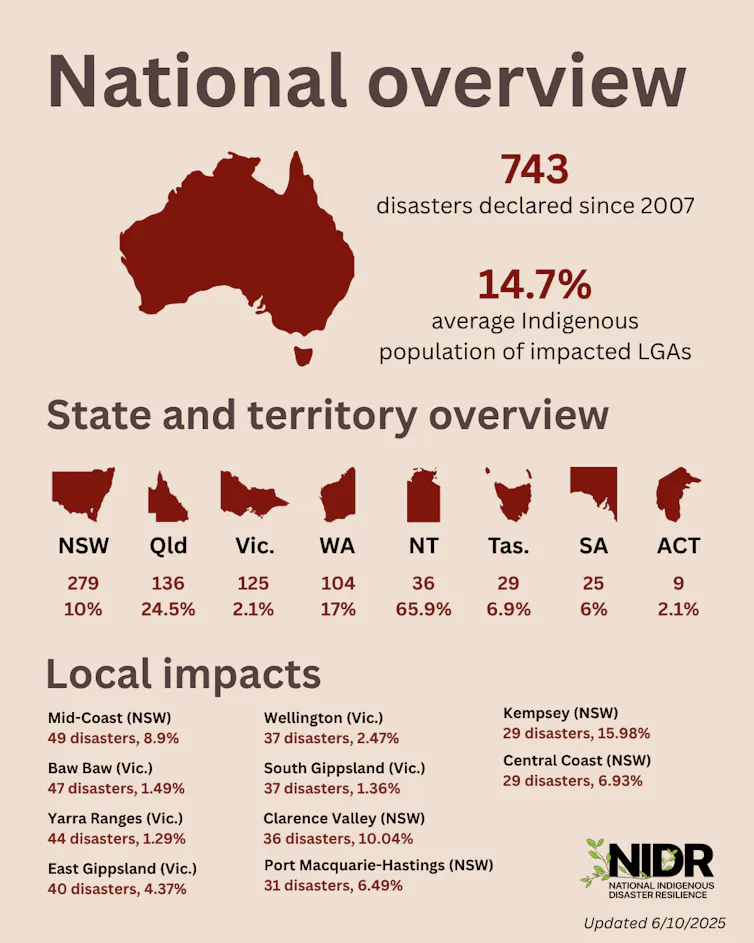
Indigenous peoples are over-represented in disaster-prone regions and towns. On average, nearly 15% of residents in impacted local government areas are Aboriginal and Torres Strait Islander peoples. This is despite the fact Indigenous peoples make up just 3.8% of the Australian population.

Indigenous population by disaster declared LGAs
Indigenous Australians are disproportionately affected by natural disasters. National Indigenous Disaster Resilience

The reality of racism means Indigenous communities are often left out, or even left behind, in emergency response. The failed evacuation of Borroloola in 2024, where Indigenous residents were told to go to the local airport to be evacuated only for the plane to not come, is just one example.

This is why the National Agreement on Closing the Gap has a specific clause, Clause 64, which requires local, state and federal governments to engage with Indigenous communities before, during and after disasters.

In our recent analysis, we examined whether governments are on track to meet those commitments. Specifically, we compared the commitments governments made with the practical actions they took.

Worryingly, our findings suggest all Australian governments are failing to close the gap in emergency preparedness. Worse still, there is almost no evidence emergency management agencies are actively working to meet their commitments outlined in the National Agreement.

As Australia braces for more extreme, climate-driven disasters, this gap in emergency support will only get bigger.

Money matters

Recovering from a disaster can be very expensive. And we are failing to support the financial needs of Indigenous communities impacted by major disasters.

We found the structure of most emergency relief payments means Indigenous people usually receive less financial support than non-Indigenous people. Currently, infants and children receive lower payments than adults. Given one in three Indigenous people are younger than 15 years old, this puts the broader Indigenous population at an economic disadvantage, right when they need the most support.

We also analysed how the Australian government distributed its largest disaster management program, the Disaster Ready Fund. This fund was created after the Bushfire Royal Commission in recognition that Australia must put more resources into disaster preparedness. This is because investing in communities before disasters strike reduces recovery costs.

However, out of the nearly A$800 million pledged to strengthen the nation’s disaster resilience, only A$22 million went to Indigenous organisations. That represents only 2.2% of the total fund. And our analysis reveals no Indigenous organisations in any of the regions impacted by the most recent northern Australian floods received funding through the Disaster Ready Fund.

So, where to from here?

The National Agreement on Closing the Gap has already given governments a framework to better support disaster-prone Indigenous communities.

But to hold them to account, Indigenous researchers, organisations and policy leaders have authored the first Indigenous-led review of the National Agreement. This review argues that when governments work collaboratively with Indigenous communities during disasters and pandemics, they achieve positive results.

The Australian Institute for Disaster Resilience’s evacuation guide for Indigenous communities also provides advice to support Indigenous communities during major emergencies.

When governments work respectfully and collaboratively with Indigenous communities positive change can, and often does, follow. So what does this look like in practice? Here are three suggestions.

  • building formal partnerships with Indigenous organisations and actively involving them in decision-making processes
  • committing $20 million of the Disaster Ready Fund each year to Indigenous organisations to strengthen resilience in remote communities
  • requiring all emergency management agencies to report progress towards Clause 64 of the National Agreement to Close the Gap.

As Australians, we know all too well how destructive major disasters can be. And it is clear they have distinct and significant impacts on Indigenous communities. So it’s time the government prioritises their safety, before the next disaster hits.

ref. Indigenous Australians always come off worst in disasters. This needs to stop – https://theconversation.com/indigenous-australians-always-come-off-worst-in-disasters-this-needs-to-stop-278071

Some kids stop swimming lessons too early. How well can your child actually swim?

Source: The Conversation (Au and NZ) – By Hannah Graefe, Adjunct Research Fellow, Centre for Alcohol Policy Research, La Trobe University

As the weather starts to cool down and outdoor pools shut, are you thinking of pressing pause on your child’s swimming lessons, or even stopping altogether?

If your child has reached a certain level, has stopped making progress or is no longer enjoying their swimming lessons, you may also be considering pulling the pin.

But just because a child can float – or can even reliably swim some freestyle – they may not yet be water safe.


Read more: I’m a drowning prevention researcher – my kid’s school swimming carnival shocked me


Many children stop lessons around age 8

National data indicates many children stop swimming lessons around the age of eight.

Common reasons for this include parents assuming adequate competency, conflicting schedules (such as other sport activities), children’s lack of enjoyment/engagement, and financial challenges.

This is an issue. At the same time, Australia is seeing a decline in children’s swimming ability. Recent research suggests many cannot swim 50 metres continuously in a swimming pool – the national expectation of children aged 12.

We also know more broadly that families say they struggle to find the time, transport and money to invest in swimming lessons.

Parents can misjudge childrens’ ability

Studies overseas and in Australia show parents and carers can misjudge how far their children can swim in a pool and their level of water safety knowledge.

For example, our 2026 study showed when parents reported their 10–12-year-old child as an “okay” swimmer, 65% of these children could not swim 50m in a pool. Likewise, 38% of parent-reported “good” swimmers and 21% of “excellent” swimmers could also not swim this distance.

This becomes even more dangerous if applied to a beach, lake or river, which are much more variable and challenging swimming environments.

Most children in Australia learn to swim in a pool. There is a risk of assuming that because they are confident and experienced in a pool, they have the skills and knowledge to stay safe in open water with waves, colder water, tides, rips and other obstacles such as rocks.

Things are confusing

To add to the confusion, the content of swimming programs differs between providers. Similarly, the progress children need to make before moving to the next level in their swimming program also differs between providers.

It’s not mandatory for swimming programs to align with the national benchmarks for swimming and water safety, developed by Royal Life Saving Society Australia.

This makes it difficult for parents/carers to know how their child’s ability aligns with the national expectations of their age group. Without clear guidance, it’s understandable that parents may assume their child can swim in open water if, for example, they’re at the top level in their swimming class.

What do we need?

Ultimately, we need to encourage broader understanding and use of the national benchmarks so all people in Australia know what it means to “know how to swim”.

For all 12-year-olds, this includes being able to swim 50m continuously without stopping or touching the bottom, and being able to float for two minutes. It also includes rescue and survival activities and demonstrating water safety knowledge for a range of environments.

The expectation for those aged 17-plus is that they should be able to swim 400m continuously and float for five minutes.

Specifically we need:

  • swimming programs to show how they align with national benchmarks including clear communication of expectations for parents/carers

  • swim programs to provide opportunities to swim at beaches, rivers and lakes. This might mean linking pools with lifesaving clubs

  • to improve access to these programs for families that struggle with costs and transport. All children should have adequate opportunities to learn how to be safe in the water.

ref. Some kids stop swimming lessons too early. How well can your child actually swim? – https://theconversation.com/some-kids-stop-swimming-lessons-too-early-how-well-can-your-child-actually-swim-278665

Fines alone won’t stop big tech behaving badly. Here’s what might work

Source: The Conversation (Au and NZ) – By Lauren C. Hall, PhD Candidate in Psychology, University of Tasmania

As countries around the world look to follow Australia’s lead and implement a social media ban for kids, many are also considering fines as an enforcement mechanism.

This is part of the playbook when it comes to regulating big tech. For example, last month the United Kingdom’s data watchdog fined Reddit £14 million (A$26 million) for unlawfully using children’s data.

In April 2025, the European Commission fined Apple and Meta €500 million (A$820 million) and €200 million (A$329 million) respectively for breaching the Digital Markets Act. And in September, the commission fined Google nearly €3 billion (A$4.9 billion) for abusive practices in online advertising technology.

But fines don’t always work to encourage companies to follow the law. For some companies, “illegal with a fine” is interpreted as “legal for a price”. So what are some other, more effective methods to encourage good corporate behaviour?

Fines can backfire

If fines are not consistent, immediate, and severe, they can backfire. If they do, bad behaviour may increase.

For example, a 2000 study examined the effect of childcare centres in Israel introducing fines for parents who regularly picked their children up late. But instead, these fines actually increased late pick-ups by parents.

Even after fines were stopped, the number of late pick-ups stayed higher than before.

Why? Because when there were fines, they were small (not severe), and parents could wait a month to pay (not immediate). However, parents got the immediate benefit of longer childcare.

Similarly, technology companies may decide a fine is cheaper than the costs to make changes, or any loss in money from fewer users and ad sales. And this could lead to them continuing with business-as-usual.

Corporate fines often fail because it may be unclear who in the company is directly responsible. Fines can also sometimes be too small to stop bad behaviour by large companies.

For these reasons, corporate re-offending is frequent, even if companies have been fined in the past.

A fine equals forgiveness

After introducing fines, behaviours previously considered socially or morally unacceptable may also be seen as “forgiven” by payment. This can increase bad behaviour.

The importance of unwanted behaviours may also be judged by the size of the fine.

If fines are seen as “small”, violations may also be seen as small, and bad behaviours may rise. Corporations may also see “small” fines as just a cost-of-doing-business.

Importantly, fine size is closely linked to a company’s financial size. For a small company, a fine could seem huge. The same sized fine may seem tiny to a large company. If similarly sized fines are given to companies making different revenue amounts, the companies may respond differently.

Changing company practices can also cost more for some companies than others. This too may affect how they respond to fines.

Furthermore, companies outside a legislative jurisdiction, or that have refused regulators’ demands in the past, may ignore fines altogether.

For example, 4Chan refused to pay fines issued under the UK’s Online Safety Act, and X decided to legally challenge instead of pay a €120 million (A$197 million) fine issued by the European Commission.

Given the borderless nature of some digital harms such as child sexual exploitation and abuse, coordinated changes to corporate laws, and international cooperation are needed.

Pulling multiple levers at once

So if fines alone don’t stop big tech and other businesses behaving badly, what will?

Research shows monitoring companies, and better resourcing regulators, are more effective than fines alone. Consistent regulator inspections combined with education also work well.

A 2025 paper suggests making “stand-alone consumer tech safety research centres” focused on reducing digital harms. This may require technology companies making data and algorithms available to these centres for inspection.

Then, regulators can look at if companies are using important and best practice safety features. For example, checking the images on sites to make sure users do not see harmful content online.

Regulators can also share knowledge with companies about laws and digital safety measures to improve consumer protections.

This cooperative model has been shown to be more effective than fines alone.

A 2016 study about what works when it comes to corporate deterrence found using multiple levers at the same time, such as monitoring, accountability, auditing, and punitive action were the most effective at stopping bad corporate behaviour.

Unfortunately, understanding the scope of digital harms, and best responses, have been limited by not enough resources, or access to data.

A 2025 paper highlights that increased data transparency from corporations will also improve evidence-informed decisions, ensuring regulation is fit-for-purpose.

As companies continue to prioritise rapid rollouts, with problems found after launch, fines may continue to be ineffective.

To tackle this problem, online regulators must ensure fines are complemented with other policy levers – and that the punishment for bad corporate behaviour is consistent, immediate and severe.

ref. Fines alone won’t stop big tech behaving badly. Here’s what might work – https://theconversation.com/fines-alone-wont-stop-big-tech-behaving-badly-heres-what-might-work-276969

Government looking at ways to assist families with increasing costs due to Middle East conflict

Source: Radio New Zealand

Prime Minister Christopher Luxon and Finance Minister Nicola Willis face questions on the fuel crisis. RNZ / Samuel Rillstone

With the cost of fuel and other essentials rising due to the conflict in the Middle East, the government is looking at ways to ease the cost pressure for those feeling it the most.

Finance Minister Nicola Willis told Morning Report the price increases are extremely tough and affecting all New Zealanders, but said some are feeling it more than others.

“I can’t solve the pain for everyone. The cost of doing that would potentially involve levels of spending that would drive inflation higher, and certainly would put us in a more fragile position in terms of debt.

“So what we are looking at, is there something very targeted and temporary that we could do to assist those workers in particular who are most acutely impacted by these household budget squeezes?”

Willis said she doesn’t want to see a situation where people can’t drive to work, and has instructed the IRD and Treasury to come up with a package that could be implemented with urgency ahead of the Budget, but Cabinet will ultimately decide on timing.

Willis wouldn’t say what the income thresholds would be, but said the package would take into account household income and number of children.

“We’re also looking at forecasts at the moment and putting together a budget, all of which involves questions that we have to address on the way through. But I do want to stick to our fiscal strategy,” Willis said.

Fuel supply disruption

Willis also discussed rising fuel prices, and said the message remains the same, “this is not the time to panic, we’ve got plenty of fuel in the country and on its way.”

On Thursday, Prime Minister Christopher Luxon acknowledged a “big shift” in the government’s messaging around the war in the Middle East, warning New Zealanders the fuel situation could get worse before it gets better.

Willis said the government was preparing for scenarios where supply from Singapore and South Korea, where New Zealand gets petrol, diesel, jet fuel from, could be disrupted.

“We know that they are having challenges getting crude oil out of the Middle East and so are either reducing the amount of products they’re refining or, in South Korea’s case, looking to prioritise domestic customers.

“So what we’re anticipating is there could be a point down the line where that makes it harder for our fuel importers to get the refined products they need out of Asia.”

Willis also defended the government’s LNG plans, despite the attacks on Iran’s South Pars gas field and [https://www.rnz.co.nz/news/world/590133/oil-prices-surge-stocks-sink-on-energy-shock-fears Qatar’s Ras Laffan.

Willis said the focus was still for New Zealand’s energy to be “largely renewable”, but having LNG as a back up remained the government’s strategy.

Not our conflict

Willis said the fighting in the Middle East was “not our conflict”, and reiterated calls for a humanitarian end.

“What we want to see is that the rules of international engagement are upheld, which involves not targeting civilians and protecting human life.

“We are not involved, we haven’t been asked for authorisation, we haven’t been asked for support, we haven’t been asked for assistance.

“Our opinion has not been relevant to the events that are unfolding in that region of the world.”

Sign up for Ngā Pitopito Kōrero, a daily newsletter curated by our editors and delivered straight to your inbox every weekday.

– Published by EveningReport.nz and AsiaPacificReport.nz, see: MIL OSI in partnership with Radio New Zealand


Iran war hits Kiwi wallets hard, as economist warns of another recession

Source: Radio New Zealand

RNZ / Nick Monro

Higher fuel costs mean higher transport costs, and that means higher prices across the board – and that’s a hard pill to swallow for Kiwis three years into a cost-of-living crisis.

Kiwis are already feeling the expensive ripple effects of the war in Iran – and economists are warning that the real impact is only just beginning.

What started as a distant geopolitical conflict has quickly landed squarely on our country’s economy, driving up fuel costs, squeezing household budgets, and threatening to slow growth.

If it continues, New Zealand could be staring down the barrel of another recession.

“So this sort of shock, if it gets worse, will definitely increase the risk of a recession here,” Kiwibank chief economist Jarrod Kerr tells The Detail.

“And we have only just gotten out of recession, so to fall back in would be horrendous for households and businesses.”

At the centre of the crisis is oil.

Global prices have surged past US$100 a barrel as fighting disrupts supply routes through the Strait of Hormuz – a chokepoint for about 20 percent of the world’s oil.

And for New Zealand, which imports almost all of its fuel, the effect has been immediate.

Petrol prices are already climbing rapidly, with forecasts that they could push toward $4 a litre – or higher – if the conflict escalates.

And when fuel costs rise, everything that relies on transport follows – from groceries to clothing to construction materials.

“The direct impact that we are seeing right now is the rise in petrol prices, and that affects, I would say, every household, particularly those on lower incomes who are forced to drive to work,” Kerr says.

“It is just another cost that they have to wear. And they have been in a cost-of-living crisis for the past three years.”

He warns that the conflict could push inflation higher while slowing growth, with Kiwi households already tightening spending, cutting discretionary purchases, and reducing travel and fuel use. Delaying big buys and trading down to cheaper brands are likely on the horizon.

“Yes, we are going to see a spike in inflation, but what I don’t agree with is the commentary that that automatically leads to a rate hike. I disagree.

“That is only going to put greater pressure on a household that is already under pressure. That would be the exact thing not to do … for me, the bigger risk is that households get hurt, the economy doesn’t recover, and the central bank may be needed to come in and provide support.”

He said economists entered the year “quite optimistic, because we had been banging the table for a long time, because the Reserve Bank had not cut interest rates to a level that was actually stimulatory and helpful for the recovery.

“They finally got there in November last year, took them far too long to get there, but they got there. We came into this year saying, ‘this is it, we are going to recover, the settings are about right, let’s go, c’mon let’s get some growth happening’, and mid-way through that sentence, we were cut off with missile strikes in Iran.

“It’s just another international shock that we have to deal with, and it’s just another headwind that all households and businesses have to face into.

“It’s hard for households to pay the food bill and power bill, which is up 35 percent on the year, petrol prices, which will be up a similar sort of amount, it is very, very difficult.

“We need to see policymakers stepping in to help, not hinder. So calls for rate hikes from the RBNZ [Reserve Bank] are tone deaf.”

On this episode, The Detail also speaks to Retail NZ chief executive Carolyn Young, who says retailers and consumers throughout the country are feeling the fallout of the war.

She says prices for goods and services will increase and “we will see that relatively soon”.

“We are seeing increases in insurance … increases in the fuel to get the ships to New Zealand,” she says. “Those additional costs are being passed on to the retailers and, at some point, those costs will be passed on to consumers.”

She says, right now, it’s “a really uncertain time for everyone”.

“Ultimately, uncertainty is not good for business. And I think that’s the thing we have to remember, and right now everyone is in a state of flux and uncertainty.

“And for any business owner, whether you are a retailer or other business, it’s going to have an impact on your sense of how you are going to move forward, and therefore it will have an impact on your profitability and ability to spend money in other areas.”

She fears some businesses might not survive the war.

“It will be difficult for people, and we will see some people who are perhaps a bit more pessimistic about what the future holds and may decide to close the store, and there will be others who will try to hang in there.”

She says recovery will depend on how long the conflict lasts.

Economists say a short conflict will see a sharp but temporary spike in prices, while a prolonged war will mean sustained inflation, weaker growth, and reduced spending.

And an escalation? Enter the risk of recession.

For now, the message from economists is simple: New Zealand may be far from the conflict, but it is not insulated from its consequences, because a war a world away involving oil doesn’t stay overseas for long.

Check out how to listen to and follow The Detail here.

You can also stay up-to-date by liking us on Facebook or following us on Twitter.

Sign up for Ngā Pitopito Kōrero, a daily newsletter curated by our editors and delivered straight to your inbox every weekday.

– Published by EveningReport.nz and AsiaPacificReport.nz, see: MIL OSI in partnership with Radio New Zealand
What is Flumist, the new flu vaccine for kids that’s sprayed in their noses?

Source: The Conversation (Au and NZ) – By Allen Cheng, Professor of Infectious Diseases, Monash University

Many kids are scared of getting needles, and this can stop them getting vaccinations that protect that against the flu. Less than one in four Australian children were vaccinated against influenza in 2025.

This winter, Australian families have another option. A nasal flu vaccine called FluMist will be available for the first time for children aged 2–17 years.

FluMist is a needle-free alternative to the existing influenza vaccines. Nasal flu vaccines are widely used in the United Kingdom, Europe, Canada and the United States.

Recent studies in which both injectable and nasal flu vaccines are available suggest parents prefer a nasal vaccine, particularly when they’re hesitant about vaccination. As such, the nasal option could increase vaccination coverage in Australia and reduce the spread of flu, not only in children but potentially in the wider community.

FluMist will be free in some states and territories for certain age groups. It will also be available for a fee at selected pharmacies and immunisation providers.

Here’s what you need to know about how FluMist works, how effective it is, and whether your child is eligible.

What’s different about this vaccine?

Current vaccines used in Australia are all injected. They contain specific components of the influenza virus that are not capable of replicating.

FluMist is different. It contains a weakened “live” form of the flu strain. These types of vaccines are known as live attenuated vaccines. Other examples include MMR (measles, mumps, rubella), chickenpox and rotavirus vaccines.

With FluMist, six of the eight genetic segments in influenza virus are altered so they cannot replicate efficiently at normal body temperature. This means the virus only replicates in the nose (which is at a lower temperature), rather than deeper inside the body.

How do nasal sprays work? Are they more effective?

To give FluMist, a health professional sprays one dose of 0.1ml of the vaccine in each nostril. It is simple, painless and very well tolerated by children, even the very young.

Unlike injected vaccines, nasal vaccines trigger protective immune responses where influenza viruses enter the body – on the surface of the upper respiratory tract (the mucosa) including the nose and throat. So in theory, nasal sprays should work better than injections.

Early studies in the late 1990s suggested the vaccine provided very good protection against influenza in children – and might even provide some protection against influenza strains not contained in the vaccine.

However, in practice, data from subsequent studies suggests the live vaccine probably provides similar protection to the current injectable vaccines.

In the US, there was also an issue in the mid-2010s where the live attenuated vaccine (given as a nasal spray) was not as effective as the injected vaccines. This led to the recommendation for its use being withdrawn from 2016 until 2018.

As a result, changes were made to the process of selecting vaccine strains.

Data from more recent seasons shows nasal spray vaccines are now just as effective as injected vaccines. Both reduce influenza infection by 40–60%.

How safe is the nasal flu vaccine?

The vaccine is safe, with mostly similar side effects to the injected influenza vaccine.

The nasal flu vaccine has been used in the US since 2003, Canada since 2010, and Europe since 2011. The UK has had a national childhood program using the nasal vaccine since 2013.

A proportion of people may have side effects, but these are mild and transient. Over half of children will have a blocked or runny nose, and around one in ten have a fever or headache.

Those who are severely immunosuppressed (have a weakened immune system) or regularly take aspirin should not use FluMist.

If your child is mildly immunosuppressed, has severe asthma or another lung disease, speak to your GP or specialist about the vaccine. Adolescents who are pregnant should also seek medical advice.

What are the potential benefits?

The main benefit of a nasal vaccine is improving coverage in an age group where fear of needles stop children getting vaccinated and in settings where needles are a logistical hurdle.

The UK introduced a school-based vaccine program in 2013. This had an immediate impact on vaccine coverage, which had been very low before 2013. Now, around half of children there receive an annual influenza vaccine.

We know vaccinated children are less likely to fall sick and to take time off school. And evidence also suggests vaccinating this age group can reduce transmission of influenza in the community, thereby protecting others.

In the UK, studies suggest the introduction of influenza vaccines for school-aged children reduced GP presentations with influenza in all age groups.

Reducing influenza community transmission is expected to result in fewer influenza cases, lower health-care costs, and reduced pressure on hospital and health providers.

So, who can get the nasal flu vaccine?

In 2026, FluMist will be one of several influenza vaccines available in Australia. But funding arrangements vary across states and territories, affecting who is eligible for a free vaccine. Others will need to pay around $50–70.

From early April, the nasal vaccine will be available in:

  • New South Wales and South Australia as state-funded programs (free) for children aged 2–4 (inclusive) and available on the private market (for around $50–70) for 5–17-year-olds

  • Queensland as a state-funded program for 2–5-year-olds and privately for those aged 6–17 years

  • Western Australia as a state-funded program for 2–11-year-olds (inclusive), and on the private market for those aged 12–17 years

  • the Australian Capital Territory, Northern Territory, Tasmania and Victoria on the private market for 2–17 year olds.

The nasal vaccine is currently only registered in Australia for children.

ref. What is Flumist, the new flu vaccine for kids that’s sprayed in their noses? – https://theconversation.com/what-is-flumist-the-new-flu-vaccine-for-kids-thats-sprayed-in-their-noses-273111

How does your super balance compare to other people your age?

Source: The Conversation (Au and NZ) – By Natalie Peng, Lecturer in Accounting, The University of Queensland

If you have ever checked your super balance and wondered whether you are “behind” for your age, you aren’t alone.

To see where you truly sit, you should ignore “averages”, which can be skewed by a small number of very large balances. Instead, we look at the median, which is the middle value. Half of people have more than this amount, and half have less.

Some of us use our balance as a scorecard for how well we are doing at life. But super balances are rarely about how “good” you are with money. They are just a mirror of your working life. They reflect whether you worked full-time, took career breaks, or moved between jobs.


CC BY-NC

It’s easy to put off thinking about superannuation when retirement is years away. In this five-part series, we ask top experts to explain how to sort your super in a few simple steps, avoid greenwashing, and set goals for retirement.


When the super gender gap widens

You’ll notice in this table that the gap between men and women is small in their 20s but grows significantly from their 30s.

This is not a coincidence. Australia’s super system was built in the 1990s around the idea of an uninterrupted, full-time career over 40 years. In reality, many women reduce working hours or take parental leave during their careers. This slows their super contributions at exactly the point where long-term growth matters most.

In the super world, a dollar contributed at age 25 is worth far more than a dollar contributed at age 50, because it has more time to grow. Missing those mid-career years does not just mean contributing less. It means losing decades of compounding that cannot easily be replaced later.

Retirement savings are individual, but family decisions are shared

Australia’s super system treats us all as individuals. But most households make financial decisions together.

A couple might jointly decide that one parent will step back from paid work to care for children. Yet the retirement savings impact falls entirely on one person’s account.

The gender gap when people near retirement is clear in the data. Men aged 60 to 64 have a median super balance of $219,773, while women have $163,218.

Moreover, in that age bracket, 23% of women have no super at all, compared with 13% of men.

One way to manage this gender gap in retirement savings is through contribution splitting. This allows some concessional contributions made by the working partner to be transferred into the other partner’s super account. It can help both people maintain retirement savings, even if only one is currently earning an income.

Why playing it safe can be risky

Your super is invested across a mix of asset classes, such as cash, bonds, property and shares, to help it grow.

Most Australians are in a “balanced” option in the MySuper product, which is the default option if you don’t make an investment choice. This mixes higher growth assets like shares with more stable assets such as cash or bonds.

Cash and bonds tend to offer steadier returns in the short term but lower expected growth over longer time frames. Shares are more volatile from year to year but have historically delivered higher long-term returns.

If you are young, playing “safe” can actually be a risk.

With 30 years or more until retirement, a conservative option might protect you from a small dip today, but it stops you from getting the growth you need to live comfortably later. For a 25-year-old, the “roller coaster” of the stock market can turn out to be their best friend in the long run.

The default MySuper option is invested in a range of different assets. Leeloo/Pexels

Consistency matters

The most powerful tool in your super is compounding. This is just a fancy way of saying you earn money on your money.

Small, regular contributions made early in your career can have a much larger impact than larger contributions made later in life. Adding an extra $20 a week in your 20s may ultimately do more for your retirement balance than adding $100 a week in your 50s, because the earlier contribution has far longer to grow.

One simple move: The 1% rule

You don’t need a complicated plan to boost your super. A great strategy is to “tax yourself” whenever you get a pay rise.

If you get a 3% raise, consider putting 1% into your super. You can do this either through voluntary contribution, or by asking your employer to increase your super contributions through a salary sacrifice arrangement.

The latter option may be an easier way to save for some people, as the extra contribution is automatic – set and forget.

Because this contribution comes from pre-tax income, you won’t feel the difference in your take-home pay, but because that money goes in before you see it, your “snowball” starts growing much faster without you having to change your lifestyle.

Your super balance is shaped as much by timing and life choices as by income. You cannot control every career break or life decision. But you can control whether small amounts go in early and consistently. The sooner your money starts working, the less you will have to.

Disclaimer: This article provides general information only and is not intended as financial advice.

ref. How does your super balance compare to other people your age? – https://theconversation.com/how-does-your-super-balance-compare-to-other-people-your-age-276370

Shifting more healthcare to the private sector calls for a clear government plan – where is it?

Source: The Conversation (Au and NZ) – By Robin Gauld, Executive Dean, Bond Business School, Bond University

Access to public elective services such as hip replacements or cataract surgery has long been inadequate in New Zealand, with extended wait times and exclusion of those not assessed as high priority despite genuine clinical need.

Workforce shortages are adding pressure, and those unable to afford private treatment are increasingly experiencing unmet need, with wide-ranging impacts.

Current government policy intended to reduce public waiting lists by increasing provision through private services has therefore focused attention on the role of the private sector in the healthcare system.

Most recently, a report by the Westpac bank has detailed the growth of the private sector in health and government support for the trend. It positions private funding and provision of services as increasingly valuable, solving healthcare challenges and creating investor opportunities.

The latter may be true. Westpac recommends a public-private partnership model, with the private sector investing in infrastructure (hospitals and clinics), IT systems and digital services.

But if public-private partnerships are to be supported, some fundamental questions need addressing first.

Role of the private sector

In capitalist economies such as New Zealand, there will generally always be a role for the private sector in healthcare.

New Zealand has long had a mixed delivery model, with general practitioners (GPs) largely private and subsidised by government, and parallel public and private hospitals. GPs are the gatekeepers; specialist appointments require their referral.

Many specialists work in both public and private systems and GPs refer to either, with private options depending on the patient’s ability to pay. More than a third of New Zealanders hold voluntary private health insurance; others use their savings.

Emergencies and intensive care are dealt with by public hospitals only. The system is complex and can be difficult to navigate.

Many countries operate a public-private mix and partnerships. Each is different. Australia, for example, has what some consider the world’s best health system.

The mandatory tax-funded Medicare public insurance programme provides support for public and private services. There are also private insurance tax incentives for the better off.

However, Australia performs less well on equitable access to care, and a large for-profit private hospital group failed in 2025, requiring the public sector to step in.

Australia also has a reasonably self-contained private sector. Similar systems are found from the United States to Singapore, which have different mixes as well as access and equity challenges.

Need for clarity on policy

If private infrastructure is to be built up at a rate faster than public, then the government must consider the risk of potential market failures.

This means it needs to be clear about the architecture for a public-private mix, the policy levers it will apply, accountability arrangements and outcomes it expects.

Technology businesses are legendary for failing to deliver. This ranges from large-scale IT project failures such as the SWIFT project at the former Counties Manukau district health board to security lapses such as the recent data breach at Manage My Health. These come at massive taxpayer and system cost.

The same applies to equitable access to private care, patient charges and mounting private insurance costs.

New Zealand has some unique workforce arrangements and backup systems. Determined through a historical political agreement, public support for the private system is significant. This comes through GP subsidies for patients referred to private specialists, staff training through publicly funded tertiary providers, and public emergency and intensive care backup when things go wrong in private.

If political leaders want to facilitate growth in public-private partnerships, they must be clear about how this works and what their expectations are.

There is a need to debate how patients with complications from private treatment are paid for when transferred to the public sector, and whether taxpayers should subsidise GP appointments for those seeking private referral.

With private insurance premiums going up at rates way beyond inflation there may be limited appetite for extending insurance to such patients. Yet this important part of the health economy needs to be factored in.

Ensuring equity of access

The private sector is not self-contained and needs public input. Politicians need to consult on whether there is interest in designing effective public-private partnerships that will not favour the better off and not detract from the public sector.

As the private sector builds up, the public workforce and capacity will be undermined unless more specialists are recruited. Private work is more lucrative than public, and political leaders would be prudent to outline how the balance will be maintained.

Particularly important is attention to overall system architecture, including the funding model. If public-private partnerships are pursued, equity (if valued) requires a guarantee that every citizen has equal access. This means clarity on funding.

Perhaps New Zealand needs to consider extending the accident compensation scheme to cover healthcare, or a funding system similar to Australia’s Medicare or Japan’s insurance funds.

There are many examples New Zealand could draw from to ensure a public-private mix delivers as intended. But we need to know what the intention is. So far, political leaders haven’t delivered a clear plan.

ref. Shifting more healthcare to the private sector calls for a clear government plan – where is it? – https://theconversation.com/shifting-more-healthcare-to-the-private-sector-calls-for-a-clear-government-plan-where-is-it-278197

Military alliances: is NZ getting a tangled web or a ticket to get in?

Source: Radio New Zealand

China is warning that military alliances will likely escalate rather than de-escalate tensions. NZ Defence Force

China is warning that alliances will likely escalate rather than de-escalate tensions and “spread rather than limit the conflicts”.

The warning delivered by its ambassador in a hardhitting speech on geopolitics in Wellington on Thursday came as New Zealand was getting closer to Australia and Australia was getting closer to the United States on defence.

The speech closely followed China accusing the trans-Tasman allies of “arrogance” in a clash over military manouevres.

That in turn came on the heels of the allies releasing a new ‘Operationalising our Alliance’ joint statement aimed at “being able to operate seamlessly as an increasingly integrated, combat capable Anzac force by 2035”.

Canberra for its part under a separate alliance was “committed to deepening cooperation through accelerating and expanding joint defence initiatives, shared investments in new capabilities and industrial base integration” with the US.

This all came a few weeks after US President Donald Trump announced a big shift in how his administration would sell weapons.

Gone was what his directive called the “partner-first arms sales approach”, newly arriving was an “America First” arms export strategy, where allies would be encouraged to buy US-made weapons as an explicit powerful foreign policy tool that prioritised partners “that have invested in their own self-defense and have a critical role or geography for executing the National Security Strategy”.

US President Donald Trump announced a big shift in how his administration would sell weapons. ALEX WONG / Getty Images via AFP

‘I haven’t seen New Zealand miss out’

Would the new ‘America First’ priority partner list impact New Zealand? It had favoured status in Anzac, ANZUS and Five Eyes, but is not part of AUKUS.

RNZ put that question to L3 Harris, a top 10 US defence contractor that just did a billion-plus-dollar partnership to add missile rocket motors to the US “arsenal of freedom”; signed a defence collaboration deal with Saudi Arabia last month; and supplied advanced comms gear to the NZ navy and army.

“In my career, I haven’t seen New Zealand miss out because they weren’t perfectly aligned with the way that the administrations have played,” said Alan Clements, L3 Harris vice president for Australia and New Zealand.

“Never once have I heard, either when I was in the military or outside the military, that New Zealand was to be excluded from anything.

“Yes, there’s policies … but there are also carve-outs for that, there are waivers.

“From our company perspective, nothing that’s been said inside those policy settings has stopped us being able to work with New Zealand and deliver capability with New Zealand.”

The country was not part of AUKUS Pillar Two – a military tech sharing arrangement for Australia, the US and UK – but was not missing out, Clements said. “New Zealand wouldn’t miss out because New Zealand being part of the Five Eyes [intelligence grouping] would be able to get access to that as we go.”

Share and share alike

In Australia, defence media reports had foreseen “major implications” from Trump’s America First arms move.

It beholdened the Pentagon to put a MAGA lens over the Foreign Military Sales (FMS) programme, which was the place where New Zealand went arms shopping. The government began talks under the FMS last August to buy $2 billion of naval Seahawk helicopters.

The Seahawk deal showed how the closer the three militaries got, the closer they were likely to get. “The Seahawk helicopter, operated by Australia and the United States, is the preferred helicopter,” an aide memoire to Cabinet last year.

“The ability to leverage American and Australian supply chains and through-life support arrangements … makes this the most cost-effective and durable helicopter. It means Defence does not need to fund the integration and certification of essential military equipment and systems” – plus aircrew would be interchangeable.

Alan Clements, L3 Harris vice president for Australia and New Zealand. Supplied / L3 Harris

Clements said the defence industries on either side of the Tasman had to align to rein in costs by preventing double up.

“We are now seeing more and more that we’re working closer together, particularly when it comes to capability alignment.”

L3 Harris had seven people working in New Zealand, compared with over 500 across the Tasman.

“But we work with other New Zealand companies and they do the work either as a subcontractor or sometimes as a prime for us where we try to build that capacity and capability within New Zealand itself, rather than import.”

‘Entanglements’

In the higher, weightier world of geopolitical alliances, who was in control?

China’s ambassador Wang Xiaolong warned on Thursday that alliances were “entanglements” where everyone would end up less secure.

“The next non-solution I want to debunk is military alliances, which we believe is, often a de-stabiliser rather than a stabiliser for the world.

“These alliances, by definition and by design, are meant to win wars rather than to keep the peace,” he told the Wellington Club.

China’s ambassador Wang Xiaolong. RNZ / Samuel Rillstone

Defence Minister Judith Collins, asked by RNZ on Thursday where the line was within increased integration, given Australia’s different positions, say, on nukes or the Iran war, said those were foreign policy differences, not defence.

“There’s no risk to our independence,” said Collins.

The existing “enormous” defence integration with Australia went both ways.

“The biggest risk to our independence is to not be closely connected to Australia,” she said.

The 2035 joint statement mentioned “sovereignty” six times.

‘Rocket diplomacy’

The statement also made clear the Anzacs would be using the same weapons more and more; by 2035 the two would “deploy increasingly integrated and interchangeable units”.

Australia and the US would be, too. Canberra recently signed on to spend over $20 billion with the Pentagon and contractor Lockheed to co-produce guided weapons – what Politico called “rocket diplomacy”.

The track to human-machine integation was also becoming well beaten. The US Army planned to deploy its first Human Machine Integrated Formation (HMIF) platoons by 2027, while the NZDF in its new long-term insights briefing made “human-machine teaming” one of four themes.

It was not just about sharing weapons at the pointy end either, but also the data-crunching AI systems behind them that the NZDF told MPs last week would become the number one force multiplier.

AI allowed command-and-control to be integated like never before on the battlefield. The NZDF was experimenting with this in US-led multinational exercises.

Defence Minister Judith Collins. RNZ / Samuel Rillstone

Clements said New Zealand’s stance and defence capability plan meant the country would probably want to head down the path of aligning command and control with their allies and partners, in particular Australia.

“That alignment with command and control is important for both countries.

“Australia has gone down a particular path with its command and control, and it aligns and the services have aligned slightly with the way the US do things.

“Those systems that are actually currently being used are not L3 Harris systems at the moment. But if there was an opportunity where they were looking at doing something new, then absolutely.”

Lower level control of, say, a drone could be programmed to “put constraints around what it goes to do, where it looks, [where] the information goes.

“So you can absolutely put constraints around that,” said Clements. Once the data went up to a higher level, that would be a different system.

So, L3 Harris’s product Amorphous that controlled of swams of land, sea and air drones all at once, could be controlled at the frontline, and a separate system sit behind it where the bigger targeting decisions were made.

Lethality on order?

One shift by Collins had been to order Defence to become more lethal.

Defence has been holding ‘early-days’ workshops with contractors to get ideas about drones and the like.

Was the NZDF asking for more lethal and autonomous weapons now?

“I’m not aware of them asking for that from us directly at the moment,” said Clements.

“But yes, as a defence organisation, we will develop capability using all the tools that we currently have to meet the requirements of the lethality requirements of the Defence Force.

“But often we’re not in there trying to beat a door down and say, ‘You need to buy this piece of kit’.

“It’s looking at what they’re doing from a full structure and then having a conversation about, ‘Do you think this would help you in what you do?’”

While Clements has stressed how “autonomy, AI-enabled sensing and unmanned systems” were transforming military capabilities, he told RNZ that autonomy was not a prerequisite for the huge gains in precision and humans could be first in the loop – “at the beginning to hit the button”.

Sign up for Ngā Pitopito Kōrero, a daily newsletter curated by our editors and delivered straight to your inbox every weekday.

– Published by EveningReport.nz and AsiaPacificReport.nz, see: MIL OSI in partnership with Radio New Zealand

Too expensive to smile: Calls grow for universal, Te Tiriti-consistent dental care

Source: Radio New Zealand

A dentist provides dental care to a girl. AFP/ Thibaut Durand/ Hans Lucas

Nearly half of adults in Aotearoa are avoiding dental care because they cannot afford it, leaving many in chronic pain, at risk of serious infection, or in need of hospital treatment.

New research and frontline experiences are painting what advocates describe as a system failing to meet basic health needs, with growing calls for dental care to be fully integrated into the public health system.

Dental for All, a coalition of health workers, unions, community organisations and advocates travelled the country last year speaking directly with whānau about their experiences.

Dental for All campaigner Max Harris said the stories they heard were confronting.

“We heard about the shame and pain people face when they can’t get to the dentist, and how problems get worse over time,” he told RNZ.

“We also heard about the home remedies people resort to, things like using pliers or fishing wire to pull teeth, or relying on painkillers just to get through.”

There are growing calls for dental care to be fully integrated into the public health system.

A system built without teeth

According to the latest Ministry of Health survey, 47 percent of adult New Zealanders reported not visiting a dentist due to cost, with even higher rates among Māori and Pasifika.

Research commissioned by Dental for All also estimated untreated oral disease was costing the country around $2.5 billion each year in lost productivity and $3.1b in reduced quality of life.

“That is people missing work, missing job interviews, or living with constant pain and stigma,” Harris said.

“When you compare that with estimates that universal dental care could cost between $1 and $2 billion a year, it starts to make economic sense as well as human sense.”

According to a Talbot Mills poll in 2023, 74 percent of New Zealanders agreed that adult dental care should be funded in the same way it is funded for tamariki. So why wasn’t it?

Harris said that gap dated back to the system’s foundations.

“When the public healthcare system was set up in 1938, some dentists lobbied to carve teeth out of the system and it has essentially stayed that way ever since.”

Auckland City Mission opened the doors of its new onsite dental clinic in July 2025, delivering lifechanging dental care for those that need it most, free of charge. Supplied / Auckland City Mission

Across the country, demand for affordable dental care continues to grow.

At teaching clinics run by the University of Otago Faculty of Dentistry, patients could receive reduced cost treatment from senior dental students under supervision.

In Auckland, the waitlist for student led care sat at around 950 people and was currently closed due to capacity.

Across both Auckland and Dunedin clinics, more than 14,800 patients were treated in 2025, delivering nearly 60,000 appointments.

Director of Dental Hospital and Clinics Janine Cochrane said demand had remained strong in recent years, reflecting wider national trends.

But even with those services, need continued to outstrip supply.

In July last year, Auckland City Mission opened a free dental clinic aimed at people who had struggled to access care.

In its first seven months, the clinic treated around 380 people and built a waitlist of more than 100.

Director of housing and health Brendan Short told RNZ that many patients had gone years without treatment.

“The people that we support have been marginalised from mainstream and public health care for a very long time,” he said.

“It is really clear that there is not enough funding for oral care in New Zealand for the general population. Dental care is essential healthcare and it seems that this is a blind spot for us as a nation.”

Auckland City Mission director of housing and health Brendan Short. RNZ / Layla Bailey-McDowell

Living with pain

Short said the impact of untreated dental issues went far beyond physical pain.

“Avoiding social situations, hiding one’s smile, or even missing job opportunities are everyday realities,” he said.

He said many people had normalised living with pain.

“It is quite common for people to live with pain, to think that what they are putting up with is normal or is okay, and it is not.”

The Auckland City Mission dental clinic operated three days a week and relied heavily on volunteer dentists.

“This is not possible or achievable for us without those volunteer dentists. They are superstars,” Short said, adding that some even travelled from outside Auckland, including as far as Taranaki.

Volunteer dentist Roger Tiang told RNZ that demand was constant at the clinic, highlighting the need for these spaces.

“Every time I come in my shift is fully booked,” he said.

Tiang said cost and sometimes discomfort with mainstream services were key barriers and that delaying care allowed small issues to escalate.

“If we do not catch things early, problems get bigger and we end up dealing with much bigger issues than we would have if we had seen them earlier.”

After more than 25 years in dentistry, he believed oral healthcare should be treated like any other part of the health system.

“People might not realise it, but if you cannot chew your food properly or you are living with infections in your mouth, that can affect your overall health.

“It is part of your health. Just like the rest of the health system in New Zealand, there is public healthcare and dentistry should be part of that as well.”

ActionStation and Dental for All campaigner Jasmine Taankink says poor oral health is “just another negative implication of colonisation” and Māori not being able to exercise tino rangatiratanga. Supplied / Jasmine Taankink

Longstanding inequities for Māori

For Māori, barriers to dental care were often compounded by cost, distance, and access, layered on top of longstanding inequities within the health system.

ActionStation and Dental for All advocate Jasmine Taankink said poor oral health outcomes for Māori could not be separated from colonisation.

“We know that upon arrival to Aotearoa, English settlers were really impressed with the overall physical health of our tūpuna Māori, especially their oral health. That’s quite widely documented,” she said.

“Our tūpuna Māori didn’t have cavities, they didn’t have massive oral health problems. So poor oral health is just another negative implication of colonisation and us not being able to exercise our tino rangatiratanga”

She said solutions must be grounded in Māori led approaches.

“We have the expertise within our own communities to develop solutions that work for us.”

Tumuaki of Te Ao Mārama (New Zealand Māori Dental Association) Leeann Waaka says whānau should not have to suffer in silence any longer. Supplied / Leeann Waaka

Leeann Waaka, dental therapist at Hauora a Toi and Tumuaki of Te ao Mārama (New Zealand Māori Dental Association) said the situation had remained largely unchanged for decades – with many left suffering in silence.

“The current suffering for our people is real, and it has not got any better since, well, what, 30 years?”

Waaka said while cost was a major issue for whānau, accessibility, especially in rural areas, remained a problem.

“When you are looking at a current structure and your lens is a holistic lens, it really does not fit.

“Whenever you need something, you should be able to access it, right there and then. Unfortunately that is not the case for dental.”

After travelling the country with the Dental for All kaupapa, she said the stories shared were confronting.

“Many have suffered in silence for a long time, It’s heartbreaking.

“I come from up north. I knew it was bad up there, but when we went up there for the roadshow, I don’t even think we could have imagined just how bad it is … It is inhumane.”

Waaka, alongside Dental for All and Te Ao Mārama, was pushing for a Te Tiriti consistent system – which would mean properly resourcing Māori providers and enabling iwi and hapū to design services that meet the needs of their people.

“It is reimagining the system and starting to rebuild it to what it needs to be to serve our whānau. Our people deserve better.”

Dental for All campaign set out on a national roadshow last year, hearing concerns from whānau and building public support over communities. Supplied / Dental for All

Looking overseas for solutions

Dental for All’s latest research pointed to countries including Niue, Japan, Brazil, Canada and the United Kingdom, where dental care was integrated into public health systems.

Harris said those models showed change was achievable.

“It ultimately comes down to political will,” he said.

“We have seen other countries make the decision that oral health is part of overall health and design their systems accordingly.”

Dental for All was now developing a detailed policy proposal outlining how such a system could be introduced in Aotearoa.

“This could be something we look back on as a once in a generation change to strengthen our healthcare system.”

Waaka said the focus must remain on equity and wellbeing.

“All knowledge systems matter, and coming together to bring the best of those knowledge systems is key for when we are serving our people,” she said.

“Our people deserve the best and nothing less.”

Sign up for Ngā Pitopito Kōrero, a daily newsletter curated by our editors and delivered straight to your inbox every weekday.

– Published by EveningReport.nz and AsiaPacificReport.nz, see: MIL OSI in partnership with Radio New Zealand

Faulty alarm and surge protection led to Mahurangi River wastewater spill, reviews find

Source: Radio New Zealand

A wastewater spill into the Mahurangi River meant farmers had dump thousands of oysters because of contamination. Supplied

A critical overflow alarm that was not working and a faulty surge protection component in a North Auckland wastewater pump station were factors that led to what is believed to be the biggest wastewater spill into the Mahurangi River that happened in October last year, according to independent reviews.

Wastewater poured into the Mahurangi River from about 2.30pm on 29 October, after a power surge at Watercare’s Warkworth Street wastewater pump station, and subsequent pump failures.

Watercare estimated that there was 1200 cubic metres of overflow, which was not discovered and stopped until 8am the next day.

Mahurangi oyster farmers were furious with the spill and contamination, with one reporting that much of their 80,000 oysters had to be dumped, at the peak of the oyster season.

On Thursday, Watercare confirmed that independent reviews into the cause of the overflow had been completed.

“The reviews found the incident resulted from a unique chain of events involving technical and operational factors at the newly commissioned Warkworth Street Pump Station, triggered by a power outage,” said Watercare in a press release.

Watercare’s chief operations officer Mark Bourne told RNZ the reviews found that a faulty safety relay – which was part of the plant’s surge protection system – was in conflict with other safety relays, and prevented the pumps from restarting following the power surge.

Watercare’s chief operations officer Mark Bourne. Jessie Chiang

He said the treatment plant was designed in a way that its protection system would kick in when individual components failed.

Bourne said if the safety relay was not faulty, the pumps would have restarted following the brief power surge – which lasted about half a second.

The most critical of alarms – the overflow alarm – had also failed to operate, said Bourne.

“That was tested during the pre-commissioning phase before the pump station went into operation but for whatever reason, failed during that operation phase,” said Bourne.

Bourne said the Warkworth Street plant was new, and was going through its commissioning and start up phase when the October event happened.

He said prior to commissioning, Watercare had run tests on the station with clean water, and added that the plant could not be tested across its full ranges until it was in service.

“We try and simulate all activities during the initial testing process, but as I indicated before this was a very unique set of circumstances,” said Bourne.

Bourne said the faulty safety relay had since been fixed and all alarms had been tested and checked.

When asked if he was confident that station could withstand future possible power surges, Bourne said he had “absolute confidence” in the Warkworth Street pump station.

“This event is just so unfortunate and quite frankly we’re gutted that it occurred,” he said.

Asked where responsibility could be traced to with the multiple failures of the treatment plant, Bourne said Watercare took accountability.

“It’s our pump station, it’s our operation, if there’s further conversations to be had, they’ll be for us to have at a later date, but at this point Watercare takes responsibility for the fault that occurred,” he said.

He added that this was a unique circumstance leading up to the failure of the station, and that there was no systemic issue.

Bourne said Watercare had over 550 pump stations across Auckland.

On Thursday, Watercare announced its final tranche of compensation payment for impacted oyster farmers, bringing the total payout to $2.75 million.

Sign up for Ngā Pitopito Kōrero, a daily newsletter curated by our editors and delivered straight to your inbox every weekday.

– Published by EveningReport.nz and AsiaPacificReport.nz, see: MIL OSI in partnership with Radio New Zealand

Lower Hutt businesses report 50 percent drop as roadworks roll on in city centre

Source: Radio New Zealand

Lower Hutt businesses say they’re swiftly losing cash, and one’s shut up shop, as roadworks roll on in the city centre.

Authorities are sorry for the disruption, but say the work is essential.

Hutt City Council, Greater Wellington Regional Council and the Transport Agency are running multiple projects to future-proof service infrastructure, improve flood protection, develop the CBD and improve transport connection.

The obstacle course of road cones and closures has caused gridlock and delays, and now businesses are bearing the brunt.

A chunk of the work involves ripping up a roundabout at the Queens Drive/High Street intersection, which began on 2 March and will run until December, shutting the road.

RNZ / Mark Papalii

Jinuka Paranavithana runs Lakdiv Supermarket right on the roundabout and said there was a slump the day the works began, with takings down 50 percent.

The cluster of shops in the area are now effectively tucked down a dead end.

Paranavithana was not confident the supermarket would last until the works were completed, so he was looking for leases elsewhere and could be forced out to Naenae.

A few doors down, Raquib Gondal had already shut his kebab shop for good.

RNZ / Mark Papalii

He also reported a 50 percent drop in business, saying only the regulars would pop in, once a week at best.

“I feel really bad, because when I bought this business … I’ve taken all the money from my friends and family and we gathered the money … just to have a secure kind of income,” he said.

Gondal didn’t want to close, but he was getting into debt, he said.

“Opening it for longer, it will be … really a disaster for me.”

Another stretch of High Street is shut for four weeks, right outside City Green fruit and vege shop.

Owner Patrick Gao said he was only just hanging on, also reporting 50 percent less takings.

RNZ / Mark Papalii

“I’m not making enough to pay my bills, my rent, my wages … tough going,” he said.

He may have to consider closing, but thinks he can stick around another month or two, with the community behind him.

Gao put out a plea on social media on Tuesday, asking for local support to help get him through.

On Wednesday morning, Rachael Trudgeon answered the call, and walked out of the store carrying a box full of produce.

RNZ / Mark Papalii

She urged others to do the same, noting the deserted street.

“Just get out there, support our local shops that we have here, especially the small business owners, they are struggling so we want to help them out as much as we can.”

Across the road at cafe Espresso High, barista Rane Magno said the cafe was definitely quieter with a lack of parking.

RNZ / Mark Papalii

“Nobody wants to drive in this corner of the Hutt any more,” she said.

“On the flip side, we’ve been able to see how our community’s really supported us, and our regulars have come in and made their efforts.”

Works essential for Hutt resilience

Many spoken to by RNZ believed the roadworks were necessary but it was too much all at once.

Lower Hutt Mayor Ken Laban said there was not much council could do.

“I can’t take people’s pain away, if I was … affected by the business, or I was stuck in traffic trying to get mum to the hospital for her appointment, equally I would be frustrated and angry and all of those kinds of things.

“We are just trying the best that we can to minimise the disruption, but this is a hugely inconvenient time for everybody.”

RNZ / Mark Papalii

The work included a “once in a generation upgrade” of flood defences to protect the city, including the hospital and thousands of homes, said Laban.

Greater Wellington Regional Council transport committee chair Ros Connelly said disruption was certain no matter how the work was carried out, and the parties involved had chosen “the most efficient work programme from a cost perspective and also from a logistics perspective.”

“We absolutely understand that the roadworks are disruptive and we’re really sorry for the impact that this is having on businesses and commuters.

“But unfortunately, the works are essential to improving safety and flood resilience and reliability for everyone who uses the road.”

Once the work was done, the city would be better protected and connected, Connelly said.

The transport agency said it was continually considering whether the work could be sped up, and there would be night work in some places.

Sign up for Ngā Pitopito Kōrero, a daily newsletter curated by our editors and delivered straight to your inbox every weekday.

– Published by EveningReport.nz and AsiaPacificReport.nz, see: MIL OSI in partnership with Radio New Zealand

How much might prices rise, and when?

Source: Radio New Zealand

Rising oil prices are expecting to put pressure on prices across New Zealand.

But from food to coffee and petrol to clothes, what are sectors expecting?

RNZ set out to ask.

Petrol

Mike Newton, spokesperson for fuel monitoring app Gaspy, said if crude oil prices were to remain at Thursday afternoon levels, after rising 10 percent overnight, the national average price for 91 would be about $3.30 a litre.

That was about 15c more than the average at the time but some petrol stations were already charging at that level.

A $4 national average for 91 might not be out of the question. Nick Monro

“Some economists and analysts are talking about crude rising ot US$200 a barrel and if that were to happen a $4 national average would not be out of the question. Early on in the Russian invasion of Ukraine, crude topped out at US$119 a barrel.”

Restaurants

Nicola Waldren, general manager of the Restaurants Association said it had been talking to restaurant and cafe members over the past few weeks.

“What we’re hearing at this stage is that significant price changes haven’t come through to them yet so they are in a bit of a wait and see. There are still a lot of unknowns about how long the impacts are going to go on for but we are firmly of the view that prices will get passed through to businesses.”

Restaurants are in a “wait and see” as to whether price rises will impact the industry. Supplied/San Ray

She said the association was advising restaurants to look at their menus, keep ahead of supplier bills and be across price changes coming through so they could adapt if they needed to.

“How much it might change is a difficult thing to answer because all the businesses are different, they’ve got different menus, they’ve got different supply chains… but hospitality businesses are small, they’re local businesses, we’re slowly coming out of some really tough years and now we’re facing this unexpected headwind.

“If it’s a sustained period of time when those cost pressures come on then we can expect some changes to pricing.”

She said restaurants were aware many households were squeezed in terms of what they could afford to pay but many hospitality businesses were working with such small margins that they would need to pass on increases.

Waldren said some businesses were concerned about being able to access products.

“Businesses are looking at are there ways to adapt their menus, source alternative ingredients… there’s a big focus on sourcing local from local suppliers that will probably help to mitigate some impacts but I think the fuel price changes are going to affect the whole supply chain.”

Coffee

Richard Corney of Flight Coffee said coffee bean prices had dropped from record highs but were still high compared to the past.

But there were concerns about the cost of everything else rising to push up the price of coffee in New Zealand cafes, he said.

Packaging and shipping costs have risen for the coffee industry. 123rf

“We’re already seeing shipping cost skyrocket back to pandemic levels, adding huge differential costs per kilo to landed coffee imports in NZ.

“Beyond that, packaging companies have alerted us to increase in packaging costs due to the constraint of plastics derived from oil.

“And to top it all off, in the coming months Brazil will need fertilisers to fed next year’s crop, and there’s major constraints on this due to the conflict in the Middle East – so what’s in effect been a great harvest out of Brazil, now faces existential threats that may very well force the commodity price higher or keep it at elevated levels.”

Fuel shortages could also make it hard to move coffee from storage locations to where it needed to be, he said.

But he said coffee prices were already getting to their limit in terms of what consumer would pay.

“We’re discovering, if not some parts of it’s been discovered, the ceiling of what consumers are able to pay … it becomes a point where the market will dictate its value.

“We’ve asked a lot from our customers and they’ve responded wonderfully but you can only go so high, right? You can only pass on so much before it becomes unsustainable.”

Construction

Auckland University of Technology construction expert John Tookey said the cost of building would rise.

“Anything that involves either the formation of materials or the transportation of materials is going to be massively affected … the kicker as far as construction materials are concerned is simply the fact that they tend to be high volume, low value and they are very energy intensive to transport.”

Experts predict the price of building will rise. RNZ / Nate McKinnon

He said prices would probably rise in anticipation.

“Stockists start hedging knowing that it’s going to start creeping up… they’ll start to feed that into their quoted prices.

“We’re already seeing the cost of diesel at the pump going up and as soon as diesel starts going up then transportation of materials goes up and up and up.”

He said he did not want to guess at how much construction prices would rise.

“I think that sort of prediction would age like milk in the sun.”

Retail

Carolyn Young, chief executive of Retail NZ, said the sector was already seeing increases in distribution costs and for things such as couriers.

“It’s a higher impact on goods and services being moved around the country because a lot of freight companies are using trucks that run on diesel.”

She said supermarkets, grocery retailers, fruit and vegetable outlets and bakeries would have increased transport costs and might not be able to absorb them.

The retail sector is already seeing price increases. Ke-Xin Li / RNZ

“Some will and some won’t. It will depend on the profitability of the business and the reserves they may have,”

People bringing in goods from overseas would also be affected.

“In terms of grocery,. they’ve got good supply of stock in the distribution centres but stock is always coming in.”

For things such as apparel or DIY or jewellery, she said, freight ships were staying in Singapore longer to make sure they were 100 percent full.

“The longer they take to leave port and fill up, the higher the cost of the fuel being passed on.

“If you are importing goods they’re going to land in Auckland, Tauranga or Lyttleton then they’re going to be distributed to your site or sites – so there’s two lots of costs that can be passed on a that point as well because you’ve got costs coming in internationally and then you’ve got domestic costs from the price of fuel in New Zealand.”

She said prices would rise if it was a sustained conflict.

“Retailers that are able to absorb as long as they can – it will impact their margins long-term and their profitability.”

Earlier, Infometrics chief forecaster Gareth Kiernan said fishing was particularly exposed to oil price rises.

BNZ chief economist Mike Jones said food prices were likely to rise faster but it was hard to quantify. He expected general inflation to peak at 3.8 percent in the second quarter.

Uber

Uber said fuel price increases were having an effect across a wide range of industries, including for driver partners and delivery people who used the Uber and Uber Eats app to earn.

“Uber is actively monitoring conditions as they evolve and regularly reviews ways to support driver partners and delivery people as circumstances change.

“We are always looking for ways we can continue to support them, including our Uber Pro programme which offers discounts on fuel and EV charging, as well as other savings to help reduce their expenses.”

Supermarket delivery

At Woolworths, a spokesperson said it was closely monitoring the situation in the Middle East.

“We have no current plans to change our delivery fees.”

Sign up for Money with Susan Edmunds, a weekly newsletter covering all the things that affect how we make, spend and invest money

– Published by EveningReport.nz and AsiaPacificReport.nz, see: MIL OSI in partnership with Radio New Zealand

Rising cost of fuel forces Kiwis to consider alternative transport to save money

Source: Radio New Zealand

Cost-of-living pressures are picking up again, driven in part by sharp increases in fuel prices linked to the conflict in the Middle East.

So, are people ditching their cars, dusting off their bikes, or turning to public transport to save money?

At Auckland’s Waitematā Station, commuters poured off trains into the central city, with buses and the downtown ferry terminal just steps away, making it one of the city’s busiest transport hubs.

One commuter said they’ve noticed a clear shift.

“I notice on the train it’s getting really busy. Yeah, a lot more people are using it, which is good.”

They said rising fuel and parking costs were even changing how they think about short trips.

RNZ / Nick Monro

“I’m even thinking … where I normally work, I’m only probably a 10-minute drive away … maybe I’ll start using my e-bike … between parking and the petrol … you’re still using a lot of gas. And I’d rather save it for doing trips I really want to do in the car.”

But another Auckland commuter said public transport still didn’t work for everything.

“Yeah, we use the cars to get around because convenience-wise, public transport’s no good. You can’t really pop down the road and do the shopping effectively… so we still need the cars.”

He said the flexibility of working from home was a bonus when it came to beating petrol prices.

Meanwhile, a third commuter in Auckland said cost was already shaping their routine.

“Choosing that option specifically because of the cost is the main reason … it just sort of reinforces it further with the cost of living and the petrol prices going up.”

In the capital, some people were already leaving the car at home.

RNZ / Nick Monro

“I walked to work today because I thought, ‘I’d better not use the car’,” said this commuter.

Another Wellington commuter estimated the savings were adding up.

“I would be driving in, but it’s too expensive a lot of the time, so public transport is better. I can save around $100 a week.”

Others said they’re cutting back on extra trips.

“I probably won’t drive up to the Kāpiti Coast like I used to, just to go to the market. You need to be more thoughtful in each trip you plan.”

But not everyone was convinced habits have fully changed yet.

“Energy prices have definitely moved up, but I’m not sure that’s changing people’s habits yet. It might have [to] if petrol goes to $3.20.”

And for some, it’s not just fuel prices dictating new commuting habits.

RNZ / Nick Monro

“I train in, then I walk to work, and it’s mainly because of higher parking, actually,” said one man.

In Christchurch, some commuters said they didn’t have the flexibility to change. A woman RNZ spoke to said she was still driving despite the cost and was worried about how to keep managing it within her budget.

“I am still driving, but it’s using up a lot of my gas … I don’t know what I’m going to do next … I assume I’m just going to keep driving because I have to get places … I have to get my kids to school.”

Another commuter in Christchurch said public transport simply wasn’t viable for their route.

“It’s really hard to get public transport to where I work because it’s just out of Rolleston … I have to drive there all the time, so it’s eating a lot of fuel.”

In Queenstown, where petrol was sitting between $3.15 and $3.19 per litre, commuters say the cost is biting.

RNZ / Nick Monro

“I travel daily from Glenorchy to Queenstown, so does my husband. It’s just getting so hard to cope.”

Another said they have no alternative.

“Where I live, I have no public transport in the morning. The only way I can get to work before 6 o’clock is using my car, so I have been dealing with the increase as I can manage. At the end of the day, you’ve got to pay it.”

Some were trying to adapt where they can.

A Queenstown commuter said they’re biking more often.

“I do drive occasionally, but more recently biking has become a cheaper alternative … you just have to limit where you go, don’t you? Because it’s just so expensive, and it’s already expensive enough to live in Queenstown.”

Others were making bigger changes.

“I just bought a hybrid car … that was sort of prompted by obviously the fuel prices and the war in Iran … I thought, ‘right, now’s the time’,” said a man who commuted daily from Cromwell to Queenstown.

He was also looking for ways to cut costs day-to-day.

“I’ve got the [fuel price] app on my phone, so I normally stick to the cheapest fuel station in Cromwell, but I’ll definitely be looking for new strategies,” he said.

Sign up for Ngā Pitopito Kōrero, a daily newsletter curated by our editors and delivered straight to your inbox every weekday.

– Published by EveningReport.nz and AsiaPacificReport.nz, see: MIL OSI in partnership with Radio New Zealand

NZ prepares for uncertainty at the pump as it eyes prolonged Middle East conflict

Source: Radio New Zealand

New Zealand is preparing for a prolonged conflict in the Middle East as attacks on the world’s largest natural gasfield create even more uncertainty at the pump. RNZ / Quin Tauetau

New Zealand is preparing for a prolonged conflict in the Middle East as attacks on the world’s largest natural gasfield in Pars create even more uncertainty at the pump.

Prime Minister Christopher Luxon has warned the fuel situation could get worse, before it gets better.

Brent Crude prices surged to US$109 a barrel on Thursday following the attacks, prompting motorists to fill up before prices got even higher.

Some people were unlucky, arriving at the pump after it had run dry.

At an NPD in Christchurch, many were nervous about how much a trip to the service station could soon cost.

“I’m currently studying, so it’s not really helpful. I live 40 minutes out of town and then commuting, and so it’s kind of like a bit of a sting in the butt trying to get through study, and it’s like, let’s add more stress,” one student said.

Another person had been checking prices daily: “I’ve been keeping an eye on it, looking at the apps and just checking each day whether or not today’s the day I should go fuel up.”

While others were more optimistic, and said they had just started to take the bus.

As of Thursday, New Zealand had 41.3 days worth of petrol, 47 days of diesel and 49 days of Jet Fuel.

Luxon assured New Zealanders officials were doing what they could to prepare for a fuel shortage.

“Like all New Zealanders, we hope that the conflict is ending quickly, but hope is not a plan, and so we are preparing for the worst case scenario where the conflict is prolonged,” Luxon said.

Prime Minister Christopher Luxon. RNZ / Samuel Rillstone

But energy analyst David Keat did not think New Zealand would run out of fuel for long periods of time, if at all.

Keat said the country should be ok.

“I imagine we might miss a few cargos, but in terms of the physical supply, I can’t see us running out for long periods, if at all.

“The price though is a different thing, because everybody is bidding for these cargos and it’s a seller’s market, so the price could go very high.”

The government would consider more details in the fuel escalation level plan next week.

It had four levels of concern, similar to the levels seen during Covid-19.

Rural Contractors New Zealand said its members were already being hit hard, with one larger contractor’s fuel bill rising by $5000 a day.

CEO Andrew Olsen said the agriculture industry needed to be a priority.

“Everyone’s important and naturally will say we are, but I think this is Covid 2.0 and agriculture received dispensations to continue to operate and it’s important, it’s our GDP, 20 percent of it.”

Olsen said the conflict and resulting fuel shortage had come at the worst time.

“It’s a very busy part of the year, we’ve got the maize harvest in full swing in the North Island and we’ve still got a lot of grass work occurring elsewhere, big machines, lots of fuel consumption.

“We’ve also got the viticulture harvest right now and we’ve also got the kiwifruit harvest,” he said

Business Canterbury CEO Leeann Watson believed there were takeaways from the Covid-19 response that should be considered.

“There’s quite a lot of learning’s here from Covid. You know, in some cases we were quite slow to do some planning and you know while we in particular as Business Canterbury at this stage we’re not being alarmist.

“We think it’s really important that businesses do start to do some planning and thinking about the options that they do have moving forward.”

Watson said it was crucial officials kept businesses informed.

The government’s next update on the fuel crisis will be on Monday.

Sign up for Ngā Pitopito Kōrero, a daily newsletter curated by our editors and delivered straight to your inbox every weekday.

– Published by EveningReport.nz and AsiaPacificReport.nz, see: MIL OSI in partnership with Radio New Zealand

How people and businesses with tax debt can avoid IRD penalties

Source: Radio New Zealand

Taxpayers who have debt for the 2023 and 2024 tax years are being given another option to avoid paying penalties to Inland Revenue.

As part of an amendment to the Taxation Bill, a pilot programme is being launched that will allow people with tax debt to settle it via tax pooling, if they meet eligibility criteria.

They will have until 1 October this year to enter an arrangement with a tax pooling provider, and then must settle the debt by 1 October 2027.

Tax pooling allows people to smooth out their tax payments and borrow from those who have overpaid their tax as required.

Tax Traders co-founder Nicola Taylor said the programme would be a big help to people with tax debt.

“There’s $1.2 billion in income tax debt across the two tax periods that this amendment is focused on. Tax debt is not about not wanting to comply. It’s actually usually about cash flow and timing.”

Inland Revenue has been chasing overdue tax hard in recent years.

If people had a tax bill they should approach a tax pooling provider with their debt, Taylor said.

“What they won’t be hit with is the late payment penalties and the use of money interest that they would have been hit with otherwise.

“Let’s say a taxpayer has a $10,000 unpaid income tax bill… by the legislation and using Tax Traders, you’ll be able to save about $800 of late payment penalties and use of money interest that otherwise you’d be hit with. And you know, $800 is not nothing.

“And the core tax gets paid … I think IRD’s been really sensitive and empathetic here and also very innovative. So I think we should, you know, I think there’s much to applaud IRD for taking this approach.”

The amendment also removes a tax issue that affects infrastructure investment.

Thin capitalisation rules stop multinational companies from allocating an excessive proportion of their debt to to New Zealand to affect the tax they have to pay.

But they can interfere in situations where there is a large amount of debt associated with an infrastructure project and some interest deductions can be denied even when the debt level is not normally considered excessive.

The Corporate Taxpayers Group told the government this was sometimes stopping foreign investment in New Zealand projects.

The new rules provide an exemption from the thin capitalisation rules for investments in qualifying infrastructure assets to the extent they are funded by limited-recourse third-party debt.

Deloitte partner Robyn Walker said it was likely that transport infrastructure, water, energy and telecommunications might be included in the projects that could opt into the rules.

Corporate Taxpayers Group chair John Payne said it was pleasing to see the rules progressing.

“We regularly see that tax rules can be an impediment to investment in important infrastructure, and these amendments help clear a barrier and that is why the Corporate Taxpayers Group has been involved in consultation on these rules.”

Revenue Minister Simon Watts RNZ / Mark Papalii

Revenue Minister SImon Watts said the change removed a barrier to make it easier to access capital and talent.

“New Zealand’s thin capitalisation rules limit the amount of tax-deductible debt that foreign investors can put into New Zealand investments. These rules prevent income being shifted offshore and protect our tax base.

“However, there is a risk that these rules can unduly disincentivise investment, particularly in capital-intensive infrastructure projects that are typically funded by large amounts of debt.

“The government is making changes to ensure that rules strike a balance between protecting the tax base while not discouraging investment in infrastructure.”

Sign up for Money with Susan Edmunds, a weekly newsletter covering all the things that affect how we make, spend and invest money

– Published by EveningReport.nz and AsiaPacificReport.nz, see: MIL OSI in partnership with Radio New Zealand

What is vaginismus and how do you know if you have it?

Source: Radio New Zealand

Madeleine Edwards had never heard of vaginismus, but about six months after giving birth to her daughter, Carmine, she was diagnosed with the condition.

The 31-year-old, who lives in Naarm/Melbourne, says it was a “heavy” diagnosis to receive as she adjusted to motherhood.

According to experts, women and those assigned female at birth who have vaginismus often put up with intense vaginal pain and don’t know it can be treated.

Our experts

  • Pav Nanayakkara, a minimally invasive gynaecological surgeon from Jean Hailes for Women’s Health
  • Jenny Pell, a senior physiotherapist at Melbourne’s Royal Women’s Hospital
  • Sarah Ashton, sexual health psychologist and the director and founder of Sexual Health and Intimacy Psychological Services (SHIPS)

Pav Nanayakkara says for those experiencing vaginismus, painful muscle tightening can occur any time there is penetration.

Supplied/Jean Hailes for Women’s Health

– Published by EveningReport.nz and AsiaPacificReport.nz, see: MIL OSI in partnership with Radio New Zealand

Twinning: The Tauranga school with 13 sets of twins

Source: Radio New Zealand

As the saying goes, what is in the water supply of Ōtūmoetai?

The leafy suburb in Tauranga is producing twins at a rate that is far above the global average of 1.2 percent with Ōtūmoetai Primary School hitting about 5 percent of students who are twins. There are 13 sets at the school, including eight that are identical, and there is another pair joining the school in a few weeks, according to principal Zara McIndoe.

Year 4 is doubly blessed with about 14 percent of students in that year claiming twin status.

There are 13 sets of twins at Ōtūmoetai Primary School.

supplied

– Published by EveningReport.nz and AsiaPacificReport.nz, see: MIL OSI in partnership with Radio New Zealand

Family’s anger after man who killed nearly three decades ago kills again

Source: Radio New Zealand

Supplied

Nearly three decades after Fiona Maulolo was killed by her partner Leslie Parr, he killed again, this time his mother. Maulolo’s sister spoke with National Crime Correspondent Sam Sherwood about the family’s loss, their anger, and the many questions they have.

Tina Maulolo was at home when she heard a knock at the door.

It was June 2024, 27 years after her sister, Fiona Maulolo, was brutally killed by her partner Leslie Parr. A jury had found him not guilty by reason of insanity and a judge ordered he be detained in a special secure unit and not freed without the health minister’s authority.

When Tina got to the front door she saw two police officers.

The officers had some chilling news. Parr had killed again, this time his mother. The officers didn’t go into further details, but warned she may be contacted by the media.

She checked online but couldn’t see anything, and had no way of finding out more information.

It wasn’t until this week, almost two years on, when a suppression order was lifted that Tina learned the full details for the first time.

She told RNZ she’s “pissed off” with the system, has many questions, and wants an independent inquiry into the mental health system.

“It sounds like history repeated itself … Why was he let out?”

The first killing

Parr met Fiona Maulolo in 1996. The pair soon moved into a property in the Hutt Valley.

Tina says she did not know Parr well. She described her sister as a loving mother to her two daughters.

Soon after meeting Maulolo, Parr, who had earlier been made a patient under the Mental Health Act stopped taking his antipsychotic medication regularly and had an “episode” which led to him being admitted to Porirua Hospital.

Parr was described as a man who was “depressed and delusional”, thinking that his father was Satan. He was predicting the end of the world in the year 2000, and said he heard voices telling him to kill himself.

When his medication was reintroduced he began to deny psychotic symptoms.

On the day he was due to be discharged from hospital he seriously assaulted a police officer who was visiting the same ward.

Parr told a psychiatrist he didn’t believe he was to blame “because the constable had looked at him”.

He was then made a compulsory inpatient for six months under the Mental Health Act but nine days later on March 28 1996 was discharged by psychiatrist Linda Astor who hadn’t even seen him. Astor later fled the country and was unmasked as a bogus psychiatrist

Parr was not seen again by mental health services until 15 April 1997 after he was found semi-conscious in a carport at Maulolo’s property.

Three days later, Maulolo was found dead.

A jury found Parr not guilty by reason of insanity. A judge ordered he be detained in a special secure unit and not freed without the health minister’s authority.

A coroner later said Parr’s treatment had been seriously deficient.

Tina says her sister’s death was a “total failure of the system”.

Supplied

She says the family had concerns about the public’s safety should he ever be released.

“We had doubts. But we left that up to the authority to do what they were supposed to do with him. We were told they were supposed to inform us along the way, if he gets released and what will happen to him, but we never had any contact, nothing.”

The release

Tina says she contacted the hospital where Parr was detained more than 10 years after the killing. She says she was told he had been released to work with his uncle.

“To me at the time I thought, ‘well, heck…’ we were told that he should be in there for basically the rest of his life, and yet, they released him out to family… he can live happily with his family. And my nieces are going through life without their mother.”

To be released into the community after being designated a special patient, requires the sign off of the minister of health, the attorney general and the director of mental health. Parr was released back into the community in 2012. In 2021, his status was changed to being a patient under the Mental Health Act.

At the time of his second killing, he was subject to a Compulsory Treatment Order.

In the weeks leading up to his mother’s death, Parr’s mental health was “rapidly declining,” Justice Karen Grau said.

In May 2024, following an altercation between Parr and a relative he was admitted to a mental health facility.

He was released after about a week on 30 May. In the following days he became preoccupied with the loss of his car keys and was having difficulties with relationship he was in.

He was also using cannabis.

Then on 4 June 2024 he killed his mother, Heather Condon.

Following Condon’s death, two police officers visited Tina and told her Parr had killed his mother.

“They didn’t go into details or anything like that,” she says.

“I had no one to reach out to for more information.”

She says her initial reaction was: “oh my gosh, not again. Why was he let out?”.

‘History repeated itself’

Justice Karen Grau ruled that Parr was legally insane at the time he caused his mother’s death. He was detained in a hospital as a special patient under the Mental Health Act.

Due to suppression orders that prevented publication of both Parr and his mother’s names, Tina was unaware of the extent of what happened for almost two years.

RNZ earlier revealed the case, which had been shrouded in secrecy last year. On Monday, the suppression orders lapsed after the Supreme Court did not grant leave to appeal.

Over the weekend, Tina received a call from a detective who investigated her sister’s killing.

He told her that the suppression orders would be lapsing on Monday.

The detective then sent her a link to an RNZ article about the case which detailed the background.

Then, after suppression lapsed on Monday, she read more.

She says she’s “pissed off with the system”.

“History repeated itself,” she says.

“It’s just so bad … I feel like he killed two people and got away with murder, literally. They claim he’s mental, obviously they thought he was fine to release him out to the public, and then look at what happened.”

Tina says she holds the mental health system responsible for “innocent lives being lost due to their incompetence and neglect.”

“If the health system did the proper thing, and kept him inside then that would never happen to [Condon],” she says.

“How come they didn’t pick up on any signs if they know what they’re supposed to be looking for? They release him out, thinking that he’s all good … how come they can’t pick up different signs of someone that’s not well?”

Leslie Parr. Supplied

Tina says Fiona’s two daughters are also “angry” with what has happened.

“They just feel like he’s getting away with no accountability… no one is taking accountability for it.”

An external review of the care Parr received is being finalised.

Tina wants authorities to take action and adopt all recommendations the review finds.

“They can’t just say, ‘yeah, okay, we’re gonna do it’… they really need to show that they will do it, or someone needs to overlook it, that they are going to implement whatever those things are.”

Chief victims advisor Ruth Money said on Monday the case was “heartbreaking and preventable”.

When RNZ first revealed the case she called for a Royal Commission of Inquiry into forensic mental health facilities.

On Monday she said she stood by those calls.

Tina doesn’t believe Parr should have ever been released.

“He shouldn’t be out again. But I wish he would be in prison, not in mental health.”

She says an apology from authorities would do little for the family.

“Nothing will change or bring Fiona back. Any apology at this stage we consider will achieve nothing.

“However, actions do speak louder than words. We wholeheartedly agree with chief victims advisor Ruth Money, that mandated recommendations to come out of this inquiry hopefully will provide greater safety for patients and communities and hopefully to restore trust in the mental health system.”

Tina becomes emotional when asked to describe the impact that Parr’s killings have had on her family.

“She’s missing out on her grandchildren…,” she begins before pausing.

“Her grandchildren are never going to meet their grandmother.”

Sign up for Ngā Pitopito Kōrero, a daily newsletter curated by our editors and delivered straight to your inbox every weekday.

– Published by EveningReport.nz and AsiaPacificReport.nz, see: MIL OSI in partnership with Radio New Zealand

‘Deliberate’ police leaks to put him in ‘worst possible light’, McSkimming claims

Source: Radio New Zealand

RNZ / Mark Papalii

Disgraced former Deputy Police Commissioner Jevon McSkimming claimed leaking of information about police investigations into him had been “deliberate and well-informed” and was intended to “portray me in the worst possible light”.

The claims were made in an affidavit by McSkimming last year in support of an application for an interim injunction relating to the nature of the objectionable material found on his work devices.

The affidavit reveals how McSkimming found out about child sexual exploitation and bestiality being discovered on his devices, his brief resignation letter and the “overwhelming” effects of leaks about the investigation.

He also said his understanding that information about the police investigation was being tightly held, played a “significant role” in his decision to resign.

“I was conscious that the fewer people saw the reports, the lower was the risk of the information leaking to media.”

RNZ requested access to McSkimming’s affidavit last year and was granted access this week.

Do you know more? Email sam.sherwood@rnz.co.nz

In the affidavit, McSkimming said he was suspended with full pay on 23 December 2024 while police investigated allegations made by a woman known to him. The woman, who has name suppression, was referred to as Ms Z in the Independent Police Conduct Authority’s scathing report into how police responded to her allegations of sexual offending.

“I denied and still deny those allegations,” McSkimming said in the affidavit.

“Details of police’s first investigation were swiftly leaked to media, and have been the subject of media coverage.”

The second police investigation

The affidavit included an email by Detective Superintendent Darryl Sweeney from 28 March last year informing McSkimming’s lawyer Michael Heron KC there was a “new investigation into additional potential criminal conduct”.

“This new investigation was initiated in December 2024, following alerts received by the Cyber Security Centre’s Insider Threat Programme (ITP) regarding activity associated with Mr McSkimming’s New Zealand Police issued computer laptop and/or police issued Apple iPhone.”

Sweeney said police were seeking further search warrants.

“In terms of clarity the data obtained to date is from New Zealand Police network cached data.”

Police digital forensic specialists were investigating a “significant number of explicit web searches” made by McSkimming over a period of about five years.

“These searches bypassed web proxy rules via cached Google images. For clarity, logging records show that Mr McSkimming’s username JMG700 was logged onto these devices, on the NZ Police network or remotely connected, often (from initial indications) in the workplace.

“The initial analysis indicated attempts by your client to access likely objectionable material in terms of the Films, Videos, and Publications Classification Act 1993, including images involving borderline child exploitation, and bestiality.”

The Digital Forensics Unit in Christchurch was investigating the exact nature and scale of the searches.

“In terms of fairly informing your client, the scale and prevalence of the searches is considered ‘prolific’ over the five-year period.

“The analysis indicates that it is likely your client accessed actual objectionable imagery. Police will take such further steps as are considered appropriate. As part of the new criminal investigation, I will be in contact in due course with a request to interview your client with reference to the relevant material.”

Sweeney said the Public Service Commission (PSC) had been informed.

Heron replied on 1 April. He referred to “serious concerns” he had raised about the legality of police’s first warrant at McSkimming’s home.

“The warrant was unreasonably broad and, in a number of respects which I set out, its scope was too broad to be lawful.”

Heron requested information in relation to the second investigation.

He requested that police provide no further information to anyone beyond the investigation team “while the legality of the searches that have given rise to the launch of this second investigation remains a live issue between us”.

“Naturally, the subject of this latest investigation is sensitive. I am cognisant that details of the first investigation were leaked to the media.

“If Mr McSkimming’s privacy is breached in respect of this investigation, he reserves all rights to take action against the person or persons involved in the breach.”

In response to Heron’s questions about police protocols or policies regarding searches of electronic devices, Sweeney wrote: “I expect your client, as chief security officer, is familiar with the relevant policies and protocols…”.

However, he sent a copy of the police instructions on information security.

Sweeney said McSkimming’s devices were yet to be searched. The data obtained was from the police systems/network.

He said police policies made it clear the personal use of police systems was “a privilege conducted at the user’s own risk and may be logged and monitored”.

He declined to give Heron’s requested assurance which he said was “proposed in very wide terms”.

“I assure you, however, that I am mindful of the sensitive nature of the subject matter and of police obligations to act lawfully and with proper purpose.”

Ms Z allegations ‘false and motivated by a desire for revenge’

McSkimming’s affidavit mentions Heron was approached by RNZ on 6 May, who “disclosed correctly the general nature of the second investigation and that it related to material allegedly found on my work devices”.

The following day Heron wrote to Sweeney. He said it was “obvious” the complaints made by Ms Z were “false and motivated by a desire for revenge”.

“It will be clear from your investigation (including from witnesses provided by Mr McSkimming) that [Ms Z] has no credibility behind her allegations. What occurred between them was always consensual and [Ms Z] has conceded that on many occasions. Accordingly, I have advised Mr McSkimming not to attend an interview with you as there could be no credible allegation to answer.”

In relation to the second investigation, McSkimming wished to cooperate with police.

“My advice to him is that until the [Ms Z] allegations and investigation are resolved, he ought not be interviewed by you on the other investigation.”

Heron referenced the contact from RNZ.

“The source of that could only have come from NZ Police (directly or indirectly). I am sure you will agree that is deeply troubling. I would be grateful if you could ensure that this does not happen again (and I reserve the ability to take steps in respect to this breach).”

On 9 May, the Deputy Public Service Commissioner Heather Baggott wrote to McSkimming’s lawyers about his fitness to remain in office.

The email included an executive summary of a forensic report by police’s cyber security manager.

“This Confidential Police Report was the first information provided to me that described how police had searched any of my devices,” McSkimming said.

Also attached was a pre-submission classification from the Deputy Chief Censor.

“The information received from police indicates that you have used your work devices to access pornographic material and that that access includes searches for and access to images involving child exploitation and bestiality. The information received indicates that there has been extensive use of your devices for these purposes, and that searches for this material date back to July 2020,” Baggott said.

Baggott said the information received called into “serious question” McSkimming’s fitness to remain as Deputy Police Commissioner.

“In coming to the preliminary view expressed above we have put to one side any question of whether the activity reported to us by Police constitutes criminal offending.

“That is because we view the information we have received as sufficiently concerning in itself to give rise to serious questions as to whether you should retain your position, irrespective of whether it constitutes criminal activity.”

Baggott said the Public Service Commission had briefed Police Minister Mark Mitchell, who agreed with its recommendation to start a process to consider McSkimming’s removal from office.

The commission sought McSkimming’s submissions on the matters raised in the letter.

Those comments, along with PSC’s advice, would then be provided to Police Commissioner Richard Chambers, the Solicitor-General, Mitchell and Prime Minister Christopher Luxon.

Luxon would then consider whether to recommend to the Governor-General that he should be removed from office.

Baggott requested he make his submission by 13 May.

The resignation

The following working day, shortly before 8am on 12 May, McSkimming sent an email from he and his wife’s joint email address to Baggott, cc’ing in Chambers. The title of the email was “Jevon McSkimming resignation”.

“Dear Heather, This letter is formal notice of my resignation from my statutory role in New Zealand Police effective immediately”.

In his affidavit, McSkimming said he was told via his lawyer that the confidential information was being “tightly held” with only police investigators, the PSC and Mitchell having knowledge of the contents of the police report and pre-submission classification.

“This played a significant role in my decision to resign on the next working day, 12 May 2025. I was conscious that the fewer people saw the reports, the lower was the risk of the information leaking to media.

“I thought that by resigning quickly, with immediate effect, it would not be necessary for the Minister of Police, for example, to see the full reports. Nor would it be necessary for the Prime Minister to be provided with the information since neither would be required to make any decision about my removal. As a statutory officer my removal requires the Governor-General to act, on the recommendation of the Prime Minister.”

McSkimming said later that day Mitchell issued a statement which identified “allegations of a very serious nature recently came to light separate to the investigation that led to him being suspended”.

McSkimming said since then he had been “subject of intense media attention”, with reporters coming to his family home and his wife’s church.

The following day RNZ reported that pornography found on McSkimming’s work devices was being investigated as alleged objectionable material.

“The leaking of information about each stage of the police’s investigation into my conduct has been deliberate and well-informed. It is designed to portray me in the worst possible light, even before (or even if) criminal charges are laid,” McSkimming said.

‘Confidentiality has been repeatedly breached’

On 16 May, McSkimming was granted a rare “superinjunction” by Justice Karen Grau that prohibited reporting that disclosed the nature of the allegedly objectionable material, as well as the existence of the injunction itself.

In support of the interim injunction, McSkimming said in his affidavit that the effects of the leaks about the investigation had been “overwhelming”.

“As a former police officer I understand the investigation process and the importance of ensuring the confidentiality of any information prior to charges being laid, and then prior to a court hearing. In my case, confidentiality has been repeatedly breached but the latest breaches are the most damaging.”

He said if he was charged, he wanted to be certain he would get a fair trial. He also wanted the option of considering an application for suppression orders.

“In my current situation, with so little information available to me and the police investigation on-going, I am entitled to have all legal options available to me. The publication of any further information about the nature of the allegedly objectionable material purportedly found on my devices will undermine any applications I may be advised to file in future.”

Justice Grau later dismissed his application to prevent the media from reporting that child sexual exploitation and bestiality material had allegedly been found on his work devices.

He pleaded guilty in November to three representative charges of possessing objectionable publications, namely child sexual exploitation and bestiality material and was sentenced to nine months home detention.

Sign up for Ngā Pitopito Kōrero, a daily newsletter curated by our editors and delivered straight to your inbox every weekday.

– Published by EveningReport.nz and AsiaPacificReport.nz, see: MIL OSI in partnership with Radio New Zealand

Bullying allegations see senior Corrections staffer Leigh Marsh under investigation

Source: Radio New Zealand

Corrections’ Commissioner of Custodial Services Leigh Marsh. Supplied / Corrections

One of Corrections’ most senior staff is under investigation over allegations of bullying.

RNZ can reveal that Corrections commissioner of custodial services Leigh Marsh is facing an employment investigation.

In response to questions about the inquiry into Marsh, Corrections chief executive Jeremy Lightfoot told RNZ he expected “high standards of all our staff and take any allegations raised about their conduct extremely seriously”.

“Corrections can confirm that concerns have been raised about one senior leader that will be investigated by an external independent investigator.

“The concerns raised relate to alleged conduct around management processes and bullying within the employment relationship.”

Do you know more? Email sam.sherwood@rnz.co.nz

The staff member who raised the concerns with Lightfoot was “being supported while this employment matter is ongoing”.

“As an employer, Corrections must ensure any employment investigation follows the requirements of the Employment Relations Act 2000 and that it upholds procedural integrity. We do not want to compromise this process in any way.

“It is also important our staff feel confident raising any concerns, and as an employer I have a duty of care to ensure the ongoing privacy and wellbeing of those involved.”

Lightfoot said it would not be appropriate for Corrections to provide further details about the employment matter at this time.

“I acknowledge the public interest in the conduct of our senior leaders and Corrections is committed to being transparent about the findings of this investigation at the appropriate time and in line with our obligations under the Official Information Act and Privacy Act.”

He also confirmed three operational deputy chief executives would be undertaking six-month secondments into different DCE roles within Corrections.

“I had already been considering moving the operational DCEs into each other’s areas later this year. This is because I believe these secondments will allow each operational DCE to deepen their understanding of each other’s respective areas so we can continue building a coherent, cohesive organisation. Their employment agreements were developed to allow such secondments to take place.

“The decision to do this now was brought forward to ensure that a thorough and fair employment process for both parties in relation to the above complaint can be carried out.”

He said Corrections had worked hard to “create a culture where people feel comfortable to speak up”.

“Anyone with concerns is encouraged to raise them with me, our Integrity team, or another staff member they trust so we can ensure that appropriate action is taken.”

The secondment sees Marsh move to DCE of Pae Ora.

Shortly before the statement was released to RNZ, Lightfoot sent an email to staff about the secondments and telling them he had been considering the changes for some time.

“However, the decision to do this now has been brought forward following concerns raised with me about one of our senior leaders. I expect high standards of all our staff and take any concerns seriously.”

He said staff would likely see reporting of this in the media.

Corrections Minister Mark Mitchell told RNZ any allegations of this nature were an employment matter for Corrections.

“I have confidence that they will manage them in an appropriate way.”

According to the Department of Corrections website, Marsh became Acting National Commissioner in late 2022 and in 2024 was appointed as Commissioner Custodial Services.

“Custodial Services focuses on the safe, fair, and humane management of those in prison. As Commissioner Custodial Services, Leigh is responsible for ensuring the effective oversight and operational delivery of the Custodial Services national network.”

Marsh became a Corrections officer at Hawke’s Bay Regional Prison in 2005.

“During his time in the custodial environment, he has held management positions and oversaw the delivery of rehabilitation programmes across multiple prison sites.

“Since then, Leigh has held roles advising on prison practice, risk management, prison safety and criminal justice system innovation. He has also held responsibility for operational teams delivering electronic monitoring, community and custodial frontline services, and incident management.”

Corrections said Marsh was “passionate about delivering a safe and effective prison system and equitable access to justice for all New Zealanders”.

Sign up for Ngā Pitopito Kōrero, a daily newsletter curated by our editors and delivered straight to your inbox every weekday.

– Published by EveningReport.nz and AsiaPacificReport.nz, see: MIL OSI in partnership with Radio New Zealand

How a crucial 45-minute meeting between ministers took pay equity claims away from tens of thousands of women

Source: Radio New Zealand

People rallied outside Parliament on Budget Day last year, protesting the major changes made by the coalition. RNZ/Marika Khabazi

In the early afternoon of 19 March, 2025, a small group of the country’s most powerful ministers joined an online meeting to discuss the future of 180,000 New Zealand workers.

Forty-five minutes later, they logged off having made decisions that would impact women’s earnings for years to come.

Those choices formed the backbone of the government’s overhaul of the once “world-leading” Equal Pay Act – retrospectively stripping nurses, teachers, carers and other female-dominated workforces of the right to pursue pay equity claims under the existing law.

Within five weeks of that meeting, Parliament had passed the Equal Pay Amendment Act under urgency – a move the people’s select committee last month described as “a flagrant and significant abuse of power”.

The legislation was announced then passed all stages of Parliament within three days in May, meaning the public had no opportunity to make submissions through the usual select committee process.

Dozens of in-train claims were stopped. The rules governing future claims were significantly tightened. And $12.8 billion originally earmarked to fix decades of systemic gender discrimination was instead returned to the Crown’s Budget allowances.

The changes severely curtailed the ability of workers in predominantly female industries to prove their work had been historically undervalued. In some sectors, unions said the new law may make future claims almost impossible.

NZEI Te Riu Roa, which had spent four years working on a pay equity claim covering tens of thousands of education workers, warned the new framework effectively shut down any pathway for many education roles to ever achieve pay equity.

“For teacher aides, winning our claim was huge. Women were giving up second jobs and getting to spend time with their families – that was the most amazing thing,” said teacher aide and NZEI negotiator Ally Kingi.

“But the new law cuts out every single person who is a teacher in the country from making the same claim. Primary, secondary, early childhood, te kura, principals, everyone. And teacher aides – whose pay has already slipped backwards – won’t get a review.”

NZEI negotiator Ally Kingi said when the pay equity law was overturned they were in the middle of reviewing the claim for teacher aides. “We had no idea it was all for nothing,” she said. RNZ / Eva Corlett

Documents obtained under the Official Information Act show that the most consequential decisions in the Equal Pay Act overhaul were made during that 45-minute March meeting. In several cases, ministers chose to implement harder thresholds than officials had proposed, tightening the law even further.

The government said the changes were necessary to ensure the pay equity system focused on genuine cases of sex-based discrimination and remained sustainable for taxpayers.

But the detail of how ministers reached their decisions – what evidence they relied on, what modelling informed the most restrictive changes, or why the final law was made harsher than officials recommended – remains hidden.

Despite repeated Official Information Act requests, the 19 March meeting remains, in large part, a black box.

How pay equity became law

To understand the impact of that March meeting, it helps to step back.

The Equal Pay Act was originally passed in 1972 and intended to eliminate gender-based wage discrimination – ensuring women were paid the same as men for doing the same job.

Over time, the issue shifted. The problem was no longer only women being paid less than men in identical roles. It was that work historically performed by women – caring, teaching, cleaning, administration – had been systematically undervalued compared to male-dominated occupations requiring comparable skill, effort and responsibility.

That broader concept is known as pay equity.

In 2014, the courts confirmed in the landmark TerraNova case that the Equal Pay Act allowed workers to argue their jobs had been historically undervalued because they were mainly performed by women, including by comparing their roles to those beyond the immediate workplace.

In response, a Joint Working Group – convened under a National government and including unions, business and officials – spent two years designing a process for assessing pay equity claims. Their recommendations formed the basis of the 2020 amendments to the Act.

The 2020 model created a structured process where a claim could proceed if it was “arguable” that the work in question was predominantly performed by women and may have been historically undervalued.

Once a claim passed that threshold, the parties would identify “comparators” – male-dominated occupations requiring similar levels of skill, responsibility and working conditions.

Comparators could be drawn from outside the employer or even the sector if necessary.

The low threshold was meant to allow claims to be investigated rather than filtered out early.

In 2012, aged care worker Kristine Bartlett, with her union E Tū, brought an Equal Pay Act case against her employer, Terranova Homes. The landmark case led to the introduction of the equal pay framework in 2020. E Tū Union

Cross-sector comparators were permitted because, in many female-dominated industries such as aged care, administration or early childhood education, there are simply no male-dominated roles within the same workplace to compare against.

If undervaluation was established, employers were required to negotiate pay adjustments.

By 2023, settlements had been reached for nurses, midwives, care and support workers and others. For many, the pay increases were life-changing.

“We had women who could finally afford to have their grandchildren for the holidays because they could buy food for them, women who could at last buy a lawnmower, or book a flight,” NZEI’s Kingi said. “All these women were able to live their lives, to relax. And that’s what is right and just.”

‘Significant concerns’ about cost

While the settlements were widely celebrated by workers, officials inside government were increasingly focused on their cost.

As early as November 2023, the Equal Pay Act, once described internationally as ‘world-leading’, was being framed internally not as a human rights mechanism correcting structural discrimination, but as a fiscal exposure problem.

Treasury and Ministry of Business Innovation and Employment (MBIE) briefings warned about the cost and structure of pay equity claims, including the idea the regime was “too permissive”.

In its first briefing to the incoming minister, MBIE said questions had been raised about processes for decision-making and the fiscal consequences of pay equity settlements.

Officials later argued the system provided little incentive to “negotiate hard”, pushing costs higher.

Treasury warned that pay equity costs were being treated differently from other wage pressures because of their size and uncertainty, directly affecting the Crown’s operating balance.

It expressed “significant concerns” about the comparators used in the care and support workers’ claim, suggesting they may have produced significantly higher cost outcomes.

Briefings sent to Parliament repeatedly raised the financial risks of the new pay equity framework. RNZ / Samuel Rillstone

Officials described New Zealand as “unusual” in allowing comparators from outside the workplace or sector, and questioned whether the threshold for claims was too low.

MBIE suggested other ministers may wish to discuss options to change current processes, and said it could provide further advice if required.

Pay equity specialist Amy Ross, the former head of the pay equity taskforce, said those briefings exposed what she said was a longheld, ideological view among the agencies: that pay equity was nothing but a risk to the government.

“They never thought about it for what it really was – an evidence-based market correction that had massive downstream benefits for communities – money flowing into households, services improving and the country retaining workers,” Ross said. “They only ever talked about the ‘cost’ of pay equity. But the ‘cost’ is women subsidising labour. It’s actually a cost to women.”

Enter Brooke van Velden

The agencies’ briefings clearly resonated with the new minister for workplace relations. In the first week of December 2023, Brooke van Velden, an ACT MP, sought a briefing on what she called “pay parity”.

Officials responded with a screenshot from MBIE’s website explaining that pay parity and pay equity were two different things, and both were legislated requirements in the Equal Pay Act.

Van Velden’s advisory followed up with questions wanting to know the broader “consequences” of the interaction between pay parity and pay equity.

On 29 January, 2024 van Velden wrote to Prime Minister Christopher Luxon questioning the pay equity framework and signalling her interest in reform.

At that point she was yet to have a full briefing on pay equity.

Brooke van Velden showed an immediate interest in reforming equal pay laws. RNZ / Samuel Rillstone

The letter was not released under OIA, but van Velden said she had written that she was concerned about the “robustness and reliability” of comparing remuneration between different professions in a bargaining framework, and that the pay equity bargaining system had resulted in “significant labour market distortions and high costs to the Crown”.

Critics noted the letter’s framing – painting comparators as distortive, bargaining as unreliable – echoed longstanding BusinessNZ concerns and earlier National Party proposals from 2017, which had included a tighter hierarchy of comparators and a higher threshold for claims.

In March, van Velden received her first full briefing on the issue – a MBIE PowerPoint presentation titled “Pay equity: a short history”.

This briefing was highly critical of the system, pointing to the 2020 amendments by the previous government as the problem. It also framed New Zealand as an international “outlier” for allowing cross-sector comparators; and casted doubt on the validity of current claims, particularly the low threshold for entry to the system; and the way comparators were chosen.

In response to follow-up questions about the comparators from van Velden’s advisor, officials noted anecdotal examples of fisheries officers, corrections officers and customs officers being used repeatedly as benchmarks.

These anecdotes that would later become central National and Act Party talking points after the pay equity reform was announced, were held up as an example of a “wasteful” system that had gone too far.

Fuel on the fire

If ideology lit the fire for reform, the fiscal implications provided the fuel.

Soon after the 2023 election, Finance Minister Nicola Willis also began receiving detailed briefings from Treasury, focused on the scale of potential pay equity liabilities.

The largest claims, particularly teachers and care and support workers, were expected to cost the government – as employer – billions of dollars, Treasury said.

Officials assumed pay increases of roughly 20 percent based on earlier settlements.

Throughout 2024, Willis sought increasingly detailed information about the potential fiscal exposure: how much funding had been set aside, how claims might evolve and how New Zealand’s system compared internationally.

Treasury estimated that $3.193 billion from the public-sector pay equity contingency alone could be returned to Budget allowances if the system was changed.

Across the public and funded sectors combined, as much as $12.8 billion could be freed up, significantly boosting the government’s books.

Internal documents show Finance Minister Nicola Willis showed an increasing interest in the money set aside for pay equity throughout 2024. RNZ / Samuel Rillstone

By the end of 2024, Willis had made the case to Cabinet that changes were needed. Cabinet’s Strategy Committee then directed officials from MBIE, Treasury, the Public Service Commission and Crown Law to develop options.

In late February 2025, ministers were presented with several approaches – ranging from pausing the system to redesigning it entirely.

But a full redesign was expected to take more than a year. Instead, ministers chose speed.

By 4 March, officials had been directed to prepare amendments for Cabinet approval by the end of the month, just in time for Budget 2025.

A draft Cabinet paper was circulated on 14 March. Five days later, ministers met to finalise the policy settings.

19 March

Attendance records show six ministers and a group of senior officials joined the 2pm online meeting on 19 March.

Those invited included Workplace Relations Minister Brooke van Velden, Finance Minister Nicola Willis, Public Service Minister Judith Collins, Health Minister Simeon Brown and Women’s Minister Nicola Grigg. Education Minister Erica Stanford was overseas but sent a staff member.

Officials attending included MBIE chief executive Carolyn Tremain and deputy secretary Nic Blakeley, Treasury Secretary Iain Rennie and official Struan Little, Public Service Commissioner Sir Brian Roche, associate commissioner Arati Waldgrave and Department of Prime Minister and Cabinet (DPMC) chief executive Ben King.

Together they reviewed the policy options outlined in the draft Cabinet paper.

That draft already proposed significantly tightening the pay equity regime – including raising the threshold for work to qualify as “predominantly female” from 60 percent to 66 percent, introducing a stricter hierarchy of comparators, and limiting the re-raising of claims.

But during the meeting ministers chose to go further.

They lifted the threshold to 70 percent. They also initially discussed a 20-year ban on workers re-raising settled claims, a figure eventually changed to 10 years in the final Bill. And they removed the final tier of cross-sector comparators entirely – meaning workers must now find comparisons within their own sector.

Officials noted the risk that some workforces might not be able to identify an appropriate comparator at all. The change was left anyway.

At the same time, ministers killed all 33 existing claims mid-process, some of which had been in progress for years. Those claims collectively covered around 180,000 workers across sectors including education, health, social services and the public sector.

Health Minister Simeon Brown and Public Service Minister Judith Collins were among the group of ministers at the pivotal 19 March meeting. RNZ / Dom Thomas

Pay equity specialist Amy Ross said the changes went further than any framework previously proposed.

“If you cut off cross-sector comparators, you’re effectively comparing historically underpaid work with other historically underpaid work,” she said. “You embed undervaluation.”

By raising the threshold of “predominantly female” from 66 to 70 percent, the government effectively legislated several professions out of contention including librarians, probation officers and – the largest group – teachers, which have a 68 percent female workforce.

NZEI believes that was deliberate. “Why else would you pick that number? I can’t see any other reason for that shifting and they can’t provide any other reason as to why it’s 70 percent,” said Kingi.

Marilyn Waring, the chair of the People’s Select Committee which investigated the change, agreed.

“They would have known the exact percentage at which they lost another claimant group,” Waring said. “I think they were greedy. Those ministers just had dollar signs in their eyes.”

Taken together, the changes fundamentally reshaped how pay equity claims could be brought in New Zealand.

A black box

Documents show what happened immediately after the meeting. Within hours, officials were rewriting the Cabinet paper to “better reflect the Minister’s feedback overnight” and scrambling to gather examples to support the changes.

Emails marked “SENSITIVE” show agencies being asked urgently to confirm that they were comfortable with claims that comparators such as fisheries or corrections officers had been used inappropriately, and to provide examples of “broadly scoped claims” and review clauses that went beyond sex-based undervaluation.

The DPMC’s Policy Advisory Group was heavily involved in the process, and the Prime Minister was briefed repeatedly on progress.

A DPMC official who attended the meeting wrote to MBIE afterwards saying ministers had been “universally impressed” with the “clear answers and direction” provided by officials.

Officials reporting to Prime Minister Christopher Luxon were also in the 19 March meeting, and involved in the new law’s drafting process. RNZ / Samuel Rillstone

Yet, when RNZ filed Official Information Act requests for the records of the discussion, the paper trail was limited.

Treasury, the Public Service Commission, and the offices of Willis, Brown, and Grigg all claimed they had no contemporaneous minutes, records or notes. Collins and Stanford’s offices refused to release their records. MBIE confirmed an official took handwritten notes but also refused to release them under the Official Information Act’s “free and frank” provision.

Requests for modelling underpinning key decisions – including raising the threshold to 70 percent – produced nothing. RNZ has been unable to confirm if this information exists and is being withheld, or if no such modelling of the far-reaching, late change was considered by ministers before making their decision.

Officials have already acknowledged no Regulatory Impact Statement was prepared for the reforms. The policy was developed within a “severely compressed timeframe”, with limited opportunity to assess evidence or test assumptions, MBIE said.

A spokesman for Willis said the absence of detailed minutes from the meeting was “not unusual for meetings where decisions are recorded via papers”. The papers prepared for the meeting and capturing the decisions taken at it were released and are publicly available online.

In its report released this month, the People’s Select Committee was scathing of the policy development process. As part of its investigation it examined what little material was made public, and found it severely lacking. “No minister was ever fully briefed on the measure’s human rights consequences,” the report said.

“Every piece of information is bite-sized, simplistic and undeveloped – a slide show. No one is ever required to read anything meaningful or comprehensive.”

The committee said the process left serious questions about how ministers were able to assess the impact of the reforms before the law was passed.

“My belief is they don’t want the information to be public because they know they don’t have a leg to stand on because their analysis was so poor,” Waring told RNZ this week. “But of course we should be able to see the evidence.”

A group of unions is taking a High Court case to argue the law change breached the Bill of Rights Act, which Waring believed would flush out further information on the process.

Sign up for Ngā Pitopito Kōrero, a daily newsletter curated by our editors and delivered straight to your inbox every weekday.

– Published by EveningReport.nz and AsiaPacificReport.nz, see: MIL OSI in partnership with Radio New Zealand

Christchurch mosque attacks coronial inquiry paused because of other court action

Source: Radio New Zealand

Deputy Chief Coroner Brigitte Windley. Iain McGregor/The Press

The coronial inquiry into the Christchurch mosque attacks has been paused because of other court action.

Deputy Chief Coroner Brigitte Windley last week adjourned the second-phase inquiry, which is examining how white supremacist terrorist Brenton Tarrant came to obtain the guns used in the March 2019 massacres at Al Noor Mosque and Linwood Islamic Centre.

“I emphasise that I do not take this step lightly; I am acutely conscious of the impact of further delays both on Interested Parties and in optimising the preventative potential of this Inquiry,” her decision said.

“At the same time, the circumstances demand that I make every effort to ensure the integrity of the criminal appeal proceedings is not undermined by the work of this Inquiry. I continue to be committed to ensuring the timely progression of the Inquiry and will revisit this decision once the [judicial review] appeal has been determined.”

Windley had sought to call Brenton Tarrant as a witness in the second-phase inquest into the deaths of the 51 people killed 15 March 2019 terror attack.

However, some victims’ families were fighting that decision – first unsuccessfully to the High Court and now in the Court of Appeal.

The Court of Appeal was now weighing that appeal as well as a separate appeal by the terrorist against his convictions and sentence.

The 35-year-old Australian terrorist was serving a life sentence without parole but now wanted the Court of Appeal to overturn his convictions and sentence.

The terrorist claimed he was “forced” to plead guilty to 51 counts of murder, 40 of attempted murder and one of terrorism because he was irrational as a result of torturous and inhumane prison conditions.

Coroner Windley said the second-phase inquiry might create a risk of prejudice to the terrorist.

“Having regard to the risk of prejudice to Mr Tarrant and other jurisdictional challenges raised in the JR appeal in my view the interests of justice require, at least for now, the adjournment of the Second Phase of the Inquiry and inquest,” the coroner’s decision said.

The Court of Appeal heard submissions about the possibility of judicial review earlier this month.

Survivors and victims’ families made their objections to the terrorist being called as a witness heard throughout the second-phase inquest and sought judicial review at the High Court following the coroner’s ultimate decision to call him to face cross-examination.

Justice Jonathan Eaton dismissed the application in October.

Justice Jonathan Eaton. Stuff / Pool / Iain McGregor

Some of the victims’ families then appealed that decision to the Court of Appeal.

The notice of appeal claimed Justice Eaton had made several mistakes in dismissing the application for judicial review.

“The High Court erred in finding community abhorrence and the second respondent’s convictions were not proper considerations for a coroner when determining whether to call him as a witness for cross-examination at an inquest into the deaths of 51 people in relation to the 15 March 2019 Christchurch Masjidain Attack,” the notice said.

The victims’ families were appealing Justice Eaton’s entire decision.

The Court of Appeal heard the terrorist was a witness “like no other” and should not be allowed to give oral evidence at an inquest into his victims’ deaths.

Last month the court also heard the terrorist’s attempt to overturn his sentence and conviction.

The white supremacist left 51 people dead or dying in little over 15 minutes after taking an arsenal of semi-automatic rifles, shotguns and incendiary devices to the mosques as worshippers marked Jumu’ah – the most significant prayer of the Muslim week – and opening fire.

The terrorist initially pleaded not guilty in June 2019 to 51 counts of murder, 40 of attempted murder and one of committing terrorism.

The Court of Appeal heard he wavered in late July 2019 and prepared to plead guilty before again changing his mind only days later.

In March 2020 he formally pleaded guilty to all charges and was jailed for life without the possibility of parole in August 2020.

The terrorist had 20 working days to file an appeal against his conviction or sentence but the “out of time” application came years later.

The Court of Appeal was now considering if it would allow the terrorist’s appeal to proceed.

Both decisions have been reserved by the Court of Appeal.

Sign up for Ngā Pitopito Kōrero, a daily newsletter curated by our editors and delivered straight to your inbox every weekday.

– Published by EveningReport.nz and AsiaPacificReport.nz, see: MIL OSI in partnership with Radio New Zealand

New multi-million dollar plant in Kawerau to become home to Southern Hemisphere first

Source: Radio New Zealand

Supplied

Small-town Bay of Plenty is about to be home to a Southern Hemisphere first with big benefits in the fight against potent greenhouse gases.

A new multi-million dollar plant officially opens in Kawerau on Friday to safely destroy harmful synthetic refrigerants.

The Trust for the Destruction of Synthetic Refrigerants, which put $10 million into the plant, said it will significantly reduce that harm.

But it also means the refrigerants won’t have to be shipped offshore.

“The trust has been around since 1993, set up by the industry to deal with CFCs, the old ozone depleting gases,” chairperson Richard Lauder said.

“So we collected them, shipped them to Australia and destroyed them so that we could address the hole in the ozone layer.

“And we’ve since migrated to dealing with their replacement gases, the hydrofluorocarbons, HFCs, which are very high global warming gases.”

Lauder said the Kawerau plant was built to take the risks that come with shipping.

It also means the gases will no longer have to be stockpiled

“Next month we’ll turn the plasma torch on at this plant, it runs at 5000 degrees Celsius – the same temperature as the sun – and we’ll be able to deal with our own waste fluorinated gases here domestically in New Zealand,” he said.

Supplied / PyroGenesis

“Some of these gases are 4000 times more potent than CO2, so to put that into perspective if you release 1 kilogram of gas from your heat pump at home, it might be like driving your car for two years in terms of climate impact.

“So we really need to deal with them appropriately and our Trust believed that setting up a plant on shore was the right thing to do.”

Kawerau was picked because of its industrial past.

“I think from the paper industry in particular we’ve got all sorts of skills and capabilities, it’s also adjacent to new geothermal plants so we can use renewable energy to power out plant, I think it’s a great place to put this thing,” Lauder said.

It will permanently get rid of CFCs, HCFCs and HFCs from synthetic refrigerants.

According to the Ministry for the Environment, it is HFCs or hydrofluorocarbons that make up 94 percent of so-called F-gas emissions.

There are measures in place such as limits on bulk HFC imports and pricing schemes under the Emissions Trading Scheme and a Synthetic Greehouse Gas Levy, it said.

The Trust for the Destruction of Synthetic Refrigerants said the new plant will manage gases at the end of their life.

These are found in heat pumps, commercial refrigeration and air condition systems across the country, it said.

It said while there is a place for recycling and claiming the gases, that extended to fully address climate change, ultimately they need to be safely destroyed.

“The 5000 degrees is required because these F-gases are really stable,” Lauder said.

“So the 5000 degrees breaks them down into individual atoms, we inject steam, we add calcium carbonate, and the chemicals that come out the end are actually just water, CO2 that goes to the atmosphere and calcium fluoride salt which is an inert salt which is in fact what’s in your toothpaste, and we can just dump that to landfill until we can find an alternative use hopefully.”

Laura Revell, an atmospheric chemistry professor from University of Canterbury, said there were benefits to no longer having to ship the gases offshore.

“It has high costs associated with it and it creates a lot of greenhouse gas emissions of carbon dioxide and so on, so by being able to dispose of these gases here in New Zealand means that we are reducing our shipping emissions and contribution to climate change in that way,” she said.

Sign up for Ngā Pitopito Kōrero, a daily newsletter curated by our editors and delivered straight to your inbox every weekday.

– Published by EveningReport.nz and AsiaPacificReport.nz, see: MIL OSI in partnership with Radio New Zealand

Benefit rates rise, but is it enough?

Source: Radio New Zealand

Benefit rates are set to rise on 1 April. RNZ / Quin Tauetau

Benefit rates are set to rise on 1 April, but there are concerns that they won’t be enough to keep up with the rapidly rising cost of living.

JobSeeker for a single person over 25 will increase from $361.32 to $372.55 a week after tax.

Sole parent support lifts from $505.80 to $521.52.

Supported living for a couple with children increases from $734.12 to $756.94.

NZ Super increases from $1076 for a single person living alone per fortnight to $1110.30.

Benefits are adjusted based on the consumer price index (CPI), which lifted 3.11 percent last year.

NZ Super and Veteran’s Pension rates are adjusted based on changes in net average wages and the CPI.

Isaac Gunson, spokesperson for Child Poverty Action Group, said the increase would only cover the inflation that happened last year.

“Not the specific inflation around food, electricity, other big ticket essential items that families can’t go without, and yet those have all been rising higher than average inflation.”

He said any additional support from the government to help with the current crisis would need to take into consideration the pressures households had already been feeling.

Cost of living pressure had been a problem for many households for years, he said, and things such as food were frequently rising faster in price than other goods.

“It’s a big problem to calculate benefit rates by the average inflation because so many critical essentials that families and especially children need to grow up and live long, healthy lives are the things that are inflating even faster.

“We have called for benefit rates to be tied to wage growth to even out the picture of what sort of support that people need. But even then, bearing in mind that in the last couple of years or so, even wage growth has been quite low.

“There’s a lot of work needed from the government to lift wage growth, to keep families in a position where they’re not having to make cuts at home. And then once wage growth is in a strong place, to be able to index benefit increases to that.”

He said many families’ savings had been eroded over recent years, so a lot of households did not have a buffer to fall back on.

Green Party spokesperson Ricardo Menendez March said benefit levels were not keeping up with the increasing cost of rent, petrol and many food items like vegetables or mince.

“Benefit indexation changes are automatic and do not make up for the fact families are already behind on essential costs.

“Every time there is a crisis people already experiencing poverty disproportionately pay the price … the government needs to protect people experiencing hardship from the current fuel and cost of living crisis by lifting core benefit levels in this budget.”

Infometrics chief forecaster Gareth Kiernna said it was the way the system was set up.

“There’s always going to be a lag – if inflation is running quite hot and it’s stuff that people can’t avoid buying it’s going to cause problems.”

A spokesperson for Finance Minister Nicola Willis said she acknowledged increasing pressure on household budgets and said government was exploring options to provide support to those most affected who had no way of avoiding increasing fuel costs, but did not have the power to mitigate all the consequences of a international conflict.

Sign up for Money with Susan Edmunds, a weekly newsletter covering all the things that affect how we make, spend and invest money

– Published by EveningReport.nz and AsiaPacificReport.nz, see: MIL OSI in partnership with Radio New Zealand

Fewer victims of crime, annual Justice survey reveals

Source: Radio New Zealand

The annual Crime and Victims Survey showed 28 percent of adults – or 1.2 million people – were victims of crime during the 12 months to October 2025. 123rf.com

New figures from the Ministry of Justice show fewer people are becoming victims of crime.

The latest results from the annual Crime and Victims Survey showed 28 percent of adults – or 1.2 million people – were victims of crime during the 12 months to October 2025.

Ministry of Justice general manager sector insights Rebecca Parish said it was the lowest figure since the survey began in 2018.

“What’s behind that is we’ve seen decreases in a number of types of crime including violent crime which has come down, and also fraud, like those online scams,” she said.

Data released from the survey last month showed there were 49,000 fewer victims of violent crime in the year to October 2025 than two years previously.

The survey showed from 2018 to 2025, the proportion of victims of crime dropped from 30 percent to 28 percent.

Adults with disabilities were more likely to be targeted.

“In 2025 disabled adults were still significantly more likely to experience crime despite their older age profile. While on average 28 percent of adults experienced crime, it was 36 percent for disabled adults. This rises to 46 percent once their older age distribution is accounted for,” the survey said.

Burglary was experienced by nine percent of households (184,000), down from 12 percent in 2018.

Other household offences, such as trespass and vehicle-related crimes, were also at their lowest levels since the survey began.

“That’s a trend we’ve been seeing for a number of years now, and likely relates to the fact more people are working from home, and there’s been improvements in home security, the accessibility of that and affordability,” Parish said.

However, fewer adults felt safe in 2025 compared to 2018.

In the survey, 25 percent of adults reported feeling completely safe, a slight increase from 24 percent in 2024 but still down from 30 percent in 2018.

Meanwhile, 12 percent of people said they felt unsafe, down from 13 percent in 2024 but still up from 9 percent in 2018.

“That can be influenced by a lot of things, if they’ve experienced things themselves as victims or also media reporting of crime can play a role in people’s sense of safety,” Parish said.

The proportion of adults who were victims of fraud and cybercrime had been on a downward trend since peaking in 2022, though it remained higher at 10 percent (440,000 people) in 2025 compared to eight percent in 2018.

The survey found people were generally more concerned about nationwide crime than crime in their neighbourhoods.

Over three-quarters of adults were concerned about family violence, drugs and dangerous driving at a national level. Locally, fewer than half of adults were concerned about the same issues.

The issues of greatest concern locally were dangerous driving, vehicle offences, theft and burglary.

The  proportion of adults who were victims of violent offences was lower in 2025 (three percent) than in both 2024 and 2018 (four percent). 

“While these results are positive, we are also mindful that behind each statistic is a real person, some of whom have experienced crime and victimisation, and assisted us by providing valuable insights through their responses,” Parish said.

Parish said the survey was important because it covered both reported and unreported crime.

The survey said 36 percent of victims reported at least one incident to the police, and only about a quarter of all crime was reported in 2025.

It said most adults reported having at least some trust in the law system (83 percent) and the justice system (81 percent), however levels of trust varied across groups.

In 2025, just 28 percent of Māori adults reported having high trust in the justice system compared with 44 percent for the New Zealand average and 59 percent for Asian adults.

Police said it was pleased levels of trust and confidence in police remained stable in the results at 69 percent.

Assistant Commissioner Jeanette Park said maintaining trust and confidence with communities was a constant priority for the police, and whilst it was encouraging to see several improvements, there was always more work to be done.

Police said almost three quarters (74 percent) of New Zealanders agreed that police dealt effectively with serious crime, an increase from 70 percent in 2024.

Sign up for Ngā Pitopito Kōrero, a daily newsletter curated by our editors and delivered straight to your inbox every weekday.

– Published by EveningReport.nz and AsiaPacificReport.nz, see: MIL OSI in partnership with Radio New Zealand

Iran war hits Kiwi wallets hard

Source: Radio New Zealand

Gull said three percent of its sites had not been able to meet the extra demand from customer when it cut prices on its regular Thursday promotion on March 12. Nick Monro / RNZ

Higher fuel costs mean higher transport costs, and that means higher prices across the board – and that’s a hard pill to swallow for Kiwis three years into a cost-of-living crisis.

Kiwis are already feeling the expensive ripple effects of the war in Iran – and economists are warning that the real impact is only just beginning.

What started as a distant geopolitical conflict has quickly landed squarely on our country’s economy, driving up fuel costs, squeezing household budgets, and threatening to slow growth.

If it continues, New Zealand could be staring down the barrel of another recession.

“So this sort of shock, if it gets worse, will definitely increase the risk of a recession here,” Kiwibank chief economist Jarrod Kerr tells The Detail.

“And we have only just gotten out of recession, so to fall back in would be horrendous for households and businesses.”

At the centre of the crisis is oil.

Global prices have surged past US$100 a barrel as fighting disrupts supply routes through the Strait of Hormuz – a chokepoint for about 20 percent of the world’s oil.

And for New Zealand, which imports almost all of its fuel, the effect has been immediate.

Petrol prices are already climbing rapidly, with forecasts that they could push toward $4 a litre – or higher – if the conflict escalates.

And when fuel costs rise, everything that relies on transport follows – from groceries to clothing to construction materials.

“The direct impact that we are seeing right now is the rise in petrol prices, and that affects, I would say, every household, particularly those on lower incomes who are forced to drive to work,” Kerr says.

“It is just another cost that they have to wear. And they have been in a cost-of-living crisis for the past three years.”

He warns that the conflict could push inflation higher while slowing growth, with Kiwi households already tightening spending, cutting discretionary purchases, and reducing travel and fuel use. Delaying big buys and trading down to cheaper brands are likely on the horizon.

“Yes, we are going to see a spike in inflation, but what I don’t agree with is the commentary that that automatically leads to a rate hike. I disagree.

“That is only going to put greater pressure on a household that is already under pressure. That would be the exact thing not to do … for me, the bigger risk is that households get hurt, the economy doesn’t recover, and the central bank may be needed to come in and provide support.”

He said economists entered the year “quite optimistic, because we had been banging the table for a long time, because the Reserve Bank had not cut interest rates to a level that was actually stimulatory and helpful for the recovery.

“They finally got there in November last year, took them far too long to get there, but they got there. We came into this year saying, ‘this is it, we are going to recover, the settings are about right, let’s go, c’mon let’s get some growth happening’, and mid-way through that sentence, we were cut off with missile strikes in Iran.

“It’s just another international shock that we have to deal with, and it’s just another headwind that all households and businesses have to face into.

“It’s hard for households to pay the food bill and power bill, which is up 35 percent on the year, petrol prices, which will be up a similar sort of amount, it is very, very difficult.

“We need to see policymakers stepping in to help, not hinder. So calls for rate hikes from the RBNZ [Reserve Bank] are tone deaf.”

On this episode, The Detail also speaks to Retail NZ chief executive Carolyn Young, who says retailers and consumers throughout the country are feeling the fallout of the war.

She says prices for goods and services will increase and “we will see that relatively soon”.

“We are seeing increases in insurance … increases in the fuel to get the ships to New Zealand,” she says. “Those additional costs are being passed on to the retailers and, at some point, those costs will be passed on to consumers.”

She says, right now, it’s “a really uncertain time for everyone”.

“Ultimately, uncertainty is not good for business. And I think that’s the thing we have to remember, and right now everyone is in a state of flux and uncertainty.

“And for any business owner, whether you are a retailer or other business, it’s going to have an impact on your sense of how you are going to move forward, and therefore it will have an impact on your profitability and ability to spend money in other areas.”

She fears some businesses might not survive the war.

“It will be difficult for people, and we will see some people who are perhaps a bit more pessimistic about what the future holds and may decide to close the store, and there will be others who will try to hang in there.”

She says recovery will depend on how long the conflict lasts.

Economists say a short conflict will see a sharp but temporary spike in prices, while a prolonged war will mean sustained inflation, weaker growth, and reduced spending.

And an escalation? Enter the risk of recession.

For now, the message from economists is simple: New Zealand may be far from the conflict, but it is not insulated from its consequences, because a war a world away involving oil doesn’t stay overseas for long.

Check out how to listen to and follow The Detail here.

You can also stay up-to-date by liking us on Facebook or following us on Twitter.

Sign up for Ngā Pitopito Kōrero, a daily newsletter curated by our editors and delivered straight to your inbox every weekday.

– Published by EveningReport.nz and AsiaPacificReport.nz, see: MIL OSI in partnership with Radio New Zealand

Super Rugby preview: The bus is back, All Black’s son to debut

Source: Radio New Zealand

Hurricanes player Warner Dearns celebrates after he scores a try. Photosport

A Hurricane warning is in effect in Super Rugby Pacific. The ‘Canes have climbed to the top of the ladder, edging out the Brumbies on points differential and with a game in hand. The Brumbies have well and truly stalled after roaring out of the gates, losing their last two to the Reds and Drua respectively to concede top spot to the ‘Canes.

A blockbuster derby awaits as the competition leaders head under the roof in Dunedin to meet the Highlanders. The game will see a plethora of mouth-watering matchups including Jordie Barrett against Timoci Tavatavanawai, Peter Lakai squaring off with the rising Lucas Casey and two of the competition’s form wingers in Caleb Tangitau and Fehi Fineanganofo. Expect a slobberknocker in the deep south.

After a rough start to the year, the Crusaders recovered with a win in the southern derby last weekend, and head to the North Shore to meet a struggling Moana Pasifika. Moana finally get to play in Albany, their fortress of 2025, but sitting bottom of the ladder, it remains to be seen whether the same atmosphere will be on show.

A second generation star makes his long awaited Super Rugby debut, Payton Spencer named on the bench for the Blues, who head across the Tasman to meet the Waratahs, looking to keep an impressive streak in tact.

Selection notes

Crusaders prop Fletcher Newell will play his 50th Super Rugby match, while Nelson’s Cooper Grant makes his debut at first five. Kurtis Macdonald will also make his first appearance off the pine.

Making an obvious impact in Napier, Hurricanes front row Xavier Numia, Asafo Aumua, and Pasilio Tosi resume their place in the starting XV.

Co-captain Hugh Renton is back with the Highlanders for the first time since April last year while Mako teammate Andrew Knewstubb will play his first Super Rugby match coming off the bench.

Skipper Luke Jacobson returns at No.8 while Chiefs flanker Jahrome Brown returns to Canberra to take on his old side.

Former All Black Julian Savea is in the starting lineup for Moana for his first match of the 2026 season after recovering from a groin injury.

Last week’s Blues’ debutant Malachi Wrampling earns his first start.

Injury ward

Grant gets his callup for the Crusaders with Rivez Reihana out with delayed concussion symptoms. Skipper David Havili is also out with a heel injury.

Moana Pasifika’s Joel Lam has been given the No.9 jersey with Jonathan Taumateine, and Melani Matavao both injured and Augustine Pulu suspended for three weeks.

Sam Nock sits out for the Blues with concussion after taking the high shot from Pulu, with Stephen Perofeta and Patrick Tuipulotu still a couple of weeks away from a return to action.

Chiefs and All Blacks No.8 Wallace Sititi is nursing a hamstring injury, targeting return in round eight at the earliest.

The Hurricanes will be without Tyrel Lomax for up to three weeks with an ankle complaint, Isaia Walker-Leawere sits out the week due to concussion protocol and Kini Naholo’s foot is between two and four weeks from full fitness.

Highlanders playmakers Cameron Millar is out with concussion with Finn Hurley, yet to appear in 2026, not set to play before round eight.

Key stats

Blues captain Dalton Papali’i is leading the competition with 87 tackles, equalling his career high with 25 last Sunday.

The Highlanders have not beaten the Hurricanes since 2020, a nine-game losing streak.

Tavatavanawai has made 36 tackle breaks this season, 12 ahead of second.

The Chiefs have won their last five against the Brumbies.

Semisi Tupou Ta’eiloa leads the way for linebreaks and tacklebreaks for forwards in Super Rugby.

The Blues are on an 11-game winning streak against the Waratahs.

Highlanders vs Hurricanes

Kick-off: 7:05pm Friday 20 March

Forsyth Barr Stadium, Dunedin

Live blog updates on RNZ

Highlanders:

1. Ethan de Groot 2. Jack Taylor 3. Angus Ta’avao 4. Oliver Haig 5. Te Kamaka Howden 6. Sean Withy 7. Lucas Casey 8. Hugh Renton (cc) 9. Folau Fakatava 10. Reesjan Pasitoa 11. Jona Nareki 12. Timoci Tavatavanawai (cc) 13. Jonah Lowe 14. Caleb Tangitau 15. Jacob Ratumaitavuki-Kneepkens

Bench: 16. Soane Vikena 17. Josh Bartlett 18. Sosefo Kautai 19. Tai Cribb 20. Veveni Lasaqa 21. Adam Lennox 22. Andrew Knewstubb (debut) 23. Tanielu Tele’a

“Every game that we play is a real arm wrestle for us, if we can play our best rugby then we are in with a chance.” – Highlanders coach Jamie Joseph.

Hurricanes:

1. Xavier Numia 2. Asafo Aumua 3. Pasilio Tosi 4. Caleb Delany 5. Warner Dearns 6. Devan Flanders 7. Peter Lakai 8. Brayden Iose 9. Cam Roigard 10. Ruben Love 11. Fehi Fineanganofo 12. Jordie Barrett (c) 13. Billy Proctor 14. Josh Moorby 15. Callum Harkin

Bench: 16. Vernon Bason (debut) 17. Siale Lauaki 18. Tevita Mafileo 19. Hugo Plummer 20. Brad Shields 21. Du’Plessis Kirifi 22. Ereatara Enari 23. Bailyn Sullivan

“We’re really excited to go down to Dunedin for our first Kiwi derby.” – Hurricanes coach Clark Laidlaw.

Brumbies vs Chiefs

Kick-off: 9:35pm Friday 20 March

GIO Stadium, Canberra

Live blog updates on RNZ

Chiefs:

1. Jared Proffit 2. Samisoni Taukei’aho 3. Reuben O’Neill 4. Josh Lord 5. Tupou Vaa’i (vc) 6. Simon Parker 7. Jahrome Brown 8. Luke Jacobson (c) 9. Cortez Ratima 10. Damian McKenzie 11. Etene Nanai-Seturo 12. Quinn Tupaea (vc) 13. Daniel Rona 14. Leroy Carter 15. Liam Coombes-Fabling

Bench: 16. Tyrone Thompson 17. Ollie Norris 18. George Dyer 19. Seuseu Naitoa Ah Kuoi 20. Samipeni Finau 21. Xavier Roe 22. Josh Jacomb 23. Lalakai Foketi

“The Brumbies are a terrific side and the Force next week will be tough in Perth, so this is a good mini tour for us. If we get things right, it will help set us for the rest of the season.” – Head coach Jonno Gibbs.

Moana Pasifika vs Crusaders

Kick-off: 7:05pm Saturday 21 March

North Harbour Stadium, Auckland

Live blog updates on RNZ

Moana:

1. Tito Tuipulotu 2. Millennium Sanerivi 3. Atu Moli 4. Tom Savage 5. Allan Craig 6. Miracle Faiilagi (c) 7. Niko Jones 8. Semisi Tupou Ta’eiloa 9. Joel Lam 10. Patrick Pellegrini 11. Glen Vaihu 12. Julian Savea 13. Lalomilo Lalomilo 14. Tevita Latu 15. William Havili

Bench: 16. Mamoru Harada 17. Abraham Pole 18. Chris Apoua 19. Veikoso Poloniati 20. Dominic Ropeti 21. Siaosi Nginingini 22. Jackson Garden-Bachop 23. Tevita Ofa.

“We’re in search of playing our game and hopefully we can get it..” – Head coach Fa’alogo Tana Umaga.

Crusaders:

1. Finlay Brewis 2. George Bell 3. Fletcher Newell 4. Tahlor Cahill 5. Jamie Hannah 6. Ethan Blackadder (vc) 7. Johnny Lee 8. Christian Lio-Willie 9. Noah Hotham 10. Cooper Grant (debut) 11. Sevu Reece 12. Dallas McLeod 13. Braydon Ennor 14. Chay Fihaki 15. Will Jordan (c)

Bench: 16. Manumaua Letiu 17. George Bower 18. Seb Calder 19. Antonio Shalfoon 20. Xavier Saifoloi 21. Kyle Preston 22. Leicester Fainga’anuku 23. Kurtis Macdonald (debut).

“We’re going week by week. The aim is to back up a win with a win, build our consistency, prepare well, and hit the ground running. We haven’t had the quickest starts, so doing those things will make it very satisfying.” – Crusaders coach Rob Penney.

Waratahs vs Blues

Kick-off: 9:35pm Saturday 21 March

Allianz Stadium, Sydney

Live blog updates on RNZ

Blues:

Ofa Tu’ungafasi 2. Bradley Slater 3. Sam Matenga 4. Josh Beehre 5. Sam Darry 6. Anton Segner 7. Dalton Papali’i (c) 8. Malachi Wrampling 9. Finlay Christie 10. Beauden Barrett 11. Caleb Clarke 12. Pita Ahki 13. AJ Lam 14. Codemeru Vai 15. Zarn Sullivan

Bench: 16. James Mullan 17. Mason Tupaea 18. Marcel Renata 19. Che Clark 20. Torian Barnes 21. Taufa Funaki 22. Xavi Taele 23. Payton Spencer (debut).

“The Waratahs are always a dangerous side particularly at home in Sydney, so we’ll need to be accurate and disciplined for 80 minutes.” – Blues coach Vern Cotter.

Sign up for Ngā Pitopito Kōrero, a daily newsletter curated by our editors and delivered straight to your inbox every weekday.

– Published by EveningReport.nz and AsiaPacificReport.nz, see: MIL OSI in partnership with Radio New Zealand

‘I feel let down’: Complainants to sport integrity agency wait 15 months for resolution

Source: Radio New Zealand

Yachting NZ was the first national sports body to come under investigation by the Sport Integrity Commission. AFP/NICOLAS TUCAT

When multihull sailor Liz Alonzi first spoke to investigators from the Sport Integrity Commission, she was asked if she would like to add her complaint to the “melting pot” of allegations about the culture of yachting in New Zealand.

At the time Alonzi drew comfort from knowing she was one of many from within the sport to blow the whistle. There was power in numbers, she thought.

“I felt hopeful. I walked away from that conversation thinking something would be done about it,” Alonzi said of her March 2025 interview with investigators.

Three months earlier, the commission had opened an investigation into Yachting New Zealand following a raft of complaints including allegations of aggressive behaviour, unfair and unsafe selection processes, and serious misconduct among both athletes and staff.

The investigation was considered the first major test of the new watchdog agency’s muscle.

More than a year later, the inquiry into Yachting NZ continues to drag on, leaving dozens of complainants in the dark.

The unresolved process ultimately drove Alonzi away from the sport.

“It’s been really detrimental,” she said.

“Because the behaviour problems from my original complaint have never been addressed, and the people involved faced no repercussions and continued targeting me, I chose to take a pretty big step away from yacht racing in Auckland.”

Alonzi is not alone – concerns about delays have emerged across other sports.

In a separate inquiry into Boxing NZ and its head coach Billy Meehan, launched in May last year, concerns have been raised that the lack of a timely resolution has further harmed athletes. 1News reported last month that several top athletes had pulled out of Commonwealth Games contention while they awaited the commission’s findings.

The drawn-out investigations were fuelling broader concerns about whether the agency, established in July 2024 to provide independent oversight of New Zealand sport, was equipped to respond effectively to serious complaints.

Several complainants told RNZ the length of time it was taking for cases to be investigated was eroding confidence in the commission.

Concerns had also been raised about the level of buy-in from the wider sports sector, with just four national sport and recreation bodies having adopted the commission’s National Code of Integrity.

The criticism comes as the commission this week held its inaugural wānanga in Auckland, as it seeks to build support for its work and lift engagement across the sector. The event, which was attended by around 250 sports leaders, included a keynote speech from former world number four tennis star Jelena Dokic, who had spoken publicly about abuse in sport.

Sport Integrity Commission chief executive, Rebecca Rolls, said investigations could take time because of the number and complexity of complaints, but it was committed to a thorough and fair process.

“Public confidence takes a while to get, and it’s quickly lost,” said Rolls.

“I know how important it is to have matters resolved at the earliest point and as quickly as possible, and that’s definitely my objective.

“But rushing can risk some flawed outcomes that will further cause harm or present legal frailties. We know that confidence comes from good sustainable outcomes, independence and fairness.”

Rebecca Rolls, who heads up the Sport Integrity Commission, said lengthy investigations are sometimes unavoidable when serious complaints are involved. RNZ / Cole Eastham-Farrelly

Both the Yachting NZ and Boxing NZ investigations were launched under section 32 of the Sport and Recreation Act, which gives the commission special investigatory powers if it considers there is a threat to integrity.

Rolls said this legal lever was only used for the most serious and complex cases.

“That power [under section 32] was intended to be for a small number of cases that met high public interest threshold and by their nature are big and complex with multiple complainants. And that’s exactly what’s happened.

“The investigations have ticked those boxes well and truly.”

A “melting pot” of complaints is difficult to distill into findings.

Career-defining delays

For disaffected members of the high performance sailing community, the timing felt significant.

The establishment of the Sport Integrity Commission in July 2024 coincided with mounting frustration over Yachting NZ’s handling of Olympic selections.

A series of messy selection disputes had highlighted what former top windsurfer Bruce Trotter described as “deeply troubling process issues” and a “complete disregard” for best practice – allegations forcefully denied by Yachting NZ at the time.

It also brought to the surface other long-standing grievances in the sport, including allegations of sexism, harassment and bullying.

Following the Paris Games, in which the NZL sailing team brought home two medals, Yachting NZ initiated an “independent evaluation” of the Olympic cycle, dubbed Project Arotake.

Isaac Mchardie and William Mckenzie celebrate after winning the silver medal in the men’s 49er skiff event at the Paris 2024 Olympic Games. AFP/CLEMENT MAHOUDEAU

But questions over the scope and design of that review, led by former NZ Olympic Committee boss Kereyn Smith, saw many seek the intervention of the Sport Integrity Commission.

Olympic boardsailor turned elite coach JP Tobin was among the initial wave of complainants to the commission.

He believed his complaint “paled in comparison” to some of the other allegations brought forward, and was particularly concerned about the impact the delays were having on athletes.

Tobin warned the delays were untenable in a high performance environment.

In the time since complainants first stepped forward with their concerns to the commission, Yachting NZ completed its own review of its Olympic sailing programme, and had forged ahead in implementing the recommendations from it.

As the mid-way point in the LA Olympic cycle nears, selection policies were being developed and campaign plans enacted.

For complainants, there was a sense the sport had moved on without them – with no clear accountability for those accused of wrongdoing.

“The high performance environment shifts fast – it’s super dynamic. So an organisation that’s tasked with this mandate needs to be able to respond,” Tobin said.

“So from where I’m sitting, this is not an organisation that’s fit for the purpose, because some of these complaints are seriously affecting people’s lives.

“It’s potentially career-defining because people are walking away, or choosing not to campaign in certain classes because the people they’ve complained about are still around.”

JP Tobin competed at the London Olympics, and has since gone on to coach at the elite level. NZOC

Tobin was also frustrated at what he saw as a lack of transparency and communication from the commission. He claimed over the past year he had received only a few, vague updates on the status of the investigation.

That criticism had been echoed by club stalwart Allan Roper, who lodged a complaint with the commission in January last year over alleged breaches of competition rules and Yachting NZ’s disputes processes.

Roper, who had competed internationally, said when the commission was first established he was hopeful that what he saw as long-standing issues within his sport would be resolved.

“I thought, here we go, we’ve finally got an independent body with teeth,” Roper said.

“But we’re now 15 months down the track [since the investigation started] and it seems like nothing’s happened. I do feel let down.”

Earlier this year Roper wrote to the minister for sport and recreation, Mark Mitchell, to express his concerns with the process.

“Significant public funding has been allocated to support the Commission’s work. Given this level of taxpayer investment, I believe there is a strong public interest in ensuring that investigations are conducted efficiently, transparently, and brought to a timely conclusion,” he wrote.

It was not the first time the minister had been called upon to step in.

Following last month’s media reports that some of the country’s leading women boxers had pulled out of Commonwealth Games contention as a result of delays with the investigation into Boxing NZ, Mitchell requested a briefing with the commission.

Minister for sport and recreation Mark Mitchell. RNZ / Samuel Rillstone

Mitchell told RNZ that at the meeting he had impressed upon the commission’s leaders the need for transparency with all parties involved in investigations.

“The Integrity Commission is still very new. It’s only just been formed and stood up, so they’re still building their own cadence and momentum,” said Mitchell.

“But I think that it is critically important that there’s transparency in keeping parties informed, keeping them apprised of what’s happening with the investigation, at what stage they’re at, any of the challenges that they’re facing inside it, and just being completely transparent around that.”

Talking code

Rebecca Rolls did not accept that the commission was falling short.

The chief executive said in cases of both sailing and boxing – the commission’s two publicly notified investigations – volume and wide-ranging nature of complaints had made investigations difficult to resolve quickly.

She argued that was, in part, by design.

Rolls said the commission’s work marked a shift from the more limited, often sport-led reviews into elite sports environments such as cycling, hockey, football and canoe racing that have played out in the past.

“If we go back a few years, while there was some really great work done, a lot of the investigations back in the day were by consent and pursuant to a terms of reference,” she said.

“So the investigations were quite confined. I guess that was in a box and that’s all it could be, but it wasn’t necessarily covering all the right things or in the right direction.”

The Sport Integrity Commission was set up in 2024 after a string of damning reviews into the country’s elite sporting environments, including the 2021 inquiry into Cycling NZ following the death of Olympian Olivia Podmore. Dianne Manson / Composite RNZ

While the high-profile investigations had captured the headlines, Rolls said they did not paint the full picture.

In its first year of operation, the commission received 283 complaints across 70 sport and recreation organisations.

More than half were resolved early through facilitation, mediation or warning letters, while 26 percent remained active and 16 percent were deemed out of scope.

“If you think about it in that context, it’s a very, very small number that end up in a section 32 investigation.”

Under the commission’s broad remit it is also responsible for the anti-doping work previously carried out by Drug Free Sport NZ, which was folded into the new agency, including drug testing, investigations and education.

According to reports published by the Sport Integrity Commission, in its first year of operation it carried out more than 1100 drug tests, with six athletes sanctioned for rule violations.

Two sports integrity experts, who spoke to RNZ on background, said the concerns emerging from sailing and boxing pointed to deeper structural tensions within the model itself.

They questioned whether the commission’s broad remit was workable – particularly the way its safeguarding role, dealing with complaints such as bullying and abuse, sat alongside its regulatory functions like anti-doping and competition manipulation, where clear rules and evidential thresholds apply.

The vast majority of complaints fell into the former category, in which behaviour was often difficult to define, prove and resolve.

The experts also pointed to the background of many investigators, noting policing experience did not always translate neatly to workplace or safeguarding inquiries.

Rolls, however, was confident the issue was not resourcing.

“I’m really confident that if I look across the investigations we have, hiring more people, for example, wouldn’t necessarily change the timing.

“We also have the ability to bring in, and we have done in some cases, external support to help with that resourcing.”

The challenges facing the commission were not unique to New Zealand.

In Australia, Sport Integrity Australia was inundated with more than 600 complaints in its first year, with administrators later acknowledging they were unprepared for the volume and complexity.

In the United States, the Center for SafeSport has faced sustained criticism over delays, transparency and independence.

Back here, a low uptake of sports adopting the commission’s National Code of Integrity was also hampering efforts for speedier resolutions.

The code, which was introduced in June last year, set out minimum standards to help organisations manage integrity issues.

Rolls said it also provided the commission with a separate set of powers that could be used to address integrity breaches.

“They’ll be a bit quicker, can be earlier in the process, and we will have additional information gathering powers under that regime,” said Rolls.

“So it means we can get through cases a bit quicker and then at the end we can use a disciplinary panel to make some decisions.”

Weightlifting NZ is the only Olympic sport to have adopted the national code. supplied / Facebook / Weighlifting NZ

The problem is, only four national sport and recreation organisations – NZ Esports Federation, Scouts Aotearoa, Weightlifting New Zealand and Ice Hockey New Zealand – have adopted the code. 

This week the commission announced a fifth adoptee, mountain-biking charity WORD Youth.

The low uptake on the code, which was finalised in the middle of last year, has led to further questions about the agency’s effectiveness.

Rolls said she expected uptake to increase over the coming year, noting larger organisations faced more complex adoption processes.

Sailing on

Earlier this month, complainants in the sailing investigation received an update from the commission.

“We have continued to make substantial progress, including engagement with Yachting NZ regarding the information obtained and the allegations raised, and they have cooperated with our enquiries.”

The letter went on to say the commission was in the final phase of drafting the report and concluding the investigation.

It is understood Yachting NZ received a similar letter.

The organisation, now under the leadership of Steve Armitage following the departure of long-serving chief executive David Abercrombie last year, said it had continued to cooperate with the investigation.

“We’re committed to carefully considering the outcomes as part of our ongoing efforts to strengthen how we support and serve the yachting and boating community,” the organisation said in a statement.

For Liz Alonzi, she had come to terms that she would not find closure in the pages of a report.

“I know people who managed the integrity investigation into Gymnastics New Zealand [in 2018]. From talking to them and telling them what I was experiencing with the commission and what’s been going on, their recommendation to me has literally been just focus on healing yourself because you’re not going to get anything out of this,” she said.

“But I’d like to think that I’ve helped make it better for others.”

Sign up for Ngā Pitopito Kōrero, a daily newsletter curated by our editors and delivered straight to your inbox every weekday.

– Published by EveningReport.nz and AsiaPacificReport.nz, see: MIL OSI in partnership with Radio New Zealand

Seattle tried to guarantee higher pay for delivery drivers – here’s why it didn’t work as intended

Source: The Conversation (Au and NZ) – By Andrew Garin, Associate Professor of Economics, Carnegie Mellon University

If you’ve ever ordered food through DoorDash, Uber Eats or Instacart, you may have realized the person who delivers it isn’t a salaried employee. They’re gig workers – independent contractors who pick up delivery tasks through an app, get paid per delivery and have no guaranteed hours, benefits or minimum wage protections.

Policymakers in several cities have tried to change that.

Seattle is a good example. In January 2024, the city implemented a law requiring delivery apps to pay drivers a minimum rate for each task: a combination of per-minute and per-mile minimum compensation that set a floor of US$5 per delivery.

The goal was straightforward: ensure that the people bringing you your lunch earn a decent living.

We are labor economists who have extensively studied the emergence of the gig economy and previous policy efforts designed to provide economic security to workers in unstable employment situations. We wanted to know how new gig economy regulations like the one in Seattle were playing out in practice.

When we studied what happened to delivery drivers’ earnings after Seattle’s payment rule took effect, we found that despite base pay per delivery roughly doubling, their total monthly earnings barely changed. That’s because competition among drivers for delivery tasks intensified while customers made fewer orders and tipped less on each order in the aftermath. Those effects combined washed out almost all of the intended gains.

No change in monthly earnings

To understand the policy’s effects, we used detailed data from Gridwise, an app that gig workers use to track their earnings across multiple delivery and ride-sharing platforms. This gave us an unusually complete view of how much the drivers were earning across all of the apps and platforms they were using.

We compared what happened to the earnings of drivers who were primarily working in Seattle before the law took effect with the earning of drivers working in other parts of Washington state, where nothing had changed. By tracking both groups over the months before and after the policy, we isolated the policy’s impact from broader trends affecting all drivers.

Base pay per delivery in Seattle jumped from about $5 to over $12, as intended. But base pay is only part of the picture. Tips typically make up most of a platform delivery driver’s income, since customers generally tip 10% to 20% of the cost of their meals.

After the law took effect, tips fell sharply. Delivery apps passed higher costs on to consumers through new fees. DoorDash added a roughly $5 “regulatory response fee” to Seattle orders, and customers responded by tipping less.

Some platforms went further: Uber Eats removed the option for Seattle customers to tip at checkout. The drop in tips offset more than one-third of the base pay increase.

The other major change was that drivers started completing fewer deliveries.

Beginning in the second month after the policy took effect, Seattle drivers who had been consistently active on the apps prior to the change completed roughly 20% to 30% fewer monthly deliveries than they would have without the policy.

Importantly, these drivers didn’t leave the apps. They were still logging on and spending about the same amount of time working. They just weren’t getting as many delivery offers.

What were drivers doing with all that extra time on the app? Our data shows they were spending more of it waiting.

The share of on-app time spent actually performing paid deliveries fell substantially. Wait times between tasks increased by about five minutes, nearly doubling from pre-policy levels. And drivers went farther between deliveries – suggesting they were actively cruising toward restaurant-dense areas to find their next task, burning more gas without being paid for those extra miles they were logging.

Put those pieces together – higher pay per delivery, but fewer deliveries and lower tips – and they almost exactly cancel out. After a brief bump in the first month, monthly earnings returned to pre-policy levels.

Why gig markets are different

To understand why this happened, it helps to think about how gig delivery markets differ from traditional employment.

In a conventional job, raising the minimum wage creates a clear divide: Workers who keep their jobs earn more, while others may struggle to find work if their employers cut jobs.

But in gig delivery, there’s no such divide. There’s no hiring or firing involved; anyone can download the app and start looking for work. Delivery tasks are distributed among everyone who is online, and there’s no sharp boundary between having a job and not having one.

When what drivers get paid per delivery rises, gig work becomes more attractive, drawing new drivers into the market. Meanwhile, higher costs to pay drivers are passed along to consumers through increased delivery prices, which can lead to fewer orders and lower tips. More drivers chasing fewer deliveries means longer waits for tasks.

This process continues until the higher pay per task is fully offset by the longer gaps between paid work.

Our data confirms this pattern.

While deliveries by existing drivers fell sharply in Seattle, new entrants arrived. Within three months, newcomers were doing most of Seattle’s deliveries.

A food delivery gig worker holds up his smartphone with a food delivery order. The phone displays the information in Spanish.

A food delivery driver displays a food order on his phone that would earn him $3.52 for a 23-minute ride, not counting a return trip. Craig F. Walker/The Boston Globe via Getty Images

What this means going forward

To be sure, gig workers’ low pay is a real problem. The impulse behind Seattle’s law reflects legitimate concerns.

But our findings do suggest that efforts to directly regulate what gig workers earn per task they complete won’t easily fix that problem.

As long as anyone can join the platform and start competing for deliveries, the guarantee of higher pay per task will attract more drivers until the benefit is competed away through longer wait times.

Other cities and states are choosing this route

Actually raising earnings might require limiting the number of active drivers – something like the taxi medallion systems some cities once used to ensure high driver pay.

But entry barriers undermine the flexibility that draws many people to gig work in the first place. And platform behavior matters too: If apps eventually restore normal tipping features rather than strategically discouraging tips, which New York City and some other jurisdictions are now requiring, the picture for drivers could improve somewhat.

A big group of delivery workers people seen on a street with their motorcycles.

Delivery drivers await orders in the Queens borough of New York City. Lindsey Nicholson/UCG/Universal Images Group via Getty Images

Still, there may not be a solution that preserves all the benefits of the current system while also guaranteeing higher pay.

Nevertheless, several cities across the country are considering similar regulations.

New York City implemented its own minimum pay rate for delivery workers in late 2023. City councils and state lawmakers in Chicago, Colorado, Minnesota and elsewhere have proposed similar protections.

Seattle’s experience suggests all cities should proceed with caution and be aware of the limits of what per-task pay regulations can achieve when the door is always open to new workers.

ref. Seattle tried to guarantee higher pay for delivery drivers – here’s why it didn’t work as intended – https://theconversation.com/seattle-tried-to-guarantee-higher-pay-for-delivery-drivers-heres-why-it-didnt-work-as-intended-276576

China’s growing grip on the fragile Solomon Islands media sector

SPECIAL REPORT: Reporters Without Borders

Since the Solomon Islands established diplomatic relations with China in 2019, the Pacific country has become a strategic arena for Beijing’s influence.

By capitalising on the economic fragility of the local media sector, China has stepped up conditional funding, editorial partnerships and influence programmes to disseminate its narratives.

Reporters Without Borders (RSF) calls on the Solomon Islands’ government to make the viability and independence of the media sector a priority.

One day in January 2024, Lloyd Loji, publisher of the Island Sun, one of the country’s leading dailies, reportedly received a call from a Chinese diplomat.

According to the investigative outlet In-depth Solomons, the diplomat expressed the embassy’s “concern” about an op-ed published that same day on the election of the new president of Taiwan and its implications for relations between China and Western countries.

At the end of the call, the Chinese diplomat explicitly asked the newspaper to relay articles he had sent, reflecting Beijing’s official position on regional affairs.

The Island Sun op-ed on 15 January 2024 that led to censorship as reported by In-Depth Solomons. Image: Island Sun/In-Depth Solomons

The Chinese diplomat did not stop at interfering in the editorial line of the Island Sun.

In-depth Solomons reports that he also emailed the owners and editors of the country’s main media outlets, urging them to adopt the Chinese narrative on the Taiwanese elections and sharing two articles he asked them to publish.

The Solomon Star, the other major daily of the Solomon Islands, duly published the articles supplied by the Chinese embassy. Both the Solomon Star and Island Sun depend on Chinese funding as the country’s media landscape is facing structural economic difficulties.

Economic precarity as Beijing’s gateway
With fewer than 700,000 inhabitants and a limited advertising market — which is increasingly dominated by social media companies — news organisations in this nation face structural economic hardship.

These vulnerabilities deepened during the covid-19 pandemic and the collapse of traditional press revenues which mostly consist of advertising, making external funding essential to survival, whether from Australia, China or the United States.

Unlike support from other foreign partners, Chinese assistance often comes with editorial conditions.

After 15 years as a journalist in the Solomon Islands, Priestley Habru — now a PhD candidate at the University of Adelaide — told RSF about the demands made by the Chinese embassy to Island Sun after he left the outlet. According to his network, after the diplomatic mission donated computers, the newsroom was instructed to “stop publishing articles on Taiwan’s President.”

An investigation by the Organised Crime and Corruption Reporting Project (OCCRP), an international investigative journalism network, also revealed that in 2022 the Solomon Star sought SI$1.15 million (about US$140,000) from China to modernise its infrastructure, pledging in return to promote Beijing’s image as the islands’ “most generous and trustworthy” partner.

Following revelations about attempts by Chinese diplomats to directly interfere with the Island Sun and the country’s leading media outlets in early 2024, Beijing appears to have adopted a more discreet approach.

Ofani Eremae, president of the Media Association of Solomon Islands (MASI), explained to RSF that several local outlets have signed agreements with Chinese state media to use the state media’s content — which is fully controlled by the Chinese authorities — free of charge.

In early 2026, CCTV+, China’s state-owned international video news service, also offered MASI and In-depth Solomons use of its raw video footage and live broadcast signals free of charge, and invited them to sign cooperation agreements. Both In-depth Solomons and MASI have not yet responded to the proposal.

“The authorities of the Solomon Islands must take immediate, concrete action to safeguard the country’s media landscape from undue influence by China and to ensure the conditions necessary for genuine editorial independence,” said Aleksandra Bielakowska, advocacy manager of RSF Asia-Pacific.

“This includes establishing transparent and sustainable financial support mechanisms that fully respect press freedom — because only a media environment free from political or economic coercion can allow newsrooms to operate with integrity and independence.”

All-expenses-paid trips to China
Since 2019, at least 30 of MASI’s 70 member journalists have been invited to China, sometimes more than once, according to Eremae.

These visits fully funded by Beijing are designed to showcase the country’s economic achievements, the workings of its media system, and, ultimately, to encourage participants to adopt and relay official Chinese discourse.

“The authorities’ aim is to show how advanced China is — a great country that has developed enormously in recent years — and to explain how their media operate,” Ofani  Eremae said.

In June 2025, four journalists attended a two-week seminar in Beijing organised by the National Radio and Television Administration, a state body controlled by the Chinese Propaganda Department and responsible for ensuring that programmes align with the regime’s political line.

Eremae says he has received similar invitations, but he turned them down due to work commitments. Chinese influence also extends to institutions: according to Eremae, nearly 90 percent of officials in the government unit responsible for communication and press relations have taken at least one official trip to China since 2019.

A grave decline in press freedom
This rapprochement between China and the Solomon Islands has been accompanied by a marked deterioration in the media climate, particularly during the fourth term of former prime minister Manasseh Sogavare (2019–2024), accused of fostering hostility towards the press.

“The very close relationship Sogavare maintained with China influenced the way he dealt with the media,” Eremae explained.

After signing a controversial security agreement with Beijing in 2022 —which was never made public — journalists faced strict restrictions during an official Chinese visit. Weeks later, the government threatened to bar foreign reporters from entering the country after Australia’s public broadcaster, ABC, aired an investigation on Chinese influence in the country.

Sogavare, who repeatedly praised Chinese governance, also appeared to draw inspiration from its policy of controlling information.

This was evident in the reform of the status of the publicly owned media group Solomon Islands Broadcasting Corporation (SIBC) — the only shortwave radio broadcaster across the archipelago’s 900 islands — placing it under the direct authority of the Prime Minister’s Office.

The restructuring was accompanied by disturbing instructions to censor content critical of the government.

  • China is the world’s biggest jailer of journalists, with 121 currently detained, and ranks 178th out of 180 countries and territories in the 2025 RSF World Press Freedom Index.

Republished from Reporters Without Borders by Pacific Media Watch.

Article by AsiaPacificReport.nz

Australian charities funding Israel’s illegal settlements ‘untouchable’, says Labor govt

The Labor government has told the Senate that Australian charities don’t have to comply with international law, nor will they be compelled. Michael West Media reports.

SPECIAL REPORT: By Stephanie Tran

The Albanese government has rejected a proposal to strip tax-deductible status from Australian charities found to be supporting illegal occupations, amid mounting scrutiny over donations flowing to Israeli settlements and the Israel Defense Forces (IDF).

Michael West Media has identified 5 charities either sending money to the IDF or to parties associated with illegal West Bank settlements in Occupied Palestine.

The proposed amendment, introduced by Greens Senator Mehreen Faruqi, would explicitly bar organisations from receiving deductible gift recipient (DGR) status if they are found to have supported an “illegal occupation”.

“The fact that people are sending money to support the war crimes of the Israeli military and to expand illegal, violent settlements in the West Bank is bad enough, but that Australian taxpayers are subsidising these settlements is completely outrageous,” Faruqi said.

“Supporting these heinous crimes deserves investigation, not a tax deduction.”

The amendment, circulated in the Senate as part of the Treasury Laws Amendment (Supporting Choice in Superannuation and Other Measures) Bill 2025, would insert a new provision into the Income Tax Assessment Act 1997 denying DGR endorsement to any entity that has “advocated, prepared, planned, assisted in, financed, fostered, supported … or contributed to the establishment, maintenance or expansion of the illegal occupation”.

It would also empower the foreign affairs minister to formally declare what constitutes an “illegal occupation” for the purposes of the law.

An illegal Israeli settlement in the West Bank. Inset: Finance Minister Katy Gallagher and Assistant Minister for Charities and Treasury Andrew Leigh. Composite image: Michael West Media

Charities funding illegal settlements
This year, MWM released a series of investigations revealing that Australian charities are funnelling tax-deductible donations to projects linked to Israeli settlements in the occupied West Bank, which are illegal under international law, as well as to initiatives supporting IDF soldiers.

In the Senate debate on the amendment, Greens Senator Penny Allman-Payne cited the findings of the MWM investigations.

She highlighted figures showing that Jewish National Fund Australia had remitted more than $125 million to Israel since 2009, while the United Israel Appeal Refugee Relief Fund had transferred approximately $376 million since 2013 via Keren Hayesod, with a portion of these funds used for settlement expansion and IDF-linked programmes.

Allman-Payne also referenced the activities of the Chai Charitable Foundation, which earlier this year hosted fundraisers for organisations providing direct support to IDF soldiers and settlement communities, including in Tekoa and Hebron, before removing the campaigns following questioning by MWM.

“It is obviously of significant concern if there are charitable organisations in Australia that are funnelling funds to illegal occupiers and illegal settlements,” Allman-Payne told the Senate.

She noted that the Australian Charities and Not-for-profits Commission (ACNC) had received 896 complaints relating to 88 charities in connection with the Israel-Gaza conflict between October 2023 and December 2025.

“Given that these donations are tax-deductible . . .  that effectively means taxpayers are subsidising illegal occupation and militarisation,” she said.

Government rejects amendment
In response, Finance Minister Katy Gallagher stated that the government would not support the Greens amendment, arguing that existing regulatory frameworks already prohibit unlawful conduct by charities.

“There is no DGR category or purpose that allows charities to support illegal activities at home or abroad,” Gallagher said.

She pointed to the ACNC’s governance standards, which require charities to operate lawfully and remain accountable, as well as external conduct standards governing overseas activities.

However, Gallagher acknowledged a key limitation: those standards require compliance with Australian law, but

do not extend to conduct under international law.

Charities operating overseas must take “reasonable steps” to ensure proper governance and compliance with Australian legal obligations, including sanctions, anti-money laundering and counter-terrorism financing laws, she said.

Organisations found to be in breach risk losing their charitable registration, which can in turn lead to the loss of DGR status.

Referral for investigation
Gallagher suggested that concerns about specific organisations should be referred to the ACNC for investigation.

Faruqi said the government’s position amounted to wilful inaction.

“The Labor government clearly wants to keep its head in the sand and is looking the other way while this happens,” she said.

“This is just another example of the government’s complicity in the ethnic cleansing of Palestine.

“It is two-faced for the Government to say it supports a Palestinian state while effectively subsidising its destruction.”

Minister Gallagher and Andrew Leigh (Assistant Minister for Productivity, Competition, Charities and Treasury) were contacted for comment.

Regulatory obligations
A spokesperson from Leigh’s office provided the following response:

“The government expects all registered charities to meet their regulatory obligations and to obey all Australian laws. This is a condition of maintaining charitable status.

“The ACNC is the independent regulator of charities and complaints involving conduct that could harm people or involving the misuse of a charity for terrorism purposes or to foster extremism are a compliance priority for the ACNC.

“The ACNC already has powers to revoke the charitable status of charities involved in serious illegal activity.”

Stephanie Tran is a journalist with a background in both law and journalism. She has worked at The Guardian and as a paralegal, where she assisted Crikey’s defence team in the high-profile defamation case brought by Lachlan Murdoch. Her reporting has been recognised nationally, earning her the 2021 Democracy’s Watchdogs Award for Student Investigative Reporting and a nomination for the 2021 Walkley Student Journalist of the Year Award. This article is republished from Michael West Media with permission.

Article by AsiaPacificReport.nz

Technology entrepreneur Sir Rod Drury named 2026 New Zealander of the Year

Source: Radio New Zealand

Sir Rod Drury. RNZ / Diego Opatowski

Technology entrepreneur Sir Rod Drury has been named 2026 New Zealander of the Year.

The founder of cloud-based accounting software platform, Xero, was one of seven New Zealanders recognised for their achievements.

Drury co-founded Xero in 2006 and helped develop it into a billion-dollar global company.

He moved to Queenstown in 2019 after he retired as its chief executive.

Kiwibank chief executive Steve Jurkovich said Drury had a track record for turning ambition into action.

“From transforming how small businesses operate and grow across the world, to backing the next generation of innovators and investing in the people and physical infrastructure our country needs for the future, his impact is far-reaching and deeply practical,” he said.

“What stands out most is his commitment to using his success as a platform to enable others – helping more New Zealand businesses to start, scale and succeed.”

Sir Rod’s mahi was helping build a more productive, confident and future-focused Aotearoa, Jurkovich said.

“We’re proud to celebrate him as the 2026 Kiwibank New Zealander of the Year Te Pou Whakarae o Aotearoa,” he said.

Others recognised for their achievements were Lucy Blakiston, the founder of a youth-focused media company, and Dr Alan and Hazel Kerr, who had saved the lives of nearly 800 children in Palestine.

Craig Piggott‘s work in global agritech innovation and Mike Casey‘s contribution to sustainable energy were also acknowledged.

Māhera Maihi was awarded Local Hero of the Year for tackling homelessness and poverty.

The Community of the Year Award went to the Safeguarding Children Initiative in Nelson.

Sign up for Ngā Pitopito Kōrero, a daily newsletter curated by our editors and delivered straight to your inbox every weekday.

– Published by EveningReport.nz and AsiaPacificReport.nz, see: MIL OSI in partnership with Radio New Zealand

Grattan on Friday: Chalmers is trying to make economic uncertainty a springboard for reform

Source: The Conversation (Au and NZ) – By Michelle Grattan, Professorial Fellow, University of Canberra

When he talks about the May 12 budget, Treasurer Jim Chalmers always stresses that what’s done on things like the capital gains tax discount will be a matter for cabinet.

It would be more accurate to say the fate of controversial proposals will depend on where Anthony Albanese is willing to land.

Budget preparation, on which cabinet’s expenditure review committee is working, has been transformed by the ever worsening Middle East war.

The fuel shortages, particularly of diesel, will drag at the economy. The federal government on Thursday appointed a fuel coordinator, and national cabinet was briefed on the crisis. Chalmers has released modelling showing Australia’s inflation rate could hit 5% this year.

This week’s interest rate rise (driven by factors predating the war) combined with higher petrol prices will worsen the mood of disgruntled voters who were already in a cost-of-living squeeze.

As Chalmers said on Thursday, the Middle East conflict will now be “a defining influence” on the budget, given its effect on global growth and inflation and the flow through to Australia.

The uncertainty is making it much harder than usual to predict the budget’s moving parts. But Chalmers is trying to do a lot more than just produce a budget to manage extremely difficult times. He is attempting to use this budget to make his mark as an agent of change.

It’s the first budget of the term, and Labor has a massive majority; there should be never a better time for the government (read Albanese) to embrace boldness – unless the PM becomes spooked by the war crisis.

In a speech this week setting the scene for the budget, Chalmers talked a big game – and, by doing so, made himself a hostage. If the budget is judged to be a damp squib, the expectations he’s raised will come back to bite him.

Chalmers says the budget will contain three packages: on savings; productivity and investment; and taxation.

“If the main constraint we are collectively facing is capacity, these packages will help expand it,” he said.

“More savings to make even more room for the private sector to grow, while building fiscal buffers.

“Productivity enhancing reforms to boost supply, generate higher living standards and unlock more investment in the process, to help the economy grow without adding to price pressures.

“And tax reform to drive more productive investment, while supporting budget sustainability and equity, and helping to rebalance the system.”

With the debate raging about the role of government spending in fuelling inflation, Chalmers held out the prospect of “substantial” savings in the budget.

As it feared (without cause, it turned out) being pushed into minority at the election, the government threw a lot of money around, which has made containing spending more challenging and painful.

The pursuit of savings is further complicated by the unavoidable need for extra spending on defence.

If Chalmers is serious about budget repair, the government has to avoid giving in to the inevitable pressure for more cost-of-living relief which will only grow as many families’ budgets become further stretched.

On productivity, Chalmers says he is looking to “attracting and absorbing investment, making it easier to build and build faster, and cutting compliance costs where we can”.

Admirable objectives (which Chalmers would say he has been pursuing already) but, on the evidence, slow to advance in practice. Boosting productivity depends on many other players than the federal government, not least employers and unions, and on factors such as how fast and effective the take up of AI will be.

For those judging Chalmers’ “reform” credentials, the sharpest eyes will be on the budget’s tax changes.

Chalmers says his tax reform will be guided by three principles: promoting intergenerational equity, encouraging productive business investment, “if we can afford to”, and making the system “simpler and more sustainable”.

He has all but confirmed the capital gains tax discount will be pared back, which will be sold as a measure to help first home owners into the housing market.

A Senate inquiry, tabled this week, with a Labor/Greens/independent majority, found the discount, combined with negative gearing, “skewed the ownership of housing away from owner-occupiers and towards investors”.


Read more: Capital gains tax discount ‘skewed’ housing towards investors: Senate inquiry


The budget could take various options in curbing the 50% discount. One would be to refashion it towards new builds. Reining in the discount raises the issue of grandfathering, to soften the changes, which has its own options.

Cutting back the discount would have an indirect effect on negative gearing, which Chalmers has always been interested in tackling. But would Albanese be willing to go that far, for example by capping the number of properties an investor could negatively gear?

That is said to be potentially on the table but technical issues would need to be solved. Some government sources point out it would be harder to sell than the capital gains tax change because, although a relatively small number of people negatively gear (1.1 million taxpayers negatively geared properties on the latest available figures), there is a public perception it is widespread and many people aspire to buy investment properties.

Consideration of the tax arrangements for trusts is also likely part of the budget discussions.

In the 1980s and 1990s, governments cast their tax reforms in terms of very wide sets of measures with trade offs. This government’s current thinking appears inclined to a more targeted approach, with its present consideration focused on the tax treatment of assets.

It can counter criticism this is too limited by noting it has income tax cuts in the pipeline.

In his own economic speech this week, Albanese highlighted another contrast with the 1980s and 1990s.

Pointing to Australia’s vulnerabilities as the last link in the global supply chain, Albanese said it had a been different world when Hawke and Keating’s “great reforms” opened up the Australian economy – a more stable world with trade barriers coming down and strong regional growth.

“We cannot wait around hoping for those days to return”, he said.

In the new world, Australia had to “upgrade to a new economic model”. “We have to build an economy that is more resilient, more self-reliant and geared to our national strengths,” he said. “This is about making more things here.”

As the Middle East crisis buffets Australia, like it is doing to so many countries, Chalmers remains determined to see a bright side (a reminder of the old line about never wasting a good crisis). “All this economic uncertainty and volatility is a reason for more reform, not less. It’s a reason to go further, not slower,” he said.

ref. Grattan on Friday: Chalmers is trying to make economic uncertainty a springboard for reform – https://theconversation.com/grattan-on-friday-chalmers-is-trying-to-make-economic-uncertainty-a-springboard-for-reform-278186

Tasman ratepayers face rates increase of almost 10 percent as council grapples with costs

Source: Radio New Zealand

RNZ

Tasman District ratepayers are facing a rates increase of almost 10 percent, as the council grapples with the costs of last years floods and three waters infrastructure, on top of its core business.

Last week, the Tasman District Council elected members were split on moving forward with its draft annual plan which had an average rates increase of 9.9 percent, with sent staff back to the drawing board to consider how to further cut costs.

The split vote of 7-7 forced the council to seek legal advice after the plan failed to progress.

At an emergency meeting today, elected members voted 10-4 to put the draft annual plan out for consultation. The average rates increase for the 2026-27 remained at 9.9 percent, with an end of year debt of $320 million, $8m less than what was proposed at the last meeting.

The increase includes 2.3 percent for the costs of last year’s weather events, 5.3 percent for three waters cost increases and 2.3 percent for the rest of council business, which is below the government’s proposed 4 percent rates cap.

Council chief executive Leonie Rae told elected members that it had taken the direction to lower rates and had come back with options that could be exercised within the annual plan boundaries, with clarity on what the impact on the community would be.

She said the organisation was running lean, the salary budget had been reduced by $1.4m and it was running with around 40 staff under its FTE, and there were “continuing efforts to find efficiencies, savings and extra revenue where possible”.

Rae said in comparison to other councils, Tasman’s rates per capita were $1673, while the average was $1898. The district’s rates per rating unit were $3668, compared to an average of $3876.

“We are doing work and continuing to try and improve our financial position because we’re ratepayers too and no one wants to come to you with big figures, least of all of us.

“I do want to stress to you that further cuts into the operations will have to make significant cuts to levels of service because everyone is very, very busy.”

At last week’s meeting, elected members debated how the proposed storm recovery rate should be set, how much of the roading renewals should be funded by debt, and whether several community facility projects should be paused or not.

At today’s meeting, there was further discussion about the council’s debt in the short term, and whether to increase depreciation to get some debt relief.

One of the more contentious recommendations from last week was that a targeted weather event recovery rate of $125 be introduced for five years to fund $14.6m of the council’s recovery costs from the two winter floods last year.

Councillor Timo Neubauer proposed an amendment that the rate be set on capital value, instead of being a fixed amount per rating unit, which was lost 8-6, with staff agreeing it could be included as an option in the consultation document though the fixed charge would remain the preferred option.

Neubauer said the council had spent the last few months looking for savings, which hadn’t been easy and he hoped the process could be refined in the future, so elected members had more detail about major capital projects, earlier in the process.

He said he and others had asked for more detail around significant increases in the Three Waters infrastructure projects, and aggregated figures made it hard to understand what was driving the costs and where prioritisation could have occurred.

Mayor Tim King said the region was facing continued pressure in many areas, as was the rest of the country.

Mayor Tim King. Samantha Gee / RNZ

“That is the situation we are in all the time, pretty much the whole time I have been in this seat, things have come from left field, Covid, floods, it has been never ending the challenges.”

He said “uncertainty was the name of the game” and the council needed to be adaptable and flexible as it faced those challenges.

King said the council was not a business but instead had to provide a mix of community services, act as a regulator and be an infrastructure provider while also promoting growth.

“We have all of these roles and all of these hats and they don’t fit neatly into a tidy financial package.”

Councillor Trindi Walker asked whether there was any room for movement, if the feedback from the community after consultation was that they could not afford a 9.9 percent rates rise.

“Do we have room to suddenly stop, pause, look and acknowledge what our community is saying? Or are we so far in now that we have to wait for the long-term plan?”

Deputy Mayor Brent Maru supported the motion and said the diversity around the council table was a good thing.

“The debate and the different views and the different suggestions isn’t unhealthy for the system.”

“As we work through this, we will compromise, we will check the decisions we make on behalf of the communities we represent and come up with a collective decision.”

Councillors Mark Greening, Mark Hume, Dean McNamara and Paul Morgan voted against moving the updated draft annual plan to consultation.

McNamara said he wanted to see more action taken to reduce costs.

“This plan’s still going out with building nice-to-haves when we’re borrowing money to pay for our business as usual, all which increase both our debt and our ongoing costs.”

Sign up for Ngā Pitopito Kōrero, a daily newsletter curated by our editors and delivered straight to your inbox every weekday.

– Published by EveningReport.nz and AsiaPacificReport.nz, see: MIL OSI in partnership with Radio New Zealand

Heading to Bali, Vietnam or Thailand? Why a measles vaccine is more important than ever

Source: The Conversation (Au and NZ) – By Niall Johnston, Conjoint Associate Lecturer, Faculty of Medicine, UNSW Sydney

If you’re planning an Easter holiday to Bali, Vietnam or Thailand, it’s a good time to check if you and your family are vaccinated against measles.

These are among destinations in Southeast Asia with ongoing measles outbreaks, and Australian health authorities are concerned.

Several Australian jurisdictions have reported ongoing measles cases linked to overseas travel, particularly in Southeast Asia.

With travel increasing during holiday periods, so does the risk of bringing this highly infectious disease into Australia and triggering an outbreak.

But some infections have occurred in Australians who haven’t travelled, and who have no known contact with anyone with measles.

This suggests local transmission is a risk, particularly as fewer young children are receiving both recommended doses of the measles vaccine.

What’s happening in Southeast Asia?

Indonesia, including Bali, remains one of the most common destinations for Australian travellers and continues to have periodic measles outbreaks.

As of February 2026, Indonesia is listed third (behind India and Angola) in the US Centre for Disease Control’s top ten countries for measles outbreaks.

Vietnam has also reported increased measles activity in recent years, particularly affecting young children.

Measles is endemic in Thailand (meaning the virus is always present in the community). World Health Organization data shows a surge in transmission since 2023.

Measles transmission also continues in other popular destinations including the United Kingdom and the United States.

Travel-related cases are driving infections

Australia was declared measles-free in 2014. But as measles remains common in many parts of the world, international travel means it can quickly return to Australia.

In fact, most measles cases in New South Wales in the past year or so were linked to overseas travel. Between January 1 2025 and March 7 2026, 34 of 60 infections were acquired overseas, particularly in Southeast Asia (32 of those cases).

Of the 26 locally acquired infections, 18 were directly linked to a known imported case. Eight had no clear source at the time of reporting, suggesting community transmission.

Measles has been reported across several other states and territories in 2026. These include in Western Australia, Queensland, Victoria, South Australia and Australian Capital Territory.

Why are we so worried about measles?

Measles is far more than a routine childhood illness. It is one of the most infectious known diseases.

The measles virus travels in tiny airborne particles. These particles can remain suspended in indoor air for up to two hours.

This makes transmission more likely in crowded places such as airports, shopping centres, restaurants and hospitals.

An infected person can spread measles to others even before they know they have it. They can spread it from four days before the rash appears through to four days afterwards. So by the time the diagnosis is suspected, many others may already have been exposed.

Measles can start with flu-like symptoms before a rash appears. Later, there can be severe complications including lung infections (pneumonia), ear infections (otitis media), and inflammation of the brain (encephalitis).

About one to three in 1,000 infections in high-income countries can be fatal.

But I thought Australians were vaccinated?

Because measles spreads so easily, about 95% of the population needs to be immune to prevent ongoing community transmission. This is a known as “herd immunity”.

This means that people who cannot be vaccinated – including very young babies, individuals receiving chemotherapy and others with underlying immune disorders – can be protected, if 95% of the population has been immunised.

According to national data from 2024, about 94.7% of Australian children receive their first measles vaccine dose at 12 months of age. Coverage fell to around 89.5% for children receiving a second on-time dose, at 18 months.

This is what’s driving the current Australian outbreaks.

What travellers should do before going overseas

The most important step is to ensure you and your children are fully vaccinated, and to arrange catch-up vaccines if not.

This lowers the risk of getting sick and/or bringing measles back into Australia and exposing vulnerable groups. These include infants who are too young to be vaccinated who are at particularly high risk, and pregnant people who may experience more severe disease.

You can check your children’s vaccination status via your myGov account or you can ask your health-care provider to look up their records.

Measles vaccines are provided free under Australia’s National Immunisation Program to children at 12 and 18 months.

However, infants as young as six months can receive an extra “early” dose if travelling. This early dose is safe, effective and well tolerated. These infants will also need their routine doses (at 12 and 18 months of age).

Adults born in 1966 or after who do not have two documented doses should consider vaccination.

The measles vaccine has an excellent safety and effectiveness record. Two doses provide long-lasting protection for around 99% of people who are vaccinated.

Try to get vaccinated at least two weeks before departure. This allows for immunity to develop.

We need to stay alert

Measles control is a global problem that requires local vigilance. As international travel increases, ensuring vaccinations are up to date remains one of the most reliable ways to protect individuals, communities and those who are most vulnerable.


Emma Birrell, an Immunisation Clinical Nurse Specialist with Sydney Children’s Hospitals Network, co-authored this article.

ref. Heading to Bali, Vietnam or Thailand? Why a measles vaccine is more important than ever – https://theconversation.com/heading-to-bali-vietnam-or-thailand-why-a-measles-vaccine-is-more-important-than-ever-278310

Robbie Williams shows ‘touch and go’ without government funding, says Frontier Touring

Source: Radio New Zealand

Supplied / Farrel Music / Leo Baron

There is more discord in the music industry over the government helping fund two Robbie Williams concerts.

It has contributed an undisclosed amount from its $70 million Major Events and Tourism Package, $40 million of which is to secure large-scale international events that will attract international visitors.

But some in the industry say it is corporate welfare and believe commercially viable big-name acts would still come here without the funding.

Rob Warner, who has been involved in the local music industry for over 30 years, told Checkpoint the government is being taken for a ride by big players.

“It should worry both taxpayers and anyone who likes live events or values music culture. The schemes, as happened in Australia, have taught the biggest promoters they can hold events to ransom and the minister and MBIE apparently don’t recognise they’re being taken for a ride. Or they’re more concerned about looking good in the lead up to this year’s election.”

Dion Brant is CEO Of Frontier Touring, the company bringing Robbie Williams.

He told Checkpoint the money would not go directly to the popstar but instead make it viable to put on two Aotearoa shows, contributing to around half of what the freight to and from Australia and New Zealand will cost.

He did not disclose how much the government had put towards the shows, and said it was commercial in confidence.

While he said the money wasn’t paying Williams directly to come and play, the money makes it “worthwhile” for the star to play in New Zealand.

“Robbie Williams has a lot of places he can go and play concerts around the world, and these major concerts generate a really big economic impact for the cities and the places they play.

“He’s popular in a lot of places around the world. He has to prioritise that time, and he has to work out where he can get the best return for the machine that is Robbie Williams.”

Brant said putting on the show came with many costs, and the government contribution was a way of ensuring the costs don’t outweigh the returns.

He could not confirm whether Williams would have been able to play the shows without the funding but said it would have been “touch and go”.

“It certainly helps make the balance or the ledger look better, then when we put the options in front of Robbie, it allows him and his people to make a decision.

“[It’s] a way in which the returns on the incredible cost to get there and play there and for the infrastructure is able to be recouped without relying on lots of people buying lots of really expensive tickets.”

Brant said the benefit returned the taxpayer with the livelihood international shows bring to Aotearoa’s shores.

“Cities are alive when these shows are on. You can’t sit in the foyer of a hotel, you can’t sit in a cafe, you can’t walk around the shops without seeing, you know, hundreds of people wearing a T-shirt and dining in the restaurants and eating in the cafes and catching the Ubers and the taxis.”

While each show was expected to bring a $3.50 return for every $1 invested, Brant said he didn’t have any numbers reflecting how much of this would come from international visitors.

Attracting international visitors with big events is a key part of the fund’s purpose.

Brant said Frontier pitched the Williams concert to the government using results from past concerts.

“[What the] audience profiles were like at those concerts, and the budgets for these concerts. So therefore, what we’re projecting in terms of audience, sales, costs.”

Frontier will report back to the government after the two shows.

“We’ll report back who’s come to the shows, where they’ve come from, there’ll be some surveys on how long they’ve spent in the city, if they’re from out of the city.”

Splore Festival producer Fred Kublikowski applied for event funding through the Major Events and Tourism Fund but was denied.

Kublikowski told Checkpoint there needs to be more transparency around the fund.

“I think when taxpayer money is involved and it’s going into a pool that’s going to, international interests, if there’s no clarity around that, people ask questions.”

Kublikowski said there have been a countless number of successful international shows both in and outside of New Zealand without the government funding.

While it was hard to say whether the government was being influenced by these multinational promoters, Kublikowski said similar things had occurred in Australia.

“There’s been examples where funding’s been made available and it’s easy for large conglomerates to access that.

“Certainly easier than local homegrown events without the resources or the backup of that kind of admin facility.”

Sign up for Ngā Pitopito Kōrero, a daily newsletter curated by our editors and delivered straight to your inbox every weekday.

– Published by EveningReport.nz and AsiaPacificReport.nz, see: MIL OSI in partnership with Radio New Zealand

Tough breeding season for tara iti – one of New Zealand’s smallest birds

Source: Radio New Zealand

Supplied / Darren Markin

One of New Zealand’s smallest birds remains in big trouble after a tough breeding season saw a third of the eggs or newly hatched chicks eaten by predators.

There were 29 tara iti, or fairy tern, eggs laid across the country, but only 11 chicks survived.

Despite the majority of eggs not fledging, Department of Conservation (DOC) tara iti recovery programme lead Alex Wilson told Checkpoint she remained upbeat about the numbers.

“We’re feeling pretty positive about the season. We did lose quite a few this year, but we ended up with 11 chicks fledging this season, which is a good result for us.

“A bad year in the past, we could have gotten one to three chicks that might have fledged.”

Wilson said predators remained the biggest issue for the tara iti, and DOC put a lot of effort in to ensure the chicks have every chance of survival.

Supplied / Darren Markin

The Mangawhai site had a “rat problem”, and the Kahu, or Australasian Harrier, took out some of the chicks as well, Wilson said.

Wilson described the monitoring of the nests as “very intense”, and said the breeding sites are monitored around the clock during the breeding season, which runs from September to February.

DOC staff and volunteers share the duties keeping an eye on the sites, and Wilson said they are looking for risk of predators, human disturbance, and any other threats like the tide and storms that might come in.

“If we perceive a threat, that’s when we do things like collecting the eggs and taking them to safety.”

WIlson said when the eggs need to be moved, they switch the real egg with a hand-painted 3D printed egg.

Fairy tern / tara iti egg (left) and 3D printed dummy egg (right) used in the nest protection programme. Supplied / DOC

The real eggs are transported to either another safe nest, or to Auckland Zoo.

This season, 10 eggs ended up at Auckland Zoo, and a number of companies chipped in with fish to help feed the hungry chicks.

“They support us by providing us live fish, so trout and salmon, and the birds eat a lot so they can eat, when they’re little, up to 70 fish a day. More than their own body weight,” Wilson said.

DOC have also started tracking the birds, and after receiving some “cool results” last year, Wilson is hopeful the tracking will provide new insights into the birds.

Wilson said five birds have been fitted with satellite transmitters or “little mini backpacks”, and DOC hopes to track them for a year.

“The information last year we’d never seen before, so it gives us insight into where they’re going and areas that we might need to protect and other things that might be threatening them.”

Sign up for Ngā Pitopito Kōrero, a daily newsletter curated by our editors and delivered straight to your inbox every weekday.

– Published by EveningReport.nz and AsiaPacificReport.nz, see: MIL OSI in partnership with Radio New Zealand

Pioneering Māori broadcaster and journalist Moari Stafford dies

Source: Radio New Zealand

Pioneering Māori journalist Moari Stafford. Moari Stafford

Pioneering Māori broadcaster and journalist Moari Stafford, who cultivated opportunity and empowered generations of Māori journalists for more than 20 years, has died.

He was 74.

Hailing from Waikato, Hauraki, Ngāti Maniapoto, Ngāti Apakura and Ngāti Te Wehi, Stafford spent much of his life in Kawhia situated on the east coast, under the shadow of Maunga Pirongia – the tallest peak in Waikato.

Stafford grew up speaking te reo in a community that recognised the language as a tāonga that must be preserved and protected.

He joined Te Karere as a reporter in 1987, the year te reo Māori was recognised as an official language in New Zealand.

At a pivotal time in history, he became part of a generation that championed Māori journalism through challenging times.

Veteran broadcaster Tini Molyneux worked closely with Stafford for many years in broadcasting and said it was a challenging time but his dedication to te reo was relentless.

“He didn’t pursue a career in broadcasting but had a calibre of reo that was becoming hard to find at the time, so he was encouraged to get involved,” Molyneux said.

“Throughout his career he prioritised te reo in his decision making which created opportunities for people who didn’t fit the status quo of mainstream journalism.”

Stafford was appointed editor of Te Karere in 1991 and over the next 20 years he played a vital role in launching the careers of award-winning journalists and broadcasters.

Māori broadcaster and journalist Mihingarangi Forbes remembers Stafford as an “incredible boss” and respected figure in the newsroom.

“I started at Te Karere in 1994, we were the last of the cadetships for Te Karere… we were so excited and we had a whakatau in the marae there at Māori and Pacific programmes. There would have been about 50 people who worked there at the time,” Forbes said.

“Moari was an incredible boss, so supportive: mātanga reo, mātanga tikanga, mātanga kawa. He had a huge heart, he believed in people.

“He would always see something in us. He would guide us through our hapa and our mistakes that we made which, when you work at Te Karere and Te Ao Māori, making a mistake can be fatal. He would always guide us through that and pull us out the other side.”

Forbes said Stafford would travel between Kawhia and the TVNZ office in Auckland weekly – a distance of around 200 kilometres.

“He was an amazing family man”, she said.

“He’d always bring us kai Māori, rewana bread or a boil up or any kind of Māori kai that he’d bring from home, kai moana, and he’d share it with everybody.”

“I’ll dearly miss him. I’ll miss his texts. He kept in touch with me for my last 32 years, encouraging me every time he saw me out there or doing something good, he’d let me know.”

Another veteran Māori broadcaster to work under Stafford was Julian Wilcox who, alongside Māori media mogul Bailey Mackey, joined Te Karere as a reporter in the late 1990s.

Wilcox told RNZ Stafford was a “quiet and humble” man whose time working manual jobs gave him a dogged work ethic.

“Moari just was worried about filling the half hour that we had on Te Karere… but he got into the gig because of, I found out later on, the encouragement of one of the great tohunga of Tainui, Henare Tuwhangai, who was a main orator for Te Arikinui Te Ataarangikaahu in his time, and one of the great tohunga of Māoridom,” he said.

“It was always about doing the gig, filling the half hour, making sure you had a kaupapa, and turning that kaupapa into a story, filling it out for two and a half minutes – which I know is a long time in news – but that was the average story length for Te Karere… he had that kind of discipline.”

Wilcox said Stafford was always interested in the voices of those the mainstream would leave out of the regular 6pm bulletin.

“How I figured out to please Moari was that if I could get kaumātua and kuia that people often didn’t see in news, particularly in mainstream, talking about news of the day, whatever it might have been at that time, the happier he’d be.

“I’d always turn up to work, and he would always say, ‘What’s your story?’ and I would tell him, ‘Well, I’ve got this kuia…’”

“He’d say ‘Kapai! Go get it’,” Wilcox said.

Stafford was part of a cohort of some of the first Māori broadcasters and journalists to appear regularly on New Zealand television screens like Hinerangi Goodman, Martin Rakuraku, Whai Ngata, Derek Fox, Tini Molyneux and Hirini Henare.

Wilcox remembers them all as “icons”.

“These were people who grew up watching… he was a cool, lovely, lovely man and [without] him I probably wouldn’t have a media career. We owe him a lot and we’re going to miss him.”

Former Te Karere journalist Dean Nathan joined Te Karere in the early 2000s. He told RNZ he met Stafford much earlier life as boy when Stafford worked in Forestry around the small, isolated town of Te Kao in the Far North.

“Who would have thought you would have met a forestry manager in television, right? Editing a national programme and obviously with turning over news it’s a demanding job and the team’s got to be out there and, you know, on the ball every day,” he said.

“I remember him as a really supportive editor and producer, a beautifully natured man.”

Nathan said Stafford gave him huge work opportunities.

“I’m grateful for Moari because he supported me and that was pretty much the starting of my career in television. He was the first editor to send me to repot internationally in America and North America, Canada and Hawaii and all over the South Pacific.

“Those are opportunities that really broadened my my skills and ability and I’m really grateful for that. I love Moari,” Nathan said.

Sign up for Ngā Pitopito Kōrero, a daily newsletter curated by our editors and delivered straight to your inbox every weekday.

– Published by EveningReport.nz and AsiaPacificReport.nz, see: MIL OSI in partnership with Radio New Zealand