Page 175

Evacuated residents return home after pine plantation fire near Masterton

Source: Radio New Zealand

File photo. RNZ / Nate McKinnon

Residents evacuated by a fire in a pine plantation in Blairlogie near Masterton last night are being allowed to return home.

Murray Dunbar from Fire and Emergency told RNZ they were called out just before 3am on Monday.

The fire measured about 200 square metres.

He said it was by now mostly contained, with firefighters dampening down hotspots, and evacuated residents being allowed to return.

Sign up for Ngā Pitopito Kōrero, a daily newsletter curated by our editors and delivered straight to your inbox every weekday.

– Published by EveningReport.nz and AsiaPacificReport.nz, see: MIL OSI in partnership with Radio New Zealand

Remembering Sir Tim Shadbolt: Pineapple, cheese and jellybeans

Source: Radio New Zealand

[embedded content]

Charismatic, gregarious, exuberant, a joker, a showman, a larrikin: such are the epithets for long-serving mayor Tim Shadbolt, who died age 78 last week.

His public funeral service was due to be held in Invercargill on Friday January 16, 2pm at the Civic Theatre.

He would be remembered there not only for a life of service to the community but for his own style, charisma and upbeat charm.

A mayor for about 32 years – split between two cities and three incumbencies – Sir Tim was a dedicated champion of local politics, but was perhaps remembered more for his colourful life and antics.

Coming to prominence as a young anarchic Vietnam war protester, he was confident the movement would have a lasting legacy as an examination of colonialism.

[embedded content]

As an activist he was famously arrested 33 times – including for refusing to pay a $50 fine after using the word ‘bulls…’, and spending 25 days in Mt Eden.

This was allegedly when he wrote his first published book, Bulls… and Jellybeans, published in 1971 independently by Alister Taylor – who was working for the publishing house that previously rejected it.

The student activist soon became something of a political butterfly, running for both New Zealand First and the Aotearoa Legalise Cannabis Party, and for mayoral, council or government roles in multiple locations.

Richard King worked with Sir Tim as Invercargill council’s chief executive for 20 years, but first knew him in those student days, having gone along to his rallies, saying they were “quite boisterous”.

He related a tale his friend told him from when he first moved from activist to politician, appearing in court on “various charges”.

One of Sir Tim Shadbolt’s Christmas cards from years gone by, featuring his son Declan. Supplied/LDR

“The judge looked up and said ‘you again, Shadbolt’, and he’d just been elected mayor of Waitematā, so the judge said ‘I suppose I’m going to have to call you Your Worship now’.

“Tim looked at him and said ‘tell you what, I’ll Honour you, and you can Worship me’. And the case didn’t go that well for him.”

Having worked as a concrete contractor, in the ’80s Shadbolt celebrated that first successful election by towing a concrete mixer behind his mayoral car in the annual Christmas parade.

He later repeated the stunt as mayor of Invercargill, this time towing his mixer behind a mobile green couch for charity – and later swapped the mixer for electric scooters in the southern Christmas parade.

But perhaps his most well remembered media appearance was in cheese ads in 1994, where an increasingly manic Sir Tim – then simply mayor Shadbolt – repeated back the line ‘I don’t mind where as long as I’m mayor’ – a self-deprecating dig, perhaps, at his shift from Auckland to the less tropical climes of Invercargill.

Sir Tim Shadbolt died last week at the age of 78. (File photo) Supplied/LDR – ODT/Stephen Jaquiery

That kind of humour was a trademark of his – and was to his benefit on Dancing with the Stars in 2005, where he came third despite a couple of tumbles.

“I might have had a little lie down and a cup of tea,” he said of one of those falls.

The man certainly had a way with words.

At 30, he secured the Guinness world record for the longest political speech on a soapbox.

Some 35 years later in 2012, he set another Guinness world record – for the longest TV interview by successfully reaching his goal of 26 hours on the regional TV freeview channel CUE, across from interviewer Tom Conroy.

Topics covered included his cameo on The World’s Fastest Indian and supposedly meeting Sir Anthony Hopkins’ “leg double” and “big toe double”, but after reaching 26 hours – about 2am – the mayor was cut off.

Speaking to RNZ the next day – mere hours after also launching New Zealand’s Got Talent he credited the Guinness official’s advice with keeping his vocal chords up to scratch.

“He said ‘you’ve got to crush up fresh pineapple’, he said ‘that’s the way, that’ll get you through it’, and it seemed to work, so that was a lucky break.”

The marathon chat in 2012 raised more than $10,000 for St John Ambulance – one of the mayor’s many charitable efforts.

But big personalities often clash, and Sir Tim also had his share of rivalries and public clashes. Despite occasional acrimony, he clearly wanted to continue championing hard workers, underdogs, and the South.

As an example, criticising his own deputy mayor Neil Boniface in 2009 for a drink driving incident – and on the eve of a chilly trip to Norway – Sir Tim called Invercargill, by comparison, “a paradise, the mediterranean of the South Pacific”.

In 2021, he claimed his deputy Nobby Clark and chief executive Clare Hadley had refused for years to have the council pay for a smartphone worth more than $300 because he was “considered unable to fully use all the features”.

They appeared on paper to relent in 2020 with a $951.20 iPhone 8+ with accessories, but the mayor claimed he never received it – and the council refused to confirm or deny if it was delivered to him.

The council also refused that year to pay for Shadbolt’s annual mailout of Christmas cards on the ratepayer’s dime – despite having done so since the 1980s.

The council argued the auditor-general would find that year’s card – featuring a smiling Tim Shadbolt – inappropriate to fund as it could be interpreted as promoting an individual, rather than the city.

In an email, Sir Tim described the disagreement as “existential”. The compromise eventually arrived at was an e-card, with the savings going towards the mayor’s Christmas dinner.

He was ousted as mayor the following year, after tensions at the council – apparently stemming from his increasing inability to carry out duties.

His driver’s licence had been suspended and he was mostly refusing media interviews, but he remained the confident charmer.

Already New Zealand’s longest-serving mayor at the time, he admitted ahead of the election his “golden years” may be over and he wasn’t enjoying the job like he used to – but if he won again he could “probably do another three or four terms”.

But it wasn’t to be, with former deputy Nobby Clark taking office as mayor on October 15, beating a field of nine other candidates and Sir Tim coming in fourth.

Longtime colleague and friend Richard King, who remembered Sir Tim as having “oozed charisma”, said in the end the man was “crushed by the bureaucracy and political opposition, but he really had a good run”.

“He was the sort of person who could walk into a room without knowing anybody and five minutes later 95 percent of them were eating out of his hand.”

Sign up for Ngā Pitopito Kōrero, a daily newsletter curated by our editors and delivered straight to your inbox every weekday.

– Published by EveningReport.nz and AsiaPacificReport.nz, see: MIL OSI in partnership with Radio New Zealand

Christchurch shoppers out in droves for new alternative supermarket

Source: Radio New Zealand

Father and son duo Shane and Ethan Vickery opened Kai Co to give shoppers an alternative to the Woolworths and Foodstuffs supermarket duopoly. Facebook/Kai Co

The co-owner of a new supermarket in Christchurch says shoppers have turned out in droves in support of the new store since it opened last week.

Ethan Vickery and his father Shane opened Kai Co to give shoppers an alternative to the Woolworths and Foodstuffs supermarket duopoly.

He said during the first three days since the store opened, sales nearly doubled their expectations.

Ethan Vickery said he and his father were drawing on their experience and contacts as former butchers, focusing on local markets and suppliers to ensure they were stocking fresh meat and produce at competitive prices.

“I think it’s something that is cheaper to be sourced locally. There’s no benefit being a big corporate and buying in bulk when it’s fresh food… and you do have that flexibility as well to get specials. The suppliers just can ring us directly and be like ‘we need to clear this stuff’ and you can take it,” Vickery said.

Vickery said the store was looking to widen it’s selection of products as suppliers warmed to the new business.

“No one really took us too seriously cause there’s nothing really like us that’s been done before.

“When we were talking to suppliers originally, they kind of thought we were sort of like a clearance place. But now they’ve seen what we are and they’ve come in – they think it’s a really nice store – they’ve all been approaching us,” Vickery said.

He said the store had taken a back-to-basics approach to keep the focus on quality food at an affordable price.

He said other attempts to break the duopoly had made the mistake of trying to compete against the chains at their own game.

“I think they’ve all tried to be too upmarket. They haven’t been cheap, they haven’t been solving a problem. The problem is the cost of living. All those places have been on the higher end. People just need good quality food at a good price.

“We’re not trying to be too fancy. We don’t have loyalty cards or anything like that it’s just simple, good quality food at a good price,” Vickery said.

Sign up for Ngā Pitopito Kōrero, a daily newsletter curated by our editors and delivered straight to your inbox every weekday.

– Published by EveningReport.nz and AsiaPacificReport.nz, see: MIL OSI in partnership with Radio New Zealand

First NZ Women’s Championship in Scrabble goes down to the W-I-R-E

Source: Radio New Zealand

Cecily Bruce (left) and Joanne Craig battle it out at the 2026 Scrabble NZ Women’s Championship. LetsPlayScrabble/screenshot

There would have been a fair Scrabble sets dusted off over the holidays, perhaps kicking off a few family feuds even, but few more serious than the first New Zealand Women’s Championship in the game.

Twenty Kiwi women vied for the title in Auckland over the weekend, which eventually went to Cicely Bruce, who only dropped a single match in the 16-round tournament.

Joanne Craig, who finished third with 13 wins, lost to Bruce in the final round – a match that decided the eventual outcome, falling behind second-placed Anderina McLean on points differential.

In 2017, Craig won the world World Senior Scrabble Championships. She also previously won the inaugural Australian women’s title.

“My granny taught me to play when I was at primary school, but I really only seriously took it up in ’93, which obviously is over 30 years now. So yes, I have been playing for a long time.”

Now based in Sydney, Craig practises using the obvious – a Collins dictionary – but also modern tools, like software that can analyse her games “to see where I went wrong”.

The tournament was streamed online.

“My neighbour said he was going to be busy watching flies crawl up the wall instead,” Craig said.

“But yes, they were surprised that some non-Scrabblers found it quite fascinating, the intensity and concentration involved. But obviously to Scrabblers it’s really interesting because there’s experienced commentators talking about the game, you can see our racks and the board, so people will be thinking, ‘Oh, what would I play?’ And yeah. Yeah, people do enjoy watching it.”

In her final round match, which effectively served as a grand final, Craig realised she had lost when Bruce played ‘jimmied’ for 82 points, putting her far into the lead.

“That was a great word.”

Craig said her top word over the weekend was a 140-point ‘snarfled’.

“You can really score with the Z and the X. I held the record in Australia for 10 years for ‘sleazier’ because I doubled the Z and it was a triple-triple, where it goes across two red squares so it’s nine times the word and you can get a really big score with it.”

She will try again next time.

“I’ll definitely be back for the next one and Scrabblers like that, you know? It’s swings and roundabouts. At lunchtime I was two games behind and I thought I’d blown all my chances, so I was very surprised to be sitting in that streaming chair at table one for the last game when it when it came down to the wire.”

And it could easily have gone either way.

“The winner of the last game was either going to be Cecil or I, but I beat her early in the tournament. She only lost that one game to me, and then of course she beat me in the final game.”

New Zealand has a strong reputation in competitive Scrabble, with Christchurch’s Nigel Richards having won not only English-language world titles, but also tournaments in French and Spanish – despite not speaking either language.

Sign up for Ngā Pitopito Kōrero, a daily newsletter curated by our editors and delivered straight to your inbox every weekday.

– Published by EveningReport.nz and AsiaPacificReport.nz, see: MIL OSI in partnership with Radio New Zealand

US company Bourns tries to take over New Zealand chip maker Rakon

Source: Radio New Zealand

Rakon specialises in precision timing systems used in mobile networks, satellites, aerospace and defence systems, as well as AI and cloud computing. 123RF

Local chip-maker Rakon has received a takeover notice from US electronic manufacturer Bourns Inc.

Bourns intends to make an offer of $1.55 cents a share to buy 100 percent of Rakon.

That’s a nearly 70 percent premium to Rakons closing price of 90 cents a share on Friday.

Rakon was founded in 1967 by Warren Robinson. It specialises in precision timing systems used in mobile networks, satellites, aerospace and defence systems, as well as AI and cloud computing.

Under NZX rules, Bourn must launch a formal takeover between 10 and 20 business days from today, or its takeover notice will lapse.

Sign up for Ngā Pitopito Kōrero, a daily newsletter curated by our editors and delivered straight to your inbox every weekday.

– Published by EveningReport.nz and AsiaPacificReport.nz, see: MIL OSI in partnership with Radio New Zealand

More than 50 flights cancelled as high winds batter Wellington

Source: Radio New Zealand

Dozens of flights were cancelled due to high winds in the capital. AFP

Passengers on more than 50 Air New Zealand flights cancelled by high winds in the capital on Sunday are now being rebooked.

Gusts over 100km/h were recorded in Wellington on Sunday; however, winds have eased on Monday morning.

Chief operating officer Alex Marren told RNZ the airline proactively offered flexibility to customers travelling to or from Wellington on Sunday, allowing them to change their flights to another time, subject to availability.

He said due to the number of customers who need rebooking, seat availability into Wellington will be limited over the next couple of days.

MetService meteorologist Ngaire Wotherspoon told Morning Report this week was forecast to have calmer weather.

“We’ve got a couple of days of calmer weather. We do have some rain moving into the North Island on Wednesday and Thursday, but it’s looking pretty scrappy and we’re not expecting any severe weather for the coming days.”

Sign up for Ngā Pitopito Kōrero, a daily newsletter curated by our editors and delivered straight to your inbox every weekday.

– Published by EveningReport.nz and AsiaPacificReport.nz, see: MIL OSI in partnership with Radio New Zealand

Bluebridge’s ferry Connemara to resume sailing Monday night following door woes

Source: Radio New Zealand

A broken ramp on the Bluebridge Connemara left hundreds of passengers stuck on the ferry overnight. Supplied

Ferry operator Bluebridge says Monday evening’s sailing of the beleaguered Connemara ferry from Wellington to Picton is scheduled to go ahead.

The Connemara’s sailing’s have been cancelled since Thursday as teams worked to repair a winch on the ship’s stern door, which saw 200 passengers https://www.rnz.co.nz/news/national/583726/bluebridge-cancels-all-connemara-sailings-through-to-tuesday stuck for nearly 15 hours when it seized].

A Bluebridge spokesperson said at this stage, repairs to the door were going as planned and the ship was expected to sail as scheduled at 8.30pm.

One passenger on Friday told RNZ they had to cancel their trip to the South Island as a result of the disruption.

Others were reasonably relaxed, and told RNZ the ferry company had given them places to sleep and food and drink.

Its other ship the Livia operated additional sailings on Saturday to make up some of the shortfall.

The Connemara also lost power during a sailing in September 2024 due to contaminated fuel, leaving it drifting for more than two hours and needing a rescue from tug boats.

Sign up for Ngā Pitopito Kōrero, a daily newsletter curated by our editors and delivered straight to your inbox every weekday.

– Published by EveningReport.nz and AsiaPacificReport.nz, see: MIL OSI in partnership with Radio New Zealand

Reprieve from scorching temperatures, calmer weather on the way

Source: Radio New Zealand

Temperatures are forecast to return to regular January temperatures this week. RNZ / Richard Tindiller

Temperatures are set to return to normal this week after peaking around the country.

MetService meteorologist Ngaire Wotherspoon told Morning Report a number of places reached the mid-thirties over the weekend, driven by a heat wave in Australia.

Napier reached 36.3 degrees on Sunday, its second-highest January temperature since records started in 1973 – beaten only by a record of 36.9 degrees on 11 January 1979.

Strong winds battered the South and lower North Islands yesterday.

Temperatures are forecast to return to regular January temperatures this week.

Rain, wind and thunderstorms are moving up the North Island on Monday, fizzling to showers but reducing those temperatures, Wotherspoon said.

Gusts over 180km/h were recorded at Cape Turnagain, and over 100km/h in Wellington on Sunday are set to ease on Monday morning.

“It’s looking like a much calmer start to the week. That rain and wind is moving up the North Island, but it is very much fizzling out today, most places are only going to see a shower or two,” Wotherspoon said.

“Then, we’ve got a couple of days of calmer weather. We do have some rain moving into the North Island on Wednesday and Thursday, but it’s looking pretty scrappy and we’re not expecting any severe weather for the coming days.”

Sign up for Ngā Pitopito Kōrero, a daily newsletter curated by our editors and delivered straight to your inbox every weekday.

– Published by EveningReport.nz and AsiaPacificReport.nz, see: MIL OSI in partnership with Radio New Zealand

Rain one minute, heatwave the next. How climate ‘whiplash’ drives unpredictable fire weather

Source: The Conversation (Au and NZ) – By David Bowman, Professor of Pyrogeography and Fire Science, University of Tasmania

Graeme Thomas/Facebook

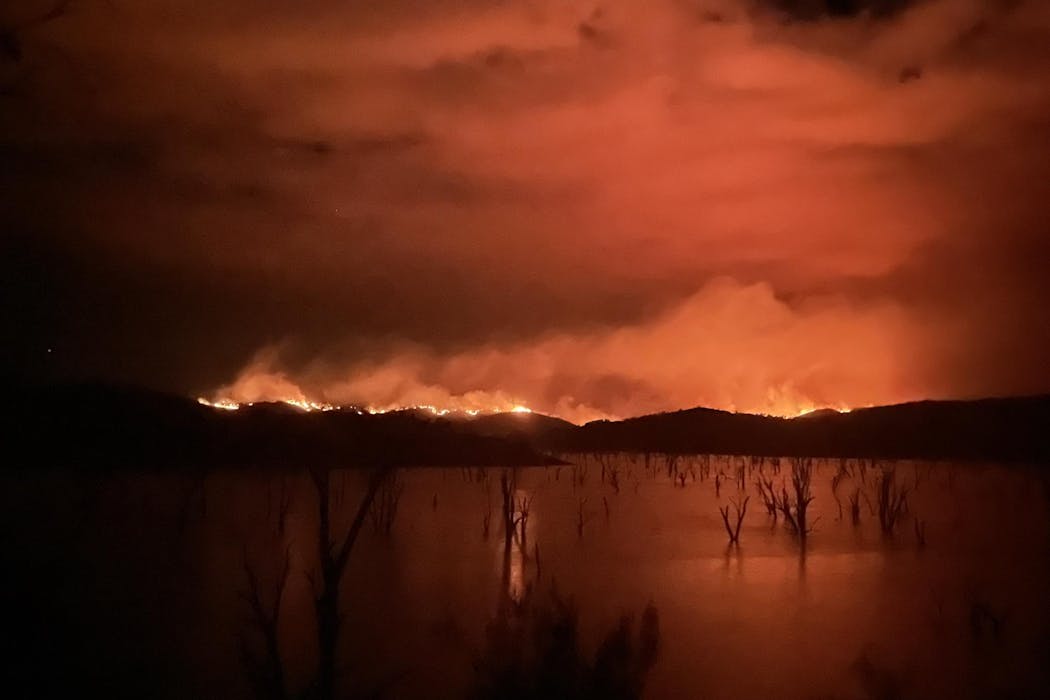
After a weekend of extreme heat and windy conditions, more than 30 blazes were still burning in Victoria and New South Wales as of Sunday evening, including major fires in the Otways, near the town of Alexandra in central Victoria, and on the NSW-Victoria border near Corryong.

How the Longwood fire has spread

And in northern Australia, Cyclone Koji brought heavy rain and fierce wind gusts as it crossed the coast Sunday into north Queensland.

What role does climate change play in supercharging extreme weather conditions, such as these? The evidence shows it not only turns up the thermostat, it also makes the climate system more erratic.

One emerging aspect of such climate change is “hydroclimatic whiplash” – sudden and often frequent transitions between very dry and very wet conditions. It can feel like the climate system is toggling between lots of different states: floods one minute, bushfires the next.

Australians are familiar with the El Niño Southern Oscillation (ENSO), the climate phenomenon in the Pacific Ocean with El Niño (warm) and La Niña (cool) phases that significantly impact global weather. But climate change means our weather is now operating in new and novel ways.

The forecast for this fire season was not as calamitous as it is proving to be. That’s not a criticism – we have to expect the unexpected. Rather than using the term climate change, which implies a steady and predictable shift, I now prefer the term “climate instability”.

On track for worsening fires

We’ve had soaking rains in some parts of south-eastern Australia but now the landscapes are drying out and heatwaves are coming. Don’t be fooled by recent, relatively benign summers. In the longer term, we are on track to experiencing worsening fire seasons and worsening fire weather.

In my home state of Tasmania, for example, in September we weathered the effects of Sudden Stratospheric Warming – rapid warming over either pole, in our case in Antarctica. These are extremely rare in the Southern Hemisphere, with only two other major previous events documented in the past 60 years — one in 2002 and the other in 2019.

On the ground, Tasmania endured strong southerly then westerly winds for months. These winds caused uncontrolled fires in Dolphin Sands and 19 homes were lost. Firefighting aircraft could not be used because of the winds. The temperatures were not extraordinarily hot and the vegetation wasn’t extremely dry, but the winds were so intense they drove uncontrollable fires.

How do heatwaves contribute?

A heatwave is like switching on a hot plate and heating up the landscape. It makes a lot of fuel available to burn. If we get sequences of heat waves this summer, it will take time for the landscape to cool down again between each one.

When we talk about landscape fires, we often talk about fuel. But it’s also useful to think about energy. We need to focus on the energetic nature of the fuels. In a heatwave, the very same vegetation that might be moderately flammable on a cooler day burns at a fever pitch.

This vegetation can release so much energy that it creates thunderstorms that behave, in energetic terms, like small nuclear bombs or volcanoes. A lot of Australian trees, particularly eucalyptus, are adapted to fire. But even they can’t cope with such extreme temperatures.

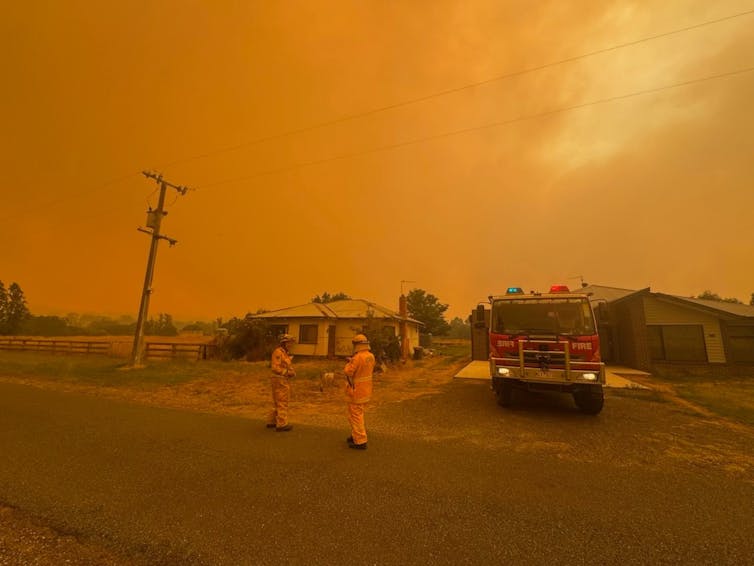
Two firefighters stand in front of a house with a yellow, smoky sky behind them.
Firefighters from the Sassafras/Ferny Creek Fire Brigade on the ground near Alexandra.
Sassafras/Ferny Creek Fire Bridgade/Facebook

Why is there so much dry lightning?

Dry lightning is a signature of instability in the atmosphere. There’s enough energy to cause convection, the process which drives the formation of thunderclouds, but not enough water vapour to deliver much rain.

As the storm passes over it brings lightning to a landscape that is as flammable as petrol. But the amount of rain is minimal, there’s no deep, soaking rain. There is emerging evidence that as the energy in the atmosphere increases globally, there is more lightning. It’s a diagnostic sign of a hotter and more unstable climate.

How should we respond?

We’re not going to be able to stop climate instability and associated dangerous wildfire weather, so we need to adapt. The worst thing we can do is get frightened or angry. I use the analogy of road safety: people were dying on roads, and we used our intelligence and our laws to drastically reduce the road toll.

We can do the same with bushfires as we adapt to climate instability. There needs to be much better public information about bush fires, and greater investment in education on how to adapt. We also need to build buffers between flammable bushland and towns and suburbs, and have safer gardens.

We have to stop thinking aircraft or firefighters can solve this problem. People are being exposed to very grave risks fighting these fires. We also can’t lazily assume the insurance industry can pick up the pieces.

The key point is there are going to be lots more fires. We can’t resent the administrative and financial effort it will take to make our landscapes safer.

The Conversation

David Bowman is an Australian Research Council Laureate Fellow and also receives funding from the New South Wales Bushfire and Natural Hazards Research Centre, and Natural Hazards Research Australia.

ref. Rain one minute, heatwave the next. How climate ‘whiplash’ drives unpredictable fire weather – https://theconversation.com/rain-one-minute-heatwave-the-next-how-climate-whiplash-drives-unpredictable-fire-weather-273104

Jehovah’s Witness Convention to bring $20m boost to Auckland economy

Source: Radio New Zealand

The three-day event was expected to generate more than 60,000 visitor nights at hotels.

The Hotel Council Aoetaroa says events are a big part of turning Auckland’s central business district into a central entertainment district.

A Jehovah’s Witness Convention in the city over the weekend has been forecast to boost the city’s economy by more than $20 million.

The three-day event was expected to generate more than 60,000 visitor nights with hotel occupancy at 85 percent.

Hotel Council Aotearoa strategic director James Doolan told Morning Report he was hoping the opening of Auckland’s international convention centre next month would bring in more events.

“You hear people talking about tourism in New Zealand and trying to get back to pre-Covid levels, but really we need to be about 130 percent of pre-Covid levels, because 2019 is seven years ago now…”

“We need more international and domestic visitors, we’ve also got a very, very expensive railway link in Auckland and fewer people actually go into the CBD to work, so we have to turn our CBD, our central business district, into a central entertainment district, and events are a big part of that,” Doolan said.

Doolan said large events were needed to fill out hotels.

“Events attract people to Auckland and it creates what’s called compression, because we have about 14,000 hotel rooms in Auckland, we’re a big city, so 14,000 hotel rooms that need to be sold out 365 days of the year,” he said.

“The only way you do that is if you also have events, you can’t just have [Free Independent Travel].”

Doolan said large events like the Jehovah’s Witness Convention took years to plan.

“You also need to pay what’s called subvention payments for some of these events, and that’s essentially a cash incentive to encourage an event to come to New Zealand or Auckland instead of many of the competitor destinations around the world.”

It made sense for central government to invest in sensible incentives and subvention funding, Doolan said.

“Every dollar that a tourist spends in New Zealand, they also pay GST on top of those dollars, and international tourism is one of the only export sectors where Central Government collects GST.”

Sign up for Ngā Pitopito Kōrero, a daily newsletter curated by our editors and delivered straight to your inbox every weekday.

– Published by EveningReport.nz and AsiaPacificReport.nz, see: MIL OSI in partnership with Radio New Zealand

Hawke’s Bay blaze sparks evacuations

Source: Radio New Zealand

A fire in Hawke’s Bay, January 2026. Hawke’s Bay – Fire and Emergency

Campers and hikers have been asked to evacuate the Boundary Stream Camp and Bell Rock Scenic Reserve in Hawke’s Bay because of a large fire.

The fire is in a forestry block near Waitara Road in Te Haroto, in the Hastings District.

“Please stay away from this area and follow instructions from emergency services,” the council wrote on social media on Sunday night.

Several fire crews have been battling the blaze.

Pohokura Road is closed from the Tutira end

Temperatures in Hawke’s Bay reached the high-30s on Sunday.

Sign up for Ngā Pitopito Kōrero, a daily newsletter curated by our editors and delivered straight to your inbox every weekday.

– Published by EveningReport.nz and AsiaPacificReport.nz, see: MIL OSI in partnership with Radio New Zealand

Modern rock wallabies seem to survive by sticking together in small areas. Fossils show they need to travel

Source: The Conversation (Au and NZ) – By Christopher Laurikainen Gaete, PhD Candidate, Wollongong Isotope Geochronology Laboratory, University of Wollongong

Today, rock wallabies are seen as secretive cliff-dwellers that rarely stray far from the safety of their rocky shelters. But the fossil record tells a very different story.

New research suggests rock wallabies were once travellers, moving across country in search of new habitat. These wandering wallabies, including one that travelled over 60 kilometres, were far more mobile than other kangaroos at the time, even their giant extinct cousin Protemnodon.

These findings reshape our understanding of how rock wallabies interact with their environment and how they may respond to the increasingly fragmented landscapes of modern Australia.

Homebodies by nature?

Modern rock wallabies spend their days sheltering in rocky caves, crevices, and boulder piles, emerging at dusk to feed. They have tiny home ranges, often less than 0.2 square kilometres.

Rock wallabies aren’t fussy eaters, eating leaves and shoots from grasses or shrubs that grow near their rocky refuges. This has led to the assumption that they don’t travel far, sticking together in small groups on isolated habitats. Why travel far when everything you need is right outside your shelter?

We saw the same pattern in their distant cousin, the giant forest wallaby, Protemnodon, which had small ranges despite their much larger bodies.

Male rock wallabies have been observed occasionally dispersing up to 8km between colonies. While such movements are rare, they may play a crucial role in maintaining gene flow between populations.

Artistic renders, comparing the size of Mount Etna Caves rock wallabies to their distant relative, the extinct megafauna forest wallaby Protemnodon.
Queensland Museum & Capricorn Caves / Atuchin / Hocknull / Lawrence

Rock wallabies occur in isolated regions across much of mainland Australia, from the Cape York rock wallaby at the northern tip of Australia, to the yellow-footed rock wallaby of the Flinders Ranges, South Australia, and west to the Rothschild’s rock wallaby in the Pilbara, Western Australia.

This broad distribution raises intriguing questions. Were rock wallabies once more mobile than they seem today? And if so, can we see evidence of that movement in the fossil record?

Mount Etna caves

North of Rockhampton, Mount Etna Caves National Park sits right in the heart of rock wallaby country. Rich fossil deposits provide a window into the past 500,000 years, revealing how kangaroos once lived.

From these deposits, we examined fossils from kangaroos of all sizes, ranging from tiny pademelons (Thylogale), through to the megafauna forest wallaby (Protemnodon), as large as an adult human. This let us compare how far different-sized kangaroos travelled. Did small species stay closest to home while the largest roamed?

Kangaroo diversity at Mount Etna Caves, including pademelons (left), rock wallabies (middle) and the extinct forest wallaby Protemnodon (right).
Photos: Chris Laurikainen Gaete / Illustration: Queensland Museum & Capricorn Caves / Atuchin / Hocknull / Lawrence

How fossil teeth reveal childhood location

Fossilised rock wallaby teeth from Mount Etna Caves. Missing enamel in the bottom right tooth shows material taken for analysis.
Chris Laurikainen Gaete

To answer these questions, we turned to clues hidden in teeth. When kangaroos eat, unique chemical signatures (strontium isotopes) become locked in their enamel.

Because enamel forms early in life and doesn’t change, the strontium preserved in an animal’s teeth can tell us where it grew up. At Mount Etna Caves, there is no evidence kangaroo remains were brought there by predators to eat. So, we can be confident the patterns we see in their teeth reflect real movements during the animal’s lifetime.

Our results showed that regardless of size, most kangaroos were locals. Rock wallabies showed strong site fidelity, foraging less than 1km from the caves where their fossilised remains were found.

This strong attachment to rocky shelter mirrors modern species observations. Even as the environment changed over hundreds of thousands of years, most rock wallabies maintained small home ranges.

The travellers

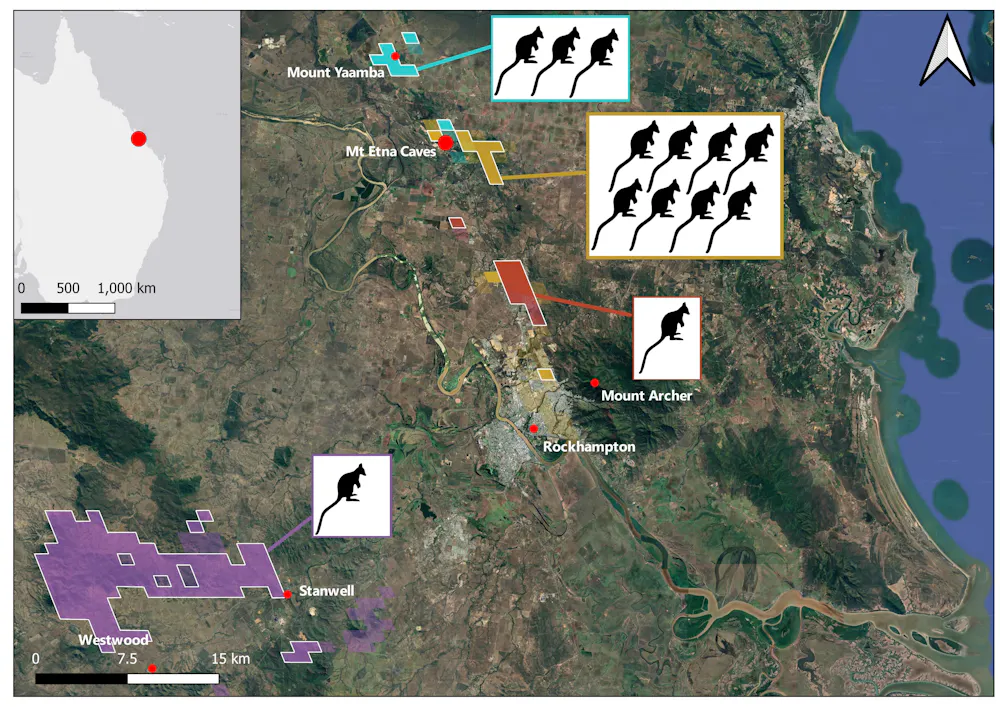
While most rock wallabies kept close to the caves, a few individuals found at Mount Etna Caves were born elsewhere. Some originated 8km north near Mount Yaamba, and others around 15km south near Mount Archer.

But our most surprising case was a very adventurous individual that travelled at least 65km, crossing mountains, floodplains, and even the Fitzroy River, which would have been prime crocodile country. This is the first direct evidence of long-range travel in an individual rock wallaby.

Simplified map showing likely places of origin for fossil rock wallaby individuals. Most lived and died near Mount Etna Caves, with others immigrating longer distances from Mount Yaamba (8km north), Mount Archer (15km south) and somewhere between Stanwell and Westwood (65km southwest of Mount Etna Caves).
Chris Laurikainen Gaete

While movements over these kinds of distances haven’t been observed in rock wallabies today, genetic evidence from short-eared rock wallabies does show some connection between colonies separated by 67km.

This suggests that, although most rock wallabies stay local, a small number of travellers will leave their birthplace in search of new habitat. These rare long-distance dispersers would play an important role in keeping populations connected across the landscape. Because this kind of dispersal happens beyond the timeframes of human observation, without the fossil record we wouldn’t know this crucial part of rock wallaby natural history.

Modern implications

Importantly, our results also show fossil wallabies were dispersing from areas that are still home to rock wallabies today.

Unadorned rock wallabies still live around Mount Etna and Capricorn Caves, with another colony in the Mount Archer National Park. To the west of the Fitzroy River, Herbert’s rock wallaby occupies rocky outcrops, just outside the town of Westwood.

Isotopic evidence tells us that, in the past, these three groups were not isolated pockets but part of larger interconnected populations.

We don’t know whether rock wallabies are still trying to make these journeys. But with major roads and development now dividing the landscape, humans might inadvertently be creating barriers for these rare but crucial dispersal events.

Fossil and genetic evidence shows rock wallaby populations should not be viewed as isolated colonies, but as parts of a wider network that relies on long-distance dispersal to stay healthy. Recognising this is vital if we want these rock-loving, wandering wallabies to keep thriving in an increasingly urbanised environment.

Anthony Dosseto receives funding from the Australian Research Council.

Scott Hocknull has previously received funding from Australian Research Council and formerly Project DIG (a BHP-Queensland Museum partnership). He is an advisor to the Capricorn Caves Geonature Conservation Foundation.

Christopher Laurikainen Gaete does not work for, consult, own shares in or receive funding from any company or organisation that would benefit from this article, and has disclosed no relevant affiliations beyond their academic appointment.

ref. Modern rock wallabies seem to survive by sticking together in small areas. Fossils show they need to travel – https://theconversation.com/modern-rock-wallabies-seem-to-survive-by-sticking-together-in-small-areas-fossils-show-they-need-to-travel-272344

The antisemitism debate is already a political minefield. The royal commission must rise above it

Source: The Conversation (Au and NZ) – By Matteo Vergani, Associate Professor and Director of the Tackling Hate Lab, Deakin University

What we currently know about antisemitism in Australia is pieced together from a fragmented body of information produced by community organisations, researchers and law enforcement. And it is largely interpreted and translated to the public through news reporting.

Through this reporting, Australians have learned that organised criminal groups were involved in targeting Jewish communities and foreign actors also played a role.

At the same time, some data on antisemitic incidents released by security agencies has been incorrect. Other statistics produced by community organisations has been publicly challenged.

Researchers like myself have also produced data on antisemitic incidents, but this is limited in many ways.

In a nutshell, the picture of what constitutes antisemitism and how and why it has spiked in recent years is far from being clear.

This lack of clarity matters. Without a reliable understanding of what happened in the lead-up to the Bondi terror attack, which data can be trusted, and how different forms of antisemitism intersect, Australia cannot fully grasp how it reached a point where Jewish Australians were murdered at a public religious gathering.

Shedding light on this problem will be difficult, but it is essential to understand both the scale of the problem and how to respond.

Potential for more divisiveness

The royal commission established by Prime Minister Anthony Albanese is designed to address many of these unresolved issues.

As set out in its terms of reference, it will examine the nature and prevalence of antisemitism in Australia and assess how it can be more effectively addressed. It will also:

  • review the responses of security and law enforcement agencies

  • investigate what happened before, during and after the Bondi attack

  • develop recommendations aimed at strengthening social cohesion.

Social cohesion and national consensus are the stated end goals of the entire exercise. Yet, the context in which the commission is operating is highly volatile. There is a real risk that rather than repairing social cohesion, the process itself could damage it.

This risk comes from the heavy political pressure now attached to the royal commission and from the way some political actors are using it as a weapon in broader political battles, including attacks on the government.

The antisemitism debate is already a political minefield. And the commission has entered that terrain from its first day.

The decision to acknowledge the International Holocaust Remembrance Alliance’s definition of antisemitism in the terms of reference is likely to be used by some to delegitimise the commission altogether. Critics argue the definition can be used to silence legitimate criticism of Israel, while supporters say it draws a necessary line between political critique and antisemitic tropes.

At the same time, some politicians have questioned the appointment of Former High Court justice Virginia Bell to head the commission, which could also undermine the credibility of the inquiry.

As a result, the commission is already inflaming existing political tensions. This is deeply unfortunate because it makes the task harder for those who are genuinely focused on understanding antisemitism, responding to it effectively, and improving the safety and wellbeing of Jewish Australians.

Why the Christchurch royal commission was successful

Royal commissions carry strong symbolic weight. They are often implemented when something has gone badly wrong and the social fabric feels strained. The aim is to restore trust and provide a clear public account of what happened and why.

A useful point of comparison is the royal commission that followed the Christchurch terrorist attack in New Zealand. The inquiry led to wide-ranging reforms, including changes to firearms laws, counter-terrorism frameworks, approaches to social cohesion and inclusion, hate crime and hate speech legislation, and improved support for victims and witnesses.

It also contributed to the creation of the Christchurch Call to eliminate terrorist and violent extremism content online. This global initiative involving governments and technology companies has been successful in limiting the spread of terrorist and violent extremist material.

However, the political and social climate in New Zealand at the time was very different. There was a stronger sense of national unity and far less public contestation about what constituted hate. The attack was also not entangled with an ongoing and deeply polarising international conflict.

In Australia, the context is far more charged. The war in Gaza continues to divide public debate, regularly spilling into domestic politics.

It’s worth noting antisemitic attacks have not stopped after Bondi. There was a firebombing less than two weeks later. This makes the task of using a royal commission to calm tensions and rebuild trust significantly harder.

Many pieces to the puzzle

Despite these difficulties, the commission matters now more than ever. Jewish Australians need answers, and the broader public deserves to understand what actually happened.

At present, the picture over what has caused rising antisemitism and the Bondi attack is confused. Public sentiment on the war, organised crime, foreign actors and terrorist ideology all appear to intersect, but how they connect remains unclear.

Different security agencies, researchers and community organisations hold different pieces of evidence. Without bringing these strands together, Australians cannot fully understand the problem, let alone work out how to prevent it from happening again.

The path ahead will be difficult and exposed to disruption. One obvious challenge is the risk of further attacks while the inquiry is underway. Any new incident would complicate the process.

If, for example, an attack occurred that was shown to involve formal training or links to a terrorist organisation, serious questions would arise about whether the commission’s terms of reference remain adequate, or whether additional investigative processes would be required.

The most important test will come at the end. The commission’s recommendations must be acted on, regardless of which party is in government. That follow-through is what determines whether a royal commission produces real change or becomes just a symbolic exercise.

Meeting this test will require political restraint and maturity. It will mean resisting the temptation to turn the commission into a tool for partisan conflict, and instead treating it as a shared national effort to protect communities and restore trust.

Matteo Vergani receives funding from the Australian government (Australian Research Council, Department of Home Affairs) and the Canadian government (Public Safety Canada).

ref. The antisemitism debate is already a political minefield. The royal commission must rise above it – https://theconversation.com/the-antisemitism-debate-is-already-a-political-minefield-the-royal-commission-must-rise-above-it-273018

Why eating disorders are more common among LGBTQIA+ people and what can help

Source: The Conversation (Au and NZ) – By Kai Schweizer, PhD Candidate in Youth Mental Health, The University of Western Australia; The Kids Research Institute

MDV Edwards/Getty

When people picture someone with an eating disorder, many think of a thin, teenage girl with anorexia nervosa. This stereotype is so pervasive it can feel like a fact.

The reality is that eating disorders affect people of all ages, body sizes, cultures, races, sexes, genders and sexualities. In 2023, around 1.1 million Australians (around 4.5% of the population) were living with an eating disorder.

A growing body of evidence suggests LGBTQIA+ people are particularly vulnerable to developing eating disorders. But we still need more research to understand how and why they affect this group more.

Here’s what we know so far about LGBTQIA+ people’s higher risk – and what treatment actually works for them.

What is an eating disorder?

Eating disorders are serious mental health conditions that affect a person’s eating behaviours. They can harm both physical and mental health.

Anorexia nervosa and bulimia nervosa are the most well-known eating disorders, but the most common are actually binge eating disorder (eating a lot in a short amount of time and feeling out of control) and avoidant/restrictive food intake disorder (restricting eating because of sensory sensitivity, lack of appetite, or fear of illness or choking).

Eating disorders can cause damage to a person’s organs, bones, fertility and brain function. People with an eating disorder are up to five times more likely to die early than those without one.


Read more:
What’s the difference between an eating disorder and disordered eating?


How much higher is the risk for LGBTQIA+ people?

Research shows that LGBTQIA+ people have much higher rates of eating disorders than non-LGBTQIA+ people.

For example, in the United States an estimated 9% of the population will experience an eating disorder in their lifetime. But a 2018 survey of LGBTQ young people in the US found rates were significantly higher:

  • 54% reported an eating disorder diagnosis
  • another 21% thought they had an eating disorder, but hadn’t been diagnosed.

Within the LGBTQIA+ community, the risk also varies across different groups:

We don’t have data for asexual people, but we do know that asexual people have poorer body image than their non-asexual peers. So it is likely they also experience higher rates of eating disorders.

Why LGBTQIA+ people face higher risk

Being an LGBTQIA+ person is not a mental illness. There is no evidence of a biological reason why LGBTQIA+ people experience higher rates of eating disorders.

While many factors contribute, two of the most studied risk factors are minority stress and gender dysphoria.

1. Minority stress

Minority stress refers to how discrimination and stigma negatively impact the health of LGBTQIA+ people. This means it is not who they are, but how LGBTQIA+ people are treated that drives their higher risk.

Discrimination can lead LGBTQIA+ people to feel shame about their identities and bodies. Some people try to cope through disordered eating behaviours, which can develop into an eating disorder.

For intersex people, medically unnecessary surgeries in childhood to “normalise” their bodies can cause trauma and shame that can also increase eating disorder risk.

2. Gender dysphoria

Many trans people experience something called gender dysphoria. This is the distress, discomfort or disconnect that can happen when a person’s gender identity doesn’t match their physical body or how others see them. For many trans people, eating disorders can be an attempt to reduce gender dysphoria.

In trans teens, eating disorders often develop as a way to stop puberty when they can’t access puberty blocking medications. For example, restricting food may be a way to try to reduce the appearance of breast tissue or to stop having periods.

What kind of treatment would work?

After a diagnosis, typical eating disorder treatment involves a multidisciplinary team including a doctor, mental health professional and dietitian. Treatment can be provided in the community or in a hospital if someone’s physical health needs close monitoring.

But eating disorder treatment was not designed with LGBTQIA+ people in mind and can sometimes cause harm. LGBTQIA+ people report more negative experiences of treatment compared to the general population.

For example, mirror exposure exercises are a common therapy, where someone with an eating disorder is asked to look in a mirror for prolonged periods to lessen their body image distress. But for some trans people this can worsen their gender dysphoria.

This doesn’t mean treatment can’t help LGBTQIA+ people. It means treatment has to be adapted to ensure it meets their needs.

In practice, this might look like:


If this article raised any concerns for you or someone you know, contact the Butterfly Foundation on 1800 33 4673. You can also contact QLife at 1800 184 527.

Kai Schweizer receives funding from the Australian Government Research Training Program and the Australian Eating Disorder Research and Translation Centre SEED Grants Scheme.

ref. Why eating disorders are more common among LGBTQIA+ people and what can help – https://theconversation.com/why-eating-disorders-are-more-common-among-lgbtqia-people-and-what-can-help-270268

Is it okay to feel ‘schadenfreude’ at work? Here’s how to navigate this complex emotion

Source: The Conversation (Au and NZ) – By Dissanayake Mudiyanselage Sachinthanee Dissanayake, PhD Candidate, University of Wollongong

Pressmaster/Getty

Have you ever felt delighted (perhaps secretly) when something went wrong for someone else? We may not openly admit it, but many of us have probably felt this way – sometimes intentionally, sometimes unconsciously.

This feeling has a name, borrowed into English from German: “schadenfreude”. And workplaces or other business settings – with all their pressures, rivalries and office politics – can create the ideal conditions for it to arise.

Here’s why we sometimes feel happy at others’ failures, why this emotion can have double-edged consequences, and how it can be reframed to promote learning and personal growth.

What is schadenfreude?

Schadenfreude is a compound word formed from two German nouns: “schaden”, meaning harm, and “freude”, meaning joy.

Importantly, here, we’re talking about something distinct from bullying, or actively causing another person pain.

Research has shown schadenfreude is relatively common in the workplace. It can be found among employees at all hierarchical levels, from lower-level staff to senior management.

For an employee, it might occur when seeing a rival or envied coworker being mistreated by a supervisor.

Similarly, top managers might feel schadenfreude when rivals fail. Our previous research indicates strategic leaders, including chief executives and other strategic level decision-makers, are prone to this emotion.

To investigate this further, our current research is exploring how Australian chief executives respond to competitors’ failure, with a particular focus on how they perceive and experience schadenfreude.

Our preliminary findings, which are yet to be peer-reviewed, suggest leaders recognise schadenfreude as a feeling that arises when a rival organisation encounters misfortune, especially in a competitive industry.

This was evident in their reflections on the PwC tax scandal and the 2022 Optus data breach, when they viewed these organisations as rivals. For instance, one participant explained:

Well, I think human nature again would dictate that you would be going, oh, the competitor, you haven’t done very well […] You can’t help but kind of rub your hands together and say, well, we’re going to get some customers out of this.

On face value, schadenfreude might seem emotionally counterintuitive. Ethically, one might expect that witnessing someone else in distress would elicit a response of empathy or compassion.

So, why is the observer experiencing pleasure or delight instead? Is it a brief lapse in empathy and moral judgement, or is something else going on?

Easing our insecurities

Feelings of schadenfreude can have many drivers. One of the foremost relates to insecurity.

Observing someone performing worse than yourself might make you feel better about your own abilities. This process is known as downward social comparison. In this way, for some people, schadenfreude can serve to enhance self-esteem.

High achievers’ failures are particularly noticeable because they are perceived as being at the top of their field.

Schadenfreude may be reflected in the cultural phenomenon of “tall poppy syndrome”, a tendency to “cut down” those who stand out.

Perceptions of deservingness can also drive this emotion. When someone acts unethically or appears undeserving of success and then faces failure, observers often feel they “got what they deserved”.

Identification with a particular organisation can also drive schadenfreude. If employees feel a strong connection to their organisation, they may view rivals as “out-groups”, making competitors’ misfortunes feel like wins that enhance their organisational pride.

Schadenfreude’s perils

There are a range of hazards to watch out for when navigating this emotion.

First, feeling schadenfreude may lead to overconfidence at work. When employees or managers perceive their success as relative to others’ failure, they might become complacent, overlook changes and develop blind spots.

Second, schadenfreude can spread through gossip and harm workplace relationships.

If colleagues sense that you take pleasure in their difficulties, they may feel unsafe sharing failures or challenges. This can undermine openness and mutual support, damaging trust and relationships within the organisation.

And third, it can undermine workplace empathy. Employees or managers who take pleasure in others’ misfortune often fail to recognise the challenges their colleagues face.

By prioritising personal satisfaction or winning an advantage over showing compassion, they neglect to put themselves in others’ shoes, which can undermine the organisation’s supportive and overall ethical climate.

It’s important to create psychological safety in workplaces.
fauxels/pexels

A double-edged sword

It may feel like a complex, dark emotion. But by recognising its drivers and meeting it with mindfulness, schadenfreude can be channelled into a positive opportunity for learning and growth.

When you recognise what you’re feeling is schadenfreude, you can pause and think: “Is this really how I want to respond?”, or “Is this really me?”

You might ask yourself reflective questions, such as:

  • Could something like this happen to me, too?
  • What went wrong for them, and what can I learn from it?
  • How can I use this situation to improve myself or my decisions?

Being aware of and mindful about this emotion can give you the chance to shift from simply enjoying others’ failures to learning from them, improve yourself, address your own weaknesses, and prepare for future challenges without losing your moral values.

The authors do not work for, consult, own shares in or receive funding from any company or organisation that would benefit from this article, and have disclosed no relevant affiliations beyond their academic appointment.

ref. Is it okay to feel ‘schadenfreude’ at work? Here’s how to navigate this complex emotion – https://theconversation.com/is-it-okay-to-feel-schadenfreude-at-work-heres-how-to-navigate-this-complex-emotion-269181

Slavemaster Moeaia Tuai set to be sentenced

Source: Radio New Zealand

Warning: this story contains details that may disturb some readers.

Moeaia Tuai will be sentenced next month for enslaving a young woman who he forced to work and sexually abused. Two victims broke free from the Auckland man’s control in harrowing echoes of New Zealand’s most infamous slavery trial, but such prosecutions remain rare. Gill Bonnett reports.

Moeaia Tuai. RNZ / Gill Bonnett

Slavemaster Moeaia Tuai is a Samoan chief or matai, who took possession of his victims’ lives and raped one victim, who had been forced to pay him her wages for four years.

At the 63-year-old’s trial, his own diaries were used to document the hours the young woman worked, her pay and when she was punished with beatings.

“Treating a person as if they were owned” was the legal description given to the jury.

“Restricting freedom of movement – where a person can go, restricting freedom of association – who they can spend time with, restricting freedom of communication – who they can contact and talk to – using actual or threatened violence for breach of rules, retaining income and denying access to money, threatening consequences such as deportation to ensure compliance, restricting access to education to maintain control.”

Only one of those elements was needed, but the prosecution said Tuai had done the lot.

He put them to work, restricted their movements and communication, and controlled their money, paying them very little for their work. He kept their passports, bank cards and wages, assaulted them and threatened both with deportation if they spoke out.

The young male victim dreamt of finishing school, before he was put to work for 50 to 60 hours a week. He was paid $100-150, $2 or $3 an hour.

He escaped after four years in 2020, including time in Australia. When the woman raised the alarm four years later that Tuai had raped her, police also discovered the slavery both had suffered at Tuai’s hands.

Within that time the two young victims – who cannot be identified – were starting out in life, but having to hand over their incomes to Tuai – estimated to be $78,000 or more for one victim alone.

He denied all the charges, but the jury was unanimous in finding him guilty of 19 charges: two of slavery as well as a slew of sexual offending against the female victim.

Ownership, possession, control, threats

Tuai did not allow the victims to talk to each other, even when they were eating at the same table. He did not allow them to talk to other people. He threatened to kill the female victim if she told anyone he’d sexually assaulted her, and both of them with deportation.

The jury heard the call Tuai made to Internal Affairs the day after she ran away – and his disappointment as he realised he could not carry out his threat.

The Aucklander was a matai, or Samoan chief. So too was Joseph Matamata, who in 2020 became the first New Zealander convicted of both slavery and human trafficking.

Joseph Matamata. RNZ/ Anusha Bradley

Thirteen of Matamata’s victims in Hastings – one just 12 years old – were held behind a tall wire fence and put to work.

Tuai also guarded his second victim after the first ran away – driving her to and from work at a laundrette and factory, and even refusing permission for her to attend a daytime work function.

He coerced her to make a false allegation of rape against another man who she had started to see, said the Crown.

But she took her chance to escape, contacting a relative, laying a false trail of where she had gone and then contacting police.

Rare conviction, less rare occurrence

Investigation and prosecution numbers are hard to track down, but Tuai’s slave dealing convictions are believed to be the fifth in New Zealand history.

In a 1991 case, a Thai man sold a woman to an undercover police officer as a slave for $3000. She had been working in a massage parlour and a go-go bar, and the evidence suggested he had brought a succession of girls and young women from Thailand to live off their earnings.

More recently, Fijian woman Kasmeer Lata forced her underage daughter into prostitution in Auckland – the first time on her 15th birthday.

She was sentenced to more than 10 years’ imprisonment for dealing in slaves and dealing in a person under 18 for sexual exploitation, while Lata’s partner Avneesh Sehgal sentenced to four years and eight months in prison for his part in the offending.

In cases not prosecuted as slavery, debt bondage or immigration-related promises or threats have been used against workers to exploit them in slavery-like conditions.

A ministerial advisory group set up to deal with cross-border and serious crime reported that nearly four times the number of migrant exploitation complaints had been made in 2024 compared with the previous year.

“It is highly likely that serious migrant exploitation, such as people-trafficking, forced labour and sexual exploitation, is underreported and growing within New Zealand.”

University of Auckland’s Centre for Research on Modern Slavery director Christina Stringer said the small numbers of slavery prosecutions, as well as human trafficking, may suggest they are rare – but she strongly disagrees.

“Successful prosecutions often rely heavily on victim testimony, and many migrant workers may be unwilling to come forward – or may not even recognise themselves as victims.”

Tuai will find out his fate in February and will be remanded in custody until then. The maximum sentence for slavery is currently 14 years, and 20 years for rape.

Where to get help:

  • Need to Talk? Free call or text 1737 any time to speak to a trained counsellor, for any reason.
  • Lifeline: 0800 543 354 or text HELP to 4357
  • Suicide Crisis Helpline: 0508 828 865 / 0508 TAUTOKO (24/7). This is a service for people who may be thinking about suicide, or those who are concerned about family or friends.
  • Depression Helpline: 0800 111 757 (24/7) or text 4202
  • Samaritans: 0800 726 666 (24/7)
  • Youthline: 0800 376 633 (24/7) or free text 234 (8am-12am), or email talk@youthline.co.nz|
  • What’s Up: free counselling for 5 to 19 years old, online chat 11am-10.30pm 7 days/week or free phone 0800 WHATSUP / 0800 9428 787 11am-11pm
  • Asian Family Services: 0800 862 342 Monday to Friday 9am to 8pm or text 832 Monday to Friday 9am – 5pm. Languages spoken: Mandarin, Cantonese, Korean, Vietnamese, Thai, Japanese, Hindi, Gujarati, Marathi and English.
  • Rural Support Trust Helpline: 0800 787 254
  • Healthline: 0800 611 116
  • Rainbow Youth: (09) 376 4155
  • OUTLine: 0800 688 5463 (6pm-9pm)

If it is an emergency and you feel like you or someone else is at risk, call 111.

Sign up for Ngā Pitopito Kōrero, a daily newsletter curated by our editors and delivered straight to your inbox every weekday.

– Published by EveningReport.nz and AsiaPacificReport.nz, see: MIL OSI in partnership with Radio New Zealand

Roaming cats pose threat to native wildlife in Queenstown wetland

Source: Radio New Zealand

Trail cameras planted by Whakatipu Wildlife Trust have detected 44 cats over three weeks. Supplied/Whakatipu Wildlife Trust

A restored wetland on the edge of Queenstown is drawing rare native wildlife back to an area once dry and barren, but conservationists say roaming pet cats could undo years of community-led work.

Just after a rare and elusive bird species was spotted at the Shotover Wetland, the Whakatipu Wildlife Trust said trail cameras detected 44 cats over three weeks.

Executive officer Anna Harding-Shaw was the first to spot the pair of marsh crakes, which are a native species so notoriously “secretive and cryptic” that their total population numbers are unknown.

“I don’t think I’ve ever been that excited to see a bird before,” she said. “I was just throwing everything down to try to get my camera out.

“They are an indicator species, which means that they only show up when the wetland is in good health, so it’s such a great example of the work that’s been done here.”

For the past decade, Shotover Primary School students have helped other groups bring the wetland back to life.

Audrey Austin, who has moved on to Wakatipu High School, remains a keen birder and regular visitor.

“I go down there, and I look at all the thriving plants and animals that are down there that call it their home now,” she said. “All the plants that we’ve planted… it’s amazing to see the difference.”

She has also spotted black-fronted terns, white-faced herons, grey teal, native bees, skinks and dragonflies, as well as the pair of marsh crake.

“After so long restoring this wetland – all these thousands of plants now that have been put in the ground, and water quality testing that we’ve done and invertebrate monitoring that we’ve done, and bird watching – to see that marsh crake have come back, that’s amazing. It’s incredible.”

Anna Harding-Shaw said pest traps had picked up mice, rats and the occasional hedgehog, but the scale of the cat presence only became apparent through the trail cameras.

“We left them out for 21 nights and there were 44 triggers for cats over that time, which is huge, which is massive, compared to all other camera monitoring around.”

Most of them appeared to be pets, she said.

Whakatipu Wildlife Trust executive officer Anna Harding-Shaw. RNZ/Katie Todd

“Fancy breeds, long hairs, ragdolls with collars – you could tell they were pet cats. It’s in the middle of the night, so they’re only here for one thing, if they’re here in the middle of the night, that’s to go hunting, which is a real shame.

“One of them was actually carrying a dead bird in its mouth at the time”

Queenstown cat owners needed to keep them inside at night, she said.

“Even just having them wandering through the wetland is going to be scaring the birds that we want to be nesting here.”

Austin was worried the marsh crake were only just settling in and could be particularly vulnerable.

“Like many New Zealand birds, they’ve evolved to combat avian predation from the sky, so marsh crake are perfectly camouflaged and when they feel threatened. they’ll run and hide,” she said.

“That’s great if you have, say, a falcon or harrier above you, but when the threat is coming from a land-based predator that operates by smell, they’re basically left very, very vulnerable.

“You can imagine this 15 centimetre-long bird trying to attack a cat. That’s not going to go down well for the bird, probably.”

Harding-Shaw said feral cats were already a major challenge for the region.

“In terms of feral cats, there’s thousands of them in the hills, absolutely thousands, and they roam everywhere across the Southern Alps. They’re in all ecosystems, really hardy, really smart, adaptable and can live on nearly anything, a huge problem to get on top of.”

Feral cats were recently added to Predator Free 2050s hitlist, which could unlock more funding for projects that target them.

However, pet cats roaming near towns could complicate trapping efforts, Harding-Shaw said.

Whakatipu Wildlife Trust asked Queenstown Lakes District Council to make microchipping and desexing mandatory, partly because some feral cat traps switched off, if they detected a microchipped pet cat.

It also wanted the council to consider an education campaign about keeping cats inside at night.

Queenstown Lakes District Council responded it would investigate cat management as part of its Climate and Biodiversity Plan 2025-28.

Shotover Primary School teacher Emma Watts hoped local cat owners would start keeping their felines indoors, before any chicks hatched.

“It feels like you’re facing a losing battle,” she said. “We have paradise ducks down there that are having ducklings and we’re hoping that the marsh crake is going to breed down there.

“We’ve got pukeko we hope will breed down there as well and you just think what chance are they going to have, if there are lots of cats there?

“We love cats, we love animals… but we would love to educate our community for their domesticated cats to be kept in at night.”

Sign up for Ngā Pitopito Kōrero, a daily newsletter curated by our editors and delivered straight to your inbox every weekday.

– Published by EveningReport.nz and AsiaPacificReport.nz, see: MIL OSI in partnership with Radio New Zealand

Passengers urged to wave down buses – but not required

Source: Radio New Zealand

Waving down a bus is not required, but it sure helps. RNZ / Mark Papalii

Whether you’re heading to work before an important morning meeting, or coming home with kids and shopping in tow, there are few things more maddening than your bus just seeming to sail on by.

Last year, Wellington bus service provider MetLink received more than 1000 complaints from people annoyed by buses that didn’t stop.

Jess Gessner filed a complaint, after she and her two young children were left on the curb, when she was unable to signal the driver.

“It was very obvious that we wanted to get picked up at a bus stop,” she said. “We were the only people there, and [the driver] just looked at us and drove past.”

The Metlink website said bus drivers would stop, if they saw someone waiting, but encouraged passengers to wave, so they could be seen by the driver.

Metlink senior operations manager Paul Tawharu said waving was helpful, but not a requirement.

“What we do ask customers is that they make themselves visible to the driver,” he said. “Passengers don’t need to wave.

“There’s some of our passengers that are visually impaired. You might have mums with babies in arms that just can’t do that, so that’s not expected.

“If the passenger is at the bus stop, then the driver is expected to stop.”

Most of the commuters who spoke to RNZ in the Wellington suburb of Newtown said they tended to wave down their buses, but nearly everyone also felt they had been passed up or had seen another passenger left at the stop.

“I have been [passed by] on a [number] four,” said Clara. “It was a very sad day.”.

“Many times,” John Nga said. “You have to be visually waving, not just raising your hands – it’s not enough.”

“I think it depends on the bus stop,” Ben Lake said. “There are definitely times when people will be waiting there and they’ll just go straight past.”

“I do wave to the driver, because they don’t often stop,” Jane said. “They’ll go past you, if you don’t flag them down.”

Environment Canterbury public transport general manager Stewart Gibbon said, last year, it received just over 550 complaints about buses not stopping – either to pick up passengers or allow them off.

He said, in the context of more than 15 million passenger trips a year, the numbers were comparatively small.

“Our drivers do a brilliant job of balancing the different demands of the role, including gauging whether people waiting at our stops want to get on board,” Gibbon said. “A clear signal from a customer is a great help to them.

“Our drivers are trained in many different scenarios, including when customers may have their hands full. In this scenario, they would instead be looking at facial expressions and general body language.

“It’s worth noting that sometimes drivers can’t stop, due to their bus being full.”

Auckland Transport service operations manager Duncan McGrory said the transport provider had signs at every bus stop, asking passengers to indicate they wanted to board with a “clear wave of their arm”.

He said Aucklanders took up to 230,000 bus trips every weekday and the growth of the network over the last 15 years made hailing the bus crucial to keeping things running smoothly.

“It’s important for people to hail the bus that they actually want,” McGrory said. “We want to make sure that people are stopping the buses that they need and that every single bus is not stopping at every single stop.”

So the message is, wherever you are in the country, when in doubt, put your arm out.

Sign up for Ngā Pitopito Kōrero, a daily newsletter curated by our editors and delivered straight to your inbox every weekday.

– Published by EveningReport.nz and AsiaPacificReport.nz, see: MIL OSI in partnership with Radio New Zealand

Pinch Point: Tough economic times aren’t new

Source: Radio New Zealand

RNZ

The words “cost of living” have become synonymous with a struggle faced by an increasing number of Kiwi families. The news is full of stories about the price of butter, pain at the pump and pay parity. With the phrase first popping up in newspapers more than a century ago, reporter Kate Green takes a dive into the history of tough times.

The year is 1912, and the government, faced with rising inflation, has ordered a royal commission of inquiry into the cost of living.

An article by the Press Association in May 1912 explains: “The Commission is ordered to enquire into such questions as: Has the cost of living increased in New Zealand during the past twenty years; if so, has that increase been more marked during the last ten than during the previous ten years? To what extent is the increased cost of living, if any, the result of the higher standard of living?”

The resulting document was a huge catalogue of prices, wages and anecdotal evidence.

It gave insights into things like housing: “Mr Leyland, timber-merchant, Auckland, stated, ‘We are apt to forget that only a small proportion of the workers pay rent to a landlord. It would surprise you if you knew the number of houses, say in Ponsonby, in which the dwellers are the owners or own a considerable equity. In the street in which I live every house is owned by the occupier, and I know of another street where only one occupier pays rent to a landlord.’”

And school supplies: “Dr Mcllraith, Inspector of Schools in the Auckland district – ‘I find that the cost of maintaining children at school nowadays is considerably less than it used to be. Ten years ago the school-books for Standard I cost about 4s. a year. Now they do not cost the children more than 2s. 3d. a year.’”

And drinking habits: “[One] table seems to show that the volume of liquor consumed per head fell during the time of low prices of products, and rose during the period of high prices.”

In 1912 the government, faced with rising inflation, ordered a royal commission of inquiry into the cost of living. Supplied

The average weekly income per family was three pounds, four shillings and three pence – less than Australia’s four pounds, 13 shillings and one pence – and they spent about 39 percent of their income on food.

These days, that was closer to 16 percent, according to Stats NZ data.

Economists RNZ spoke to pointed to a number of gruelling periods of financial hardship, many with catchy names: the Black Budget, Rogernomics, and Ruthanasia.

The Muldoon era had an inflation rate of 18 percent – much higher than on Saturday, which was 3 percent in September.

Robert Kirkby, a senior lecturer at Victoria University, said the country’s woes on Saturday were caused by wages failing to keep up with inflation.

“So we’ve had a bunch of inflation over the past couple of years. It’s mostly gone away now, but as a result of that inflation, the prices are higher now than they were, say, three or four years ago. Substantially higher – like 20, 30 percent higher.”

And wages had gone up, but not as much.

“And so that slight difference that the prices have gone up, a little bit more than the wages, is the cost of living crisis, if you will.”

Despite what people might credit to their own success, wage increases happened as a matter of course, Kirkby said.

“When we get wage increases, we tend to think it’s ’cause we earned it, and when the prices increase, we tend to think that’s our bad luck, or was outside our control, right? And so people don’t view their wage increase over the past five years as simply reflecting the inflation – they view it as a reward for their effort.”

Nicola Growdon from Stats NZ explained they had been tracking prices since the 1900s. The items tracked changed over time. Records had been replaced by cassette tapes, and then by CDs, and more recently by music streaming subscriptions. Landlines had been replaced with cellphones.

Reserve Bank Governor Anna Breman. RNZ / Samuel Rillstone

“It does show how society changes over time,” Growdon said.

And there had always been times where things were tight.

“You know, the global financial crisis,” Growdon gave as an example. “We also saw in the immediate period after the Canterbury earthquakes, so just in terms of the impact that had, and supply shortages, things just weren’t as available during that period.”

In November, the Reserve Bank cut the official cash rate to its lowest in three years, to 2.25 percent.

The finance minister promised the country was on the up, with better times ahead. Meanwhile, experts told RNZ while there were green shoots across the playing field – for now, they’re patchy at best.

Sign up for Ngā Pitopito Kōrero, a daily newsletter curated by our editors and delivered straight to your inbox every weekday.

– Published by EveningReport.nz and AsiaPacificReport.nz, see: MIL OSI in partnership with Radio New Zealand

Former NZ basketball player Nathaniel Salmon accepts American football college offer

Source: Radio New Zealand

Nathaniel Salmon has accepted an offer to play college football. Supplied

NZ American football player Nathaniel Salmon has accepted an offer to play college football for Washington State Cougars – but it’s been one of the most unconventional paths to the American college system for the Porirua-born athlete.

Two years ago, the 21-year-old had never even touched a football and was pursuing a career in basketball, after playing for Manawatū Jets and Wellington Saints in the NBL.

During a 2024 stint playing for the North Gold Coast Seahawks in Australia, Salmon was approached by the NFL International Player Pathway (IPP) and jumped at the chance.

“The opportunity that was laid out to me was pretty life-changing,” Salmon told RNZ. “Who wouldn’t give it a shot?”

The IPP is an NFL initiative to give international athletes the opportunity to learn the sport and try out with professional teams.

The representatives told him, if he went and trialled for the programme, he would have a decent shot at making it onto a roster.

“I was like, ‘What the hell?’.”

At the trial, “they liked what they saw and they selected me”, he said.

What followed was an intensive 10-week training programme in early 2025 at the IMG academy – an elite sports training facility at Bradenton, Florida.

He was identified as a tightend – the Swiss army knife position on the outside of the offensive line, responsible for catching the ball, as well as blocking.

The position requires a combination of size, strength and athleticism, and basketball players are often well suited. Standing more than two metres tall and weighing more than 120kg, Salmon fits the bill.

“At first, it was pretty hard. I didn’t know if it was for me, because I was so new to it.

“Obviously, it was my first time putting on a helmet and pads, so that was new. I just kept training and I just started falling in love with it.”

The NFL limits how many players can be on a roster during the regular season to 53, but an exemption grants an additional practice squad spot to a qualifying international player.

Thirteen other players attended the academy, but they knew they were competing with athletes all over the world, Salmon said.

“There’s international players in college that are eligible for the spot, there’s international players in the international football league that are eligible for the spot.

“There are guys that maybe just lost their IPP spot, and they’re still training for it and trying to get one back.”

Nathaniel Salmon spent 10 weeks training as a tightend at the IMG Academy in Bradenton, Florida. Supplied

After Salmon attended a pro-day – an opportunity for athletes to showcase their skills to scouts and team representatives – Los Angeles Chargers invited him to their early-season minicamp.

“When I got there, I didn’t feel like I shouldn’t have been there,” he said. “When we started training, I felt like I was keeping up with all the guys that were playing high-level college football for four years.

“To come into the NFL programme and do well… I was pretty chuffed about that.”

Despite performing well at the minicamp, Salmon was ultimately not signed to the Chargers’ international player roster spot and his dream of playing American football seemed over.

Then his manager pointed out he was actually eligible to play college ball – a prospect that has become increasingly appealling in recent years, because of rules allowing players to profit from their name, image and likeness (NIL).

Some players can now earn more playing college football than they would on an NFL rookie contract.

“I was eligible because, one, I’ve never been to college… and, two, I was never actually signed by an NFL team.”

It took a few months, but he was eventually granted a full four years of NCAA eligibility to play college football.

Last November, Salmon started a frantic few weeks of receiving offers and making visits to colleges across the US.

“They just wine and dine you, man. I was fortunate enough to bring my parents out to visit… everything was paid for.

“They just treat you like you’re a superstar. It was an unreal experience for not only me, but my parents as well.”

Salmon visited several programmes, including North Carolina – where NFL legend Bill Belichick coaches – but Washington State University in Pullman, Washington, ticked the most boxes.

“It’s quite a lot like New Zealand in terms of climate and the geographic side of things. It’s very green and hilly.

“It honestly felt like home, when I first got there.”

It also presented the best opportunity for him to find a place within the team.

“The whole coaching staff at Washington State, they’re completely new there – they only got there like a week ago. You can go into that coaching staff and they won’t have any favourites.

“They wanted me to be their guy.”

Joining up with the Cougars makes Salmon the first player to ever train with a professional team, before entering a college programme, he said.

“It’s honestly unheard of.”

Salmon said he still had a lot to learn, but the passion for the game has already ignited.

“I’m falling in love with the game and I think I’ll just keep loving the game more as I go along. I have a drive to get better and I want to reach my ceiling with this game.

“I know where I can get to and I really want to get there.”

Washington State was the perfect place for him to develop his craft, he said.

“The tight end coach at Washington State, he’s really passionate about getting me to where I want to get to.

“I’m trying to keep striving to do my best and get better every day.”

Sign up for Ngā Pitopito Kōrero, a daily newsletter curated by our editors and delivered straight to your inbox every weekday.

– Published by EveningReport.nz and AsiaPacificReport.nz, see: MIL OSI in partnership with Radio New Zealand

My GP is leaving me after nearly 50 years

Source: Radio New Zealand

My second son’s birth 42 years ago was uneventful. I recall it was surprisingly quick. We barely had time to drive to the birthing unit before I was on my back, panting. At my head offering encouragement was my husband. At the business end was a young GP with blonde hair, glasses and a quiet manner.

I shall call him Dr C.

This month, I will have been Dr C’s patient for almost 43 years. I have been on his books longer than all bar one of his patients. He has seen me through childbirth, menopause, creaking bones and sagging skin. I thought he would see me out. But last month he emailed his patients to say he was retiring.

RNZ

– Published by EveningReport.nz and AsiaPacificReport.nz, see: MIL OSI in partnership with Radio New Zealand

Weekend heat: Ice-creams, swimming pools and cancelled tours

Source: Radio New Zealand

Hundreds of sailors made the most of blazing sunshine and 10-15 knot winds in the Bay of Islands at the 50th annual Tall Ships race. RNZ / Peter de Graaf

With temperatures reaching the high 30s in Napier and Hastings on Sunday, many spent the day finding ways to beat the heat.

Renske Speekenbrink works at the Napier i-site Visitor Centre, where people were popping in to cool off.

“Walking in the streets with no air-con, it’s quite hot, so we’ve been quite welcoming.

“I did see a few people who were super sweaty who said they’d just arrived. We just said to take a minute to catch your breath, we’ve got air-con inside, we can tell you a bit about the area, and give you a map.

“We’ve been recommending going to the museum, which has air-con, or to cool off in the ocean.”

But the intense heat meant popular summer hotspots and activities were not an option for visitors.

“There were people who actually had to cancel their push bike tour, and they’re doing it tomorrow because it’s supposed to be a bit cooler tomorrow,” Speekenbrink said.

Te Mata Peak, a normally busy lookout in Havelock North, had been closed off since because of high fire risk.

Speekenbrink said Hawkes Bay Fire and Emergency would be re-assessing the conditions on Mondaymorning, to determine if Te Mata Peak could re-open to the public.

At Rush Munro’s Ice Cream Parlour in Hastings, owner Vaughan Currie had more customers than usual on Sunday.

He said they typically sell about 320 cones on a hot day, and they had done about 20 percent more than that.

“We’ve had a really strong day, probably one of the strongest Sundays we’ve had for January so far. It’s obviously weather-driven.”

He said some unique flavours had been the parlour’s most popular this summer.

“At the moment we’re selling a lot of feijoa, so I’m struggling to keep up with that, and a close second would be passionfruit.”

Meanwhile, in Kaikōura, which reached 30 degrees on Sunday, there were also gusts of up to 90km/h.

But Sylvia Wong, who works at the Alpine-Pacific Kiwi Holiday Park, said the weather did not put off campers.

“There are still a lot of people camping. All of the people here are jumping into our pools half-naked because it’s just too warm to stay in the tent site, so they either go to the beach or chill out in the pool.

“They told us they couldn’t bear the heat. Sometimes, they walk into reception and ask if we sell ice cream or if we have extra ice. They want to cool down with a cold beer and stuff like that.”

She said a total fire ban in place in Kaikōura was reassuring after a burn pile sparked large fires destroying four homes in the town late last year.

Despite record-breaking temperatures in many places, the sun was not out for everyone.

Several wet weather warnings were in place this past weekend, including in the ranges of the Grey and Buller districts in the South Island.

Flooding on Sunday also caused the closure of the key road link between Canterbury and the West Coast on State Highway 73.

Sign up for Ngā Pitopito Kōrero, a daily newsletter curated by our editors and delivered straight to your inbox every weekday.

– Published by EveningReport.nz and AsiaPacificReport.nz, see: MIL OSI in partnership with Radio New Zealand

Auckland’s stalled housing developments a year on: What’s changed

Source: Radio New Zealand

This half-finished apartment block in Auckland’s Epsom has been derelict for the past six years. MELANIE EARLEY / RNZ

Unfinished housing developments are dotted across the Auckland region, with many seemingly in a state of limbo.

The derelict properties often led to concerns from local communities about vandalism and squatters.

A year ago, RNZ looked at several stalled developments in Auckland and explored the reasons behind why they had been left in various unfinished states.

As 2026 begins, have any of the developments been finished or demolished? Or do they continue to sit in a dilapidated state?

‘Blight on the Epsom landscape’ remains

Originally called The Epsom Central Apartments Project, this building on Manukau Rd has sat unfinished for years. MELANIE EARLEY / RNZ

The Epsom Central Apartments Project halted six years ago after Auckland Council found it had not complied with building consent.

The original partnership, Epsom Central Apartments LP, was put into receivership in 2022, and purchased by Xiao Liu the director of a company named Reeheng Ltd in 2023.

A year ago, locals complained the building was a “blight on the Epsom landscape” and had at one point been filled with rats and squatters.

In 2025, no noticeable progress had been made to the building, the owner of former neighbouring business Just Laptops, Forrest Tan, said.

Since then, Tan had demolished his building, partly to prepare for a rebuild he said, and partly because a previous scaffolding collapse at the derelict site next door had damaged his old building.

“This would be an ideal time to demolish [the building]. My site is now a clear, open space. Once my new building goes up demolition would be extremely difficult since it’s a boundary-to-boundary structure on a busy stretch of road.”

The building is on Epsom’s busy Manukau Rd. MELANIE EARLEY / RNZ

When RNZ visited the site, there was no obvious work ongoing, but the old precarious looking scaffolding did appear to have been tidied up or replaced and pedestrians no longer had to walk underneath it.

Has NZ’s highest residential tower restarted?

The Seascape apartment project was on hold for about a year. RNZ / Ziming Li

New Zealand’s would-be tallest apartment building, Seascape tower in Auckland’s CBD had construction halted for about a year.

In September 2024, it was reported the work had stalled due to a dispute between the developer and the builder.

But a year later, work resumed on the tower with contractors beginning to appear at the site.

Bayleys was also running a marketing campaign for unsold units with the words “a new chapter begins”.

Pukekohe’s ‘lock and leave’ houses

The Valley Road construction project in Pukekohe. MELANIE EARLEY / RNZ

Several duplexes on Pukekohe’s Valley Rd had remained just the wooden frames of houses for at least a year, locals said, but it appeared as though some construction had been underway in 2025.

A year on, the duplexes were still covered in scaffolding and behind a fence, with no workers on site when RNZ visited, but it was obvious construction had been taking place.

The lots were listed for sale by Barfoot and Thompson in mid-2025, with the listing stating construction was due to be completed in “late 2025”.

‘Eyesore’ no more

In the coastal suburb of Mairangi Bay on the North Shore, a new build construction site which long worried locals as work appeared to have stalled was moving forward at some pace.

Nick Rogers who lived near the site on Beach Rd said work on the site seemed to stall in 2024 with just the exterior shell created.

But by the end of 2025, Rogers said work was underway again.

“It restarted about two or three months ago and is at quite some pace! Locals are relieved,” he said.

According to property records, the site was last sold in 2015 – it was not yet clear when the construction was due to finish.

Kingsland’s ‘The George’

The George on New North Road in Kingsland. MELANIE EARLEY / RNZ

Marketing for The George on New North Rd in Kingsland began emerging in early 2022, and was listed at the time by Harcourts, as nine luxury townhouses starting at a price of $1,785,000.

A website for the development had long since been defunct, but when RNZ visited the site in December, it was an active construction site.

Despite being little more than some planks of wood and a fence scrawled with graffiti a year ago, the building had now taken shape.

The developer of the site, CSS Luxury Homes Ltd said the site was due to be finished in mid to late 2026.

Vinod Kumar Chawla, the director of the company, said the project had stalled due to issues with finances.

“Many ups and downs but good times will come again,” he said.

“It’s a good location, top class finishing… one of the best in the city.”

Sign up for Ngā Pitopito Kōrero, a daily newsletter curated by our editors and delivered straight to your inbox every weekday.

– Published by EveningReport.nz and AsiaPacificReport.nz, see: MIL OSI in partnership with Radio New Zealand

Australia’s ‘antisemitism crisis’ – examining what’s real and what isn’t

Australian Prime Minister Anthony Albanese last week announced a Royal Commission into the Bondi Beach Attack and antisemitism. Andrew Brown weighs the evidence on Australia’s “antisemitism crisis” for Michael West Media.

ANALYSIS: By Andrew Brown

Australia is being told it faces an unprecedented wave of antisemitism — a crisis requiring extraordinary measures, including a Royal Commission. But police data, court findings, and parliamentary evidence tell a very different story.

This is not a story about denying antisemitism. It is about how inflated claims are being used to silence criticism of Israel, criminalise protest, and narrow democratic space.

Australia is being told it faces a moral emergency so grave it justifies extraordinary measures.

A sweeping wave of antisemitism, unprecedented in scale, is said to be engulfing the country, demanding heightened policing, vast public funding, and now a Commonwealth Royal Commission.

A manufactured narrative?

The claim has been repeated so often it has hardened into common sense. But when examined against evidence rather than repetition, the crisis begins to dissolve. What remains is not a surge in antisemitic violence, but the manufacture of a narrative

and its rapid elevation into state doctrine.

This is not denial of antisemitism. Antisemitism is real, dangerous, and must always be confronted where it occurs.

What is being challenged here is the scale, the framing, and the political use of the claim. When slogans replace evidence, the alleged crisis collapses.

Start with the numbers. Australians are repeatedly told there were around 1200 antisemitic incidents in New South Wales and more than 2000 nationally. These figures are treated as settled fact by politicians and the media.

They are nothing of the sort.

They are not police statistics. They are not court outcomes.

They are self-reported incident logs compiled by advocacy organisations using expansive definitions that collapse political speech into racial hatred. Protest slogans, Palestinian flags, stickers, online criticism of Israel, opposition to Zionism, and support for Boycott Divestment and Sanctions are all counted alongside genuinely hateful conduct.

Dissent counted as hate
Once dissent is counted as hate, the number grows and its meaning evaporates.

When these claims were tested against formal state processes, the picture changed radically. Evidence to the New South Wales Upper House antisemitism inquiry showed that only around 13 to 14 incidents met the threshold for potential criminal prosecution.

New South Wales Police did not dispute this.

From 1200 incidents to low double digit chargeable cases is not a rounding error. It is a categorical difference. If Australia were facing a genuine wave of antisemitic violence, police data and court proceedings would reflect it. They do not.

Fake terror plots
The panic has been sustained by a series of high profile incidents that do not survive scrutiny.

In Sydney, the so called caravan plot and multiple graffiti and vehicle fire cases were initially framed as antisemitic attacks. Later reporting revealed hoaxes, staged events, or criminal activity unrelated to antisemitism as a social phenomenon.

Corrections arrived quietly, long after the alarm had done its work.

The Melbourne Synagogue fire was, we are told, the work of Iran, so it too cannot be seen as a result of local antisemitism.

More damning still was evidence from police inquiries that hundreds of antisemitic incident reports were generated by a single individual, identified as a Jewish teenager who made more than 500 calls alleging threats and attacks. These reports were logged, counted, and publicly relied upon as indicators of a statewide and national surge before being identified as false or self-generated.

This is not a footnote. It exposes a systemic failure.

A reporting framework that allows one person to materially inflate incident figures is not measuring social harm. It is manufacturing it. When that data is amplified by media and cited by politicians as “proof” of crisis, the error ceases to be technical. It becomes political.

Political amplification has been decisive. Senior leaders talked up early claims before facts were settled. Media followed. Initial allegations raced into headlines. Clarifications barely whispered.

Public memory retained the fear, not the correction.

What is unfolding follows a pattern of “manufacturing consent” described decades ago by Noam Chomsky who observed that modern democracies rarely suppress dissent through force. Instead, they manage perception by narrowing the range of acceptable opinion while preserving the appearance of open debate.

Australians are still permitted to speak. They are encouraged to condemn antisemitism in the abstract.

But questioning the scale of the alleged crisis, interrogating the numbers, or insisting on a distinction between hatred of Jews and criticism of Israel is treated as suspect. This is not censorship. It is calibration.

‘Fake protesters’ narrative

The consequences have been most visible in the treatment of protest. Australia has seen one of the largest sustained protest movements in its modern history, with weekly demonstrations in support of Palestine drawing tens of thousands.

Jewish Australians march openly.

Jewish speakers address crowds. Jewish banners appear alongside Palestinian ones. The focus is ceasefire and accountability.

Yet these protests are relentlessly framed as incubators of antisemitism.

The misrepresentation following the October 8 gathering near the Sydney Opera House was emblematic. Claims of genocidal chanting were broadcast nationally and internationally. Those present publicly disputed the account.

The disputed version was amplified. The disavowals were marginalised. A contested moment was frozen at its most inflammatory interpretation and reused as an origin myth.

Sydney Harbour Bridge propaganda
The fracture became impossible to ignore after the Harbour Bridge march, one of the largest demonstrations in Australian history. No violence. No arrests. Jewish Australians marching openly.

Yet the event was branded a hate march by the government’s antisemitism envoy.

If a peaceful protest of that scale can be declared hate without evidence, antisemitism is no longer being identified. It is being declared. And once it can be declared, it can be weaponised.

That weaponisation has a clear objective: to shut down criticism of Israel.

As Israel’s war in Gaza has intensified and the occupation of the West Bank has deepened, the international conversation has shifted toward allegations of genocide, apartheid, and war crimes.

Rather than answer those charges, Israel’s defenders have sought to redefine the debate itself. The problem is no longer what Israel is doing. The problem is those who are talking about it.

Criticism of Israel is reframed as antisemitism. Opposition to Zionism is reframed as racial hatred. Support for Palestinian rights is reframed as extremism. Pro-Palestinian protest is recast as a domestic security problem rather than a human rights movement responding to mass civilian harm.

The endgame
This brings us to the endgame. The government’s mandate for a Commonwealth Royal Commission into antisemitism has now been released. It does not ask whether a nationwide antisemitism wave exists. It assumes one.

From its opening premises, the mandate proceeds on the basis that antisemitism is prevalent across Australian society and institutions and that protest, education, and political expression warrant scrutiny. These are not hypotheses to be tested. They are conclusions already reached.

This is not a fact-finding exercise. It is an implementation exercise.

Many Jewish Australians reject this strategy and stand openly with Palestinians. The issue is not Jewish identity. It is the instrumentalisation of antisemitism claims to silence dissent, suppress protest, and shield a foreign state from accountability.

Antisemitism must always be confronted where it exists.

But evidence must precede power.

Anything less is theatre.

Andrew Brown is a Sydney businessman in the health products sector, former deputy mayor of Mosman and Palestine peace activist. This article was first published by Michael West Media and is republished by Asia Pacific Report with permission.

Article by AsiaPacificReport.nz

SH73 reopens after flooding between Canterbury, West Coast

Source: Radio New Zealand

On the West Coast, winds and heavy rain also brought down trees onto State Highway 6 and caused surface flooding. MetService

Flooding has closed the key road link between Canterbury and the West Coast, as a fierce thunderstorm swept over the region this afternoon.

State Highway 73 between Otira and Arthur’s Pass was closed at about 4.30pm, but was reopened by 9pm, with the section affected by the mudslide open to one lane with a temporary 30km/h speed restriction in place.

NZTA said road users should expect delays and are asked to travel with extra care.

Orange heavy rain warnings were in place until 9pm for the Westland ranges and Haast, and the headwaters of lakes and rivers south of Arthur’s Pass, and until 1am for ranges of the Grey and Buller districts.

Earlier in the day, Canterbury was under a strong wind warning, which brought down trees, partially blocking the road.

NZTA said road users should avoid the area or delay their journey, if possible.

MetService meteorologist Rob Kerr said strong winds meant a band of intense thunderstorms spread across the South Island were blown clear across the Southern Alps to Christchurch.

Rain stations in and around Mt Cook Village, Arthur’s Pass and Carrington had all recorded heavy rain – between 150 to 220 millimetres in around 15 hours, Kerr said.

At the same time, Christchurch and Kaikōura were among the hottest places in New Zealand on Sunday, reaching temperatures of 32.9 and 34 degrees Celsius respectively – close to the national high of 36.3 degrees in the Hawke’s Bay.

A severe wind warning was in place for Marlborough until 9pm, which could see severe gale northwesterlies gusting 120 km/h in exposed places, while a severe wind warning for the Tararua District, Wairarapa and Wellington will end at 4am Monday.

Sign up for Ngā Pitopito Kōrero, a daily newsletter curated by our editors and delivered straight to your inbox every weekday.

– Published by EveningReport.nz and AsiaPacificReport.nz, see: MIL OSI in partnership with Radio New Zealand

Sāmoa set to become third Pacific nation to open Jerusalem embassy

RNZ Pacific

Sāmoa is set to become the third Pacific nation to have an embassy in Jerusalem.

Prime Minister Laaulialemalietoa Polataivao Schmidt told a gathering of the Sāmoa branch of the International Christian Embassy Jerusalem on Tuesday he had instructed the country’s Ministry of Foreign Affairs to begin work on the opening of an office in Jerusalem.

He said he wanted the embassy up-and-running this year.

The move follows the establishment of Fiji’s embassy in Jerusalem last year, and the opening of Papua New Guinea’s embassy in the city in 2023.

Only a handful of countries recognise Jerusalem as the capital of Israel — in 2017, the UN General Assembly voted overwhelmingly (128-9) during a rare emergency meeting to ask nations not to establish diplomatic missions in the historic city as Occupied East Jerusalem is envisaged as the capital of the State of Israel.

In discussing his decision, Laaulialemalietoa talked about Sāmoa’s connections to Israel.

He touched on the meeting he had with Israeli Deputy Foreign Minister Sharren Haskel while receiving medical treatment in New Zealand last year.

“I am very grateful when the [deputy] Minister of Foreign Affairs came all the way from Jerusalem to visit me when I was sick in New Zealand,” he said.

‘Blessing’ for Sāmoa PM
“It was a blessing for me to know that Israel has also had an eye [on] Sāmoa, because we had a lot of connection in many ways.”

Haskel was in New Zealand briefly in November following a trip to Fiji and Papua New Guinea.

Fiji’s embassy, in September, was met with mixed reactions, with the coordinator of the Fiji Women’s Crisis Centre saying Prime Minister Sitiveni Rabuka was “not on the right side of history”.

Fiji’s government called it “a strategic step” to enhance cooperation between the two nations, and reaffirmed its support for a peaceful two-state solution “where both Israelis and Palestinians can live in dignity and security”.

“Fiji has maintained longstanding diplomatic relations with Israel while also supporting the legitimate aspirations of the Palestinian people,” it said.

Opposition Human Rights Protection Party leader and Sāmoa’s longest serving former prime minister Tuila’epa Sa’ilele Malielegaoi . . . letter to the editor of Samoa Global News raises criticisms of Sāmoa’s embassy move. Image: Samoa Global News screenshot APR

Article by AsiaPacificReport.nz

Football: Wellington Phoenix fight back to grab draw in A-League clash

Source: Radio New Zealand

Isaac Hughes scores a goal for Wellington against Adelaide. Masanori Udagawa/Photosport

Wellington Phoenix have shown some heart and courage in their A-League men’s match against Adelaide in Wellington, fighting back from two goals down at halftime to draw 2-2.

The home team weren’t looking good in the first half, as Adelaide scored the opening goal in the 14th minute to Ryan White.

Luke Duzel scored a second just before the break to give the visitors a decisive lead, but the Phoenix came out a different team in the second half, as they surged back into the match, playing with enthusiasm and attacking flair.

Isaac Hughes rewarded the small crowd, neatly finishing off at the near post from a Ramy Najjarine corner.

Lively midfielder Corban Piper headed home the second in the 65th minute, following a pinpoint cross from Tim Payne, who returned from a long injury layoff that lasted almost three months.

The Phoenix had good chances to win the game. Paulo Retre hit the post, Luke Brooke-Smith had a goal ruled out in stoppage time, when a teammate ventured offside, and Alex Rufer blasted over the top from close range right at the end.

The result keeps the Phoenix in 10th place in the 12-team league. They have 15 points from their 12 games, nine points behind leaders Auckland FC.

Sign up for Ngā Pitopito Kōrero, a daily newsletter curated by our editors and delivered straight to your inbox every weekday.

– Published by EveningReport.nz and AsiaPacificReport.nz, see: MIL OSI in partnership with Radio New Zealand

Fire breaks out at Auckland’s NZ Badminton Centre

Source: Radio New Zealand

The fire was contained and the building was not badly damaged. RNZ/Marika Khabazi

About 60 people have been evacuated, after a fire broke out at a large badminton centre in Auckland.

The owner of the NZ Badminton Centre on East Tamaki Road, Dev Senthiya, said about 20 firefighters put out the blaze, which came from the roof of the building.

Those inside when the fire alarm went off all made it out safely, Senthiya said.

The fire was contained and the building was not badly damaged, he said.

Senthiya believed the blaze was caused by an electrical fan in the roof overheating.

Fire and Emergency was unavailable for comment.

Sign up for Ngā Pitopito Kōrero, a daily newsletter curated by our editors and delivered straight to your inbox every weekday.

– Published by EveningReport.nz and AsiaPacificReport.nz, see: MIL OSI in partnership with Radio New Zealand

NZ Breakers bounce back with gritty win over ANBL champions Illawarra Hawks

Source: Radio New Zealand

Parker Jackson-Cartwright led the Breakers to victory against the Hawks. Blake Armstrong / PHOTOSPORT

Forty-eight hours after their worst display of the Australian NBL season, the NZ Breakers have regrouped for a gritty 101-96 win over defending champions Illawarra Hawks in Sydney.

American point guard Parker Jackson-Cartwright led all scorers with 23 points, while Tall Blacks forward Sam Mennenga had 21, as the Auckland-based team secured their ninth win of the season to keep their playoff hopes alive, closing to within 2.5 games of the sixth-placed Tasmania Jackjumpers.

On Friday, the Breakers were embarrassed 103-62 at home by Sydney Kings, with coach Petteri Koponen under pressure to re-engage his players.

They led through the first and second quarters, enjoying a 49-43 advantage at halftime, before building a 15-point lead midway through the third period.

The Hawks piled on 11 straight points to close the deficit, but the Breakers still led by five heading into the final stanza and held off their rivals down the stretch.

Mennenga left the door ajar with a pair of free-throw misses, but Cartwright converted from long range and added two free-throws.

Down by three with six seconds remaining, Illawarra guard Tyler Harvey committed a costly backcourt turnover that gave the visitors a chance to pad their advantage.

Jackson-Cartwright supplemented his scoring feats with eight assists, seven rebounds and three steals, while American forward Izaiah Brockington had 20 points, American centre Rob Baker slotted four three-pointers among his 17 points and Mexican teenager Karim Lopez grabbed five steals, along with his 16 points and six assists.

Another American, Quentin Peterson, led the Hawks with 22 points, but his team committed 19 turnovers and sent the Breakers to the line for twice as many free-throw attempts (28).

The Breakers visit the Cairns Taipans next Saturday.

Sign up for Ngā Pitopito Kōrero, a daily newsletter curated by our editors and delivered straight to your inbox every weekday.

– Published by EveningReport.nz and AsiaPacificReport.nz, see: MIL OSI in partnership with Radio New Zealand

Top seed Elina Svitolina wins 2026 ASB Classic women’s crown

Source: Radio New Zealand

Elina Svitolina serves during the ASB Classic final. Alan Lee/Photosport

Ukrainian veteran Elina Svitolina has won the 2026 ASB Classic women’s tournament in Auckland.

The 31-year-old proved too good for China’s Xinyu Wang, winning in straight sets 6-3 7-6 in an hour and 43 minutes.

Despite the scoreline, the contest was far from easy for Svitolina, who entered the match as the top seed and heavy favourite, after winning 18 of the 22 previous WTA Tour finals she had played in.

Svitlolina also beat Wang in their only previous meeting on tour at Wimbledon in 2024.

An even battle for much of the first set saw both players holding serve, until Svitolina managed to break Wang to move 4-2 up.

She then held her nerve to win the first set 6-3 in 32 minutes. Breakpoints proved elusive, with each player earning just one opportunity each.

The second set was just as tight, with both rivals holding serve all the way to a tiebreaker.

Wang, who was playing in just her second career singles final, started the tiebreak superbly to claim a 3-0 lead, before Svitolina came roaring back to win the next four points.

Wang, 24, showed plenty of composure though, to save a matchpoint and lock the scores up at 6-6.

Svitolina quickly created another and this time, she served it out to win the tiebreaker 8-6.

All eyes now turn to the men’s tournament, which starts on Monday, with veteran Frenchman Gael Monfils – Svitolina’s husband – the defending champion.

Sign up for Ngā Pitopito Kōrero, a daily newsletter curated by our editors and delivered straight to your inbox every weekday.

– Published by EveningReport.nz and AsiaPacificReport.nz, see: MIL OSI in partnership with Radio New Zealand

SH73 closed by flooding between Canterbury, West Coast

Source: Radio New Zealand

On the West Coast, winds and heavy rain also brought down trees onto State Highway 6 and caused surface flooding. MetService

Flooding has closed the key road link between Canterbury and the West Coast, as a fierce thunderstorm swept over the region this afternoon.

State Highway 73 between Otira and Arthur’s Pass was closed at about 4.30pm.

Contractors also worked to clear a large mudslide blocking both lanes further east on SH73.

Earlier in the day, Canterbury was under a strong wind warning, which brought down trees, partially blocking the road.

NZTA said road users should avoid the area or delay their journey, if possible.

More rain was expected for the West Coast, with an orange heavy rain warning in place until 9pm Sunday for the ranges.

A heavy rain warning was also in place for the Westland District about and north of Haast.

On the West Coast, winds and heavy rain also brought down trees onto State Highway 6 and caused surface flooding.

Grey and the Buller Ranges are under an orange heavy rain warning until 1am Monday.

Sign up for Ngā Pitopito Kōrero, a daily newsletter curated by our editors and delivered straight to your inbox every weekday.

– Published by EveningReport.nz and AsiaPacificReport.nz, see: MIL OSI in partnership with Radio New Zealand

Iranian Kiwis concerned for family overseas amid deadly protests

Source: Radio New Zealand

Iranians gather while blocking a street during a protest in Tehran. AFP/SUPPLIED

Iranian New Zealanders hold grave concerns for their family members, amid a deadly crackdown on anti-government protests in Iran.

Reports from Teheran suggest security forces have killed or injured hundreds over the past three days, as unrest spreads nationwide.

Forough Amin from Iranian Women in NZ said the regime had shut down landlines, mobile networks and internet access.

She said families abroad were cut off, relying instead on scattered footage shared via Starlink satellite connections.

Amin said New Zealand should follow Australia’s lead and expel the Iranian ambassador.

Sign up for Ngā Pitopito Kōrero, a daily newsletter curated by our editors and delivered straight to your inbox every weekday.

– Published by EveningReport.nz and AsiaPacificReport.nz, see: MIL OSI in partnership with Radio New Zealand

Wānaka freeskier Melville-Ives wins Colorado Freeski Halfpipe World Cup

Source: Radio New Zealand

Finley Melville-Ives, current 2025/26 FIS Freeski Halfpipe World Cup Standings leader with the yellow bib. FIS/Andrew Wevers

Nineteen-year-old freeskier Finley Melville-Ives of Wānaka continues to warm up for the Winter Olympics in sensational style by winning the Aspen Freeski Halfpipe World Cup in Colorado.

Melville-Ives was the top qualifier into the finals and immediately showed why, when he dropped into his first of two runs, producing a technical display with consistently massive amplitude.

He scored 95.00 to surge straight to the top of the leaderboard.

Despite the best efforts from the star-studded field, Melville-Ives’s score remained untouchable, with his second run a victory lap all the way to the top of the podium for the third time in his already impressive career.

“I had such a good training, so I said to my coach, ‘I am going to go hammers for my first run’ and I was stoked, I can’t believe it held,” Melville-Ives said.

He was joined on the podium by two Team USA athletes, with Hunter Hess in second place and three-time Winter Olympian Nick Goepper in third.

The result also means the reigning world halfpipe champion now leads the standings for the 2025/26 Freeski Halfpipe World Cup Tour and was presented the yellow bib.

“I am just trying to have as much fun as possible when I’m skiing and skiing is my happy place,” he said.

“The halfpipe is like a blank canvas and you’re just like an artist with a paint brush.”

Snowboarder Dane Menzies also secured a podium finish at Aspen, with a third place in the Snowboard Slopestyle World Cup, marking his first World Cup podium.

Qualifying through to the finals in 10th position, Menzies put down a clutch performance on the first of his two finals runs, stomping back-to-back 1620s on the jumps and executing near flawless technical rail tricks to impress the judges.

Sitting in the top spot after run one and looking to up the ante, Menzies unfortunately had a bobble on the second rail feature, resulting in a throwaway score.

With nine athletes still to drop in, it was a nerve-wracking wait to see if his score would hold for podium position, but it did.

“It means a lot to make it on the podium, after getting fourth here last year and consistently making finals, but not getting on the box,” he said. “I have been working super hard for this one, really trying to get more consistent and dialled in on my rails and cleanliness on the jumps, so I am happy it paid off!”

Aucklander Mischa Thomas, 17, competed in the women’s Freeski Halfpipe finals, with a career-best fifth-place finish in just her fourth World Cup appearance.

Gustav Legnavsky, 20, competed alongside Melville-Ives in the men’s final, finishing ninth.

Sign up for Ngā Pitopito Kōrero, a daily newsletter curated by our editors and delivered straight to your inbox every weekday.

– Published by EveningReport.nz and AsiaPacificReport.nz, see: MIL OSI in partnership with Radio New Zealand

Heavy traffic after car flipped in North Shore crash

Source: Radio New Zealand

A car flips on Waipa St on Auckland’s North Shore. Supplied / K Choi

Traffic has been building on a main road in Auckland’s North Shore, after a car flipped in a crash.

Police said a car crashed into a parked vehicle on Waipa Street in Birkenhead and then rolled at about 3pm Sunday.

One person was taken to North Shore hospital in a moderate condition.

A car flips on Waipa St on Auckland’s North Shore. Supplied / Justine Hillman

There have been reports of heavy traffic in the area.

Police said the scene had been cleared.

Sign up for Ngā Pitopito Kōrero, a daily newsletter curated by our editors and delivered straight to your inbox every weekday.

– Published by EveningReport.nz and AsiaPacificReport.nz, see: MIL OSI in partnership with Radio New Zealand

Firefighters, helicopters battling Canterbury scrub blaze amid sweltering heat

Source: Radio New Zealand

On Friday, FENZ suspended all fire permits for Canterbury, warning of extreme fire danger Sunday. RNZ / Nate McKinnon

A dozen fire crews and several helicopters have responded to a fire in Rotherham, a small Canterbury settlement south of Hanmer Springs.

A shed and about 100 square metres of vegetation were ablaze, but sweltering temperatures and high winds had emergency services on alert.

Fire and Emergency (FENZ) said crews on the scene were working to contain the fire, with more on their way, including three helicopters.

On Friday, FENZ suspended all fire permits for Canterbury, warning of extreme fire danger Sunday.

Sign up for Ngā Pitopito Kōrero, a daily newsletter curated by our editors and delivered straight to your inbox every weekday.

– Published by EveningReport.nz and AsiaPacificReport.nz, see: MIL OSI in partnership with Radio New Zealand

ER Report: A Roundup of Significant Articles on EveningReport.nz for January 11, 2026

ER Report: Here is a summary of significant articles published on EveningReport.nz on January 11, 2026.

Clark condemns US withdrawal as ‘assault on international system of cooperation’
By Pretoria Gordon, RNZ News journalist A former head of the United Nations Development Programme is concerned that US President Donald Trump may set a precedent for other countries. The President has signed a memorandum ordering the withdrawal of the United States from 66 international organisations. These include the Framework Convention on Climate Change, the

Popular Auckland hot springs gets name change to Kaipātiki
By Pokere Paewai, RNZ Māori issues reporter As 2025 ticked over into 2026, New Zealand’s popular Parakai Springs near Helensville officially became Kaipātiki Hot Springs, the traditional indigenous name for the area which reflects the whakapapa of tangata whenua Ngāti Whātua o Kaipara. The change comes as Te Poari o Kaipātiki ki Kaipara assumes management

NGOs warn of catastrophic impact in Gaza – Penny Wong doesn’t care
The Australian government remains silent on Israel banning 37 international aid organisations in Gaza, despite warnings from humanitarian groups. Stephanie Tran reports. By Stephanie Tran of Michael West Media Under new registration requirements introduced by Israel’s Ministry of Diaspora Affairs and Combating Antisemitism, NGOs have been required to submit lists of their Palestinian employees for

Rise in kitchen fires has firefighters worried

Source: Radio New Zealand

There have been at least eight fatal house fires since July last year. VIKTOR CAP / 123RF

There are fears New Zealanders are becoming more complacent around fire safety at home, Fire and Emergency (FENZ) says.

The number of fatal house fires increased to 17 for the year ending June 2025, compared to 13 in the 12 months prior.

There have been at least eight fatal house fires since July last year.

FENZ risk reduction and investigations manager Pete Gallagher said there had been a concerning uptick in devastating blazes beginning in the kitchen.

“We saw a decline in this a few years ago and now it’s starting to rise back up again.,” he said.

“And that’s a real concern because pretty much everyone’s involved in the cooking process at some time in their life. And so it’s really important that they understand that that’s a high-risk activity and they need to be aware of the dangers it creates.”

FENZ said people over 65 were at greater risk.

“That’s possibly just due to not being able to react perhaps as quickly to the circumstances around them. Which is why it’s so important that everyone has a smoke alarm so that they get the early warning that something’s gone wrong and they can start making their way out of the house as early and as quickly as possible.”

Although it was difficult to pinpoint the reasons for an increase in cooking-related fires, Gallagher felt a “complacency attitude” had potentially crept in.

“Of course, as we come into the summer months and people are cooking outside, they’re cooking on barbecues. These are very high-heat items. The grill plate is often a lot hotter than the surface of a stove.

“And so we need to adjust our cooking habits a little bit and associate the risk to the surroundings from the cooking method we’re using.”

People cooking outside with a barbecue needed to ensure it was not pushed hard-up against the house, and allow an air gap.

FENZ urged people to visit the Check It’s Alright website before cooking on a campfire.

“We need to keep an eye on the weather conditions to make sure the wind doesn’t get up. And if it does, then it’s time to extinguish the fire and make sure it’s well out before we leave the camping area.”

Fires caused by lithium-powered batteries also remained an ongoing problem, Gallagher said. FENZ reported last year fires linked to lithium batteries had more than doubled in four years.

“These devices contain a huge amount of energy. And when that’s released, it can happen quite violently, causing a very rapid fire growth or rapid fire development.”

The summer period was particularly risky for lithium-powered devices, as they did not like being exposed to excessive heat.

“Just think about not leaving the cellphone sitting in the car in the hot sun, because that can cause the lithium battery to malfunction within the phone,” Gallagher said.

“Laptop, scooter, whatever the device is, that can cause a real significant fire very, very quickly.”

Sign up for Ngā Pitopito Kōrero, a daily newsletter curated by our editors and delivered straight to your inbox every weekday.

– Published by EveningReport.nz and AsiaPacificReport.nz, see: MIL OSI in partnership with Radio New Zealand

Bluebridge cancels all Connemara sailings through to Tuesday

Source: Radio New Zealand

More sailings cancelled after mechanical issues. Supplied

Bluebridge has cancelled all of the Connemara sailings through to Tuesday.

A problem with the winch that controls the stern door led to 200 passengers being stuck for 15 hours on Thursday.

It said it has been working hard to establish a timeframe to fix the problem, but that is not yet clear.

Further cancellations were possible for next week, and Bluebridge would be contacting affected customers directly.

Bluebridge had apologised expressing disappointment for having a mechanical issue during peak travel period.

Some passengers had previously expressed frustration at the delays, but many praised the work of the crew to keep them comfortable and up to date with the situation.

Sign up for Ngā Pitopito Kōrero, a daily newsletter curated by our editors and delivered straight to your inbox every weekday.

– Published by EveningReport.nz and AsiaPacificReport.nz, see: MIL OSI in partnership with Radio New Zealand

More than 80,000 impacted by Manage My Health breach in Northland

Source: Radio New Zealand

*This story has been updated to reflect that funding was available for general practitioners to provide consultation.

More than 70 percent of those impacted by the Manage My Health breach are based in Northland, according to Health NZ.

The ransomware group behind the attack, Kazu, demanded US$60,000 (NZD$105,000) after hundreds of thousands of medical files were stolen from the privately-operated patient portal, used by some general practices around New Zealand.

So far, Manage My Health has notified around half of the approximately 120,000 patients whose data has been stolen.

The breach was limited to 6-7 percent of 1.8 million registered users, within the ‘My Health Documents’ module only, according to Manage My Health.

A spokesperson for Health NZ said it was estimated that 86,000 people in Northland were impacted.

Health NZ said it would ensure support was available for those in the region.

*Alex Pimm, group director of operations for Northland, said funding was available for general practitioners to provide consultation.

He said it would be for those impacted to discuss their clinical information as well as for mental wellbeing support.

Those who are impacted by the data breach will also be provided with an 0800 number to call.

Pimm said Health NZ used Manage My Health in Northland to enable patients to access some documents – such as their hospital discharge summaries, clinic letters, and referral notifications.

“This system allows consumers, with or without a primary care provider, to access this important information,” he said.

“While Health NZ’s own data systems have not been compromised, any issue involving patient information is taken very seriously.”

Northland is the only area of the country where Health NZ uses Manage My Health to share information with patients.

Sign up for Ngā Pitopito Kōrero, a daily newsletter curated by our editors and delivered straight to your inbox every weekday.

– Published by EveningReport.nz and AsiaPacificReport.nz, see: MIL OSI in partnership with Radio New Zealand

‘Ever since I was a young lad, Holdens were my passion’

Source: Radio New Zealand

The Hillsborough Holden Museum in New Plymouth has dozens of classics from the original family car the Holden 48-215 through to the muscly, Monaros of the 1970s.

“Ever since I was a young lad, Holdens were my passion. We started off with one, bought another, bought another, and now we’ve ended up with 50 in the museum,” Fabish told RNZ’s Summer Times.

“It’s a car that was manufactured in Australia, for Australia and New Zealand. They’re a beautiful family car. Ever since 1948 when the first one was built, you just fell in love with them,” he says.

He was saddened by the decision to cease manufacture almost ten years’ ago, he says.

“I think everybody that owned a Holden at the time were devastated about them closing, because, they just bought out one of the last models, the Gen F, and it was an absolutely beautiful family car. And then they turned around and no more.

“So, it was hard to comprehend that they could stop manufacturing a vehicle like that.”

Every vehicle in museum is in working order, he says.

“You can hop in and start it. Everything’s pristine, shiny, kept nice and clean for the public to view.”

One of his favourites in the collection is a classic 1980s Holden ute fully restored and repowered along with the GTSR W1.

“The fastest manufacturing car that come out of Australia. It’s the last model they brought out from HSV [Holden Special Vehicles] developing 636 horsepower, and it’s got most up-to-date technology in it, so it’s pretty cool.”

Fabish says he’s always on the lookout for generous donations to his citadel to all things Holden.

“An HT Monaro would be nice sitting in there. XU-1 Torana would be nice to have in there. We have had them in there before for a short time, but at the moment we’ve got no more room to take any loan cars.

“If anybody would like to donate something to the museum, hey, we will make room.”

The Hillsborough Holden Museum is open every weekend and public holidays 10am till 4pm and is open during the school holidays through to 26 January.

– Published by EveningReport.nz and AsiaPacificReport.nz, see: MIL OSI in partnership with Radio New Zealand