Page 17

Celebrities are seeing that you can’t outrun a video

Source: Radio New Zealand

As a culture, we are nosy.

That’s why tabloid culture — both in its grocery store checkout aisle and online forms —thrives, especially when it involves celebrities behaving badly.

But it’s one thing to read about an incident and another to see it.

– Published by EveningReport.nz and AsiaPacificReport.nz, see: MIL OSI in partnership with Radio New Zealand


Donald Trump’s ‘new’ 15-point plan is the biggest sign yet that Washington fears it is losing this war

Source: The Conversation (Au and NZ) – By Bamo Nouri, Honorary Research Fellow, Department of International Politics, City St George’s, University of London

The language of power often reveals more than it intends. In a rare moment of candour on March 7, the US president, Donald Trump, described the confrontation with Iran as “a big chess game at a very high level … I’m dealing with very smart players … high-level intellect. High, very high-IQ people.”

If Iran is, by Trump’s own admission, a “high-level” opponent, then the sudden revival of a 15-point plan previously rejected by Iran a year ago suggests a disconnect between how the adversary is understood and how it is being approached. It’s a plan already examined in negotiation by Iran and dismissed as unrealistic and coercive. Despite this, the Trump administration is once again framing the “roadmap” as a pathway to de-escalation. Tehran has once again dismissed the gambit as Washington “negotiating with itself – reinforcing the perception that the US is attempting to impose terms rather than negotiate them.

The US president is right about one thing – Iran is not an opponent that can be easily dismissed or overwhelmed. Trump’s own description is a tacit acknowledgement that this is a far more capable and complex adversary than those the US has faced in past Middle Eastern wars, such as Iraq. And that is why the odds are increasingly stacked against the United States and Israel.

This conflict reflects a familiar but flawed imperial assumption: that overwhelming military force can compensate for strategic misunderstanding. The US and Israel appear to have misjudged not only Iran’s capabilities, but the political, economic and historical terrain on which this war is being fought.

Unlike Iraq, Iran is a deeply embedded and adaptable regional power. It has resilient institutions, networks of influence, and the capacity to impose asymmetric costs across multiple theatres. It knows how to manage maximum pressure.

The most immediate problem is lack of legitimacy. This war has authorisation from neither the United Nations or, in the case of America, the US Congress. Further, US intelligence assessments indicate Iran was not rebuilding its nuclear programme following earlier strikes – contradicting one of Washington’s justifications for war. The resignation of Joe Kent as head of the National Counterterrorism Center on March 17, was even more revealing. In his resignation letter Kent insisted that Iran posed no imminent threat.

This effectively collapses one of the original narratives underpinning the US decision to start the war – a further blow to legitimacy.


Read more: Iran war lacks strategy, goals, legitimacy and support – in the US and around the world


A majority of Americans oppose the war, reflecting deep fatigue after Iraq and Afghanistan – hardly ideal conditions for what increasingly looks like another “forever war” in the Middle East. Current polling shows Trump’s Republicans trailing the Democrats ahead of the all-important midterm elections in November.

The war is both militarily uncertain and politically unsustainable. International allied support is also eroding. The United Kingdom — often trumpeted as Washington’s closest partner — has limited itself to defensive coordination, while Germany and France have distanced themselves from offensive operations. European allies also declined a US request to deploy naval forces to secure the strait of Hormuz. This reflects not just disagreement, but a deeper loss of trust in US leadership and strategic judgement.

US influence has long depended on legitimacy as much as force. That reservoir is now rapidly draining. Global confidence is falling, while images of civilian casualties — including over 160 schoolchildren killed in an airstrike on the first day of the war – have shocked international onlookers. Rather than reinforcing leadership, this war is accelerating its erosion.

Israel faces a parallel crisis of legitimacy – one that began in Gaza and has now deepened. The war in Gaza severely damaged its global standing, with sustained civilian casualties and humanitarian devastation drawing unprecedented criticism, even among traditional allies. This confrontation with Iran compounds that decline.

Striking Iran during active negotiations — for the second time — reinforces the perception that escalation is preferred over diplomacy. The issue is no longer just conduct, but credibility.

Strategic failure, narrative defeat

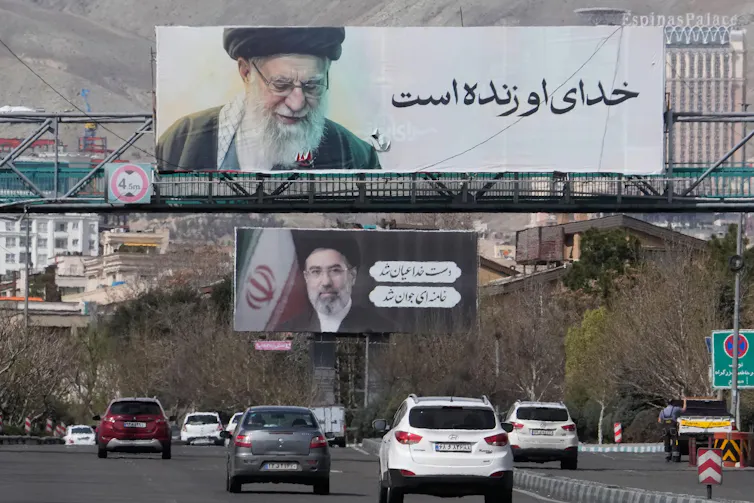
The conduct of the war compounds the problem. The assassinations of Iranian leaders, framed as tactical victories, are strategic failures. They have unified rather than destabilised Iran. Mass pro-regime demonstrations illustrate how external aggression can consolidate internal legitimacy.

A freeway in Tehran with pictures of the assassinated supreme leader Ali Khanenei and his son, the new supreme leader, Mojtaba Khamenei.
The assassination of the supreme leader, Ayatollah Ali Khamenei, and other senior Iranian leaders has not produced the desired effect as many Iranians rally around the flag. AP Photo/Vahid Salemi

The issue is no longer just the conduct of the war, but the credibility of the conflict itself. Regardless of how impressive the US and Israeli military are, it doesn’t compensate for reputational collapse. When building support for a conflict like this – domestically and internationally – legitimacy is a strategic asset. Once eroded across multiple conflicts, it is extraordinarily difficult to rebuild.

Rather than stabilising the system, US actions are fragmenting it. Allies are distancing themselves, adversaries are adapting, and neutral states are hedging.

The most decisive factor may be economic. The war is already destabilising global markets – driving up oil prices, inflation, and volatility at levels that combine the effects of 1970s and Ukraine war oil shocks.

This is a war that cannot be contained geographically nor economically. The deployment of 2,500 US marines to the Middle East (and reports that up to another 3,000 paratroopers will also be sent), reportedly with plans to secure Kharg Island – and with it Iran’s most important oil infrastructure – would be a dangerous escalation.

For Gulf states, the assumption that the US can guarantee security is increasingly questioned. Some states are reportedly now looking to diversify their partnerships and turning toward China and Russia, mirroring post-Iraq shifts, when US failure opened space for alternative powers.

Iran holds the cards

Wars are not won by destroying capabilities alone, but by securing sustainable and legitimate political outcomes. On both counts, the US and Israel are falling short.

Iran, by contrast, does not need military victory. It only needs to endure, impose costs, and outlast its adversaries. This is the logic of asymmetric conflict: the weaker power wins by not losing, while the stronger one loses when the costs of continuing become unsustainable.

This dynamic is already visible. Having escalated rapidly, Trump now appears to be searching for an off-ramp — reviving proposals and signalling openness to negotiation. But he is doing so from a position of diminishing leverage. In contrast, Iran’s ability to threaten energy flows, absorb pressure, and shape the tempo of escalation means it increasingly holds key strategic cards. The longer the war continues, the more that balance tilts.

Empires rarely recognise when they begin to lose. They escalate, double down, and insist victory is near. But by the time the costs become undeniable – economic crisis, political fragmentation, global isolation – it is already too late. The US and Israel may win battles. But they may be losing the war that matters: legitimacy, stability and long-term influence.

And, as history suggests, that loss may not only define the limits of their power, but mark a broader shift in how power itself is judged, constrained, and resisted.

ref. Donald Trump’s ‘new’ 15-point plan is the biggest sign yet that Washington fears it is losing this war – https://theconversation.com/donald-trumps-new-15-point-plan-is-the-biggest-sign-yet-that-washington-fears-it-is-losing-this-war-279001

Jürgen Habermas: a philosopher whose hopes for a better future are more important than ever

Source: The Conversation (Au and NZ) – By Susan Smith, Honorary Professor of Geography, University of Cambridge

It is impossible to capture seven decades of formidable intellect, wrapped into some 14,000 books and articles, in less than a thousand words. Yet German philosopher Jürgen Habermas staked his career on the power of dialogue and deliberation, so it is worth chiming in.

Habermas, who died on March 14 at the age of 96, was among the greatest thinkers of our time. He was unshakeable in his conviction that people have minds of their own, can hope for a better future, and have the capability, collectively and democratically, to bring that future to life.

Born in Düsseldorf in 1929, he escaped conscription to the Wehrmacht by a whisker. His later realisation that, as a child, he had been enveloped by “a politically criminal system” propelled him into a lifelong scholarly, political and personal campaign to rescue democracy and restore the future.

It was an uphill struggle of breathtaking proportions. If the best was still to come, the journey towards enlightenment would require “nothing less than a comprehensive theory of modern society and its underlying dynamics”.

That was the scholarly project, and few 20th century theorists could tackle it. Habermas led the way with sweeping interdisciplinary reach: historical understanding, geographical imagination, sociological insight, grasp of legal theory, sustained engagement with ethics, aesthetics, psychology, epistemology, theology and more. Any one of these approaches would have moved the dial, but in Habermas they came together with a powerful political message.

Variously described as a socialist, democrat, internationalist, and above all humanitarian, his philosophy – practical, perhaps pragmatic – was his politics. Its centrepiece was the formation, functioning and fragility of a public sphere – Öffentlichkeit – mediating between states and civil societies, promising an alternative to the authoritarian, totalitarian regimes he eschewed.

Bookended by two landmark works, Habermas’s lifelong conviction was that the formation of public opinion through rational, reasoned conversation was vital for the conduct and survival of parliamentary democracy. Both works are cautionary tales concerned equally with the forces stifling deliberative democracy and with the conditions in which it might flourish.

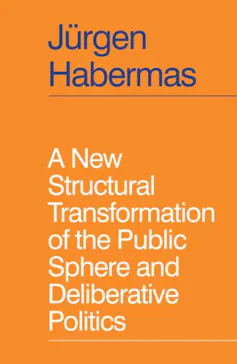
The first, the Structural Transformation of the Public Sphere (1962) finds the scope for informed, inclusive, critical debate compromised by the intrusion of calculative, commercial and bureaucratic interests. Six decades later, A New Structural Transformation of the Public Sphere and Deliberative Politics (2022) takes on the algorithms driving social media. These, he argued – by accident, design or vested interests – fragment the public sphere, undermining the possibility for collective action against environmental change, excessive inequality and more.

Meanwhile, anchored on the two-volume Theory of Communicative Action (1981), Habermas mounted a sustained effort to make the public sphere work.

Book jacket for The Structural Transformation of the Public Sphere by Jürgen Habermas
Polity Press

What scholar in the humanities and social sciences in the last half century is untouched by this project? My own reckoning, for example, was his prequel on Knowledge and Human Interests (1968). Once you realise that knowledge is not a thing to be discovered but a practice constituted by competing interests, there is no going back.

We were all critical theorists then, on a self-reflective pilgrimage to more rational, fairer futures. Habermas stayed with us every step of the way, not least because he did not confine himself to scholarly books and articles. His journalistic output and other public interventions were equally prodigious. Consider, for example, some 12 volumes of talks, speeches and commentary gathered in his Kleine Politische Schriften.

There is, it must be said, a well-developed feminist critique – and re-visioning – of Habermas’ core ideas. Those very public spaces in which deliberative democracy thrives (if it does) have traditionally been occupied by men, and are generally exclusionary in other ways. Not that such challenges fazed Habermas, who regularly exchanged views with a wide range of public intellectuals. These debates were how he expected the future to unfold.

Hope for the future

Book jacket for A New Structural Transformation of the Public Sphere and Deliberative Politics by
Polity Press

For Habermas, hope has not always triumphed over experience. Early in his career he underestimated how tame “conversation” might seem to his students. In the middle years, he probably oversold the potential of intellectuals to steer public debate.

More recently, a trend towards democratic decline and strengthening authoritarianism might suggest that he fell into a classic “democracy trap”. Was it futile to hope that the mandate for fully enfranchised populations to choose their governments through regular free and fair elections would spread?

Habermas was, in fact, acutely aware that the capacity for deliberative democracy can never be taken for granted. However, he never gave up on its promise. On this, he wrote actively to the end, sometimes controversially.

Not everyone liked his style: one obituary describes him as “brilliant, influential and stupefyingly tedious”. But the more telling view is that his work “has given us a vocabulary in which the promises of dignity, autonomy, and emancipation are kept alive and true”.

All in all, Habermas’ achievements are a valorisation of everything that populism is not. He held fast to his conviction that deep knowledge and cogent arguments can win the day, that even the smallest gesture towards a better world is worth the effort.

That is why a recent reviewer could describe his final three-volume project – Also a History of Philosophy – as “a work of willed optimism”. And it is why, in his last work, a collection of biographical conversations – Things Needed to Get Better – Habermas still pins his hopes on critical dialogue and reasoned debate.

This article features references to books that have been included for editorial reasons, and may contain links to bookshop.org. If you click on one of the links and go on to buy something from bookshop.org The Conversation UK may earn a commission.

ref. Jürgen Habermas: a philosopher whose hopes for a better future are more important than ever – https://theconversation.com/jurgen-habermas-a-philosopher-whose-hopes-for-a-better-future-are-more-important-than-ever-279020

‘He will never be replaced’ – tributes flow for ‘fearless’ Vanuatu journalist Dan McGarry

RNZ Pacific

Tributes are pouring in from across the region for “fearless” and “formidable” Vanuatu journalist Dan McGarry, who died on Wednesday.

McGarry, 62, fell ill after a trip to Papua New Guinea earlier this month, from where he had to be evacuated to Brisbane to undergo a heart bypass.

But he faced complications during his recovery and had remained in critical care for the past few weeks.

McGarry, who was a former editor of Vanuatu’s only national newspaper, the Vanuatu Daily Post, and Pacific editor of the Organised Crime and Corruption Reporting Project (OCCRP) at the time of his death, has left behind his wife and children.

“It’s with great heartbreak that I have to announce that the legendary Dan McGarry passed away earlier today,” Aubrey Belford, who was a co-editor with McGarry at OCCRP, said in a Facebook post.

“Dan was an absolutely dominating presence in Pacific journalism and in the region more generally.

“Dan was compassionate, sharing, and always motivated by a sense of justice and the common good. He was driven but also understood the importance of patience, friendship, and community.

‘A shell or more of kava’
“When home in Vanuatu he loved nothing more than finishing his day with a shell or more of kava, satisfied in the knowledge he had found his place in the world.”

Belford added McGarry’s loss was devastating not just for his family but for all journalists working in the region.

“He will be missed, and he will never be replaced.”

Another friend and colleague, Andrew Gray, said McGarry was “a good man”.

“After a hard life he finally found happiness in Vanuatu, and he did a lot more for the country than people appreciate. Last time I saw him he was planning his retirement at Lalwori.

“Condolences to Line McGarry Watsivi and their daughters.”

InsidePNG described McGarry as “more than just a colleague, a titan of regional journalism and a tireless advocate for the truth”.

‘Wealth of experience’
“As the former editor of the Vanuatu Daily Post, he brought a wealth of experience and a fearless spirit to every project he touched. Dan was absolutely instrumental in the birth of our investigative centre in Port Moresby.

“He didn’t just help set the foundation, he guided and mentored InsidePNG through our most critical work, building a lasting connection with our team that went far beyond professional duty,” the news outlet said in a social media post.

Kiribati journalist Rimon Rimon, who worked with McGarry, described him as “one of the brilliant minds I had the privilege of working closely with in our OCCRP investigations!”

The University of the South Pacific’s head of journalism associate professor Dr Shailendra Singh said McGarry’s passing is “profoundly felt across the Pacific media community, where his contributions as journalist, trainer and mentor have made a lasting impact”.

“He will be greatly missed. My thoughts are with his loved ones during this difficult time.”

RNZ Pacific manager Moera Tuilaepa-Taylor said McGarry’s presence would be missed.

“Dan McGarry was one of the best – a champion of the truth.”

Asia Pacific Report editor Dr David Robie said: “Vale Dan McGarry A stunning loss to investigative journalism and media courage and integrity in Vanuatu and the Pacific. A friend and mentor to all.

“Farewell Dan and many thanks for your inspiration and mentoring. Deepest condolences to whānau. RIP.”

This article is republished under a community partnership agreement with RNZ.

Article by AsiaPacificReport.nz

Bluebridge cancels Connemara sailings for 7th day, no timeframe for fix

Source: Radio New Zealand

The Connemara RNZ/Anthony Phelps

Bluebridge has cancelled a week’s worth of sailings on one of its Cook Strait ferries due to a technical fault, and there’s no word on when it’ll be fixed.

The fault was found on the Connemara on Saturday morning and it hasn’t sailed since.

On Thursday, the company’s website said it had canned trips up to and including Friday “while the ship awaits regulatory requirements to resume sailing”.

A spokesperson for Bluebridge owner StraitNZ, Will Dady, said on Wednesday engineers were doing everything they could to fix it ahead of the weekend.

RNZ has asked what the problem is and how many customers are affected, but has not had a response.

Are you affected? Email lauren.crimp@rnz.co.nz

The ship usually sails four times daily between Wellington and Picton.

Bluebridge only has one other ship, the Livia.

The company was putting freight and passengers on other sailings where possible or offering refunds, Dady said.

“We’re disappointed about the disruption caused and apologise to our customers unreservedly.”

Sailings on the same ferry were also cancelled earlier this month because of a technical fault.

Meanwhile, Interislander said vehicle spaces on its ferries was in high demand this month, but there was still room for foot passengers on many saillings.

Sign up for Ngā Pitopito Kōrero, a daily newsletter curated by our editors and delivered straight to your inbox every weekday.

– Published by EveningReport.nz and AsiaPacificReport.nz, see: MIL OSI in partnership with Radio New Zealand

Tuakau College in Waikato in lockdown due to ‘ongoing incident’

Source: Radio New Zealand

Taukau College in Waikato. Tuakau College

A high school in the Waikato town of Tuakau has gone into lockdown.

Police said they are dealing with an ongoing incident at Tuakau College.

Tuakau College has posted to its social media page that it’s gone into lockdown because of an incident.

“Please DO NOT come to the school or phone the school as you will not be attended to and this may cause disruption to the management of this incident,

“And could potentially place yourselves and/or our staff and student’s safety at risk,” the post stated.

More to come…

– Published by EveningReport.nz and AsiaPacificReport.nz, see: MIL OSI in partnership with Radio New Zealand
Cricket: Don Mackinnon steps down from integrity role as NZ20 plans advance

Source: Radio New Zealand

Don Mackinnon has been a key figure in sport integrity over many years. Elias Rodriguez

The front man for a proposed new Twenty20 league has stepped down as chairperson of the Sport Integrity Commission, as questions emerge over his dual roles in New Zealand sport during a pivotal moment for cricket’s future.

Don Mackinnon, who is the chairperson of the steering committee for the NZ20 league, resigned from the commission on Monday – the same day NZ Cricket confirmed its board had voted in favour of pursuing a new private franchise competition.

His departure comes after concerns were raised by members of the cricket community about a potential conflict of interest.

Earlier this month, a letter was sent to several sports officials including Sport NZ chief executive Raelene Castle and the Minister for Sport and Recreation Mark Mitchell, raising concerns about the chairperson of the commission.

The complaint, seen by RNZ, questioned whether the head of the commission should be “playing a role in influencing a national sport at a strategic level”. The complainant, a senior member of the cricket fraternity, asked not to be identified.

It comes against the backdrop of a divisive debate over the future of T20 cricket in New Zealand, with sources describing a campaign by some within the game to “demonise” the proposed NZ20 competition and its backers.

Mackinnon’s role as head of the NZ20 steering committee has placed him in the crosshairs of that dispute.

In a statement, Mackinnon said he was not aware of any complaints “during my tenure as chair of the Sport Integrity Commission, or since my resignation on Monday”.

The move to step down from the sports watchdog agency had long been signalled, he said.

The prominent sports lawyer said when he was first approached to lead the steering committee of NZ20, he declared that role to the commission board “so that any potential conflict of interest could be assessed openly and transparently”.

“It was the board’s view that while NZ20 remained a concept, there was no conflict,” Mackinnon said.

“At the same time, I signalled to the board that if NZ20 evolved from a concept to the preferred option for New Zealand Cricket, I wouldn’t continue to hold both roles.

“In line with this, I resigned as chair of the Sport Integrity Commission following NZC’s decision announced on Monday.”

Minister for Sport and Recreation Mark Mitchell says he’s been told appropriate steps have been taken. RNZ / Samuel Rillstone

Minister Mitchell said he had been assured appropriate steps were taken to manage any perceived conflict of interest that might have arisen while Mackinnon was chair of the commission.

“I had a discussion with Mr Mackinnon on the day that New Zealand Cricket announced its decision to pursue NZ20, and during that conversation we both agreed it was appropriate that he step down from the commission,” Mitchell said.

Guidance from the Office of the Auditor-General states that a conflict of interest is not inherently a problem, as it can arise naturally in professional life.

“It only becomes a significant problem when it is ignored, concealed, or mismanaged,” the organisation says.

Mackinnon, an experienced governance figure, is also chairperson of the Auckland Blues and has led a number of independent reviews into sporting environments and organisational culture.

He played a critical role in the establishment of the Sport Integrity Commission, chairing the Integrity Working Group that laid the groundwork for the agency.

“I’m incredibly proud to have helped establish the Sport Integrity Commission and believe it’s set up to truly make a difference in New Zealand sport,” he said.

Traci Houpapa MNZM, who has served on the commission’s board since its establishment, has been appointed interim chair while the process of appointing a permanent replacement takes place.

– Published by EveningReport.nz and AsiaPacificReport.nz, see: MIL OSI in partnership with Radio New Zealand

Politicians and defamation in an election year – How far can you go?

Source: Radio New Zealand

Labour leader Chris Hipkins speaks to media about social media posts made by his former partner. Marty Melville

Explainer – It’s election year, and attacks are already starting to fly. What happens if comments about a politician cross the line?

While politicians – deservedly or not – come in for equal-opportunity bashing all over social media, their privacy and rights are just the same as anyone else’s, in theory.

The issue of privacy vs public office sparked up again in the recent storm over posts on social media by Labour leader Chris Hipkins’ ex-wife.

Last week, Jade Paul made a series of since-deleted posts on Facebook of claims about her relationship with Hipkins. The claims did not relate to any unlawful activity.

Hipkins told 1News he had sought legal advice over “the potential publication of things against me, allegations against me that are just untrue”.

“Everybody seems to be piling in on social media, in particular, and a lot of that is just absolute fabrication. It is just no basis in fact whatsoever.”

Can a politician sue for defamation?

Yes. But they may have a higher burden of proof than other defendants when it comes to proving their case.

“Politicians are defamed online a lot but there isn’t a constant stream of defamation proceedings,” said Nathan Tetzlaff, a senior associate at Auckland law firm Smith and Partners.

“The reality is that in all but the rarest and most serious cases, for a politician, making a defamation claim is less productive than the alternatives.”

Defamation law is complex, but it offers people a way to push back against false publicly published statements that they feel have harmed their reputation.

“The law of defamation does not distinguish between different plaintiffs,” Wellington media lawyer Steven Price said. “It applies equally to all.”

The burden of proof is on the plaintiff. Defences against defamation can be that the statement was truth, honest opinion or given with the complainant’s permission.

“Even if a statement goes too far and can’t be proved true or an honest opinion, there may be another layer of protection,” Tetzlaff said. “The law recognises the defence of ‘qualified privilege’ in a political context.”

Statements made in Parliament also have a unique defence, called “absolute privilege”, meaning they are typically shielded from defamation actions.

There’s also now a defence that can be used against defamation claims called “responsible communication in the public interest.”

What does ‘responsible communication’ mean?

“It means that people – journalists as well as people on social media – can defend themselves even if they’ve published untrue and harmful statements about a politician (or others), if they can show that they were discussing something of public interest and they had behaved responsibly in preparing the publication,” Price said.

Of course, that benchmark can vary from case to case.

“A lot rides on what a court decides is responsible. It’s not entirely clear what it means. But it will usually involve taking reasonable steps to verify information before publishing it, and may involve putting that information to the person being criticised first.”

Judges typically have to walk the line between freedom of speech and protecting people.

“To avoid chilling public discussion of politics, judges will try to find a balance between protecting legitimate criticism of political figures or their policies, and allowing people to get away with making false and unsubstantiated personal attacks,” Tetzlaff said.

Christopher Luxon and Chris Hipkins. RNZ / Samuel Rillstone

They’re public figures. Can’t you just post whatever you like about a politician?

Politicians are people too, and have the same protections against online (and offline) harassment or threats.

“Public figures do experience a higher level of scrutiny and criticism. However, that doesn’t mean anything goes,” said Netsafe CEO Brent Carey.

“Political speech isn’t exempt from harm. Content can cross the line where it involves harassment, threats, hate speech, or coordinated abuse.”

Of course, politicians learn to expect impassioned reactions from the public, Tetzlaff said.

“Politicians are expected to be thick-skinned so statements made in the ‘rough and tumble’ of political discourse may not be considered defamatory if they don’t allege dishonourable or dishonest motives.”

What’s the down side of suing for defamation?

For one, it may give more air to claims doing the rounds.

“It will usually draw more attention to the allegations,” Price said. “Some people will delight in spreading them, and social media makes that easy.”

If opponents spread falsehoods during an election campaign, it could be difficult to get any legal redress in time.

“In a practical sense, political life moves faster than the courts, so any judgment would arrive well after the damage is done,” Tetzlaff said.

“There are lots of other reasons politicians might decide not to sue,” Price said.

“They may have relationships with journalists that they need to preserve. They don’t want to be seen as thin-skinned or heavy-handed. There may be defences in play that make a lawsuit risky.

“Good PR advice might be to deal with it and move on.”

How often have suits happened?

There have been plenty of times New Zealand politicians have sued for defamation in the past – or been sued.

One particularly notable case was former Prime Minister David Lange, who sued for defamation after a 1995 article in North & South magazine that suggested he had been too lazy for parts of the job. After several years, the Court of Appeal ruled in the case of Lange v Atkinson that journalists had a defence of “qualified privilege,” and that they could criticise politicians on the basis of “honest belief”.

“Historical examples, including David Lange’s unsuccessful action against a journalist, illustrate that even serious-sounding claims can fail where the court considers the publication to be opinion, fair comment, or part of legitimate public debate,” Tetzlaff said.

“The Lange case went on for years and ended up with the courts creating a new defence that undermined his lawsuit,” Price said. “On the other hand, Robert Muldoon is said to have brought 18 defamation cases and won 15 of them.”

New Zealand First leader Winston Peters lodged defamation proceedings in 2017 against then-Mediaworks morning TV host Mark Richardson over comments Richardson made about him.

Former Conservative Party leader Colin Craig also took up numerous unsuccessful defamation claims over sexual harassment allegations.

It’s harder for politicians to sue these days, as it probably should be, Price said.

“Colin Craig probably does not look fondly on his experiences with defamation law, though he had some successes.”

“The main change is that the key question has moved from ‘is it true?’ to ‘was it responsibly published?’ which is a tougher and more uncertain standard for politicians mulling a defamation stoush.”

Politicians like former Prime Minister Jacinda Ardern and her now husband Clarke Gayford faced frequent attacks online. RNZ / Dom Thomas

Politicians from all sides of Parliament have also faced comments that escalate into abuse and threats, such as former Prime Minister Jacinda Ardern. In 2018, Ardern’s partner Clarke Gayford engaged lawyers to deny rumours that were circulating about him being under police investigation, which police also denied.

Former Green MP Benjamin Doyle, New Zealand’s first non-binary MP, resigned from Parliament last September, calling it a “hostile and toxic place”.

They had resigned citing concerns for their well-being after death threats and abuse. New Zealand First leader Winston Peters and others had amplified social media posts about Doyle’s personal social media accounts.

“Social media is not held to a different standard so defamatory statements made on social media are actionable,” Tetzlaff said.

Could Doyle have sued for defamation over some of the comments made online?

“I can’t speak generally because it depends on the wording of the particular posts,” Price said.

“Some may be protected under a defence of honest opinion, for example. Some struck me as pretty extreme, and I think it would be hard to defend those with defences of truth, honest opinion, or responsible communication.”

Tetzlaff said many social media posts can fall in the grey areas of opinion, insult or hyperbole rather than actionable fact.

Former Green MP Benjamin Doyle. RNZ / Samuel Rillstone

If you’re standing for office this year, what can you expect?

Candidates do have recourse over false information, Carey said.

“Candidates can report harmful content to platforms, and make a complaint to Netsafe under the Harmful Digital Communications Act.”

Under the Harmful Digital Communications Act, online content or messages that intentionally causes severe emotional distress can be illegal.

“Netsafe can assess the situation, work with platforms, and support resolution. If there are threats or safety concerns, it should also be reported to police.”

Netsafe has also worked with the Ministry of Women to produce a “Free to Lead” Toolkit aimed to support women in public profiles who typically face the highest rates of abuse.

Political passions are sure to boil over in the months before November’s election, but Carey cautioned that it’s still best to think before you post a particularly hot take that might cross the line.

“Sharing content that is abusive, misleading, or designed to cause harm can still breach platform rules or New Zealand law,” he said.

“A good rule of thumb: pause before sharing – if it targets a person in a way that could cause harm or spreads false information, think twice.”

Sign up for Ngā Pitopito Kōrero, a daily newsletter curated by our editors and delivered straight to your inbox every weekday.

– Published by EveningReport.nz and AsiaPacificReport.nz, see: MIL OSI in partnership with Radio New Zealand
Person critically hurt in kindergarten carpark fight

Source: Radio New Zealand

123rf.com

A person was critically injured during an assault in a kindergarten carpark in Lincoln, near Christchurch, overnight.

Police said they responded to a report of multiple people fighting late Wednesday night, but that was not the case by the time officers arrived.

Hato Hone St John was called to the Robert Street address shortly before midnight, and took one person to hospital in a critical condition.

A 36-year-old man has been charged with assault.

Sign up for Ngā Pitopito Kōrero, a daily newsletter curated by our editors and delivered straight to your inbox every weekday.

– Published by EveningReport.nz and AsiaPacificReport.nz, see: MIL OSI in partnership with Radio New Zealand

Live: Floods close highways as heavy rain hits North Island

Source: Radio New Zealand

Fire and Emergency is urging residents in storm-affected areas to be ready to evacuate if necessary, following a night of heavy rain.

A red weather warning remains in place for Northland east of Kaikohe from Doubtless Bay to Whangārei, with the worst of the downpours expected to hit on Thursday afternoon.

Marae in the region have been opened for those in need of support, and Fire and Emergency has deployed 19 specialist rescue personnel to Northland and Auckland.

MetService said the heaviest rain and largest volumes were likely to be in the upper North Island, from Northland to western Bay of Plenty.

Downpours, flooding, and slips were also possible on Thursday and Friday.

Fire and Emergency assistant national commander Ken Cooper warned residents in upper parts of Northland to be ready in case the situation deteriorated.

“For that upper part of Northland, the intelligence we’ve got is there’s a large amount of rainfall over a very short period of time. I would certainly advise people to be prepared, if they’re in low lying areas or near rivers, be prepared to move.”

Cooper said anyone concerned about a risk to life or property should call 111.

Northland Civil Defence expected the worst of the rain to hit the northeast coast on Thursday night.

In a post on social media, it warned residents not to go into flood water, to avoid unnecessary travel, and to be aware of slips.

“Leave immediately if you notice cracks in the ground, leaning trees or power poles, unusual sounds, or sudden changes in streams,” it said.

Follow the latest updates in our live blog above.

Sign up for Ngā Pitopito Kōrero, a daily newsletter curated by our editors and delivered straight to your inbox every weekday.

– Published by EveningReport.nz and AsiaPacificReport.nz, see: MIL OSI in partnership with Radio New Zealand

Union calls for banks to let staff work from home

Source: Radio New Zealand

The cost of fuel has risen sharply in the past month. 123RF

Workers First Union has asked banks, insurance companies and other financial institutions to do more to help staff struggling with the cost of commuting.

The cost of fuel has risen sharply in the past month, as war in the Middle East pushes up the price of oil.

According to fuel price monitoring app Gaspy, 91 is up more than $1 a litre in the last 28 days, to an average $3.39.

Diesel is up $1.61 to $3.29 and 95 up $1.07 to $3.59.

Workers First national organiser for finance Callum Francis said people were spending an increasing portion of their wages just on travelling to and from work.

He called for the organisations to suspend attendance requirements, offer work-from-home where possible and to subsidise transport for those who had to be on site.

“Finance workers offer care and consideration to customers every single day,” he said.

“We’re asking their employers to offer them the same. This is no longer a nice-to-have – it is becoming a necessity.”

Francis said it was similar to the Covid-19 pandemic, when many organisations quickly adapted to allow staff to work from home.

“Businesses showed during Covid that they could act quickly and pragmatically when workers needed them to. We’re asking for that same approach now,” he said.

“Billion-dollar institutions like banks and insurance providers can and should provide relief and convenience to their workers whenever it’s possible – especially during a crisis.”

The banks have been approached for comment.

Earlier, the Public Service Association said the government should allow public service staff to work from home to save on fuel costs.

Sign up for Money with Susan Edmunds, a weekly newsletter covering all the things that affect how we make, spend and invest money.

– Published by EveningReport.nz and AsiaPacificReport.nz, see: MIL OSI in partnership with Radio New Zealand

Bluebridge cancels Connemara sailings for a week

Source: Radio New Zealand

The Connemara RNZ/Anthony Phelps

Bluebridge has cancelled a week’s worth of sailings on one of its Cook Strait ferries due to a technical fault, and there’s no word on when it’ll be fixed.

The fault was found on the Connemara on Saturday morning.

On Thursday, the company’s website said it had canned trips up to and including Friday “while the ship awaits regulatory requirements to resume sailing”.

A spokesperson for Bluebridge owner StraitNZ, Will Dady, said on Wednesday engineers were doing everything they could to fix it ahead of the weekend.

RNZ has asked what the problem is and how many customers are affected, but has not had a response.

Are you affected? Email lauren.crimp@rnz.co.nz

The ship usually sails four times daily between Wellington and Picton.

Bluebridge only has one other ship, the Livia.

The company was putting freight and passengers on other sailings where possible or offering refunds, Dady said.

“We’re disappointed about the disruption caused and apologise to our customers unreservedly.”

Sailings on the same ferry were also cancelled earlier this month because of a technical fault.

Meanwhile, Interislander said vehicle spaces on its ferries was in high demand this month, but there was still room for foot passengers on many saillings.

Sign up for Ngā Pitopito Kōrero, a daily newsletter curated by our editors and delivered straight to your inbox every weekday.

– Published by EveningReport.nz and AsiaPacificReport.nz, see: MIL OSI in partnership with Radio New Zealand

Kay Scarpetta led the trend for serial killer hunters. I love crime heroines – but she leaves me cold

Source: The Conversation (Au and NZ) – By Sue Turnbull, Honorary Professor of Communication and Media Studies, University of Wollongong

Dr Kay Scarpetta, chief medical examiner of the Commonwealth of Virginia, made her fictional debut in Patricia Cornwell’s first crime novel, Postmortem, published in 1990. Cornwell had been both a police reporter and a morgue assistant. And her character was inspired by a real medical examiner she worked with.

Postmortem won a slew of crime fiction awards, including an Edgar and the French Prix du Roman d’Aventure. It was a riveting read – if you surfed the questionable prose style. I applauded the arrival of a female forensic specialist.

Two years after her debut, in 1992, I saw Cornwell in Melbourne where she was promoting the third Scarpetta book, All That Remains. Blonde and blue-eyed, barely over five foot three, she was the spitting image of her protagonist, as described in the books – and just as frosty.

Patricia Cornwell (in 2004) was the ‘spitting image’ of Kay Scarpetta when I met her. Jim Cooper/AAP

She had stopped over in Los Angeles on her way to Australia, and told us she was being courted by all the major film studios, who wanted to option the books – and being ardently pursued by actors, including Demi Moore, desperate to play Scarpetta. Later, Angelina Jolie would also try to land the role.

Now, more than 35 years (and millions of copies sold) since her debut, Scarpetta is finally on screen, as an Amazon Prime streaming series – and apparently Cornwell is very happy about Nicole Kidman’s central casting as the older Scarpetta.

Not the Scarpetta I imagined

Postmortem, the novel, establishes Scarpetta as a brilliant forensic specialist, hunting a serial killer she nicknames Mr Nobody.

He’s leaving a glittery residue on his victims’ bodies – and a bad smell behind him. With the aid of all the latest technology, from computerised note-taking to DNA testing (then in its infancy), Scarpetta inevitably gets her man, despite being up against a hostile male establishment.

The series is set over two time frames – 1998, which follows the plot of the original (1990) novel, and the present, drawing on elements of her 2020 novel Autopsy. Two sets of characters play younger and older versions of the Scarpetta ensemble.

book cover: Postmortem – with Nicole Kidman in moody lighting

According to the new series, Scarpetta got the wrong man in the original: this discovery and attempt to fix it is what drives the plot. But I’m puzzled as to why, 29 books later, we have returned to the scene of the original crime, to undermine the initial success that hooked readers.

Given the difference in height between the five-foot-11 Kidman and the short Scarpetta of the books, I find myself sympathising with those readers who were bemused by the casting of her ex-husband Tom Cruise as Lee Child’s six-foot-five man mountain Jack Reacher in 2012.

Kidman is not the Scarpetta I imagined – but that’s the least of the show’s problems. It’s also completely predictable as a crime narrative. I spotted the killer in the first episode.

Serial killer culture

Cornwell has talked about “terrible fear” dominating her childhood – and influencing her interest in writing psychopaths. Aged five, as a neglected child with a mentally unwell single mother, she was abused by a security guard and had to testify in court. Later, she was bullied in the foster system.

In the wake of the #MeToo era and the very real problem of domestic violence, women now know it is not the creepy stranger they need to fear most, but the man in the bed beside them. But the original book, Postmortem, was very much of its time.

a man in a leather mask and straitjacket

Anthony Hopkins in The Silence of the Lambs, another serial killer story. Ken Regan/AAP

It tapped into a burgeoning interest in the figure of the serial killer as the evil we feared the most. In 1991, Jonathan Demme’s film version of Thomas Harris’ thriller Silence of the Lambs acquainted us with Hannibal Lecter, embodied by Anthony Hopkins – who won an Oscar for his performance. On British TV, Helen Mirren starred as detective Jane Tennison in Prime Suspect.

By the turn of the millennium, the brilliant forensic examiner on the trail of the serial killer, not to mention the FBI-trained profiler, were already overworked in fiction and on screen. This was when I bailed on the Scarpetta series, after reading the truly awful Blow Fly (her 12th novel) in 2003.

With Scarpetta largely absent, this book spends a lot time in the head of “wolfman” serial killer Jean-Baptiste Chardonne, even as he squats on a toilet fantasising about biting beautiful women to death. It was slow, it was muddled, it was unremittingly dark – and Cornwell has never been that good with words. Her real strength lies in her ability to grab the reader’s shocked attention.

‘I never really warmed to Scarpetta’

To be fair, I never really warmed to Scarpetta. Cornwell routinely spends much of her time impressing the reader with Scarpetta’s mastery of all things technological, her material possessions and her prowess in the kitchen.

Relatedly, I once owned a copy of Cornwell’s 1998 cookbook, Scarpetta’s Winter Table, disguised as a novella with Christmas recipes and photographs. Its instructions on how to prepare Scarpetta’s Key Lime Pie begin: “Without fresh limes, don’t bother. Scarpetta was a hanging judge on this matter”.

two women in a glossy kitchen

Nicole Kidman as Kay Scarpetta with Jamie Lee Curtis as her sister, Dorothy. Amazon Prime

I’ve missed out on about 16 Scarpetta outings since Blow Fly. So I bought the latest, last year’s Sharp Force, which sees Scarpetta on the trail of a serial killer who stalks his victims as a hologram. I wanted to see if her books had improved.

Sadly, they haven’t. Take this set of awkward similes, all in one sentence:

The wind moans round the house like a horror movie, remnants of a bad dream deconstructing like clouds as I reach for my phone vibrating on the nightstand.

And then there’s sex with her husband, former FBI profiler Benton Wesley (played by Simon Baker as permanently pained in the new series) who initiates it by offering her an early Christmas present:

“Depends on what present you’re talking about.” I move closer, feeling him in firelight.

a blonde man in an FBI jacket

Simon Baker plays Scarpetta’s husband, former FBI profiler Benton Wesley. Amazon Prime

Was that a liver?

There was a public outcry when Mirren’s Tennison confronted the naked, brutalised female victims in Prime Suspect in the 1990s. But in Scarpetta now, the in-your-face crime scenes and autopsies are even more confronting. Nothing is hidden from view, including the pubic hair. We watch Kidman cut into a victim’s rib cage with garden shears. We hear the snap. And was that a liver she just held up?

As Scarpetta remarks of the killer when contemplating the first mutilated body, “he went to great pains to present [his victim] to an audience”. Great pains have also been taken in this adaptation, which has Cornwell’s blessing. But does it work?

Kidman as Scarpetta does a fine job of embodying an unlikeable character, though she is largely overshadowed by Jamie Lee Curtis, chewing up the scenery (which seems to be her thing now) as her equally unlikeable older sister Dorothy. Meanwhile, the excellent younger cast takes us back to the 1990s – the era Postmortem, Scarpetta and the serial killer really belong to.

ref. Kay Scarpetta led the trend for serial killer hunters. I love crime heroines – but she leaves me cold – https://theconversation.com/kay-scarpetta-led-the-trend-for-serial-killer-hunters-i-love-crime-heroines-but-she-leaves-me-cold-277377

Minister announces details of process to replace NCEA

Source: Radio New Zealand

We’ll be livestreaming the announcement above. This story will be updated.

The Education Minister is set to reveal details about the process to replace NCEA in secondary schools.

The announcement is confirmation of a government proposal to abolish all levels of NCEA, as it looks to replace it with a new system.

Erica Stanford says the consultation process is now under way for the next six weeks, so the public can have their say.

It’s the latest in a raft of changes that have shaken up the education system and curriculum.

Stanford is making an announcement about 9.15am on Thursday.

It’s expected she’ll outline more details about the changes.

We’ll be livestreaming the announcement at this top of this page. This story will be updated.

Education Minister Erica Stanford RNZ / Nick Monro

Sign up for Ngā Pitopito Kōrero, a daily newsletter curated by our editors and delivered straight to your inbox every weekday.

– Published by EveningReport.nz and AsiaPacificReport.nz, see: MIL OSI in partnership with Radio New Zealand

A crucial meeting aims to remake the WTO to fit the new global order

Source: The Conversation (Au and NZ) – By Jane Kelsey, Emeritus Professor of Law, University of Auckland, Waipapa Taumata Rau

With the global rules-based order collapsing, the United Nations faces an existential crisis as the United States leads other countries in defunding and withdrawing from key agencies such as the World Health Organization.

The World Trade Organization (WTO) may soon join the endangered list.

On March 26, its 166 member states will meet for their 14th Ministerial Conference over three and a half days in Cameroon. Dubbed a “reform ministerial”, this is unlike any since the WTO was established in 1995.

Whether the organisation will survive these “reforms” is uncertain. Whether it should survive will be even more controversial.

This biennial ministerial conference occurs against a backdrop of war, accelerating climate change, geopolitical polarisation, coercive unilateral trade sanctions, fractured supply chains and competition to control critical mineral resources.

But none of that will be addressed.

Instead, reform proposals driven by its more powerful members – carefully curated through an unorthodox process over the past year – are being pushed ahead without a consensus of members and despite repeated objections from a number of developing countries.

The US agenda

Significantly, the Trump administration has not formally withdrawn from the WTO. Instead, the US has demanded reforms that would legitimise the use of tariffs against other countries and shield its actions from challenge via the WTO’s dispute system.

It repeated those demands three days before the meeting, asserting “the current global order in international trade, overseen by the WTO, is untenable and unsustainable”.

Middle powers such as New Zealand, Australia, Norway and the United Kingdom – so-called “friends of the system”, whose economies are premised on the WTO’s free-trade model – are supporting this process.

New Zealand Trade and Investment Minister Todd McClay has been reappointed vice-chair. As a minister-facilitator he will be responsible for steering through the reform agenda.

New Zealand’s ambassador to the WTO, Clare Kelly, has been chairing the Dispute Settlement Body, which the US has paralysed by blocking the appointment of new judges.

She will merely “update” members at the meeting, with no discussion of revitalising the appeal process (or the hotly disputed weaponisation of tariffs by the US) on the agenda.

Next year, the ambassador will chair the WTO General Council in charge of implementing the reform agenda.

Changing the rules

Three items dominate the first two days of a packed program. Their titles sound relatively innocuous, but the intent is to rewrite the fundamental tenets of the WTO: multilateralism, most-favoured-nation treatment, consensus decision-making, and development.

“Decision-making” aims to dilute the multilateral model that accords all states an equal voice irrespective of their relative size or wealth.

Article Ten of the Marrakesh Agreement which established the WTO – its constitution – mandates decision-making by consensus. Reformers have proposed an alternative of “responsible consensus” which will make it easier to push through preferred outcomes.

Multilateral negotiations involving all WTO members will give way to deal-making among groups of countries. This plurilateral approach will allow more powerful members to negotiate on their favoured topics and marginalise developing countries’ priorities.

Under “development and industrialisation”, the aim is to limit how countries define their own level of development. “Special and differential treatment” would simply allow them more time to adopt the rules that already apply to (and work for) developed countries.

This would ignore calls by developing countries for genuine reform to support industrialisation in ways that help their own economies.

“Levelling the playing field” is essentially about China, which the US asserts has now gained an unfair advantage since joining the WTO.

The US wants new rules to restrict state support for industry and to limit the application of most-favoured-nation treatment that ensures all WTO members are treated the same.

In practice, these reforms will fall most heavily on state-supported industrialisation in poorer countries, not China. Meanwhile, the unlevel playing field on agriculture, which allows the US and European Union to maintain massive subsidies, remains off the agenda.

Developing countries left out

The meeting agenda is inseparable from the process. Six facilitators from countries aligned to the reform agenda will oversee breakout groups at the meeting that poorer countries will struggle to engage in.

The facilitators’ summary reports will be consolidated into a “single takeaway” document, which ministers are asked to endorse. This will inform the next “facilitated” implementation phase at the WTO headquarters in Geneva.

The agenda provides little time for collective discussion by all members, corrections or alternative reform proposals. Nonetheless, the US has advocated for an even quicker and more streamlined process.

Nor is the US alone in seeking to remake the WTO. Many of the EU’s demands mirror those from Washington, with the middle powers in support. It’s likely the reform agenda will be endorsed at the Cameroon meeting and continue back in Geneva.

Many developing countries fear their own priorities, which have been supported by previous formal mandates, are now effectively gone. With their voices further marginalised, they will need to assess whether they even have a future at the WTO.

ref. A crucial meeting aims to remake the WTO to fit the new global order – https://theconversation.com/a-crucial-meeting-aims-to-remake-the-wto-to-fit-the-new-global-order-278963

Ancient texts and marital breakdown: Yann Martel’s Son of Nobody descends into implausibility

Source: The Conversation (Au and NZ) – By Konstantine Panegyres, Lecturer in Classics and Ancient History, The University of Western Australia

When I was a doctoral candidate at Oxford, I spent much of my time working in the papyrology rooms. Usually, my only company was the curator, a kind and learned Sardinian woman who is now a professor at the University of Milan.

One day, the news was that a famous novelist was coming to visit the Oxyrhynchus Papyri collection. “Have you heard of him?” the curator asked.

I had, but I’d never read his work.

“He has asked to be given a tour of the collection.”

The name of the famous novelist was Yann Martel, author of the Booker Prize winning novel Life of Pi. He said that he was researching a new book, in which Oxford’s papyrus collection would feature prominently.


Review: Son of Nobody – Yann Martel (Text Publishing)


Several years after Martel’s visit to Oxford, that book has now appeared. Son of Nobody is about a Canadian scholar named Harlow Donne who wins a one-year fellowship to go to Oxford to work on papyri with the eminent scholar Franklin Cubitt.

To take up the “unbelievable opportunity” of the fellowship, Harlow has to leave behind his wife and daughter in Canada. The relationship is already, as he says, “on the rocks”. The news about the fellowship sets off a full couple’s argument:

And so it started, as it always did, with the appearance of a single pinpoint of resentment that called forth another pinpoint, then another and another, tit for tat, until, out of nothing, in the evening quiet of a bedroom, shimmered the complete outline of a domestic dispute, a bright constellation of infinite acrimony.

The argument establishes the main tension in the novel. There is Harlow, the scholar, far away pursuing his interests and career ambitions, and there is his wife and daughter back in Canada, becoming estranged. The whole book is addressed to his daughter, Helen.

The Psoad

At Oxford, Harlow is set to work on a bunch of papyrus fragments given to him by Cubitt. Two weeks after beginning this work, he discovers fragments of an epic poem containing the name Psoas, the “son of nobody”, a character from the Trojan War. He ends up finding 81 more fragments of the “Psoad” (the poem about Psoas).

One of the most interesting aspects of Martel’s novel is its format. Each page is divided in two, with a line dividing the separate parts. At the top, we have Harlow’s translation of the Greek fragments of the Psoad, written as poetry. At the bottom, there is Harlow’s commentary on the text, written in prose. The commentary alternates between the poem and Harlow’s personal reflections on his life.

The format is interesting, but it brings some difficulties. Vladimir Nabokov pulled off the combination of scholarly commentary and personal reflection in his novel Pale Fire. So how does Martel fare?

At the beginning, Harlow’s personal reflections deal mostly with his work at Oxford, but they turn to other aspects of his life as his marriage continues to break down. The reflections are supposedly written for his daughter to read, so it’s awkward that he includes love scenes with his wife as well. Harlow emerges as a twisted and difficult character, not likeable enough to feel pity for.

The poem itself is probably the best part of the book. Even so, it reads as little more than an attempt to imitate the language of epic poetry, and the scholarly commentary on the text tends to be banal. At most, it gives a brief line of explanation, followed by a quotation from the Iliad or the Odyssey as a comparison, or a basic discussion of mythology.

Harlow almost never compares lines from the Psoad with lines from ancient texts other than the Homeric poems, nor does he display much evidence of wide and deep reading in ancient or modern literature. This is surprising for an alleged classical scholar. What we get instead are comments influenced by pop culture. For example, one character in the poem is said be “a Marlon Brando of the ancient world”.

Puzzles and implausibilities

Some of the explanations in the commentary are also oddly misplaced. Martel includes mention of bananas in the epic poem, with Harlow’s comment that bananas were introduced to the Mediterranean “sometime in the fourth century BCE”. In fact, bananas were probably first brought there by Arabs at least a thousand years later, in the seventh century CE, during the period of Islamic conquests.

For a papyrologist, mention of bananas would suggest that the poem on the papyrus is not archaic at all, since bananas were unknown in ancient Greece and no poets of this period refer to bananas. But nothing is made of this in the novel.

Yann Martel. Emma Love/Text Publishing

There are some puzzling and implausible aspects of Martel’s depiction of other characters. Franklin Cubitt is a clichéd version of an Oxford don. He wears tweed, speaks in a posh accent, confuses Americans with Canadians, and threatens students with a cane.

He is described at the beginning of the novel as “one of the world’s foremost scholars of the Oxyrhynchus Papyri”, but later we are told he is “an economic historian by training, not a classicist”. There is no chance that someone who is not a trained classicist would become a “foremost” scholar of papyri.

Similarly, Harlow is working on a PhD. We are told he is a complete “newbie” to papyrology who has never edited a text before. The odds that such a novice would be given an epic poem in fragments to edit on his own are impossible.

You could say it’s just a novel, so these implausibilities don’t matter. But even if you overlook the mistakes and the clichés about academic life, the main story, in which Harlow describes the breakdown of his marriage for his daughter, is self-involved and contrived.

It is good that Martel wants to draw attention to the world of Oxyrhynchus and the fascinating process of editing and reconstructing ancient texts on papyrus. But I can’t help but conclude that Son of Nobody needed more work before publication. It seems to me like a first draft of an interesting idea, not a polished final product. This is a pity, because there was plenty of potential in the novel’s premises.

ref. Ancient texts and marital breakdown: Yann Martel’s Son of Nobody descends into implausibility – https://theconversation.com/ancient-texts-and-marital-breakdown-yann-martels-son-of-nobody-descends-into-implausibility-276857

Trump is remaking the US media in his own image – and smashing accountability with it

Source: The Conversation (Au and NZ) – By Rodney Tiffen, Emeritus Professor, Department of Government and International Relations, University of Sydney

This is the point of absurdity we have reached: on March 15, US President Donald Trump, in a Truth Social post, asserted that American news organisations were running AI-generated Iranian propaganda, and should be charged with treason for the dissemination of false information. One of the instances he cited was coverage of Iranians at a rally to support new Supreme Leader Mojtaba Khamenei, which he said was totally AI-generated, and the event never took place, despite abundant evidence to the contrary.

The most powerful man in the world is making large and important claims, one palpably false, the others without offering any evidence, and it seems few if any people take him seriously. Then he blithely threatens to charge unnamed people with treason, which in the United States is potentially a capital offence, and again it is not clear anyone takes him seriously. Despite the all-but-universal dismissal of his statements, he will probably suffer no political consequences. It is just another drop in an ocean of unaccountability.

One reason it will pass with negligible consequences is that these accusations have become so commonplace. Republicans have long railed against the “liberal” news media, but the Trump administration has brought such attacks to a new level of intensity.

In 2017, his first year in office, Trump denounced “fake news” and called the media the enemy of the American people. He said he had a “running war” with the media, and described journalists as “among the most dishonest human beings on Earth”.

Trump’s standard response to a question he doesn’t want to answer is to call the reporter (especially female reporters) a nasty person, or to denounce the organisation they work for. Recently his response to a US ABC reporter’s question was that her employer “may be the most corrupt news organisation on the planet. I think they’re terrible.”

As the war with Iran threatened to become more politically contentious, the administration has trained its rhetorical sights on the media. Trump endorsed Federal Communications Commission Chairman Brendan Carr’s threat to revoke broadcast licences of “the corrupt and highly unpatriotic media”:

They get billions of Dollars of FREE American airwaves, and use it to perpetuate LIES, both in news and almost all of their shows, including the Late Night Morons, who get gigantic Salaries for horrible Ratings.

Far more than any of his predecessors, Trump concerns himself with individuals and media organisations. For example, he thought Netflix should dismiss one of its board members who had worked for his Democrat predecessors Barack Obama and Joe Biden: “Netflix should fire, racist, Trump deranged Susan Rice IMMEDIATELY.”

A history of legal action

Trump has gone beyond rhetorical denunciations, however. He is the first US president, in recent times at least, to sue a news organisation. His targets so far have included the Pulitzer Prize Board, the Des Moines Register and its pollster Ann Selzer, the Wall St Journal, the New York Times, Penguin Random House and the BBC.

Without exception, his writs have no legal merit. (He has already lost suits against the New York Times, Washington Post and CNN). They are a means of harassment or perhaps just a threat: Trump sued CBS in 2024 over the editing of a 60 Minutes interview with Kamala Harris. Initially CBS said the case had no merit. However, in July 2025 it agreed to settle for $16 million.

The agreement came amid CBS parent company Paramount’s $8.4 billion merger with Skydance, which received regulatory approval weeks later. Stephen Colbert, host of its top-rating night show, called it “a big fat bribe”. Three days later Colbert’s show was cancelled, which the network said was purely a financial decision.

Trump congratulated himself in a post on his Truth Social site under the headline “President Trump is reshaping the media”. He listed 12 media organisations and individuals who are “gone”, such as CNN reporter Jim Acosta and Colbert. Then he listed a dozen “reforms”, such as CNN having new ownership. He finished the post with the word “Winning”.

Apart from the president, the most enthusiastic member of the cabinet in harassing the media is former Fox News presenter, now secretary of war, Pete Hegseth. Last year he announced that journalists who solicited unauthorised military information would have their access revoked and be deemed a security risk. Fifty-five out of 56 accredited journalists refused to sign the new agreement. In March a judge ruled the policy was unconstitutional but the government has said it will appeal.

Recently, Hegseth thought photos of him were “unflattering”, so photographers were banned from his next two briefings.

So it is not surprising Hegseth has been a vocal critic of media coverage. He finished one recent tirade by saying: “The sooner David Ellison takes over [CNN], the better.”

Ellison at the wheel

What is new and alarming about this is the reference to Ellison. It follows one of the biggest corporate takeovers in history. Ellison’s company, Paramount Skydance, has just succeeded in taking over Warner Bros Discovery. CNN is part of the package Ellison has acquired.

David is the son of Larry Ellison, the sixth-richest person in the world, who founded Oracle, a wildly successful software company. After Trump became president, the Ellisons moved into media in a big way.

The family first attracted public prominence when it was a central part of Trump choreographing the formation of a US TikTok company. Biden, with the approval of Congress, had sought to ban the popular video-sharing platform because of worries about security with the Chinese company ByteDance. Instead, Trump, on his first day of this second term, started a process to make it US-based, to remove the security risk.

In the end, Ellison’s Oracle, Silver Lake and MGX became the three managing investors, each holding a 15% share in the new company. The Chinese company ByteDance retained 19.9% of the joint venture. Oracle would also handle all the software aspects. All up, a very Trump-friendly outcome.

The Ellisons next attracted attention in July 2025, when their niche media company Skydance merged with Paramount to form Paramount Plus. This made them the owner not only of one of the biggest film studios but also of TV network CBS. The consequences for CBS news have already been far-reaching.

Ellison began by pledging to end the company’s “diversity equity and inclusion” initiatives. He appointed as ombudsman the former head of a conservative think tank and named Bari Weiss, a centre-right advocate, as editor-in-chief of CBS News.

An early controversy hit with a CBS 60 Minutes episode on a notorious prison in El Salvador, where the US government is sending migrant detainees. Although it was cleared through all the normal internal processes, the story was blocked at the last minute in what the reporter called an act of censorship. It was shown four weeks later.

Six out of 20 evening news producers have left CBS, with one, Alicia Hastey, saying the kind of work she came to do was increasingly impossible, as stories were now evaluated not just on their journalistic merit but on whether they conform to a shifting set of ideological expectations.

In a missive to the newsroom, Weiss declared “we love America” should be the guiding principle for the relaunch of CBS Evening News. Putting this into practice, the new anchor of the evening news, Tony Dokoupil, finished one program by saying “[Secretary of State] Marco Rubio, we salute you”.

Ellison’s early acquisitions were dwarfed by the recent battle between Paramount Plus and Netflix to take over Warner Bros Discovery, which Paramount finally won in February 2026. Paramount’s final, winning offer valued the company at US$111 billion (A$159 billion), paying US$31 (A$44) per share. Months earlier, Netflix’s original offer was US$19 (A$27) per share. Assuming the deal goes through, Paramount will carry an estimated US$90 billion (A$128.6 billion) of debt, but it will also have a conglomerate of media-related holdings like no other company in history.

Despite the size of the takeover, which has several implications for reduced competition, commentators are confident it will achieve regulatory approval. This is principally because in the Trump era there is a strong, shall we say, transactional flavour about when regulation is enforced and when not. Trump has described the Ellisons as “two great people”. “They’re friends of mine. They’re big supporters of mine. And they’ll do the right thing.”

Media monsters

In the 1950s, looking at the way Australian newspaper companies came to control the new commercial radio and television stations, journalist Colin Bednall referred to “media monsters”. Around 1990, British media commentator Anthony Smith wrote a book titled The Age of Behemoths, looking especially at the way large corporations such as News Corp had gone international.

But both were talking about media pygmies compared with the new mega-corporation owned by the Ellisons. Apart from their software business and extensive real estate holdings, they now have a central player, TikTok, in social media. They own two of the biggest five US movie studios, they have two of the biggest five streaming services, they have large entertainment producing corporations in Discovery, Warner Bros and CBS, and they own two of the most important TV news services – CBS and CNN.

This gives them the usual commercial advantages over smaller newcomers trying to break in. It also means the news services are owned by a conglomerate that has many other interests, including some that demand negotiation with the government.

In trying to understand the moment we are living through, it is often difficult to disentangle what is of momentary significance and what of lasting importance. What are egomaniacal histrionics that will fade into history with Trump? And which signal ongoing threats to the fabric of democratic institutions?

The unprecedented media empire built by the Ellisons will not disappear, no matter who wins the next election.

ref. Trump is remaking the US media in his own image – and smashing accountability with it – https://theconversation.com/trump-is-remaking-the-us-media-in-his-own-image-and-smashing-accountability-with-it-279107

Soaring gas prices and disrupted supply chains will ripple out to increase costs in every store and sector of the economy

Source: The Conversation (Au and NZ) – By Vidya Mani, Associate Professor of Business Administration, University of Virginia; Cornell University

The disruptions from the U.S. and Israeli attacks on Iran spread quickly to commercial aircraft, shipping lanes and the world’s energy supply. Those repercussions have already hit fuel costs, including for motorists, truckers and fishermen, and are set to spread even more widely, to packaging, household goods, appliances, medicines and electronics.

I study global supply chains and how they interconnect and depend on each other around the world. There are several ways in which U.S. consumers will begin to feel the pinch of the war. Some of those effects have to do with domestic commerce, and some are a result of the interwoven nature of global trade, where raw materials from one place are shipped somewhere they are manufactured into specific items that are then transported to consumers.

Many products are shipped by truck in the U.S., and diesel fuel is more expensive now. Justin Sullivan/Getty Images

Rising costs in the US

There are three main categories in which costs will begin to rise.

Fuel shortages and freight surcharges: From March 2-16, 2026, the average nationwide price of U.S. regular gasoline rose from US$3.01 to $3.96 per gallon, while diesel fuel rose from $3.89 to $5.37. Diesel prices matter to consumer costs because diesel engines power trucks, farm machines, construction equipment, fishing vessels and many of the vehicles that carry domestic freight. When items become more expensive to harvest, build and ship, diesel costs spread quickly into grocery, household and building material prices.

Chemicals, fertilizer and packaging: QatarEnergy has said Iranian attacks on the world’s largest liquefied natural gas export plant at Ras Laffan and another plant in Mesaieed, both in Qatar, forced the company to stop producing LNG and associated products on March 2. Two days later, the company declared that it could not fulfill its contracts due to extreme external pressures that would require many years to recover from. The affected products included urea, polymers and methanol, used to make fertilizer, plastics, detergents, packaging and other consumer goods. Reduced production and closed transit routes are also affecting supplies of aluminum and helium produced in the Gulf countries.

Factory slowdowns abroad: When shipping slows and energy costs rise, factories abroad face higher operating costs. As a result they ration production, diverting energy supplies to producing a narrow range of high-value products that can absorb these costs. Diversions of shipment traffic and fewer transportation routes lead to delivery delays. Economic research shows that shipping-cost increases also raise import prices, producer costs and consumer inflation.

Air cargo and delivery delays: Early in the conflict, several countries, including Qatar, Bahrain, Kuwait and the United Arab Emirates, closed their airspace to all traffic. Later advisories warned of risks to planes over neighboring countries as well, except for limited corridors. Those closures affected 20% of global air cargo capacity, raising the risk of delays for higher-value cargo such as medicines, aircraft components and electronics.

Global disruptions

About 80% of the oil and 90% of the LNG moving through the Strait of Hormuz, between the Persian Gulf and the Gulf of Oman, is destined for Asian markets. With strait shipments stopped, consumer electronics and manufacturing hubs in China, Japan, Taiwan and South Korea are drawing on their energy reserves and inventories. But those supplies will run out in a few months. Reduced manufacturing capacity can be expected to cause shortages and higher costs for textiles, chemicals, consumer goods, electronics, appliances, auto parts and fertilizer-intensive industries.

Europe is less directly dependent than Asia on Hormuz shipments, but it is still vulnerable to high LNG prices, increased shipping costs and diesel fuel shortages. Europe has also already faced shortages of heating oil and other fuels as a result of Russia’s war on Ukraine. The strait carried about 7% of Europe’s LNG inflows in 2025, and higher costs for energy, ship fuel, freight and insurance can ripple through global trade. For the U.S., that matters because Europe supplies industrial equipment, precision components, medical technology and specialty chemicals sold to businesses and directly to consumers.

African economies are especially exposed to fuel and fertilizer shocks. Large volumes of fertilizer pass through Hormuz, and higher energy and fertilizer prices threaten crop yields and food systems across most of Africa. As a result, U.S. prices can rise for coffee and chocolate – much of which originates in Africa – as well as critical minerals for electric vehicles, energy storage and high-tech equipment.

Grocery prices are affected by costs of fuel and fertilizer. Joe Raedle/Getty Images

Coming home to Americans

This war is not a distant geopolitical shock for U.S. households. It reaches everyday life through fuel, freight, fertilizer, petrochemicals and global supply chains through factories that produce consumer goods.

Some mitigation is possible: 32 nations will be releasing more than 400 million barrels of oil to the global market over the next few months. There are pipelines and alternative ports in Saudi Arabia and the United Arab Emirates that, if they remain undamaged and uninterrupted, can handle potentially 40% of the 20 billion barrels per day that was passing through the Strait of Hormuz. Combined with a temporary easing of sanctions on Russian oil, limited shipments to India and China through the Strait of Hormuz and the March 23 announcement of a five-day pause on U.S. and Israeli strikes on Iran, it is possible to head off the worst-case scenario.

But these measures cannot fully replace the strait’s normal oil and LNG shipment volume. And if oil production, refining and shipment locations continue to be targeted, recovery can be expected to stretch into many months. The likely result is broader inflation, prolonged shortages and longer waits for goods of all sorts, including food and packaging as well as electronics and appliances.

ref. Soaring gas prices and disrupted supply chains will ripple out to increase costs in every store and sector of the economy – https://theconversation.com/soaring-gas-prices-and-disrupted-supply-chains-will-ripple-out-to-increase-costs-in-every-store-and-sector-of-the-economy-278349

Matt Brittin: BBC’s new director general appointed at an existential moment for the broadcaster

Source: The Conversation (Au and NZ) – By Steven Barnett, Professor of Communications, University of Westminster

The BBC has appointed former Google executive Matt Brittin as its new director general. Brittin will replace outgoing director general Tim Davie. He resigned last year in the wake of revelations about the editing of a Panorama documentary about Donald Trump and board disagreements over how it should be handled.

Brittin’s appointment comes at a critical moment, as the broadcaster prepares to renew its royal charter. This is the constitutional basis for the BBC’s existence, which sets out its mission and public purposes. It is traditionally renewed once a decade to make sure the BBC keeps up to date with political and technological changes.

Because the renewal process is run by the government of the day, it can involve difficult conversations with ministers who – while acknowledging the BBC’s independence – can insist on major changes. Despite some challenging political environments, each charter renewal has generally resulted in an evolution from previous years. The BBC has moved from radio to TV, from analogue to digital and online.

But this time around feels more existential. In a world dominated by American streamers and online platforms owned by tech billionaires, the government has proposed a range of options for the BBC’s future that raise fundamental questions, in particular about its funding and governance.

The culture secretary, Lisa Nandy, announced the government’s intention to make the charter permanent to avoid the risk of political interference. Following a period of consultation, the government will publish firmer proposals in the autumn, with the new charter signed off by the culture secretary early next year.

This was a significant victory for the BBC, which argued for a permanent charter in its own response to the government consultation. It also called for changes to how appointments are made to the BBC board, to avoid any suggestion of government influence. This was perhaps influenced by the circumstances of Davie’s departure.


Read more: The political meddling that led to BBC crisis – and how to stop it in the future


The BBC faces a key moment with the renewal of its charter. Zeynep Demir Aslim/Shutterstock

There are three key pieces of context that make this review so important.

First, it is quite possible that the broadcast signal will be switched off in the next charter period. The government is now considering options for the distribution of TV, which will require upgrading existing infrastructure if the current terrestrial system is to continue into the 2040s. Given that households are moving to broadband via smart TVs and other devices, broadcasters have expressed a clear preference for an earlier switch-off to avoid the cost of running two distribution systems.

At that point, the BBC ceases to be a broadcaster (except perhaps via radio) and becomes a public service content provider. It will have to compete not just with powerful streamers like Netflix, but with platforms like YouTube. A tech background like Brittin’s will arguably help the BBC in this new competitive environment. But he will need an experienced deputy with the kind of journalistic background required to deal with the (inevitable) editorial controversies that the BBC will face.

Second, the notion of a TV licence fee has become increasingly anachronistic in the digital world. There is greater pressure – especially in a cost-of-living crisis – for a more progressive payment system that takes better account of ability to pay.

The government has ruled out a German-style household tax and funding through general taxation, but not advertising or the idea of top-up subscription (where a “premium” is charged for content beyond a basic tier). It is also considering a reformed licence fee.

Third, the current political environment is more volatile than it has been for decades. Nigel Farage has made his contempt for the BBC abundantly clear, as well as his party’s determination to cut its funding by half. The charter renewal is an opportunity to insulate the BBC from longer term attempts to undermine or dismantle it.

Protecting the BBC

Critics may want to see a downsized BBC. But in a media world dominated by US-based tech billionaires and entertainment behemoths – and where disinformation poses serious risks to democracy – the broadcaster is more necessary than ever.

It is not only the most trusted news brand in the UK, but provides billions in investment to Britain’s creative industries. And, it is a vital element of Britain’s soft power in an unstable geopolitical environment.

The new charter must therefore guarantee the BBC’s independence. No parliament can tie the hands of its successors. But the next charter can ensure there are obstacles to any government determined to inflict damage on the BBC.

Nandy’s announcement of a permanent charter is an important first step, guaranteeing the BBC’s long-term existence. While it would of course be seriously weakened by a major funding cut, the institution itself would survive and could be revived by a subsequent government.

That permanent charter could be accompanied by a much more independent process of appointing a chair and non-executive directors, to insulate the BBC from political influence. A recent report from the British Academy, examining how other countries manage their public broadcasting systems, drew attention to Germany’s model. There, an independent body is charged both with protecting the independence of German public broadcasters and independently setting the level of funding.

A second area of fundamental reform would be a funding system that provides for universal payment, but is not linked specifically to television and makes some allowance for ability to pay. An evolution from the current licence fee – one possibility floated by the government – would provide the BBC with a more secure and sustainable funding base, along with options to provide discounts for struggling households.

The BBC’s future is now in the hands of a government that appears to appreciate its continuing importance to Britain’s cultural and democratic life. We will soon find out whether this government is up to the job of a much-needed radical renewal.

ref. Matt Brittin: BBC’s new director general appointed at an existential moment for the broadcaster – https://theconversation.com/matt-brittin-bbcs-new-director-general-appointed-at-an-existential-moment-for-the-broadcaster-278453

Testing for asbestos in kids’ play sand no game

Source: Radio New Zealand

Asbestos removal is carried out. Kim Baker Wilson / RNZ

Tucked above an unassuming safety store in Auckland, a small team is making big inroads into understanding the asbestos contamination of children’s play sand.

Testing for any airborne particles from the products, it is thought to be the first research of its kind in the world.

“We’re doing it really because it would be fabulous to be able to say ‘no, the fibres aren’t in the airspace’,” AUT Associate Professor Terri-Ann Berry said.

“In saying that, it would give some real good reassurance to people who are concerned.”

Terri-Ann Berry and Gregor Steinhorn. Kim Baker Wilson / RNZ

And people are still concerned months on from the first recalls. Mother of four-year-old twins, Elle Chrisp, is one of them.

“I’m just a mum who bought the product for her kids really,” she told RNZ.

“I’m so grateful for the work they’re doing and that they are wanting to get answers for us, because ultimately for me, I just want to know what the truth is.”

That’s what the researchers want to know too.

Asbestos testing is carried out. Kim Baker Wilson / RNZ

The testing site

It’s meticulous work that is measured down to the millimetre.

Specially trained staff in PPE masks and suits are putting the sand known to be contaminated through its paces, with monitoring equipment hovering above.

The monitors are at the heights of children or the height of an adult – perhaps a teacher in a classroom.

“We can obviously not just have children in the kindergarten play with it and see what happens,” Gregor Steinhorn from the Environmental Innovation Centre said.

“Given that asbestos is dangerous and there might be fibres which have to be released, everyone who’s doing this experiment has to be protected.”

That means a Class A asbestos enclosure, the kind that would be used for an asbestos clean-up.

Asbestos testing is carried out. Kim Baker Wilson / RNZ

There are air filters, an air locked decontamination shower and trained removalists are the only ones who go in.

“They are wearing a mask, they’re wearing a protective suit and they are fully trained in how to work with asbestos,” Steinhorn said.

“They usually have more boring jobs like cleaning buildings of asbestos, but yes, we had to do that because we don’t know yet if asbestos fibres will be released and if so how many, so we have to assume the worst case that there is asbestos in the air, so anyone in that chamber has to be protected.”

Inside the sealed chamber it is hot and drinks are on standby outside once decontamination is over.

When they are inside, they are essentially working to a script – acting out different ways of playing with the coloured sand.

More than a dozen different sands are being tested, and the conditions need to be the same for each test.

Hoping for a negative

Both Berry and Steinhorn know that seeing photos and videos of the tests, with workers suited and masked inside a sealed chamber, may be confronting for parents.

“It is quite an exciting study,” Berry said. “But at the same time it’s also quite a scary study in many ways, because what we really hope is that we get a negative response – and you never hope that in an experiment, you always want to get a positive answer, because that’s part of the excitement.”

An asbestos sample down a microscope, Kim Baker Wilson / RNZ

But not this time.

“If there are fibres in the air then that means that there’s a possibility that they could be inhaled, and if they’ve been inhaled then there’s also a possibility that they could cause cancer in the long-term,” Berry, who’s also a founder and director of the Environmental Innovation Centre, said.

“Look, not every fibre inhaled will cause cancer, it doesn’t work like that.”

But Berry said if they can show there are no asbestos fibres in the air, then it’s something that can put people’s minds at ease.

An anxious wait

Mother-of-two Elle Chrisp says it has been a challenge to find enough information in the months since the first recalls, which in turn had confusing messages.

“And I come to that with a legal background,” she said.

Chrisp was also hoping the research would find no asbestos in the air from the play sand.

“This isn’t about demonising a retailer… and that’s what I really love about what their efforts are doing. It’s not about seeking out a particular result,” she said.

“It’s whatever happens, we just want to know the truth.”

She said her children played with the sand from when they were two.

“And we know that we may not know what the results are of them playing with that product for years and years and years… what the study is doing is determining if there’s a risk, if there is a risk then we all pray and hope that that doesn’t actually eventuate into anything.”

Asbestos testing is carried out. Kim Baker Wilson / RNZ

The research was backed by WorkSafe and the Ministry of Business, Innovation and Employment, and had attracted help from several funders and supporters – including Beacon Safety and FAMANZ, the Faculty of Asbestos Management Australia and New Zealand.

Beacon Safety regional manager Johan Marais said it was pleased it could offer space and equipment for what was important work.

Berry said researchers also turned to Givealittle, and she was lucky to have good connections to those who work with asbestos.

“I just felt very strongly as a scientist that this is an opportunity to get some answers,” she said.

Sign up for Ngā Pitopito Kōrero, a daily newsletter curated by our editors and delivered straight to your inbox every weekday.

– Published by EveningReport.nz and AsiaPacificReport.nz, see: MIL OSI in partnership with Radio New Zealand

U-turn on fish sizes not enough for some

Source: Radio New Zealand

Commercial fishing in the Hauraki Gulf Simon Mark-Brown

Advocacy groups are supporting the government’s U-turn on minimum size limits for commercial fishers, but still want the government to consider killing the Fisheries Amendment Bill entirely.

Meanwhile, Seafood New Zealand says it is ironic the change has resulted in an outcome that is “not great for the environment”, and doesn’t provide the incentive to avoid catching small fish.

The Fisheries Amendment Bill – as drafted – would have ditched most commercial size limits, effectively allowing commercial vessels to land and sell baby fish, including snapper and tarakihi.

Recreational fishers argued the changes would decimate future populations.

Fisheries Minister Shane Jones has argued the change would prevent wastage, but was forced into a major U-turn over his plans.

As recently as Monday, he was entirely unapologetic about the change, describing critics as just “noisy voices”. But on Wednesday, coalition parties announced on social media that they had listened to public feedback and would no longer proceed.

ITM Fishing Show host Matt Watson told RNZ’s First Up it was a start and called it a “win” for demonstrating what “people power can do”.

However, he said while the bill had “one of the terrible things taken out of it”, it hadn’t been “thrown out”.

“There is a lot more stuff in there that is equally as bad, if not worse.

“There’s still legalised fish dumping in there. There is still reduction in fines for fishes that overfish their quotas, there’s a removal of environmental considerations, and it does nothing to move us away from destructive fishing methods.”

He called on New Zealanders to “stay vigilant”.

Shane Jones. RNZ / Samuel Rillstone

LegaSea – a non profit organisation dedicated to restoring the marine environment – said the minimum size limit proposal was just clickbait.

Project lead Sam Woolford told RNZ the change was too little too late. He said if there was an issue with the amount of fish being caught, or the techniques being used, that should be dealt with first, rather than legislating an outcome.

“It’s completely unacceptable that it’s taken this huge public outcry for the government to pay attention.

“It’s particularly unreasonable they think removing one small aspect of this legislation is going to placate New Zealanders.”

The Environmental Law Initiative (ELI) was also concerned with other changes included in the bill, including the siloing of environmental considerations.

ELI director research and legal Dr Matt Hall said as a whole, the bill systematically weakened sustainability provisions in the current Fisheries Act.

He said the bill could lead to impacts of fishing on the ecosystem being ignored, the use of non-regulatory measures to potentially justify higher take, and the strict limitations on judicial review of fisheries decisions.

Hall said the changes were contrary to New Zealand’s obligations under the UN Convention on the Law of the Sea.

But Seafood New Zealand chief executive Lisa Futschek told RNZ she was disappointed because the proposal would have strengthened the incentives for commercial fishers to avoid catching small fish.

“We don’t want to catch small fish, our processors don’t want to process small fish, and this proposal would have provided incentives not to catch small fish.”

She said the change would have meant those catching small fish would have needed to balance that fish against their quota: “In other words, they would have to pay for it.

“As it turns out, removing that clause means that the status quo remains. That is, fishers that catch small fish, return them to the sea, as they were required to do under the legislation – and they don’t pay for it.”

She said the proposed changes were “net positive for the environment and for sustainability of our resource”.

Asked about the coalition referencing feedback it had received in making the decision, she said fisheries and seafood were “a very emotive topic”.

“They are part of our culture and our heritage, and understandably, people are passionate about it, and they want to have their say in this situation.”

She said the level of disinformation around what the clause was seeking to achieve led to a whole range of speculation around the motives behind the change, “which were frankly wrong”.

Sign up for Ngā Pitopito Kōrero, a daily newsletter curated by our editors and delivered straight to your inbox every weekday.

– Published by EveningReport.nz and AsiaPacificReport.nz, see: MIL OSI in partnership with Radio New Zealand

Three-tier system to replace NCEA unveiled

Source: Radio New Zealand

Education Minister Erica Stanford RNZ / Nick Monro

The Education Minister is set to reveal the education system that will replace NCEA in secondary schools.

The announcement is confirmation of a government proposal to abolish all levels of NCEA, as it looks to replcae it with a new three tier qualification system.

Minister Erica Stanford says the consultation process is now underway for the next six weeks so the public can have their say.

It’s the latest in a raft of changes that have shaken up the education system and curriculum.

Stanford is making an announcement about 9.15am on Thursday.

It’s expected she’ll outline more details about the changes.

We’ll be livestreaming the announcement at this top of this page.

Sign up for Ngā Pitopito Kōrero, a daily newsletter curated by our editors and delivered straight to your inbox every weekday.

– Published by EveningReport.nz and AsiaPacificReport.nz, see: MIL OSI in partnership with Radio New Zealand

Giant dragonflies once roamed Earth’s skies. New research upends the textbook theory of why they went extinct

Source: The Conversation (Au and NZ) – By Roger S. Seymour, Professor Emeritus of Physiology, Adelaide University

Insects first took to the skies about 350 million years ago, some 200 million years before birds first flapped their wings.

By the end of the Carboniferous period, 300 million years ago, some flying insects had become gigantic. Huge dragonfly-like insects called griffinflies had wingspans of 70cm – five times the size of the largest modern dragonflies.

These giant insects lived in a time when Earth’s atmosphere contained more oxygen than it does today: around 30%, compared with the modern 21%.

Because large flying insects lived in a time of high oxygen levels, scientists have proposed that they required these high external oxygen levels to power the rapid burn of energy during flight.

In new research published today in Nature, we studied the muscles of dozens of modern flying insects and made a surprising discovery: there is no reason the griffinfly could not survive in today’s atmosphere.

The structure of the insect flight respiratory system

Flying takes more energy than running or swimming, because a flapping flier must constantly work against gravity to remain in the air.

Consequently, the flight muscles use a lot of oxygen, and the rate of oxygen consumption increases roughly in proportion to the weight of the flier. The highest rate of oxygen consumption per gram by any known tissue occurs in a flying bee.

Tracheal system (green) supplying oxygen into the flight muscles (red) of a vinegar fly. Jayan Nair and Maria Leptin / European Molecular Biology Laboratory, CC BY

Oxygen is supplied to insect flight muscles through the “tracheal system”, a tree-like branching system of air-filled tubes that lead to the smallest branches, called “tracheoles”, where oxygen moves into the muscle tissue.

Each tracheole is a dead end, which means oxygen delivered to the muscle travels primarily by diffusion. First it diffuses through the air inside each tracheole, and then through the muscle tissue itself.

The old hypothesis

In modern insects, oxygen levels near the oxygen-consuming mitochondria that power the flight muscle are very close to zero. This implies that the structure of the tracheal system was just adequate to supply sufficient oxygen.

A larger insect would need a greater supply of oxygen, which would mean a greater driving force for diffusion, which in turn means more oxygen in Earth’s atmosphere.

The extinct griffinfly (left) next to one of the largest living dragonflies, the giant petaltail (right). Estelle Mayhew / Aldrich Hezekiah

The idea that the structure and function of the insect tracheal system limits body size has prevailed for the past 30 years and appears in educational textbooks.

Our interest in the theory arose 15 years ago, when we looked at thin slices of the flight muscle of locusts. The tracheoles appearing between and within the muscle fibres were few and took up only about 1% of the area, compared with the mitochondria that were occupying about 20%.

New evidence

We initially thought all an insect had to do to increase its oxygen delivery would be to increase the number of tracheoles. After all, this is where oxygen is supplied to the mitochondria.

To be sure the locust was not exceptional and to properly understand the effect of body size, we measured 44 species of flying insects of different body masses and metabolic rates. The project required five years and 1,320 transmission electron micrographs.

But the results were essentially the same: the tracheoles occupied only about 1% of the cross-sectional area of the flight muscles regardless of body size. In contrast, the blood-filled capillaries in the flight and cardiac tissue of some birds and mammals occupy about 10% of the area.

Under the electron microscope, thin slices of insect muscle (left) and mammal muscle (right) show the tracheoles and capillaries in white. Antoinette Lensink and Edward Snelling

This shows there is plenty of scope to increase the number and volume of tracheoles without weakening the muscle. So the structure of the tracheal system is not an important constraint on body size.

Evidence from developing insects shows insects can grow more tracheoles in flight muscle in lower oxygen levels, and they pass this trait to their offspring. The conclusion is that the body size of flying insects has never been limited by the structure or function of their tracheal systems.

There is no physiological reason why insects the size of griffinflies could not fly in today’s atmosphere. And yet they don’t exist today.

The simpler reasons may be that larger animal species are more prone to extinction than smaller ones – and 300 million years ago, the griffinfly had no bird or mammal predators to watch out for.

ref. Giant dragonflies once roamed Earth’s skies. New research upends the textbook theory of why they went extinct – https://theconversation.com/giant-dragonflies-once-roamed-earths-skies-new-research-upends-the-textbook-theory-of-why-they-went-extinct-278997

‘Manners for machines’: how new rules could stop AI scrapers destroying the internet

Source: The Conversation (Au and NZ) – By T.J. Thomson, Associate Professor of Visual Communication & Digital Media, RMIT University

Australians are among the most anxious in the world about artificial intelligence (AI).

This anxiety is driven by fears AI is used to spread misinformation and scam people, anxiety over job losses, and the fact AI companies are training their models on others’ expertise and creative works without compensation.

AI companies have used pirated books and articles, and routinely send bots across the web to systematically scrape content for their models to learn from. That content may come from social media platforms such as Reddit, university repositories of academic work, and authoritative publications like news outlets.

In the past, online scraping was subject to a kind of detente. Although scraping may sometimes have been technically illegal, it was needed to make the internet work. For instance, without scraping there would be no Google. Website owners were OK with scraping because it made their content more available, according with the vision of the “open web”.

Under these conditions, scraping was managed through principles such as respect, recognition, and reciprocity. In the context of AI, those are now faltering.

A new online landscape

Many news outlets are now blocking web scrapers. Creators are choosing not to use certain platforms or are posting less.

Barriers are being put in place across the open web. When only some can afford to pay to access news and information, then democracy, scientific innovation and creative communities are all harmed.

Exceptions to copyright infringement, such as fair dealing for research or study, were legislated long before generative AI became publicly available. These exceptions are no longer fit for purpose in an AI age.

The Australian government has ruled out a new copyright exception for text and data mining. This signals a commitment to supporting Australia’s creative industries, but leaves great uncertainty about how creative content can be managed legally and at scale now that AI companies are crawling the web.

In response, the international nonprofit Creative Commons has proposed a new voluntary framework: CC Signals.

Creative Commons licences allow creators to share content and specify how it can be used. All licences require credit to acknowledge the source, but various additional restrictions can be applied. Creators can ask others not to modify their work, or not to use it for commercial purposes. For example, The Conversation’s articles are available for reuse under a CC BY-ND licence, which means they must be credited to the source and must not be remixed, transformed, or built upon.


Summary of CC licences. Creative Commons

How would CC Signals work?

The proposed CC Signals framework lets creators decide if or how they want their material to be used by machines. It aims to strike a balance between responsible AI use and not stifling innovation, and is based on the principles of consent, compensation, and credit.

Simplistically, CC Signals work by allowing a “declaring party” – such as a news website – to attach machine-readable instructions to a body of content. These instructions specify what combinations of machine uses are permitted, and under what conditions.

CC Signals are standardised, and both humans and machines can understand them.

This proposal arrives at a moment that closely mirrors the early days of the web, when norms around automated access (crawling and scraping) were still being worked out in practice rather than law.

A useful historical parallel is robots.txt, a simple file web hosts use to signal which parts of a site can be accessed by the bots that crawl the web and look for content. It was never enforceable, but it became widely adopted because it provided a clear, standardised way to communicate expectations between content hosts and developers.

CC Signals could operate in much the same spirit. But, as with any system, it has potential benefits as well as drawbacks.

The pros

The framework provides more nuance and flexibility than the current scrape/don’t scrape environment we’re in. It offers creators more control over the use of their content.

It also has the potential to affect how much high-quality content is available for scraping. Without access to high-quality data, AI’s biases are exacerbated and make the technology less useful.

The framework might also benefit smaller players who don’t have the bargaining power to negotiate with big tech companies but who, nonetheless, desire remuneration, credit, or visibility for their work.

The cons

The greatest challenge with CC Signals is likely to be a practical one – how to calculate, and then enforce, the monetary or in-kind support required by some of the signals.

This is also a major sticking point with content industry proposals for collective licensing schemes for AI. Calculating and distributing licence fees for the thousands, if not millions, of internet works that are accessed by generative AI systems around the world is a logistical nightmare.

Creative Commons has said it plans to produce best-practice guides for how to make contributions and give credit under the CC Signals. But this work is still in progress.

Where to from here?

Creative Commons asserts that the CC Signals framework is not so much a legal tool as an attempt to define “manners for machines”. Manners is a good way to look at this.

The legal and practical hurdles to implementing effective copyright management for AI systems are huge. But we should be open to new ideas and frameworks that foreground respect and recognition for creators without shutting down important technological developments.

CC Signals is an imperfect framework, but it is a start. Hopefully there are more to come.

ref. ‘Manners for machines’: how new rules could stop AI scrapers destroying the internet – https://theconversation.com/manners-for-machines-how-new-rules-could-stop-ai-scrapers-destroying-the-internet-278669

This medicinal cannabis website bends the rules. Take our quiz to see why

Source: The Conversation (Au and NZ) – By Christopher Rudge, Lecturer in Law, Sydney Law School, University of Sydney

When the Queensland Dolphins ran onto the field in mid-April 2024, the rugby league team’s jerseys bore the logo of Alternaleaf – a “plant medicine” clinic.

Earlier that week, the Therapeutic Goods Administration (TGA) had commenced Federal Court proceedings against Alternaleaf’s parent company, alleging 226 other advertising offences.

By the next game, players had taped over the logo.

The law is clear. Advertising prescription medicines directly to consumers in Australia is prohibited – including on football jerseys, websites, social media, and on posters or banners.

Any promotion of medicinal cannabis products to the public – including euphemisms such as “plant medicine” – is also a breach.

But suppliers and prescribers of medicinal cannabis are flouting the rules.

A 2025 study analysed 54 Australian medicinal cannabis provider websites. The authors found nearly half were violating at least two TGA guidelines.

Common violations included using cannabis imagery, unsubstantiated health claims, and patient testimonials.

Researchers also identified self-assessment tools that may “coach” patients on qualifying conditions – with some clinics positioning access as fast and hassle-free.

One company ran more than 170 social media ads in a single month, many reaching users as young as 18.

Take our quiz

Here’s a mock-up of a medicinal cannabis website. It’s fictional, but it highlights the many ways clinics can breach laws or guidelines designed to prohibit direct-to-consumer advertising of medicinal cannabis.

It’s based on the types of issues researchers have documented, past TGA infringement notices and current websites promoting medicinal cannabis.

Some breaches are more obvious than others.

Let’s get started

Click (or touch) the elements of the website below you think breach laws or TGA guidelines about medicinal cannabis promotion.

But to keep you on your toes, we’ve thrown in some red herrings – elements of the website that are actually OK.

Can you spot all ten breaches?

Well done if you found all ten breaches in our fictional website.

But if you can spot them, why are so many medicinal cannabis clinics, social media posts and traditional media accused of breaking the advertising rules?

Since 2023, the TGA has issued more than A$2.3 million in fines for medicinal cannabis advertising breaches. It has commenced three Federal Court proceedings. None have yet resulted in a judgement.

In July 2025, the Australian Health Practitioner Regulation Agency (Ahpra) said it was concerned about emerging business models that appear to use “aggressive and sometimes misleading advertising” to target vulnerable people.

Some clinics and prescribers churning through scripts

Ahpra told the ABC it had taken action against 57 practitioners and is investigating 60 more. Concerns include consultation times of between “a few seconds and a few minutes”. Some prescribers wrote more than 10,000 scripts in six months.

The agency and the TGA are now sharing prescribing data to identify outliers – even without receiving complaints.


CC BY-NC

Medicinal cannabis prescriptions have skyrocketed in Australia, mostly for legal but unapproved products we don’t even know work or are safe. In this series, experts tease out what’s fuelling the rise of medicinal cannabis, the fallout, and what needs to happen next.


Later in 2025, organisations representing GPs, other doctors and pharmacists wrote jointly to the health minister in New South Wales calling for a crackdown on rogue medicinal cannabis prescribing.

Among their concerns were “vertically integrated” cannabis clinics – where the telehealth prescriber sends the script to a dispensary owned by the same company – hasty telehealth consultations, and how medicinal cannabis was promoted.

The organisations cited Ahpra data showing one pharmacist had dispensed 959,000 cannabis products in a single year.

Too easy?

Australia has become one of the world’s largest markets for medicinal cannabis. In the first half of 2024 alone, Australians spent more than $400 million on these products.

But the evidence suggests this boom has been built, at least partly, on marketing that Australian law was designed to prohibit.

Enforcing these laws has proven difficult. The TGA is a small agency that assesses alleged breaches according to the risk they pose. This means first-time or low-level breaches often only attract a warning known as a “regulatory obligations letter”.

In the medicinal cannabis sector, that approach appears to have been exploited. Widespread, repeat breaches suggest some operators have concluded the risk of a warning is worth taking.

ref. This medicinal cannabis website bends the rules. Take our quiz to see why – https://theconversation.com/this-medicinal-cannabis-website-bends-the-rules-take-our-quiz-to-see-why-270685

Driving in the wrong direction: why NZ’s oil consumption is at a 5-year high

Source: The Conversation (Au and NZ) – By Robert McLachlan, Professor in Applied Mathematics, Te Kunenga ki Pūrehuroa – Massey University

New Zealand’s latest quarterly energy report shows electricity production was above 90% renewable and emissions from generation fell to the lowest level on record.

But it also shows New Zealand’s oil consumption, which had fallen markedly after the COVID pandemic, has crept back up to reach its highest quarterly level in five years.

Oil now comprises its highest quarterly share of New Zealand’s overall energy emissions on record.

Of the total carbon emissions from the burning of fossil fuels, 77% were from oil (mostly used for transport), 12% from industrial and domestic gas usage, 6% from coal, and just 5% from electricity generation.

Developing a coordinated energy strategy to reduce oil dependence would not only provide an effective climate response, but also protect New Zealand from recurring oil price and supply shocks.

The previous government had committed to a comprehensive strategy to transition to a renewable energy system in New Zealand’s first emissions reduction plan in 2022.

But the current government’s focus has shifted on energy security and it aims to boost energy supply by importing liquefied natural gas.

Missed opportunities to reduce oil dependence

Parts of New Zealand’s economy, particularly inflation and tourism, remain strongly linked to the price of oil.

During two previous periods of high oil prices, New Zealand missed the chance to weaken the country’s dependence on oil.

The 1978 oil shock was a severe hit to the economy; New Zealand’s oil consumption did not recover to its previous level until 1990.

The soaring oil prices hit New Zealand at a time of extensive government control of the economy under the National government of Robert Muldoon, whose “Think Big” strategy included building an experimental plant to produce petrol from natural gas.

This was intended to build energy independence, but unfortunately it proved to be costly and ineffective.

The 2008 financial crisis also involved extreme oil price spikes and a prolonged recession. Oil consumption did not recover until 2015. One planned response was to introduce fuel economy standards for new cars – a form of regulation already in place in most OECD countries.

Had these standards been put in place and gradually strengthened over time, New Zealand would now be in a much better place, with less pollution and less economic dependence on oil.

However, a change in government in late 2008 led to the cancellation of the planned standards. New Zealand now uses nearly twice as much transport oil per capita as the UK, where such standards have been in place since 2001.

New law changed NZ’s trajectory

The Climate Change Response (Zero Carbon) Amendment Act of 2019 was a turning point. Before that, total fossil fuel emissions were flat or trending up. Afterwards, a wave of investments in renewable electricity, in the decarbonisation of industry and in low-emission transport turned the trend around.

This was perhaps not just due to the specifics of the act, which includes five-yearly carbon budgets, but to strong pro-climate signalling from the government of the day.

A critical mass of society, from car buyers and dealers to New Zealand’s biggest companies, were investing to take steps away from fossil fuels.

Under the current government, both messaging and policy have changed. As Climate Change Minister Simon Watts has repeatedly stressed, New Zealand’s main climate tool is now the emissions trading scheme (ETS). However, this now covers only 35% of net emissions and is not an effective way to reduce oil use.

At the current price of NZ$40 per tonne of carbon dioxide emissions, the ETS adds only nine cents per litre to the price of petrol. Given New Zealand’s high car dependency, this has virtually no effect on existing drivers or on car buyers.

How to cut oil use in transport

In New Zealand, 80% of oil goes into air and land transport. An oil transition plan really means a transport plan.

There is a known way to turn off the tap on oil. The “avoid, shift, improve” framework is supported by three decades of experience.

Changing work patterns such as shorter work weeks and working-from-home arrangements can help avoid unnecessary travel. Better infrastructure for walking and cycling and public transport helps to shift transport and dramatically reduce oil use.

The remaining private vehicle travel can be improved through electrification. This requires a combination of incentives and stronger emissions standards, as the International Energy Agency reinforced this week.

At present, New Zealand is still moving in the wrong direction. Over the past decade, the total distance driven by light vehicles increased by 20%, while the distance driven by utility vehicles is up 55%.

Each utility vehicle has 50% higher carbon emissions than a (fossil-fueled) passenger car. These trends have outweighed the improvements from the rise of hybrid and electric vehicles.

There is a limit to how quickly New Zealand’s fleet can realistically be electrified. For a country with the world’s highest rate of car ownership, mass purchasing of new cars is not a good transport solution by itself.

But in any event, phasing out fossil fuels is required for a safe future and should happen in ways that build energy resilience and independence.

ref. Driving in the wrong direction: why NZ’s oil consumption is at a 5-year high – https://theconversation.com/driving-in-the-wrong-direction-why-nzs-oil-consumption-is-at-a-5-year-high-278524

Australia must brace for clusters of natural disasters, not just isolated fires and floods

Source: The Conversation (Au and NZ) – By Zahra Shahhoseini, Research Fellow in Public Health, Monash University

Around the world, communities are battling more extreme weather events. That includes residents in the path of Cyclone Narelle, which is threatening to form again over Western Australia.

But another concerning trend is that natural disasters are increasingly arriving in clusters, not in isolation.

Fires, storms, floods and heatwaves are are no longer neatly separated by season or geography. They are more often occurring together or are affecting different parts of the country at the same time.

Scientists describe these as compound or overlapping hazards. This is where two or more natural disasters happen simultaneously or in close succession. And they often affect the same places.

So how can we prepare for overlapping disasters? And what does it mean for our emergency services?

The danger of multiple disasters

International research suggests people are most at risk when a new disaster strikes and they haven’t yet recovered from an earlier event. To understand risk, it helps to understand these three terms:

  • hazard, which is the dangerous event itself
  • exposure, which refers to the people and things that could be affected
  • vulnerability, which is a measure of how susceptible to harm people and things are.

When disasters overlap, all three components of risk will likely increase.

Overlapping hazards are different from so-called cascading hazards. Cascading hazards refer to when an initial event triggers a series of system failures. These failures often cause infrastructure breakdowns and social disruption, both of which can actually be worse than the original disaster event.

An example of this is the 2011 Tōhoku disaster in Japan. In this case, an earthquake triggered a tsunami which then inundated the Fukushima nuclear plant. These cascading hazards led to a nuclear crisis, mass evacuations, and long-term contamination. So it was the consequences of the earthquake, not the earthquake itself, that caused the most harm.

Overlapping hazards are often harder to manage. One reason is it’s hard to coordinate public warnings when multiple disasters strike. For example, a bushfire warning might instruct people to evacuate immediately, but a simultaneous flash flood may block the very roads needed to escape.

Overlapping hazards also stretch our emergency resources, often across multiple fronts at once. And recovery from one event is frequently interrupted by the next. This is why we can no longer rely on current disaster response frameworks, which tend to be built around isolated events.

A history of overlapping hazards

In Australia, we are fairly used to dealing with overlapping disasters.

In January this year, inland bushfires were burning in Victoria’s west under hot, dry conditions. Meanwhile, an intense coastal storm was brewing in that same region. This saw emergency operations move from fire suppression and evacuation to flood rescue, as flash flooding inundated sections of the Great Ocean Road and washed vehicles into the ocean.

In December 2025, Western Australia was hit by a tropical cyclone that caused flash flooding and widespread power outages. Within days, authorities were issuing fire danger warnings as a heatwave swept across the state’s southeast.

In late 2024, severe hail and flash flooding arrived in the aftermath of a bushfire in New South Wales’ Yass Valley. Residents barely had time to recover from the initial fire.

Research examining more than five decades of insurance losses shows Australia experiences the most overlapping hazards in December, January and February. This is when bushfire, tropical cyclone and severe storm seasons overlap. This makes summer the most high-risk period, particularly for disaster-prone regions.

When disasters converge

In Australia, natural disasters most often come in three combinations:

  • heatwaves alongside drought
  • heat followed by heavy rain
  • strong winds combined with heavy rain.

Heatwaves and drought often occur together because dry soils reduce evaporation and push temperatures higher. This creates persistent hot and dry conditions, increasing the risk of bushfires. These hot conditions also put pressure on the agriculture and health care sectors. Recent Australian research suggests this combination of heatwaves and drought will only become more common and extreme.

In Australia, heavy rainfall is more likely to come after a heatwave. This is because extreme heat alters atmospheric conditions in a way that means subsequent rain often falls in shorter, heavier bursts.

Strong winds and heavy rainfall often occur together, most commonly when tropical cyclones develop. East coast lows, a type of intense weather system that usually forms off Australia’s eastern coast, may also create the right conditions for these overlapping hazards.

The role of climate change

Climate change acts as a “threat multiplier”, increasing the likelihood of extreme events occurring together or in rapid succession. Research shows extreme weather is becoming more frequent and intense.

In Australia, we have already recognised this trend, creating national frameworks to deal with a rising number of simultaneous, and often large-scale, disasters.

But sound policy does not guarantee effective emergency management. As the risk of overlapping hazards increases, we must actively involve communities in disaster planning. Through education programs and clear messaging, we can help them understand how disasters may combine. We can also give them strategies to make decisions when weather conditions change rapidly.

In our changing climate, overlapping hazards will only become more common. So there’s no better time to help our communities and first responders prepare.

ref. Australia must brace for clusters of natural disasters, not just isolated fires and floods – https://theconversation.com/australia-must-brace-for-clusters-of-natural-disasters-not-just-isolated-fires-and-floods-272333

This is how the 1970s oil shock played out. There are lessons for the economy today

Source: The Conversation (Au and NZ) – By Laura Panza, Associate Professor, Economic History, The University of Melbourne

On October 6 1973, the Yom Kippur War – mainly involving Egypt, Syria and Israel –triggered one of the biggest energy crises of the 20th century. Eleven days later, several Arab members of the Organization of the Petroleum Exporting Countries (OPEC) announced they would stop selling oil to countries supporting Israel and would cut production.

The effect was immediate. Within a few months, global oil prices quadrupled.

After decades of price stability, the world faced a severe shortage. Petrol stations ran dry, with some displaying a red flag to signal empty pumps; drivers queued for hours.

In parts of the US, fuel was rationed by licence plate number. By March 1974, time spent waiting in line had raised the cost of petrol by around 50%, because drivers were also “paying” through lost time — hours that could otherwise have been spent working.

Across Europe, governments imposed fuel-saving measures. The Netherlands and West Germany introduced car-free Sundays, while Britain cut speed limits to reduce petrol consumption.

Today, as the United States and Israel continue a widening war against Iran, energy markets have again reacted: disruptions in the Strait of Hormuz, a key artery for global oil, have pushed prices above US$100 per barrel, echoing the supply shocks of the 1970s.

These pressures make it timely to revisit 1973 and why its effects were so economically severe.

When OPEC gained influence

The scale and persistence of the 1973 oil shock reflected not just the embargo itself, but how it interacted with the economic system at the time.

One important shift was that the US stopped being the world’s main “backup supplier” of oil. For decades, American production had been large enough that output could increase when global supply tightened, but production peaked around 1972.

Without this buffer, markets became far more sensitive to disruptions. At the same time, oil-producing countries in the Middle East gained political leverage by coordinating production through OPEC, strengthening their influence over prices.

Moreover, the international monetary system that had kept postwar inflation under control had collapsed in 1971. This agreement, known as Bretton Woods, had tied currencies to the US dollar. The result was that oil prices, like most commodity prices, were already rising before the embargo began.

Inflation surged, and so did wages

Higher oil prices pushed up the cost of almost everything. Transport became more expensive. Electricity bills increased. Businesses faced higher production costs and passed these costs onto consumers.

Inflation surged across many advanced economies. Workers tried to protect their living standards by asking for higher pay. In many countries, strong labour unions negotiated big wage increases to keep up with rising prices.

Expectations made the shock worse: fearing shortages, firms and households stocked up, reducing available supply and pushing prices even higher.

At the same time, economic growth slowed sharply. Factories produced less, unemployment rose and investments fell.

The economic consequence of this shock was a decade of stagflation: high inflation amid stagnating growth.

Governments tried several ways to respond. Some countries, such as the US, introduced price controls to limit how much petrol companies could charge. Others, such as the UK and France, imposed rationing rules to manage shortages.

A gas station owner in June 1973 lets his customers know he’s out of gas. AP

Trouble for central banks

Central banks also faced difficult choices: raising interest rates could reduce inflation by slowing borrowing and spending. But higher rates also risked pushing the economy deeper into recession.

During the 1970s, many central banks including the US Federal Reserve struggled to strike the right balance. The Fed kept cutting interest rates to support the economy, but this only added to inflation.

The result was an “inflationary psychology” where expectations of higher prices become self-fulfilling.

The world today has stronger defences against an oil shock. Central banks now have clear mandates to keep inflation low and the credibility to act quickly. Research suggests the economic impact of oil price shocks has declined over time because wages adjust faster, central banks act decisively to keep inflation in check, and oil now makes up a smaller share of the economy.

Recent shocks confirm this transformation: the Russian invasion of Ukraine pushed up energy prices and inflation, but did not trigger a deep recession.

There is another difference as well. Today, high oil prices may encourage investment in renewable energy, and have the potential to accelerate the shift toward cleaner energy sources.

Modern economies are better prepared

The events of 1973 still offer an important lesson.

The damage caused by an energy shock depends not only on the size of the disruption but also on the economic environment in which it occurs. In the 1970s, heavy dependence on oil, rigid wage systems and uncertain economic policy amplified the crisis.

Modern economies are better prepared. Constraints on energy supply, however, remain real and the disruption to the Strait of Hormuz highlights this uncertainty. The duration and objectives of the current conflict remain unclear, and uncertainty itself is costly to businesses and the economy.

History is therefore less useful for prediction than for perspective. The size of a supply shock is only one piece of the puzzle; what matters is the system it hits, how long the shock persists and how it affects expectations.

ref. This is how the 1970s oil shock played out. There are lessons for the economy today – https://theconversation.com/this-is-how-the-1970s-oil-shock-played-out-there-are-lessons-for-the-economy-today-278876

Are video games art or products? This tension lies at the heart of Australia’s gaming industry

Source: The Conversation (Au and NZ) – By Zainab Darbas, PhD Candidate, School of Media, Film and Journalism, Monash University

In 2004, a largely anonymous team of Australian video game developers released a prototype video game titled Escape from Woomera.

In this 3D adventure, the player takes on the role of Mustafa, an Iranian refugee fleeing violent repression who is being held in a virtual re-creation of the (now-shut) Woomera Immigration Reception and Processing Centre.

Mustafa is facing deportation back to Iran – which will mean almost certain death. He and the player must escape.

A screenshot from the unfinished point-and-click adventure game Escape from Woomera. Wikimedia, CC BY

Escape from Woomera was one of the first Australian video games ever to receive government funding to support its development. In 2003, the creators received a A$25,000 grant from the national arts body, the Australia Council for the Arts (now Creative Australia).

The game itself, and the fact it was awarded public funding, were highly controversial. They sparked conversations about what kind of art the government should fund, and why. Should the goal be to nurture new artistic talent? Or to preserve Australian-made content? Or build profitable industries?

A photo of the entrance of the Woomera Immigration Reception and Processing Centre. The photo was taken in April 2003, the same month the centre was closed. Wikimedia, CC BY

More than two decades on, Australia has a robust ecosystem of video game development supported by grant programs across the country. My research looked at the scope and structure of these programs and examined how they affect game developers.

My findings reveal that the structures of funding programs emphasise generating profit and growing the video game industry. This is at odds with the approach taken by many game developers, who view themselves as artists, and their games as a cultural form.

This fundamental mismatch is a source of tension for game developers who rely on public funding to support their work.

Competing priorities of public funding

I read through more than 50 annual reports, strategic documents and other materials from Australian arts funding bodies to analyse funding policies for Australian video games.

The documents emphasised the economic potential of the video game industry, frequently citing growth rates, expenditure figures and returns on investment as justification for continuing to fund game development. However, they also promoted Australian video games as complex, experimental and culturally valuable.

This shows how funding agencies juggle competing priorities. While they value games with artistic merit that contribute to the cultural landscape, agencies must also demonstrate that their public funding programs generate financial returns.

These agencies’ economic priorities heavily influence how public funding programs are structured – which can make them seem highly formal and business-like.

Company or community?

This formality creates difficulties for game developers, whose work practices are often artistic, informal and adaptive. I interviewed 11 game developers to understand their experiences with public funding.

They generally held positive sentiment towards the funding available to them, describing it as a “lifeline”, “fantastic” and “awesome”. Several developers spoke highly of the range of funding programs available for projects of various scope.

At the same time, they had criticisms. They found the application processes for public funding overly formal, forcing them to adapt their artistic practices to a rigid, business-like structure. As one interviewee explained:

If you want to go for funding, you’re talking about needing to start a company. You need to get a lawyer. People don’t know that.

Tensions were particularly acute around providing diversity information. Most funding applications ask applicants to submit information about diversity, equity and inclusion in a highly formalised format.

The developers I spoke to felt “icky”, “gross”, “weird” and “uncomfortable” while completing these forms, describing them as “tokenising”, “dehumanising” and “impersonal”. As one interviewee said:

The language it asks you to use is so corporate, you know, and it’s like, who is this talking to? Who is this for? And the answer is always a company. I’m not a company, I’m a person.

More than just products

The interviewees recommended several changes funding agencies could make to improve their application processes. They could, for instance:

  • provide example funding applications and information sessions to help guide applicants

  • provide more feedback on both successful and unsuccessful applications

  • allow more flexible formats for submitting the required documentation, especially for diversity information

  • provide venue space and smaller, more accessible funding options for developers to run events for skill-sharing and community support.

These changes would signal to game developers and the wider public that our public institutions value video games as more than just money-making products.

Australian-made games such as Untitled Goose Game and Cult of the Lamb – which have achieved international critical success in recent years – wouldn’t exist without public funding.

Yet many video game developers struggle to find options for secure public funding. And when it isn’t available, they are forced to take a chance on over-saturated crowdfunding platforms such as Kickstarter.

It’s important that public funding programs work to support game developers on their own terms, so they can keep creating excellent games that enrich our cultural landscape.

ref. Are video games art or products? This tension lies at the heart of Australia’s gaming industry – https://theconversation.com/are-video-games-art-or-products-this-tension-lies-at-the-heart-of-australias-gaming-industry-275314

It’s election year – let the lies, damn lies, and dodgy statistics flow

Source: Radio New Zealand

By law South Australian politicians aren’t allowed to lie in their election ads. Here, we have the Advertising Standards Authority and the Media Council, but neither have the force of a criminal penalty behind them. RNZ

Does New Zealand have robust enough checks and balances to stop politicians lying in election ads – or should we be looking to Australia for stronger laws

In South Australia, by law, politicians aren’t allowed to lie in their election ads.

You might think that it would be normal that politicians don’t lie in their election ads, and that this would be an unnecessary rule.

But redundant or not, commentators say the fact that they check themselves before sending out their official messaging has helped turn the heat down during election campaigns.

The law is popular with voters and has been praised internationally as a tool for regulating political speech, but it’s also been criticised as labour-intensive to police, and something that has become weaponised by political parties.

It only governs advertising, not statements, what’s said on the campaign trail or on social media.

In New Zealand our watchdog over political advertising is the same body that governs all advertising – the Advertising Standards Authority. It doesn’t have the force of criminal penalties behind it, but it is a mechanism to have false information removed.

If there is a complaint, that board will often make a decision within 48 – 72 hours, and if it finds the message incorrect, it will be taken down. The ASA is the referee in this area, and all parties so far abide by it.

The subject of electoral law is a specialty topic for political commentator David Farrar. He says there is actually a law in New Zealand governing truth in politics, but it’s much wider – although it only applies for the 48 hours before an election. It’s section 199A of the Electoral Act.

“It actually can apply to anyone in New Zealand who states something false which could influence the election,” he says.

“It basically says it’s a corrupt practice – so that means you can go to jail for what’s a criminal offence – to make a knowingly false statement within 48 hours of an election, designed to influence the election.”

The law’s been in place for several decades and Farrar says it reflects a time before the news cycle was sped up, and before advance voting came in, so it’s pretty out of date.

“It’s from the days if you pop out say, a pamphlet to every household on the Friday before an election and there was something false in there, back in the old days there’d be no way to correct that. It would be too late and then you might have an election outcome that got decided on false information. Now, my view is, that’s not the case today.”

He says these days, it would be questioned on social media within 10 minutes, and reported on by media within an hour.

“It’s still on the books – Parliament hasn’t removed it – I don’t think there’s ever been a prosecution under it, but I do recall Winston [Peters] threatening me with it around 20 years ago for something – which was accurate by the way – that I published on my blog on a Friday before the election.”

Farrar says where it gets interesting though, is the question of what is actually false.

‘Those tricks are as old as the hills’

That’s a point also emphasised by Tim Hurdle, a political consultant and long-time political campaign manager who ran Auckland mayor Wayne Brown’s campaign, and the National Party’s campaign in 2020.

“Even with numbers you get into the old quote, ‘lies, damn lies and statistics’ because people look at base years; they can stretch out over what, quarters or months; or they can decide to use a real or nominal number when it comes to economic numbers … those tricks are as old as the hills. They’re used by every political party.

“I don’t think you can necessarily determine it’s an incorrect method – it’s the choice of the person who’s using them.

“But often if they are used in an almost farcical way then they will get called out, but generally they may be technically true or correct and pass some sort of legal test, but are they actually credible with the public is actually the ultimate political test.”

Mostly though, Hurdle points out that politicians don’t want to be caught out in a lie – because it hands their opposition a weapon with which they can attack.

The editor of The Post, Tracy Watkins, says New Zealand has self-regulation and laws which oversee not just political advertising but the broader advertising environment.

“The basis of those is that something has to be factually correct and truthful,” she says.

“Definitely the South Australian [law] does seem to be a much more robust law in that it’s got very strong powers to enforce, and to fine, and to order take-downs and things; but the Advertising Standards Authority I think operates under a self-regulatory regime, same as the Media Council.

“But there’s quite a lot of power in that, because under that sort of regime the media organisations have to agree that the referee’s word is final, and they have to abide by what the referee has said, and to a certain extent everyone benefits from that, even though sometimes we disagree.”

Watkins says we don’t necessarily need a new law to deal with lying.

“I think we’ve got enough guardrails in place to deal with that.”

Check out how to listen to and follow The Detail here.

You can also stay up-to-date by liking us on Facebook or following us on Twitter.

– Published by EveningReport.nz and AsiaPacificReport.nz, see: MIL OSI in partnership with Radio New Zealand

Rural-based carer, job applicant despair over lack of fuel support

Source: Radio New Zealand

RNZ / Quin Tauetau

New Zealanders living in rural areas say they’re being left out of the government’s fuel support package, warning it excludes people already under pressure from rising costs.

Almost 150,000 families with children will receive an extra $50 a week to help offset soaring petrol prices created by the war in Iran.

The payment would be delivered through the in-work tax credit, meaning only low-to-middle-income workers with children are eligible.

For some, that left a growing gap.

Rochelle* lives in the small rural community of Tapora, north of Auckland, where public transport is almost non-existent and driving is unavoidable.

She commutes more than an hour each way for work and also travels to care for vulnerable people in the community.

She said the rising cost of fuel was starting to bite.

“In a week I’d budget around $120 to $150 to fill my tank, but now it’s more like $200 plus. We’re kind of okay for now, but if it goes on much longer it’s going to get really hard.

“I also work as a carer, and [the government] has stopped funding the travel time to get to clients. When you’re in a remote community and fuel is going up, it’s really, really tough. I think a lot of carers are going to struggle, especially when some people you’re helping live an hour away.”

Without reliable transport alternatives, she said there was little choice but to keep driving.

“The nearest bus stop is about 40 kilometres away. There is a bus in Wellsford, but getting there is the issue. So for us, driving isn’t optional, it’s just part of life.”

Rochelle was not eligible for the government’s fuel support because she didn’t have children.

She said the impact went beyond her own budget.

“If you’re having to drive for work, especially in caring roles, and there’s no support for that anymore, it’s going to affect the people who rely on that care.

“There are people in the community who are older and vulnerable, and it might reduce the amount of help they’re getting because carers simply can’t afford to get there.”

She believed the support should be broader.

“I understand helping families, but I think they need to look wider than that. There are pensioners out here already on really tight budgets, and they’re going to have to choose between things like food, petrol, or going to the doctor.

“The government needs to think about those people too, because they won’t ask for help, they’ll just struggle along.”

AFP or licensors

‘People like me get nothing’ – job seeker

In the small community of Shannon, in the Horowhenua District, Douglas*, 42, was also missing out.

After finishing a contract late last year, he had been applying for jobs for months without success.

“I’ve sent off probably around 300 CVs. Every time I tailor my cover letter, research the company, spend hours on each application. I’ve applied for everything, even roles like fast food or cashier jobs, and I’ve been turned down for being overqualified.

“Now I’m down to double digits in my bank account and I’m really starting to stress.”

Because his partner earned above the threshold and they had no children, he was not eligible for Jobseeker support or the fuel payment.

“We’ve gone from two incomes to one, and it was a real smack in the face hearing that some families will get $50 a week, but people like me get nothing.

“I’m unemployed, I can’t get assistance, and I can’t even afford to fill up my tank to go to interviews that I’m applying for.”

Living in a semi-rural area, he said public transport was not an option.

“There’s no buses where we live. We pay rates towards buses in nearby towns, but they don’t come through here.

“If I want to use public transport, I have to drive to another town first, which defeats the purpose. Logistically, it just doesn’t work.”

He said fuel costs were shaping daily decisions.

“I used to spend about $120 a week on fuel commuting. Now I’m rationing everything I do. I’m getting to the point where I might have to turn down interviews because I won’t be able to afford to get there.”

Douglas believed the government’s response had fallen short.

“It honestly felt like a smack in the face. It feels like [the government] waited until things got really bad before doing anything, and then the response was to help a small percentage of people and tell everyone else to just deal with it.

“This is going to affect everything, food prices, supply chains, everyday life. It’s not just petrol, it flows through the whole economy, and I don’t think the response matches how serious this is,” he said.

*RNZ has agreed not to use the surnames of both people featured in this story.

– Published by EveningReport.nz and AsiaPacificReport.nz, see: MIL OSI in partnership with Radio New Zealand

Briscoes Group trialling facial recognition tech

Source: Radio New Zealand

Briscoes Group is halfway through a year-long trial which began in September 2025. RNZ

Facial recognition technology (FRT) trials are underway in 18 Briscoes and Rebel Sports stores across the North Island, the country’s fourth big retailer to have announced a move to adopt or test it.

Foodstuffs’ separate chains in the South Island and North Island have deployed it permanently in 28 supermarkets, and hardware giant Bunnings is about to test it.

Briscoes Group is already halfway through a year-long trial which began in September 2025, outlined on its website.

“A thorough process is in place to ensure we do not negatively impact customers,” it told RNZ.

Retailers use FRT to create a biometric template of every shopper’s face, then check it against a watchlist of known risky people. Images that do not match are deleted quickly, they say.

Proponents say retail violence is growing and the tech makes stores safer.

In the UK, the ongoing debate about FRT in stores has also been about its use to combat shoplifting: “So much theft is driven by addiction – cameras alone won’t solve that,” a police outreach worker told the BBC.

Asked by RNZ if Briscoes anticipated the tech would cut down on theft, it said removing violent people from stores “as a byproduct, may reduce the loss”.

“However, this was not the reason for the FRT trial, this is about the safety of our team members and customers.”

Six other big retailers not using it yet

Briscoes is using a system that Auckland company Auror launched in NZ last September.

Auror said in an email to the sector earlier this month: “In New Zealand, leading retailers are already operating ASR (Auror Subject Recognition), building practical experience with governance frameworks, community engagement, and day-to-day controls that maintain trust while protecting teams.”

It declined to identify which retailers when RNZ asked.

Bunnings and Briscoes were among 11 big box retailers and supermarkets that signed a statement in June 2025 supporting facial recognition to “protect workers and customers” following the Privacy Commissioner giving a cautious tick of approval to the Foodstuffs trial.

Of the others who signed, The Warehouse Group, Farmers, Mitre 10, Woolworths, Spark, and One NZ said they were not currently using FRT. Michael Hill Jewellers did not respond to a request for comment.

Bunnings and Briscoes were among 11 big box retailers and supermarkets that signed a statement supporting facial recognition to “protect workers and customers”. RNZ / Richard Tindiller

‘Violent, threatening or aggressive’

Bunnings is about to begin its own trial in two Hamilton stores, Te Rapa and Hamilton South, in April.

“The FRT system is calibrated to an accuracy level of 93 percent – meaning only matches with an accuracy rating of 93 percent will trigger an alert,” it said online. In Australia it uses a system from Hitachi.

Foodstuffs North Island is using FRT in 15 Pak’nSave stores and 10 New Worlds.

Foodstuffs South Island has deployed it in three Christchurch stores, where a trial ended in January.

“Only people who have previously been violent, threatening or aggressive in our stores are entered into the FR watchlist,” the South Island chain said on its website.

It told RNZ on Wednesday: “We’re taking this step by step. The stores in the trial were picked for a reason – they’ve got solid reporting processes, experienced teams and they’ve been dealing with threatening and harmful behaviour, so they’re well-placed to see if this makes a difference on the shop floor.

“We’re still working through the results, and any call on adding new stores will come down to what’s actually working, how it stacks up from a privacy point of view and whether stores have the right systems and know-how to use it properly.”

The four big retail groups all said only trained staff used the system. They all said they had done privacy impact assessments and engaged with the privacy commissioner.

Bunnings recently had what observers considered a partial win against a challenge in Australia to its use of FRT.

Auror, perhaps not surprisingly, saw it that way: “In Australia, the recent Bunnings appeal decision has opened the door to exploring how FRT can be used in retail settings for the purpose of crime prevention and safety. This decision gives retailers greater confidence,” said the company, which last September said it had only recently become comfortable that the tech was accurate enough in identifying people that it should begin offering it to retailers.

Bunnings on its website said in New Zealand it had engaged a Māori digital sovereignty expert to align with tikanga Māori and also got independent research to understand what New Zealanders think about FRT.

Tech not linked to police

Briscoes said it let customers know about the trial with signs on the store doors.

Only people who posed a risk to team members and customer safety were uploaded to its watchlist, it said in a statement. That comprised customers who offended against staff or were threatening physically or verbally aggressive, and any known to carry weapons.

The system was not linked to police. Instead, a manager would call police to remove someone, but not approach the person themselves for safety’s sake.

Staffers were grateful for it, Briscoes said.

“We will consider any future deployment based on the reduction of harmful events across the full trial period.”

Rule three of the recently finalised national biometric code said companies using FRT must tell people it is being collected and why, say how long data is retained for and make it clear how they can complain or access and correct any of their biometric data that is held.

Auror said its system allowed retailers to focus only on known high-harm offenders, and had multiple points where humans intervened, but with strict access controls.

“It does not allow retailers to retain data of regular shoppers, it reduces bias by prohibiting the collection of sensitive characteristics, and ensures data is not shared between organisations.”

Auror also operated an automated number plate recognition system for stores that generated over 10,000 reports of potential theft or assault or similar crimes to police a month. But it did not provide police access to FRT information, it said.

‘The last thing you want to do… is to violate consumer trust’

Following Bunnings’ announcement, Massey University marketing professor Bodo Lang warned a botched rollout of facial recognition technology could be costly for retailers – and said a business should signal its intention well before implementation.

Bodo Lang. University of Auckland

“Many, many companies spend tens of thousands, or sometimes tens of millions of dollars in advertising to build their brand and get people in the store.

“So the last thing you want to do as a business is to violate consumer trust and I think by front-footing the issue, providing transparent information, you can avoid any erosion of trust.”

He believed most people would accept it in retail as a “necessary evil” but such support could be easily lost.

“I think the public opinion would swing hard against it if they had a sense, a perception, an inkling that this might also be used for other purposes.”

Assurances it was for “one purpose, and one purpose only”, was therefore key to public buy-in.

Security consultant Nicholas Dynon said New Zealand was a laggard on research into how people felt about the tech, with just some data from the Office of the Privacy Commissioner on public attitudes towards privacy, including FRT.

“So we do have some numbers – but they are very limited and they are general,” said Dynon, who wrote ‘Licence to Operate’ for the National Security Journal about public buy-in of FRT.

“What we don’t have is that sort of objective peer-reviewed understanding of how the public in New Zealand feels about FRT.”

Research in other countries showed acceptance varied depending on the environment, and that it had low rates of social licence in retail, compared to, say, at airports, he said.

Dynon also called into question the justification often used for deploying facial recognition, that retail violence was on the up and up.

Sign up for Ngā Pitopito Kōrero, a daily newsletter curated by our editors and delivered straight to your inbox every weekday.

– Published by EveningReport.nz and AsiaPacificReport.nz, see: MIL OSI in partnership with Radio New Zealand

New needle exchange provider denies drug users are avoiding it

Source: Radio New Zealand

123RF

Advocates fear hepatitis C and HIV cases may rise in the South Island as some users are reluctant about a new needle exchange service.

A new provider of needle exchange services – Te Waipounamu Collective – took over from the DISC Trust last October.

DISC Trust national harm reduction lead Jason George said he was deeply concerned at the number of people saying they or others were now reusing or sharing needles due to difficulties getting equipment.

“Over the past few months we have heard from the community that an unprecedented wave around the re-use and even sharing is going on,” he said.

However, Te Waipounamu Collective held no such concerns and said the number of people using the service had not dropped since taking over the contracts. Health New Zealand supported that view.

But George, involved with needle exchanges for 20 years, said people were reusing and sharing needles to avoid engaging with the new service.

“It is really, really concerning. We are deeply concerned for the community,” he said.

“We are seeing in the Pacific reports of an HIV outbreak in Fiji among people injecting drugs there. They are our neighbours in the Pacific and we have seasonal workers come to New Zealand.

“Whilst New Zealand has had a low prevalence of HIV in the injecting community, the risk we could suddenly find ourselves dealing with an HIV outbreak is significant.”

Jason George, the national harm reduction lead for DISC Trust, says an increasing number of intravenous drug users are sharing and reusing needles. Rachel Graham / RNZ

Hepatitis C was much more prevalent in the injecting community and any sharing of equipment increased the risk of transmission, he said.

The DISC Trust was no longer funded for needle exchange equipment, but still provided some items from its own money.

People were still using its services in Christchurch and Dunedin, and the trust was keeping note of the reasons given for not moving to the new service, George said.

Almost 450 responses gathered between October and January were analysed and compiled in a report by University of Otago research fellow Dr Geoff Noller.

Noller said key reasons included problems accessing the new locations and a lack of trust in the new providers, particularly in Christchurch.

The new Christchurch location also provided other services, including general health services and drug rehabilitation, which had discouraged some IV drug users, he said.

“You’ve got recovery programmes going on and other people are there for recovery programmes. People are there for other reasons. Whereas at the Roger Wright (needle exchange), Disc Trust, the whole point was to focus on and service the needs of people who inject drugs,” Noller said.

There had been 49 reports of people reusing equipment and eight reports of people saying they or others were sharing needles rather than using the new service, he said.

A Christchurch intravenous drug user, who did not want to be identified, said she had been put off the new location because it also offered other health services and she feared who might see her there.

“The old system was a flawless experience for the clients and in the new one, in comparison, it just doesn’t work well. Now I’m really likely to find they just don’t have what I need.”

On one occasion she felt very uncomfortable when she went to the He Waka Tapu site to return used injecting equipment and there was a gala day with lots of children, the woman said.

“It just didn’t feel right.”

She could now only get reduced supplies of needles from the DISC Trust, and she feared many in the community would be reusing and sharing needles if they were also having trouble getting new equipment.

A Dunedin intravenous drug user, who asked only to be called CJ, said she knew many people who refused to go to the new service because of its indiscreet location in the central city.

She now got equipment for a number of people because she was one of the only people who would go in, and even she does not like going at certain times of day, CJ said.

“Its totally putting them off. So I can only imagine what is happening is that the hep C and HIV diseases will go up because people will be reusing their equipment and sharing their equipment,” she said.

He Waka Tapu was the lead provider for Te Waipounamu Collective. Chief executive Toni Tinirau said they saw plenty of people who loved the new service.

Tinirau accepted some would be reluctant to make a change and the collective had made some tweaks to encourage new visitors to its service, such as improving signage, she said.

There had been no drop in the number of people using the service compared to before the collective took over, Tinirau said.

There had always been some IV drug users reusing or sharing equipment, she said. She did not believe it had increased since the change in provider.

“I think that is something we are all very concerned about and actively working to make sure we have access and equity for all. [Needle exchange options are] spread now through more sites than it was prior. There are more choices to receive free equipment, so you don’t have to come on site.”

Tinirau believed there was reluctance from some users due to it being perceived as a Māori service, but once people came to the site they were reassured all were welcome, she said.

The collective was also looking at other options, including online ordering and delivery, and had just signed a lease for a new central Christchurch dedicated needle exchange site, Tinirau said.

Health New Zealand said it had no concerns about the new sites or the potential for an increase in blood-borne disease and needle-use injuries.

Sign up for Ngā Pitopito Kōrero, a daily newsletter curated by our editors and delivered straight to your inbox every weekday.

– Published by EveningReport.nz and AsiaPacificReport.nz, see: MIL OSI in partnership with Radio New Zealand

Live: Heavy rain lashes upper North Island, rescue crews prepare

Source: Radio New Zealand

Fire and Emergency is urging residents in storm-affected areas to be ready to evacuate if necessary, following a night of heavy rain.

A red weather warning remains in place for Northland east of Kaikohe from Doubtless Bay to Whangārei, with the worst of the downpours expected to hit on Thursday afternoon.

Marae in the region have been opened for those in need of support, and Fire and Emergency has deployed 19 specialist rescue personnel to Northland and Auckland.

MetService said the heaviest rain and largest volumes were likely to be in the upper North Island, from Northland to western Bay of Plenty.

Downpours, flooding, and slips were also possible on Thursday and Friday.

Fire and Emergency assistant national commander Ken Cooper warned residents in upper parts of Northland to be ready in case the situation deteriorated.

“For that upper part of Northland, the intelligence we’ve got is there’s a large amount of rainfall over a very short period of time. I would certainly advise people to be prepared, if they’re in low lying areas or near rivers, be prepared to move.”

Cooper said anyone concerned about a risk to life or property should call 111.

Northland Civil Defence expected the worst of the rain to hit the northeast coast on Thursday night.

In a post on social media, it warned residents not to go into flood water, to avoid unnecessary travel, and to be aware of slips.

“Leave immediately if you notice cracks in the ground, leaning trees or power poles, unusual sounds, or sudden changes in streams,” it said.

Follow the latest updates in our live blog above.

Sign up for Ngā Pitopito Kōrero, a daily newsletter curated by our editors and delivered straight to your inbox every weekday.

– Published by EveningReport.nz and AsiaPacificReport.nz, see: MIL OSI in partnership with Radio New Zealand

ACT and Retail NZ claim paywave surcharge ban ‘dead’, but National says that’s wrong

Source: Radio New Zealand

Commerce and Consumer Affairs Minister Scott Simpson is looking after the bill. RNZ / Mark Papalii

The ACT Party is claiming the government’s proposed ban on surcharges for contactless and credit card payments is dead, but the minister responsible insists it is still being worked on.

The Commerce and Consumer Affairs minister, National’s Scott Simpson, introduced legislation last year to ban in-store card surcharges, so shoppers would not be penalised for their choice of payment.

The ban was expected to be in place by May.

Now, ACT is essentially pulling the pin on the legislation, with leader David Seymour calling it “bad economics,” and ACT did not support it.

“It’s dead. It was always bad economics. It was obviously appealing to take away a fee that a lot of customers hate, but if it only puts that fee on to the small business, it’s not actually a win. It’s just a shift, and often carried by people that can’t afford it at all,” he said.

Seymour said the problem with the ban was if the retailer had to absorb the charge, then they would have to raise prices, and people who paid by cash or eftpos would not be able to avoid that extra cost.

“All policies should be judged by outcomes rather than intentions. It was a good intention to give customers a break from an annoying fee, but if the outcome was putting it on to small businesses, then it was never going to be a good idea. And I would say, always judge policies by their outcomes.”

Retail NZ ‘delighted’

Retail NZ opposed a ban, warning businesses would likely to have to increase their costs elsewhere to recover the payment costs.

Carolyn Young Supplied

Chief executive Carolyn Young said she was “delighted” the bill appeared not to be progressing.

“It’s really clear that it’s actually not going to proceed anywhere in this term. We’ve had confirmation of that from the ACT Party, and without the support across the coalition it won’t proceed, it won’t be able to get passed,” she said.

“I’m sure that the government in an election year, with all of these other pressures that are on the economy in the world right now, they won’t want to be presenting something to the House that’s not going to pass.”

Young said Retail NZ was pleased the government had listened to retailers in not progressing the bill.

But Simpson said Retail NZ was wrong.

“No further decisions have been made on the ban on surcharges,” he said.

“We know Kiwis are sick of facing excessive surcharges. We are working through aspects of the policy, including monitoring whether reduced interchange fees have been passed on to customers.”

Simpson said there would be more to say “in due course.”

Seymour maintained the bill “clearly doesn’t have support” from two of the three coalition parties, after New Zealand First leader Winston Peters said it was “going nowhere” in February.

“And so I think that’s the end of it,” Seymour said.

“I think it’s pretty clear that this is bad economics, bad for small business, and it doesn’t have support.”

ACT leader David Seymour RNZ / Samuel Rillstone

Last month, RNZ reported that progress appeared to have stalled on the bill, although Simpson had said at the time he was “hopeful” the ban would be in place by May, as promised.

At the time, the Prime Minister said the government was taking “a breather” on the policy while it understood all of the implications.

Consumer NZ, which said businesses’ costs associated with accepting card payments had reduced since December, had urged the government to press ahead.

ACT had supported the bill through its first reading, but during the Select Committee stage its MP Parmjeet Parmar suggested that businesses could keep surcharges if they offered a free alternative like eftpos or cash.

Young said the ban was a “simplistic solution to a complex area,” and while consumers had a choice now to pay by a method that did not incur a cost, such as cash or EFTPOS, a ban would lead to prices going up and everybody paying more.

“A blanket surcharge ban was not a palatable solution for any retailer. Our members told us that they would increase prices because in this economic environment, they couldn’t continue to absorb any further prices.”

She said in the past ten years, contactless and credit payments had risen from around 40 percent of transactions to 71 percent, and they incurred higher costs than eftpos, which was free to consumers and merchants.

“You’ve got a big change in the way people are paying, and a big change in the cost it is to retailers. The Commerce Commission, ideally, would have an opportunity now to be able to go away and do a full consultation, understand the landscape, and work out what is the fairest solution for both retail and consumers. And that’s what we would support happening going forward.”

The bill currently awaits its second reading, four months after the Finance and Expenditure Committee presented its report.

It sat 19th on Wednesday’s Order Paper, the list of bills currently before the House.

Without ACT or New Zealand First, National would need support from the opposition to pass the legislation.

The Green Party opposed it at its first reading.

While Labour supported it through first reading, it submitted a differing view in the Select Committee report as it did not support “adding costs to small businesses,” and wanted to put forward some amendments in the Committee of the Whole House stage.

– Published by EveningReport.nz and AsiaPacificReport.nz, see: MIL OSI in partnership with Radio New Zealand

Health NZ staff told to stop using ChatGPT to write clinical notes

Source: Radio New Zealand

RNZ

Health NZ (HNZ) says staff have been caught using free AI tools like ChatGPT and Gemini to write clinical notes, a move it says could result in formal disciplinary action.

A memo seen by RNZ was sent this week from a senior manager to all Mental Health and Addiction Services staff in the Rotorua Lakes district, reminding them not to use tools like ChatGPT, Claude or Gemini in their work.

“It has come to my attention that there has been instances where it appears that AI (artificial intelligence) drafting tools have been used to prepare clinical notes,” it says.

“The use of free AI tools (e.g. ChatGPT, Claude, Gemini) for clinical purposes is strictly prohibited due to data security, privacy and accountability concerns. You are also not allowed to use AI tools to draft notes and then transcribing it to handwritten or typed notes, even if you anonymise the patient information.”

Doing so could result in formal disciplinary action, it said.

According to the HNZ-wide AI policy, any AI tools must be registered with the Health NZ National Artificial Intelligence and Algorithm Expert

Advisory Group (NAIAEAG) – this would include Heidi, an AI scribe tool being rolled out across EDs.

Sonny Taite, HNZ director of digital innovation and AI, said free AI tools presented risks to data security, privacy and accountability, and “any possible exemptions are assessed case by case”.

“As with any new process in healthcare, we are working with our clinicians on new ways of working and this is an ongoing process.”

HNZ did not answer questions about how many instances there had been of staff using unapproved AI software, or whether anyone had been disciplined.

Staff turning to AI tools under ‘enormous pressure’ – union

Fleur Fitzsimons, national secretary for the Public Service Association, which represents many health and addiction service workers, said clinical staff were turning to AI tools because of the “enormous pressure” they were under.

A memo which opened by threatening formal disciplinary action was the wrong approach, she said.

“It’s a warning shot that will make staff afraid to ask questions or seek help.”

HNZ should be investing in proper training and approved tools, she said.

“Let’s not forget that HNZ has been cutting the very teams responsible for digital systems and IT support. If staff are improvising with free tools, HNZ needs to examine why that is the case, not simply threatening staff with a breach of the Code of Conduct.”

Sign up for Ngā Pitopito Kōrero, a daily newsletter curated by our editors and delivered straight to your inbox every weekday.

– Published by EveningReport.nz and AsiaPacificReport.nz, see: MIL OSI in partnership with Radio New Zealand
Phoenix suffer blow in Premiership hopes

Source: Radio New Zealand

Pia Vlok of the Wellington Phoenix shoots. photosport

The Wellington Phoenix women have suffered a blow in their A-League Premiership hopes.

The Phoenix have been beaten 2-1 by the Central Coast Mariners in Gosford.

The reigning champion Mariners scored both of their goals before Phoenix midfielder Macey Fraser scored a spectacular free kick in second-half stoppage time.

The result leaves Wellington six points behind leaders Melbourne City with just two rounds remaining.

Bev Priestman made one change to the XI which started Friday’s 3-1 win over Sydney FC with Mackenzie Anthony replacing fellow American forward Makala Woods, who was named amongst the substitutes alongside a returning Fraser.

Eliza Familton scored after 58 minutes and Izzy Gomez added the second for the home side in the 83rd minute.

It was the Mariners sixth win over the Phoenix from six games.

Phoenix keeper Victoria Esson admits it was a tough night.

“They (Central Coast) moved the ball around tonight they made our lives difficult and they scored two great goals,” Esson said after the game.

Esson admits their main focus is the play-offs.

“We’ve just got to take it week by week, in this league anything can happen our hopes and dreams are still alive to move forward and finish top six.”

The Phoenix play Western Sydney Wanderers at home on Sunday, then Adelaide United away in their last two games.

Melbourne City have 37 points, the Phoenix 31, Canberra and Adelaide 30, Central Coast 26 and Melbourne Victory 25.

The top six clubs qualify for the play-offs.

– Published by EveningReport.nz and AsiaPacificReport.nz, see: MIL OSI in partnership with Radio New Zealand

Policing our politicians for porkies

Source: Radio New Zealand

By law South Australian politicians aren’t allowed to lie in their election ads. Here, we have the Advertising Standards Authority and the Media Council, but neither have the force of a criminal penalty behind them. RNZ

Does New Zealand have robust enough checks and balances to stop politicians lying in election ads – or should we be looking to Australia for stronger laws

In South Australia, by law, politicians aren’t allowed to lie in their election ads.

You might think that it would be normal that politicians don’t lie in their election ads, and that this would be an unnecessary rule.

But redundant or not, commentators say the fact that they check themselves before sending out their official messaging has helped turn the heat down during election campaigns.

The law is popular with voters and has been praised internationally as a tool for regulating political speech, but it’s also been criticised as labour-intensive to police, and something that has become weaponised by political parties.

It only governs advertising, not statements, what’s said on the campaign trail or on social media.

In New Zealand our watchdog over political advertising is the same body that governs all advertising – the Advertising Standards Authority. It doesn’t have the force of criminal penalties behind it, but it is a mechanism to have false information removed.

If there is a complaint, that board will often make a decision within 48 – 72 hours, and if it finds the message incorrect, it will be taken down. The ASA is the referee in this area, and all parties so far abide by it.

The subject of electoral law is a specialty topic for political commentator David Farrar. He says there is actually a law in New Zealand governing truth in politics, but it’s much wider – although it only applies for the 48 hours before an election. It’s section 199A of the Electoral Act.

“It actually can apply to anyone in New Zealand who states something false which could influence the election,” he says.

“It basically says it’s a corrupt practice – so that means you can go to jail for what’s a criminal offence – to make a knowingly false statement within 48 hours of an election, designed to influence the election.”

The law’s been in place for several decades and Farrar says it reflects a time before the news cycle was sped up, and before advance voting came in, so it’s pretty out of date.

“It’s from the days if you pop out say, a pamphlet to every household on the Friday before an election and there was something false in there, back in the old days there’d be no way to correct that. It would be too late and then you might have an election outcome that got decided on false information. Now, my view is, that’s not the case today.”

He says these days, it would be questioned on social media within 10 minutes, and reported on by media within an hour.

“It’s still on the books – Parliament hasn’t removed it – I don’t think there’s ever been a prosecution under it, but I do recall Winston [Peters] threatening me with it around 20 years ago for something – which was accurate by the way – that I published on my blog on a Friday before the election.”

Farrar says where it gets interesting though, is the question of what is actually false.

‘Those tricks are as old as the hills’

That’s a point also emphasised by Tim Hurdle, a political consultant and long-time political campaign manager who ran Auckland mayor Wayne Brown’s campaign, and the National Party’s campaign in 2020.

“Even with numbers you get into the old quote, ‘lies, damn lies and statistics’ because people look at base years; they can stretch out over what, quarters or months; or they can decide to use a real or nominal number when it comes to economic numbers … those tricks are as old as the hills. They’re used by every political party.

“I don’t think you can necessarily determine it’s an incorrect method – it’s the choice of the person who’s using them.

“But often if they are used in an almost farcical way then they will get called out, but generally they may be technically true or correct and pass some sort of legal test, but are they actually credible with the public is actually the ultimate political test.”

Mostly though, Hurdle points out that politicians don’t want to be caught out in a lie – because it hands their opposition a weapon with which they can attack.

The editor of The Post, Tracy Watkins, says New Zealand has self-regulation and laws which oversee not just political advertising but the broader advertising environment.

“The basis of those is that something has to be factually correct and truthful,” she says.

“Definitely the South Australian [law] does seem to be a much more robust law in that it’s got very strong powers to enforce, and to fine, and to order take-downs and things; but the Advertising Standards Authority I think operates under a self-regulatory regime, same as the Media Council.

“But there’s quite a lot of power in that, because under that sort of regime the media organisations have to agree that the referee’s word is final, and they have to abide by what the referee has said, and to a certain extent everyone benefits from that, even though sometimes we disagree.”

Watkins says we don’t necessarily need a new law to deal with lying.

“I think we’ve got enough guardrails in place to deal with that.”

Check out how to listen to and follow The Detail here.

You can also stay up-to-date by liking us on Facebook or following us on Twitter.

– Published by EveningReport.nz and AsiaPacificReport.nz, see: MIL OSI in partnership with Radio New Zealand

When is location sharing a red flag in relationships?

Source: Radio New Zealand

Between phones, watches and other smart devices, we’re never far from reach for our family, friends and partners.

There are also apps and location services that can show where we are at any given moment.

Experts say couples may see location sharing as a sign of trust or closeness.

Experts say location sharing shouldn’t feel forced.

123RF / pixel-shot.com (Leonid Yastremskiy)

– Published by EveningReport.nz and AsiaPacificReport.nz, see: MIL OSI in partnership with Radio New Zealand

Another power comparison site launches

Source: Radio New Zealand

Electricity Authority chief executive Sarah Gillies. RNZ / REECE BAKER

The Electricity Authority has launched its power comparison site Billy, going head-to-head with Consumer’s Powerswitch, which it previously supported.

It said the site was designed to help people quickly and easily understand their power costs and what good value would be for their households.

Authority chief executive Sarah Gillies said it built on other changes that had been made to improve competition.

“Electricity is a lifeline not a luxury. It warms our homes, powers our lives and connects us to opportunity. But for too many people, it’s a source of stress. Heading into winter, many households will face an increase to their power bill. It’s more important than ever to check whether your plan is delivering good value for your household, and whether you could save money with a better deal.”

The authority previously ran the What’s My Number comparison site, which merged with Powerswitch in 2019.

It then provided funding to Powerswitch of about $1.4 million a year, but announced last year that was coming to an end.

The authority said the upfront investment for the site was $2.5m but running costs would average $1.1m a year.

Gillies said that the authority wanted to build something for the future.

“It’s built with open energy in mind and the ability to provide a simple tool for New Zealand consumers to give them trust and confidence in making choices about what power plan they’re on and making sure they’re on the right plan for their household.

“As a regulator, you know, we’ve got this responsibility to make sure that New Zealanders are empowered to be able to get the best possible deal and get the best out of the electricity market.

“There’s a number of things we do to support people in that. Billy’s one of the things that we do, but we’ve also made some recent decisions to require power companies to make their bills simpler.”

The Electricity Authority has launched its power comparison site Billy. Screenshot / Billy

She said research showed that some people found their bills complex to understand and switching could be a bit of a barrier.

Most retailers would be featured on the site from the beginning, she said.

The site does not receive a payment from companies when users switch to them, as Powerswitch does.

Powerswitch general manager Paul Fuge said it was challenging to run a service like Powerswitch and produce reliable and accurate results.

“In our experience, consumer trust is key. The government profits significantly from its majority ownership of three of the four gentailers – this could raise questions in the minds of some consumers as to the impartiality of a government run site, and a perception that the site favours government-owned entities, whether this is true or not. The reason Consumer NZ was approached by the government to operate Powerswitch over 25 years ago was because we are truly independent.

“We intend to stick around – particularly given the challenges consumers are facing due to rising power prices and a market that is not delivering good outcomes for them. Consumers need advice from a truly independent source that doesn’t have a dog in the race.”

Sign up for Money with Susan Edmunds, a weekly newsletter covering all the things that affect how we make, spend and invest money.

– Published by EveningReport.nz and AsiaPacificReport.nz, see: MIL OSI in partnership with Radio New Zealand