Page 129

The only remaining US-Russia nuclear treaty expires this week. Could a new arms race soon accelerate?

Source: The Conversation (Au and NZ) – By Tilman Ruff, Honorary Principal Fellow, School of Population and Global Health, The University of Melbourne

The New START treaty, the last remaining agreement constraining Russian and US nuclear weapons, is due to lapse on February 4.

There are no negotiations to extend the terms of the treaty, either. As US President Donald Trump said dismissively in a recent interview, “if it expires, it expires”.

The importance of the New START treaty is hard to overstate. As other nuclear treaties have been abrogated in recent years, this was the only deal left with notification, inspection, verification and treaty compliance mechanisms between Russia and the US. Between them, they possess 87% of the world’s nuclear weapons.

The demise of the treaty will bring a definitive and alarming end to nuclear restraint between the two powers. It may very well accelerate the global nuclear arms race, too.

What is New START?

The New START or Prague Treaty was signed by then-US President Barack Obama and his Russian counterpart, Dimitri Medvedev, in Prague on April 8, 2010. It entered into force the following year.

It superseded a 2002 treaty that obligated Russia and the United States to reduce their operationally deployed, strategic nuclear warheads to between 1,700 and 2,200 by the end of 2012.

The New START Treaty called for further reductions on long-range nuclear weapons and provided greater specificity about different types of launchers. The new limits were:

  • 700 deployed intercontinental and submarine-launched ballistic missiles (together with heavy bombers)
  • 1,550 nuclear warheads deployed on those platforms, and
  • 800 launchers (both deployed and non-deployed).

These reductions were achieved by February 5, 2018.

The treaty included mechanisms for compliance and verification, which have worked effectively. It provided for twice-yearly exchanges of data and ongoing mutual notification about the movement of strategic nuclear forces, which in practice occurred on a nearly daily basis.

Importantly, the treaty also mandated short-notice, on-site inspections of missiles, warheads and launchers covered by the treaty, providing valuable and stabilising insights into the other’s nuclear deployments.

Lastly, the treaty established a bilateral consultative commission and clear procedures to resolve questions or disputes.

Limitations of the deal

The treaty was criticised at the time for its modest reductions and the limited types of nuclear weapons it covered.

But the most enduring downside was the political price Obama paid to achieve ratification by the US Senate.

To secure sufficient Republican support, he agreed to a long-term program of renewal and modernisation of the entire US nuclear arsenal – in addition to the facilities and programs that produce and maintain nuclear weapons. The overall pricetag was estimated to reach well over US$2 trillion.

This has arguably done more harm by entrenching the United States’ possession of nuclear weapons and thwarting prospects for disarmament.

As the New START treaty was about to expire in 2021, Russia offered to extend it for another five years, as allowed under the terms. US President Donald Trump, however, refused to reciprocate.

After winning the 2020 US presidential election, Joe Biden did agree to extend the treaty on February 3, 2021, just two days before it would have expired. The treaty does not provide for any further extensions.

In February 2023, Russia suspended its implementation of key aspects of the treaty, including stockpile data exchange and on-site inspections. It did not formally withdraw, however, and committed to continue to abide by the treaty’s numerical limits on warheads, missiles and launchers.

What could happen next

With the imminent expiry of the treaty this year, Russian President Vladimir Putin announced in September 2025 that he was prepared to continue observing the numerical limits for one more year if the US acted similarly.

Besides an off-the-cuff comment by Trump – “it sounds like a good idea to me” – the US did not formally respond to the Russian offer.

Trump has further complicated matters by insisting that negotiations on any future nuclear arms control agreements include China. However, China has consistently refused this. There is also no precedent for such trilateral nuclear control or disarmament negotiations, which would no doubt be long and complex. Though growing, China’s arsenal is still less than 12% the size of the US arsenal and less than 11% the size of Russia’s.

The New START treaty now looks set to expire without any agreement to continue to observe its limits until a successor treaty is negotiated.

This means Russia and the US could increase their deployed warheads by 60% and 110%, respectively, within a matter of months. This is because both have the capacity to load a larger number of warheads on their missiles and bombers than they currently do. Both countries also have large numbers of warheads in reserve or slated for dismantlement, but still intact.

If they took these steps, both countries could effectively double their deployed strategic nuclear arsenals.

The end of the treaty’s verification, data exchanges, and compliance and notification processes would also lead to increased uncertainty and distrust. This, in turn, could lead to a further build-up of both countries’ already gargantuan military capabilities.

An ominous warning

The most unsettling part of this development: it means nuclear disarmament, and even more modest arms control, is now moribund.

No new negotiations for disarmament or even reducing nuclear risks are currently under way. None are scheduled to begin.

At a minimum, after New START expires this week, both Russia and the US should agree to stick to its limits until they negotiate further reductions.

And, 56 years after making a binding commitment in the nuclear Non-Proliferation Treaty to achieve nuclear disarmament, both nations should work to implement a verifiable agreement among all nuclear-armed states to eliminate their arsenals.

But Russia, the US and and other nuclear-armed states are moving in the opposite direction.

Trump’s actions since taking office a second time – from bombing Iran to toppling Venezuela’s leader – show his general disdain for international law and treaties. They also affirm his desire to use any instrument of power to assert US (and his personal) interests and supremacy.

Putin, meanwhile, has used of a nuclear-capable intermediate-range ballistic missile to strike Ukraine, made repeated threats to use nuclear weapons against Kyiv and the West, and continued his unprecedented and profoundly dangerous weaponisation of Ukraine’s nuclear power plants.

These moves signal a more aggressive Russian stance that rides roughshod over the UN Charter, as well.

All of this bodes ill for preventing nuclear war and making progress on nuclear disarmament.

The Conversation

Tilman Ruff is affiliated with International Physicians for the Prevention of Nuclear War, the International Campaign to Abolish Nuclear Weapons, the Medical Association for Prevention of War, Doctors for the Environment Australia and the Public Health Association of Australia.

ref. The only remaining US-Russia nuclear treaty expires this week. Could a new arms race soon accelerate? – https://theconversation.com/the-only-remaining-us-russia-nuclear-treaty-expires-this-week-could-a-new-arms-race-soon-accelerate-269508

Household rat poisons found to be ‘unacceptable risk’ to native animals. So why aren’t they banned?

Source: The Conversation (Au and NZ) – By John White, Associate Professor in Wildlife and Conservation Biology, Deakin University

John Smith , CC BY-ND

The Australian authority that regulates pesticides has finally released its long-delayed review of the rodenticide poisons used by millions of Australians to combat rat and mice infestations.

As researchers who study Australia’s amazing native owls (and more recently, the rodenticide poisoning of wildlife), we were extremely hopeful about its findings. We thought this review would make world-leading recommendations that would protect wildlife and set the global standard for regulating these toxic compounds.

Instead, the recommendations from the Australian Pesticides and Veterinary Medicines Authority (APVMA) leave Australians still reliant on rodent poisons that are responsible for most of the documented impacts on wildlife globally.

Two large powerful owls sit in a tree.
Australia’s largest owl, the powerful owl, can be poisoned by these rodenticides when they eat possums that have accidentally eaten rat poison.
John White, CC BY-ND

Why these poisons are a wildlife problem

Second-generation anticoagulant rodenticides (SGARs) which include brodifacoum, bromadiolone, difethialone, difenacoum and flocoumafen, are the core problem. These extremely potent poisons prevent normal blood clotting processes and ultimately lead to death, often via uncontrollable internal bleeding.

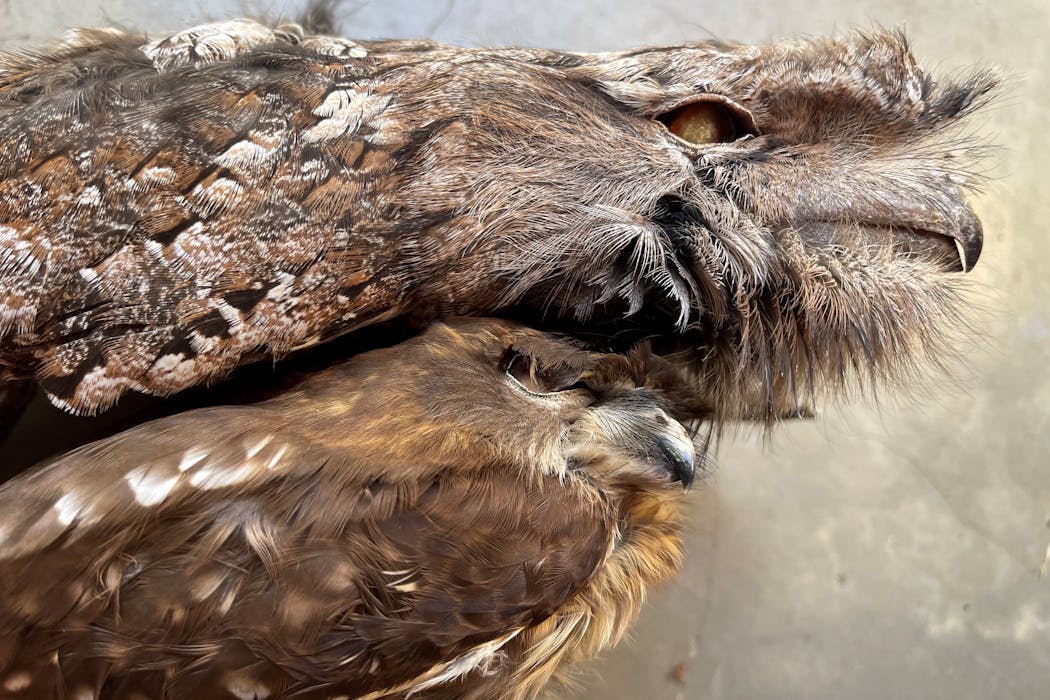
When a rat or mouse eats a SGAR-based bait, the poison remains in its body for up to a year. This is how it ultimately passes to predators and scavengers such as owls, frogmouths, raptors, quolls and goannas that eat the poisoned animal.

These native animals die slowly and painfully. This process, known as secondary poisoning, is well documented in predators in Australia and globally.

What the review found

The review acknowledges the science and highlights the risks that SGARs pose, not only to our wildlife and fragile ecosystems but also potentially to humans.

However, despite the risks and advice from scientists to ban SGARs, the review proposes keeping SGARs as the primary tool for Australia’s war on rodents. It described them as an “unacceptable risk”, but stopped short of recommending a blanket ban.

The review argues SGARs remain essential for rodent control, especially with rodents developing some resistance to older poisons. The proposed changes focus on mitigating exposure risk to non-rodents. These include changes to labels and the way bait is delivered, and packaging controls. Under these changes, SGARs will remain widely available to the public.

Ultimately the real difficulty – not adequately addressed – is broader than simply preventing non-rodents from consuming baits. The real issue lies with the nature of the toxins themselves.

These poisons are highly effective at killing rodents, but they do not kill them quickly. After eating poisoned bait, a doomed “zombie” rodent will remain alive for several days, potentially up to a week. During this time, their behaviour changes. Normally cautious, these nocturnal animals become slower, disoriented and far more likely to be eaten by predators such as owls (or even your pet cat or dog).

Crucially, these poisoned “zombie” rodents can continue to eat more poisoned bait. By the time they die, they may contain very high concentrations of rodenticide.

Secondary poisoning is a predictable outcome

When a predator eats a poisoned rodent (or any other poisoned species), it also ingests its poison. This is unlikely to cause immediate death, but SGARs accumulate in the liver and remain there for up to a year. With repeated consumption of poisoned animals, the predator reaches a toxic threshold and dies.

Unfortunately, secondary poisoning is not an accidental or a misuse scenario. It is a highly predictable outcome of allowing the use of poisons in our ecosystems that accumulate in the body.

Paradoxically, the animals most affected by SGARs are the very species that help control mice and rat populations naturally. Predators such as owls breed more slowly than rodents. When rodenticides kill predators in urban and agricultural landscapes, rodent problems often worsen and spur further reliance on poisons. This creates a damaging feedback loop that Australia has been reinforcing for decades, one not addressed by the proposed changes.

Many researchers, including our colleagues and ourselves, argued during this review that meaningful reform requires either banning SGARs in Australia completely or severely restricting access so they are not available to the public. Other countries such as Switzerland and Canada have reached similar conclusions, and responded by significantly limiting access to these compounds with the intent of banning them.

Australia’s proposed changes move in the wrong direction, and leave us considerably behind much of the developed world. Australia will continue using rodenticides that cause the greatest harm, such as SGARs. And lower-risk alternatives that use the First Generation Anticoagulant Rodenticide (FGAR), such as Warfarin, face cancellation because they do not contain chemicals that make them bitter an aspect to try and make them less attractive to non-rodent species.

Warfarin-based baits are safer as they do not accumulate in the body of poisoned animals to the same extent and they are expelled from the body more quickly, reducing the risk of secondary poisoning.


Read more:
A dangerous pesticide isn’t being monitored in key bird of prey populations – we’re shedding light on that gap


A shelf full of various industrial products, including rodent poisons.
Unlike many parts of the world, second generation rodenticides are available for the public to purchase in Australia.
John White, CC BY-ND

Restriction will protect wildlife

This review could have broken the cycle of poisoning native Australian predators in the name of rodent control. Instead, it preserves a system that does not work here, or anywhere else in the world.

If Australia is serious about protecting its wildlife while managing rodents effectively, it must confront the role of SGARs directly. Adjusting labels and packaging cannot solve a problem driven by the chemistry of the poisons themselves.

We simply must do better. Until access to these compounds is meaningfully restricted, secondary poisoning will remain an inevitable — and entirely preventable — outcome. Many native animals will continue to die slow and painful deaths.

The Conversation

John White receives funding from various organisations for ecological and toxicological research.

Raylene Cooke receives funding from various organizations to undertake ecological and toxicological research.

ref. Household rat poisons found to be ‘unacceptable risk’ to native animals. So why aren’t they banned? – https://theconversation.com/household-rat-poisons-found-to-be-unacceptable-risk-to-native-animals-so-why-arent-they-banned-272346

NZ pulls plug on $6.7m power project in Papua New Guinea amid tribal violence

Source: Radio New Zealand

A home destroyed in tribal fighting in PNG’s Highlands region. BTT Newscast

A New Zealand aid project in Papua New Guinea has been halted due to security concerns, and appears unlikely to be completed.

The Ministry of Foreign Affairs and Trade (MFAT) confirmed work on the Enga Electrification Project in PNG’s Highlands region had “stopped due to ongoing violence around the project area”.

New Zealand invested $6.7 million over the last six years into the project which aimed to connect at least 4000 households in the area to electricity. It was part of combined efforts with the US, Australia and Japan to help 70 percent of PNG homes get connected by 2030.

However, tribal and election-related violence has surged in numerous parts of Enga Province in the past few years, with police largely unable to quell the unrest.

A spokesperson for the MFAT said contractors stopped work at the site in Tsak Valley in Enga’s Wapanamanda District last August.

Complexities

The choice of Enga for the electrification project was laden with risks, not just because of its remoteness and rugged terrain, but also due to the high level of tribal and election-related violence.

Development researcher Terence Wood of the Development Policy Centre said while the project’s goal was worthy, New Zealand appeared to rush into the project without giving enough thought to the complexities involved.

“You’d think very carefully about the country context, and contexts in different parts of the country, and that would guide where you work and also how you worked,” Dr Wood said.

“So violent parts of the Highlands, or the upper Highlands, of Papua New Guinea would be the last places you’re engaged with.”

He noted that large swathes of PNG’s population lack reliable access to electricity, so many rural communities in PNG would benefit from electrification, but added that challenges were compounded by the country’s poor governance.

“With work such as electricity, it’s one thing to build it, you also need a functioning government to maintain it.

Papua New Guinea’s Prime Minister Peter O’Neill displays a document for electricity projects signed by Australia’s Prime Minister Scott Morrison, Japan’s Prime Minister Shinzo Abe, US Vice President Mike Pence and Prime Minister Jacinda Ardern. AFP

Geopolitical motivation

When PNG hosted the APEC Leaders Summit in 2018, the country’s prime minister at the time, Peter O’Neill agreed on the PNG Electrification Partnership with with leaders from Australia, New Zealand, Japan and the US.

Wood said geopolitics had driven New Zealand, alongside the other countries, to plunge into the project.

“We’ve sort of jumped in thanks to a perceived threat that China might be going to engage in this type of aid work in Papua New Guinea, and because of our haste, we didn’t pay sufficient attention to some of the complexities associated with providing electricity to Papua New Guinea.

“Aid donors often race in propelled by other motivations, and therefore don’t think carefully enough about the context and about how they might design their aid work to make sure it’s effective.”

Wood said there was a high probability that the project would not be completed successfully.

‘No respect for authority’

Enga governor Sir Peter Ipatas, admitted that escalating tribal violence and the build-up of illegal weapons in the province had got out of hand, putting many innocent lives at risk.

“In my province, my people have taken the lawlessness to another level using modern weapons, guns, and this has been also a sign of no respect for authority.”

He said a vacuum of law enforcement made the problem worse, as Engan warlords and their fighters were rarely arrested or prosecuted for fighting and destroying villages.

However, Ipatas said the problem with the high level of Engan tribal fights was an internal one, not directed at foreigners.

“Now the guns are only used for tribal fights. Nobody outside the the tribes that are involved are in any danger in our context as Engans, because you only fight your enemy. That’s the rule from our tradition.”

He urged PNG’s national government to ensure police do their job, suggesting more police assistance from Australia and New Zealand would be helpful.

– Published by EveningReport.nz and AsiaPacificReport.nz, see: MIL OSI in partnership with Radio New Zealand


Gay ice-hockey players, lesbian space princesses, and cute dogs: what to watch in February

Source: The Conversation (Au and NZ) – By Alexander Howard, Senior Lecturer, Discipline of English and Writing, University of Sydney

As summer has well and truly set in, we hope you’re able to while away some hours in the comfort of air-conditioning. And what better way to spend that time than with some new treats to stream?

This month, our experts are watching the smash-hit ice-hockey romance Heated Rivalry; getting familiar with Martin Scorsese and who he is behind the camera; and keeping the Australian Open vibes going with a new miniseries about Evonne Goolagong Cawley.

We hope you find your next great binge watch in this selection!

Goolagong

ABC iView

Evonne Goolagong Cawley was one of Australia’s greatest champions of all time.

Goolagong, a compelling and inspiring three-part mini-series honouring the Wiradjuri tennis legend, is a rags-to-riches story about a small-town girl with a ball and a piece of 2 x 4 who dreams of one day winning Wimbledon. A little Aussie battler.

Evonne is portrayed by the remarkable Whadjuk and Wardandi Noongar actor Lila McGuire, who delivers a sublime performance that compellingly showcases Goolagong’s vulnerability, resilience, grace and fighting spirit. The ensemble cast of Australian actors provides a rich, talented and authentic foundation for the story.

This series is not just for tennis fans, who will relish the big tournament moments and the portrayal of renowned players of the time, such as John Newcombe, Margaret Court, Billie Jean King, Martina Navratilova and Chris Evert. This is a story for all Australians.

Skilfully directed by Batjala, Mununjali and Wakka Wakka man Wayne Blair, the series offers an in-depth look at the complexities of athletes’ lives both on and off the field, and an intimate portrayal of an Indigenous family’s life in rural Australia during the 1970s.

The mini-series delves intimately into Goolagong’s personal life, the international tennis circuit and what it takes to be the world’s best.

Liza-Mare Syron


Read more:
Goolagong is a compelling and inspiring mini-series – a story for all Australians


Heated Rivalry

HBO Max (Australia), Neon (New Zealand)

Heated Rivalry, written and directed by Jacob Tierney, has become a massive hit. Rachel Reid’s romance novel was written for a mainly female readership, and it doesn’t quite capture all of the nuances of a gay male relationship. Tierney’s adaptation brings a whole new understanding to the intricacies of gay love.

Heated Rivalry follows the romantic relationship between two rising professional hockey players: the Canadian captain of the Montreal Metros, Shane Hollander (Hudson Williams), and the Russian captain of the Boston Raiders, Ilya Rozanov (Connor Storrie).

Tierney’s perspective makes the pair fully realised people who are each battling their own demons. He emphasises that queer men’s lives aren’t just full of spicy, sexy moments. Often, our sexuality can be a point of difference in how we are perceived in our careers, family lives, relationships and on the wider world stage.

Tierney’s adaptation honours both the women who will come to the show from the novel, and the show’s new male audience. He understood the show had to be spicy and honour the books, but also be authentically gay.

Tierney’s Shane and Ilya cry, have good sex, share their hurts and worries, and work through their vulnerabilities together. All while still being active, attractive and complicated queer men.

Harry Stewart


Read more:
Why the Heated Rivalry TV series understands gay men better than the book


Beyond the Bar

Netfilx

Beyond the Bar offers a fresh lens on gender, and society’s moral and ethical dilemmas, viewed through the prism of the law. This new 12-episode South Korean limited series is co-created by Kim Jae-hong, who also directs, and Park Mi-hyeon, who is a writer and former lawyer.

It stars two well-known actors who give outstanding performances: Jung Chae-yeon (The King’s Affection) as the young female lawyer, and Lee Jin-wook (Squid Game) as her boss. Creative choices – such as the camera lingering on their exchanged looks – create pauses that underscore their connection. In an unusual representation of a marriage of minds, it becomes clear they admire one another’s ethical judgement and professional success.

The series features female-centred storylines, relationships and legal dilemmas. The number three symbolises balance and harmony. This motif recurs: three women at different career stages, including the female head of the firm signal a shift in sexual politics in South Korea; three sisters struggling with poverty; three female housemates who vow enduring support wherever life takes them.

There are two types of men in the series: men who work supportively with women, and the lazy scheming male lawyers, who are villains derided as “salary thieves”. In contrast the women and their male collaborators strive for fairness and transparency, engaging ethically with arising problems.

I loved the women-led stories and the central relationship, where the expected sexual frisson is replaced by genuine intellectual chemistry.

Lisa French

Dog Park

ABC iView

Raise a paw if your dog ever helped you to meet a new two-legged friend? The premise of Dog Park capitalises on the fact that pet ownership in Australia is increasing, with canines being the most popular choice.

Roland (Dog Park co-creator Leon Ford) is a middle aged recluse and all-round grump who has a hard time trusting or liking other humans. His sense of dissolution takes a further dip when his estranged wife Emma (Brooke Satchwell) departs for work in the United States, leaving the TAFE career counsellor in charge of his distant teenage daughter Mia (Florence Gladwin) and disdained dog Beattie.

The first turning point of this six-part series occurs when Beattie goes missing and boozehound Roland searches for her at the local park. This is where Roland meets the always sunny Samantha (Celia Pacquola) and a ragtag bunch of overly friendly folks and their fur babies (AKA the Dog Park Divas), all of whom are quite familiar with Beattie already.

The Dog Park Divas dole out life lessons, trying to help slow Roland’s downhill roll. Their interventions slowly begin to take effect – which gives hope that all humans are ultimately redeemable.

Dog Park is tender in a darkly bittersweet way with an underlying theme of connection and chosen family. Beattie (played by a poodle of unspecified breed named Indie in real life) is pretty cute – and proof that dogs really are the superior species.

Phoebe Hart


Read more:
Dog parks are an unexploited arena for a television dramedy – so now we have ABC’s Dog Park


Mr. Scorsese

Apple TV

Canonisation has an irritating habit of smoothing over the rough, interesting edges. I kept thinking about that while watching Mr. Scorsese. At its best, the series pushes back against that tendency. Chronologically structured, it opens with a rich, evocative portrait of Martin Scorsese’s Italian American childhood in New York, shaped by illness, Catholic ritual and an intense, almost unhealthy devotion to cinema.

The attention given to Scorsese’s student years and early experiments is especially welcome. We see a filmmaker borrowing styles, pushing form, overreaching, then pulling back – trying to invent a language before he fully understands its grammar. That groundwork matters when the series turns to his masterpieces Mean Streets, Taxi Driver, Raging Bull, Goodfellas and Casino.

Rebecca Miller’s documentary does an excellent job of cutting through decades of familiarity, reminding us just how abrasive, violent and volatile these films remain.

It is revealing to hear Scorsese and his collaborators reflect on the personal and professional peaks and troughs of his career, especially given how securely he now sits in the cultural landscape.

The only real criticism I have with the series is the relatively limited attention paid to the later films, with some receiving only a perfunctory mention and others missing altogether. In a sense, however, this speaks to the scale of Scorsese’s achievement. There is simply too much ground to cover, and the series flies by. Five episodes could easily have been ten.

Alexander Howard

Lesbian Space Princess

Netflix, from February 6

In Lesbian Space Princess, outer space emerges as a new and inclusive habitat for a smart, funny story exploring the inner spaces of lesbian consciousness and self-affirmation.

The film pushes hard against the gendered conventions of the sci-fi genre, re-pointing them to unexpected ends.

Can introspective Princess Saira rescue her ex-girlfriend, Kiki, from the evil clutches of a rogue group of incels known as the Straight White Maliens?

Low on self-confidence and belittled by her royal lesbian mothers, Saira sustains an unshakeable attachment to Kiki, a soft-butch bounty hunter who is as attachment-avoidant as Saira is clingy.

Saira battles through the beautifully drawn pink-hued reaches of constellations and moonscapes in a spaceship (depressively voiced by Richard Roxburgh). As she reluctantly traverses outer space, she must step up to its greatest challenge: plumbing the messy depths of her inner world.

Rather than provide lesbian romantic satisfaction or ground its utopian energies in the bold new world of queer community, in the future imagined here the way desire is experienced by the self is more important than who or what it is directed toward.

Lee Wallace


Read more:
Lesbian Space Princess is a cheeky, intergalactic romp that turns the sci-fi genre on its head


The Pitt, season two

HBO Max (Australia), Neon (New Zealand)

Last year the beloved, award-winning drama The Pitt reconceptualised medical storytelling post-COVID and post-network TV.

Set in a strained Pittsburgh emergency department, and featuring a terrific ensemble cast, the full 15-episode season covered an entire shift, each episode moving hour by hour. Patient and staff storylines, some ripped from the headlines, painted a powerful picture of care and humanity in the face of a broken health system and wider social crises.

Season two has been greatly anticipated. It’s the fourth of July, one of the worst days for accidents and injuries. Burnt-out ER boss Michael “Robby” Robinavitch (Noah Wyle) has one last shift before he goes on extended leave, ready to take his new motorbike (hello, midlife crisis) and get out of Dodge. Clearly things won’t go smoothly.

Just about the whole gang is back – everyone from nurses, cleaners and experienced physicians to student doctors and ER regulars, many still dealing with the tragic events and disclosures of season one. The fast-paced, well-shot show remains adept at balancing dense mental jargon and frank representations of medical trauma with sharp, compassionate characterisation and wry humour. A few episodes in and a new omnicrisis is brewing… It’s compelling stuff.

Erin Harrington

Stranger Things, season five

Netflix

Beyond its monsters and 1980s nostalgia, Stranger Things resonates because it tells stories of struggles familiar to young people: trauma that lingers, identity that wavers, and friendships that buffer against fear.

And by turning inner struggles into visible monsters, Stranger Things can provide a lens to discuss trauma, identity and resilience. Adults can use the show to talk to teenagers about their own mental health.

The Upside Down is a dark mirror of the Hawkins township – a shadow world where threats feed on secrecy and avoidance. It works as a metaphor for “unseen” unprocessed experiences, shame and anxious avoidance. The young people at the heart of the show must face their fears to overcome their power.

Vecna’s attacks dramatise shame and self-criticism. His voice echoes characters’ darkest self-judgments: Max hears accusations about Billy’s death; Eleven relives failures to protect friends. You can help young people by reminding them the harsh voice in their head isn’t who they are. It’s just a thought, like a bully they can fight.

And at its heart, Stranger Things is a friendship story. The party’s loyalty and shared rituals provide a scaffold against isolation and fear. Rituals of D&D campaigns, walkie-talkie check-ins and bike rides create a safety net. Adults can point out how the characters in Stranger Things share burdens and protect one another.

Stephen Goldsmith


Read more:
How adults can use Stranger Things to talk to young people about their mental health


The Conversation

The authors do not work for, consult, own shares in or receive funding from any company or organisation that would benefit from this article, and have disclosed no relevant affiliations beyond their academic appointment.

ref. Gay ice-hockey players, lesbian space princesses, and cute dogs: what to watch in February – https://theconversation.com/gay-ice-hockey-players-lesbian-space-princesses-and-cute-dogs-what-to-watch-in-february-273799

Coroner finds young man’s death weeks after hospital discharge couldn’t have been prevented

Source: Radio New Zealand

A coroner has found the death of Liam Booth, who was sent home from hospital in a taxi after threatening to take his own life, could not have been prevented.

Liam Booth was sent home from hospital after threatening to take his own life. (File photo) RNZ / Dan Cook

Warning: This story discusses suicide.

A coroner has found nothing could have been done to prevent the death of a 21-year-old Christchurch man who was sent home from hospital in a taxi after threatening to take his own life.

Liam Booth was found dead in Beckenham in October 2017. A coronial inquiry was opened that year followed by a 2022 inquest as a result of his father Geoff Booth’s concerns about the care his son received from the then-Canterbury District Health Board (now HealthNZ Canterbury).

Geoff Booth spent years seeking answers from health authorities, spoke out in the media about his son’s death and on behalf of other bereaved families and ran unsuccessfully for the District Health Board in 2019 to raise awareness about suicide and advocate for better mental health services.

In findings released on Monday, eight years after Liam Booth’s death, Coroner Bruce Hesketh rejected several of Geoff Booth’s concerns, including that his son’s level of care was unsatisfactory, and that he should not have been discharged from the emergency department and instead should have been compulsorily admitted to hospital.

A Serious Event Review conducted by the DHB after Liam Booth’s death found the hospital could have spoken to Geoff Booth before discharging his son, that his family were not involved in his discharge plan, some documentation was lacking and there was a lack of information given to the family about support available.

The DHB’s then-chief of psychiatry wrote to Geoff Booth in September 2018, apologising that Liam Booth died under the care of the mental health service, and committing to implementing recommendations from the review, the Coroner noted.

In their evidence, Liam Booth’s parents described difficult periods managing his behaviour from a young age, including low mood, a diagnosis of oppositional defiance disorder, acts of aggression and threats of self harm.

A 2008 incident in Liam Booth’s medical notes reported police were called after he became violent towards his father and resulted in officers taking the 12-year-old to the ED in handcuffs.

After counselling by the children’s mental health team finished in February 2009, Liam was not seen again by mental health services until early 2016, following a referral for help with drug use and low mood.

The next year and a half would see Liam Booth repeatedly engage with the Crisis Resolution team, alcohol and drug counsellors, community mental health and other agencies, with unremitting support from his parents, friends and flatmates, according to evidence to the coroner’s court.

His threats of self harm escalated during 2017, culminating in police bringing him to the ED in mid-September after he told his father of his plan to end his life.

On-call psychiatrist Dr Michael Clarke conferred with consultant psychiatrist Dr Katherine Hayes and decided Liam Booth did not meet the criteria to be compulsorily held under the Mental Health Act.

Liam Booth did not want to be admitted as a voluntary patient, and refused crisis respite.

Clarke discharged him, and he was given a taxi chit to get back to his flat.

That night formed the bulk of Geoff Booth’s complaint against the DHB.

He felt the hospital should have allowed him to be present at his son’s assessment, and did not believe the hour or so Clarke spent with Liam was long enough to assess him on their first meeting.

When Clarke phoned Geoff Booth after his son’s assessment, Geoff Booth warned him his son was lying when he said he did not have suicidal intentions, and urged him to admit him against his wishes.

By the time Clarke phoned Geoff Booth back later that night, his son had already been discharged.

Within weeks, Liam Booth would take his own life.

Court appointed expert witness, psychiatrist Dr Barry Walsh, found the quality of care Liam Booth received was adequate.

He told the Coroner compulsory treatment was a serious step, one that was often a “highly traumatising, frightening experience.”

“Further, with suicidal crises, admissions can cause a deterioration rather than an improvement,” he said.

Coroner Hesketh found the decision not to admit Liam Booth under the Mental Health Act was the right one, and cited research that found the focus on suicide risk factors was problematic, with tools or scales to assess risk used by an array of clinicians carrying “the kudos of science” despite “little evidence they are effective.”

Coroner Hesketh echoed the review findings that more should have been done to share information and include Liam Booth’s family in discharge planning.

He added a recommendation that Health NZ clarify with patients as soon as possible whether they consent to care and treatment plans being shared with family members.

If so, it was “imperative” families were kept updated and given the opportunity to have input, the Coroner said.

Health NZ told the Coroner all recommendations had been implemented, and it had added a Director of Lived Experience role to its mental health services leadership team who worked with consumer and family advisors to “translate principles into practice.”

The Coroner said he found Geoff Booth to be a “sincere witness” who at times “lacked objectivity.”

He had taken the evidence of Liam Booth’s doctors over his father’s, which meant he was entitled to review the draft findings, Coroner Hesketh said.

Geoff Booth raised several points in response, including asking what had happened to a pilot project for mental health co-response teams, made up of police, mental health and ambulance staff, which he felt would have helped his son.

Coroner Hesketh said the 2020 pilot was in response to the rapid escalation of mental health related 111 calls over the past decade, which now numbered about 73,000 a year.

The pilot included co-locating and jointly deploying staff from the three agencies who could provide advice to other responders as well as front-line capability for assessments and care in the community, avoiding the traditional response of police taking a distressed person to wait in an emergency department or a police station.

Mental health minister Matt Doocey last month announced the pilot was being expanded, with teams rolling out in Canterbury, Auckland, Bay of Plenty and Counties Manukau from June.

Geoff Booth also asked when a single record would be available covering GPs and public and private hospitals, noting Christchurch Hospital was unaware his son had visited his GP with suicidal ideation on the same day he was admitted to hospital.

The DHB informed the coroner a system called HealthOne operated throughout the South Island allowing access to certain records, but that it was “limited in terms of information flow”.

Coroner Hesketh said he was satisfied that even if a comprehensive system was available, it would not have made any difference to the decision to discharge Liam Booth.

On whether the death could have been prevented, the coroner said in his report the answer, sadly, was ‘no’.

HealthNZ has been approached for comment.

Geoff Booth could not be reached for comment.

Where to get help:

  • Need to Talk? Free call or text 1737 any time to speak to a trained counsellor, for any reason
  • Lifeline: 0800 543 354 or text HELP to 4357
  • Suicide Crisis Helpline: 0508 828 865 / 0508 TAUTOKO. This is a service for people who may be thinking about suicide, or those who are concerned about family or friends
  • Depression Helpline: 0800 111 757 or text 4202
  • Samaritans: 0800 726 666
  • Youthline: 0800 376 633 or text 234 or email talk@youthline.co.nz
  • What’s Up: 0800 WHATSUP / 0800 9428 787. This is free counselling for 5 to 19-year-olds
  • Asian Family Services: 0800 862 342 or text 832. Languages spoken: Mandarin, Cantonese, Korean, Vietnamese, Thai, Japanese, Hindi, and English.
  • Rural Support Trust Helpline: 0800 787 254
  • Healthline: 0800 611 116
  • Rainbow Youth: (09) 376 4155
  • OUTLine: 0800 688 5463
  • Aoake te Rā bereaved by suicide service: or call 0800 000 053

If it is an emergency and you feel like you or someone else is at risk, call 111.

Sign up for Ngā Pitopito Kōrero, a daily newsletter curated by our editors and delivered straight to your inbox every weekday.

– Published by EveningReport.nz and AsiaPacificReport.nz, see: MIL OSI in partnership with Radio New Zealand

Hoping to get your finances in shape in 2026? These tips will help

Source: Radio New Zealand

Make sure your goals are clear and achievable. Unsplash

If 2026 is the year you get your money life sorted, you may be wondering where to begin. Our money correspondent Susan Edmunds has 5 areas to focus on.

Set a budget

It is often helpful to start thinking about what you want to achieve and breaking your goals down to things that can be done in the short term, and those that might take a bit longer.

Short-term goals might be things like a holiday in a couple of months, while longer-term might be saving a house deposit or for your retirement.

Make sure your goals are clear and achievable. They need to be measurable so you know when you’ve achieved them or are closer to them. Save $50 a week, for example, rather than “save more”. Celebrate your wins along the way to keep you motivated.

It helps to know why you’ve chosen the goals, too.

Doing something just because you think you should is a lot less motivating than doing it because it’s going to improve your life or make you happier.

Liz Koh, financial coach at Enrich Retirement, says setting goals first and then thinking about making them happen is a useful “top down” approach that is more likely to result in behavioural change.

That’s important because, for lots of us, it’s the behavioural change that needs to happen to help us stick to a budget.

Koh recommends focusing on small steps.

“One of the biggest mistakes people make is trying to get ahead too quickly. Money is an important part of life that serves a multitude of purposes. It is not something you can do without.

“For the same reason that you can’t reach your goal weight on an overnight diet or suddenly become as fit as an Olympic athlete, you can’t go from being broke to being seriously wealthy in a short space of time.

“The first lesson in changing your relationship with money is to set attainable goals that reflect the reality of your current financial situation. It is better to take small steps and be successful than to set unrealistic goals and fail. Achieving small steps may give you the confidence to gradually take bigger steps. If you have never been able to save, trying saving just a small amount each week and increase the amount over time.”

Your budget can be a tool to help you get to the goals, because it’ll give you a clear picture of what’s going on.

This is where you will be able to work out whether you can free up money to put towards your goals.

Tom Hartmann, personal finance spokesperson at Sorted, says people either do a budget to make what they are already doing work, or to try to do something different.

Either way, it often helps to draw up a budget showing your current situation: How much is coming in, what’s going on, what you’re spending money on. Then you can see what can be adjusted.

You can usually get a good idea of what’s been happening by looking at previous bank statements. Some banks have apps that track your spending to do this for you.

“We’re creatures of routine, we keep going back to the same places, spending the same amounts, especially over a given year,” Hartmann said.

“If you download your statements over a year, where you’re spending money is the usual suspects.”

If you want to save money, or find a surplus to start investing, you should be able to use your budget to identify areas that can be trimmed. You could also look at how your budget would work with different levels of KiwiSaver contribution.

If your budget shows money is really tight and there is no surplus to speak of, you might be able to use it to identify the pressure points and areas where change could be most effective.

Don’t rewrite your budget to be overly harsh, though. If you restrict yourself too much, it can be hard to stick to.

Focus on your smallest debts first. Unsplash

How to get rid of your debt

It’s a good idea to start with a realistic idea of how much debt you might be able to clear within what timeframe.

Think about how much money you might have available to put towards debt repayment, and set some targets from there.

Koh said people should start by working out what they owed. Even if it’s uncomfortable reading, it’s a good idea to make a list of all your debts and how much interest is being charged on them.

” If you have many small debts you might be surprised at what they add up to,” she said. “Rank your debts in order of priority for payment. Set up an automatic payment to make additional voluntary payments on the first debt on your list. Leave your other debt payments at their minimum level. When the first debt is paid off, start on the next one on the list and keep working through until all debts are repaid.”

It often makes sense to try to clear the highest-interest debt first because this is costing you the most money. Check that you don’t incur any extra fees or penalties, though – if you do, you might need to shift your focus elsewhere.

Another option is to focus on your smallest debt first. That means you’re likely to clear it relatively quickly and can move on to the next debt. That series of small wins can be quite motivating.

If you have a number of loans and you’re finding it hard to manage them all, consolidation could be an option. This is where you take out one big loan to pay off all the smaller ones.

It usually means you only have to worry about one payment a month instead of several – which can be helpful from a life admin perspective.

But it’s worth checking the terms of your consolidation loan, though. A higher interest rate or longer term can mean you end up paying more overall for your debt overall.

If you’re struggling to pay the debt, longer term and smaller repayments can still be sensible, even if it’s more expensive – as long as you don’t feel that having consolidated the debt gives you a free pass to go and take out more.

If you’re seriously struggling with any of your debt, your first call should be to the lender. They can talk to you about what your options might be.

It’s really important not to just ignore debt that has become a problem. This never makes it go away.

Put money into savings as soon as it arrives in your account. 123RF

How to save money

Saving money is probably near the top of people’s New Year’s resolution lists.

Whether you’re cringing when you look at your bank statements or just want to put aside a bit more next year, there are a few ways you could do it.

Sorted’s personal finance spokesperson Tom Hartmann says people should think about the home organisation guru Marie Kondo if they’re looking for ways to save.

Kondo talks about only holding on to things that “spark joy”.

“We can do the same thing with the things we spend money on,” Hartmann said. “For example with your subscriptions – there’s no way you get the same level of happiness from all the things you subscribe to. For me Spotify is up the top, I’d rate that a five out of five but Netflix is lower down.”

He recommends rating the things you spend your money on between one and five out of five and cutting or reducing the things that are a two or a one.

“It makes it easier to cut things back and you don’t end up feeling deprived because you keep the things that really give you joy – ice creams for the kids, for me that’s way up high.

“Often it’s the cheap and cheerful things that end up staying in the budget.”

Match your spending with saving – this requires a bit more money, but can be really effective.

The idea is that if you spot something you want to buy, you only make the purchase if you can put the same amount of money into investments or savings.

If you want some jeans for $200, you have to also put $200 into Sharesies, for example.

Don’t decide you’ll wait until the end of your pay cycle and save whatever is left over. Put the money into savings as soon as it arrives in your account.

“Set up an automatic transfer to take money out of your account each payday and put it in an account that is not shown on your internet banking. Send it to an account in a different bank to keep it even more out of sight. You will be surprised at how even a small amount saved each week will quickly grow,” Koh said.

It’s that aspect of paying yourself first that makes KiwiSaver so successful. If you can channel that same “out of sight, out of mind” approach into other savings, you might be surprised at how fast the balance can grow.

Your bank might also offer you the ability to round up your transactions and put the difference into savings.

You can often choose how much you want to round up, whether that’s to the nearest $1, $2 or more. That might mean if you buy a coffee for $5.50, for example, the transaction is rounded to $6 and the difference saved. Even small amounts add up this way.

There are other apps, such as Feijoa, which automate “rounding up” by sending the difference to your KiwiSaver account.

If you’re feeling really motivated you might choose to have a “no spend” month, week or even day of the week. This means that for that period of time, you resolve to not spend anything. This could take some planning – but it’s not effective if it just means you shift your spending to other times.

Don’t forget to track your success and celebrate milestones along the way – it can help you stay motivated.

If you make bigger repayments, you’ll be able to clear your home loan faster. Unsplash/ Artful Homes

Manage your mortgage

If you’ve got a mortgage, one of your priorities might be to try to get rid of it as soon as possible.

The past few years of higher interest rates have been tough going for lots of people. As interest rates come down, many borrowers have more options.

There are a few changes you can make that could get you closer to that goal.

Increase your repayments

First up, the most obvious one.

If you make bigger repayments, you’ll be able to clear your home loan faster. What surprises some people is how much of a difference even a small increase in your home loan repayments can make, particularly if you haven’t had your home loan for a long time.

Interest rates have fallen over the past couple of years from more than 7 percent to less than 4.5 percent.

If you have a $500,000 loan at 4.5 percent, you’ll pay about $585 a week over a 30-year term including $411,413 of interest. If you can increase your payment to $600 a week, you’ll only pay $385,836 of interest and clear it about a year-and-a-half sooner.

You can increase your repayments by opting for a higher level when your loan comes up to refix. Sometimes you can ask your bank to increase them during the term, too, or make additional lump sum payments. There is generally a limit on how much extra you can pay back during a fixed term before you have to pay a fee.

When your loan rolls off its fixed term, you could also make an additional one-off payment before you refix again at whatever repayment rate suits.

Anything you can do to pay the balance off faster will save you a lot in the long run because it means the principal will be smaller and there won’t be so much to attract interest – which compounds – over the life of the loan.

Split your loan

You can split your loan into a number of smaller loans. This allows you to take advantage of different interest rates.

At the moment, longer fixes are more expensive than shorter ones but are still relatively low by historical standards.

You might choose to fix part for a longer rate for some security and have some on a shorter term to save money in the short term.

It also means you can choose to make higher repayments on one of the loans, and maybe aim to clear that before switching your attention to the other.

Ask for low-equity margin to be removed, or for special rate access

If you bought your house a while ago with a small deposit, you might be paying a low-equity margin on your interest rate.

You might also be paying higher rates than the “specials” banks advertise for borrowers with more deposit.

You could ask your bank to reassess your situation – if your property has improved in value or you’ve paid off your loan a bit, you could have improved your equity position, or you might find the bank is willing to negotiate.

Shop around for a sharper rate

If you don’t think you’re getting a good deal from your lender, you could look at what else is available in the market. A mortgage broker could help with this.

Banks have also been competing hard with cash back offers that can be worth quite a significant amount of money if you’re willing to shift.

Consider off-set

If you have savings that you want to keep separate from your mortgage, you could set up an offset facility.

That means you forgo the interest on your savings but also reduce your mortgage interest bill. It’s sometimes possible to do this by linking with family members’ accounts, too.

Consider revolving credit

If you have the discipline, a revolving credit facility can work well. This means you section off part of your home loan into what is basically a large overdraft and usually becomes your main transaction account.

You then aim to put your spending on your credit card each month and have your income going into your new revolving credit account.

This means you reduce the interest you pay on that portion of the loan for the period that income is sitting there. Hopefully when you pay your credit cards at the end of the month, there’s a bit left over to reduce what you owe. You need to be a bit careful with this, though, because over time the idea is that you’ll build up money in that account as you pay it down and you don’t want to be tempted to spend it again.

Advice from a mortgage adviser or a home loan specialist from your bank can really help you to set a strategy and stick with it.

There are online tools that can help you work through what your risk profile might be. RNZ / REECE BAKER

Maximise your KiwiSaver

KiwiSaver is an increasingly important part of many New Zealanders’ financial lives. We pull millions of dollars out of the scheme each year to buy first homes, as well as helping out in financial emergencies, and it is a big part of lots of people’s retirement planning.

The nature of long-term investment means that decisions that you make at the outset can have a big impact over time, so it’s important to get things set up well as early as possible.

A great first place to start is to think about your risk profile. This refers to your willingness to take risk with your investment.

Someone who needs to withdraw money in three months’ time to buy a house won’t have much appetite for risk at all, because they will need to know exactly how much money they have available.

But someone who is thinking about making a withdrawal in 40 years will have much more appetite for risk because they have many years to ride out any turbulence in the market.

There are online tools that can help you work through what your risk profile might be.

You might think: Why bother to take any risk at all?

In investing, risk can be a positive because it should boost your returns.

“The theory goes that the higher the return you are after, the more risk you are willing and will have to take. The more volatility you can accept in the short term, the greater the expected return in the long term,” said Dean Anderson, founder of Kernel KiwiSaver.

Once you know what sort of risk you should be taking with your investment, you can choose the right KiwiSaver fund for you.

Most KiwiSaver funds can be described as either cash, conservative, balanced, growth or aggressive. You can find variations on this, and some providers offer single-asset funds that you can add to your portfolio, investing in things like property and cryptocurrency. Some providers also allow an element of DIY and stockpicking for individual investors.

If you can take more risk, a growth or aggressive fund is likely to be the best option for you.

“These funds typically offer higher returns over time, but with more volatility. Given your horizon, you can handle those fluctuations in value and expect to benefit as a result,” Anderson said.

“As an example, if you’re in your late 30s and already have your first home, opting for a high growth fund could allow compound returns to maximize your savings by the time you retire.”

But if you might buy a first home within three years, a conservative or cash fund might be better. Many people have had the experience in recent years of going to withdraw their money and finding the market had dropped at just that moment.

Cash and conservative funds focus on preserving your balance but generally deliver lower returns.

When it comes to adding in things like pure portfolio funds or investments in cryptocurrency, it could be a good idea to do this with some personalised advice.

“Cash has the lowest risk, therefore the lowest expected return. Of the four major asset classes (cash, bonds, property, shares), shares have the highest risk and the highest expected return. Share funds are lower risk than individual shares, and crypto assets, commodities and “private investments” are even higher risk,” Anderson said.

You’ll also need to think about which provider is right for you. You can go with your bank, or another major fund manager, or one of the smaller providers.

Fees vary, as do investment management styles. You might think a low-fee manager that tracks a market index is a good option, or you might be looking for a manager who can beat the market, or one who delivers a responsible investment strategy that aligns with your beliefs.

There are lots of options so it’s worth taking the time to find one that’s a good fit. Tools like the Sorted Smart Investor can be handy here. Mindful Money is a great platform for anyone wanting to check what their fund might be invested in.

You’ll need to choose how much you want to contribute. If you’re an employee, you can choose to automatically contribute 3 percent, 4 percent, 6 percent, 8 percent or 10 percent of your gross salary. Your employer will match your contribution at 3 percent and some offer higher rates. Those default contribution rates are slowly increasing over time and could increase further if National is successful at the next election.

The right contribution for you will probably depend on your goals. A 10 percent contribution rate will boost your balance much faster. But the money is locked in until you buy a first home or turn 65.

If you’re a while away from doing either of those things, you might only contribute what your employer will match and invest the rest of what you have available somewhere else (provided you are sure you will actually so this).

Some providers suggest working out how much of a lump sum you want at retirement, and then working backwards to determine what you need to save now to get there.

It can be really hard to think clearly about something that’s a long time in the future, though, so my advice if you’re still decades away from retirement is just to save and invest as much as you can while meeting other financial goals such as paying off a mortgage and enjoying your life.

Don’t set and forget your KiwiSaver. Check on it every year to see whether it’s doing what you’d expect, given the market movements. Even if you’re not working for a while, try to contribute at least $1042 so you get the full Government contribution each year. It’s not as big as it was but it’s still worth having!

When you get to 65, you can withdraw all the money in your KiwiSaver account. But you don’t have to. You might still have 30 years of living costs to fund, so you might choose to leave some or all of it invested and earning returns for a while. Personalised advice can help here too, to come up with a plan to draw down your money over time in a way that works for you.

The Society of Actuaries have some rules of thumb and Sorted also offers a tool to help.

Sign up for Ngā Pitopito Kōrero, a daily newsletter curated by our editors and delivered straight to your inbox every weekday.

– Published by EveningReport.nz and AsiaPacificReport.nz, see: MIL OSI in partnership with Radio New Zealand
Live animal export industry remain hopeful practice will resume after ban

Source: Radio New Zealand

123RF

The live animal export industry is still hopeful the practice will resume – despite not getting any material updates from the government since the middle of last year.

New Zealand used to export live cattle to China via sea to help it build its own dairy herd – but Labour banned the practice in 2023 due to animal welfare concerns.

ACT campaigned during the last election to reinstate live exports by sea and Cabinet has been working on the legislation ever since.

But Livestock Exports NZ chief executive Glen Neal said things have gone quiet.

“The uncertainty is not helpful for farmers in terms of planning, they’ve got to make decisions on a regular basis about the future of their farming operations.

“The non appearance of legislation to restore the trade is something that presents fewer options for farmers.”

The government has said it would only resume live exports by sea with a new gold standard for animal welfare but Labour has doubled down and said if it was elected it would enforce the ban.

With uncertainty, would the industry invest in gold standard ships for export? Neal thinks so.

“We think there is sufficient demand for protein in South East Asia – demand is growing all the time, we send really high value animals which are highly prized there.

“We’ve had a very successful trade with China for 20 years, we’ve sent hundreds of thousands of animals up there at a time when dairy demand was growing.

“So now we are looking at countries like Indonesia and others that want to have their own dairy production boosted by some great New Zealand bovine genetics.”

Neal said even if legislation is passed to reinstate exports, the industry needs a good six to 12 months to prepare – as decisions need to made at breeding time.

It’s clear the industry is frustrated by the lack of progress and there’s a lot of money at stake – in 2024 it spent $1 million on a lobbying campaign to persuade the government to restart the trade.

Associate Minister of Agriculture Andrew Hoggard. RNZ / Mark Papalii

Associate Minister of Agriculture Andrew Hoggard acknowledged the development of the legislation had taken longer than planned.

“The government has always been clear that when the trade returned, it would be with the highest animal welfare standards, and we are still discussing what that looks like as a government.

“I know the livestock sector will be looking for certainty and as soon as I have something to announce, I’ll let them know.”

Sign up for Ngā Pitopito Kōrero, a daily newsletter curated by our editors and delivered straight to your inbox every weekday.

– Published by EveningReport.nz and AsiaPacificReport.nz, see: MIL OSI in partnership with Radio New Zealand

Taranaki surfers thrilled over return of world’s surfng elite to NZ

Source: Radio New Zealand

Paige Hareb competed at the Women’s Championship Tour when it was hosted in New Plymouth. (File photo) Katrina Clarke

Taranaki’s surfing community, -the only region in New Zealand to have previously hosted the globe’s elite surf competition, is stoked for its Raglan cousins who will hold a combined men’s and women’s World Surf League event in May.

The Women’s Championship Tours stopped at Fitzroy Beach in New Plymouth between 2010 and 2013 sparking a surge of interest in the sport – particularly women’s surfing.

Craig Williamson was event director for the Taranaki Surf Festival which included what was then the ASP Women’s Dream Tour.

Reflecting on the groundbreaking event ahead of the World Surf League coming to Raglan, the Surfing Taranaki chief executive said the idea was to give a local favourite a leg up.

Craig Williamson was event director when the WSL’s predecessor the ASP brought the Women’s Dream Tour to Taranaki between 2010 and 2013. ROBIN MARTIN / RNZ

“Paige Hareb had just qualified for the world tour, the first New Zealand female to ever do so. She was young at the time.

“So, that was a huge deal for surfing in New Zealand and in Taranaki and we thought that perhaps we could pull something together here and give her a home town advantage.”

Williamson said the festival – which was pulled off with the help of 60 community partners – had left a lasting impression.

“It was incredibly inspiring for young surfers all around the country. I bump into people who are young adults now a lot of them and they are still surfing and they talk about what an effect it had on them to actually see the world best here.”

He said the impact of the visiting athletes went beyond what they demonstrated in the surf.

Promotional poster for the Taranaki Surf Festival. ROBIN MARTIN / RNZ

“I remember vividly when we had Bethany Hamilton, the Hawaiian who’d lost her arm in a shark attack, speaking to like a whole classroom, a whole group of youngsters – mostly young girls.

“I’m sure they remember that and it had an impact on them, you know, in terms of what you can do in spite of obstacles that can be put in you’re way.”

Now based in Australia, Paige Hareb remembered the competition fondly.

“Yeah it was pretty cool. At the time I and probably didn’t realise how good I had it, but yeah looking back now it was definitely a special moment to be able to surf in front of friends and family in your home breaks and show it off to all the other girls and the rest of the world is pretty special.”

She said the New Zealand stop was popular with her fellow competitors.

Paige Hareb in action during the 2022 Nias Pro in Indonesia. (File photo) PHOTOSPORT

“Everyone loved it. I know there was a lot of hype about it before they even went there and I think the worst part of it was that it was maybe too cold for them some days, but we got really good surf and everyone loved it the sea and the mountain I guess is pretty spectacular for anyone who doesn’t live there.,

She saw evidence of the Taranaki Surf Festival’s legacy every time she comes home.

“When I was growing up I was one of the only girls in the water and now I go home and there’s at least one other girl out every time I surf there, so yeah, there’s definitely a lot more females into surfing and out in the water which is cool to see.”

Hareb – who would compete for a wildcard into the Raglan competition – expected the Waikato settlement to be pumping during the 10-day event window.

Bruce Gatwood-Cook was media manager for the Taranaki Surf Festival.

A member of the New Plymouth Surfriders Club for about 20 years, he said the audience for WSL events was mammoth.

“It’d be in the millions of the reach we’d be getting because we provided packages to sports networks in Australia and America, Hawaii, South Africa to Europe.

“So, it would be impossible to quantify exactly how many people we reached, but we were reaching a global audience.”

He said WSL events were a marketer’s dream.

“At the same time as livestreaming footage of the heats and highlights of the heats, we also provided b-roll of mountain shots and scenics of the arena.

“So, typically as you see with sporting events like that they’ll have cutaways of the beach and local mountains and scenics like that of the country which really help destinations.”

As a surfer himself, Gatwood-Cook was also taken with the impact the surfers had with fans.

“We just had throngs of young girls idolising Paige Hareb let alone all the other superstars on the women’s circuit and it really created an aspiration for them that I could be that person and I could do that and also seeing how they surfed giving them inspiration to surf like that.”

Meanwhile, Izaro Williamson Sasia was a just a toddler when her dad ran the Taranaki Surf Festival.

Izaro Williams Sasia can’t wait for the world’s elite surfers return to New Zealand in May. ROBIN MARTIN / RNZ

Now a national under 18 and women’s longboard titleholder, she was stoked the world’s best surfers were returning to New Zealand.

“I don’t have any memories of it when it was here in Taranaki because I was only little, but I just can’t wait it would be such a cool experience to see it live and it’s been something I’ve always wanted to do, so I can’t wait. Like there’s no way I’m not going.”

The New Zealand Pro, which had attracted government major events funding, would run from the 15t-25 May at Manu Bay, Raglan.

Sign up for Ngā Pitopito Kōrero, a daily newsletter curated by our editors and delivered straight to your inbox every weekday.

– Published by EveningReport.nz and AsiaPacificReport.nz, see: MIL OSI in partnership with Radio New Zealand

‘For all New Zealanders’: Celebrations getting underway at Waitangi

Source: Radio New Zealand

Paddlers arrive on the beach during the waka parade at Waitangi Day 2025. RNZ / Layla Bailey-McDowell

The chair of the Waitangi National Trust has extended the invitation to all New Zealanders to attend this year’s festivities at Waitangi.

Tania Te Rangingangana Simpson told RNZ the festivities at Waitangi continue to grow every year, both in terms of attendance and in the number of different activities.

“The theme [this year] is Mō tātou, mā tātou, which is for all of us and by all of us. And it reflects the fact that Waitangi and the Waitangi estate in particular is for all New Zealanders. And it is a place of belonging for all New Zealanders because it is the home to the signing of the founding documents of our nation.”

The second aspect of the theme is manaakitanga, about looking after one another, she said.

“So I think you can get the feeling that it is about a sense of unity and of working together … the future of Aotearoa is something we shape together. It’s our collective responsibility and our shared benefit. It’s our commitment to building the future for all of us and everybody in this nation who call Aotearoa home.”

Tania Te Rangingangana Simpson, new Chair of the Waitangi National Trust Board. Supplied/Waitangi National Trust

The week begins on Monday with the meeting of the National Iwi Chairs Forum, which runs until Wednesday.

From then on it’s a packed schedule of festivities at both the upper treaty grounds and at the newly refurbished Te Tiriti o Waitangi Marae below.

Te Arikinui Kuini Nga wai hono i te po will be welcomed at the upper treaty grounds on Wednesday afternoon.

“There will be, of course, places for us to discuss and debate, and the forum tent will be operating again on the lower treaty grounds where there’ll be lots of political and iwi-focused discussions. But there’ll also be the music stages, kapa haka, the food, of course,” Simpson said.

Politicians will be welcomed to Waitangi on Thursday, with Prime Minister Christopher Luxon is expected to attend after spending last year’s Waitangi Day with Ngāi Tahu at Ōnuku Marae in Akaroa.

The one way bridge leading to Waitangi will be closed from Tuesday but there will be a free bus service and shuttle from Bledisloe Domain near Haruru along the newly sealed Haruru Falls Road.

Simpson said there will also be a ferry service from Russell directly to Waitangi operating every 20 minutes.

Although recent storms have taken their toll on Northland, with some areas still dealing with slips and roading issues, there should be no difficulties for access to Waitangi, she said.

Simpson said everybody is welcome at Waitangi as it’s a time to come together, reflect and connect and commemorate the signing of Te Tiriti o Waitangi.

Sign up for Ngā Pitopito Kōrero, a daily newsletter curated by our editors and delivered straight to your inbox every weekday.

– Published by EveningReport.nz and AsiaPacificReport.nz, see: MIL OSI in partnership with Radio New Zealand

Singer Lily Allen is coming to New Zealand

Source: Radio New Zealand

British singer Lily Allen will perform in Auckland as part of the biggest tour of her career.

In support of her 2025 album, West End Girl, the singer-songwriter will perform concerts throughout October and November, starting in Auckland, before moving through Brisbane, Sydney, Melbourne and Perth.

Allen will play her latest, critically acclaimed album in its entirety, in the order the songs appear on the record.

All songs on West End Girl were written by Allen, unpacking life as a middle-aged woman in the dating scene and rediscovering her sense of sexual identity in the fallout of her very public divorce with Stranger Things actor David Harbour.

Rolling Stone described the album as “an odyssey of betrayal and heartbreak, an investigation of the way we perceive ourselves and the people we wake up next to every morning, and a litmus test for how honest we’re allowed to be in art and life”.

The Guardian said it was “a gobsmacking autopsy of marital betrayal”.

Allen was last in NZ in 2019 and will return on 21 October for one show at Spark Arena.

Tickets go on sale 9 February.

– Published by EveningReport.nz and AsiaPacificReport.nz, see: MIL OSI in partnership with Radio New Zealand

Morning Report live: PM faces questions about coalition clash over India trade deal

Source: Radio New Zealand

RNZ / Marika Khabazi / Photo illustration / 123rf

Prime Minister Christopher Luxon is facing questions over a clash in the government coalition over a recently signed free trade deal with India.

NZ First leader Winston Peters has claimed it could mean “tens of thousands of people” arriving onshore and taking opportunities “away from New Zealanders”.

National has strongly denied this. Prime Minister Christopher Luxon said Peters was “wrong” about the China FTA and “he’s wrong on this one too”.

The Prime Minister will be speaking to RNZ’s Morning Report shortly.

Listen to Morning Report live on the player above, the RNZ app or your local RNZ frequency.

Sign up for Ngā Pitopito Kōrero, a daily newsletter curated by our editors and delivered straight to your inbox every weekday.

– Published by EveningReport.nz and AsiaPacificReport.nz, see: MIL OSI in partnership with Radio New Zealand

NCEA hurdle trips up 15,000 students

Source: Radio New Zealand

Last year’s NCEA achievement rate for year 12 and 13 was the lowest in five years (file photo). Supplied/ Unsplash – Meredith Spencer

Principals fear many of the 15,000 senior secondary students who failed to reach the critical NCEA reading, writing and maths benchmark last year will give up on school or future study.

Figures provided to RNZ by NZQA showed nine percent of students in Year 13 and 15 percent of Year 12s had not achieved the literacy and numeracy co-requisite by the end of 2025.

That equated to about 5000 Year 13s and 10,000 Year 12s who would not receive any NCEA certificates because they had not yet met the requirement.

While most Year 12s would return to school for Year 13, principals told RNZ many of those who failed to meet the co-requisite were likely to lose heart and give up.

The achievement rates were the lowest in the past five years and principals warned they were likely to drag down the number of school-leavers with NCEA qualifications – in 2024 the number of school-leavers without a qualification hit 16 percent.

  • Students leaving school with no qualifications highest in a decade
  • Porirua College principal Ragne Maxwell said some of the students who failed to achieve the co-requisite were in fact literate and numerate, but struggled to pass online exams in reading, writing and maths.

    “The concern really is that some people are failing who are literate and numerate,” she said.

    “It’s very difficult because they lose hope. It’s all very well to say just keep trying but the resilience to keep trying time after time when you just keep failing, it’s really challenging.”

    Maxwell said students who failed were not likely to return to school to keep trying to pass the co-requisite.

    Ragne Maxwell RNZ / John Gerritsen

    “People who might have come back otherwise who have failed perhaps again in the case of Year 12 – failed in Year 11 … they’re giving up hope and not returning.”

    Maxwell said the achievement rate would worsen in 2028 when the alternative pathway for meeting the literacy and numeracy requirement – 20 credits on top of the 60 required for an NCEA certificate – ended and the only way of achieving the co-requisite would be through the online tests.

    “We’re just going to see more and more people failing, leaving school with no qualifications and having worse futures as an outcome of this, even though some of them are in fact literate and numerate,” she said.

    Co-requisite achievement was lowest in schools serving the poorest communities.

    Only 74 percent of Year 12s at those schools met the co-requisite by the end of last year, down from 85 percent in 2021 and for Year 13s the achievement rate was 88 percent, down from 93 percent.

    Simon Craggs RNZ / Luka Forman

    Papakura High School principal Simon Craggs said the figures were concerning.

    Craggs said he hoped senior students who did not have the co-requisite would return, but he feared some would not.

    “We’re very much hoping that most of them will come back and I think a significant proportion will, but there will be some students who get disillusioned that they’ve completed Year 12 and they have no qualifications and feel that they’re locked out of qualifications who will leave school.”

    Craggs said the co-requisite had a bigger effect on qualification achievement at his school than at others last year.

    “Our number of Year 12s that don’t have literacy and numeracy is significantly higher than the national figure or even the equity index band figure, so we’ve got a lot of work to do to support those students to be able to come back.

    “Hopefully we don’t lose too many of them and we can continue to work hard with them on getting them across the line so they do leave school with qualifications.”

    Mākoura College principal Simon Fuller said his school had NCEA achievement rates above 90 percent last year, well above the average for schools in similar communities.

    He said students in Year 11 and some in Year 10 attempted the online reading, writing and maths tests, but those in Years 12-13 reached the benchmark through the alternative pathway of 20 extra NCEA credits in literacy and numeracy.

    Simon Fuller RNZ / John Gerritsen

    Fuller said the older students would not have performed so well if they had attempted the online tests.

    “Those students haven’t had the benefit of the minister’s investment in structured literacy or numeracy,” he said.

    “So they wouldn’t have performed so well, I believe, in sitting that external [exam] without the prep work.”

    He said the tests were not well suited to schools in poor communities, neurodiverse students and many boys.

    Sign up for Ngā Pitopito Kōrero, a daily newsletter curated by our editors and delivered straight to your inbox every weekday.

– Published by EveningReport.nz and AsiaPacificReport.nz, see: MIL OSI in partnership with Radio New Zealand

Appeal for witnesses as recovery of tourist boat grounded in Akaroa begins

Source: Radio New Zealand

The Akaroa Harbour. (File photo) SUPPLIED / NGAI TAHU

Witnesses are being sought in relation to the grounding of a catamaran at Akaroa on Banks Peninsula.

The Black Cat Cruises catamaran was beached at Nīkau Palm Valley Bay, after it got into trouble on Saturday afternoon – requiring more than 40 people to be rescued.

Environment Canterbury (ECAN) said the first phase of the recovery operation – fully submerging the catamaran in deep water to prevent further damage – is expected to get underway on Monday.

The second phase to remove it from the water, depended on the weather and safety requirements, it said.

ECAN said it was working with the Conservation Department, iwi, and Black Cat Cruises on the recovery and salvage, while the Transport Accident Investigation Commission said it would be investigating.

The commission’s chief investigator Louise Cook, told Morning Report, a team of investigators were in Akaroa and would be focusing on people’s memories and digital information regarding the grounding in the first instance.

Cook said the aim of the investigation was to ensure a similar incident did not happen again and would look at aspects including survivability and environmental impact.

She said witnesses to the incident were being sought and anyone who was present on the day should go to the commission’s website where they could submit information about it including photos and videos.

The inquiry could take between 12 months to two years to complete, Cook said.

Black Cat Cruises was approached for comment.

Longtime tourism operator, Tony Muir – who runs Coast Up Close – said the grounding hadn’t put a hold on scenic tours, but the exclusion zone around it, had changed what’s offered.

“Where they have it is right in the marine reserve, right at one of the highlights of the marine reserve.

“[On Sunday] afternoon we took a tour to the south, which is just fine as long as the weather conditions are fine… it’s a beautiful trip.

“But… this is one of the jewels in the Akaroa crown, where this vessel has been positioned.”

ECAN said the vessel was more significantly damaged than it anticipated and it was likely that all the fuel on board had leaked into the water.

It said the environment was coping, with oily sheens decreasing over time, and there were no signs of wildlife in distress.

A spokesperson said no fuel was able to be pumped out of the boat due to the nature of the incident.

“Most was discharged (likely in the early stages of the incident) due to the significant damage to the hull.”

Muir said it “wasn’t an ideal situation” but accidents happened and commended the crew for getting everyone off safely.

“It’s [now] up to all the powers that be to lessen the impacts the best they can.”

Following the near-sinking, Muir took his boat out on the water and helped with the clean-up.

“We went around and picked up a whole lot of rubbish, and plastic gloves, and puke bags and bits and pieces that had floated off it – we picked up quite a lot of that stuff just to get it out of the water.”

Fellow tour operator, Roy Borelli of Fox II Sailing Adventures, said he also scooped up some of the Black Cat’s debris.

He said his yacht, with 24 passengers on board, was one of the first on the scene on Saturday.

After a “wonderful sailing trip” where they’d been surrounded by dolphins, seeing the vessel was a bit of a shock.

“It was very… distressing seeing the boat listing. Because I’ve seen that boat almost every day that I’ve been working for the last 20 years.

“I know that boat. So, when you see it slowly sinking it’s very, very upsetting.”

He said he was one of many boats to offer assistance but ultimately wasn’t needed, and believed the catamaran ran itself aground to prevent it from sinking further.

Borrelli said there was still plenty of wildlife outside of the exclusion zone.

“We don’t know how long this is going to last, but it’s still an amazing harbour, and we have so much to see.

“We typically see dolphins, penguins, seals, and albatross on many of our trips.”

ECAN said the exclusion zone around the boat remained in place, and all non-response vessels must keep clear.

Sign up for Ngā Pitopito Kōrero, a daily newsletter curated by our editors and delivered straight to your inbox every weekday.

– Published by EveningReport.nz and AsiaPacificReport.nz, see: MIL OSI in partnership with Radio New Zealand

Sam Ruthe’s next goal after setting record for mile

Source: Radio New Zealand

New Zealand athlete Sam Ruthe. Kerry Marshall / www.photosport.nz

The Glasgow Commonwealth Games is now on the radar for New Zealand running sensation Sam Ruthe.

The athletics world is coming to terms with the 16-year-old who on Sunday became the youngest athlete to ever run a mile quicker than 3 minutes and 50 seconds and in doing so eclipsed the New Zealand record by Sir John Walker.

Ruthe ran 3m 48.88s at the John Thomas Terrier Indoor Classic in Boston, while Walker set his record of 3m 49.08s in 1982 outdoors at Oslo.

“Absolutely,” said Ruthe’s father Ben Ruthe, when asked if competing at the Glasgow Commonwealth Games in July was on the cards.

Ben Ruthe had the option of competing at the Commonwealth Games or the World Junior Championships this year and Ben said with his son still eligible to run the worlds again, the Commonwealth Games is a preference.

Ruthe’s grandmother Rosemary Wright won the Commonwealth Games 800m gold medal running for Scotland in Edinburgh in 1970.

“It would be really, really special,” Ben Ruthe said. “Sam would love to do that for his nan as well”.

The time Ruthe completed in Boston qualified him for the Commonwealth Games.

Coach Craig Kirkwood admitted they didn’t originally consider the Commonwealth Games at the start of the year because of the qualifying standards, but that had now changed.

“Yeh I think so, we’ll be revisiting our plan for the year in the next couple of weeks.”

Kirkwood said he was stunned with Ruthe’s run in Boston.

“Disbelief, just shocked at how fast he was moving and how good he looked doing it.

“It is very encouraging and I can’t wait to see what he does next.”

Ruthe’s was scheduled to race in a field that includes Olympic champion Cole Hocker of the United States in North Carolina in a fortnight.

Kirkwood doesn’t see an issue with the athletes Ruthe’s will come up against as the teenager doesn’t have any anxiety when preparing for races.

“He doesn’t get too excited about the events and doesn’t get nervous or worry about who he is lining up against.

“He’s always very calm and very measured, which is fantastic.”

Kirkwood was also delighted with how Ruthe’s tactically ran the race in Boston as it was his first ever indoor event.

Sign up for Ngā Pitopito Kōrero, a daily newsletter curated by our editors and delivered straight to your inbox every weekday.

– Published by EveningReport.nz and AsiaPacificReport.nz, see: MIL OSI in partnership with Radio New Zealand

Clash of the TV titans: How it will shape what we watch and what we pay

Source: Radio New Zealand

The battle for ownership of Warner Bros. is a rare case of Goliath vs. Goliath.

In one corner, there’s the behemoth streaming service Netflix. In the other, Hollywood’s legacy powerhouse, Paramount.

The prize is a treasure trove of iconic franchises that stretches back over a century, to include the DC Comics Universe, home to Batman and Superman, Harry Potter’s Wizarding World, the Looney Tunes, and JRR Tolkien’s Middle-earth. Its most glittering jewel is HBO, the gold standard of Premium TV that redefined the medium with cultural watercooler hits like The Sopranos, The Wire, Game of Thrones and The White Lotus.

(From left) Sarah Catherine Hook, Parker Posey and Sam Nivola on ‘The White Lotus.’

HBO

– Published by EveningReport.nz and AsiaPacificReport.nz, see: MIL OSI in partnership with Radio New Zealand

The Brazilian Best Actor contender on sharing his beautifully ‘complex’ country

Source: Radio New Zealand

In one of Wagner Moura’s favourite scenes in The Secret Agent, his character Armando Solimões suddenly realises he’s being hunted by contract killers – then opens a door and steps out into a Brazilian carnival.

To the 49-year-old actor, the scene represents not only an “amazing” celebratory aspect of his culture but the emotional depth within all of us.

“He’s being persecuted by hitmen, he can get killed in any moment, and he just gives himself to the carnival and goes with the crowd, dancing,” he tells RNZ’s Saturday Morning.

This video is hosted on Youtube.

– Published by EveningReport.nz and AsiaPacificReport.nz, see: MIL OSI in partnership with Radio New Zealand

Longest-standing Māori theatre company brings whānau voices of trauma and hope to the stage

Source: Radio New Zealand

Te Rākau Hua o Te Wao Tapu (Te Rākau) is now the longest-running Māori community theatre company in Aotearoa. Stephen A’Court

For more than three decades, Aotearoa’s longest surviving independent Māori theatre company has used storytelling to open kōrero about trauma, healing and hope in communities across the motu.

Te Rākau Hua o Te Wao Tapu (Te Rākau) was established in 1989 as a space for Māori performance activists to be “in control of telling their own stories”.

Since then, the company has taken theatre beyond traditional stages and into marae, community halls, prisons and youth residences.

Te Rākau co-founder and current director Jim Moriarty (Ngāti Toa Rangatira, Ngāti Kōata, Ngāti Kahungunu, Rangitāne) said they had been committed to telling their people’s stories “in a way that opens pathways to wellness”.

“I don’t think we’re doing anything new – we’re doing it our way,” Moriarty told RNZ.

“We wrap our work in the rituals I grew up with, manaakitanga, whanaungatanga, whakapapa, caring for people.”

In its early days, Moriarty said Māori were not coming to mainstream theatre.

“So we decided to take theatre to our people… wherever our people are.”

Out The Gate was shaped by kōrero with whānau with lived experience of incarceration. Stephen A’Court

There most recent production Out the Gate explores the pipeline that leads many Māori from childhood trauma into state care, youth justice, and ultimately incarceration.

“At its heart, the work is about the wounded child,” he said.

“About accountability, and about hope. With the right support, people want to walk into the light.”

Unlike conventional theatre, Out the Gate did not begin with a script, he said. It began with research grounded in whānau experience.

“About 80 to 90 percent of what people saw was verbatim.”

The production drew on the Kaupapa Māori research project TIAKI – Community wellbeing for whānau with [https://www.rnz.co.nz/news/te-manu-korihi/580726/kaupapa-maori-study-exposes-gaps-in-prison-data-and-support-for-maori

lived experience of incarceration], funded by the Health Research Council.

Central to that work was kōrero with nearly 50 whānau with lived experience.

Out the Gate traces the journey from childhood into state care, youth justice, and prison,” Moriarty said.

“The research programme ran for three years. Four of the researchers were whānau apprenticed with me, people who had lived experience and could extract deeper kōrero.”

Moriarty’s partner of 28 years, Helen Pearse-Otene (Ngāpuhi, Taranaki), a writer, psychologist and Toi Whakaari graduate, played a key role in shaping the material, he said.

“Helen synthesised all of that – she’s incredibly rigourous as a researcher.

“We combined it with our own lived experience, fostering hundreds of young people over the years.”

Their work, Moriarty said, was inseparable from tikanga Māori and the healing frameworks embedded within te ao Māori.

“When people start forming new relationships with unresolved trauma from childhood, a space opens up, because that work happens on the marae, tikanga and Māori identity flow naturally into that healing.”

The way Te Rākau works, he said, mirrors the way tūpuna engaged with the world, “collectively and with care”.

“That whole way our tūpuna expressed themselves through whole-of-life engagement. That’s how I create and run theatre,” he said.

“From the very beginning, and even after the journey’s over, it’s about taking care of people.”

For nearly three decades, Te Rākau has taken theatre beyond traditional stages and into marae, community halls, prisons and youth residences. Stephen A’Court

That approach extends beyond the performance itself, he said. After each performance of Out the Gate, the cast and crew held open kōrero with audiences.

“After each show, we held kōrero with the audience – judges, whānau, people recently released from prison, probation officers, social workers,” Moriarty said.

“Often those kōrero lasted longer than the show.”

Those conversations, he said, are where much of the healing happens.

“It’s about landing in a place where we can be practical, creative, and reinforce the joy of being Māori. And that’s never been more important.

“I don’t think I’ve ever seen such an open attempt to invisibilise Te Tiriti, to homogenise us, and to undermine our core values and relationship with tino rangatiratanga.”

Moriarty and Pearse-Otene worked as cultural supervisors for Corrections for about a decade, and Moriarty also helped facilitate creative Māori-based programmes in prisons around the country.

“Imprisonment has always been a subject close to me,” he said.

“I’ve had whānau in and out of the whare herehere. Imprisonment has been part of our history – rightly or wrongly – and it doesn’t look like it’s going away.

“If you look at history, Taranaki, Parihaka, imprisonment isn’t new for our people.”

He believes incarceration cannot be understood without recognising the trauma that sits beneath it.

“Underneath incarceration is trauma,” he said.

“This work didn’t come out of nowhere – it’s been in my bones all my life. I grew up around discussions of fairness, equity, and institutionalisation.”

Out The Gate for Te Rākau Hua o Te Wao Tapu, studio rehearsal October 2025. Stephen A’Court

Moriarty was born and raised on the marae in Porirua, so his upbringing immersed him in tikanga Māori from an early age – whaikōrero, waiata, haka, manaakitanga and the responsibility of hosting manuhiri.

He said his early life as a “pā kid” shaped both his worldview and his creative practice.

“The old people would watch you running around and decide where you might fit… fishing boats, singing and dancing, shepherding,” he said.

“That’s how they nurtured us.”

Those foundations later shaped both his theatre practice and his training as a psychiatric nurse, bringing together storytelling and mental health in ways that continue to inform his mahi with Te Rākau today.

“Theatre has always been a great love of mine,” he said.

“I come from a generation where we had an old valve radio in the house. That’s how the world came into our home. When it went all staticky, you’d give it a slap. So we told stories. Whoever could tell the spookiest story got the apple.”

He said these experiences underpinned his mahi today.

“That whole way our tūpuna expressed themselves through whole-of-life engagement. That’s how I create and run theatre,” he said.

“From the very beginning, and even after the journey’s over, it’s about taking care of people.”

Te Rākau’s pou at an early show. supplied

While Out the Gate has finished its initial run, Moriarty hopes the production will tour again, particularly into prisons, if funding becomes available.

In the meantime, Te Rākau is currently developing its next production, Don’t Vote, Don’t Moan, But Register, encouraging Māori participation in the electoral process.

“It’s not about voting left or right,” Moriarty said.

“It’s about voting informed, voting with heart. If we want to be at the table, we need to vote.”

But Moriarty said whether on stage, in a prison, or on a marae, the purpose is to create spaces where people feel safe to speak, to listen and to begin healing together.

“With the right support,” he said, “people want to walk into the light.”

Sign up for Ngā Pitopito Kōrero, a daily newsletter curated by our editors and delivered straight to your inbox every weekday.

– Published by EveningReport.nz and AsiaPacificReport.nz, see: MIL OSI in partnership with Radio New Zealand

Lowest NCEA achievement rate for past 5 years

Source: Radio New Zealand

Last year’s NCEA achievement rate for year 12 and 13 was the lowest in five years (file photo). Supplied/ Unsplash – Meredith Spencer

Principals fear many of the 15,000 senior secondary students who failed to reach the critical NCEA reading, writing and maths benchmark last year will give up on school or future study.

Figures provided to RNZ by NZQA showed nine percent of students in Year 13 and 15 percent of Year 12s had not achieved the literacy and numeracy co-requisite by the end of 2025.

That equated to about 5000 Year 13s and 10,000 Year 12s who would not receive any NCEA certificates because they had not yet met the requirement.

While most Year 12s would return to school for Year 13, principals told RNZ many of those who failed to meet the co-requisite were likely to lose heart and give up.

The achievement rates were the lowest in the past five years and principals warned they were likely to drag down the number of school-leavers with NCEA qualifications – in 2024 the number of school-leavers without a qualification hit 16 percent.

  • Students leaving school with no qualifications highest in a decade
  • Porirua College principal Ragne Maxwell said some of the students who failed to achieve the co-requisite were in fact literate and numerate, but struggled to pass online exams in reading, writing and maths.

    “The concern really is that some people are failing who are literate and numerate,” she said.

    “It’s very difficult because they lose hope. It’s all very well to say just keep trying but the resilience to keep trying time after time when you just keep failing, it’s really challenging.”

    Maxwell said students who failed were not likely to return to school to keep trying to pass the co-requisite.

    Ragne Maxwell RNZ / John Gerritsen

    “People who might have come back otherwise who have failed perhaps again in the case of Year 12 – failed in Year 11 … they’re giving up hope and not returning.”

    Maxwell said the achievement rate would worsen in 2028 when the alternative pathway for meeting the literacy and numeracy requirement – 20 credits on top of the 60 required for an NCEA certificate – ended and the only way of achieving the co-requisite would be through the online tests.

    “We’re just going to see more and more people failing, leaving school with no qualifications and having worse futures as an outcome of this, even though some of them are in fact literate and numerate,” she said.

    Co-requisite achievement was lowest in schools serving the poorest communities.

    Only 74 percent of Year 12s at those schools met the co-requisite by the end of last year, down from 85 percent in 2021 and for Year 13s the achievement rate was 88 percent, down from 93 percent.

    Simon Craggs RNZ / Luka Forman

    Papakura High School principal Simon Craggs said the figures were concerning.

    Craggs said he hoped senior students who did not have the co-requisite would return, but he feared some would not.

    “We’re very much hoping that most of them will come back and I think a significant proportion will, but there will be some students who get disillusioned that they’ve completed Year 12 and they have no qualifications and feel that they’re locked out of qualifications who will leave school.”

    Craggs said the co-requisite had a bigger effect on qualification achievement at his school than at others last year.

    “Our number of Year 12s that don’t have literacy and numeracy is significantly higher than the national figure or even the equity index band figure, so we’ve got a lot of work to do to support those students to be able to come back.

    “Hopefully we don’t lose too many of them and we can continue to work hard with them on getting them across the line so they do leave school with qualifications.”

    Mākoura College principal Simon Fuller said his school had NCEA achievement rates above 90 percent last year, well above the average for schools in similar communities.

    He said students in Year 11 and some in Year 10 attempted the online reading, writing and maths tests, but those in Years 12-13 reached the benchmark through the alternative pathway of 20 extra NCEA credits in literacy and numeracy.

    Simon Fuller RNZ / John Gerritsen

    Fuller said the older students would not have performed so well if they had attempted the online tests.

    “Those students haven’t had the benefit of the minister’s investment in structured literacy or numeracy,” he said.

    “So they wouldn’t have performed so well, I believe, in sitting that external [exam] without the prep work.”

    He said the tests were not well suited to schools in poor communities, neurodiverse students and many boys.

    Sign up for Ngā Pitopito Kōrero, a daily newsletter curated by our editors and delivered straight to your inbox every weekday.

– Published by EveningReport.nz and AsiaPacificReport.nz, see: MIL OSI in partnership with Radio New Zealand

Canterbury museum to mark 50 years hosting Waitangi Day commemorations

Source: Radio New Zealand

A world class museum on Canterbury’s picturesque Banks Peninsula will mark 50 years of hosting the South Island’s biggest and longest-running Waitangi Day commemorations on 6 February.

The Okains Bay Māori and Colonial Museum has one of the most significant historical collections in the country.

The museum and annual event were the brainchild of the museum’s founder Murray Thacker, whose passion for preservation formed the foundation of the vast 20,000-object collection of Māori and colonial artefacts, from waka to wagons, taonga puoro (traditional Māori instruments), kitchenalia, a blacksmiths forge and hei tiki.

RNZ / Nate McKinnon

The first Waitangi Day commemoration was held at the museum site in 1976 when an open day raised funds to finish the buildings, with the museum officially opened a year later on Waitangi Day 1977.

Manager Nigel Intemann said it was difficult to explain the significance of the Okains Bay collection to first-time visitors.

“You can imagine going to a metropolitan museum, you’re going to expect a really amazing collection, but to visit a small town like Okains Bay with so few residents, to come across such an extraordinary collection of national significance, it’s just amazing,” he said.

Intemann did not know the museum existed until he moved to the bay in 2020.

“Of course my first trip out here, I wondered why I’d never been here, then coming through the museum and absolutely realising that every New Zealander should make this journey,” he said.

Manager Nigel Intemann. RNZ / Nate McKinnon

The annual Waitangi event has traditionally been co-hosted with iwi, including a formal powhiri, kapa haka and hangi.

During the 1980s and early 1990s when the Ngāi Tahu claim was before the Waitangi Tribunal, the commemorations were an important platform for the iwi.

Since the late 90s, the iwi began alternating hui at each of the papatipu marae closest to the sites where rangatira signed Te Tiriti at Ōnuku, Te Rau Aroha and Ōtākou marae.

Ngāi Tahu and mana whenua Te Rūnanga o Koukourarata still play intrinsic roles in the museum and the commemorations but during years they are unavailable to co-host, such as 2026, the event becomes a family fun day without a powhiri or hangi.

The first event raised money for the whare taonga roof and was run as a fundraiser over many decades. In recent years, in line with tikanga, it has become a free event.

Intemann said fundraising was always front of mind, despite the day’s popularity and the museum’s national and international significance.

RNZ / Nate McKinnon

“Funding is one of the hardest aspects, especially in terms of paying bills. People like projects, they love to give you money for a new project, but if you keep building projects, you keep building costs in. Finding the money that keeps the lights on, that keeps the rates paid, is a continual effort,” he said.

On 6 February, blacksmiths fire up the forge, the three-tonne waka Kōtukumairangi is paddled up the Ōpara Stream and competitions including the famous tug o’ war are held in the museum courtyard.

The waka will not be launched this year because of an early high tide but will be on display in the whare waka.

Nor will there be one of the event’s highly sought after hangi in 2026, which feed 500 to 750 people.

However, a 150-year-old colonial oven will pump out hundreds of buns, sausages will be sizzled and stalls sell everything from kai moana to local cheese and wine.

The museum began as Thacker’s private collection, as the great grandson of some of the earliest Pākehā settlers in Okains Bay.

Board chair and Te Runanga o Ngāi Tahu representative Helen Brown. RNZ / Nate McKinnon

Board chair and Te Runanga o Ngāi Tahu representative Helen Brown said Thacker was drawn to history from an early age, collecting his first toki (adze) pounamu at the age of 9.

He would go on to amass a vast collection of taonga, from the prestigious – such as hei tiki and taiaha – to the less coveted mahinga kai (food gathering) equipment, which has seen the museum possess one of the best collections in the world of objects like nets, hinkai (eel traps) and kō digging sticks.

Brown said Thacker forged important relationships with Ngāi Tahu and Mātāwaka leaders from Ōtautahi (Christchurch) and Te Pataka o Rakaihautū (Banks Peninsula), who had a role in establishing the museum and discussed hosting an annual Waitangi commemoration.

“The Ngāi Tahu rangatira who supported the Waitangi Day commemorations at Okains Bay in those early years were very keen on the opportunity to educate people about Te Tiriti. There was always this idea of education and both tangata whenua and tangata tiriti coming together that was integral to Murray’s vision and was wholeheartedly supported by tangata whenua at the time,” she said.

While the first official Waitangi Day commemoration was held at the treaty grounds in 1934, 6 February did not become a public holiday until 1973 when the name was changed to New Zealand Day.

RNZ / Nate McKinnon

The Waitangi Day Act 1976 restored the former name, the same year Thacker held the first commemoration at Okains Bay.

Brown said the small museum punched above its weight.

“We care for three collections recognised as being of national significance. The jewel in the crown is the taonga Māori collection, there’s also a really significant antique arms collection and a collection of European boats,” she said.

Plans were underway to redevelop parts of the museum buildings, which were no longer fit for purpose, to protect its precious displays, and a fundraising campaign would be launched in the lead up to the museum’s 50th anniversary on Waitangi Day in 2027.

Visitor host Raukohe Hallett. RNZ / Nate McKinnon

Visitor host Raukohe Hallett (Ngāti Hine, Tūwharetoa, Ngāti Kahungunu) said the opportunity to show visitors so many historical objects and tell the stories of the people who used them helped to bring the past alive.

Museum patron Nigel Hampton KC, who has been involved with the museum almost from its inception, described the Waitangi Day atmosphere as jubilant.

He said Thacker was ahead of his time in recognising the importance of commemorating beyond the treaty grounds.

“He saw individual events should be held up and down the country and started a trend to have that occur 50 years ago, before the museum was even properly created,” he said.

The museum’s collection of taonga Māori was “up to or beyond the standard of the country’s major metropolitan museums”.

“One of the outstanding things is that so much of the collection is on display, available to be seen and to be explained, and it’s the conversations – and I meant this quite sincerely – you as the viewer can have with the exhibits. They’ve got to commune with you and you with them and you get a much better understanding of the culture that lies behind and in those taonga,” he said.

“As a pākeha, you come to have a better understanding of the people that were here before our predecessors arrived.”

Continued support for the museum was vital, Hampton said.

“It seems extraordinary doesn’t it, that a small valley – not somewhere you pass through and stop but that has to be a destination – that such a place can have such a museum, such a treasure for all New Zealand. We must retain it,” he said.

Sign up for Ngā Pitopito Kōrero, a daily newsletter curated by our editors and delivered straight to your inbox every weekday.

– Published by EveningReport.nz and AsiaPacificReport.nz, see: MIL OSI in partnership with Radio New Zealand

Summer’s last weeks could be a bit of a roller coaster, but it’s not all bad news

Source: Radio New Zealand

As February begins we enter the last weeks of summer. It’s been a season of extremes, with record-breaking temperatures and heat warnings at the start being swept away by the devastating storms just after the new year began.

Following the warmer, settled weekend, you could be excused for wondering is summer making a comeback?

The short answer is most likely but it’ll be a bit of a roller coaster.

What is coming?

Niwa meteorologist Chris Brandolino said the start of February, although still uncertain, could bring dry clear weather for parts of the country.

“I think the theme for the next sort of probably week, maybe two weeks, is for much of the country, there is likely to be pretty dry conditions.”

That being said, Monday night and through to Tuesday will bring some rain for both islands before clearing out from Wednesday.

The West Coast will be the first to get some rain which would then move to the east coast, particularly Canterbury.

“They could be seeing a really significant drop of rain, now ahead of that rain it’ll be quite warm,” Brandolino said.

MetService had placed heavy rain watch on Fiordland and Westland south of Franz Josef Glacier until Monday.

There is also a heavy rain watch in Marlborough south of Seddon and Canterbury north of the Rangitata River until Tuesday night.

A heavy rain watch is in place for parts of the South Island. MetService

From Tuesday the South Island could see some cooler weather but in the upper north, Brandolino said it would be “grossly humid”.

“So Waikato, Bay of Plenty, Northland, Auckland, it is going to be a hot day.”

But a hot day does not mean a dry one because most of the North Island can expect “pockets of rain” on Monday and Tuesday.

“Because of that warmth and humidity, especially that tropical humidity, there could be some localised heavy showers. But it’ll be localised, it won’t be kind of a widespread thing.”

Despite the rocky start to the week, from Wednesday onwards most of the country was expected to have a “dry lean”, with the exception of some rain in Southland.

Temperatures on a roller coaster

The South Island was still in for a roller coaster ride with temperatures bouncing up and down.

Brandolino used Christchurch as an example saying the temperature could hit 30 degrees on Monday, but could also struggle to hit 20 on Tuesday.

Hawke’s Bay was forecast to see 28 degrees on Monday and Auckland was set to heat up to 28 degrees.

“So this is the up and down sort of roller coaster weather pattern in terms of temperature that’ll be especially prevalent for the South Island. The North Island will still see some variability, but it won’t be as wildly as dramatic as the South Island.”

“The upper North Island, so places like Auckland, places like Northland, they’re more likely to find kind of a steady, persistent sort of like summertime feel.”

Is La Nina still a thing?

New Zealand is currently experiencing La Nina conditions.

Brandolino said February and March have historically been the busiest times of the tropical cyclone season, irrespective of La Nina.

The late summer period sees the warmest ocean temperatures around New Zealand and up to the north of the tropics.

“Warm water is fuel. You need more than that, of course, to get a tropical cyclone, but that’s a key ingredient.”

When La Nina conditions are active, it plays a role in which areas are favoured to see tropical cyclones.

“What it does is it tilts the odds towards something developing between, say, Fiji and the Queensland coast.”

What about those storms brewing in the Pacific?

Brandolino said there had been tropical activity in the pacific, particularly between Fiji and New Caledonia, which had the possibility of moving towards New Zealand and causing a rainy Waitangi Day weekend.

The activity dissipated over the weekend, giving the country a much greater likelihood of a rain-free long weekend.

The impact of this tropical activity will instead be a wave of humidity.

“So, the reason for the warmth and humidity for the North Island on Monday is because what is left over of that tropical low, let’s call it, that was to our North, it’s going to make its way over the North Island.”

“I would say Waitangi is looking promising for people who want to get outdoors from much of the country.”

Brandolino said with so much changeable weather on the horizon, it was important keep up to date with the latest forecasts.

Sign up for Ngā Pitopito Kōrero, a daily newsletter curated by our editors and delivered straight to your inbox every weekday.

– Published by EveningReport.nz and AsiaPacificReport.nz, see: MIL OSI in partnership with Radio New Zealand

‘It’s me’: Statue model comes face-to-face with younger self 60 years later

Source: Radio New Zealand

RNZ / Tess Brunton

The muse for an iconic Dunedin statue has come face-to-face with her bronzed younger self nearly 60 years later and half a world away.

Catherine Lee was 9 when she posed as Wendy from Peter Pan for British sculptor Sir Cecil Thomas OBE in London.

The statue has been a beloved part of the Dunedin Botanic Garden since the 1960s, and on Sunday, Lee shared her experiences during a public talk before fairies and pirates descended for a Peter Pan-themed storytime picnic.

For Lee, now 68, seeing her younger self immortalised in bronze was like a homecoming.

She has been wanting to visit the sculpture for years and said seeing it was an arresting sight.

“I just remember taking this sharp intake of breath, sort of going ‘oh my god, it really exists on the other side of the world. It’s there. It’s me’. So it was a really heart stopping moment,” she said.

Pirates, Wendy Darling and a Tinker Bell or two joined the Peter Pan storytime picnic as Catherine Lee read them a story. RNZ / Tess Brunton

It all started nearly 60 years ago when her father answered a small ad posted in the window of a local shop.

She met Sir Cecil Thomas OBE, who gave his approved, before she started posing in his studio in South Kensington after school on Wednesdays.

She had to kneel on a hard stepladder with her arms out diagonally, looking upwards to capture Wendy in ‘flight’.

“Very precarious for the model,” Lee said.

RNZ / Tess Brunton

It was incredibly uncomfortable so she could only hold the pose for 10 minutes at a time, but she enjoyed the overall experience, she said.

She never got to meet the two boys who posed as her brothers or the dog who sat in for Nana, but had a photo of the sculpture sitting on her mantle.

“Peter Pan has just always been a part of my life and I’ve read it obviously. We did the play at my school and I was the understudy for Wendy, but I actually played one of the Lost Boys,” she said.

“It’s sort of woven into the fabric of my life.”

Although this was her first New Zealand visit, she already knew the sculpture had made an impression – it is one of two Peter Pan-themed sculptures in the garden.

“When a friend of my father’s visited Dunedin and told the ladies in the gift shop that she knew the Wendy model, she was showered with free postcards of the statue with a message to the ‘Wendy Child’ written on the brown paper bag containing the postcards,” she said.

Lee did not get paid for the experience, but said Sir Cecil was extremely kind and good to her.

“He talked me a little bit like an adult, I think, and it made me feel quite grown up.”

Pirates, Wendy Darling and a Tinker Bell or two joined the Peter Pan storytime picnic.

Katy Sinnott grew up watching the Disney movies and reading the books and was excited to share that with her kids Fynn, 1, and Sophie, 3. RNZ / Tess Brunton

Dunedin resident Katy Sinnott said generations of her family had loved the sculpture, including her mum.

“She has memories of them here when she was a child, and so it was really fun to bring my kids back to see them,” she said.

Sinnott grew up watching the Disney movies and reading the books and was excited to share that with her kids.

She spent the night before making a Tinker Bell costume for her 3-year-old daughter Sophie and they watched Peter Pan.

“Sophie loves the Peter Pan one and she loves seeing all of the Lost Boys all around the bottom and fairies and things like that, and pointing out little mice. And obviously, sitting on Nana the dog,” she said.

Ann remembered visiting the statue with her children during the school holidays.

“My children loved coming here to the gardens and the reason that dog’s nose is quite polished was partly their doing,” she said.

The sculpture – along with another Peter Pan sculpture by Sir Cecil – were the result of a donation by Green Island resident Harold Richmond.

Dunedin Botanic Garden manager Catherine Bradley says the sculpture has been treasured for generations. RNZ / Tess Brunton

Dunedin Botanic Garden manager Catherine Bradley said he was known for being a frugal man, but he loved to give back to the community.

He used to take orphans on outings.

“At the end of his outings, he would give the children a copy of the J.M.Barrie Peter Pan book. It was something that was very nostalgic to him and he thought all children should have the pleasure of reading, she said.

Wendy and her Attendants, also known as The Darling Children Learning to Fly, had been an iconic part of the garden for decades, she said.

“People come here with their grandchildren and children and share memories of when they were children, sitting on Nana the dog. It’s a very well polished sculpture which is what the purpose was for … for members of the public to enjoy,” she said.

There were not many sculptures in the garden, and Bradley said it was important that those included were a place for people to stop, take in their surrounds and spark joy or reflection.

She was delighted Lee could visit and share her experiences.

It was made possible in collaboration with the Dunedin Library and Friends of the Dunedin Botanic Garden, as well as through the generosity of Lee, Bradley said.

Since her Wendy days, Lee has studied in Oxford, ran a small opera company in Italy before returning to join the British Civil Service and eventually become the director-general in charge of policy at the Ministry of Justice.

She was a Commander of the British Empire in 2012 for her services to justice, and received the medal from the now King Charles III.

Lee flies home on Monday, but said the reunion had been the highlight of her trip.

“It’s so familiar, it’s been a really nice sort of homecoming.”

Sign up for Ngā Pitopito Kōrero, a daily newsletter curated by our editors and delivered straight to your inbox every weekday.

– Published by EveningReport.nz and AsiaPacificReport.nz, see: MIL OSI in partnership with Radio New Zealand

Clinicians fear over-diagnosis of ADHD as GPs, nurse practitioners allowed to prescribe medication

Source: Radio New Zealand

AFP / Thom Leach / Science Photo Library

New rules allowing GPs and nurse practitioners to prescribe drugs to treat ADHD increase the risk of over-diagnosis, over-prescribing, addiction, psychosis and other harms, some clinicians are warning.

Christchurch hospitality worker Caity became increasingly anxious in the month after starting on ADHD medication.

“I just couldn’t shut my brain off at night, so I went 11 days without sleeping, which was definitely not fun.”

Then the TV started talking to her.

Caity had been prescribed atomoxetine by her GP while on the waiting list for an ADHD assessment.

It is not a controlled stimulant drug like Ritalin – but in rare cases, it can also trigger psychosis.

Admitted to Hillmorton Psychiatric Hospital, she was discharged too quickly.

“At that point I still believed probably about 50 percent of my psychosis, but I wasn’t a danger to myself or others so they didn’t really have a place for me.

“I was back within a month, and they were like ‘What happened? Why did you stop taking your meds?’ And I was ‘I don’t know’.”

Caity has since been diagnosed with ADHD but does not currently take medication, and has not had another psychotic episode.

Wellington psychiatrist and addiction specialist Dr Sam McBride. RNZ

Prescriptions rising

Since GPs lost their authority to prescribe stimulants in 1999 – due to worries about the potential for abuse – only psychiatrists and paediatricians have been able to initiate treatment.

Yet prescriptions for ADHD medications increased more than tenfold in the last two decades.

Wellington psychiatrist and addiction specialist Dr Sam McBride said it was “inevitable” that having more prescribers (GPs and nurse practitioners) would lead to more prescribing – and more negative impacts.

As happened now, some drugs would end up being “diverted” into the hands of people who had not been prescribed them, he said.

“A certain number of people come to harm from abusing them. A small proportion will develop addiction in the context of exposure to stimulants.

“We can expect a small number of people to have psychosis precipitated by these medications. And we can also expect some people will have physical effects due to exposure to stimulants.”

Those physical reactions could be short-term, like an irregular heartbeat, or become chronic, long-term problems.

There was also a risk to the wider health system: high demand for ADHD services could take “scarce medical resource” away from other parts of the health system.

“We’ll see the development of private providers meeting the need. And I’m unclear whether we’ll see the equity gains that were intended from the changes.”

AFP/ Science Photo Library

Accused of ‘drug-seeking”‘

The lack of capacity in the public health system in the last few years has forced many people to pay hundreds or even thousands of dollars for an ADHD assessment.

Bella* waited more than nine months and paid nearly $1000 for an ADHD assessment by a psychiatrist – but felt “let down” by the experience.

“He said something along the lines of ‘a lot of people come in and try to get diagnosed so they can re-sell the medication’. It was like he had an idea of what I was trying to do that was completely inaccurate.”

Bella said she had already told the doctor she was not interested in medication, she just wanted a diagnosis.

“I cried throughout most of that session because I thought I was finally in a space where I was going to get answers and support, and to be put down in that way … I wasn’t expecting that at all.”

Three years on, she remains “really hurt” by the experience.

“I haven’t gone for a second opinion because I’m honestly worried that I won’t be seen for who I am or the mental hurdles that I overcome each day.”

However, she has researched widely and found her own ways to mitigate some of the problems, including turning off social media notifications, exercise, proper sleep and good food.

“It’s a lot of work and can be tiring, but the results have really paid off. I’ve also gone to therapy to work through some of the more ingrained habits and thought patterns, and I’m learning to accept myself and encourage the positive aspects of ADHD.”

She thinks she will “most likely” go to her doctor for a second opinion at some point, but is in no hurry.

It’s ‘big business’ – psychologist

A psychologist who worked at a private clinic specialising in neurodiversity said she left after witnessing “unethical and lazy practices”.

There were clinicians who treated it like “a box ticking exercise” or ignored red flags.

“I saw people being diagnosed that I am confident did not have ADHD and when I raised it, it was like I was stepping out of line,” said the woman, whom RNZ has agreed not to name.

In one devastating case, a teenager died of suspected suicide within weeks of being diagnosed with ADHD.

The psychologist believes no one adequately explored what was really going on for him.

A proper assessment should involve digging deep into family history, home-life, school, relationships, what trauma (even intergenerational trauma) could be involved.

“I don’t want to discredit it as a genuine diagnosis but I am really skeptical about the diagnostic framework, particularly as used by clinicians who claim to specialise in this area.

“It’s being used as an explanation for people’s difficulties too easily without considering other things.”

It was hard to say “no” to a client or parent who was desperately seeking a diagnosis, she said.

“There’s also a financial incentive to give people the answers they want.

“You’re talking about a private business that’s incentivised to keep clients on, send them onto the psychiatrist. It’s big business, and it’s concerning that the public don’t know that, you’ve got very vulnerable people coming in.

“It’s very frightening because the consumer has to come in with a lot of knowledge if looking for a diagnosis for themselves or their child.”

Furthermore, the huge pressure on mental health services meant there was also political pressure to get people seen quickly, she said.

“I’m really concerned about this pathway of making it easier and faster for less qualified people to diagnose ADHD.”

McBride said when a diagnosis was correct and properly managed and people were “well supported”, stimulants were useful.

They could even reduce the risk of people engaging in other addictive and risk-taking behaviour, he said.

However, they did not work for everyone, and treating ADHD was often much more complicated than just popping a pill.

“And I’m concerned that at present there’s been really little consideration given to monitoring any of these issues, educating the public about these issues, educating clinicians about these issues, and looking to contain some of these harms.”

Ministry to monitor

The Ministry of Health said only vocationally registered specialist GPs and nurse practitioners who had knowledge and skills in ADHD assessment and treatment would be able to diagnose and start patients on stimulant medicines.

“They must be confident they can do this safely, follow accepted clinical guidelines, and meet the professional standards set by their regulatory authorities.”

Prescribing would continue to follow “existing regulatory and clinical guidelines to ensure quality care and prevent misuse”.

“As with any regulatory change implemented by the Ministry, we will continually monitor the new framework to mitigate any risk.”

Sign up for Ngā Pitopito Kōrero, a daily newsletter curated by our editors and delivered straight to your inbox every weekday.

– Published by EveningReport.nz and AsiaPacificReport.nz, see: MIL OSI in partnership with Radio New Zealand

Recovery of tourist boat grounded in Akaroa set to begin

Source: Radio New Zealand

The Akaroa Harbour. (File photo) SUPPLIED / NGAI TAHU

The recovery of a catamaran that grounded at Akaroa on Banks Peninsula is expected to begin on Monday.

The Black Cat Cruises catamaran was beached at Nīkau Palm Valley Bay, after it got into trouble on Saturday afternoon – requiring more than 40 people to be rescued.

Environment Canterbury (ECAN) said the first phase of the recovery operation – fully submerging the catamaran in deep water to prevent further damage – is expected to get underway on Monday.

The second phase to remove it from the water, depended on the weather and safety requirements, it said.

ECAN said it was working with the Conservation Department, iwi, and Black Cat Cruises on the recovery and salvage, while the Transport Accident Investigation Commission said it would be investigating.

Black Cat Cruises was approached for comment.

Longtime tourism operator, Tony Muir – who runs Coast Up Close – said the grounding hadn’t put a hold on scenic tours, but the exclusion zone around it, had changed what’s offered.

“Where they have it is right in the marine reserve, right at one of the highlights of the marine reserve.

“[On Sunday] afternoon we took a tour to the south, which is just fine as long as the weather conditions are fine… it’s a beautiful trip.

“But… this is one of the jewels in the Akaroa crown, where this vessel has been positioned.”

ECAN said the vessel was more significantly damaged than it anticipated and it was likely that all the fuel on board had leaked into the water.

It said the environment was coping, with oily sheens decreasing over time, and there were no signs of wildlife in distress.

A spokesperson said no fuel was able to be pumped out of the boat due to the nature of the incident.

“Most was discharged (likely in the early stages of the incident) due to the significant damage to the hull.”

Muir said it “wasn’t an ideal situation” but accidents happened and commended the crew for getting everyone off safely.

“It’s [now] up to all the powers that be to lessen the impacts the best they can.”

Following the near-sinking, Muir took his boat out on the water and helped with the clean-up.

“We went around and picked up a whole lot of rubbish, and plastic gloves, and puke bags and bits and pieces that had floated off it – we picked up quite a lot of that stuff just to get it out of the water.”

Fellow tour operator, Roy Borelli of Fox II Sailing Adventures, said he also scooped up some of the Black Cat’s debris.

He said his yacht, with 24 passengers on board, was one of the first on the scene on Saturday.

After a “wonderful sailing trip” where they’d been surrounded by dolphins, seeing the vessel was a bit of a shock.

“It was very… distressing seeing the boat listing. Because I’ve seen that boat almost every day that I’ve been working for the last 20 years.

“I know that boat. So, when you see it slowly sinking it’s very, very upsetting.”

He said he was one of many boats to offer assistance but ultimately wasn’t needed, and believed the catamaran ran itself aground to prevent it from sinking further.

Borrelli said there was still plenty of wildlife outside of the exclusion zone.

“We don’t know how long this is going to last, but it’s still an amazing harbour, and we have so much to see.

“We typically see dolphins, penguins, seals, and albatross on many of our trips.”

ECAN said the exclusion zone around the boat remained in place, and all non-response vessels must keep clear.

Sign up for Ngā Pitopito Kōrero, a daily newsletter curated by our editors and delivered straight to your inbox every weekday.

– Published by EveningReport.nz and AsiaPacificReport.nz, see: MIL OSI in partnership with Radio New Zealand

Who’s paying the price for cash back offers?

Source: Radio New Zealand

December’s data was a story of huge gross churn, Cotality chief property economist Kelvin Davidson says. RNZ

Home loan borrowers are switching banks in record numbers, chasing cash back incentives.

But who’s paying the price?

Reserve Bank data shows there was $14.1 billion of home loan lending in December, $3.6b more than the previous strongest month, which was March 2021.

Cotality chief property economist Kelvin Davidson said it was a “large spike” in lending activity, for both owner-occupiers and investors.

He said some of it was for people buying houses but the bulk of the activity came from people switching banks.

There was $5.8b in home loan lending refinanced in the month, more than double the previous high. Switches made up 41 percent of the total movement of lending, compared to the previous highest level of 30 percent in June.

Davidson said it was all driven by increased “cashback” activity – where banks try to tempt borrowers in by offering them a percentage of their loan total, in cash.

“Remember that the banks were all offering 1.5 percent cash for lending for a period of time in November, which then fed into December’s strength once the loans had actually been drawn down.”

Cotality chief property economist Kelvin Davidson. SUPPLIED

Davidson said it seemed that borrowers with large loans and large incomes were playing a key role in the activity.

“The share of lending being done at a high debt-to-income lending (DTI) actually dropped fairly sharply in December; or in other words, a lot of lending or switching was done at lower DTIs. For example, in relation to investment collateral, high DTI loans fell from nearly 17 percent of the total in November before exemptions to around 12 percent in December.”

He said December’s data was a story of “huge gross churn”.

“Borrowers will have been the winners, although some banks may have gained market share.”

Not every borrower benefits?

But chief executive at mortgage broking firm Squirrel, David Cunningham, said not every borrower would benefit.

Those who could move banks would get the extra cash, but those who were not able to could end up paying a higher price.

People usually cannot move without paying break fees if some of their lending is on a fixed term, or for a number of years after they accept a cash back offer.

“What you end up with is your new customers get their 1.5 percent cashback, but existing customers go well, hold on, why are they getting this deal?”

People who could move might have decided to take up the offer at another bank instead, he said, creating a giant “pass the parcel” scenario of borrowers.

He said it left the question of what fixed rates the banks would be offering if they were not funding cash backs.

“I’d argue we would have got the one-year down at four percent, but cash backs have become the new battleground.”

He said banks no longer tried to compete with lower interest rates to get new business.

Those lower interest rates would also benefit existing borrowers who would be able to claim them when they came to refix even part of their mortgage, and they would not have to change banks to do so.

But Claire Matthews, a banking expert at Massey University, was not so sure that existing borrowers were losing out.

“I’m not convinced that cashbacks would be having a significant impact on interest rates because they are only generally available to a subset of customers, and they are a standard time of marketing tool to attract new customers.

“Despite cashbacks, I think banks do still compete on interest rates, because that is still a key driver for borrowers given the longer impact and they will be important to a large portion of customers. And if they don’t qualify for the cashback, borrowers can negotiate with their bank for a better deal.”

ANZ, which initiated the 1.5 percent cashback offer, said it was committed to offering competitive home loan rates, too, for existing borrowers and new customers.

“Customers consider a number of things when choosing who to get a home loan from – pricing, approval times and other incentives on offer. Cash contributions give customers extra support upfront, helping with the cost of moving, refinancing or other expenses.

“Our recent cash contribution campaign was distinct from our choices on interest rate settings. We saw strong demand for the cash contribution campaign but for commercial reasons we cannot release details of specific amounts.”

BNZ said it would look at each customer’s situation individually to ensure it was meeting their needs and giving them the best overall value.

“Cashbacks are one tool that can help customers with costs when purchasing their first home, moving house, or switching banks,” general manager of home lending product James Leydon said.

“We currently have a cashback offer for first home buyers, offering at least $5000 cash back on new home loans of $250,000 or more, even with a deposit as low as 5 percent.”

Sign up for Money with Susan Edmunds, a weekly newsletter covering all the things that affect how we make, spend and invest money.

– Published by EveningReport.nz and AsiaPacificReport.nz, see: MIL OSI in partnership with Radio New Zealand

Rangitīkei mayor says ratepayers cannot afford road repairs from logging truck damage

Source: Radio New Zealand

Trains will carry export logs from Tangiwai to the Port of Napier via Palmerston North, but the contract only runs until the middle of the year. Angela Thomas / The Wairoa Star

A North Island district council says its ratepayers can’t afford to repair extensive damage logging trucks are causing to one of its key roads.

The Rangitīkei mayor said his council was spending around $3.5 million dollars on repairs to the country road between Taihape and Napier, also known as the Gentle Annie.

Dozens of trucks daily have been using the road to carry export logs from the central North Island to the Port of Napier.

Andy Watson said it was not a national highway and was instead managed by the Rangitīkei and Hastings District councils.

He would be lobbying central government for support, ideally to increase the use of the rail network for carrying logs and freight.

“Funding the Gentle Annie Road for both councils is incredibly difficult,” Watson said.

“And yes we do get government assistance by way of what’s called a Financial Assistance Rate (about $66 dollars in $100), but it’s a huge burden on our rate-paying base.”

The issue has been compounded by the higher cost of sending freight by train, which Watson said had made trucking the default choice.

A sign points to Ngamatea Station between Taihape and Napier.

“I’d like to work with both governments, with government and the opposition about understanding the full cost to New Zealand on road versus rail,” he said.

“It’s a conversation I want to pursue this year.”

Despite these challenges, the Rangitīkei mayor had recently brokered a short-term solution to to get some of the freight on to rail.

Watson said the one-year contract announced last January, which took logging trucks off the Napier Taihape Road, had been rolled over another six months until July.

Around 27 truck and trailers each day would come off the high country road in the short term, but he was also pushing for a longer term solution.

Logs from the Karioi and Tangiwai forests near Ohakune will be railed from the Tangiwai rail yard to the Napier Port via Palmerston North, but that ends in the middle of the year.

Watson said the extension of the contract came as a relief, despite its short term nature.

“It’s great news that that contract has been put back in place for six months.

“We were putting 700-1000 tonnes per day on a log train that had to go down to Palmerston North and back up to Napier. I was fearful that the contract wouldn’t be renewed this year, because there is a greater distance to cart those logs down to Palmerston North and back up.”

A big logging truck. RNZ / Robin Martin

KiwiRail, the owner of the forests, the Port of Napier and the log carriers are all part of the agreement.

“Several parties have contributed in various ways to make sure that contract can be renewed,” Watson said.

He said it also allowed for “major repairs” on the Gentle Annie, including re-sealing.

Last year, Napier Port chief executive Todd Dawson said the deal meant a “win for everyone”.

“It’s a great example of how export New Zealand benefits when everyone in the supply chain works together on sensible, efficient solutions that are sustainable and commercially viable for all parties,” Dawson said.

Sign up for Ngā Pitopito Kōrero, a daily newsletter curated by our editors and delivered straight to your inbox every weekday.

– Published by EveningReport.nz and AsiaPacificReport.nz, see: MIL OSI in partnership with Radio New Zealand

Wellington Phoenix women make history with Newcastle victory

Source: Radio New Zealand

Pia Vlok of the Wellington Phoenix PHOTOSPORT

The Wellington Phoenix women are up to second in the A-League after an historic victory in Australia.

The Phoenix crushed the Jets 5-1 in Newcastle, recording their biggest ever road win.

It’s their maiden win in Newcastle and forward Pia Vlok, who bagged three goals, is the first Phoenix player to score a hat-trick in the A-League.

Midfielder Emma Pijnenburg and defender Ellie Walker also scored their first goals for the club.

“That’s a lot of firsts,” Phoenix head coach Bev Priestman said post-match.

“I challenge the group to be pioneers and go and do firsts for this club. We knew what tonight meant and I’m really happy and over the moon with the overall performance.

“We just keep building. You can start to see the consistency that’s starting to come to life in the team with the players that are now available.”

The result puts them two points behind league leaders Melbourne City.

From 12 games the Phoenix have won six, drawn three and lost three.

At 17 years and 150 days Vlok is also the second youngest player to score a hat-trick in the competition’s history.

“From the minute she walked through the door we’ve seen what you saw tonight every day in training, and I think that’s the difference,” Priestman said.

“She’s got a really bright future. We’ve got to protect her a little bit and make sure she’s fulfilling her potential, but she’s a top player and well-liked by the group.”

Priestman made one change to the XI which started last Sunday’s 3-1 win over Adelaide United, with Manaia Elliott replacing Lara Wall at left wingback.

The Phoenix play Perth in Wellington on Waitangi Day.

– Published by EveningReport.nz and AsiaPacificReport.nz, see: MIL OSI in partnership with Radio New Zealand

Black Ferns Sevens dominate Singapore tournament

Source: Radio New Zealand

Black Ferns Sevens celebrate their Singapore victory, 2026. Jayne Russell / PHOTOSPORT

The Black Ferns Sevens have taken the outright lead in the World Series after winning the Singapore tournament.

The All Blacks Sevens finished third in Singapore.

The Ferns were dominant in the tournament beating rivals Australia 36-7 in the final after scoring a 44-7 win over the USA in the semi-finals.

New Zealand and Australia had met in the previous two finals this season with New Zealand winning in Dubai and Australia winning in Cape Town.

Jazmin Felix-Hotham and Jorja Miller scored two tries each in the final with Mahina Paul and Katelyn Vahaakolo getting the other two.

Miller was named the player of the final.

“I’m so stoked and proud of the girls. It’s been an awesome atmosphere in a beautiful city,” Miller said

Captain Risi Pouri-Lane was proud of all her players.

“Every single one of the girls stepped up this weekend. I’m so proud of them and really stoked for the team. Defence is best part of the game but we’ve got another tournament in Perth next weekend. Things can change quickly, but we want to do it all over again.”

Jorja Miller scores for the Black Ferns Sevens. Jayne Russell / PHOTOSPORT

New Zealand lead the championships with 58 points, while Australia have 56.

In the men’s competition New Zealand was beaten 21-14 by Fiji in the semi-finals with Fiji going on to beat France 21-12 in the final.

The All Blacks Sevens beat South Africa 14-12 in the play-off for third.

Fiji top the men’s championship standings with 52 points, New Zealand is second with 48.

The next round is in Perth this week.

– Published by EveningReport.nz and AsiaPacificReport.nz, see: MIL OSI in partnership with Radio New Zealand

Mayor says area around Mount Maunganui to open when safe

Source: Radio New Zealand

All six victims of the slip have been recovered and formally identified. RNZ/Nick Monro

The mayor of Tauranga says they’ll start opening up the area around Mount Maunganui when it’s safe to do so, as police finish their recovery efforts following the deadly landslide.

All six victims of the slip that hit the Mount have been recovered and identified.

Police on Sunday stood down their operation at the mount, and the scene is expected to be handed back to local council in the coming days.

Tauranga Mayor Mahé Drysdale told RNZ the area was still dangerous.

“We need to understand how we can make that as safe as possible, what that impacts, what we can and can’t open, and as soon as we’ve done that we’ll get to work to do what we need to, to get as much of the area open as we can,” he said.

Drysdale said he was hopeful streets could be reopened in a number of days.

As for Mauao itself, Drysdale said it could be a matter of months before it could be reopened.

He said they would work with local Iwi to assess the situation.

“We’ll be working closely with them to come up with a plan to firstly assess the damage, understand what we’re dealing with, and then put in a plan in place to get that opened up,” he said.

“But, looking at the significant damage, I think we are talking months at least until we can open that up safely.”

Drysdale said the community was still reeling from what happened.

“We’re going to be feeling this for months, if not years to come,” he said.

“However, knowing that all the bodies have been recovered, and now also identified, it does make things slightly easier knowing that the families can have some peace, knowing that their loved ones are returned.”

Mayor offers condolences, thanks community

The mayor released a statement late on Sunday, sharing his and other councillors’ condolences to the families of those who lost their lives in the slip.

Tauranga Mayor Mahé Drysdale. Calvin Samuel / RNZ

“While loved ones lost in this terrible tragedy have now been returned, we will continue to offer support to the families in the years to come and have been blown away by the care they have been provided by the police family liaison team,” he said.

“We extend our profound gratitude to all the emergency workers and volunteers who have worked tirelessly and with immense care to bring the missing loved one’s home to their families.”

Drysdale said it had been humbling to see how hard everyone worked and came together to give the families with closure.

He also acknowledged and thanked the community response to the disaster.

“In times of tragedy, the true strength of Tauranga is revealed in our unity and compassion. We will continue to support one another in the time ahead as the recovery of this tragedy and Mauao continues.”

Sign up for Ngā Pitopito Kōrero, a daily newsletter curated by our editors and delivered straight to your inbox every weekday.

– Published by EveningReport.nz and AsiaPacificReport.nz, see: MIL OSI in partnership with Radio New Zealand

Pharmacist fears for ‘last bastion’ of communities

Source: Radio New Zealand

Pakuranga pharmacist Vicky Chan says government funding has not kept pace with other costs and she has to work harder to keep her business viable by offering extra government-funded services such as sleep clinics. Sharon Brettkelly

In less than 10 years, nearly 100 Chemist Warehouses and Bargain Chemists have opened across the country – so where does that leave local pharmacies?

New 12-month prescription rules came into force this weekend, saving time and cutting GP visits for patients – but community pharmacists warn they are the latest in a raft of changes in a sector that is struggling to survive.

The rules mean that people with long-term, stable conditions can now get prescriptions of up to a year from their prescriber, which the government says could save up to $105 in GP fees annually.

Pakuranga pharmacist Vicky Chan says the change has no financial impact on her business but it adds to the hours of unseen, unpaid work she and other community pharmacists do.

“There will be more clinical responsibilities to make sure their health circumstances haven’t changed and that’s almost on us, the community pharmacist,” she says.

Chan, a member of the Independent Community Pharmacy Group, says government funding has not kept pace with other costs and she has to work harder to keep her business viable by offering extra government-funded services such as sleep clinics.

She is looking at buying a $100,000 pill-counting robot for her Auckland pharmacy but she worries that her business may not be able to support the investment in the future, given the threat of increased competition from discount pharmacy chains.

“In east Auckland we have seen another local pharmacy closed three months ago and there will be another closing at the end of the month. If you look at the numbers of pharmacy closures, I think we’re almost 100 community pharmacies down from 2020.

“There are a lot of workforce pressures, smaller operators are finding it harder to recruit and retain, there’s the burnout after the covid response, we did see a lot of people leave the profession.

“The funding hasn’t been recalibrated in a way that fits the model now.”

Chan says she spends a lot of time on tasks that make no money because she wants to do the best for her customers, some of whom are third generation.

A study by University of Otago in 2021 found that unfunded customer services comprise a significant share – between 15 and 50 percent – of a pharmacist’s daily activities, requiring cross-subsidisation using revenue from other activities like dispensing or retail sales.

https://ourarchive.otago.ac.nz/esploro/outputs/doctoral/Investigating-pharmacy-provision-patient-utilisation-and/9926478231001891

“I think a lot of work we do is invisible, that has helped reduce pressures on the GP, but also reduced ED (emergency department) admissions because we were able to pick those things up early, because we have that relationship with our patients,” Chan says.

Wainuiomata pharmacist Clive Cannons says people can come in to ask for a free diagnosis on an ailment or treatment, but there is nothing to stop them going elsewhere to buy the medicine if they think they can get it cheaper online or at a discount pharmacy.

He gets emotional when he talks about the threat to the 1000-odd community pharmacies around the country.

“I’m very worried,” says Cannons, chair of the community pharmacy group.

“We’ve lost our local GPs, we’ve lost those things that hold communities together and the last bastion is the local pharmacy.”

He admits that not all local pharmacies offer a top quality service and the sector needs to help itself to adjust to the growing competition from Chemist Warehouse and Bargain Chemist.

“However, there is a need for that high-service model where the owner knows their community,” he says.

Cannons’ group is calling for country-wide consistency in the way Health NZ grants contracts under the National Pharmacy Agreement.

In his Hutt Valley region he says new pharmacies can only get an agreement if the local funders consider there is a need. In other regions agreements are more accessible but that leads to oversupply.

He calls Pukekohe, on the southern edge of Auckland, “ground zero”. With a population of around 28,000, it has 13 pharmacies clustered in a high-volume area. Other parts of Auckland are also oversupplied, and many community pharmacies are struggling to break even.

Cannons’ group is also fighting industry deregulation proposals that would open up the pharmacies to non-pharmacists by removing the Effective Control Principles. Under those rules, pharmacies have to be more than 50 percent owned by pharmacists.

The associate health minister Casey Costello says deregulation will enable different models for pharmacy ownership, “allowing for more innovative and integrated healthcare that will improve safe access to medicines”.

A supporter of deregulation, Dr Eric Crampton of the think tank NZ Initiative, wrote last year that the existing ownership rules protect pharmacies, calling it an “odd little regulatory cartel”.

He cited a Ministry of Health report that it has not seen any clear evidence that the ownership restrictions contribute to patient safety or service quality.

Cannons disagrees.

“The questions is, what do the people of New Zealand want? What sort of pharmacy industry does the man on the street want. If they want us to go like America then that’s exactly what’s going to happen.”

Check out how to listen to and follow The Detail here.

You can also stay up-to-date by liking us on Facebook or following us on Twitter.

– Published by EveningReport.nz and AsiaPacificReport.nz, see: MIL OSI in partnership with Radio New Zealand

Heavy rain and strong winds forecast for parts of South Island from early Monday

Source: Radio New Zealand

RNZ / MARIKA KHABAZI

Heavy rain and strong winds are forecast to affect parts of the South Island from early Monday through to late Tuesday, with MetService issuing a series of severe weather watches.

MetService says a front will bring a period of heavy rain to Fiordland and southern Westland from early Monday, before a low-pressure system moves across the South Island on Tuesday, spreading heavy rain to parts of Canterbury and Marlborough and bringing the risk of southeast gales to the West Coast and Fiordland.

A heavy rain watch is in place for Fiordland from 12am to 3pm Monday. A period of heavy rain is expected that may approach warning levels.

The ranges of Westland south of Fox Glacier, including parts of Mt Aspiring National Park, are also under a heavy rain watch from 6am to 9pm Monday. There is a moderate chance the watch could be upgraded.

Further east, a heavy rain watch has been issued for Marlborough, south of Seddon, and Canterbury, north of the Rangitata River, from 2am to 10pm on Tuesday. Periods of heavy rain are expected, with totals that may approach warning levels.

Strong winds are also forecast on Tuesday, with a strong wind watch in place for the Westland and Grey Districts from 3am to 7pm. Southeast winds may approach severe gale strength in exposed places, with a moderate chance that the watch could be upgraded.

A separate strong wind watch covers Fiordland from 2am to 11am Tuesday, where southeast winds may also approach severe gale force in exposed areas.

Sign up for Ngā Pitopito Kōrero, a daily newsletter curated by our editors and delivered straight to your inbox every weekday.

– Published by EveningReport.nz and AsiaPacificReport.nz, see: MIL OSI in partnership with Radio New Zealand

Shane Jones shut down NZ involvement in ‘road map’ away from fossil fuels

Source: Radio New Zealand

Shane Jones, pictured in 2024, “does not want New Zealand to join the Declaration,” a Ministry for Foreign Affairs official informed his colleagues. RNZ / Tess Brunton

Resources Minister Shane Jones shut down the possibility of New Zealand signing up to a ‘road map’ away from fossil fuels at the annual global climate summit, documents reveal.

Opposition MPs say the documents underscore the disproportionate influence that National’s minor coalition partners wield over government policy.

But Climate Change Minister Simon Watts said it was “appropriate” to consult Jones because of his portfolios.

Australia, the UK, the European Union and a group of Pacific nations were among 80 countries pushing for a ‘road map’ to be included in the formal negotiations at COP30 in Brazil last November.

They were unsuccessful, but Australia and several Pacific nations were among 24 nations that signed the Belém Declaration on the Transition away from Fossil Fuels on the final day of the summit.

Documents released to RNZ under the Official Information Act show New Zealand’s negotiating team was also considering signing the declaration – before officials back in New Zealand informed them that Jones did not want them to.

Earlier, a copy of a ‘decision submission’ was sent to New Zealand’s climate ambassador Stuart Horne to share with Climate Change Minister Simon Watts, who was at COP30 with Horne and the rest of the negotiating team.

In the submission, senior foreign affairs officials said the declaration “does not conflict or compromise New Zealand policy settings”.

“It is consistent with the COP28 outcome regarding the transition away from fossil fuels which Parties, including New Zealand, agreed to.”

An assessment against government priorities found that signing up to the declaration would have a neutral or even positive effect.

While drafting the submission, officials noted there was “an open question about engaging Minister Jones for concurrence, consultation, or information”.

The final submission was sent to Jones for consultation.

It was also sent to Trade Minister Todd McClay, but for information only – his input was not sought.

An email sent the next day said Jones had been consulted.

“Minister Jones does not want New Zealand to join the Declaration,” a Ministry for Foreign Affairs official informed his colleagues.

“We have shared this information with the team supporting Minister Watts in Belem.”

That was the last email in the chain released to RNZ.

Climate Change Minister Simon Watts led New Zealand’s delegation to COP30. RNZ / Samuel Rillstone

Green Party MP Francisco Hernandez, who attended COP30, said the government’s agenda “seems to be driven so much by the need to appease New Zealand First”.

“Why are they even talking to Shane Jones? He doesn’t have a climate portfolio – why does it require sign-off from him?”

National was giving its junior coalition partner too much power, Hernandez said.

“It’s for consultation, but it does very much read like they’ve effectively taken what Jones has said and used it as an indication of a veto.”

Hernandez got the impression while he was at COP30 that the New Zealand delegation had been “very much on the fence” about signing up to the declaration.

“It seemed to be a finely balanced thing and I feel like [Jones’ view] ended up being a decisive factor.”

In a written statement, Simon Watts said it was “appropriate” to consult Jones because of his resources and associate energy portfolios.

Watts did not directly reply to a question about his own stance on the declaration.

“New Zealand did not join the declaration at COP30 but as I have previously signalled, the Government continues to support the COP28 agreement to transition away from fossil fuels,” he said.

“We’re contributing to that, for example, through our work to double renewable energy.”

Labour Party climate spokesperson Deborah Russell, who attended COP30 alongside Watts, said there was “no reason” not to sign the declaration.

“It’s consistent with what we signed up to at COP28 and all it did was ask for a road map for getting out of fossil fuels – what’s the problem with that?”

It was fine for officials to consult Jones, she said.

“The problem is that the reason we didn’t sign it, seemingly against officials’ advice, was because Shane Jones said he didn’t agree to it.”

Labour’s Deborah Russell says New Zealand should have signed the declaration. RNZ / REECE BAKER

Russell said it was clear that government inaction on climate change was coming from the minor coalition parties.

“Shane Jones has been very pro the extraction of fossil fuels. [So] this is unsurprising given his position on that; it’s nevertheless very disappointing.”

Jones told RNZ that “lofty agreements” like the declaration were “conceived in milk-fed politics that are vastly different from my earthy, pragmatic approach”.

“I don’t see a future for New Zealand if we deny ourselves access to fossil fuels,” he said.

The country’s current energy system had to be shored up – including with imported and domestic coal – while geothermal energy and potentially more hydroelectricity was opened up, he said.

“New Zealand has a plan, however, it’s going to take a lot longer than most activists believe.”

– Published by EveningReport.nz and AsiaPacificReport.nz, see: MIL OSI in partnership with Radio New Zealand

Why are school uniforms so expensive? And do we need them?

Source: Radio New Zealand

As families rush to get children ready for the new school year, uniforms remain a major financial pressure, with tens of thousands of families needing hardship payments to cover back-to-school costs.

Last year, more than 38,000 hardship payments were granted to help with school expenses, totalling over $11 million. Thousands of Facebook users are also turning to online groups for second-hand sales to kit out their children.

Otago University public health researcher Johanna Reidy says cost is a major concern for families, based on her feasibility study of three Wellington co-ed high schools across the equity index.

Dr Johanna Reidy says school boards need to ensure there’s a competitive market and an adequate choice within the uniform offering.

Supplied

– Published by EveningReport.nz and AsiaPacificReport.nz, see: MIL OSI in partnership with Radio New Zealand

Caitlin Johnstone: Our rulers are psychopaths and they’re making everything awful

Report by Dr David Robie – Café Pacific.

COMMENTARY: By Caitlin Johnstone

I don’t know what to say today. We are ruled by abusive monsters.

The US is preparing for war with Iran.

They’re going in for the kill shot on Cuba.

The latest batch of Epstein emails looks horrifying.

The US is full of protests because ICE keeps killing people.

Israel is still massacring civilians in Gaza as Australia prepares to host its president for an extended visit.

Reuters has confirmed that Biden officials actively obstructed the circulation of internal USAID reports that Gaza was being turned into a nightmarish hellscape in early 2024.

There’s so much cruelty. So much abuse.


Our rulers are psychopaths                               Video: Caitlin Johnstone

You’d think all this evidence that we are ruled by deranged psychopaths would unite us against them, but it doesn’t. The population is more angrily, bitterly divided against itself than ever.

Political discourse has gotten as intensely vitriolic as I’ve ever seen it as Donald Trump supporters take their stand behind the current abuser-in-chief and defend the status quo warmongering and tyranny with all their might.

Discussing politics on social media feels like stepping into an emotional blast furnace these days.

They’ve done such a good job dividing us and conquering us. It’s really incredible how good at it they are. It would be awe-inspiring if it wasn’t so evil and destructive.

I haven’t felt like I’m in the zeitgeist recently. Usually I feel like I’m surfing the crest of dissident political consciousness and can provide insight and information into what’s coming up for us as a collective, but everything’s been so chaotic and frenzied lately it’s like trying to ride a bucking bull. I don’t know if that makes any sense to anyone but me, but that’s what it feels like.

I don’t really have anything to add to that right now. I try to write something every day, but today all I’ve got is a feeble “There’s so much cruelty, and it hurts.”

It fucking hurts, man.

Caitlin Johnstone is an Australian independent journalist and poet. Her articles include The UN Torture Report On Assange Is An Indictment Of Our Entire Society. She publishes a website and Caitlin’s Newsletter. This article is republished with permission.

This article was first published on Café Pacific.

Over 2000 litres of fuel leaks from Akaroa shipwreak into ocean

Source: Radio New Zealand

The agency says a recovery plan that minimised further environmental risk was underway. supplied

A tourist boat that grounded in Akaroa on Banks Peninsula is more damaged than thought, with Environment Canterbury believing all fuel has leaked into the sea.

The Black Cat Cruises boat remains inside the marine reserve, after it got into trouble on Saturday afternoon – with more than 40 people requiring rescue.

Environment Canterbury (ECAN) said the boat sustained “more significant damage” than anticipated and it was likely that the “full amount of marine diesel fuel” on board was released into the water.

It earlier said the boat was carrying 2240 litres of marine diesel fuel and around 120 litres of other oils in sealed containers and engines combined.

In a statement on Sunday, it said the environment was coping well with the fuel, with oil sheens decreasing over the course of the day.

“Wildlife specialists are on standby, and precautions are in place to mitigate any potential impacts to the surrounding environment. No wildlife in distress have been observed at this time.”

The agency said a recovery plan that minimised further environmental risk was underway in collaboration with iwi, the Department of Conservation, a salvage team and Black Cat Cruises.

It said the first phase of the recovery would see the boat fully submerged in deeper water to prevent further damage.

The second phase to lift the boat out of the water would depend on the weather and safety requirements, it said.

ECAN said the operation would begin in the next 24 hours, with phase one expected to be completed on Monday.

ECAN regional on-scene commander Emma Parr said the recovery operation was complex.

“We appreciate the support of all agencies and the local community as we work through the safest approach.”

Concerns

A conservation group said authorities were not doing enough to protect Hector’s dolphins in Akaroa Harbour.

Maui and Hector’s Dolphin Defenders said tourism pressure in Akaroa Harbour was relentless and oversight hadn’t kept pace.

Its chair Christine Rose said the grounding was a symptom of New Zealand’s commodification of nature for tourist dollars.

Councillor Tyrone Fields said it was the second time a boat had grounded in a sensitive area in three years.

He said he was deeply concerned about the impact the grounding had had on the environment.

The Transport Accident Investigation Commission said it would be on the ground in Akaroa to investigate the grounding of the ferry.

Black Cat Cruises has been approached for comment.

Sign up for Ngā Pitopito Kōrero, a daily newsletter curated by our editors and delivered straight to your inbox every weekday.

– Published by EveningReport.nz and AsiaPacificReport.nz, see: MIL OSI in partnership with Radio New Zealand

Dirt bikers ride into oncoming traffic, almost hit kids in South Auckland, police say

Source: Radio New Zealand

At one point there were 40 bikers, police say. RNZ / Dom Thomas

A group of dirt bikers in South Auckland have put lives at risk after driving into oncoming traffic, over footpaths and across fields where children were playing, say police.

A number of emergency calls were made at about 3:45pm.

Police said the Eagle helicopter and dozens of staff were diverted to try and split the group up, while police also worked with local petrol stations in case the group attempted to refuel.

At one point, there were 40 bikers, police said.

Tāmaki Makaurau Duty Operations Manager Inspector Kerry Watson said police were asking for the public’s help before someone was killed.

“We’re asking for assistance from the public so we can locate these riders as soon as possible before they kill someone or themselves.

“There are no other words – it was horrifying behaviour, and to see riders speeding across sport fields where young kids are playing… you feel ill, because if something goes wrong, someone is going to be maimed or dead.

“We are combing through CCTV footage, frame by frame, to identify those who were involved in this display of stupidity, and when we find out who they are, we’re going to have words.”

She asked anyone with dashcam or CCTV imagery that may assist to get in touch.

A 25-year-old Ōtara man faces serious charges of reckless driving and aggravated failing to stop.

Inspector Watson said the 25-year-old’s bike had been impounded, and anyone involved would also lose their bikes once caught.

“Losing your bike isn’t the worst outcome when you consider that eventually someone is going to die riding like this, or they’re going to kill an innocent person.”

Anyone with information is asked to make a report at 105.police.govt.nz or by calling 105.

Please use the reference number P065318019.

Sign up for Ngā Pitopito Kōrero, a daily newsletter curated by our editors and delivered straight to your inbox every weekday.

– Published by EveningReport.nz and AsiaPacificReport.nz, see: MIL OSI in partnership with Radio New Zealand

Leaders of PNG’s Enga province plagued by violence – vow to weed out illegal guns

By Johnny Blades, RNZ Pacific bulletin editor

Political leaders in a Papua New Guinea province plagued by gun violence are making a collective stand to stop it.

There is a new sense of political will among Enga Province’s political leaders and police to come down hard on the use of illegal weapons. But they are confronted by a daunting task.

Recent research by Joe Barak of PNG’s National Research Institute has tracked the escalation of tribal and election-relate violence in PNG, particularly in the Highlands where the most frequent violent attacks are recorded.

The research shows that Enga Province had the highest number of incidents, 79 between the years 2018 and 2022, or 27.8 percent of the overall number of incidents in the Highlands region during that period.

Prime Minister James Marape this month laid out a ‘war on guns’-type plan to crack down on lawlessness in PNG by asserting the authority of the state. But all too often in Enga the authorities have been part of the problem.

Each of the past few general elections have sparked deadly fighting between supporters of rival candidates in at least two of Enga’s electorates, with fingers of blame pointed often at political leaders.

Furthermore, there’s now more high powered weapons in circulation than ever, and in many cases they are sold by the country’s security forces, police and military.

This set of issues is not confined to Enga, but this province has seen the worst of it. A massacre in an Engan village in 2024 which killed at least 49 people was shocking even for a part of the country familiar with tribal warfare.

No respect for authority
Enga’s Governor, Sir Peter Ipatas, said people in his province had taken lawlessness to another level using modern guns, with no respect for authority.

“In the past, the tribe used to take ownership and they would discuss whether to fight or not,” he explained.

“These days, you have got young people who are on drugs or whatever, causing fights, and a lot of innocent people’s lives are at risk, so we need to come up with a tough strategy to identify all these culprits.”

Prosecutions have been lacking and this needed to change, Ipatas said, adding that it required police to “actually do their job to make sure that our people who do not respect authority, who break the laws, are investigated and prosecuted properly”.

Enga Governor Sir Peter Ipatas . . . police need to “actually do their job to make sure that our people who do not respect authority, who break the laws, are investigated and prosecuted properly”. Image: RNZ

A generally poorly resourced police force has long struggled to deal with social disorder in Enga.

Also Engans have had a lot to deal with themselves in the past couple of years, including landslide disasters, political instability and displacement of communities caused by the Porgera gold mine operations. Through it all, the violence persists.

Lethal force
Early last month in Enga’s Wapenamanda district, a raid on suspected illegal firearms holders by the elite police Kumul 23 unit resulted in five people being killed.

Despite criticism about alleged deaths of innocent people in the raid, Marape was unapologetic about the use of lethal force to target illegal gunmen

He said this approach would continue because those driving violent conflict through the build-up of illegal weapons had ruined countless lives in this area.

“Wapenamanda was a peaceful district — it’s now destroyed,” the prime minister said.

However, the former commander of PNG’s Defence Force, retired Major-General Jerry Singirok, commended Enga’s political leaders for finally saying “enough is enough”.

He said they were taking ownership of their past mistakes, and showing a willingness to get their clans and tribesmen to put down their guns.

Illegal guns
However, before Enga’s violence problem can be stemmed, the build-up of illegal firearms needs to be addressed.

General Singirok has been pushing for gun reform in the country for decades. He headed a UN-backed report into gun violence in the Highlands which was published last year, finding there could be as many as 100,000 illegal weapons in circulation in the region, many of which are sold by police, military and corrections officers.

“I had a particular encounter where a tribesman showed me a pump action shotgun bought from the police force, and the young people on the street said ‘well, if you don’t have bullets, we buy [them] from the military and the police’,” Singirok said.

“So as part of the crackdown, the government must hold security forces accountable and [serve] heavy penalties on those soldiers who are moonlighting their weapons or selling their weapons or selling ammunition.

“It’s very important to cut off the supply chain of weapons and ammunition,” he said, noting that security forces needed to enforce command and control, and regularly account for use of weapons and ammunition from their armories.

PNG police . . . it is very important to “cut off the supply chain of weapons and ammunition”. Image: RNZ

The government is looking at a range of options to reduce the massive build-up of illegal firearms across the country, with Marape mentioning a possible amnesty period and a buy-back scheme.

Singirok said the major 2005 gun reform report he authored made clear that incentives are the way to go. He said communities were more likely to give up arms if they know projects that help develop health, education or other services can be established in their area as a result.

Heat on police
Both Singirok and Ipatas said they expected that having an Engan Member of Parliament as PNG’s new police minister would help combat law and order problems in the province.

The prime minister appointed one of Enga’s veteran politicians, Sir John Pundari, the MP for Kompiam-Ambum, an electorate which has suffered repeated tribal violence since the 2022 national elections.

Firstly, rather than Enga, Pundari had his sights on PNG’s capital Port Moresby, where he singled out police senior commanders, saying they need to set an example for the rest of the country by lifting the standard of policing.

“Improve your duty statements, monitor those KPIs, do audit against those KPIs. The deliverables must be visible. The outcomes must be felt. The pride of policing in this country must start from the National Capital District.”

Due to political by-election of Lagaip open, Wabag the provincial capital of Enga is put into a chaotic and a standstill situation. Image: Paul Kanda/FB

Pundari’s message may have been corporate in language, but it reflected hopes of many Papua New Guineans: for police to simply do their job.

To do their job they need to be properly resourced — that has not always been the case. It will have to be if police are to stop the fighting, the massacres and political vendettas in Enga.

Pundari is pushing for the death penalty to be brought back to deter violent crimes in the country.

PNG’s political class is sounding deadly serious about ending gun violence, but the ‘big men’ will have to lead by example.

As far as Enga is concerned, the true test of that commitment will come in next year’s general election.

This article is republished under a community partnership agreement with RNZ.

Article by AsiaPacificReport.nz

Death, devastation and extreme weather test media

Source: Radio New Zealand

Bay of Plenty Times stark front page lists the names of six victims from Beachlands holiday park. Bay of Plenty Times

“I can look at our protectors – our maunga – around us and there’s huge slips gashing them,” Civil Defence incident management leader Trudy Nawhare told RNZ’s Checkpoint last Monday.

“One of our whanau described it as just like a movie – or something you might see on the TV.”

She was describing the damage in Te Araroa on the East Cape. At the height of the danger, Newstalk ZB reported Civil Defence officials there telling whanau to tie their tamariki to themselves and wait for rescue from floodwaters.

The disaster-movie scenes Nawhare described also played out on TV news – from Northland, Coromandel, elsewhere in Tairawhiti and the Bay of Plenty – but in Mount Maunganui, it wasn’t just the scars of storm damage on the hillsides.

The catastrophic slip from Mauao onto Beachside Holiday Park killed six campers and became the focus of the media coverage for days.

Eyewitness Alistair McHardy gave TVNZ News chilling phone footage of a slip he filmed in the early hours of the morning. He also gave a chilling account of his own helplessness when disaster struck after 9am.

The Herald vividly described how Morrinsville teacher Lisa Maclennan also raised the alarm and saved lives – but didn’t live to tell the media about it herself.

Images of the giant slip from overhead were heavily used by the media, but perhaps the starkest image this past week was the Bay of Plenty Times front page on Monday.

It bore the names of Maclennan and five other victims on a stark black background, and a statement from Ngati Ranginui: “Those who have passed now become part of the sacred fabric of our Maunga. Their wairua will rest forever, beneath the mantle of Mauao, protected and embraced for all time.”

Pointing the finger

Along with neighbouring Ngāti Rangi and Ngāti Pūkenga, Ngāti Ranginui administers the maunga through the Mauao Trust. The prime minister thanked them all for their support of people who were displaced and traumatised – and for their help with the recovery, but on social media, the iwi were accused of contributing to the catastrophe.

Online posts that claimed the removal of non-native trees for protection of culturally significant sites contributed to the landslide were widely shared.

“It was a day of disappointment, as the prime minister had to shut down what he called racist misinformation over the role of iwi in the landslide,” said ThreeNews on Monday.

[embedded content]

“I’m aware there’s a lot of misinformation and stuff going on out there,” Prime Minister Christopher Luxon told reporters. “The people on the margins with their rhetoric – they just need to frankly keep it to themselves.”

He didn’t name names, but Cameron ‘Whale Oil’ Slater said on X that the landslides “may have been the result of co-governance of the Mount”. He alleged Māori had demanded removal of large non-native trees recently at the main slip site.

Alternative news sites online also aired claims that the deadly landslide was avoidable, and may have been sparked by the removal of stabilising trees and at the iwi’s request.

Several cited the analysis of retired civil engineer Rod Kane, who claimed to have 20 years of experience in slope stability and remediation.

“It’s now fairly evident that the Tauranga council, at the insistence of iwi in using ratepayers money, removed big trees in the area of the slip simply because they were colonial,” Kane said in his own online post. “This is where superstition, stupidity and cultural arrogance hits the brick wall.”

He went on to warn of what he called “fake tribalists” and “12th century spiritual nonsense”, encouraged by what he called “stupid governments and councils and the media”.

Clearly, it wasn’t just geotechnical evidence informing Kane’s conclusion. In a rambling interview with Counterspin Media, Kane and the host claimed the removal of “naughty racist trees” contributed to the slip – and aired concerns about inept politicians, the RMA, “uncontrolled immigration” and Te Pāti Māori “pushing for civil war”.

Broadcaster Duncan Garner was persuaded by Kane’s account, reading it aloud on his MediaWorks podcast ‘Editor In Chief’.

“Colonial trees were removed at the insistence of the owners, the local iwi, not because of science, but because they were colonial trees – despite basic geotech reality, because symbolism mattered more than stability.”

“Six people… died because human decisions altered the land in 2017,” Garner told his listeners.

News media clear up the picture

Under the headline ‘Did tree removal really trigger the Mount Maunganui landslide?’ Dr Andrew Stolter from the University of Auckland’s Department of Civil and Environmental Engineering told Stuff: “Not really.”

Removing trees could contribute to instability, he said, but also tree roots may not be deep enough to control a deep, fast-moving slip like that one. Extreme weather and soil conditions were the big factors, he said.

So did Professor Ewan Mason from the University of Canterbury, who told Stuff the removal of trees in 2022 and 2023 would not be the sole reason for the tragedy.

“The surface of it is riddled by past landslides, which have occurred some recently in the last couple of decades, but also some long before European settlement,” University of Auckland professor of Applied Geology Martin Brook also told the Herald Now show.

Martin Brook followed that up with an article widely republished in our media this week, in which he said that the campsite itself was built on deposits from previous slips long ago.

Mauao may have been a disaster waiting to be triggered by extreme weather, but not solely for the reasons that some non-experts claimed online.

News you can trust

Once the emergency subsides, politicians might ponder the benefit of people getting information from accountable news outlets – rather than scattergun blurts on social media, where there’s no real recourse at all for falsehoods and bad-faith opinions.

Co-incidentally, last Wednesday, ACT MP Laura McClure lodged a Member’s Bill to scrap the state-backed agency upholding standards in broadcasting, the Broadcasting Standards Authority.

“In a free country, the ultimate broadcasting standard is the judgment of the audience,” the ACT party said in its announcement of McClure’s move, which would mean broadcasters couldn’t be held to account at all.

“How do you make sure that people have some kind of news that they can loosely trust?” Newstalk ZB’s Ryan Bridge asked her.

“When something big happens, you go to a trusted source. Do you not need some regulation for that?”

“Given the fact that people are consuming media in all kinds of different places, it really is unfair for mainstream media to have to adhere to paying levies,” McClure replied. Broadcasters pay a modest $500 for each $1m in revenue annually for BSA levies.

“I do think it is important for people to have oversight and trust and accountability, and I think that we’ve got enough there.”

She didn’t mention that broadcasters themselves drew up the broadcasting standards, alongside the BSA itself, and those standards mirror their own editorial principles and guidelines. Scraping the BSA complaints system would probably mean more complaints ending up in court – a much bigger liability for broadcasters.

If McClure’s Bill is drawn from the ballot, MPs would have to decide if extending the free-for-all of the internet to broadcasting is really in the interests of New Zealanders, who mostly say they do want news they can trust, when asked in opinion surveys.

What happened – and what happens next

After last week’s tragedy, probing journalism revealed that warnings were missed at Mount Maunganui, emergency calls may have been mishandled and opportunities to save lives possibly squandered.

Under the headline [‘Should warnings have been seen?’ https://www.thepost.co.nz/nz-news/360936602/mt-maunganui-landslide-should-warnings-have-been-seen] the Weekend Post had six senior journalists on the case.

The Post‘ national affairs editor Andrea Vance concluded there was no system to escalate the response in place and critical information stayed in silos.

Last Tuesday, RNZ’s Phil Pennington revealed that, after a big storm in 2005, geotechnical engineers told Tauranga City Council buildings should not be in “run-out zones” that might be inundated in a slip, unless they had been specially protected.

The prime minister was not alone in his surprise to be told this week that landslides have killed more Kiwis in our history than any other natural hazard.

“I had no idea until this week,” Newstalk ZB host Jack Tame said on air last Monday.

“Just as Pike River was a catalyst for huge health and safety law reforms, the Mount Maunganui disaster is fast shaping up as a watershed moment for property owners and councils, when it comes to liability around the country,” Tame said.

The media will have a role in whether it is a watershed or not.

Learning the lessons and making a plan

Some of Tame’s media peers were not so hopeful.

“I’ve seen this too many times with reports into disasters,” RNZ’s Morning Report host Corin Dann said on the political panel show ‘The Whip’ last Wednesday. “They don’t get acted on properly – or they don’t get implemented or it’s taken too long… and then it drags and it gets lost in bureaucracy.”

ZB host Andrew Dickens earlier echoed that fear.

“We’ve had this before,” he said. “Whether it’s Pike River or Cave Creek or the Wahine, after time has passed, we have a review, but by that stage, the heat has gone out of the argument.

“Maybe you should not just blindly trust your fellow citizens who say, ‘Yeah, sweet, it’s never happened before, so don’t worry about it’.”

Talkback hosts change their tune

Coincidentally, Dickens was saying that on ZB last Monday, on the third anniversary of the Auckland Anniversary Day floods. When Cyclone Gabrielle was bearing down on Hawke’s Bay and Coromandel days later, Dickens pushed back hard at talkback callers claiming the warnings were overblown and unnecessary.

The biggest names on the same radio network were also saying that. Mike Hosking, Kate Hawkesby and Kerre Woodham all condemned school closures and evacuation warnings as fear-driven overreactions.

Three years on, after the catastrophes at Mount Maunganui and Welcome Bay, Hosking was this week earnestly pondering whether this would end up changing where we build and live.

He told listeners it was a bit too soon after the tragedy for that discussion, but Woodham did have that discussion on her ZB talkback show last Tuesday, after telling her listeners the deadly landslide was “horrifying, but not unexpected”.

“In some instances, though, do we just need to acknowledge that we are no match for the power of nature, concede defeat and step away?” she asked.

Several ZB listeners got in touch to say it was too soon to ponder that sort of thing and more said the same of claims that the tragedy had been caused by climate change.

Those making that case included the prime minister.

“I’ve talked about that for years,” he told RNZ’s Morning Report on Tuesday from Mount Maunganui.

“I just think, if you’re a doubter of climate change having an impact on extreme weather events, I’d give that up, because there’s no doubt there’s that connection.”

Last weekend’s Otago Daily Times editorial was even more blunt under the headline ‘It’s climate change, stupid’. That was directed at the doubters and deniers, and not the prime minister, but this bit of the editorial was:

“Economy was mentioned 18 times in Christopher Luxon’s State of the Nation speech this week, but climate change? Not once.

“It was a speech about wanting to ensure the best possible future for Kiwis, which completely ignored the most pressing issue the same day.”

The Post editorial the same day was also unequivocal.

“If you ask why this summer’s been wetter than the golden Kiwi summers you remember, the answer is climate change. There’ll be some who say it’s too soon to talk about climate change while the search for bodies is ongoing.

“They’ll say the commentary is politicising the tragedy, but the reality is that rather than too soon – it may be too late.”

Tauranga City Council, which owns Beachside Holiday Park, has commissioned its own review of last week’s disaster and, having seen the damage up close for himself, the prime minister was persuaded to propose a wider one as well.

While arguments fade about ‘the right time’ to talk about those things, the inquiries will be done in the knowledge that what happened at Mount Maunganui and Welcome Bay could happen almost anywhere in the country at almost any time.

Journalists have already identified the issues that need to be tackled.

This week, RNZ’s Kirsty Johnston detailed a “growing gap between disaster recovery and climate preparation.”

It showed a pattern of spending heavily after disasters strike, but investing comparatively little upfront to reduce future risk, even though Treasury has highlighted this growing future fiscal liability for the Crown.

“While we still can and perhaps just still be able to afford it, we must act in unity,” The Weekend Herald editorial said.

AA Insurance’s move this week to halt new home insurance policies in Westport because of flood risk was timely.

“If we continue down the same road of reaction, then some communities will face the prospect of being abandoned, if not by its people, then by those holding the purse strings – the insurance companies and government,” the Weekend Herald said.

Sign up for Ngā Pitopito Kōrero, a daily newsletter curated by our editors and delivered straight to your inbox every weekday.

– Published by EveningReport.nz and AsiaPacificReport.nz, see: MIL OSI in partnership with Radio New Zealand

Government drops part of Border Processing Levy by 30%

Source: Radio New Zealand

Biosecurity New Zealand will also invest in new border technology and more detector dogs. Unsplash

The biosecurity part of the Border Processing Levy has dropped by 30 percent.

It has reduced from $16.92 to $12.03 for incoming air passengers.

The Border Processing Levy funds x-ray screening, detector dogs and other protections.

Biosecurity New Zealand had raised it to cover border costs and rebuild operations after Covid-19.

Biosecurity Minister Andrew Hoggard says Biosecurity New Zealand has set aside funding for a new digital border programme. RNZ / Mark Papalii

Biosecurity Minister Andrew Hoggard said those costs were now paid off, with air travel recovering faster than expected.

“It’s great to be in a position to ease costs on international travellers and Kiwis coming home, while still keeping our border safe from environmental and economic threats,” he said.

Biosecurity New Zealand will also invest in new border technology and more detector dogs.

Hoggard said it had set aside funding for a new digital border programme that would build on the introduction of the New Zealand Traveller Declaration, as well as deliver smarter passenger processing and new x-ray technology.

Sign up for Ngā Pitopito Kōrero, a daily newsletter curated by our editors and delivered straight to your inbox every weekday.

– Published by EveningReport.nz and AsiaPacificReport.nz, see: MIL OSI in partnership with Radio New Zealand

Adrian Rurawhe: From Rātana Pā to the Speakers Chair

Source: Radio New Zealand

Former Speaker and Labour MP Adrian Rurawhe gives his valedictory speech to MPs in Parliament. VNP / Phil Smith

With the 2026 General Election looming, Parliament has begun the ritual of farewell speeches from MPs choosing not to contest another term.

Known in parliamentary parlance as valedictory statements, the year’s first was delivered this week by former Speaker of the House Adrian Rurawhe – albeit reluctantly.

Although this parliamentary term has already seen six valedictory statements (and nearly twice as many departures), election years tend to bring a cascade of them, as MPs decide to hang their boots up. Rurawhe leaves Parliament with the honorific ‘Right Honourable’, a distinction few MPs can claim – it is now awarded only to prime ministers, speakers, chief justices and governors-general.

Despite that honorific, the former MP for Te Tai Hauāuru does not seek the limelight and did not want a valedictory. He told MPs that, when he informed his Labour caucus colleagues of his retirement, he said he would “leave quietly” and skip the speech altogether.

Former Speaker and Labour MP Adrian Rurawhe gives his valedictory speech to MPs in Parliament. VNP / Phil Smith

“I can tell you, if you want to upset 33 Labour MPs, tell them you’re not doing a valedictory speech… I don’t think I’ve ever upset so many people so quickly.”

Not one to ignore instructions from the leader, even on his way out, Rurawhe said Labour leader Chris Hipkins insisted that he deliver a valedictory speech.

“I will deliver a speech, but I did not write a speech, so whatever comes out of my mouth… and there are plenty of stories I could tell, just [about] the people sitting in this room.”

Rurawhe held the Te Tai Hauāuru seat from 2014-23, when he chose not to stand as an electorate MP again. That decision came from the presumption that, if he retained the role of Speaker, he would not be able to serve the electorate to the extent he felt he should, particularly given its size, diversity and the number of iwi.

“Te Tai Hauāuru is vast – it’s the biggest electorate in the North Island. It’s as big as Taiwan.

“It’s diverse. It has an urban area, Porirua.

“It has provincial cities like Palmerston North, Whanganui, New Plymouth. It has rural towns and a lot of farming areas.

“Within there, there is also a diverse range of iwi that I got to engage with.”

Rurawhe then proceeded to recite the very long list of iwi within Te Tai Hauāuru.

Adrian Rurawhe is installed as Speaker of the House. VNP / Phil Smith

As is probably the case with most MPs who have gone on to presiding roles, Rurawhe never had a stint in the Speaker’s Chair on his bingo card. Nevertheless, that’s where his party felt his composure, amiability and leadership experience could best be utilised.

Speaking on Wednesday evening, he reflected on redefining political success beyond Cabinet.

“Of course, we all want to be Ministers, but not everyone can be and there are valuable roles outside of that as well. If you’re a true team player, you will do whatever is the best for your party.

“I’m not just talking about my party, but it’s probably a good lesson for everyone to learn, because you never actually know where [these roles] might lead to. I certainly didn’t.”

“I pinch myself almost every day and, you know, wonder how this guy from Rātana Pā gets to be the Speaker of this House.”

Calm humility is a fixture of the Rurawhe brand. His long reluctance to engage in politicking earned respect and goodwill across the House, particularly during his time as Speaker. His predecessor and successor, by comparison, have more adversarial histories.

While some departing MPs use their final speech to burn bridges, Rurawhe chose to acknowledge political opponents that he had worked with in his decade or so as an MP.

“I also want to mention the National Party MPs that I got on really well with, actually.

Ian McKelvie – now, I knew Ian before I came into Parliament. He was so easy to work with, and we could have really good discussions and do the best for our respective electorates.

“Louise Upston – I really enjoyed working with Louise. I remember that we co-hosted the South Waikato event – actually, from Tokoroa – down here at Parliament.

“That was an excellent kaupapa to be involved with.

“I worked with Jonathan Young on the Waitara Lands Act and there’s Barbara Kuriger in Taranaki-King Country, who is the Deputy Speaker.”

Former Speaker and Labour MP Adrian Rurawhe hugs National Party minister Louise Upston after his valedictory speech VNP / Phil Smith

Rurawhe went on to name and thank the many people who worked in his parliamentary and electorate offices, along with the parliamentary staff who supported him during his tenure as Speaker.

Rurawhe’s formal final day at Parliament will be Waitangi Day, after which Hamilton-based unionist Georgie Dansey will replace him for the remainder of the sitting year.

Expect to see a steady stream of farewells, as the election nears closer. To date, Celia Wade-Brown (Greens), Paulo Garcia (National), Maureen Pugh (National), and Judith Collins (National) have also already announced 2026 departures.

You can listen to the audio version of this story by clicking the link near the top of the page. Additionally, you can watch the full valedictory speech on Parliament’s website.

RNZ’s The House, with insights into Parliament, legislation and issues, is made with funding from Parliament’s Office of the Clerk.

– Published by EveningReport.nz and AsiaPacificReport.nz, see: MIL OSI in partnership with Radio New Zealand

English cricketer Harry Brook admits lying about Wellington nightclub incident

Source: Radio New Zealand

Harry Brook speaks after England’s loss to the Black Caps in Wellington, the day after he was hit by a nightclub bouncer. Photosport

England whiteball captain Harry Brook has admitted he lied about being on his own, when he was hit by a nightclub bouncer in Wellington on their New Zealand tour in November.

Brook, 26, told media last week he was alone, when he went to a nightclub on the night of 1 November, the eve of their one-day match against New Zealand in the capital.

He has now acknowledged other team-mates were present at the nightclub.

The Daily Telegraph had reported Brook, Jacob Bethell and Josh Tongue were at the nightclub.

“I accept responsibility for my actions in Wellington and acknowledge others were present that evening,” Brook said.

“I regret my previous comments and my intention was to protect my teammates from being drawn into a situation that arose as a result of my own decisions.

“I have apologised and will continue to reflect on the matter. This has been a challenging period in my career, but one from which I am learning.

“I recognise I have more to learn regarding the off-field responsibilities that come with leadership and captaincy. I remain committed to developing in this area, and to improving both personally and professionally.”

The New Zealand tour was Brook’s first as captain of England’s whiteball side. They lost the match in Wellington.

Brook was fined £30,000 (NZ$70,000) and given a final warning, after he reported the incident to team management, but that only came to light publicly about two months later, after the Ashes series, which Australia won 4-1.

In an interview with BBC Sport last week, Brook said some players had gone with him to get some food in Wellington.

Harry Brook in action for England against the Black Caps. PHOTOSPORT

“I took it upon myself to go out for a few more and I was on my own there. I shouldn’t have been there.

“I was trying to get into a club and the bouncer just clocked me, unfortunately. I wouldn’t say I was absolutely leathered – I’d had one too many drinks.”

The Daily Telegraph reported the cricket regulator was preparing a report, after receiving paperwork on Brook, Bethell and Tongue from the England and Wales Cricket Board (ECB) last week. It said Bethell and Tongue had also already been fined by the ECB.

The regulator was able to fine or suspend players for disciplinary offences.

When he apologised to the England team and fans last week, Brook rejected suggestions the side had a drinking culture.

There had been criticism on the Ashes tour, when a video surfaced of opener Ben Duckett apparently drunk during the team’s mid-tour break in Noosa.

Sign up for Ngā Pitopito Kōrero, a daily newsletter curated by our editors and delivered straight to your inbox every weekday.

– Published by EveningReport.nz and AsiaPacificReport.nz, see: MIL OSI in partnership with Radio New Zealand