

NewsroomPlus.com
A rare appearance by Arnoux beaked whales at Scott Base has University of Canterbury (UC) Gateway Antarctica scientist Dr Regina Eisert excited about research possibilities.
 Yesterday (9 March), a group of nine large whales appeared at Scott Base. The whales put on an exuberant display, tail-slapping, breaching, and leaping clear out of the water. The rare sighting was made possible by the sea ice breaking out, something which happens every few years in McMurdo Sound, creating panoramic views of the open ocean.
Antarctica New Zealand Winter Leader Andy Waters and Construction Site Manager Karl Johnson who are stationed at New Zealand’s Antarctic research base, happened to be outside with their cameras ready.
The whales came up at the southern end of McMurdo Sound, right against the edge of the Ross ice shelf. They stayed in the area for about half an hour, and then disappeared as suddenly as they had come.
A hot debate ensued at Scott Base as to the identity of the whales. To resolve this, pictures were sent to UC Antarctic marine mammal expert Dr Regina Eisert who immediately recognised that the whales were not minke whales, but something much more exotic – beaked whales.
“Based on their appearance and the location, these are probably Arnoux beaked whales (Berardius arnuxii). Beaked whales are the ‘mystery’ whales and sightings are few and far between. It’s very exciting to have them show up right outside Scott Base.”
Beaked whales are classified as toothed whales (like killer whales and sperm whales). Arnoux beaked whales occur throughout the South Pacific and Southern Ocean including New Zealand waters. They grow up to 9.75 metres long.
“This is a very special, scientifically significant sighting. People just normally don’t get to see them. The question is, are the whales just being nosy or are they searching for new feeding grounds? If they do visit this area then in future, we may be able to study them in this ecosystem, which would be a fantastic research opportunity.”
–]]>
Yesterday (9 March), a group of nine large whales appeared at Scott Base. The whales put on an exuberant display, tail-slapping, breaching, and leaping clear out of the water. The rare sighting was made possible by the sea ice breaking out, something which happens every few years in McMurdo Sound, creating panoramic views of the open ocean.
Antarctica New Zealand Winter Leader Andy Waters and Construction Site Manager Karl Johnson who are stationed at New Zealand’s Antarctic research base, happened to be outside with their cameras ready.
The whales came up at the southern end of McMurdo Sound, right against the edge of the Ross ice shelf. They stayed in the area for about half an hour, and then disappeared as suddenly as they had come.
A hot debate ensued at Scott Base as to the identity of the whales. To resolve this, pictures were sent to UC Antarctic marine mammal expert Dr Regina Eisert who immediately recognised that the whales were not minke whales, but something much more exotic – beaked whales.
“Based on their appearance and the location, these are probably Arnoux beaked whales (Berardius arnuxii). Beaked whales are the ‘mystery’ whales and sightings are few and far between. It’s very exciting to have them show up right outside Scott Base.”
Beaked whales are classified as toothed whales (like killer whales and sperm whales). Arnoux beaked whales occur throughout the South Pacific and Southern Ocean including New Zealand waters. They grow up to 9.75 metres long.
“This is a very special, scientifically significant sighting. People just normally don’t get to see them. The question is, are the whales just being nosy or are they searching for new feeding grounds? If they do visit this area then in future, we may be able to study them in this ecosystem, which would be a fantastic research opportunity.”
–]]>
Mystery Whales Put On Show At Scott Base

Selwyn Manning Editorial: More Intrusive Spy Laws Loom for New Zealand

Editorial by Selwyn Manning.
The Government is considering the recommendations of a former Deputy Prime Minister and lawyer as it embarks on designing a new wave of controversial spy-law reform. And again, it looks certain to drive a wedge into contemporary New Zealand.
On one side are those who support and trust the government to get the balance right between security intelligence and civil liberties, and on the other… those who don’t. Previous polls on such matters suggest the split is about 50/50.

The Report was delivered to the Government on February 29 and had been kept under wraps until yesterday (Wednesday March 9). It’s titled: Intelligence and Security in a Free Society and was written by former Deputy Prime Minister and Finance Minister in the Clark Labour Government, Sir Michael Cullen, and, Dame Patsy Reddy a lawyer with corporate experience.
Sir Michael and Dame Patsy write: “The need to maintain both security and the rights and liberties of New Zealanders has been at the forefront of our minds. Given the intrusive nature of the Agencies’ activities, New Zealanders are understandably concerned about whether those activities are justifiable. This concern is not helped by the fact that the Agencies’ activities have been kept largely in the shadows.”
Fair comment.
But I would add to that the fact the Government Communications Security Bureau (GCSB) was found only four years ago to have been operating illegally under the current Prime Minister’s governance. That is, until he changed the law in 2013 to accommodate the spy agency’s illegal operations. And after much public outrage on the matter, the Prime Minister also read into the new legislation a retrospective element, making past illegalities legal. In some suburbs of Auckland, slick manoeuvres such as this are called a hustle.
However, in this report, there is some progressive thinking in evidence. For example Sir Michael and Dame Pasty recommend New Zealand’s spy laws be redrafted and brought under one single intelligence and security act, so as to make it clear what the spy agencies “can and cannot do”.
In a comprehensive report such as this, there is much detail, and within it much that when brought out for discussion will attract considerable and enduring controversy.
Let’s look at the recommendations regarding proposed authorisation procedures.
This set of recommendations frame how authorisation is applied for, and given, when spy agencies seek to surveil New Zealand citizens and permanent residents. The recommendations include changes to:
* how targeted surveillance is authorised against New Zealanders and permanent residents be designated as Tier 1 authorisation and require sign off from the Attorney General and a judicial commissioner. This changes from the Prime Minister (or minister responsible for the intelligence agency) and commissioner.
* how covert spying and intelligence gathering activities be designated as Tier 2 authorisation and would require the sign off of just the Attorney General
* how open source intelligence gathering is authorised, defining it based on how it is collected (which includes the surveillance of organisations, people, and individuals while in a public place) – such activities would be designated as Tier 3 authorisation and would only require a broad policy statement to be issued by the Attorney General.
If the spy operations intend to target a foreign dignitary, or embark on an operation likely to have implications for New Zealand’s foreign policy or international relations, then the Attorney General ‘should be required’ to refer authorisation applications to the Minister of Foreign Affairs for comment.
Is this an erosion of the status quo, of the current requirement that security intelligence operations involving the surveillance of New Zealand citizens and permanent residents require a warrant signed off by the commissioner and Prime Minister or minister responsible? Or is it improving on the current regime by tagging the responsibility to the Attorney General, a minister in the Executive Government’s cabinet whose justifications can be more readily challenged, even reprimanded, than can a prime minister?
The report fails however to address the fact that when our security intelligence agencies target an individual placing him or her under surveillance, breach a network, a computer, smartphone or communications device, they initiate an operative methodology referred to as up to ‘two hops’ – which means hundreds or even thousands of others fall into the scope of surveillance simply because they may have been in direct communication with the individual under surveillance or (in the case of two hops) been in communication with an individual who may have been in communication with the individual upon whom an authorisation surveillance warrant has been granted and actioned.
It is believed that this is how Keith Locke’s SIS file included references to surveillance while he was a member of Parliament representing the Green Party. Helen Clark, who was the prime minister at the time, suggested no warrant had been authorised permitting the SIS to place Mr Locke under surveillance. However, it is believed, that a person of Sri Lankan Tamil origin, whom Mr Locke was in communication with, was the subject of an authorised and warranted surveillance operation. If correct, then Mr Locke’s privacy and rightful right to political liberty was breached without authorisation.
The report fails to address this nor make a recommendation on how such a practice should be addressed.
Scope of the Spy Agencies:
There is considerable attention given to how the security agencies should come under the State Services Act and be under one umbrella; that accessible information databases be defined and information and intelligence sharing and cooperation among public agencies (including the Police and Inland Revenue) be permitted.
It suggests a legislative catch-up be initiated to detail in law how the Security Intelligence Service (SIS) and the Government Communications Security Bureau (GCSB) work with the Police on operations, share skill-sets, and prevent duplication of the same within other agencies.
The National Assessments Bureau (NAB) is also given some attention, suggesting it be brought into the fold as a significant specialist analysis body that works with executive government and politicians to understand and accurately assess the intelligence product. The NAB has been doing this in part since it was brought in from the cold, its title changed from the under-utilised External Assessments Bureau and brought within the respectable influence of the Department of Prime Minister and Cabinet.
The report did not observe nor comment on how professional, efficient, or otherwise the spy agencies are. However, moves to locate elements of the intelligence community within the scope of the Department of Prime Minister and Cabinet suggest deep-seated concerns by those of the Public Service’s highest office. And the fact that senior members of the DPMC have in recent years been seconded to the SIS and GCSB also suggest a tipping point was breached once realisation was publicly noted of ill-defined and illegal surveillance activity.
The report also fails to address the question of in whose interests (foreign or otherwise) the GCSB and SIS serve. The Edward Snowden revelations, and the FBI’s involvement in the raids on Kim Dot Com and his associates (of which the GCSB was found to have been illegally involved) underscore why the public rightfully has concerns that external foreign powers use the GCSB as an instrument that serves their own national security interests.
Human Rights:
The report does mention how human rights should be a consideration for investigations conducted by the Inspector General of Intelligence and Security, which could offer a counter-balance to the previously heavy-weighted national security intelligence considerations applied to trade implications.
This recommendation may provide a reference, or at least a point of discussion, should the SIS embark on another disastrous, costly, wobbly, and legally flawed security risk certificate exercise – as was initiated when former Algerian politician and academic Ahmed Zaoui was imprisoned unjustly after seeking asylum and refugee status in New Zealand. In that case, the SIS cited likely negative trade implications with Algeria as justification for imprisonment without a trial while the Government considered Zaoui’s fate and possible deportation. Of course in the end, after years of legal battles and millions of dollars spent, the SIS retracted its security risk determination and deemed Zaoui not to be a risk to New Zealand’s national security at all.
Oversight:
With the forever intensification of state security intelligence powers, there has been much discussion about the need for more robust oversight. It is interesting, if not disappointing, that Sir Michael and Dame Patsy only recommend a slight tweaking of the status quo.
For example, it is recommended the Inspector General of Intelligence and Security’s investigative powers be expanded in scope to include investigations into ‘sensitive’ operations. And, the Parliamentary Intelligence and Security Committee be increased to a minimum of five and a maximum of seven politicians. There is nothing in the report’s recommendations that addresses Sir Michael and Dame Patsy’s observation that politicians on the intelligence committee are at times unable to fathom the detail or underlying consequences of information communicated during intelligence briefings – presumably due to the use of jargon, intel-speak, and vague references in the communications.
One would have expected, at the very least, this report would have recommended a robust oversight committee be established with a mix of sworn in and appointed experts including political, judicial, constitutional, and formerly operational members.
In Summary:
There is much detail in the report, and overall Sir Michael and Dame Patsy have provided a robust analysis of today’s security intelligence environment, its demands, complexities, and referenced realities of security threats (whether they be cyber-security, human, infrastructure, or reputational in nature).
The Cullen-Reddy report does not make recommendations nor observations as to whether New Zealand has the balance right between the state’s search and surveillance powers and those of the citizenry’s right to expressions of freedom and liberty without undue corruption of those ideals.
And as far as public discussion, discourse and debate is concerned, it would have been helpful had the report included an observation of where New Zealand currently sits on the search and surveil Vs civil liberties axis when compared to the other Five Eyes intelligence partner states – I would suggest the Telecommunications (Interception Capability and Security) Act 2013 and other states’ counterpart legislation could be used as a benchmark.
You can download the full Cullen/Reddy report –Intelligence and Security in a Free Society (pdf).
See Also EveningReport.nz: Across the Ditch Australia radio bulletin (March 10, 2016 – Selwyn Manning and Peter Godfrey).
And, Dr Paul Buchanan’s comprehensive Analysis: Institutional Lag and the New Zealand Intelligence Community
And, Dr Paul Buchanan’s polemic on KiwiPolitico.com: Questions of the Day.
—
NewsRoom_Digest for 10 March 2016
NewsroomPlus.com
 Today’s edition of NewsRoom_Digest features resourceful links of the day and the politics pulse from Thursday 10th of March. It is best viewed on a desktop screen.
NEWSROOM_MONITOR
Noteworthy stories in the current news cycle include: the Reserve Bank lowering the Official Cash Rate to a new record low of 2.25 percent, and the New Zealand dollar falling 1 cent in response; the New Zealand Educational Institute (NZEI) saying thousands of school support staff are being underpaid because of a calendar anomaly; and Housing New Zealand saying it will issue summonses to force Auckland Council experts to appear before hearings on the city’s 30-year-development plan.
POLITICS PULSE
Media releases issued from Parliament by political parties today
included:
Government: Minister welcomes back Pasifika Festival; Play.sport helps Kiwi kids get more active;Historic Bill One Step Closer to Law;Leaky home support extended; $37.8 million Health IT research partnership;Nominations for 2016 Youth Awards open today; New code of practice for international education providers;Child protection policies widened; Kiwi women encouraged to participate in local body elections
Greens: ORC cut welcomed but overdue;Green Party Calls On Authorities To Follow Christchurch And Put Public Safety First
Labour: UN slow to spend on Pacific climate change; Rate cut shows Govt needs to step up
Māori Party: Māori Party Celebrates The Passing Of The Second Reading Of The Māori Language (Te Reo Māori) Bill
New Zealand First: TPPA Silver Bullet ‘A Myth’; Speech- Rt Hon Winston Peters- Optimism only when optimism is justified
LINKS OF THE DAY
CODE OF PRACTICE: A new code of practice for education providers that will strengthen the care of international students in New Zealand was announced today. More information can be found here:http://www.education.
Today’s edition of NewsRoom_Digest features resourceful links of the day and the politics pulse from Thursday 10th of March. It is best viewed on a desktop screen.
NEWSROOM_MONITOR
Noteworthy stories in the current news cycle include: the Reserve Bank lowering the Official Cash Rate to a new record low of 2.25 percent, and the New Zealand dollar falling 1 cent in response; the New Zealand Educational Institute (NZEI) saying thousands of school support staff are being underpaid because of a calendar anomaly; and Housing New Zealand saying it will issue summonses to force Auckland Council experts to appear before hearings on the city’s 30-year-development plan.
POLITICS PULSE
Media releases issued from Parliament by political parties today
included:
Government: Minister welcomes back Pasifika Festival; Play.sport helps Kiwi kids get more active;Historic Bill One Step Closer to Law;Leaky home support extended; $37.8 million Health IT research partnership;Nominations for 2016 Youth Awards open today; New code of practice for international education providers;Child protection policies widened; Kiwi women encouraged to participate in local body elections
Greens: ORC cut welcomed but overdue;Green Party Calls On Authorities To Follow Christchurch And Put Public Safety First
Labour: UN slow to spend on Pacific climate change; Rate cut shows Govt needs to step up
Māori Party: Māori Party Celebrates The Passing Of The Second Reading Of The Māori Language (Te Reo Māori) Bill
New Zealand First: TPPA Silver Bullet ‘A Myth’; Speech- Rt Hon Winston Peters- Optimism only when optimism is justified
LINKS OF THE DAY
CODE OF PRACTICE: A new code of practice for education providers that will strengthen the care of international students in New Zealand was announced today. More information can be found here:http://www.education.
Across the Ditch audio: More Intrusive Spy Laws Loom for New Zealand
In this week’s Across the Ditch: Australia’s Radio FiveAA host Peter Godfrey talks to Selwyn Manning about an armed stand-off in the Bay of Plenty which saw four police officers shot. Also discussed, new spy laws loom for New Zealand New Zealand’s unemployment rate Oh no… The Batchelor is back, this time with a guy called Jordan and a host of hopefuls.
Across the Ditch broadcasts live on Australia’s radio FiveAA.com.au and webcasts on EveningReport.nz, LiveNews.co.nz and ForeignAffairs.co.nz. Recorded live on 10/03/16.
]]>Paul Buchanan Analysis: Institutional Lag and the New Zealand Intelligence Community

Analysis by Dr Paul Buchanan.
Introduction. This essay examines the subject of institutional lag after foreign policy realignment, using as an example the “core “ of the New Zealand intelligence community (the Security Intelligence Service (SIS), Government Communications Security Bureau (GCSB) and National Assessments Bureau (NAB)) after the end of the Cold War. The essay argues that New Zealand intelligence agencies have been slow to adapt to changes brought by the country’s foreign policy realignment in the mid 1990s as well as broader changes in the geopolitical and technological landscape. The study focuses on the post-Cold War period because modern New Zealand’s intelligence community was born of and deeply influenced by the Cold War, which made the latter’s termination a milestone in the history of New Zealand intelligence community (NZIC). As will be elaborated ahead, how the New Zealand intelligence community responded to the changes wrought by the end of the Cold War and subsequent geopolitical shifts were not necessarily foresighted, seamless or responsive to the actualities of the moment. Instead it reflected the clash between old ways of viewing things, reliance on foreign intelligence partners (and their perspectives), as overlaid on the practical necessities of coping with new technologies, areas of focus, non-traditional threats and changes in foreign policy orientation. The essay is organized as follows. The first sections explicate the concepts used as foundational stones of the argument. The essay then proceeds to brief case overviews before concluding with an explanation as to why things happened as they did. Institutional lag. Institutional lag refers to the time gap between external events or exogenous conditions and institutional (bureaucratic) adjustment or response. There is varying depth to the delay in organizational change given historical and contextual conditions both internal and external to the agencies involved. Influenced by the work of Thorstein Veblen (1857-1929) on cultural lag, the term “institutional lag” was coined by philosopher and economist Charles Ayers in his Theory of Economic Progress (1944). “Ayres propounded a theory of “institutional lag” whereby technological changes inevitably kept economic technology one step ahead of inherited socio-cultural institutions. The process of Veblenian “evolution” Ayres envisaged was that technological changes were generated by spurts of instinctive inventive activity to innovate in technological processes but that the relatively slow, inherited socio-economic structures would be maladapted to these changes. With glacier-like gradualness, institutions would eventually respond to the new technology, but by the time they adjusted, the next round of inventive activity would have been skipping along further ahead, thus maintaining a permanent lag and thus incongruity between social structures and economic technology.”[1] Used as a means of explaining the delayed response of firms to technological change in a cycle of perpetual catch-up, the concept has now been expanded to include slow or belated public bureaucracy responses to cultural, socio-economic, political and diplomatic change (as well as technological change). More specifically, policy shifts announced by governments as new initiatives often occur before the public agencies responsible for implementing them have undertaken the organizational reforms required to do so., which necessitates a process of institutional “catch up.” Delays in bureaucratic responses to shifts in environmental conditions extend to foreign policy and security. This is particularly the case when nation-states have reoriented their international orientation due to external or internal factors (say, as the result of war, alterations in trade regimes or domestic political change). New Zealand’s response to the elimination of British export preferences in the early 1970s and declaration of its non-nuclear status in the mid 1980s are examples of external and internally motivated foreign policy realignment. Foreign policy realignments can be brought about precipitously or after much deliberation. The former is often reactive to externalities whereas the latter is the product of calculations of longer-term costs and benefits. Either way, the institutional apparatus underpinning the old status quo has to adapt to the change in orientation. Given the inertial weight of institutional history and tradition, it may be something that takes time, especially if confronted with bureaucratic opposition within affected agencies. Two further syndromes compound the problem of institutional lag following foreign policy realignment. On the one hand there is the issue of institutional rippling, whereby a government opts for realignment but does not involve agencies other than those most immediately and directly affected by and involved in the shift. Whereas the diplomatic corps and foreign affairs bureaucracy are integrally involved in implementing the details of foreign policy realignment, other affected government agencies are slower to follow and often do so in uncoordinated and uneven fashion. This is seen in military and intelligence agencies as well as those such as Customs and Immigration, which are often not fully involved in the decision-making process leading to a foreign policy realignment and yet have to engage organizational reforms in accordance with their own institutional traditions and structures that may not easily follow the dictates of diplomats or the pet projects of politicians. That brings into play the second syndrome, that of institutional “depth.” Institutional depth refers to the historical legacies of institutional tradition and practice. Some public agencies, such as the police and the military, have long traditions and standards of practice that often date to the days of independence or state foundation. Others, such as agencies involved in the oversight and regulation of information technology and telecommunications, are relatively new to the scene and do not have the accumulated “weight” of institutional mores and practices to deal with when confronting significant change in their operating environments. Institutional rippling in response to policy realignment often begins with agencies directly involved in the transition and “newer” agencies lacking in relative institutional depth, which are then followed by agencies less directly involved in the realignment decision and/or which have greater institutional depth. The overall effect is that institutional lag becomes a process as well as a distinct organizational phenomenon, with some agencies suffering less institutional lag than others depending on the level of involvement in implementing the realignment and the degree of institutional depth encountered in each. To summarise: Significant change in a nation’s foreign relations often leads to a process of institutional lag that is determined by the relative institutional depth and degree of involvement of the agencies affected. Front-line agencies such as foreign affairs ministries and recently created agencies with connections to priority aspects of foreign relations may undertake immediate organizational reforms in response to the policy shift, but other agencies, including security and intelligence agencies, may lag behind in reorienting their institutional gaze as well as their internal conformation. Foreign policy realignment. Foreign policy realignment refers to a shift in a nation-state’s geopolitical and diplomatic relations. It can be the product of internal factors such as political regime change or an alteration in government perspectives on global affairs, or it can be the consequence of changes in the external environment such as the beginning or termination of conflict, the emergence of new actors, markets or areas of resource contestation, diplomatic shifts by allies or enemies, and more. Foreign policy realignments may be sudden and/or forced upon states or they may be the product of lengthy deliberation. The end of the Cold War is an example of an external event that produced rather quick foreign policy realignments on the part of many states, while New Zealand’s decision to broaden its trade relations in the mid 1990s is an example of an internally-directed foreign policy realignment that was deliberate and measured in light of systemic changes in the international environment over the previous decade. Foreign policy realignment does not come easily. Whether they are consulted in advance or not, government agencies must adapt to the change in posture. This can well involve significant and discrete organizational and policy changes as well as alterations in their relationship with private sector and public interest groups, some of which may be resistant to change. The end of the Cold War illustrates the reality of institutional lag in the wake of foreign policy realignment. Although the international community first shifted from a tight bipolar to a unipolar system, then to a loose multipolar configuration, many defense and security organizations, to include intelligence agencies on both sides of the Berlin Wall, continued to view the world and organize themselves according to Cold War precepts. As this proved inadequate for confronting the new security and intelligence challenges of the 1990s and 2000s, only then did military and intelligence agencies begin to undertake the organizational, doctrinal and perspective changes required in order to do so. This slow and reactive response to changing global externalities was evident in the New Zealand intelligence community. Issue Linkage. Issue linkage in international relations refers to the tying together of two or more foreign policy concerns in a “holistic” approach to bilateral and multilateral relations. During the Cold War the most important example of issue linkage was that of trade and security, whereby security partners on both sides of the ideological divide traded preferentially with each other, thereby reinforcing their alliance commitments. After the Cold War there was a move to uncouple trade and security. This was primarily due to two factors, these being the loosening of security alliances in a unipolar security environment dominated by the United States and the globalization of production, communications and exchange connected by international commodity chains. It was believed that security and trade relations could be uncoupled and dispersed across a wider array of partners, thereby avoiding undue dependence on any one of them (Buchanan and Lin 2006). They key to success of this new paradigm was to ensure that the new trade and security relationships were not juxtaposed in a contrary or contradictory manner (say, by attempting to trade with a state at war while maintaining security relations with its main antagonist). So long as that did not occur, states were free to loosen the linkages between their trade relations and national security. As shall be discussed below, this was the dilemma posed to New Zealand after its foreign policy realignment in the mid-1990s. The New Zealand Intelligence Community (NZIC). This essay focuses on the three “core” intelligence agencies in New Zealand, the Security Intelligence Service (SIS), Government Communications Security Bureau (GCSB) and National Assessments Bureau (NAB, formerly titled the External Assessments Bureau), which is part of the Department of the Prime Minister and Cabinet (DPMC). There are a number of other agencies that serve as intelligence collection and analysis units. This includes the Officials Committee for Domestic and External Security Coordination (ODESC), which coordinates assessments and responses to a wide range of potential threats ranging from natural disasters to cyber warfare. The New Zealand Defense Forces have military intelligence branches in all three services (Army, Navy and Air Force) as well as military intelligence units (Directorate of Defense Intelligence and GEOINT) serving the NZDF as a whole. These agencies, especially the service branch intelligence units, produce tactical intelligence in areas in which the NZDF operates or from where armed threats to New Zealand interests may originate.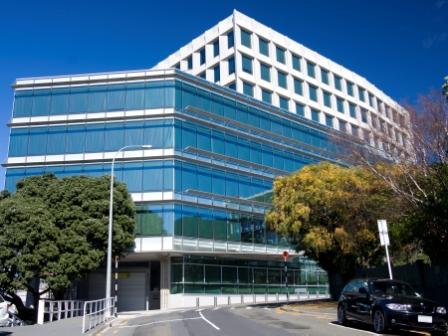
Pipitea House, Home of the GCSB, SIS and NAB.
The GCSB is a signals (SIGINT) and technical (TECHINT) intelligence gathering agency that is part of the Anglophone 5 Eyes or Echelon alliance. Its primary focus is foreign intelligence collection but in specific circumstances and increasingly as of late it can undertake domestic SIGINT and TECHINT work in a “partner” role at the behest of other New Zealand government agencies (such as the Police or Customs). The SIS is responsible for domestic intelligence gathering, counter-intelligence operations and foreign human intelligence collection. It also has a “hand in glove” relationship with other New Zealand security agencies when the occasion warrants. The NAB is the ultimate recipient of intelligence streams from all of the NZIC, where it prepares assessments for the Prime Minister within the confines of the DPMC. The terrorist attacks of 9/11 produced a proliferation of intelligence “cells” in a host of New Zealand public agencies. New Zealand Police, Immigration New Zealand, the Ministry of Business, Innovation and Enterprise, New Zealand Customs Service, and Treasury have their own specialized units. There are also interagency intelligence cells such as the Counter-Terrorism Assessment Group (CTAG), Security and Risk Group (SRG), Intelligence Coordination Group (ICG), and the National Assessments Committee (NAC), with the intelligence from all of these agencies as well as the SIS and GCSB flowing to the NAB, which in turn answers to the Cabinet Strategy Subcommittee on Intelligence and Security (CSSIS). In total, there are 12 intelligence agencies encompassed with the NZIC. The question is whether the proliferation of these intelligence agencies has increased the accuracy, efficiency and reliability of the information obtained and processed by the New Zealand intelligence community. That raises the issue of how the New Zealand intelligence community sees the world around it, how it frames and assesses threats and how it responds to them. In order to determine this, mention must be made of the research methodology underpinning this analysis. Methodology. The focus of this essay is on the SIS, GCSB and NAB because the first two are the lead human and signals/technical intelligence agencies in New Zealand and the latter is the ultimate intelligence assessment and evaluation unit in the country. The perspectives they have on international security matters and New Zealand’s geopolitical context constitute the core of the NZIC’s current assessments and future forecasts of risks and threats. To study what these are, the essay uses the secondary literature dedicated to the theme as well as summary diachronic analysis of the annual reports of the NAB, GCSB and NZSIS (where available), which postulate what are perceived as New Zealand’s most pressing security and intelligence concerns. The summary analysis is diachronic in that it is both chronological and covers four separate governments: the National government led by Jim Bolger from 1990-1996, the Jenny Shipley-led National/New Zealand First government of 1996-99, the 5th Labour government led by Helen Clark from 1999-2008, and the John Key-led National government of 2008-2015. Viewing core NZIC assessments over time and across governments allows us to determine if there were variations in threat perception under each or if they remained constant regardless of who was in power. The Bolger Years. The Bolger government was confronted with significant shifts in its domestic and foreign environment. Domestically, it inherited and was charged with deepening market-oriented economic reforms initiated by its Labour predecessor. Externally, it witnessed the official end of the Cold War. It focused on the former rather than the latter for two reasons. First, because the transition from the welfare state to a market economy was contested, controversial and polarizing, something that demanded the full attention of policy-makers as they embarked on efforts to “deepen” and institutionalize structural reforms. Secondly, because the collapse of the USSR and its Warsaw Pact allies was not seen as directly or fundamentally altering New Zealand’s (largely pro-NATO) foreign policy orientation, regardless of the tensions between New Zealand, France and the US over the issue of nuclear weapons testing and the presence of nuclear powered and armed warships in the South Pacific. This had an interesting effect on the two main intelligence agencies. Under the terms of the 5 Eyes/Echelon signals intelligence alliance “reciprocity agreement” that saw it collect information on the Pacific region (and elsewhere when designated) in exchange for global intelligence collected from its larger signals partners, the GCSB basically served as the local storefront for them. It continued to focus its attention on targets of interest mainly to the partners rather than those of New Zealand itself. This included the communications of former Warsaw Pact members as well as Pacific and Eastern Asian nations and Iran in particular, with the emphasis placed on military, political and diplomatic communications. It included (and includes) monitoring of French communications in the Pacific.[2] It was important for New Zealand to continue to support its Anglophone partners in the 5 Eyes/Echelon signals intelligence network because that was one of, if not the primary method of secure and trustworthy contact after the diplomatic and military fallout from New Zealand’s 1985 decision to adopt a non-nuclear policy (which had the effect of banning nuclear powered and armed vessels from New Zealand waters, which in turn led to the dissolution of the Australia-New Zealand-US (ANZUS) defense alliance). The SIS likewise maintained a special relationship with its Anglophone partners, but given its small size and domestic orientation this was not as crucial to alliance relations as was the reciprocity agreement within 5 Eyes. However, when the Berlin Wall fell the SIS was left without a mission. Its primary focus was (and is) domestic espionage, and in the Cold War period that meant identifying reds under beds. With that concern removed, the SIS was hard pressed to justify its existence beyond assisting the Police on criminal matters, at least when it came to domestic intelligence gathering and counter-espionage (since the thrust of SIS counter-espionage efforts during the Cold War were directed at Soviet intelligence gathering activities in New Zealand and, in the wake of the Rainbow Warrior bombing by French operatives in Auckland harbor, on French clandestine activities in the South Pacific). The SIS assigned itself the task of uncovering new domestic threats, and fortuitously for the agency this was provided by the move to market-driven economics. Besides an ongoing interest in criminal enterprise, opponents to the market-oriented policy shift became the new focus of domestic intelligence concern. These came in the form of unionists, environmentalists, human rights, fair trade and social welfare activists, community organisers, Maori separatists, anarchists and other domestic Left activists unconnected to the former Soviet Union and its satellites. The trouble for both spy agencies was that with the end of the Cold War the ideological conflict between East and West largely died, especially with the adoption of capitalist economics by former communist countries such as the People’s Republic of China and Vietnam. This meant the end of “exporting” revolution by supporting indigenous Left groups, particularly those who advocated armed struggle. As for the French, the arrest, trial and conviction of two French agents over the Rainbow Warrior bombing signaled the downsizing of French intelligence operations in New Zealand in exchange for improved diplomatic relations. The combined result meant that the SIS no longer had foreign-based espionage or subversion to be concerned about when it came to domestic intelligence and counter-intelligence operations. The result was that threat assessments provided by the (then) EAB focused on domestic actors, regional instability and criminal enterprise. Little emphasis was placed on foreign conflicts further afield and little to no mention was made of terrorism beyond the potential for low-level violence on the part of domestic militants. The Shipley Government. The first elected government under MMP, the Jenny Shipley-led National/New Zealand First coalition “deepened” market-oriented policies, the most significant being making trade the centerpiece of foreign policy and developing export markets in Asia, Latin America and the Middle East. This ran in parallel with further opening of the New Zealand market to foreign imports and investment. What this meant in practice was significant foreign policy realignment, arguably one that was built upon and yet more significant than those occasioned by the end of the special trade relationship with the UK and the declaration of nuclear free status. Foreign policy otherwise ran in concert with the “independent and autonomous” stance favoured by both major parties, with continued emphasis on non-proliferation, disarmament and peacetime military operations (particularly regional conflict resolution, humanitarian assistance, and peace-keeping). But the dye was recast: henceforth New Zealand would put trade at the center of its foreign policy and it no longer would privilege the Anglophone world when it came to commercial relations. There was no “issue linkage” between the shift in foreign policy and the orientation of the New Zealand intelligence community. Issue linkage is pursued in order to provide coherency in the approach to foreign affairs. The problem for New Zealand was that its intelligence orientation did not match the new trade-based approach to the international system. Instead, it remained focused on pre-existing domestic threats and the external preoccupations of its foreign partners. The GCSB focus continued to respond to the strategic requirements of its 5 Eyes partners, especially the US and UK. It shared eavesdropping duties in the South Pacific with Australia and traded selected intelligence with France even as it monitored French military and diplomatic communications in the region. Emphasis shifted to include communications in failed, failing and rogue states and those of non-state armed actors. But the mainstay of its eavesdropping and intercepts were focused on South Pacific states, North and Southeast Asia, extra-regional diplomatic communications, international and non-governmental organizations and telemetry from non-5 Eye satellites that disclosed military, particularly naval, communications. The SIS maintained the focus it had under the preceding government, to include monitoring of anti-status quo ideological activists, Aian criminal organizations, and foreign spy networks operating in New Zealand and the English speaking South Pacific. It’s foreign intelligence collection efforts centered on the South Pacific, specifically focusing on domestic sources of instability and the growing influence of extra-regional actors. Foreign terrorism was not a priority even though it began to impact on New Zealand’s major security partners. All of this was reflected in (then) EAB reports. The Fifth Labour Government. The Fifth Labour government headed by Helen Clark looked to be serious about abandoning its Euro- and Anglo-centric view of the world and embracing the notions of trade internationalism, security multilateralism and a diplomatic independence marked by commitment to human rights, non-proliferation and disarmament, regional development in the South Pacific and environmental sustainability. This was evident among other things by its cancellation of a purchase order for F-16 tactical aircraft to replace the aging A4 fleet, which left New Zealand without a combat air wing. It reduced the defense budget across the board and ramped up the trade component of its foreign affairs bureaucracy as it moved to expand and deepen the initiatives begun under the Shipley government. The NZIC perspective did not change significantly immediately after the Clark government was installed in 1999, although increased attention was given to international disarmament, non-proliferation and support for peace-keeping and military missions other than war. Both the GCSB and SIS continued a priority focus on instability in the South Pacific while tending to the requirements of foreign partners, on the one hand (GCSB) and the necessities of domestic espionage on the other (SIS). 9/11 changed that. The unconventional attacks by al-Qaeda on New York and Washington DC, precipitated the global “war on terrorism.” The US opted for pre-emptive war on al-Qaeda, saber rattling at the so-called “Axis of Evil” and other rogue states, and started a war of aggression on Iraq. It sent out a call for solidarity and assistance to the international community, and given its traditional ties to the US, New Zealand could not refuse the request. The question for the Clark government was how to do so without betraying the Left wing of the Labour Party and other Left parties in Parliament (especially the Greens). The answer was found in image management and quiet diplomacy. Security conservatives in the NZDF, MFAT, NAB and DPMC urged the Clark government to use the opportunity to finally repair ties with the US strained since the 1985 non-nuclear declaration. This extended to supporting specialized defense niche businesses based in New Zealand, but was primarily centered on improving bilateral military-to-military and intelligence links with the US as well as strengthening security training and cooperation agreements with Australia, the UK and other Western powers (including France). For the intelligence community the impact was two-fold. The SIS re-directed its energies towards counter-terrorism, specifically in detecting so-called “home grown” jihadis who might be planning attacks on New Zealand soil as well as those who supported al-Qaeda and other Islamicist extremist groups financially or politically (such as via the use of non-profit organizations as fronts for extremist recruiting or for sending money to al-Qaeda affiliated NGOs). Later, under the Key government, this concern turned to the subject of so-called returning “foreign fighters, that is, New Zealand citizens and permanent residents who left to Middle Eastern war zones and were suspected of trying to return to New Zealand having been radicalized and trained by violent extremist groups like the Islamic State. This tasking extended to monitoring the activities of suspected Islamicists in the English-speaking South Pacific and became the dominant preoccupation of its domestic espionage program. The problem with the sudden focus on domestic Islamic terrorists was that there were few to be found. This led to some awkward moments, such as when the 2005 SIS annual report claimed that the primary threat to domestic security were “home-grown” jihadis and al-Qaeda supporters, only to have the 2006 report, under a new Director, abandon the claim entirely in favor of foreign espionage on New Zealand soil (Buchanan, 2007). Likewise, there was a brief media frenzy about a New Zealand based plot to bomb targets in Australia to which the government replied cryptically (thereby fueling public speculation about local jihadis), but in the end not a single person was detained, much less charged for Islamicist-inspired terrorist offenses during the entire term of the 5th Labour government, as well as that of its successor. The SIS continued monitoring of non-Islamic domestic radicals, particularly Marxists, Anarchists, Maori separatists, environmental and animal rights activists. This culminated in the “anti-terrorist” raids of October 15, 2007 where 18 individuals fitting these descriptors (including one with pro-Palestinian sympathies) were arrested on grounds that they were part of an armed criminal conspiracy plotting to commitment politically-motivated violent acts against high profile targets (all terrorism charged were eventually dropped and only four were convicted and sentenced for firearms related charges). It also increased its counter-espionage activities, as growing numbers of Chinese migrants brought with it a concern about PRC espionage activities in New Zealand. Although the SIS did not name the countries it believed were engaged in foreign espionage in New Zealand, successive annual reports indicate that it remained a primary concern for the duration of the 5th Labour government. One effect of the focus on counter-terrorism and domestic extremism is that the SIS lost some of its ability to engage in South Pacific based human intelligence collection. This was particularly evident in its failure to anticipate the 2006 Fijian coup or the 2009 hardening of the military bureaucratic regime installed by it. The GCSB also refocused its energies on the terrorist threat, but its role included using its assets in support of and supplying personnel to the US-led wars in Afghanistan and Iraq (Hager, 2011). GCSB involvement in locating, identifying and targeting al-Qaeda and Taliban “high value” individuals in Afghanistan and Pakistan occurred in spite of the government’s claim that New Zealand was only engaged in non-combat roles (a claim that it also used when questioned about New Zealand Defense Force deployments in Afghanistan and more recently Iraq). The push to show concrete support for the war on Islamicist extremism made for a difficult juxtaposition. By the early 2000s New Zealand was firmly committed to expanding its commercial relations with Asia and the Middle East, yet some of the countries that it was working to establish deeper commercial ties with such as Pakistan and Saudi Arabia were hotbeds of violent Wahhabist and Salafist thought. The contradiction was evident in New Zealand signing bilateral education agreements with Pakistan and Saudi Arabia by which thousands of students from those countries were given visas to pursue university studies in New Zealand without any security vetting. Moreover, the move to re-establish security ties with the US and its allies in the War on Terrorism brought with it the possibility of alienating Chinese economic and diplomatic interests that saw better New Zealand-US security ties as a threat to China’s growing role as a great Pacific power. Since New Zealand was the first Western country to sign a bilateral trade agreement with the PRC, the reaffirmation of its security relationship with the US placed New Zealand in a particularly awkward diplomatic position vis a vis the two rival powers, one that has a distinct possibility of becoming a “Melian Dilemma.” (Buchanan 2010 b) The reassertion and extension of New Zealand’s security ties with the US counterbalanced the thrust of New Zealand’s trade-oriented foreign policy realignment away from its traditional sources of patronage and alliance. For the NZIC there was no contradiction inherent in the juxtaposition of an East-focused trade policy and a West-focused security policy and was, in fact, seen as having the best of both worlds (Buchanan 2010a). Even so, there was an increased awareness within the NAB that in spite of claims about New Zealand’s “benign” strategic environment, the country was increasingly exposed to the repercussions of foreign conflicts, something driven home by the deaths of Kiwis on 9/11 and in the 2002 Bali and 2005 London bombings perpetrated by affiliates of al-Qaeda (none of which were foreseen by the NZIC or its major allies). This forced the NZIC to focus priority attention on irregular threats originating or inspired from abroad, to include domestic sources of funding and recruitment for foreign extremism. The Key Government. The process of rapprochement between New Zealand and the United States came to fruition with the election of the John Key-led National government in late 2008. Key makes no secret of his affection for the US and was determined to overcome the final barriers to full restoration of bilateral security ties with it. The task was accomplished with the signing of the Wellington and Washington Declarations in 2010 and 2011 respectively. These restored New Zealand as a first tier military partner of the US. In parallel, after a number of breaches and spy scandals, then the Edward Snowden leaks, the GCSB saw a series of systems and protocol upgrades designed to address the problem of cyber security while increasing its ability to engage in mass surveillance and hacking operations against targets of interest to the US and other 5 Eyes partners. The GCSB was fully integrated into the 5 Eyes mass data collection schemes as well as providing technical support for US drone operations in the Horn of Africa, Arabian Peninsula, Afghanistan and Pakistan (Hager, 2011). Beyond that its targets include foreign diplomatic and commercial communications, notably those of neighboring Pacific states, diplomatic allies, trade partners, other friendly nations as well as international and non-governmental organizations, interest groups, charities and foreign regulatory agencies. The SIS continued its attention on counter-terrorism, accentuating its focus on Muslim extremists (including so called foreign fighters and home grown jihadis) while continuing its long-standing interest in Maori separatists, Marxists of various persuasion and anti-free trade groups and individuals. As had occurred under the Fifth Labour government, the heightened concern with counter-terrorism continued to divert resources away from overseas human intelligence operations, particularly within the South Pacific. One area that continued to grow in importance for the SIS was counter-intelligence operations. These are mainly directed at Chinese espionage, which includes economic as well as military-diplomatic targets. In concert with GCSB efforts to thwart Chinese and other foreign based cyber-espionage and theft, the SIS focus on counter-espionage became the fourth pillar of its institutional orientation (along with counter-terrorism, domestic political espionage and criminal investigations). Added to issues such as fisheries poaching, whaling, arms proliferation and people smuggling, these concerns comprised the bulk of the threat assessment packages delivered to the Prime Minister by the NAB. In 2010 a reform process was initiated within the NZIC under the banner “one community, many agencies.” The ICG was created and along with the NAB and SRG was re-located in the same building as the GCSB with an eye towards improving information sharing and coordination between them. The SIS was urged to improve its coordination with domestic security agencies and other members of the NZIC in an age of globalized threats. Based on recommendations made in the 2009 Intelligence Agency Review commissioned by the State Services Commission (known as he Murdoch Review), the reforms were driven by the understanding that the NZIC was the product of historical legacies that included adoption of doctrines, precepts, perceptions and policies from foreign intelligence partners that led to a patchwork approach to intelligence gathering and analysis and some “tribal” outlooks on inter-agency dynamics. (Whibley 2014). Notwithstanding these reform efforts, subsequent reviews of the GCSB and SIS found serious issues with legal compliance, organizational dysfunction and misunderstanding or uncertainty about specific responsibilities within the larger division of labour within the NZIC. Public revelations of these failings led to the creation of the Intelligence Review committee whose review and recommendations will be published in early 2016. Conclusion. The New Zealand intelligence community suffered some but not a particularly uncommon degree of institutional lag after the Cold War and the foreign policy realignment of the mid 1990s. Its priorities slowly changed over the 20 plus years that followed the end of the Cold War, but its core areas of interest remained largely unchanged. That was because it did not engage in issue linkage following the foreign policy realignment of the mid 1990s and basically followed the lead of its larger intelligence partners when it came to foreign intelligence priorities and assessments and, at their behest, added terrorism to its list of domestic intelligence priorities. It was slow to react to the threats posed by Islamic extremism and cyber warfare as well as the use of social media for untoward ends, but that was a common problem for all of its intelligence partners prior to 9/11 and the subsequent introduction of “smart” mass communication technologies. Institutional lag in the New Zealand intelligence community is the product of five factors: over-reliance on foreign intelligence streams for information; subservience to allied intelligence requirements and priorities; limited autonomous signals and human collection capabilities; organizational sclerosis and misplaced focus (on the nature of domestic “threats”). The combination saw the NZIC respond reactively rather than proactively to the emerging threat environment in which it is located. In addition, institutional lag in the SIS and GCSB appears to derive from three organizational pathologies: bureaucratic insulation, inertia and capture. Both agencies were until recently very insulated from outside scrutiny, to include that of the Ministers responsible for their oversight and direction. This allowed them to conduct their affairs and determine their priorities in relatively unchecked fashion, to include engaging in operations that stretched the boundaries of their legal charters. In part this was due, and in turn contributed to, bureaucratic inertia. Bureaucratic inertia in the NZIC was characterized by collector bias, organizational complacency, operational redundancy (especially within the GCSB) and resistance to internal and external criticism, administrative change or outside advice. Much of this was rooted in organizational features dating back to the Cold War and recruitment patterns that favored a specific demographic. Until the mid 2000s both agencies were characterized by an “old boys” culture, with limited recruiting outside of pakeha (white European) males, many of who had previous military or police experience. A partial exception is in the GCSB, which fields a significant number of translators. Because of the requirements for native or near-native fluency, recruitment in the GCSB tends to reflect the listening priorities of its 5 Eyes partners more so than those of New Zealand itself. That includes Farsi speakers as well as those who have command of Mandarin and Korean, which means that the recruitment base for translators extends beyond the traditional pool of European males with military or police experience. SIS recruitment of Asians and Maori, while ongoing due to concerns about Asian based organized crime and Maori separatists, was expanded post 9/11 to include females and people of Middle Eastern descent. Although females are now a significant component of both the SIS and GCSB (over 30 percent in each agency), Maori, Pacifika and other ethnic minorities remain a very small percentage of these agencies’ staffs (New Zealand Herald, January 3, 2016). The same can be said for the NAB. More importantly, the overall mindset, again until very recently and perhaps extending to this day, was one that emphasized group cohesion and shared perspectives and logics that placed a career premium on “team players” rather than those who might challenge the status quo or rock the boat. Given the very small size of the NZIC (approximately 600 people, of which 500 work in the GCSB and SIS) this mitigated against substantive reform within it. This organizational culture would not matter, or may not have been allowed to persist, had there been effective oversight of these agencies. But the contrary occurred (and still occurs). Rather than having Ministers and independent oversight agencies such as the Inspector General of Intelligence and Security (IGIS) of and Parliamentary Committee on Intelligence and Security (PCIS) effectively acting as overseers of the agencies that provided a check on their activities, the reverse occurred: ministers, IGs and parliamentary committees were essentially “captured” by the logic and expertise of the intelligence managers who ostensibly reported to them. Given the limited scope of authority and powers made available to IGs and the PCIS (which excluded them from scrutinizing operational matters, among other things), this left them at the mercy of senior intelligence officials for information about agency activities. With such emasculated oversight that provided no counter-weight to what the agencies claimed to be in the legitimate national security interest, the ministers responsible for them (until this year the Prime Minister acting as Minister of Intelligence and Security) were left to their own devices when it came to critically evaluating intelligence assessments and operations (when they were aware of them). Again, this led to their bureaucratic “capture” by their senior intelligence managers and advisors, with Ministers having to take more on faith than knowledge that what the IC was doing was in fact legal, timely when it came to emerging threats and in the national security interest. This was as true for the NAB and other intelligence consumers within the government at large. In practice the quid pro quo for government acceptance of bureaucratic capture by the IC appears to be the supply by the latter (specifically the SIS and GCSB) of politically sensitive domestic intelligence for partisan use by the government of the day. Again, until very recently in light of the Snowden revelations and Kim Dotcom scandal, both major parties seemed confortable with that arrangement, although recent evidence suggests that the Key government was particularly adept at using intelligence agencies for partisan purposes (Hager, 2014). The combination of external dependency and internal conformity contributed the most to the NZIC’s institutional lag. Added to that was the significant depth of organizational culture and practice within the SIS and GCSB, which was resistance to change even after the 2010 reforms and which focused on either debatable domestic threats or the external concerns of New Zealand’s main intelligence partners. This ran counter to the thrust of New Zealand’s mid 1990s foreign policy realignment, particularly with regard to its relations with China and a variety of Central Asian and Middle Eastern nations. That has left New Zealand in the unenviable position of straddling the fence when it comes to its trade and security orientation and partners, something that is arguably untenable over the long term given the divergence interests of and growing strategic competition between the larger partners (Buchanan 2010b). 2016 represents a potential watershed moment for the NZIC. An Intelligence Review will be published that is anticipated will recommend legal and organizational changes to the SIS, GCSB and perhaps other members of the NZIC. Two female lawyers now head the SIS and GCSB, and their tenures have been marked by more transparency and critical self-reflection than in previous eras. Efforts to broaden the recruitment base for the NZIC are underway within the limits of what secrecy and security allow. It remains to be seen if any changes are made to the PCIS and the relationship between it and the NZIC, as well as that between the Minister of Intelligence and Security, the Commissioner of Security Warrants, IGIS and the agencies they oversee. They key to improving oversight and quality control mechanisms is to make them proactive as well as reactive in their scrutiny of agency operations and to give them powers of compulsion under oath (Buchanan 2014). Some measures have been taken in this regard with respect to the authority of the IGIS, but oversight currently remains thin at best. The primary solution to the problem of institutional lag within the NZIC is to develop more autonomous priorities and capabilities. Although doing so in the context of the 5 Eyes system is difficult given alliance commitments, it is not impossible to add a New Zealand centric focus to signals and technical intelligence targeting that does not interfere with ongoing alliance priorities. Even more so, the SIS has the opportunity to redefine its role in a way that is more in line with its relatively limited capabilities, for example, by divesting itself of domestic espionage duties (to the Police) in order to concentrate on foreign human intelligence and counter-intelligence work. For all the good intent of the 2010 reforms and proliferation of intelligence agencies and cells through government departments, it remains unclear if the intelligence gathering, analysis and assessment process in New Zealand has improved or been streamlined to the point of increased efficiency and accuracy of intelligence products. The 2016 Intelligence Review may help shed light on whether that is the case. One thing is certain. If the NZIC is going to confront the security challenges of the 21st century it will have to continue to adapt and reform. Only by doing so can it overcome the problem of institutional lag and the contradictions inherent in issue de-linkage. Because being small and distant is not a secure barrier to global threats, and be they foreign or domestic, the threat environment in New Zealand is constantly evolving and posing new challenges to those entrusted with its safe-keeping. Endnotes. [1] Anonymous correspondent Phillip H. quoted in Charles Hugh Smith, Institutional Darwinism: Adapt or Perish, www.oftwominds.com, February 18, 2010. [2] The French Pacific Fleet is headquartered in Papeete and the French Pacific Army is headquartered in Noumea. Concern with French nuclear testing and instability in former French territories drove New Zealand’s interest in them. References. Buchanan, Paul G. and Lin, Kun Chin (2006)) “Symmetry and Asymmetry in Pacific Rim Approaches to Trade and Security Agreements.” Asia-Pacific Research Universities Research Paper/36th Parallel Assessments Working Paper. http://36th-parallel.com/wp-content/uploads/2012/02/Symmetry_and_Asymmetry_in_Pacific_Rim_approaches_to_trade_and_security_agreements-final1.pdf Buchanan, Paul G. (2007). “A Change of Focus at the SIS,” Scoop.co.nz, February 27. http://www.scoop.co.nz/stories/HL0702/S00257.htm Buchanan, Paul G. (2010a). “Lilliputian in Fluid Times: New Zealand Foreign Policy afterthe Cold War,” Political Science Quarterly, V.125, N.2: 255-279. Buchanan, Paul G. (2010b). “New Zealand’s Coming Melian Dilemma,” Scoop.co.nz, September 14, 2010. http://www.scoop.co.nz/stories/HL1009/S00097/paul-buchanan-new-zealands-coming-melian-dilemma.htm. Buchanan, Paul G. (2014). “Analytic Brief: A primer on democratic intelligence oversight.” 36th Parallel Assessments, May 3, 2014. http://36th-parallel.com/2014/05/03/analytic-brief-a-primer-on-democratic-intelligence-oversight/ Fisher, David (2015). “Just how bad were our spies?” New Zealand Herald, November 6. http://www.nzherald.co.nz/nz/news/article.cfm?c_id=1&objectid=11541220 Fisher, David (2016). “Activist says SIS will struggle to recruit Maori as report reveals spy agencies are ‘old boys club’ that makes racist jokes,” New Zealand Herald, January 3. http://www.nzherald.co.nz/nz/news/article.cfm?c_id=1&objectid=11568617 Hager, Nicky (1996). Secret Power: New Zealand’s Role in the International Spy Network. Nelson, Craig Potton Publishing. Hager, Nicky (2011). Other People’s Wars: New Zealand in Afghanistan, Iraq and the war on terror. Nelson: Craig Potton Publishing. Hager, Nicky (2014). Dirty Politics: How attacks politics is poisoning New Zealand’s political environment. Nelson: Craig Cotton Publishing. Hunt, Graham (2007). Spies and Revolutionaries: A History of New Zealand Subversion. Auckland: Reed Publishing. Patman, Robert G. and Laura Southgate (2015). “National security and surveillance: the public impact of the GCSB Amendment Bill and the Snowden revelations in New Zealand,” Intelligence and National Security, V.30 (Online version published 20 October 2015). Smith, Charles Hugh (2010).“Institutional Darwinism: Adapt or Perish,” www.oftwominds.com, February 18. Whibley, James (2014). “One Community, Many Agencies: Administrative Developments in New Zealand’s Intelligence Services,” Intelligence and National Security, V.29, N.1: 122-135 (2014). http://www.nzsis.govt.nz/publications/annual-reports/ http://www.gcsb.govt.nz/publications/annual-reports/ http://www.nzic.govt.nz/about-us/nab/ http://www.nzic.govt.nz http://www.gcsb.govt.nz/assets/GCSB-Compliance-Review/Review-of-Compliance.pdf An edited version of this essay appears in R. Patman, ed., New Zealand and the World. Singapore: World Scientific Publishing, 2016.]]>NewsRoom_Digest for 9 March 2016
NewsroomPlus.com
Today’s edition of NewsRoom_Digest features 5 resourceful links of the day and the politics pulse from Wednesday 9th of March. It is best viewed on a desktop screen.
NEWSROOM_MONITOR
Noteworthy stories in the current news cycle include: the real estate sector saying dairy land prices have held steady, but that a drop is anticipated following Fonterra’s second cut to the forecast milk pay-out this year; adoption law being labelled as outdated and discriminatory by the Human Rights Review Tribunal; and a review of New Zealand’s two intelligence and security agencies recommending they be governed by a single law.
POLITICS PULSE
Media releases issued from Parliament by political parties today
included:
Government: Support for Volunteering Fund now open; PM welcomes Security and Intelligence Review; Final meeting of Community Forum; Faster accurate patient enrolment data; NZ ratifies Maritime Labour Convention; Sir Graham Henry joins education panel; New product recalls website welcomed; Speech: Peter Dunne – The National Library: Its place in New Zealand’s information society; Opportunity and protection for Māori under TPP; New primary cervical screening test in 2018; Consulting on TPP’s intellectual property implementation
Greens: Government mismanagement threatens “double disaster”; Case for expanded spy powers not made
Labour: Shocking falls in regional growth needs Govt action; Intelligence review must lead to public debate;Tribunal adds to calls for adoption reform; Police districts’ $24.5m underspend while burglaries unsolved; English admits dairy in ‘severe scenario’; Time for Fonterra to front up to media; Nats should have fixed payroll in 2010; Labour Supports Early Access Scheme For Pharmac
New Zealand First: Voting Papers Flawed; Referendum Should End Now – Peters; PM’s Voluntary Catch Reporting ‘A Joke’
LINKS OF THE DAY
GDP INCREASE: Eleven of 15 regional economies in New Zealand increased in the latest regional GDP figures from Statistics New Zealand. Read more: http://bit.ly/1QKjq3C
MARITIME LABOUR CONVENTION: New Zealand has ratified the International Labour Organisation’s Maritime Labour Convention. The Convention will come into force 8 March 2017. It will apply to about 890 foreign commercial cargo and cruise ships visiting New Zealand annually, and approximately 30 New Zealand ships. For more information: http//www.transport.govt.nz/mlc2006
PRODUCT RECALLS WEBSITE: Today saw the launch of a new product recall web tool, a first-stop-shop for consumer product recall information. The product recall web tool can be accessed here: www.recalls.govt.nz.
RETAIL SPENDING UP: Retail spending using electronic cards was $4.6 billion in February 2016, up $393 million (9.3 percent) from February 2015, according to Statistics New Zealand. More details at: http://bit.ly/21XFCSC
SECURITY & INTELLIGENCE REPORT: The report of the Independent Review of Intelligence and Security was launched today. The report is available at: http://www.parliament.nz/en-nz/pb/presented/papers/51DBHOH_PAP68536_1/report-of-the-first-independent-review-of-intelligence
And that’s our sampling of “news you can use” for Wednesday 9th March.
–]]>
Digicel finally granted permission to operate Sky Pacific
AsiaPacificReport.nz
By Peni Shute in Suva
Digicel Fiji has been given three licenses for 12 years to fully operate Sky Pacific, six months after formally acquiring the pay television station from previous owners Fiji Television Limited.
 Attorney-General and Minister for Communications Aiyaz Sayed-Khaiyum outlined in a press conference three different licences given to Digicel Fiji, effective from Monday:
- Broadcast licence under the Television Decree.
- Spectrum licence under the regulations of the National Spectrum Decree.
- Special licence under the Media Industry Development Decree.
Minister Sayed-Khaiyum said Digicel could not show any advertisement unless an agreement with the three existing free-to-air (FBC TV, Fiji One, Mai TV) channels is made.
They (Digicel) cannot advertise on Sky Pacific. Advertisements cannot take place unless all the three free-to-air providers agree to it. So all three of them have veto powers.
Minister Sayed-Khaiyum said the Ministry of Communications would be monitoring advertisements aired by Sky Pacific. He added there were service level commitments built within the licence to protect consumers.
If the Sky channel goes off air, they have to pay a rebate to the subscribers, so if they are off air to four to eight hours there is a one percent rebate, eight to 16 hours there is a two percent rebate, 16 to 24hours there is a three percent rebate and plus there is an additional three percent for every 24 hours that the particular service is off air.

Minister Sayed-Khaiyum said Sky Pacific would be showing 24 channels, most of them existing channels. The minister said viewers could expect a new channel called “TVWAN”.
Digicel Fiji chief executive officer Darren McLean was happy to get the licences from the government after an announcement was made in September last year about the purchase of Sky Pacific.
I want to thank the Fiji government and the Minister of Communications, Mr Aiyaz Sayed-Khaiyum for his commitment in helping to turn this opportunity into a reality.
I would also like to thank our new partner Fiji Television Limited, who has been cooperating well with us and the government in this process. There is a lot more work to do to plan the transition from Fiji TV to Digicel ownership until such time there is no change to Sky Pacific operations and channel lineup.
The focus in the short term is to keep the business focused and delivering for customers, while we plan the improvements that are necessary over the coming months.
Channels of Sky Pacific announced by the minister:
- Super Channel
- MTV
- Nickelodeon
- Comedy Central
- ESPN
- History
- Lifetime
- FYI
- Toonami
- Warner TV
- CNN
- Net Geo Wild
- BCC
- Star Plus
- Colours
- Zee
- FX
- Fox Crime
- Fox Family Movies
- NHK
- Trinity
–]]>
‘I was told it was against kastom for women to be in Parliament’
AsiaPacificReport.nz
“Respect”, as Father Walter Lini famously said, “is honourable”. But despite the enormous social, economic and cultural contributions they make every day, Vanuatu’s women are rarely given the respect they deserve; they continue to be shut out of political life. And yet, as the scandals of the last 12 months have shown, Vanuatu urgently needs better, more representative political leadership. Vanuatu’s full potential can only be realised when it has a gender-balanced leadership that includes, respects and values the enriching perspectives that women bring to political life. Today, on International Womens’ Day, we bring you the powerful story of a Vanuatu woman leader’s journey as she stands up for the right to take part in politics.
By Mary Jack Kaviamu
My journey started in 2008, when I sought the endorsement of community leaders in my home island of Tanna to contest the Vanuatu provincial elections. I didn’t get their approval. I was told it is against kastom for women to be in Parliament, and that I wasn’t prepared to take up such a challenge.
I tried again in 2012, this time paying my candidate fee without the approval of the community chief. When the community leaders learnt of this, they organised a meeting to stop me from contesting. They asked that I give up my candidate fee to a male candidate of their choice, promising in return that they would support me in the 2016 national general election.
I respected their decision and gave my ticket away. Their male candidate failed to win.
In 2015, cyclone Pam devastated Vanuatu, with Tanna being one of the worst-hit islands. Women bore the brunt of the devastation, forcing them to seek out new ways to survive. A realisation began to dawn that it was time for them to stand up and speak for themselves.
After numerous meetings with women groups, the first ever Tanna Women’s Forum was held in October 2015. More than 1200 attended the meeting where women demanded change to a political system that held them down, tied them in poverty, and gave them no opportunity to speak out.
It was a breakthrough moment as many of these women have lived under threat all of their lives.
The women put their heads together and agreed it was time someone took the lead. I was nominated. The women agreed that I would contest the next general election scheduled for late 2016.
Just days later the government announced a snap election, effectively wiping out our time to put together an election campaign. We moved ahead, anyway, with membership numbers now standing at 3700. We had much confidence that we would secure one of the seven seats in the Tanna open constituency.

With very little time to prepare, I took on the challenge with much confidence. That as a solid membership of women we could succeed, and that even if we failed to win a seat, we would learn valuable lessons from the snap election experience that would better prepare us for the next general elections in 2020.
I had so much confidence. I wasn’t thinking of losing; our hopes based on the registration figures signed by women across the island.
Crossing controversial territory
The first obstacle was informing community leaders of our decision to field our own candidate – a woman. Working with a chief that I have close ties to, a community meeting was arranged whereby I would declare and launch my candidacy.
No one uttered a word, except a female friend who stood up, and much to my surprise, said: “I am not in support of women being electoral representatives in Parliament, and I am also against the policy of reserving seats for women.” I took this understandably as coming from someone speaking from her heart, but it also confirmed that the notion that women “do not belong in Parliament” was not held by men alone.
With no financial backing (other than two small personal contributions totalling 15,000 vatu) I had to dig into my own pockets to fund the campaign. I must say the election process is very expensive, with transportation in Tanna costing 20,000 vatu per day. We hired six public transport vehicles for the campaign.
We managed to visit (and revisit in some cases) 19 communities, speaking with roughly 700 men and women. Our slogan was Hemi Taem! (It is time!).
Taking centre stage during the campaigns was the most challenging. The questions and comments raised by communities were not difficult to answer, but there were also tricky ones coming from those who perceived us to be defying kastom.
‘You have not killed a fly or an ant, how can you prove that you can work like men in parliament. You are nothing but a woman.’
‘Our custom and culture perfectly points out your place – which is to look after the children, and mine (male speaking) is to do the talking. Where is your respect for this kastom? Are you from Australia that you don’t know our kastom? Who has given you this right to contest?’
‘Maybe we can vote for you in the provincial council election, but not to parliament.’
‘Our fear right now is the domestic violence law; we do not want our women to take those laws into their own hands.’
‘We don’t want to vote for women, because we don’t want women to have the right over us men.’
‘We don’t want our women to vote for women. If they do, we will divorce them.’
In a lot of places, prior to our campaign meetings, there would be community meetings, most held in the nakamal where “consensus” was often reached for all community members to vote for a particular candidate.
In some cases, I wasn’t allowed to go and campaign – even to speak to just the women. In one case, some women called me and said: “Mary, please don’t come to our community as you will not be allowed to speak here.”
Discrimination and the threat of violence
The campaign revealed that culture is a main contributor to the limitation of woman’s influence in politics. I’ve seen how a lot of people are reluctant to vote for a woman.
We did not receive discrimination from men alone, but women also. The discrimination we received was more on emotional violence. Discrimination against women in the society was very obvious at the time of campaigning and we observed how discrimination was somewhat based on a woman’s age, her marital status, her level of education and economic status.
And as such, a woman may not be considered to be valuable or worthwhile if she does not fit the collective representation of both men and women.
Personally, I was able to endure a male-dominated political campaign period, but stories of threats of violence experienced by some women have just been unbearable. There are many of such accounts, ones that I share with a sad heart.
This is one woman’s account of the threat she received from her partner the night before the poll:
I was already in bed pretending I had fallen asleep for some hours, but my husband came up and woke me up. He held a knife to my throat and demanded that I tell him who I was going to vote for. I was so afraid, I did not speak. He told me to speak or else he would beat me. I started crying. I was short of breath and was shaking. I cried out, “please help me … someone listening outside, please help me!”
But nobody came to my rescue because they were afraid of my husband. He pushed me down, punched me again on my stomach and head, and said he was giving me a chance to speak or else he would beat me up. He knew of my intention to support women in this election.
I begged him to let go of my throat or I was going to die, and I promised him that I was going to vote for the candidate of his choosing.
Another woman also had a similar story.
I saw you talking with those women, but I have stated clearly my rules and you have to follow them. We are going to vote for a male candidate and not for any woman. If you fail my words and I find out the numbers at our polling station, I will make you pay for it.
Other women were reportedly threatened by their partners to show candidate photos after they had cast their votes to prove they voted for a particular candidate. In some polling station, men threatened to divorce or physically torture their wives if results showed a significant number of women’s votes from that particular polling station.
A way forward
Political parties, as we know, are the most important institutions affecting women’s political participation. Even though our group knew we could have more support (moral and financial) from political parties if we ran under one of them, we still made the hard choice of running as an independent candidate.
We had a few reasons for this, with the main one being that bigger political parties filed their candidates in advance, leaving no space for women to contest under their ticket. Secondly, women still have a long way to learn about the processes and lobbying involved in politics.
In spite of the challenges women continue to face, I see a new generation of powerful women flourishing in Tanna. Women with a strong sense of identity and power.
Through our journey, many have come to understand that participation in the electoral processes involves much more than just voting. It is time to exercise the democratic rights that have either been ignored or violated over the last 36 years.
Through our journey in politics, many have come to appreciate that through political participation women can have the freedom to speak out for the first time in the island’s history, which they’ve done through campaigning, assembling, associating and participating.
I have seen the power of ordinary women who have stood up against injustices to say they are tired. I have seen the faces of those who shed tears because of so much ill-dealing and threatening within their homes and communities.
We have started a journey where we will continue to celebrate the united power of women who have taken the first steps to uncovering the multiple forms of discrimination and injustices. We shall continue to seek the empowerment of women to a level where they can think and speak for themselves.
Mary Jack Kaviamu has more than 10 years experience working with provincial government, which included a period as acting secretary-general of the Tafea Provincial Government Council. She worked at the Pacific Institute of Public Policy (PiPP) from 2010 to 2015 to implement a programme of political stakeholder engagement in Vanuatu. She is currently a manager for ActionAid. This article was first published on both Vanuatu Daily Digest and the PiPP blog and is republished by arrangement with PiPP.
–]]>
Vanuatu disaster officials dump tonnes of expired relief supplies
AsiaPacificReport.nz
Tonnes of relief supplies donated to the people of Vanuatu in the aftermath of the category 5 cyclone Pam which hit Vanuatu in March last year have been dumped at the Etas landfill.
Last week, the Vanuatu National Disaster Management Office (NDMO) authorised the dumping of tonnes of food aid because they had expired.

The supplies – including cartons of cans, beans and tomatoes, tin fish, noodles, flour and juice – have been kept in storage at the Vanuatu Mobile Force (VMF) Camp for almost a year after cyclone Pam battered the country on March 13.
“These donations were expired when they reached Vanuatu,” NDMO Director Shadrack Welegtabit told the Daily Post.
“Some of the foreign donations towards recovery were delivered by ship. Due to the long distance, some of the relief supplies were expired or on the verge of their expiry dates when they reached Vanuatu, thus cannot be distributed.
“It is proper for NDMO to dump the expired items instead of distributing them to disaster areas.”
The NDMO director urged all donor agencies to support response efforts through cash donations rather than solicited goods.
Cash donations
He said an effective way to help next time when disaster struck was through cash donations as it would allow relief supplies to be purchased near the disaster site, avoiding delays, steep transportation and logistical costs.
Member of Parliament from Pentecost Francois Chani has raised concerns to why these donations had not reached the affected communities in 2015 when the NDMO recruited a lot of volunteers.
Sources revealed that some members of the public collected the expired Chinese noodles to feed their pigs while some of the clothes and food donations currently on shelves are also near their expiry dates.
Meanwhile, MP Chani told the local media that the Vanuatu community in Queensland, Australia, which supplied 11 containers of assorted food and clothing, o assist the people after cyclone Pam, was still waiting to hear a “thank- you” from the government and a response to clarify where the containers had been sent to assist distribution.
Anita Roberts is a Vanuatu Daily Post reporter.
–]]>
NewsRoom_Digest for 8 March 2016
Today’s edition of NewsRoom_Digest features 3 resourceful links of the day and the politics pulse from Tuesday 8th of March. It is best viewed on a desktop screen.
NEWSROOM_MONITOR
Noteworthy stories in the current news cycle include: the Finance Minister saying there may be widespread problems with payrolls in both the public and private sectors as a result of a law change more than 10 years ago; Fonterra cutting its dairy payout forecast for the second time this year, saying global milk prices are unsustainable; and dairy farm debt reaching $38 billion, with a recent Federated Farmers poll finding more than one in ten are already under pressure from banks over their mortgage.
POLITICS PULSE
Media releases issued from Parliament by political parties today
included:
Government: Strong evidence for new strangling offence; $382 million worth of criminal assets seized by Police; International Women’s Day; Kermadec Ocean Sanctuary Bill introduced
ACT Party:Kermadec Ocean Sanctuary Bill is green-washing
Greens:Govt needs to back up Fonterra suppliers and contractors; Bring the women’s portfolio back into Cabinet;Fonterra payout drop shows holes in Govt strategy
Labour: MBIE payroll debacle shows Joyce’s terrible management;Women’s day time to commit to equal pay; Te Ture Whenua Timeline Wrong; Payroll disaster demands full inquiry; Fonterra payout drop an $8b disaster for rural NZ;Labour Defeats Zero Hour Contracts;Fonterra must pay contractors on time
Māori Party:Strengthening the rights of workers;
New Zealand First: Minister Needs To Front Up On Roast Busters II; Education Ministry Inept And Acting As Bully;Govt left in the dust on electric cars
LINKS OF THE DAY
INTERNATIONAL WOMEN’S DAY: Todays marks International Women’s Day with the theme: #PledgeForParity. More details at: http://www.internationalwomensday.com/
MANUFACTURING SALES RISE: Total manufacturing sales rose in the December 2015 quarter, after a strong increase in the September quarter, according to Statistics New Zealand. Read more: http://bit.ly/1QHuQFj
WOMEN IN WORK INDEX: PwC launched its fourth Women in Work Index, which ranks 33 countries in the Organization for Economic Cooperation and Development (OECD) on a measure that combines five key indicators of female economic empowerment: the equality of earnings with men; the proportion of women in work (both in absolute terms and relative to men); the female unemployment rate; and the proportion of women in full-time employment. More at: http://www.pwc.co.uk/services/economics-policy/insights/women-in-work-index-2016.html
And that’s our sampling of “news you can use” for Tuesday 8th March.
]]>Eva Cox: Feminism has failed and needs a radical rethink

AsiaPacificReport.nz By Eva Cox There was a 1970s badge that declared:
Women who want equality with men lack ambition.This statement neatly sums up the broad intentions of second-wave feminists to create radical shifts of gender power. On International Women’s Day 2016, looking back, I suggest we failed to pursue that agenda and settled for much less. We achieved formal legal equality over the subsequent decade, but moving past that into wider social equity changes seems definitely to have stalled. What went wrong? We knew then that legal equality was only the starting point. We understood that real gender equity would require radical changes to macho cultural power structures. So we planned and discussed the ways we could revalue what matters and eliminate gender-biased, macho-designed cultural dominance. Despite fixing most of the legal barriers, the cultural changes failed to follow. There were other changes happening. By the 1980s the arrival of neoliberalism as the dominant political paradigm slowed most social progress, as market models took over. These changed the political focus from progressive social change to market choices and individualised material success.

One is not born, but rather becomes, a woman.and
She is defined and differentiated with reference to man and not he with reference to her; she is the incidental, the inessential as opposed to the essential. He is the Subject, he is the Absolute – she is the Other.Still the second sex In Australia, women are still clearly the “other”. Our once radical social movement has been diverted into good works such as women’s refuges, counting female victims of violence and calling out sexism. While all these are necessary, there is little focus on offering serious alternatives. Too many women’s groups are plaintively asking for better access to the options open to men, on men’s terms. The current groups seem to have lost the necessary optimism to identify and lead serious changes to the nasty, inequitable and fading market model which not only excludes the social but is showing serious flaws. The damage to social well-being that results from the reliance on unfettered markets is much wider than just the continued poor status of women. There are clear indications of social distress in many developed countries whose austerity cuts have created serious inequality. A review of current public policy priorities at the local level shows few social goals and policies that indicate any serious efforts to make Australia fairer and create better social well-being. The long-term over-emphasis on GDP and financial growth is exacerbating inequalities, with changes focused mainly on punishing the unemployed. The market model stresses paid work only, completely ignoring feminised unpaid, underpaid, often uncounted roles and tasks, most notably the raising of children. These are not included in GDP, but are essential to good social functioning. This shift is clearly illustrated by proposed changes to the funding of children’s services, whose role will move from complementing community/family to servicing GDP growth. In the process, “progress for women” has been reduced to increasing their participation in paid work. This pattern appears in parenting payments and other areas where unpaid contributions are ignored. Similar issues arise in Closing the Gap failures, which emphasise white male models and ignore the value of good social relationships that were once also more important in Western societies. Time for a radical rethink In the lead-up to the 2016 election, voters increasingly distrust the major parties, whose economic emphasis turns them off. Rather than leave solutions to the current holders of power, or some populist alternatives, we need feminist-led setting of social equity goals. Can some good feminist ideas reignite the light on the hill to find ways out of current political dilemmas? Let’s commemorate International Women’s Day this year by offering some bold initiatives that show our concerns are universal, albeit from feminist standpoint. Here are some starting points:
- devise and discuss good social policy goals, which prioritise gender and other equity outcomes, and make them central to the coming election;
- revalue the rewarding the skills and time put into care, relationships, feelings and other social needs that require attention and commitment;
- broaden the agenda and revise our assumptions about what matters to make sure that gender biases are removed from roles such as caring;
- ensure that men recognise their need to be liberated from the limited assumptions about masculinity that also limit their choices and lives;
- abolish the term “women’s issues”: these are social issues that affect everyone, and the label stereotypes women as the second sex who have special interests; and
- acknowledge that women cannot “have it all” because men can’t either, but ensure that both can take on fairly shared responsibilities for essential paid and unpaid roles.
And, as de Beauvoir said, women need to decline to be the “other”, to refuse to be a party to the deal. This would mean for women to renounce all the advantages conferred upon them by their alliance with the superior caste. That’s feminism.
Feminist and author professorial fellow at Jumbunna IHL, University of Technology Sydney. This article was first published in The Conversation and is republished under a Creative Commons Attribution NoDerivatives licence. –]]>Bryce Edwards’ Political Roundup: Death of a radical intellectual

Political Roundup by Dr Bryce Edwards.
Ranginui Walker was farewelled last week by thousands of mourners at Auckland’s Orakei Marae. He occupied many roles during his celebrated life, including academic, writer, educator and activist. Bryce Edwards rounds up some of the best reflections on the life of a remarkable man.
As you might expect, biographer and friend Paul Spoonley gives the best overview of Ranginui Walker’s life and career – see his must-read Ranginui Walker 1932-2016. Spoonley summarises Walker’s impact: “He has helped revise what we understand to have happened through a process of European colonialism. He has explained the nature of ongoing injustice. And he has argued for a very different future.” Neither, notes Spoonley, was he “shy about voicing his concerns and criticism of Maori organisations or leaders.”
Spoonley says Walker was influenced “by radical authors such as Freire, Illich and Gramsci.” Certainly Gramsci’s notion of the “organic intellectual” – explicitly speaking for the interests of the oppressed and seeking to challenge and change the established order – was an approach that characterised Walker’s life.
For a good potted biography see Mana magazine’s He maimai aroha: Dr. Ranginui Walker.
Personal tributes
The tributes have flowed for Walker since his death last Monday. Moana Maniapoto’s Ranginui Walker — no beating about the bush with him is a fascinating perspective on a man who, she says, could seem abrupt but only because of his “preference for cutting to the chase — and never beating around the bush.”
Maniopoto witnessed firsthand Walker’s leadership of the Auckland District Maori Council: “Back then, the Auckland District Maori Council was the hotbed of political discourse — and way more critical than any of the other councils…It wasn’t plain sailing — and I’m not talking about the battle with Pakeha. I’m talking about those council meetings. While there was usually agreement on an issue, there could be fiery disagreements on the tactics.”
According to Maniopoto, Walker “wore the label ‘Maori radical’ as jauntily as he wore his trademark hats. It wasn’t just Pakeha who tossed around the term “Maori radical”, either. After all, Ranginui made many Maori squirm. It’s uncomfortable when one of our own rocks the boat.” At the same time she, she notes, “although many Pakeha saw him as a radical, in Maori settings, he was sometimes viewed as the moderate or even the conservative voice. It depended on the occasion and what other voices were being heard.”
New Zealand Maori Council co-chairperson Maanu Paul said Walker’s “ability to interpret the Maori and non-Maori worlds was his great skill” describing him as “the first race relations conciliator for New Zealand without having occupied the official title” – see Josh Fagan and Elton Smallman’s Academic and commentator Ranginui Walker dies, aged 83. Maanu Paul also emphasised the crucial role Walker played in transforming the Auckland District Maori Council and bringing together urban Maori after the urban migrations of the 1950s and 1960s.
The work of journalists Annabelle Lee and Mihingarangi Forbes has recently led to controversy and debate around the role of Maori journalists in reporting on Maori organisations – especially because of their reporting for Maori TV’s Native Affairs. In Dr Ranginui Walker: Devoted to the truth. Lee and Forbes acknowledge the encouragement and support they received from Walker privately and publicly when he wrote to the New Zealand Herald supporting their work.
When they eventually left Maori TV, Ranginui Walker wrote to them saying: “Native Affairs is the modern day marae where a person should be blown about by the wind and shone on by the sun. Then we will know the truth.”
Lee says she would often consult Walker for his perspective on the story of the day and she wonders “who this next bunch of journos will be able to call on to do the same?” Lee (@huihoppa) also tweeted from Walker’s tangi, to say “The National govt @Johnkeypm and @chrisfinlayson snub Dr Ranginui Walkers’ tangi no one sent to honour the former Waitangi Tribunal member”.
Anne Salmond says Walker was Devoted to his people, and to truth. She recalls the 1970s at Auckland University as “stirring times”: “Patu Hohepa and Ranginui were working closely together – “Patman and Rangi – the Caped Crusaders”, as the students called them” speaking out on issues affecting Maori and laying the groundwork for activism with their analysis, leadership and teaching.
Picking up on Walker’s note to Lee and Forbes, Salmond said “Ranginui believed this about universities as well – that they should be marae, places where truth emerges from inquiry and the cut and thrust of debate, where people stand to be blown about by the wind and shone on by the sun.”
Salmond continues: “The job of a scholar, like that of a journalist, is to find their way to the heart of the matter – past self-serving interests and misleading appearances. At times, being a scholar takes courage as well as insight. Ranginui had both. He was brave as well as lucid. If something was supported by the evidence, and needed to be said, he would say it, even if he was vilified for it… Ranginui was fearless, intensely rational, passionate and incisive… what he and Patu and others achieved with the power of the pen and the mind, it seems like a miracle.”
In Tom Fitzsimons’ Obituary: Ranginui Walker, powerful advocate for Maori, 1932-2016 he looks at Walkers politicisation and recounts his tale of coming face to face with “frightening and intimidating” young activists: “Me, I was a conservative, part of the system … and they were talking liberation, brown power, Black Power rhetoric from the United States … To me, it was a learning experience.”
Tim Selwyn’s Obituary: Ranginui Walker 1932-2016 gets off to an ominous start: “Ranginui is a national treasure, respected kaumatua, rangatira, scholar, one of the few who refused to take a knighthood when the National government brought them back in, a gentleman, a hit with the ladies, all round top guy in everyones reckoning. But I never really liked him. And he didn’t really like me.”
Nevertheless, Selwyn’s obituary manages to be one of the most thoughtful and admiring accounts of all. Selwyn writes “I never got to experience the warm and generous side of him that others have relayed. I found him to be a forceful and charismatic personality who didn’t suffer fools. A very sharp mind, a quick wit. At times ascerbic. A direct, Pakeha, way of presentation. Huge ego. Tough. He didn’t just want to spout he wanted to do something about it. He was a man of thought, a man of action.” He describes Walker as “always controversial. Admirably so. Inspirationally so… Saying upsetting things to smug audiences… was simply what he did.”
Selwyn asks: “Is it any wonder his sense of grievance was so palpable given the proximity to the eye witnesses to history”: “He grew up in the Waiaua valley east of Opotiki in the time of the first Labour government. That Opape block was designated an inalienable reservation at the time of his childhood, that safeguard was soon to be lost as the process of colonization continued. He was old enough to have seen and heard the last survivors from the NZ government’s invasion and punitive occupation of the Whakatohea homeland of 1865.”
In contrast, Morgan Godfery emphasises Walker’s gentle, kind and generous nature in Radical and inspirational, gentle and generous – an obituary for Ranginui Walker. He describes Walker as “Humble without ever becoming deferential, egalitarian without ignoring difference, and inspiring without turning to flattery”, and says for a generation of Pakeha Walker was “the primary translator of Maori politics and protest.” He notes Walker was not content to be “confined to spokesperson on “Maori” issues. In his columns and media appearances he would often voice support for workers’ rights and international human rights.”
Godfery argues Walker saw his academic work as “applied politics” approaching “theory not only as a way to make sense of the world but as a method for changing it.”
Struggle without End
Recently, The Spinoff compiled The greatest New Zealand works of non-fiction ever – the Team Brown remix, and ranked Walker’s book, “Ka Whawhai Tonu Mātou: Struggle Without End” at four, out of all Maori publications. Leonie Hayden and Morgan Godfery compiled the list and noted that the book is “more than accumulation of historical facts, it’s also a stunning work of cultural and political criticism.”
At #35 on the list, they put “Ranginui Walker’s column in the Listener (1980s)”, alongside Syd Jackson’s Metro columns. The judges said Walker and Jackson “translated the struggle for Maori rights into language Pakeha audiences might understand”. They also note: “Unfortunately Jackson and Walker were both the first and the last as there are now no regular Maori columnists in the mainstream media.
In 2004 Janet McAllister reviewed Walker’s revised Struggle without End. McAllister says Walker thought he was done with the book at the end of 2003 but then, in his words, “in the New Year Don Brash opens his mouth in his Orewa speech”. McAllister reports “The anthropological doctor was “so pissed off” with the economic one that he reopened the book.” Walker said of Brash “I have no time for privileged people who take advantage of their privileged position to attack the weakest people in our society.”
Walker also believed Labour’s Foreshore and Seabed Act showed the “colonial mindset” was alive and well.” You can read his Listener column at the time, which opens “I have been here a thousand years. You arrived only yesterday” – see: “Dear Crown – An Open Letter to Helen, Bill, Richard, Peter, Jeanette and Jim”. Interestingly the letter finishes: “PS: Winston has been exempted from this missive because he and I belong to the Mataatua waka.”
McAllister says Struggle without End largely “explains and dissects potentially explosive subjects in a non-confrontational, clinical style” but Walker “just can’t keep his combative side down.”
Ranginui Walker’s own words
We get a recent glimpse of Walker’s “combative side” in Jevan Goulter’s short video tribute, in which Walker states “The Government confiscated 173,000 acres of our land. And the prick who did it was Governor Grey. The hit man of British imperialism” – see: Remembering Dr Ranginui Walker.
The footage was from the Morgan Foundation’s recent Talk Treaty Project and you can see more from Ranginui Walker in Why do Maori keep wanting to talk about public power and sovereignty?
Smaller snippets from Walker can be found here: What the Treaty says about public power, The biggest challenges facing urban Maori, Positive steps towards restoring Maori sovereignty and How would you spend a million dollars to benefit Maori.
After the publication of Paul Spoonley’s biography of Walker, Kim Hill interviewed Walker – you can listen to the 45 minute here: Ranginui Walker: eyes of a warrior.
Jeremy Olds has Ranginui Walker’s final Fairfax interview conducted in November last year. In a wide-ranging interview Walker spoke of the Importance of a good work ethic, his motivations and his optimism for Maori and New Zealand as a whole.
Walker says as an academic he believed he ought to be “the critic and conscience of society. I embraced that role and tried to educate Pakeha through the Listener columns I wrote. That was an eye-opener – for Maori as well. That is the job of an intellectual – to try and change society and public perceptions… And that’s one of the great satisfying things about my life – that I didn’t have to go into politics to try and change the world.”
Controversial views
Reporting Ranginui Walker’s death, TVNZ chose to highlight his critique of New Zealand’s immigration policy, showing a clip of Walker saying “Close the immigration door completely… I object to people from all those countries coming here… If that trend continues, we will ruin New Zealand. We will make it just like any other part of the world” – see: Ranginui Walker hits out at the volume of immigrants coming into NZ.
In Puawai Cairns and Paora Tibble’s Tribute to Emeritus Professor Ranginui Joseph Isaac Walker published on Te Papa’s blog they say “Ranginui Walker, with his dual Lebanese and Maori ancestry, also had an intrinsic understanding of the complexity and unease for Maori who live with dual and plural identities.”
In fact, The Listener’s obituary for Walker, ‘I have great optimism’, reminds us that “Walker championed intermarriage, which he regarded as “the browning of New Zealand”, even shocking a 1970s audience of school principals by saying the race relations war was partly being solved in the nation’s bedrooms.”
He repeated that sentiment again in 2010 saying “The lizards of our colonial past are being laid to rest in the bedrooms of the nation” – see Walker’s Listener column, State of the nation. He continued: “That is certainly the case in my family, which is not exceptional. Our children, who could have assimilated into the social mainstream, opted to identify as Maori of their own volition. They brought into our life an Irish son-in-law, a Thai daughter-in-law, one Maori daughter-in-law and nine mokopuna. All nine of our mokopuna identify as Maori. Five of the adult mokopuna have Pakeha partners. We love them all. My Pakeha sister-in-law has three Maori daughters-in-law, one Pakeha son-in-law and one European son-in-law. The offspring of the unions in our whanau are the new New Zealanders, the browning of the country by a new generation who see no future in the oppositional discourse towards Maori that pervades our media.”
Less than a year ago, Walker published an article on the AUT Briefings Papers website, which is surely one of his final publications – see: The Conversation. He views the current state of politics rather positively. For example, he talks about John Key forming a coalition with the Maori Party: “That is the closest the nation has come to honouring the compact the Crown made with rangatira 174 years ago.”
And he makes the important point that recently “a barely noticed social transformation has occurred, the emergence of a Maori middle class trained in arts, science, medicine and law… and the Maori middle class is reflected in the political spectrum. Winston Peters, Tariana Turia and Metiria Turia are leaders of New Zealand First, the Maori Party and the Greens. The Key Government has three Maori Ministers in Cabinet, Paula Bennett, Hekia Parata and Simon Bridges.”
Finally, for a few caricatures of Walker over recent years, see my blog post, Cartoons of Ranginui Walker, 1932-2016.
]]>NewsRoom_Digest for 7 March 2016
Today’s edition of NewsRoom_Digest features 2 resourceful links of the day and the politics pulse from Monday 7th of March. It is best viewed on a desktop screen.
NEWSROOM_MONITOR
Noteworthy stories in the current news cycle include: the Ministry for Primary Industries launching an advertising campaign calling for people to report livestock mistreatment; Landcorp’s decision to retreat from mass dairy farm conversions in Waikato being praised by Greenpeace and the Green Party; and the principal of Avondale College saying that teenagers’ literacy and numeracy skills could be tested separately from the NCEA (National Certificate of Educational Achievement).
POLITICS PULSE
Media releases issued from Parliament by political parties today
included:
Government: Communities of Learning impress at ISTP; Double Te Reo Māori celebration for Wairoa; Minister seeks report on Dunedin balcony collapse; Data shows outcome of GP referrals for 1st time; Talking TPP – the road shows begin; Rheumatic fever rates drop 45 per cent; McCully to visit Singapore; Women Entrepreneurs Week
ACT Party: Seymour calls on Government to remove iwi tax exemption
Greens: Police investigating complaints against themselves; Greens Call For IPCA To Become Officer Of Parliament; Green Party Applauds Landcorp’s Brave Decision; Spy law change needs support of ALL political parties
Labour: New funding won’t fill existing gap; Time to review numeracy and literacy requirements; Recreational fishers to report their catch; Landcorp dairy conversion decision a no brainer; EQC hiding another botch up
Māori Party: Māori Party Co-Leader Marama Fox Celebrates Te Reo Milestone For Wairoa
New Zealand First: Mt Cook Station Sale At Last Good News For NZ
LINKS OF THE DAY
BOWEL CANCER: Bowel Cancer New Zealand is concerned there is still no statistically significant improvements in bowel cancer survival rates for 2006-2010 in New Zealand compared to nearly 4% improvements in bowel cancer survival for Australian men and 5% for Australian women. More information on bowel cancer and BCNZ can be found at: http://www.beatbowelcancer.org.nz
WHOLESALE TRADE SALES: Wholesale trade sales fell in the December 2015 quarter, after a strong September quarter, Statistics New Zealand said today. Read more:http://www.stats.govt.nz/browse_for_stats/industry_sectors/wholesale_trade/WholesaleTradeSurvey_HOTPDec15qtr.aspx
And that’s our sampling of “news you can use” for Monday 7th March.
]]>Academics, African leaders, youth call on police to apologise
AsiaPacificReport.nz
By Anna Majavu
Prominent Auckland academics and community leaders have called on the New Zealand police to formally apologise for “rubbishing” new research alleging that police are racially harassing and assaulting African youth.
The two-year research project was led by Auckland University of Technology associate professor in social sciences, Dr Camille Nakhid.
Last week, New Zealand police issued a press statement claiming that the research was nothing more than “unsubstantiated claims from anonymised individuals” made online.
Yesterday, at the official launch of the research in Mount Roskill, Auckland, about 400 people called on the police to acknowledge that the research was credible and legitimate.
AUT associate professor of public policy, Love Chile, said the police had been “completely dismissive”.
“This research went through a stringent ethics approval. We are demanding an apology”, said Dr Chile.
Dr Chile called on police to issue everyone they stopped with a leaflet advising them of their human rights, similar to those displayed in hospitals.
‘Tip of the iceberg’
“The issue of racism within the police is fundamental. We may deny it but what we are seeing in this report is only the tip of the iceberg. Insidious racism has to be addressed” said Dr Chile.
Noah Ghebremichael, vice-president of the African Communities Forum Inc. (Acofi), also called on the police to retract their claims that the research was unsubstantiated.
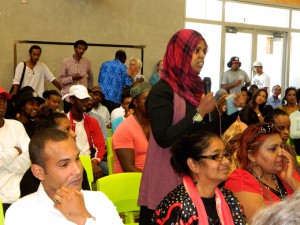
Presenting the report, co-researcher Kizito Essuman said it was very unfair that the positive relationship African youth organisations had tried to foster with the police did not seem to positively influence the culture of policing on the streets.
Dr Nakhid emphasised that the alleged police abuses were not isolated incidents.
“It is not one or two police. It is a police culture” said Dr Nakhid.
The police abuses of African youth had far reaching effects – the African community in general did not trust the police and so even when they were victims of crime, they did not always call the police, Dr Nakhid said.
Māori activists at the meeting welcomed the new research, pointing out that Māori were the original victims of police racism.
‘Country based on racism’
“This country is based on racism. If you stand up now, maybe you can stop the mass incarceration of African youth” said one speaker.
The police have said they will not take action based on the research unless individual participants (whose identities were protected in the report) come forward and lay complaints.
This was rejected by the audience at the meeting with one speaker saying that the Independent Police Conduct Authority of New Zealand was not “independent” at all, but was “80 percent police investigating police”.
Dr Nakhid said instead of arguing about why African youth did not come to police after being abused by other police, the police could solve the problem by ending their mistreatment of African youth.
Members of the audience also rejected the notion that the arrests and alleged abuses of African youth may have come about because of “unconscious bias” on the part of the police.
With “prisons full of Māori and Pacific Islanders, that is a bit more than unconscious bias” said criminologist Dr John Buttle of AUT, while another speaker said Muslim youth were also racially profiled by the police.
The police, represented at the meeting by Senior Sergeant Joe Tipene, the police Māori Responsiveness Adviser, would not commit to apologising for their dismissal of the report and maintained that “the full details of everything that has been said” should be brought to them.
Anna Majavu is an independent journalist and a former contributing editor on the Pacific Media Centre’s Pacific Media Watch freedom project.
Photo gallery at the forum by Del Abcede
–]]>
High risks for Fiji divers in Pacific documentary ‘disturbing’
AsiaPacificReport.nz
Trailer for Le Salaire des Profondeur, a deeply disturbing New Caledonian film about the fate of Fijian fishermen diving for sea cucumbers.
By Christina Milligan in Pape’ete
The 13th Festival International du Film Documentaire Océanien (Pacific International Documentary Festival) was held recently in Tahiti, attended by filmmakers from throughout the Pacific.
 FIFO, as it is known, is an important event for bringing attention to Pacific films which sometimes struggle for attention outside their home territories.
An outstanding example this year was the film Le Salaire des Profondeurs, a film from New Caledonian filmmakers Dominique Roberjot and Christine Della-Maggiora. This film explores the fate of Fijian fisherman diving for sea cucumbers in an illegal, unregulated environment which exposes many of them to injury, even death.
It is a deeply disturbing, politically challenging story which deserves a wider audience.
The festival screens a small number of films in competition, with a much wider selection of features and shorts screened outside competition. Prizes are awarded by an international jury, which this year was headed by Abderrahmane Sissako, the Mauritanian director who expressed his deep appreciation for the work that FIFO does, and the connections that he felt between the indigenous people of the Sahara and of the Pacific.
Jury prizes were awarded this year to the New Zealand films The Ground We Won and The Price of Peace, and to the NZ-Tahitian co-production Tupaia. Honourable mention was made of Le Salaire des Profondeurs.
And the audience prize, awarded by public vote, went to the New Zealand film Hip Hoperation.
A compilation of trailers for the 11 films entered in this year’s FIFO in Tahiti.
The Grand Prize was awarded to Another Country, directed by Australian Molly Reynolds. This film follows the great Aboriginal actor David Gulpilil back to his home territory and is a searing indictment of the damage done to the Aboriginal people by colonisation.
Co-creator and chair of FIFO, Wallès Kotra, has commented that the festival is “at least as popular with grandmothers as with the young” and visiting filmmakers find this engagement by the people of Tahiti one of the truly charming aspects of this festival.
As New Zealand filmmaker Lala Rolls comments: “These stories are Pacific stories that it is right to share in our own neighbourhood. They help reflect on and build the Pacific community, often with shared heritage, cultural similarities and values.”
Christina Milligan is a film director and producer, and is also a lecturer in documentary making and screen writing at Auckland University of Technology. She was co-producer of The Price of Peace, one of the jury prize-winners at FIFO this year.
FIFO 2016 – the 13th Pacific International Documentary Film Festival
New documentary gives fresh side to Tame Iti story
–]]>
Fiji’s ruined houses need better building in wake of Winston
AsiaPacificReport.nz
Day 9 – Alex Perrottet reporting on Skype on Monday from Vanua Balavu for RNZ’s Checkpoint
By Alex Perrottet of Radio New Zealand International
Around half of Fiji’s houses will have to be rebuilt after the devastation caused by Cyclone Winston, damage assessors say.
In the worst-hit areas, villages have been destroyed, and tens of thousands of people are still in evacuation centres as they wait for long term shelters to be set up.
Teams of builders and engineers say they will submit reports saying many ruined houses were simply not built to standard.
In the Lau Group, just off the coast of Vanua Balavu, the Fiji government ship MV Cagivou carried aid and damage assessment teams representing almost every ministry, from energy to education.
A supply boat from New Zealand’s multi-role HMNZS Wellington also arrived with a load of 10-litre water containers.
Lieutenant Leroy Judge, the man in charge of the initial deployment, said the Wellington had a desalination plant “so it can keep producing as much water really as required until it essentially runs out of diesel.”
The day before it had produced about 3000 litres and that day it gave some 2000 litres to the closer islands.
The Cagivou was running late. Crew members started to fill containers from the ship’s own water tank but the browner shade was a sign it would need to be boiled, and the message was sent out to the island.
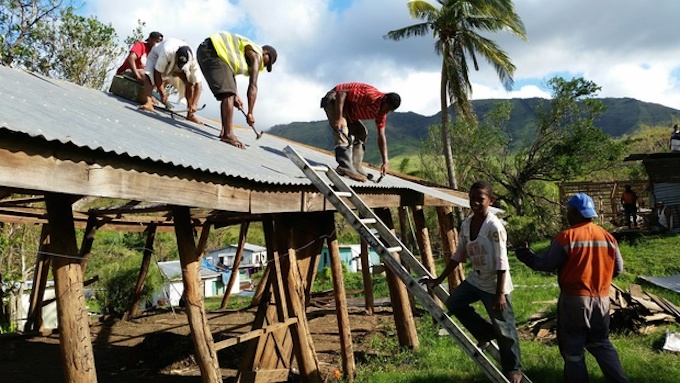
Destroyed homes
Lomaloma school had become the military post. Out front, the almost compulsory game of one-touch football was underway.
But next door, in Lomaloma village, no one was playing football. People were cutting up dead trees and burning them along with ruined possessions.
Titoka Nakavulevu, the turanga ni koro (chief), explained that 52 of the village’s 60 houses had been destroyed.
Hundreds of tents were at the command post, and Titoka Nakavulevu was grateful they had arrived – but they had not quite been dispatched to the villagers yet.
Jesse Delailomaloma has set up a tiny tarpaulin on a small slab so his wife and grandson can sleep above the ground. Next to it is a pile of wood and tin that used to be their house.
He was waiting for the tent supplies and was not sure when they would get them. However, the first thing he needed was his house.
“Never mind the food or what, just the house to cover me from the sun and the rain.”
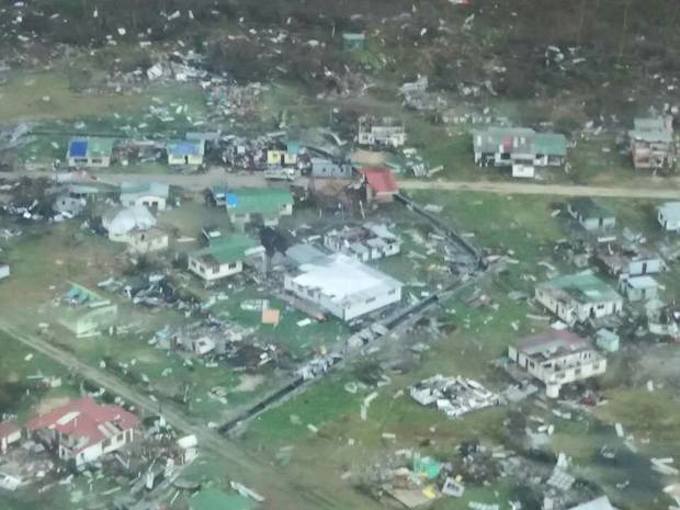
‘Six months to two years’ in tents
Commander Humphrey Tawake is in charge of the mission and said there was a reason for the delay.
“That was supposed to be done yesterday but we had a bit of difficulties,” he said.
“All the vehicles here are privately owned, so you have to have some sort of understanding.
“They pay for their own fuel and we have to make some sort of arrangements that is a balanced approach so that they get their money’s worth and the assistance is given. Having said that, those will be gone by this morning.”
But the commander said they would not be enough. He needed more than 800, immediately, and they had to be good enough to house people until their homes were rebuilt.
“The tarpaulins are not good enough, because the houses I’ve seen here, we need tents that will accommodate from six [months] to two years. People can live in them, because some of the reconstruction material and some of the tarpaulins won’t last.”
Building techniques exposed
Savenaca Volau is an elderly man who crawled with his wife under the floorboards after half his house was ripped away by the storm and the furniture was blown out.
He argued Fijians would be better off building their traditional bures, made from coconut palms and bamboo, as most people died from corrugated iron and glass cuts or crushing concrete.
“The young people now, they don’t know how to do that kind of Fijian roof. Only the people, those old people, but we people. I can make it, I can make the thatch.”
Mr Volau agreed it was important to teach the next generation how to build the thatches.
“But this people here, the new generation, they don’t like the old one, I don’t know why.”
Engineers on board the Cagivou said they had seen multiple building errors in the ruined houses. Incorrect strapping methods and cost-cutting short cuts in the foundations were evident on the islands, far away from from the scope of government regulators.
The chief, Titoka Nakavulevu, saw the whole experience as having served as a lesson.
“It really teach us to safe, to build a proper house preparing for the hurricane, for the long term, for our families.”
Titoka said he would take his lead from the government, and the engineers agreed. They said the government needed to put out rebuild tenders to private companies who could bear the burden of compliance.
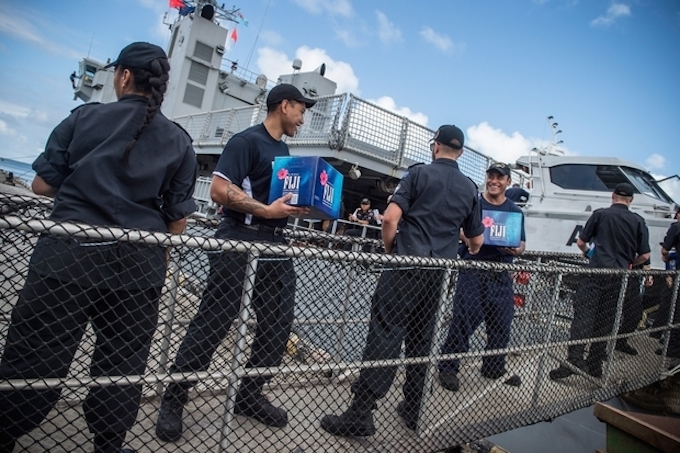
Unprecedented cyclone
But everyone agreed with Commander Tawake that this cyclone was unprecedented.
“You have storm surge, you had the cyclone and the wind, then you have … tornadoes.”
“Prior to that, for a couple of days we were having tremors, earthquake tremors, and it was like they were swimming in a swimming pool with tornadoes flying, roofing irons flying everywhere.”
He felt that with that combination the traditional bure would not survive.
“And the one thing that we must be, that we are, thankful of is that those who lost their lives [were not as many] as we would have expected with the level of devastation that is here.”
Commander Tawake said whatever the building style, it had to meet standards and be kept small. Bigger houses with greater surface area were more vulnerable to strong winds.
He said that at least 50 percent of Fiji had to be rebuilt, house by house, and that was going to take some time to finish.
Alex Perrottet, a reporter of Radio NZ International, has spent the past two weeks in Fiji reporting on the aftermath of TC Winston, often venturing to the most devastated remote parts of the country. He is a former Pacific Media Watch contributing editor at the AUT Pacific Media Centre and a Masters in Communication Studies graduate.
–]]>
Selwyn Manning Editorial: Mouths Firmly Shut – Is A Cover-up In Play?

[caption id="attachment_183" align="alignleft" width="150"] Selwyn Manning, editor.[/caption]
Editorial by Selwyn Manning.
Respected New Zealand Herald journalist Phil Taylor’s reportage this week has again raised concerns about poor Government transparency.
I also spoke on the issues raised in Phil Taylor’s report, on Radio New Zealand’s The Panel with Jim Mora.
Selwyn Manning, editor.[/caption]
Editorial by Selwyn Manning.
Respected New Zealand Herald journalist Phil Taylor’s reportage this week has again raised concerns about poor Government transparency.
I also spoke on the issues raised in Phil Taylor’s report, on Radio New Zealand’s The Panel with Jim Mora.
 Metro – Eyes Wide Shut, May 2011.[/caption]
his Metro magazine expose titled Eyes Wide Shut was published.
The Herald began digging in to this issue after the National-led Government was forced by the Court to pay Jon Stephenson an undisclosed sum. The settlement came with conditions where both parties were not to discuss the proportioned values of that settlement. It is important to point out, those conditions do not prevent the Government from facing up to its public interest responsibilities, to enquire and speak out on what went on up in Afghanistan and why it attempted to shut this issue down through shoot-the-messenger tactics.
Phil Taylor’s reportage shows the stonewalling continues and details how:
Metro – Eyes Wide Shut, May 2011.[/caption]
his Metro magazine expose titled Eyes Wide Shut was published.
The Herald began digging in to this issue after the National-led Government was forced by the Court to pay Jon Stephenson an undisclosed sum. The settlement came with conditions where both parties were not to discuss the proportioned values of that settlement. It is important to point out, those conditions do not prevent the Government from facing up to its public interest responsibilities, to enquire and speak out on what went on up in Afghanistan and why it attempted to shut this issue down through shoot-the-messenger tactics.
Phil Taylor’s reportage shows the stonewalling continues and details how:
1) The Government spent $1 million on failing to defend itself after it apparently defamed journalist Jon Stephenson, after he exposed potential breaches of international law by New Zealand Defence personnel in Afghanistan.
2) The Government’s star witness, an Afghani security unit commander, refused to testify via video link from Afghanistan, but insisted he be brought to New Zealand.
3) Once here, the commander’s testimony was found to be untrue.
4) Despite this he was left to wander off around New Zealand without supervision.
5) He failed to take his return flight to Afghanistan, but has since claimed asylum and is seeking to stay here permanently.
Would there be an inquiry into whether or not the commander committed perjury, and whether the Defence Force was gamed?
Gerry Brownlee answered “no”. Frankly, such a response fails to serve the public interest, and leaves one wondering: what has the Government got to hide. This is serious stuff. The public deserves to know:1) What really happened up there in Afghanistan
2) Why the Government appears to be shying away from revealing the facts and context of this affair
3) Why it appears the NZ Defence Force permitted its Afghani commander witness to wander off without supervision, especially after he may have committed perjury
4) And ultimately, who is possibly culpable or entangled in what may have been a significant breach of international law during the time New Zealand Defence personnel were operational in Afghanistan.
Bryce Edwards’ Political Roundup – Cancer drugs – the case against Keytruda

Political Roundup by Dr Bryce Edwards.
Cancer drugs – the case against Keytruda – (See Also: The Case for Keytruda.)
[caption id="attachment_4808" align="alignleft" width="150"] Dr Bryce Edwards.[/caption]
Is Pharmac’s decision not to prioritise funding melanoma drug Keytruda a case of “putting money before people”, or is it the inevitable outcome of making rational choices with limited resources? Yesterday, in part one, Bryce Edwards looked at The case for Keytruda. In part two he looks at the case for Pharmac’s independence, and therefore against the immediate funding of Keytruda.
Who among us could refuse desperate cancer patients begging to have access to a potentially life saving drug? Not their families and friends, not the wider public and certainly not politicians. Politicians can be all of those things – cancer patient, family, friend – and they must also contend with intense public pressure and the siren call of votes.
That’s precisely why Pharmac is so important, say its supporters. It’s seen as a useful mechanism to rationally make good public health medicine funding decisions without the influence of emotion or even populism contaminating a good process.
Back in December Kevin Hague summed it up by saying: “There is always more demand on the health dollar than there is dollars to spend. That is why we have a system, reasonably free of political interference, that buys the most drugs at the best price to provide to the most number of New Zealanders. It is a system that by and large works and we support keeping it that way” – see: In defence of Pharmac. He says the main problem is “the pharmaceutical budget simply isn’t big enough, and is declining in real terms because of the underfunding of DHBs.”
In Hague’s view, the alternative is that we have dishonest debates where politicians are happy to ride in on their white horse but will not take responsibility for the repercussions of their actions. He says that’s what’s happening in the Keytruda debate and what’s missing is the acknowledgement that “If $30Mn is spent every year on Keytruda, it won’t be available for other people with different conditions, on drugs for which it says it has better evidence of health gain.”
It’s a point echoed by James Dann earlier this week: “the people who aren’t in this equation are the people whose treatment would have to be defunded. This is a zero sum game, and to fund one treatment, you have to defund another… To pitch one group with disease A versus a group with disease B would be an horrific spectacle, if we did have to watch it play out in public. So we don’t. We trust that a group of medical and pharmacological experts will weigh up all of the evidence, and come to conclusions for us” – see: Keytruda, Pharmac, and the zero sum game of drug funding. Dann argues “The political debate around this should focus on the amount we spend on drugs, not which specific drugs are funded.”
Writing in this week’s Listener, Jane Clifton says we are faced with the “dismaying prospect of reducing drug funding to a beauty parade. If politicians keep acceding to public campaigns by groups of particular patients, the health system could degenerate into a sick parody of X-Factor, with one illness lobby competing on the steps of Parliament to be more appealing than another.”
For more on why Pharmac should be trusted to make drug buying decisions see the Herald editorial, Govt ought to keep clear on medicines.
While not all clinicians seem to agree with Pharmac’s initial decision on Keytruda, the University of Otago’s Tony Blakely provides some in depth cost-benefit analysis in support – see his blog post, Is Keytruda for advanced melanoma cost-effective? Applying the BODE3 rapid cost effectiveness calculator.
Labour’s political interference
Labour has been on the receiving end of a wave of criticism this week for it’s pledge to overrule Pharmac and fund Keytruda if elected. Hague is strongly critical of Labour’s proposal saying “we have been there before” with National’s 2008 campaign to increase funding of Herceptin. He argues that “political interference almost always ends up in less health gain, not more.”
In his column today in the NBR Matthew Hooton writes: “Against much competition, opposition leader John Key’s intervention in 2008 on behalf of Herceptin ranks as perhaps the most disgracefully cynical stunt in recent political history but opposition leader Andrew Little may have trumped him with Keytruda.”
In his column, King tarnishes reputation over Keytruda at end of career (paywalled) (http://bit.ly/HootonKeytruda), Hooton takes special aim at Labour’s health spokesperson Annette King who he believes is selling a new stance that she doesn’t actually believe in. He also argues that if Pharmac’s decision on Herceptin and Keytruda were flawed then a different approach is necessary: “a sensible policy response would be either to dramatically increase the funding or reform the model.”
Tracy Watkins also says that Cancer sufferers should not be used as a political football. Watkins decries the “political point scoring” and says science is being overrun by “naked politics”. She declares that “No one’s hands are clean in the Keytruda row – not Labour’s, for coat tailing the plight of vulnerable cancer patients to attack the Government. Not the drug companies, for which the political heat is useful leverage for driving up the price in their negotiations with Pharmac. And not National, for preaching the moral high ground despite creating an uneven playing field in the first place by running similar interference in Opposition over breast cancer drug Herceptin.”
A further condemnation of Labour’s “extreme new policy” is provided by Newstalk ZB’s Larry Williams, who says “This is deceitful. Labour have never funded drugs on that basis. Never. Now, all of a sudden, after a secret meeting with Big Pharma, they’re going to fund the latest state-of-the art drugs. Cost is no longer an issue, seemingly. Political interference in drug selection is clearly foolish” – see: Cancer drug debate not solved by wild spending.
The National Government’s political interference
Indications are that National is buckling under public pressure over Keytruda. Previously steadfast Health Minister Jonathan Coleman pledged earlier this week to “make the case” for extra funding for Pharmac in the May budget. See his interview with Paul Henry: Labour pushing Govt to fund life-saving drug.
RNZ’s health correspondent Karen Brown later said it’s “not usually a promise you hear out loud from a government ahead of a budget” – listen to Brown’s interesting five minute discussion with Guyon Espiner: Funding of cancer drug Keytruda. She believes that Coleman’s admission that National was “wrong” to overrule Pharmac over Herceptin was more an admission of a “political mistake” as “once against they’re under pressure and this time they’re on the other side of the equation.”
Yesterday the Government continued to tie itself in knots with Edwin Mitson reporting Coleman told a conference of GPs, pharmacy professionals and consumers that funding for melanoma treatment is “not too far away”, while simultaneously insisting the decision is up to Pharmac – see: Health Minister: Melanoma treatment funding not far off.
Vernon Small says oh to be a “fly on the wall” when those discussions take place, as with no “directive from the Government, Pharmac may not in the end choose Keytruda – or for that matter any other drug to treat late stage melanoma – if it has higher priorities. However, you can be fairly certain that the Government will be moving heaven and earth to ensure it does” – see: Labour may not like it, but private dinners with drug lobbyists is a valid news story.
In fact, National appears to have been leaving themselves wiggle room to repeat their Herceptin performance for some time. Back in December, before her reinstatement to cabinet, Judith Collins dropped hints on the Paul Henry show that the Government may yet fund Keytruda. Key himself has admitted their current hands-off Pharmac stance could be seen as “hypocritical”, while at the same time repeatedly refusing to rule out funding Keytruda.
The politics of “big pharma”
In the words of Vernon Small, opening the door of political meddling with Pharmac “merely invites in the lobbyists.” Gareth Morgan agrees, saying with customary bluntness “We need to bear in mind that Pharmac are negotiating with profit seeking companies here. The more politicians meddle with that, the more the drug companies will milk it. In other words if we keep throwing money at this problem, they will keep putting their prices up” – see: Pharmac and the Crazies: John Key admits mistake, Andrew Little looks to repeat it.
Morgan also argues that “our drugs bill will explode” if politicians “keep running interference in order to covet special interest votes”. He concludes: “Unless taxpayers are happy to fund every drug on earth at any price, politicians need to get back in their cages, let Pharmac do its job of allocating the budget. The only political decision should be the size of their budget.” See also Gareth Morgan’s A letter to Annette.
David Farrar pointed out last year that the actions of National over Herceptin and Labour over Keytruda “both play into the hands of large multinational pharmaceutical companies who learn that whipping up public support for a drug is a better method than convincing scientists and doctors that the benefits of a drug outweigh the costs” – see: Hague is right.
On Tuesday the Greens’ Kevin Hague was under attack for suggesting that political interference based on public pressure “sets up pharmaceutical companies to fund marketing campaigns which potentially could exploit people who are already the victims of these diseases to become lobbying pawns for industry” – see Simon Wong and Laura Macdonald’s Hague slated for ‘despicable’ drug lobbying comment. Lisa Renwick called Hague’s comments “despicable”, rejecting any suggestion she is involved with drug companies.
In his column, Big Pharma winners from Keytruda stoush, Barry Soper says Renwick “doesn’t see herself as a guinea pig but as a survivor, and who can blame her?” but he says by virtue of her dependence on Keytruda to stay alive, she is essentially forced into assisting the drug company.
This week Stacey Kirk reported that “Drug company lobbyists were hosted at a special dinner by Labour leader Andrew Little, months before Labour announced its stance to override Pharmac and fund melanoma drug Keytruda” – see: Andrew Little dines with drug company executives months before adopting Keytruda stance.
Kirk points out that Labour’s stance is a “u-turn on its position during the widely publicised Herceptin debate in 2008.” But Little rejects any suggestion that Labour’s decision was influenced by drug companies, or notion of political donations being a factor. Kirk’s report also noted rumours that there are “significant ructions” forming within Labour over its political interference with Pharmac.
Following up on this, Vernon Small says “Labour’s reaction to Fairfax reports of a private dinner leader Andrew Little hosted with Medicines NZ (the lobby group set up and peopled with senior figures from the pharmaceutical industry) and of disquiet in the party, was visceral.” Well, Small says, Labour may not like it, but private dinners with drug lobbyists is a valid news story.
Blogger No Right Turn says FFS Labour, arguing that meeting with the pharmaceutical industry inevitably taints the party and gives the impression of “corporate shilling.”
And for more on all these issues, especially in terms of background information on Keytruda and the pharmaceutical industry, see Gordon Campbell’s On Pharmac’s unequal battle over the funding of Keytruda.
Finally, Danyl Mclauchlan argues National’s strategic acumen is largely based on a “willingness to break with political conventions when it is tactically advantageous to do so.” In doing so National has unleashed an arms race scenario and Mclauchlan argues no one should be surprised to see Labour now doing the same over Keytruda because: “Having opposition parties that are constrained by conventions but a government that breaks them whenever its convenient isn’t a thing” – see: Drug funding and political conventions.
]]>NewsRoom_Digest for March 4 2016
NewsroomPlus.com
Today’s edition of NewsRoom_Digest features 2 resourceful links of the day and the politics pulse from Friday 4th of March. It is best viewed on a desktop screen.
NEWSROOM_MONITOR
Noteworthy stories in the current news cycle include: Government books recording a $934 million surplus, before investment gains and losses, for the seven months to January 31; the Foreign Affairs, Defence and Trade Committee rejecting a bid to have the deadline for public submissions on the TPP extended by a month to 11 April; and Police rejecting claims from young Africans living in New Zealand who say they have been racially profiled, harassed and beaten by officers.
POLITICS PULSE
Media releases issued from Parliament by political parties today
included:
Government: $450m ACC transformation programme underway; First stage of 5-year ACC programme benefits businesses; Speech: Jonathan Coleman – National Stakeholder Forum for Integrated Pharmacist Services in the Community;World-leading expert to headline Open Data Day; Children’s Day starts Foster Care Awareness week; Nine Nelson Special Housing Areas approved; Over 100,000 Kiwis are using patient portals; Government Books Well-Balanced
Greens: Green Party Calls For Investigation Into Toxic Mill; Ditch the photo ops Minister, and deliver on electric cars
Labour: National’s failed education plans leave $120m unspent; 21st century ICT race is on and needs capital
Māori Party: Whāngai children to benefit from changes to paid parental leave
New Zealand First: TPPA Debate Being Muzzled
NZ National Party: Hutt Valley domestic tourism doubles since 2008
LINKS OF THE DAY
GOVERNMENTS FINANCIALS: The Financial Statements of the Government of New Zealand for the seven months ended 31 January 2016 were released by the Treasury today.Read more:http://www.treasury.govt.nz/government/financialstatements
INTERNATIONAL OPEN DATA DAY: For the first time ever, New Zealanders will have the chance to talk open data and innovation with world-renowned US expert on open government Beth Noveck, who will talk to a New Zealand audience online to mark International Open Data Day on 5 March. Information on how to participate in the google hangouts is available on the LINZ website athttp://www.linz.govt.nz/open-data-hangouts
And that’s our sampling of “news you can use” for Friday 4th March.
]]>Damage to Fiji’s water system repair costs will hit millions
AsiaPacificReport.nz
By Peni Shute in Suva for Newswire
Water Authority of Fiji says it was well prepared before tropical cyclone Winston devastated areas around the country – but damage to water systems around the country will run into millions of dollars.
WAF chief executive officer Opetaia Ravai said in a press conference yesterday that investment in the F$4 million of Gensets generators helped to keep water supply consistent around the country during and after TC Winston.
Since the warning came when Tropical Cyclone Winston was approaching Fiji, our team — and we have a team of disaster risk committee here at WAF — started to mobilise and prepare for what was termed at that time a very big cyclone.
we now know that it was one of the biggest to hit the southern hemisphere.
Ravai said a lot of Fiji’s systems nationwide were affected.
“There are 227 pumping stations around the country and all these pumping stations require electricity and as you would know there was a huge damage to the electricity infrastructure and in the previous cyclones if you recall whenever there would be a cyclone people would be without water.
“This cyclone we were better prepared, we invested a lot in standby generators to the tune of $4 million and this year we will continue with that investment and other generators in key establishments so that when power outages do occur we can still supply water to the people of Fiji.”
Ravai thanked the wisdom of the board and management of WAF in investing in the Gensets to stand by for disasters like Winston.
He said WAF would continue to invest in generators so that in any situation consistent water supply was made available.
“And you would have experienced that in most of the towns and cities. We were able to do this because we had installed Gensets, had it not been for these Gensets, which were very big … and very expensive …
“For example, in Suva over 300,000 people would have been without water and that power was almost off for the week so you can imagine the inconvenience that would have caused and the amount of water carting we would have been going 24 hours 7 days a week and it would have been inconvenient to people.”
Running on Gensets
Ravai said water systems in the west from Tavua to Ba and Rakiraki were running on Gensets at the moment due to the delay in power restoration in the area because of the amount of damage that were caused to the power lines in Kings Road and the surrounding areas.
“There are just certain areas in the high areas of Tacirua, the high areas of Caubati, Khalsa road, Colo-i-Suva which are being supplied through trucks because of the power fluctuations that are happening now and again, causing our systems to depressurise.
“Then we have to recover again and that is why the high elevated areas will get affected the most.
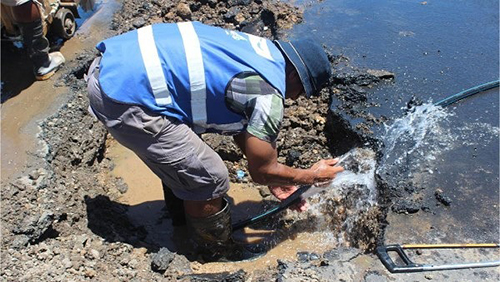
Ravai said WAF had isolated the area and was servicing them through water carting with trucks.
About six water trucks were being used by WAF to cart water to the surrounding areas of South Taveuni.
“In the North, the biggest damage I think occurred in the south of Taveuni where the desalination plants were damaged by TC Winston and it was quiet sometime before we were able to get to the southern end of Taveuni because of the damage to the roads.
“But our people are now there on the ground and starting to repair the desalination plant of the south of Taveuni.
47 water trucks
Ravai said there were about 47 water trucks carting water nationwide to supplement water coming through pipes; Ravai said each truck costs the Water Authority $1000 a day to hire and so far had supplied 6.5 million litres of water.
A team was leaving for Vanua Balavu to assess the area this afternoon, Ravai said.
“The areas in the Lau Group in Vanua Balavu and Lakeba have recovered from what we’ve gathered so far but nevertheless our teams are going out there with the assistance of the Australian and New Zealand Navy to fully assess the system and start with some repairs.”
Ravai said WAF would be hiring more project workers next week to repair systems in the 233 villages in rural areas around the country that were on the path of TC Winston.
So far, WAF had restored water systems in 87 villages.
–]]>
Kurdish hacker targets Fiji police, military websites – offline all day

Report by David Robie. This article was first published on Café Pacific
Website defacement is an attack on a website that changes the visual appearance of the site or a webpage. These are typically the work of system crackers, who break into a web server and replace the hosted website with one of their own.When checking later in the day – more than 6 hours later, Café Pacific found this for the Fiji military site from a university firewall: –]]>
Jane Kelsey: Govt majority on TPPA committee refuses to extend submissions, shows hearings are a farce
Source: Professor Jane Kelsey
National’s majority on the Foreign Affairs, Defence and Trade committee has refused to extend the deadline for submissions on the 30-chapter Trans-Pacific Partnership Agreement (TPPA) past the 15 sitting days set out in the Cabinet manual, despite provision to do so if the government agrees, reports Auckland University law professor Jane Kelsey.
‘The government claims this is the most important agreement New Zealand has ever entered into and has promised ad nauseam that people can have their say (after the fact) before the select committee. Now they are refusing to give any extensions in advance and telling people if they make their submission later than the 11 March they risk not having it accepted’, she said.
In addition to the massive TPPA text, the same cut off applies to submissions on New Zealand’s accession to four important intellectual property treaties consequent on the TPPA.
Professor Kelsey sought an extension on the grounds that she is the claimants’ expert witness for the Waitangi Tribunal hearing on the TPPA that runs for the week of 14th March and will not be able to finalise a detailed and considered submission until after that date.
She and others who sought an extension received an email this morning saying: ‘At its meeting on Thursday, 3 March 2016 the committee resolved not to extend the closing date for the receipt of submissions. The closing date is Friday, 11 March 2016. The committee did agree to consider any substantive submissions received after that date on a case by case basis.’
‘That puts me and others in an impossible position of preparing a submission and having it rejected for being out of time’, Professor Kelsey said.
‘I have been working with others night and day since the secret text was released analysing the content and its implications for New Zealand. We have produced the kind of detailed analyses that the government should have done, instead of its farcical National Interest Analysis. But I haven’t even got to several important issues, such as impacts on public services and financial regulation, and clearly won’t have any chance to do so before the submissions close. These are not addressed in the implementing legislation so there is no chance to address them formally at all.’
‘Presumably this deadline is intended allow the government to fast track the treaty consideration and the implementing legislation through the House, and limit the evidence of public disquiet about the deal,’ Professor Kelsey said.
‘The government’s behaviour simply confirms that the select committee process is a farce and that there is not even a pretence of democracy when it comes to the TPPA.’
—
]]>