Page 1233

Bryce Edwards’ Political Roundup: The Search for New Zealand’s Trump

]]>

Political Roundup by Dr Bryce Edwards.

[caption id="attachment_4808" align="alignleft" width="150"]Dr Bryce Edwards. Dr Bryce Edwards.[/caption]

The Search for New Zealand’s Trump: The current US presidential primaries are compulsive viewing for politics aficionados. Pundits have mulled over the factors contributing to the rise of outsider candidates like Bernie Sanders and Donald Trump, and debated what it all means for the established political order. Closer to home, there have been debates over what the various outcomes could mean for this country, and comparisons with New Zealand’s political scene.

New Zealanders are repelled by Republican hopeful Donald Trump. That’s just one of the interesting poll results reported by UMR Research’s Stephen Mills – see: If only Kiwis could vote for president. Here’s the main survey result: “Given a hypothetical vote in the US presidential election in a UMR survey in early April, 82 per cent would go for Hillary Clinton and only 9 per cent for Donald Trump. Even among National voters, 82 per cent plumped for Clinton and 11 per cent for Trump”.

The poll had some surprising results: “If the choice was between Donald Trump and Bernie Sanders, New Zealanders would decisively elect the socialist senator from Vermont. He wins by 77 per cent to 8 per cent and even National voters prefer the avowed socialist by 76 per cent to 13 per cent.” Mills reports that New Zealanders are no fans of Ted Cruz either, with even National voters preferring Sanders to Cruz. In the Democratic race Clinton outpolled Sanders with New Zealanders, with 55 per cent to 25 per cent.

Mills questions whether the preconditions exist in New Zealand for the rise of a candidate such as Trump. He concludes that – while there are some similarities (income inequality, lack of economic mobility and a history of surges from smaller political parties) – it’s unlikely. He says New Zealanders haven’t been hit as hard by the global financial crisis, largely approve of Key’s economic management, are less frightened by terrorism and less agitated by immigration. Mills argues that MMP acts as a “political safety valve” and Trumps bombastic, self-aggrandising style wouldn’t go down well here.

But yesterday Geoffrey Miller and Mark Blackham asked: Is New Zealand ready for its own Donald Trump? They argue that New Zealand’s political elites are becoming increasingly estranged from ordinary voters, which is the scenario in which populists like Trump thrive.

Of course some argue New Zealand already has Trumpesque politicians and, in any case, few can resist a game of “Who is New Zealand’s Donald Trump?” Canterbury University sociologist Jarrod Gilbert (@JarrodGilbertNZ) tweeted “Hey political pundits, it would be great to see where you think the US presidential candidates sit on a Left/Right spectrum in NZ terms.” David Heffernan (@kiwipollguy) was quick to respond with “Cruz = Graham Capill, Trump = Colin Craig, Clinton = Judith Collins, Sanders = Laila Harré.”

Is Winston Peters NZ’s Donald Trump?

Indeed, while the rest of the world gravely ponders the implications of a Trump presidency, Claire Trevett reports that New Zealand MPs have been preoccupied with a different question: Is Winston Peters NZ’s Donald Trump? “Muldoonist” has been a popular insult recently, but being compared to Trump is now the “insult du jour” amongst MPs, reports Trevett. It’s also “multipartisan” and has been leveled at MPs on both sides of the House, though Peters has been the most frequent recipient.

Rodney Hide says you need to combine Peters with another outsider who “spanked the establishment. Think Winston Peters. Think Sir Bob Jones. Put those two together and imagine the result. That’s Trump” – see: NZ’s very own Donald Trump.

Hide makes his case: “Peters has fashioned a lifelong career on the fear of foreigners taking over. The more he is attacked, the more he appears the martyr and the more the establishment looks to be trying to hide that it has let us down and sold us out. His rhetoric is neither coherent nor consistent but he weaves a compelling spell.”

He acknowledges differences – most obviously Peters has spent decades in politics while Trump is a political novice: “Peters’ life is politics. It’s all he knows and all he does.” And Hide says that while the “crass and brash” Bob Jones shares certain qualities with Trump, Jones “ran as a spoiler and influencer. He would have been horrified to have won high office. Trump expects to win.”

Is Bob Jones NZ’s Donald Trump?

Satirist Ben Ufindell also nominates Bob Jones as New Zealand’s Trump, pointing to his New Zealand Party electoral intervention in 1984, which won an impressive 12 per cent of the vote. Ufindell says the parallels are striking: Jones “put his own money into a political campaign that many initially wrote off as irrelevant and fleeting. Despite having no political experience he was able to turn this movement into one that would shatter the existing political order and change the face of New Zealand politics.“

Ufindell tracks down the wealthy property investor with a ”penchant for shocking, offending and bluntly speaking his mind” and in a very entertaining eight-minute video interview puts it to Jones whether he’s NZ’s Donald Trump?

Of course, as Hide points out, in a sense Jones was the anti-Trump. The superficial comparisons are there but, unlike Trump, Jones passionately believed in the policies he was pushing, and clearly didn’t do it for the pursuit of power. Jones immediately disassociated himself from his movement once he realised David Lange’s Labour Government was implementing his free-market policies. 

Bob Jones himself considers Peters “the local Trump parallel” as he ponders “How to explain the Trump insanity?” – see his opinion piece, On Trump and his Kiwi counterpart. Jones says “People generally disinterested in public affairs would view Winston Peters as attractively anti-establishment, just as plainly motivates the Trump-ites. Winston/Donald will sort things out is the faith”.

The Rise of Trump

John Armstrong writes that “Anyone who was living in New Zealand in the mid-1990s will have noted a marked similarity between Trump’s campaign themes and those stressed by one Winston Peters – see: Winston Trump or Donald Peters? To forge his NZ First vehicle after his split from National, Armstrong says “Peters banged the same drum as now being used by Trump – anti-foreigner, anti-migrant, anti-establishment and anti-free trade” albeit less blatantly than Trump.

His blogpost is an interesting examination of why Trump resonates strongly with many Americans. Armstrong argues “What voters are doing is using Trump to deliver a message in the strongest possible terms to the political and economic elites that something has to change in terms of the rich getting richer while not only the poor are getting poorer. This is also why Bernie Sanders is causing headaches for Clinton on the other side of the political spectrum.”

Although New Zealand may not be as far down the track in terms of the public losing faith with politicians and corporations, Brian Gaynor argues that there are some faint signs that we are headed down the same path, and voters are beginning to react in the same way – see: ‘Free market’ failings fuel the Trump movement.

Gaynor recommends Robert Reich’s book Saving Capitalism as “an excellent read for those wanting a better understanding of the Donald Trump phenomenon”, arguing it shows “why New Zealand could also have a “Trump experience.” 

He says “Reich, who was Secretary of Labor in the Clinton Administration, is a strong supporter of capitalism but he believes that its rules are strongly skewed in favour of a number of elites and against the majority of ordinary citizens. Reich believes that when individuals consider that neither they nor their children have a fair go, they will find ways to protest against the unfairness of the capitalist system.” Gaynor concludes “The clear message is that the “free market” needs rules and regulations that give everyone a fair chance to participate and prosper.”

Martyn van Beynen also believes “The question that we should… be asking ourselves is whether the Trump recipe would work in NZ” – see: Time is ripe for NZ’s Donald Trump.

He writes eloquently of the experiences of an economically precarious and “uneasy part of the population” that has been left behind: “But their place in the economy is one thing. Their place in a rapidly transforming society is another. They are increasingly feeling they don’t fit and are not sure why. They are made to feel bad about some of their not particularly well thought out or even strongly held views. Their discomfort at the influx of migrants and trends like foreigners buying up the country is made to seem backward and unjustified. They are told they are racist, sexist, intolerant and stupid. These are Trump’s people and they are a big slice of the population.  He is making them feel a little more powerful and understood.”

Van Beynen says that population exists in New Zealand too and it is also looking for “a leader and for a voice… They are looking for a home. Come forward NZ’s answer to Donald Trump. Now is your time.” 

Comparing Trump’s appeal with that of the “lazar kiwi” flag, van Beynen believes while it can be satisfying to flirt with the idea of sticking it to the establishment, sanity will prevail when an actual choice must be made: “America is many things but collectively it does not want a complete loose cannon in charge.”

Gordon Campbell concurs, arguing while Trump is likely to be the nominee, it is highly unlikely he will overcome the huge negatives he brings as a presidential candidate – see: On whether Donald Trump has peaked.

Trump strikes a chord with disgruntled middle America because of “the emotional intent of what he says, not the literal meaning” points out Mark Blackham – see: The Trump Thing: emotion

He elaborates: ”All the intellectual smartiepants mock Trump because he says he’ll build walls and stop Islamic people coming into America. They mock the sort of people who like him as being stupid to agree with these things. Yes, the illiteracy of the words, the phrasing and the concepts is unusual for a modern candidate… Few voters seriously think a wall is viable. Few voters seriously think to ban religions. Few think Trump can magic-up ‘millions’ of jobs. They want these things, and know they can’t get them. But at the very least, they want a President who also them. They believe they are more likely to get those issues that matter to them dealt with under that sort of President. It may not be a wall – but it will be an attitude and set of rules that amount to a metaphorical wall”.

Blackham accuses the elite, intellectuals and the left of having “an ego-concept of themselves as smart, thinking people. They believe their opinions are based on logic, reason and altruistic intentions” and so they are “appalled at the Trump appeal to base emotions.” And yet, he points out, “how easily they themselves followed the base emotion of hope when they cheered on Obama’s empty and nonsensical “change” rhetoric during his first campaign. Where is that “change” and wonderful world that Obama promised?”

In Yes, He Can: Why so many Americans are voting for Donald Trump? Chris Trotter voices similar sentiments: “They are not looking for someone who understands the system. They hate the system. They’re not in the market for a constructive candidate, they want a President who’s ready to go after the system with a wrecking ball!”

The two main parties only have themselves to blame according to Trotter: “For three decades they have either crudely inflamed, or, loftily dismissed, the people they call ‘Trailer-Trash’ and ‘Rednecks’: the very same people who are now turning out in their tens-of-thousands for the man who openly proclaims that he ‘loves’ the ‘poorly educated’. The Donald loves you guys – and he wants your votes. Why? Because your votes, and the votes of those assholes up at the Country Club carry exactly the same weight. That’s right: exactly the same. And you know something else, fellas? There are way more of us than there are of them!”

Trump appeals because “he’s so rich he doesn’t need to go cap-in-hand to the Koch brothers (like ‘Little Marco’ Rubio).” And, like them, he “knows what it means to be ridiculed, excluded and hated – and isn’t afraid to say so out loud. The man who wears the scorn of the Establishment as a badge of honour, and who revels in its all-too-obvious fear.”

 “The barbarian is no longer at the gate” writes Paul Thomas, “He’s inside the castle and heading for the throne room.” Thomas believes Trumps extreme rhetoric gives him ownership of issues and “shows he’s not just another politician trotting out talking points. Many pundits viewed his blistering attacks on George W. Bush and the Iraq war as damagingly disloyal and a strategic blunder. In fact… Trump sent a clear message that he’s uncompromised by any sense of obligation to an unloved party hierarchy.”

He says his previous assessment of Trump didn’t go far enough and he now sees that Trump not just an outsider but a renegade outlaw: “Trump’s vulgarity and the undercurrent of violence in his rhetoric – this week he declared he wanted to punch a protester in the face – locate him in popular culture rather than politics. American popular culture is full of outlaw figures whose appeal derives from their ability to get things done via decisive, often violent, action while the system pussyfoots around.”

In Thoughts on Trump’s messaging, Danyl Mclauchlan argues that political insiders are so busy geeking out and imagining themselves among the pantheon of great political orators when they communicate, they lose sight of the fact normal people do not talk in that way. In contrast, “Trump, famously, doesn’t talk like a politician. He talks like a reality TV show star which is what he is.” Master of the “killer line”, Mclauchlan says no doubt much of what Trump says is scripted but “at a time of tremendous anger towards the political elite he happens to be a master of communicating in a way that is the total opposite of that hated elite.”

Bob Jones says the message from Trump supporters is clear: “In his brazen way, Trump alone was shouting out loud about the deep-felt concerns everyone was expressing in private and promising wham-bang (albeit ludicrous) ways of dealing with them… In short, in an uninspiring Republican line-up, Trump alone is upfront about the major concerns on people’s minds.”

Jones argues “We have a parallel political situation in New Zealand with legislated favouritism toward Maori, which is both an indisputable fact and a huge source of bitterness, constantly expressed privately.” He says that Winston Peters’ and Don Brash’s positive polling after “coming out punching” on the issue exposed a deep vein of discontent and believes that begging is another issue “which, due to race sensitivity, people feel strongly about but only discuss in private” – see his Trumpesque What Wellington and Auckland mayoral candidates could learn from Donald Trump.

David Farrar recently wrote a thoughtful blogpost attempting to explain The appeal of Trump. Farrar says there are multiple factors in operation, including the unhappiness of Americans with the direction of their country, Trump’s promise to make America great again, a backlash against political correctness, free media coverage, Trump being free from traditional political relationships, and the lack of an effective Republican establishment leadership.

Trump’s lone visit to New Zealand

Kurt Bayer has the story of Trump’s single day in New Zealand in 1993, when he made a failed attempt to lobby to build a new casino on the site of Auckland Railway Station – see: When Donald Trump visited New Zealand.

“But what might he make of our great and our good were he to pop over today?” asks Toby Manhire. “In the cause of further futility, let us pause to ask: what advice might he have for prominent New Zealanders?” – see: Donald Trump’s top tips for Kiwis.

Matt Heath says although “logic suggests we should hate him”, there is just “something about the guy” – see: Why I’m in love with Donald Trump. Sure, Heath admits, Trump “will kill us all if he gets his finger on the button”, but until then “It’s craziness. Very entertaining craziness.” 

Finally, Scott Yorke has Ten reasons why a Trump presidency might not be so bad, and Mike Wesley-Smith wonders whether New Zealanders have been too hasty in their mockery of Trump, and says “Mr Trump has had a few ideas we could borrow – namely the wall he wants to build between the US and Mexico. Wesley-Smith asks “Do we need a new divide – between those who live off the lattes and those who live off the land” – watch: Taking a leaf from Trump: Building the Bombay barricades.

]]>

Pacific human rights advocacy as a ‘mindful’ journalist

Report by David Robie. This article was first published on Café Pacific


Normal 0 false false false EN-NZ X-NONE X-NONE /* Style Definitions */ table.MsoNormalTable {mso-style-name:”Table Normal”; mso-tstyle-rowband-size:0; mso-tstyle-colband-size:0; mso-style-noshow:yes; mso-style-priority:99; mso-style-parent:””; mso-padding-alt:0cm 5.4pt 0cm 5.4pt; mso-para-margin-top:0cm; mso-para-margin-right:0cm; mso-para-margin-bottom:8.0pt; mso-para-margin-left:0cm; line-height:107%; mso-pagination:widow-orphan; font-size:11.0pt; font-family:”Calibri”,sans-serif; mso-ascii-font-family:Calibri; mso-ascii-theme-font:minor-latin; mso-hansi-font-family:Calibri; mso-hansi-theme-font:minor-latin; mso-fareast-language:EN-US;}

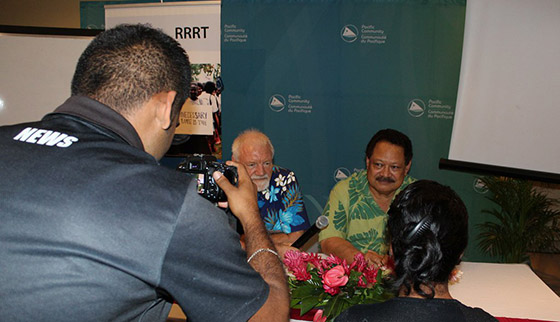
Pacific Media Centre’s Professor David Robie and Tongan publisher, broadcaster and communications adviser
Kalafi Moala at the human rights forum in Nadi, Fiji. Image: Jilda Shem/RRRT
FROM HUMAN RIGHTS ABUSES REPORTS TO DEFENDING FREEDOM OF SPEECH TO RIGHTS-BASED JOURNALISM

SOME of you perhaps may be mystified or puzzled about why I have included the term ‘mindful’ journalism in the title of this presentation. I’ll explain later on as we get into this keynote talk. But for the moment, let’s call it part of a global attempt to reintroduce “ethics” and “compassion” into journalism, and why this is important in a human rights context.
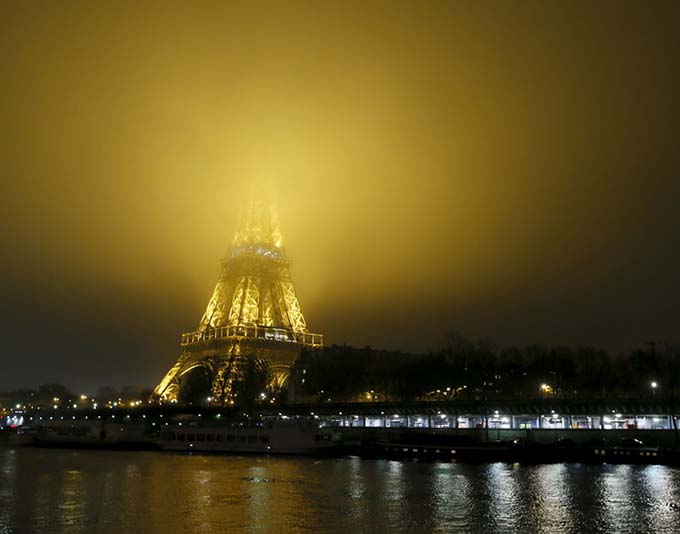
Human rights has taken a battering in recent times across the world, and perhaps in the West nowhere as seriously as in France on two occasions last year and Brussels last month. After the earlier massacre of some 12 people in the attack on the satirical magazine Charlie Hebdo in January, there was a massive wave of rallies in defiance and in defence of freedom of speech symbolised by the hashtag #JeSuisCharlie – I am Charlie.
Investigators in both Belgium and France worked on the links between the two series of attacks and have made a breakthrough in arresting two key figures alleged to be at the heart of the conspiracy, Salah Abdeslam and Mohamed Abrini, a 31-year-old Belgian-Morrocan suspected to be the “man in the hat” responsible for the bomb that didn’t go off at Brussels airport.

It ought to be noted that Charlie’s cartoons were not just anti-Muslim, or rather critical of jihadist extremism, they have been equally offensive about all religious, mocking Christian extremists and the establishment with just as much fervour. Barely had the French nation come to terms over this terrible and senseless massacre in January, which killed the chief cartoonist editor, known as Charb, and most of the cartooning team in one foul swoop, when an even more horrendous event happened 10 months later with a series of simultaneous attacks by masked ISIS gunmen across several locations in Paris, killing 135 people.
In the West, there was a rise of gratuitous insults and hostile anti-Muslim feelings, which was precisely one of the objectives of the ISIS gunmen. (“Islamic State” should be called Daesh – it is not a country). The whole point of terrorism is to strike terror in the hearts of your opponents.
But few stopped to think about the origins of terror, or the traditions of torture and state terrorism in the West that stretch back to the Inquisition in 1234 and the massacre of whole communities, such as the famous rugby playing town Béziers in southern France.  An army of crusaders under orders from then Pope Innocent III attacked the city on 22 July 1209 and slaughtered some 20,000 people, many of them inside churches. They were regarded as Cathar heretics.
Moving on a few centuries to colonial Algeria, France fought a bitter war against the Muslim rebels (1954-1962), reaching fever pitch in the Battle of Algiers when a Second World War resistance hero led brutal and illegal counter-terrorism methods to crush the resistance in the Casbah. The battle for the city was won, but ultimately France lost the independence war.
Gillo Pontecorvo’s 1966 film Battle of Algiers, widely regarded as one of the greatest movies of all time, was banned in France for five years. Lieutenant-Colonel Mathieu is a composite character based on Colonel Jacques Massu, the paratrooper commander. It shows how the West developed illegal torture and terrorist methods against the Algerians. This is at the root of the US “terrorism against terrorism” military methods today.
Shades of this repression were echoed barely 20 years later in the South Pacific with French military suppression of Kanak agitation for independence and with the bombing of the Rainbow Warrior in 1985. A cartoon by celebrated Le Monde cartoonist Plantu shows up the paranoia, hypocrisy and violation of human rights at the time. More about that later.
Terrorism and violation of human rights today impacts on many communities across the world, including throughout the Middle East.
Is there massive change in the air? The Arab Spring optimism in 2011 led to disillusionment and gross violations of human rights in Egypt, Libya, Syria and in Tunisia where the pro-democracy movement began.
But then back to France where there has been the growing Nuit Debout – “Up all Night” — movement that launched in Paris on March 31 and then spread across 60 cities in Europe last weekend. Protesters with one rally up to 120,000-strong demonstrated in all-night vigils against austerity, globalisation, increasing inequality, privatisation and the continent’s harsh anti-migrant policies. An uprising against neoliberalism.
Let us step back for the moment and view human rights at a distance from some of the world’s trouble spots. I want to jump across to our own Pacific backyard and take you to Australia and show you a little cameo from the “Climate Angels”. Five of the demonstrators, all women aged in their 50s and 70s, were arrested a few weeks ago over a sit-in protest at a Santos coal seam gas development near Narrabri, northern New South Wales.
June Norman, a feisty 75-year-old, who took part in a protest walk across East Timor in 2013 to the town of Balibo, site of the massacre of five journalists, was forcibly dragged away first. This video was taken by a citizen journalist “bearing witness”.
Right in the heart of the capital of Panama is the office of a law firm that is at the centre of the biggest leak of confidential financial data in the history of journalism: Mossack Fonseca.

The so-called Panama Papers have exposed a global web of 214,000 offshore shell companies, involving heads of state, athletes, financial institutions and criminals.

The point is that human rights can be violated anywhere in the world, and too often there are no witnesses or visual evidence to tell the true story. On the other hand, social media has dramatically exposed some of the murkier human rights episodes of today.
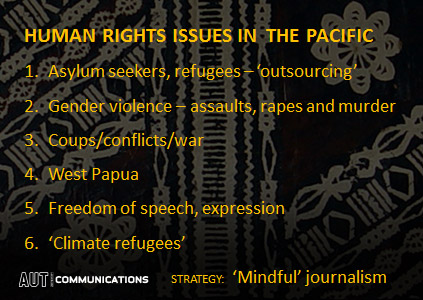
So now to Human Rights in the Pacific: In the short time that I have available today, I am going to give a sweeping snapshot of some of the issues that I think are important in the region. I have six topic headings:
1.      Asylum seekers, refugees – “outsourcing” by Australia to Nauru and Manus Island, PNG
2.      Gender violence – assaults, rapes, and murder
3.      Coups/conflicts/war, eg. Bougainville, Fiji “coup culture”, Solomon Islands
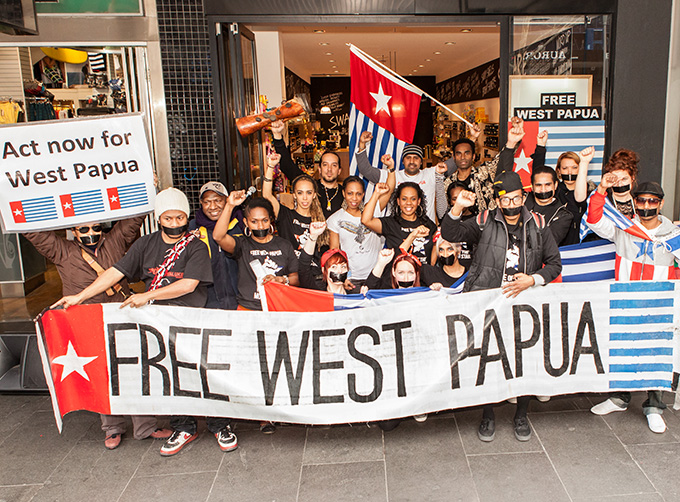
4.      But the biggest one of all is West Papua
5.      Freedom of speech, expression
6.      So-called “Climate refugees” – a very real situation, and international law is lagging behind
And I’ll talk about strategies for addressing these issues, such as “mindful” or deliberative journalism.

1. ASYLUM SEEKERS

Asylum seekers, the first human rights concern for the Pacific. Phil Robertson, Asia director for Human Rights Watch, recently summed this up rather well in The Guardian, when he argued that Australia, which fancies itself as the “policeman of the Pacific”, has been too often part of the problem these days.
Politicians trapped in the refugee policy dialogue in Canberra frequently fail to recognise that Australia’s boat push-back policies, and offshoring asylum seekers into abusive conditions of detention in Nauru and on Manus Island, are seen as a green-light by Asian governments to do the same: send asylum seekers and refugees back into harm’s way or lock them up in indefinite detention.
For example, during the south-east Asia boat people crisis in May 2015, the Thai, Malaysian and Indonesian navies played a cruel game of “human ping-pong” by pushing away boats of starving and sick Rohingya. 

Normal 0 false false false EN-NZ X-NONE X-NONE /* Style Definitions */ table.MsoNormalTable {mso-style-name:”Table Normal”; mso-tstyle-rowband-size:0; mso-tstyle-colband-size:0; mso-style-noshow:yes; mso-style-priority:99; mso-style-parent:””; mso-padding-alt:0cm 5.4pt 0cm 5.4pt; mso-para-margin:0cm; mso-para-margin-bottom:.0001pt; mso-pagination:widow-orphan; font-size:11.0pt; font-family:”Calibri”,sans-serif; mso-ascii-font-family:Calibri; mso-ascii-theme-font:minor-latin; mso-hansi-font-family:Calibri; mso-hansi-theme-font:minor-latin; mso-fareast-language:EN-US;}
Normal 0 false false false EN-NZ X-NONE X-NONE In contrast to the impression that most mainstream media conveys, Australia has the least influx problem and yet the most inhumane way of dealing with it.
With the recent High Court ruling, Australia now faces the return of 267 asylum seekers to Nauru and Manus Island, where they face possible renewed physical and sexual assault, and life in limbo.


Australia’s international reputation has suffered enough – it’s time to do the right thing by accepting its responsibilities, not only as a party to the UN Refugee Convention but also as a responsible neighbour and member of the international community, and provide this group with fair and timely refugee status determination in Australia
.
The Australian asylum seekers policy is to cynically “outsource” its problems to Nauru and Manus Island. For two decades, successive Australian governments have adopted policies to deter asylum seekers arriving by boat. A UN Special Rapporteur found in 2015 Australian policies violated the Convention against Torture with “cruel, inhuman or degrading” treatment.
2. GENDER VIOLENCE
In the 2014 book Crying Meri, Russian photojournalist Vlad Sokhin documented the treatment of women in Papua New Guinea with a human rights lens. Violence against women and girls, and children generally, is a critical human rights problem across the Pacific. The rape, brutal beating and burning alive of women accused of sorcery is agonising in its brutality.
The compelling photographs in Sokhin’s book have, as Christina Saunders wrote in the foreword, “a rare depth and humanity that resonate deeply and speak immediately to the viewer” and
3. CONFLICTS/COUPS/WAR
Photojournalist Ben Bohane, more recently director of communications with the Pacific Institute of Public Policy in Vanuatu, chronicled the Bougainville war and many conflicts in the western Pacific over two decades. He also researched the role of culture in political developments and media representations in the mid-2000s.
4. WEST PAPUA
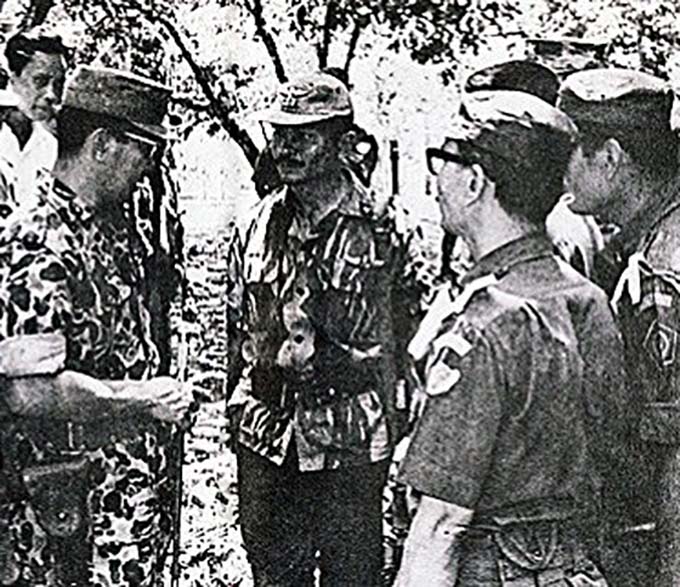
Before the West Papuan conflict emerged at the front of Pacific consciousness, the 24-year illegal occupation of Timor-Leste, or East Timor, was a cause célèbre ignored by the region’s media – at least until the massacre of 270 people at the Santa Cruz cemetery in 1991.

East Timor is the scene of the worst human rights violations against journalists in the Pacific, the Balibó massacre, where 5 Australian-based journalists (including 2 Britons and a New Zealander) were murdered in cold blood on 16 October 1975. They were trying to “bear witness” to the impending Indonesian invasion.
Seven weeks later, Roger East, an Australian journalist who travelled to Dili to find out the truth was executed by invading Indonesian soldiers. There has been no justice to this day for any of the six victims of human rights atrocities.
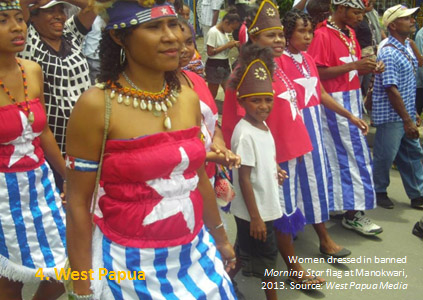
And now we are facing a similar situation with West Papua where Indonesian authorities and security forces carry out crimes and violate human rights with impunity. Although the United Liberation Movement for West Papua (ULMWP) representatives have now been accepted into the Melanesian Spearhead Group as observers, this feat almost became a disaster. The West Papuans now have a platform in the Pacific political arena. A recent new book by civil rights advocate and academic Jason MacLeod outlines the peaceful struggle by West Papuans in a devastating way.
Adrian Stevanon of Maori Television’s Native Affairs investigative programme was the first TV journalist from New Zealand to go to West Papua in 50 years last September. He went with photojournalist and researcher Karen Abplanalp and Radio NZ International’s Johnny Blades followed a couple of months later.
5. FREEDOM OF SPEECH
Freedom of speech is a fundamental human right for everybody worldwide. All people have the right to hold their own opinions, and the right to seek, receive and share information and ideas. For journalists, this right is essential to seeking out the truth. Without this freedom, we cannot interview citizens or seek information from public officials.
The right to freedom of speech is very broad – it covers many freedoms essential to work as journalists, such as:
• Freedom of issuing and distributing newspapers
• Independence of broadcast licensing and regulation
• Prohibition of all censorship
• Freedom of accessing and distributing information
ARTICLE 19 OF THE UNIVERSAL DECLARATION OF HUMAN RIGHTS
But it ought to be remembered that this universal declaration is for everybody not just a privileged status for media organisations or journalists. Freedoms do not exist in isolation:
All rights are interrelated, interdependent and indivisible:
1. Freedom of expression linked to right of peaceful assembly and association (A20)
2. Also linked to the freedom of thought, conscience and religion (A18)
3. State treaties – dualist v. monetist systems
4. Regional treaties
5. UN Special Rapporteurs on free expression
Press systems and ethical frameworks are on the agenda in all societies, and we are challenged to accommodate free expression and its close relative press freedom within new technological and cultural contexts. Journalism professor Mark Pearson, of Griffith University, and a until recently a Reporters Without Borders researcher, spoke on “peace journalism” models as applied to the reporting of the South Pacific in his inaugural UNESCO World Press Freedom speech at Auckland in 2013.

He used this to introduce another recent trend in journalism theory to apply basic “principles of mindfulness and compassion” to a media context, a process which he dubbed “mindful journalism”. Since then he has contributed as co-editor to a book called Mindful Journalism and News Ethics in the Digital Era: A Buddhist approach. In a simple explanation, he describes first what “Mindful journalism” is not:

• An attempt to convert you into “Buddhism”|
• An attempt to impose yet another code of practice on journalists
• A bid for the new approach to theory and ethics. (It is complementary to deliberative/public/peace/civic/citizen/inclusive journalisms).
He then outlines what Mindful Journalism is:
• A lens (or even theory) offering a set of tools for the analysis of journalism
• A moral framework to underpin ethical decision-making in journalism
• A possible tool of resilience for journalists (work in progress)
In contrast to human rights journalism, mainstream/legacy media “generally sides with official rhetoric and policy”
• Human rights news is usually reported as individual actions
• No reporting of “the system”
• “Predominant war journalism” of West dominates global news flow
A critical role of citizen journalism to keep mainstream media under scrutiny. While the media is watching other sectors in a community, who is watching the media? Especially on human rights issues.
Citizen journalist and independent media networks often played an important role. This happened in securing the release of Taimi ‘o Tonga publisher Kalafi Moala and his two fellow prisoners, jailed for 30 days for contempt of Parliament in 1996 for publishing leaked documents that needed to be in the public domain. This was arguably the most important Pacific media freedom crisis of contemporary times, yet he wasn’t given the mainstream media support that he needed and deserved. Human rights intervention by a civil rights lawyer secured the release of the prisoners early. 
An invaluable resource on journalism and human rights is the Canadian agency, Journalists for Human Rights.
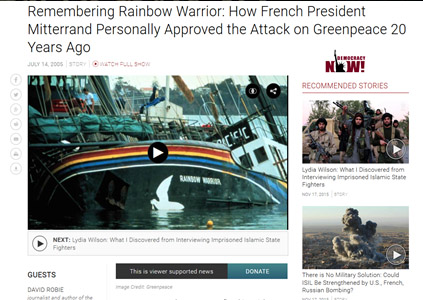
Global and Pacific media freedom organisations have played and continue to play an important role in human rights campaigns for imprisoned and gagged journalists. One of the biggest human rights violations ever to happen in New Zealand – and the Pacific – was the bombing of a peaceful environmental ship, Rainbow Warrior, by French secret agents under orders in Auckland Harbour on 10 July 1985, killing photojournalist Fernando Pereira. This happened parallel to repressive measures against Kanaks seeking independence.
Amy Goodman of Democracy Now! In the US sums up the Rainbow Warrior saga 20 years later with the revelations that then PresidentMitterrand personally sanctioned the sabotage. 
Investigative journalist Edwy Plenel, publisher of the independent Mediapart website in France, carried out key inquiries into the Rainbow Warrior. One of the two French bombers (out of a 13-strong team), ex-colonel Jean-Luc Kister, publicly admitted his role in the sabotage and apologised 30 years after the bombing.
Amy Goodman of Democracy Now! gave another overview 10 years after her earlier one about Mitterrand, this time with Rainbow Warrior captain Peter Willcox
6. ‘CLIMATE REFUGEES’
Images of “nuclear refugees at Bikini Atoll, Marshall Islands, conjures up images of “climate refugees”…. The 2015 case of 38-year-old i-Kiribati man Ioane Teitoata, who lost his appeal case against New Zealand Immigration to have him and his family defined as “climate refugees”. But the case exposed how flawed the law and New Zealand’s policies were about climate change.
In 1946, the Bikini Atoll islanders were the first nuclear refugees in Pacific – “relocated” for the US nuclear tests. In 1985, Rongelap islanders were evacuation by the Rainbow Warrior and then in 2011 we had the Fukushima nuclear refugees after the Tohuku tsunami.
“Climate refugees” currently have no legal definition or status. However, there needs to be:
A climate refugee is a person displaced by climatically induced environmental disasters. Such disasters result from  incremental and rapid ecological change, resulting in increased droughts, desertification, sea level rise, and the more frequent occurrence of extreme weather events such as hurricanes, cyclones, fires, mass flooding and tornadoes. All this is causing mass global migration and border conflicts.
In 2000, 2700 Carteret Islanders left their atoll homeland in Papua New Guinea and became an iconic and tragic symbol. In 2013, came the Pacific Islands Forum Majuro Declaration for “climate leadership”, yet two years later a i-Kiribati man, Ioane Teitiota, failed in legal bid for “climate refugee” status.
Last year, we had some 40 students (and about 60 people altogether) involved in a journalism and television “bearing witness” project to prepare oral histories and current affairs items on a Rainbow Warriormicrosite as a public resource.  Students working on this project were thrilled by the experience and won a group award for innovative journalism.
Finally, to wrap up, the problems of war or mainstream journalism are largely blamed for under reporting and/or misrepresentation of political and structural forms of violence – the greater human rights violations. Human Rights Journalism and “bearing witness’ complement the four major orientations of the peace journalism model:
Solution rather than victory
Truth rather than propaganda
People rather than elite
Win-win rather than win-lose
Also human rights oriented journalism needs to have a global (and local) perspective instead of selective reporting and ignoring major issues (such as West Papua), any “bias” ought to be in favour of vulnerable voices, be proactive and attachment to victims and survivors, instead of the political elites.
[embedded content]

]]>

NewsRoom_Digest for 22 April 2016

NewsroomPlus.com image Today’s edition of NewsRoom_Digest features 1 resourceful link of the day and the politics pulse from Friday 22nd of April. It is best viewed on a desktop screen. NEWSROOM_MONITOR Noteworthy stories in the current news cycle include: Primary Industries Minister Nathan Guy saying new access for chilled meat in China is an opportunity for exporters to get their high-end products into the top end of the Chinese market; Transport Minister Simon Bridges assuring passengers they will be safe in cabs after changes are made to the way taxi services are run; and findings from a report on the state of bluefin tuna fisheries in the Pacific Ocean, show that without drastic measures, there is a less than 1 percent chance of the population returning to healthy levels by 2024. POLITICS PULSE Government: Speech – Canterbury Men’s Centre Male Survivors of Sexual Abuse Trust; Bottled water concerns misplaced;Acting District Court Judges appointed; Successful bid gives economy $50 million boost; PM welcomes visit by French PM; Number on Social Housing Register declines; English releases RB Board letter of expectations; Indian President to visit New Zealand;Facility upgraded by offenders helps kakapo; Successful end to the yachting season; $520m funding injection for key Tauranga route ACT Party: Funding policy to blame for Corelli school liquidation Greens: Tree planting for the climate – a game-changer Labour: Social Development stats don’t add up; Fewer cops on the beat as police cuts bite; Big jump in benefit numbers in Christchurch as rebuild slows; Thousands of invalid votes likely after National refuses to change rules New Zealand First: “In The Shadow Of The Super City” – Speech At Whangaparaoa Rt Hon Winston Peters; Speech By Rt Hon Winston Peters To Warkworth Public Meeting; Out-Of-Work Young Kiwis On The Rise LINKS OF THE DAY SOCIAL HOUSING REGISTER: The number of people on the Social Housing Register has again declined. Figures for the March 2016 quarter show there were 4585 people on the register, down 223 or 4.6 per cent on the same time last year. Of those on the register in March 2016, 1036 are already housed and are awaiting a transfer to a more suitable property. The March 2016 register can be found at: http://www.housing.msd.govt.nz/information-for-housing-providers/register/index.html And that’s our sampling of “news you can use” for Friday 22nd April.

]]>

Dangerous Dog Crisis Exposes Auckland Council To Political Anxiety and Tribalism

]]>

By ER Insider. See also: EveningReport.nz’s Editorial on this issue. AN INSIDER’S OPINION: Political anxiety, tribalism, stale and stagnant ‘part solutions’ have been brought to the fore as Auckland Council attempts to save face over this menacing and dangerous dog crisis. Auckland politicians have for years ignored menacing dogs that roam, bark, charge and intimidate innocent residents and family pets throughout south Auckland. The cynical would say ‘when politicians get cosy they lose touch’. The reality is: it’s easy to ignore unregistered dogs in Otara and Takanini when you enjoy the privilege and view from your 27th floor office at 135 Albert Street in Auckland City. POLITICAL ANXIETY: [caption id="attachment_9920" align="alignleft" width="300"]Darnell Minarapa-Brown, 7-years old. Darnell Minarapa-Brown, 7-years old.[/caption]When violence against a child compels communities to demand action, and that call sounds from all over Auckland City – it becomes harder for Auckland’s politicians to ignore the plight of 7-year old Darnell Minarapa-Brown who spent six hours in surgery at Kidz First Hospital because a dangerous dog ripped his face apart. In the real world, south Auckland’s people want real action. For a moment it seemed the politicians had listened. There was a glimmer of hope after south Auckland Councillor Callum Penrose announced a high-powered group of politicians would front the media with their solution. But by the time Thursday’s highly publicised photo-opportunity concluded, hope was lost. People in the communities soon realised, Auckland Council’s call for an amnesty, on the owners of unregistered dog owners, was a cop-out and more a solution for political anxiety than for those who live in this city’s urban communities. Fronting the photo-op was Auckland’s Mayor, Len Brown, and Councillor Penrose. They boldly raised how Auckland Council will initiate an amnesty so the owners of Auckland’s unregistered dogs will be able to come forward, pay their fees without fear, or fine, or prosecution. Was this it? Was this all they had in their ‘fix-it’ box of tricks? Sadly, it appears so. Brown and Penrose’s amnesty exposes them both to failure, and for Penrose, failure to deliver for the community he is supposed to represent is an anathema as he considers campaigning for his job at this year’s Auckland Council elections. The people of Manurewa, Takanini, and Papakura demand hard and real solutions to this crisis. They are not stupid and this amnesty will fail to make south Auckland’s streets safer. It will also fail to inspire voters at this year’s local government elections. The amnesty ignores the inconvenient truth. Auckland Council has wide powers under the Dog Control Act to tackle menacing dogs and prosecute dog owners. Auckland, like any council, has the ability to classify dangerous dogs. It has the ability to enforce its bylaw, and it has the ability to keep communities safe. Therein lies the problem, Auckland Council has the power but it has failed to use it. Why not? Because nine times out of ten the aggressive behaviour of roaming dogs, that threaten the safety of people and domestic animals in south Auckland, isn’t a hot enough topic for distracted councillors. Defining the American Pit Bull in the Dog Control Act as proposed by Penrose and others is a useless gesture. Most of the dogs who roam suburban streets are not purebred creatures. Many are mutts of unknown parentage, born of chained bitches on unfenced properties. Few, if any, of the dogs that bite children in south Auckland are registered, let alone subject to dog obedience classes. Auckland Council’s credibility is undermined by its unwillingness to:

  • resource its animal management functions
  • go door to door to assess and impound menacing dogs.
There are plenty of neglected, angry and unhealthy dogs in streets and neighbourhoods all over Auckland. It doesn’t take a media conference to commit to action to tackle those animals and hold their owners to account. TRIBALISM: Disappointingly, political tribalism won on Thursday. Auckland Council side-lined the one politician with real credibility on animal management: Cathy Casey. [caption id="attachment_9929" align="alignleft" width="300"]Auckland Councillor, Cathy Casey is a specialist when it comes to dog control and ownership issues. Auckland Councillor, Cathy Casey is a specialist when it comes to dog control and ownership issues.[/caption]If Auckland Council was truly compelled to deliver a real solution to this dangerous dog crisis, then it would have listened to Councillor Casey who is recognised as a specialist on dog control and ownership. It would have invited her to lead the debate on how Auckland Council will make Auckland’s urban streets safer from menacing and dangerous dogs, and, irresponsible owners and gangs. It chose politics and tribalism instead. POLITICAL ESTRANGEMENT: Councillor Casey fell out of favour with Mayor Len Brown and Callum Penrose after she opposed massive rate increases and the denial of property owner’s rights on land rezoning. This week, it was payback time for Cathy Casey, as the Mayor and Councillor Penrose excluded her from the Council’s amnesty announcement. Was this also because Cathy Casey is credible, knowledgeable, and has the ability to hold Auckland Council to account for its failure to police and enforce its own dog control bylaw – credentials that will likely sideline Mayor Brown and Councillor Penrose’s amnesty? Casey has a heart and a nose for public sentiment and has demonstrated her resistance to Council-driven team-thinking. Unfortunately, politics got in the way, and while a photo-opportunity with media was planned, the stage was set, their amnesty idea given the spit, spin and polish, it was always destined to fail. The media, and the people of south Auckland, are not fools, and the ‘media-opportunity’ fizzed. CALLING FOR REAL SOLUTIONS: Election year is supposed to bring new ideas, new solutions to the fore, not stale, failed, unconvincing ideas peddled by councillors that politically need the exposure of a Council-sponsored event to profile their credentials. Politically, Auckland Council has used the illusion of action to buy itself time. But the response lies not with Parliament. The response lies with Auckland Council itself, starting with addressing the dearth of animal management contractors in neighbourhoods across Auckland. This week, Auckland Council chose an illusion and a distraction in an attempt to halt the continual slide in public regard prior to polling day. That slide has plagued the mayoralty throughout this term. The Mayor has endured being booed at… at Eden Park, at Victoria Park when the World Cup champion All Blacks returned to New Zealand, ignored at Chinese New Year functions, and scoffed-at in public. Len Brown chose retirement from politics over certain electoral defeat. Political anxiety and tribalism has infected some of his strongest supporters who also fear the indignity of defeat at this October’s elections. Sadly, this ridiculousness will not make Auckland’s streets safer for people like Takanini’s Darnell Minarapa-Brown. It has only caused people to become more fed-up with politicians past their use-by-date, and caused more people to call for a real solution to this menacing and dangerous dog crisis. –]]>

Across The Ditch: Controversy Surrounds NZ PM’s China Trade Tour + All Blacks Win World’s Top Team Award

ACROSS THE DITCH: Australia radio FiveAA’s Peter Godfrey and EveningReport.nz’s Selwyn Manning deliver their weekly bulletin, Across The Ditch. This week: Controversy Surrounds NZ PM’s China Trade Tour + All Blacks Win World Team of the year – Recorded live on 21/04/16 ITEM ONE: New Zealand PM John Key is currently in China leading a trade and business visit, and negotiating the terms of an update to the China NZ free trade agreement. The visit has attracted significant controversy, including an editorial published in the People’s Republic of China media outlet Xinhua which warned John Key that he should not raise the issue of South China Sea territorial disputes. If he did so, the editorial writer suggested, such talk would jeopardise the progressive trade relationship. In recent months, the Key Government has been pitching a stronger position over the disputed waters, a view which has been interpreted as being closer to the U.S. position than China’s. Prior to arriving in China, Key told New Zealand media that he would raise the territorial dispute with the PRC’s leader President Xi Jinping. However, it appears Key took heed of the fore-warning and avoided the topic. The FTA has been progressing above expectations, and two way trade is expected to further develop New Zealand’s economic dependency. At the meeting, President Xi Jinping and John Key agreed to upgrade the trade agreement with further Tarif cuts, and increased agriculture cooperation. Key’s plan to give some upward lift to agriculture exports is designed to dilute Australia’s opportunity in this sector, and to accentuate New Zealand’s ‘first mover’ position as the primary dairy exporter to China. However Key also agreed to set in train a plan to establish an extradition treaty with China. This is an issue which Zi Jinping raised when he last visited New Zealand, and is part of China’s move to clamp down on Chinese organised crime abroad and corrupt officials. Key’s willingness to advance the extradition treaty will place him at odds with public sentiment in New Zealand, sentiment that is sensitive to this country sending people back to China, where if found guilty, could face the death penalty. ITEM TWO: The All Blacks have been awarded the World’s best team of the year award at the Laureus Awards in Berlin. The All Blacks were recognised for their winning performances leading up to the Rugby World Cup and taking out the tournament’s Webb Ellis Trophy in 2015. To win the Laureus team of the year award, the All Blacks saw off the USA’s NBA defending-champion team, and FC Barcelona – winners of four trophies in 2015. They also saw off All Blacks Britain’s Davis Cup-winning squad, the Formula 1 team Mercedes AMG Petronas, and the World Cup-winning United States women’s football side. World Cup winning captain, Richie McCaw said the win was a sign that rugby is now more recognised in world sport. McCaw: “People say rugby’s a big sport for us but no so big on a global scale, but it’s obviously big enough where the exploits of what the All Blacks do are recognised,” he said. “The success rate we have is pretty hard to compare to other teams around the world and I think that’s something that’s been recognised and something that we hold pretty strong.” The All Blacks were the third rugby side to claim the Laureus team of the year award, with England (2004) and South Africa (2008) both honoured after winning their respective World Cups.

]]>

Jane Kelsey: Why is the US TPPA ‘Implementation Team’ Meddling in NZ?

Source: Professor Jane Kelsey.

The US Trade Representative Michael Froman has revealed his office is sending teams of officials to the other the Trans-Pacific Partnership Agreement (TPPA) countries, including New Zealand, to vet their implementation of the intellectual property chapter and other parts of the agreement.[1]

‘ “Implementation” is code for the US making sure it gets what it wants, backed by its power to veto the TPPA’s entry into force if it doesn’t’,  said Auckland University law professor Jane Kelsey.

‘This is an outrageous assault on the sovereign right of nations to decide their own laws without interference from other states.’

‘The US is notorious for rewriting the script after negotiations are ‘concluded’ to secure their version of the text when other countries insist they have done what is required.[2]

‘This will come in two stages’, Professor Kelsey explained.  ‘The first we are seeing now. The US says “we can’t possibly get this to the floor of Congress without these changes to what you are doing”.’

‘If Congress votes in favour of its implementing legislation – which at present can’t be assumed – the US comes back again and says “we won’t certify you have complied with your obligations until you do these additional things”.’ The TPPA can’t come into force without US certification.

The USTR is currently trying to ‘fix’ problems that mean the TPPA doesn’t have support in Congress. Froman cites intellectual property as a major point of discussion with other governments, making particular mention of New Zealand’s proposed legislation on patent term extensions.

Ominously, Republican chair of the Senate Finance Committee Orrin Hatch, who decides if and when implementing legislation proceeds, has hardened his stance on monopoly rights for biologics medicines. He announced today that 8 years’ is not enough. He requires 12.[3] But the New Zealand government says the TPPA lets us keep our current 5 years plus some process delays.

Professor Kelsey asked ‘how will we know what pressure the US is bringing to bear on our government and whether it will stand up against US threats when that could sink the deal for New Zealand?’

‘I strongly suspect these fixes will involve administrative measures, not legislation, so there will be no public process even after the fact,’ Professor Kelsey said.

She noted the select committee process was over, based on the existing text. ‘The government must be up front about what the US officials will be doing here and release full documentation of their demands and the government’s response for analysis and debate before any further commitments are made.’ 

[1] ‘Froman: U.S. Sending Out TPP Implementation Teams, Undecided on Fixes’, Inside US Trade, 18 April 2016

[2] See www.tppnocertification.org

[3] ‘Sen Hatch Stands Firm on Biologics’, Washington Trade Daily, 20 April 2016

]]>

Bryce Edwards’ Political roundup: Advice for the New Zealand Labour Party

Political roundup by Dr Bryce Edwards.

Labour is suffering in the polls. So what advice should they follow in order to turn things around? 

[caption id="attachment_4808" align="alignleft" width="150"]Dr Bryce Edwards. Dr Bryce Edwards.[/caption]

The advice has been flowing freely to the Labour Party in the wake of last week’s awful TVNZ Colmar Brunton poll, which showed a drop in its support to 28 per cent. As always the advice for Andrew Little has been contradictory: move left, move to the right, be more like Jeremy Corbyn and Bernie Sanders, be more like John Key, focus on positive issues rather than just criticising, and go harder against the Government.

Labour’s identity crisis

Audrey Young has a more positive account than most of Labour’s reaction to the poll, saying the party leadership was “disappointed” but “not spooked” at the result – see: Labour’s new focus is all about the leader. As Young tells it, Little accepted responsibility for the poor result, but looking at the longer-term polling problem, “so did other members of the caucus collectively, as they should. Their mix of personal ambition, factional behaviour and short-termism led to the steady turnover of leaders and a sense that the party puts its own interests first. It was that that did the damage, not the individual leaders.” This acceptance of wider responsibility and Little’s skill in managing factions means there is “no doubt” in Young’s mind that Little is safe as leader until after the election. Should he then fail, “it will be Grant Robertson and Jacinda Ardern’s turn.”

The Labour leader certainly exacerbated his party’s “long-running identity crisis” with recent scattershot policy pronouncements, says Young. Labour has apparently now come up with a solution: “The quickest way to deal with Labour’s identity problems over policy is to forget the policy and make it about the leader. So… he was mandated by colleagues to rely on his own judgment more, to be bolder and make an impact, instead of trying to achieve consensus within the party.” Young explains part of this is a Key clobbering strategy, which may not always be rooted in fact and could easily backfire. Although deeply risky, with 18 months on the clock, she says Little is willing to take that chance.

Of course none of that addresses what Heather du Plessis-Allan says is Labour’s central problem: it is a party fundamentally unsure of what it stands for – see: Labour needs a hero and a cause. She says, like leftwing parties around the world, Labour finds itself adrift, struggling for legitimacy now that it has “mostly succeeded” in its historic mission of addressing unjust working conditions. 

“So what does a political party do when its mission is accomplished?” asks du Plessis-Allan. She suggests they figure out what they’re about, pronto, and try some honesty while they’re at it. The public can sense that Labour has been acting opportunistically rather than authentically, as the party’s recent rhetoric is not anchored in genuine and deeply held belief. In contrast, du Plessis-Allan points to Jeremy Corbyn’s healthy polling in the UK and says while in many ways he is the most unlikely of heroes, he appeals to voters because “he’s authentic. He says what he means and will do it.”

Symptomatic of the contradictory advice dished out to Labour, a recent Herald editorial held up the likes of Corbyn as a warning of the “dangers” when a “major party slips below 30 per cent” and turns to “extreme” or “fringe” politicians and policies. Instead, the editorial emphasises New Zealand’s recent “stability” and says “The aim of every successful government is to take up so much of the middle of the road that, as David Lange once put it, their opponents have to ‘drive in the gutter’. That is Labour’s problem, as it was for National when Helen Clark ruled the road.” The paper concludes Labour will just have to stick it out, and its time will eventually come.

But, the ongoing theme from many commentators is that such success will be evasive – and instead, many distracting controversies will occur – as long as Labour fails to articulate a strong story about what it stands for. See, for example, Chris Trotter’s interview with Paul Henry about the “foreign chefs” debacle: Little’s comments show Labour’s struggle with identity – commentator

Therefore, Labour and Little need more coherence. Unleashing righteous anger on popular issues is not enough if it isn’t underpinned by a unified and consistent message – see Tracy Watkins’ Is Andrew Little getting angry about all the wrong things?

And this is a point nicely illustrated by Toby Manhire in his column, Ghost of Muldoonism comes back to haunt Labour. In this he concludes that “they just look a bit lost. For the time being, Labour still come across as the party barking at every passing car, making it up as they go along.”

The Tyranny of the centre

In his blog post, Colmar Brunton Polls, Danyl Mclauchlan argues that for the Labour Party, this cyclical theory of politics is a “comfortable thing to think, because if true it ends with them being swept to power again sooner or later. And part of National’s rebirth involved a move to the far right under Don Brash. Shore up the base and then attack from a position of strength! So they keep trying the inverse of that.” 

But Mclauchlan believes Labour has now moved too far to the left, perhaps in a misguided attempt to emulate the likes of Corbyn and Bernie Sanders in the US. Mclauchlan argues that Labour needs to understand that “those guys are operating in polities totally different to anything like the conditions in New Zealand.” The problem with Labour’s move left, he says, is “there don’t seem to be many voters available to them there, and plenty of voters available in ‘the centre’.” 

But does the tyranny of the centre still exist in 2016? Actually, writes Colin James, “eruptive populist forces feeding on anger, frustration and distrust have eroded, and in some countries ended, the dominance in liberal democracies of the big, old parties spanning what used to be the ‘centre’.” And far from workers’ rights being a redundant cause, “fragmentation and uncertainty of work is compounded by the separation of the richest 1% and their elitist hangers-on from the rest who depend on that undependable, often poorly paid, work — a division highlighted by last week’s Panama tax haven revelations” – see: Deep social change’s reform challenge to Labour.

James also believes that the “deep social change these factors reflect will in the next decade or two require deep reform” and that is the challenge confronting Labour. As part of this, the party has to figure out how to attract support for reforms from fluid and “politically porous” social groupings because its “quasi-tribal” support base of old no longer exists.

Labour’s red-sky thinking on UBI

Of course, Labour has been responding to the increasingly radical times with some radical thinking of its own. In fostering debate about, and giving serious consideration to, introducing a universal basic income (UBI) it has been carrying out some “blue sky thinking” of a fairly ideologically red hue. 

The radical UBI thinking received plaudits from newspaper editorials. For example the Dominion Post declared “Labour deserves some credit for starting a useful debate”, and “It is also a sign that the Opposition is not all grim poll numbers and populist witterings, but that it is looking to produce bold ideas” – see: Labour’s ‘universal basic income’ idea deserves consideration

The Press saw the UBI debate as a sign that Labour is shifting into issues of greater substance: “It is pleasing to see some long-term, future-based thinking in New Zealand politics. It is sometimes said that Labour has spent too much of the past decade mired in identity politics and relative trivia, playing games of reactive ‘gotcha!’ politics rather than tackling big issues that will actually change lives” – see: It is time to think about the future of work

Former editor-in-chief of the New Zealand Herald, Tim Murphy reported on Labour’s Future of Work conference and was impressed – see: The Future of Work, and of Labour. He suggested that Labour should be proud of pushing new ideas in an era when political parties tend to be vacuous and pragmatic: “It is too rare for oppositions to come up with entirely new approaches to major policy challenges. Before 2008, the National opposition seemed happy to throw previously unpopular policies overboard and to coat-tail into power by adopting successful Clark government measures.  While the future of work does go to the heart of Labour’s purpose, that is the very reason it should be the political force trying to find a new way to support those now facing change.”

But ultimately Labour didn’t seem up to the task, and backpeddled furiously when the UBI started to get public attention. For an explanation of Labour’s flawed political process with the UBI, see Joel McManus’ Universal Basic Income: Labour Attempts Blatant Pr Stunt, F***s It Up.

It seems that Gareth Morgan was correct in predicting Labour wouldn’t be brave enough to carry through on the UBI idea – see Blake Crayton-Brown’s Gareth Morgan says Labour doesn’t ‘have the balls’ for a coherent UBI policy

And unfortunately for Labour, the party wasn’t able or willing to robustly defend the policy in public. Once the UBI exploration paper was published, commentators and opponents – quite reasonably – attempted to argue and debate the potential. At one extreme, John Key used the figure of $38 billion to cost the policy – see Isaac Davidson’s John Key: Labour’s universal income idea ‘barking mad‘. 

David Farrar labelled it Labour’s $38 billion bribe!. But it wasn’t just the political right – Danyl Mclauchlan costed the UBI at “about $20 billion dollars a year. To put that into perspective, last year the healthcare system and education system combined cost $27 billion” – see: Labour’s UBI

But some Labour figures argued there would be virtually no cost. For example Rob Salmond disputed Farrar’s figures, and argued: “Once you also factor in tax change… the cost can be near zero, with many wage-earning taxpayers coming out ahead, only a few coming out behind” – see: Home-spun non-truths.

Labour’s continuing ideological evolution

Clayton Cosgrove announced last week that he would not stand at next year’s election, and Isaac Davison chalked it up as another loss for Labour’s right wing faction – see: Labour MP Cosgrove won’t stand againGood riddance to Clayton Cosgrove was the response from blogger No Right Turn as he listed some of Cosgrove’s political transgressions.

However Joe Stockman sees Cosgrove’s departure very differently saying while it was minor news compared to the Colmar Brunton result, it is “more indicative of the state of the Labour Party” than a poll result. Stockman argues that Cosgrove’s announcement shows “Labour’s battle with identity politics claims another scalp” – see: Et tu Clayton?

The departure of Cosgrove is, according to the NBR’s Rob Hosking, just the latest in a long line of losses for Labour of those with a strength in economic matters, which leaves Little’s caucus with a “worryingly shallow” talent pool – see his paywalled column, Little choice for Labour leader in economic area

Hosking cites the departure of other key economic-focused MPs such as Shane Jones and Phil Goff, together with the sidelining of David Parker. He thinks that David Clark has “unfulfilled potential” but “is inclined to involve himself in the kind of sledging antics and political silly beggars that do not distinguish him from his colleagues”. Meanwhile Hosking has some praise for Grant Robertson’s abilities, but suggests he’s still not cut out for being the finance spokesperson. Such inexperience and ignorance of economic matters is leading Labour to make too many simple errors.

And for details of Labour’s latest “rejig” forced on it by Cosgrove’s departure, see Claire Trevett’s Faafoi elevated into Labour’s shadow Cabinet

Finally, Guy Williams says it’s time for extreme action, and declares Let’s scrap the Labour Party, and start again

]]>

NewsRoom_Digest for April 19 2016

NewsroomPlus.com image

Today’s edition of NewsRoom_Digest features resourceful links of the day and the politics pulse from Tuesday 19th of April. It is best viewed on a desktop screen.

NEWSROOM_MONITOR

Noteworthy stories in the current news cycle include: online voting at this year’s local government elections being put on the backburner because of security concerns; Finance Minister Bill English saying the Government is aiming to set up a data supermarket for agencies and social groups to improve outcomes for the people with whom they work; and Prime Minister John Key saying the government is considering setting up a formal extradition treaty with China.

POLITICS PULSE

Government: Minister joins kids to honour wartime heroes; New halal and agricultural agreements with China signed; Minister opens Ashburton Community Corrections site; New measures to make travel to NZ easier; New border initiatives make trade with China easier; Kiwis encouraged to serve New Zealand this Anzac Day; Thirty-fourth refurbished house leaves Rolleston Prison Construction Yard; Bennett travels to United States; PM meets China Premier Li Keqiang; $4m upgrade for Bayswater School, Auckland;Further work before online voting proceeds; Licensing review opens for consultation; New insulation and smoke alarm requirements finalised.

Greens: Climate change reality check for National Government; English refuses to allow Treasury to cost Greens policy

Labour: New Zealand must act now;NZ’s film reputation at risk after visa decision; Kris Faafoi promoted to Shadow Cabinet

New Zealand First: Silver Fern Farms Sales Sees New Zealand First Lodge Complaint; Housing NZ Breaches Tenancy And Health Laws

LINKS OF THE DAY

LICENSING REVIEW: The Driver Licensing Review discussion document, released by the Ministry of Transport today, proposes moving the driver licence renewal process online and streamlining heavy vehicle and specialist driving endorsements. Submissions close 2 June 2016. The discussion document and submission form are available at:http://www.transport.govt.nz/dlr

And that’s our sampling of “news you can use” for Tuesday 19th April.

]]>

Keith Rankin’s Chart for this Month: Ireland’s Economic Growth?

]]>

Analysis by Keith Rankin. April 19, 2016.

[caption id="attachment_9873" align="aligncenter" width="640"]Beggar-thy-Neighbour: Ireland GDP share. Graph by Keith Rankin. Beggar-thy-Neighbour: Ireland GDP share. Graph by Keith Rankin.[/caption]

The unauthorised release of the Mossack Fonseca papers has focussed our minds on the tax-avoidance of the privileged to an unprecedented extent.

An important part of the problem is corporate tax-avoidance. When this happens, trans-national companies account for disproportionate portions of their global incomes as having been earned in a small number of countries which just happen to have low corporate tax rates. This means that the contributions to global GDP of corporate tax havens will be substantially overstated (assuming these countries do not produce massaged statistics). The best known such country that has adopted a strategy of economic growth through what amounts to huge corporate subsidies (in the form of discounted company tax) is Ireland.

The chart shows Ireland’s gross domestic product (GDP), as reported by the International Monetary Fund, from 1980 to 2011. (2011 is the latest year for actual data for countries’ GDP as a percentage of gross world product.) The decade from which Ireland adopted this policy was the 1990s.

The chart shows an astonishing 57 percent increase in Ireland’s share of the world economy in the nine years from 1993 to 2002. Given world growth at this time, this represents a measured doubling of economic output per person in Ireland in a single decade. I’m pretty sure inflation-corrected wages in Ireland did not double!

Most of this extraordinary ‘economic growth’ (which averaged ten percent per year from 1995 to 2000) was substantially an accounting artefact; trans-national companies understating their costs in Ireland, and overstating their revenues. (The unemployment rate in New Zealand was the same as that in Ireland in both 1998 and 2003, yet New Zealand showed growth rates from 1993 to 2002 very much lower than did Ireland. Yes, Ireland did have lower unemployment between 1998 and 2003, reflecting the service sector stimulus in Ireland arising from so much money sloshing around.)

Ireland’s party’s is not over yet. The latest annual economic growth statistic for Ireland is a whopping 9.2 percent. Contrast India’s ‘miracle’ growth of 7.3 percent, China’s 6.7 percent, and 1.6 percent in the Euro area which Ireland is a part of (refer tradingeconomics.com).

It’s as obvious as night follows day what is happening in Ireland. No need to leak; it’s all in the national accounts. It’s cheating on their public obligations by tax-avoiding (and largely money-hoarding) corporations. Ireland is facilitating this by pursuing a ‘beggar-thy-neighbour’ fiscal policy, characteristic of tax havens everywhere.

]]>

Kelsey Claims Government seeking to stymie Waitangi Tribunal report on TPPA

Source: Professor Jane Kelsey. The Government has given the Waitangi Tribunal just three weeks to produce its report on a claim brought by prominent Maori that the Trans Pacific Partnership Agreement violates the Crown’s obligations under the Treaty of Waitangi. Law professor at the University of Auckland, Jane Kelsey, says the Government suddenly announced it is fast-tracking the report date for the select committee that is compelled to consider the Trans-Pacific Partnership Agreement (TPPA). The Government has brought that date forward from the end of May to May 4. Professor Kelsey says the move is designed to “stymie” the Waitangi Tribunal’s TPPA report. “Why the government suddenly announced it is fast-tracking the report date for the select committee considering the Trans-Pacific Partnership Agreement (TPPA) from the end of May to 4 May is now clear. “It gives the Waitangi Tribunal three rather than seven weeks to produce its urgent report on the claim brought by prominent Maori that the Agreement violates the Crown’s obligations under the Treaty of Waitangi,” Professor Jane Kelsey says. The claim was:

  • lodged in July last year
  • urgency was granted in November
  • the hearing was held in mid-March
  • final submissions were presented last Wednesday.
The Tribunal focused on two questions in the urgency hearing: the Crown’s engagement with Maori over the TPPA and the adequacy of the Treaty of Waitangi Exception to protect Maori interests. The Crown has raised the issue of ‘comity’, effectively arguing the Waitangi Tribunal cannot intrude on Parliament’s legislative process. Last week the Crown told the Tribunal that the select committee will now report on May 4 and legislation will not be introduced before May 9, which moves the previous deadline of the end of May forward by three weeks. The TPPA claim is complex with many thousands of pages of documents and very technical legal argument from three legal experts. Professor Kelsey says: “The government is squeezing the Tribunal’s capacity and confidence to deliver under these conditions, with implied threats to judicially review the report hovering in the background.” According to the Professor, there is no other reason to expedite the process: “The earliest the US Congress will consider implementing legislation is during the lame duck period after the presidential election in November. “The government needs to stop this gaming of the process, and revert to the original time line,” Professor Kelsey says. –]]>

Editorial: Onus Now On Councils To Act On Dangerous Dogs

]]>

Editorial by Selwyn Manning.

Selwyn Manning, editor – EveningReport.nz

Around 25 years ago, for a time, I was an inspector with the Auckland SPCA. My patch was from Otahuhu in South Auckland down to Port Waikato and across to Kaiaua. Back then we had a problem with dangerous dogs. Some of them were feral dogs, had never had owners, lived in packs in urban south Auckland and bred in dens dug into the banks of the Southern Motorway (near where Denny’s is now). Dealing with them was scary. But it was nothing compared to what is out there now. I also spoke on the issue on Radio New Zealand’s The Panel with Jim Mora and barrister Jonathan Krebs.

In the past few weeks, there’s been a lot of hard news coverage about the scourge of dangerous dogs.

  • Last week, 7-year-old Takanini boy, Darnell Minapara-Brown, was mauled by his uncle’s pit bull terrier. Darnell underwent six hours or surgery, where doctors stitched up his facial wounds and reconstructed his face. (ref. TVNZ)
  • On April 11, Dr Sally Langley, President of the New Zealand Association of Plastic Surgeons, told TVNZ’s Breakfast that “hardly a call day goes by” without clinicians seeing more people with dog bite injuries coming through hospital emergency departments.
  • This morning, Northern Advocate newspaper journalist, Kristin Edge, reported how on the weekend, 92-year-old Kaikohe man, Jim Morgan lay on the ground trying to fight off a dangerous dog that was attacking him and his little terrier-Chihuahua cross. (ref. Northern Advocate)

This dangerous dog problem has become a crisis. There have been attempts to define what is a dangerous dog. We all know how American Pitbulls can be deadly, especially when they have been raised in the wrong hands. And there are restrictions on the importation of these dogs and others. The Dog Control Act prohibits the importation into New Zealand of American Pit Bull Terrier type dogs, the Dogo Argentino, Brazilian Fila, Japanese Tosa breeds. These breeds that are already in New Zealand are defined in law as menacing. There is no ban on breeding them. (ref. DogSafety.govt.nz) A dog is defined as dangerous when it kills, injures, or endangers a human. The focus by lawmakers has been on specific breeds of dogs. But, the BIG problem is, the indiscriminate breeding of crossbreed dogs that have originated from all these fighting breeds. There are dogs out there that were born with a lethal cocktail of genes, that can turn aggressive with the blink of an eye. Fairfax reported last week that according to the Department of Internal Affairs there are 585 dangerous dogs REGISTERED throughout the country, and 8,232 menacing dogs registered with councils. (ref. Stuff.co.nz) But this does not take into account the thousands of menacing and dangerous dogs that are being bred in backyards all over the country, are in the hands of gangs and those who want to parade their weapons around the streets. Anyone who lives in south Auckland, or has driven through the cul-de-sac streets in Takanini, Papakura, Manurewa, Wiri will tell you… youths and adult gangs parade their Pitbull crossbreeds around like trophies. In some streets in Clendon menacing dogs roam in pairs or in packs. When these dogs are raised by people who don’t appreciate the lethal potential of their animal, or by those who don’t care, or by those who want their trophy to fight until it is the canine kingpin on their patch, then the law should be used to consider the dog a weapon, remove the threat, and prosecute the individuals concerned.

Former Prime Minister John Key.

Last week on TVNZ’s Breakfast programme, Prime Minister John Key said: “there are too many bites. I don’t have a simple answer”. He added: Parliament has looked a the issue on “numerous occasions”. That’s true, but the problems out here in our communities require solutions. This issue requires a committed political response, not a wet flannel. And it also needs Councils to use the laws that are currently at their disposal to ACT, to proactively police our communities and apply the laws currently available to their officers. It will take commitment, and it will cost. Solutions:This will require politicians to work harder on satisfactory reform:

  • Dog owners should be licensed, and, to obtain a license, an owner must undergo a test – after all, the Government requires this of firearms owners and motor vehicle drivers.
  • Dogs must also be registered. Those who refuse to obtain an owner license and/or register their dog/s must face the consequences – the uplifting of their animal/s pending an assessment of the dog’s disposition, and, the completion of licensing and registration formalities. Failure to do so will result in a fine and their animals euthanised or re-homed.

Responsible dog ownership is a delightful thing. It can be rewarding for everyone. People and their dogs deserve more designated dog free-running areas. They deserve respect for the way they raise and train their dogs and for the fees they pay each year. Well-adjusted dogs deserve the right to walk with their owners without being attacked by menacing or dangerous dogs. And education must take place. As Dr Langley said on TV One last week: “We need our families and children educated on how to behave around dogs.” It is local government election year. If you are not satisfied with how your council handles your community’s dog control issues, then lobby incumbent councillors, and demand action from those who are about to begin campaigning for their jobs. –

NewsRoom_Digest for April 18 2016

NewsroomPlus.com image

Today’s edition of NewsRoom_Digest features 2 resourceful links of the day and the politics pulse from Monday 18th of April. It is best viewed on a desktop screen.

NEWSROOM_MONITOR

Noteworthy stories in the current news cycle include: the Labour Party calling for the Auditor-General to investigate the awarding of a resort management contract to one of the National Party’s biggest funders; official figures showing the Consumer’s Price Index rising to 0.2% in the three months to March, taking the annual rate to 0.4%; and the Government launching the revised New Zealand Health Strategy – one promising a health system that is more prevention-focussed and responsive to the needs of the public.

POLITICS PULSE

Government: Foss to honour veterans in South Korea; Low inflation helping households get ahead; Pacific business leader remembered; New Zealand Health Strategy launched; Speech – Launch of NZ Health Strategy; NZDF response to Cyclone Winston draws down; Kiwi released on Motutapu Island; SPEECH – Hon Te Ururoa Flavell – Next steps for Te Ture Whenua Māori Bill; Joyce leads GPA Mission to the US

Greens: Low inflation hides cost of housing crisis; Govt must stop using “fraudulent” emission units; Greens Support Ashburton Locals’ Call For End To Water Bottling Plans; Govt cheated on international climate commitments; Urgent nationwide inquiry into mental health services needed

Labour: National ignores past mistakes; Auditor-General must investigate Niue deal for donor; Overseas carbon credits scam caused by National;National should back local councils with e-vote

LINKS OF THE DAY

CPI UP: The consumers price index (CPI) rose 0.2 percent in the March 2016 quarter, Statistics New Zealand said today. This follows a fall of 0.5 percent in the December 2015 quarter. Read more: http://bit.ly/1U10Gm4

NZ HEALTH STRATEGY: New Zealand’s new Health Strategy was launched at a Health Symposium in Wellington. The strategy can be downloaded at: http://www.health.govt.nz/system/files/documents/publications/new-zealand-health-strategy-future-direction-apr16.pdf

And that’s our sampling of “news you can use” for Monday 18th April.

]]>