Page 1216

Audio: Kiwis Against Seabed Mining Claim Bias Among Environmental Protection Officials

]]>
Evening Report
Evening Report
Audio: Kiwis Against Seabed Mining Claim Bias Among Environmental Protection Officials
Loading
/

Kiwis Against Seabed Mining Claim Bias At The EPA Hearings – Interview by Raglan Community Radio. https://archive.org/download/JuneKASMBiasAtTheEPAHearings170317/June%20KASM%20-%20Bias%20at%20the%20EPA%20Hearings%20170317.mp3 Interview: March 17, 2017. Synopsis: There has been a series of decisions made at the Environmental Protection Agency that appear to make life hard for opponents of seabed mining. There are also claims from those opposed to seabed mining that the Chair of Decision Making Committee tearing into the submitters. Raglan Community Radio spoke to June from Kiwis Against Seabed Mining who has been observing the EPA hearings in New Plymouth who speaks of her concerns.]]>

Timber firm accused over Indonesian threat to last orangutan strongholds

]]>

AsiaPacificReport.nz

By Basten Gokkon in Pontianak

A timber plantation company is illegally clearing one of Indonesia’s last coastal peat swamp forests, a carbon reservoir and biodiversity hotspot home to hundreds of endangered orangutans, say observers who are appealing to President Joko Widodo’s administration to intervene.

The company, PT Mohairson Pawan Khatulistiwa (MPK), did not respond to numerous requests for comment. But locals report the firm is digging a drainage canal through the peat soil in alleged violation of a moratorium on peatland development enshrined by Jokowi, as he is known, into law last December.

Draining peat soil — a deposit of decaying organic matter that can extend deep below the ground’s surface — is a prerequisite to planting it with the fast-growing pulpwood species that feed Indonesia’s paper mills, a huge industry in the archipelago country.

But the practice dries out the soil, rendering the peat highly flammable. Its widespread usage is the main underlying cause of Indonesia’s annual fires which often reach crisis proportions. In 2015, they made half a million people sick and pumped more carbon into the atmosphere than the entire EU during the same period.

A man who lives near the area PT MPK has been licensed to develop, and within the Sungai Putri forest block in question, confirmed the canal has reached eight kilometers in length and counting.

“The canal development is even at the moment going on and I’m sure by next week it will have reached more areas,” he said by phone last week, asking to remain anonymous for fear of reprisal.

-Advertisement-

“From what I’ve witnessed myself, there are two excavators operating to build the canal and some workers in the field. These activities kicked off around late December, but it only appeared clear what they were doing in January through March.”

The Sungai Putri landscape covers some 55,000 hectares in the Ketapang district of West Kalimantan province, along the southwestern coast of Borneo island. The area consists almost completely of peat, some of it many meters deep, according to a 2008 report by Fauna and Flora International.

The canal allegedly being dug through Sungai Putri by PT Mohairson Pawan Khatulistiwa is seen on February 17. Image: International Animal Rescue

“I went back there in 2009 and also 2014, and yes, it’s still peat,” Gusti Anshari, the Tunjung Pura University professor who conducted the study, said in an interview.

Sungai Putri supports an estimated 900-1,250 orangutans, “one of the largest unprotected populations in the whole of Indonesia,” according to a 2016 joint report by the Borneo Nature Foundation and International Animal Rescue. The Bornean orangutan (Pongo pygmaeus) is listed as Critically Endangered by the IUCN.

A Bornean orangutan. Image: Rhett A. Butler/Mongabay

Potentially at issue is how much of PT MPK’s concession is forested. The firm’s permit area overlaps largely with the Sungai Putri landscape studied by researchers.

Company documents obtained by Mongabay cite a figure of 35.1 percent forest coverage in the concession. The rest of the area is said to consist of mostly “scrub swamp” and “shrub swamp.”

The figures appear in a 2015 letter to PT MPK from the Ministry of Environment and Forestry; the letter suggests the data was produced by a consultant hired by the firm. (The permit was issued by the Ministry of Forestry in 2008, before it was combined with the Ministry of Environment.)

But researchers insist that much more of the area is forested.

“A 2016 satellite image confirms findings from a detailed 2007 vegetation study in Sungai Putri that about 58 percent of the 48,440 hectare license area remains covered in tall peat swamp forest and the remainder in medium height swamp forest, heath forest, and hill forest,” conservation biologist Erik Meijaard, who coordinates the Borneo Futures Initiative, wrote in a recent op-ed for Mongabay.

“Those estimates are still pretty accurate. When I was recently standing on a hill overlooking the area, I can say that for sure this is an extensive forest area, a bit damaged and degraded near the edges but certainly with tall forest in most of the remainder.”

He added in an interview: “If the conversion license was given out on the basis of wrong information, it needs to be retracted. It is the government’s responsibility to ensure that their processes are fair and lawful.”

The Rainforest Action Network has launched a petition demanding that President Jokowi intervene.

Gemma Tillack, the NGO’s chief agribusiness campaigner, called Sungai Putri “critical forest ecosystem” that “must be protected from palm oil and pulp development. Its intact peat forests are a source of livelihoods for local communities and important habitat” for the Bornean orangutan.

The Peatland Restoration Agency (BRG), which answers to the president, has been asked to independently verify the area’s physical characteristics in order to clear up any confusion.

Asked if the agency was aware of the canal development, BRG deputy Myrna Safitri said in an email that her side had met twice with the company and that it had agreed to change its logging plan under the supervision of the forestry ministry, after which a ground check would take place. She did not reply to a follow-up inquiry asking for specifics.

It remains unclear who owns PT MPK, although recent comments by Ketapang district head Martin Rantan suggest a link to a Chinese-owned investment firm. The Chinese Chamber of Commerce in Jakarta did not answer a request for comment.

An image created in 2012 shows past and predicted future deforestation in Borneo, a giant island shared by Indonesia, Malaysia and Brunei. Graphic: Hugo Ahlenius, UNEP/GRID-Arendal

Marcellinus Tjawan, head of the West Kalimantan Forestry Office, said he was taking the initiative to establish Sungai Putri as a protected area, but obstacles remained.

“All concerns about the environment and natural resources management certainly gets our full attention, but this is definitely not as easy as looks, particularly knowing the fact that permits from the central government are involved,” he said.

The Forestry Ministry did not respond to a request for comment.

Meijaard called for the company to cease and desist while stakeholders determine what to do.

“Maybe the deforested fringes of Sungai Putri can be developed for plantations so that the land use is stabilised and some of the revenues are used to protect the forested center,” he said.

“Maybe companies around Sungai Putri can contribute to the long term management of Sungai Putri’s core forest areas. But first we need to stop the needless destruction of the area.”

Mongabay.com seeks to raise interest in and appreciation of wild lands and wildlife, while examining the impact of emerging trends in climate, technology, economics, and finance on conservation and development. This article is republished under a Creative Commons licence BY-NC-ND.

]]>

Kava industry bounces back after Cyclone Pam devastated Vanuatu

]]>

AsiaPacificReport.nz

Kava industry in Vanuatu … dramatic post-cyclone recovery. Image: Vanuatu Digest

By Jonas Cullwick in Port Vila

Kava export returns in 2015 after Tropical Cyclone Pam devastated parts of Vanuatu as it trekked through the country on March 12-14 reached Vt180 million (NZ$2.4 million).

One year later — in 2016 — the figure jumped to Vt800 million (NZ$10.4 million), according to the Director of Biosecurity Vanuatu, Timothy Tumukon.

Responding to questions from Kizzy Kalsakau host of 96 BuzzFM’s Vanuatu Nightly News programme if government was helping farmers grow more kava after Cyclone Pam, Tumukon responded: “Most definitely.”

Tumukon added: “In 2015, when the cyclone struck us 2 years ago exactly [Monday] you’re exactly right, our export data was that Vanuatu then earned Vt180 million from its export after Cyclone Pam destroyed most of our kava.

“Last year’s figures stood at Vt800 million that was earned from kava.

“Now that gives us a lot of comfort that kava has recovered since Cyclone Pam,” he said.

-Advertisement-

Tumukon said that to maintain the momentum, the government right now was looking at strengthening its assistance to rural communities along with the PHAMA programme to establish testing facilities and also to establish kava nurseries so that it can distribute planting material to areas where you don’t have enough planting materials for farmers to plant.

Tumukon said government was discussing this with the Department of Agriculture for the Government to provide additional funding to establish nurseries on islands where farmers would like to increase their production of kava.

There were also awareness materials being sent out to farmers about what kava varieties they should be planting, and also how they should be preparing their products for their market.

Jonas Cullwick, former general manager of the Vanuatu Broadcasting and Television Corporation (VBTC), is now a senior journalist with the Daily Post.

]]>

Philippines tries to reverse trend in new HIV detections

]]>

AsiaPacificReport.nz

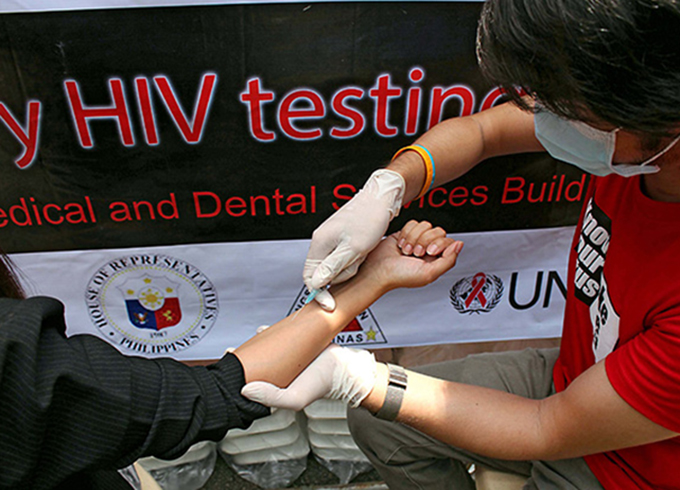
HIV testing in Manila … new national development plan seeks to reverse upwards trend. Image: Philippine Star

By Father Casibjorn Quia, Roy Abrahmn Narra and Jerome Villanueva in Manila

The year 2016 was a landmark year for the Philippines with HIV (human immunodeficiency virus) setting annual and monthly records that are the highest since the country started counting HIV incidence 33 years ago.

This coincides with a new development plan for the country that is targeting a reverse trend for the number of new HIV detections in a year, meaning the growth rates of new infections are declining.

The year-end dataset of the Department of Health’s HIV and AIDS (acquired immunodeficiency syndrome) Registry of the Philippines (HARP) noted that there were 750 cases in December 2016 alone, a month’s high.

The year 2016 tallied a total of 9,264 cases (including 1,113 full-blown AIDS cases and 439 deaths). The 33-year-total of recorded HIV cases, including deaths, is already near the 40,000 mark (39,622).

With the 9,264 total in 2016, the DOH said an average of 25.38 Filipinos have contracted HIV in a day. This contrasts with only one person a day in 2008.

Though latest 2017 figures are yet to be released, a Manila social hygiene clinic physician told Asia Pacific Report the unnamed centre had received 31 cases alone last month.

-Advertisement-

The Philippines passed a reproductive health law five years ago but it has yet to be fully implemented given court cases and strong opposition from the Catholic Church and from pro-life advocates.

Condom distribution plan
Months into the Rodrigo Duterte administration, the president had issued Executive Order 12 calling for the immediate implementation of Republic Act 10354 (Responsible Parenthood and Reproductive Health Act 2012).

Recently, health officials said recently DOH was set to distribute condoms.

Even schools are target distribution centres, say health officials, but Catholic-run schools and universities are vehemently opposing it.

Year-on-year, there were more adolescent deaths in 2016 (88 compared with 64 in 2015). HIV cases reported among Filipinos aged 15-to-24 at the time of their being reported reached 10,720 cases.

But a significant number — more than 60 percent of the 39,622 cases — contracted HIV through homosexual contact.

The Philippines is said to be a “low-prevalence” HIV country, with the 39,622 cases well below one percent of the total Philippine population. However, its annual growth rates of HIV infection rate are among the fastest in the Asia-Pacific region, says a December 2016 report by the US-based Human Rights Watch.

“The country’s growing HIV epidemic has been fuelled by a legal and policy environment hostile to evidence-based policies and interventions proven to help prevent HIV transmission,” HRW said.

HRW criticisms
Human Rights Watch also criticised the Philippine government for “failing to adequately target HIV prevention measures at men who have sex with men (MSM)”, also citing the “woefully inadequate” HIV prevention education in schools and the “non-existent” commercial marketing of condoms to MSM populations.

In reply, Archbishop Socrates Villegas, D.D., president of the Catholic Bishops’ Conference of the Philippines (CBCP), said condom distribution in schools “will stimulate immorality”.

Dr Diana Mendoza, from a Manila-based social hygiene clinic, told Asia Pacific Report the Philippines could prevent an HIV epidemic especially through empowering citizens through awareness and protection.

In Tacloban City, site of supertyphoon Haiyan in 2013, a Catholic parish priest said that instead of condom distribution in schools, an “ABC method” may work: “A – abstinence from sex outside marriage; B – be faithful to one another; and C – conversion of heart to the value of love and sacredness of sex as a gift of God in marriage”.

This “ABC” advice from Father Raymund Sotto of the St. Rafael the Archangel parish in Tacloban City counters the policy advice of the World Health Organisation (WHO): the proper and consistent use of condoms will be “highly effective: in preventing HIV and other sexually-transmitted infections (STIs).

The recently-released 2017-2022 Philippine Development Plan under the Duterte administration noted the “substantial increase” in newly-diagnosed HIV cases since 2010. The report added that the “the increased reported cases may be due to better surveillance and testing methods.”

The Duterte government will also propose to the Philippine legislature to amend the current Philippine HIV and AIDS Prevention and Control Act 1998 (Republic Act 8504) to make the law “more responsive and relevant” to the current rise of HIV cases in the country, the PDP reported.

Jerome Villanueva and Roy Abrahmn Narra are graduate journalism students of the University of Santo Tomas, Manila. Catholic diocesan priest Father Casibjorn Qiua is taking up a graduate degree in communication from the same university.

The 20177-2022 Philippine Development Plan

]]>

Across the Ditch: Headlines + Key To Exit Parliament + Cartoonist Murray Ball Passes Away

Across the Ditch: Australian radio FiveAA.com.au’s Peter Godfrey and EveningReport.nz’s Selwyn Manning deliver their weekly bulletin Across the Ditch. This week: Weather + Headlines + John Key set to exit Parliament next week + a tribute to Footrot Flats creator and author Murray Ball. Weather + Headlines ITEM ONE: John Key Set To Exit Parliament – So what’s his legacy? Former prime minister John Key is formally nearing the end of his political career – on Wednesday next week he will deliver his valedictory speech and then it is Haere ra to Parliament. Key has stayed just long enough to prevent a by-election being forced on the National-led Government. If an MP resigns within six months of a general election, a by-election is not required. Key resigned his prime ministership in December, surprising even his closest Cabinet colleagues. Rumours have abounded about why he really stood down, but to date nothing has surfaced that substantially offers an explanation beyond what Key had said at the time, that he had no more fuel in the tank. His popularity reached its zenith in 2011 when the Colmar Brunton Poll suggested over 60 percent of those polled preferred Key as their prime minister. By November last year, his popularity based on the same methodology had fallen to 36 percent. So what of his legacy? While successfully navigating New Zealand’s economy through the wake of the global financial crisis, the Key Government saw poverty in New Zealand worsen. Homelessness, and drastically reduced disposable incomes (after housing or accommodation costs) have seen millions of New Zealanders become worse off than they were before he came to power. For the five percent of the richest people living here, they, however, have prospered. Investors have also done well. The rise of residential house prices in Auckland have cooled in the last six months. But the average price for a home in Auckland is now over $1million. A house bought for $720,000 in 2008 when Key’s National’s came to power, now would sell for more than $1.45 million. Such steep climbs have placed considerable hardship even on middle income Kiwis. Despite upward pressure on housing prices, Key’s Government insisted on taking a hands off approach to foreign investors, that in part, coupled with a short supply of housing stock, caused concerns of economic instability and potential catastrophe should the housing bubble burst. Once labeled the Smiling Assassin by his colleagues at Merrill Lynch in the USA, the New Zealand public most often saw a comedic version of John Key. This made him popular with many, and loathed by his opponents. He governed by polling the public mood, and ultimately sniffed the breeze and realised his fun was over. No doubt, controversy will continue to surface and surround this odd political figure despite his exit from politics. And already, one gets the feeling that many here in New Zealand, when considering the past eight years, are wondering, what was that all about? ITEM TWO: Cartoonist Murray Ball passes away The celebrated author and cartoonist Murray Ball died this week aged 78 years of age. Murray Ball was loved by more than just his generation of Kiwis but was celebrated for actually defining a cultural element of what it meant to be a New Zealander. His cartoons, including Footrot Flats and Stanley were fun, funny, and always expressed a strong message for those who also like to ponder. He was sincerely political, egalitarian, even arguing the merits of socialism if untainted by totalitarianism. And his cartoon creations Wal, Dog, Horse, and Cheeky Hobson are characters that so easily resemble so many characters that you may come across when venturing around these islands. Across the Ditch broadcasts live each week on Australia’s radio FiveAA.com.au and webcasts on EveningReport.nz and Livenews.co.nz and ForeignAffairs.co.nz.]]>

Cardinal Ribat calls on PNG churches to ‘work together’ over HIV

]]>

AsiaPacificReport.nz

EMTV News reports on the HIV Summit in Port Moresby and other Papua New Guinean news.

By Annette Kora in Port Moresby

The first HIV Summit for Papua New Guinean heads of churches has begun at a hotel in the capital of Port Moresby.

Sir John Cardinal Ribat yesterday … advocating care, peace and unity. Image: EMTV

The summit was launched yesterday with welcoming remarks by the chairman for PNG Christian Leaders Alliance in HIV and Aids, Sir John Cardinal Ribat.

Cardinal Ribat said one of the great intentions for the HIV Summit was to bring the heads of churches together so that they are able to speak about the virus that was a public health issue in this nation.

He said they would work together, be one voice in advocating care, peace and unity.

“Today is one moment where we can share this intention and talk about it and work towards promoting it in future,” he said.

-Advertisement-

Cardinal Ribat said he was more than humbled to see about 20 heads of churches in the summit.

“It is indeed a milestone for PNG Christian Leaders Alliance for HIV and Aids to stage this historical national event.

Desired outcomes
“The summit is the first of its kind for the country. It is our hope and prayer that the desired outcomes of this summit are collectively achieved through the active involvement and participation of all heads of churches.”

He said it was also a time to learn about the current HIV situation in the nation, the region and globally, and to see where the response gaps were and how churches could respond.

“It is a time for us to discuss on the sensitive issues such as gender-based violence (GBV), stigma and discrimination, human rights, access to service and issue affect the population in PNG.”

He added that it was also a time for Papua New Guinea to make a proactive way forward and make recommendations on how the Christian churches in the country could respond in addressing the root causes of HIV transmission and sensitive issues associated with it.

The summit will continue tomorrow.

United Church Choir singers at the HIV Forum in Port Moresby yesterday. Image: EMTV
]]>

Author praised for opening readers’ eyes to West Papua’s repression

]]>

AsiaPacificReport.nz

By Pacific Media Watch editor Kendall Hutt

Bookstore owners, writers, authors, family, friends and a group hopeful of West Papuan independence squeezed into the Women’s Bookshop in Ponsonby last night to celebrate the work of young New Zealand author Bonnie Etherington and her novel The Earth Cries Out.

Not only is the novel being celebrated and praised for Etherington’s mastery of the written word, but because of its ability to make the public more aware of life in West Papua, a region controversially ruled by Indonesia since the 1960s.

Pacific Media Watch editor Kendall Hutt (left) with author Bonnie Etherington. Image: De Abcede/PMC

Plagued by media freedom and human rights violations, many media freedom and human rights organisations and several Pacific nations have condemned the widespread arrests and imprisonment of West Papuans for non-violent expression of their political views.

These are issues Etherington herself acknowledged speaking with Asia Pacific Report earlier this week, saying she wanted to show readers West Papua’s rich and diverse history, not only its complex political situation.

“I really wanted to show multiple sides of West Papua because it is so often forgotten or stereotyped by the rest of the world.”

This is something those who have already read The Earth Cries Out praise.

-Advertisement-

Harriet Allan, fiction publisher for Penguin Books New Zealand, commended Etherington in a speech on her ability to provide insight into West Papua through the eyes of a child, that of female protagonist Ruth.

“As Ruth bears witness to what she sees, we too start to hear the voices that have been silenced by politics, sickness, violence and poverty.”

Like Ruth, we come away with a greater understanding of this country and its diverse people and also of ourselves and the bonds of love and friendship.”

‘Shed some light’
Although she has not had the chance to read her sister’s entire novel, Etherington’s younger sister, Aimee, says what she has read is very similar to how she and her sister experienced West Papua.

“With the descriptions, I felt like I was back there. She’s done a really good job of capturing how it feels, I guess.”

Aimee Etherington says she hopes her sister’s novel spreads awareness of West Papua.

“Most people that I’ve spoken to don’t really know that it exists, so it will be good to shed some light as to what’s going on there and, I guess, giving a bit of insight on how as New Zealanders and Australians we can actually do something about it.”

‘Almost experiencing it’
Like Harriet Allan, Women’s Bookshop owner Carol Beu loved Ruth’s voice.

“I think becoming aware of the situation in Papua through the eyes of this child, Ruth, is really quite special”, Beu told the audience.

“The way it’s revealed, it’s fascinating.”

Beu admits this was also “quite shocking”, due to Etherington’s ability to place the reader in the moment.

“You’re almost experiencing it.”

Penguin fiction publisher Harriet Allan (left) with author Bonnie Etherington. Image: Del Abcede/PMC

Bea also acknowledged those in the audience who were supporting the book on more of a political level, such as West Papua Action Auckland spokesperson Maire Leadbeater.

Bea told those gathered she found the politics of The Earth Cries Out “quite astonishing and wonderful”.

“It’s a book that makes you angry in many ways on a political level.”

Leadbeater herself, however, says she is looking forward to reading the novel.

Mister Pip comparisons
“I think looking at countries through a literary perspective can be very helpful at times. I can’t help thinking of the book Mister Pip, about Bougainville and how amazingly helpful that was I think in terms of people understanding the conflict.

“It’s done in a fictionalised way but it’s true to the situation, so I’m picking from what I’ve heard about the book it may achieve that as well.”

Leadbeater is not the only one to draw comparisons with Lloyd Jones’ Mister Pip, however.

Tony Moores, owner of bookstore Poppies in Remuera, reached a similar conclusion.

“This is not Mister Pip, but the issues it deals with are quite similar, from a different perspective.”

Powerful, shocking
The Creative Hub founder, John Cranna, who also noted ties with Mister Pip, praised Etherington on her talent after listening to several excerpts read by Allan and Etherington herself.

“For such a young writer to be writing about such dramatic and shocking events, and to be pulling it off, is quite an achievement.

To write about violent death is … very hard in a reserved, powerful way, but she certainly did that very well.

]]>

Attack on FBC reporter outside court stirs Fiji media protests

]]>

AsiaPacificReport.nz

The safety of media personnel has come under the spotlight again after an attack on a Fiji Broadcasting Corporation television journalist on Monday.

FBC’s Praneeta Prakash … stone thrown at her, verbally abused. Image: FBC

A remand prisoner threw a stone at an FBC news reporter while in the presence of a police escort outside the Suva courts.

The police at the scene refused to take any action against the remand prisoner even though the reporter was also verbally abused.

FBC journalist Praneeta Prakash was shooting footage of a man sentenced in a corruption related case in Suva when a remand prisoner being escorted by police to the cell block threw a stone at her which struck her stomach.

Fijian Media Association general secretary Stanley Simpson said reporters covered court stories in order to inform the public and to ensure that justice was served under the law.

“The journalist needs to be left to do their work because in the end it benefits everyone,” he said.

-Advertisement-

“We saw a Fiji TV reporter was manhandled, we saw a Fiji Sun reporter get attacked recently, and now we see the terrible incident of a stone being thrown at a journalist.

Journalist ‘has every right’
“In these public spaces, and especially in the public interest, the journalist has every right to be there to take footage.”

Police spokesperson Ana Naisoro said a thorough investigation on the incident would be carried out.

“We have had some incidents where members of the public have attacked journalists again. We would request them to respect the rights of the journalist. They are simply doing their jobs, they’re not breaking any law.”

Fiji Human Rights and Anti-Discrimination Commission Director Ashwin Raj said it was “deeply concerning” that journalists were exposed to such situations and they must have a safe environment where media was able to discharge its duties.

Kelly Vacala is an FBC News journalist.

Fijian Media Association

]]>

Accuracy the key in climate change reporting, student journos told

]]>

AsiaPacificReport.nz

By Abishek Chand in Suva

Student journalists of the University of the South Pacific have been reminded about the threat of climate change and the need to report the issue accurately and consistently.

The comments were made by communications officer for the university’s Pacific Centre for the Environment and Sustainable Development (PaCE-SD) Sarika Chand at the latest Wansolwara Toks on environment reporting.

Chand said scientific research had established beyond any reasonable doubt that climate change was real.

Chand, a USP journalism graduate, said that in general Pacific Island journalists were more accepting of the facts regarding climate change — unlike some of their Western counterparts who were more sceptical in the past.

She said this was possibly because the effects of climate change were felt more acutely in the Pacific region.

The regional media was more advanced in its reportage in this area, especially when reporting on the impacts of climate change in the Pacific, she said.

-Advertisement-

Countries like the United States had a long history of denying climate change and elements of this were reflected in how the US media framed the issue, she said.

Many impacts
Chand outlined that climate change impacted on the region in many ways, such as food security, health, ecosystem, water, culture, language and identity, together with extreme weather events.

She stressed the need to keep up to date with news sources as research on climate change was frequently updated.

She said that not enough reporting was being done on the health sector.

Culture, language and identity were other aspects that should be covered more often by the media, she stated.

PaCE-SD was actively researching climate change and offering postgraduate studies on the subject. With the courses that the centre had on offer, a pool of local scientists with a deeper understanding of the region was growing.

Many students who had graduated from the PaCE-SD programmes were well placed in the climate change sector in the region, and had already started making contributions to research and scholarship in the Pacific.

A final year USP journalism student from Tonga, Linda Filiai, said the forum was very interesting and educational.

“The media should  highlight the impacts to ensure Pacific islanders are more aware and also to get the attention of leading countries to address the problem,” she said.

Abishek Chand is a Wansolwara student journalist.

  • Wansolwara Toks is a public forum organised by USP Journalism to broaden student exposure to experts, deepen their knowledge on major public interest issues at stake, and build their contacts.

]]>

‘Heavy handed’ NZ clamps down on Tokelau spending

]]>

AsiaPacificReport.nz

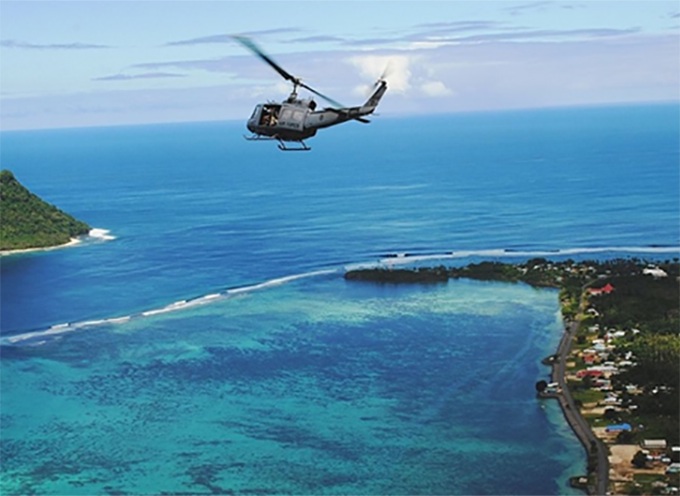
Proposed New Zealand veto powers come less than a month after it was reported Tokelau had spent millions of dollars on two helicopters to circumvent the 24-hour boat journey from Apia, Samoa. Image: MFAT

By Mackenzie Smith

As Tokelau’s ninth government takes shape, the new leader is raising concerns over New Zealand’s treatment of its last remaining Pacific territory.

Ulu-o-Tokelau Siopili Perez used his opening speech at the General Fono (Parliament) last week to protest against proposed veto powers for New Zealand’s Administrator to Tokelau.

The changes would put Administrator David Nicholson in control of the use of Tokelau’s development funds for any projects more than $500,000 — oversight not seen since the Ministry of Foreign Affairs and Trade (MFAT) relinquished it to the General Fono in 1996.

Labour’s Pacific Island Affairs spokesperson Su’a William Sio said power over Tokelau’s affairs should lie with the General Fono, not New Zealand.

“This kind of heavy handed approach smells of arrogance and I think it would be an affront to a nation that is seeking self-determination,” he said.

Tony Angelo, a constitutional adviser to Tokelau’s Taupulega (Council of Elders), said the veto powers could compromise New Zealand’s compliance with the United Nations decolonisation requirements.

-Advertisement-

The UN ruled in 1960 that all peoples have the right to free political status and economic, social and cultural development.

‘Step back’
“I think the result would be, as the Ulu says, a step back from what has been relative autonomy,” said Dr Angelo.

Auckland University anthropologist Dr Judith Huntsman said the administrator’s move was unusual at a time when Ulu was promising the relocation of government offices in Apia, Samoa to Tokelau.

“[Tokelau is] pushing to get that office under the control of the people of the islands rather than that being viewed by outsiders and [MFAT] as the centre of Tokelau,” she said.

Su’a said MFAT was “stuck in colonial thinking that belongs to a bygone era” and it made no sense to have the office in Apia.

He said Foreign Minister Murray McCully was travelling to Apia to meet with Ulu to discuss his comments at the General Fono.

MFAT confirmed McCully would be in Samoa this week but did not respond when asked about Su’a’s claims.

The proposed veto powers come less than a month after it was reported Tokelau spent millions on two helicopters to circumvent the 24-hour boat journey from Apia, without proper certification or certainty the aircraft could make the lengthy trip.

‘Extravagances’
McCully told 1News at the time that the purchases were “extravagances” and New Zealand would “reflect on its own budgetary arrangements” with Tokelau.

“Given there appears to have been a breakdown in Tokelau’s governance, New Zealand is reviewing the oversight it has of capital expenditure,” McCully said in a written statement.

Although the funds for the helicopters reportedly came out Tokelau’s income from fishing licences, Dr Huntsman said this would still have to be sourced from Tokelau’s International Trust Fund.

The fund, set up in 2004, was started with contributions from New Zealand’s government and sat at over $78 million at the end of the 2014 financial year.

Tokelau International Trust Fund

]]>

Iranian refugee Sawari’s PNG trial deferred to end of month

]]>

AsiaPacificReport.nz

EMTV News report of the court hearing in Port Moresby yesterday.

By Sally Pokiton in Port Moresby

The trial against Iranian refugee Loghman Sawari, who fled Papua New Guinea to Fiji in January and sought refuge but was deported, has been deferred to March 27 at the Waigani District Court.

The trial was supposed to start yesterday. However, it was deferred because police prosecution were unable to organise witnesses in time.

Sawari and his lawyer Loani Henao appeared before Magistrate Mekeo Gauli.

With the deferral of the trial, the court told police prosecution to make copies of the state witnesses to Sawari’s lawyers next week.

Sawari’s bail of K1000 (about NZ$455) has been extended and he will continue reporting to the Waigani District Court registry.

-Advertisement-

The 21-year-old was arrested and charged for providing false information for the purpose of obtaining a Papua New Guinea passport from the PNG Immigration and Citizen Services Authority, a charge that falls under section 16 (1) of the Passport Act of 1982.

He allegedly used false identification to obtain travel documents which he used to leave PNG for Fiji.

He was arrested on February 3 at Jackson’s International Airport after he got deported from Fiji.

A summary of facts before the court says he used a passport bearing the name Junior Charles Sawari to travel to Fiji.

The passport was obtained through a consultant, Junior Aisa, who allegedly submitted the falsified information to Immigration on 8 July 2016. A fee of K1000 was paid to Aisa for this service.

That passport was released from the PNG Immigration on 2 August 2016, and collected by Aisa.

Sawari arrived in Papua New Guinea from Christmas Island in 2013 as a 17-year-old seeking asylum. He was processed in Manus and given refugee status.

Iranian refugee Loghman Sawari in a police vehicle on his way to Bomana Prison outside Port Moresby after his bail application was moved in court last month. Image: Kennedy Bani/Loop PNG
]]>

Female Melanesian tattooists to make their mark in Spain

]]>

AsiaPacificReport.nz

A threatened tradition will get fresh focus when a female Melanesian tattoo collective takes up a Spanish invitation.

The group, Mage’au: Melanesian Marks, is made up of three women – Julia Mage’au Grey, Aisa Pokarop and Toria Maladina.

They will soon attend the Traditional Tattoo and World Culture Festival in Santa Ponsa, Spain.

Grey said the trip was important for the group as it gave them an opportunity to promote the significance of the Melanesian marks movement and revive it.

“Since 2012, we’ve been pushing awareness to bring back our marks for our women and our men, and basically the festival picked up on it,” she said.

Grey said the practice holds historic significance to her as a Papua New Guinean.

-Advertisement-

“Men in our communities see women for their worth, and in the past we used our marks as statements and reminders for our men to treat us with respect.”

But because the practice is nearing extinction, men do not have that reminder, she added.

“It’s negligent if we let that part of our culture go. That’s why we feel this trip to Spain is very important.”

‘Real privilege’
Ema Lavola, who had work done on her by Grey, said it was a “real privilege” to be wearing the traditional marks.

“When we mark our bodies, we are creating an interface between how the world perceives us and how we want the world to see us,” she said.

“For me, the tattoo is a way to remind me every day where I come from and what makes me different.”

Lavola said Mage’au and her team were “advocates and protectors of the integrity of these marks, making sure that the people who wear them are wearing them for the right reason”.

Reina Sutton – a friend of Grey and gallery co-ordinator at Fresh Gallery Otara – said artists like Grey help people reconnect with their culture.

“I think it’s a great thing that Julia and her team are doing with their work, getting those marks back before they’re lost.”

She said the opportunity for artists to showcase their work internationally is rewarding as it creates conversation about Pacific art being used as a platform of change.

“I’m a huge supporter of what my friends and creative family are doing and I’m super-proud.”

]]>

Debut novel offers rare glimpse into grief amid life in West Papua

]]>

AsiaPacificReport.nz

Ahead of the launch of her debut novel The Earth Cries Out, author Bonnie Etherington talks with Pacific Media Watch contributing editor Kendall Hutt about the grief and loss intertwined with growing up in West Papua, against a backdrop of the wider political and humanitarian issues of the controversial Indonesian-ruled region.

 By Kendall Hutt

Speaking to Asia Pacific Report in transit from the United States, author Bonnie Etherington says her early life in West Papua motivated her to write the novel The Earth Cries Out, but more importantly a desire to make the public more aware of the repressed Indonesian-ruled region.

“I really wanted to show multiple sides of West Papua because it is so often forgotten or stereotyped by the rest of the world,” she says.

Controversy has surrounded West Papua since its incorporation into Indonesia through a controversial Act of Free Choice — dubbed by critics as an “Act of no choice”–  in 1969.

Such controversy is compounded by the fact that the region is plagued by media freedom and human rights violations.

Despite President Joko Widodo’s lifting of restrictions on foreign journalists in 2015, harassment and assaults against journalists have continued, a Freedom House report shows.

-Advertisement-

“Access is not automatic, unimpeded, or granted quickly”, the report states.

Papuan independence silenced
The situation for West Papuans themselves is also dark, with Human Rights Watch World Report 2017 revealing dozens of Papuans remain imprisoned for non-violent expression of their political views.

More than 1700 Papuan independence supporters were detained in early May last year while showing solidarity with the International Parliamentarians for West Papua (IPWP) protest in London.

Many organisations and human rights groups condemned the arrests, whilst allegations of torture also emerged following the mass arrests.

Such events have prompted several Pacific nations to recently raise grave concerns regarding such human rights violations, at the 34th session of the United Nations (UN) Human Rights Council in March.

Calls by Pacific nations echo those of the Catholic Justice of Peace Commission back in May, whose report found no improvement in human rights violations, prompting the group to call on the UN to investigate human rights abuses.

These are all grave issues Etherington herself acknowledges.

“West Papua’s political situation is complex and its history is rich and diverse, and the novel shows just some parts of that,” she says.

“I really did not want to homogenise the region or its many peoples, but give a glimpse into its multiplicities.”

Loss, grief, pain
The Earth Cries Out does just that, following a Nelson family as they attempt to heal and atone through aid work after the accidental death of Julia, the sister of young female protagonist Ruth.

Dropping into a mountain village in West Papua (Irian Jaya, as it was known then) during a time of civil unrest and suppression, Ruth’s parents struggle with their grief.

Ruth, meanwhile, seeks redemption in bearing witness to and passing on the stories of others, of those who have been silenced.

Although never having lost a sibling, as Ruth does, Etherington says the main challenge she faced was gathering the courage to write the novel.

“In part, it was challenging because there are some experiences of grief that Ruth and I both share, and similar experiences of disorientation, witnessing, and survivor’s guilt”.

Etherington and her family moved to West Papua in the early 1990s, where her father partnered with a Papuan church to provide language, literacy and healthcare services.

She has spent roughly a total of 11 years in West Papua, between 1992 and 2007.

Despite four years living in Darwin, Australia, from 2000-2004, Etherington says she popped “back and forth quite a bit”, with the family also spending time in New Zealand.

Mass killings
It is therefore unsurprising Etherington’s experiences speak to the ongoing situation in West Papua, with the author declining to name the village where she grew up “in order to protect the people who still live there”.

With mass killings marring West Papua’s history under Indonesia, it is understandable why Etherington’s novel explores loss and grief.

“Death and illness were common parts of life in the village where I grew up.”

She explains this was largely due to high infant mortality rates and malaria.

Etherington’s first encounter with so much death came when she was just five years old.

“I was at the funeral of my best friend, a boy who had the same name as I did. He died from malaria … I remember how small his coffin was”.

Centrality of women
With young female protagonist Ruth at the heart of the novel, and West Papua seen through her eyes, women have a central place in The Earth Cries Out.

“To some extent, the novel is about relationships between women, especially mothers and their daughters, and the shades of loss and pain, as well as love that can colour those relationships,” Etherington says.

Harriet Allan, fiction publisher for Penguin Books New Zealand, agrees women have a central place in the novel.

“The novel gives voice to those who have been silenced, in particular, though not exclusively, to women.

The relationships between the young protagonist Ruth and her dead sister, her mother and her new friend Susumina are at the heart of the book.”

Allan, who first met Etherington at a creative writing workshop at Massey University five years ago, says the novel offers a window into life in West Papua – its people, harsh realities, vivid landscape, and the love and warmth of West Papua’s people.

“The novel is a compelling story and valuable insight into another country and into other people – but ultimately ourselves”.

‘Home of my heart’
Reflecting on the “home of my heart” Etherington says she hopes she has drawn attention to the perseverance of West Papua’s people and that her readers are encouraged to listen more to others stories.

“I hope that the novel, on some scale, is about listening to those who have been marginalized on their own lands.”

However, when asked what she would like to see happen over the situation in West Papua, Etherington says it is not her place to say how the indigenous peoples of West Papua gain justice for themselves and their land.

“I support dignity and justice for the indigenous peoples of West Papua and their lands. How that should best come about is not my place to say.

“It is the place of indigenous Papuans to say, whether that takes the shape of full political autonomy from Indonesia or some other configuration of reconciliation and reparations.

I hope that their voices will be heard and respected.”

]]>

PISAN Fono big winner with Pacific and Timor-Leste scholars

]]>

AsiaPacificReport.nz

New Zealand Pacific scholars get to know each other at the PISAN North Island Fono at the University of Auckland at the weekend. Image: Michelle Curran/Pacific Cooperation Foundation

By Michelle Curran in Auckland

Ten years ago, Tonga’s Kisione Manu was studying a Bachelor of Science at Palmerston North-based Massey University on a New Zealand scholarship.

After graduating, Manu returned home to teach chemistry and biology at Tonga High School, and enjoyed teaching students about his passion – science – before starting a job as a Senior Qualification Analyst at the Ministry of Education, in Nuku’alofa.

One decade later, he has travelled back in NZ to complete his Master of Education, at the familiar Massey University campus, once again through the Ministry of Foreign Affairs and Trade (MFAT) NZ Scholarship initiative.

When Manu saw the inaugural Pacific Island Scholar Alumni Network (PISAN) fono at the University of Auckland being promoted, it was a “no-brainer to attend”, he says.

“I saw it as a forum to meet other New Zealand scholars from different nations, and as an opportunity to share with others about our cultural backgrounds,” Manu says.

The PISAN Fono, facilitated by the Pacific Cooperation Foundation (PCF), got underway on Friday and concluded on Sunday, attracting approximately 150 NZ scholars.

-Advertisement-

These scholars come from the Pacific and Timor-Leste, and currently study at various North Island tertiary institutions.

Chance to connect
Speaking on the final day of the North Island fono, Manu says the event met his expectations — and offered so much more.

“I was able to surround myself with people from Samoa, Papua New Guinea, Vanuatu, Tuvalu and Kiribati and other cultures … it has been a great chance to connect with other professionals too.

“I met two scholars also studying their Master of Education at Victoria University – one from Papua New Guinea and one from Vanuatu, and I will definitely stay connected with these new friends.”

Tonga is currently trying to get tertiary providers in Tonga registered and accredited, using a system like NZQA, and it is this reason why Manu is studying in New Zealand, he says.

The new contacts he has made will enable him to compare education programmes and systems happening in the wider Pacific region, he adds.

“Ten years ago, there was no forum for scholars from different universities to interact together, and Pacific nations tended to stick together – Tongans with Tongans, Samoans with Samoans, and so on … the fono is a fantastic idea.”

Kisione Manu prepares for a presentation at the weekend fono. Image: Michelle Curran/Pacific Cooperation Foundation

Throughout the three-day fono, scholars heard from keynote speakers who are both alumni – Papua New Guinea’s Noel Mobiha, an ICT and energy consultant, who has held senior management and advisory roles in PNG; and Jody Jackson-Becerra, AUT’s community engagement manager, from Samoa.

Nurturing connections
Both presenters shared their experiences of studying in NZ, and the importance of making connections and nurturing them.

For Manu, the highlight of the weekend was Jody’s presentation where she used the work of Tongan/Fijian writer and anthropologist Epeli Hau’ofa to stress the point all the Pacific scholars belong to Oceania, and this commonality can help these students to collaborate and work together to create change and progress in their region.

Scholars also attended workshops based on priority areas outlined by the Pacific Islands Forum (PIF) 2016 Communique.

They discussed topics and came up with ideas and opinions, which will be documented and presented at the PIF Leaders’ Meeting later this year in Samoa by a scholar selected from the North Island Fono, and another scholar chosen at this weekend’s South Island Fono.

On the final day of the fono, it was announced that the 2017-18 Summer Internship applications were open for NZ scholars.

Summer internship
The fono attendees heard from three NZ scholars, who were part of the 2016-17 Summer Internship initiative – Jeremiah Tauiliili, Ana Tupou and Marilyn Jime.

They shared their experiences as Summer Interns, and the benefits they feel they have gained from taking part in the initiative – such as improved communication skills and professionalism – and encouraged current scholars to apply for an internship.

PCF chief executive officer Laulu Mac Leauanae says it is “fantastic to see the vision” and aim of the fono come to life.

“We wanted to provide a forum where New Zealand scholars could meet other people from different universities and from all kinds of backgrounds, to make their time in New Zealand truly memorable and prosperous – the contacts made now at this fono will come into play later in life when these scholars are leading their respective countries,” Laulu says.

The PISAN Fono for scholars studying in the South Island will get underway this Friday, at the University of Canterbury, in Christchurch, and conclude on Sunday.

]]>

Chasing media freedom story ‘opened passion’ for new PMW editor

]]>

AsiaPacificReport.nz

Award-winning Auckland University of Technology graduate journalist Kendall Hutt has been appointed contributing editor for the Pacific Media Watch freedom project for 2017.

Hutt says she is extremely thankful for the opportunity to continue growing her passion for and knowledge of the Pacific, but more importantly telling the region’s stories.

“Every Pacific nation has its own story. It’s not all about palm trees and white sandy beaches,” she says.

“Islands are being inundated by rising sea levels as a result of climate change, and human rights violations are being committed.”

Hutt says she is determined to make the wider public in New Zealand and regionally more aware of these issues, as the Pacific Media Centre had done for her during her studies.

“PMC opened my eyes to a region I hadn’t previously considered for my journalism career,” she says.

‘Gung-ho reporting’
“I had dreams of being a gung-ho war reporter or holding politicians to account in the halls of Parliament.”

-Advertisement-

Writing a story exploring media freedom in the Pacific in early 2015 really changed that direction for the better — it awoke a passion in me.”

She succeeds former PMW editor TJ Aumua, who is currently adventuring overseas with 2015 editor Star Kata, and Alex Perrottet, now a journalist with Radio New Zealand International, and Anna Majavu.

Hutt has been a contributing writer for PMC since 2015 and has recently returned from a journalism exchange in Finland as part of her Honours year last year.

Pacific Media Centre director Pacific David Robie congratulated her on her appointment after a series of interviews.

“We are pleased to have Kendall on board. She has shown with past contributing assignments that she is a dedicated and talented young journalist and committed to the Pacific.”

Pacific Media Watch collaborates with several global media freedom organisations, including Paris-based Reporters Without Borders.

The position of part-time PMW editor is appointed annually and is open to current AUT journalism students and recent graduates. It involves research, writing, editing and publishing on Asia-Pacific media freedom, human rights and socio-political issues.

]]>

Curbing illegal drugs now ‘development’ plan target in Philippines

]]>

AsiaPacificReport.nz

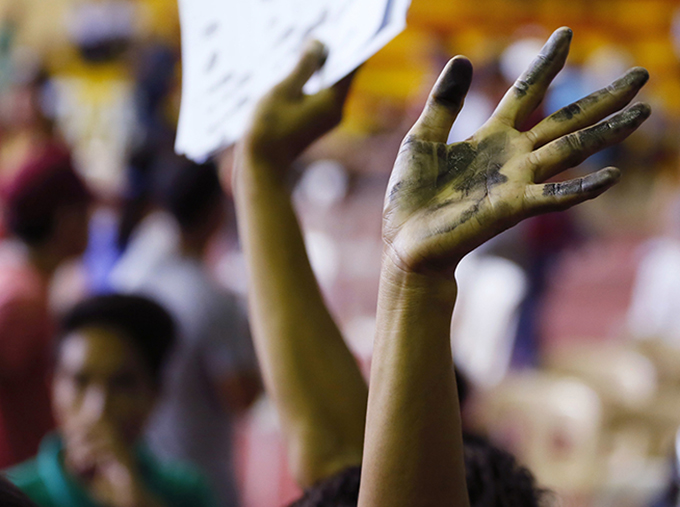
A resident waves his stained hands after being finger-printed as he undergoes processing by the authorities allegedly for being a drug-user in Tanauan city, Batangas province, south of Manila, Philippines. Image: Bullit Marquez/Humanosphere

By Jeremaiah M. Opiniano and Jerome P. Villanueva in Manila

Curbing illegal drugs “holistically” is now an explicit mandate as provided by the Philippines government’s 2017-2022 Development Plan, released last week.

Chapter 18 of the Development Plan says that government targets the significant reduction of “all forms of criminality and illegal drugs” through a “holistic program that involves combating not only crimes but also the corruption that leads to the perpetuation of such acts”.

The portion on curbing illegal drugs in the PDP comes at a time that President Rodrigo Duterte revived community visits to warn drug users and pushers, called locally as Oplan Tokhang.

At the same time, the Philippine National Police Director General Roland dela Rosa has announced yesterday the launching of “Operation Double Barrel Reloaded”.

The operation is said to be a “kinder, gentler” approach for law enforcers to confront the illegal drug problem, dela Rosa told reporters.

More than 7000 suspected users and pushers have been reported killed since Duterte assumed office on 1 July  2016.

-Advertisement-

These killings are linked to the rise of extrajudicial killings (EJKs) that have been lambasted by critics — but shrugged off by Duterte supporters as not being the president’s policy —  that have criticised by international human rights groups, former heads of state, and the United Nations.

‘Suppressing the flow’
The Development Policy declares the country’s national anti-illegal drugs strategy included “suppressing the flow of illegal drugs supply through sustained law enforcement operations and reducing consumer demand for drugs and other substances”.

While the PDP mandated drug rehabilitation and massive preventive education and awareness programs, government is set to arrest and prosecute police personnel “involved in the use and trade of illegal drugs through counter-intelligence operations” prosecution.

Noting also the entry of Chinese, African and Mexican drug syndicates to the Philippines, government will also work with local and foreign law enforcement counterparts, as well as other international anti-drug organisations.

All these plans are part of a “holistic” approach to curb the drug problem, the PDP wrote. The plan also noted the data from the Philippine Drug Enforcement Agency that there are around four million drug users, and that 47 percent of villages (barangays) nationwide are “drug-affected.”

“The government has therefore adopted a holistic approach in addressing criminality and illegal drugs,” the PDP says. “As these initiatives are expected to result in high incidence of apprehensions, the government must also upgrade its jail faiclities and substantially increase drug rehabilitation centers.”

The PDP also says that “respect for human rights should be upheld and observed at all times” in all of law enforcers’ activities against criminality.

Recently, the US-based Human Rights Watch published a chapter on the Philippines and observed that Duterte could be liable to a lawsuit before local courts and even the International Criminal Court, the latter for alleged “crimes against humanity”.

Narcotics board concern
The UN-aligned International Narcotics Control Board (ICNB), in a March 2 release of its annual report, indicated the board’s concern about extrajudicial killings.

PNP chief Director General Ronald dela Rosa announces a “kinder, gentler” anti-drugs campaign at Camp Crame in Quezon City last week. Image: Philippine Star

The board called on the Philippines government to “issue an immediate and unequivocal condemnation and denunciation of extrajudicial actions against individuals suspected of involvement in the illicit drug trade or drug abuse; to put an immediate stop to such actions; and to ensure that the perpetrators of such acts are brought to justice in full observance of due process and the rule of law”.

Extrajudicial action “is fundamentally contrary to the provisions of… three international drug control conventions,” the ICNB report said.

The Malacañang called the HRW report “thoughtless and irresponsible” when the group’s report wrote the country had a “human rights calamity” given rising extrajudicial killings — allegedly perpetrated by police.

Such a “human rights calamity,” said Presidential Spokesperson Ernesto Abella, may have been averted due to actions by government.

Abella cited the more than 1.1 million pushers and users who voluntarily surrendered and the construction of drug rehabilitation centers.

“Is it a human rights calamity when the sheer scope and magnitude of an emerging narco-state have been exposed?” Abella said.

‘Ransom scheme’
Dela Rosa recently formed within the PNP the Drug Enforcement Group (DEG) that replaced the old Anti-Illegal Drugs Group (AIDG) given the involvement of several of the latter group’s officers in a reported “Tokhang for ransom scheme”.

The Philippine Drug Enforcement Agency (PDEA) indicated in its 2013 to 2016 figures that anti-illegal drug operations such as entrapments and arrests rose exponentially during the last six months of 2016 (the first six months of Duterte’s presidency).

In 2016, PDEA and partner law enforcement agencies had conducted 34,007 operations,  arrested 28,056 people, and filed 23,887 reports. These total figures are the highest over a four-year period (2013 to 2016).

Contrast the extended statements on illegal drugs 2017-2022 PDP to the 2011-2016 PDP provision on illegal drugs. The latter PDP wrote: “Modernise and upgrade facilities for law enforcers such as the PNP and the NBI (National Bureau of Investigation) crime laboratories, forensic investigation facilities and equipment.

“Improve capacities of prosecutors and law enforcers particularly NBI agents in the investigation and prosecution of special cases involving economic or white-collar crimes such as money laundering, tax evasion, smuggling, human trafficking, violations of intellectual property rights and antitrust laws, illegal drugs and even cases involving extralegal killings and other human rights violations as well as violation of environmental laws.”

Jerome Villanueva is a graduate journalism student of the University of Santo Tomas. Assistant Professor Jeremaiah Opiniano supervises the undergraduate and graduate journalism degree programmes.

More 2017-2022 Philippine Development Plan stories

]]>

RSF protests over ‘unscrupulous’ censorship, surveillance of journos

]]>

AsiaPacificReport.nz

On World Day Against Cyber-Censorship, Reporters Without Borders (RSF) released a report denouncing the readiness with which leading internet companies submit to the demands of authoritarian regimes in order to profit.

RSF is also concerned about the many cases of online surveillance of journalists and calls for the creation of binding international regulatory mechanisms.

The trade, plied by companies with expertise in cyber-surveillance, is lucrative but dubious.

RSF condemns the legal void that allows these companies to sell their products to regimes bent on online surveillance and censorship – just to increase their market share.

Recent revelations suggest that the Israeli company NSO is implicated in a case of arbitrary Mexican government surveillance of investigative journalist Rafael Cabrera.

Online surveillance constitutes a serious violation of media freedom.

According to a report published by Der Spiegel on February 25, Germany’s Federal Intelligence Service (BND) has spied on journalists with such international media outlets as the BBC, New York Times, and Reuters for years.

-Advertisement-

RSF also deplores the frequency with which Facebook posts and tweets are reportedly suppressed.

In Turkey, for example, Twitter deployed its local content management tool, which can be used to block access to a tweet or an account from within a given country.

After last July’s abortive coup, Twitter lost no time in complying with orders to censor the accounts of more than 20 journalists and media outlets. There is also concern about Facebook’s active cooperation with certain governments, its deletion of journalistic content, and its opaque content “moderation” policies.

The examples include the fan page of ARA News, a website that covers developments in Syria, Iraq, Turkey, and other parts of the Middle East. Facebook blocked the site for several days last December without explanation.

#CollateralFreedom: five censored sites unblocked by RSF

On World Day Against Cyber-Censorship, RSF is also pleased to report that it has embarked on Operation Collateral Freedom #3, with the goal of making online information accessible in countries where it is censored and deterring “Enemies of the internet” from blocking news websites.

After unblocking access to 11 websites in 2015 and six others in 2016, this operation has created alternative access to five more news websites that are blocked in their country of origin: Ozguruz (the well-known Turkish journalist Can Dündar’s new site) in Turkey, Azathabar in Turkmenistan, Meydan TV, reporting on Azerbaijan from exile, Doha News in Qatar, and Alqst in Saudi Arabia.

This operation is based on the technique of mirroring. RSF uses the hosting services of such major companies such as Fastly, Amazon, Microsoft, and Google to create duplicates or “mirrors” of the censored sites.

“Enemies of the Internet” cannot block access to the mirrors without a collateral impact on their own access to these internet giants, hence the operation’s name – Collateral Freedom.

An extension for the Chrome browser created in 2016 facilitates access to the #CollateralFreedom mirror sites.

When someone tries to access one of the original websites from within a country where it is blocked, the icon of the “RSF Censorship Detector” app appears if the extension is installed.

Clicking on this icon automatically redirects the user to RSF’s unblocked mirror site.

RSF has to buy bandwidth to keep the mirror sites accessible. The more they are visited, the faster this bandwidth is used up.

RSF asks all internet users to help pay for this bandwidth in order to prolong access to the mirrors.

More information at: https://rsf.org/en/collateral-freedom

]]>

PNG parents must ‘be serious’ on education for girls, says councillor

]]>

AsiaPacificReport.nz

An EMTV report calling for a “breakthrough” in education for girls in Papua New Guinea.

Young Papua New Guinean women and girls must be encouraged to enter into a broad range of careers and be involved in decision-making, says a ward councillor in in Lae.

Carol Yawing, the only woman in the Lae urban local level government, said parents must take the education of girls seriously.

Her comments came days after Papua New Guinea celebrated International Women’s Day with the rest of the world this week.

Her plea also followed the visit of Australian Foreign Minister Julie Bishop, who also spoke out in support of better educational opportunities for girls.

]]>

Bishop speaks up for jobless Papuan workers in Indonesian mining dispute

]]>

AsiaPacificReport.nz

Freeport-McMoran employees dance during a rally in front of the Ministry of Energy and Mineral Resources building in Jakarta on March 7. Image: Bay Ismoyo/AFP/UCANews

By Katharina R. Lestari in Jakarta

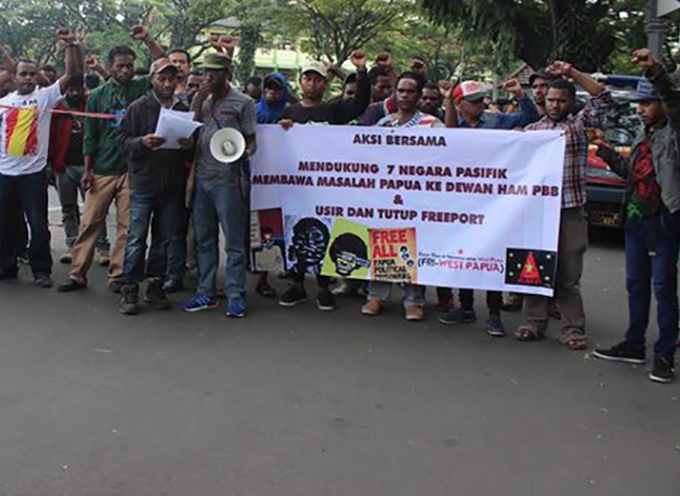
A bishop in Papua has called for government aid for thousands of Papuans made jobless because of a bitter contractual dispute between the government and U.S.-based mining giant PT Freeport McMoran Inc.

The row, which has reduced operations at the world’s second biggest copper mine in Papua’s Mimika district by about 60 percent, stems from Indonesia seeking to change mining industry regulations over ore processing and foreign ownership.

The government wants to cap copper concentrate exports to boost its domestic smelting industry.

Freeport says the regulations breach its current contract with the government, which runs until 2021. The company says the rules would also affect contracts it has with its customers overseas.

However, the dispute has resulted in job losses for contractors and workers.

“The company has laid off more than a thousand workers. It also threatens to reduce ongoing programs offered to the local community, such as scholarships and health-care services. This is a problem,” Bishop John Philip Saklil of Jayapura said.

-Advertisement-

The prelate recalled that he and some Papuans owning indigenous land rights, known as hak ulayat, met with Energy and Mineral Resources Minister Ignasius Jonan on February 27 in Jakarta to find a solution to the problem.

People victimised
“Such a lay-off has victimised many people who depend solely on the company. Many other Papuans, benefit from the programmes,” he said.

According to the local Manpower, Transmigration and Public Housing Agency nearly 1100 workers were laid off as a result of the dispute.

“They dreamed of a good future but then were laid off. Many still have debts to pay. It is not easy for them. Now everyone is worried about their future,” Bishop Saklil said.

A local tribal leader said laid off indigenous people could revert to old traditional activities like hunting to get by, but mining activities have caused havoc with the local ecosystem.

“Due to polluted waters, their feet and hands start to hurt when they go into rivers. Also, animals living in or near rivers have died. So how can we hunt to live?” Amungme tribal leader Yanes Natkimu said.

]]>

Indonesian women march for equal rights and protection

]]>

AsiaPacificReport.nz

The women’s march in Jakarta. Video: UNANews

By Katharina R. Lestari in Jakarta

More than 1000 Indonesian women took to the streets of Jakarta this week to demand greater respect for women’s rights and gender equality.

The women marched through the city centre at the weekend and converged on the presidential palace to mark International Women’s Day that fell on Wednesday.

“Women’s rights in this country are not recognised, which is seen in the way laws, which should protect us, often neglect us,” march organiser and women’s activist Ririn Sefsani said.

She cited the high maternal death rate among Indonesians as an example.

“Indonesia has an abnormally high maternal death rate when compared with many other countries,” the programme manager for activist group Partnership for Government Reform, said.

-Advertisement-

Child marriage, a lack of healthcare facilities and poor or non-existent reproductive health education were to blame for many deaths, she said.

Indonesia recorded 359 maternal deaths per 100,000 births in 2012, according the latest government figures, more than triple the rate in 2007, which stood at 102 deaths per 100,000 births.

Child marriage
Child marriage is also a major obstacle to a woman’s right to an education, Sefsani.

According to the Indonesian Statistics Agency, about 340,000 Indonesian girls aged 15-18 get married each year.

Indonesia is ranked 37 on the global child marriage index and is the second highest in Southeast Asia after Cambodia.

Indonesia’s marriage law says the minimum age a woman can get married is 16, but this is often flouted with many 15-year-olds or even younger being married off without any intervention from authorities.

“No more child marriages. No more maternal deaths,” Sefsani told the women protesters, as she called on the government to make sure that people’s rights laid out in the Constitution applies to both men and women.

Women’s rights activist Musdah Mulia called for equality across the board and an end to patriarchal and discriminatory regulations which are a contributing factor behind violence against women.

“There must be no discrimination based on anything including religion,” she said, singling out bylaws discriminating against women.

Discriminatory bylaws
According to the National Commission on Violence against Women says there are more than 400 discriminatory bylaws targeting women across Indonesia.

In Aceh province, which adopts stricter Shariah-based rules and where women are often caned if they break them, one bylaw bans women from straddling motorcycles.

Women should unite to stop all forms of violence, including that done in the name of religion, Mulia said.

An Indonesian woman takes part in a rally to demand equal rights for women in Jakarta on March 4. Image: Ucanews.com ]]>

Fated journey sees Fiji journalism graduate step closer towards dream

]]>

AsiaPacificReport.nz

Fiji’s Sonal Singh (second from left) … hopes to become a foreign correspondent. Pictured with him are fellow 2016 PCF media interns Francis Vaigalepa of Samoa (left) and Nadia Marai of Papua New Guinea at the Auckland University of Technology television studios.

By Michelle Curran in Auckland

Every morning before school, Sonal Shalveer Singh Aujla would watch the news and admire the way BBC and CNN journalists confidently presented what was happening around the world.

Perhaps it was destiny, when years later, Sonal was fatefully offered a full National Toppers Scholarship to study journalism at Fiji’s University of the South Pacific (USP).

“Growing up in Fiji, I did not know there was a programme offered at the universities that provided training for journalists,” Sonal remarks.

“Maybe because everyone at school was only talking about accounting, economics and science … I even considered accounting before I got the scholarship.”

After proving himself as a mature and talented student and became editor of USP’s award-winning newspaper Wansolwara, Sonal was selected to take part in Pacific Cooperation Foundation’s (PCF) Media Programme two-week internship in Auckland last year – his final year of his undergraduate journalism and media degree.

Since finishing his course last year, Sonal has not only been nominated for the Vice-Chancellor’s All-Rounder Award at graduation, which falls at the end of March, but also secured a job at the Secretariat of the Pacific Community as a media assistant in the Director-General’s Office.

-Advertisement-

“An opportunity which really inspired me and what helped me determine my future plans, was getting accepted in PCF’s Internship programme to New Zealand,” Sonal says.

“While observing the New Zealand media, I realised there was a lot of work for foreign correspondents involved in the media industry and this is when I decided I would join a regional organisation so I could become a foreign correspondent.”

By going down this line of work, Sonal hopes to achieve his life-long dream of war reporting for a global media network.

“The internship has improved my resume and this is the reason why I am part of the media team of the Secretariat of the Pacific Community today,” he adds.

Senior lecturer and coordinator of journalism at USP Dr Shailendra Singh agrees, and says Sonal’s performance improved remarkably after completing the PCF internship.

Sonal’s experience has made him an advocate for PCF’s media programme, and he says he encourages all the media students around the Pacific to apply for the 2017 PCF Media Programme.

“I hope that through this programme, you too may find a direction in life, just like I did,” Sonal says.

The Media Programme internship is fully funded by PCF over the two-week period – including all travel, accommodation, insurance, living allowance and any associated visa costs.

New Zealand and Pacific-based journalism/media students who are currently in their final year of tertiary education can apply for this programme.

Applications close on March 31.

Contact Michelle Curran of the Pacific Cooperation Foundation for more information.

]]>

Drone killings on a par with mafia hitmen murders

]]>

AsiaPacificReport.nz

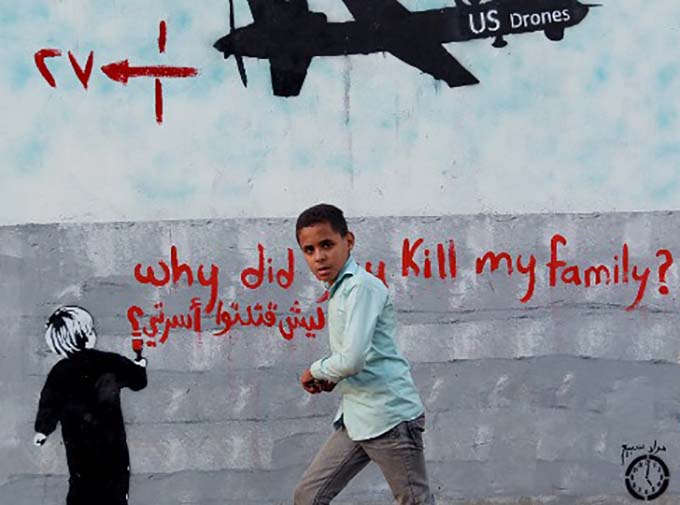
A Yemeni boy walks past a mural of a US drone on 13 December 2013 in the capital Sanaa. Image: CNN

By David Robie

One of the ironies of the legacy of eight years of Barack Obama’s presidency is that under the leadership of the man who was elected to bring a more peaceful world into play following George W. Bush’s warmongering, the “global war on terror” (GWOT) has grown enormously.

Remote control warfare by drones with virtually no transparency is deeply disturbing. After years of demands for statistics about the drone killing programme, Obama was finally forced to admit in April 2013 that an American, Dr Warren Weistein, and an Italian, Giovanni Lo Porto, had been “tragically killed” in a counter-terrorism operation by drone strike three months earlier in Pakistan (Ackerman, 2016).

This rare admission of guilt over the drone programme confirmed suspicions about a climbing death toll among civilians.

While the US target is claimed to be al-Qaeda and Daesh (the self-styled Islamic State, ISIS or ISIL) suspects, research by the London-based Bureau of Investigative Journalism has demonstrated that during Obama’s tenure more than 7000 people have been killed with impunity by drone controllers far from any battlefield.

About a seventh of these deaths are estimated to be civilians, including up to 110 children.

This death toll contrasts greatly with a mere 54 drone strikes authorised by President Bush in his entire term of office.
And undoubtedly the billionaire businessman and reality television tycoon President, Donald Trump, will entrench the use of drones even further.

-Advertisement-

This timely book, provocatively entitled We Kill Because We Can (adapted from a quote by a drone operative), has exposed the ethical and moral bankruptcy and shortsighted objectives of the Predator drone programme. Author Laurie Calhoun, a philosopher and cultural critic, has penned a robustly argued and disturbing work that presents an analogy between the US government’s ‘targeted killings’ and the mafia’s hitmen murders, lumping the Bush and Obama drone killings together as ‘simply assassinations’.

Calhoun likens suspects chosen for the growing weekly ‘killing lists’ to a stay on death row, with no provision for an appeal or re-examination of the evidence that led to the ‘conviction’.

Yet it is well known that suspects charged with capital crimes within civil society are often acquitted, as the evidence proves unconvincing to a jury of their peers. Jurors in US criminal trials are sternly instructed by the court that a verdict of guilty must be established beyond a reasonable doubt. (p. 120)

Calhoun argues that the ‘slick technological apparatus’ enabling drone strikes serves as a red herring that diverts attention from the crucial question – is it actually true that people about to die by remote control via a Hellfire missile are guilty of some capital crime and ‘deserve to die’? As the author stresses, drone strikes are irrevocable. Yet even in countries where the US is not officially at war and there are no ground troops ‘to protect’, the state emphasis is on killing the target.

The killings are treated as ‘acts of war’, but they are ‘indistinguishable from unlawful assassination’, says Calhoun, and they overlap with warfare actions only in the ‘effective impunity of the killers’ (p. 120).

Calhoun also offers a scathing critique of the military-industrial complex and its phenomenal growth since former US Vice-President Dick Cheney began privatising and outsourcing to contractors during the occupation of Iraq.

The military machine virtually guarantees the continued use of drones and the self-justifying killings as part of a burgeoning “terror factory” (p. 245). The number of new Predator operators trained in the US quadrupled between 2008 and 2013 and this figure eclipses the number of conventional pilots being trained.

The hardware alone of the drone programme is a huge contract generator. As of 2013, the drone contracts for major weapons manufacturers were at these figures: Boeing $1.8 billion; Northrop Grumman $10.9 billion; General Atomics $6.6 billion; and Raytheon $648 million (p. 243).

Calhoun is highly critical of the role of news media in failing to expose the Orwellian mythology and ‘just war’ terminology shrouding GWOT, and of also failing to provide greater transparency about the drone industry; the inherent conflicts of interest; the dangers of exporting the killing technology to other countries (at least 19 so far) and the role played by targeted killing in unleashing revenge acts by jihadists.
She ultimately argues that the indifference demonstrated by the US towards the ‘thousands of nameless victims, [or] the corruption caused directly by war’ risks inviting another terrorist atrocity equally as audacious as 9/11 (p. 334).

We Kill Because We Can: From Soldiering to Assassination in the Drone Age, by Laurie Calhoun. London: Zed Books. 2016. 400pp. ISBN 978-1-78360-547-7 pbk. This review is republished from Pacific Journalism Review 22(2).

Reference
Ackerman, S. (2016, July 1). Obama claims US drones strikes have killed up to 116 civilians. The Guardian.

]]>

Call for action to defend women’s voices online in Asia-Pacific

]]>

AsiaPacificReport.nz

#DefendMyVoiceOnline Image: IFJ

The International Federation of Journalists (IFJ) and its Asia-Pacific affiliates today demanded meaningful action against the growth of online harassment of women journalists in the region.

Using the occasion of International Women’s Day (March 8), media unions and journalist groups jointly launched a campaign emphasising a critical media need to protect women’s right to voice freely and safely in the online space.

“Today we celebrate the great gains made by and for women around the Asia-Pacific, but we also recognise that a lot more work is needed to support journalism on digital platforms,” the IFJ Asia-Pacific said.

“The internet is a vital space of opportunity for gender equality, but it can also present an enormous threat to freedom of expression if left unchecked.”

Online harassment, trolling, abuse, cyber bullying and death threats increasingly have a disproportionate gender dimension, according to the IFJ. It has monitored the rising threat to women’s voices online and documented a pattern of abuse, particularly prominent in South Asia.

These findings are backed by other research that shows women are three times more likely to encounter abuse online than men.

Byte Back Campaign
The IFJ Byte Back Campaign is intended to raise awareness to document, share information, and shame trolls; encourage support for all journalists to develop skills to combat threats online and support others; to drive media and government policy reform and to push for strong commitments by governments and online platforms to take strategic approaches to dealing with threats and abuse in a meaningful way.

-Advertisement-

“Online abuse is intended to silence voices and push women out of the media and critical spaces,” the IFJ said. “More than ever we need women journalists to join the media and to write and voice perspectives on issues that otherwise would not be heard. Journalists of all genders; their unions; media houses; moderators of social media platforms; the public and governments must take firm steps towards ensuring women’s rightful place in the digital world.”

The campaign is part of a wider IFJ strategy for gender equity which includes improving equal access to leading newsroom positions for women and men; closing the gender pay gap in journalism; strengthening equal treatment for workers; developing and implementing gender equality policies in the newsrooms; and securing fair and balanced gender portrayal in news content.

“It is only when these critical online spaces and voices are protected and defended that we can see a diversity of information, analysis and opinion co-exist and contribute to building healthy and vibrant democracies in Asia.”

Join the IFJ Byte Back Campaign by using the hashtags #DontTroll #DefendMyVoiceOnline

]]>

Walden Bello: Duterte fascism and naked force ruling Philippines

]]>

AsiaPacificReport.nz

“Like the anti-Marcos resistance four decades back, the only certainty members of the anti-fascist front can count on is that they’re doing the right thing. And that, for some, is a certainty worth dying for.”

By Walden Bello in Manila

Fascism, someone wrote, comes in different forms to different societies so that people expecting fascism to develop in the “classic way” fail to recognise it even when it is already upon them. In 2016, fascism came to the Philippines in the form of Rodrigo Duterte, but this event continues to elude a large part of the citizenry, some owing to fierce loyalty to the president, some out of fear of what the political and ethical consequences would be of admitting that naked force is now the ruling principle in Philippine politics.

Walden Bello

Why Duterte fits the ‘F’ word
At a panel I was part of in last August, one month after Duterte ascended to the presidency, there was considerable hesitation in using what panelists euphemistically called the “F” word to characterise the new Executive. There is an understandable reluctance to use the term fascist, undoubtedly because the word has been applied very loosely to all kinds of movements and leaders that depart, in some fashion, from liberal democratic practices, such as their propensity to resort to the use of force to achieve their political objectives.

However, there would probably be considerably less objection to the use of the word to describe Duterte if we see as central to the definition of a fascist leader a) a charismatic individual with strong inclinations toward authoritarian rule who b) derives his or her strength from a heated multiclass mass base, c) is engaged in or supports the systematic and massive violation of basic human, civil, and political rights, and d) proposes a political project that contradicts the fundamental values and aims of liberal democracy or social democracy.

If one were to accept these elements provisionally as the key characteristics of a fascist leader, then Duterte would easily fit the bill.

A fascist original
Having said that, one must nevertheless acknowledge that Duterte is a fascist personality that is an original.

-Advertisement-

His charisma is not the demiurgic sort like Hitler’s, nor does it derive so much from an emotional personal identification with the people and nation as in the case with some populists. Duterte’s charisma would probably be best described as “carino brutal,” a volatile mix of will to power, a commanding personality, and gangster charm that fulfills his followers’ deep-seated yearning for a father figure who will finally end the national chaos.

Duterte is not a reactionary seeking to restore a mythical past. He is not a conservative dedicated to defending the status quo. His project is oriented towards an authoritarian future.

He is best described, using Arno Mayer’s term, as a counterrevolutionary. Unlike some of his predecessors, like Hitler and Mussolini, however, he is not waging a counterrevolution against the left or socialism.

In Duterte’s case, the target, one can infer from his discourse and his actions, is liberal democracy, the dominant ideology and political system of our time. In this sense, he is both a local expression as well as a pioneer of an ongoing global phenomenon: the rebellion against liberal democratic values and liberal democratic discourse that Francis Fukuyama had declared as the “end of history” in the early 1990s.

Counterrevolutionaries are not always clear about what their next moves are, but they often have an instinctive sense of what would bring them closer to power. Ideological purity is not high on their agenda, with them putting the premium on the emotional power of their message rather on its ideological coherence. The low priority accorded to ideological coherence is also extended to political alliances.

Duterte’s mobilisation of a multiclass base and his ruling with the support of virtually all of the elite is unexceptional. However, one of the things that makes him a fascist original is that he has brought the dominant section of the left into his ruling coalition, something that would have been unthinkable with most previous fascist leaders.

But perhaps Duterte’s distinctive contribution to fascism as a political phenomenon is in the area of political methodology. The stylised paradigm of fascism coming to power has the fascist leader or party begin with violations of civil rights, followed by the power grab, then indiscriminate repression.

Duterte turns this “Marcosian model” of “creeping fascism” around. He begins with impunity on a massive scale, that is, the extrajudicial killing of thousands of alleged drug users and pushers, and leaves the violations of civil liberties and the grab for absolute power as mopping up operations in a political landscape devoid of significant organized opposition.

A product of EDSA
Duterte’s ascendancy cannot be understood without taking into consideration the debacle of the EDSA liberal democratic republic that was born in the uprising of 1986. In fact, EDSA’s failure was a condition for Duterte’s success.

What destroyed the EDSA project and paved the way for Duterte was the deadly combination of elite monopoly of the electoral system and neoliberal economic policies and the priority placed on foreign debt repayment imposed by Washington. By 2016, there was a yawning gap between the EDSA Republic’s promise of popular empowerment and wealth redistribution and the reality of massive poverty, scandalous inequality, and pervasive corruption.

And the EDSA Republic’s discourse of democracy, human rights, and rule of law had become a suffocating straitjacket for a majority of Filipinos who simply could not relate to it owing to the overpowering reality of their powerlessness.

Duterte’s discourse – a mixture of outright death threats, basag-ulero language, and frenzied railing coupled with disdainful humor directed at the elite, whom he called “coños” – was a potent formula that proved exhilarating to his audience who felt themselves liberated from the stifling hypocrisy of the EDSA discourse.

Fascism in power
Probably no fascist personality since Hitler came to power in Germany in 1933 has used the mandate of a plurality at the polls to reshape the political arena more swiftly and decisively than Duterte in 2016. Even before he formally assumed office, the extrajudicial killings began; the elite opposition disintegrated, with some 98 percent of the so-called “Yellow Party,” the Liberals, joining the Duterte Coalition; and Duterte achieved total control of both houses of Congress.

The Supreme Court, shying away from a confrontation, chose not to challenge the President’s decision to have the former dictator, Ferdinand Marcos, buried in the Libingan ng mg Bayani.

A traditional bulwark of defence of human rights, the Catholic Church, exercised self-censorship, afraid that in a confrontation with a popular president who threatened to expose bishops and priests with mistresses and clerical child abusers, it was going to be a sure loser.

A novice in foreign policy, Duterte was able to combine personal resentment with acute political instinct to radically reshape the Philippines’ relationship with the big powers, notably the United States. What surprised many though was that there was very little protest in the Philippines at Duterte’s geopolitical reorientation given the stereotype of Filipinos being “little brown brothers.”

What protest there was came mainly from traditional anti-American quarters which evinced scepticism about the President’s avowed intentions.

Here, Duterte again showed himself to be a masterful instinctive politician. As many have observed, coexisting with admiration for the US and US institutions exhibited by ordinary Filipinos is a strong undercurrent of resentment at the colonial subjugation of the country by the US, the unequal treaties that Washington has foisted on the country, and the overwhelming impact of the “American way of life” on local culture.

One need not delve into the complex psychology of Hegel’s master-servant dialectic to understand that the undercurrent of the US-Philippine relationship has been the “struggle for recognition” of the dominated party.

Duterte has been able to tap into this emotional underside of Filipinos in a way that the left has never been able to with its anti-imperialist programme.

The anti-American comments from Duterte supporters that filled cyberspace were just as fierce as their attacks on critics of his war on drugs. Like many of his authoritarian predecessors elsewhere, Duterte has been able to splice nationalism and authoritarianism in a very effective fashion, though many progressives have seen this as mainly motivated by opportunism.

What surprises are in store for us?
So what other surprises should we expect from this fascist original?

Perhaps the best way to approach the question of what is likely to come is to ask the following: What are the chinks in Duterte’s armour? How would they affect the pursuit of Duterte’s programme? What are the prospects for the opposition?

There are chinks in the Duterte armour, and one of them is the health and age of the President. Duterte has been candid about his medical problems and his dependence on the drug fentanyl, reportedly a strongly addictive substance that is 50 to 100 times stronger than morphine and has the same effects as heroin. The age factor is not unimportant, considering that the President is turning 72. Hitler became chancellor at 44 and Mussolini became prime minister at 39. For the successful pursuit of an ambitious political project, one’s energy level is not unimportant.

More problematic is the issue of institutionalising the movement. The force driving Duterte’s electoral insurgency has not yet been converted into a mass movement. Duterte’s key advisers have recognised this, their analysis being that the reason Joseph Estrada was ousted in 2001 was because he was not able to fall back on an organised mass movement to protect him. Jun Evasco, the secretary of the cabinet and a long-time Duterte aide, is the key person the President is relying on to fill the breach by forming the Kilusang Pagbabago (Movement for Reform) that was launched in August 2016.

Evasco’s vision is apparently a mass organization along the lines of those of the National Democratic Front, where he cut his political teeth. This won’t be easy since, as some analysts have pointed out, he would have to contend with competing projects from Duterte’s political allies, like the Pimentels, the Marcoses, and the Arroyos, who would prefer an old-style political formation that brings together elite personalities. Needless to say, a political formation along the lines of the latter would be the kiss of death for Duterte’s electoral insurgency.

President Rodrigo Duterte wishes the Philippines an enjoyable New Year celebration at the end of 2016. Image: King Rodriguez/Presidential

A bigger hurdle would be failure to deliver on political and social reforms. Practically all of the key political and economic elites have declared allegiance to Duterte, so that one finds it difficult to see how he can deliver on his political and economic reform agenda without alienating key supporters.

The Marcoses, who still have their ill-gotten wealth stashed abroad, the Arroyos, who have been implicated in so many shady deals, and so many other elites, many of whom have cases pending before the Ombudsman, are not likely to be disciplined for corruption, especially given their very close links to Duterte.

Nor will the Visayan Bloc, that has come in full force behind Duterte, agree to a law that will extend the very incomplete agrarian reform program. Nor will the big monopolists like Manuel Pangilinan and Ramon Ang, who have pledged fealty to him, submit without resistance to being divested of their corporate holdings.

This is not to say that Duterte is a puppet of the elites. Having a power base of his own that he can easily turn on friend or foe, he is beholden to no one. Indeed, one can argue that most of the elite have joined him mainly for their own protection, like small merchants paying protection money to the mafia.

The issue, rather, is how serious he is about social reform and how willing he is to alienate his supporters among the elite.

The same goes for economic reform. Ending contractualisation (or ENDO, for “End of Contract”), one of the President’s most prominent promises, is currently bogged down in efforts to arrive at a “win-win” solution for management and labor, and all the major labor federations are fast losing hope the administration will deliver on this.

As for macroeconomic policy, any departure from neoliberal principles on the part of orthodox technocrats like Budget Secretary Benjamin Diokno and National Economic and Development Authority Director General Ernesto Pernia is far-fetched.

Again, the question lies in how convinced Duterte is that neoliberalism is a dead end and how willing he is to incur the technocratic and bureaucratic displeasure and loss of confidence on the part of foreign investors that would be elicited by adopting a different economic paradigm.

Social and economic reform is Duterte’s Achilles heel, and the President himself is aware that popularity is a commodity that can disappear quickly in the absence of meaningful reforms. Dissatisfaction is fertile ground for the build-up of opposition. This spells danger for the country in the medium term.

Even if he is able to quickly create a mass-based party, Duterte, to stay securely in power, would find that he would need to resort to the repressive apparatuses of the state to quell discontent and opposition. This may not be too difficult a course to follow.

As noted earlier, having led a bloody campaign that has already claimed more than 7000 lives, the suspension of civil liberties and the imposition of permanent emergency rule would be in the nature of “mopping up” operations for Duterte. It would be a walk in the park.

Leni Robredo being proclaimed the country’s vice president on 30 May 2016. Image: Ben Nabong/Rappler

The opposition
Does the opposition matter? The elite opposition is extremely weak at this point, with most of the Liberal Party having joined the Duterte bandwagon out of opportunism or fear. An opposition led by Vice-President Leni Robredo, who resigned from Duterte’s cabinet after being told not to attend meetings, is not likely to be viable.

While undoubtedly possessing integrity, Robredo has shown poor judgment, receptiveness to bad advice, and little demonstrated capacity for national leadership, and is, in the view even of some of her supporters, largely a political creation of Liberal Party operatives who wanted to convert the name of her deceased husband, former Department of the Interior and Local Government head Jesse Robredo, into political capital.

Moreover, her continuing strong ties to the double-faced Liberal Party and the former administration lend her to becoming easily discredited among both Duterte supporters and opponents.

The Left in crisis
This brings up the Left.

Duterte’s coming to power created a crisis for the Left. For one sector of the Left, Akbayan, the social democratic Left that had allied itself uncritically with the Aquino administration, Duterte’s ascendancy meant their marginalisation from power along with the Liberal Party, for which they had, with their leadership’s eyes wide open, become the grassroots organising arm.

For the traditional, or what some called the “extreme left,” Duterte posed a problem of another kind. While the National Democratic Front and Communist Party had not supported Duterte’s candidacy, they accepted Duterte’s offer of three cabinet or Cabinet-level positions, as secretaries of the Department of Agrarian Reform and the Department of Social Welfare and Development and chair of the National Anti-Poverty Commission.

They also accepted the president’s offer to initiate negotiations to arrive at a final peace agreement.

For Duterte, the entry of personalities associated with the Communist Party into his Cabinet provided a left gloss to his regime, a proof that he was progressive, “a socialist, but only up to my armpits,” as he put it colourfully during his victory speech in Davao City on 4 June 2016.

It soon became clear that Duterte had the better part of the bargain. As the regime’s central policy of killing drug users and pushers without due process escalated, the Left’s role in the Cabinet became increasingly difficult to justify.

This dilemma was compounded by the fact that no new land reform law was passed that would allow agrarian reform to continue, there was little movement in the administration’s promise to end contractualisation, and macroeconomic policy continued along neoliberal lines.

The Left, however, found it hard to shelve the peace negotiations, from which they had already made some gains, and to part from heading up government agencies that gave them unparalleled governmental resources to expand their mass base.

Duterte had again displayed his acute political instincts. Knowing that the traditional Left was at ebb in its fortunes, he gambled that they would accept his offer of Cabinet positions. And having accepted these and agreeing to open up peace negotiations from which it could get many more concessions than it would have gotten under previous administrations, the Left, he knew, would find it extremely difficult to part from the positions of power it had gained.

The price, the leaders of the Left realised, would be high, and this was their association with a bloodthirsty regime. The Communist Party and its mass organisations tried to alleviate the contradiction by issuing statements condemning Duterte’s bloody policies.

But this only made their dilemma keener, since people would ask, why then do you continue to provide legitimacy to this administration by staying on in the Cabinet? Unlike Hitler and Mussolini, Duterte brought the Left into his regime, but in doing so, he has been able to sandbag it and subordinate it as a political force.

So far, that is.

Whether he is fully conscious of it or not, Duterte’s ascendancy has severely shaken all significant political institutions and political players in the country, from right to left.

Civil society mobilises
Where opposition to Duterte has developed over the last six months has been from civil society. A leading force is I Defend, a broad grouping of over 50 people’s organisations and non-governmental organisations that has waged an unremitting struggle against the extra-judicial killings. Another is the coalition against the Marcos burial at the Libingan ng mga Bayani.

While Malacañang has painted these formations as “dilawan,” or yellow, the reality is that most of their partisans are progressives that are as opposed to a “yellow restoration” as they are to Duterte’s policies, as well as newer and younger forces drawn from the post-EDSA and millennial generations that have become alarmed at Duterte’s fascist turn.

This growing opposition does not seek a reprise of 1986, perhaps heeding Marx’s warning that “history first unfolds as tragedy, then repeats itself as comedy.” It is increasingly realising that the fight for human rights and due process must be joined to a revolutionary program of participatory politics and economic democracy – to socialism, in the view of many – if it is to turn the fascist tide. There is no going back to EDSA.

What the opposition still has to internalise though is that opposing fascism in power will not be, to borrow a saying from Mao, “a dinner party,” that it will indeed be exceedingly difficult and demand great sacrifices.

Moreover, there is no guarantee of success in the short or medium term. Fascism in power can be extraordinarily long-lived. The Franco regime in Spain lasted 39 years, while Salazar’s Estado Novo in neighbouring Portugal went on for 42 years.

Like the anti-Marcos resistance four decades back, the only certainty members of the anti-fascist front can count on is that they’re doing the right thing. And that, for some, is a certainty worth dying for.

  • Walden Bello made the only recorded resignation out of principle in the history of the Congress of the Republic of the Philippines in 2015 owing to what he saw as the Aquino administration’s double standards in dealing with corruption, failure to deliver economic and social reform, and subservience to the United States. An anti-dictatorship activist, he was principal author of Development Debacle: The World Bank in the Philippines, which exposed the Marcos-World Bank alliance in forging the export-oriented capitalist development model. A retired professor of sociology at the University of the Philippines, he is currently senior research fellow at Kyoto University and professor of sociology at the State University of New York at Binghamton.

This article by Walden Bello is an abbreviated adaptation of a much longer piece to be published in the Philippine Sociological Review and is published by Asia Pacific Report with the permission of the author. Other Walden Bello articles on Rappler.

]]>

Prosecutors consider sedition charges against Fiji Times publisher and editor

]]>

AsiaPacificReport.nz

Nai Lalakai letter writer Josaia Waqabaca outside the High Court in Suva yesterday. Image: RAMA/Fiji Times

By Vijay Narayan and Semi Turaga in Suva

Fiji’s Assistant Director of Public Prosecutions Lee Burney has informed the High Court in Suva that it is planned to amend the charges against The Fiji Times Limited, publisher Hank Arts, editor Fred Wesley, Nai Lalakai editor Anare Ravula and contributor Josaia Waqabaca.

Burney told the court yesterday that the the DPP office was now looking at sedition charges.

Fiji Times Limited publisher Hank Arts (front) and editor Fred Wesley at court yesterday. Image: FijiVillage.com

High Court judge Justice Thusara Rajasinghe has given the prosecution 21 days to consider whether sedition maybe a more appropriate charge.

The lawyer for Arts, Wesley and the Fiji Times Limited, Faizal Haniff, said that the prosecution should give the court a clear direction on which charge they wanted.

Haniff also said that they should have the courtesy to inform the defence.

The maximum penalty for sedition is 7 years imprisonment.

-Advertisement-

Meanwhile, the judge has also told Waqabaca and Ravula not to expect unnecessary adjournments because their lawyers were not present in court.

Lawyer not present
Justice Rajasinghe raised concern about Waqabaca’s lawyer, Aman Ravindra Singh, as he had not appeared in the case for 3 consecutive times.

It is alleged that Arts, Wesley, Waqabaca, Ravula and The Fiji Times Limited made, or caused to be published, a statement in the iTaukei language in Nai Lalakai newspaper that is likely to incite dislike, hatred, or antagonism of the Muslim community.

The statement was published in a letter to the editor allegedly written by Waqabaca.

The case has been adjourned to March 23.

]]>

Asian human rights agency backs probe into Papua torture case

]]>

AsiaPacificReport.nz

The body of Edison Hesegem being transported to the Bhayangkara Police Hospital in Jayapura City for an autopsy. Image: ICP

The Asian Human Rights Commission (AHRC) has backed an appeal from the International Coalition for Papua (ICP) for an investigation into an alleged torture case in the Highlands city of Wamena.

Six members of the Jayawijaya District Police, Jayawijaya regency, Papua province, have been accused over torture, leading to the death of 21-year-old Edison Hesegem

The torture happened on 11 January 2017 during detention at a police post and also at the emergency room of Jayawijaya General Hospital in Wamena on the same day.

According to local human rights defenders, medical personal witnessed the six officers torturing Hesegem at the medical facility where he was meant to receive medical aid.

The torture was so severe that Hesegem died in hospital the following day, AHRC said in a statement yesterday.

In an attempt to downplay the torture, the head of the Papuan regional police, Paulus Waterpauw, made a public statement in which he explained that Hesegem sustained the fatal injury as he “fell off a fence” during an attempted escape.

The AHRC has called for an investigation into the allegations of human rights violations against Edison Hesegem in Jayawijaya General Hospital, Papua province, to be conducted in a proper and impartial manner.

-Advertisement-

Background on the International Coalition for Papua (ICP) website

]]>

PNG’s radio broadcasting legend Roger Hau’ofa dies

]]>

AsiaPacificReport.nz

Tributes to the late Roger Hau’ofa have flowed in from all over Papua New Guinea and the Pacific. FM100 aired aired a special talkback show today in tribute to the broadcaster. Video: EMTV

By Quintina Naime in Port Moresby

Papua New Guinea’s famous radio legend, Roger Hau’ofa, has died with courage, dignity and grace, says daughter Michelle Hau’ofa.

Michelle Hau’ofa spoke out following her father’s death at the weekend at Iare village in Kairuku District, Central Province.

Michelle Hau’ofa … “Dad was as strong as a lion until the very end.” Image: Loop PNG

The late Hau’ofa, originally from Tonga, was 73 years old and had been broadcasting in Papua New Guinea for more than 50 years.

READ MORE: Family plans Roger Hau’ofa Kidney Centre

Michelle Hau’ofa said he had passed on peacefully on Saturday surrounded by family at his village home.

-Advertisement-

“He was as strong as a lion until the very end and went out on his own terms with courage, dignity and grace,” she said.

“Dad had suffered for more than a year now and had spent a month in intensive care at the Pacific International Hospital.

“In the end, he was just tired of the needles and tubes as it was a very painful experience for him.

“He said he didn’t want to die in the hospital and he asked to stop all treatment and he wanted to go home to mum’s village at Iare,” Michelle Hau’ofa said.

She said her late father wanted to spend his last days there so they consulted with the family and all agreed that if that’s what he wanted, then that is what they would support.

Roger Hau’ofa was flown by a Helifix helicopter to Iare Village on Thursday, March 2, at 4.30pm.

“He’s been in pain for such a long time and suffered weeks of being in agony and just wanted to be out of hospital.

“He was as strong as a lion and went peacefully on his own terms where he wanted to be, surrounded by family and by those who loved him and those that he loved.

“Like the hero and the great man he is, he did it on his own terms,” Michelle Hau’ofa said tearfully.

The body of the late Hau’ofa is now at the Dove Funeral Home and details of the funeral arrangements will be announced later this week.

Roger Hau’ofa was younger brother of the late sociologist and writer Epeli Hau’ofa, founder of the Oceania Centre of Arts and Culture at the University of the South Pacific.

Quintina Naime is a journalist with Loop PNG.

Broadcaster Roger Hau’ofa … dies at 73 after a radio career spanning 50 years. Image: Loop PNG ]]>

]]>

Report by David Robie. This article was first published on Café Pacific


KBR audio report on the Jakarta protest in Bahasa. Audio: KBR/Asia Pacific Report

From the Pacific Media Centre’s Asia Pacific Report:

PROTESTERS from the Papuan Student Alliance (AMP) and religious pupils from an Islamic boarding school (pesantren) have faced off against each other at the Malan city hall in East Java.

Both groups held the protests on Friday under tight police security, as West Papuan protests over Freeport took place at several other places across Indonesia.

Scores of demonstrators from the AMP and the Indonesian People’s Front for West Papua (FRI-West Papua) unfurled banners and conveyed a number of demands, including the closure of the PT Freeport gold and copper mine in Papua.

They also brought banners with demands such as, “A joint action to support the Papua problem at the United Nations Human Rights Council” and “Close and Expel Freeport”. Protesters took turns in giving speeches.

The spokesperson for the AMP and FRI-West Papua, Wilson, said that the action represented Papuan society’s anxiety saying there are so many violations at PT Freeport that it was creating ever more misery in the land of Papua.

“The natural resources belong to the Papuan people, but up until now they have not been enjoyed by the Papuan people”, said Wilson.

The action also demanded the right for and self-determination for the nation of West Papua. The groups also demanded a resolution to human rights violations in Papua and the withdrawal of the Indonesian military from the land of Papua.

Counter action
Meanwhile, five people calling themselves the Malang City Darul Hikmah Kebonsari Foundation Islamic Boarding School Religious Pupils said they were there to counter the action which they believe threatened the disintegration of Indonesia.

“Our action is intended to counter them”, said Widoku Rahman, one of the religious pupils taking part in the rally.

The religious pupils claimed that would continue to monitor actions by the AMP who they believe is promoting separatism because of their demands for independence. The group supervised the action from the beginning until the end.

“Please if you want more information contact the head of our boarding school”, said Hadi Widiyanto, one of the other religious pupils.

During the action the five religious pupils unfurled red-and-white Indonesian flags on their chests. They wore long white shirts, white sarongs, white skull caps and sandals.

Although one of the participants brought a megaphone, it was not used for a speech.

KBR audio report on the Jakarta protest in Bahasa.

In Ade Irmansyah, Jakarta, KBR reported that action coordinator Samsi Mahmud said taking the issue to the United Nations was the only way to resolve the numerous problems in Papua, particularly human rights violations.

Samsi also urged the government of President Joko “Jokowi” Widodo to give the Papuan people the right to self-determination.

“We also want to convey to the people of Indonesia, to the Indonesian government, the wishes of the Papuan people, namely that self-determination is the democratic solution for the future of our people and our nation. And for us, in relation to the problems that exist in Papua, the solution is self-determination for the Papuan people”, he said in a speech in front of the United Nations representative office for Indonesia in Jakarta.

Samsi also called on the government to withdraw all military forces, including the police. from the entire Papuan territory saying that the presence of military forces was causing human rights violations in Papua.

Similar rallies were also held by the FRI West Papua in Ternate (North Maluku) and by the FRI West Papua and the AMP in the Central Java city of Yogyakarta.

Translated by James Balowski for the Indoleft News Service.


Papuan protesters outside Malan city hall in East Java as demonstrations took place over Freeport mine |
and against human rights violations in several locations across Indonesia at the weekend.
Image: Merdeka.com/Asia Pacific Report

]]>

Papuan student protests call on Indonesia to close Freeport

]]>

AsiaPacificReport.nz

Papuan protesters outside Malan city hall in East Java as demonstrations took place over Freeport mine and against human rights violations in several locations across Indonesia at the weekend. Image: Merdeka.com

Protesters from the Papuan Student Alliance (AMP) and religious pupils from an Islamic boarding school (pesantren) faced off against each other at the Malan city hall in East Java.

Both groups held the protests on Friday under tight police security, as Papua protests over Freeport took place at several other places across Indonesia.

Scores of demonstrators from the AMP and the Indonesian People’s Front for West Papua (FRI-West Papua) unfurled banners and conveyed a number of demands, including the closure of the PT Freeport gold and copper mine in Papua.

They also brought banners with demands such as, “A joint action to support the Papua problem at the United Nations Human Rights Council” and “Close and Expel Freeport”. Protesters took turns in giving speeches.

The spokesperson for the AMP and FRI-West Papua, Wilson, said that the action represented Papuan society’s anxiety saying there are so many violations at PT Freeport that it was creating ever more misery in the land of Papua.

“The natural resources belong to the Papuan people, but up until now they have not been enjoyed by the Papuan people”, said Wilson.

The action also demanded the right for and self-determination for the nation of West Papua. The groups also demanded a resolution to human rights violations in Papua and the withdrawal of the Indonesian military from the land of Papua.

-Advertisement-

Counter action
Meanwhile, five people calling themselves the Malang City Darul Hikmah Kebonsari Foundation Islamic Boarding School Religious Pupils said they were there to counter the action which they believe threatened the disintegration of Indonesia.

“Our action is intended to counter them”, said Widoku Rahman, one of the religious pupils taking part in the rally.

The religious pupils claimed that would continue to monitor actions by the AMP who they believe is promoting separatism because of their demands for independence. The group supervised the action from the beginning until the end.

“Please if you want more information contact the head of our boarding school”, said Hadi Widiyanto, one of the other religious pupils.

During the action the five religious pupils unfurled red-and-white Indonesian flags on their chests. They wore long white shirts, white sarongs, white skull caps and sandals.

Although one of the participants brought a megaphone, it was not used for a speech.

KBR audio report on the Jakarta protest in Bahasa.

In Ade Irmansyah, Jakarta, KBR reported that action coordinator Samsi Mahmud said taking the issue to the United Nations was the only way to resolve the numerous problems in Papua, particularly human rights violations.

Samsi also urged the government of President Joko “Jokowi” Widodo to give the Papuan people the right to self-determination.

“We also want to convey to the people of Indonesia, to the Indonesian government, the wishes of the Papuan people, namely that self-determination is the democratic solution for the future of our people and our nation. And for us, in relation to the problems that exist in Papua, the solution is self-determination for the Papuan people”, he said in a speech in front of the United Nations representative office for Indonesia in Jakarta.

Samsi also called on the government to withdraw all military forces, including the police. from the entire Papuan territory saying that the presence of military forces was causing human rights violations in Papua.

Similar rallies were also held by the FRI West Papua in Ternate (North Maluku) and by the FRI West Papua and the AMP in the Central Java city of Yogyakarta.

Translated by James Balowski for the Indoleft News Service.

A Papuan demonstration over Freeport mine in Jakarta. Image: KBR
]]>

AWPA calls on Turnbull to raise West Papua rights violations with Jakarta

]]>

AsiaPacificReport.nz

West Papua supporters protest in Sydney during President Joko Widowo’s visit last week. Image: AWPA

An Australian-based West Papuan solidarity group today called on Prime Minister Malcolm Turnbull to raise the issues of human rights violations and self-determination heads with Indonesia.

Turnbull is travelling to Jakarta to attend the Indian Ocean Rim Association (IORA_) leadership summit in Jakarta from today until Tuesday.

The Indian Ocean Rim Association (IORA) is celebrating its 20th Anniversary and Indonesia is the current chair.

The theme of the summit is “Strengthening Maritime Cooperation for a Peaceful, Stable, and Prosperous Indian Ocean”.

Joe Collins of the Australia West Papua Association (AWPA) said: “While in Jakarta, the Prime Minister has a chance to discuss the issue of West Papua with the Indonesian President, something he did not do on Jokowi’s visit to Sydney last weekend.”

Supporters of West Papua protested during Jokowi’s visit to Sydney last week.

The AWPA statement said it wanted Turnbull follow the “courageous stand” of seven Pacific countries which raised West Papua at the United Nation’s 34th Regular Session of the Human Rights Council in Geneva last week.

-Advertisement-

Grave concerns
The Vanuatu Minister of Justice and Community Development, Ronald K Warsal, representing a coalition of seven Pacific countries – Marshall Islands, Nauru, Palau, Solomon Islands, Tonga, Tuvalu and Vanuatu — raised grave concerns about the human rights situation in West Papua.

Collins said: “There are an increasing number of bilateral visits between Australian and Indonesian officials and AWPA believes that these bilateral visits present an opportunity for an open and frank exchange on how to improve the human rights situation in West Papua.

“We urge the Prime Minister to take the issue of West Papua seriously. There is no point in ignoring West Papua. The issue is not going away.”

In concluding his statement in Geneva, the Vanuatu minister said: “Mr President, as I close, we believe that challenges of West Papua must be brought back to the agenda of the United Nations”.

The AWPA statement called on the Australian government to support this call from Pacific leaders.

Also in Geneva, a church-backed coalition called on Indonesia to open greater access to West Papua for international journalists, independent observers, human rights organisations and the International Red Cross.

The call came at an international consultation hosted by the World Council of Churches with the International Coalition on Papua in Geneva.

An World Council of Churches-hosted international consultation on West Papua in Geneva on 22-24 February 2017. Image: Victor Mambor/Jubi
]]>

Duterte warns more of his appointees will be sacked over corruption

]]>

AsiaPacificReport.nz

President Rodrigo Duterte … popular on social media and the subject of a host of computer games over his “crime busting” methods in spite of more than 7000 reported extrajudicial killings. Image: Rachfeed

By Pia Ranada in Manila

President Rodrigo Duterte has warned that he will fire more government personnel in “coming days”.

“In the coming days, I’m going to fire additional people whom I have appointed in government. There are many of them, I’m still trying to figure out how it was done,” Duterte told reporters after his visit to the wake of two soldiers killed in action and to injured troopers at the Army’s 4th Infantry Division headquarters at Camp Edilberto Evangelista in the southern city of Cagayan de Oro.

The President fired his own campaign spokesman from his post as National Irrigation Administration chief after being told of alleged corruption.

He has also sacked two of his fraternity brothers from their posts in the Bureau of Immigration.

Although he did not give the exact number or the names of those whom he will boot out of office, the President said in Cagayan de Oro, “Marami ’yan (there are many of them).”

He warned public officials who are suspected of committing unlawful acts or abusing their power.

-Advertisement-

“This is my warning to those in the government: whether you are a director or CESO or civil service eligible, I’m telling you stop it – at least for 6 years, while I’m still sitting in office,” he said.

‘Corruption will stop’
“Corruption will stop and it will stop, I am telling you I will put a stop to it,” he added.

WATCH VIDEO: Duterte: Say ‘No’ to corruption

The President also said he wanted to know why plunder was removed from the list of crimes punishable by death in the House of Representative’s version of the death penalty bill.

“I really would like to know the rationale,” Duterte told reporters when he was asked if it was okay with him that plunder was not in the list of capital offences.

Duterte, as a presidential candidate, promised to crack down on government corruption.

Asked if the absence of plunder from the death penalty bill was inconsistent with his administration’s hardline stance against corruption, he said he never said he wanted corrupt politicians dead.

“I said I’d stop corruption, but I didn’t say that I’m going to kill the plunderer. What was in my mind was, corruption will stop. Sinabi ko sa inyo, hintuin ko ‘yan (I told you, I will stop it),” he said.

Plunder, as defined in the plunder law, is when a public officer acquires ill-gotten wealth amounting to at least P50 million (NZ$1.5 million).

It is punishable by life imprisonment or death. This was modified to only life imprisonment when the death penalty was abolished in 2006.

Lawmakers, including Duterte’s allies in the House of Representatives, have said they decided to take out plunder and rape from the crimes punishable by death to make the controversial bill easier to pass.

The bill now punishes only drug-related crimes with capital punishment. More than 7000 people have died in extrajudicial killings as part of a “war on drugs” since the president came to power last July.

Pia Ranada is a Rappler journalist. This report included a file by Bobby Lagsa.

]]>

Te Reo Māori should be compulsory in NZ primary schools, says pop-up survey

]]>

AsiaPacificReport.nz

Both Māori and Pākehā think that Te Reo Māori is an important part of New Zealand’s national identity and should be compulsory in primary schools, according to a new survey. Image: Te Wiki o te Reo Maori

A new online survey by Te Ipukarea, the National Māori Language Institute at Auckland University of Technology (AUT), confirms that attitudes towards Te Reo Māori are changing.

“Both Māori and Pākehā think that Te Reo Māori is an important part of New Zealand’s national identity and should be compulsory in primary schools. This is what people want for their children and grandchildren,” says Professor Tania Ka’ai, director of Te Ipukarea.

Professor Tania Ka’ai … the rest of the world looks to New Zealand for inspiration and guidance on how to keep indigenous language alive. Image: Te Ipukarea/AUT

The vast majority of survey respondents agree or strongly agree that the Māori language should be compulsory in New Zealand primary schools, including 83 percent of Māori, 80 percent of New Zealand European/Pākehā and 78 percent of other ethnicities.

An even larger proportion – 95 percent of Māori, 94 percent of New Zealand European/Pākehā and 90 percent of other ethnicities – agree or strongly agree that the Māori language is an important part of New Zealand’s national identity.

The pop-up survey was completed by 5391 visitors to the Te Aka Māori-English Dictionary online.

Conducted in partnership with the Māori Language Commission, the survey sought to gather data on how the online dictionary is used, the language proficiency of users and attitudes towards Te Reo Māori.

Those surveyed identified as Māori (58 percent), New Zealand European/Pākehā (35 percent) and other ethnicities (7 percent). They were evenly distributed by age. And, the largest groups by occupation were professionals (37 percent) and students (20 percent).

-Advertisement-

Looking for inspiration
Professor Ka’ai says the rest of the world looks to New Zealand for inspiration and guidance on how to keep indigenous language alive.

Scandinavian countries like Finland, Norway and Sweden are exploring Māori language immersion models such as Kura Kaupapa and Kohanga Reo – the latter of which was the archetype for Hawai’i’s Pūnana Leo.

“We are world leaders in language revitalisation. The next step is for government to make Te Reo Māori compulsory in primary schools. Now, let’s lead the world in this,” says Professor Ka’ai.

According to Statistics New Zealand, 377,073 students were enrolled in New Zealand primary schools in 2016 – 72 percent received no Māori language education, 25 per cent studied Māori as a subject or equivalent and 3 percent were involved in Māori language immersion.

]]>

Coal comfort: Pacific nations on carbon collision course with Australia

]]>

AsiaPacificReport.nz

By Wesley Morgan in Suva

Uniquely vulnerable to the impacts of a warming world, Pacific island countries have long been considered the front-line of climate change, so it’s not surprising that they are also leading the fight to tackle the problem.

These tiny nations have vowed to challenge major polluters to cut emissions and, this year, they have coal exports from their biggest neighbour firmly in their sights.

For the first time, a Pacific island country is head of global negotiations aiming to limit “dangerous interference” with the Earth’s climate system. Fiji, which last week marked the first anniversary of the devastation caused by the strongest cyclone ever recorded in the southern hemisphere, has vowed to use its presidency of the United Nations Framework Convention on Climate Change (UNFCCC) to make the world sit up and take notice.

This must be a matter of concern in Australia’s capital, Canberra; Fiji’s Prime Minister Voreqe Bainimarama is an outspoken critic of his neighbour’s climate policy.

He has labelled Australia a prominent member of the “coalition of the selfish” – a group of industrialised nations that put the welfare of their carbon-polluting industries before the environment, and even the survival of Pacific island countries.

It’s difficult to deny that Bainimarama has a point. Australia is one of the wealthiest nations on earth, and the world’s largest coal exporter. The country has doubled exports of coal – the dirtiest of fossil fuels – over the past decade.

-Advertisement-

Far from scaling back on coal as part of global efforts to reduce emissions, Australia is currently planning public subsidies for new coal mines and considering financing new coal-fired power plants.

A diplomatic challenge
Abroad, Australian diplomats are tasked with improving coal’s reputation. Late last year, for example, they lobbied the newly established Asian Infrastructure Investment Bank to ensure multilateral finance would be directed toward so-called “clean coal” power plants in the region.

Australia’s aggressive promotion of coal has angered Pacific island governments, which have repeatedly called for a global moratorium on the development of new coal mines.

In October 2015, Bainimarama issued a special plea for Prime Minister Malcolm Turnbull to “impose a moratorium on the development of further reserves of Australian coal.”

Pacific island countries are uniquely vulnerable to changes wrought by global warming. Image: Jason Reed/The Conversation/Reuters

Australia’s continued promotion of coal is also firmly at odds with the 2015 Paris Agreement, which aims to limit global warming to well below 2°C above the pre-industrial average. To have a reasonable chance of achieving that goal, there is little doubt the vast majority of the world’s coal reserves must stay in the ground.

Wary that Fiji and other Pacific island countries will again target Australia at the COP23 climate negotiations in December 2017, Australian Ambassador for the Environment Patrick Suckling was dispatched to island capitals in February 2017 to promote Australia’s climate change “credentials”.

Having been set the task of promoting carbon emissions to people on low-lying atolls – surely the 21st century equivalent of selling ice to Eskimos – Ambassador Suckling visited Tuvalu, Samoa and Fiji to explain that “clean coal” would be part of the world’s energy mix for decades.

Perhaps it is not surprising that he was happy to promote the benefits of coal; in his previous role as ambassador to India, Suckling encouraged the Indian firm Adani to invest in a new coal mine in the Australian state of Queensland.

In July 2014, he described the proposed Carmichael mine — which, if completed, will be the largest coal mine in the southern hemisphere — as an “outstanding project”.

Suckling’s island tour, and his support for coal, sparked outrage from Pacific island civil society and church groups, who penned an open letter to the ambassador calling on the Australian government to do more to reduce emissions.

Wolves and sheep
While in Fiji, Ambassador Suckling suggested Australia would work closely with the country to ensure the 2017 global climate negotiations would be a success. He also made much of Australia’s role as co-chair of the UN’s Green Climate Fund, suggesting new finance would help Pacific communities build resilience to a changing climate.

Graphic: The Conversation/RNGS Reuters

This year, Australia co-chairs the Green Climate Fund with another nation that has the dubious honour of being a leading exporter of carbon: Saudi Arabia. By 2020, Australia is expected become the world’s largest exporter of both coal and natural gas.

When that happens, Australia’s total carbon exports look set to exceed that of Saudi Arabia – the world’s largest oil exporter.

Pacific island states are no doubt wary of wolves in sheep’s clothing. They are well aware that both Australia and Saudi Arabia have a history of dragging their feet on global efforts to reduce carbon emissions. In the lead up to negotiations for the 1997 Kyoto Protocol, for example, Australia was isolated with Saudi Arabia (and other OPEC members) and Russia as the minority of laggard states.

The ‘Australia clause’
At the climate negotiations that followed, the country insisted on special exemptions – subsequently known as “the Australia clause” – that allowed it to meet international commitments even while domestic emissions from burning fossil fuels increased. Concerned with safeguarding its oil exports, Saudi Arabia has long been accused of outright obstruction in climate negotiations.

Pacific island governments are familiar with Australia’s repeated attempts to weaken their position at UN climate negotiations. Indeed, at each major milestone in the global talks, Australia has exercised an effective veto power at the Pacific Islands Forum (PIF) – the region’s premier annual political meeting – to water down positions put forward by its small, impoverished neighbours.

In 1997, for example, island leaders wanted to issue a declaration calling for a global agreement that included legally binding commitments to reduce emissions. But they were “bullied into submission” by then Australian prime minister John Howard, who secured a toned-down declaration.

In the lead-up to negotiations for the 2015 Paris Agreement, Australian officials again worked hard to ensure the Pacific Islands Forum leaders’ statement accommodated Australia’s position in the global talks.

Most pointedly, the 2015 Forum leaders’ declaration on Climate Change Action failed to repeat earlier calls by Pacific island leaders for a global agreement to limit warming to below 1.5°C above the pre-industrial average.

Pacific island states insist that warming beyond this 1.5 degrees threshold would threaten the very survival of low-lying states in the region, such as Kiribati, Tuvalu and the Marshall Islands.

A vital role
Fiji has vowed to use its UNFCCC presidency to maintain the momentum that was established by the 2015 Paris Agreement. Widely seen as a diplomatic breakthrough, that agreement represents a shared political commitment to reducing carbon emissions.

But global climate talks now stand at an important crossroads. Officials are still finalising the rule book to accompany the agreement, even as the first global stocktake of pledges made under it is planned for next year.

It is crucial that ambitious and transparent pledges are made. Polluting nations must reduce greenhouse gas emissions quickly, before catastrophic rates of warming are locked in.

Pacific island countries have a special role to play in convincing the international community to start the needed shift to a zero emissions global economy. With the world’s eyes on them at COP23, which is already being labelled the “Pacific COP”, island leaders have the opportunity to highlight what must be done to give low-lying Pacific countries a fighting chance at a future.

But first they must continue to shine the spotlight on their recalcitrant neighbour, and take care to avoid being muzzled by Australia’s “climate diplomacy”.

Dr Wesley Morgan is a lecturer in politics and international affairs at the University of the South Pacific. This article is republished from The Conversation with the author’s permission and under a Creative Commons 4.0 licence.

]]>

Seven Pacific states blast Indonesia for human rights violations in West Papua

]]>

AsiaPacificReport.nz

A Vanuatu cabinet minister has delivered a stinging condemnation of Indonesia over the “grave situation” on human rights violations in West Papua.

Ronald K Warsal, Minister of Justice and Community Development, speaking on behalf of a coalition of seven Pacific countries – Palau, Marshall Islands, Nauru, Solomon Islands, Tonga, Tuvalu and Vanuatu – made the criticisms in a speech to the UN Human Rights Council yesterday.

He spoke of Indonesian state violence, including reports of extrajudicial executions of activists, arrests, beatings and fatal shootings of peaceful demonstrators, and persistent violence against Papuan women.

Warsal called on the council to request the High Commissioner to produce a consolidated report on the situation in West Papua.

Indonesia, speaking in a right of reply, denied the allegations, saying that they did not reflect the situation in Papua.

As a democracy based on the rule of law, Indonesia said, it always investigated allegations of human rights violations and delivered justice, and it promoted the rights of its people in Papua.

Vanuatu should not politicise the issue of Papua for its domestic political purposes, Indonesia said

-Advertisement-

The full statement by Ronald K Warsal, MP and Minister of Justice and Community Development, Republic of Vanuatu

34th Session of the UN Human Rights Council
Geneva, Switzerland, 1 March 2017

Mr President

Excellencies, Distinguished Delegates Ladies and Gentlemen.

The Republic of Vanuatu is very pleased to address this meeting.

Today, I am speaking on behalf of both Vanuatu and six other nations of our Pacific region: Tonga, Nauru, Palau, Tuvalu, the Marshall Islands, and the Solomon Islands

Mr President, we seven have come together today and in a separate written joint statement in order to draw the attention of the distinguished members of the UN Human Rights Council to the grave situation in West Papua.

Mr President, specifically, we focus your attention on a number of recent pronouncements by mandate holders of this Council about serious Indonesian violations of the human rights of indigenous Papuans:

The recent joint letter issued by the UN Special Rapporteur on the promotion and protection of the right to freedom of opinion and expression; the Special Rapporteur on the rights to freedom of peaceful assembly and of association; the Special Rapporteur on the rights of indigenous peoples; the Special Rapporteur on extrajudicial, summary or arbitrary executions; and the Special Rapporteur on torture and other cruel, inhuman or degrading treatment or punishment.

We also draw attention to other accounts of Indonesian state violence in West Papua, including: communications from the UN Committee on the Elimination of Racial Discrimination, referring to killings and arrests of Papuans; numerous well-documented reports of extrajudicial executions of activists and the arrests, beatings and fatal shootings of peaceful demonstrators, including high school students; and reports of persistent violence against Papuan women.

We note that in the last 15 years the Indonesian National Commission on Human Rights has collected evidence of gross human rights violations by Indonesian security forces in three principal areas of West Papua: Wasior, Wamena, and Paniai. The Commission has described the sets of cases in the first two places as crimes against humanity, which are punishable under Indonesian and international laws.

We want further to highlight another broad aspect of human rights violations the Indonesian government policy over many decades and continuing until today of the migration of non-indigenous Papuans to West Papua, leading to a dramatic decline in the percentage of the indigenous Papuan population.

Mr President, to date, the government of Indonesia has, however, not been able to curtail or halt these various and widespread violations. Neither has that government been able to deliver justice for the victims. Nor has there been any noticeable action to address these violations by the Indonesian government, which has, of course, immediate responsibility and primary accountability.

Furthermore, the Indonesian government has consistently been unable to submit the required periodic human right reports and reviews, which are an essential international norm by which the United Nations secretariat and member states monitor human rights around the world. These written assessments are critical to identifying and eradicating torture, racial discrimination and human rights violations generally.

Mr President, in light of these violations and the Indonesian government’s inaction, we call on the UN Human Rights Council to request the High Commissioner for Human Rights to produce a consolidated report on the actual situation in West Papua.

The High Commissioner’s report needs to take account of the information in existing Treaties, Special Procedures, and the Universal Periodic Review, as well as reports from other international and regional organizations and non-governmental organisations.

The report should also detail the various rights under the International Bill of Human Rights and the related conventions, including the right to self-determination.

And the report must make recommendations for immediate action to halt the pattern of human rights violations as attested to by the numerous Special Procedures and other bodies noted earlier.

Finally, we ask for full and unreserved cooperation with the High Commissioner in the fulfilment of this mandate, including provision by Indonesian authorities of complete access to any persons in West Papua deemed appropriate to meet in the compilation of this report.

Mr President, as I close, we believe that challenges of West Papua must be brought back to the agenda of the United Nations.

Thank you once again for the opportunity to express my views in this forum. Long God Yumi Stanap. In God we stand. Thank you.


]]>

Freeport mine shares granted for local administrations in Papua

]]>

AsiaPacificReport.nz

Miners working underground in Tembagapura, Papua, last July. Image: Jakarta Post/Kompas File

Local administrations in Papua will get shares from PT Freeport Indonesia when the company divests its 51 percent shares, as required by a new regulation, says Indonesia’s Coordinating Maritime Affairs Minister Luhut Pandjaitan.

“Yes, they [the administration] will get [the shares]. The percentage of shares will be discussed later,” Luhut said after meeting Mimika Regent Eltinus Omaleng in Jakarta on Tuesday as reported by tempo.co.

Luhut said the central government would also discuss with relevant parties the mechanism for which the shares would be transferred to local administrations.

READ MORE: Indonesia stands firm as Freeport mine threatens to cut production

Meanwhile, after the meeting, Eltinus said Luhut mentioned the figure would be between 10 percent and 20 percent, which Luhut said had been demanded by the regent.

Eltinus said the shares for Papuans would be distributed to the Papua administration, Timika administration and the people holding rights to customary communal land near the copper and gold mining site.

President Joko “Jokowi” Widodo signed on January 11 Government Regulation (PP) No. 1/2017, a revision to PP No. 23/2010 on the implementation of the mineral and coal mining business.

-Advertisement-

Under the regulation, mining companies are required to construct a smelter as a precondition for them to export the concentrates.

The companies, including Freeport, are also required to change contracts of work (CoW) to a special mining licence (IUPK). With the IUPK, foreign companies are also required to divest 51 percent of their shares.

]]>

Across the Ditch: NZ Labour Has New Dep Leader + Lorde’s New Album Released Friday

Across the Ditch: Australian radio FiveAA.com.au’s Peter Godfrey and EveningReport.nz’s Selwyn Manning deliver their weekly bulletin, Across the Ditch. This week: Weather + Headlines + NZ Labour Has New Dep Leader + Lorde’s New Album Released Friday + Cricket! New Zealand and South Africa set for a decider on Saturday in the five match one day international series. ITEM ONE – Labour signals a generational shift promoting Jacinda Ardern to deputy leader one week after her significant and defining win in Auckland’s Mt Albert by-election last weekend. ITEM TWO – New Zealand’s international singing sensation LORDE has announced her second album will be officially released 8am NZ time this Friday. But the singer kept true to her Auckland fan-base on Wednesday night, dropping hints that a sneak preview may be had at several locations around the city. It was like a treasure hunt of sorts after Lorde, Ella Yelich O’Connor, tweeted to her 4.5 million followers locations on a map graphic. Within minutes images appeared of an eery green glow emitting from a car, another saw a green script depicting a lyric projected onto a wall and the first sound of a yet-to-be released single, Green Light, played on a loop. Overseas she is quite a big deal too. Elton John referred to her as the future of pop music. And last year she was chosen to perform in honour of the late David Bowie at the Brit Awards where she sang a haunting rendition of Bowie’s Space Oddity. ITEM THREE – It a nail biter of a one day international series against South Africa who are touring here at the moment. The Blackcaps have played four matches so far, and both sides have won two matches each. NZ had a big win Wednesday night with Martin Guptil driving the side to a strong win with his 180 runs. Now it is to the deciding fifth match in a five game series to be played at Eden Park in Auckland on Saturday!. Across the Ditch broadcasts live on Australia’s FiveAA.com.au and webcasts on EveningReport.nz and Livenews.co.nz and ForeignAffairs.co.nz.]]>

‘We never thought we’d make it to Hollywood’, say Tanna stars

]]>

AsiaPacificReport.nz

The making of the Vanuatu love story film Tanna. A Wall Street Journal video

By Len Garae of the Vanuatu Daily Post

For the first time since the magnificent Vanuatu Convention Centre was opened last year, a powerful custom dance from Tanna surged into the entrance hall to celebrate the live streaming of the winners of the Oscars Awards in Hollywood.

For Tanna to be able to reach the top category of five best foreign language films where the Iranian film The Salesman won an Oscar, is a high enough springboard to place Vanuatu on the world map.

For this, the people of Vanuatu can thank the Australian government and directors of the movie and their Tannese cast, for dreaming of making it big with Tanna because they have made an important impact in Hollywood for Vanuatu in particular.

All actors and actresses in the movie never went to acting school.

Parliamentary Secretary and MP Johnny Koanapo from Tanna praised the actors and actresses for making use of their God-given talents to act in Tanna without attending acting school.

On the other hand, it is the norm for all actors and actresses in the United States and Europe to qualify to act in movies only after graduating from acting schools.

-Advertisement-

Livestreaming of the awards
Dain and Wawa joined the crowd in the Convention Centre in Port Vila yesterday to view the Oscars ceremony on Australian Channels 9 and 10 in collaboration with Telsat and VBTC

Dain said he never dreamed the movie would make it to Port Vila let alone as far as Hollywood.

 “I thought it would be for local consumption, that’s all,” he said with honesty in his eyes from the podium.

Wawa was content not to speak.

Deputy Prime Minister and Minister of Tourism Joe Natuman who is himself from Tanna, will lead a government delegation to Yakel village on south-west Tanna, to say thank you to the community for their historic role which catapulted the foreign language film to join the top five competing for the Oscars.

Yakel village amateur actresses at the Vanuatu Convention Centre on Monday. Image: Dan McGarry/Vanuatu Daily Post ]]>

Possibility of Telecommunication Universal Service in the Pacific Islands: Case studies of Vanuatu, PEACESAT and USPNet

]]>

Pacific Media Centre

Research


Wednesday, March 1, 2017

Abstract

This thesis examines the meaning of telecommunication for the remote islands and rural areas of the Pacific Islands through the application and assessment of the ‘Capability Approach’, which was developed and used by Amartya Sen in his book, Development as Freedom (1999), in which he argues that development means freedom of choice and achievement. This research also makes a major contribution to the study of ICT4D (Information and Communications Technology for Development) and the development of telecommunications in the Pacific Islands, by examining the historical background of communication, and case studies of Vanuatu and PEACESAT with USPNet. In the Pacific, thousands of small islands are scattered in the ocean, which occupies a third of the surface area of the Earth. Each small island is far from the major economic centres and many have small populations. Due to their economic scale, uneven developments and Western colonization policy, many islands did not have a telecommunication service for a century after telecommunication was developed globally in the 19th century. In the 1970s, during the Cold War, many Pacific Islands had an opportunity to use a free second-hand satellite from the United States, which enabled them to provide higher education services and to manage their fisheries. In the 2000s, deregulation and competition were introduced to the Pacific Island counties (PICs) and Universal Service (which provided a telecommunication service to the whole population) was finally achieved in some PICs, such as Vanuatu. This study presents research in measuring the capability of ICT users, policymakers and providers, with interviews in Vanuatu using the ‘storytelling approach’ and policy document research on USPNet and PEACESAT. The results of this research (both archival and fieldwork) tell us about the dynamism of development and people using ICT to magnify their Capability. Other case studies tell us that Capability does not belong to technology but to people and what they want to do.

Supervisor: Dr Jenny Bryant-Tokalau

]]>

Worlds of Journalism global research project produces NZ findings

]]>

Report by David Robie. This article was first published on Café Pacific

The latest Pacific Journalism Review … publishing for 22 years. Image: Hans Tommy/AUT
From Asia Pacific Report

NEW ZEALAND journalists are working longer hours, and feeling more pressure, both ethically and resource-wise, than they were only two years ago, a new research survey has found.

A survey of New Zealand professional journalists, published today in Pacific Journalism Review, also shows for the first time that women journalists are paid less than men, despite making up the bulk of the workforce.

The survey shows female journalists, despite predominating in the profession, are significantly disadvantaged in terms of promotion and income.

The average before tax income of all journalists was $69,400 (in 2015 dollars) but the median after-tax salary of women was 26 percent lower than that of men of equivalent rank and experience.

READ MORE: Pacific Journalism Review on the new Tuwhera platform

The biggest factors affecting journalists’ income, in order, are experience, where they work (with those in provincial areas are paid less) and gender.

Women were also disadvantaged in terms of promotion; while only half of men work in non-manage¬ment roles, which is the case for two-thirds of women.

The median age was 44 years and the mean age 43.l6 years.

The survey, part of the Worlds of Journalism project involving 64 countries and 27,500 journalists, was led by Dr James Hollings, head of journalism at Massey University. The research team included Professor Folker Hanusch of the University of Vienna, Austria; Dr Ravi Balasubramanian of Massey; and Associate Professor Geoff Lealand of Waikato University.

Dramatic changes
The dramatic changes in news brought about by the switch to digital dissemination and the rise of social media are reflected in journalists’ perceptions of change in their industry.

The survey asked them to rate 23 elements that may have altered over the past five years in New Zealand, with 1 being “weakened a lot” and 5 being “strengthened a lot”.
PJR editor Professor David Robie … journal also features Pacific media research. Image: Hans Tommy/AUT

“Social media, such as Facebook or Twitter” strengthened the most, with a mean rating of 4.8, followed by “the use of search engines” (4.63), “user-generated content, such as blogs” (4.4), “Profit-making pressures” (4.35), “Advertising pressures” (4.07) and Working hours (4.03).

There are significant shifts from a previous survey in 2013—while the ranking of the top three change elements is the same, the amount of perceived change has strengthened. Also, advertising pressures and working hours have now entered the top five, replacing ‘The importance of technical skills’ (4.0) and “Audience feedback” (also 4.0).

The increasing commercial pressures on journalists also showed in those elements identified by respondents as having weakened the most. These were “time available for researching stories” (1.76), “the credibility of journalism” (2.25), “ethical standards” (2.4), and “journalists’ freedom to make editorial decisions” (2.69).

It is concerning that journalists feel these changes have affected news quality, with a perception that the credibility of journalism, ethical standards and freedom to make editorial decisions have all fallen.

Another concern is that despite evidence of some improvement, Māori, Pasifika, and Asians remain under-represented in newsrooms. Māori make up only 7.9 percent of the journalism workforce, despite making up 15 percent of the general population.

Better educated
On the positive side, journalists are better educated than they have ever been, and overall adherence to ethical standards remains high.

Almost all respondents (96 percent) agreed with the statement “Journalists should always adhere to codes of professional ethics, regardless of situation and context”.

Also, job satisfaction remains high. Almost four in five (78.6 percent) stated they were “some¬what” or “very satisfied” with their job, compared with 82.1 percent in 2013.

It is clear that New Zealand journalists, despite these pressures, continue to take their role as guardians of democracy very seriously.

The large number of independent operators captured in this survey suggests that the digital revolution is opening new opportunities for journalists to start their own smaller outlets, a challenge that appears to have been taken up especially by older journalists.

The researchers interviewed 539 New Zealand professional journalists in December 2015 and January 2016.

This is 23.6 percent of the 2415 journalists invited to participate, giving the survey a margin of error of 3.8 percent at the 95 percent confidence level, or 5 percent at the 99 percent confidence level.

Pacific media research
PJR is an international research journal published by AUT’s Pacific Media Centre in the School of Communication Studies and the editor, Professor David Robie, director of the PMC, says this survey is the most important study to have been completed on New Zealand journalism.

He says the latest edition of the journal also features important Pacific journalism research, including several papers from last year’s World Journalism Education Congress (WJEC16) conference hosted at AUT.

Topics include last year’s student upheaval in Papua New Guinea climaxing in police opening fire on peaceful protesters, journalism training in the Solomon Islands and “cyberbullying” in Fiji.

Dr Robie paid tribute to the University of Papua New Guinea, where the research journal was founded in 1994, and the University of the South Pacific for their contribution in developing Pacific Journalism Review in earlier years.

He also praised the NZ Institute for Pacific Research for enabling several regional media academics to be funded to go to WJEC16 and to follow through with publications in PJR.

]]>

NZ journalists working harder, women disadvantaged, says PJR research

]]>

AsiaPacificReport.nz

New Zealand journalists are working longer hours, and feeling more pressure, both ethically and resource-wise, than they were only two years ago, a new research survey has found.

A survey of New Zealand professional journalists, published today in Pacific Journalism Review, also shows for the first time that women journalists are paid less than men, despite making up the bulk of the workforce.

Dr James Hollings … lead researcher. Image: Massey

The survey shows female journalists, despite predominating in the profession, are significantly disadvantaged in terms of promotion and income.

The average before tax income of all journalists was $69,400 (in 2015 dollars) but the median after-tax salary of women was 26 percent lower than that of men of equivalent rank and experience.

The biggest factors affecting journalists’ income, in order, are experience, where they work (with those in provincial areas are paid less) and gender.

Women were also disadvantaged in terms of promotion; while only half of men work in non-manage¬ment roles, which is the case for two-thirds of women.

The median age was 44 years and the mean age 43.l6 years.

-Advertisement-

The survey, part of the Worlds of Journalism project involving 64 countries and 27,500 journalists, was led by Dr James Hollings, head of journalism at Massey University. The research team included Professor Folker Hanusch of the University of Vienna, Austria; Dr Ravi Balasubramanian of Massey; and Associate Professor Geoff Lealand of Waikato University.

Dramatic changes
The dramatic changes in news brought about by the switch to digital dissemination and the rise of social media are reflected in journalists’ perceptions of change in their industry.

The survey asked them to rate 23 elements that may have altered over the past five years in New Zealand, with 1 being “weakened a lot” and 5 being “strengthened a lot”.

PJR editor Professor David Robie … journal also features Pacific media research. Image: Hans Tommy/AUT

“Social media, such as Facebook or Twitter” strengthened the most, with a mean rating of 4.8, followed by “the use of search engines” (4.63), “user-generated content, such as blogs” (4.4), “Profit-making pressures” (4.35), “Advertising pressures” (4.07) and Working hours (4.03).

There are significant shifts from a previous survey in 2013—while the ranking of the top three change elements is the same, the amount of perceived change has strengthened. Also, advertising pressures and working hours have now entered the top five, replacing ‘The importance of technical skills’ (4.0) and “Audience feedback” (also 4.0).

The increasing commercial pressures on journalists also showed in those elements identified by respondents as having weakened the most. These were “time available for researching stories” (1.76), “the credibility of journalism” (2.25), “ethical standards” (2.4), and “journalists’ freedom to make editorial decisions” (2.69).

It is concerning that journalists feel these changes have affected news quality, with a perception that the credibility of journalism, ethical standards and freedom to make editorial decisions have all fallen.

Another concern is that despite evidence of some improvement, Māori, Pasifika, and Asians remain under-represented in newsrooms. Māori make up only 7.9 percent of the journalism workforce, despite making up 15 percent of the general population.

Better educated
On the positive side, journalists are better educated than they have ever been, and overall adherence to ethical standards remains high.

Almost all respondents (96 percent) agreed with the statement “Journalists should always adhere to codes of professional ethics, regardless of situation and context”.

Also, job satisfaction remains high. Almost four in five (78.6 percent) stated they were “some¬what” or “very satisfied” with their job, compared with 82.1 percent in 2013.

It is clear that New Zealand journalists, despite these pressures, continue to take their role as guardians of democracy very seriously.

The large number of independent operators captured in this survey suggests that the digital revolution is opening new opportunities for journalists to start their own smaller outlets, a challenge that appears to have been taken up especially by older journalists.

The researchers interviewed 539 New Zealand professional journalists in December 2015 and January 2016.

This is 23.6 percent of the 2415 journalists invited to participate, giving the survey a margin of error of 3.8 percent at the 95 percent confidence level, or 5 percent at the 99 percent confidence level.

Pacific media research
PJR is an international research journal published by AUT’s Pacific Media Centre in the School of Communication Studies and the editor, Professor David Robie, director of the PMC, says this survey is the most important study to have been completed on New Zealand journalism.

He says the latest edition of the journal also features important Pacific journalism research, including several papers from last year’s World Journalism Education Congress (WJEC16) conference hosted at AUT.

Topics include last year’s student upheaval in Papua New Guinea climaxing in police opening fire on peaceful protesters, journalism training in the Solomon Islands and “cyberbullying” in Fiji.

]]>