Page 1215

New Greenpeace vessel key to ‘do or die’ battle against oil industry

]]>

AsiaPacificReport.nz

By Kendall Hutt

In light of news of President Donald Trump’s executive order today — undoing integral climate change policies implemented under former President Barack Obama — Greenpeace New Zealand has brought forward the timetable for its new boat.

Greenpeace New Zealand’s executive director, Dr Russel Norman, says the boat, recently named Taitu, will aim to be out on the water next week.

“The naming ceremony is on Saturday, so we’re hoping to head off sometime after that. It’s all weather dependent.”

Norman would not give an exact date when pressed, however, in order to preserve the element of surprise.

“Of course, we’re not going to reveal all of our tactics.”

Norman says Taitu, formerly the MV Friendship, will be used to confront the Amazon Warrior, and therefore big oil, led by the “CEO of the global oil industry” – Trump.

-Partners-

Norman explains this is because we are “in a war for the survival of humans and civilisation”, a ‘war’ Greenpeace “takes extremely seriously”.

“It’s so we, our kids, the people of the Pacific, have a future.”

‘First mission’
The world’s largest seismic surveying vessel, the Amazon Warrior is currently in New Zealand searching for oil.

Greenpeace campaigner Steve Abel echoes Norman’s statement, saying Taitu’s “first mission” is to confront the 125-metre ship, here on behalf of international oil giants Statoil and Chevron.

“The main thing we’re focused on right now is the immediate oil campaign.”

The Amazon Warrior is currently surveying the Wairarapa to Wellington Basin, and does so by blasting the sea floor every 8 seconds with compressed air guns.

At 200 decibels per blast, Greenpeace has raised concerns about the effects on whale and dolphin populations in the area.

Abel says it is therefore important to “get out there”.

“It’s really important for us to send that message that that exploration is not welcome here and those guys have been out there for weeks and months now seismic blasting the ocean, which both torments whales and dolphins, but also they’re looking for oil we can’t afford to burn.”

The newest member of Greenpeace’s fleet, Taitu … purchased through crowdfunding. Image: Nick Young/Greenpeace NZ

The newest member of Greenpeace’s fleet, Taitu was bought last week after supporters crowdfunded $100,000 in just 7 days.

Greenpeace received around 3000 suggestions for a new name after it put out a call for public submissions, with the country voting on a final three up until around 1pm today.

‘The People’s Boat’
Abel says the purchase of the boat entirely through crowdfunding and ‘people power’ reflects an important part of its identity and makes the nickname ‘The People’s Boat’ apt.

“It’s a real affirmation of public support for what we’re doing and it also shows how passionate New Zealanders are about looking after our oceans and our coastlines and our environment in general.”

Abel says the 15-metre kauri-hulled boat has led a relatively quiet life until now, although much of its 81-year history remains relatively unknown.

“It must have done all sorts of things and we’ve still got to find out exactly what all of those things are. We’re getting bits and pieces of information from everywhere.”

Abel says Greenpeace is therefore still “piecing together the history”, but does know it was a postal delivery boat in Queen Charlotte Sound, ferrying mail and people around the Sound.

Greenpeace also understands the MV Friendship may have worked as a pilot boat in Wellington, guiding larger ships into port, as it was built as a pilot boat for the Marlborough Sounds.

Tradition, legacy
The purchase of the vessel also marks a bit of a Greenpeace tradition, Abel says.

“What it means to us, I guess it’s a boat in the strong Greenpeace tradition of getting old boats and repurposing them.

It’s incredibly exciting to have a boat like this as part of the Greenpeace New Zealand fleet. We figured we need to have our own boat down here.”

Painting the rainbow on the new Greenpeace fleet member – Taitu. Image: Nick Young/Greenpeace NZ

Former original Rainbow Warrior first mate Martini Gotjé says this is a first for Greenpeace New Zealand.

“It’s not very often a national office buys its own boat. It’s new, especially for New Zealand.

“It’s good to see.”

Both Abel and Gotjé hope to see Taitu have a legacy, like the Rainbow Warrior before it.

“Any Greenpeace boat has to build up its legacy,” Gotjé says.

“The legacy goes both ways I think. It both taps into tradition, an incredibly proud and successful tradition of campaigning in New Zealand to become a nuclear free beacon of hope.

“I think the legacy is one of public participation and caring for our environment, our planet, and really to any degree this boat can assist us in successes for the greater good of the planet and society, then that becomes this boat’s legacy.”

Abel adds: “I sincerely hope this boat succeeds in helping us with this legacy.”

Kendall Hutt is Pacific Media Watch contributing editor of the Pacific Media Centre. She also works for Greenpeace in a part-time capacity.

]]>

Keith Rankin Analysis: Historical Population of the United Kingdom: 43 to 2013

]]>

Analysis by Keith Rankin.

The demography of the United Kingdom, the tangata whenua of Ngāti Pakeha, is of interest to all of us. I caught this chart (from chartsbin.com/view/28k), but it uses the wrong scale, as far too many of our published charts do these days. This scale problem is most significant with charts covering long time periods, and it leads to an exaggeration of the importance of recent data.

My chart uses the same data (extended to a population of 64 million in 2013), but uses a log-2 scale. This means that it shows doublings of population, rather than five-million-person increments.

Many demographic blips are missed in the early centuries, because estimates are very far apart. For example, it is likely that there was a significant population fall after the Romans left Britain in the fifth century.

What we do see is an acceleration of population growth in the (known-to-have-been) warm centuries at the beginning of the second millennium, followed by a huge decline mid-fourteenth century. This decline was the Black Death, which some of us will remember as the initial setting for Vincent Ward’s 1988 New Zealand time-travel Odyssey, The Navigator. (This movie might be due soon for a scheduling on Māori TV.) This plague is widely understood to have been a Malthusian crisis in Europe, an event triggered by pathogens arriving from Asia, but ultimately due to a mix of climate change and overpopulation relative to the economic capacity of the era.

The next population rise represents the impact of the transition to capitalism, the renaissance, and the first period of globalisation which began in the late fifteenth century. This higher growth rate continued in the United Kingdom until about 1800, interrupted mainly by the Civil War of the 1640s. It was in 1798 that Thomas Malthus published the first edition of his seminal ‘Essay on the Principle of Population’. This was in response to a widely-held viewpoint that population growth – virtually unlimited at then historical levels – was sustainable and beneficial to economic progress.

On the face of it, Malthus’ timing was very bad. Population growth accelerated sharply over the next decade or so, the early years of the industrial revolution. There are three main reasons for this acceleration. First, the growth of fossil fuels, as coal displaced (depleted) wood as an energy source. Second was the widespread adoption of the potato, a product of globalisation that originated in South America. Third was the incorporation in 1800 of Ireland into the United Kingdom.

In the middle years of the nineteenth century – the 1840s in particular – the United Kingdom experienced its second main Malthusian crisis of the millennium. The potato famine in Ireland combined with pandemics of cholera and tuberculosis in England, peaking in 1848 (although tuberculosis remained the number one scourge well into the twentieth century).

Recovery from Malthusian doom was due, this time, to the huge expansion of land inhabited by British (and other European) people. It was the beginning of the growth of the Neo-Britains such as New Zealand; the growth of the ‘anglosphere’. This expansion of British settlement helped population to grow rapidly within the United Kingdom. Food became much cheaper during this second era of globalisation, dating in essence from around 1850. Traditional large families suffered fewer deaths after 1850, and the British were much slower than the French to adopt contraception.

The chart shows that, in the United Kingdom at least, population growth slowed substantially in the twentieth century. World War 1 was part of this; indeed, it could be argued that this war was the third great Malthusian crisis of the second millennium. Overpopulation relative to global carrying capacity in the 1910s was very real, as the gains to British people from British expansion were surpassing their natural limits.

From the 1920s we had the new opportunities offered by electricity, oil and natural gas, antibiotics, and chemical syntheses of products that mimicked natural ones. (Important here in a New Zealand context is the role of topdressing fertiliser on pastoral farmland.) The result was another substantial increase in the carrying capacity of the world, including the United Kingdom.

Many of us sense that the next Malthusian crisis may be only a decade-or-so away. The good news is that the economic, accounting and technological ideas that may lead to the next post-Malthusian recovery are also present in today’s ‘outsider’ intellectual environment. The lesson of history, however, is that humankind will probably need to experience a substantial economic and demographic crisis before necessary solutions are actually adopted. During the 2020s, wilful blindness and alternative falsehoods will continue to prevail.

]]>

‘Ordinary hero’ who challenged French Polynesian ‘nuclear horror’ dies

]]>

AsiaPacificReport.nz

Bruno Barrillot talking about the legacy of French nuclear testing in the Pacific in the Witnesses of the Bomb programme in a 2013 multimedia historical record. Video: cdgr0820

By Mathilde Régis

Campaigner and former priest Bruno Barrillot, who devoted his life to challenging French nuclear tests in Algeria and the Pacific and who sought justice for the victims, has died. He was aged 77.

In 1984, he founded the Lyon-based Centre de Documentation et de Recherche sur la Paix et les Conflits (CDRPC) and the non-government organisation Arms Observatory.

Bruno Barrillot … campaigner against French Pacific nuclear tests and for compensation for the victims. Image: Lyon Capitale

Finding that he could not work against the tests from within the Catholic Church, he resigned to devote his efforts to the campaign against the tests.

Radio New Zealand reports that last year, the French Polynesian government reinstated Barrillot – three years after the previous administration, led by Gaston Flosse, had sacked him as the head of the territory’s body dealing with the aftermath of the French nuclear weapons tests that ended in 1996.

Barrillot’s duties included work on the rehabilitation of the former test-related military sites on Moruroa and Fangataufa as well as assisting in efforts to amend the French nuclear testing compensation law.

-Partners-

After the French sinking of the Greenpeace vessel Rainbow Warrior in July 1985, Barrillot focussed on the damage caused by the nuclear tests in the Pacific, reports Radio NZ.

He was also the co-founder of French Polynesia’s nuclear test veteran organisations.

Barrillot was described by the online publication Lyon Capitale as an “ordinary hero” who had done great work for victims of the nuclear testing.

France carried out 210 nuclear tests between 1960 and 1996 — 17 in the Algerian Sahara Desert and 193 in French Polynesia.

Bruno Barrillot will be buried in Tahiti.

]]>

Church supports ‘concrete feet’ environment protest in Jakarta

]]>

AsiaPacificReport.nz

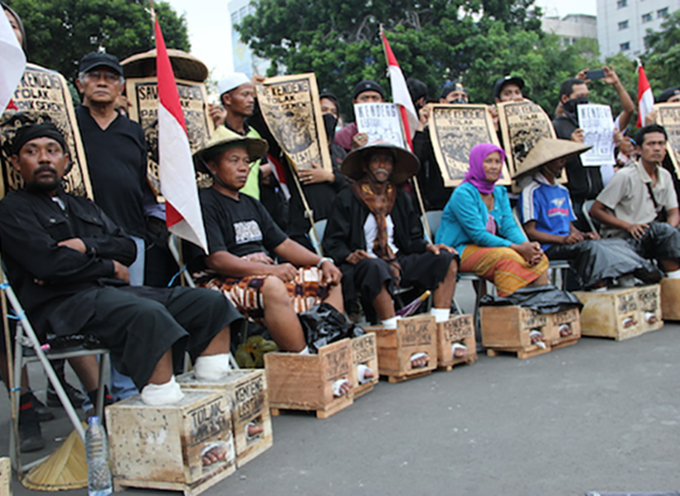
Farmers stage a protest outside the presidential palace in Jakarta against the building of a cement factory near the Kendeng karst mountain range in Java. Image: Katharina R. Lestari/UCANews

The church in Indonesia has lent its weight behind an ongoing demonstration outside the presidential palace by Javanese farmers protesting against the establishment of a cement factory, which critics say would invite an environmental disaster.

Farmers from several villages in Central Java province’s Rembang district, who started their protest last week by having their feet encased in concrete, were joined by environmentalists on March 20. The church also offered a message of support.

“This protest symbolises our life which will be shackled by the factory,” said Joko Prianto, coordinator of the protest.

He said the factory would ruin the quality of groundwater in the Kendeng karst mountain range.

“The groundwater basin must be protected. If not, we will face drought during the dry season and floods during the rainy season,” he said.

The construction of the PT Semen Indonesia factory began in 2014 but protesters have doggedly delayed it. It was due to begin operating in April but the launch has been delayed, according to local news reports.

Responding to the farmers’ protest, PT Semen Indonesia Corporate Secretary Agung Wiharto said the company had offered a number of solutions, including employing a so-called block mining system to prevent water pollution.

-Partners-

Support for farmers
Father Aloysius Budi Purnomo, chairman of the Commission for Ecumenical and Interreligious Affairs of Semarang Archdiocese, supported the farmers.

“They fight because they see nature being damaged due to the exploitation of natural resources. This is exactly what Pope Francis spoke about in his encyclical Laudato si,” he said.

“The papal encyclical encourages the church to support those fighting for the integrity of creation,” he added.

Similar support came from Muhammad Nurkhoiron from the National Commission on Human Rights.

“One of our commission’s efforts is to protect the karst mountains’ ecology for the sake of all people. The right to water is part of human rights,” he said.

In April 2016, a similar rally ran for two days until presidential staff promised to schedule a meeting between the protesters and president. In August, they met with the president who said no permit would be issued until an environmental assessment was complete.

Experts involved in the assessment reportedly said that the factory’s activities were feasible. On February 23, Governor Ganjar Pranowo issued a permit but the farmers do not accept the finding.

]]>

‘Nothing stopping investigative journalism,’ claims Khaiyum

]]>

AsiaPacificReport.nz

Communications Minister Aiyaz Sayed-Khaiyum … says journalists are not carrying out “investigative journalism”. Image: Fiji One News

Communications Minister Aiyaz Sayed-Khaiyum claims there is “absolutely nothing” stopping investigative journalism in Fiji, the major television network reports,

Media freedom – especially for critical and responsible reporting – has been an ongoing issue in Fiji.

In an interview with Fiji One News reporter Sofaia Koroitanoa, Sayed-Khaiyum claimed the government would “love to see more” investigative journalism.

The minister said there was a lack of investment in journalists.

“In developing countries like Fiji, the media needs to have a development focus. They need to be able to impart information not necessarily as viewing from a political perspective. You know, some newspapers, like The Fiji Times, run lots of opinion pieces by politicians and they, of course, have a skewed approach to it.

“What we’re saying is that journalists themselves, the media organisations themselves, [should] run articles imparting information objectively and that is what is very critical.”

Sayed-Khaiyum also said there was a lack of investigative journalism.

-Partners-

‘No restrictions’
When questioned by Fiji One News on concerns of a “non-enabling” environment for investigative and critical reporting, the minister claimed there were no restrictions.

“When I mean investigative journalism, do an investigation and say, ‘Oh, he stood up in Parliament, but the RBF report says this, the Bureau of Statistics says this, and therefore they are wrong.’ No journalist is actually doing that.

“So nobody’s stopping you from doing that, so get away from the political train and actually do a focus on those areas of imparting the correct information to members of the public,” Sayed-Khaiyum said.

Fiji Times editor-in-chief Fred Wesley has said his newspaper had always made every effort to be “fair and balanced” in political coverage at all times.

Opposition National Federation Party leader Professor Biman Prasad has previously stated that as long as the post-coup Fiji Media Industry Development Decree was in place, Fiji could not say it had press freedom.

Prasad said the Media Decree “put water on all the efforts” by the journalists and organisations to report accurately without fear or favour.

The Fijian Media Association has raised concerns over the penalties and the independence of the make-up of the Media Tribunal Authority.

]]>

Prominent opposition Indonesian journalist Ahmad Taufik dies

]]>

AsiaPacificReport.nz

Indonesian journalist Ahmad Taufik … one of the founders of the Alkiance of Independent Journalists (AJI) and who was jailed for challenging the Suharto dictatorship. Image: The Jakarta Post

Prominent Indonesian journalist Ahmad Taufik has died after an illness in Jakarta. He was 51.

Taufik, known as an opposition journalist during President Suharto’s dictatorship, joined other journalists in founding the Alliance of Independent Journalists (AJI) on 7 August 1994. He was appointed the first presidium chairman of the organisation.

Following a series of articles in AJI’s news magazine Independent on presidential succession and Soeharto’s great personal wealth, in early 1995, Taufik was arrested and charged under Article 19 of the Press Law, which banned unlicensed publications, and Article 154 of the Criminal Code, which forbade the publication of “feelings of hostility, hatred or contempt for the government”.

He was convicted on both charges and sentenced to three years in prison in September 1995. The New York-based Committee to Protect Journalists (CPJ) protested against his arrest and that of other journalists and named Suharto as “one of 10 worst enemies of the press” on its annual list.

Taufik was paroled on 19 July 1997, having served two-thirds of his sentence.

Taufik spent his sentence in five different detention centers: the Jakarta police station, Salemba Penitentiary, Cipinang Penitentiary, Cirebon prison and Kuningan prison. While in Cipinang Penitentiary, Taufik became close to Xanana Gusmão, the future president of Timor-Leste. He was also visited by Jens Linde of the International Federation of Journalists.

Taufik was presented the AJI Suardi Tasrif award on July 22, 1995. The same year, he won the International Press Freedom Award of the Committee to Protect Journalists.

-Partners-

Due to his imprisonment, he was unable to accept the award in person until November 1997, following his release from prison. The following year he received the Digul Award.

]]>

Environmental damage, social conflicts overshadow Indonesia’s palm oil future

]]>

AsiaPacificReport.nz

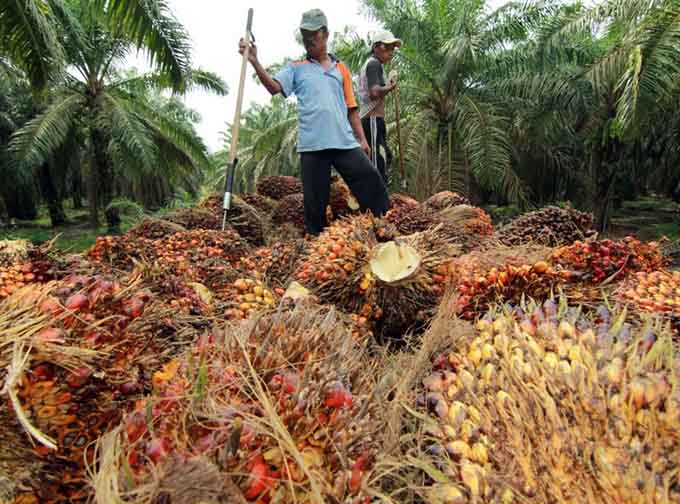
Palm oil … an important — but controversial — commodity for Indonesia’s economy export revenue. Image: Budi Candra Setya/Antara/Jakarta Globe

By Ratri M. Siniwi and Muham in Jakarta

Palm oil is an important commodity for Indonesia’s economy, contributing US$17.8 billion, or about 12 percent, to its export revenue.

While this year the production of crude palm oil is likely to increase 16 percent, to up to
33 million tons, with expected conducive weather conditions, environmental issues and social conflicts continue to overshadow the sector’s future in the world’s biggest palm-oil producing country.

Just earlier this month, the European Parliament’s Committee on Environment, Public Health and Food Safety (ENVI) approved a set of recommendations to the European Commission, which will phase out the use of palm oil as a component of biodiesel by 2020 and require exporters to prove responsible cultivation practices on their plantations.

A report prepared by the European Commission says that as the demand for palm oil is estimated to double by 2050, it poses severe environmental damages to oil-producing countries such Indonesia, Malaysia and others in Asia, Africa and Latin America.

Palm oil industry has been accused of causing deforestation, environmental degradation, and human rights violations ranging from land disputes to child labor.

The report is due for a vote in the European Parliament on April 3-6.

-Partners-

In response to the report, Indonesian experts, executives of an organization seeking to promote sustainable development, and a former government official, have started to defend the industry that employs millions.

Black campaign
“This is a real black campaign, involving conflicts of interests, and deriving from trade competitors,” said Bayu Krisnamurthi, former Deputy Minister of Trade and Agriculture in President Susilo Bambang Yudhoyono’s cabinet.

Bayu is now the chairman of the Indonesian Society of Agricultural Economics, which provides expertise to the agricultural sector.

In November 2013, the EU set duties of 8.8 percent to 20.5 percent for Indonesian palm oil producers to apply for five years. It argued that by imposing duty on the raw products, an advantage will be given to domestic producers.

The Indonesian government’s is going to file a complaint to the World Trade Organisation against the duties.

Petrus Gunarso, a member of the Indonesian Forestry Scholars Association (Persaki), rebutted the claim that Indonesia’s palm oil industry is the main contributor to the country’s deforestation, claiming that most of the palm oil plantations, which currently cover about 11 million hectares, were previously rubber plantations.

Petrus said that many farmers had converted their plantations as the price of rubber has been declining and palm oil cultivation is more profitable.

“That’s why the sizes of our rubber plantations have shrunk,” he said, adding that plantations are also established on degraded forests, which the government classifies as non-forest estates.

‘Not deforestation’
“By Indonesian law, that’s not deforestation,” Petrus said.

While palm oil producers may need to work more on convincing Europeans to buy their products, at home they have to deal with social conflicts, especially regarding land disputes.

The Indonesia Business Council for Sustainable Development, IBCSD, has commissioned a team to study the costs of these conflicts.

Using 2016 data from five plantations in Kalimantan and Sumatra, the team concluded, in a report titled “The Cost of Conflict in Oil Palm in Indonesia,” that the tangible costs of social conflicts ranged from $70,000 to $2.5 million. The biggest direct costs were income losses due to disrupted operations.

The intangible costs, according to the report, ranged from $600,000 to $9 million, and were due to reputational losses, casualties and property damage.

The reputational losses, according to the study, affect the companies’ ability to obtain loans, decrease the demand for their products and their stock market value.

“Conflicts are going to exist in all industries, it’s our homework now to find the most feasible solutions for the companies and communities,” said Aisyah Sileuw, president director of consulting firm Daemeter, which published the report.

As the infamous commodity makes the industry the most favorite one to bash on, Aisyah believes it is “impossible to get rid of it,” not only because of the huge export revenue it generates, but also since 40 percent of the country’s smallholders depend on palm oil.

]]>

The Bonfire screening highlights heart-wrenching Arctic story

]]>

AsiaPacificReport.nz

By Christina Milligan

The multi-award winning feature film The Bonfire has been screened to a small but appreciative audience at Auckland University of Technology following its successful screenings at the 2017 Māoriland Film Festival in Otaki.

The film tells a heart-wrenching story of friendship between an old man and a young boy after both of them have lost connection with their families.

Made in 15 days with an amateur cast and mostly amateur crew, The Bonfire is a remarkable achievement for first-time director Dimitrii Davidov, who is a school headmaster from the Amga district where the film was shot.

Davidov and his cast and crew are from the Yakut people who live in a remote region of Eastern Siberia, 725 km south of the Arctic circle. It is an area which suffers from high unemployment, and the film does not flinch from showing the pain of poverty and alcoholism that lack of work can cause in remote villages.

The Bonfire is the first feature to be made by the Yakut people in the Yakut language and it has been warmly received and honoured at a number of film festivals around the world, including being awarded Best Dramatic Feature at the 17th ImagiNATIVE Film and Media Arts Festival in Toronto in 2016.

Davidov and his producer Anzelika Krastina were hosted at AUT by Te Ara Poutama and the Television and Screen Production curriculum of the School of Communication Studies.

-Partners-

Christina Milligan is a film director and producer and lecturer at Auckland University of Technology.

]]>

5 mind-boggling things about Pilger’s doco The Coming War on China

]]>

AsiaPacificReport.nz

With dozens of US military bases encircling China with a “giant noose,” and America’s historic nuclear presence in the Pacific region, a war between the greatest military power and the world’s second largest economy “is no longer unthinkable,” journalist John Pilger says.

In his documentary, The Coming War on China being launched in New Zealand next week,  the multi-award winning journalist and filmmaker says he aims “to break the silence”.

Pilger sets out several remarkable historic facts which bear testament to America’s “sabre-rattling” in the Asia-Pacific region.

RNZ Sunday’s Wallace Chapman talks to John Pilger today about his new documentary.

‘Giant US noose’ around China
In the West, “the threat of China is becoming big news, the media is beating the drums of war as the world is being primed to regard China as a new enemy,” the UK-based Australian journalist says.

The mainstream media such as CNN get exclusive access to classified US surveillance flights over disputed islands in the South China Sea, which “have become a flashpoint for war between China and America”.

But “what is not in the news is that China itself is under threat.”

-Partners-

“American bases form a giant noose encircling China with missiles, bombers, warships all the way from Australia through the Pacific to Asia and beyond,” Pilger’s documentary states.

As one of the film’s contributors, author of The China Mirage book, James Bradley put it, “if you were in Beijing and stood on the tallest building and looked out at the Pacific Ocean, you would see American warships, you would see Guam is about to sink because there are so many missiles pointed at China.”

The Coming War documentary by John Pilger … “so many missiles pointing at China”. Map: Base Nation

1. ‘The secret of the Bikini Islands’
The site of US atomic bomb testing for many years, which notoriously lent its name to the swimsuit design, the Bikini Atoll within the Marshall Islands is “America’s strategic secret.”

Lying in the vast Pacific Ocean between the US and Asia, the “once bountiful” atoll is a “stepping stone to Asia and China” for the US.

In 1946, the US took over the Marshall Islands as a trust territory, but turned it into a “laboratory for the testing of nuclear weapons, and its people into guinea pigs,” the film says, adding that effects of the atomic bomb were also tested on animals.

While the revealing swimsuit was named after US H-bomb detonations in Bikini Atoll, the bodies of the people on the islands were less celebrated than its wearers. They were among “the most radiated in the world”.

With test sites at sea, in the air, on reefs and underwater, the total yield of the nuclear experiments on and around the Marshall Islands was equal to 7200 Hiroshima bombs, meaning the equivalent of more than one Hiroshima bomb was exploded in the area every day for 12 years, Pilger says.

Bikini Island is till nowadays unfit for human life, he adds.

The area surrounding the crater of one of the greatest man-made explosions, from a hydrogen bomb called Bravo, is “by far the most contaminated place on Earth,” the film cites a US atomic energy official as saying.

“It will be interesting to get a measure of human uptake when people live in a contaminated environment,” the official added, while the film explores the sufferings of the atoll locals, many of whom died of cancer.

“What the Americans did was no accident. They came here and destroyed our land. They came to test the effects of a nuclear bomb on us,” a local woman told the filmmaker.

In a weekend interview on Radio NZ’s Sunday with Wallace Chapman, Pilger also talked about US research on the impact of nuclear radiation on Marshall Islands “guinea pigs”, notably on Rongelap Atoll just 120km from Bikini where the islanders were encouraged to return to live.

In May 1985, the Greenpeace flagship Rainbow Warrior ferried the Rongelap people to a new home on Mejato island on the rim of Kwajalein Atoll just weeks before the vessel was bombed by French secret agents in Auckland Harbour.

Rongelap Islanders on board the Rainbow Warrior bound for Mejato in May 1985. (c) David Robie from Eyes of Fire.

2. ‘Apartheid in the Pacific’
Moving to another American base in the region, cited as “one of its most important and secretive” locations, known as the Ronald Reagan Test Site, the journalist explores the US missile launch pad that, according to him, “commands the Pacific Ocean all the way to Asia and China.”

With weapons of mass destruction being “designed for a coming war,” the base is part of a “remarkable” US Space Command plan known as Vision 2020. Devised in the 1990s, its aim is officially described as “full spectrum” dominance, the film says.

But while Washington spends huge amounts of money on military ambitions, with the US Air Force testing its intercontinental missiles by firing them at the Marshall Islands from California almost 5000 miles away, locals have been subjected to poverty.

America’s treatment of people living across the bay from the US base Kwajalein is called the “Apartheid of the Pacific” by Pilger, and their native island Ebeye “the slum of the Pacific”.

More than 12,000 people, most of whom are refugees from what is now a US missile base, and from islands poisoned by nuclear testing, are brought to work on that very base site to water golf courses for the Americans. After a whole day of work, they are “ferried back to their poverty”.

3. ‘Island people against the greatest military power on Earth’
Japan’s island of Okinawa has become the “frontline of a beckoning war with China,” while the outstanding non-violent resistance of the local people challenges US’ pivot to Asia.

The documentary reveals that in 1962 America’s atomic weapons were almost launched from the island, when a military base there allegedly received an order to prepare an attack on China, but then was abruptly ordered to stop.

One of the American servicemen whose job was to fire Mace cruise missiles told Pilger that China was Washington’s nuclear target during the Cuban missile crisis.

“We must not have the misery of war ever again,” one of the leaders of the protest movement on Okinawa told the journalist, adding that her “duty” as a survivor of World War II is to see the US military bases leave the Japanese island.

READ MORE: Stationing American troops in Japan will lead to bloody tragedy – ex-PM of Japan

Yet, American aircraft are constantly flying low on Okinawa, the film shows, with its author saying that “the threat is a constant presence”.

Teachers often can’t teach because of the noise and the fear, with a memory of a US fighter crashing into Miyamori Elementary School and surrounding houses still vivid for many. Back in 1959, the pilot ejected to safety, but the plane caused carnage, with more than 200 people, mostly children, having been killed and injured in the accident.

“Another tragedy waits to happen on Okinawa, with US military aircraft having been involved in 44 accidents on the island,” Pilger says, while also recalling cases of violence and sexual assault against local women, allegedly committed by American servicemen.

One more outstanding “US war station” is located on the South Korean island of Jeju, where a resistance movement has also been persistent against America’s naval base.

“One of the most provocative military bases in the world” has been built on the world heritage site land, less than 400 miles from Shanghai.

According to the film, it’s aimed at China’s lifelines to the world in oil trade and resources.

There are also numerous secret bases constructed by Washington within a hosting country base to disguise the US presence, with such locations generally not referred to as “bases,” the film claims.

Many have been “set up to combat China’s worldwide economic influence,” while bases on China’s doorstep are “a provocation of war”.

4. ‘Gold mine of drugs’ and Mao ‘paranoia’
Starting from the 19th century, an anti-Chinese “racial stereotype” has been spread across the United States.

According to the film, such a policy concealed a deeper agenda – opium. For the American elite back then China was a “gold mine of drugs”.

Warren Delano, the grandfather of America’s 32nd president Franklin D. Roosevelt, “was the American opium king of China,” author James Bradley says. “Much of the east coast of America – Columbia, Harvard, Yale, Princeton were born from opium money.

“The American industrial revolution was funded by huge pools of money which came from illegal drugs [from] the biggest market in the world – China,” he says, adding that of course it wasn’t talked about, but called it “the China trade.”

Later in the 20th century, a new way to present China as a threat was invented, with Mao’s revolution having ignited paranoia in Washington. With Richard Nixon proclaiming China “the basic cause of all of our trouble in Asia” in 1953, the father of the H-bomb, Edward Teller over a decade later claimed a defence was needed against the eastern power.

“I believe that for the sake of our safety it is necessary to be prepared for the possibility of a Chinese missile attack on the United States,” the film quotes him as saying.

“China … matched America at its own great game of capitalism, and that is unforgivable,” Pilger says.

The journalist uncovers a secret message that was sent by Mao Zedong to Washington five years before the communist revolution of 1949. “China must industrialise right now, this can only be done by free enterprise.

“Chinese and American interests fit together economically and politically. America need not fear that we will not be cooperative – we cannot risk crossing America, we cannot risk any conflict,” Pilger cites Mao’s message as saying.

But the Chinese leader got no reply, and his “reaching hand was tossed away,” as Bradley put it.

5. ‘Smartest weapons need enemies, money is the prize’
The film suggests that a “stereotype of communist dictatorship” is widely spread by the US, preventing from understanding “China as it is”.

“In America you can change political parties but you cannot change the policies. In China you cannot change the party, but you can change policies … China is a vibrant market economy, but it is not a capitalist country,” entrepreneur and social scientist, Eric Li says.

He adds that in China, “capital does not rise above political authority,” and there is no way a group of super rich people can control the politburo, “as billionaires control America’s policy making.”

Chinese soldiers …. Beijing government “trying to prevent US domination”. Image: New Matilda/Jonathan Kros-Reid/Flickr

The Chinese government is “not trying to run the world, they are not even trying to run Asia Pacific. I think they want to keep America from dominating [the region], so they have what they believe is their rightful place because of the long history of civilisation,” Li says, adding that Chinese “objectives are really modest compared with their capacity.”

As the world’s economic power moves rapidly towards Asia, the response of the United States is to deploy the majority of its naval forces to the region, according to Pilger.

“This massive military build-up is known in Washington as the ‘pivot to Asia’. The target is China,” he says, also citing president Barack Obama, who in 2011 said that creating an American presence in the Asia Pacific was his “top priority”.

“For America’s unchallenged arms industry, the annual prize is huge profits from almost $600 billion of military spending,” the journalist suggests, adding that “the smartest weapons need enemies”.

]]>

Sharon Bhagwan Rolls: Feminists face shrinking spaces at UN

]]>

AsiaPacificReport.nz

Young Pacific women challenging the status quo. Image: femLINKpacific

COMMENT: By Sharon Bhagwan Rolls in New York

Pacific — and global — feminists are facing challenging times this week in New York with efforts to squeeze out NGO access to United Nations negotiations.

“Pacific feminists and women led groups are pressing for a CSW61 Agreed Outcome document that shows governments showing courage to change the inequalities within and between states, examining and addressing sustainable consumption and production patterns, and envisioning a changing world of work for women that is not toward concentration of wealth and corporate power that prevents governments from investing in public services and social protection necessary for women’s economic rights, but rather toward a just and equitable future for all, including women and girls,” says Noelene Nabulivou, political adviser of DIVA for Equality in the final days of the 61st session of the UN Commission on the Status of Women (CSW61) here in New York.

But the shrinking spaces for women’s human rights are glaringly obvious.

This year’s CSW has seen attacks on NGO access to the consulting process as the negotiations come to a close today.

According to the NGO CSW Committee as well as We Rise Coalition partners outside the negotiations on Wednesday, UN Security staff removed NGOs from the building after 6pm while negotiations continued late into the night.

CSW Agreed Conclusion negotiations were moved to the ECOSOC Chamber and Trusteeship Council Chamber twice this week. These meeting rooms are on the second floor which are off-limits to NGOs.

-Partners-

This has severely restricted NGO/government informal discussions, hampering their ability to support the progress of the negotiations.

Gains at risk
This is putting at risk the gains we have made for women’s rights, as Nabulivou explains:
“We see more governments making links between women’s work and climate change, and we now want to see language on implementation; and on what components are needed for just and equitable transitions to low carbon economies.

“We also are concerned for language to help address structural issues such as the grossly imbalanced global economic and financial system; and a growing automation of work impacting on women already at the bottom of deeply unequal global supply chains.”

Caroline Lambert of International Women’s Development Agency has raised issues of universal human rights, and inclusion of all women as central to leaving no-one behind:
“For too long, the CSW has failed to recognise the human rights associated with sexual orientation and gender identity.

“It’s time for the CSW to uphold these critical human rights.”

She added: “The indivisibility of human rights, particularly the vital intersection of labour rights with women’s economic empowerment, must be a strong part of the Agreed Conclusions. This text must place the ILO as a central pillar of the outcomes.”

In this global political climate, feminist networks and women human rights defenders, says Nabulivou, hope for a text that better responds to multiple forms of misogyny and patriarchal behaviour, authoritarianism, conservatism and violence that are being used to try to restrict women’s bodily autonomy, movement, sexuality and decision-making over their lives:
“It is important that the CSW61 Agreed Outcomes reflect a strong universal human rights framework.”

Pressing issues
Feminists across the world now look to the UN Secretary-General, UN Women and all member states to ensure that the remainder of the negotiations are open to civil society engagement, and that the agreed conclusions respond to the most pressing issues facing women’s human rights.

It is after all part of the critical legacy of collaboration between member states and civil society at the Commission on the Status of Women which have delivered many advances for women’s human rights, from the development of the Convention on the Elimination of All forms of Discrimination Against Women and its Optional Protocol; to the creation of the first International Year of Women as well as the adoption of the first Security Council Resolution on Women, Peace and Security.

Sharon Bhagwan Rolls of femLINKpacific is at the consultations as a representative of We Rise Coalition, led by four feminist organisations:

  • Diverse Voices and Action for Equality (DiVA)
  • femLINKpacific (femLINK)
  • Fiji Women’s Rights Movement (FWRM)
  • International Women’s Development Agency (IWDA)
Graphic: HearSeeDraw
]]>

SAS soldier backs up Afghan raid claims – Herald calls for inquiry

]]>

AsiaPacificReport.nz

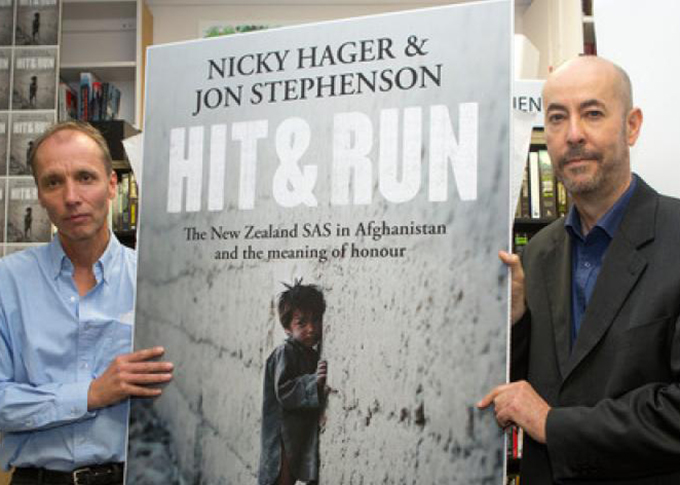
Investigative journalist and author Nicky Hager and war correspondent Jon Stephenson at the Hit & Run book launch in Wellington this week. Image: ODT

A NZ Special Air Service soldier has confirmed civilians were killed in a 2010 raid carried out by the unit and says the truth is widely known among the elite military group, reports The New Zealand.

New Zealand’s largest and most influential newspaper today also published an editorial and a commentary by one of its leading columnists, Toby Manhire, calling for a full public inquiry.

Three-year-old Fatima, one of the alleged civilian casualties in the 2010 Afghanistan raid by NZ SAS soldiers. Image: Hit & Run

According to the front-page report by investigative journalist David Fisher, the soldier told the Herald the two people found shot dead were killed by NZSAS sharpshooters who believed they were acting under “Rules of Engagement” governing their actions on the battlefield.

“They have taken out two,” the soldier told Fisher.

The soldier said the other four people killed died in a barrage of fire from United States aircraft called in by a New Zealander operating as the joint terminal air controller – the person responsible for directing air support, the Herald reports.

According to the unnamed soldier, it emerged no combatants were identified on the battlefield, Fisher reports.

The controversy over the NZSAS and civilian casualties has been sparked by this week’s release of a book, Hit & Run, written by author Nicky Hager and war correspondent Jon Stephenson.

-Partners-

‘Revenge’ raid claimed
The book alleged six civilians were killed and 15 injured in a “revenge” raid after the death of New Zealand soldier Lieutenant Tim O’Donnell on August 4, 2010.

The soldier told the Herald a number of those involved in the raid had received medals for their roles, “which sat uncomfortably when the civilian casualties emerged”.

Nicky Hager told the Herald last night the new details were “very timely” as the Defence Force and government continued to make denials.

“Another person has come forward and not only confirmed what we have said but has taken it further,” he said.

The Herald cited a NZDF spokeswoman saying its position of not commenting on the book’s allegations would not change.

Headlined “Now is our chance to do the right thing”, the Herald editorial said the story of the so-called War in Terror had been “riddled with controversy and failure”.

‘False reasoning’
“From the moment two passenger planes were flown into the Twin Towers in New York, the West has been challenged over its ability to meet an ill-defined enemy with conventional militaries in asymmetric warfare.

“From the false reasoning behind the war in Iraq to the horrors of Abu Ghraib prison, there have been events that have undermined the moral claim Western democracies have held to as their purpose for a conflict that has consumed a generation.

“Now, we have our own suggestions of a scandal in a new book, Hit & Run, from journalists Nicky Hager and Jon Stephenson. We have been told that the estimated 25,000 civilians killed in Afghanistan now include six people whose deaths fall at our feet. Those six people include a 3-year-old [a girl, Fatima].”

The Herald said the country now faced a choice: “The second part of the story is what we do next. Our allies have not always acquitted themselves well in this regard.”

With the scandal now embroiling the commanders and the politicians who sent the soldiers to Afghanistan, it was time for an “introspective study”.

“Inquiries are a health check on our democracy and the War on Terror has infected some of the principles which underpin the democracies of allied nations.

“Historically, we have prided ourselves on doing better. Now is our chance.”

Author and columnist Toby Manhire wrote in the Herald that the book’s damning claims demanded an inquiry.

“For their sake, for the sake of the NZ Defence Force, whether to censure or vindicate, for the sake of the government, for the sake of respecting international law, for the sake of the dead, and in the public interest, that investigation needs to happen.”

]]>

Indonesia steps up fight against foreign research biopiracy

]]>

AsiaPacificReport.nz

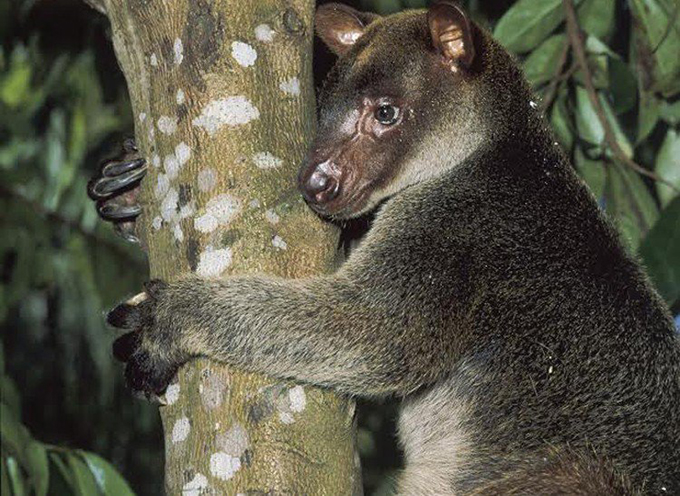
Tree-kangaroo as seen in this picture is one of the endemic animals in Papua. Activists have blamed the plantation business for the rapid loss of Papua’s biodiversity. Image: Mighty Asia Tenggara/Jakarta Post

By Hans Nicholas Jong and Moses Ompusunggu in Jakarta

Though it may sound like a conspiracy theory, the Indonesian government has taken seriously allegations that foreign researchers have used all kinds of ways — including disguising themselves as tourists — to steal the nation’s genetic resources.

Indonesia is home to some of the richest biodiversity in the world and government officials are concerned that foreign parties are developing and exploiting local genetic resources without obtaining consent from or providing fair compensation to Indonesia as stipulated in the Nagoya Protocol, which Jakarta has ratified.

The Research and Technology and Higher Education Ministry, therefore, has recently issued a regulation to prevent this suspected biopiracy.

The 2017 ministerial regulation, released in February, stipulates that the government will no longer provide recommendations for foreign researchers to conduct research in less-explored regions prone to natural resources theft such as Papua and Maluku islands.

While the regulation does not impose a total ban on research in those areas, it makes it more difficult for foreign scientists to obtain a permit for research there.

“We will give the opportunities to our local researchers first to conduct research in those areas, where new species of flora and fauna have been found,” said the ministry’s Secretary of Foreign Research Permits, Sri Wahyono.

-Partners-

Wahyono said the threat of biopiracy in Indonesia was real. He argued that the government’s free-visa policy for 169 countries, aimed to boost foreign tourist arrivals to Indonesia, had made it easier for foreigners to access local biodiversity resources.

‘Caught red-handed’
“Right now, the common modus operandi includes ecotourism, where foreigners come to Indonesia with a visa on arrival to visit our protected forest areas and sanctuaries. Some of them have been caught red-handed [stealing resources].”

In February, Environment and Forestry Ministry (KLHK) investigators arrested a French national, identified as DL, in Papua for allegedly attempting to smuggle a rare butterfly species named Ornithoptera goliath, which is widely known as Goliath birdwing and is the second-largest butterfly on the planet.

Using a tourist visa, DL arrived at Manokwari in Papua on February 25 and then continued his journey to Mokwam village in Arfak Mountain where he allegedly collected the species.

“The butterfly is one of the rarest species [of butterfly] and was about to be smuggled to France,” said KLHK investigator Adrianus Mosa.

It has not been confirmed yet if DL has made an attempt to commit biopiracy, but the government is treating it as such, saying DL was not the first. As an example, Sri cited a 2012 case where several teenagers from the UK were caught collecting samples without permission at the Murung Raya protected forest in Central Kalimantan.

Visa abuse aside, Indonesia has seen an increase in the number of foreign researchers visiting the country to conduct cutting-edge science projects, including those that have huge economic potential.

“In the past, Indonesia only issued around 200 research permits per year. Since 2010, we issued around 500 permits. The interest is growing, especially in biodiversity, such as zoology, botany and marine biology,” Wahyono said.

The regulation thus also aims to fight a subtler and more controversial form of biopiracy: unfair research cooperation agreements between local and foreign scientists.

Evidence claimed
Rosichon Ubaidillah, the head of zoology at the Indonesian Institute of Sciences (LIPI) biology research department, claimed to have evidence showing that many agreements signed by Indonesian universities and their foreign counterparts tend to benefit the latter.

“Foreign researchers may have collected research materials legally, but what they have been doing is not always ethical,” Rosichon said.

LIPI, he said, had to cancel scientific cooperation with a German institution last year because the latter refused to change a material transfer agreement (MTA) LIPI deemed as disadvantaging Indonesia.

Dominique Roubert, press officer for the French Embassy in Jakarta, said they could not give any comment regarding this issue and would let Indonesian authorities continue the investigation process.

“We will fully abide by Indonesian law,” Dominique said.

]]>

Quality claim root cause of double-priced Niuean taro

]]>

AsiaPacificReport.nz

Mangere Food Centre is the only place that sells Niuean taro in Auckland. Image: Brandon Ulfsby/Te Waha Nui

By Brandon Ulfsby

Niuean taro has made a return to the shelves and the stomachs of many in New Zealand — but the humble vegetable has come at a cost.

The Niuean taro is being sold at the Mangere Food Market for $12.99 a kg – more than twice the price of the Fijian and Samoan equivalent.

Managing director for the Mangere Food Market, Vutha Hang says transport costs are to blame.

“Reason why it’s more expensive is because they send it via plane, if they send it via boat then it’ll be cheaper,” he says.

Hang was approached by Shopexports and Freight Ltd to sell the product. Others had declined the offer, he said.

“For me I’ll try, if the people buy it then I’ll carry on and sell it, but if people don’t buy it then I have to stop.”

-Partners-

Shopexports and Freight Ltd, which imports the taro for Mangere Food Market, claims on its Facebook page that the produce supports growers in Niue.

Niuean expats claim their country’s product is of a superior quality than other Pacific varieties.

Fotu Jackson, a Pacific engagement manager at AUT University, says from her extensive knowledge of the Pacific she believes Niuean taro is one of the best.

“I think Niuean taro has a lot more taste, the texture is different than other taro from the Pacific – and I say that as a Samoan,” she says.

Jackson says the soil in Niue is very rich, and she believes this contributes to the uniqueness of the Niuean variety.

Hang says a lot of customers come into his store and look for the taro but only a few actually buy it.

Jackson says despite the price of the Niuean taro, it is worth it.

“I was actually one of the people who drove to buy the taro.”

Jackson says there are not many places you can buy Niuean taro, whereas the Fijian and Samoan variety is readily available throughout the country.

“When it comes to New Zealand it’s really popular, it’s in high demand.”

Repeated efforts to get comment from Shopexports and Freight Ltd were not been successful.

Brandon Ulfsby is a student journalist with Auckland University of Technology’s traning newspaper Te Waha Nui.

]]>

Across the Ditch: Book Alleges Coverup of New Zealand SAS Soldiers Involved in Afghanistan War Crimes

Across the Ditch: Australian radio FiveAA.com.au’s Peter Godfrey and EveningReport.nz’s Selwyn Manning deliver their weekly bulletin. This week Selwyn details the allegations made in a book called Hit and Run by Jon Stephenson and Nicky Hager that suggest there was a coverup over the actions of New Zealand SAS soldiers – actions that if found true could lead to war crimes charges. First up: Weather + Headlines roundup. ITEM ONE – Hit and Run: Across the Ditch: Book Alleges Coverup of New Zealand SAS Soldiers Involved in Afghanistan War Crimes Pressure is mounting on Prime Minister Bill English to initiate a commission of inquiry into allegations that New Zealand SAS commandos were involved in, or committed, war crimes in Afghanistan in 2010. The allegations were detailed in a book called Hit and Run which was released here in New Zealand on Tuesday. The authors of Hit and Run, investigative journalists Jon Stephenson and Nicky Hager, wrote that NZ SAS soldiers committed a revenge operation against a village in Baghlan province in Afghanistan after New Zealand soldier Lieutenant Tim O’Donnell was killed after a roadside IED was exploded by Taliban insurgents. The claim is the NZ SAS gathered intelligence, planned the operation, led the command chain of the operation requesting and using US black hawk and Chinook helicopters and crew as part of their night mission. It appears they believed the insurgents were staying in the village. But within ten to twenty minutes of the attack commencing six civilians were dead and 15 civilians were injured. One of the dead was Fatima, a three year old girl, who was killed while carried in her mother’s arms as women, children, and elderly civilians attempted to run for their lives. Once the attack ended, the Kiwi SAS soldiers began to systematically burn and blow up the village’s homes. The book claims, there were no insurgents at the village at the time. The book also asserts that the NZ SAS then covered up the civilian deaths and claimed in statements at the time, again in 2011, and 2014, and again this week, that those killed were all insurgents. Sources for the book include former members of the SAS who took part in the attack. Motivated perhaps by a wish to clear their consciences – and frustrated by an apparent coverup by NZ Defence Force officials (and perhaps the Government). A week after the raid on the village the SAS returned to destroy another of the village’s homes that was being repairs. Some time later, the SAS captured one of the insurgents believed to have been involved in the killing of Lt O’Donnell. The book alleges that while blindfolded and flexitide in a vehicle, a SAS commando beat him severely. They then handed him over to Afghan security officers knowing that he would be tortured, which he was – he was electrocuted and suffered other forms of torture. The Deputy Prime Minister Paula Bennett said on Radio New Zealand on Wednesday that she had been briefed on the claims and that there was nothing that concerned her. She said she trusted the Defence Force officials. The Prime Minister Bill English would not rule out an inquiry but said on Wednesday that the claims in the book were in part politically motivated. ITEM TWO – The Beib is in town American singing sensation Justin Beiber is touring the country. After a weekend in Auckland getting around on a rickshaw and singing get out of the way bitch, he has been thrill seeking down in the South Island, doing a backward falling Bungy jump over the Shotover River. See Stuff.co.nz ]]>

Asia Pacific Report tribute to Teresia Teaiwa – thanks to Tagata Pasifika

]]>

AsiaPacificReport.nz

Dr Teresia Teaiwa featured in a Tagata Pasifika video when winning the Manukau Institute of Technology Pacific Education Award prize at the SunPix Pacific Peoples Awards in 2015.

The director of director of Va’aomanū Pasifika at Victoria University in Wellington, Dr Teresia Teaiwa, has died following a short illness.

She was described in a statement by Victoria University today as a friend, colleague, renowned scholar and poet, and a generous and warm personality of the academic community.

Dr Teaiwa died yesterday in close company of friends and family after a short battle with cancer.

Assistant Vice-Chancellor (Pasifika) Luamanuvao Winnie Laban said the loss would be felt widely among the Pasifika community in New Zealand, the Pacific region and elsewhere around the world.

“She was a wonderful Pacific woman and leader who was a role model for all Pacific people. She was hugely committed and passionate about people and social justice in the Pacific, and she will be missed dearly.”

Dr Teaiwa was internationally known for her ground-breaking work in Pacific studies.

-Partners-

Her research interests in this area embraced her artistic and political nature, and included contemporary issues in Fiji, feminism and women’s activism in the Pacific, contemporary Pacific culture and arts, and pedagogy in Pacific Studies.

Marsden Fast Start
In 2007, she was awarded a Marsden Fast Start research grant for her oral history and book project on Fijian women soldiers.

In 1996, Dr Teaiwa turned down a job with Greenpeace to take up her first lecturer position at the University of the South Pacific in Fiji.

During this time, Dr Teaiwa enjoyed being part of intellectual communities that stemmed from the university environment such as the Niu Wave Writers’ Collective, the Nuclear-Free and Independent Pacific Movement and the Citizens’ Constitutional Forum.

In 2000, she moved to New Zealand to join Victoria University to teach the world’s first undergraduate major in Pacific studies, of which she was programme director until 2009.

Most recently she was promoted to director of Va’aomanū Pasifika, home to Victoria’s Pacific and Samoan Studies programmes.

Dr Teaiwa’s talents in the classroom were formally recognised in 2015 when she won the Pacific People’s Award for Education, in 2014 when she received the Victoria Teaching Excellence Award and as the first Pasifika woman awarded the Ako Aotearoa Tertiary Teaching Excellence Award.

In 2010, she received the Macaulay Distinguished Lecture Award from the University of Hawai’i.

Outside of her Victoria role, Dr Teaiwa was co-editor of the International Feminist Journal of Politics (2008-2011), and was an editorial board member of the Amerasia Journal and AlterNative: An International Journal of Indigenous Peoples.

Pacific Media Centre director and Asia Pacific Report editor Professor David Robie, a contemporary of Dr Teaiwa at the University of the South Pacific, described her as an extraordinary academic and creative talent and cultural icon, adding she was “an inspiration to Pacific peoples right across the region”.

A memorial service will be held for Dr Teaiwa at Victoria University in the coming weeks.

]]>

On the oil protest front line: ‘It’s their future they’re fighting for’

]]>

AsiaPacificReport.nz

By Kendall Hutt

Young environmentalists were on the front lines of the fight against oil and gas exploration in New Zealand today with the People’s Climate Rally blockading an industry summit in New Plymouth.

Jesse Sheehan, a musician and Greenpeace supporter, and Poonam Maharaj, who has been fundraising with Greenpeace since late January, both took part in the blockade of TSB Showplace to peacefully disrupt the Petroleum Summit.

The People’s Climate Rally has been organised by a coalition of groups opposed to the expansion of the fossil fuel industry, including 350 Aotearoa, Break Free, and oil free groups from Wellington and Auckland.

Maharaj says she was “so excited” to be taking part in the rally, which was her first action.

“A day into the job I found out about the climate rally, and it’s something I would love to be a part of, actively making a change.”

Sheehan, who has kept his “toe in the water” volunteering with Greenpeace both here and in the United Kingdom since 2015, admits this wasn’t his first protest.

-Partners-

“I’ve stopped a coal train in the past.”

Similar motivations
Both Sheehan and Maharaj have similar motivations behind taking part in the rally.

“I hope that oil companies know that they can’t run and hide, and that they know there will be opposition to them being in New Zealand, because the government have sort of sold them this idea ‘come to New Zealand and you won’t have any resistance, you’re welcome and New Zealanders want you here.’

“So I hope they will realise that is not the case and they will reap resistance and it won’t be as easy as the government said it would be,” says Sheehan.

Maharaj, however, says she was protesting due to the harm seismic blasting and oil drilling had on marine life.

“My sort of main reason why I’m going is because of the impact it’s having on our marine life. It’s not very fair on the animals and they haven’t done anything wrong to deserve this.

“It’s not something I feel our government should be encouraging.”

Future in own hands
Amanda Larsson, a Greenpeace campaigner involved in organising the rally, speaking to Asia Pacific Report from Taranaki, says it is important to include youth voices in the fight against deep sea oil drilling.

“It’s their future that they’re fighting for, and again for them to have a future the oil industry can have no future, so it’s really important for young people to kind of take their future into their own hands.

“What we’re finding is that the government is not standing up for their future, so it’s really important for people like you and me and the young people of this country to take that responsibility into their own hands and ensure we put a stop to oil and gas drilling in this country.”

The People’s Climate Rally also recognises the work of local organisations in Taranaki, such as Climate Justice Taranaki, Ngatiawa ki Taranaki Trust, and Parihaka Papakāinga Trust, who have been opposing oil and gas activities including drilling, flaring and fracking for many years.

“This is their land, their territory, and their fight,” says Larsson.

“Now that that conference has moved to Taranaki with strong local opposition, it’s very important for us to support what people are already doing on the ground and to give them all the support they need to carry on here.”

Responsibility to Pacific
Larsson, Maharaj and Sheehan also agree New Zealand has a responsibility to its Pacific neighbours to amends its stance on oil and gas exploration in the country.

This is due to the fact Pacific countries bear the brunt of the effects of climate change.

“It’s often Asia-Pacific and the developing countries within the developing world that are hit the hardest by climate change, less so than Western countries,” says Sheehan.

Maharaj also feels New Zealand should be setting an example in terms of renewable energy solutions.

“We should be starting that now so our Pacific neighbours can start following suit and we can have an oil free country and world.”

Small island states such as Kiribati, Marshall Islands and Tuvalu have already been affected by rising sea levels, while fresh water and food supplies across the Pacific are affected by salt water intrusion.

Tropical cyclones have plagued the Pacific on an increasing basis since the 1970s as the effects of El Nino have drastically risen, the most recent effect being Cyclone Winston, devastating Fiji in early 2015.

“I think as a Pacific nation New Zealand has a responsibility to the people who are most going to be affected by climate change which is our Pacific neighbours.

‘Stand together’
“It’s really important for the New Zealand public to stand together with the people of the Pacific in opposing the oil and gas industry which is the main driver of climate change,” Larsson says.

New Zealand has been criticised on the world stage for its commitment to scaling back fossil fuels.

This is because New Zealand’s fossil fuel production subsidies have increased seven-fold since former Prime Minister John Key’s election in 2008.

The government has received four “Fossil of the Day” awards at climate change talks since 2012, the most recent being at the COP21 conference in Paris in 2016.

Since National came to power in 2008, over half a million square kilometres of land and sea have been proposed for release for international oil companies to search and drill for oil.

Multiple opposition welcome
Although the rally is considered a continuation and escalation of previous protest in Auckland and Wellington at the yearly summit, it is a “family friendly event” where people concerned about climate change can show their opposition in multiple ways, says Larsson.

“Some people will kind of choose to put their bodies on the line and engage in non-violent direct action. Other people might choose to just hold some banners, attend some workshops and display solidarity by just being there in support and this rally is sort of being about open to everyone to show their opposition in their own way.”

Sheehan will also be taking part in the protest as a musician “to keep spirits high” and “use my voice that way as well”.

Eight hundred people have registered to attend the rally, but organisers expect at least 200 people will take place in the protest activity across today and tomorrow.

Thursday’s focus is on solutions, with talks and workshops delivered by a host of researchers and industry professionals on sustainable energy, including former Green Party co-leader Jeanette Fitzsimons and Ecotricity director Al Yates.

]]>

NZ climate change protesters blockade oil conference in Taranaki

]]>

AsiaPacificReport.nz

Protesters sit in during the climate change blockade in New Plymouth today. Image: Jeremy Gould/Greenpeace

Climate change protesters blockaded the Petroleum Summit in the New Zealand city of New Plymouth today where the government was expected to announce the 2017 “block offer” for new gas and oil exploration, reports Māori Television.

Since 2012, more than half a million square kilometers of land and sea have been proposed for release, imposing on people’s properties.

It will also encroach on the Marine Mammal Sanctuary for the critically endangered Maui’s dolphin.

“Today’s blockade intends to disrupt the Petroleum Summit by using non-violent direct action,”  says “People’s Climate Rally” spokesperson Emily Tuhi-Ao Bailey

“Not a single new oil well, gas field or coal mine can operate if we are going to avoid a climate catastrophe, yet year after year the government and oil industry keep meeting to find ways to expand the industry.”

The People’s Climate Rally was organised by a coalition of groups from Taranaki and around New Zealand in order to disrupt the conference and discuss clean and fair alternatives to the fossil fuel industry.

It is the first time the government and international oil delegates have held the oil conference in Taranaki.

-Partners-

Escalating protests
This move comes after years of escalating protests in Wellington and Auckland, which have seen thousands take to the streets and hundreds blockade the Sky City conference venue in Auckland.

“We demand a stop to all new oil and gas exploration, drilling and fracking,” said Bailey.

“The extraction and burning of fossil fuels is radically changing our climate, wreaking havoc on our critical infrastructure, agriculture, tourism, human health and food security. It is time to stop.

“Non violent direct action has a long and revered history. Social justice change has always involved people coming together, organising and put their bodies on the line to stand in the way of injustice.

“It is especially important that this is happening in Taranaki. Taranaki has long, bitter experience with the environmental, health and personal impacts from oil and gas activities including drilling, flaring and fracking.

“For many Māori this is seen as a continuation of colonisation.”

]]>

Authors of new book call for full inquiry into SAS ‘betrayal’ claim

]]>

AsiaPacificReport.nz

Author and investigative journalist Nicky Hager and war correspondent Jon Stephenson have teamed up, in a book released last night, to tell the story of a dark and guilty secret of New Zealand’s recent history.

The book is about what the New Zealand military – and especially the Special Air Service (SAS) – did in Afghanistan in response to the first New Zealander dying in combat in August 2010.

Hit and Run … allegations of NZ SAS atrocity and cover-up in Afghanistan.

The book, called Hit and Run, was released at a book launch at Unity Books in Wellington.

It was written by Nicky Hager following a long collaboration with Jon Stephenson, who brought the majority of sources to the project. For more than two years, they gradually gathered and pieced together the evidence.

The book describes a series of operations which proved to be ill-conceived, tragic and disastrous. These included an SAS attack on two isolated villages in Afghanistan’s Baghlan province where they mistakenly believed they would find the insurgents who had attacked a New Zealand patrol 19 days earlier in neighbouring Bamiyan. SAS officers commanded and led the attack, supported by US and Afghan forces.

The insurgent group was not there. Instead, at least 21 civilians were killed and injured – many of them women and children – and the SAS and US forces burned and blew up about a dozen houses. The SAS also failed to help the wounded. The Defence Force and government then tried to keep the whole thing secret.

-Partners-

They have never admitted nor taken responsibility for what they did.

Second raid
In a second raid on one of the villages about 10 days later, the SAS destroyed more property. When they eventually caught one of the targeted insurgents in Kabul he was beaten before being handed to the Afghan secret police and tortured.

Fragments of the story have reached the public before but the vast majority has remained secret until now. It is much worse than anyone knew. As former Chief Human Rights Commissioner Margaret Bedggood says, there needs to be a full, principled and independent inquiry into the actions described in this book, which, if confirmed, would seriously breach international law.

Hit and Run is based on numerous and extensive interviews with people involved in these events, including New Zealand and Afghan military personnel as well as residents of the villages. All wanted this story told to recognise the dead and the injured.

“This story also needs to be told to ensure our military is held to account for its actions,” says Hager.

“Whether or not the public agreed with New Zealand sending troops to the US-led war in Afghanistan, there is no doubt that what the SAS did was wrong and betrayed the defence force’s core values of courage, commitment and integrity.”

]]>

Former guerrillas dominate Timor-Leste’s presidential election

]]>

AsiaPacificReport.nz

East Timorese flocked to political rallies on the final day of campaigning ahead of yesterday’s presidential election, as Asia’s youngest democracy grapples with persistent poverty and corruption at a time when oil revenues are rapidly running dry. Image: EPA

People in Timor-Leste went to the polls yesterday to elect a new president. Their choice was between eight candidates with former guerrilla fighter Francisco Guterres, nicknamed “Lu-Olo”, expected to win, reports RFI English.

Backed by Fretilin, the party that led the revolutionary struggle to the country’s independence, Guterres was leading earlier today with 59.24 percent of votes, reports The Sydney Morning Herald.

But the Herald also reported that only 34.34 percent of votes had been counted by early today, reflecting huge logistical problems in the largely mountainous country with a poor road network.

Reuter reported that vote had come at a challenging time for the Pacific fringe nation 15 years after independence from Indonesia, with oil reserves running dry and its leaders struggling to reach agreement with Australia over lucrative energy fields.

Timor-Leste has a population of just 1.2 million people but the results will take a few days to process.

But observers are happy.

“It’s been a very good election process,” says Professor Damian Kingsbury, an official observer from Australia. “It’s been quite well run, it has been a celebration of the opportunity and the right to be able to vote for political leaders.”

-Partners-

This is the first election that has been run without international assistance and, although there have been some minor technical problems, it has been a very successful process.

Guterres is expected to win. He was once the general coordinator of the resistance against Indonesian rule.

Resistance leaders
“The voting result as we have right now, shows that the country’s leadership is still largely dominated by high-profile resistance leaders,” says Khoo Ying Hooi, of the University of Malaya in Kuala Lumpur.

Former rebel leaders Xanana Gusmao, José Ramos-Horta, Taur Matan Ruak, Dr Maria Alkateri, all became presidents and prime ministers after independence and still call the political shots.

“Back in 2012, Xanana Gusmao’s influence was seen in his support of Taur Matan Ruat,” says Khoo Ying Hooi. “This time around, his strong support for Lu Olu as president has proven that Timorese are still looking at history when they vote.”

Timor-Leste is currently fighting another battle – this time against Australia in the courtrooms of the International Court of Justice in The Hague.

Dili is demanding access to large stretches of sea that may contain rich oilfields, potentially worth billions of euros.

With its other neighbour, former occupying power Indonesia, Timor-Leste seems to have reached an agreement.

Bilateral relationship
“There was an official decision taken many years ago that the two countries needed to establish a positive bilateral relationship,” says Professor Kingsbury, who crossed the border between Timor-Leste and Indonesian-ruled West Timor to find Indonesians “very curious about the election process”.

But he did not sense that Indonesia tried to influence the elections.

“Leaderships of both countries worked very hard to achieve cooperation,” he says, pointing at a recently developed joint Indonesian-East Timorese police training programme.

But he says that decades of occupation that ended in brutal bloodshed before independence is still felt among the Timorese, especially the fact that significant human rights abuses by the Indonesian military were not properly addressed.

If that will ever happen, he doesn’t know.

“The reality is that Timor-Leste, a very small country with only 1.2 million people is surrounded by big Indonesia with more than 240 million. So it is just a practical necessity to get along with this neighbour,” he says.

Back to politics. Even though the old fighters are still dominating the scene, change may be in the air.

“A younger generation of leaders is emerging,” says Khoo Ying Hooi. “Many are supporting the Popular Liberation Party.”

The newly formed PLP did not field a presidential candidate but is expected to campaign in parliamentary elections set for July.

]]>

PMC journalists gear up for new ‘Bearing Witness’ climate challenge

]]>

AsiaPacificReport.nz

The PMC’s ‘Bearing Witness’ project team … Julie Cleaver (left) and Pacific Media Watch contributing editor Kendall Hutt. Image: Del Abcede/PMC

The Pacific Media Centre’s popular “Bearing Witness” climate change project enters its second year next month.

As part of a collaborative venture between Auckland University of Technology’s PMC and the University of the South Pacific’s Pacific Centre for the Environment-Sustainable Development (PaCE-SD) and regional Pacific journalism programme, two new journalists are going to Fiji to take up the challenge.

Julie Cleaver, a Communication Studies Honours student journalist, and Pacific Media Watch contributing editor Kendall Hutt have been selected to go on the project this year.

The pair say they are looking forward to experiencing the effects of climate change first-hand.

They follow in the footsteps of former PMW editor TJ Aumua and postgraduate student journalism Ami Dhabuwala who went to Fiji last year.

Many small island states such as Kiribati, the Marshall Islands and Tuvalu live daily with the impact of sea level rise, while water and food supplies are plagued by salt water intrusion.

Cleaver, who has not “really experienced the true Pacific outside of hotels”, says seeing such effects will be a fascinating and eye-opening experience.

-Advertisement-

‘People’s stories’
“I’m really looking forward to going to Fiji to hear people’s stories, meet local people, and report on what is happening in the country,” she says.

“The story of our Pacific neighbours is extremely important, and it is my job as a journalist to tell the world what is happening.”

Cleaver is no stranger to the Asia-Pacific region, having volunteered throughout Southeast Asia in countries such as Cambodia, Indonesia and South Korea.

Next month will mark Cleaver’s first “proper” time in Fiji, however.

She first travelled to Fiji when she was just a four-year-old, but due to the George Speight coup in 2000, her family did not get beyond the airport.

Pacific Media Watch’s Kendall Hutt, who has yet to experience the Asia-Pacific, says she is looking forward to being on assignment in the region where her passion for journalism lies.

“Writing about the Pacific and climate change is one thing, being able to experience it yourself, first-hand, that’s another.

Forefront of climate change
“Pacific nations are at the forefront of climate change.  Islands are being inundated by rising sea levels, people are being forced to migrate, so we can’t really continue to deny climate change’s existence anymore.

“Bringing this to the wider public’s attention, that’s key for me.”

Pacific Media Centre director Professor David Robie, who initiated the project, said “live” assignments like this were a major boost for young journalists’ professional development.

He paid tribute to PaCE-SD’s Sarika Chand and USP journalism coordinator Dr Shailendra Singh and his team for their support in Fiji.

“Their help enables us to carry out challenging projects like this.”

  • Watch for the “Bearing Witness” stories and multimedia reports on the PMC’s current affairs site Asia Pacific Report.

Kendall Hutt talking climate change on Radio 95bFM’s Southern Cross today.

]]>

Two French journalists deported from Papua over alleged visa violations

]]>

AsiaPacificReport.nz

Monitoring the media … An Immigration official (right) explains how to input data into the newly launched Foreigner Reporting Application (APOA) at the Medan Immigration Office, North Sumatra, last month. Image: Irsan Mulyadi/Antara/The Jakarta Post

By Nethy Dharma Somba in Jayapura

Indonesia’s Tembagapura Immigration Office has banned two French journalists, Jean Frank Pierre, 45, and Basille Marie Longhamp, 42, from entering the country for the next six months for allegedly violating the 2011 Immigration Law.

“The activities of these two journalists were basically good. However, there was a lack of coordination with related institutions,” said Tembagapura Immigration Office head Samuel Enock in Timika, Papua.

He further explained that the two French journalists were sponsored by the national airline Garuda to carry out journalistic investigation in Indonesia.

“However, they started their work before obtaining the necessary documents, which were still being processed. As a consequence, they are banned from entering Indonesia for the next six months,” Enock said.

Pierre and Longhamp were deported from Timika to France via Jakarta on a Garuda flight on Friday.

Enock said the two journalists had not yet obtained journalist visas from the Indonesian Embassy in Paris before they started working.

-Advertisement-

“They took pictures while on a tourist visa. They also had not yet obtained a reporting permit, although both of them already had a permit from the Tourism Ministry and their activities were sponsored by Garuda,” said Samuel.

Charged with violation
They were charged with violating Article 75 (1) of the 2011 Immigration Law.

The French journalists were taken into custody when they were about to take pictures of the Cartenz areas using a helicopter rented from Happi Live Aviation.

They also planned to take pictures in Asmat, Wamena, and Raja Ampat and Sorong in West Papua.

In 2014, Thomas Dandois, 40, and Valentine Bourrat, 29, were deported after being detained for carrying out journalistic activities while on a tourist visit.

Nethy Dharma Somba is Jayapura correspondent for The Jakarta Post.

]]>

Grief, repression, life and death in West Papua’s Highlands

]]>

Report by David Robie. This article was first published on Café Pacific

Bonnie Etherington reading from her new book The Earth Cries Out at the Women’s Bookshop in Ponsonby,
Auckland, this week. Photo: Del Abcede
THE Auckland launch of Bonnie Etherington’s thrilling debut novel, The Earth Cries Out, on grief, repression and life in another world — the Highlands of West Papua — this week was intriguing.

Along with the usual literati at events like this, were the human rights activists with “Free West Papua” emblazoned on their chests and the media freedom advocates intent on exposing the constant gags imposed on the West Papuans by the Indonesian military killing machine in defiance of an empty “open door” policy proclaimed by President Joko “Jokowi” Widodo in 2015.

The “Free West Papua” movement, fuelled by inspired and continuous social media exposes and debate, has been growing exponentially in recent years.

But you wouldn’t know that if you merely relied on the parochial New Zealand media, which doesn’t seem to have woken up to the human rights catastrophe happening on its Pacific doorstep. (Instead, global news services such as Al Jazeera English, or local services such as Asia Pacific Report and Radio NZ International are having to do the job for them).

Speaking at the Women’s Bookshop in deepest Ponsonby – a world away from the mountain jungle near Wamena in West Papua, Nelson-born Etherington gave three readings from her book, which she says is aimed at a more nuanced understanding of West Papua, one of them a chilling rendition of the fate of a woman accused and slain as an alleged “witch”.

This reading was terribly evocative for me with having lived in Papua New Guinea for five years and and where there have been devastating portrayals of the tragic killings of women for so-called “sorcery”, such as Vlad Sokhin’s Crying Meri.

But instead here is another of Etherington’s readings from the orchid-and-fernleaf-adorned book that she offered:

One day we were in a dream world, where Julia was dead and the space where she once was became large and silent, and then we were in another country altogether – where stories and voices made their way into our house any way they could. They heaved under the floorboards, whispered in the windows. Creaked in the attic like a python grown too big on rats. And I collected them all to fill that silence Julia left.

Return of the Southern Cross
Read the Pacific Media Centre’s new Pacific Media Watch contributing editor Kendall Hutt’s account of both the launch and the book. And also listen to Kendall tomorrow on 95bfm’s popular Southern Cross radio programme about Pacific issues.

Yes, Southern Cross is back. I kicked it off last Monday and Kendall will be fronting this over the next few weeks.

Listen on Mondays at 95bfm or catch it on podcasts at the PMC’s Soundcloud channel.

]]>

Supreme Court gives green light to PNG to deport 166 non-refugees

]]>

AsiaPacificReport.nz

PNG’s National Planning Minister Charles Abel has called on the Australian government to work with Papua New Guinea to facilitate the closing of the Manus Asylum Processing Centre. Video: NBC News

By Daisy Pakawa in Port Moresby

Papua New Guinea’s Supreme Court at Waigani has given the government and Minister for Foreign Affairs and Immigration, Rimbink Pato, the green light to deport 166 non-refugees.

Last November, Behrouz Boochani and 730 other refugees, non-refuges and asylum seekers who were held at Manus Regional Processing Center (MIRPC) commenced proceedings in the Supreme Court seeking damages for the breach of their constitutional rights.

As the substantive application was heading towards trial, 166 non-refugees filed an interlocutory application to restrain the government and Pato from deporting them, until final determination of the case.

This week, a bench comprising of Chief Justice Sir Salamo Injia, Deputy Chief Justice Sir Gibbs Salika and Justice Derek Harthshorn refused that application.

Justice Harthshorn and Justice Salika agreed that the interlocutory application failed to provide relevant laws that gave the court jurisdiction to grant such orders.

-Advertisement-

The two judges added that even if this was not so, the application would still be dismissed as there is a disconnection between it and the substantive application; the substantive application concerns their detention whereas the interlocutory application concerns their status as non- refugees, a point which was not addressed in the substantive application.

The two judges pointed out that the applicants could still pursue the substantive application even if they were not in PNG.

Chief Justice Sir Salamo Injia agreed with the two judges.

Detentions ruled illegal
According to the Chief Justice’s recount of events, on April 26 last year, a five men Supreme Court bench found the detention of transferees held at the MIRPC to be unconstitutional and illegal.

MIRPC was closed down and they were accommodated at the nearby PNGDF Navy base (Lombrum).

“It is now eleven months since the full court’s decision.

‘‘The result is that of the 888 transferees population as at March 6, 2017, 614 have been determined to be genuine “refugees”, 205 (including the 166 applicants) determined to be “non-refugees” and 69 categorised as “asylum seekers” are awaiting processing.

‘‘Those determined to be non-refugee have had their exception from entry requirements given to them when they first entered PNG, to be withdrawn, thus rendering their presence in PNG unlawful and liable to deportation back to their home country.

Those transferees who have been determined to be genuine refugees will be given the option of returning to their own country or secure a third country including PNG and Australia.”

Daisy Pakawa is a PNG Post-Courier journalist.

]]>

Not enough funds for HIV/AIDS advocacy, says PNG cardinal

]]>

AsiaPacificReport.nz

Cardinal Sir John Ribat (right) hands over the recommendations from the two-day HIV/AIDS Christian church leaders summit to the Papua New Guinean government. Image: Loop PNG

By Annette Kora in Port Moresby

Lack of funds hampers addressing issues faced by the increasing number of people living with HIV in Papua New Guinea, says Cardinal Sir John Ribat.

Cardinal Ribat, chairman of the Christian Leaders Alliance on HIV/AIDS, said this before handing over the recommendations made at the two-day summit for PNG Christian Leaders Alliance on HIV and AIDS.

He said advocacy was the paramount role of Christian leaders.

Cardinal Ribat said that through their pastoral care duties, they would advocate on outgoing, current and emerging issues that affecting individuals and families such as HIV and AIDS, gender-based violence, stigma and discrimination, access to service and issues affecting key populations.

He said that it was recommended that heads of churches must take a more proactive role in educating and creating a learning environment for our people including the key populations.

“The key advocacy statement from this summit is ‘HIV is not a death sentence’.”

-Advertisement-

He added that all heads of churches must from now on advocate with that message throughout their church networks.

“The government, through the department of National Planning and Monitoring, must create a physical programme for PNGCLA on HIV and AIDS so that heads of churches can be able to access government development funding through the existing MoU between the church and the government and call it the Church and State Partnership Program.”

Strong concerns
The summit expressed strong concerns regarding the number of people being infected with HIV and also stressing on the continuing sustainability of the existing services that requires a strong commitment for funding.

The summit also called for a renewed national strategy with full cooperation between the government and churches in order to meet the emerging demands on the nation for the care, support and treatment for people living with HIV.

The summit was also told that Papua New Guinea had the highest HIV prevalence among the Pacific nations with a rate of 0.8 percent among the 15-49 age group.

The regional manager for the National Aids Council Secretariat, Valentine Tangoh said while
presenting his report that the Highlands region had a prevalence rate of more than 1 percent in HIV cases, placing Enga as the province with the highest rate (1.7 percent), followed by Morobe (0.77 percent). However,  National Capital District had 1.29 percent and Western Province 1.1 percent.

Tangoh said it was more concentrated in certain geographical locations within key population and groups but it was clear that it is mostly concentrated in the Highlands region with the prevalence rate more than 1 percent.

HIV prevalence of 1 percent or more was recorded mainly in the four Highlands provinces.

Enga had a prevalence rate of 1.7 percent, followed by Jiwaka (1.6 percent), Western Highlands (1.3 percent) and Eastern Highlands with 1 percent.

Sex workers
“Studies also indicate a high prevalence of HIV among female sex workers at 19 percent, male sex workers at 8.8 percent and 23 percent among transgender males.”

Tangoh said the main purpose of this summit was to unite all church leaders to inform and empower heads of churches in Papua New Guinea on the current HIV status, reports and studies as well as achievements and the response gaps of HIV and AIDS of the country.

This would create an opportunity for heads of churches to deliberate on HIV and related sensitive issues that are affecting the country and how they can advocate as a collective voice to deal with these issues.

Annette Kora is a Loop PNG reporter.

]]>

Predators of press freedom use fake news as a censorship tool, says RSF

]]>

AsiaPacificReport.nz

The struggle to expose the real truth … human rights lawyer Amal Clooney on the silencing of Azerbaijani investigative journalist Khadija Ismayilova, jailed for seven years in September 2015 and freed in May 2016. Video: RSF

Predators of press freedom have seized on the notion of “fake news” to muzzle the media on the pretext of fighting false information, says the Paris-based global media freedom agency Reporters Without Borders (RSF).

Nonetheless, many of them have taken recent statements by President Donald Trump as a means of justifying their repressive policies. This dangerous trend is a cause for concern, says RSF.

At a Washington news conference in February, Trump said: “We have to talk to find out what’s going on, because the press, honestly, is out of control. The level of dishonesty is out of control.”

By targeting journalists in this manner, the US president ended a longstanding American tradition of promoting freedom of expression and sent a powerful message to media censors.

The Washington Post called it “a gift to tyrants everywhere”.

In January, Turkish President Recep Tayyip Erdogan endorsed Trump’s latest allegations that the CNN television network was guilty of broadcasting “fake news” in its report on ties between the US president and Russia.

-Advertisement-

A warning to the media
The Cambodian Prime Minister, Hun Sen, appeared to have taken his cue from Trump when he said of journalists in February: “Donald Trump understands that they are an anarchic group.”

Two days earlier, his spokesman issued what he called a warning to foreign media outlets, threatening to “crush” those that endanger“peace and stability” and citing Trump’s treatment of the press as a justification for the warning.

“The so-called fight against fake news has become a propaganda tool for the predators of press freedom,” said RSF Secretary-General Christophe Deloire.

“Of course, it is more necessary than ever for internet users to disentangle fact from fiction in the flow of information. However, the fight against fake news should be conducted by promoting free and independent journalism as a source of reliable and high-quality information.”

The Russian telecoms regulator is preparing a draft decree designed purely and simply to block all content that contains false information. Before Trump’s statement, Russia, ranked 148th in RSF’s World Press Freedom Index, had already made it a requirement “not to disseminate false information” for bloggers to operate legally.

The fight against “misleading information” has been a classic feature of post-Soviet Russia. The bill, imitated by several countries such as Uzbekistan, has enough leeway to allow for the broadest possible censorship.

Since July 2016, content aggregators are required to verify the veracity of reports that they publish if they do not come from media outlets registered in Russia, and could face harsh penalties.

The Russian Foreign Ministry has posted a new section on its official website dedicated to debunking fake anti-Russian news stories published by international news outlets.

Punishing “fake news” denies journalists the right to make mistakes
In sub-Sahara Africa, the concept of fake news is often abused to put pressure on journalists. Some countries’ laws provide for severe penalties without taking account of the intentions of journalists, who sometimes simply make mistakes.

In any case, the penalty is disproportionate to the seriousness of the news report, even if it is wrong. In Côte d’Ivoire, for example, insulting the head of state or the dissemination of false news reports may be enough for a journalist to be taken into custody, despite the fact that such offences were meant to be decriminalised under the 2004 press law.

Last month, six senior Ivorian journalists, including three newspaper publishers, were detained and questioned in Abidjan, accused of “publishing false news” about an army mutiny earlier in the month.

In Madagascar, a new communications code has been strongly criticised by journalists for referring to the criminal code in its rulings on press offences, which could lead to the criminalisation of the profession. It provides for heavy fines for infringements ranging from insults to defamation, and refers to the dissemination of “false news”, an imprecise offence which removes the right of journalists to make mistakes.

In Somalia, the Universal TV channel was suspended on March 5 for broadcasting false reports alleged to have threatened the stability and peace of the region after it referred to overseas trips by the president.

Information control is key
The South African government plans to impose a system of online control of the media in order to meet the “challenge” of “fake news”. Growing hostility to the media probably has its roots in an unprecedented crisis in President Jacob Zuma’s African National Congress, whose leaders tend increasingly to silence dissident voices.

In Burundi, the control of news and information is a key issue for the ruling authorities. The government fosters the idea that the media are partisan and that there is an international plot against the country.

Since 2015, any report or statement is instantly interpreted as either for, or against, the government and the goal of the authorities is to impose its version of events as the only one.

In Egypt, journalists are frequently accused of disseminating false information whenever they criticise the government, or report on sensitive issues that upset it. This widespread practice leads to self-censorship among journalists in their coverage of events for fear of joining the long list of colleagues who have been prosecuted and imprisoned.

The investigative journalist Ismail Alexandrani, an expert on the Sinai Peninsula, has been held since his arrest at Hurghada airport on the Red Sea in November 2015 on charges of publishing false information and of membership of the Muslim Brotherhood.

In Bahrain, the prominent citizen journalist and human rights campaigner, Nabeel Rajab, was accused last December of publishing false news about the kingdom of Bahrain in a cybercrime case. He could face up to two years’ imprisonment on this latest charge, which arises from interviews he gave in 2014 and 2015 to local and regional TV stations on human rights in Bahrain.

Fake news used by French politicians
The use of fake news to silence media critics is not the unique preserve of authoritarian or countries that are known for undermining press freedom.

In France, the National Front, through its vice-president Florian Philippot, who has frequently categorised the work of journalists as “fake news”. During the programme “l’Emission Politique” on the TV station France 2 on February 9, in which National Front leader Marine Le Pen took part, the party set up a “fake news alert team” which posted some 20 real-time alerts online “whenever members of the team believed that France 2 journalists put out fake news”.

Presidential candidate François Fillon earlier this month accused TV news channels of falsely reporting that his wife had committed suicide, before admitting no such reports had been broadcast.

In Italy, Beppe Grillo, the leader of the Five Star movement, accused Italian journalists of “manufacturing false news” designed to harm his party. He called for the creation of “a popular jury to determine the veracity of the news published”.

The FNSI journalists’ union said it amounted to the “lynching of all journalists”.

Five Star said journalists themselves were responsible for Italy’s low ranking in the World Press Freedom Index.

United Nations concern at growth of fake news
David Kaye, UN Special Rapporteur on the Promotion and Protection of the Right to Freedom of Opinion and Expression, the Organization for Security and Cooperation in Europe, the Organisation of American States, and the African Commission on Human and Peoples’ Rights issued a joint statement on 3 March expressing concern at the use of “fake news’ for government propaganda and to curb press freedom.

“Criminal defamation laws are unduly restrictive and should be abolished,” the signatories said.

“State actors should, in accordance with their domestic and international legal obligations and their public duties, take care to ensure that they disseminate reliable and trustworthy information.”

This work is licensed under a Creative Commons Attribution-NonCommercial 3.

Turkey’s Recep Tayyip Erdogan endorsed Trump’s recent allegation that the CNN television network was guilty of broadcasting “fake news” in its report on ties between the US president and Russia. Image: Bulent Kilic/AFP/RSF
]]>

Audio: Kiwis Against Seabed Mining Claim Bias Among Environmental Protection Officials

]]>
Evening Report
Evening Report
Audio: Kiwis Against Seabed Mining Claim Bias Among Environmental Protection Officials
Loading
/

Kiwis Against Seabed Mining Claim Bias At The EPA Hearings – Interview by Raglan Community Radio. https://archive.org/download/JuneKASMBiasAtTheEPAHearings170317/June%20KASM%20-%20Bias%20at%20the%20EPA%20Hearings%20170317.mp3 Interview: March 17, 2017. Synopsis: There has been a series of decisions made at the Environmental Protection Agency that appear to make life hard for opponents of seabed mining. There are also claims from those opposed to seabed mining that the Chair of Decision Making Committee tearing into the submitters. Raglan Community Radio spoke to June from Kiwis Against Seabed Mining who has been observing the EPA hearings in New Plymouth who speaks of her concerns.]]>

Timber firm accused over Indonesian threat to last orangutan strongholds

]]>

AsiaPacificReport.nz

By Basten Gokkon in Pontianak

A timber plantation company is illegally clearing one of Indonesia’s last coastal peat swamp forests, a carbon reservoir and biodiversity hotspot home to hundreds of endangered orangutans, say observers who are appealing to President Joko Widodo’s administration to intervene.

The company, PT Mohairson Pawan Khatulistiwa (MPK), did not respond to numerous requests for comment. But locals report the firm is digging a drainage canal through the peat soil in alleged violation of a moratorium on peatland development enshrined by Jokowi, as he is known, into law last December.

Draining peat soil — a deposit of decaying organic matter that can extend deep below the ground’s surface — is a prerequisite to planting it with the fast-growing pulpwood species that feed Indonesia’s paper mills, a huge industry in the archipelago country.

But the practice dries out the soil, rendering the peat highly flammable. Its widespread usage is the main underlying cause of Indonesia’s annual fires which often reach crisis proportions. In 2015, they made half a million people sick and pumped more carbon into the atmosphere than the entire EU during the same period.

A man who lives near the area PT MPK has been licensed to develop, and within the Sungai Putri forest block in question, confirmed the canal has reached eight kilometers in length and counting.

“The canal development is even at the moment going on and I’m sure by next week it will have reached more areas,” he said by phone last week, asking to remain anonymous for fear of reprisal.

-Advertisement-

“From what I’ve witnessed myself, there are two excavators operating to build the canal and some workers in the field. These activities kicked off around late December, but it only appeared clear what they were doing in January through March.”

The Sungai Putri landscape covers some 55,000 hectares in the Ketapang district of West Kalimantan province, along the southwestern coast of Borneo island. The area consists almost completely of peat, some of it many meters deep, according to a 2008 report by Fauna and Flora International.

The canal allegedly being dug through Sungai Putri by PT Mohairson Pawan Khatulistiwa is seen on February 17. Image: International Animal Rescue

“I went back there in 2009 and also 2014, and yes, it’s still peat,” Gusti Anshari, the Tunjung Pura University professor who conducted the study, said in an interview.

Sungai Putri supports an estimated 900-1,250 orangutans, “one of the largest unprotected populations in the whole of Indonesia,” according to a 2016 joint report by the Borneo Nature Foundation and International Animal Rescue. The Bornean orangutan (Pongo pygmaeus) is listed as Critically Endangered by the IUCN.

A Bornean orangutan. Image: Rhett A. Butler/Mongabay

Potentially at issue is how much of PT MPK’s concession is forested. The firm’s permit area overlaps largely with the Sungai Putri landscape studied by researchers.

Company documents obtained by Mongabay cite a figure of 35.1 percent forest coverage in the concession. The rest of the area is said to consist of mostly “scrub swamp” and “shrub swamp.”

The figures appear in a 2015 letter to PT MPK from the Ministry of Environment and Forestry; the letter suggests the data was produced by a consultant hired by the firm. (The permit was issued by the Ministry of Forestry in 2008, before it was combined with the Ministry of Environment.)

But researchers insist that much more of the area is forested.

“A 2016 satellite image confirms findings from a detailed 2007 vegetation study in Sungai Putri that about 58 percent of the 48,440 hectare license area remains covered in tall peat swamp forest and the remainder in medium height swamp forest, heath forest, and hill forest,” conservation biologist Erik Meijaard, who coordinates the Borneo Futures Initiative, wrote in a recent op-ed for Mongabay.

“Those estimates are still pretty accurate. When I was recently standing on a hill overlooking the area, I can say that for sure this is an extensive forest area, a bit damaged and degraded near the edges but certainly with tall forest in most of the remainder.”

He added in an interview: “If the conversion license was given out on the basis of wrong information, it needs to be retracted. It is the government’s responsibility to ensure that their processes are fair and lawful.”

The Rainforest Action Network has launched a petition demanding that President Jokowi intervene.

Gemma Tillack, the NGO’s chief agribusiness campaigner, called Sungai Putri “critical forest ecosystem” that “must be protected from palm oil and pulp development. Its intact peat forests are a source of livelihoods for local communities and important habitat” for the Bornean orangutan.

The Peatland Restoration Agency (BRG), which answers to the president, has been asked to independently verify the area’s physical characteristics in order to clear up any confusion.

Asked if the agency was aware of the canal development, BRG deputy Myrna Safitri said in an email that her side had met twice with the company and that it had agreed to change its logging plan under the supervision of the forestry ministry, after which a ground check would take place. She did not reply to a follow-up inquiry asking for specifics.

It remains unclear who owns PT MPK, although recent comments by Ketapang district head Martin Rantan suggest a link to a Chinese-owned investment firm. The Chinese Chamber of Commerce in Jakarta did not answer a request for comment.

An image created in 2012 shows past and predicted future deforestation in Borneo, a giant island shared by Indonesia, Malaysia and Brunei. Graphic: Hugo Ahlenius, UNEP/GRID-Arendal

Marcellinus Tjawan, head of the West Kalimantan Forestry Office, said he was taking the initiative to establish Sungai Putri as a protected area, but obstacles remained.

“All concerns about the environment and natural resources management certainly gets our full attention, but this is definitely not as easy as looks, particularly knowing the fact that permits from the central government are involved,” he said.

The Forestry Ministry did not respond to a request for comment.

Meijaard called for the company to cease and desist while stakeholders determine what to do.

“Maybe the deforested fringes of Sungai Putri can be developed for plantations so that the land use is stabilised and some of the revenues are used to protect the forested center,” he said.

“Maybe companies around Sungai Putri can contribute to the long term management of Sungai Putri’s core forest areas. But first we need to stop the needless destruction of the area.”

Mongabay.com seeks to raise interest in and appreciation of wild lands and wildlife, while examining the impact of emerging trends in climate, technology, economics, and finance on conservation and development. This article is republished under a Creative Commons licence BY-NC-ND.

]]>

Kava industry bounces back after Cyclone Pam devastated Vanuatu

]]>

AsiaPacificReport.nz

Kava industry in Vanuatu … dramatic post-cyclone recovery. Image: Vanuatu Digest

By Jonas Cullwick in Port Vila

Kava export returns in 2015 after Tropical Cyclone Pam devastated parts of Vanuatu as it trekked through the country on March 12-14 reached Vt180 million (NZ$2.4 million).

One year later — in 2016 — the figure jumped to Vt800 million (NZ$10.4 million), according to the Director of Biosecurity Vanuatu, Timothy Tumukon.

Responding to questions from Kizzy Kalsakau host of 96 BuzzFM’s Vanuatu Nightly News programme if government was helping farmers grow more kava after Cyclone Pam, Tumukon responded: “Most definitely.”

Tumukon added: “In 2015, when the cyclone struck us 2 years ago exactly [Monday] you’re exactly right, our export data was that Vanuatu then earned Vt180 million from its export after Cyclone Pam destroyed most of our kava.

“Last year’s figures stood at Vt800 million that was earned from kava.

“Now that gives us a lot of comfort that kava has recovered since Cyclone Pam,” he said.

-Advertisement-

Tumukon said that to maintain the momentum, the government right now was looking at strengthening its assistance to rural communities along with the PHAMA programme to establish testing facilities and also to establish kava nurseries so that it can distribute planting material to areas where you don’t have enough planting materials for farmers to plant.

Tumukon said government was discussing this with the Department of Agriculture for the Government to provide additional funding to establish nurseries on islands where farmers would like to increase their production of kava.

There were also awareness materials being sent out to farmers about what kava varieties they should be planting, and also how they should be preparing their products for their market.

Jonas Cullwick, former general manager of the Vanuatu Broadcasting and Television Corporation (VBTC), is now a senior journalist with the Daily Post.

]]>

Philippines tries to reverse trend in new HIV detections

]]>

AsiaPacificReport.nz

HIV testing in Manila … new national development plan seeks to reverse upwards trend. Image: Philippine Star

By Father Casibjorn Quia, Roy Abrahmn Narra and Jerome Villanueva in Manila

The year 2016 was a landmark year for the Philippines with HIV (human immunodeficiency virus) setting annual and monthly records that are the highest since the country started counting HIV incidence 33 years ago.

This coincides with a new development plan for the country that is targeting a reverse trend for the number of new HIV detections in a year, meaning the growth rates of new infections are declining.

The year-end dataset of the Department of Health’s HIV and AIDS (acquired immunodeficiency syndrome) Registry of the Philippines (HARP) noted that there were 750 cases in December 2016 alone, a month’s high.

The year 2016 tallied a total of 9,264 cases (including 1,113 full-blown AIDS cases and 439 deaths). The 33-year-total of recorded HIV cases, including deaths, is already near the 40,000 mark (39,622).

With the 9,264 total in 2016, the DOH said an average of 25.38 Filipinos have contracted HIV in a day. This contrasts with only one person a day in 2008.

Though latest 2017 figures are yet to be released, a Manila social hygiene clinic physician told Asia Pacific Report the unnamed centre had received 31 cases alone last month.

-Advertisement-

The Philippines passed a reproductive health law five years ago but it has yet to be fully implemented given court cases and strong opposition from the Catholic Church and from pro-life advocates.

Condom distribution plan
Months into the Rodrigo Duterte administration, the president had issued Executive Order 12 calling for the immediate implementation of Republic Act 10354 (Responsible Parenthood and Reproductive Health Act 2012).

Recently, health officials said recently DOH was set to distribute condoms.

Even schools are target distribution centres, say health officials, but Catholic-run schools and universities are vehemently opposing it.

Year-on-year, there were more adolescent deaths in 2016 (88 compared with 64 in 2015). HIV cases reported among Filipinos aged 15-to-24 at the time of their being reported reached 10,720 cases.

But a significant number — more than 60 percent of the 39,622 cases — contracted HIV through homosexual contact.

The Philippines is said to be a “low-prevalence” HIV country, with the 39,622 cases well below one percent of the total Philippine population. However, its annual growth rates of HIV infection rate are among the fastest in the Asia-Pacific region, says a December 2016 report by the US-based Human Rights Watch.

“The country’s growing HIV epidemic has been fuelled by a legal and policy environment hostile to evidence-based policies and interventions proven to help prevent HIV transmission,” HRW said.

HRW criticisms
Human Rights Watch also criticised the Philippine government for “failing to adequately target HIV prevention measures at men who have sex with men (MSM)”, also citing the “woefully inadequate” HIV prevention education in schools and the “non-existent” commercial marketing of condoms to MSM populations.

In reply, Archbishop Socrates Villegas, D.D., president of the Catholic Bishops’ Conference of the Philippines (CBCP), said condom distribution in schools “will stimulate immorality”.

Dr Diana Mendoza, from a Manila-based social hygiene clinic, told Asia Pacific Report the Philippines could prevent an HIV epidemic especially through empowering citizens through awareness and protection.

In Tacloban City, site of supertyphoon Haiyan in 2013, a Catholic parish priest said that instead of condom distribution in schools, an “ABC method” may work: “A – abstinence from sex outside marriage; B – be faithful to one another; and C – conversion of heart to the value of love and sacredness of sex as a gift of God in marriage”.

This “ABC” advice from Father Raymund Sotto of the St. Rafael the Archangel parish in Tacloban City counters the policy advice of the World Health Organisation (WHO): the proper and consistent use of condoms will be “highly effective: in preventing HIV and other sexually-transmitted infections (STIs).

The recently-released 2017-2022 Philippine Development Plan under the Duterte administration noted the “substantial increase” in newly-diagnosed HIV cases since 2010. The report added that the “the increased reported cases may be due to better surveillance and testing methods.”

The Duterte government will also propose to the Philippine legislature to amend the current Philippine HIV and AIDS Prevention and Control Act 1998 (Republic Act 8504) to make the law “more responsive and relevant” to the current rise of HIV cases in the country, the PDP reported.

Jerome Villanueva and Roy Abrahmn Narra are graduate journalism students of the University of Santo Tomas, Manila. Catholic diocesan priest Father Casibjorn Qiua is taking up a graduate degree in communication from the same university.

The 20177-2022 Philippine Development Plan

]]>

Across the Ditch: Headlines + Key To Exit Parliament + Cartoonist Murray Ball Passes Away

Across the Ditch: Australian radio FiveAA.com.au’s Peter Godfrey and EveningReport.nz’s Selwyn Manning deliver their weekly bulletin Across the Ditch. This week: Weather + Headlines + John Key set to exit Parliament next week + a tribute to Footrot Flats creator and author Murray Ball. Weather + Headlines ITEM ONE: John Key Set To Exit Parliament – So what’s his legacy? Former prime minister John Key is formally nearing the end of his political career – on Wednesday next week he will deliver his valedictory speech and then it is Haere ra to Parliament. Key has stayed just long enough to prevent a by-election being forced on the National-led Government. If an MP resigns within six months of a general election, a by-election is not required. Key resigned his prime ministership in December, surprising even his closest Cabinet colleagues. Rumours have abounded about why he really stood down, but to date nothing has surfaced that substantially offers an explanation beyond what Key had said at the time, that he had no more fuel in the tank. His popularity reached its zenith in 2011 when the Colmar Brunton Poll suggested over 60 percent of those polled preferred Key as their prime minister. By November last year, his popularity based on the same methodology had fallen to 36 percent. So what of his legacy? While successfully navigating New Zealand’s economy through the wake of the global financial crisis, the Key Government saw poverty in New Zealand worsen. Homelessness, and drastically reduced disposable incomes (after housing or accommodation costs) have seen millions of New Zealanders become worse off than they were before he came to power. For the five percent of the richest people living here, they, however, have prospered. Investors have also done well. The rise of residential house prices in Auckland have cooled in the last six months. But the average price for a home in Auckland is now over $1million. A house bought for $720,000 in 2008 when Key’s National’s came to power, now would sell for more than $1.45 million. Such steep climbs have placed considerable hardship even on middle income Kiwis. Despite upward pressure on housing prices, Key’s Government insisted on taking a hands off approach to foreign investors, that in part, coupled with a short supply of housing stock, caused concerns of economic instability and potential catastrophe should the housing bubble burst. Once labeled the Smiling Assassin by his colleagues at Merrill Lynch in the USA, the New Zealand public most often saw a comedic version of John Key. This made him popular with many, and loathed by his opponents. He governed by polling the public mood, and ultimately sniffed the breeze and realised his fun was over. No doubt, controversy will continue to surface and surround this odd political figure despite his exit from politics. And already, one gets the feeling that many here in New Zealand, when considering the past eight years, are wondering, what was that all about? ITEM TWO: Cartoonist Murray Ball passes away The celebrated author and cartoonist Murray Ball died this week aged 78 years of age. Murray Ball was loved by more than just his generation of Kiwis but was celebrated for actually defining a cultural element of what it meant to be a New Zealander. His cartoons, including Footrot Flats and Stanley were fun, funny, and always expressed a strong message for those who also like to ponder. He was sincerely political, egalitarian, even arguing the merits of socialism if untainted by totalitarianism. And his cartoon creations Wal, Dog, Horse, and Cheeky Hobson are characters that so easily resemble so many characters that you may come across when venturing around these islands. Across the Ditch broadcasts live each week on Australia’s radio FiveAA.com.au and webcasts on EveningReport.nz and Livenews.co.nz and ForeignAffairs.co.nz.]]>

Cardinal Ribat calls on PNG churches to ‘work together’ over HIV

]]>

AsiaPacificReport.nz

EMTV News reports on the HIV Summit in Port Moresby and other Papua New Guinean news.

By Annette Kora in Port Moresby

The first HIV Summit for Papua New Guinean heads of churches has begun at a hotel in the capital of Port Moresby.

Sir John Cardinal Ribat yesterday … advocating care, peace and unity. Image: EMTV

The summit was launched yesterday with welcoming remarks by the chairman for PNG Christian Leaders Alliance in HIV and Aids, Sir John Cardinal Ribat.

Cardinal Ribat said one of the great intentions for the HIV Summit was to bring the heads of churches together so that they are able to speak about the virus that was a public health issue in this nation.

He said they would work together, be one voice in advocating care, peace and unity.

“Today is one moment where we can share this intention and talk about it and work towards promoting it in future,” he said.

-Advertisement-

Cardinal Ribat said he was more than humbled to see about 20 heads of churches in the summit.

“It is indeed a milestone for PNG Christian Leaders Alliance for HIV and Aids to stage this historical national event.

Desired outcomes
“The summit is the first of its kind for the country. It is our hope and prayer that the desired outcomes of this summit are collectively achieved through the active involvement and participation of all heads of churches.”

He said it was also a time to learn about the current HIV situation in the nation, the region and globally, and to see where the response gaps were and how churches could respond.

“It is a time for us to discuss on the sensitive issues such as gender-based violence (GBV), stigma and discrimination, human rights, access to service and issue affect the population in PNG.”

He added that it was also a time for Papua New Guinea to make a proactive way forward and make recommendations on how the Christian churches in the country could respond in addressing the root causes of HIV transmission and sensitive issues associated with it.

The summit will continue tomorrow.

United Church Choir singers at the HIV Forum in Port Moresby yesterday. Image: EMTV
]]>

Author praised for opening readers’ eyes to West Papua’s repression

]]>

AsiaPacificReport.nz

By Pacific Media Watch editor Kendall Hutt

Bookstore owners, writers, authors, family, friends and a group hopeful of West Papuan independence squeezed into the Women’s Bookshop in Ponsonby last night to celebrate the work of young New Zealand author Bonnie Etherington and her novel The Earth Cries Out.

Not only is the novel being celebrated and praised for Etherington’s mastery of the written word, but because of its ability to make the public more aware of life in West Papua, a region controversially ruled by Indonesia since the 1960s.

Pacific Media Watch editor Kendall Hutt (left) with author Bonnie Etherington. Image: De Abcede/PMC

Plagued by media freedom and human rights violations, many media freedom and human rights organisations and several Pacific nations have condemned the widespread arrests and imprisonment of West Papuans for non-violent expression of their political views.

These are issues Etherington herself acknowledged speaking with Asia Pacific Report earlier this week, saying she wanted to show readers West Papua’s rich and diverse history, not only its complex political situation.

“I really wanted to show multiple sides of West Papua because it is so often forgotten or stereotyped by the rest of the world.”

This is something those who have already read The Earth Cries Out praise.

-Advertisement-

Harriet Allan, fiction publisher for Penguin Books New Zealand, commended Etherington in a speech on her ability to provide insight into West Papua through the eyes of a child, that of female protagonist Ruth.

“As Ruth bears witness to what she sees, we too start to hear the voices that have been silenced by politics, sickness, violence and poverty.”

Like Ruth, we come away with a greater understanding of this country and its diverse people and also of ourselves and the bonds of love and friendship.”

‘Shed some light’
Although she has not had the chance to read her sister’s entire novel, Etherington’s younger sister, Aimee, says what she has read is very similar to how she and her sister experienced West Papua.

“With the descriptions, I felt like I was back there. She’s done a really good job of capturing how it feels, I guess.”

Aimee Etherington says she hopes her sister’s novel spreads awareness of West Papua.

“Most people that I’ve spoken to don’t really know that it exists, so it will be good to shed some light as to what’s going on there and, I guess, giving a bit of insight on how as New Zealanders and Australians we can actually do something about it.”

‘Almost experiencing it’
Like Harriet Allan, Women’s Bookshop owner Carol Beu loved Ruth’s voice.

“I think becoming aware of the situation in Papua through the eyes of this child, Ruth, is really quite special”, Beu told the audience.

“The way it’s revealed, it’s fascinating.”

Beu admits this was also “quite shocking”, due to Etherington’s ability to place the reader in the moment.

“You’re almost experiencing it.”

Penguin fiction publisher Harriet Allan (left) with author Bonnie Etherington. Image: Del Abcede/PMC

Bea also acknowledged those in the audience who were supporting the book on more of a political level, such as West Papua Action Auckland spokesperson Maire Leadbeater.

Bea told those gathered she found the politics of The Earth Cries Out “quite astonishing and wonderful”.

“It’s a book that makes you angry in many ways on a political level.”

Leadbeater herself, however, says she is looking forward to reading the novel.

Mister Pip comparisons
“I think looking at countries through a literary perspective can be very helpful at times. I can’t help thinking of the book Mister Pip, about Bougainville and how amazingly helpful that was I think in terms of people understanding the conflict.

“It’s done in a fictionalised way but it’s true to the situation, so I’m picking from what I’ve heard about the book it may achieve that as well.”

Leadbeater is not the only one to draw comparisons with Lloyd Jones’ Mister Pip, however.

Tony Moores, owner of bookstore Poppies in Remuera, reached a similar conclusion.

“This is not Mister Pip, but the issues it deals with are quite similar, from a different perspective.”

Powerful, shocking
The Creative Hub founder, John Cranna, who also noted ties with Mister Pip, praised Etherington on her talent after listening to several excerpts read by Allan and Etherington herself.

“For such a young writer to be writing about such dramatic and shocking events, and to be pulling it off, is quite an achievement.

To write about violent death is … very hard in a reserved, powerful way, but she certainly did that very well.

]]>

Attack on FBC reporter outside court stirs Fiji media protests

]]>

AsiaPacificReport.nz

The safety of media personnel has come under the spotlight again after an attack on a Fiji Broadcasting Corporation television journalist on Monday.

FBC’s Praneeta Prakash … stone thrown at her, verbally abused. Image: FBC

A remand prisoner threw a stone at an FBC news reporter while in the presence of a police escort outside the Suva courts.

The police at the scene refused to take any action against the remand prisoner even though the reporter was also verbally abused.

FBC journalist Praneeta Prakash was shooting footage of a man sentenced in a corruption related case in Suva when a remand prisoner being escorted by police to the cell block threw a stone at her which struck her stomach.

Fijian Media Association general secretary Stanley Simpson said reporters covered court stories in order to inform the public and to ensure that justice was served under the law.

“The journalist needs to be left to do their work because in the end it benefits everyone,” he said.

-Advertisement-

“We saw a Fiji TV reporter was manhandled, we saw a Fiji Sun reporter get attacked recently, and now we see the terrible incident of a stone being thrown at a journalist.

Journalist ‘has every right’
“In these public spaces, and especially in the public interest, the journalist has every right to be there to take footage.”

Police spokesperson Ana Naisoro said a thorough investigation on the incident would be carried out.

“We have had some incidents where members of the public have attacked journalists again. We would request them to respect the rights of the journalist. They are simply doing their jobs, they’re not breaking any law.”

Fiji Human Rights and Anti-Discrimination Commission Director Ashwin Raj said it was “deeply concerning” that journalists were exposed to such situations and they must have a safe environment where media was able to discharge its duties.

Kelly Vacala is an FBC News journalist.

Fijian Media Association

]]>

Accuracy the key in climate change reporting, student journos told

]]>

AsiaPacificReport.nz

By Abishek Chand in Suva

Student journalists of the University of the South Pacific have been reminded about the threat of climate change and the need to report the issue accurately and consistently.

The comments were made by communications officer for the university’s Pacific Centre for the Environment and Sustainable Development (PaCE-SD) Sarika Chand at the latest Wansolwara Toks on environment reporting.

Chand said scientific research had established beyond any reasonable doubt that climate change was real.

Chand, a USP journalism graduate, said that in general Pacific Island journalists were more accepting of the facts regarding climate change — unlike some of their Western counterparts who were more sceptical in the past.

She said this was possibly because the effects of climate change were felt more acutely in the Pacific region.

The regional media was more advanced in its reportage in this area, especially when reporting on the impacts of climate change in the Pacific, she said.

-Advertisement-

Countries like the United States had a long history of denying climate change and elements of this were reflected in how the US media framed the issue, she said.

Many impacts
Chand outlined that climate change impacted on the region in many ways, such as food security, health, ecosystem, water, culture, language and identity, together with extreme weather events.

She stressed the need to keep up to date with news sources as research on climate change was frequently updated.

She said that not enough reporting was being done on the health sector.

Culture, language and identity were other aspects that should be covered more often by the media, she stated.

PaCE-SD was actively researching climate change and offering postgraduate studies on the subject. With the courses that the centre had on offer, a pool of local scientists with a deeper understanding of the region was growing.

Many students who had graduated from the PaCE-SD programmes were well placed in the climate change sector in the region, and had already started making contributions to research and scholarship in the Pacific.

A final year USP journalism student from Tonga, Linda Filiai, said the forum was very interesting and educational.

“The media should  highlight the impacts to ensure Pacific islanders are more aware and also to get the attention of leading countries to address the problem,” she said.

Abishek Chand is a Wansolwara student journalist.

  • Wansolwara Toks is a public forum organised by USP Journalism to broaden student exposure to experts, deepen their knowledge on major public interest issues at stake, and build their contacts.

]]>

‘Heavy handed’ NZ clamps down on Tokelau spending

]]>

AsiaPacificReport.nz

Proposed New Zealand veto powers come less than a month after it was reported Tokelau had spent millions of dollars on two helicopters to circumvent the 24-hour boat journey from Apia, Samoa. Image: MFAT

By Mackenzie Smith

As Tokelau’s ninth government takes shape, the new leader is raising concerns over New Zealand’s treatment of its last remaining Pacific territory.

Ulu-o-Tokelau Siopili Perez used his opening speech at the General Fono (Parliament) last week to protest against proposed veto powers for New Zealand’s Administrator to Tokelau.

The changes would put Administrator David Nicholson in control of the use of Tokelau’s development funds for any projects more than $500,000 — oversight not seen since the Ministry of Foreign Affairs and Trade (MFAT) relinquished it to the General Fono in 1996.

Labour’s Pacific Island Affairs spokesperson Su’a William Sio said power over Tokelau’s affairs should lie with the General Fono, not New Zealand.

“This kind of heavy handed approach smells of arrogance and I think it would be an affront to a nation that is seeking self-determination,” he said.

Tony Angelo, a constitutional adviser to Tokelau’s Taupulega (Council of Elders), said the veto powers could compromise New Zealand’s compliance with the United Nations decolonisation requirements.

-Advertisement-

The UN ruled in 1960 that all peoples have the right to free political status and economic, social and cultural development.

‘Step back’
“I think the result would be, as the Ulu says, a step back from what has been relative autonomy,” said Dr Angelo.

Auckland University anthropologist Dr Judith Huntsman said the administrator’s move was unusual at a time when Ulu was promising the relocation of government offices in Apia, Samoa to Tokelau.

“[Tokelau is] pushing to get that office under the control of the people of the islands rather than that being viewed by outsiders and [MFAT] as the centre of Tokelau,” she said.

Su’a said MFAT was “stuck in colonial thinking that belongs to a bygone era” and it made no sense to have the office in Apia.

He said Foreign Minister Murray McCully was travelling to Apia to meet with Ulu to discuss his comments at the General Fono.

MFAT confirmed McCully would be in Samoa this week but did not respond when asked about Su’a’s claims.

The proposed veto powers come less than a month after it was reported Tokelau spent millions on two helicopters to circumvent the 24-hour boat journey from Apia, without proper certification or certainty the aircraft could make the lengthy trip.

‘Extravagances’
McCully told 1News at the time that the purchases were “extravagances” and New Zealand would “reflect on its own budgetary arrangements” with Tokelau.

“Given there appears to have been a breakdown in Tokelau’s governance, New Zealand is reviewing the oversight it has of capital expenditure,” McCully said in a written statement.

Although the funds for the helicopters reportedly came out Tokelau’s income from fishing licences, Dr Huntsman said this would still have to be sourced from Tokelau’s International Trust Fund.

The fund, set up in 2004, was started with contributions from New Zealand’s government and sat at over $78 million at the end of the 2014 financial year.

Tokelau International Trust Fund

]]>

Iranian refugee Sawari’s PNG trial deferred to end of month

]]>

AsiaPacificReport.nz

EMTV News report of the court hearing in Port Moresby yesterday.

By Sally Pokiton in Port Moresby

The trial against Iranian refugee Loghman Sawari, who fled Papua New Guinea to Fiji in January and sought refuge but was deported, has been deferred to March 27 at the Waigani District Court.

The trial was supposed to start yesterday. However, it was deferred because police prosecution were unable to organise witnesses in time.

Sawari and his lawyer Loani Henao appeared before Magistrate Mekeo Gauli.

With the deferral of the trial, the court told police prosecution to make copies of the state witnesses to Sawari’s lawyers next week.

Sawari’s bail of K1000 (about NZ$455) has been extended and he will continue reporting to the Waigani District Court registry.

-Advertisement-

The 21-year-old was arrested and charged for providing false information for the purpose of obtaining a Papua New Guinea passport from the PNG Immigration and Citizen Services Authority, a charge that falls under section 16 (1) of the Passport Act of 1982.

He allegedly used false identification to obtain travel documents which he used to leave PNG for Fiji.

He was arrested on February 3 at Jackson’s International Airport after he got deported from Fiji.

A summary of facts before the court says he used a passport bearing the name Junior Charles Sawari to travel to Fiji.

The passport was obtained through a consultant, Junior Aisa, who allegedly submitted the falsified information to Immigration on 8 July 2016. A fee of K1000 was paid to Aisa for this service.

That passport was released from the PNG Immigration on 2 August 2016, and collected by Aisa.

Sawari arrived in Papua New Guinea from Christmas Island in 2013 as a 17-year-old seeking asylum. He was processed in Manus and given refugee status.

Iranian refugee Loghman Sawari in a police vehicle on his way to Bomana Prison outside Port Moresby after his bail application was moved in court last month. Image: Kennedy Bani/Loop PNG
]]>

Female Melanesian tattooists to make their mark in Spain

]]>

AsiaPacificReport.nz

A threatened tradition will get fresh focus when a female Melanesian tattoo collective takes up a Spanish invitation.

The group, Mage’au: Melanesian Marks, is made up of three women – Julia Mage’au Grey, Aisa Pokarop and Toria Maladina.

They will soon attend the Traditional Tattoo and World Culture Festival in Santa Ponsa, Spain.

Grey said the trip was important for the group as it gave them an opportunity to promote the significance of the Melanesian marks movement and revive it.

“Since 2012, we’ve been pushing awareness to bring back our marks for our women and our men, and basically the festival picked up on it,” she said.

Grey said the practice holds historic significance to her as a Papua New Guinean.

-Advertisement-

“Men in our communities see women for their worth, and in the past we used our marks as statements and reminders for our men to treat us with respect.”

But because the practice is nearing extinction, men do not have that reminder, she added.

“It’s negligent if we let that part of our culture go. That’s why we feel this trip to Spain is very important.”

‘Real privilege’
Ema Lavola, who had work done on her by Grey, said it was a “real privilege” to be wearing the traditional marks.

“When we mark our bodies, we are creating an interface between how the world perceives us and how we want the world to see us,” she said.

“For me, the tattoo is a way to remind me every day where I come from and what makes me different.”

Lavola said Mage’au and her team were “advocates and protectors of the integrity of these marks, making sure that the people who wear them are wearing them for the right reason”.

Reina Sutton – a friend of Grey and gallery co-ordinator at Fresh Gallery Otara – said artists like Grey help people reconnect with their culture.

“I think it’s a great thing that Julia and her team are doing with their work, getting those marks back before they’re lost.”

She said the opportunity for artists to showcase their work internationally is rewarding as it creates conversation about Pacific art being used as a platform of change.

“I’m a huge supporter of what my friends and creative family are doing and I’m super-proud.”

]]>

Debut novel offers rare glimpse into grief amid life in West Papua

]]>

AsiaPacificReport.nz

Ahead of the launch of her debut novel The Earth Cries Out, author Bonnie Etherington talks with Pacific Media Watch contributing editor Kendall Hutt about the grief and loss intertwined with growing up in West Papua, against a backdrop of the wider political and humanitarian issues of the controversial Indonesian-ruled region.

 By Kendall Hutt

Speaking to Asia Pacific Report in transit from the United States, author Bonnie Etherington says her early life in West Papua motivated her to write the novel The Earth Cries Out, but more importantly a desire to make the public more aware of the repressed Indonesian-ruled region.

“I really wanted to show multiple sides of West Papua because it is so often forgotten or stereotyped by the rest of the world,” she says.

Controversy has surrounded West Papua since its incorporation into Indonesia through a controversial Act of Free Choice — dubbed by critics as an “Act of no choice”–  in 1969.

Such controversy is compounded by the fact that the region is plagued by media freedom and human rights violations.

Despite President Joko Widodo’s lifting of restrictions on foreign journalists in 2015, harassment and assaults against journalists have continued, a Freedom House report shows.

-Advertisement-

“Access is not automatic, unimpeded, or granted quickly”, the report states.

Papuan independence silenced
The situation for West Papuans themselves is also dark, with Human Rights Watch World Report 2017 revealing dozens of Papuans remain imprisoned for non-violent expression of their political views.

More than 1700 Papuan independence supporters were detained in early May last year while showing solidarity with the International Parliamentarians for West Papua (IPWP) protest in London.

Many organisations and human rights groups condemned the arrests, whilst allegations of torture also emerged following the mass arrests.

Such events have prompted several Pacific nations to recently raise grave concerns regarding such human rights violations, at the 34th session of the United Nations (UN) Human Rights Council in March.

Calls by Pacific nations echo those of the Catholic Justice of Peace Commission back in May, whose report found no improvement in human rights violations, prompting the group to call on the UN to investigate human rights abuses.

These are all grave issues Etherington herself acknowledges.

“West Papua’s political situation is complex and its history is rich and diverse, and the novel shows just some parts of that,” she says.

“I really did not want to homogenise the region or its many peoples, but give a glimpse into its multiplicities.”

Loss, grief, pain
The Earth Cries Out does just that, following a Nelson family as they attempt to heal and atone through aid work after the accidental death of Julia, the sister of young female protagonist Ruth.

Dropping into a mountain village in West Papua (Irian Jaya, as it was known then) during a time of civil unrest and suppression, Ruth’s parents struggle with their grief.

Ruth, meanwhile, seeks redemption in bearing witness to and passing on the stories of others, of those who have been silenced.

Although never having lost a sibling, as Ruth does, Etherington says the main challenge she faced was gathering the courage to write the novel.

“In part, it was challenging because there are some experiences of grief that Ruth and I both share, and similar experiences of disorientation, witnessing, and survivor’s guilt”.

Etherington and her family moved to West Papua in the early 1990s, where her father partnered with a Papuan church to provide language, literacy and healthcare services.

She has spent roughly a total of 11 years in West Papua, between 1992 and 2007.

Despite four years living in Darwin, Australia, from 2000-2004, Etherington says she popped “back and forth quite a bit”, with the family also spending time in New Zealand.

Mass killings
It is therefore unsurprising Etherington’s experiences speak to the ongoing situation in West Papua, with the author declining to name the village where she grew up “in order to protect the people who still live there”.

With mass killings marring West Papua’s history under Indonesia, it is understandable why Etherington’s novel explores loss and grief.

“Death and illness were common parts of life in the village where I grew up.”

She explains this was largely due to high infant mortality rates and malaria.

Etherington’s first encounter with so much death came when she was just five years old.

“I was at the funeral of my best friend, a boy who had the same name as I did. He died from malaria … I remember how small his coffin was”.

Centrality of women
With young female protagonist Ruth at the heart of the novel, and West Papua seen through her eyes, women have a central place in The Earth Cries Out.

“To some extent, the novel is about relationships between women, especially mothers and their daughters, and the shades of loss and pain, as well as love that can colour those relationships,” Etherington says.

Harriet Allan, fiction publisher for Penguin Books New Zealand, agrees women have a central place in the novel.

“The novel gives voice to those who have been silenced, in particular, though not exclusively, to women.

The relationships between the young protagonist Ruth and her dead sister, her mother and her new friend Susumina are at the heart of the book.”

Allan, who first met Etherington at a creative writing workshop at Massey University five years ago, says the novel offers a window into life in West Papua – its people, harsh realities, vivid landscape, and the love and warmth of West Papua’s people.

“The novel is a compelling story and valuable insight into another country and into other people – but ultimately ourselves”.

‘Home of my heart’
Reflecting on the “home of my heart” Etherington says she hopes she has drawn attention to the perseverance of West Papua’s people and that her readers are encouraged to listen more to others stories.

“I hope that the novel, on some scale, is about listening to those who have been marginalized on their own lands.”

However, when asked what she would like to see happen over the situation in West Papua, Etherington says it is not her place to say how the indigenous peoples of West Papua gain justice for themselves and their land.

“I support dignity and justice for the indigenous peoples of West Papua and their lands. How that should best come about is not my place to say.

“It is the place of indigenous Papuans to say, whether that takes the shape of full political autonomy from Indonesia or some other configuration of reconciliation and reparations.

I hope that their voices will be heard and respected.”

]]>

PISAN Fono big winner with Pacific and Timor-Leste scholars

]]>

AsiaPacificReport.nz

New Zealand Pacific scholars get to know each other at the PISAN North Island Fono at the University of Auckland at the weekend. Image: Michelle Curran/Pacific Cooperation Foundation

By Michelle Curran in Auckland

Ten years ago, Tonga’s Kisione Manu was studying a Bachelor of Science at Palmerston North-based Massey University on a New Zealand scholarship.

After graduating, Manu returned home to teach chemistry and biology at Tonga High School, and enjoyed teaching students about his passion – science – before starting a job as a Senior Qualification Analyst at the Ministry of Education, in Nuku’alofa.

One decade later, he has travelled back in NZ to complete his Master of Education, at the familiar Massey University campus, once again through the Ministry of Foreign Affairs and Trade (MFAT) NZ Scholarship initiative.

When Manu saw the inaugural Pacific Island Scholar Alumni Network (PISAN) fono at the University of Auckland being promoted, it was a “no-brainer to attend”, he says.

“I saw it as a forum to meet other New Zealand scholars from different nations, and as an opportunity to share with others about our cultural backgrounds,” Manu says.

The PISAN Fono, facilitated by the Pacific Cooperation Foundation (PCF), got underway on Friday and concluded on Sunday, attracting approximately 150 NZ scholars.

-Advertisement-

These scholars come from the Pacific and Timor-Leste, and currently study at various North Island tertiary institutions.

Chance to connect
Speaking on the final day of the North Island fono, Manu says the event met his expectations — and offered so much more.

“I was able to surround myself with people from Samoa, Papua New Guinea, Vanuatu, Tuvalu and Kiribati and other cultures … it has been a great chance to connect with other professionals too.

“I met two scholars also studying their Master of Education at Victoria University – one from Papua New Guinea and one from Vanuatu, and I will definitely stay connected with these new friends.”

Tonga is currently trying to get tertiary providers in Tonga registered and accredited, using a system like NZQA, and it is this reason why Manu is studying in New Zealand, he says.

The new contacts he has made will enable him to compare education programmes and systems happening in the wider Pacific region, he adds.

“Ten years ago, there was no forum for scholars from different universities to interact together, and Pacific nations tended to stick together – Tongans with Tongans, Samoans with Samoans, and so on … the fono is a fantastic idea.”

Kisione Manu prepares for a presentation at the weekend fono. Image: Michelle Curran/Pacific Cooperation Foundation

Throughout the three-day fono, scholars heard from keynote speakers who are both alumni – Papua New Guinea’s Noel Mobiha, an ICT and energy consultant, who has held senior management and advisory roles in PNG; and Jody Jackson-Becerra, AUT’s community engagement manager, from Samoa.

Nurturing connections
Both presenters shared their experiences of studying in NZ, and the importance of making connections and nurturing them.

For Manu, the highlight of the weekend was Jody’s presentation where she used the work of Tongan/Fijian writer and anthropologist Epeli Hau’ofa to stress the point all the Pacific scholars belong to Oceania, and this commonality can help these students to collaborate and work together to create change and progress in their region.

Scholars also attended workshops based on priority areas outlined by the Pacific Islands Forum (PIF) 2016 Communique.

They discussed topics and came up with ideas and opinions, which will be documented and presented at the PIF Leaders’ Meeting later this year in Samoa by a scholar selected from the North Island Fono, and another scholar chosen at this weekend’s South Island Fono.

On the final day of the fono, it was announced that the 2017-18 Summer Internship applications were open for NZ scholars.

Summer internship
The fono attendees heard from three NZ scholars, who were part of the 2016-17 Summer Internship initiative – Jeremiah Tauiliili, Ana Tupou and Marilyn Jime.

They shared their experiences as Summer Interns, and the benefits they feel they have gained from taking part in the initiative – such as improved communication skills and professionalism – and encouraged current scholars to apply for an internship.

PCF chief executive officer Laulu Mac Leauanae says it is “fantastic to see the vision” and aim of the fono come to life.

“We wanted to provide a forum where New Zealand scholars could meet other people from different universities and from all kinds of backgrounds, to make their time in New Zealand truly memorable and prosperous – the contacts made now at this fono will come into play later in life when these scholars are leading their respective countries,” Laulu says.

The PISAN Fono for scholars studying in the South Island will get underway this Friday, at the University of Canterbury, in Christchurch, and conclude on Sunday.

]]>

Chasing media freedom story ‘opened passion’ for new PMW editor

]]>

AsiaPacificReport.nz

Award-winning Auckland University of Technology graduate journalist Kendall Hutt has been appointed contributing editor for the Pacific Media Watch freedom project for 2017.

Hutt says she is extremely thankful for the opportunity to continue growing her passion for and knowledge of the Pacific, but more importantly telling the region’s stories.

“Every Pacific nation has its own story. It’s not all about palm trees and white sandy beaches,” she says.

“Islands are being inundated by rising sea levels as a result of climate change, and human rights violations are being committed.”

Hutt says she is determined to make the wider public in New Zealand and regionally more aware of these issues, as the Pacific Media Centre had done for her during her studies.

“PMC opened my eyes to a region I hadn’t previously considered for my journalism career,” she says.

‘Gung-ho reporting’
“I had dreams of being a gung-ho war reporter or holding politicians to account in the halls of Parliament.”

-Advertisement-

Writing a story exploring media freedom in the Pacific in early 2015 really changed that direction for the better — it awoke a passion in me.”

She succeeds former PMW editor TJ Aumua, who is currently adventuring overseas with 2015 editor Star Kata, and Alex Perrottet, now a journalist with Radio New Zealand International, and Anna Majavu.

Hutt has been a contributing writer for PMC since 2015 and has recently returned from a journalism exchange in Finland as part of her Honours year last year.

Pacific Media Centre director Pacific David Robie congratulated her on her appointment after a series of interviews.

“We are pleased to have Kendall on board. She has shown with past contributing assignments that she is a dedicated and talented young journalist and committed to the Pacific.”

Pacific Media Watch collaborates with several global media freedom organisations, including Paris-based Reporters Without Borders.

The position of part-time PMW editor is appointed annually and is open to current AUT journalism students and recent graduates. It involves research, writing, editing and publishing on Asia-Pacific media freedom, human rights and socio-political issues.

]]>