Page 1214

Praise for PNG surgery team in 9 open heart operations

]]>

AsiaPacificReport.nz

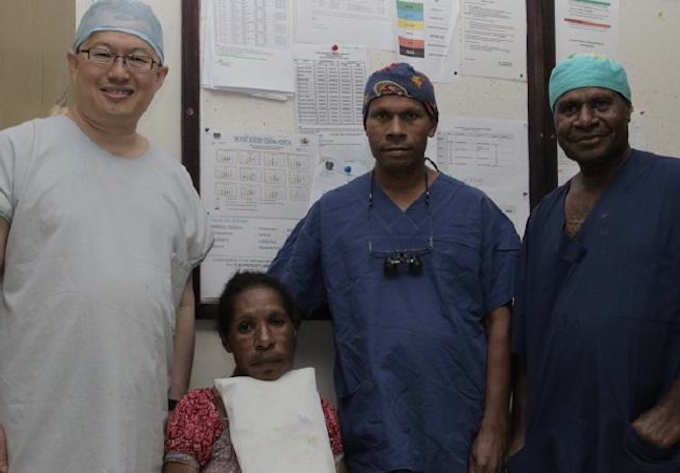
Some of the unnamed Port Moresby General Hospital heart team. Image: Loop PNG

By Quintina Naime in Port Moresby

The Papua New Guinea National Doctors Association has congratulated the local medical team for successfully carrying out the open heart operation last week.

The team of local doctors — surgeons, physicians and anesthetists — and nurses conducted open heart surgeries on nine patients with less assistance from the usual visiting Singapore team.

They have undergone training at the National Heart Centre Singapore over several years and have been assisted by the Singapore team but are now more self-sufficient and independent.

Those trained in Singapore through Operation Open Heart include two cardiologists, one cardiac surgeon, two clinical perfusionists, six nurses and one echo technician with more expected in the future.

They are based at the Port Moresby General Hospital which is the only level seven hospital for the country.

PNGNDA president Dr James Naipao said PNG could achieve anything without hesitation.

-Partners-

Dr Naipao said: “The only problem in PNG is that we generally do not trust our qualified people in all facets of the workforce.

“PNG must trust its own human resource that have finished training, that are working and those in training.”

Dr Naipao was impressed with the Singapore team having trust and confidence in PNG’s local team operating on heart patients independently.

He said this sent out a signal to the hospital management, Department of Health and the government that Papua New Guinea had a team ready to independently treat heart patients.

Dr Naipao stressed that the higher authorities must now without hesitation support the cardiac team at Port Moresby General Hospital than looking at other options from within Papua New Guinea or overseas.

“These options, if in the planning, will not serve the rural majority and urban poor. PMGH must serve its function as a national referral hospital level seven for PNG.”

Dr Naipao added that patients referred to the hospital must be satisfied rather than being regretful.

Quintina Naime is a Loop PNG reporter.

]]>

NZ ‘oil ministry’ charges Greenpeace chief, 2 other Amazon Warrior protesters

]]>

AsiaPacificReport.nz

Russel Norman swimming in front of the deep sea oil exploration ship Amazon Warrior. Video: Greenpeace NZ

Greenpeace NZ executive director Russel Norman has been charged under New Zealand’s Crown Minerals Act along with two others for their peaceful protest at sea against the Amazon Warrior, which is searching for deep sea oil on behalf of Chevron and Statoil.

Russel Norman, Greenpeace NZ executive director and a former co-leader of the Green Party, Sara Howell a 25-year-old Greenpeace volunteer from Wales, and Gavin Mulvay, a kite maker from Ashburton, have been charged with interfering with the oil exploration ship Amazon Warrior under the Section 101B(1)(c) of the Crown Minerals Act, known as the Anadarko Amendment.

They were arrested just after they got off the protest boat Taitu in Napier.

In response, Norman made the following statement:

Charged by the ‘Ministry of Oil’
“Three of us who got in the water yesterday in front of a climate-destroying oil ship have been charged.

“We have been charged, not by the police, but by ‘The Ministry of Oil’ (the petroleum division of MBIE [Ministry of Business, Innovation and Employment]) – the government’s ministry responsible for supporting, subsidising and propping up the oil industry here in New Zealand, using public money.

-Partners-

“The science of climate change is unequivocal. It tells us that if we are to avoid catastrophic climate change we cannot burn even known fossil fuel reserves, let alone new oil – which is exactly what the Amazon Warrior is looking for.

“The oil industry is the most powerful industry in the history of humanity and they have huge influence on governments.

“Ours is no different.

“Our government are backing that industry’s greed over the collective interests of its own people and all humanity.

“For the first time in New Zealand history, we are being charged under the ‘Anadarko Amendment’ – part of the Crown Minerals Act for interfering with a mining ship.

“This piece of legislation was specifically written and passed to stop peaceful protest at sea after Greenpeace protests against Petrobras in 2011.

“It was put in place by the government to protect the interests of big oil and to stifle dissent.

The charge sheet over the protest against the Amazon Warrior. Image: Greenpeace NZ

“It is an anti-democratic law designed to silence the voice of reason – a collective voice that demands we stop this insane trajectory toward self-destruction on that is drilling and burning oil which drives climate change.

“Because of our government’s complicity with the oil industry, and its failure to protect us from dangerous climate change, we had no choice but to take action yesterday to secure our common future.

“We will continue to resist the oil industry by every peaceful means available – until our action, and the collective action of millions of people here and across the planet, eject this industry from New Zealand and from the rest of the world.

“If all of us are to have a future. The oil industry can have no future.

“We are the generation that ends the age of oil.”

]]>

Benny Wenda – advocating for a Free West Papua

]]>

Pacific Media Centre

Event date and time: 

Tuesday, May 9, 2017 – 18:00 20:00

COME AND JOIN BENNY WENDA AT AUT
Benny Wenda is spokesperson for the United Liberation Movement for West Papua (ULMWP). He is a tribal leader and founder of the UK-based Free West Papua Campaign.Benny will speak on the Pacific nations advicating for West Papua at the United Nations – New Zealand should join them.

When: Tuesday, 9 May 2017

Time: 6-8pm

Where: WF710 (AUT Business Faculty building)
Corner of Mayoral Drtive and Wakefield Street
Auckland City

Contacts:
Maire Leadbeater
Del Abcede

]]>

Latest West Papua journalist blacklisting another serious violation by Indonesia

Report by David Robie. This article was first published on Café Pacific


French journalist Cyril Payen is still barred from entering Indonesia following his 2015 documentary film, Indonésie : la guerre oubliée des Papous (The Forgotten War in Papua).

Analysis by Tempo in Pacific Media Watch

THE blacklisting of Jack Hewson, a freelance journalist working for Al Jazeera, shows the Indonesian government’s paranoia towards foreign journalists.

The government should allow the foreign press to cover Papua. Preventing journalists from reporting the facts there is not a good testament on the claim of press freedom in Indonesia.

Hewson, who is based in Jakarta, planned to report on the Freeport issue from Timika in Papua. But after leaving for the Philippines last week, he learned that he has been banned from returning to Indonesia for no clear reason.

It transpires that the request for the ban came from the Indonesian Military (TNI).

According to the Immigration Directorate General, Hewson is suspected of “dangerous activities, endangering security and public order”.

Jack Hewson … planned visit
to Freeport. Image: Twitter
What did Hewson do that was deemed to have endangered security? Was he not simply covering and writing reports about Indonesia like other journalists?

Was it linked with his plan to cover Freeport? Whatever the problem, blacklisting a foreign journalist without a reason or sufficient evidence is a serious violation of press freedom.

Similar bans
Before the Hewson case, there were similar bans on foreign journalists wanting to report on Papua. French journalist Cyril Payen is still barred from entering Indonesia following his 2015 documentary film on France 24,
Indonésie: la guerre oubliée des Papous (The Forgotten War in Papua), which detailed human rights violations in Indonesia’s easternmost province.

Two other French journalists, Thomas Dandois and Louise Marie Valentine Bourrat, were jailed for more than two months for covering Wamena while on tourist visas.

The government’s attitude towards foreign journalists damages the claim to press freedom in Indonesia. In the 2016 Press Freedom Index from Reporters Without Borders, Indonesia is ranked 130 out of 180 nations, below Cambodia and Timor-Leste.

Officials from the TNI and the Interior Ministry are too suspicious of foreign journalists. They seem not to understand the function and the role of the press, including the foreign media. Papua has been closed to the outside world for almost a quarter of a century.

Few foreign journalists have been able to travel there. Therefore, it is not surprising that many reporters from around the world want to take a look, especially since there are many problems there, from the Free Papua Movement to the Freeport debacle.

‘Open’ to foreign journalists
In 2015, President Joko Widodo said Papua was open to foreign journalists. Clearly, state institutions and ministries should support the president by facilitating journalists’ access to that region.

Preventing them from going there is inconsistent with the president’s policy.

The government has no reason to ban foreign reporters because Papua is not a military emergency region. Closing it off from the outside world will only make matters worse.

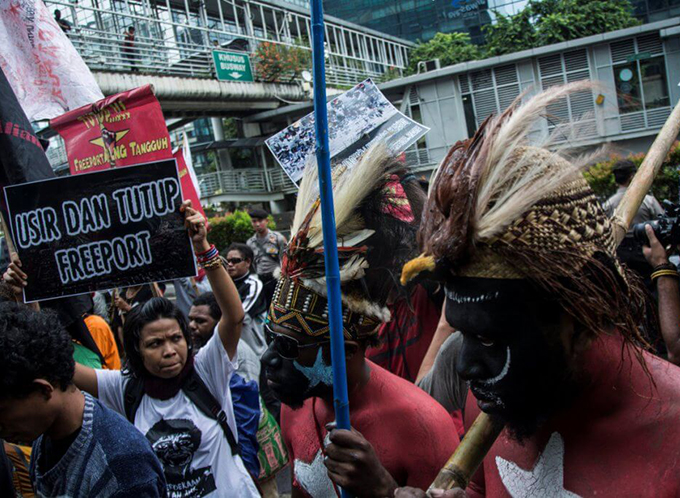
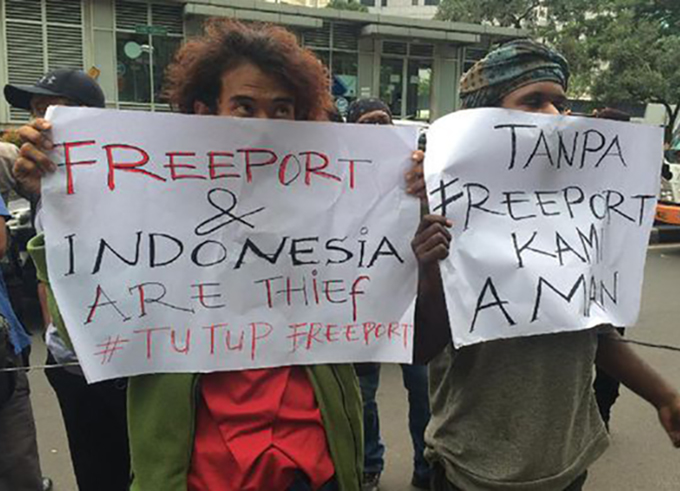
Protesters outside the Jakarta headquarters of Freeport Indonesia
calling for the closure of the giant mine in Papua.
Image: Tempo
Rumours and fake reports will spread faster and be more credible if there are no professional journalists who can explain the truth about the province. There is no need for the government to react angrily when foreign journalists report negatively, as long as their reports are factual.

We no longer live in the New Order period, when the mass media was under the full control of the authorities.

The government should understand that negative or positive reports on Papua depends on whether the government can bring about prosperity and justice over there.

Updates on Asia Pacific Report

]]>

Blacklisting of freelance journalist on Papua mission ‘paranoid’, says Tempo

]]>

AsiaPacificReport.nz

Protesters outside the Jakarta headquarters of Freeport Indonesia calling for the closure of the giant line in Papua. Image: Tempo

ANALYSIS: Tempo

The blacklisting of Jack Hewson, a freelance journalist working for Al Jazeera, shows the Indonesian government’s paranoia towards foreign journalists.

The government should allow the foreign press to cover Papua. Preventing journalists from reporting the facts there is not a good testament on the claim of press freedom in Indonesia.

Jack Hewson … another ban on journalists visiting West Papua in a serious violation of media freedom. Image: Twitter

Hewson, who is based in Jakarta, planned to report on the Freeport issue from Timika in Papua.

But after leaving for the Philippines last week, he learned that he has been banned from returning to Indonesia for no clear reason.

It transpires that the request for the ban came from the Indonesian Military (TNI). According to the Immigration Directorate General, Hewson is suspected of “dangerous activities, endangering security and public order”.

What did Hewson do that was deemed to have endangered security? Was he not simply covering and writing reports about Indonesia like other journalists?

-Partners-

Was it linked with his plan to cover Freeport? Whatever the problem, blacklisting a foreign journalist without a reason or sufficient evidence is a serious violation of press freedom.

Similar bans
Before the Hewson case, there were similar bans on foreign journalists wanting to report on Papua. French journalist Cyril Payen is still barred from entering Indonesia following his documentary film, The Forgotten War in Papua, which detailed human rights violations in Indonesia’s easternmost province.

Two other French journalists, Thomas Dandois and Louise Marie Valentine Bourrat, were jailed for more than two months for covering Wamena while on tourist visas.

The government’s attitude towards foreign journalists damages the claim to press freedom in Indonesia.

In the 2016 Press Freedom Index from Reporters Without Borders, Indonesia is ranked 130 out of 180 nations, below Cambodia and Timor-Leste.

Officials from the TNI and the Interior Ministry are too suspicious of foreign journalists. They seem not to understand the function and the role of the press, including the foreign media.

Papua has been closed to the outside world for almost a quarter of a century. Few foreign journalists have been able to travel there. Therefore, it is not surprising that many reporters from around the world want to take a look, especially since there are many problems there, from the Free Papua Movement to the Freeport debacle.

‘Open’ to foreign journalists
In 2015, President Joko Widodo said Papua was open to foreign journalists. Clearly, state institutions and ministries should support the president by facilitating journalists’ access to that region. Preventing them from going there is inconsistent with the president’s policy.

The government has no reason to ban foreign reporters because Papua is not a military emergency region. Closing it off from the outside world will only make matters worse.

Rumours and fake reports will spread faster and be more credible if there are no professional journalists who can explain the truth about the province.

There is no need for the government to react angrily when foreign journalists report negatively, as long as their reports are factual. We no longer live in the New Order period, when the mass media was under the full control of the authorities. The government should understand that negative or positive reports on Papua depends on whether the government can bring about prosperity and justice over there.

Read the full story in Tempo English Magazine.

]]>

AUT features as a top millennial university in latest world rankings

]]>

AsiaPacificReport.nz

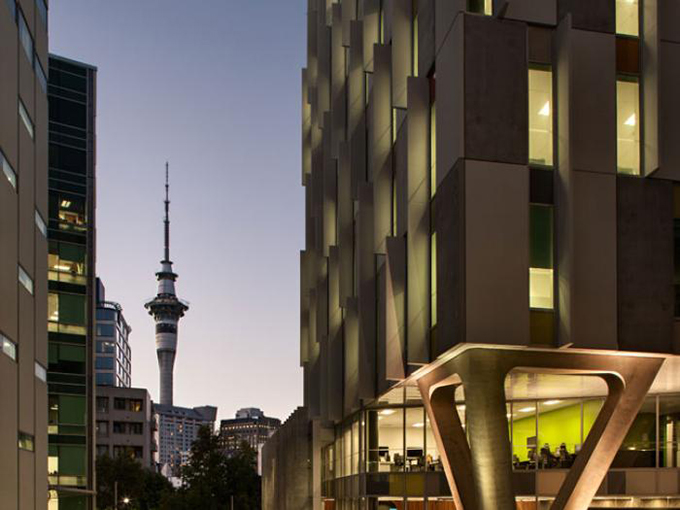
Auckland University of Technology … strong millennial performer. Image: AUT

Auckland University of Technology features among the top millennial university in latest global rankings.

It is highly ranked in the Times Higher Education (THE) Young University Rankings 2017.

There are three categories in THE’s Young University Rankings — top 50 Generation X universities (1967-1985); top 50 Generation Y universities (1986-1999) and Millennial universities founded in the 21st century.

AUT ranks number 14 in the world and number one in Australasia in the millennial universities category.

The Young Universities Rankings, previously known as the THE 150 Under 50 Rankings, has now been extended to include 200 institutions.

Applying the same performance indicators as the overall THE World University Rankings, young universities are measured on their teaching, research, citations, international outlook and industry income.

The methodology for these rankings has been carefully recalibrated, with reputation counting for less, to reflect the special characteristics of younger universities.

-Partners-

Institutions in Belgium, Brazil, Cyprus, Finland, France, Germany, Japan, Luxembourg, Malaysia, Saudi Arabia, South Africa, Taiwan, United Arab Emirates and the United Kingdom also feature in THE’s Millennial category, which focuses on the youngest universities in the world.

AUT is the only university in Australasia to feature in this category.

THE concluded that millennial universities generally have low levels of income and research productivity, compared with their older counterparts.

However, their analysis found that they are the strongest age group when it comes to producing internationally co-authored research, when compared with “Generation X” (1967-1985) and “Generation Y” (1986-1999) universities, as well as the cohort of institutions founded in the immediate aftermath of the Second World War.

They also outperform every other group bar Generation X on citation impact.

World rankings

]]>

Journalism Matters: World press freedom – where are journalists under attack?

]]>
Evening Report
Evening Report
Journalism Matters: World press freedom - where are journalists under attack?
Loading
/

Pacific Media Centre

Over the year, according to figures gathered by UNESCO, at least 100 journalists were killed in 2016 – making it one of the bloodiest years in recent memory.

As World Press Freedom Day approaches on 3 May 2017, media workers will remember their fallen colleagues. 

READ MORE: What is UNESCO-Al Jazeera’s Journalism Matters project? 

More often than not, these murders go unsolved because of high rates of impunity.

Al Jazeera, in consultation with UNESCO, has launched Journalism Matters – a space which seeks to address the targeting of journalists and impunity.

Killings of journalists in 2016 - click on this image to watch the video for previous years. Video: Al Jazeera

The Journalism Matters project

Creative Commons Licence

This work is licensed under a Creative Commons Attribution-NonCommercial 3

]]>

Greenpeace activist swimmers halt seismic oil exploration ‘Beast’

]]>

AsiaPacificReport.nz

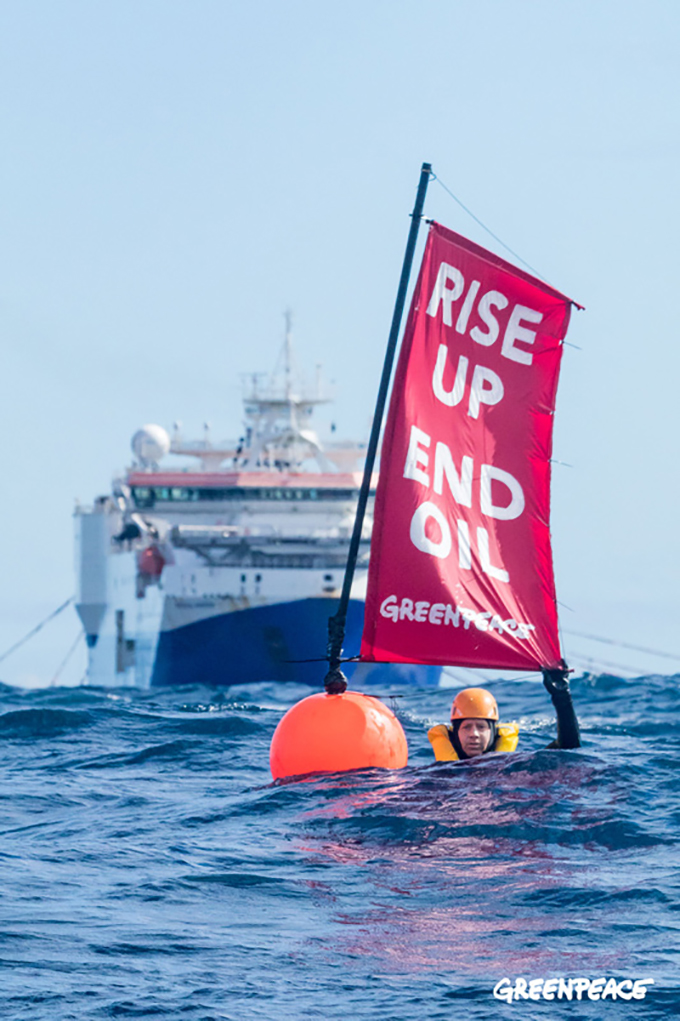
Greenpeace NZ executive director Dr Russel Norman swimming in front of the 125m oil seismic exploration ship Amazon Warrior. Image: Greenpeace NZ

Three Greenpeace activists — including Greenpeace NZ executive director Russel Norman — today swam in front of the 125m Amazon Warrior, nicknamed “The Beast”.

The giant oil exploration ship is conducting offshore oil exploration off the New Zealand coast on behalf of Arctic driller Statoil and Chevron, a US oil company part-owned by President Donald Trump, reports Greenpeace News.

The swimmers’ position forced the Amazon Warrior to halt its operations and deviate off course.

They were 50 nautical miles off the Wairarapa coast when the action took place.

To find oil, the Amazon Warrior is using seismic cannons to blast the seafloor with soundwaves every eight seconds, day and night, reports Greenpeace News.

The ship needs to travel in straight lines along a grid to get data about potential oil reserves, and any deviation makes this data unusable.

The blasts the Amazon Warrior lets off are comparable in sound to an underwater volcano and can cause chronic distress to whales and dolphins in the area.

-Partners-

‘Extreme depths’ permits
Statoil and Chevron have permits to drill to extreme depths of up to three kilometres if oil is found – twice as deep as Deepwater Horizon in the Gulf of Mexico, which caused the world’s largest and most devastating oil spill in 2010.

The “fossil fuel” President, Donald Trump, has shares in Chevron, and the oil company funded a large part of his presidential inauguration.

Twenty five-year-old Sara is another of the swimmers who was floating in the path of the Amazon Warrior with Russel Norman.

She said she was putting her body “on the line” because the ship was searching for the very oil that would “destroy her future”.

“The science is settled that we can’t burn the majority of the fossil fuel reserves we know about if we want to keep the Earth’s temperature below dangerous levels,” she said, according to Greenpeace News.

“What this means is that not a single newly discovered oil well anywhere in the world can operate if we want to avoid a climate catastrophe. Right now I’m looking at a ship that’s been invited here by the New Zealand government to do just that.

“I’m young and I’m already experiencing the effects of climate change. Every year the storms get worse, the floods and the droughts are getting more extreme. Just imagine how grim my future looks if we can’t stop this.

‘People rising up’
“It’s easy to feel powerless because what we’re up against is so big. But everywhere, people are rising up and demanding change. Their actions are having a snowball effect, and in many parts of the world, we’re starting to see huge, positive changes.”

Greenpeace has been tailing the Amazon Warrior for the past two days in its newest boat, Taitu.

The organisation crowdfunded nearly $100,000 in just a week to buy the 15-metre boat, and ran an online competition to choose her name.

A 2013 Amendment to the Crown Minerals Act, dubbed the “Anadarko Amendment”, was put in place to stop protests at sea around oil exploration. The law change makes it an offence to interfere with or get closer than 500 metres of an offshore ship involved in oil exploration.

From on board Taitu, Greenpeace’s Dr Russel Norman, said the right to peaceful protest was essential to a healthy democracy and New Zealand had a long and proud tradition of protest at sea.

“Neither the government nor the oil industry can stifle people across New Zealand peacefully rising up against this mad pursuit of new oil to burn in the midst of what is nothing less than a climate emergency,” he said.

“Climate change threatens our homes, health and families. Despite knowing this, our Government is actively subsidising oil companies to look for new oil, putting profits above people’s lives – it has become necessary for people to take action.

‘Extreme storms’
“In New Zealand, we’ve already seen extreme storms, flooding, drought and fires in the space of a just a few weeks, and it’s only April. Climate change makes these weather events more frequent and more intense.”

Taitu’s trip follows on from a flotilla that included Ngāti Kahungunu’s voyaging waka, Te Matau a Māui, which travelled out to the Amazon Warrior to deliver a message on behalf of more than 80 hapū of Te Ikaroa.

Public opposition to oil exploration has seen protests in ports, petitions garnering tens of thousands of signatures, and significant local government and iwi opposition.

]]>

Freeport mine gets Indonesian red-carpet treatment – again

]]>

AsiaPacificReport.nz

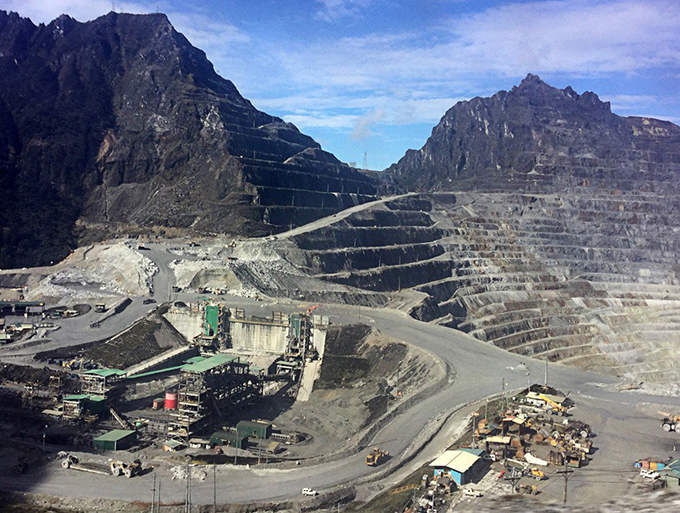
A vehicle passes through gold and copper miner PT Freeport Indonesia’s (PTFI) mining area in Grasberg, Mimika, Papua. Image: Nethy Dharma Somba/The Jakarta Post

By Fedina S. Sundaryani in Jakarta

Copper and gold miner PT Freeport Indonesia is getting the red-carpet treatment once again, as the government is allowing the company to resume exports despite the company’s mounting responsibilities.

Several protests took place in different parts of Indonesia on Friday, calling on the government to close Freeport.

The export activities are made possible with the issuance of a temporary special mining permit (IUPK) by the Energy and Mineral Resources Ministry that is backdated to February 10 and valid for eight months.

With the temporary IUPK in place, Freeport will be able to use the ministry’s recommendation it obtained in February to export 1.11 million wet metric tons (wmt) of copper concentrate for a year.

The company, the operator of the world’s largest gold mine and second-largest copper mine, is now waiting for an export permit to be issued by the Trade Ministry.

Despite the short export period, Freeport is seen as having dodged the bullet again, because it was previously required to convert its contract of work (CoW) to a permanent IUPK, divest 51 percent of its shares and build a smelter within five years before being able to export, as stipulated by Government Regulation (PP) No. 1/2017.

-Partners-

Requirements rejected
Freeport — backed by its parent company, United States-based mining giant Freeport-McMoran Inc. — had consistently rejected the requirements and argued that they violated the investment certainty provided by the present CoW, dating back to 1991.

The disagreement had led to a standstill and Freeport warned that it could take the Indonesian government to international arbitration.

The miner had been unable to sell its copper concentrate overseas, creating a large pileup at its compound in Papua. However, earlier this month, Freeport resumed production at 40 percent of its normal rate after securing an export permit for anode slime, a byproduct of copper processing.

The temporary IUPK decision came just before US Vice President Mike Pence’s visit to Indonesia this month. Freeport-McMoran is known to be politically connected, as US billionaire Carl Icahn, special adviser on regulatory reform to US President Donald Trump, is a major shareholder in the company.

The government has defended its decision, even though there is no legal basis that backs the temporary IUPK issuance and no concrete agreement has been made regarding the divestment and smelter issues.

The Energy and Mineral Resources Ministry’s secretary-general, Teguh Pamudji, said in a press conference last week that it was working to ensure a smooth transition from the CoW to the IUPK.

Business ‘guidance’
“In any public policy, including in regulations surrounding the energy and mineral resources sector, there will always be an opportunity for the government to guide [businesses],” he said, insisting that such guidance applied to all firms wanting to convert their CoWs to IUPKs.

The government claims that during the next six months, it will continue negotiating with the company over the terms for a full conversion of the miner’s CoW, including the issues of investment stability, divestment and smelter construction.

It will also conduct a semiyearly evaluation on Freeport’s smelter commitment. The firm previously promised to construct a smelter in Gresik, East Java.

Teguh said if the government and Freeport Indonesia failed to see eye-to-eye in the next six months, the miner would be allowed to return to its CoW, but would be barred from exporting its copper concentrates again.

The 2009 Mining Law stipulates that the holder of a CoW cannot export its production without processing it domestically first.

Freeport spokesman Riza Pratama said the firm would be willing to fully convert its CoW to an IUPK as long as the latter granted investment stability, which entails legal and fiscal certainties that are equal to the ones outlined in the current CoW.

“We are in the process of obtaining an export permit,” he said.

BMI Research, a unit of Fitch Group, predicts in a recent report that Freeport will likely continue to negotiate with the government to maintain its operations in the country, as copper and gold prices are expected to rise to US$5,800 per ton and $1,525 per ounce, respectively, by 2021.

Fedina S. Sundaryani is a journalist writing for The Jakarta Post.

]]>

LIVE: Greenpeace NZ’s chief warns Amazon Warrior over ‘cataclysmic’ climate change

]]>

AsiaPacificReport.nz

Greenpeace NZ executive director Russel Norman speaking to the master of the Amazon Warrior. Video: Greenpeace

The Greenpeace New Zealand boat Taitu has “intercepted” the world’s largest seismic blasting ship, the Amazon Warrior, AKA “The Beast”, about 50 nautical miles off the Wairarapa coast, reports Greenpeace News.

Greenpeace NZ executive director Russel Norman is on board and has made a call through to the master of the Amazon Warrior.

Greenpeace NZ’s boat Taitu makes contact with the Amazon Warrior off the Wairarapa coast of New Zealand’s North Island. Image: Greenpeace NZ

Norman demanded that the Amazon Warrior cease seismic blasting, informing them of the widespread opposition to oil drilling in NZ waters by local councils, iwi and large numbers of New Zealanders.

He also told the Amazon Warrior that he and Taitu would act consistently within the principles of non-violence at all times but were there to take action to protect our common future.

Greenpeace NZ executive director Russel Norman making a call through to the master of the Amazon Warrior. Image: Greenpeace NZ

Amazon Warrior’s seismic search for oil would contribute to “cataclysmic’ climate change”, Norman said.

Taitu was crowdfunded by Greenpeace in just seven days specifically to venture out and confront the oil exploration that is being carried out on behalf of Chevron and Statoil, Greenpeace News said.

-Partners-

Greenpeace’s live feed from the Taitu

]]>

Freeport brings ‘no benefits’ to Papuan people, say Jakarta protesters

]]>

AsiaPacificReport.nz

Papuans p[rotesting over the Freeport mine in the Indonesian capital of Jakarta. Image: CNN Indonesia

The Papuan Student Alliance (AMP) have held a joint action with the Indonesian People’s Front for West Papua (FRI-West Papua] in front of the offices of PT Freeport Indonesia in Jakarta demanding that the mining company with headquarters in the United States halt its mining activities in Papua because it “harms the people”.

In another protest in the central Javanese city of Yogyakarta on Friday, police moved in on students demanding the closure of the Freeport Indonesia and self-determination for the West Papuan nation near their university and broke up the rally.

Frans Nawipa from the AMP said that over the past 50 years in which Freeport had conducted mining activities on Papuan land there had not been the slightest benefit obtained by the Papuan people.

“What there has been has only been environmental destruction, what share of profits?”  Nawipa said in a speech in front of the PT Freeport Indonesia building in the Kuningan area of South Jakarta.

“All the profits have been taken by Jakarta. West Papua, which is poor, has instead become poorer.”

Over the last 50 years the Papuan people had never been invited to be involved in decision making, said Nawipa.

Since the signing of the first work contract, the Papuan people had known nothing about the agreement.

-Partners-

“From the start when Freeport came to our land, it was illegal, the first work contract was illegal because West Papua had yet to officially become part of Indonesia.”

The gold and copper company obtained its first mining permit in April 1967.

At the time the company was in the midst of a conflict with the Indonesian government over changes to the obligations and sale of company shares.

Police break up Yogyakarta rally
In Yogyakarta, police broke up a rally by students demanding the closure of the Freeport Indonesia and self-determination for the West Papuan nation at the University of Gajah Mada (UGM) traffic circle on Friday.

The head of the Sleman municipal police operational division, police commander Khundori said that the demonstration was broken up because the protesters, from FRI-West Papua and AMP, had not notified police beforehand.

“We immediately broke up [the rally] because there was no prior notification, [according to] regulations [there should be] a notification three days before a protest action,” he said.

Khundori added that police were already on alert at the UGM traffic circle before the rally was held, which started at around 10am.

“Before [they moved off to the] UGM traffic circle we broke up [the rally] at the point where they were gathering near the UGM entrance gate”, he added.

Translated by James Balowski for the Indoleft News Service.

]]>

LIVE: CAFCA’s Murray Horton NZ’s independence and foreign policy

]]>

Pacific Media Centre

Asia Pacific Report

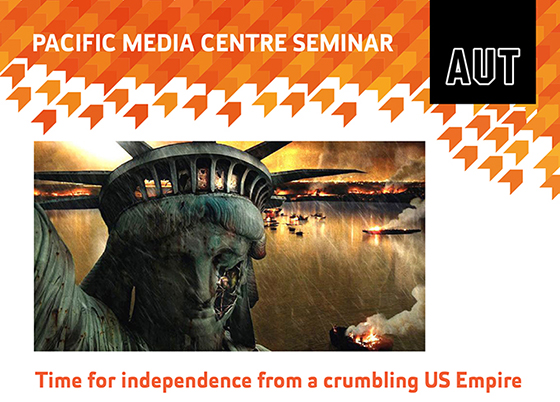
TIME FOR INDEPENDENCE FROM A CRUMBLING US EMPIRE – Murray Horton
The advent of President Donald Trump in the US provides an unprecedented opportunity to take a good, hard look at Aotearoa’s place in the world.  And to ask the question – why are we still a loyal member of the American Empire?

As the old saying goes, you are judged by the company you keep.

CAFCA Murray Horton says it’s time for this country to pull the plug, to finish the business started in the 1980s, which saw us out of ANZUS, and break the chains — military, intelligence, economic and cultural — that continue to bind us to the American Empire.

Speaker: Murray Horton, national organiser of the Christchurch-based Campaign Against Foreign Control of Aotearoa (CAFCA).

Plus a clip from John Pilger’s new documentary The Coming War on China.

]]>

Indonesia, Iran condemn air strike on Syria — UK, Australia, NZ give support

]]>

AsiaPacificReport.nz

An unidentified US Navy destroyer launching missiles at a Syrian government air base. Video: TheMozzextras

By Colin Packham in Sydney

Indonesia and Iran have condemned a United States strike on a Syrian air base on Friday while Britain, Australia and New Zealand gave their support, with Australian Prime Minister Malcolm Turnbull describing it as a “proportionate and calibrated response” to the use of chemical weapons.

US President Donald Trump ordered missile strikes against a Syrian airfield from which a deadly chemical weapons attack was launched, declaring he acted in America’s “vital national security interest”.

In a sharp escalation of the US military role in Syria, two US warships fired dozens of cruise missiles from the eastern Mediterranean Sea at the air base controlled by President Bashar al-Assad’s forces in response to the poison gas attack in a rebel-held area on Tuesday, US officials said.

In Wellingon, reports Dr Vernon Small of Fairfax Media, New Zealand Prime Minister Bill English backed the US military action with “understanding”, providing it was “proportionate”.

Ministers in New Zealand were given about two hours notice of the United States’ missile attack on the Syrian air base at al-Shayrat on Thursday, taken in response to a nerve gas attack on civilians.

-Partners-

English said the “horrific attacks” using chemical weapons were against all international law.

The United Nations Association of Canada called a halt to the bombing and offered a raft of protest actions.

Tomahawk attack
The Trump administration launched 60 Cruise Tomahawk missiles from its offshore Mediterranean warships in the attack on Syria’s al-Shayrat military airfield near Homs, Syria’s third largest city.

The US strikes obliterated substantial portions of Syria’s military capacity there.

Trump’s action came a day after Democrat Hillary Clinton urged the US bombing of Syria.

Neither Trump nor any other US government agency presented a shed of proof that the government of Syrian President Bashar al-Assad used sarin nerve gas in its bombing of ISIS, Al Qaida or any other “rebel” groups in Syria’s Idlib province, said the UNAC statement.

President Assad denied using sarin gas while “Russia’s Defense Ministry”, according to the The Guardian newspaper in the United Kingsdom, has stated that the chemicals were released when a Syrian aircraft bombed a “rebel” arm storage facility.

]]>

First woman to lead world’s largest indigenous peoples alliance

]]>

AsiaPacificReport.nz

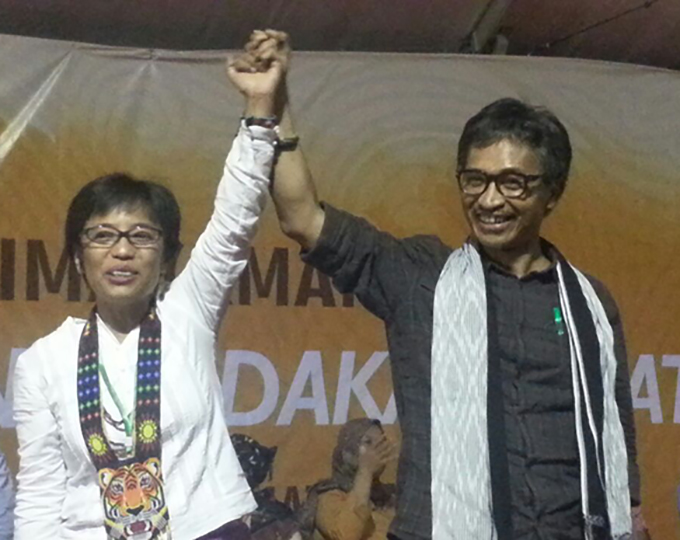
Rukka Sombolinggi (left) pictured with Abdon Nababan … fiery oratory and dedication to the indigenous movement. Image: Mongabay

By Philip Jacobson in Yanjung Gusta, Indonesia

Rukka Sombolinggi has been selected as secretary-general of the Indigenous Peoples Alliance of the Archipelago (AMAN), becoming the organisation’s first female leader since its founding in 1999 — the year after Indonesia became a democracy.

The closing day of AMAN’s fifth congress began with some uncertainty over who would be chosen. But by the time Sombolinggi was announced, it appeared to be preordained.

Rukka Sombolinggi … fighting “with all my heart and soul”. Image: Mongabay

Her selection by consensus was reportedly cemented in the late afternoon last Sunday when a picture of AMAN leaders said to be congratulating her circulated among congress participants.

When the five candidates were trotted out on stage to say a few words, Sombolinggi stood in the center, and she spoke last.

Sombolinggi is a Torajan from the highlands of Sulawesi, a starfish-shaped island the size of Florida.

Her people have gained fame for their elaborate funeral rituals and the way they have built a local tourism industry while preserving their culture.

-Partners-

She is known for her fiery oratory and her longtime dedication to the indigenous rights movement. Her parents hosted a meeting in 1993 that is often cited as its genesis in Indonesia.

“I will fight for this cause with all of my heart, mind and soul,” she said in her acceptance speech.

Abdon Nababan, the current secretary-general, will stay on as a member of AMAN’s national council after Sombolinggi takes the reins in June.

It was also decided that AMAN’s next congress, in 2022, will be held somewhere in the West Papua region.

]]>

LIVE: CAFCA’s Murray Horton on NZ independence and foreign policy

]]>

Report by David Robie. This article was first published on Café Pacific

Graphic: Concept art for Planet of the Apes

Courtesy of the Pacific Media Centre and Asia Pacific Report


TIME FOR INDEPENDENCE FROM A CRUMBLING US EMPIRE – Murray Horton
The advent of President Donald Trump in the US provides an unprecedented opportunity to take a good, hard look at Aotearoa’s place in the world.  And to ask the question – why are we still a loyal member of the American Empire?

As the old saying goes, you are judged by the company you keep.

CAFCA Murray Horton says it’s time for this country to pull the plug, to finish the business started in the 1980s, which saw us out of ANZUS, and break the chains — military, intelligence, economic and cultural — that continue to bind us to the American Empire.

Speaker: Murray Horton, national organiser of the Christchurch-based Campaign Against Foreign Control of Aotearoa (CAFCA). Video in two parts.

]]>

LIVE: CAFCA’s Murray Horton on foreign policy and NZ’s independence

]]>

AsiaPacificReport.nz

The advent of President Donald Trump in the US provides an unprecedented opportunity to take a good, hard look at Aotearoa’s place in the world.  And to ask the question – why are we still a loyal member of the American Empire?

Speaker: Murray Horton, national organiser of the Christchurch-based Campaign Against Foreign Control of Aotearoa (CAFCA)

More information

]]>

‘Despicable’ Youi wins Roger Award for ‘worst transnational’ in NZ

]]>

AsiaPacificReport.nz

2016 Roger Award winner insurance company Youi … “gratuitous abuse of legal niceties”, say judges. Image: Youi.com.au

The insurance company Youi, headquartered in South Africa and prominent in Australia, has been awarded the annual Roger Award for the “worst transnational corporation operating in Aotearoa/New Zealand” in 2016.

At an awards ceremony in Onehunga last night, the judges’ report was unveiled declaring the company “despicable” in its business dealings with the public in New Zealand.

The runner-up was IAG/State Insurance  — the company that won last year – and third was the “taxi alternative” company Uber.

The three other finalists were Bathurst Resources, Coca Cola and Westpac.

In the Accomplice Award category, there was “insufficient support for either nominee” — Talley’s, and the government for pushing the Trans Pacific Partnership Agreement (TPPA) more strongly than any of the other 11 countries [which] signed up to it” — to become a winner.

Murray Horton, coordinator of the Christchurch-based Campaign Against Foreign Control of Aotearoa (CAFCA), organisers of the Roger Award, said this was the third-year running that the prize had been awarded to a transational in the so-called “FIRE” sector – finance, insurance and real estate.

Chief judge Sue Bradford, a former Green Party MP and now an activist with Auckland Action Against Poverty (AAAP), said the decision on the winner had been difficult “with the two insurance companies in a head-to-head battle for the award”.

-Partners-

‘Gratuitous abuse’
“However, new  entrant Youi made it to the top with its gratuitous abuse of legal niceties, customers and potential customers and its own workers,” she said.

Bradford also congratulated Horton for “keeping this tradition of the Roger Award alive and well”.

“We need the light it shines on corporate malfeasance more than ever in these dangerous times.”

Youi was a finalist because it “uniquely, does not do business online”, said the nominator.

“Very deliberately, they insist on everything being done over the phone. Once engaged in conversation, their call centre staff insist on being given the caller’s credit card details on purely spurious grounds.

“Once the company has those details, it starts taking money off the card or out of the caller’s bank account. Despite the caller not being a Youi customer or having taken out a Youi policy (this is the most egregious aspect of this corporate crime).

“The caller may simply have rung up for a quote for car insurance, decided not to join Youi and stuck with his or her existing insurance company.

“But Youi, having got his or her credit card details, proceeds to start taking money out.

Guilty on representative charges
“Youi has pleaded guilty to 15 representative charges filed by the Commerce Commission (and was fined $320,000). Plus it has been fined $100,000 (the maximum possible) by the Insurance Council of NZ, of which it is a member (and has been allowed to remain so).”

The full judges’ report said “not one of the managers and executives responsible has been prosecuted, the company continues to operate in New Zealand under its Reserve Bank licence.

“Youi remains a full member of the New Zealand Insurance Council, Hansard records no mention of the scandal in Parliament, television continues to carry the company’s deceptive advertising, and the chief executive officer on whose watch it all happened has been promoted.”

Investigative journalist Diana Clement who exposed the activities of the company  was at the awards presentation last night and was quoted as saying Youi was “one of the most despicable and shameful companies I have ever come across”.

The judges also said: “Youi and Uber are very similar. They don’t care about breaking the law. They just carry on abusing legal niceties and workers because they have so much money poured into them.

“They are part of the new face of global capitalism taken to state-of-the-art levels of local illegality.”

The criteria for judging are by assessing the transnational (a corporation which is 25 percent or more foreign-owned) that has the most negative impact in each or all of the following categories: people – unemployment, impact on tangata whenua, impact on women, impact on children, abuse of workers/conditions, health and safety of workers and the public; environment – environmental damage, abuse of animals; political interference – interference in democratic processes, running an ideological crusade; and economic dominance – monopoly, profiteering, tax dodging, cultural imperialism.

The other four judges were David Small, a lawyer and associate dean in Education at the University of Canterbury; Dean Parker, Auckland writer and former Writers’ Guild delegate to the Council of Trade Unions; Deborah Russell, feminist, social and political commentator and tax expert, Tertiary Education Union member, and candidate for the Labour Party in 2014; and Teresa O’Connor, co-editor of Kai Tiaki Nursing New Zealand, the national nursing magazine; a celebrant; and a founding member of Voice Nelson, a social justice activist group in Nelson, primarily concerned with housing, employment and health.

]]>

Indonesian islanders win struggle against Chinese mining firm

]]>

AsiaPacificReport.nz

Mikgro Metal Premium has had its mining licence to extract iron ore from Bangka Island revoked for flouting an Indonesian law banning mining on islands smaller than 200,000 hectares. Image: UCANews

By Ryan Dagur in Jakarta

Indigenous people on a small Christian majority island in Indonesia’s North Sulawesi province are claiming victory after the government revoked a Chinese company’s mining licence.

Ignasius Jonan, Minister of Energy and Mineral Resources, the only Catholic minister in President Joko Widodo’s cabinet, recently revoked the licence of Mikgro Metal Premium (MMP), which wanted to mine for iron ore on Bangka Island.

The revocation followed the end of a legal battle begun by the Kauku, the island’s indigenous population, who claimed the mining operation was illegal.

Opposition to the mine, which covered almost half the total area of the island, began as soon as the firm obtained a licence in 2014.

The islanders filed a lawsuit in which they claimed the mine violated Indonesia’s 2007 Law on Management of Coastal Areas and Small Islands, which forbids mining on islands under 200,000 hectares.

Bangka Island is less than 5000 hectares.

-Partners-

The lower courts and the Supreme Court all ruled in favor of the islanders.

Fruit of hard struggle
Merah Johansyah, coordinator of Mining Advocacy Network (JATAM) who assisted the Bangka people, said the licence revocation was the fruit of the community’s hard struggle.

“Although the company has not yet started mining the ore, building facilities to prepare for the production process had caused environmental damage,” he said.

Forest areas have been damaged, while “land has been cleared, mangroves have been buried and coral reefs destroyed to build roads, a port and warehouses,” Johansyah said.

Maria Taramen, from Nature Lovers Group, a local NGO on Bangka, said the company’s presence severely disrupted people’s lives.

“Many families were fighting with each other because of differing opinions about the mine,” she said.

Ulva Novita Take, a resident of Lihunu, a village on the island, said the whole operation was threatening the livelihood of fishing communities.

“It was a threat to coral reefs and marine life, and we depend on that,” he said

The island has a population of about 2400 people with 70 percent being Protestant.

According to the Ministry of Energy and Mineral Resources, Indonesia has issued 9721 mining licences.

However, JATAM says about 1890 of them are in violation of the law because they are on small islands under 200,000 hectares.

Ryan Dagur writes for UCANews.

]]>

Australian Centre for Independent Journalism closes after 25 years

]]>

AsiaPacificReport.nz

A scene from the film Balibo about the killing of five Australian-based journalists by Indonesian special forces at the Timor-Leste town of that name in 1975. The photo appeared on the cover of a joint ACIJ and Pacific Media Centre edition of Pacific Journalism Review in 2010. Image: Tony Maniaty/Pacific Journalism Review

The Australian Centre for Independent Journalism, one of the flagships of investigative journalism, has been closed after 25 years in a controversial decision by the University of Technology Sydney.

Current and past staff and student members plan to hold an event to celebrate the centre’s achievements in the public right to know domain and consider the future of independent journalism later this month.

Under the title “Hidden stories past and present …”, former directors of the ACIJ Associate Professor Tom Morton, Professor Wendy Bacon and Professor Chris Nash (now at Monash University) will be joined by multiple Walkley Award winning investigative journalist Sharon Davis and The Guardian’s Paul Farrell among many other speakers at the celebration.

Current head of the UTS journalism programme Professor Peter Fray will also be speaking.

In an announcement, Professor Mary Spongberg, new dean of the Faculty of Arts and Social Sciences (FASS), said ACIJ had made a “significant contribution to journalism and was a strong advocate of the right to know” over the years but it was now closed.

Global environment initiative
Over the last two years the Faculty has reviewed UTS centres operating in FASS in accordance with the centres directive, which requires periodic evaluation of performance against the strategic objectives of the faculty and university. As a result of this process, the Australian Centre for Independent Journalism (ACIJ) has been formally closed by the vice-chancellor.

ACIJ made a significant contribution to journalism and was a strong advocate for the public right to know and the role of journalism in strengthening democracy. In its over 25 year history, ACIJ collaborated on major investigations with a wide range of media outlets and was involved in both national and international research collaborations such as the Global Environmental Journalism Initiative (via the Erasmus Mundus program overseen by the European Commission).

-Partners-

More specifically, ACIJ published groundbreaking analysis of the reporting of climate policy and climate science in the Australian media by Professor Wendy Bacon, as well a study examining the reporting of the News of the World phone hacking scandal in Australian newspapers by Jenna Price and Wendy Bacon.

More recently, then ACIJ director Tom Morton and Professor Mark Pearson of Griffith University collaborated on research, funded by FASS and the Rule of Law Institute Australia, into how the media reports the cases of forensic patients, culminating in a Background Briefing program for ABC Radio National, a series of academic publications, and a significant change to the Mental Health Review Tribunals approach to media reporting of cases before it.

A number of leading Australian journalism academics acted as director over the years, including Professor Julianne Schultz, Professor Wendy Bacon, Professor Chris Nash, the late Professor Alan Knight and, most recently, Associate Professor Tom Morton. I would like to thank each of them for their commitment and hard work.

The renewal of the journalism discipline will continue in the faculty under the leadership of Professor Peter Fray. Postgraduate courses in Advanced Journalism and Sports Media are having their first intakes this session, a new daily news website is soon to be launched, and a cross-faculty media transition collaboration has been established with the Faculty of Law.

I would like to thank all of the associated academic and professional staff, especially Jan McClelland and Tameera Pellegrini, for their dedication to ACIJ over the years.

The celebration on April 29 at UTS’s Peter Johnson Building will feature discussions on:

  • The best of independent journalism — what did we learn?
  • 25 years of hidden stories — where are they now?
  • What do the public right to know and independent journalism mean now?

Australian Centre for Independent Journalism website

]]>

Across the Ditch: Remants of Cyclone Debbie Drenches New Zealand + Ram Raid Artwork Heist

ITEM ONE – Debbie Deluge Hits New Zealand New Zealand has been whacked by what is left of Cyclone Debbie, with heavy rainstorms and gales causing havoc mainly in the North Island. – Landslips occurred in Auckland suburb Kohimarama, initially sparking fears two people were buried under metres of mud. Residents of apartments in the area want to know if the cliffs around Auckland’s eastern city suburbs are stable and safe. – On Auckland’s North Shore, some homes with multimillion dollar views on the cliff’s edge were in danger of slipping into the sea. A resident reported Wednesday that he woke up to realise half of his backyard was gone and had collapsed into the Hauraki Gulf. – Flooding occurred in Whanganui on the Central North Island’s west coast. It is the second time in two years that a supposed one in two hundred year storm has caused floods and a state of civil emergency in that region. The Whanganui River has come close to breaching its 9 metre banks. People have been evacuated from their homes. A woman driving beside the Waikato River near Ngaruawhahia, about an hour south of Auckland, had her car slide into the river. She managed to get out and get to the river bank before her car was submerged. Sadly, Police said, no one came to her aid and one person Stodden there filming the woman’s plight on their cellphone. ITEM TWO – Art Ram Raid Heist Two art works depicting Maori portraits and valued at around $1 million combined, were stolen this week during a ram raid on an Auckland international art dealership shop. It’s an interesting story that has caused local Maori to question whose relatives were the subjects in the portraits.

  • Here’s a link to the article in the NZHerald.
  • ]]>

    RSF calls on Jokowi to honour pledge to let journalists work in West Papua

    ]]>

    AsiaPacificReport.nz

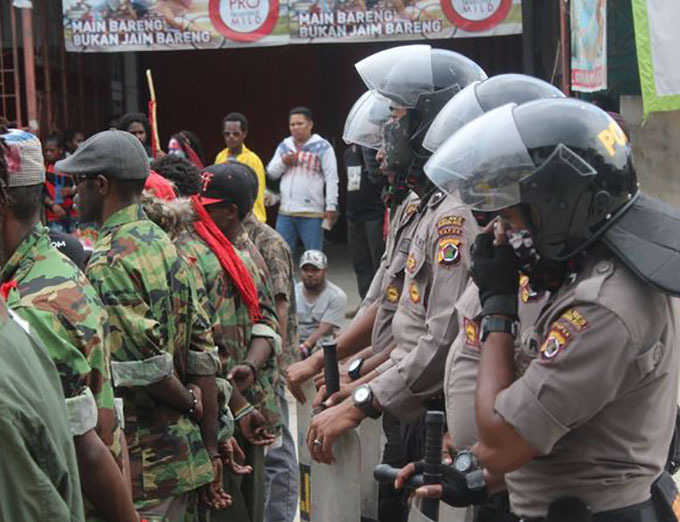
    Indonesian security forces crack down on West Papuan protesters in Jayapura. Image: Tabloid Jubi/File picture

    Reporters Without Borders (RSF) has called on Indonesian President Joko Widodo to keep his election promise to allow local and international journalists to operate in West Papua without obstruction or surveillance.

    The Paris-based global media freedom watchdog RSF’s appeal follows the expulsion of French journalists Franck Escudie and Basile Longchamp on visa violation grounds last month.

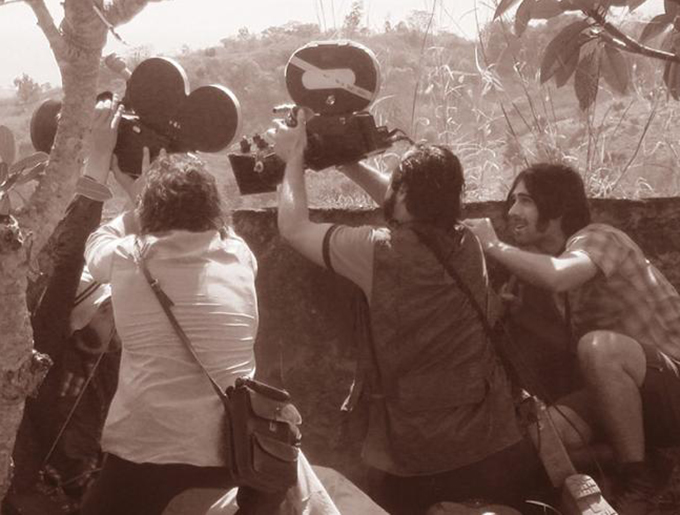
    French journalists Franck Escudié (left) and Basile Longchamp (right) at an Indonesian police press conference in Tembagapura, Papua, before they were expelled from the country after being arrested last month. Image: RSF/Paris

    Accompanied by a film crew, Escudie and Longchamp arrived in Indonesia in February with the government’s permission to make a documentary that would involve filming in West Papua.

    However, shortly after arriving, the authorites accused them of displaying a “lack of coordination with related institutions” – with the result that they were deported on March 17 and, for the time being, are banned from returning to Indonesia.

    “We remind the Indonesian president of his undertaking to scrap the restrictions that obstruct the work of foreign journalists in West Papua,” said Benjamin Ismaïl, the head of RSF’s Asia-Pacific desk.

    “Indonesia is due to host the World Press Freedom Day celebrations on May 3 but, given its repeated refusals to issue press visas and the growing number of journalists on its blacklist, it falls far short of qualifying as a country that supports freedom of expression and media freedom.”

    During his campaign for election as president in July 2014, Widodo said he would allow journalists to visit West Papua freely, thereby raising hopes that media freedom would revive in the region.

    -Partners-

    Visa regulations draconian
    But the visa regulations are as draconian as ever and West Papua’s immigration officials and military continue to abuse their authority in order to prevent independent reporting, with the government in Jakarta’s tacit consent.

    In January 2016, RSF condemned the Indonesian government’s refusal to let French journalist Cyril Payen visit Indonesia after France 24 broadcast the documentary he had just made about West Papua, entitled Forgotten war of the Papuas.

    A Bangkok-based reporter specialising in Southeast Asia, Payen had nonetheless obtained all the necessary authorisations before visiting West Papua in mid-2015.

    The broadcasting of the documentary also resulted in the French ambassador being summoned to the Indonesian foreign ministry.

    It was under Indonesia’s immigration laws, which RSF has repeatedly condemned, that two British journalists, Rebecca Prosser and Neil Bonner, were sentenced to two and a half months in prison on 3 November 2015 for violating the terms of their visas.

    They had already spent more than 150 days in police custody when they were finally sentenced.

    Two French journalists, Thomas Dandois and Valentine Bourrat, were arrested while preparing a report in West Papua in August 2014.

    After being held for more than two months, they were sentenced on 24 October 2014 to two and a half months in prison for violating the immigration laws.

    Indonesia is ranked 130th out of 180 countries in RSF’s 2016 World Press Freedom Index.

    ]]>

    World Press Freedom Day 2017 in Jakarta

    ]]>

    Pacific Media Centre

    Event date and time: 

    Wednesday, May 3, 2017 – 20:00

    WORLD PRESS FREEDOM DAY 2017
    Critical Minds for Critical Times: Media’s role in advancing peaceful, just and inclusive societies
    A day for West Papua media freedom

    Every year, May 3 is a date which celebrates the fundamental principles of press freedom; to evaluate press freedom around the world, to defend the media from attacks on their independence and to pay tribute to journalists who have lost their lives in the exercise of their profession.

    Events
    UNESCO, the government of Indonesia, and the Press Council of Indonesia will co-organise the World Press Freedom Day’s main event and the UNESCO/Guillermo Cano World Press Freedom Prize Ceremony in Jakarta, Indonesia, from 1-4 May 2017. Other parallel events will also be happening, including West Papua. The Pacific media Centre will also be taking part.

    More than 100 national celebrations take place each year to commemorate this Day. UNESCO leads the worldwide celebration by identifying the global thematic and organizing the main event in different parts of world every year.

    The international day was proclaimed by the UN General Assembly in 1993 following a Recommendation adopted at the 26th Session of UNESCO’s General Conference in 1991. This in turn was a response to a call by African journalists who in 1991 produced the landmark Windhoek Declaration on media pluralism and independence.

    When: May 3, 2017

    Where: Jakarta, Indonesia

    #PRESS FREEDOM
    #WPFD2017

    ]]>

    Trump puts Indonesia on ‘cheating foreign importers’ hit list

    ]]>

    AsiaPacificReport.nz

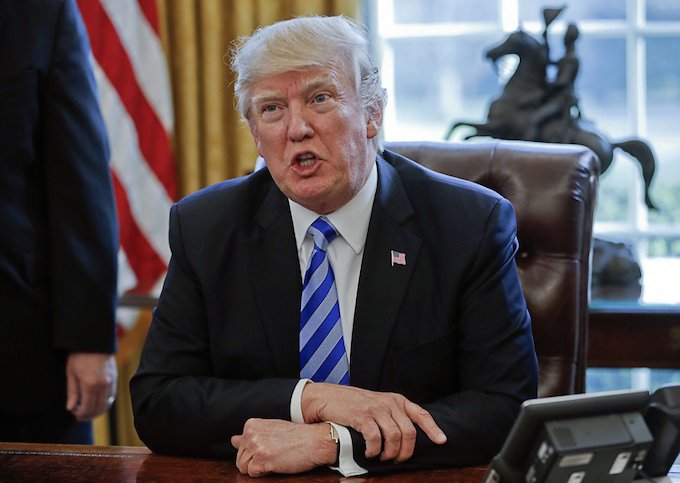
    President Donald Trump speaks about the health care overhaul bill in the Oval Office of the White House in Washington. Image: Pablo Martinez Monsivais/The Jakarta Post

    By Anton Hermansyah, Stefani Ribka and Tama Salim in Jakarta

    A week after seeing a petition against Indonesia’s biodiesel, the country has seen another blow in its trade with the United States after President Donald Trump called for an investigation into the “trade imbalance” between the US and 16 countries, including Indonesia.

    Trump had promised to crack down on “cheating foreign importers” by signing two executive orders on Friday. He gave 90 days for his administration to develop and implement a strategy for combating “violations of US trade and customs laws”.

    “The Secretary of Homeland Security shall, in consultation with the Secretary of the Treasury, the Secretary of Commerce and the US Trade Representative, develop a plan that would require covered importers that, based on a risk assessment conducted by the CBP [Customs and Border Protection], pose a risk to the revenue of the US, to provide security for antidumping and countervailing duty liability through bonds and other legal measures,” Trump wrote in his executive order.

    READ MORE: Fears for Indonesian park’s rare species as Trump town rises

    Indonesia was in the 15th position on the list, with US$13 billion in trade surplus over the US, followed by Canada with $11 billion surplus. China was in first with a $347 billion surplus followed by Japan, Germany, Mexico, Ireland, Vietnam, Italy, South Korea, Malaysia, India, Thailand, France, Switzerland and Taiwan.

    Responding to the development, Trade Minister Enggartiasto Lukita said the government would closely monitor the situation and soon collect data regarding Indonesian products with the potential to be hit by the US probe.

    -Partners-

    “For now, we will evaluate our export commodities that could potentially be questioned by the US. We will also ask for our representative in Washington, DC, to watch and monitor [the situation],” he said.

    The US market received $15.68 billion in non-oil and gas exports from Indonesia last year. The main commodities shipped to the US were mostly footwear, textiles, fisheries products and natural resources while the US exported aircraft, soybeans and machinery.

    Anti-dumping duties
    In his executive order, Trump called for the collection of anti-dumping duties that must be paid to the US. According to the US Accountability Office, there were more than $2.3 billion uncollected anti-dumping and countervailing duties to the country since 2001.

    On March 23, US-based commercial trade association National Biodiesel Board (NBB) filed a petition with the US Department of Commerce and the US International Trade Commission to impose anti-dumping and countervailing duties on imports of biodiesel from Indonesia.

    Institute for Development of Economics and Finance (INDEF) economist Bhima Yudhistira Adhinegara said the anti-dumping measures would not affect much of Indonesia’s accumulative trade.

    “Like textiles and footwear, we booked the surplus not because of dumping but because US workers did not want to make those goods due to high labor cost. That is why US brands such as Nike shifted their jobs to Indonesia,” he said.

    He chose to believe that the main target of the measure was actually China, as Chinese President Xi Jinping was scheduled to visit the US and hold a bilateral meeting with Trump in Florida next week.

    Indonesian Employers Association (Apindo) fisheries division chairman Thomas Darmawan said Indonesia’s export goods to the US were totally different from those of China. Indonesia mostly exported natural resource products such as rubber, coffee and seafood while most of China’s exports were end-products.

    ‘Difficult position’
    “If they put a barrier [on Indonesian goods], they will put themselves in a difficult position,” he said.

    Center of Reform on Economics (CORE) executive director Mohammad Faisal said Indonesia should join forces with other countries to appeal to the World Trade Organisation against Trump’s accusation.

    However, the Foreign Ministry?s director general for American and European affairs, Muhammad Anshor, remained hopeful that the issue would not be raised in the upcoming visit of US Vice President Mike Pence to Indonesia.

    Trump’s deputy is scheduled to visit Indonesia later this month as part of his tour around the region, which includes stopovers in Japan, South Korea and Australia.

    Anton Hermansyah, Stefani Ribka and Tama Salim are journalists with The Jakarta Post.

    ]]>

    SAS ‘atrocity’ book authors accuse PM of allowing issue to ‘fester’

    ]]>

    AsiaPacificReport.nz

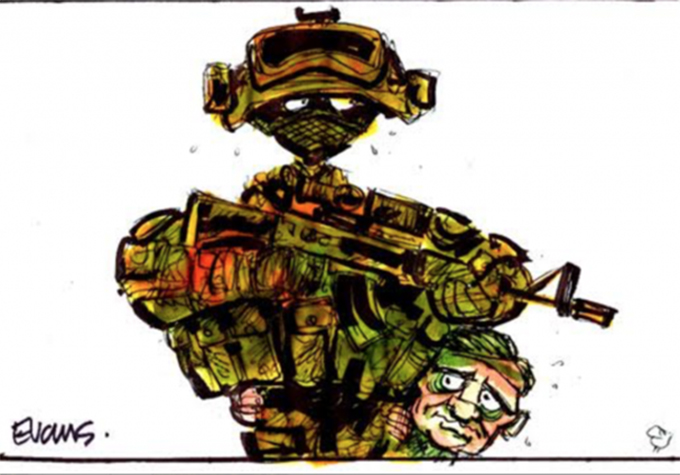
    Cartoon: Malcolm Evans/TDB

    The authors of the controversial investigative book Hit & Run have accused Prime Minister Bill English of ensuring the allegations of a New Zealand SAS atrocity in Afghanistan in 2010 will “boil and fester” until an independent inquiry takes place.

    The co-authors, Nicky Hager and Jon Stephenson, also criticised the prime minister for taking the “next step in the seven-year cover-up” by rejecting an inquiry.

    The book has alleged six civilians were killed and 15 injured in a “revenge” raid after the first death of New Zealand soldier in Afghanistan, Lieutenant Tim O’Donnell on August 4, 2010.

    “In the past two weeks since Hit & Run was published, there have been calls for an independent inquiry from New Zealanders from all sides on the political spectrum,” said Hager.

    “It is disappointing and concerning that Bill English has refused.

    “When the book came out, Jon Stephenson and I emphasised that Bill English had no responsibility for the deeds done in 2010 and so was in a good position to offer aid to the Afghan villages and launch a proper inquiry. But he has joined the people trying to hide and dodge over what happened.

    “I believe this decision is the result of military pressure on the government: the tail wagging the dog. That is not good for the country.

    -Partners-

    “Bill English is an experienced minister who knows the difference between being shown selective information by an interested party, as he has been by the Defence Force, and having an independent inquiry.

    “This does not appear a rational decision based on evidence; it is helping the military bureaucracy to avoid having to front up. It is the next step in the seven-year cover-up.

    “But, most of all, Bill English has just ensured that the issue will continue to boil and fester. It is not going to go away until it is properly addressed.”

    After receiving Defence Force chief Lieutenant General Tim Keating’s advice that troops involved in the raids met the “benchmark” of acting according to the rules of engagement, Prime Minister English yesterday watched video footage taken from aircraft involved in the 2010 raids in Afghanistan’s Baghlan province, reports The New Zealand Herald.

    The classified video he saw confirmed the “extensive steps, restraint and care” that forces took to minimise the chances of civilian casualties, English said.

    English would not go into detail about what the footage showed and said it would not be publicly released.

    He did not watch footage of the whole operation but was confident in what he saw.

    ]]>

    Tagata Pasifika goes down memory lane – 30 years of broadcasting

    ]]>

    AsiaPacificReport.nz

    For three decades Tagata Pasifika has been telling the stories of Pasifika people in Aotearoa and abroad.

    A weekend special of the popular programme took the audience back down memory lane – where it all began, with the help from some familiar faces.

    It marks turning 30 tomorrow.

    The TVNZ-founded programme — now owned and produced by Sunpix — has been delivering the New Zealand Pacific news each week for three decades.

    Made for the show’s 20th anniversary, this one hour special is hosted by actor Robbie Magasiva and discus champ Beatrice Faumuina.

    Among those interviewed are Foufou Susana Hukui, a founding presenter and producer.

    “The community got together and wanted to produce a family programme — a magazine programme,” she says.

    -Partners-

    Presenters past and present surveyed changes in the Aotearoa Pasifika community over the show’s run — from education, arts and culture (Ardijah, OMC and the Naked Samoans), to political pioneers (Mark Gosche, Winnie Laban), and sports heroes (All Black icons Jones, Lomu and Umaga).

    Among those also paying tribute to the show’s importance are Helen Clark and singer Annie Crummer.

    The rescreening of the programme is presented by Marama Papau and John Pulu, a star graduate from Auckland University of Technology.

    Foufou Susana Hukui … one of the Tagata Pasifika “originals”. Image: TP video frame ]]>

    Upgrade deadlock over Port Vila runway ends – China contract ok

    ]]>

    AsiaPacificReport.nz

    By Dan McGarry in Port Vila

    In a late-night teleconference with senior government officials, World Bank representatives finally acquiesced to Vanuatu’s choice of bidder for the long-awaited Bauerfield runway upgrade.

    Confronted with a determined government, the World Bank ended what one participant called a months-long “standoff” by indicating it had no objection to the decision to use China Civil Engineering and Construction Company, or CCECC, as the contractor for the projects.

    CCECC’s bid for the Bauerfield component of the contract came in at just over US$47 million—approximately VT5.16 billion—according to members of the bid review committee. The repairs and upgrades on Tanna’s White Grass and Santo’s Pekoa airports will cost slightly more than US$11.3 million, or approximately VT1.24 billion.

    A decision had been expected late January this year. But after a series of delays, the resolution arrived only hours before a senior cabinet briefing designed to bring the issue to a head.

    In a late-night discussion with World Bank representatives on Thursday, senior government officials made it clear they were prepared to end the impasse by making their choice public, even if that preference was not shared by the funding body.

    Journalists invited to the Friday morning event at the Holiday Inn had been briefed to expect a statement to that effect from the Prime Minister. Some were surprised when Charlot Salwai instead announced that the logjam had at last been broken.

    -Partners-

    The government clearly intends not to waste another moment. Contacted for comment, both the World Bank and CCECC were playing catch-up to the Friday morning announcement. Shortly after the press statement was issued, a spokesperson for CCECC indicated that the company had yet to receive formal notification of their selection, but promised a response as soon as the word arrived.

    ‘Critical importance’
    For its part, a World Bank spokesperson replied by email, stating, “We fully appreciate the sense of frustration felt by many regarding delays in finalising the tender evaluation, however due to the critical importance of this runway to Vanuatu, getting things right through following proper procurement processes and due diligence was essential.”

    They expressed relief at the positive result and were eager to move on: “The good news now is that all bidders have been formally notified of the completion of the evaluation process, with contract negotiations to be scheduled by the government in the coming days.”

    Details are sparse concerning the cause of the delays. Speaking on background, all parties have admitted to differences of opinion concerning bid price, and confidence in the ability of some bidders to complete the required works within the proposed budget.

    But no one was willing to discuss the process on the record, for fear of prejudicing the process.

    An evaluation committee member told the Daily Post that their recommendation was returned three times with requests from the World Bank for additional information. These requests for information had to be forwarded to all bidders, and responses compiled and circulated.

    Each of these took weeks to complete, giving rise to concerns among onlookers that the process was in danger of getting stuck in a loop.

    Asked if this series of interactions affected the outcome, one person close to the process said: “It did affect the outcome. I can’t say any more than that.”

    Fair contest
    Numerous commentators and participants expressed understanding and respect for the integrity of the World Bank process, and understood the need to ensure a thorough and above all fair contest. Weeks ago, after a meeting with the World Bank’s vice-president for Asia Pacific, MIPU Minister Jotham Napat underlined the need to ensure that the process wouldn’t be subject to appeal or litigation following the award.

    “That’s the last thing we need,” he said at the time.

    The economic consequences of delay have been a source of deep concern people on the ground here in Vanuatu.

    There has long been a widespread sense that undue delays to the Bauerfield project would only prolong the country’s economic struggles. In the wake of cyclone Pam, which ravaged half the country, tourism has struggled.

    The shock announcement at the beginning of 2016 that Air New Zealand was suspending commercial service to Port Vila due to runway conditions was followed in quick succession by the suspension of a codeshare between Qantas and Air Vanuatu.

    The resulting drop in tourists arriving by air put intense pressure on local tourism operators, who rely on air arrivals for the bulk of their revenues. Overall revenues from tourists arriving by air are just now returning to 2014 levels, but occupancy rates are lower.

    This is primarily because tourists have been staying in Vanuatu marginally longer in recent months.

    ‘Round the clock’
    When bids were unsealed in late December last year, a procurement specialist contracted by the World Bank assured bidders that committee members would work through Christmas and the New Year and do their best to get a result “within a month”.

    A bid review committee member confirmed to the Daily Post that they had worked “round the clock” to assess the bids and make their selection.

    According to one technical specialist, the upgrade to Bauerfield airport’s runway will consist of milling out the top 10mm of the runway surface, then re-mixing it and adding new bitumen. Then another 10mm of new runway surface will be added, effectively doubling the depth of the surface.

    The contractor will work during airport downtime, mostly at night. The work will proceed in small slices, as it were, and a temporary ramp section will be added every morning to allow a smooth transition between new surface and old.

    Asked about the state of the foundational materials that underlie the tarmac itself, the specialist replied that it was found to be in perfectly good condition.

    Perhaps the primary concern for tourism business owners is the status of the codeshare between Qantas and Air Vanuatu.

    The code share was cancelled shortly after Air New Zealand’s January 2016 announcement that they were suspending scheduled commercial service due to concerns about the condition of the runway.

    The Daily Post asked Jotham Napat if he was going to contact Air New Zealand now, but he indicated he didn’t want to politicise the situation.

    “This is purely a commercial deal. We’re doing our part. The airport has been certified. It’s just a matter for them to come.”

    “The ball is in their court now,” he concluded.

    Dan McGarry is media director of the Vanuatu Daily Post group and has written extensively on the Port Vila airport issue.

    ]]>

    Military chief’s Op Burnham account highlights key Afghan legal concerns

    ]]>

    AsiaPacificReport.nz

    ANALYSIS: By Selwyn Manning

    There is an overlooked aspect of the New Zealand Defence Force’s account of Operation Burnham that when scrutinised suggests a possible breach of international humanitarian law and laws relating to war and armed conflict occurred on 22 August 2010 in the Tirgiran Valley, Baghlan province, Afghanistan.

    For the purpose of this analysis, we examine the statements and claims of the Chief of New Zealand Defence Force (NZDF), Lieutenant-General Tim Keating, made before journalists during his press conference on Monday, 27 March 2017. We also understand, that the claims put by the general form the basis of a briefing by NZDF’s top ranking officer to the Prime Minister of New Zealand, Bill English.

    It appears the official account , if true, underscores a probable breach of legal obligations – not necessarily placing culpability solely on the New Zealand Special Air Service (NZSAS) commandos on the ground, but rather on the officers who commanded their actions, ordered their movements, their tasks and priorities prior to, during, and after Operation Burnham.

    *******

    According to the New Zealand Defence Force’s official statement, Operation Burnham “aimed to detain Taliban insurgent leaders who were threatening the security and stability of Bamyan Province and to disrupt their operational network”. (ref. NZDF rebuttal)

    We are to understand Operation Burnham’s objective was to identify, capture, or kill (should this be justified under NZDF rules of engagement), those insurgents who were named on a Joint Prioritized Effects List (JPEL) that NZDF intelligence suggested were responsible for the death of NZDF soldier Lieutenant Tim O’Donnell.

    When delivering NZDF’s official account of Operation Burnham before media, Lieutenant General Tim Keating said:

    -Partners-

    “After the attack on the New Zealand Provincial Reconstruction Team (NZPRT), which killed Lieutenant Tim O’Donnell, the NZPRT operating in Bamyan Province did everything it could to reduce the target profile of our people operating up the Shakera Valley and into the north-east of Bamyan Province.

    “We adjusted our routine, reduced movements to an absolute minimum, maximised night driving, and minimised time on site in threat areas.

    “The one thing the PRT [NZPRT] couldn’t do was to have an effect on the individuals that attacked Lieutenant O’Donnell’s patrol. For the first time, the insurgents had a major success — and they were well positioned to do so again.”

    For the purpose of a counter-strike, intelligence was sought and Lieutenant-General Keating said: “We knew in a matter of days from local and International Security Assistance Force (ISAF) intelligence who had attacked our patrol [where and when Lt. O’Donnell was killed].”

    The intelligence specified the villages where the alleged insurgents were suspected of coming from and Leutenant-General Keating said: “This group had previously attacked Afghan Security Forces and elements of the German and Hungarian PRTs.”

    The New Zealand government authorised permission for the Kabul-based NZSAS troops to be used in Operation Burnham.

    “What followed was 14 days of reliable and corroborated intelligence collection that provided confirmation and justification for subsequent actions. Based on the intelligence, deliberate and detailed planning was conducted,” Lieutenant-General Keating said.

    Revenge, Keating said, was never a motivation. Rather, according to him, the concern was for the security of New Zealand’s reconstruction and security efforts in Bamyan province.

    As stated above, Operation Burnham’s primary objective was to identify, capture or kill Taliban insurgent leaders named in the intelligence data.

    We know, from the New Zealand Defence Force’s own account, Operation Burnham failed to achieve that goal.

    Analysis of the NZDF official account
    The official account of events that occurred in the early hours of 22 August 2010, describe how Taliban insurgents, realising coalition forces were preparing to raid the area (marked as “Operation Burnham Area of Operation” in a map (slide 3) declasified and released to media on 27 March 2017), formed a tactical maneuver using civilians (women, children and elderly) as a human shield.

    The declassified operational map as released at the media conference on 27 March 2017. Image: Evening Report

    Despite the official account placing this group within a building, within a small hamlet, within the area of operation, within Tirgiran Valley, there is no clear definitive official account yet given of what happened to either the civilians or the insurgents.

    This appears to be an obvious void in the official record, but one that has failed so far to be scrutinised.

    To follow the logic of Lieutenant-General Tim Keating’s account (detailed below), is to discover our defence personnel, who were in charge of the ground and air operation during Operation Burnham, failed to identify what had become of those civilians (women, children, and the elderly), and also importantly the suspected insurgents who Lt. General Keating said during his briefing used the villagers as a human shield.

    We know from the Chief of Defence Force’s notes as provided on 27 March 2017, that as Operation Burnham began, NZDF was in command of United States manned aircraft (including helicopters and possibly a AC-130). The aircraft were swarming above the Tirgiran Valley.

    From the NZDF account, an NZDF joint terminal air controller was in charge of the air attack against those NZDF had defined as insurgents.

    Lieutenant-General Keating stated the alleged insurgents were armed and a NZDF commander authorised the US manned aircraft to commence firing. Weapons-fire then began to rain down on the valley from above.

    Meanwhile, NZSAS ground force soldiers prepared to secure their positions and to defend themselves against any potential enemy counter-attack.

    Lieutenant-General Keating stated the insurgents responded: “The insurgents, the guerrilla force, the tactic is mixed in with the civilian population, if you like, the term used is a human shield. So they use civilians as a shield.”

    He added: “What occurred, is a helicopter was engaging a group of insurgents outside the village, on the outskirts of the village. During that engagement, it was noted by the ground forces there – the SAS ground forces – that some of the rounds [from the US manned aircraft] were falling short, and went into a building where it was believed there were civilians as well as armed insurgents.”

    To be clear, from this account, Lieutenant-General Keating stated a group of insurgents were being tracked, targeted, and fired upon by the US manned aircraft and under the command of a New Zealand Defence Force terminal air controller.

    Meanwhile, according to the NZDF record, one of the airborne helicopter’s weapon’s sights were not calibrated correctly, and, according to Lieutenant-General Keating, 30mm projectiles went into a building where it was believed there were civilians as well as armed insurgents – remember these 30mm projectiles are capable of penetrating the side of a tank.

    For accuracy, Lieutenant-General Keating restated his account: “It is noted, the building, there were armed insurgents in there, but it is believed that there may have been civilians in the building.”

    He then added: “There’s no confirmation that any casualties occurred, but there may have been.”

    He restated again: “There were civilians in that building.”

    Now, this is where the Chief of Defence Force’s account fails to further explain what occurred after that point.

    To summarise, the official position of the New Zealand Defence Force is:

    • There were civilians in a building within the village that was fired upon by an armor piercing aircraft weapon
    • That it was believed insurgents were also in that building
    • That civilian casualties or deaths “may have been” or occurred inside the building.

    At this juncture, we must consider whether the New Zealand Defence Force ground commanders had a responsibility to determine whether there were Taliban insurgents in the building? And if so, whether they were the individuals listed on the JPEL list, those deemed responsible for the death of Lieutenant Tim O’Donnell? And what of the ground commanders’ legal requirements, the duty of care with respect to civilians, were NZDF commanders on the ground or back in Kabul compelled by law to confirm the status of the civilians, whether they were injured or killed?

    When asked by a journalist at the 27 March 2017 press conference: “If there may have been civilian casualties, why not have an inquiry to find out?”

    Lieutenant-General Keating replied: “Even if there was, as far as the New Zealand Defence Force has heard, the coalition investigation has, um, said that uh, if there were casualties, the fault of those casualties was a mechanical failure of a piece of equipment.”

    This reply does not appear to consider the legal requirements under:

    • Second Protocol to the Geneva Convention Relating to the Protection of Victims of Non-International Armed Conflicts, Article 7: the obligation to provide medical assistance to all wounded, whether or not they have taken part in the armed conflict
    • Second Protocol to the Geneva Convention Relating to the Protection of Victims of Non-International Armed Conflicts, Article 8: the obligation to search for and collect the wounded and to ensure their adequate care
    • Second Protocol to the Geneva Convention Relating to the Protection of Victims of Non-International Armed Conflicts, Article 13: the obligation to protect the civilian population against dangers arising from military operations
    • Armed Forces Discipline Act 1971, section 102. This section provides that the commanding officer of a person alleged to have committed an offence under that Act must initiate proceedings in the form of a charge or refer the allegation to civil authorities, unless the commanding officer considers the allegation is not well-founded. While little legal guidance is provided, it cannot be accepted that preliminary inquiries to determine whether an allegation is well-founded can be considered adequate where they fail to obtain evidence from the injured parties, determine their identities or even verify that they exist
    • Rome Statute of the International Criminal Court, Article 28
    • The NZDF Manual of Armed Forces Law provides that there are three types of inquiry in the NZDF: a preliminary inquiry, a court of inquiry and a command investigation. (It appears however the ISAF investigation cited by the Chief of Defence Force was not any of the above forms of inquiry).

    Specifically, if you analyse Lieutenant-General Keating’s account, the New Zealand Defence Force commanders failed to identify whether any insurgents were inside the building and whether there were dead or wounded civilians.

    Why was this the case? It seems reasonable to suggest, this is an abandonment of logic. It does not make sense.

    We know from official NZDF documents the soldiers arrived at the scene of Operation Burnham at 0030 hours on 22 August 2010 and left at 0345 hours, that’s the official record.

    To clarify, the NZSAS commandos were in the area of operation for 3 hours 15 minutes. Lieutenant-General Keating stated, near the conclusion of the raid: “The ground force commander chose at that time that there was no longer a threat and they were leaving.”

    How could that rationally be the case unless the suspected insurgents inside that building had been checked? Was it not suspected that there were insurgents in that building?

    Surely the ground force commanders would be compelled to seek and identify the inhabitants of that building to see if they matched the names/descriptions on the JPEL list? After all, the manhunt for Taliban leadership was the purpose of the raid that night.

    Also, logic would suggest, the people inside the building were in part civilians including women and probably children – by Lieutenant-General Keating’s account the group likely included wounded civilians and probably a dead child.

    Also, it is reasonable to suggest, considering the events over those 3 hours 15 minutes, the survivors would have been crying, weeping, even howling, and the wounded would likely have been in agony.

    It defies belief that the ground force commanders, and their counterparts back in Kabul, were not aware of this building, that the NZDF account states was housing suspected Taliban, and included a group of civilian victims that had been used as a human shield.

    The entire area of operation specific to Operation Burnham is a skewed rectangle approximately 500 metres wide by 1 kilometre long, with an intensified operation plan focusing on two small hamlets, each approximately 50×200 metres in area [based on the scale measures of the NZDF map] – named Objective 1 and Objective 2 in the NZDF released material.

    To state it simply, the official silence surrounding the above-mentioned building, and the fate of the people inside, speaks volumes. It leaves one to consider at worst whether a crime was committed by New Zealand Defence Force commanders that night – whether by failing in their duty to care for the injured they were in breach of Articles 8, 9 and 13 of the Second Protocol to the Geneva Conventions.

    Additional note:

    • The Statute of the International Criminal Court defines war crimes as, inter alia, “serious violations of the laws and customs applicable in international armed conflict” and “serious violations of the laws and customs applicable in an armed conflict not of an international character”. (Ref. IHL Definition of war crimes, page 1 (pdf) – ICC Statute, Article 8 (cited in Vol. II, Ch. 44, § 3))
    • “The Statute defines as within the scope of the law, the “launching an attack without attempting to aim properly at a military target or in such a manner as to hit civilians without any thought or care as to the likely extent of death or injury amounts to an indiscriminate attack”.
    • War crimes can consist of acts or omissions. Examples of the latter include failure to provide a fair trial and failure to provide food or necessary medical care to persons in the power of the adversary.’

    At best, if NZDF’s official account is to be relied upon, we are to believe the NZSAS ground commanders failed to ensure the Taliban insurgents they sought were not holed up in a building that had sustained damage from coalition force aircraft. If this assumption is incorrect, at what point had the suspected insurgents left the building? And what had become of the civilians that had been allegedly used as a human shield? Again, the vacuum of information specific to this aspect of the official account needs to be explained, including an explanation as to why NZDF’s account remains vague after six years since Operation Burnham was conducted.

    It appears reasonable to assert that this single issue, notwithstanding the irregularities of official NZDF stated “facts”, warrants further official and independent investigation.

    As it is, at this juncture, we are left to consider a series of unanswered questions that to date the New Zealand Chief of Defence Force has failed to satisfy. Here are some of them.

    Key unanswered questions:

    • What were the specific definitions of an insurgent that were used by NZDF for the purposes of evaluation during Operation Burnham and for the purpose of post-operation official analysis? For example; was it deemed that anyone who was male and of a fighting age was defined to be an insurgent?
    • Were NZDF soldiers fired upon by individuals (villagers or insurgents) located within the confines of the villages or surrounding area during Operation Burnham?
    • Was the individual who was killed by a NZSAS soldier or NZDF personnel carrying a weapon at the time of this shooting? If so, had he fired or attempted to fire his weapon in an attempt to kill or wound NZDF personnel?
    • How long in minutes were the coalition forces’ helicopters, and any other airborne craft, firing their weapons on the villages and surrounding region during Operation Burnham?
      How long in minutes were NZSAS soldiers involved in securing the operational area from real or potential insurgent attack?
    • Did NZDF personnel at anytime seek to identify individuals (and their status, injured, killed, or otherwise) who were located inside or near the building that Lt. General Keating said had suffered damage from an alleged mis-aimed firing from an airborne coalition aircraft?
    • Were those who were injured or killed within sight of NZDF personnel before, during, and/or after the alleged mis-aimed firing?
    • How many individuals did the NZDF personnel suspect were inside the building?
    • How many of these people did the NZDF personnel suspect were civilians?
    • How many were suspected of being women?
    • How many were suspected of being children?
    • Lieutenant-General Keating suggested that one of the individuals that may have been killed during Operation Burnham was a six year-old child. What was the gender of this child?
    • Was their any attempt to identify this six year-old victim?
    • Was this child Fatima, the three year-old child identified in the Hit & Run [ISBN 978 0 947503 39 0] book? If not, then who was this child?
    • What actions did NZDF personnel do to exercise their duty of care obligations to the injured and to civilians?
    • What reports, cautions, evaluations were written and/or submitted regarding Operation Burnham to NZDF by the NZDF legal officer who was on the ground during Operation Burnham?

    The twisting turning official account – is this smoke and mirrors?
    As a consequence of the Hit & Run book [ISBN 978 0 947503 39 0] being published, New Zealand Defence Force’s top ranking soldier, Lieutenant-General Tim Keating admitted civilians “may have been” killed during the operation.

    Up until 27 March 2017, for the past six years, New Zealand Defence Force has insisted that no civilians were killed during Operation Burnham on 22 August 2010.

    But on Monday, under questioning from the media, at the March 27 press conference, Lietenant-General Keating stated that the NZDF’s new “official line” regarding civilian deaths was “there may have been”.

    He then attempted to suggest that NZDF’s previously stated position – that claims of civilian deaths were “unfounded” – was basically the same thing.

    “I’m not going to get cute here and say it’s a twist on words, it’s the same thing, ‘unfounded’, ‘there may have been’. The official line is that there may have been casualties,” Lieutenant-General Keating said.

    A journalist then challenged him further suggesting: “They’re different things, one means they didn’t happen and one mean might’ve done.”

    Lieutenant-General Keating then replied: “You’re right…the, the, the official line is that civilian casualties may have occurred, but not corroborated.”

    When asked how many insurgents were killed, Lieutenant-General Keating replied: “A significant number of insurgents, identified insurgents, were killed during Operation Burnham.”

    When asked again how many were killed, Lt. General Keating stated: “Nine.”

    When asked if NZDF had the names of the insurgents that were killed, he replied: “No, we do not have names of insurgents.”

    This trajectory, inching toward a truth, occurred under tight questioning by a journalist, over just a few minutes.

    What further truths will become relevant to understanding what occurred that night in Khak Khuday Dad and Naik villages should a commission of inquiry be established?

    The inconsistencies – a summary
    In evaluation, it is reasonable to assert the official government inconsistencies observed along a six-year timeline offer the appearance of a military hierarchy that has being dragged, by degrees, (mainly by the work of Jon Stephenson, an investigative journalist specialising in war and conflict reportage) into an arena where the floodlight of public interest ought to shed light on secrets long since filed into a dark place.

    However, considering the above, rather than responding openly to the challenge of meeting its responsibilities to the New Zealand Minister of Defence and public, the New Zealand Defence Force appears resistant to its obligations toward open and accurate disclosure of non-classified fact.

    In conclusion, if this is true, this conduct exhibited by the officials of New Zealand Defence Force and its Chief Lieutenant-General Tim Keating is hardly a defining benchmark of “exemplary” standards.

    Actually, the admissions of relevant information, that is forthcoming only when lanced from the New Zealand Defence Force under questioning, offers the impression of a smoke and mirrors operation – it may appear churlish to suggest, but perhaps the post-Operation Burnham aftermath ought to be referred to as Operation Desert Road (bleak, cold, inhospitable, proceed with caution).

    The public deserves to know the whole truth, not spin or part-truths – both the public interest and the national interest depends on it.

    By the New Zealand Defence Force’s own account, it appears reasonable to suggest that the commanders overseeing Operation Burnham had legal obligations to civilians; that they were potentially negligent when considered against their stated rules of engagement, rules of conduct, obligations to international human rights law and international humanitarian law – negligent of their obligations to laws covering war and armed conflict, notwithstanding their obligations as representatives of the people and government of New Zealand to observe the Bill of Rights Act.

    It is also reasonable to suggest; there are significant established facts as mentioned above, as put by the New Zealand Defence Force, that require an official investigative response from the New Zealand government.

    It is also reasonable to insist that the matter of an absence of consistent fact emitting from the New Zealand Defence Force upon which a reliable opinion can be draw, adds weight to the burden on the Government to establish an inquiry into this matter.

    If the New Zealand Prime Minister Bill English elects not to act then it will likely become a matter of political leadership or lack thereof.

    If Bill English does not care to act on his office’s public interest obligations, then, it is reasonable to suggest he consider the empirical facts underlying this matter and the impact the matter has on New Zealand’s national interest. Should he fail to do so, this matter potentially could be argued before the International Criminal Court.

    *****

    The March 27 NZ Defence Force media conference. Image: Evening Report

    Background relevancies
    Were NZDF officials and Hit & Run authors describing the same raid? Let’s compare.

    “It seems to me,” Lieutenant-General Tim Keating stressed, “that one of the fundamentals, a start point if you like, of any investigation into a crime is to tie the alleged perpetrators of a crime to the scene. Then we would examine the motive and means, and other scene evidence.” – Lieutenant General Tim Keating, 27 March 2017.

    On Monday, 27 March 2017 both the Prime Minister Bill English and the Chief of New Zealand Defence Force Lieutenant-General Tim Keating countered details revealed in the book Hit & Run and argued facts stated in the work could not be relied upon because the authors “incorrectly” alleged Operation Burnham took place in Khak Khuday Dad Village and Naik Village deep in the mountainous Baghlan province of Afghanistan – two locations the Defence Force chief insisted his soldiers had never been to.

    Lieutenant-General Keating asserted that the New Zealand Defence Force had never been to the two villages (Khak Khuday Dad and Naik) and insisted Operation Burnham took place 2.2 kilometres to the south of where the authors Nicky Hager and Jon Stephenson had marked the location of the villages (specifically on a map published in the book Hit & Run).

    Lieutenant-General Keating said: “As you will note from the book, the authors have been precise in locating these villages with geo reference points — so I have no doubt they are very accurate in the villages they are taking their allegations from.

    “The villages lie in the Tirgiran Valley some 2 kilometres north from Tirgiran Village. In straight distance this is like comparing the distance from Te Papa to Wellington Hospital. However, if you overlay the elevated terrain, you will see we are talking about two very separated, distinct settlements,” Lieutenant-General Keating said.

    Beyond the obvious, it was a staggering claim, especially for those aware the New Zealand Defence Force had insisted one week prior, that its official position remained the same as stated in a media release dated 20 April 2011 that: “On 22 August 2010 New Zealand Defence Force (NZDF) elements, operating as part of a Coalition Force in Bamyan province, Afghanistan, conducted an operation against an insurgent group.”

    NZDF’s earlier position asserted New Zealand soldiers had not been in Baghlan province on or near 22 August 2010 the night of Operation Burnham. Now, the chief of New Zealand’s armed forces was admitting that they had.

    At the press conference on Monday, 27 March 2017, the Chief of New Zealand Defence Force prepared to stake his claim that the book could not be relied on as a factual reference.

    Before around 30 journalists, Lieutenant-General Tim Keating pointed to four relevant bullet-points underlying key claims of fact in the book:

    • Helicopter landing sites
    • Location of houses that were destroyed
    • Locations of where civilians were allegedly killed
    • Presumed location of an SAS sniper with evidence presented of SAS ammunition and water bottles which were found at the site.

    A relationship was drawn between the sniper location and the alleged killing of the individual Islamuddin, the school teacher.

    He acknowledged that the book contained a detailed list of those alleged to have been killed or wounded during a military operation in Khak Khuday Dad and Naik villages and a detailed list of the houses destroyed at the two locations.

    Lieutenant-General Keating then drove his point home that: “The underlying premise of the book is that New Zealand’s SAS soldiers conducted an operation on Khak Khuday Dad Village and Naik Village…”

    “It seems to me,” he stressed, “that one of the fundamentals, a start point if you like, of any investigation into a crime is to tie the alleged perpetrators of a crime to the scene. Then we would examine the motive and means, and other scene evidence.”

    Lieutenant-General Keating pivoted. “Let me now talk about the ISAF Operation Burnham in Tirgiran Village.”

    The premise of the Chief of Defence Force’s position was; the book Hit & Run described events that may or may not have occurred in Khak Khuday Dad and Naik villages, but that these alleged events had nothing to do with New Zealand Defence Force soldiers as they had never been to the two locations as marked in the book.

    Likewise, the Prime Minister, Bill English, said the book got it wrong, that the New Zealand Defence Force had never been to either Khak Khuday Dad Village and Naik Village.

    The Prime Minister added: “We believe in the integrity of the Defence Force more than a book that picks the wrong villages.”

    For some, it appeared the raid that night as described by the authors could have been committed by another force. For others, it seemed the authors had got a major fact wrong so therefore the remaining claims in the book were moot.

    By mid-Wednesday morning, the government and the public found out there was more to it, that the Chief of New Zealand Defence Force was also wrong with regard to his geography.

    Unpicking the official line began in earnest late on Tuesday night (28 March 2017) when the lawyers representing the alleged victims of Operation Burnham contacted their clients back in Afghanistan. The purpose of the contact was to identify the exact location of Khak Khuday Dad Village and Naik Village; to confirm or otherwise disprove the existence of “Tirgiran Village” (the NZDF stated official location of Operation Burnham), and to identify and confirm what village or villages are located at the exact co-ordinates as provided by Lieutenant-General Tim Keating in his briefing to New Zealand media.

    The lawyers’ clients, represented by a doctor from the region, stated categorically that “Tirgiran Village” (as stated by Lieutenant-General Keating) does not exist. That the region is known as Tirgiran Valley.

    The lawyers evaluated from the new information, that to refer to the location of Operation Burnham as Tirgiran Village is like insisting an operation had occurred in Otago City (obviously Otago is a region and a city of that name does not exist, and as such would fail to offer an exact point of reference on a map).

    Importantly, the lawyers confirmed, New Zealand Defence Force co-ordinates of where Operation Burnham took place were correct – but that the location was not as the NZDF had stated as “Tirgiran Village” (an incorrect reference to a village that does not exist) but rather marks the geo-locations of where Khak Khuday Dad Village and Naik Village are located.

    Specifically, the villagers confirmed the red-rectangle as marked on the NZDF map provided by the Lt. General on Monday, March 27, and referred to as the area specific to Operation Burnham, frames the exact positions of where Khak Khuday Dad and Naik villages are located.

    So simply, the book contained a map that placed Khak Khuday Dad and Naik 2.2 kilometres north of their specific real locations. And, the NZDF got it wrong by stating that those two villages were located where the book suggested, and that the village at the centre of Operation Burnham was a different village called Tirgiran Village (again, a place-name that does not exist).

    So it turns out, according to those that live in the Tirgiran Valley, the Chief of Defence Force’s statement is incorrect or false; that when NZDF stated as a categorical fact that the New Zealand SAS commandos had never been to Khak Khuday Dad Village nor Naik Village, that that information was false.

    At this point politically, it is inescapable that the Prime Minister’s stated position ought to have taken a hit.

    Remember back to the Prime Minister’s statement to media on Monday, March 27, 2017 where he pitched his rationale: “We believe in the integrity of the Defence Force more than a book that picks the wrong villages.”

    Surely, the same measure that was applied to the authors of Hit & Run now ought to be applied in equal measure to the New Zealand Defence Force chief and his officials. After all, they also got their geography wrong.

    Since then, there has been stated unease about the whole issue by Internal Affairs Minister Peter Dunne (the minister who would have to sign off and authorise the costs of an inquiry should the Prime Minister order an inquiry be established). By Thursday, 30 March 201,7 Dunne, through media, called for an inquiry into the whole affair. (ref. Stuff.co.nz )

    Also on Thursday, the Minister of Defence at the time of the raid, Dr Wayne Mapp, wrote of his unease about Operation Burnham in a piece published on the Pundit website. (ref. Pundit )

    Dr Mapp argued that the government’s position, and that of the New Zealand Defence Force, cannot be the end of it.

    “Part of protecting their [the SAS’] reputation is also finding out what happened, particularly if there is an allegation that civilian casualties may have been accidentally caused. In that way we both honour the soldiers, and also demonstrate to the Afghans that we hold ourselves to the highest ideals of respect of life, even in circumstances of military conflict,” wrote Dr Mapp.

    Common statements of fact
    The descriptions of Operation Burnham, in both the book, and, as stated by the New Zealand Defence Force, do mirror each account with precision on numerous vital points, including:

    • The time of night Operation Burnham took place
    • That New Zealand Defence Force was commanding and leading the operation (both on the ground and in the air)
    • That the helicopters were manned by United States military personnel under New Zealand’s command
    • That the purpose of the operation was to kill or capture those named as having been part of a Taliban insurgent raid that killed Lieutenant Tim O’Donnell
    • That buildings were destroyed during the operation
    • That people were killed at the villages.

    However, anyone who has reasonably assessed the issue can see there is much more information to be revealed.

    Conclusion
    In concluding this analysis, it is an imperative that due to the highest levels of public and national interest concerning the alleged conduct, the seriousness of allegations, and the variables relating to the official account, that the matter be subjected to an independent commission of inquiry.

    Selwyn Manning is editor of EveningReport.nz. This analysis was first published on Kiwipolitico.com and on Evening Report and is republished on the sister website Asia Pacific Report with the permission of the author.

    ]]>

    Climate change key focus of EU ‘case for the Pacific’ roundtable

    ]]>

    AsiaPacificReport.nz

    By Kendall Hutt

    Climate change is the central focus of the European Union’s continuing relationship with the Pacific, says the international cooperation chief.

    Stefano Manservisi, Director-General of International Cooperation and Development of the European Commission, says his organisation is fully behind the Pacific on raising awareness of climate change.

    European Union’s Stefano Manservisi … “100 percent backing” for the Pacific. Image: Unimedia

    “Having consulted already with national level authorities on how we can step-up support, notably on climate change, we are 100 percent backing determination to do more,” he told Asia Pacific Report.

    Manservisi is currently in the Pacific — due in New Caledonia today — meeting with leaders to discuss the European Union’s (EU) ongoing relationship under the African, Caribbean and Pacific (ACP)-EU Partnership Agreement, which is more commonly referred to as the Contonou Agreement.

    Signed in 2000, the treaty between 79 countries from Africa, the Caribbean and Pacific is the “most comprehensive partnership agreement between developing countries and the EU,” according to the commission.

    Aimed at reducing poverty, ensuring sustainable development and promoting democracy, peace and security, the agreement is set to expire in 2020.

    -Partners-

    “The objective is to reaffirm the full commitment of the European Union in the South Pacific, now, and in the future,” Manservisi said.

    Climate change challenge
    Part of this commitment would continue to be climate change, identified as a key concern under “global challenges” in several EU documents.

    This was due to the fact that since the agreement’s 2010 revision, climate change had been referenced as the central point on which future relations should be framed.

    This was because all the treaty’s partners were adversely affected by climate change, Manservisi said.

    “Well, climate change is the agenda and the main issue our partners themselves are raising with us, because, you know, they are all islands which are at risk in terms of disasters, in terms of rising oceans, in terms of difficulty of having a prosperous agriculture sector for food production.”

    Potential future investments and development in areas such as energy and increased interconnectivity were hindered because they “fall under the climate change umbrella and are linked to the vulnerability of these islands”.

    This was unfortunate, given Pacific nations would like to see their vulnerability turn into something more sustainable through the development of such resources, Manservisi said.

    “This is what our partners are asking us to do and we are working in order to respond.”

    Post-COP21 world
    Such commitment reflected a global trend in which world leaders were taking climate change seriously.

    “COP21 would not have produced the commitment that it has, otherwise.”

    More importantly, this was further evident in the fact Fiji was co-chairing COP23, Manservisi said.

    “This will, let’s say, keep promoting the importance of the climate change agenda and to make pressure, in particular, seeing it from one of the area which is most at risk.”

    This all comes despite US President Donald Trump’s announcement America will be unwinding several key climate change policies implemented under Obama’s presidency.

    “I would say that I’m an optimist, so therefore I believe that since climate change is evidence-based, you know, our American friend will probably reconsider a certain number of things,” Manservisi said.

    “In any case, what I noticed here so far in my talks is that if anybody has some doubts and in spite of some announcement from the US, this has boosted even more our determination to tackle climate change.”

    Moving forward, the EU would also like to see the addition of a “Pacific pillar” to the agreement.

    Pacific pillar
    Although the treaty creates a powerful framework for engagement, Manservisi admits it does need some work.

    “We suggest it be a bit more regionalised, closer to realities. A Pacific pillar of this new ACP framework will be able to address more specifically the specificity of the South Pacific to have its own governess and mechanics to make decisions.”

    Ideally, this new pillar would encompass other European territories such as French Polynesia, and include Australia and New Zealand, he said.

    “I’m here to talk about this and see how we can do it. But in the understanding that we want to consolidate our presence here.”

    Manservisi said the EU’s main motivation behind its plans to strengthen relations with the Pacific, however, was friendship.

    “We are here, and we are doing work and efforts for developments for decades, so therefore you know we have an old story of friendship and partnership with the islands. Therefore, you know, it’s our first thinking and duty to say ‘now look, let’s see how we can do better’.”

    Manservisi spent the beginning of his “case for the Pacific” roundtable last week engaged in several talks with leaders from Australia, but missed speaking with leaders and Pacific academics in New Zealand due to unexpected weather.

    Talks on how to do better also continued in Fiji on Friday, where Manservisi planned to meet with Prime Minister Voreqe Bainimarama and several government ministers.

    Similar talks took place in Vanuatu on Sunday, and bilateral discussion with Pacific leaders are planned to conclude in New Caledonia today.

    Kendall Hutt is Pacific Media Watch freedom project contributing editor for the Pacific Media Centre.

    ]]>

    ‘Going backstage’: Swiss researcher reveals public broadcast practices

    ]]>

    AsiaPacificReport.nz

    Flashback 10 years ago: The Garuda Indonesia Airways Flight 200 on 7 March 2007 that crashed on the runway at Yogyakarta, killing 20 people. The news bulletin about this crash was the subject of part of Dr Marcel Burger’s media research. Image: Airlive.net

    By Kendall Hutt 

    In an ever-changing news environment, one academic and researcher has “gone backstage” at Switzerland’s public broadcasting company to better understand what “news” and “doing news” is.

    In a talk “The making of a report for a news bulletin: when conflicting identities have to collaborate“, delivered at Auckland University of Technology, media discourse analysis researcher Dr Marcel Burger used a case study from 10 years of research to highlight the journalism practices behind broadcast news.

    Dr Burger, a lecturer at the University of Lausanne’s Centre of Linguistics and Language Sciences, presented his findings on Friday to academic staff, students and multimodal researchers.

    Focusing on the 2007 runway crash of Garuda Indonesia Flight 200, which killed about 20 people, including several Australian diplomats and journalists, Burger used the filmed interaction between two staff at channel TRS1 – a part of Television Suisse Romande (now Radio Télévision Suisse), one of the main French language networks in Switzerland.

    The interaction was between a journalist and “cutter” (film editor) to show how, when and why antagonistic editorial norms may emerge.

    “We focus on one moment, on one potentially critical context – the editing phase, when a journalist is engaged with a film editor to achieve a report.”

    -Partners-

    ‘Fire and blood’
    Burger detailed how an analysis of the cutter and journalist’s working relationship revealed their opposing styles and the prominence of negotiation in navigating this difference.

    While the cutter was “amazed” by the plane crash footage captured by one of the survivors, he was rather flippant about its “fire and blood” nature, which did not sit well with the journalist who was conflicted because of his “civic concerns and tortured mind”, Dr Burger said.

    Dr Burger noted much negotiation takes place because broadcast news reports are a “process, not a structure”, in which conflicting journalistic identities must collaborate.

    “Negotiating in the editing phase is very common.”

    The journalist and cutter only found themselves at odds because it was a slow news day, Burger admitted.

    Slow news day
    “This was the same day as a flu epidemic. Sixteen out of 20 journalists were sick in Geneva.”

    Burger also explained how the newsroom had no other breaking news or fresh stories and the afternoon bulletin was fast approaching.

    Moreover, many in the newsroom believed the crash was not in the public interest due to the small number of deaths.

    This all changed when it was discovered a Swiss journalist was on board for the evening report, Burger explained.

    Media discourse researcher Dr Marcel Burger fields questions from the audience during a Q and A session following his talk. Image: Kendall Hutt/PMC

    When asked how often or rare such collaboration was, Burger said it all came down to timing.

    “It depends. Most of the time on the timing.”

    Dr Helen Sissons, a journalism lecturer at AUT, observed that having most of the morning for editing was rare.

    “This is not long for the studied newsroom. There were constant bugs with the tech,” Dr Burger replied.

    Good journalism practice
    But more importantly, good journalism practice was also at stake.

    “There are common contradictions by these sorts of reports: ‘shocking images, but don’t watch.’”

    Dr Burger revealed that indeed the newsroom had been subject to public ridicule because of the footage’s graphic nature.

    He also added in the Q and A session following his presentation that the case study sat as part of a wider body of research funded by a grant from the Swiss National Council of Science.

    The Swiss National Council of Science sought a better understanding of public service broadcasting in Switzerland, Dr Burger said.

    “How is it producing news accordingly, or not.”

    Public service broadcasters such as SRG-SSR are required to promote Swiss identity and cultural understanding.

    “We show how this is done or not done, achieved or not achieved.”

    Newsrooms studied
    Twenty journalists from three different newsrooms were studied between 2006 and 2016, with researchers conducting interviews with these journalists, sitting in on editorial meetings, observing interactions with fellow staff and analysing the reports and stories generated by the journalists themselves.

    From this, Dr Burger has been able to highlight the identity, interaction and negotiation which takes place in news media.

    By highlighting the media constraints, journalistic choices and properties of a news product, Dr Burger has been able to further reveal the processes which lie at the heart of informing the public on a daily basis.

    “It’s a non-naïve, non-apocalyptic view on what journalists do,” he said.

    “We wanted to make the link between what they say they do and what they actually do.”

    Kendall Hutt is Pacific Media Watch freedom project contributing editor for the Pacific Media Centre.

    Radio Télévision Suisse

    The University of Luasanne’s Dr Marcel Burger … researching for a better understanding of public service broadcasting. Image: Kendall Hutt/PMC
    ]]>

    ANALYSIS: Lieutenant General Tim Keating’s Operation Burnham Account Highlights Key Legal Concerns

    ]]>

    By Selwyn Manning – Editor of EveningReport.nz. This analysis was first published on Kiwipolitico.com.

    Selwyn Manning, editor – EveningReport.nz

    There’s an overlooked aspect of the New Zealand Defence Force’s account of Operation Burnham that when scrutinised suggests a possible breach of international humanitarian law and laws relating to war and armed conflict occurred on August 22, 2010 in the Tirgiran Valley, Baghlan province, Afghanistan.

    For the purpose of this analysis we examine the statements and claims of the Chief of New Zealand Defence Force (NZDF), Lieutenant General Tim Keating, made before journalists during his press conference on Monday March 27, 2017. We also understand, that the claims put by the Lt. General form the basis of a briefing by NZDF’s top ranking officer to the Prime Minister of New Zealand, Bill English. It appears the official account , if true, underscores a probable breach of legal obligations – not necessarily placing culpability solely on the New Zealand Special Air Service (NZSAS) commandos on the ground, but rather on the officers who commanded their actions, ordered their movements, their tasks and priorities prior to, during, and after Operation Burnham.
    *******

    According to New Zealand Defence Force’s official statements Operation Burnham ‘aimed to detain Taliban insurgent leaders who were threatening the security and stability of Bamyan Province and to disrupt their operational network’. (ref. NZDF rebuttal) We are to understand Operation Burnham’s objective was to identify, capture, or kill (should this be justified under NZDF rules of engagement), those insurgents who were named on a Joint Prioritized Effects List (JPEL) that NZDF intelligence suggested were responsible for the death of NZDF soldier Lieutenant Tim O’Donnell.

    Lieutenant General Tim Keating, Chief of New Zealand Defence Force.

    When delivering NZDF’s official account of Operation Burnham before media, Lieutenant General Tim Keating said:

      “After the attack on the New Zealand Provincial Reconstruction Team (NZPRT), which killed Lieutenant Tim O’Donnell, the NZPRT operating in Bamyan Province did everything it could to reduce the target profile of our people operating up the Shakera Valley and into the north-east of Bamyan Province. “We adjusted our routine, reduced movements to an absolute minimum, maximised night driving, and minimised time on site in threat areas. “The one thing the PRT [NZPRT] couldn’t do was to have an effect on the individuals that attacked Lieutenant O’Donnell’s patrol. For the first time, the insurgents had a major success — and they were well positioned to do so again.”

    For the purpose of a counter-strike, intelligence was sought and Lt. General Keating said: “We knew in a matter of days from local and International Security Assistance Force (ISAF) intelligence who had attacked our patrol [where and when Lt. O’Donnell was killed].” The intelligence specified the villages where the alleged insurgents were suspected of coming from and Lt. General Keating said: “This group had previously attacked Afghan Security Forces and elements of the German and Hungarian PRTs.” The New Zealand Government authorised permission for the Kabul-based NZSAS troops to be used in Operation Burnham. “What followed was 14 days of reliable and corroborated intelligence collection that provided confirmation and justification for subsequent actions. Based on the intelligence, deliberate and detailed planning was conducted,” Lt. General Keating said. Revenge, Keating said, was never a motivation. Rather, according to him, the concern was for the security of New Zealand’s reconstruction and security efforts in Bamyan province. As stated above, Operation Burnham’s primary objective was to identify, capture or kill Taliban insurgent leaders named in the intelligence data. We know, from the New Zealand Defence Force’s own account, Operation Burnham failed to achieve that goal.

    Analysis of the NZDF Official Account The official account of events that occurred in the early hours of August 22, 2010, describe how Taliban insurgents, realising coalition forces were preparing to raid the area (marked as ‘Operation Burnham Area of Operation’ in a map (slide 3) declasified and released to media on March 27, 2017), formed a tactical maneuver using civilians (women, children and elderly) as a human shield.

    Despite the official account placing this group within a building, within a small hamlet, within the area of operation, within Tirgiran Valley, there is no clear definitive official account yet given of what happened to either the civilians or the insurgents.

    This appears to be an obvious void in the official record, but one that has failed so far to be scrutinised.

    To follow the logic of Lt. General Tim Keating’s account (detailed below), is to discover our defence personnel, who were in charge of the ground and air operation during Operation Burnham, failed to identify what had become of those civilians (women, children, and the elderly), and also importantly the suspected insurgents who Lt. General Keating said during his briefing used the villagers as a human shield.

    We know from the Chief of Defence Force’s notes as provided on March 27, 2017, that as Operation Burnham began, NZDF was in command of United States manned aircraft (including helicopters and possibly a AC-130). The aircraft were swarming above the Tirgiran Valley.

    From the NZDF account an NZDF joint terminal air controller was in charge of the air attack against those NZDF had defined as insurgents. Lt. General Keating stated the alleged insurgents were armed and a NZDF commander authorised the US manned aircraft to commence firing.

    Weapons-fire then began to rain down on the valley from above. Meanwhile NZSAS ground force soldiers prepared to secure their positions and to defend themselves against any potential enemy counter-attack.

    Lt. General Keating stated the insurgents responded: “The insurgents, the guerrilla force, the tactic is mixed in with the civilian population, if you like, the term used is a human shield. So they use civilians as a shield.”

    He added: “What occurred, is a helicopter was engaging a group of insurgents outside the village, on the outskirts of the village. During that engagement, it was noted by the ground forces there – the SAS ground forces – that some of the rounds [from the US manned aircraft] were falling short, and went into a building where it was believed there were civilians as well as armed insurgents.”

    To be clear, from this account, Lt. General Keating stated a group of insurgents were being tracked, targeted, and fired upon by the US manned aircraft and under the command of a New Zealand Defence Force terminal air controller. Meanwhile, according to the NZDF record, one of the airborne helicopter’s weapon’s sights were not calibrated correctly, and, according to Lt. General Keating, 30mm projectiles went into a building where it was believed there were civilians as well as armed insurgents – remember these 30mm projectiles are capable of penetrating the side of a tank.

    For accuracy, Lt. General Keating restated his account: “It is noted, the building, there were armed insurgents in there, but it is believed that there may have been civilians in the building.”

    He then added: “There’s no confirmation that any casualties occurred, but there may have been.” He restated again: “There were civilians in that building.” Now, this is where the Chief of Defence Force’s account fails to further explain what occurred after that point. To summarise, the official position of the New Zealand Defence Force is:

    • There were civilians in a building within the village that was fired upon by an armor piercing aircraft weapon
    • That it was believed insurgents were also in that building
    • That civilian casualties or deaths “may have been” or occurred inside the building.

    At this juncture, we must consider whether the New Zealand Defence Force ground commanders had a responsibility to determine whether there were Taliban insurgents in the building?

    And if so, whether they were the individuals listed on the JPEL list, those deemed responsible for the death of Lieutenant Tim O’Donnell?

    And what of the ground commanders’ legal requirements, the duty of care with respect to civilians, were NZDF commanders on the ground or back in Kabul compelled by law to confirm the status of the civilians, whether they were injured or killed?

    Lieutenant General Tim Keating presenting the official account of Operation Burnham at a press conference, March 27, 2017.

    When asked by a journalist at the March 27, 2017 press conference: ‘If there may have been civilian casualties, why not have an inquiry to find out?’ Lt. General Keating replied: “Even if there was, as far as the New Zealand Defence Force has heard, the coalition investigation has, um, said that uh, if there were casualties, the fault of those casualties was a mechanical failure of a piece of equipment.” This reply does not appear to consider the legal requirements under:

    • Second Protocol to the Geneva Convention Relating to the Protection of Victims of Non-International Armed Conflicts, Article 7: the obligation to provide medical assistance to all wounded, whether or not they have taken part in the armed conflict
    • Second Protocol to the Geneva Convention Relating to the Protection of Victims of Non-International Armed Conflicts, Article 8: the obligation to search for and collect the wounded and to ensure their adequate care
    • Second Protocol to the Geneva Convention Relating to the Protection of Victims of Non-International Armed Conflicts, Article 13: the obligation to protect the civilian population against dangers arising from military operations
    • Armed Forces Discipline Act 1971, section 102. This section provides that the commanding officer of a person alleged to have committed an offence under that Act must initiate proceedings in the form of a charge or refer the allegation to civil authorities, unless the commanding officer considers the allegation is not well-founded. While little legal guidance is provided, it cannot be accepted that preliminary inquiries to determine whether an allegation is well-founded can be considered adequate where they fail to obtain evidence from the injured parties, determine their identities or even verify that they exist
    • Rome Statute of the International Criminal Court, Article 28
    • The NZDF Manual of Armed Forces Law provides that there are three types of inquiry in the NZDF: a preliminary inquiry, a court of inquiry and a command investigation. (It appears however the ISAF investigation cited by the Chief of Defence Force was not any of the above forms of inquiry).

    Specifically, if you analyse Lt. General Keating’s account, the New Zealand Defence Force commanders failed to identify whether any insurgents were inside the building and whether there were dead or wounded civilians. Why was this the case? It seems reasonable to suggest, this is an abandonment of logic. It does not make sense.

    We know from official NZDF documents the soldiers arrived at the scene of Operation Burnham at 0030 hours on August 22, 2010 and left at 0345 hours, that’s the official record. To clarify, the NZSAS commandos were in the area of operation for 3 hours 15 minutes.

    Lt. General Keating stated, near the conclusion of the raid: “The ground force commander chose at that time that there was no longer a threat and they were leaving.”

    How could that rationally be the case unless the suspected insurgents inside that building had been checked?

    Was it not suspected that there were insurgents in that building? Surely the ground force commanders would be compelled to seek and identify the inhabitants of that building to see if they matched the names/descriptions on the JPEL list?

    After all, the manhunt for Taliban leadership was the purpose of the raid that night. Also, logic would suggest, the people inside the building were in part civilians including women and probably children – by Lt. Keating’s account the group likely included wounded civilians and probably a dead child.

    Also, it is reasonable to suggest, considering the events over those 3 hours 15 minutes, the survivors would have been crying, weeping, even howling, and the wounded would likely have been in agony.

    It defies belief that the ground force commanders, and their counterparts back in Kabul, were not aware of this building, that the NZDF account states was housing suspected Taliban, and included a group of civilian victims that had been used as a human shield.

    The entire area of operation specific to Operation Burnham is a skewed rectangle approximately 500 metres wide by 1 kilometre long, with an intensified operation plan focusing on two small hamlets, each approximately 50×200 metres in area [based on the scale measures of the NZDF map] – named Objective 1 and Objective 2 in the NZDF released material.

    NZDF operational map, declassified at the NZDF press conference March 27, 2017.

    To state it simply, the official silence surrounding the above-mentioned building, and the fate of the people inside, speaks volumes. It leaves one to consider at worst whether a crime was committed by New Zealand Defence Force commanders that night – whether by failing in their duty to care for the injured they were in breach of Articles 8, 9 and 13 of the Second Protocol to the Geneva Conventions.

      ADDITIONAL NOTE:

    • The Statute of the International Criminal Court defines war crimes as, inter alia, “serious violations of the laws and customs applicable in international armed conflict” and “serious violations of the laws and customs applicable in an armed conflict not of an international character”. (Ref. IHL Definition of war crimes, page 1 (pdf) – ICC Statute, Article 8 (cited in Vol. II, Ch. 44, § 3))
    • ‘The Statute defines as within the scope of the law, the “launching an attack without attempting to aim properly at a military target or in such a manner as to hit civilians without any thought or care as to the likely extent of death or injury amounts to an indiscriminate attack”.
    • War crimes can consist of acts or omissions. Examples of the latter include failure to provide a fair trial and failure to provide food or necessary medical care to persons in the power of the adversary.’

    At best, if NZDF’s official account is to be relied upon, we are to believe the NZSAS ground commanders failed to ensure the Taliban insurgents they sought were not holed up in a building that had sustained damage from coalition force aircraft. If this assumption is incorrect, at what point had the suspected insurgents left the building?

    And what had become of the civilians that had been allegedly used as a human shield? Again, the vacuum of information specific to this aspect of the official account needs to be explained, including an explanation as to why NZDF’s account remains vague after six years since Operation Burnham was conducted.

    It appears reasonable to assert that this single issue, notwithstanding the irregularities of official NZDF stated ‘facts’, warrants further official and independent investigation. As it is, at this juncture, we are left to consider a series of unanswered questions that to date the New Zealand Chief of Defence Force has failed to satisfy. Here are some of them. Key Unanswered Questions:

    • What were the specific definitions of an insurgent that were used by NZDF for the purposes of evaluation during Operation Burnham and for the purpose of post-operation official analysis? For example; was it deemed that anyone who was male and of a fighting age was defined to be an insurgent?
    • Were NZDF soldiers fired upon by individuals (villagers or insurgents) located within the confines of the villages or surrounding area during Operation Burnham?
    • Was the individual who was killed by a NZSAS soldier or NZDF personnel carrying a weapon at the time of this shooting? If so, had he fired or attempted to fire his weapon in an attempt to kill or wound NZDF personnel?
    • How long in minutes were the coalition forces’ helicopters, and any other airborne craft, firing their weapons on the villages and surrounding region during Operation Burnham?
    • How long in minutes were NZSAS soldiers involved in securing the operational area from real or potential insurgent attack?
    • Did NZDF personnel at anytime seek to identify individuals (and their status, injured, killed, or otherwise) who were located inside or near the building that Lt. General Keating said had suffered damage from an alleged mis-aimed firing from an airborne coalition aircraft?
    • Were those who were injured or killed within sight of NZDF personnel before, during, and/or after the alleged mis-aimed firing?
    • How many individuals did the NZDF personnel suspect were inside the building?
    • How many of these people did the NZDF personnel suspect were civilians?
    • How many were suspected of being women?
    • How many were suspected of being children?
    • Lt. General Keating suggested that one of the individuals that may have been killed during Operation Burnham was a six year-old child. What was the gender of this child?
    • Was their any attempt to identify this six year-old victim?
    • Was this child Fatima, the three year-old child identified in the Hit & Run [ISBN 978 0 947503 39 0] book? If not, then who was this child?
    • What actions did NZDF personnel do to exercise their duty of care obligations to the injured and to civilians?
    • What reports, cautions, evaluations were written and/or submitted regarding Operation Burnham to NZDF by the NZDF legal officer who was on the ground during Operation Burnham?

    The Twisting Turning Official Account – Is This Smoke and Mirrors? As a consequence of the Hit & Run book [ISBN 978 0 947503 39 0] being published, New Zealand Defence Force’s top ranking soldier, Lt. General Tim Keating admitted civilians “may have been” killed during the operation.

    Up until March 27, 2017, for the past six years, New Zealand Defence Force has insisted that no civilians were killed during Operation Burnham on August 22, 2010.

    But on Monday, under questioning from the media, at the March 27 press conference, Lt. General Keating stated that the NZDF’s new “official line” regarding civilian deaths was “there may have been”. He then attempted to suggest that NZDF’s previously stated position – that claims of civilian deaths were “unfounded” – was basically the same thing. “I’m not going to get cute here and say it’s a twist on words, it’s the same thing, ‘unfounded’, ‘there may have been’. The official line is that there may have been casualties,” Lt. General Keating said.

    A journalist then challenged him further suggesting: “They’re different things, one means they didn’t happen and one mean might’ve done.”

    Lt. General Keating then replied: “You’re right…the, the, the official line is that civilian casualties may have occurred, but not corroborated.”

    When asked how many insurgents were killed, Lt. General Keating replied: “A significant number of insurgents, identified insurgents, were killed during Operation Burnham.”

    When asked again how many were killed, Lt. General Keating stated: “Nine.” When asked if NZDF had the names of the insurgents that were killed, he replied: “No, we do not have names of insurgents.”

    This trajectory, inching toward a truth, occurred under tight questioning by a journalist, over just a few minutes.

    What further truths will become relevant to understanding what occurred that night in Khak Khuday Dad and Naik villages should a commission of inquiry be established?

    The Inconsistencies – A Summary

    In evaluation, it is reasonable to assert the official Government inconsistencies observed along a six-year timeline offer the appearance of a military hierarchy that has being dragged, by degrees, (mainly by the work of Jon Stephenson, an investigative journalist specialising in war and conflict reportage) into an arena where the floodlight of public interest ought to shed light on secrets long since filed into a dark place.

    However, considering the above, rather than responding openly to the challenge of meeting its responsibilities to the New Zealand Minister of Defence and public, the New Zealand Defence Force appears resistant to its obligations toward open and accurate disclosure of non-classified fact.

    In conclusion, if this is true, this conduct exhibited by the officials of New Zealand Defence Force and its Chief Lt. General Tim Keating is hardly a defining benchmark of ‘exemplary’ standards.

    Actually, the admissions of relevant information, that is forthcoming only when lanced from the New Zealand Defence Force under questioning, offers the impression of a smoke and mirrors operation – it may appear churlish to suggest, but perhaps the post-Operation Burnham aftermath ought to be referred to as Operation Desert Road (bleak, cold, inhospitable, proceed with caution).

    The public deserves to know the whole truth, not spin or part-truths – both the public interest and the national interest depends on it.

    By the New Zealand Defence Force’s own account, it appears reasonable to suggest that the commanders overseeing Operation Burnham had legal obligations to civilians; that they were potentially negligent when considered against their stated rules of engagement, rules of conduct, obligations to international human rights law and international humanitarian law – negligent of their obligations to laws covering war and armed conflict, notwithstanding their obligations as representatives of the people and Government of New Zealand to observe the Bill of Rights Act.

    It is also reasonable to suggest; there are significant established facts as mentioned above, as put by the New Zealand Defence Force, that require an official investigative response from the New Zealand Government.

    It is also reasonable to insist that the matter of an absence of consistent fact emitting from the New Zealand Defence Force upon which a reliable opinion can be draw, adds weight to the burden on the Government to establish an inquiry into this matter.

    If the New Zealand Prime Minister Bill English elects not to act then it will likely become a matter of political leadership or lack thereof.

    If Bill English does not care to act on his office’s public interest obligations, then, it is reasonable to suggest he consider the empirical facts underlying this matter and the impact the matter has on New Zealand’s national interest. Should he fail to do so, this matter potentially could be argued before the International Criminal Court.

    ###
    BACKGROUND RELEVANCIES: Were NZDF Officials and Hit & Run Authors Describing The Same Raid? Let’s compare

    “It seems to me,” Lt. General Tim Keating stressed, “that one of the fundamentals, a start point if you like, of any investigation into a crime is to tie the alleged perpetrators of a crime to the scene. Then we would examine the motive and means, and other scene evidence.” – Lieutenant General Tim Keating, March 27, 2017.

    On Monday, March 27, 2017 both the Prime Minister Bill English and the Chief of New Zealand Defence Force Lieutenant General Tim Keating countered details revealed in the book Hit & Run and argued facts stated in the work could not be relied upon because the authors ‘incorrectly’ alleged Operation Burnham took place in Khak Khuday Dad Village and Naik Village deep in the mountainous Baghlan province of Afghanistan – two locations the Defence Force chief insisted his soldiers had never been to. Lt. General Keating asserted that the New Zealand Defence Force had never been to the two villages (Khak Khuday Dad and Naik) and insisted Operation Burnham took place 2.2 kilometres to the south of where the authors Nicky Hager and Jon Stephenson had marked the location of the villages (specifically on a map published in the book Hit & Run).

    Lt. General Keating said: “As you will note from the book, the authors have been precise in locating these villages with geo reference points — so I have no doubt they are very accurate in the villages they are taking their allegations from.

    “The villages lie in the Tirgiran Valley some 2 kilometres north from Tirgiran Village. In straight distance this is like comparing the distance from Te Papa to Wellington Hospital. However, if you overlay the elevated terrain, you will see we are talking about two very separated, distinct settlements,” Lt. General Keating said.

    Beyond the obvious, it was a staggering claim, especially for those aware the New Zealand Defence Force had insisted one week prior, that its official position remained the same as stated in a media release dated April 20, 2011 that: “On 22 August 2010 New Zealand Defence Force (NZDF) elements, operating as part of a Coalition Force in Bamyan province, Afghanistan conducted an operation against an insurgent group.”

    NZDF’s earlier position asserted New Zealand soldiers had not been in Baghlan province on or near August 22, 2010 the night of Operation Burnham. Now, the chief of New Zealand’s armed forces was admitting that they had.

    At the press conference on Monday March 27, 2017 the Chief of New Zealand Defence Force prepared to stake his claim that the book could not be relied on as a factual reference.Before around 30 journalists, Lt. General Tim Keating pointed to four relevant bullet-points underlying key claims of fact in the book:

    • Helicopter landing sites
    • Location of houses that were destroyed
    • Locations of where civilians were allegedly killed
    • Presumed location of an SAS Sniper with evidence presented of SAS ammunition and water bottles which were found at the site.

    A relationship was drawn between the Sniper location and the alleged killing of the individual Islamuddin, the School teacher. He acknowledged that the book contained a detailed list of those alleged to have been killed or wounded during a military operation in Khak Khuday Dad and Naik villages and a detailed list of the houses destroyed at the two locations.

    Lt. General Keating then drove his point home that: “The underlying premise of the book is that New Zealand’s SAS soldiers conducted an operation on Khak Khuday Dad Village and Naik Village…” “It seems to me,” he stressed, “that one of the fundamentals, a start point if you like, of any investigation into a crime is to tie the alleged perpetrators of a crime to the scene. Then we would examine the motive and means, and other scene evidence.”

    Lt. General Keating pivoted. “Let me now talk about the ISAF Operation Burnham in Tirgiran Village.” The premise of the Chief of Defence Force’s position was; the book Hit & Run described events that may or may not have occurred in Khak Khuday Dad and Naik villages, but that these alleged events had nothing to do with New Zealand Defence Force soldiers as they had never been to the two locations as marked in the book.

    Likewise, the Prime Minister, Bill English, said the book got it wrong, that the New Zealand Defence Force had never been to either Khak Khuday Dad Village and Naik Village.

    The Prime Minister added: “We believe in the integrity of the Defence Force more than a book that picks the wrong villages.”

    For some, it appeared the raid that night as described by the authors could have been committed by another force. For others, it seemed the authors had got a major fact wrong so therefore the remaining claims in the book were moot.

    By mid-Wednesday morning, the Government and the public found out there was more to it, that the Chief of New Zealand Defence Force was also wrong with regard to his geography.

    Unpicking the official line began in earnest late on Tuesday night (March 28, 2017) when the lawyers representing the alleged victims of Operation Burnham contacted their clients back in Afghanistan. The purpose of the contact was to identify the exact location of Khak Khuday Dad Village and Naik Village; to confirm or otherwise disprove the existence of ‘Tirgiran Village’ (the NZDF stated official location of Operation Burnham), and to identify and confirm what village or villages are located at the exact co-ordinates as provided by Lt. General Tim Keating in his briefing to New Zealand media.

    The lawyers’ clients, represented by a doctor from the region, stated categorically that ‘Tirgiran Village’ (as stated by Lt. General Keating) does not exist. That the region is known as Tirgiran Valley.

    The lawyers evaluated from the new information, that to refer to the location of Operation Burnham as Tirgiran Village is like insisting an operation had occurred in Otago City (obviously Otago is a region and a city of that name does not exist, and as such would fail to offer an exact point of reference on a map).

    Importantly, the lawyers confirmed, New Zealand Defence Force’ co-ordinates of where Operation Burnham took place were correct – but that the location was not as the NZDF had stated as ‘Tirgiran Village’ (an incorrect reference to a village that does not exist) but rather marks the geo-locations of where Khak Khuday Dad Village and Naik Village are located.

    Specifically, the villagers confirmed the red-rectangle as marked on the NZDF map provided by the Lt. General on Monday March 27, and referred to as the area specific to Operation Burnham, frames the exact positions of where Khak Khuday Dad and Naik villages are located. So simply, the book contained a map that placed Khak Khuday Dad and Naik 2.2 kilometres north of there specific real locations.

    And, the NZDF got it wrong by stating that those two villages were located where the book suggested, and that the village at the centre of Operation Burnham was a different village called Tirgiran Village (again, a place-name that does not exist).

    So it turns out, according to those that live in the Tirgiran Valley, the Chief of Defence Force’s statement is incorrect or false; that when NZDF stated as a categorical fact that the New Zealand SAS commandos had never been to Khak Khuday Dad Village nor Naik Village, that that information was false.

    At this point politically, it’s inescapable that the Prime Minister’s stated position ought to have taken a hit.

    Remember back to the Prime Minister’s statement to media on Monday March 27, 2017 where he pitched his rationale: “We believe in the integrity of the Defence Force more than a book that picks the wrong villages.”

    Surely, the same measure that was applied to the authors of Hit & Run now ought to be applied in equal measure to the New Zealand Defence Force chief and his officials.

    After all, they also got their geography wrong. Since then, there has been stated unease about the whole issue by Internal Affairs Minister Peter Dunne (the minister who would have to sign off and authorise the costs of an inquiry should the Prime Minister order an inquiry be established).

    By Thursday March 30, 2017 Dunne, through media, called for an inquiry into the whole affair. (ref. Stuff.co.nz ) Also on Thursday, the Minister of Defence at the time of the raid, Dr Wayne Mapp, wrote of his unease about Operation Burnham in a piece published on the Pundit website. (ref. Pundit ) Dr Mapp argued that the Government’s position, and that of the New Zealand Defence Force, cannot be the end of it. “Part of protecting their [the SAS’] reputation is also finding out what happened, particularly if there is an allegation that civilian casualties may have been accidentally caused. In that way we both honour the soldiers, and also demonstrate to the Afghans that we hold ourselves to the highest ideals of respect of life, even in circumstances of military conflict,” wrote Dr Mapp.

    Common Statements Of Fact

    The descriptions of Operation Burnham, in both the book, and, as stated by the New Zealand Defence Force, do mirror each account with precision on numerous vital points, including:

    • The time of night Operation Burnham took place
    • That New Zealand Defence Force was commanding and leading the operation (both on the ground and in the air)
    • That the helicopters were manned by United States military personnel under New Zealand’s command
    • That the purpose of the operation was to kill or capture those named as having been part of a Taliban insurgent raid that killed Lieutenant Tim O’Donnell
    • That buildings were destroyed during the operation
    • That people were killed at the villages.

    However, anyone who has reasonably assessed the issue can see there is much more information to be revealed.

    Conclusion: In concluding this analysis, it is an imperative that due to the highest levels of public and national interest concerning the alleged conduct, the seriousness of allegations, and the variables relating to the official account, that the matter be subjected to an independent commission of inquiry.

    Indonesia’s tug-of-war: The age of pseudo-military leaders rolls on

    ]]>

    AsiaPacificReport.nz

    ANALYSIS: By Johannes Nugroho (Part 2)

    Following the awkward debacle of suspended military cooperation with Australia, in another maverick moment, General Gatot Nurmantyo told the press he might soon be replaced as chief of the Indonesian Military (TNI), hinting that he had somehow fallen out of favour — but later explaining that at any rate, he was nearing retirement.

    He then made an “exposé” about how little power the TNI chief had in the procurement of military hardware under a 2015 law that grants the Ministry of Defence sole responsibility for such acquisitions.

    Ruing his loss of control over procurement, he said: “If this [erosion of the TNI chief’s prerogatives] continues, then the commander will have no authority whatsoever.”

    The new law must have come as a great disappointment to the armed forces, just when they were expecting significant rises in defence spending.

    In the 2017 state budget, defence is one of the 10 biggest spenders at Rp 104.4 trillion (US$7.85 billion), compared to the Rp 72.4 trillion allocated to the National Police. The figures are expected to increase as the president has made a promise to jack up defence spending to around Rp 250 trillion a year.

    The figures must have been music to the generals’ ears, since defence procurement in the past was an area in which the top brass of the military could make significant economic gains through “commission fees” from defence contractors as well as other “markups”.

    -Partners-

    By relocating the procurement responsibility to the Ministry of Defence, the government effectively closed off another significant “economic access” previously enjoyed by military grandees.

    Brash indiscretions
    In airing his disappointment, Gatot was perhaps being true to his brash indiscreet self, a side Jokowi had evidently missed, or underestimated when considering him for the top job. However, the general’s penchant for talking to the press and delivering incendiary lectures – in one of which he described feeding hypothetical Chinese refugees to the sharks – may also suggest that he is trying to craft a careful image of himself as an all-action patriot ready to embark on great things.

    Judging by former President Susilo Bambang Yudhoyono’s political success story, former army generals with popular appeal can still do well electorally.

    It is also noteworthy that Gatot’s unbosoming to the press came after the police scored an important political triumph in shoring up the president’s authority during the populist Islamist rallies in November and December last year.

    The rallies, purportedly against Jakarta Governor Basuki “Ahok” Tjahjaja Purnama – a Christian of Chinese descent who is accused of blaspheming against Islam – were on the verge of turning into protests against the government and ultimately, the president.

    With a turnout of hundreds of thousands, the Islamist protests represented the first real challenge to Jokowi’s presidency. To blunt the blow, the police duly arrested several “agitators” on treason charges on the morning of last year’s December 2 rally.

    National Police chief General Tito Karnavian, handpicked by Jokowi in July last year, threw his weight behind the president and proved to be in his element by being seen to contain the possible excesses of the rallies through a combination of negotiations and strong-arm tactics.

    In contrast, the armed forces did not seem overly eager to come to the president’s aid during the turbulent months. Instead, Gatot expounded his pet theory to the press, arguing that radicalism and “pitting Indonesians against one another” as evident in the gubernatorial election campaign, was another proxy war designed by foreign powers.

    Hardline Muslim links
    More seriously, Gatot is said to have strong links to hardline Muslim groups such as the Islamic Defenders Front (FPI), which served as the field operators for the recent Islamist rallies against the government.

    Seasoned Indonesia correspondent John McBeth considers the allegation to have some merit. He quoted a retired general in an article, writing: “Playing games with Muslim groups is a result of a rotting situation … They want to show that the Army is still needed and they have no concerns about the problems it creates.”

    If true, then Tito, with the president’s blessing, deftly turned the tables on the cabal Army group wishing to create an untenable situation, which would have necessitated military intervention. Far from humiliating the police for their inability to control the masses, it allowed them to swoop in and save the day for the president.

    The triumph of the police in securing the president’s gratitude took place at the expense of the military. Yet, this temporary political setback for the military does not mean the end of rivalry between the forces.

    The police, being the most involved with civilians, inevitably has the advantage over the TNI in post-Reformasi Indonesia.

    However, in its interaction with the people also lies the police’s weakness. A 2015 survey by Transparency International, for instance, placed the police as one of the most corrupt government agencies as perceived by the public. Apart from taking and demanding bribes, police officers are also known for operating strictly illegal “businesses” on the sidelines, such as “security money” demanded from businesses and individual officers commandeering lucrative urban “parking spaces” in conjunction with gangsters, or preman.

    Now that the president is indebted to the police, it remains to be seen if Jokowi can push through further reform within the force to combat rampant corruption. Failure to do so might just provide the military with another avenue to power. The president certainly has his work cut out for him in balancing between the forces.

    The spectre of the armed forces’ tentacles in Indonesian politics is real enough to warrant vigilance, although the country’s democracy has fared better than its Thai counterpart in this respect.

    The dwifungsi may have been formally abolished, but its roots are buried deep. Corny as it may sound, a military uniform tends to inspire confidence in the country, so much so that President Sukarno, who never had military training, spent the last years of his life wearing his military honors in the most conspicuous manner.

    If Gatot truly has political aspirations after he retires, and provided he can secure enough political backing, we may see him compete in the 2019 presidential election, alongside Prabowo Subianto and perhaps Yudhoyono’s son Agus Harimurti.

    Indonesia’s days of pseudo-military leaders are apparently not over yet. Not by far.

    Johannes Nugroho is a Jakarta writer, political analyst and history aficionado and a columnist at the Jakarta Globe. This article was first published in the Globe. Part 1 in this series was published yesterday.

    ]]>

    BBC teams up with AFP’s growing television ‘firepower’

    ]]>

    AsiaPacificReport.nz

    AFP’s global news – “A different angle”. A promotional video.

    Under a multi-year agreement starting tomorrow, the British public broadcaster BBC will receive edited live video feeds from AFPTV for use on all its platforms – television channels, websites and mobile applications as well as radio for audio production.

    AFPTV, the video news division of the French news agency AFP, has developed over 15 years into a major international player with a monthly English-language production of 2500 edited videos and 200 live videos from around the world.

    AFP … strengths in regions “underserved” by mainstream media.

    The BBC already receives AFP’s photo and English, French and Arabic text news services.

    Jonathan Munro, BBC’s head of newsgathering, said: “We are delighted to be working even more closely with AFP in the years ahead. The BBC’s coverage of the world will benefit enormously from the growing firepower of AFP, including its strengths in regions which are underserved by the mainstream media.

    “We hope that the BBC’s new relationship with AFP will prove enduring and positive for both organisations.”

    Emmanuel Hoog, chairman and chief executive of AFP, described the partnership as “an emblematic recognition of everyone’s efforts to make video a top priority”.

    -Partners-

    Investment strategy
    He added: “It encourages us in our long-term investment strategy to extend and consolidate AFPTV’s unique positioning in Europe and worldwide.”

    AFPTV has developed rapidly since its launch in France in 2002.

    It started international news production in 2007 and then began a process of substantial expansion on every continent from 2011.

    AFPTV is now at the forefront in covering top world news as well as offering its clients in-depth features, file images and stockshots in six languages.

    Since 2015, it has successfully developed live video production. Journalists working for AFPTV have notably won Rory Peck awards for coverage of the migrant crisis in Greece (Will Vassilopoulos – 2015-2016); rebel-held Aleppo (Zein Al-Rifai – 2014-15); and civil war in the Central African Republic (Pacome Pabandji – 2013-14).

    Besides the BBC, AFPTV has some 300 clients, a number that is steadily increasing. The further development of AFPTV is a strategic priority for the agency.

    ]]>

    Indonesia’s military and police locked in presidential tug-of-war

    ]]>

    AsiaPacificReport.nz

    OPINION: By Johannes Nugroho  (Part 1)

    Since its inception in 2014, President Joko “Jokowi” Widodo’s administration has witnessed growing rivalry between the Indonesian Military (TNI) and the National Police for political clout and access to the president.

    For his part, Jokowi has shown himself to be more pragmatic than idealistic in his approach to the armed forces, willing to work with either according to his own political needs.

    While the vying for political influence by the military and the police is nothing new in Indonesia, it may have significant ramifications for the development of democracy in the country.

    Since the foundation of the republic, the armed forces both the military and the police have always had access to both political and economic power in varying degrees.

    In the 1950s, President Sukarno relied heavily on the military to suppress rebellions in the provinces. Consequently, as quid pro quo, when the country decided to seize major foreign companies in 1958, army generals suddenly became corporate commissaries and quite a few sat at the boards of the newly nationalised companies.

    Under his successor, Suharto, ABRI (the merger of the army, navy, air force and the police) became the government’s backbone for much of his 30-year rule under the dwifungsi (dual function) doctrine, allowing the military unprecedented political and economic access.

    -Partners-

    Regional leaders such as regents, mayors and governors were often retired military officers. Since Suharto was a former army general, his old corps became predominant among the forces.

    Civilian political supremacy
    After the fall of Suharto in 1998, the precept of civilian political supremacy over the military became paramount. Hence, President Abdurrahman Wahid in 2000 formally abolished dwifungsi and detached the police from the military. ABRI was no more.

    It was now TNI and the National Police. The aim of the abolition was to “return the troops to the barracks” and confine them there, in effect restoring their original function as professional soldiers subservient to civilian rule.

    Almost 20 years on, the stereotype among Indonesians that ex-military men make better leaders because they are “tough” is still prevalent. During his first presidential campaign at least, President Susilo Bambang Yudhoyono, or SBY, gained considerable support owing to his background as a former army general.

    The election of Jokowi as president in 2014 may have given the impression that the constituent no longer craved for a leader with military background of which Jokowi’s rival Prabowo Subianto was one but it is worth pointing out that Jokowi’s small victory margin was not reassuring.

    More recently, the eldest son of SBY, Agus Harimurti, resigned his commission from the army to enter the Jakarta gubernatorial election as a candidate. He initially performed well in the polls, suggesting that the voters may have seen his military background as desirable.

    Apart from rivalry between the forces within TNI, ever since the detachment of the police from the military, TNI has cast a covetous eye upon its one-time brother corps. As the only armed force to have legal and formal jurisdiction over civilian matters, police personnel consequently have better economic access.

    To add insult to injury, the police force is also entitled to its own independent budget, which is comparatively bigger than each of the three forces gets. For example, in 2013 the police received Rp 47 trillion (US$3.53 billion) in government funding while TNI had to split its 96.4 trillion among the army, navy and air force.

    Changing the rules
    However, having an eminently civilian president like Jokowi has perhaps changed the rules of the game when it comes to competition between the forces within TNI and concurrently TNI vis a vis the police.

    A president with no loyalty to any of the forces like Suharto or SBY was literally up for grabs. It is no wonder the three forces and the police have been doing their best to make the president beholden to them.

    Yet Jokowi’s response proves to be mercurial. At the onset of his presidency, he often spoke grandiosely of the need to return to the archipelago’s roots as a seafaring power, even quoting the navy’s motto “Jalesveva Jayamahe” (“At sea, we triumph”) in his inaugural speech and outlining his vision for Indonesia as the global maritime fulcrum.

    It was initially thought that the president would prioritise the modernisation of Indonesia’s ageing naval equipment and weaponry to help realise his maritime vision.

    In view of the rising tension in the South China Sea between China and other claimant states particularly after it was revealed that China claims a portion of the Natuna Sea upgrading the navy’s capabilities would have made sense.

    But early on the expectation was shattered when he selected Ryamizard Ryacudu, a former army general, to become defence minister, a post even under SBY that was always held by civilians.

    Then when the time came for him to choose the replacement for the outgoing TNI commander General Moeldoko in 2015, he selected General Gatot Nurmantyo.

    Controversial choice
    The president’s choice was controversial in two ways: first, although it was his prerogative to choose whomever he thought fit, the convention established under President Abdurrahman Wahid and supported by a 2004 law mandated that the post be filled in by Air Marshall Agus Supriatna from the Air Force since the Army had had its turn in Moeldoko.

    Second, Gatot was known to have preached about a conspiracy theory dubbed “proxy war” by which he argued that various foreign powers were waging war against Indonesia through indirect agents and issues.

    Interestingly, Ryamizard has also publicly endorsed the theory and between the two of them, they have named narcotics, communism, LGBT movement, liberalism and foreign-funded NGOs as examples.

    It is possible that Jokowi had been impressed by Nurmantyo’s fiery patriotism when he was the Army chief-of-staff but the latter’s tenure so far as TNI commander has been marred by embarrassing incidents, chief of which was the unilateral suspension of military cooperation with Australia over allegedly insulting material to the state ideology Pancasila spotted by TNI personnel at an Australian military base.

    Even though Jokowi half-heartedly defended Nurmantyo’s decision later, his initial disclaimer of knowledge suggested that he had never been consulted by the general over the decision.

    Nevertheless, the military cooperation suspension proved to be popular with the Indonesian public, many of whom thought the general had acted out of nationalism. While to punish the general severely for what was a popular stunt might have been impolitic of Jokowi, the fact that the TNI commander dared bypass the president, in theory commander-in-chief of the Army, because he thought he had a “winner” case illustrates how relatively circumstantial proper code of conduct is in the governance of Indonesia.

    Johannes Nugroho is a Jakarta writer, political analyst and history aficionado and a columnist at the Jakarta Globe. This article was first published in the Globe. Part 2 in this series will be published tomorrow.

    ]]>

    PMC students score well in AUT’s annual media awards

    ]]>

    AsiaPacificReport.nz

    Kendall Hutt (left) and Julie Cleaver … two of the award winners at last night’s AUT School of Communication Studies annual awards. They are heading to Fiji on assignment next month. Image: Del Abcede/PMC

    Pacific Media Centre affiliated students and graduates have won several prizes at the annual School of Communication Studies awards night at Auckland University of Technology, including the Storyboard for diversity journalism.

    The Storyboard and Spasifik Magazine prize went to a young Indian engineer-turned-journalist, Ami Dhabuwala, for her role in the Bearing Witness climate change project in Fiji and as part of a team covering diversity at the World Journalism Education Congress (WJEC) conference in Auckland last year.

    The Storyboard was presented to her by PMC advisory board chair Camille Nakhid and the Spasifik prize by editor-in-chief Innes Logan.

    Recently graduated, she takes up a job at the Greymouth Star next week.

    Pacific Media Watch editor Kendall Hutt won the Radio New Zealand International Award for the top Asia-Pacific Journalism Studies student.

    This was presented by RNZ journalist Alex Perrottet, himself a former Pacific Media Watch editor.

    Julie Cleaver won the School of Communication Studies Award for excellent in communication theory.

    -Partners-

    Cleaver and Hutt head for Fiji next month on the Bearing Witness climate change project.

    A Pacific student, Hulu Tu’inukuafe, won the FCB Change Agency Award for digital media excellence.

    Postgraduate scholarships were awarded to a diverse range of students:  Shirin Brown, Jayakrishnan Sreekumar, Rebecca Trelease and Chao Zhang.

    PMC’s David Robie (from left), Pacific Media Watch editor Kendall Hutt, Storyboard and Spasifik Magazine Prize winner Ami Dhabuwala and Radio NZ’s Alex Perrottet at the AUT School of Communication Studies awards last night. Image: Del Abcede/PMC
    ]]>

    AUT Communication Studies Awards – the winners

    ]]>

    AsiaPacificReport.nz

    Pacific Media Centre’s Julie Cleaver (from left), Kendall Hutt, Professor David Robie, Storyboard winner Ami Dhabuwala and Associate Dean Research Dr Tony Clear at the annual School of Communication Study Awards at Auckland University of Technology tonight. Image: Del Abcede/PMC

    School of Communication Studies award winners 2016:
    School of Communication Studies Award for Top Student in the Certificate in Communication Studies: Joshua Katz

    School of Communication Studies Award for Top Year One Bachelor of Communication Studies: Hannah Dowsett

    School of Communication Studies Award for Top Year Two Bachelor of Communication Studies: Adam Szentes

    School of Communication Studies Award for Excellence in Communication Theory: Julie Cleaver

    Communication Studies Postgraduate Scholarships:
    Shirin Brown
    Jayakrishnan Sreekumar
    Rebecca Trelease
    Chao Zhang

    Dean’s Award for Best Postgraduate Diploma in Communication Studies: Sam Hewat

    Dean’s Award awarded for Excellence in Master of Communication Studies – Thesis:
    Taylor Annabell

    -Partners-

    Spasifik Magazine Prize and Storyboard Award for Diversity Reporting: Ami Dhabuwala

    Radio New Zealand International Award for the top student in Asia-Pacific Journalism:
    Kendall Hutt

    John Foy Memorial Award for Excellence in Broadcast Journalism: Andrew Hallberg

    New Zealand Herald Award for Top Post Graduate Diploma Student in Creative Practice – Journalism: Janie Cameron

    National Business Review Award for the Outstanding Graduate in the BCS Journalism Major: Ophelia Buckleton

    Public Relations Institute of New Zealand Award for the Top Year 2 Public Relations Student: Adam Szentes

    Porter Novelli Joseph Peart Scholarship: Emma Hilton

    Public Relations Institute of New Zealand President’s Award for the Top Academic Student in the Public Relations Major: Victoria Grayling

    The Radio Bureau Award for Top Student Research Project: Radio: Molly Dagger

    The Radio Bureau Award for Top Radio Student 2016: Hannah Bourke

    FCB Change Agency Award for Digital Media Excellence: Hulu Tu’inukuafe

    School of Communication Studies Award for Academic Excellence in the Creative Industries Major: Libby Houghton

    School of Communication Studies Awards for:
    Art Director of the Year – Harry Skelton
    Copywriter of the Year – Marika Berney
    Creative Team of the Year – Mike Hickmott and Blade Broome

    Francis Porterfield Memorial Award for Excellence in Multi-Camera Production: Cerian Owen

    Sponsors: FCB Media, John Foy Memorial Trust, National Business Review, New Zealand Herald, Porter Novelli, Public Relations Institute of New Zealand, Radio New Zealand International, Sky, Spasifik Magazine, The Radio Bureau

    ]]>

    Hit&Run review – a painstaking and dangerous book challenge

    ]]>

    AsiaPacificReport.nz

    Investigative journalist and author Nicky Hager (left) and war correspondent Jon Stephenson at the Hit & Run book launch in Wellington last week. Image: ODT

    REVIEW: By Dr Wayne Hope

    It can’t have been easy for the New Zealand Defence Force (NZDF) and their political leaders to deny the results of a botched military intervention in which 21 civilians were killed or wounded as outlined in Hit&Run.

    The task becomes next to impossible in the face of testimonies from survivors and witnesses and the local government documents listing the names of the killed and wounded.

    Hit and Run … allegations of NZ SAS atrocity and cover-up in Afghanistan.

    When such evidence is fact-checked against the known coordinates and timeline of the operation, only one conclusion seems plausible: the official deniers inhabit an alternative world beyond the reach of inquiry, research, proof, disproof and argumentation.

    The situation reminds me of a hilarious Monty Python sketch in which hapless game show competitors make fabricated claims of authorship or accomplishment. It goes like this:

    Host: Good evening and welcome to Stake Your Claim. And first this evening we have (John Cleese) with us Mr Norman Bowles from Gravesend who claims he wrote all Shakespeare’s works… Mr Bowles, I understand that you wrote all those plays normally attributed to Shakespeare.

    Mr Bowles: That is correct, I wrote all his plays and my wife and I wrote his sonnets (Michael Palin)

    -Partners-

    Host: Mr Bowles, these plays are known to have been performed in the early 17th century. How old are you Mr Bowles?

    Mr Bowles: Forty three.

    Host: Well, how is it possible for you to have written plays performed over 300 years before you were born?

    Mr Bowles: Ah well, this is where my claim falls to the ground. There’s no possible way of answering that argument, I’m afraid. I was rather hoping you wouldn’t make that particular point. But I can see that you are more than a match for me.

    Here, Mr Bowles’ claims cannot survive the merest scrutiny. In the absence of time travel, he could not possibly have written any of Shakespeare’s plays.

    Contradicts testimony
    Satirically speaking, recent statements from the Chief of the New Zealand Defence Force, appear just as untenable. His claim that NZDF troops never operated in the villages of Naik and Khak Khuday Dad contradicts all available testimony and documentary records.

    The onus of proof is on the NZDF. They have to demonstrate, empirically and legally, that the “hit and run” case compiled by Nicky Hager and Jon Stephenson is false.

    The NZDF’s associated claim, that the military operation took place elsewhere in a settlement called Tirgiran requires justification. Available geographic evidence suggests that Tirgiran is a river valley rather than a settlement.

    If the NZDF cannot prove that such a substantial raid occurred (at a particular location outside of Naik and Khak Khuday Dad), then Hager and Stephenson’s case stands.

    These and other matters must be addressed by an independent commission of inquiry. The public needs to know whether the SAS committed war crimes in their pursuit of enemy combatants.

    In this eventuality, Hit and Run represents a basic outline of the prosecution case. The authors argue that operation Burnham was an attempted retaliatory raid against the insurgents responsible for a roadside bomb which had killed a New Zealand solider, Lieutenant Timothy O’Donnell in August 2010.

    Based on the intelligence gathered, and the kill-capture authorisations of US military commanders, the SAS along with Afghan commandos landed near the villages, supported by US Apache helicopters.

    No insurgents found
    Although no insurgents were found, a dozen houses were burnt or blown up. At Naik and Khak Khuday Dad, four civilians including a three-year-old child were killed by helicopter fire.

    The extent to which Apache helicopter pilots were directed by the SAS on the ground is yet to be determined.

    According to local testimony, two other deaths at Khak Khuday Dad are said to have resulted from bullet wounds, perhaps from sniper fire.

    Hager and Stephenson maintain that SAS soldiers later returned to the villages to destroy partially rebuilt houses.

    Furthermore, a leading insurgent, allegedly involved in the death of Tim O’Donnell, is said to have been bound and beaten inside an SAS vehicle after capture. These need to be legally tested at a commission of inquiry.

    The construction of this book was a painstaking and dangerous enterprise. Jon Stephenson risked life and limb by returning to the villages and interviewing survivors, and assembling the family trees of the dead and wounded.

    Empty shell casings from Apache helicopter cannon rounds were collected and photographed. A series of locally sourced stories from the Pajhwok News Agency, pointing to civilian deaths and casualties were filed.

    Triangulated material
    And, as mentioned earlier, a locally documented list of the dead and wounded was obtained and photocopied. By triangulating this material with the admissions of anonymous sources throughout the SAS and NZDF, Hager and Stephenson have built a powerful case.

    The ramifications of the events described are considerable. Allow me to compile a small list:

    • The official cover up and denials concerning the raids within the NZDF suggests a lack of top level accountability;
    • Government deference to the NZDF has allowed a military clique to usurp civilian authority over foreign policy;
    • The range of military sources available to the authors points to division and dysfunction within the Army, SAS and the NZDF itself; and
    • The rationale and purpose of New Zealand’s foreign policy, in contradistinction to our “five eyes” obligations is impossible to determine.

    Is the New Zealand government and New Zealand Defence Force likely to reflect upon these ramifications? Probably not. I think it is more likely that Mr Bowles did in fact write all of Shakespeare’s plays.

    Dr Wayne Hope is a professor of communication studies at Auckland University of Technology. This review was first published by The Daily Blog.

    ]]>

    Hit&Run reply: This is what a military cover-up looks like

    ]]>

    AsiaPacificReport.nz

    By Nicky Hager and Jon Stephenson

    The Chief of Defence Force Lieutenant-General Tim Keating presented the NZ Defence Force response to the book Hit & Run at a press conference on Monday, 27 March 2017. For 45 minutes he and his colleagues suggested that everything in the book was incorrect.

    The Hit and Run authors have now had time to study the defence chief’s statements. Our conclusion is that the NZDF criticisms are wrong – with one exception – and that they have failed to address almost everything of substance in the book.

    Hit and Run … allegations of NZ SAS atrocity and cover-up in Afghanistan.

    This is what a cover up looks like.

    READ MORE: Villagers say both NZDF and authors wrong on village names – but confirm civilian deaths

    1. The raid described in the book “is not an operation NZSAS conducted”: INCORRECT

    The information presented in Keating’s press conference leaves no doubt that the book and the defence chief are talking about the same raid. Keating gave the name of the raid (Operation Burnham), the times and date (12.30-3.45am on 22 August 2010), the location in the Tirgiran Valley, and said the SAS arrived in two Chinook helicopters, used SAS snipers, found a quantity of ammunition in one building and had one SAS trooper injured by falling debris.

    -Partners-

    All of these are details of the SAS raid publicised first in chapter 3 of the book. There were not two different raids with the same operation name at the same time in the same valley. It is obviously the same raid.

    An NZDF power point presentation shown in the press conference showed three main SAS objectives in the valley called A1, A2 and A3. The book had already identified the SAS’s main targets as being the house and guest house of an insurgent named Abdullah Kalta and the house of an insurgent named Naimatullah, neither of whom were present during the raid.

    The NZDF objectives A1 and A2 are the buildings belonging to Abdullah Kalta seen in a photo on p. 60 of the book and NZDF objective A3 is the house of Nematullah shown on pp. 39 and 60 of the book.

    2. The SAS raid was in a different village with a different name: INCORRECT

    The defence force claimed that the SAS raid occurred in a village called Tirgiran, not the villages of Naik and Khak Khuday Dad named in the book. This is not true. The locals know the names of their own villages and they are called Naik and Khak Khuday Dad. The raid occurred there.

    3. The SAS raid was about two kilometres from the position we gave in the book: CORRECT, BUT DOES NOT CHANGE THE STORY IN ANY SIGNIFICANT WAY
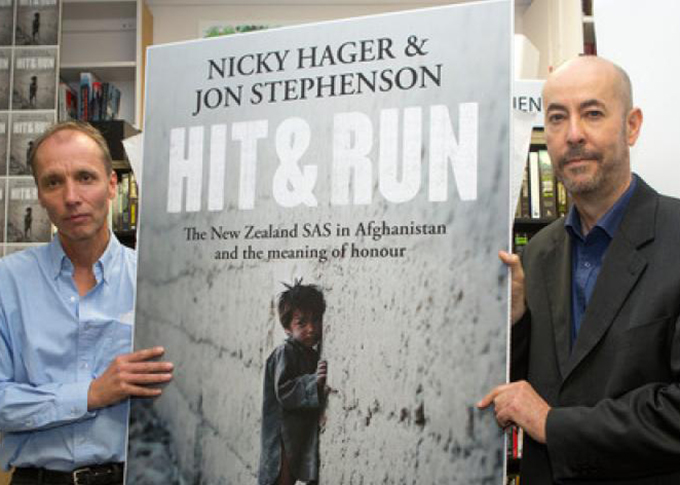
    After the NZDF press conference, Nicky Hager said that the authors stood by the whole story and that at most the NZDF denials might mean that the events in the book occurred two kilometres from where we thought they were, ie. a slightly different location in the isolated mountain valley.

    We have checked the NZDF maps shown at the press conference and it appears the location of the raid and the villages is indeed slightly different to what our local sources told us. But the villages at that location are definitely called Naik and Khak Khuday Dad, and all the rest of the story in the book is unchanged.

    Likewise the photos in the book of the villages attacked in the raid are correct, as are the photos of the victims and destroyed houses.

    The Defence Force leapt on this and tried to sow doubt about the rest of the book. Keating said the “central premise” of the book was incorrect; that there were “major inaccuracies – the main one being the location”.

    But the location is a minor detail, difficult to establish in mountains with no roads or detailed maps (there are no known maps of the valley that include the locations and names of the villages along it).

    Contrary to what Keating said, the central premise of the book is that the actions of the SAS and its allies in the villages of Naik and Khak Khuday Dad led to civilian deaths and injuries, destruction of houses, neglect of wounded people and then a cover up – and none of that has changed.

    4. The NZDF has now replied to the allegations in the book: INCORRECT

    The defence force has not replied to most allegations in the book. Most strikingly, Keating’s presentation did not address the deaths and injuries suffered by children, mothers and elderly people who were obviously not insurgents – which are the most important allegations in the book.

    Three-year-old Fatima, one of the alleged civilian casualties in the 2011 Afghanistan raid by NZ SAS soldiers. Image: Hit & Run

    The allegations that the defence force has avoided or answered inadequately to date are:

    • SAS-controlled attack helicopters fired at civilians in Khak Khuday Dad village with many casualties, including the three-year-old child Fatima;
    • SAS snipers appear to have shot at least one civilian, a recently graduated school teacher home on holiday;
    • SAS-controlled attack helicopters pursued two farmers who opposed the Taliban along the valley and killed them;
    • Twelve houses were destroyed despite there being no military necessity to do so;
    • No assistance was given to the wounded at the time, including in houses that Defence now says it knew might have contained civilians;
    • Nor did the SAS go back to render assistance later, despite knowing that civilians were likely to have been injured;
    • The SAS returned for a second raid on the village Naik and blew up a house or houses;
    • A bound and blindfolded prisoner was beaten by an SAS trooper while his colleagues looked on and did nothing;
    • The prisoner was then handed over to the Afghan secret police who were known to have a notorious reputation for torturing prisoners;
    • That prisoner was then tortured by the Afghan secret police and when the defence force learned about this it kept it secret;
    • The SAS arranged the extra-judicial killing of some other insurgent suspects; and
    • The NZDF repeatedly denied and covered up what the SAS have done, and continue to do so to this day.

    5. An ISAF investigation has already occurred, there is no need for another inquiry: A WEAK SELF-SERVING ARGUMENT

    First it is important to explain about the investigation done in August 2010 by the International Security Assistance Force (ISAF) coalition headquarters, which was cited repeatedly during the NZDF press conference. In 2010 the subject of civilian deaths was very sensitive in Afghanistan and so ISAF was attempting to investigate all suspected cases of civilians being killed by ISAF forces. But these “assessments” were very far from being full or independent.

    The ISAF investigation into the 22 August 2010 raid was completed in less than a week and did not involve anyone going to the area or talking to the affected villagers. It included a review of attack helicopter weapons system video and concluded that several “errant rounds”, caused by a gun sight malfunction, “may have resulted in civilian casualties”.

    However reports from SAS members and local people interviewed for the book describe multiple heavy attacks that wounded and killed civilians in different locations. Thus the hastily-conducted ISAF review appears far from being adequate. It is silent on most of the allegations in the book.

    There is no need for New Zealand to rely on the brief and inadequate ISAF review. Most of the information needed to confirm whether or not the allegations in the book are correct is located here in New Zealand, in the SAS files. The best option is an independent inquiry where this information can be gathered and assessed.

    6. Keating said the insurgents may have used civilians as human shields; aircraft video showed insurgents were killed; the conduct of the New Zealand ground forces was “exemplary”; and so on: UNSUBSTANTIATED CLAIMS AND SELECTIVE INFORMATION

    Much of Keating’s presentation was unsubstantiated assertions. This does not help the public find the truth since the defence force has an obvious interest in avoiding bad news about itself. He also said that the book claimed the SAS “deliberately killed civilians”, which we did not say. If we are correct that bad things are being covered up, we cannot expect the people at the heart of the cover up to provide impartial information.

    Once again, this means that the only acceptable option is a full and independent inquiry.

    7. Lieutenant General Tim Keating told the press conference: “The ground force commander was an NZSAS Officer who controlled both the ground activities and provided clearance, after the appropriate criteria had been met, for any involvement of the aircraft. These elements were co-ordinated by an air controller in his location.” CORRECT AND IMPORTANT INFORMATION

    Chief of Defence Force Lieutenant-General Tim Keating at Monday’s media conference. Montage: The Daily Blog

    This statement contradicts earlier statements by the government (in 2014) where ministers suggested that if there had been any civilian deaths they were the responsibility of the US pilots, not the New Zealand SAS. It confirms what we said in the book: that the SAS commanders in charge of the raid have responsibility for deaths and injuries caused by the US attack helicopters, which they controlled and had requested to be part of the raid.

    8. Finally, Keating told the press that there were legal complications for having an inquiry: INCORRECT

    This is not correct. We are not proposing an inquiry by the Defence Force about itself. The government has the power to launch a full and independent inquiry at any time. We believe the NZDF is trying to avoid a full and independent inquiry precisely because some officers are scared of what it will show. But the issue will continue to fester, as it has for years, until that happens.

    ]]>

    Educator calls for less ‘tick-box teaching’ and more creativity

    ]]>

    AsiaPacificReport.nz

    Professor Welby Ings … talking “disobedient thinking” at TedxAuckland in 2013, some of the ideas underpinning his new book. Video: TedxTalks

    Despite being expelled from secondary school and suspended from teachers college, AUT Professor Welby Ings’ new book is about a lifetime of inspirational teaching.

    Professor Ings … challenges “dehumanised learning”. Image: AUT

    Disobedient Teaching: Surviving and creating change in education was launched at Auckland University of Technology tonight.

    Professor Ings says he wrote the book because he has for a long time questioned the “dehumanised systems of learning” and New Zealand’s preoccupation with micromanaging teachers.

    “In the book, I question the obsession we have with assessing performance, and argue for higher levels of creativity in learning, teaching and educational management,” he says.

    Disobedient Teaching takes a stand against our national obsession with testing and reporting. It calls for higher levels of teacher agency and learning that operate away from the restrictions of performance indicators, predetermined criteria and tick-box teaching.

    Professor Ings argues that “positive disobedience” is a fundamental teaching behaviour among successful practitioners, and the ability of excellent teachers to change learning and learning environments is predicated on it.

    -Partners-

    His book examines creativity, assessment, passion, our obsession with “success”, and how teachers influence change. To do this it tells stories from the chalk face. Some are funny and some are heartbreaking, but they all happen in New Zealand schools.

    Disobedient Teaching suggests that the essence of what makes a great teacher is the ability to stand up to, and change educational practices that have been shaped by “anxiety, ritual and convention”.

    In the face of New Zealand’s increasing and uncritical political obsession with accountability and reporting, his book argues the transformative power of teachers who think, critique, defy and act.

    ]]>

    New Greenpeace vessel key to ‘do or die’ battle against oil industry

    ]]>

    AsiaPacificReport.nz

    By Kendall Hutt

    In light of news of President Donald Trump’s executive order today — undoing integral climate change policies implemented under former President Barack Obama — Greenpeace New Zealand has brought forward the timetable for its new boat.

    Greenpeace New Zealand’s executive director, Dr Russel Norman, says the boat, recently named Taitu, will aim to be out on the water next week.

    “The naming ceremony is on Saturday, so we’re hoping to head off sometime after that. It’s all weather dependent.”

    Norman would not give an exact date when pressed, however, in order to preserve the element of surprise.

    “Of course, we’re not going to reveal all of our tactics.”

    Norman says Taitu, formerly the MV Friendship, will be used to confront the Amazon Warrior, and therefore big oil, led by the “CEO of the global oil industry” – Trump.

    -Partners-

    Norman explains this is because we are “in a war for the survival of humans and civilisation”, a ‘war’ Greenpeace “takes extremely seriously”.

    “It’s so we, our kids, the people of the Pacific, have a future.”

    ‘First mission’
    The world’s largest seismic surveying vessel, the Amazon Warrior is currently in New Zealand searching for oil.

    Greenpeace campaigner Steve Abel echoes Norman’s statement, saying Taitu’s “first mission” is to confront the 125-metre ship, here on behalf of international oil giants Statoil and Chevron.

    “The main thing we’re focused on right now is the immediate oil campaign.”

    The Amazon Warrior is currently surveying the Wairarapa to Wellington Basin, and does so by blasting the sea floor every 8 seconds with compressed air guns.

    At 200 decibels per blast, Greenpeace has raised concerns about the effects on whale and dolphin populations in the area.

    Abel says it is therefore important to “get out there”.

    “It’s really important for us to send that message that that exploration is not welcome here and those guys have been out there for weeks and months now seismic blasting the ocean, which both torments whales and dolphins, but also they’re looking for oil we can’t afford to burn.”

    The newest member of Greenpeace’s fleet, Taitu … purchased through crowdfunding. Image: Nick Young/Greenpeace NZ

    The newest member of Greenpeace’s fleet, Taitu was bought last week after supporters crowdfunded $100,000 in just 7 days.

    Greenpeace received around 3000 suggestions for a new name after it put out a call for public submissions, with the country voting on a final three up until around 1pm today.

    ‘The People’s Boat’
    Abel says the purchase of the boat entirely through crowdfunding and ‘people power’ reflects an important part of its identity and makes the nickname ‘The People’s Boat’ apt.

    “It’s a real affirmation of public support for what we’re doing and it also shows how passionate New Zealanders are about looking after our oceans and our coastlines and our environment in general.”

    Abel says the 15-metre kauri-hulled boat has led a relatively quiet life until now, although much of its 81-year history remains relatively unknown.

    “It must have done all sorts of things and we’ve still got to find out exactly what all of those things are. We’re getting bits and pieces of information from everywhere.”

    Abel says Greenpeace is therefore still “piecing together the history”, but does know it was a postal delivery boat in Queen Charlotte Sound, ferrying mail and people around the Sound.

    Greenpeace also understands the MV Friendship may have worked as a pilot boat in Wellington, guiding larger ships into port, as it was built as a pilot boat for the Marlborough Sounds.

    Tradition, legacy
    The purchase of the vessel also marks a bit of a Greenpeace tradition, Abel says.

    “What it means to us, I guess it’s a boat in the strong Greenpeace tradition of getting old boats and repurposing them.

    It’s incredibly exciting to have a boat like this as part of the Greenpeace New Zealand fleet. We figured we need to have our own boat down here.”

    Painting the rainbow on the new Greenpeace fleet member – Taitu. Image: Nick Young/Greenpeace NZ

    Former original Rainbow Warrior first mate Martini Gotjé says this is a first for Greenpeace New Zealand.

    “It’s not very often a national office buys its own boat. It’s new, especially for New Zealand.

    “It’s good to see.”

    Both Abel and Gotjé hope to see Taitu have a legacy, like the Rainbow Warrior before it.

    “Any Greenpeace boat has to build up its legacy,” Gotjé says.

    “The legacy goes both ways I think. It both taps into tradition, an incredibly proud and successful tradition of campaigning in New Zealand to become a nuclear free beacon of hope.

    “I think the legacy is one of public participation and caring for our environment, our planet, and really to any degree this boat can assist us in successes for the greater good of the planet and society, then that becomes this boat’s legacy.”

    Abel adds: “I sincerely hope this boat succeeds in helping us with this legacy.”

    Kendall Hutt is Pacific Media Watch contributing editor of the Pacific Media Centre. She also works for Greenpeace in a part-time capacity.

    ]]>

    Keith Rankin Analysis: Historical Population of the United Kingdom: 43 to 2013

    ]]>

    Analysis by Keith Rankin.

    The demography of the United Kingdom, the tangata whenua of Ngāti Pakeha, is of interest to all of us. I caught this chart (from chartsbin.com/view/28k), but it uses the wrong scale, as far too many of our published charts do these days. This scale problem is most significant with charts covering long time periods, and it leads to an exaggeration of the importance of recent data.

    My chart uses the same data (extended to a population of 64 million in 2013), but uses a log-2 scale. This means that it shows doublings of population, rather than five-million-person increments.

    Many demographic blips are missed in the early centuries, because estimates are very far apart. For example, it is likely that there was a significant population fall after the Romans left Britain in the fifth century.

    What we do see is an acceleration of population growth in the (known-to-have-been) warm centuries at the beginning of the second millennium, followed by a huge decline mid-fourteenth century. This decline was the Black Death, which some of us will remember as the initial setting for Vincent Ward’s 1988 New Zealand time-travel Odyssey, The Navigator. (This movie might be due soon for a scheduling on Māori TV.) This plague is widely understood to have been a Malthusian crisis in Europe, an event triggered by pathogens arriving from Asia, but ultimately due to a mix of climate change and overpopulation relative to the economic capacity of the era.

    The next population rise represents the impact of the transition to capitalism, the renaissance, and the first period of globalisation which began in the late fifteenth century. This higher growth rate continued in the United Kingdom until about 1800, interrupted mainly by the Civil War of the 1640s. It was in 1798 that Thomas Malthus published the first edition of his seminal ‘Essay on the Principle of Population’. This was in response to a widely-held viewpoint that population growth – virtually unlimited at then historical levels – was sustainable and beneficial to economic progress.

    On the face of it, Malthus’ timing was very bad. Population growth accelerated sharply over the next decade or so, the early years of the industrial revolution. There are three main reasons for this acceleration. First, the growth of fossil fuels, as coal displaced (depleted) wood as an energy source. Second was the widespread adoption of the potato, a product of globalisation that originated in South America. Third was the incorporation in 1800 of Ireland into the United Kingdom.

    In the middle years of the nineteenth century – the 1840s in particular – the United Kingdom experienced its second main Malthusian crisis of the millennium. The potato famine in Ireland combined with pandemics of cholera and tuberculosis in England, peaking in 1848 (although tuberculosis remained the number one scourge well into the twentieth century).

    Recovery from Malthusian doom was due, this time, to the huge expansion of land inhabited by British (and other European) people. It was the beginning of the growth of the Neo-Britains such as New Zealand; the growth of the ‘anglosphere’. This expansion of British settlement helped population to grow rapidly within the United Kingdom. Food became much cheaper during this second era of globalisation, dating in essence from around 1850. Traditional large families suffered fewer deaths after 1850, and the British were much slower than the French to adopt contraception.

    The chart shows that, in the United Kingdom at least, population growth slowed substantially in the twentieth century. World War 1 was part of this; indeed, it could be argued that this war was the third great Malthusian crisis of the second millennium. Overpopulation relative to global carrying capacity in the 1910s was very real, as the gains to British people from British expansion were surpassing their natural limits.

    From the 1920s we had the new opportunities offered by electricity, oil and natural gas, antibiotics, and chemical syntheses of products that mimicked natural ones. (Important here in a New Zealand context is the role of topdressing fertiliser on pastoral farmland.) The result was another substantial increase in the carrying capacity of the world, including the United Kingdom.

    Many of us sense that the next Malthusian crisis may be only a decade-or-so away. The good news is that the economic, accounting and technological ideas that may lead to the next post-Malthusian recovery are also present in today’s ‘outsider’ intellectual environment. The lesson of history, however, is that humankind will probably need to experience a substantial economic and demographic crisis before necessary solutions are actually adopted. During the 2020s, wilful blindness and alternative falsehoods will continue to prevail.

    ]]>