Page 1208

Indonesian nun offers lifeline to refugees who fled Timor-Leste

]]>

AsiaPacificReport.nz

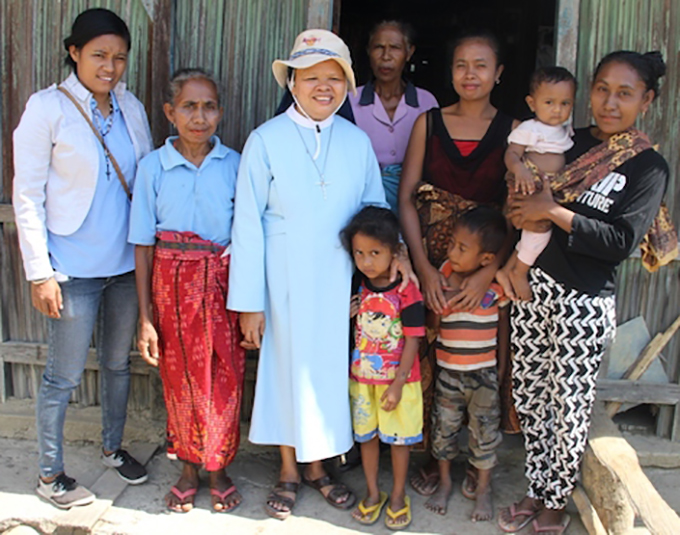
Holy Spirit Sister Sisilia Ketut with a group of women to whom she loaned money to start small businesses in Atambua, Western Timor. Image: ucanews.com

By Konradus Epa in Atambua, Indonesia

Rostiana Bareto experienced tough living conditions as a refugee when she and her family settled in Atambua, western Timor, on the border with Indonesia.

Despite the fundamental challenge of making ends meet, 49-year-old Bareto and her husband decided to stay and avoid the political instability back home.

More than 250,000 people fled Timor-Leste or were forcibly transferred west following violence that escalated around an independence referendum, August 30, 1999.

The initial attacks on civilians by anti-independence militants expanded to general violence throughout the country.

Many returned to Timor-Leste after the declaration of independence in 2002. But about 100,000 people chose to continue their lives in East Nusa Tenggara province, including 60,000 people in Belu regency.

Since her arrival, Bareto, now widowed, has not received any assistance from the government, causing great frustration for her family and many others living in similar conditions.

Their lives began to change when they met Holy Spirit Sister Sesilia Ketut. Seven years ago the nun gave Bareto some money to start her own cloth-weaving business. Working in a group of widows she learned to weave and cook, and make bags, rosaries, flowers and wallets, which were then sold to markets.

-Partners-

Weaving every day
“Every day our job was weaving and we never stopped, although the products were sold at a cheap price,” said the mother of six.

Rostiana Bareto, a former East Timorese refugee, weaves and Holy Spirit Sister Sisilia Ketut. Bareto’s daughter stand behind her in Atambua, western Timor. Image: ucanews.com

Now, more than 300 widows – whose husbands either died before or after the 1999 conflict – are receiving help from the 59-year-old nun.

Sister Ketut said she decided to work with the widows because she felt moved by their suffering in the early days when they first sought shelter in western Timor.

To help those in Belu regency, Sister Ketut established the Forum for Women and Children in 2000. The forum continues its operations today providing aid to the people in cooperation with non-government organisations such as the Jesuit Refugee Service, UNICEF and Save the Children.

They provide critical support services to domestic violence and rape victims and deliver much-needed education.

Lourdes Clara Dedeus, 23, a former refugee from Timor-Leste who became a volunteer for the forum in 2013 said she helped Sister Ketut because of her noble service to the people.

“I was educated by the nun,” Dedeus said and now she accompanies the nun in helping victims of domestic violence and rape.

Trained in business
According to Sister Ketut, besides helping the widows, she also trains other former refugees in business and education and helps them to reconnect with their relatives back home.

Each year, she offers loans with low interest to more than 30 former refugees. Sadly, only a few people succeed, while others spend the money on parties and other non-essentials.

“Most of them cannot return the money,” she said. “So there’s a need to train them in business.”

In the early years, many children born to former refugees had no access to school in the settlement areas. This inspired the nun to establish early childhood education and development services. “We started the school under trees because there were no facilities,” she said.

When Save the Children joined the fold in 2010, a school house was constructed. Now there are two schools that accommodate more than 60 children.

Yosep Benediktus Lake, chairman of a school committee, said each family has five to eight children and most of them do not go to school.

“The sister has helped the children free of charge but many parents were unaware of the importance of education for their children,” he said.

Reconnecting in Timor-Leste
Every year, dozens of former refugees return to Timor-Leste, and since 2000 the nun has facilitated the return of more than 400 people to their homeland.

“We accompany them until they reunite with their families and they are welcomed with custom rituals and parties,” she said.

But lately, the number of those repatriating to Timor-Leste has decreased due to the high US$384 (NZ$520) fee for administration costs and the long waiting times for passports to be issued.

Bishop Dominikus Saku of Atambua gave high praise, saying “I see her service is good for the former East Timorese refugees and I support her.”

Bareto, who is the head of a community unit, said the local government has also expressed its gratitude to Sister Ketut for her extensive work and commitments to the former refugees.

]]>

€4.5m plan to build El Niño resilience in FSM, Marshall Islands and Palau

]]>

AsiaPacificReport.nz

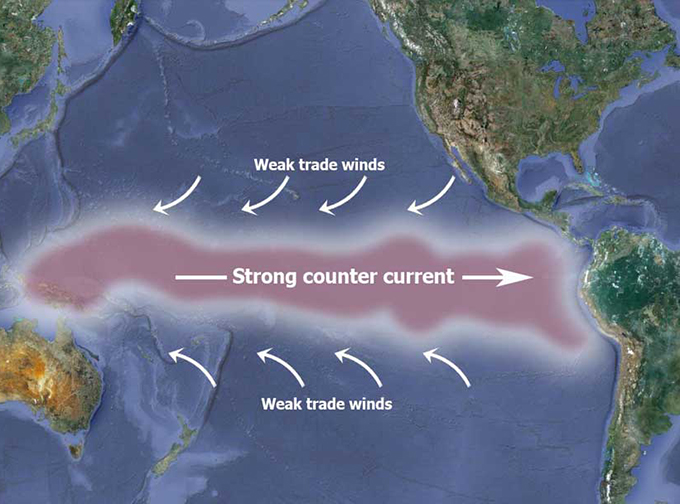
During an El Niño Southern Oscillation, the pressure over the eastern and western Pacific changes, causing the trade winds to weaken. This leads to an strong, eastward counter current of warmer waters along the equator. Map: Google Earth

Pacific Media Centre Newsdesk

The European Union and the Pacific Community have signed an agreement to build resilience to future El Niño-related droughts in the Federated States of Micronesia, Republic of Marshall Islands and Republic of Palau.

At the end of 2016, the EU confirmed its decision to mobilise €4.5 million (NZ$7 million) from the European Development Fund (EDF) global reserve for the Federated States of Micronesia, the Republic of the Marshall Islands and the Republic of Palau to build resilience for future El Niño events.

This is in recognition of the severe impacts of the 2015–2016 El Niño-related drought in the three Northern Pacific countries, especially in the outer islands, when disruptions to agriculture, tourism and industrial production caused severe economic losses, many households faced food and water shortages, and the provision of health and education services was severely impacted on.

The Head of Infrastructure and Natural Resources at the Delegation of the EU for the Pacific, Jesús Lavina, said: “The EU is committed to support the Pacific countries to face the negative impact of climate change. Extreme events, such as the 2015-2016 El Niño, severely affected the Pacific region: the EU works together with partner governments and regional organisations to answer in a timely manner their urgent needs.

“The European Union North Pacific Readiness for El Niño project is a clear example of EU commitment that covers a large range of EU-funded actions to strengthen resilience and promote climate change adaptation and mitigation measures.”

The Pacific Community (SPC) is implementing the project and is preparing to hold consultations with the North Pacific countries to design activities that will build resilience to future droughts in the water and agriculture sectors.

-Partners-

The Director-General of the Pacific Community, Dr Colin Tukuitonga, said: “We are very pleased to help build capacity in the three Northern Pacific countries to strengthen resilience and readiness for future El Niño-related droughts, which past experience has shown caused so many hardships for all residents, both those living in towns and those in rural communities.”

The 2015 – 2016 El Niño event was one of the most severe on record, comparable with the 1997-1998 and 1982-1983 events, and impacted millions of people around the world including in most of the Pacific Island countries.

According to the Australian Bureau of Meteorology, the tropical Pacific Ocean is in a neutral phase with neither El Niño or La Niña expected to influence the climate this year.

]]>

NZ protesters bring ‘human face’ to suffering of Manus, Nauru refugees

]]>

AsiaPacificReport.nz

By Kendall Hutt in Auckland

Forty minutes of solidarity marked New Zealand’s stand with refugees imprisoned in Australia’s offshore detention centres across the Pacific today.

More than 60 people stood outside Australia’s Auckland consulate to protest over more than 1000 refugees stuck in limbo in processing centres likened to open-air prisons.

“The Australian government’s policies are inhumane, so we want to highlight the human. That the impact of Australia’s ill-treatment of people seeking asylum and refugees amounts to torture, but remind people that these refugees are humans too,” said Margaret Taylor, Amnesty New Zealand’s activism support manager.

“We’re humans standing out here to put a human face to the torture and highlighting how inhumane Australia’s policy is.”

Amnesty New Zealand’s Auckland spokesperson Meg de Ronde told Asia Pacific Report before the protest this morning:

“We’re sending a clear message to the Australian government that after four years the offshore detention centres have to close.

-Partners-

“The men, women and children who are on Manus and Nauru have to be evacuated now. We have more than 8000 New Zealanders who believe human rights abuses need to end,” de Monde said.

Two girls have a warm welcome for refugee children. Image: Megan Hutt/PMC.

8000 signature petition
In Wellington, more than 40 people also stood in solidarity while a petition with more than  8000 signatures was delivered to the Australian High Commission in a sister event also organised by Amnesty International New Zealand.

Since 2013, Australia has controversially and forcibly deported asylum seekers who have attempted to arrive in the country via boat to Manus and Nauru islands.

Therefore for four years, Amnesty International says, some of the “most vulnerable people in the world” have been subject to human rights abuses – physical abuse, sexual assault, poor living conditions – at the hands of Australia’s government.

De Ronde says the purpose of this morning’s protest was to ensure Australia has not forgotten the human rights abuses it is carrying out in its own backyard.

“We hope they’ll hear New Zealanders haven’t forgotten that for four years Australia’s been holding people on Manus and Nauru, people that have a right to be resettled and have a right to flee and seek safety.”

It is Australia’s reported human rights abuses which drew people of all walks of life to the protest.

Armed with placards calling for the closure of Manus and Nauru’s centres, the group of men, women and children silently protested outside the consulate while passing motorists tooted their horns in a show of support.

‘Ridiculous’ detention centres
Alex O’Connor of Lush Cosmetics said it was “ridiculous” detention centres even existed.

“I think it’s just ridiculous they still have these detention centres when there’s all these human rights abuses happening.

“I also think it’s just ridiculous that people don’t have access to basic human rights when they’re fleeing war-torn areas.”

Marika Czaja is so disappointed in Australia’s refugee policy she intends to return her citizenship papers.

“I’m going to say ‘no thank you’. I don’t want to be part of it, not in my name.

Australian citizen Marika Czaja … “not in my name”. Image: Kendall Hutt/PMC.

“I’ve got no option but to protest. One of the more powerful countries in the world is boasting how it took in half a million or so refugees after World War II and now they can’t take in a few thousand. It’s just despicable. I really haven’t got the words to explain how I feel about it all,” Czaja said.

The youngest protester was four-year-old Atlas Geronde.

‘Issue for everyone’
His father, Edwin Geronde, said the detention centres on Manus and Nauru were an “issue for everyone”.

“We feel for what it must be like for people with children stuck in some of these concentration camps and I think everyone needs to understand that it could be them one day too, so they’ve got to stand up against what’s going on.”

Echoing earlier calls by Amnesty New Zealand executive director Grant Bayldon, Geronde called on New Zealand to condemn Australia’s actions and remain firm in its commitment to resettle 150 refugees a year – a commitment Australia is currently reluctant to indulge.

Edwin Geronde and his five-year-old son Atlas … “this is an issue for everyone”. Image: Kendall Hutt/PMC.

“New Zealanders – neighbours of Australia – need to stand up in this region as the voice of what needs to be done.

“I hope the Australian government understands that they’re out of step with the rest of the world and what they’re doing is simply wrong and it’s against international law.”

Takapuna Grammar students Alba Garcia and Anna Jacobs were also some of the protest’s younger participants.

They told Asia Pacific Report the proximity of the issue to New Zealand was “shocking”.

Close to home
“It has just kind of shocked everyone how close it is to home,” Jacobs said of her school’s Amnesty Club.

“Everyone needs to be aware of it because it’s not very far away from us,” Garcia added.

But in calling for the closure of Manus and Nauru on the streets of Auckland today, de Ronde thanked protesters for not forgetting the islands’ refugees, but also encouraged them to make New Zealand politicians and political parties more aware of the issue.

“Ask our Prime Minister, our government in this election year to carry these messages.”

Joining hands in solidarity may have marked the end of the protest today, but with Broadspectrum’s contract up in October – the company responsible for administering the offshore processing system – protest to these centres is sure to continue, Amnesty said.

Krishna Narayanan, a food science student with the University of Auckland, is certain widespread protest will continue until Australia reverses its policy on Manus and Nauru detention.

“Refugees are just locked up and they feel incredibly isolated and depressed. They escaped war and tried to come to a place of safety, but they’re not safe.”

My message to those inside the Australian consulate here and Australia’s government is accept refugees or at least let other nations accept them.

“Don’t cover this up.”

Protesters join hands, link arms in a show of solidarity. Image: Kendall Hutt/PMC ]]>

Indonesian woman in Saudi Arabia unpaid for 22 years – wins $44,000

]]>

AsiaPacificReport.nz

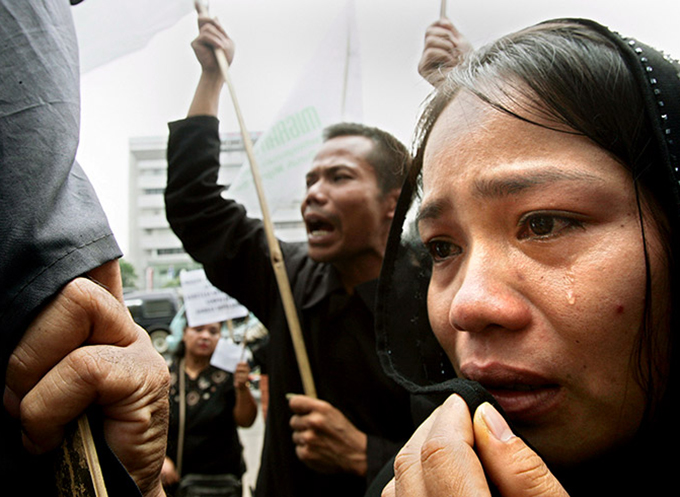
An Indonesian migrant worker cries during a protest in front of the Saudi Arabian embassy in 2007 in Jakarta, Indonesia, during which a dozen migrant workers urged Saudi Arabia’s government to punish the killers of two Indonesian workers. Image: Jurnasyanto Sukar/EPA

By Euan Black in Jakarta

An Indonesian woman who worked in Saudi Arabia for 22 years has been paid for the first time after being escorted home by an Indonesian state-run agency that had been alerted to her case by concerned family members, according to Coconuts Jakarta.

Sukmi bint Sardi Umar had been working in the Middle Eastern country since 1995 when she was 18 years old.

After her family did not hear from her from her for years, they brought her case to the state-run Center for Manpower Domestic Worker Protection and Placement Service (BP3TKI), which was able to locate Sukumi with the help of the Indonesian embassy in Riyadh.

Upon finding Sukmi, they learned she had not yet been paid for her 22 years of work. After negotiations with her employer, the Indonesian government agreed to a $44,000 (NZ$60,000) payout for Sukmi – the equivalent of $166 per month in back pay.

While the details surrounding Sukmi’s case have yet to be revealed, Gatot Hermawan, the head of BP3TKI, told reporters trying to interview her at Jakarta’s Soekarno-Hatta Airport last Saturday that her time in Saudi Arabia had left her “depressed” and with “communication problems”.

It is the latest in a series of cases of Indonesian migrant workers being kept in conditions that have been likened to “virtual slavery” by the US-based Human Rights Watch.

-Partners-

Migrant workers struggle to escape such abusive conditions as their employers often withhold their passports or threaten them with jail once they have overstayed their visas – a real danger due to the country’s kafalah system, which ties workers’ visas to sponsorship from their employers.

In 2015, the Indonesian government banned domestic workers from working in 21 Middle East countries, including Saudi Arabia, after two Indonesian maids were executed by the  conservative Islamic country for murder without any prior consultations with Jakarta.

But the blanket ban was met with fierce criticism from rights groups who said that far from eliminating the practice of Indonesians working abroad, it would drive the industry underground, making it even more difficult to protect the rights of domestic workers.

Yet the ban, which respected pre-existing arrangement or contracts, remains in place.

]]>

Investigative journalism – from the NZ wars to Pike River

]]>
Evening Report
Evening Report
Investigative journalism – from the NZ wars to Pike River
Loading
/

AsiaPacificReport.nz

A Moral Truth … investigative journalism is in good heart despite the difficulties being faced by media companies.

BOOKS: By Jeremy Rose of RNZ Mediawatch

It’s often been said there are just seven stories in all of literature. If a new collection of a 150 years of investigative journalism in New Zealand is any guide, investigative journalism has even fewer.

http://podcast.radionz.co.nz/sun/sun-20170716-0910-investigative_journalism_from_the_nz_wars_to_pike_river-02.ogg


A Moral Truth: 150 years of investigative journalism in New Zealand
opens with an extract from Te Hokioi, which the book’s editor, James Hollings, describes as the first truly independent Māori newspaper. The paper’s editor, Wiremu Patara Te Tuhi discovered on the eve of the Waikato Wars in 1863 that a large new “school” built by the government well within the King Country’s borders was in fact a military fort.

James Hollings outside the hangman’s house in Thorndon, Wellington Image: Jeremy Rose/RNZ

It was a case of a government and its military speaking the language of peace but involved in the machinations of war; a story that will be familiar to those who have read this year’s Hit and Run by Jon Stephenson and Nicky Hager.

James Hollings says Te Tuhi’s story has all the elements of good investigative journalism.

“It brought hidden facts to light, it verified those facts, it put those facts to the authorities at the time and questioned them. It was a remarkable piece of journalism.”

Another remarkable piece of journalism is Truth’s 1911 campaign to save the life of Tahi Kaka – a youth who the crusading newspaper was convinced had killed in self-defence but had been convicted of murder. There are discomforting echos of the Teina Pora story, which also features in A Moral Truth.

During its campaign to save Tahu Kaka, Truth revealed the identity of the nation’s hangman: Steven John Smart, of 10 St Mary’s St, Thorndon, Wellington.

-Partners-

Bricklayer was hangman
Being a hangman was a part-time gig and Smart worked as a bricklayer for the Wellington City Council. Truth reported that his continued employment became untenable once his co-workers discovered his role as the country’s part-time hangman and he was fired on the grounds that he hadn’t been entirely truthful about his absences.

Truth continued to campaign against the death penalty right up until it was finally abolished in 1961. And one of the most graphic and moving chapters in the book deals with the execution of Albert Black in 1955. The story is told with clinical detail. And the reader can’t but sympathise – not only with Albert Black but the Sheriff of Auckland who is unable to carry out the hanging due to having had a nervous breakdown following the previous two hangings.

“Careful planning goes into preparing a man who is to be hanged,” Truth wrote. “The idea is that he should be as a rigid log of wood as possible when he is dropped.

“For this reason he is dressed in a stiff canvas coat, and steps out of his own shoes into a pair of heavy boots.”

Individual miscarriages of justice account for 10 of the 33 chapters in A Moral Truth: 150 years of investigative journalism in New Zealand. Many of them will be familiar to New Zealand readers, Arthur Allan Thomas, David Dougherty and Louise Nicholas to name just a few.

Pat Booth’s dogged investigation revealed that the police had framed Thomas by planting a bullet casing in his garden. Incredibly, all these years later Arthur Allan Thomas is still waiting for an apology from the police.

So is there a danger that investigations into the likes of the Arthur Allan Thomas case end up being viewed by the public as real life whodunnit stories rather than examinations of systemic failures and sometimes outright crimes committed by those charged with upholding the law?

Dirty dairying
James Hollings doesn’t think so. “You can argue till the cows come home with people about what is the theoretical problem or the systemic problem but people don’t really notice or listen until you put a particular example in front of them.”

And speaking of cows, dirty dairying seems like a very 21st century story. The New Zealand of the 1970s is generally remembered as the a land of 70 million sheep with dairy cows as bit extras.  The recently formed green movement largely concerned itself with the chopping down of the country’s native forests.  But in 1972 Jim Tucker, then the chief reporter on the Taranaki Herald, spent six months walking around the region exposing the country’s most “dishonourable discharges” (to pinch the title of the chapter of the book dealing with Tucker’s work.)

Forty five years later Jim Tucker is working on a follow-up to that story.

And the damage caused by those seeking ever greater profits in under regulated environments continue to be a source of investigative stories. Rebecca Macfie is the author of Tragedy at Pike River: How and why 29 men died.

In the extract from the book republished in A Moral Truth, Rebecca Macfie shares the blame around for those 29 deaths:

“…a regulator that was submissive and unwilling to use the powers at its disposal; a board that was incurious, bereft of knowledge and experience of underground coal mining, and unable to see the symptoms of failure; management that was unstable, ill equipped for the environment, and incapable of pulling together all the piece of its own frightening picture, and a union that was marginalised and irrelevant.”

But what about the journalists? Was the fact that 29 men had to die before the gutting of the mining inspectorate became a political issue a failure of journalism?

“Yes that story was there to be told. And there was some quite live action on that story in the year or two before Pike blew up,” Rebecca Macfie says.

‘Kind of normal’
“In some ways I think we’d all got so used to deregulation and light-handed regulation by the late 2000s, that it was kind of normal. It wasn’t necessarily something that you would have seen as a problem for a brand new mining company like Pike was proposing to be.”

James Hollings, Jim Tucker and Rebecca Macfie all agree that investigative journalism is in good heart despite the difficulties being faced by media companies.

Rebecca Macfie says “There’s a lot of interesting work going on and in a lot of new places, like Newsroom, and a lot of the work that’s going on in the Herald – if you can only find it. If they didn’t just bury it on their website.”

And Jim Tucker adds: “There’s a lot of damn good journalism happening which suggests it’s more than just having resources. I think it’s an individual thing.”

Jeremy Rose is a Mediawatch and Sunday producer for Radio New Zealand.

]]>

O’Neill accepts outcome in spite of Morobe election losses to Pangu

]]>

AsiaPacificReport.nz

EMTV News interview with PNC leader Peter O’Neill after the Morobe defeats. Video: EMTV News

Pacific Media Centre Newsdesk

Despite losing four People’s National Congress (PNC) members to Pangu in open seats in Morobe, incumbent Prime Minister Peter O’Neill has accepted the defeats for his party.

O’Neill said people and leaders must respect the process as voters had spoken through the ballot, reports EMTV News.

The defeats have sent shockwaves through the party.

PNC lost deputy party leader and former Fisheries Minister Mao Zeming to Kobby Bomareo for the Tewae Siassi Open and former Housing Minister Paul Isikiel to Koni Igua in Markham.

Pangu Pati candidate Thomas Pelika also defeated incumbent MP and PNC candidate Benjamin Philip to win the Menyamya Open seat in Morobe, reports The National.

-Partners-

Pelika surged to victory in the 20th elimination after third-placed candidate Jacky Tyotipo was excluded from the race.

Pelika’s victory brings the number of seats won by Pangu in Morobe to four so far.

Party leader Sam Basil retained his Bulolo seat.

Pelika was declared Member-elect for Menyamya at by returning officer Nande Awape at the Menyamya station. He polled 12,125 after collecting 650 votes in the 20th elimination.

He polled 4027 votes ahead of Philip who had 8098.

Loop PNG reports that PNC’s Finschhafen MP Theo Zurenuoc has lost to Rainbo Paita.

]]>

PNG’s ruling party has 300,000 ‘ghost voters’ in election, claims analysis

]]>

AsiaPacificReport.nz

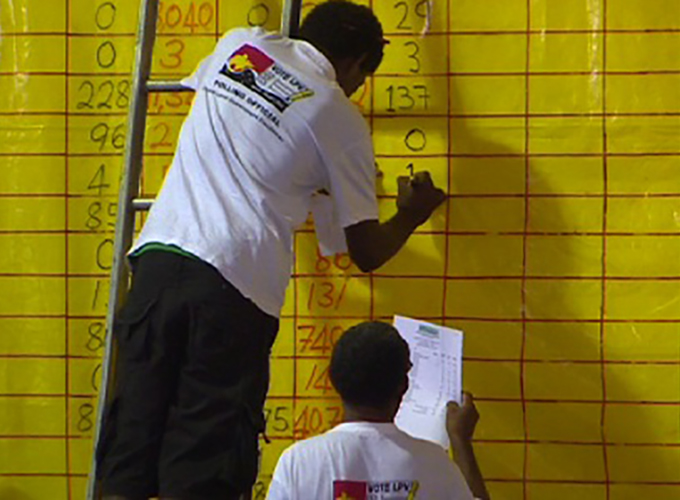
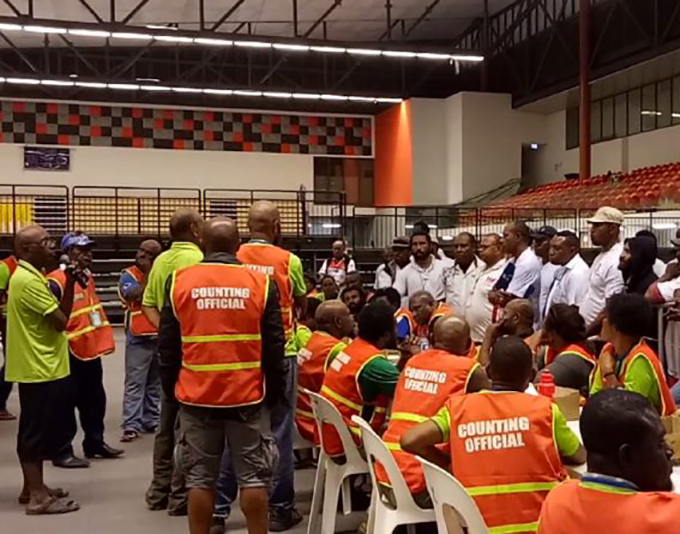
Counting at the Rigo Open seat at Kwikila in the Papua New Guinea general election this week. Image: EMTV News

Pacific Media Watch Newsdesk

Statistical indicators suggest the Peter O’Neill government in Papua New Guinea has used its power of incumbency to “cook the books” in its favour, claims a new analysis by the independent website PNG Economics.

Comparing the 2017 electoral roll with population estimates by electorate based on the 2011 census, the Electoral Commission has created nearly 300,000 “ghost voters” in O’Neill’s People’s Congress Party (PNC) controlled electorates.

“This is 5682 ‘ghost voters’ for every PNC sitting member. This is over 10 times the number of ‘ghost voters’ for non-PNC sitting members. PNC members are also being declared elected based on ‘mathematical impossibilities’,” the website said.

PNG Economics declares on its website that it provides “timely, accurate, frank and fearless advice”.

Key researcher of the website is Paul Flanagan who has a longstanding interest in public policy issues in Australia, PNG and the Pacifjc region. His 35-year public service career was evenly shared between Treasury/Finance and AusAID and he is director of Indo-Pacific Public Policy and Economics, a leading commentator on economic developments in PNG, and is a frequent contributor to the Devpolicy Blog.

“Papua New Guinea’s vibrant democracy, including its extraordinary diversity and combination of individual choice and clan loyalties, may still be able to overcome such electoral bias in favour of O’Neill,” said the economic analysis.

-Partners-

“This may depend on the Biblical and moral choices about to be made by new Independent members. May they choose wisely and morally, not just chasing the money politics of the PNC and its likely manipulation of the election, when they decide on PNG’s new government.
PNC’s army of ‘ghost voters’.”

O’Neill’s massive win
Just 14 of the 111 members of the new Parliament have been declared so far — including Prime Minister O’Neill with a massive 32,424 votes in his Ialibu-Pangia seat in the Southern Highlands — as counting continues after the two-week election that ended last weekend.

PNG Economics said that one “extraordinary indicator of electoral bias” was that O’Neill PNC supported electorates had — on average — an “extra” 5682 people on the electoral roll relative to their population.

Papua New Guinea’s “ghost voters”. Image: PNG Economics

The number of these “ghost voters” was more than 10 times larger than the average of 507 for non-PNC electorates, the website said.

“Overall, there were nearly 300,000 more people on the electoral roll in PNC electorates than the latest population census would suggest. This is much greater than the extra 20,000 in non-PNC electorates.

“It seems the cleansing of the 2017 electoral roll, assisted by Australia, was able to find nearly all the ‘ghost’ electors in non-government seats, but failed abysmally in seats held by the government.

Total “ghost voters” … “it seems the cleansing of the 2017 electoral roll, assisted by Australia … failed abysmally in seats held by the government.” Image: PNG Economics

“This is also a very sad comment on the quality of [the] Electoral Commissioner’s management of the election. Combined with his failure to maintain the confidence of the independent Electoral Advisory Committee, he should resign and give power to a more independent body,” PNG Economics said.

“This type of electoral bias has provided nearly 300,000 extra votes available to government electorates.”

As the election count continued — a key third stage of the four stage election process — there was still a great need for integrity from officials, scrutineers and police, PNG Economics said.

Key decisions ahead
“There are still key decisions ahead for the Electoral Commissioner and even the Governor-General. These decisions would be better informed if there was greater information sharing – this could help confirm the legitimacy of the election, the commentary said.

“Looking ahead, such analysis can also provide some benchmarks for hopefully making the 2022 election a much better and fairer election for whatever government emerges from this election.”

There was also a key stage for government coalition formation, the website said.

“As expected, no party will win an absolute majority. There is a clear coalition of parties that are anti-O’Neill, including former coalition partner National Alliance headed by the former Treasurer (who was sacked in part for exposing other budgetary games played by the O’Neill government on the debt to GDP ratio and economic growth – the type of games indicating a willingness for the O’Neill government to play games with the electoral numbers).”

]]>

The insecurity legacy of the Rainbow Warrior Affair: A human rights transition from nuclear to climate-change refugees

]]>

Pacific Media Centre

Figure 4: A scene on board the Rainbow Warrior with nuclear refugees bound for Mejato from the Eyes of Fire multimedia microsite project in May 2015. CREDIT: © DAVID ROBIE/NUCLEAR EXODUS VIDEO 1986

David Robie

Friday, July 7, 2017

Abstract

State-backed terrorism as exemplified by the bombing of the Rainbow Warrior, the Amsterdam-registered flagship of the Greenpeace environmental movement, on 10 July 1985 in New Zealand, and the assassination of pro-independence leaders and, allegedly, at least one journalist in French Pacific territories by secret agents or military officers in subsequent years, has left a legacy of insecurity. In July 2015, New Zealand marked the thirtieth anniversary of the bombing in a more subdued manner than a decade earlier. While there was considerable focus on a rehashing of the French spy drama from a narrow “how we covered it” perspective, there was little introspection or reflection on broader issues of regional security. For example, the sabotage of the environmental flagship was not addressed in the wider context of nuclear-free and independence movements active in New Caledonia, New Zealand’s near Pacific neighbour, or of nuclear refugees such as those from Rongelap Atoll, from where the Rainbow Warrior had relocated an entire community to a safer environment following United States nuclear tests in the Marshall Islands. At the time of the second anniversary, Le Monde exposed the responsibility of President François Mitterrand for Opération Satanique and later revealed much of the detail about the so-called “third team” of bombers. This paper examines the broader context of the bombing in the Pacific geopolitical challenges of the time and the legacy for the region, from a journalist’s perspective, as the region has moved from the insecurity of nuclear refugees to that of climate change refugees, or climate-forced migrants. The paper also contextualises a research and publication multimedia project by some forty student journalists in a university partnership with Little Island Press from the perspective of media and terrorism, deliberative journalism (DJ) and human rights journalism (HRJ).

Eyes of Fire – 30 Years On microsite

]]>

Dire year for journalists under state of emergency in Turkey

]]>

Pacific Media Centre

Backgrounder on the first anniversary of the failed coup in Turkey by the Reporters Sans Frontières team. The trial of 19 journalists and other employees of the republican daily newspaper Cumhuriyet will start in Istanbul next week. Pacific Media Centre is an associate of RSF’s Asia-Pacific media freedom research activity.

A year after an attempted coup, the level of media freedom in Turkey is abysmal, as the following assessment by Reporters Sans Frontières (RSF) shows. President Recep Tayyip Erdoğan’s government has used a state of emergency to step up a witch-hunt against critics. Turkish journalism is in a desperate situation.

A year ago, on 15 July 2016, the Turkish people managed to thwart a bloody coup attempt. But instead of reflecting the people’s democratic aspirations in its response, the government has carried out an unprecedented crackdown on the pretext of combatting those responsible for the failed coup.

The state of emergency declared five days after the coup attempt has allowed the government to summarily close dozens of media outlets. Turkey, which is ranked 155th out of 180 countries in RSF’s 2017 World Press Freedom Index, is now the world’s biggest prison for professional journalists, with more than 100 detained.

“We call on the Turkish authorities to immediately release all Turkish journalists who have been imprisoned in connection with their work and to restore the pluralism that has been eliminated by the state of emergency,” said Johann Bihr, head of RSF’s Eastern Europe and Central Asia desk.

“Prolonged arbitrary detention without reason and the isolation of detainees must be regarded as forms of mistreatment. Until Turkey restores real possibilities of legal recourse, we call on the European Court of Human Rights to issue a ruling as quickly as possible in order to end this tragedy.”

Prison first, trial later
The arrival of the first anniversary of the coup attempt at the weekend means that most of the detained journalists have marked the first anniversary of their arrest. But the indictments only began being issued in the spring and the big trials are only now starting to get under way.

The “justices of the peace,” the regime’s new henchmen, systematically order pre-trial detention and usually reject release requests without taking the trouble to offer legal reasons.

Thirty employees of the daily newspaper Zaman – 20 of whom have been held for nearly a year – will finally begin being tried in Istanbul on September 18. These journalists, who include Şahin Alpay, Mümtazer Türköne and Mustafa Ünal, are each facing three life sentences.

Their crime is simply having worked for an opposition newspaper that was closed by decree in July 2016. The indictment describes Zaman as the “press mouthpiece” of the movement led by Fethullah Gülen, the US-based Turkish cleric who is accused of masterminding the attempted coup.

This means they are charged with “membership of an illegal organisation” and involvement in the coup attempt. Orhan Kemal Cengiz, a lawyer and former columnist, is also facing life imprisonment simply for having acted as Zaman’s defence lawyer.

The release of 21 other journalists was blocked at the last moment on March 31 and the judges who had ordered their release were suspended.

The Istanbul prosecutor’s office provided the grounds for this U-turn by initiating new proceedings against 13 of these journalists – including Murat Aksoy and Atilla Taş – for “complicity” in the coup.

They are due to appear in court on 16 August on this additional charge as well as the previously existing one of membership of the Gülen Movement. Each of them is now facing the possibility of two life sentences.

The well known journalists Ahmet Altan, Mehmet Altan and Nazlı Ilıcak will have spent a year in detention when their trial resumes on September 19 in Istanbul. They are accused of transmitting “subliminal messages” in support of the coup during a broadcast. They and 14 other journalists who are co-defendants are facing the possibility of three life sentences plus an additional 15-year term.

In the provinces, conditional releases have slowly been granted to some journalists accused of complicity with the Gülen Movement. In Antalya, Zaman correspondents Özkan Mayda and Osman Yakut were released on May 24 after eight months in provisional detention.

But in Adana, Aytekin Gezici and Abdullah Özyurt, two journalists who are part of a group of 13 people accused of membership of the Gülen Movement, are still in prison. The trials continue in both cases, with the possibility of long prison sentences.

New spate of arrests
The trial of 19 journalists and other employees of the republican daily newspaper Cumhuriyet will start in Istanbul next week on July 24. Twelve of them, including editor Murat Sabuncu, columnist Kadri Gürsel, cartoonist Musa Kart and investigative reporter Ahmet Şık, have been held for the past seven to nine months. Charged with links to various “terrorist” groups because of the newspaper’s editorial policies, they are facing up to 43 years in prison.

But the harassment of this newspaper has not stopped there. On the grounds of a tweet deleted after 55 seconds, Cumhuriyet website editor Oğuz Güven is now facing the possibility of ten and a half years in prison on a charge of Gülen Movement propaganda. He was freed conditionally in mid-June after a month in pre-trial detention.

Sözcü, a national daily that is one of the few remaining government critics, is now also being targeted. Mediha Olgun, the news editor of its website, and Gökmen Ulu, one of its reporters, were jailed on 26 May for publishing an article on the eve of the failed coup about where Erdoğan was on holiday. They are charged with the “attempted murder of the president” and supporting the Gülen Movement.

Universal state of exception
The systematic use of pre-trial detention is not just applied in case of alleged complicity in the coup attempt. Not a week goes by without more arbitrary arrests of journalists. They include Tunca Öğreten and Ömer Çelik, who have been detained since late December in connection with their revelations about Erdoğan’s son-in-law, Energy Minister Berat Albayrak.

Documentary filmmaker Kazım Kızıl spent nearly three months in provisional detention in Izmir before being released under judicial control on July 10. Arrested while covering a demonstration, he was accused of “insulting the president” in his tweets.

The authorities have also used the state of emergency to silence the remaining critics on the Kurdish issue. The justice system, which is more politicised than ever, tends to treat anything related to this issue as “terrorist” in nature.

In the trials of participants in a campaign of solidarity with the pro-Kurdish newspaper Özgür Gündem, a prison sentence was issued for the first time on May 16 against journalist and human rights defender Murat Çelikkan.

Appalling prison conditions
Şahin Alpay, a 73-year-old former Zaman columnist, has respiratory and cardiac problems, and is diabetic. He cannot sleep without the aid of a respiratory mask in his cell in the top-security prison in Silivri. But this has not stopped the judicial authorities from extending his provisional detention for the past year.

The situation is the same for 72-year-old Nazlı Ilıcak, a veteran of Turkish journalism and politics. Ayşenur Parıldak, a young Zaman reporter detained since August 2016, has been in very poor psychological health ever since her release, ordered by an Ankara court, was blocked at the last minute in May. Her family fears that she could take her own life.

RSF regards the prolonged isolation of Turkish detainees – including the reduction of visits to the barest minimum and a ban on correspondence – as a form of mistreatment. Its victims include Die Welt correspondent Deniz Yücel, a journalist with Turkish and German dual nationality who has been in pre-trial detention since February.

He is charged with “propaganda for a terrorist organisation” for interviewing Cemil Bayık, one of the PKK’s leaders. But in reality he is a hostage of the diplomatic dispute between Turkey and Germany, with President Erdoğan referring to him publicly as a “traitor” and a “terrorist.”

His lawyer, Veysel Ok, said: “He is in total isolation, denied contact with anyone aside from the visits from his lawyers and members of his family. With one or two exceptions, he is not allowed to send or receive letters. His indictment has still not been prepared. And we have still not been able to see his case file, because of judicial investigation confidentiality.”

Like other civil society activists, RSF’s Turkey representative, Erol Önderoglu, has sent postcards to many imprisoned journalists. But these postcards have never been delivered.

Trampling on defence rights
Veysel Ok is also defending the well-known novelist and columnist Ahmet Altan. He described to RSF how the state of emergency is violating this client’s right to legal defence.

“I am allowed only one hour a week to discuss the indictment and the dozens of appended files with my client,” Ok said. “An exchange of documents with him takes at least 20 days. The papers have to go through the prison management, the Bakırköy prosecutor’s office, the Çağlayan prosecutor’s office and finally the court that is handling the case. It is impossible to prepare for the trial properly under these circumstances.”

European Court – last hope for jailed journalists
Turkey’s constitutional court used to play a key role in efforts to ensure respect for free speech, but it has been paralysed since the state of emergency was declared. The cases of many of the imprisoned journalists have been referred to the court but it has yet to issue a ruling on any of them.

In the absence of any effective legal recourse, more and more imprisoned journalists have turned to the European Court of Human Rights, whose decisions are binding on the Turkish state. So far, the appeals of around 20 of these imprisoned journalists have been registered with the court, including Şahin Alpay, Murat Aksoy, Ahmet Altan, Deniz Yücel and Ahmet Şık.

RSF organised a demonstration outside the court’s headquarters in Strasbourg on May 29 to highlight the fact that all hopes are now pinned on the court. A few days later, after 10 months of waiting and negotiating, the court amended its statutes, allowing it more flexibility in the order in which it handles cases. The court can now give priority to cases from Turkey, Russia and Azerbaijan even if they do not involve “the right to life or health.”

No recourse for pluralism
More than 150 media outlets have been closed without reference to the courts. They have been closed by decrees issued under the state of emergency. Media pluralism has been reduced to a handful of low-circulation newspapers.

Around 20 of the closed media outlets were eventually allowed to reopen, but the overwhelming majority have had no right of recourse. The left-wing TV channel Hayatın Sesi, the pro-Kurdish daily Özgür Gündem and many other outlets have appealed to the constitutional court in vain. Given this inaction, the lawyers of the pro-Kurdish TV channel, IMC TV, have also referred its closure to the European Court of Human Rights.

The constitutional court may nonetheless relinquish part of its responsibilities to a new Commission of Appeal that the Turkish authorities created in February 2017 in an attempt to avoid international condemnation.

This commission is supposed to examine the appeals of some 200,000 individuals who have been targets of administrative sanctions, and the appeals of media outlets, associations and foundation that have been liquidated under the state of emergency.

However, the Commission of Appeal is not yet operational. It will begin receiving cases on July 23. And there are serious doubts about its independence, given that five of its seven members are named by the government.

Arbitrary administrative sanctions
The lack of legal recourse has also affected the many journalists who have been the targets of administrative sanctions in the past year, including the withdrawal of press cards, the cancellation of passports and the seizure of assets.

The targeted journalists include Kutlu Esendemir, who learned at the Istanbul airport on April 2 that his passport had been cancelled as part of an investigation into Karar, a newspaper he worked for. There has so far been no response to the appeal that he filed three days later with the Istanbul prosecutor’s office.

It was almost a year ago that Dilek Dündar was banned from leaving Turkey to join her husband, Can Dündar, a journalist forced to flee to Germany. After waiting for months for an explanation from the justice ministry, she appealed to the constitutional court, but the court has yet to respond.

Read RSF’s previous reports on the crackdown in Turkey since the coup attempt:

Creative Commons Licence

This work is licensed under a Creative Commons Attribution-NonCommercial 3

]]>

Bryce Edwards Analysis: Get ready for Prime Minister Winston Peters

Analysis byBryce Edwards: Get ready for Prime Minister Winston Peters

[caption id="attachment_13635" align="alignleft" width="150"] Dr Bryce Edwards.[/caption] Winston Peters made a mixture of colourful, grandiose, and rather ridiculous statements in the weekend that will infuriate many, and delight others. Much of it was in riddles, but all made with his customary swagger. These ranged from stating complete confidence in New Zealand First’s ultimate victory at the coming election through to repeated scathing references to the “shiny bums” of Wellington and “fake news” in the media.
“Explosive” policies announced
His party conference also announced new policy and stances. The most important of these were referendums on getting rid of the Maori seats, and reducing the size of Parliament to 100 MPs – see Nicholas Jones’ The two binding questions Winston Peters will ask the nation if NZ First is in Government.
This policy has the potential to make a major impact on the election campaign, and on New Zealand First’s popularity – especially if it acts as some sort of lightning rod for popular discontent about political elites and race relations. The referendum could even morph into New Zealand’s own version of Brexit or Trump.
There were also region-based policies, such as a Northport rail project to Marsden Point, costed at up to $1 billion – see Newshub’s Northland rail ‘going to happen’, Winston Peters promises.
None of the policies announced were particularly surprising. In fact, it was really business as usual for the Peters party. As Jo Moir explains, Peters already has a winning formula that hardly needs updating, and he has “absolutely no need for an election strategy. Why? Because what Peters is pitching to voters this year is no different to the message he has been selling them for decades. It explains why he doesn’t discuss policy until the moment he delivers it – it’s not uncommon for him to just do it on the hoof – because when you’re messaging doesn’t change you don’t need a whole lot of prep time” – see: Winston Peters can relax as election strategy hasn’t changed in decades.
A highly confident Winston Peters
There was all the usual posturing against Peters’ rivals, including the warning that Labour’s leader might lose his place in Parliament – see Jo Moir’s Peters: Andrew Little is on the verge of not even getting back into Parliament.
Notably, Little responded strongly to this – see Isaac Davison’s Labour leader Andrew Little slams ‘blowhard’ Winston for doubting his re-election chances. And now, Little is also accusing Peters as being the source of the leak of an internal UMR poll, which showed Labour dropping from 34 per cent to just 26 per cent – see Isobel Ewing’s Andrew Little accuses Winston Peters of leaking poll that made Labour look bad.
Peters has even challenged the right of Andrew Little to be accorded the title of Leader of the Opposition, given Labour’s low poll ratings – see Winston Peters – new leader of the Opposition? This follows on from Peters also declaring he must be included in any leaders debates against Bill English – see Jo Moir’s Peters: Leader debates without NZ First would be ‘deliberately anti-democratic’.
Clearly Winston Peters is currently in a highly confident mood. So, it’s a question of just how confident he might be after the election if New Zealand First gets a strong result. If he his party is the third party, perhaps not too far behind Labour, would that embolden him to chase a bigger prize?
Could Winston Peters be seeking out the role of Prime Minister?
The most interesting article on New Zealand First from the weekend was Audrey Young’s New Zealand First party leader Winston Peters: How the Kingmaker could become PM. This must-read feature explains how “At 72, the kingmaker of New Zealand politics could make a final play to snare the top job for himself”.
Here’s Young’s main point: “The chances of Peters becoming Prime Minister this election are not high. But they are not impossible, despite Bill English and Andrew Little having ruled it out, as they must. There are several ways it could happen. New Zealand First could go into coalition with National, conditional on Peters leading the Government for half of the term. No other support would be required, but after three terms leading the Government, National is likely to be the least receptive to being led by Peters. Any deal involving Peters leading the Government is more likely to be with Labour, which has been in Opposition for three terms, and the Greens who have been outside Government for six terms terms. New Zealand First could go into coalition with Labour, conditional on Peters leading the Government for half a term, say the first half, which would give Labour the benefit of incumbency at the 2020 election and half the term to decide who its PM would be.”
Although the idea of a minor party leader becoming PM might seem ridiculous, “The idea that the country could be led by head of the smaller party in a coalition is not without precedent. Peters himself has cited the early 1930s, when George Forbes of the United Party was Prime Minister in a coalition with the Reform Party, led by Gordon Coates.”
But would Peters really have the nerve to chase the top job? Young details how New Zealand First made some attempt to win this role when it last negotiated with both Labour and National – back in 1996.
A Herald editorial in the weekend also examined this issue, saying “Peters’ prospects of becoming Prime Minister, for at least part of a term, may depend on the strength of the leading party in the coalition he joins. To come out of the election with 27 per cent, or anything much below 35 per cent, would not leave Labour in a strong position. The Labour leader would be bearing the blame for such a dismal result and might be persuaded to give Peters the role, especially if Labour wanted to change its leader” – see: Low-polling Labour Party might make Peters PM.
Today, Patrick Gower has also come out as a proponent of the plausibility of Peters becoming PM. Gower says: “I have always doubted the “Winston as PM” scenario, especially the “shared Prime Minister” version (where Peters gets to be Prime Minister for part of a term) which is in my view is totally unrealistic. However, I now see that Peters has a workable strategy to get there in a certain scenario” – see: Winston reveals his plan to become Prime Minister.
According to Gower, “Winston Peters has revealed his strategy to become Prime Minister – and it involves collapsing Labour’s vote and destroying Andrew Little. Peters dropped a big hint during his interview with me on The Nation on Saturday, and for the first time I saw exactly what his audacious but workable plan to get the top job is. The moment came when Peters questioned whether Labour leader Andrew Little would make it back on Labour’s list if it polls poorly.”
Peters has a strategy, Gower says, of deliberately targeting Labour’s vote: “Peters’ tour of the regions was all about attacking National – which is all about taking potential Labour voters. When he starts attacking Labour and the Greens – which he will – that’s when he will start trying to take National’s vote. But his priority right now is Labour.” And Gower even mentions a “political earthquake” scenario: “where he manages to overtake Labour (eg. NZ First 21 percent, Labour 20 percent)”.
Also dealing with the “Peters as PM” issue in the weekend, Newsroom’s Tim Murphy looked at Peters’ age, and the age of some other PMs: “If Peters truly thinks he could become Prime Minister after the election, stitching together the remnants of Labour, the Greens and his party or strong-arming a marooned National Party into acknowledging his prime-ness, he would be the third oldest leader of the country after Walter Nash (75) and Francis Bell (74). The latter lasted 20 days in office in 1925” – see: It’s NZ Second vs NZ Third.
Theories about Peters as PM
The original proponent of the “Winston Peters for PM” theory is rightwing political commentator Matthew Hooton, who explained this back in April 2015 in his NBR column, Don’t laugh: Winston’s plan to be PM (paywalled).
Hooton argued that, for Peters, this role would be seen as the pinnacle of his career: “To date, Mr Peters has served as deputy and acting prime minister, treasurer and foreign minister. There is only one post that remains and one last chance to get it. National and Labour/Green strategists should not be naïve, no matter what is said between now and the start of post-election negotiations: a substantial amount of time in the prime minister’s office will be Mr Peters’ price for their party controlling the cabinet.”
Hooton believes that either Labour or National will cave in the demand: “Whichever side gives him at least some time as prime minister will become government, with the alternative an utterly unstable three years of Mr Peters sitting on the cross-benches, deciding legislation vote by vote. One side or the other will blink.”
The same theory was put forward in 2016 by Tracy Watkins: “Peters will only retire after he has fulfilled his ambition of one day being prime minister” – see: Arise Sir Winston, Prime Minister of New Zealand?
Watkins admitted it might appear farfetched: “It might seem outlandish to give the keys to the ninth floor of the Beehive to a minor coalition partner. So too, seemingly, would be installing as prime minister someone who has nothing like the popular support of the major Opposition leader.”
But she also pondered what would happen if New Zealand First really did breakthrough with a high vote: “Under that scenario, NZ First would almost be a first among equals. And Peters would be the only one among the other leaders with Cabinet experience. He was even deputy prime minister once.”
Hooton has written about the theory again this year, pointing out that when he first suggested it, New Zealand First was only at seven per cent in the polls, but now the party has twice that support – see: Winston’s top job ambitions on track (paywalled).
Furthermore: “As preferred prime minister, Mr Peters is second only to Bill English and ahead of the leading Labour candidate, Jacinda Ardern, with Mr Little bringing up the rear. Yet Mr Peters hasn’t even got started yet. His attacks on immigration have so far been muted compared with what is to come and he is now able to speak with a new authority on the subject, being proven to have had a point for at least 20 years and now being tacitly endorsed by every major party including even the Greens.”
Hooton has – like Peters – reflected on the fact that if Labour tanks further in the polls, Andrew Little won’t even be in Parliament after the election, which would make this theory even more plausible: “The result might be something like 23% for Labour, 17% for NZ First and 12% for the Greens. The crisis in the Labour Party would be readymade for Mr Peters to step in, declare that he will be prime minister, Ms Ardern his deputy, Mr Robertson finance minister, Mr Jones foreign minister, Phil Twyford transport and housing minister, and James Shaw climate change minister. Ms Ardern would then become prime minister after 18 months and Mr Peters would retire”. You can also see Hooton discuss this all on TV3’s AM Show with Duncan Garner: Could Winston Peters be New Zealand’s next Prime Minister?
And Gower has painted this picture of post-election coalition negotiations in which Little isn’t in Parliament: “With Labour having no leader, Winston Peters puts forward a combination that with him as Prime Minister. There is a joint policy agenda with concessions for all sides. Labour MPs would be in senior roles like Finance, and Green MPs would also get top jobs. Labour and the Greens can either take that deal – or Winston Peters goes into Government with National and they are out of power for three more years. Labour and the Greens accept the Peters plan – and Winston Peters is Prime Minister of New Zealand.”
But others are far from convinced that such a scenario could even occur. Blogger Danyl Mclauchlan wrote about the idea back in 2015, protesting that “there’s no way you’d get the whole of the Labour caucus to back this. And I’m pretty confident the same is true of National.”
Mclauchlan saw the theory more as an attempt to scare Labour voters: “No one who knows anything about politics believes this could work. And Hooton knows a lot about politics. It’s a line, manufactured to create fear about the potential dire consequences of voting Labour, without any relationship to political reality. It’s stupid.”
More comprehensive objections were put forward by Andrew Geddis, who drew parallels between the theory and Scandinavian politics – see: What Winston Peters could learn from binge-watching Danish drama.
Geddis’ first objection is that the public wouldn’t like it: “Politically, the idea of a PM from a party that is not the largest on the government side runs counter to public expectations. We just assume that the leader of the party that “won” the election will be the country’s leader.”
The second, more substantial, objection is that Peters couldn’t govern as PM, because his party would be in a small minority in Cabinet, which would require “Winston to preside over a collective decision-making body where his people can be outvoted constantly. You may very well ask whether Winston has the sort of personality that would deal well with being overruled by his cabinet colleagues on a frequent basis. Equally, you may very well ask if anyone could serve as PM, having to front repeatedly for collective government decisions that she or he disagrees with.”
Finally, there might be other titles that could be created for Peters, and Toby Manhire has previously speculated on the appropriateness of such roles as Premier, Minister of State, First Minister, Chairman, Rangatira, Primo Minister, Uncle Winston, Prime Minister At Large, Top Dog, or just King – see: Introducing Winston Peters, New Zealand’s Prime Minister At Large.
Today’s content
 
All items are contained in the attached PDF. Below are the links to the items online.
Election – NZ First
Tim Murphy (Newsroom): Peters breaks habit of a lifetime
David Farrar (Kiwiblog): Who should debate Bill English?
Tim Murphy (Newsroom): It’s NZ Second vs NZ Third
Pete George (Your NZ): Q+A – Winston Peters
Election – Greens
Simon Wilson (The Spinoff): The Greens roar into election mode
Tim Murphy (Newsroom): Greens go for the big bang
Martyn Bradbury (Daily Blog): Greens smash Winston out of the park
Gia Garrick (Newstalk ZB): Is Metiria Turei’s fib acceptable?
Eric Crampton (Offsetting behaviour): Green investment
Steven Cowan (Against the current): Labour: A fly in the Green’s welfare ointment
Pete George (Your NZ): Green options
Tim Murphy (Newsroom): Time for Greens to play their game
Chris Trotter (Bowalley Road):A Special Kind Of Prejudice
Martyn Bradbury (Daily Blog): Why the NZ First-Green war will escalate
Election – Labour
Chris Trotter (Daily Blog): The Boxer
Anna Bracewell-Worrall (Newshub): Watch Andrew Little’s Scottish accent attempt
John Braddock and Tom Peters (World socialist website): Pseudo-lefts promote Corbyn as model for New Zealand Labour Party
Election
Heather du Plessis-Allan (Herald): How much is an election win worth?
Greg Presland (The Standard): Election 2017: the battle lines are drawn
Patrick Gower (Newshub): Labour’s confidential polling leaked
Roman Travers (Newshub): The quick guide on how to vote
Greg Presland (The Standard): Who are the real enemies of the centre left?
Health
Danielle Clent and Torika Tokalau-Chandra (Stuff): GP consultations range from free to more than $70
Gender politics
Joan Withers (Stuff): A Woman’s Place extract
Todd Barclay
Anna Bracewell-Worrall (Newshub): Where’s Todd Barclay? MP accused of going MIA
]]>

UPNG students make ballot voice heard in spite of challenge over IDs

]]>

AsiaPacificReport.nz

Papua New Guinea election counting continues with disputed University of PNG ballot boxes included. Image: EMTV News

By Elizah Palme in Port Moresby

University of Papua New Guinea students have spoken through the ballot in spite of being provided 2000 ballot papers less than needed due to discrepancies in the electoral roll.

One of their representatives, Gerald Peni, was a scrutineer to make sure their ballot boxes were counted during weekend counting.

EMTV News Your Vote Special

Scrutineers of some candidates have raised concerns regarding these ballot boxes, claiming a breach of electoral process during the polling.

Some said many students used their ID cards to vote which is unconstitutional hence the votes should be declared informal.

However, Peni, stood up and explained why the boxes should be counted.

He said ballot papers issued were less than the total population in UPNG and there were also discrepancies in the electoral roll which denied many students their right to vote.

-Partners-

“The students felt that they were deprived of their right and they asked the presiding officer to get the Electoral Commission to provide extra ballot papers for especially registered 2000 plus residential students.”

He said the EC should have got the registered students list from the university to update its electoral roll for UPNG which had been the case in previous elections.

“Those who have voted, actually had their names on the common rolls, but had to show their student ID cards to prove their identity,” Peni said.

This was because names of former students who had already graduated and left the university were still on the electoral roll.

Peni later told EMTV Online, only 1348 of the 5000 plus eligible voters of UPNG had voted.

“The rest of us have not voted. We were deprived of our constitutional rights that we exercise every five years.”

Pacific Media Watch reports that many students at UPNG were at the centre of campus protests last year calling on Prime Minister Peter O’Neill to stand down pending police investigations into corruption allegations. The protests came to an end on June 8 when police opened fire at a student demonstration, wounding about 23 people.

A scrutineer for Moresby North West also told EMTV Online that voting using ID cards or any form of ID was unconstitutional. In some cases in Hohola, two longtime residents whose names were not on the electoral roll used their NID [national identity] cards to vote.

“This election has seen people voting using their ID cards and that is against the law,” the scrutineer said.

UPNG Drill Hall boxes were counted in the counts 77, 78 and 79 on Saturday.

Elizah Palme studied chemistry at the University of Papua New Guinea and lists among his achievements being president of UPNG Jiwaka Students Fellowship in 2015 and is current vice-president of Jiwaka Students and Graduates Association Inc. EMTV News Your Vote electoral coverage is republished with permission.

]]>

The world climate leaders’ summit you didn’t hear about

]]>

AsiaPacificReport.nz

Fiji Prime Minister Voreqe Bainimarama giving a keynote speech at the Australian-funded CAPP climate talks in Suva … a behind-the-scenes gag on criticism of Australian fuels and influence in the Pacific. Image: The Fiji Times

ANALYSIS: By Rod Campbell

As much of the world watched the G20 last week, another leaders’ summit was on in Fiji.

Fiji will chair the next UN climate conference in November. Pacific leaders gathered in Suva to discuss how they can use this opportunity to call for serious climate action.

This meeting did not attract Australia or New Zealand’s big name journalists or even many Australians at all.

Had they been there at the COP23 Climate Action Pacific Partnership (CAPP) talks, Australians might have been surprised at what was and wasn’t talked about in Suva.

There was much discussion on how the Pacific can reduce its own (globally miniscule) emissions. Plenty was also said about how islanders can prepare for climate change with better farming techniques.

On the other hand, almost nothing was said about how the Pacific can get the rest of the world to do something meaningful on climate.

TAI’s Rod Campbell talks to Fiji Prime Minister Voreqe Bainimarama in Suva. Image: TAI

-Partners-

This is not an accident.

Emissions ‘declining rapidly’
Australia sent our Minister for International Development and the Pacific, Concetta Fierravanti-Wells. She boasted to Pacific leaders that our emissions are declining rapidly on a per capita basis and emphasised that Australia had put up $6 million to fund these talks.

She omitted to say that Australia’s overall emissions are actually increasing and those per capita reductions just reflect that our population is increasing faster than our emissions.

She also didn’t mention that the $6 million for the talks represents nearly 1/10th of the annual budget for climate aid to the Pacific. Or that much of our climate aid isn’t new money, but comes at the expense of other aid programmes.

Another Australian speaker was from the Clean Energy Finance Corporation (CEFC), there to tell the Pacific how to increase investment in renewable energy. Surprisingly, he didn’t say that renewable investment in Australia has stalled due to policy uncertainty such as the government’s repeated attempts to abolish his own organisation.

When I asked what lessons the Pacific could take from the toxic politics around renewable energy in Australia, the moderator, an official from the Asian Development Bank, refused to let the panel answer the question. He said the session was about looking forward, not backward.

Maybe he just didn’t realise that the Australian government is currently changing legislation to let the CEFC invest in coal, or that in August it will appoint goodness-knows-who to the CEFC board in a near complete turnover.

Or maybe he did know this and just didn’t care. Because it was very clear at these talks that no one is supposed to say anything that might upset Australia and risk a cut to the 2 percent of our record-low aid budget that goes to Pacific climate aid.

Fiji Climate Champion Inia Seruiratu (from left), President of Federated States of Micronesia Peter M. Christian and Fiji Prime Minister Bainimarama at the CAPP talks in Suva. Image: TAI

Uncomfortable truths
The only people who can point out these uncomfortable truths in the Pacific are either very brave, or are Australians with no links to the Federal government. That’s how I found myself on a panel in Suva to talk about fossil fuels with a prominent civil society advocate, Emele Duituturaga, and a diplomat from the Marshall Islands, whose President has called on Australia to end new coal approvals.

It was up to us to discuss the elephants in the room – like Australia’s plans to double coal exports and the $1 billion subsidised loan to Adani that will contribute to this.

Another elephant in the room was the opportunity that Fiji and the Pacific have in chairing the COP23 talks. Putting a moratorium on new coal mines on the agenda will send a powerful message to fossil fuel exporters like Australia.

In addition to Pacific Island countries, a call for no new coal mines could find support from countries that have already restricted new coal development, such as China and Myanmar.

France has gone further with restrictions on all new fossil fuel exploration.

These countries realise that by allowing existing mines to produce, but not replacing them at the end of their economic lives, disruption to the industry is minimised. A moratorium on new mines also keeps coal prices higher, helping the transition to cleaner energy sources.

Putting a moratorium on the agenda for November’s talks could give the Pacific a powerful diplomatic tool to force real climate progress and reduce the influence of the fossil fuel industry.

Helping the Pacific
It’s important to remember that some Pacific countries have populations smaller than Australian suburbs. Imagine a group of under-resourced Australian councils taking on the coal industry on behalf of the rest of the world. They shouldn’t have to.

Public support from Australian local and state governments, unions and other organisations would go a long way to helping the Pacific tackle our coal industry and its supporters in the Federal government.

Australia and our coal has a big influence on people’s lives in the Pacific. It’s about time

Australians started giving not just aid, but giving help. Make a start via the petition at www.nonewcoalmines.org.au

Rod Campbell is the research director at The Australia Institute. Republished with the permission of TAI.

@R_o_d_C

Rod Campbell with climate activists outside the Suva meeting. Image: TAI
]]>

Wansolwara student journalist among 10 chosen for COP23 Pacific team

]]>

AsiaPacificReport.nz

COP23 Pacific-sponsored reportage. Image: Flickr/birdyartworks/UNFCCC

Pacific Media Watch Newsdesk

A Wansolwara second-year student journalist from the University of the South Pacific has been included among 10 Pacific journalists who have been chosen to report from this year’s United Nations climate conference (COP23) taking place in Bonn, Germany, on November 6-17.

USP’s Mereoni Mili is one of two radio journalists selected.

The journalists from print, online and radio/TV will receive sponsored participation in the conference, media training at the DW Akademie and access to UN and other experts.

The Pacific Island journalism competition reflects the important role the small island developing state of Fiji will be playing at the 23rd Conference of Parties to the UN Framework Convention on Climate Change – the official title of the conference.

Fiji will be presiding over COP23 and the Fijian Prime Minister, Voreqe Bainimarama, will undertake the key role of COP President on behalf of all countries attending.

The competition was generously funded by the German government’s Ministry of Foreign Affairs.

-Partners-

Nick Nuttall, Director of Communications of the UNFCCC and Spokesperson for COP23, said:

High standard
“We are impressed by the high standard of the entries to the competition and would have liked to invite everyone who submitted their work under the competition, but that is unfortunately not possible.

“We’re now looking forward to welcoming the 10 winners in Bonn in November.

“I would like to express my deep gratitude to the Germany’s Ministry of Foreign Affairs for financially supporting this competition, and to the Fijian COP23 Presidency for its advice and getting the message out about the competition in the Pacific region.

“The presidency, the government of Germany and the UNFCCC were concerned that the costs of getting to and from Bonn would have been prohibitive for many journalists from that region.”

“We all acknowledged that it was vital to have media from that location here to report to their publics and witness the negotiations, the rich array of global climate action events taking place and the cultural activities that surround such conferences,” he added.

The 10 participants were selected by a judging committee consisting of two members of the UNFCCC; two from the Ministry of Foreign Affairs communications branch; and two independent judges representing the Fijian COP23 Presidency.

The decision of the jury was final.

The jury selected six winners from print and online, two from radio and two from TV.

The winners are:
Print and online:
Ofani Eremae (Solomon Star, Solomon Islands)
Iliesa Tora (The Nuku’alofa Times, Tonga)
Lani Wendt Young (Samoa Planet, Samoa)
Jared Koli (The Island Sun, Solomon Islands)
Lice Movono (The Fiji Times, Fiji)
Anita Roberts (Vanuatu Daily Post, Vanuatu)

Radio:
Mereoni Mili (Wansolwara, University of the South Pacific, Fiji)
Georgina Kekea (Solomon Islands Broadcasting Corporation, Solomon Islands)

TV:
Elenoa Turagaiviu (FBC News, Fiji)
Florence Jonduo (EMTV, Papua New Guinea)

]]>

PNG activist blogger Martyn Namorong protests online in defiance of gag order.

]]>

Report by David Robie. This article was first published on Café Pacific

By Mong Palatino of Global Voices

A Papua New Guinea court has issued a gag order against Martyn Namorong, a prominent political blogger and activist accused of defaming Patilias Gamato, the country’s Electoral Commissioner.

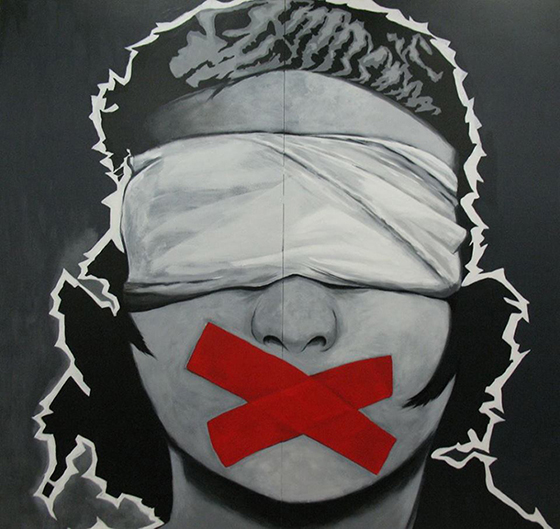
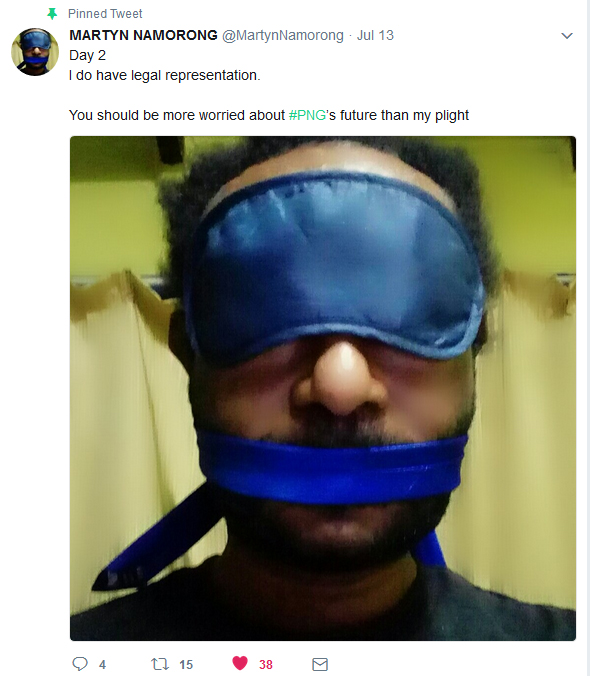
Gamato this week sued Namorong after Namorong compared him to a “fruit” (tomato) on social media, as reported by Pacific Media Watch. When Namorong learned about the court order, he posted this image on Twitter before adding the above blue gag selfie image:


He added that he also needed a lawyer.

Before the gag order came down, Namorong had written critically about Gamato’s role in overseeing this month’s two-week-long general election held June 24-July 8, 2017.

But Namorong is not the only one critical of Gamato.

News reports mentioned complaints of alleged irregularities in the recent election such as discrepancies in voter rolls, inadequate support for polling staff, and inefficient counting of results.

Even members of the Papua New Guinea Election Advisory Committee tendered their resignation due to the failure of the Election Commission to adequately address the mounting discrepancies.

Former Prime Minister Sir Mekere Morauta believes the resignation of the Election Advisory Committee has “sent a loud and clear signal that the conduct of the election had been hijacked” and called for the resignation of Gamato:

    “All honest and concerned Papua New Guineans value their decision, but lament the causes of it. It is a very sad day for Papua New Guinea, and sends shivers of fright about the future of democracy in our country. The utter chaos of this election is deliberately organised. It is rigged.”

Morauta also defended Namorong and accused Gamato of being thin-skinned. He advised the election officer to concentrate on more important issues like fixing the problems of the electoral system.

But Gamato insisted that despite “few incidents,” the election process has been “progressing well.”

    “So far the election is progressing well despite a few incidents reported in some parts of the country. I am confident to deliver this election successfully.”


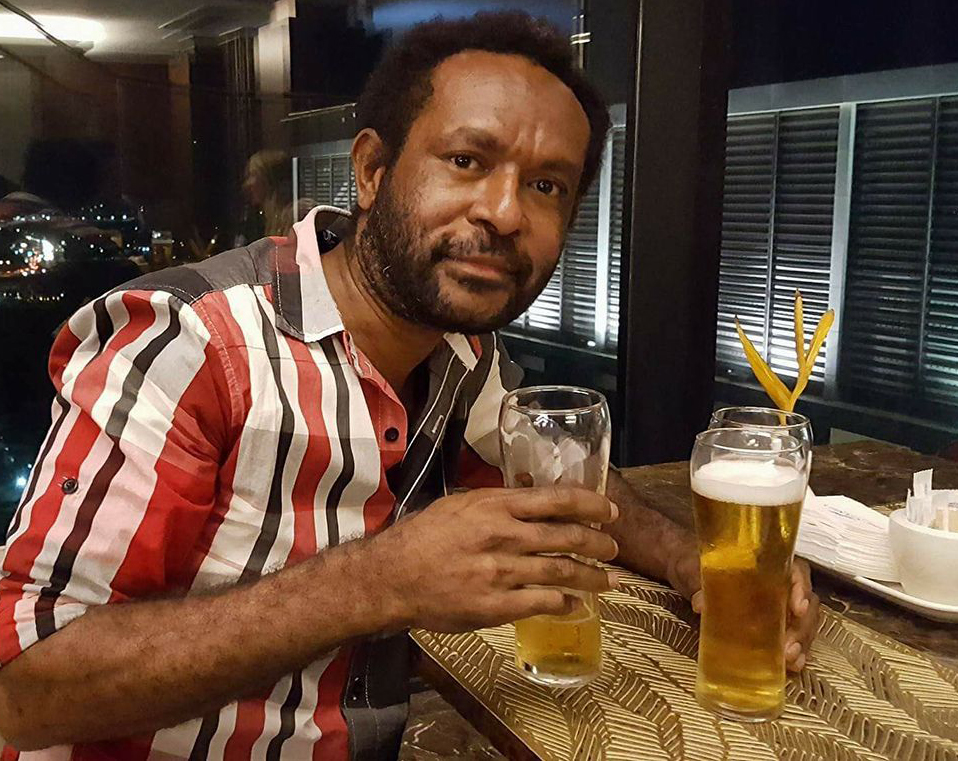
Martyn Namorong … far from phased by the court order. He says
people should be worried about Papua New Guinea’s future,
not him. Image: MN Facebook
The counting is expected to be finalised by July 23 or 24. Namorong’s next court hearing is scheduled on July 25.

It’s not clear why Gamato chose to single out Namorong in filing the defamation case. Whatever his intentions, the case put a greater spotlight on the numerous weaknesses of the general elections system.

Namorong has vowed to continue posting a gagged image of himself on social media while the gag order remains in effect. This was his image on Day 2 of the gag – and he now has a lawyer.

Mong Palatino is the Global Voices regional editor for Southeast Asia. His blog is republished on Cafe Pacific by arrangement.


]]>

Indonesian crackdown on peaceful West Papuan UN vote petition signers

]]>

AsiaPacificReport.nz

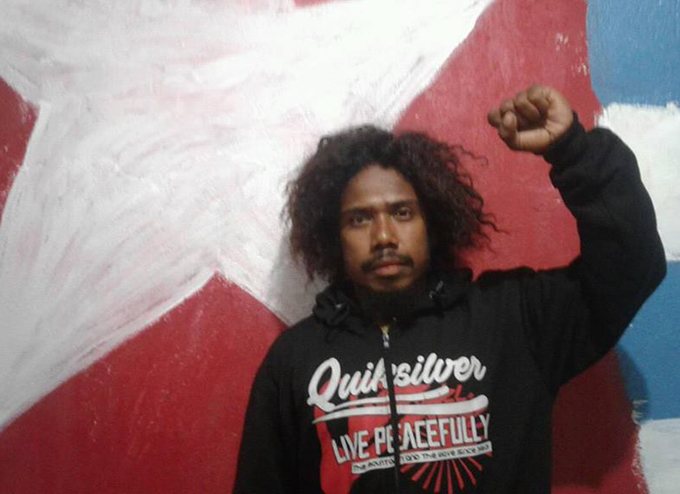
Yanto Awerkion … arrested late last month by Indonesian authorities for gathering signatures on a petition calling for a new United Nations referendum on West Papuan self-determination. Image: Benny Wenda

Yanto Awerkion, a West Papuan local independence leader, remains imprisoned after being arrested the Indonesian security services for collecting signatures on an Avaaz petition calling for a new referendum on independence from Indonesia.

Awerkion, deputy chairperson of the Timika branch of the pro- independence West Papua National Committee (KNPB), remains behind bars since his arrest on June 23.

Minutes after Awerkion took to the stage at a rally supporting the global petition, Indonesian security services surrounded the gathering and arrested Awerkion.

Yanto Awerkion … still behind bars. Image: Benny Wenda

The arrest forms part of a growing Indonesian strategy to arrest and imprison any Papuan who voices support for independence or self-determination in the territory.

Between June 30 and July 6, about 150 Papuans were arrested – many of them beaten and tortured – for non-violent acts of resistance to Indonesian rule.

The International Coalition for Papua documented 321 political arrests of West Papuans in the second quarter of 2017.

West Papuans have been fighting for independence against Indonesia since 1963, in what has become one of the world’s longest-running military occupations.

-Partners-

Regular reports of torture
Hundreds of thousands of West Papuans have lost their lives in the occupation, and reports of Papuans being shot, imprisoned, kidnapped and torture regularly filter out of the provinces.

Global attention on West Papua has been steadily growing in recent years with the unification of the Papuan representative bodies under the United Liberation Movement for West Papua,  the formation of the Pacific Coalition for West Papua and the launching of a petition to the UN calling on the international community to support a new referendum in West Papua.

The petition has already gained 33,000 signatures across the globe, with tens of thousands of signatures being collected by hand in West Papua itself.

Awerkion was arrested at one of the mass manual signings of the petition in Timika, West Papua.

At the end of August this year, the petition will be swum almost 70km for 30 hours up Lake Geneva to the UN offices by a British swim team.

Speaking before his arrest, Awerkion said: “I thank people all over the world for standing up for political prisoners in West Papua.”

British-based Benny Wenda said of the gathering where Awerkion was arrested: “I am proud that the people of West Papua remained calm and peaceful, singing hymns as their gathering was raided by the Indonesian military and police.

“We are showing the Indonesian government that we will not be provoked by their terror and brutality. Like Mahatma Gandhi, we will fight successfully for our freedom through peace and love.”

]]>

USP students, France24 team up in smart-phone Fiji climate story

]]>

AsiaPacificReport.nz

The France24 Observers climate change report on Fiji featuring ePOP student journalists Koroi Tadulala and Telstar Edrie Jimmy. Video: France 24 Observers – in French

Pacific Media Watch Newsdesk

Broadcast student journalists from the University of the South Pacific have contributed on France 24 as part of the ePOP multinational network of broadcasters, NGOs and researchers who are telling frontline stories of climate change.

“France 24 is essentially the French BBC and Koroi Tadulala and Telstar Edrie Jimmy participated in their programme The Observers,” says USP broadcast lecturer Dr Olivier Jutel.

He thanked Mina Vilayleck from the Noumea-based Institute for Research in Development (IRD) for “bringing this ambitious project to Suva” and giving the journalism students this opportunity.

“And of course Max Bale and Matthias Balagny from Radio France-International who have shared their internationalist vision with our students. I hope we can continue to strengthen institutional and media relationships in this incredibly important work.”

The ePOP (eParticipatory Observers Project) concept was conceived by RFI Planète Radio (France Medias Monde) and developed with the IRD in partnership with the Tara Expéditions Foundation, Pacific Islands Development Forum, Organisation internationale de la Francophonie (OIF) and the University of the South Pacific with the support of Pacific Centre for Environment and Sustainable Development (PaCE-SD) Professor Elisabeth Holland, co-recipient of the 2007 Nobel Peace Prize with former US Vice-President Al Gore.

-Partners-

ePOP says on its Facebook page:

This innovative project is built around an international network of young volunteers from the Pacific region.

“With a cooperative and participatory approach, the ePOPers shoot and edit video clips that capture the feelings of local populations facing the direct consequences of worldwide changes and global warming.

“The initiative aims to collect the findings, doubts and questions of the older generations, often relatives or members of their families, in order to question the scientific world and to obtain understandable answers for the communities, especially the elderly, who endure and suffer these daily disturbances.

“In line with the declared will of the international organisations, this human and inter-generational approach aspires to nourish the archives of the intangible human heritage of this region, which is the most impacted by climate change.”

]]>

Pacific exchange student journalists wrap-up internships

]]>

AsiaPacificReport.nz

Pacific Cooperation Foundation media interns Shivika Mala and Linda Filiai visit the Pacific Media Centre. Video: PMC

By Kendall Hutt in Auckland 

Student journalists from across the Pacific region have wrapped-up their 2017 internships.

Brandon Ulfsby, Joshua Lafoai, Linda Filiai, Safia Archer and Shivika Mala say their internships have “opened their eyes” to one another’s journalism cultures and opened future doors.

“The contacts you gain are the most beneficial for the future,” says Archer, a final-year journalism student from Massey University in Wellington.

Organised by the Pacific Cooperation Foundation as part of its media programme — now in its third year — three journalists from the Pacific and two journalists from New Zealand were given the opportunity to experience one another’s media cultures.

WATCH MORE: PCF interns at the America’s Cup Parade

-Partners-

Travelling to Apia and Suva respectively, Ulfsby and Archer say they enjoyed the “slower pace” of the newsrooms they visited.

“They process stories a lot more slowly, but that ups the quality of the storytelling,” says Ulfbsy, a Bachelor of Communication Studies journalism major at Auckland University of Technology.

Ulfsby meeting Samoa Prime Minister Tuilaepa Aiono Sailele Malielegaoi. Image: Pacific Cooperation Foundation

“In New Zealand there are commercial pressures that can alter the telling of the story.”

Highlight ‘was the people’
While in Samoa, Ulfsby interned with TV3 Samoa, Samoa Observer, Talamua (Radio Samoa) and Savali and says the highlight “was the people”.

“I’d say Samoa is the people, that’s how I see it. Going there for a media exchange, it’s really about getting to know the people and understanding the cultural context that they’re in — their stories, their perspectives — and presenting it in a really authentic way.”

Despite an apparent lack of resources, Ulfbsy says, “journalists in the Pacific have a sense of freedom we don’t have in New Zealand. Freedom in the sense that they can select the stories that they want to write about, cover, and they can present it in a way they feel best represents it”.

Ulfbsy’s thoughts were similarly echoed by Archer:

“The resources that the journalists are using, we’re so spoiled here. We can do things so easily. They do things when they’re relatively under-resourced compared to us, but they still manage to produce good content in a relatively timely manner.”

Archer with Fiji Prime Minister Voreqe Bainimarama. Image: Pacific Cooperation Foundation

For Archer, however, the highlight of her time in Fiji was spending a day in the village of Nayavutoka in the northern province of Ra.

She says the village of 57 families was “ground zero” for Cyclone Winston in 2016.

‘They’re still rebuilding’
“It’s three hours on a dirt road, barely accessible, and had been completely ravaged by Cyclone Winston and 17 months later they’re still rebuilding.”

Interviewing villagers with the crew of MaiLife magazine “was amazing”, Archer says.

“The whole major part of me wanting to do this internship was actually to give, or see, that human side of climate change and development that we don’t see.

“We just see the high-level talks, so having access to the villagers through a magazine that they trusted, people that they trusted, they warmed up to me and were able to speak to me about their experiences.”

Archer also interned with CFL Radio, FBCTV, and Fiji Television.

Filiai, Lafoai and Mala with the Tagata Pasifika crew. Image: Pacific Cooperation Foundation

But while Ulfsby and Archer enjoyed the slower place of newsrooms in the Pacific, Filiai, Lafoai and Mala say they enjoyed the switch to New Zealand’s faster-paced industry.

“We were all over the place. We did print, radio, television,” says Lafoai of the National University of Samoa.

‘That was intense’
“We did a week’s work in our first two days at NZME. I did three stories alone, that was intense.”

Filiai reflects New Zealand’s fast-paced media industry also plays into access of information and sources.

“In the Pacific, if we were to work on a story it would take days, weeks, even up to a month because we find it really hard to chase our sources. It’s so hard to get information out of the government ministry.

“Here, I find it really interesting because you send an email and they will respond to you and you can work on your story in a day or a few hours.”

Filiai, Lafoai and Mala all agree they will be taking what they have learnt over the past two weeks back to the Pacific.

“We have a really big challenge ahead of us. We need to match up, we need to step-up our game in journalism. Not just in writing or reporting, but in also how we do our job,” says Lafoai.

Cultural, media experience
For young journalists thinking of covering the Pacific region, Ulfbsy advises them to snap-up the PCF’s unique opportunity, both for its cultural and media experience.

“For me the exchange is more of a cultural experience as opposed to a media experience, but that’s essential to being a journalist who wants to cover the Pacific.

“Go to the Pacific itself and gain that perspective and that understanding so that we can authenticate our stories.”

]]>

Bryce Edwards Analysis: The Greens go nuclear – and other options

]]>

Bryce Edwards Analysis: The Greens go nuclear – and other options
[caption id="attachment_13635" align="alignleft" width="150"] Dr Bryce Edwards.[/caption] You have to feel a bit sorry for the Greens. Because of Labour’s electoral weakness they will, once again, find themselves with a very weak post-election hand to negotiate with. And they’re in danger of being outmanoeuvred in the lead up to post-election coalition negotiations. While there’s still a decent chance of a change of government, the new government might not actually involve the Green Party.
Yes, the Labour Party has its Memorandum of Understanding with the Greens, but as everyone knows, it’s been explicitly designed to expire at the election – so as to give Labour the maximum flexibility to leave the Greens out of a new government if New Zealand First doesn’t want them there. And there’s no reason to think that Winston Peters will want the Greens involved. The mostly likely scenario is the Greens will be called upon to provide the necessary votes in Parliament to prop up a Labour-NZ First government.
The Greens won’t tell us what they will do
[caption id="attachment_4457" align="alignright" width="220"] James Shaw Greens co-leader. Image: Wikipedia.[/caption] The Greens are now playing the same game as Winston Peters – one where they refuse to give any real insight into how the party will use their votes in Parliament after the election. They simply won’t say or commit to any particular type of government. Of course, they speak about their preferences, but are reluctant to be clearer about what a vote for the Greens would mean.
When co-leader James Shaw was asked yesterday to provide further details on how the Greens would deal with post-election coalition negotiations, he refused to divulge any options. Here’s what he said: “Frankly I think that there’s a lot of scenarios that could play out at this election and we just think everything is hypothetical until you know how many MPs each party has got… I don’t think it’s particularly helpful to chuck round lots of different scenarios because there are actually lots of different scenarios… Look there’s a lot of scenarios I don’t want to get into what all of the hypothetical situations are” – see Jenna Lynch’s Green MP threatens new election if Labour goes with NZ First.
However, there are a number of options worth discussing in the event that Winston Peters vetoes Green involvement in any possible Labour-led government. Here are the three leading options the Greens will be considering.
Greens option #1: Go nuclear
Green MP Barry Coates has spilt the beans about the fact that the Greens are considering making the threat to pull the plug on a Labour-NZ First government and refusing to provide their votes in Parliament to allow a minority government to govern. He wrote about this in a blog post on the Daily Blog, and added that it could mean forcing another election – see Great Together.
According to Patrick Gower, the revelation from Coates “has shown the Greens are ready to enter a high-stakes game of political chicken with Peters. James Shaw has tried to hose this down but hasn’t actually ruled this out – that’s because it is pretty much the Greens’ only option. The problem is, it doesn’t exactly make the Labour-Green-NZ First combination look stable. In fact, Winston Peters is suddenly looking more stable than the Greens” – see: Green Party’s ‘nuclear’ election threat shows fear of Winston.
This is all very extreme, Gower says: “It is an extreme call that demonstrates the extreme fear the Greens have of Winston. It shows us they are panicked by the current rise of Peters. It also shows us that the Greens don’t trust New Zealand First. But more importantly, it shows us the Greens don’t trust Labour.”
According to Gower, “Barry Coates should be congratulated for showing in public what the Greens have been keeping private”. But other Greens have been quietly talking about this option, too. And I’m reported in the NBR saying that “One Green MP – not Barry Coates – informed me of this earlier in the year” – see Chris Keall’s Coates wasn’t talking out of turn, he was revealing Greens’ actual strategy: Edwards (paywalled).
I also explain that the Greens didn’t want this option to be widely discussed: “The problem for the Greens has always been to keep this option quiet until after the election. They want the option in post-election coalition negotiations but don’t want potential Green voters to be aware that the party could well sink the chances of a change of government.”
The Greens need to come clean about this option, and give a categorical answer on whether they would ever pull the plug on a Labour-led government if they were left out of it. So far, the party hasn’t been willing to do this. James Shaw has stated that “We have no intention of forcing an early election”, but that’s not the same as ruling out actually doing it.
Would “going nuclear” actually help the Greens anyhow? Chris Trotter thinks not – it would probably lead to a second election in which the Greens would be severely damaged: “Because there can be little doubt that the electorate would punish the Greens mercilessly for landing them with such an unwelcome Christmas present. The voters would reward the Green Party’s dog-in-the-manger irresponsibility by hurling it unceremoniously out of Parliament – a place to which it would struggle to return. The Green Party vote would be swallowed-up by Labour” – see: Is Barry Coates Serious? Are the Greens really willing to trigger a second election before Christmas?
Greens option #2: Appeal for more votes in order to counter NZ First
The Greens’ ideal scenario is one in which the New Zealand First vote collapses and the Greens shift well ahead of them to maintain their position as the third biggest party. In that situation, Labour might not need Winston Peters, or in any case it would be even more difficult to push the Greens aside.
The Greens seem to have decided to go hard against their rival party, and to use the strategy they think might best damage New Zealand First – challenge their progressive credentials, especially in terms of racism. This is best explained in Yesterday’s Dominion Post editorial: “The Greens’ attack on Winston Peters’ ‘racism’ has an air of desperation. The Green Party is haunted by the possibility that once again Peters will shut it out of a left-of-centre coalition, just as he did in 2005. So Metiria Turei launches an assault on Peters in the hope that this will boost the Greens’ vote and give it more purchase in the post-election negotiations” – see: Greens’ attack on Peters gives him another excuse to choose National.
Tim Watkin also explains how this tactic is supposed to improve the Greens’ image: “By attacking Winston as racist they show they’re up for a fight, even if it makes Labour uncomfortable. They are saying to centre-left voters, while Labour is busy accommodating Peters and tweaking policy to fit alongside his, they’re prepared to stand up to the big meanie. They are also saying that they’re not naive. Indeed, they can be pragmatic and stand tough. They can attack a party one day and sit down and deal with them a few weeks later” – see: The Greens come out swinging… not just at Winston.
But will it work? The Dominion Post editorial says “it probably won’t work, but will rather play into Peters’ hands.”
The hope that attacking New Zealand First on immigration will reduce their party vote share must be a forlorn one. As Labour and National have learned over the years, it usually pushes their support up in the polls. Any increase in the Green vote under this scenario will actually be largely at Labour’s expense.
That won’t change the basic electoral maths when it comes to dealing with New Zealand First. The brutal reality is that Winston Peters is almost certain to have much more bargaining power post-election. With Peters likely in his last political term, the chances of him opting for third place in a coalition government pecking order, or sitting it out on the cross benches are remote to say the least. It will be only too easy for National to make a better offer.
Furthermore, throwing around accusations of racism against opponents could mean a stronger focus on examining the Green Party’s commitment and ability to deal with racial equality.
There’s a story going around about how the Greens are currently filming election ads in Wellington, using their advertising agency, Double Denim. But apparently filming came to an abrupt halt when they realised the crowd of Green supporters that had been gathered was almost entirely white. A call was quickly made to get some Greens from the outside of the whiter central Wellington area, but this was mostly futile due to the problem that Maori and pacific voters in the Hutt Valley and Porirua are not big on the Greens.
Questions about why Pasifika activists apparently fare poorly within the Greens might also gain more currency. AUT media academic Richard Pamatatau has criticised the party for only having Pasifika candidates Teanau Tuiono and Leilani Tamu at 19 and 20 on the party list, saying “It seems the party doesn’t have a problem with a New Zealand where Pacific people are left outside the boundaries of power” – see: Is the Green Party out of touch with Pasifika voters? He asks: “What does it take for talented brown people to be recognised by well-meaning but inherently Anglo-centric structures where decisions are made about and on behalf of other people?”
And some of the more emotive messaging of the Greens has also been rejected by leftwing activists. For instance, last week leftwing blogger Giovanni Tiso (@gtiso) tweeted to Metiria Turei: “Could we kindly stop emotionally blackmailing left wing critics of Labour by pleading that people are hurting and need a change of government?” She responded with tweet that Tiso then called “obscene”: “I’m going to ask all of us to band together to fight the real enemy – National. And its because of the 15 kids who will die this winter.” For more on this, see Steven Cowan’s Metiria Turei: Vote for me or children will die!
Greens option #3: The crossbenches
The Greens seem hell-bent on getting Cabinet roles under a Labour-led government. But given that minor parties normally suffer from being involved in coalition governments, shouldn’t the Greens relish the chance to avoid the fate of every other minor party that has been punished after taking Cabinet positions?
I argued in a previous column, Have the Greens gone too far, or not far enough? that the Greens would probably be better off and possibly more influential if they stayed out of government and remained on the cross benches: “that is possibly the answer to the Greens’ current dilemma – commit to being on the cross-benches, supporting a Labour-led government, on a case-by-case policy basis. That seems to be a potentially powerful place for minor parties to exist, flourish, and have plenty of influence. The problem for the Green MPs, however, is this way you don’t get the Cabinet positions and baubles of office for yourself.”
This strategy has also been suggested this week on the No Right Turn blog: “Sure, give Labour – NZ First confidence and supply, but unless they are offering serious policy concessions on areas of core Green interest, and policy vetoes over NZ First racism, give them nothing else. Then use their effective legislative veto to extract concessions piecemeal, and bargain hard over anything not in the Green manifesto” – see: The Greens vs Winston II.
Greens option #4: Negotiate with National
In theory, if the Greens are left out of government by Labour and New Zealand First, they could still negotiate a better deal with National. And, although the Greens have seemingly closed off the option of working with National, they haven’t categorically ruled out supporting a National-led government.
This leads rightwing political commentator Matthew Hooton to write in today’s NBR that the recent battles with New Zealand First show the Greens are better off – and are in fact moving towards – the possibility of working with National. In his column on the events of this week, Possibility of National-Green coalition grows (paywalled) (), he argues “Turei’s move can only be interpreted as the first move towards the Greens taking a slightly less dogmatic position on whether they would support a Labour-NZ First coalition or National-led government post-election.”
Hooton outlines what sort of concessions National would need to give the Greens: “The emissions trading scheme would need to be strengthened and agricultural emissions included. Alternatively, the two parties might agree to tough new carbon and methane taxes to fund company tax cuts. A price on water would be obligatory and National would have to accept much more ambitious goals for clean lakes and rivers and the elimination of pests. Public transport in Auckland would be more rapidly expanded and Singapore-style GPS road changing introduced. On social justice issues, the Greens may push National to put the taxpayers’ money where Mr English’s mouth has been on social investment. More state houses would need to be built.”
He says supporters of both parties might baulk at them working together, but it would be “preferable to the indignity of paying homage to Mr Peters for three miserable years.”
Although such an alignment seems rather farfetched, the same was said many years ago about the prospects of the Maori Party working with National. And there are still some voices calling for the Greens to be even more pragmatic. In fact yesterdays’ Otago Daily Times editorial said “Turei has seemingly ruled out going into a coalition, or any agreement with National, well before the votes have been cast and counted. That is a mistake” – see: Electoral dysfunction.
This option is surely only a bargaining position, as it would be an extreme high-risk move in reality. The history of such bold political realignments suggests that it would work, but only once, and at great cost. The massive internal Green ructions following a decision to prop up National would likely destroy or severely damage the party before any tangible benefits would be realised. This would actually be the most nuclear of all the options against New Zealand First, but would have a suitably nuclear outcome – Mutually Assured Destruction.
Finally, for an interesting and amusing insight into one of the Green Party’s co-leaders, see Steve Braunias’ The great political ping-pong tournament: James Shaw’s green, but soon picks up the game.
Today’s content
 
All items are contained in the attached PDF. Below are the links to the items online.
Election – Greens
No Right Turn: The Greens vs Winston II
Pete George (Your NZ): Shaw v Coates on Greens v NZ First
Election – Labour
No Right Turn: The meh factor
Pete George (Your NZ): Little concedes further
Election – NZ First
Richard Harman (Politik): What Winston really wants
Election – ACT
Election
Patrick Leyland (Progress Report): Forecast updated
Brian Fallow (Herald): Tax cuts or more social spending?
Tom Pullar-Strecker (Stuff): Investors beginning to consider Kiwi election
International relations
Media
John Drinnan (Herald):It’s the magic of the movies
Other
Rachael Kelly and Mary-Jo Tohill (Stuff): Todd Barclay emerges to criticise local council
Karl du Fresne (Stuff): Angry Left add fuel to the fire
]]>

‘Don’t run to courts’ over every PNG electoral row, judge says on elections

]]>

AsiaPacificReport.nz

Andrew Thomas reporting from Port Moresby on the issues at stake in this month’s general election in Papua New Guinea. Video: Al Jazeera

Pacific Media Watch Newsdesk

A Papua New Guinean judge has called on election candidates disputing ballot boxes to follow procedures before “running to the courts” for rulings while Prime Minister Peter O’Neill has admitted that the electoral rolls were a major problem in this month’s general election.

Counting was continuing today for most of the 111 seats in the National Parliament.

Justice Collin Makail, when dealing with a number of election-related matters, said most candidates overlooked s153(a) of the Organic Law on National and Local Level Government elections when disputing ballot boxes during counting, Loop PNG reports.

He told parties involved in two matters disputing ballot boxes in counting in the Hela regional seat, from Koroba-Lake Kopiago area, and the Lae Open seats, to go back, consult the respective returning officers and object over the use of the disputed ballot boxes.

Judge warns against “wasting court time” in election disputes. Image: Loop PNG

Justice Makail said such cases should not take up the court’s time, especially when that process was still available to them to follow before running to the court.

-Partners-

For the case involving disputed ballot boxes from the Koroba-Lake Kopiago seat, Hela Regional seat candidate Dr Hewali Hamiya filed an urgent application to ask the court to restrain 32 disputed ballot boxes from being counted.

At the time the matter went before the court, the Hela Regional Seat had 94 ballot boxes left for counting.

32 disputed boxes
Dr Hamiya was trying to get the court to stop the 32 disputed boxes from being counted, alleging that they were filled out by Electoral Commission officials somewhere in Tari and were not taken from the designated polling area.

His lawyer wanted the court to issue orders against the boxes from being counted and remain locked.

Justice Makail declined such a ruling, saying the provision of s153(a) of the Organic Law on National and Local Level Government elections remained “unexhausted” and parties must follow that first in disputing ballot boxes.

Prime Minister O’Neill admitted that the electoral roll had been a major problem during the general election, The National reports.

He agreed with many of the criticisms made by the Commonwealth Observer Group about the common roll.

‘Nothing to do with government’
“It is a list that has been updated by the Electoral Commission and has nothing to do with the government,” he said.

“The commission is an independent body. The government supported the common roll update and it is quite disappointing to us that the lists were not in order.

“That is why we, as government, explicitly appealed to the Electoral Commission that they should use the 2012 roll, together with the preliminary roll, so that Papua New Guineans can vote.”

Prime Minister Peter O’Neill congratulates Justin Tkatchenko on his reelection as Moresby-South MP.

Despite that, he commended how the election has been conducted.

O’Neill witnessed the declaration of Justin Tkatchenko as the Moresby-South MP at the Kilakila Secondary School by returning officer Michael Are.

He said the return of Tkatchenko showed the “people’s faith” in the ruling People’s National Congress government.

]]>

95bFM, VICE media team up to offer ‘authentic, credible’ NZ news cover

]]>

AsiaPacificReport.nz

Vice Media … new NZ media partnership with 95bFM. Image: VM

Pacific Media Watch Newsdesk

New Zealand broadcaster 95bFM and youth media company VICE have today announced a new content partnership that will see the two companies bring a daily news column to the country.

A fresh source of local and independent news — from media dedicated to “authenticity, quality and credibility”—News of Zealand coverage will offer a reliable, nuanced, and contemporary perspective on “social and political events that matter”.

Researched through 95bFM’s skilled, passionate news team and delivered to VICE’s editorial team for publishing on VICE.com, ‘News of Zealand’ will cover broad local topics and events – from festival pill-testing to water-export tax and the latest in election news, as well as international news covering topics such as the liberation of Mosul or LGBTQ equality in Germany.

This daily digital feature will combine both organisations’ reportage and storytelling skills, delivering the kind of content that engaged, switched-on New Zealanders care and talk about.

News of Zealand will be collected through a dedicated hub here.

About VICE
VICE is a global youth media company and content creation studio. Launched in 1994, VICE now operates in more than 30 countries, including New Zealand, distributing its programming to viewers across digital, linear, mobile, film and socials.

-Partners-

VICE includes an international network of digital channels; a television and feature film production studio; a magazine; a record label; an in-house creative services agency; a book-publishing division; and a newly launched TV network, VICELAND, which launched December 2016 on SKY New Zealand Channel 013.

VICE’s award-winning programming has been recognised by the Academy of Television Arts and Sciences, Peabody Awards, Sundance Film Festival, Cannes Lions, Webby Awards, and New Zealand’s Beacon Awards, among others.

About 95bFM
95bFM is New Zealand’s largest alternative music radio station. Founded in 1969, Auckland’s bFM has spent more than 45 years leading the curve in local and independent music and mindset.

Based at the University of Auckland, 95bFM is dedicated to promoting a diversity of local talent; from giving a platform to unknown musicians through to fostering up and coming voices in journalism and broadcasting.

In particular, 95bFM is highly regarded for its ambitious and independent news reporting, particularly its political coverage.

In the past, bFM has given a start to New Zealand media stalwarts Wallace Chapman, Jeremy Wells, Noelle McCarthy, Marcus Lush, Charlotte Ryan and has welcomed the return of its own native son, Mikey Havoc, to host the bFM Breakfast Show.

  • The Pacific Media Centre also collaborates with 95bFM to present its weekly Pacific Media Watch programme Southern Cross on Mondays at 12.20pm.
  • News of Zealand
]]>

Cyber ‘provocation’ Indonesian police’s biggest challenge, says Kalla

AsiaPacificReport.nz

“No need for lessons these days … all [extremists] have to do is access the internet to easily create a bomb,” says Indonesian Vice-President Jusuf Kalla. Image: Indo-Asia Pacific Defence Forum

Pacific Media Centre Newsdesk

Cyber “provocation” — through social media — is one of the biggest challenges being faced by the Indonesia’s national police (Polri) at present, says Vice-President Jusuf Kalla.

“We have to be ready to counter cyber provocation by forwarding various information that explains the actual event,” Kalla said in a public lecture given to participants of the Middle Leadership School (Sespimmen) of the national police at the Vice-Presidential Palace in Jakarta this week.

Pacific participants were present at the lecture.

He then cited an example of the provocation of extremist and radical groups, such as ISIS (Islamic State of Iraq and Syria), that is spread among Indonesian youth through social media, persuading them to falsely carry out jihad, which is an act of fighting in the name of the religion, against the police.

Such acts are revealed through the bombing incident in the recent Jakartas Kampung Melayu area and the stabbing incident towards a police officer in the Police Headquarters.

“I have read that the bomb makers in Bandung were never taught to create explosives and that they had only learned it through the internet, Kalla said.

-Partners-

“Hence, there is no need for lessons these days, and all they have to do is to access the internet to easily create a bomb. If you do not master these kinds of technologies, then it would be challenging for you to tackle issues in rural areas.”

Security front guard
Kalla believes that the Polri, as the front guard in maintaining security and public order, will be the first party sought when problems occur in an area, especially with the rapid spread of information through social media and instant messaging groups.

“If you do not move as fast as this information does, then people’s reliance on the false information that circulates on the social media applications will grow bigger. Your challenges today are rather different compared to the ones faced by police officers 20 years ago,” he said.

Kalla expressed hope that the academy would also strengthen its curriculum on information technology to be taught to potential squad leaders at all levels.

One of the biggest challenges these days is speed, and it can only be countered by speed as well. Once you snooze and fail to verify information to the public, there are risks of conflict happening, and it happens in all parts of the world,” he said.

The public lecture, given by Kalla, about overcoming social conflict was attended by 246 participants of the Polris Leadership Programme.

The participants involve four foreigners, including two members of the Fiji police force, one from Singapore, and another one from the Timor-Leste police department.

]]>

Bryce Edwards Analysis: Labour’s sleepwalk towards defeat

Bryce Edwards Analysis: Labour’s sleepwalk towards defeat
[caption id="attachment_13635" align="alignleft" width="150"] Dr Bryce Edwards.[/caption] There’s still hope for Labour being able to put together a coalition government after the election. But there do seem to be a lot of barriers at the moment – especially as opinion polls point to the apparent decline or stagnation of support for the party and its leader, Andrew Little. 
Why isn’t Labour doing better? A large number of voters must be asking this about Labour’s current polling and performance. Certainly, there are quite a few political commentators trying to explain Labour’s problems and doldrums. Much of this commentary focuses on Labour’s lack of boldness or willingness to take risks. All this means is that for many voters, Labour doesn’t appear to be proposing any sort of superior society and economy if they win.
In fact, there’s an element of staleness in Labour at the moment, and perhaps even complacency. And their general approach of “business as usual” clearly “isn’t working” according to Labour Party member and activist Laila Harré, who went on TVNZ’s Breakfast programme to say that “It’s a bit grim” for Labour at the moment, given that polls show the party struggling to get traction – see: Labour needs ‘bold policy move’ to ‘activate the younger vote’ – Laila Harré.
In this short interview, Harré says: “There needs to be some disruptive element to their campaign – something that is particularly, I think, focused on activating a younger vote. And that will require some bold policy move, perhaps in relation to tertiary education costs”.
[caption id="attachment_635" align="alignright" width="300"] Labour Party leader Andrew Little attracted only five percent support in the recent TVNZ leadership poll.[/caption] Of course Harré was responding to the latest TVNZ poll result which had Labour dropping to 27 per cent support and their leader to just 5 per cent support – see: Andrew Little drops to fourth as preferred PM in latest 1 NEWS Colmar Brunton poll that sees both major parties take a hit.
This poll result was very close to other polls, as reported by Colin James, who aggregates the averages of all those polls published, and says that “Labour dropped from 29.4% in May to 26.5% in June” – see: Poll of Polls: Winston Peters remains kingmaker.
Business as usual for Labour
There are plenty of others – particularly on the left – who are critical of Labour’s rather mild and centrist election campaigning. This criticism comes in the context of international upsurges in radical politics, as well as disenchantment with the status quo – some of which has also been evident in New Zealand.
Perhaps the most damming criticism is that of Rhodes scholar, Andrew Dean, who says that “Promising not to change things too much is not an inspirational message for the political Left to be running” – see his opinion piece, For the Left, more of the same won’t cut it.
Dean says the “business-as-usual politics” promised by Labour (and the Greens) is most obvious in terms of the “budget responsibility rules” they have committed themselves to, which means that in economic terms “voters are being shown that under a Labour-Green government, they would get more of the same” as under National. And in other policy areas, Labour is also being conservative – especially on immigration.
Picking up on these arguments, leftwing blogger No Right Turn says “If Labour and the Greens want to win this election, they need to actually offer something. Mere managerial politics – Grant Robertson and Gareth Hughes getting Ministerial salaries rather than Nick Smith and Anne Tolley – does not cut it. It does not inspire support, because at the end of the day it makes no difference, means nothing to us” – see: If you don’t fight, you don’t win.
And similarly, Gordon Campbell has recently argued that Labour (and the Greens) are making a big mistake in all their attempts to de-radicalise their election manifestos and move towards the centre – see: On the twists in the UK election.
Campbell says the left here in New Zealand is failing to pick up on the lessons from elsewhere: “It has been a wisdom echoed here by NZ Labour and by the Greens, who seem to be preparing for this year’s election in September by planing away almost anything – eg a capital gains tax sufficient to deter housing speculation – that the mythical centre ground might find offensive, or threatening. It has been taken for granted that moving leftwards would be suicidal. Sounding like a nicer, gentler version of the Tories on economic management – and taking ‘strong’ stances on immigration and law’n’order that echo New Zealand First – has been embraced as the only savvy, realistic route to power available to the centre left. Well… at the moment, Jeremy Corbyn is showing Andrew Little that there has always been another way.”
And it’s not just those on the left suggesting that Labour might need to loosen up. Today, former National Cabinet minister Wayne Mapp argues that To offer a real alternative, Labour and the Greens may need to tear up their fiscal pledge.
Labour’s election pitch – fresh or stale?
Labour’s approach is stale, according to former party activist Phil Quin, who despairs at the irony of the party’s chosen campaign slogan “A Fresh Approach” – see: A stale approach. He argues that the choice of this banal slogan “reveals how Labour concedes they have failed to mount a case for meaningful change.”
Quin explains: “I’ve been on dozens of campaigns, and ‘A Fresh Approach’ invariably makes the shortlist of potential slogans. Eyes might roll at its lack of originality and substantive emptiness, but it comes in handy when that same blandness is the strategic goal. It’s what you say when you’ve got nothing.”
He also points out what is missing from Labour’s campaign: “What is glaring by its absence is a narrative that coheres around a resonant critique of the government, creates a sense of urgency, and offers an optimistic path forward. Without the benefits of a cratering economy or a seriously scandal-plagued incumbent, Labour needed to do all three things. They did not one of them. Instead of building a winning message, Labour has mostly stalked the news cycle, picking at and inflaming areas of perceived aggravation for voters like house prices and foreign surnames.  Playing at politics that way, you have good days and bad — but, by definition, you are never setting the agenda.”
Therefore, Quin doesn’t see much hope for Labour getting into government this year, but instead envisages Prime Minister Jacinda Ardern in three years time – see his earlier blog post, Labour in box seat — for 2020.
Some similar points are made by Labour’s Josie Pagani who laments that Labour’s vision is clouded by “promising bland taskforces and working groups”. But her bigger point is that the party has failed to focus on the things that matter, preferring to campaign on National’s scandals, such as with Todd Barclay – see: Scandals dog government and opposition in New Zealand.
Her main point is worth quoting at length: “If you are attacking the government for a political scandal, then it sounds like you don’t care about everyday voters’ priorities: their jobs, families, homes, their lives… Policy matters. Voters want political leaders to take risks, to set out authentically what we really believe. They want politicians to talk about their priorities and to set out a plan, and be cheerful too. When we play politics as a horse race, when we hold a contest over who can inflict the most embarrassing scandal, we distract our opponent and draw them off message but we also signal that we are more interested in the insider game than the stuff that people really care about. It chips away at trust in the government, but it also chips away at trust in Labour. And as faith in the incumbent crumbles, if the left has failed to make the case for a principled alternative, the only other option becomes a populist wrecking ball.”
Is Labour’s family package enough?
Labour will be hoping that the families package announced this week will turn around any narrative that the party doesn’t have a real alternative plan to that of National. For the best explanation and analysis of the new policy see Shane Cowlishaw’s Labour’s family package counterpunch.
There have been some tributes to the policy. For example, today the New Zealand Herald’s editorial says it’s a bold announcement: “Credit where it is due. It takes courage to say that if elected, you will cancel a tax cut. That is what the Labour Party has announced with its promise to direct the money instead to additional spending, particularly on assistance for low-income families. In doing so it has presented the voters with a clear choice which, for those without young families or earning above the income limits, will mean deciding whether to take the tax cut or give the benefit to children of the less well off” – see: Labour could spend all National’s tax cut on the needy.
Others aren’t so convinced, saying the policy won’t create any real enthusiasm. Vernon Small says: “it is no surprise there is no baying from the crowds in the stands. Because in the big scheme of things, the argument is really being played out in a very small ball park. Neither party is exactly breaking the bank or splashing cash they don’t have. And neither is running a significantly looser fiscal policy than the other as a result of their packages” – see: Labour may have tacked too close to National to spark voter ardour.
Small also suggests that Labour is actually failing to capitalise on any mood for change in the electorate. The difference between Labour and National’s tax and spending plans is simply not big enough: “Labour may have a problem; that the two plans are not only similar, they are too similar to make a difference. That while they have different ideologies at their core, those different world view have not taken them far enough to energise the voters… It may just be that he and Labour are not offering change that is significant enough to energise them – and that Little doesn’t personify the change they want.”
Has Labour lost it historic role?
According to senior political journalist John Armstrong, Labour is now even in danger of losing its place as the main party of opposition – see: Labour is fast becoming a political cot-case. He also points out that, in terms of its plans to cancel National’s tax cuts, Labour might not even be able to do this – even if Labour leads a coalition government, it might not have the numbers to get its way on this.
For Chris Trotter, it seems that Labour’s electoral demise runs in parallel to its demise as a party of creating radical change for working people. In his column, Hard to imagine Andrew Little inspiring Corbyn-like passion, Trotter suggests that Labour has faded in this role. Compared to the past truly innovative and radical party, “Today’s social-democratic politicians are middle-class professionals who are, by-and-large, as disdainful of the electorate as they are uninterested in its inner emotional life. Not only have they forgotten how to dream dreams and see visions – they don’t see the point.”
In another column, Trotter says: “Labour’s current electoral strategy seems to involve: waiting until the National Party runs out of puff, and then presenting itself to New Zealand Capitalism as a temporary alternative government while the exhausted Nats get their breath back” – see: Labour ‘a seething cauldron of thwarted ambitions, petty jealousies and unresolved grievances’.
And some of this argument about Labour’s failing to focus on working people is confirmed by survey data, which shows that at the last election, for the first time ever, Labour lost its monopoly on manual workers. David Farrar explains: “More working class voters in 2014 voted for National than Labour. I think this illustrates what Chris Trotter has often said – they have lost touch with many working class families” – see: Labour no longer the preferred party of working class voters.
Finally, for an overall evaluation on the health of Labour – with some much more positive conclusions – see Jenna Lynch’s State of the Parties: Labour report card.
Today’s content
 
All items are contained in the attached PDF. Below are the links to the items online.
Election – Labour
Election – NZ First 
Election – Greens
Dave Kennedy (Local Bodies): Winston and the Greens, a reality check
Election – Maori Party
Election – ACT
Pete George (Your NZ): Over ACTing
Election – National
Election
Barry Soper (Newstalk ZB): Will this be the social media election?
Drugs
Education
No Right Turn: The obvious solution
Health
Environment
Water
Pattrick Smellie (Stuff): Water royalties – get on with it
Other
]]>

PNG court silences political blogger’s comments, blogger posts gag image

]]>

AsiaPacificReport.nz

Martyn Namorong … gagged by the PNG National Court. Image: MN

Pacific Media Watch Newsdesk

A Papua New Guinean court has banned political blogger Martyn Namorong from publishing “defamatory remarks” about Electoral Commissioner Patilias Gamato and the writer has responded by publishing a “gagged” silhouette image of himself on his Facebook and Twitter accounts.

Loop PNG reported last night that the Waigani National Court granted the orders sought by Commissioner Gamato in response to an urgent application by his lawyer before Justice Collin Mikail.

Namarong was not present in court because court officials “could not locate him to serve the documents”, Loop PNG reported.

On his Twitter feed, Namorong said: “Just heard I am being taken to court. I need a pro bono lawyer.”

The application was heard ex-parte.

“The case arises from alleged defamatory remarks the blogger made on social media, associating Commissioner Gamato to a fruit,” Loop PNG reported.

Martyn Namorong … “Papua New Guinean atheist, activist, antagonist”. Image: CCSC

-Partners-

Justice Makail granted the application and ruled that the orders could be published by both daily newspapers, the Post-Courier and The National.

‘Activist, antagonist’
He also ruled that the case must come before the court again on July 25, which is after the counting period in PNG’s just completed general election.

Martyn Namorong describes himself on his Twitter feed as a “Papua New Guinean atheist, activist, antagonist”.

In his latest Facebook posting, he published a statement from former Prime Minister Sir Mereke Morauta condemning PNG’s election as having been “hijacked” and “failed”.

Sir Mekere claimed the resignation of the Election Advisory Committee had sent a “loud and clear signal” that the conduct of the election had been “hijacked” by current Prime Minister Peter O’Neill, Chief Secretary Isaac Lupari and the Electoral Commissioner, “ably assisted by the Police Commissioner, the Defence Force Commander and the Secretary for Finance”.

Sir Mekere said the resignation of the EAC was a clear statement to the nation about the failure of the 2017 election.

“The members of the EAC, Ombudsman Richard Pagen, Richard Kassman and Professor John Luluaki, are all extremely capable men of high integrity,” he said.

“They will not have taken the decision to resign lightly. They have resigned because they have been ignored by the Electoral Commissioner and prevented from fulfilling their obligations and their role, which they take seriously.”

The Namorong Report
During a public presentation at the Centre for Communication and Social Change at the University of Queensland, just before voting began in the general election, he talked about how he started The Namorong Report in 2009.

He dropped out of medical school in his final year and, to fund his writing, took to the markets of the capital Port Moresby selling buai (betel nut).

This experience offered some deep insights into the struggling and depressed society and culture of modern Papua New Guinea, impressions which greatly influence his writing.

Namorong went on to win PNG’s Crocodile Prize national literary award for the best essay and is now a political activist and PNG’s most prolific and internationally quoted blogger.

Commissioner Gamato has defended the conduct of the elections.

]]>

Debate in Philippines as clergy assess gains, costs of married priests

]]>

AsiaPacificReport.nz

A priestly dilemma for the Roman Catholic Church … priest Father Jess Siva poses with his common law wife Bemma at the entrance of their house in Iloilo city on Panay island in central Philippines during 2015. He has been celebrating mass in the town of Lambunao for many years, giving communion, performing last rites for the dying, hearing confessions and officiating at marriages. But he is among those in the priesthood regarded as persona non grata by the church. Image: GMA News

By Father Casibjorn Guy Quiacao in Manila

Imagine your Catholic parish priest rushing or abruptly ending a mass because his wife or his child met an accident. Or that priest is budgeting a part of a parish’s funds for his wife’s and his children’s needs.

Such scenarios are not impossible if married men are allowed to be ordained as suggested recently by Pope Francis, say Filipino canon law experts and priests.

“What if in the long run such marriages of these ‘married priests’ won’t last,” asked Father Stephen Mifsud, MSSP.

“So we’ll have another case of separation or divorce. What will parishioners say?”

These concerns are just some of the reactions generated by Pope Francis’ previous statement that the Church should be open to allowing married men to enter the priesthood.

The statement was made as the Church is grappling with the declining number of priests and the aggressive proselytising by other Christian sects, including evangelicals.

-Partners-

“What the Pope seems to be considering lately, especially in places where there is a dearth of priestly vocations, is the possible ordination of married men to the priesthood. [This is for] men who have not made a vow of celibacy,” Bishop Pablo David of the Diocese of Caloocan in Metro Manila said in a Facebook post.

Married priests exist
Bishop David explained that there were married priests in other parts of the world, as in the case of Anglican priests who converted to the Catholic Church and the non-celibate clergymen of the Eastern Orthodox churches.

In the Philippines, about 60 married priests who are now living with their respective families have formed a group called the Philippine Federation of Married Catholic Priests (PFMCP).

Members of the 25-year-old PFMCP have asked the Vatican to recognise their group but have yet to receive a response.

The PFMCP is one of four federations of married Catholic priests worldwide, the others being continental networks: the North Atlantic Federation, the European Federation and the Latin American Federation.

PFMCP member Father Jose Elmer Cajilig said that in the group’s seeking of Vatican recognition, married priests are a reality.

“Even in Europe, there are many married priests in the ministry,” he said in Visayan dialect.

Cajilig had his priestly faculties suspended by the Archdiocese of Jaro in Iloilo province (central Philippines), but he continues to minister in the area.

‘I’m still a priest’
Cajilig currently lives with his common-law wife and four children, and hears mass on two chapels there on Sundays.

“Although, I’m no longer part of the Archdiocese of Jaro, I’m still a priest. My masses are still valid,” Cajilig said.

Father Jim Achacoso, a canon lawyer and consultant of the Philippine Catholic bishops’ Episcopal Commission on Canon Law, said the ordination of married men is not the same as allowing clerics to marry.

“What Church law demands is perpetual celibacy in its ordained ministers. So even if married men were ordained, it would mean that they will have to remain celibate thereafter. The prohibition to get married comes with ordination,” Achacoso said.

He explained that married men who are capable of exercising the ministry with all its demands should also live in “complete and perpetual chastity”.

And as for PFMCP, Achacoso said the group’s members have proven themselves “incapable of being faithful to their first love”.

For Bishop David and Achacoso, only those married men who can give up married life can be ordained.

Pope Francis open
In an interview by German weekly Die Zeit in March, Pope Francis acknowledged that there was a shortage of clerics due to what he described as a “vocation crisis”.

When the magazine asked Pope Francis if he was open to ordaining married men of proven virtue, or viri probati, the pontiff agreed.

The pope also maintained that optional celibacy was not the solution to the problem.

The Vatican processes at least 500 married priests a year who want to return to the ministry.

But some priests are open to the idea of ordaining married men.

Like Father Mifsud, a Maltese missionary serving in Bataan province (north of Manila, on Luzon Island), who said the Catholic Church had been losing adherents to other religious groups because of the lack of priests.

“If viri probati is a solution, why not? Because of the decline in vocations, we could be losing our Catholic faithful to other sects —as we have already experienced in some parts of the country where there are less priests,” Father Mifsud said.

Catholic priest ratio
While about 85 percent of the 100 million Filipinos in the Philippines are Catholics, there are only 9,433 priests, according to the 2016-2017 Catholic Directory of the Philippines. Thus, the ratio is a Catholic priest for every 8,500 Filipino Catholics.

The ordination of married men would be one way to allow the Church to reach the “ideal” ratio of one priest for every 2,000 parishioners, Father Mifsud said.

But canon lawyer Monsignor Rey Monsanto disagreed, saying the move may “create a lot of chaos”.

“This [ordination of married men] will give a precedent and priests may just get married and later go back to the Church,” Monsanto said.

He said such arrangements might bring more confusion and could put the requirement of priestly celibacy in jeopardy.

“This will be tantamount to having optional celibacy, which is not in the purview of the Church,” Monsanto said.

Father Casibjorn Guy Quiacao is an MA in Communication student at the University of Santo Tomas, and produced this story for the graduate class Global Journalism Practice and Studies.

]]>

Uncertainty surrounds implementation of Duterte’s smoking ban

]]>

AsiaPacificReport.nz

President Duterte’s enforcement of an earlier 2003 public smoking ban prompts mixed feelings. Image: Rappler.

BACKGROUNDER: By Jerome P. Villanueva in Manila

Uncertainty surrounds the effectiveness of Philippine President Rodrigo Duterte’s ban on smoking.

In an executive order titled E026, Duterte ensured an earlier ban on smoking in enclosed public places and on transportation.

Two months after Duterte’s announcement in May, University of Santo Tomas political scientist Edmund Tayao says “we have yet to see if its implementation will be good”.

Despite the positive health benefits of the ban, anti-smoking advocacy group Health Justice Philippines estimates about 240 Filipinos still die a day — or 87,600 a year — due to smoking-related diseases.

The Philippines ban on public smoking has existed since the Tobacco Regulation Act 2003, which bans smoking in public places such as schools, hospitals, nursing homes, laboratories, and public transport.

Elevators and stairwells also fall under the act, while regulations have also been slapped on tobacco advertising, promotion and sponsorship.

-Partners-

Duterte’s executive order enforcing the earlier ban did not come as a surprise, as he has been a long-time enforcer of anti-smoking since his time as a former mayor of Davao City.

Ban ‘good news’
Duterte’s stand against smoking in Davao City – the most economically-progressive urban enclave in Mindanao island – is now being continued by current mayor and presidential daughter Sara Duterte-Carpio.

But while E026 has its critics, Duterte’s reinforcing of the 2003 ban came as good news for 75-year-old widow Juliana Cruz, who lost her husband Rogelio three years ago due to lung complications.

Since he was 15-years-old, Rogelio had consumed two packs of imported, blue-sealed cigarettes daily.

Prior to his death, Rogelio lost his left lung due to a ballooning cyst and had his ribs removed.

The couple were supposed to build a house, but all of their savings went to Rogelio’s hospital bills.

“I was really mad at my sons since they are also smoking. You have seen the fate of your father, but you have not learned from that,” Cruz said.

Duterte’s smoking ban is also good news to smoking victims like cancer survivor Emer Rojas of the anti-tobacco group New Vois Association of the Philippines (NVAP).

Reduce victim numbers
“We may be able to reduce the number of victims, like us,” Rojas said.

The ban’s enforcement is also seen as one of the toughest in the wake of how other countries have implemented their own smoking bans.

An association of thoracic (spine) doctors in Greece appealed to the government recently to crack down on violations, as seven out of 10 Greeks were exposed to second-hand smoke when visiting bars, restaurants and cafes — all prohibited areas.

Soon-to-be Olympic Games host Japan saw some of its world-level athletes banding together with academics and cancer patients to demand the Japanese government to ban smoking in public indoor places.

About 15,000 Japanese die of second-hand smoking annually, a University of Tokyo health policy professor was quoted as saying.

World leaders themselves have also been lax when it comes to observing smoking bans.

In a March state visit to China, Czech Republic President Milos Zeman got Chinese cigars from Chinese President Xi Jinping.

World leaders lax
Government media reported that since Xi quit smoking in August 2016, 300 million Chinese smokers were “inspired” to quit too.

Controversially, Zeman ignored China’s smoking ban by smoking at Xi’s dinner and on the flight to Beijing – the Chinese government has banned smoking in many indoor places, such as hospitals, schools, sports stadiums and public transport.

Despite the apparent ongoing challenges of enforcing a smoking ban in the Philippines, industry lobby group Philippine Tobacco Institute said in a statement it had “always supported regulation of public smoking”.

Their support comes in spite of impacts to the local economy and businesses through a sin tax reform law (Republic Act 10351, passed in 2012) that imposed hefty tax rates on cigarette products.

Before this year, the law provided brackets of taxes for cigarette products depending on their price.

Currently, cigarettes are taxed uniformly at P30 (NZ$80c) a pack.

Jerome P. Villanueva is an MA in Journalism student at the University of Santo Tomas, and produced this story for the graduate class Global Journalism Practice and Studies.

]]>

Gamato defends PNG elections in face of mounting condemnation

]]>

AsiaPacificReport.nz

Masked gunmen ‘hijacked’ three ballot boxes in Western Highlands electorate of Mul-Baiyer. Video: EMTV News

By Elizah Palme in Port Moresby

Papua New Guinea’s Electoral Commissioner Patilias Gamato has defended the just-concluded two-week general election in the face of mounting condemnation.

Some polling is continuing in some delayed places while counting is underway in most electorates.

International election observers have reported “widespread” problems with the electoral roll that prevented thousands of people from voting.

The Commonwealth Observer Group called for an urgent review after the election to improve the accuracy of the roll.

In the interim report, chairman Sir Anand Satyanand, a former New Zealand governor-general, said: “The group was very disappointed to note that previous Commonwealth Observation Group reports that highlighted the need to address this issue of the common roll have yet to be implemented.”

-Partners-

In a press conference in Port Moresby yesterday, Gamato was asked a series of questions by the media, saying: “The issue for the funds for the allowances should not be the case now as the Electoral Commission has enough money to pay for the officers.”

Electoral Commissioner Patilias Gamato fields questions at the media conference in Port Moresby. Image: EMTV News

Gamato was responding to questions about the K184,000 (NZ$80,000) allowance money confiscated from former NCD Election Manager Terence Hetinu, which the commissioner confirmed was with the police and undergoing investigation.

In response to the recent resignation of the Electoral Advisory Committee (EAC), the commissioner said the EC was in the process of “helping them out” in terms of logistics and finance, including the information they require.

‘Unfortunately they resigned’
“As we were processing that, it’s a pity unfortunately they resigned”.

He further said the EAC’s resignation is “premature”, stating that their role is to advise or recommend to the EC their grounds for failing of election.

“To this stage, I have not seen strong grounds across the country. Polling has progressed very well apart from issues like the issue of common roll which I’ve already addressed”

He said many people have voted “despite hiccups” with the electoral roll, but promised to address this after the election.

While stating that EAC did not have strong grounds to recommend a failed election, the EC told media the decision to fail the election was his.

“The decision to fail an election is mine”.

EMTV News coverage stories are republished with permission.

]]>

Autocracy strikes back: Media freedom under siege in Arabia

]]>

AsiaPacificReport.nz

ANALYSIS: By Dr Tarek Cherkaoui

Diplomatic quarrels in the Arabian Peninsula have a long history, and small Gulf States, such as Qatar, align themselves with stronger powers in order to confront regional threats. This was the case under Ottoman rule and British colonial rule.

However, after the British withdrawal from east of Suez in 1971, Saudi Arabia became the de facto protector of Qatar. This situation lasted until the early 1990s, when Saddam Hussein’s Iraq invaded Kuwait in 1990 and threatened to invade Saudi Arabia as well.

It became quickly apparent that the Saudis were unable to defend their own borders, let alone their neighbours’ too.

During that period, Qatar was mostly known for being “unknown”. However, its path was about to witness a major change at the hands of the Crown Prince at the time, and future Emir, Sheikh Hamad bin Khalifa Al Thani, who had a very different view on the future role of Qatar.

He sought from the onset to resist Saudi suzerainty, and relations between both parties reached their lowest points in February 1996, when an attempted coup against Qatar’s leader was foiled. Needless to say, Saudi Arabia, the United Arab Emirates (UAE) and Bahrain supported this coup attempt.

Fast-forward 20 years later, and the same players are back to square one. Only this time, the scope of hostile actions, speed of escalation, and toxic rhetoric directed at Qatar by the quartet —the aforementioned countries in addition to Egypt — has surprised most analysts.

-Partners-

In the absence of a manifest casus belli, one was swiftly manufactured. On 24 May 2017, unidentified hackers exploited a cyber-bug in the website of Qatar News Agency (QNA) to disseminate fabricated news. The fake report claimed that Qatar’s Emir was critical of the United States while praising Hezbollah and Hamas as resistance movements. The Qatari authorities immediately asked the United States for help, and a Federal Bureau of Investigations team led a thorough investigation. A few weeks later, Qatar’s attorney-general stated that communication used in the security breach originated from countries laying siege to Qatar.

Damage was done
By then, the damage was already done. Diplomatic ties were cut; Qatar’s airspace and shipping channels were blockaded; food supplies were stopped; Qatari nationals became persona non grata in three neighbouring countries at heavy human and financial costs; not to mention the other substantial economic and trade ramifications for the entire region.

Refusing to accept official Qatari denials about the fabrications planted in the QNA website, the anti-Qatar quartet issued an ultimatum of 13 demands to be fulfilled within ten days (extended by two days) before they would consider ending this blockade. The list included paying reparations, shutting down the Al Jazeera satellite-broadcasting network (AJ), curbing bilateral relations with Iran, closing a Turkish military base, and submitting to monthly external compliance checks.

In short, these demands constituted a frontal assault on Qatar’s sovereignty.

AJ’s closure was undoubtedly high in the list of demands, especially when considering that its website was also blocked by the four countries’ internet providers, and hotels were warned against airing AJ’s channels in their premises, or else they would pay hefty fines. The pressing question that comes to mind following these developments is the following: why is AJ in the crosshairs of the quartet?

In my view, there are three main reasons for this state of affairs. Firstly, AJ’s establishment in 1996 was part of a larger Qatar modernisation campaign, through which the leadership aspired to reinvigorate the state in order to accomplish noteworthy endeavours internationally, thereby asserting the country’s autonomy and distinctiveness in contrast to its Gulf neighbours in several areas, such as education, culture, sports, and media.

Concerning the latter, AJ has been a perennial irritant for autocratic leaders and dictators in the Middle East. Before AJ’s launch, government-controlled television was the defining feature of local and regional broadcasting in the Middle East. This meant that official Arab television media was no more than a mouthpiece for government policies. Their coverage consisted mainly of barren and repetitive broadcasts, mostly intended to sing the praise of the rulers’ actions. Even live interviews were not tolerated, as interviewees’ opinions had to be checked before being aired.

On the other hand, the Qatari leadership minimised any government interference with the AJ network’s affairs. Therefore, despite being launched as a state-financed satellite channel, the Qatari government’s subtle distancing made AJ look similar to the BBC rather than a state-controlled Arab network. In contrast to other Arab television networks, where little to no sensitive political, social, economic, or religious subjects were ever discussed, AJ introduced several talk shows that were fast paced, innovative, and daring.

Exemplifies the change
One weekly programme that exemplifies the change brought forward by AJ was Al Ittijah Al Mo’akis (The Opposite Direction). Launched in November 1996 (and it still airs today), this programme is presented by Faisal al-Kasim, a Syrian Druze, who had worked for the BBC for many years. The presenter spends the first two minutes asking questions that reflect positions on a chosen topic, and then opens the floor to two guests representing opposite sides of the spectrum.

Al Ittijah Al Mo’akis (The Opposite Direction) show “stirred up controversies and regularly features opponents of Arab regimes”. Image: Al Jazeera

The show stirred up controversies and regularly features opponents of Arab regimes. It also received plenty of official complaints and censure from these governments. For example, Abdullah Al Nafisi, a Kuwaiti intellectual who was the guest of this talk show, launched a salvo of criticism against the Gulf monarchs and attacked the Saudi religious establishment for ignoring major issues such as royal corruption.

As a result, Saudi authorities added more restrictions against AJ, and coerced the only Saudi journalist working for AJ to resign from the network. Also, on 27 January 1999, the programme hosted a debate about the then-raging Algerian civil war. The oppositional viewpoint clearly gained the upper hand in the debate, at which point the Algerian authorities cut the electricity supply to the capital Algiers (and other cities) to prevent the programme from screening.

Even Qatari governmental positions constituted no red line for the daring Syrian anchor, whose programme discussed Qatar’s overtures to Israel and hosted a professor of political science at Qatar University, who heavily criticised his government’s policies.

Al-Kasim wrote: “Al Jazeera’s editorial policy is so lax that I am hardly ever given orders regarding programme content. The station has an even wider scope of freedom than the BBC Arabic radio, where I worked for 10 years. I tackle issues that I never even dreamed of covering during my service at the BBC.”

With such editorial independence, AJ exposed the misdeeds of local regimes and served as a platform for opposition groups by airing controversial debates, and exposing corruption and widespread human rights abuses. The winds of freedom blown by AJ meant also that repressive regimes no longer had the monopoly over information. By transcending borders, AJ’s broadcasts were able to bypass the restrictive state media, connect with communities, challenge the official discourse, and expose the regimes’ lack of legitimacy.

This situation obliged autocratic Arab rulers to become much more attentive to public opinion. They viewed with deep scepticism this media institution, in which anchors and guests routinely deliberate democracy, good governance, and human rights. For them, AJ not only plays a big role in the development of free flowing information and freedom of expression, but also acts as an agency of representation that allow diverse social groups and classes to express their views that could, if left unchecked, start influencing decision making processes within their realms.

Everyone has a say
Arguably, AJ seems to echo the deliberative-discursive model of a Habermasian public sphere (1), for democracy is not just a voting-centric arena, in which fixed preferences and interests compete via mechanisms of aggregation. Rather, democratisation starts when everyone has a say. Voices rather than votes are the vehicle of empowerment.

Arab Spring demonstrations “called for an end to nepotism and corruption, improvement of economic conditions, establishment of democratic representation, and protection of human rights”. Image: TheDailyBlog

Secondly, when a series of uprisings and mass protests hit North Africa and the Middle East from January 2011 onwards — also known as Arab Spring — they confronted repressive regimes and military juntas. These demonstrations called for an end to nepotism and corruption, improvement of economic conditions, establishment of democratic representation, and protection of human rights.

AJ, through both its Arabic and English networks (AJA and AJE), was well positioned to cover these events. With AJA already enjoying strong pan-Arabic viewership, AJE targets different English-speaking markets, such as New Zealand where it is available on Sky and Freeview.

These networks both covered events in Tunisia, when a young vegetable cart owner called Mohamed Bouazizzi immolated himself after being humiliated by police, igniting several protests across the country. AJ was one of the first outlets to broadcast pictures of his self-immolation, even though its bureau had been closed for years by the Tunisian regime. Using mobile phone footage and social media, AJ outmanoeuvred both the regime and the competition by grasping very early the meaning and magnitude of the protests. They eventually brought about the demise of the Tunisian dictator; an outcome many in the region considered impossible.

The 24/7 coverage provided by AJ during the Arab Spring events, combined with viral social media, online blogging, and mobile telephony, vividly publicised the uprisings. This boosted the spirits of activists and encouraged more resistance and mass defiance. Jordanian Maisara Malass, an opposition activist, described AJ as a “media brigade” whose coverage had helped “to spread the revolution from one city to the other”.

AJ’s Arab Spring coverage was sharp and relentless, even if at times it was deemed more sympathetic to some forces (e.g. Muslim Brotherhood). Nevertheless, in Egypt, AJ’s reporting attracted world attention to the demonstrations and gave events a human dimension, thereby creating a bond between viewers in their living rooms and the protesters in Tahrir Square. When demonstrators ultimately forced former Egyptian President Hosni Mubarak to quit power, many people around the world embraced the narrative conveyed by AJ, whose journalistic efforts were rewarded with the Columbia Journalism Award (2011) bestowed by Columbia University’s Graduate School of Journalism.

On the other hand, the initial success encountered in some Arab Spring countries triggered heavy-handed reactions from the Gulf autocratic regimes, such as Saudi Arabia and the UAE, which felt threatened by the democratic advance in some countries (e.g. Tunisia).

Real-life Game of Thrones
Consequently, they interfered with and deteriorated the situation in these countries, inciting and materially supporting their proxies to use putsches, counter-revolutionary movements, false-flag terrorist groups, and extended repressive means. Such methods turned peaceful demonstrations into civil wars, as in Libya, Syria, and Yemen. However, even after the Saudi and UAE leaders have spent dozens of billions of dollars to restore the pre-2011 order, their proxies are still struggling to achieve dominance on the ground. Most importantly, their message has not won hearts and minds mainly because of AJ, which deconstructs the counter-revolutionary narrative at every turn.

Finally, with the election of President Donald Trump in the United States, the Middle East region is heading towards more upheavals. The Trump administration seems to have given the green light to a palace coup within Saudi Arabia, and helped the Deputy Crown Prince, Mohamed Bin Salman (MBS), jump the succession line, and establish himself as the upcoming king. Meanwhile, MBS has tied himself with the UAE, which is bent on pursuing its own regional influence as it aspires to become the little Sparta of the region.

Amid this real-life Game of Thrones, the Trump administration has also encouraged Arab allies to form a military alliance with Israel against common foes (e.g. Hamas). Governments that call for a solution to the Gaza conflict through international law (e.g. Qatar) found themselves ostracised by this new coalition. Therefore, the quartet’s blockade of Qatar aims by the same token to pre-empt AJ’s role in producing critical reporting in any expected war against the Palestinians.

It goes without saying that negative coverage of such war will be detrimental to its success, and the popularity of the participating regimes will undoubtedly suffer. One should not forget that it was the 2000 Al-Aqsa Intifada that really boosted AJ’s international profile. At that time, as dozens of Palestinians were killed by the Israeli army and thousands were injured, Western media resorted to self-censorship, while AJA aired graphic footage of death and demolition. This time around, the Israel-Arab coalition against terrorism (as coined by President Trump) wants no witnesses.

All things considered, a month after the start of the crisis, the latter continues unabated and a swift resolution seems remote. It is evident, however, that the quartet has a long standing score to settle with Qatar in general, and AJ in particular.

In my view, the illegal blockade and psychological warfare waged against Qatar are part of the on-going attempts to restore the status quo in the Middle East in favour of authoritarianism and against the advancement of media freedoms and quality journalism.

Leading NGOs, such as the Committee to Protect Journalists, Human Rights Watch and Reporters Without Borders, coupled with established news publications like The New York Times and The Guardian, noted such adverse development, and subsequently condemned the quartet’s efforts to undermine freedom of press and international law.

Dr Tarek Cherkaoui is the author of The News Media at War. He is an expert in the field of strategic communications with a career that spans a range of industries, including the creative industries, public, not-for-profit, and higher education. Dr Cherkaoui holds a master’s degree in strategic studies from the National University of Malaysia, and a PhD in media and communication studies from Auckland University of Technology, for which he obtained the 2010 Dean’s Excellence Award in Postgraduate Studies. Dr Cherkaoui’s research interests include the Arab transnational media, public diplomacy, propaganda and information control, soft power, media-military relations, political and military affairs – specifically within a Middle Eastern context. This article was commissioned by Asia Pacific Report and Pacific Journalism Review.

1. Jürgen Habermas is a German sociologist and philosopher in the tradition of critical theory and pragmatism. He is best known for his theories on communicative rationality and the public sphere. In The Structural Transformation of the Public Sphere (1989), Habermas argues that in a democracy-driven system, the activist public sphere is needed for debates on matters of public importance, and as well as the mechanism for that discussion to affect the decision-making process.

]]>

New Chinese-built Koura Way road construction on target in PNG

]]>

AsiaPacificReport.nz

NCD Governor Powes Parkop inspects Koura Way construction progress. Image: EMTV News

By Delly Waigeno in Port Moresby

Another major road construction in Port Moresby, the Koura Way, is expected to be completed in September.

It is being built by the China Harbour Engineering Company at a cost of more than K80 million (NZ$35 million) funded under a BSP Group loan.

National Capital District (NCD) Governor, Powes Parkop — who is a decisive early leader in the counting for his electorate in PNG’s 2017 general election — said the aim of the major road projects around Port Moresby was to ease traffic congestion and to promote a spread of businesses on the edge of the city.

Governor Parkop visited the construction site today to see that work progress has reached 60 percent complete.

He said the project was on schedule for the completion date of October 21.

The 4.5km four-lane road links Waigani Drive to the Hanuabada bypass. Initially, the road was supposed to connect Waigani Drive to the Badihagwa High School, but plans had changed.

-Partners-

About 250 energy saving lights will be installed to power up the road.

Other services
Parkop said the project had also provided a way for other services like water, sewerage, electricity and telecommunication services to be added to the area.

He said the project had generated about 400,000 cbm of fill materials — almost all of this being used for the Ela Beach redevelopment.

He said there were plans for another road to link Koura Way to Sir William Skate Highway to link at the Baruni Bypass.

If that materialises, them the second phase of Ela Beach would be completed.

Delly Waigeno is a senior journalist with six years of experience in the television industry. She has a Bachelor of Arts degree in literature and English communication with a minor in journalism from the University of Papua New Guinea. In 2012, she was awarded a Business Reporter of the Year commendation by the Media Council of Papua New Guinea.

]]>

150 reported arrested in new West Papua crackdown on activists

]]>

AsiaPacificReport.nz

Indonesian police making arrests in Nabire regency in the Indonesian-ruled province of Papua. Image: Tabloid Jubi

Pacific Media Watch Newsdesk

West Papuan solidarity groups have protested over reported mass arrests of Papuan activists in the Nabire regency over the past week.

Tabloid Judi reported that “hundreds of KNPB [West Papuan National Committee] activists” were arrested and transported by truck to Nabire police in Bukit Meriam, according to an eyewitness.

The Australia West Papua Association (AWPA) sent a protest letter to Foreign Minister Julie Bishop in Canberra at the weekend over the arrest and alleged torture of about 150 West Papuan people — including children — in Nabire.

The arrests reportedly happened between the June 30  and July 6, according to the Free West Papua Campaign.

Joe Collins of AWPA said: “It is pointless of governments to say Indonesia is now a democracy and human rights abuses are a thing of the past. The ongoing arrests of peaceful demonstrators prove otherwise.”

AWPA has urged the foreign minister to press the Indonesian government for the release of all West Papuan activists, human rights defenders and political prisoners.

-Partners-

AWPA letter to the Foreign Minister

The Hon Julie Bishop MP
Minister for Foreign Affairs
House of Representatives
Parliament House
Canberra ACT 2600

8 July 2017

Dear Foreign Minister,

I am writing to you concerning the arrest of approximately 150 West Papuan people, including children, in Nabire, West Papua. The arrests occurred between the 30 June and the sixth of July.

On the 30th June a West Papuan activist Yanto Waine went missing for 3 days and it emerged that he had been arrested on Mulia Road in Nabire. It was his arrest that led to a chain of events resulting in up to 150 people being arrested.

On hearing of his arrest, a peaceful demonstration was held on the 4 July calling for the release of Yanto Waine. This resulted in another 31 people being arrested. Although Yanto Waine was released on the 6th July approximately 150 people marched to the Indonesian police station in Nabire to call for the release of the remaining detainees. However, it was reported they were also arrested. The names of 104 people arrested have been confirmed.

According to members of the West Papua National Committee (KNPB), during the arrests people were kicked, punched, and beaten with guns, and rattan canes.

Previous arrests
On the 1st May this year up to 200 people were arrested by the Indonesian police in Sentani as they commemorated the tragic event in their history when the United Nations Temporary Executive Authority (UNTEA) handed the administration of West Papua to Indonesia on the 1st May in 1963 and on the 31 May another 77 members of the West Papua National Committee (KNPB) were arrested in Merauke.

It is also 19 years since the Biak Massacre. On the 6 July in 1998 the Indonesian security forces attacked peaceful demonstrators in Biak, massacring scores of people. The victims included women and children. They were killed at the base of a water tower in the town where the West Papuan people had raised their national flag. Other Papuans were rounded up and later taken out to sea where they were thrown off naval ships and drowned. No security force personal were ever charged over the killings.

It is pointless to say Indonesia is now a democracy and human rights abuses are a thing of the past. The ongoing arrests of peaceful demonstrators prove otherwise.

We urge you to use your good offices with the Indonesian government urging that all West Papuan activists, human rights defenders and political prisoners be released.

Yours sincerely
Joe Collins
AWPA (Sydney)

]]>

Gary Juffa: Why I was not on the PNG electoral roll and why we must act fast

]]>

AsiaPacificReport.nz

Oro Governor Gary Juffa … “many of the people in Papua New Guinea who had voted since Independence were unable to vote for the first time in their life.” Image: GJ-Facebook

OPINION: By Gary Juffa, Governor of Oro and a candidate in the PNG general election

Papua New Guinea’s incoming government must put a list of urgent 100 days agendas to attend to immediately upon taking office and put the necessary resources to address them and an effective management system of monitoring, review and redirection.

Right up there on that list  must be a diagnostic review of the 2017 national elections.

Basically this review will highlight what happened, what went wrong, why, who was responsible and what needs to happen to improve and ensure a democratic transparent effective election in 2022 so that the people’s constitutional rights to elect their parliamentary

Here was my experience this week:

On Wednesday, I voted at Iora, Kokoda. But only after some time.

Yes, my name was not on the Electoral Roll 2017. Even though I had made sure my details were updated. Even though I checked the website and it had my name listed and at the location and yet on Wednesday I was not on the 2017 Roll.

-Partners-

I was finally allowed to vote because I was a candidate as per provisions of the law that allowed for this. In other words, if I could not vote because I was not on the 2017 Electoral Roll that would be a blatant and very explicit fact showing that the 2017 rolls were not effectively updated.

Others should vote too
I asked if others can vote too since that was only fair. Since the Prime Minister, Peter O’Neill, who was also not on the 2017 roll was allowed to vote and I was allowed to vote, why couldn’t every other person who had voted in 2012 and before be allowed to vote.

I was informed by polling officials that they were instructed that only the 2017 Electoral Roll was to be used and not the 2012 electoral roll or the preliminary roll.

I spoke to many frustrated and angry people who declared that they had made sure their names were updated and yet they were not on the 2017 roll and thus unable to vote.

From my discussions it could be concluded that in some instances more then 40 percent of the people were turned away in some areas and in some areas even higher numbers with percentages as high as 70 percent quoted by observers and scrutineers.

Some of the stories they told were simply infuriating and one can only be bitterly aware that this People’s National Congress (PNC) government led by Peter O’Neill does not care for the people of Papua New Guinea.

Many who found their names were not in one area had to travel a fair distance to other stations to search for their names to vote. In the case of the aged and elderly, mothers who had young children to tend to or those with disabilities and those with no financial means, this was too much. How sad.

Many found the polling officials unhelpful and barely aware of their duties and functions. I noted several young high school students who had no prior work experience.

Wide open to electoral fraud
Meanwhile, the process was so wide open for electoral fraud that it would be so easy for those with some intent and planning to be able to commit electoral fraud with much ease and little chance of detection or deterrence.

Many claimed that the process of updating the roll was hindered simply because papers for recording this process “ran out”.

Not a few expressed anger that people who had no experience and qualifications and some of dubious character had been engaged to do this and some had not even bothered to go out to do their work. The work itself was so poorly coordinated that it could not be described in anyway as being “effective”.

One such person was chased and stoned today in Kokoda when sighted as he had been responsible for a significant percentage of voters being turned away.

Several of my aged aunts and uncles were visibly sad and angry as they were unable to exercise their democratic right to vote. One told me that they felt that this may be their last time to be able to vote and yet they could not vote even though they had voted ever since PNG attained independence on 16 September 1975.

In fact, many of the people in Papua New Guinea who had voted since Independence were unable to vote for the first time in their life. Many were frustrated and sad. This was a huge negative psychological experience for them

It is apparent to many that the ruling PNC and O’Neill are arrogant and totally inconsiderate of the people of Papua New Guinea to exercise their democratic right to elect their representatives into Parliament.

If they were not, they would have done everything possible to ensure that this election was not such a failure.

]]>

Strip medals from French Rainbow Warrior saboteurs, says Star-Times

]]>

AsiaPacificReport.nz

Pacific Media Centre’s Alistar Kata profiles the legacy of activism from the 1985 Rainbow Warrior voyage to Rongelap Atoll in the Marshall Islands. Video: PMC

Pacific Media Watch

A New Zealand Sunday newspaper today called on France to strip former spy Christine Cabon and other French saboteurs who bombed the Rainbow Warrior in Auckland Harbour on 10 July 1985 of their Legion of Honour medals.

The Sunday Star-Times, which devoted the front page and a double inside page spread to an exclusive interview with retired French secret service agent Cabon in a small village in the Pyrenees foothills, described the death of Portuguese-born Dutch photographer Fernando Pereira in the bombing as a “cowardly assassination”.

The editorial by editor Jonathan Milne said a past apology from France was “sullen and churlish”.

“The apology extracted from France in the UN-mediated settlement was sullen and churlish. If France wishes to show it genuinely regrets the 1985 bombing, there is one simple and meaningful action it must take: France must strip Christine Cabon and the other Rainbow Warrior saboteurs of their Legion of Honour medals

Photographer Fernando Pereira … killed in the callous French 1985 attack on the Rainbow Warrior. Image: David Robie/Eyes of Fire

“There is nothing honourable in the cowardly assassination, by combat divers in the dark of night, of a defenceless peace activist in a friendly nation.“Then, we might forget.

“Every year at Anzac Day we make a promise to our heroes: We will remember them.

-Partners-

READ MORE: Full stories at Sunday Star-Times/Stuff

‘No heroes’
“The terrorists who sunk the Rainbow Warrior are no heroes. It would be good to consign these men and women to the ignominy of mere footnotes in history.

“We should not remember them.”

The editorial also criticised NZ Prime Minister Bill English for refusing to comment on the revelations about Cabon, lest it “sour relations with France”.

Christine Cabon, a French secret service (DGSE) undercover spy, infiltrated Greenpeace New Zealand as a 34-year-old volunteer by posing as environmental activist Frédérique Bonlieu..

Her assignment was to gather critical information and travel details about the planned protest voyage of the Rainbow Warrior to the French nuclear testing site of Moruroa Atoll, southwest of Tahiti, after the Greenpeace environmental flagship arrived in New Zealand from its humanitarian mission to Rongelap Atoll in the Marshall Islands during May 1985.

In an investigation by Cecile Meier and Kelly Dennett, headlined “We are the terrorists”, Cabon, now 66, was revealed to be a town councillor – and former deputy mayor – of the small village of Lasseubetat (pop. 250) in the department of Pyrenees-Atlantiques, and highly thought of by the local community.

‘Cagey at first’
A Sunday Times front page lead-in report headed “Rainbow Warrior spy speaks out” and bylined by Cecile Meier, said about the agent’s 32-year silence: “Though cagey at first, Cabon eventually provided details of her infiltration of Greenpeace. She stood by her subterfuge, saying military officers ‘can find themselves in situations they hadn’t wished for’.

Former French spy Christine Cabon today … and in 1985. Image: Ascencion Torrent/Sunday Star-Times

“Yet to New Zealanders, she conceded, “we are the terrorists”.“Whoever ordered the mission, whatever the reasons, good or bad … what we did, it’s called an attack.”

The Sunday Star-Times interview was part of a longer report for La République des Pyrénées newspaper in France.

Cabon left New Zealand six weeks before the bombing, initially travelling to Tahiti, Israel and then on to France — and vanished from public gaze. After her espionage cover was blown, she ended up on desk jobs in the French military and retired as a colonel when she was 58.

She was decorated with the Legion d’Honneur, as were Dominique Prieur and Alan Mafart – the only agents of about 13 involved in the Rainbow Warrior bombing operation to be arrested (and jailed, albeit for a shorter term than their 10-year sentences). Both wrote books about their role in the saga.

In September 2015, the saboteur who planted the bombs on the Rainbow Warrior, Colonel Jean-Luc Kister, publicly admitted his role and “apologised” on Television New Zealand.

‘Small children’
The Sunday Times editorial said most New Zealanders did not remember the 1985 Rainbow Warrior bombing – “they were small children, or not even born”.

“And they do not remember the perversity of the deal struck with the French government for this abhorrent piece of state-sponsored terrorism: a paltry $13 million compensation, an apology begrudgingly delivered in person years later, and the promise that the only two agents apprehended would serve just three years of their 7 to 10-year prison sentences on the tropical Hao Atoll, a “Club Med” style military base in French Polynesia.

“They do not remember our own government agreeing to this limp slap on the wrist for France, fearful that if we protested it might imperil our lamb and dairy trade with the European Union.

“Crime upon crime, indignity on indignity.

“Yet maybe there is something to the blissful ignorance of younger New Zealanders, born after 1980. Little is to be achieved by dwelling on old injustices.”

Greenpeace New Zealand executive director Russel Norman told the Sunday Star-Times it was “sad” Cabon could not see her actions were wrong.

“You have one life on this planet and it’s pretty short. And that is how you want to use it — helping to kill a peace activist?”

Pacific Media Centre director Professor David Robie, author of a book about the Rainbow Warrior bombing and the Rongelap humanitarian mission, Eyes of Fire, said the Sunday Times revelations again exposed the hypocrisy of the global “war on terror”.

“This was an attack on a peaceful environmental ship by a friendly nation – state terrorism. And it included the shocking murder of a friend and colleague, Fernando Pereira, whose family never received real justice.

“Such a callous act will never be forgiven, or forgotten.”

The front page report in the Sunday Star-Times today. Image: PMC
]]>

Timor, Indonesia vote for NZ-backed ‘gift for future’ nuclear-free ban

]]>

AsiaPacificReport.nz

UN disarmament chief Izumi Nakamitsu flags new challenges facing the disarmament agenda in the 21st century. Video: UN News

Pacific Media Centre Newsdesk

Timor-Leste and Indonesia have both joined the growing international consensus to abolish nuclear weapons.

Both countries — along with New Zealand — voted in favor of a new UN treaty prohibiting nuclear weapons, reports ETAN.

The Treaty on the Prohibition of Nuclear Weapons will open for signature
by states at the United Nations in New York on September 20.

READ MORE: Background to the UN nuclear weapons prohibition treaty

Television New Zealand reports that Aotearoa/NZ and more than 120 other states voted in favour of the final text of the treaty on the Prohibition of Nuclear Weapons during the final session of the UN Conference to Negotiate a Legally Binding Instrument to Prohibit Nuclear Weapons in New York.

-Partners-

New Zealand was a vice-president of the UN conference and the Ministry of Foreign Affairs and Trade worked over the past five years on the initiative to ban nuclear weapons.

“Its potential to end the threat of nuclear destruction is a gift for future generations,” Peace Movement Aotearoa said.

However, Foreign Affairs Minister Gerry Brownlee said none of the states that took part in the negotiations actually possess nuclear weapons, reports TVNZ.

“We need to be realistic about the prospects of this treaty leading to a reduction in nuclear weapons in the short term. However, the treaty is an important step towards a world free of nuclear weapons, which has been a long-held goal for New Zealand.”

The treaty bans the development, testing, production, manufacture, possession, transfer, use or threat of use, deployment, installation or stationing of nuclear weapons and other nuclear explosive devices.

Nuclear-armed states have a “clear pathway” to join the treaty as well, and destroy their nuclear weapons in a time-bound, verifiable and irreversible manner.

“Some countries like New Zealand have already enacted a national ban on nuclear weapons. This treaty now provides the first legal prohibition on nuclear weapons at a global level,” Brownlee said.

New Zealand is expected to be one of the first states to sign and ratify the treaty when it opens for signature.

]]>

Tallis Obed Moses sworn in as President of Vanuatu

]]>

AsiaPacificReport.nz

Vanuatu’s President Tallis Obed Moses at the swearing in ceremony. Image: People’s Digest Online

By Bob Makin of Vanuatu Digest in Port Vila

Pastor Tallis Obed Moses has been sworn in as President of the Vanuatu Republic.

Nineteen votes secured this victory, which was warmly acknowledged by all dignitaries and Electoral College people present at the ceremony yesterday.

The new occupant of the highest constitutional position paid a highly articulate tribute to his predecessor, President Baldwin Lonsdale who died suddenly from a heart attack last month while serving in office.

Then President Moses, 63, took centre place as kastom ceremonies were performed outside Parliament where the election took place.

President Moses was trained in theology and evangelism in Vanuatu and Australia.

He has previously served as moderator of the Presbyterian Church General Assembly and as parish pastor in half a dozen parishes from Erromango to Luganville.

-Partners-

He stresses the need for unity in Vanuatu — the kind of unity which enabled Vanuatu leaders to achieve the unity of the republic as was desired at Independence.

In other Vanuatu news: the government, municipality and police are determined to avoid the level of violence recently experienced in a Port Vila nightclub, including two tragic deaths.

Police are taking strong action against premises which do not follow their licensed requirements, copies of which must be produced on demand to the uniformed officers.

Patrons are required to carry identity papers showing date of birth.

]]>

From ‘anticipation, excitement’ to dictatorship fears in PNG election

]]>

AsiaPacificReport.nz

Engan voter protesters in Wabag demand “no more corruption”. Image: Peter S. Kinjap

As polling draws to a close in Papua New Guinea this weekend and with counting still underway, Pacific Media Watch looks back at the highs and lows of the country’s 2017 general election.

Feelings of “anticipation, excitement” first gripped Papua New Guinea as polling opened last month.

Auckland University of Technology doctoral candidate Stephanie Tapungu and her husband Kenneth told PMW’s weekly Southern Cross radio programme on 95bFM that rising female representation and online engagement were a source of hope.

The PNG Electoral Commission reports the number of female candidates standing in the two-week election beginning on June 24 comprised 165 of the total 3332 candidates.

The only province that did not register a female candidate is West New Britain.

Kenneth Tapungu told Southern Cross:

“There’s been a rise in women’s numbers, candidates, and this has in a way really changed the dynamic of the game itself and this has really challenged the existing status quo of elections and campaigns.”

-Partners-

But the anticipation and excitement was short-lived and quickly descended into condemnation of the state of the electoral common roll as thousands reported they had not been listed, despite registration, and also disruptions as reported a week later on PMW’s Southern Cross.

Ballot paper chaos
In Lae, students set fire to ballot papers in protest, while others at Unitech missed out on voting as only 1100 ballot papers arrived for a voting population of 5000.

Similar stories were echoed across Papua New Guinea as 4000 to 5000 students in Goroka were denied the chance to cast a ballot.

At the University of Papua New Guinea, voting again did not take place due to a lack of ballots.

Only 1200 ballot papers arrived from the Electoral Commission instead of the expected 5000.

Allegations of corruption, calls for resignations, and fears of a dictatorship soon emerged, even as Prime Minister O’Neill shrugged off polling chaos.

He told EMTV News the 2017 elections were a “dramatic change” from the previous three due an apparent lack of violence and no “hijacked” electoral process.

“I hear comment from election observers that delays like this are common in developing country elections, particularly with remote and rugged terrain and diverse cultures,” O’Neill said.

Fears of dictatorship
But O’Neill’s comments did nothing to dissuade Gary Juffa, Oro’s current governor and an opposition candidate in the elections, from expressing his fears Papua New Guinea was heading for a dictatorship.

“We are inching closer to dictatorship and ensuing bloodshed and violence that must come from the hostility towards it. But like lemmings and sheep, we are led to that reality with little resistance at all. Is this the Papua New Guinea we all believed in once upon a time?”

Juffa claimed the elections have been rigged – “deliberately set to fail” – due to fraud and issues at the polls.

Peter S. Kinjap reported for Asia Pacific Report that rival Ialibu candidates had also accused O’Neill of “rigging” the elections “from the start”.

The plethora of missing voter details across Papua New Guinea, despite concerted efforts made to update them, was further evidence of the country’s fall from democracy, Juffa said.

“This will mean that democracy certainly did not prevail in this instance. In fact, many will probably agree that come the end of these elections, democracy was hardly a reality everywhere in Papua New Guinea.”

PNG Attitude’s Keith Jackson said recent developments mean the international election observer team are “duty bound to investigate when reaching their conclusion on whether this election has been free and fair and provided a just result”.

Election disruptions, problems
Enga’s vote being deferred amid election disruptions and polling problems were some of the developments called to mind, he said.

Also amidst all of the chaos at the polls Electoral Commissioner Patilias Gamato told reporters he would not resign in his quest to ensure the general election is “run smoothly”.

A day after Gamato’s statement, four senior election officers were arrested for carrying K185,000 (NZD$80,000) in cash and suspicious documents, cancelling Port Moresby’s one-day polling.

There are also fears the elections could be deemed a failure, Kenneth Tapungu told Asia Pacific Report yesterday.

He says Prime Minister O’Neill voted in his village – Kauwo, in Pangia Southern Highlands province – on a Sunday, which contravenes the country’s constitution.

Stephanie Tapungu, whose countenance was positive as polling opened, now reflects:

“The elections were planned to be a failure from the start. It started out positive, but so much happened – from ballot boxes being lost and mix ups, to deferral of counting and polling, and the suspension of election managers. This election was just full of drama.”

]]>

Lone dissenting Filipino judge – ‘Why I voted against martial law’

]]>

AsiaPacificReport.nz

Philippines Supreme Court Associate Justice Marvic Leonen … the reasons for his dissenting legal opinion as shared on twitter. Image: Philippine Star

By JV Arcena of InterAksyon in Manila

Saying the Philippines needs to wage the long, hard fight against terrorism but cannot do it at the expense of rejecting all that it believes in, the lone dissenter in the Supreme Court ruling upholding the legality of martial law in Mindanao turned to Twitter this week to explain his vote.

The Philippines Supreme Court … 11-3-1 majority upheld martial law. Image: Philippine Star

Associate Justice Marvic Leonen said: “We all need to fight the long war against terrorism. This needs patience, community participation, precision and a sophisticated strategy that respects rights while at the same time using force decisively at the right time and in the right way.

“The terrorist wins when we suspend all that we believe in. The terrorist wins when we replace social justice with disempowering authoritarianism.”

The Maute Group and other extremists sowing mayhem in Marawi City should be known for what they, terrorists and not rebels with a definable cause, and therefore should be dealt with decisively by state forces – for which, he said, the military and security agencies were fully mandated and equipped to deal with. Martial law was not needed for this, Leonen said.

On Tuesday (July 4), the Supreme Court, voting 11-3-1, upheld the constitutionality of Proclamation 216 imposing martial law in Mindanao for 60 days, to allow the government to quell the Maute Group-led terrorists that laid siege to Marawi City.

Eleven justices upheld the proclamation; three upheld it, but wanted it limited only to Marawi; while one justice – Leonen – dissented.

Part of the “dissent” twitter feed. Image: PMC

-Partners-

Parts of Associate Justice Marvic Leonen’s dissenting opinion, as tweeted:
I honour the sacrifices of many by calling our enemy with their proper names: terrorists capable of committing atrocious acts. They are not rebels desirous of a viable political alternative that can be accepted by any of our societies. With their plans disrupted and with their bankrupt fanaticism for a nihilist apocalypse, they are reduced to a fighting force violently trying to escape. They are not a rebel group that can hope to achieve and hold any ground.

History teaches us that to rely on the iron fist of an authoritarian backed up by the police and the military to solve our deep-seated social problems that spawn terrorism is fallacy. The ghost of Marcos’ Martial Law lives within the words of our Constitution and rightly so. That ghost must be exorcised with passion by this Court whenever its resemblance reappears.

Never again should this court allow itself to step aside when the powerful invoke vague powers that feed on fear but could potentially undermine our most cherished rights. Never again should we fall victim to a false narrative that a vague declaration of martial law is good for us no matter the circumstances. We should have the courage to never again clothe authoritarianism in any disguise with the mantle of constitutionality.

We all need to fight the long war against terrorism. This needs patience, community participation, precision and a sophisticated strategy that respects rights while at the same time using force decisively at the right time and in the right way. The terrorist wins when we suspend all that we believe in. The terrorist wins when we replace social justice with disempowering authoritarianism.

We should temper our fears with reason. Otherwise, we succumb to the effects of the weapons of terror. We should dissent – even resist – when offered the farce that Martial Law is necessary because it is only an exclamation point.

For these reasons, I dissent.

Legal powers need
In my view, respondents have failed to show what additional legal powers will be added by Martial Law except perhaps to potentially put on the shoulders of the armed forces of the Philippines the responsibilities and burdens of the entire civilian government over the entire Mindanao region. I know that the Armed Forces of the Philippines to be more professional than this narrative.

With due respect to my colleagues, I cannot join them in their acceptance of the President’s categorisation of the events in Marawi as equivalent to the rebellion mentioned in Article VII Section 18. In conscience, I do not see the situation as providing for the kind of necessity for the imposition of Martial Law in Marawi as well as throughout the entire Philippines.

Rather, I read the situation as amounting to acts of terrorism which should be addressed in a decisive but more precise manner. The military can quell the violence. It can disrupt many of the planned atrocities that may yet to come. It can do so as it had on many occasions in the past with the current legal arsenal that it has.

The words we choose can have violent consequences.

Characterising or labeling events on the basis of the categories that law provides is quintessentially a legal act. It is not a power granted to the President alone even as commander-in-chief. It is the power wielded by this country’s judiciary with finality. Through that power entrusted to us by the sovereign Filipino people, we temper the potentials of force. We ensure the protection of rights which embed our societies values; the same values which the terrorist may want us to deny or destroy.

I acknowledge the hostilities in Marawi and the valiant efforts of our troops to quell the violence. I acknowledge the huge pain and sacrifice suffered by my many of our citizens as they bear the brunt of violent confrontations. I share the suffering of those who, in moments of callous reaction by members of a majority of our society influenced by a postcolonial culture of intolerance, have to live through the stigma of undeserved stereotypes. To be Muslim has never meant complicity with the misguided acts of fanatics who appropriate religion for irrational selfish ends.

We should dissent – even resist – when offered the farce that Martial Law is necessary because it is only an exclamation point.

#dissent

]]>

Keith Jackson: Despatches from the election front – ‘despite chaos all goes well’

]]>

AsiaPacificReport.nz

A soldier guarding the Wapenamanda polling station in Enga in the PNG Highlands. Image: PNG Attitude

BACKGROUNDER: By Keith Jackson, publisher of PNG Attitude

Papua New Guinea has long luxuriated in the bright light of the soubriquet, “Land of the Unexpected’, but this 2017 general election has exceeded all of those unexpectations.

Here are some of the more recent developments that the unfortunates on the international election observer team (already once verballed into seemingly endorsing the poll) are duty bound to investigate when reaching their conclusion on whether this election has been free and fair and provided a just result.

Enga vote deferred amid new election disruptions (Peter Kinjap – Asia Pacific Report): Polling in Enga was deferred as the majority of candidates raised grievances and electoral roll problems again surfaced. All MPs except those loyal to Peter O’Neill’s government said election manager Anton Yamau “must not hold Enga people in ransom”.

Gamato must not declare Ialibu-Pangia first (Sir Mekere Morauta, Kerenga Kua, Patrick Pruaitch, Ben Micah and Sam Basil – Joint Media Statement): Electoral Commissioner Patilias Gamato must not further undermine the integrity of the national election by declaring Peter O’Neill’s Ialibu-Pangia seat ahead of other seats. Doing so would send a clear signal to Papua New Guineans that election manipulation is continuing with the aim of forming a PNC-led government. The declaration of Ialibu-Pangia first in the 2012 election undoubtedly gave an advantage to PNC candidates in seats where voting was continuing. There must not be a repeat.

Vital initiatives to be taken to improve electoral roll (Matthew Vari – PNG Post-Courier): Electoral Commissioner Gamato said negotiations would begin with a new PNG government to undergo the vital initiatives to improve the electoral roll. He said the Electoral Commission operated like any government institution with budgetary constraints. “We requested a higher allocation of funds than that which was provided to us, but we must now work within our financial limits. We will persevere and continue to manage this election, despite these challenges,” Gamato said.

PM removed police unit trying to stop election fraud (PNG Blogs): Peter O’Neill intervened in the election process in Pangia after he told Police Commissioner Gary Baki to remove a mobile police unit from Wabag where it was tasked in looking after ballot boxes for Pangia. The unit had a confrontation with one of the prime minister’s bodyguards after a polling official removed scrutineers who were not supporting the prime minister. The bodyguard made a call to the PM who demanded the unit be removed from Pangia.

-Partners-

Polling area at University of PNG campus in Port Moresby – University students’ names not on PNG electoral roll (Radio New Zealand International): Many University of Papua New Guinea students are among those denied a chance to vote in this year’s election. Student Gerald Tulu Manu-Peni said he made sure his name was on the roll in March, but found his name missing when he and others in the National Capital District went to vote last Friday. Manu-Peni said at least a couple thousand student voters missed out on voting. “Not only students at the university but all around the country this is the same problem going on, so it seems that there is really something wrong somewhere,” he explained.

Armed attack in Hela to destroy ballot boxes (Malum Nalu & James Gumuno – The National): Armed men have attempted to destroy ballot boxes stored in containers at Tari police station. Assistant Police Commissioner Kaiglo Ambane said candidates and their supporters armed with high-powered guns exchanged fire with members of the security task force guarding the boxes. The security forces held their ground, forcing the armed men to retreat after around 30 minutes of fighting. “There are no casualties from the security forces. I do not know about the candidates and their supporters,” he said.

Police commander seeks permission to arrest candidates (Helen Tarawa – The National): Northern police commander Chief Inspector Lincoln Gerari is seeking approval from Police Commissioner Gari Baki to arrest two candidates for alleged bribery and discharging a firearm in public. Gerari said only Baki could give approval for the arrest of candidates during the elections. He said there was a direction from Baki not to carry out any arrests until after polling.

PNG election ‘progressing well’ despite polling problems (Liam Fox – ABC): Elections are progressing well despite thousands of people being prevented from voting, electoral commissioner Patilias Gamato says. He said the election could not be declared a failure. But just over halfway into the two-week polling period, thousands of voters are crying foul after being told their names were not on the electoral roll. Others have been prevented from voting because of a lack of ballot papers at some polling booths. Despite the problems, Gamato said voting was “progressing well” and would be completed on time in most electorates.

]]>

Green MP Delahunty calls for NZ action, media focus on West Papua

]]>

AsiaPacificReport.nz

Ashleigh McCaull’s video story. Video: PMC YouTube channel

Pacific Media Centre Newsdesk

Final year Bachelor of Communication Studies student journalist Ashleigh McCaull at Auckland University of Technology talks to Green MP Catherine Delahunty about the West Papuan human rights violations and lack of New Zealand political and media interest.

Delahunty calls for stronger action from the NZ government and better coverage of the issue of the Indonesian-ruled Melanesian region from the media.

“If everybody understands the story, then they’re going to show the same solidarity as Pacific nations show for the West Papuan people,” she says.

WARNING: Some viewers may find some scenes in this story distressing.

]]>

Women challenge ‘glass ceilings’ in Papua New Guinea

]]>

AsiaPacificReport.nz

Leanne Jorari interviews Susil Nelson-Kongoi, a “pawa meri”. Video: EMTV News

By Leanne Jorari of EMTV News in Port Moresby

Our society is evolving rapidly and a clear way to measure this transformation is the way Papua New Guinea women are seen and promoted.

Women across the country and the Pacific have been bolder and more vocal than ever before — shattering glass ceilings in sectors and industries across the board, and demanding gender equality and women’s empowerment.

In the current elections, the Electoral Commission says the highest ever number of women candidates are contesting for 111 seats in Parliament.

Out of a total of 3332 candidates, 165 are women — 30 more than in the last election in 2012.

In our largely patriarchal society, it’s no secret that over the years, women have faced unavoidable challenges in order to be heard and seen. Some may even argue that women face harder obstacles then men.

-Partners-

So the women that have surmounted all odds and smashed glass ceilings, while making their way to the proverbial “top”.

‘Pawa meri’
Celebrated for their accomplishments, many of these women are given the titles “Pawa Meri” — “power women”.

EMTV News spoke to Susil Nelson-Kongoi, a “pawa meri” in her own right, about her challenges and what knowledge she could impart to aspiring female leaders.

To celebrate the great leaders and to share ideas and stories, leading women across sectors in leadership across the Torres and the Pacific gathered today for a Pacific Leadership and Governance Precinct panel discussion.

The panel was held to coincide with this year’s NAIDOC week, which celebrates the history, culture and achievements of Aboriginal and Torres Strait Islander peoples.

Visiting was Vonda Malone, the first indigenous woman to be mayor for the Torres Shire Council. She shared her experiences of being a woman of colour in Australia and how she won in a male-dominated council.

EMTV News stories are republished with permission.

]]>

Deportation of NZ missionary ‘will not be taken lightly’, says archbishop

]]>

AsiaPacificReport.nz

Deported New Zealand missionary talks to Pacific Media Watch in an exclusive interview about his ousting from Papua New Guinea over alleged visa violations.

By Kendall Hutt in Auckland

The deportation of a New Zealand missionary from Papua New Guinea last month has prompted calls for a new government.

With elections firmly underway in Papua New Guinea, Rabaul Archbishop Francesco Panfilo says the deportation of New Zealand missionary Douglas Tennent remains an issue, whatever government is in power.

“I want to inform all [sitting] candidates and aspiring candidates for national elections that neither the Archdiocese of Rabaul nor the Catholic Bishops’ Conference will take this matter lightly as it seems to imply that to work for justice is outside of a ‘religious worker’ status.”

His call comes after Tennent, who has been working as an administrator for the Archdiocese of Rabaul since June 2014, was deported on June 12, 2017, over an alleged breach of visa conditions.

Authorities claim Tennent was deported due to “blatant abuse” of his special exemption/religious worker visa after engaging in “sensitive landowner issues in East New Britain Province”.

-Partners-

However, both Tennent and Archbishop Francesco Panfilo hold firm to the belief Tennent is “just doing his job”.

Tennent was deported after some landowners lodged a complaint regarding his involvement in “sensitive landowner issues”.

Palm oil involvement
It is believed the complaint comes due to Tennent’s involvement in remedying a special agricultural business lease regarding Malaysian multinational Rimbunan Hijau’s Sigite Mukus oil palm project in West Pomio.

Archbishop Panfilo states Tennent is only involved in settling these disputes on his behalf.

“Mr Tennent was providing legal advice to the archbishop, who was asked by the people of West Pomio to speak up for them.”

The actions of immigration authorities – Foreign Affairs Minister Rimbink Pato and acting Chief Migration Officer Solomon Kantha – have also raised questions about the innocence of Prime Minister Peter O’Neill’s government in the matter.

“Any ordinary person knows that orders of this kind cannot be given unless there are powerful and wealthy institutions and personalities behind.

“For the sake of the ordinary and innocent people of Papua New Guinea, we ask the Government to come clear once and for all,” says Archbishop Panfilo.

“Let us pray that the upcoming National Elections may give us leaders who are committed to the achievement of a just and peaceful society,” he says.

Religious workers role
Tennent told NZ Catholic in their latest edition last Sunday his deportation had pitted Papua New Guinea’s government against the Catholic Church.

Tennent “deported unjustly” … in this week’s issue of NZ Catholic. Image: PMC

“I think they didn’t realise when they did the deportation that it wasn’t about me. It was about the whole role of religious workers,” he said.

This is echoed by Archbishop Panfilo:

“To advocate for the vulnerable and powerless, which is the situation of the people of West Pomio, is a gospel mandate, just as it is to educate and care for sick people.

“It is the duty of any religious worker and of any Christian for that matter, to give effect to the teachings of Christ in word and action. One wonders why those who expose these evil practices should be deported and not the ones who commit them”, Archbishop Panfilo said.

Tennent remains in New Zealand, anxiously awaiting news from authorities in Papua New Guinea about whether he can return.

He is currently in the process of re-applying for a new visa and is planning court action against the government.

]]>

Keep fossil fuels in ground, say Pacific groups demanding ‘real climate action’

]]>

AsiaPacificReport.nz

A message from PICAN activists at the University of the South Pacific in Fiji … keep fossil fuels in the ground. Image: PICAN

Pacific Media Centre Newsdesk

As Pacific leaders gather in Fiji, civil society groups are urging them to take the strongest possible climate message to the world.

Leaders from Pacific small island developing states (P-SIDS), Australia and New Zealand have just concluded a two-day Climate Action Pacific Partnership (CAPP) event.

They considered efforts to tackle climate change in the region through the spirit of collaboration and partnership, including Pacific Islands’ key demands for the UNFCCC Conference of Parties in November, over which Fiji is presiding.

Yesterday’s afternoon talanoa session at CAPP, led by the Pacific Island Climate Action Network, introduced a proposal by which Pacific Islands could leave a powerful legacy within global climate governance.

Roderick Campbell, economist from the Australia Institute; Emele Duituturaga, executive director of Pacific Island Association of NGOs; and Ambassador Albon Ishoda, from the Marshall Islands government; discussed the environmental, social and economic benefits of an international moratorium on the development and expansion of fossil fuel extraction industries, and accelerating the transition to 100 percent renewable energy.

Campbell said: “We can’t address climate change while we are still planning for new coal mines and more oil and gas exploration. A world addressing climate change needs less fossil fuel not more.

-Partners-

“A moratorium on new coal mines makes economic sense as it supports workers in existing coal mines and facilitates a gradual transition of the economy. It ensures coal prices are higher, deterring demand and reducing emissions.

“The largest coal producer in the world – China – has already implemented a moratorium on new coal mines. Fiji has a chance to take such policies to the world at COP23.”

Looking for climate leadership
Pacific Islands Climate Action Network (PICAN) coordinator Krishneil Narayan said the world was looking for climate leadership from Pacific Island nations.

“The truth is, for real climate action, the Pacific Islands need to influence global change. As custodians of the 2017 ‘Pacific COP’, and of the moral fight against climate change, it is time for us to recognise that our local action plans need to include increasing international diplomatic pressure, regardless of conflicted-interest of development finance,” Narayan said.

The talanoa session was attended by the leaders and representatives of Pacific islands governments, the civil society and the private sector.

The talanoa session recommended that a global dialogue on keeping the fossil fuels in the ground and just transitions to renewable and climate smart economies should be organised at COP23 under the high ambition Climate Action Agenda.

Pacific Islands Climate Action Network (PICAN) is a regional alliance of 55 non-governmental organisations (NGOs), civil society organisations (CSOs), social movements and not-for-profit organisations from the Pacific islands region working on various aspects of climate change, disaster risk and response and sustainable development.

]]>