Page 1178

Gender diversity is more accepted in society, but using the pronoun ‘they’ still divides

]]>

The Conversation (Au and NZ) – By Son Vivienne, Post-Doctoral Research Fellow, RMIT University

In recent months, there has been much heated discussion about the way gender-neutral pronouns (they, them, theirs) are being introduced as alternatives to the more conventional “he” and “she” in offices, schools and public institutions.

Earlier this year, for instance, Qantas encouraged staff to adopt gender-inclusive language with customers, using the term “partner” instead of “husband” or “wife”.

The Victorian state government backed a similar initiative for public servants and launched a “They Day” campaign on the first Wednesday of each month to encourage awareness of gender-neutral pronouns.

And last year, the Australian Defence Force issued a guide with recommendations on how to appropriately address gender-diverse members of the force.

Some critics argue that these language changes are radical and politically motivated, and are being forced upon unwilling employees.

After the ADF launched its guide on gender-neutral language choices, The Telegraph claimed the organisation was banning the use of “him” and “her” – an assertion the ADF quickly dismissed.

Australian universities were also forced to defend the launch of similar guides for staff and students after another Telegraph story accused them of banning the words “mankind” and “manpower”.

There’s been vocal opposition to these moves from Liberal leaders, as well. The new deputy leader, Josh Frydenberg, dismissed “They Day” as “political correctness gone mad”, while Home Affairs Minister Peter Dutton decried “invading the minds of young people with this sort of garbage message.”

Increasing acceptance in society

Guides for respectful and inclusive language protocols are not new, nor are they aimed at erasing existing gender-specific pronouns.

The debate over gender-neutral language actually dates back to the mid-1980s, when ungendered job titles became more popular (for example, “firefighters” instead of “firemen”) and the pronouns “he/she” or “they” began appearing in texts instead of default “he” when the gender of the person being referred to is not known.

In recent years, the use of the pronoun “they” to refer specifically to non-binary people has become increasingly accepted by media outlets. The Washington Post, for example, updated its style guide in 2015 to include singular “they” for people who identify as neither male or female. The New York Times has introduced the new honorific Mx. And the Associated Press followed with its own change to the venerable AP Stylebook last year.

Not only does incorporating gender-neutral pronouns into the public sphere allow for more inclusivity, it can also bring standardisation to government functions, such as official documents and surveys (such as the census).

This enables more accurate self-identifications and brings greater visibility to previously unseen (and uncounted) groups of gender-diverse people.

The 2016 census was the first to allow an option for gender other than male or female on a special online form. The ABS provided the online form to a pilot group of 30,000 households to test their reactions. Gender-diverse people outside the pilot group were also able to access the form, but only if they sought it out on their own.

In total, 1,260 people in Australia were counted as gender diverse, but the ABS acknowledges this was probably lower than the actual figure due to fear of stigma and lack of widespread awareness over the new self-identifying option.

Still, the ABS found people in the pilot were over 50 times as likely as those outside the pilot to identify as gender diverse. Arguably, this suggests that simply offering the new option will provide an incentive for all gender-diverse people to choose how they are categorised and counted.

Higher counts in other surveys

Perhaps not surprisingly, there’s increasing acceptance of gender diversity among young people. In the US, a 2017 report by GLAAD indicated that 12% of Millennials (aged 18-35) identify as transgender or gender non-conforming – double the percentage of people in Generation X (people aged 35-51).

In 2016, research by the trend-forecasting Innovation group also found that 56% of American Gen Zers (aged 13-20) know someone who uses gender-neutral pronouns.

In our 2016 national survey of more than 1,200 young people aged 16-35, we found a proliferation of gender-diverse identities on online platforms like Tumblr, where discussion of gender non-conformity is the norm and the possibility of curating multiple identities is routine.

Overall, 20% of our participants identified as non-binary or chose to define their own gender identities as “other” than male or female.

Slowly adapting bureaucracy

Despite these changes, some workplaces, schools and social service providers have been slow to embrace change and provide exclusive spaces for gender-diverse people.

For example, bathrooms remain overwhelmingly binary and inflexible. Part of the problem are inconsistencies in the laws and policies at the state and national level and between organisational stakeholders. For example, sporting bodies such as AFL, NRL and Cricket Australia defer to individual venues to make decisions on gender-neutral spaces.

There are obstacles to accommodating gender diversity in official identification documents, as well. In Australia, we have a mix of approaches for gender registration, with passports and marriage certificates dealt with at the Commonwealth level, while birth certificates are issued by states and territories.

Gender-diverse people have been able to choose an “X” category in passports since 2013 (with supporting documentary evidence from a doctor or psychologist). But changing one’s gender on birth certificates is still only possible in ACT, NSW and SA. (It’s also currently being debated in Queensland.)

These difficulties in reconciling different forms of identification can act as barriers to employment, accessing medical treatment and higher education and travelling internationally.

Social change can be facilitated by making new categories available, whether that’s in architectural design (gender-neutral bathrooms) or digital infrastructures (non-binary options for official documents and surveys).

Using the pronoun “they” or allowing for more gender options in the public sphere isn’t political correctness gone awry. It’s just a small shift in the evolution of how we understand, categorise and define gender.

Most people inhabit multiple identities during their lives, such as daughter, student, professional and mother. The contradictions between some of these categories are evident in our online profiles – for example, we display a different version of ourselves on LinkedIn compared with Facebook or Instagram.

Gender is just another type of identity. We shouldn’t restrict this to binary terms, but rather embrace the diversity of all the perfectly valid “in-betweens”.

– Gender diversity is more accepted in society, but using the pronoun ‘they’ still divides
– http://theconversation.com/gender-diversity-is-more-accepted-in-society-but-using-the-pronoun-they-still-divides-101677]]>


Grattan on Friday: Wentworth preselectors’ rebuff to Morrison caps week of mayhem

]]>

The Conversation (Au and NZ) – By Michelle Grattan, Professorial Fellow, University of Canberra

In the early hours of Friday morning, the Liberal preselectors of Wentworth delivered their new prime minister a humiliating public slapdown.

In selecting Dave Sharma, 42, former Australian ambassador to Israel and now a partner in an accountancy firm, as the candidate for the October 20 byelection, the preselectors have on all accounts chosen the best candidate.

But Scott Morrison had made it known he wanted a woman, a preference that’s been embarrassingly rejected. Katherine O’Regan, who was supposed to come out the winner, ran fifth.

Moreover, on Thursday it was learned that John Howard and Malcolm Turnbull were both encouraging Sharma to stay in the contest. So the two former prime ministers managed to do over the current prime minister.

The Wentworth Liberals, whose local member and PM was cut down, have had their revenge. The question now is whether the electors will also take theirs. Sharma has the potential to be an excellent MP. But he lives way outside the electorate, so he’ll start with a disadvantage against the high profile Kerryn Phelps, who is set to run as an independent.

This week has recalled the worst of Labor’s days. Morrison’s attempt to move things on from the coup didn’t cut it, just like Julia Gillard found her wheels spinning when she tried to dig her government out of various bogs.

In a highly provocative move, Turnbull has been busy from New York lobbying to have cabinet minister Peter Dutton’s parliamentary eligibility referred the High Court, to determine whether an interest in a child care business through a trust could see him in breach of the constiution’s troublesome section 44.

Turnbull explained in a tweet:

The point I have made to @ScottMorrisonMP and other colleagues is that given the uncertainty around Peter Dutton’s eligibility, acknowledged by the Solicitor General, he should be referred to the High Court, as Barnaby was, to clarify the matter.

Morrison brushed this aside, saying the public didn’t want the “lawyer’s picnic” to continue. But wishing it away won’t resolve a legitimate question that needs to be answered.

Never mind that Turnbull can be accused of malice; that he wasn’t worried about Dutton’s situation months ago, or that his government voted against referral.

Post coup, we are in a new era. A spurned Turnbull is off the leash. So also is former Liberal deputy Julie Bishop who, when asked about her stance, was coy.

“If there’s a vote on that matter then I’ll make my mind up at that time, but of course we want clarity around the standing of all the members of parliament,” she said. Backbencher Bishop has been reborn as outspokenly independent.

An unhappy “ex” is dangerously liberated to cause trouble, whether they’re inside or outside parliament. Tony Abbott has been the model.

Former Nationals leader Barnaby Joyce was also freelancing, accusing Turnbull of “an active campaign to try and remove us as the government”.

Turnbull’s quitting parliament has already delivered a major blow to his successor by triggering the byelection that, at worst, could put Morrison into minority government.

The legal opinion that Turnbull commissioned from the Solicitor-General during the leadership crisis has left sufficient uncertainty about Dutton’s eligibility to enable Turnbull to pursue the man who moved against him.

As we saw in the citizenship cases, this High Court takes a narrow view of section 44. Dutton might be on solid ground – as he insists and the Solicitor General’s opinion supports. But doubt remains – as that opinion also concedes.

Labor is set to have a fresh try next week to refer Dutton to the court. The Herald Sun reports that two Liberals are considering voting with the opposition, a threat they’re making to push the government to take the matter into its own hands. The internal unease will be hard for Morrison to manage.

Bloodied by his unsuccessful power grab, Dutton is also still locked in an altercation with former Border Force chief Roman Quaedvlieg about ministerial interventions on visas.

Holes have been shot in Quaedvlieg’s claims. But Dutton went over the top when he used parliamentary privilege to accuse Quaedvlieg – sacked for helping his girlfriend get a job – of “grooming” a girl 30 years his junior. Even his colleagues did a double take at the term.

Dutton’s Canberra troubles can’t be helping him in his battle to hold his very marginal Queensland seat of Dickson, where GetUp has him in its sights.

All in all, Dutton is a marked man. If he survives to serve in the next parliament, it will be remarkable. That he remains in cabinet in this one is notable.

Normally someone who’d caused so much damage to the party and himself would now be on the backbench. But Dutton had hardly warmed a seat there, after the first challenge, then he was back in Home Affairs following the second one.

Here is a paradox: he is damaged goods, but too powerful to cast aside. Or rather, his right wing support base is too strong for him to be relegated.

If Morrison wasn’t able to keep the lid on the controversies around Dutton, he was a little more successful in containing the insurgency from some of the women over bullying and low female representation.

He headed off backbencher Lucy Gichuhi’s threat to name the bullies. “The Prime Minister has taken up the issue,” she tweeted after their meeting.

Morrison’s pitch to the women was that he’d work with them and the whips internally. It is believed some complaints about behaviour have been made to the whips. The Minister for Women, Kelly O’Dwyer, has proposed the Liberal party organisation should have an independent and confidential process to operate when concerns are raised.

The recent events have sparked a few calls in the party for quotas, but there is minimal chance of the Liberals following Labor down that path.

The Wentworth outcome, however, could produce another round in the war over gender representation.

All week the Liberals struggled to answer the key question: why was Turnbull deposed? It took Nationals leader Michael McCormack to give the brutal response on Thursday. McCormack identified three factors – ambition, Newspolls, and opportunity. “People take those opportunities and we’ve got a new prime minister,” he said.

And the view from the voters? As one Liberal MP says, they’ve got the baseball bats out.

– Grattan on Friday: Wentworth preselectors’ rebuff to Morrison caps week of mayhem
– http://theconversation.com/grattan-on-friday-wentworth-preselectors-rebuff-to-morrison-caps-week-of-mayhem-103216]]>

Year 11 and 12 students in NSW will no longer learn about women’s contributions to physics

]]>

The Conversation (Au and NZ) – By Kathryn Ross, Researcher at Sydney University Physics Education Research Group, University of Sydney

The new Higher School Certificate (HSC) physics syllabus for NSW will contain no mention of the contributions of female physicists to the field. Not teaching students about their contributions to the field denies young women role models, and denies all students important knowledge about physics.

An education system which simultaneously claims to praise women in STEM, yet erases them from a physics syllabus cannot be seen as thorough. This needs to be fixed before long lasting damage is done to Australia’s next generation of scientists.


Read more: New study says the gender gap in science could take generations to fix


Physics has a multitude of female physicists to celebrate. These outstanding women could inspire passion in young female students, while providing all students with a broader perspective of the universe we all call home.

Complete deletion, really?

In 2018, NSW introduced a new HSC physics syllabus, which focuses on complex topics such as thermodynamics and quantum physics, and requires a more technical understanding of physics concepts. It focuses on the physics itself and its modern usage, rather than how we discovered and developed physics in the first place.

The outgoing syllabus includes more background and the history of the development of physics. The discoveries women have contributed to the field are taught in this syllabus, but it fails to identify a single woman by name in the 47 scientists mentioned 93 times.

The new syllabus has 25 scientists mentioned 56 times. But no women are referred to by name, nor are any contributions women have made to physics included.

This new syllabus focuses completely on male physicists and their work. Women have been and continue to be told physics is primarily a male endeavour.

You can’t be what you can’t see

Science is filled with interesting characters, insights and discoveries. Teaching about a scientist or their work celebrates their contributions, highlights their efforts and recognises how they influenced and developed knowledge.

The new syllabus fails to provide female role models. Role models are important because they foster pro-science aspirations and attitudes. This is true for both women and men, but young girls miss out if we only provide students with male role models.


Read more: The hunt for the Superstars of STEM to engage more women in science


This syllabus conveys the message that female physicists aren’t significant enough to mention. This is not only incorrect, but discouraging to female students. When we focus entirely on male scientists, we devalue women and their work in this field.

Remarkable female scientists

There are many examples of outstanding women that could have been included in the syllabus. Each have made major contributions to their field. Students would benefit greatly from learning about these women (plus many others) and their work in physics lessons. Here are four examples of bad-arse female physicists:

Ruby Payne-Scott was an Australian radio astronomer. Peter Hall/, CC BY-SA

Ruby Payne-Scott

Australia’s own Ruby Payne-Scott was one of the first radio astronomers in the world. Payne-Scott was at the forefront of radio astronomy in the 1940s. She developed techniques that have defined the field and her work made Australia the global leader it is today. Payne-Scott even discovered three types of radiation bursts coming from the sun.

Professor Marie Curie

Marie Curie is one of the most well-known female physicists. from www.shutterstock.com

Dual Nobel laureate, Professor Marie Curie started the field of radioactivity. Her work included the discovery of two new radioactive elements, which was only possible because of her impeccable experimental skills. Her research of radioactivity is still influencing physics. Her notebooks are still radioactive and will likely be for the next 1,500 years.

Dr Rosalind Franklin

Dr Rosalind Franklin’s unique approach to X-Ray crystallography was the first successful research delving into the structure of our cells. This helped us understand the double helix structure of DNA. Her work was revolutionary but has been attributed to Watson and Crick, who won the Nobel Prize for the discovery.

Dame Professor Jocelyn Bell-Burnell is an astrophysicist who discovered a new type of star. William Murphy/flickr, CC BY-SA

Dame Professor Jocelyn Bell-Burnell

Dame Professor Jocelyn Bell-Burnell discovered an entirely new type of star called pulsars on a radio telescope she essentially made herself while she was a PhD student. These rapidly rotating neutron stars changed what astronomers thought possible and is still an active area of research. Bell-Burnell originally called them LGM for Little Green Men as she did not want to rule out the fact the source could have come from alien life forms.


Read more: Gender inequalities in science won’t self-correct: it’s time for action


Teaching our students women have had and continue to have no role in physics is not only incorrect, it’s harmful. We need equal representation to normalise women in physics and encourage their engagement and further study. A syllabus that correctly represents people in the field of physics can help reduce unconscious bias and demonstrate to young women there’s a place for them in this field.

– Year 11 and 12 students in NSW will no longer learn about women’s contributions to physics
– http://theconversation.com/year-11-and-12-students-in-nsw-will-no-longer-learn-about-womens-contributions-to-physics-102988]]>

We need more flexible housing for 21st-century lives

]]>

The Conversation (Au and NZ) – By Kirsty Volz, PhD Candidate, The University of Queensland

The Great Australian Dream, underpinned by private home ownership, is a concept from the 19th and 20th centuries. Our housing stock was, and continues to be, designed and built for people who lived in previous centuries. The result is housing that discriminates and excludes, and that is becoming increasingly unaffordable. We need 21st-century housing that responds to the needs of 21st-century living.

The Australian Housing and Urban Research Institute (AHURI) report on 21st-century housing careers points to factors that are unique to 21st-century lives and which have direct impacts on housing. The greatest of these impacts is the risk society, a term originally defined by sociologist Ulrich Beck. As the AHURI report observes:

Change within economic and social structures has eroded the certainties of the previous Fordist or industrial society and resulted in a process of “individualisation” where individuals and households are increasingly confronted by the risks – and opportunities – of a rapidly changing social and economic environment.


Read more: Explainer: the financialisation of housing and what can be done about it


These risks come in many forms: limited opportunities for ongoing employment, an ageing population and the uncertainty of old age, or separation and divorce from a partner. All these factors can significantly alter housing circumstances.

Without digging too deeply into the literature on Australian housing in the 21st century, it seems obvious that workforce casualisation and the gig economy are incompatible with 30-year bank loans for a fixed asset such as a house. Existing approaches to housing, from apartments to detached dwellings, are too inflexible. Instead, we need options for housing that are more flexible and can accommodate the risks associated with 21st-century living.

This might go some way to explaining the popularity of the Tiny House Movement. Tiny houses provide the flexibility required in 21st-century lives. They are mobile, can be packed away and stored, and are assets that can be liquidated much more easily than a house.


Read more: Interest in tiny houses is growing, so who wants them and why?


However, small living is not for everyone. There are design-led solutions for flexible housing that don’t require people to move into cramped quarters.

So what does this housing look like?

Two examples of flexible housing can be found in Brisbane.

One Room Tower by Phorm architecture + design with Silvia Micheli and Antony Moulis. This image shows how the house fits into its street and context. Image: Christopher Frederick Jones, Author provided (No reuse) One Room Tower’s central location of services – a services core – provides maximum flexibility for this space. Image: Christopher Frederick Jones

One Room Tower (2017) in West End, designed by Phorm architecture + design with Silvia Micheli and Antony Moulis, is an addition to an existing inner-city house. Instead of adding to the house in the traditional manner, One Room Tower is a detached pavilion carefully designed with an open layout. The extra space can be adapted to provide many different uses to suit the needs of its inhabitants.

This innovative design, which provides much-needed flexibility, recently won a Queensland Architecture Award.

Another example is in the suburb of Clayfield. Two Pavilion House (2014) was designed by Kirsty Volz and David Toussaint. The house is split into two pavilions joined by a communal outdoor space and an internal courtyard.

This design provides flexible modes of occupation: it can be occupied as a single detached three-bedroom dwelling, or as a two-bedroom house with a self-contained bedsit. The result is a house that can be occupied by a multigenerational family, provide rental income, incorporate a home office, or a second living area.

Old next to new. Two Pavilion House, designed with 21st-century lives in mind, sits in an older suburb among 19th- and 20th-century houses. Image: Scott Burrows, Author provided (No reuse) An internal courtyard joins the two pavilions in Two Pavilion House. Image: Scott Burrows, Author provided (No reuse)

It’s not just room layouts that provide the flexibility in these houses. They require careful consideration in the design process to develop. Things to be considered include: the sequences of access (entering and leaving a house and/or room); the adjacencies of rooms, so as to maintain privacy, security and adequate fire separation; and the provision of services such as kitchens, bathrooms and laundries, some of which can be shared.

Both of these houses provide for flexible living arrangements while still complying with the requirements of building regulations.

One Room Tower and Two Pavilion House will both be open to the public on the weekend of October 13-14 as part of the Brisbane Open House event.

A regulatory rethink is needed too

A growing number of housing solutions are meeting the need for multigenerational housing, providing accommodation for ageing parents or adult children. Granny flats are a good example.

However, some of these solutions do not meet building regulations. It is a concern if these houses fail to provide adequate health and safety, fire separation, or security to protect belongings. Carefully designed, fit-for-purpose dwellings that safely provide options for multiple and varied occupancies are needed.

It is also time for some local authorities to re-evaluate regulations, and consider how these might safely match the need for flexible and adaptable accommodation.

Flexible, “loose fit” housing will provide greater diversity in accommodation. And, by doing so, it will be more inclusive of a broader cross-section of society – diverse housing for a diverse society.

Flexible housing also has the potential to be a design-led solution to housing affordability, by adapting housing to suit the needs of everyone in the risk society.

Existing housing stock is designed around the numbers of bedrooms and bathrooms that appeal to the market and so fails to be responsive to what people need from housing in the 21st century.

– We need more flexible housing for 21st-century lives
– http://theconversation.com/we-need-more-flexible-housing-for-21st-century-lives-102636]]>

Vital signs. When cutting interest rates might not help

]]>

The Conversation (Au and NZ) – By Richard Holden, Professor of Economics and PLuS Alliance Fellow, UNSW

There’s a meme around official interest rates since the financial crisis, and it goes like this. Central banks have already cut them to nearly zero (or actually zero) but advanced economies are still languishing. Therefore cutting them further won’t achieve much.

There are a number of problems with it. One is that it’s a nice illustration of the post hoc ergo propter hoc fallacy – “after this therefore because of this”. It ignores the counterfactual. Maybe we would have spent a decade in severe recession had it not been for the interest rate cuts.

But there might also be a grain of truth to the idea that cuts don’t do what they once did. It has led to a whole cottage industry exploring the “channels” through which cutting interest rates is meant to work.

Mortgage refinancing matters

One potentially important channel is through refinancing of mortgages. When interest rates drop it can be attractive for mortgage holders to refinance, take out some equity and spend it. This was a particularly big deal in the United States in both the run-up to, and the aftermath of, the financial crisis.

It has also been a big deal here, where refinancing is easy and for the last few decades many borrowers have had mortgage offset accounts.

A recent paper, now forthcoming at the Quarterly Journal of Economics (the highest-ranked journal among all the social sciences), examines the channel using data from across the United States.

The authors, from the University of Chicago, MIT and the Swiss National Bank, begin with the following fact. During the financial crisis there was a big drop in US house prices, but the drops were especially severe in places like Las Vegas and Phoenix. By contrast, in the previous (2001) recession house prices continued to grow across the country with little regional variation.

This means there were regional variations in embedded equity in one recession but not in the other.

Which means house prices matter

So far that’s just a mundane fact of US financial history. But the authors observe that to refinance a loan lenders typically insist on a minimum level of equity – a loan-to-value ratio – which gets recalculated.

That means they weren’t surprised to find that the sharp interest rate cuts in 2008 had the smallest effects in the most economically depressed parts of the country. Put another way, they had the smallest effects where they were needed the most.

Australia doesn’t have much negative equity, yet. But in one city (Sydney) prices are falling faster than elsewhere.

And negative gearing matters

A complication is that Australia allows “negative gearing”, the practice of renting out properties for a tax-effective loss and then selling them in an appreciating property market for a lightly taxed capital gain.

Rather than refinance for consumption, plenty of Australians have been refinancing to buy and negatively gear investment properties.


Read more: PolicyCheck: Negative gearing reform


But when prices fall that strategy no longer makes financial sense, pushing the buying of investment properties for negative gearing to a grinding halt.

This amplifies the fall in prices. In essence, negative gearing acts as a multiplier in the property market on the way up and on the way down. Right now, we are seeing the “down” in certain parts of Australia.

Which means it matters where you live

You’ve got to feel for central bankers, at least a little bit. Not only do they have to worry about employment, economic growth, the exchange rate and housing prices, they now also have to worry about how their interest rate decisions are affected by regional variations in the history of house prices.

Still, understanding the precise channels through which changes in interest rates affect real economic activity is crucial to determining good policy – and predicting what the Reserve Bank will do next.

– Vital signs. When cutting interest rates might not help
– http://theconversation.com/vital-signs-when-cutting-interest-rates-might-not-help-103095]]>

Friday essay: who owns a family’s story? Why it’s time to lift the Berndt field notes embargo

]]>

The Conversation (Au and NZ) – By Claire Smith, Professor of Archaeology, College of Humanities, Arts and Social Sciences, Flinders University

Imagine your grandfather was interviewed about his life, over many hours, some 80 years ago. Everything he says is written down, enough to fill more than 20 notebooks.

You’ve heard that those notebooks hold stories of your grandparents and their grandparents. Stories they would tell as they sat around a fire in the winter, by a river in summer. There are stories about the sports they played, the food they ate, their spirituality, how they celebrated important events. Stories about their songs, dances, artworks. Stories of the events that shaped them, many of which play out even now.

Then you learn that the wife of the person who wrote down your grandfather’s stories has locked the notebooks away. You and your family are not allowed to read them.

This is how it is for a number of Aboriginal people today, among them 81-year-old Vincent (Vince) Copley senior, co-author of this article.

Between 1939 and 1944, Vince Copley’s grandfather, Ngadjuri man Barney Waria, provided information about his people and culture to anthropologist-in-training Ronald Berndt. When Berndt died in 1990, 45 years and an illustrious career later, he’d published only one significant article about Barney Waria and the Ngadjuri people.

Four years after his death, Berndt’s wife and fellow anthropologist Catherine Berndt died. Her will, written in 1993 and following her husband’s wishes, stipulated a 30-year embargo on a subset of their extensive collection of papers. This embargo included the Barney Waria notebooks. As it stands, the embargoed material – stored in the Berndt Museum at the University of Western Australia – will not be accessible until 2024.

Vince Copley hopes to see these notebooks before he dies. He would like to be able to read them with his adult children, to give them a fuller picture of their Ngadjuri ancestry. He hopes they may trigger his own memories of his father’s side of the family.

Barney Waria. Author provided.

Barney Waria was born in 1873 at Orroroo, on Ngadjuri Country in the mid-north of South Australia. He died in 1948. As far as is known, he was the last initiated Ngadjuri man. Vince’s father Frederick Warrior – the name was anglicised at some stage – was the eldest son of Barney. He died in an accident in 1938 when he was 30 and Vince was a baby.

Between 1936 and 1944, Barney Waria worked with three anthropologists: Norman Tindale, Charles Mountford, and Ronald Berndt. Berndt was in his early 20s when he met Waria for the first time, around 1939.

Important cultural knowledge

One of Berndt’s 35 books.

Over his lifetime, Berndt published 35 books and many articles. When he met Waria, however, he was just starting his anthropology studies. They met either at Berndt’s father’s house at Rose Park or at Light Square, in the Adelaide city centre, a gathering place for Aboriginal people from many different language groups.

In either 1942 or 1944, Berndt took the older Aboriginal man to visit the Aboriginal collection at the South Australian Museum. As they walked past the exhibits, Waria pointed out artefacts that were familiar. Berndt writes that at one point, Waria stopped and opened his arms wide as if to embrace the gallery of objects. Waria said:

It’s wonderful that we can look at all these things and know their meanings, wonderful to think of the power and the songs and the ritual associated with them, to think about all that has gone. But what they were lives only in the minds of a few of us!

It’s not clear what to make of Waria’s words, as he would have intended them. Lament? Pragmatic acceptance of a new reality? Something else?

What is clear, however, is that Waria was conscious that important Aboriginal cultural knowledge was disappearing. It is our view that he chose to work with anthropologists as one way of preserving that knowledge for his descendents. Much of Waria’s knowledge was recorded in Ronald Berndt’s field notes.

In the late 1950s, the Berndts moved to Perth, taking up senior roles at the University of Western Australia. In 1976 they founded an anthropology museum to hold their extensive collection of material. In 1992, after Ronald’s death, it was renamed the Berndt Museum.

Why an embargo?

Anthropologist John Stanton is the literary executor of Ronald and Catherine Berndt’s estate. Now retired, he was the couple’s protégé, and worked with them for many years. He became a curator of the Berndt Museum, and then director from 1980 to 2013. He remains on the Committee of the Professor Ronald M. and Dr Catherine Berndt Research Foundation.

Stanton says that neither Catherine nor Ronald Berndt trusted Australian governments to support Aboriginal interests. Thus the embargo on Berndt’s notes – placed during the time of the Mabo case and the eventual 1992 ruling that recognised native title – was a result of their concern that their material could be misused by a government.

In the pre-Mabo era, the embargo on Berndt’s field notes would have been viewed as a purely personal decision. It would not have crossed people’s minds to consult with Aboriginal people. Also, Ngadjuri people had been removed from their lands as a result of colonisation. At that time they were not widely recognised as an identifiable language group.

Today, universities actively pursue decolonised approaches. At the very least, they work in partnership with Indigenous people. Often, their work supports Indigenous self-determination. Within the academy, it is increasingly accepted that field notes should be available to the descendants of the fieldworker’s Indigenous teachers.

Stanton has confirmed that the notebooks containing Barney Waria’s interviews have been read by people outside the Berndt Museum on only two occasions. Both times, access was subject to South Australia Supreme Court writs. The first was during the controversy over the Hindmarsh Island Bridge which concerned the Ngarrindjeri people. The second was by an anthropologist from the South Australian Native Title Service in response to a Ngadjuri native title claim in 2011.

At present, native title claims are the only avenue for Aboriginal people to try to access the embargoed material. However, this is a flawed process. Families seek to find as many of the missing pieces of their traditional languages and cultures as they can. These cultural reasons tend to get lost in complicated and often combative legal processes.

Ronald Berndt may have decided it was best to avoid these confrontations by imposing the embargo. However, the descendants of the people whose lives and culture he documented have much more at stake than he did.

Unfairly withheld

Vince Copley contacted Stanton in November 2017 – a colleague emailed on his behalf – because he’d heard a rumour that the embargo had been lifted. Stanton emailed back saying he’d retired and a new associate director, Dr Vanessa Russ, was in charge. He acknowledged the difficulties for families, saying he was sorry that “we have been so hamstrung by Catherine Berndt’s will.”

Vincent Copley senior, Redbanks Conversation Park, Burra. June 2018. Photo: C.J. Taylor, Flinders University.

In recent email correspondence, Russ, an academic, artist and Ngarinyin/Gija woman from the Kimberley, has confirmed that the embargo continues. The university, she says, accepted the donations made by Berndt in their entirety, to secure the material for future generations, and has been working to conserve and share these collections. “Unfortunately this has included an embargo on the field notebooks. We acknowledge that we would therefore be breaking the law if we contravened the terms of the Will by providing access before 2024, but that this has caused some distress to Elders.”

The university, she says, is striving to ensure that future consultation will take into account all individuals and communities who through their heirs and ancestors provided information to the Berndts, “in order to find the best process and procedure for future research and teaching with this material post 2024.”

Our position is that the Berndts were not solely the owners of the intellectual property in the field notes. It was jointed owned by Aboriginal Elders, such as Barney Waria. Consequently, the field notes are being unfairly withheld from their descendants.

Recently, we published an article arguing that Berndt’s field notes are joint intellectual property. They could not have been produced by either Berndt or Waria by himself. Both men contributed to this intellectual soup. One shared his specialist knowledge. The other recorded this knowledge in a notebook. It is likely that Barney Waria’s knowledge was recorded verbatim in Berndt’s field notes.

Moreover, there is a further injustice behind the current situation, of which many Indigenous people are acutely aware. Academics achieve careers and financial security on the basis of Indigenous cultural knowledge. However, the Indigenous teachers who impart that specialist knowledge, and their descendants, receive meagre pickings.

Where to from here?

The question of who owns this sort of material is slowly being resolved in this country. However, for people like Vince Copley senior and his family, a solution to the Berndt embargo seems an impossibly long way off.

What reasonable expectations did Barney Waria have when he decided to talk to Berndt? It is likely that these expectations were based on his previous experiences with Norman Tindale and Charles Mountford. Their notebooks are readily available in libraries and museums.

The current situation undermines trust between Indigenous people and anthropologists. If the knowledge you impart to a researcher is likely to be kept from your descendants, why share it? The Berndt example demonstrates that intellectual property can be appropriated as soon as it is written down.

It is time that the University of Western Australia re-assessed the legal basis for the embargo. For Vince Copley and other descendants of the people who shared their specialist knowledge with Berndt – whose stories and culture are locked away – time is running out.

– Friday essay: who owns a family’s story? Why it’s time to lift the Berndt field notes embargo
– http://theconversation.com/friday-essay-who-owns-a-familys-story-why-its-time-to-lift-the-berndt-field-notes-embargo-94652]]>

How much plastic does it take to kill a turtle? Typically just 14 pieces

]]>

The Conversation (Au and NZ) – By Britta Denise Hardesty, Principal Research Scientist, Oceans and Atmosphere Flagship, CSIRO

We know there is a lot of plastic in the ocean, and that turtles (and other endangered species) are eating it. It is not uncommon to find stranded dead turtles with guts full of plastic.

But we weren’t really sure whether plastic eaten by turtles actually kills them, or if they just happen to have plastic inside them when they die. Another way to look at it would be to ask: how much is too much plastic for turtles?

This is a really important question. Just because there’s a lot of plastic in the ocean, we can’t necessarily presume that animals are dying from eating it. Even if a few animals do, that doesn’t mean that every animal that eats plastic is going to die. If we can estimate how much plastic it takes to kill a turtle, we can start to answer the question of exactly how turtle populations are affected by eating plastic debris.


Read more: Eight million tonnes of plastic are going into the ocean each year


In our research, published today in Nature Scientific Reports, we looked at nearly 1,000 turtles that had died and washed up on beaches around Australia or were found in nets. About 260 of them we examined ourselves; the others were reported to the Queensland Turtle Stranding Database. We carefully investigated why the turtles died, and for the ones we examined, we counted how many pieces of plastic they had eaten.

Some turtles died of causes that were nothing to do with plastic. They may have been killed by a boat strike, or become entangled in fishing lines or derelict nets. Turtles have even been known to die after accidentally eating a blue-ringed octopus. Others definitely died from eating plastic, with the plastic either puncturing or blocking their gut.

One of the first meals eaten by this sea turtle post-hatchling turned out to be deadly. It died from consuming more than 20 tiny pieces of plastic, many of which were about the same size as a grain of rice. Kathy Townsend, Author provided

Some turtles that were killed by things like boat strikes or fishing nets nevertheless had large amounts of plastic in their guts, despite not having been killed by eating plastic. These turtles allow us to see how much plastic an animal can eat and still be alive and functioning.

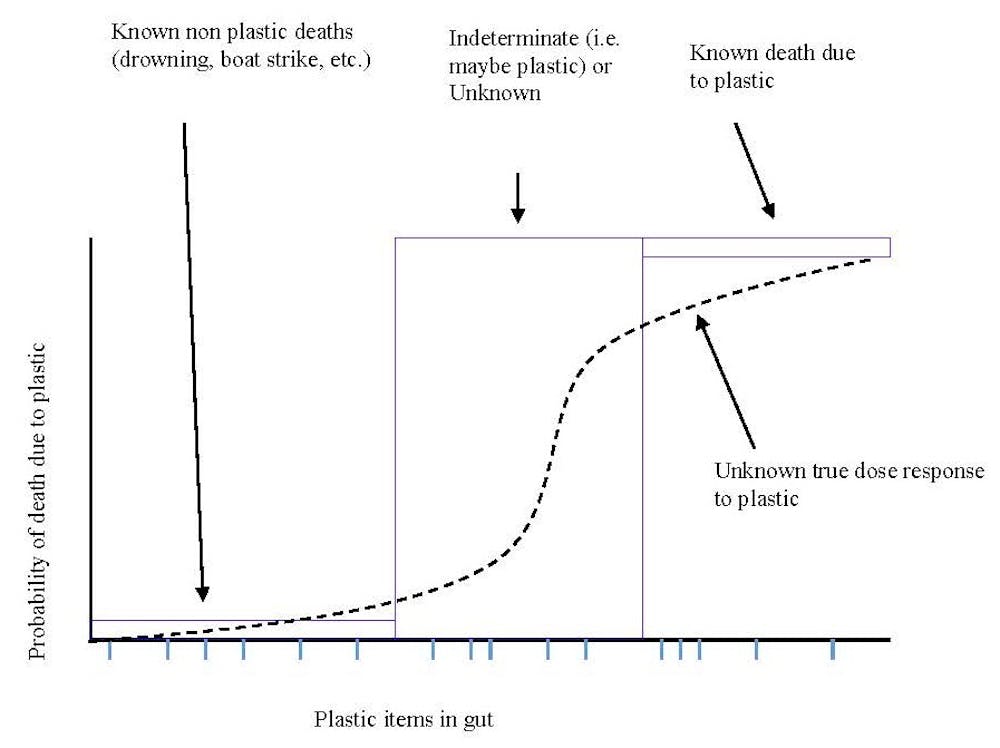
The chart below sets out this idea. If an animal drowned in a fishing net, its chance of being killed by plastic is zero – and it falls in the lower left of the graph. If a turtle’s gut was blocked by a plastic bag, its chance of being killed by plastic is 100%, and it’s in the upper right.

The animals that were dead with plastic in their gut, but had other possible causes of death have a chance of death due to plastic somewhere between 0 and 100% – we just don’t know, and they can fall anywhere in the graph. Once we have all the animals in the plot, then we can ask whether we see an increase in the chance of death due to plastic as the amount of plastic in an animal goes up.

Conceptual framework for estimating the probability of death due to plastic debris ingestion. Figure provided by the authors.

We tested this idea using our turtle samples. We looked at the relationship between the likelihood of death due to plastic as determined by a turtle autopsy, and the number of pieces of plastic found inside the animals.

Unsurprisingly, we found that the more plastic pieces a turtle had inside it, the more likely it was to have been killed by plastic. We calculated that for an average-sized turtle (about 45cm long), eating 14 plastic items equates to a 50% chance of being fatal.


Read more: Pristine paradise to rubbish dump: the same Pacific island, 23 years apart


That’s not to say that a turtle can eat 13 pieces of plastic without harm. Even a single piece can potentially kill a turtle. Two of the turtles we studied had eaten just one piece of plastic, which was enough to kill them. In one case, the gut was punctured, and in the other, the soft plastic had clogged the turtle’s gut. Our analyses suggest that a turtle has a 22% chance of dying if it eats just one piece of plastic.

A green sea turtle that died after consuming 13 pieces of soft plastic and balloons, which blocked its gastrointestinal system. Kathy Townsend

A few other factors also affected the animals’ chance of being killed by plastic. Juveniles eat more debris than adults, and the rate also varies between different turtle species.

Now that we know how much is too much plastic, the next step is to apply this to global estimates of debris ingestion rates by turtles, and figure out just how much of a threat plastic is to endangered sea turtle populations.

– How much plastic does it take to kill a turtle? Typically just 14 pieces
– http://theconversation.com/how-much-plastic-does-it-take-to-kill-a-turtle-typically-just-14-pieces-100768]]>

Oil victory thanks to NZ ‘people power’, says Greenpeace chief

]]>

The Greenpeace environmental flagship Rainbow Warrior 3 in Auckland on the first leg of its seven-week “Making Oil History” tour. Image: Del Abcede/PMC

By Rahul Bhattarai

Greenpeace executive director Russel Norman praised the “people power” that gained an important victory in the “oil war” when the Rainbow Warrior docked in Auckland yesterday for a week-long visit.

The Greenpeace environmental flagship was welcomed by about 200 people – including some original crew members – on the first leg of its seven-week “Making Oil History” tour of New Zealand after arriving at Matauri Bay on Sunday.

“It brings a tingle down the spine to see the Rainbow Warrior return to the port of Auckland” where the original Rainbow Warrior was bombed by French secret agents on July 10, 1985, killing photographer Fernando Pereira,” Dr Norman said.

READ MORE: The Rainbow Warrior itinerary in NZ

“It’s about celebrating the people power movement in Aotearoa which was able successfully to put pressure and build a movement to support a government that wanted to end issuing new exploration permits for oil and gas,” Dr Norman told the crowd.

“And that’s a very, very important victory, and it’s a victory that was only possible because of people power.”

-Partners-

New Zealanders from north to south had come out to rally and protest against offshore exploration for oil and gas.

“Iwi and hapu came out to the beaches and in front of seismic testing vessels to stop and confront the oil industry,” he said.

“That was an epic struggle, mostly successful in ending new offshore exploration permits for oil and gas”.

But it was not yet entirely finished business, said Dr Norman.

The struggle needed to go on.

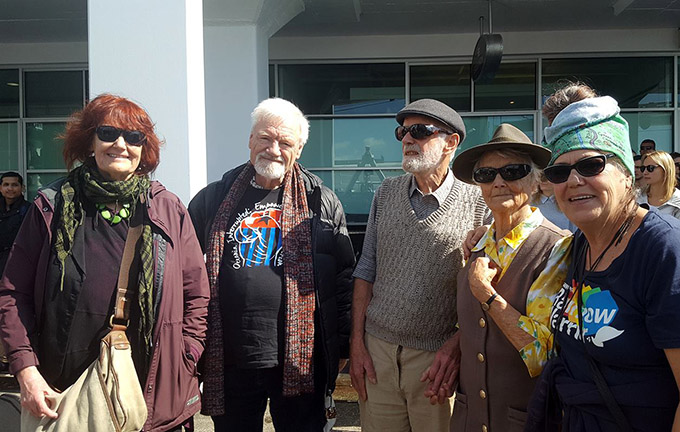
Hilari Anderson (from left), David Robie, Trevor Darville, Margaret Mills and Susie Newborn at the welcome for the Rainbow Warrior on Princes Wharf yesterday. Image: Del Abcede/PMC

The crowd included two original Rainbow Warrior crew members, Hilari Anderson and Susie Newborn, relief cook Margaret Mills on the ship at the time of the bombing and author and journalist David Robie, who travelled on board for the Rongelap Atoll voyage and wrote Eyes Of Fire.

The tour was “not only remembering about the past and the great victory in terms of nuclear testing in the Pacific and nuclear-free New Zealand”, it was about the continuing people power struggle, said Dr Norman.

The Rainbow Warrior will be open for public viewing on Friday, Saturday and Sunday.

Greenpeace climate and energy campaigner Amanda Larsson said events would be hosted on board the ship to inform the public about what New Zealand’s energy transition might look like.

After Auckland, the Rainbow Warrior will sail to Whangaparaoa Bay in the eastern Bay of Plenty and to the East Coast to pay respects for the work the community has done.

Larsson said the ship would then go to Wellington for another event with politicians exploring the future of energy in New Zealand.

After Wellington, the ship will sail to Kaikoura where it will document wildlife.

The campaign ship will also visit Lyttelton and Dunedin.

The last leg will be to Stewart Island before heading for Australia to protest against oil companies’ offshore exploration plans in the Great Australian Bight.

Don McGlashan singing “Anchor Me” at the welcome for the Rainbow Warrior yesterday. Video clip: Del Abcede/PMC

Print Friendly, PDF & Email

Article by AsiaPacificReport.nz

]]>

Politics Podcast: Cathy McGowan and Rebekha Sharkie on the role of community candidates

]]>

The Conversation (Au and NZ) – By Michelle Grattan, Professorial Fellow, University of Canberra

Independent Cathy McGowan and the Centre Alliance’s Rebekha Sharkie share more in common than just sitting on the crossbench. The members for Indi and Mayo respectively have dug in to retain their seats, and they believe there is “a mood” in the community for alternative candidates.

McGowan and Sharkie have given the government their confidence until the Wentworth byelection – after which they will consult with their electorates. They think Kerryn Phelps would have “an excellent chance” of winning the byelection if she runs as an independent. Sharkie said “I would certainly be keen to support her in any capacity and that just might be phone calls just to give her some support”.

Even a few weeks after the leadership spill, Sharkie said “there is still a lot of grieving in Mayo for the loss of Malcolm Turnbull”. The feeling in Indi was “very similar”, McGowan said, “except there was another level” – the loss of an energy policy.

On the Liberal’s problems with unity and women, McGowan said “it’s not just the bullying it’s how they work together as a team. In making themselves into a much better party they might open themselves to greater diversity and to better systems and practices for managing conflict.”

– Politics Podcast: Cathy McGowan and Rebekha Sharkie on the role of community candidates
– http://theconversation.com/politics-podcast-cathy-mcgowan-and-rebekha-sharkie-on-the-role-of-community-candidates-103169]]>

The Predator: you’re gonna need a bigger rope to tie down this alien hunter

]]>

The Conversation (Au and NZ) – By Michael Milford, Professor, Queensland University of Technology

The Predator blasts into cinemas today. While newcomers will enjoy the ride, there are some sly references for those lifelong fans who have watched all the way back to 1987’s original Predator film, and the sequel and crossover films since then.

This is a modern-day Predator film, shiny and slick and updated – with even the mention of climate change as a plot point.

I’m glad there’s a chopper to get to in this film.

But how does the science of new evolved predators stack up? Some spoilers and slightly macabre calculations follow.


Read more: The Meg! When the (giant prehistoric) shark bites, the science bites back


Invisibility cloaking

We see some interesting details on the invisibility cloaking technology of the predators.

Their ship appears to have an external physical field that wraps around the outside of its normal exterior. Personal cloaks appear to vary from being completely invisible to slightly visible, shimmering transparent patterns in the air.

Now you see him, now you don’t. 20th Century Fox / Davis Entertainment.

While some progress has been made, most current invisibility experiments have only worked on tiny micrometre-scale objects, and only for certain wavelengths.

For larger objects, most techniques reflect incident light back, which obscures the object but doesn’t show the viewer what is behind it – unlike in the movie.

“See-through” trucks are currently being developed that use forward-looking cameras and rear displays to show cars what’s in front.

The main challenge with achieving invisibility using this technique is multiple viewers, which was nicely highlighted in the film Mission Impossible: Ghost Protocol. While it’s possible to simulate the background behind the invisible person for one viewer, it becomes progressively more complex to simultaneously simulate multiple backgrounds for multiple viewers at different locations.

One piece of current human technology suggests a possible solution: new OLED TV monitors with extremely fast refresh rates. Multiple viewers wearing 3D glasses can watch different shows at the same time on the same TV. Perhaps some future technology will enable this effect without the need for glasses.

Verdict: Some slight stretching of science.

Will someone please tie up that monster properly

People doing a shoddy job of restraining monsters is one of the most frequently used “stupidity drives the plot” elements of movies. This movie is no different, with a supposedly sedated (because these brilliant scientists know the exact dose for the animal, of course) predator held down by some dubiously thin restraints.

Pred is not a happy hotel guest. 20th Century Fox / Davis Entertainment.

The wire rope appear to have a diameter of about 6mm, suggesting a breaking strength of about 24.4kN, equivalent to a load of about 2,500kg.

But the “safe load” given for that diameter is only 4.89kN (498kg static load), to allow for factors like dynamic loading: something the escaping predator would definitely be applying.

Given that the predator is shown to be able to smash deep dents in solid steel tables and squash cars, it seems unlikely that this cabling (even allowing for the three cables in some places) provides a sufficient safety margin for restraining an angry predator.

Verdict: Shoddy subduing.

Depictions of autism and memory

The son of the main character is presented as being on the autism spectrum. In one character-establishing scene, he correctly sets the pieces back on at least six in-progress chess games from memory after two bullies sweep the pieces onto the floor.

Top chess players have reported they can remember thousands of games. So it’s plausible that a good chess player could remember the configuration of six boards: it’s implied that he is a good player by his watching of other games.

Are the memory feats demonstrated by young Rory McKenna possible? 20th Century Fox / Davis Entertainment

Special interests are also a key characteristic of autism. It’s plausible that he has developed a special interest in chess (it’s portrayed that he’s part of a chess club), and that level of attention has resulted in him being able to reconstruct the board configurations.

Verdict: Care is needed with condition characterisations.

Spoiler alert! I got you, you got me

In the climactic final battle, two mortally injured best buddy soldiers decide to go out on their own terms and shoot each other simultaneously from a range of about ten metres.

At its heart The Predator is part buddy flick. 20th Century Fox / Davis Entertainment

On first impressions, this doesn’t seem possible because the minimum human reaction speed is no better than 100 miliseconds, during which time a handgun bullet travelling at a speed of around 300 metres per second would move 30 metres, more than the distance between them (much faster than the blasters in Star Wars)


Read more: When AI meets your shopping experience it knows what you buy – and what you ought to buy


But this act of bravado is co-ordinated: one buddy isn’t waiting for the other but rather they pull the triggers at the same time. If cued off a shared wink, head nod or other visual cue, they would only need to get the delay after that consistent, still difficult but not impossible.

Verdict: Tricky timing but possible.

The verdict

The Predator is surprisingly fun. It has its ups and downs but there’s some great humour and an entertaining cast that on the whole works well together.

Most of the science – if you allow the overall premise of a super alien species that trawls the galaxy for hunting challenges – holds up reasonably well, with a few exceptions that I think we can allow for the purpose of plot progression.

Most importantly, in a nod to the 1987 film, it’s good to see the characters don’t forget to get to the chopper.


Dr Kate Sofronoff, Associate Professor in the School of Psychology at the University of Queensland, was consulted for advice on autism as part of this article.

– The Predator: you’re gonna need a bigger rope to tie down this alien hunter
– http://theconversation.com/the-predator-youre-gonna-need-a-bigger-rope-to-tie-down-this-alien-hunter-102723]]>

As Witness K trial opens, questions over how much of Timor-Leste spying case to keep secret from public

]]>

The Conversation (Au and NZ) – By Clinton Fernandes, Professor, International and Political Studies, UNSW

The first step in the trial of the former Australian spy known only as Witness K and his lawyer Bernard Collaery has taken place in the ACT Magistrates Court.

The two are accused of conspiring to reveal that former Foreign Minister Alexander Downer ordered an espionage operation against the government of East Timor in 2004 in order to gain an advantage in oil and gas negotiations with the newly independent state. Lawyers for both defendants faced off against the prosecution in a small courtroom presided over by Chief Magistrate Lorraine Walker.

Although the directions hearing lasted only 15 minutes and covered preliminary formalities, enough was said to shed light on what is at stake in the case ahead. The prosecution wants as much of the case as possible to be heard in secret; the defence wants to keep secret only what’s necessary to protect Australia’s national security.


Read more: When whistleblowers are prosecuted, it has a chilling effect on press freedom in Australia


The prosecution offered “proposed orders” for the magistrate to sign that would effectively ensure a closed trial.

Witness K’s lawyer, Haydn Carmichael, responded by supporting the ongoing suppression of K’s real name. He said that such “anonymity is desired by him and is also a practical solution to possible questions that might arise as to national security.”

To understand the importance of this, it’s worth remembering that the Australian Secret Intelligence Service requires a high degree of operational secrecy. It needs to reassure its agents overseas that it will never reveal their identities. If foreign governments were to learn K’s real name, they might be able to identify his agents in their countries and take countermeasures against them.

Such governments might also be able to take reprisals against K or his family if the opportunity arose. Failure to keep K’s identity secret would also affect ASIS’s credibility in its other operations. People who betray their country would no longer dare risk their safety by dealing with Australia’s spies.

The opening phase of the trial showed both Collaery and Witness K are fully committed to keeping these key pieces of information secret.

However, Carmichael added that anything on the charge sheet apart from K’s real name “is not subject to a claim of national security classification.”

Public interest vs national security

The more expansive secrecy desired by the prosecution is another matter altogether. If granted, it would prevent the public from hearing defence evidence that the 2004 bugging operation could itself be considered a crime – a conspiracy to defraud the government of East Timor under Section 334 of the Criminal Code of the ACT. The defence would be unable to put forth evidence that the operation was planned and ordered in the ACT, as well.

This is a much more powerful legal argument than a moral argument against spying for economic purposes.


Read more: The shaky case for prosecuting Witness K and his lawyer in the Timor-Leste spying scandal


This is the background of the case: Australia and East Timor met as joint venture partners with consequent mutual fiduciary duties under the 2002 Timor Sea Treaty. They negotiated production sharing contracts, supposedly in good faith.

The espionage operation occurred before and after the October 2004 round of negotiations, when East Timor’s Prime Minister Mari Alkatiri and Secretary of State Jose Teixeira briefed their cabinet colleagues about their negotiating position. Their briefings were bugged – an action that is alleged to have given Australia’s negotiators an unfair advantage.

Cheating or attempting to cheat a joint venture partner in this way is an offence that would carry heavy civil and criminal penalties under the laws of the ACT.

A court order to prevent the public from hearing this would avoid embarrassing the Australian government, but it is arguably irrelevant to national security.

Witness K’s lawyer also urged the magistrate to exercise her “independent function” in determining what constitutes grounds for national security exemptions, and not to accept the prosecution’s claims at face value.


Read more: Lawyer and witness face charges under spy laws, raising questions of openness and accountability


Underpinning this request is a 1982 case between the Church of Scientology and the Australian Security Intelligence Organisation. In this case, the High Court was asked to determine whether it could prevent ASIO from investigating the church in circumstances where it claimed it did not pose a risk to security.

The High Court found against the church but added:

The court is not bound by the organization’s (ASIO’s) opinion as to what constitutes security or what is relevant to it.

Despite claims that intelligence and national security are too complex to be understood outside the intelligence community, courts routinely evaluate far more complex evidence in other areas: elaborate taxation schemes, labyrinthine trust arrangements, recondite mergers and acquisitions, sophisticated forensic evidence in criminal trials, and so on.

According to the defence’s argument, the ACT Magistrates Court is within its power to form its own opinion and not defer reflexively to the prosecution’s view of what constitutes national security.

The case has been adjourned until 29th October.

– As Witness K trial opens, questions over how much of Timor-Leste spying case to keep secret from public
– http://theconversation.com/as-witness-k-trial-opens-questions-over-how-much-of-timor-leste-spying-case-to-keep-secret-from-public-103164]]>

Independent isn’t necessarily better. Why appointing independent directors can achieve little

]]>

The Conversation (Au and NZ) – By Roman Lanis, Associate Professor, Accounting, University of Technology Sydney

An insurance company has been ripping off its clients. A bank has been lending without properly assessing ability to repay. Trustees of a super fund have been putting the interests of its owner ahead of those of the members they are sworn to protect.

All of these real-world examples from the Financial Services Royal Commission invite the suggestion that the firms would behave better if they had more independent directors.

But independent directors aren’t necessarily better. Indeed our own research, now published in the Journal of Business Ethics, finds that the directors who have sailed closest to the wind in their previous corporate lives are the most sought after.

What we found

We examined the records of 1,714 companies that made up the US Standard and Poor’s index between 2000 and 2011 to determine what had happened to the executives and directors of those that had engaged in the most aggressive forms of tax avoidance.

We found they had better chances of being invited to join other boards than the directors of firms that had not.


Read more: Experienced shareholders better than independent directors for business


We also examined the kind of tax strategies that paid off the most. Independent directors benefited from having been on the board of a firm that had adopted any kind of tax strategy, whether aggressive or not. Executive directors (directors employed by the firm) benefited only if the tax strategy was aggressive. Chief executives benefited only if the tax strategy was routine.

Until now, the reputational effects of corporate tax avoidance on directors and executives have been unknown. Indeed, previous studies suggested that aggressive tax minimisation might harm the reputation of those who presided over it.

Two views about tax

One view, shared by protesters who took to the streets in 2015, is that corporations should pay their “fair share”. Any attempt to dodge tax is seen as dodging social responsibility.

The competing view is that a corporation’s goal is to maximise profit. Any director or executive who achieves this is helping the firm (as would any director or executive who minimised insurance payouts or maximised the flow of superannuation returns to the corporation rather than to the member in whose name they were earned).


Read more: Revealing how much tax companies pay doesn’t move markets or reduce tax avoidance


Our findings provide support for the second view. Insofar as other corporations are concerned, candidates who have been directors and executives of tax-aggressive corporations are regarded as highly suitable for filling board seats.

Are our independents like those in the US?

It isn’t clear whether the Australian market for independent directors works like the one in the United States. It’s a good subject for future research.

If it does, appointing more independent directors might do less to change Australian corporate culture than is commonly imagined.

– Independent isn’t necessarily better. Why appointing independent directors can achieve little
– http://theconversation.com/independent-isnt-necessarily-better-why-appointing-independent-directors-can-achieve-little-103092]]>

Needless procedures: knee arthroscopy is one of the most common but least effective surgeries

]]>

The Conversation (Au and NZ) – By Ian Harris, Professor of Orthopaedic Surgery, UNSW

From time to time, we hear or read about medical procedures that can be ineffective and needlessly drive up the nation’s health-care costs. This occasional series will explore such procedures individually and explain why they could cause more harm than good in particular circumstances.


More than 70,000 knee arthroscopies were performed in 2011 in Australia and, though rates of the surgical procedure are now falling, it still remains one of the most common surgical procedures.

The word arthroscopy means to look inside a joint, in this case the knee. But newer imaging techniques, such as magnetic resonance imaging (MRI) scans, mean performing a knee arthroscopy simply to look inside the knee joint is rare.

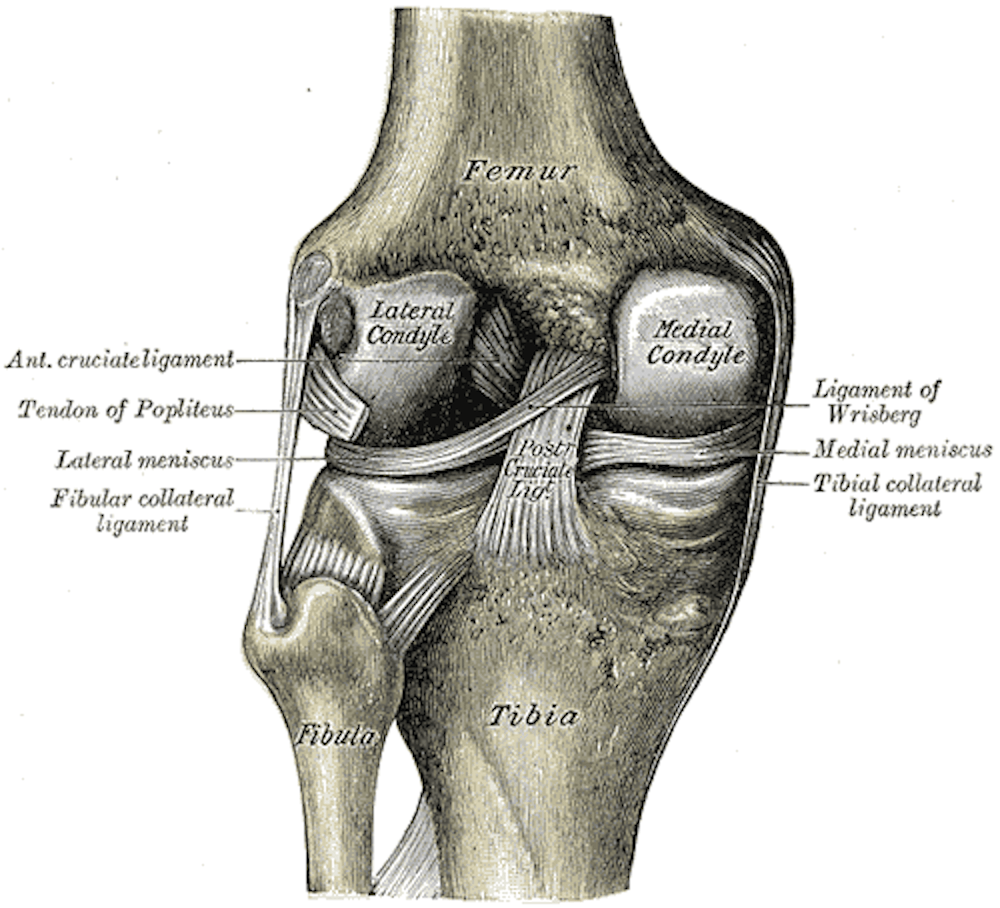
Knee arthroscopies are most commonly performed to treat osteoarthritis (wear and tear in the joint) or problems with the menisci (the two rubbery discs between the bone ends). An arthroscopy involves making a small incision in the skin and inserting a kind of camera on a stick. Another incision is made to insert other instruments to cut and remove tissue.

In the case of osteoarthitis or meniscal problems, arthroscopy can be used to clear debris from the joint or to trim loose cartilage or torn parts of the menisci. The procedure can also be used to perform ligament reconstructions, help with treating fractures or infections in the knee, or simply to take a sample of tissue from the joint.

The camera can see structures such as the cartilage that covers the end of the bones, the lining (synovium), the menisci and ligaments. Knee arthroscopy requires admission to hospital and an anaesthetic. It carries some risk of harm such as infection or further damage in the joint.


Read more: Spinal fusion surgery for lower back pain: it’s costly and there’s little evidence it’ll work


It’s rarely effective

Most knee arthroscopies are done in older people for degenerative conditions such as osteoarthritis. The prevalence of knee osteoarthritis, which can involve wear and tear of the menisci as well as the cartilage that lines the bone, increases with age. Most people aged 50 years and over have some osteoarthritis in the joint and roughly one-quarter will have some wear and tear in the menisci.

Many people with osteoarthritis or a torn meniscus also have knee pain. This has led to the belief that the osteoarthritis changes or the meniscus tear cause the pain. But these changes are also common in those who have no pain at all. And menisci mostly don’t have nerves, so they can’t be felt unless there is a large tear, often resulting from a major injury. In fact, most people with a torn meniscus don’t have knee pain.

The menisci are the two rubbery discs between the bone ends. Wikimedia Commons

Many studies have now shown the outcomes from arthroscopic surgery for osteoarthritis and degenerative meniscal tears are no better than the outcomes from placebo (fake) surgery or other treatments (such as exercise therapy).

A recent summary of these studies made “a strong recommendation against the use of arthroscopy in nearly all patients with degenerative knee disease” (osteoarthritis and degenerative tears of the menisci) and concluded “further research is unlikely to alter this recommendation”.

Many surgeons believe the presence of mechanical symptoms – a concept that is not clearly defined but involves pain and abnormal feelings (such as catching, clicking and locking) when moving the joint – can be treated with arthroscopy. However, studies have also shown having arthroscopy does not provide better results than fake surgery for the treatment of mechanical symptoms.

Sometimes, a meniscus can be so badly torn it folds over on itself, jamming the knee and restricting the ability to straighten the knee. This is a relatively uncommon type of meniscus tear and if the symptoms don’t improve on their own, the torn part of the meniscus can be removed arthroscopically.

Why do surgeons still recommend it?

Doctors tend to overestimate how good their treatments are and underestimate the harms that come from them. Surgeons are often faced with patients in pain and, other than surgery, have little else to offer except continued non-operative treatment, reassurance and time.


Read more: Explainer: what is pain and what is happening when we feel it?


Patients may want a quick fix or may have failed to improve with other treatments, but unfortunately the failure of other treatments doesn’t make knee arthroscopy any more successful.

Surgeons often see people in a lot of pain. from shutterstock.com

Knee pain due to osteoarthritis often fluctuates in severity and patients tend to present for treatment when their pain is most severe. This means any treatment given at this time will appear more effective than it truly is. This is why comparative studies, particularly placebo studies, are important, as these show the true effects of treatments.

Though some surgeons may believe they can predict which patients will do well from surgery, this belief has not been validated. Despite the desire for this procedure to work, arthroscopy for degenerative knee conditions puts patients at risk of harm, including death, for no important benefits.

How can we stop it?

Changing practice in response to evidence is often slow. The first high-quality trial to demonstrate knee arthroscopy was no better than placebo surgery was published in 2002, yet overuse of knee arthroscopy has persisted.

Barring financial and regulatory controls, practice change in medicine is largely a social phenomenon. It requires leaders in the field and informed consumers to change practice.

The rates of knee arthroscopy in Australia are starting to fall, particularly in New South Wales, where the rate of knee arthroscopies in people aged 50 and over has nearly halved since 2011. More action is needed. All surgeons, particularly in high-volume states such as Western Australia, South Australia and Victoria, need to take a good hard look at the evidence, question their practice, and take action to reduce this overuse.


Read more: Needless medical procedures: when is a colonoscopy necessary?


– Needless procedures: knee arthroscopy is one of the most common but least effective surgeries
– http://theconversation.com/needless-procedures-knee-arthroscopy-is-one-of-the-most-common-but-least-effective-surgeries-102705]]>

Independent isn’t necessarily better. How appointing independent directors can achieve little

]]>

The Conversation (Au and NZ) – By Roman Lanis, Associate Professor, Accounting, University of Technology Sydney

An insurance company has been ripping off its clients. A bank has been lending without properly assessing ability to repay. Trustees of a super fund have been putting the interests of its owner ahead of those of the members they are sworn to protect.

All of these real-world examples from the Financial Services Royal Commission invite the suggestion that the firms would behave better if they had more independent directors.

But independent directors aren’t necessarily better. Indeed our own research, now published in the Journal of Business Ethics, finds that the directors who have sailed closest to the wind in their previous corporate lives are the most sought after.

What we found

We examined the records of 1,714 companies that made up the US Standard and Poor’s index between 2000 and 2011 to determine what had happened to the executives and directors of those that had engaged in the most aggressive forms of tax avoidance.

We found they had better chances of being invited to join other boards than the directors of firms that had not.


Read more: Experienced shareholders better than independent directors for business


We also examined the kind of tax strategies that paid off the most. Independent directors benefited from having been on the board of a firm that had adopted any kind of tax strategy, whether aggressive or not. Executive directors (directors employed by the firm) benefited only if the tax strategy was aggressive. Chief executives benefited only if the tax strategy was routine.

Until now, the reputational effects of corporate tax avoidance on directors and executives have been unknown. Indeed, previous studies suggested that aggressive tax minimisation might harm the reputation of those who presided over it.

Two views about tax

One view, shared by protesters who took to the streets in 2015, is that corporations should pay their “fair share”. Any attempt to dodge tax is seen as dodging social responsibility.

The competing view is that a corporation’s goal is to maximise profit. Any director or executive who achieves this is helping the firm (as would any director or executive who minimised insurance payouts or maximised the flow of superannuation returns to the corporation rather than to the member in whose name they were earned).


Read more: Revealing how much tax companies pay doesn’t move markets or reduce tax avoidance


Our findings provide support for the second view. Insofar as other corporations are concerned, candidates who have been directors and executives of tax-aggressive corporations are regarded as highly suitable for filling board seats.

Are our independents like those in the US?

It isn’t clear whether the Australian market for independent directors works like the one in the United States. It’s a good subject for future research.

If it does, appointing more independent directors might do less to change Australian corporate culture than is commonly imagined.

– Independent isn’t necessarily better. How appointing independent directors can achieve little
– http://theconversation.com/independent-isnt-necessarily-better-how-appointing-independent-directors-can-achieve-little-103092]]>

Sharing your meter data might help cut your power bill, but it needs secure regulation

]]>

The Conversation (Au and NZ) – By Sangeetha Chandrashekeran, Director, Centre for Resources, Energy and Environmental Law, Melbourne Law School, University of Melbourne

We are now well and truly in the era of big data. Scandals such as Cambridge Analytica show that vast amounts of our personal data are being harvested for commercial gain and, worse still, nefarious purposes. Yet big data also provides exciting opportunities for empowering consumers and enabling new products and services.

A new frontier is the rollout of smart electricity meters in Australia. Giving households more control of their energy consumption data can arguably help them cut their power bills, and drive innovation and competition in the retail energy market. This can involve allowing third parties to access your data.


Read more: Smart electricity meters are here, but more is needed to make them useful to customers


The potential benefits depend on well-functioning markets with effective regulation and adequate consumer protections. But much work remains to be done to ensure that markets function well and that these protections are in place.

Success depends on a strong framework of regulations that upholds data privacy, respects anonymity, and builds trust.

The growth of energy data

Smart meters record our electricity use, and provide two-way remote communication to an electricity provider. In a few years’ time, your average electricity meter will be collecting data at five-minute intervals, providing an unprecedented level of insight into your home life.

High-function smart meters were controversially rolled out to all Victorian households from 2009, by electricity distributors. Now in the rest of Australia, less sophisticated smart meters are being rolled out by energy retailers.

Many households, however, are not included because they live in so-called “embedded networks” such as apartment buildings or caravan parks.

So far, the promised consumer benefits of smart meters have been slow to emerge. Under the existing rules, consumers have the right to access their data or grant a third party access, but most households lack the tools and information to do this easily.

Nevertheless, there are some fairly well-tested solutions available, such as the North American Green Button Initiative and a quality government tariff comparison service.

Consumer data rights

The federal government is currently putting through a major reform package intended to give consumers, and third parties, simple access to their data.

These reforms will initially apply to three key sectors: banking, electricity, and telecommunications. The government claims that if consumers are given access to their energy data they can use it to reduce their energy costs. But this assumes that third parties will develop tools to show consumers how to do it.

The application of the data rights reforms will be developed in each sector separately. Open access in the electricity sector will likely involve creation of a new database by the Australian Energy Market Operator (AEMO) that will store information such as your name, address, email, phone number, current retailer and tariff details, your electricity distributor, and details of whether you have solar panels or batteries at your home.

An entire new system of accreditation will have to be established to allow third parties to apply for access to this data. The threshold question of what constitutes explicit and informed consent has yet to be discussed in detail.

In a world of proliferating data and complex everyday commercial transactions, there are real concerns about consumers’ capacity to understand what we might be signing up for when we simply tick a box and ask for lower power bills.

Protecting consumers

There are multiple metering regimes and meter types across Australia, each with different regulatory protections for consumers. There are national-scale and sector-specific protections under Australian Consumer Law and the National Energy Customer Framework, and there are state and federal privacy laws too. The interaction between these existing regimes and the Consumer Data Right is unclear and needs much more analysis.

We know that consumers want to have control over how their data is collected and shared, and that they feel powerless when it comes to big data. It is crucial that we develop a universal regulatory framework for access to energy data that is simple and safe for all consumers.


Read more: Capping electricity prices: a quick fix with hidden risks


The European Union’s General Data Protection Regulation requires that consumer consent is explicit, confined to a specific purpose, easy to understand, freely given, and easily withdrawn. Pre-ticked consent boxes are not permitted under these rules.

We should follow this lead and undertake more research in Australia to test consumers’ comprehension and their effective capacity to consent. We should also do more to ensure that open access does not increase risks for vulnerable groups. We are concerned that valuable datasets can be combined, such as credit ratings (banking), spatial location (telecommunications), and household activity (energy). There are numerous implications, not least of which is charging vulnerable consumers deemed “less desirable” higher prices and limiting the products and services on offer.

We need to find meaningful ways to reduce energy prices and expand new energy services like solar and electric vehicles across Australia, by making markets work for all consumers. This involves both empowering consumers through a clear and streamlined approach to energy data use and access, and a strong data governance regime that protects consumers against new vulnerabilities and risks.

– Sharing your meter data might help cut your power bill, but it needs secure regulation
– http://theconversation.com/sharing-your-meter-data-might-help-cut-your-power-bill-but-it-needs-secure-regulation-102345]]>

Guide to the Classics: the poetry of Rosemary Dobson

]]>

The Conversation (Au and NZ) – By Peter Kirkpatrick, Senior Lecturer in Australian Literature, University of Sydney

In our series, Guide to the classics, experts explain key works of literature.


In the first century BCE the Roman poet Horace proposed that, “A poem is like a picture”, meaning that, like painting, poetry engages in mimesis by imitating life, copying it in a fixed medium. But what happens when art imitates art, as in Australian poet Rosemary Dobson’s poem, For the Painter Ben Nicholson, about the work of the British modernist?

Finding and learning
the inner essence,
making and showing
by signs and symbols

that a tree like a glass
contains its tree-ness
and frost is white
on the rim of darkness.

Even more ancient than Horace is the concept of ekphrasis, the poetic description of a work of visual art: painting, sculpture, architecture. In other words, ekphrasis is a kind of translation of one art form into another. Dobson’s poem is a meditation on how a picture can reveal more by suggesting what’s not there – at least to the physical eye – as much as what is.

The poet Rosemary Dobson (centre) in 1953. Wikimedia

Across her long career, Dobson was celebrated as a poet who could take the reader beyond the immediate image to another insight. From early on her skill with traditional forms was balanced by a willingness to loosen them in more conversational ways, so she responded better than some of her postwar peers to the cultural shifts of the 1960s and beyond.

At Frensham School in Mittagaong, NSW, where her widowed mother was employed as a house mistress, Dobson’s interest in both poetry and art was actively encouraged. Later, while a non-degree English student at Sydney University, Dobson also studied painting with the artist Thea Proctor.

During the 1940s she worked in the editorial department of the publisher Angus & Robertson, where she met her husband Alec Bolton. Bolton would set up Brindabella Press in 1972 to print fine editions of poems, often including Dobson’s illustrations.


Read more: Guide to the classics: Donald Trump’s Brave New World and Aldous Huxley’s dystopian vision


Poems about paintings

Dobson was fascinated by the ways in which poetry and the visual arts might speak to each other, and late in life described how learning visual design helped her write her poems:

I mean that as one strives for balance of light and shade, weight and airiness in painting, so one can use words and phrases to the same effect in writing poetry.

‘The Arnolfini Portrait’, Jan van Eyck, 1434. Wikimedia

The title poem of her earliest collection, In a Convex Mirror (1944) seems to be inspired by Jan van Eyck’s Arnolfini Portrait (1434), and addresses a poignant irony about all representation: that art, in order to capture life, must inevitably still its pulse:

Shall we be fixed within the frame,
This breathing light to clear-cold glass
Until our images are selves
And words to wiser silence pass?

A painting may preserve the moment, offering a “wiser silence”, but it can’t account for the ravages of time that will inevitably “rive the two of us apart”.

Dobson’s many poems about European paintings are among the finest modern experiments in the ekphrastic mode. Painter of Antwerp evokes Pieter Brueghel’s Landscape with the Fall of Icarus (c. 1555), a work also treated by W.H. Auden and William Carlos Williams.

Dobson reads the painting from the artist’s earthy Flemish point-of-view as he returns north, bemused rather than impressed by the glories of the Italian Renaissance, as symbolised by the classical figure of Icarus fallen from the sky, a minor detail in the picture:

At the top of the Alps he paused perhaps, looked backwards,
Rejecting the fanciful, and took for a painting
Ploughman, fisherman, and moon-faced shepherd,
The furrow cut cleanly, the sheep contented;
Put thumb to nose with neither pride nor envy
At soaring wings – a Southerner’s invention –
Icarus sprawling, two feet out of the sea.

In contrast, the classical world is welcomed in Landscape in Italy, which expresses wonder at the way a painting – here Botticelli’s Primavera (1477-1482) – can re-enchant the everyday world:

But Art, more durable than thought
Between event and memory
Has interposed her coloured chart
To show in perpetuity

That but five steps from where we lay
Drowsing upon the short-cropped grass
Lightly, with all her springtime flowers,
Did Botticelli’s Flora pass.

Primavera, Botticelli, 1482. Wikimedia

Read more: Why Emily Brontë’s Wuthering Heights is a cult classic


Translating the world

One can overemphasise Dobson’s poems about paintings at the expense of the variety of her achievement, along with its distinctly Australian elements. A major reason she gave for writing so little while in England with her husband and family in 1966-71 was: “one needs to write where one’s roots are. Away from one’s country one is taking in rather than giving out”.

During this time her work became more immediately personal – it was an era for “confessional” poetry – and, by becoming so, more elegiac, more concerned with the passing of time and with loss.

The landscape of Dry River offers an “objective correlative”, to use T.S. Eliot’s term, for state of the poet’s mind. Though in a freer form, note the emphasis on dactyls (a poetic foot that starts with one stressed syllable followed by two unstressed), creating a falling cadence:

It was my river. My spirit’s destination.
Abstract of water, a dried depression,
Holed and bouldered and raked with fissures
Where the idea of water channelled
Irresistibly over and under
Endlessly forcing down to the sea.

The poems of Dobson’s middle-age are often more explicitly concerned with women’s experience. In Cock Crow, the responsibility of being a writer, of “Wanting to be myself, alone”, conflicts with the responsibilities owing to “One life behind and one before”, her daughter and mother, whose sleeping forms are unaware that she has fled the house. But morning brings the sound of the crowing cock, that biblical symbol of betrayal, and the poet returns, “Thinking I knew his meaning well”.

In later life, Dobson collaborated with fellow poet David Campbell to produce translations – what they called “imitations” – of the work of several 20th-century Russian poets, which were published alongside more literal renderings of the same poems.

As poet Simon West has remarked, such an exercise is both rare, and rarely celebrated, in a “largely monolingual” literary culture such as ours. But in a way Dobson’s contributions are also like her ekphrastic poems: renderings of the original work in another medium; here, another language.

Poet James McAuley described Dobson’s work as “pellucid”: a highly appropriate word for a poet so invested in painting, which depends on light. But McAuley was also referring to a translucent quality in Dobson, what he called “a meaning within the meaning, or haunting the meaning, a feeling that what the poem says or does is only a way of conveying something else which is ineffable”.

The last of a series of short elegies to David Campbell, The Continuance of Poetry, offers an example, showing as well the influence of Chinese poetry:

Not being able to find the hermit he wanted to visit
Li Po looked deeper into the landscape.
Like Li Po we lean against a pine-tree;
And looking into the landscape find your poems.

For Dobson, in translating the world for us, art necessarily bears the trace of the translator.

– Guide to the Classics: the poetry of Rosemary Dobson
– http://theconversation.com/guide-to-the-classics-the-poetry-of-rosemary-dobson-100581]]>

World politics explainer: The Holocaust

]]>

The Conversation (Au and NZ) – By Daniella Doron, Senior lecturer, Monash University

This article is part of our series of explainers on key moments in the past 100 years of world political history. In it, our authors examine how and why an event unfolded, its impact at the time, and its relevance to politics today.


This is a story from our series of explainers on key moments in the past 100 years of world political history. In it, our authors examine how and why an event unfolded, its impact at the time, and its relevance to politics today.

Warning: some of the following photos may be disturbing to readers.


The event traditionally defined as the Holocaust — by which I mean the systematic extermination of European Jewry between 1941 and 1945 — defies an overly simplified explanation.

With that being said, making sense of the who, what, where and when presents the somewhat easier task.

What happened?

The Jews of Europe have been traditionally understood by historians as the principal targets of annihilation by the Nazis. Though Germans were perpetrators of this genocidal act, so too were other complicit Europeans, who either directly participated in murder or looked the other way.

Onlookers watching as Jewish people are forced to scrub the pavement. USHMM/Wikicommons

Eastern Europe housed the sites of mass death (ghettos, labour camps, and concentration and death camps) built by the Nazis to “eliminate” Europe of Jews. Scholars generally point to 1941 – 1945 as constituting the woeful years in which approximately 6 million European Jews were killed by the Nazis.

The question of why the Nazis murdered the Jews of Europe remains somewhat thornier and far more controversial amongst scholars.

When the Nazis rose to power in 1933, the issue of how to handle the so-called “Jewish problem” ranked high on their agenda. The Germans held a racialised view of antisemitism, which defined Jews as not only biologically distinct from Germans, but also a critical threat to the health of the German nation.

Given their view of Jews as parasites, sapping the strength of the national body, the German Nazis experimented with a series of mechanisms to “eliminate” Jews from German life. The notion of murdering the Jews of Europe, we should note, had not yet surfaced.

Rather, in the early years of the regime, the Nazis saw emigration as an acceptable solution to the Jewish problem.

Legislation that disenfranchised Jews, stripped them of their financial assets, and denied them their livelihoods sought to clarify to Jews their new degraded position within Germany. The days of their security, stability, and equality under the law had come to an end. It was time to make a new life elsewhere. But these measures failed to bring about the results desired by the Nazis.

By 1939, slightly more than half of German Jews had decided to chart a new course abroad. Unfortunately, the outbreak of war the same year only served to exacerbate the dilemma of eliminating Germany of Jews within its domain.

The extent of Nazi Germany’s spread across Europe by 1942. Shutterstock

As Germany quickly and violently occupied large swaths of territory in eastern and western Europe, the number of Jews in its territory exploded. Whereas the population of Jews in Germany in 1933 stood at roughly half a million, approximately nine million Jews resided in Europe as a whole.

Emigration no longer seemed like a viable option. Which nation would be the new home to all those Jews? As it stood, the half a million Jews of Germany struggled to find nations willing to house them.

And it was soon decided that new solutions needed to be found.

The impact of the Holocaust

Scholars debate why and when and even who arrived at the new solution of mass murder to solve Europe’s so-called “Jewish problem.”

We know that in 1939, when war broke out in the East and Germany occupied Poland, the Nazis turned to the creation of ghettos in Poland, which served to concentrate and isolate Jews from the greater Polish non-Jewish population. In these ghettos, often surrounded by high walls and gates, Jews engaged in forced labour and succumbed in great numbers to starvation and disease.

We also know that in 1941, when war broke out with the Soviet Union, the Nazis turned to rounding up Jews in the towns and villages of eastern Europe and murdered them by bullets. At least 1.6 million eastern European Jews died in this fashion. But why this turn from “passive murder” in the ghettos to “active murder” in the killing fields and later the concentration and death camps of eastern Europe? Who proposed this radical solution?

Row of bodies found at a liberated concentration camp, 1945. Shutterstock

These questions defy scholarly consensus. It may be that the earlier policies of emigration, isolation and concentration of Europe’s Jews were eventually perceived as insufficient; it may be that the murder of Europe’s Jews by starvation and later bullets proved too slow and costly. And perhaps it was not Hitler who first arrived at the idea of mass murder, but Nazi bureaucrats and functionaries working on the ground in eastern Europe, who first conceived and experimented with this genocidal policy.

Regardless, by 1942, Jews across Europe were rounded up — from their homes, their hiding places, and Nazi run ghettos and labour camps to be deported to killing centres and concentration camps, where the vast majority lost their lives.

Contemporary implications

The legacy of the Holocaust has loomed large for more than 70 years, and continues to inform our culture and politics. It has come to be seen as arguably one of, if not the, defining events of the 20th century.

The Holocaust is commonly perceived as a truly rupturing occurrence in which a modern state used the mechanisms of modernity — technology, scientific knowledge and bureaucracy – not for the benefit of humanity but to inflict suffering and death.

We are now well aware that modernity does not necessarily result in progress and an improved standard of living, but that it comes with a dark underbelly that can lead to the violent purging of segments of society perceived as undesirable.

In its aftermath, the Holocaust became paradigmatic for defining genocide. The murder of European Jewry inspired the term “genocide”, which was coined by the jurist Raphael Lemkin in 1944. It later prompted the Genocide Convention agreed to by the United Nations in 1948.

The 1948 Genocide Convention, the memory of the Holocaust, and the phrase “never again” are thereby routinely invoked in the face of atrocity. And yet these words ring hollow in the face of genocides in Rwanda, Cambodia, Bosnia, and the current genocide against the Rohingya in Myanmar.

Rohingya Muslims walking through a broken road in Bangladesh late last year. Shutterstock

It happens again and again. Not to mention that the largest refugee crisis since the second world war is occurring this very moment as desperate Syrians undertake perilous journeys across the Aegean.

Approximately 80 years ago, Nazi persecution likewise culminated in an international refugee crisis. World leaders recognised the plight of Europe’s Jews during the 1930s and into the 1940s, even if they could not foretell their eventual genocidal fate.

International leaders even convened a conference (the Evian Conference) in which they debated how best to aid German Jews. Country after country expressed their sympathies with Jewish refugees but ultimately denied them refuge.

International news at the time closely followed the journey of the SS St Louis, as it sailed from port to port with 900 Jewish refugees unable to disembark because nations refused to grant asylum. We now know the future that befell many of these refugees.

These days, images of desperate Syrians undertaking perilous journeys across the Aegean, or the Rohingya fleeing their persecution in Myanmar, occupy our front pages. As we contemplate our responsibility towards these desperate individuals, the SS St Louis and the Evian Conference have been routinely invoked in our public discourse as a reminder of the devastating consequences of restrictive refugee and immigration policies.

We must remain haunted by our past failings. It is the legacy of the Holocaust that compels us to examine our responsibility to intervene and turn our attention to the plight of refugees. And we should consider whether that legacy has remained sufficient or whether we need a reminder of the dire consequences that comes with numbing ourselves to the suffering of others.

– World politics explainer: The Holocaust
– http://theconversation.com/world-politics-explainer-the-holocaust-100657]]>

New body for complaints against police in Victoria is a good move, with some caveats

]]>

The Conversation (Au and NZ) – By Tamar Hopkins, PhD student UNSW Law, UNSW

A parliamentary committee has recommended that all serious police misconduct be investigated by a new independent police misconduct and corruption division within the Independent Broad-based Anti-Corruption Commission (IBAC). Will this deliver accountable policing for Victorians?

A system lacking independent oversight

Ever since the abolition of the Police Complaints Authority in 1988, Victoria Police investigate the majority of complaints against police officers internally. The present system has little public support. Going by submissions to the IBAC Committee Inquiry, only Victoria Police, the Police Association and IBAC itself support the status quo.


Read more: When it comes to violent brawls, does Victoria need more ‘force’?


The statistics behind police investigating police aren’t good. Less than 4% of complaints relating to excessive force are substantiated (which means the alleged conduct is found on the balance of probabilities to have occurred). While 2% of complaints submitted through lawyers are substantiated, less than 1% of complaints involving Aboriginal people are.
In contrast, civil litigation and criminal defence cases routinely produce results that contradict internal police investigations. As the complaint system is the gateway to criminal and disciplinary outcomes, its failure leaves the public vulnerable to further abuse.

What is a fair and effective police complaints system?

The numerous examples of independent agencies that investigate complaints against police rebut assertions that the police need to investigate their own. The Police Ombudsman of Northern Ireland (PONI), the Civilian Complaints Review Board of New York (CCRB) – the list goes on. These bodies are not only independent, but also more effective than Victoria Police investigations. The PONI substantiates 22% of complaints it investigates, while CCRB substantiates 23%.

As well as independence and effectiveness, allegations of human rights abuses by police and police “duty failures” require careful consideration of the interests of the victim. Because human rights violations by police or failure to respond adequately to victims of crime shatters a person’s confidence in the rule of law, justice requires victim-centred investigation of that abuse.

International human rights principles for police investigations are set out by the European Court of Human Rights. These require investigations of police complaints to be:

  1. Independent
  2. Effective
  3. Prompt
  4. Transparent
  5. Victim-centred

How do the inquiry recommendations stack up?

While recommendations to establish and adequately resource an independent division within IBAC to investigate police complaints are important steps forward, we are concerned about the definition of “serious police misconduct” proposed as the threshold for mandatory IBAC investigation.

“Serious police misconduct” is defined as conduct that could result in the prosecution of an officer for a serious indictable offence or serious disciplinary action. This will exclude from IBAC investigation many complaints about racial profiling, excessive force or duty failures in family violence investigation.

In addition, the inquiry has recommended that IBAC complaint investigation files continue to be denied to complainants. This is contrary to the decision of the UN Human Rights Committee in Horvath v Australia where the state’s failure to provide Horvath with her complaint file was one of the reasons Australia was found to be in breach of its human rights obligations. In contrast, the Independent Officer for Police Conduct in the UK is subject to FOI laws.

We are also concerned by recommendation 26, which aims to ensure IBAC decisions are protected from judicial review. The right of appeal is fundamental to ensuring compliance with the law and natural justice.

Will the IBACC inquiry deliver for all Victorians?

Marginalised groups are the most likely to experience abuse at the hands of police, and yet their efforts to seek redress may be the least likely to succeed. The figures quoted above in relation to Aboriginal complainants in Victoria reflect this double disadvantage.

A complaints system in which police investigate themselves is hardly likely to instil confidence in communities where police are regarded as the problem rather than the solution.

In our research in Melbourne, young people from culturally diverse backgrounds reported a wide range of problematic encounters with police. Many parents feared their children would experience mistreatment or criminalisation by police.

An independent system offering timely redress for police wrongdoing and protection from reprisals could go a long way towards restoring community confidence. The inquiry has recommended that “complainant welfare managers” be appointed by both IBAC and Victoria Police to reduce the barriers faced by marginalised Victorians in particular. However, independent support by youth or community workers may still be required to enable them to lodge complaints in the first place.

Victims of crime need accountable policing

Victims of crime rely on police to behave professionally and exercise care when they seek assistance. Victorian coronial inquests into the deaths of Kelly Thompson and Joy Rowley, both murdered at the hands of their estranged partners, make this clear.


Read more: Victorian government should be wary of introducing a stand-alone offence of non-fatal strangulation


The Victorian coroner was critical in both cases of police failure to implement policies and procedures designed to protect people from family violence in the lead up to these killings. In the wake of the coronial findings, Rowley’s children said of the police response:

It’s like Russian roulette, sometimes you get someone who will help. Sometimes, like Mum, you get someone who doesn’t take you seriously.

Our research on violence against women with disability backs these comments. Many of the women we interviewed reported that police failed to respond to their complaints of violence against them. Compounding this duty failure, police would sometimes threaten to charge the woman experiencing violence if she persisted in complaining or if she expressed dissatisfaction with the police response.

An effective complaints system is needed if police are to be held accountable for duty failures. There is nothing in the committee’s recommendations that will improve accountability for “duty failures”.

Notwithstanding the shortcomings we have identified, the IBAC Inquiry offers a platform for reform that would entrench a human rights compliant and fully independent police complaints mechanism to serve all Victorians and support good policing practice. We will probably have to wait until after the upcoming state elections to learn whether the political will exists to deliver on this opportunity.

– New body for complaints against police in Victoria is a good move, with some caveats
– http://theconversation.com/new-body-for-complaints-against-police-in-victoria-is-a-good-move-with-some-caveats-101381]]>

Curious Kids: where do clouds come from and why do they have different shapes?

]]>

The Conversation (Au and NZ) – By Robert Lawry, Hydrologist, Australian Bureau of Meteorology

This is an article from Curious Kids, a series for children. The Conversation is asking kids to send in questions they’d like an expert to answer. All questions are welcome – serious, weird or wacky! You might also like the podcast Imagine This, a co-production between ABC KIDS listen and The Conversation, based on Curious Kids.


Where do clouds come from and why do they all have different shapes? – Ryan Potts, age 7, Canberra.


Hi Ryan, great question!

When it comes to understanding clouds, it helps first to understand water.

You know the water you drink out of a glass? That’s liquid water. There is also solid water, such as ice from the freezer or a slushy.

But water also exists as a gas. It’s called water vapour. You can’t can’t see, taste or feel this water but it’s everywhere. It’s all around you right now. Water vapour is in the air we breathe. When it’s warm and there is a lot of water vapour in the air, it can feel very sticky and sweaty.


Read more: Curious Kids: Why do you blink when there is a sudden loud noise close by?


Now let’s go back to clouds.

For clouds to form, air needs to be cooled to a temperature at which the water vapour turns into liquid water. The best way to do this is to make the air rise, because the higher we go in the atmosphere the colder the temperature. There are many reasons air might lift, but one reason is because during the day the sun heats up the surfaces around us.

Imagine the oval near your school on a warm day. Starting in the morning the sun warms the surface of the oval and before too long the entire oval is warming up.

Warm air weighs less than cooler air. So a big bubble of warm air, filled with water vapour, slowly lifts off your school oval.

As the bubble of air (filled with water vapour) rises upwards, it starts to cool down. The higher it goes the cooler it gets.

Bubbles of warm air that have reached and passed beyond the condensation level. Robert Lawry, Author provided

Eventually, well off the ground above your school, the bubble of air has cooled so much that the water vapour turns into liquid water. We call this point the condensation level. When the water vapour turns into tiny specks of liquid water, a cloud forms.

Clouds are simply liquid water: very, very small drops of liquid water. So small in fact, that they can be held up in the air by rising air currents.

Back on the school oval: the day keeps getting warmer, more and more bubbles of rising air race upwards, cooling as they rise. When these bubbles of air reach the condensation level, more cloud forms.

A fluffy, bumpy cloud, formed by rising warm air currents. Robert Lawry, Author provided

Clouds formed by rising warm air currents are called “convection clouds”. Because of all the rising air coming up, these clouds can be bumpy on the top, sometimes producing very high thick clouds looking like cotton wool or cauliflower heads.


The Conversation, CC BY-ND

When air rises very slowly and gently over an area and reaches the condensation level you get a cloud that is very smooth looking, like this:

A smooth cloud. Robert Lawry, Author provided

Sometimes air goes up past the condensation level then falls back below the condensation level, then up, then below, again and again. This creates clouds that are stripy, often with lines between the clouds.

The way the air moves creates all the different clouds we see.


The Conversation, CC BY-ND

All the grey clouds that you see contain liquid water. However, as we discussed earlier, water can also exist as a solid (ice). Clouds that are very high are extremely cold and may appear pure white. These clouds contain ice.

I used to wonder what it would feel like to touch a cloud. Would it be fluffy? Hard, soft, warm or cold?

Well, we don’t need to wonder. Because every time we see fog, we are looking at cloud.

Fog is simply air that has cooled to the point where the water vapour has turned into liquid water. That forms fog – which is really just a cloud on the ground.

So next time you see fog, go outside and touch a cloud!

Fog is really just cloud at ground level. Robert Lawry, Author provided

Read more: Curious Kids: Why don’t dogs live as long as humans?


Hello, curious kids! Have you got a question you’d like an expert to answer? Ask an adult to send your question to us. They can:

* Email your question to curiouskids@theconversation.edu.au
* Tell us on Twitter by tagging @ConversationEDU with the hashtag #curiouskids, or
* Tell us on Facebook

CC BY-ND

Please tell us your name, age, and which city you live in. You can send an audio recording of your question too, if you want. Send as many questions as you like! We won’t be able to answer every question but we will do our best.

– Curious Kids: where do clouds come from and why do they have different shapes?
– http://theconversation.com/curious-kids-where-do-clouds-come-from-and-why-do-they-have-different-shapes-102404]]>

Women in sports: double standards a double fault

]]>

The Conversation (Au and NZ) – By Marilyn Giroux, Senior Lecturer in Marketing, Auckland University of Technology

Naomi Osaka has made history as the first Japanese woman to claim a Grand Slam singles title after defeating Serena Williams in the final of the US Open.

However, her defining performance was overshadowed by controversy around sexism and double standards in sports. As our current research suggests, female and male athletes are held to different standards – and this also filters through to endorsement deals. “Bad boy” sports stars with an anti-hero or rule-breaker image are generally welcomed by sponsors, but female athletes aren’t treated the same.

The Grand Slam

Osaka’s opponent, Serena Williams, was looking to win her 24th Grand Slam singles title, one year after giving birth. The feat would have equalled the record of controversial Australian Margaret Court.

Osaka undoubtedly dominated her opponent, but what people will remember is Williams’ outburst of frustration. AAP, CC BY-ND

Opinions about this incident have been divided across the globe. Billie Jean King, a strong advocate of women’s rights in sports, tweeted:

Global outrage followed a sketch by Mark Knight, the editorial cartoonist of the Herald Sun, which depicted Williams as a baby and Osaka as white, misrepresenting both athletes.


Read more: The Herald Sun’s Serena Williams cartoon draws on a long and damaging history of racist caricature


Double standard in sports

Differences between permissible on-court decorum of female and male athletes have been called into question, prompted by the severe umpire calls towards Williams’ behaviour as well as penalties against French player Alizé Cornet earlier in the tournament for briefly taking off her shirt on court after realising it was on backwards.

This incident came days after the French Tennis Federation announced a new dress code that will ban Serena Williams’ catsuit. Designed to help prevent blood clots that threatened her health after giving birth, the suit was deemed to be disrespectful of the game.

Several celebrities and athletes have argued for a redefinition of women’s tennis oriented towards strength, power and athleticism. Former top-five tennis player and Miami Open tournament director, James Blake, alluded to contradictory gendered reactions to athletes expressing their anger and frustration.

The sport definitely has a double standard when it comes to perception.

Several comments noted “boys will be boys” reactions to male tennis players such as Novak Djokovic and Dominic Thiem when these players misbehaved by destroying a racquet on court.

Marketability of male and female athletes

Over the past decades, female athletes in tennis have been fighting for equal pay. Some gains have been made, but equity is far from achieved. Prize money in tennis is only equal in Grand Slam tournaments. More than 70% of male professional tennis players in the world’s top 200 have earned more than their female counterparts.

Tennis is not an isolated case. According to the Women’s Sports and Fitness Federation, women’s sport only gets 7% of media coverage and barely 0.4% of commercial investment goes to women-only sport. Substantial pay disparity has also been evident in the football world cup, with men receiving US$28.6m in prize money, while the women’s tournament only receives US$820,000.

Notable discrepancies have also also been observed in terms of sponsorship opportunities, with women underrepresented in endorsement deals. In order to secure a sponsorship deal, athletes are expected to behave in an exemplary manner on and off the court and have to shoulder the immense pressure of being positive role models. In Williams’ case, this is particularly true as attacks on her have been personal and her suitability as a role model was called into question.

Nike’s reaction to Maria Sharapova’s drug suspension, in contrast to its response to Tiger Woods’ infidelity scandal or Kobe Bryant’ rape accusation, highlights equity issues among consumers and sponsors.

Villain or rogue

Research has demonstrated that celebrity endorsements are based on credibility and attractiveness. The main premise of endorsement decisions is based on the transfer of positive associations between the endorser and the brand. However, several sources have noted differences between how male and female athletes are evaluated in terms of marketable qualities.

Female athletes are more often judged on attractiveness and physical appearance, while male athletes are judged primarily on performance and skill.

For example, at the 2015 Australian Open, after becoming the first Canadian woman to qualify for the semi-final at a major tennis tournament, Eugenie Bouchard was asked by the on-court announcer to “give us a twirl”.

Similarly, the Women’s National Basketball Association holds makeup seminars for rookie players to ensure women secure the sponsorship deals they need to play. The evidence suggests marketability of female and male athletes does indeed revolve around different meaning transfers.


Read more: Why sports fans need villains


In an era where brands are searching for athletes that are different and unique, there’s been an increased interest in athletes with intriguing personalities. Research has in the past demonstrated the appeal of a hero defeating the villain, but recently controversial athletes with a rogue image have gained appeal to specific target markets.

Our current work examines the role of anti-heroes in sports and how breaking the rules can have positive effects for sponsoring companies, even making an athlete more attractive. Positive sentiments such as fearlessness and intrigue are often associated with bad boys, while the perceptions of a bad girl is not so favourable. The “lovable bad boy” has no female equivalent.

No matter which side of the fence you may sit on with regards to the events between Serena Williams and Naomi Osaka, the conversation about women in sports is long overdue, albeit, unfortunately, at the expense of the current US Open women’s singles champion.

– Women in sports: double standards a double fault
– http://theconversation.com/women-in-sports-double-standards-a-double-fault-103082]]>

Yes, AI may take some jobs – but it could also mean more men doing care work

]]>

The Conversation (Au and NZ) – By Katharine McKinnon, Tracy Banivanua Mar Senior Research Fellow, La Trobe University

It’s now generally accepted that as artificial intelligence (AI) advances into fields of work that were formerly considered skilled labour, a huge number of manual and white collar jobs are likely to disappear.

These are the kinds of jobs that require learning and applying patterns, unemotional calculation and mechanistic problem solving. Think: medical diagnosis, legal contracts and engineering.


Read more: AI doctors and engineers are coming – but they won’t be stealing high-skill jobs


Guardian columnist Simon Jenkins recently suggested AI will free us up to focus on the caring work uniquely suited to humans.

Currently much care work is low paid, unpaid or invisible – and mostly done by women. It requires creativity, empathy, relationship building, and emotional and spiritual labour. I argue the advent of AI has the potential to herald a revolution in how care work is valued in society, and ensure this kind of work is spread more evenly across genders.

Care work underpins our economy

Market democracies may prioritise economic growth, but care is at the core of what makes us human.

Economists might assume that we are all homo economicus (individuals who maximise rational utility), but we could also be cast as homines curans (humans who care).

Political science professor Joan Tronto describes care as:

a species activity that includes everything that we do to maintain, continue, and repair our “world” so that we can live in it as well as possible. That world includes our bodies, ourselves, and our environment, all of which we seek to interweave in a complex, life-sustaining web.

Care is the work that builds and sustains this web. It’s done within families to provide the basic needs of life. It nurtures children, supports the elderly, and supplies the “emotional labour” needed to keep households going.

But care work also happens in professional life – and not just the care professions of nursing or childcare.

Administrative tasks that support the collective efforts of university departments are one example. Doing the dishes in the tea room is another. More important is the daily work of building community and mutual support, fostering our being-in-common.


Read more: A survival guide for the coming AI revolution


In the home and workplace, it’s care work that attends to the social relations underpinning institutions and organisations, farms and marketplaces, offices and factory floors. Without this largely invisible and unpaid care work, the economy would not function.

As Yale anthropologist James Ferguson notes:

the receipt of unconditional and unearned distribution and care must always precede any productive labour.

In other words, care comes first. Without it we wouldn’t be unable to function as organisations, manage our farms, run our factories, or participate in any kind of waged labour.

Robots can’t care

Care work is not well suited to new technologies. It requires empathy.

While AI can mimic human emotions, it’s a long way off from being able to genuinely empathise. Robot empathy is based on deceit: it can make you think it cares in order to shape your emotional responses. For ethicist Rob Sparrow, that also means it’s fundamentally unethical to rely on robots to provide care.

But if AI takes over the task-based and calculative work that people now do, could the essential, largely feminised, work of care begin to be more valued?

There are some signs this could happen.


Read more: Women are less likely to be replaced by robots and might even benefit from automation


The business world is paying more attention to the importance of empathy in the workplace. Research reveals the diversity of contemporary economic practices beyond capitalism, and is showing us how much of our economy is reliant upon putting care first.

Around the world, examples of community economies – livelihood practices that actively build and sustain communities rather than seeking profit – are changing economic systems.

In academia and the not-for-profit sector, new organisational structures are being shaped around appreciation for the whole human being, with collaboration not competition as the defining mode of interaction.

These examples demonstrate the possibility of reconfiguring our economies towards a future where an ethics of care comes first.

Lessons from the global south

As we anticipate a new definition of the uniquely human skills people bring to the workplace, it’s worth drawing on the knowledge of societies that place more value on community networks and interpersonal relationships than western culture does.

When asked to talk about their livelihoods, gender equity and their aspirations for the future, women and men in the Pacific focus on relationships. What concerns them most is the ability to contribute to community, to share what they have, and for the different contributions of women and men to be given equal value.

We can learn from this.


Read more: How AI is helping to predict and prevent suicides


As robots and AI “take our jobs”, the care work that underpins all workplaces – and homes, and schools, and communities – ought to come to the fore. This would offer a long overdue corrective for our love affair with the rational, utility-maximising individual – and provide opportunity and motivation for more men to shoulder a greater share of the load.

Realising we are more homines curans than homo economicus gives us a chance to properly value the care work that’s at the heart of our economies.

– Yes, AI may take some jobs – but it could also mean more men doing care work
– http://theconversation.com/yes-ai-may-take-some-jobs-but-it-could-also-mean-more-men-doing-care-work-102488]]>

Why anti-American sentiment is weaker under Trump than it was under George W. Bush

]]>

The Conversation (Au and NZ) – By Brendon O’Connor, Associate Professor in American Politics at the United States Studies Centre, University of Sydney

Despite the significant global outrage at US President Donald Trump and his supporters – best highlighted by the Pew surveys and more viscerally by the enormous anti-Trump protests in London in July 2018 – anti-Americanism is less apparent under Trump than it was under President George W. Bush.

Shortly into the Bush presidency, a wave of books such as Why do People Hate America? became bestsellers. This was part of a lively debate at the time about what constituted anti-Americanism.

I was part of this cottage industry during the Bush era and ended up editing seven books on the topic. I reached the conclusion that anti-Americanism is best understood as a generalised prejudice against, and disdain for, America and Americans. In the Trump era, there is no sign of this publishing boom reappearing; instead books and articles on populism are now the preferred way to understand Trump.

There are a range of reasons for this. Firstly, Trump does not personify America to foreigners in the way that Bush did. Although Trump is a populist, it is more his policies and speeches that are populist than the man himself.

Trump is famous for showing off his wealth and suggesting it makes him highly desirable to women and a role model for young entrepreneurs. In the 1980s and 1990s Trump flaunted his wealth to build a profile in the New York tabloids as a property tycoon and “ladies’ man”.


Read more: Where will the global political hotspots be in 2018? (Spoiler alert: it’s not all about Donald Trump)


In 2004, NBC launched reality TV show The Apprentice, in which Trump rewarded the successful participants by inviting them over to his lavish New York apartment and to his golf clubs. Trump may claim to speak for the “average American”, but he is widely understood to be proud of his wealth and elite status. In response to revelations about Michael Cohen (Trump’s personal lawyer) paying Stormy Daniels US$130,000 in hush money, Trump tweeted:

These agreements are very common among celebrities and people of wealth.

In contrast, George W. Bush liked to suggest he was just a regular guy who happened to be born into a famous family. Bush’s down-home self-presentation was largely accepted by foreigners who tended to see him as representative of all that was wrong with America and Americans, such as its moralistic religiosity, insularity and lack of interest in foreign affairs, gun culture and fast food, and righteous sense of violent vengeance. To many, Bush’s cowboy boots on the desk and Texan drawl said it all.

The notion that the president is the personification of the nation has not been anywhere near as apparent with Trump.

The other reason Bush was seen to represent American attitudes was that foreigners quickly forgot his highly controversial victory in 2000 after the events of 9/11, which led to his popularity skyrocketing.

In September 2001, Bush received the highest approval of any president since surveys were initiated in the 1940s. A Gallup survey had his public approval at 90%. An ABC News poll the same month had his approval peaking at 92%. Trump’s approval rating in the Gallup surveys has never been higher than 45%.

The other factor that made anti-Americanism more apparent during the Bush presidency than during the Trump era to date was a sense that most Americans supported the Bush administration’s decision to invade Iraq in 2003.

This rallying around the flag during the Bush era, when unity was demanded and often achieved, stands in marked contrast to the Trump era. It’s obvious to non-Americans that many Americans were very unhappy Trump was elected.

The Women’s March in Washington DC the day after Trump’s inauguration, which attracted half-a-million protesters, received a lot of global coverage and inspired similar (although smaller) Women’s Marches around the world.

Whereas during the Bush presidency the anti-Iraq War marches of February 14-16 2003 were much bigger outside the US than within America. In London and Madrid, over a million people turned out to protest against Bush’s proposed war. More than 100,000 participated in demonstrations in Berlin, Sydney, Athens, Barcelona, Seville and Paris. The largest US march was in New York City, where around 100,000 turned out to oppose the war – a number similar to that in the much less populous cities of Lisbon and Dublin.

Another reason anti-Americanism is less apparent today than during the Bush presidency is non-Americans began to take much greater interest in American presidential elections at a granular level in 2008 with the rise of Barack Obama. It began with his victory over Hillary Clinton in the primaries and jumped again with his defeat of John McCain in the main event.

The primaries and the general election have been covered since 2008 in many nations outside the US with constant information and commentary in local newspapers and other media services. As a result, following American presidential elections became habitualised, like following the FIFA World Cup or the Olympics. The rules of the primaries and the Electoral College became more widely understood.

In my view, this closer following of US elections has reduced anti-Americanism because it has led to non-Americans seeing how much difference of opinion there is within the US and how many Americans oppose the winning candidate. As a result, it is widely understood how divided America is between Trump supporters and those Americans who not just oppose Trump but despise him.


Read more: With Cohen and Manafort both guilty, the pressure on Trump is rising


Another key factor in reducing anti-Americanism since the Bush era was the Obama presidency. As the Pew surveys show, Obama was very popular outside the US, where his time in the Oval Office was watched with much interest and hope.

The most obvious example of this was Obama being awarded the Nobel Prize for Peace in 2009. Obama’s prominence and global popularity led to Americans and America being thought of differently.

Obama liked to present himself as the quintessential 21st-century American: with a white mother and a black father, longstanding and recent immigrant ties to America, and a pragmatic willingness to compromise on political matters. The fact Trump and the birther movement slandered Obama for supposedly not being born in America, and even for being a closet Muslim, generally made him more popular abroad. Obama was seen as an ideal antidote to the globally unpopular Republican Party.

Non-Americans were largely impressed by this persona and the new America Obama talked about. As a result, America once again became hip around the world. In my hometown of Sydney, American-styled dive bars and pricey “Southern food” restaurants opened after an absence of such ventures during the Bush presidency.

Obama’s urbane and worldly personality challenged the stereotype of all Americans being warmongering, insular and nativist. Even the election of Trump has not entirely washed out this new understanding of America from the collective consciousness of non-Americans. In the years since Bush left the Oval Office, a more nuanced view of America and Americans has become more predominant.

– Why anti-American sentiment is weaker under Trump than it was under George W. Bush
– http://theconversation.com/why-anti-american-sentiment-is-weaker-under-trump-than-it-was-under-george-w-bush-102976]]>

Where Australian states are up to in decriminalising abortion

]]>

The Conversation (Au and NZ) – By Erica Millar, Interdisciplinary gender scholar, University of Adelaide

Abortion is common, safe, and the only criminalised listed medical procedure in Australia due to an archaic, flawed piece of legislation inherited from Victorian England.

Despite campaigns to decriminalise abortion, progress has been slow, and patchy across states. Here’s where each state is up to.

The Australian Capital Territory

The ACT is the only Australian jurisdiction to completely remove abortion from criminal law. Medical practitioners can perform abortions at approved facilities.

The health minister can establish safe access zones around abortion clinics, where interfering with a person attending the clinic or causing them distress is prohibited.

The parliament is set to debate a bill that would allow women to access abortion via telemedicine, nurse practitioners, or their GP.


Read more: Explainer: what are abortion clinic safe-access zones and where do they exist in Australia?


New South Wales

Unlawful abortion” is punishable by up to ten years’ imprisonment in NSW. Case law permits medical practitioners to perform abortions on physical, mental health, economic or “social stress” grounds.

In 2017, a woman who had experienced reproductive coercion was convicted of attempting to procure a miscarriage.

In 2017, the NSW Coalition government unanimously voted against decriminalising abortion. Safe access zones were established in June 2018. The Greens continue to campaign for law repeal.


Read more: How forced pregnancies and abortions deny women control over their own bodies


Northern Territory

Ministerially approved medical practitioners can perform abortions to preserve a woman’s life before 14 weeks gestation on physical, psychological or social grounds and between 14 and 23 weeks with another doctor’s approval in the NT.

The legality of abortions performed after 23 weeks is uncertain. Doctors with a conscientious objection to abortion must refer patients to a doctor with no such objection. Safe access zones are established in the NT.

The attorney general has promised to review the abortion laws.

Queensland

Abortion is a crime punishable by up to ten years’ imprisonment in Queensland. Case law permits medical practitioners to perform abortions “in exceptional cases” on physical and mental health grounds.

In 2010, a Cairns couple was tried and acquitted of procuring an abortion. In April 2018, a suicidal 12-year-old sought permission from the Supreme Court to obtain an abortion. The lack of surgical abortion facilities in far north Queensland has seen women fly interstate for abortions or even perform self-administered abortion.

Parliament will debate the Termination of Pregnancy Bill 2018 in October. This bill follows the Queensland Law Reform Commission’s recommendations and allows abortion on request to 22 weeks and thereafter in emergencies or when two doctors deem it necessary on physical, psychological or social grounds.

There are provisions for conscientious objection and safe access zones. Abortions performed by unqualified persons would remain unlawful.

South Australia

Abortion remains a crime punishable by up to life imprisonment in SA. A 1969 statutory amendment allows abortion when:

  • two doctors determine the abortion necessary on mental or physical health grounds or for foetal abnormalities

  • performed in a prescribed hospital before the woman is 28 weeks pregnant and thereafter only to preserve the woman’s health

  • the woman has resided in South Australia for two months.

After two years of community engagement, the South Australian Abortion Action Coalition began its formal campaign in August 2018 by sending letters to each state MP calling on them to take action to repeal abortion laws.


Read more: Explainer: is abortion legal in Australia?


Tasmania

In Tasmania medical practitioners can perform abortions with a woman’s consent up to 16 weeks, and thereafter when two doctors deem it necessary on physical or mental health grounds. There are provisions for conscientious objection and safe access zones.

The state’s last abortion clinic closed in December 2017, forcing women requiring surgical abortions to travel interstate. The Liberal government is working with a private provider to deliver low-cost surgical procedures to women in Hobart from October.

Victoria

Abortion is legal on request up to 24 weeks, and thereafter when two medical practitioners deem it necessary on physical, psychological or social grounds. Pharmacists and registered nurses can supply and administer medical abortion before 24 weeks, and thereafter on direction from a medical practitioner.

It remains a crime for an unqualified person to perform an abortion. There is a conscientious objection clause. Safe access zones were established in 2015.

An anti-abortionist has brought an appeal against her conviction for breaching safe access zones to the High Court on grounds that the legislation infringes on her freedom of political communication. A similar challenge has been brought in Tasmania.

Western Australia

Abortion is unlawful unless performed before 20 weeks’ gestation by a medical practitioner who has obtained a woman’s informed consent or determines the abortion necessary on physical, mental, social, personal or familial grounds.

After 20 weeks, two medical doctors from a ministerially appointed panel of at least six must agree the pregnant woman or foetus has a severe medical condition. A parent must be notified of abortions performed on those under 16 years of age.


Read more: FactCheck: do women in Tasmania have access to safe abortions?


Australian laws obstruct access to abortion. Gestational limits, which are generally interpreted conservatively, often make second and third trimester abortions accessible solely to those who can afford to travel interstate or overseas.

South Australians cannot access medical abortion via telehealth or their GPs and must travel to Adelaide or a handful of regional centres.

Abortion remains a doctor’s choice in several jurisdictions. Abortions are generally costly, and one in three women find it difficult or very difficult to finance them. Law repeal is therefore one of many changes necessary to ensure better abortion access.

– Where Australian states are up to in decriminalising abortion
– http://theconversation.com/where-australian-states-are-up-to-in-decriminalising-abortion-102649]]>

Explainer: what is energy security, and how has it changed?

]]>

The Conversation (Au and NZ) – By Samantha Hepburn, Director of the Centre for Energy and Natural Resources Law, Deakin Law School, Deakin University

The idea of energy security has been at the centre of much policy debate recently. The federal government defines energy security as the adequate supply of energy across the electricity, gas and liquid fuel sectors.

But this notion has become outdated, following the spate of electricity blackouts that have occurred in the past few years. The concept of energy security is now increasingly synonymous with resilience: responding to problems quickly and avoiding power outages.


Read more: Trust Me I’m An Expert: Why February is the real danger month for power blackouts


To be secure, the national energy market must ensure a sufficient supply of electricity at an affordable price and be able to respond to major disruptions. Being “energy secure” in this context now means having a backup plan. Unfortunately, Australia doesn’t.

All about oil

Historically, energy security was purely about oil supply. It evolved as a policy response to the 1973 Arab oil embargo. At the time, the aim was to coordinate among the industrialised countries if supply was disrupted, to avoid future supply problems and to deter exporters from using resources as a strategic weapon. Four key developments emerged from the embargo:

  • the International Energy Agency (IEA), whose members are the industrialised countries;

  • strategic stockpiles of oil, including the US Strategic Petroleum Reserve;

  • continued monitoring and analysis of energy markets and policies; and

  • energy conservation and coordinated emergency sharing of supplies in the event of a disruption.

Australia is not ‘secure’

When Australia joined the IEA in 1979, it was a net exporter of oil and was therefore exempt from the requirement to stockpile liquid fuel. Since this time, however, Australia’s oil production has peaked and is now in decline.

Reasons for this are various but include the reduction in oil refining capacity and significant increases in reliance on imported oil products.

In 2012 Australia became non-complaint with the IEA requirement that all members maintain oil stocks equivalent to at least 90 days of the previous year’s daily net oil imports.

In contrast with many other IEA members, Australia does not have a public (or government-owned) stockpile of oil and has instead relied on commercially held stocks. Currently, Australia has an aggregated fuel reserve of roughly 48 days, including about 22 days’ supply of crude oil, 59 days of LPG, 20 days of petrol, 19 days of aviation fuel, and 21 days of diesel.


Read more: Australia’s fuel stockpile is perilously low, and it may be too late for a refill


This lack makes Australia very vulnerable in a crisis – 98% of our transportation relies on liquid fuel, as do all of our major defence platforms. An extended disruption means our economy, policy force and army could cease to function.

While the federal government intends to return to compliance by 2026, our ongoing failure to understand and respond to a changing environment has resulted in us becoming, at least in the context of liquid fuel, energy “insecure”.

Are we ready for a new approach?

The modern energy landscape is complex, and energy security is a much broader and more dynamic concept than it was thirty years ago. Public expectations have also evolved. Australia must address a multitude of new challenges that include: climate change, integrating renewable energy, rising peak demand, rising domestic gas prices and a raft of new geopolitical rivalries.

In many parts of the world, mechanical and analogue systems traditionally powered by oil-products, have been replaced with automated and networked systems that run on electricity. As a result, the number of digitally connected devices has grown from 400 million in 2001 to in excess of 25 billion in 2018.

These changes make electricity and natural gas, in addition to oil, key supports of many facets of society. They ensure that the modern world is completely dependent on energy generation. Within this context, resilience is a critically important requirement.

Future energy systems, responsive to this enlarged concept of energy security will therefore look very differently. Large fossil fuel and synchronous generators will be replaced by a clean electricity system composed of small-scale, clean asynchronous generators. It will mix large renewable projects (which will mean extending the physical transmission network) with distributed energy generation (for example, from rooftop solar), and the network will require new systems to ensure coordination and stability.

Renewable energy is an important component of energy security but it works differently to fossil fuels. For example, inertia functions differently. Inertia is the capacity of a power system to respond to unexpected shocks, and its ability to react and stabilise the system’s balance.

Inertia slows down the rate at which frequency changes after a disruption in the grid, such as the failure of a power plant or a transmission line. Inertia has traditionally been provided by fossil fuel generators. However, within a mixed energy framework, renewables will provide synthetic inertia. For example, modern wind turbines can use the kinetic energy stored in the generator and blades to be responsive during grid stress. This can provide an efficient injection of power into the grid where it is required, and the delivery can be flexibly controlled to suit regional grid conditions. New storage technologies will, however, need to be incorporated into networks early so their application in practice can be understood.

These are all responses to a new understanding of energy security. Today, what is essential to the definition of energy security is not just an adequate supply of energy at an appropriate price but an adequate supply of sustainable, resilient energy at an appropriate price, which is responsive to the demands of a decarbonising economy.


Read more: At its current rate, Australia is on track for 50% renewable electricity in 2025


In light of this, energy security is perhaps even more crucial in our modern world than it was back in 1973. Understanding the evolving meaning of energy security means we are better equipped to comprehend the different ways in which our global interconnection can make us vulnerable.

We need to minimise risk and reduce exposure. We need to imagine what a secure energy framework of the future looks like. We need energy policy that is more responsive to the social, economic and environmental demands of modern Australia.

– Explainer: what is energy security, and how has it changed?
– http://theconversation.com/explainer-what-is-energy-security-and-how-has-it-changed-102476]]>

Why driverless vehicles should not be given unchecked access to our cities

]]>

The Conversation (Au and NZ) – By Dominic Stead, Delft University of Technology

Autonomous, or driverless, vehicles can support and promote active travel, such as walking and cycling, when two basic conditions are met:

  1. their access to cities is restricted
  2. their use is pooled.

In the absence of these two conditions, autonomous vehicles could lead to a decline in active travel in cities and an increase in economic, social and environmental costs. Potential costs are rarely mentioned in the rhetoric about autonomous vehicles, much of which is highly optimistic.


Read more: Going down the same old road: driverless cars aren’t a fix for our transport woes


However, universal or widespread access to the city by autonomous vehicles could result in detrimental outcomes. Not least of these impacts are on active travel and public health. Depending on the conditions under which autonomous vehicles are allowed to operate in the city, we can expect a range of impacts with direct or indirect implications for walking and cycling.

How could these vehicles have harmful impacts?

Currently, access to or from public transport stops usually involves a short walk or cycle ride for many people. In the future, some people might choose to use autonomous vehicles to reach the bus, train or tram stop instead of walking or cycling. Or they might choose to move away from public transport and switch to autonomous vehicles completely. Clearly, both situations would reduce active travel.

At present, most people get in or out of their cars in car parks. In the future, autonomous vehicles can deliver passengers to their destinations without needing to park there. After drop-off, autonomous vehicles will take themselves to another part of the city where parking is cheap or free. Or they may go on to pick up someone else.

One possible consequence is that existing road infrastructure – carriageway or parking space – will be reallocated for passenger drop-off and pick-up. This would leave little or no extra space for pedestrians and cyclists.

Although autonomous vehicles could increase road safety, they might be segregated from other road users to reduce disruptions (deliberate or otherwise) and increase the predictability of autonomous vehicle flow.

Segregation of transport modes would mean pedestrians or cyclists are only allowed to cross autonomous vehicle lanes at specific points, either via signalled crossings or bridges and tunnels. This will reduce accessibility for pedestrians or cyclists. An urban structure will be created that is less “permeable” for active transport, with routes that are less direct than they could be.

Ultimately, by offering opportunities for recreation, work or even sleep during car journeys (instead of driving), autonomous vehicles might increase the travel time and distance that people consider acceptable. The frequency of car trips might increase too. And, as vehicles spend longer on the road, requirements for road infrastructure capacity might also increase.

In the longer term, if people are willing to travel further, homes and jobs might be relocated. This would fuel urban sprawl and reduce the viability of public transport services. Lower public transport use will be detrimental for active travel and public health.

Impacts of different levels of vehicle access and ownership. Diagram by Dominic Stead

Read more: Fat of the land: how urban design can help curb obesity

Read more: Putting health at the heart of sustainability policy


Limit access for urban well-being

Overcoming the negative consequences of autonomous vehicles requires first and foremost strong restrictions on their access within the city. This should be much more limited than it is for conventional cars. Access should be restricted to specific nodes and axes in the city.

Exceptions would apply to certain users and situations. Examples include passengers with disabilities, emergency services, construction and maintenance, and deliveries of heavy goods.

The underlying logic should be to channel autonomous vehicle traffic along a limited number of corridors in the city, and to locate pick-up and drop-off points at key nodes along these corridors. These nodes should be well served by high-frequency public transport services. They should also be well connected to a dense network of attractive pedestrian and cycle infrastructure.

The aim is to promote fast and efficient node-to-node journeys, as in the image below, rather than door-to-door journeys. Nodes should be distributed around the city according to a hierarchy.

Locating minor nodes around one kilometre apart would mean the maximum distance to reach the nearest node is 500 metres. This is generally considered to be an acceptable walking distance in transit oriented development.

Major nodes can be located several kilometres apart. These serve as multi-modal transit centres that provide connections to train and/or bus services.

Schematic representation showing restricted access of vehicles to designated urban corridors and nodes. Author provided

Restricting traffic access to certain streets in the city will provide space that can be used almost exclusively for active transport.

A future where autonomous vehicle ownership is pooled will have more economic, social and environmental benefits for cities. Pooling vehicles will clearly reduce the number of vehicles needed to serve the city. This in turn will mean less infrastructure is needed to accommodate them.

However, even if autonomous vehicles are individually owned, controlling access to selected nodes and axes in the city can still have benefits for the city and its citizens.

Australian cities need to be prepared for widespread autonomous vehicle use before it happens. This includes being prepared for more active transport. At the moment Australia is not as ready as many countries in Europe and North America. Readiness requires more research, planning and preparation soon.

– Why driverless vehicles should not be given unchecked access to our cities
– http://theconversation.com/why-driverless-vehicles-should-not-be-given-unchecked-access-to-our-cities-102724]]>

The paradox of choice. Why made-to-order might not solve the fashion industry’s problems

]]>

The Conversation (Au and NZ) – By Jessica Pallant, Lecturer in Marketing, Swinburne University of Technology

How could you go from winning awards for “Store Design of The Year” and “Best Shoe Ever” to selling nothing?

In 2009 the Australian startup Shoes of Prey set out to make exactly the shoes its customers wanted. Customers could pick the designs, sizes and exact specifications, and Shoes of Prey would deliver exactly what they ordered.

They wouldn’t make shoes no one needed. Traditional retailers use flash sales to move stock that has gone out of fashion. Or they burn or bury it. British fashion label Burberry says it has destroyed more than A$150 million worth of unsold clothes, accessories and perfume over the past five years.

Last month Shoes of Prey hit pause.

Co-founder Jodie Fox went to social media to say it was considering its future and wouldn’t process any further orders.

It had been unable to “truly crack mass market adoption”.

If Shoes of Prey couldn’t, maybe no one can.

The pros and cons of mass customisation

Customisation can increase the perceived value of a product through the “I designed it myself” effect, giving customers a sense of ownership as “creators”.

It can also improve the customer’s perception of the quality of the product. Research shows people are more likely to enjoy the taste of a meal made from a kit they used themselves than the taste of a meal made from the same kit in a store.

But there are downsides. Making choices is taxing.


Read more: Digital by design: how technology is breathing new life into the fashion business


And the choices pile up. For shoes, size is probably the easiest, followed by colour, heel size, width, pattern and accessories. There are other judgements to be made. Should there be more than one colour? Will that choice look good? What will others think? And so on.

Having many roughly equal options to choose from is draining. The satisfaction we get from choice follows an inverted U curve. Having more options when there are just a few makes us feel good, but having even more when there are already a lot makes us feel worse.

And then there’s the cost of time.

When customising, customers have to learn what is possible within the confines of the toolkit, test out different possible solutions, learn from their errors and pick the best solution. All of this takes time.

It’s a resource not everyone has. Research shows customers with the most free time are the most likely to appreciate the opportunity to make choices about what they buy.

Shoes of Prey’s mistake might have been to increase the range and complexity of its offerings. What started as customising high heels in 2009 became selecting styles of heels, flats, sneakers, boots and sandals with a multitude of options within each.

While loyal customers could keep up, for the average customer the choice was overwhelming. For some, it was easier to take the path of least resistance – a pair of off-the-shelf shoes.

Mass customisation today

Some retailers are persisting with mass customisation. More than 60% of online shoppers in the US are believed to have chosen, recommended or bought a brand that provides a customised experience or service.

Interestingly though, 42% wanted to customise from a list of options and be “led by the brands” rather than start from scratch.

So-called “customisation via starting solution”, where customers choose from an inital option closest to their desired outcome and then refine it to their needs, has been found to enhance satisfaction, decrease the perceived complexity of the customisation and result in more feature-rich products being customised.


Read more: What’s really driving the future of retail?


An example of a brand currently making headway is Choosy, a new fast fashion brand that draws its fashion inspiration almost exclusively from the top trending posts on Instagram. Releasing ten styles a week, it gives customers just a few days to order each before they go into production. By creating only pieces customers have committed to buying, it avoids building up surplus stock and leverages the upside of mass customisation while minimising the downside.

Does it have a future?

The waste in mass production of fashion items is unsustainable in the long term, from both an economic and social standpoint.

Shoes of Prey broke ground with its innovative business model of delivering customised shoes through on-demand manufacturing, but faced challenges in convincing customers to make the necessary choices to customise a product.

If brands can tackle the barriers to customisation, reducing the cost to customers in time and choice as Choosy has done, then mass customisation could have a future.

– The paradox of choice. Why made-to-order might not solve the fashion industry’s problems
– http://theconversation.com/the-paradox-of-choice-why-made-to-order-might-not-solve-the-fashion-industrys-problems-102442]]>

In defence of conspiracy theories (and why the term is a misnomer)

]]>

The Conversation (Au and NZ) – By David Coady, Senior Lecturer in Philosophy, University of Tasmania

Before 2012, if you had voiced suspicions that the Australian government had been anything but open and honourable in dealing with East Timor – its newly independent but impoverished neighbour – you would likely have been dismissed as a conspiracy theorist. But it was then revealed Australian Secret Intelligence Service agents had bugged East Timor’s cabinet office during treaty negotiations over oil and gas fields.


Read more: When whistleblowers are prosecuted, it has a chilling effect on press freedom in Australia


Yesterday’s conspiracy theories often become today’s incontrovertible facts. In the mid-1990s, journalist Gary Webb’s claims that CIA officials conspired with drug dealers bringing crack cocaine into the United States were dismissed by many as a prime example of a conspiracy theory. But the claims were true.

It’s reasonable to suppose many of the views that are now dismissed or mocked as conspiracy theories will one day be recognised as having been true all along. Indeed, the net effect of terms such as “conspiracy theory” and “conspiracism” is to silence people who are the victims of conspiracy, or who (rightly or wrongly) suspect conspiracies may be occurring. These terms serve to herd respectable opinion in ways that suit the interests of the powerful.

Karl Popper: popularised the term ‘conspiracy theory’. Wikimedia Commons

Ever since the philosopher Sir Karl Popper popularised the expression in the 1950s, conspiracy theories have had a bad reputation. To characterise a belief as a conspiracy theory is to imply it’s false. More than that, it implies people who accept that belief, or want to investigate whether it’s true, are irrational.

On the face of it, this is hard to understand. After all, people do conspire. That is, they engage in secretive or deceptive behaviour that is illegal or morally dubious.

Conspiracy is a common form of human behaviour across all cultures throughout recorded time, and it has always been particularly widespread in politics.

Virtually all of us conspire some of the time, and some people (such as spies) conspire virtually all of the time. Given people conspire, there can’t be anything wrong with believing they conspire. Hence there can’t be anything wrong with believing conspiracy theories or being a conspiracy theorist.

Thinking of conspiracy theories as paradigmatically false and irrational is like thinking of phrenology as a paradigm of scientific theory. Conspiracy theories, like scientific theories, and virtually any other category of theory, are sometimes true, sometimes false, sometimes held on rational grounds, sometimes not.

It’s a striking feature of much of the literature on conspiracy theories, like much of the literature on terrorism, that authors assume they are referring to the same phenomenon, while a glance at their definitions (when they bother to offer them) reveals they are not.


Read more: Online conspiracy theorists are more diverse (and ordinary) than most assume


But seeking a fixed definition of the term “conspiracy theory” may be an idle pursuit, since the real problem with the term is that, although it lacks a fixed meaning, it does serve a fixed function.

A new Inquisition?

It’s a function similar to that served by the term “heresy” in medieval Europe. In both cases these are terms of propaganda, used to stigmatise and marginalise people who have beliefs that conflict with officially sanctioned or orthodox beliefs of the time and place in question.

If, as I believe, the treatment of those labelled as “conspiracy theorists” in our culture is analogous to the treatment of those labelled as “heretics” in medieval Europe, then the role of psychologists and social scientists in this treatment is analogous to that of the Inquisition.

Stefano di Giovani, The Burning of a Heretic, circa 1423-1426. Wikimedia Commons

Outside the psychology and social science literature some authors will sometimes offer some, usually heavily qualified, defence of conspiracy theories (in some sense of the term). But among psychologists and social scientists the assumption that they are false, the product of an irrational (or nonrational) process, and positively harmful is virtually universal.

Whenever we use the terms “conspiracy theory”, “conspiracism” or “conspiracist ideation”, we’re implying, even if we don’t mean to, there is something wrong with believing, wanting to investigate, or giving any credence at all to the possibility people are engaged in secretive or deceptive behaviour.

One bad effect of these terms is they contribute to a political environment in which it’s easier for conspiracy to thrive at the expense of openness. Another bad effect is their use is an injustice to the people who are characterised as conspiracy theorists.

Following the philosopher Miranda Fricker, we may call this a form of “testimonial injustice”. When someone asserts that a conspiracy has taken place (especially when it is a conspiracy by powerful people or institutions) that person’s word is automatically given less credence than it should because of an irrational prejudice associated with the pejorative connotations of these terms.

When professional psychologists imply these terms it can constitute a form of gaslighting; that is, a manipulation of people into doubting their own sanity.

I hope and believe that in the future these terms will be widely recognised for what they are: the products of an irrational and authoritarian outlook. Prior to Popper, we got along perfectly well without these terms. I’m sure we can learn to do so again.

– In defence of conspiracy theories (and why the term is a misnomer)
– http://theconversation.com/in-defence-of-conspiracy-theories-and-why-the-term-is-a-misnomer-101678]]>

Whacking the mole: how Australia scrambles to regulate Chinese technology

]]>

The Conversation (Au and NZ) – By Sarah Logan, Research Fellow, UNSW

Did you ever go to your local show as a child? Remember that infuriating game where to win you had to hit every mole which popped its head out of a hole? I imagine Australia’s government feels like it’s playing whack-a-mole in regulating Chinese information and communications technology right now.

A clearer policy on regulating information and communications technology in the context of national security threats may help. Though in this version of the game, the stakes are rather higher than cheap toys at the local show.


Read more: Huawei is a test case for Australia in balancing the risks and rewards of Chinese tech


Last month, the Australian government effectively banned Chinese companies Huawei and ZTE from tendering for our national 5G network.

This week, the ABC revealed a range of secure locations using surveillance equipment made by Chinese companies which are likely to be banned from providing such equipment to government in the US.

One in particular, Hikvision (HIK), has very close links to the Chinese government — 42% is owned by state-owned enterprises, and the company is associated with a technology lab inside China’s Ministry of Public Security.

The ABC’s investigations showed surveillance equipment being used in a range of locations, from an Australian defence base in South Australia, to Sydney’s Central Station.

Critical supply chains

As a resource-driven economy, Australia is not used to being at the wrong end of critical supply chains. We are familiar with being at the base of the supply chain for critical infrastructure – producing the iron ore, rare earths and coal which make and fuel technology.

But recent concerns around regulating the risk from Chinese information and communications technology (ICT) have revealed exactly how uncomfortable it is at the pointy end of this particular supply chain. It’s this user end of the supply chain that the US Department of Homeland Security says is especially vulnerable to foreign espionage.

Chinese ICT companies are increasingly at the forefront of discussion about information security and cyber risk in Australia, following the strong US lead in this discussion.

In the broader sense, discussions about the risk from Chinese ICT firms are similar to discussions about Chinese investment in critical infrastructureports, for example, or gas pipelines. We want to ensure the safety of national assets from the attentions of interests which may not be compatible with our own. But ICT is different.


Read more: What is a mobile network, anyway? This is 5G, boiled down


Four reasons ICT is different

First, the supply chain is murky. In the case of HIK, for example, its products are often rebadged and on-sold by third parties. And the problem is compounded when software is introduced into the mix. Who in government – state, federal or local – should be responsible for assuring the safety of these devices?

Second, where should regulation end? Who is to say whether four components made by a Chinese company in a device make an item vulnerable, but two do not? Can a local council use a HIK camera but a state government must not? Whose job is it to check?

Third, the private sector is directly implicated in ICT and cybersecurity more broadly. Purchasing decisions and cybersecurity practices at even the smallest private sector firm can have an impact on national security, especially given the increasing importance of internet-connected devices.

Finally, Chinese ICT companies are often the cheapest suppliers of equipment (in part, perhaps, because – like HIK – they have been fuelled by huge Chinese government contracts). This means banning them as suppliers imposes a cost burden on government, the private sector and consumers.

Time for action

Unlike the US, whose lead we tend to follow on these issues, Australia has no domestic ICT manufacturing industry and so – for us – there are no domestic winners from regulating purchasing decisions like this.

Review of foreign investment in critical infrastructure has recently been upgraded.

But ICT has unique and diverse needs. A security camera in Central Station is not the same as a port in Darwin.

Government knows this: 2016’s Cyber Security Strategy outlined as one of its goals:

develop guidance for government agencies to consistently manage supply chain security risks for ICT equipment and services.

But the 2017 update on progress in implementing the strategy lists developing such guidance as “not scheduled to have commenced”.

Perhaps it should have by now.

– Whacking the mole: how Australia scrambles to regulate Chinese technology
– http://theconversation.com/whacking-the-mole-how-australia-scrambles-to-regulate-chinese-technology-103085]]>

Ivor Montagu: Communist aristocrat, Soviet spy and activist filmmaker

]]>

The Conversation (Au and NZ) – By Russell Campbell, Adjunct Associate Professor of Film, Victoria University of Wellington

A little more than a century ago, with the Great War raging, Admiral of the Fleet Lord Jellicoe paid a visit to a 13-year-old schoolboy.

He had come to play a naval war game the boy had invented, involving the movement of the opposing fleets by mathematical calculations of speeds and distances, with visibility conditions to be determined by the umpire.

Impressed, Jellicoe invited the precocious lad to lecture on his brainchild to the Naval Staff College. The invitation, however, was not taken up. In the interim, the youthful inventor had become a socialist and decided he was against war.

The boy was the Honourable Ivor Montagu, third son of the second Baron Swaythling, scion of a prominent Jewish banking dynasty and one of the richest men in Britain. The aristocrat Montagu would go on to become a pioneer of film culture, a collaborator of two of the most famous directors of the era, an activist documentary maker and an ardent supporter of Soviet communism.

Ivor Montagu accepting the Lenin Peace Prize in 1959. People’s History Museum, CC BY-ND

The making of a socialist

Intelligent and committed to his beliefs, young Ivor joined the Marxist-oriented British Socialist Party and helped the cause by hiding contraband copies of Lenin’s State and Revolution on the landing of his lavish Kensington Court home, in London’s West End. At war’s end, when police attacked a protest march of discharged soldiers, Ivor joined the fray as a top-hatted public schoolboy, bringing down a copper by striking him on the ankle with his silver-tipped ebony cane.

Horrified to discover they were harbouring a teenage radical, his parents insisted that he cut back on his political involvements until he turned 21. More or less, according to Ivor’s later account, he did.

Ivor Montagu, around 1930. People’s History Museum, CC BY-ND

Montagu’s privileged background and his rebellion against it were to mark him for life. A representative of the left-leaning British intelligentsia of the interwar years, he was deeply immersed in the political dramas and cultural ferment of the times.

In researching his biography – now published as Codename Intelligentsia: The Life and Times of the Honourable Ivor Montagu, Filmmaker, Communist, Spy – I was struck by the man’s passion for social justice, his energy and initiative, and the sheer variety and multiplicity of his projects. I was also appalled, as I dug deeper, by his blindness towards the murderous criminality of Stalin’s regime in the Soviet Union.


Read more: What eastern bloc dissidents can teach us about ‘living in truth’


Ping pong and rare fauna

One of Montagu’s enthusiasms, and the one for which he is probably best known, was table tennis. He revived the game as a competitive sport and in 1922, at the age of 17, he founded the (English) Table Tennis Association, and in 1926, the International Table Tennis Federation.

This story is told in Nicholas Griffin’s Ping-Pong Diplomacy: The Secret History Behind the Game That Changed the World (2014), and I touch on it only in passing in my book.

Another of his passions was zoology, which he studied at Cambridge. Each summer in his university days, he would traverse remote regions in a scientific hunt for the always elusive small burrowing mammals that were his speciality. In 1925, with the help of local peasants high in the Caucasus mountains, he was able to lay his hands on a few specimens of the rare mole vole Prometheomys.

Getting them back to Britain, however, proved a challenge. On the long train journey back to Moscow, the Prometheomys fought and killed one another, escaped from their cages in the goods van, had to be recaptured with the assistance of a squad of Red Army men, got infested with parasites (as did their handlers), and began to die of disease.

Montagu hastened the process with one creature by coating it in alcohol to kill the bugs. It was mortally chilled and died within ten seconds. None of the menagerie was alive by the time he set sail from Leningrad. Post mortems indicated lung infection. Ivor did not pursue zoology as a profession.

Film culture

The cinema was to prove a more lasting preoccupation. Michael Balcon, the renowned film producer, called him “one of the first real intellectual artists of the cinema”, and Rachael Low, doyenne of British film historians, “an exceptional man in many ways and a brilliant film maker”. He was, according to the critic Geoff Brown, “the period’s most dynamic, visible, and well-connected fighter for art cinema”.

His first foray into the field was as founder (in 1925) and chairman of the (London) Film Society. Negotiating censorship hurdles and distribution hassles, he and his colleagues brought to the English screen – for a select coterie only, to be sure – previously unseen examples of imaginative and audacious cinematic art from around the world, shaking up what was otherwise a deadly bland filmic culture.

Becoming film critic for the The Observer, he stepped up his subversive stirring. In his first column, he launched a ferocious attack on the Rudolph Valentino vehicle The Eagle (Clarence Brown, 1925):

The picture has no merit of any kind whatsoever. A fast, exciting, if hackneyed story is made dull, slow, inconsequent, and every dramatic situation is bungled, set out without being led up to climactically … . Everyone’s acting was preposterous. Mr Brown must have found directing Mr Valentino rather like directing a sack of potatoes.

Montagu had only intermittent stints as a reviewer, but his observations were characteristically marked by acute insight, mordant wit and a pioneering application of Freudian and Marxist concepts.

The film industry

Montagu got started in filmmaking himself when he was asked by Balcon to take a look at Alfred Hitchcock’s The Lodger whose release had stalled because of misgivings on the part of the distributor. He made some modest alterations, chiefly concerned with cutting down the large number of intertitles. The film made it into theatres to become a critical and commercial success.

Before long the tyro found himself heading up both the scenario and editing departments at Balcon’s Gainsborough company. A disagreement with Hitchcock over the cutting of Downhill led to his departure from the studio to concentrate on his work in the editing firm run by his friend Adrian Brunel, in which he soon became a partner.

In years to come Montagu would direct three short silent comedies from story ideas by H.G. Wells, collaborate on scripts in Hollywood with Sergei Eisenstein, team up again with Hitchcock as his producer at Gaumont-British, and co-direct a documentary, Wings Over Everest, which won an Academy Award.

The 1933 documentary Wings over Everest charts the first flight over the world’s highest mountain.

Montagu was about to direct his first feature, King Solomon’s Mines, when he fell ill and had to withdraw. However, the Spanish Civil War had broken out, and he seized the opportunity to leave Gaumont-British and fly to the war zone with a young Norman McLaren as his cameraman. His documentary The Defence of Madrid, shot and edited at breakneck speed, was released in December 1936.

It was far from a perfect piece of work, yet it provided for many Britons their first chance of seeing close-up images of the impact of aerial bombardment on a civilian population. Later, Montagu produced and distributed several more documentaries on the conflict.

Communism

The films took, of course, the Republican side. By now, Montagu was a leading figure in the Friends of the Soviet Union and heavily invested in promoting anti-fascist and Communist causes. He had, for a time, been close to Leon Trotsky, corresponding regularly, lobbying for his admission to the UK, and striking up a friendship when he interviewed the exiled revolutionary in Turkey. But in 1931, he joined the Communist Party, and the two grew apart.

When Trotsky was accused, in absentia, at the first of the Moscow show trials in 1936, of taking part in a terrorist conspiracy against the Soviet leaders, Montagu joined in the chorus of denunciation of his former friend. As a journalist for the Daily Worker and other left-wing papers, he stridently upheld the probity of the judicial process and vehemently attacked those who questioned it.

When the Great Terror, a brutal political campaign led by Soviet dictator Joseph Stalin to eliminate dissenting members of the Communist Party, erupted in the Soviet Union in 1937, Montagu likewise belittled anyone attempting to expose the truth. His commitment to Stalin’s USSR was such that in 1940 he was happy to be enlisted as a spy for the Soviet military intelligence, the GRU.

During the postwar years, Montagu returned to filmmaking, directing an exposé of Nazi ideology, Man – One Family, and co-scripting the well-received Scott of the Antarctic. Later, he worked in the secretariat of the Moscow-backed World Peace Council.

In 1964, he published Film World, which revealed, sadly, how unresponsive the erstwhile champion of experimentation in the cinema was to the French New Wave and other exciting new developments in film from elsewhere in Europe.

In reflecting on his life story, I could not help but meditate on where his creative energies and generosity of spirit had led. In joining the Communist Party and becoming a propagandist for the Soviet Union, Montagu surrendered his intellectual and moral integrity. His cultural thinking became ossified, his political thinking warped.

His biography is a tale of corruption, but it is not his alone. It is the melancholy story of the havoc wreaked by Soviet Communism on the progressive causes of the 20th century, and of the individuals who espoused them.

– Ivor Montagu: Communist aristocrat, Soviet spy and activist filmmaker
– http://theconversation.com/ivor-montagu-communist-aristocrat-soviet-spy-and-activist-filmmaker-101600]]>

‘Flight of the myna’ – behind the smiles in post-coup Fiji 30 years on

]]>

OPINION: By Sri Krishnamurthi in Suva

When I left Fiji 30 years ago, a week after the first coup in 1987, I planned to write a book titled “The flight of the myna” – a pesky, noisy bird, which can talk if trained and was introduced to Fiji by our forefathers from India.

The book wasn’t to be, but that very thought crossed my mind again as the plane taxied down the runaway to a halt at Suva’s Nausori International Airport.

I had been back to Fiji only once before in 30 years – but very briefly to the West, not Suva, the bustling Capital City.

My first impressions in the night arrival were that houses were lit up everywhere, signalling a population growth – Fiji now has a population of 913,537 (according to the World Population Review website, the official census in 2007 had it at 837,200) and is tipped to surpass the 1 million mark by 2020.

Suva and its surrounding towns of Nasinu, Nausori and Lami has an estimated combined population 330,000 – small wonder then of population growth, which can lead to problems akin to New Zealand.

Homelessness, poverty and housing shortages are today’s reality for the government that will take office after this year’s general election, the second since the 2006 coup.

-Partners-

At the same time, there it was — McDonald’s — with its golden arches, seemingly as busy as the restaurant in downtown Auckland, and Damodar City Centre, a mall like any other, owned by the same family that was heavily invested in movies and movie houses from 30 years ago.

A mall and McD’s signified some wealth, and there is little doubt that Fiji has its fair share of the wealthy, combined with the traffic, just as bad as Auckland’s.

Bustling city
In many respects, Suva remains the same bustling city with the same charming smile and a friendly “bula”, regardless of opportunistic crime, with the “street boys” sometimes targeting unwary visitors and inebriated revelers.

As an academic said: “We have car sales as a big business, because people can hop into their cars and drive to malls.”

Three decades ago you drove, walked or caught on open-air rattler of a bus to “town”.

Malls? What were they?

As for cellphones – they have them everywhere and anywhere, creating the same social problems of any major city – killing conversation and dialogue.

However, the question remains – where is the investment and money coming from?

“Fiji now owes over $500 million to China which amounts to be about 40 percent of all our external debt,” suggests economist Professor Biman Prasad of the National Federation Party.

However, Fiji’s Economy Minister Aiyaz Sayed-Khaiyum wasn’t as concerned and earlier this year said the World Bank had done a thorough analysis of the national debt and was convinced that it was manageable. Loans are used to strengthen infrastructure and stimulate the economy.

China concerns
China’s “One Belt, One Road” policy is cause for concern long term, and its growing influence in Fiji is alarming for some. Not just Fiji, but for the whole Pacific.

Other investments, anecdotally, come from the myriad of people, about 200,000 who left Fiji after the coups – returning, because they can get their citizenship reinstated.

They are coming home as business entrepreneurs and investors and that is very noticeable in the popular drinking holes.

While the smiles are genuine, there is always a feeling of a cloud hovering around, and it’s just not the media decrees that are doing it.

Every person of note and authority seems to be walking around with a well-thumbed copy of the 2013 Constitution in their back pockets.

The dog-eared constitutions. Some with post-it notes, are ready to be pulled out at will, citing chapter and section – much akin to the holy books.

Regardless of the bustling nature of Suva, famous iTaukei smiles and being readily approachable, with their laid-back style of Fiji time, where appointments are seldom kept on the dot – paradise is troubled.

Shoulder looks
You always get the feeling of someone looking over shoulder, muted closed discussions in hushed tones of politics in Fiji – as the Second World War saying goes: “Walls have ears”.

But to get into conversation about politics is a revelation: most people have a view, many of them intelligent, and a surprise to the ears of a supposed-leprechaun who has been away for 30 years.

As a frustrated lawyer at the iconic Holiday Inn said: “Do we want good roads or do we want free speech?” Or the doctor who beamed and said: “There are issues around land.”

However, Fiji is between the devil and the deep blue sea, for a country that is weary and yearns for the stability of the past. It can stay with current FijiFirst government (which gained 60 percent of the vote in 2014) or venture into the unknown. The election, just weeks away, will reveal which direction the voters choose to go.

So, as the old motto from the old Fiji Visitors Bureaus used to say, “Fiji, the way the world should be”.

Exactly, the view of myna bird.

Sri Krishnamurthi is a journalist and Postgraduate Diploma in Communication Studies student at Auckland University of Technology. He is attached to The University of the South Pacific’s Journalism Programme, filing for USP’s Wansolwara News and the AUT Pacific Media Centre’s Asia Pacific Report.

First-year journalism and politics student Dhruvkaran Nand (left) talks to Sri Krishnamurthi about the impending 2018 Fiji general election. Image: Wansolwara Staff
Print Friendly, PDF & Email

Article by AsiaPacificReport.nz

]]>

Why education about gender and sexuality does belong in the classroom

]]>

The Conversation (Au and NZ) – By David Rhodes, Senior Lecturer, School of Education, Edith Cowan University

There is currently no consistent standard of sex, sexuality, gender and respectful relationships education across Australian schools. Each state and territory makes decisions about what they teach in schools. Additionally, religious schools have exemptions under anti-discrimination laws to decide how they approach these issues, and whether they include them at all.

Despite the gains made in the marriage equality debate, Australia has been unable to translate this into inclusive sex and sexuality education for young people. While countries such as England and Canada are adopting progressive, consistent sex education programs at a national level, Australia has not.


Read more: Australian sex education isn’t diverse enough. Here’s why we should follow England’s lead


The federal Department of Education is spending A$5 million to develop resources to teach respectful relationships in Australian schools. According to one news report, these resources will not include topics on toxic masculinity, gender theory or case studies about young people’s sexual activity. This project is a part of the women’s safety package announced in 2015 by the Turnbull government, which seeks to educate young people about violence against women.

The federal government is quietly trying to distance these resources from Victoria’s Respectful Relationships program, which has been criticised by some conservative commentators. Politics aside, there is an urgent need for these resources. Gendered violence against women and LGBTIQ people is too common in Australia.

No more federal funding for Safe Schools

Only a few years ago, Australia was very close to having a standard national resource for sex, sexuality and relationships education – the Safe Schools program. Its creators aspired to consistency across all state and territory educational jurisdictions in Australia, in line with the nationally consistent Australian Curriculum.

The Safe Schools program has been defunded by the federal government. Mal Fairclough/AAP

Safe Schools was designed as an evidence-based, educational anti-bullying program. The program had LGBTIQ inclusion at its core, and sought to create safe and inclusive environments for LGBTIQ students. Resources used to help deliver the program were developed by experts and carefully selected to ensure they were age-appropriate for the students using them.

The federal government stopped funding the program in mid-2017, following an extended public pillorying by conservative politicians and media commentators. This ranged from concern students were encouraged to cross-dress and role-play as gay teenages to false claims the program showed children how to masturbate and strap on dildos.


Read more: FactCheck: does the Safe Schools program contain ‘highly explicit material’?


An inconsistent approach

Safe Schools has been replaced by an eclectic mix of programs, which vary from state to state. As a result, Australia has an inconsistent approach across state education systems.

In Victoria, the Building Respectful Relationships program has been trialled and instituted. The program contains strong messages of healthy relationships, violence prevention and control, which young people can relate to, regardless of their situation. The program has received criticism claiming it’s simply a repackaged version of the Safe Schools program.


At the federal level, funding has been confirmed to make the John Howard-inspired school chaplain program permanent. The School Chaplaincy program is intended to support the social, emotional and spiritual well-being of school communities across Australia. This may include support and guidance about ethics, values, relationships and spiritual issues.

Federal discomfort with sex, sexuality and gender discussions

Scott Morrison has made a number of comments about LGBTIQ issues in his short time as Prime Minister. Morrison said schools don’t need “gender whisperers”, referring to an article which stated teachers were being taught how to spot potentially transgender students.

It has since been clarified teachers were being trained on how to support students if they identify as transgender, not to identify potentially transgender students.

Morrison has also brushed aside concerns about gay conversion therapy, and publicly stated he sends his children to a religious schools to avoid “skin curling” discussions about gender diversity and sexuality.

Other members of the Coalition have publicly echoed similar beliefs, including Tony Abbott and Tasmanian Liberal senator Eric Abetz who actively spoke out against voting “yes” in the same-sex marriage plebiscite for fear it would lead to a “radical sex education program for schools”.

A strong case for sexuality, gender and sex education

Gender and sexual diversity are part of the rich multicultural landscape of contemporary Australian society. But research indicates there’s significant cause for concern about gender-based violence and family violence. Education about respectful relationships was identified as a key way to combat this in the Royal Commission into Family Violence.

Likewise, current research about young people and sex, sexuality and gender diversity is alarming. There are still high levels of mental health issues (such as depression, anxiety, self-harm, and suicide) among LGBTIQ young people as a result of bullying, discrimination, and harassment at school and in the wider community.

The data indicate increasingly high rates of sexually transmitted infections (STIs) among young people are also a significant concern. Rates of chlamydia and gonorrhoea diagnoses in Australia are highest amongst people aged 15-24 years.

Research shows young people, regardless of gender or sexual orientation, need reliable information about safe sex and respectful relationships. from www.shutterstock.com

Regardless of sexual orientation or gender identity, research indicates young people need to be reliably informed about safe sex. The ramifications of not doing so are far too significant. Research shows school-based sexuality education improves sexual health outcomes for young people.

Likewise, Australia has unacceptably high rates of family, domestic and sexual violence, while gender inequality permeates most aspects of society. This can be mitigated through reliable education about healthy relationships. Family, domestic and sexual violence is not a sign of a healthy society.


Read more: Young people want sex education and religion shouldn’t get in the way


Sex, sexuality, respectful relationships, and gender all need to be discussed in schools as a component of a whole-school approach. This should not only include in-class education, but it should also be addressed in school cultures, policies and procedures, and in gender equity among the staff.

This is important because we need safe, inclusive schools that celebrate diversity. It’s also important to raise awareness among young people to mitigate family, domestic and sexual violence.

– Why education about gender and sexuality does belong in the classroom
– http://theconversation.com/why-education-about-gender-and-sexuality-does-belong-in-the-classroom-102902]]>

Three billion per year. How the financial system rips us off

]]>

The Conversation (Au and NZ) – By Robert Drake, Adjunct Fellow, Macquarie University

The Royal Commission into Financial Services is getting wins.

On Monday, ahead of an appearance by a Baptist minister whose adult son with Down Syndrome and a speech impediment had been sold more than A$10,000 of life insurance over the phone, Freedom Insurance announced it would stop cold-calling, although for only some of its products.

Its sales people had been rewarded with cash bonuses, Vespa motor scooters and overseas trips.

A group email to Freedom insurance staff obtained by the commission read:

Get on the phone and sell, sell, sell with one thing in mind — get to Bali.

Another insurer, Clearview, told the commission it had also decided to get out of direct life insurance sales after what it conceded were thousands of instances in which its sales agents on cold calls broke the law. Bonuses had amounted to 30% of their income.

From January such “conflicted remuneration” has been illegal when selling life insurance. But conflicts remain at the heart of the related industry the commission has been examining – superannuation.

The view from the inside

Over the past 30 years, I have gained an insider’s view of how superannuation and advice industries work. I have been a consumer advocate, an educator, a regulator (with the Australian Securities and Investments Commission, ASIC) and I’ve even completed a financial planning diploma. The conflicts of interest scream out.

The financial planning arms of banks and AMP don’t make a profit from the fees for financial advice or getting the best investment returns for clients. They make profits from switching the clients’ money into their company’s products. This earns the company investment management fees, “funds under advice” fees.


Read more: The Financial Services Royal Commission highlights the vulnerability of many older Australians


An ASIC study released in January 2018 found that 75% of advice to switch to an “in-house” product did not comply with the adviser’s duty to act in the best interests of their client. And 10% was likely to leave the client much worse off.

Salespeople as advisers

You’re not an adviser if you accept a commission for recommending a particular product (and it’s now illegal). But an “ongoing adviser fee” (paid by the super fund you recommend) is just a rebadged commission.

Here is a simple test for your own financial adviser. Imagine she has a choice between advising you to pay down your mortgage or put your money into her company’s superannuation fund. If she can improve her income and career prospects by saying “my company’s fund” and does so, she is a salesperson in disguise.

A 2006 ASIC shadow shopping survey found that bad financial advice was six times more likely if the adviser had conflicted remuneration.

Conflicted trustees

Trustees of super funds are supposed to look after members’ interests. But, at present, the XYZ bank or wealth management company can appoint its loyal employees or ex-directors as trustees for the XYZ super fund. The trustees can then appoint companies in the XYZ group as the fund administrator, life insurer and investment manager.

There is a low probability that each of these XYZ companies will actually offer the best deal for members.


Read more: Super reform tinkers around the edges, while ignoring the fundamental flaw


Trustees of super funds should be independent of the “for-profit” companies the funds employ to invest money or provide insurance. They should have to prove they have systems in place to act in the members’ best interests. If they want to use a related firm, they should have to show it is at least as good as the obvious alternative.

Billions lost per year

The royal commission has uncovered unlawful fees totalling millions. But the bigger problem is the mass of people whose super has been steered into poorly performing or high-fee funds. It’s the inevitable result of conflicts of interest for advisers and trustees.

Rough maths suggests it is costing consumers more than A$3 billion per year. Over the past ten years retail funds have delivered returns 0.6 percentage points below industry funds. They have A$600 billion under management.

If the purpose of superannuation is to boost the welfare of contributors, then conflicts of interest need to be wiped out. If they are allowed to continue, then we are asking ASIC to play what the consumer group Choice called a game of “whack-a-mole”, chasing after each rip-off and try to prove illegal conduct after the damage is done.

As the royal commission is highlighting, there are many financial services companies that need to be forced into a less conflicted business model.

You can make your own submission to the royal commission here by September 21.

– Three billion per year. How the financial system rips us off
– http://theconversation.com/three-billion-per-year-how-the-financial-system-rips-us-off-102495]]>

Explainer: Artemisia Gentileschi, a Baroque heroine for the #MeToo era

]]>

The Conversation (Au and NZ) – By Christopher R. Marshall, Associate Professor of Art History, Curatorship and Museum Studies, University of Melbourne

Artemisia Gentileschi’s 17th-century painting, Self Portrait As Saint Catherine Of Alexandria, became only the 21st work by a female artist to enter the London National Gallery’s collections in July this year.

In a collection totalling 2,300 works, this speaks volumes about Gentileschi’s exceptionality – both now and in her own day.

The painting depicts St Catherine of Alexandria, an early Christian martyr whose theological skills were said to have been so great that she was able to beat 50 of the Roman emperor’s shrewdest philosophers in a debate on the merits of Christianity versus Paganism.

Artemisia Gentileschi, Self-Portrait as Saint Catherine of Alexandria, c. 1616. Wikimedia

Raphael’s celebrated painting, from a century earlier, shows St Catherine looking upwards towards Heaven.

Gentileschi’s saint, by contrast, gazes directly out at the viewer while gripping the wheel of her martyrdom – an image of astonishing confidence and resoluteness that makes other treatments of the subject seem to pale in comparison.

Even more startling is the fact that the likeness is a self-portrait of the artist assuming the identity of St Catherine – making this an early form of role playing self-imagery that predates by centuries the preoccupations of contemporary artists like Cindy Sherman.

Born into the patriarchal oppression of late-16th century Papal Rome, Gentileschi transcended the path of utter obscurity that was the lot of her female peers to become, instead, one of the most famous painters of the day.

Artemisia Gentileschi, Self-portrait as a Female Martyr, circa 1615. Wikimedia

This achievement came at a cost. At the age of 17 she was entrusted by her father – also an artist – into the specialist care of a fellow painter who returned the favour by sexually harassing and abusing her to the extent that her father brought a charge of rape against him in the Papal courts.

The ensuing trial – with its salacious details and airing of the seamy side of the Baroque artworld – became the talk of the town and tarnished her reputation with a sexual frisson from then on.

The trial also played out – it should be remembered – within the context of an unremittingly hostile male culture that was many worlds removed from the empowering possibilities of the current #MeToo movement.

At the trial’s conclusion, Gentileschi’s only recourse to redress from this undeniably crushing experience was to seek a fresh start in a new city and agree to an arranged marriage engineered by her father – a marriage of convenience that did not last. Within a few years, Gentileschi had become a fully independent artist – both personally as well as financially.

Artemisia Gentileschi, Death of Cleopatra, 1613 or 1621-1622. Wikimedia

Read more: How our art museums finally opened their eyes to Australian women artists


Judith and Holofernes

Gentileschi’s paintings continue to attract intense scholarship and admiration, tinged with occasional controversy and debate. Perhaps most famous is her signature depiction of Judith and Holofernes, painted in the immediate aftermath of the by now infamous rape trial.

It depicts the Old Testament heroine, Judith, decapitating the Assyrian general Holofernes, the villainous leader of an invading army that was at that stage poised to capture the Jewish city of Bethulia. The general lies spreadeagled on the bed on which he had hoped to seduce Judith.

Artemisia Gentileschi, Judith Slaying Holofernes (1614–20) Wikimedia

But Judith and her maidservant have got him drunk so that they are now able to bear down upon him from above, holding him still while cleaving his head from his body with the cool precision of a butcher slicing prosciutto. As Holofernes’ eyes glaze over and his defensive grip on the servant’s neck starts to weaken, the bed receives rivers of his blood and his half severed head begins to slide off from his torso.

You don’t have to be a psychotherapist to be able to read this painting as an obvious declaration of psychic revenge and empowerment against the injustice and humiliation perpetrated on female victims by would-be sexual predators.

It also constitutes one of the most unflinching depictions of extreme physical violence in the history of art and still retains its power to shock – even in today’s era of constant mass media horror.

A disputed legacy

But Gentileschi’s status as the triumphant heroine of Italian Baroque art has come under fire recently as our understanding of her output has deepened. A group of late paintings have come to light that appear to cast a shadow over her earlier works. One example is a large canvas of Susanna and the Elders now in the Pinacoteca Nazionale, Bologna.

This painting is signed by Artemisia Gentileschi and dated 1652. But it has been associated with a recently discovered document that records Gentileschi’s collaboration with a younger and totally obscure (male) artist named Onofrio Palumbo.

The recent suggestion that Palumbo may have contributed to the Bologna Susanna – a painting nonetheless signed as being by Gentileschi’s hand alone – raises a host of unresolved questions about the nature of the latter’s late career and workshop arrangements.

Artemisia Gentileschi, Susanna and the Elders, 1652. Wikimedia

Read more: Still counting: why the visual arts must do better on gender equality


Palumbo’s contribution to Gentileschi’s later works might go some way to explaining differences between her earlier and later paintings. Gentileschi’s late paintings seem stylistically inconsistent both as a group and in terms of the diversity of approaches occasionally detected within single compositions. To some writers, this has suggested a significant lack of quality control in her late output.

Others have argued the need to reconsider Gentileschi’s late works in light of her attempts to advance herself during the latter stages of her career. Gentileschi evidently considered her rate of pay during this period to be an important factor contributing to the quality of a painting. She wrote to a patron:

But I can tell you for certain that the higher the price, the harder I will strive to make a painting that will please Your Most Illustrious Lordship.

‘The spirit of Caesar’

This frank admission of the importance of financial considerations for her art was evidently not something Gentileschi felt ashamed of.

It was part and parcel of the strategies she used to promote herself as an independent female artist who maintained a successful artistic enterprise during the latter stages of a career in a cut-throat, competitive art world otherwise dominated entirely by men.

Elsewhere in the same letter, Gentileschi wrote:

Your Most Illustrious Lordship will not lose out with me … you will find [in me] the spirit of Caesar in this soul of a woman.

Strong words that have much to tell us about the complex, real-life concerns underpinning this artist’s extraordinary life and career.

– Explainer: Artemisia Gentileschi, a Baroque heroine for the #MeToo era
– http://theconversation.com/explainer-artemisia-gentileschi-a-baroque-heroine-for-the-metoo-era-100676]]>

Why it’s so hard to reach an international agreement on killer robots

]]>

The Conversation (Au and NZ) – By Rain Liivoja, Associate Professor, TC Beirne School of Law, The University of Queensland

For several years, civil society groups have been calling for a ban on what they call “killer robots”. Scores of technologists have lent their voice to the cause. Some two dozen governments now support a ban and several others would like to see some kind of international regulation.

Yet the latest talks on “lethal autonomous weapons systems” wrapped up last month with no agreement on a ban. The Group of Governmental Experts meeting, convened in Geneva under the auspices of the United Nations Convention on Certain Conventional Weapons, did not even clearly proceed towards one. The outcome was a decision to continue discussions next year.

Those supporting a ban are not impressed. But the reasons for the failure to reach agreement on the way forward are complex.


Read more: Lack of technical knowledge in leadership is a key reason why so many IT projects fail


What to ban?

The immediate difficulty concerns articulating what technology is objectionable. The related, deeper question is about whether increased autonomy of weapons is always bad.

Many governments, including Germany, Spain and the United Kingdom, have said they do not have, and do not want, weapons wholly uncontrolled by humans. At the same time, militaries already own weapons that, to some degree, function without someone pulling the trigger.

Since the 1970s, navies have used so-called close-in weapon systems (CWIS). Once switched on, these weapons can automatically shoot down incoming rockets and missiles as the warship’s final line of defence. Phalanx, with its distinctively shaped radar dome, is probably the best-known weapon system of this kind.

Armies now deploy land-based variants of CWIS, generally known as C-RAM (short for counter-rocket, artillery and mortar), for the protection of military bases.

Other types of weapons also have autonomous functionality. For example, sensor-fuzed weapons, fired in the general direction of their targets, rely on sensors and preset targeting parameters to launch themselves at individual targets.

None of these weapons has stirred significant controversy.

The acceptable vs the unacceptable

What exactly is the dreaded “fully autonomous” weapon system that no-one has much appetite for? Attempts to answer this question over the past few years have not enjoyed success.

The supporters of a ban note – correctly – that the lack of a precise definition has not stopped arms control negotiations before. They point to the Convention on Cluster Munitions, signed in 2008, as an example.

The notion of a cluster munition – a large bomb that disperses small unguided bomblets – was clear enough from the outset. Yet the precise properties of the banned munition were agreed upon later in the process.

Unfortunately, the comparison between cluster munitions and autonomous weapons does not quite work. Though cluster munitions were a loose category to start, it was clear they could be categorised by technical criteria.

In the end, the Convention on Cluster Munitions draws a line between permissible and prohibited munitions by reference to things such as the number, weight and self-destruction capability of submunitions.

With regard to any similar rules on autonomous weapon systems, it is not only unclear where the line should to be drawn between what is and isn’t permissible, it is also unclear what criteria to use for drawing it.

How much human control?

One way out of this thicket of definitions is to shift the focus from the weapon itself to the way the human interacts with the weapon. Rather than debate what to ban, governments should agree on the necessary degree of control humans should exercise. Austria, Brazil and Chile have suggested starting treaty negotiations precisely along those lines.

This change of perspective may well prove to be helpful. But the key problem is thereby transformed rather than resolved. The question now becomes: what kind of human involvement is needed and when must it occur?

A strict idea of human control would entail a human making a conscious decision about each individual target in real time. This approach would cast a shadow on the existing weapon systems mentioned earlier.

A strict reading of human control might also require the operator to have the ability to abort a weapon until the moment it hits a target. This would raise questions about even the simplest of weapons – rocks, spears, bullets or gravity bombs – which leave human hands at some point.

An alternative understanding of human control would consider the weapon’s broader design, testing, acquisition and deployment processes. It would admit, for example, that a weapon preprogrammed by a human is in fact controlled by a human. But some would consider programming to be a poor and unpalatable substitute for a human acting at the critical time.

In short, the furious agreement about the need to maintain human involvement hides a deep disagreement about what that means. This is not a mere semantic dispute. It is an important and substantive disagreement that defies an easy resolution.

The benefits of autonomy

Some governments, such as the United States, argue that autonomous functions in weapons can yield military and humanitarian benefits.


Read more: Three ways robots can save lives in war


They suggest, for example, that reducing the manual control that a human has over a weapon, might increase its accuracy. This, in turn, could help avoid unintended harm to civilians.

Others find even the notion of benefits in this context to be too much. During the last Group of Governmental Experts meeting, several Latin American governments, most prominently Costa Rica and Cuba, opposed any reference to potential benefits. In their view, autonomy in weapon systems only poses risks and challenges, which need to be mitigated through further regulation.

This divide reveals an underlying uncertainty about the aims of international law in armed conflict. For some, desirable outcomes – surgical use of force, reduced collateral damage, and so on – prevail. For others, the instruments of warfare must (sometimes) be restricted no matter the outcomes.

The next step

Supporters of the ban suggest that a handful of powerful states, particularly the US and Russia, are blocking further negotiations.

This does not seem entirely accurate. Disagreements about the most appropriate way forward are much broader and quite fundamental.

Addressing the challenges of autonomous weapons is therefore not just a matter of getting a few recalcitrant governments to fall in line. Much less is it about verbally abusing them into submission.

If there is to be further regulation, and if that regulation is to be effective, the different viewpoints must be taken seriously – even if one disagrees with them. A quick fix is unlikely and, in the long term, probably counterproductive.

– Why it’s so hard to reach an international agreement on killer robots
– http://theconversation.com/why-its-so-hard-to-reach-an-international-agreement-on-killer-robots-102637]]>

Happiness hinges on personality, so initiatives to improve well-being need to be tailor-made

]]>

The Conversation (Au and NZ) – By Luke Smillie, Senior Lecturer in Personality Psychology, University of Melbourne

Happiness, it’s been said, is the goal of all human endeavour. Why else do we strive to improve medicine, strengthen economies, raise literacy, lower poverty, or fight prejudice? It all boils down to improving human well-being.

Psychologists have conducted hundreds of studies of the correlates of well-being. You might think well-being is determined by your circumstances — such as the size of your social circle or your pay cheque. These factors are important, but it turns out a far stronger role is played by your personality.


Read more: So many in the West are depressed because they’re expected not to be


Extraversion linked to happiness

All aspects of our personality have links with different aspects of our well-being, but one personality trait that seems particularly important is extraversion. Extraversion describes the degree to which one behaves in a bold, assertive, gregarious, and outgoing way. Several studies have shown people who are more extraverted enjoy higher levels of well-being.

Some years ago, personality psychologists working in this area came across a powerful idea: what if we could harness the happiness of extraverts simply by acting more like they do? A wave of studies investigating this idea seemed to support it.

For example, lab experiments showed when people were instructed to act extraverted during an interactive task, they felt happier. Surprisingly, even introverts — enjoyed acting extraverted in these studies.

Researchers have also used mobile devices to track people’s levels of extraverted behaviour and well-being in the real world. This, too, showed people feel happier when acting more extraverted. Again, even people who described themselves as highly introverted felt happiest when acting more like an extravert.

These findings appeared to suggest engaging in extraverted behaviour could be an effective tool for boosting well-being, and potentially form the basis of well-being programs and interventions.

Can acting extraverted can make you feel happier? huyen nguyen unsplash

Read more: Why bad moods are good for you: the surprising benefits of sadness


But there were critical limitations to this research. Findings from the lab experiments — based on short, contrived interactions among strangers — might not necessarily apply in the real world. And the field studies that tracked people’s behaviour and well-being in the real world were correlational. This means they could not tell us whether acting extraverted during everyday life caused increases in well-being.

To resolve these uncertainties, we conducted the first randomised controlled trial of extraverted behaviour as a well-being intervention, recently published in the Journal of Experimental Psychology: General.

What did we find?

We randomly assigned participants in our study to act extraverted, or to a control condition of introverted behaviours, for one week of their lives. An additional control group did not receive any acting instructions. We tracked multiple indicators of well-being throughout the week, and assessed well-being again at the end of the intervention.

On average, people in the “act extraverted” intervention reaped many well-being benefits — but these positive effects also hinged on personality. Specifically, more naturally extraverted people benefited the most, but those who were relatively introverted did not appear to benefit at all, and may have even suffered some well-being costs.

Although our findings are at odds with previous studies on acting extraverted, they support the cautions offered both by psychologists and self-help writers: there are costs to acting out of character.


Read more: Is a cult of happiness leading us to lose sight of life?


Our personalities can and do change. ali yahya unsplash

Working with your personality

The fact our well-being critically depends on our personality sounds like bad news. We like to think we are masters of our destiny, and anyone can be whoever and however they want. But what if our destiny is constrained by our personality?

Our personality shapes our lives, but it also changes, and we can potentially affect these changes ourselves. Personal change may not be easy, but we now know personality is not “fixed”.

Also, the findings of our study don’t suggest you need to be extraverted to be happy. Rather, they show one specific well-being intervention is effective for extraverts but less so for introverts. What we now need is more research to help us better understand how well-being interventions can best take personality into account.

This is not a new idea. Similar insights underlie personalised medicine, and marketing researchers know advertising is more effective when tailored to the traits of the consumer. Similarly, researchers in positive psychology have often argued well-being interventions will be more effective if they’re matched to an individual’s personality.

There’s no silver bullet for happiness. If we want to build our well-being, we have to learn how to build it around our personalities.

– Happiness hinges on personality, so initiatives to improve well-being need to be tailor-made
– http://theconversation.com/happiness-hinges-on-personality-so-initiatives-to-improve-well-being-need-to-be-tailor-made-102341]]>

Barbara Dreaver: Mana counts … NZ needs the Pacific as much as the Pacific needs NZ

]]>

A song called “Jacinda New Star in the Sky” clearly delighted NZ Prime Minister Jacinda Ardern at the Pacific Islands Forum in Nauru last week: “Underestimating personal relationships in the Pacific is sheer ignorance.” Image: Screen shot from TVNZ video

OPINION: By Barbara Dreaver, 1 News Pacific Correspondent

Now that the phosphate dust has settled and the shameless self-promoting headlines about the Pacific being “leeches” and a waste of time and money have lost their hysterical edge – let’s take a look at some facts.

Jacinda Ardern serenaded with song written especially for her and Neve on arrival to Nauru
The song called Jacinda New Star in the Sky clearly delighted the Prime Minister. Source: 1 NEWS

Firstly to deal with the issue of “da plane, da plane” – it seems only appropriate here to bring in Tattoo from Fantasy Island for those old enough to remember this dubious 80s TV progamme.

Yes, it cost money to send up an extra plane to Nauru to make it possible for our Prime Minister to get there.

That is true.

What is also true is there have been several, not just the one, but several multiflight trips organised by the former National government around the Pacific because some politicians across the political landscape found it uncomfortable to travel on the C130 Hercules the whole way.

-Partners-

It’s not unusual, so I’m not sure why this suddenly became a big issue.

Multitude of reasons
It was important for the Prime Minister of New Zealand to be in Nauru for the Pacific Islands Forum for a multitude of reasons.

The geopolitical landscape in the Pacific has changed radically in the last couple of years.

Jacinda Ardern and Pacific leaders sport matching red threads during Nauru photo shoot
The Prime Minister is making a one-day appearance at the Pacific Island Forum. Source: 1 NEWS

At this Forum, Air Force 2 flew in a US delegation, a high profile Chinese delegation was there, other Asian countries, the European Union … all vying for influence.

From a geopolitical stance alone it’s crucial New Zealand is a player in this.

Just ask Australia, which is having kittens over the thought of Papua New Guinea and Vanuatu giving port power to the Chinese. Then there are serious security issues.

South East Asia and a bigger push since 2016 from South American cartels are pushing drugs through the Pacific to Australia and New Zealand, fisheries are being depleted – these are all issues that affect New Zealand – why wouldn’t we be there?

Instability bad for NZ
Instability in the region is bad for New Zealand.

Bilaterals with Pacific leaders are equally important.

New Zealand wants island country votes at regional and world level – the UN Security Council, which we headed at one point is a case in point, the World Health Organisation and many more. Votes are gold and don’t think that New Zealand doesn’t want to tie up Pacific votes any less than the big players.

Foreign Minister Winston Peters could easily have done the job but he is not Prime Minister.

You can throw money around the region as much as you like but to underestimate personal relationships in the Pacific is sheer ignorance.

Mana is quite rightly attached to New Zealand’s leader being there and if Jacinda Ardern hadn’t shown up for her first Pacific Forum we would have been penalised for it down the line one way or another.

New Zealand cannot afford to tread with the same ignorance Australia does as it blunders through the region – incredulous that things are happening that they don’t like.

PM holds her own
To suggest that Jacinda Ardern is not tough enough is ridiculous. I’m told by people who know first-hand that she more than holds her own in a bi-lat and so she should – it’s the very least we would expect any of our Prime Ministers to do.

While the above is important there is also something else. A palagi friend who I really respect had the following to say and I couldn’t agree more.

“For me the importance of the Pacific is much more cultural – we are part of this place and Pacific Islanders are part of us.

“It’s who we collectively are. We give to each other and sustain each other with language, music, laughter. And in doing so we are all creating a unique culture that is different – the rest of the world can only wonder and admire us.”

As someone who has lived and worked in the region for nearly 30 years I have nothing but contempt for the sheer ignorance I have been reading from those whose idea of the Pacific is lying poolside at Denarau with a pina colada.

New Zealand needs the Pacific as much as the Pacific needs New Zealand. In fact some countries have made it clear they don’t need New Zealand at all.

The National government understood this – so does this government. Let’s move on.

This Barbara Dreaver Television New Zealand blog posting is republished with permission.

Print Friendly, PDF & Email

Article by AsiaPacificReport.nz

]]>

Newsletter: New Zealand Politics Daily – September 12 2018

Newsletter: New Zealand Politics Daily – September 12 2018 Editor’s Note: Here below is a list of the main issues currently under discussion in New Zealand and links to media coverage. [caption id="attachment_297" align="aligncenter" width="640"] The Beehive and Parliament Buildings.[/caption] Power prices Rob Stock (Stuff): Force power companies to tell customers, if they’re on wrong plan Katie Fitzgerald (Newshub): Wait and see what Government will do about power costs – Megan Woods Catherine Hutton (RNZ): Residential power prices rise 79% in 28 years Thomas Coughlan (Newsroom): Government eyes electricity price imbalance Susan Edmunds (Stuff): Review finds two-tier power market developing Carla Penman (Herald): Kiwi households paying ‘almost 80 per cent more for power today than in 1990’ Anna Bracewell-Worrall  and Jenna Lynch (Newshub): Cost of electricity up 80 percent since 1990 – report 1News: Kiwis who don’t shop around paying more for electricity – report Dene Mackenzie (ODT): Electricity review report released RNZ: Report points to ‘energy hardship’ for households Susan Edmunds (Stuff): Rising power prices pushing Kiwi households into power poverty BusinessDesk: Electricity industry, govt need to do more on energy hardship – panel Jenée Tibshraeny (Interest): Government review shows two-tier retail electricity market between households that shop around and those that don’t Matthew Theunissen (RNZ): Power poverty: ‘We don’t even have a heater’ Carla Penman (Herald):‘If it’s cold, dinner will be late’ – Auckland solo mum forced to borrow to pay power bills Newshub: Wood burners could be solution to New Zealand’s energy woes – expert Tax Working Group Herald Editorial: Property tax could improve the economy Thomas Coughlan (Newsroom): Capital Gains Tax looks less likely Dene Mackenzie (ODT): Tax group expected to suggest wider net Point of Order: Capital gains: the taxing task of balancing economic and political considerations Government Hamish Rutherford (Stuff): What is Labour for? Tracy Watkins (Stuff): The Winston and Jacinda show – it’s time for Ardern to push back Barbara Dreaver (1News): Pacific Islands’ Forum: ‘Da plane, da plane’ – if Jacinda Ardern hadn’t shown up we would have been penalised for it down the line Scott Palmer (Newshub): Jacinda Ardern back on collision course over refugee numbers Jacinda Ardern: ‘I remember the crunch point’: Jacinda Ardern looks back on the 2017 election – Exerpt Stardust and Substance 1News: Watch: Winston Peters forced to apologise for saying ‘some doctors make you sick’ in reference to Dr Nick Smith 1News: Jacinda Ardern responds to glowing New York Times column describing her as ‘trying to counter Trump’s ugly impulses’ Clare Curran resignation Liam Hehir (Stuff): Ducking and weaving may be more authentic than straight-shooting Tom Pullar-Strecker (Stuff): Derek Handley was offered CTO job before it was put on hold, says source Chris Bramwell (RNZ): Clare Curran tells PM she will make Gmails available Emma Hurley (RNZ): Ex-Minister Clare Curran says private emails will be ‘publicly discoverable’ Lucy Bennett (Herald): Clare Curran admits possibly more Gmails with Handley Henry Cooke (Stuff): Clare Curran admits ‘there may be some more’ Derek Handley emails not yet released Herald: Miniisters reminded of correct email use Kate Hawkesby (Newstalk ZB): Clare Curran – the not so open former Open Government minister No Right Turn: Good news for transparency Herald: Jacinda Ardern defends comments to ZB before Clare Curran’s resignation RNZ: PM defends decisions on Curran, Whaitiri and business confidence 1News: PM’s answers over Clare Curran resignation ‘incredibly misleading’ – Simon Bridges Newstalk ZB: Ardern and Bridges clash over Curran saga Anna Bracewell-Worrall (Newshub): ‘I got it wrong’: Greg O’Connor repentant after criticising PM 1News: ‘I got a telling off’ – Labour’s Greg O’Connor apologised ‘unreservedly’ to Jacinda Ardern over Clare Curran comments David Farrar: On that transcript Mike Houlahan (ODT): Curran’s ‘tireless’ electorate work praised Employment Craig McCulloch (RNZ): Government ministers play down coalition clash over employment law Katie Fitzgerald (Newshub): First Union ‘worried’ about NZ First’s dominance over Labour Henry Cooke (Stuff): Winston Peters says controversial labour law is still a ‘work in progress’ RNZ: Employment law changes won’t help business growth – CEO Indira Stewart (RNZ): Sistema workers accuse company of exploitation: ‘We are not treated equally’ Chris Trotter (Daily Blog): “Nothing Without A Demand” The Need For A New Union Movement RNZ: Minimum wage: Mum of five thought there would be more than $10 left (video) Peter Cullen (Stuff): Elon Musk sets a terrible example of overwork Media and broadcasting Andrew Geddis (Spinoff): Why is Sir Ray Avery trying to take down the news? Sam Sachdeva (Newsroom): MPs concerned about ‘digital harm’ media claim Tim Murphy (Newsroom): Avery targets Newsroom over ‘digital harm’ RNZ: Sir Ray pursues media group over ‘distressful’ stories No Right Turn: We told you so Mark Jennings (Newsroom): TV reset now Curran has gone? Talisa Kupenga (Māori TV): National challenges new Broadcast Minister to be inclusive of Māori Leonie Hayden (Spinoff): Race-baiting in the mainstream media and being ‘acceptably’ Māori Herald: Herald cartoonist Rod Emmerson defends 9/11 cartoon which has flustered social media Neal Curtis (Newsroom): A cartoon for our dangerous times Michael Singer (USA Today): Cartoonist defends portrayal of Serena Williams Stuff: RNZ’s Guyon Espiner in hospital with ‘health issue’ Te Reo Māori  Sharon Harvey (Stuff): The question of compulsory te reo Māori in schools Simon Collins (Herald): Te reo report card for schools: Trying hard, but ‘fragile’ Simon Collins (Herald): Teacher shortage threatens Māori language courses Leigh-Marama McLachlan (RNZ): Report: Government failing te reo in schools Tema Hemi (Māori TV): Te reo Māori becoming more acceptable in mainstream schools Kayne Ngātokowhā Peters (Māori TV): Kiwi kids to shape future of te reo Māori Mike Hosking (Newstalk ZB): Making te reo Māori compulsory a waste of time Katarina Williams (Stuff): Pākeha teacher champions te reo Māori in her Wellington classroom John Boytnon (RNZ):Is iwi dialect under threat? StopPress (Idealog): Te wiki o te reo Māori: how brands are embracing the country’s native tongue this week Ben Mack (Idealog): Can tech save te reo Māori? These entrepreneurs think so Oriini Kaipara (Māori TV): Te reo Māori must die before it’s saved Tupoutama Paki (Stuff): What it’s like being raised without English in Aotearoa John Boynton (RNZ): Aucklanders embracing te reo Māori lessons TVNZ: 1 NEWS weatherman Dan Corbett tackles te reo, to high praise from viewers Regan Paranihi (Māori TV): Bilingual bins ensure no words wasted Mānia Clarke( Māori TV): McDs upsizes their reo Māori Thomas Manch (Stuff): The words in te reo Māori that English doesn’t have Nichole Brown (Spinoff): Turning Māori Language Week into a life-long celebration of te reo and whānau Education Jessica Long (Stuff): Advocates condemn Treasury for advice to scale back learning support funding Camilla Highfield (Herald): NCEA review should ask some basic questions John Gerritsen (RNZ): New pay offer for primary school teachers met with disappointment Katarina Williams and Josephine Franks (Stuff): ‘Like a red flag to a bull’: Principals criticise new pay offers Evan Harding (Stuff): New offer ‘completely misses mark’, Invercargill educator says Simon Collins (Herald): New offer for teachers: More for experience, less for beginners John Gerritsen (RNZ): New pay offer on the table for primary school teachers Emma Hurley (Newshub): Primary teachers, principals to vote on new employment offers Christina Persico (Stuff): Teaching becoming a less and less attractive profession, principals association president says Jimmy Ellingham (Manawatū Standard): Ministry of Education officials probe claims Palmerston North centre misspent public money Kymberlee Fernandes (Stuff): Physical restraint laws making teachers feel ‘powerless’  Emma Russell (Herald): Mother’s anger after daughter seriously injured at Auckland Gladstone Primary School Sam Kilmister (Stuff): Plans for a $700,000 sensory playground in Marton unveiled Isaac Davison (Herald): Slow progress in getting New Zealand women into traditionally male fields Primary industries Charlie MItchell (Stuff): Precious rock New Zealand is accused of stealing from the Sahara Charlie MItchell (Stuff): Refugees in the Sahara Desert blame New Zealand for perpetuating a conflict Charlie MItchell (Stuff): NZ can’t shake it’s dangerous addiction to West Saharan phosphate Richard  Harman (Politik): The super-grass the politicians don’t want to talk about Jamie Morton (Herald): Gluckman report suggests ‘farm plans’ to tackle agricultural emissions Keith Woodford (Interest): How the narrative is changing in regard to the need for methane emissions, with less need for drastic reductions RNZ: New campaign aims to reduce injuries in the woolshed RNZ: Jobs to be cut as forestry firm Juken upgrades Kaitaia mill Katie Fitzgerald (Newshub): Union worried about Kaitiaia’s future after mill layoffs Environment and conservation Phil Pennington (RNZ): Residents alerted to toxic foam contamination Marty Sharpe (Stuff): Six paua and one kina = one conviction, $500 fine and $130 court costs Crown-Maori Relations Barry Soper (Newstalk ZB): Maori issues in the middle of a Coalition tug-of-war Audrey Young (Herald): National questions need for new agency centred on Crown-Maori partnership Business John Anthony (Stuff): BusinessNZ admits error in business confidence survey that ‘lacked validity’ Liam Dann (Herald): New data shows economy holding up despite business gloom Phil O’Reilly (Newsroom): Business council deserves a chance Insider trading case Edward Gay (RNZ): Man on trial for insider trading case an opportunist, says Crown Sam Hurley (Herald): FMA want businessman’s ‘head on a plate’ as trophy for landmark insider trading case, court hears Foreign affairs and trade Jayati Ghosh (Interest): Even if free trade is ultimately broadly beneficial, the fact remains that as trade has become freer inequality has worsened Sam Sachdeva (Newsroom): Ardern flags human rights, China visit at meeting AP: Japan proposes ending decades-old ban on commercial whaling RNZ: Bridges says response to poisoning ‘too little, too late’ Newshub: On 9/11 anniversary, US Ambassador Scott Brown hopes we ‘all just get along’ Health Tom Furley (RNZ): Plunket insists no change to core services in Auckland Kathy Spencer (Herald): We should pay doctors to work only in the public system Anneke Smith (RNZ): Elderly on meds twice as likely to fall and break bones – study Megan Sutherland and Thomas Mead (Newshub): Elderly taking multiple medications twice as likely to injure themselves – research 1News: Overmedication injuring and killing elderly people, world-first NZ study shows Dominion Post Editorial: Palmer ACC plan creates more inequities Moana Makapelu Lee (Māori TV): Health Minister backs Whānau Ora investment call Vaimoana Tapaleao (Herald): NZ Samoan couple shut out of Samoan inquiry into vaccine deaths, despite losing two children Jacob McSweeny (Whanganui Chronicle): Whanganui DHB’s ex-chief executive took $400 taxi ride because of wild weather Emily Ford (Stuff): Counties Manukau DHB new boss ready to make tough decisions Astrid Austin (Hawke’s Bay Today): Napier’s Port Ahuriri School says it was ‘bullied’ to drop alcohol plan for fundraiser Emma Jolliff (Newshub): Hawke’s Bay’s Port Ahuriri School banned from selling alcohol at fundraiser Kate Hawkesby (Newstalk ZB): DHB’s attempt to ban booze at school fundraisers is bizarre Yvonne O’Hara (ODT): Mobile health care for South Abby Hartley Emma Hurley and Lisette Reymer (Newshub): Abby Hartley’s family say they have ‘no bad feelings’ towards Government Herald: ‘Mum is at peace now’: Abby Hartley’s family pay tribute 1News: ‘Mum is at peace now’ – Abby Hartley’s family pays tribute to her following death in Bali Zane Small (Newshub): Abby Hartley’s situation an ‘agonising issue’ for governments – Winston Peters 1News: ‘Incredibly saddened’ – Simon Bridges offers ‘solidarity’ to family of Kiwi woman Abby Hartley who died in Bali 1News: Death of Hamilton mum in Bali leads to warnings to Kiwis over travel insurance RNZ: NZ embassy in Jakarta helps family of woman who died in Bali Phillipa Yalden and Ruby Nyika (Stuff): Kiwi mum Abby Hartley dies after ‘long battle’ in Bali Zane Small (Newshub): Sick New Zealand woman Abby Hartley stuck in Bali has died Newshub: Duncan Garner blasts Government for ‘abandoning’ Abby Hartley Housing RNZ: Checkpoint: ‘Swamp house’ family evicted after landlord ‘rips up house’ David Hargreaves (Interest): Govt looking for the flagship KiwiBuild programme to inject some stability and lead it in a more positive direction; the stakes are high Greg Ninness (Interest): The Government’s plans for 10,000 new homes around Mt Roskill could extend significantly into neighbouring suburbs Muriel Newman (NZCPR): Attacking Landlords Mike Butler (NZCPR): What Twyford tenancies could do Justice Lucy Bennett (Herald): Justice Minister Andrew Little defends cost of criminal justice summit Newshub: Convicted murderer John Vogel wins $10k over solitary confinement RNZ: Murderer to be compensated for solitary confinement breach Zane Small (Newshub): Changes to Family Violence Bill could extend police safety orders Anna Leask (Herald): NZ’s longest lags: New Zealand inmates who have spent the most time behind bars revealed Local government Hayden Donnell (Spinoff): Revenge of the NIMBYs: Is council too weak to enact its own Unitary Plan? Tracy Neal (RNZ): West Coast council reform will see four councils under one district plan Tim MIller (ODT): Southern rates among lowest Herald: More Auckland parks and places to get Māori names Alexia Russell (Newsroom): Where – and how – will the children play? Transport and road safety Todd Niall (Stuff): Are non-Aucklanders paying the regional fuel tax? Grant Bradley (Herald): Clown’ claim: Air traffic control towers too thinly staffed says Air Line Pilots Association Nick Truebridge (Stuff): Probe into harsher penalties for texting drivers backed by son of dead motorist Kristin Edge (Northern Advocate): Highway hotspot south of Whangarei focus for police Damian George (Dominion Post): Wellington Mayor Justin Lester calls on regional councillors to show leadership over bus fiasco Tom Hunt and Damian George (Dominion Post): Boss fixing Wellington bus fiasco will stick with second job Collette Devlin (Dominion Post): Transport Minister had early concerns about Wellington’s new bus system Tom Hunt (Dominion Post): 1050 complaints in 11 days for Tranzit buses in Wellington RNZ: Wellington’s bus chaos good news for scooter shop Canterbury David Williams (Newsroom): Minister defends statement dodge David Williams (Newsroom): Be wary of Chch stadium estimates Michael Hayward (Stuff): Cost of Christchurch stadium options range from $384m to $561m Racing David Ellis (Herald): Like other sports racing deserves government support Kurt Bayer (Herald): Harness racing figures given name suppression following charges for alleged race-fixing RNZ: Manawatu thoroughbred racing administrator pleads not guilty Prince Harry and Megan Markle to visit NZ Newstalk ZB: Royal visit could cost taxpayers $1 million 1News: Jacinda Ardern gives rough estimate of cost to taxpayers for visit of Prince Harry and Meghan Markle Other Bevan Rapson (Noted): Opportunity knocks? National’s hunt to find future partners RNZ: Saturday Morning: John Tamihere – Leading the fight on behalf of urban Māori Peter de Graaf (Northern Advocate): Kawakawa trust defends project against Act MP’s pork-barrel claims 1News: Changing the way New Zealanders talk about poverty could reduce bullying and help lift children out of it, expert says Martyn Bradbury (Daily Blog): John Banks and Penny Bright – this moment is legacy Juha Saarinen (Herald): Does the government want a techie CTO or not? Justin Tomlinson (Idealog): Becoming New Zealand’s first CTO is quite the job – and here’s why Holly Curran (Newshub): Pike River Mine re-entry discussions open to public for the first time Andrew McRae (RNZ): ‘Biggest insult’ – Vietnam veterans angry after repatriation ceremony snub Jessie Chiang (RNZ): Lives at risk without more aerial firetrucks – union Aine Kelly-Costello (Newshub): Greenpeace Rainbow Warrior III arriving in Auckland as part of ‘Making Oil History’ Tour Damon Rusden (Stuff): Freedom of speech does not negate the freedom to protest Herald: Government tourism fund spending $19m on toilets, other facilities 1News: Wellington named the top destination in New Zealand by Lonely Planet Bruce Logan (Stuff): New social justice rights limit long-standing freedoms Robin Martin (RNZ): Taranaki wahine encourage uptake of moko kauae]]>

Digital government isn’t working in the developing world. Here’s why

]]>

The Conversation (Au and NZ) – By Rania Fakhoury, Chercheur associé à LaRIFA, Université Libanaise

The digital transformation of society has brought many immediate benefits: it’s created new jobs and services, boosted efficiency and promoted innovation. But when it comes to improving the way we govern, the story is not that simple.

It seems reasonable to imagine introducing digital information and communication technologies into public sector organisations – known as “digital government” or “e-government” – would have a beneficial impact on the way public services are delivered. For instance, by enabling people to claim rebates for medical bills via a government website.

When implemented well, e-government can reduce the cost of delivering government and public services, and ensure better contact with citizens – especially in remote or less densely populated areas. It can also contribute to greater transparency and accountability in public decisions, stimulate the emergence of local e-cultures, and strengthen democracy.


Read more: Welcome to E-Estonia, the tiny nation that’s leading Europe in digital innovation


But implementing e-government is difficult and uptake among citizens can be slow. While Denmark – the number one ranked country in online service delivery in 2018 – sees 89% of its citizens using e-services, many other countries are struggling. In Egypt, for example, uptake of e-services is just 2%.

E-Government Development Index (EGDI) of global regions in 2018. United Nations E-Government Survey 2018

I argue the implementation of digital government is a intractable problem for developing countries. But there are small steps we can take right now to make the issues more manageable.

Few digital government projects succeed

The nature of government is complex and deeply rooted in the interactions among social, political, economic, organisational and global systems. At the same time, technology is itself a source of complexity – its impacts, benefits and limitations are not yet widely understood by stakeholders.

Given this complexity, it’s not uncommon for many digital government projects to fail, and not just in the developing world. In fact, 30% of projects are total failures. Another 50-60% are partial failures, due to budget overruns and missed timing targets. Fewer than 20% are considered a success.

In 2016, government spending on technology worldwide was around US$430 billion, with a forecast of US$476 billion by 2020. Failure rates for these kinds of projects are therefore a major concern.

What’s gone wrong in developing countries?

A major factor contributing to the failure of most digital government efforts in developing countries has been the “project management” approach. For too long, government and donors saw the introduction of digital services as a stand-alone “technical engineering” problem, separate from government policy and internal government processes.

But while digital government has important technical aspects, it’s primarily a social and political phenomenon driven by human behaviour – and it’s specific to the local political and the country context.

Change therefore depends mainly upon “culture change” – a long and difficult process that requires public servants to engage with new technologies. They must also change the way they regard their jobs, their mission, their activities and their interaction with citizens.


Read more: Narendra Modi, India’s social media star, struggles to get government online


In developing countries, demand for e-services is lacking, both inside and outside the government. External demand from citizens is often silenced by popular cynicism about the public sector, and by inadequate channels for communicating demand. As a result, public sector leaders feel too little pressure from citizens for change.

For example, Vietnam’s attempt in 2004 to introduce an Education Management Information System (EMIS) to track school attendance, among other things, was cancelled due to lack of buy-in from political leaders and senior officials.

Designing and managing a digital government program also requires a high level of administrative capacity. But developing countries most in need of digital government are also the ones with the least capacity to manage the process thus creating a risk of “administrative overload”.

How can we start to solve this problem?

Approaches to digital government in developing countries should emphasise the following elements.

Local leadership and ownership

In developing countries, most donor driven e-government projects attempt to transplant what was successful elsewhere, without adapting to the local culture, and without adequate support from those who might benefit from the service.

Of the roughly 530 information technology projects funded by the World Bank from 1995 to 2015, 27% were evaluated as moderately unsatisfactory or worse.

The swiftest solution for change is to ensure projects have buy-in from locals – both governments and citizens alike.

Public sector reform

Government policy, reflected in legislation, regulations and social programs, must be reformulated to adapt to new digital tools.

The success of digital government in Nordic countries results from extensive public sector reforms. In the United States, investments in information technology by police departments, which lowered crime rates, were powered by significant organisational changes.

In developing countries, little progress has been made in the last two decades in reforming the public sector.

Accept that change will be slow

Perhaps the most easily overlooked lesson about digital government is that it takes a long time to achieve the fundamental digitisation of a public sector. Many developing countries are attempting to achieve in the space of a few decades what took centuries in what is now the developed world. The Canadian International Development Agency found:

In Great Britain, for example, it was only in 1854 that a series of reforms was launched aimed at constructing a merit-based public service shaped by rule of law. It took a further 30 years to eliminate patronage as the modus operandi of public sector staffing.


Read more: ‘Digital by default’ – efficient eGovernment or costly flop?


Looking to the future

Effective strategies for addressing the problem of e-government in developing countries should combine technical infrastructure with social, organisational and policy change.

The best way forward is to acknowledge the complexities inherent in digital government and to break them into more manageable components. At the same time, we must engage citizens and leaders alike to define social and economic values.

Local leaders in developing countries, and their donor partners, require a long-term perspective. Fundamental digital government reform demands sustained effort, commitment and leadership over many generations. Taking the long view is therefore an essential part of a global socio-economic plan.

– Digital government isn’t working in the developing world. Here’s why
– http://theconversation.com/digital-government-isnt-working-in-the-developing-world-heres-why-94737]]>