Page 1146

Morrison’s decision to recognise West Jerusalem the latest bad move in a mess of his own making

]]>

Source: The Conversation (Au and NZ) – By Tony Walker, Adjunct Professor, School of Communications, La Trobe University

Prime Minister Scott Morrison will have learned a valuable foreign policy lesson in the past day or so as it relates to the Holy Land.

As ye sow, so shall ye reap (Galatians 6:7).

When Morrison allowed a thought bubble to become a political ploy in the Liberal party’s desperation to cling on to a safe seat in the Wentworth byelection, he miscalculated the damage it would cause to his own credibility and the country’s foreign policy settings.

An inexperienced prime minister blundered into the thicket of Middle East politics by announcing Australia would both consider moving its embassy from Tel Aviv to Jerusalem, and would also review its support for the Joint Comprehensive Plan of Action (JCPOA).

This latter is the 159-page document negotiated by the permanent members of the Security Council, plus Germany. In it, Iran agreed to freeze its nuclear program.


Read more: Shifting the Australian embassy in Israel to Jerusalem would be a big, cynical mistake


In any event, Morrison indicated Canberra would continue to adhere to JCPOA, thus putting itself at odds with Washington. The United States announced it would abandon the JCPOA, pending the negotiation of better terms.

In his efforts to purloin the Jewish vote in Wentworth, Morrison’s shallow marketing impulses got the better of policy prudence.

He proceeded with haste in the first instance, and now he can repent at leisure after having sought – unsuccessfully it seems – to thread the needle in his policy pronouncements at the weekend.

If we stretch the biblical allusions further, we might say that when it comes to the Middle East, it is easier for a camel to pass through the eye of a needle than for a political ingénue to shift the status quo in Australia’s position on the vexed Arab-Israel issue.

What has now happened – as it inevitably would – after Morrison announced that Australia would recognise West Jerusalem as Israel’s capital and establish a branch office there, is a negative reaction not only from the Muslim world, but from Israel itself.

So an Australian prime minister goes out on a limb for the Jewish state, only to have it sawn off by critics in Israel who did not like the distinction he made between Jerusalem’s Jewish west and Arab east.

Under Israel’s Basic Law, the constitution, an undivided Jerusalem is deemed to be the country’s capital in perpetuity. This position was bolstered in a Knesset vote as recently as this year.

Israel’s official reaction to the Morrison announcement was to describe it as a “step in the right direction”. However, as its implications sunk in, Israeli public figures began to take strong exception to Australia’s “acknowledgement” of Palestinian claims to Jerusalem in a final status peace settlement.

Typical of the reaction was this, via Twitter, from Tzachi Hanegbi, a prominent Knesset member of the nationalist Likud party and confidant of Prime Minister Benjamin Netanyahu.

Yuli Edelstein, the speaker of the Knesset, went further.

We expected more from a friendly country like Australia […] I am hoping that our cool response will make it clear to the Australians that this is not what we were wishing for.

Pointedly, Netanyahu had not commented publicly at time of writing.

In his announcement on Saturday at a Sydney Institute event, Morrison set out his stall on the Jerusalem issue. In the process, apart from infuriating the Israeli nationalist right, he exposed himself to withering criticism at home and in the region.

This was the nub of Morrison’s statement:

Australia now recognises West Jerusalem, being the seat of the Knesset and many of the institutions of government, is the capital of Israel […] Furthermore, recognising our commitment to a two-state solution, the Australian Government has also resolved to acknowledge the aspirations of the Palestinian people for a future state with its capital in East Jerusalem.

While Morrison’s use of the word “acknowledge” falls a long way short of “recognising” Palestinian aspirations, his “acknowledgement”, in the context of final status peace negotiations, trespasses on an Israeli article of faith.

Israel’s insistence on an undivided Jerusalem in perpetuity under its control contradicts an international consensus that East Jerusalem remains occupied territory since the 1967 Six-Day War.

Australia has supported numerous United Nations resolutions to this effect, including Security Council resolutions 242 of 1967 and 338 of 1973 that called on Israel to withdraw from territories occupied in war.

In his efforts to find favour with Israel’s supporters, Morrison crossed that divide, thereby infuriating an Israeli government and discomforting Israel’s backers in Australia, notwithstanding their professed delight at the latest turn of events.


Read more: Moving the Australian embassy to Jerusalem makes sense: here’s why


Australia’s position, it might be noted, contrasts with that of the United States. Washington recognised Jerusalem as Israel’s capital earlier this year without making a distinction between “west” and “east”.

In his Sydney Institute speech, Morrison indicated he and his public service advisers had conferred widely in their efforts to come up with a form of words that would be consistent with his pledge to review Australia’s position on Jerusalem.

This review included consultations with:

…some eminent Australian policymakers: former heads of various agencies and departments whether in Defence, Foreign Affairs or Prime Minister and Cabinet.

Advice to Morrison from what was known as a “reference group” of “eminent Australian policymakers” was overwhelmingly, it not unanimously, resistant to changing the status quo.

In other words, Australia should adhere to settled policy.

Morrison chose to ignore this advice after having committed himself to a review. In the process, and unnecessarily, he has risked negative reactions from Australia’s important neighbours, Indonesia and Malaysia, and from the Arab world. At home, he has exposed himself to criticism he has jeopardised Australia’s international standing for no conspicuous benefit.

This has been a mess, and one entirely of Morrison’s own making, driven by short-term political calculations.

ref. Morrison’s decision to recognise West Jerusalem the latest bad move in a mess of his own making – http://theconversation.com/morrisons-decision-to-recognise-west-jerusalem-the-latest-bad-move-in-a-mess-of-his-own-making-108892

Broken records, ‘crunch’ and freemium that’s not free: 2018 was a huge year in gaming

]]>

Source: The Conversation (Au and NZ) – By Marcus Carter, Lecturer in Digital Cultures, SOAR Fellow., University of Sydney

2018 has been a big year for video games – and not just because of the games that were released.

We’ve seen broken revenue records, burgeoning discussions about the labour that goes into producing games, and a crack-down on predatory practices that squeeze more dollars out of players.

Meanwhile, eSports and livestreaming showed bumper growth. Progressively updated games, and the “early access” trend continued to both delight and frustrate.

In the games themselves, we got a heavy dose of nostalgia with new twists on the classics.


Read more: Could playing Fortnite lead to video game addiction? The World Health Organisation says yes, but others disagree


Bumper revenues

The “battle royale” game Fortnite was the most outstanding and unexpected success of the year, hitting 78.3 million players in August 2018 and bumping developer Epic Games to a US$15 billion dollar valuation.

Cementing the economic scale of video-games, Rockstar Games’s Red Dead Redemption 2 had the second highest opening weekend for any media release ever, grossing US$725 million – and outstripping any of the latest Marvel movies .

Red Dead Redemption 2 grossed USD$750 million in its opening weekend. instacodex/flickr

Scrutiny of practices

Accompanying these dizzying numbers were reports of “crunch” – excessive and extensive periods of overtime – to get games released on time.

This has led to louder conversations about the labour that goes into making games, and a growing unionisation movement.

Attention also focused on the gambling-like transactions that now pervade “freemium” games. These games are free to play, but include many premium features that can be accessed with an unlimited number of small, in-game purchases (or “microtransactions”).

In June, the Australian Senate referred some of these practices to a senate inquiry, which concluded with a recommendation for a more comprehensive review.

The classics re-imagined

Many of 2018’s most anticipated and celebrated games drew heavily from the past. Games like Enhance Games’s acclaimed Tetris Effect, and Nintendo’s Pokémon: Let’s Go are both re-imaginings of classic games from well-established franchises.

It may be that the biggest MMOG (massively multiplayer online game) lauch for 2019 will be the re-release of the 2004 “classic” version of World of Warcraft.

Gaming hardware manufacturers are tapping into this too, with devices like Nintendo Classic Mini selling out at launch.


Read more: Facebook punts on gaming to lure millennials back to the platform


Increased longevity of games

Digital games are incredibly time-consuming and costly to produce. As such, games are taking on longer life cycles, with increased focus on online multiplayer game modes.

A good example is 2013’s Grand Theft Auto V, which had an initial development budget over US$250 million. Thanks to the enduring popularity of its online mode, the game is now the most profitable media product of all time.

Bethesda has followed this with a (so far poorly received) foray into the online space with Fallout 76, an online version of its popular singleplayer Fallout series.

With the life cycle of game development stretching across multiple years, it’s likely that future game releases will focus on longer life cycles for games and to support online play, where players can continually make regular microtransactions while they play (as is the case of Grand Theft Auto V).

eSports and livestreaming

eSports and livestreaming have continued to prove immensely popular in 2018.

Valve’s Dota 2 amassed its largest prize-pool to date, over US$25 million. And new eSports promise to emerge, with Valve releasing Artifact this month – its take on the popular digital card game genre (competing with Blizzard’s Hearthstone).

Further blowing up this space, Epic Games announced over US$100 million in prize money for Fortnite’s eSport in 2019.

Much of the success of games like Fornite can be attributed to the recent and rapid growth of video game livestreaming on platforms like Twitch, where you can watch other people play games.

Fortnite streamer ‘Ninja’ on Ellen.

Fortnite streamer Tyler “Ninja” Blevins exemplifies this as a now global phenomenon transcending Twitch; he even played with TV host Ellen. Ninja amassed a viewership of over 600,000 concurrent viewers when he broadcast his gameplay session with popular celebrities like Drake.

Given the immense popularity of watching games, it is likely we will continue to see games designed to be watched, and not just played.

Early access and the ongoing evolution of games

It’s no coincidence that many of the games mentioned so far didn’t actually launch this year, with various trends changing what it means to talk about a “year in videogames”.

Games like Hello Games’s No Mans Sky have been updated significantly in 2018, following the game’s rocky 2016 launch. These updates have been very positively received – but because it is an online game, the 2016 version people paid for no longer exists.


Read more: Gaming or gambling: study shows almost half of loot boxes in video games constitute gambling


Another persistent model is to release unfinished games in “early access” mode while development is ongoing. Digital distribution platforms like Steam are a popular venue for early access games. The digital storefront dedicates an entire section to early access games, inviting gamers to:

Discover, play, and get involved with games as they evolve.

Some games have now been in early access for more than five years.

So when is a game really released? The Australian space-trading game Objects in Space was nominated for a 2018 Australian Game Award, but subsequently removed (at the request of the developer) as it is still in early access.

As we see it, iteratively updated games and the “early access” trend represent a mixed blessing. This business model has allowed the invention of entirely new genres of games that can succeed when supported by early access and improved via player feedback.

Coupled with this there is also an increasing trend of “abandonware”, or unfinished games abandoned by their developer despite being sold to players with the promise of future updates and improvements.

In any case, forecasting what games will have the biggest impact in the next 12 months has become close to impossible. Perhaps it is a case for the Frog Detective?

ref. Broken records, ‘crunch’ and freemium that’s not free: 2018 was a huge year in gaming – http://theconversation.com/broken-records-crunch-and-freemium-thats-not-free-2018-was-a-huge-year-in-gaming-105736

Having a second child worsens parents’ mental health: new research

]]>

Source: The Conversation (Au and NZ) – By Leah Ruppanner, Senior Lecturer in Sociology, University of Melbourne

Children are a wonderful gift, bringing joy, laughter, and love. But, then there are the toys, the sleepless nights, the constant barrage of “why?” questions and the plethora of sticky handprints.

For many parents, the decision to have a second child is made with the expectation that two can’t be more work than one. But our research on Australian parents shows this logic is flawed: second children increase time pressure and deteriorate parents’ mental health.


Read more: If we’re serious about supporting working families, here are three policies we need to enact now


Our study used data from the Household, Income and Labour Dynamics in Australia (HILDA) Survey, following roughly 20,000 Australians for up to 16 years. The goal was to see what happens to parents’ time pressure and mental health as first children are born, age and new siblings arrive.

We weighed two main questions that many parents ask themselves when making the decision to have a second child: Do things get better as children grow older, sleep more and gradually become a bit more independent and robust? Or does a second child add to what may already be a highly stressed and time-poor household?

The most ambitious discussions about having second children occur during a date night, in between the first and second bottle of wine – where the short and long-term impacts of children peer out from the distant future.

These tensions between the short- and long-term impacts of children tap into what social scientists call the stress process model. In this perspective, major life events can increase stress either in the short-term, as an eventful experience, or as a chronic strain, with effects that linger over time.

Health researchers show that chronic stress is the most detrimental to health and well-being, contributing to cardiovascular disease, obesity and other major diseases. We are not arguing that children lead to heart disease – we have our Western diets to thank for that – but rather pose the question of whether the birth of first and second children has short or long-term effects on Australian parents’ time pressure and, because of that, mental health.

The birth of a first child introduces adults to a new role – that of parent – that comes with expectations about how to allocate time to work or family. Following childbirth, many Australian mothers take a year of parental leave. Some return to work, but others do not.

Most Australian fathers maintain full-time work after children are born, in part to make up for mothers’ employment reductions, but also because Australian parents become more traditional in their gender roles following childbirth.

Mothers and fathers are more likely to believe that women should stay home to care for children once they become parents than when they were childless. As a result, the bulk of the childcare falls to mothers.

Second (and third) children do not introduce a new role into parents’ lives, but rather increase the demands of the parent role. In theory, parents of second children have developed parenting skills – including how to clean a bottle while rocking a baby, and to never buy expensive dry-clean-only clothes again. These parenting skills may mean that second children bring less time pressure and stress than first children.

Our results, however, do not support this claim.

Prior to childbirth, mothers and fathers report similar levels of time pressure. Once the first child is born, time pressure increases for both parents. Yet this effect is substantially larger for mothers than fathers. Second children double parents’ time pressure, further widening the gap between mothers and fathers.

Although we hoped parents’ time pressure would diminish over time – as they gained more skills or kids entered school years, we found that time pressure lingered. We also thought that parents working full-time or those doing most of the housework would be the ones experiencing increased time pressure.

Instead, we found that time pressure increased with first and second children for all parents, whether they were working or not. Thus, reducing work to part-time is not a solution to this time-pressure problem. Parents of third children fare no better, indicating that children are not economies of scale.

To better understand the health implications of parents’ increased time pressure, we also looked at their mental health. We found that mothers’ mental health improves with first children immediately following birth and remains steady over the next few years. But, with the second child, mothers’ mental health sharply declines and remains low.

The reason: second children intensify mothers’ feelings of time pressure. We showed that if mothers did not have such intense time pressures following second children, their mental health would actually improve with motherhood. Fathers get a mental health boost with their first child, but also see their mental health decline with the second child. But, unlike mothers, fathers’ mental health plateaus over time. Clearly, fathers aren’t facing the same chronic time pressure as mothers over the long-term.


Read more: Sorry, men, there’s no such thing as ‘dirt blindness’ – you just need to do more housework


So, what does this mean for Australian families and the institutional environment in which they are embedded? First, mothers cannot shoulder the time demands of children alone. Even when they reduce their work time to accommodate children’s demands, their time pressures do not ease. This has important consequences for their mental health.

Further, the effects of children on mothers’ time pressure is not short-lived, but rather is a chronic stress that slowly deteriorates their health. As such, maternal time pressure must become a top health priority for practitioners and policymakers.

Second, mothers need institutions to share in the care. Collectivising childcare – for example, through school buses, lunch programs and flexible work policies that allow fathers’ involvement – may help improve maternal mental health. Since poor post-partum mental health can lead to poor outcomes for children, it is in the national interest to reduce stressors so that mothers, children and families can thrive.

ref. Having a second child worsens parents’ mental health: new research – http://theconversation.com/having-a-second-child-worsens-parents-mental-health-new-research-107806

Children’s health hit for six as industry fails to regulate alcohol ads

]]>

Source: The Conversation (Au and NZ) – By Julia Stafford, Research Fellow in Health Sciences, Curtin University

Australia is kicking off another summer of cricket. And if watching the series is a family affair, you may be concerned with the alcohol advertisements your children are being exposed to.

An extensive body of research shows exposure to alcohol advertising negatively impacts the drinking behaviours and attitudes of young people. Those who have greater exposure to alcohol marketing are more likely to start drinking earlier, and binge drink.

We assessed the potential impact of rules introduced by the alcohol industry in November 2017 to regulate the placement of alcohol advertising. We found these rules have so far been unlikely to protect young people, while most complaints directed to the regulator have been dismissed.

In 2012, the now-defunct Australian National Preventive Health Agency (ANPHA) reviewed the effectiveness of alcohol advertising regulation. The final report was released under Freedom of Information laws in 2015.


Read more: Alcohol advertising has no place on our kids’ screens


Unfortunately, the review had little impact. The Australian government never formally released the final report nor responded to it.

Some state and territory governments, such as WA, have taken notice of the evidence and removed alcohol ads from public transport. But the Australian government must take action to protect children and young people’s health.

How is the placement of alcohol advertising regulated?

Before 2017, the industry-managed Alcohol Beverages Advertising Code (ABAC) Scheme did not cover the placement of alcohol ads. The only restrictions came from the Outdoor Media Association (OMA) to limit alcohol ads on billboards or fixed signs to outside a 150 metre sight line of a school gate, and the Commercial Television Industry Code of Practice (CTICP).

The CTICP places some restrictions on when alcohol can be advertised on TV, but allows ads to be broadcast during sports on weekends and public holidays.

Previous research found high levels of exposure to alcohol advertising during televised sport in Australia. In 2012, children under 18 years received 51 million exposures via sport on TV.

In November 2017, the ABAC Scheme introduced what it called “placement rules”. They require alcohol marketers:

  • comply with existing industry codes (such as the CTICP) regulating placement
  • use available age restriction controls to exclude minors from the audience
  • place alcohol ads only where the audience is reasonably expected to comprise at least 75% adults
  • do not place alcohol ads with programs or content primarily aimed at minors
  • do not send alcohol ads to a minor by email.

Children see many alcohol ads on television during sports coverage. from shutterstock.com

Where do these rules fall short?

The objective to “avoid the direction of alcohol marketing towards minors” is too narrow to be effective. It ignores the fact children are exposed to many alcohol ads that aren’t directed at them. Nor does it reflect recommendations from the World Health Organisation for “comprehensive restrictions” on exposure to alcohol advertising.

The rules don’t cover key forms of marketing, including sponsorship, and they rely on weak existing industry codes. They do nothing to address the exemption in the CTICP, meaning alcohol ads are still allowed during sports broadcasts.

Our research found the panel dismissed complaints about children seeing alcohol ads during test cricket and one-day matches, and the Australian Open tennis. The panel decided the placement complied with the CTICP, the adult audience was over 75%, and the sports were not aimed at minors.

All but one of the 24 placement-related determinations published in the first six months of the rules were either dismissed or found to be “no fault” breaches.

Age restriction controls and an audience threshold of at least 75% adults do little to prevent alcohol ads from being placed where children will see them. Only 22% of the Australian population are aged 0-17 years, so programs with broad appeal easily attract over 75% adults.

Further, there is a lack of transparency and independence in the system. There was no public consultation to inform the development of the placement rules and the alcohol industry is heavily involved in administering the scheme. There is no monitoring of alcohol marketing in Australia, and no penalties when companies breach the rules.

Our findings are in line with recent research from the University of Sydney that found significant weaknesses and limitations in the ABAC scheme system as a whole.

What we need to do

Self-regulation by industries such as alcohol or tobacco does little to reduce children’s exposure to marketing. We need government intervention if we want Australian kids to be protected from alcohol advertising.


Read more: Junk food advertisers put profits before children’s health – and we let them


For starters, the federal government needs to remove the exemption in the CTICP and alcohol sponsorship of sport. This is the focus of End Alcohol Advertising in Sport, a campaign of sporting and community champions encouraging alcohol advertising to be phased out of professional sports.

The alcohol industry has demonstrated that they are unable to effectively control alcohol marketing. Statutory regulation by governments is the necessary step to ensure children’s exposure to alcohol advertising is minimised.

ref. Children’s health hit for six as industry fails to regulate alcohol ads – http://theconversation.com/childrens-health-hit-for-six-as-industry-fails-to-regulate-alcohol-ads-108494

How to have yourself a plastic-free Christmas

]]>

Source: The Conversation (Au and NZ) – By Manuela Taboada, Senior Lecturer, Visual Design, Queensland University of Technology

Research shows that waste can double during the Christmas period, and most of it is plastic from gift wrapping and packaging. The British, for example, go through more than 40 million rolls of (mostly plastic) sticky tape every year, and use enough wrapping paper to go around the Equator nine times.

We love plastic. It is an amazing material, so ubiquitous in our lives we barely notice it. Unfortunately, plastic waste has become a serious worldwide environmental and health issue. If we don’t love the idea of a planet covered in plastic waste, we urgently need to reduce our plastic consumption.

Yet old habits die hard, especially over the holiday season, when we tend to let go and indulge ourselves. Typically, people hold off until the new year to make positive changes. But you don’t have to wait – it’s easier than you might think to make small changes now that will reduce your holiday plastic waste, and maybe even start some enjoyable new traditions in your family or household.


Read more: Five ways to spend with more social purpose this Christmas


Here is our list of suggestions to help you transform this indulgent time into a great opportunity to kickstart your plastic-free new year.

Gifts

The best option is to avoid or minimise gifts, or at least reduce them to a manageable level by suggesting a secret Santa, or a “kids-only” gift arrangement. Of course it’s hard to justify giving no gifts at all, so if you must give…

  • Make a list of presents assigned to each person before you hit the shops. This will help you avoid impulse buys, and instead make thoughtful choices.

  • Look for gifts that will help the recipient eliminate plastic waste: keep-cups, stainless steel water bottles, worm-farm kits, and so on.

  • Gift an experience, event tickets, massage, or a donation to a charity the recipient believes in.

  • Consider making gifts for the natural environment: bee hotels, possum and bird boxes, and native plants are all enjoyable ways to encourage nature.

  • Where possible, avoid buying online so as to avoid wasteful packaging.

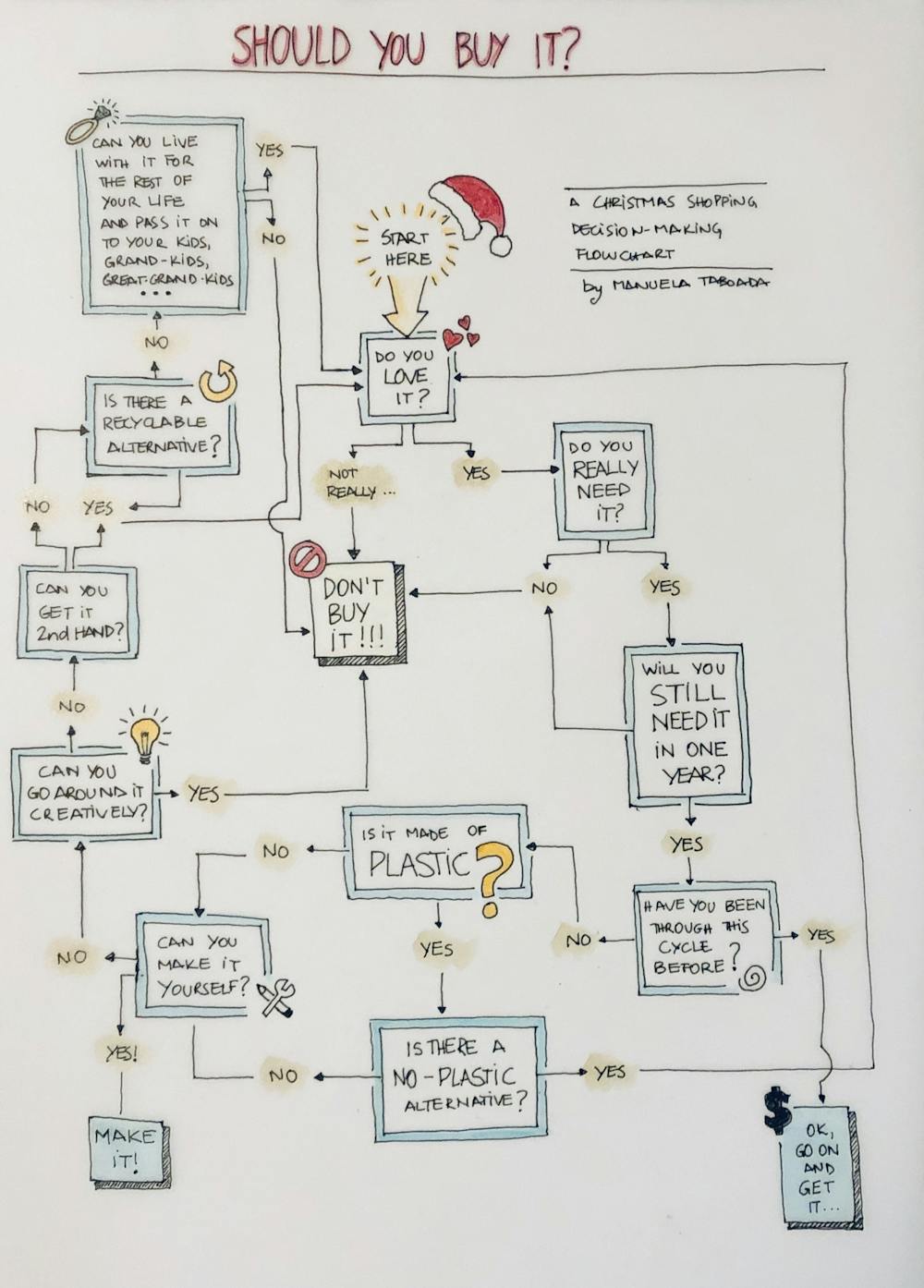
  • Consider whether the recipient will treasure their gift or end up throwing it away. Here’s a handy flowchart, which you can also use for your own (non-Christmas) purchases.

Decisions, decisions. Manuela Taboada, Author provided

Gift wrapping

Not only do we buy gifts, we wrap them in paper and decorate them with ribbons often made of synthetic materials. It might look fantastic, but it generates a fantastically tall mound of waste afterwards. Here’s how to wrap plastic-free in style.

  • Ditch the sticky tape and synthetic ribbons. Instead, use recycled or repurposed paper and tie up with fabric ribbons, cotton, or hemp twine.

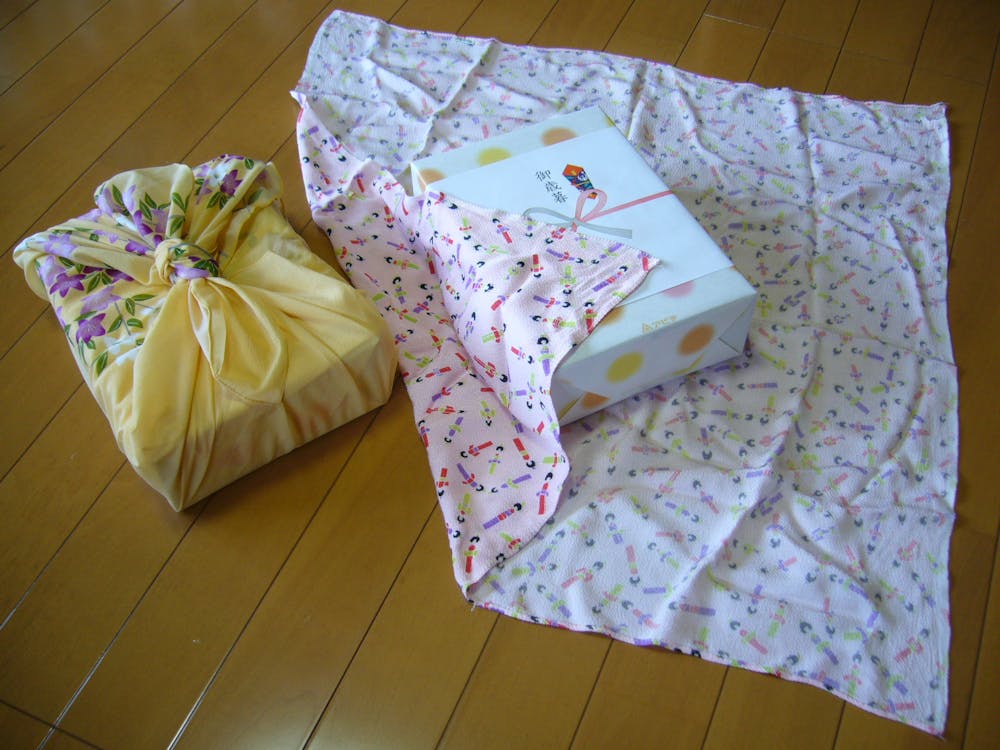
  • Try Japanese fabric wrapping (Furoshiki). The big advantage: two gifts in one!

  • Choose gifts that do not need wrapping at all, such as the experiences, event tickets or charity donations mentioned above.

Furoshiki: sustainable and stylish. Katorisi/Wikimedia Commons, CC BY

Tableware

Disposable tableware is convenient – perhaps too convenient. Plastic plates, cutlery and cups are handy if you’re hosting dozens of friends and relatives, but they are used for a minimal amount of time and are often non-recyclable. So, when setting up your table:

  • Use “real” tableware. You can easily find funky second-hand options. Mixed tableware is a trend!

  • If your dishwasher (human or mechanical) can’t handle the strain, consider a washing-up game instead. Line up the guests, time their washing, and give them a prize at the end.

  • If disposables are essential, opt for biodegradable tableware such as paper-based uncoated plates and cups, or wooden or bamboo plates and cutlery.

  • Beware of plastic options labelled as “biodegradable”. Often they are only degradable in industrial composting facilities, which are not available across most of Australia. Check your local recycling options.

Toys

Last year, tonnes of plastic waste were found on Henderson Island, one of the most remote places in the world. Among the items were Monopoly houses and squeaky ducks. Toy items are usually non-recyclable, and eventually end up in landfill or scattered throughout the environment.

  • Choose wooden or fabric-based toys. Alternatively, look for toys or games that teach children about the environment.

  • Many board games have dozens of plastic accessories, but not all. Look at the list of contents, and choose ones with less plastic.

  • It might be hard to stay away from Lego or other iconic plastic toy brands. In this case, consider buying second-hand or joining a toy library.

Henderson Island: where the Monopoly real estate boom ends. Jennifer Lavers/AAP Image

Packaging

This is by far the hardest item to avoid. Lots of non-plastic items come packed in plastic, including most of our food. So, simply…

  • Refuse it: find alternatives that don’t come wrapped in plastic. This might mean changing how and where you buy your food.

  • If there are no other options, choose plastic that can be recycled locally and avoid styrofoam, also called expanded polystyrene, which is not recyclable at most facilities.

  • If you are buying online, you can often ask for your items to be packed with no plastic.

  • For party food leftovers, use beeswax wraps or glass containers, or ask guests to bring their own reusable containers.


Read more: ‘I am not buying things’: why some people see ‘dumpster diving’ as the ethical way to eat


There’s a lot going on at Christmas, and it can be easier simply to follow the path of least resistance, and resolve to clean up your act in the new year. But you can avoid getting caught in consumption rituals created by the retail industry.

Make some changes now, and you can have a reduced-plastic Christmas with the same amount of (or even more) style and fun!

ref. How to have yourself a plastic-free Christmas – http://theconversation.com/how-to-have-yourself-a-plastic-free-christmas-108828

Home alone: how to keep your kids safe (and out of trouble) when you’re at work these holidays

]]>

Source: The Conversation (Au and NZ) – By Natalie Gately, Criminology Courses Coordinator, Edith Cowan University

Many working parents battle with school holidays, especially the long period between Christmas and the start of the new school year. Most people receive four weeks’ leave a year, but school holidays take up about 12 weeks of the year.

The maths clearly doesn’t add up. Even if both parents take their leave at different times, they’ll still need to find alternative care arrangements for younger children. Older kids will spend days at home unsupervised.

Leaving young people at home raises questions and concerns for parents. How long can they be at home alone? How can I ensure their safety? How will they occupy their time? What if someone comes to the house? Should I let them leave the house during the day to visit a friend? How secure will the house be?

Based on our soon-to-be-published findings on young offenders and previous research into home security (particularly burglaries), the following advice may provide guidance for concerned working parents during school holidays.


Read more: Should we shorten the long summer break from school? Maybe not


Most burglars reported they are motivated by opportunity and convenience. They look for unoccupied homes with open doors and windows in daylight hours. Teach your children how to operate door locks, ensuring front and back doors stay locked. But keep keys in locked doors in case they need to exit quickly.

Most burglars won’t try to break in if they think someone is home.

Most burglars avoid homes if they detect someone is present. So there is a fine line between making the house occupied, while ensuring children do not open doors to strangers. Ensure your children know your rules on letting someone in the home without your permission or answering the door to anyone they don’t know. Have a plan on how to respond to this.

It’s also worth ensuring that you:

  • ensure your children know how to phone triple 0 in the event of an emergency. Write down your full name, address and telephone number and keep it by the phone. Kids (and adults!) can panic in emergencies and forget basic details

  • write down a responsible available person’s number if you are at a job that cannot take phone calls

  • create a family “phone book” with each family member’s particular friends. Make sure you know the names and phone numbers of their closest mates. That way if you ever lose your child or they do not return you have a starting point to phone their friends

  • limit time online and install security software that allows you to monitor online activity and avoid online predators.


Read more: If we’re serious about supporting working families, here are three policies we need to enact now


Keeping children out of trouble during holidays

While most parents believe their child would never engage in antisocial behaviour, the lack of supervision, structure and boundaries during school holidays can lead some children to push boundaries or even break the law, especially when encouraged by peers.

Our interviews, soon to be released, with children who had been charged with an offence indicated they committed the burglary during daylight hours in the company of friends and for consumable items.

Very few actually “planned” their offences. Most just saw the opportunity (goods left on display, doors and windows left open) while they were roaming the streets looking for something to do. And often they were responding to dares by friends. The most common tactic to determine whether to burgle a property was simply to knock on the door to see if someone was in.

So, if your child is allowed to go out while on school holidays, here are some parameters you can consider for their safety:

  • agree on times they can be outside while you are not home (and limit extended periods of time)

  • agree on where they are allowed to go – locations that provide pseudo-supervision (such as shopping centres) are preferable to long periods of street-wandering

  • make sure they know not to go near people in cars who stop to talk to them (do not approach the car even if the person is speaking quietly). Explain that most adults do not ask young people for help – they usually ask other adults – so children must be wary of assisting adults when they are alone

  • instead of telling children never talk to strangers, tell them if they need help to look for a mother with children or go into a public place (like a shopping centre) and ask for help

  • notice if your child seems to have excess funds or new items in the house. Investigate further if they tell you they have been “given” or “loaned” something from a friend

  • notice if they seem quiet or reluctant to tell you how they have spent their day.

Don’t do this. Storing a spare key in a lock box is far smarter and safer. Shutterstock


Read more: Yes, you can adopt a pet as a Christmas gift – so long as you do it correctly


If you’ve allowed your child to leave the home when you’re not there, there are still things to consider when they return to an empty house:

  • have a lockbox for spare keys so they can re-enter the home (10% of burglars reportedly entered a home with keys left in easily detected locations)

  • given burglaries are often committed during daylight hours, teach children to have a quick “sweep” of doors and not to enter if something looks out of place (such as a door that is now open or a damaged fly screen)

  • ensure they phone you or another responsible adult when they return.

By following these tips you can help keep your child safe and out of trouble when leaving them alone during the holidays.

ref. Home alone: how to keep your kids safe (and out of trouble) when you’re at work these holidays – http://theconversation.com/home-alone-how-to-keep-your-kids-safe-and-out-of-trouble-when-youre-at-work-these-holidays-105581

Afterlife of the mine: lessons in how towns remake challenging sites

]]>

Source: The Conversation (Au and NZ) – By Laura Harper, Lecturer in Architecture, Monash University

The question of what to do with abandoned mine sites confronts both regional communities and mining companies in the wake of Australia’s recent mining boom. The companies are increasingly required to consider site remediation and reuse. Ex-mining sites do present challenges, but also hold opportunities for regional areas.


Read more: No to rehab? The mining downturn risks making mine clean-ups even more of an afterthought


Old mine sites can provide a foundation for unique urban patterns, functions and transformations, as they have done in the past. It is useful to look at historical gold-mining regions, such as the Victorian goldfields, to understand how these sites have shaped the organisation and character of their towns.

Research by The University of Queensland’s Centre for Mined Land Rehabilitation suggests Australia has more than 50,000 abandoned mine sites. Some are in isolated places. But many others are close to or embedded within regional settlements that developed specifically to support and enable mining activity.

Abandoned mines present unique challenges for remediation:


Read more: Soil arsenic from mining waste poses long-term health threats


These characteristics exclude mining sites from reuse for activities such as residential development. The sites are often considered fundamentally problematic. At times former mining sites have been reused opportunistically, accommodating functions and uses that could co-exist with the compromised physical landscape.

How have old mines shaped our towns?

The industrial patterns established during the Victorian gold-mining boom are traceable through observing the street layout and the location of civic buildings, public functions and open spaces of former gold-mining towns.

For example, in the gold-mining town of Stawell, a pattern of informal and winding tracks was established between mining functions. These tracks later provided the basis for the town’s street organisation and land division, including the meandering Main Street, which forms the central spine of the town.

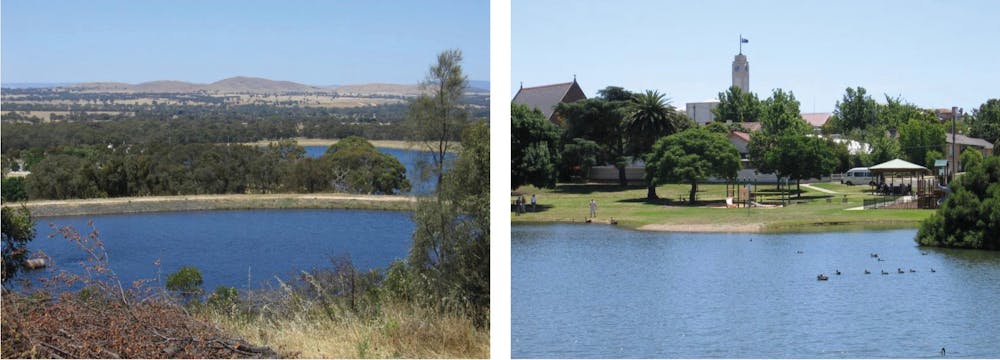
Left: Cascading dams in Stawell are remnants of the industrial crushing processes that were linked together along naturally occurring gullies. Right: Looking from Cato Lake towards Stawell Town Hall. Harper, Laura, Author provided

Cato Lake, behind Main Street, was transformed from the tailings dam of the Victoria Crushing Mill. St Georges Crushing Mill and its associated dams became the Stawell Wetlands.

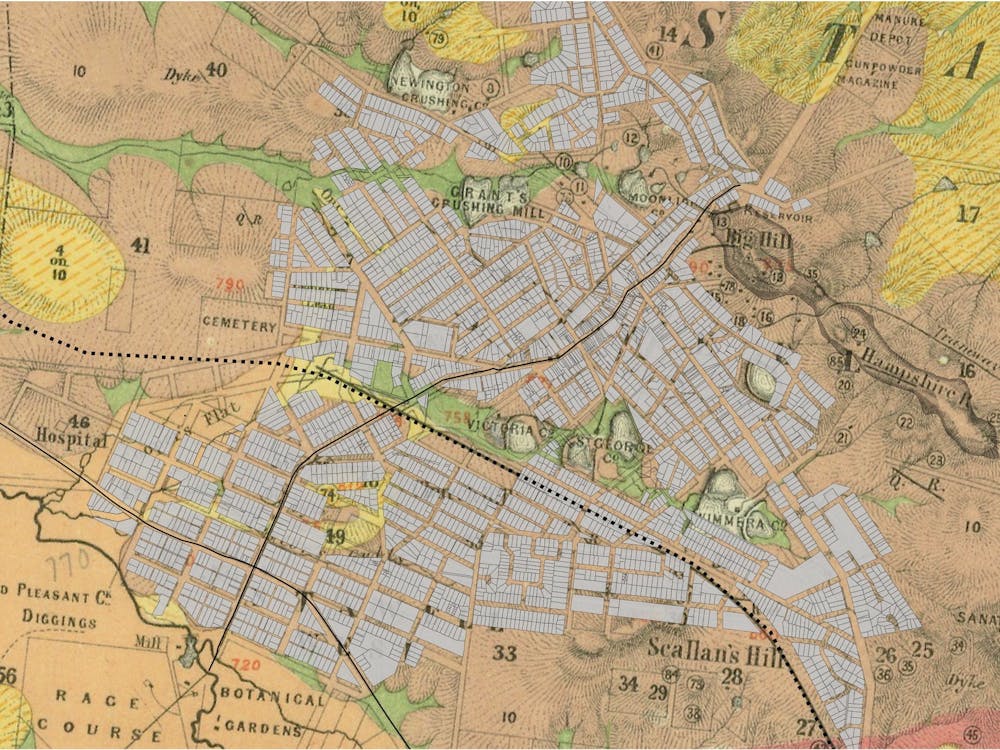
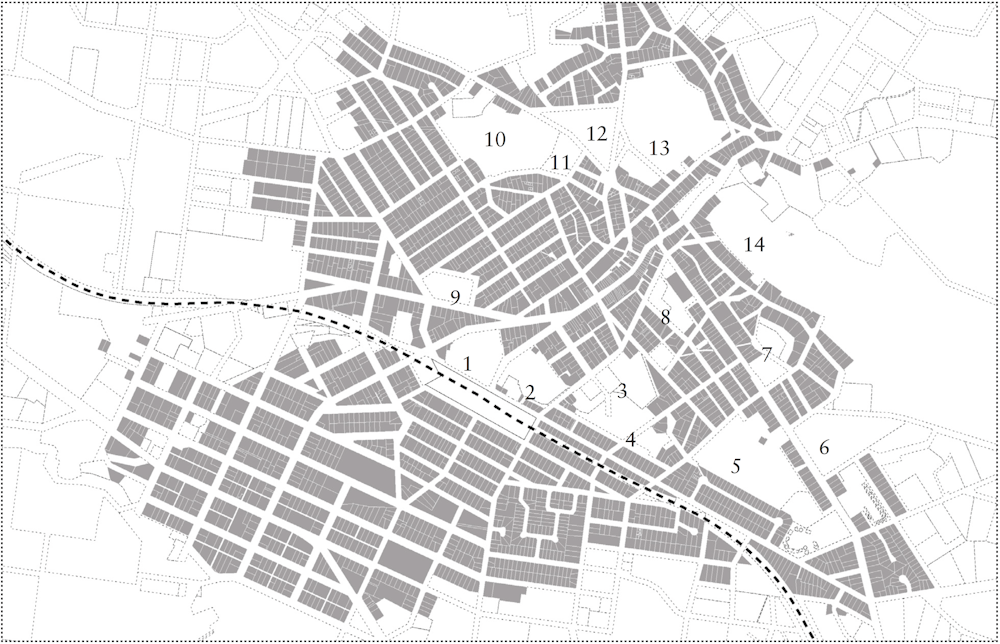
Current residential allotments in Stawell overlaid with the geographical survey of 1887. The gaps correspond to mining claims, crushing mills, tailings dams and other industrial processes associated with mining. Harper, Laura/Map underlay from Mining Department of Melbourne, Author provided

Other mining sites were transformed into the car park for Stawell Regional Health, the track for Stawell Harness Racing Club and the ovals for the local secondary college. A survey of public open spaces in Stawell shows that over time former mining sites accommodated most of the town’s public functions.

Open space in Stawell showing the correlation of past mining sites with public function: 1. Central Park – public reserve est. 1860s. 2. Cato Park and Bowls Club – was Victoria Co. Crushing Mill 3. Stawell Regional Health – built over a mullock heap associated with the St George Co. Crushing Mill. 4. Wetland Precinct – was part of St George Co. Crushing Mill 5. Stawell Harness Racing Club – was part of Wimmera Co. Crushing Mill 6. Stawell Secondary College and grounds – was part of Wimmera Co. Crushing Mill 7. Borough of Stawell reservoir (disused) – was part of Wimmera Co. Crushing Mill 8. Federation University (Stawell Campus) – was School of Mines and prior, St George Lead (surface diggings) 9. Stawell State School – public reserve established in 1865 10. North Park Recreation Reserve – was part of Galatea Co. Mine / Grants Crushing Mill 11. Stawell Leisure Complex – was part of Galatea Co. Mine / Grants Crushing Mill 12. Oriental Co. Mine Historic Area – was Oriental Co. Mine 13. Moonlight-cum-Magdala Mine Historic Area – was Magdala Mine / Moonlight Co. Mine 14. Big Hill reserve, lookout and arboretum – site of multiple claims including Sloan and Scotchman, Cross Reef Consolidated and Federal Claim Harper, Laura, Author provided

Many other Victorian goldfields towns developed in similar ways to Stawell. These towns have lakes or other water bodies in and around their central urban areas that were born out of mines.

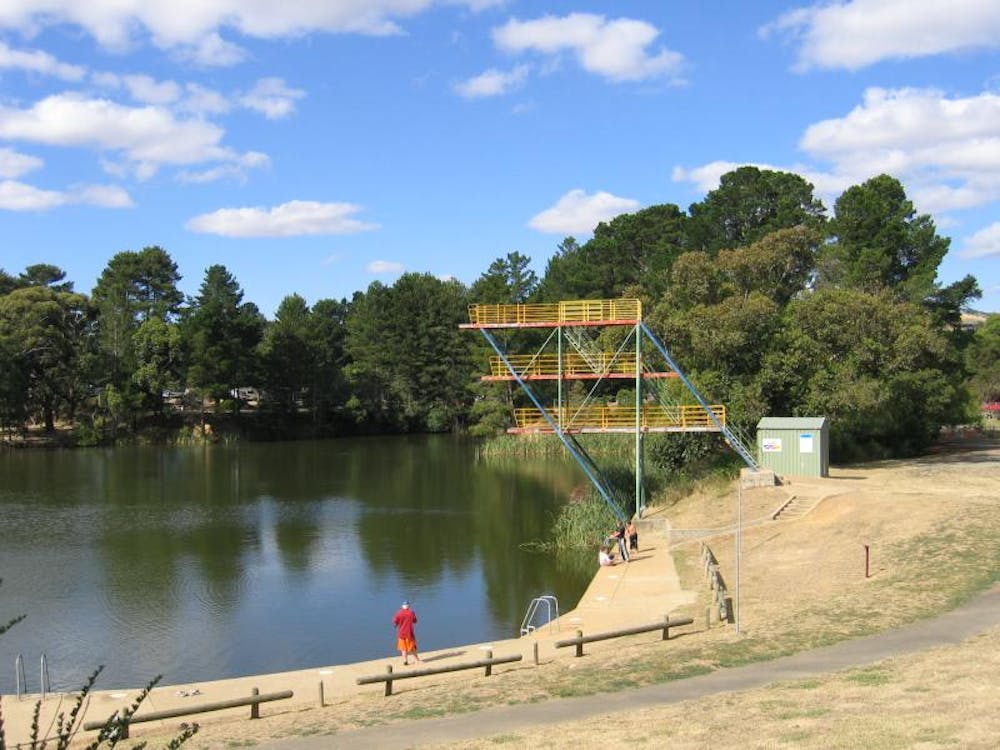
Calembeen Park and St Georges Lake in Creswick and Lake Daylesford in Daylesford were all formed through the planned collapsing of multiple underground mines to create urban outdoor swimming spots.

Calembeen Park in Creswick is a swimming hole with a diving board that takes advantage of the extreme depth of the lake formed through collapsing several underground mines. Author provided

In Bendigo, the ornamental Lake Weeroona was formed on the site of the alluvial diggings. Other sites in these towns became parks, ovals, rubbish tips and public functions that could be accommodated on the degraded land.

Abandoned mine sites outside towns have also been used for unique purposes. Deemed unsuitable for use by the farming and forestry industries, these sites have developed into havens for flora and fauna, including endangered species. A 2015 article in Wildlife Australia magazine details instances of the Eastern Bentwing-bat and the Australian Ghost Bat adopting abandoned gold mines as replacement habitat for breeding and raising their young.

The neglect of other gold-mining sites has preserved historical remnants by default. The Castlemaine Diggings National Heritage Park in Victoria is one example. Here, water races, puddling machines and crushing batteries are hidden amid dense bushland.

The town of Gwalia in Western Australia, abandoned after its mine closed, has been transformed into a town-sized open-air museum.

And what uses are possible in future?

Historical gold-mining sites in or near towns continue to be adapted for unusual uses. The Stawell Goldmine on Big Hill in Stawell is being converted to accommodate the Stawell Underground Physics Laboratory (SUPL), a research laboratory one kilometre below the surface. Cosmic waves are unable to infiltrate the abandoned mining tunnels, so the conditions are ideal for exploring the theorised existence of dark matter.

Working on the Stawell Underground Physics Laboratory deep underground in an old mine tunnel. Swinburne University


Read more: Digging for cosmic gold: the hunt for dark matter at the bottom of a gold mine


In Bendigo it is proposed to use the extensive historical mine shafts under the town to generate and store pumped hydroelectricity. This scheme, recently explored as a feasibility study by Bendigo Sustainability Group, would use solar panels to create power to pump underground water up through the mining shafts to be stored at the surface. When power is required the water would be released through turbines to generate electricity.

The lack of demand for remediating sites for market-led uses (such as urban development, farming or forestry) broadens their potential for uses that might otherwise seem marginal or improbable, such as new forms of public space.


Read more: From mine to wine: creative uses for old holes in the ground


The scale and remoteness of many post-industrial mining sites in Australia – such as Western Australia’s Super Pit gold mine, which is 3.5 kilometres long and 600 metres deep – might mean that approaches to reuse different from those taken with historical goldmines are required. We don’t have to wait until a mine’s closure to think about how it might be used in the future.


The Conversation is co-publishing articles with Future West (Australian Urbanism), produced by the University of Western Australia’s Faculty of Architecture, Landscape and Visual Arts. These articles look towards the future of urbanism, taking Perth and Western Australia as its reference point, with the latest series focusing on the regions. You can read other articles here.

ref. Afterlife of the mine: lessons in how towns remake challenging sites – http://theconversation.com/afterlife-of-the-mine-lessons-in-how-towns-remake-challenging-sites-106073

The great movie scenes: Back to the Future

]]>

Source: The Conversation (Au and NZ) – By Bruce Isaacs, Senior Lecturer in Film Studies, University of Sydney

What makes a film a classic? In this video series, film scholar Bruce Isaacs looks at a classic film and analyses its brilliance.


Back to the Future (1985)


Read more: It’s Back to the Future Day today – so what are the next future predictions?


Back to the Future is that rare Hollywood film that is both a blockbuster and a cult classic, and was easily the highest grossing film that year. In this episode of Close-Up, we look at the politics underpinning Back to the Future in the era of Reagan’s America.


See also:

Hitchcock’s Vertigo
Antonioni’s The Passenger
Eternal Sunshine of the Spotless Mind
Steven Spielberg’s Jaws
Hitchcock’s Psycho
The Godfather
Stanley Kubrick’s 2001: A Space Odyssey
Sofia Coppola’s Marie Antoinette
Darren Aronofsky’s Requiem for a Dream
The great movie scenes: The Matrix and bullet-time

ref. The great movie scenes: Back to the Future – http://theconversation.com/the-great-movie-scenes-back-to-the-future-108345

View from The Hill: Morrison goes a bridge too far to outsmart Shorten

]]>

Source: The Conversation (Au and NZ) – By Michelle Grattan, Professorial Fellow, University of Canberra

The Morrison government is going over the top in trying to outsmart and smother Bill Shorten and the Labor national conference.

Leaving aside the holding of the July Super Saturday byelections when the ALP meeting was originally due, the government is attempting to outdo the rescheduled conference at every turn.

Some time ago the budget update was set for Monday, to overshadow the second day of the conference.


Read more: Monday’s MYEFO will look good, but it will set the budget up for awful trouble down the track


Not content with that, Scott Morrison decided to announce Australia’s new Governor-General, David Hurley, on Sunday morning at the exact same time as Shorten’s opening address in Adelaide.

The prime minister rang Shorten at 7:30am to tell him about the 10 o’clock announcement.

Labor has a legitimate point in complaining about Morrison’s failure to consult on the appointment. He was under no formal obligation to do so, but given that Hurley will not be sworn in until after the election, it would have been the proper course to take.

Regardless of any argument about that, the timing of the announcement was absolutely the wrong course. When Morrison was asked about it he could provide no convincing justification. It was indeed rather disrespectful to Hurley, because the obvious attempted one-upmanship would inevitably be controversial.


Read more: NSW Governor David Hurley will be Australia’s new Governor-General


Less provocative but also designed as a distraction from the attention on Labor was Sunday night’s announcement for the 7pm news of a $552.9 million increase in aged care funding, including the release of 10,000 high level home care places within weeks.

In other years, the Coalition would have wanted all attention on the Labor shindig, expecting fiery debates. But this time the government is worried about a conference which is a highly managed affair where divisions are being contained and participants have their eyes firmly on the prize of Labor winning power next year.

It is all about showcasing Shorten as fit to lead the nation.

Not that there weren’t some fracas on the first day. But they came from demonstrators rather than delegates. Anti-Adani and pro-refugee protesters invaded the stage as Shorten prepared to speak, and there were noisy scenes outside the Adelaide convention centre.


Read more: Labor promises a comprehensive overhaul of federal environmental framework


Shorten in his speech unveiled initiatives on housing affordability, the protection of superannuation and the creation of new national environmental architecture.


Read more: Shorten’s subsidy plan to boost affordable housing


His address was workmanlike – comprehensive rather than a rhetorical rallying cry. His approach at this conference is cautious and careful, designed to avoid false steps – although in policy terms Labor is bold and willing to be a big target.

The ALP’s new national president Wayne Swan told the conference that “the focus now shifts to us”.

In these three days Labor is committed to presenting itself as a convincing alternative government. Its message is that it’s ready for office.

There are two days to go for Labor in Adelaide. But at the end of day one the government was looking desperate while the opposition was looking determined.

ref. View from The Hill: Morrison goes a bridge too far to outsmart Shorten – http://theconversation.com/view-from-the-hill-morrison-goes-a-bridge-too-far-to-outsmart-shorten-108890

It’s despair, not depression, that’s responsible for Indigenous suicide

]]>

Source: The Conversation (Au and NZ) – By Tim Carey, Professor, Director of the Centre for Remote Health, Flinders University

This article was written with Rob McPhee, Deputy CEO of the Kimberley Aboriginal Medical Service and co-chair of the Commonwealth-funded Kimberley Aboriginal Suicide Prevention Working Group.


Last year, 165 Indigenous Australians died as a result of suicide. Despite continued efforts to improve suicide prevention programs, there has been no no appreciable reduction in the suicide rate in ten years.

While suicide is the 14th leading cause of death for non-Indigenous Australians, it is ranked fifth for Aboriginal and Torres Strait Islander people.

We often equate suicide with mental illness, but as a recent Senate inquiry report into rural mental health found:

… in too many cases, the causes of suicide for Aboriginal and Torres Strait Islander peoples is not mental illness, but despair caused by the history of dispossession combined with the social and economic conditions in which Aboriginal and Torres Strait Islander peoples live.

This statement should not be a surprise, but it is all too easily forgotten. A diagnosis of mental illness is only one of a number of risk factors for suicide.

Not just a mental health issue

The medicalisation of suicide may have distracted us from the fact that suicide is a complex social phenomenon, deeply embedded in culture and history.

A diagnosed mental illness is present in only about half of those who die by suicide. A study examining suicides in Victoria between 2009 and 2013, for instance, found 48% of the 2,839 people who took their own life had no history of mental illness diagnosis.


Read more: We need to move beyond the medical model to address Indigenous suicide


The statistics are even more extreme for other cultures. In China, fewer than 50% of people who died by suicide had a diagnosed mental disorder; in India, fewer than 40%. And in Malaysia, the proportion was only 22%.

Research tracking an audit of suicide and self-harm data in the Kimberley region between 2005 and 2014 found that 70% of Aboriginal and Torres Strait Islander people who died by suicide had never been referred to the Kimberley Mental Health and Drug Service and were unknown to this service.

Other factors

While a history of mental illness diagnosis remains an important risk factor, it can sometimes overshadow other factors. There are specific cultural, historical, and political considerations that heavily influence the high rates of suicide among Aboriginal and Torres Strait Islander people.

Other factors include social isolation, unemployment, poverty, family conflict, incarceration, hopelessness, childhood abuse, and homelessness.

The importance of these factors, particularly for people living in remote and very remote communities, must be considered in the context of other crucial elements such as a history of dispossession and transgenerational trauma.

Transgenerational trauma refers to the transfer of the impacts of historical trauma and grief to successive generations. For instance, the trauma can be transmitted from one generation to the next through cycles of family violence. These multiple layers of trauma can have a cumulative effect and increase the risk of destructive behaviours including suicide.

Aboriginal and Torres Strait Islander people need to be empowered to make their own decisions and drive their own reform. Glenn Campbell/AAP

Many Aboriginal and Torres Strait Islander communities are, in essence, not just going about the day, but operating in crisis mode on a daily basis.

Social and emotional well-being

We need to reconsider mainstream assumptions and solutions that see suicide primarily as a mental health issue. Aboriginal and Torres Strait Islander peoples must be able to control the things important to them, and influence and shape the environments in which they live, work and play.

Prior to colonisation, Indigenous Australians could control their day-to-day living in ways that have been largely denied to them since.

Aboriginal and Torres Strait Islander peoples need the support and resources to find their own solutions. Having solutions provided to them, or coaxing them to adopt solutions discovered by others, will not work very well or for very long.

A social and emotional well-being understanding of psychological functioning should underpin efforts to address suicide. This model is a distinctively different way of conceptualising a person’s state of mind.

It emphasises connections or relationships with and between the body, mind and emotions, family and kinship, country, culture, community and spirit, spirituality, and ancestors. This should make it possible for people to feel more engaged with, and in charge of, their lives.

An evaluation of a locally developed program in a very remote community that embraced the above principles reported a dramatic reduction in suicides over a three-year period.

This program involved extensive community involvement and consultation. There were Aboriginal (including a traditional healer) and non-Indigenous people operating the program, with different activities based on community needs and interests. The program was closely connected to the local primary care clinic.


Read more: Traditional Aboriginal healers should work alongside doctors to help close the gap


A model that addresses social and emotional well-being could be useful for all Australians. If we prioritise this model, rather than the mainstream concept of mental health dysfunction, we might finally make some inroads into the far-too-frequent occurrence of Aboriginal and Torres Strait Islander suicide.

Listen rather than tell

As non-Indigenous contributors to the solution, we need to listen rather than tell, because in this terrain we are not the experts. Even in the writing of this article, the non-Indigenous first author prepared this document under the guidance and tutelage of the second author, an Aboriginal man, with cultural connections to Derby and the Pilbara.

Ultimately, for their efforts to be experienced as helpful by Aboriginal and Torres Strait Islander people, non-Indigenous contributors must forgo their own cherished notions of a solution and learn from the wisdom of Aboriginal and Torres Strait Islander peoples. To bring about meaningful change we must follow far more than we lead.

It remains to be seen if we are up to the task but, ultimately, the stakes are too high to fail.


If you or anyone you know needs help or is having suicidal thoughts, contact Lifeline on 131 114 or beyondblue 1300 22 46 36.

ref. It’s despair, not depression, that’s responsible for Indigenous suicide – http://theconversation.com/its-despair-not-depression-thats-responsible-for-indigenous-suicide-108497

Can the Big Bash League’s backyard cricket bat flip truly be fair?

]]>

Source: The Conversation (Au and NZ) – By Stephen Woodcock, Senior Lecturer in Mathematics, University of Technology Sydney

Ahead of the start of the 2018-19 Big Bash League season comes news of a radical change that will bring a smile to the faces of backyard cricketers across the country.

In a move familiar to everyone who has ever improvised a set of stumps from a nearby wheelie bin or Esky, the coin toss is no more.

Instead, batting order will be decided by the tried-and-tested method of backyard cricketers everywhere: the bat flip.

The coin toss was used by Adelaide Strikers captain Suzie Bates and Sydney Sixers captain Ellyse Perry before the Womens Big Bash League (WBBL) match in January this year. AAP Image/Jeremy Ng

No more ‘heads’ or ‘tails’

Rather than calling “heads” or “tails”, team captains will be guessing if the bat will land with its flat side upwards (called “flats”) or downwards (“hills”).

Most seasoned veterans of backyard cricket tend to favour a call of “hills”, thinking that the bat will more likely roll over if it lands on its uneven side, compared with if it lands flat.

The Big Bash League’s Kim McConnie was confident that such predictability will not be an issue.

Cricket Australia’s head of Big Bash League, Kim McConnie. AAP Image/Dave Hunt

She told the ABC that bat-maker Kookaburra had developed a special bat for this purpose:

You’d be surprised at the science that’s gone into this. It is a specially weighted bat to make sure that it is 50-50.

Despite such bold claims, it remains to be seen whether the bat flip will prove to be as unbiased once the season begins.

Howzat for fairness?

Even a standard coin, whose two sides are far more evenly weighted and shaped than any cricket bat, can never be said to be truly a 50-50 proposition.

The simple fact is that there is no such thing as a coin that is absolutely fair. Even a completely symmetrical coin could be biased towards one outcome – whether deliberately or otherwise – by the action of the person tossing the coin.

Some people’s technique will push the coin higher. Others might give the coin more rotation.

As US president Donald Trump recently (and strangely) demonstrated, some people have a style all of their own.

Call that a coin toss?

In a 2009 study, researchers at the University of British Columbia concluded that even a regular coin could easily be made to produce biased outcomes when the person tossing it was told “how to manipulate the toss of a coin” and incentivised to make it so.

Of 13 participants, each flipping the coin 300 times, all managed to produce more heads than tails. Overall, of the 3,900 tosses, 57% landed heads. One participant was able to obtain heads more than twice as often as tails.

Put to the test

In the haphazard and improvised spirit of backyard cricket, I decided to see how a cricket bat would land when flipped. I, of course, did not have access to one of the new Big Bash League bats so had to make to with the old battered bat from the back of the garden shed.

With a nod to procedural fairness, I decided to try two different techniques: low rotation (aiming for two of three flips while in the area) and a high rotation (as many flips as I could manage). Each of these techniques was applied 100 times to the bat being flipped from “hills” up in my hands, and 100 times from “flats” up.

I’ll be the first to admit that this resembles serious scientific rigour about as much as the browning patch of grass next to your parents’ Hills Hoist resembles the MCG.

A greater sample size would have been preferable, but this was as much as I could muster in fading light in a suburban backyard.

Keeping score

Based solely on the results of my backyard testing, you can likely chalk this one up as a win for conventional wisdom.

Especially when the bat was flipped with high rotation, it appeared to exhibit bias towards landing “hills.” For the less vigorous flipping technique, its initial orientation influenced the outcome more and the results were closer to 50-50.

In fairness to the league and its equipment suppliers, I would imagine that the bats used will be a little less prone to bias than the one available to me.

Nonetheless, whatever results Kookaburra’s testing machine produced with its bat, it is difficult to believe that a large, asymmetrical bat will be less susceptible to bias by the flipper’s technique than a simpler, smaller coin.

Finishing off the tail

Even if the bat flip is indeed not as unbiased as confidently claimed, it probably doesn’t matter. The decision to ditch the coin flip for its more unconventional counterpart is not one driven by a desire for sporting equity.

It’s a move designed to further distance the loud, brash, big-slogging and brightly dressed T20 league from traditionalists’ cricket, and to generate hype for the forthcoming season. With all of the international headlines that followed the surprising announcement, the decision already appears to be a huge success for Australian cricket.

But don’t hold your breath for the “one hand, one bounce” rule or other classic backyard cricket innovations further infiltrating the Big Bash League.

Backyard cricket rules: ‘No player can be dismissed first ball.’ Flickr/nemone, CC BY-NC

ref. Can the Big Bash League’s backyard cricket bat flip truly be fair? – http://theconversation.com/can-the-big-bash-leagues-backyard-cricket-bat-flip-truly-be-fair-108601

Native cherries are a bit mysterious, and possibly inside-out

]]>

Source: The Conversation (Au and NZ) – By Gregg Müller, Lecturer in Natural History, La Trobe University

People don’t like parasites. But there’s a local Aussie tree that’s only a little bit parasitic: the native cherry, or cherry ballart.

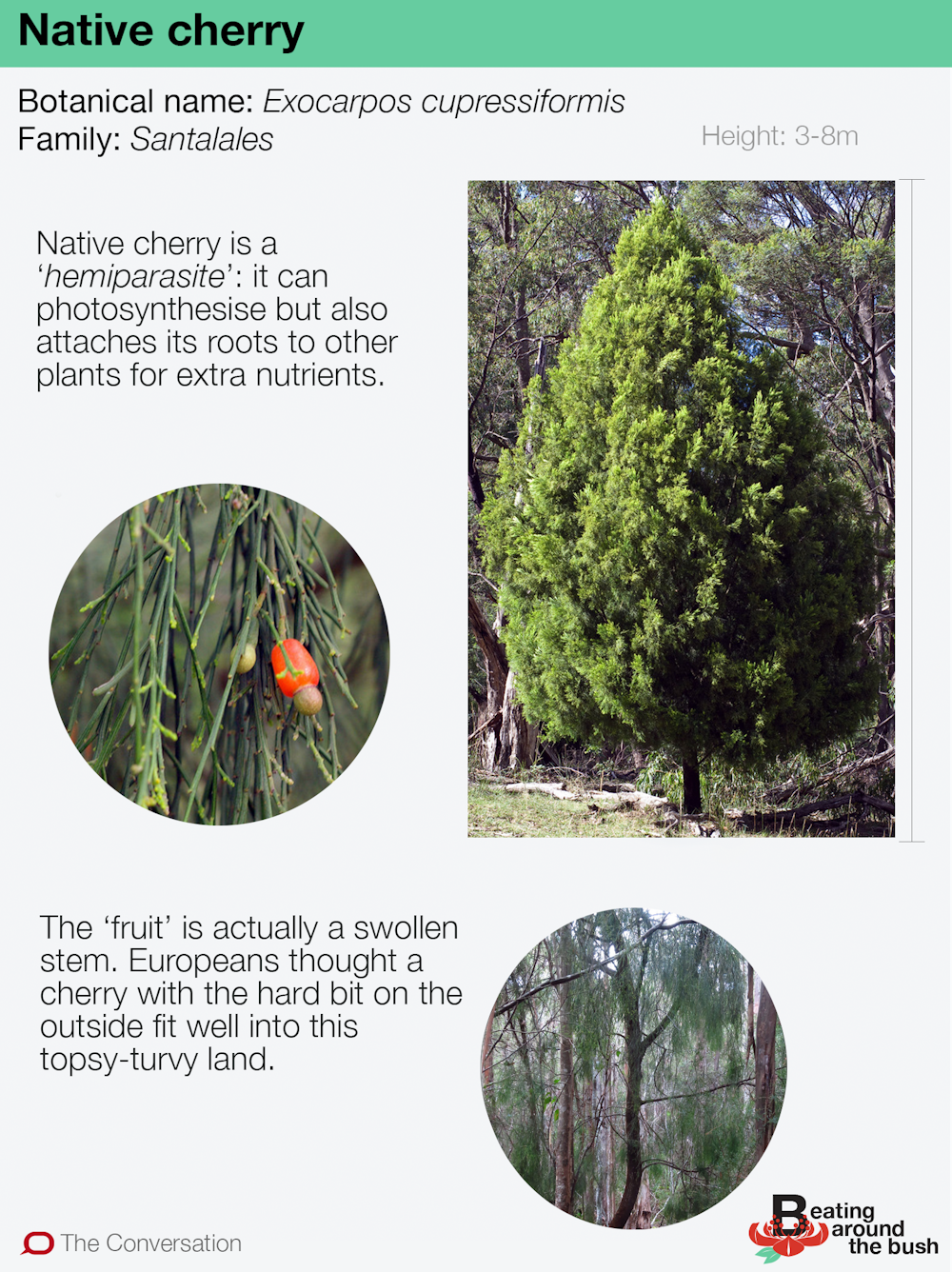
It’s what we call hemiparasitic. It can photosynthesise, but gains extra nutrients by attaching its roots to host plants.

The native cherry, Exocarpos cupressiformis, might be our most widespread root hemiparasite tree, but we’re not quite sure – root-parasitic shrubs and trees are a bit of a research blank spot. We are not even really sure who all the hosts of cherry ballart are.


Read more: Warty hammer orchids are sexual deceivers


Although other parasites – like mistletoes – have a more direct Christmas association, cherry ballart does have an Australian Yuletide connection: their conifer-like appearance (the species name cupressiformis means “cypress-like”) was noted by homesick European settlers, who chopped them down for Christmas trees.


The Conversation


On the map

Cherry ballart grows from the Atherton Tablelands in Queensland to southern Tasmania, and across to the Eyre Peninsula in South Australia.

The first European to record it was Jacques-Julien Houtou de Labillardière, the botanist on d’Entrecasteaux’s expedition in search of La Perouse. He formally described the species in 1800, but we have no physical type specimen – the botanical type is his illustration and description. Maybe he lost his specimen, or disposed of it, or thought a picture would do; Jacques seems to have been a bit cavalier with his record-keeping.

Or perhaps it was stolen or misplaced after all his specimens were seized in an overlapping series of defections, wars, defeats and revolution as the expedition tried to return to Europe. The collection was eventually returned after the intercession of English botanist Joseph Banks – but no cherry ballart.

Jacques-Julien Houtou de Labillardière’s description of the native cherry. Voyage in search of La Pérouse

Its distinctive shape led to native cherry being marked on early Australian orienteering maps, since they are in a cartographic Goldilocks zone: obvious, just numerous enough to make them useful, but not so many as to clutter the map.

That was until Australia held the World Orienteering Championships in the mid-1980s, when the standardisation of Australian orienteering maps for overseas competitors led to the cherry ballart becoming an early victim of internationalisation – at least cartographically speaking.

Its utility also extended to the timber. Among the uses of its “close-grained and handsome wood” are tool handles, gun stocks and map rollers (although the last is probably a niche market these days).

Indigenous Australians ate the fruit, used the wood for spear throwers and reportedly used the sap as a treatment for snakebite. They called it Tchimmi-dillen (Queensland), Palatt or Ballot (Lake Condah, Victoria) and Ballee (Yarra).


Read more: Leek orchids are beautiful, endangered and we have no idea how to grow them


Grow baby, grow!

Despite producing large quantities of fruit and seed, no one seems to be able to get native cherry to germinate reliably. There are anecdotal reports that feeding the seed to chooks works, but other growers dismiss this approach.

The edible fruit isn’t actually a true fruit: it’s a swollen stem. It’s reported to have the highest sugar level of any native fruit in the forests of southern Victoria and is much tastier than you’d think a stem would be. (It’s also probably an important nutrient supply for some birds, but that’s yet another thing we are yet to prove.)

This odd “fruit” gives rise to the genus name (exo = outside, carpos = fruit,) and was often touted by early European writers as another example of the topsy-turvy nature of Australia – “cherries” with the pit on the outside went along with “duck-billed playtpus”, animals with pouches, trees that shed bark rather than leaves, and Christmas in the middle of summer.

The sweet and delicious fruit of native cherries is actually a swollen stem. Arthur Chapman/Flickr, CC BY-NC

Despite their oddness, native cherries in the bush are biodiversity hotspots. My camera trap data show they preferentially attract echidnas, possums, foxes, swamp wallabies, white-winged choughs and bronzewing pigeons.

This might be because they modify their immediate environment. My research shows they create moderate micro-climates in their foliage, reduce soil temperatures, increase soil water retention, concentrate nutrients in the soil beneath their canopies, and alter the understorey vegetation. They also kill some of their host trees, creating patches with higher concentrations of dead timber. All these probably have something to do with their animal attraction, but exactly how is a mystery yet to be solved.


Read more: ‘The worst kind of pain you can imagine’ – what it’s like to be stung by a stinging tree


In addition to their attractiveness to vertebrates, native cherries are required hosts for some striking moths and share specialist host duties with mistletoe for some of our most beautiful butterflies (although mistletoes take most of the glory in the scientific literature).

My research into our cherry ballart hopes in part to correct these historical slights. I want to set the record straight on this overlooked widespread and attractive little tree, which has a long indigenous use and was one of the first of our native flora to be described by Europeans.


Sign up to Beating Around the Bush, a series that profiles native plants: part gardening column, part dispatches from country, entirely Australian.

ref. Native cherries are a bit mysterious, and possibly inside-out – http://theconversation.com/native-cherries-are-a-bit-mysterious-and-possibly-inside-out-108760

Women don’t speak up over workplace harassment because no one hears them if they do

]]>

Source: The Conversation (Au and NZ) – By Lisa Heap, Adjunct Professor at Institute of Religion, Politics and Society, Australian Catholic University

There are good reasons why those experiencing sexual harassment – particularly in the workplace – don’t report it at the time it occurs. To do so is likely to result in ostracism, exclusion, career suicide or a direct threat to a complainant’s ongoing employment.

The 2018 Australian Human Rights Commission (AHRC) survey on sexual harassment in Australia shows that high levels of sexual harassment occurs in our workplaces. For example, in the information, media and telecommunications industries, 81% of employees reported experiencing sexual harassment in the last five years. An investigation by Victorian Trades Hall Council (VTHC) in 2016 found that 64% of women participants experienced sexual harassment or gendered violence in their workplace.


Read more: Workplace sexual harassment is a public health issue and should be treated as such


Sexual harassment at work goes largely unreported in Australia. The AHRC survey found that only 17% of those who had experienced sexual harassment made a formal complaint. Those experiencing it have little faith in their workplaces to deal with it. Many cited feeling that it would be seen as an overreaction or that it would be easier for them if they stayed quiet.

A 2017 survey of workers in the media and the arts found people were generally reluctant to report harassment for fear of hurting their careers. The VTHC study found 19% of those women who had experienced harassment left a secure job because they didn’t feel safe at work. In other words, they preferred removing themselves from the hazard rather than taking steps to ensure the hazard left the workplace.

Those witnessing harassment do little to stop it. Almost 70% of those who have witnessed or who are aware of harassment did nothing to prevent it or to limit the harm that it caused. This points to a culture in which gendered violence is normalised. It also underscores the broader gender inequality that exists in our workplaces and beyond.

Gender inequality at work mirrors that within society. The sexist attitudes and behaviours that lead to violence outside of work don’t stop at the factory gate or office door.

Our Watch, Australia’s national body for the prevention of violence against women, identifies that gender inequality is at the heart of the unacceptable levels of violence Australian women experience in their homes, intimate relationships and within the broader community.

Our Watch’s research documents the underlying drivers of violence against women: condoning of violence against women; men’s control of decision making and limits to women’s independence; stereotyped constructions of masculinity and femininity; disrespect towards women; and male peer relations that emphasise aggression. These drivers are mirrored in our workplace structures and cultures.


Read more: Women in rural workplaces struggle against the ‘boys club’ that leads to harassment


In a recent article written by myself and colleagues Sally Weller and Tom Barnes, we argue that workplace laws designed to protect women are ineffective because they fail to address the gender inequality that women experience. Gender inequality experienced by women includes gender pay inequality, disadvantage and discrimination due to caring responsibilities, and being subjected to gendered violence.

Ultimately, this inequality undermines women’s capacity to raise complaints, robbing them of agency and voice and creating insecurity. Without the capacity to raise complaints and pursue their rights, these rights remain unrealised. Therefore, any strategies designed to end sexual harassment and other forms of gendered violence at work must address the structures and cultures of inequality and sexism that exist.

An important first step is employer recognition and acceptance of the problem. Given the documented high levels of sexual harassment, it would be helpful if employers started by acknowledging that gendered violence is likely to exist in their organisations. This acceptance would promote a proactive approach to addresses the factors that drive violence rather than the current reactive approach that sees them handle complaints when they come forward. Changing workplace laws to ensure that organisations have a duty to eliminate the risk of gendered violence would reinforce this. However, changing structures, behaviours and attitudes that promote inequality is vital also.

The Victorian government, in conjunction with Our Watch, has developed a workplace equality and respect program aimed at ending violence against women. This program focusses on an organisation’s self-audit of its risks and the adoption of gender equality action plans.

The Victorian trade union movement has developed a comprehensive strategy to stop gendered violence at work. First, it moves gendered violence out of the equality space and into the remit of health and safety, requiring WorkSafe to become more active in this space and workplaces to identify and eradicate their risk of gendered violence.

Secondly, it creates the capacity to bring collective complaints about sexual harassment and gendered violence before the Fair Work Commission through the establishment of new rights under collective agreements.

Finally, it addresses sexism and increases the capacity of the union movement to be proactive in this space by adopting a comprehensive education program for health and safety representatives, union delegates and union officials.


Read more: Report reveals entrenched nature of sexual harassment in Victoria Police


A national inquiry into sexual harassment at work is underway. It is important this inquiry recognises that there is a need for fundamental change to our laws, structures and cultures at work. Change in one area alone will not be enough.

Our system of laws to address sexual harassment at work rely on the individuals who have experienced the harassment raising a complaint. We know that those experiencing this harassment are unlikely to report it and if they do, little will change.

For real change, we must tackle the underlying drivers of sexual harassment and gendered violence – gender inequality.

ref. Women don’t speak up over workplace harassment because no one hears them if they do – http://theconversation.com/women-dont-speak-up-over-workplace-harassment-because-no-one-hears-them-if-they-do-107803

Some sharks have declined by 92% in the past half-century off Queensland’s coast

]]>

Source: The Conversation (Au and NZ) – By George Roff, Postdoctoral Research Fellow, The University of Queensland

There has been a striking decline in the number of large sharks caught off Queensland’s coast over the past 50 years, suggesting that populations have declined dramatically.

Our study, published today in the journal Communications Biology, used historical data from the Queensland Shark Control Program.

Catch numbers of large apex sharks (hammerheads, tigers and white sharks) declined by 74-92%, and the chance of catching no sharks at any given beach per year has increased by as much as seven-fold.

Coinciding with ongoing declines in numbers of sharks in nets and drum lines, the probability of recording mature male and females has declined over the past two decades.

Tiger sharks have undergone a 74% decline in numbers over the past half century. Juan Oliphant/www.oneoceandiving.com

Our discovery is at odds with recent media reports of “booming” shark numbers reaching “plague” along our coastlines. The problem with those claims is that we previously had little idea of what the “natural” historical shark population would have been.

Why is the decline of sharks on the Queensland coastline a cause for concern? Large apex sharks have unique roles in coastal ecosystems, preying on weak and injured turtles, dolphins and dugongs, actively scavenging on dead whale carcasses, and connecting coral reefs, seagrass beds and coastal ecosystems.

Australia’s mixed view on sharks

As a nation, Australia has a long history with sharks. Some of the oldest stories in the world were written by the indigenous Yanyuwa people in the Northern Territory some 40,000 years ago, describing how the landscape of their coastal homeland was created by tiger sharks.

European settlers in the late 18th and early 19th centuries further described Australian coastlines as being “chock-full of sharks”, and upon visiting Sydney in 1895, the US author Mark Twain remarked:

The government pays a bounty of the shark; to get the bounty the fishermen bait the hook or the seine with agreeable mutton; the news spreads and the sharks come from all over the Pacific Ocean to get the free board. In time the shark culture will be one of the most successful things in the colony.

With the rise of Australian beach and surf culture, and the growing population density in coastal communities in the mid-20th century, increasing numbers of unprovoked fatal encounters with sharks occurred along the Queensland and New South Wales coastlines.

White sharks were extensively targeted and killed in “game fishing” tournaments, and harmless grey nurse sharks were hunted almost to extinction through recreational spearfishing in the 1950s and 1960s.

Yet despite this long history of shark exploitation, the historical baseline populations of sharks off Australia’s east coast were largely unknown.

Historical photograph of contractors measuring sharks removed from QSCP nets on the Gold Coast in the early years of the program (3rd November 1963).

Through mesh nets and baited drumlines, the Queensland Shark Control Program targets large sharks, with the aim of reducing local populations and minimise encounters between sharks and humans. Records of shark catches dating back as far as the 1960s provide a unique window into the past on Queensland beaches.

While we will never know exactly how many sharks roamed these waters more than half a century ago, the data points to radical changes in our coastal ecosystems since the 1960s.

The exact causes of declining shark numbers are difficult to pinpoint, largely because of a lack of detailed records from commercial or recreational fisheries before the 2000s. The Queensland government also acknowledges that the program itself has a direct impact on shark populations by selectively removing large, reproductively mature sharks from the population.

The data indicates that two hammerhead species – the scalloped and great hammerheads, both of which are listed as globally endangered – have declined by as much as 92% in Queensland over the past half century.

Similarly, the once-abundant white sharks have also shown no sign of recovery, despite a complete ban on commercial and recreational fishing in Queensland, implemented more than two decades ago.

The idea that shark populations are reaching “plague” proportions in recent years may represent a classic case of shifting baseline syndrome. Using shark numbers from recent history as a baseline may give a false perception that populations are “exploding”, whereas records from fifty years ago indicate that present day numbers are a fraction of what they once were.

Our results indicate that large shark species are becoming increasingly rare along Australia’s coastline. We should not be concerned about a “plague” of sharks, but rather the opposite: the fact that previously abundant apex shark species are increasingly at risk.

ref. Some sharks have declined by 92% in the past half-century off Queensland’s coast – http://theconversation.com/some-sharks-have-declined-by-92-in-the-past-half-century-off-queenslands-coast-108742

How to narrow the gap between Ardern’s foreign policy aspirations and domestic debate

]]>

Source: The Conversation (Au and NZ) – By Nina Hall, Assistant Professor of International Relations, Johns Hopkins University

New Zealand Prime Minister Jacinda Ardern stands out on the international stage. In an era of poisonous xenophobia and mean-spirited rhetoric, she has called for more compassion and kindness in politics and has stressed the importance of cooperation.

Ardern is operating in a challenging environment – with tensions between China and the United States being characterised by some as a new Cold War. This was most evident at the recent APEC summit where leaders failed to reach an agreement even on a final non-binding communique.


Read more: After APEC, US-China tensions leave ‘cooperation’ in the cold


Ardern has attracted attention because she talks – and does – politics differently. Yet there has been little debate domestically about what exactly New Zealand should prioritise on the international stage. This is highlighted in the current discussions about whether New Zealand should sign up to the UN Global Compact on Migration.

Forging a progressive foreign policy

It will take substantial and thoughtful work – by civil society actors, activists, academics, and Ardern’s own government – to spell out a foreign policy platform that would give effect to the aspirations Ardern clearly has for New Zealand on the international scene.

The suite of pressing global problems is well known, from climate change to migration, from global inequality to conflict prevention. There are particular dilemmas for parties on the left. What does it mean to be progressive in this era of widespread dissatisfaction with neo-liberal capitalism? Should progressive parties seek to rebuild the state as an economic actor and accept that this will privilege their own country’s citizens?

Some, such as the new German movement #aufstehen, have argued for more restrictive migration policies. Others, including the [German Green party], are advocating for more open borders. There are strategic choices to be made, and New Zealand’s relatively thin civil society has not as yet provided much guidance about what direction the government should take.

So what could a progressive foreign policy look like today? We have interviewed a wide range of New Zealanders to explore what a values-driven foreign policy would mean for the country.

Peaceful conflict resolution

Governments should find diplomatic, rather than military, solutions to conflict. We interviewed 30 experts in New Zealand and overseas for a report on conflict prevention and peace mediation. We found bi-partisan support for New Zealand to invest more in conflict prevention work.

Official information inquiries revealed internal government documents showing that both the Labour-led Helen Clark and National-led John Key governments expressed an interest in expanding New Zealand’s role in this area. However, neither government translated this into an institutionalised conflict prevention or peace mediation capacity.

In our report, we suggest New Zealand could set up a conflict prevention unit based on our past experiences, both good and bad. This includes Parihaka’s strategic non-violence movement, experiences from the Waitangi Tribunal, our nuclear-free movement and the Bougainville peace talks that New Zealand successfully hosted and facilitated in the 1990s.

We also note the need for decolonisation at home, including a better understanding of the negative effects of colonisation. Māori views need to be part of foreign policy. Without that effort, New Zealand’s advocacy for peace internationally would lack credibility, given the government has not fully addressed the institutionalised racism and economic inequality that are the legacy of historical, colonial injustices.

International trade, people and the environment

New Zealand is well positioned to rethink international trade agreements, given its domestic work on the Living Standards Framework, an emerging alternative to GDP. If New Zealand’s foreign policy flowed out of (and was not disconnected from) the government’s domestic agenda, trade agreements might be reassessed as vehicles to consolidate and support progressive agendas. For example, they might be used to tackle transnational tax avoidance or to cement protections of indigenous rights’ across borders.

Fresh thinking from scholars and public intellectuals can help flesh out the details of this. English economist Kate Raworth has argued we should measure our economy based on whether we are living within the Earth’s environmental limits and delivering the basic resources we need to live (health care, education, energy, democracy). Her work challenges the obsession with growth in GDP and outlines an alternative doughnut economics.


Read more: Is it possible for everyone to live a good life within our planet’s limits?


Todd Tucker, a scholar and fellow at the Roosevelt Institute, has highlighted the need for trade agreements to go forward only if they have substantial union support. Unions are vital stakeholders in international trade negotiations. Not only do they represent the interests of workers, but are critical for addressing domestic inequality.

International Monetary Fund researchers have found a correlation between lower union density and a significant increase in the income share of the top 10%. Genuinely progressive trade agreements should also do more to address global inequalities, and advance global sustainability, rather than just including an environment clause.

Widening the foreign policy discussion

Foreign policy debates should include a diverse range of views. Too often – in New Zealand and elsewhere – foreign policy is discussed by a narrow group of predominantly white middle-class experts who speak the technical language of global governance. This alienates many people from foreign policy discussions.

Foreign policy in New Zealand should be made in partnership with Māori. It should draw on the ideas of young people, unions, academics and the private sector.

There are many other areas a progressive New Zealand foreign policy could tackle, including human rights, environmental justice, and feminist foreign policies. Our aim is widen the Overton window and ignite debate at home, and abroad, about what progressive foreign policy looks like. The debate needs to happen if we are to build an international order capable of responding to challenges such as global inequality and climate change. New Zealand might just be able to set an example – in an emergent ethical, participatory foreign policy – for other progressive countries seeking to rebuild their relationships in that changing international order.

ref. How to narrow the gap between Ardern’s foreign policy aspirations and domestic debate – http://theconversation.com/how-to-narrow-the-gap-between-arderns-foreign-policy-aspirations-and-domestic-debate-106230

How people seeking asylum in Australia access higher education, and the enormous barriers they face

]]>

Source: The Conversation (Au and NZ) – By Lisa Hartley, Senior Lecturer, Centre for Human Rights Education, Curtin University

Accessing higher education is critical for many people seeking asylum. It’s not simply a means of acquiring the qualifications and skills necessary for employment. It’s also essential to living a meaningful life

Despite this, people seeking asylum are among Australia’s most educationally disadvantaged. This is largely due to restrictive federal government policies. In response, a growing number of universities and community organisations have enabled access to higher education for some people seeking asylum.


Read more: Universities need to do more to support refugee students


The first nationwide study into this found more than 200 people seeking asylum have been able to study at university through scholarships and other supports in recent years. But most of the approximately 30,000 people seeking asylum living in Australia continue to face enormous barriers in accessing higher education.

Who are the people seeking asylum?

Most people seeking asylum in Australia are those who arrived by boat since 13 August 2012. This was when the Australian government introduced a system of third country processing, but not all people seeking asylum were sent to offshore detention on Nauru or Manus Island. It also includes people who arrived earlier and didn’t have their protection visa application finalised by 18 September 2013, the date Operation Sovereign Borders commenced.

Then Immigration Minister Peter Dutton and the head of Operation Sovereign Borders, Major General Andrew Bottrell, speaking to press on 17 March 2016. AAP/Lukas Coch

There are approximately 30,000 people in this situation in Australia. If they’re deemed eligible for protection, they’re issued one of two temporary visas:

  1. a three-year Temporary Protection Visa (TPV)
  2. a five-year Safe Haven Enterprise Visa (SHEV).

While they wait for their protection claim to be finalised, most are issued a temporary bridging visa.

In our research, “people seeking asylum” refers to those who are either awaiting the outcome of their refugee application and living in the community on a Bridging Visa, or people found to be a refugee and granted a TPV or SHEV.

More than half of the 30,000 people received a decision on their refugee claim by October 2018. Over 11,000 people continue to wait. The majority have left countries such as Iran, Afghanistan, Sri Lanka and Pakistan to seek protection in Australia.

What are some of the major barriers to higher education?

From 13 August 2012 for up to three years, people seeking asylum were denied the right to work in Australia and only given minimal government income support. Not able to meet their basic needs, this forced people into destitution. While most have been granted the right to work, many are still significantly financially disadvantaged.

The temporary nature of visas for people seeking asylum means their only pathway to higher education is through admission as a full-fee paying international student. The average undergraduate degree costs over A$30,000 per year without government subsidies. This makes accessing higher education financially impossible for most.

Protesters in Sydney on 21 July 2018. AAP/Jeremy Ng

Being issued a temporary visa also creates difficulties in accessing alternative pathways. These include enabling courses, government-funded English language classes, and other supports for successful transition into higher education.

People seeking asylum are also not eligible for income support programs such as Newstart Allowance, Youth Allowance, and Austudy. People on a Temporary Protection Visa or Safe Haven Enterprise Visa also face barriers in accessing the Special Benefit welfare payment. They can only receive income support if they’re taking a vocational course likely to improve their employment prospects, and to be completed in 12 months or less.

The recent removal of Status Resolution Support Services (SRSS) income and casework assistance for people seeking asylum on a bridging visa means they’re expected to support themselves if they want to continue their studies. This puts students at even greater risk of financial destitution and homelessness.

Our research found the stresses of adjusting to academic life, financial difficulties, and living in extremely uncertain situations have a significant negative impact on students’ mental health. These concerns, combined with ongoing trauma from past experiences, separation from family, and mental health impacts of detention act as further barriers to higher education.

Map of asylum seekers accessing Australian higher education

Our research found 23 universities across Australia have introduced scholarships for students in this situation. Other supports include bursaries and stipends, part-time employment opportunities attached to scholarships, computers, and access to alternative entrance pathways.


As of October 2018, this has enabled 204 people seeking asylum to study at an Australian university. But there are a lot of others who have not been able to access a scholarship and/or meet the university entry requirements.

Why should Australians care?

The determination and commitment of these students to their studies is evident in our research and needs to be celebrated. This is despite the fact they’re living in situations of extreme uncertainty and receiving minimal support compared to most other students in Australia.

Without access to higher education, people seeking asylum have less access to employment opportunities, which means they’re less able to contribute economically to their own livelihoods and their host society. In this case, that would be Australia’s economy. It also exacerbates social exclusion from the broader community.

What can be done to open up access to higher education?

University and community organisations responsible for scholarships and other supports for these refugees need to be praised. But further measures need to ensure these students receive supports necessary for success in their studies. This includes offering alternative entrance pathways – such as enabling programs or diploma pathways – and having a dedicated university staff member to support students.


Read more: How a photo research project gives refugee women a voice in resettlement policy


Federal government policies present the most significant barriers to people seeking asylum in accessing higher education. These also need to be addressed. People found to be refugees should be issued permanent visas as they were before. The processing of these visas has taken a long time – some have been waiting more than five years. The process needs to be faster but also fair to ensure that people seeking asylum receive sound decisions on their refugee claims.

ref. How people seeking asylum in Australia access higher education, and the enormous barriers they face – http://theconversation.com/how-people-seeking-asylum-in-australia-access-higher-education-and-the-enormous-barriers-they-face-107892

It’s not so easy to gain the true measure of things

]]>

Source: The Conversation (Au and NZ) – By Cris Brack, Associate professor in forest measurement and management, Australian National University

I teach measurement – the quantification of things. Some people think this is the most objective of the sciences; just numbers and observations, or what many people call objective facts.

Lord Kelvin, a famous British scientist, said:

When you can measure what you are speaking about, and express it in numbers, you know something about it, when you cannot express it in numbers, your knowledge is of a meagre and unsatisfactory kind.

I generally agree.


Read more: Curious Kids: Why do we count to 10?


But – and you knew there was going to be a but – putting numbers on a thing may not be as objective as you may think. Possibly even more surprisingly, putting numbers on a thing may actually change that thing.

Oh, the uncertainty

The Heisenberg’s uncertainty principle says that at the quantum level, if you can quantify one aspect of a particle (say, its position) then you cannot quantify another (its momentum or where it is going).

There is a more general principle in physics called the Observer Effect that states for certain systems, the act of measuring something affects or changes that thing.

Author Douglas Adams noted this problem in his famous Hitchhiker’s Guide to the Galaxy series, in which he concluded the answer to the ultimate question about life, the universe and everything could not exist in the same universe where the actual question existed. If you found the answer then the question would change.

The ultimate answer is 42, but what’s the question? Flickr/Max Sat, CC BY-NC-ND

The act of measurement changing a thing goes beyond hard core physics or even hardcore science fiction, fantasy and comedy. Measurements can make changes to people.

From the psychologist and social scientist Donald Campbell, we get Campbell’s Law, which warns us that:

The more any quantitative social indicator is used for social decision-making, the more subject it will be to corruption pressures and the more apt it will be to distort and corrupt the social processes it is intended to monitor.

Ideally, quantitative social indicators are designed to monitor and help direct progress towards a goal, and so they should change our behaviour. But within a relatively short period, these quantifications can be gamed or manipulated (corrupted) to make some decisions or outcomes appear better than others.

This gaming is common in political debates, where reclassifications or careful re-sampling can change trends in, say, unemployment (under-employment?) or the economy.

Others do the same, for example, standard education scores for private versus public versus religious schools – we have all heard about “teaching to the test” or encouraging selected students to boycott the test.

Such manipulation eventually becomes obvious and often leads to the epithet of “lies, damned lies and statistics”.

Oh, the corruption

As someone who teaches statistics, I am offended on behalf of that noble art – because the problem is not statistics, but rather the way people have corrupted the measurements to make the numbers look better.

OK, it is easy to see how social measurements can be manipulated to make people think or act differently. This is especially true in the aftermath of the failure of social scientists and survey-takers to predict the outcomes of the US elections or Brexit referendum.

But what about hard scientific numbers? Take, for example, a person’s height. We can define it clearly and deal with anomalies (including things like posture, shoes, or the presence or absence of a large hairstyle), and we can easily measure thousands of individuals.

‘Aren’t you a little short for a stormtrooper?’ Flickr/Camille Rose

Good, hard and objective eh? We conclude that, on average, men are taller than women (which is the case in Australia, and elsewhere according to a 2016 study). There is no sexism implicit in this statement, although it does assume gender is strictly binary and ignores the possibility of non-binary groups like those of transgender.

But this simple conclusion often mutates into one that states men are taller than women, or that any random man is taller than any random woman. We have a mental image of men being taller than women and behave that way despite this only being true on average.

So, are men taller than women? It depends. Zeng Jinlian measured up at 246.3cm (8ft 1in) and although she died in 1982 she still holds the record as the tallest woman ever, and was taller than almost every male who has ever lived.

There is a greater than 50% chance that a man chosen at random will be taller than a randomly chosen woman, because that is what the common definitions of average mean.

But if the woman has a genetic heritage from the Netherlands and the man doesn’t, or if the women was born, say, in 1990 but the man was born earlier, then it is more likely the woman will be taller than the man – as average heights vary from country to country and have been on the rise over the past century).

You could make a bit of money playing the odds if you were betting against someone who always acted as if women were shorter than men.

The distribution of heights is quite complex (statistically speaking, it is non-normal, skewed or heterogeneous), so if it were actually “important” to get an itdividual’s relative height correct, an assumption than men are taller than women would be most inappropriate.

So what to measure?

So when is it important to measure the height of a human? Actually, this is related to the hardest question in the entire science of measurement – what do you choose to measure.

Two individuals who are the same total height may have different proportions of length in their legs or their necks, so measurements of one of these components may be more relevant depending on whether you are selling pants, skirts, dresses, shirts or earrings.

There is often little objectiveness in the selection of which thing to measure. Rather there are strong subjective elements that selects something to measure based on its familiarity, cost of measurement, perceived correlation with other parameters of interest.

We measure a person’s height (and weight) not because they tend to be directly relevant to anything but rather because they are easy to measure.

Height and weight are used to calculate our Body Mass Index (BMI), often used as a measure of whether you’re overweight and unhealthy or not.

The relationship between your height and weight is not always the best way to measure obesity. Flickr/Paola Kizette Cimenti, CC BY-NC-ND

But several factors can affect your BMI and health, so a more useful measure of obesity might be your waist circumference.

In the ideal world, we would measure your body’s actual fat and its location (maybe using ultrasound).

But we have a history of using BMI. It is cheap to do and there are industries set up around it, so we continue measuring that parameter.


Read more: A little number theory makes the times table a thing of beauty


The consequence of using this indirect measurement is that actions are focused on reducing BMI, rather than on reducing the fat deposits that directly cause poor health.

So, be careful what you choose to measure and only make your final choice after you have considered a significant number of alternatives.

And be even more careful when someone else uses their numbers to prove their case. Consider how easy it would have been to corrupt or misuse an index or an indirect measurement that is only weakly correlated to the thing of interest.

ref. It’s not so easy to gain the true measure of things – http://theconversation.com/its-not-so-easy-to-gain-the-true-measure-of-things-92741

Morrison’s health handout is bad policy (but might be good politics)

]]>

Source: The Conversation (Au and NZ) – By Stephen Duckett, Director, Health Program, Grattan Institute

The A$1.25 billion Community Health and Hospitals Program Prime Minister Scott Morrison announced this week should be awarded a big policy fail.

The move sets back Commonwealth-state relations by decades – and it’s unclear exactly how much money will actually be provided.

Rather than being based on any coherent policy direction, it appears designed to shore up support in marginal electorates.

Bad for Commonwealth-state relations

One of the complicating factors in providing health care to Australians is the fact that the Commonwealth and states each have leadership roles in different parts of the system: the Commonwealth for primary care; and the states for public hospitals.

Health professionals yearn for the Holy Grail of a single level of government being responsible for all aspects of a patient’s care. That quest has proved illusory. But recent policy direction has at least sought to clarify the roles of the two levels of government.


Read more: Public hospital blame game – here’s how we got into this funding mess


For the past five years, the states have been acknowledged as the “system managers” of the public hospital system. A rational, formula-driven funding framework has been created.

Under this framework, the Commonwealth shares the cost of growth in public hospital activity with the states. This exposes the Commonwealth directly to growing costs of technology-driven needs and giving it an incentive to work with the states to meet needs in the most efficient way.

This framework means there is one level of government to whom all public hospitals are accountable: the state. And it means voters can hold their state government accountable for hospital planning and management.

The proposal would allow the Commonwealth to override state priorities. AAP/Kelly Barnes

The new Morrison proposal tramples all over this policy rationality in the interests of electoral expediency. It replaces state-based planning with submission-based funding, which will enable a politician with a whiteboard in Canberra to override state priorities in favour of projects which have the greatest electoral appeal in targeted marginal seats.

It makes accountability for the overall system more confusing, and it assumes Canberra knows best.

It is a federalism fail.

An opaque policy

Labor ran a devastating campaign in the July federal by-elections, especially in the Queensland seat of Longman, which involved calculating and publicising precisely how much worse off the local hospital was under the Liberal health policy – where the Commonwealth funds 45% of hospital growth – compared with Labor’s 50% sharing policy.

In the Longman case, Labor asserted there was a A$2.9 million cut to Caboolture Hospital based on the decisions taken in the 2014 Abbott/Hockey “slash and burn” budget.

Scott Morrison’s new cash splash is no doubt designed to overcome this political weakness for the Coalition.


Read more: Why scare campaigns like ‘Mediscare’ work – even if voters hate them


However, unlike Labor’s funding, which is ongoing, it’s unclear whether the extra largess the Coalition is offering will continue beyond the budget “forward estimates” (that is, the next four years). It’s unclear how much will be devoured from existing Commonwealth funding agreements, such as the dental agreement, which are coming to an end.

The Commonwealth has responsibility for most aspects of policy to address social determinants of health, particularly employment and income policies. Rational health policy would recognise the importance of considering these issues and balancing the health benefits of, for example, lifting the Newstart allowance, against funding for specific health initiatives. There is no hint this has happened with this announcement.

The announcements sound good but it’s unclear where the funding will end up. AAP/Stefan Postles

New handouts under the Morrison package will be portrayed as being for specific areas of “high political need”. But the reality is funding will eventually be swept into the Grants Commission allocation process and redirected according to the Grants Commission formula.

This may restore some rationality into the health handout, albeit with a lag of a few years. But the actual level of funding to be allocated to specific areas will be shrouded in Grants Commission opacity. Insiders will be able to follow the money, but voters will be kept in dismal ignorance about how much they will benefit in the long-term – after the gloss of a local funding handout has worn off.

This policy is a transparency fail.

Politics versus policy

The Community Health and Hospitals Program lists four feel-good, worthy funding targets:

  • specialist hospital services such as cancer treatment, rural health and hospital infrastructure
  • drug and alcohol treatment
  • preventive health, primary care and chronic disease management, and
  • mental health.

Read more: Morrison government promises $1.25 billion for health care


Everyone has a potential place in this funding Nirvana. Lobby your local MP, and your local hospital or community health program might be the lucky health policy lottery winner!

Provided voters don’t see this as a cynical political exercise – and that is a big risk in an electorate which already ranks politicians low on the trustworthiness scale – then the new policy could be smart politics. We won’t know until the votes in next year’s federal election are counted.

In the meantime, given the drubbing the Liberals received in last month’s Victorian state election, the biggest challenge for the Morrison Government might be deciding which electorates are now marginal and worth shoring up.

ref. Morrison’s health handout is bad policy (but might be good politics) – http://theconversation.com/morrisons-health-handout-is-bad-policy-but-might-be-good-politics-108747

Our cities fall short on sustainability, but planning innovations offer local solutions

]]>

Source: The Conversation (Au and NZ) – By Sebastien Darchen, Senior Lecturer in Planning, The University of Queensland

Thirty years after the landmark Brundtland report, the debate on urban sustainability continues. Urban planners are still grappling with the challenges of making our cities sustainable.

Urban sustainability is an evolving concept. Our edited volume provides planning solutions for eight of the 17 UN Sustainable Development Goals. Has the concept of urban sustainability made a difference in planning practice? Our answer is yes.


Read more: Business as usual? The Sustainable Development Goals apply to Australian cities too


Based on Campbell’s planner’s triangle, urban sustainability encompasses three dimensions:

  1. social sustainability
  2. environmental sustainability
  3. economic sustainability.

Sustainability solutions involve trade-offs between these three dimensions. A planning innovation might solve a challenge in terms of social sustainability but be less efficient in regard to the two other dimensions.

The Sustainable City paradigm has been a dominant school of thought since the 1990s. Yet it is still unclear how cities incorporate this paradigm in urban policies.

Influential works on urban policies have emphasised the transfer of urban policies from one context to another – known as mobile urbanism. Our book highlights evidence to the contrary. Planning innovations are generally shaped by local contextual factors and are not imported.

Of the planning innovations presented in 12 case study chapters in our book, we present those most relevant to Australia later in this article.

Key issues facing Australian cities

Australian cities have urgent sustainability issues that require fresh policy initiatives.

Transport use is too reliant on cars. As a result, fossil fuel use and greenhouse gas emissions remain far too high. Large areas of land are given over to road space and parking.


Read more: Driverless vehicles could bring out the best – or worst – in our cities by transforming land use

Read more: Freeing up the huge areas set aside for parking can transform our cities


High car use goes hand in hand with low-density urban sprawl. This requires longer trips to everything, extra resources for longer pipes, wires and roads, more losses of agricultural land and natural vegetation, and more hard surfaces that increase water pollution run-off as well as heat in summer.

And the design of low-density development produces even more unsustainability. Planning controls have forced developers to reduce the size of new housing lots, but house sizes have barely reduced in size. As a result, backyards are disappearing. Lost along with them are trees to cool the air and sequester carbon, and physical activity opportunities for children.


Read more: Size does matter: Australia’s addiction to big houses is blowing the energy budget


Australia’s cities also have major social sustainability issues. Increasing numbers of professional and managerial households have priced poorer residents out of the best areas of the cities.

The result has been heightened spatial polarisation. Lower-income households have been forced to live further out in suburbs with inadequate public transport and jobs. Solutions for creating places in the suburbs were presented in a recent summit organised by UQ Planning.

What’s happening in cities overseas?

The innovative ways that overseas cities have responded to similar sustainability challenges can provide pathways for Australian cities to follow.

Helsinki’s experience suggests one means of overcoming a sticking point in achieving higher-density development: getting around NIMBY opposition and achieving community agreement on where denser development could go. In Helsinki, the public participated in a public participation geographic information system exercise. This mapped their preferences for areas that should not be developed for apartments.


Read more: Becoming more urban: attitudes to medium-density living are changing in Sydney and Melbourne


Well-intended planning controls can hinder higher-density development, even in desirable locations. In Los Angeles’ historic core, old office buildings lay vacant after a new CBD office precinct outside the old core was developed. Residential use requirements for on-site parking and open space and for a building setback from the front property boundary hindered the conversion of the old buildings to residential use. By relaxing these requirements, the city’s 1999 adaptive reuse ordinance was a key to regenerating the old core as a residential area.

The adaptive reuse of historical buildings has helped regenerate downtown Los Angeles. This particular planning innovation involved a regulatory rethink. Sébastien Darchen, Author provided

The challenge of reducing car use without large public outlays remains daunting, but Seville shows one way this can be achieved. There, a complete bicycle network of 180km – 12% of the total road length in the city – has been built since 2007. Separation from car traffic has been achieved through bollards and the like, or by parked cars where the bikeway is built on a footpath.

Cycle trips now make up about 10% of total vehicle trips in Seville, six times the previous share. The driving forces for the network were the formation of a cyclists’ association, public demonstrations and the election of a left-of–centre city government that gave political support.

The demolition of motorways sounds like an extreme way of reducing car use, but the experience of Seoul shows it can have big economic and environmental benefits. The motorway built over a former stream in the central city was demolished in the early 2000s. The stream was restored to a natural state.

This has reduced air pollution and the heat island impact of the former motorway, and created an ecological passage to the main river in Seoul. Recreational and cultural amenities along the restored stream have made it a desirable area and generated new economic activities. New bus services close to the stream have replaced car access.

The strong powers and finances of the city government and a supportive mayor made the Cheonggyecheon Restoration Project possible.

Cheonggyecheon after restoration. Sun Young Rieh/Global Planning Innovations for Urban Sustainability, Author provided

Spatial polarisation in cities results from market forces dominating urban redevelopment.


Read more: Market-driven compaction is no way to build an ecocity


The experience of Vancouver illustrates how inclusionary planning can ameliorate these forces. City-sponsored local resident groups have been at the centre of making strategies to renew the city’s low-income Downtown Eastside area.

Instead of the high-tech-based development originally proposed, priority has been given to developing employment more suited to the low-income residents’ needs, including opportunities in the informal sector. City council-owned sites have been used for social innovation hubs, services to help residents find jobs, and a street market for a street vendors’ collective.

As explained in our book, these planning innovations are mostly the product of local contextual factors. Therefore, planning innovations for Australian cities will require local involvement in shaping sustainability solutions. Incentives such as changes in regulatory frameworks and tax subsidies might also be needed to develop planning innovations.

ref. Our cities fall short on sustainability, but planning innovations offer local solutions – http://theconversation.com/our-cities-fall-short-on-sustainability-but-planning-innovations-offer-local-solutions-107091

Monday’s MYEFO will look good, but it will set the budget up for awful trouble down the track

]]>

Source: The Conversation (Au and NZ) – By Warren Hogan, Industry Professor, University of Technology Sydney

An appallingly perfect storm is brewing for the federal budget:

  • a government with much more income than expected

  • a federal election due within months

  • a government well behind in the polls

With the election all but announced for May, next Monday’s Mid Year Economic and Fiscal Outlook (MYEFO) will be the effective start of the campaign.

The latest figures put the government’s budget position about A$10 billion better than was expected when it was delivered last May.

The budget has been gifted much higher revenues from corporate income taxes, almost entirely driven by mining companies selling more than they expected (at higher prices than they expected) to China.


Read more: Morrison’s return to surplus built on the back of higher tax – Parliamentary Budget Office


A stronger than expected domestic economy has also helped, producing small upside surprises in various other taxes and cutting the need for government spending.

In the past six months the stars have aligned to hand the government a virtual war chest with which to fight the election.

A full MYEFO, then an election budget

Prime Minister Scott Morrison has laid out the timetable.

MYEFO is due on Monday December 17 and an early Budget will be handed down on Tuesday April 2, days before the government is expected to call the May election.

In announcing it, he promised to deliver a budget surplus in 2019/20.

This tells us two things, firstly, that he has zero interest in bringing that surplus forecast forward to the current financial year, 2018-19; and second, that that surplus is unlikely to be materially different from what Morrison previously forecast (as treasurer) in May.

That will give him room to make some very expensive announcements.

With as much as (or more than) an extra A$10 billion per year to play with, Morrison’s ministers will be rubbing their hands together working out how to get the most electoral bang for the bucks.

Endangering the budget long term

This does not bode well for government finances beyond the next few years.

Highly targeted spending measures aimed at improving election prospects are rarely the best use of public funds.

New spending commitments in the just past few months are set to cost the budget just under A$500 million this year, rising to almost A$1.5 billion next year.

Spending all or most of the extra money that’s pouring into the Treasury coffers risks creating a budget black hole if the sources of that revenue prove to be temporary.

A slowdown in Australia or a drop in China’s demand for raw materials could take a big chunk out of the budget.

The damage to the government’s finances after the global financial crisis was only partly the result of spending aimed at averting a recession.

We now know a big part of the surge in revenues in the years before the crisis were temporary.


Read more: Budget policy check: does Australia need personal income tax cuts?


The increased spending and repeated lower taxes they funded were permanent, creating a structural budget deficit that has taken a decade to repair.

As mentioned, the latest upside surprises on revenue are largely due to strong commodity prices and a rising tax take from mining companies.

They might vanish as quickly as they appeared.

Commodity prices are notoriously volatile and almost entirely dependent on what is happening in China.

Problem: China

Perversely, China is buying more of our commodities because it has upped spending on infrastructure to boost a slowing economy under threat of trade war.

The boost in infrastructure spending won’t last.

Eventually we will see a shift in the drivers of Chinese growth towards domestic consumption and business investment and away from metal-intensive infrastructure spending.

It will curtail the growth of our exports and weaken our corporate income tax take.

Dark clouds are forming at home as well.

Problem: Australia

Bank profitability has stopped growing, and the indications from the Hayne Royal Commission are that bank profits will be challenged over the next few years as remediation costs rise and lending slows.

And then there is housing.

While not a direct source of revenue for the federal government, the fall in house prices could start to bite into economic activity as early as next year.


Read more: Vital Signs: we are witnessing a slowly deflating property bubble, for now


While consumers have so far looked past the lower house values, that is likely to change in 2019 if prices continue to fall.

It’d be wise to hang on to the extra billions

The best economic approach would be for this government to save money and leave it for the next government to use them prudently as needed.

It’s certainly not going to happen.

Centre right governments tend to characterise unexpected bumps in revenue as belonging to the citizenry and to be given back.


Read more: Howard’s end: how the Coalition’s last budget created the ground for the current deficits


They usually do it in the form of income tax cuts. We should prepare for substantial fresh income tax cuts, from as soon as July 1, 2019.

Control of the Treasury is one of the most important weapons available to a political party contesting an election.

Having a prime minister who spent several years as treasurer only enhances the weapon.

The government’s timeline for MYEFO and the April budget suggests they fully intend to use it.

ref. Monday’s MYEFO will look good, but it will set the budget up for awful trouble down the track – http://theconversation.com/mondays-myefo-will-look-good-but-it-will-set-the-budget-up-for-awful-trouble-down-the-track-107567

Vital Signs: No, Joe, America should not be copying Australia’s ‘asset recycling’ misdirection

]]>

Source: The Conversation (Au and NZ) – By Richard Holden, Professor of Economics and PLuS Alliance Fellow, UNSW

Anyone who has been to La Guardia airport in New York can attest the dire need in the United States for infrastructure spending.

It’s not just crumbling bridges, pot-holed roads and lousy airports that provide the impetus for infrastructure spending. In recent times Harvard economist Larry Summers has popularised the threat of “secular stagnation” – that near zero real interest rates are becoming the normal condition of the global economy due to lack of demand and profitable investment opportunities. Governments increasing infrastructure spending is a way to combat this.


Read more: This is what policymakers can and can’t do about low wage growth


It is against that backdrop that Australia’s ambassador to the US, Joe Hockey, has been pushing the so-called “Australian model” of “asset recycling”.

As Australian treasurer from 2013 to 2015, Hockey championed the idea of the federal government providing incentives to the state government to sell public assets and use the proceeds to build more infrastructure.

The only problem with the idea is that it’s silly.

Its primary purpose is to circumvent arbitrary government accounting rules and pull the wool over the eyes of unsuspecting voters.

A nice idea, in theory

Here’s a hypothetical example of how asset recycling is supposed to work.

Suppose the government owns an airport that generates $300 million a year in profits from fees paid by airlines, car-parking revenue and rent from retailers selling $7 lattes and bad $18 sandwiches.

The government decides to “recycle” that asset by selling it off. How much does it get? Well, it is going to be some multiple of the cash flow and profit that the airport generates.

Perhaps the government gets enough bidders together to get a 14-times multiple, and so receives $4.2 billion. With that money it builds a toll road, then sells that off to another private-sector bidder, and off we go again.

One objection to this racket is the exorbitant parking fees and $7 lattes. That is, airports, toll roads and the like are natural monopolies and their owners have tremendous market power.

The government could, perhaps, try to impose price controls when it sells the asset. But that would depress the sale price meaning less money for other infrastructure. And price controls never work; there will always be a gap in the contract (e.g. it says one can’t charge more than $6 for lattes so the operator only makes flat whites and charges $7).

Reasons to be sceptical

But there is an even more fundamental objection. When the government sells the hypothetical airport it gives up $300 million in revenue every year to get $4.2 billion immediately. Unless the private operator values the cash flow stream more than the government does, or can generate more cash flow, there has been no value created. All that has happened is that the government gets money sooner rather than later, over time.

Since the government ought to be at least as patient as the private sector, and can borrow long term at 3%, it is unlikely the government values future cash flows less than some infrastructure fund.

So the only value that might be created is from a private operator running the airport more efficiently. It’s probably true it will – but by how much? Even if it does, will the government cut a good enough deal to capture a good chunk of that value for the public?

There are reasons to be sceptical of the government’s negotiating prowess in such matters.

An accounting trick

This is not, by the way, a general argument against privatisation. Qantas is a vastly better run and more profitable airline providing better service to its customers than when it was government-owned. There are plenty of other examples.

But the benefits of privatisation flow from factors such as improved access to capital markets, removal of government interference from management decisions, and the motivating power of market-based competition.

Asset recycling involves few if any of these factors.

What’s really going on is that asset recycling enables politicians to circumvent government accounting rules.

Governments don’t do accounting like private companies.

When a private company make a big investment, it does’t offset the full amount against its profits for that year. Instead it “capitalises” it and depreciates the investment over its useful life (“accrual accounting”). So a $1 billion capital expenditure that’s good for 10 years is charged against profits at $100 million a year.


Read more: Highlighting ‘good and bad’ debt will make it harder to fund social programs


Governments tend to take the full $1 billion hit in year one (“cash accounting”). This makes any budget surplus smaller, or deficit larger.

Since voters tend to focus on headline numbers, politicians are more reticent to make big capital expenditures.

Asset recycling is the perfect fix to this accounting problem. The big capital inflow offsets large expenditures on new infrastructure, at the cost of giving up regular annual income.

It’s an accounting trick. A shell game.

So let’s see asset recycling for what it really is – and take it out with the other rubbish.

ref. Vital Signs: No, Joe, America should not be copying Australia’s ‘asset recycling’ misdirection – http://theconversation.com/vital-signs-no-joe-america-should-not-be-copying-australias-asset-recycling-misdirection-108663

Friday essay: back to Moore River and finding family

]]>

Source: The Conversation (Au and NZ) – By Aileen Marwung Walsh, ARC Laureate Research Scholarship, Rediscovering Deep Human History, Australian National University

Untangling the web that is the history of the stolen generations is a very satisfying process. In October, I went to the Centenary Memorial gathering at Mogumber, on the site of the Moore River Native Settlement, about 130 km north of Perth.

The memorial was a commemoration of a tragedy that is part of the history of apartheid in Australia. The Moore River Native Settlement is a large part of many Aboriginal people’s family histories, all over Western Australia. People were sent there from the Kimberley and the Pilbara, from the Western Desert and the south west. Doris Pilkington’s book Follow The Rabbit Proof Fence is the most well known story of Moore River but there are thousands of others, including that of my grandparents.

The settlement was established in 1918 as a solution to the Aboriginal problem, as perceived by colonists. There were too many Aboriginal people “wandering about” WA, usually on reserves near ration depots where they received flour and blankets. The colonists did not want to see them.

Plus A.O. Neville, the Chief Protector of Aborigines, had a plan to breed out the black of the Aborigines so they would not be Aboriginal anymore. The full bloods would die out and the half castes would blend in. Neville laid out clearly how he would do this in his book Australia’s Coloured Minority.

Shacks at Moore River Native Settlement, Western Australia, circa 1920, where the author’s grandmother was held. State Library of Western Australia.

Neville issued ministerial warrants to remove Aboriginal people from their homes, Noongars from the Perth area first, but then from all over WA. He closed down ration depots to make it easier to remove people, and women with children were especially vulnerable, so they were sent to Moore River or Carrolup further south.

The average monthly population at Moore River was 193. Between 1915 and 1920, over 500 people were sent to the settlement, many to die away from their country as inmates of one of Australia’s largest concentration camps.

One of the saddest stories was from Laverton, north east of Kalgoorlie, where 17 men women and children had gathered at the police station about 1921, to get their annual blanket and clothing issue. They were put into cells instead, men separated from the women, who were also separated from the children.

The next day they were placed in a cattle truck with a sign on the side, “15 niggers for Mogumber”. The local whites thought blacks being terrified was hilarious and shared the story of the wailing niggers.

Moore River was closed down in 1951 but only to be managed by the Methodist Church who called it Mogumber Mission. It operated until 1980.


Separation

I discovered my grandparents’ story when I received my family’s Native Welfare files in the 1980s. Mum, Violet Newman, was stolen in 1946 and sent to Norseman Mission, between Kalgoorlie and Esperance, and my grandparents were sent to Moore River.

Most Aboriginal people without birth certificates are given the birthday of horses, or the 1st of July, but mum got the day she was put in the mission, 19th of October.

From Moore River my grandfather, Len Newman, ran away and went to look for his daughter. He travelled by foot, he told my mum, because he was afraid of being picked up and sent back to Moore River as so often had happened to others. My grandfather worked around Norseman after he had located mum.

The photo is the children’s choir of the Norseman Mission. The author’s mum is the girl directly under the light shade. The photo is taken in the Norseman Mission chapel. 130491PD: Norseman Mission, 1957 John Portman State Library of Western Australia.

My grandmother’s story was quite different. She never saw her eldest daughter again. And the other daughter she gave birth to, well, we don’t know what happened to her. She was put into Kalgoorlie hospital when my grandmother was sent to Moore River and that is the last we know.

We heard stories about my grandmother when we lived in Newman, in the Pilbara, in the ‘70s because all the Jigalong mob, from two hours east of Newman, had known her.

Apparently, my grandmother had become a local midwife after she left Moore River and lived and travelled between Cundelee, where most of her family had been moved to after Maralinga, and Wiluna and Jigalong, and even down to Mt Barker in the southwest where we also had family.

I have never met nor even seen a photo of my grandmother, Ruby Marwung. However my Auntie Daisy Tinker was raised by her, and she told us a lot about my grandmother when we met my auntie in Newman. When my mum went looking for her mum, she learned that Ruby was dead and buried at Wiluna. She had died in 1972 we think. Mum was shown her grave but it was unmarked and mum didn’t know to look for records. It was just what she’d been told by family.

It’s like the grave of my great grandmother, Clara, the mother of my grandfather Len Newman, another unmarked grave, on the edge of the Norseman reserve. The record of her death is under her second husband’s name, Flynn. Aboriginal women’s names were always unoffocial: no records of birth, or marriage, or births of children. Most often just a death certificate whose history has to be untangled.

My grandparents had been married tribally and my grandfather Len’s decision to stay at Norseman meant that grandmother Ruby was free to marry someone else, and so she married Dungle-Dungle aka Jimmy Stephens. They applied to get married the western way and what is sad is that on the application form they call my mum Gladys. That must have been her name before the native welfare officer named her Violet.

Return

I drove up to Mogumber the day before the gathering, to camp overnight. At the intersection where the Mogumber pub sits, the street sign for the Mogumber mission pointed straight ahead.

Knowing what the local non-Aboriginal people’s attitude would be to the Mogumber reunion I knew that someone would have pointed it in the wrong direction so I turned left instead.

And I was right. The sign was pointing in the wrong direction. When I went past it again the next day someone had changed it to point it the right way.

I couldn’t see any other Noongars so I just kept on driving until I spotted some pulled up at a community hall. I parked next to them and introduced myself. They invited me to camp the night with them and it was a wonderful night of making connections listening to them singing, they were great singers, and watching an amazing moon rise over the trees.

A sign warning of asbestos at the site of the Moore River Native Settlement. The gaol is the gully beyond and there is no asbestos in it. Aileen Marwung Walsh

These were all mostly Yuet Noongars, the people who own the country where Moore River and the New Norcia Mission now sit, so with few connections with me, you’d think, as my family are from the deep south. But no, a couple of my great uncles had moved to the Meekatharra area, in mid west WA, at the beginning of the 20th century and so I met a few uncles and cousins.

And then as well, one of my brothers had died that morning in Perth. His dad was a Narrier, that’s a Noongar family name, and so we all talked about my uncle Joe and my little brother Ronald and I told them all about a conversation I’d had with my uncle Joe decades before; with him wondering where the name Narrier had come from.

I told these local Yuet Noongars how I had tracked the origin of the Narrier name for uncle Joe, that the Narriers weren’t named after a place, like my uncle Joe had thought, but that the place Mt Narryer had been named after their ancestor Ned Narea who had been a Noongar guide for colonists in the 1850s.

I was also able to tell them how Ned Narea, which was later Anglicised to Narrier, died in 1881 and they were upset by that story because Narea and his babbin (special friend) Kalinga had been sent from Roebourne to Perth in chains so tightly and cruelly fastened that at the end of the 28-day voyage they were both dead.

Life in a prison

The next day we all drove to the mission and I made special notice of the country because the photos I had seen of Moore River in the early 20th century showed a place denuded of vegetation, just wooden huts. The landscape is different now. Mogumber Mission was run until 1981 and the missionaries made big changes. There are also pine plantations all around.

I met a man called Lewis Wallam; I’ve known his sister Elaine for a long time, decades, because she lives near my mum in Como, Perth. Lewis took me to the prison, part of the settlement, and that story is very interesting.

The cell where the author’s grandmother was held after she ran away from Moore River. Aileen Marwung Walsh

There are four cells with no windows, just an iron grill above the thick wooden door. There is a small outside area that has strong steel grill for a roof and that was where prisoners were allowed to spend time during the day.

My grandmother Ruby spent time in this prison for running away from Moore River in 1949, she was sentenced to four days. Being in the gaol I was for the first time in the same place that I knew my grandmother had been. In a gaol.

The next time my grandmother ran away she was heavily pregnant and so when the police brought her back she did not go into the goal. She gave birth to a boy a while later and they called him Murray Newman after his grandfather. But he died, one of the many babies buried in the Moore River cemetery.

It was a strange sensation being in the place that is so often described as a hell hole, the whole of the Moore River Native Settlement that is, not just the goal; and as I reflect back on the memory of it, it grows stranger and stranger.

ref. Friday essay: back to Moore River and finding family – http://theconversation.com/friday-essay-back-to-moore-river-and-finding-family-107522

Grattan on Friday: Unions likely to be more challenging for a Shorten government than boats

]]>

Source: The Conversation (Au and NZ) – By Michelle Grattan, Professorial Fellow, University of Canberra

In this week’s Newspoll 55% believed Labor would win next year’s election, compared with just 24% who thought the Coalition would. These are figures to frighten Scott Morrison, and make Bill Shorten just a touch nervous.

If most people think the government is finished, it is hard for Morrison to get their attention – though he is certainly trying hard enough, with his frenetic activity.

On Thursday he had a double-header news conference, with two major, unrelated, announcements – a proposed new federal integrity body, and a plan for a Religious Discrimination Act. In normal times, each would have had its own day in the spotlight.

Shorten might be privately very confident, while doing his best to avoid giving the government evidence to back its accusation he’s measuring those Lodge curtains. But an overwhelming expectation of an ALP victory must also produce niggling fears in Labor ranks: could something derail what appears a relatively straightforward ride ahead?

The strong belief Labor will triumph could have contrary effects on voters. It might encourage some to get behind the likely victors. But the Liberals could also use it to frighten wavering supporters back into the fold.

In the lead up to next week’s ALP national conference, which Shorten needs to run smoothly, the government has been trying to exploit what it sees as a Labor weak point – border protection.

It homed in on the opposition’s support last week for the proposed amendment to facilitate medical transfers from Nauru and Manus. (This was the legislation the government prevented reaching the lower house, because it would have lost the vote.)

Around the edges of asylum seeker-refugee policy there are distinctions between the two sides. But on the central element of border protection – turnbacks – they are at one.

Key Labor left figures including Anthony Albanese and Tanya Plibersek have put aside doubts to ensure the government can’t drive in a wedge.

Another factor is helping Labor against the Coalition’s scare campaign – without boats arriving, the issue has slipped lower with voters. There has been a softening in community views – the public are more open to appeals for compassion towards those on Nauru and Manus.

Whatever vulnerability the ALP has in this area comes from previously allowing the boats to restart. Probably the people smugglers would test a Shorten government early on. But knowing the stakes, and remembering what happened before, it’s a sure bet that government would respond robustly.

The area of greater uncertainty under Labor is a very different one – that is, how much of the unions’ agenda a Shorten government would be willing to embrace.

Notably, the opposition still has to fill in key gaps in its industrial relations policies. Some commitments are clear, including the promise to restore penalty rates. On other matters the detail isn’t there yet – such as how broadly an ALP government would permit the reintroduction of industry-wide bargaining. We only know its priority would be low paid industries.

Workplace relations spokesman Brendan O’Connor addressed the National Press Club this week, but didn’t make announcements. He promised Labor would have “more to say” on multi-employer bargaining, the right to strike, the minimum wage, and addressing the gender pay gap.

Just as the ALP conference will be kept in line by the approaching election, so (at least to a degree) so will the ACTU over coming months. It desperately needs a Labor government.

The trade unions’ resources – money and manpower – will be of huge benefit to Shorten in the election campaign. Harder to predict is how they would operate under and with a Shorten government.

In this context, a useful reference point is the “accord” the Hawke government had with the union movement. That was a highly productive, co-operative association, which enabled the government to make reforms vital to opening the Australian economy.

Shorten said this week he wanted to bring employers, unions and the government together in his first week in office, although there’s no suggestion of any “accord” framework with the unions.

It is hard to imagine ACTU secretary Sally McManus, an industrial radical, having the sort of symbiotic relationship with a Shorten government that then secretary Bill Kelty had with Bob Hawke and Paul Keating.

Morrison tries to demonise Shorten’s union background and links, labelling him “union bred, union fed and union led”.

Common sense and history indicate a union background can be a positive for public policy, as Hawke demonstrated. On the other hand, there are legitimate questions about what influence can be wielded on a prime minister whose power base is in sections of the union movement, including the CFMMEU. Until Labor releases its full industrial relations policy we can’t start to get a grip on how this would likely play out.

Labor has been working for months to manage next week’s conference, to avoid it detracting from the impression of an alternative government fit for office. In contrast the government struggles with its image in a more ad hoc manner.

Monday will be a good day for the government – the budget update will see impressive numbers. But on particular issues, it is another story.

Take Thursday’s announcements. The Commonwealth Integrity Commission isn’t something the government actually thinks is needed or even a good idea. Rather, it is a counter to Labor’s policy and aimed at mollifying the public and the crossbench. But it immediately came under attack as inadequate, and the conditions put on it will be seen as letting politicians off the hook.

The religious freedom measures had their genesis in the unhappiness on the right over same-sex marriage. But many voters will regard them as a side issue or worse; meanwhile the right wing Institute of Public Affairs condemned them as an attempt to “regulate religion” and “a significant threat to the freedom of conscience of all Australians.”

Neutralising negatives is critical for both sides in the run up to an election. At this point, Labor is making a much better fist of it than the government.

ref. Grattan on Friday: Unions likely to be more challenging for a Shorten government than boats – http://theconversation.com/grattan-on-friday-unions-likely-to-be-more-challenging-for-a-shorten-government-than-boats-108771

Fiji warns ‘selfish’ countries amid Paris Agreement climate rulebook deadlock

]]>
Fiji Prime Minister Voreqe Bainimarama … urging world leaders to summon the courage and political will to make the switch from dirty to clean energy. Image: Fiji Times

Pacific Media Centre Newsdesk

Talks to draft the Paris Agreement rulebook remained deadlocked today on traditionally tough issues.

Emerging economies – China, India, Brazil and South Africa – stood their ground on financial aid and the division of rich and poor countries.

Others vented their frustration. The UN chief flew back to Poland with a message that failure would be “immoral” and “suicidal”, Fiji’s prime minister said it would be “craven, irresponsible and selfish”, and a coalition of countries born in the Paris talks in 2015 was resurrected, with a call to arms.

READ MORE: Make the ‘clean energy’ switch, urges Fiji’s Bainimarama

Businesses are outpacing national governments in rolling out zero emission vehicles across Europe, North America and New Zealand, says The Climate Group as another five leading companies have joined its corporate leadership initiative EV100 and pledged to electrify their fleets by 2030.

A push has emerged in Poland for countries to step up their climate pledges and Megan Darby of Climate Home News interviews one of the scientists whose work made the world realise it is on the brink.

-Partners-

With new draft rules written by the Polish Cop24 presidency in hand by yesterday afternoon, and many issues still to be resolved, countries and groups came out swinging for their demands.

For the four Basic emerging economies – Brazil, South Africa, India and China – it’s all about differentiating their responsibilities from those of rich countries, and firming up the latter’s commitments to provide financial aid.

Commitments not fully met
“There’s a bit of concern that financial commitments, as agreed to in Paris, have not yet fully been met,” said South African tourism minister Tokozile Xasa.

“It’s quite clear, the evidence shows, that not only do we need reliability in the available finance to support of the initiatives, but that the amount allocated is hopelessly inadequate.”

On the question of how the rulebook applies to countries, the group stressed that the Paris Agreement gives developing countries more leniency as they build up abilities to, for instance, track and report emissions.

“There has to be some degree of flexible reassertion of the differentiated approach … and the allowance made for developing countries,” Xasa said.

Is also another man’s Paris Agreement. The Basic group argued that inserting “equal treatment” of developed and developing countries into the rulebook would amount to a “backslide” on the accord.

EU Climate Action Commissioner Miguel Arias Cañete countered that the Paris Agreement called for a more flexible differentiation than the developed/developing line of the 1990s.

“We fully respect what we agreed in Paris, but Paris also points out … that we have to have an enhanced transparency system with built-in flexibilities,” he said.

Countries that need flexibility should get it, while their capabilities are built up, he added.

The Green Climate Fund has extended its search for a new executive director to 3 January. Climate Home News understands big hitters like Nigerian former finance minister Ngozi Okonjo-Iweala and UN desertification chief Monique Barbut have been encouraged to apply, but many potential candidates are deterred by the Songdo location.

Print Friendly, PDF & Email

Article by AsiaPacificReport.nz

A tale of two media reports: one poses challenges for digital media; the other gives ABC and SBS a clean bill of health

]]>

Source: The Conversation (Au and NZ) – By Denis Muller, Senior Research Fellow in the Centre for Advancing Journalism, University of Melbourne

Two reports out this week – one into the operations of Facebook and Google, the other into the competitive neutrality of the ABC and SBS – present the federal government with significant policy and political challenges.

The first is by far the more important of the two.

It is the interim report by the Australian Competition and Consumer Commission of its Digital Platforms Inquiry, and in a set of 11 preliminary recommendations it proposes far-reaching changes to media regulation.

Of particular interest are its preliminary recommendations for sustaining journalism and news content.

These are based on the premise that there is a symbiotic relationship between news organisations and the big digital platforms. Put simply, the news organisations depend heavily on these platforms to get their news out to their audiences.

The problem, the ACCC says, is that the way news stories are ranked and displayed on the platforms is opaque. All we know – or think we know – is that these decisions are made by algorithms.


Read more: Constant attacks on the ABC will come back to haunt the Coalition government


The ACCC says this lack of transparency causes concerns that the algorithms and other policies of the platform giants may be operating in a way that affects the production of news and journalistic content.

To respond to this concern, the preliminary recommendation is for a new regulatory authority to be established. It would have the power to peer into these algorithms and monitor, investigate and report on how content – including news content – is ranked and displayed.

The purpose would be to identify the effects of the algorithms and other policies on the production of news and journalistic content.

It would also allow the authority to assess the impact on the incentives for news and journalistic content creation, particularly where news organisations have invested a lot of time and money in producing original content.

In this way, the ACCC is clearly trying to protect and promote the production of public-interest journalism, which is expensive but vital to democratic life. It is how the powerful are held to account, how wrongdoing is uncovered, and how the public finds out what is going on inside forums such as the courts and local councils.

So far, the big news media organisations have concentrated on these aspects of the ACCC interim report and have expressed support for them.

However, there are two other aspects of the report on which their response has been muted.

The first of these is the preliminary recommendation that proposes a media regulatory framework that would cover all media content, including news content, on all systems of distribution – print, broadcast and online.

The ACCC recommends that the government commission a separate independent review to design such a framework. The framework would establish underlying principles of accountability, set boundaries around what should be regulated and how, set rules for classifying different types of content, and devise appropriate enforcement mechanisms.

Much of this work has already been attempted by earlier federal government inquiries – the Finkelstein inquiry and the Convergence Review – both of which produced reports for the Gillard Labor government in 2012.

Their proposals for an overarching regulatory regime for all types of media generated a hysterical backlash from the commercial media companies, who accused the authors of acting like Stalin, Mao, or the Kim clan in North Korea.

So if the government adopts this recommendation from the ACCC, the people doing the design work can expect some heavy flak from big commercial media.

The other aspect of the ACCC report that is likely to provoke a backlash from the media is a preliminary recommendation concerning personal privacy.

Here the ACCC proposes that the government adopt a 2014 recommendation of the Australian Law Reform Commission that people be given the right to sue for serious invasions of privacy.

The media have been on notice over privacy invasion for many years. As far back as 2001, the High Court developed a test of privacy in a case involving the ABC and an abattoir company called Lenah Game Meats.

Now, given the impact on privacy of Facebook and Google, the ACCC has come to the view that the time has arrived to revisit this issue.

The ACCC’s interim report is one of the most consequential documents affecting media policy in Australia for many decades.

The same cannot be said of the other media-related report published this week: that of the inquiry into the competitive neutrality of the public-sector broadcasters, the ABC and SBS.

This inquiry was established in May this year to make good on a promise made by Malcolm Turnbull to Pauline Hanson in 2017.


Read more: The politics behind the competitive neutrality inquiry into ABC and SBS


He needed One Nation’s support for the government’s changes to media ownership laws, without which they would not have passed the Senate.

Hanson was not promised any particular focus for the inquiry, so the government dressed it up in the dull raiment of competitive neutrality.

While it had the potential to do real mischief – in particular to the ABC – the report actually gives both public broadcasters a clean bill of health.

There are a couple of minor caveats concerning transparency about how they approach the issue of fair competition, but overall the inquiry finds that the ABC and SBS are operating properly within their charters. Therefore, by definition, they are acting in the public interest.

This has caused pursed lips at News Corp which, along with the rest of the commercial media, took this opportunity to have a free kick at the national broadcasters. But in the present political climate, the issue is likely to vanish without trace.

While the government still has an efficiency review of the ABC to release, it also confronts a political timetable and a set of the opinion polls calculated to discourage it from opening up another row over the ABC.

ref. A tale of two media reports: one poses challenges for digital media; the other gives ABC and SBS a clean bill of health – http://theconversation.com/a-tale-of-two-media-reports-one-poses-challenges-for-digital-media-the-other-gives-abc-and-sbs-a-clean-bill-of-health-108743

The proposed National Integrity Commission is a watered-down version of a federal ICAC

]]>

Source: The Conversation (Au and NZ) – By Yee-Fui Ng, Senior Lecturer, Faculty of Law, Monash University

The federal government has announced it will establish a Commonwealth Integrity Commission. This new commission will be the peak body to detect and investigate corrupt and criminal behaviour by Commonwealth employees.

This announcement followed mounting pressure from Labor, the Greens and independent MPs, who argued that a national integrity commission was vital to rebuild trust in Australian democracy.


Read more: Government agrees to national anti-corruption body – with strict limits


On November 26, independent MP Cathy McGowan introduced a private member’s bill for the introduction of a national integrity commission, further increasing the pressure on the government.

All Australian states have anti-corruption commissions, and the federal government is lagging behind in this area.

Why do we need this commission?

The case for a national integrity commission is strong.

Australia has fallen steadily in Transparency International’s global corruption index, from eighth place in 2012 to 13th this year.

More alarming is the fact that one in 20 Australian public servants said in a survey last year that they had seen a colleague acting in a corrupt manner. This figure has doubled in the past three years.

Moreover, a Griffith University survey has found strong public support for a national integrity commission, with two-thirds (67%) of Australians in favour of one.

What will the commission look like?

The commission will be an independent statutory agency led by a commissioner and two deputy commissioners. It will have two divisions: a public sector division and a law enforcement integrity division.

The Australian Commission for Law Enforcement Integrity will be reconstituted as the law enforcement integrity division with an expanded jurisdiction. But its jurisdiction will be limited to certain departments and agencies dealing with law enforcement and those that have coercive powers, such as the Australian Securities and Investments Commission.

The public sector integrity division has a broader coverage. It includes public service departments and agencies, parliamentary departments, statutory agencies, Commonwealth companies and corporations, Commonwealth service providers and any subcontractors they engage, as well as parliamentarians and their staff.

Is the proposed model adequate?

The proposed model is a watered-down version of an anti-corruption commission, with limited powers.

The Commonwealth Integrity Commission will have the power to conduct public hearings only through its law enforcement division.

Conversely, the public sector integrity division with the broader remit will not have the power to make public findings of corruption. Instead, it will be tasked with investigating and referring potential criminal conduct to the Commonwealth Director of Public Prosecutions.

This is a far more limited jurisdiction compared to its equivalent state counterparts, such as the New South Wales Independent Commission Against Corruption (ICAC), which has the ability to conduct public hearings and make findings of corruption in the public sector.

Although it is envisaged that the Commonwealth Integrity Commission will play a role in preventing corruption, this model lacks a dedicated corruption prevention division. This is a pro-integrity function that monitors major corruption risks across all sectors.


Read more: Australians think our politicians are corrupt, but where is the evidence?


There are also other activities that do not amount to corruption, but nevertheless show an undue influence on government. Ideally, a federal anti-corruption commission should sit alongside a broader package of reforms that impose stronger rules on lobbying and political donations, as well as a code of conduct for MPs, policed by an independent commissioner.

This would form an interlocking political integrity system that would keep politicians honest.

The government is taking submissions on the proposed model for the Commonwealth Integrity Commission.

It is commendable that the government is finally taking action on anti-corruption measures. However, it is important to get the model right. The proposed model is an improvement on the status quo of patchwork regulation, but does not go far enough to properly investigate corruption in federal government.

ref. The proposed National Integrity Commission is a watered-down version of a federal ICAC – http://theconversation.com/the-proposed-national-integrity-commission-is-a-watered-down-version-of-a-federal-icac-108753

Many people have a hard time swallowing. Help them to ‘eat, drink and be merry’ this Christmas

]]>

Source: The Conversation (Au and NZ) – By Bronwyn Hemsley, Professor of Speech Pathology, University of Technology Sydney

Swallowing food, drink, and saliva is a central part of our lives. It’s something we do about 900 times a day, yet we barely give it a second thought. We’re mostly unaware of the many food decisions we make every day.

But if you have a swallowing disability, the traditional roasted nuts and dried fruits of Christmas fare are a choking risk, and enjoying a festive bite at the markets could mean an emergency trip to the hospital.

Swallowing and eating: how does it work?

Swallowing is a complex, precisely co-ordinated act involving 32 paired muscles and sensory and motor nerves, carried out in a beautifully timed sequence. So it makes perfect sense many different health conditions affecting the brain or the body impact on a person’s ability to swallow.

Swallowing disabilities affect an estimated 8% of the world’s population. Affecting the majority of residents in aged care, swallowing disability also impacts around 80% of children and adults with developmental disability, most people with motor neurone disease or Parkinson’s, and many people with traumatic brain injury, head and neck cancer, and those who have had a stroke.

In the general population, both alcohol and certain medications can impact on a person’s ability to swallow food safely.

It’s hard to fathom the extent of the disability experienced by people who have difficulty swallowing. The meanings we attach to food, and the ways we engage in eating and drinking, are deeply connected to our identity and our most valued activities and experiences. Decisions about food and meals are a key way we organise our day.


Read more: The shocking state of oral health in our nursing homes, and how family members can help


As a result, swallowing disability has many health and social impacts. Fear of embarrassment or of revealing they can’t manage certain foods can prevent people from telling others about their symptoms. They may take longer to eat, avoid foods that are more difficult, eat less, or say they no longer like the foods they previously enjoyed.

Being excluded or unable to participate fully in a meal or a social event can leave people with swallowing disability feeling isolated, depressed, and frustrated.

Swallowing disability can result in unplanned hospital admissions that come with substantial costs. Coughing and choking on food can lead to reduced enjoyment in meals, aspiration pneumonia when food or fluid is inhaled, and choking death.

Managing swallowing disability also impact on family members and home routines. Many family members change the types of foods they eat to ensure the person with swallowing disability is included. But foods on offer in restaurants, at weddings, parties, religious rituals and sporting events might not be safe to eat, and it can be awkward to take your own carefully modified foods.

The stigma of swallowing disability can lead the person and their partner, spouse, or family member to avoid embarrassment and stop going out.

“… when you can’t swallow, all that you get to think about is that you can’t swallow.”

Vital interventions for people with swallowing disability

Speech pathologists often take a lead role in teams of health professionals who provide services to people with swallowing disability. They assess the person’s swallow, make recommendations about modifying food textures, and identify ways to increase the person’s participation, inclusion, and independence at mealtimes. At the same time, they determine ways for the person with disability to communicate with family members and direct support workers about food preferences and mealtime assistance needs.

The treatment for swallowing difficulties depends on the cause. Speech pathologists can teach the person techniques to improve their oral skills, from taking the first bite to moving the food back and chewing it to swallow. They can provide advice on head and neck postures and mealtime behaviours to help prevent choking.

Recently, the National Disability Insurance Agency refused funding of speech pathology services to people with swallowing disability. Not considering the person’s lifelong difficulty in eating and drinking to be a social issue affecting participation and inclusion leaves people and their families at risk of further isolation and exclusion.

People with swallowing disability need more support and want better access to services to adjust to emotional, psychological and social changes as a result of their swallowing difficulties.

The NDIS has withdrawn funding for speech pathologists for people with swallowing disabilities.

Making mealtimes more inclusive

There’s a lot you can do to make your celebrations more welcoming and inclusive of people with swallowing disability and their families. Set your own table with attractive soft food options and puree foods and check if people need assistance or a quiet space to concentrate on eating.


Read more: How 3D food printers could improve mealtimes for people with swallowing disorders


Making these small adjustments to the foods we provide and the mealtime environment might just mean more people with swallowing disability feel welcome and included in the celebrations this year.

Learn the symptoms of choking and how to respond, and in an emergency in Australia dial triple zero 000 for further assistance.

ref. Many people have a hard time swallowing. Help them to ‘eat, drink and be merry’ this Christmas – http://theconversation.com/many-people-have-a-hard-time-swallowing-help-them-to-eat-drink-and-be-merry-this-christmas-108426

In long-awaited response to Ruddock review, the government pushes hard on religious freedom

]]>

Source: The Conversation (Au and NZ) – By Anja Hilkemeijer, Lecturer in Law, University of Tasmania

Prime Minister Scott Morrison and Attorney-General Christian Porter have released both the Ruddock Panel Report on Religious Freedom and the government’s response. Given the panel’s recommendations were leaked to the media some time ago, the full report contains few surprises. But today’s announcement ends months of speculation on how the government intends to move on this issue.

According to the prime minister, most of what the government proposes is mere administrative “tidy up”. However, closer inspection shows that a number of the proposals are of real substance.


Read more: Morrison wants Religious Discrimination Act passed before election


Taking kids out of school

The Ruddock Panel recommended that state and territory education departments develop a policy to allow parents to take children out of classes that address religious or moral subject matter inconsistent with their beliefs. Porter announced that this recommendation will be implemented by the development of Commonwealth model guidelines.

The Ruddock recommendation and the government’s proposal on this issue are controversial and beset with practical difficulties. What constitutes a “religious or moral matter” may not always be clear: for example, discussions on the environment, the treatment of animals or poverty may be considered by many to be of a fundamentally moral nature.

Moreover, allowing parents the right to take their child out of class could be seen as undermining the message of diversity – as recently decided by a Canadian court.

Another government response concerns a proposal to change the Marriage Act to allow religious schools to refuse to make available premises in relation to same-sex weddings. Given strong public support for marriage equality and last year’s parliamentary debates, adding further exemptions to the Marriage Act could be seen as winding back marriage equality.

Religious schools discriminating against LGBTI teachers and students

There has been fierce and ongoing debate in parliament on removing the right of religious schools to discriminate against teachers and students on the basis of their sexual orientation or gender identity.

On this issue, the government’s response to the Ruddock review is to consult with states and territories regarding the terms of reference for the Australian Law Reform Commission to consider a possible amendment.

This will set alarms bells off in jurisdictions such as Tasmania that currently have no special exemptions for religious bodies, including schools. The response appears to be a push by the government to abolish the stronger protections that currently exist in some states.

Push for a Religious Discrimination Act

A further key response to the Ruddock review is the proposal to enact a Religious Discrimination Act. But any religious freedom bill will necessarily be difficult to draft without an overall framework of a comprehensive Charter of Rights.

The Labor party has already indicated it cannot support this proposal without seeing the details.

Stand-alone religious discrimination laws are rare. Some examples exist in the United States, where they act as vehicles for individuals to exempt themselves from the general law and to justify discrimination against the LGBTI community in the delivery of goods and services.

The only precedent in Australia is Fred Nile’s private member’s bill currently before the New South Wales parliament, which would allow broad ranging discrimination on the basis of religious belief.


Read more: Ruddock report constrains, not expands, federal religious exemptions


A new religious freedom commissioner

The Ruddock panel concluded that Australia does not need to appoint a religious freedom commissioner. The government disagrees, and has announced announced its intention to establish such a position in the Australian Human Rights Commission.

Interestingly, the Christian legal think tank, Freedom for Faith, strongly advocated for the appointment of a religious freedom commissioner, and estimated that its annual cost would be between A$1.25-1.5 million.

What now?

At a press conference announcing the government’s response, the prime minister said he wanted to introduce legislation to implement these proposals before the next election.

This looks like mission impossible, given the time necessary for a consultation process with the states and territories, and the Australian Law Reform Commission inquiry.

The announcement also does nothing to progress the conflict between those who want a clean removal of the right of religious schools to discriminate and those that want religious schools to retain a special rights to discriminate.

Morrison emphasised that the proposals reflect the importance of people living their lives and raising and educating their children in accordance with their beliefs. But the unanswered question is whether freedom of belief extends to allowing people to discriminate against LGBTI people.

Any changes in the law need to be carefully considered to ensure they are consistent with Australia’s human rights obligations and protect the equal dignity of all.

ref. In long-awaited response to Ruddock review, the government pushes hard on religious freedom – http://theconversation.com/in-long-awaited-response-to-ruddock-review-the-government-pushes-hard-on-religious-freedom-108750

The suburbs are the spiritual home of overconsumption. But they also hold the key to a better future

]]>

Source: The Conversation (Au and NZ) – By Samuel Alexander, Research fellow, Melbourne Sustainable Society Institute, University of Melbourne

Suburban affluence is the defining image of the good life under capitalism, commonly held up as a model to which all humanity should aspire.

More than half of the world’s population now lives in cities. Yet with the global economy already in gross ecological overshoot, and a world population heading for more than 11 billion, this way of living is neither fair nor sustainable.

To live within our environmental means, the richest nations will need to embrace a planned process of economic “degrowth”. This is not an unplanned recession, but a deliberate downscaling of economic activity and the closely correlated consumption of fossil energy. We don’t argue this is likely, only that it is necessary.

You might naturally assume this will involve pain and sacrifice, but we argue that a “prosperous descent” is possible. Our new book, Degrowth in the Suburbs: A Radical Urban Imaginary, envisions how this might unfold in the suburban landscapes that are currently emblematic of overconsumption.


Read more: The ‘simple life’ manifesto and how it could save us


The well-known documentary The End of Suburbia presented a coherent narrative of a post-petroleum future, but got at least one thing wrong. There is not a single end to suburbia; there are many ends of suburbia (as we know it).

Reimagining the suburbs beyond fossil fuels

Suburban catastrophists such as James Kunstler argue that fossil fuel depletion will turn our suburbs into urban wastelands. But we see the suburbs as an ideal place to begin retrofitting our cities.

This won’t involve tearing them down and starting again. Typically, Australia’s built environment is turned over at less than 5% per year. The challenge is to reinhabit, not rebuild, the suburban landscape. Here are some of the key features of this reinvigorated landscape:

  • Suburbanites can and should retrofit their homes and develop new energy practices to prepare for an energy descent future.

  • Households must be encouraged to downshift consumerism, swapping superfluous “stuff” for more free time and other sources of meaning and well-being. An economics of sufficiency involves borrowing and sharing rather than always buying and upscaling.

  • We should reclaim and reimagine areas of the built environment that are misused or underused. The vast areas dedicated to car parking are but one example.

  • Finally, and most importantly, we should realise that change must come via grassroots political organisation, rather than waiting for growth-fixated governments to lead the way. This is not to deny the need for “top-down” structural change. Our argument is simply that the necessary action from governments will not arrive until there is an active culture of sufficiency that demands it.

Sharehouse food production. Retrosuburbia.com (with permission)

What social forces might produce this necessary but elusive urban transformation? We think it can be driven by two broad social groups: the disillusioned middle class and the exploited working class. These two groups, which already blur together along a spectrum, can potentially become a cohesive urban social movement of transformative economic and political significance.

The disillusioned middle class: radical downshifters

Our first groups consists of employed professionals, bureaucrats, and tradespeople who have secure housing, earn decent wages, and can direct significant portions of their income to discretionary spending. This sector of society participates, consciously or unconsciously, in what is often called “consumer culture”.

This consumerism often fails to fulfil its promise of a rich and meaningful life. The consumer class has been sold a lie, and many affluent consumers are now developing what social scientist Ronald Inglehart calls “post-materialist” goals and values. This emerging way of life involves seeking purpose and satisfaction in life through things other than material riches, including deeper community engagement, more time to pursue private passions, or even increased political action.

This is significant, for three reasons. First, history shows that social movements tend to be sparked by dissatisfaction with the status quo – otherwise, why would people resist or seek alternatives? The deep disillusionment with materialistic lifestyles provides an incentive to explore alternative, more satisfying ways to live and self-provide.

Second, by withdrawing their spending from the market economy, this emerging social movement can undermine that economy and fast-track its transformation.

Finally, a “radical downshifting” in consumption could allow people to free up their time by working less. This will provide people with more time to participate in building new forms of economy and engaging in collective action for change. The “voluntary simplicity movement” already numbers as many as 200 million people, although its potential depends on more organised and radical expressions.

The exploited working class: economic builders

Radical downshifters will never transform the economy on their own, and this is where our second group comes in. Working-class urbanites, while also drifting into superfluous consumption, are typically characterised as individuals and households who are “battling” to make ends meet.

Again, a growing dissatisfaction with the status quo provides the incentive to seek and participate in fundamental change. We are often told that Australia’s economy has grown uninterrupted for a quarter-century, yet many people feel their personal circumstances have stagnated.

There has indeed been growth, yet almost all the benefits have been siphoned away by the wealthy. Why would the working class owe any allegiance to a system that only benefits the rich? As the battlers realise they are being oppressed and duped by an unjust system, they threaten to become a dynamite class of explosive potential.

As economic crises threaten to intensify in coming years – including the challenge of automation – we maintain that the exploited working class may be driven to explore alternative ways to self-provide. As incomes become more meagre and jobs less secure, more people will need to seek alternative ways of meeting economic needs “beyond the market”.

A suburban home complete with mini market garden means fewer trips to the shops (for your neighbours too). Retrosuburbia.com (with permission)

Whether through necessity or choice, we foresee a growing number of people beginning to participate in informal, non-monetary, and local economies, including the sharing economy. Just as radical middle-class downshifters will help stifle economic growth by withdrawing their discretionary spending, those who are less affluent could begin to lay alternative economic foundations, and provide a post-capitalist social safety net.

Working together

We contend that these two social groups – the disillusioned middle class and the exploited working class – can conceivably form a cohesive movement with similar goals. The capitalist system isn’t working for many people, even those who are “winning” the rat race. Furthermore, historic growth trajectories seem to be coming to an end, due to both financial and ecological constraints.


Read more: Life in a ‘degrowth’ economy, and why you might actually enjoy it


Already, a diverse range of movements are working towards a new urbanity. These include local farmers’ markets and community and home gardens, urban agriculture projects, freecycling groups, sharing communities, and repair cafes. It also includes the growing pool of climate activists, divestment organisers, permaculture groups, transitions towns, and progressive unions.

There is the small but vocal “save our suburbs” network, in which we see the seeds of something more progressive. And it includes the energy frugal households quietly moving towards solar, batteries and increased energy self-suffiency. One by one, these households are undermining the fossil fuel industry and subtly disrupting the status quo.

As financial and ecological crises deepen in coming years, the social consciousness needed to develop new systems of production and cultures of consumption will become compelling. Together these social groups (and others not yet imagined) could form an urban social movement that withdraws support for the existing system and begins building new economies on our suburban streets.

ref. The suburbs are the spiritual home of overconsumption. But they also hold the key to a better future – http://theconversation.com/the-suburbs-are-the-spiritual-home-of-overconsumption-but-they-also-hold-the-key-to-a-better-future-108496

Why cutting Australia’s migrant intake would do more harm than good, at least for the next decade

]]>

Source: The Conversation (Au and NZ) – By Peter McDonald, Professor of Demography, Centre for Health Policy, University of Melbourne

Australia’s population is among the fastest growing in the OECD with an increase of 1.7 per cent in 2016-17.

In Sydney and Melbourne traffic congestion has become so intolerable many believe a cut to migration would provide time for infrastructure such as roads and trains to catch up.

Net Overseas Migration was 262,000 in 2016-17, one of the highest levels on record.

They are all compelling reasons to cut the size of the migration program, right?

No, not right. Not at all.

Our migration program is no bigger than it was

Including the humanitarian movement, the government migration program has been set at a near-constant level of a little over 200,000 since 2011-12.

In 2017-18, although the level set in the budget remained above 200,000, the actual intake was 179,000, including an unusually large intake of refugees mainly from Syria and Iraq.

The combined Skilled and Family Streams fell short of the levels set in the budget by 28,000. The reasons for this shortfall are unclear.

‘Net overseas migration’ is different to migration

Net Overseas Migration includes the government program but also other movements in to and out of Australia which both add to and subtract from it.

New Zealand citizens are allowed to enter Australia without restriction. Many people such as international students enter Australia on temporary visas.

Permanent and temporary Australian residents are allowed to to leave without restriction.


Read more: FactCheck: is Australia’s population the ‘highest-growing in the world’?


The net effect of all of these movements can change the recorded “net overseas migration” in ways that are inconsistent with what’s been happening to the migration program.

If, for instance, the Australian economy picked up and fewer Australians decided to leave for better prospects overseas, recorded “net overseas migration” would increase even if the migration program hadn’t.

The two have been moving increasingly independently since mid 2006 when the Australian Bureau of Statistics changed its definition of “resident”, making temporary residents more likely to be counted in the population and their movements counted in net overseas migration.


Read more: International students impaled on (illusory) population spike


Over the past five years, the number of international students arriving has increased every year but there have been few international student departures.

Inevitably, the departures of students will increase in future years and recorded net overseas migration will fall sharply again.

So, forget the near-record official net overseas migration figure of 262,000 – the underlying level of net overseas migration is more likely to be around 200,000. The underlying level of population growth is about 1.4%, and falling.

We’ll need strong migration for at least a decade

A new study by Shah and Dixon finds there will be 4.1 million new job openings in Australia over the eight years between 2017 and 2024.

Over two million of these new openings will be due to “replacement demand”, effectively replacing the retirements from the labour force of baby boomers.

There will not be enough younger workers arriving to fill the gap.


Read more: Migration helps balance our ageing population – we don’t need a moratorium


In the absence of international migration and assuming constant age-specific employment rates, the number of workers under the age of 35 will fall by over half a million between 2016 and 2026, essentially because of the small number of births in the 1990s.

It means that without migration Australia would face a labour supply crunch unlike anything it has ever faced before.

Slowing or redirecting it won’t slow congestion

The mismatch of labour demand and supply makes this an extraordinarily bad time to cut migration.

The labour market is at its hottest in Sydney and Melbourne.

Investment contracts involving new employment are signed and the construction of the new transport infrastructure promised in these cities will only increase the demand.

Logic and economic theory tell us that workers move to where the jobs are, and jobs move to where the investors invest.

If, in some way, official migration into Sydney and Melbourne was restricted, the jobs in the Sydney and Melbourne would still have to be filled and would go instead to workers moving from the rest of Australia or New Zealand or temporary skilled migrants.


Read more: Three charts on Australia’s population shift and the big city squeeze


As a result the restriction would do little to reduce population growth in these cities. It would however, strip other states and territories of the workers they need. It would make the flow of the best and brightest from Adelaide and Perth to Melbourne even bigger.

Diverting, say, 15,000 permanent skilled immigrants away from each of Sydney and Melbourne in 2019-20 would have no impact on transport congestion.

Indeed, it might make it harder to build the required infrastructure, making congestion worse.

We’ll need it to ease a painful transition

It would also make it harder for migration to smooth the dramatic and uncomfortable changes in the age structure of our population.

Migrants don’t only do this because they are young; they also do it because, before they themselves grow old, they have had children and grandchildren.

Net overseas migration of 200,000 per annum would give us 6.8 million more people of traditional working age by 2051 than would no net migration, but only 400,000 more people aged 65 years and over.

It would place Australia in a better position to support its aged population than any other country in the OECD.


Read more: Tasmania can’t only rely on a growing population for an economic boost


Official studies by the International Monetary Fund, the Productivity Commission and the Treasury find that migration significantly increases income per capita and the government’s budget position.

It does put pressure on Sydney and Melbourne, but some of it can be relieved through diversion of population and investment to the satellites of these cities.


Read more: Migration is slowing Australia’s rate of ageing, but not necessarily in the regions


This has already been happening in Victoria. Geelong, Ballarat and Bendigo have each jumped into the list of Australia’s top ten urban growth centres.

The growth of Wollongong and Newcastle has been more sluggish but the NSW Premier has recently announced that NSW will be pursuing a strategy of better linkages between Sydney and its satellites.

ref. Why cutting Australia’s migrant intake would do more harm than good, at least for the next decade – http://theconversation.com/why-cutting-australias-migrant-intake-would-do-more-harm-than-good-at-least-for-the-next-decade-108748

We have a Christmas comet: how to spot 2018’s interplanetary bauble

]]>

Source: The Conversation (Au and NZ) – By Jake Clark, PhD Candidate, University of Southern Queensland

We’re in for a pre-Christmas treat this weekend, as the cosmos entertains us with two equally exciting gifts: the Geminid meteor shower and the interplanetary comet 46P/Wirtanen.

The Geminids are actually an annual event. But the comet is a less frequent visitor, making a very close approach to Earth this year.

So what makes 46P/Wirtanen so special, and when can we see this comet hurtling across our skies?

Comets in orbits

Comets come in a variety of shapes and sizes, with the infamous Hale-Bopp comet roughly 120 kilometres across. Comet 46P/Wirtanen is much smaller: just 1.2km across.

Most comets, predominately made from dust and ices, spend the majority of their life within the Oort cloud. The Oort cloud is a spherical shell of icy objects that surrounds our Solar system, far beyond the orbits of the main planets.

Some comets are in elliptical orbits that periodically bring them closer to the Sun.

But 46P/Wirtanen’s orbit doesn’t extend out to the Oort cloud. It’s known as a Jupiter-orbiting comet, one whose orbit only extends as far as Jupiter’s.

46P/Wirtanen’s home is very different to other comets, residing within the inner-regions of our Solar system. Jake Clark

Having a close-in orbit has its benefits, including a shorter orbit – so 46P/Wirtanen whizzes past Earth every five and a half years. Compare that with Halley’s comet, last seen at close quarters in 1986, and whose next encounter with Earth is scheduled for 2061.

A tale of two tails

Our festive 46P/Wirtanen’s anatomy is no different to any other comet, having a nucleus (the ball of dust and ices), a coma (the fuzzy atmosphere surrounding the nucleus), and the iconic tails residing behind it.

Comets have two distinctively different tails. As comets travel closer towards the Sun, the volatiles (gas, ice with low boiling points) within the comet start to heat up and evaporate, causing these iconic streaming tails to follow behind the comet.

Comet Lovejoy as seen on the International Space Station. The Ion tail is the straighter of the two tails, with the dust tail leaning towards the left in this image. NASA/Dan Burbank

The straighter and bluer tail is caused by energised charged particles from the Sun, known as the solar wind, interacting with gas within the comet’s coma. This interaction causes gas to ionise and be swept away from the sheer force of our Sun’s immense magnetic field.

Because these particles are following the Sun’s magnetic field lines, this tail will always point directly away from the Sun.

Dust from the coma and nucleus can be carried away just by the pressure from the Sun’s radiation, causing the fuzzier and more iconic dust tail streaming behind a glowing comet.

Comet 46P/Wirtanen will be no different this weekend as it streams across our night sky.

A close encounter

Comet 46P/Wirtanen is a periodical comet (that’s where the P in its name comes from) that took almost 12 months to confirm its existence after its discovery on January 17, 1948, by American astronomer Carl Wirtanen.

Even though the comet whizzes pass Earth’s orbit every five and a half years, due to the nature of celestial orbits and geometry, its brightness in the night sky during its closest approach will vary from visit to visit.

This weekend is a real treat, with 46P/Wirtanen making its closest and brightest approach to Earth for years, a mere 11 million kilometres away. It won’t come this close again until 2038.

Where and when to look

Even with its small stature, 46P/Wirtanen’s visible coma will extend near to a million kilometres and can be seen from Earth.

Astronomers have optimistically predicted that the comet might even be bright enough to see in an urban backyard, with an expected magnitude between 4 to 3. For reference, Ginan, the fifth-brightest star in the southern cross (the star just off centre) has a magnitude of 4.

This brightness, however, will be dispersed over an expected area three times the size of the full Moon at its closest point to Earth. Time to dust off your binoculars prior to Saturday’s flyby – these will be the perfect tool to observe 46P/Wirtanen.

Rural and regional Australians are in prime position to witness 46P/Wirtanen, having darker, cleaner skies than those living in cities and suburban hubs. If you can, head out to a dark sky, grab your deckchair and enjoy the celestial displays of our cosmic backyard.

The night sky in regional Queensland at 10pm on December 15. 46P/Wirtanen’s position is shown as the red cross-hairs (above, right) and will be nearing the ecliptic plane between the Plediades star cluster and Aldebaran. Stellarium Team

But, where to look?

Currently 46P/Wirtanen is between the warm giant stars Menkar and the eye of Turaus, Aldebaran – a red giant left of Betelguese. It’ll slowly make its way towards the Pleiades cluster and at its closest approach will be roughly between Pleiades and Aldebaran, nearing the ecliptic.

As a rough guide around Australia, in the late evening (10-11pm) look just east of true north, about 20-35 degrees above the horizon and you’ll find Pleiades (the Seven Sisters) and Aldebaran.

Weekend of cosmic treats

So what of the other celestial event happening in our backyards this weekend? The frail debris from asteroid 3200 Phaethon creates the Geminids meteor shower that can be seen in both the northern and southern hemispheres in early to mid-December each year.

More than 100 meteors an hour can potentially be seen at the showers peak this Friday night and Saturday morning.

The consistent and spectacular Geminids in the early morning sky (Brisbane 4am). Museums Victoria/stellarium

Coincidentally, you won’t need to stray too far from 46P/Wirtanen’s sky location, with, the Geminids radiant being only 30 degrees away from the Orion constellation.

What a truly spectacular way to finish off 2018.

ref. We have a Christmas comet: how to spot 2018’s interplanetary bauble – http://theconversation.com/we-have-a-christmas-comet-how-to-spot-2018s-interplanetary-bauble-108597

Morrison wants Religious Discrimination Act passed before election

]]>

Source: The Conversation (Au and NZ) – By Michelle Grattan, Professorial Fellow, University of Canberra

The government will introduce a Religious Discrimination Act to protect the rights of people of faith, with Scott Morrison declaring he would like the legislation passed before the election.

Announcing the government’s long-awaited response to the Ruddock inquiry into religious freedom – which the government has had since May – Morrison said some people of faith felt “the walls closing in on them”.

In a range of measures, the government said that as well as making religion a “protected attribute” in the new Religious Discrimination Act, it would also

  • establish a statutory position of Freedom of Religion Commissioner in the Australian Human Rights Commission;

  • develop a Human Rights Legislation Amendment Bill to bring in a range of amendments recommended by the Ruddock review.

Morrison repeated his offer of a free vote on the legislation before parliament to protect LGBT students in religious schools from discrimination. This legislation was deadlocked with Labor in the last week of sitting.


Read more: Why Australians’ religious freedom is worth protecting


The government is now referring this and the broader issue of discrimination against LGBT teachers and other staff in these schools for discussion with the states, with a potential referral to the Australian Law Reform Commission, which would report in the second half of next year.

Morrison said 70% of Australians identified with some religious belief.

People of faith feel “walls closing in”

Strongly arguing for his proposed changes, he said: “Those who think that Australians of religious faith don’t feel that the walls have been closing in on them for a while” were “clearly not talking to many people in religious communities or multicultural communities in Australia.”

He had had a conversation with a community in Western Sydney who “said they left where they came from to come to Australia because of religious persecution in the countries they were living in – only now, they feel, to be potentially facing the same sort of limitations to how they practice their religion in this country.


Read more: Australia needs a better conversation about religious freedom


“And that made me incredibly sad. That one of the great liberties Australia has always been known for at perception and indeed in their mind, in fact, is being curtailed. I don’t think that’s something I should allow to stand,” Morrison said.

Timing up in the air

On the timing of the legislation, he said: “I’m happy for us to advance a Religious Discrimination Act and also to deal with the other legislative matters before the next election. I would hope they would have the support of the Labor Party”.

There will be consultations over the summer.


Read more: The ‘gay wedding cake’ dilemma: when religious freedom and LGBTI rights intersect


But with only a handful of sitting days before the election, it will seem testing to meet Morrison’s timetable for passage.

The Law Council supported enshrining religious protections but said “the delicate balance between freedom of religion and freedom from discrimination would be better dealt with in comprehensive national anti-discrimination legislation”.

ref. Morrison wants Religious Discrimination Act passed before election – http://theconversation.com/morrison-wants-religious-discrimination-act-passed-before-election-108755

Pacific ‘smart’ thinking grows creative tension between policy and research

]]>

ANALYSIS: By Professor Derrick Armstrong

A traditional view of the tension between research and policy suggests that researchers are poor at communicating their research findings to policy-makers in clear and unambiguous ways.

I am arguing that this is an outdated view of the relationship between research and policy. Science, including social science, and policy come together in many interesting and creative ways.

This does not mean that tensions between the two are dissolved but the conversation between research and policy centre as much on ideological and pragmatic issues as it does upon the strength of the scientific evidence itself.

READ MORE: The DevNet 2018 conference

Researchers are increasingly “smart” in the ways that they seek to influence public debate while policy-makers genuinely value the insights that research can provide in supporting political and policy agendas that goes beyond simply legitimating pre-existing policy choices.

For example, in climate change debates science cannot be seen simply as an arbiter of “truth” that informs policy and political decision-making. Science also plays an advocacy role in alliance with some social interests against others.

-Partners-

Likewise, policy can draw on science but it can also reject the evidence of science where scientific evidence is weighed against the interests of other powerful voices in the policy-process.

Oceans research and policy provides a good example of this more sophisticated relationship between science and policy and suggests some of the significant disconnects and tensions that challenge the relationship as well as how creative tensions between the two operate in practice. Three areas of disconnect can be identified.

Practical disconnection
The first of these is practical disconnection of regulation with regard to the Oceans. An integrated legal framework for the ocean might be considered critical for progress towards meeting the objectives of SDG 14 (Life under the Sea) but complexity and fragmentation present many challenges which are both sectorial and geographical.

National laws lack coordination across different ocean-related productive sectors, conservation, and areas of human wellbeing. In addition, these laws are disconnected from the regulation of land-based activities that negatively impact upon the ocean – agriculture, industrial production and waste management (including ocean plastic).

“These disconnections are compounded by limited understanding of the role of international human rights and economic law, as well as the norms of indigenous peoples, development partners and private companies.” Image: David Robie/PMC

These disconnections are compounded by limited understanding of the role of international human rights and economic law, as well as the norms of indigenous peoples, development partners and private companies.

Disconnected science is itself a problem in this area. Ocean science is still weak in most countries due to limited holistic approaches for understanding cumulative impacts of various threats to ocean health such as climate change, pollution, coastal erosion and overfishing.

Equally, scientific understanding of the effectiveness of conservation and management responses is poor, so that the productivity limits and recovery time of ecosystems cannot be easily predicted.

Even when science is making progress, effective science-policy interfaces are often poorly articulated at all levels. As a result, there are significant barriers to effectively measuring progress in reaching SDG14.

Oceans research policies rare
National oceans research policies to support sustainable development are rare. This is compounded by limited understanding of the role of different knowledge systems, notably the traditional knowledge of indigenous people.

Third, there is a disconnected dialogue. Key stakeholders, most notably the communities most dependent on ocean health, are not sufficiently involved in developing and implementing ocean management; yet, they are most disproportionately affected by their negative consequences.

More positively, there are some good examples of effective science-policy diplomacy collaborations and networks. For example, in the Pacific my own university (University of the South Pacific) has worked very effectively to support Pacific island countries, especially Fiji, Marshall Islands, Tuvalu, Vanuatu, to successfully lead arguments at the International Maritime Organisation for international commitments to reduced carbon emission targets for shipping.

Technical, scientific support has been critical to support the advocacy of Pacific leaders and their ability to mobilise wider political support.

Building the capacity to achieve such outcomes within the regions of the world that confront these problems most sharply is a significant challenge. Aid policy can play an Important role in this respect – for example, by supporting capacity building through investment in local institutions such as universities rather than funnelling aid money back into donor countries through consultancies.

The scientific dominance of the global north is every bit as disempowering and threatening as post-colonial political domination.

For countries in the developing world, capacity building in research is critical to supporting their own countries. Another good example of this is found in the High Ambition Pacific coalition led by the Marshall Islands which secured significant support from European countries and elsewhere, in their campaign for a 1.5 degrees emissions target at the COP21 meeting in Paris in 2015.

Science-policy-advocacy alliance
This coalition was a good example of a science-policy-advocacy alliance which did not come from the global north.

Scientific as well as policy collaborations between the global south and the global north are certainly possible but it also the case that scientific research and intervention in the countries of the south from the outside can very easily reinforce the political domination that politicians and policy-makers from the south so often experience in international forums and through the aid policies bestowed upon them from outside.

The aggressive assertion of the privileges of Western science to do research in developing countries at the expense of building local capacity demonstrates another side of this post-colonial experience. It is impossible to credibly talk of “giving voice to the ‘disadvantaged’ and ‘vulnerable’” where the research practices of outside researchers and their institutions cripple the ability of local researchers to speak.

Yet, researchers in the Pacific are more effectively operating at the cutting-edge of the science-policy interface than many outside the region may understand or recognise.

In our own case at USP, genuine collaboration across the boundaries of south and north have been possible but just as our leaders and our communities have had to fight against patronising notions of “vulnerability” our scientific need is to build our own capacity to effectively engage with the priorities of our own region and its people. We aim to build a scientific and research capacity that is neither dominated by or exploited from outside.

So, in summary, the tensions that have traditionally been used to characterise the science-policy interface greatly oversimplify the reality. They oversimplify it at an abstract level by whether by characterising science as disinterested or by characterising the aim of policy-makers to rational and evidence-based.

They also oversimplify the relationships within and between scientific communities, ignoring the social interests and power structures that serve the continuation, whether intentionally or not, of post-colonial domination, restricting opportunities to build scientific capacity which enables the achievement of locally determined priorities.

Professor Derrick Armstrong is deputy vice-chancellor (research, innovation and international) at the Suva-based University of the South Pacific. This was a presentation made at the concluding “creative tension” panel at the DevNet 2018 “Disruption and Renewal” conference in Christchurch, New Zealand, last week.

Professor Derrick Armstrong speaking with other members of the final “creative tension” panel at the DevNet 2018 development studies conference. Image: David Robie/PMC

Print Friendly, PDF & Email

Article by AsiaPacificReport.nz

Poor health in Aboriginal children after European colonisation revealed in their skeletal remains

]]>

Source: The Conversation (Au and NZ) – By Shaun Adams, Isotope Bioarchaeologist Research Fellow, Griffith University

The poor health conditions of eight young Aboriginal people who died around the time of early European colonisation have been revealed in their skeletal remains, according to a new study.

The bones provide evidence of the displacement of Indigenous Australians from their traditional lands as a result of European colonisation. We view this as an opportunity to undertake “truth-telling” of our colonial history, as outlined in the 2017 Uluru Statement from the Heart.

The remains were sold as “scientific specimens” to the Australian Museum in Sydney in the early 20th century, but were repatriated in the 1990s to the local community in remote northwest Queensland.


Read more: Oral testimony of an Aboriginal massacre now supported by scientific evidence


A discovery of skeletal remains

In 2015 one of us (Michael) was contacted by the Queensland Police for advice on the skeletal remains of several individuals. They had been found eroding from a floodplain just outside the town of Normanton.

They were identified as Aboriginal but it was obvious they were not from a traditional Aboriginal burial site.

Initial reburial site of the remains, Normanton. Adams et al. 2018, Author provided

The remains appeared to have been reburied together. They were heavily weathered and did not include complete skeletons, just skulls and some long bones.

The state archaeologist Stephen Nichols contacted several museums, and deduced that these individuals had been repatriated in the 1990s from the Australian Museum. At around the same time, local Aboriginal people told police that the remains had been reburied in this location after their repatriation.

It quickly became apparent that these were the remains of eight young people who had died of disease on the colonial frontier in the late 19th century and had been collected by the Aboriginal Protector, Walter Roth.

The collection of Aboriginal skeletal remains (ancestral remains) was common practice in the 19th and much of the 20th century. Today, many thousands of individuals remain in institutions around the world awaiting repatriation.

The Gkuthaarn and Kukatj people from Normanton wanted to find out more about the lives of these people who had been taken from their country. They discussed this after one of us (Michael) attended the site.

The human skeleton provides a unique record of an individual’s life history. Our investigation showed the remains were all young people, with an average age of about 15 years, and some as young as seven.

Reburial of remains in the Aboriginal cemetery, Normanton. Michael Westaway, Author provided

Evidence of stress

The remains told the story of young people who had undergone significant nutritional stress in their formative years. This was evident from linear stress markers recorded as defects in their tooth enamel, referred to as dental enamel hypoplasias.

The teeth also indicated that while traditional foods were still important in their diet they also regularly consumed European foods rich in sugar and carbohydrates. This had created dental caries (cavities) in their teeth, similar to those we see today in many modern populations but which are unknown in pre-contact Aboriginal remains.

Walter Roth wrote about the high frequency of disease in Aboriginal people found barely holding on in the fringe camps around Normanton (reported in 1901). He reported that “about half” of the 176 Aboriginal inhabitants were suffering from introduced venereal diseases.

The remains provide first-hand pathological evidence in the wake of colonisation. In one individual there were signs of a pathological lesion defined as caries sicca, a lesion diagnostic of syphilis.

Syphilis was also evident in two tibiae (lower leg bones) reburied with the crania (skulls minus the jaws) in the form of a condition known as Sabre Shin, where significant bowing of these long bones is evident.

This all provides evidence of the stress that Aboriginal people endured during the early colonial period.

Normanton in 1906. Queensland Police Museum Archive: ehive-PM0940, CC BY-NC-SA

‘Truth telling’ and history

The Gkuthaarn and Kukatj people’s request for help was in the spirit of the Uluru Statement from the Heart where “truth telling” about the colonial past was emphasised as a priority for reconciliation between all Australians.

Research into our shared colonial past plays a fundamental role in this objective. Bioarchaeology can offer new narratives from the historic period that have not been captured in the historic record.

Some archaeologists have called for a post-colonial approach to the discipline, in which we establish, together with Aboriginal people, the types of historic investigations they consider important.

Traditionally this has not included research on the skeletal remains of their ancestors, as this has been a taboo research area for many Aboriginal groups.


Read more: The violent collectors who gathered Indigenous artefacts for the Queensland Museum


But in parts of the country, Indigenous attitudes towards research are changing, with groups such as the Gkuthaarn and Kukatj people wanting to know more about their past.

As one Indigenous leader from this community said:

… these were young people who left behind such a sad story that needs to be told so non-Indigenous people, not just throughout Australia but particularly in our region of northwest Queensland, know and understand that these traumas still impact on our people 120 years later.

These eight young people from Normanton, who died at the end of the 19th century, are not forgotten. They provide tangible evidence of the hardships that Aboriginal people endured through the colonial acquisition of their land and displacement of their way of life.


Susan Burton Phillips, Counsel to the Gkuthaarn and Kukatj people, contributed to this article.

ref. Poor health in Aboriginal children after European colonisation revealed in their skeletal remains – http://theconversation.com/poor-health-in-aboriginal-children-after-european-colonisation-revealed-in-their-skeletal-remains-106616

How a proposed new bill would make it easier to strip Australian citizenship

]]>

Source: The Conversation (Au and NZ) – By Rayner Thwaites, Senior Lecturer, Sydney Law School, University of Sydney

Last month, the federal government introduced a bill into parliament that, if passed, will make it easier to strip an Australian of citizenship by:

  • making lesser offences a trigger for deprivation
  • dropping the requirement that, to trigger deprivation, a conviction or convictions result in a term of imprisonment of at least six years
  • weakening and complicating protections against the creation of statelessness.

These amendments are directly contrary to bipartisan recommendations of the Parliamentary Joint Committee on Intelligence and Security, contained in its report of September 2015. Those recommendations were followed when parliament inserted the current citizenship stripping provisions into the Australian Citizenship Act 2007 in December 2015.

Expanding the scope, and lowering the threshold, for deprivation

The proposed amendments address what an earlier Conversation piece referred to as “conviction-based citizenship deprivation”, one of three mechanisms for deprivation introduced into the Act in 2015.


Read more: The latest citizenship-stripping plan risks statelessness, indefinite detention and constitutional challenge


Of the offences currently listed as potential triggers for deprivation, some are directed at terrorism and some are without that connection (for example sabotage and espionage). All carry a maximum sentence of ten years or more: for example treason (life); espionage (life); directing the activities of a terrorist organisation (ten years) or; membership of a terrorist organisation (ten years).

This enacts the view of the parliamentary committee that ten years served to mark out the offences sufficiently serious to warrant deprivation. Further, the parliamentary committee determined that even when convicted of such an offence:

there will still be degrees of seriousness of conduct and degrees to which conduct demonstrates a repudiation of allegiance to Australia.

The committee also insisted on an additional requirement that the relevant convictions result in a sentence of at least six years imprisonment in total.

These two important existing limitations on the deprivation power are breached by the government’s proposed amendments:

  • the offence of “associating with terrorist organisations” has been added to the terrorism offences that trigger deprivation. This is an offence with a maximum sentence of only three years, radically under the ten years previously required

  • the requirement that conviction carry a sentence of at least six years has been dropped in relation to all the nominated offences designated “terrorism offences”. However, it remains in place for “other offences” such as espionage, sabotage and foreign incursions

  • the new lower standards apply retrospectively to convictions from 12 December 2005 in relation to the relevant terrorism offences.

Weakening, and complicating, protections against statelessness

The proposed amendments also weaken the safeguards on the creation of statelessness. Currently, a person can only be deprived of citizenship under the provision if he or she “is a national or citizen of a country other than Australia” at the time when the minister strips him or her of citizenship. This is to ensure that the minister does not render the person stateless.

The proposed amendments replace that test, instead providing that the minister can deprive a person of Australian citizenship if:

the Minister is satisfied that the person would not […] become a person who is not a national or citizen of any country.

The proposed formulation substitutes the minister’s satisfaction for the facts of the matter. But under Australia’s international law commitments on statelessness, the minister’s opinion is irrelevant. What matters is whether the person is a citizen under the domestic law of the foreign country concerned.

If the minister’s view that a person is a citizen of country X diverges from the view held by the authorities in country X, there is a practical impasse. If country X determines the person is not one of its citizens and accordingly refuses to admit them, and Australia denies the newly minted non-citizen a visa, deprivation may result in the former Australian citizen being held in indefinite immigration detention.


Read more: New laws make loss of citizenship a counter-terrorism tool


And the nature of the inquiry has changed. In context, the word “become” muddies the time at which the person must have another nationality. It invites the possibility that deprivation will render a person stateless, but that, over some unspecified period, they will become the national of another country.

These comments on statelessness should be understood in the context of Australia’s opaque process for determining a person’s foreign nationality or nationalities. In the United Kingdom, for example, a person has a statutory right to appeal a ministerial decision to strip them of citizenship.

In the exercise of these appeal rights, the most frequently litigated issue is whether a person has another nationality (the Pham case is a prominent example). Expert witnesses are called and cross-examined on difficult questions of foreign nationality law.

None of this institutional infrastructure is provided for under the Australian legislation. How these issues are resolved needs attention. If parliament has learned anything in the past few years, it should be that determining whether a person has a foreign citizenship is no simple matter.

The Parliamentary Joint Committee on Intelligence and Security has announced an inquiry into the Bill. Submissions close on January 11, 2019.

ref. How a proposed new bill would make it easier to strip Australian citizenship – http://theconversation.com/how-a-proposed-new-bill-would-make-it-easier-to-strip-australian-citizenship-108072

Can (and should) a doctor tell my biological relative my genetic results without my consent?

]]>

Source: The Conversation (Au and NZ) – By Jane Tiller, Ethical, Legal & Social Adviser – Public Health Genomics, Monash University

A woman recently sued a London hospital for doctors not disclosing that her father had the genetic mutation that causes Huntington disease – a neurodegenerative disorder. The woman was pregnant at the time. She argues doctors should have told her about her risk of also having the mutation and passing it on to her unborn child.

Genetic changes that cause health complications can be hereditary. So, genetic information is relevant not only for an individual but also their blood relatives. The UK case raises the question of whether medical professionals have a duty to disclose a patient’s genetic test result to family members who might be at risk, even without consent.


Read more: Explainer: what are neurogenetic diseases?


This challenges traditional notions of medical privacy and doctor-patient confidentiality. We believe a medical professional does have a duty to consider genetic relatives in making this assessment. But it should not be necessary to go a step further and impose a duty to disclose.

No such legal case has arisen in Australia to date. If it did, there are some laws governing the disclosure of genetic information that could be relied on. But these are inconsistent and information about how often medical professionals do rely on them is lacking.

What laws protect genetic privacy?

Privacy laws in Australia generally prohibit disclosure of personal (including genetic) information without consent, except in certain circumstances such as where it is required by law. But the specific regulations that govern disclosure vary between states and territories, and between the public and private sectors.

Professional ethical obligations protect doctor-patient confidentiality in most circumstances. But if a patient discloses information that may lead to harm for another person, competing ethical obligations to that other person may override doctor-patient confidentiality. For instance, if a patient experiencing severe psychosis expresses a definite plan to harm another person, the doctor will be required to breach confidentiality to protect the intended victim.

Deciding whether to disclose the presence of a genetic mutation to a relative is more complex. This is because a specific genetic mutation may not cause disease in every instance and any harm typically arises in the future.

A specific genetic mutation may not cause disease in every instance and any harm typically arises in the future. from shutterstock.com

Under the Privacy Act 1988, medical professionals can disclose genetic information to at-risk genetic relatives (blood relations) of an individual who refuses to disclose that information themselves. But that disclosure must be

necessary to lessen or prevent a serious threat to the life, health or safety of another individual who is a genetic relative.

This is where it gets tricky, because a particular genetic mutation could cause serious harm to a family member who shares the mutation. However, we don’t understand enough about how likely it is a given mutation causes disease in each individual to pick which individuals will definitely be harmed.


Read more: Why we should test everyone’s genes to predict disease


Comprehensive guidelines have been developed to guide medical professionals in disclosing genetic results appropriately. These include requiring that reasonable steps be taken to try to obtain the patient’s consent before disclosing the genetic information and also, where possible, to avoid disclosing the patient’s identity.

But there is no reporting requirement associated with these guidelines. This creates difficulty in determining how often the regulations are used in practice.

The Privacy Act is federal legislation. This means it applies to Australian government agencies and private institutions, but not to state entities such as public hospitals, which are governed by their own state laws. And it applies only to statutory liability. This protects a disclosure from being in breach of privacy legislation, but does not address the common law duty of confidentiality.

New South Wales recently passed legislation mirroring the relevant Privacy Act provisions, which aligns all the state’s public and private entities with the federal approach. This has not been done nationally, however, creating inconsistency among other states and territories.

In Victoria, for instance, the applicable legislation requires that the threat of harm is both serious and imminent. This restricts its applicability to genetic information as genetic risk is often serious but not imminent.

Is there an ethical duty to disclose?

Even where medical professionals are legally allowed to override patient privacy to disclose results to genetic relatives, Australian law doesn’t obligate them to to do so.

There is a growing recognition of the ethical rationale for disclosing genetic information to individuals who may be at risk where preventive health measures based on that information are available.

On the flip side are other ethical issues – such as knowing your genetic risks can lead to discrimination by insurance companies. But it is difficult to argue against at least offering the information to at-risk individuals in these circumstances.


Read more: Australians can be denied life insurance based on genetic test results, and there is little protection


Genetic and other healthcare professionals routinely counsel patients about communicating genetic information to family members. Most genetics clinics in Australia prepare a “family letter” to help with this. But where an individual refuses to do so, a medical professional must decide how to proceed. Fortunately, these scenarios are the exception rather than the rule.

The Privacy Act regime regarding disclosure to genetic relatives and the guidelines that accompany it are comprehensive. A thorough understanding and consideration of those guidelines by a medical professional should enable an ethically defensible case-by-case assessment of these scenarios.

But a nationally coherent approach must be adopted to effectively modulate this issue. This must be consistent with the federal regime. And it should preferably include a reporting mechanism to capture instances of disclosure.

This article was co-authored by Dr Gemma Bilkey, Office of the Chief Health Officer & Office of Population Health Genomics, Department of Health, Western Australia.

ref. Can (and should) a doctor tell my biological relative my genetic results without my consent? – http://theconversation.com/can-and-should-a-doctor-tell-my-biological-relative-my-genetic-results-without-my-consent-108165

We can’t know the future cost of climate change. Let’s focus on the cost of avoiding it instead

]]>

Source: The Conversation (Au and NZ) – By Jack Pezzey, Senior Fellow, Fenner School of Environment and Society, Australian National University

As delegates at the UN climate summit in Katowice, Poland, discuss the possibility of restraining global warming to 1.5℃, it might sound like a reasonable question to ask how much money it will cost if they fail.

Economists have spent the past 25 years trying – and largely failing – to agree on the “right” answer to this question. It’s an important consideration, because governments are understandably keen to balance the benefits of limiting long-term climate damage with the more immediate costs of reducing greenhouse emissions.

In simple economics terms, we can ask what price would be worth paying today to avoid emitting a tonne of carbon dioxide, given the future damage costs that would avoid.

This mythical figure has been called the “social cost of carbon”, and it could serve as a valuable guide rail for policies such as carbon taxes or fuel efficiency standards. But my recent research suggests this figure is simply too complicated to calculate with confidence, and we should stop waiting for an answer and just get on with it.


Read more: Paul Romer and William Nordhaus – why they won the 2018 ‘economics Nobel’


While some climate economists have put the social cost of carbon at hundreds or even thousands of dollars per tonne of CO₂, one of the most influential analyses, by Yale University economist William Nordhaus, offers a much more modest figure of just over US$30.

Nordhaus won this year’s Nobel Prize in Economics, but his analysis has some uncomfortable conclusions for those familiar with the science.

At this level, it will be economically “optimal” for the world to reduce its CO₂ emissions quite slowly, so that global warming peaks at about 4℃ some time next century. But this certainly doesn’t sound optimal from a scientific perspective.

Reconstructed global mean temperature anomalies for 0–2000 CE, and DICE-2016R projections for 2015–2400. CREDIT, Author provided

The impossibility of knowing the social cost of carbon

Calculating this magical economic balancing point is the holy grail of climate economics, and sadly it also seems to be an impossible task, because the question is so complex as to be unanswerable.

Why so? Normally, we gain knowledge via three main methods. The first option is to design an experiment. If that’s impossible, we can look for a similar case to observe and compare. And if that too is impossible, we can design a model that might hopefully answer our questions.

Generally, the laws of physics fall into the first category. It’s pretty straightforward to design an experiment to demonstrate the heat-trapping properties of CO₂ in a lab, for instance.

But we can’t do a simple experiment to assess the global effects of CO₂ emissions, so instead climatologists have to fall back on the second or third options. They can compare today’s conditions with previous fluctuations in atmospheric CO₂ to gauge the likely effects. They also design models to forecast future conditions on the basis of known physical principles.

By contrast, economists trying to put a dollar value on future climate damage face an impossible task. Like scientists, they cannot usefully test or make comparisons, but the economic effects of future climate change on an unprecedented 10 billion people are too fiendishly complex to model with confidence.

Unlike the immutable laws of physics, the laws of economics depend on markets, which in turn rely on trust. This trust could break down in some catastrophic future drought or deluge. So economists’ various rival calculations for the social costs of carbon are all based on unavoidable guesswork about the value of damage from unprecedented future warming.

This view is understandably unpopular with most climate economists. Many new studies claim that recent statistical techniques are steadily improving our estimates of the value of climate damage, based mainly on the local economic effects of short-run temperature and other weather changes in recent decades.

But so far, the world has experienced only about 1℃ of global warming, with at most 0.3℃ from one year to the next. That gives us almost no way of knowing the damage from warming of 3℃ or so; it may turn out to be many times worse than projected from past damage, as various tipping points are breached.

Focus on emission reduction, not damage cost

One reason why economists keep trying to value climate damage is a 1993 US Presidential Executive Order that requires cost-of-carbon estimates for use in US regulations. But my findings support what many other climate economists have been doing anyway. That is to build models that ignore the future dollar cost of climate damage, and instead look at feasible, low-cost ways to cut emissions enough to hit physical targets, such as limiting global warming to 1.5℃ or 2℃, or reaching zero net emissions by 2100.

Once we know these pathways, we don’t need to worry about the future cost of climate damage – all we need to ask is the cost of reducing emissions by a given amount, by a given deadline.

Of course, these costs are still deeply uncertain, because they depend on future developments in renewable energy technologies, and all sorts of other economic factors. But they are not as fiendishly uncertain as trying to pin a dollar value on future climate damage.


Read more: Fresh thinking: the carbon tax that would leave households better off


Focusing on the cost of emissions-reduction pathways allows researchers to put their effort into practical issues, such as how far and fast countries can shift to zero-emission electricity generation. Countries such as Sweden and the UK have already begun implementing this kind of action-oriented climate policies. While far from ideal, they are among the best-ranked major economies in the Climate Change Performance Index. Australia, by contrast, is ranked third worst.

But aren’t trillion-dollar estimates of future warming damage, as featured in the recent US Fourth National Climate Assessment, necessary ammunition for advocates of climate action? Maybe, but it is still important to appreciate that these estimates are founded on a large chunk of guesswork.

Setting climate targets will always be a political question as well as a scientific one. But it’s an undeniably sensible aim to keep climate within the narrow window that has sustained human civilisation for the past 11,000 years. With that window rapidly closing, it makes sense for policymakers just to focus on getting the best bang for their buck in cutting emissions.

ref. We can’t know the future cost of climate change. Let’s focus on the cost of avoiding it instead – http://theconversation.com/we-cant-know-the-future-cost-of-climate-change-lets-focus-on-the-cost-of-avoiding-it-instead-108051

The small patch of bush over your back fence might be key to a species’ survival

]]>

Source: The Conversation (Au and NZ) – By Brendan Wintle, Professor Conservation Ecology, University of Melbourne

It may not look like a pristine expanse of Amazon rainforest or an African savannah, but the patch of bush at the end of the street could be one of the only places on the planet that harbour a particular species of endangered animal or plant.

Our newly published global study of the conservation value of landscapes in 27 countries across four continents has found these small patches of habitat are critical to the long-term survival of many rare and endangered species.

In Australia, our cities are home to, on average, three times as many threatened species per unit area as rural environments. This means urbanisation is one of the most destructive processes for biodiversity.

It tends to be the smaller patches of vegetation that go first, making way for a housing development, a freeway extension, or power lines. Despite government commitments to enhance the vegetation cover of urban areas and halt species extinctions, the loss of vegetation in Australian cities continues.


Read more: We’re investing heavily in urban greening, so how are our cities doing?


This story plays out all over the world day after day. Of course, it’s not just an urban story. Patches of rural vegetation are continually making way for, say, a new pivot irrigation system or a new mine to provide local jobs.

Remnant salmon gum woodland surrounded by cropland near Bencubbin in Western Australia’s northeast wheatbelt. Mike Griffiths, Author provided

Mostly, policymakers and scientists do not consider these losses to be, on their own, a fatal blow to the biodiversity of a region or country. Small, often isolated patches of vegetation are considered expendable, tradeable, of limited ecological value due to their small size and relatively large amount of “edgy” habitat. Wrong.

Research forces a rethink

Our study analysed the relationship between conservation value of vegetation patches and their size and isolation in landscapes across Europe, Australia, North America and Africa. The findings prompt a rethink of long-held views about the relative importance of small, isolated habitat patches for biodiversity conservation. We show that these patches often have unique ecological and environmental characteristics.

The critically endangered Western Ringtail Possum lives mainly in small habitat patches in or around urban areas near Perth and is under intense pressure from housing development, foxes, cats and dogs. Yokochi K., Bencini R./Wikimedia Commons, CC BY

That’s because they are the last patches left over from extensive clearing of flat, fertile land for agriculture or urban growth close to rivers and bays. They often contain habitats for rare or endangered species that have disappeared from the rest of the landscape. This makes these small, isolated patches of habitat disproportionately important for the survival of many species.

Our study calls for a rethink of urban planning and vegetation management regulations and policies that allow small patches of vegetation to be destroyed with lower (and often zero) scrutiny. We argue that the environment is suffering a death by a thousand cuts. The existence of large conservation reserves doesn’t compensate for the small patches of habitat being destroyed or degraded because those reserves tend to contain different species to the ones being lost.

The combined impact of the loss of many small patches is massive. It’s a significant contributor to our current extinction crisis.


Read more: Let’s get this straight, habitat loss is the number-one threat to Australia’s species


Why are small patches seen as dispensable?

A key variable used in decisions on vegetation-clearing applications is the size of patch being destroyed. Authorities that regulate vegetation management and approve applications are more permissive of destruction of small patches of vegetation.

This is partly due to a large body of ecological theory known as island biogeography theory and subordinate theories from metapopulation ecology and landscape ecology. These theories suggest that species richness and individual species’ population sizes depend on the degree of isolation of the patch, its size and the quality of the habitat it contains.

While it is crucial that we conserve large, intact landscapes and wilderness, the problem with conserving only large and well-connected patches of high-quality vegetation is that not all species will be conserved. This is because some species exist only in small, isolated and partially degraded habitats, such as those characteristic of urban bushlands or remnant bush in agricultural areas.

A remnant wetland is still valuable habitat for species like the Pacific Heron. Wayne Butterworth/Wikimedia Commons, CC BY

For this reason, we highlight the importance of protecting and restoring habitats in these small isolated patches. And these areas do tend to be more vulnerable to invasion by weeds or feral animals. If the impacts of invasive species are not managed, they will eventually lead to the destruction of the habitat values and the loss of the species those habitats support.

Small and isolated patches of vegetation on the urban fringe are under enormous pressure from human use, pets, escaped seed of Agapanthus and the many other invasive species we plant in our gardens. These plants spread into local bushland, where they outcompete the native plants.

Communities can make a difference

As well as these perils, being on the urban fringe also brings opportunity. If a remnant patch of vegetation at the end of the street is seen to be of national environmental importance, that presents a great opportunity to channel the energies of community groups into conserving and restoring these patches.

A patch that is actively cared for by the community will provide better habitat for species. It’s also less likely to fall foul of development aspirations or infrastructure projects. The vicious cycle of degradation and neglect of small patches of habitat can be converted into a virtuous cycle when their value is communicated and local communities get behind preserving and managing them.

Volunteer community groups can play a vital role in preserving and enhancing small habitat patches. Robin Clarey, Friends of Edithvale Seaford Wetlands, Author provided

Urban planners and developers can get on board too. Rather than policies that enable the loss of vegetation in urban areas, we should be looking at restoring habitats in places that have lost or are losing them. This is key to designing healthy, liveable cities as well as protecting threatened species.

Biodiversity-sensitive urban design makes more of local vegetation by complementing the natural remnant patches with similar habitat features in the built environment, while delivering health and well-being benefits to residents. Urban development should be seen as an opportunity to enhance biodiversity through restoration, instead of an inevitable driver of species loss.


Read more: Here’s how to design cities where people and nature can both flourish


ref. The small patch of bush over your back fence might be key to a species’ survival – http://theconversation.com/the-small-patch-of-bush-over-your-back-fence-might-be-key-to-a-species-survival-108672