Page 1145

Why you shouldn’t force the kids to hug Granny at Christmas

]]>

Source: The Conversation (Au and NZ) – By Therese O’Sullivan, Associate Professor, Edith Cowan University

Granny, who lives interstate and whom the kids haven’t seen since last year, is visiting for Christmas. She loves the kids and is eager to scoop them up and smother them with kisses. The young children, who only have a vague memory of who she is, are wary and would rather keep an eye on this strange woman for the next few hours before committing to any physical contact.

Faced with this situation, many parents would instinctively tell their kids to remember their manners and allow themselves to be smothered by Granny (or Grandad). It’s the polite thing to do, right? It is Christmas after all.

But in an era when we want children to be empowered, to be in charge of their bodies, and to be able to say no to unwanted attention, why do we allow our kids to be hugged and kissed against their will at family gatherings? Forced affection can undermine a child’s inherent sense of stranger danger and self-trust.


Read more: From tiger to free-range parents – what research says about pros and cons of popular parenting styles


Building and maintaining trust and respect are key to a successful relationship with children. The respectful approach to parenting (also known as “educaring”) focuses on building cooperative relationships and treating each child as a unique human being.

Developed by Hungarian paediatrician Emmi Pikler and US parenting advocate Magda Gerber, the goal of this approach is to aid the development of an “authentic” child. Authentic in this sense means a child who feels secure, independent, competent in their abilities, and connected to the people and the environment around them. This approach has been shown to benefit children and to promote a healthy relationship between a child and their caregiver.

It is not an easy style of parenting. In many cases, it goes against how we ourselves were parented, and society’s conventional expectations of what parenting involves. An obedient child who never questioned authority was often viewed as a result of “good” parenting. In contrast, a child’s defiance reflects their confidence to disagree, and is a normal and beneficial part of development.

Christmas presence

When it comes to Christmas family gatherings, the respectful approach can include giving children information in advance, so they have an idea of what to expect.

Sitting down with your child and having a chat about where they will be going and who they will be meeting can help mentally prepare them them for an upcoming event. Showing photos from previous years can also help them remember which relatives are which, thus helping them warm up for the impending meeting by putting a face to a name.

Likewise, letting relatives know in advance that your child will have a say in their greeting can help them prepare for the possibility of not getting the hug to which they might feel entitled. You can also suggest your relative give the child a choice of greeting (a hug, high-five, fist-bump, or wave).

The key to this process is to wait and hear the child’s response – and, importantly, to respect their decision. This can be very hard – often the adult will feel disappointed and upset to realise the child does not want to hug them.


Read more: Home alone: how to keep your kids safe (and out of trouble) when you’re at work these holidays


Letting children know that certain relatives may particularly like a hug can prepare them for that situation, while reassuring the child that they do have a say in the matter. You could try saying something like:

Grandpa is really looking forward to seeing you! He’ll ask you for a hug, but if you don’t feel like it you don’t have to. You might like to say hello in another way.

Children often relish the opportunity to exert some control. Autonomy is an important aspect of the respectful approach. For many children, it is their preference not to hug other people unless there is a close and connected relationship, and this should be fostered and supported. ​Occasionally, children may “test” the theory, by declining a hug and then waiting to see what happens.

As with adults, when their decision is respected, children feel more confident and valued. Over time, as a relationship becomes more familiar and connected, the child may feel more comfortable with closer contact.

For grandparents and other relatives, the good news is that this means when the child does agree to a hug (or even offers one of their own accord), it comes from a true desire to show affection, rather than from an adult imposing their wishes on them.

Incorporating aspects of the respectful approach into your Christmas can help your children feel more settled and secure, at what is often a hectic time of the year.

ref. Why you shouldn’t force the kids to hug Granny at Christmas – http://theconversation.com/why-you-shouldnt-force-the-kids-to-hug-granny-at-christmas-108059

What Australian soldiers ate for Christmas in WWI

]]>

Source: The Conversation (Au and NZ) – By Heather Merle Benbow, Senior lecturer in German and European Studies, University of Melbourne

We have just concluded four years of commemoration of the centenary of the first world war and, although the guns fell silent in November 1918, by Christmas many Australians were still separated from their loved ones.

For Australians serving overseas in WWI, celebrations such as Christmas were particularly difficult, a reminder that the war had laid waste to their routines and taken them away from their families.

We can see from historical documents that every effort was made to reproduce the form and content of a traditional Christmas meal, whether that be on board a ship, in the mess or even in the trenches

On active service

Maintaining the traditions of Christmas could be logistically difficult. It was often simply a slightly larger amount of food than the normal rations, with additional treats, such as the half pound of Christmas pudding that Major-General John Monash procured for every man in his Third Division in 1917. Alcohol was a welcome addition.

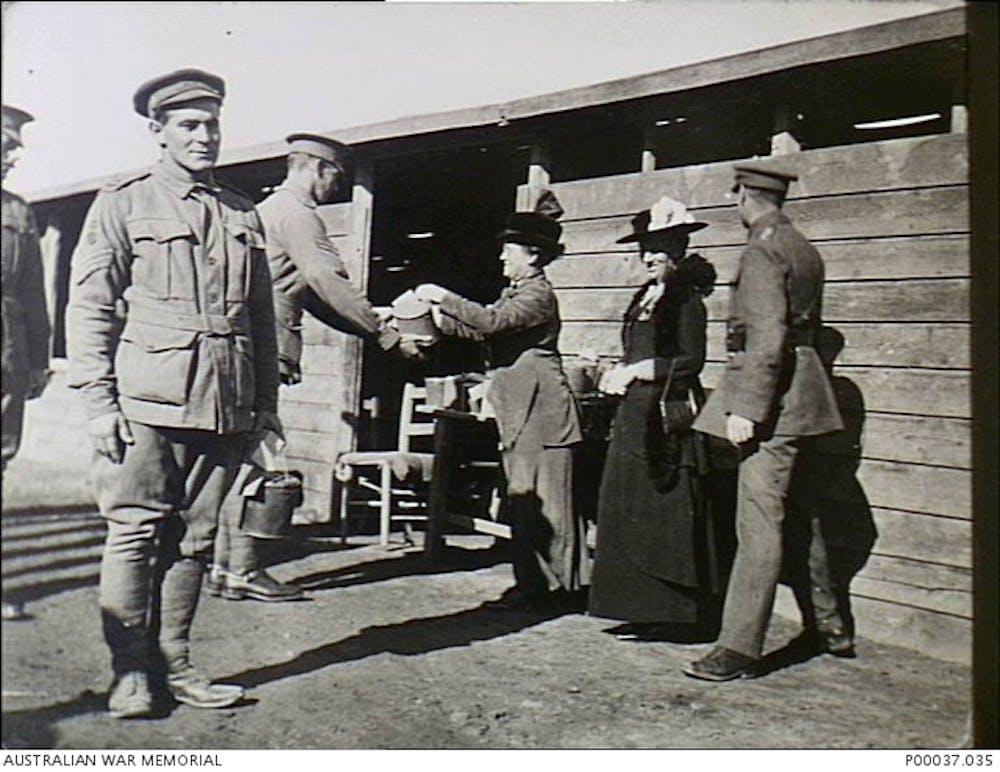
Women distribute Christmas billies to men in Cairo, Egypt, December 1915. Australian War Memorial

Christmas hampers and billies sent from home provided particular joy to those lucky enough to receive them. Some, however, experienced Christmas dinners like that of Private John Chugg of 1st Light Horse Field Ambulance, who complained “it was a miserable Xmas” in Egypt in 1914: “boiled beef unpeeled potatoes and tea without milk… [and] no mail or anything to cheer us”.

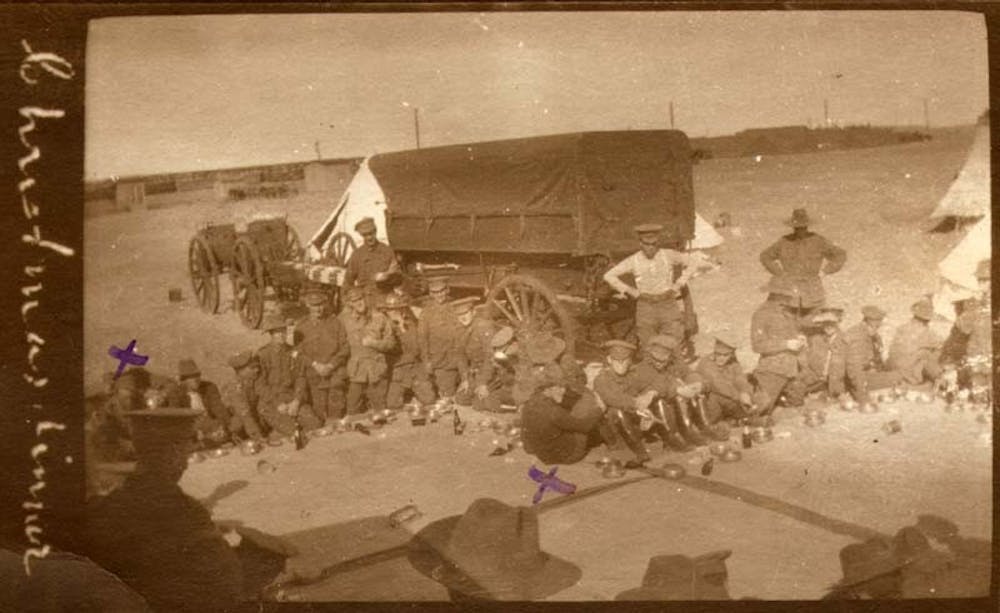
Sapper Alfred Galbraith described Christmas day in Ismailia Camp, Egypt, in December 1915 in a letter to his family. Each man chipped in to purchase a turkey and

chickens more like humming birds, soft drinks and a few biscuits. The chickens were dealt out 1 between 5 men and some of them would not feed one let alone 5 men, the one we got we tossed up to see who would get it & I won but I half it with my pal & then the two of us went & bought some […] biscuits & some tin fruit.

Alf is depicted in a photo of the dinner, sitting awkwardly on canvas at the end of a row of soldiers, mess tins in front of each and an occasional bottle, likely of beer. Alf’s Christmas letter concludes nostalgically “Dear Australia the land of my Birth which we will all be glad to see again … it will be a glorious day if I live to see it out … ” It was to be his last Christmas.

AIF troops celebrating Christmas at Ismailia Camp, Egypt, in December 1915. Museums Victoria

A special meal could have the effect of making the war recede, if briefly, for the soldiers who partook of it. This is the impression gleaned from the menu for the 1917 Christmas dinner at the “A” Mess of the 3rd Australian Divisional Headquarters in France, led by Monash.

The hand-drawn menu features bucolic sketches of rural French life, and a list of dishes in a mix of French and English, signalling the prestige of the officers’ dinner.

The 10 courses included hors d’oeuvres (olives and “Tomato au Lobster”), potage _(“_Crème de Giblet”), poisson, entrée (chicken), viands (pork and ham), legumes, sweets (three choices) and a cheese tart, ending with wine and coffee.

The menu served at an AIF Christmas Dinner in 1916. Museums Victoria collection, donated by Jean Bourke

The “B” Mess dinner at the Headquarters was almost as sumptuous, but with fewer courses. Its more simple menu included a humorous script, poetry and parodies. When the food concluded a toast was made to “Absent Ones”, drunk “while softly murmuring the words ‘Not lost but gone to CORPS’”. Notably, the term “Lest We Forget” was used to remind diners of good etiquette!

Christmas in transit

The voyage to active overseas service was a mixture of excitement, trepidation and monotony. Food service broke the boredom of long days at sea. On board the SS Suffolk on Christmas day 1915 diners were treated to a multi-course dinner, opening with olives, mock turtle soup and salmon cutlets in anchovy sauce. The next course featured iced asparagus, beef fillets with mushrooms and prawns in aspic, before the food became even more serious, with four types of meat, baked and boiled potatoes, and beans.

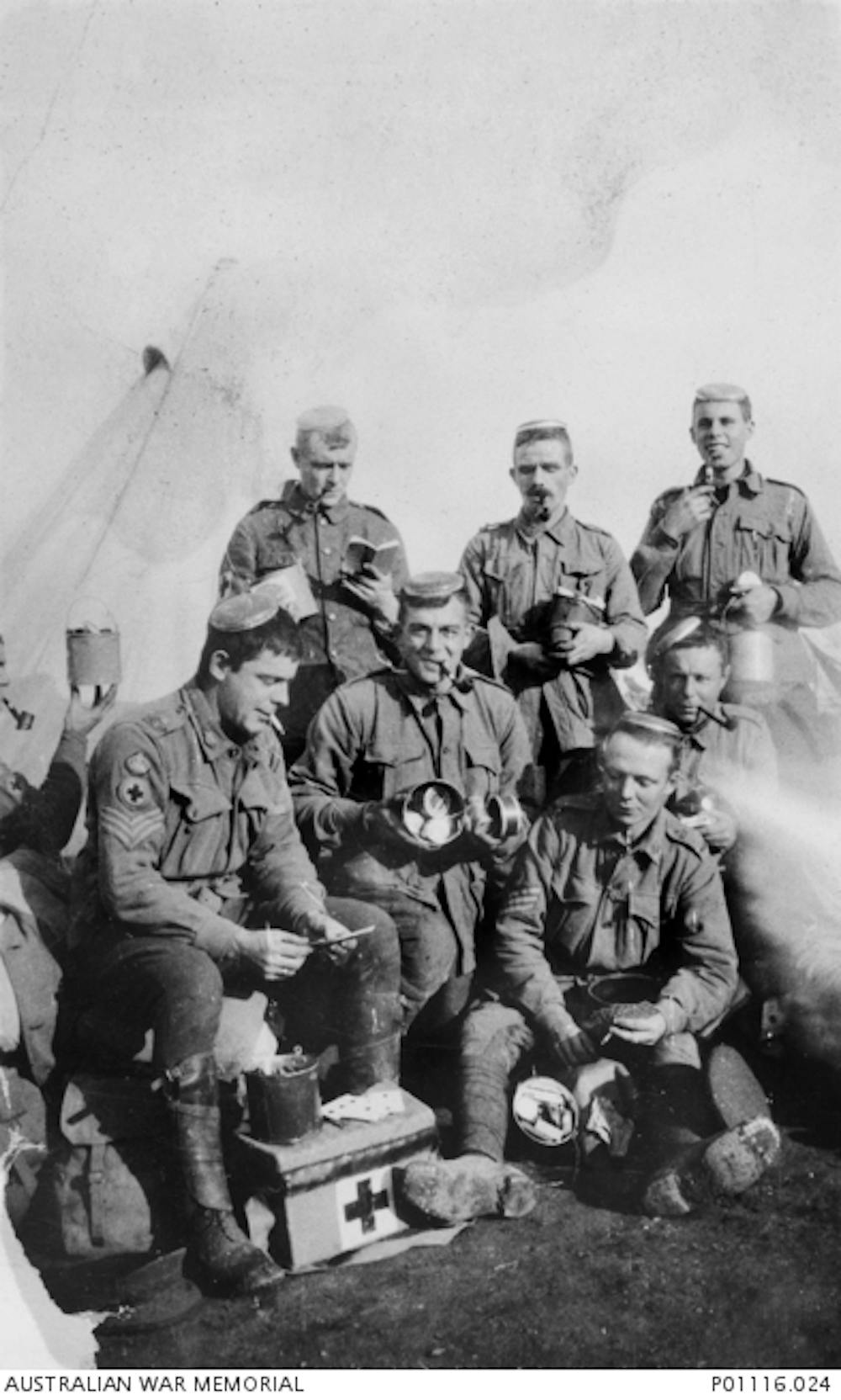
Members of the 4th Australian Field Ambulance at Christmas in Lemnos in 1915. Australian War Memorial

Four deserts followed, including plum pudding with both hard and brandy sauces. Like many special occasion menus of the war, diners signed their names on the back.

Aprés la guerre

The desire to be “home by Christmas” had been widely expressed from the very first year of the Great War, yet when the armistice finally came in 1918, Australians on active service still had a long journey ahead of them and faced another Christmas away from home.

In 1918, the 2nd Australian pioneers officers’ Christmas dinner took place “somewhere in France”, featuring a menu entirely in French save for the words “plum pudding” and “God Save the King”. Two half pages of the menu were dedicated to “Autographs”.

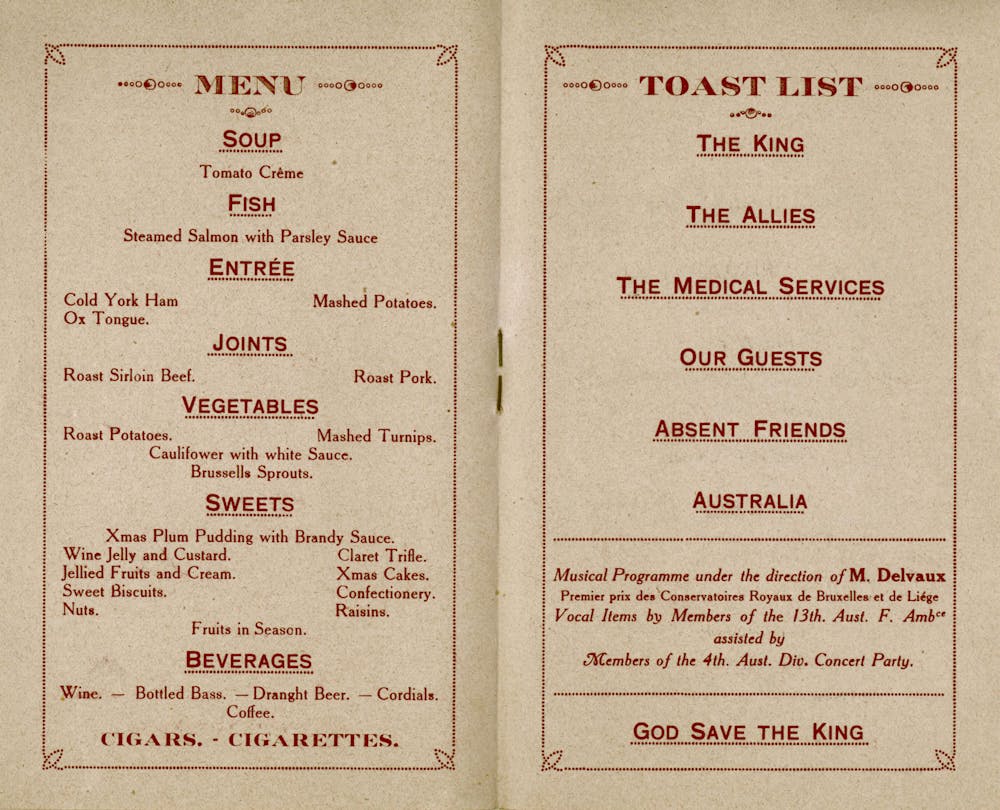
The souvenir menu card from the 13th Australian Field Ambulance 2nd anniversary dinner, held on Christmas Day 1918 in the Palace of Justice, Dinant-Sur-Meuse, Belgium likewise has a page for autographs. The festive menu features an extensive list of desserts.

The menu served to the 13th Australian Field Ambulance on Christmas Day 1918. Museums Victoria collection, donated by John Lord

Christmas dinner in 1919 saw Australians who had served in Europe returning home on the SS Königin Luise, a German ship allocated to Britain as part of war reparations. A menu saved by Sergeant Tom Robinson Lydster bears no references to the war.

A wreath of holly frames an eclectic menu including “Fillet of Sole au Vin Blanc, Asperges au Beurre Fondu” but also “Lamb cutlets, Tomato sauce, Roast Sirlion of Beef”. The Christmas element is provided by “Plum Pudding, Brandy Sauce, Mince Pies”. More than a year after the end of the war, some surviving Australians were yet to celebrate Christmas on home soil.

Christmas traditions for Australian soldiers, nurses and medics helped maintain cultural normalcy during overseas service. Yet Christmas on active service could be a time of significant stress, a reminder of loved ones far away and of fallen friends. Unfortunately, for those who returned to Australia, forever changed by their experiences, Christmas was not always what they remembered or had imagined.

ref. What Australian soldiers ate for Christmas in WWI – http://theconversation.com/what-australian-soldiers-ate-for-christmas-in-wwi-108987

DNA from ancient Aboriginal Australian remains enables their return to Country

]]>

Source: The Conversation (Au and NZ) – By Joanne Wright, Research associate, Griffith University

This article was coauthored by Gimuy Yidniji Traditional Owner Gudju Gudju Fourmile.


For many decades Aboriginal Australians have campaigned for the return of ancestral remains that continue to be stored in museums worldwide.

But in many instances these remains cannot be repatriated – as their geographic origin, tribal affiliation or language group was never identified. Without this information it is impossible for museums to determine appropriate custodians, which prevents their return.

Our research, published in Science Advances today, shows it is possible to determine the origin of Aboriginal Australian remains using DNA-based methods, enabling their return to Country.


Read more: DNA reveals a new history of the First Australians


Collaborative beginnings

Past injustices due to actions and policies implemented in early colonial history have left gaps in the self-knowledge of many contemporary Aboriginal Australians.

A key term in this context is “Country”: the place in which an Aboriginal Australian, or his or her ancestors, was born and lived. For some communities their Country encompasses large geographical areas; for others it is much smaller.

Aboriginal Australians believe they have a spiritual connection to their Country – and many believe that in order for their ancestor’s spirits to rest, their remains must be returned to Country.

The Lake Mungo World Heritage Site has a long history of Aboriginal occupation. Sherene Lambert (St Augustine’s College, Ipswich, Australia), Author provided

Many of our traditional owner collaborative partners wanted to learn more about their history through DNA analyses – and to directly test whether DNA might help with the return of unprovenanced remains from museums worldwide to Country.


Read more: The violent collectors who gathered Indigenous artefacts for the Queensland Museum


Our research, undertaken in collaboration with Aboriginal Australian traditional owners and communities across Australia, tested whether it is possible to determine the origins of ancient individuals using DNA-based methods.

We successfully recovered ten nuclear genomes (DNA from cell nuclei) and 27 mitogenomes (DNA from cell mitochondria) from ancient pre-European Aboriginal Australians dating up to 1,540 years before present – and for whom we had records of Country.

These ancient genomic sequences, of known origin, were used as proxies for unprovenanced remains. We compared these against reference datasets of contemporary Aboriginal Australian nuclear and mitochondrial genomes.

Previously the only authentic pre-European DNA ever recovered from Aboriginal Australian remains was the mitochondrial genome of an ancient man from the Willandra Lakes region. Here we show it is also possible to recover ancient nuclear genomes from Aboriginal Australian remains, despite DNA survival in an Australian context being poor due to harsh climatic conditions.

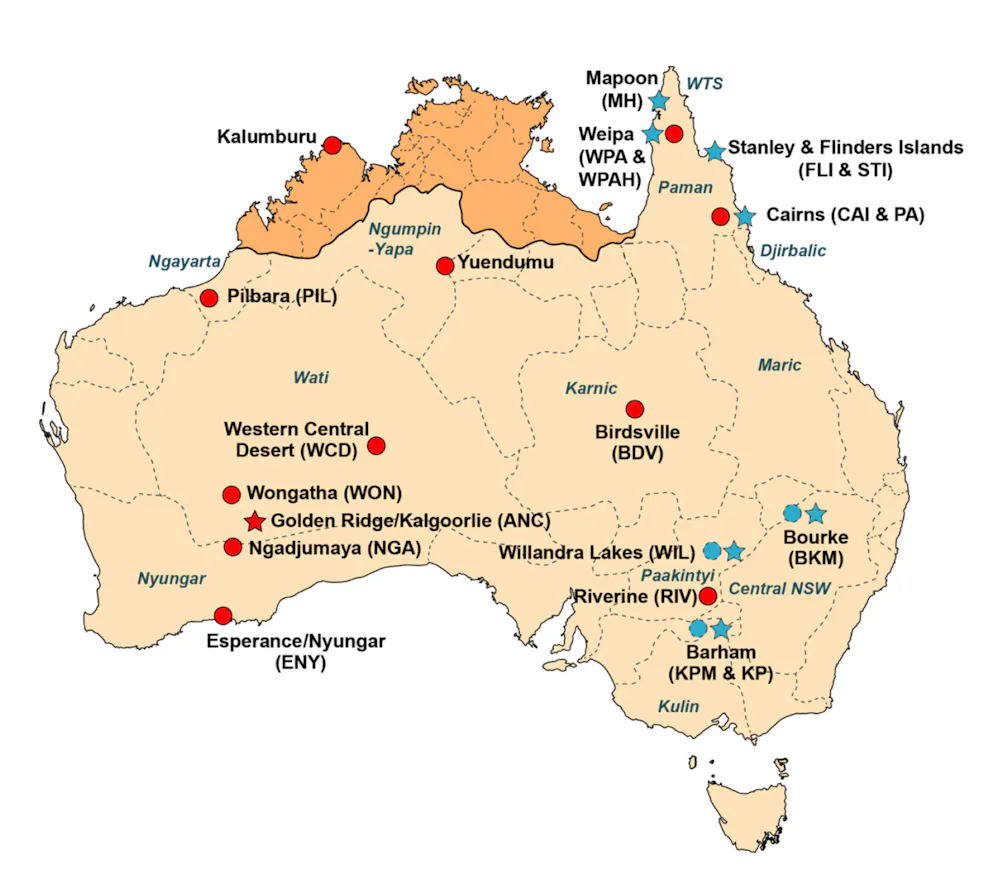
Details of the locations and language groups of Aboriginal Australian samples uses in this study. Yellow shading indicates the distribution and location of Pama-Nyungan language families. Orange shading indicates the distribution of non–Pama-Nyungan language families. Dashed lines show the approximate distribution of accepted major language subgroups, with language names in italics. Red symbols indicate previously published mitochondrial or nuclear genomes; blue symbols indicate new unpublished data. Circles indicate contemporary Aboriginal Australian samples, and stars represent ancient individuals. Sample code abbreviations have been included in parentheses. Joanna Groom/Science Advances, Author provided

Mitochondrial vs nuclear DNA

We found by using maternally inherited DNA (mitochondrial DNA), we could successfully determine the origins of 62.1% of bodily remains of ancient Aboriginal Australians included in this research.

But we could not achieve this for the remaining 37.9% of the remains in the study. For these, the results were either inconclusive (due to a lack of contemporary matches or the matches identified were widespread across large geographic distances), or the results were unreliable. In two instances, the closest contemporary matches were not from the same geographic location, but some 635 kilometres away.

As the return to place and Country of ancestral remains is important to many Aboriginal Australian communities, repatriation to incorrect Country would be extremely problematic. Therefore, we are unable to recommend the use of mitochondrial DNA alone for repatriation.


Read more: The Dreamtime, science and narratives of Indigenous Australia


Nuclear DNA (DNA inherited from both parents) provided the most accurate results, working in 100% of cases and to precise geographic locations.

The results obtained were supported by several different methods, each of which independently showed considerable population structure and local continuity between both the ancient and contemporary populations in each geographic location.

However, when combined, these analyses provide strong evidence that nuclear DNA, as a tool for repatriation, is very effective. If applied to unprovenanced ancestral remains, we believe this will greatly assist with their repatriation.

A need for national consultation and standards

Traditional Owner Gudju Gudju Fourmile of the Gimuy Yidniji People of Cairns told us this was an important result, and a solution to a problem that has been a major concern to Aboriginal Australians for more than 50 years. He said:

Many of our ancestors still remain on foreign land, and in storage of museums and collectors. We need to do the right thing to bring them home so their spirit will rest.

Despite our success, however, one question remains unanswered: how should this new tool be implemented? We believe that before DNA is used to facilitate repatriation of ancient remains, a detailed set of standards and protocols should be developed as best practice for museums and other institutions to follow.

As this method requires the destruction of unprovenanced ancient bone, albeit in small quantities, it is imperative that these standards be developed in close consultation with Indigenous communities across Australia. It is essential that a consensus be reached and a decision made by Aboriginal Australians at a national level. This requires a national debate, but it should be among our First People.


Read more: New DNA study confirms ancient Aborigines were the First Australians


From subject to researcher

In addition to developing an effective tool for provenancing ancestral remains for repatriation, this research is significant because it was driven by Aboriginal Australian Traditional Owners and their communities. Their desire to learn more about themselves developed into a major research project in which they were actively involved and equal partners in the direction the research took.

Without their input and knowledge this research would not have been possible.

This is a significant shift from Aboriginal Australians being scientific subjects, as they were in the past, to them becoming researchers in their own right.

ref. DNA from ancient Aboriginal Australian remains enables their return to Country – http://theconversation.com/dna-from-ancient-aboriginal-australian-remains-enables-their-return-to-country-108168

Serial killers’ fates are in politicians’ hands. Here’s why that’s a worry

]]>

Source: The Conversation (Au and NZ) – By Arie Freiberg, Emeritus Professor of Law, Monash University

The community has little sympathy for mass murderers, serial killers or anyone convicted of a very serious crime against another person.

Presumably, this is why the Sentence Administration Amendment (Multiple Murders) Act 2018 passed through the WA state parliament earlier this month without any substantial opposition and was supported by victims’ families.

When proclaimed, the new legislation will allow WA’s attorney-general to instruct the Prisoners Review Board to suspend the assessment, consideration or reporting for parole (or a re-socialisation program) for certain mass murderers and serial killers for up to six years at a time.

Previously, these orders only lasted three years, which meant prisoners denied parole were entitled to have their cases reviewed every three years.

This change affects six prisoners.


Read more: Psychopaths versus sociopaths: what is the difference?


The attorney-general will also be able to make multiple instructions, which may mean he or she can order an offender will never be released. This decision is not subject to legal review except in exceptional circumstances.

The primary intention of this law is to reduce the trauma suffered by survivors and secondary victims of such crimes.

It fulfills an election commitment made in 2017 by the incoming McGowan Labor government.

Don’t these offenders deserve to die in jail?

Under WA law, a person convicted of murder and given a life sentence must be given a minimum term of 10 or 15 years, depending on the circumstances of the offence. Alternatively, the court may order the offender never be released on parole in certain circumstances. It’s easy to imagine that mass murderers and serial killers might warrant such a sentence.

However, where a life sentence for murder has been imposed and a minimum sentence served, it is the governor (usually acting on the advice of the attorney-general and the Prisoners Review Board) who has the ultimate power to parole a prisoner.

It appears that minimum sentences were set before the new legislation came into force for these six offenders, some for 30 years.

This arrangement is a hangover from when capital punishment was abolished in WA in 1984. Previously, the executive (that is, the political arm of government) made the final decision about whether the person would be executed. After abolition, the executive retained the power to decide which murderers would be released on parole. This system is unique to WA.

Who decides when someone’s released?

The difficulties with these changes to the law do not lie with the idea that mass murderers should never be released, but who decides if this should be the case.

Under the current law, it is the courts that can decide that “life means life”. This is an appropriate role for the judiciary. And it is appropriate for parliaments to make laws in relation to maximum sentences and parole generally.

However, it is not appropriate for politicians to make decisions about a specific person’s liberty, as they may be influenced by electoral or populist considerations rather than the merits of the individual case.


Read more: Political interventions have undermined the parole system’s effectiveness and independence


In the 1980s, most jurisdictions removed or limited the powers of attorneys-general to prosecute cases and gave this power to independent directors of public prosecutions.

In the same way, establishing independent parole boards from the 1950s, often chaired by retired or serving judicial officers, was designed to separate decisions about a person’s liberty from political influence.

Political pressure

As the debates in the WA parliament reveal, the political temptations are great. Why a delay of six years and not nine or 12? Why only serial killers and mass murderers? And how many victims are required to qualify? Why not paedophiles or child murderers or murderers of one victim?

The answer lies in the broad notion of the separation of powers: politicians make the law, the judiciary applies it and the executive carries out their decisions.

However, governments increasingly have shown a reluctance to trust courts or parole boards as the final decision-makers on sentencing and release powers, and have eroded their authority.

The Victorian parliament has legislated to effectively deny mass murderer Julian Knight and police killers the possibility of release on parole and many jurisdictions have introduced “no body, no parole” laws.


Read more: No prospect of release: Kevin Crump and the human rights implications of life imprisonment


In WA, none of the six people subject to these new extended powers has been released after being considered by the Prisoners Review Board. This suggests the system was working effectively without the need for legislative reform.

It is understandable that victims should not be re-traumatised each time an offender is being considered for release, no matter how remote that possibility. And it is reasonable for the community to expect the most serious punishment for heinous crimes.

But it is also reasonable for citizens to expect that decisions about their liberty should be in the hands of impartial and independent bodies. This is what the “rule of law” should mean.

ref. Serial killers’ fates are in politicians’ hands. Here’s why that’s a worry – http://theconversation.com/serial-killers-fates-are-in-politicians-hands-heres-why-thats-a-worry-108825

Christmas versus kilojoules – how to focus more on celebration and less on the food

]]>

Source: The Conversation (Au and NZ) – By Clare Collins, Professor in Nutrition and Dietetics, University of Newcastle

Christmas and the holidays are a time to relax and celebrate with family and friends. But the festive season can also be a time of unwanted weight gain that won’t budge once the holidays are over.

Research (mostly from the United States) has found adults typically gain 400 to 900 grams over the holidays.

No-one wants to miss out on the celebrations. But knowing more about the kilojoule content of your favourite Christmas treats can help you make conscious decisions about which foods and drinks to have and enjoy, and what portion sizes to choose.


Read more: Health check: do bigger portion sizes make you eat more?


Check the comparisons below, and how much housework or the number of steps you’d need to take to expend that same number of kilojoules. (Note: calculations are based on an adult weighing 70-80 kilograms.)

Try this for starters

Which of these pre-dinner snacks is worth the effort:

A large handful of potato crisps containing 550kJ, which would take 32 minutes of vacuuming or 3294 steps to work off?

Or a handful of fresh cherries (about ten large or 15 small ones) which contains about 150kJ? This would take only 8.5 minutes of vacuuming or 880 steps to work off.

Here comes the main course

Two slices of roast pork and a 30g (matchbox size) piece of crackling contains about 1,415kJ. This is equivalent to spending 54 minutes cleaning windows or taking 8,500 steps.

If you substitute the pork for 12 medium prawns (about 70g) at 260kJ, this is equivalent to ten minutes of washing windows or taking 1,560 steps.


Read more: How to pick an ethically raised ham this Christmas


Sweet swap

If you eat one-eighth (about 90g) of a large plum pudding, you will have consumed about 1,080kJ. You’ll need to take about 6,350 steps to walk it off, or spend 41 minutes raking up leaves in the garden.

Smaller portions come with fewer kilojoules. Shutterstock

In contrast, one 25g rum ball contains about 350kJ, equivalent to 2,060 steps or 13 minutes of raking leaves.

Even better, half a cup of fresh fruit salad at 250kJ is equivalent to 1,470 steps or approximately nine minutes of raking leaves.

How to focus more on celebration

It’s possible to have fun at Christmas and celebrate the time with family and friends while reducing your focus on food. Here are some tips to get you started:

Take a breather between courses. Shutterstock

  • think about your Christmas food budget and try to stick to it. Going for less total food but better quality in your budget can help avoid food waste and reduce stress related to finances and food security.

  • if Christmas home cooking is a part of your routine, plan to give some away as gifts. Or, think about spending less time in the kitchen cooking and more time contacting those you have not been in touch with for a while.

  • plan some fun, post-dinner Christmas activities. Set up some old-fashioned physical games, like a hookey board, a set of skittles, or boules. Make playing compulsory before dessert is served!

Try not to feel guilty

You’d think people who stress about food would have healthier eating habits, but the research shows that this isn’t the case.

One study found that people who associated eating chocolate cake with guilt, rather than a celebration, had eating habits that were less healthy, especially when they were under stress.

Aside from avoiding over-eating, having a focus on enjoying healthy foods as well as some self-compassion can help improve your relationship with food.


Read more: This Christmas, give yourself permission to enjoy pudding


ref. Christmas versus kilojoules – how to focus more on celebration and less on the food – http://theconversation.com/christmas-versus-kilojoules-how-to-focus-more-on-celebration-and-less-on-the-food-107436

State of the Climate 2018: Bureau of Meteorology and CSIRO

]]>

Source: The Conversation (Au and NZ) – By Michael Grose, Climate Projections Scientist, CSIRO

The Australian Bureau of Meteorology and CSIRO have released their fifth biennial State of the Climate report.


State of the Climate 2018 is the latest biennial snapshot of climate change in Australia. It focuses on observed long-term trends that are happening now and are likely to continue into the near future, as well as significant climate events that have occurred over the past two years. These changes are described through the latest observations from CSIRO and Bureau of Meteorology marine, atmospheric and terrestrial monitoring programs.

The report also summarises the latest climate research from Australia and around the world. This will help inform a range of economic, environmental and social risk assessments and responses by government, industry and communities.


Read more: State of the Climate 2016: Bureau of Meteorology and CSIRO


Multiple lines of evidence show the climate system changing in ways that are discernible from natural variability, and consistent with a human influence on climate. These changes are having an impact on our natural and built environment.

In particular, climate change is being felt through an increase in the frequency and severity of high-impact weather events such as heatwaves, extreme fire weather conditions, coastal inundation and marine heatwaves. These trends are projected to continue.

Some of the report’s major findings are described below.

Passing major milestones

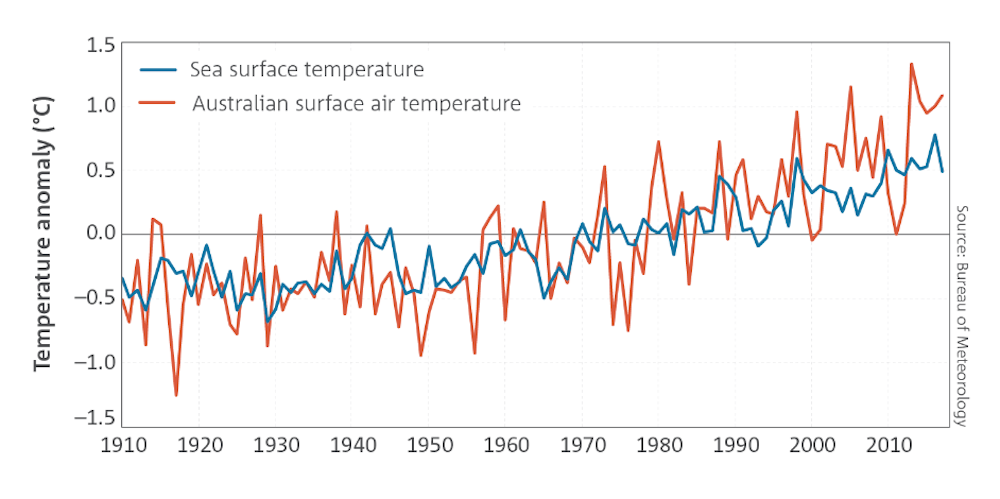
Australia’s average air temperature has warmed by just over 1℃ since national records began in 1910. Oceans around Australia have also warmed by around 1℃ since 1910.

Annual mean temperature over Australia and the seas surrounding Australia. Bureau of Meteorology, Author provided

Atmospheric concentrations of carbon dioxide are rising globally. Emissions from the burning of fossil fuels continue to increase, and are the main contributor to the rise in CO₂, with some contribution from changes in land use.

Atmospheric CO₂ concentrations measured at Cape Grim, Tasmania (one of three main global measuring stations, alongside Mauna Loa, Hawaii, and Nunavut, Canada), have persisted at levels above 400 parts per million (ppm) since 2016. What’s more, the combined concentration of all greenhouse gases exceeded the equivalent of 500 ppm CO₂ in mid-2018. These milestones haven’t been crossed for at least 800,000 years, and likely 2 million years.

Changes in the atmosphere and land

Australia’s warming trend has led to an increase in the frequency of extreme heat events. For example, very high monthly maximum temperatures that used to occur around 2% of the time (based on the average for 1951–80) now happen about 12% of the time (2003–17).

Other elements of Australia’s climate have also shown long-term changes. New analysis techniques now provide a more detailed picture of changes to fire weather through time. The annual total of daily values of the Forest Fire Danger Index is increasing over large areas of Australia. Most regions also saw an increase in the most extreme 10% of fire weather days, and fire seasons have lengthened.

Rainfall in April–October has been steadily decreasing in Western Australia’s Southwest, and has decreased since the 1990s in southeast Australia. In contrast, rainfall has increased in parts of northern Australia since the 1970s.

The observed long-term reduction in rainfall across southern Australia has led to even greater reductions in streamflow. Long-term average streamflow has decreased in most regions of southern Australia, and increased in regions of northern Australia.

A warmer atmosphere can hold more moisture, and this is an important driver of the observed increase in the intensity of short-duration rainfall, sometimes linked to flash flooding. Southern Australia is projected to experience decreases in average rainfall and more time spent in drought. Meanwhile, most of the country can expect an increase in rainfall intensity.

Historically, significant weather and climate events are often the result of the combined influence of several extreme factors at once. Higher temperatures during periods of below-average rainfall, for instance, can exacerbate drought conditions. Temperature, dryness and wind come together to create dangerous bushfire conditions.

Trend in the annual sum of Forest Fire Danger Index, 1978–2017. Bureau of Meteorology, Author provided

Changes in the ocean

The warming in Australia’s oceans has contributed to longer and more frequent marine heatwaves – defined as periods when sea surface temperatures are much warmer than average. The world’s oceans are a crucial moderator of the climate, taking up more than 90% of the extra heat in the system – most of it is absorbed by the Southern Ocean.

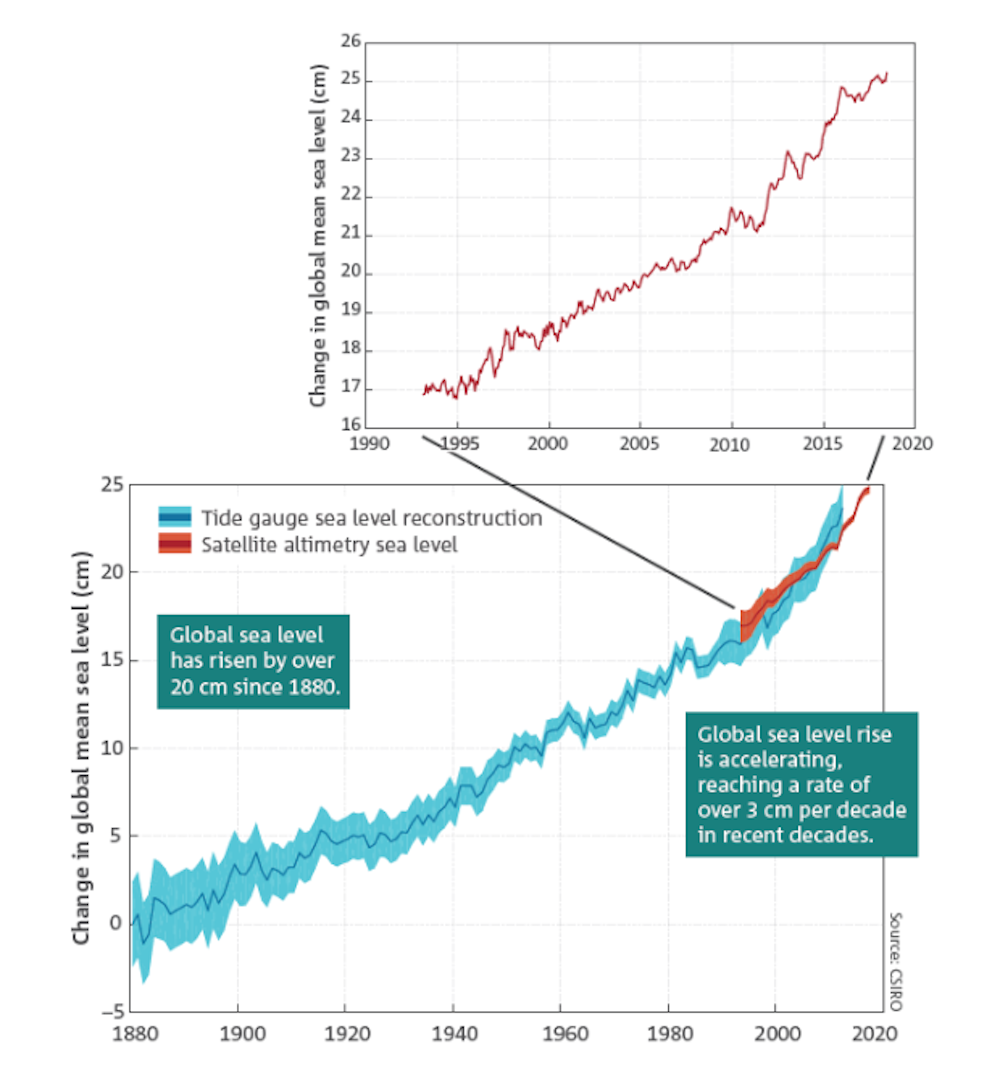
Sea levels continue to rise through the combined effects of warming oceans and melting ice from land-based glaciers and ice sheets. Global average sea level has risen by more than 20cm since 1880, but the rate varies from place to place. About 25% of the CO₂ emitted by human activity diffuses into the oceans, making them more acidic in the process.

The past two years, 2016 and 2017, have seen back-to-back bleaching events in parts of the Great Barrier Reef, linked to marine heatwave events. These changes are very likely linked to warming oceans, and primarily driven by the human influence on the climate.

Global sea level change from 1880 estimated from tide gauges and satellites. CSIRO, Author provided

Well-established scientific theory and climate model studies both show that the warming would largely not have occurred without the increase in greenhouse gas concentrations. In addition, the current increase in temperatures accords with projections made nearly 30 years ago. Warming is projected to continue into the future as the effect of past emissions continue, and more greenhouse gases are emitted. Australia is projected to experience increases in sea and air temperatures, with more hot days and marine heatwaves, and fewer cool extremes.

It takes time for the climate system to warm in response to increases in greenhouse gases, and the historical emissions over the past century have locked in some warming over the next two decades, regardless of any changes we might make to global emissions in that period. However, by the mid-21st century, higher ongoing emissions of greenhouse gases will lead to greater warming and associated impacts, and reducing emissions will lead to less warming and fewer associated impacts.

Australian average annual temperature 1861-1900 period in observations and global climate models. CSIRO, Author provided


State of the Climate 2018 can be read on either the Bureau of Meteorology or CSIRO websites. The online report includes an extensive list of references and useful links.

You can also watch accompanying behind-the-scenes videos on our research on climate extremes and ocean warming.

ref. State of the Climate 2018: Bureau of Meteorology and CSIRO – http://theconversation.com/state-of-the-climate-2018-bureau-of-meteorology-and-csiro-109001

Doing away with essays won’t necessarily stop students cheating

]]>

Source: The Conversation (Au and NZ) – By Julie Hare, Honorary Fellow, University of Melbourne

It’s never been easier for university students to cheat. We just need look to the scandal in 2015 that revealed up to 1,000 students from 16 Australian universities had hired the Sydney-based MyMaster company to ghost-write their assignments and sit online tests.

It’s known as contract cheating – when a student pays a third party to undertake their assignments which they then pass off as their own. Contract cheating isn’t new – the term was coined in 2006. But it’s becoming more commonplace because new technologies, such as the smart phone, are enablers.


Read more: 15% of students admit to buying essays. What can universities do about it?


Cheating is taken seriously by universities and the national regulator, the Tertiary Education Quality and Standards Agency. Much of the focus has been on changing assessment tasks to ones deemed to be harder for a third party to undertake. This is called “authentic assessment”.

This type of assessment has been widely adopted at universities. They are comprised of tasks that evaluate knowledge and skills by presenting students with real-world scenarios or problems relevant to the kinds of challenges they would face following graduation. But new research found authentic assessment may be as vulnerable to cheating as other more obvious examples, such as essays.

What the research shows

This new study was conducted by academics from six universities, led by Tracey Bretag and Rowena Harper from the University of South Australia. The research – part of the federal government’s Contract Cheating and Assessment Design project – surveyed 14,086 students and 1,147 staff.

The goal of this research was to collect and understand student’s perceptions of the likelihood of cheating on 13 different assessment tasks. The research then asked teaching staff which of the 13 tasks they used.

Unique, in-class tasks were perceived to be the hardest to cheat on. from www.shutterstock.com

The researchers have previously reported from this data set that 6% of students admitted to cheating. The purpose of the current round of analysis was not to understand the extent of cheating, but perceptions of how easily it might be done, and if that correlated with the tasks educators set.

They found, for both students and teachers, assessments with a short turnaround time and heavily weighted in the final mark were perceived as the tasks which were the most likely to attract contract cheating.

Assessments perceived as the least likely to attract contract cheating were in-class tasks, personalised and unique tasks, vivas (oral explanations of a written task) and reflections on practical placements. But these tasks were the least likely to be set by educators, presumably because they’re resource and time intensive.

Contract cheating and assessment design

The research confirms the relationship between contract cheating and assessment design is a complex one. There was no assessment tasks for which students reported a 0% likelihood of contract cheating. Students who engage in contract cheating both see and look for opportunities to cheat regardless of the assessment task.

For universities, that means they must assume cheating is always possible and simply changing what assessments they use will not combat the problem.

Authentic assessment might be as vulnerable to outsourcing as essays. from www.shutterstock.com

Many experts have advocated the use of supervised exams to combat cheating. But this new research adds to a growing body of evidence that exams provide universities and accrediting bodies with a false sense of security. In fact, previous data has shown students reported engaging in undetected cheating on supervised exams at higher rates than other types of cheating.

Another common approach is to use a series of small, graded tasks, such as spontaneous in-class tests, sometimes called continuous assessment. Even here, students indicated these were the third most likely form of assessment to be outsourced.

Who’s most likely to cheat?

There has been much attention, particularly during the MyMaster scandal, on international students’ use of contract cheating. The new research suggests both international students and domestic students from non-English speaking backgrounds are more likely to engage in contract cheating than other students.


Read more: Don’t assume online students are more likely to cheat. The evidence is murky


The research also found business and commerce degrees were more likely be perceived as attracting contract cheating. Engineering was also particularly vulnerable to cheating.

Students from non-English speaking backgrounds hypothesised cheating would be most likely to occur in assessments that required research, analysis and thinking skills (essays), heavily weighted assignments and assessments with short turnaround times.

Students were still likely to cheat on supervised exams. from www.shutterstock.com

Perhaps unsurprisingly, students who indicated they were satisfied with the quality of teaching were less likely to think breaches of academic integrity were likely. In other words, this confirms previous research which showed students dissatisfied with their educational experience are more likely to cheat.

So what do we do about it?

This research provides yet more compelling evidence that curriculum and changes to teaching strategies and early intervention must be employed to support students’ academic endeavours.

The researchers also point out high levels of cheating risks undermining the reputation and quality of Australia’s A$34 billion export sector in international education.

The data demonstrates assessment tasks designed to develop relevant professional skills, which teachers are highly likely to set, were perceived by students as tasks that can easily be cheated on. These might include asking accounting students to memorandums, reports or other communication groups to stakeholders, such as shareholders. In fact, among students from a non-English speaking background, the risks of cheating might actually increase for these tasks. This means authentic assessment might run the increasing risk of being outsourced.


Read more: Assessment design won’t stop cheating, but our relationships with students might


This research shows the relationship between contract cheating and assessment design is not a simple product of cause and effect. In fact, the nature of the task itself may be less relevant to the prevalence of cheating than other factors such as a student’s from non-English speaking background’s status, perceived opportunities to cheat or satisfaction with the teaching and learning environment.

All educators must remain vigilant about cheating. Teachers must be properly resourced by their universities to ensure they can create rich learning environments which uphold the integrity of the higher education system.

Burdened with large debts and facing a precarious job market after graduation, it’s perhaps unsurprising some students, particularly those who are struggling academically, take a transactional approach to their education. This new research provides more clear evidence contract cheating is a systemic problem that requires a sector-wide response.

ref. Doing away with essays won’t necessarily stop students cheating – http://theconversation.com/doing-away-with-essays-wont-necessarily-stop-students-cheating-108995

Building in ways that meet the needs of Australia’s remote regions

]]>

Source: The Conversation (Au and NZ) – By Hannah Robertson, Innovation Fellow and Lecturer, Faculty of Art, Design & Architecture, Monash University

Remote areas were described as “unused” and/or “underperforming” in a 2017 address by internationally renowned architects Rem Koolhaas and David Gianotten of OMA. Similarly, a 2004 territorial study of Switzerland by ETH Studio Basel, led by architecture firm Herzog & De Meuron, painted the entire country as an urban landscape except for the most remote alpine regions. These were classified as “fallow land” and/or “quiet places”.

It follows that building policies typically centralise decision-making, resources and projects in the largest population centres, irrespective of population distribution or remote community needs. The urban perspective through which building policies are largely determined fails to assess the value of remote regions beyond market-oriented economics.

For remote-dwelling Aboriginal and Torres Strait Islander people the land, or Country, is entwined with spiritual and cultural identity. It cannot be valued in market terms.


Read more: We won’t close the gap if the Commonwealth cuts off Indigenous housing support


A regional approach to building could meet remote community needs and bring about local economic development. It would also reinforce the United Nations-recognised right of Indigenous peoples to maintain cultural connections to Country.

What’s different about remote Indigenous settlement?

Remote Australia cannot be viewed through the same lens as rural Australia. For a start, it has distinct settlement patterns. These are characterised by the presence of large numbers of Indigenous people, a widely dispersed population and, as population geographer John Taylor describes it, a “frequent” and “circular” internal mobility.

While just 14% of Australia’s population lives in remote areas, 28% of Indigenous people do. In remote areas, Aboriginal people are more likely to have experienced histories that enabled them to maintain connections to traditional Country. This has resulted in a proportionally greater recognition of Aboriginal land tenure under either the Aboriginal Land Rights (Northern Territory) Act 1976 or the Native Title Act 1993.

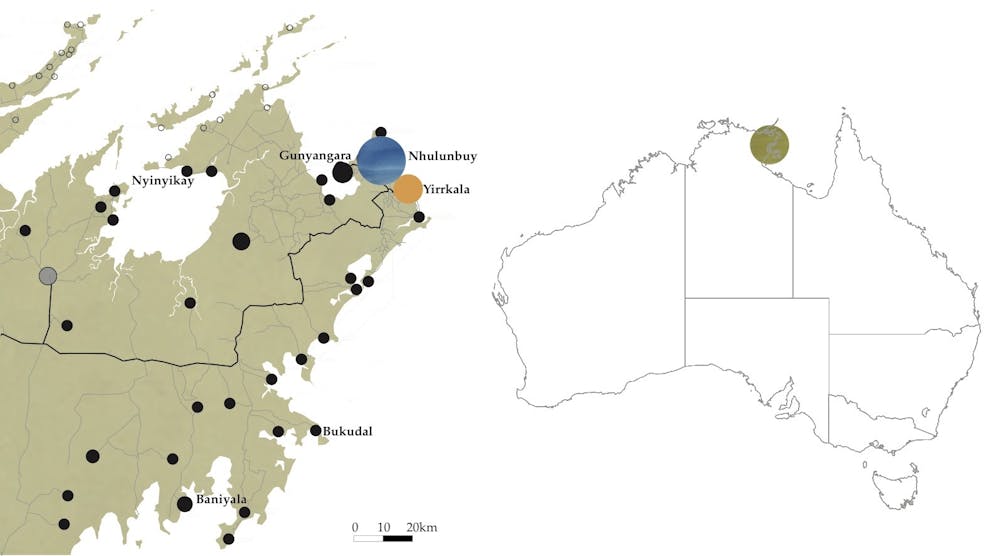
Northeast Arnhem Land in the Northern Territory is typical of this pattern. It is extremely remote and has a largely Indigenous population, with 67% identifying as Yolngu.

There are three main settlement types: a largely non-Indigenous mining town of 2,500 people, Nhulunbuy; a mostly Indigenous ex-mission settlement of around 850 people called Yirrkala; and more than 30 homelands across the territory located on traditional family clan lands with populations of up to 150, but typically fewer than 50 people. The people move often from place to place due to seasonal and cultural obligations and/or availability of access to services.

Northeast Arnhem land is extremely remote and has a largely Indigenous population living in three main settlement types. Hannah Robertson, Author provided

Challenges of building remotely

Physical distance and political marginalisation make it difficult and costly to advocate for building in remote regions generally, but Australia’s remote Indigenous regions face further challenges.

Restrictive Aboriginal land tenure limits opportunities for building and/or economic development. For instance, there is no housing market due to the inability to buy and sell recognised Aboriginal land. This means that, unlike in the rest of Australia, buildings do not represent an economic “improvement” to the land.

Furthermore, in Yirrkala, no houses were built in the first five years of the federal government’s Strategic Indigenous Housing Infrastructure Program (SIHIP) – later relabelled the National Partnership Agreement on Remote Indigenous Housing (NPARIH) and then the National Partnership on Remote Housing (NPRH). This was because others contested Rirratjingu clans’ traditional ownership of parts of the township, which delayed decisions on where houses could be built.

Materials are usually shipped in, but the Delta Reef Gumatj have begun building with locally made timber trusses. Hannah Robertson, Author provided

Economic development and job opportunities are also limited. A special agreement is required to establish an economic venture on Aboriginal land. Obtaining permission is costly and the process slow as extensive legal and anthropological work is required.

The result has been a dearth of local material and construction industries, and jobs, on remote Aboriginal land. Building materials are generally shipped in.

Collectively, these factors contribute to a reliance on government for investment in building. In Northeast Arnhem Land, the Australian or Northern Territory governments provide 95% of building funds.

Government-funded housing under construction by DRG, Gunyangara. Hannah Robertson, Author provided

Centralisation model dominates

The policy position of Australian, state and territory governments has long been one of centralisation. Funding is concentrated on the largest population centres where there is a perceived availability of jobs and economies of scale.

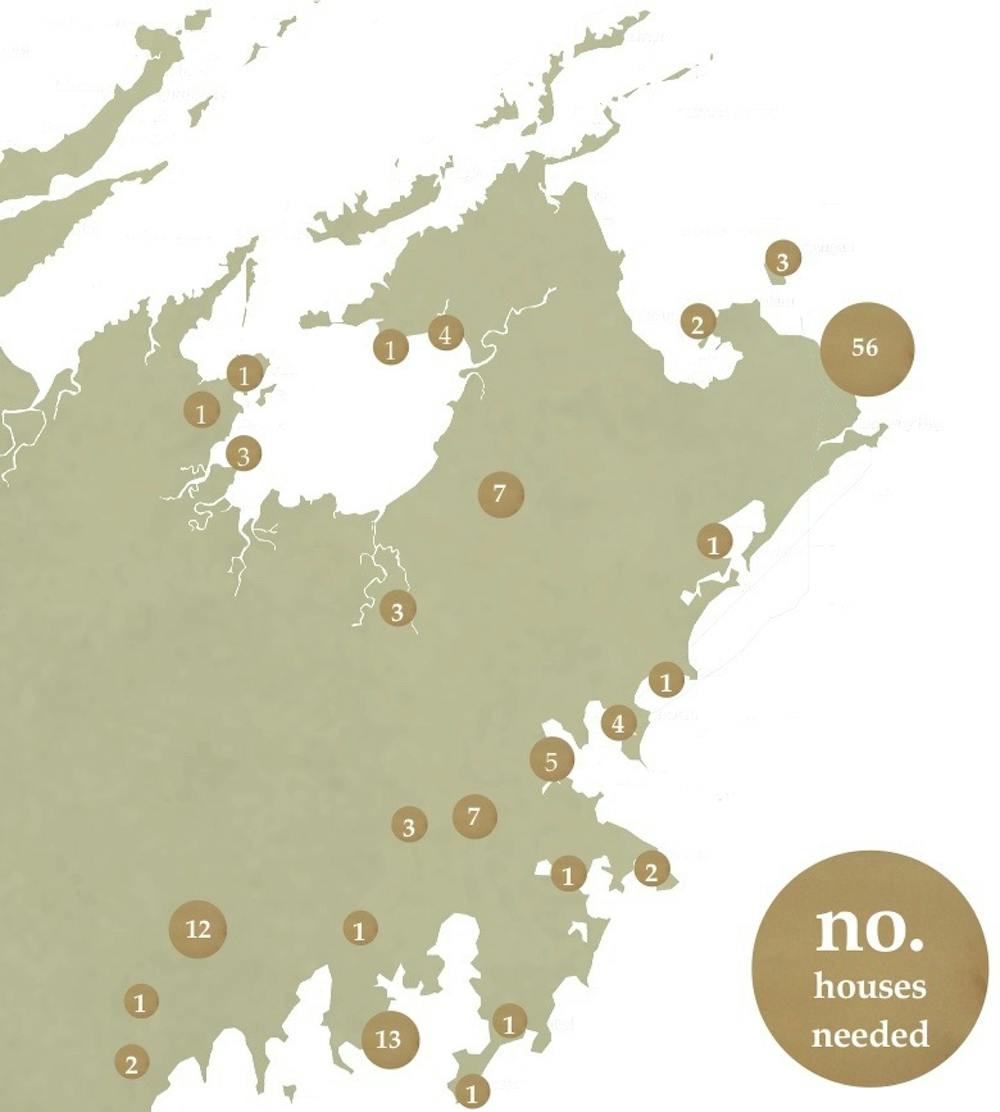
Immediate housing need in Northeast Arnhem Land by number. Hannah Robertson, Author provided

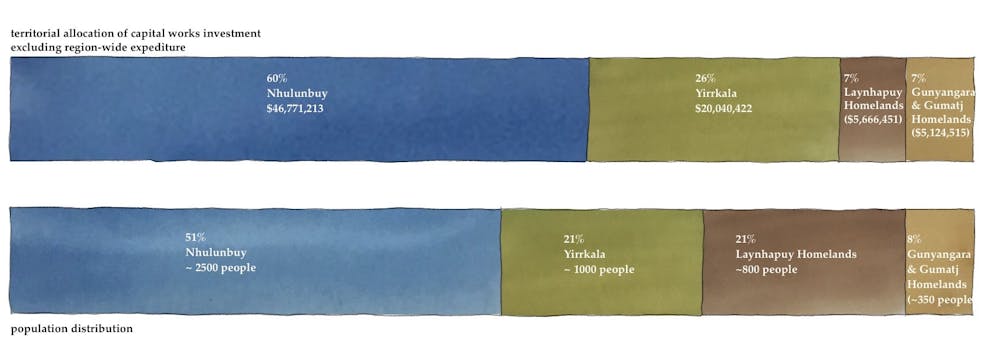
This position is upheld irrespective of identified building needs. For instance, in 2015 Nhulunbuy had 250 vacant houses after the Gove alumina refinery closed. There were shortfalls of 56 houses in Yirrkala and 81 houses across the Laynhapuy homelands. Yet 90% of government investment in building was in Nhulunbuy and Yirrkala, despite negligible need in Nhulunbuy and extensive need on the homelands.

The territorial distribution of capital works investment in Northeast Arnhem Land. Hannah Robertson, Author provided

The Northeast Arnhem Land experience aligns with that of other remote Indigenous regions. Homelands, in particular, have been chronically underfunded. After the Aboriginal and Torres Strait Islander Commission (ATSIC) was abolished in 2005, state and territory governments largely assumed responsibility for infrastructure and services on homelands without allocating further funds for new housing. The Northern Territory government formalised this position in its Homelands Policy and amendments to it in 2013.

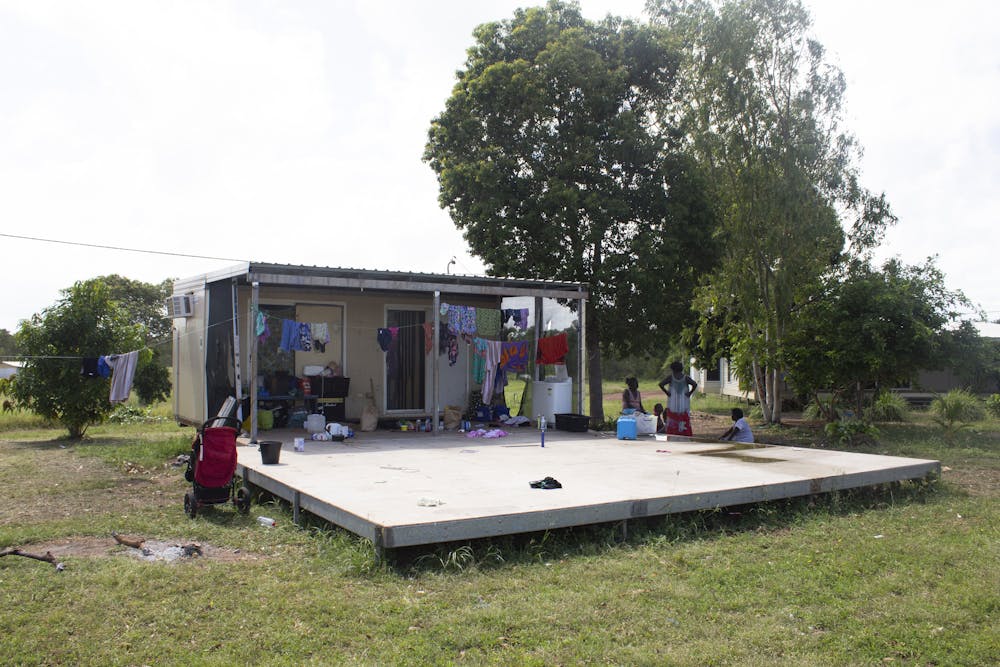
The stage structure at Baniyla Homeland is used as a house due to overcrowding. Hannah Robertson, Author provided

The situation is unlikely to change. If anything, it has intensified. In 2016, threats from the Western Australian government extended from ending new construction to ending basic services to between 100 and 150 of its smallest homelands (more commonly known as outstations in WA).


Read more: Who decides? A question at the heart of meaningful reconciliation


Government building projects in remote Indigenous Australia have not only failed to align with needs but also have limited local economic development. Australian Housing and Urban Research Institute (AHURI) Queensland Research Centre reports criticised the alliancing procurement methodology used in the SIHIP/NPARIH program because it allocated risk to the contractor. This knocked small-scale local contractors out of the tender process and resulted in limited use of local labour and materials.

Four steps to better building policy

Policy reforms could stimulate building in remote Indigenous regions. Reforms should focus on increasing local Indigenous input into decision-making. This is critical for identifying and responding to local needs.

From the most difficult to the easiest to enact, reform options could be:

  • alignment with the Uluru Statement from the Heart, treaty or constitutional amendment to give Indigenous people “their rightful place”, as Gough Whitlam put it, at a national level with statutory decision-making authority over their lands

  • amend legislation to devolve decision-making to Indigenous people at a local regional level, as occurred in 2017 amendments to the Aboriginal Land Rights (Northern Territory) Act 1976 devolving these powers from the Northern Land Council to the Tiwi Land Council, Ngarrariyal Aboriginal Corporation and Baniyala Nimbarrki Land Authority, for self-determination of townships on their lands

  • restructure Regional Development Australia agencies to align with recognised territorial regions, as opposed to general population distribution, to foster best building practice and advocacy for local needs

  • do nothing but favour the specification of local suppliers (such as through the Supply Nation network), materials (in Northeast Arnhem Land the Delta Reef Gumatj have begun building with locally made concrete blocks and timber trusses) and labour (through slow builds and the use of semi-skilled technological systems) at a project-by-project level.

Self-funded Delta Reef Gumatj-built single men’s accommodation under construction, Gunyangara. Hannah Robertson, Author provided


Read more: We need to stop innovating in Indigenous housing and get on with Closing the Gap


These policy options are not necessarily mutually exclusive: where practicable they could be conducted in tandem or implemented in part.

The shift to a regional building approach does not require revolutionary change. Rather, it builds upon a remote region’s existing practices, knowledge and organisational systems by decentralising decision-making.

Building is not the panacea for the economic development challenges of remote Indigenous regions – it cannot employ every job seeker. But if building policy decision-making is regionally determined it can better align with community needs and contribute to local industry.


Read more: Indigenous communities are reworking urban planning, but planners need to accept their history


The Conversation is co-publishing articles with Future West (Australian Urbanism), produced by the University of Western Australia’s Faculty of Architecture, Landscape and Visual Arts. These articles look towards the future of urbanism, taking Perth and Western Australia as its reference point, with the latest series focusing on the regions. You can read other articles here.

ref. Building in ways that meet the needs of Australia’s remote regions – http://theconversation.com/building-in-ways-that-meet-the-needs-of-australias-remote-regions-106071

Yes, retailers exploit Christmas, but their decorations still evoke religious spirit

]]>

Source: The Conversation (Au and NZ) – By Joshua Newton, Associate Dean (Research), Faculty of Business and Law, Deakin University

Christmas trees in the aisles. Baubles hanging from the ceiling. Carols playing on the in-store speakers. Tinsel around the cash register.

Shops put a lot of effort into Christmas decorations. It’s in their interest to associate themselves with the celebration, and to encourage shoppers to think spending up big is part and parcel of its enjoyment.

Is this overt commercialisation of Christmas drowning out its true spirit?


Read more: Five tricks retailers will use to make you shop this Christmas


Not necessarily, according to research by myself, Jimmy Wong from the Singapore University of Social Sciences and Riza Casidy from Deakin University.

We have found that seeing Christmas symbols – even a secular one – can evoke religious values in service contexts. Customers who had a Christian upbringing become more forgiving of poor service they personally receive but also more judgemental of any poor service they observe being meted out to vulnerable others.

The religious spirit of Christmas

Our research adds to a small but growing body of research on how Christmas affects attitudes and behaviour. Previous research has suggested that mere exposure to the word “Christmas” can evoke charitable behaviour, that Christmas displays improve the mood of those who celebrate Christmas, and that displaying outdoor Christmas decorations can make a household appear more welcoming.

Our results reinforce these findings. They show the strength of Christmas’s religious roots despite commercial and secular interest in de-emphasising the connection to Christianity.

For people brought up in a household where Christmas was primarily a religious celebration, encountering a Christmas symbol reminds them of religious meanings and values.

This effect did not depend on them still being a Christian. This shows the associations that children in Christian households develop between Christmas and religion remain potent long after childhood.

Christmas time at the Galeries Lafayette department store in Paris. Christophe Petit Tesson/EPA

A double-edged sword

Across seven experiments, we presented more than 1,500 participants with scenarios describing various types of poor service.

Some scenarios described poor service that was personally experienced. Others described poor service directed towards someone else.

Accompanying these scenarios were various Christmas symbols. In one experiment, we had participants listen to Christmas carols or nursery rhymes. In other experiments, participants were shown images of where the poor service took place. Included in the background of some of these images was a Christmas tree.

We found that the mere presence of these Christmas symbols was enough for people with a Christian upbringing to judge the poor service less harshly, become less likely to warn others about it, and be less likely to switch to another business.

In our research, people with a Christian upbringing also became more concerned about the welfare of others after seeing a Christmas symbol. In particular, they more critically judged poor service involving someone they regarded as vulnerable (an older person, for example). They were also more likely to warn others about that poor service and to switch to another business.

Thus Christmas symbols represent a double-edged sword for retailers.

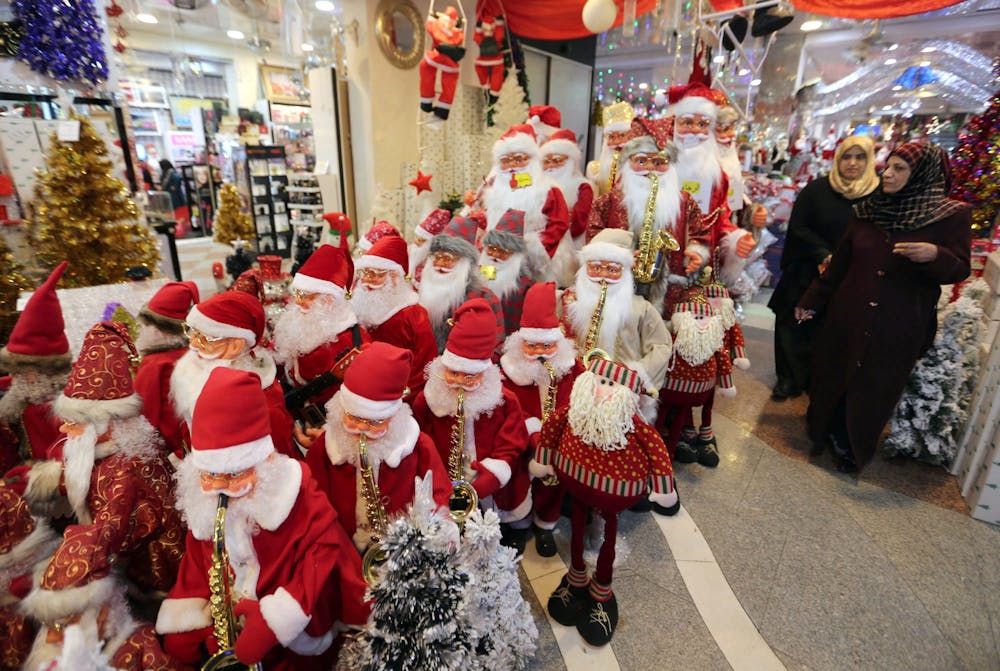
Christmas decorations for sale in a shop in Baghdad. Christians form about 5% of the population in Iraq. Ali Abbas/EPA

Other religious symbols

Christmas symbols are but one type of religious symbol. Would similar effects occur for other religions if matching religious symbols were observed? Our findings suggest they would.

In another of our experiments, we asked participants to unscramble sentences containing generic religious phrases or non-religious phrases.

Irrespective of their religious background, participants who unscrambled the generic religious phrases were less harsh in how they judged poor service than those who unscrambled the non-religious phrases.


Read more: The psychology of Christmas shopping: how marketers nudge you to buy


These findings point to some interesting conclusions.

Although stores may try to co-opt Christmas symbolism for commercial gain, it seems these symbols can not be completely disconnected from associations established by Christianity.

Sometimes, such as the negative responses that occur after seeing a vulnerable person experiencing poor service, they can lead to outcomes where the true spirit of Christmas really does undercut a firm’s self-interest.

ref. Yes, retailers exploit Christmas, but their decorations still evoke religious spirit – http://theconversation.com/yes-retailers-exploit-christmas-but-their-decorations-still-evoke-religious-spirit-108334

What the folk? Whatever happened to Australia’s national folklife centre?

]]>

Source: The Conversation (Au and NZ) – By Emily Gallagher, PhD Candidate, School of History, Australian National University

Most Australians know something about “folklore”. Every year crowds converge on Canberra for the National Folk Festival. But, folklore encompasses far more than song and dance. The term refers to a rich intangible heritage of games, yarns, legends, stories, crafts, jokes, tricks, taboos, poems, recipes, birthday customs and even graffiti.

It exists in the playground, in the kitchen, at the bar and even on the walls of the Australian War Memorial, stitched into the beautiful Changi quilts. Folklore is everywhere.

Australia has often undervalued its folklife. There was a time, however, when one government department took a special interest in the study and preservation of Australian folklore. In 1986, Barry Cohen, then Minister of Arts Heritage and Environment, commissioned a Committee of Inquiry into Folklife in Australia.

Folklife: Our Living Heritage (1987)

The resulting report Folklife: Our Living Heritage, was published in 1987. It concluded that despite the valiant efforts of individuals, local and community organisations, Australia was by “international standards […] poorly equipped” to ensure the protection of its folklore. Of the 51 recommendations, many depended on the success of the first: the establishment of an Australian Folklife Centre.

As part of this bold but much-needed initiative, the Centre would “provide national focus for action to record, safeguard and promote awareness of Australia’s heritage of folklife”. It was estimated that its establishment would cost $1.25 million (equivalent of $3.7 million today), with a further $1.5 million to support activities in its early years.

Several recommendations were concerned with folklife in schools, particularly important as the primary school playground is today a major location for children’s folkloric play. The committee decided not to report on traditional Aboriginal ceremony, lore and belief, but it did include Aboriginal craft and contemporary urban and rural folklife.


Read more: ‘Bang, bang, bang!’: the shock of a boy playing with a gun on a suburban street


The inquiry made it clear that the government was, and still is, responsible for the protection of the nation’s tangible and intangible heritage. This was apparently not the news that the government and its new environment and arts minister, Graham Richardson, wanted to hear: none of the recommendations of the folklife inquiry were ever implemented by the Government.

Still, Australian folklorists were not so easily deterred. Inspired by initiatives like the American Folklife Center and the Ontario Folklife Centre, Gwenda Davey, Jennifer Gall and Pamela Rosenberg went ahead and declared the establishment of an Australian Folklife Centre in Canberra in December 1990.

Girls Playing ‘Oranges and Lemons’ Game, Melbourne, 1954. Courtesy of Museums Victoria and Dr June Factor, Item MM 104103.

Australia’s major coordinating body for national folk arts, the Australian Folk Trust, courageously took up responsibility for the Centre. The National Library, National Museum and National Film and Sound Archive were all on side. The Centre also had international support, even from the Smithsonian Institution in Washington, which invited Australia to be the featured nation at the 1993 Festival of American Folklife. Only one country, Sweden, had declined the offer in 48 years. Much to the dismay of the folklore community, Australia was to be the second.

The Australian Folklife Centre should have been an early victory in Australia’s culture wars: a moment when the Federal Government made an important commitment to protecting the nation’s living culture. The Centre itself would have been an initiative not only of collection and preservation, but of research, advocacy, training and public policy. In the end, it could not continue its work without government funding and it wound up its affairs in 1994-5 after four years of hard work.

Timing appears to have been a major obstacle to gaining momentum. Established under the first Hawke government, but published under the second, the Folklife Inquiry suffered under changing government priorities after the 1987 federal election as well as a wave of post-Bicentenary fatigue. As the historian Frank Bongiorno has observed, Australia had just finished celebrating “the biggest party [it had] ever seen”.

A ‘national disgrace’

Folklorists did their best to maintain pressure on governments, but they were met with little success. In 1992, Gwenda Davey, a major proponent of the Centre and later the director of the promising Victorian Folklife Association in Melbourne, considered it a “national disgrace” that “Australia is one of the very few nations in the world which has no Ministries of Culture and no national institutions [primarily] dedicated to its traditional cultures”.

While the Labor government of the day might be an easy target of blame for the Centre’s demise, the story is far more complex (notably, no Coalition government has rushed to the rescue either).

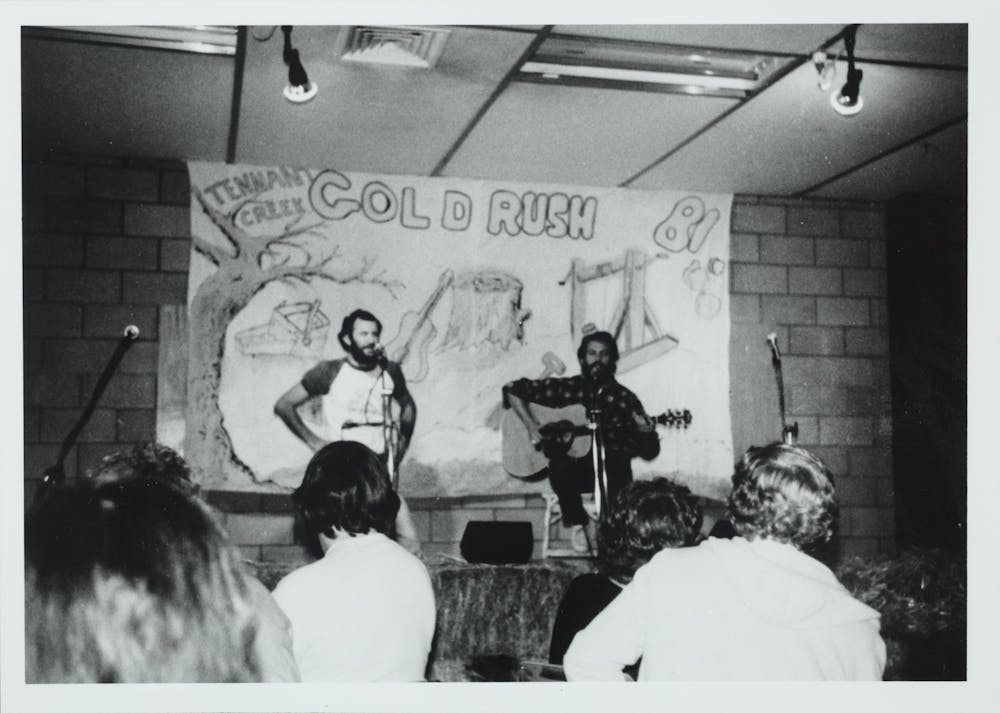
Photograph of Roland Griffin and Barry Skipsey at the Gold Rush Folk Festival, Tennant Creek, 1981. Courtesy of NT Library, PH0662/0087.

The Australia Council, the government’s arts funding and advisory body, was focusing its efforts on supporting professional and contemporary arts rather than traditional amateur arts. And while folklorists have always prided themselves on their local and regional influence, they struggled to mobilise with one voice. Internal disagreements, especially about the definition of folklore, did not help.

Folklorists also struggled to weigh in on the big issues of the nation. As Richard Kurin, then director for Centre of Folklife Programs and Cultural Studies at the Smithsonian Institution noted in 1992, folklorists “should be at the forefront of national and international debates on fundamental cultural issues”.

One can’t help but wonder what Australia’s cultural landscape would look like if the Australian Folklife Centre had been successful. Would bus-loads of school children, while making the annual pilgrimage to Canberra, visit to learn about the games, recipes, dances and rhymes of their ancestors? Might they even find the time to record their own lore for the next generation?

ref. What the folk? Whatever happened to Australia’s national folklife centre? – http://theconversation.com/what-the-folk-whatever-happened-to-australias-national-folklife-centre-108678

Unpacking the history of how Earth feeds life, and life changes Earth

]]>

Source: The Conversation (Au and NZ) – By Anthony Dosseto, Associate Professor, University of Wollongong

At a fleeting glance, the study of life – biology – seems very separate from that of rocks, or geology.

But a look back through history shows that geological processes have been key to the evolution of life on Earth. Geology has shaped biology by creating favourable conditions, and indeed the basic “ingredients”, for life’s emergence and evolution.

And now there is growing evidence that this also works in reverse: life has shaped our planet’s atmosphere, oceans and landscapes in many ways.

Let’s take a walk back through time.


Read more: When Thailand and Australia were closer neighbours, tectonically speaking


Our planet is a living organism

Early in the 20th century, Russian scientists posited that living organisms shape their environment in a way that allows life to be sustained. In the 1970s, a similar idea known as the “Gaia hypothesis” emerged in the Western world, thanks to scientists James Lovelock and Lynn Margulis.

Life started shaping the planet as soon as it appeared, possibly as early as 3.7 billion years ago. Back then radiations from the Sun were not as strong as today and without a little help, the whole planet should have remained frozen.

That little help may have come from bacteria producing the heat-trapping gas methane, with significant amounts of this greenhouse gas released into the atmosphere.

Much later – some 200 million years ago – a similar relationship happened in reverse. At this time, more complex lifeforms may have prevented a runaway build-up of carbon dioxide in the atmosphere (as seen on Venus) by trapping CO₂ in the skeleton of marine organisms like plankton. These then later became buried at the bottom of oceans to form limestones.

If it wasn’t for plankton, Earth (right) could have looked much like Venus (left). Wikimedia commons

We are made of star dust

The chemical elements that compose our body were made in the explosion of a star – we are made of star dust! We share the origin of our atoms with everything around us, including rocks.

But forces deep within planet Earth also shape life.

Weathering of mountains, and continents in general, also delivers essential nutrients to marine lifeforms. One example is phosphorus, which is released into rivers and oceans by weathering of the mineral apatite found in continental rocks. Phosphorus is also a building element of DNA molecules, and of adenosine triphosphate (ATP), the “rechargeable battery” responsible for energy transfers in our cells.


Read more: How Eurasia’s Tianshan mountains set a stage that changed the world


The first widespread emergence of continents could have been key to the first oxidation of the atmosphere (called the Great Oxidation Event, about 2.4 billion years ago). By providing essential nutrients like phosphorus, weathering of the first continents would have allowed photosynthetic cyanobacteria that make up stromatolites to thrive and release oxygen into the atmosphere.

Stromatolites from Shark Bay, Western Australia. The ancestors of these living colonies of cyanobacteria played a big role in shaping early Earth’s atmosphere. Wikimedia commons

The big beast needs the little one

In 2018 we learned that at the start of the Jurassic Period (about 200 million years ago), plankton began to mineralise at greater ocean depths. Plankton produces oxygen as a byproduct of photosynthesis – and so, as a result, oxygen began to accumulate in the shallow oceans and reach its present level in the atmosphere.

The increase in atmospheric oxygen to modern levels would have allowed larger organisms to flourish (including the dinosaurs), because they have higher requirements for this element.

So not only is plankton a key piece of the ecological puzzle – because so many marine lifeforms depend on it – but it also gave the right conditions for the evolution of large marine reptiles.

Aristonectes (meaning ‘best swimmer’) is an extinct genus of plesiosaur, perhaps one of the many marine reptiles thankful for the role of plankton on ocean oxygenation. Wikimedia commons


Read more: A map that fills a 500-million year gap in Earth’s history


Closing the loop

So the next question is naturally: what allowed plankton to mineralise differently during the Jurassic Period? Perhaps moving tectonic plates.

Between about 300 and 175 million years ago, continental plates were clustered into the supercontinent called Pangea. Plate reconstructions show that large parts of this supercontinent drifted through the tropics between about 250 and 200 million years ago.

As a result, continents experienced more abundant rainfall and rocks weathered more extensively, releasing to the oceans the elements necessary for plankton to build a calcium carbonate skeleton.

Global plate reconstruction between 330 and 150 million years ago, showing the distribution of major ocean basins and continental plates at 1 million year intervals. An approximation for the extent of the continents is shaded brown, and present-day coastlines are shaded green. Black lines with triangles indicate subduction zones, and black lines denote mid-ocean ridges and transform faults. The tropics, between 23.45 N and 23.45 S, are highlighted by the red band.

These processes close the loop between biology and geology. Tectonic plates moving into the tropics resulted in large supply of elements, allowing for the emergence of calcareous plankton, and this plankton in turn was responsible for the last major rise in atmospheric oxygen.


Read more: Curious Kids: How was the ocean formed? Where did all the water come from?


Humans are increasingly aware that they have shaped the planet to an unprecedented extent due to the emission of greenhouse gases linked to the Industrial Revolution, 200 years ago, and to the advent of the Agricultural Revolution some 8,000 years ago.

Cyanobacteria, vascular plants and plankton have also modified the whole chemistry of Earth’s atmosphere well before humankind, over much longer time scales.

However, there are striking differences between Homo sapiens on the one hand, and plankton and plants on the other. Humans are shaping the planet in a way that may eventually send the species itself into oblivion (and many others with them).

Our species is most likely the first to have the abilities to recognise and mitigate its impact on the environment on which it depends.

ref. Unpacking the history of how Earth feeds life, and life changes Earth – http://theconversation.com/unpacking-the-history-of-how-earth-feeds-life-and-life-changes-earth-103162

Curious Kids: why are people colour blind?

]]>

Source: The Conversation (Au and NZ) – By Paul Martin, Professor of Clinical Ophthalmology & Eye Health, Central Clinical School, Save Sight Institute, University of Sydney

Curious Kids is a series for children. If you have a question you’d like an expert to answer, send it to curiouskids@theconversation.edu.au You might also like the podcast Imagine This, a co-production between ABC KIDS listen and The Conversation, based on Curious Kids.


My name is Abhilasa. I am 10 years old and I live in Melbourne. My question is: Why are people colour blind? – Abhilasa, age 10, Melbourne.


Hi Abhilasa. Thank you for your great question.

Let’s say you have three tubs of paint: blue, green and red. You have a paintbrush and a piece of paper. You can use the three paints to make lots of different things. A green tree, a blue car, or a red apple. And if you want to paint a purple shirt, you can mix red and blue paint to make purple.

How do we see those different colours? In your eye you have special kinds of cells that pick up the light rays bouncing off each splotch of paint. These cells are called cone cells.

In the microscope, they look like ice-cream cones. But they are much smaller. The cone cells help you see the different colours.


Read more: Curious Kids: How do moths eat our clothes?


There are three kinds of cone cell in most people’s eyes. They are called long wave cones, medium wave cones, and short wave cones, because they pick up different kinds of light waves (or rays).

The cone cells tell the brain how much of each type of light wave is bouncing off each splotch of paint.

Your brain puts those messages back together again.

So let’s say you mix red and blue paint to make a purple splotch. Lots of long and short wave light will bounce off that splotch, but not much medium wave light will (the reason this happens is hard to explain, but you just have to trust me that this is how light works). Then the long and short cones in your eyes get activated, and will send their message to the brain. The brain interprets the message and voilà! The splotch will look purple to you.

Colour blind people can still can see colours, but not as many as most people do. That’s because the cone cells in their eyes may be different.

There are three kinds of cone cells in most people’s eyes. Shutterstock

Some colour blind people only have two kinds of cone cell in their eye. Others have three kinds, but the cones do not pick up the same light waves as the cone cells in most people’s eyes do. So their brain does not get three different messages like most people’s brains do.

Being colour blind is a bit like what would happen if I took away one of your tubs of paint, so you only have two tubs. You could still make some different-coloured splotches, but not as many as when you had three tubs. That would not be so much fun. Being colour blind is sometimes not much fun either. Some kids laugh in school when colour blind kids get their coloured pencils mixed up. That’s mean.

But being colour blind can be good, too. Colour blind people are really good at spotting things that are far away, and they are better than most people at telling things apart by their shape.


Read more: Curious Kids: What plants could grow in the Goldilocks zone of space?


Hello, curious kids! Have you got a question you’d like an expert to answer? Ask an adult to send your question to us. They can:

* Email your question to curiouskids@theconversation.edu.au
* Tell us on Twitter

CC BY-ND

Please tell us your name, age and which city you live in. You can send an audio recording of your question too, if you want. Send as many questions as you like! We won’t be able to answer every question but we will do our best.

ref. Curious Kids: why are people colour blind? – http://theconversation.com/curious-kids-why-are-people-colour-blind-107599

Dramatic advances in forensics expose the need for genetic data legislation

]]>

Source: The Conversation (Au and NZ) – By Caitlin Curtis, Research fellow, Centre for Policy Futures (Genomics), The University of Queensland

Many people first became familiar with DNA testing through its use in the OJ Simpson murder trial in 1994. Now, 24 years later, there have been two dramatic advances in the capability of forensic genetics that mark the start of a new era.

The first is the amount of information we can predict about a person from DNA found at a crime scene, and the second is the way police can use open genealogy databases to identify people.

But we need to be careful how we use these new tools. If people lose trust in how DNA data is used and shared by police, it could have an adverse impact on other applications – such as medical care.

That’s why we’re calling for a Genetic Data Protection Act to ensure people have confidence in the way their DNA is accessed and used.


Read more: DNA facial prediction could make protecting your privacy more difficult


We can learn a lot more from DNA now

Predicting traits from DNA, known as “DNA phenotyping”, is improving. Facial prediction, health traits, predisposition to disease, even personality traits and things about our mental health can be predicted from genetic data. Some researchers are even considering predicting propensity to drink or smoke.

We’re getting better at predicting physical traits, like faces, from DNA data. Composite from PNAS

Law enforcement agencies around the world are using these traits to create predictive DNA “mugshots”, but in many countries there is no specific regulation on how and when they should be incorporated into policing.

And some types of predictions raise considerable ethical issues.

For example, should it be OK for law enforcement to predict the mental health or disease risk of a suspect? If so, should that information be used in a trial? If law enforcement predicts a high risk of a particular disease, should they be compelled to tell a suspect or their family?

Separation between databases is breaking down

You may be familiar with “CODIS” from CSI, this is the database that law enforcement has traditionally used to identify DNA collected at a crime scene. CODIS has around 17.7 million DNA profiles. There are strict rules around who can be included in these databases, and the vast majority of profiles are from convicted offenders.

According to best estimates, the number of people who have taken genetic ancestry tests is slightly higher than this, and police have started using this data as well. The type of data in CODIS only allows close family matches, but the type of data in open ancestry databases allows much deeper relations to be found.

Even if you haven’t participated in genetic testing or made your genetic data public, you may have a relative who has. Currently, law enforcement is able to identify people based on matches as distant as third cousins.

On average, people have around 190 third cousins. One estimate indicates that over 90% of Americans of European descent already have a third cousin or higher in the open genealogy database GEDmatch. It may take as little as 2% of the population uploading their DNA data in a genealogy database for the entire population to be identified this way.

The 238 relatives in your generation that might be affected if you share your genetic data. image designed by James Hereward and Caitlin Curtis

New statistical methods mean separations between previously distinct genetic databases are disappearing. Traditional forensic markers can now be cross referenced to ancestry data, even though they are completely different types of genetic data. This means close family members could be identified across different databases. These methods can also be used to re-identify subjects in medical genetics research projects.

There has been a lot of public support for the use of genetic genealogy to catch serial killers and rapists. In some cases, people are voluntarily uploading their data to help these efforts.

But where should we draw the line? Should genetic data only be used in serious crimes, or are we happy to have a comprehensive system of genetic surveillance that covers the entire population?

Private companies are aiding law enforcement

Both DNA phenotyping and forensic genealogy – which relies on amateur genealogists – are now being offered to law enforcement by private companies.

Parabon, a US-based pharmaceutical company, has partnered with armchair genealogist Cece Moore. She started using genetic genealogy to find the parents of adoptees and children born through sperm donation, but now uses it to catch criminals.

Parabon also offers facial prediction services. While the science of facial prediction from DNA is getting better, it is still contentious, and several prominent scientists have cast doubt on whether Parabon can really do what it is promising.

Nevertheless, this move out of government labs and into private ones raises questions about oversight – and what exactly is happening to the data generated.

Genetic data is different from other kinds of data

Genetic data is highly unique and can be thought of as a personal 15 million letter pin-code. Since the code doesn’t just identify us, it also contains important information about our disease risk, personality traits and even our physical features like our face, it is very difficult to keep anonymous.

Genetic data is different from other kinds of data. Edited from Shutterstock image

Unlike a credit card we can’t request a new genome if our data is compromised. And a stolen credit card won’t tell a perpetrator anything about the finances of our family members.

We understand what happens if we lose a credit card, but our understanding of genetic data is still developing. And we’re likely to see it put to unexpected uses in the future.


Read more: It’s time to talk about who can access your digital genomic data


We need a ‘Genetic Data Protection Act’

Technological advances in genomics are outpacing public awareness, and existing legislation doesn’t fit genetic data well. Under current laws, the lab that produces the genetic data has ownership of the record. But if our genetic data represents a deep part of the essence of us, it shouldn’t be this easy for us to give up ownership of it.

We need new ways to protect genetic data to maintain trust in medical genomics. Sometimes people need their genome sequenced for medical purposes, but they might be reluctant to consent if trust has broken down around how genetic data could be used. That could result in poorer medical outcomes.

One solution to prevent this is a specific “Genetic Data Protection Act”, which would grant people ownership of their own data. However, it must be different from standard property rights: ownership should be immutable and nontransferable.

The issues around use of our genetic data are complex, individuals (and their descendants) must be protected. Under no circumstances should it be possible for an individual to unwittingly sign an agreement that results in a loss of control of their genetic data. Legislation is part of the solution, but education and new technological solutions will also be important.

The recent introduction of the digital My Health Record shows thatAustralians care about who is accessing their sensitive information. And people are already expressing unease about the confidentiality of their genetic data.

We must establish clear boundaries about how genetic data generated for medical purposes is used – whether by police or by any other interested parties. Giving genetic data the protection it needs, and making sure that medical genetic data doesn’t become a forensic resource will be crucial to ensure public trust in medical genetics.

ref. Dramatic advances in forensics expose the need for genetic data legislation – http://theconversation.com/dramatic-advances-in-forensics-expose-the-need-for-genetic-data-legislation-105397

Inquiry into LGBTIQ hate crime could improve how police and communities respond

]]>

Source: The Conversation (Au and NZ) – By Andy Kaladelfos, Lecturer in Criminology, School of Social Sciences, UNSW

Lessons learnt from a NSW parliamentary inquiry into hate crimes against Australia’s LGBTIQ community could change the way police and communities respond to complaints, and acknowledge the continued impact of past injustices.

The inquiry is the first of its kind in Australia to investigate both the scale of hate crimes against the LGBTIQ community and inadequate police responses. It was held because a growing body of research and community-driven activism pointed out the toll violence had taken, and continues to take, on LGBTIQ Australians.

Hearings into the handling of past hate crimes (between 1970 and 2010) concluded last month, with the inquiry due to report in 2019.

As well as the handling of these past cases, the inquiry is investigating matters including the impact of the now defunct “gay panic” defence. This provided an alleged “homosexual advance” was a partial defence to murder; South Australia is now the only state to maintain this defence.

This broad remit could lead to far-reaching and significant recommendations that acknowledge the problematic past policing of LGBTIQ communities. A consideration of responses to past violence against LGBTIQ people will provide a basic level of acknowledgement of past harms. It will also clarify the legacies of those experiences in relationships with police today.


Read more: Trans, transgender, cisgender: we are what we name ourselves


Experiences of violence

The NSW inquiry defines hate crimes as LGBTIQ-related murder, physical and verbal violence, or institutional violence.

Contemporary surveys of Australian LGBTIQ people show unacceptably high rates of violent victimisation, with reports at alarming levels for transgender people.

The largest Australian study found 72% of LGBTIQ people had experienced verbal abuse, 41% threats of physical violence and 23% physical assault.

For transgender participants, 92% of trans women and 55% of trans men had experienced verbal abuse; 46% of trans women and 36% of trans men had experienced physical assault.


Read more: Despite recent victories, plights of many LGBT people remain ignored


Historic hate crimes

The most well-known hate crime is the case of 27-year-old Scott Johnson, an American PhD student whose body was found naked at the bottom of North Head in Manly, Sydney, in 1988.

After 30 years of waiting and three coronial inquests, Johnson’s death, originally deemed a suicide, was finally recognised as a gay hate crime. The coroner found that Johnson was either pushed off the cliff or died trying to escape attackers.

NSW police have now offered a one million dollar reward for clues leading to the resolution of this cold case.

This year, the report In Pursuit of Truth and Justice, by health organisation ACON, drew together decades of research and community advocacy in investigating 88 historical hate crimes in NSW.

Like Johnson’s case, many of these crimes had been written off as accidental deaths or suicides. Months later, NSW police released the final report of Strike Force Parrabell, the internal investigation of police handling of these cases. Controversially, this reduced the number of deaths deemed hate crimes (it used different criteria).

Due to a history of problematic policing, the most effective means of obtaining a fuller picture of the past scale of hate crimes against the LGBTIQ community would be to call a Royal Commission, which would have the powers to conduct a full and independent investigation.

Policing homosexual offences

The police approach to LGBTIQ hate crimes is rooted in the historic criminalisation of male homosexual behaviours.

In the 1950s, as public awareness of homosexuality increased, NSW police intensified their policing of male homosexuality, especially at public meeting places and beats.

Then Police Commissioner Colin Delaney described homosexuality as:

Australia’s greatest menace

and a

cancer in the community.

Delaney ramped up the use of the vice squad to target homosexuals, with tactics that were often alleged to include entrapment, falsifications of statements, blackmail and threats of violence.

It was not until 1984 that sex between males in NSW was decriminalised.

Decriminalisation

But decriminalisation did not immediately shift perceptions of all police officers or members of the public. Many people continued to be victims of homophobic and transphobic violence, and reporting offences brought stigma and vilification.

The establishment of the community reporting mechanism the Lesbian and Gay Anti-Violence Project in the 1990s was one way that advocacy groups tried to tackle distrust of police and the ongoing threat of violence. This project provided a safe place for gay and lesbian people to report offences and have them recorded without fear of encountering homophobia.

Since decriminalisation, NSW police have worked to re-build relationships with LGBTIQ communities through outreach programs, community visibility and participation, and the creation of the Gay and Lesbian Liaison Officer program.

Trust in police

Yet, continued distrust of police in LGBTIQ communities shows the long-standing effects of past practices and injustices, and their ongoing impact.

National research shows LGBTIQ people are reluctant to report offences to police. Earlier negative experiences often influence perceptions of how officers might treat their complaint.

Most worryingly, Victorian research shows young LGBTIQ people are the least likely to report offences to police. More than half would not report a hate crime, fearing a homophobic or transphobic response. More said they would report to a LGBTI Liaison Officer.

Achieving justice

The Australian community needs to work towards social and cultural change that will reduce violence against LGBTIQ people. Policing is an important part of this change.

The road ahead for achieving justice involves looking back to recognise and redress past wrongs and looking forward to create systems of safe reporting that work for marginalised communities.

One type of response in improving contemporary policing is unlikely to work for all, given the diversity of LGBTIQ communities. A variety of responses might focus on improving access to formal systems, including strengthening and better resourcing LGBTI police liaison programs to develop trust between police and LGBTIQ communities. It would also be helpful to implement third-party reporting mechanisms through which victims could report crimes in safe spaces, such as community organisations, instead of to police.

However, many people may prefer mechanisms for redress that do not involve the formal criminal justice system, such as restorative and transformative justice. These approaches are a process of victim and community restitution that involves perpetrators taking responsibility for their actions, recognising the harms done by violence, and changing their attitudes.

Finally, we need to aim for active interventions, including educational initiatives aimed at both the police and the broader public, that reduce the occurrence of homophobic and transphobic violence.

Ultimately, transforming the broader conditions that underpin and propel this violence will be the most significant way to achieve justice.

ref. Inquiry into LGBTIQ hate crime could improve how police and communities respond – http://theconversation.com/inquiry-into-lgbtiq-hate-crime-could-improve-how-police-and-communities-respond-108493

Not a season to be jolly: how to deal with dying during the holidays

]]>

Source: The Conversation (Au and NZ) – By Karen Anderson, Practitioner Scholar, Edith Cowan University

Dying doesn’t disappear at Christmas. For those who know death will come soon but don’t know exactly when, the festive season, when the air is thick with “joy”, can be particularly unsettling.

As a psychotherapist working in palliative care, I often see distressed patients in the lead up to Christmas. Patients can find decorations and carols being played in shopping centres particularly triggering, reminding them this may be their last Christmas.

The dying person may often face an inner struggle. They may want to be involved in activities but may not have the physical and emotional capacity to deal with the heightened stress and stimulation. Some may prefer to sit quietly and watch proceedings without necessarily being amongst the action, but still feeling like they are a part of things.

Regardless of the the type of life-threatening illness, and whether an infant, child, adolescent, young, middle or older aged person is dying, both the patient and their family members may experience deep distress. You may feel the impending death, and your family the anticipated loss. These gloomy or morbid feelings might clash with the celebrations of Christmas.


Read more: Palliative care for children often involves treating the whole family


Whether it’s you or a loved one facing dying at this time of year, there are some practical tips available that draw from a wealth of research and experience.

If you are the one dying

Where possible, plan ahead how you want to spend your Christmas festive period so you don’t place additional pressure on yourself. Think about the most comfortable arrangements for you. Where and with whom do you want to spend Christmas Day? Which is the best time of day for you to manage different activities? Let people close to you know your thoughts.

The process of dying is unique to each individual. It may be quick or slow, spread over weeks or days. Palliative care specialist at Stanford University, Dr James Hallenbeck wrote:

For those who do die gradually, there’s often a final, rapid slide that happens in roughly the last few days of life — a phase known as ‘active dying’. A person may begin to lose their senses and desires. First hunger and then thirst are lost. Speech is lost next, followed by vision. The last senses to go are usually hearing and touch.

We have an ideal perception around death, that a dying person wants to be surrounded by family in their final hours. But some people in the active phase of dying may actually prefer to be alone. And while this may be difficult for family members to hear, you can give yourself permission to ask for whatever you would like.

Studies indicate some dying people may feel they’re a burden to their family. Other people have difficulty saying “no” because they don’t want to disappoint or hurt others, or they may fear conflict. Know your limitations and don’t push beyond these to simply please others.

Many dying people feel they may be a burden to their families. from shutterstock.com

Have kind consideration for yourself. Remember you are a person before you’re a patient. And remember it’s OK to say “no” and forgo invitations.

If you’re caring for a loved one who is dying

Essential care demands such as helping the person you are caring for to feed, go to the toilet, and clean themselves, will not disappear at Christmas. If your loved one is dying at home, they may require unrelenting attention.

Be realistic with your expectations. This can be a different and simpler Christmas than others. Allow for spontaneity. Try not to be a martyr and delegate and ask others to help. Doing so enables others to feel they’re included and contributing in special ways.


Read more: Looking after a dying loved one at home? Here’s what you need to know


Listen to the person who is dying. Let them speak if and when they can. Gauge their mood and be guided by them. There is value in being present with the dying person without talking.

Heightened noise and activity, which often go hand in hand with the holiday season, can create distress for a terminally ill person. Ask family and friends to roster their visits over the different days of Christmas so as not to tire, overwhelm or stress the dying person.

People can think children don’t understand death and wouldn’t be able to cope with the concept, so often they may protect them by hiding it. But children are attuned to the family emotional dynamics. They know something is happening and they need their feelings validated. It can be helpful to get children involved in taking care of someone who is dying.

Research shows children do manage themselves well in the face of dying, when adults support them to deal with their responses.


Read more: Adults can help children cope with death by understanding how they process it


Expect things can change quite suddenly. Have a backup plan ready. Keep emergency contact details readily on hand always.

When dying is happening at Christmas, it’s best to allow all feelings to be expressed rather than simply putting on a brave or smiling face. Feelings are a natural response to suffering and what may be a stressful situation.

It’s mostly important to remember not to hide your needs and feelings but to speak and communicate with your loved ones. Especially when dying may be imminent.

ref. Not a season to be jolly: how to deal with dying during the holidays – http://theconversation.com/not-a-season-to-be-jolly-how-to-deal-with-dying-during-the-holidays-106063

Exploring Australia’s ‘other reefs’ south of Tasmania

]]>

Source: The Conversation (Au and NZ) – By Nic Bax, Director, NERP Marine Biodiversity Hub, CSIRO

Off southern Tasmania, at depths between 700 and 1,500 metres, more than 100 undersea mountains provide rocky pedestals for deep-sea coral reefs.

Unlike shallow tropical corals, deep-sea corals live in a cold environment without sunlight or symbiotic algae. They feed on tiny organisms filtered from passing currents, and protect an assortment of other animals in their intricate structures.

Deep-sea corals are fragile and slow-growing, and vulnerable to human activities such as fishing, mining and climate-related changes in ocean temperatures and acidity.

This week we returned from a month-long research voyage on CSIRO vessel Investigator, part of Australia’s Marine National Facility. We criss-crossed many seamounts in and near the Huon and Tasman Fracture marine parks, which are home to both pristine and previously fished coral reefs. These two parks are part of a larger network of Australian Marine Parks that surround Australia’s coastline and protect our offshore marine environment.

The RV Investigator criss-crossed the Huon and Tasman Fracture marine parks. CSIRO

The data we collected will answer our two key research questions: what grows where in these environments, and are corals regrowing after more than 20 years of protection?


Read more: Explainer: the RV Investigator’s role in marine science


Our eyes on the seafloor

Conducting research in rugged, remote deep-sea environments is expensive and technically challenging. It’s been a test of patience and ingenuity for the 40 ecologists, technicians and marine park managers on board, and the crew who provide electronics, computing and mechanical support.

But now, after four weeks of working around-the-clock shifts, we’re back in the port of Hobart. We have completed 147 transects covering more 200 kilometres in length and amassed more than 60,000 stereo images and some 300 hours of video for analysis.

The deep tow camera system weighs 350 kilos and has four cameras, four lights and a control unit encased in high-strength aluminium housings. CSIRO

A deep-tow camera system designed and built by CSIRO was our eye on the seafloor. This 350 kilogram system has four cameras, four lights and a control unit encased in high-strength aluminium housings.

An operations planner plots “flight-paths” down the seamounts, adding a one-kilometre run up for the vessel skipper to land the camera on each peak. The skipper navigates swell, wind and current to ensure a steady course for each one-hour transect.

An armoured fibre optic tow cable relays high-quality, real-time video back to the ship. This enables the camera “pilot” in the operations room to manoeuvre the camera system using a small joystick, and keep the view in focus, a mere two metres off the seafloor.

This is an often challenging job, as obstacles like large boulders or sheer rock walls loom out of the darkness with little warning. The greatest rapid ascent, a near-vertical cliff 45m in height, resulted in highly elevated blood pressure and one broken camera light!

Reaching into their world

Live imagery from the camera system was compelling. As well as the main reef-building stony coral Solenosmilia variabilis, we saw hundreds of other animals including feathery solitary soft corals, tulip-shaped glass sponges and crinoids. Their colours ranged from delicate creams and pinks to striking purples, bright yellows and golds.

To understand the make-up of coral communities glimpsed by our cameras, we also used a small net to sample the seafloor animals for identification. For several of the museum taxonomists onboard, this was their first contact with coral and mollusc species they had known, and even named, only from preserved specimens.

A deepwater hippolytid shrimp with large hooked claw, which it uses to clean coral and get food. CSIRO

We found a raft of undescribed species, as expected in such remote environments. In many cases this is likely to be the only time these species are ever collected. We also found animals living among the corals, hinting at their complex interdependencies. This included brittlestars curled around corals, polychaete worms tunnelling inside corals, and corals growing on shells.

We used an oceanographic profiler to sample the chemical properties of the water to 2,000m. Although further analysis is required, our aim here is to see whether long-term climate change is impacting the living conditions at these depths.

A curious feature of one of the southern seamounts is that it hosts the world’s only known aggregation of deep-water eels. We have sampled these eels twice before and were keen to learn more about this rare phenomenon.

Using an electric big-game fishing rig we landed two egg-laden female eels from a depth of 1,100 metres: a possible first for the record books.

Dave Logan of Parks Australia with an eel landed from more than a kilometre under the sea. Fraser Johnston/CSIRO

In a side-project, a team of observers recorded 42 seabird species and eight whale and dolphin species. They have one more set of data towards completing the first circum-Australia survey of marine birds and mammals.

More coral pedestals than we realise

An important finding was that living S. variabilis reefs extended between the seamounts on raised ridges down to about 1,450m. This means there is more of this important coral matrix in the Huon and Tasman Fracture marine parks than we previously realised.

In areas that were revisited to assess the regrowth of corals after two decades of protection from fishing, we saw no evidence that the coral communities are recovering. But there were signs that some individual species of corals, featherstars and urchins have re-established a foothold.


Read more: Sludge, snags, and surreal animals: life aboard a voyage to study the abyss


In coming months we will work through a sub-sample of our deep-sea image library to identify the number and type of organisms in certain areas. This will give us a clear, quantitative picture of where and at what depth different species and communities live in these marine parks, and a foundation for predicting their likely occurrence both in Australia and around the world.


The seamount corals survey involved 10 organisations: CSIRO, the National Environmental Science Program Marine Biodiversity Hub, Australian Museum, Museums Victoria, Tasmanian Museum and Art Gallery, NIWA (NZ), three Australian universities and Parks Australia.

ref. Exploring Australia’s ‘other reefs’ south of Tasmania – http://theconversation.com/exploring-australias-other-reefs-south-of-tasmania-108986

Here’s a long-term budget fix that would boost investment: replace company tax with cashflow tax

]]>

Source: The Conversation (Au and NZ) – By Ross Garnaut, Professorial Research Fellow in Economics, University of Melbourne

Rather than waiting for the world to reach an agreement to act against multinational corporations that shift profits to tax havens, Australia should consider adopting our proposal for a cashflow tax, which would increase both investment and government revenue.

Many market-dominating multinational corporations have been aggressively reducing their global tax burdens by shifting their profits to tax havens.

BHP and Rio have been setting up so-called marketing hubs in low-tax Singapore.

Google bills Australians for advertisements on Australian websites in lower-tax Ireland, which itself pays fees to another subsidiary in even lower-tax Bermuda.


Read more: Budget policy check: do we need company tax cuts?


So big has the apparent flow of money into low-tax Ireland become that its national accounts data for 2015 showed a 26.3% real increase in gross domestic product.

Few think the Irish economy really improved by 26.3%.

What if we taxed cashflow instead of income?

In a new paper for the Melbourne Economic Forum, we propose replacing the conventional corporate income tax with what we are calling a “cashflow tax” to mitigate these problems while encouraging new private capital investment in Australia.

It wouldn’t tax profit as it is normally defined, but money coming in minus money going out – or “cashflow” – with the exception of money going out to repay loans, to pay dividends to shareholders, and to make payments to related parties that aren’t at arm’s length.

It could be easily done, because we already have all the information we need to tax onshore what happens onshore.


Read more: The full story on company tax cuts and your hip pocket


It would eliminate the messy distinction between capital expenditures, which can’t be deducted straight away, and other expenditures which can be. Everything that went out, for any purpose not exempt, would be immediately subtracted from what came in, and what was left would be taxed at 30%, or 25% if that’s what the government of the day wanted.

It would encourage investment…

It would make new investment – on things such as buildings, equipment, mines and the like – much more attractive. By immediately creating a negative cash flow, it would usually cut the investor’s tax bill to zero straight away.

We would allow companies to trade tax losses with companies making taxable profits, perhaps on the Australian Securities Exchange. Or they could carry forward their losses at the long-term government bond rate to offset against future profits.

…while levelling the financing playing field

Financial institutions would be taxed slightly differently, but at the same rate. Their taxable income would be interest and fees received minus interest and fees paid and costs including capital expenditure. Like other firms, they would be able to deduct capital expenditure immediately, but unlike other firms, they could also deduct the cost of borrowing.

For non-financial firms, because neither interest payments nor dividends would be tax deductible, the tax system would no longer favour debt over equity. They would no longer face a tax incentive to borrow instead of seeking out shareholders.

Reduced indebtedness would have advantages for financial efficiency and stability. It might reduce total profits of banks, but by immediately writing off capital expenditures banks could make higher profits per dollar lent.

It could be phased in over 10 years…

We propose phasing in the cashflow tax over 10 years – cutting company tax and lifting the cash flow tax by 3% per year.

Businesses that wanted to could make an irrevocable choice at any time to switch earlier.

Companies with big new capital investment plans would be likely to take the option of an early switch in order to immediately write off their expenses, while those paying interest on large accumulated debts would be likely to switch later.

…eventually raising an extra A$24 billion per year

Our modelling suggests that if the switch was phased in, the government would take in an extra A$24 billion per year when the transition was complete.

Most of the extra income would come from firms finding there were no longer tax advantages in shifting profits offshore.

If irrevocable switches were allowed, the government could take in up to an extra A$39 billion per year.

These estimates are likely to be conservative: they take no account of the additional capital expenditure that a cashflow tax would stimulate, or of the efficiency gains from replacing the heavily distorting corporate income tax with a non-distorting cashflow tax.

And securing the revenue base

While the Tax Office has been more active recently in clamping down on corporate tax avoidance, Australia’s anti-avoidance measures been ad hoc rather than systemic.

Global digital corporations are adept at using technology fees, management fees and puffed up interest rates for loans to inflate the tax-deductible expenses of their affiliates while declaring the income from those payments in tax havens.

Our proposal would disallow those deductions while allowing immediate total deductions for spending in Australia. Tax obligations wouldn’t be avoided, merely transferred to the Australian entity that provided the goods or services.

Early feedback

Our proposal was presented to a group of economists for feedback and reactions at the Melbourne Economic Forum on December 10.

They discussed the risk that multinational corporations such as digital companies and global fast-food chains would pull out of Australia if their opportunities for profit shifting to tax havens were closed down.

The general view was that they would stay in Australia because they could still earn rents (profits in excess of those necessary to encourage investment) from their Australian operations. The difference is that these rents would no longer be sheltered from Australian taxation. The Tax Office is already challenging the use of marketing hubs used by resource companies, which the cashflow tax would do in a more systematic way.


Read more: These private companies pay less tax than we do – but reasons remain unclear


The Forum also discussed the need to draw clear boundaries between financial institutions and other companies, to prevent those companies claiming interest deductions as if they were financial institutions.

Further design features requiring consideration include the treatment of unincorporated businesses and dividend imputation.


We prepared the cashflow tax proposal with Stephen Anthony, chief economist, Industry Super Australia.

ref. Here’s a long-term budget fix that would boost investment: replace company tax with cashflow tax – http://theconversation.com/heres-a-long-term-budget-fix-that-would-boost-investment-replace-company-tax-with-cashflow-tax-108347

Theatre is Lying is a welcome response to fake news and alternative facts

]]>

Source: The Conversation (Au and NZ) – By Julie Shiels, Lecturer – School of Art, RMIT University

Review: Theatre is Lying, ACCA, Melbourne.


In an era where local and international politics risks being less believable than a long-form TV series like House of Cards, it is apposite that the latest exhibition at the Australian Centre for Contemporary Arts (ACCA) in Melbourne focuses on ideas about artifice and illusion, truth and fiction and sleight of hand.

While not expressly political, Theatre is Lying exposes how visual art, performance and theatrical devices can interrogate what is real and what is not.

The artworks by Sol Calero, Consuelo Cavaniglia, Matthew Griffin, Daniel Jenatsch and artistic collaborators Anna Breckon and Nat Randall, employ digital montage, animation, video, light and sound and theatrical installations. Commissioned specifically for ACCA, these screen-based works and installations are a welcome response to a year bloated with fake news and alternative facts, offering critique, humour and escape rather than despair and cynicism.

Theatre is Lying not only offers conceptual and abstract means to engage with the truths and fictions of the contemporary world, but also presents alternative narratives and other way of reflecting on theatrics of politics against the backdrop of the 24/7 news cycle.

Recently the largesse of visual arts patrons has seen private collectors build new public museums, but the legacy of the McFarlane Biennial Commission, which supports this exhibition, goes beyond bricks and mortar to directly support current artists. For the next six years, the fund will fund the creation of ambitious and possibly career-defining works, forming keynote projects in ACCA’s exhibition program.

This, the first in the series, is characterised by artistic director Max Delany and senior curator Annika Kristensen, as an exhibition in five acts.

Matthew Griffin, The outernet 2018, two channel, high definition digital video, 33:34 mins. Courtesy of the artist, Photo: Andrew Curtis

Act One lampoons and hijacks TV current affairs. Utilising spilt screen formats, found footage and montage, artist Mathew Griffin inserts himself into absurdist panel discussions that replicate the everyday conventions of current affairs TV. At first glance the interviewee (Griffin) resembles another gormless commentator or politician who has not learnt to pause for breath. Only with close scrutiny is the artifice revealed.

One can’t help wondering initially if Randall and Breckon’s Rear View (2018) employs green screen to simulate a car travelling along the highway. Shot continuously with no edits, the 90-minute video operates at the intersection of cinema and performance art, referencing classic road movies.

Daniel Jenatsch, The Sheraton Hotel Incident 2018, two channel, high definition digital video, 5.1 surround sound, 15:00 mins. Courtesy of the artist, Photo: Andrew Curtis

The banality of the real time action and inaction becomes a feat of endurance coupled with forced voyeurism. Throughout the movie, the two women (Randall and Linda Chen) talk intermittently over the hum of the car while staring ahead and rarely making eye contact. The narrative is unclear; the reason for the journey and the relationship between the women is never explained.

Yet the boredom is fractured by the sound of wriggling, a bit of singing, a clinch that goes wrong and the pitiful crying that ensues when that advance has been rebuffed. In the end, the rear view of the road is the only certainty that can be believed.

‘Sir, we have missed our target’

The Sheraton Hotel Incident is an artistic interpretation of a stranger-than-truth event involving an inexplicably bungled training exercise by Australian Secret Intelligence Service (ASIS) agents in 1983. The purpose of the exercise was to rescue hostages from fictional foreign captors but ASIS failed to inform either hotel management or the police. Jenatsch employs the clichés of film noir and spy movies to recreate the event and subsequent enquiry.

The screen is often split and the action is realised through archival images, reports and animated action overlayed with written dialogue like “Sir, we have missed our target”. It is the simplicity of the animation that is most striking about this work. The action is presented in single frame images and the odd crumbly surfaces of the bodies and objects suggest a “Mummy movie” and a new surrealist weird.

In stark contrast to the fast pace and cliches of The Sheraton Hotel Incident, Colero’s La Puerta relies on the audience to produce the action. There are no performers here, instead the artwork is populated with spectators who encounter the constructed space.

Sol Calero, La puerta 2018 (detail), Site-specific installation: synthetic polymer paint and paper on plywood and composition board, cotton, pine. Courtesy of the artist, Barbara Gross Galerie, Munich, and Galerie Crèvecoeur, Paris, Photo: Andrew Curtis

Easily recognised as a set for live theatre, the artist performs an elaborate transformation employing painted arches, screens and blinds to create the illusion of depth. Redolent with colour and patterning drawn from Colero’s Venezuelan heritage, the effect is disrupted by the exposure of raw timber framing in order to emphasise the things that are seen and the things that are not. In this case it is Colero’s ongoing engagement with issues about colonisation and identity.

Consuelo Cavaniglia, present distant 2018 (detail), powder coated steel, laminated glass, float glass, two-way mirror, rubber spacers, bolts, castors, lighting, 7 panels, each 225 x 220 x 90 cm; installation, dimensions variable. Courtesy of the artist, STATION, Melbourne, and Kronenberg Wright Artist Projects, Sydney, Photo: Andrew Curtis

By contrast Cavaniglia’s installation is pure theatre and illusion, comprising spotlights and search lights that are reflected and refracted through moveable glass screens. The theatrical is realised via an interplay of the coloured light that penetrates the screens, landing on the wall and floors and bathing the space and the audience with colour. Chance encounters between lights, screens and viewers are at the core of this work.

The gallery spaces at ACCA have no designated beginning or end point. Nor do the individual acts provide a conclusion. Rather, they offer an open-ended means to consider allusion, illusion, truth, lies and transparency.

Over summer, Theatre is Lying is an invitation to pause and unpick the way narrative and artifice are created and perceived and so sharpen the critical senses in anticipation of the performances that will be presented to us in the year to come.


Theatre is Lying can be seen at ACCA until 24 March 2019.

ref. Theatre is Lying is a welcome response to fake news and alternative facts – http://theconversation.com/theatre-is-lying-is-a-welcome-response-to-fake-news-and-alternative-facts-108981

View from The Hill: Michael McCormack fails leadership test in handling of Broad scandal

]]>

Source: The Conversation (Au and NZ) – By Michelle Grattan, Professorial Fellow, University of Canberra

It took disgraced Nationals MP Andrew Broad 24 hours after the “sugar baby” story broke to announce the inevitable – that he won’t recontest his Victorian seat of Mallee. They do things slowly in the Nationals.

In Michael McCormack’s case, at glacial pace. The Nationals leader’s handling of the Broad scandal has been appalling. His failure to instantly inform Scott Morrison of a potentially explosive situation – the prime minister only learned of it on Monday – is inexplicable, and must severely strain the relationship between the two men at the top of the government.

McCormack on Monday muddled his account, saying he had only been told “a couple of weeks ago”, when he urged Broad to go to the police over the actions of a woman he met on a “seeking arrangement” website.

McCormack’s timetable was blown out of the water within hours by an Australian Federal Police statement that said Broad had referred the matter to it on November 8.

On Tuesday, McCormack’s performance was extraordinary.

He explained his confusion over timing by saying, “I don’t carry around the dates and times of what people tell me”.

He hadn’t informed Morrison at the start because “I don’t tell the prime minister everything about every member of parliament. He’s got enough on his mind at the moment.

“And quite frankly I thought it was a matter for Andrew to sort out with his family. Obviously, I wasn’t aware of the entire extent of what had taken place. I wasn’t made aware of that until yesterday.”

Asked whether he wanted Broad to run for Parliament again, McCormack blathered rather than just saying no.

Any diligent leader would have got to the bottom of the matter at once, extracting the full picture from Broad. Any prudent leader would have briefed the prime minister without delay. Any savvy leader would have known the scandal was likely to leak and that, anyway, Broad’s behaviour showed he was in an untenable position.

McCormack must live in some parallel universe if he ever thought his assistant minister’s account of flying off on an overseas date, followed by an apparent move to blackmail him, was just “a personal matter between him and his family”.

Nationals deputy leader Bridget McKenzie said in a statement late Tuesday “The Nationals are not a party where this standard of behaviour is acceptable”.

Yet McCormack kept Broad on as his assistant minister for weeks. And in his Monday morning statement announcing Broad had resigned from the frontbench, the Nationals leader said Broad “will continue as an effective and hardworking Member for Mallee”.

McCormack’s leadership is only secure because we are so close to an election. He was already under criticism from within his party and his conduct over Broad might have brought on a challenge in other circumstances.

The Nationals, supposed to be a party of family values, have bookended the year with two personal scandals. Barnaby Joyce’s affair with his former staffer, now mother of his son, distracted the Coalition in the early months.

How the Morrison government’s grand tactical plan to overshadow Labor’s national conference went awry! The big story about a surging budget position, promising dollars for tax cuts was expected to dominate the news.

As things turned out, the government did squeeze out the Labor coverage – but for the worst of reasons.

Labor’s management plans, in contrast, went as smoothly as clockwork.

Tricky issues, notably border security, were stitched up. Potentially controversial polices, including how broadly a Labor government would allow industry-wide bargaining have been left for decisions by the leadership later.

Even what seemed the risky course of having Kevin Rudd address the conference – as a gesture of reconciliation and party unity – played out without a hitch.

A raid on New South Wales ALP headquarters in Sydney in pursuit of an ICAC investigation was embarrassingly timed but didn’t threaten the narrative at the conference in Adelaide.

The conference was used as a platform for announcements – on housing affordability, the protection of superannuation, the environment, reconciliation, refugees, the pursuit of gender pay equality. There were few votes and only one of them, on a left proposal for a human rights charter, involved a count – the left narrowly lost.

Controversy over signing up to a nuclear weapons ban treaty, on which Anthony Albanese and Penny Wong have different views, was defused by wording that leaves plenty of latitude.

One significant proposal that was passed calls for a Labor government to recognise Palestine, something that various state conferences have been urging strongly.

The role of the unions was proudly acknowledged.

The ACTU secretary Sally McManus told the conference: “The trade union movement is the early warning system for this nation. We are the earthquake sensors in the ocean that feel the tremors before they reach the shores. We are the smoke alarm trying to wake you from your deepest sleep. The siren that makes you look up before it is too late.

“And we are sounding the alarm now. We see the unfairness, we see the fair go being crushed with growing inequality. It is time to listen and to act. And Australian Labor, Bill Shorten, is doing just that.”

It’s notable that in the election for the ALP national executive, the CFMMEU has gone from one representative to two. Its national secretary, Michael O’Connor, is now a member of it. The conference has left open how much the unions will get as Labor unveils more detail of its industrial policy over the coming months.

ref. View from The Hill: Michael McCormack fails leadership test in handling of Broad scandal – http://theconversation.com/view-from-the-hill-michael-mccormack-fails-leadership-test-in-handling-of-broad-scandal-109008

Politics with Michelle Grattan: Tanya Plibersek on a united Labor

]]>

Source: The Conversation (Au and NZ) – By Michelle Grattan, Professorial Fellow, University of Canberra

The Labor party has emerged from its three day national conference in Adelaide looking united and projecting itself as “ready to govern”.

Labor deputy leader Tanya Plibersek told The Conversation the ALP wants voters to see the party as “responsible and progressive”.

She says a Labor government would “work cooperatively with the trade union movement cause we share the same objective”.

“The union movement hasn’t got everything they wanted from the Labor party in this instance, but a lot of the changes we have made have been made better by the discussions that we’ve had over many months leading up to this conference,” she said.

On border security, Plibersek dismisses the use of three word slogans on both sides of the debate and argues “a more activist aid policy and more activist foreign policy” are needed to help asylum seekers.

ref. Politics with Michelle Grattan: Tanya Plibersek on a united Labor – http://theconversation.com/politics-with-michelle-grattan-tanya-plibersek-on-a-united-labor-109005

Poll wrap: Labor widens lead in Ipsos; US Democrats gained 40 House seats at midterms

]]>

Source: The Conversation (Au and NZ) – By Adrian Beaumont, Honorary Associate, School of Mathematics and Statistics, University of Melbourne

This week’s Fairfax Ipsos poll, conducted December 12-15 from a sample of 1,200, gave Labor a 54-46 lead, a two-point gain for Labor since November. Primary votes were 37% Labor (up three), 36% Coalition (down one), 13% Greens (steady) and 6% One Nation (up one). As usual in Ipsos, the Greens are too high.

Respondent-allocated preferences were also 54-46 to Labor. While Malcolm Turnbull was PM, respondent preferences skewed to the Coalition relative to preferences derived from using 2016 election preference flows. However, Ipsos’ four polls since Scott Morrison became PM have shown no difference on average between respondent and previous election methods.

47% approved of Morrison (down one), and 39% disapproved (up three), for a net approval of +8. Bill Shorten’s net approval was down two points to -9. Morrison led by 46-37 as better PM (47-35 in November). Ipsos gives incumbent PMs higher ratings than Newspoll.

By 44-43, voters opposed Labor’s proposed changes that would restrict negative gearing tax deductions. By 48-43, voters opposed Labor’s proposal to halve the concession on capital gains tax. These questions highlight the potential for a Coalition scare campaign based on Labor’s proposed changes.

Four weeks ago, Ipsos and Essential both gave Labor just a 52-48 lead. The next week, Newspoll gave Labor a 55-45 lead, and now Ipsos is more in line with Newspoll.


Read more: Poll wrap: Labor’s worst polls since Turnbull; chaos likely in Victorian upper house


Essential: 53-47 to Labor

This week’s Essential poll, conducted December 13-16 from a sample of 1,026, gave Labor a 53-47 lead, a one-point gain for the Coalition since last fortnight. Primary votes were 37% Coalition (down one), 36% Labor (down three), 11% Greens (up one) and 7% One Nation (up one).

Since Morrison became PM, Essential has been consistently better for the Coalition than Newspoll. Last week’s Newspoll gave Labor a 41-35 primary vote lead, while Essential gives the Coalition a 37-36 primary lead.

A net +6 thought 2018 had been good for the Australian economy, but a net zero thought it had been good for their personal financial situation. Australian politics scored a net -50 and the Australian government a net -41. In voters’ predictions about next year, their personal financial situation was at a net +13 and the Australian economy at a net +2.

Since September, Morrison’s attribute scores have declined in positive attributes and gone up in negative attributes, with the largest change a seven-point increase in “erratic”. Morrison leads Shorten on most positive attributes and trails him on most negative ones, but differences are under eight points. An exception is that Morrison leads Shorten by four on being “out of touch”.

ReachTEL seat polls: huge swing to Labor in Kooyong, little swing in Boothby

ReachTEL has recently conducted federal seat polls of Kooyong in Victoria and Boothby in South Australia. In Kooyong, held by Treasurer Josh Frydenberg, Labor led by 52-48, a 15-point swing to Labor since the 2016 election. In Boothby, the Liberals led by 51-49, a two-point swing to Labor.

Seat polls are unreliable, but the Victorian state election had large swings to Labor in blue-ribbon Liberal seats in inner Melbourne. Kooyong and Higgins are located in the same territory. As I wrote last week, ReachTEL also had a massive swing to Labor in Higgins.

Victorian election statewide two party vote: 57.6-42.4 to Labor

At the November 24 Victorian state election, the Liberals did not contest Richmond. The electoral commission has conducted a two party Labor vs Coalition count in all seats except Richmond. According to analyst Kevin Bonham, Labor’s share of the two party vote ranges from 57.4% to 57.9% depending on how Richmond is treated.

The measure I prefer is to assign Richmond the same swing as the rest of the state, giving a two party result of 57.6-42.4 to Labor, a 5.6% swing to Labor since the 2014 election. That is only 0.2% less for Labor than at their 2002 landslide under Steve Bracks.

Labor won 55 of the 88 lower house seats, seven fewer than in 2002. This was mainly because the Greens won three seats where Labor won the two party vote, and so did independent Russell Northe in Morwell.


Read more: Historical fall of Liberal seats in Victoria; micros likely to win ten seats in upper house; Labor leads in NSW


In the upper house, the Greens won just one of 40 seats despite winning 9.3% of the vote. Bonham says the Greens were disadvantaged by being too big for micro parties to benefit from swapping preferences with them. However, they were also too small to win seats on raw quotas, as the major parties do.


Read more: Victorian upper house greatly distorted by group voting tickets; federal Labor still dominant in Newspoll


While the Greens were the biggest victims of the group voting ticket system, they almost cost Fiona Patten her seat. In North Metro, Green Samantha Ratnam made quota before Socialist preferences were distributed, allowing Patten to win.

According to Bonham, had Ratnam been under quota before Socialist preferences, she would have gone well over quota on their preferences, but her surplus would have gone mainly to Derryn Hinch Justice, and that party would have won the final North Metro seat instead of Patten.

Democrats gained 40 House seats at US midterms

All 435 US House seats are up for election every two years. At the November 6 US midterm elections, Democrats won the House by a 235-199 seat margin, with one seat undecided due to a dispute over alleged fraud by Republican campaigners in North Carolina’s ninth district. Since the pre-election Congress, this is a 40-seat gain for Democrats. Since the 2016 House results, it is a 41-seat gain.

According to Cook Political Report analyst Dave Wasserman, Democrats won the overall House popular vote by 8.6%. In 2016, Republicans won the House popular vote by 1.1%, and Donald Trump won the presidency despite losing to Hillary Clinton by 2.1% in the national popular vote.

Democrats’ gains mainly occurred in suburbs, where there was a high level of educational attainment. Republicans held up much better in rural America. While Democrats will have 54% of the new House, their seats will represent just 20% of US land area.

CNN analyst Harry Enten says this was Democrats’ largest seat gain in a House election since 1974, and the best performance in popular votes by a pre-election minority House party since records began in 1942. Although turnout was low by Australian standards at 50.3%, this was the highest turnout at a US midterm election in the last 100 years.

Republicans held the Senate by a 53-47 margin, a two-seat gain for Republicans since the last Congress. However, the 33 regular Senate races were last contested in 2012, when Democrats had a great year. Democrats lost North Dakota, Indiana, Missouri and Florida, but gained Nevada and Arizona. They won the 33 regular elections by 23-10. Including byelections in Minnesota and Mississippi, Democrats won the 35 Senate races by 24-11.


Read more: Poll wrap: Coalition, Morrison slip further in Newspoll; US Democrats gain in late counting


The new US Congress will be sworn in on January 3. Democrat House leader Nancy Pelosi is very likely to be elected Speaker of the new House.

In November 2020, the US presidency and all of the House are up. Of the 34 Senate seats that will be up for election, 22 are Republican-held and just 12 Democrat-held. This will be a big opportunity for Democrats to take back the Senate.

Theresa May wins Conservative confidence vote, 200-117

To trigger a Conservative motion of confidence in the leader, 15% (48 members in this case) of Conservative MPs must submit letters expressing no-confidence in the leader. This threshold was reached on December 12, but UK Prime Minister Theresa May won a confidence vote of all Conservative MPs by a 200-117 margin. May now cannot be challenged for a year.

If anywhere near 117 Conservatives reject May’s Brexit deal, it is very difficult to see it passing the House of Commons. The confidence vote in May does not make a “no deal” Brexit less likely. As I wrote on my personal website, unless the Commons acts in some way, Britain will crash out of the European Union on March 29, 2019.

ref. Poll wrap: Labor widens lead in Ipsos; US Democrats gained 40 House seats at midterms – http://theconversation.com/poll-wrap-labor-widens-lead-in-ipsos-us-democrats-gained-40-house-seats-at-midterms-108907

Labor’s housing pledge is welcome, but direct investment in social housing would improve it

]]>

Source: The Conversation (Au and NZ) – By Julie Lawson, Honorary Associate Professor, Centre for Urban Research, RMIT University

Despite recent falls in the housing market, housing costs and indebtedness bite deeply into household budgets, especially at Christmas time. Just over 433,000 households confront housing stress and homelessness every day across Australia. They represent the current shortfall of social housing.

If Christmas offers a moment for reflection, ask yourself what should our resolutions be for the housing market? What should we expect our governments to do about it?

In this article, we look at this week’s major statement on housing policy from a key contender to lead Australia’s next government – made by Bill Shorten at the ALP national conference.

We applaud the principle of fairness and the ambition of the ALP policy. We are less supportive of the reliance on for-profit investors, market rent mechanisms and land grabs. Our research shows direct government investment in social housing is ultimately far more efficient and effective than subsidising investors in the long term.


Read more: Australia needs to triple its social housing by 2036. This is the best way to do it


So what is Labor’s policy?

Shorten’s announcement also pledges reform of tax concessions that are driving inequality between households and investors. However, Labor recognises that this might not be enough to tilt the balance in favour of low-income households, and directing the savings from these changes into housing programs is a welcome move.

Labor proposes to subsidise investors in affordable rental housing, much like the Rudd government’s National Rental Affordability Scheme (NRAS). Labor would offer an $8,500-a-year subsidy over 15 years to investors who build new homes for low-income and middle-income households to rent at an “affordable” rate – 20% below market rent.

Starting modestly, the program aims to produce 20,000 affordable units over three years, building to a much larger target of 250,000 dwellings over ten years.


Read more: Shorten’s subsidy plan to boost affordable housing


State governments would also be required to get on board through partnership agreements, as they have done in the past, providing land and other forms of co-investment. Hefty stamp duty revenues in recent years should make this easier for the states.

While Labor’s targets appear high by recent standards, Commonwealth and state governments directly funded the building of 9,000 public housing dwellings each year for the better half of the 20th century – until 1996. Annual production is now down to 3,000 dwellings. That’s not even enough to maintain the existing public share of housing.

Since the mid-1990s, a preference for outsourcing social responsibility through private rental providers and indirect rental support payments has dominated public policy. The ALP’s subsidy-based policy continues this trend.

The proposal centres on maintaining returns to investors at levels that encourage investment. As our previous research has shown, over the longer term this increases cost per dwelling. The question remains, as it did under the NRAS: who are we trying to subsidise here, the investors or the tenants, and is it really equitable and effective?

What are the alternatives?

Previous work has shown that NRAS-type schemes offer most benefit to new affordable housing developments when the funds are directed to not for profit organisations, rather than “leaking” out to the for-profit private sector. The advantages of this approach include:

  • subsidies are retained within the affordable housing system
  • benefits are directed to regulated not-for-profit developers with a social purpose
  • the benefit is stretched out over a longer time, meaning government investment does not expire after a set time.

In the UK, a lack of direct conditional investment and weak definitions of affordability led to an 80% decline in social housing production. Without public equity, recurrent operating subsidies have no influence on design quality or ongoing impact after the expiry of providers’ obligations – or their cancellation. Yes, they can be switched on and off like a tap – as happened in 2014 with the NRAS.

With good design, a new scheme could overcome some of these deficiencies. Labor promises to provide lower annual subsidies than NRAS but for longer – 15 rather than 10 years – adding up to at least $127,500 from the Commonwealth for a tenancy to be offered at below market rents. It’s a substantial commitment.

Yet if this level of support was invested up front to build dwellings, rather than provided as an annual operating subsidy, it would make a substantial and enduring contribution to Australia’s housing needs. This is not only socially responsible, it can drive green innovation and is also more financially responsible too.

The only thing that stands in the way is the narrow public accounting doctrine that privileges day-to-day expenditure over long-term investments. This is something that, in the UK, even the Treasury and the National Audit Office are learning to overcome after the painful experience of the Private Finance Initiative.


Read more: Homeless numbers will keep rising until governments change course on housing


How much more cost-effective is direct investment?

If equity and fairness are to be the yardsticks of policy, age pensioners, people with disabilities and low-paid workers should be the focus of our deepest support. Our AHURI research has established the level, type and location of investment required to meet the needs of 433,000 low-income households in housing stress or homeless across Australia. The current market offers no affordable or secure options for them.

Our research also compared the cost of subsidising investors versus direct investment by government. Our modelling of costs and review of international experience provide evidence that direct investment is far more efficient and effective in the medium and long term.

Capital funding model. Lawson et al, 2018, Author provided Operating subsidy funding model. Lawson et al, 2018, Author provided

Thus, we argue for more direct investment in social housing, strategic use of efficient mission-driven financing and retained investment via public equity and public land leases.

Recognition of the need for national leadership and policy reform is growing. After backpedalling, the Coalition government moved forward in 2018 to establish, with cross-party support, the National Housing Finance Corporation. This mission focused public corporation will soon channel lower-cost financing towards regulated not-for-profit housing. Of course, financing is debt and not quite the same as funding.


Read more: Government guarantee opens investment highway to affordable housing


The Australian Greens have yet to announce their policy but an outline suggests a commitment to invest in social housing and establish a federal housing trust.

The ALP’s proposals are framed in line with the laudable principle of fairness and are a work in progress – rather than mission accomplished. Overcoming the shortfall of affordable and secure housing will require purposeful Commonwealth and state government funding, mission driven financing as well as land policies to make housing markets fairer for all.

ref. Labor’s housing pledge is welcome, but direct investment in social housing would improve it – http://theconversation.com/labors-housing-pledge-is-welcome-but-direct-investment-in-social-housing-would-improve-it-108909

Tidelands struggles to stay afloat in its first series

]]>

Source: The Conversation (Au and NZ) – By Adam Turner, PhD student, University of Newcastle

Review: Tidelands, Netflix


The first original Netflix series filmed in Australia, Tidelands, is a speculative story about half-human/half-siren beings who live in the coastal Queensland town of Orphelin Bay. The story follows the return to the bay of Calliope (Cal), after she has spent time in jail for alleged arson. Tidelands has a lot of expectations to live up to. Unfortunately, it doesn’t always meet them.

Poster for Netflix original series Tidelands. IMDb

The initial episodes offer a strong, if not overly creative, premise. Supernatural beings are meddling in the world of humanity. It is an idea previously encountered in Interview with a Vampire and TV series such as Being Human, Teen Wolf and the Canadian series Bitten.

In Tidelands, the offspring of sirens and a mortal man, known as “tidelanders”, have various supernatural abilities. They can control the flow of water (and by extension blood), breathe underwater, are inhumanly fast and strong, and can influence people using their voices. (The latter ability is attributed to the sirens of Greek myth.)

But aside from the inhuman strength – which is routinely demonstrated- these abilities are left largely unexplored.

The cast is divided in two primary groups, the titular tidelanders and their queen Adrielle (Elsa Pataky), and the humans. The town, seemingly based on fishing, is actually the centre of a drug cartel, the drugs supplied by the tidelanders and sold by the humans.

Successive plots revolve around keeping the cartel running, the discovery of ancient artefacts, tensions between the town people, the tidelanders’ adultery, and several murders. Calliope’s brother runs the drug operation, and the town’s people suspect the tidelanders of the murders. There’s also a rebellion amongst the tidelanders, which draws in almost the entire cast.

Elsa Pataky as Adrielle and Madeleine Madden as Violca in Tidelands (2018) IMDb

The tidelanders themselves present an attractive, sexually diverse cast. The series includes lesbian and bisexual women (but not gay men), and has a notable variety in ethnicity. The townspeople, in contrast, are mostly white Australian actors. The tidelanders also live in a settlement outside of Orphelin Bay, perhaps referencing Romani camps of today.

Plotwise, the series contains many narratives – too many really. Many are left unresolved by the end of the season. There are multiple murders and romances, mysterious prophecies, and ancient artefacts.

The show has something of an identity crisis. It is not a procedural drama, nor an extended murder investigation, or supernatural romance. The result is a tangled confusion of storylines, all enjoyable to watch, but in need of greater exposition.

The cast members do deliver excellent performances but their characters aren’t explored deeply enough. This is, in part, because of the number of story lines but also because a lot of the time, nudity and sex are used as temporary resolutions to sub-plots, distracting from more major plotlines.

Trailer to Netflix original series Tidelands.

Elsa Pataky’s performance as the aloof, enigmatic queen of the tidelanders, Adrielle, is spectacular. She is graceful and charming, despite the character’s vicious tendencies. Alongside Charlotte Best’s performance as the rebellious outcast Calliope, the two actresses create a superb tension, which drives the first season.

The series is very well filmed, showcasing Australia’s beaches, oceans and small town life. The sets are beautifully made, particularly Adrielle’s manor, which is both austere and fitting for the queen of mysterious supernatural people. This focus on detail and capturing the cast’s expression and movements makes it watchable – but it could use more focus and clarity.

ref. Tidelands struggles to stay afloat in its first series – http://theconversation.com/tidelands-struggles-to-stay-afloat-in-its-first-series-108751

We finally have the rulebook for the Paris Agreement, but global climate action is still inadequate

]]>

Source: The Conversation (Au and NZ) – By Kate Dooley, Researcher, Australian German Climate and Energy College, University of Melbourne

Three years after the Paris Agreement was struck, we now finally know the rules – or most of them, at least – for its implementation.

The Paris Rulebook, agreed at the UN climate summit in Katowice, Poland, gives countries a common framework for reporting and reviewing progress towards their climate targets.

Yet the new rules fall short in one crucial area. While the world will now be able to see how much we are lagging behind on the necessary climate action, the rulebook offers little to compel countries to up their game to the level required.


Read more: COP24 shows global warming treaties can survive the era of the anti-climate ‘strongman’


The national pledges adopted in Paris are still woefully inadequate to meet the 1.5℃ or 2℃ global warming goals of the Paris Agreement. In the run-up to the Katowice talks, the Intergovernmental Panel on Climate Change released a special report detailing the urgent need to accelerate climate policy. Yet the summit ran into trouble in its efforts to formally welcome the report, with delegates eventually agreeing to welcome its “timely completion”.

Rather than directly asking for national climate targets to be increased, the Katowice text simply reiterates the existing request in the Paris Agreement for countries to communicate and update their contributions by 2020.

Much now hinges on the UN General Assembly summit in September 2019, to bring the much-needed political momentum towards a new raft of pledges in 2020 that are actually in line with the scientific reality.

Ratcheting up ambition

A key element of the Paris Agreement is the Global Stocktake – a five-yearly assessment of whether countries are collectively on track to meet the Paris Agreement’s goals to limit global warming.

The new rulebook affirms that this process will consider “equity and best available science”. But it does not elaborate specifically on how these inputs will be used, and how the outcomes of the stocktake will increase ambition.

This raises concerns that the rulebook will ensure we know if we are falling behind on climate action, but will offer no prescription for fixing things. This risks failing to address one of the biggest issues with the Paris Agreement so far: that countries are under no obligation to ensure their climate pledges are in line with the overall goals. A successful, ambitious and prescriptive five-yearly review process will be essential to get the world on track.

Transparency and accounting

One of the aims of the Katowice talks was to develop a common set of formats and schedules for countries to report their climate policy progress.

The new rules allow a degree of flexibility for the most vulnerable countries, who are not compelled to submit quantified climate pledges or regular transparency reports. All other countries will be bound to report on their climate action every two years, starting in 2024.

However, given the “bottom-up” nature of the Paris Agreement, countries are largely able to determine their own accounting rules, with guidelines agreed on what information they should provide. But a future international carbon trading market will obviously require a standardised set of rules. The newly agreed rulebook carries a substantial risk of double-counting where countries could potentially count overseas emissions reductions towards their own target, even if another country has also claimed this reduction for itself.

This issue became a major stumbling block in the negotiations, with Brazil and others refusing to agree to rules that would close this loophole, and so discussions will continue next year. In the meantime, the UN has no official agreement on how to implement international carbon trading.

Accounting rules for action in the land sector have also been difficult to agree. Countries such as Brazil and some African nations sought to avoid an agreement on this issue, while others, such as Australia, New Zealand and the European Union, prefer to continue existing rules that have delivered windfall credits to these countries.

Finance

The new rulebook defines what will constitute “climate finance”, and how it will be reported and reviewed.

Developed countries are now obliged to report every two years on what climate finance they plan to provide, while other countries in a position to provide climate finance are encouraged to follow the same schedule.

But with a plethora of eligible financial instruments – concessional and non-concessional loans, guarantees, equity, and investments from public and private sources – the situation is very complex. In some cases, vulnerable countries could be left worse off, such as if loans have to be repaid with interest, or if financial risk instruments fail.

Countries can voluntarily choose to report the grant equivalent value of these financial instruments. Such reporting will be crucial for understanding the scale of climate finance mobilised.


Read more: We can’t know the future cost of climate change. Let’s focus on the cost of avoiding it instead


The Paris Agreement delivered the blueprint for a global response to climate change. Now, the Paris Rulebook lays out a structure for reporting and understanding the climate action of all countries.

But the world is far from on track to achieving the goals of the Paris Agreement. The latest report from the UN Environment Programme suggests existing climate targets would need to be increased “around fivefold” for a chance of limiting warming to 1.5℃. The newly agreed rules don’t offer a way to put us on this trajectory.

Multilateral climate policy has perhaps taken us as far as it can – it is now time for action at the national level. Australia, as a country with very high per-capita emissions, needs to step up to a leadership position and take on our fair share of the global response. This means making a 60% emissions cut by 2030, as outlined by the Climate Change Authority in 2015.

Such an ambitious pledge from Australia and other leading nations would galvanise the international climate talks in 2020. What the world urgently needs is a race to the top, rather than the current jockeying for position.

ref. We finally have the rulebook for the Paris Agreement, but global climate action is still inadequate – http://theconversation.com/we-finally-have-the-rulebook-for-the-paris-agreement-but-global-climate-action-is-still-inadequate-108918

New guidelines for responding to cyber attacks don’t go far enough

]]>

Source: The Conversation (Au and NZ) – By Adam Henry, Adjunct Lecturer, UNSW

Debates about cyber security in Australia over the past few weeks have largely centred around the passing of the government’s controversial Assistance and Access bill. But while government access to encrypted messages is an important subject, protecting Australia from threat could depend more on the task of developing a solid and robust cyber security response plan.

Australia released its first Cyber Incident Management Arrangements (CIMA) for state, territory and federal governments on December 12. It’s a commendable move towards a comprehensive national civil defence strategy for cyber space.

Coming at least a decade after the need was first foreshadowed by the government, this is just the initial step on a path that demands much more development. Beyond CIMA, the government needs to better explain to the public the unique threats posed by large scale cyber incidents and, on that basis, engage the private sector and a wider community of experts on addressing those unique threats.


Read more: What skills does a cybersecurity professional need?


Australia is poorly prepared

The aim of the new cyber incident arrangements is to reduce the scope, impact and severity of a “national cyber incident”.

A national cyber incident is defined as being of potential national importance, but less severe than a “crisis” that would trigger the government’s Australian Government Crisis Management Framework (AGCMF).

Australia is currently ill-prepared to respond to a major cyber incident, such as the Wannacry or NotPetya attacks in 2017.

Wannacry severely disrupted the UK’s National Health Service, at a cost of A$160 million. NotPetya shut down the world’s largest shipping container company, Maersk, for several weeks, costing it A$500 million.

When costs for random cyber attacks are so high, it’s vital that all Australian governments have coordinated response plans to high-threat incidents. The CIMA sets out inter-jurisdictional coordination arrangements, roles and responsibilities, and principles for cooperation.

A higher-level cyber crisis that would trigger the AGCMF (a process that itself looks somewhat under-prepared) is one that:

… results in sustained disruption to essential services, severe economic damage, a threat to national security or loss of life.

More cyber experts and cyber incident exercises

At just seven pages in length, in glossy brochure format, the CIMA does not outline specific operational incident management protocols.

This will be up to state and territory governments to negotiate with the Commonwealth. That means the protocols developed may be subject to competing budget priorities, political appetite, divergent levels of cyber maturity, and, most importantly, staffing requirements.

Australia has a serious crisis in the availability of skilled cyber personnel in general. This is particularly the case in specialist areas required for the management of complex cyber incidents.

Government agencies struggle to compete with major corporations, such as the major banks, for the top-level recruits.

Australia needs people with expertise in cybersecurity.

The skills crisis is exacerbated by the lack of high quality education and training programs in Australia for this specialist task. Our universities, for the most part, do not teach – or even research – complex cyber incidents on a scale that could begin to service the national need.


Read more: It’s time for governments to help their citizens deal with cybersecurity


The federal government must move quickly to strengthen and formalise arrangements for collaboration with key non-governmental partners – particularly the business sector, but also researchers and large non-profit entities.

Critical infrastructure providers, such as electricity companies, should be among the first businesses targeted for collaboration due to the scale of potential fallout if they came under attack.

To help achieve this, CIMA outlines plans to institutionalise, for the first time, regular cyber incident exercises that address nationwide needs.

Better long-term planning is needed

While these moves are a good start, there are three longer term tasks that need attention.

First, the government needs to construct a consistent, credible and durable public narrative around the purpose of its cyber incident policies, and associated exercise programs.

Former Cyber Security Minister Dan Tehan has spoken of a single cyber storm, former Prime Minister Malcolm Turnbull spoke of a perfect cyber storm (several storms together), and Cyber Coordinator Alastair McGibbon spoke of a cyber catastrophe as the only existential threat Australia faced.

But there is little articulation in the public domain of what these ideas actually mean.

The new cyber incident management arrangements are meant to operate below the level of national cyber crisis. But the country is in dire need of a civil defence strategy for cyber space that addresses both levels of attack. There is no significant mention of cyber threats in the website of the Australian Disaster Resilience Knowledge Hub.

This is a completely new form of civil defence, and it may need a new form of organisation to carry it forward. A new, dedicated arm of a distant agency, such as the State Emergency Services (SES), is another potential solution.

One of us (Greg Austin) proposed in 2016 the creation of a new “cyber civil corps”. This would be a disciplined service relying on part-time commitments from the people best trained to respond to national cyber emergencies. A cyber civil corps could also help to define training needs and contribute to national training packages.

The second task falls to private business, who face potentially crippling costs in random cyber attacks.

They will need to build their own body of expertise in cyber simulations and exercise. Contracting out such responsibilities to consulting companies, or one-off reports, would produce scattershot results. Any “lessons learnt” within firms about contingency management could fail to be consolidated and shared with the wider business community.


Read more: The difference between cybersecurity and cybercrime, and why it matters


The third task of all stakeholders is to mobilise an expanding knowledge community led by researchers from academia, government and the private sector.

What exists at the moment is minimalist, and appears hostage to the preferences of a handful of senior officials in Australian Cyber Security Centre (ACSC) and the Department of Home Affairs who may not be in post within several years.

Cyber civil defence is the responsibility of the entire community. Australia needs a national standing committee for cyber security emergency management and resilience that is an equal partnership between government, business, and academic specialists.

ref. New guidelines for responding to cyber attacks don’t go far enough – http://theconversation.com/new-guidelines-for-responding-to-cyber-attacks-dont-go-far-enough-108908

Conform to the social norm: why people follow what other people do

]]>

Source: The Conversation (Au and NZ) – By Campbell Pryor, PhD Student in Psychology, University of Melbourne

Why do people tend to do what others do, prefer what others prefer, and choose what others choose?

Our study, published today in Nature Human Behaviour, shows that people tend to copy other people’s choices, even when they know that those people did not make their choices freely, and when the decision does not reflect their own actual preferences.

It is well established that people tend to conform to behaviours that are common among other people. These are known as social norms.

Yet our finding that people conform to other’s choices that they know are completely arbitrary cannot be explained by most theories of this social norm effect. As such, it sheds new light on why people conform to social norms.


Read more: Digital assistants like Alexa and Siri might not be offering you the best deals


Would you do as others do?

Imagine you have witnessed a man rob a bank but then he gives the stolen money to an orphanage. Do you call the police or leave the robber be, so the orphanage can keep the money?

We posed this moral dilemma to 150 participants recruited online in our first experiment. Before they made their choice, we also presented information about how similar participants in a previous experiment had imagined acting during this dilemma.

Half of our participants were told that most other people had imagined reporting the robber. The remaining half were told that most other people had imagined not calling the police.

Crucially, however, we made it clear to our participants that these norms did not reflect people’s preferences. Instead, the norm was said to have occurred due to some faulty code in the experiment that randomly allocated the previous participants to imagining reporting or not reporting the robber.

This made it clear that the norms were arbitrary and did not actually reflect anybody’s preferred choice.

Whom did they follow?

We found that participants followed the social norms of the previous people, even though they knew they were entirely arbitrary and did not reflect anyone’s actual choices.

Simply telling people that many other people had been randomly allocated to imagine reporting the robber increased their tendency to favour reporting the robber.

A series of subsequent experiments, involving 631 new participants recruited online, showed that this result was robust. It held over different participants and different moral dilemmas. It was not caused by our participants not understanding that the norm was entirely arbitrary.

Why would people behave in such a seemingly irrational manner? Our participants knew that the norms were arbitrary, so why would they conform to them?

Is it the right thing to do?

One common explanation for norm conformity is that, if everyone else is choosing to do one thing, it is probably a good thing to do.

The other common explanation is that failing to follow a norm may elicit negative social sanctions, and so we conform to norms in an effort to avoid these negative responses.

Neither of these can explain our finding that people conform to arbitrary norms. Such norms offer no useful information about the value of different options or potential social sanctions.

Instead, our results support an alternative theory, termed self-categorisation theory. The basic idea is that people conform to the norms of certain social groups whenever they have a personal desire to feel like they belong to that group.

Importantly, for self-categorisation theory it does not matter whether a norm reflects people’s preference, as long as the behaviour is simply associated with the group. Thus, our results suggest that self-categorisation may play a role in norm adherence.

The cascade effect

But are we ever really presented with arbitrary norms that offer no rational reason for us to conform to them? If you see a packed restaurant next to an empty one, the packed restaurant must be better, right?

It’s a busy restaurant so it must be good, right? Shutterstock/EmmepiPhoto

Well, if everyone before you followed the same thought process, it is perfectly possible that an initial arbitrary decision by some early restaurant-goers cascaded into one restaurant being popular and the other remaining empty.

Termed information cascade, this phenomenon emphasises how norms can snowball from potentially irrelevant starting conditions whenever we are influenced by people’s earlier decisions.

Defaults may also lead to social norms that do not reflect people’s preferences but instead are driven by our tendency towards inaction.

For example, registered organ donors remain a minority in Australia, despite most Australians supporting organ donation. This is frequently attributed to our use of an opt-in registration system.

In fact, defaults may lead to norms occurring for reasons that run counter to the decision-maker’s interests, such as a company choosing the cheapest healthcare plan as a default. Our results suggest that people will still tend to follow such norms.

Conform to good behaviour

Increasingly, social norms are being used to encourage pro-social behaviour.

They have been successfully used to encourage healthy eating, increase attendance at doctor appointments, reduce tax evasion, increase towel reuse at hotels, decrease long-term energy use, and increase organ donor registrations.


Read more: Sexual subcultures are collateral damage in Tumblr’s ban on adult content


The better we can understand why people conform to social norms, the able we will be to design behavioural change interventions to address the problems facing our society.

The fact that the social norm effect works even for arbitrary norms opens up new and exciting avenues to facilitate behavioural change that were not previously possible.

ref. Conform to the social norm: why people follow what other people do – http://theconversation.com/conform-to-the-social-norm-why-people-follow-what-other-people-do-107446

We’re not as Grinchy as we think: how gift-giving is inspired by beliefs-based altruism

]]>

Source: The Conversation (Au and NZ) – By Vera L. te Velde, Lecturer in Economics, The University of Queensland

’Tis the season for gift-giving and for the scrooges among us to complain about the wastefulness of gift-giving. Why give gifts, they say, when people know what they want better than anyone else? Others grudgingly admit that, since gift-giving is customary, they will go along with it to avoid being a contrarian.

Many more of us are generous with our close friends and family, so we happily play along even if we question whether the custom makes anyone better off. Is every one of us a little bit of a Grinch?

Thankfully, new research suggests the answer is no. In a recent study, I found that human altruism extends beyond the material realm. That is, many of us experience “beliefs-based altruism”, which is concern for other people’s emotions and other psychological experiences beyond any material measure of well-being.

Beliefs-based altruism means we don’t give gifts only because we want people to have something that they want; we also give gifts because we want them to feel cared about, experience joy or a pleasant surprise when receiving it, or to prevent them from feeling disappointed if we fail to give anything.


Read more: How to have yourself a plastic-free Christmas


This kind of altruism can apply in many other situations. When girl guides come to our doors to sell cookies, we buy them not only to support the group and because we like cookies, but also because we want the girls to feel successful and valued.

When we go Christmas carolling, it’s more important to build a warm holiday spirit than to wow the audience with our amateur singing. And when child welfare charities send us information about our particular sponsored child, it’s because they know we care about the personal impact we’re having, not just the financial bottom line.

These examples may seem obvious but, more impressively, beliefs-based altruism can trump material concerns altogether. Often when we’re asked for feedback – for example, by a friend with a screenplay – we sugarcoat our response to protect their ego, even though they would benefit in the long run from harsher criticism. Or we may fail to let our dinner date know that they have spinach in their teeth to spare them embarrassment, even if they might want to know.

A little good news to end the year: we’re not as Grinchy as we might fear. IMDB

But how can we be sure that a pure concern for others’ feelings is the motivation for these behaviours, instead of (or at least in addition to) our own reputations? After all, I don’t only want girl guides to feel good, I also want to be known as someone who supports them. And I don’t only want to spare my date embarrassment, I also don’t want them to think I’m mean-spirited or superficial.

It’s hard to tell beliefs-based altruism from concern for reputation, and this was the key challenge in my research. To shed light on true motivations, I asked people what would make others happy in a simple sharing game.

In this game, one person (Alice) can share part of $10 with another person (Bob). But the bank handling the transfer occasionally makes a mistake and transfers exactly $1 to Bob. So if Bob receives $1, he does not know if the $1 came from Alice or from a bank mistake. Alice can use this to hide her intentions by choosing to share $1 herself.

Participants in the study were asked whether they thought Bob would prefer to be kept in the dark about Alice’s intentions – that is, if she were either particularly generous or ungenerous. For example, if Alice is selfish and only wants to share $1.10 with Bob, would Bob be happier receiving $1 instead and staying ignorant of her intentions? Many people thought Bob would be unhappy about Alice’s selfishness and happy about her generosity.

Amazingly enough, when they played this game themselves, these people were also more likely to give either exactly $1 (thereby hiding selfishness) or exactly $5 (thereby revealing maximal generosity). Some people share $1 to hide their selfishness, but these results show that Bob’s emotions were also a genuine concern.


Read more: Hate Christmas? A psychologist’s survival guide for Grinches


Economists have grown cynical about human altruism due to studies like this one that show people avoid supermarket entrances where people collecting donations for the Salvation Army are stationed. Certainly, we often avoid pressure to be altruistic, especially when it lets us maintain a reputation for kindness. But, at the same time, using a different entrance does at least save the solicitor from feeling rejected. And the same concern makes us especially generous when we do choose to be altruistic. It’s time to take a more charitable view of charitable actions.

In the meantime, give the nearest scrooge a hug. Maybe this simple act of beliefs-based altruism will remind him that when it comes to holiday gift-giving, it’s the thought that counts.

ref. We’re not as Grinchy as we think: how gift-giving is inspired by beliefs-based altruism – http://theconversation.com/were-not-as-grinchy-as-we-think-how-gift-giving-is-inspired-by-beliefs-based-altruism-108739

Why naming all our mozzies is important for fighting disease

]]>

Source: The Conversation (Au and NZ) – By Bryan Lessard, Postdoctoral Research Fellow, CSIRO

Notorious for spreading diseases like malaria and Zika virus overseas, mosquitoes contribute to thousands of cases of human disease in Australia each year. But only half of Australia’s approximately 400 different species of mosquitoes have been scientifically named and described. So how are scientists able to tell the unnamed species apart?

Climate change means population change

Mosquito populations and our ability to predict disease outbreaks are likely to change in the future. As climates change, disease-carrying mozzies who love the heat may spread further south into populated cities.

As human populations continue to grow in Australia, they will interact with different communities of wild animals that act as disease reservoirs, as well as different mosquito species that may be capable of carrying these diseases. The expansion of agricultural and urban water storages will also create new homes for mosquito larvae to mature, allowing mosquitoes to spread further throughout the country.


Read more: How we kept disease-spreading Asian Tiger mozzies away from the Australian mainland


Mosquito larvae need a body of water to mature in. James Gathany, CDC

Agents of disease

Mosquitoes like the native Common Banded Mosquito (Culex annulirostris) are known to spread human diseases such as Ross River virus, Barmah Forest virus, Dengue fever and Murray Valley encephalitis.

It’s not the adult mosquito itself that causes the disease, but the viruses and other microbes that accumulate in the mosquito’s saliva and are injected into the bloodstream of the unsuspecting victim during feeding.

The mosquitoes that bite humans are female, requiring the proteins in blood to ripen their eggs and reach sexual maturity. Male mosquitoes, and females of some species, are completely vegetarian, opting to drink nectar from flowers, and are useful pollinators.

The life cycle of a mosquito. from www.shutterstock.com


Read more: Common Australian mosquitoes can’t spread Zika


The name game

Mosquitoes belong to the fly family Culicidae and are an important part of our biodiversity. There are more than 3,680 known species of mosquitoes in the world. Taxonomists, scientists who classify organisms, have been able to formally name more than 230 species in Australia.

The classification of Australian mosquitoes tapered off in the 1980s with the publication of the last volume of The Culicidae of the Australasian Region and passing of Dr Elizabeth Marks who was the most important contributor to our understanding of Australian mosquitoes.

She left behind 171 unique species with code numbers like “Culex sp No. 32”, but unfortunately these new species were never formally described and remained unnamed after her death. This isn’t uncommon in biodiversity research, as biologists estimate that we’ve only named 25% of life on earth during a time when there is an alarming decline in the taxonomic workforce.

Dr Marks’ unnamed species are still held in Australian entomology collections, like CSIRO’s Australian National Insect Collection, Museum Victoria and the Queensland Museum. Although all the major disease-carrying species of mosquitoes are known in the world, several of Marks’ undescribed Australian species are blood feeding and may have the capacity to transmit diseases.

How do we tell mozzies apart?

Naming, describing and establishing the correct classification of Australia’s mosquitoes is the first step to understanding their role in disease transmission. This is difficult work as adults are small and fragile, and important diagnostic features that are used to tell species apart, like antennae, legs and even tiny scales, are easily lost or damaged.

CSIRO scientists, with support from the Australian Biological Resources Study, Government of Western Australia Department of Health, and University of Queensland, have been tasked with naming Australia’s undescribed mosquitoes. New species will be named and described based on the appearance of the adults and infant larval stages which are commonly intercepted by mozzie surveillance officers. New identification tools will also be created so others can quickly and reliably identify the Australian species.

A 100 year old specimen of the native Common Banded Mosquito Culex annulirostris, capable of spreading Murray Valley encephalitis virus, one of 12 million specimens held in CSIRO’s Australian National Insect Collection in Canberra. CSIRO/Dr Bryan Lessard


Read more: How the new mozzie emoji can create buzz to battle mosquito-borne disease


Scientists are now able to extract DNA and sequence the entire mitochondrial genome from very old museum specimens. CSIRO are using these next generation techniques to generate a reliable DNA reference database of Australian mosquitoes to be used by other researchers and mozzie surveillance officers to accurately identify specimens and diagnose new species. CSIRO are also digitising museum specimens to unlock distribution data and establish the geographical boundaries for the Australian species.

By naming and describing new species, we will gain a more complete picture of our mosquito fauna, and its role in disease transmission. This will make us better prepared to manage our mosquitoes and human health in the future as the climate changes and our growing human population moves into new areas of Australia.

ref. Why naming all our mozzies is important for fighting disease – http://theconversation.com/why-naming-all-our-mozzies-is-important-for-fighting-disease-92379

What’s your beef? How ‘carbon labels’ can steer us towards environmentally friendly food choices

]]>

Source: The Conversation (Au and NZ) – By Adrian R. Camilleri, Senior Lecturer in Marketing, University of Technology Sydney

What did you have for dinner last night? Might you have made a different choice if you had a simple way to compare the environmental impacts of different foods?

Most people do not recognise the environmental impact of their food choices. Our research, published in Nature Climate Change, shows that even when consumers do stop to think about the greenhouse gas emissions associated with their food, they tend to underestimate it.

Fortunately, our study also points to a potential solution. We found that a simple “carbon label” can nudge consumers in the right direction, just as nutrition information helps to highlight healthier options.


Read more: How to reduce your kitchen’s impact on global warming


Most food production is highly industrialised, and has environmental impacts that most people do not consider. In many parts of the world, conversion of land for beef and agricultural production is a major cause of deforestation. Natural gas is a key input in the manufacture of fertiliser. Refrigeration and transportation also depend heavily on fossil fuels.

Overall, food production contributes 19-29% of global greenhouse emissions. The biggest contributor is meat, particularly red meat. Cattle raised for beef and dairy products are major sources of methane, a potent greenhouse gas.

Meat production is inherently inefficient: fertiliser is used to grow feedstock, but only a small portion of this feed becomes animal protein. It takes about 38 kilograms of plant-based protein to produce 1kg of beef – an efficiency of just 3%. For comparison, pork has 9% efficiency and poultry has 13%.

We could therefore cut greenhouse emissions from food significantly by opting for more vegetarian or vegan meals.

Food for thought

To find out whether consumers appreciate the environmental impact of their food choices, we asked 512 US volunteers to estimate the greenhouse emissions of 19 common foods and 18 typical household appliances.

We told the respondents that a 100-watt incandescent light bulb turned on for 1 hour produces 100 “greenhouse gas emission units”, and asked them to make estimates about the other items using this reference unit. In these terms, a serving of beef produces 2,481 emission units.

As shown below, participants underestimated the true greenhouse gas emissions of foods and appliances in almost every case. For example, the average estimate for a serving of beef was around 130 emission units – more than an order of magnitude less than the true amount. Crucially, foods were much more underestimated than appliances.

Consumers consistently underestimate the greenhouse emissions of food. Camilleri et al. Nature Climate Change 2018

Improving consumers’ knowledge

People often overestimate their understanding of common everyday objects and processes. You might think you have a pretty solid idea of how a toilet works, until you are asked to describe it in exact detail.

Food is a similarly familiar but complex phenomenon. We eat it every day, but its production and distribution processes are largely hidden. Unlike appliances, which have energy labels, are plugged into an electrical outlet, emit heat, and generally have clear indications of when they are using electricity, the release of greenhouse gases in the production and transportation of food is invisible.

One way to influence food choice is through labelling. We designed a new carbon label to communicate information about the total amount of greenhouse emissions involved in the production and transport of food.

Drawing on knowledge from the design of existing labels for nutrition, fuel economy and energy efficiency, we came up with the label shown below. It has two key features.

First, it translates greenhouse emissions into a concrete, familiar unit: equivalent number of light bulb minutes. A serving of beef and vegetable soup, for example, is roughly equivalent to a light bulb turned on for 2,127 minutes – or almost 36 hours.

Second, it displays the food’s relative environmental impact compared with other food, on an 11-point scale from green (low impact) to red (high impact). Our serving of beef and vegetable soup rates at 10 on the scale – deep into the red zone – because beef production is so emissions-intensive.

In the can – a carbon label for beef and vegetable soup reveals its high environmental impact.

To test the label, we asked 120 US volunteers to buy cans of soup from a selection of six. Half of the soups contained beef and the other half were vegetarian. Everyone was presented with price and standard nutritional information. Half of the group was also presented with our new carbon labels.

Volunteers who were shown the carbon labels chose significantly fewer beef soup options. Importantly, they also had more accurate perceptions of the relative carbon footprints of the different soups on offer.


Read more: You’ve heard of a carbon footprint – now it’s time to take steps to cut your nitrogen footprint


Figuring out the carbon footprint of every food item is difficult, expensive, and fraught with uncertainty. But we believe a simplified carbon label – perhaps using a traffic light system or showing relative scores for different foods – can help inform and empower consumers to reduce the environmental impact of their food choices.

ref. What’s your beef? How ‘carbon labels’ can steer us towards environmentally friendly food choices – http://theconversation.com/whats-your-beef-how-carbon-labels-can-steer-us-towards-environmentally-friendly-food-choices-108424

MYEFO rips A$130 million per year from research funding despite budget surplus

]]>

Source: The Conversation (Au and NZ) – By Margaret Gardner, President and Vice Chancellor, Monash University

Yesterday morning, the mid-year budget update unveiled research funding cuts of A$328.5 million over the next four years. This budget raid on research was more than double the size expected by the university research community.

This new freeze on growth in research funding and PhD scholarships follows last year’s freeze on funding for student places.


Read more: Universities get an unsustainable policy for Christmas


The effect will be felt immediately by the nation’s researchers and their research projects in positions lost and projects slowed, limited or not started. But the damage done will be felt for much longer – in inventions, ideas and opportunities missed.

Why has it been done?

As yet, there has been no adequate public explanation from government, save for two paragraphs in Education Minister Dan Tehan’s media release yesterday:

The decision to pause indexation of research block grant programs for 12 months, along with adjusting growth for RSP (the Research Support Program), will allow the government to prioritise education spending, including on regional higher education.

And this further par:

We have invested over A$350 million since the 2018-19 Budget to support students in regional and remote Australia.

In truth, most of Australia’s regional universities will lose millions of dollars more under the 2017 funding freeze than will be redistributed to them via this latest research cut. And under this new research freeze, they, too, will lose scholarships for PhD students – our next generation of brilliant research talent.

Research funding also goes towards keeping the lights on in libraries and labs so researchers can complete their work. from www.shutterstock.com

Nationwide, the government will fund up to 500 fewer of these scholarships for PhD candidates next year due to the research funding freeze. That’s 500 fewer people who will dedicate their talent to the creation of new knowledge in the national interest.

The education minister has tried to repair the damage inflicted by the 2017 decision of his predecessor – Simon Birmingham – only to compound the damage with this second freeze. That’s throwing bad policy after bad.

Regional universities were among those hardest hit by the 2017 MYEFO decision to cut funding for student places. And that decision continues to cut deeper each year – it will be felt more in 2019 than 2018, and more in 2020 than 2019.

How this will affect Australian research

The harm this will inflict is manifold.

First, it will cut the research funding program. This scheme enables universities to pay the salaries of researchers and technicians whose work enables ground-breaking discoveries. It also funds keeping the lights on in labs and libraries.


Read more: Educational researchers, show us your evidence but don’t expect us to fund it


These overheads of research are not funded by competitive grants. For every A$100,000 an Australian university secures in competitive research grants, it must find an extra A$85,000 to be able to deliver that research. Where will universities find these funds?

Second, it will cut the research training program. This funds scholarships for PhD students to enable them to complete their higher degrees – a necessary first step on the way to a career in research. This is a cut into their brilliant careers, and Australia’s future research capacity.

Third, it damages Australia’s standing as a global research leader. Why would a great researcher come to or stay in Australia, when the government has sent a message that, in a time of budget surplus, it’s prepared to cut into research?

Research funding is critical to Australia’s status as a global research leader. from www.shutterstock.com

Fourth, it will further undermine Australia’s position in research and development investment relative to our economic competitors. China now invests 2.1% of its GDP in research and development – while Australia’s total investment from all sectors in research and development (government, business and research institutions) is now just 1.88% of GDP. China’s economy is ten times bigger than Australia’s, but they’re investing 30 times more than we are.

Our government only spends A$10 billion on research and development each year. Only last Friday, it was revealed Australia’s government spending on research and development was already forecast to fall this year to its lowest level in four decades as a percentage of GDP – to 0.5%. This new research funding cut only worsens this situation.

With the budget in surplus, it makes no sense

University leaders knew research funding was at risk, and so jobs for researchers, technicians and researchers were at risk. But beyond these jobs are the projects they support and the Australians from all walks of life whose lives have or will be transformed by Australian research.


Read more: Margaret Gardner: freezing university funding is out of step with the views of most Australians


Universities Australia has stories of survivors of stroke, cervical cancer and family violence speaking about how crucial university research has been in the lives of people like them at #UniResearchChangesLives.

With a government budget surplus in sight, it makes no sense to cut the research capacity that will create jobs, income and new industries for Australia.

ref. MYEFO rips A$130 million per year from research funding despite budget surplus – http://theconversation.com/myefo-rips-a-130-million-per-year-from-research-funding-despite-budget-surplus-108919

Teleporting and psychedelic mushrooms: a history of St Nicholas, Santa and his helpers

]]>

Source: The Conversation (Au and NZ) – By Louise Pryke, Lecturer, Languages and Literature of Ancient Israel, Macquarie University

There are many sides to the beloved figure of Santa Claus – a giant of pop culture, he also has “miraculous” powers and ties to the celebration of the birth of Jesus. Santa’s blend of religion and popular culture is, however, not modern at all. Several of Santa’s modern features, such as his generosity, miracle-working, and focus on morality (being “naughty or nice”), were part of his image from the very beginning. Others, like the reindeer, came later.

The original Santa, Saint Nicholas, was a fourth century CE bishop of Myra (in modern Turkey) with a reputation for generosity and wonder-working. St Nicholas became an important figure in eighth century Byzantium before hitting pan-European stardom around the 11th century.

He became a focus not just for religious devotion, but Medieval dramas and popular festivals – some popular enough to be suppressed during the Reformation

The naughty list

St Nicholas had his own version of the naughty list, including the fourth century “arch-heretic” Arius, whose views annoyed the saint so much he supposedly smacked Arius in the face in front of Emperor Constantine and assembled bishops at Nicaea.

Portrait of Saint Nicholas of Myra. First half of the 13th century. Wikimedia

An even more surprising listee is the Greek goddess of the hunt, Artemis. In popular Byzantine stories, Nicholas acted like a one-man wrecking crew, personally pulling down her temples, and even demolishing the great temple of Artemis at Ephesus, one of the Seven Wonders of the World. It’s almost a shame, as they probably would have agreed about the importance of reindeer.

The idea of St Nicholas’ conflict with Artemis probably relates to religious change in Anatolia, where the goddess was hugely popular. Historically, the temple was sacked earlier, by a band of Gothic raiders in the 260s CE, but hagiographers had other ideas. Perhaps these furious northmen even count as Santa’s earliest “helpers”. He was after all (as part of his extensive saintly portfolio) the patron of the Varangians, the Viking bodyguard of the Byzantine Emperors.

Fast travelling

Santa’s greatest miracle is intrinsic to modern Christmases: his ability to reach all the children on Earth in one night. NORAD, the US and Canadian air defence force, has tracked Santa’s sleigh since the 1950s, presumably trying to figure out the secret of his super speed. But really, they just need to check their ancient sources.

St Nicholas had a history of teleporting about on his own — often showing up in the nick of time when people ask for his help. As the patron saint of sailors, he often did this out at sea.

In one story, sailors in a wild storm in the eastern Mediterranean cried out for the already-famous wonderworker’s help. With the mast cracking and sails coming loose, a white-bearded man suddenly appeared and helped them haul the ropes, steady the tiller, and brought them safe to shore. Rushing up the hill to the local church to give thanks, the sailors were astonished to see Nicholas was already there, in the middle of saying mass.

Saint Nicholas saves a ship. Circa 1425. Wikimedia

Suddenly appearing to save people became a favourite trick in accounts of the saint’s life and in folklore. He once saved three innocents from execution, teleporting behind the executioner and grabbing his sword, before upbraiding the judges for taking bribes.

There’s also the tale of Adeodatus, a young boy kidnapped by raiders and made the cupbearer of an eastern potentate. Soon after, St Nicholas appeared out of nowhere, grabbed the cupbearer in front of his startled master, and zipped him back home.

Artists depicting this story stage the rescue differently, but the Italian artists who have St Nicholas swoop in from the sky, in full episcopal regalia, and grab the boy by the hair are worth special mention.

The flying reindeer

None of the old tales have Saint Nicholas carrying around stacks of gifts when teleporting, which brings us to the reindeer, who can pull the sleigh full of millions of presents. The popular link between Santa Claus and gifting came through the influence of stores advertising their Christmas shopping in the early 19th century. This advertising drew on the old elf’s increasing popularity, with the use of “live” Santa visits in department stores for children from the late 1800s.

Santa Claus became connected to reindeer largely through the influence of the 1823 anonymous poem, A visit from St Nicholas.. In this poem, “Saint Nicholas” arrives with eight tiny reindeer pulling a sleigh full of toys. The reindeer have the miraculous ability to fly.

The fly agaric, a mushroom which produces toxins that can cause humans to hallucinate. Flickr/Björn, CC BY-SA

The origins of the animals’ flight may link back to the Saami reindeer herders of northern Scandinavia. Here, the herders were said to feed their reindeer a type of red-and-white mushroom with psychedelic properties, known as fly agaric fungi (Amanita muscaria). The mushrooms made the reindeer leap about, giving the impression of flying.

The herders would then collect and consume the reindeer’s urine, with its toxins made safe by the reindeer’s metabolism. The reindeer herders could then possibly imagine the miraculous flight through the psychedelic properties of the mushroom.

The ninth reindeer, Rudolph, was created as part of a promotional campaign for the department store Montgomery Ward by Robert Lewis May in 1939. May himself was a small, frail child, who empathised with underdogs. In May’s story, Rudolph Shines Again (1954), the little reindeer is helped by an angel to save some lost baby rabbits, once again blending Santa’s religious and popular sides.

Reindeer in Lapland. Flickr/Steve K, CC BY

And … invisible polar bears

A number of modern depictions have connected Santa with polar bears, such as the 1994 film The Santa Clause. It seems likely the association grew as Santa’s home became accepted as the North Pole — though in one of the oldest stories, St Nicholas saves three Roman soldiers, one of whom is named Ursus (“Bear” in Latin).

Polar bears are undoubtedly useful companions for secretive Santa, and don’t even need his powers to move about unseen – the special properties of their fur mean they are hidden even from night-vision goggles.

Polar bears have fur that is invisible to night vision goggles. Shutterstock

J.R.R. Tolkien’s Letters From Father Christmas (1976), written by the Lord of the Rings’ author to his children, features the (mis)adventures of the North Polar Bear. Like St. Nick, the North Polar Bear isn’t shy about getting physical with those he perceives as wrong-doers. In one letter, the North Polar Bear saves Santa, his elves, and Christmas from a murderous group of goblins.

So with Santa Claus once again coming to town, remember — ancient or modern – it’s better to be on the “nice” side of this teleporting saint and his motley crew of miracle-workers.

ref. Teleporting and psychedelic mushrooms: a history of St Nicholas, Santa and his helpers – http://theconversation.com/teleporting-and-psychedelic-mushrooms-a-history-of-st-nicholas-santa-and-his-helpers-107884

We need to talk about the actual threats to academic freedom on Australian campuses

]]>

Source: The Conversation (Au and NZ) – By Miriam Bankovsky, Senior Lecturer in Politics, La Trobe University

Last week, the Institute for Public Affairs (IPA) published their third annual Free Speech on Campus Audit. It found all but one Australian university (the University of New England) stifles diversity of ideas and academic freedom.

The problem isn’t just that the IPA’s analysis has been criticised for its substandard quality by many academics. Nor that it conflates academic freedom with freedom of expression, and neglects to mention academic autonomy – a fundamental university obligation.


Read more: Special pleading: free speech and Australian universities


The major problem is it polarises debate into clear factions. You’re either for universities or against them. This polarisation prevents us from discussing threats to academic freedom that really do exist, some of which universities perpetuate themselves.

Genuine threats

The ANU’s recent summit on academic freedom and academic autonomy offered a rare opportunity to explore this issue. The event began, predictably, with speakers defending universities against a fabricated crisis. Speakers clarified the relationship between a university’s obligations to uphold:

  • academic autonomy (institutional self-governance)

  • academic freedom (academics’ right to choose what to research, publish, and comment on)

  • freedom of expression (citizens’ rights to express their views).

It became clear that many cases the IPA’s audit identified are actually examples of universities upholding commitment to good scholarship and the dissemination of knowledge in formal teaching and research spaces.

It may be necessary, for example, to reject philanthropic donors who disregard academic autonomy. Or to refuse to host speakers who reject scholarly norms which underpin academic freedom, while also permitting student protest in the university square as free expression.

The Summit’s most important contribution, though, was its determination to discuss an array of genuine and seldom-discussed threats to academic freedom and autonomy. A major threat is policing from within academic orthodoxies, particularly in public health. This can suppress unpalatable findings and ostracise those not toeing the party line.

Researchers working in fields such as obesity, sugar, mammography, smoking and addiction report various attempts from academic colleagues to silence findings that challenge public health orthodoxies. These silencing attempts include threats of violence, legal action and misconduct allegations, among many others because the work is “dangerous” or risks “confusing people”.

For example, professor Wayne Hall recounted he was told to “shut up” by fellow tobacco control researchers because he was critical of the government’s e-cigarette ban. His position was that the potential benefits of e-cigarettes as a harm minimisation strategy had been overlooked.

A related threat is the influence of vested interests, including authoritarian regimes such as China. When Australian universities collaborate with Chinese universities in research, they compromise the intellectual freedom of their own academics.

They also undermine their Chinese colleagues, whose work is seriously limited by government demands. A party communiqué from the Chinese government in 2013 prohibits Chinese academics from researching or teaching in seven areas:

  1. constitutional democracy
  2. civil society
  3. economic liberalisation
  4. freedom of the press
  5. historical critiques of the Communist Party
  6. challenges to socialism with Chinese characteristics
  7. discussion of universal values (such as human rights and freedoms, academic freedom included).

Another threat to academic freedom is misinformation from outside universities, including character assassination of academics in major media outlets and on social media. These pile-ons can be personally traumatic, but also create a broader chilling effect around politically charged issues, leading researchers to self-censor.

The university’s role

Further threats come from universities themselves. Precarious employment and funding prevents the security required for real academic freedom.

Universities also threaten academic freedom when they grant their own managers and councils unilateral power to control the reputational risks of academic work. Academic freedom policies and enterprise bargaining clauses often limit public comment to the academic’s area of expertise. But university managers can narrowly define these areas. Very few permit public critique of university matters. The ANU’s Statement on Academic Freedom provides a fine exception.


Read more: University changes to academic contracts are threatening freedom of speech


Codes of conduct increasingly require researchers to uphold their employer’s “good reputation”. One Australian university prevented an ethics committee review of research on the clinical use of psychadelics to treat PTSD. This was due to concerns the research would damage the university’s reputation.

Undermining academic involvement in university self-governance is a further barrier to academics having input into issues that affect their freedom.

Finally, ARC grants in certain disciplines are harder to come by. Universities are also forced by government to prioritise research that attracts external stakeholders. If scholars in certain disciplines (such as humanities and creative arts) are consistently denied research resources, their academic freedom is only theoretical.

Solutions

The move beyond polarisation allows us to proactively consider how universities might limit these threats. It’s important for universities themselves to model the kind of discourse they value. One idea involves cultivating better research training to allow more nuanced responses in dealing with sensitive research topics.

Nuance and rigour would also be improved by removing conduct clauses around upholding a university’s “good reputation”. Academics should be expressly permitted to comment on university-related matters, as per the ANU’s Statement.

Public health researchers have reported receiving threats of violence, legal action and misconduct allegations. Michael Ramsey/AAP

Getting more academic staff onto university councils would allow academics to better scrutinise the impact university business dealings have on academic freedom.

Whether and how to resource non-profitable research needs frank consideration. There is the option of setting aside a portion of university research block grant funding for quality humanities projects and research where practical, real-world applications aren’t immediately obvious.

As for authoritarian regimes, Australian universities should take a blanket approach to embedding academic freedom clauses in all external funding contracts. They should also lobby to include academic freedom as an indicator in global rankings. This would provide incentives for authoritarian regimes to improve.


Read more: Four fundamental principles for upholding freedom of speech on campus


Finally, it’s essential to promote greater cultures of protection within universities both through proactive legal and complaint-handling processes. There should also be a greater willingness to make a commitment to academic freedom through statements, policy changes and events like the Summit.

Getting beyond the IPA’s polarised terms is essential if we are to realistically address threats to academic freedom.

ref. We need to talk about the actual threats to academic freedom on Australian campuses – http://theconversation.com/we-need-to-talk-about-the-actual-threats-to-academic-freedom-on-australian-campuses-108596

More mirage than good management, MYEFO fails to hit its own targets

]]>

Source: The Conversation (Au and NZ) – By Danielle Wood, Program Director, Budget Policy and Institutional Reform, Grattan Institute

The Morrison government wants next year’s election to be about economic management.

So understandably, it’s using the improved bottom line in the Mid Year Economic and Fiscal Outlook (MYEFO) to talk up its economic credentials.

But the numbers in MYEFO show it has failed to hit many of its own targets.

Target 1: Surpluses on average over the cycle

The government’s overarching fiscal objective is to deliver budget surpluses: not just in one year but on average over the economic cycle.

MYEFO indicates the government is expecting a $5.2 billion deficit in 2018-19 (0.3% of GDP).

It will be the 11th consecutive deficit for the Commonwealth budget.

Deficits have averaged $33.2 billion (2.1% of GDP) over those 11 years.

Yes, a $4.1 billion surplus is forecast for next year, with surpluses projected to reach $19 billion (0.9% of GDP) by 2021-22.

But so big have the recent deficits been, that even if everything goes well and the fiscal position continues to improve, the budget would need to be in surplus for decades to produce a surplus on average over each year, far longer than what most economists consider a typical economic cycle.


Read more: MYEFO reveals billions more in revenue, $9 billion in fresh election tax cuts


A related fiscal target is that budget surpluses will build to at least 1% of GDP as soon as possible.

Despite revenue windfalls from income and company taxes (discussed below), the government is still forecasting it won’t reach that 1% of GDP surplus target until 2025-26.

Policy decisions in this year’s budget and MYEFO – including income and company tax cuts, additional funding for independent and Catholic schools, and changes to the GST formula to placate Western Australia – have weakened the bottom line in 2021-22 by $10.5 billion.

Hardly the actions of a government in a hurry to deliver a sizeable surplus.

Verdict: Fail.


Target 2: Reduce the payments-to-GDP ratio

The government’s policy is also to maintain strong fiscal discipline by controlling expenditure, with a falling payments-to-GDP ratio its measure of success.

Whether it has met the target depends on the starting year. Governments payments are forecast to reach 24.9% of GDP in 2018-19, up from 23.9% in 2012-13 before the Coalition took office.

The government prefers the starting point of its first year in office 2013-14 where payments were 25.5% of GDP.

Either way, payments in 2018-19 remain above the 30-year historical average of 24.7% of GDP.


Read more: Morrison’s return to surplus built on the back of higher tax – Parliamentary Budget Office


While the government projects that spending will fall slightly further to 24.6% of GDP by 2021-22, this relies on spending growth across the government’s major programs falling substantially compared to the previous four years – without major policy changes to help facilitate the fall.

Verdict: Debateable pass.


Target 3: Tax-to-GDP ratio below 23.9% of GDP

In last year’s budget, the government introduced a new target of capping tax collections at 23.9% of GDP.

Why 23.9%? That was the average level of tax during the final two terms of the Howard/Costello government.

While the Coalition is understandably keen to follow the lead of one of its most electorally successful governments, that was also a period where tax collections were historically high.

Tax collections are projected to reach 23.8% of GDP in 2022, on the back of stronger than forecast personal income tax and company tax receipts.

Verdict: Pass.


MYEFO Chart.


Target 4: New spending measures more than offset by reductions in spending elsewhere

Since becoming prime minister, Scott Morrison has sent mixed signals about whether his government will adhere to the longstanding budget rule that all new spending proposals be matched with budget savings.

At the MYEFO press conference, Finance Minister Matthias Cormann said it was a “matter of balancing competition priorities”.

Here’s the straight answer – the net effect of policy changes announced in MYEFO are an additional $12.2 billion in spending over four years.

In other words, the government has not offset new spending with cuts to other spending programs. The Turnbull government similarly failed to offset its new spending in 2017-18 (although it succeeded in prior years).


Read more: Monday’s MYEFO will look good, but it will set the budget up for awful trouble down the track


There have been some reductions in spending because of improvements in the economy. The government claims these reductions offset its recent spending announcements. But genuine offsets come from policy changes, not economic good luck.

Verdict: Fail.

Target 5: Shifts due to changes in the economy banked as an improvement in budget bottom line

This objective is key to the government’s fiscal conservative credentials.

If it has some economic good luck, it commits to use the proceeds for budget repair rather than new spending or tax cuts.

This rule has been irrelevant for most of the past decade, because almost every budget had revenue collections falling short of forecast.

But the Morrison government is in the middle of a mini revenue boom – revenue collections were higher than forecast in both the 2018-19 budget and MYEFO.

Company tax collections are higher largely due to strong commodity prices. Income tax collections are up and government spending is down because of improvements in the economy.


Read more: Labor would deliver bigger surpluses than the Coalition: Bowen


So has the government used this chance to show off its fiscal prudence?

Not exactly. It will spend around $11.8 billion of this windfall, give away another $19.3 billion in tax cuts and bank just over half of it ($35.2 billion) to the bottom line.

And in the shadow of an election, we can almost certainly expect further spending. The $9 billion in decisions taken but not announced – potentially a pre-election warchest – suggests that more tax cuts could also be on the way.

Verdict: Fail.

Our final verdict

The challenge in assessing budget management is separating good luck from good management. Governments will always seek to take credit for economic upswings that boost the bottom line.

Fiscal targets are there to keep them on the straight and narrow.

An objective assessment of the government’s performance against its own key targets suggests its good news budget is more mirage than magnificent management.

ref. More mirage than good management, MYEFO fails to hit its own targets – http://theconversation.com/more-mirage-than-good-management-myefo-fails-to-hit-its-own-targets-108830

More mirage than good management, MYEFO fails to meet its own targets

]]>

Source: The Conversation (Au and NZ) – By Danielle Wood, Program Director, Budget Policy and Institutional Reform, Grattan Institute

The Morrison government wants next year’s election to be about economic management.

So understandably, it’s using the improved bottom line in the Mid Year Economic and Fiscal Outlook (MYEFO) to talk up its economic credentials.

But the numbers in MYEFO show it has failed to hit many of its own targets.

Target 1: Surpluses on average over the cycle

The government’s overarching fiscal objective is to deliver budget surpluses: not just in one year but on average over the economic cycle.

MYEFO indicates the government is expecting a $5.2 billion deficit in 2018-19 (0.3% of GDP).

It will be the 11th consecutive deficit for the Commonwealth budget.

Deficits have averaged $33.2 billion (2.1% of GDP) over those 11 years.

Yes, a $4.1 billion surplus is forecast for next year, with surpluses projected to reach $19 billion (0.9% of GDP) by 2021-22.

But so big have the recent deficits been, that even if everything goes well and the fiscal position continues to improve, the budget would need to be in surplus for decades to produce a surplus on average over each year, far longer than what most economists consider a typical economic cycle.


Read more: MYEFO reveals billions more in revenue, $9 billion in fresh election tax cuts


A related fiscal target is that budget surpluses will build to at least 1% of GDP as soon as possible.

Despite revenue windfalls from income and company taxes (discussed below), the government is still forecasting it won’t reach that 1% of GDP surplus target until 2025-26.

Policy decisions in this year’s budget and MYEFO – including income and company tax cuts, additional funding for independent and Catholic schools, and changes to the GST formula to placate Western Australia – have weakened the bottom line in 2021-22 by $10.5 billion.

Hardly the actions of a government in a hurry to deliver a sizeable surplus.

Verdict: Fail.


Target 2: Reduce the payments-to-GDP ratio

The government’s policy is also to maintain strong fiscal discipline by controlling expenditure, with a falling payments-to-GDP ratio its measure of success.

Whether it has met the target depends on the starting year. Governments payments are forecast to reach 24.9% of GDP in 2018-19, up from 23.9% in 2012-13 before the Coalition took office.

The government prefers the starting point of its first year in office 2013-14 where payments were 25.5% of GDP.

Either way, payments in 2018-19 remain above the 30-year historical average of 24.7% of GDP.


Read more: Morrison’s return to surplus built on the back of higher tax – Parliamentary Budget Office


While the government projects that spending will fall slightly further to 24.6% of GDP by 2021-22, this relies on spending growth across the government’s major programs falling substantially compared to the previous four years – without major policy changes to help facilitate the fall.

Verdict: Debateable pass.


Target 3: Tax-to-GDP ratio below 23.9% of GDP

In last year’s budget, the government introduced a new target of capping tax collections at 23.9% of GDP.

Why 23.9%? That was the average level of tax during the final two terms of the Howard/Costello government.

While the Coalition is understandably keen to follow the lead of one of its most electorally successful governments, that was also a period where tax collections were historically high.

Tax collections are projected to reach 23.8% of GDP in 2022, on the back of stronger than forecast personal income tax and company tax receipts.

Verdict: Pass.


MYEFO Chart.


Target 4: New spending measures more than offset by reductions in spending elsewhere

Since becoming prime minister, Scott Morrison has sent mixed signals about whether his government will adhere to the longstanding budget rule that all new spending proposals be matched with budget savings.

At the MYEFO press conference, Finance Minister Matthias Cormann said it was a “matter of balancing competition priorities”.

Here’s the straight answer – the net effect of policy changes announced in MYEFO are an additional $12.2 billion in spending over four years.

In other words, the government has not offset new spending with cuts to other spending programs. The Turnbull government similarly failed to offset its new spending in 2017-18 (although it succeeded in prior years).


Read more: Monday’s MYEFO will look good, but it will set the budget up for awful trouble down the track


There have been some reductions in spending because of improvements in the economy. The government claims these reductions offset its recent spending announcements. But genuine offsets come from policy changes, not economic good luck.

Verdict: Fail.

Target 5: Shifts due to changes in the economy banked as an improvement in budget bottom line

This objective is key to the government’s fiscal conservative credentials.

If it has some economic good luck, it commits to use the proceeds for budget repair rather than new spending or tax cuts.

This rule has been irrelevant for most of the past decade, because almost every budget had revenue collections falling short of forecast.

But the Morrison government is in the middle of a mini revenue boom – revenue collections were higher than forecast in both the 2018-19 budget and MYEFO.

Company tax collections are higher largely due to strong commodity prices. Income tax collections are up and government spending is down because of improvements in the economy.


Read more: Labor would deliver bigger surpluses than the Coalition: Bowen


So has the government used this chance to show off its fiscal prudence?

Not exactly. It will spend around $11.8 billion of this windfall, give away another $19.3 billion in tax cuts and bank just over half of it ($35.2 billion) to the bottom line.

And in the shadow of an election, we can almost certainly expect further spending. The $9 billion in decisions taken but not announced – potentially a pre-election warchest – suggests that more tax cuts could also be on the way.

Verdict: Fail.

Our final verdict

The challenge in assessing budget management is separating good luck from good management. Governments will always seek to take credit for economic upswings that boost the bottom line.

Fiscal targets are there to keep them on the straight and narrow.

An objective assessment of the government’s performance against its own key targets suggests its good news budget is more mirage than magnificent management.

ref. More mirage than good management, MYEFO fails to meet its own targets – http://theconversation.com/more-mirage-than-good-management-myefo-fails-to-meet-its-own-targets-108830

Curious Kids: how do people know what the weather will be?

]]>

Source: The Conversation (Au and NZ) – By Adam Morgan, Senior Meteorologist, Australian Bureau of Meteorology

This is an article from Curious Kids, a series for children. The Conversation is asking kids to send in questions they’d like an expert to answer. All questions are welcome – serious, weird or wacky! You might also like the podcast Imagine This, a co-production between ABC KIDS listen and The Conversation, based on Curious Kids.


How do people know what the weather is? – Liam, age 5.


The weather affects all of us every day and it’s very important for people like pilots, sailors and firefighters to know what weather they should expect. But how do we know what the weather will be like tomorrow or next week?

That’s the job of meteorologists. They’re not experts on meteors, they’re experts on weather!

The name meteorologist comes from a very, very old Greek word, which means “studying things that are high in the air”.

They use three main things to help them decide what weather is on the way: weather observations, computer weather models, and their own experience.

Weather observations

That means what the weather is doing now. So they need lots of measurements of things like air pressure, temperature and rainfall, not just from on the ground, but high in the sky and even from up in space as well. For those measurements they rely on weather balloons and aeroplanes, as well as radars and satellites.

Computer weather models

Really powerful computers use information about what the weather is doing now and how it has behaved in the past to help predict how it will behave in the future. They do lots and lots of calculations to tell us what is most likely to happen.

Experience

The final thing meteorologists need is their own experience. That helps them decide whether the computer’s prediction is likely to be right, or perhaps needs to be changed a little bit. Usually the meteorologists have spent a long time studying the weather so they have a really good knowledge of how it behaves.


Read more: Curious Kids: What existed before the Big Bang? Did something have to be there to go boom?


Twice every day the Bureau of Meteorology (which is sometimes called the Weather Bureau) sends out the official weather forecasts for towns and cities across Australia.

These forecasts look at only the next seven days, because the further ahead they try to predict the harder it is to get it right. That also means the forecast for tomorrow or the day after is likely to be more accurate than the one for this time next week.

You should also remember that sometimes weather is very local. That means it can be raining in one place but dry and sunny just a few kilometres away. So next time you see a forecast for a “shower or two” but you see mostly blue sky where you are, give your friend on the other side of town a call. They might be wearing a raincoat and hiding under an umbrella!

So, we don’t always know exactly what the weather is going to be like at your place, but thanks to the Bureau of Meteorology we can give you a very good idea of what to expect.


Read more: Curious Kids: where do clouds come from and why do they have different shapes?


Hello, curious kids! Have you got a question you’d like an expert to answer? Ask an adult to send your question to curiouskids@theconversation.edu.au

CC BY-ND

Please tell us your name, age and which city you live in. We won’t be able to answer every question but we will do our best.

ref. Curious Kids: how do people know what the weather will be? – http://theconversation.com/curious-kids-how-do-people-know-what-the-weather-will-be-108295