University of Canberra Vice-Chancellor Deep Saini and Michelle Grattan talk about the week in politics. They discuss including the government’s historic defeat in the House of Representatives on the medevac legislation, plans to reopen the Christmas Island detention facility, One Nation’s embarrassing conduct and the push for a royal commission into the treatment of disabled people.
It’s worth tolerating the mosquitoes and the disconcerting rustle of unseen creatures that populate forests after dark, for the chance to encounter the eerie pale green glow of a less-known inhabitant.
Australia is a land of extremes, of curious organisms with quirky adaptations. Even our ghosts are more perplexing than your regular spook, and you don’t need a Geiger counter or infrared camera to track them down. Ghosts feature fantastically in folklore across the globe, but Australia’s ghost collective has a special fungal addition. Stealing the limelight, or rather the twilight, is the ghost fungus, Omphalotus nidiformis.
Ghost fungi are large, common and conspicuous, yet they manage to escape the gaze of most. As interest in fungi grows in Australia, the ghost fungi is getting a curious new look-in.
The Conversation
Fungi are well known for their perplexing traits and peculiar forms. One of the more mesmerising – and other-worldly – traits is luminosity. A conspicuous quirk, luminosity has been recognised for a good while. Aristotle (384–322 BC) was among the first to have reported terrestrial bioluminescence (bios meaning living and lumen meaning light) in the phenomenon of “glowing wood” or “shining wood” –luminescent mycelia in decomposing wood.
However, well before Aristotle’s time, Aboriginal Australians knew about the luminescence of fungi. Early settlers in Australia recorded the reactions of different Aboriginal groups to what we think was the ghost fungus. Some, such as the Kombumerri of southeastern Queensland, associated luminous fungi with evil spirits and supernatural activities of Dreamtime ancestors. West Australian Aboriginal people referred to the ghost fungus as Chinga, meaning spirit.
Ghost fungi often grow en masse in large overlapping clusters around the bases of both living and dead trees.Author provided
Similarly in Micronesia, some people destroyed luminous fungi believing them to be an evil omen, while others used them in body decoration, especially for intimidating enemies.
In California, miners believed them to mark the spot where a miner had died. This seemingly inexplicable glowing trait gave rise to rich and colourful folk histories.
Lighting up the night
The ghost fungus contains a light-emitting substance called luciferin (lucifer meaning light-bringing). In the presence of oxygen, luciferin is oxidised by an enzyme called luciferase. As a result of this chemical reaction, energy is released as a greenish light. The light from the ghost fungus is often subtle and usually requires quite dark conditions to see. To experience ghost fungi at their most spectacular you need to allow your eyes time to adjust to the darkness, and don’t use a torch.
Ghost fungi have been widely recorded across Australia, especially in the forests of the south-eastern seaboard. They often appear in large overlapping clusters around the bases of a variety of trees, commonly Eucalyptus, but also Acacia, Hakea, Melaleuca, Casuarina and other tree genera as well as understorey species.
The large funnel-shaped mushrooms (the reproductive part of the fungus) are variable in form and colour, but are mostly white to cream coloured with various shades of brown, yellow, green, grey, purple and black, usually around the centre of the cap. On the underside, the lamellae (radiating plates that contain the spores) are white to cream coloured and extend down the stipe (stem).
This adaptable fungus obtains its tucker as both a weak parasite of some tree species and as a saprobe, which means it gets nutrition from breaking down organic matter such as wood.
Young ghost fungi can appear remarkably similar to edible oyster (Pleurotus) mushrooms, but be warned, ghost fungi are toxic.Author provided
Although fungal bioluminescence has been well documented, little research has been done to establish why fungi go to the trouble of glowing. While some experiments have shown that bioluminescence attracts spore-dispersing insects to particular fungi, this appears not to be the case with the ghost fungus.
Researchers who tested whether insects are more readily attracted to the ghost fungus concluded that bioluminescence is more likely to be an incidental by-product of metabolism, rather than conferring any selective advantage.
Those who find this scientific explanation rather unimaginative might prefer to stick with the theory that these fungi help guide fairies (or perhaps a bilby or bandicoot) through the darkened forest.
If you stumble across ghost fungi in daylight, however, they look far less puzzling. It does bear a superficial resemblance to the delicious oyster mushroom (and were once classified in the same genus), but unfortunately they are toxic. Ghost fungi possess a powerful emetic that causes nausea and vomiting. (And who knows, it might even cause you to glow terrifyingly green…)
Returning to darkness
We live in the Age of Illumination, plagued by light pollution. Earth’s nights are getting brighter and many scientists are concerned about the effects on wildlife as well as how they stymie human appreciation of nature. Artificial lights disorient birds, especially those that migrate at night and other species such as hatching turtles that confuse artificial light with that of the moon. Exposure to artificial light also affects human health.
A nighttime wander through the forest reveals its nocturnal inhabitants and may reward one with the pleasures of finding ghost fungi. Only in darkness is their magic revealed.
Alison Pouliot will be launching her book on Australian fungi, The Allure of Fungi, in Melbourne, Daylesford, Apollo Bay and Shellharbour. For more details on these events go here.
Political Roundup: National’s deliberate “woke-provoking” ad
by Dr Bryce Edwards
Is the National Party’s latest online advert deliberately designed to provoke a backlash from liberal opponents? And is National trying to feed the fire of a growing culture war in New Zealand? It’s seems so, and the party’s desired result is being achieved.
The National Party’s teal-coloured boozer character.
The taxpayer-funded 30-second video was launched on social media on Wednesday. You can see the ad about KiwiBuild here on Twitter: They’re all sizzle, no sausage. So far, it’s had 48,800 views on this single tweet.
The piece of advertising propaganda was immediately attacked by opponents as being sexist, particularly because it incorporated some backward gender stereotypes, with a young woman being lectured to about the failures of KiwiBuild by a young man being condescending. Some labelled it “man-splaining”.
Most prominently, Prime Minister Jacinda Ardern correctly pointed out that the ads looked like they came from the 1970s, referring to their backward nature. But she was careful not to take too much of the bait, saying “I think if people see the ad they can make their own judgement on it”.
Others have been readier to express condemnation and even outrage. For example, the Minister of Women’s Affairs, Julie-Anne Genter attacked it as a portrayal of a gullible woman being mansplained to by two patronising males.
Plenty of other commentators have condemned the ad – today the Herald’s Damien Venuto wrote about how the woman in the ad was “the literal embodiment of every dated blonde joke ever told” – see: The mistake National keeps making in its terrible ads. He warns the party that they are stepping “into a giant advertising turd by belittling a large portion of the voting public: namely women.”
Venuto predicts that the ads will backfire, giving Labour an electoral advantage: “These ads reinforce the notion that National is the old, rich party, looking to maintain the power dynamics that have long existed in New Zealand society. If anything, it gives Labour further impetus to reinvigorate the smart unifying message delivered in its previous election campaign.”
There has been widespread criticism. Linda Clark tweeted sarcastically, “Policy is complicated. I needed a man to help me understand it”. Another posted: “I am actually in furious tears over how sexist that National ad is. Blatantly, explicitly, intentionally sexist. How are we meant to move away from a culture of violence towards women when our political rhetoric expressly permits this?” – see: National Party’s KiwiBuild attack ad comes under fire as sexist and incorrect.
But was all this negative reaction actually exactly what the National Party was seeking? Commentator Danyl Mclauchlan admits that it might be a “grand conspiracy theory”, but that this is “exactly what they wanted to happen”. He wrote an article yesterday arguing “Progressives are actually the primary target for this ad and it is designed to offend them. Offense and controversy makes things newsworthy and earns you coverage in the mainstream media, thus potentially reaching a far greater number of viewers” – see: Notes towards a grand unified theory of the terrible National Party sausage ad.
Quite clearly the strategy has worked, with National’s ad gaining huge amounts of media coverage. In this regard, Mclauchlan argues that it’s a clever attack advertising strategy, which has some parallels with the operating style of the US President: “This is Trump’s great innovation in political marketing: you don’t need to pay for advertising you just repeatedly outrage progressives, especially those who work in the media, and they’ll give you all the free coverage you could hope for.”
Mclauchlan concludes: “Presumably there will be more: maybe the next shocking thing will be the next National Party ad, giving online progressives the chance to spend the whole year furiously amplifying National’s talking points.”
Could National’s strategy actually therefore be primarily designed – not just to get more attention, as Mclaughlan argues – but also to push the party’s liberal opponents into furthering their reputation as being obsessed by being “politically correct” or “woke”?
This is what I argued this morning on Newstalk ZB, saying “Most supporters of National will just see this ad and think ‘oh National is criticising KiwiBuild’, whereas National’s opponents read much more into it, they’ve seen it and been provoked by it and fallen into the trap” – see:People outraged over ‘sexist’ National attack ad have ‘fallen into trap’.
Essentially National’s strategy is a highly cynical attempt at a type of “reverse dog whistle politics” – because their own base and the voters they are trying to win over don’t pick up on any underlying offensiveness of the advertisement, but opponents do and they react accordingly. As I explain on Newstalk ZB, “Many others fell into the trap, gave it publicity and called it out and for a lot of New Zealanders they would have seen the ad and thought it just seems like a silly ad and thought the complaints about it… were a bit over the top.”
Therefore, a “cringe-worthy and clumsy” ad manages to feed into, and thrive off, the growing culture wars in New Zealand. Because the context in which National has launched this ad is one of 1) heightened sensitivity towards social justice, sexism, and gender politics, and 2) a reaction against such “woke” politics, with a lot of frustration and abhorrence at social justice progressives and their outrage.
Hence, National Party deputy leader, Paula Bennett has been able to come out and defend the ads, strongly positioning her party as in opposition to “outrage culture”. She has been reported as saying that “it’s easy to find offence if you’re looking for it”, and people need to “lighten up”.
On RNZ, Bennett “was asked if she thought young, blonde women need government policy explained to them by men” and she responded: “Oh, no more than fat brown ones or any other male that I might know or anyone else. It’s got nothing to do with gender it’s got nothing to do with hair colour it’s got nothing to do with any of that sort of thing” – see: Paula Bennett defends ‘no sausage’ mansplaining ad on KiwiBuild.
This article also points out that National’s male MPs were being put under pressure in Parliament and by the media, essentially being quizzed as to whether they are sexist and whether they “mansplained”. National was probably quite happy about this narrative of their MPs being under attack.
And if they were any doubt that this “woke-provoking” strategy was being used, then it’s worth noting that National’s pollster David Farrar blogged to say: “National will be delighted that woke activists on Twitter are so stupid they managed to get all this free publicity for the advertisement” – see: Woke activists fall into trap.
Newstalk ZB’s political editor Barry Soper has also viewed National’s ad as being designed to provoke a strong reaction from opponents: “Today it’s the talk of the town, mainly because these days everyone’s so politically sensitive, careful about what they say for fear of causing offence and National knows it. Which is why the ad’s had the impact it has” – see: National’s Kiwibuild ad the talk of the town. On National’s strategy, Soper says “It’s brilliant and it’s had the desired effect: getting everyone fired up and the public talking.”
Not only does du Plessis-Allan draw attention to the backward gender stereotypes in the ad and the “mansplaining”, but also to the apparent use of sausages in the ad as a putdown of the Labour Party and Jacinda Ardern: “The sausage is a phallic symbol FYI. If that sounds too conspiratorial to you, you’re being naive. This is an effective political ad and effective political ads almost always contain some sort of subtle dog-whistle. And very little in such an ad is an accident. The sausage is deliberate.”
Nonetheless, the impact seems to be working – with a backlash building against the advert complainants. The Herald reports the following readers’ comments with examples of people cheering on the ads: “PC gone mad”, “Bloody brilliant” and “People need to get over themselves” – see: ‘People need to get over themselves’: Swell of support for National’s ‘sexist’ BBQ ad.
Finally, National’s attack conjures up memories of other attack ads run by the party in the past, and the classic to watch is their 1975 Dancing Cossacks video.
Source: The Conversation (Au and NZ) – By Kathleen McPhillips, Senior Lecturer, School of Humanities and Social Science, University of Newcastle
All eyes will turn to Rome between 21-24 February, when senior church clerics across the world meet to discuss how to handle the widening sexual abuse crisis in the Catholic Church. Until recently, this has been focused on the abuse of children. But now Pope Francis has admitted – for the first time – sexual abuse by priests against religious women exists and must be acknowledged.
And Catholic women are speaking out, under the #NunsToo hashtag.
Twenty-five years ago, Irish nun, Maura O’Donohue prepared an extensive report for the Vatican on the abuse of nuns internationally by priests. Her report was based on information supplied by priests, doctors and others, and she had been assured records existed for several of the incidents. But the report was covered up.
In late November, influenced by the success of the #MeToo movement, a group of women theologians convened a meeting – called Voices of Change – in Rome to share their stories of sexual harassment and abuse at the hands of male clerics, and decry the patriarchy of the Catholic hierarchy.
Doris Wagner, a German theologian, recalled her terror as a young woman in a mixed-gender religious order. A superior of the order entered her room one night and raped her. She knew if she were to report this, she would be told it was her fault, so she kept quiet. Years later, she did tell her superior, who did exactly as she feared – she blamed her, and asked if she had used contraceptives.
Wagner said she was later groomed by priest Hermann Geissler. He worked in the Congregation for the Doctrine of Faith, the Vatican organisation that deals with complaints of child sexual abuse. This led to a series of sexual assaults in the confessional, which she reported.
Geissler was found to have acted inappropriately but was not removed from his job, despite working on child sex abuse cases. He was publicly outed and resigned only after Wagner disclosed the story at the meeting in Rome last year. But the priest who committed the rape is still ordained and living in a religious community with young women.
Wagner also read from a report that estimated up to 30% of Catholic sisters had been sexually abused and many more are at risk of clerical sexual abuse.
In Australia, reports suggest the number of Catholic women abused by priests vastly outnumber the survivors of child sexual abuse uncovered by the royal commission into the issue. These women and men often came from strict religious families, and had little experience of the world or sexual matters.
As this group finds its voice and begins to speak out, the leadership of the Church will face another crisis of legitimacy and round of public inquiries.
It is clear the sexual abuse of women, children and vulnerable adults has been normalised in Catholic clerical culture. Abuse is exercised at every level of ministry, from parish priest to the most senior clerics. Perpetrators are protected and victims silenced. This is aided by a culture of clerical entitlement and opportunity.
The child sex abuse royal commission’s final report provided ample evidence of this. It states:
Few survivors of child sexual abuse that occurred before the 1990s described receiving any formal response from the relevant Catholic Church authority when they reported the abuse. Instead, they were often disbelieved, ignored or punished, and in some cases were further abused.
Recently, a number of international cases have seen very senior Catholic clerics accused of protecting perpetrators of child sexual abuse. A Philadelphia Grand Jury recently found Church leaders protected more than 300 priest perpetrators. Australia’s royal commission also noted:
… the avoidance of public scandal, the maintenance of the reputation of the Catholic Church and loyalty to priests… largely determined the responses of Catholic Church authorities when allegations of child sexual abuse arose… Complaints of child sexual abuse were not reported to police or other civil authorities…
There are also cases of high-level clerical sexual abusers, including serial offender US Cardinal Theodore McCarrick, who is now being defrocked, and Argentian bishop Gustavo Zanchetta, who has been accused of sexual misconduct with young seminarians. Pope Francis’ response was to remove Zanchetta from Argentina and promote him to a position of power in the Vatican’s finance office.
Nuns have kept quiet about sexual abuse for far too long.from shutterstock.com
Francis has not adequately handled a number of crises. This includes last year, when he defended a Chilean bishop who had covered up cases of child sexual abuse. As US feminist theologian Mary Hunt says, “you can’t make this stuff up”.
Little information has been provided about the agenda for the upcoming, so-called “protection of minors in the Church” meeting in late February. But it’s clear there will be no survivors, lay women or men in attendance – just the bishops, senior Vatican officials and Pope Francis.
This is the cohort who has protected priest perpetrators, covered up hundreds of cases, failed to report criminal activity to the police, blamed victims and promoted the guilty to positions of power. It is clear the answers to this catastrophic problem will not come from Church leaders. Instead, it is victims, survivors, lay people and experts in institutional change that need to be leading the dialogue, and enacting change. And one such group may be the Voices of Change.
Source: The Conversation (Au and NZ) – By Andrew Dempster, Director, Australian Centre for Space Engineering Research; Professor, School of Electrical Engineering and Telecommunications, UNSW
It’s 50 years since man first stepped on the Moon. Now the focus is on going back to our nearest orbiting neighbour – not to leave footprints, but to mine the place.
Australia has a well-earned reputation as a mining nation. We are home to some of the largest mining companies (such as Vale, Glencore, Rio Tinto, and BHP), some of the best mine automation, and some of the best mining researchers.
NASA announced it is partnering with nine companies to deliver payloads to the Moon, consistent with its new push for more Moon missions
the Moon Race competition has been announced, looking at entries in four themes: manufacturing, energy, resources, biology
the European Space Agency (ESA) announced its interest in mining the Moon for water
a US collaborative study was released about commercial exploitation of water from the Moon.
Not to be outdone, there is an Australian angle. We at the Australian Centre for Space Engineering Research (ACSER) announced our Wilde mission to extract water from the shaded craters at the Moon’s poles.
Australian interests
The Australian angle is important. With the establishment of Australia’s Space Agency, there is a need for us to try to establish niches in space, and it makes sense to exploit our strengths in mining to do so.
… developing a strategy to position Australia as an international leader in specialised space capabilities.
As the agency’s chief executive Megan Clark told the subscription newsletter Space and Satellite AU earlier this month:
Rio Tinto is developing autonomous drilling and that’s the sort of thing you will need to do on Mars and on the Moon. While we’re drilling for iron ore in the Pilbara, on the Moon they might be looking for basic resources to survive like soils, water and oxygen.
The CSIRO has also put space resource utilisation into its space road map (which can be downloaded here). At each of the two most recent CSIRO Space 2.0 workshops, the attendees voted space resource utilisation (off-Earth mining) to be the most promising opportunity discussed.
The ultimate aim of space mining is to exploit asteroids, the most valuable – known as 511 Davida – is estimated to be worth US$27 quintillion (that’s or 27×1018 or 27 million million million dollars). Another estimate puts that value closer to US$1 trillion, which is still a lot of potential earning.
Risky business
The opportunities are enormous, but the risks are high too – risks with which mining companies are currently not familiar. The high-level processes are familiar such as exploration (prospecting), mining methods, processing, transportation, but the specifics of doing those things in such challenging conditions – vacuum, microgravity, far from Earth, and so on – are not.
The research we are proposing for the Wilde project aims to start chipping away at reducing those perceived risks, to the point where big miners are more comfortable to invest.
One of the important risks in any mining is the legal framework. Two international treaties apply quite specifically in this case: the Outer Space Treaty of 1967 (ratified by 107 countries and signed by a further 23) and the Moon Agreement (or Moon Treaty, ratified by 18 and signed by a further four) of 1979. Australia has ratified both.
When it comes to trying to determine from these treaties whether space mining is allowed, there are two problems.
First, the treaties were drafted at a time when the problems they were trying to avoid were geopolitical. Space activity was considered to be the realm of nation states and they wanted celestial bodies not to be considered property of any nation states.
Second, commercial exploitation of resources is never explicitly mentioned. (A third problem could be that the treaties have never been tested in court.)
This creates a situation in which the interpretation of the treaties can lead to strong support to both sides of the argument. For instance, Article 1 of the Outer Space Treaty says:
The exploration and use of outer space, including the Moon and other celestial bodies, shall be carried out for the benefit and in the interests of all countries, irrespective of their degree of economic or scientific development, and shall be the province of all mankind.
This could preclude commercial development.
But the same article also states:
Outer space, including the Moon and other celestial bodies, shall be free for exploration and use by all States without discrimination of any kind, on a basis of equality and in accordance with international law, and there shall be free access to all areas of celestial bodies.
This could enshrine the right to use those same resources.
For all humanity
There are similar disputes about what exactly was meant when other articles in that treaty refer to sovereignty, appropriation, exploration and use.
The Moon Treaty deals with scientific and non-scientific use of space resources. Article 11 states that the Moon and other celestial bodies and their resources are the common heritage of all mankind (a less gender-specific phrase would be “all humanity”), and that the exploitation of resources would be governed by an international regime, not defined in the treaty. It also dictates “an equitable sharing by all States Parties in the benefits derived from those resources”.
On the face of it, this may appear to put signatories to this agreement at a disadvantage, by constraining them as to what they can do.
Other global commons such as the high seas, Antarctica and geostationary orbit are well regulated by comparison, and given that the Moon Treaty envisages that “regime” of rules, then it may be time to define that regime, and, as a Treaty signatory with an interest in space resources, Australia has the motivation to lead that discussion.
How that initiative will evolve will depend on various factors, but the next time it gets a public airing, at the Off-Earth Mining Forum in November, we hope to have made significant progress.
In prenatal ultrasounds or at delivery, many new parents look between their baby’s legs: the presence of a penis is taken as a strong sign that it’s a boy.
For humans and other animals, development of a penis was thought to be driven by “male hormones” (androgens) produced entirely by the testes of the male fetus as it grows in the uterus.
However, a new paper released today indicates this might not be the case. Instead, some of the masculinising hormones that drive penis development may come from other sources in the developing fetus. These include the liver, the adrenals (small glands found on the kidneys) and placenta.
For the first time, this work comprehensively looks at the possible sites of hormone production outside the testes and their role in regulating masculinisation – the process of gaining typical male characteristics. This helps us see how we develop as embryos, and might feed into a bigger picture of why disorders of penis development are increasing.
The penis develops from an embryonic structure called the genital tubercle or GT.
The GT is present in both males and females, and develops into either a clitoris or penis, depending on its exposure to hormones secreted by the developing gonads (ovaries or testes).
In females, the developing ovaries do not produce early hormones and the GT becomes feminised, forming a clitoris.
In males, the developing testes produce testosterone. This circulates in the developing fetus and causes masculinisation of target tissues and induces penis development from the GT.
Testosterone itself is a relatively weak hormone. It is converted in the penis to another hormone called dihydrotestosterone (DHT), which has a much more potent masculinising effect.
It is the local conversion of testosterone to DHT within the tissue that is important for penis development and other changes.
There are several ways in which the fetus can make DHT. The most simple is via conversion from testicular testosterone (the so-called “canonical” pathway). However, DHT can also be produced via other steroid hormone pathways active in many tissues, which is explored further in this new paper.
Understanding the pathways that control penis development is important. Disorders affecting penis development are among the most common birth defects seen in humans, with hypospadias (a disorder affecting development of the urethra) currently affecting around 1 in every 115 live males born in Australia, and rates are on the rise.
The urethra, the hole through which urine passes out of the body, is found in a range of different locations in the disorder known as hypospadiasfrom www.shutterstock.com
In fact, the incidence of hypospadias has doubled over the past 40 years. Such a rapid increase in incidence has been attributed to environmental factors, with endocrine disrupting chemicals (EDCs) being proposed as a major cause. EDCs are man-made chemicals used in many industries – for example, in the production of plastics, cosmetics, flame retardants and pesticides. They can interfere with hormone and metabolic systems in our bodies.
Many studies have identified how EDCs negatively affect organs, such as the liver and adrenals, leading to diseases and disorders which damage the health of these organs and disturb male development.
Backdoor pathway
By measuring hormones from blood samples and tissues during the second trimester of human fetal development, this new research helps us understand the pathways driving the production of DHT, and masculinisation of the penis.
It suggests that in addition to the canonical pathway (testosterone from the testis converted to DHT in the GT and driving penis development), male steroids are synthesised by other organs, such as the placenta, liver and adrenal gland via a process called the “backdoor” pathway to contribute to masculinisation. Notably, the backdoor pathway was first discovered through research conducted here in Australia on marsupials.
The findings of this research suggest that EDCs might have effects in non-reproductive tissues, including the adrenals and liver, and then cause male reproductive diseases such as hypospadias.
Also, it indicates that placental defects, such as intrauterine growth restriction that results in babies being born small, might contribute to male reproductive diseases in humans.
Further research is now required to follow-up on these interesting findings to explore possible new causal pathways of disorders that begin during pregnancy.
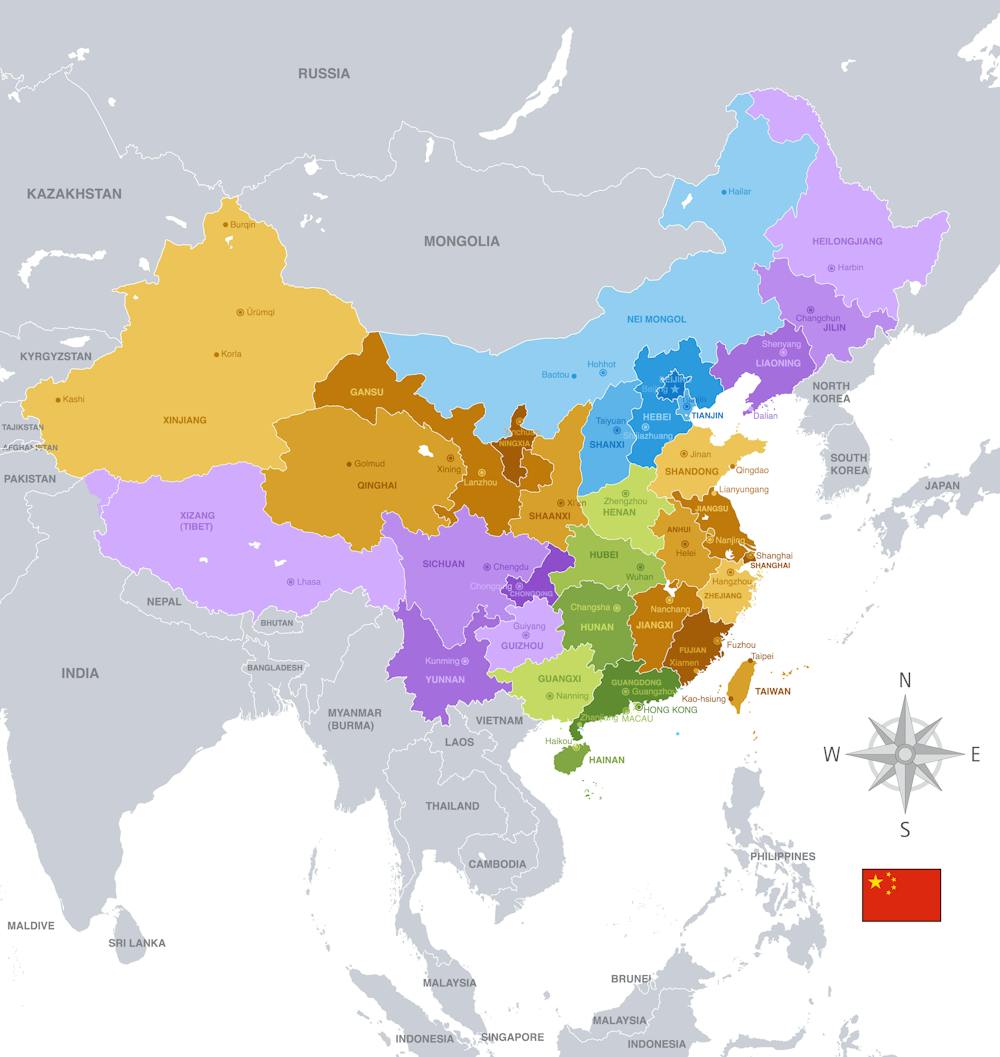
The Uyghurs are Turkic-speaking Muslims from the Central Asian region. The largest population live in China’s autonomous Xinjiang region, in the country’s north-west. The Uyghurs are one of a number of persecuted Muslim minorities in Xinjiang, including the Kazakhs, Uzbeks, Turkmen, Kyrgyz and Hui.
The region’s name suggests the Uyghurs have autonomy and self-governance. But similar to Tibet, Xinjiang is a tightly controlled region of China.
Many Uyghur communities also live in countries neighbouring China, such as Uzbekistan, Kyrgyzstan and Kazakhstan. An estimated 3,000 Uyghurs live in Australia.
China’s President Xi Jinping has overseen a hardline approach towards Muslim minorities living in Xinjiang, especially the Uyghurs. In recent years, the government has installed sophisticated surveillance technology across the region, and there has been a surge in police numbers.
These are purpose-built detention centres, some of which resemble high-security jails. A recent ABC investigation found 28 detention camps had expanded across Xinjiang as part of China’s program of subjugation.
Members of the Uyghur diaspora have been reported as requesting “proof of life” from Beijing over disappeared family members back in Xinjiang. The Guardian recently reported an estimate that 80% of Uyghurs in Australia would have a relative who has disappeared into the camps.
The People’s Republic of China annexed Xinjiang in 1949. At this time, it was estimated the Uyghur numbered around 76% of the region’s population. Han Chinese – the country’s majority ethnic group – accounted for just 6.2%, with other minority groups making up the remaining total.
Since 1949, Han migration to the region has diluted the ethnic ratio. Official statistics show the population is now made up of 42% Uyghurs and 40% Han.
The largest population of Uyghurs live in China’s Xinjiang province, in the country’s north-west.from shutterstock.com
Beijing does not recognise the region as a colony. But the 1949 annexation represents colonisation to Xinjiang’s Muslim minorities and segments of the population have resisted Beijing’s rule. Many refuse to speak Mandarin, while others campaign for independence.
Beijing regards any discontent or criticism of the Chinese Communist Party to be threatening. Minority dissent is treated as a danger to state security. This is even if it involves moderate voices calling for improvements in health, education and employment.
To Beijing, territorial integrity is of utmost importance. It does not tolerate any expression contrary to the official position that Xinjiang has always been part of China.
Beijing has long considered Xinjiang and the Muslim minorities such as the Uyghurs to be “backward”. During the Communist Party’s Great Leap Forward (1958-1962), ethnicity and religion were singled out as both “obstacles to progress” and “backwards custom”.
Repeated attempts at rapid and forced assimilation, discriminatory and oppressive policies, and a cycle of what commentators have labelled “repression-violence-repression” have led to periodic protests across Xinjiang.
In extreme cases, acts of terrorism – such as the Kunming train station attack – have been carried out both inside Xinjiang and in other parts of China.
In recent decades, Beijing has recast the Uyghur ethnic group as a terrorist collective. This has allowed Beijing to justify its transformation of Xinjiang into a surveillance state. There has also been a marked rise of Islamophobia across China.
Some Uyghurs have been employed by the state to spy on other Uyghurs, reporting any suspicious or illegal behaviour. This includes if someone has given up smoking, refuses to drink alcohol or even if a Uyghur refuses to watch Chinese news broadcasts.
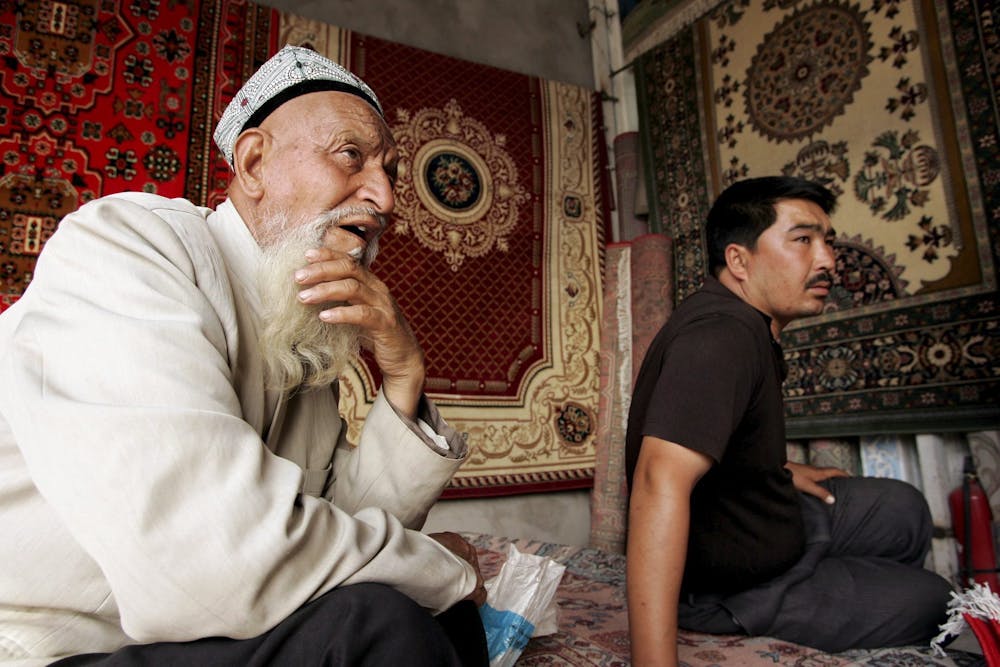
The Chinese government is intolerant of the religion and other traditions of minorities, particularly the Uyghurs.MICHAEL REYNOLDS/AAP
Beijing’s surveillance includes face and voice recognition, iris scanners, DNA sampling and 3D identification imagery of Uyghurs. These were introduced following Xi’s 2016 appointment of Chen Quanguo as Xinjiang Party Chief. Chen’s previous appointment was in Tibet, where he implemented similar control measures over the Buddhist population.
Beijing claims the detention centres across Xinjiang are for “vocational training”, but a US Congressional hearing on the camps and subsequent report characterised them as “political re-education” centres. The education involves daily indoctrination into Communist ideology and attempts at eradicating minority culture, language and religion.
Recent reports have identified more than 100 Uyghur intellectuals including writers, poets, journalists and university professors are now among those detained. The persecution of intellectuals, who speak out against oppression, and continue traditional practice, occurs even if they are moderate in their views and working towards reconciliation.
In 2014, Beijing arrested Ilham Tohti, an economics professor who rejected separatism and promoted reconciliation in Xinjiang. He is currently serving a life sentence after being falsely accused of being a separatist.
Pressuring the Chinese government
Xinjiang is geographically important to China’s Belt and Road initiative – a development strategy involving infrastructure and investments in Europe, Asia and Africa. This could provide an avenue for the international community to apply diplomatic pressure in the way of sanctions. Another option is suspension of, or withdrawal from, existing Belt and Road agreements.
Outside countries have a duty to intervene and force Beijing to comply with international human rights.
How can we best help Australians who are at risk of developing a mental health disorder? A new recommendation to expand the Better Access initiative would open up government-subsidised psychological care to this effect.
Determining who should actually be classified as “at risk” is difficult. And we’re yet to fully understand what the most effective treatments for this cohort are.
But while there may be a lack of detail accompanying this recommendation, targeting this group is worthwhile. The recommendation aligns with evidence that preventing mental illness is both achievable and cost effective.
A recent review of 32 studies showed psychological treatment for healthy children and adolescents could reduce the likelihood of developing anxiety or depression in the following year by 14-34%.
Looking specifically at people deemed at risk of mental illness, another review found cognitive behaviour therapy holds promise as a means to prevent the development of depression. Preventative cognitive behaviour therapy resulted in about a 26% reduction in the risk.
In terms of psychotic disorders, several studies have now been conducted to explore the effectiveness of various treatments to halt illness progression. Analysis of this research found receiving treatments such as low‐dose antipsychotic medication, cognitive behavioural therapy, or omega 3 fatty acids reduced the risk of developing a first episode of psychosis within the following two years by 37%.
More research is still required to support these findings.
Increasing the availability of mental health services would also have significant global economic benefit. For every dollar invested in mental health, economic returns would be $2.50.
How this proposal would change things
Currently, with a diagnosis of a mental disorder by a GP, a mental health treatment plan allows people to receive up to ten psychological therapy sessions annually.
Some people who are at risk of mental illness may already receive treatment under the current system by being diagnosed under the label “not otherwise specified”.
But a major talking point from the review is the suggestion to formalise the provision of Medicare-funded sessions with a psychologist for those considered at risk of mental illness. They would be entitled to up to ten subsidised sessions each year.
This doesn’t propose anyone who “just wants to have a chat” with a psychologist will get to do so on the taxpayer’s dollar. Rather, it suggests people who are highly likely to develop a mental disorder within the next year should be given access to preventative care.
Defining risk
While considerable funding has gone towards investigating markers of risk for mental illness, these endeavours have been largely unsuccessful.
Perhaps the best examples are psychotic disorders such as schizophrenia, which affect around 1-2% of the Australian population, and are most likely to develop before a person turns 25.
Considerable efforts have been invested in trying to predict who will develop a psychotic illness by combining known risk factors, such as family history of psychosis, with the type of experiences young people describe early in the development of their illness. These might include occasionally hearing voices or experiencing passing paranoid thoughts.
A review of 27 studies in specialist mental health settings found only about 18% of those who were classified as at risk developed a psychotic illness within a year. These results indicate our efforts to accurately identify those truly at risk of psychosis have some way to go.
Face-to-face sessions with a psychologist are just one way to treat people who may be at risk of developing a mental health disorder.From shutterstock.com
Our prediction of more common mental disorders such as depression is marginally better: one population-based study found around 27% of young people reporting depressive symptoms not severe enough to justify diagnosis met diagnostic criteria for a depressive disorder within a year.
We have little to no data on our ability to identify people at risk of mental illness in general practice. One recent study even concluded screening for risk of anxiety disorders in primary care was not feasible.
Providing the right treatment
The second issue is we don’t currently know how best to provide treatment to at risk groups.
A “staging model” of mental disorders – similar to that used for cancers – suggests low level treatments, such as psychotherapy, should be provided to at-risk groups.
The model argues more intensive treatments, such as medications (which have more side effects), should be reserved for people showing signs of a fully developed disorder.
This staging model is still being developed. We don’t yet have well-validated criteria that enable us to identify the exact stage of illness a person is at. And we don’t yet have established guidelines for the most appropriate treatments for people at the various stages.
Possibilities worth exploring for those at risk include phone apps, web-based therapy, group therapy, and one-to-one psychotherapy. Digital technologies may be more economical than traditional forms of psychological treatment.
A strong starting point
Despite these issues, providing mental health services to people at risk of mental illness could be a really good thing, both for the individuals and the Australian economy.
Mental illness is estimated to cost A$60 billion annually in Australia. Given such high costs, preventing, or even just dealying, the onset of mental disorders would result in massive savings.
We have growing evidence we can prevent the onset of disorders such as depression and psychosis, but there is still much we don’t know.
More research is needed to identify at risk individuals, perhaps incorporating emerging tools such as digital assessments.
And finally, serious discussions about the diagnosis of mental disorders must continue. If implemented carefully, with agreement to fund and respond to research outcomes, the recommendation for preventative mental health could stem the public crisis of mental illness.
Electronic waste is recycled in appalling conditions in India
The world produces 50 million tonnes of electronic and electrical waste (e-waste) per year, according to a recent UN report, but only 20% is formally recycled. Much of the rest ends up in landfill, or is recycled informally in developing nations.
India generates more than two million tonnes of e-waste annually, and also imports undisclosed amounts of e-waste from other countries from around the world – including Australia.
We visited India to examine these conditions ourselves, and reveal some of the devastating effects e-waste recycling has on workers’ health and the environment.
Obsolete computer electronics equipment lie stacked along the roads in Seelampur.Alankrita Soni, Author provided
Indian e-waste
More than 95% of India’s e-waste is processed by a widely distributed network of informal workers of waste pickers. They are often referred to as “kabadiwalas” or “raddiwalas” who collect, dismantle and recycle it and operate illegally outside of any regulated or formal organisational system. Little has changed since India introduced e-waste management legislation in 2016.
We visited e-waste dismantlers on Delhi’s outskirts. Along the narrow and congested alleyways in Seelampur we encountered hundreds of people, including children, handling different types of electronic waste including discarded televisions, air-conditioners, computers, phones and batteries.
Open fires create toxic smoke, and locals reported high rates of respiratory problems.Alankrita Soni, Author provided
Squatting outside shop units they were busy dismantling these products and sorting circuit boards, capacitors, metals and other components (without proper tools, gloves, face masks or suitable footwear) to be sold on to other traders for further recycling.
Local people said the waste comes here from all over India. “You should have come here early morning, when the trucks arrive with all the waste,” a trolley driver told us.
Seelampur is the largest e-waste dismantling market in India Each day e-waste is dumped by the truckload for thousands of workers using crude methods to extract reusable components and precious metals such as copper, tin, silver, gold, titanium and palladium. The process involves acid burning and open incineration, creating toxic gases with severe health and environmental consequences.
Workers come to Seelampur desperate for work. We learned that workers can earn between 200 and 800 rupees (A$4-16) per day. Women and children are paid the least; men who are involved with the extraction of metals and acid-leeching are paid more.
Income is linked to how much workers dismantle and the quality of what is extracted. They work 8-10 hours per day, without any apparent regard for their own well-being. We were told by a local government representative that respiratory problems are reportedly common among those working in these filthy smoke-filled conditions.
Residential areas adjoining Seelampur Drain.Alankrita Soni
Delhi has significant air and water pollution problems that authorities struggle to mitigate. We were surprised to learn that the recycling community does not like to discuss “pollution”, so as not to raise concerns that could result in a police raid. When we asked about the burning of e-waste, they denied it takes place. Locals were reluctant to talk to us in any detail. They live in fear that their trade will be shut down during one of the regular police patrols in an attempt to curb Delhi’s critical air and water problems.
As a result of this fear, e-waste burning and acid washing are often hidden from view in the outskirts of Delhi and the neighbouring states of Uttar Pradesh and Haryana, or done at night when there is less risk of a police raid.
Incidentally, while moving around Seelampur we were shocked to see children playing in drains clogged with dumped waste. During the drier months drains can catch fire, often deliberately lit to reduce waste accumulation.
Young boys searching for valuable metal components they can sell in Seelampur.Author provided
After our tour of Seelampur we visited Mandoli, a region near Delhi where we were told e-waste burning takes place. When we arrived and asked about e-waste recycling we were initially met with denials that such places exist. But after some persistence we were directed along narrow, rutted laneways to an industrial area flanked by fortified buildings with large locked metal doors and peephole slots not dissimilar to a prison.
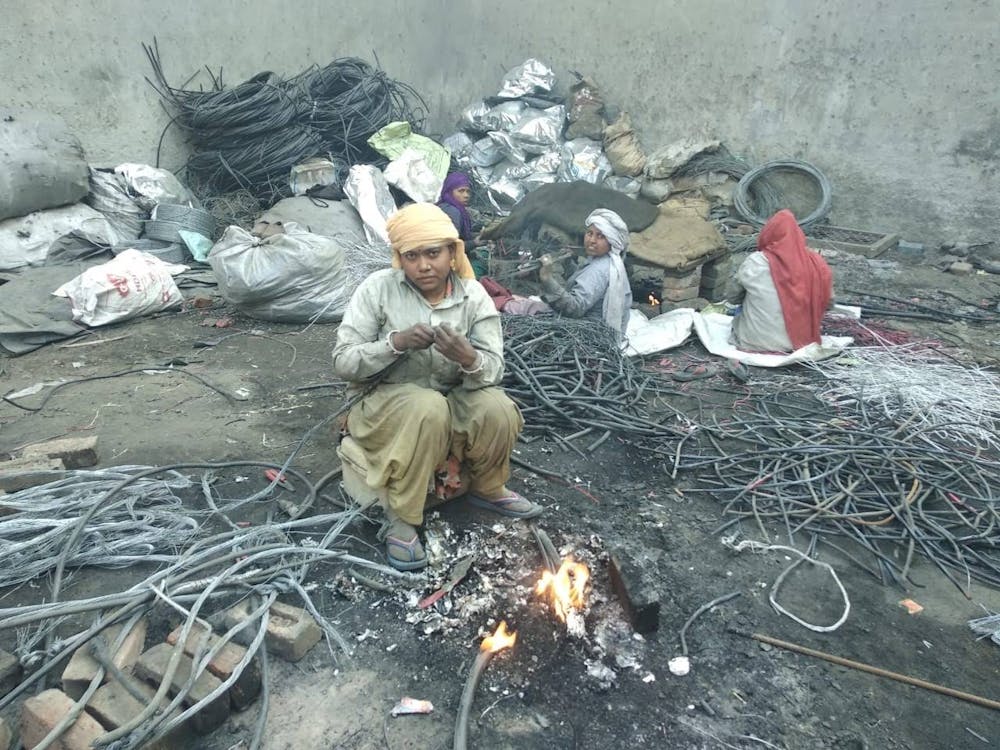
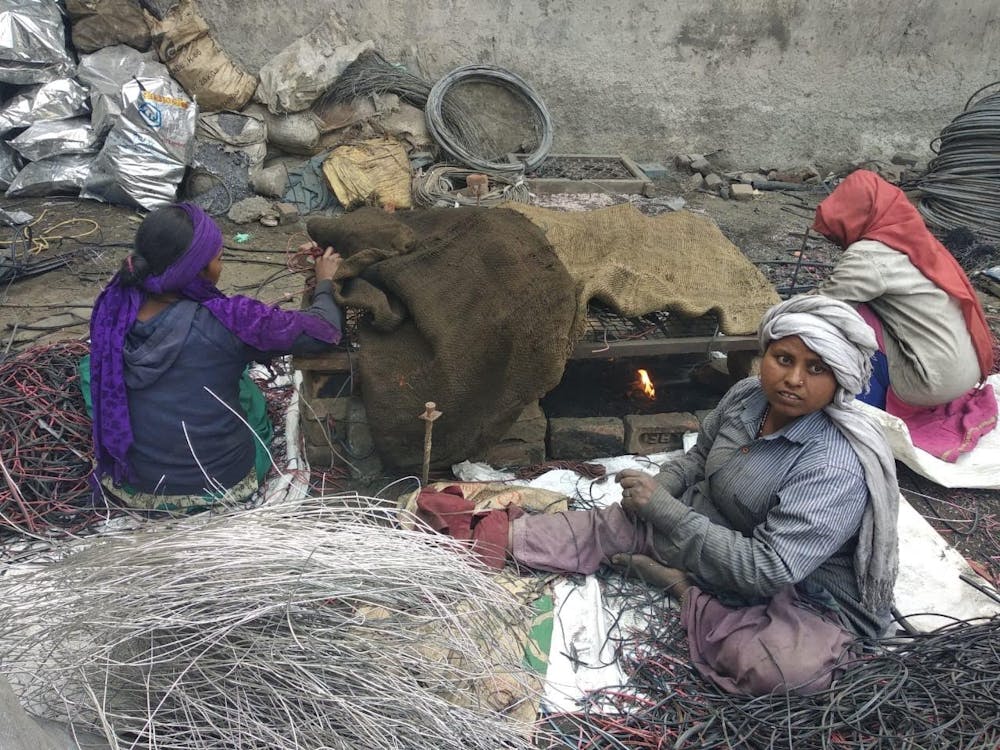
We arranged entry to one of these units. Among the swirling clouds of thick, acrid smoke, four or so women were burning electrical cables over a coal fire to extract copper and other metals. They were reluctant to talk and very cautious with their replies, but they did tell us they were somewhat aware of the health and environmental implications of the work.
We could not stay more than a few minutes in these filthy conditions. As we left we asked an elderly gentleman if people here suffer from asthma or similar conditions. He claimed that deaths due to respiratory problems are common. We also learned that most of these units are illegal and operate at night to avoid detection. Pollution levels are often worse at night and affect the surrounding residential areas and even the prisoners at the nearby Mandoli Jail.
Women extracting copper from electrical wires, in a highly polluting process.Alankrita Soni, Author provided
We had the luxury of being able to leave after our visit. It is devastating to think of the residents, workers and their children who spend their lives living among this toxic waste and breathing poisonous air.
Field trips such as this help illustrate a tragic paradox of e-waste recycling in developed versus developing nations. In Australia and many other advanced industrialised economies, e-waste collection is low and little is recycled. In India, e-waste collection and recycling rates are remarkably high.
This is all due to informal recyclers, the kabadiwalas or raddiwalas. They are resourceful enough to extract value at every stage of the recycling process, but this comes with a heavy toll to their health and the environment.
This article was co-written by Ms. Alankrita Soni, UNSW Alumni & practising Environmental Architect from India.
Markets require regulators. As Adam Smith, the champion of the invisible hand, notes in The Wealth of Nations, when individual interests are left unregulated they work to turn competitive markets into monopolies.
But what happens when regulators meant to check individual interests fail to promote the public interest?
Consider Australia’s banking sector. The banking royal commission has found plenty of fault in the ways the corporate and prudential regulatory agencies performed their vital roles – due not to lack of power but an unwillingness to use that power.
University of Chicago economist and 1982 Nobel laureate George Stigler was the first to outline how regulators can become “captured” by the very firms and industries they are meant to be regulating, beginning with an article in 1971.
Stigler’s idea has come to be known as “regulatory capture theory”, and it causes us to confront the uncomfortable question of how to ensure regulators act in the public interest, not in the interest of the firms they regulate.
Supply and demand
Stigler thought about regulation through the lens of supply and demand. Self-interested politicians supply regulation. Firms demand it – usually because they want a competitor regulated.
His classic example concerned regulations on the weight of trucks that could travel on state roads in the United States in the 1930s. He found empirical evidence that where trucks were more of a threat to traditional train transport (like on short-haul routes where railroads were less competitive) more stringent weight limits were enacted.
Rather than the regulator being a beneficent protector of the general public interest, it had become a self-interested actor responding to political pressure from the railroad owners.
This may strike you as rather cynical, but there is a swathe of evidence that across industries and time, regulators often act more in the interests of industries than the public.
These regulations usually have a plausible rationale behind them. Consider licensing of doctors. Nobody wants a poorly trained doctor let loose on them, so some form of certification makes sense. But does the medical profession limit the number of doctors and exclude foreign-trained doctors to push up their incomes? You be the judge.
It’s easy to think of other examples: “tickets” in the construction industry, certification of train and truck drivers in mining, licensing of plumbers, and on and on.
There are lots of ways this can arise. Politicians often depend on support and campaign contributions. And there is all too often a revolving door between regulators and the regulated.
Financial regulators
This brings us to the regulation of Australia’s banks.
The corporate and prudential regulatory agencies may have been unwilling to use their power, but the the big four banks were not.
And the banks have plenty of power – financial and political. They are utterly vital to the operation of the entire economy. They are among the very largest companies in the country (so a lot of retirement savings are invested in them). And they employ a lot of people.
We should stop assuming the Australian Securities and Investments Commission and the Australia Prudential Regulatory Authority, among others, are unquestionably acting in the public interest and start asking a bunch of questions.
What are the backgrounds of the people who head up these organisations and what perspective does that lead them to bring to the job? What jobs do they get after they leave the regulator, and how might that affect their motivations while acting as regulator? What would be the social sanction imposed on them if they decided to get really tough with financial industry players?
What about the politicians who make the laws in the first place? Are they really acting for all Australians with a thoughtful and balanced perspective? Or do they represent tribal interests?
Regulators typically aren’t bad people. But sometimes they have bad implicit incentives. And the laws they are tasked with enforcing often favour a particular group – quite frequently those being regulated.
We need to close revolving doors, provide more resources to regulators and scrutinise what they do much more. Let’s not be naive about regulation.
When nursing hits the headlines, the news is usually worse. Neglect in aged care facilities or nurses exploiting vulnerable patients rightfully outrages us all. But until scandals are exposed, the public seems to take little interest in the challenges facing nurses. Nor does it ask their opinion on important matters.
To the public, nursing work is much like teaching work – known to be valuable, but not worthy of much critical attention. This is reflected in how nursing is rarely represented in any depth in popular culture. While films and television series can create vivid, believable characters and contexts for them to act in, the representation of nurses themselves can be quite unrealistic.
This has consequences. When hospital nurses are portrayed on screen, for instance, as endlessly giving and selfless, people expect this treatment in real life.
In the early 20th century, nurses were usually portrayed in films as either angels of mercy or sex objects. When TV medical dramas like Ben Casey and Dr Kildare gained mass audiences, nurses faded into the background as doctors moved to the dramatic fore. Then, as these formulaic medical stories became too predictable for a more freethinking younger audience, nurses (and their access to power and influence) began to be used in more intelligent and thought provoking ways.
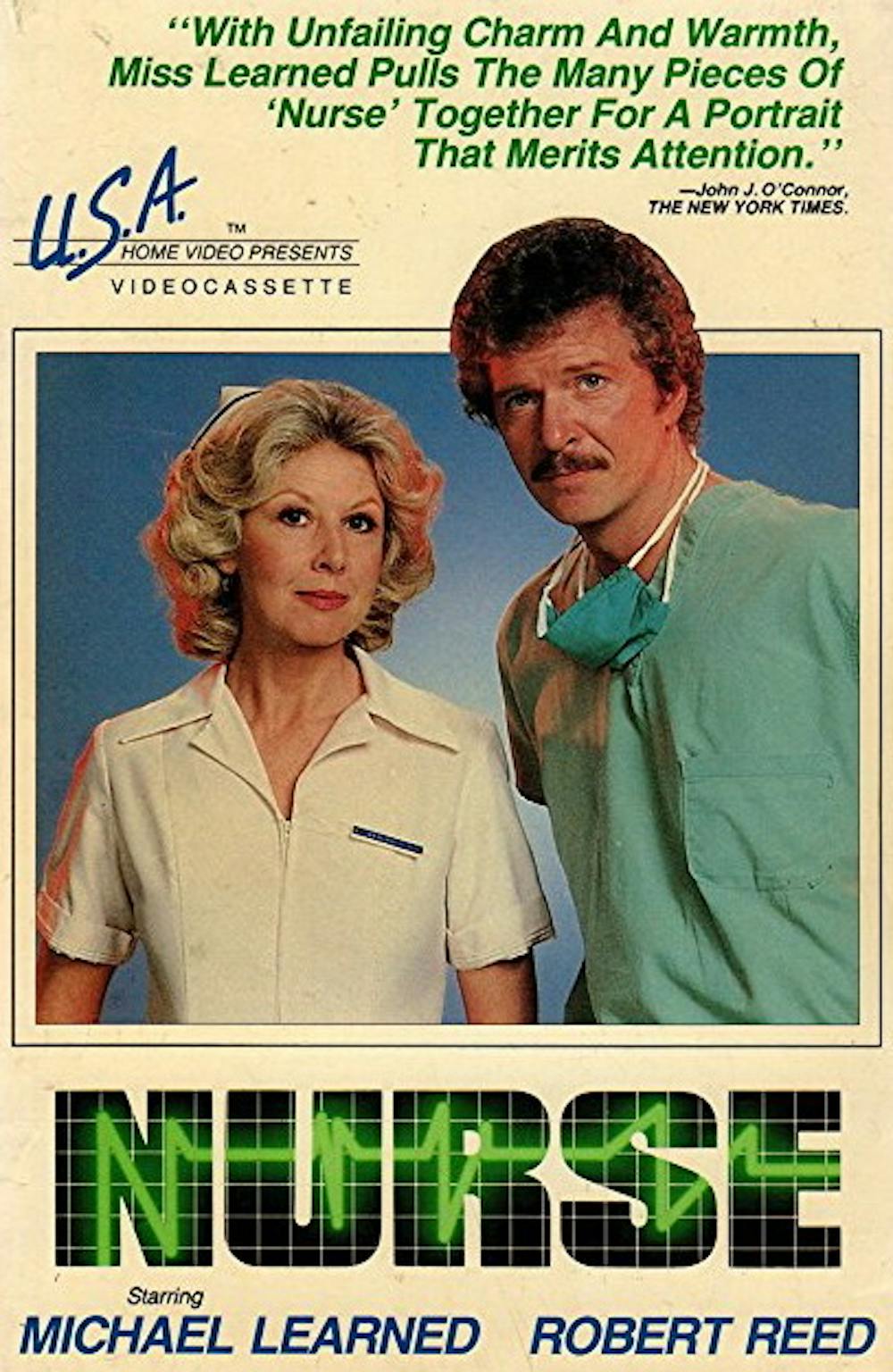
The original poster for Nurse.idmb
Some may remember the American television series Nurse that aired in the 1980s. Starring Michael Learned, fresh from her role as the mother, Olivia, in The Waltons, the show followed the challenges faced by, and achievements of, a woman returning to the workforce after being widowed. Learned’s character made critical decisions, delegated tasks to a multidisciplinary team, had a romantic life and enjoyed a challenging nursing career.
Sadly, Nurse only lasted two seasons, possibly cancelled due to the sexist view that a hit TV show could not feature a female lead, and the offence these story lines caused to the conventional power base in health care – the doctors.
Progress has been slow in offering other well-rounded depictions, with Nurse Jackie a notable exception. (Another is the fully-rounded depictions of nurses and midwives in the BBC series Call the Midwife, set in the late 1950s and early 1960s – but these are still exceptions.) An antihero with a drug addiction who is nevertheless an expert carer, Nurse Jackie works as a counterpoint to the more common stereotypes of nurses on screen who tend to be superficial and idealised, drawing on outdated Victorian ideas about women’s role as helpmates to men.
Edie Falco, who played a drug addicted nurse in Nurse Jackie, was a welcome contrast to the usual stereotyped depictions.Showtime Networks, Jackson Group Entertainment, Madison Grain Elevator
We can see this in many contemporary television series such as House, The Good Doctor, The Resident and Offspring. In these and almost all hospital-based dramas, comedies and soap operas from M.A.S.H. to General Hospital, nurses assist doctors, who are always in superior positions.
As a result, most nursing roles on screen are insignificant or benign, and are included simply to dress the set or provide romantic or sexual interest. As a result, the idea of the good nurse – calm, sympathetic and caring – has become a powerful and entrenched stereotype on screen. Such romanticised imaging may be flattering for nurses themselves, although it hardly stimulates any deep reflection on their professional role.
A deep-seated anxiety
Occasionally, though, nurses are portrayed as malevolent, dangerous or out of control. These depictions are so arresting they become seared into public memory, and thus important to consider. An obvious incarnation of an unprofessional nurse is the frumpy, unemployed Annie Wilkes in Misery. In both the Stephen King novel and the movie based upon it, she is an obsessed, erotomanic fan who happens upon her favourite writer, Paul Sheldon, when he is trapped in a snowstorm after an accident.
Drawing on all her strength, skill and persistence, Nurse Wilkes single-handedly rescues and resuscitates Sheldon and sets his broken limbs. During his convalescence in her isolated farmhouse, Wilkes insists that Sheldon resumes his writing, transgressing the boundaries in their nurse-patient relationship. She also metamorphoses from a competent, reliable care giver and endearing fan, to the embodiment of menacing evil, intent on satisfying her own desires.
Played deliciously by Kathy Bates in Rob Reiner’s 1990 film, Annie Wilkes embodies the monstrous feminine and her unleashed power has sickening repercussions. Who can forget that look in James Caan’s eyes as he realises what is about to happen to his feet for daring to move more than his nurse decreed?
Although undoubtedly a classic film, part of the reason Misery continues to resonate with viewers is because it taps into a deep-seated anxiety that many share about nursing and health care. While the horror in this story certainly depends on its storytelling, it also draws on the reality that when patients become fully dependent on professional caregivers, they place their lives in others’ hands. Hands that will not always be competent, trustworthy or benevolent.
Indeed, it has been suggested that the real life serial killer nurse Genene Jones, who murdered as many as 60 babies in Texas in the 1970s and 1980s, was the inspiration for King’s character.
Another screen nurse who lives large in popular imagination is, of course, Nurse Ratched from One Flew Over the Cuckoo’s Nest. Although her divergence from professional decorum is not as wildly obvious as Nurse Wilkes – Ratched does not deliberately torture or maim her patients – her actions do lead to suffering and death.
The horror in her character is the realisation that a nurse could, and would, so rigidly and unswervingly enforce rules that are cruel and callous. Like Wilkes, she embodies the power that nurses have to control the lives of patients. Unlike Wilkes, however, Ratched’s actions are ambiguous, and this makes her even more frightening. Again in contrast to Wilkes’ rampant lack of control, she appears calm and self-contained as she firmly leads a large team of untrained or junior staff.
Despite our familiarity with this story, Nurse Ratched’s motivations are difficult to get a handle on. This is not least because she meticulously goes through the motions of good care. She ensures music is played as patients line up for their medications and that group therapy is conducted with patience and persistence. What she thinks, and feels, about the patients is, however, inscrutable. Her approach is also judgemental and ultimately damaging. She fails, for instance, to validate the growing independence of one of the patients, Billy, and effectively triggers his suicide.
Pressures on nurses
What is notably missing from Ratched’s nursing is any sign of human empathy or compassion. This speaks to another contemporary anxiety: that the professionals trusted to care for our health ought to (but often do not) convey an appropriate level of “feeling” for their patients.
This is amplified in settings where patients may be most vulnerable – such as in mental health, aged or paediatric care – and why so much outrage is directed at failures in them.
Although it is easy to see Nurse Ratched as unfeeling, cruel and sadistic, she can also be considered as a victim of the system. As such, she is an example of how nurses (both individually and as a group) are an easy target for attacks against failures in the health care system more broadly.
Moreover, the personal pressures nurses have to endure are rarely discussed. These include the emotions they need to suppress in order to care for others and how they have to comply with sometimes unjust or unclear policies. Many of these pressures – including dealing with death and others’ grief – seem quite overwhelming when viewed from outside the profession.
The personal pressures nurses experience are rarely discussed.shutterstock
Nurses themselves struggle with Ratched’s portrayal and public notoriety. A number of advocacy groups and researchers question the way nursing is portrayed in the media, and frequently mention Ratched. The Truth about Nursing, an American-based media watchdog, voiced opposition when Netflix announced its plan to produce a TV series about Ratched’s earlier life. According to the film and TV website IMDB, the series tells of a young nurse at a mental institution who “becomes jaded, bitter and a downright monster to her patients”.
Critics see such a series as fuelling anti-nurse stereotypes. They warn it could have dangerous consequences, including dissuading students from joining the profession and exacerbating the worldwide shortage of nurses.
It is our view, however, that an exploration of Ratched’s backstory, and the development of her personality as psychopathic, narcissistic or, ironically, dependent, is likely to be revealing – in the vein of the engrossing Mindhunter. It is, moreover, an important story, because a longer and deeper view of this enigmatic character may suggest reasons for how she came to be like she was and why she acted as she did.
Nursing and the Holocaust
There are, of course, cases where real nurses have acted as monstrously as the figures in these fictions. The idea of what makes a bad nurse is a major theme in the haunting 2016 German film, Fog in August. Set in Nazi Germany, the story explores an aspect of the Holocaust that is little known – the so-called T4 “euthanasia” program.
The film is told through the eyes of a Yenish-German boy, Ernst Lossa. Along with thousands of other children labelled as disabled, and adults with mental disorders or other conditions considered undesirable, he is murdered by a lethal dose of barbiturates given to him by willing and seemingly caring nurses. Nurses and doctors acted en masse to cause harm in this way, despite their professional codes of ethics to protect the well-being of all patients in their care.
Two major characters in the film are nurses and they help to reinforce the theme of darkness triumphing over light, bringing down on medicine a fog that perhaps has not yet fully lifted.
On one side is the moral nun Sister Sophia, who openly disapproves of the program of killing but is ineffective in her resistance to it. Her belief in the sanctity of all human life is unshakeable despite the Nazi dictates, but she is not supported either within the sanatorium where she works, or by the local Catholic hierarchy to whom she appeals. As a result, she finds herself increasingly marginalised and threatened.
On the other side is Sister Edith Kiefer, a specialist nurse trained at Hadamar, one of the six German Euthanasia Centres established to kill, rather than cure, patients. Brought in by the medical director to make the killing process more streamlined and efficient, she is young, fit, Aryan and fervently believes in Nazi eugenics.
The power of this pairing is not that these nurses are polar opposites, but that they are both flawed and in some ways, more similar than different. They are both competent, dutiful and capable of skilfully easing patient distress. They both represent significant parts of society – Church and State – but are unable to protect the vulnerable people in their care.
Murderous nurses are rare but the damage they wreak is horrifying and often their sprees continue because the hospital concerned has not acted swiftly enough. Read in this way, One Flew Over the Cuckoo’s Nest is not just the story of one bad nurse, it is about a rigid system that dehumanises and ruins peoples’ lives. And Fog in August is not only about past evils – it is about what happens when an overarching ideology falls on medical institutions like a heavy blanket, suffocating the nursing ideal of putting patient welfare first.
While these monstrous nurses make for compelling viewing, they can also prompt us to realise that deliberately neglecting, hurting or killing patients are not simply the heinous acts of aberrant individuals. They are also signs of health care systems that operate without close public scrutiny, and where toxic professional cultures have developed.
Shining a light on this dark underbelly by thinking about such depictions in popular culture can be a first step towards identifying the complex factors that cause problems within the health care system, and helping to guide remedial action.
The Morrison government, politically-speaking, is trying to do a loaves-and-fishes exercise with the Medevac legislation, over which the parliament defied the executive this week.
It is attempting to inflate Labor’s support for a modest measure to facilitate medical transfers from Manus and Nauru into a mini “Tampa” crisis.
Will this succeed? The short answer is surely “no”; the longer one is that this issue could take a deal of skin off Labor. The point is no one is yet sure how it will play out – both sides are operating on gut feelings until the polls and focus groups speak.
The Liberals think anything to do with “boats” is lethal for Labor; the ALP believes community attitudes have changed but is very apprehensive about how the debate would go if boats showed up.
No question, this is rocky for Bill Shorten. The government attack is ferocious, full of exaggeration and scaremongering.
But the Coalition’s tactics are also risky in a policy sense. Scott Morrison is running two lines. He claims that by supporting the Medevac legislation Shorten has undermined offshore processing – sending a signal the borders are porous.
He goes on to say that the government, and he in particular, are ready to protect Australia against the danger of a new wave. Whatever the intelligence advisers want done will be done. The borders will stay strong.
Morrison rejects the argument that the detail of the legislation limits the incentive to people smugglers, insisting they don’t bother with “nuance”.
Indeed. So which un-nuanced Morrison message will the smugglers hear? That the policy has been trashed = or that the borders are being fortified?
There is also the danger, which some critics have highlighted, that in its rhetoric about numerous alleged criminals on Nauru and Manus, the government could make the US more reluctant take people (it has only accepted 456 so far – the deal was up to 1250).
What the government is actually doing is hard to pin down. Take the reopening of the Christmas Island detention facility – or to be more precise “a series of compounds” there – which attracted big headlines, and attention overseas.
What does “reopening” mean? Going in with the vacuum cleaners and the mops so that the centre could function if required? Or setting up some of it immediately on a serious day-to-day operating basis?
And how convincing is the rationale for this reopening, which Morrison described as for dealing “with the prospect of transfers”.
The government says that with the closing of many detention centres, space is somewhat tight. But if people are transferred because they are sick, Christmas Island is hardly the best place for access to medical practitioners.
Maybe some people currently in detention elsewhere would be moved the Christmas Island to make room for newcomers. But wouldn’t it be a lot cheaper and easier – if less dramatic and headline-grabbing – just to lease some more accommodation near currently-operating facilities?
Anyway, while some of the transferees would be kept in detention, what’s happened previously suggests a lot could be let into the community.
It’s true that the advice from the Home Affairs department envisaged a scenario “likely necessitating the stand-up of the Christmas Island facility”, but it had the flavour of a worst-case one. (With an election and the prospect of a change of government raising questions about the future of Home Affairs secretary Mike Pezzullo, one wonders what he thinks about the department’s advice being used publicly by the government as a battering ram against Labor.)
If the government really intends to “reopen” Christmas Island in any major way, it could find itself spending a lot of money there on few if any people. If it is a faux reopening, it’s just a bit of spin that should be called out.
The Medevac bill was passed despite the best efforts of the minority government to stop it, including a Senate filibuster on the final sitting day of last year, to delay the bill reaching the lower house then.
On Thursday a rather panicked government did a rerun of that December day.
This time, the Senate had passed a motion – opposed by the Coalition – calling for a royal commission “into violence, abuse and neglect of people with disability.” Labor, expecting the motion to reach the House on Thursday afternoon, prepared to push it through with crossbench support.
The government says it knew the message from the Senate hadn’t arrived as question time was nearing its normal end. But it was spooked by the opposition’s tactics, and fearful of what Labor might be up to. So it just kept question time running.
Earlier in the day, it had had to pull its legislation for applying a “big stick” to errant energy companies, because the House appeared set to amend it to prevent the government underwriting coal projects.
The government says it will take the “big stick” plan to the election. But its inability to have it bedded down before then is another failure in a long line in the energy area.
The vote on the disability motion will happen on Monday and the Coalition will not oppose it – despite its stand in the Senate. The government says it will then consider what action it should take.
Abuse of disabled people is surely as important an issue as the ill-treatment of the elderly. With the public increasing demanding the facts and culprits be revealed where there is evidence of misconduct, a royal commission in parallel with the aged care one would have merit, in both policy and political terms.
The parliamentary week has been rugged for both sides – the government hasn’t been in control of the House but Labor hasn’t been in control of the debate, which it wanted to be all about banks not boats.
Then again, nothing could match One Nation’s tribulation, with its leader Pauline Hanson accused of sexual harassment by a bitter ex-colleague, senator Brian Burston, and her right-hand man, James Ashby, publicly scuffling with her accuser. This is a party beyond embarrassment.
Source: The Conversation (Au and NZ) – By Sanjaya Senanayake, Associate Professor of Medicine, Infectious Diseases Physician, Australian National University
The devastating Townsville floods have receded but the clean up is being complicated by the appearance of a serious bacterial infection known as melioidosis. One person has died from melioidosis and nine others have been diagnosed with the disease over the past week.
The bacteria that causes the disease, Burkholderia pseudomallei, is a hardy bug that lives around 30cm deep in clay soil. Events that disturb the soil, such as heavy rains and floods, bring B. pseudomallei to the surface, where it can enter the body through through a small break in the skin (that a person may not even be aware of), or by other means.
Melioidosis may cause an ulcer at that site, and from there, spread to multiple sites in the body via the bloodstream. Alternatively, the bacterium can be inhaled, after which it travels to the lungs, and again may spread via the bloodstream. Less commonly, it’s ingested.
Melioidosis was first identified in the early 20th century among drug users in Myanmar. These days, cases tend to concentrate in Southeast Asia and the top end of northern Australia.
What are the symptoms?
Melioidosis can cause a variety of symptoms, but often presents as a non-specific flu-like illness with fever, headache, cough, shortness of breath, disorientation, and pain in the stomach, muscles or joints.
People with underlying conditions that impair their immune system – such as diabetes, chronic kidney or lung disease, and alcohol use disorder – are more likely to become sick from the infection.
The majority of healthy people infected by melioidosis won’t have any symptoms, but just because you’re healthy, doesn’t mean you’re immune: around 20% of people who become acutely ill with melioidosis have no identifiable risk factors.
People typically become sick between one and 21 days after being infected. But in a minority of cases, this incubation period can be much longer, with one case occurring after 62 years.
How does it make you sick?
While most people who are sick with melioidosis will have an acute illness, lasting a short time, a small number can have a grumbling infection persisting for months.
One of the most common manifestations of melioidosis is infection of the lungs (pneumonia), which can occur either via infection through the skin, or inhalation of B. pseudomallei.
The challenges in treating this organism, though, arise from its ability to form large pockets of pus (abscesses) in virtually any part of the body. Abscesses can be harder to treat with antibiotics alone and may also require drainage by a surgeon or radiologist.
How is it treated?
Thankfully, a number of antibiotics can kill B. pseudomallei. Those recovering from the infection will need to take antibiotics for at least three months to cure it completely.
If you think you might have melioidosis, seek medical attention immediately. A prompt clinical assessment will determine the level of care you need, and allow antibiotic therapy to be started in a timely manner.
Your blood and any obviously infected body fluids (sputum, pus, and so on) will also be tested for B. pseudomallei or other pathogens that may be causing the illness.
While cleaning up after these floods, make sure you wear gloves and boots to minimise the risk of infection through breaks in the skin. This especially applies to people at highest risk of developing melioidosis, namely those with diabetes, alcohol use disorder, chronic kidney disease, and lung disease.
Today, we’re bringing you a special episode of our podcast Trust Me, I’m An Expert for anyone wondering: what the hell happened this week?
A sitting government lost a vote on the floor of parliament (which hasn’t happened in decades) over a bill that aims to facilitate medical transfers from Manus and Nauru.
(You can hear the MP Kerryn Phelps, who set the ball rolling for that legislation, give her account on Michelle Grattan’s politics podcast over here).
A day after a bloc of cross-benchers and the opposition won the vote, Prime Minister Scott Morrison signalled the government may re-open the Christmas Island detention facility and the Coalition was accusing Labor of being weak on borders.
In other words, a federal election campaign centred on border security has well and truly begun.
To help us understand the broader context, we’re hearing today from Dr Daniel Ghezelbash, a refugee law expert from Macquarie University.
In our discussion, he busted several myths about how the asylum seeker “medevac” bill would work, and described as “reckless” political rhetoric that the new legislation represents a destruction of Australia’s border security.
This week, many Australians cheered the release of refugee footballer Hakeem Al-Araibi, and reports emerged showing airport arrivals of asylum seekers has soared, but much of the political discussion centred on boat arrivals.
The focus on boat arrivals in the lead-up to an election should be familiar to any student of Australian political history, he said – but this time it may be different.
Join us on Trust Me, I’m An Expert, as Dr Daniel Ghezelbash explains a policy alternative to our current system of offshore processing that he says wouldn’t involve compromising security or shirking our international legal obligations.
Podcasts are often best enjoyed using a podcast app. All iPhones come with the Apple Podcasts app already installed, or you may want to listen and subscribe on another app such as Pocket Casts (click here to listen to Trust Me, I’m An Expert on Pocket Casts).
You can also hear us on Stitcher, Spotify or any of the apps below. Just pick a service from one of those listed below and click on the icon to find Trust Me, I’m An Expert.
Zip Co’s “buy now, pay later” service is fast becoming a ubiquitous payment option in Australia. Retailers from Bunnings and Best & Less to Target and Tigerair offer it. All up, the company now boasts 10,000 retail partners and more than 850,000 customers.
It’s part of the phenomenal upsurge of “buy now pay later” services. In the past three years, according to Australia’s corporate watchdog, the number of Australians using such services has jumped from 400,000 to 2 million.
Their rising popularity has to do with technology making electronic payments easier and more secure, more online shopping, increasing distrust of banks and younger people shying away from credit card use.
But the way a service like Zip operates has consumer advocates worried. Its business model means it can avoid the responsible lending requirements of the National Consumer Credit Protection Act. As such, Zip lends money without verifying a person’s income or credit history. The potential it will entice those with low income and bad credit has attracted the scrutiny the Senate inquiry into credit and financial services.
So let’s look at how Zip’s business model works, and why it is proving so popular.
How Zip works
Zip has two slightly different products: one offering credit more than $A1,000 is called Zip Money; the other offering credit up to $A1,000 is called Zip Pay.
Let’s focus on Zip Pay as the company’s most popular and profitable service.
Zip Pay is particularly convenient in that you can access credit at the point of purchase with minimum hassle and little delay (thanks to no credit checks or income verification procedures).
Zip Pay promotes itself as “interest-free”. It instead charges a flat fee of $6 a month on whatever is owed, and an additional $5 if the minimum monthly payment of $40 is not made on time. It also charges a 4% upfront fee to the retailer; that is, it pays the retailer A$960, then collects $1,000 from the customer.
Implicit costs
Despite the “interest-free” boast, Zip Pay’s $6 monthly fixed fee is in fact a quasi-interest charge, equivalent to paying 7.4% interest annually on a $1,000 debt.
Because you still pay $6 even if you owe less than $1,000, the fee structure is also highly regressive. The less you owe, the greater the effective interest rate you pay. For example, if you owe $500, the $6 fee translates to a 15% annualised interest rate.
If you owe $100, it equals an annual interest rate of more than 100%.
This fact could encourage you to take advantage of the full $1,000 of credit, on the basis it doesn’t cost you any more in monthly charges. That might, of course, be Zip’s plan, because the more you owe the longer it may take you to pay the debt off.
But if you feel confident you will have more money in the future than you have now, this easy credit option could be a highly attractive means to “manage” the disconnect between the things you want and when you can afford these.
What makes individuals regard debt as manageable is of great interest to entrepreneurs and economists alike.
It was Milton Friedman, winner of the 1976 Nobel Prize for economics, who first hypothesised that an individual’s spending habits were based not only on current income but also on anticipated future income. This idea, from his 1957 book A Theory of the Consumption Function, has become known as as the “permanent income hypothesis”.
Typically those who are younger and well-educated have greater expectation that their income will increase over time, and will therefore be more inclined to borrow money to fund current consumption.
This explains why almost a quarter of Zip customers are under the age of 24, and more than 60% are under 36.
It also helps explain why items bought using Zip are mostly non-essential. By drilling down into the data behind the figures in Zip’s 2018 annual report, we know customers are using Zip to pay for fashion items, clothes and restaurant meals, rather than to pay energy bills or buy medicine.
Easy access to credit also encourages individuals to take on more debt.
Not surprisingly, research by the Australian Securities and Investments Commission shows the majority of “buy now pay later” users admit easy credit has led them to spend more money, with one in six reporting some negative impact as a result. These impacts include becoming overdrawn, borrowing money from family or friends, or using another loan provider to cover their debts.
For savvy consumers confident they can manage their finances, willing to pay that quasi-interest rate to fund their immediate consumption desires, Zip’s service may make sense. But don’t get carried away by wishful thinking and overconfidence. Without financial discipline and proper budgeting, it’s an easy path to overcommitment and financial hardship.
Political Roundup: The Story of the Chinese blowback against New Zealand
by Dr Bryce Edwards
This week might come to be seen as a turning point in New Zealand’s complex trading and political relations with China. Suddenly there is a very strong awareness of the deteriorating relations between the capitals of Wellington and Beijing. And although there is plenty of confusion and contention about the details, it’s clear that the Chinese Government has initiated a type of political blowback against New Zealand. This is based on what the Beijing government see as a betrayal by its formerly-close trading partner.
Chinese President Xi Jinping (R) and New Zealand’s former Prime Minister John Key (L) meet at the Great Hall of the People in Beijing, China, 19 March 2014.
Three factors have been discussed this week as signalling that China has initiated a campaign of retaliation against New Zealand: 1) the sudden announcement that China is postponing the long-planned launch of tourism initiative in Wellington next week, 2) the mysterious turning back of an Air New Zealand flight to Shanghai in the weekend, and 3) the long-running inability of Prime Minister Jacinda Ardern to arrange a diplomatic visit to China.
The story about the postponement of the tourism launch was broken by Barry Soper on the frontpage of the Herald on Tuesday, explaining that: “The 2019 China-New Zealand Year of Tourism was meant to be launched with great fanfare at Wellington’s Te Papa museum next week, but that has been postponed by China” – see: China, New Zealand links sink to new low: PM Jacinda Ardern’s visit on hold, tourism project postponed.
In a second piece on Tuesday, Soper points out that the diplomatic explanations for the postponement aren’t credible: “the lame excuse from Wellington officials that there was a change of schedule. Given the Year was announced two years ago by the Key Government when the Chinese Premier visited here, Beijing’s had plenty of time to schedule it in” – see: NZ feeling the heat of the Chinese dragon.
This article also delves into the long-running difficulties that Ardern is having in getting an official visit agreed to by Beijing. Soper says: “The invitation for Jacinda Ardern to visit Beijing early this year’s been put on ice and all her talk at the end of last year about neither side being able to coordinate their diaries was baloney.”
In addition, Soper points to the third issue – the “turning back of the new Air New Zealand plane over the weekend, which was half way to Shanghai, because it wasn’t registered”. These three incidents illustrate, according to Soper that “New Zealand is feeling the heat of the Chinese dragon’s breath and if we’re not careful it could incinerate us.” He reports that “word from the Chinese capital is that retaliation is being worked on.”
And Soper points out that it’s easy to understand why the Chinese have become upset with New Zealand, after the Government here essentially decided late last year to ban the Chinese company Huawei from being involved in the new 5G telecommunications network.
I covered this at the time in my column, Huawei decision is the price of being in Five Eyes, pointing out that the decision was widely seen as fulfilling a US Government request to help it its geopolitical battle against China and Huawei. I predicted, “There is certainly going to be a cost for the ban… this country’s economic and diplomatic ties with the superpower of China will now be strained as a result.”
Of course, it wasn’t just the Huawei decision that soured relations with China – Wellington has been edging away from a close friendship with Beijing for a few years. This is all explained in a must-read column today by Victoria University of Wellington’s strategic studies specialist, Robert Ayson, who goes through the deterioration of the Wellington-Beijing relationship, saying that even under John Key “New Zealand was raising concerns about China’s behaviour in the South China Sea” and in return received some messages “suggesting that Wellington should stay quiet if it wanted an FTA upgrade” – see: New Zealand and China: time for clarity in a hall of mirrors.
According to Ayson, New Zealand’s criticisms of China have been increasing, especially with Ron Mark as Minister of Defence, and with the Government “calling out” China “for nefarious cyber activities”.
The Labour-led Government is still denying, or at least downplaying, the serious pushback that is now coming from Beijing. For the most recent examples of this, see Jo Moir’s news report, Winston Peters dismisses claims govt visits to China stalling.
The best quote in this story is from Shane Jones who declares: “I don’t think I’m one of these losery politicians that’s apparently not allowed to go to China, in fact I’m very popular with the Chinese – I think they see a kindred industrial spirit.” And David Parker is also reported as having visited China and seen no signs of trouble in the relationship.
But there’s clearly now a consensus amongst political commentators and journalists that the political blowback from China is real, many of who are complaining that the Prime Minister and Government are either failing to be upfront or else simply being delusional about the relationship.
Veteran political journalist Richard Harman reports that “the foreign affairs community” is certainly asking questions about China’s retaliation against New Zealand, and says diplomats and officials even see the incident with the Air New Zealand flight as evidence that the relationship has soured – see his column, Why was the AirNZ plane turned back?.
The suggestion is made that China is now cracking down “on technical infringements of its laws” when it comes to New Zealand exporters or the national carrier. In this regard he reports that Victoria University’s David Capie “suggested that what the incident showed was that New Zealand no longer had a special relationship with China. In other words, all things being equal previously, China would have found a way to let the plane land.”
China is prone to using this type of ambiguous retaliation, according to Newsroom’s Sam Sachdeva: “China has a history of operating with plausible deniability when it comes to meting out punishments” – see: NZ-China ‘scheduling issues‘ cause for concern.
Sachdeva reports, “One observer noted that blowback often begins with tourism numbers, moving onto international education before spreading to the wider trade and economic relationship – a script into which the postponement of the Year of Tourism launch sits uneasily.”
The problem, according to the New Zealand Herald, is that New Zealand appears to have chosen sides in the growing US-China rivalry – see the editorial: Has our govt antagonised China?. It points out that “it is not hard to see why China would have the impression this country is not the friend it used to be. The new Government’s ‘reset’ of policy towards the Pacific Islands is strongly tinged with support for the US and suspicion of China’s interests in the region.”
New Zealand observers in Beijing are also commenting on what’s going on. The most interesting is businessman David Mahon, who is interviewed by Liam Dann, saying that the decision to ban Huawei was “seen as a Five Eyes stitch up” and “a breach of trust” – see: NZ/China relationship: ‘We have a big problem’.
Mahon suggests that New Zealand had been building a much closer relationship with China for the last four decades, with the Chinese having huge respect for this country, but “In the last 12 months or so that has almost reversed. So there is now a very different view, almost an opposite view of New Zealand.”
There are real dangers of the China-NZ relationship getting much worse. Geopolitical and security analyst Paul Buchanan says that he’s now warning his clients against going to China due to risks to their safety as a result of what’s going on at the governmental level. On Newstalk ZB, Buchanan said “if you are a New Zealand resident in China, you need to be cognisant of the fact that there could be a knock on your door and you could be taken away on corruption charges or turpitude charges” – see: Kiwis warned over ‘hostage diplomacy’ from China.
Slowly but surely, the current government has engineered a major reorientation of foreign policy according to Audrey Young, who labels the Relationship with China a diplomatic mess. She complains that this “was never foreshadowed before the last election”.
The shift appears to lie with New Zealand First and Winston Peters: “Peters has been an irritant. A year ago Peters framed his Pacific Reset in terms of a response to counter China’s growing influence in the region, and he challenged China’s most important foreign policy strategy, the Belt and Road initiative. He ended the year with a speech in Washington, almost a love-letter to America, practically begging them to get more involved in the Pacific to counter China’s influence. A National Party Foreign Minister could not have made such a speech without being accused of wanting to rejoin Anzus.”
According to Young, the onus is now on the Government, and the Prime Minister, to fix the deterioration. They need to “to take a lot more care in preserving the relationship New Zealand had and to be less cavalier.”
Rutherford discusses the on-again-off-again trip: “Ardern is left trotting out the line that this is a scheduling issue, and the only thing keeping her from an official visit is scheduling clashes. This has been the case for some time; journalists were asked to prepare for a trip in December, however this was abruptly cancelled. The longer the situation goes on, the more it appears that the excuse that the problems are caused by scheduling issues are simply a subtle diplomatic slap. For weeks there have been rumours that officials at the Chinese Embassy have warned the Ministry of Foreign Affairs and Trade that the trip is not happening until other issues are resolved, something Mfat denies.”
Herald business editor Fran O’Sullivan is also calling for the Government to quickly fix the problems – see: Chinese relations must get back on track. Her suggestion, however, is that the “postponed” tourism event needs to be sorted out by the Minister of Tourism Kelvin Davis getting “on the first plane up to China to sort out the debacle”.
But perhaps it’s the Minister of Foreign Affairs that needs to be sorted out. Richard Harman suggests that this might already be happening: “The Prime Minister appeared yesterday to deliver a subtle message to Foreign Minister Winston Peters telling him, she, not him, ran foreign policy. This contrasts with her admission last year that she had not read a speech he gave in Washington directly criticising China and calling for more American involvement in the Pacific” – see: Ardern takes the lead on China.
Could Peters even be shifted on from his portfolio, in order to satisfy the Chinese? It seems unlikely, but that’s the hint that security specialist Robert Ayson is making when he says that fixing the NZ-China relations “may also mean a change in the pecking order within the politburo in Wellington.”
Ayson’s column, cited above, also has plenty of other suggestions for how the mess might be fixed – and these include providing the Chinese government with greater clarity about the Huawei decision, showing that New Zealand is not simply “a willing member of a new Cold War”, stop cosying up to the US, and pull back from Winston Peters’ anti-China Pacific Reset strategy.
Finally, last month Matthew Hooton wrote an important and prescient column about New Zealand’s changing relationship with China and US, and this is well worth reading as background for what is happening now – see: Is Jacinda Ardern on board with the Winston Peters Reset?.
Source: The Conversation (Au and NZ) – By Nicholas Biddle, Associate Professor, ANU College of Arts and Social Sciences, Australian National University
Scott Morrison today became the fifth prime minister to deliver a Closing the Gap report to parliament – the 11th since the strategy began in 2008. Closing the Gap has aimed to reduce disadvantage among Aboriginal and Torres Strait Islander people with particular respect to life expectancy, child mortality, access to early childhood education, educational achievement and employment outcomes.
Almost every time a prime minister delivers the report, he or she states the need to move on from a deficits approach. Which is exactly what Morrison did this time. But he also did something different. Four of the seven targets set in 2008 were due to expire in 2018. So last year, the government developed the Closing the Gap Refresh – where targets would be updated in partnership with Indigenous people.
The current report and the work leading up to it has led to new targets, such as a “significant and sustained progress to eliminate the over-representation of Aboriginal children in out-of-home care” and old targets framed differently. For example, the headline new outcome for families, children and youth is that “Aboriginal and Torres Strait Islander children thrive in their early years”. This is on top of more specific targets such as having 95% of Aboriginal and Torres Strait Islander four-years-olds enrolled in early childhood education by 2025 – which this year is on track.
Looking back on the past 11 years, there are several things we’ve learned. This includes those targets that seem easiest to meet, as well changes in the demographics of the population that complicate the measuring of the targets. Below are three lessons from the last decade of the policy.
1. Some targets are easier than others
The targets where there has been some success tend to be those where government has more direct control. Consider the Year 12 attainment compared to the employment targets. To increase the proportion of Indigenous Australians completing year 12, the Commonwealth government can change the income support system to create incentives to not leave school, while state and territory governments can adjust the school leaving age.
That is not to downplay the efforts of parents, teachers, community leaders, and the students themselves. But, there are some direct policy levers.
To improve employment outcomes, on the other hand, discrimination among employers needs to be reduced, human capital levels increased, jobs need to be in areas where Indigenous people live and to match the skills and experiences of the Indigenous population. These are solvable policy problems with the right settings and community engagement. But, they are substantially more complex.
The main target has always been related to Aboriginal and Torres Strait Islander life expectancy. The 2019 report shows the target of closing the gap by 2031 is not on track.
Unfortunately, the life expectancy target is one of the more difficult to measure, as it uses multiple datasets that are potentially affected by different ways Indigenous people are counted in the census and changing levels of identification. The most recent estimates, based on data for 2015-17, are that life expectancy at birth is 71.6 years for Indigenous males and 75.6 years for Indigenous females.
While the gaps with the non-Indigenous population of 8.6 years and 7.8 years respectively are smaller than they were in 2010-12 (the previous estimates) the Australian Bureau of Statistics (ABS) and most demographers suggest extreme caution around the interpretation of this change. The ABS writes:
While the estimates in this release show a small improvement in life expectancy estimates and a reduction in the gap between 2010-2012 and 2015-2017, this improvement should be interpreted with considerable caution as the population composition has changed during this period.
More people have been identifying as being Aboriginal and/or Torres Strait Islander over recent years. What’s more, the newly identified Indigenous people tend to have better outcomes on average (across health, education, and labour market outcomes) than those who were identified previously. This biases our estimates, making it appear there is more rapid progress than there might otherwise be.
The Closing the Gap framework was implicitly designed around improving the circumstances of the 2008 Indigenous population relative to the 2008 non-Indigenous population. However, both populations have changed substantially over the intervening years. There has been a growth of the non-Indigenous population due to international migration. It is hard to measure and track differences in changing populations.
3. On-track one year, off-track the next
There is also the yearly reporting cycle. The target of child mortality, for instance, no longer appears to be on track. This is despite it being on track in previous years. Yearly fluctuations make it hard to gauge the effectiveness of long-term policy settings.
For other indicators, such as employment, the data is available far less frequently than it could be, and we are less able to judge the effect of individual policies and interventions. Having said that, in my view, the sophistication and nuance with which data in the Closing the Gap reports has been presented has improved considerably.
It seems most policies prioritise Indigenous Australians living in remote areas than those in the city.David Clode/Unsplash
4. Indigenous Australians in the city and country have different needs
This isn’t always reflected in policy settings. The current report shows many outcomes are worse in remote compared to non-remote Australia. It also makes the point (though less frequently), that the vast majority of Indigenous Australians live in regional areas and major cities. This creates a tension between relative and absolute need. Unfortunately, the policy responses of government often don’t get that balance right.
Take the signature policy proposal announced with the current report – a suspension or cancelling of HECS debt for teachers who work in remote schools. What the policy ignores is that the vast majority of Indigenous students live outside remote Australia, that outcomes for Indigenous students in non-remote areas are well behind those of non-Indigenous students, and that the schools Indigenous students attend in non-remote areas tend to be very different from those of non-Indigenous students.
Attracting and keeping more high quality teachers in remote areas is a worthwhile policy aim. Alone, it is not sufficient.
The current report and speech by the prime minister states that “genuine partnerships are required to drive sustainable, systemic change” and that the government needs “to support initiatives led by Aboriginal and Torres Strait Islander communities to address the priorities identified by those communities”.
These are admirable goals. But, they require significant resources, a genuine engagement with the evidence (even if it isn’t positive), taking the Uluru Statement from the Heart seriously, and real ceding of control to Aboriginal and Torres Strait Islander peoples.
1960 was a big year for my adopting parents. First came the infertility diagnosis. Then a new baby arrived with little warning and no fanfare. Followed within days by a new refrigerator.
I was one of over 103,000 New Zealand babies forcibly removed from my single mother. Her dying mother sent her to the doctor’s house with a couple of months to spare. The generous Dr Gerald Gleeson put her to work cleaning and scrubbing. Weeks before I was born he promised me away to the “an attractive young couple who belong to the Church of England.”
It was a typical story. The same thing happened in Canada. They describe it as one of their “most agonising scandals and one which for decades was covered up – the forced adoption of hundreds of thousands of babies born to unmarried mothers.” A full-scale inquiry is ongoing.
In New Zealand, we pretend it never happened.
In the total absence of government action, apology or investigation, I’ve been unraveling New Zealand’s history of forced adoption.
We’ve wrapped adoption in secrecy, tied it up with clichés and obfuscated the truth at every turn. We’ve conflated orphans with the illegitimate. We’ve never once paused to inquire about outcomes.
With so much around adoption shrouded in legal black holes and social expectation, most adopted people struggle to talk about it. Not only their own but the practice itself.
If you experience a difficult time in your natural born family, people understand. A violent father? A cold mother? There’s plenty of support for that trauma. .
But if you’re adopted that toxic family story takes on another element. When you try to speak about it, someone will ask the ‘what-ifs’. What if you’d been aborted? What if your natural family were worse? You could have grown up in an orphanage? In care? On the streets?
This is often followed by the, “I know a happy adoptee,” narrative. As if that one person’s experience is more significant than everything you’ve lost. And all the wrongs of being taken from your mother and stripped of your identity are irrelevant.
But what if you do grow up in a loving adopted family? And you really are that ‘happy adopted person?’
In many ways, this makes it more difficult. If you feel even the slightest bit ‘not right’ in your happy family there’s nowhere to place those feelings. To express doubts, to acknowledge a yearning for blood in the face of good parenting is almost impossible. Even to yourself.
And so the fog descends. The disconnect between your inner life and external expectations is vast. Often the fog is preferable.
Whether you recognise it or not, adoption is trauma. In truth both the idyllic and the unfit family is invested in being better than the mother they took you from. The person you might have been, the life you would have lived, if not for them, is rarely acknowledged. But no matter the quality of your upbringing, we all live with a sense of a yearning for blood connections.
For me, as young teen all I wanted was someone who looked like me. I had to wait until I gave birth to my first daughter. She arrived with fine hair and delicate features. But then I realised there were no photos of me until I was three months old. I had no idea if I looked like her as a new baby. No reason, my adopting mother said, casually, when asked. “I was too busy to take photos.”
Except for that camera-worthy new refrigerator. It was either me or the fridge. It’s obvious who won. I have the photo to prove it.
We must discover … the redemptive power of love. And when we do that, we will make of this whole world a new world. But love, love is the only way.
In his spirited sermon at the 2018 wedding of Prince Harry and Meghan Markle, US Bishop Michael Curry, Primate of the Episcopal Church, quoted these words of Dr Martin Luther King. Dr Curry went on to describe love’s transformative power for humanity: “Think and imagine a world where love is the way,” he urged the congregation.
In universities across the world, academics are doing just that. Love Studies, a field newly emerged in the last couple of decades, is becoming an increasingly significant area of application and research.
There are journals and conferences on Love Studies, websites about popular romance such as Teach Me Tonight and a growing number of Phds in the field. But what exactly is it?
Love Studies emerged from discourse and analyses in popular romance, cultural and gender studies. In its first flush, it included a revaluing and deeper understanding of the complexity and sophistication of love, in particular romantic love, and how it has shaped our ways of being and knowing.
As academic Virginia Blum once put it when writing about the discipline:
While sex may indeed ‘sell’, love seems to trump sex every time when it comes to talking about the nature of individual autonomy and happiness.
Gradually, the idea of romantic love began to be explored in other subject areas: in philosophy, law, languages and literary studies, politics, anthropology and social science. Love Studies looked at desire, and intimate relationships, gender and power while retaining a critical wariness about the costs of love to women. Meanwhile, in psychology, there has been a renewed focus on happiness and loving-kindness.
Today, Love Studies is becoming more clearly defined and developed. Last year, The Journal of Popular Romance Studies produced a special issue on Critical Love Studies. It looked at such things as the juxtaposition of popular romance and queer theory, “love migrants” who conduct much of their relationship long distance over Skype, “boy love” in Japanese romance fiction and masculinity in Stephenie Meyer’s Twilight novels (The latter article was titled: Is Edward Cullen a good boyfriend? Young men talk about Twilight, masculinity and the rules of heteroromance).
Technology is transforming romantic relationships.shutterstock
This October, meanwhile, a global conference called LOVE, ETC will be held in Denmark. Situating love as the hot new topic in the academy, it will embrace issues such as how love is being transformed in the age of online dating and the challenging of gender and sexuality norms. How will love change in the technological future? (Will we come to love robots?) What’s the difference between love and caring?
Some have suggested that in the 21st century, love is one of the existential goals of our lives. It can be both subversive or conservative, depending on your point of view.
Indeed romantic love is no easy subject. It’s the front line: where our hearts, minds and bodies meet. For some, it’s a battlefield. Revenge porn. Intimate partner violence. Date rape. Sexual harassment. Online bullying. Abusive relationships. There’s a lot of damage done when we get up close and personal.
Some may call the study of love shallow, superficial too chocolatey and commercial. A bit like Valentine’s Day. While there has long been stigma and disdain for the area as lacking sufficient gravitas, for some academics, it’s the sweet spot.
As a romance novelist, Love Studies helps me to think through issues in my own writing. As an academic, I am working with colleagues in the fields of psychology, sexology and cultural studies, to explore issues of consent post #MeToo and how “civil rights” can be enacted in the bedroom, without repressing desire.
Love is as love does. It is not an end in itself, a happy ever after, but a creative process providing endless opportunities for thought and imagination. It remains to be seen if a new world, of which Martin Luther King dreamed, can be made of it.
Source: The Conversation (Au and NZ) – By Brian Lovell, Research Director of the Security and Surveillance Research group; Professor, The University of Queensland
Recently, the Victorian Government brought in new rules stating Victorian state schools will be banned from using facial recognition technology in classrooms unless they have the approval of parents, students and the Department of Education.
Students may be justifiably horrified at the thought of being monitored as they move throughout the school during the day. But a roll marking system could be as simple as looking at a tablet or iPad once a day instead of being signed off on a paper roll. It simply depends on the implementation.
Trials have already begun in independent schools in NSW and up to 100 campuses across Australia. According to the developers, the technology promises to save teachers up to 2.5 hours a week by replacing the need for them to mark the roll at the start of every class.
Many students now have smart phones that recognise faces right now. There are also downloadable face recognition apps for Android phones and iPhones. So face recognition is already in our schools.
And I argue that, like earlier technologies such as the motor vehicle and mobile phone, a strategy where adoption is managed to create the most good and least harm is appropriate. We shouldn’t simply ban it.
How does it work?
Face recognition technology uses a camera to capture a face and then matches this face against a database to determine identity. First, the face or faces must be detected and localised in the camera frame. Then, face images are aligned and rescaled to a standard size. Finally, these faces are matched against a database. Matching is almost invariably performed using artificial intelligence technology.
We are now in a golden age of face recognition. The main reason for rapid adoption is recognition accuracy has improved astronomically in recent years with 20 times better accuracy from 2014 to 2018.
Now deep learning – a form of artificial intelligence that uses a machine to do a task that usually requires human intelligence – is used for face recognition and an increasing number of other vision tasks.
The simple application of this technology proposed for schools is to automate the collection of the student roll call for classes. This is a mandatory compliance requirement imposed by the education department.
Roll call is a menial task currently performed by highly skilled teachers or their assistants. Looplearn, the Melbourne startup running the face recognition trials, estimates approximately 2.5 hours of teaching time a week is wasted through mandatory roll calls.
Student time is also wasted. Most of us remember waiting in line many minutes to get marked off on a roll during our school days. Roll call is not a constructive use of time, but it is required by law.
In wider society, it’s now estimated each of us spends three working weeks of the year simply authenticating ourselves to computers and other people. This is time consumed in providing identity documents, password resets, signing documents, waiting in phone queues, and so on.
Clearly authentication is vitally important, but it is consuming increasing amounts of our daily lives. Time is one resource none of us can ever recover.
Many of us remember how bad and slow airport immigration control was before Australia adopted face recognition. Now we can leave Australia with very short delays using SmartGates.
An electronic image of our passport photo is securely stored within the passport itself. The SmartGate terminal extracts the photo from the passport chip and gives us a blue ticket. We then insert the blue ticket into the SmartGate, look at the camera and wait for the face recognition technology. If the faces match, the gates open.
Privacy concerns
Privacy is often raised as an objection and this issue can never be dismissed lightly. Objections are mostly based on the collection and distribution of the photos. But every school collects photos of their students already and schools have strict control over distribution.
Such controls would necessarily be built into any school certified system. The only fundamental change to the process is whether the teacher or a computer recognises the student.
Commercial face recognition technology is often quite unreliable unless the person cooperates by standing still and looking directly at the camera like a SmartGate. This is quite different from non-cooperative recognition of persons without their knowledge using surveillance cameras. Cooperative face recognition systems are now well-accepted by the public at the borders, and privacy has been carefully considered in their design.
The emerging non-cooperative surveillance systems have greater potential for invasion of privacy, but they are also faster and more convenient. Indeed, Australia is now rolling out facial recognition technology that will see international travellers pass through airports without even producing their passports
We can’t stop the tide – but we can manage it
Face recognition technologies will become widely adopted across society over the coming years. Concerns over implementation and privacy may slow down adoption in some places, but the tide will come in and will change business practices right across the world once that happens.
So who should manage and advise on these changes? Government will certainly have a role, but they need to be well advised and be aware of best practice worldwide. Such a role role is often played by the Biometrics Institute which was established during the development of the SmartGate system to advise on biometrics best practice as well as privacy concerns.
This technology has the ability to free up our time and reduce the costs of necessary compliance as has already been demonstrated at the airport. As with all new technologies, face recognition raises legitimate concerns. Constructive policies and dialog are the preferred way forward to gain the maximum benefit for society at large, and to make sure we do the least harm.
Source: The Conversation (Au and NZ) – By Albert Van Dijk, Professor, Water and Landscape Dynamics, Fenner School of Environment & Society, Australian National University
Curious Kids is a series for children. Send your question to curiouskids@theconversation.edu.au. You might also like the podcast Imagine This, a co-production between ABC KIDS listen and The Conversation, based on Curious Kids.
Why do we have a drought? – Leon, age 6, Croydon, Sydney.
Hi Leon. That is a great question.
We have a drought whenever it stops raining for a long time. Rain is not always fun, but it is really important.
In some places it is pretty normal if it doesn’t rain for a long time, like in the desert. But even they still need a little bit of rain sometimes.
When it rains, some of the water goes into the ground. That keeps the plants in your backyard, on the farms and in nature happy, because they can drink water from the soil with their roots. Some water can trickle really deep into the ground, but we can still pump that groundwater from wells when we need it.
Another part of the rain goes into the rivers and that is really important too. When you open the tap at home, the water comes all the way from the river. The fish also need the river water, and the farmers need some of it to grow our food.
So as you can see, all of us need water: at home, on the farms and in nature. When we don’t have enough water left for the people, plants and animals to stay healthy, then we call that a drought.
Maybe you want to know why it doesn’t rain? Because that is also a really good question.
Most rain comes from the sea. We need the wind to bring the clouds with the rain to us. But sometimes the wind can blow the wrong way for a long time, and then we don’t get that rain.
Then it can also get really hot, like in the summer holidays we just had. It also gets hotter because we are making our planet warmer. The heat makes the drought even worse, because it makes the plants more thirsty so they have to drink more.
We can’t make it rain. But we can try to make sure we have enough water to keep everyone and everything healthy. You are already helping if you don’t use more water from the tap than you need.
You can also talk to your parents about the planet getting warmer. With their help there is a lot we can do about that, too. For example, when they get to choose a government they can pick a person who really wants to fix it. And when you grow up, so can you!
Hello, curious kids! Have you got a question you’d like an expert to answer? Ask an adult to send your question to us. You can:
* Email your question to curiouskids@theconversation.edu.au * Tell us on Twitter by tagging @ConversationEDU with the hashtag #curiouskids, or * Tell us on Facebook
Please tell us your name, age and which city you live in. You can send an audio recording of your question too, if you want. Send as many questions as you like! We won’t be able to answer every question but we will do our best.
Award-winning journalist, publisher and editor Maria Ressa (left) being arrested in Rappler’s newsroom yesterday. She was being kept in detention last night. Image: Maria Tan/AFP/RSF
The Paris-based global media advocacy group Reporters Without Borders (RSF) has condemned yesterday’s arrest of Maria Ressa, editor of the independent Manila-based news website Rappler, on a “cyber libel” (defamation) charge.
It is referring the Philippine government’s “repeated persecution” of this journalist and her website to the United Nations Secretary-General.
Chosen as one of Time Magazine’s “persons of the year” in 2018, Ressa was spending last night in detention after being arrested at Rappler headquarters by agents from the National Bureau of Investigation (NBI) armed with an arrest warrant issued on the basis of online defamation case filed last week.
“It seems that her arrest was left until the end of the afternoon with the deliberate aim of keeping her in detention overnight,” RSF said.
According to her colleagues, the judge said there was no time to handle the bail request until today.
-Partners-
The Philippine Justice Department filed the case against Ressa and Rappler on February 6 over an article published in 2012 about alleged ties between a Philippine businessmen and the then president of the country’s Supreme Court.
The charges, which carry a possible 12-year jail sentence, were brought under a cyber crime law that had not yet taken effect when the article was published.
‘No place in prison’ “Maria Ressa has no place in prison and the judicial persecution to which she is being subjected is becoming increasingly unacceptable,” RSF secretary-general Christophe Deloire said.
“Digging up an old case that was dismissed in February 2018 is absolutely absurd and confirms that this is not justice but an attempt to gag a media outlet and editor recognised internationally for their professionalism and independence.”
Deloire added: “We are asking the UN secretary-general to intercede as quickly as possible to end this harassment. At the same time, we ask the court that handles this case to dismiss all the charges against Maria Ressa and Rappler.”
This is the sixth charge to be brought against Ressa in more than a year of systematic judicial harassment.
Four charges of tax evasion and failing to file income tax returns were brought against Rappler and Ressa last November. A fifth charge, described by RSF as “completely spurious”, was brought in December.
On the basis of the declaration, the leaders of 12 democratic countries launched a political process on November 11 aimed at providing democratic guarantees for news and information and freedom of opinion.
Media freedom awards As well as being one of Time Magazine’s “persons of the year,” Ressa also received the 2018 Press Freedom Award from the Committee to Protect Journalists and has become a symbol of the Philippine media’s fight against intimidation by President Rodrigo Duterte.
Press freedom groups around the world, including New Zealand’s Pacific Media Centre/Pacific Media Watch, condemned the persecution, with Pen America saying the arrest showed the Duterte government was “desperate” to silence critics.
“Maria Ressa, along with her colleagues at Rappler, has fearlessly exposed the abuses of the Duterte government, even in the face of relentless harassment,” Pen said.
“By arresting her on these absurd and baseless charges, concerning an article published 7 years ago and prior to the enactment of the very law under which she is being charged, the Philippines government has exposed how desperate it is to silence critics and stamp out independent journalism in the country.
“We call on the Duterte government to immediately drop these charges and release Ressa. Investigative journalism is not a crime.”
A short documentary which highlights the risks of being a journalist in Indonesian-ruled Papua region (West Papua) has won an international film award.
According to FIFO’s website, audience members in Tahiti expressed interest in the insight the film offered into a region and freedom struggle largely unknown to the world.
Radheya said while international attention on Papua often focused on restrictions that Jakarta placed on access for foreign journalists, the plight of local journalists was ignored.
-Partners-
“What we endure as foreign journalists is nothing compared to what local indigenous journalists in Papua are facing,” he said.
Papuan journalist turned novelist Aprila Waya, the main character in the documentary, said on Facebook: “This is a new thing for me where the process of making this film (more than three years) has taken more energy than writing a novel.
“Anyway, this is not my victory – it’s the victory of all the Papua people.”
This article is republished under the Pacific Media Centre’s content partnership with Radio New Zealand.
The study examined a large dataset consisting of more than 500,000 student responses collected over 2010 to 2016. It involved more than 3,000 teachers and 2,000 courses across five faculties at the University of New South Wales (UNSW), Sydney.
In parts of science and business the effects are clear. In the science and business faculties, a male teacher from an English-speaking background was more than twice as likely to get a higher score on a student evaluation than a female teacher from a non-English speaking background.
But in other areas, such as arts and social science, the effects are almost marginal. In engineering, effects were only detected for non-English speakers.
When one looks at the probability of scoring very high ratings, and dissects the categories into genders and cultural background, the results are clear. The disparities occur mostly at the very top end: this is where bias creeps in.
Previously the university had looked at just the average (mean) ratings of teachers of different genders, and found that they are more or less indistinguishable (unpublished data). But this new study goes further and provides information that is not evident in superficial analyses.
Should we abandon student feedback?
Student feedback can be a useful mechanism to understand the varied experiences of students. But student feedback is sometimes used inappropriately in staff performance evaluations, and that’s where the existence of bias creates serious problems.
One can make the case for abandoning student feedback – and many have.
But it’s problematic to turn a deaf ear to the student voice, and that is not what national approaches such as the Quality in Learning and Teaching processes (QILT) are doing.
This is because feedback can often be helpful. It can make things better. In addition, it is often positive. Sometimes the feedback is actually the way students say thanks.
However, sometimes it can be very hurtful and damaging, particularly if it is motivated by prejudice. We have to be aware of that and the barriers it can create.
We know that minority groups already suffer from reduced confidence and visibility, so biased teacher evaluations may exaggerate existing inequities.
It is very important to be cautious when looking at the raw numbers.
Firstly, let’s consider what the numbers mean. Students are not evaluating teaching and learning in these surveys. They are telling us about their experiences – that’s why we call them MyExperience surveys at UNSW. We resist the idea that they are student evaluations of teaching, as are used in some settings.
Peer review can make contributions to evaluating teaching while assessments can help evaluate learning – however they may not be enough to overcome bias. When considering professional performance at UNSW, we do not exclude the feedback that students provide on their experience, but we look at a basket of indicators.
Secondly, one has to be serious about the biases that emerge, acknowledge them and confront the issues. Most universities pride themselves on being diverse and inclusive, and students support this.
But this study reminds us that we have work to do. Biases exist. The message is strong. You are more likely to score top ratings if you come from the category of white male: that is, if you are from the prevailing establishment.
The influence of history
These results may be surprising given the diversity of the student and staff body at Australian universities.
But our cultural milieu has been historically saturated by white males, and continuing biases exist. The important thing is to be aware of them, and when looking at the numbers to realise that the ratings are provided in the context of a particular society at a particular moment in time.
The scores should not be blindly accepted at face value.
Most universities, including ours, are working on being more inclusive. At UNSW a new Deputy Vice-Chancellor Equity, Diversity and Inclusion – Eileen Baldry – was recently appointed, and we are working hard to combat bias and to introduce new strategies aimed at supporting diversity. For example, the university will introduce new training for members of promotion panels, explaining the biases detected in our new study. By understanding the problem, we can begin to address it.
All staff across all of our universities can benefit from becoming more aware of issues around bias – especially those in powerful positions, such as members of promotion committees.
Reducing bias will have great benefits for society as university students represent a large proportion of future leaders in government and industry.
It is clear that negative stereotypes will contribute to the partiality that exists within our student community. Encouraging more women and cultural minorities at all levels in higher education, in leadership positions and in membership of key committees will help shrink these biases.
Training in values
Training students is challenging, especially at large modern universities such as UNSW, which has a cohort of over 50,000 coming from more than 100 countries. But our study found similar levels of bias in local students, as we did in international students.
In training students we have to remember that we provide knowledge, but also communicate values via our words and our behaviours.
If we are to continue to listen to the student experience, we need to be careful with the results. Rigorous statistical analyses such as this study, can help us recognise bias and work to address it. If our students graduate with less bias than when they entered their degree, we will be contributing to creating a more equitable and inclusive society in the future.
It is not easy to uproot prejudices but the data are clear. We expect people will be on board and be pleased to contribute to moving things in the right direction.
It’s the middle of the night. Your newborn baby is awake. Again. She wants to feed. You lift her to your breast and brace for the pain.
Most mothers who breastfeed come to appreciate the convenience and the bonding it provides. But until your breasts get used to feeding your infant, it may hurt.
Common symptoms of mastitis include a breast that may be abnormally red, tender to touch, or painful. You may have swelling, firm areas or lumps in your breast.
Some mothers may also have more general flu-like symptoms such as a fever, chills, high temperature, fatigue, joint aches, headache or malaise.
Your health care professional will typically diagnose mastitis based on these symptoms; blood tests aren’t usually needed.
Mastitis can be very distressing for new mothers, as it impacts on their desire to continue breastfeeding, their capacity to cope with their baby, and in some cases, their ability to care for other children.
About 10% of breastfeeding mothers get mastitis more than once when breastfeeding the same baby, and 7% will get mastitis again when breastfeeding subsequent children.
The more children a woman has, the less likely she is to develop mastitis during breastfeeding. This may be because women become more used to breastfeeding, the more children they have.
Causes
Nipple damage may lead to mastitis by allowing bacteria to enter the breast tissue through a graze or crack on the nipple. Cracked nipples can occur if the baby has difficulty attaching to the breast during breastfeeding, or when the baby’s feeding action damages the skin of the nipple.
About 60% of mothers who have mastitis have an infection caused by the bacteria that commonly live on the skin or in the breast. However, these same bacteria are present in the milk of mothers who don’t have mastitis. So although a bacterial infection may be the cause of mastitis for some, it’s not necessarily the cause for all mothers with the condition.
Mastitis most commonly occurs during the first four to six weeks after birth.From shutterstock.com
Milk stasis, or the obstruction of milk flow, can also be an important factor in the development of mastitis. Breast milk needs to be effectively cleared from the breast and there are a number of reasons why this may not be the case.
Mothers may have an oversupply of milk or have begun to decrease their level of breastfeeding.
Wearing a bra with straps that cut across breast tissue may reduce milk flow, and clearance, from that section of the breast.
Using dummies to soothe infants who may be hungry can delay breastfeeding and subsequent milk clearance from the breast.
If the breast is not cleared of milk, milk stasis may allow bacterial concentrations to change within it, or cause an inflammatory reaction as milk is forced out of milk ducts and into the surrounding breast tissue.
Treatment and prevention
Effectively removing milk from the breast is the most important part of treatment for mastitis. This can usually be achieved by helping the baby attach properly to the breast – with the assistance of a lactation consultant – and by feeding regularly.
To manage your symptoms, your health care professional might suggest taking pain relief, resting, drinking lots of water, applying warmth to help with milk clearance (such as by having a warm shower), and applying cooling after breastfeeding.
GPs may prescribe antibiotics to treat mastitis, but there is very little evidence to show this approach is effective.
Physiotherapists can treat mastitis using ultrasound and gentle massage to help remove milk from the breast. Research is underway to evaluate how well used and effective these emerging techniques may be.
In 3% of mothers with mastitis, it may progress to a breast abscess, which may require hospitalisation and treatment via needle aspiration. In serious cases, the condition may require surgical drainage.
There is now also some evidence to suggest that probiotics such as Lactobacillus may be an effective preventive measure. They have been shown to halve the chance of developing mastitis when taken for 16 weeks following childbirth.
To avoid mastitis, mothers wearing maternity bras should ensure the bra does not cut across the breast tissue. If you’re using dummies, only give them when you’re sure the baby isn’t hungry. Most importantly, continue to breastfeed regularly.
Have you ever wondered what’s going through your dog’s mind when you say the word “walk”? And does your pup seem to show guilt when you ask them sternly “what have you done?” Their tail might drop between their legs, their ears droop down, and their eyes turn away.
We often attribute human emotions to animals, in a practice called anthropomorphism. It’s frowned upon in scientific circles, because it can lead us to incorrectly assume what animals are expressing. In the example of your naughty pet, you’d be right to think your dog displays some change in emotional state when you scold them. However, the emotion isn’t guilt: they’re expressing confusion and occasionally anxiety.
The ACT is currently considering legislation that would enshrine animal “sentience” in the law, which means for the first time an Australian jurisdiction will consider animals’ feelings as well as their physical well-being in animal protection laws.
The emotional lives of animals
Modern science has clearly demonstrated that animals experience feelings, sensations and emotional states (or as scientists like to call them, “affective states”). What owners and livestock attendants have known or suspected for a long time, we can now definitively prove.
Unfortunately, the idea that animals can experience emotions has only re-emerged fairly recently. We can blame thinkers during the Renaissance for the spread of the idea that animals weren’t capable of experiencing emotions or feelings. They maintained that animals were like machines, unable to feel or perceive. Any animal which cried out when injured or beaten was thought to be showing an automatic response, similar to a reflex, rather than a conscious response.
It wasn’t until the 18th century that philosophers and scientists began recognising that animals were not only conscious, but they were actually sentient and capable of suffering.
What is sentience?
Sentience can be defined simply as the ability to feel or perceive. Humans are obviously sentient, but many other animal species are also considered sentient. These are animals that respond to a sensory input such as heat, interpret that sensation as an emotion or feeling such as discomfort, then consider an appropriate response to that feeling.
This goes beyond a simple reflex, as sentient animals may choose different responses based on their environment or internal state. For example, a sheep experiencing uncomfortable heat might not move and seek shade if a predator is nearby.
Most animals are sentient
All animals with spines, which includes all mammals, birds, amphibians, reptiles and fish, as well as some animals without spines such as octopus, squid, crabs and lobsters are generally considered sentient. This means that essentially all the animals we use for food, entertainment, work and companionship have feelings, emotions and the ability to suffer.
Other animals like insects and some lower crustaceans haven’t demonstrated sentience. However, as knowledge increases, and experimental methods improve, it is possible that in the future we may reclassify these animals as sentient too.
We commonly misinterpret dog behaviour, especially by thinking they look guilty when they’re actually anxious or confused.NatalieMaynor/Flickr, CC BY
Moral responsibility
With the knowledge that almost all animals are able to experience both positive and negative emotions such as fear, happiness, anxiety and excitement, how we deal with this information is underpinned by our morals and ethics.
Some people consider the moral responsibility of knowing our actions may cause pain and suffering towards animals too great and follow a type of virtue ethics called “animals rights”. People who believe in animals rights think that no amount of harm towards animals for human gain is worth the suffering it causes, and hence they seek to do no harm by not eating animals or using them for entertainment.
A more dominant ethical position is that of utilitarianism, a type of consequentialist ethical theory often associated with the saying “the end justifies the means”. Utilitarians try to minimise the amount of harm done to the largest number of moral subjects.
As animals can suffer, they are considered moral subjects alongside humans. Therefore, it would be wrong to cause animals to suffer for no reason. However, if only a small number of animals suffered in order to feed or bring joy to a large number of people, that might be morally acceptable.
There are many other types of ethical theories which consider the idea of animal sentience, and in reality, most people are a mixture of a few different moral positions (it is really hard being a strict utilitarian: see the The Trolley Dilemma).
The ACT is proposing to become the first Australian state or territory to formally recognise the sentience of animals in animal welfare legislation. With public consultation closed, the ACT government will now consider public feedback on their proposed changes. This feedback will inform the final piece of legislation, to be debated by the Legislative Assembly later in the year.
If sentience is included in the amended law, the ACT won’t be the first jurisdiction to have done so. New Zealand, Europe and Canada have already included it in their animal welfare laws.
However, it is significant for Australia, as it commits the government to consider how the feelings of animals may impact their welfare. Far from giving animal’s rights, it acknowledges that an animal can be physically healthy but mentally suffering, and this mental suffering can lead to poor welfare. With animal welfare an issue of growing importance to many Australians, recognising the inner lives of animals is an important step forward.
After three years and 35 polls, the Economic Society of Australia has received its first-ever unanimous response to a survey question.
It asked just over 50 of Australia’s leading economists to respond to this statement:
There is no way to significantly increase the degree to which Australian retail banks act in the interests of consumers.
Twenty did. All rejected the proposition that nothing could be done. But there was widespread disagreement about what should be done.
Most thought that regulations should be tightened and better enforced.
Mathew Butlin’s comments typify this “more regulation” approach:
The incentive structures for bank staff, from the top down, play a key role in shaping behaviour. A more complete set of performance measures linked to remuneration that strongly penalises behaviour not in the consumer interest would provide stronger incentives for better behaviour, especially when linked with reliable information on non-compliance going to management and ultimately the bank board and a requirement for both to take action.
A smaller group openly doubted that better regulations would help, because they were not confident that the current crop of regulators or politicians would be able to devise and properly enforce them.
Allan Fels gave the most damning response (with the highest word count) saying what was needed – among other things – was a “radical improvement in the performance” of the two main regulators, the Australian Securities and Investments Commission and the Australian Prudential Regulation Authority.
In particular they need a change of culture. This will prove to be harder to do than it sounds. People have been talking for over twenty years about the ASIC and APRA culture needing improvement.
Geoffrey Kingston called for mandatory minimum sentences for financial crimes, arguing that the courts were complicit in the maintenance of financial crimes by being reluctant to jail white-collar criminals.
Kingston and Joaquin Vespignani pointed to the monopoly power of the big four banks before then raising the hope that the “big data” revolution would democratise banking and re-empower consumers, an idea at the heart of the government’s Consumer Data Right initiative.
Also targeting market concentration, Allan Fels, James Morley, and John Quiggin called for the separation of bank functions (with marketing separate from advice) or the breakup of banks themselves as happened in the United States under the Glass-Steagall Act of 1933 which separated investment banks from deposit-taking banks.
Gigi Foster called for foreign countries to send competent regulators to sort out Australian’s banking system, suggesting that Australian regulators were compromised.
John Quiggin called for a stand-alone “no frills” public bank modelled on New Zealand’s Kiwibank, something he hoped would rein in the expansion of the financial sector that began in the 1970s. But he added:
These proposals may be beyond the realm of political feasibility, which is why I have expressed only modest confidence in my view.
Quiggin and a substantial minority of those polled acknowledged that – uncomfortably for economists – many of the barriers to getting banks to behave better lay outside the realm of economics. Like well-meaning doctors, economists have been dispensing prescriptions that “should work”, while the patient continues to die.
But standard prescriptions have their place – among them removing commissions, imposing salary caps, imposing fee caps, revoking licences and setting minimum jail terms, all of which would change the balance of risks and rewards and help put money back into the pcokets of ordinary Australians.
Of course, even applying traditional economic prescriptions require political will.
Perhaps surprisingly for a group of “dismal scientists”, 20 of Australia’s leading economists believe that change is possible. It isn’t the economics that is dismal, it’s the dearth of political courage to do what’s needed.
The leaders of our banks and financial institutions are seen as the most self-serving in the nation, according to a national survey undertaken by researchers at Swinburne University of Technology.
More than a third (35.4%) of respondents believe banking and financial institutions show “no leadership for the greater good”. This score is slightly worse than public perceptions of the Federal Government, substantially worse than religious institutions and significantly worse than trade unions.
The results, from a nationally representative sample of 1,000 Australians, also repudiate the Australian Banking Association’s claim a year ago that “Australians believe banks are heading in the right direction”.
And given this survey was done in December 2018, before the Banking Royal Commission had completed its work exposing misconduct in the financial services sector, it’s likely a future poll will show even greater community distrust of bankers.
Our findings come from the initial results of the Australian Leadership Index, a new quarterly survey from the Swinburne Business School that measures and tracks community perceptions and expectations of leadership for the greater good across 13 societal institutions.
The index won’t be officially published until later in the year. But given the important public discussion about corporate leadership in the wake of the final report of the banking royal commission, we think it’s useful to share a snapshot of our findings.
Consistent with other studies that highlight the importance of transparency and accountability to perceptions of trust, our research confirms the importance of these attributes to perceptions of leadership for the public good.
From a community perspective, leadership for the greater good occurs when leaders demonstrate high ethical standards, when they demonstrate transparency and accountability for their positive and negative impacts, and when they seek to balance the interests of multiple stakeholders, including the wider community in which their institutions are nested.
So, leadership for the greater good is reflected in what value leaders create, how they create value, and for whom they create value.
Unhappily, banking leaders are found wanting on all counts.
The importance of how value is created
But other institutions are also found wanting, with our results revealing a generalised pessimism about Australian leadership.
Our survey results shed light on where the public think leaders are failing and what the community expects of leaders and their institutions to serve the greater good.
Notably, creating economic value is not a highly regarded aspect of leadership for the greater good. This is not to say it is unimportant. But on its own it is insufficient.
What looms largest in the public mind when thinking about the greater good is the social value that institutions create, how ethically they create this value, and their transparency and accountability for positive and negative impacts.
Our research demonstrates that leadership for the greater good is as much about how leaders create value for their stakeholders — from their employees to their customers to society-at-large — as it is about what value they create and for whom they create value.
It’s not hugely complicated.
And yet, as revealed by the endless, unedifying parade of misconduct in government, business, religious, sporting and other civil society institutions, community standards and expectations are too often observed in the breach.
In the wake of the banking royal commission, the Australian community has a golden opportunity for a thoroughgoing discussion about the leadership we need to protect and enhance the public interest.
We hope the Australian Leadership Index will contribute to that discussion, by making all our data freely accessible through a new data visualisation platform. This will enable easy tracking of how institutions are performing according to public perceptions of their impact on the public good.
Wise leaders focus on the greater good. It behoves all leaders to create this new culture of public leadership.
Who is currently regarded as the greatest guitarist of all time? It’s a hard question to answer but plenty have tried. In the last decade, a plethora of lists have sought to rank our guitar greats, drawing variously on panels of experts, lone “specialists”, and public opinion polls.
Overwhelmingly, we found Jimi Hendrix in the number one spot with Eric Clapton and Jimmy Page often locked in a wrestling match for second ranking. Remarkably, among the 33 guitarists mentioned in the top ten places across these lists, not one was a woman.
By giving each guitarist a score from one to ten for their positions across the lists, we created an assimilated meta-list showing the top ten guitarists of all time (as inferred by industry and popular media discourse). This list contained from one to ten: Hendrix, Page, Clapton, Eddie Van Halen, Robert Johnson, B.B. King, Stevie Ray Vaughan, Chuck Berry, Keith Richards and Dave Gilmour.
Other guitarists mentioned in the lists included Jeff Beck, Queen’s Brian May, Carlos Santana, Dimebag Darryl from Pantera, Slash from Guns N’ Roses, and Duane Allman.
Joni Mitchell was the highest ranking female in any of the lists at twelfth spot on the PurpleClover ranking. But where were female blues legends Bonnie Raitt (who scraped in at 89 on the Rolling Stone list) or multiple Grammy nominee Susan Tedeschi? Where is Orianthi, a young Australian guitarist who shared a stage with Michael Jackson and continues to tour the world with other major artists? Why are women being written out of the canon in this way?
Believe us when we say, women guitar players are in short supply on these lists, and as much as we love Susan Tedeschi, Bonnie Raitt and Chantel McGregor, to name just three, they just did not make the grade.
But are talented women guitarists really in such short supply?
Guitar wielding female rock legends certainly exist. Think of Joan Jett, Melissa Etheridge, Tracy Chapman and the genre defying St. Vincent. Consider the American virtuosos Nita Strauss and Jennifer Batten, renowned freelance guitarists who have performed respectively with Alice Cooper and Michael Jackson. (Batten played lead guitar on Michael Jackson’s Bad, Dangerous and HIStory world tours).
Young female guitarists are out there in large numbers around the world, some having developed impressive on-line followings, including Swiss fingerstyle artist Gabriella Quevedo and French rock virtuoso Tina S..
Is part of the problem here the age and gender of the people who compile these canonical lists? There is also a bias towards certain musical genres. All the guitarists in the top ten positions on the lists are rock or blues players: there are no jazz, classical or world music guitarists. There is also an Anglo-American monopoly – no Australian made it to any of the top tens, not even AC DC’s Angus Young – and the youngest guitarist on the meta-list is baby boomer Eddie Van Halen.
Is the guitar hero a creation of the 1960s and 70s and therefore outdated? Do we need a new perspective on guitar godliness? Do these lists perpetuate the idea that only white men of a certain age can be “greats” in these genres?
Our study suggests online guitar community discourse is simply granting more exposure to already venerated guitar heroes. What role music education has had, or will have, on this is unclear. When I called for students of contemporary guitar to participate in my research project, currently in progress at the University of Tasmania, on the influence of tertiary music education in Australia, 95% of respondents were male. (Of course this may say more about who responds to surveys than the gender balance of university contemporary music courses.)
But given that plenty of young people are learning guitar, one wonders if music teachers are teaching their favourite music to the next generation – and thus replicating old ideas of the canon.
Alita: Battle Angel is an interesting and wild ride, jam-packed full of concepts around cybernetics, dystopian futures and cyberpunk themes.
The film – in cinemas from today – revolves around Alita (Rosa Salazar), a female cyborg (with original human brain) that is recovered by cybernetic doctor Dyson Ido (Christoph Waltz) and brought into the world of the future (the film is set in 2563).
Hundreds of years after a catastrophic war, called “The Fall”, the population of Earth now resides in a wealthy sky city called Zalem and a sprawling junkyard called Iron City where the detritus from Zalem is dumped.
We follow Alita’s story as she makes friends and enemies, and discovers more about her past. Her character is great – she has many of the mannerisms of a teenage girl combined with a determination and overarching sense of what is right – “I do not stand by in the presence of evil.”
So let’s dig into the many scientific concepts touched on in the film and see how far from reality they are, or might be in the future.
Alita: Battle Angel Trailer. (20th Century Fox)
Touch skin
Alita goes through two cybernetic bodies in the film, with the second being especially advanced. A big part of the film is the interaction between the human and cyborg components, and a major component of that is touch, especially with respect to the main love interest Hugo (Keean Johnson).
A touching scene from the movie.20th Century Fox.
As shown in the film, Alita’s cyborg body has a pretty advanced and location-sensitive sense of touch. In today’s world, robot touch, or tactile sensing, is relatively advanced (although not yet widely deployed) and uses a range of technologies including deformable skin that changes both its capacitance (to measure and “sense” the touch) and illuminance (to display the results of the touch).
Touch can also be detected in terms of changes in temperature, conductivity, resistance or even optical changes that result from a touch.
Verdict: Not a stretch.
Antimatter heart
A heart of antimatter.20th Century Fox
Like Ironman from The Avengers with his arc reactor, and The T-850 from the Terminator series with its hydrogen fuel cells, Alita is powered by an antimatter heart.
We are nowhere close to an antimatter-type energy source at this stage – current robots of similar size like the ones Boston Dynamics builds are increasingly being powered by relatively conventional batteries.
There are multiple major obstacles to overcome in using antimatter as any type of energy source, including finding an efficient way to obtain the antimatter in the first place and capturing the energy released from a matter-antimatter event.
Verdict: Beating physics is difficult.
Learning to use a body
Alita’s first steps upon waking up in her new body cause her to stumble, but only momentarily.
Robot walking and other related motion capabilities have long been an active field of research, with companies such as Boston Dynamics making very publicly visible strides (see what we did there) in biped (two legs) and quadruped (four legs) movement.
The two legged robot Atlas performing robot parkour. (Boston Dynamics)
Alita has likely never used the exact body that she is given at first – but manages to walk, jump and fight fluently almost instantaneously.
This is in stark contrast to current robots learning from scratch to walk – which can take thousands of hours of training in simulation and then on the robot to get right.
Emergence of Locomotion Behaviours in Rich Environments. (Google Deepmind)
Instead it’s likely that Alita has a range of pre-trained motion models for a variety of body configurations, and is able to rapidly tweak them to work on the body she is given.
Rapid learning.20th Century Fox
Verdict: Runs well.
Will cyborgs need to eat?
The doctor tells Alita she has to eat to provide nutrients to her (still organic) brain. This sounds reasonable, but she would need a complete digestive system to break the food down into nutrients and absorb them into her bloodstream.
Since her torso is completely inorganic, it’s more likely that fluid, vitamins, minerals and macronutrients (proteins, carbohydrates and fats) would be injected directly into her blood.
We first see the repaired Alita as she wakes up from a deep sleep.
Scientists are not certain about all the reasons that sleep is needed, but it seems particularly important for the brain. While awake, your brain cells use lots of energy and produce lots of metabolic waste that accumulates around the cells.
Since Alita’s brain is human, it’s quite plausible she would need to sleep.
Verdict: Not just a dream.
Could a brain survive for 300 years?
Even while you sleep, your brain still needs a constant supply of oxygen. Brain damage from a lack of oxygen starts becoming irreparable after about 20 minutes without it, although with noted exceptions.
Brains can be temporarily put into a state of suspended animation by cooling them down dramatically, and operations like heart transplants are sometimes done this way today.
But keeping the brain cold also requires power, and a brain can only currently be kept alive like this for a few hours, not the 300 years portrayed in the movie.
But if we are to have a future of cyborgs, the movie presents (sometimes realistically) a range of concepts that are fascinating to consider: will these cyborgs still need to eat, to sleep, and how will a mixed society of humans and cyborgs function.
Alita: Battle Angel is a vision of one such possible future, and is a worthy addition to the canon of films that provoke us to think about just what our world of tomorrow will look like.
Alita: Battle Angel prompts us to consider what exactly our machine and technology-filled future may look like.20th Century Fox
Over the past 15 years, we’ve seen a decline in the performance of Australian school students on international tests. On the Programme for International Student Assessment (PISA), Australia ranks a disappointing 20th in mathematics and 12th in reading. However you feel about standardised tests like NAPLAN and PISA, it certainly isn’t good news that we’re falling behind internationally.
Australian PISA Scores.ACER
Over the same period, there has also been a revolution in education research through the use of randomised controlled trials to assess the effectiveness of different education policies. All manner of things have been tried – everything from smaller class sizes to intensive tutoring. And now paying kids to learn.
My coauthors and I did just that in two sets of experiments in Houston, Texas and Washington, D.C. We found if kids are paid for things such as attendance, good behaviour, short-cycle tests, and homework they were 1% more likely to go to school, committed 28% fewer behavioural infractions, and were 13.5% more likely to finish their homework.
This led to a big increase in kids performing at a proficient level in mathematics and reading. This cost money – we distributed roughly AU$7 million in incentives to 6,875 kids. But measured financially, the approach where we gave students money for a number of things (such as behaviour, attendance and academic tasks) produced a 32% annual return on investment.
Our experiments
In Houston, we paid 1,734 fifth graders to do maths homework problems. We paid the parents too, if their child did their homework.
Some 50 schools were given educational software that fit in with the curriculum. Half (25) of those schools were randomly selected to be in the “treatment group”. This group of school kids got AU$2.80 per homework problem they mastered. Parents of the children got AU$2.80 per problem mastered, and teachers were eligible for bonuses of up to AU$14,000.
The 25 control schools got the identical educational software and training, but no financial incentives.
This randomised controlled trial allows for a simple test of the effect of financial incentives. This works because there are a large number of students in both the treatment and control group, and because they were randomly assigned. Differences in other factors like innate ability, home background, or parental involvement average out.
We should be open minded about trying similar trials in Australia.from www.shutterstock.com
So to understand the true, causal effect of the cash incentives on test scores we can just look at the difference in average test scores between the treatment and control kids.
This is the same principle underlying pharmaceutical trials. For example, some patients might get heart medication, while others get a placebo (a sugar pill). Researchers then look at the difference in heart functioning to figure out whether the medication works.
This approach is the gold standard for understanding the true effect of an intervention – in medicine, economics, or education.
The financial incentives we used in Houston led to children doing lots more homework, and to a fairly large increase in performance on standardised maths tests. But there was an almost equal offsetting decline in performance on reading tests.
The children responded to the incentives all right – by shifting their efforts from reading, which they didn’t receive incentives for, to maths.
The most able 20% of students, based on their prior-year test scores, did way better in maths and no worse in reading. Incentives for the least able 20% of students were a disaster. They did lots more maths problems, did no better on maths tests, and far worse on reading tests.
By contrast, in Washington D.C. we provided incentives for sixth, seventh and eighth grade students on multiple measures, including: attendance, behaviour, short-cycle assessments, and two other variable measures chosen by each school. This led to a 17% increase in students scoring at or above proficiency for their grade in maths and a 15% increase in reading proficiency.
Is it ethical to pay kids to learn?
Paying children to study and behave might sound radical, or even unethical. Yet we provide incentives to kids all the time. Most parents use a combination of carrots and sticks as motivation already, such as screen time or treats.
A legitimate concern is that cash incentives might affect intrinsic motivation and turn learning into a transaction rather than a joy. The evidence from our study showed intrinsic motivation actually increased.
Perhaps the harder question is whether it’s ethical to use an approach that won’t help less advantaged students perform better and develop a love of learning.
The path forward
Nearly two decades of research in the US using randomised control trials has identified the positive causal effect of a range of interventions. These include high-dose tutoring, out-of-school and community-based reading programs, smaller class sizes, better teachers, a culture of high expectations and, yes, financial incentives.
In Australia, we should be open minded and look at the evidence. This will involve carefully designed randomised trials in Australian schools to determine what really works, and what the return on investment is.
The Autonomous Bougainville Government, led by president Dr John Momis, has been accused by a research and advocacy group of allowing a “reckless land grab” with its planned mining law changes.
The proposed amendments to the 2015 Bougainville Mining Act, along with accompanying legislation, will give the ABG the power to hand over mining leases to all parts of the island not under existing leases to Bougainville Advanced Mining, a new entity created for this purpose.
The ABG would have 60 percent ownership of Bougainville Advanced Mining, while 40 percent would be owned by a foreign partner.
Statements made President Momis last week suggested that Caballus mining, a Perth-based company headed by Jeff McGlinn, would be the foreign partner involved, said Jubilee Australia.
“These are radical changes and appear to be nothing more than a reckless land grab,” Jubilee Australia’s executive director Dr Luke Fletcher said in a statement.
-Partners-
“First, this would hand over control of the majority of the island to the President and his foreign partner, Mr McGlinn.
“Second, the president would have the power to unilaterally distribute leases without any consultation or permission from landowners.
‘Cut out of process’ “As a result, landowners will be cut out of the process. These amendments undermine the principal of free, prior and informed consent,” said Dr Fletcher.
“Doing so is both anathema to Melanesian culture and vitally important in the Bougainville context.
“It is not clear to us that this legislation is even constitutional,” said Dr Fletcher.
“It is a startling and dangerous move. Given the disastrous history of the Panguna mine in Bougainville, which has caused irreparable environmental damage to the Jaba river and was the major cause of the Pacific region’s worst ever civil war, forcing through such enormous changes with very little consultation is a reckless and desperate ploy.”
“The people of Bougainville are determined to have the referendum and they must find the money to fund the referendum,” the President reportedly.
“One way of doing it would be if we started our own company and generated the revenue to enable us to conduct the referendum. We cannot sit on our hands.
Dubious over plans However, Dr Flectcher said: “As our recent study of the question demonstrates, we are highly dubious that mines like Panguna could ever raise enough revenue to satisfy both foreign investors and the people of Bougainville,’ said Dr Fletcher.
“It is certainly impossible that the mine will raise any revenue before the independence vote.
“It will take years for the building/repair of infrastructure, the completion of environmental studies and other importance processes that need to take place before the mine can generate revenue.”
The Panguna mine was one of the world’s biggest copper-gold mines until a 10-year civil war forced its closure in 1989.
The war cost up to 20,000 lives and displaced 10,000 people. The Panguna mine was a leading cause of the war and communities have not been offered redress for the damage.
Since 2009, there has been a push to re-open the mine, with proponents claiming that Bougainville needs the mine to be economically independent.
President Momis has been at the forefront of this fight, under the auspices of former operator Bougainville Copper Limited (BCL), claiming that it would be the best and quickest option to generate revenue.
In December 2017, however, the president announced a moratorium of mining at Panguna and revoked BCL’s mining licence, after a meeting of landowner meetings voted against such an extension.
History tells us that no matter which side of politics – Labor or Coalition – is in power, there is no respite for the ABC from incipient government hostility.
What does change, however, is the nature of the provocations that make governments antsy with Aunty.
Both sides get cross when the ABC criticises what the government does. But, in other respects, the provocations differ depending on which party is in power.
When it’s Labor, the sharpest tensions arise when the ABC’s journalism harms the party or its mates.
For example, during the Hawke-Keating years (1983-1996) there was fury about the ABC’s treatment of a Labor icon, Neville Wran, and Hawke’s mate, the transport tycoon Sir Peter Abeles.
In 1983, when Wran was premier of New South Wales, a Four Corners program, The Big League, implicated him in allegations of corruption in rugby league and the NSW magistracy. Wran was forced to stand aside during the ensuing royal commission. Although he was exonerated, he neither forgot nor forgave the ABC, and neither did the Labor Party.
Four Corners also investigated the business practices and political influence of Abeles, who was credited with playing a critical role in Hawke’s ascendancy to the Labor leadership.
However, under Labor these eruptions tend to be episodic – the Rudd-Gillard-Rudd years were relatively tranquil – whereas during the Coalition’s past two terms in office hostility towards the ABC has been relentless.
When the Coalition is in office, the sharpest tensions are caused by allegations of bias and by ideological conflict of the kind typified by the culture wars: Aboriginal issues, Reconciliation and Australian history.
This pattern was already established when John Howard became prime minister in 1996, but he took it to a new level. His senior adviser, Grahame Morris, characterised the ABC as “our enemy talking to our friends”. Howard himself referred to the 7pm ABC television news as “Labor’s home video”.
Within four months of the election, his government cut the ABC’s budget by 2% – breaking an election promise – and announced a review of the role and scope of ABC services.
Howard’s communications minister, Richard Alston, kept up an unremitting barrage of complaints that the ABC was biased. This culminated in 2003 with 68 complaints about the coverage of the second Gulf War. An independent review panel upheld 17 of these but found no systematic bias.
During the Howard government years, Communications Minister Richard Alston maintained a furious attack on the ABC.AAP/Alan Porritt
This playbook – repeated funding cuts, relentless allegations of bias, and recurring inquiries into the ABC’s efficiency and scope – has been followed to the letter by the Abbott-Turnbull-Morrison administrations.
Howard also fashioned appointments to the ABC board into a new weapon in the culture wars by selecting not just party grandees and reliable allies, but cultural warriors.
This reached its apogee with the appointments of Ron Brunton in 2003, Janet Albrechtsen in 2005 and the historian Keith Windshuttle in 2006.
Brunton is an anthropologist who worked for the Liberal Party and right-wing think-tank the Institute of Public Affairs. He made a name for himself by writing a critical response to the report of the Royal Commission into Aboriginal Deaths in Custody.
Albrechtsen is a columnist with The Australian. She is a longstanding critic of the ABC and in particular its Media Watch program.
Her qualifications were enhanced by the fact that she had written in praise of Windshuttle’s work, The Fabrication of Aboriginal History, in which he disputed estimates of the number of Aboriginal people killed in frontier massacres during European settlement. These estimates formed part of what the historian Geoffrey Blainey called the “black armband” view of Australian history, an epithet later adopted by Howard.
Labor also stacks the board but tends to content itself with the appointment of straight-out political mates – ex-politicians, labour lawyers and trade union officials. According to the ABC’s historian, Ken Inglis, in 1992 the then chairman, Mark Armstrong, looked around the boardroom and wondered whether he was the only director who did not owe his place to some connection with Labor.
As this brief history shows, both side of politics are contemptuous of the merit-based process laid down in the ABC Act for board appointments. It requires an independent nomination panel to produce three names, based on stated selection criteria, and then to recommend them to the minister.
Ministers are under no legal obligation to take any notice and, as we have seen, they routinely do not.
Australia saw the climactic results of this shameless jobbery last September when the ABC chair, Justin Milne, and the managing director, Michelle Guthrie, were forced out. This came amid recriminatory accusations about Guthrie’s performance, Milne’s relationship with the then prime minister, Malcolm Turnbull, and the board’s incapacity to defend the broadcaster’s editorial independence.
Two changes to the ABC Act would go some way towards reducing the likelihood of more crises like this.
First, part VI of the act should be amended to include a mechanism for guaranteeing the agreed level of funding for a triennium. The finance minister would then be obligated to make a statement to parliament explaining any reduction.
Second, the merit-based appointment process set out in part IIIA of the act should be made mandatory. The act should also be amended so that if the minister rejects a nomination panel’s recommendations, he or she must tell parliament who has been rejected and why someone else was preferred.
In the lead-up to the 2019 election, Labor has promised to restore the most recent cuts of A$83.7 million to the ABC budget over three years, but not the other A$250 million taken out, mainly by the Abbott government. The Coalition has kept a decent silence.
The moral of this story is that voters should not be too starry-eyed about how Labor is likely to treat the ABC if it wins the election. And they should be less starry-eyed still about the prospects of a minister giving up the power to manipulate board membership of Australia’s most important cultural institution.
Independent MP Kerryn Phelps, who set the ball rolling for the medical transfers legislation, says its passage is “a remarkable exercise in cooperation”.
Phelps says that of the about 1000 people on Manus and Nauru “around 70 people require urgent medical evacuation” and “another couple of hundred will require transfer but not as urgently”.
She describes Scott Morrison’s proposal to reopen the Christmas Island detention facility as a “political statement”.
“What we need to do is to have a regional resettlement option for people who are currently on Manus and Nauru so they don’t have to become so sick that they have to be transferred to Australia to await resettlement somewhere else.”
Both the House of Representatives and the Senate have now passed amendments to the Migration Act 1958 that allow for the medical evacuation of asylum-seekers from Manus Island and Nauru. These amendments are also known as the medevac bill.
So, how will the situation for asylum seekers and refugees on Manus Island and Nauru change with the provisions in place?
The medevac bill allows for the transfer of asylum seekers or refugees on Nauru or Manus Island to Australia for “medical or psychiatric assessment or treatment”. Family members will also be transferred if recommended.
It gives a clear pathway for medical specialists to make medical decisions. Two doctors must assess – either in person or remotely – the person and make the recommendation for transfer. The criteria used in the initial assessment and in any review is that the person:
needs medical or psychiatric assessment or treatment
is not receiving appropriate medical or psychiatric assessment or treatment in Nauru or Manus Island, and
must be transferred for appropriate medical or psychiatric assessment or treatment.
The recommendation is given to the Minister for Home Affairs who must either approve or refuse the transfer within 72 hours. The minister can refuse the transfer if the person has an adverse security assessment or if the person has a “substantial criminal record”.
The minister may also refuse the recommendation on the basis he does not accept the transfer is necessary on medical grounds. In those cases an expert medical panel – known as the Independent Health Advice Panel (IHAP) – would be formed to reassess the recommended transfer.
If the panel recommends the person’s transfer should be approved, the minister must transfer the person unless satisfied there are security or character grounds for refusing the transfer.
The panel will consist of at least eight members, including the Chief Medical Officer for the government, the Department of Home Affair’s Chief Medical Officer and the Surgeon-General of the Australian Border Force. Other members would be appointed by the minister based on nominations by various professional medical bodies.
Medical transfers to Australia are for a temporary period only, so those currently in Australia could still be returned to Nauru or Manus Island following their treatment. This will continue to be the case even now this bill is passed.
These procedures are only applicable to asylum seekers and refugees who are on Nauru and Manus Island currently. The law will not apply to anyone who comes after the passage of this bill. Anyone brought to Australia for medical treatment must be kept in onshore immigration detention.
Three examples
Medical transfers that have occurred to date are mostly for psychiatric reasons or a combination of psychiatric and other medical reasons. The importance of provided, rapid medical assessment and response to critically ill, or at-risk-of-dying, refugees and asylum seekers cannot be overstated.
Under the provisions of the medevac bill, asylum seekers with medical or psychiatric conditions can be transferred to Australia.from shutterstock.com
In August, 2014 a 24-year-old Iranian detainee on Manus Island, Hamid Khazaei, fell ill and presented to clinicians at the detention centre with “flu-like symptoms” and a small lesion on his leg. After a course of antibiotics, his condition deteriorated and he was transferred to a hospital in Papua New Guinea. He died a few days later.
A coronial inquest identified ambiguous and deficient policies for emergency evacuation, finding Mr Khazaei’s death was preventable. If his clinical deterioration was recognised and responded to in a timely manner, and he was evacuated to Australia within 24 hours of developing severe sepsis, Khazaei could have survived.
Medical evacuations are time sensitive because of the nature of the emergency and the logistics of the transfer itself. Were the provisions of the medevac bill in place at the time, independent expert overview of clinical decisions could have saved Khazaei’s life.
Another case was that of a refugee woman on Nauru who attempted suicide. An order was made for her to be urgently transferred to Australia. This was based on reports from a psychiatrist and a surgeon who expressed concerns that, without urgent surgical intervention, she could develop peritonitis (a life-threatening inflammation resulting from her suicide attempt) and die.
This case was heard by the Federal Court within four days of her attempt. Evidence demonstrated she needed complicated surgical intervention and psychiatric care that appeared not to be available on Nauru. Medical evacuation to Australia was requested as soon as possible, and the woman was brought to Australia.
With the medevac provisions in place, the woman could have been brought to Australia earlier for an independent assessment of her physical and mental health prior to her situation deteriorating to a point where emergency management was required. The costs and delays involved in seeking intervention of the courts to order medical evacuations would also have been reduced with the provisions in place.
Another recent case involved a 46-year-old refugee on Manus Island who had lost vision in his right eye after a traumatic injury during a riot on the island. Vision in his left eye was also deteriorating and there was a lack of appropriate treatment in PNG. His mental health had also deteriorated to a point where he was assessed as being at high risk of suicide.
The evidence was that Manus Island did not have adequate facilities to treat his physical deterioration and suicidality. The court ordered his transfer to Australia as soon as possible for assessment and treatment.
Again, this man could have been brought to Australia earlier for an independent assessment, prior to emergency life saving treatment being required. The bill’s provisions will now allow for this. This translates to continuity and consistency of care and reduced deadlocks over treatment decisions.
Medical care can’t be political
Aside from being a circuit breaker to current arrangements, the bill is a new opportunity to establish agreed governance arrangements and a clinical pathway for recognising and responding to medical need without political interference. In the past bureaucrats and politicians have invalidated medical evidence and clinical decision making processes.
To provide safe and high quality care to refugees and asylum seekers based on medically assessed need, independent medical experts must be provided with all available relevant information about the patient. Giving the best medical and health advice must be free from delay and political interference.
Twenty-six of the forty-six fish species known to live in the Murray-Darling basin are listed as rare or threatened. Recent fish kills in the iconic river system are a grim reminder of how quickly things can take a turn for the worst.
A sudden drop in population size can push a species towards extinction, but there may be hope for resurrection. Frozen zoos store genetic material from endangered species and are preparing to make new individuals if an extinction occurs.
Unfortunately, poor response to freezing has hindered the introduction of fish into frozen zoos in the past. Now new techniques may provide them safe passage.
Ice ice baby
A frozen zoo, also known as a biobank or cryobank, stores cryopreserved or “frozen” cells from endangered species. The primary purpose of a frozen zoo is to provide a backup of endangered life on Earth allowing us to restore extinct species.
Reproductive cells, such as sperm, oocytes (eggs) and embryos, are cooled to -196ºC, at which point all cellular function is paused. When a sample is needed, the cells are warmed and used in breeding programs to produce new individuals, or to study their DNA to determine genetic relationships with other species.
There are several cryobanking facilities in Australia, including the Australian Frozen Zoo (where I work), the CryoDiversity Bank and the Ian Potter Australian Wildlife Biobank, as well as private collections. These cryobanks safeguard some of Australia’s most unique wildlife including the greater bilby, the golden bandicoot, and the yellow-footed rock wallaby as well as other exotic species such as the black rhino and orangutans.
Internationally, frozen zoos are working together to build a “Noah’s Ark” of frozen tissue. The Frozen Ark project, established in 2004 at the University of Nottingham, now consists of over 5,000 species housed in 22 facilities across the globe.
The Manchurian trout, or lenok, is the only fish successfully reproduced through cryopreservation and surrogacy.National Institute of Ecology via Wikimedia, CC BY
Less love for fish
As more and more species move into frozen zoos, fish are at risk of being left out. Despite years of research, no long-term survival has been reported in fish eggs or embryos after cryopreservation. However, precursors of sperm and eggs known as gonial cells found in the developing embryo or the ovary or testis of adult fish have been preserved successfully in several species including brown trout, rainbow trout, tench and goby.
By freezing these precursory cells, we now have a viable method of storing fish genetics but, unlike eggs and sperm, the cells are not mature and cannot be used to produce offspring in this form.
To transform the cells into sperm and eggs, they are transplanted into a surrogate fish. Donor cells are injected into the surrogate where they follow instructions from surrounding cells which tell them where to go and when and how to make sperm or eggs.
Once the surrogate is sexually mature they can mate and produce offspring that are direct decedents of the endangered species the donor cells were originally collected from. In a way, we are hijacking the reproductive biology of the surrogate species. By selecting surrogates that are prolific breeders we can essentially “mass produce” sperm and eggs from an endangered species, potentially producing more offspring than it would have been able to within its own lifetime.
The combination of cryopreservation and surrogacy in conservation is promising but has only successfully been used in one endangered species so far, the Manchurian trout.
Not a get-out-of-conservation card
The “store now, save later” strategy of frozen zoos sounds simple but alas it is not. The methods needed to reproduce many species from frozen tissue are still being developed and may take years to perfect. The cost of maintaining frozen collections and developing methods of resurrection could divert funding from preventative conservation efforts.
Even if de-extinction is possible, there could be problems. The Australian landscape is evolving – temperatures fluctuate, habitats change, new predators and diseases are being introduced. Extinction is a consequence of failing to adapt to these changes. Reintroducing a species into the same hostile environment that lead to its demise may be a fool’s errand. How can we ensure reintroduced animals will thrive in an environment they may no longer be suited for?
Reducing human impact on the natural environment and actively protecting threatened species will be far easier than trying to resurrect them once they are gone. In the case of the Murray Darling Basin, reversing the damage done and developing policies that ensure its long-term protection will take time that endangered species may not have.
Frozen zoos are an insurance policy, and we don’t want to have to use them. But if we fail in our fight against extinction, we will be glad we made the investment in frozen zoos when we had the chance.
Chinese technology company Huawei has not had a particularly good press recently. Countries including Australia have excluded it from construction of a 5G network, while the US Justice Department recently laid criminal charges against the firm and its chief financial officer.
It is understandable that in the midst of such woes one might turn towards something harmless like classical music to wallow in sophisticated creativity, cultural tradition and human mystery.
In time for the Year of the Pig, Huawei recently presented a completion of Franz Schubert’s “Unfinished Symphony” in performance at London’s Cadogan Hall. It was accomplished by “pairing technological innovations of Huawei’s artificial intelligence” from its smartphone with the human expertise of film composer Lucas Cantor.
What was the division of labour here? The company’s website, where you can now hear the music, explains that the smartphone “listened to the first two movements of Schubert’s Symphony… analysed the key musical elements that make it so incredible, then generated the melody for the missing third and fourth movement from its analysis”. The composer Lucas Cantor selected and orchestrated the melodic offering. His role was to “draw out the good ideas from the AI and fill in the gaps where necessary”.
Cantor describes his experience of composing with AI as having a tireless collaborator, who never runs out of ideas and does not become cranky.
Promotional video by Huawei.
Why did Huawei take on a symphony which was left (perhaps intentionally) incomplete by a composer who famously sought a better world through music, notably after a severe syphilitic infection in the months after its composition? According to Huawei’s President of Consumer Business, Walter Ji, Huawei’s intent is “to make the world a better place for people”.
We know that Schubert succeeded, but does Huawei’s experiment reflect this lofty rhetoric? Those with ears to hear can listen to the experiment here.
Actually, it is somewhat surprising that the third and fourth movements are entirely by Cantor and the Huawei smartphone, as Schubert left some sketches for the third movement that other composers have respected in their completions in the past. Maybe the smartphone did not have phone contacts to Schubert scholars?
Impression management
Be that as it may, the greatest issue seems to me that these movements sound only a little like Schubert and a lot like film music. Allusions to Wagnerian harmonic suspensions and a clichéd orchestration do not make it easy to be otherwise.
Where Schubert’s first two movements seek voice in an intimate, personal and tragic lyricism, reflecting an internal, subjective dialogue, the final two movements transform the symphony’s identity with pretentiously epic and dramatic elements. The grandiose ending of the fourth movement is entirely unsuited to the uncertain and haunting starting point of the first movement.
The English Session Orchestra performs Schubert’s Symphony No. 8, completed by by Huawei Artificial Intelligence, in February 2019.
The final two movements communicate profound ignorance of autonomous art or artistic development. Grafted to provoke acclaim and applause, they are impression management at its worst.
The completed movements are trivial and achieve ultimately a loose and inauthentic family resemblance to Schubert. This is despite their rehashing material of the first two movements, which appears courtesy of the smartphone in melodic snippets and reduces Schubertian features to clichés. (His repetitive string accompaniment, for instance, lends a characteristic searching dynamic to the first movement, but seems out of place in the others).
The formally weak, rhapsodic structure especially cannot really sustain interest. It demands an external narrative to illustrate. To be sure, the music is no worse than the slush that is poured over TV’s historical soap operas.
So, what do we learn then about music and artificial intelligence? Most importantly: the composition of music is a unique human achievement, and no mere constructive process that cobbles together a pre-given, flat pack of ideas. Unlike modular kitchens, symphonies intimately link material and form as they come to life and evolve together.
Schubert’s Unfinished Symphony.
Analytical extraction of musical material (melodies, motifs or phrases) cannot lead to a natural, artistic composition. Huawei’s experiment is artistically and aesthetically naïve.
At the beginning of any musical composition is the intuition of voice or spirit.
When the two movements by Schubert were first performed in 1865, 37 years after his death, the Viennese music critic Eduard Hanslick heard this spirit:
When after several introductory bars, the clarinet and oboe in unison strike up their sweet song over the quiet murmur of the violins, then every child knows the composer, and the half-suppressed exclamation “Schubert” passes whispered through the hall.
In the unity of musical form and material, the composer articulates spirit. Hanslick refers to this as “character”. It seems that character is entirely lacking from Huawei’s experiment.
Without character, we have no authentic humanity. How could flattening of spirit ever make the world a better place?
Both the House of Representatives and the Senate have now passed amendments to the Migration Act 1958 that allow for the medical evacuation of asylum-seekers from Manus Island and Nauru. These amendments are also known as the medivac bill.
So, how will the situation for asylum seekers and refugees on Manus Island and Nauru change with the provisions in place?
The medivac bill allows for the transfer of asylum seekers or refugees on Nauru or Manus Island to Australia for “medical or psychiatric assessment or treatment”. Family members will also be transferred if recommended.
It gives a clear pathway for medical specialists to make medical decisions. Two doctors must assess – either in person or remotely – the person and make the recommendation for transfer. The criteria used in the initial assessment and in any review is that the person:
needs medical or psychiatric assessment or treatment
is not receiving appropriate medical or psychiatric assessment or treatment in Nauru or Manus Island, and
must be transferred for appropriate medical or psychiatric assessment or treatment.
The recommendation is given to the Minister for Home Affairs who must either approve or refuse the transfer within 72 hours. The minister can refuse the transfer if the person has an adverse security assessment or if the person has a “substantial criminal record”.
The minister may also refuse the recommendation on the basis he does not accept the transfer is necessary on medical grounds. In those cases an expert medical panel – known as the Independent Health Advice Panel (IHAP) – would be formed to reassess the recommended transfer.
If the panel recommends the person’s transfer should be approved, the minister must transfer the person unless satisfied there are security or character grounds for refusing the transfer.
The panel will consist of at least eight members, including the Chief Medical Officer for the government, the Department of Home Affair’s Chief Medical Officer and the Surgeon-General of the Australian Border Force. Other members would be appointed by the minister based on nominations by various professional medical bodies.
Medical transfers to Australia are for a temporary period only, so those currently in Australia could still be returned to Nauru or Manus Island following their treatment. This will continue to be the case even now this bill is passed.
These procedures are only applicable to asylum seekers and refugees who are on Nauru and Manus Island currently. The law will not apply to anyone who comes after the passage of this bill. Anyone brought to Australia for medical treatment must be kept in onshore immigration detention.
Three examples
Medical transfers that have occurred to date are mostly for psychiatric reasons or a combination of psychiatric and other medical reasons. The importance of provided, rapid medical assessment and response to critically ill, or at-risk-of-dying, refugees and asylum seekers cannot be overstated.
Under the provisions of the medivac bill, asylum seekers with medical or psychiatric conditions can be transferred to Australia.from shutterstock.com
In August, 2014 a 24-year-old Iranian detainee on Manus Island, Hamid Khazaei, fell ill and presented to clinicians at the detention centre with “flu-like symptoms” and a small lesion on his leg. After a course of antibiotics, his condition deteriorated and he was transferred to a hospital in Papua New Guinea. He died a few days later.
A coronial inquest identified ambiguous and deficient policies for emergency evacuation, finding Mr Khazaei’s death was preventable. If his clinical deterioration was recognised and responded to in a timely manner, and he was evacuated to Australia within 24 hours of developing severe sepsis, Khazaei could have survived.
Medical evacuations are time sensitive because of the nature of the emergency and the logistics of the transfer itself. Were the provisions of the medivac bill in place at the time, independent expert overview of clinical decisions could have saved Khazaei’s life.
Another case was that of a refugee woman on Nauru who attempted suicide. An order was made for her to be urgently transferred to Australia. This was based on reports from a psychiatrist and a surgeon who expressed concerns that, without urgent surgical intervention, she could develop peritonitis (a life-threatening inflammation resulting from her suicide attempt) and die.
This case was heard by the Federal Court within four days of her attempt. Evidence demonstrated she needed complicated surgical intervention and psychiatric care that appeared not to be available on Nauru. Medical evacuation to Australia was requested as soon as possible, and the woman was brought to Australia.
With the medivac provisions in place, the woman could have been brought to Australia earlier for an independent assessment of her physical and mental health prior to her situation deteriorating to a point where emergency management was required. The costs and delays involved in seeking intervention of the courts to order medical evacuations would also have been reduced with the provisions in place.
Another recent case involved a 46-year-old refugee on Manus Island who had lost vision in his right eye after a traumatic injury during a riot on the island. Vision in his left eye was also deteriorating and there was a lack of appropriate treatment in PNG. His mental health had also deteriorated to a point where he was assessed as being at high risk of suicide.
The evidence was that Manus Island did not have adequate facilities to treat his physical deterioration and suicidality. The court ordered his transfer to Australia as soon as possible for assessment and treatment.
Again, this man could have been brought to Australia earlier for an independent assessment, prior to emergency life saving treatment being required. The bill’s provisions will now allow for this. This translates to continuity and consistency of care and reduced deadlocks over treatment decisions.
Medical care can’t be political
Aside from being a circuit breaker to current arrangements, the bill is a new opportunity to establish agreed governance arrangements and a clinical pathway for recognising and responding to medical need without political interference. In the past bureaucrats and politicians have invalidated medical evidence and clinical decision making processes.
To provide safe and high quality care to refugees and asylum seekers based on medically assessed need, independent medical experts must be provided with all available relevant information about the patient. Giving the best medical and health advice must be free from delay and political interference.