Page 1129

Why your face looks the way it does

]]>

Source: The Conversation (Au and NZ) – By Sebastian Dworkin, Group Leader, Developmental Genetics Lab, La Trobe University

Is your face long? Wide? Big nose? Small ears? High forehead?

It’s our faces that characterise how the world sees us, and how we recognise our close friends and family. If you’re lucky enough to be born with a highly symmetrical or a very unique face, perhaps you might have a career as a model or actor.

But how do our faces come about – and what happens when things go awry? We need to look way back to the early stages of life to find out.


Read more: What makes you a man or a woman? Geneticist Jenny Graves explains


From a fertilised cell

Like humans, most creatures throughout the animal kingdom have an instantly recognisable face. Such distinctive features as the trunk of an elephant, the long jaws and abundant sharp teeth of a crocodile, varied shapes and sizes of bird beaks and the unique bill of the platypus are all distinct and recognisable.

Our faces arise during the earliest stages of life. And quite incredibly, the processes that give rise to all these distinctive faces – animal and human – are exceptionally well conserved (that is, haven’t changed much over the course of evolutionary history). Amongst humans and other creatures with backbones (together known as vertebrates), the genes and biological processes that make a face are really very similar.


Read more: Considering using IVF to have a baby? Here’s what you need to know


All animals and humans start out as a fertilised cell. Through thousands of cell divisions, the tissues that will eventually make up the skull, jaws, skin, nerve cells, muscles and blood vessels form and come together to create our face. These are the craniofacial tissues.

The face is among the earliest recognisable features that form in an embryo, with the future eye, nose, ear and tissues that will eventually form the upper and lower jaws all established by about 7-8 weeks in human gestation.

Fusion of two sides

By the sixth week of human development, the major fusion processes of the face have taken place – the two sides of the developing nose will join, both to each other and to the tissue that will become the upper lip. This first fusion (the formation of the “primary palate”) establishes the correct anatomy of the face, and serves as a structural guide for the next major fusion event – that of the secondary, or hard palate.

The formation of the face – tissues that comprise the future nose and upper lip (red), the sides of the nose (blue) and the upper and lower jaws (green) arise by the 4th week of development (A) and have migrated and fused to form a distinctive ‘face’ by the 8th week of development (D). New insights into craniofacial morphogenesis, CC BY

The hard palate originates as two separate “shelves”, one from the left side of the embryo and one from the right. These shelves elevate and grow together to form one continuous structure, ultimately separating the cavities of the nose and sinuses from that of the mouth. (You can feel this hard palate with your tongue – it’s the roof of your mouth.)

Once these fusion processes are complete (by about week 9 of gestation, still well inside the first trimester), the cells of the face still continue to dynamically move, reshape, and take on functional roles. This includes forming the structural framework of the bones, the delivery of oxygen and nutrients by the blood vessels, and controlling eye and jaw movements by the facial muscles.

Sometimes things go astray

Of course, given the incredible complexity and synchronicity required for all these cells and tissues to end up in the correct space, it is perhaps very surprising that things do not go wrong in craniofacial development more often than they do.

Across the world, 4-8% of all babies are born each year with defects affecting one or more organs. Of these children, 75% show some anomaly of the head or face.

Problems can occur with any cell types that make up the skull, face, blood vessels, muscles, jaws and teeth.

But one of the most common craniofacial defects are palatal clefts, where the hard palate does not fuse correctly, leaving children (roughly 1 in 700 worldwide) with a large gap between their nasal passages and mouth.

A not-for-profit group in Zimbabwe provides funding for surgeries to repair cleft palate. Aaron Ufumeli/AAP

Although relatively easily corrected by trained reconstructive surgeons in first-world health care systems, significant ongoing healthcare is still essential.

Services such as speech pathology and psychological counselling are often required. The children also may need medical attention to improve hearing, as problems with middle ear bones often come with other craniofacial defects.

Later surgeries to correct muscular defects do not come cheaply – assuming of course that such surgical and allied health is available to the individual in the first place. This is frequently not the case outside the first world.

Understanding why problems occur

To reduce both the severity and incidence of craniofacial defects, researchers use animal model systems – particularly mouse, chicken, frog and zebrafish embryos – to try and uncover the reasons why these defects occur.

Of all craniofacial defects, 25% are attributed (at least partially) to environmental factors such as smoking, heavy alcohol or drug use, toxic metals and maternal infection (such as salmonella or rubella) during pregnancy.

About 75% of all craniofacial defects are linked to genetic factors. As most of the genes that control craniofacial development in animals also do so in humans, using these animal models helps us better understand human palate development and how specific genes are involved.

Eventually this work may lead to new prevention and treatment strategies, for example supplementing the mother’s diet with beneficial nutrients and vitamins.


Read more: Better health and diet well before conception results in healthier pregnancies


An example of such an intervention is the B-vitamin folate, used to reduce neural tube defects such as spina bifida. Mandatory folic acid fortification of food in the USA in 1999-2000 resulted in a 25-30% reduction in severe neural tube defects, clearly an exceptional outcome for newborns and their families.

Through greater understanding of the genetic processes that drive facial growth, further beneficial factors will be identified that can be safely given to pregnant mothers, and give a far better start to life to children that may otherwise be born with a craniofacial disorder.

ref. Why your face looks the way it does – http://theconversation.com/why-your-face-looks-the-way-it-does-111603

Kids need to learn about cybersecurity, but teachers only have so much time in the day

]]>

Source: The Conversation (Au and NZ) – By Joanne Orlando, Researcher: Technology and Learning, Western Sydney University

Last week, the personal informational of thousands of clients of a large ASX listed company was inadvertently leaked to the dark web. A few days later, our very own parliament house computer system was hacked.

Among this increasingly hostile data environment came the announcement of a new cybersecurity program that aims to raise high school students’ awareness of online personal data risks and how to manage them. Footing the A$1.35 million bill for the project is the four big banks, AustCyber, British Telecom and the Australian Government Department of Education and Training.


Read more: A state actor has targeted Australian political parties – but that shouldn’t surprise us


While we do need more education on cyber security, the school curriculum is already overflowing, and teachers are expected to take on this program voluntarily. It seems schools are routinely being expected to manage more societal issues – road safety, teeth brushing, and how to have sex safely. We need to carefully consider whether we can ask teachers to take this on too.

Understanding data

The way we use the internet has changed a lot in recent years. Entering our personal data online to join a dating website, sign up for newsletters, social media accounts, or sell used furniture has become the norm.

The data generated as a result is astonishing, and expected to double every two years. This presents as an increasingly tempting financial gain for hackers who can make money off people’s personal data. It has led to many data breaches already and there will be many more.

Understanding why companies want our data, what they do with it, and the implications for us is new basic knowledge everyone needs.

Pros

The new cybersecurity program in high schools is a step in the right direction in ensuring young people know more about the dangers posed to them by the internet. As part of the program, students will take part in four challenges focusing on online personal safety, cryptography (data representation, and secure online communication), networking and SQL injections (web application security and hacking techniques).

Importantly, this shifts cybersafety education beyond privacy and prevention of unwanted behaviour (such as cyberbullying), to include new risks facing today’s youth such as fake emails and text messages that look real but aim to steal personal and financial information from you.

Cons

On the downside, this program places even more pressure on the already overstretched resources of schools and teachers. The program is designed to be opt-in. It’s hoped schools will incorporate the challenges into their classes, and use them to deliver parts of the Digital Technologies curriculum, or weave them into other subjects.


Read more: Decluttering the NSW curriculum: why reducing the number of subjects isn’t the answer


But the current school curriculum is already overcrowded and there’s no guarantee this program will become part of mainstream curriculum. When schools have high numbers of imperatives such as NAPLAN and the Higher School Certificate (HSC), this program is likely to remain a lunchtime extra-curricula club. This impacts the time that can be given to teaching the program and also the learning students will take from it.

And teachers are not cybersecurity experts, nor should we expect them to be. This content is not part of university teacher training. In order to teach the program, teachers would likely need to attend multiple professional learning seminars on their own time, and unpaid.

Teachers are not taught about cybersecurity in teacher education courses, so we shouldn’t expect them to be cyber experts. from www.shutterstock.com

Unfortunately, this is a recurrent scenario for teachers. A common strategy for solving new social issues is to offload it to schools for teachers to deal with.

Improving and changing current information-security behaviours requires more than providing teachers with information to teach. Teachers must be able to understand and apply the advice, and they must be motivated and willing to do so.

If we’re really serious about cybersecurity education in schools, it needs to become part of the school curriculum, and teachers need to be supported in a meaningful way to teach it.

Parents need to pitch in too

Cybersecurity is something new for most of us, so parents also have some learning to do, to make sure their kids learn as much as possible. Enabling parents to become familiar with the information themselves supports them to be more able to guide their children in informed ways.

Parents need to stay ahead of potential risks so they know how to safely manage their kids’ online data. Errors in putting in too much information or including highly personal information to untrustworthy sources can affect a child over the course of their lifetime.

If parents are unsure of a source it’s best to err on the side of caution and not enter any personal information. Parents can learn more from trusted sources such as the Australian Cyber Security Centre.


Read more: The public has a vital role to play in preventing future cyber attacks


ref. Kids need to learn about cybersecurity, but teachers only have so much time in the day – http://theconversation.com/kids-need-to-learn-about-cybersecurity-but-teachers-only-have-so-much-time-in-the-day-112136

How to Rule the World is a biting and urgent satire of Australian politics – that feels all too real

]]>

Source: The Conversation (Au and NZ) – By Leigh Boucher, Senior Lecturer – Modern History, Macquarie University

Review: How to Rule the World, Sydney Theatre Company


How to Rule the World is Indigenous playwright Nakkiah Lui’s critical riposte to the intellectual poverty of political life in Australia. A biting and urgent satire of the politics of fear around race, it had the audience guffawing and cringing with recognition in equal measure.

Set in the corridors of Canberra, Lui’s story is particularly disturbing because it illustrates how ripe our political class are for satirical representation. The most unnerving element of this political farce is that the gap between the story it tells and the headlines of recent years is not very large. Even the set design ingeniously evokes the pale modernism of Parliament House with unsettling effect.

As one of the characters later remarks in the play, this story begins when “an Aboriginal, an Asian, and an Islander” walk into a bar in Canberra. But this is not the premise for a racist joke (though the play is a set of jokes about race). The booze and cocaine filled meeting between three bright young political things produces a plan to work a system that has systematically excluded their voices.

Vic (Nakkiah Lui), Zaza (Michelle Lim Davidson) and Chris (Anthony Taufa) are political insiders who are frustrated by their repeated exclusion from power. They are equally disturbed by a policy proposal from the Prime Minister (a scene-stealing Rhys Muldoon) that promises to shore up Australian borders while essentially imposing cultural uniformity.

Nakkiah Lui, Hamish Michael, Anthony Taufa, Vanessa Downing and Michelle Lim Davidson in How to Rule the World. Prudence Upton

They hatch a plan to get a dopey white man, Tommy (Hamish Michael), elected to the Senate to block the PM’s policy, and the hilarity begins – with an important detour via the preference whisperer to game the system and ensure their candidate’s success.

Vic, Zaza and Chris find themselves confronted with a series of dilemmas about how far they are willing to go to pursue their goal. And by the time the interval rolls around, the characters and audience alike are shocked by how quickly these outsiders have started playing the tricks of political insiders.

Rhys Muldoon is scene-stealing as the Australian Prime Minister. Prudence Upton

What causes and people are they willing to sacrifice in order to achieve their ends? Indeed, the unity of these characters soon starts to fray under the pressure of political life.

Their different experiences begin to fracture complacent assumptions of “woke” solidarity. After all, what does a queer Tongan man actually have in common with a wealthy Korean woman?

How to Rule the World asks challenging questions about the cost of tarrying with the levers of political power. No one comes out of this play uncompromised, and the most biting critiques are saved for characters who seek to change the world in the name of left-wing political virtue.

Lui clearly wonders how, or perhaps if, underrepresented voices can play our political game without falling prey to its horrifying forms of political calculus.

This play has clearly emerged from a generation steeped in the politics of intersectionality, but with a suspicion about its effects. If political ideas can be mapped onto generations, this is a work shaped by and written about ideas that represent the bread and butter for an emerging political cohort.


Read more: Explainer: what does ‘intersectionality’ mean?


At its best, intersectional thinking offers a way to think through how different identity categories intersect to produce incomparable experiences of oppression and privilege. It keeps us alive to the dangers of assuming that the solution to the wicked problem of inequality is some kind of naïve humanism or, even worse, an assertion of “pull yourself up by your bootstraps” individualism.

When Vic, Zaza and Chris hilariously tear apart the ideas of a young white man claiming reverse racism in the early scenes of the play, we see the power of this political thinking in front of our eyes.

At its worst, however, intersectional thinking slides into an account of oppression and marginalisation that suggests they can be measured on some kind of gauge. It becomes an imaginary scorecard on which the amount of oppression points awarded determines the political and cultural restitution required.

Nakkiah Lui is an important voice in Australian theatre. Prudence Upton

Lui is acutely aware of how easily this can be weaponised as a form of political calculus concerning who should bear the cost of a desired political outcome. This way of thinking means Vic, Zaza and Chris soon start meting out rather horrifying consequences to those who are “less” oppressed. Lui clearly has searching questions to ask about the moralising certainties that intersectional thinking can encourage.

Lui is an important voice in the Australian cultural landscape, and this is her fourth new piece at the Sydney Theatre Company in three years. These are exactly the voices that a company like this should be both nourishing and showcasing – for she is telling uncomfortable stories that refuse easy political containment.

While there were a few clunks and kinks in the storytelling after interval, this is, perhaps, the product of a set of questions that require some blunt responses. The monologues that argued for treaty might not have been the smoothest moment of storytelling I’ve seen on stage, but they had the audience on the edge of their seats.


How to Rule the World is playing at the Sydney Opera House until March 30.

ref. How to Rule the World is a biting and urgent satire of Australian politics – that feels all too real – http://theconversation.com/how-to-rule-the-world-is-a-biting-and-urgent-satire-of-australian-politics-that-feels-all-too-real-112409

Poll wrap: Newspoll steady at 53-47 despite boats, and Abbott and Dutton trailing in their seats

]]>

Source: The Conversation (Au and NZ) – By Adrian Beaumont, Honorary Associate, School of Mathematics and Statistics, University of Melbourne

This week’s Newspoll, conducted February 21-24 from a sample of 1,590, gave Labor a 53-47 lead, unchanged on last fortnight. Primary votes were also unchanged, with Labor on 39%, the Coalition 37%, the Greens 9% and One Nation 5%.

This Newspoll contradicts last week’s Ipsos, which had the gap closing to just 51-49. The better news for the Coalition is that this is the third Newspoll in a row with Labor’s lead at 53-47; the last three Newspolls of 2018 all had a 55-45 Labor lead.

The Ipsos poll last week will be regarded as an outlier, but another explanation is that the Coalition undid its effective boats campaign with revelations of scandals regarding Helloworld.

I wrote last Friday that the September 11 terrorist attacks had far more impact on the 2001 election than the Tampa incident, implying that the new boats campaign is unlikely to damage Labor.


Read more: 2001 polls in review: September 11 influenced election outcome far more than Tampa incident


In the latest Newspoll, 42% were satisfied with Scott Morrison’s performance (down one), and 48% were dissatisfied (up three), for a net approval of -6. Bill Shorten’s net approval fell three points to -18, his worst since September. Morrison’s better PM lead was unchanged at 44-35.

The electorate was more polarised on best leader to handle issue questions, and this assisted Morrison. Morrison led Shorten by 52-34 on the economy (48-33 last fortnight). He led by 50-28 on national security (47-27 in October). He led by 51-31 on asylum seekers (47-29 in October).
Newspoll used to ask for party best able to handle issues, rather than leader, but have not done so for a long time. I believe Labor would be more competitive on these issues than Shorten, as Morrison’s incumbency advantage would have less impact on such a question. The issues asked about are also strong for the Coalition. Shorten would do better on the environment, health and education.

I wrote last fortnight that the Coalition’s better polling this year is probably due to a greater distance from the events of last August and the relative popularity of Morrison. While Morrison’s ratings slipped this week, his net approval is still in the negative single digits rather than double digits. The difficulty for Morrison is that his party’s policies are generally disliked.


Read more: Poll wrap: Labor maintains Newspoll lead but Morrison’s ratings up, and Abbott behind in Warringah


In economic data news, the ABS reported on February 20 that wages grew 0.5% in the December quarter. Inflation in that quarter was also 0.5%, so there was no real wage growth. In the full year 2018, wages grew 2.3% and inflation 1.8%, so real wages improved 0.5%. I believe the continued slow wage growth will be of crucial importance at the election, and is likely to assist Labor.

In better economic news for the government, the ABS reported on February 21 that more than 39,000 jobs were added in January, with the unemployment rate steady at 5.0%. While other data has suggested a weakening economy, the jobs figures remain strong. Economists say the jobs figures are a lagging indicator of economic performance.

Essential: 52-48 to Labor

This week’s Essential poll, conducted February 20-25 from a sample of 1,085, gave Labor a 52-48 lead, a three-point gain for the Coalition since last fortnight. Primary votes were 38% Coalition (up four), 37% Labor (down one), 9% Greens (down one) and 6% One Nation (down one).

Labor’s two party vote in the four Essential polls this year has been 53-52-55-52, strongly implying that last fortnight’s 55-45 poll was an outlier. Since Morrison became PM, Essential has tended to be worse for Labor than Newspoll.

On the medevac bill, 38% thought is struck a balance between strong borders and humane treatment of asylum seekers, 30% thought it would weaken Australia’s borders, and 15% thought it did not go far enough towards humane treatment. 27% said this bill would have a strong influence on their vote, including 57% of those who said it would weaken our borders.

On tax policy, 53% supported closing tax concessions and loopholes, and inserting the money into schools, hospitals, etc, while 27% supported cutting corporate taxes and maintaining concessions for investors and retirees.

By double digit margins, Labor was regarded as having the better tax policy for first-time home buyers, pensioners and workers earning under $150,000 per year. By even wider margins, the Coalition was regarded as having better tax policies for those earning over $150,000 per year, self-funded retirees and property investors.

Seat polls of Dickson, Warringah and Flinders

The Guardian has reported GetUp ReachTEL seat polls of the NSW seat of Warringah and the Queensland seat of Dickson, both conducted February 21. In Warringah, Tony Abbott trailed independent Zali Steggall 57-43, a three-point gain for Steggall since last fortnight. In Dickson, incumbent Peter Dutton trailed Labor’s Ali France 52-48. After a redistribution, Dutton holds Dickson by a 52.0-48.0 margin.

In the Victorian seat of Flinders, a GetUp ReachTEL poll, conducted February 13 from a sample of 622, gave Labor a 52-48 lead over incumbent Liberal Greg Hunt, a one-point gain for Labor since a January ReachTEL. Primary votes were 40.7% Hunt, 31.1% Labor, 17.0% for independent Julia Banks and 5.8% Greens. A Banks vs Hunt two candidate result was also provided, with Banks leading 56-44, but on primary votes Labor is a clear second.

As analyst Kevin Bonham has written, seat polls are often reported without important details like primary votes, fieldwork dates or sample size. It would be good if the commissioning source released full details of all seat polls. Seat polls have been very unreliable at previous elections.

ref. Poll wrap: Newspoll steady at 53-47 despite boats, and Abbott and Dutton trailing in their seats – http://theconversation.com/poll-wrap-newspoll-steady-at-53-47-despite-boats-and-abbott-and-dutton-trailing-in-their-seats-112396

Explainer: what does ‘intersectionality’ mean?

]]>

Source: The Conversation (Au and NZ) – By Carolyn D’Cruz, Senior Lecturer, Gender Sexuality and Diversity Studies, La Trobe University

“Intersectionality” – a word most commonly used in relation to feminism – can be hard to define and easy to abuse. Still, it remains essential for analysing and changing patterns of inequality and injustice.

Put simply, intersectionality shows how a feminism that focuses on women – without also addressing the fact that women come from different classes, and are marked by differences in ethnicity, sexuality, ability and more – favours the needs of those who are white, middle-class, heterosexual and able bodied.

Acknowledging that women are affected by other forms of marginalisation has sparked much debate within feminism. For instance there was intense discussion of intersectionality during the 2017 Women’s March in Washington DC. (One report had the headline “Women’s March Morphs Into Intersectional Torture Chamber”.)

Some feminists felt that emphasising differences between women detracted from common struggles. They did not like acknowledging that some women might be more privileged than others.

However this position elides the fact that non-white women experience discrimination on the basis of both gender and race. As Ruby Hamad and Celeste Little wrote in 2017, “mainstream feminism still cannot comprehend that racism and sexism are not experienced separately but simultaneously”.

The giddiness surrounding Hillary Clinton as almost First Female President™ and the silliness over Wonder Woman as First Female Superhero™ both fostered an atmosphere of hostility to any women who had the audacity not to feel “represented” by either.


Read more: Feminism has failed and needs a radical rethink


Where did the term come from?

The coining of the term is attributed to Kimberleé Crenshaw, a legal theorist of race and feminism. In 1989, Crenshaw wrote a legal paper titled, “Demarginalising the Intersection of Race and Sex: A Black Feminist Critique of Antidiscrimination Doctrine, Feminist Theory and Anti-Racist Politics”.

Crenshaw was analysing an anti-discrimination law case involving black women, who in 1976 had tried to sue General Motors for segregating their workforce along the lines of gender and race. At the time, black women could not get secretarial jobs, which went to white women. Jobs on the factory floor went to black men.

The law in the US dealt with racial discrimination and sex discrimination separately. This meant US courts could not deal with discrimination claims involving gender and race combined. Crenshaw put forward an analysis that focused on the intersection of gender and race in this case. To express this, she used the term “intersectionality”.

Crenshaw has charted the way feminist practices can neglect race issues and anti-racist struggles can reinforce sexism when dealing with issues such as domestic violence, rape and obscenity law.

When feminism refuses to put race into the frame of its analysis and activism, it can end up further excluding voices of women who have been colonised.


Read more: Why racism is so hard to define and even harder to understand


In the same year that Crenshaw coined “intersectionality”, Indigenous women in Australia, led by Jackie Huggins objected to white feminist anthropologist Diane Bell’s article, informed by Topsy Napurrula Nelson, Speaking about Rape is Everybody’s Business, published in an international feminist journal.

It was felt that Bell’s lack of an intersectional analysis reinforced racist ways of speaking about sexual violence. The issue was not whether everybody has the right to speak about rape, but how white feminists like Bell can drown out the voices of Indigenous women speaking for themselves.

‘Oppression Olympics?’

While Crenshaw’s term mostly focused on the intersection between race and gender, more recent uses of “intersectionality” have extended to include sexuality, gender diversity and disability.

A problem here is that the list of subordinated identities can become potentially endless, leading to a game of what Australian editor and writer Adolfo Aranjuez, among others, calls “Oppression Olympics”.

Aranjuez sums up the problem well when he says,

as a young, brown, queer, effeminate migrant with mental illness … I’m a minority on six levels, trumping a middle-aged, straight white man.

We are doing ourselves a political disservice if we rely on labels alone to arbitrate debates, he argues. “What this is about is preferring solidarity over separatism … Shutting someone down is a fleeting win; rectifying inequality in the long term is more than a game”.

Another unfortunate interpretation of intersectional analysis is the way many corporate and or government diversity and inclusion policies adopt the “add and stir” approach for each identity. Adding marginalised people to the table can be tokenistic without also addressing the structures of power that produce inequality in the first place.

Still, intersectionality is an important term. It helps us understand that the differences within an identity category, such as women, can be as significant as the differences that second wave feminists emphasised between women and men.

ref. Explainer: what does ‘intersectionality’ mean? – http://theconversation.com/explainer-what-does-intersectionality-mean-104937

Now is the time to plan how to fight the next recession

]]>

Source: The Conversation (Au and NZ) – By Richard Holden, Professor of Economics, UNSW

This is part of a major series called Advancing Australia, in which leading academics examine the key issues facing Australia in the lead-up to the 2019 federal election and beyond. Read the other pieces in the series here.


Australia’s nearly three decades of uninterrupted economic growth won’t last forever.

Sooner or later policymakers will need to respond to a downturn that could come from any number of sources. A severe downturn in our main trading partner, China, a collapse of the local property market, global financial turmoil, or an unfortunate confluence of multiple factors are all possible triggers.

The real question is not whether or even when a recession will come, but how well positioned we will be to respond.

And, unfortunately, the answer right now is “not very”.

To understand what will be required to battle the next Australian recession it’s useful to distinguish between two broad types of economic trouble.

Two types of threat

The first is what one might call a “run-of-the-mill business cycle downturn”. Think Australia, 1990. In this scenario interest rates are raised to ward off inflation but eventually choke off business investment and private spending. Unemployment rises and GDP falls.

The central bank responds by cutting interest rates, and the federal government responds with “Keynesian” economic stimulus (extra government spending and/or tax cuts).

The second type of trouble is different, what might be called “mass financial panic”.

Think the United States in 2008. In this scenario an event (such as massive mortgage defaults) causes financial institutions to fail. If those financial institutions are connected to others then the entire financial system seizes up because everyone stops lending money to each other at once. It’s like a car going from 100km/h to 5km/h in half a second. It hurts.

The Keynesian response is completely insufficient in these circumstances. What’s needed is to get credit moving again.

And this requires people not only believing that they should lend money, but also believing that others will lend money, keeping the economy afloat and making the exercise worthwhile. Coordinating what economists refer to as “higher-order beliefs” requires overwhelming financial force. It’s a kind of Powell doctrine in which the US went in with far more troops than it needed after Iraq’s invasion of Kuwait in the early 1990s in order to overwhelm the enemy.


Read more: Vital Signs: the GFC and me. Ten years on, what have we learned?


It was the thinking behind then US Treasury Under Secretary Larry Summers’ US$50 billion rescue package to head off the Mexican peso crisis in 1994, and what then US Federal Reserve Chairman Ben Bernanke and US Treasury Secretary Hank Paulson did to avoid a repeat of the Great Depression in 2008.

The Reserve Bank is less than prepared

How well is Australia prepared to respond quickly in either of these scenarios?

Scenario 1 requires the Reserve Bank to cut interest rates and the government to spend money fast. With interest rates already at an historically low 1.50% – and perhaps lower by the time trouble arises – there’s little room left to cut further.

Unorthodox measures might be necessary, like so-called “quantitative easing”. This involves large purchases of long-term bonds to flood markets with money. While there is now experience from the US and Europe about how to do this, in Australia the Reserve Bank would be breaking new ground. Getting into such a program is not simple, and getting out might be very complicated.

But of course jacking up interest rates now to give the bank room to cut later isn’t a solution. That could trigger a recession itself. The bank has to grapple with how to respond to even a standard recession in the new age of permanently low real interest rates.

We’ve money to spend, but not the means

The government’s fiscal response requires having the capacity to run large budget deficits, which means being able to borrow. Australia’s capacity to borrow is currently good, with net debt as a proportion of gross domestic product at around 19.2%.

This is low by both international and historical standards. A former chair of President Obama’s Council of Economic Advisers, Christina Romer, and one of the world’s leading macroeconomists, David Romer, have persuasively documented how vital such “fiscal capacity” is. Australia gets an A on that count.

But a cash splash needs to be spent, and fast. That means having “shovel-ready projects” lined up ahead of a recession hitting. Sending cheques to households is easy, but is often used to pay down debt or offset other expenditures rather than on spending.

We need to prepare ahead

A proposal being pursued by the New Economic Equality Initiative at the University of NSW is to prepare in advance of a recession a “green stimulus” plan. It would be a list of significant environmental expenditures — from tree planting to waterway cleanups, to cycle-path construction to dune repair — that would be documented and ready to implement immediately.

These would be projects that would stimulate demand but also have a high social return. To do them right would take planning ahead of time. It can’t be done well on the fly when a recession has already hit. Otherwise, well, think pink batts.

Preparing for a financial crisis as opposed to a mere recession is harder. Having the budget capacity to provide massive guarantees of bank deposits and other financial obligations is a must.

Last time, we got lucky

Equally important, though, is having regulatory agencies that can see trouble ahead and act swiftly. The Reserve Bank did an outstanding job a decade ago, but next time it won’t have then Treasury Secretary Ken Henry on the board and Kevin Rudd in the prime minister’s chair.

The Australian Securities and Investments Commission has shown itself to be functionally incompetent over an extended period, as the Hayne Royal Commission highlighted all too clearly. Capacity-building is a prerequisite for an effective response to a future crisis.

Regulators need to understand the interconnectedness of different financial institutions, the types of risk they are exposed to, where their funding is coming from and more. To some extent they need to know what they don’t know. It’s a big ask, but it is vital.

In many ways Australia got lucky in 2008. The Reserve Bank had a lot of room to slash interest rates and did it aggressively. The government had close to zero net debt and could spend fast. Ken Henry’s aphorism, “go early, go hard, go households” was heeded by an unusually intellectually curious and adept prime minister. China – our biggest trading partner – enacted an aggressive stimulus plan of its own.

The US Federal Reserve Chair just happened to be the world’s leading expert on the 1929 Great Depression, and the US Treasury Secretary was the former head of Goldman Sachs, an eminence of the banking world. Our response at home was matched by a near-perfect response abroad.

We won’t be that lucky again. Now is the time to plan how to fight the next recession.


Read more: Australia’s populist moment has arrived


ref. Now is the time to plan how to fight the next recession – http://theconversation.com/now-is-the-time-to-plan-how-to-fight-the-next-recession-111497

#Oscars2019 play it safe with Green Book – nothing progressive here

]]>

Spike Lee, who stormed out of the Oscars after Green Book won Best Picture at Sunday’s Oscars, likened the news to a “bad call” by the referee at a Knicks game. Video: Variety

By Stuart Richards in Adelaide

Every year it is the same story: the Academy comes so close to catching up with the rest of the film world, only to award the Oscar for Best Picture to the most middling of the bunch.

Many cinephiles the world over were likely scratching their heads, or rolling their eyes, or perhaps throwing something at the television, when Julia Roberts called out Green Book’s name, a film the LA Times later dubbed “the worst Best Picture winner since Crash.

The film is the story of an unlikely friendship between musician Don Shirley (Mahershala Ali) and his driver Tony Lip (Viggo Mortensen), as they tour America’s South in the 1960s. It sits in a long line of Hollywood films that feature a white protagonist “saving” the black character, who is rendered passive in the process.

READ MORE: The backlash to Green Book explained

The film has been denounced by Shirley’s family for its depiction of him as an isolated figure, estranged from his three brothers and the black community. (In hindsight, maybe Crash wasn’t that bad?)

-Partners-

BlacKkKlansman director Spike Lee was apparently so incensed by the Best Picture announcement that he stormed to the back of the theatre only to be ushered back into his seat. He and director Jordan Peele reportedly did not clap the winners. Later, with a drink in hand, Lee told the press room that the “ref made a bad call”.

That a film with a white saviour narrative won the big prize shouldn’t really be much of a shock though.

The Academy Awards have battled with a number of controversies over the last few years, from #Oscarssowhite to La La Land being mistakenly read out as the winner of Best Picture in 2017 over Moonlight. An LA Times report in 2016 identified 91 percent of Oscar voters as white and 76 percent male.

It’s clear that the Academy needs to continue to up its game in diversifying the voting demographic.

The role of campaigning, and studios selecting which films to push, also stops the awards from genuinely reflecting the best works. Other films, notably by women directors, were shut out this year. Lynne Ramsay’s You Were Never Really Here and Marielle Heller’s Can You Ever Forgive Me are just two that deserved wider recognition.

The big takeaway message from this year’s ceremony, if it wasn’t clear already, is that we shouldn’t look to the Academy for any enlightened thinking.

A sea of safeness and whiteness
The optics of the Green Book team accepting their award could not have been more glaring. A collection of predominantly white men (and Mahershala Ali and Octavia Spencer to the side) pronounced that the film, to paraphrase, is about love and loving each other despite our differences and finding out that we are the same people.

For a film that is meant to be about race relations in America, all we got from the speech was a sea of safeness and whiteness.

In 2010, the Academy expanded the Best Picture category to up to 10 nominees. This change also saw the introduction of preferential voting. All voting members rank the year’s nominees from first through to eighth. If the film with the most first place votes doesn’t break 50 percent, then the film with the lowest first place votes is eliminated and its votes redistributed according to preferences.

This will then occur with the next lowest ranking film until a film cracks the 50 percent margin. As such, second and third place votes begin to count just as much as first place votes.

This preferential voting system results in a more agreeable film winning over a divisive one. This is perhaps why The Shape of Water won last year over Three Billboards Outside Ebbing, Missouri.

It also creates an interesting divide between critics and much of the film-going public and the Academy voters. Leading up to the awards, critical consensus saw Roma as the more agreeable choice, with Green Book being the divisive nominee. Turns out, this perspective was reversed in the world of the Academy and Green Book was deemed the most agreeable.

A year of back peddling
The awards this year were contentious before the ceremony even began. Kevin Hart’s previous homophobic remarks resulted in him stepping down. Four awards – cinematography, film editing, makeup/hairstyling, and live-action short – were going to be cut from the live broadcast.

The Oscars also initially snubbed nominated songs from the show, which is not a new occurrence .

The Academy then did a lot of back peddling. There was no main host, all awards were included in the live broadcast and four of the nominated songs were performed live, with the omission of All the Stars by Kendrick Lamar and SZA from Black Panther due to “logistics and timing”. The Academy is really bad at reading the room until it’s too late.

John Ottman, accepting the award for Best Editing of Bohemian Rhapsody, said the production was a labour of love with everyone bonding together. This perspective was an odd contrast to recent statements made by Rami Malek, in which he said that working with the film’s sometime director Bryan Singer “was not pleasant”.

In his acceptance speech for Best Actor, Malek also identified Bohemian Rhapsody as being about an unapologetically gay immigrant, yet it has been reported that Mercury was bisexual. If only the film could have been celebratory of Mercury’s sexuality. Still, the homophobic moralising will most likely be overshadowed by Green Book’s win.

One other glaring lowlight of the show was Broadway actress Carol Channing being omitted from the In Memoriam section. While there are eyebrow raising omissions every year, to not include Channing, who was show business personified, is sad indeed.

Highlights
In the sea of disappointment, there were several delightful moments. The choices of presenters seemed laughably odd. Serena Williams introducing A Star is Born and Queen Latifah introducing The Favourite were interesting to say the least.

Barbra Streisand introduced BlacKkKlansman because apparently she and Spike Lee both grew up in Brooklyn.

Lee, who won an honorary Oscar in 2016, won this year for Best Adapted Screenplay. The reception the film received was notably more rapturous than the one given to Green Book for Best Original Screenplay. The difference was palpable. Lee noted that February was Black History Month in the US:

1619, 2019. 400 years. 400 years our ancestors were stolen from mother Africa and brought to Jamestown, Virginia enslaved. Our ancestors worked the land, from can’t see at morning to can’t see at night.

The ceremony did see a significant number of women artists of colour taking to the stage to collect awards, from Hannah Beachler, production designer for Black Panther, to Regina King winning for her role in If Beale Street Could Talk.

Other highlights included Lady Gaga and Bradley Cooper’s performance of the Best Original Song, Shallow, which evoked old school Hollywood glamour. The chemistry between the two is palpable.

Joyous upsets included Olivia Colman winning Best Actress over the hot favourite Glenn Close, who was nominated for her seventh time. Colman gave a scattered and heartwarming speech which won’t be forgotten anytime soon.

The ceremony tried to pitch itself as being liberal, with several mentions of metaphorically tearing down walls. It’s clear though, that in Hollywood, this will always happen on the power players’ terms.

The Academy Awards will never be as progressive as we want them to be. If that’s what you are looking for, then tune into the Indie Spirit awards.

In the end, final Oscars presenter Julia Roberts was drowned out by music emanating from the orchestra in the pit as she closed the show. Even the producers were done.

Let’s just remember the select moments of joy and forget the rest ever happened.

Dr Stuart Richards is lecturer in screen studies in the School of Creative Industries at the University of South Australia. This article was first published by The Conversation and is republished by Asia Pacific Report under a Creative Commons licence.

Print Friendly, PDF & Email

Article by AsiaPacificReport.nz

Could Tassie devils help control feral cats on the mainland? Fossils say yes

]]>

Source: The Conversation (Au and NZ) – By Michael Westaway, Senior Research Fellow, Australian Research Centre for Human Evolution, Griffith University

The Tasmanian devil – despite its name – once roamed the mainland of Australia. Returning the devil to the mainland may not only help its threatened status but could help control invasive predators such as feral cats and foxes.

The idea of returning devils to the mainland has been raised before.


Read more: Tasmanian devils reared in captivity show they can thrive in the wild


But now we’ve explored the idea from a palaeontological view. We looked at the fossil record of mainland devils, in a paper published online and in print soon in the journal Biological Conservation.

A well preserved devil mandible (lower jaw) recovered from excavations west of Townsville. Gilbert Price, Author provided

The fossil record helps us better understand how the devils co-existed on mainland Australia with other wildlife. It also helps us see how these iconic animals may possibly interact with small and medium-sized animals if reintroduced to the mainland in the future.

Back in the wild

Ecologists have reintroduced several apex predators to environments where they were once driven to localised extinction. This has helped restore past ecosystems by providing a clearer ecological balance.

One of the best-known examples is the reintroduction of wolves to Yellowstone National Park in the United States, to check the overgrazing and destruction of habitat by elk.

By reintroducing Tasmanian devils into mainland Australia, can we possibly help restore ecological systems that support devils along with small to medium-sized native mammals?

Native and exotic predators

Tasmanian devils and thylacines (Tasmanian tigers) were displaced across the mainland of Australia sometime after the dingo was introduced from southeast Asia at least 3,500 years ago.

But these iconic Australian predators were still able to survive in Tasmania. The island was created 10,000 years ago by rising sea levels, well before the arrival of dingoes on mainland Australia.

Dingoes have now been eradicated across much of mainland Australia, particularly within the seclusion zone of the dingo fence in the southeast of the continent. The 5,400km fence stretches eastwards across South Australia into New South Wales and to southeast Queensland.

Exotic predators such as foxes and cats now thrive across many parts of Australia, and have devastating impacts on small to medium-sized Australian mammals.

But until recently they have not been able to gain a foothold in Tasmania. Many ecologists believe the presence of the devil has prevented these other animals making their destructive mark on the ecology of Tasmania.

Sadly the situation is changing as a result of the deadly devil facial tumour disease, an infectious cancer that has destroyed many populations of Tasmanian devils. Estimates range up to 90% of some population groups now wiped out.

As a result, feral cats are now moving into former devil habitats and hunting native species on Tasmania.

A fossil window to the past

So what does the fossil record tell us about the past life of the Tasmanian devil in mainland Australia?

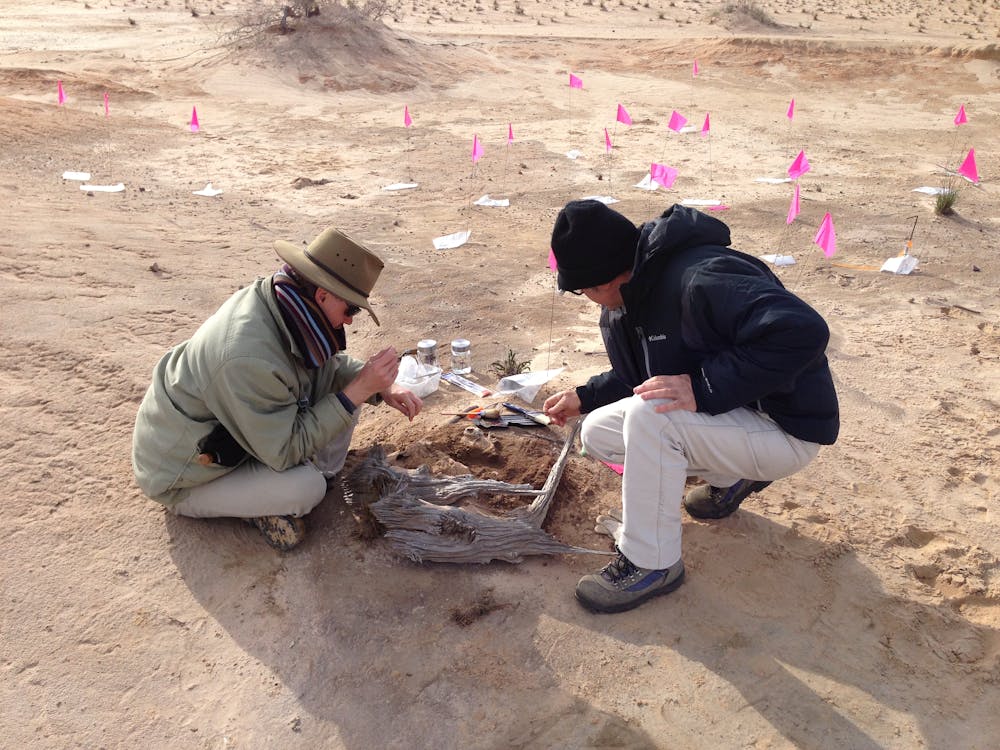
The Willandra Lakes World Heritage Area, in southeast Australia, provides an extraordinary archaeological and palaeoecological record of Ice Age Australia.

Recovery of fossils and devil coprolites from eroding bettong burrows at the Willandra Lakes World Heritage Area. Michael Westaway, Author provided

In the past, skeletal remains buried within the landscape were commonly fossilised. Evidence of small animals that dug burrows (such as burrowing bettongs) and the predators that pursued them in their burrows, are exceptionally well preserved.

Our excavations reveal how devils and other small-to-medium sized mammals and reptiles interacted over more than 20,000 years in this area. Even during the peak arid phase, known as the Last Glacial Maximum, it seems that devils and their prey successfully co-existed.

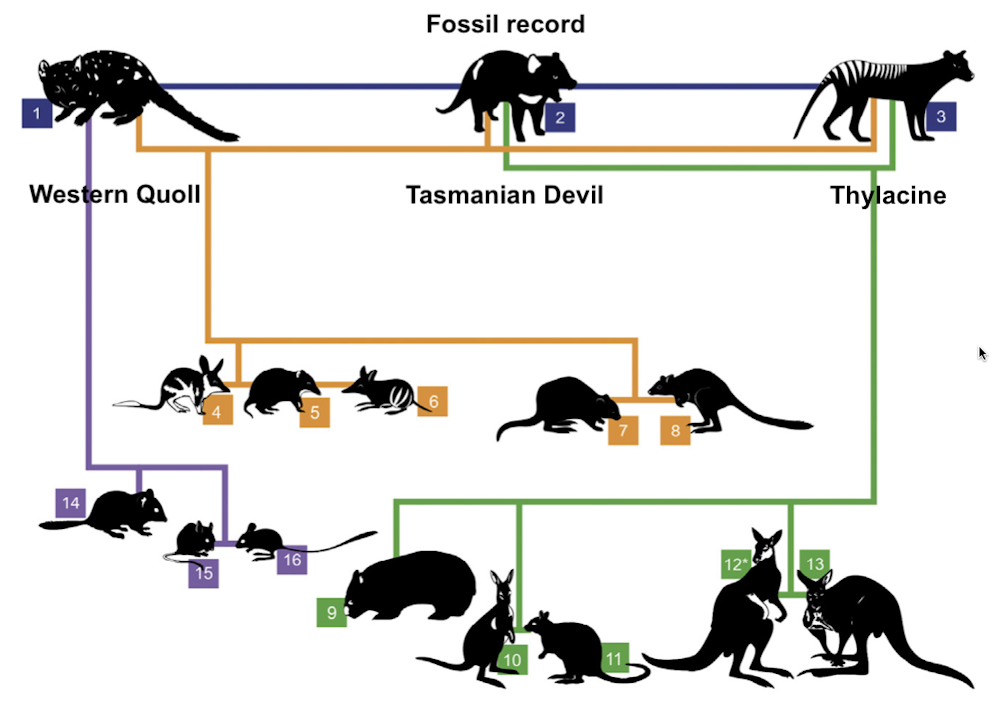
The fossil record (10,000 to 4,000 years ago): This shows the fauna reference condition prior to the arrival of the dingo. (1 Western Quoll, 2 Tasmanian Devil, 3 Thylacine, 4 Bilby, 5 Western Barred Bandicoot, 6 Southern Brown Bandicoot, 7 Burrowing Bettong, 8 Brush Tailed Bettong, 9 Wombat, 10 Nail-Tailed Wallaby, 11 Hare Wallaby, 12 Western and Eastern Grey Kangaroo, 13 Red Kangaroo, 14 Crest Tailed Mulgara, 15 Greater Stick Nest Rat, 16 Hopping Mouse, 17 Fox, 18 Cat, 19 Rabbit) Toot Toot Design, Author provided The contemporary record: This shows today’s situation in the Willandra Lakes World Heritage Area. Light grey animals represent those animals that are now locally extinct. Toot Toot Design, Author provided

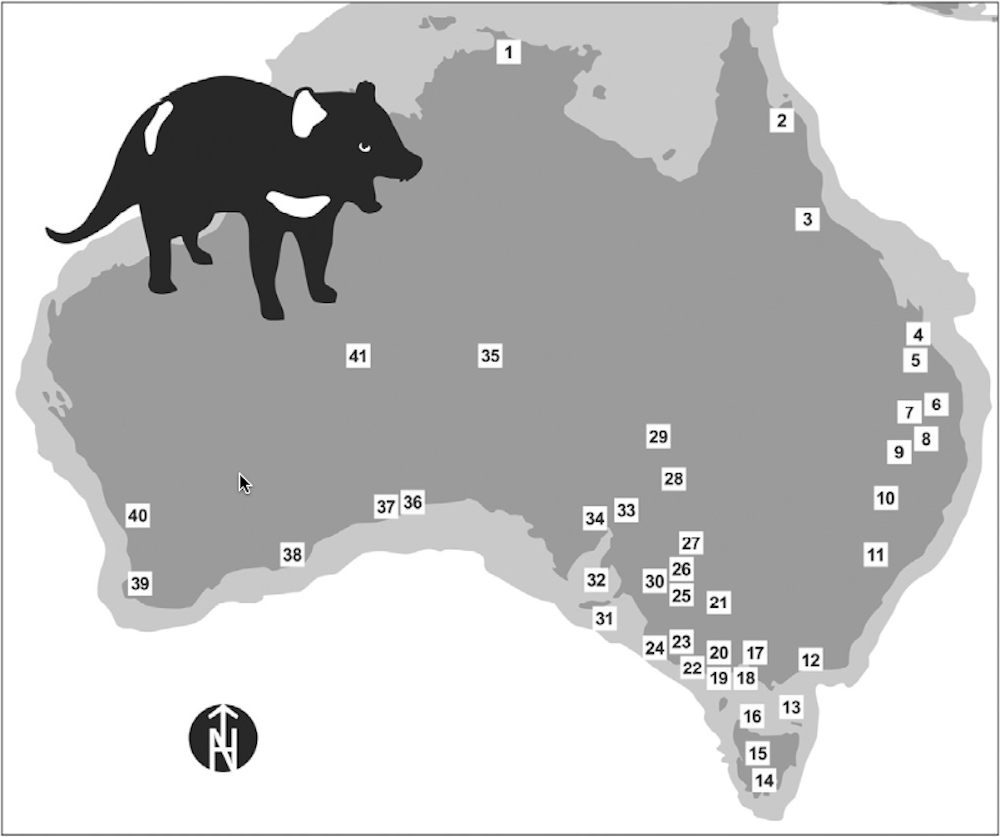
The fossil record shows that the range of habitats occupied by devils in the past was far more diverse than today, with populations being found across environments from the central arid core to the northern tropics.

This suggests that devils today should, theoretically, be able to reoccupy a similarly extensive range of habitats.

Former devil range across Australia as revealed by the known fossil record. Toot Toot Design, Author provided

Better the devil you know

Some ecologists suggest dingoes should be reintroduced into Australian habitats in order to reduce the impact of cats and foxes on native mammals.

One problem is that dingoes also prey on livestock. This is the reason the dingo fence was constructed during the 1880s.

But devils are not active predators of cattle and sheep. So reintroducing a predator that has a much longer evolutionary history with other native mammals in this country would likely receive far less opposition from pastoralists.


Read more: Deadly disease can ‘hide’ from a Tasmanian devil’s immune system


A reintroduction of devils back to the mainland may be a new approach to consider for controlling the relentless, destructive march of exotic predators and restore crucial elements of Australia’s biodiversity.

It still needs to be demonstrated that devils can suppress the activities of cats and foxes on the mainland, as they seem to have done in Tasmania. Experiments with devils in a range of different settings would help to establish this.

A new research approach involving palaeontologists, conservation biologists and policy makers may help us understand how we can restore biodiversity function in Australia.

ref. Could Tassie devils help control feral cats on the mainland? Fossils say yes – http://theconversation.com/could-tassie-devils-help-control-feral-cats-on-the-mainland-fossils-say-yes-63120

A Shorten government could shift the country on important issues and show a little spunk

]]>

Source: The Conversation (Au and NZ) – By Frank Bongiorno, Professor of History, ANU College of Arts and Social Sciences, Australian National University

This is part of a major series called Advancing Australia, in which leading academics examine the key issues facing Australia in the lead-up to the 2019 federal election and beyond. Read the other pieces in the series here.


What will a Shorten government be like? It’s hazardous to predict how an opposition party will govern once in office. Only an imaginative reading of the policy speech Bob Hawke delivered in the Sydney Opera House in February 1983 could have led anyone to expect that his would be a government of financial deregulation, tariff cuts and privatisation. John Howard promised we would “never ever” get a GST. God forbid that Tony Abbott should cut funding to the ABC.

Circumstances change. Government have second thoughts. And in practical politics some commitments do matter more than others, despite the scorn heaped on Howard for distinguishing core and non-core promises.

A Shorten government would occupy a political centre that the Coalition has foolishly vacated. Most of the damage was done by Abbott as prime minister. But Malcolm Turnbull’s failure to recalibrate was no less significant, his fate as a hostage to the right sealed at the 2016 election.

Shorten and his treasurer, Chris Bowen, would inherit an economy that, for all its vulnerability, has been touched more lightly than most by the global ordeals of the last decade. And Labor would govern a nation that has maintained a fair level of social cohesion. Here, the populisms of left and right disrupting European and American politics, and the rise of the political strongman, have had only the faintest echoes.

Shorten is no Jeremy Corbyn; he is not even a Jacinda Ardern. Australia has not experienced a fierce anti-migrant backlash. Yes, there are complaints about “congestion”, and conservative politicians and radio shock jocks are prepared to kick the African gang can along. But Australia’s politics lacks the desperation, and the loathing, associated with Brexit, Donald Trump and the creepier versions of contemporary xenophobia.


Read more: Shorten the consensus leader unites a fractured Labor, but it may not quite be enough


That should be an attractive field for a centre-left government, as good as it gets in a post-GFC world. But polls and surveys also indicate that trust in politics is low. That’s a problem for Shorten. Social democracy is a rational politics that demands a certain level of trust, or at least of popular consent.

If people are disengaged, it’s bad news for centre-left governments because it becomes easier for vested interests to buy undue influence. Politics loses its sense of proportion. The world as we know it will come to an end if this mining tax is implemented, or that tax break taken away. Every effort to reset priorities becomes a challenge to an entrenched interest with the cash and connections to make its oppression widely appreciated.

Still, to predict that Shorten will govern from the centre is to say almost nothing unless you are also willing to say what that centre might look like. The political centre likely to be occupied by a Shorten government in 2019 is a very different beast from its counterpart of before 2008. It will likely be a “radical centre”, to use a phrase favoured by Noel Pearson.

For one, it’s likely to be much more preoccupied with economic inequality than the Labor governments of the Hawke and Keating era. It will be a government more worried about income stagnation, wage theft and a housing market that has locked many out. Still, it will work hard to avoid the perception that it’s a soft touch. It might eventually increase benefits for those without a job. But it has, in opposition, given no sign that it is willing to risk the votes of the hard-working and the self-righteous in the interests of a little less cruelty to the unemployed.

Labor will continue to worry over low wage growth and, in government, it might try to widen the scope for industry-wide bargaining. This will raise the invariably sensitive issue of its relationship with the union movement, and especially with the ACTU under the dynamic leadership of Sally McManus.

A Shorten government’s relationship with the unions is a matter on which its leader is vulnerable to criticism, given his background as a leader of the Australian Workers Union. He will surely seek to avoid the impression that the unions are dictating terms, but the Change the Rules campaign being run by the ACTU will keep the pressure on. And with wages as flat as they are, and union coverage so low, this old bogey may well have run out of steam everywhere but in the Murdoch media.

Shorten will face questions about his party’s relationship with trade unions, particularly the ACTU under Sally McManus. AAP/Glenn Hunt

For this and other reasons, a Shorten government will be more frank than governments of the 1980s and 1990s about the ways that markets fail, and of the need for governments to intervene when they do. It will ride the ill-will towards the banks to strengthen regulation, although without making life too uncomfortable for the big four.

It will be more concerned with the need to create public goods as a pillar of continuing prosperity. It will oversee a modest expansion of the higher education sector and adopt a more coordinated approach, with more generous funding, to research policy. It will embrace science with enthusiasm – because it helps us prosper – and will feign enthusiasm for culture and the arts to keep quiet, if not happy, the luvvies, bookworms and eggheads. The Australian War Memorial will continue to do better than the National Library, Archives or Museum.

A Shorten government would regard climate change as the most pressing challenge of the age. But, unlike Rudd, Shorten understands that he will be unable to change his mind about that importance when the going gets tough, as it will. A Shorten government will resume the task of creating a carbon market – which it won’t call a tax – and it will hasten the take-up of renewable energy.

It will be rightly preoccupied with issues of gender equality, exploiting its competitive advantage over a Coalition hamstrung by a perception that it is unsympathetic and uncongenial to women. It will attempt modest experimentation around Indigenous recognition and a voice to parliament, and might flirt with a treaty and a truth-telling commission. It will set out a road map to a republic and probably end up in the usual bog as soon as talk of models begins. It will engage in as much or as little cruelty toward those seeking asylum as it feels it needs to keep the boats out, the votes in, and the feral commentariat off its back.


Read more: Grattan on Friday: What Labor has to fear is the Big Scare


At least as long as Trump remains in office, a Shorten government will be more sceptical about the alliance with the United States, and it will tread warily around China’s burgeoning global ambitions. Will a Prime Minister Shorten, like Prime Minister Gillard, discover a taste for international affairs? It’s hard to know, but there will be a significant level of interest in an electorally successful centre-left government given the continuing global crisis of social democracy.

A Shorten government will face a mean and tricky media environment. Especially in the light of Shorten’s apparent effort to keep his distance from the old man himself, the Murdoch press’s campaigning will be brutal; how effective, it’s harder to know. Legacy media increasingly preach to the converted. Nine, incorporating the media company formerly known as Fairfax, tacks to the right and seems unlikely to give a Labor government too many free kicks. The ABC, bullied by Coalition governments, may ironically find a renewed freedom, purpose and vigour in holding a Labor government to account.

Perhaps above all, this would be a government likely to be dependent on younger voters. Many are very angry with a Coalition that flaunts its contempt for them and their values, at the same time as it plucks them to featherbed older and better-off constituents with franking credits, superannuation concessions and negative gearing. A Shorten government will need to be responsive to younger Australians’ desire for good wages, job security and affordable education and housing.

Shorten does not, on the face of it, seem like the future leader of a transformative government. He has caution and pragmatism written all over him. He and his colleagues will be particularly keen to avoid the many unforced errors of the Rudd and Gillard governments. If Labor falters, and especially if it falls apart amid rancour and recriminations, the reaction of the voting public will be swift and merciless.

If elected, a Shorten government might do well to set a few priorities for its first couple of years and spend as much political capital as it dares pursuing them with vigour. Voters seem impatient for an end to policy gridlock and leadership shenanigans. They might be ready to reward a unified and purposeful government with a bit of spunk about it.

ref. A Shorten government could shift the country on important issues and show a little spunk – http://theconversation.com/a-shorten-government-could-shift-the-country-on-important-issues-and-show-a-little-spunk-110885

Win or lose the next election, it may be time for the Liberals to rethink their economic narrative

]]>

Source: The Conversation (Au and NZ) – By Carol Johnson, Adjunct Professor, Department of Politics and International Relations, University of Adelaide

This is part of a major series called Advancing Australia, in which leading academics examine the key issues facing Australia in the lead-up to the 2019 federal election and beyond. Read the other pieces in the series here.


In the heady political days of late 2018, former treasurer Peter Costello argued that the Liberals need to unite behind a clear economic narrative. He claimed that this would avoid Liberal politicians defining themselves on the “social issues” that have divided the government.

However, the ideological problems in the Liberal government go beyond the evident, and electorally damaging, differences over social issues. The Liberals’ economic ideology, which often cuts across their internal division between conservatives and moderates, may also be contributing to their electoral and policy difficulties.

Is it now time for the Liberals to reconsider their free market, neoliberal economic policy narrative? It emphasises lower taxes combined with radical deregulation, privatisation, corporatisation, major cuts to government spending on services and the dismantling of Australia’s century-old industrial arbitration system.

But it is a narrative that contributed to the 2014 budget cuts that helped undermine the Abbott government. It gave rise to the proposed tax cuts for big business that contributed to the poor 2016 election and 2018 byelection results. It also made it harder for the Liberals to accept a range of regulatory policy issues, including the need for a banking royal commission.


Read more: Turnbull is right to link the Liberals with the centre – but is the centre where it used to be?


Costello’s critics claim that his own tax cuts significantly reduced government revenue. This made it much more difficult for future governments to return the budget to surplus.

Has neoliberalism’s time passed?

The Liberals have always argued that they would be better economic managers than Labor; that they supported individual rights and free enterprise and opposed Labor’s so-called “socialism”. Nonetheless, their economic narrative has not always been the neoliberal, free market one that Costello and others have espoused from the Howard government on. As we shall see below, the Liberals originally believed in a more substantial role for government.

Labor has been quietly moving away from some neoliberal positions that it embraced during the Hawke and Keating years. For example, it is now more supportive of government regulation and has re-embraced Keynesian perspectives that see a major role for the state in managing capitalist economic cycles.

It has also questioned some neoliberal aspects of past Labor government industrial relations policy, such as an over-reliance on enterprise bargaining, acknowledging that this has contributed to reduced wages and conditions.

The Liberals have introduced some electorally opportunistic economic measures. These include funding for industries in sensitive electorates, energy price measures and backing down on tax cuts to big business that they couldn’t get through the Senate. But they have not undertaken a major reconsideration of their economic ideology despite the related policy problems, from unpopular budget and tax cuts to originally opposing a banking royal commission.

Robert Menzies believed governments should implement more economic controls, not fewer. AAP/AUSPICS

Yet Robert Menzies, the founder of the party, decried laissez-faire economics and argued for more controls, not fewer. He boasted of reading Keynes, given that politicians need to know “a great deal about applied economics”.

Menzies also championed the role of Liberal administrations in establishing an industrial relations arbitration and conciliation system that gave “to organised labour the basic wage, the standard working week, the protection of employees and the enforcement of their legally established rights”.

Nonetheless, the Howard government largely abolished such a system in its neoliberal-influenced (and electorally unpopular) WorkChoices legislation.

In short, the Liberals were originally more influenced by social liberalism, rather than neoliberalism, in that they were more willing to endorse state intervention to protect the welfare of citizens and the smooth functioning of markets.

So why might it be important for the Liberals to reconsider some of their economic policy narrative now?

Time for a rethink

Social democrats are fond of claiming that it has been their historical role to save capitalism from its own excesses, including during the Global Financial Crisis. However, social liberals can argue that they have also aimed to do that.

Capitalism now faces some major policy challenges. The very neoliberalism the Liberals have championed since Howard has contributed to a crisis of consumption. In Australia, the weakening of both unions and arbitration protections, particularly industrial awards, has contributed to lower wage outcomes. Reduced consumption then has impacts on private businesses that have trouble selling their goods and services.

Contemporary Liberal governments have tended to respond to cost-of-living pressures by arguing they will cut taxes and energy costs while Labor will increase them. However, negative campaigning against Labor’s tax and energy policies may prove insufficient to allay voters’ concerns about low wages growth.

Meanwhile, voters may be less convinced by arguments for free markets and light-touch regulation in the wake of the disturbing findings of the banking royal commission. This is despite the government’s belated pledges to take action, including on regulatory issues it had previously rejected.

There is also evidence, at both federal and state level, that neoliberal deregulation, privatisation and outsourcing of government functions have contributed to dysfunction in many areas. Examples include high-rise building safety (for example, structural failures and flammable cladding), and the pharmaceutical industry.


Read more: Cladding fire risks have been known for years. Lives depend on acting now, with no more delays


The Royal Commission into Aged Care, initiated by the Morrison government, is likely to reveal further regulatory failures in both design and implementation.

Federal and state governments have repeatedly proved naive in their belief that inadequately regulated industries will put the needs of ordinary Australians before the pursuit of financial gain. Consequently, they risk doing too little, too late.

The case for greater government intervention

A neoliberal belief in free markets has arguably contributed to the Liberals’ inadequate efforts to address serious market failures in areas ranging from climate change to high-speed broadband.

The neoliberalism that the Howard government embraced may no longer be serving the Liberal Party well. AAP/Paul Miller

As well, Howard-era neoliberal beliefs, which saw people primarily as individuals and movements for social change as politically correct “special interests” attempting to rip off taxpayer funds, have contributed to a failure to address real issues of discrimination. The Liberals’ failure to deal with gender equity in their own party is just the latest manifestation. This from a party that a women’s organisation played a major role in establishing in the Menzies era, winning quotas in party governance structures as a result.


Read more: ‘Balmain basket weavers’ strike again, tearing the Liberal Party apart


Importantly, all of this is happening just as the international economy is entering a period of considerable uncertainty. This calls for careful government management of the economy and its social effects. The trade tensions between China and the US reflect broader geopolitical and economic challenges to the West as Asia rises.

Technological disruption is likely to increase unemployment, including through offshoring jobs. Developments in biotechnology will pose major ethical and regulatory challenges for governments.

For all the above reasons, it is becoming harder to argue that neoliberal market solutions, from tax cuts to deregulation, will necessarily benefit and protect ordinary voters. Public support for government spending on services is rising.

Voters have lost trust in politicians and the ability of governments to look after them. The Liberals’ current economic narrative leaves them particularly vulnerable to Labor’s claims they primarily support the big end of town.

Whether they win the 2019 federal election or find themselves back in opposition, it may be time for the Liberals to reconsider their attitude to the role of government in providing services and regulating markets effectively, while still claiming that they are more supportive of private enterprise and are better economic managers than Labor.

The challenges of 21st-century Australia may require the Liberals to draw on some of their earlier, social liberal, perspectives.

ref. Win or lose the next election, it may be time for the Liberals to rethink their economic narrative – http://theconversation.com/win-or-lose-the-next-election-it-may-be-time-for-the-liberals-to-rethink-their-economic-narrative-110902

Explainer: what is Murray Valley encephalitis virus?

]]>

Source: The Conversation (Au and NZ) – By Ana Ramírez, PhD candidate, James Cook University

Western Australian health authorities recently issued warnings about Murray Valley encephalitis, a serious disease that can spread by the bite of an infected mosquito and cause inflammation of the brain.

Thankfully, no human cases have been reported this wet season. The virus that causes the disease was detected in chickens in the Kimberley region. These “sentinel chickens” act as an early warning system for potential disease outbreaks.

What is Murray Valley encephalitis virus?

Murray Valley encephalitis virus is named after the Murray Valley in southeastern Australia. The virus was first isolated from patients who died from encephalitis during an outbreak there in 1951.

The virus is a member of the Flavivirus family and is closely related to Japanese encephalitis virus, a major cause of encephalitis in Asia.

Murray Valley encephalitis virus is found in northern Australia circulating between mosquitoes, especially Culex annulirostris, and water birds. Occasionally the virus spreads to southern regions, as mosquitoes come into contact with infected birds that have migrated from northern regions.


Read more: After the floods come the mosquitoes – but the disease risk is more difficult to predict


How serious is the illness?

After being transmitted by an infected mosquito, the virus incubates for around two weeks.

Most people infected don’t develop symptoms. But, if you’re unlucky, you could develop symptoms ranging from fever and headache to paralysis, encephalitis and coma.

Around 40% of people who develop symptoms won’t fully recover and about 25% die. Generally, one or two human cases are reported in Australia per year.

Since the 1950s, there have been sporadic outbreaks of Murray Valley encephalitis, most notably in 1974 and 2011. The 1974 outbreak was Australia-wide, resulting in 58 cases and 12 deaths.

It’s likely the virus has been causing disease since at least the early 1900s when epidemics of encephalitis were attributed to a mysterious illness called Australian X disease.

Traditional monitoring of mosquito-borne diseases relies on the collection of mosquitoes using specially designed traps baited with carbon dioxide. Cameron Webb

Early warning system

Given the severity of Murray Valley encephalitis, health authorities rely on early warning systems to guide their responses.

One of the most valuable surveillance tools to date have been chooks because the virus circulates between birds and mosquitoes. Flocks of chickens are placed in areas with past evidence of virus circulation and where mosquitoes are buzzing about.

Chickens are highly susceptible to infection so blood samples are routinely taken and analysed to determine evidence of virus infection. If a chicken tests positive, the virus has been active in an area.

The good news is that even if the chickens have been bitten, they don’t get sick.

Mosquitoes can also be collected in the field using a variety of traps. Captured mosquitoes are counted, grouped by species and tested to see if they’re carrying the virus.

This method is very sensitive: it can identify as little as one infected mosquito in a group of 1,000. But processing is labour-intensive.


Read more: How Australian wildlife spread and suppress Ross River virus


How can technology help track the virus?

Novel approaches are allowing scientists to more effectively detect viruses in mosquito populations.

Mosquitoes feed on more than just blood. They also need a sugar fix from time to time, usually plant nectar. When they feed on sugary substances, they eject small amounts of virus in their saliva.

This led researchers to develop traps that contain special cards coated in honey. When the mosquitoes feed on the cards, they spit out virus, which specific tests can then detect.

We are also investigating whether mosquito poo could be used to enhance the sugar-based surveillance system. Mosquitoes spit only tiny amounts of virus, whereas they poo a lot (300 times more than they spit).

This mosquito poo can contain a treasure trove of genetic material, including viruses. But we’re still working out the best way to collect the poo.

Mosquito poo, shown here after mosquitoes have fed on coloured honey, can be used to detect viruses like Murray Valley encephalitis. Dagmar Meyer

Staying safe from Murray Valley encephalitis

There is no vaccine or specific treatment for the virus. Avoiding mosquito bites is the only way to protect yourself from the virus. You can do this by:

  • wearing protective clothing when outdoors

  • avoiding being outdoors when the mosquitoes that transmit the virus are most active (dawn and dusk)

  • using repellents, mosquito coils, insect screens and mosquito nets

  • following public health advisories for your area.

The virus is very rare and your chances of contracting the disease are extremely low, but not being bitten is the best defence.

ref. Explainer: what is Murray Valley encephalitis virus? – http://theconversation.com/explainer-what-is-murray-valley-encephalitis-virus-112212

The government’s $2bn climate fund: a rebadged rehash of old mistakes

]]>

Source: The Conversation (Au and NZ) – By Ian A. MacKenzie, Senior Lecturer in Economics, The University of Queensland

Australia’s new flagship Climate Solutions Fund, announced this week by Prime Minister Scott Morrison, will spend more than A$2 billion on cutting greenhouse emissions by 2030.

While action on climate change is welcomed, this announcement seems to be a faithful reprise of the previous Emissions Reduction Fund, which was beset with problems.

The government has put a new name on an existing scheme, while steadfastly refusing to learn from mistakes made along the way. In cruder terms, it’s slapped a gleaming coat of lipstick onto a pig of a policy.

Add to that the A$1.38 billion pledged today for building the Snowy 2.0 scheme – another plan hatched by one of the government’s former incarnations – and there’s not a lot of imagination on display as Morrison’s government scrambles for some much-needed climate credibility ahead of this year’s election.


Read more: Australia’s Emissions Reduction Fund is almost empty. It shouldn’t be refilled


Currently Australia’s main tool to try and reduce emissions is the Emissions Reduction Fund (ERF), a “reverse auction” that lets businesses voluntarily reduce pollution and be rewarded with taxpayer cash. Successful bidders for funding have to sign a contract to reduce their pollution over several years.

So far, 193 million tonnes of pollution reduction has been secured at an average cost of A$12 per tonne. In total, around A$2.5bn will have been used to help businesses reduce pollution under the ERF’s original incarnation.

The Climate Solutions Fund is basically a rebranding exercise. It will build on the existing ERF but now expands the scope of participants, including allowing farmers to drought-proof their farms and subsidising businesses to pursue energy-efficiency projects.

Experience tells us it’s a bad idea

The aim for any climate policy should be to reduce our emissions to the agreed 2030 levels at the lowest possible cost. Unfortunately this is unlikely to happen with the Climate Solutions Fund.

This fund will inherit many of the ERF’s existing problems.

One of the ERF’s main issues is with its so-called “safeguard mechanism”. This was set up to ensure that large polluters could not cancel out the progress achieved by the fund’s participants. But this has failed: many large polluters’ “benchmarks” (the amount of emissions they are allowed to release before being penalised) have increased over time and, consequently, much of the work done by the fund has indeed been undone. Because of this, the fund has not given good value for money, despite awarding funding to the lowest bidders.

There are deeper problems. The way the funding is awarded – with public funds going to project proponents who promise to do a good job – the participants inevitably know more about the details of the projects than the government does. This “informational asymmetry” may mean that businesses overquote, asking for more money than they would be prepared to accept.

The successful projects that have signed up may not even be genuinely “additional”, in that they may well have gone ahead regardless of whether or not they won government backing. In other words, we could be paying for something that would have happened anyway!

But we know what works

Economists have known for decades the best way to encourage pollution reduction. It involves putting a price on carbon.

Implementing a carbon tax or (more likely) a carbon trading market will give business the flexibility to choose their own pollution control measures, while also ensuring that overall emissions are reined in.


Read more: One year on from the carbon price experiment, the rebound in emissions is clear


A carbon price will spur industry to invest in cleaner technologies (and increase the potential for jobs growth in these areas) and ensure we meet our climate goals.

Despite prophesies of economic doom, a carbon price can be used to decarbonise the economy, simulate growth in new industries, and redistribute the revenue to ensure equity. It’s using economic levers to help the environment.

Putting lipstick on a pig does not change the fact that it is still a pig.

ref. The government’s $2bn climate fund: a rebadged rehash of old mistakes – http://theconversation.com/the-governments-2bn-climate-fund-a-rebadged-rehash-of-old-mistakes-112412

Eighteen countries showing the way to carbon zero

]]>

Source: The Conversation (Au and NZ) – By Pep Canadell, CSIRO Oceans and Atmosphere; Executive Director, Global Carbon Project, CSIRO

Eighteen countries from developed economies have had declining carbon dioxide emissions from fossil fuels for at least a decade. While every nation is unique, they share some common themes that can show Australia, and the world, a viable path to reducing emissions.

Global CO₂ emissions from fossil fuels continue to increase, with record high emissions in 2018 and further growth anticipated for 2019. This trend is linked to global economic growth, which is largely still powered by the burning of fossil fuels.


Read more: Australia is counting on cooking the books to meet its climate targets


Significant reductions in the energy and carbon intensities of the global economy have not been sufficient to trigger decreases in global emissions.

But 18 countries have been doing something different. A new analysis sheds light on how they have changed their emission trajectories. There is no “silver bullet”, and every country has unique characteristics, but three elements emerge from the group: a high penetration of renewable energy in the electricity sector, a decline in energy use, and a high number of energy and climate policies in place. Something is working for these countries.

Australia was not part of the study, as its CO₂ emissions from the burning of fossil fuels remained largely stable over the study period 2005-2015 while the country’s economy grew. However, emissions of all greenhouse gases across all sectors of the economy (including land use change) declined over most of the same period, a trend that reversed in 2014 since when emissions have increased.

Why did emissions decline?

The 18 countries shown below all peaked their fossil fuel emissions no later than 2005 and had significant declines thereafter to 2015, the period covered by our study.

Changes in CO2 emissions from fossil fuel combustion for 18 countries with declining emissions during 2005-2015. Countries are ordered by how soon their emissions peaked and began to decline. Le Quéré et al. Nature Climate Change (2019) based on data from the International Energy Agency @IEA/OECD

Uniformly, the largest contribution to emissions reductions – about 47% – was due to decreases in the fossil share of energy production, while reductions in overall energy use contributed 36%.

However, there are large differences in the relative importance of the factors that drove emissions reductions in the various countries. For instance, reduced energy use dominated emissions reductions in many countries of the European Union, whereas a more balanced spread of factors dominated in the United States, with the single largest contributor being the switch from coal to gas. Emissions reductions in Austria, Finland and Sweden were due to an increased share of non-fossil and renewable energy.

Interestingly, our analyses suggest that there is a correlation between the number of policies to promote the uptake of renewable energy and the decline in the 18 countries.

The declining emissions were not caused by the consumption of products produced elsewhere during the period examined. Earlier in the 2000s, this practice of outsourcing emissions to other countries (for example by moving manufacturing offshore) was a significant driver of emissions decline in many developed countries. But that effect has diminished.

The lasting consequences of the 2008 global financial crisis on the global economy however did have an impact, and partially explained the reduced energy use in many countries.

How significant are these emissions declines?

Emissions declined by 2.4% per year during 2005-15 across the 18 countries.

One could argue this decline is not particularly meaningful because global fossil fuel emissions continued to grow at 2.2% per year during the same period. However, this group of countries is responsible for 28% of the global CO₂ emissions from fossil fuels. That is a sizeable fraction, and if the decline continues and further intensifies it can have a significant impact.

The 18 peak-and-decline countries also played a part in the stalling of global emissions between 2014 and 2016 while the global economy continued to grow, a combination that showed, briefly and for the first time, what accelerated decarbonisation would look like. While China did not have 10 years of continuous declining emissions (and hence it was not part of the group of 18 countries), it was the biggest contributor during this stalling.

There is no guarantee that the declining trends will continue over the coming decades. In fact, our global 2018 carbon budget report showed that some of the more recent country trends are fragile and require further policy and actions to strengthen the decreases and support long-term robust decarbonisation trends.


Read more: Carbon emissions will reach 37 billion tonnes in 2018, a record high


If a journey of a thousand miles begins with a single step, it seems some countries have already begun walking that road. Now we all need to start running decisively.

ref. Eighteen countries showing the way to carbon zero – http://theconversation.com/eighteen-countries-showing-the-way-to-carbon-zero-112295

Early sowing can help save Australia’s wheat from climate change

]]>

Source: The Conversation (Au and NZ) – By James Hunt, Associate Professor, La Trobe University

Climate change has already reduced yields for Australian wheat growers, thanks to increasingly unreliable rains and hostile temperatures. But our new research offers farmers a way to adapt.

By sowing much earlier than they currently do, wheat growers can potentially increase yields again. However, our study published today in Nature Climate Change shows that to do this they need new varieties that allow them more leeway to vary their sowing dates in the face of increasingly erratic rainfall.


Read more: Changing climate has stalled Australian wheat yields: study


Sowing wheat is a matter of delicate timing. Seeds of current varieties need to be planted at just such a time so that, months later, the plants flower during a window of just 1-2 weeks, known as the optimal flowering period.

In Australia’s wheat belt this window is generally in early spring. At this time the soil is moist after the cool, wet winter; days are getting longer and sunnier; maximum temperatures are still relatively low; and frosts are less frequent. If crops flower outside the optimal window, yields decline sharply.

Crops and colonies

When Europeans first started trying to grow wheat in Australia, they used varieties that were suited to the cool, wet climate of northern Europe, where the optimal flowering period is in summer. These varieties were much too slow to flower in Australian conditions, and yields were very low. Wheat breeder William Farrer used faster-developing wheats from India to create the Federation variety, which revolutionised wheat production in Australia, earning Farrer the ultimate honour of having a pub named after him.

Federation wheat is a “spring wheat”, moving rapidly through its life cycle regardless of when it is planted. If you sow it earlier, it flowers earlier. For more than a century Australian wheat breeders have bred spring wheats, allowing growers to adjust their sowing time to get their crops to flower during the optimal period. Anzac Day has traditionally been the start of sowing season, after autumn rains have wet the soil enough for seeds to germinate.

Here is where climate change is causing a problem. If farmers sow later than mid-May, the wheat is likely to miss its spring flowering window. But southern Australia has experienced declining April and May rainfall, making it harder for growers to sow and establish crops at the right time. This in turn means crops flower too late the following spring, meaning yields are reduced by drought and heat.

Growers could start sowing earlier, and use stored soil water from summer rain (which hasn’t declined and has even increased at some locations), but current spring wheat varieties would flower too early to yield well. For farmers to sow earlier, they need a different sort of wheat in which development is slowed down by an environmental cue. One such environmental cue is called vernalisation. Plants that are sensitive to vernalisation will not flower until they have experienced a period of cold temperatures. These strains are thus called “winter wheats”.

Ironically enough, the wheat varieties that Europeans first brought to Australia were winter wheats, but they were further slowed by sensitivity to day length which made them too slow to reach the earlier flowering times needed in the hotter, drier colony.

But this problem can be sidestepped by using a “fast winter wheat”, which is sensitive to vernalisation but not to day length. Our previous research showed that this type of wheat was very suited to Australian conditions – it can be sown early but still flower at the right time. In fact, the vernalisation requirement means that this wheat can be sown over a much broader range of dates and experience fluctuating temperatures, and still flower at the right time.

Yielding results

In our new research, we developed different lines of wheat that varied in their response to vernalisation and day length, and grew them across the wheat belt to compare which ones would yield best at earlier sowing times.

We found that a fast winter wheat performed best over most of the wheatbelt, and on average yielded 10% more than spring wheat when they flower at the same time.

We then used computer simulations to investigate how these crops would perform at the scale of an entire farm. Our results showed that if Australian growers had access to adapted winter varieties in addition to spring varieties, they could start sowing earlier in seasons where there was an opportunity. If the rains come early, farmers can use the winter wheat; if they come late they can switch to the spring wheat, which yields better than winter wheat at late sowing times.

This would mean that more area of crop would be planted on time, and yields would increase as a result. If realised, this could increase national wheat production by about 20%, or roughly 7.1 million tonnes.


Read more: Australia’s farming future: can our wheat keep feeding the world?


The main hurdle is that growers do not currently have access to suitable winter wheats. Breeding companies have started work on them, but it will be several years before suitably high-quality varieties become available.

Australian growers urgently need to keep pace with climate change. Although Australia only produces 4% of the world’s wheat, it accounts for 10% of exports and is thus important in determining global supply and price. If global wheat supply is low, prices rise, and it becomes unaffordable for many of the world’s poorest people, potentially causing malnutrition and civil unrest. Steeply rising wheat prices were among the factors behind the food riots that broke out in more than 40 countries in 2007-08, which helped to trigger the Arab Spring uprisings of 2010-12.

The world’s poorest people deserve to be able to buy wheat. But Australian wheat farmers also need to earn a decent living and stay internationally competitive. The only way to meet all these needs is to keep production costs low – and increasing yields by sowing the right wheat cultivars for Australia’s changing climate is one way to go about it.

ref. Early sowing can help save Australia’s wheat from climate change – http://theconversation.com/early-sowing-can-help-save-australias-wheat-from-climate-change-112306

Koalas can learn to live the city life if we give them the trees and safe spaces they need

]]>

Source: The Conversation (Au and NZ) – By Edward Narayan, Senior Lecturer in Animal Science, Western Sydney University

Australia is one of the world’s most highly urbanised nations – 90% of Australians live in cities and towns, with development concentrated along the coast. This poses a major threat to native wildlife such as the koala, which can easily fall victim to urban development as our cities grow. Huge infrastructure projects are planned for Australian cities in the coming few years.

The need to house more people – the Australian population is projected to increase to as much as 49.2 million by 2066 – is driving ever more urban development, much of it concentrated in our biggest cities on the east coast. This is bad news for the koala population, unless the species’ needs are considered as part of planning approvals and the creation of urban green spaces. The good news is that koalas can learn to live the “green city life” as long as they are provided with enough suitable gum trees in urban green spaces.


Read more: Long-running battle ends in a win for residents, koalas and local council planning rules


Indeed, our newly published research, which analysed stress levels in wild koalas according to their habitat, reveals that koalas are the most stressed in rural and rural-urban fringe zones. This appears to be due to factors such as large bushfires, heatwave events, dog attacks, vehicle collision and human-led reduction of prime eucalyptus habitats. Koalas living in urban landscapes are less stressed as long as the city includes suitable green habitats.

If there are suitable trees, koalas can learn to live among us – this one is next to a school in South Australia. Vince Brophy/Shutterstock

In other words, wild animals including the koala can adapt to co-exist with human populations. Their ability to do so depends on us giving them the space, time and freedom to make that adaptation. This means ensuring they can carry out, without undue pressures, the biological and physiological functions on which their survival depends.

Wildlife species that lack access to suitable green habitats in cities are at higher risk of death and local extinction. Having to move between fragmented patches of habitat increases the risks. Land clearing and habitat destruction for infrastructure projects and other urban development are compounding the major threats to koalas, such as being hit by vehicles or attacked by dogs.


Read more: Koalas are feeling the heat, and we need to make some tough choices to save our furry friends


How does human pressure cause stress in wildlife?

Animals cope with stressful situations in their lives through very basic life-history adjustments and ecological mechanisms. These include changes in physiology and behaviour in response to stresses in their environment.

We can help make the environment more suitable for wildlife species by ensuring their basic needs for food, water and shelter are met. If animals are deprived of any of these necessities, they will show signs of stress.

So by subjecting wildlife to extrinsic stressors such as habitat clearance, climate change and pollution we are making it even more difficult for these animals to manage stress in their daily lives.

Basically any unwanted change to an animal’s environment that prevents it from performing its basic life-history functions, such as foraging and social behaviour, will cause stress.

So what can be done?

The koalas are telling us it’s a major problem when urban design is not green enough. Innovative solutions are needed!

Cities can do much more for wildlife conservation. Creating safe green spaces for wildlife is critical. Not just koalas but other wildlife such as birds, small mammals, reptiles and frogs can benefit immensely from urban green spaces.

Even in suburbs with plenty of green space, problems still arise because urban planning typically designs this space around access for human recreation and not for the wildlife that was living there before the housing development moved in.

Urban planning should always incorporate the planning of green spaces that are safe for wildlife. Providing wildlife crossings is part of the solution. Another important element is educational programs to alert drivers to the need to look out for koalas.


Read more: Safe passage: we can help save koalas through urban design


Measures like this can minimise impacts on wildlife that faces the many challenges of adjusting to city life.

ref. Koalas can learn to live the city life if we give them the trees and safe spaces they need – http://theconversation.com/koalas-can-learn-to-live-the-city-life-if-we-give-them-the-trees-and-safe-spaces-they-need-112068

What 1,100 Australians told us about the experience of living with debt they can’t repay

]]>

Source: The Conversation (Au and NZ) – By Evgenia Bourova, Research Fellow (Financial Hardship Project), University of Melbourne

Two thirds of Australian adults feel financially insecure. Almost one in two have less than three months’ income saved, and almost one in three have less than one month’s income. One in seven have negligible or no savings, meaning that financial hardship – being unable to pay debts when they fall due – is just a bill away.

This is something that rightly concerns policy makers. Yet for all the attention given to the problem – for example, in the recently completed Senate inquiry into financial services targeted at Australians at risk of financial hardship – there is little empirical research on the topic in Australia to help inform policy responses.


Read more: Should regulation be aimed at saving the payday borrower from themselves?


To address this gap, we conducted Australia’s first large-scale study on the experiences of people in financial hardship. We surveyed 1,101 Australian adults who had been unable to pay a debt when it fell due within the previous two years.

The results must be interpreted carefully, as certain groups – such as people who spoke a language other than English at home, and people aged under 25 – were underrepresented.

Nonetheless, our findings clearly contradict a popular belief that debt problems are mostly due to poor choices. They also shed light on the profound impact that financial hardship – from temporary shortfalls in earnings to severe and ongoing deprivation – has on health, relationships and overall quality of life.

Key survey groups

Of our 1,101 respondents:

  • 480 (43.6%) were “wage recipients”, their main source of income being wages paid by an employer.
  • 402 (36.5%) were “Centrelink recipients”, their income coming primarily from social security payments (for example, the Newstart Allowance for the unemployed, the Disability Support Pension, or the Age Pension).
  • 76 (6.9%) received both wages paid by an employer and a Centrelink payment.
  • 143 (13.0%) had income coming from other sources, such as earnings from their own business, superannuation, and financial assistance from family or friends.

The median income for Centrelink recipients was A$19,981. For wage recipients, it was A$44,876.

The large representation of wage recipients in our sample shows that employment is no guarantee against financial hardship. Nor is educational attainment, with more than one third of wage recipients in our survey having a bachelor’s degree or higher.

Tipping points for financial hardship

We asked respondents about their experiences in the year before they fell behind with repayments. The most common experiences were unemployment and underemployment, as well as physical and mental health problems. Significantly less prevalent were factors such as gambling or alcohol and drug addiction.


datawrapper, CC BY


These results suggest financial hardship can affect anyone, regardless of how personally disciplined they are.

As one respondent told us: “I’m not badly off ($70,000 a year), but I’ve developed two autoimmune conditions on top of a preexisting neurological condition. Medication is expensive, and so are consultations with specialists […] I know how to manage my money, but there are more costs than money coming in […] It’s taught me not to judge people with money problems.”

Less income, more hardship

Falling behind with repayments was a stressful and isolating experience for our respondents, no matter their level of income.

But Centrelink recipients are far more vulnerable, as their incomes leave no margin for unexpected expenses.

“The reason we got in trouble was because the car broke down,” explained one respondent living on a Disability Support Pension. “It was just before Christmas, and all the bills came in together.”


datawrapper, CC BY


Respondents told us that being in debt negatively affected their health, relationships, community involvement, and ability to look for work or finish their education.

“It’s the anxiety,” said one respondent. “Not knowing from week to week whether the debts will all be able to be paid.”

Coping by cutting down

Most of our respondents sought to cope with their situation by reducing spending on food, recreation, utilities, medical care and transport. Just over a third borrowed money from family or friends.


Many wage recipients mentioned cutting down on “extravagances” such as restaurants, alcohol and take-away foods. However, higher proportions of Centrelink recipients were forced to cut down on essentials such as food, heating and medical care.

“I do not have any money for food,” said one respondent living on the Newstart Allowance. “I never thought we would be in this situation.”

Assistance for low-income debtors

Consumer protection laws allow Australians in financial hardship to negotiate moratoriums, payment plans and other arrangements (sometimes known as “hardship variations”) with creditors including banks, energy, water and telecommunications companies.

But just a quarter of our respondents used these provisions to obtain a hardship arrangement from an energy or water company, and only 14.3% used them to obtain assistance from a bank or other credit provider.


Read more: Debt agreements and how to avoid unnecessary debt traps


It is also questionable whether low-income debtors benefit from such arrangements, which tend to be very short-term.

Our results indicate a need to broaden the accessibility of assistance for low-income debtors – for example, by increasing funding for free financial counselling services.

Another measure, recommended by the Australian Council of Social Service and others, is increasing the amount of Newstart and other Centrelink allowances.

Financial hardship can affect almost anyone. However, severe and ongoing debt problems are an inevitability for Australians whose incomes are simply too low to meet the cost of living.

ref. What 1,100 Australians told us about the experience of living with debt they can’t repay – http://theconversation.com/what-1-100-australians-told-us-about-the-experience-of-living-with-debt-they-cant-repay-105296

#Oscars2019 play it safe with Green Book – but don’t look to the Academy for enlightened thinking

]]>

Source: The Conversation (Au and NZ) – By Stuart Richards, Lecturer in Screen Studies, University of South Australia

Every year it is the same story: the Academy comes so close to catching up with the rest of the film world, only to award the Oscar for Best Picture to the most middling of the bunch.

Many cinephiles the world over were likely scratching their heads, or rolling their eyes, or perhaps throwing something at the television, when Julia Roberts called out Green Book’s name, a film the LA Times later dubbed “the worst Best Picture winner since ‘Crash’”.

The film is the story of an unlikely friendship between musician Don Shirley (Mahershala Ali) and his driver Tony Lip (Viggo Mortensen), as they tour America’s South in the 1960s. It sits in a long line of Hollywood films that feature a white protagonist “saving” the black character, who is rendered passive in the process.

The film has been denounced by Shirley’s family for its depiction of him as an isolated figure, estranged from his three brothers and the black community. (In hindsight, maybe Crash wasn’t that bad?)

BlacKkKlansman director Spike Lee was apparently so incensed by the Best Picture announcement that he stormed to the back of the theatre only to be ushered back into his seat. He and director Jordan Peele reportedly did not clap the winners. Later, with a drink in hand, Lee told the press room that the “ref made a bad call”.

Director Spike Lee said that when Green Book won, he thought “the ref made a bad call”.

That a film with a white saviour narrative won the big prize shouldn’t really be much of a shock though.

The Academy Awards have battled with a number of controversies over the last few years, from #Oscarssowhite to La La Land being mistakenly read out as the winner of Best Picture in 2017 over Moonlight. An LA Times report in 2016 identified 91% of Oscar voters as white and 76% male.

It’s clear that the Academy needs to continue to up its game in diversifying the voting demographic.

The role of campaigning, and studios selecting which films to push, also stops the awards from genuinely reflecting the best works. Other films, notably by women directors, were shut out this year. Lynne Ramsay’s You Were Never Really Here and Marielle Heller’s Can You Ever Forgive Me are just two that deserved wider recognition.

The big takeaway message from this year’s ceremony, if it wasn’t clear already, is that we shouldn’t look to the Academy for any enlightened thinking.

A sea of safeness and whiteness

The optics of the Green Book team accepting their award could not have been more glaring. A collection of predominantly white men (and Mahershala Ali and Octavia Spencer to the side) pronounced that the film, to paraphrase, is about love and loving each other despite our differences and finding out that we are the same people.

For a film that is meant to be about race relations in America, all we got from the speech was a sea of safeness and whiteness.

Jim Burke, Charles B. Wessler, Nick Vallelonga, Peter Farrelly, and Brian Currie, the team behind Best Picture Green Book. Etienne Laurent/AAP

In 2010, the Academy expanded the Best Picture category to up to ten nominees. This change also saw the introduction of preferential voting. All voting members rank the year’s nominees from first through to eighth. If the film with the most first place votes doesn’t break 50%, then the film with the lowest first place votes is eliminated and its votes redistributed according to preferences.

This will then occur with the next lowest ranking film until a film cracks the 50% margin. As such, second and third place votes begin to count just as much as first place votes.

This preferential voting system results in a more agreeable film winning over a divisive one. This is perhaps why The Shape of Water won last year over Three Billboards Outside Ebbing, Missouri.

It also creates an interesting divide between critics and much of the film-going public and the Academy voters. Leading up to the awards, critical consensus saw Roma as the more agreeable choice, with Green Book being the divisive nominee. Turns out, this perspective was reversed in the world of the Academy and Green Book was deemed the most agreeable.

A year of back peddling

The awards this year were contentious before the ceremony even began. Kevin Hart’s previous homophobic remarks resulted in him stepping down. Four awards – cinematography, film editing, makeup/hairstyling, and live-action short – were going to be cut from the live broadcast. The Oscars also initially snubbed nominated songs from the show, which is not a new occurrence .

The Academy then did a lot of back peddling. There was no main host, all awards were included in the live broadcast and four of the nominated songs were performed live, with the omission of All the Stars by Kendrick Lamar and SZA from Black Panther due to “logistics and timing”. The Academy is really bad at reading the room until it’s too late.

Rami Malek accepts the Oscar for Best Actor for his performance in Bohemian Rhapsody. Terekah Najuwan/AMPAS/Handout/AAP

John Ottman, accepting the award for Best Editing of Bohemian Rhapsody, said the production was a labour of love with everyone bonding together. This perspective was an odd contrast to recent statements made by Rami Malek, in which he said that working with the film’s sometime director Bryan Singer “was not pleasant”.

In his acceptance speech for Best Actor, Malek also identified Bohemian Rhapsody as being about an unapologetically gay immigrant, yet it has been reported that Mercury was bisexual. If only the film could have been celebratory of Mercury’s sexuality. Still, the homophobic moralising will most likely be overshadowed by Green Book’s win.

One other glaring lowlight of the show was Broadway actress Carol Channing being omitted from the In Memoriam section. While there are eyebrow raising omissions every year, to not include Channing, who was show business personified, is sad indeed.

Highlights

In the sea of disappointment, there were several delightful moments. The choices of presenters seemed laughably odd. Serena Williams introducing A Star is Born and Queen Latifah introducing The Favourite were interesting to say the least. Barbra Streisand introduced BlacKkKlansman because apparently she and Spike Lee both grew up in Brooklyn.

Lee, who won an honorary Oscar in 2016, won this year for Best Adapted Screenplay. The reception the film received was notably more rapturous than the one given to Green Book for Best Original Screenplay. The difference was palpable. Lee noted that February was Black History Month in the US:

1619, 2019. 400 years. 400 years our ancestors were stolen from mother Africa and brought to Jamestown, Virginia enslaved. Our ancestors worked the land, from can’t see at morning to can’t see at night.

The ceremony did see a significant number of women artists of colour taking to the stage to collect awards, from Hannah Beachler, production designer for Black Panther, to Regina King winning for her role in If Beale Street Could Talk.

Other highlights included Lady Gaga and Bradley Cooper’s performance of the Best Original Song, Shallow, which evoked old school Hollywood glamour. The chemistry between the two is palpable.

Lady Gaga and Bradley Cooper perform Shallow, winner of Best Original Song at this year’s Oscars.

Joyous upsets included Olivia Colman winning Best Actress over the hot favourite Glenn Close, who was nominated for her seventh time. Colman gave a scattered and heartwarming speech which won’t be forgotten anytime soon.

Olivia Colman accepts the award for Best Actress at the 2019 Oscars.

The ceremony tried to pitch itself as being liberal, with several mentions of metaphorically tearing down walls. It’s clear though, that in Hollywood, this will always happen on the power players’ terms. The Academy Awards will never be as progressive as we want them to be. If that’s what you are looking for, then tune into the Indie Spirit awards.

In the end, final Oscars presenter Julia Roberts was drowned out by music emanating from the orchestra in the pit as she closed the show. Even the producers were done. Let’s just remember the select moments of joy and forget the rest ever happened.

ref. #Oscars2019 play it safe with Green Book – but don’t look to the Academy for enlightened thinking – http://theconversation.com/oscars2019-play-it-safe-with-green-book-but-dont-look-to-the-academy-for-enlightened-thinking-111733

#Oscars2019 play it safe with Green Book – but don’t look to the Academy for any enlightened thinking

]]>

Source: The Conversation (Au and NZ) – By Stuart Richards, Lecturer in Screen Studies, University of South Australia

Every year it is the same story: the Academy comes so close to catching up with the rest of the film world, only to award the Oscar for Best Picture to the most middling of the bunch.

Many cinephiles the world over were likely scratching their heads, or rolling their eyes, or perhaps throwing something at the television, when Julia Roberts called out Green Book’s name, a film the LA Times later dubbed “the worst Best Picture winner since ‘Crash’”.

The film is the story of an unlikely friendship between musician Don Shirley (Mahershala Ali) and his driver Tony Lip (Viggo Mortensen), as they tour America’s South in the 1960s. It sits in a long line of Hollywood films that feature a white protagonist “saving” the black character, who is rendered passive in the process.

The film has been thoroughly denounced by Shirley’s family for its depiction of him as an isolated figure, estranged from his three brothers and the black community. (In hindsight, maybe Crash wasn’t that bad?)

BlacKkKlansman director Spike Lee was apparently so incensed by the Best Picture announcement that he stormed to the back of the theatre only to be ushered back into his seat. He and director Jordan Peele did not clap the winners. Later, with a drink in hand, he told the press room that the “ref made a bad call”.

Director Spike Lee said that when Green Book won, he thought “the ref made a bad call”.

That a film with a white saviour narrative won the big prize shouldn’t really be much of a shock though.

The Academy Awards have battled with a number of controversies over the last few years, from #Oscarssowhite to La La Land being mistakenly read out as the winner of Best Picture in 2017 over Moonlight. An LA Times report in 2016 identified 91% of Oscar voters as white and 76% male.

It’s clear that the Academy needs to continue to up its game in diversifying the voting demographic.

The role of campaigning, and studios selecting which films to push, also stops the awards from genuinely reflecting the best works. Other films, notably by women directors, were shut out this year. Lynne Ramsay’s You Were Never Really Here and Marielle Heller’s Can You Ever Forgive Me are just two that deserved wider recognition.

The big takeaway message from this year’s ceremony, if it wasn’t clear already, is that we shouldn’t look to the Academy for any enlightened thinking.

A sea of safeness and whiteness

The optics of the Green Book team accepting their award could not have been more glaring. A collection of predominantly white men (and Mahershala Ali and Octavia Spencer to the side) pronounced that the film, to paraphrase, is about love and loving each other despite our differences and finding out that we are the same people.

For a film that is meant to be about race relations in America, all we got from the speech was a sea of safeness and whiteness.

Jim Burke, Charles B. Wessler, Nick Vallelonga, Peter Farrelly, and Brian Currie, the team behind Best Picture Green Book. Etienne Laurent/AAP

In 2010, the Academy expanded the Best Picture category to up to ten nominees. This change also saw the introduction of preferential voting. All voting members rank the year’s nominees from first through to eighth. If the film with the most first place votes doesn’t break 50%, then the film with the lowest first place votes is eliminated and its votes redistributed according to preferences.

This will then occur with the next lowest ranking film until a film cracks the 50% margin. As such, second and third place votes begin to count just as much as first place votes.

This preferential voting system results in a more agreeable film winning over a divisive one. This is perhaps why The Shape of Water won last year over Three Billboards Outside Ebbing, Missouri.

It also creates an interesting divide between critics and much of the film-going public and the Academy voters. Leading up to the awards, critical consensus saw Roma as the more agreeable choice, with Green Book being the divisive nominee. Turns out, this perspective was reversed in the world of the Academy and Green Book was deemed the most agreeable.

A year of back peddling

The awards this year were contentious before the ceremony even began. Kevin Hart’s previous homophobic remarks resulted in him stepping down. Four awards – cinematography, film editing, makeup/hairstyling, and live-action short – were going to be cut from the live broadcast. The Oscars also initially snubbed nominated songs from the show, which is not a new occurrence .

The Academy then did a lot of back peddling. There was no main host, all awards were included in the live broadcast and four of the nominated songs were performed live, with the omission of All the Stars by Kendrick Lamar and SZA from Black Panther due to “logistics and timing”. The Academy is really bad at reading the room until it’s too late.

Rami Malek accepts the Oscar for Best Actor for his performance in Bohemian Rhapsody. Terekah Najuwan/AMPAS/Handout/AAP

John Ottman, accepting the award for Best Editing of Bohemian Rhapsody, said the production was a labour of love with everyone bonding together. This perspective was an odd contrast to recent statements made by Rami Malek, in which he said that working with the film’s sometime director Bryan Singer “was not pleasant”.

In his acceptance speech for Best Actor, Malek also identified Bohemian Rhapsody as being about an unapologetically gay immigrant, yet it has been reported that Mercury was bisexual. If only the film could have been celebratory of Mercury’s sexuality. Still, the homophobic moralising will most likely be overshadowed by Green Book’s win.

One other glaring lowlight of the show was Broadway actress Carol Channing being omitted from the In Memoriam section. While there are eyebrow raising omissions every year, to not include Channing, who was show business personified, is sad indeed.

Highlights

In the sea of disappointment, there were several delightful moments. The choices of presenters seemed laughably odd. Serena Williams introducing A Star is Born and Queen Latifah introducing The Favourite were interesting to say the least. Barbra Streisand introduced BlacKkKlansman because apparently she and Spike Lee both grew up in Brooklyn.

Lee, who won an honorary Oscar in 2016, won this year for Best Adapted Screenplay. The reception the film received was notably more rapturous than the one given to Green Book for Best Original Screenplay. The difference was palpable. Lee noted that February was Black History Month in the US:

1619, 2019. 400 years. 400 years our ancestors were stolen from mother Africa and brought to Jamestown, Virginia enslaved. Our ancestors worked the land, from can’t see at morning to can’t see at night.

The ceremony did see a significant number of women artists of colour taking to the stage to collect awards, from Hannah Beachler, production designer for Black Panther, to Regina King winning for her role in If Beale Street Could Talk.

Other highlights included Lady Gaga and Bradley Cooper’s performance of the Best Original Song, Shallow, which evoked old school Hollywood glamour. The chemistry between the two is palpable.

Lady Gaga and Bradley Cooper perform Shallow, winner of Best Original Song at this year’s Oscars.

Joyous upsets included Olivia Colman winning Best Actress over the hot favourite Glenn Close, who was nominated for her seventh time. Colman gave a scattered and heartwarming speech which won’t be forgotten anytime soon.

Olivia Colman accepts the award for Best Actress at the 2019 Oscars.

The ceremony tried to pitch itself as being liberal, with several mentions of metaphorically tearing down walls. It’s clear though, that in Hollywood, this will always happen on the power players’ terms. The Academy Awards will never be as progressive as we want them to be. If that’s what you are looking for, then tune into the Indie Spirit awards.

In the end, final Oscars presenter Julia Roberts was drowned out by music emanating from the orchestra in the pit as she closed the show. Even the producers were done. Let’s just remember the select moments of joy and forget the rest ever happened.

ref. #Oscars2019 play it safe with Green Book – but don’t look to the Academy for any enlightened thinking – http://theconversation.com/oscars2019-play-it-safe-with-green-book-but-dont-look-to-the-academy-for-any-enlightened-thinking-111733

The law is closing in on Facebook and the ‘digital gangsters’

]]>

Source: The Conversation (Au and NZ) – By Sacha Molitorisz, Postdoctoral Research Fellow, Centre for Media Transition, Faculty of Law, University of Technology Sydney

For social media and search engines, the law is back in town.

Prompted by privacy invasions, the spread of misinformation, a crisis in news funding and potential interference in elections, regulators in several countries now propose a range of interventions to curb the power of digital platforms.

A newly published UK inquiry is part of this building global momentum.


Read more: Why are Australians still using Facebook?


Shortly after Valentine’s Day, a committee of the British House of Commons published its final report into disinformation and “fake news”. It was explicitly directed at Facebook CEO Mark Zuckerberg, and it was less a love letter than a challenge to a duel.

The report found:

Companies like Facebook should not be allowed to behave like ‘digital gangsters’ in the online world, considering themselves to be ahead of and beyond the law.

The committee was particularly vexed by Zuckerberg himself, concluding:

By choosing not to appear before the Committee … Mark Zuckerberg has shown contempt.

Its far-reaching recommendations included giving the UK’s Information Commissioner greater capacity to be “… an effective ‘sheriff in the Wild West of the Internet’.”

The law is back in town

In December 2018, the Australian Competition and Consumer Commission (ACCC) handed down its preliminary report into the impact of digital platforms. It tabled a series of bold proposals.


Read more: Digital platforms. Why the ACCC’s proposals for Google and Facebook matter big time


Then, on February 12, the Cairncross Review – an independent analysis led by UK economist and journalist Frances Cairncross – handed down its report, A Sustainable Future for Journalism.

Referring to sustainability of the production and distribution of high-quality journalism, “Public intervention may be the only remedy,” wrote Cairncross. “The future of a healthy democracy depends on it.”

And a week later, the Digital, Culture, Media and Sport Committee of the House of Commons issued its challenge in its final report on disinformation and “fake news”:

The big tech companies must not be allowed to expand exponentially, without constraint or proper regulatory oversight … only governments and the law are powerful enough to contain them.

How do the responses of the three reports compare?

ACCC inquiry broadest in scope

First, it’s important to note that the scope of these three inquiries varied significantly.

The ongoing ACCC inquiry, billed as a world-first and set to hand down its final report in June, is seeking to assess the impact of digital platforms on media and advertising, with a focus on news.


Read more: Attention economy: Facebook delivers traffic but no money for news media


The Cairncross Review was narrower in intent, addressing “the sustainability of the production and distribution of high quality journalism, and especially the future of the press, in this dramatically changing market.”

And the House of Commons committee had a very direct brief to investigate fake news. It then chose to focus on Facebook.

As such, the three inquiries overlap substantially, but the ACCC investigation is unequivocally the broadest in scope.

Not just distribution platforms

However, all three reports land in roughly the same place when it comes to characterising these businesses. They all see digital platforms as more than just conduits of other people’s content – and this brings certain responsibilities.

The ACCC says digital intermediaries are “considerably more than mere distributors or pure intermediaries” when it comes to the supply of news and journalism.

The Cairncross Review stresses there is a “fundamental difference” between distributors and content creators.

The House of Commons committee proposes “a new category of tech company” as a legal mechanism for having digital platforms assume liability for harmful content.

Need more oversight

A related important point is that all three reviews recommend that digital platforms are brought more squarely into the legal and regulatory environment.

By this, they don’t just mean cross-industry laws that apply to all businesses. There is some of that – for example, adapting competition laws so certain conduct is regulated.


Read more: Google and Facebook cosy up to media companies in response to the threat of regulation


But these inquiries also raise the prospect of specific rules for platforms as part of communications regulation. How they go about this shows the point at which the inquiries diverge.

News reliability

The ACCC has flagged the need for further work on a platforms code of practice that would bring them into the orbit of the communications regulator, the ACMA.

The platforms would be bound to the code, which would require them to badge content produced under established journalistic standards. It would be the content creators – publishers and broadcasters, not platforms – that would be subject to these standards.

In the UK, Cairncross proposes a collaborative approach under which a new regulator would monitor and report on platforms’ initiatives to improve reliability of news – perhaps, in time, moving to specific regulatory obligations.

Algorithms regulator

In Australia, the ACCC has proposed what others refer to as a new “algorithms regulator”. This would look at how ads and news are ranked in search results or placed in news feeds, and whether vertically integrated digital platforms that arrange advertising favour their own services.

The algorithms regulator would monitor, investigate and report on activity, but would rely on referral to other regulators rather than have its own enforcement powers.

Unsurprisingly, the leading digital platforms in Australia oppose the new algorithms regulator. Equally unsurprisingly, media companies think the proposal doesn’t go far enough.


Read more: Facebook needs regulation – here’s why it should be done by algorithms


For its part, Cairncross does recommend new codes on aspects such as indexing and ranking of content and treatment of advertising. The codes would be overseen by a new regulator but they would be developed by platforms and a move to a statutory code would only occur if they were inadequate.

In contrast to both these reviews, the House of Commons committee’s Code of Ethics is concerned with “online harms”. Right from the outset, it would be drawn up and enforced by a new regulator in a similar way to Ofcom, the UK communications regulator, enforcing its Broadcasting Code.

It says this would create “a regulatory system for online content that is as effective as that for offline content industries”. Its forcefulness on this is matched by its recommendation on algorithms: it says the new regulator should have access to “tech companies’ security mechanisms and algorithms, to ensure they are operating responsibly”.

Both the ACCC and Cairncross pointedly avoid this level of intervention.

However, the ACCC does raise the prospect of a new digital platforms ombudsman. Apart from delivering 11 preliminary recommendations, the ACCC also specified nine proposed areas for further analysis and assessment. Among these areas, the ACCC suggested the idea of such an ombudsman to deal with complaints about digital platforms from consumers, advertisers, media companies and businesses.

Data privacy

And then there is data privacy.

This is where the ACCC and the House of Commons committee delivered some of their most significant recommendations. It’s also where regulators in other jurisdictions have been turning their attention, often on the understanding that the market power of digital platforms is largely derived from their ability to access user data.

Earlier this month, Germany’s Federal Cartel Office (Bundeskartellamt) found that Facebook could no longer merge a person’s data from their Instagram, Facebook and WhatsApp accounts, without their explicit consent.

In Germany, the law has spoken. In Australia and the UK, it’s still clearing its throat.

ref. The law is closing in on Facebook and the ‘digital gangsters’ – http://theconversation.com/the-law-is-closing-in-on-facebook-and-the-digital-gangsters-112232

Health Check: how often do people have sex?

]]>

Source: The Conversation (Au and NZ) – By John Malouff, Associate Professor, School of Behavioural, Cognitive and Social Sciences, University of New England

Australians report having sex once or twice a week, on average. For Brits, it’s less than once a week, while Americans report having sex two to three times a week.

We can’t know for sure how often individuals actually have sex. Some people may incorrectly report their sexual frequency, either by mistake or on purpose. But the national estimates data are based on representative samples, so they’re a useful guide.

What do we mean by sex? Some studies simply ask participants how often they “have sex”; others define it specifically, such as “activity with another person that involves genital contact and sexual excitement”.


Read more: What’s the point of sex? It’s good for your physical, social and mental health


Of course, averages don’t reflect the diversity of the population. Some people, whether they’re in a relationship or not, never or almost never have sex. Others have sex every day.

And individuals can vary from year to year, depending on their sexual opportunities, health status, and other factors.

Why is the average about once or twice a week?

How often we have sex is based on our genes, biology and life circumstances.

Biologically, if couples have intercourse at least twice a week, sex is likely to occur at least once during the six days a month when a woman is fertile. The couple would therefore be more likely to reproduce than other couples who have sex less often.

Reproductive success can lead to genetic selection of behaviours. In other words, people who have sex frequently may be more likely to have children, and therefore keep their genes in the gene pool.

But the level of genetic push towards having sex can vary from one person to another.

Our life circumstances may play a role in how often we have sex, especially as other things compete for our time: paid work, child care, house work and, increasingly, our smartphones and 24-7 entertainment options.

Technology can sometimes get in the way. Annie Spratt

In fact, Australians and Americans are having less sex than they used to in past decades.

Aussies had sex about 20 times fewer in 2013 than a decade before. Americans had sex nine times fewer, on average, in 2014 than a decade before.


Read more: Australians are having sex less often than a decade ago


Who has the most and least sex?

Perhaps unsurprisingly, people who have a steady partner have sex more frequently than those who don’t. And those who recently entered a sexual relationship with another person tend to have more sex than others.

Couples tend to have sex less often during late pregnancy and in the years after the birth of a child. Lack of opportunity and poor health are also associated with low rates of sex.

One of the strongest predictors of lower sex frequency involves getting older. Sex frequency tends to go down as people age.

No one knows for sure why this is the case, but it may be, in part, because many older people have spent a long time in a relationship. Relationship satisfaction tends to decrease over time, possibly leading to reduced sexual interest in their partner.


Read more: Let’s talk about sex over 60: condoms, casual partners and the ageing body


Also, as people get older, they tend to experience more health problems and to become less energetic. Men may lose the ability to gain or maintain an erection as they age.

More sex won’t necessarily make you happier

Most people enjoy sex and believe it adds to their enjoyment of life.

The higher the frequency of sex, the more likely a couple is to feel satisfied with their relationship – but only up to a point. That point seems to be once per week. At levels higher than that, well-being doesn’t seem to be associated with frequency.

Half of married Australians are satisfied with how much sex they’re having. Rawpixel

Psychologically, couples tend to be happier if they have sex as often as they both want.

But their perceptions of how often other couples have sex also plays a role. Couples are happier if they think they are having more sex than other couples.

In one study, researchers randomly assigned participant couples to double their frequency of sex for 90 days.

These couples increased their frequency substantially but didn’t quite reach the double level. At the end of the three months, those couples had significantly lower moods and liked sex less than the control couples who had sex at their usual frequency.

About half of married Australians are satisfied with their frequency of sex. Slightly more than half of unmarried adult Australians are satisfied.

Quality, as well as quantity, of sexual experiences may be important for relationship satisfaction. Factors such as duration of sexual experiences, mood setting, variety, and good communication are associated with sexual satisfaction.

ref. Health Check: how often do people have sex? – http://theconversation.com/health-check-how-often-do-people-have-sex-108423

Bearing Witness 2017: Year 2 of a Pacific climate change storytelling project

David Robie, Pacific Media Centre

Monday, February 25, 2019

Abstract

In 2016, the Pacific Media Centre responded to the devastation and tragedy wrought in Fiji by Severe Tropical Cyclone Winston by initiating the Bearing Witness journalism project and dispatching two postgraduate students to Viti Levu to document and report on the impact of climate change (Robie & Chand, 2017). This was followed up in 2017 in a second phase of what was hoped would become a five-year mission and expanded in future years to include other parts of the Asia-Pacific region. This project is timely, given the new 10-year Strategic Plan 2017-2026 launched by the Secretariat of the Pacific Regional Environment Programme (SPREP) in March and the co-hosting by Fiji of the UN Framework Convention on Climate Change (COP23) climate change conference in Bonn, Germany, during November. The students dispatched in 2017 on the  ‘bearing witness’ journalism experiential assignment to work in collaboration with the Pacific Centre for the Environment and Sustainable Development (PaCE-SD) and the Regional Journalism Programme at the University of the South Pacific included a report about the relocation of a remote inland village of Tukuraki. They won the 2017 media and trauma prize of the Asia-Pacific Dart Centre, an agency affiliated with the Columbia School of Journalism. This article is a case study assessing the progress with this second year of the journalism project and exploring the strategic initiatives under way for more nuanced and constructive Asia-Pacific media storytelling in response to climate change.

Bearing Witness 2016

Report by Pacific Media Centre

Toughen up snowflake! Sports coaches can be emotionally abusive – here’s how to recognise it

]]>

Source: The Conversation (Au and NZ) – By Chris Zehntner, Lecturer in Health and Physical Education, Southern Cross University

Sports coaches have been in the headlines recently for all the wrong reasons. At the end of 2018, the University of Maryland investigated a football coach for intimidation, humiliation and verbal abuse. This followed a player dying of heat stroke after a training session on a 41℃ day.

Earlier that year, UK swimmer Karen Leach revealed the long-term impact of what she said was sexual, mental, physical and emotional abuse inflicted on her by a former Olympic coach when she was a young swimmer. And US Olympic swimmer Ariana Kukors filed a lawsuit against a former coach for sexual abuse.

Studies show nearly 50% of athletes suffer from a mental health issue such as depression or anxiety.

Athlete abuse includes physical abuse, sexual abuse and emotional abuse. A study of 12 former child athletes in the United Kingdom showed most had been frequently threatened and humiliated – part of emotional abuse. These were former athletes across several sports including diving, football, gymnastics, hockey, netball, and track and field athletics.

So, what does emotional abuse in sport coaching look like, and why does it happen?

Signs of emotional abuse

Many youth sportsmen and women will be familiar with one or more coaching behaviours that are considered emotionally abusive.

Emotional abuse involves deliberate, prolonged, repeated non-contact behaviours that occur in unbalanced relationships of power such as between a coach and athlete. Researchers suggest emotional abuse by coaches can include belittling, humiliating, shouting, scapegoating, rejecting, isolating, threatening and ignoring. These forms of abuse can be subtle and hidden in accepted coaching practice.

Coaching that uses such methods can contribute to psychological distress and cause emotional breakdown in athletes. In youth sport, participants who suffered emotional abuse reported a range of emotions including feeling stupid, humiliated and depressed.

Why some coaches may be abusive

Organised sport in Australia has been described as a focal point for community engagement, pride and achievement. Australia has well-developed coach education programs to support such values in sport. These programs focus on skill development and fun.

But research has found coaches value the knowledge of admired or experienced coaches more than that of formal coach education. This may result in coaches recycling practice seen as accepted, but which may include abusive or harmful methods.


Read more: Jelena Dokic’s story of abuse shows links between elite sport and child labour


Formal coach education also uses mentors to help develop beginning coaches. But use of mentors has been shown to shape practice so old ideas are valued and acceptance of more senior, and perhaps “old-school” coach’s ideas encouraged.

Coaches have been shown to use emotionally abusive behaviours when trying to develop mental toughness. Methods including extreme training environments and practices such as humiliation, intimidation and forced physical exertion.

Talking about a program where female cyclists are trained for a competition in Europe, ex professional cyclist Rochelle Gilmore said:

… they’ve got together to work out how they are going to mentally and physically break these girls down and get them to their breaking point, and that’s pretty much what the camp wants to do. It wants to see these athletes – see how they respond to things under pressure, under really, really severe fatigue.

Why do athletes accept this?

Emotionally abusive coaching can sometimes be difficult for athletes and parents of athletes to recognise. Research shows parents can also become socialised into sporting cultures and become bystanders to abuse. The motivation to ignore abuse can be as simple as wanting their child to reach their full potential.

Some athletes show a willingness to forgo personal safety in the pursuit of results. Some are willing to subject themselves to anything that might assist in achieving success. Athletes can also misinterpret emotionally abusive practice as a sign their coach is interested in their improvement.

In one study of abuse in elite sport, a female gymnast said:

My coach would scream at me, but I knew she cared about me. I knew that she wasn’t screaming at me just to make me feel like I was nothing. There was an ulterior motive and that was to make me the best.

Respect for the coach and an expectation this behaviour is normal can encourage the behaviour to continue. Research also shows media, including films, can contribute to the normalisation of abusive coach/athlete relationships.

Abusive coaching behaviours, for instance, are hidden behind inspiring music and cinematography in the 2000 drama Remember the Titans, where the coach tells the team:

… we will be perfect in every aspect of the game… You drop a pass you run a mile… You fumble a football and I will break my foot off in your John Brown hind parts. And then you run a mile

The media can normalise abusive coaching behaviours, such as those hidden in this ‘Remember the Titans’ speech.

And elite athletes who misrecognise potentially abusive practice can steer public opinion when sharing of stories of extreme practices through social media. For instance, swimmer Michael Phelps once discussed in a Facebook post a training set he was proud of that brought him “pain”.


Read more: Violence against women and sports: ethical responsibility or brand control?


What can be done?

Building toughness and resilience through exposure to challenging situations and training loads is an appropriate way to boost performance. But athletes need to be aware of the ethical boundary – the line between tough and abusive. Finding this line is the challenge of education.

Most coaches believe they are acting in the best interest of the athletes under their guidance. But coaches must be better educated in the kinds of methods that, even with the best intentions, can result in abuse.

Sporting organisations, coaches, athletes and parents need to understand what constitutes abuse. Gender and power imbalances between coaches and athletes that are central to abuse need to also be highlighted in coach education.

It should be remembered that coaching practice in elite contexts is not always transferable to junior sport.

Parents and sport participants need to think critically about the practice of trusted coaches and make informed decisions about what we think is acceptable.

ref. Toughen up snowflake! Sports coaches can be emotionally abusive – here’s how to recognise it – http://theconversation.com/toughen-up-snowflake-sports-coaches-can-be-emotionally-abusive-heres-how-to-recognise-it-110267

Trust in politicians and government is at an all-time low. The next government must work to fix that

]]>

Source: The Conversation (Au and NZ) – By Mark Evans, Professor of Governance and Director of Democracy 2025 – bridging the trust divide at Old Parliament House, University of Canberra

Around the world, democracies are distrusted by a majority of their citizens – the 2018 Edelman Trust Barometer puts the figure at 80%.

Australia has not proved immune to the politics of democratic malaise. Australia’s leading institutions, including government, business, NGOs and media, are among the least trusted in the world at a time when Australia has experienced 27 years of economic growth.

The level of democratic satisfaction has decreased steadily across each of the last four governments from 86% in 2007 (John Howard), to 72% in 2010 (Kevin Rudd), 72% in 2013 (Tony Abbott) and 41% in July 2018 (Malcolm Turnbull).


Read more: Australians’ trust in politicians and democracy hits an all-time low: new research


By 2025, if current trends continue, fewer than 10% of Australians will trust their politicians and political institutions. The result will be ineffective and illegitimate government, and declining social and economic well-being. Whoever wins the 2019 federal election must address this problem as a matter of urgency.

Without trust we have diminished capacity to meet complex, long-term challenges. Weakening political trust erodes authority and civic engagement, reduces support for evidence-based public policies and promotes risk aversion in government.

This also creates the space for the rise of authoritarian-populist forces or other forms of independent representation. Hence the rise of populists such as Pauline Hanson and independents such as Cathy McGowan and Kerryn Phelps.

The reform project

Bridging the trust divide between citizens and government is no easy task. The results of our 2018 survey reveal the connection between the Australian people and their politicians is hanging by a rather tenuous thread. What needs to be done to reverse the decline?

A reform project aimed at bridging the trust divide must be framed by recognition not only of the scale of the problem but also its complexity. There are at least four dimensions to exploring the trust divide, which suggests we are tackling a very puzzling issue.

The first is that there is no one simple explanation for what drives or undermines political trust. The research on the issue of political trust is one of the most voluminous in the social sciences – the issue has been a concern in many countries for decades.

The literature can be loosely organised around demand-side and supply-side theories of trust.

Demand-side theories focus on how much individuals trust government and democratic politics and explore the key characteristics of the citizenry. What is it about citizens, such as their educational background, class, location, country or cohort of birth, that makes them trusting or not? What are the barriers to political engagement? And what makes citizens feel that their vote could deliver value?

In general, the strongest predictors of distrust continue to be attitudinal and are connected to negativity about politics.

Populists such as Pauline Hanson have benefited from the erosion of democratic trust in Australia. AAP/Lukas Coch

Demand-side interventions therefore focus on overcoming various barriers to social, economic or political participation (or well-being). So most interventions tend to focus on dealing with issues of social disadvantage through education, labour market activation, public participation, improved representation, place-based service delivery and other forms of empowerment.

Supply-side theories of trust start from the premise that public trust must in some way correspond with the trustworthiness of government. The argument is that it is the performance (supply) of government that matters most in orienting the outlooks of citizens, together with its commitment to procedural fairness and quality.

Supply-side interventions therefore seek to enhance the integrity of government and politicians, and the quality and procedural fairness of service delivery or parliamentary processes through open government or good governance. This includes transparency, accountability, public service competence and anti-corruption measures.

A second part of bridging the divide between citizens and government is that reforms that seem to provide part of the solution can sometimes make the problem worse. Offering more participation or consultation can turn into a tokenistic exercise, which generates more cynicism and negativity among citizens.

Providing performance data – the bread and butter of modern government – so that citizens can judge if promises have been kept does not always produce more trust. Rather, it can lead to government officials trying to manipulate the way citizens judge their performance. Positive data is given prominence, less helpful data sometimes hidden.

On the ground, frontline public servants and many citizens find the claims of success contrasting with their own more negative experiences. Far from promoting trust, the packaging of performance may in fact have contributed to the emergence of populism and loss of trust by citizens.


Read more: Why do Australians hate politics?


The implication of this observation is that the reform project needs to focus as much on the issues of democratic practice as the principles. Part of the ambition of the project is to establish mechanisms whereby good practice can be specified, elaborated and shared through learning. This means good practice becomes the norm rather than the exception.

In summary, the quality of democratic practice, as Nobel Prize winner Amartya Sen has argued, is the key measure of the quality of a democratic culture: “formal rules are not enough without good democratic practice”.

A third part of the puzzle is who should be driving the push for change? In any reform movement there must be leaders of change. But are politicians the right group to lead the charge? If they are deeply implicated in the processes that led to the trust divide, can they be leaders of a more positive path forward?

It is difficult to imagine a substantial shift in political practice without politicians’ engagement. Yet the past decade has probably produced more instances of politicians trying to exploit the trust divide to garner support rather than attempts to resolve the issue.

The emergence of a populist trope – in which the hopeful politician presents themselves as the one who speaks the truth, is not part of the corrupt elite and who will get things done – in both established and challenger parties is one of the most dominant political trends of the last decade.

The reform project must therefore recognise that engagement with the increasingly isolated political class will be part of the dynamic needed for reform. But, equally, there will be a need to develop other partnerships with (among others) the public service, the media and the private and community sectors.

Above all, we need to engage citizens in the process. There can be no solution to the puzzle of political trust without their engagement.

A final and tricky part of the trust puzzle is that no-one is clear about what is the right level of trust. The twin enemies of democracy, it could be argued, are citizens who are either too cynical to engage or too naïve in providing support to the political system. What is the equilibrium point between political trust and distrust?

It’s the mix that matters

Our 2018 Trust and Democracy in Australia survey discovered a strong appetite among Australian citizens for a range of democratic reforms aimed at solving both supply-side and demand-side trust problems.

Survey respondents were asked to rate to what extent they agreed or disagreed with a number of statements on the topic of democratic reform drawn from across the political spectrum and featuring in reform programs internationally.

There was very strong support for democratic reforms that ensure greater integrity and transparency. Examples included limiting how much money can be spent on election campaigning and how much political parties and candidates can accept from donors (73%).

There was also very strong support for reforms to ensure greater political accountability of MPs and political parties to their electorates and members, such as free votes in parliament (60%), the right to recall local members (62%) and internal party reform that emphasises community preferences (60%). In addition, there was strong support for reforms that stimulate greater public participation such as the co-design of public services with citizens (71%) and citizen juries (60%).

The least popular democratic reforms proposed were those that had to do with quotas for demographic representation (such as by age, gender or ethnicity). When broken down by political alignment, Labor and Liberal views on reform are remarkably uniform. The greatest differences between parties on reform ideas can be found between Liberals and Nationals.

Democratic reform is ultimately about creating a space where Australians can reshape their democratic practices in ways that are better suited to the realities and challenges of the 21st century. The good news for political parties that take up the cause of democratic reform is that the citizenry is ready to take up the challenge.

ref. Trust in politicians and government is at an all-time low. The next government must work to fix that – http://theconversation.com/trust-in-politicians-and-government-is-at-an-all-time-low-the-next-government-must-work-to-fix-that-110886

Students call for Indonesian election boycott, alternative political force

]]>
Papuan students among the elections protest marchers in Ambon, Indonesia. Image: Chen Toisuta/Gatra

By Chen Toisuta in Ambon, Maluku

Scores of students from the Student Struggle Centre for National Liberation (Pembebasan) and the Papuan Student Alliance (AMP) have called on the public to boycott or spoil votes in the legislative and presidential elections next month.

The students, who said they were part of the 2019 Election Boycott Committee (Komite Boikot Pemilu, KBP), held the protest action at the Dr Johanes Leimena statue traffic circle in the city of Ambon, Maluku, last week.

Golput [defacing ballot papers] is the most sensible choice. And this is our position in the 2019 pemilu”, said Abner Holago, one of the speakers at the action.

READ MORE: Papuans plan to boycott Indonesian elections, say independence activists

According to Holago, electoral participation levels have steadily declined between 1999 and 2014 by as much as 70.9 percent. Part of the reason for this decline is blamed on “administrative disorganisation”.

“This is a warning that progressively more people who are entitled to vote are not participating in the pemilu. From one year to the next more people don’t believe in [the elections], are disappointed with and sick of the country’s political system”, he said.

-Partners-

During the action the protesters made six demands including calling for people not to vote in the 2019 elections, to fight against militarism, to build an alternative political force, the withdrawal of the TNI (Indonesian military) and Polri (National Police) from the land of Papua, an end the theft of farmer’s land and for the ratification of the draft law on the elimination of sexual violence.

Background
Golput (Golongan Putih, White Group): The term first emerged as a campaign by students in the 1971 elections and derives its name from marking the white section of the ballot paper rather than a party symbol or candidate’s picture thereby making the vote invalid.

In recent years the term has broadened to include not just intentionally casting an invalid vote but also vote abstention.

Under new electoral laws introduced in 2003, golput, defacing a ballot paper or simply not voting is no longer an electoral offence.

Although it is widely believed that publicly advocating golput is illegal, unless money or other enticements are offered simply campaigning for or encouraging others not to vote is not in fact a crime.

Translated by James Balowski for Indoleft News. The original title of the article was “Mahasiswa Papua Demo di Ambon, Ajak Masyarakat Golput”.

Print Friendly, PDF & Email

Article by AsiaPacificReport.nz

Australia’s populist moment has arrived

]]>

Source: The Conversation (Au and NZ) – By Warren Hogan, Industry Professor, University of Technology Sydney

This is part of a major series called Advancing Australia, in which leading academics examine the key issues facing Australia in the lead-up to the 2019 federal election and beyond.


Populism is driven by the view that everyday people are suffering economic hardship as the corporate and political elites prosper. A sense of rising inequality and injustice is the foundation stone of populist rhetoric.

In Australia, the financial services royal commission has lent credence to these concerns across a large part of the Australian community. Its hearings and reports give weight to the view that Australia’s middle and working classes have been systematically ripped off by their financial service providers.

What is of concern for us here in Australia is not so much the lightning rod that has been the findings of the royal commission, but the prospect of much harder economic times ahead.

Australia is not used to tough economic times. It has been 27 years since our last major recession. In the past 26 years, the annual average unemployment rate has climbed on only five occasions. It has been steady or fallen in 21 of the past 26 years.

The economic tide could well turn against us over the next three years. This, as much as anything, will give vigour to the kinds of populist voices that are wreaking so much havoc in other Western societies right now.

Populism is toxic to democratic societies. It preys on people’s worst fears and appeals to their darker instincts. Populism brings poor policy decisions and entrenches political dysfunction.

We are already seeing the effects that growing discontent with the major parties has on our political system. A surge of support for populist candidates and parties will magnify these problems.

Australian populism

Defining the concerns of populism is a tricky business. The most common is that economic and political elites benefit at the expense of the public, whether that be because the system is rigged against them or because those elites break social convention and even the laws to extract from the rest.

An extension of this perennial theme is that the elites, particularly in the business world, get away with it. The authorities do not pursue them and they are rarely held to account by the law.

Populism tends to be cultivated in an environment of poor economic performance and is exacerbated by growing inequality, real or perceived.

Australia’s democracy has a long history of stable centrist parties dominating the parliament and public policy. Since our Federation in 1901, the two or three major parties at the time of each federal election have averaged about 90% of the primary vote.

These moderate tendencies are regarded as a hallmark of our nation, and key to the resilience of Australia as a society. But, as the accompanying chart shows, there have been periods when voters have drifted away from the major parties with considerable enthusiasm.


For the first 30 years of our federal parliament, minor parties and independent candidates captured just 5% of the vote on average. The peripheral candidates were just that; peripheral and insignificant. That all changed in the 1931 election with the onset of The Great Depression and lasted right through to the second world war.

We experienced another extended period of major party dominance in the 1950s and the 1960s. In the 1970s a rising share of the vote started going outside the major parties and this has continued to this day. We now are in a situation where minor party and independent support is near the levels seen at the height of the Great Depression.

There also appears to be a greater polarisation within the major parties, particularly when they are in government. Not a single prime minister elected in the past decade has survived his or her first term of office – an unattractive milestone for a relatively young democracy.

Populism is always lurking below the surface of Australian society. It rears its head from time to time, but the broader community is pretty good at resisting its urges. A strong economy and low unemployment are critical ingredients in this success.


Read more: What actually is populism? And why does it have a bad reputation?


It could be argued that Australia is less susceptible to populism than other Western democracies. Just look at the contrast between what has happened here in the past ten years and the experiences of the United States or Europe.

Sure, the minor party vote has increased and some of that has been to candidates pushing a populist agenda. But these forces have largely operated at the margins of Australia’s policy agenda.

Complacency is dangerous

The once-in-a-century commodity boom supported our economy through both the global financial crisis and its destructive aftermath. It was a luxury not afforded the US or Europe.

The end of the mining boom was greeted by a residential construction boom. That too looks like concluding. The forces of weak income growth, high debt levels and sluggish economic activity are upon us.

Income and output growth are going to be much harder to come by in Australia in the years ahead. We cannot assume that just because we have avoided a significant recession for 27 years, we will avoid another one.

The last thing the Australian economy needs in this environment is greater political discord.


Read more: Rise in protest votes sounds warning bell for major parties


The major parties’ share of the vote is already at post-war lows. A new wave of populism that takes the vote of “others” to further heights could have serious consequences for effective management of our economy.

We have an open economy heavily burdened with debt and reliant on immigration and trade to provide a healthy underpinning to future economic growth. We don’t know how our economy would cope with a reversal of these key pillars of our modern prosperity.

Curtailing populist anger is a priority

Whether we like it or not, the evidence of misconduct in the financial services industry has become a flashpoint for popular discontent within Australia.

The financial services industry most certainly is not the root of all economic evil in our society, but that is irrelevant to the public mood and those who seek to take advantage of it.

The fact that the royal commission has laid bare such widespread abuse of market power means that right now the banking industry is the prime example of elites taking advantage of everyday people. Its extraordinary revelations have left Australians in a state of shock.

The broader community wants action, not just to prevent what was uncovered happening again, but to make sure that the people responsible are held accountable for the damage done.

Real or imagined, a lack of genuine accountability will mean people lose faith in the capacity of mainstream political forces and institutions to serve the broader community.

What is to be done?

If the moderate forces that operate in our parliament and government institutions are not seen to be delivering for the broader community, people will justifiably look elsewhere.

The immediate priority is to act following the final report from the royal commission. Commissioner Kenneth Hayne has made it perfectly clear that it is the role of the regulators, specifically the Australian Securities and Investments Commission.

There is every likelihood that more dangerous economic waters lie ahead. Policymakers will need to be both decisive and agile to deal with the malaise, whatever form it takes.

We are not facing a new financial crisis, at least we hope we are not. We don’t need to throw the kitchen sink at the economy right now. But the government we elect will have to work closely with the parliament and our key economic institutions to guide the country through new and uncertain economic times.

An effective parliament will be more important than ever.


Read more: The end of uncertainty? How the 2019 federal election might bring stability at last to Australian politics


ref. Australia’s populist moment has arrived – http://theconversation.com/australias-populist-moment-has-arrived-111491

Curious Kids: how does my tummy turn food into poo?

]]>

Source: The Conversation (Au and NZ) – By Vincent Ho, Senior Lecturer and clinical academic gastroenterologist, Western Sydney University

Curious Kids is a series for children. If you have a question you’d like an expert to answer, send it to curiouskids@theconversation.edu.au You might also like the podcast Imagine This, a co-production between ABC KIDS listen and The Conversation, based on Curious Kids.


How does my tummy turn the food I eat into poo? – Luke, age 4.


Hi Luke. What a terrific question! The story of how your food ends up as poo is an amazing one.

The food that you eat is broken into small pieces by chewing and mashing it in your mouth. You make a little food ball with the help of your tongue.

Your body has a cool trick to get the food ball down to your tummy and not into your lungs. Just behind the tongue is a little gate called the epiglottis. It closes to stop food going down the wrong way and accidentally getting into your breathing pipe. If you have ever accidentally had some food or water go down the wrong way, you’ll know it makes you cough a lot.

When you swallow, the food ball is pushed back down to the start of a food tunnel called the oesophagus that leads to your stomach.

Getting food from your mouth to your stomach and beyond

Starting in the oesophagus (that food tunnel in your neck) an amazing action called peristalsis takes place. Peristalsis happens with the help of walls inside your gut. It gives your body the strength to send the food ball from the food tunnel to the stomach and all the way down to your bum.

Peristalsis is where muscles in body squeeze and squeeze (the red arrows) to push the ball food along a tube. shutterstock

The stomach is a J-shaped moving box full of stomach juices. When you start eating, the lower part of your stomach starts moving and mixing.

Did you know your stomach gets bigger when the food ball arrives? Your stretched stomach makes juices that can help to break the food ball into even tinier pieces no more than 3mm. That’s even smaller than your pinky nail!


Read more: Health Check: do we really need to take 10,000 steps a day?


A little help from your liver and pancreas

This mish-mash of small food pieces and stomach juices will now enter the very long windy tube known as the small intestine, which is labelled on this picture:

The small intestine is like a long sausage. Around it sits the large intestine (which is dark pink-coloured in this diagram). Shutterstock

Now, two friends will start to help digest the food – a flat, pear-shaped thing called the pancreas and the liver. The pancreas makes juices of its own to break the food down and make it even smooshier. And the liver (among other things) makes bile.

Bile is a yellow-green, thick, sticky juice that acts like washing powder. It helps break big chunks of fat from oily foods into little pieces. The small intestine also has juices that help turn food such as bread into energy.

Lots of different body parts have to work together to get what you need from food and turn the waste into poo. Shutterstock

This smooth mush mixed with little fat pieces and energy can move from the small intestine into your blood. This part is called absorption and means that healthy things can get to different parts of the body where they are needed. The small intestine absorbs important parts of the food, such as iron, that help your body stay healthy.

Any food that is not taken in by the small intestine enters the large intestine (which we call the colon).

In the colon, a lot of water is taken away from the food, which makes it dry and hard. Many tiny bugs and germs live in the colon (that is normal and healthy, by the way). These germs also eat some of the food, and when they do, they produce gas. This is the gas that comes out when you fart.

The dry and hard food that cannot be used by your body now becomes waste. It is kept in the last part of the colon (known as the rectum) and is ready to leave the body when you do a poo.

And don’t forget to wash your hands!


Read more: Health Check: when should you throw away leftovers?


Hello, curious kids! Have you got a question you’d like an expert to answer? Ask an adult to send your question to curiouskids@theconversation.edu.au

CC BY-ND

Please tell us your name, age and which city you live in. We won’t be able to answer every question but we will do our best.

ref. Curious Kids: how does my tummy turn food into poo? – http://theconversation.com/curious-kids-how-does-my-tummy-turn-food-into-poo-110353

All publicly funded research could soon be free for you, the taxpayer, to read

]]>

Source: The Conversation (Au and NZ) – By Ritesh Chugh, Senior Lecturer/Discipline Lead – Information Systems and Analysis, CQUniversity Australia

What happens to research that is funded by taxpayers? A lot ends up in subscription-only journals, protected from the eyes of most by a paywall.

But a new initiative known as Plan S could change that. Plan S focuses on making all publicly funded research immediately fully and freely available by open access publication.

It sounds like a good idea – but there are possible downsides. This model could potentially undermine peer review, the process vital for ensuring the rigour and quality of published research. It could also increase costs of publication for researchers and funding bodies. So let’s do Plan S right.


Read more: Peer review has some problems – but the science community is working on it


Strong backing in Europe

Plan S is an initiative of an international consortium of research funders known as cOAlition S. This includes European national funders UK Research and Innovation, the Science Foundation of Ireland, and others. Charitable foundations such as Wellcome and the Bill and Melinda Gates Foundation are also signed up.

Chinese and Indian officials have expressed their support for this open access publishing movement.

Plan S aims to make scientific publications resulting from publicly funded research by national and European research councils and funding bodies directly available in open access journals or platforms after 1 January 2020.

Plan S stipulates that all articles should be published in open access mode only, with no paywalls (including in hybrid journals, where some content is open access and some paid) with the following conditions:

  • unrestricted usage and free distribution
  • authors retain copyright
  • funders or universities pay the open access publication fees.

Flaws in the current publication system

The ethical base for Plan S is sound and would undoubtedly make sense to most Australians – that is, publications that have been funded by taxpayer dollars should be readily accessible to the public immediately.

Currently, members of the public and many parts of the research community do not have easy access to research outputs for comment and scrutiny.

Research is hidden behind paywalls in subscription-only journals. Research institutions spend billions of dollars globally on subscriptions.

Hiding valuable research results – particularly those that were taxpayer-funded – behind paywalls is a drawback of the existing scholarly publication model.


Read more: When to trust (and not to trust) peer reviewed science


The model has built its reputation on a rigorous peer review process and a strong track record. Unfortunately, although it does highlight the need for high quality open access journals, Plans S lacks adequate detail on this.

This may lead to a proliferation of journals that comply with Plan S but may not have a good history and an efficient review process, thus compromising the publishing of credible results.

Implications for taxpayer-funded research

The cOAlition S claims that:

Publication paywalls are withholding a substantial amount of research results from a large fraction of the scientific community and from society as a whole.

The basic philosophy is that, in principle, “no science should be locked behind paywalls!”. The coalition website defines “science” broadly, to include the humanities.

Hence, taxpayers can expect to see research articles resulting from public money freely available online.

If adopted, researchers will need access to more funding, particularly as open access publishing costs can be as high as US$5,000 per paper.

The implementation of Plan S could also encourage publishers to increase their publishing prices, as they mitigate potential revenue losses in the transition from a subscription-based model.


Read more: New study confirms what scientists already know: basic research is under-valued


Some researchers have labelled Plan S a serious violation of academic freedom, as it restricts their choice of suitable high-quality publication platforms.

If Australia does not adopt Plan S, it could potentially restrict collaboration, publishing, and funding opportunities with research bodies who subscribe to this ambitious movement.

Are Australians ready?

The basic notion of open access has won wide acceptance. But it’s also attracted strong criticism, with some claiming deleterious effects on young researchers of dividing the world into “Plan S” and “non-Plan S” publications.

Open access is already a policy of the Australian Research Council (ARC), which requires that:

Any Research Outputs arising from an ARC supported research Project must be made openly accessible within a twelve (12) month period from the date of publication.

However, the same policy stipulates that “contractual obligations” is an acceptable reason for non-compliance within a 12-month period. In effect, this still allows publication contracts to effectively keep research permanently behind paywalls.


Read more: Not just available, but also useful: we must keep pushing to improve open access to research


A Plan S implementation would disallow this. It would require that authors retain full copyright even after publication, and open access would be required immediately with no 12-month delay.

In this way, Plan S could be seen as merely extending existing Australian funding policy principles.

Rethink how we do things

Despite the potential for downsides, we argue universities and research organisations in Australia should consider aligning their policies with Plan S and promote the advantages of open access to the research community.

Research funders can consider making mandatory open access a condition of grant funding.

Plan S will enable the public to freely access publications, enabling them to come to their own conclusions rather than having intermediaries interpret.

Plan S appears to be a wave that is heading this way so Australians, researchers and research organisations in particular, should start thinking and talking about how it might affect things here.

After all, if this level of open access becomes the norm in Europe, China and India – which combined account for more than one-third of global output of scientific papers – the resulting critical mass would probably force a progressive action of some kind here.

ref. All publicly funded research could soon be free for you, the taxpayer, to read – http://theconversation.com/all-publicly-funded-research-could-soon-be-free-for-you-the-taxpayer-to-read-111825

Did you look forward to last night’s bottle of wine a bit too much? Ladies, you’re not alone

]]>

Source: The Conversation (Au and NZ) – By Nicole Lee, Professor at the National Drug Research Institute, Curtin University

This month, close to 40,000 people, mostly women, have given up alcohol for FebFast and many others will be participating in Dry July.

These events began as fundraisers for various social causes. But the main reasons people cite for participating are related to personal benefits, including giving their body a break from alcohol and improving their health.

The proportion of young people drinking has decreased over the past ten years. But more women in their 40s and 50s are drinking at risky levels. And women are catching up to men when it comes to drinking at levels that damage health.


Read more: Women’s alcohol consumption catching up to men: why this matters


Women’s relationship with alcohol has become a hot topic. Many women, including celebrities Nigella Lawson, Kristen Davis and Jada Pinkett Smith, have been vocal about their decisions to reduce drinking to improve their health and well-being.

Women are affected by alcohol more than men

Women start to have alcohol-related problems sooner and at lower drinking levels than men.

If a man and a woman drink the same amount, in general a woman’s blood alcohol concentration will be higher.

Women tend to be smaller and lighter than men; a person who is a lighter weight or who has a smaller body frame will be more affected than someone who weighs more or has a larger body frame. If the same amount of alcohol is going into a smaller body there will be a higher concentration of alcohol.

Even if a man and woman are the same size, women tend to have a higher percentage of body fat and a lower percentage of body water than men.

Here’s what happens when we take the first, second and fifth drink.

Dehydrogenase is the enzyme that breaks down alcohol in the body. Women tend to have less active dehydrogenase and therefore take longer to process alcohol, so they will get drunk faster and have alcohol in their system for longer.

Women who drink experience health problems sooner and that are more severe than men who drink the same amount.

Women are less likely to seek help

Even when women are experiencing problems with alcohol, they are less likely to seek help than men. Women represent only one-third of Australians who receive treatment from a specialist alcohol and drug treatment service.

Barriers to women seeking treatment include social stigma, fear of losing their children, and lack of availability of specific programs for women.

How can too much affect your health?

Alcohol can increase the risk of significant health problems, including cancer, brain damage, liver disease and heart disease.

Women who are pregnant or trying to get pregnant should not drink alcohol at all until the baby is born.


Read more: Health Check: what are the risks of drinking before you know you’re pregnant?


If you drink while pregnant, the alcohol can go through your blood and to the baby. This can cause deformities and cognitive damage in the baby, known as fetal alcohol syndrome.

If you are breastfeeding, small amounts of alcohol can go through the breast milk to the baby. It’s better to drink after breastfeeding times rather than before or during.

How much is too much?

The idea that a little bit of alcohol is good for your health has now been debunked.

The Australian alcohol guidelines recommend healthy adults (men and women) should drink no more than two standard drinks on any day to reduce lifetime risk of harm from alcohol-related disease.

Two standard drinks equals around 200ml of wine. Chris Montgomery

The guidelines also recommend consuming a maximum of four standard drinks on a single occasion to reduce the risk of alcohol-related injury.

The percentage of pure alcohol varies across different types of drinks, so the guidelines convert alcohol to standard drinks. In Australia, a standard drink contains ten grams of alcohol, which equates to 100mls of wine or 285mls of regular strength beer or cider (a stubbie or pot) or 30mls of regular strength spirit. A cosmopolitan or mojito typically has two or three standard drinks.

Signs you need may need to cut back

Are you:

  • drinking every day or nearly every day? Daily drinking is associated with dependence

  • drinking more than the recommended limits? Drinking more than two drinks on any day is associated with long-term health problems

  • needing to drink more to get the same effect? This indicates growing tolerance to alcohol and is an early sign of dependence

  • having difficulty taking a break or cutting back, or drinking more than you intended to? These are signs that you have less control over how much you drink

  • finding that drinking is interfering with day-to-day activities on a regular basis, for example being late for work because you have a hangover?

  • noticing your well-being is affected, for example, you get feelings of anxiety or depression during or after drinking, or you have trouble sleeping? Alcohol can be relaxing while you are drinking, but it can make anxiety, depression and sleep problems worse

  • doing things while you are drinking that you later regret?

If so, it’s time to reassess your drinking. This online assessment tool may help.

If drinking is interfering with your day-to-day activities, it might be time to cut back. Stage 7 Photography

How to cut back

If you’re drinking more than you’d like to, make a plan to cut back. This might include:

  • setting a limit that reduces health risks

  • having alcohol-free days every week

  • having non-alcoholic “spacers” before and in-between alcoholic drinks

  • sipping your drinks rather than gulping them down. Slowing your drinking enables your body to process the alcohol and you also end up drinking less

  • trying drinks with a lower alcohol content

  • eating before and/or while you are drinking. This helps slow the absorption of alcohol

  • avoiding “shouts”. If you do, don’t feel like you need to keep up with everyone else. You can skip a round or two.

Where to get help cutting back or quitting

Most women who drink alcohol, even those who drink a little too much, don’t need specialist treatment, but taking a break from alcohol can improve your physical and mental well-being.


Read more: Four ways alcohol is bad for your health


If you need help to cut back there are some resources online that may help (such as Hello Sunday Morning).

Your GP is a good place to start if you have questions or concerns about your drinking.

You can also talk to someone on the phone or online for information:

CounsellingOnline is a free online chat for concerns about alcohol and other drugs. Anyone can use it – people using drugs and people wanting to help friends or family using drugs.

National Alcohol and other Drug Hotline is a free telephone information and counselling service similar to CounselingOnline, but on the phone. They can be reached at 1800 250 015.

ref. Did you look forward to last night’s bottle of wine a bit too much? Ladies, you’re not alone – http://theconversation.com/did-you-look-forward-to-last-nights-bottle-of-wine-a-bit-too-much-ladies-youre-not-alone-109078

Five top tips to succeed in your first year of university

]]>

Source: The Conversation (Au and NZ) – By Maria Chisari, Lecturer, School of Education and Social Work and Learning Centre, University of Sydney

This week, thousands of new students from around the country will be starting their first year at university. For many students and their parents, transitioning to university is an exciting but daunting experience. Here are five tips to help students succeed in their first year.

1. Find support services

All universities offer student counselling, mental health, sexual health, disability services, careers centres, accommodation and financial support.

One of the first places to look for these services is on your university’s website under the heading, Current Students. Students should also attend presentations during orientation week, ask their tutors and course coordinators or contact their student centre to get more information.

The best way to get information is to talk to other students. New students should take every opportunity to join peer-mentoring groups. These are often fun-filled sessions run by senior students who can offer first year students tips and insights in how to tackle their assignments and exams.

Your university library is a great resource to use. from www.shutterstock.com

First year students should also become familiar with the university library and centres that focus on developing literacy and numeracy skills. These learning centres can help students develop their writing, maths and study skills by conducting a range of free workshops, including academic writing, reading strategies, making oral presentations and time management.


Read more: I have an exam tomorrow but don’t feel prepared – what should I do?


2. Manage your time well

Learning how to juggle social and academic commitments is one of the most difficult challenges for new students. One of the best ways to manage study workloads is to draw up a semester plan. This can take the form of a timeline or calendar.

Students should start by entering in all assignments and exams on their semester plan and then work backwards to allocate time for researching, draft planning, proofreading and checking references.

In this semester plan, you should also account for other commitments including work, socialising, sport and exercise and perhaps even a good’s night sleep.

3. Keep up-to-date with readings

One common theme across different faculties is that a good assignment is one where arguments have been debated and claims supported by evidence. In order to do this well, students need to do the weekly readings assigned in their individual courses.


Read more: Study habits for success: tips for students


You also need to read beyond the required list. Lecturers are not interested in students’ personal opinions. They’re interested in students’ opinions that are informed by evidence. That is, supported by the readings and research the student has done.

But new students may feel overwhelmed by the volume of readings they’re expected to do. The good news is you don’t have to read every word in a text. You need to skim and scan sources for relevant information.

Between socialising and your other committments, keeping up with required reading is important. from www.shutterstock.com

4. How to avoid plagiarism

Learning how to reference reading sources correctly, to avoid plagiarism, is an essential skill. At the start of semester, most students have to complete online modules which explain the complexities of academic integrity.

Students caught plagiarising risk failing a course or being expelled from their degree. What this means for students is everything you read which has informed your thinking must be included in your reference list.

Students shouldn’t only provide a reference for each work they’ve cited. You also have to make sure the formatting of the reference is accurate. Depending on what you’re studying, you may be asked to reference in different styles. Check which one you need to use before you start.


Read more: What’s the best, most effective way to take notes?


Proper referencing demonstrates to lecturers (and potential employers) you can pay attention to detail, and that you’re part of an academic community and respect the rules of this community.

Students can adopt good habits from the beginning of their studies by recording all details of the reading source in their notes, including the author’s last name, title of the text, year of publication and page numbers.

5. Enjoy university life!

If you’re not happy with your course or subjects, you should get advice from your faculty. Students are expected to take responsibility for their own learning progress, but you should still talk to your lecturers about any concerns.

You should be able to enjoy your time at university. from www.shutterstock.com

It’s acceptable to transfer to another course, but students should be aware any course changes must be made by the census date in order to avoid financial penalties. You can check your university’s census date on the university website.

Finally, university is not just about studying hard in order to achieve one’s career goals. It’s also about making life-long friendships and connections.


Read more: Meet me at the bar! How uni students interact on a campus, and why chocolate can help


The best way to do this is for students to pursue their talents and interests and get involved in clubs and societies. The new friendships you form will become part of your support network and ensure that you make the most of your university experience.

ref. Five top tips to succeed in your first year of university – http://theconversation.com/five-top-tips-to-succeed-in-your-first-year-of-university-112135

Rethinking traffic congestion to make our cities more like the places we want them to be

]]>

Source: The Conversation (Au and NZ) – By Brian Feeney, Adjunct Fellow, School of Earth and Environmental Sciences, The University of Queensland

Soon after becoming prime minister last year, Scott Morrison appointed a minister for “congestion busting”, signalling the importance he attaches to this issue. The large number of Google search results on “traffic congestion in Australian cities 2019” (9.5 million) and “traffic congestion in Australian cities costing the economy 2019” (8.3 million) seems to support his opinion.

But what if this concern for traffic congestion is based more on “groupthink” than a careful look at the relevant data? What if congestion is not such a big social or economic problem? What if congestion costs are overemphasised?


Read more: Stuck in traffic: we need a smarter approach to congestion than building more roads


In thinking about these questions, it should be recognised that there is always an underlying demand for driving, which exceeds the road space available, so building more roads induces more traffic. Congestion soon returns but with more vehicles affected than before. In addition, congestion is likely to increase with rising population and living standards.

Is traffic congestion a problem for the economy?

The Bureau of Infrastructure, Transport and Regional Economics (BITRE) estimated the “avoidable social costs” of traffic congestion for Australia’s eight capital cities at A$16.5 billion in 2015. While the estimate is carefully calculated, there is scope to consider other relevant factors such as:

  1. traffic congestion is usually a problem only for commuters in or near metropolitan CBD areas – for other road users, their average time delay is a relatively minor problem

  2. the BITRE estimate is a small proportion (about 1%) of Australia’s 2015 GDP

  3. more than one-third of the A$16.5 billion estimate is for private time costs that aren’t factored into GDP calculations

  4. except perhaps for congestion charging, avoiding the BITRE cost estimate would require capital expenditure, reducing the net benefit that action to reduce congestion costs could capture

  5. the BITRE estimate gives insufficient attention to changes in travel behaviour and location decisions in response to congestion.

There is evidence that road users, both private and business, adapt to congestion by changing travel route and time of travel, as well as changing location. In addition, the effects of the so-called Marchetti travel time budget (time saved on one route tends to be used for more travel elsewhere rather than for non-travel purposes) does not seem to have been considered in the BITRE calculations.


Read more: Modelling for major road projects is at odds with driver behaviour


Using congestion to guide development

While the avoidable social costs of road congestion are arguably not a big deal, it’s pretty clear congestion plays a significant role in structuring urban areas.

Urban planners in Vancouver recognised this some 40 years ago. Rather than trying to reduce traffic congestion, they consciously used that congestion to limit commuter car access to the city centre. They went so far as to say “congestion is our friend”.

A “carrot and stick” approach was adopted in Vancouver. Traffic congestion was used to discourage commuting by car from the suburbs to the CBD. At the same time, complementary urban planning and design policies were enacted to make the inner city a more attractive place to live for all family types including those with young children. High-quality public transport (particularly the SkyTrain metro system) to the CBD was expanded to cover more of the metropolitan area, providing an attractive alternative to commuting by car.

Of course, congestion management can be used to support other land use planning strategies, such as metropolitan decentralisation. Again this would require a “carrot and stick” approach.


Read more: Brisbane’s Cross River Rail will feed the centre at the expense of people in the suburbs


Congestion narrative fuels ‘the infrastructure turn’

Urban researchers have identified what has been called “the infrastructure turn”. This is an excessive focus on building infrastructure, particularly large transport infrastructure, rather than on integrated strategic land use and transport planning.

The infrastructure focus is a simplistic response to growing city populations. Importantly, it fails to manage travel demand towards a more sustainable long-term result, such as metropolitan decentralisation like Sydney’s “three cities” approach.

Emphasising congestion and its estimated costs reinforces a sense that urgent action is needed, and supports the “infrastructure turn”.


Read more: Reimagining Sydney with 3 CBDs: how far off is a Parramatta CBD?


Planning for the city we desire

A best practice approach to metropolitan planning requires that transport planning and land use planning work together to achieve a desired future for the city. And community deliberation determines this desired future. The performance of the transport system should be measured mainly by how well this desired future is being achieved, rather than by the level of traffic congestion.

While traffic congestion is real and annoying to many (and also a worry for politicians like the prime minister), it’s not a big social or economic problem. Instead, the congestion could be managed – rather than just catering to projected demand – so our cities become more like the places we want them to be.

ref. Rethinking traffic congestion to make our cities more like the places we want them to be – http://theconversation.com/rethinking-traffic-congestion-to-make-our-cities-more-like-the-places-we-want-them-to-be-111614

Our culture of overtime is costing us dearly

]]>

Source: The Conversation (Au and NZ) – By Joshua Krook, Doctoral Candidate in Law, University of Adelaide

The story of Yumiko Kadota, whose gruelling schedule as a Sydney hospital registrar included clocking up more than 100 hours of overtime in her first month, has highlighted the punishing work schedules required in the medical profession.

Research indicates working more than 48 hours a week is associated with significant declines in productivity, more mistakes and more mental health problems. Yet the Royal Australasian College of Surgeons reckons working up to 65 hours a week “is appropriate for trainees to gain the knowledge and experience required”.

It’s an attitude that explains why a 2017 audit found more than 70% of surgeons in public hospitals were working unsafe hours. And it’s symptomatic of many areas where pushing the hours envelope is seen as part of the job.


Read more: Working long and hard? It may do more harm than good


Last month, for example, a study by the Australian Transport Safety Bureau found almost one in four long-haul pilots reported working on less than five hours of sleep in the previous 24 hours – putting them in the risk zone where fatigue leads to impaired performance.

Meanwhile, two of Australia’s largest law firms are being investigated for overworking staff. At King & Wood Mallesons in Melbourne, lawyers working on the banking royal commission were reportedly sleeping in their offices overnight, too tired to go home. At Gilbert + Tobin Lawyers in Sydney, it is alleged lawyers were resorting to drugs and other supplements to cope with fatigue.

Other areas in which long hours are common are in mining, farming and construction. All up about 13% of the workforce – 19% of men and 6% of women – are working 50 hours or more, putting themselves, and others, at risk.

What’s the damage

After a century of “scientific management” you might think that more attention would be paid to the scientific studies on working long hours.

The relationship between work hours and productivity follows the economic law of diminishing returns. Productivity peaks at a certain point and then declines. Work too long and you get to the point where you’re achieving nothing; or are even doing damage.

Diminishing returns: author Mark Manson decided to chart his productivity over hours in the day in this fashion. The Observer

This is what the research literature tells us:

  • After working 39 hours a week, mental health tends to decline.
  • After 48 hours, job performance begins to rapidly decrease. There are more signs of depression and anxiety, and worse sleep quality associated with long-term health risks such as cardiovascular disease, type 2 diabetes and cancer.
  • Working more than 10 hours a day increases the risk of workplace injury by 40%, and more than 12 hours a day doubles it.
  • Longer working hours harm relationships, erode job satisfaction and contribute to depression, including increased suicidal thoughts.

A rule made to be broken

All of this research shows there’s good sense in Australia’s federal Fair Work Act (s. 62) capping the standard work week at a maximum of 38 hours.

But that maximum is easy to flout. The act also says an employer can require an employee to work “reasonable” extra hours. Determining whether they are unreasonable depends on 10 factors, including a risk to health and safety, family circumstances, the needs of the business, compensation, the usual patterns of work in the industry and “any other relevant matter”.

The law says an employee can refuse to work more than 38 hours a week, but in practice that rarely happens.

You may be happy to put in more hours because you are compensated. You may even do it “voluntarily”, because you see it as a path to promotion, or the way to keep your job. You may be enmeshed in a “first in, last out” culture, where it’s a competition to show your devotion to your job through the number of hours you work.

As a result, Australians work an average six hours of unpaid overtime a week.

Gaming the system

Management practices can promote an overtime culture without explicitly flouting the law.

One way is to scrutinise an employee’s working hours, such as using a billable hours system. This is common in law firms and other professional services. Clients are charged by the hour (or six-minute increments, as is the case in law firms) for the time an employee spends working on a matter. It puts pressure on a conscientious employee to do any work not related to a client in their own time. An employee may also under-report hours so as not look slow or unproductive to a manager.


Read more: Cheating workers out of wages is easier than ever


Another way is through using casual or contract workers. Such employment can result in workers doing more hours than what they are paid for, either because they have underquoted to get the job, or are working on a fixed contract where the employer has defined how long it should take, or they feel the need to prove their worth to ensure they get more work.

Changing attitudes

State and federal government agencies, including the Fair Work Ombudsman and Safe Work Australia have broad powers to investigate worker health and safety (including overtime).

But for those powers to make a difference, these agencies need more resources to actually do investigations and greater powers to issue fines and corrective measures to companies where overtime is endemic. There’s no reason hours auditing couldn’t be a more routine procedure, much like food health and safety regulators inspect restaurants.

But more than that we need a change in the cultural attitudes that promote long hours as necessary, acceptable or heroic – even when someone doing their job while overtired and fatigued, such as a surgeon or pilot, is downright scary.

ref. Our culture of overtime is costing us dearly – http://theconversation.com/our-culture-of-overtime-is-costing-us-dearly-110566

Hidden women of history: Isabel Letham, daring Australian surfing pioneer

]]>

Source: The Conversation (Au and NZ) – By Anne Rees, David Myers Research Fellow, La Trobe University

In this series, we look at under-acknowledged women through the ages.

When we think of Australians who made history in 1915, the rugged Anzac is the figure who first springs to mind. A century after the Gallipoli campaign, that year has become near synonymous with the mythologised soldiers who fought and died in the Dardanelles.

But months before Australia’s so-called “baptism by fire” began at Anzac Cove, a more joyful baptism drew crowds to Sydney’s northern beaches. There, in January 1915, local 15-year-old Isabel Letham was inducted into the mysteries of surfing, becoming one of the first Australians to ride the waves.

This was the early days of Australia’s beach culture, as public bathing had only been legalised a few years before. Surf boards were almost unknown, and beachgoers instead entertained themselves with body surfing—then known as “surf shooting”.

Into this scene arrived Duke Kahanamoku, an Olympic swimmer and famed surfer from Hawai’i, the home of modern surf culture. Kahanamoku had been visiting Australia to test himself against local swimming talent, but was convinced to add a surfing demonstration to his itinerary. Sydneysiders were keen to see the handsome Polynesian show off the unfamiliar sport, and punters lined the sand of Freshwater beach.

Once in the waves, Kahanamoku decided to enhance the show with a tandem demonstration, and invited Letham to join him on the board. They made a striking couple: Kahanamoku was tall and muscled, while Letham was lithe and vivacious, her skin bronzed from long days at the beach. The duo were a local sensation, and Letham was hailed as the “Freshwater mermaid”. Thanks to the visiting Hawai’ian, both surfing and Letham were now big news.

Isabel Letham surfing circa 1916 or 1917. Dee Why Library

Emboldened by this Australian celebrity, Letham decided to try her luck on the silver screen. The US film industry was taking the world by storm, and Hollywood was the place to be. Leaving school at 16, Letham found employment as a sports mistress at elite girls’ school Kambala, and also worked as a private swimming instructor.

By August 1918, she’d saved enough for a fare to California. The war was still raging but that was not enough to deter her. Still only in her teens, Letham set sail on the SS Niagara, the “Queen of the Pacific”. She travelled alone and with only the vaguest outline of a plan.

‘A young Diana of the waves’

Letham had no luck in Hollywood, but nonetheless revelled in the freedom of life abroad. She tackled the waves at Waikiki, partied with Russian aristocrats in New York, and lived a bachelorette lifestyle in Los Angeles, hairdressing to pay the bills. In California she continued to turn heads with her surfing skills, known as “a young Diana of the waves”.

Although she returned to Sydney in 1921 to nurse her ailing father, Letham was lured back to California soon after his death in 1923. This time, she settled in San Francisco, where she became a celebrated swimming instructor. At first, Letham worked at the University of California, Berkeley, where she developed expertise in modern approaches to swimming pedagogy, which stressed the technical mastery of each stroke.

Letham with her board. Dee Why library

Later she taught children at San Francisco’s public baths, and in 1926 was appointed swimming instructor at the luxurious City Women’s Club, an institution which boasted “the most beautiful indoor pool on the Pacific coast”. Having decided that “opportunities in the States were high for women”, Letham had adopted US citizenship in 1925. She was, by this point, a modern woman par excellence: economically independent, physically daring and unapologetically ambitious.

One of her ambitions was to introduce Australian-style beach safety patrols to California, where swimmers drowned at an alarming rate. In 1925, she had reached out to the Sydney lifesaving community to get them on board.

To her dismay, this idea was scuttled when Sydney’s surf clubs refused to grant Letham membership. “We do not teach ladies the work”, decreed the president of the national Surf Life Saving Association. Without any formal affiliation to the lifesaving movement, Letham found it nigh impossible to carry its message overseas, and her plan to export Australian expertise and reduce Californian fatalities came to naught.

A champion of women

In 1929, disaster struck. Letham fell down a manhole and suffered a serious back injury that required months of rehabilitation. Unable to work, she retreated to her family home in Sydney. Soon after, Wall Street crashed and her mother became seriously ill. Faced with financial strain and family responsibilities, Letham had little choice but to remain in Australia – a twist of fate she would long regret.

Back in Sydney, Letham derided the primitive state of local swimming education, and began teaching at pools throughout the northern suburbs. She was also an early proponent of synchronised swimming, and in the 1950s organised a “water ballet” at the Freshwater Ladies’ Swimming Club – an event inspired by the “rhythm swimming” she had observed at Berkeley several decades earlier. No longer a resident of the United States, her American citizenship was revoked in 1944.

In 1961, Isabel Letham retired as a swim coach. Over the previous three decades, she had become an icon of Sydney’s northern beaches, known and beloved for introducing generations of children to the water. Still living in the family home near South Curl Curl, she swam daily in the sea.

Later in life, Letham emerged as an enthusiastic champion of women’s incursion into the masculinist culture of Australian surfing.

“There’s no reason why girls should not be as good on surfboards as the boys. I’m all for them,” she proclaimed in 1963. In 1978, she became a life member and patron of the Australian Women Board Riders Association, and in 1993 was inducted into the Australian Surfing Hall of Fame. She was an inspiration to a later generation of female surfers.

Although it was a man who first made her famous back in 1915, Isabel remained fiercely independent and never married. She lived until the ripe old age of 95, passing away on 11 March 1995. A true water baby until the end, her ashes were scattered off Manly and Freshwater beaches.

Isabel Letham features in a new episode of ABC radio’s Shooting The Past program called The Glide, exploring the history of surfing in Australia. It will air tomorrow at 11am on Radio National.

ref. Hidden women of history: Isabel Letham, daring Australian surfing pioneer – http://theconversation.com/hidden-women-of-history-isabel-letham-daring-australian-surfing-pioneer-111530

Warrigal greens are tasty, salty, and covered in tiny balloon-like hairs

]]>

Source: The Conversation (Au and NZ) – By Bronwyn Barkla, Associate Professor of Plant Protein Biochemistry, Southern Cross University

Sign up to Beating Around the Bush, a series that profiles native plants: part gardening column, part dispatches from country, entirely Australian.


As a plant biologist I have spent a long time interested in what makes plants salt tolerant. Some plants can grow and thrive in very salty soils, saltier than the sea, while others (like most of our staple crops) will fail to flourish.

I was therefore intrigued by the plant I saw growing along the sand dunes around Byron Bay, when I moved to this area to work at Southern Cross University in Lismore.


Read more: The Queensland Dragon Heath is like a creature in the mist


This plant was Tetragonia tetragonioides, more commonly known as Warrigal greens, New Zealand spinach or Botany Bay greens. It is in the plant family known as the Aizoaceae, which includes many species that can tolerate harsh environments.


The Conversation


Tetragonia is an attractive succulent (think thick leaves). It is a ground trailing plant, with large triangular light green leaves and small yellow flowers. It is found widely throughout the Pacific region from South America to Japan but is thought to be native to New Zealand and Australia, where it grows mainly along the eastern coastline and in estuaries.

It has been described as both an annual and perennial plant, but this may be influenced by the availability of water and the climate. Its genus name derives from “four” (tetra) and “angle” (gonia), which refers to its four-angled seed pod.

The plant has an interesting history, having been collected in Australia and New Zealand by British botanist Joseph Banks and taken back to England in the late 1700s. There is some suggestion that it was eaten on the Endeavour on their homeward bound voyage to ward off scurvy.

Its seeds were then distributed throughout Europe and there are reports it became a popular summer vegetable in Victorian England and France.

Anna Gregory/Flickr, CC BY-NC-SA

The leaves of Warrigal greens have a mild flavour, similar to spinach, and it can substitute for this vegetable in most recipes. It is becoming increasingly popular with chefs as a bush food (although it’s now mostly commercially sourced), and can be found on the menu of many top-end restaurants.


Read more: Why are cacti so juicy? The secret strategy of succulents


Research has shown it is high in fibre, vitamin C and healthy antioxidants, but also in oxalates. In high concentrations oxalates can cause calcium oxalate to accumulate in your body, which can develop into kidney stones.

However, many leafy greens including spinach and kale have similar high ranges of oxalates and are eaten raw with no concern about harmful effects. Most recipes recommend blanching the leaves for a few seconds, which is enough to remove the oxalates in the discarded water.

The leaves of Tetragonia have also been used in herbal medicine remedies to treat gastrointestinal diseases, as an anti-inflammatory, and more recently, it was shown to have an anti-obesity effect when fed to mice on a high fat diet.

One of this plant’s remarkable traits are the modified hairs that cover the leaves and stems, particularly dense on the underside of leaves. These are a type of trichome and in this plant look like small water-filled balloons on the leaf rather than hairs. Due to their odd shape, they are commonly known as “epidermal bladder cells” or “salt bladders”.

Close-up of the underside of young leaf. Bronwyn Barkla, Author provided

Their presence make the leaf look like it is glistening in the sunlight. While most flowering plants have trichomes, only about 50% of all highly salt-tolerant plants have these balloon-like modified trichomes. We are just beginning to learn how they function to increase the plants salt tolerance.

These trichomes can act as salt stores, sequestering the toxic salt away from the main part of the leaf, which allows the plants to continue to carry out photosynthesis and other metabolic processes that would normally be inhibited by the presence of salt. As the plant ages, these cells can grow to store more accumulated salt.

My work with my colleagues on another highly salt tolerant plant (commonly called the ice plant), which also has these modified trichomes, has shown cell enlargement is driven by consecutive doubling of the genetic material. As a result these large cells have extraordinarily large nuclei.

The balloon-like trichomes on Warrigal greens have extraordinarily large nuclei. Bronwyn Barkla, Author provided

Growing this native species as a food crop could provide more options for landowners in places where the salt levels are already moderate to high, allowing for better use of agricultural land. It thrives in hot weather, few insects consume it, and even slugs and snails do not seem to feed on it due to the salt content.


Sign up to Beating Around the Bush, a series that profiles native plants: part gardening column, part dispatches from country, entirely Australian.. Read previous instalments here.

ref. Warrigal greens are tasty, salty, and covered in tiny balloon-like hairs – http://theconversation.com/warrigal-greens-are-tasty-salty-and-covered-in-tiny-balloon-like-hairs-112307

‘Not a big deal’ claim police, rejecting UN call for Papua snake investigation

]]>
The python used to interrogate a Papuan suspect “was a pet snake that was not poisonous and tame”, claim Indonesian police. Image: CNNIndonesia

Pacific Media Watch Newsdesk

Papua Regional Police public information head Assistant Superintendent Suryadi Diaz is asking all parties not to dramatise or make a big issue out of the use of a snake during an interrogation by police.

The statement was made in response to calls by United Nations human rights experts for an investigation into the use of the snake.

“The problem’s already been resolved, so there’s no need to make a big deal out of it anymore,” Diaz told CNN Indonesia.

READ MORE: Papuan campaigners welcome UN call to Indonesia to end torture

Diaz said the investigation conducted by the Papua Regional Police Professionalism and Security Affairs Division (Propam) into the case had already been completed.

“Propam has already dealt with the case, so it’s resolved,” he said.

-Partners-

Nevertheless, Diaz did not explain the results of the investigation or what sanctions would be given to the officers involved.

Speaking to journalists earlier, however, Diaz said there were several sanctions that could be applied including a written reprehend, a maximum one-year postponement of education, a postponement in regular wage increases, a postponement of one promotional period or a transfer and demotion.

Heaviest sanction
In addition to this, the heaviest sanction that can be given to officers who violate discipline is to be released from their posts or be assigned to a specific location for a maximum of 21 days.

Several UN human rights experts have urged Indonesia to investigate allegations of violence by the police and military in Papua related to the use of the snake during an interrogation.

“We urge the Indonesian government to take firm measures to prevent the excessive use of force by police and military officials involved in law enforcement in Papua,” read a statement by the UN experts.

“We are also deeply concerned about what appears to be a culture of impunity and general lack of investigations into allegations of human rights violations in Papua,” they said in the statement.

The experts, who are made up of UN special rapporteurs, also said that Papuans had been treated in “cruel, inhuman and degrading” ways.

Jayawijaya District Police Chief Deputy Senior Commissioner Tonny Ananda Swadaya claimed that it was the police officers’ own initiative to conduct the interrogation into the theft using a python.

According to Swadaya, however, it was just trick used during the interrogation so that the perpetrator would confess to their crimes. He also asserted that the snake used to frighten the suspect was a pet snake that was not poisonous and tame.

“This ended up going viral on social media, it’s been blown out of proportion in other parts of the country. Here [in Papua] the public is supportive. A tame snake, non-poisonous, it didn’t bite [the suspect] and after being given the snake, the thief admitted to the crime,” said Swadaya .

Translated by James Balowski of Indoleft News. The original title of the article was “Polda Papua Tolak Usul Ahli PBB soal Interogasi Pakai Ular”.

Print Friendly, PDF & Email

Article by AsiaPacificReport.nz

Economics needs to get real if we want more young Australians to study it

]]>

Source: The Conversation (Au and NZ) – By Jim Stanford, Economist and Director, Centre for Future Work, Australia Institute; Honorary Professor of Political Economy, University of Sydney

When it comes to studying economics, Australian high school students are voting with their feet. According to data gathered by the Reserve Bank of Australia, year 12 enrolments in economics courses have plunged 70% nationwide over the last 25 years. Enrolments are so low, many schools are abandoning the subject altogether.

And it’s not just that there are fewer students taking economics. Those that do sign up seem rather … well … alike. There are now about twice as many boys than girls taking economics (compared to a 50-50 ratio in 1992). And most of those boys now come from higher-income families.


Read more: Women are dropping out of economics, which means men are running our economy


Economics enrolments at universities haven’t done much better. The number of university students choosing economics has stagnated for a quarter-century, even as student numbers surged. They’re shunning economics in favour of other subjects: whether that’s popular science, technology, engineering and maths, and business programs or socially relevant disciplines such as political-economy and environmental studies.

If we really want more young Australians to study economics (and not just boys from high-income families), the profession needs to reinvent itself – and become a lot more relevant to the big issues young people care about.

The problem with faith in the free market

The Reserve Bank (RBA) worries about students’ lack of interest in economics, and has started a mini-campaign to encourage more young Australians to heed the call of supply and demand. The RBA is lobbying state governments to update their economics curricula, and it sends ambassadors out to classrooms to advocate for economics – emphasising, among other points, that economics graduates earn relatively high salaries.

Economics is one of the most male-dominated professions, and most come from high-income families. Joel Carrett/AAP

We share the RBA’s concern about the terrible lack of diversity in economics (it’s one of the most male-dominated professions, even worse than STEM courses). But the RBA’s campaign inadvertently symbolises what’s wrong with the whole profession: emphasising high salaries in an attempt to reverse falling enrolments only confirms that economics is still infatuated with markets and incentives. This misses the whole point about the most urgent and interesting problems in the world today.

There is no question today’s students are a passionate, socially aware generation. They rightly worry about the world they’re poised to inherit: scarred by climate change, inequality, angry populism, and possibly worse. Not to mention many of those students may never hold a normal permanent job (relegated instead to a never-ending series of “gigs”), and most can’t imagine being able to buy a house.

Given these critical challenges, we can’t blame today’s students for rushing into other disciplines – anything, it seems, but economics. After all, the social and environmental problems they confront are precisely the outcome of the ideological, market-worshipping canon still taught in most economics textbooks.

Markets are efficient. Supply equals demand. Private competition is best. Workers are paid according to their productivity.


Read more: How governments have widened the gap between generations in home ownership


Young people who want to improve the world quickly reject these tenets of economic theory. We, Jim and Richard, think students actually accomplish more to fix the actual economy by studying environmental studies, gender studies or social work, rather than immersing themselves in the theoretical games of free-market economics.

The RBA itself shares the blame for this state of affairs. Its narrow approach to economic policy is largely focused on suppressing inflation and letting markets take care of everything else.

For example, the RBA still claims Australia is almost at full employment. But they define that as 5% unemployment, according to the discredited theory of “non-accelerating inflation unemployment”. This neglects its responsibility, explicitly enshrined in the Reserve Bank Act to create more jobs as its top priority.

Students have proven themselves active and engaged in political and economic issues many times over. Lukas Coch/AAP

It’s a great intellectual irony that neoliberal economics, based on the theory that the market always knows best, is being abandoned by its own “market” (namely, prospective students). They are rejecting its idealised vision of supply and demand in favour of any number of more relevant, interesting disciplines: from business and marketing, to international relations or public health.

And the response of the discipline’s true believers is that its customers (the students) are somehow uninformed and don’t know what’s best for them.

Economics needs context

We both studied economics for many years, we love our profession, and we fervently hope more critical-thinking, passionate young people will take up this discipline – mostly to help us save the economy (and the planet) from conventional economics. But for economics to play a more helpful, critical role, it must thoroughly reinvent itself – and fast.


Read more: Home ownership falling, debts rising – it’s looking grim for the under 40s


It must abandon its ideological and self-serving faith in the efficacy of private markets. It must embrace the social, historical, and environmental context of work, production, and distribution. And it must commit to truly building a better world, rather than justifying the status quo.

Apologising for inequality, selfishness, and pollution rather than confronting them has been the way of free-market economics since its invention. Most young people, understandably, yearn for something else. Let’s give it to them.

ref. Economics needs to get real if we want more young Australians to study it – http://theconversation.com/economics-needs-to-get-real-if-we-want-more-young-australians-to-study-it-112060