Page 1112

Health check: can caffeine improve your exercise performance?

]]>

Source: The Conversation (Au and NZ) – By Jozo Grgic, PhD candidate at the Institute of Sport and Health (IHES), Victoria University

Coffee is one of the most popular drinks in the world. Nearly half the adult population in Australia drink it.

Aside from enjoying the taste, the main reason we drink coffee is to get caffeine into our bloodstream. Caffeine can help keep you awake, increase alertness, improve your concentration, enhance cognitive performance, and sharpen short-term memory and problem-solving skills.

It can also enhance physical performance.


Read more: Health Check: why do I get a headache when I haven’t had my coffee?


We’ve reviewed the evidence

In a recent umbrella review, we summarised the findings from all meta-analyses that explored the effects of caffeine on exercise performance. A meta-analysis is a method that allows us to combine results from multiple studies to estimate the true effect.

Our review included more than 300 primary studies with more than 4,800 participants.

We found improvements in sports performance following caffeine intake that range from 2% to 16%.

Those who respond most strongly to caffeine might see improvements of around 16%, but this is unusual. For the average person, improvements will likely be between about 2% and 6%.

A cup of coffee before you hop on your bike could help you cycle just that bit further. From shutterstock.com

This may not seem like much in the context of everyday life. But particularly in competitive sports, relatively small improvements in performance can make a big difference.

We found caffeine can enhance our ability to run and cycle for longer periods, or to complete a given distance in a shorter time frame. It could also allow us to perform more repetitions with a given weight in the gym, or to increase the total weight lifted.


Read more: Health Check: what should our maximum heart rate be during exercise?


How does caffeine have these effects?

When we get tired, a chemical called adenosine binds to its receptors in the brain. The chemical structure of caffeine is similar to that of adenosine, and when ingested, it competes with adenosine for these receptors – which tell our brains how fatigued we are.

During waking hours, adenosine slows down brain activity and results in feelings of fatigue. When we have caffeine, the caffeine binds to the adenosine receptors and has the opposite effect of adenosine. It reduces fatigue and our perception of effort (for example, how hard it feels to perform an exercise).

Researchers once thought the effects of caffeine would be reduced in people who regularly drink a lot of coffee, but studies have shown that caffeine has performance-enhancing effects regardless of habits.

Does coffee = caffeine?

In one study, drinking coffee or taking caffeine in a capsule resulted in similar improvements in cycling performance. When the caffeine dose is matched, caffeine and coffee seem to be equally beneficial for improving performance.

But the dose of caffeine in a coffee may vary based on the type of coffee bean, preparation method, and size of the cup. It may also vary between different coffee brands, and even within the same brand at different times.

On average though, one cup of brewed coffee usually contains between 95 and 165mg of caffeine.

About half of Australian adults drink coffee. Nathan Dumlao/Unsplash

Experts believe caffeine doses between 3 and 6 mg/kg are needed to improve performance. That’s 210 to 420mg for a 70kg person, or about two cups of coffee.

For safety reasons, those who don’t normally drink coffee should begin with a lower dose. The optimal dose, of course, varies between individuals, so there’s room to experiment a little.

Aside from caffeine capsules or coffee, researchers are exploring other sources of caffeine for their effects on exercise performance. These include chewing gums, bars, mouth rinses, and energy drinks. But this area of research is relatively new and needs further investigation.

How long before my workout should I drink coffee?

Experts recommend ingesting caffeine roughly 45-90 minutes before exercising. Some forms of caffeine such as caffeine gum are absorbed faster and can elicit a performance-enhancing effect even when consumed ten minutes before exercise.

Does this mean we should all start loading up on caffeine? Well, perhaps not just yet. Although people who ingest caffeine usually improve their performance, for some, the effects may be negligible.


Read more: Exercise: motivation gets you started, but routine keeps you going


And overdosing on caffeine can have some really unpleasant side effects, including insomnia, nervousness, restlessness, stomach irritation, nausea, vomiting, and headaches.

A certain amount of individual experimentation is needed to find out if caffeine will improve your exercise performance, or just give you a headache.

But for those looking for simple ways to gain a slight performance edge, getting more caffeine into your bloodstream might just be the ticket.

ref. Health check: can caffeine improve your exercise performance? – http://theconversation.com/health-check-can-caffeine-improve-your-exercise-performance-114087

Indonesia’s political system has ‘failed’ its minorities – like West Papuans

]]>

Indonesian army and police gather villagers in several sub-districts in Nduga and try to force them to “admit” to accusations that they are members of the pro-independence West Papua National Liberation Army (WPNLA). Video: Cafe Pacific

By David Robie

A human rights defender and researcher has warned in a new book published on the eve of the Indonesian national elections tomorrow that the centralised political system has failed many of the country’s 264 million people – especially minorities and those at the margins, such as in West Papua.

Author Andreas Harsono also says a “radical change is needed in the mindset of political leaders” and he is not optimistic for such changes after the election.

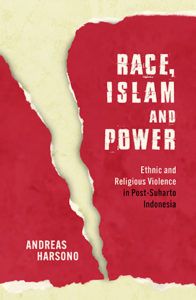
Harsono is author of Race, Islam and Power: Ethnic and Religious Violence in Post-Suharto Indonesia, a book based on 15 years of research and travel between Sabang in Aceh in the west and Merauke in West Papua in the East.

READ MORE: Indonesian elections – environment a missing topic

Race, Islam and Power – Andreas Harsono’s new book on human rights in Indonesia. Image: Monash University

Founding President Sukarno used the slogan “from Sabang to Merauke” when launching a campaign – ultimately successful – to seize West Papua in 1961.

-Partners-

But, as Harsono points out, the expression should really be from Rondo Island (an unpopulated islet) to Sota (a remote border post on the Papua New Guinean boundary.

Harsono, a Human Rights Watch researcher since 2008, argues that Indonesia might have been more successful by creating a federation rather than a highly centralised state controlled from Jakarta.

“Violence on post-Suharto Indonesia, from Aceh to West Papua, from Kalimantan to the Moluccas, is evidence that Java-centric nationalism is unable to distribute power fairly in an imagined Indonesia,” he says. “It has created unnecessary paranoia and racism among Indonesian migrants in West Papua.

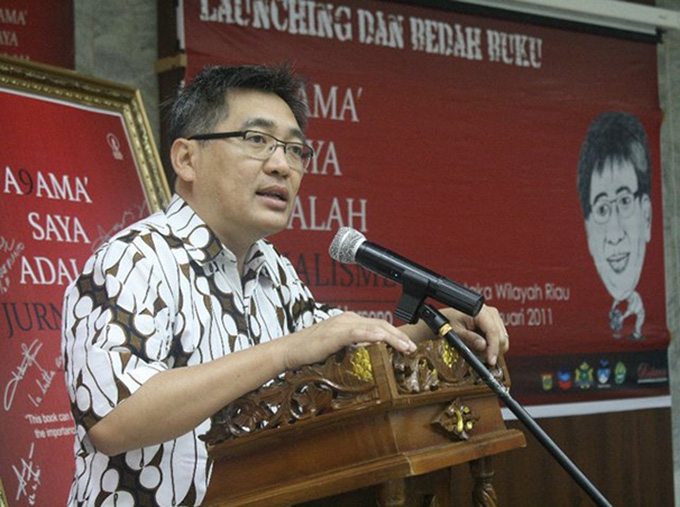
Human Rights Watch researcher Andreas Harsono … violent repression has “created unnecessary paranoia and racism among Indonesian migrants in West Papua”. Image: HRW
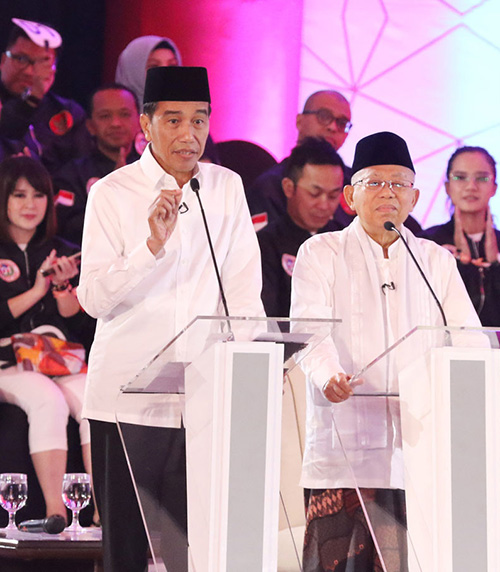
‘They’re Melanesians’
“The Papuans simply reacted by saying they’re Melanesians – not Indonesians. They keep questioning the manipulation of the United Nations-sponsored Act of Free Choice in 1969.”

Critics and cynics have long dismissed what they see as a deeply flawed process involving only 1025 voters selected by the Indonesian military as the “Act of No Choice”.

Harsono’s criticisms have been borne out by a range of Indonesian activist and watchdog groups, who say the generals behind the two presidential frontrunners are ridden with political interests.

The Commission for Missing Persons and Victims of Violence (Kontras) and the Mining Advocacy Network (JATAM) have again warned that both presidential candidate tickets — incumbent President Joko “Jokowi” Widodo and running mate Ma’ruf Amin as well as rival Prabowo Subianto and Sandiaga Uno — have close ties with retired TNI (Indonesian military) generals.

These retired officers are beholden to political interests and the prospect of resolving past human rights violations will “become increasingly bleak” no matter who is elected as the next president.

President Joko Widodo and his challenger retired general Prabowo Subianto … “problematic track record on human rights”. Image: Jakarta Post

Kontras noted that nine out of the 27 retired officers who are behind Widodo and Ma’ruf have a “problematic track record on human rights”.

“Likewise with Prabowo Subianto and Sandiaga Uno where there are eight retired officers who were allegedly involved in past cases of HAM violations”, said Kontras researcher Rivanlee Anandar.

Prabowo himself, a former special forces commander, is implicated in many human rights abuses. He has been accused of abduction and torture of 23 pro-democracy activists in the late 1990s and he is regarded as having knowledge of the killing hundreds of civilians in Santa Cruz massacre in Timor-Leste.

90,000 killed post-Sukarno
Harsono’s 280-page book, with seven chapters devoted to regions of Indonesia, documents an ”internally complex and riven nation” with an estimated 90,000 people having been killed in the decade after Suharto’s departure.

“In East Timor, President Suharto’s successor B. J. Habibie agreed to have a referendum [on independence]. Indonesia lost and it generated a bloodbath,” says Harsono.

“Habibie’s predecessors, Megawati Sukanoputri and Susilo Bambang Yudhoyono, refused to admit [that] the Indonesian military’s occupation, despite a United Nations’ finding, had killed 183,000 people between 1975 and 1999.”

Harsono notes how in 1945 Indonesia’s “non-Javanese founders Mohammad Hatta, Sam Ratu Langie and Johannes Latuharhary wanted an Indonesia that was democratic and decentralised. They advocated a federation.”

However, Sukarno, Supomo and Mohammad Yamin wanted instead a centralised unitarian state.

“Understanding the urgency to fight incoming Dutch troops, Latuharhary accepted Supomo’s proposal but suggested the new republic hold a referendum as soon as it became independent. Sukarno agreed but this decision has never been executed.”

The establishment of a unitarian state “naturally created the Centre”, says Harsono. “Jakarta has been accumulated and controlling political, cultural, educational, economic, informational and ideological power.

Java benefits
“The closer a region to Jakarta, the better it will benefit from the Centre. Java is the closest to the Centre.

“The further a region is from the Centre, the more neglected it will be. West Papua, Aceh, East Timor and the Moluccas are among those furthest away from Jakarta.”

The centralised political system needed a “long and complex bureaucracy” and this “naturally created corruption”, Harsono explains.

“Indonesia is frequently ranked as the most corrupt country in Asia. Political and Economic Risk Consultancy Ltd listed Indonesia as the most corrupt country in Asia in 2005.”

Harsono also notes how centralised power has helped a religious and ethnic majority that sees itself as “justified to have privileges and to rule over the minorities”.

The author cites the poet Leon Agasta as saying, “They’re the two most dangerous words in Indonesia: Islam and Java.” Muslim majority and Javanese dominance.

Harsono regards the Indonesian government’s response to demands for West Papuan “self-determination” as “primarily military and repressive: viewing Papuan ‘separatists’ as criminals, traitors and enemies of the Republic of Indonesia”.

He describes this policy as a “recipe for ongoing military operations to search for and destroy Papuan ‘separatists’, a term that could be applied to a large, if not overwhelming, portion of the Papuan population”.

Ruthless Indonesian military
“The Indonesian military, having lost their previous power bases in east Timor and Aceh, ruthlessly maintain their control over West Papua, both as a power base and as considerable source of revenue.

“The Indonesian military involvement in legal businesses, such as mining and logging, and allegedly, illegal businesses, such as alcohol, prostitution, extortion and wildlife smuggling, provide significant funds for the military as an organisation and also for individual officers.”

Andreas Harsono launched his journalism career as a reporter for the Bangkok-based Nation and the Kuala Lumpur-based Star newspapers. In the 1990s, he helped establish Indonesia’s Alliance of Independent Journalists – then am illegal group under the Suharto regime, and today the most progressive journalists union in the republic.

Harsono was also founder of the Jakarta-based Institute for the Studies on the Free Flow of Information and of the South East Asia Press Alliance (SEAPA).

In a separate emailed interview with me in response to a question about whether there was light at the end of the tunnel, Harsono replied: I do not want to sound pessimistic but visiting dozens of sites of mass violence, seeing survivors and families’ who lost their lost ones, I just realised that mass killings took place all over Indonesia.

“It’s not only about the 1965 massacres –despite them being the biggest of all– but also the Papuans, the Timorese, the Acehnese, the Madurese etc.

“Basically all major islands in Indonesia, from Sumatra to Papua, have witnessed huge violence and none of them have been professionally understood. The truth of those mass killings have not been found yet.”

Professor David Robie is director of the Pacific Media Centre.

Print Friendly, PDF & Email

Article by AsiaPacificReport.nz

Your income tax questions answered in three easy charts: Labor and Coalition proposals side by side

]]>

Source: The Conversation (Au and NZ) – By Danielle Wood, Program Director, Budget Policy and Institutional Reform, Grattan Institute

The two major parties have kicked off the election campaign with very different policies for cuts to personal income tax.

The Coalition promises its tax plan will deliver “lower, simpler, fairer taxes” while Labor says its plan is all about the “fair go”.

But putting aside the spin, how do the promised tax cuts compare? Will they make the tax system more progressive, or less? And what do they mean for the budget bottom line?

Tasting each plan

The Coalition plan comes in three stages.

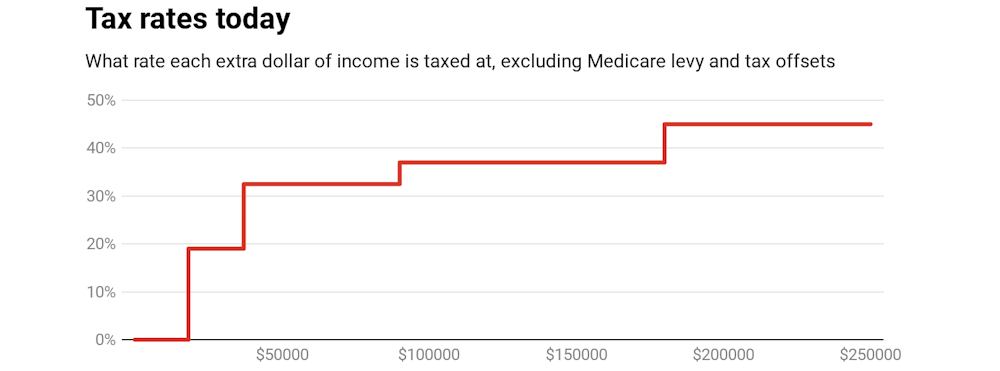
The major part of Stage 1 is the Low and Middle Income Tax Offset (the LMITO, or “lamington” as some are calling it), which gives everyone earning less than A$126,000 a cheque in the mail come July and then another one in each of the following three years.

Stage 2 (2022-23) will lift the thresholds of the 19% and the 32.5% brackets.

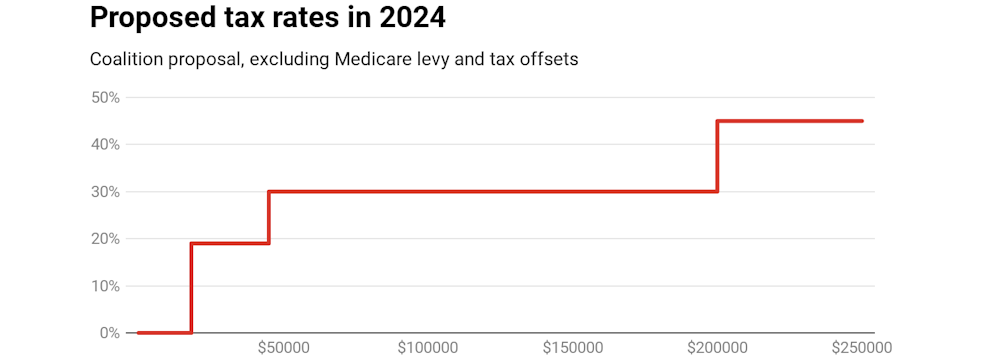
The biggest cuts come in stage 3 (2024-25) when the 32.5% tax rate is cut to 30% and the 37% bracket is removed entirely.

The effect would be that everyone earning between $45,000 and $200,000 would face the same 30% marginal tax rate from July 1, 2024.


Read more: A simpler tax system should spark joy. Sadly, the one in this budget doesn’t


The Labor plan gives a slightly higher offset (up to $95 a year more) for people earning less than $48,000 and then matches the lamington for people earning $48,000 or more.

Under Labor the lamington will be permanent, but Labor will not proceed with stages 2 and 3 of the Coalition’s tax plan.

From July 1, 2019, Labor will also increase the top marginal tax rate paid on incomes above $180,000 from 45% to 47% for an unspecified time, making it essentially a return of the Abbott government’s “temporary deficit reduction levy”.

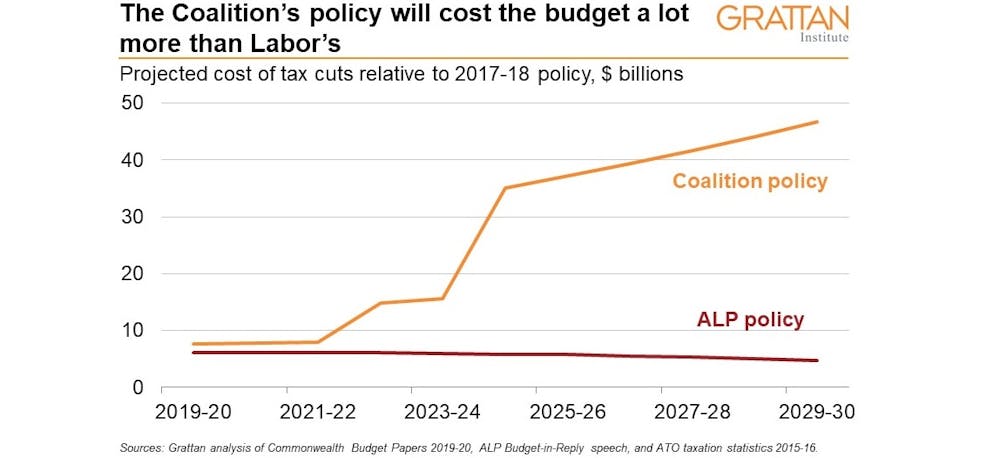
The Coalition’s plan will cost the budget about A$298 billion over the next decade. Labor’s plan is at the moment much cheaper at about A$63 billion over the same period.


Who wins, who loses?

How will different taxpayers fare under the two plans? That depends on what point in time we compare them.

If we focus on the next three years, there will be no difference in tax under the two plans for most people. The lowest income earners won’t pay income tax under either party’s policy.

About a quarter of taxpayers with taxable incomes of between $22,000 and $48,000 will be up to $95 better off under the Labor plan.

At the other end of the income spectrum, the top 5% of taxpayers earning more than $180,000 will pay more under Labor (equivalent to about $400 additional tax for someone earning $200,000).

The big differences between Labor and the Coalition’s tax policies open up when we get to stage 2 (2022-23) and particularly stage 3 (2024-25) of the Coalition’s plan.


Read more: A simpler tax system should spark joy. Sadly, the one in this budget doesn’t


By the end of the next decade, assuming both parties make no further changes to income tax policy:

• The third of taxfilers earning up to $40,000 will pay no tax or be slightly better off under Labor’s plan because Labor retains the Low and Middle Income Tax Offset.

• The third of taxfilers earning $40,000-$90,000 will be a bit better off under the Coalition’s plan. A taxpayer in the middle of the income distribution, earning $63,000 a year by 2029-30, will be approximately $432 a year better off under the Coalition.

• The third of taxfilers earning more than $90,000 will be at least $1,000 better off under the Coalition, and people in the top 8% will be over $10,000 better off.

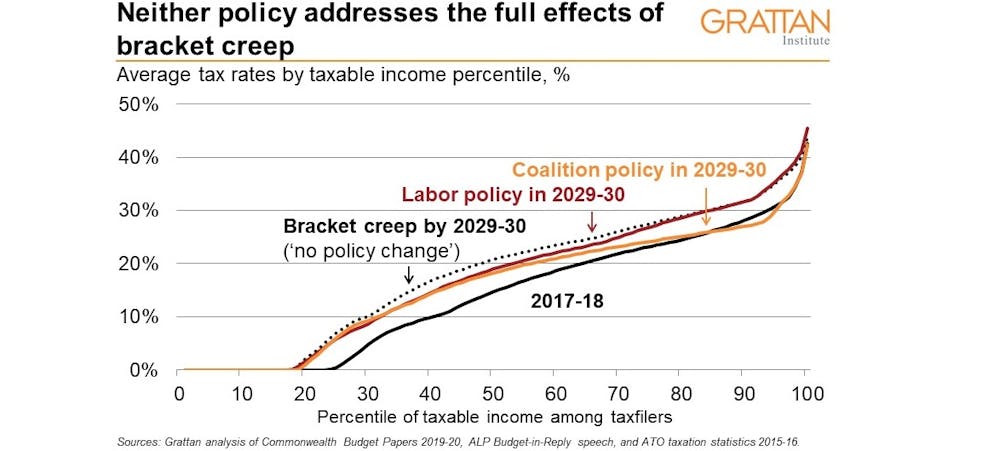
The Coalition would refund bracket creep only at the top

The top 15% of earners would be fully compensated for bracket creep under the Coalition’s plan, paying the same average tax rate or less in 2029-30 as they do today.

But middle income earners would still face higher average tax rates than today.

If Labor were to make no further changes to income tax policy over the decade, Labor’s plan would see around 80% of taxpayers facing higher average tax rates in 2029-30 than at present. Top income earners would receive almost no insulation from bracket creep. This is why Labor’s plan results in a much healthier bottom line.

But it is difficult to imagine that any government could resist offering tax cuts to compensate for the effects of bracket creep over such an extended period.

Shadow Treasurer Chris Bowen has already indicated that a future Labor government would consider tax cuts on a budget-by-budget basis, meaning that today’s policy doesn’t necessarily tell us what policy will be in a decade’s time.


The Coalition would make the system less progressive

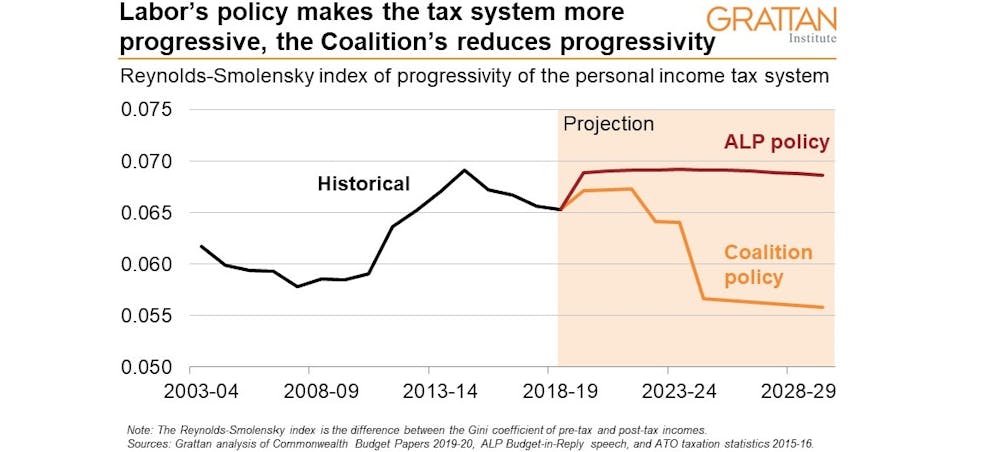
The “progressivity” of a tax system — the degree to which it reduces income inequality — can be measured by the Reynolds-Smolensky Index. It shows the tax system will at first become more progressive under both parties’ policies — meaning that post-tax income will become more equally shared.

This is because of the boost to the Low and Middle Income Tax Offset. But the final two rounds of tax cuts, at this stage offered only by the Coalition, will make the system significantly less progressive as the benefit is concentrated among higher income earners.

What Labor is offering at the moment will make the system more progressive and only becomes slightly less so over time.


But both sides are virtue signalling

Despite the hype, the personal income tax system will look pretty similar for the next three years regardless of which party wins office.

Labor will tax high income earners more and low income earners slightly less. But for around 70% of people, personal income tax rates will be identical in three years time whether Scott Morrison or Bill Shorten is prime minister.

The big differences lie in the distant future, beyond 2024-25. Since it is almost unimaginable that either side of politics would leave its tax policies unchanged through another two elections the differences in the announced plans have more to do with signaling philosophy than reality.

The Coalition’s philosophy is about restraining tax as a share of the economy, even if that means it will need to shrink government spending as a share of GDP (in ways that are not yet unexplained).

Labor is signalling that it is more comfortable with the tax share creeping up — mostly thanks to increased contributions from high income earners — but it will make sure lower income earners don’t end up worse off.

Who says elections aren’t a contest of ideas?


Read more: Potentially unaffordable, and it still won’t fix bracket creep. The Coalition’s $300 billion tax plan assessed


ref. Your income tax questions answered in three easy charts: Labor and Coalition proposals side by side – http://theconversation.com/your-income-tax-questions-answered-in-three-easy-charts-labor-and-coalition-proposals-side-by-side-115450

Three years in, is the AFLW kicking goals?

]]>

Source: The Conversation (Au and NZ) – By Adam Karg, Senior research fellow, Swinburne University of Technology

The AFLW competition rightly celebrated the record grand final crowd of 53,034 and television audience of more than 400,000 last month as a successful conclusion to its third season.

The Adelaide Crows vanquished Carlton by an emphatic 45-point margin to claim their second flag. But after three years, what’s the overall scorecard for the AFLW as a competition, and how should its success be measured?


Read more: The AFLW found instant success, but challenges remain for its long-term sustainability


The AFLW has built a strong, differentiated brand, with new sponsors attracted to a league, teams and athletes perceived to offer something different in a cluttered sport market. While media fees – reportedly worth A$2 million over four years – are modest, the AFLW has secured a free-to-air platform that is coveted by many, but achieved by few leagues of either gender.

There’s strong support for the women’s game among fans and club members, with an embryonic but strong interest in club products, including foundation memberships to support women’s teams.

For the public, league success also depends on key visible measures – one of which is attendance. And despite the AFLW maintaining free entry as a feature, regular season average attendance per game dropped 25% in 2019. This is not surprising. Many new leagues around the world have enjoyed hugely popular inaugural seasons, followed by a downturn as the novelty wanes.

Much like any start-up, however, judging a new league purely on commercial outcomes in its early years is unwise.

The field of play

Sporting organisations and assets should be assessed on a complex range of financial, social, institutional and organisational measures. In the AFLW’s case, a key aim is to challenge the dominance of elite men’s sport and boost the visibility of the women’s league and its athletes as role models. This, in turn, helps to celebrate women’s football, and bolster female participation in community sport.

Recent federal budget announcements recognise this development, with funding allocated to improve grassroots facilities, such as female changing rooms at community ovals, and female-specific investments in sports science and elite performance development programs.

Adelaide’s Jenna McCormick celebrates her club’s second premiership with the fans. AAP Image/Kelly Barnes

But alongside the clear success in these areas, the AFLW has also come in for criticism of the competition’s structure. The third season featured the much-maligned conference system, which split the 10 clubs into two separate groups and led to accusations of a disparity in quality between the two, crowding out some talented teams while giving others an easier path to the finals.

A marketing plan that restricted the league’s visibility in year two and the decision to restrict the regular season to seven rounds has also prompted criticism that the AFLW is not ambitious enough in its expansion plans, choosing instead to confine itself to a two-month window that barely overlaps with the men’s season.

Global games

Women’s sport is booming around the world. So far this year, soccer clubs Juventus and Athletic Bilbao have set new Italian and European attendance records, respectively, for domestic women’s matches – the latter eclipsing any crowd drawn by the men’s club teams this season.

Opportunities to showcase Australian women’s teams on an international stage are more limited, although nevertheless important. Australia claimed the first ever women’s rugby sevens gold medal at the 2016 Rio Olympics. The Matildas soccer team, led by Samantha Kerr, will soon contest the 2019 FIFA Women’s World Cup in France. And in cricket, Australia is preparing to host next year’s Women’s T20 World Cup.

Yet while global platforms are exciting, domestic leagues remain the primary vehicle to grow women’s sport. In the past decade, women’s rugby league, cricket, soccer and netball (via a revamped league) have joined the longer established Women’s National Basketball League in creating elite national competitions.

One misconception is that the AFLW and other new leagues should seek to grow quickly by converting existing fans of the sport. Such a view is not strategic and overly simplistic.

Just as cricket’s Big Bash League was not created to cannibalise support for other forms of the game, the AFLW was never solely aimed at attracting existing AFL fans. Rather, it is about attracting a new and growing audience to the sport and providing a platform for women’s sport that can boost investments and participation rates on both the elite and grassroots levels.

Delivering future growth

Ever since 2015, when 301,000 people watched a televised exhibition match between Melbourne and the Western Bulldogs, the AFLW’s development has been fast-tracked.

When the competition launched in 2017, the AFLW’s first job was to attract a small core of committed “early adopter” fans. But subsequent growth requires engaging new consumers by building familiarity and connection with the league and its teams, while also offering something tangibly different from the men’s game.


Read more: Growth of women’s football has been a 100-year revolution – it didn’t happen overnight


From 2020, all but four of the 18 AFL clubs will be represented in the AFLW. On one hand, quickly embracing more clubs – all of which have existing brands and fan bases – provides new opportunities to attract more attendees and more viewers. More games will also result in more income, more media content and a stronger claim for professional status and pay equality among the league’s players (the top-earning players receive just A$24,600 per season, compared with the seven-figure contracts given to the sport’s top male earners).

But this rapid expansion also spreads the available talent pool thinly, which could impact the quality and competitiveness of some games and ultimately even cause fans’ interest to wane.


Read more: Mark! Kick! Tackle! The reality of fast-tracking women into elite AFL


Critics of the AFLW conference system were disappointed that the 2019 season would only feature 25% more regular season games than 2018. Yet the cumulative regular season attendances for this longer season dropped by 6%, suggesting a bigger league schedule doesn’t necessarily attract a proportionally bigger fan base.

Globally, there are examples of going too big, too soon. The Canadian Women’s Hockey League folded this month after being deemed “economically unsustainable”. The circumstances in this league are markedly different from the AFLW. The teams changed frequently and were not aligned with established brands, and the league’s popularity was undercut by a rival US-based competition. But it nevertheless shows that even popular sports (Canadians really love ice hockey) don’t necessarily equate to a sustainable product.

AFLW clubs know their league has come a long way in a short time, but that there is still a long way to go in terms of player development, competition structure and staking a claim as a fan favourite in a crowded sporting market. Looking at the next steps for AFLW, slow and steady may win the race.

ref. Three years in, is the AFLW kicking goals? – http://theconversation.com/three-years-in-is-the-aflw-kicking-goals-114919

Mukurtu: an online dilly bag for keeping Indigenous digital archives safe

]]>

Source: The Conversation (Au and NZ) – By Sunanda Creagh, Head of Digital Storytelling

Reader advice: Aboriginal and Torres Strait Islander readers are advised that this article may contain images of people who have died.

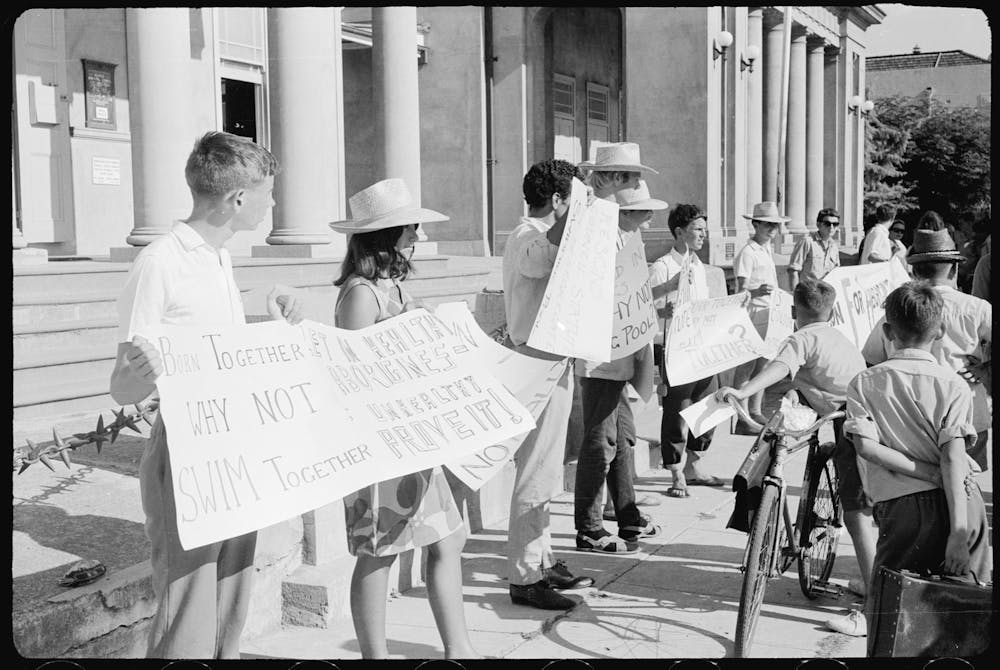
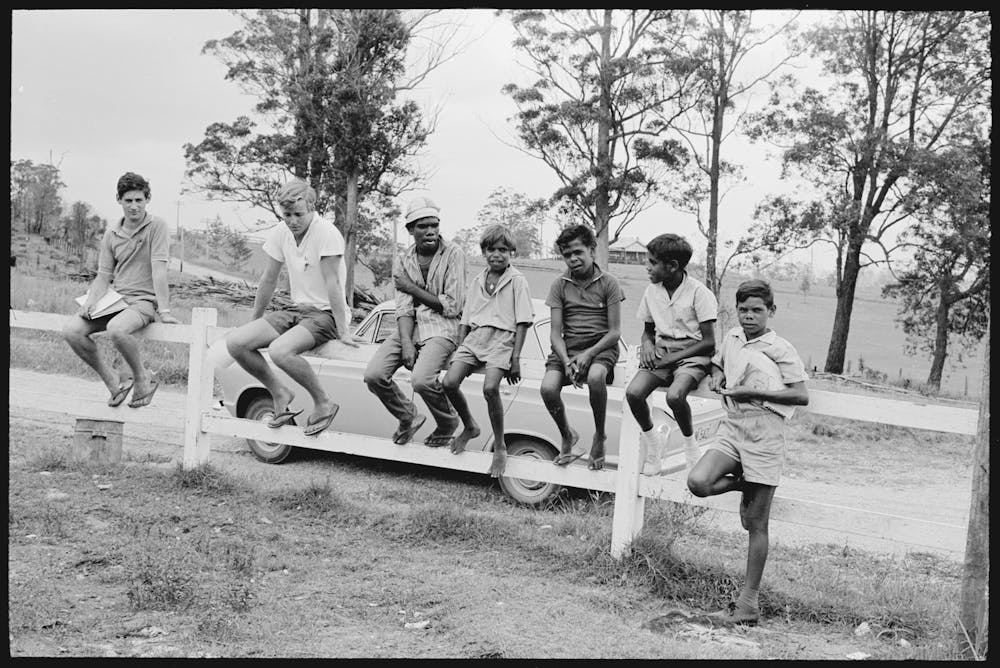
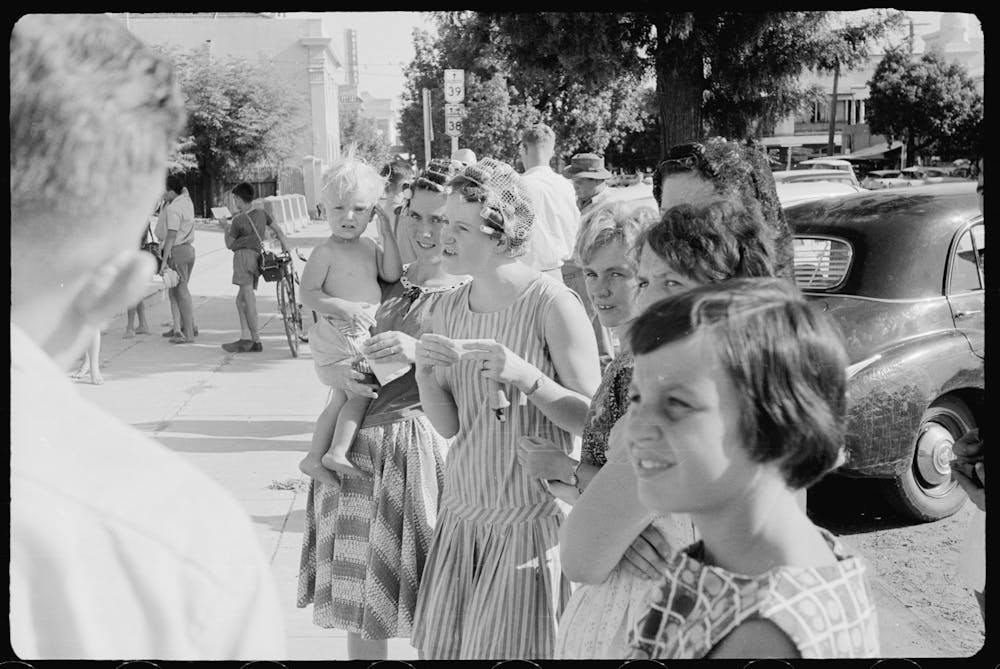
A few years ago, the State Library of NSW was working with Moree’s Dhiiyaan Centre to pull together archival photographs of the 1965 Freedom Rides, an Aboriginal-led protest against racist segregationist policies in NSW.

Moree – where Aboriginal people were once banned from swimming in the public pool – was an important site in the history of protest against official segregation in Australia, and a key stop on the Freedom Rides route.

Demonstrating outside the Council Chambers at Moree, February 1965 Photo from the Tribune archive, State Library of NSW. Courtesy the SEARCH Foundation. Digital ID: 5606003. Photo from the Tribune archive, State Library of NSW. Courtesy the SEARCH Foundation, Author provided (No reuse)

Kirsten Thorpe – a Worimi woman, professional archivist and now a researcher at UTS – was then at the State Library, working with Mitchell Librarian Richard Neville to dig out old protest photos to share with the Moree community in the lead up to an exhibition.

But in practice, collecting, sharing and storing such digital archives in perpetuity is no simple matter.

Surveying at Bowraville, February 1965. Photo from the Tribune archive, State Library of NSW. Courtesy the SEARCH Foundation. Digital ID: 5606019. Photo from the Tribune archive, State Library of NSW. Courtesy the SEARCH Foundation., Author provided (No reuse)

How to ensure the material is stored safely, so the whole process doesn’t need to be repeated in a few years time? How to capture the outpouring of memories and stories that such an exhibition evokes? What if the exhibition inspires more people to come forward with important historical material or accounts – where does that material end up? And how to ensure Indigenous people are empowered to tell their own stories and have a say over how digital archives are managed?

Enter Mukurtu.

Moree residents look on as the students protest outside the Moree Council Chambers, February 1965. Photo from the Tribune archive, State Library of NSW. Courtesy the SEARCH Foundation. Digital ID: 5606004. Photo from the Tribune archive, State Library of NSW. Courtesy the SEARCH Foundation., Author provided (No reuse)

Mukurtu (pronounced MOOK-oo-too) is an online system that aims to help Indigenous communities conserve stories, videos, photographs, songs, word lists and other digital archives.

Mukurtu is a Warumungu word meaning “dilly bag” or a safe keeping place for sacred materials.

It’s a free, mobile, and open source platform built with Indigenous communities in mind to manage and share digital cultural heritage. Kirsten Thorpe says it’s the kind of thing that would have been really useful back when she was collating Freedom Rides material for the Moree community.

Conserving Indigenous archives for future generations

Mukurtu is/are already being used by Native American communities to store and preserve digital archives, and Kirsten Thorpe – now a senior researcher at the Jumbunna Institute for Indigenous Education and Research at UTS – is involved in making Mukurtu more widely accessible in Australia.

She works with other key players, such as Professor Kimberly Christen at the Centre for Digital Curation and Scholarship in the US and Richard Neville at the State Library of NSW, to ensure the Mukurtu Project has the institutional support it needs to help Indigenous communities protect their cultural heritage for generations to come.

On today’s episode of the podcast, Kirsten Thorpe and Richard Neville explain why Mukurtu is needed, how it’s being used and what’s at stake if we don’t find better ways to empower Indigenous people with the skills and tech to conserve and manage digital archives.

Freedom rider Charles Perkins (right) surveying members of the Moree community about living conditions, February 1965. Photo from the Tribune archive, State Library of NSW. Courtesy the SEARCH Foundation. Digital ID: 5605027. Photo from the Tribune archive, State Library of NSW. Courtesy the SEARCH Foundation., Author provided (No reuse)

New to podcasts?

Podcasts are often best enjoyed using a podcast app. All iPhones come with the Apple Podcasts app already installed, or you may want to listen and subscribe on another app such as Pocket Casts (click here to listen to Trust Me, I’m An Expert on Pocket Casts).

You can also hear us on Stitcher, Spotify or any of the apps below. Just pick a service from one of those listed below and click on the icon to find Trust Me, I’m An Expert.


Additional audio

Kindergarten by Unkle Ho, from Elefant Traks

ABC News 1965 intro music.

Lee Rosevere, Betrayal.

Lead image:

Nina Maile Gordon

ref. Mukurtu: an online dilly bag for keeping Indigenous digital archives safe – http://theconversation.com/mukurtu-an-online-dilly-bag-for-keeping-indigenous-digital-archives-safe-112949

Curious Kids: why do eggs have a yolk?

]]>

Source: The Conversation (Au and NZ) – By Maggie J. Watson, Lecturer in Ornithology, Ecology, Conservation and Parasitology, Charles Sturt University

Curious Kids is a series for children. If you have a question you’d like an expert to answer, send it to curiouskids@theconversation.edu.au You might also like the podcast Imagine This, a co-production between ABC KIDS listen and The Conversation, based on Curious Kids.


Why do eggs have orange stuff inside? – Rafael, age 7.


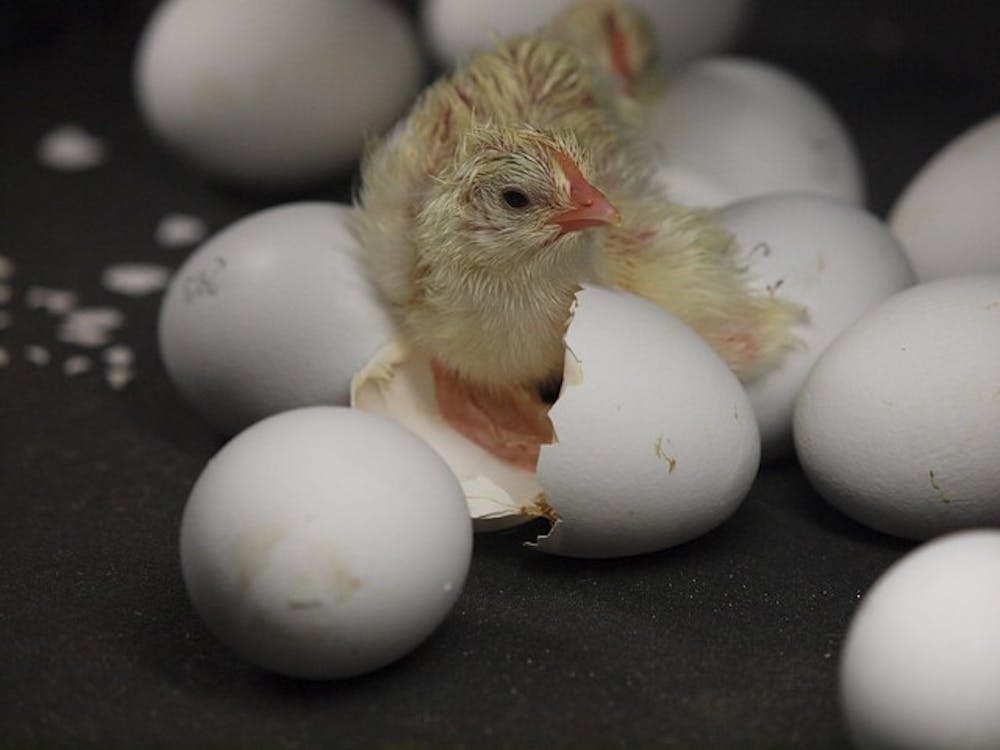
This is a very interesting question. That orange stuff is called a yolk. It’s a great source of vitamins, minerals, fats and proteins packaged up by the female animal for an embryo (the developing cells that turn into a baby).

You probably know that the yellow bit inside a chicken’s egg is the yolk, but in fact a lot of animals lay eggs that have yolks in them. However, not all animal eggs have a yolk!

Having a yolk in the egg allows the developing animal to stay inside the egg a bit longer, which may boost its chances of survival. The downside is the mother will need to work harder to find food to get the nutrients needed to create a nutritious, fatty yolk. Flickr/Kai C. Schwarzer, CC BY


Read more: Curious Kids: Is it true that male seahorses give birth?


A contest called evolution

To understand why different animal species have different types of eggs, you need to know that all living things change slowly over time, through a process called evolution.

When a living thing is born with a special difference – what we would call a “trait” – sometimes this trait helps them live and survive better than someone who doesn’t have that trait. This trait may help them live longer and have more babies.

Because of these differences in survival, eventually, the trait that lets one individual living thing live and prosper will become quite common and be found all throughout a species.

Lots of animals lay eggs. Flickr/Alias 0591, CC BY

Back to eggs

Imagine you are a worm living millions of years ago. You produce heaps and heaps of eggs that develop quickly into little worms. But most of the babies die because they are small and have to find food straight after hatching. They can’t go far because they are very little and so most starve to death (or are eaten by bigger creatures).

But what if some of those eggs happened to contain a little bit of fat from the mother? Compared to its brothers and sisters, the fat will allow the worm to spend just a little bit more time growing inside the egg and less time looking for food after hatching.

The worms that were lucky enough to have that fat inside the egg are more likely to survive long enough to have their own babies. And they pass on the fatty-egg trait to their own worm kids. Soon this fatty-egg trait becomes quite common.

So the worm who was able to feed its babies when they’re still inside the egg had more babies survive, and a yolk evolved.

Which eggs have a yolk and why?

Eggs with tiny bits of yolk are found in animals such as earthworms, leeches, clams, mussels, starfish, sea urchins, and marine arthropods (shrimp, lobsters, crabs) and some insects. These animals produce huge numbers of eggs.

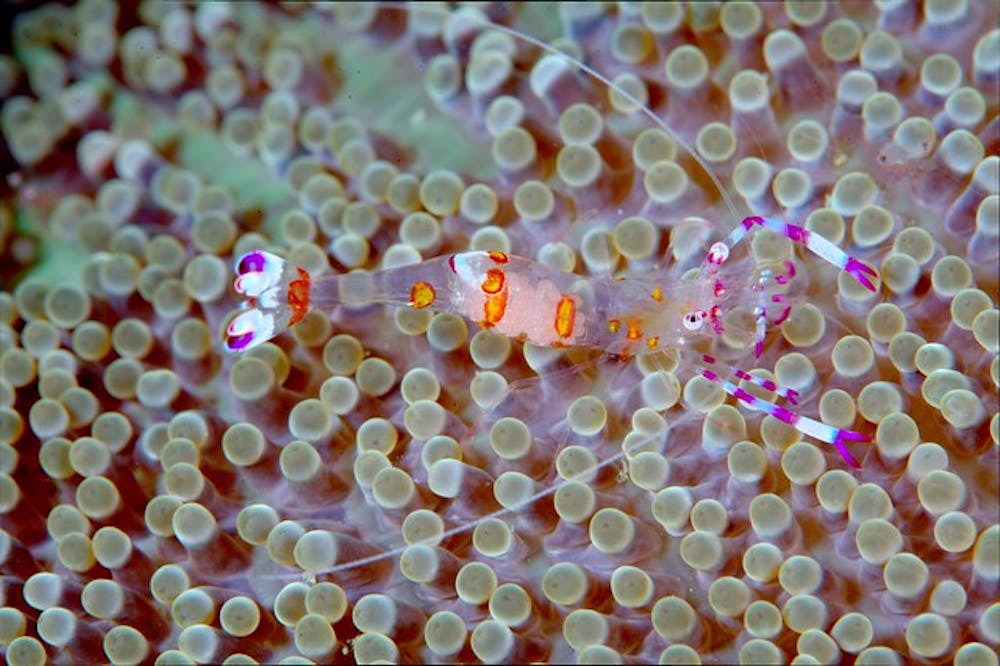
Shrimps/prawns lay a large number of eggs. if you look closely, you can see a lot of small, light pink eggs inside this prawn’s body. Flickr/Klaus Stiefel, CC BY

Most of the babies that grow in these sorts of eggs have to go through a lot of steps before they reach the adult stage. First they have to grow into a larvae (which is what we call a junior body, and often looks a bit like worm).

The babies have to change into a larvae so they can eat, and after having eaten a bit they develop into an adult (think of caterpillars that eventually turn into butterflies).

Animals that produce eggs with a bit more yolk have babies that can fully develop and skip the larvae step, such as in hagfish and snails.

Big yolks for big babies

Eggs with really large yolks are found in animals that produce very few eggs, and the offspring can use the yolk to develop completely. These sorts of eggs are found only in cephalopods (squid, octopus and nautilus) and some vertebrates (animals with backbones).

Here are some squid eggs. Flickr/Elias Levy, CC BY

Vertebrates that produce eggs with large yolks include bony fish, cartilaginous fish (sharks and rays), reptiles, birds and egg-laying mammals (platypus and echidnas).

The rest of the mammals (animals that don’t lay eggs) have found a different system. They have a placenta, which is a kind of a feeding sack linking mother to embryo inside the mother’s body. This system allows the developing embryo or fetus to get nutrients straight from the mother. That’s how you were grown!


Read more: Curious Kids: How does glow in the dark paint work?


Hello, curious kids! Have you got a question you’d like an expert to answer? Ask an adult to send your question to curiouskids@theconversation.edu.au

CC BY-ND

Please tell us your name, age and which city you live in. We won’t be able to answer every question but we will do our best.

ref. Curious Kids: why do eggs have a yolk? – http://theconversation.com/curious-kids-why-do-eggs-have-a-yolk-111605

Fiji opposition seeks Malolo damage probe, criticises local media

]]>
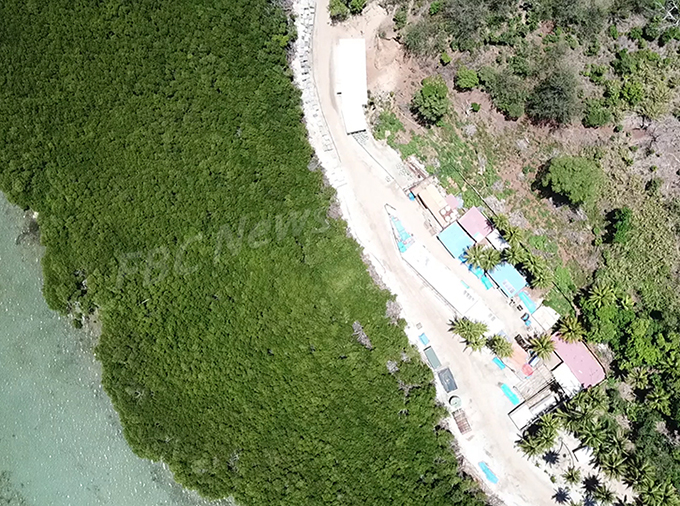
Malolo Island … Fiji officials had been given drone footage and photographs of the ongoing destruction in breach of the environmental and planning approvals but nothing was done. Image: FBC News

By RNZ Pacific

Fiji’s opposition has called for a full investigation by an impartial committee into allegations of collusion by government officials in the destruction of reefs, foreshore and land on Malolo Island.

Earlier this month, the Chinese-backed company Freesoul Real Estate Development was ordered to repair the damage which it had caused during months of unconsented work on the reef and on land it did not own.

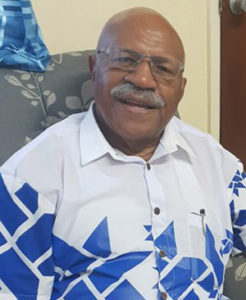
Opposition leader Sitiveni Rabuka said no action had been taken by ministers or senior government officials despite direct repeated attempts throughout 2018 by landowners seeking assistance.

READ MORE: Newsroom investigates Malolo destruction

Fiji Opposition Leader Sitiveni Rabuka … intimidated and cowed media. Image: Sri Krishnamurthi/PMC

He said Fiji officials had been given drone footage and photographs of the ongoing destruction in breach of the environmental and planning approvals.

Rabuka said the rot and culture of fear in the civil service, the intimidated and cowed media and the country was so ingrained now, that it took foreign investigative journalists to break the story.

-Partners-

The three New Zealand Newsroom journalists reporting about Malolo were this month arrested but Prime Minister Voreqe Bainimarama ordered their release a day later and apologised to them personally for their ordeal.

Rabuka said the apology was not enough to cover the fact that media in Fiji were now so scared of him and those close to him, that they dared not cover the story.

He said there had to be a probe into the action, inaction or negligence of any ministers, officials, former civil servants or police officers who facilitated the environmental destruction, the flouting of environmental and planning laws, failed to act to prevent it or halt it, or who participated in the illegal detention of the journalists covering the issue.

He also said the prime minister had to come clean on how the extensive environmental destruction would be reversed, if at all possible.

This article is republished under the Pacific Media Centre’s content partnership with Radio New Zealand.

Print Friendly, PDF & Email

Article by AsiaPacificReport.nz

And now for a newsflash: politicians actually do keep their promises

]]>

Source: The Conversation (Au and NZ) – By Andrea Carson, Associate Professor at La Trobe University. Department of Politics, Media and Philosophy, La Trobe University

A quick scan of political headlines over recent election campaigns will tell you that there is a trust deficit in Australian politics. Alarmingly, surveys uniformly find that public trust is falling in Australia.

The Murdoch tabloids (Daily Telegraph and Courier Mail) posed this question on their front pages with the headline “ScoMo vs Shorten: Who do you trust?” on March 28, perhaps implying trust was a one-sided political proposition.

But by the following week, the headline read: “Aussie voters short on choice” after their commissioned YouGov Galaxy poll revealed low public regard for both political leaders.

The poll showed 30% of respondents believed Scott Morrison to be “untrustworthy”, compared to Shorten on 34%. And when asked if they believed the leaders to be “well-intentioned”, the results were grim: just 34% believed Morrison to be well-intentioned, and 30% for Shorten.


Read more: Trust in politicians and government is at an all-time low. The next government must work to fix that


Why is this? One oft-cited reason is that politicians from all sides of politics don’t keep their promises. Veteran columnist with the Sydney Morning Herald, Ross Gittins, summed it up after the defeat of the Liberal National party in the Queensland state election in 2015. Then-Premier Campbell Newman was unceremoniously ousted from office after record wins in the previous election. Gittins wrote:

The biggest problem, of course, is decades of broken promises by both sides. Gillard broke her promises to balance the budget and not to introduce a carbon tax. Campbell Newman promised not to sack public servants. Abbott campaigned on the restoration of trust and high standards, but also made promises he can’t have intended to keep – and didn’t need to make to win.

But are broken promises really to blame for falling levels of public trust in politicians?

We know from extensive research about other western democracies, that political parties make serious efforts to keep their political promises and, despite popular rhetoric, the majority of promises made are kept. Our latest research tested whether this was also true of the Australian experience.

Using the same methods of the Comparative Party Pledges Project (CPPP), which has examined over 20,000 election promises made in 57 election campaigns in 12 countries, we analyse the fulfilment of election promises in six policy areas by the Australian Labor Party (ALP) under the leadership of Prime Minister Julia Gillard during the 43rd Parliament.

Among the reasons why we chose to analyse the Gillard government’s performance was the common criticism that it had broken its much-publicised pledge not to introduce a carbon tax, creating a perception that the government could not be trusted.


Read more: If politicians want more trust from voters, they need to start behaving with civility and respect


Sections of the media and political rivals openly called Julia Gillard a liar following the policy backflip. Also, the Gillard government was the first minority federal government since 1941. When the 2010 election produced a hung parliament, many commentators predicted chaos, as Brenton Prosser and Richard Denniss have reminded us. Some argued the government would be unable to fulfil its mandate or that the government would be forced into an early election.

We collected 232 promises (from party documents and the media) at the official start of the election campaign in 2010 until polling day. To measure if a promise was kept, we used sources like Hansard, official political communications, budget papers and, as a last resort, media reports.

We found most promises made were specific rather than general, and most – 87% – were kept (see table below). But, some of those needed to be altered in some way and were only partially kept. This reflected the compromise required to get bills through the two houses, neither controlled by the Labor party.

Table 1. Authors. Notes: N=232 promises. Note: the outcome of three promises could not be determined. Hence, the percentages in the table do not add to 100 per cent.

That the Gillard government was able to keep the majority of its pledges but be tarred with perceptions of deception is what some academics label the “pledge puzzle”.

So why is there a disconnect between perceptions and reality? One reason is that not all promises are equal. Implementing a carbon tax was seen as a big promise to break. Other famous examples include Bob Hawke promising at his 1987 election launch that no Australian child would live in poverty by 1990, and John Howard promising in 1996 to “never ever” introduce a goods and services tax. Measuring the importance of a promise to voters (salience) is an important aspect that may help us better understand the “pledge puzzle” and mistrust of politicians.

The pledge puzzle also suggests that broken promises are only one aspect of how voters regard their politicians. it also tells us that there are other factors to consider – such as media coverage, negative campaigning and political infighting and rorting – to better explain why public trust in Australian politicians is falling. We also know that citizens who are more trusting of politicians are more trusting individuals generally and vice versa.

Overall, our findings give cause for optimism about the role of election promises in representative democracy. We found that politicians do take promises seriously, and that they do try to keep them. Yet, this finding by itself is unlikely to bolster Australians’ trust in their elected representatives at this election until politicians’ report cards improve on other measures.


Dr Andrea Carson will be available for a Q+A from 1pm – 2pm, AEST on Tuesday, April 16 to take questions on this topic. Please post your questions in the comments below.

ref. And now for a newsflash: politicians actually do keep their promises – http://theconversation.com/and-now-for-a-newsflash-politicians-actually-do-keep-their-promises-114357

High-dose, immune-boosting or four-strain? A guide to flu vaccines for over-65s

]]>

Source: The Conversation (Au and NZ) – By Allen Cheng, Professor in Infectious Diseases Epidemiology, Monash University

Flu vaccines work by exposing the body to a component of the virus so it can “practise” fighting it off, without risking infection. The immune system can then mount a more rapid and effective response when faced with a “real” virus.

Three types of influenza vaccines are available in Australia:

  • “standard” vaccines that contains four different strains of influenza

  • a “high-dose” vaccine (Fluzone High Dose) that contains three strains of influenza at a higher dose than standard vaccines

  • an “adjuvanted” vaccine (Fluad) that contains the standard dose of three strains of influenza, along with MF59, an immune stimulant designed to encourage a stronger immune response to the vaccine.


Read more: When’s the best time to get your flu shot?


The high-dose and adjuvanted vaccines are designed for use only in people aged 65 and over because they can stimulate a better immune response than the standard vaccine. Standard vaccines should be used those younger than 65 years.

This year, the Australian government is offering the adjuvanted vaccine for free for over-65s. The standard vaccine is available for free for some groups under 65 under national and state programs. The high-dose vaccine will only be available to buy through pharmacies and general practices on prescription.

Is the high-dose vaccine better?

Clinical trials have compared the high-dose vaccine with older forms of the standard vaccine that contained three strains.

One US study in over-65s found 1.4% of recipients who were given the high-dose vaccine were diagnosed with influenza, compared with 1.9% of those who received the standard vaccine.

A flu vaccination doesn’t completely eliminate the risk of getting the flu, but it’s likely to make the illness less severe. From shutterstock.com

Subsequent studies also found people who got the high-dose vaccine were less likely to be hospitalised with influenza-related complications. A similar trial in nursing home residents also found a reduced risk of hospitalisation.

Although clinical trials are generally regarded as the gold standard when testing vaccines, it’s also important to consider data from other studies, where different flu strains circulate and where the vaccine may be used in groups that were excluded from clinical trials.

These studies have generally found that the high-dose vaccine is better than the standard vaccine. However, some studies have shown a lesser degree of benefit.

What about the adjuvanted vaccine?

Clinical trials have not been designed to show the different rates of flu infection after taking the adjuvanted vaccine compared with the standard vaccine. But studies have examined the effectiveness of this vaccine in preventing hospitalisations with influenza.

One trial found a small decrease in influenza infection in people who had been given adjuvanted vaccine, compared with standard vaccine, but this difference was not statistically significant.

Another recent trial has been performed in nursing home residents. Preliminary results suggest a very small reduction in hospitalisations compared with those who took the standard vaccine.

With different vaccination options available, it can be hard to work out which is likely to provide the most protection. From shutterstock.com

Despite a lack of clinical trial data, several observational studies have found getting the adjuvanated vaccine means you’re less likely to be hospitalised with influenza than if you receive the standard vaccine.

As with the studies of the high-dose vaccine, the estimated degree of protection varies between studies, reflecting differences in circulating strains, study types, and populations.

Which is better?

There is not yet sufficient data to know whether one enhanced vaccine is better than the other.

One observational study suggests the high-dose vaccine is more effective than the adjuvanted vaccine at preventing hospital admissions with influenza. But this study was not designed to address this question specifically, and the differences observed were small.


Read more: A strong immune system helps ward off colds and flus, but it’s not the only factor


Both enhanced vaccines are safe. Although a higher proportion of patients who receive enhanced vaccines report a sore arm, compared to those who receive the standard vaccine, this is generally mild and rarely requires medical attention.

Immunisation expert groups in Australia, the United States, Canada and the United Kingdom have not recommended either enhanced vaccine over the other.

Can you get two for better coverage?

The currently available enhanced vaccines protect against three flu strains, whereas the standard vaccine protects against four.

But for most people, there is no evidence that receiving multiple doses of different vaccines in any one year is any better than getting a single dose of vaccine.

There’s no evidence that two shots are better than one. By Nyvlt-art

In theory, the four-strain vaccines protect against one more strain than the enhanced three-strain vaccines. But in most seasons, few infections are caused by the fourth strain.

There are some specific groups of people for whom two doses may be recommended, including young children receiving the vaccine for the first time, and some people with bone marrow or organ transplants. Seek advice from your doctor if this describes you or your children’s situation.

It’s important to note that none of the standard or enhanced flu vaccines are completely protective; they reduce, but don’t completely eliminate, the risk of getting influenza.

A single dose of any influenza vaccine in each season is the most effective strategy to reduce your chance of getting influenza.


Read more: Health Check: how long should you stay away when you have a cold or the flu?


ref. High-dose, immune-boosting or four-strain? A guide to flu vaccines for over-65s – http://theconversation.com/high-dose-immune-boosting-or-four-strain-a-guide-to-flu-vaccines-for-over-65s-112224

Here’s why electric cars have plenty of grunt, oomph and torque

]]>

Source: The Conversation (Au and NZ) – By Jake Whitehead, Research Fellow, The University of Queensland

Australian politicians, including Prime Minister Scott Morrison, have raised the question of electric vehicles’ capacity for “grunt”.

Now I’m by no means a “grunt” expert, but when it comes to performance, electric cars are far from lacking. In fact, Australian electric car owners have ranked performance as the top reason for their purchase choice.

The V8, fuel-guzzling, rev-heads, who are supposedly worried that electric cars mean they will be left driving around golf buggies, should first check out this drag race between a Tesla and a Holden V8 Supercar.

SPOILER ALERT: The Tesla wins, and by a fair amount.

CarAdvice.com: Tesla Model S v Holden V8 Supercar v Walkinshaw HSV GTS Drag Race.


Read more: Don’t trust the environmental hype about electric vehicles? The economic benefits might convince you


Internal combustion engine vs electric motor

Internal combustion engines and electric motors are very different. In an internal combustion engine, as the name suggests, small amounts of fuel are mixed with air, and are exploded to drive a series of pistons. These pistons drive a crankshaft, which is then connected to a gearbox, and eventually the wheels.

This is a rather simplified overview, but there are literally hundreds of moving parts in a combustion engine. The engine must be “revved-up” to a high number of revolutions in order to reach peak efficiency. The gearbox attempts to keep the engine running close to this peak efficiency across a wide range of speeds.

All of this complexity leads to a significant amount of energy being lost, mostly through friction (heat). This is why combustion engine cars are very energy inefficient.


Read more: Why battery-powered vehicles stack up better than hydrogen


So how are electric motors different? Electric motors are actually pretty simple, consisting of a central rotor, typically connected to a single gear. The rotor is turned by a surrounding magnetic field, which is generated using electricity. The added benefit of this design is that it can operate in reverse, acting as a generator to charge the batteries while slowing down the vehicle (this is called regenerative braking).

On the other hand, the electric motor reacts instantly as soon as the accelerator is pushed. Given the minimal moving parts, electric motors are also highly reliable and require little to no maintenance. Their simplicity also means that almost no energy is lost in friction between moving parts, making them far more efficient than internal combustion engines.

Does simplicity translate to more or less grunt?

Combustion engines need to be “revved-up” to reach peak power and torque. Torque is a measure of how much rotational force can be produced, whereas power is a measure of how hard an engine has to work to produce the rotational force.

As shown below, the power and torque characteristics of a combustion engine means that although a conventional car might have a top capacity of 120 kW of power and 250 Newton metres of torque, this is only when the engine is running at high speeds.

Power and torque characteristics of a typical internal combustion engine. Victor Barreto

In contrast, an electric motor provides full torque from zero kilometres an hour, with a linear relationship between how fast the motor is spinning and the power required. These characteristics translate to a vehicle that is extremely fast at accelerating, with the ability to push you back into your seat.

Power and torque characteristics of a typical electric motor. Victor Barreto

What about pulling power?

For over a decade electric motors have been used in mining trucks, sometimes with a capacity greater than 100 tonnes, due to their powerful, instant torque and ability to pull large loads at slow speeds.

While most of these vehicles have been diesel-hybrids, fully electric mining trucks are now being introduced due to their high power-to-weight ratio, low operating costs, and ability to use regenerative braking to – in some cases – fully recharge their batteries on each mine descent.

A 590 kW, 9,500 N.m electric mining dumper truck, known as the eDumper, uses 30 kWh to travel uphill (unloaded, and can regenerate 40 kWh of electricity when driving back downhill fully loaded. Andreas Sutter/eMining AG

Electric motors are also increasingly being used in shipping, again because of their ability to push large loads. In Europe, a number of short-haul electric ships are currently in use. One example is the Tycho Brahe, a 238 metre-long, 8,414 tonne electric passenger and vehicle ferry that operates between Helsingborg, Sweden and Helsingør, Denmark.

Tycho Brahe – an electric vehicle and passenger ferry with 4,000 kWh of batteries. Forsea

The future of grunt

The global transition to electric vehicles is underway. Australians must decide whether we want to capture the enormous benefits this technology can bring, or remain a global laggard, literally being killed by our current vehicle emissions.

A Mitsubishi Outlander PHEV (Plug-in Hybrid Electric Vehicle). Jake Whitehead

While long-distance towing in fully electric vehicles is currently a challenge, in the near future this will no longer be the case with the introduction of long-range electric utes like the Rivian R1T and Tesla Pickup.

In the interim, alternatives also exist, like my own plug-in hybrid electric vehicle. It can tow, drive on the beach, and drive up to 50 kilometres on electricity alone. Charged using my home solar system or The University of Queensland’s fast-charger, it means that more than 90% of my trips are zero-emission.

It is clear that electric cars can provide plenty of grunt for Australians, so let’s make sure we are ready for an electric performance future.

ref. Here’s why electric cars have plenty of grunt, oomph and torque – http://theconversation.com/heres-why-electric-cars-have-plenty-of-grunt-oomph-and-torque-115356

Life of Brian at 40: an assertion of individual freedom that still resonates

]]>

Source: The Conversation (Au and NZ) – By Philip Almond, Emeritus Professor in the History of Religious Thought, The University of Queensland

This year is the 40th anniversary of the release of Monty Python’s Life of Brian. The film met with instant controversy in 1979 and was banned in Ireland, Norway and parts of Britain. In the US, protesters gathered outside cinemas where it aired.

Life of Brian tells the story of Brian of Nazareth (played by Graham Chapman), who is born on the same day as Jesus of Nazareth. After joining a Jewish, anti-Roman terrorist group, The People’s Front of Judea, he is mistaken for a prophet and becomes an unwilling Messiah. All this eventually produces the film’s most remembered line, courtesy of Brian’s mother Mandy (Terry Jones). “He’s not the Messiah,” she tells us, “he’s a very naughty boy”.

In November 1979, the BBC famously televised a debate between Pythons John Cleese and Michael Palin and two pillars of the Christian establishment, journalist Malcolm Muggeridge and then Bishop of Southwark Mervyn Stockwood. Each side totally failed to understand the other. Muggeridge’s point was that Brian was nothing but a “lampooning of Christ”. The Pythons argued this couldn’t be so because Brian was not Jesus. Technically, they were right. Still, this did not satisfy the Bishop, or the film’s many critics.
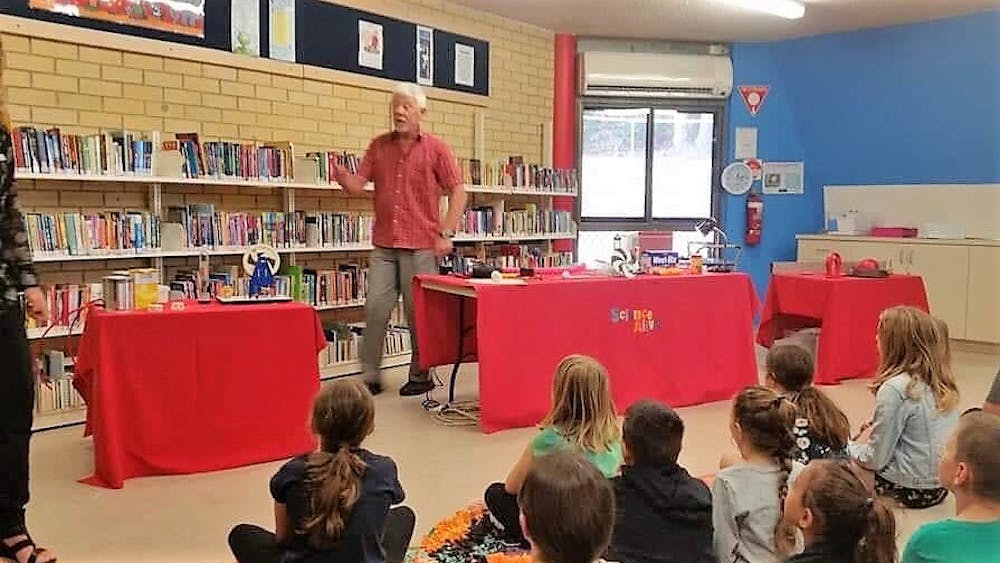
How does Life of Brian – which is being re-released to mark the anniversary – stand the test of time? Watching it today, it strikes me that, as parody goes, it is a pretty gentle, even, respectful sort. Ironically, to be properly offended by it or even to get the joke – then or now – requires a good knowledge of the life of Jesus in the New Testament Gospels.

What of the Church’s complaint that Brian was Jesus and thus the film was sacriligious or even blasphemous? There are three places in it where Brian and Jesus are clearly distinguished. Firstly, when the wise men – having worshipped the wrong baby – realise their mistake, they return to the stable to retrieve their gifts. Secondly, Brian is seen in the crowd listening to Jesus deliver the Sermon on the Mount. And in another scene, an ex-leper (Palin) complains to Brian about the loss of his livelihood as a beggar because Jesus has cured him.

Still, Brian is in some sense, “Jesus”. For the film relies on both the similarities and differences between the lives of both men. They are both born in stables. They both meet their deaths through crucifixion, although the one ends in Jesus’s resurrection from the dead and the other in Eric Idle’s nihilistic song Always Look on the Bright Side of Life. (“For Life is quite absurd, and Death’s the final word.”) The Pythons also make the point that there were many others like Jesus at the time (such as Palin’s really boring prophet) proclaiming the end of the world was at hand.

Life of Brian was certainly considered blasphemous in 1979 – and the film itself makes references to the absurdity of blasphemy as a crime.

Today, however, blasphemy is no longer on the cultural agenda of the non-Muslim West. Christians and others look disapprovingly on Islam’s understanding of blasphemy and the severe punishments meted out for it. As a crime, it has been religiously “othered”.

The virtue of the film today is its capacity to offend a whole new generation of viewers for different reasons. It is now more likely to be criticised for breaching the boundaries of “political correctness” around issues of gender, race, class and disability than blasphemy.

It is difficult, for instance, to hear Brian assert his Jewish identity in anti-Semitic terms:

I’m not a Roman, Mum, and I never will be! I’m a Kike! A Yid! A Hebe! A Hook-nose! I’m Kosher, Mum! I’m a Red Sea Pedestrian, and proud of it!

Still, as gender transitioning becomes culturally mainstream, the desire of the revolutionary Stan (Eric Idle) to be a woman, to be called “Loretta” and to have babies, will strike a chord.

And one cannot underestimate the sheer pleasure certain memorable scenes bring: from the misheard Sermon on The Mount (“Blessed are the Cheesemakers”) to the sight of Brian rewriting “Romans Go Home” on the palace walls, after a passing Centurion disgusted at Brian’s faulty Latin grammar, forces him to write out the correct protest message 100 times.

Life of Brian is undoubtedly a criticism of the unthinking nature of religious belief, from the perspective of the freedom and authority of the individual. In a key scene, Brian tells a crowd they are all individuals.

“Yes, we’re all individuals,” the crowd responds.

Then one lonely voice, Dennis, chimes in. “I’m not,” he says.

In this assertion of the freedom of the individual, of the virtue of thinking for yourselves, the film exemplifies modernity. As Immanuel Kant put it in 1784, “‘Have the courage to use your own understanding!’ — that is the motto of enlightenment.”

This notion was at the heart of all of Monty Python’s work and is the central message of Life of Brian.

Monty Python’s Life of Brian – 40th Anniversary will screen at select cinemas from April 18.

ref. Life of Brian at 40: an assertion of individual freedom that still resonates – http://theconversation.com/life-of-brian-at-40-an-assertion-of-individual-freedom-that-still-resonates-114743

There’s no ‘garbage patch’ in the Southern Indian Ocean, so where does all the rubbish go?

]]>

Source: The Conversation (Au and NZ) – By Mirjam van der Mheen, PhD Candidate in Oceanography, University of Western Australia

Great areas of our rubbish are known to form in parts of the Pacific and Atlantic oceans. But no such “garbage patch” has been found in the Southern Indian Ocean.

Our research – published recently in Journal of Geophysical Research: Oceans – looked at why that’s the case, and what happens to the rubbish that gets dumped in this particular area.

Every year, up to 15 million tonnes of plastic waste is estimated to make its way into the ocean through coastlines (about 12.5 million tonnes) and rivers (about 2.5 million tonnes). This amount is expected to double by 2025.


Read more: A current affair: the movement of ocean waters around Australia


Some of this waste sinks in the ocean, some is washed up on beaches, and some floats on the ocean surface, transported by currents.

The garbage patches

As plastic materials are extremely durable, floating plastic waste can travel great distances in the ocean. Some floating plastics collect in the centre of subtropical circulating currents known as gyres, between 20 to 40 degrees north and south, to create these garbage patches.

The Great Pacific Garbage Patch. National Oceanic and Atmospheric Administration

Here, the ocean currents converge at the centre of the gyre and sink. But the floating plastic material remains at the surface, allowing it to concentrate in these regions.

The best known of these garbage patches is the Great Pacific Garbage Patch, which contains about 80,000 tonnes of plastic waste. As the National Oceanic and Atmospheric Administration points out, the “patches” are not actually clumped collections of easy-to-see debris, but concentrations of litter (mostly small pieces of floating plastic).

Similar, but smaller, patches exist in the North and South Atlantic Oceans and the South Pacific Ocean. In total, it is estimated that only 1% of all plastic waste that enters the ocean is trapped in the garbage patches. It is still a mystery what happens to the remaining 99% of plastic waste that has entered the ocean.

Rubbish in the Indian Ocean

Even less is known about what happens to plastic in the Indian Ocean, although it receives the largest input of plastic material globally.

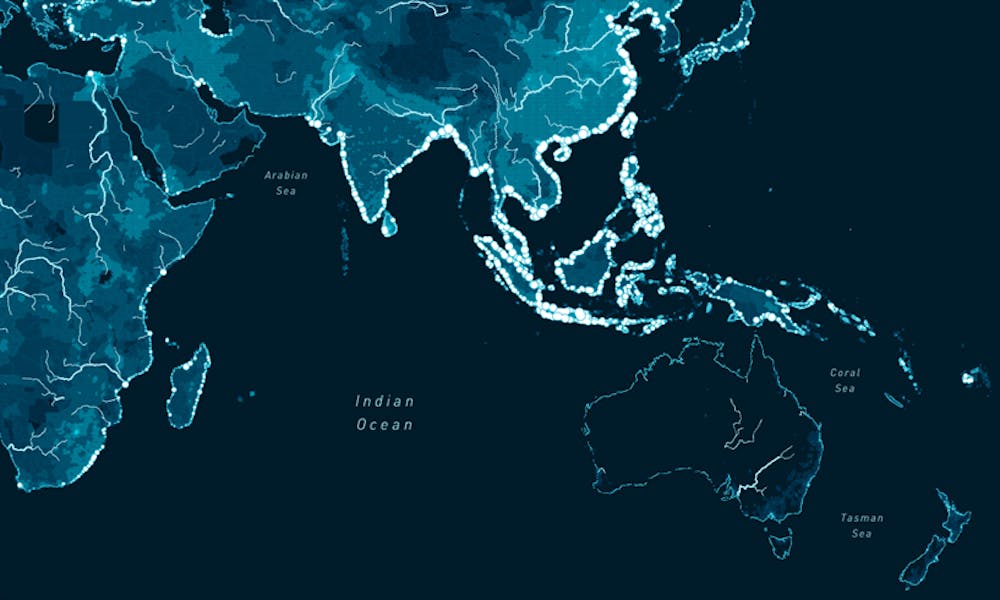
For example, it has been estimated that up to 90% of the global riverine input of plastic waste originates from Asia. The input of plastics to the Southern Indian Ocean is mainly through Indonesia. The Australian contribution is small.

The major sources of riverine input of plastic material into the Indian Ocean. The Ocean Cleanup, CC BY-NC-ND

The Indian Ocean has many unique characteristics compared with the other ocean basins. The most striking factor is the presence of the Asian continental landmass, which results in the absence of a northern ocean basin and generates monsoon winds.

As a result of the former, there is no gyre in the Northern Indian Ocean, and so there is no garbage patch. The latter results in reversing ocean surface currents.

The Indian and Pacific Oceans are connected through the Indonesian Archipelago, which allows for warmer, less salty water to be transported from the Pacific to the Indian via a phenomenon called the Indonesian Throughflow (see graphic, below).

Schematic currents and location of a leaky garbage patch in the southern Indian Ocean: Indonesian Throughflow (ITF), Leeuwin Current (LC), South Indian Counter Current (SICC), Agulhas Current (AC). Author provided

This connection also results in the formation of the Leeuwin Current, a poleward (towards the South Pole) current that flows alongside Australia’s west coast.

As a result, the Southern Indian Ocean has poleward currents on both eastern and western margins of the ocean basin.

Also, the South Indian Counter Current flows eastwards across the entire width of the Southern Indian Ocean, through the centre of the subtropical gyre, from the southern tip of Madagascar to Australia.

The African continent ends at around 35 degrees south, which provides a connection between the southern Indian and Atlantic Oceans.

How to follow that rubbish

In contrast to other ocean basins, the Indian Ocean is under-sampled, with only a few measurements of plastic material available. As technology to remotely track plastics does not yet exist, we need to use indirect ways to determine the fate of plastic in the Indian Ocean.

We used information from more than 22,000 satellite-tracked surface drifting buoys that have been released all over the world’s oceans since 1979. This allowed us to simulate pathways of plastic waste globally, with an emphasis on the Indian Ocean.

Global simulated concentration of floating waste after 50 years. Mirjam van der Mheen, Author provided

We found that unique characteristics of the Southern Indian Ocean transport floating plastics towards the ocean’s western side, where it leaks past South Africa into the South Atlantic Ocean.

Because of the Asian monsoon system, the southeast trade winds in the Southern Indian Ocean are stronger than the trade winds in the Pacific and Atlantic Oceans. These strong winds push floating plastic material further to the west in the Southern Indian Ocean than they do in the other oceans.

So the rubbish goes where?

This allows the floating plastic to leak more readily from the Southern Indian Ocean into the South Atlantic Ocean. All these factors contribute to an ill-defined garbage patch in the Southern Indian Ocean.

Simulated concentration of floating waste over 50 years in the Indian Ocean.

In the Northern Indian Ocean our simulations showed there may be an accumulation of waste in the Bay of Bengal.


Read more: ‘Missing plastic’ in the oceans can be found below the surface


It is also likely that floating plastics will ultimately end up on beaches all around the Indian Ocean, transported by the reversing monsoon winds and currents. Which beaches will be most heavily affected is still unclear, and will probably depend on the monsoon season.

Our study shows that the atmospheric and oceanic attributes of the Indian Ocean are different to other ocean basins and that there may not be a concentrated garbage patch. Therefore the mystery of all the missing plastic is even greater in the Indian Ocean.

ref. There’s no ‘garbage patch’ in the Southern Indian Ocean, so where does all the rubbish go? – http://theconversation.com/theres-no-garbage-patch-in-the-southern-indian-ocean-so-where-does-all-the-rubbish-go-114439

Election stays on tax and health battlegrounds

]]>

Source: The Conversation (Au and NZ) – By Michelle Grattan, Professorial Fellow, University of Canberra

The election contest continues to focus on tax and health, with the government setting out the tax benefit people in particular occupations would get in the long term under its plan, and Labor announcing funding for pathology from its cancer package.

The government says teachers, nurses, police officers and tradesmen would pay significantly more income tax under Labor.

According to its figures a NSW nurse manager earning $199,029 in 2024-25 would pay $11,740 less tax than under Labor; a Queensland public school principal on $183,201 would pay $9049 less tax than under Labor, and a Victorian public school classroom teacher on $115,745 would be $3699 better off.

Labor has rejected the later stages of the government’s income tax plan, saying it is not fiscally responsible to produce details at this stage. It however has left the way open for a Shorten government to give tax cuts – beyond those promised to be delivered within weeks of the election – when budget circumstances allow.

Treasurer Josh Frydenberg said: “Anyone earning more than $40,000 will better off under our plan. It means school teachers, nurses, bus drivers and emergency service workers right across the country will have more money in their pocket.

“This is more money to spend as they see fit. Our plan provides greater reward for effort while ensuring top earners continue to pay their fair share.”

“Our tax system will maintain its progressive nature under our reforms, with the top 5% of the taxpayers paying around one third of all income tax.”

Source: Liberal Party of Australia

Tax and health have dominated the first days of the campaign, with the government using numbers from the Treasury to butress its argument about Labor as high taxers and figures from the Health department to claim Labor’s plan to slash costs for cancer sufferers was massively under-costed.

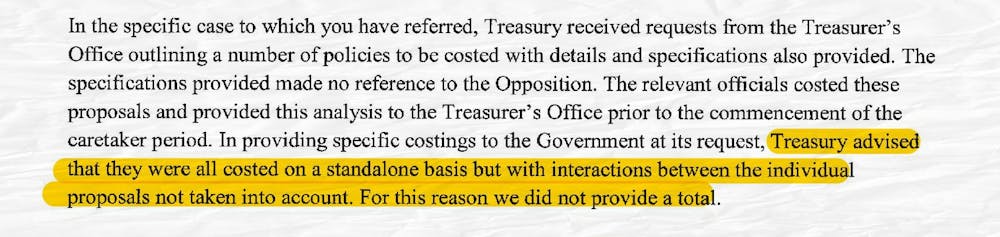
Both Treasury and the Health department distanced themselves from the exercises, saying they had responded to government requests rather than costed opposition policies.

In the case of the attack on the cancer package the government’s attack was based on a false assumption about rebates.

In its latest slicing and dicing of its $2.3 billion cancer package Labor says it would invest $200 million to keep pathology tests free for older people and people with cancer.

“Bulk billing for blood tests is at breaking point – cancer patients will either have to pay, or there will be a reducation in services,” Bill Shorten and health spokeswoman Catherine King say in a statement.

A Labor government would work with the sector and lift the bulk billing incentive. Older people will have about 20 million pathology tests a year; people with cancer have about three million.

The CEO of Australian Pathology, Leisel Well, said that “without adequate funding, pathology services will be forced to stop bulk billing.

“This will impact unfairly on poorer Australians, including pensioners. Many will simply not be able to afford tests, which means diseases will get diagnosed later at a greater cost to taxpayers, and most importantly with a greater impact on thye health outcomes of Australians”.

ref. Election stays on tax and health battlegrounds – http://theconversation.com/election-stays-on-tax-and-health-battlegrounds-115500

Homeschooled children are far more socially engaged than you might think

]]>

Source: The Conversation (Au and NZ) – By Kate Burton, Adjunct Lecturer in Education, Edith Cowan University

This article is part of our series on homeschooling in Australia. The series answers common questions including why homeschooling is on the rise and how outcomes of homeschooled children compare with those who attend formal schooling.


Between 2011 and 2017, the number of children homeschooled in Australia grew by more than 80%. In Queensland, it nearly quadrupled during this period. This suggests one in 200 Australian students were home educated in 2017.

Some people believe homeschooled children miss out on socialising with others and are sheltered from the normal pressures of life. Many question how parents can cultivate important aspects of social development such as resilience and effective interpersonal skills in their children if they are not being exposed to peers in a typical school setting.

The “socialisation question”, as it is known in homeschooling research, is frequently encountered by homeschooling families.

We conducted a survey that captured data on various aspects of the homeschooling experience, including socialisation. A total of 385 parents or guardians from across all Australian states and territories, who were homeschooling 676 children, responded to the questionnaire. We then conducted interviews with 12 homeschooling parents/guardians.

Homeschooled children learning archery. Author provided

Our yet-to-be-published survey found homeschooled children have ample opportunities for engagement and socialisation. This includes being involved in various learning and other community groups, and participating in homeschooling co-ops.

The socialisation question

Homeschooling families don’t conform to social norms by virtue of not attending formalised schooling. When people deviate from mainstream expectations, it can provoke strong opinions from other members of society.

Concerns about socialisation are persistent despite a number of research papers that found homeschooled children are not denied opportunities to socialise. As one paper’s authors noted:

Whilst home education does occur from a ‘home base’ many home education approaches extend learning well beyond the bounds of the family home by way of experiential learning and accessing community resources.

A study of 70 US home-schooled children concluded that “homeschooled children’s social skills scores were consistently higher than those of public school students”.

And another study’s author wrote:

Compared to children attending conventional schools, research also suggests homeschooled children often have higher quality friendships and better relationships with their parents and other adults.

Similarly, a 2014 parliamentary review of homeschooling in New South Wales found no concerns in relation to the socialisation of homeschooled children and no recommendations in this area were deemed to be necessary.

An active homeschooling community

Our survey and interviews demonstrated homeschooled children were active members of their community, and were far more socially engaged than public misconceptions suggest.


Read more: How parents can help their young children develop healthy social skills


Nearly 50% of children participated in at least one club activity. This included 24 different sports – from AFL to aerial silks and yoga – and clubs including lego and chess. Around 40% attended at least one regular learning group. Classes included new languages, gardening, Shakespeare and archaeology.

Homeschooled children regularly attend community events and are involved in learning groups, such as this science group at a local library. Author provided

The majority of research participants regularly had “play dates” with homeschooling and/or non-homeschooling families. Children actively participated in their community through the arts, including community theatre, bands, choirs, dance and visual arts classes.

More than 15% of survey participants highlighted the importance of extended family being active in children’s lives and teaching them life skills across multiple generations. The community church played a big part in some children’s socialisation, and 9% participated in junior groups focusing on serving the community, including Scouts, Guides and Cadets.

Homeschooled children engage in activities such as cooking classes. Author provided

Homeschooling co-ops

Nearly 40% of participating families indicated they were members of a homeschooling co-op. These are community groups run by a committee of parents, guardians and sometimes extended family. They provide various courses such as sport or music, STEM classes, ecological conservation, and courses directed at social and emotional well-being.

Children are often active participants in the co-op, making suggestions regarding classes and running events themselves. A growing movement, and a boon for geographically isolated families, is the emergence of virtual home-school co-ops.

A few key themes emerged from the interviews conducted with parents, which can offer some advice to those considering, or who are new to, homeschooling:

  • many parents reported initial concerns regarding their ability to teach their child effectively, only to find their concerns were unfounded

  • homeschooling does not look like mainstream schooling, so don’t try to make it look the same. It doesn’t work

  • schedule time for yourself – self-care is very important

  • join a homeschooling group.

A number of groups are available to provide support to homeschooling families in Australia. Lots of resources are available, and seasoned families often provide support for new members. Homeschoolingdownunder is a great starting point. There are also countless homeschooling support groups on Facebook some of which serve specific geographical locations or populations of children.


Read more: Homeschooling is on the rise in Australia. Who is doing it and why?


Next time you meet someone who is homeschooling their child or children, instead of asking them about socialisation (they have heard that one before), consider acknowledging the enormous commitment made by their family and the fantastic opportunities they are providing for their children. Concerns about socialisation in the Australian homeschooling community are not grounded in reality.

ref. Homeschooled children are far more socially engaged than you might think – http://theconversation.com/homeschooled-children-are-far-more-socially-engaged-than-you-might-think-111353

Memories. In 1961 Labor promised to boost the deficit to fight unemployment. The promise won

]]>

Source: The Conversation (Au and NZ) – By Warwick Smith, Research economist, University of Melbourne

Lately, governments and oppositions have been obsessed with “returning to surplus” in order to balance the budget.

It hasn’t always been so. In the lead-up to the 1961 federal election, unemployment had climbed above 2% and was creeping towards 3%. (By today’s standards that doesn’t sound much, but for two decades since the onset of the second world war unemployment had been mostly well below 2%.)

The Labor opposition, led by Arthur Calwell, went to the 1961 election promising that:

Labor will restore full employment within 12 months, and will introduce a supplementary budget in February for a deficit of £100 million, if necessary, to achieve this.

From the end of World War II, there had been a bipartisan commitment to full employment in Australia. As laid out in the Curtin government’s 1945 White Paper, Full Employment in Australia, this was achieved by “stimulating spending on goods and services to the extent necessary to sustain full employment”.

The strongly held view, developed primarily by British economist John Maynard Keynes during the Great Depression, was that government could, and should, use its spending power to fill any gap left by private expenditure, ensuring there was always enough spending to keep operating near (but not above) capacity.

Spending stopped unemployment

The 25 years after World War II in which this happened are often referred to as the “postwar boom” because times were so good. This period had rapid economic growth, steadily improving material standards of living (for most), and falling inequality.

Involuntary unemployment was scarcely heard of. “Long-term unemployment” didn’t exist as a statistical category.

By focusing on keeping the Australian economy at or near full capacity and investing heavily in infrastructure, research and education to improve productivity, the postwar governments of both major parties were able to do what these days would be thought impossible: to run constant government deficits while overseeing a dramatic fall in the ratio of government debt to gross domestic product.


Source: Australian Federal Government deficits, debt and the stock market, Centric Wealth


What’s important to understand is that the postwar boom occurred, at least in part, because of the budget deficits, not in spite of them.

By always spending enough to maintain the economy at full employment, the government ensured a strong economy. Economic growth made the ratio of debt to gross domestic product shrink.

All of this was very much part of the public conversation back in the 1940s, 1950s and 1960s. Very little attention was given to the budget balance, with people instead focused on the level of unemployment. On the rare occasions the budget balance was mentioned, it was often in the context of pushing for greater deficits to reduce unemployment.

Calwell won the fight, if not the election

After the 1961 election Robert Menzies made Arthur Calwell’s policy his own. National Library of Australia

Calwell’s Labor opposition didn’t win the 1961 election, but there was a massive swing towards it and the result was one of the closest in Australia’s history, decided by mere hundreds of votes.

The fact that unemployment had crept up towards 3% was a significant contributor to the Coalition losing 15 seats in the House of Representatives and control of the Senate.

Immediately after the election, to shore up his position, Menzies effectively adopted and extended Labor’s policy delivering a 1962-63 budget that focused squarely full employment and brought down a deficit £120 million, £20 million more than Labor had been proposing.

The debt burden shrank as GDP climbed

By the end of World War II, government debt was 120% of gross domestic product total. This means that total debt was 1.2 times the annual economic output of the country. By comparison, today’s federal government debt is about 18% of GDP, a mere one-fifth of annual economic output.

So, according to the modern political discourse on government debt, the postwar generations must have been terribly burdened by all of that debt, and governments must have had to show incredible fiscal discipline to pay it off, right?

The answer will surprise many who have fallen for the modern rhetoric. Although each loan was paid off as if came due, the total stock of debt didn’t shrink, but the economy grew strongly, allowing the debt-to-GDP ratio to wither to the point at which it approached zero.


Commonwealth Treasury


Australia’s budget history is one of modest deficits leavened with occasional larger deficits and occasional surpluses. It’s been entirely sustainable.

Our postwar governments lived by Keynes’s dictum:

Look after the unemployment and the budget will look after itself.

The economy has changed a lot since then and we can’t simply copy the policies that worked for Curtin, Chifley and Menzies.

But we can learn from them. The reality is that we don’t know how low unemployment could fall in modern Australia because we haven’t made any genuine attempt to push it below 5% for decades.


Read more: Explainer: what is modern monetary theory?


A modern-day policy commitment to full employment, along lines inspired by what we did after the war, could lift wages, reduce inequality, drive increases in productivity and, most importantly, provide full employment for the more than two million Australians who are currently unemployed, underemployed or discouraged attempting to get work.

Treasurer Chifley summed up the goal this way in 1944:

Our objective is not primarily social security, but rather the much higher objective of full employment of manpower and resources in raising living standards.

ref. Memories. In 1961 Labor promised to boost the deficit to fight unemployment. The promise won – http://theconversation.com/memories-in-1961-labor-promised-to-boost-the-deficit-to-fight-unemployment-the-promise-won-115376

View from The Hill: Peter Dutton – Labor’s not-so-secret weapon against Hunt and Sukkar

]]>

Source: The Conversation (Au and NZ) – By Michelle Grattan, Professorial Fellow, University of Canberra

While Peter Dutton is fighting for his political life in his marginal Brisbane seat of Dickson, he is being “weaponised” by Labor in its efforts to defeat two of his strongest Victorian supporters, Greg Hunt and Michael Sukkar, despite their relatively solid margins.

Last August, a clutch of Victorian Liberals including Hunt and Sukkar thought the government collectively, and in some cases they individually, would be better off with the rightwinger from Queensland as prime minister.

Greg Hunt aspired to be Dutton’s deputy. If he and Dutton had won their respective ballots Hunt, rather than Josh Frydenberg, would now be treasurer.

Instead, he remains health minister and is facing a tough contest in Flinders, made more difficult by crossbencher Julia Banks running there as an independent. Banks, the Liberal defector who formerly occupied Chisholm, was particularly angered by the overthrow of Malcolm Turnbull and has made a feature of Hunt’s disloyalty.

Sukkar, the member for Deakin, a hard line conservative who was an assistant minister before the coup and a backbencher after it, did numbers for Dutton.

On Monday Labor launched a social media campaign weaponising Peter Dutton in the fight to unseat Hunt and Sukkar in Flinders and Deakin.


The targeting is based on internal tracking research showing Dutton is especially toxic in those two seats.

Quotes from the Labor focus groups included:

Even though I normally vote Liberal I’d love to see Peter Dutton and Tony Abbott stitched up

I am a Liberal voter but this time I can’t because of what Peter Dutton did to Malcolm Turnbull

In usual circumstances Deakin (on 6.4%) and Flinders (7%) should be safe. But after the November state rout of the Liberals – when the overthrow of Turnbull was a major factor and Dutton’s face had been on billboards – nothing is certain.

The Liberals think some of this anger has abated but the Victorian situation remains grim, with a number of seats at risk in a state John Howard has called the Massachusetts of Australia.

Labor has around ten seats on its “target” list for attention. While Dutton may be featured in other seats, there is less of a “hook” for him than in those of Hunt and Sukkar.

When Scott Morrison announced the election last Thursday, Bill Shorten delivered his speech later from a suburban home in Deakin.

On Monday Morrison was campaigning with Sukkar – who was anxious to leave most of the talking to the Prime Minister.

Asked how much Sukkar’s support for Dutton had contributed to the problems the government was facing in Deakin and Victoria, Morrison stonewalled: “That is such a bubble question, I’m just going to leave that one in the bubble”.

One of the Labor posters that will appear in the Victorian seats of Deakin and Flinders.

In the video Labor targets Dutton over a broad range of issues, including his support, as health minister under Tony Abbott, for a proposed $7 Medicare co-payment, which was later dumped.

His co-payment history is expected to get a wider outing in a campaign in which Labor is running heavily on health.

The video asks

How much will Peter Dutton and the Liberals stand up for Victoria? Let’s check. He tried to give a $17 billion tax cut to the banks, cut $14 billion from Australian public schools

It says

Peter Dutton was the health minister who tried to cut more than $50 billion from public hospitals and also tried to introduce the $7 GP tax. He made fun of climate change victims and voted against the banking royal commission 24 times.

And with the other right-wing Liberals he plotted to dump Malcolm Turnbull and voted to make himself prime minister, twice.Right-winger Peter Dutton for the top end of town and himself.“

There are also customised posters in Victoria featuring Dutton, especially for Deakin and Flinders.

Dutton has played into Labor’s hands in the early days of the campaign, with his remark last week attacking his opponent, amputee Ali France, for not moving into Dickson, accusing her of using her disability as an excuse.

“A lot of people have raised this with me. I think they are quite angry that Ms France is using her disability as an excuse for not moving into our electorate,” he said.

“Ali has been telling people that even if she won the election she won’t move into our electorate. She has now changed that position, but I don’t think it is credible.”


Read more: View from The Hill: Dutton suffers reflux after tasty Chinese meal


Morrison initially defended Dutton, claiming he was taken out of context and was just reflecting what his constituents had said to him.

Subsequently Dutton apologised. On Monday Morrison too had changed his tune. “Peter has made his apology appropriately. What I don’t want to see happen in this election campaign is, I don’t want to see people playing politics with disabilities. I have very strong personal views about this topic”.

Nationally, Peter Dutton will have a big footprint in the campaign. It won’t be a helpful one for Morrison.

ref. View from The Hill: Peter Dutton – Labor’s not-so-secret weapon against Hunt and Sukkar – http://theconversation.com/view-from-the-hill-peter-dutton-labors-not-so-secret-weapon-against-hunt-and-sukkar-115474

Solomon Island’s election among ‘most corrupt’, says former PM

]]>
Former Solomon Islands Prime Minister Ezekiel Alebua … “too many flaws in 2018 Electoral Act.” Image: SIBC/AFP

Pacific Media Centre Newsdesk

Former Solomon Islands Prime Minister Ezekiel Alebua says that while last week’s general election was peaceful, he claims it was also among the most corrupt.

The main source of election corruption was the 2018 Electoral Act which had many flaws, he said in an interview with the Solomon Islands Broadcasting Corporation.

Alebua said the Act was either “ill-conceived” or “intentionally drawn up” to enable former MPs who passed the Act to retain their Parliamentary seats.

READ MORE: Transparency Solomon Islands exposes MP’s slush fund – RNZ

He cited cross-constituency voting and the use of the Rural Constituency Development Fund (RCDF) as among the major flaws.

“People are being asked to use their right to vote anywhere they like, but the people didn’t use their rights responsibly,” he said.

-Partners-

“People from different provinces who don’t know the candidates from other provinces. They also didn’t attend their campaigns, they went and voted in different provinces. The government is also responsible for the return of many former MPs through the RCDF.”

He also used an example from the election campaign period, when other candidates wanted to hire vehicles that were bought with constituency funds by former MPs.

Government assets
This was prevented, however, by the supporters of the former MPs.

Alebua said it was not right because the vehicles were government assets.

“I don’t have any other option but to describe this election as the most corrupt,” he said.

Alebua is recording his observations on the 2019 national general election and will pass them on to the Solomon Islands Electoral Office for consideration in future elections.

Others around the country have shared similar opinions as Abebua.

Joe Silvester from Lau Baelelea in Malaita Province said although the election was peaceful it was not fair and needed to be investigated.

Print Friendly, PDF & Email

Article by AsiaPacificReport.nz

West Papuan peace advocate who urged dialogue dies

]]>
Neles Tebay of the West Papua Catholic Justice and Peace Secretariat, as well as the Papua Peace Network. Photo: UCA News

By RNZ Pacific

A leading West Papuan peace campaigner, Neles Tebay, has died in Jakarta after being hospitalised with leukemia.

A Catholic priest and academic as well as the co-ordinator of the Papua Peace Network, Dr Tebay was a tireless advocate for dialogue between West Papuans and Indonesia’s government over the political conflict in their homeland.

He was involved with the most effective initiatives on this front in Reformasi era Papua.

READ MORE: Indonesia bans foreign media from covering elections in West Papua

These included the Indonesian Institute of Sciences’ strategic Papuan Road Map produced 10 years ago which called for the country to confront its troubled history in Papua with an inclusive approach.

Dr Tebay urged Jakarta to create an inclusive dialogue that involved West Papuans who fought for independence as well as those who campaigned from exile abroad.

-Partners-

Based at the Catholic Diocese of Jayapura, he embraced the difficult task of trying to find common ground among those on opposing sides of the conflict.

In 2017, it was Dr Tebay who Indonesian President Joko Widodo suggested should be mediator for talks between his government and Papuan civil society, church and customary leaders.

The widely respected intellectual was a consistent voice against adopting military approaches to solving the political conflict in Papua.

In 2013, he told RNZ Pacific that a significant dialogue process was imperative if there was to be peace in West Papua:

“For the government and indigenous West Papuans to jointly identify the problem and its root causes and jointly discover independent solutions so that the result of the dialogue would be that every person living in West Papua can express freely its opinion.”

Despite Dr Tebay’s efforts over the years, there is still some way to go to achieve the goal of inclusive dialogue over the problems in West Papua.

Born in what is now Dogiyai regency of Papua province, Dr Tebay studied theology at Fajar Timur in Abepura, Papua.

After his ordination in 1992, he obtained a masters degree in Manila and a PhD in missiology at the Urbania University of Rome.

He published books and a large number of articles, and wrote for local and national Indonesian newspapers, often about Papua’s problems and the possibilities for a peaceful solution.

Dr Tebay was under intensive care for the last few weeks at Saint Carolus Hospital in Central Jakarta before he died yesterday, aged 55.

This article is republished under the Pacific Media Centre’s content partnership with Radio New Zealand.

Print Friendly, PDF & Email

Article by AsiaPacificReport.nz

Poll wrap: Labor maintains its lead in Newspoll, while One Nation drops; NSW upper house finalised

]]>

Source: The Conversation (Au and NZ) – By Adrian Beaumont, Honorary Associate, School of Mathematics and Statistics, University of Melbourne

With five weeks until the May 18 election, this week’s Newspoll, conducted April 11-14 from a sample of 1,700 people, gave Labor a 52-48 lead, unchanged since last week. Primary votes were 39% Coalition (up one), 39% Labor (up two), 9% Greens (steady) and 4% One Nation (down two) – One Nation’s lowest primary vote since November 2016.

While the two-party figure was unchanged, this poll is better for Labor than last week’s Newspoll, with Labor gaining two points in primary votes from One Nation’s drop. If we assess this poll as total right-wing vs total left-wing vote, the left (Labor and Greens) gained two points to stand at 48%, while the right (Coalition and One Nation) lost one point to fall to 43%. Analyst Kevin Bonham said this Newspoll was probably rounded towards the Coalition.

One Nation’s drop is likely the result of increased polarisation between the major parties. If One Nation had been affected by the NRA donations scandal, it would have shown up in last week’s polls.

Nominations for the federal election will be declared on April 24. It is unlikely that One Nation will contest the vast majority of lower house seats. Polling conducted after April 24 is likely to greatly reduce One Nation’s vote as they will no longer be an option for most Australians in the lower house. This reduction of One Nation’s vote may assist the Coalition on primary votes.

In the Newspoll, 45% of respondents were satisfied with Prime Minister Scott Morrison’s performance (steady), and 44% were dissatisfied (up one), for a net approval of +1. Labor leader Bill Shorten’s net approval was steady at -14. Morrison led Shorten by an unchanged 46-35 as better PM.

Since Malcolm Turnbull was ousted as prime minister in August 2018, the Coalition has recovered from a 56-44 deficit in Newspoll to 52-48 this week, due partly to the time that’s passed since the spill and partly to the relative popularity of Morrison.

Now that the election campaign is formally under way, some attention will shift to the opposition’s policies and proposals. The danger for Labor is the Coalition can scare voters about its economic policies, but the potential reward is that Labor can appeal to voters who are frustrated by the Coalition’s perceived inaction on climate change and low wage growth.


Read more: Post-budget poll wrap: Coalition gets a bounce in Newspoll, but not in Ipsos or Essential


Large difference in voting intentions by age group

Every three months, Newspoll aggregates all the polls it conducted from that time period to get voting intention breakdowns by state, age, gender and region (the five capital cities vs the rest of Australia). For January to March, the overall result was 53-47 to Labor, a point better for Labor than the last two Newspolls.

This three-month Newspoll showed a large difference in voting intentions by age group. Among those aged 18-34, Labor had 46% of the primary vote, the Coalition 28%, the Greens 14% and One Nation 4%. Among those aged 35-49, it was Labor 39%, Coalition 35%, Greens 9% and One Nation 7%. And among those aged 50 or over, the Coalition had 44%, Labor 35%, One Nation 6% and Greens 5%.

It is still important to poll well with this oldest demographic. According to the 2016 census, those aged 18-34 represent 30.3% of the eligible voting age population and those aged 35-49 represent 26.0%. The share of the voting-age population aged 50 or over, however, is 43.7%.

Results by gender were similar. Men gave Labor 40% of the primary vote, the Coalition 37%, the Greens 7% and One Nation 6%. With women, Labor had 39%, the Coalition 37%, the Greens 10% and One Nation 6%. After preferences, Labor would be doing about one point better with women than men.

The best source for state voting intentions is The Poll Bludger’s BludgerTrack. Perhaps reflecting the Coalition’s victory in the recent NSW election, federal Labor’s lead over the Coalition in that state has been reduced to just 50.1-49.9 from about 54-46 in the last few weeks. This is about a 0.6% swing in Labor’s favour from 2016.

Labor has maintained a larger lead in most other states, however. In Victoria, Labor leads by 55.1-44.9, a 3.2% swing to Labor since 2016. In Queensland, Labor leads by 52.0-48.0, a 6.1% swing to Labor. In SA, Labor leads by 55.7-44.3, a 3.4% swing to Labor.

In WA, the Coalition still leads by 51.0-49.0, but this is a 3.6% swing in Labor’s favour from 2016.

Nationally, BludgerTrack gives Labor a 52.5-47.5 lead, a 2.8% swing to Labor.

One Nation wins two seats in the NSW upper house

In the March 23 NSW election, 21 members of the upper house were elected by statewide proportional representation, with a quota of 1/22 of the vote, or 4.55%.

The Coalition won 7.66 quotas, Labor 6.53, the Greens 2.14, One Nation 1.52, the Shooters, Fishers & Farmers 1.22, the Christian Democrats 0.50, the Liberal Democrats 0.48, Animal Justice 0.43 and Keep Sydney Open 0.40.

The Coalition was certain to win an eighth seat, and Labor and One Nation were best placed for two other seats. On preferences, Animal Justice overtook the Liberal Democrats, Christian Democrats and One Nation to win the second-to-last seat, with One Nation’s second candidate, Rod Roberts, defeating the Christian Democrats for the final seat.

It is the first time since 1981 that the Christian Democrats have failed to win a seat in the NSW upper house. David Leyonhjelm, who resigned from the Senate to run as the lead Liberal Democrat candidate in NSW, did not win.

The Coalition now holds 17 of the 42 total upper house seats (down three), Labor 14 (up two), the Greens four (down one), the Shooters two (steady), One Nation two (up two), Animal Justice two (up one) and the Christian Democrats one (down one). One Green member, Justin Field, resigned from the party, and is now an independent.

Overall, the right now holds 22 of the 42 seats. On legislation opposed by the left-wing parties, the Coalition will require support from One Nation, the Shooters and Christian Democrats.


Read more: Coalition wins a third term in NSW with few seats changing hands


Brexit likely delayed until at least October 31

The European Union leaders have decided to delay Brexit until at least October 31. Without a majority for any plausible Brexit option, the House of Commons could only vote to delay Brexit to prevent a no-deal departure from the EU, but this delay will likely not appeal to the general public or “leave” voters.

Two new polls have the Conservatives slumping to just 28-29% of the UK vote, 4-7 points behind Labour.

ref. Poll wrap: Labor maintains its lead in Newspoll, while One Nation drops; NSW upper house finalised – http://theconversation.com/poll-wrap-labor-maintains-its-lead-in-newspoll-while-one-nation-drops-nsw-upper-house-finalised-115426

Transforming the incidental into the memorable: the enigmatic art of Rosslynd Piggott

]]>

Source: The Conversation (Au and NZ) – By Sasha Grishin, Adjunct Professor of Art History, Australian National University

Although Rosslynd Piggott has a high profile in the contemporary Australian art scene, her work is difficult to characterise; meaning in her installations, objects and paintings is elusive and interpretations are ambiguous. Her art is not easily given to verbalisation; it is something that is perceived visually and felt intuitively.

Jane Devery, the curator of this exhibition and the author of the excellent catalogue essay notes that Piggott’s works “have courted the elusive and the ethereal.” From the outset, Piggott’s art has flirted with surrealism and symbolism, she explores a dream-like state, where the process is open-ended – part of a continuum – and the notion of the uncanny is a constant companion.

Rosslynd Piggott Upside-down landscape 1989 oil on linen, 136.0 x 183.0 cm. © The artist Photo: courtesy the artist

Yukio Mishima, one of Piggott’s favourite authors, in his novel Spring Snow (1969), touches on a quality inherent in Piggott’s art. Mishima writes,

Dreams, memories, the sacred – they are all alike in that they are beyond our grasp. Once we are even marginally separated from what we can touch, the object is sanctified; it acquires the beauty of the unattainable, the quality of the miraculous. Everything, really, has this quality of sacredness, but we can desecrate it at a touch. How strange man is! His touch defiles and yet he contains the source of miracles.

Rosslynd Piggott La somnambule (the sleepwalker) 1996–97 (detail) Art Gallery of New South Wales, Sydney Contemporary Collection Benefactors 2003. © The artist Photo: courtesy the artist

Many of Piggott’s pieces could be aptly described as containing “the source of miracles” – where something is sensed, rather than clearly perceived or articulated. We enter into an ethereal zone, where there are no secure touchstones; mirrors and reflections are part of the process and we frequently see the world through a glass darkly.

Piggott observes: “I have long been drawn to an unclear mirror, as an object and an idea, held in fascination with ancient mirrors, darkened by the oxygenation of time”.

Nevertheless, Piggott’s objects, installations and paintings are memorable, even if memorable in an enigmatic way. Her High bed 1998, in the National Gallery of Australia collection in Canberra, is simple, alluring and seductive, but the elements presented for our contemplation lack a rational reading.

Rosslynd Piggott High bed 1998, painted wood, metal, cotton, polyethylene terephthalate, satin, mirror / mirrored synthetic polymer resin, synthethetic polymer paint on existing walls, 370.0 x 200.0 x 230.0 cm (variable). National Gallery of Australia, Canberra Purchased, 2000 © The artist

There is a luxurious but oversized bed, which can only be reached by a ladder; at the foot of the ladder are a pair of gorgeous satin adult party shoes, but much too tiny to fit even the smallest and most dainty adult foot. Perched on top of the bed, where the sleeper should be, is a small model of a house.

A circular mirror, suspended above, in pedigree stretching back to the mirror in Jan van Eyck’s Arnolfini double portrait, adds to the sense of disorientation and heightened anxiety experienced in this installation.

In the late 1990s, when the High Bed was made, in art circles there was a growing interest in Freud’s notion of the uncanny that explored strangeness in everyday homely objects. Piggott’s bed in white satin taps into this tradition and enhances it. This is a bed on which no one will sleep, but about which many will dream.

When in December 1919, Marcel Duchamp created his Paris Air, he asked a pharmacist to empty an ampoule that originally contained a serum and to seal it again, once it was filled with Paris air. To this he attached a label, “Serum Physiologique” and later described it as, “Ampoule contenant 50 cc d’air de Paris.” This fragile Paris souvenir “readymade” he gave to his friend and patron, Walter Arensberg.

Piggott has been haunted for decades by Duchamp’s artistic intervention for the containment of air and containment of breath. Her Collection of air 2.12.1992 – 28.2.1993, plots her journey through Europe in 1992-93 in the form of an eccentric “air diary”. She captured air in glass test tubes in 65 locations, sealed each with red wax marked with the letter “R”, both a reference to her name and the sound for the word “air” in French.

Rosslynd Piggott, Collection of air – 27.12.1992 – 28.2.1993 (detail), wood, glass, perspex, satin, glass testtubes, cork, sealing wax, cotton, paper, ink. © The artist Photo: courtesy the artist

The selection of locations was symbolic and included the generic air of Paris (in homage to Duchamp), air near the Pantheon in Rome and near Piero della Francesca’s Legend of the True Cross in Arezzo. In the installation, the glass vials are lined up as if scientific specimens, each with its identifying tag, for example, reading, “Air of Sainte-Chapelle, Paris, 22 1 1993”. Observing the response of her audience, Piggott has observed, “The labelled information seemed to take them on an extended journey into the tiny and yet expansive space of the invisible”.

The artist has continued through to the present day to contain in glass the air of special locations, especially in Japan, where this invisible, but actual presence as in Air of flower cloud, 2002 or Yamazakura, 2006, could act as a starting point for a thought adventure. Piggott also set out in a number of her pieces, including Suspended breath, 1996, Double breath contained, 1996, and Arranged meeting – breath of two men, 1999, to capture the actual breath of her glass blowers.

Sometimes there is a chance encounter of two glass artists, who are physically divided by continents, but whose breath is united in silent communication within an artwork.

Piggott is not an autobiographic artist, although circumstances of her biography will frequently feed into her art-making as her surroundings seep into her work. She has the rare gift of transforming the local and incidental into something memorable and universal.

It is a pity that significant exhibitions by major contemporary Australian artists, such as Piggott in Melbourne and Janet Laurence in Sydney, remain single venue shows.

Rosslynd Piggott: I sense you but I cannot see you, National Gallery of Victoria Australia, Federation Square, level 3, 12 April – 18 August 2019.

ref. Transforming the incidental into the memorable: the enigmatic art of Rosslynd Piggott – http://theconversation.com/transforming-the-incidental-into-the-memorable-the-enigmatic-art-of-rosslynd-piggott-115452

As Mediscare 2.0 takes centre stage, here’s what you need to know about hospital ‘cuts’ and cancer funding

]]>

Source: The Conversation (Au and NZ) – By Stephen Duckett, Director, Health Program, Grattan Institute

Health is proving a bone of contention in the 2019 election campaign. Labor has positioned health as a key point of difference, and the Coalition is arguing that Labor’s promises are untrue in one case and underfunded in another.

This cheat sheet will help you sort fact from fiction in two key health policy areas: public hospital funding and cancer care.

Public hospitals

In his budget reply, Opposition Leader Bill Shorten promised that Labor would restore every dollar the government had “cut” from public hospital funding.

The government counter-claimed that hospital funding has increased. So who is right?

The short answer is both.

In 2011, the then Labor government negotiated a funding agreement with the states for the Commonwealth to share 45% of the growth in the cost of public hospital care, funded at the “national efficient price”. This price is based on the average cost of the procedure, test or treatment.

The funding share was to increase to 50% of growth from July 1, 2017.


Read more: Public hospital blame game – here’s how we got into this funding mess


At the 2013 election, the then Liberal opposition agreed to match that promise and, indeed, claimed they were the only ones who could be trusted to keep the promise:

A Coalition government will support the transition to the Commonwealth providing 50% growth funding of the efficient price are hospital services as proposed. But only the Coalition has the economic record to be able to deliver.

However, in the 2014 budget the Coalition scrapped its promise. The 2014 budget papers list the savings that were made by the decision. It was a clear and documented cut that the Coalition was proud to claim at the time.

The green line represents the Gillard hospital funding agreement; the blue line is the revised projection from the 2014 budget. Budget 2014-15

Since then, the Turnbull government has backtracked on the 2014 cuts to health but only to restore sharing to 45% of the costs of growth.

Labor has estimated the impact of the gap between 45% and 50% on every public hospital in the country, and spruiks the difference at every opportunity.

Hospital costs increase faster than inflation because of growth and ageing population, the introduction of new technologies, and new approaches to treatment.

As a result, the Commonwealth’s existing 45% sharing policy drives increased spending, and so Commonwealth spending is now at record levels, albeit not at the even higher levels that Labor had promised.

Labor’s promise is, appropriately, phrased as an additional quantum of money to the states, sufficient to restore the 50% share in the cost of growth.

The public hospital funding gap comes down to how much of the growth in hospital funding each party has committed to. Shutterstock

The details of how this funding should be operationalised to the states should be left to detailed negotiations after the election as it is not good practice for all the details of your negotiating position to be aired in the heat of a campaign.

So Labor is right to say hospital funding is lower than it would have been if the 50% growth share commitment had been maintained. But the Coalition is right to say the Commonwealth is spending more on hospital care than when it came to office.

Cancer care

The second major element of the Labor campaign was a high-profile A$2.3 billion package to address high out-of-pocket costs for Australians with cancer. The package has three key components:

  • additional public hospital outpatient funding to reduce waiting times
  • a new bulk-billing item for consultations
  • more funding for MRI machines for cancer diagnosis.

Read more: Labor’s cancer package would cut the cost of care, but beware of unintended side effects


Labor did not promise to eliminate out-of-pocket costs for cancer, not even for consultations. It claimed bulk-billing would increase from 40% to 80% of consultations.

This promise has led to another showdown between Labor and the Coalition. Health Minister Greg Hunt claims to have found a A$6 billion black hole in Labor’s cancer policy.

The Coalition has produced a list of 421 Medicare items used for cancer treatment – including treatment in private hospitals – and noted Labor has not allocated funds to cover the fees specialists charge for these items.

But Labor rightly claims the 421-item list is not what it promised. Labor’s promise was about increasing the rate of bulk-billing for consultations and is based on a new item which is only available if the specialist bulk-bills.

Expect more claims and counter-claims in the weeks ahead.

ref. As Mediscare 2.0 takes centre stage, here’s what you need to know about hospital ‘cuts’ and cancer funding – http://theconversation.com/as-mediscare-2-0-takes-centre-stage-heres-what-you-need-to-know-about-hospital-cuts-and-cancer-funding-115447

New minister for public spaces is welcome – now here are ten priorities for action

]]>

Source: The Conversation (Au and NZ) – By Kurt Iveson, Associate Professor of Urban Geography, University of Sydney

With the re-election of the Berejiklian government, New South Wales now has a minister for public spaces, Rob Stokes. This portfolio was first mooted in February, when the premier announced one of the new minister’s tasks would be to identify and protect publicly owned land for use as parks or public spaces.

As important as this task is, we need even more ambition in this portfolio. Public space is crucial to the social, economic, political and environmental life of our towns and cities. As well as increasing the quantity of public spaces, we need to improve their quality.


Read more: Surprise! Digital space isn’t replacing public space, and might even help make it better


Here are ten priorities for government action to make our public spaces more plentiful and more accessible to all.

1. Rein in privately owned public spaces

From Barangaroo to Bonnyrigg, public spaces in new urban developments are often owned and controlled by private developers. The public has little say over the rules that govern these spaces and how those rules are enforced. Restrictions are often excessive, and private security guards are known to overstep their powers.

The minister for public space should map the extent of privately owned public spaces and ensure these are governed by the same, democratically determined laws that cover publicly owned public spaces.


Read more: Making developments green doesn’t help with inequality


2. Strategic purchases of private land

As well as identifying publicly owned land that could be used for parks or public spaces, the minister should identify privately owned land that could be acquired for the same purpose. The gradual purchase of harbour foreshore property in Glebe has resulted in a wonderful and well-used foreshore walk. Similar opportunities to create public space networks should be identified and planned.

3. Unlock the gates

Too much publicly owned public space is under-utilised because it is locked up. Across the city, ovals and public school playgrounds are fenced off from the public for much of the year when they are not in use. We own these spaces – when they’re not in use for sport or school, we should have access to them.

As minister for education, Stokes recently trialled a program of opening some school playgrounds during school holidays. This should be done across the city. And councils should be required to show cause if they want to restrict access to any public spaces they own.

4. Stop the temporary enclosures

A growing number of park authorities and local governments are doing deals with private companies to temporarily fence off public spaces for commercial activities. Sometimes they do this for days, sometimes for weeks and even months. They do it because they’re short of funds and need the revenue.


Read more: Private events help fund public parks, but there’s a cost too


While programming events in public spaces can help attract crowds, we must halt the creeping logic of commercialisation, which results in us being charged money for access to our own spaces. The minister for public space should ensure park authorities do not need to depend on commercial funding for survival.

5. Maintain footpaths

The quality of footpaths makes a world of difference for many people. Think of parents with prams, little kids, people with mobility issues, and older people for whom falls are a big health risk. Our footpaths need to be wide and their surfaces even. They also need to incorporate places to rest.


Read more: Eight simple changes to our neighbourhoods can help us age well


The capacity of local governments to maintain footpaths is highly uneven. Public spaces in wealthy areas are gold-plated, while in other parts of the city footpaths are too often in poor condition or non-existent. The minister must think about the role that state government can play in evening things out, assisting local governments where required.

6. Provide public toilets

As with footpaths, the provision of public toilets can make the difference between going out or staying at home for many people. The minister should use existing data to audit the provision and accessibility of public toilets in public spaces across the city, identify gaps and fund improvements where required.


Read more: Caught short: we need to talk about public toilets


7. Less private advertising, more public expression

While advertising on the Opera House generated controversy, the creeping spread of commercial advertising in public space is also of concern. All this advertising is commercialising our public spaces and crowding out other forms of public expression – from neighbourhood notices about community events and lost cats to murals and street art.

The minister should work with local governments to limit the amount of advertising in public space, and extract more public good from any advertising revenues raised in public space.


Read more: Is there any way to stop ad creep?


8. No more sniffer dogs and strip searches

The policing of public spaces makes a huge difference to its accessibility. Exclusionary policing strategies – especially the use of drug sniffer dogs and rising use of strip searches – should be stopped.

These tactics are not only put to work at festivals, but also around train stations and entertainment precincts. They are ineffective in leading to prosecutions and are too often used to shame, intimidate and harass people without basis.

The minister for public space needs to challenge the minister for police about this form of policing.

9. Care not control

This is not say that safety is unimportant. We know that fear of harassment and assault stops some people using public space, not least women who often experience this.

However, we must not equate “feeling safe” with “more police” and “more surveillance cameras”. Indeed, sometimes these can have the perverse effect of making people feel less safe, by producing atmospheres of threat.

We feel safer when there are others around caring for the space. So, the minister should investigate ways to encourage these forms of care. Simple measures like later opening hours for neighbourhood shops, or staff on railway platforms and train carriages, can make a big difference.


Read more: To create safer cities for everyone, we need to avoid security that threatens


10. Plant more trees

We need more trees in our public spaces – not just in parks, but on residential and commercial streets too. This is especially important in parts of the city where summer temperatures are already extreme for weeks at a time. Not only do trees help to cool these spaces, they also encourage more biodiversity and combat carbon emissions.

The minister should establish, and fund, a meaningful target for tree planting in public spaces.

This list of suggestions is far from exhaustive. But these reforms and others ought to be on the drawing board as the minister for public space sets about his new work.

It must be hoped this new portfolio is more than a tokenistic attempt to create the appearance of action on public space, in the face of criticism of this government’s record on privatisation of public assets.

ref. New minister for public spaces is welcome – now here are ten priorities for action – http://theconversation.com/new-minister-for-public-spaces-is-welcome-now-here-are-ten-priorities-for-action-115152

Digital campaigning on sites like Facebook is unlikely to swing the election

]]>

Source: The Conversation (Au and NZ) – By Glenn Kefford, Senior Lecturer, Department of Modern History, Politics and International Relations, Macquarie University

With the federal election now officially underway, commentators have begun to consider not only the techniques parties and candidates will use to persuade voters, but also any potential threats we are facing to the integrity of the election.

Invariably, this discussion leads straight to digital.

In the aftermath of the 2016 United States presidential election, the coverage of digital campaigning has been unparalleled. But this coverage has done very little to improve understanding of the key issues confronting our democracies as a result of the continued rise of digital modes of campaigning.

Some degree of confusion is understandable since digital campaigning is opaque – especially in Australia. We have very little information on what political parties or third-party campaigners are spending their money on, some of which comes from taxpayers. But the hysteria around digital is for the most part, unfounded.


Read more: Chinese social media platform WeChat could be a key battleground in the federal election


Why parties use digital media

In any attempt to better understand digital, it’s useful to consider why political parties and other campaigners are using it as part of their election strategies. The reasons are relatively straightforward.

The media landscape is fragmented. Voters are active on social media platforms, such as Facebook and Instagram, so that’s where the parties need to be.

Compared to the cost of advertising on television, radio or in print, digital advertising is very affordable.

Platforms like Facebook offer services that give campaigners a relatively straightforward way to segment voters. Campaigners can use these tools to micro-target them with tailored messaging.

Voting, persuasion and mobilisation

While there is certainly more research required into digital campaigning, there is no scholarly study I know of that suggests advertising online – including micro-targeted messaging – has the effect that it is often claimed to have.

What we know is that digital messaging can have a small but significant effect on mobilisation, that there are concerns about how it could be used to demobilise voters, and that it is an effective way to fundraise and organise. But its ability to independently persuade voters to change their votes is estimated to be close to zero.


Read more: Australian political journalists might be part of a ‘Canberra bubble’, but they engage the public too


The exaggeration and lack of clarity around digital is problematic because there is almost no evidence to support many of the claims made. This type of technology fetishism also implies that voters are easily manipulated, when there is little evidence of this.

While it might help some commentators to rationalise unexpected election results, a more fruitful endeavour than blaming technology would be to try to understand why voters are attracted to various parties or candidates, such as Trump in the US.

Digital campaigning is not a magic bullet, so commentators need to stop treating it as if it is. Parties hope it helps them in their persuasion efforts, but this is through layering their messages across as many mediums as possible, and using the network effect that social media provides.

Data privacy and foreign interference

The two clear and obvious dangers related to digital are about data privacy and foreign meddling. We should not accept that our data is shared widely as a result of some box we ticked online. And we should have greater control over how our data are used, and who they are sold to.

An obvious starting point in Australia is questioning whether parties should continue to be exempt from privacy legislation. Research suggests that a majority of voters see a distinction between commercial entities advertising to us online compared to parties and other campaigners.

We also need to take some personal responsibility, since many of us do not always take our digital footprint as seriously as we should. It matters, and we need to educate ourselves on this.

The more vexing issue is that of foreign interference. One of the first things we need to recognise is that it is unlikely this type of meddling online would independently turn an election.

This does not mean we should accept this behaviour, but changing election results is just one of the goals these actors have. Increasing polarisation and contributing to long-term social divisions is part of the broader strategy.


Read more: Australia should strengthen its privacy laws and remove exemptions for politicians


The digital battleground

As the 2019 campaign unfolds, we should remember that, while digital matters, there is no evidence it has an independent election-changing effect.

Australians should be most concerned with how our data are being used and sold, and about any attempts to meddle in our elections by state and non-state actors.

The current regulatory environment fails to meet community standards. More can and should be done to protect us and our democracy.


This article has been co-published with The Lighthouse, Macquarie University’s multimedia news platform.

ref. Digital campaigning on sites like Facebook is unlikely to swing the election – http://theconversation.com/digital-campaigning-on-sites-like-facebook-is-unlikely-to-swing-the-election-115368

A simpler tax system should spark joy. Sadly, the one in this budget doesn’t

]]>

Source: The Conversation (Au and NZ) – By Steven Hamilton, Assistant professor, George Washington University

There weren’t any new tax ideas in the 2019 Budget, which perhaps is to be expected from a six year old government preparing for an election the betting markets suggest it will lose.

Instead what we got were extensions of a few actually-pretty-big tax ideas introduced in last year’s budget: the planned elimination of the 37% tax bracket, the Low and Middle Income Tax Offset, and the immediate expensing of investments for businesses.

Given the looming election it’s worth examining each of these three ideas, which I will do over the next few days.

First, eliminating one of the tax rates. At the moment the income tax schedule has five rates:


Australian Tax Office


By 2024 they are to be “flattened and simplified” to just four.

An entire rate would vanish, and on that part of their income between A$45,000 and $200,000, most people would face a flat rate of 30%, down from the 32.5% proposed in last year’s budget:


Commonwealth budget papers


It’s an idea with a long lineage.

In 2010 the Henry Tax Review told the Rudd Labor government that personal income tax had become “inordinately complex”.

It proposed a simpler, three-rate, system, but, importantly, said most of the complexity wasn’t due to the number of rates but was due instead to the “large suite of complex deduction rules, numerous tax offsets and a variety of exempt forms of income”.


Henry Tax Review


It’s worthwhile considering why simplicity matters.

Setting aside political considerations, simplicity only matters to the extent that it lowers the cost to the economy of the government raising revenue. For every dollar it raises, the tax system imposes compliance costs on taxpayers and others like employers and banks who are required to keep records and report information to the Tax Office, which also bears costs.

The only simplicity we should care about is one that makes the tax system easier to comply with and easier to administer.

The kind of simplicity that matters

The problem with removing a tax bracket is that by itself it does nothing to achieve that objective. It makes the tax system look tidier – the graph is easier to draw, but that’s it. It doesn’t simplify lives and doesn’t bring joy, except to clean freaks who can satisfy their inner Kondo.

The thing to understand is that the tax system is sometimes complicated for a good reason. That might be a desire to tightly target a tax measure so that only those of a certain income or those with children receive it, for example. Not targeting the tax measure would make the system simpler, but it might also make it less fair and more expensive.

If we accept that some income redistribution is desirable, then in an ideal world we would have a smoothly increasing marginal tax rate from middle to high incomes. There would be an infinite number of tax brackets, as in Germany, where income tax rates rise continuously with income.

It would be easy enough to navigate. An online tool would do the trick.


If we must have discrete tax brackets, then the goal ought to be to approximate this ideal system as closely as possible. It would mean having more rather than fewer rates. Having fewer rates forces some people to pay more than they should and others less.

Some have suggested that eliminating tax brackets would reduce the opportunity for taxpayers to manipulate their income so that it bunches around thresholds.

A graph prepared for the Abbott government’s tax white paper shows that bunching does indeed happen, but it is confined to only a narrow sliver of the income distribution and thus very few taxpayers. It’s probably not worth worrying about.


Re:think. 2015 Treasury tax discussion paper


The kind of simplicity that would help

An idea recently endorsed by the Inspector-General of Taxation and originally proposed by the Henry Review is a standard deduction.

It would entitle every taxpayer to claim a standard amount of deductions without needing receipts. Those with deductions in excess of the standard deduction would still be free to claim those. It’s a system that already exists in the United States and other countries.

Deductions aren’t necessarily a bad thing. There are good reasons why some should be allowed (for example, deductions on the debt interest used to fund investment).

But in practice they take up a lot of our time to document and can be difficult for the Tax Office to interpret (is that car really for work purposes or for personal driving?), something the Tax Commissioner has complained about.

My own research suggests deductions are one of the main means of tax avoidance, responsible for 12 times as much avoidance as understatement of income.

The former Labor government was on board with Henry’s proposal. Unveiling the findings of Ken Henry’s review in 2010, treasurer Wayne Swan promised to “remove the hassle of shoeboxes full of receipts”.

From 2012 onwards everyone would get a standard deduction of $500 in lieu of claiming work-related expenses. It would climb to $1000 from 2013.


Read more: What will the Coalition be remembered for on tax? Tinkering, blunders and lost opportunities


Budgetary constraints meant he never got around to introducing the legislation.

In 2017 Treasurer Scott Morrison asked a parliamentary inquiry to look into the possibility of doing it. It found it would be expensive. A standard deduction of $500 would cost an extra $2.3 billion, a standard deduction of $1000, $4.6 billion.

These costs, while considerable, are nothing like the cost of the flatter tax system the Coalition is proposing.

And they would enable most taxpayers to avoid submitting a tax return at all. Deductions are the primary reason for tax adjustments. Without them, taxpayers could set and forget. Most taxpayers, and the Tax Office, could concern themselves with other things, such as going after multinational corporations.

Now wouldn’t that spark joy?

ref. A simpler tax system should spark joy. Sadly, the one in this budget doesn’t – http://theconversation.com/a-simpler-tax-system-should-spark-joy-sadly-the-one-in-this-budget-doesnt-115370

‘Fairness’ versus ‘strength’ – the battle to frame the federal election

]]>

Source: The Conversation (Au and NZ) – By Mark Triffitt, Lecturer, Public Policy and Political Communications, University of Melbourne

Politicians have long faced the challenge of how to effectively communicate with citizens who largely see them as dissemblers and promise-breakers.

On the face of it, the task for the major parties to construct messages that resonate with voters appears even more daunting in the 2019 federal campaign. After all, the campaign is occurring against the backdrop of historic low levels of voter trust and engagement.

At the same time, the policy battle lines between the major parties heading into the election are among the starkest in recent memory. As such Labor and the Coalition appear to have seeded a rich harvest of cut-through messages organised around very different themes.


Read more: As election 2019 kicks off, the only certainty is a cranky and mistrustful electorate


‘Fairness’ versus ‘strength’

Federal Labor’s campaign communications are organised around a single word: “fair”. At a party, leader or candidate level, “fair” or “fair-go” is threaded through nearly every piece of communication to voters.

Bill Shorten’s budget reply – the unofficial start of Labor’s election campaign – was replete with the word, or variations such as “fair go action plan” and “intergenerational fairness”.

In truth, fairness has always been part of the ALP’s messaging DNA. But its core campaign message in 2019 is aggressively leveraging what the party sees as an emerging zeitgiest in the Australian electorate against undue economic power and privilege.

The Coalition, on the other hand, has its own singular message: “strength” and its semantic sibling “security”. Both words have been campaign talismans for the Coalition since the Howard years, when 9/11 and the Tampa debate sensitised voters to national and border security.

This is why “strong economy”, ‘securing our future’ and “secure borders” will be repeated ad nauseum by the Coalition in the hope that old wine in new bottles will again prove to be its election elixir.

These juxtaposed themes appear to promise a level of campaign frission that might potentially reengage a jaded electorate. The reality, however, is likely to be the opposite.

Fighting the framing wars

Campaign communications based on pithy slogans have always been integral to electioneering. Slogans seek to compress complex realities into bite-sized messages that are simple and memorable. But in the 21st century, slogans and other highly truncated communications have become even more critical to political campaigning.

In this so-called age of distraction and information overload, every communicator faces major challenges not just to gain the public’s attention, but hang onto it. This attention/traction dilemma is compounded for politicians given the rapid rate at which citizens are tuning out of mainstream politics.


Read more: Federal election 2019: state of the states


These structural factors have meant the semantic contest between parties – otherwise known as framing wars – have become increasingly influential in how political campaigns are structured and run.

“Framing” in political communications parlance means marking semantic boundaries around the debate that a party’s campaign or policy speaks to. Values – such as fairness, strength, opportunity, equality and continuity – are the most effective words to frame political messages.

This is because distracted and distrustful voters are more likely to listen to political messages that speak to the universal and positive principles that values espouse. Hence, values framing potentially addresses the “attention” problem.

Their simplicity also readily lend themselves to the repetition required by politicians to hang onto public attention, thus helping to overcome the “traction” problem.

Seeking a connection with voters

While values framing – formalised as political communications practice in the United States over a decade ago – has become an integral tool for Australia’s political parties to connect with voters, there are major drawbacks.

First, the number of values – as expositions of basic moral principles – are relatively limited. This is why the same values, with minor variations, keep being churned out by parties in successive elections. They are also used by competing parties in the same campaign to neutralise the impact of rival frames. Already we see the Coalition attempting to reframe Labor’s fairness mantra as well as Labour’s assurances they too are “strong” economic managers.

As a result, rather than helping to differentiate parties, values framing can reinforce voter perceptions that there is little difference between them.


Read more: The end of uncertainty? How the 2019 federal election might bring stability at last to Australian politics


Embracing the vacuous

The universality of values helps major parties – facing an eroding support base – to appeal to many voters simultaneously.

But their catchall character can also make them and their leaders appear shallow and unimaginative. Think of Malcolm Turnbull’s “Continuity and Change” slogan in 2016. Not only was it widely criticised as a meaningless cliche. It was also seen as a knock-off from a popular political comedy series.

Finally, relying on a singular value to frame campaigns hard wires parties to lean on other generalisations that reinforce public perceptions politicians are out of touch.

Take both parties’ perennial appeal to “ordinary Australians” (is there such a thing in the worlds’s second most multi-cultural society?) or “working families” (at a time when more voters than ever are single).

In short, while voters will hear “fair” and “strength” robotically communicated throughout this campaign, what is viewed by the major parties as a “cut-through” cure to voter disengagement risks only adding to it.

ref. ‘Fairness’ versus ‘strength’ – the battle to frame the federal election – http://theconversation.com/fairness-versus-strength-the-battle-to-frame-the-federal-election-115296

As responsible digital citizens, here’s how we can all reduce racism online

]]>

Source: The Conversation (Au and NZ) – By Ariadna Matamoros-Fernández, Lecturer in Digital Media at the School of Communication, Queensland University of Technology

Have you ever considered that what you type into Google, or the ironic memes you laugh at on Facebook, might be building a more dangerous online environment?

Regulation of online spaces is starting to gather momentum, with governments, consumer groups, and even digital companies themselves calling for more control over what is posted and shared online.

Yet we often fail to recognise the role that you, me and all of us as ordinary citizens play in shaping the digital world.

The privilege of being online comes with rights and responsibilities, and we need to actively ask what kind of digital citizenship we want to encourage in Australia and beyond.


Read more: How the use of emoji on Islamophobic Facebook pages amplifies racism


Beyond the knee-jerk

The Christchurch terror attack prompted policy change by governments in both New Zealand and Australia.

Australia recently passed a new law that will enforce penalties for social media platforms if they don’t remove violent content after it becomes available online.

Platforms may well be lagging behind in their content moderation responsibilities, and still need to do better in this regard. But this kind of “kneejerk” policy response won’t solve the spread of problematic content on social media.

Addressing hate online requires coordinated efforts. Platforms must improve the enforcement of their rules (not just announce tougher measures) to guarantee users’ safety. They may also reconsider a serious redesign, because the way they currently organise, select, and recommend information often amplifies systemic problems in society like racism.


Read more: New livestreaming legislation fails to take into account how the internet actually works


Discrimination is entrenched

Of course, biased beliefs and content don’t just live online.

In Australia, racial discrimination has been perpetuated in public policy, and the country has an unreconciled history of Indigenous dispossession and oppression.

Today, Australia’s political mainstream is still lenient with bigots, and the media often contributes to fearmongering about immigration.

However, we can all play a part in reducing harm online.

There are three aspects we might reconsider when interacting online so as to deny oxygen to racist ideologies:

  • a better understanding of how platforms work
  • the development of empathy to identify differences in interpretation when engaging with media (rather than focusing on intent)
  • working towards a more productive anti-racism online.

Online lurkers and the amplification of harm

White supremacists and other reactionary pundits seek attention on mainstream and social media. New Zealand Prime Minister Jacinda Ardern refused to name the Christchurch gunman to prevent fuelling his desired notoriety, and so did some media outlets.

The rest of us might draw comfort from not having contributed to amplifying the Christchurch attacker’s desired fame. It’s likely we didn’t watch his video or read his manifesto, let alone upload or share this content on social media.

But what about apparently less harmful practices, such as searching on Google and social media sites for keywords related to the gunman’s manifesto or his live video?

It’s not the intent behind these practices that should be the focus of this debate, but the consequences of it. Our everyday interactions on platforms influence search autocomplete algorithms and the hierarchical organisation and recommendation of information.

In the Christchurch tragedy, even if we didn’t share or upload the manifesto or the video, the zeal to access this information drove traffic to problematic content and amplified harm for the Muslim community.

Normalisation of hate through seemingly lighthearted humour

Reactionary groups know how to capitalise on memes and other jokey content that degrades and dehumanises.

By using irony to deny the racism in these jokes, these far-right groups connect and immerse new members in an online culture that deliberately uses memetic media to have fun at the expense of others.

The Christchurch terrorist attack showed this connection between online irony and the radicalisation of white men.

However, humour, irony and play – which are protected on platform policies – serve to cloak racism in more mundane and everyday contexts.


Read more: Racism in a networked world: how groups and individuals spread racist hate online


Just as everyday racism shares discourses and vocabularies with white supremacy, lighthearted racist and sexist jokes are as harmful as online fascist irony.

Humour and satire should not be hiding places for ignorance and bigotry. As digital citizens we should be more careful about what kind of jokes we engage with and laugh at on social media.

What’s harmful and what’s a joke might not be apparent when interpreting content from a limited worldview. The development of empathy to others’ interpretations of the same content is a useful skill to minimise the amplification of racist ideologies online.

As scholar danah boyd argues:

The goal is to understand the multiple ways of making sense of the world and use that to interpret media.

Effective anti-racism on social media

A common practice in challenging racism on social media is to publicly call it out, and show support for those who are victims of it. But critics of social media’s callout culture and solidarity sustain that these tactics often do not work as an effective anti-racism tool, as they are performative rather than having an advocacy effect.

An alternative is to channel outrage into more productive forms of anti-racism. For example, you can report hateful online content either individually or through organisations that are already working on these issues, such as The Online Hate Prevention Institute and the Islamophobia Register Australia.

Most major social media platforms struggle to understand how hate articulates in non-US contexts. Reporting content can help platforms understand culturally specific coded words, expressions, and jokes (most of which are mediated through visual media) that moderators might not understand and algorithms can’t identify.

As digital citizens we can work together to deny attention to those that seek to discriminate and inflict harm online.

We can also learn how our everyday interactions might have unintended consequences and actually amplify hate.

However, these ideas do not diminish the responsibility of platforms to protect users, nor do they negate the role of governments to find effective ways to regulate platforms in collaboration and consultation with civil society and industry.

ref. As responsible digital citizens, here’s how we can all reduce racism online – http://theconversation.com/as-responsible-digital-citizens-heres-how-we-can-all-reduce-racism-online-114619

Everyday racism fuels prejudice and hate. But we can challenge it

]]>

Source: The Conversation (Au and NZ) – By Kumar Yogeeswaran, Senior Lecturer in Social Psychology, University of Canterbury

In the aftermath of the Christchurch terror attacks a month ago, New Zealanders are grappling with difficult, albeit necessary, questions about discrimination and casual racism.

The response to the horrific attack has been heartwarming. Tens of thousands of people from different backgrounds offered support to the Muslim community and paid their respects to those senselessly killed and wounded. The response of Prime Minister Jacinda Ardern has been similarly refreshing, and has become a global talking point. This gives us hope for a better future.

But lurking behind news articles and commentary proclaiming that this is “not us”, debate is growing about what this atrocity also tells us that we have been reticent to acknowledge.


Read more: How to challenge racism by listening to those who experience it


Everyday racism links to extremism

In some ways, both of these narratives ring true. On the one hand, we have bought into New Zealand’s high global ranking for tolerance and inclusion. On the other hand, New Zealand’s Human Rights Commission (HRC) and those of us who research prejudice and bigotry routinely find evidence for everyday experiences of casual racism. These experiences give extremism the space it needs to breathe.

One in three of the complaints received by the HRC in New Zealand is about racial discrimination. In 2017, the commission launched a Give Nothing to Racism campaign fronted by acclaimed film director Taika Waititi.

The New Zealand Human Rights Commission launched a campaign in 2017 to highlight everyday racism.

Everyday, or “casual” racism and bigotry can appear relatively subtle or blatant. It may include comments such as complimenting someone who doesn’t fit the dominant group for being “well-spoken”, calling someone a “good” Muslim/Māori/Asian, excusing race-based jokes or comparisons as “just joking”. These seemingly benign comments are often accompanied with more blatant experiences of ethnic slurs, being told to go back to one’s country, or managers admitting they do not hire people with “foreign” sounding names (a violation of New Zealand law).

Compounded with such day-to-day experiences is research spanning decades and using a variety of tools (including neuroscience methods, reaction-time measures, and behavioural measures) to show bigotry lies on a continuum from blatant to subtle.

It’s worth mentioning, even subtle biases contribute to negative outcomes for minority groups’ health, well-being and participation in wider society. And even subconsciously perceiving minorities as “less civilised” can fuel intergroup conflict and violence towards minority groups, as shown by decades of research

While terrorism may represent the actions by a small number of extremists, they are fuelled by social norms that allow these ideologies to take root and propagate. As acclaimed French theorist Jean Baudrillard observed in The Spirit of Terrorism:

terrorism merely crystallizes all the ingredients in suspension.

Social norms shape attitudes

This does not imply that communities themselves are responsible for acts of terrorism, but rather that terrorism reflects what circulates in geopolitics, national politics, normative beliefs of those around us, the media and the influence of other ideological and social forces. Global context is, of course, important, but New Zealand now needs to reflect on how social norms within our own community can inadvertently promote hate and prejudice.

In Christchurch, and New Zealand more generally, extremist groups have been omnipresent for decades. Just last year, there was a white supremacist march down a main street in Christchurch that received numerous car horn toots of support. Students in Auckland have reported an increase in extremist group messaging on campus, even after the disbanding of a controversial European student association.


Read more: Christchurch mosque shootings must end New Zealand’s innocence about right-wing terrorism


More broadly, data from the New Zealand Attitudes and Values Survey (NZAVS) show that 28% of New Zealanders are willing to express negative feelings toward Muslims. Fortunately, this is where all of us may be able to contribute to reinforcing the inclusive and tolerant society we tout in international rankings.

Where to from here

Well-intentioned and fair-minded people are often unaware of everyday experiences of members of minority groups. They often dismiss them as unrepresentative because the majority has a psychological investment in believing it “doesn’t happen here”. But such experiences do happen here as empirical research consistently finds, and these experiences cannot be undone simply through a similar number of positive experiences. People have a “negativity bias”, which means that negative events are weighed more heavily than positive ones. And if we have limited opportunities to forge meaningful close connections with people from other groups, then all it takes is a handful of negative experiences to wash away the benefits of other positive interactions and create distrust and social distancing between groups. Research shows although positive experiences are more common, negative experiences influence our attitudes more strongly.

Even as we work in increasingly diverse workplaces, our social circles tend to be fairly homogenous. Data from the NZAVS show that as recently as 2017, 64% of White New Zealanders report that they did not spend any time in the last week socialising with someone Māori. Some 83% say the same about socialising with someone Pasifika, and 77% report spending no time with someone Asian, suggesting that for many of us, our social networks are largely homogenous.

While this is similar to patterns elsewhere in the world, these homogenous networks create psychological distance between “us” and “them”. This also insulates us from hearing differing perspectives because minorities often fear that they will be seen as complainers if they share negative experiences in casual settings.

Instead, establishing relationships with people who are different from ourselves promotes positive intergroup contact, which is one of the most well-established approaches to reducing prejudice. Similarly, promoting social environments that encourage dialogue and cooperation, establishing common goals and providing opportunities for multicultural experiences offer some starting points for how to move forward.

At a time when the UN estimates more than 250 million people live outside of their country of birth, cultural diversity is an inevitable reality. It means we must learn to live and work together, and at the very least tolerate our differences. If each of us works to remove everyday bigotry within our immediate environment, we make it that much harder for extremist ideologies to take hold.

ref. Everyday racism fuels prejudice and hate. But we can challenge it – http://theconversation.com/everyday-racism-fuels-prejudice-and-hate-but-we-can-challenge-it-115118

When’s the best time to get your flu shot?

]]>

Source: The Conversation (Au and NZ) – By Ian Barr, Deputy Director, WHO Collaborating Centre for Reference and Research on Influenza

When most of us get the flu, we spend three or four days on the couch feeling miserable, then we bounce back pretty quickly. But others have more severe symptoms and need to be hospitalised because they’re at risk of life-threatening complications. Some people even die from the flu.

The size and impact of influenza seasons varies from year to year. In 2017, Australia had its worst flu season for 20 years, with at least 1,255 lives lost. The 2018 season was relatively mild, but it doesn’t seem to have ever ended – cases have been reported throughout summer and into autumn 2019.

The best way to protect against influenza is to get a flu vaccine each year. It’s not as effective as some other vaccines, but it reduces your risk of getting the flu by around 60%.


Read more: Health Check: how to tell the difference between hay fever and the common cold


Protection often will have begun to wane four or five months later, so getting vaccinated in mid to late May, or even early June, will give you better protection at the height of the flu season. But there are number of factors to consider before deciding when to get your flu shot.

Remind me, why get a flu shot each year?

Influenza viruses change each year and the vaccine is updated to keep up with these changes. This year, for example, the vaccine protects against two different strains than the 2018 vaccine.

Our body’s immune response to the vaccine also wanes over time. So even if you were vaccinated last winter, you may no longer be fully protected 18 months later, depending on your age and your response to the last vaccination.

When does the flu vax become available?

Influenza vaccines are usually available in early April, or even in March; though you’ll generally have to pay full price for early access, even if you’re eligible for a free flu vaccine later.

In mid-April, stock starts arriving at GP clinics and pharmacies for the government’s immunisation program, which offers free flu vaccines for those most at risk of complications from influenza. This includes:

  • all Aboriginal and Torres Strait Islander people aged six months and over
  • pregnant women (during any stage of pregnancy)
  • all people aged 65 years and over
  • people aged six months and over with medical conditions which increase the risk of complications following influenza infections.

Read more: Should I get the flu shot if I’m pregnant?


In addition, most states in Australia offer free vaccination to all other children from six months of age to five years of age.

For those not eligible for the free vaccine, influenza vaccines are available through pharmacies and GPs for between A$10 and A$25 (plus the cost of a consultation if your GP doesn’t bulk bill), or via workplace programs.

The 2018 flu season was mild but there have been more cases of influenza over summer than usual. kurhan/Shuttestock

Is it good to get in early?

Getting a vaccine immediately after it becomes available will ensure you don’t miss out if there’s a vaccine shortage. And it will protect against the “summer flus” we’ve been seeing over the last few months, which are circulating earlier than normal.

But there is a potential downside. Protection against influenza peaks one to two months after you have your vaccine, and then declines. This rate of decline varies from person to person, by age, and by influenza strain.

The flu season usually reaches its peak in August or sometimes even September. So if you’re vaccinated in early April, four to five months will have passed by the time you reach the peak virus months, and you will have lower levels of protection.


Read more: Flu vaccine won’t definitely stop you from getting the flu, but it’s more important than you think


There are few good quality studies across all ages to measure this rate of decline accurately, although a study from 2015 showed that the measurable antibody responses to the influenza vaccine components reduced slowly.

Another study from 2014 showed the vaccine was less effective in people vaccinated three or more months earlier, adding to the evidence that protection wanes over time.

When is too late for the flu shot?

If you delay your decision to be vaccinated until July or August, when the flu season is well underway, your chance of becoming infected will significantly increase.

Mid to late May or early in June is the sweet spot between trying to maximise your protective levels of antibodies generated by vaccination and getting vaccinated before there are significant levels of influenza virus circulating.

It’s better to be vaccinated early than not at all. DonyaHHI/Shutterstock

Remember, it takes seven to ten days from the time of your flu shot for the vaccine to begin to be fully effective.

Getting vaccinated in late May or early June should provide good levels of protection during the peak of the influenza season and may even last through to November, by which time the influenza season has usually finished.

Vaccinate kids a month earlier

Vaccination timing is a little different for children. Those aged six months to nine years who haven’t been vaccinated against influenza before need two doses of vaccine, four weeks apart. So they will need to start their vaccination program a month earlier than adults and the elderly.


Read more: Thinking about getting your child the flu vaccine? Here’s what you need to know


So if you want to get vaccinated in 2019, there’s no need to rush, and in fact May or even early June might be a better time to be vaccinated. But it’s better to be vaccinated early than not at all.

Your GP or pharmacist will advise you on the most appropriate vaccine and the best timing for you.

ref. When’s the best time to get your flu shot? – http://theconversation.com/whens-the-best-time-to-get-your-flu-shot-114978

Homeschooling is on the rise in Australia. Who is doing it and why?

]]>

Source: The Conversation (Au and NZ) – By Rebecca English, Lecturer in Education, Queensland University of Technology

This is the first article in our four-part series on homeschooling in Australia. The series will answer common questions including whether homeschooled children have enough opportunities for socialisation, and how their outcomes compare with children who attend formal schooling.


Home education is a legally recognised alternative to enrolling a child in school in all Australian states and territories. Children need to be enrolled in either a school or home education from around the age of 6 until completion age (around 17 years-old). If the parent chooses home education, they must apply to the state or territory authority for permission.

In most states and territories, the parent or a hired registered teacher is responsible for the education of the child, usually at the child’s home. Any parent, regardless of their educational background, is legally able to apply for, and homeschool their child.

Parents must submit a plan for their home education, which, in most cases, should show an alignment between their child’s learning and the national curriculum. Parents can buy a program, but in most cases, they develop their own, in line with their philosophies of education.


Read more: Record numbers of children are now homeschooled, but who’s keeping an eye on the parents?


How many Australian children are being homeschooled?

Across Australia, there are around 20,000 homeschooled students and the numbers are growing. Around 1,100 students were being homeschooled in Queensland in 2013. By 2018, this had increased to 3,232 students.

This means there are around the same number of homeschooled students in Queensland as the population of Brisbane State High School.

The numbers are rising in other states too. In New South Wales an estimated 4,700 students were enrolled in homeschool in 2017 compared to around 3,300 in 2013. Around 5,300 children were being homeschooled in Victoria in 2018, compared to 3,545 children in 2013.

These numbers may not tell the whole story as they only represent families who have registered to homeschool their child. Research suggests there may be thousands who haven’t registered, and so are homeschooling their children “illegally”.

Why do families choose to homeschool?

There are many reasons parents choose to educate their children at home. For some families it will be because of religious beliefs. Geography or financial reasons might stop these families from accessing a suitable private school.

Some families choose to homeschool for cultural reasons. from shutterstock.com

Other families might be ideologically opposed to mainstream schooling and see it as an unnecessary or inappropriate intrusion into family life.

Some of the biggest growth in home education is in the “accidental” home education group. These are families for whom school was a first choice, but it did not work. There are many reasons school may not have worked, but often it’s down to special educational need. These families would traditionally have moved their children around between schools but are now homeschooling instead.

Studies suggest families who take their children out of school, when they have a special need, and homeschool are more satisfied with their child’s education than when they were in traditional school.


Read more: School is not always a safe place for students with disability – this has to change


The rise in homeschooling also appears to have links to worldwide changes in education. Many parents see schools as failing their children including for cultural reasons, and believe homeschooling is a suitable alternative. Some families feel schools are not meeting their primary objectives of education and (healthy) socialisation for their children.

What about assessments?

After a period of time (in Queensland, for instance, it’s ten months) parents report to their state or territory’s education department on their homeschooled child’s progress. The reporting requirements differ across states and territories.

For some states, such as NSW and WA, the report is delivered to a person who visits the family. For others, such as Queensland, the parent writes the report and sends it to the department.

Unlike traditional schools, parents don’t usually “assess” their child’s learning through exams or assignments. The reports must show progress in key areas. Some homeschooled students might choose to participate in NAPLAN testing while others won’t do any testing at all.

Homeschooled students can choose to go for an ATAR and do a school-based apprenticeship or traineeship, even though they don’t do assessment.

Is it the same as distance education?

Some parents may like the idea of home education but feel they want a more school-like experience. They may choose to enrol their children in distance education.

Distance education is different to homeschooling. Dan Peled/AAP

While it’s also conducted at home, distance education is not home education and the enrolment counts as a “school”. Because it’s technically a school, distance education students are not counted among home education numbers.

The differences are many. Home education is conducted by the parent, but distance education is a school program delivered by teachers at home frequently using the internet. It is also usually delivered to a group of children, rather than a family.

There are private and public distance education schools. Some states, such as New South Wales, limit the enrolment to students who are geographically isolated or may be experiencing a special need that stops them from going to school. In others, such as Queensland, any child can enrol in a distance education school.

What about outcomes?

The volume and quality of the research on outcomes for children in home schooling is limited. In Australia, studies have focused on NAPLAN results. These suggest home-educated students score higher than state averages across every measure. The effect continues even if the child returns to school.

These children may be doing well because they receive one-on-one attention. Or it could be because the child’s learning is personalised and the child has agency over their learning.


Read more: Evidence of home schooling success erased from inquiry report


Studies from the US, where there is far more data, suggest home-educated students enjoy benefits in reading, language, maths, science and social studies. And many families there cite dissatisfaction with schools’ achievements as a reason to home educate. There is no difference between home education in the USA and Australia.

The rise in numbers poses issues for education departments and government authorities charged with managing the practise. They may not be set up to deal with large, and increasing, numbers of registrations. For most departments of education, the numbers of families choosing home education has traditionally been low.

In addition, authorities may be unable to police those families who choose not to register.

The increasing choice of home education is an issue that should be on the radar of every state and territory education authority.

ref. Homeschooling is on the rise in Australia. Who is doing it and why? – http://theconversation.com/homeschooling-is-on-the-rise-in-australia-who-is-doing-it-and-why-110268

Of bunyips and other beasts: living memories of long-extinct creatures in art and stories

]]>

Source: The Conversation (Au and NZ) – By Patrick D. Nunn, Professor of Geography, School of Social Sciences, University of the Sunshine Coast

On many continents during the last ice age, typically from about 50,000 to 12,000 years ago, species of megafauna that had lived there for hundreds of thousands of years became extinct. Comparatively abruptly, it appears, in most instances.

Either climate change and/or humans caused these megafaunal extinctions. This means, of course, that people likely knew about megafauna: how they looked, how they behaved, how they might be most effectively hunted and so on. Is there a possibility that any fragments of this knowledge have reached us today? Incredibly, the suggestion seems plausible.

An 1847 drawing of a so-called Bunyip skull, reproduced from The Tasmanian Journal of Natural Science. Wikimedia Commons

A recent collaboration between scientists in Australia and Brazil shows there are many similarities in the oral (and visual) records of now-extinct creatures.

We suggest these similarities derive from those in the nature of Australian and South American megafauna and their geological context, especially in drier parts of these continents where certain megafauna were more common owing to the lack of dense vegetation.

Pencil drawing of Genyornis newtoni, a thunderbird from the Pleistocene of Australia. Nobu Tamura/Wikimedia Commons

In most of Australia, megafauna species are considered to have become extinct by about 40,000 years ago although several exceptions are known.

For example, if the horse-sized marsupial tapir (Palorchestes azael) is indeed represented in Kimberley rock art, then it probably survived here until much more recently. A similar conclusion can be drawn about Genyornis, giant flightless birds, their heads “as high as the hills”.

The methods by which these birds were hunted by the Tjapwurung people of southern Australia have come down to us today, suggesting that Genyornis (or something like it) may have survived significantly more recently than the 41,000 years implied by most of its fossil ages.

Indigenous Australians are also known to have co-existed with the lumbering, bull-sized, wombat-like marsupial Zygomaturus trilobus for at least 17,000 years – ample time for details of their nature to have been incorporated into the extraordinarily long cultural memories of Aboriginal people.

Brazilian megafauna were dominated by placental mammals, many species of which became extinct 11,700 years ago.

Among these were the pampatheres, closely related to armadillos; several native horse species, fossil bones of which have cut marks showing humans ate them; a mastodon, Notiomastodon platensis; Xenorhinotherium, which resembled llamas with trunks; and the fearsome carnivore, Smilodon populator, the largest-known, sabre-toothed cat.

Eremotherium laurillard reconstruction from the book Conselhos Geopoéticos, written by Luiza C.M.O. Ponciano and João Marcus Caetano. Illustrated by Pâmella Oliveira (UNIRIO). Author provided

The similarity between palaeontology-informed reconstructions of extinct megafauna and their representations in ancient rock art leave little doubt that Aboriginal Australians and Brazilians were familiar with these creatures. But what of the stories?

From what we know about storytelling in pre-literate societies, it seems likely that the original descriptions of extinct Australian and Brazilian megafauna in Indigenous memories may have evolved through time, being successively applied to species that people feared or with which they were unfamiliar.

In Australia, it is possible that the fabulous creature Aboriginal Australians knew as kadimakara was originally Diprotodon, the largest Australian megafaunal species. Yet in places, it seems likely that kadimakara later became the name for (large) crocodiles.

Maybe the bunyip, that quintessentially Australian beast, said to groan and bellow incessantly from waterholes, was a name recently given to the large water-rat or rakali – something that could be mistaken for an otter. But the name “bunyip” had perhaps earlier been applied to a succession of apparently strange creatures.

For example, an 1846 account that reports local Indigenous groups recalling that bunyips were as tall as gum trees and tore trees out by their roots puts one in mind of Palorchestes azael, the marsupial tapir, which behaved in this way.

An 1890 drawing of a bunyip from the Illustrated Australian news. Wikimedia Commons

Similar mythical creatures are associated with Brazilian cacimbas (waterholes). One of the best-known is the mapinguari, a massive biped (walks on two legs) with long sharp claws, likely to be based on memories of a giant sloth that became extinct about 12,000 years ago.

In other parts of Brazil, there are stories about the Cobra Grande, a giant snake that slides beneath the ground surface, furrowing it as it winds its way, but then also shattering it when it turns abruptly, causing earthquakes.

So ingrained in Brazilian culture is this giant snake that an annual festival in Pará State occurs with the intention of calming the snake and protecting local people from calamity. The parallels with the behaviour of the rainbow serpent in Australian traditions are remarkable.

We shall never be able to prove conclusively that Indigenous stories about fabulous creatures like the bunyip and the mapinguari derive from observations of now-extinct megafauna, but it is reasonable to suppose this may be the case in some instances.

There is good evidence from several parts of the world that stories about observations made more than 7,000 years ago – perhaps more than 10,000 years ago – have come down to us today in intelligible form. With this in mind, it’s plausible to suppose human memories of long-extinct creatures today underpin many stories that we have generally regarded as fiction.

ref. Of bunyips and other beasts: living memories of long-extinct creatures in art and stories – http://theconversation.com/of-bunyips-and-other-beasts-living-memories-of-long-extinct-creatures-in-art-and-stories-113031

View from The Hill: Section 44 remains a constitutional trip wire that should be addressed

]]>

Source: The Conversation (Au and NZ) – By Michelle Grattan, Professorial Fellow, University of Canberra

The fact the Victorian Liberals are having to change candidates in three seats draws attention to an issue that should be properly fixed but won’t be any time soon – the problem of section 44 of the constitution.

The candidates who’ve fallen over were to run in seats where the Liberals don’t have a chance – Wills, Lalor and Cooper (formerly Batman) – so it’s of no particular political importance that they have to be replaced. Another three flag carriers can be rustled up before nominations close.

But we are reminded of how lethal section 44 has been and how, even now, a major party can have trouble ensuring all the relevant checks have been done.

Some 17 members of the last parliament fell victim to the section – 15 in relation to citizenship, in what was a highly disruptive running crisis. This amounted to 13% of the Senate and 4.6% of the House of Representatives. There were seven byelections.

Section 44 disqualifies anyone from being a candidates if he or she

“(i) is under any acknowledgement of allegiance, obedience, or adherence to a foreign power, or is a subject or a citizen or entitled to the rights or privileges of a subject or citizen of a foreign power: or

(ii) is attainted of treason, or has been convicted and is under sentence, or subject to be sentenced, for any offence punishable under the law of the Commonwealth or of a State by imprisonment for one year or longer: or

(iii) is an undischarged bankrupt or insolvent: or

(iv) holds any office of profit under the Crown, or any pension payable during the pleasure of the Crown out of any of the revenues of the Commonwealth: or

(v) has any direct or indirect pecuniary interest in any agreement with the Public Service of the Commonwealth otherwise than as a member and in common with the other members of an incorporated company consisting of more than twenty-five persons.”

Of the three Liberal candidates in the news two had citizenship issues and one is an Australia Post employee.

Obviously lessons have been learned and actions taken to avoid the appalling ructions of the last parliament.

The parties are working much harder at checking – although you have to wonder how efficient minor parties like One Nation will be.

Also, as part of the nomination form submitted to the Australian Electoral Commission, candidates must now fill in detailed questions on Section 44 matters. If they have been a citizen of another country they must provide documentation that they have renounced.

A candidate’s details will be published (with provision for redacting some personal details).

But the AEC is not responsible for “vetting” the candidates. Nor should it be. That is not its role. Anyway, it couldn’t be, given the short time frame involved.

A parliamentary inquiry into the impact of section 44 on Australian democracy, headed by Liberal senator Linda Reynolds (now a cabinet minister) concluded in its report last year that: “Large sections of the Australian community are disqualified from nominating for election [….]

“Some of those automatically disqualified from nominating under s. 44 may be able to address the reasons for disqualification by quitting their public sector job or successfully renouncing a foreign citizenship before nomination, but many will never be able to.

“With the changing demographic of our nation, s. 44 will increasingly disenfranchise more and more citizens from nominating”.

The inquiry also pointed a somewhat esoteric risk. It said there is “a significant, but previously unexamined, aspect to s. 44 and its interpretation by the High Court. This may lead to an avenue to manipulate an election.

“Any otherwise eligible Senators and Members who are elected on preference flows could have their position challenged, if they relied upon the preferences of an ineligible candidate. This has the serious potential to affect the overall result after the election has concluded, at any point during the term of Parliament.”

The inquiry recommended a referendum to repeal the section, or insert the words “until the parliament otherwise provides”.

If it passed, the committee said, the government should engage with the community “to determine contemporary expectations of standards in order to address all matters of qualification and disqualification for parliament through legislation”.

The committee recommended mitigation in the meantime, while the ground was prepared for a referendum, including full disclosure at nomination.

It’s easy enough to understand why the political parties are reluctant to contemplate going down the referendum path.

Few referendums succeed, not least because they require not just an overall majority, but a win in a majority of states.

Further, a section 44 referendum would likely involve a divisive debate around whether there should be a change from the Australian-only citizenship qualification for standing for parliament.

And there are other referendum priorities – for example to include in the constitution some form of Indigenous recognition.

On the other hand, mitigation can never adequately deal with section 44 hazards. On citizenship, the section means Australians can be hostage to changes in overseas law. Also, people do not always have access to information to put their status beyond doubt, or it may be a difficult and costly process to do so. This may discourage some potential candidates exercising their democratic right.

If there are not any early parliamentary casualties in the coming term, the parties won’t feel any pressure to secure a permanent solution on section 44. Nevertheless it remains a piece of constitutional housekeeping that needs addressing.

ref. View from The Hill: Section 44 remains a constitutional trip wire that should be addressed – http://theconversation.com/view-from-the-hill-section-44-remains-a-constitutional-trip-wire-that-should-be-addressed-115435

View from The Hill: Frydenberg up to Bowen’s old tricks

]]>

Source: The Conversation (Au and NZ) – By Michelle Grattan, Professorial Fellow, University of Canberra

Chris Bowen has unpleasantly vivid memories, from when he was treasurer during the 2013 election campaign, of attributing costings of opposition policy to the public service.

Bowen, at a joint news conference with Kevin Rudd and Penny Wong, claimed a $10 billion hole in Coalition savings, citing advice from Treasury, Finance and the Parliamentary Budget Office. Within hours they’d been rebuked by the heads of all three, who said they hadn’t costed the opposition’s policies.

All these years later, Treasurer Josh Frydenberg has failed to learn from Bowen’s mistake. He has misused and verballed his department, and been caught out.

On Friday Bowen complained to the head of Treasury Phil Gaetjens and the secretary of the Prime Minister’s department Martin Parkinson about the government’s use of Treasury costings to claim Labor would impose a $387 billion tax burden over ten years.

The claim is based on adding the $230 billion cost of the second and third stages of the government’s income tax package – which have been rejected by the opposition – to the ALP’s announced tax hikes from its planned changes to negative gearing, franking credits arrangements, etc.

“Treasury costings indicate that Labor’s tax hit on the economy has almost doubled from their initial costings of around $200 billion to $387 billion,” Treasurer Josh Frydenberg trumpeted in the government’s first massive “scare” strike of the campaign.

“This is equivalent to an extra yearly household tax bill of $5,400 within a decade.”

The income tax cuts were announced in last week’s budget but they are not yet legislated.

The program’s first stage has bipartisan support (though Labor would augment it for low income earners) and so can be considered settled policy.

The second and third stages are way into the future. Their cost is mostly outside the forward estimates.

Both stages are to start after the election following this one – that is due in the first half of 2022. Stage 2 is set be begin in 2022-23 and stage 3 in 2024-25.

Former Liberal treasurer Peter Costello last week was scathing about the practice of making tax promises stretching into the never never.

“We’ve stopped promising things for the year ahead, we’ve stopped promising things for the next term, we’ve stopped promising things for the term after the term, even. We’re promising things in the term after the term after the term,” Costello said.

“The tax scales in 2024 won’t be decided in this election. They’ll be decided in the election after it and the election after that.”

These stages may or may not come to pass if Scott Morrison is re-elected. There’s no guarantee they’d be accepted by the Senate – and no knowing what the government’s attitude would be if they weren’t.

Remember what occurred with the long-term tax cuts for big business included in the wider company tax cut package the Turnbull government unveiled in the 2016 pre-election budget.

It couldn’t win Senate approval for them, although deals were done to pass the cuts for small and medium sized companies. Finally, last year the government dropped its commitment to give relief to large companies.

The Coalition in this instance is guilty of a try on, to inflate the size of the target in its tax scare against the ALP.

This comes ahead of what will be many scares from both sides. The media and the voting public should regard them sceptically – just as people should have been sceptical of Labor’s Mediscare last time.

Treasury as recently as last week told Senate estimates that it doesn’t cost opposition policies. But this can be got around by the government having the department cost an “alternative” policy, a distinction without a difference.

When questioned on Friday, Frydenberg invoked the precedent of former treasurer Wayne Swan doing such things. It is not often the Liberals lean on “Swannie” as a crutch.

Looked at any which way this is a very unfortunate use of Treasury.

Of course the very basic calculation could have been done in Frydenberg’s office. But being able to say it was a “Treasury” number gives the scare a more authoritative stamp.

The idea is to suggest it is a non-political calculation – when the whole thing is very political.

Reportedly Treasury was also asked to do some costings on Labor’s climate change policy – another scare which is still in the pipeline.

It would be interesting to know if there was any private push back from Treasury about the government’s requests.

The incident just reinforces Labor’s view about the government’s politicisation of Treasury.

In Labor’s opinion this reached a peak with the appointment of Phil Gaetjens- Morrison’s chief-of-staff when he was treasurer – as secretary of the department.

Labor has already flagged that it would remove Gaetjens if it wins the election, if he didn’t resign first.

In response to the Bowen complaint, Gaetjens wrote back on Friday, saying Treasury had responded to requests before the “caretaker” period from the Treasurer’s office “outlining a number of policies to be costed with details and specifications also provided” – these “made no reference to the Opposition”.

“We were not asked to cost another party’s policies and would not do so,” he wrote.


Extract from Treasury Secretary’s letter to Chris Bowen. Commonwealth Treasury


Treasury did the costings but did not take account of the interactions between the individual policies, so didn’t provide a total, Gaetjens said.

But Frydenberg did give a total – and attributed that total to Treasury.

Bowen seized on this to lambast the government, and promise a Labor one would restore Treasury “to its rightful place as the nation’s pre-eminent economic agency”.

Incidentally the tax costings row has a nice twist. One of those who put Bowen in his place in 2013 was Martin Parkinson, then secretary of Treasury, a recipients of a Bowen letter on Friday.

ref. View from The Hill: Frydenberg up to Bowen’s old tricks – http://theconversation.com/view-from-the-hill-frydenberg-up-to-bowens-old-tricks-115382

Explainer: what charges does Julian Assange face, and what’s likely to happen next?

]]>

Source: The Conversation (Au and NZ) – By Holly Cullen, Adjunct professor, University of Western Australia

Julian Assange, the Australian cofounder of Wikileaks, was arrested on April 11 by British police at the Ecuadorian embassy in London, where he had been claiming political asylum for almost seven years.

He has faced a range of criminal charges and extradition orders, and several crucial aspects of his situation remain to be resolved.

What are the British charges against Assange, and what sentence could be imposed?

Assange moved into the Ecuadorian embassy in London in June 2012 after losing the final appeal against his transfer to Sweden on a European Arrest Warrant (EAW). He was then charged with failing to surrender to the court.

While in the embassy, Assange could not be arrested because of the international legal protection of diplomatic premises, which meant police could not enter without Ecuador’s consent. On April 11, British police were invited into the embassy and made the arrest. On the same day, Assange was found guilty, and awaits sentencing. The charge of failing to surrender to the court carries a jail term of up to 12 months.

What are the US charges against Assange?

Also on April 11, the United States government unsealed an indictment made in March 2018, charging Assange with a conspiracy to help whistleblower Chelsea Manning crack a password which enabled her to pass on classified documents that were then published by WikiLeaks. The US has requested that the UK extradite Assange to face these charges before a US court.

What were the Swedish charges, and could they be revived?

In 2010, a Swedish prosecutor issued the EAW requesting Assange’s transfer to Sweden to face sexual assault allegations, which he denies. In 2016, Assange was questioned by Swedish authorities by video link while he remained in the Ecuadorian embassy. In 2017, they closed their investigation.

After Assange was arrested and removed from the embassy, the lawyer for one of the complainants indicated she would ask the prosecutor to reopen the case, as the statute of limitations on the alleged offence does not expire until 2020. As of April 12, Sweden’s Prosecution Authority is formally reviewing the case and could renew its request for extradition.

What are Britain’s legal obligations to extradite to Sweden or the US?

The UK, as a member of the European Union (for now!), is obliged to execute an EAW. The law on EAWs is similar to extradition treaties. However, the law also says it is up to the UK to decide whether to act first on the EAW from Sweden or the US extradition request.

Bilateral extradition treaties are usually based on identical reciprocal obligations. But the current UK-US extradition treaty, agreed in 2003, has been criticised for allowing the UK to extradite a person to the US solely on the basis of an allegation and an arrest warrant, without any evidence being produced, despite the fact that “probable cause” is required for extradition the other way.

The relative ease of extradition from the UK to the US has long been one of the concerns of Assange’s legal team. The treaty does not include a list of extraditable offences but allows for extradition for any non-political offence for which both states have criminalised the behaviour, which carries a sentence of at least one year in prison.

Espionage and treason are considered core “political offences”, which is why the US request is limited to the charge of computer fraud. Conspiracy to commit an extraditable offence is covered in the US-UK treaty, as it is in the EAW (and in the US-Australia extradition treaty).

Assange may legally challenge his extradition either to the US or to Sweden (as he previously did). Such challenges could take months or even years, particularly if Assange applies to the European Court of Human Rights arguing that an extradition request involved a human rights violation.

Given Assange’s previous conduct, and the likelihood that he will be sentenced to prison for failure to surrender to court, he will probably remain in a UK prison until all legal avenues are exhausted.

What are Australia’s obligations to Assange?

As an Australian citizen, Assange is entitled to consular protection by the Australian government, which means staff from the Australian High Commission in London will provide support for him in the legal process. The extent of that support is not set in stone, however, and both Foreign Minister Marise Payne and Prime Minister Scott Morrison have declined to provide detail on the basis that the matter is before the courts.

One possibility is that Assange will serve his sentence for failing to surrender to the court, after which the UK will deport him to Australia. At that point, it is possible the US could request extradition from Australia, and the US-Australian extradition treaty would apply. The US charges would most likely be covered although not specifically mentioned in the treaty.

As with the UK-US treaty, political offences are excluded, and an extradited person can only be tried for the offence in the extradition request or a related offence, and in any event not for an offence not covered by the treaty. In addition, the treaty specifies that neither Australia nor the US is obliged to extradite its own nationals, but may do so. The fact that Australia has the option to refuse extradition purely on the ground of Assange’s nationality could lead to intense pressure on the government to do just that.

ref. Explainer: what charges does Julian Assange face, and what’s likely to happen next? – http://theconversation.com/explainer-what-charges-does-julian-assange-face-and-whats-likely-to-happen-next-115362

Four common debt traps: payday loans, consumer leases, blackmail securities and credit ‘management’

]]>

Source: The Conversation (Au and NZ) – By Saurav Dutta, Head of School at the School of Accounting, Curtin University

From Shakespeare’s Shylock to Dickens’ Ebenezer Scrooge to HBO’s Tony Soprano, characters who lend out money at exorbitant interest rates are unsavoury.

So what should we think of businesses that deliberately target the poorest and most vulnerable for corporate profits?

There has been significant growth in the unregulated small-loan market, aimed at people likely to be in financial stress. Concern about the problem led to an Australian Senate select committee inquiry into financial products targeted at people at risk of financial hardship.


Read more: What 1,100 Australians told us about the experience of living with debt they can’t repay


It found plenty to report on, with businesses structuring their lending practices to exploit loopholes in consumer credit laws and to avoid regulation. Charging fees instead of interest is one example.

Below is a snapshot of four common lending practices identified in the inquiry’s final report. The practices may be legal but they all carry the high potential to make your financial situation worse, and ensnare you in a debt trap from which it is hard to escape.

1. The payday loan

Payday loans are advertised as short-term loans to tide you over until your next payday. They can be up to A$2,000. The payback time is between 16 days and 12 months.

Lenders are not allowed to charge interest but can charge fees, including an establishment fee of up to 20% and a monthly fee of up to 4% of the amount loaned.

If you don’t pay back the money in time, the costs escalate with default fees.

Most payday loans are “small amount credit contracts” (SACC), with three companies – Cash Converters, Money3 and Nimble – dominating the market.


Read more: Four reasons payday lending will still flourish despite Nimble’s $1.5m penalty


In 2016, Cash Converters had to refund $10.8 million to customers for failing to make reasonable inquiries into their income and expenses. In 2018, it settled a class action for $16.4 million for having charged customers an effective annual interest rate of more than 400% on one-month loans.

But it is not necessarily the worst offender. The Senate inquiry’s report singles out one company, Cigno Loans (previously Teleloans), for allegedly appearing “to have structured its operations specifically to avoid regulation”, so it can charge fees that exceed the legal caps.

If you are on a low income and need money for essential goods or services, a better option is the federal No Interest Loans Scheme (NILS), which provides loans of up to $1,500 for 12 to 18 months with no interest charges or fees.

2. The consumer lease

A consumer lease is a contract that lets you rent an item for a period of time, usually between one and four years. You make regular rental payments until the term of the lease finishes.

This can be appealing because the regular payments are very low. But the length of the lease and terms of the contract end up making renting an item a very expensive option.

The Senate inquiry report notes that while consumer leases are subject to responsible lending obligations, unlike small amount credit contracts there is no cap on the maximum cost of a lease, and you will invariably pay more than the cost of buying and owning an item outright.

The report refers to a 2015 study by the Australian Securities and Investments Commission. The study involved Centrelink recipients leasing goods. Half paid more than five times the retail price of the goods. In one case leasing a clothes dryer for two years effectively cost 884% in interest.


Read more: Loan shark regulators need a lesson in behavioural economics


Consumer lease companies disproportionately profit from those on low incomes. The Senate inquiry heard about the the number of leases being paid through Centrepay, the direct debit service for Centrelink recipients.

Thorn Group, owner of Radio Rentals, told the inquiry 52% of its consumer-leasing customers paid via Centrepay. About A$600 million was paid through Centrepay for consumer leases in 2108.

ASIC’s rent vs buy calculator can help you work out the cost of consumer lease and whether a better option is available.

3. The blackmail security

Lenders sometimes earmark a borrower’s asset as a guarantee for the loan. If the debtor defaults, the lender takes the asset in compensation. Normally, the asset should be of higher value than the loan amount, to cover the debt if the the debtor ever defaults.

However, a lender might choose an asset with a lower value, because it is critical to the borrower’s livelihood. A car or work tools are two examples. The intention is to ensure the borrower prioritises repaying the loan over other expenses. Should you be unable to pay back the loan for some reason, losing an asset critical to earning an income will push you into greater financial hardship.

Because the practice is regarded as coercive, so-called blackmail securities are prohibited on loans lower than $2,000. The Senate inquiry report notes concern that some lenders appear to circumvent this restriction by lending more than $2,000.

So don’t assume generosity or oversight is the reason a lender offers you a bigger loan or to take as security an asset worth less. Think very carefully about the consequences if you can’t repay the loan.

4. The credit ‘manager’

If you’ve gotten into debt and ended up with a bad credit rating, credit repair services offer help with fixing your credit history or managing your debts.

These services may be legitimate businesses or non-profit community services. But there has been an alarming growth in unregulated debt negotiation and debt management services, charging exorbitant and hidden fees for minimal services. The fees and contract structures may be deliberately complex to obscure the costs.


Read more: Debt agreements and how to avoid unnecessary debt traps


According to the Senate inquiry report: “On the evidence provided to the committee in submissions and public hearings, these services rarely improve a consumer’s financial position. The charges for the debt management services increase their debt, and often consumers are referred to inappropriate remedies which may be expensive and cause lasting damage. The committee heard many case studies to this effect.”

ASIC recommends seeking help from free services first. You can find one through its MoneySmart website here.

Social obligation

Most people would agree we want a society that protects the most vulnerable. That includes having laws and regulations to protect the financially vulnerable.


Read more: There are serious problems with the concept of ‘financial literacy’


The growth of financial services that target those most at risk of financial hardship suggests government and industry should take seriously the Senate inquiry’s recommendations.

ref. Four common debt traps: payday loans, consumer leases, blackmail securities and credit ‘management’ – http://theconversation.com/four-common-debt-traps-payday-loans-consumer-leases-blackmail-securities-and-credit-management-113564

Bees seeking blood, sweat and tears is more common than you think

]]>

Source: The Conversation (Au and NZ) – By Manu Saunders, Research fellow, University of New England

The recent story of four live bees pulled from inside a woman’s eye quickly grabbed people’s attention. News reports claimed the bees were “sweat bees”, the common name for species in the bee family Halictidae.

There are some contradictory and unlikely statements in the many news reports covering this story, so it’s hard to know what actually happened. The images accompanying many reports, which some reporters captioned as the live sweat bees in the Taiwanese woman’s eye, are actually uncredited images from a completely unrelated story – this report by Hans Bänzinger of a stingless bee species (Lisotrigona cacciae) collecting tears from his eye in Thailand.

The Guardian/ Bees (Hymenoptera: Apidae) That Drink Human Tears, in Journal of the Kansas Entomological Society.

All in all, we would consider it extremely unlikely for multiple adult insects to survive inside a human eye for very long. Most halictid bees are too large to get trapped in your eye unnoticed. Female sweat bees also have stingers so you would definitely know straight away!

But whether this story is accurate or not, there are bees who would happily feast on human tears – and blood, sweat and even dead animals. Flower-loving insects like bees and butterflies often seek out other food sources that are at odds with their pretty public image.


Read more: Can bees do maths? Yes – new research shows they can add and subtract


Un-bee-lievable

So why would bees hang around someone’s eye in the first place? It’s a bit of a myth that all bees only collect pollen and nectar for food. There are bee species all over the world that also feed on the bodily fluids of living and dead animals, including animal honeydew, blood, dead meat, dung, sweat, faeces, urine and tears. This is a source of important nutrients they can’t get from flowers, like sodium, or protein and sugar when floral resources are scarce.


Read more: Wasps, aphids and ants: the other honey makers


The term “sweat bee” is used colloquially for bees that ingest human sweat as a nutritional resource.

Many people think the term only refers to bees in the Halictidae family. But not all halictid bee species are known to collect sweat, while many species in the Apidae family, particularly stingless bees, are common sweat-collectors in tropical areas around the world. Swarms of sweat-seeking stingless bees can be a nuisance to sweaty humans in tropical places.

And it’s not just sweat; stingless bees have quite diverse tastes and collect many non-floral resources. There are also a few neotropical Trigona species do we have to say trigona here? that collect animal tissue as their main protein source, instead of pollen. These species collect floral nectar and make honey, like other stingless bees, but predominantly scavenge on carrion (they are technically know as obligate necrophages).

Vulture bees feed on rotting meat rather than pollen or nectar. Wikipedia/José Reynaldo da Fonseca, CC BY-SA

Regardless of taxonomy, bees that are attracted to sweat often use other bodily fluids too, like tears. Tear-feeding is such a common behaviour among insects, it has an official name: lachryphagy. Some stingless bees from south Asia, such as the Lisotrigona species mentioned above, are well-known lachryphagous insects, often seen congregating in groups around animal eyes (including humans) to harvest fluids. They don’t harm the animal in the process, although their activity might be a nuisance to some.

In South America, Centris bees are large, solitary apid bees, in the same family as stingless bees and honey bees. These bees are often observed drinking tears from animal eyes; published observations include interactions with caimans and turtles.

Bees aren’t the only insects that regularly drink from animal eyes. Our world-famous hand gesture, the Aussie salute, is designed to deter the common bush flies (Musca species) that hang around our faces on hot days, looking for a quick drink of sweat, saliva or tears. These flies are also commonly seen clustered around livestock eyes on farms.

The feeding habits of butterflies would shock many people who think they are dainty, angelic flower-frequenting creatures. Butterflies are common feeders on dung, carrion, mud and various other secretions, including animal tears. Moths are also well-known nocturnal feeders on animal tears, even while they are sleeping.

Julia butterflies drinking the tears of Arrau turtles in Ecuador. Wikimedia/amalavida.tv, CC BY-SA

Although most of us wouldn’t like the idea of an insect drinking out of our eyelid, this isn’t the stuff of nightmares. It’s just another fascinating, but little-known, story of how animals interact with each other. From a bee’s perspective, an animal’s eye is just another food source.


Read more: Catch the buzz: how a tropical holiday led us to find the world’s biggest bee


It produces secretions that provide important nutrients, just like a flower produces nectar and pollen. Although entomologists know this behaviour occurs, we still don’t fully understand how common it is, or how reliant pollinating insects are on different animals in their local environment.

But, while tear-collecting behaviour is normal for many insects, the odds of live bees crawling inside your eye to live are extremely low.

ref. Bees seeking blood, sweat and tears is more common than you think – http://theconversation.com/bees-seeking-blood-sweat-and-tears-is-more-common-than-you-think-115300