Page 1108

Angry Nationals play payback in NSW Senate row

Source: The Conversation (Au and NZ) – By Michelle Grattan, Professorial Fellow, University of Canberra

Nationals federal president Larry Anthony has added his weight to a call by the NSW party for supporters to vote below the line” in the Senate, in retaliation against the campaign by maverick Liberal senator Jim Molan to get voters to buck the Coalition’s joint ticket.

Molan, a rightwinger who was relegated to an unwinnable fourth place on the ticket, is canvassing for votes to go to him personally rather than to the ticket.

He has no prospect of being elected but the votes he takes from above the line harm the Natioonals’ chances of getting their candidate Perin Davey elected.

Votes “above the line” are for a party or group; “below the line” is where candidates are listed individually.

A furious NSW Nationals organisation accused Molan’s backers of breaking the Coalition agreement for the joint ticket and asked its party members to tell people to vote below the line to maximise Davey’s prospects.

Davey has third place on the joint ticket, behind the two Liberal candidates, making her chances already very precarious.

Anthony said on Wednesday night: “We had an agreement with the Liberal Party and Perin Davey is a very good candidate. If there is a group of people suggesting a vote below the line then we will reciprocate. It will have an impact [on the Nationals vote] and we’re responding accordingly”.

In an email to party members, the Nationals’ NSW chairman Bede Burke and director Ross Cadell said: “Supporters of Liberal senator Jim Molan have taken it upon themselves to campaign for a ‘below the line’ vote, which in our view, breaks the Coalition Agreement and seriously harms the chances of a Nationals Senator being elected.

“That is why we are asking you to vote below the line on the Senate ballot paper, for The Nationals’ Perin Davey and Sam Farraway”.

Unless Davey is elected there will be no NSW Nationals senator. John “Wacka” Williams, from NSW, is retiring at the election.

“We must continue to have a strong, regional voice in the Senate fighting for our communities,” Burke and Cadell said.

They said they had “no choice” but to follow suit after Molan’s action and “actively encourage everyone to vote below the line” for the Nationals’ candidates. “This is the only way to guarantee our communities have a voice in the Senate,” they said.

“We are not taking this extraordinary step lightly. The Coalition Agreement is something that is fundamental to our ability as Nationals to deliver for our regions.”

Asking people to vote below the line “is not something we want to do”, but the party needed every one its members to do so “and to encourage everyone they know to do the same”.

Molan said he did not want to comment, beyond saying that on Wednesday he had been handing in the seat of Whitlam for the Nationals candidate and would be handing out for Andrew Gee, the Nationals MP in Calare on Thursday.

But the Nationals are concerned about the potential erosion of votes for the Senate ticket in these regional areas.

The Prime Minister’s Office said the issue was a matter for the party headquarters. HQ referred to comments by the deputy leader of the Liberal party Josh Frydenberg – who had dodged the question, telling a news conference “matters for New South Wales are matters for the organisation”.

Labor’s campaign spokesman Jim Chalmers said the NSW fight “is the final proof that the Liberals and Nationals are a dumpster fire of disunity and dysfunction”.

ref. Angry Nationals play payback in NSW Senate row – http://theconversation.com/angry-nationals-play-payback-in-nsw-senate-row-117208

PNG politicians, journalists condemn O’Neill social media ‘crackdown’ plan

Pacific Media Watch Newsdesk

The Papua New Guinea Prime Minister’s call to “crack down” on social media has created immediate controversy, with politicians and journalists calling it unconstitutional.

Peter O’Neill made the announcement on Monday following a cabinet reshuffle, saying that social media spreads false and misleading information, reports the PNG Post-Courier.

Governor of Oro province Gary Juffa said the Prime Minister’s call “threatens to destroy the very fabric of the freedom of the people which is enabled by the constitution,” Papua New Guinea Today reports.

READ MORE: Marape accuses PNG government of ‘sabotage ploy’ to delay vote

“The constitution provides for the people to have the right to be free, they also have the freedom to express, their opinions, beliefs, religion, ideas and information.

“Even the US President is subject to false news and does not attempt use that as a reason to control social media in the USA.”

-Partners-

Consolidating support
The announcement comes at a time when O’Neill is consolidating support in an attempt to defeat an impending vote of no confidence against him.

Papua New Guinea Today also reported O’Neill justifying the announcement:

“Fake news is destroying our country. Recently we had a young person killed in Boroko. So this must be put to an end.”

In a blog written on Monday, PNG columnist Sylvester Gawi defended social media, writing that the person killed in Boroko “was a result of undertrained and under resourced police force that continually discharged firearms without any accountability”.

He also claimed that the proposed crackdown on social media was “adopted from Communist China” and undermined the role of democracy.

He wrote that the prime minister had delayed tabling an Independent Commission Against Corruption Bill.

“Be a leader. Table it Mr Prime Minister,” he wrote.

“If you really wanna (sic) listen to people of Papua New Guinea than you will start by having faith in our people. Stop relying on foreign advisors who control your cabinet to court house and in public space.

“We know who you are, you are a real neo-colonialist preying on our people. It’s time for change, we are taking back PNG from your Chinese and Australian friends.”

O’Neill said the cabinet would review social media platforms when it convenes tomorrow.

Print Friendly, PDF & Email

Article by AsiaPacificReport.nz

A ‘Council for the Future’ could break Australia’s climate paralysis

Source: The Conversation (Au and NZ) – By Helen Camakaris, Visitor in the School of Biosciences, University of Melbourne

How little things have changed in the last six years. Back in 2013 I wrote an article for The Conversation called “Wanted: political leader with a vision for a sustainable future”.

Like most people, I hoped climate policy would improve, but years of infighting and adversarial politics have resulted in a dearth of climate action, where cooperation might well have yielded positive results.

One solution to this frustrating deadlock is to place the responsibility for climate policy at arm’s length from political actors. We need a Council for the Future, tasked with the long-term thinking that eludes so many of our elected representatives.


Read more: The too hard basket: a short history of Australia’s aborted climate policies


Experience has shown that the Coalition government has difficulty speaking with one voice on leadership and policy, let alone promoting collaboration with the opposition or minor parties. Labor also has had its problems in the past.

We are still waiting for a good leader and indeed a system that is up to the challenge. Climate change is now generally recognised as a serious threat to civilisation, not least because we have had years of worsening climate catastrophes.

Global movements for change, including (but not limited to) School Strike 4 Climate and Extinction Rebellion, have also brought climate change to the forefront of our collective consciousness. For this Australian election, climate change is deservedly a major issue.

However, even during this election campaign many politicians have continued to fiddle around the edges, fudge the figures, scaremonger and hedge their bets by appealing to the hip-pocket nerve.


Read more: Australia’s major parties’ climate policies side-by-side


Power may be intoxicating, but we are being sold short when leaders and politicians see retaining their positions as more important than finding a safe and equitable future for the people they represent. Leaders must moderate self-interest, and search for answers, even if subsequent compromise within government might become necessary.

And when we, the voters, mark our ballot papers, the integrity and vision of the candidates and leaders must be foremost in our minds.

It is time to ask ourselves why our democracy is stumbling in the face of such important issues.

Part of the answer lies in the fact that governments are rarely representative since most voters support an ideology that lies in the middle of the political spectrum, and yet in Australia we generally choose between two almost equally popular parties: a conservative coalition, the LNP, which extreme conservatives have dragged to the right, and Labor, which is ostensibly left-wing but not radically so, capturing much of the middle ground. The result in our winner-takes-all system is nasty, adversarial politics and rotating governments.

Long-term, global problems are also problematic because many of us feel conflicted when long-term, rather abstract interests seem incompatible with short-term self-interest. Our ability to think rationally about the future is limited by human nature, as most of our judgments are made instinctively, using a form of cognition that is rapid but emotional and subject to a broad range of biases.


Read more: Don’t trust your Stone Age brain: it’s unsustainable


However, consensus on intractable problems is still possible. It’s time to create a Council for the Future, made up of experts on climate change, sustainability, economics and psychology, together with representatives of the various parties.

Such a council should have responsibility for policy, much as the Reserve Bank determines financial policy, independent of government. Right now is the time for a major party to commit to such a policy, and I believe such a model would win support in the electorate. This body would ensure continuity of policy and set long-term targets, sorely needed by business.

Our incoming government, perhaps with the assistance of such a Council for the Future, could break free from the paralysis that currently besets our democracy.

It could make bold financial commitments to policy that will help keep warming under the Paris guardrail. And, at the same time, it could promote industries in solar energy, wind energy, pumped hydro, electric vehicles, irrigation and farming, together with associated processing industries, thereby also easing unemployment.


Read more: Wanted: political leader with a vision for a sustainable future


It could explore models for rapid transition to renewable energy, using incentives and disincentives to satisfy our desire for fairness. Gradually introducing surcharges that incorporate social and environmental costs would decrease consumption and moderate growth, and are fairer than an across-the-board increase in GST.

Other ways to moderate growth might include reduced working hours as an optional alternative to increased salaries, and reducing the salary “arms race”, particularly in the corporate sector.

Our leaders have a unique responsibility because only governments can implement the major changes we need and also create incentives that encourage citizens to act in humanity’s best interests.

ref. A ‘Council for the Future’ could break Australia’s climate paralysis – http://theconversation.com/a-council-for-the-future-could-break-australias-climate-paralysis-117185

WhatsApp hacked and bugs in Intel chips: what you need to know to protect yourself

Source: The Conversation (Au and NZ) – By Robert Merkel, Lecturer in Software Engineering, Monash University

It’s been a day of high-profile security incidents.

First there was news the popular WhatsApp messenger app was hacked. Updated versions of WhatsApp have been released, which you should install if you’re one of the more than one billion people who use the app.

There was also news of several security flaws in the majority of Intel processors, found in many of the world’s desktop, laptop and server computers.

Software patches to prevent exploitation of these hardware flaws have been released by several vendors, including Microsoft. You should install security updates from vendors promptly, including these.

WhatsApp hack revealed

The WhatsApp news was revealed first by the Financial Times, which says the bug was used in an attempt to access content on the phone of a UK-based human rights lawyer.


Read more: Becoming more like WhatsApp won’t solve Facebook’s woes – here’s why


The lawyer reported unusual activity on his phone to the Citizen Lab, an academic research centre that focuses on digital espionage. The centre then contacted WhatsApp, which had independently noted signs of some kind of hack and put in place preliminary preventative measures in its network infrastructure.

When asked by the Financial Times how many users were attacked using this vulnerability, a WhatsApp spokesperson said “a number in the dozens would not be inaccurate”.

Facebook, the corporate parent of WhatsApp, has issued a technical notice about the vulnerability, saying versions of WhatsApp for iOS, Android, Windows Phone (and the lesser-known Tizen platform used in Samsung smart watches) were affected.

Evading end-to-end encryption

Messages and calls on WhatsApp are end-to-end encrypted, which means they are practically invulnerable to being read while in transit.

The only way an attacker can gain access to the contents of WhatsApp messages and calls is at either end, on the sending or receiving device.

Unfortunately, in this case, by modifying the sequence of data sent to a phone to initiate a call, an attacker could take over the WhatsApp application running on the device.

This would cause it to do whatever the attacker wishes, which could include sending the unscrambled WhatsApp messages directly to the attacker.

While on its own the vulnerability does not appear to give the attackers full access to everything on a target phone, it could well be used in combination with other vulnerabilities to gain full access and control.

Suspicions fall on NSO Group

Unlike the Intel processor flaws, which were discovered by academic and commercial researchers and are not known to have been used for hacking to date, the WhatsApp security bug was discovered because of hacking activity.

The Financial Times attributes the hacking attempts using the bug to software developed by the NSO Group.

Facebook, while not naming NSO, told the Financial Times:

[…] the attack has all the hallmarks of a private company known to work with governments to deliver spyware that reportedly takes over the functions of mobile phone operating systems.

NSO Group is an Israel-based company that sells intelligence-gathering software – essentially, mobile phone spyware – to governments around the world.

Software sold by NSO Group has previously been implicated in attempts to spy on an Emirati human rights activist, Mexican journalists, and other civil society targets.

The UK human rights lawyer targeted using the WhatsApp bug was representing the Mexican journalists previously allegedly targeted using NSO Group software.

We’re not likely targets

While this particular bug is no longer a problem if you’ve updated WhatsApp, in general there is relatively little an average citizen targeted by this kind of spyware can do about it.

Make sure you WhatsApp app is up-to-date. WhatsApp Android app/Screenshot

This genre of bug-exploiting spyware is highly unlikely to be used by anyone other than governments, and then only to target a relatively small number of people. But the lawyer in this latest case says he does not know who is behind his WhatsApp hack.

Sooner or later, the use of spyware is inevitably detected, and the bug used to install it is found and fixed. The more phones are attacked, the quicker this will occur.

In the Australian context, software bugs are not the only means available to law enforcement to access encrypted messaging.


Read more: Why we need to fix encryption laws the tech sector says threaten Australian jobs


The controversial Access and Assistance legislation, approved late last year, contains provisions that can require software and hardware developers to provide assistance to law enforcement and intelligence agencies to access communications, including those secured with end-to-end encryption.

The use of this kind of spyware – sold to countries with dubious human rights credentials, and used to target activists, journalists and lawyers – is disturbing.

I have previously argued that the international trade in such powerful tools should be curtailed. But fortunately, as insidious as they are, their reach is limited and likely to remain so.

ref. WhatsApp hacked and bugs in Intel chips: what you need to know to protect yourself – http://theconversation.com/whatsapp-hacked-and-bugs-in-intel-chips-what-you-need-to-know-to-protect-yourself-117173

The UK has a national climate change act – why don’t we?

Source: The Conversation (Au and NZ) – By Anna Skarbek, CEO at ClimateWorks Australia, Monash University

No matter who wins the upcoming federal election, both the ALP and LNP are committed to remaining in the Paris Climate Agreement.

This means every five years Australia is expected to submit progressively stronger targets to reduce greenhouse gas emissions, and report on progress. And by 2020, Australia is expected to submit a long-term emissions reduction strategy showing how to get to net zero emissions.


Read more: UK becomes first country to declare a ‘climate emergency’


Regardless of what policy mix is chosen to achieve this, the process of hitting the Paris targets is now a permanent feature of economy-wide decision-making, one that will need credible ongoing support from government and businesses. Policy uncertainty, and a lack of national framework, has reduced investment confidence.

The UK has shown how national climate change legislation can guide institutional action, and not only dramatically cut emissions, but also promote economic growth.

Victoria rolled out similar legislation in 2017, one of the first pieces of legislation in the world to be modelled on the Paris Agreement.

But Australia lacks a national version of Victoria’s or UK’s legislation.

We have national targets, but not yet ongoing systems embedded in departments. These systems would include measures to ensure continuous target-setting every five years (as used in other jurisdictions) with guidelines and progress reporting obligations. A lack of national legislation means the community and businesses lack transparency about Australia’s long-term direction, pace and progress.

How national climate change legislation would work

A national Climate Change Act would reduce recognise climate change was not taken into account when many current laws were developed, and reduce policy instability around Australian meeting our Paris obligations by:

  • providing a role for governments and courts to flesh out and stabilise the low carbon transition

  • guiding an emissions reductions path that looks ten years ahead, across all sectors of the economy, and that can be ratcheted up if policies fail to meet their targets

  • ensuring transparent reporting of emissions and progress towards meeting interim Paris Agreement targets

  • allocating responsibilities across government for reporting and climate-conscious planning

  • signalling to business, communities and government agencies about emerging opportunities in a low carbon economy.

How Victoria did it

In 2017, the Victorian Labor government rolled out state-wide climate legislation, the Victorian Climate Change Act.

This legislation recognises how addressing climate change needs a whole-of-government approach, extending obligations to each state government portfolio.

And it has already catalysed climate change reporting and planning activity across government. An independent committee has been tasked with advising on the first ten years of emissions budgets.

Government departments are preparing adaptation plans for each sector, reviewing operational guidelines and establishing regular reporting of emissions in sectors and their future plans.


Read more: Australia’s major parties’ climate policies side-by-side


The UK’s success story

The UK passed its Climate Change Act in 2008 with a near unanimous vote. It has guided government decisions on national energy and industrial policy ever since.

The Act contains a process for setting economy-wide, multi-year targets, generating a clear, but flexible path towards its long-term objective – an 80% reduction in national greenhouse gas emissions by 2050. It’s not explicit about how targets are to be met and successive governments have been free to choose their own mitigation policies.

What has resulted is a clear shift away from the politics of the past where climate change action was traded off against other government goals.

Ever since the Act passed, subsequent UK parliaments have created management and efficiency initiatives, a minimum price on carbon (called carbon price floors), renewable energy targets, competitive reverse auction schemes and capacity markets.

The UK’s national climate change act has dramatically reduced their carbon emissions to below 1860s levels. Shutterstock

Combined, these policies promote a competitive, sustainable, low carbon energy supply, along with economic growth and increased national energy security.

And the results have been extraordinary: emissions in the UK have fallen dramatically since 2008, with the UK’s carbon dioxide emissions now below 1860s levels.

National transparency would improve the market

With a clear legislative process with interim targets every five years, a Climate Change Act for Australia would provide businesses and the public with a certainty around the pace of climate change action that reaches beyond the political cycles.

Governments would still have the freedom to choose interim targets and how to deliver them, but the legislation would create transparency around our obligations.

It would also ensure that a transition to a low-carbon future does not risk financial stability.

Regulatory bodies, such as the Australian Prudential Regulation Authority, the Bank of England, and the Financial Stability Board, recognise the necessity for climate change legislation to create confidence in markets. They are already applying pressure to local and international financial markets to improve disclosure of climate risk.

Finally, national legislation would ensure the market and the public are kept up-to-date about progress and future pathways, and how they can be involved in the process along the way. This includes investing in Australia’s potential as a new lower-carbon powerhouse.


Read more: Cutting cities’ emissions does have economic benefits – and these ultimately outweigh the costs


Let’s agree what is agreed, and move on

Australian politicians don’t often agree on climate change action, but the major parties do agree on Australia staying in the Paris Agreement.

A national Climate Change Act for Australia would embody this commitment, aligning us with the international process in a policy-flexible framework. Agreement on such an Act would show the Australian public that each party is serious about tackling climate change, providing a stable platform for the next parliament.

ref. The UK has a national climate change act – why don’t we? – http://theconversation.com/the-uk-has-a-national-climate-change-act-why-dont-we-115230

The Coalition’s $10 million for Year 1 phonics checks would be wasted money

Source: The Conversation (Au and NZ) – By Beryl Exley, Professor, Deputy Head of School, Learning and Teaching, Griffith University

The Coalition says, if re-elected, it will invest A$10.8 million for “a Year 1 voluntary phonics health check for parents and teachers to ensure their children are not falling behind”. The aim of this is to lift Australia’s literacy standards.

But data about Australian children’s literacy rates tells a different story to the one pushed by the Coalition. Before the Coalition’s announcement, a story in The Australian newspaper drew attention to Australia’s performance in the Progress in International Reading Literacy Study (PIRLS) – which helps inform policymakers where Australian children stand on international benchmarks.

The report shows one in five Australian children fail to reach the proficiency level in reading. But such findings are only part of the story. The (PIRLS) report also found 16% of Australian students reached the advanced benchmark, while 35% performed at the high benchmark and a further 30% reached the intermediate benchmark.

Phonics is already taught to children. What these data highlight is that literacy in Australia is both high quality, but low equity. The government would be better investing its millions in initiatives that support an approach to teaching that targets inequality, as well as supporting students at the intermediate benchmark to develop the skills to rise to the high benchmark.


Read more: Explainer: what is phonics and why is it important?


Phonics, again!

Teaching phonics, in the broad sense, is teaching children the sounds made by individual letters or letter groups (for example, the letter “c” makes a k sound), and teaching children how to blend sounds together to make a word (for example, blending the sounds k, a, t makes CAT).

The proposal for a phonics test has been around for some time. The 2016 federal budget allocated money for Australia to adopt a similar phonics screening check that’s been used in the United Kingdom from 2012. The UK test asks children to read a list of 20 real words (such as baker, thrill and plastic) and 20 nonsense words (such as roopt, jound and scrope) to see if children can match sounds to letters.

The proposal to fund a voluntary online open-access phonics “health check” that can be administered by parents assumes teachers aren’t assessing children’s early reading knowledge and skills. This is wrong. Early years teachers implement a range of ongoing checks, including phonics checks.

They are trained to implement and monitor assessment and use their expert knowledge of each child to make decisions about what they will assess, and when they will do so. Each state and territory already produces a detailed range of early assessment indicators and monitoring maps.

The Coalition’s proposal also assumes a phonics check will add value to early years teachers’ monitoring and assessment. But an independent inquiry into the UK phonics screening check found 94% of participating teachers said that the phonics check did not provide any information on individual children which they did not already know.


Read more: A new phonics test is pointless – we shouldn’t waste precious money buying it from England


Interpreting the data

The literacy benchmarks in the PIRLS report need to be understood in relation to other reported measures. For example, the PIRLS data also include a number of scales about children’s experiences in Australian schools, which are correlated with their literacy benchmark scores .

For instance, students who highly felt they “belonged” at school scored 37% higher than those “with little sense of belonging”. Students who indicated they “very much like reading” also scored significantly higher in reading, on average, than students who said they “somewhat like reading”, who in turn scored higher on average than students who “do not like reading”.

The test also reveals strong correlations between high achieving students and social factors. For instance, students attending more affluent schools scored 61 points higher, on average, than students attending more disadvantaged schools. Of concern, but not a surprising finding, was that students who reported arriving at school hungry every day scored 41 points lower, on average, than students who never arrived at school hungry.


Read more: What happens when kids don’t eat breakfast?


Teaching phonics to teachers

The story in The Australian that drew attention to Australian children’s low rating in PIRLS pointed the blame at early years teachers who apparently were not teaching phonics, and university-based literacy teacher educators who weren’t teaching the teachers to teach phonics.

A re-elected Coalition government has promised to

ensure phonics is included in university teaching courses so that new teachers can teach phonics in their classrooms.

This initiative is already in place. Australian teacher educators must abide by the Australian Institute for Teaching and School Leadership (AITSL) Program Standards, which states all literacy teacher educators teaching in accredited initial teacher education programs are required to teach the Australian Curriculum: English.

The Australian Curriculum: English devotes a whole substrand – phonics and word knowledge – to teaching phonics. This substrand includes phonological and phonemic awareness (the ability to identify discrete sounds in spoken language, and to reproduce and manipulate discrete sounds in oral language) and alphabet and phonic knowledge (the relationship between sounds and letters and how letters are combined to make sounds).

Pre-service teachers, then, are required to meet these professional standards. Not teaching pre-service teachers how to teach phonics is not an option.

Politicians would be much wiser to spend their money on policies that allow teachers to teach in ways that nurture children’s sense of belonging in school, and making sure children are not hungry when they are trying to learn.

ref. The Coalition’s $10 million for Year 1 phonics checks would be wasted money – http://theconversation.com/the-coalitions-10-million-for-year-1-phonics-checks-would-be-wasted-money-116997

Labor’s idea of an Evaluator General could dramatically cut wasteful spending

Source: The Conversation (Au and NZ) – By Peter Siminski, Associate Professor of Economics, University of Technology Sydney

The Australian federal government plans to spend A$500 billion this year. With 188 federal agencies and departments, it funds everything from preschool to pensions, from the army to the arts.

This is before getting into state/territory and local governments with their own world of policies and programs, such as public transport and local parks.

Looking behind the curtain, it is striking how poorly Australian government programs are evaluated. There is little oversight into whether these programs are successful, waste money, or even do us harm.

Tucked away in a largely overlooked press release may be a solution. In November last year, the shadow assistant treasurer, Andrew Leigh, announced Labor would establish an Evaluator General if they won the upcoming election.

Shadow Treasurer Andrew Leigh’s proposed Evaluator General is a good start, but we have to get the details right. Joel Carrett/AAP

The Evaluator General’s office will oversee high-quality evaluations of government programs in collaboration with other agencies.

As academics with long track records in evaluating government programs, we think this is a small, but good, step towards improving the evaluation culture in government. So long as we get the details right.

Poor evidence, poor performance

Government policy at all levels is poorly evaluated.

Consider education. Federal and state/territory governments’ spending per student increased from A$13,904 in 2008 to A$15,739 in 2016, adjusted for inflation.


Since 2000, though, Australia’s international rankings in reading, mathematics and science have dropped considerably, according to a government review into Australian schools.

The Productivity Commission has identified how the problem of evaluation has contributed to this. Schools collect data about student scores and the like, but this information is not used to evaluate whether programs are working. Because we don’t know what is or isn’t working, we can’t ensure the best programs are rolled out Australia-wide. It puts our kids at a disadvantage on the global stage.


Read more: Three things Australia’s next education minister must prioritise to improve schools


The same is true for other government priorities, including Indigenous policy.

More than a decade ago, federal and state governments committed to “Closing the Gap” between Indigenous and non-Indigenous Australians on a host of health, education and employment measures. In 2017 governments spent about A$33.4 billion on Indigenous-specific programs, according to the Productivity Commission. Yet the most recent Closing the Gap report has found little or no progress on a majority of goals, including child mortality, student attendance and life expectancy.

The lack of evidence is almost certainly getting in the way of closing the gap. In 2016, there were 1,082 Indigenous-focused programs from government and non-government agencies, 92% of which had never been evaluated. The few evaluations conducted were not high-quality for the most part.


Read more: How to get a better bang for the taxpayers’ buck in all sectors, not only Indigenous programs


A new hope

An Evaluator General could fix this. With a A$5 million annual budget, the office would work with departments to evaluate the effectiveness of government programs.

The research would be widely available and that, in theory, should empower policy makers to implement evidence-based programs.

The proposed Evaluator General’s office would lie within the Treasury. There is a strong case for greater independence, but pure independence is a myth since government controls the purse strings.

Perhaps the Treasury is the best option at the moment. It is comforting that there is precedence. Chile, for example, has had its evaluation unit firmly in the Ministry of Finance for more than two decades.

All that glitters is not gold

It would be a little ironic if we did not evaluate the Evaluator General. So let’s dig deeper.

While the policy seems commonsense on the surface, it is the details that could trip Labor up. Jens Johnsson/Unsplash

Labor says the Evaluator General will use randomised controlled trials (RCTs) to evaluate programs. Such trials are generally seen as the gold standard in evaluation. They involve individuals being randomly assigned to one of two groups. One group receives the treatment being trialled. The other group – the control group – does not. We then compare outcomes between the two groups.

Consider a job training program. With a randomised controlled trial, one group of people is randomly assigned training, while another is not. Everything else about the trainees and non-trainees are the same. So we would then compare unemployment rates for the two groups to see if the training worked.

Without question, Australia should invest more in randomised controlled trials to learn about the impact of economic and social policies.

But they are also expensive. Randomised controlled trials usually need new data to be collected, which makes them quite expensive.

The Evaluator Generals $5 million budget will not go far if evaluation is based exclusively on the use randomised controlled trials. There are, however, “second-best” tools the Evaluator General should be able to use.

Natural (quasi) experiments can be powerful in telling us if policies are effective. Natural experiments mimic RCTs, except that assignment to treatment is usually not completely random, and they more readily draw on existing survey and administrative data.

For example, a policy maker may decide on a new training program for young people aged less than 20. Unemployed people aged 19 years and 11 months are essentially the same as those who have just turned 20. So we can compare the outcomes of these two groups to find out the effect of the program. There is no need to design a whole new experiment. This means natural experiments are usually cheaper and quicker to conduct than RCTs.

Our own work with quasi-experimental evaluations of welfare quarantining, military conscription and the legal drinking age shows they can be effective.

The data is on our side

Ultimately, any evaluation relies on data. Garbage data in, garbage results out.

Even with an Evaluator General, we will still be a long way off from having a strong evaluation culture. Too often governments hope, pray, and shoot policy into the wind. Anything besides evaluating.

But Labor’s proposal would be a small step in the right direction. It represents an increased focus on quality evaluation.

Equipped with the right tools, and with help from experts in evaluation, we could increasingly have policy that we know actually works.

ref. Labor’s idea of an Evaluator General could dramatically cut wasteful spending – http://theconversation.com/labors-idea-of-an-evaluator-general-could-dramatically-cut-wasteful-spending-115840

It’s vital we clamp down on online terrorism. But is Ardern’s ‘Christchurch Call’ the answer?

Source: The Conversation (Au and NZ) – By Dan Jerker B. Svantesson, Co-Director Centre for Commercial Law, Bond University

It’s now two months since the Christchurch terror attacks.

Social media live streaming and distribution of footage from this event sparked rapid activity aimed at restricting spread of hateful and violent content online.

Moving forward, it’s vital we create truly effective approaches in tackling this issue, and in ways that are legally enforceable and do not unnecessarily impinge on freedom of speech.


Read more: Why new laws are vital to help us control violence and extremism online


Is New Zealand Prime Minister Jacinda Ardern’s “Christchurch Call” capable of driving such change? This meeting will take place later today as a satellite event attached to the G7 summit in Paris, and include state leaders and representatives from digital media companies such as Facebook. (Today Facebook announced some new control mechanisms for online content in advance of the meeting).

The leaders would do well to pay attention to key aspects of regulation already identified by international policy experts working to target digital operations across the world. Effective legal regulation of the internet must be clear, proportional (balanced for all involved), accountable (able to be monitored and checked) and offer procedural guarantees (open to appeals).

Here come the reactive politicians

Being seen to lead is clearly an important political aspect of managing online content.

Jacinda Ardern will run the Christchurch Call event together with French President Emmanuel Macron – who is already “leading” work on this matter.

Back in March, Australia’s Prime Minister Scott Morrison was seen to be taking the “lead” to place social media governance on the agenda for the June summit of the G20 in Japan.

With so much political capital to be gained, perhaps we will now see political action creating real change. That is of course good.

But one may wonder why these leaders did not pursue this issue at this level before the horrible attack in Christchurch.

Why does it take a tragedy like this to spark political action? Civil society groups, academics, industry, media and pretty much the rest of society have been discussing these concerns for years.

The risk of hasty, excessive and uncoordinated responses

The fact that livestreaming and video of the terrorist attack in Christchurch spread to the degree it did is obviously a problem. And it is a problem that needs to be addressed as a matter of urgency.

But as part of this we must avoid hasty “solutions” that will only mask the issues in the long term, and potentially cause other problems such as excessive blocking of internet content.

To be effective, laws must be drafted in a way that makes compliance realistic.

We must also remember this is an international problem, in the sense that most of internet platforms are based outside Australia. It requires international coordination and collaboration.


Read more: Livestreaming terror is abhorrent – but is more rushed legislation the answer?


Perfection is not an option

Anyone thinking of designing a framework to address the online distribution of terrorist content and other forms of hate speech must realise that we will not reach perfection. The mechanisms available to us are not perfect.

Experts such as Queensland University of Technology’s Nicolas Suzor point out that we currently do not have technologies that can reliably distinguish between illegal terrorist content such as the Christchurch livestream on the one hand, and lawful news reporting on the other.

And frankly, whatever legal formulations we adopt to delineate legal versus illegal content, we will always end up with grey zones. Legal definition simply cannot be so precise as to avoid this.

Technology is ineffective at identifying hate, and laws are necessarily imprecise; these issues place social media platforms in an uncomfortable position. They need to devote considerable human resources to monitoring content. As only the biggest companies can afford to do so, smaller companies simply cannot compete.

Given the enormous amount of content uploaded every second, it also means these companies need to decide instantly whether content is legal or illegal. These sorts of decisions may take many months for courts to make.

We may also question the degree to which we want to entrust social media companies to determine what is accessible online.


Read more: How big tech designs its own rules of ethics to avoid scrutiny and accountability


What a regulatory framework needs to include

The leading multi-stakeholder discussion regarding online content restrictions is carried out by the Internet and Jurisdiction Policy Network based in Paris.

For the past couple of years, it has worked with industry, academia, civil society, international organisations and various countries on devising operational principles for online content restrictions.

While several countries, such as United Kingdom, Canada, Switzerland and Germany, have been represented in the discussions, neither New Zealand nor Australia has actively participated in this work.

At the end of April 2019, the Secretariat of the Internet and Jurisdiction Policy Network released an important report. That document provides a blueprint intended to help public and private decision-makers take into account the full range of relevant issues when developing and implementing responsible frameworks, rules and practices to address abuses in full respect of international human rights principles.

Four important issues

The Internet and Jurisdiction Policy Network report emphasises the need for:

  1. framework clarity – clearly worded rules that are understood in the same way by all concerned parties outlining rights and responsibilities
  2. proportionality – decisions must take into account and aim to reconcile, or at least balance, the potentially competing rights of all relevant people or groups
  3. procedural guarantees – the need for accessible, speedy, clearly documented and publicly available appeal mechanisms
  4. accountability – the need for ongoing monitoring enabling appropriate oversight of content restrictions to increase trust in the process.

It remains to be seen how well Ardern’s Christchurch Call incorporates these important considerations.

If it does successfully navigate the difficulties involved, Arden and Macron’s meeting has the potential to spark further international collaborative initiatives helping ensure a better online environment for us all.

ref. It’s vital we clamp down on online terrorism. But is Ardern’s ‘Christchurch Call’ the answer? – http://theconversation.com/its-vital-we-clamp-down-on-online-terrorism-but-is-arderns-christchurch-call-the-answer-117169

In Black Swan’s Water, three vignettes explore the politics of immigration, drought and family dynamics

Source: The Conversation (Au and NZ) – By Stephen Chinna, Senior Honorary Research Fellow, University of Western Australia

Review: Water, Black Swan, Perth.

Water, written by Jane Bodie and directed by Emily McLean, was commissioned by Clare Watson, artistic director of Black Swan, as “a family drama for now, that spoke to the moral questions and dilemmas of our time”. Both the playwright and artistic director share an admiration for the plays of Arthur Miller, and Water echoes Miller’s techniques, where family politics and political issues clash in an enclosed space.

It is a production tailor made for a Black Swan audience, dealing with topical issues – principally “illegal” immigration and an environmental crisis – and family dynamics. It is performed naturalistically with a cleverly designed adaptable set.

The play is set in three different narrative contexts: an Australia of the “not too distant future”, the US immigration station on Ellis Island in 1921, and Queensland in 1905.

The first narrative takes place on an island in a river, with its watery surroundings standing for an Australia similarly surrounded by sea. Peter (Igor Sas), a former immigration minister, is seemingly retired but in disgrace – a virtual prisoner on the island.

With his wife Beth (Glenda Linscott), he awaits the arrival of his daughters for his birthday. When they arrive, an “unwanted guest” is introduced by the errant older daughter. A family drama unfolds against the pressing issues of water shortages, the operation of a costly new desalination plant, and the disappearance of native bird life. However, there is little excitement when it finally rains towards the end of this narrative, and these now seemingly superfluous environmental issues are dispensed with in favour of the immigration theme.

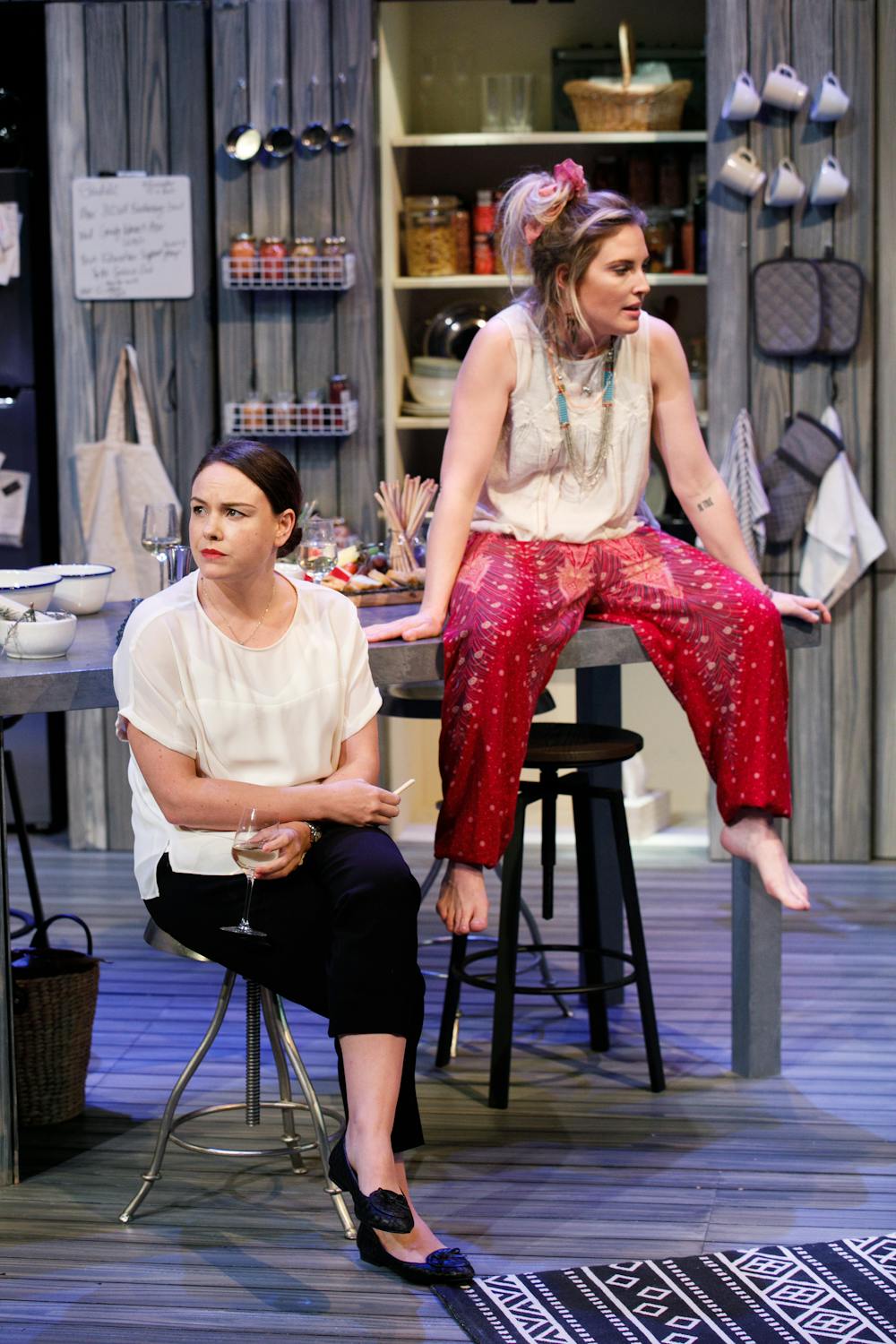
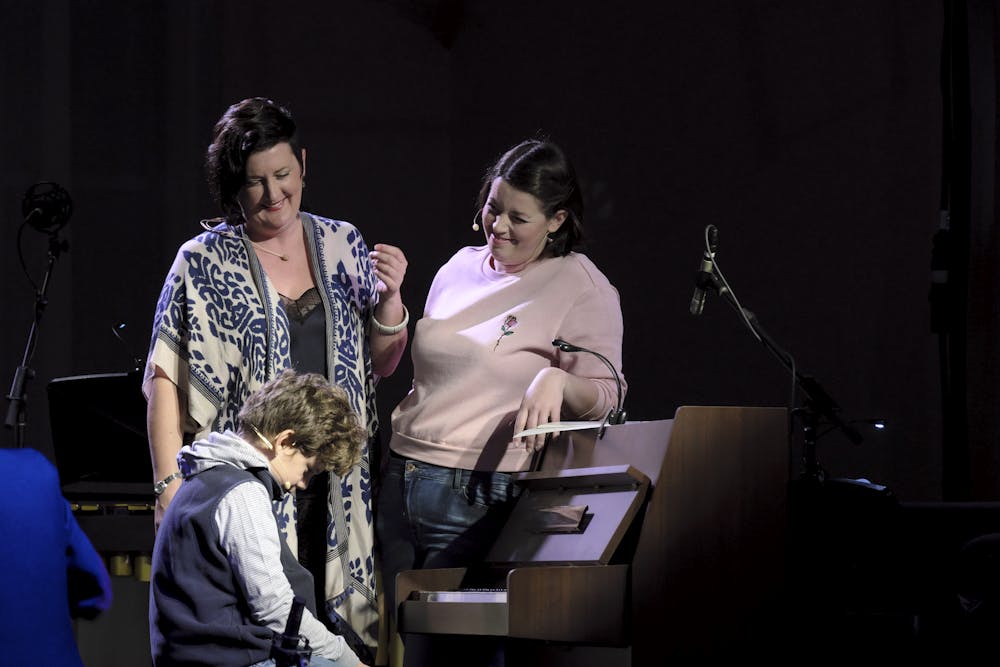
Glenda Linscott, Emily Rose Brennan, and Richard Maganga in Water. Daniel J Grant

Following an interval, the latter two narratives consist of vignettes. The first takes place at the immigration station on Ellis Island in the United States in 1921 where a retired white Australian farming couple (played again by Sas and Linscott), financially ruined by drought, seek to enter the country.

While seeming incongruously placed, this reflects actual events when immigration quotas were imposed, specifically to limit the numbers of Mediterranean immigrants into America.


Read more: When the US locked up white Australian immigrants like Australia does to asylum seekers


The sense of humiliation the couple feel is sensitively performed by Linscott and Sas, and the vignette effectively conveys how it might feel to be on the receiving end of this treatment, usually meted out to people of a different ethnicity.

The second vignette, concerning the doomed friendship between a South Sea Islander labourer and a cane grower’s daughter, takes place on the Queensland cane fields in 1905. It is set against the history of the employment of low-paid Pacific Islander indentured workers. From the 1860s onwards some 60,000 indentured labourers were brought to Australia. As part of an embryonic White Australia Policy, a 1901 Bill sought the expulsion of about 10,000 labourers, with deportations commencing in 1906.

Richard Maganga and Igor Sas in Water. Daniel J Grant

The play is ably directed by Emily McLean. Pace and rhythm are generally spot on and the space is intelligently utilised. Sound and lighting are effectively executed and the set, with its various doors and easily adapted furniture, suits the various times and settings of the three narratives.

The acting is uniformly sound. Linscott shines as Beth, the beleaguered wife of Peter, as she drinks her wine and manically rides the family politics and the arrival of that unwanted guest, played by Richard Maganga. Maganga delivers strong performances here as Yize, the “illegal” refugee, and later as a clerk on Ellis Island and Andrew, the Islander indentured labourer.

Amy Mathews and Emily Rose Brennan deliver strong performances as sisters in Water. Daniel J Grant

Peter and Beth’s daughters are played by Amy Mathews (Gemma) and Emily Rose Brennan (Joey), the latter having brought Yize to the island house. Both perform strongly as the very different sisters and display adept shifts in style in their respective later characters – Mathews as a Nurse at Ellis Island, and Brennan as Josephine, the daughter of Andrew’s employer/owner.

Sas exhibits nuanced performances as Peter, the disgraced former government minister for immigration, and as Robert, the elderly farmer on Ellis Island. Sas gives both characters some dignity, notwithstanding their differing circumstances, and the sometimes-clichéd dialogue in the characterisations of older Australian males.

Water provides the audience with a competently delivered night at the theatre but there are times, especially early on, when it displays some of the same problems periodically present in Miller’s plays, such as occasional banal dialogue exchanges and clumsy exposition. Nonetheless, some lame repetitive jokes early on concerning politically correct language were greeted with appreciative laughter from the audience.

The opening night audience expressed their appreciation with frequent laughter, sometimes rapt attention, and enthusiastic applause at the curtain. Like Andrew Bovell’s When the Rain Stops Falling, produced by Black Swan in 2011, it deals intelligently with some important topical issues – and all of the characters have become sadder and wiser persons by the conclusion.


Water is on at Black Swan State Theatre Company in Perth until May 26.

ref. In Black Swan’s Water, three vignettes explore the politics of immigration, drought and family dynamics – http://theconversation.com/in-black-swans-water-three-vignettes-explore-the-politics-of-immigration-drought-and-family-dynamics-117003

The site of the Bali bombings has been a vacant lot for 16 years. It’s time to build a proper memorial

Source: The Conversation (Au and NZ) – By Carmen Jacques, PhD Candiate, Global Issues Practice Centre, Edith Cowan University

On October 12, 2002, a terrorist detonated a bomb inside Paddy’s Nightclub in Kuta, Bali. Seconds later, as people fled the club, a larger bomb was detonated outside the Sari Club. More than 200 people lost their lives, 88 of them Australian.

On the first anniversary of the Bali bombings, the idea to build a Peace Park on the site of the Sari Club was conceived by survivors, responders and the victims’ families. A few years later, the Bali Peace Park Association (BPPA) was founded in Perth with the aim of creating a permanent memorial at the site. It has maintained strong political support ever since, both at home and in Bali.


Read more: Remembering the Bali bombings ten years on


Despite this, the Sari Club site has remained an empty lot for the past 16 years. Recent negotiations to purchase the land from its owner have broken down, with the owner demanding A$4.9 million for the site itself, plus an additional A$9 million in compensation for predicted future financial losses. The BPPA have agreed to the land price, but are only offering compensation of A$500,000.

The Bali governor, Wayan Koster, cannot force the sale, but has offered the owner another parcel of land about 1.5km away and urged the owner to consider the relationship between Australia and Indonesia as a priority in the negotiations.

But a compromise now appears remote. Last week, the BPPA chairman David Napoli was told by the owners:

Either put in an offer to buy the land or we are closing the site and preparing for heavy equipment to come in.

Why the memorial has been contentious

From 2013-16, I was part of a research team studying how the proposed Bali Peace Park could become a site of collective resistance to terrorism.

During our research, we travelled to Bali and spoke to many community members and political supporters of the memorial, including the then-governor, Made Pastika. The local government has long supported the idea of a memorial at the site, but couldn’t build on the land itself since it is privately owned. Instead, Made Pastika put an embargo on commercial development of the site, while the BPPA negotiated with the owners to purchase the land.


Read more: Why refusing to build memorials for terror attacks is a bold political statement


Unfortunately, this embargo recently lapsed and the owners now want to build a five-story commercial complex at the site.

The Indonesian government did create a monument in between the old Paddy’s and the Sari Club site across the road, and it considers this enough. But the BPPA argues a Peace Park is needed because the design of the monument fails to say anything about the attacks. It only functions to remember the dead, not what actually happened on the day of the attacks, nor how or what we might learn from them. The BPPA wants the park to counter violent extremism by educating visitors about the attacks from a position of non-violence.

The current memorial near the site of the bombings in Kuta. Made Nagi/EPA

In our research, we also found there were significant cultural barriers to a memorial of this sort. Ancestor veneration is done at home in Bali and it is not local custom to otherwise memorialise the dead. The places where people die are “cleansed” by Hindu priests, allowing the spirits to return home. This means the ground is not considered sacred as it no longer contains the dead.

We were also told by one supporter of the park, Nyoman Jarna, that the Balinese prefer to “forget” disaster – they don’t want to be reminded of such tragedy. Bali is a place of happy holidays and its entire economy relies on this.

What memorials should do

In my view, the current monument erected by the government is static – it does not allow for any kind of deeper engagement with visitors. It stands on a small strip of land between the two bomb sites. It is too hot and exposed during the day for people to spend any real time there. At night, it is now closed to the public to prevent possible desecration by drunk tourists.

Anthropologist Katharina Schramm has argued that sites where violent acts have taken place are dynamic spaces that are constantly being reinterpreted through the memories of survivors, responders and other visitors. Reflecting on Ground Zero in New York where the September 11 attacks took place, social psychologist Eric Miller says memorials of this sort must provide future generations with an accurate representation of the devastation that occurred there.


Read more: Reclaiming our home away from home: the Bali bombings


A static monument does not adequately explain what happened. During our research, many of the tourists we spoke with had no idea what had occurred at the site of the current monument in Bali and regularly asked us what it was for.

Memorials that have achieved a deeper engagement – such as the Vietnam Veterans Memorial in Washington, the Oklahoma City National Memorial and Museum, and the 9/11 Memorial and Museum in New York – create a space for reflection and conversations with the dead. They also tell a story about what happened.

In my research, Gill Hicks, a survivor of the 2005 London terror attacks and now a prominent peace activist, told me:

Memorials like the one at Ground Zero should respect the lives lost and focus on ‘whatever happened’, as the victims didn’t deserve to die such a horrific death.

This is what many people in Bali told me is important to them. Maria Katronikas, who lost her bridal party, two sisters and two cousins during her honeymoon said:

I know how happy the girls were when I left them, I know what mood they were in, this is where they took last breath.

And Kevin Paltridge, who lost his son, Corey, told me:

I come here to talk to Corey, sometimes for his birthday, sometimes for mine, sometimes just because I need to have a chat, I just get a couple of beers and one for him and one for me and we talk.

As the fight over the Sari Club site continues in Bali, it’s worth keeping in mind the significance of places of remembrance. The way in which we memorialise the sites of terror attacks is particularly important because, as a society, we have a responsibility to the dead – and the living – to remember what happened.

If the BPPA succeeds in purchasing the land, the next challenge will be to create a peaceful place like this within the chaos of Kuta – a shady space for reflection and peace, which speaks to a future without terrorism.

ref. The site of the Bali bombings has been a vacant lot for 16 years. It’s time to build a proper memorial – http://theconversation.com/the-site-of-the-bali-bombings-has-been-a-vacant-lot-for-16-years-its-time-to-build-a-proper-memorial-116725

Not just activists, 9 out of 10 people are concerned about animal welfare in Australian farming

Source: The Conversation (Au and NZ) – By Paul McGreevy, Professor of Animal Behaviour and Animal Welfare Science, University of Sydney

Recent protests by animal welfare activists on Australian abattoirs and farms and city streets triggered a backlash from meat-lovers and MPs. The activists were labelled “un-Australian” by the Prime Minister and others, and the protests prompted calls for tougher trespass laws and penalties.

Protests have continued more recently, with a Perth restaurant targeted earlier this month.

But it’s not just activists who are concerned about animals. A recent report commissioned by the federal Department of Agriculture and Water Resources suggests it’s the majority of Australians who care about animal welfare.


Read more: Vets can do more to reduce the suffering of flat-faced dog breeds


The report included a survey of 1,521 people: 95% of respondents viewed farm animal welfare with concern, and 91% want reform to address this.

The report – Australia’s Shifting Mindset on Farm Animal Welfare by consultancy firm Futureye – also says the department “currently has very limited powers over farm animal welfare”, raising the potential for “outrage […] if the community sees the government as not responding to concerns and expectations”.

That could be a problem for whoever wins control of government after the weekend’s federal election.

What’s the concern?

The report did receive some coverage when it was released in March, but this was largely among farming and activist groups. It’s timely to delve deeper into some of the findings.

The survey group was split 50/50 on gender; covered a range of age groups and locations, both city and rural, across Australia; and included meat and non-meat eaters.

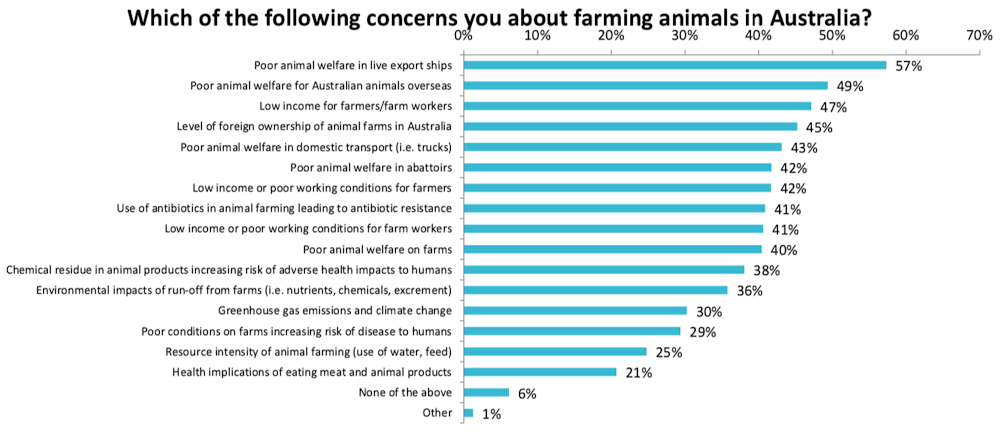
Issues such as poor animal welfare in live export – which has received plenty of media coverage – were of highest concern (57% of respondents), followed by concerns over low income for farmers and farm workers (47%).

From the report Australia’s Shifting Mindset on Farm Animal Welfare. Futureye/Screengrab

The report highlights people’s concern over poor animal welfare in abattoirs (42%) and on farms (40%). The lowest concern mentioned was any health implications from eating meat and animal products (21%).

The report also confirms the public’s appreciation that the low price of animal products can constrain a producer’s ability to maintain good animal welfare standards and the government’s ability to enforce them.

Consumers want reform

Most respondents in the survey saw the government as chiefly responsible for ensuring animal welfare standards, and 40% see the need for “significant reform”. They suggested various actions for improvement, such as:

  • a minimum standard set by government
  • incentivising farmers for good animal welfare
  • better education of the public about agricultural practices in terms of awareness-raising
  • standardisation of product labels such as free-range.

Focus group discussions revealed many respondents were concerned that the Department of Agriculture and Water Resources has a conflict of interest when both supporting the agricultural industry and promoting good animal welfare standards.

Consumers want greater transparency about animal welfare practices and more consistent information so they can make informed decisions. The report found 42% of respondents said there was too much conflicting information about animal welfare, and 40% wanted more information.

Most respondents assumed products labelled cage-free, free-range and organic reflected better animal welfare standards, but they did not always trust these labels. One of the solutions raised from focus group discussions was a trusted certification and labelling process to help consumers differentiate products.

How animal welfare meets politics

Clearly people are concerned about animal welfare – and the report says concern has been growing over the years, and shows no sign of abating.

It predicts that more exposés, negative media focus on farm animal welfare, and a perceived lack of governmental responsiveness will intensify public outrage and demand for reform.

People want something done about animal welfare, and they’re looking towards government to act. So what can government do?

The report says one of the best indicators to explain the growing concern for farm animal welfare was the public’s views on animal sentience – the capacity to experience suffering and pleasure. Less than 10 per cent of those surveyed believed cattle, sheep, goats and pigs are not sentient.

Animal sentience is recognised in New Zealand’s Animal Welfare Act and also in the draft ACT Animal Welfare Act here in Australia.

Sentience is currently enshrined in European Union law but not into UK law, yet.

In the UK, and in anticipation of Brexit, an animal welfare bill is being considered. If approved, it will increase the maximum sentence for animal cruelty from six months to five years.

What about Australia? We suggest that Australian politicians take note.

The Animal Justice Party is campaigning on animal welfare reform and already holds two seats in the New South Wales upper house and one in the Victorian upper house. It has candidates running for the Senate in the federal election.

What consumers need to know

There is also a clear need to inform consumers on the science of animal welfare. Even the Futureye report warns about “uninformed” people being drawn into any animal welfare debate.


Read more: How fake news gets into our minds, and what you can do to resist it


Now, more than ever, consumers need to understand the basic scientific and ethical frameworks that shape current attitudes to animals and animal welfare.

That way they can then assess whether animals are experiencing good welfare, and the way in which practices, policies, legislation and the views of different stakeholders affect animal welfare.

Such tools would allow us all to evaluate information on animal welfare issues, discover why animal protection has been called the “social justice issue whose time has come”, and empower us to make informed decisions on animal welfare issues.

ref. Not just activists, 9 out of 10 people are concerned about animal welfare in Australian farming – http://theconversation.com/not-just-activists-9-out-of-10-people-are-concerned-about-animal-welfare-in-australian-farming-117077

We’re not seeing a ‘populist surge’ in this election. Why not?

Source: The Conversation (Au and NZ) – By Gregory Melleuish, Professor, School of Humanities and Social Inquiry, University of Wollongong

One of the most significant, and unremarked, features of the 2019 Australian federal election has been the absence of what might be termed a “populist surge”.

In the most recent Newspoll, the United Australia Party and Pauline Hanson’s One Nation are polling at about 8% of the vote combined. This is tiny in comparison to, for example, Marine le Pen’s right-wing Rassemblement National in France, which is currently polling at 22% in the lead up to the European Parliament elections.

The current elections in Australia indicate that there is nothing equivalent to the mood that led either to the election of Donald Trump in the United States or the Brexit vote in the United Kingdom. There is no firebrand leader galvanising Australians into a populist revolt, and it appears that no lower house electorates will fall to such a figure.

Let’s take a look at why.


Read more: Compare the pair: key policy offerings from Labor and the Coalition in the 2019 federal election


Our electoral system is hard on newcomers

Part of the reason is technical. The Australian electoral system for the House of Representatives, based on single member electorates, makes it very difficult for newcomers to win a seat.

This is exacerbated by the fact that the electorates have being growing in size over the years. Section 24 of the Constitution establishes the so-called nexus, which states that the size of the House of Representatives must be twice the size of the Senate. Despite significant growth in Australia’s population, the number of House of Representative members has remained static. This has resulted in ever larger electorates in terms of the number of voters.

More importantly, over the years, redistribution has increased the geographical size of many rural electorates. This makes it difficult for minor parties or independents to attract support across a large geographical area composed of disparate communities.

Independent candidates tend to have built up a support base in the major provincial city within an electorate. While this might be sufficient for election to a state legislature given the smaller size of state electorates, it makes life very difficult at a federal level.

One example of a serious outside contender is Kevin Mack, the Mayor of Albury. Mack is standing against the current Liberal member, Sussan Ley, in Farrer, where constituents are fired up over lack of access to water under the under the Murray-Darling Basin plan. Farrer covers the territory of the New South Wales state electorate of Murray, which was claimed by the Shooters, Fishers and Farmers in the recent state election.

In cases where independents or minor party candidates in the large federal electorates manage to collect enough support to get elected, it’s usually because they come in second, and take advantage of preferences to get them over the line.

Paradoxically, the Australian system of single member electorates combined with preferential voting gives smaller parties and independents considerable influence in terms of preference allocation. But makes it unlikely that they will be elected to parliament.


Read more: Against the odds, Scott Morrison wants to be returned as prime minister. But who the bloody hell is he?


Immigration hasn’t been an election issue

As political newcomers, populists require some issue or image or myth that will capture the imagination and stimulate enough of the emotional side of human nature to lure electors from their traditional political allegiances.

Eric Kaufmann, a professor of politics in the UK, argues in his book White Shift that immigration is the issue that’s fuelling much contemporary populism.

Covering a wide range of countries, Kaufmann points to data indicating that it’s neither being “left behind” nor economic matters that are the spark the populist fuse, but culture and the perception that immigration leads to cultural loss.

If that’s the case, it explains a lot about the current election. Immigration has not featured heavily as an issue. Instead, the focus has been on other matters, mainly of an economic nature.

Without immigration as an issue to fire the imagination and stir the emotions, would-be populists have little to inspire support for them. This situation may also be exacerbated by the fact that, unlike Donald Trump, Australia’s two populist leaders, Pauline Hanson and Clive Palmer, lack the fire to spark a populist revolt. Enduring Clive Palmer’s seemingly endless advertisements on YouTube is a struggle in itself.


Read more: After six years as opposition leader, history beckons Bill Shorten. Will the ‘drover’s dog’ have its day?


Australian populism is different

Australian populism has been largely confined to rural and regional areas that don’t have much experience of the effects of immigration. If immigration was going to be a major issue in Australia, you would expect it to resonate in outer suburban areas of the large cities.

In the example of Farrer, where the established member is seriously challenged, there is a local issue that has stirred the passions of the people.

This suggests that Australian populism is quite different from populism in other countries. It’s more a form of long-term grumble about the state of the world than a sharp reaction to the threat of cultural loss.

So, populism will have much less impact on the Australian elections than on those of other comparable countries. Pauline and Clive should be asking themselves why their level of support is so low.

ref. We’re not seeing a ‘populist surge’ in this election. Why not? – http://theconversation.com/were-not-seeing-a-populist-surge-in-this-election-why-not-117011

These 5 foods are claimed to improve our health. But the amount we’d need to consume to benefit is… a lot

Source: The Conversation (Au and NZ) – By Emma Beckett, Postdoctoral Fellow (Human Molecular Nutrition), School of Medicine and Public Health, University of Newcastle

Food gives us the nutrients we need to survive, and we know a balanced diet contributes to good health.

Beyond this, many people seek out different foods as “medicines”, hoping eating certain things might prevent or treat particular conditions.

It’s true many foods contain “bioactive compounds” – chemicals that act in the body in ways that might promote good health. These are being studied in the prevention of cancer, heart disease and other conditions.

But the idea of food as medicine, although attractive, is easily oversold in the headlines. Stories tend to be based on studies done in the lab, testing concentrated extracts from foods. The effect seen in real people eating the actual food is going to be different to the effects in a petri dish.


Read more: Health check: can eating certain foods make you smarter?


If you do the maths, you’ll find you actually need to eat enormous amounts of particular foods to get an active dose of the desired element. In some cases, this might endanger your health, rather than protecting it.

These four foods (and one drink) show the common healing claims around the foods we eat don’t always stack up.

Cinnamon

Cinnamon, which contains a compound called cinnamaldehyde, is claimed to aid weight loss and regulate appetite.

There is evidence cinnamaldehyde can reduce cholesterol in people with diabetes. But this is based on studies of the chemical in large doses – not eating the spice itself.

These studies give people between 1 and 6 grams of cinnamaldehyde per day. Cinnamon is about 8% cinnamaldehyde by weight – so you’d have to eat at least 13 grams of cinnamon, or about half a supermarket jar, per day. Much more than you’d add to your morning porridge.

Red wine

The headlines on the health benefits of red wine are usually because of a chemical in grape skins called resveratrol. Resveratrol is a polyphenol, a family of chemicals with antioxidant properties.

It’s been claimed resveratrol protects our cells from damage and reduces the risk of a range of conditions such as cancer, type 2 diabetes, Alzheimer’s disease, and heart disease.

There is some limited evidence that resveratrol has benefits in animal models, although studies done in humans have not shown a similar effect.

We often hear that drinking red wine is good for our health. From shutterstock.com

It varies by wine, but red wine contains about 3 micrograms (about 3 millionths of a gram) of resveratrol per bottle. The studies that have shown a benefit from resveratrol use at least 0.1 grams per day (that’s 100,000 micrograms).

To get that much resveratrol, you’d have to drink roughly 200 bottles of wine a day. We can probably all agree that’s not very healthy.


Read more: Health check: is moderate drinking good for me?


Blueberries

Blueberries, like red wine, are a source of resveratrol, but at a few micrograms per berry you’d have to eat more than 10,000 berries a day to get the active dose.

Blueberries also contain compounds called anthocyanins, which may improve some markers of heart disease. But to get an active dose there you’re looking at 150-300 blueberries per day. More reasonable, but still quite a lot of fruit – and expensive.

Chocolate

The news that dark chocolate lowers blood pressure is always well-received. Theobromine, a chemical in chocolate has been shown to lower blood pressure in doses of about 1 gram of the active compound, but not at lower doses. Depending on the chocolate, you could be eating 100g of dark chocolate before you reached this dose.

Chocolate is a discretionary food, or “junk food”. The recommended serve for discretionary foods is no more than 600 kilojoules per day, or 25g of chocolate. Eating 100g of chocolate would be equivalent to more than 2,000kJ.


Read more: Treat or treatment? Chocolate is good but cocoa is better for your heart


Excess kilojoule consumption leads to weight gain, and being overweight increases risk of heart disease and stroke. So these risks would likely negate the benefits of eating chocolate to lower your blood pressure.

Turmeric

Turmeric is a favourite. It’s good in curries, and recently we’ve seen hype around the tumeric latte. Stories pop up regularly about its healing power, normally based on curcumin.

Curcumin refers to a group of compounds, called curcuminoids, that might have some health benefits, like reducing inflammation. Inflammation helps us to fight infections and respond to injuries, but too much inflammation is a problem in diseases like arthritis, and might be linked to other conditions like heart disease or stroke.

Tumeric comes from tumeric root. It’s not bad for us, but we’d have to eat an unrealistic amount to receive its health benefits. From shutterstock.com

Human trials on curcumin have been inconclusive, but most use curcumin supplementation in very large doses of 1 to 12 grams per day. Turmeric is about 3% curcumin, so for each gram of tumeric you eat you only get 0.03g of curcumin. This means you’d have to eat more than 30g of tumeric to get the minimum active dose of tumeric.

Importantly, curcumin in turmeric is not very bioavailable. This means we only absorb about 25% of what we eat, so you might actually have to eat well over 100g of turmeric, every day, to get a reasonable dose of curcumin. That’s a lot of curry.

What to eat then?

We all want food to heal us, but focusing on single foods and eating mounds of them is not the answer. Instead, a balanced and diverse diet can provide foods each with a range of different nutrients and bioactive compounds. Don’t get distracted by quick fixes; focus instead on enjoying a variety of foods.


Read more: Science or Snake Oil: can turmeric really shrink tumours, reduce pain and kill bacteria?


ref. These 5 foods are claimed to improve our health. But the amount we’d need to consume to benefit is… a lot – http://theconversation.com/these-5-foods-are-claimed-to-improve-our-health-but-the-amount-wed-need-to-consume-to-benefit-is-a-lot-116730

How to transition from coal: 4 lessons for Australia from around the world

Source: The Conversation (Au and NZ) – By Chris Briggs, Research Principal, Institute for Sustainable Futures, University of Technology Sydney

With 12 coal power stations in Australia closed since 2013, a full transition out of coal is coming.

Around the world, governments and stakeholders are considering how to implement a “just transition” from coal to clean energy – a transition that’s fair for local workers and communities in coal regions.

Some coal-producing nations, such as Germany and Spain, are delivering major just transition packages. Other nations are less successfully trying to navigate social conflicts around the transition, such as Poland and South Africa.

But so far in Australia, there is little planning for the transition.

What can Australia learn from other international experiences to plan our own just transition? Through our ongoing research we found four important lessons.


Read more: What would a fair energy transition look like?


Lesson 1: build a social compact

Climate science demands the energy transition be as rapid as possible. But faster transitions threaten the capacity of local labour markets to replace jobs lost in coal.

Unions have begun shifting from defensive support for coal towards a just transition perspective, but this support can unravel once job losses start to hit.

In South Africa, for instance, trade unions helped pioneer a just transition. But they brought legal action to stop renewable energy auctions amid coal closures without adjustment support for workers.

Germany, on the other hand, has managed industrial transitions in the western coal regions since the late 1960s through effective negotiations.

In 2018, Germany’s government-appointed “coal commission” developed a pathway for the full closure and transition of the coal industry by 2038. It involved a process with representatives from unions, industry associations, coal regions, scientists, local communities and environmental NGOs.

A social compact between the key parties is needed to manage the conflicts that can emerge over a transition out of coal.

Just transition commissions have been established in Canada, Scotland – and now South Africa.

So Australia should be considering two things to build a social compact for coal transition:

  • a taskforce including all the key stakeholders to negotiate an overarching framework for a transition out of coal

  • an on-going process for including stakeholders at national and regional level, because it will be a long-term process requiring negotiated trade-offs.

Lesson 2: plan early for closures

If transition planning is delayed until mass redundancies are on the horizon, labour markets will not cope with the volume of displaced workers.

Planning for closures is starting to emerge at an industry and company-level in some nations (such as Italy, Germany and Australia) – which includes retraining, support for early retirements and the redeployment of workers.

The Hazelwood power station is one of a dozen coal fired power stations that have shut in recent years. David Crosling/AAP

Victoria is a global leader on regional level adjustment. The La Trobe Worker Transfer Scheme is redeploying retrenched Hazelwood power station workers to other sites.

Site remediation is also an important way we can restore the local environment quality and create semi and low-skilled jobs at the most critical time of the transition. Mandatory requirements need to be established for funds allocated to the coal industry.


Read more: Hazelwood’s closure calls for a rethink on Latrobe Valley solutions


Lesson 3: diversify the regional economy

The Institute for Sustainable Futures has modelled the global employment impacts in the energy sector if we meet the Paris Climate Agreement.

The modelling found jobs will grow across almost all occupational categories. There will be big job losses among machine operators and assemblers as coal closures occur, but this group also experiences the strongest job growth within the renewables sector, especially solar.

Changes in jobs in transition from coal to renewable energy. Click table to zoom. Author provided

But market restructuring alone will not deliver a just transition.

In each of the coal regions we examined, there is little prospect for large-scale renewable energy because the best solar and wind resources are located elsewhere.

This means workers will rarely transfer seamlessly to new jobs without having to move away from home. And as many of the new jobs are in the construction phase, ongoing jobs will be replaced by a higher volume of temporary jobs.


Read more: How to fight climate change in agriculture while protecting jobs


Local solar and energy efficiency can be a source of new jobs but ultimately diversifying the regional economy is the solution for creating new jobs beyond coal. Each region has different mixes of sectors and capabilities, so economic diversification strategies need to be tailored.

These are some features of successful plans to diversify regional economies:

  • develop links with related industries and establish new industries

  • extend the capabilities of existing industries and workers

  • fund labour-intensive projects, such as site remediation and plant decommissioning

  • target infrastructure upgrades and skill development for coal regions.

Lesson 4: establish funds and authority for a just transition

Specialist funds are being established to oversee, develop and implement coal transition programs. The European Commission’s coal and carbon-intensive regions in transition initiative is investing funds in 13 coal regions.

In Germany, the coal commission has recommended a funding package of €40 billion to support the coal regions, with legislation due May 2019.

The Spanish government has established a €250 million fund, which includes support for workers, economic diversification and environmental restoration.

How is Australia placed?

National climate and energy policy is a fiasco in Australia. The federal government has no energy transition plan and refused to sign a Just Transition declaration at the Poland climate conference in December 2018.

On a positive note, there have been some innovative regional responses. The Victorian Government has established the La Trobe Valley Authority, which is funding economic diversification initiatives.

Hazelwood employees have been concerned about worker transition after the power station’s closure. Mal Fairclough/AAP

The ALP will establish a Just Transition Authority if it wins the federal election, which will develop regional transition plans and oversee redundancy schemes. Unions, industry and local communities will have direct input.


Read more: Labor’s policy can smooth the energy transition, but much more will be needed to tackle emissions


But without a coordinated exit schedule like the German coal commission, coal closures will still likely be abrupt, driven by technical breakdowns or renewables growth squeezing out less profitable generators.

The ALP scheme also only covers power generators – not coal mining – which will be more challenging because there are more low-skilled workers (around half are drivers and machine operators).

Social and political support can unravel very quickly once regional communities start to transition. In Queensland, mining unions are opposing any candidates that will not support the Adani mine after their national body led the shift to a just transition policy by the ACTU.

Australia would be wise to invest heavily in just transition planning and investment alongside technology development.

ref. How to transition from coal: 4 lessons for Australia from around the world – http://theconversation.com/how-to-transition-from-coal-4-lessons-for-australia-from-around-the-world-115558

Beyond the dollars: what are the major parties really promising on education?

Source: The Conversation (Au and NZ) – By Kate Noble, Education Policy Fellow, Victoria University, Mitchell Institute

As voters head to the polls, around one-quarter will decide who to vote for on the day. Analysis shows climate change and the economy are foremost in voters’ minds.

But education remains a key issue, as evidenced by a flurry of education-related announcements in the final stretch of the campaign.

Here’s what you need to know about the major parties’ education commitments, and what the millions and billions here and there really mean.


Read more: How has education policy changed under the Coalition government?


Early childhood education and care

Two years of high-quality, play-based learning at preschool can have a significant impact on children’s development. It can put them close to eight months ahead in literacy by the time they start school. The benefits are greatest for children from disadvantaged backgrounds, which makes preschool a valuable tool for reducing inequality.


Read more: Both major parties are finally talking about the importance of preschool – here’s why it matters


Labor has promised to make childcare free for most low-income households and to provide up to an 85% subsidy for households under $175,000. It has committed to funding an extra year of preschool for three-year-olds. This is evidence-based and builds on commitments by several states to support two years of preschool.

Labor has also pledged to increase wages for some early childhood educators, to be rolled out over a decade, and to reinstate funding for the National Quality Agenda, which lapsed in 2018. This reflects the importance of quality in early childhood services, to improve outcomes for children.

Both the Coalition and Labor are taking early childhood education and care seriously this election. from shutterstock.com

The Coalition is taking a more cautious approach to spending on the early childhood sector. It has pledged funding for four-year-old preschool, but only for another year, and it has not renewed funding for the National Quality Agenda.

The Coalition will likely retain the means-tested subsidy introduced as part of its major childcare reforms in 2018. While these reforms benefited an estimated one million lower-income families, the means test also left around 280,000 families worse off, including families with neither parent in work.

Advocates argue preschool should be seen as an integral component of the education system and a fundamental right for all children, and all parties should take a cross-partisan approach and commit to long-term funding. The major parties are certainly not at that point yet, but there are indications they’re heading in the right direction.


Read more: Labor’s childcare plan: parents, children, and educators stand to benefit, but questions remain


Schools

Given states and territories are largely responsible for schools, federal investment should be targeted where it can make the most difference. Two key areas are needs-based funding, to ensure additional support is available to students who need it the most, and central investment in research and evidence-based practice.

Both major parties have promised a national evidence institute. Labor has allocated funds for it, with the Coalition yet to do so. This initiative reflects the urgent need to ensure evidence helps to shape the education system. The Productivity Commission has recommended such an institute, to connect educators and policymakers with the latest research on teaching and learning.


Read more: Three things Australia’s next education minister must prioritise to improve schools


On funding, the Coalition wants us to judge it on its reforms to the schools funding package, which is now mostly modelled on the needs-based funding approach outlined in the Gonski Review. But funding has still not reached the recommended levels. The Coalition has supported the National School Resourcing Board to review these funding arrangements and develop a fairer model for all schools.

Labor has promised to increase funding for schools. Labor’s offer would bring schools closer to meeting the levels of funding recommended by Gonski.

Funding isn’t a magic bullet, but it plays an important role in improving outcomes for all students..


Read more: What the next government needs to do to tackle unfairness in school funding


Tertiary education

Vocational Education and Training (VET) has experienced a series of unsuccessful reforms over the past decade. VET plays an important role in the tertiary sector, so it’s good to see both major parties addressing this in their platforms.

The Coalition’s plan comes out of a major recent review of the VET sector and includes more money for apprentices and rural programs; the establishment of a National Skills Commission and a National Careers Institute; and simplifying systems for employers.

Labor has pledged to fund up to 100,000 TAFE places. It has also promised a major inquiry into tertiary education, looking at VET and universities side by side. This could potentially move us towards a fairer system that puts VET and universities on an even footing and better caters to the varied needs of students and employers.

Both Labor and the Coalition have committed to increased support for apprenticeships, through financial incentives for employers.

For universities, Labor says it will bring back demand-driven funding, which existed between 2012 and 2017, where universities are paid for every student studying and there is no limit on the number of students that can be admitted to courses. Evidence suggests this has been effective in boosting studies in areas where there are skills shortages, such as health, and also appears to have improved access to education for disadvantaged groups.


Read more: Labor wants to restore ‘demand driven’ funding to universities: what does this mean?


Due to costs, the Coalition has moved to a funding model based on population and university performance. It has also promised extra support for regional students and universities. This help address the large gaps in university participation between young people from major cities, and rural and regional Australia.

Making an informed choice

When casting our votes, we would do well to look past the dollar signs, and think about how each party is shaping an education system that will deliver quality learning for all Australians, from all kinds of backgrounds, from childhood through to adulthood.

The Coalition has delivered needs-based funding for schools and promises a greater focus on regional and rural students in all sectors. But there are some apparent gaps in early learning and tertiary policy and funding.

Labor has pledged more funding in all sectors. It has made a prominent commitment to early childhood education and care. However, Labor’s policies are expensive and would need to be implemented effectively to make sure they achieve the intended outcomes for students and deliver the financial benefit to the economy in the long-term.


Read more: Compare the pair: key policy offerings from Labor and the Coalition in the 2019 federal election


ref. Beyond the dollars: what are the major parties really promising on education? – http://theconversation.com/beyond-the-dollars-what-are-the-major-parties-really-promising-on-education-117097

Transport promises for election 2019: the good, the bad and the downright ugly

Source: The Conversation (Au and NZ) – By Greg Moran, Senior Associate, Grattan Institute

No matter who wins Saturday’s federal election, you can expect to see more cranes on the skyline and hi-viz vests on the roadside. Both major parties are promising to spend big on transport infrastructure: A$42 billion for the Coalition and A$49 billion for Labor. However, many of the favoured projects are unlikely to be completed for years or even decades to come.


Read more: We hardly ever trust big transport announcements – here’s how politicians get it right


What’s being promised, and where?

The types of project each party is promising reflect a now-familiar pattern seen in the recent Victorian and New South Wales elections. The Coalition will outspend Labor on roads; Labor will outspend the Coalition on public transport.

Author provided

There’s also a story in the details of where the parties are promising to spend. In Victoria, where the Coalition suffered heavy losses in last October’s state election, the federal Coalition has been busy “sandbagging” key seats. Until last weekend, the Coalition had been promising much more than Labor.

Announcements on Sunday changed all that. While the Coalition upped its commitment to the East West Link to A$4 billion, this was dwarfed by Labor’s A$10 billion pledge for the Suburban Rail Loop. Victoria now stands as the key battleground for transport promises.


Read more: East-West Link shows miserable failure of planning process


Labor is also writing bigger cheques than the Coalition in Queensland, where it hopes to make big gains.

Author provided

There’s some agreement on the big stuff

Despite their different ideologies and at-risk electorates, there is still much common ground between the parties. Almost one in three of the projects and funding packages that have attracted promises of at least A$50 million are backed by both the Coalition and Labor. Each party has promised almost A$24 billion for these “bilateral” projects – that’s more than half of the Coalition’s total promised transport infrastructure spending and almost half of Labor’s.

The parties are more likely to agree on big projects than small. Bilateral commitments make up almost half of all promises worth at least A$500 million, but less than a third of those below that threshold. For the very largest projects, the level of agreement is somewhere in between – the Coalition and Labor agree on four of the 11 projects attracting commitments of more than A$1 billion.

Author provided

But voters are forced to make risky choices, again

With so much cash on the table, will these vast riches be spent on the right things?

More money for roads and public transport probably sounds fine to most Australians, whether they’re navigating potholed rural roads, stuck behind trucks on regional highways, drumming the steering wheel in clogged city streets, or calling in late on delayed suburban trains.


Read more: Congestion-busting infrastructure plays catch-up on long-neglected needs


But are the projects of national significance and therefore worthy of Commonwealth attention? And can they be relied on to return a benefit larger than their cost?

For too many projects, the answers are no and no. Infrastructure Australia (IA) publishes a list of national priorities and evaluates business cases for projects that are “nationally significant or where Commonwealth funding of A$100 million or more is sought”. Most of the commitments above A$100 million in this campaign do not have IA-approved business cases.

Some projects are under evaluation, such as a new bridge in Nowra on the NSW south coast, but the two parties should have waited for IA’s assessment before committing.

Worse still, many promised projects are not even on the national priority list.

Author provided

For projects attracting commitments of less than A$100 million, most are best left to state governments. The Commonwealth should stick to projects that are important to more than one state or are particularly important to the national economy.

Fixing regional and suburban intersections is important, but it’s hardly of national significance. When federal parties get involved, it starts to smell like pork-barrelling.


Read more: Missing evidence base for big calls on infrastructure costs us all


Some promises are inexcusable

Throwing taxpayer money at boondoggles is poor governance. Far worse is flagrantly ignoring independent advice and burning cash on projects that we know don’t stack up. Before the 2016 federal election, Grattan Institute reported on the outrageous Princes Highway duplication between Winchelsea and Colac in Victoria’s Western District. The Coalition promised this project even though IA determined that it would return only eight cents of value for every dollar spent.

Three years on, lessons still need to be learnt. Labor has committed A$50 million this election to the Maldon-Dombarton rail link in NSW’s Illawarra region. This A$806 million project got the thumbs-down in 2017 from IA, which stated that “the project would not justify its costs and would impose a net cost on the Australian economy”.

In exceptional cases, governments may want to fund projects with costs outweighing benefits on equity grounds, such as to provide a minimum level of service for rural communities. It is hard to make that case for a commercial freight rail link.

Every dud project built cannibalises a worthy one. Our politicians should stop donning hardhats and promising infrastructure before they’ve done their homework.

ref. Transport promises for election 2019: the good, the bad and the downright ugly – http://theconversation.com/transport-promises-for-election-2019-the-good-the-bad-and-the-downright-ugly-115138

At last, an answer to the $5 billion question: who gets the imputation cheques Labor will take away?

Source: The Conversation (Au and NZ) – By Ben Phillips, Associate Professor, Centre for Social Research and Methods, Director, Centre for Economic Policy Research (CEPR), Australian National University

Labor is banking on about A$5 billion per year from ending the cash payment of company tax refunds to dividend holders who don’t pay tax.

It’ll exempt charities, non-profits, pensioners and part pensioners and other Australians on government allowances, including future pensioners. Self-managed super funds that had pensioner members at the time Labor announced its policy will also be spared.

So who’s left? Are they battlers on genuinely low incomes (as might be inferred from the low taxable incomes that enable them not to pay tax), or are they a good deal more wealthy?

The Coalition says they are mainly genuine low income earners. According to Treasurer Josh Frydenberg

over 80 per cent of people who are relying on their cash refunds have a taxable income under $37,000

Yet Labor’s Chris Bowen says they are

typically wealthier retirees who aren’t paying income tax – these are people who typically own their own home and also have other tax-free superannuation assets, and don’t pay tax on their superannuation income

There are two main ways in which people receive company tax refunds that are paid in cash rather deducted from their tax bill.

One is through self-managed super funds that don’t pay tax during the retirement phase. Around 55 per cent of excess refunds are paid out in this way according to our modelling.

The other is through payments made directly to Australians who own Australian shares in their own name but pay insufficient tax to make use of credits of company tax paid creasting their dividends. These people are oft

For investors it makes sense to have the investment in the name of the person with the lowest taxable income ensuring that tax paid on investment returns is minimised or, even better, rebated through franking credits.

Retirees can have low taxable incomes even when their actual incomes are high because of decisions to exempt superannuation income from income for tax purposes.


Read more: Words that matter. What’s a franking credit? What’s dividend imputation? And what’s ‘retiree tax’?


Modelling just completed by the Australian National University Centre for Social Research and Methods gets around this by using the household income figures collected by the Bureau of Statistics.

Household income is arguably a better guide to who benefits from shares that are typically held in the name of the lowest taxed member. Household income also includes superannuation income whether it is taxed or not.

Our findings are presented in 2019 dollars and is based on a mature policy in the sense that all behaviour changes have occurred. We do this by aligning our numbers to the Parliamentary Budget Office who attempt to account for behaviour changes such as altered investments. We accept that such changes are subject to considerable uncertainty but expect the distribution of results to be relatively robust regardless.

Across all households, regardless of whether they receive franking credits, the average impact from removing the credits is $489 per year, or about 0.5% of disposable income.

But the impact of Labor’s policy is heavily concentrated in households in the top 10% (decile 10) of household incomes. These households pay additional tax of $2,641 per year (1.1% of their disposable income) averaged across all households in the top decile.

There is virtually no impact on households in the bottom half of the income distribution.


Impact of proposed changes to franking credit policy on annual household disposable income by equivalised income decile, 2019 dollars

Decile 1 is the lowest income decile and decile 10 the highest. Source: PolicyMod, ANU

The impact is even more skewed when considered by wealth distribution of households.

Labor’s changes would have virtually no impact across the bottom 70% of the wealth distribution. Almost 90% of the total value of all imputation cheques are paid to the top 20% of the wealth distribution.

Around 2.7% are paid to the bottom 50%.


Impact of proposed changes to franking credit policy on annual disposable household income by wealth decile, 2019 dollars

Decile 1 is the lowest income decile and decile 10 the highest. Source: PolicyMod, ANU

Overall, around 6.5% of households would be negatively impacted (around 600,000 households). The vast majority have high income and high wealth.

For those low income or low wealth households that are affected, the impact tends to be relatively small. As an example, for the least wealthy 10%, the average financial impact is $686 per year. For the most wealthy it is nearly $12,000 per year.

The current arrangements around franking credits and superannuation leads to significant leakage in the tax system. Whether removing excess franking credits is the solution to this problem is debatable, but it remains the case that the majority of franking credit refunds are received by high income and/or high wealth households who ideally would be paying at least some tax on this income.

Reforming such leakage in the tax system provides room for other tax reforms in personal income and company tax that many economists argue offer more promise in providing incentives to work and invest.

ref. At last, an answer to the $5 billion question: who gets the imputation cheques Labor will take away? – http://theconversation.com/at-last-an-answer-to-the-5-billion-question-who-gets-the-imputation-cheques-labor-will-take-away-117075

Small, but well-formed. The new home deposit scheme will help, and it’s unlikely to push up prices

Source: The Conversation (Au and NZ) – By Rachel Ong ViforJ, Professor of Economics, School of Economics, Finance and Property, Curtin University

The new First Home Loan Deposit Scheme announced the Coalition, and instantly backed by Labor, is likely to be popular among those on the cusp of buying their first home.

It’ll be open to singles earning up to A$125,000 and couples earning up to A$200,000 who have saved at least 5% of the value of the home. The government-owned National Housing Finance and Investment Corporation will partner with private lenders to put up as much as another 15% of the value of the home to take the deposit to 20%.

However, the scheme is capped at 10,000 home buyers per year, roughly one tenth of the number of Australians who bought first homes in 2018.

It’ll help them – the latest survey shows that more than half of first homebuyers needed financial assistance outside of their own savings to get their deposit. The benefits of home ownership have been widely documented. But will it do enough?


Source of deposits

Authors’ own calculations from ABS Survey of Income and Housing 2013-14

An often-expressed concern is that such a scheme will bid up house prices. However, it is means-tested, making it much less vunerable to this criticism than the non-means-tested First Home Owners’ Grant.

And is also capped at 10,000 loans per year, giving it little scope to price pressure.

However, it may not be means-tested enough.

Consider the population subgroup that broadly comprises aspiring homebuyers who qualify for the scheme: renters aged 25-34 years who meet the scheme’s income criteria and whose financial wealth is between 5% and 20% of the lowest-priced quarter of houses for sale in the borad area in which they live.

In the most-recent 2015 ABS Survey of Income and Housing there were 127,000 such potential eligible first home buyers, more than 12 times the 10,000 cap.


Read more: That election promise. It will help first home buyers, but they better be cautious


The cap is a practical necessity of course, needed to limit impacts on prices and prevent a cost blowout. But the weakness of the scheme is that the cap will be filled on a “first come, first serve” basis, without distinguishing between those who actually need help and those who are likely to meet the deposit requirement anyway.

The graph shows that some 40% of potential first home buyers have managed to save a deposit amounting to not much more than 5% of the home value. Only 7% have a 20% deposit or something near it.


Potential users of the scheme, by amount of deposit saved

Deposit saved by renters aged 25-34 who meet the scheme’s eligibility criteria, per cent of lower quartile property prices in area of residence, 2015-16. Authors’ own calculations from the ABS Survey of Income and Housing 2015-16

The Coalition (or Labor) could get more bang for its buck within the cap by targeting those in greater need of assistance; for example by prioritising those who cannot access the so-called Bank of Mum and Dad. Not everyone has access to wealthy parents.

The Great Australian Dream of owning a home has been fading fast, and not just for young people. Naturally, the scheme’s details of the scheme require scrutiny. But overall, it provides a welcome acknowledgement (by both major parties) that the affordability crisis facing young people has not waned despite recent house price declines.


Read more: The brutal truth on housing. Someone has to lose in order for first homebuyers to win


The scheme will restore the opportunity – at least to some – to accumulate wealth in property and enjoy the security and other benefits that home ownership brings.

But seriously addressing housing affordability will ultimately require a bigger intervention.

ref. Small, but well-formed. The new home deposit scheme will help, and it’s unlikely to push up prices – http://theconversation.com/small-but-well-formed-the-new-home-deposit-scheme-will-help-and-its-unlikely-to-push-up-prices-117073

With commercial galleries an endangered species, are art fairs a necessary evil?

Source: The Conversation (Au and NZ) – By Sasha Grishin, Adjunct Professor of Art History, Australian National University

Although record numbers of people are flocking to exhibitions in the major public art galleries, foot traffic into commercial art galleries is dwindling at an alarming rate. Embarrassed gallery directors of well-established and well-known commercial art galleries will quietly confess that frequently they scarcely get more than a dozen visitors a day. Outside the flurry of activity on the day of the opening, very little happens for the duration of the show.

This is not a peculiarity of the Australian art scene, I have heard similar accounts in London, Manhattan and Paris. The art public has largely ceased visiting commercial art galleries as a regular social activity and art collectors are frequently buying over the internet or through art fairs. In fact, many galleries admit that most of their sales occur via their websites, through commissions or at art fairs, with a shrinking proportion from exhibitions or their stockroom by actual walk-in customers.

The commercial art galleries have become an endangered species and their numbers are shrinking before our eyes. Leaving aside China and its urban arts precincts, such as 798 Art Zone in Beijing, again this is a trend that can be noted in much of Europe, America and Australasia.

At the same time, the art market is relatively buoyant, albeit somewhat differently configured from the traditional one. The art auction market in many quarters is thriving and, as persistent rumours have it, not infrequently auction houses leave their role as purely a secondary market and increasingly source work directly from artists’ studios. This seeps into their lavish catalogues.

The other booming part of the art trade is the art fairs. Here I will pause on a case study of the Auckland Art Fair 2019. Started by a charitable trust about a dozen years ago and run as a biennial, in 2016 the fair, with new sponsorship and a new management team of Stephanie Post and Hayley White, was reorientated. As of 2018, it has become an annual art fair with a focus on the Pacific Rim region. It remains the only major art fair in New Zealand.

Situated in The Cloud, a scenic setting on Queens Wharf in central Auckland, this location also limits its size to create an intimate, friendly, human-scale fair, unlike the vast expanses of the Chicago Art Fair or even Sydney Contemporary in the Carriageworks.

The nuts and bolts of the Auckland Art Fair is that galleries from the Pacific Rim region can apply to exhibit and a curatorial committee of four curators, two from public galleries and two from commercial ones, select about 40 galleries for participation. The event, which is held over five days, attracts about 10,000 visitors and generates between $6-7 million in art sales.

Gow Langsford Gallery stand at the Auckland Art Fair featuring art by Karl Maughan, Paul Dibble, Max Gimblett and Dale Frank. Courtesy of Tobias Kraus

The fair costs about $1 million to stage with 90% of this sum raised from sponsorship, ticket sales and gallery fees and the rest a grant from Auckland Tourism, Events and Economic Development. The public pays an admission fee of between $25-30, depending on when they book.

Art fairs are popular with local governments as they invariably attract people and businesses into the city. In Auckland Art Fair 2019, held in the first week in May, there were 41 galleries participating, almost 30 from various parts of NZ, the rest from Sydney, Melbourne, Hobart, Shanghai, Jakarta, Rarotonga (Cook Islands) and Santiago.

According to Stephanie Post, a major purpose of the fair is to build a new art audience and, by extension, a new generation of art collectors. The fair is designed to fill the gap between the primary and secondary art markets. For this reason, there is a whole series of “projects” that generally promote new art, frequently by emerging artists, many currently without representation by a commercial art gallery. In 2019 there were ten of these non-commercial projects at the fair.

Auckland Art Fair co-directors Stephanie Post and Hayley White at the fair. Courtesy Josef Scott

These projects, for the past three art fairs, have been curated by Francis McWhannell, who now plans to step aside to be replaced by a new set of curatorial eyes. There are also various lectures, talks, panel discussions and related exhibitions. This year, most notably, there is “China Import Direct”, a curated cross-section of digital and video art from across China with some stunning and quite edgy material by Yuan Keru, Wang Newone and Lu Yang, amongst others.

A mixed bag

Predictably, art at the Auckland Art Fair 2019 is a mixed bag, but the stronger works do outnumber those that are best passed over in silence. In terms of sales, within the first couple of hours quite a number of the big-ticket items were sold, such as work by the Australians Patricia Piccinini and Dale Frank.

Looking around this year’s fair, some of the highlights included Seraphine Pick at Michael Lett; Robert Ellis at Bowerbank Ninow; Max Gimblett at Gow Longsford Gallery; Anne Wallace and Juan Davila at Kalli Rolfe; Christine Webster at Trish Clark; Daniel Unverricht and Richard Lewer at Suite, Toss Woollaston at Page Blackie Gallery, Dame Robin White and Gretchen Albrecht at Two Rooms; Robyn Kahukiwa at Warwick Henderson Gallery; Geoff Thornley at Fox Jensen McCrory; Simon Kaan at Sanderson; James Ormsby at Paulnache and Kai Wasikowski at the Michael Bugelli Gallery.

New Behaviour VIII, 2019, oil on linen, 600 x 500mm, Seraphine Pick, Michael Lett Gallery. Josef Scott.

This selective list of names, to which many others can be added, indicates something of the spread and diversity of the artists being presented at the fair – not only in style and medium, but in the whole range of languages of visualisation and conceptualisation. Although there are a few deceased artists included, like Mirdidingkingathi Juwarnda Sally Gabori and Colin McCahon (neither represented by a particularly strong work), like most art fairs there is a predominance of well-established blue chip artists, a scattering of art market darlings plus a few unexpected newcomers.

A criticism of art fairs is that they are an expensive market place with high overhead costs, which discourage too much experimentation with “untested” emerging artists. Despite the welcome initiatives of the “projects”, Auckland in this respect falls into line with the pattern of most fairs.

The oft-repeated claim that they create a new art audience is also difficult to quantify. Although anecdotal evidence suggests that many who go to fairs may not have ever entered a commercial art gallery before, this does not appear to be followed up by a conversion of this audience into regular gallery goers.

James Ormsby at Paulnache. Josef Scott.

A spectacle

Art fairs and blockbuster exhibitions in public art galleries have become popular people magnet events. They are a form of entertainment that is becoming more of a surrogate for consuming art than some sort of conduit for a return to more traditional patterns of art appreciation and acquisition. They are noisy, crowded and colourful spectacles – more like a party than a quiet arena for the contemplation of art.

Is this such a bad thing? Observing the spectacle in Auckland, I was struck by the youthfulness of the thousands of visitors. For many, it seemed the idea that they could afford to purchase an original artwork came as a revelation. Perhaps this was not a $100,000 painting by a major artist, but something more modest and frequently more to their tastes. Nevertheless, new buyers are being introduced to original art and this in itself has to be a positive development.

Art fairs globally are breeding a cult of dependency with some “commercial” art galleries increasingly divesting themselves of a physical existence and living from fair to fair. For a while, this was a complete no-no and fairs insisted that participant galleries had a bricks-and-mortar existence, but in many instances the borders are fudged and to be a gallery you need only be an established art trading entity.

Art fairs are here to stay; the future of commercial art galleries is far more problematic.

ref. With commercial galleries an endangered species, are art fairs a necessary evil? – http://theconversation.com/with-commercial-galleries-an-endangered-species-are-art-fairs-a-necessary-evil-116680

Accused West Papuan independence activists jailed for ‘rebellion’

By RNZ Pacific 

Two West Papuans accused of “rebellion” have been sentenced to more than a year in an Indonesian prison.

Yakonias Womsiwor and Erichzon Mandobar were detained in September when authorities raided the office of a Papuan independence group.

According to their lawyer, Veronica Koman, a judge in the Timika district court sentenced Womsiwor to one year and six months jail on Tuesday.

READ MORE: West Papuan speaker ‘silenced’ when trying to raise UN agenda issue

His co-defendant got one year and three months in prison.

Both were sentenced under a criminal law for coercion and rebellion.

-Partners-

Veronica Koman said she was considering an appeal against the judgement.

During their arrests in Timika, the defendants were shot several times and denied medical attention until rights groups brought attention to their case.

Both men wounded
Womsiwor was shot six times in total, while Mandobar was shot once, according to Amnesty International and Koman.

“They were shot without warning as the law required,” Koman said, adding that they were later allowed to be treated by their families.

Their arrests were part of a raid on the Timika secretariat of the West Papua National Committee (KNPB), which was later seized by police.

Earlier in the trial, police and prosecutors had claimed the men were found with ammunition and guns, which the defendants denied was theirs, according to Koman.

She said that during the trial two police officers, including a deputy police chief, called as witnesses testified that military personnel had placed the ammunition and guns at the KNPB offices.

Koman added that the sentencing yesterday did not give proper consideration to statements made by the defence.

The jail terms come as several cases are being brought against West Papuan activists and rebels in the West Papua region.

Last week a Polish tourist was jailed for five years for plotting to sell arms to West Papuan rebels.

This article is published under the Pacific Media Centre’s content partnership with Radio New Zealand.

Print Friendly, PDF & Email

Article by AsiaPacificReport.nz

Helen Garner’s musical metaphors come alive in a new production of The Children’s Bach

Source: The Conversation (Au and NZ) – By Michael Halliwell, Associate Professor of Vocal Studies and Opera, University of Sydney

Review: The Children’s Bach, Canberra: Fitters’ Workshop, Friday May 10

A new production of an Australian opera is an unusual event. The performance of Andrew Schultz and Glenn Perry’s 2008 opera, The Children’s Bach, as part of the Canberra International Music Festival, was refreshing and welcome.

Perfectly suiting the central thematic strand of the Festival – the music of Johann Sebastian Bach – the opera is based on the 1984 novella by acclaimed Australian writer, Helen Garner. The title is derived from a book of relatively simple Bach keyboard pieces for children.

Garner herself described the musical structure underlying the novella as “contrapuntal … I wanted all the characters to have a voice”. It is a work investigating “the possibility of alternative means of communication, means other than the ‘symbolic’ or patriarchal order of language. Obviously music is one of these”.

Goodreads

The setting is Melbourne in the 1980s, during which the interaction between old friends and new acquaintances precipitates a series of life-changing events.

At the centre is a middle-aged couple, Athena and Dexter, and their autistic son, Billy. Their seemingly uneventful existence is interrupted by a chance airport encounter between Dexter and an old friend from uni days, Elizabeth, who is meeting her 17-year-old daughter Vicky. Dexter and Athena are introduced to Elizabeth’s rock-singer partner, Philip and his young daughter Poppy. A brief affair between him and Athena follows.

As the new relationships unfold, and the old ones unravel, Australian middle-class values are challenged and old myths debunked. Male patriarchy is threatened – the women in the novel have agency, while the men are seen as ineffectual.

The book is saturated with music and its translation into operatic form almost seems obvious. In 2008, Schultz said of the centrality of music at the heart of the novella, “within its pages lie the conversation of tango, the sex of rock’n’roll and the deep emotion of opera.”

Michael Cherepinskiy, Anna Fraser, Amy Moore in The Children’s Bach. The title of the opera and book comes from a book of Bach keyboard pieces for children. Peter Hislop

The opera, first performed at Melbourne’s Malthouse Theatre in 2008, is very much an ensemble piece with each character being introduced as in a fugue, a musical structure which repeats a central theme. The central thematic subject is Athena who is deeply dissatisfied with her life; much of this channelled into her frustrated attempt to learn the piano.

In this performance she was sung by Natalie Christie Peluso with warm, luminous tone and an engaging stage presence, capturing the warmth and vulnerability of the character. David Greco, as her husband Dexter, sang with crisp, full, and resonant tone and utmost clarity of diction, bringing out the character’s confusion and existential despair at “modern life”.

Elizabeth was sung by Anna Fraser, whose clear and warm soprano lent humanity to the character, while Andrew Goodwin’s exquisitely modulated tenor conveyed the intensity of Philip’s love for his daughter Poppy, sharply contrasted with his cavalier attitude to the other women in his life. Amy Moore, who played Vicky and several other characters, has an attractive full-toned, expressive soprano and strong stage presence.

Poppy, whose series of spoken explanations of the structure of Bach’s fugues provides a connecting thread through the opera – each intervention establishing a new stage in the narrative – was sympathetically embodied by Anna Khan, while Billy was Michael Cherepinskiy, who communicates through music. His playing of Bach was a deeply moving moment, as was his duet with Vicki of the “Skye Boat Song”.

David Greco, Amy Moore and Jason Noble in The Children’s Bach. Peter Hislop

This is an opera essentially about music, and the role it plays in the lives of the characters. Roland Peelman – one of Australia’s most versatile musicians – conducted the small ensemble with flexibility and precision, neatly segueing through Schultz’s stylistic musical amalgam.

Peelman also staged this concert performance, always a challenging task given a lack of stage space. Schultz’s expressive and highly varied score was vividly brought to life in what is a challenging venue, not ideally suited to operatic performance. Peelman expertly brought out the myriad colours and rhythmic variation in this highly engaging music.

The incorporation of Bach’s music into a variety of musical idioms in Schultz’s opera echoes Garner’s use of music in the novel, as a meditation on the vicissitudes and challenges of contemporary urban existence. These characters are all are a complex mix of conflicting desires and emotions, reflecting the deep humanity of the novel.

The final poignant moments as Elizabeth and Vicki sing an extended duet describing how future events in the house will play out – a musical ending with strong undertones of Bach – will long linger in the memory:

And Athena will play Bach on the piano. In the empty house her left hand will run the arpeggios and send them flying. Tossing handfuls of notes into the sparkling air.

ref. Helen Garner’s musical metaphors come alive in a new production of The Children’s Bach – http://theconversation.com/helen-garners-musical-metaphors-come-alive-in-a-new-production-of-the-childrens-bach-117086

PNG plans crack down on social media ‘fake news’ and ‘bad signals’

By Gorethy Kenneth in Port Moresby

Cabinet will review social media platforms in Papua New Guinea when it convenes on Thursday, says Prime Minister Peter O’Neill.

Speaking at Government House yesterday after announcing four new ministers and a mini reshuffle, O’Neill said the government would crack down on fake news that was being spread on social media.

He was adamant that the government would review social media platforms and this would be the first task of the new Communications and Information Technology Minister Koni Iguan.

READ MORE: PNG plans to shut down Facebook for a month

He said there was too much fake news that was sending bad signals and destroying the nation and its people and this must stop.

“Cabinet will have a complete review of social media in the country, led by Minister for Communications,” O’Neill said.

-Partners-

“There is a lot of fake news destroying our people, destroying our society. We have lived without social media for thousands of years before.”

O’Neill said too much fake news and false information was being circulated which was destroying the government, the nation and its people.

Minister’s first task
“Government will review the social media platform and that will be the first task of the newly appointed Communication Minister,” O’Neill said.

“I want to assure you that the Communications Minister’s first responsibility will be to review that so we can make sure that the correct information and the truth are put forward to the nation so that they can be well informed on what is happening in the country.

“Fake news is destroying our country and recently one of our young people got murdered in Boroko because of fake news. This cannot continue, we must put an end to it so I want to assure you that cabinet at its first NEC (National Executive Council) meeting which will be held on Thursday we will look at how we can manage this going forward.”

O’Neill said that the Attorney-General had now been directed to make sure he brought the ICAC Bill to Parliament in the next session so that people are comforted on the fact that our government is working in making sure that this bill saw the light of the day.

“Our officials have been very slow, we are frustrated by that but I can assure you that we are trying to get it through on the floor of Parliament as quickly as possible so we can address some of the fake news and fake allegations that are going around in the country,” O’Neill said.

“It is our responsibility, the government’s responsibility, so we will review that so we can make sure that the correct information and the truth and facts put forward so everyone will be well informed of what is happening in the country.”

Gorethy Kenneth is a senior Post-Courier journalist.

Print Friendly, PDF & Email

Article by AsiaPacificReport.nz

South Australia’s experience contradicts Coalition emissions scare campaign

Source: The Conversation (Au and NZ) – By Glyn Wittwer, Professorial Fellow at the Centre of Policy Studies and IMPACT Project, Victoria University

Ahead of Saturday’s federal election the Coalition has latched onto economic modelling claiming Labor’s target of a 45% emissions reduction would cost the economy as much as A$187 billion in 2030.

The modelling released by BAEconomics contrasts strikingly with 22 different reports, many peer-reviewed, which all indicate a far lower economic cost to moving Australia’s energy mix towards renewables.

Labor’s own costings, released last Friday, show a substantially smaller cost to its emissions reduction plan.

But, beyond reports, the example of South Australia is a real-world rebuke to the credibility of BAEconomic’s conclusions. SA has already moved substantially towards Labor’s 2030 target by generating 50% of electricity from renewables and proven its ability to deal with heatwaves that caused mass blackouts in Victoria earlier this year – without breaking the bank.


Read more: Fixing the gap between Labor’s greenhouse gas goals and their policies


False assumptions in the model

An appropriate carbon tax is one that makes renewable energy generation competitive with existing fossil fuel generators. Technology advances have already lowered the cost of renewables to the point they’re becoming cost-competitive even without a carbon tax.

The final bastion of fossil–fuel cost advantage is in baseload generation, but the falling costs of battery storage and potential for pumped hydro will close this gap as well.

Renewable energy can be competitive with fossil fuel generators. Shutterstock

In the modelling undertaken by BAEconomics, the economic losses depend entirely on the cost gap assumed between renewable and fossil fuel generators. When the Gillard government introduced a carbon tax, it was set at A$24 per tonne. This is of a similar magnitude to carbon taxes set elsewhere in the world.

But the BAEconomics modelling assumed a carbon tax of up to A$405 per tonne. There appears to be no justification for this gap, made even more extraordinary by the much smaller price assumed for purchases of carbon credits from overseas.

The Coalition has shown a complete lack of discernment in reporting the consequent modelled results.


Read more: Carry-over credits and carbon offsets are hot topics this election – but what do they actually mean?


What does the real world show?

The transition to renewables is a complex process. It will rely on many emerging technologies and require different approaches in different regions. But there are places in Australia that show the real cost and benefits of transitioning to renewables.

In southeastern Australia we see electricity demand peak on a limited number of days each year when temperatures in Melbourne and Adelaide soar.

South Australia has heavily invested in renewables. In contrast, Victoria is much more reliant on traditional fossil fuel power stations.

We can look to the Australian Energy Market Operator (AEMO) for comprehensive reports on wholesale electricity prices.

AEMO also prepared a report on load shedding (deliberate rolling blackouts designed to prevent damage to the grid) in Victoria on January 24 and 25 of this year.

Adelaide suffered record heat on January 24, as suburban temperatures neared 48℃. On this day of extreme demand, the state’s back-up generators were fired up for the first time. Wind and solar plants generated almost 50% of South Australia’s electricity on that day.

The state’s generators coped much better than Victoria’s. A combination of maintenance outages, unexpected disruption and poor heat performance in Victoria’s ageing coal-fired power plants caused mass blackouts.

South Australia has already moved much of the way towards the 2030 carbon reduction target. Subsidies over the past decade or so have contributed to transition, but these are shrinking as the costs of renewables fall.

It has not all been plain sailing. A severe blackout occurred in September 2016 as cyclonic winds battered the state, taking wind generators offline and mangling power pylons across the state. In response, the SA government commissioned a Tesla battery and back-up generators to improve the network’s capacity to deal with adverse conditions. On January 24 this year the state’s network passed a severe test.

A severe 2016 blackout prompted the South Australian government to commission back-up generators. David Mariuz/AAP

Read more: Australia’s major parties’ climate policies side-by-side


The real-life comparison between a state advanced in energy transition and a state that is less advanced shows Labor’s emissions target will result in economic losses much smaller than those modelled by BAEconomics.

ref. South Australia’s experience contradicts Coalition emissions scare campaign – http://theconversation.com/south-australias-experience-contradicts-coalition-emissions-scare-campaign-117079

How to end Afghanistan war as longest conflict moves towards fragile peace

Source: The Conversation (Au and NZ) – By Alexander Gillespie, Professor of Law, University of Waikato

The longest-running war appears to be coming to an end.

The Taliban has been running an armed rebellion in Afghanistan since being dislodged from power in a US-led invasion following September 11 2001. Recent high-level negotiations between the two sides in the 18-year war did not produce a breakthrough, but “significant progress”, leading to “improved” conditions for peace.

The fact that the primary belligerents, the Taliban and the United States, are talking directly is essential. Any peaceful pathway going forwards without their direct involvement is impossible. But to end the killing, all sides are going to have to give up something, to achieve their greater goals.


Read more: What will come after a US withdrawal from Afghanistan?


Longest-running conflict

Although the losses in the Afghanistan war are not as bad as either the American war in Vietnam (just over 58,000 military casualties and between 1 and 3 million civilians or enemy) or the Soviet intervention in Afghanistan (maybe 1 million civilians, 90,000 Mujahideen, 18,000 Afghan troops and 14,500 Soviet soldiers), the record in Afghanistan is still difficult reading. The American death toll is a little over 2,200, while the wider losses (civilians and enemy) are well over 100,000.

Reliable estimates suggest more than 45,000 Afghani military have been killed since 2014 alone. The annual civilian death toll continues to climb, with 3,804 deaths recorded in 2018. At the same time, the amount of territory that rebel groups control (14.5%) or is contested (29.2%) or under government control (56.3%) is an unexpected result, given nearly two decades of combat.

The significance of talking to the Taliban directly cannot be overstated. When the Mujahideen were not directly involved in the Geneva Accords that ended the Soviet conflict in Afghanistan, the results were a disaster. No sooner had the Soviets left the country, the Mujahideen denounced the agreement (even though Pakistan had been negotiating on their behalf), saying they were not part of it. Their forces then took three years to overrun most of the country.

Negotiated peace

The fact that it will be a negotiated end to the conflict, as opposed to an imposed and unconditional one, is significant. Negotiated and conditional agreements are often cast as “peace with honour”, whereby the side that wants to exit the most prioritises what it is willing to give away while still appearing to be in control.

For example, with the end of the American involvement in the Vietnam war, the core of the Paris Peace Accords of early 1973, the primary goal of the North Vietnamese was the withdrawal of all US and allied forces from the region. The primary goal for Nixon was the return of 1,056 prisoners of war.

When the Geneva Accords ended the Soviet intervention in Afghanistan, the primary exchange was about an exit of Russian soldiers, in return for mutual commitments from the governments of Afghanistan and Pakistan not to interfere in each other’s country. In both instances, a swag of secondary considerations formed part of the package.

In the case of Vietnam, there were supplementary provisions for a ceasefire that was to be monitored by independent countries and a National Council of Reconciliation and Concord to implement democracy and organise free elections in the south. In the case of the Geneva Accords, the return of Afghani refugees was an important consideration, as were mutual commitments “to prevent any assistance to … or tolerance of terrorist groups, saboteurs or subversive agents against the other High Contracting Party”.

Main considerations

In the current deliberations, the most important thing the Taliban want is the exit of all foreign troops from Afghanistan. This is possible, with both the Paris and Geneva accords providing precedents. The most important thing the Americans want is not only an exit of their troops, but a commitment that the Taliban will not, again, host any groups involved in terrorist activities against the US.

This demand is consistent with the original American war aims and the Geneva precedent is useful. The harder part will be working out the assurances that such promises are kept.

Where negotiations will get much more difficult is with the plethora of secondary considerations. In the context of Afghanistan, this will cover issues such as direct dialogue with the Afghani government and a comprehensive ceasefire. This is easier said than done as it will require the Taliban to accept the legitimacy of the Afghani political system (and whichever government is in power) and the democracy that placed them in power.

The flip side of this, both nationally and internationally, is that the Taliban will have to lose their “terrorist” classification, which the UN Security Council has applied consistently since the end of the 20th century. This designation has placed strong military, financial and diplomatic restrictions on the Taliban, which made them outlaws in the eyes of the international community. This will have to be reversed, as the declared terrorists of yesterday become the legitimate powerbrokers of tomorrow.


Read more: A peace agreement in Afghanistan won’t last if there are no women at the table


The agenda should cover commitments to the most basic human rights (women’s rights in particular), what to do about almost 2.5 million refugees from Afghanistan, and how to deal with the fact that Afghanistan is now the world’s leading (and rapidly expanding) producer of illegal opium.

The opposing sides need to work out how to ensure a comprehensive ceasefire, as well as its links to ongoing economic, diplomatic and military support for any future governing regime in Kabul, especially if the ceasefire is breached.

When the Americans exited Vietnam, they promised their allies in South Vietnam that American support in all other avenues would continue. But once the Americans returned home and their country became engrossed in other matters such as Watergate, the promises were forgotten. Saigon fell, a few years later, to the very enemy they had negotiated a peace treaty with.

ref. How to end Afghanistan war as longest conflict moves towards fragile peace – http://theconversation.com/how-to-end-afghanistan-war-as-longest-conflict-moves-towards-fragile-peace-116587

Why New Zealand’s government cannot ignore major welfare reform report

Source: The Conversation (Au and NZ) – By Michael Fletcher, Senior Research Fellow, Institute for Governance and Policy Studies, Victoria University of Wellington

The Ardern coalition government’s immediate response to a comprehensive welfare report, released last week, has been widely panned as disappointing, even pathetic.

Labour promised to overhaul the welfare system and last year appointed an 11-member welfare experts advisory group, of which I was the independent special advisor. The group’s report made 42 main recommendations, one of which was to raise benefit levels by up to 47%.

But the minister of social development Carmel Sepuloni made only three small pre-budget announcements and indicated further work would be part of a three- to five-year work programme. Regarding the call to raise benefit levels, the minister appeared to rule this out for this term and told the Q+A programme that “there is a whole lot of recommendations that will be considered as part of phase two”.

Despite this underwhelming response, there are still reasons to be optimistic that the government will make more substantial moves on welfare reform.


Read more: Australia can learn from the limitations of New Zealand’s welfare reforms


Current benefits simply not enough

The first of these is that the report itself cannot easily be ignored. While it is nothing new to beneficiaries, the report sets out clearly just how inadequate current benefits are.

One of the strongest parts of the report is the work the group and its secretariat did to assess just what a minimum adequate level of income would be for different family types living in different parts of the country. This model-families budget analysis drew on the best available data from various sources – including the University of Otago’s survey of minimum food costs, lower quartile rental costs, and cheapest transport costs – and defined minimum costs for each family.

The budgets were deliberately very tight and were split into the bare-minimum “core” costs and a small “participation” costs component, intended to allow family members to take part in their communities. The draft budgets were also cross-checked by budget advisors at Work and Income.

These calculations showed just how large the shortfall is between costs and benefit incomes, even assuming the family is receiving every benefit assistance it is entitled to, which many do not. The deficits for different family types living alone ranged from NZ$92 per week for a single person living in public housing to NZ$356 per week for a couple with two children in a private rental. Even the best scenario in the analysis – a sole parent with one child who shares accommodation with others – was a deficit of NZ$66 per week below the “participation” level of costs.

Welfare system failure

Two factors underlie the inadequacy of current benefit levels. First, the system is not properly indexed so it has fallen further and further behind each year. Some payments are adjusted annually for general price increases, others are not. None are linked to growth in average incomes in the same way that New Zealand superannuation is.

The second problem is the long-running approach to welfare of trying to minimise costs to government by layering tiers of assistance on top of each other so no-one gets more than they absolutely need. At the bottom of this is an insufficient core benefit. For most beneficiaries this is topped up with an accommodation supplement to assist with housing costs and, for some, other payments such as a disability allowance or childcare subsidies. Then there is Temporary Additional Support, intended to cover short-term needs but increasingly used long term when the maximum accommodation supplement is not enough, and a range of one-off grants and loans.

Each layer is more complex, harder to qualify for and more time consuming to administer than the one below it. Indeed, the additional staffing the minister announced is due largely to the extra time required to process growing numbers of supplementary assistance applications.

As the welfare experts advisory group report makes clear, whether you look at this approach in terms of fairness and equity, respect and dignity towards people, or plain administrative efficiency, it has fundamentally failed.

Tackling child poverty

A further reason why we may see a bigger response in the future is the government’s commitment to reduce child poverty.

The Child Poverty Reduction Act and the government’s targets are goals to be proud of. There is strong evidence of the long-term harm caused by experiencing poverty, especially prolonged poverty during childhood.


Read more: New Zealand’s dismal record on child poverty and the government’s challenge to turn it around


It is not clear from the minister’s public statements that the government realises quite how urgently it must act if it wants to achieve the prime minister’s short-term targets by June 2021. The surveys that the official measures are derived from will be carried out from July 2020, asking people about their circumstances over the 12 months prior. This means the government’s progress will be judged against data from a two-year window between July this year and June 2021.

That in turn means new initiatives intended to help meet poverty-reduction targets need to be in people’s pockets (or reducing their costs) very soon. For example, the impact of a change that doesn’t come into effect until July 1 next year will be discounted by half as far as the targets are concerned because half of the survey respondents will already have been interviewed by then.

It is correct that the large 2018 families package can be expected to have a sizeable impact on child poverty rates, but it will not go far enough.

The most difficult goal will be to bring the relative poverty measure down. New policies aimed at achieving the target must disproportionately benefit those at the bottom compared to those in the middle. Realistically, only a substantial increase in benefit rates or another big change to the Working for Families tax credits could achieve that.

The announcements made so far in response to the welfare report – additional staff, ending the penalty for solo mothers who refuse to name a child’s father and allowing beneficiaries to keep a few dollars extra per week in earnings – will come nowhere near it. Perhaps there will be some welfare surprises in the upcoming budget. After all, child poverty is one of the five priority areas for New Zealand’s first well-being budget.

ref. Why New Zealand’s government cannot ignore major welfare reform report – http://theconversation.com/why-new-zealands-government-cannot-ignore-major-welfare-reform-report-116895

Poll wrap: Labor maintains 51-49 Newspoll lead, plus many seat polls

Source: The Conversation (Au and NZ) – By Adrian Beaumont, Honorary Associate, School of Mathematics and Statistics, University of Melbourne

The election will be held in four days, on May 18. There will be 151 House seats in the new parliament, up from 150 now. There are 47 NSW seats, 38 Victorian seats, 30 Queensland seats, 16 WA seats, 10 SA seats, five Tasmanian seats, three ACT seats and two NT seats.

Owing to a favourable redistribution for Labor in Victoria, the creation of a third seat in the ACT and Kerryn Phelps’ win at the October 2018 Wentworth byelection, the Coalition notionally holds 73 of the 151 seats based on 2016 results, Labor 71 and there are six crossbenchers. Corangamite is on zero margin after a redistribution. To win a majority, either the Coalition or Labor must win 76 or more seats.


Read more: Labor benefits from completed draft boundaries, plus South Australian and Tasmanian final results


The Coalition won the 2016 election with 76 of the 150 seats to 69 for Labor, but Labor gained 14 seats. As a result of these gains and some Coalition retirements, Labor should do better in seat terms than implied by the pendulum, owing to the “sophomore surge” effect, where new members usually do better in swing terms than the overall swing in a state or region.

Assuming no net gains or losses to the crossbench, analyst Kevin Bonham estimates Labor could lose the national two party vote 50.3-49.7, and still have a better chance of winning more seats than the Coalition. On the pendulum, Labor needs a 0.6% swing, or a 50.2-49.8 two party win, to have more seats than the Coalition. These are estimates for Labor winning more seats than the Coalition, not a majority of seats.

This week’s Newspoll, conducted May 9-12 from a sample of 1,644, gave Labor a 51-49 lead, unchanged since last week. Primary votes were 39% Coalition (up one), 37% Labor (up one), 9% Greens (steady), 4% One Nation (down one) and 4% for Clive Palmer’s United Australia Party (UAP) (steady).

44% were satisfied with Scott Morrison’s performance (steady) and 44% were dissatisfied (down one), for a net zero approval. Bill Shorten’s net approval was up eight points to -10, his best net approval since March 2015. Morrison led Shorten as better PM by 45-38 (46-35 last week). Bonham says Morrison’s better PM lead is weak given voting intentions.

A key reason for the Coalition’s competitiveness at the election is Morrison’s relative popularity. After his honeymoon wore off, Malcolm Turnbull was usually unpopular, while Tony Abbott became unpopular shortly after becoming PM. Australia has not had a PM with enduring popularity since Kevin Rudd in 2008-09.

Morrison is conservative enough that most of the hard right like him, while they hated Turnbull. However, he has not done anything that the vast majority of voters disliked, such as Abbott’s knighting of Prince Philip or the 2014 budget. In this way, Morrison is similar to John Howard.

Overall, the national polling is consistent with a narrow Labor victory on Saturday. But Labor supporters should not be complacent, as the polls could be understating the Coalition’s vote, or there could be a shift to the Coalition as late deciders make up their minds. On the other hand, a blowout Labor win cannot be ruled out either.

I expected an Essential poll, but Essential appears to have delayed their poll until the final days. I will write a final poll wrap article early on Election Day.

Morgan poll: 52-48 to Labor

A Morgan poll, conducted in “May”, gave Labor a 52-48 lead. I am not sure if this is Morgan’s face-to-face poll, or another poll they are conducting. If it is the face-to-face, it implies that this poll is an average of May 4-5 and 11-12, and that the May 11-12 poll was about 53-47 to Labor, a two-point gain for Labor since last week. Primary votes in this Morgan poll were 38.5% Coalition, 35.5% Labor, 10% Greens, 4% One Nation and 3.5% UAP.

Newspoll state breakdowns

Newspoll has released state breakdowns for all its five polls conducted in April to May. Nationally, Labor leads 51-49 (50.4-49.6 to Coalition in 2016). In NSW, the Coalition leads by 51-49 (50.1-49.9 to Labor). In Victoria, Labor leads by 54-46 (51.8-48.2). In Queensland, there is a 50-50 tie (54.1-45.9 to Coalition in 2016). In SA, Labor leads 52-48 (52.3-47.7). In WA, the Coalition leads 52-48 (54.7-45.3). Newspoll includes the ACT in its NSW breakdowns.

The problem I have with these data is that the first two polls in this sample were from early April, soon after the NSW March 23 election, which the Coalition won. This election result probably assisted the federal Coalition in NSW, but it may not carry through at the federal election. In 2016, the Coalition won NSW by 50.5-49.5, virtually the same as the 50.4-49.6 national margin. I am sceptical of the swing in NSW being very different from the national swing.

The Poll Bludger has incorporated the Newspoll breakdowns into BludgerTrack. Labor leads by 51.7-48.3, a 2.0% swing to Labor since 2016. There are swings to Labor in all states except NSW, where the Coalition has a 1.6% swing. BludgerTrack currently gives Labor 79 of the 151 seats, to 66 Coalition and six crossbenchers. Bonham also gives Labor the same seat count.

Queensland Galaxy: 51-49 to federal Coalition

A Queensland Galaxy poll, conducted May 8-9 from a sample of 848, gave the federal Coalition a 51-49 lead, a three-point gain for the Coalition since the last Queensland Galaxy poll in February, which was probably a pro-Labor outlier. Primary votes were 38% Coalition (up three), 33% Labor (down one), 9% Greens (down one), 9% One Nation (up one) and 5% UAP (steady).

Queensland is a conservative state, and this poll represents a 3% swing to Labor since the 2016 election.

Seat polls of Herbert, Lindsay, Corangamite, Bass, Boothby, Kooyong and Higgins

In late April, The Poll Bludger wrote that seat polls at state elections and federal byelections since the 2016 federal election have continued to be inaccurate, and somewhat biased to the Coalition. In polls conducted during the final fortnight of election campaigns, the Coalition’s primary vote was on average overstated by 1.9% with an error of 9.5%. Labor’s primary vote was understated by 0.5% with an error of 6.5%. An error of 4-5% is expected for polls with a sample about 500.

Newspoll conducted seat polls of Herbert, Lindsay, Corangamite and Bass from May 9-11 with samples of 500-580 per seat. In Herbert, the LNP led Labor by 52-48 (Labor barely won it in 2016). In Lindsay, the Liberals led Labor by 52-48 (51.1-48.9 to Labor in 2016). In Corangamite, Labor led by 51-49 (no margin after redistribution). In Bass, Labor led by 52-48 (55.4-44.6 in 2016).

Herbert and Lindsay were previously polled by Newspoll on April 20. There has been a two-point swing to the LNP in Herbert since that poll, and a three-point swing to the Liberals in Lindsay. Bass and Corangamite were previously polled by ReachTEL in the first week of the campaign. Comparing these Newspolls to those earlier ReachTEL polls gives a three-point swing to Labor in Corangamite, and a six-point swing to Labor in Bass.


Read more: Poll wrap: Palmer’s party has good support in Newspoll seat polls, but is it realistic?


Primary votes in Herbert were 35% LNP (up four since April 20), 30% Labor (up one), 13% Katter’s Australian Party (up three), 7% Greens (up two), 7% One Nation (down two) and 7% UAP (down seven). In Lindsay, primary votes were 44% Liberals (up three since April 20), 39% Labor (down one), 6% UAP (down one) and 4% Greens (steady). In Corangamite, primary votes were 42% Liberals, 37% Labor, 10% Greens and 4% UAP. In Bass, primary votes were 40% Liberals, 39% Labor, 10% Greens, 4% UAP and 2% Nationals.

A YouGov Galaxy poll for The Advertiser, conducted May 9 from a sample of 522, gave the Liberals a 53-47 lead (52.7-47.3 in 2016). Primary votes were 47% Liberals, 37% Labor, 9% Greens and 3% UAP. Centre Alliance (formerly Nick Xenophon Team) is not contesting Boothby, so Labor’s primary vote is up 10% and the Liberals up 5%.

The Guardian reported a Greens-commissioned poll of Kooyong gave Liberal Josh Frydenberg a 52-48 lead over the Greens’ Julian Burnside (62.8-37.2 vs Labor in 2016). Primary votes, after excluding 8% undecided, were 45% Frydenberg, 23% Burnside, 17% for Labor’s Jana Stewart and 10% for climate-focused independent Oliver Yates. This poll should be treated with extra scepticism as it was commissioned by the Greens, who are using it to argue for a vote for Burnside to oust Frydenberg. The sample was very large for a seat poll at 1,741.

A Greens-commissioned seat poll of Higgins was also reported in The Guardian. Primary votes were 36% Liberal (51.6% in 2016), 30% Labor (16.5%) and 29% Greens (24.2%). If this poll is even roughly accurate, whichever of Labor and the Greens finishes second will win Higgins on the other’s preferences. However, it’s a Greens-commissioned poll that sampled just 400 voters.

ref. Poll wrap: Labor maintains 51-49 Newspoll lead, plus many seat polls – http://theconversation.com/poll-wrap-labor-maintains-51-49-newspoll-lead-plus-many-seat-polls-116802

How to turn a housing development into a place where people feel they belong

Source: The Conversation (Au and NZ) – By Matt Novacevski, PhD Candidate, University of Melbourne

Australia is one of the most urbanised nations in the world, and our ongoing population growth continues to produce new suburbs on city fringes across the continent. These new suburbs, and the processes that form them, are often contentious.

And that’s not just because of vexed issues of sprawl, transport and infrastructure provision. One of the most common criticisms of new and outer suburbs is that they are bland, soulless, cookie-cutter developments that lack culture and a sense of place.


Read more: Lovability: restoring liveability’s human face


This problem occurs when these suburbs are built as though on a blank slate, with little thought given to engaging with existing stories of landscape and how new stories might be formed. Place itself is layered through stories, time, material and experiences. This idea of layering provides important clues for new developments.

My research in the Melbourne suburb of Point Cook shows the importance of listening to cues in the existing landscape. This enables the design and governance of new developments to provide opportunities for grassroots placemaking. Communities can then infuse places with new layers of meaning, creating a sense of ownership and stewardship.

As part of Place Week Vic, researchers and practitioners will be discussing the lessons of places like Point Cook for outer suburbs and new developments.

The Point Cook story

While rapid population growth in Point Cook began in the 21st century, the area has long featured wetlands that are important to migratory birds from around the world. It is also the birthplace of the Royal Australian Air Force RAAF.

Point Cook’s growth is defined by detached housing, remarkable cultural diversity, many young families, work commutes, and limited public transport infrastructure.

Parts of Point Cook’s suburban fabric draw on layers of history and landscape by including wetlands that manage stormwater, provide bird habitat, and promote a distinctive character.

Unlike many suburbs, Point Cook has a main-street-style town centre with shops fronting footpaths. This provides the frame for the type of meeting place so vital yet often lacking in outer suburbs. But it took local intervention to make this place hum.


Read more: Why outer suburbs lack inner city’s ‘third places’: a partial defence of the hipster


A park pops up

Over the past two summers, a street block has been closed off to traffic to form a highly popular, grassroots-led pop-up park. The space has been full of colour and activity throughout the day with flexible seating, beanbags, and a loose program of community-led events such as workshops, film screenings, and arts activities.

The Point Cook pop-up park was designed to be a colourful, inviting space. Matt Novacevski, Author provided

One cannot help but notice the informal interactions and moments the park prompts. Families stop off with full trolleys of shopping to rest and people-watch. Children play in brightly painted cubby houses along the edge of the park. And people of all ages and backgrounds sit and talk.


Read more: People love parklets, and businesses can help make them happen


What made the park tick?

The design approach to the park has involved the community in making a sociable, flexible and colourful space with robust temporary infrastructure.

Children and families move seats and beanbags around the space, while local community groups and volunteer gardeners have taken charge of painting, decorating and caring for planter boxes along the edges of the park. These elements create a welcoming sense of informality, comfort and stewardship.

Importantly, activity from the edges of the park bleeds into the surrounds, and vice versa. Restaurant seating along the footpaths that front the park is generally well used, and people value the place as a break from the rhythms and routines that define suburban life.

The park can be a place to relax, or somewhere more intense. During the Indian Holi festival, dance, dress and dye dominated as an evocative ritual was publicly shared, with the implicit invitation for all to get involved.

These interactions of people, identities and place coalesce into a stronger local sense of shared identity.

Park co-founder Sara Mitchell, a Point Cook resident for the best part of a decade, describes the design approach as providing a frame for the community to “colour in”. This metaphor describes the importance of leaving openings within formal design elements. This allows residents to make and interpret place in ways that form new individual and collective bonds.


Read more: Many people feel lonely in the city, but perhaps ‘third places’ can help with that


Lessons for new suburbs

Point Cook’s pop-up park demonstrates the power of placemaking that considers the layered nature of place, highlights local assets and fosters the ability of place to bring people together.

These types of activities are more likely to prosper when new suburbs are designed and governed to provide inviting openings in their fabric for residents to interpret and create place in ways that transcend routines of work and consumption.

We should never understate the importance of continually infusing places with joy, character and quirk. This is important in creating generous, meaningful places with heart and soul.

ref. How to turn a housing development into a place where people feel they belong – http://theconversation.com/how-to-turn-a-housing-development-into-a-place-where-people-feel-they-belong-116174

North Korea is firing missiles again. Does diplomacy still have a chance?

Source: The Conversation (Au and NZ) – By Benjamin Habib, Lecturer in International Relations, Department of Politics and Philosophy, La Trobe University

In recent days, North Korea has upped the ante in its standoff with the United States and South Korea, further highlighting the missed opportunity at February’s Hanoi summit aimed at bringing peace to the Korean peninsula.

Reports last Thursday suggest that a “projectile” was launched from the Sino-ri test site on North Korea’s west coast, flying approximately 420 kilometres. A flight path of this distance would suggest the projectile was a Hwasong-6 short-range ballistic missile (SRBM), which the North has possessed for some time.

On May 4, North Korea tested a new missile that appeared to be a version of the Russian-made Iskander SRBM. According to 38 North, a North Korea analysis website, the strategic significance of the Iskander missile is its in-flight manoeuvrability and relatively low flight altitude, which allows it to evade most missile defence systems. With a range of approximately 280 kilometres, the Iskander missile is clearly intended for targets in South Korea.


Read more: Hermit kingdom, nuclear nation … If the media keep calling North Korea names, it will only prolong conflict


The latest missile tests are a predictable reaction by the Kim regime to its diplomatic impasse with the United States. Tiny escalations are North Korea’s stock-in-trade response in situations where it is trying to extract concessions in an unfavourable negotiating dynamic.

How the White House responds from here is an open question. Every time North Korea needles the US with another provocation, it represents a loss of face for Trump and makes it harder for him to mobilise the domestic support in the US for a return to the negotiating table.

A familiar strategy from Kim Jong-un

The Iskander short-range missile is new to North Korea’s missile arsenal and demonstrates the damage the North could do to South Korea in a war scenario – a veiled threat that is classic North Korean strategic signalling.

The tests were conducted on the heels of Kim Jong-un’s speech to the North Korean Supreme People’s Assembly on April 12, in which he indicated he will only wait until the end of the year for the US to change its diplomatic approach and return to negotiations for a peace agreement.

In the meantime, it would be unsurprising to see more short-range missile tests of this sort from the North. Short-range missile tests technically fall within Kim’s pledge at his first summit with Trump in Singapore last year not to conduct any further long-range inter-continental ballistic missiles.


Read more: Chasing the denuclearisation fantasy: The US-North Korea summit ends abruptly in Hanoi


If we get to 2020 without any substantive change in the Trump administration’s approach to North Korea, a reversion to North Korea’s belligerent behaviour of the past is likely: more nuclear tests, more long-range, inter-continental ballistic missile (ICBM) tests, ramping up production of fissile material and increasing its nuclear weapons arsenal.

This can be predicted with reasonable confidence, as Kim does not have many other options if he wants to move forward with his economic modernisation agenda.

In short, Kim will likely put a capital ‘N’ and ‘P’ on “nuclear proliferation” if he sees the door slamming shut on the summit process with Trump.

Trump boxed himself in at Hanoi

The US responded to Pyongyang’s latest missile launches late last week by suspending the program to repatriate America’s war dead from North Korea. However, US President Donald Trump tried to downplay the tests by saying he didn’t consider it a breach of trust.

With his all-or-nothing grand bargain gambit in Hanoi, Trump trapped himself in a box. He has expressed a strong personal desire to secure an agreement with Kim. But if he still wants a deal, he is going to work around their irreconcilable positions on the meaning of denuclearisation.

What this means is either Trump or Kim will have to blink. At this point, only one of them has room to compromise. Kim cannot afford to dramatically change tack and relinquish his nuclear program, as, from his perspective, the security and the legitimacy of his regime depends on its possession of “the bomb”.

As a result, the US will inevitably have to make the bulk of the concessions if this process is to move forward. The US is also in the better position to make concessions because of its overwhelming nuclear superiority, its effective deterrence posture and its status as a global power that is not existentially threatened in the same way that North Korea is.

Previous US administrations have been unwilling to shoulder this burden. Trump has. But every time North Korea tests a missile, it will further undermine Trump’s ability to cut a deal.


Read more: Why North Korean prosperity would be the ruin of Kim Jong Un


Competing voices within the White House are another complication. Hardliners like National Security Adviser John Bolton are arguing for a “maximum pressure” stance against Pyongyang, to squeeze North Korea until Kim makes concessions. To them, any deal with North Korea would represent a sell-out of US interests. North Korea criticised Bolton, in particular, for being a potential spoiler in the negotiations in Hanoi.

Just three months ago, Kim Jong-Un and Donald Trump seemed to mark another breakthrough in Hanoi. Then came a lull in negotiations. KCNA/EPA

If negotiations break down, is conflict inevitable?

The latest tensions have left South Korean leader Moon Jae-in scrambling to save the peace process. His government is urging the US to stay the course on engagement with the North, in spite of the recent missile provocations.

Moon has spent enormous political capital trying to reconcile with the North and bring lasting peace and security to the Korean peninsula. And the Blue House is well aware that the carefully constructed summit agreements of 2018 are teetering on the brink of collapse. There is no fortuitously timed Winter Olympics to provide a circuit-breaker to prevent tensions from escalating, either.

We have been here before. When tensions last reached a crescendo between the US and North Korea in 2017, threats of war from Washington were successful in cracking open the window for new possibilities.

After the unprecedented diplomatic activity of the last year, however, this strategy would not work again. If the US pursues “maximum pressure” against North Korea now, there is nowhere left to go besides conflict.

ref. North Korea is firing missiles again. Does diplomacy still have a chance? – http://theconversation.com/north-korea-is-firing-missiles-again-does-diplomacy-still-have-a-chance-116956

Philippines opposition fails to rock Duterte’s Senate dominance

Rappler’s real-time video coverage of the the 2019 mid-term Philippine elections.

Pacific Media Centre Newsdesk

All 12 spots open for election in the Philippines Senate have been dominated by President Rodrigo Duterte’s allies without a single opposition candidate becoming a senator, according to early unofficial results.

The projected result of the Philippines mid-term elections represents a consolidation of President Duterte’s power across the country, reports Rappler.

Senator Cynthia Villar was the top victor with a total of 24,082,934 votes, based on the latest partial and unofficial results from the Commission on Elections transparency server earlier today, with 92.61 percent of precincts having transmitted results.

READ MORE: Otso Diretso’s catch-up trail

Cheerful but unsuccessful … an opposition Otso Diretso thanksgiving concert in Manila last week before yesterday’s election in the Philippines. Image: Rappler

Completing the 11 seats are other senators up for reelection and administration candidates who ran under Duterte’s PDP-Laban and the Hugpong ng Pagbabago slate of his daughter and Davao City mayor Sara Duterte Carpio.

-Partners-

In second place with 21,078,911 votes was Grace Poe, followed by former special assistant to the president Bong Go in third place, with 19,480,785 votes.

Al Jazeera reports that although mostly supportive of Duterte, the outgoing Senate had so far tempered his more polarising objectives, such as reinstating the death penalty or redrafting the constitution to change the form of government from unitary to federal – a move that may allow Duterte to stay in power indefinitely.

Critics have expressed fears that a victory for Duterte’s allies would reduce the Senate’s independence and prevent it from keeping a check on the president, whom they expect to further push for his platforms as his single six-year term enters its home run.

‘Truth voices lacking’
“Clearly, there are few who make a stand in the government nowadays,” said Senator Leila de Lima, jailed on illegal drug charges after she ran an investigation into thousands of killings in Duterte’s “war on drugs”.

“Our institutions lack voices for justice and truth. Many fear persecution and choose to kowtow just to stay in power,” she said in a statement yesterday.

Except for Grace Poe, Nancy Binay, and Lito Lapid, all top candidates in yesterday’s election belong to the administration-backed Hugpong ng Pagbabago slate.

Senator Joseph Victor “JV” Ejercito placed 13th, registering 13,651,401 votes. He was behind Bong Revilla by around 220,000 votes.

None of the opposition candidates of the Liberal Party-led Otso Diretso ticket made it to the so-called “Magic 12”, including its two veteran candidates who had breached the winners’ circle in preelection surveys – Senator Bam Aquino and former interior chief Mar Roxas.

Aquino placed only 14th with 13,499,806 votes, behind Revilla by around 340,000. Roxas recorded 9,382,159 and landed at 16th place.

An election analyst said opposition candidates should have united to present a “new vision” for the Philippines that would have countered the Duterte administration’s narrative of strongman rule, reports Rappler.

Arjan Aguirre, a political science instructor at Ateneo de Manila University, said the opposition’s strategy of focusing only on specific issues was ineffective to counter a president who continued to enjoy high satisfaction ratings despite the controversies hounding his administration.

Stacked odds
The odds have long been stacked against the opposition candidates, most of whom ran either under the Otso Diretso slate or the Labour Win coalition of labour groups.

Most of them struggled with running a nationwide campaign, having no steady campaign funds, and few to zero politicians and donors willing to endorse them publicly.

But Vice-President Leni Robredo, who campaigned diligently for Otso Diretso, remained positive until the end, reports Rappler.

The Otso Diretso candidates had hoped they would be able to pull off another come-from-behind victory like Robredo did in the 2016 vice presidential polls.

“Whatever the outcome of the elections is, tingin ko panalo na kami – panalo na in uniting a lot of people na pare-pareho iyong paniniwala (I think we’re already winners – winners in uniting a lot of people who believe) in the things that are happening in our midst,” said the opposition leader after she voted at Naga City yesterday afternoon.

Print Friendly, PDF & Email

Article by AsiaPacificReport.nz

Curious Kids: how do bushfires start?

Source: The Conversation (Au and NZ) – By David Bowman, Professor of Pyrogeography and Fire Science, University of Tasmania

Curious Kids is a series for children. Send your question to curiouskids@theconversation.edu.au. You might also like the podcast Imagine This, a co-production between ABC KIDS listen and The Conversation, based on Curious Kids.


I have a question to ask. How do bushfires start? – Samuel Hart, age 7.


What a great question!

You probably know that bushfires are most likely to start when the weather is hot and dry. Bushfires, like all fires, require three ingredients: oxygen, heat, and fuel. These are the elements that make up the “fire triangle”.

Oxygen

Oxygen is a gas. It is in the air we breathe. About one-fifth of Earth’s atmosphere is oxygen, making the Earth particularly prone to fire. If there is a spark and fuel, soon enough you will have a fire.

In the same way that blowing on a camp fire can make it burn more fiercely, wind can make a fire burn more quickly. The wind gives the fire extra oxygen.

In places where oxygen is limited, such as inside logs or in roots growing underground, bushfires can burn slowly for days. Sometimes these smouldering fires, which are fires with smoke but no flame, can suddenly flare up with hot windy conditions. This is one way new bushfires can start. For this reason, it is important to completely put out any fires (such as a camp fire) when you leave it.

Wind can make a fire burn more quickly. Flickr/Andrew Wallace, CC BY

Heat

You need some kind of heat to start a bushfire.

Sometimes the heat comes from lightning that strikes a dry patch of plants. Sometimes, although less often, it comes from the sparks that can happen when a rock falls onto another rock and scratches it.

Unfortunately, though, most bushfires are started by humans. Sometimes people start bushfires on purpose but mostly it is accidental.

Even a stray spark from a camp fire could accidentally start a bushfire. Flickr/nymawayca, CC BY

For example, a person may accidentally let a small fire get out of control. Unexpected sparks from machinery, electrical systems and power lines can also start fires.

Controlling ignition – where heat can spark a fire – is a big part of reducing bushfires. That’s why we sometimes have total fire bans in some places on hot windy days. A total fire ban means nobody is allowed to start a fire in that area, even a small camp fire.


Read more: Curious Kids: what is fire?


Fuel

Plants provide the fuel for bushfires. Dried grass and leaf litter are most likely to burn. Usually green leaves don’t burn easily because they have water in them. But if the fire is very strong and it’s a dry, windy day, green leaves can burn too. In the most extreme conditions, whole tree canopies are burned in what are known as “crown fires.”

Some plants burn more easily than others; some (such as succulent plants) are quite difficult to burn and others (such as eucalyptus trees) burn very easily.

The more fuel there is for the fire to burn, the bigger the fire. This is why fire managers try to reduce the amount of fuel by removing dead plants, or carefully burning small amount of plants (when it is safe to do) so that it doesn’t fuel a big fire later on.

Dry leaf litter on the ground can provide a lot of fuel for a bushfire. Flickr/StephenMitchell, CC BY

Read more: Curious Kids: why do we have a drought?


We need bushfires

Some people want to believe that bushfires can be completely eliminated from the environment altogether. But this a very bad idea, because bushfires are a part of the natural environment. Bushfires have existed ever since plants colonised the surface of Earth more than 400 million years ago.

The bigger question is how best to manage bushfires and learn to live with them, so our homes and places we value are not destroyed.

We need to prevent fire by managing the amount of fuel, and reducing the chance of ignition. That’s just as important as fighting bushfires by putting them out.

Aboriginal people learned to live with bushfires by skilfully setting fires to reduce the amount of fuel and create habitat for wildlife. As bushfires become more common and intense due to climate change, the challenge in the 21st century is to re-learn these lessons from Australia’s traditional landowners.

Bushfires are a natural part of our environment. This plant, the Banksia, uses fire to help spread its seeds. Flickr/Tatters ✾, CC BY

Read more: Aboriginal fire management – part of the solution to destructive bushfires


Hello, curious kids! Have you got a question you’d like an expert to answer? Ask an adult to send your question to us. You can:

* Email your question to curiouskids@theconversation.edu.au * Tell us on Twitter by tagging @ConversationEDU with the hashtag #curiouskids, or * Tell us on Facebook _

CC BY-ND

Please tell us your name, age and which city you live in. We won’t be able to answer every question but we will do our best.

ref. Curious Kids: how do bushfires start? – http://theconversation.com/curious-kids-how-do-bushfires-start-116664

Scientists want to build trust in science and technology. The alternative is too risky to contemplate

Source: The Conversation (Au and NZ) – By Joan Leach, Professor, Australian National University

New research shows that despite differences in their funding commitments, major political parties in Australia – the Coalition, Labor and the Greens – see science and technology as important aspects of our economy and future prosperity.

But that’s not enough.

It’s also crucial that the Australian public is able to have a say on priorities for scientific research and its applications. The social license of science depends on being able to engage with the public. Without this, scientists and other experts risk losing public trust.

This could have real implications for achieving the public good when it comes to emerging disruptive technologies (like robotics and AI), the environment (including climate change) and more.


Read more: Why do some people not care about science?


Former Prime Minister Tony Abbott recently pointed to tensions between government, the public and scientists, saying “we sub-contract too much out to experts already”. So how can we build, and not erode, trust in Australia’s scientists and other experts?

We recently worked with scientists to distil priorities they think should be front and centre in building a trusting relationship between science and the public.

They say that improvements can be made in:

  • transparency
  • high ethical standards
  • two-way dialogue between scientists and the public.

A new charter

The social license for science is not a “set and forget” exercise. As disruptive technologies emerge, scientists need to re-engage the general public to understand changing expectations and views about science.

With election 2019 in mind, late in 2018 the Australian Academy of Science (AAS) called for a new charter to re-set the relationship between science and government, and to identify fresh ways for the general public to be involved in science.


Read more: STEM is worth investing in, but Australia’s major parties offer scant details on policy and funding


Focusing on key areas highlighted by the AAS, we adapted existing research methods to gather survey responses from 174 respondents across the science and innovation sector, and collated over 700 priority statements.

A group of 18 scientists – both senior and early career researchers across science domains – then gathered in Canberra on April 18 to work through the survey findings, and identify priorities for re-freshing scientists’ social licence. For this workshop exercise, we did a first cut of analysis and grouped the statements for similarity.

The survey data indicate the majority of respondents believe science should be based on transparency, openness, and meaningful dialogue with society. They also believe the ethical pursuit of research and innovation is important. However, the majority feel that current institutional arrangements don’t support these aspirations.


Read more: What it means to ‘know your audience’ when communicating about science


What do we need?

Participants in the workshop offered a set of priorities for action.

Author provided
Author provided
Author provided

How the science sector can do better

Some of these principles don’t cover new ground – for example, some aspects were already contained in the 2018 release of the Australian Code for the Responsible Conduct of Research. Also many scientists would say that openness, engagement and integrity are already central to their work.

But there is a sense running through this list of priorities that the science sector could collectively be doing better. That perhaps some of the ways scientists engage with the public, open up their work for debate or reflect on ethical implications are limited by old assumptions.


Read more: Science is important but moves too fast: five charts on how Australians view science and scientists


Also, scientists will need a lot more support from science and policy institutions if they want to shake up the old ways of doing things.

We hope these results mark the beginning of a longer conversation – as well as some concrete actions – about what a social licence for science means, and what is needed to meet public obligations in doing good science.

Some of this is already happening internationally, as learned academies combine forces to speak to governments about tackling critical shared challenges posed by environmental change and new technologies. Scientists, they stress, need to prioritise meaningful conversations with citizens and policy-makers should do more to create the infrastructure to make this possible.

In Australia, it’s important the next government meets the challenge of refreshing the social licence between science, government and the many and diverse communities that make up our nation.


The research described in this article was designed and undertaken by a team of researchers from the Australian National University and The University of Queensland and CSIRO. The views expressed here are those of the authors and do not necessarily reflect the official policy or position of any other agency or organisation.

ref. Scientists want to build trust in science and technology. The alternative is too risky to contemplate – http://theconversation.com/scientists-want-to-build-trust-in-science-and-technology-the-alternative-is-too-risky-to-contemplate-116269

Labor’s boost to the arts is welcome but our political climate does not take culture seriously

Source: The Conversation (Au and NZ) – By Jo Caust, Associate Professor and Principal Fellow (Hon), University of Melbourne

Labor launched its arts policy in Melbourne on Saturday. The new policy document is called “Renewing Creative Australia”, paying homage to Labor’s two previous cultural policy documents; “Creative Nation” in 1994 and “Creative Australia” in 2013.

The policy includes a commitment to restore funding taken by the Coalition from the Australia Council, starting with A$37.5 million. There are funding boosts for the ABC and SBS of $40 million and $20 million respectively for production of Australian content, and new funding for contemporary music and interactive game development.

The agenda also includes $8 million for the establishment of a new national Indigenous Theatre Company, as well as a commitment to embedding better arts education across schools. Overall, Labor, in a modest fashion, tries to address some of the major issues affecting the arts in Australia.

However it does not come close to the Canadian Government’s 2016 dramatic scene changer, which pledged an increase of CAD$1.9 billion (approximately $A2 billion) to the cultural sector, including an extra CAD$550 million in for the Canada Council for the Arts and CAD$675 million for the Canadian Broadcasting Corporation. Action on this scale here would be transformative.

A Friends of the ABC rally in Melbourne in 2018. Labor’s new arts policy includes a funding boost to the ABC for Australian content. Penny Stephens/AAP

Meanwhile, the Coalition has barely mentioned the arts during this campaign, nor is there any evidence of an arts policy on the Liberal Party website.

In relation to new programs though, it recommended in the most recent budget a $30.9 million music industry package, for funding of live music and mentoring programs for female and Indigenous musicians.


Read more: Arts and culture under the Coalition: a lurch between aggression and apathy


The importance of the arts

Nevertheless, the funding of arts and culture in this country reflects a political climate that does not take culture, or the arts practices it spawns, seriously. While a 2017 survey reinforced that 98% of the community engage with the arts, there is little acknowledgement or respect paid to artists and cultural producers at the political level.

In its 2018 budget the federal government predicted an overall expenditure of $488.58 billion. Within this total, $1.3 billion – a little more than a quarter of 1% – was allocated to arts and cultural heritage.

Many nations spend a great deal more as a percentage of their budget, including nations far poorer or smaller in population than ours.

While there are caveats in doing direct comparisons, Australia spent around $95 per capita federally including recurrent expenditure (but not including local and state contributions) on arts and cultural heritage in 2016-17. In 2015 Sweden’s public cultural expenditure was $439 per capita and Estonia spent around $337 per capita.

The Australia Council had $189.3 million in 2017-2018 to spend on the funding of arts activities. Around 59% of this total (or $111 million) went to support 28 major performing arts organisations, all included in the Major Performing Arts Framework.

Over the past year the Australia Council has been reviewing this framework and consulting with the broader arts sector in relation to its review. In a summary of the second phase of consultation published last month the council noted there was “little diversity” among this group of major performing arts organisations with only one Indigenous company (Bangarra Dance Theatre) included.

The Bangarra Dance Theatre Company is the only Indigenous company included in the Australia Council’s Major Performing Arts Framework. Jess Bialek/Mollison Communications/AAP

Over 600 other arts organisations and individuals received the rest of the federal arts funding. They have strict limitations imposed on them in terms of accountability, performance, output and the amount of funding they can receive. These conditions are designed to ensure they do what they say they will – but they also limit what they might be capable of doing.

In contrast, organisations that come under the Major Performing Arts Framework are primarily subject to financial criteria. Even when they do not conform to the expected financial conditions (as recorded in the National Opera Review in 2016, they can continue to be funded.

The Labor Party says it expects the additional funds for the Australia Council “will help restore the balance for areas that have been underfunded in recent years, including, literature, visual art and the small, medium and independent sectors.” It wants to see the Major Performing Arts Framework deliver a clear purpose and fairer funding arrangements and reflect the broader community’s diversity.

There is an intention flagged here that Labor will review the current arrangements to make them more accountable and reflective of diversity. The challenge though is always equating size with quality. Academic researchers Ben Eltham and Deb Verhoeven have demonstrated that most artistic innovation occurs in arts activities outside of the major funded organisations.

Cultural rights

Inequities exist in the arts because of class, education, gender, race and ethnicity. Nevertheless, only relatively recently has there been recognition that citizens should have “cultural” as much as political or social rights, with the passing of the UNESCO Convention on the Protection and Promotion of the Diversity of Cultural Expression in 2005.

While Australia has been party to the Convention since 2009, actual policies to ensure our compliance are limited. For example, Australia does not have a Bill of Rights ensuring freedom of expression or cultural rights.

The idea of cultural rights includes the notion that all citizens should have access to and be able to participate in various forms of artistic and cultural practice. If Australia had constitutional recognition of cultural rights, would there then be an imperative to fund the arts appropriately to reflect the cultures and population distributions that exist?

Australia is home to the oldest living continuing culture on this earth – a unique privilege for us all. Recognition, respect and valuing of culture and the arts are part of the remit of a sophisticated and caring nation. It is time that our political masters demonstrated that they understand that arts and culture matter to everyone.

ref. Labor’s boost to the arts is welcome but our political climate does not take culture seriously – http://theconversation.com/labors-boost-to-the-arts-is-welcome-but-our-political-climate-does-not-take-culture-seriously-115466

New Caledonia’s provincial elections sharpen independence political divide

Evening Report
Evening Report
New Caledonia’s provincial elections sharpen independence political divide
Loading
/

By Walter Zweifel for RNZ Dateline Pacific

New Caledonia’s anti-independence parties have retained their slim majority in the 54-member Congress made up of members from the French Pacific territory’s three provincial assemblies.

After Sunday’s provincial elections the anti-independence parties have 28 Congress seats, reflecting their continued dominance in the more populous Southern province.

However, the other two provinces, Kanak-governed North and the Loyalty Islands, saw a clean sweep by the pro-independence camp, cementing the sharp political divisions within New Caledonia.

LISTEN: Walter Zweifel reports from Noumea for RNZ Dateline Pacific

The final lineup in the New Caledonian Territorial Congress in Noumea. Image: PMC screenshot

Transcript
The two big winners emerging from the provincial elections are two newcomers, the Future in Confidence coalition and the Pacific Awakening Party.

The Future in Confidence coalition was formed out of three rival anti-independence parties after last November’s independence referendum.

-Partners-

Pacific Awakening, emanating from the anti-independence Wallisian and Futunian community, won three seats to give the pro-French camp 28 seats versus the 26 secured by the pro-independence parties in the Congress.

Sonia Backes, who leads the anti-independence coalition, was on television commenting on the election outcome:

“The Caledonians have suffered a lot in the last few years. They are expecting from us confidence at an economic level and in terms of security which we have to act on.”

Social policy
The Pacific Awakening party, which was formed just two months ago, is led by Milakulo Tukumuli who on election night restated his goals.

“I think, as I have said during my programme, it’s mainly about social policy, for New Caledonians the gap between the richest and poorest needs to be closed; that’s a priority.”

In the Loyalty Islands province, all 14 seats went to pro-independence parties.

The result in the 22-seat Northern province Assembly. Image: PMC screenshot

In the 22-seat Northern province Assembly, the pro-independence Uni/Palika list of the incumbent president Paul Neaoutyine came first, narrowly ahead of the pro-independence UC-FLNKS list led by Daniel Goa.

The big loser is the anti-independence Caledonia Together Party, which was the biggest party in both the southern province and the Congress.

Its representation in Congress was more than halved.

The president of the Southern province, Philippe Michel, conceded that there has been a realignment after the November referendum.

‘Historic crisis’
“There has for one been an historic crisis in the nickel sector which had not been seen any time before during the Noumea Accord. It had affected the economy and caused difficulties in the country.”

For the Future in Confidence, remaining French has been a key campaign platform election, which resonated with voters in the Southern province.

The balance between pro and anti-independence parties is largely unchanged yet the split into these two camps is further entrenched.

It is a given that the next referendum on independence from France will be called by the new Congress which will sit for the first time next week.

Congress is also due to elect an 11-member collegial government for a five-year term.

Under the collegial system enshrined in the Noumea Accord, the government seats will be shared among the parties in proportion to their strength in Congress.

  • Among the elected provincial councillors in the Northern province was a former journalist and Radio Djiido news editor, Magalie Tingal Lémé.
  • This article is published under the Pacific Media Centre’s content partnership with Radio New Zealand.
  • Other New Caledonian news

Pacific Media Centre’s Southern Cross radio programme special on Pacific elections this week.

Print Friendly, PDF & Email

Article by AsiaPacificReport.nz

Why a ‘sex strike’ is unlikely to improve access to abortion

Source: The Conversation (Au and NZ) – By Bianca Fileborn, Lecturer in Criminology, University of Melbourne

Last week the US state of Georgia passed abortion laws that wind back some of the hard-fought reproductive rights won through America’s landmark abortion case Roe v Wade.

The new legislation restricts abortion once “cardiac activity” can be detected. Since this usually occurs at around six weeks of pregnancy – at which point many are unaware they are pregnant – the legislation effectively outlaws abortion.

The introduction of these laws, and similar legislation across Republican-held states, has been met with fierce criticism from feminists, reproductive choice activists and medical professionals alike.

In a move reminiscent of her role in the #MeToo movement, Hollywood actress Alyssa Milano took to Twitter encouraging women to go on a “sex strike” in protest.

While the call to arms over reproductive rights is laudable, Milano’s approach is a deeply problematic one.


Read more: One in six Australian women in their 30s have had an abortion – and we’re starting to understand why


1. It doesn’t address structural issues

Milano’s response illustrates some of the worst tendencies of “white feminism”, with a focus on individual choice and failure to take an intersectional perspective.

The idea that women should deny men sexual “choices” frames the issue of reproductive rights in an individualised way. In this case, the “solution” to repressive legislation is individual women denying men (who may or may not be anti-abortion) partnered sexual activity.

Of course, individual action is both a necessary and powerful component of generating broader political change. But it’s largely unclear, in this case, how the proposed individual action translates into the collective mobilisation required to challenge political and legal institutions.

Access to abortion is a complex social, structural and institutional problem. Limited reproductive choice is rooted in legislation, other regulation, and access to affordable health care. Likewise, access to abortion – and women’s experiences of accessing it – are shaped by a multitude of factors: race and social class. These underlying causes are unlikely to be shifted through a “sex strike”.

2. It frames sex in heteronormative ways

By suggesting that women avoid sex because they cannot risk pregnancy, Milano frames “sex” in limited and heteronormative ways.

“Sex” is constructed as involving penis-in-vagina penetration, reproducing the idea that only heterosexual, penetrative sex is “real” sex. This leaves little space for other forms of sexual expression – particularly those that are unlikely to result in pregnancy (such as oral sex or masturbation).

While clearly relevant to the issue of abortion, linking sex to a need to avoid pregnancy also implies that all women are in heterosexual partnerships with cisgender men, that all women are able to fall pregnant, and that only women can become pregnant, excluding trans and non-binary people.

Given the diverse repertoire of sexual acts available to us, it’s not clear why women (and others) should have to forgo ethical, pleasurable and wanted encounters. While the sex strike aims to regain bodily autonomy, this method of protest in fact further limits it, simultaneously perpetuating the “sex-negative” ideology that often underpins the logic of anti-abortion proponents.


Read more: Where Australian states are up to in decriminalising abortion


3. It reinforces harmful stereotypes

Suggesting that women shouldn’t have sex until their sexual autonomy is regained reproduces the trope that women use sex as a bargaining chip, or tool to manipulate men. This reduces a complex structural and political issue to a tiresome “battle of the sexes”.

Women are stereotyped as the “gatekeepers” of sexual activity, who either say “yes” or “no” to men’s sexual advances, but never actively desire sex or initiate it themselves. Sex is positioned as something that women do to please men, rather than something they (gasp!) actively enjoy or find pleasurable.

This is concerning given that these stereotypes can be used to excuse sexual violence, or to place blame on victim-survivors. For example, survivors are often blamed for sexual violence because they have not fulfilled their role as sexual gatekeeper – that is, they didn’t say “no” clearly enough. At the same time, reports of sexual violence are often dismissed as accusations from a woman scorned. In other words, the sex strike reproduces many of the stereotypes that enable and excuse sexual violence, running the risk of further compromising bodily autonomy.

There is also an assumption that women are able to freely negotiate or refuse sex without consequence. Unfortunately, this is not always the case. Most obviously, this occurs in cases of sexual violence through the use of force or coercion, or where submitting to a perpetrator may be the safest option in the moment. It assumes that women are situated in a world where the utterance of a “no” is heard in a meaningful way – and that saying “no” is safe in the first place.

Research also suggests that women can face enormous social and cultural pressure to comply with a partner’s sexual advances, meaning that refusing sex is not always straightforward.


Read more: Is the future of abortion online?


Just ‘generating debate’?

Ultimately, Milano’s approach offers women a reductive level of “control”: sex or no sex. Encouraging women to forego sex in the face of restrictive abortion laws does little to transform how we approach sex and reproductive rights at the social, structural and institutional level.

Milano has defended her sex strike on the basis that it has generated widespread public debate about the issue.

At best, this “debate” distracts from the collective political action and structural change needed to truly challenge threats to our reproductive autonomy. At worst, it actively reproduces some of the conditions it seeks to disrupt, with the potential to exacerbate harms to already vulnerable and marginalised groups along the way.

ref. Why a ‘sex strike’ is unlikely to improve access to abortion – http://theconversation.com/why-a-sex-strike-is-unlikely-to-improve-access-to-abortion-116970

Are we teaching children to be afraid of exams?

Source: The Conversation (Au and NZ) – By Mandie Shean, Lecturer, School of Education, Edith Cowan University

Some Australian students are reportedly shunning Year 12 exams in favour of more favourable, and less stressful, pathways to finishing school. These reports come amid warnings of rising rates of anxiety and depression among young people, with psychologists calling for better mental health support services in schools. Experts say exam stress could be making depression and anxiety worse for vulnerable young people.

Websites set up to support youth mental health use words such as “survive” when it comes to Year 12. Others refer to exam time = stress time.

Exams are certainly challenging. But our rhetoric may be having an impact on the way young people perceive exams. In our efforts to support young people, we may be teaching them to be afraid rather than encouraging them to see exams as a positive challenge.

Anxiety in adolescence

Researchers have for decades considered adolescence to be a stressful time, but it appears the mental health of young Australians has worsened in recent years. Just over 40% of Australian youth indicated mental health was their greatest issue in the 2018 youth survey conducted by Mission Australia. One in four had a probable serious mental-health issue.

Mission Australia’s survey relies on self-reports of young people aged 15-19. The 2018 survey also showed young people’s main concerns were coping with stress (43%) and school (34%). In another survey conducted by mental-health organisation ReachOut, 65.1% of youth reported worrying levels of exam stress in 2018, compared to 51.2% in 2017.

Despite these troubling reports, an analysis of several studies on the prevalence of anxiety actually suggests there has been no such increase. The authors note:

The perceived ‘epidemic’ of common mental disorders is most likely explained by the increasing numbers of affected patients driven by increasing population sizes. Additional factors that may explain this perception include […] greater public awareness, and the use of terms such as anxiety and depression in a context where they do not represent clinical disorders.

This means while some young people have serious anxiety issues, others may be perceiving normal levels of stress as anxiety. And this may have some significance side effects.


Read more: How to overcome exam anxiety


Perception matters

In psychology, appraisal theory posits that our emotional response to an event is determined by our evaluation, or appraisal, of it. Knowing what our appraisal is of a situation helps us determine if it is a threat, if we have sufficient resources to deal with it and, ultimately, if something harmful or bad will happen to us.

In a 2016 US study of appraisals, students in one group were told emotional arousal before an exam was normal and would better help them face a challenge. Another group, the control group, wasn’t provided with any strategies.

Our appraisal of a situation in many ways determines how we will feel in that situation. from shutterstock.com

Despite all students sitting the exam, researchers found the first group experienced less anxiety and performed better than the second group. They argued the reduced stress was due to the first group appraising their elevated heart rates and other anxiety signs as functional, rather than threatening. So this showed it was the appraisal of students’ feelings that determined how stressed they actually were rather than the event itself.

Appraisals are influenced by the things we value and what we believe to be at stake. Exams might be appraised as “stressful” because youth perceive them as a threat to their future, such as their ability to get a job.

In some cases, exams can be a threat to students’ self-worth. Self-worth is the belief our life has value and is a strong predictor of well-being. If self-worth is tied to academic success it is at risk, as academic success becomes critical for the young person – almost a matter of life or death. This increases their perception of exams and academic measures as threatening.


Read more: Parents, are you feeling the pressure too? Here’s how to help your child cope with exam stress


We need challenges

Challenges are an essential and normal part of our development. Drawing a parallel with immunity, resistance to infections doesn’t come from avoiding all contact with germs. On the contrary, avoidance is likely to increase vulnerability rather than promote resilience.

While we should protect young people from high risk situations, such as abuse and trauma, low-level manageable challenges, such as exams, are known as “steeling events” – they help develop young people mentally and emotionally. Allowing students to avoid exams so they avoid stress might be robbing children of the opportunity to deal with the emotions evoked by the challenge. It also teaches them we don’t think they are capable of meeting the challenge.

Young people need to understand study is something they do, not who they are, or they will be vulnerable in this area.

Young people with a diagnosis of anxiety need clinical support to help them succeed through exam periods. But young people experiencing “normal” exam stress should be provided with strategies to help manage stress. These include self-soothing (such as breathing and listening to music) and acknowledging that negative feelings are a normal response to challenges.

Life can stressful, but it is how we see this stress that creates anxiety. Adults could do well helping your people believe they are not passive recipients of stress, but can decide how they view challenges. They also need to help young people believe they have inner resources to manage stressful situations, and that they are worth something, whatever number they get in exams.


Read more: High anxiety: how I use mental exercises to ease my fear of flying


ref. Are we teaching children to be afraid of exams? – http://theconversation.com/are-we-teaching-children-to-be-afraid-of-exams-116741

The brutal truth on housing. Someone has to lose in order for first homebuyers to win

Source: The Conversation (Au and NZ) – By Brendan Coates, Fellow, Grattan Institute

On housing, the contrast between the two major parties on housing couldn’t be clearer.

The Coalition is still pretending that you can help first homebuyers without hurting anyone. Labor isn’t.

This matters, because Australian governments have been pretending for decades that there are easy and costless ways to make housing more affordable. And over that time the problems have become worse.

The Coalition’s First Home Loan Deposit Scheme is the latest plan that is supposed to arrest the decline in home ownership among younger Australians.

The Coalition’s First Home Deposit Scheme

Housing costs are a big problem for young people. Home ownership is falling fast in Australia, especially among the young and poor. Fewer than half of 25-34 year olds own their home today. Home ownership among the poorest 20% of that age group has fallen from 63% in 1981 to 23% today. At this rate almost half of retirees will be renters in 40 years time.

Saving a deposit is the biggest hurdle. In the early 1990s it took six years to save a 20% deposit on the average home. Today it takes 10 years. That’s bad news for younger Australians without access to the “Bank of Mum and Dad”.

The Coalition’s new plan seeks to arrest the decline by lending prospective buyers up to 15% of the purchase price, provided they’ve saved at least 5% for themselves.

It would also mean that single first home buyers on less than $125,000 a year, or couples earning less than $200,000, could save $10,000 or more by not having to pay the lenders mortgage insurance which is normally required when a purchaser has a deposit of less than 20%. There would be a cap on the value of homes purchased through the scheme, still unannounced, which would vary by region.


Read more: That election promise. It will help first home buyers, but they better be cautious


The Coalition is budgeting just $500 million for the guarantees. Labor was quick to match the scheme, partly because it doesn’t cost very much (unless there are unexpected losses).

Most likely, the scheme won’t have much impact.

It would increase home ownership, but only a little. It might also push up prices – but by even less. Some people saving for their first home might buy earlier. Others just priced out of the market at the moment could afford to pay a little more for a house given that they would not have to pay lenders mortgage insurance.

Most of those taking up the scheme would probably have bought anyway. Those with access to the Bank of Mum and Dad already could use the scheme instead. And the income thresholds are set too high, cutting off just the top 10-15% of income earners. The New Zealand scheme, upon which the Coalition’s plan is based, cuts out at incomes of just $85,000 for singles or $130,000 for couples.

Instead the biggest barrier for many first home owners is not the deposit. Their issue is qualifying for a mortgage when banks must assess their ability to repay the loan assuming an interest rate of 7%, much higher than the typical 4% that most home buyers are paying.


Read more: The latest ideas to use super to buy homes are still bad ideas


And the Coalition has capped uptake at 10,000 loans every year, or about one in every ten loans (based on loans last year to first homebuyers). Even if not one of those 10,000 beneficiaries would have bought without the scheme (most unlikely), home ownership would be only 1% higher in a decade’s time.

But an even larger scheme might well be worse. If it “succeeded” in rapidly expanding demand from first home buyers, it would push up prices for everyone, not least all the other first home buyers trying to get into the market. Instead of being ineffective, it’d become counterproductive.

And the larger the scheme, the greater the risks of dodgy lending, which could leave the government on the hook if buyers’ default.

The underlying problem with the Coalition’s latest plan – like the First Home Super Saver Scheme it introduced in 2017, or the Howard and Rudd Government’s first homeowners grants – is that it tries to fix the housing affordability problem by adding to demand for housing.

Because it costs the budget less, the new scheme is less bad than its predecessors. But it shares their critical flaw: it pretends we can make housing more affordable without hurting anyone.

Its political virtue is that it seems to send a signal to first home buyers that government is on their side.

Yet the Coalition won’t pursue the one thing happen that would help home buyers the most: letting housing prices fall.

Labor’s negative gearing plan

In contrast, Labor’s plan to abolish negative gearing on existing homes and halve the capital gains tax discount creates losers.

Labor would prevent new investors in existing homes from writing off the losses from their property investments against the tax they pay on their wages. And investors would pay tax on 75% of their gains, up from 50% now.

Labor’s plan takes away tax breaks worth $1 billion to $2 billion a year in the short term, and more in the long term.

Existing homeowners would lose a little: The Grattan Institute estimates that house prices would be 1% to 2% lower under the Labor plan. The Commonwealth treasury and NSW treasury have reached similar conclusions.

Prospective investors who had planned to buy and negatively gear an existing house would miss out on a lot. Some might buy anyway, others wouldn’t. Despite the noise, the bulk of those affected would be among the top 10% of income earners.

By reducing investor demand for existing houses, Labor’s policy could provide a bigger boost to “genuine” home ownership, by owner occupiers. Fewer investors would mean more first home buyers winning at auctions.


Read more: Confirmation from NSW Treasury. Labor’s negative gearing policy would barely move house prices


Recent Australian Prudential Regulation Authority imposed restrictions on lending to investors have already resulted in an increase in the share of lending to first homebuyers. Labor’s policies would accelerate that process.

The bottom line on housing? Changing rules on negative gearing and capital gains tax is more likely to increase home ownership than guaranteeing part of the deposit.

But no policy proposed in this Commonwealth election affects the really big lever for home ownership: increasing housing supply.


Read more: The Game of Homes: how the vested interests lie about negative gearing


ref. The brutal truth on housing. Someone has to lose in order for first homebuyers to win – http://theconversation.com/the-brutal-truth-on-housing-someone-has-to-lose-in-order-for-first-homebuyers-to-win-117010

The next government can usher in our fourth decade recession-free, but it will be dicey

Source: The Conversation (Au and NZ) – By Warren Hogan, Industry Professor, University of Technology Sydney

If we can avoid a recession for another two years, then on July 1, 2021 Australia will have recorded a record 30 years of economic expansion. We will be entering our fourth decade recession-free.

That’s the expectation embedded in the Reserve Bank’s latest set of forecasts in its Quarterly Statement on Monetary Policy. But it will be a challenge.

A major downturn in housing markets, historically low interest rates and an international economy more complex and troublesome than we have seen for decades mean the new government will need to take bold and creative decisions in order for us to achieve this truly remarkable milestone.

Things would be okay globally…

Reserve Bank Statement on Monetary Policy May 2019

The bank has painted a benign picture of the global economic outlook for the next few years after recent data have allayed concerns about a US recession.

The Chinese authorities appear to have stabilised growth in the worlds second largest economy after fears of a steeper decline in activity emerged late last year. Although the Chinese economy faces many challenges, there doesn’t appear to be any signs of an imminent problem.

That should leave economic growth in Australia’s major trading partners at a respectable rate of 3.75% over the next few years, not different to the global economy. While not exactly a boom, growth it should be enough to support the Australian economy through to 2021.

This is reflected in the bank’s expectations for the key sectors linking Australia to the world economy. Resources exports are expected to experience strong growth, as are education exports and tourism.

The bank is even expecting manufacturing exports to grow, due to healthy global growth and a low Australian dollar. The same can’t be said for rural exports, with drought conditions expected to hurt our international sales for some time.

…were it not for the threat of a trade war

This otherwise upbeat assessment of global economic prospects could come to naught if the renewed trade dispute between the US and China intensifies. This is recognised a major risk to the Australian economic outlook.

Even though Australia could benefit from Chinese domestic economic stimulus in response to difficult export markets, a continuation of rising protectionist measures would impact Australia directly and indirectly as global growth slows.

Managing the China relationship in the midst of Trump’s trade war will be critical for the incoming government. A misstep could see China use non-tariff measures to slow Australia’s exports.


Read more: Stakes are high as US ups the ante on trade dispute with China


That would also make life difficult for Australian companies attempting to capitalise on the opportunities that China’s emerging middle class offers.

In Australia, households are battening down

The bank is expects employment to continue to grow by enough to keep the unemployment rate stable. However, there appears to be little prospect that a rapid pick up in either wages or inflation will make much of a dent in Australian household’s real debt burdens.

The bank has made it clear that the very low inflation environment will be with us for several years to come. The inflation pulse of the economy, which appears to have slipped to around 1.5% in the past six months, will only slowly pick up towards 2% by 2020 and might climb just above 2% (and back into the Reserve Bank’s target zone) in 2021.


Read more: No surplus, no share market growth, no lift in wage growth. Economic survey points to bleaker times post-election


That gradual increase is unlikely to be meaningfully outstripped by wages growth, implying either a very small lift in living standards or no increase. It will result in very low consumption growth.

The bank is forecasting historically weak consumption growth of about 2.5% for the next few years. It will put the high-employing retail sector under pressure for quite some time.

Reserve Bank Statement on Monetary Policy forecasts, May 2019

Two more rate cuts…

The only good news for households (those with debt at least) is that there is some interest rate relief in prospect. The bank uses market pricing for the interest rate assumptions in the forecasts. Markets are pricing a 1% cash rate over the year ahead, down from the present record-low 1.5%, which the bank explicitly identifies as as two cuts of 25 points.

Even with 50 points of cuts factored in, the bank believes it will only just meet its targets of falling unemployment and 2% inflation. It is possible it will have to cut further.

But the effectiveness of interest rate cuts as a short term stimulus tool is in serious question.

The costs of sustained easy monetary policy are rising.


Read more: Vital signs. Zero inflation means the Reserve Bank should cut rates as soon as it can, on Tuesday week


Not only is wealth inequality a potential problem, but as interest rates get lower the banks might find it hard to pass cuts on.

…but they mightn’t be enough

A major issue for the new government will be to recognise the new-found importance of fiscal policy (spending and tax policy) to support economic growth. It will need to be done in an even handed way, without a hint of pork barrelling. Otherwise it will be wasted money.

While lower interest rates will good news for the large proportion of Australians that have mortgages, they will not be great for savers. Whether it is someone saving for a home deposit or people living off retirement savings, these super low levels of interest rates will not make life any easier.

This challenging environment for Australian households will have implications beyond just the economy’s performance, making for tricky political waters. Populist political propositions will have much more resonance in difficult times, particularly in regional and rural areas with high retiree populations and the exposure to drought.


Read more: Why the Reserve Bank shouldn’t (but might) cut interest rates on Tuesday


The next Australian government should not be complacent on this front.

An explicit strategy needs to be enacted to deal with the economic and political fallout from the ongoing adjustments within Australia’s household sector. Falling wealth and low real income growth will need to be addressed through serious structural reforms aimed at driving up productivity and real wages.

In the short term the government is going to need to be ready to deploy its substantial resources to support households should conditions deteriorate. The low and middle income tax offset ss a good starting point.

Business is in good shape so far…

Although business confidence has dropped over the past nine months, the bank expects businesses to continue to invest and hire new staff. It expects non-mining business investment to expand at a healthy rate. But this can’t be taken for granted given the precarious nature of consumer demand.

The next government will have to be acutely sensitive to the risk of undermine business confidence. A hiring strike by business would be a dangerous proposition with an economy tiptoeing along a knife edge.


Read more: Trick question: who’s the better economic manager?


We might be surprised by good news. In other advanced economies in recent years an unexpected bonus has been generate strong employment growth despite economic and political uncertainty and modest economic growth.

This international experience shouldn’t give us confidence that stronger employment growth translate into stronger wage growth, but it might at least help maintain consumer spending in the face of lower house prices.

…except for construction

The Reserve Bank is explicit in its expectation that housing construction will turn down over the next two years. The drop off in activity could be large and have a major negative impact on employment. Although there is currently a high level of activity in commercial construction, particularly infrastructure-related activity, it is unlikely one will offset the other.

Governments across Australia have an opportunity at nation building. Funding costs are low, government finances are strong and the shrinking construction sector will free up labour and other resources.

Which means its time for nation building

This term of government will see very little economic momentum originating from consumers. They are in balance sheet repair mode. That makes it the perfect time for the governments to lead the way and drive private sector economic activity through a whole range of long-term investments in Australia’s future.

Coordinating this with the states and identifying the right projects will be the most important challenge for the new government.


Read more: Australia’s populist moment has arrived


ref. The next government can usher in our fourth decade recession-free, but it will be dicey – http://theconversation.com/the-next-government-can-usher-in-our-fourth-decade-recession-free-but-it-will-be-dicey-116887