Page 1103

Marape accuses PNG government of ‘sabotage ploy’ to delay vote

By EMTV News

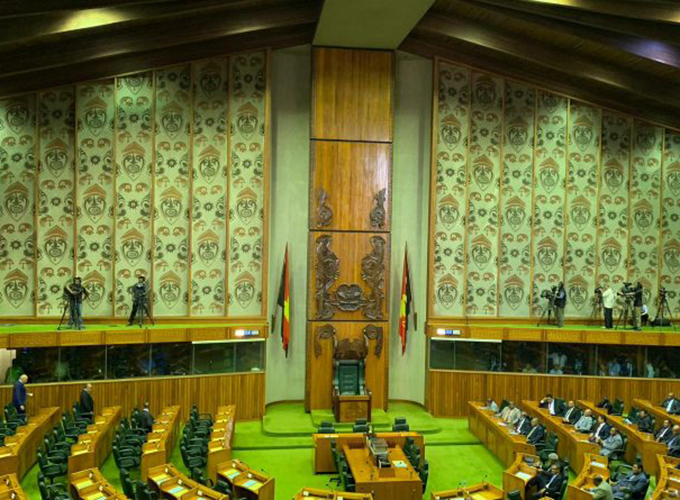
Papua New Guinea’s political opposition has gone on the offensive, accusing Prime Minister Peter O’Neill’s government of attempting to delay and defeat the vote of no confidence motion outside Parliamentary process.

Senior opposition members delivered the vote of no confidence motion to the Speaker yesterday afternoon.

But there are serious concerns that the government is “tampering” with the process. The vote has been delayed until May 28.

READ MORE: Papua New Guinea’s leadership crisis

The opposition’s nominee for Prime Minister, Tari-Pori MP and former Finance Minister James Marape, was furious at the manner in which the Speaker ruled against an early resumption of Parliament.

Marape also told the news media that the government removed opposition MPs who were on a Parliamentary Private Members committee that decides on the validity of votes of no confidence motions.

-Partners-

“What has happened today is that you saw a ploy by Prime Minister Peter O’Neill’s government to sabotage the process of a vote of no confidence motion,” he said.

“They removed membership of the private members committee which had Hela Governor Phillip Undialu and Southern Highlands Governor William Powi.

“They put members on the committee who are pro-government. We are appealing to the Speaker that they must not stand against the will of the people.”

Opposition dismay
In Parliament, Speaker Job Pomat allowed a motion to adjourn the Haus to May 28, much to the dismay of the opposition which sought to have the next session on the week of May 15.

“What showed today was that the Prime Minister was not confident on the numbers on the government side.”

After Parliament rose, Speaker Pomat held his own news conference to explain parliamentary processes, saying he had received the vote of no confidence motion and that due process would have to be followed.

“Today I made rulings that I had to make. The rulings were based on votes. The numbers showed it. I want the people of Papua New Guinea to know that this is the process of democracy. I was not forced. It was my decision.”

In previous years, Speakers have faced the brunt of the opposition’s ire for making decisions seen to be in favour of the government side. Speaking in the that context, Pomat said the democratic process demanded that decisions followed parliamentary process.

The government plans to use period between now and May 28 to reorganise its numbers.

Prime Minister O’Neill said ministries would be allocated to new people to fill in vacancies.

In PNG politics, some of those ministries will be offered to coalition and opposition members to boost and maintain the government’s numbers.

This article is published in collaboration with EMTV News.

Print Friendly, PDF & Email

Article by AsiaPacificReport.nz

Labor wants to restore penalty rates within 100 days. But what about the independent umpire?

Source: The Conversation (Au and NZ) – By Anthony Forsyth, Professor of Workplace Law, RMIT University

This article is part of an election series on wages, industrial relations, Labor and the union movement ahead of the 2019 federal election. You can read other pieces in the series here, here and here.


Labor has promised to restore the penalty rates cut by the Fair Work Commission in its first 100 days.

From its point of view, as part of a broader attack on the Coalition’s record on industrial relations, wage stagnation, widespread wage theft and the growth of insecure work, it makes sense.

But it betrays a broader principle Labor holds dear – independence of the tribunal.

The Coalition is saying little about it – still spooked by the electoral poison wrought by its WorkChoices legislation more than a decade ago.

Throughout the campaign it’s been happy to fall back on claims about economic growth and tax cuts creating favourable conditions to lift wages generally.

So what did the Fair Work Commission decide about penalty rates back in 2017, and what has occurred since?

The commission’s decision was limited

The cuts to penalty rates are often discussed as if they applied across the board. They didn’t. The commission’s decision affected penalty rates in the federal awards applying to only six sectors: fast food, retail, hospitality, pharmacies, clubs and restaurants.

It determined that the penalty rates for working on public holidays in those awards would be reduced from July 1, 2017; and that the penalty rates for Sunday work in four of the awards would be phased down over four years. For example, full-time workers on the retail award had their Sunday rates cut from 200% of the normal rate to 195% in July 2017, then to 180% in July 2018, and were to have the cut to 165% in July this year, followed by a cut to 150% in July 2020.


Read more: Myths about penalty rates and those who rely on them


Extra payments for working irregular or unsocial hours are a longstanding feature of Australia’s industrial relations system. Traditionally, penalty rates have been included in awards with two objectives in mind: to compensate workers for having to work overtime or on weekends and public holidays, and to deter employers from requiring employees to work at these times.

However, in reaching its decision, the commission found that the deterrence objective was no longer relevant for public holiday or Sunday penalty rates.

Sundays have become less sacred

The finding followed a report of the the Productivity Commission that found that working on Sundays was far more common than it had been in industries such as hospitality, restaurants and retail. This reflected a broader shift to a “24/7 economy”.

In the Fair Work Commission’s word, the “disutility” endured by workers employed on Sundays was less than it was.

Labor and the union movement have strongly criticised the commission’s decision in the two years since it was handed down. Labor very quickly introduced a bill to override it and restore the penalty rates of the 700,000 affected workers. The government opposed it and a similar bill introduced by The Greens, enabling Labor and the unions to hammer the prime minister in the election campaign for “voting eight times” to cut penalty rates.

Labor has argued that over the recent ten-day Easter and Anzac Day break, the penalty rate cuts resulted in a loss of between $218 for a fast food worker and $369 for a pharmacy employee.

The union/Labor-aligned McKell Institute says workers will be $2.87 billion worse off by the end of the scheduled reduction in penalty rate cuts if the Coalition is re-elected.

But cutting penalty rates has created few jobs

Business groups have long claimed that cutting penalty rates will boost employment levels, a position endorsed by both the Productivity Commission and Fair Work Commission. However, research published by the Australia Institute last year finds that the retail and hospitality industries were among the lowest industries for job growth in the year after rates were cut.

The Council of Small Business Organisations conceded two weeks ago that the cuts failed to create one new job. Its chief executive, Peter Strong, said the impact had been minimal because it had coincided with above average increases in the minimum wage.

“There’s no extra jobs on a Sunday,” he was reported as saying. “There’s been no extra hours. Certainly, I don’t know anyone (who gave workers extra hours). It’s been just a waste of time.”

However, the Fair Work Commission is set up to be independent.

Labor’s approach carries longer term risks

A campaign spokesperson for the Liberal Party was quoted in the New Daily last month saying: “‘Bill Shorten knows it is the independent Fair Work Commission that sets penalty rates, not the government. In fact, it was Bill Shorten … who set up the review into penalty rates. He even appointed the umpire.’”

The Coalition is gilding the lily. It has been no great defender of the industrial tribunal’s independence in the past. Under WorkChoices it sidelined the commission completely. Lately it has stacked the commission with employer representatives.


Read more: Bill Shorten’s promise of a living wage is both realistic and necessary. But it’s not enough


But it’s not a great idea to start overruling Fair Work Commission decisions that are unpopular. Yes, the penalty rate cuts are arbitrary, reducing the take-home pay of low-paid workers. But Australians have trusted the tribunal to make those judgment calls for more than 100 years.

If Labor wants to influence Fair Work Commission decisions, it should change the criteria used by the commission to review awards – it plans to do so as part of its promise to turn the minimum wage into a “living wage”.

Overturning decisions it doesn’t like will leave the Fair Work Commission wondering why it is bothering, and allow others to refuse to accept decisions they don’t like. And if Labor is elected and perseveres, it will also allow a less worker-friendly successor to overturn decisions it doesn’t like.


Read more: How the major parties stack up on industrial relations policy


ref. Labor wants to restore penalty rates within 100 days. But what about the independent umpire? – http://theconversation.com/labor-wants-to-restore-penalty-rates-within-100-days-but-what-about-the-independent-umpire-116154

Can we bend it? The challenge for Samsung and others to make flexible technology

Source: The Conversation (Au and NZ) – By Drew Evans, Associate Professor of Energy & Advanced Manufacturing, Australian Research Council Future Fellow, University of South Australia

Imagine the day when you’ll unroll or unfold your smartphone to answer it. If things go to plan, this day may be sooner than you think.

And we’re not just talking flip-phones here, but smartphones where the actual screens are flexible, not just the handset.

Okay, so Samsung’s plans to launch its Galaxy Fold phone might be on hold after a few early reviews reported cracks in the screen, but 2019 is said to be a year when many of the major mobile phone manufacturers aim to release their new foldable phones.

Samsung Galaxy Fold on hold. Samsung/Screenshot, CC BY-NC-ND

The promise of technology as intelligent as our smartphones that can simply be folded up like a piece of paper sounds amazing. So what are the challenges in making flexible technology?

How flexible?

To answer this we need to understand what is meant by flexible.

Do we need something that can be deformed without breaking (so it’s okay if you sit on your phone, as it will only bend and not break)? Maybe we want to roll it up into a cylinder with the ease of rolling a piece of paper? Or even to fold it like the Galaxy Fold?

The cracked glass of a smartphone, sitting on the device is the usual cause. Flickr/John Garghan, CC BY-NC-ND

These are very different scenarios, with each putting a greater performance requirement on the device and the materials within.

Are the materials brittle? Or are they inherently flexible? And when they are bent, rolled, flexed or folded, do they continue to work the way they did when flat?

These are the questions many scientists and engineers are asking. Enter the world of materials science, mixed with a dose of advanced manufacturing.

The glass

Consumer electronics traditionally use materials designed for use on rigid glass substrates, or surfaces. The beauty of glass is its rigidity and thermal stability, and can be made on commercial scales.

That means it will rarely bend or flex, and can be heated to high temperatures. These are important factors when manufacturing an electronic device – especially those with a flat panel display.

To make an electronic device, complex patterns of materials need to be made to create an electronic circuit. In some cases the patterns will have features smaller than the width of your hair, even down to the size of viruses (less than 100 nanometers). Producing such patterned coatings of high-performance electronic materials can be done easily on glass at temperatures greater than 500℃.

But when flexibility is required, the substrate needs to change. The obvious choices are polymers and plastics. Thin sheets of these materials can be manipulated into a range of different shapes without breaking.

But not many of these plastics can withstand greater than 500℃ during processing.

New developments from companies such as Corning Incorporated in the US have made special types of thin glass that are bendable.

Bendable glass may be one of many steps towards flexible electronics. But, as we’ll see later, maybe even bendable glass is not that useful for some applications.

The electronics

Beyond the substrate, there are still challenges for the electronic materials themselves. Modern electronics are built on metals and ceramics that require very high temperatures to be fabricated into electrical circuits, and are not ideal for bending.

Polymers such as Nylon, Teflon and polyester are inherently flexible and can be bent, folded or rolled. But polymers are usually insulators (they don’t conduct electricity) and they really do not like being heated too high.

That is why efforts are being made to engineer polymers that are conductive (conducting polymers). Being conductive means that the polymers can transport electrical charge with ease – like your charging cable carries electricity from the power outlet to your portable device’s battery. In parallel engineers are changing the way the existing and new materials are manufactured.

Flexible electronics: An example of polymers that conduct electricity, fabricated as an electrical circuit on a flexible substrate using inkjet printing. Kamil Zuber, Author provided

Manufacturing is moving away from high temperatures in large coating machines, into things similar to inkjet and roll-to-roll printing (printed electronics). Soon your new mobile phone may be printed at high speed in a similar way to a daily newspaper.

But should we bend tech?

Tackling these technical challenges of materials and manufacturing seems within reach. But why do we want flexible technology?

Sure there are some of us that dream of a flat panel TV that can be rolled and unrolled, mounting anywhere we like. Think about it as an electronic poster being hung on your bedroom wall and flexible TVs are almost here – in 2018 LG showcased a 65 inch rollable TV.

Watch it unfold.

Beyond this there are some neat advantages to flexible technology. There is a big drive towards integrating electronics with biology in the ultimate wearable computer.

As we know, our skin (and everything contained within it) is to some degree soft, flexible and elastic. Having flexible technology would allow our wearable computers to seamlessly integrate with us. This will be done so well that we won’t realise we are wearing it.

Glass as a substrate, even if flexible, won’t fulfil the desire to interface with biology. This is because it lacks the softness and deformability to react to the bodies movement.

On the other side of it, the contact lens is made of materials that many people routinely wear on a daily basis (with hopefully little annoyance).

So what about electronics on these soft gel-like substrates? An example of efforts to achieve this is work done by Madhu Bhaskaran and team at the Royal Melbourne Institute of Technology.


Read more: How to take better photos with your smartphone, thanks to computational photography


They are developing electronics that can be worn like a temporary tattoo, giving wearers real-time data about UV exposure. Some companies are even developing electronics directly on a contact lens.

But similar to the Samsung Galaxy Fold, the electronic contact lens project has been paused, the early results from testing are not up to scratch at the moment.

But sometime in the (near) future I believe we will have flexible technologies in our daily lives. This will represent major breakthroughs in the materials and manufacturing used to create them. Most exciting is by achieving this, opportunities will open to interface the physical and cyber worlds to a level we can today only imagine.

ref. Can we bend it? The challenge for Samsung and others to make flexible technology – http://theconversation.com/can-we-bend-it-the-challenge-for-samsung-and-others-to-make-flexible-technology-116270

Suicide rates are rising with or without 13 Reasons Why. Let’s use it as a chance to talk

Source: The Conversation (Au and NZ) – By Michael Musker, Senior Research Fellow, South Australian Health & Medical Research Institute

13 Reasons Why, the controversial Netflix programme that broaches the topic of adolescent suicide, has drawn further criticism after new research showed a potential link to a rise in suicide rates coinciding with the show’s release.

This leaves parents confused about whether they should allow their children to watch the show, discourage it, or even ban viewing.

While some parents might feel uncomfortable discussing the issues raised by the show, it should be seen as an impetus to talk to young people. It also provides a framework in which to have these difficult conversations.


Read more: Why we shouldn’t ignore what 13 Reasons Why is trying to tell us


The study in question, published in the Journal of the American Academy of Child and Adolescent Psychiatry, assessed the association between suicide rates over a five year period (a total of 108,655 suicides) and the Netflix show 13 Reasons Why.

It showed a significant increase in suicides among those aged 10-17 years in the three months following the programme’s Netflix launch. April 2017 – the first month the show was available to stream online – saw a suicide rate of 0.57 per 100,000. This was the highest rate across the five years of the study and a step increase of 28.9% on the average monthly rate.

This adds to prior research that showed increased rates of suicide attempts in the period after the show became available.

While these findings should not be discounted, it’s important to note suicide rates are on the rise regardless of the show. The rates of suicide in Australia have increased over the last decade from 10.9 suicide deaths per 100,000 persons in 2008, to 12.6 deaths per 100,000 persons in 2017 – an increase of 13%.

And for every death that does occur, around 20 people attempt suicide.


Read more: 13 Reasons Why season 2 could still be problematic, but content warnings might help


Suicide contagion

The popular Netflix series sees high school student Clay Jensen given a collection of 13 audio tapes in which his close friend Hannah Baker explains why she ended her life.

In each episode, we get an insight into the difficulties Hannah faced leading up to her suicide. These include social conflicts, problematic romantic relationships, seeking independence, and the added complexities of social media, bullying and mental health issues that affect young people today.

There is a phenomena called “suicide contagion”, where it is believed exposure to suicide in the media and popular culture may lead to copycat behaviour. These concerns have been present for several decades, but are amplified by the volume of content available in today’s digital age.

Suicide contagion is well documented in the literature and it is a real threat. But a greater risk is that young people who are thinking of suicide don’t talk about their thoughts with trusted family and friends.

If your children have watched 13 Reasons Why, it’s worth talking to them about it. From shutterstock.com

Some researchers who have studied responses to 13 Reasons Why suggest there can be both harmful and helpful effects of watching the show.

While some children watching 13 Reasons Why can be “triggered” by material suggestive of acts of self-harm, others have shown an increased compassion and willingness to help others who may be going through difficult times.


Read more: Young adult fiction can be a safe space to discuss youth suicide


Talking about it can reduce the stigma

There are around 3,000 suicides in Australia every year, and this number is growing.

Around the world that figure is about 800,000 suicides annually, equating to one person every 40 seconds. Suicide is the second leading cause of death among 15- to 29-year-olds.

People experiencing thoughts of suicide will often be frightened to talk about it because they are concerned about the reactions of others and potential consequences in terms of their job security or social standing.

Being afraid to talk about suicidal thoughts is not only a problem with teenagers. It’s also often seen in high pressure jobs such as the medical profession, the police and armed forces.

There are consistent calls across mental health networks to reduce the stigma associated with thoughts of suicide and self-harm, with an emphasis on encouraging openness and discussion.

As Beyond Blue notes, it’s time to bring the issue of suicide out into the open and stop hiding it as if it is a crime. Using pejorative language like “committed suicide” implies it’s an offence.


Read more: How to ask someone you’re worried about if they’re thinking of suicide


The series 13 Reasons Why bravely tackles this social taboo head-on. Importantly, the creators have provided helpful guides on how to watch the show, as well as plenty of resources on how to seek help.

It’s imperative we provide opportunities for discussion with young people about these powerful feelings of depression and self harm. There are many resources available to parents to help them start the conversation.

If this article has raised issues for you or you’re concerned about someone you know, call Lifeline on 13 11 14.

ref. Suicide rates are rising with or without 13 Reasons Why. Let’s use it as a chance to talk – http://theconversation.com/suicide-rates-are-rising-with-or-without-13-reasons-why-lets-use-it-as-a-chance-to-talk-116434

I’ve always wondered: are water crystals bad for the environment?

Source: The Conversation (Au and NZ) – By Michelle Ryan, Lecturer – Environmental Health and Management, Western Sydney University

This is an article from I’ve Always Wondered, a series where readers send in questions they’d like an expert to answer. Send your question to alwayswondered@theconversation.edu.au


Are water crystals bad for the environment? –Terry Gilmour

This is an excellent question, and something an environmentally conscious gardener might wonder. With changing rainfall patterns, drought and an increasing average temperature in Australia many people are looking for ways to save water in their garden, and adding water crystals to your soil appears to be a good solution. But what do we really know about water crystals and are they bad for the environment?

Well, you can put your mind at ease: water crystals are not bad for the environment. In fact, in other forms they are actually used to help protect the environment.

What are water crystals?

Water crystals are tiny super-absorbent polymers (a long chain that’s made up of identical repeating molecules), about the size of a sugar crystal. They are added to potting mix or added to soil in a garden bed to increase the water holding capacity of the soil.

Water crystals act like a sponge, binding water molecules with the molecule chains in the crystals (with what’s technically known as cross-link bonding). This makes the crystal swell, creating a three-dimensional gel network up to 300 times its original size, absorbing water and nutrients.


Read more: Not all community gardens are environmental equals


Over 5-6 years water crystals slowly degrade, releasing the absorbed water into the root zone of the plant and wetting the soil.

While many water crystals are marketed as water-saving, and many people use them to drought-proof their plants, it’s really important to know that these water crystals don’t actually conserve water. The plants still use the same amount of water, but instead of the water flowing through to the bottom of the pot and into the saucer and evaporating, or through to the bottom of the garden bed, the water crystals hold onto the water in the root zone of the plant. It makes for a more efficient use of the water in the soil.

Gardeners are not always able to frequently water their plants on hot summer days. Shutterstock

Cross-linked vs linear polymers

To understand where the environmental concerns come from, we have to get a little technical.

The most common type of water crystal on the market is a cross-linked polyacrylamide. Cross-linked polyacrylamides are water absorbent but not water soluble. One of their best-known uses is in disposable nappies.

The environmental concern regarding water crystals comes from people confusing these cross-linked polyacrylamides with non-cross-linked polyacrylamide used by industry. While they are commonly described in the same way, they have a different chemical bonding and properties.


Read more: How your garden could help stop your city flooding


Non-cross-linked (linear) polyacrylamide is water-soluble. It is currently used in Australian agriculture for improving soil and to help control erosion. It also plays an integral role in aiding flocculation as part of the sewage treatment process.

A 1997 study found when non-cross linked polyacrylamide degrades it creates acrylamide, a suspected carcinogen and neurotoxin.

Obviously this would be very concerning if it also affected water crystals! Acrylamide could leach into the soil and water and be taken up by plants, entering the human food chain. However there’s no proof cross-linked polyacrylamides – which are the water crystals you’d find in a gardening store – behave like this.

It is not clear if water crystals have a negative impact on Australia’s rivers and streams. Shutterstock

It is also worth noting that further studies, including one published in 2008, found a very small amount (less than 0.5 parts per billion) of acrylamide was released into the environment, which does not cause any environmental concern.

You may also worry water crystals could impact aquatic life if they found their way into rivers and streams. The good news is there’s no reported toxicity or impact on aquatic life from commercially available water crystals (results are more mixed for the water soluble non-cross-linked polyacrylamide, with some studies finding little impact and others showing no toxicity.


Read more: Are common garden chemicals a health risk?


The other good news is water crystals do not accumulate in the soil or water over the long term. The use of water crystals has no adverse impact on soil microbe populations, which we need for a good healthy soil. If used as directed there is no risk to human health (however, it is always good practice to wear gloves while handling any chemical product).

So environmentally conscious gardeners don’t need to worry about water crystals. They’re great for people who don’t have time to water their pot plants every day in summer. Remember, these crystals do not save water but increase the water holding capacity of the soil, so you still need to water your plants regularly – especially on hot days!

ref. I’ve always wondered: are water crystals bad for the environment? – http://theconversation.com/ive-always-wondered-are-water-crystals-bad-for-the-environment-112519

Are international students passing university courses at the same rate as domestic students?

Source: The Conversation (Au and NZ) – By Andrew Norton, Higher Education Program Director, Grattan Institute

Monday night’s ABC Four Corners program alleged several universities were admitting international students without the English-language skills needed to successfully complete their courses, effectively setting them up to fail.

Such claims have been made so often, including by government agencies, that there is little doubt problems exist. But just how widespread these problems are is hard to assess. One potential method is to look at the pass/fail rates of international students.

In responding to Four Corners, Chair of Universities Australia, Professor Margaret Gardner, said international and domestic students had similar pass rates. If international students were admitted without the necessary language skills we would expect them to fail at higher rates than their domestic classmates.

Success of undergraduate international students

In 2016, international bachelor students failed 15% of all the subjects they attempted, compared to a 14% fail rate for domestic students. These are figures for commencing students, which means for the year they were admitted. Later-year students have lower fail rates.

Although international students overall fail a larger share of the subjects they take than domestic students, this is at least partly because they mostly take IT, engineering or commerce courses. These fields have above-average fail rates for domestic students too, suggesting they are difficult or admission requirement issues affect both international and domestic students.

To fairly assess international student performance it’s best to look at comparisons within these courses.

In recent years international and domestic bachelor-degree IT commencing students have failed subjects at similar rates. In each case, more than 20% of all subjects were failed. Although fail rates are trending down, both student groups have strikingly high fail rates.


In engineering bachelor-degree courses, fail rates for both domestic and international students are lower than in IT and do not show strong trends in recent years. Again, there is not much difference between domestic and international students.


Business-related courses are the most popular choice for international students. Fail rates fluctuate, with international students less likely than domestic students to fail early this decade, and more likely to fail in recent years. But the differences are not large.


For undergraduates, we are not seeing the big differences in fail rates we would expect if English-language abilities were a serious problem for international students. But it’s a more complex story when it comes to postgraduate students.

Postgraduate fail rates for international students

International postgraduate commencing enrolments are growing more quickly than undergraduate enrolments. In 2017, commencing undergraduate students only just outnumbered postgraduates. This might raise concerns universities have dropped their entry requirements too far to achieve growth in postgraduate enrolments.


In IT, we can see that, in recent years, international commencing postgraduate students have consistently failed a higher proportion of subjects than domestic students. In some years, the differences between them were quite large. However, fail rates were much lower than for undergraduate IT students.


In engineering, until 2012, international students usually had lower fail rates than domestic students, but since then international students have begun failing larger proportions of their subjects while domestic students have generally become less likely to fail.


In commerce, both domestic and international students have become more likely to fail since the early years of this decade. International students have consistently failed a higher proportion of their subjects.

Since 2012, fail rates for all three postgraduate fields have been higher than they were in the preceding years. Probably not coincidentally, a downward enrolment trend ended that year, and the current boom started in 2013.


English language requirements may be too low

Although the data does not tell a completely consistent story, we can see the possible effects of lower entry requirements, particularly in the postgraduate numbers.

Since 2012, regulation of international student visas has generally become less strict. Much of the checking on international students is done by the universities.

Official English-language requirements for a student visa have never been high. For example, one of the main English language testing organisations recommends a score of 7 on its 1-9 scale for academic courses. Yet the minimum score needed for a student visa is only 5.5. No university in Australia has a general English-language entry requirement above 6.5, although some specific courses have tougher requirements.


Read more: Higher English entry standards for international students won’t necessarily translate to success


Although fail rates are important indicators, especially for international students paying high fees to attend Australian universities, on their own they cannot prove admission requirements are satisfactory, because other concerns have been raised around international students.

Cheating and soft marking may influence fail rates

In a major student survey, in which international students made up 15% of the total sample, 33% of the students who confessed to cheating were international students.

Student attitudes to cheating were not very different between international and domestic students. But for international students the consequences of failure can be more serious. They could lose their visa and return home with little to show for their family’s investment. This creates an incentive to cheat.

In a parallel survey of academic staff, more than two-thirds had suspected submitted work was not written by the student. In most cases, it was their knowledge of the student’s English abilities that led to this suspicion.

So, international student pass rates could be inflated by plagiarism if it is not detected or not proved. In the Four Corners program, one academic claimed his refusal to mark work he thought was plagiarised led to his contract with the university not being renewed.

Another reason why international pass rates could be inflated is the claim of “soft marking”. A union survey in 2017 found 28% of academics agreed with the proposition: “I feel pressure to pass full-fee paying students whose work is not good enough”.


Read more: Australian unis should take responsibility for corrupt practices in international education


Government policy responses

The government has not ignored these issues. It is acting to restrict commercial cheating. It has commissioned research into how different entry paths into university affect international student outcomes. Special consumer protection provisions have been in place for international students for a long time.

But like the universities, the government is dazzled by international student dollars and has focused on international education as an export industry.

With so many issues around international education entry requirements such as those raised by Four Corners, exploitation of international students, and broader population and migration issues – the next government will need to take another look at how the various competing priorities are balanced.

ref. Are international students passing university courses at the same rate as domestic students? – http://theconversation.com/are-international-students-passing-university-courses-at-the-same-rate-as-domestic-students-116666

Selling out the city to advertising? Nothing new to see here

Source: The Conversation (Au and NZ) – By Robert Crawford, Professor of Advertising, RMIT University

Recent debates about prominent advertising in Melbourne and Sydney have highlighted public concerns about the commercialisation of public space. The sense that our cities have become increasingly vulnerable to commercial forces is premised on the assumption that advertising has no place in our cities.

However, historical images of our cities challenge this view. They reveal advertising and commercial signage to be an ever-present part of our cityscapes and urban life.


Read more: Digital media are changing the face of buildings, and urban policy needs to change with them


A recent controversy in Melbourne over a proposed billboard has echoes of 19th-century debates over billboards occupying prominent city sites. Projections of animated images onto the wall of 231 Swanston Street will turn it into one of the largest advertising billboards in the city. Described as a “mega-sized 305 square metre display”, its size is a key issue, but the controversy does not end there.

Melbourne City Council had at first rejected the sign, arguing:

[…] digital billboards beaming high-rotation advertisements into the public realm are creating an unprecedented level of visual clutter that detracts from our city streets.

Lumen Billboards challenged the decision through the Victorian Civil and Administrative Tribunal. VCAT upheld the appeal, deeming that the sign’s size and illumination was appropriate for the site and that it had little impact on the area’s heritage.

Some see VCAT’s decision as yet another example of big business overriding public interests. Writing in The Age, Nicola Philp attacked the perceived commercialisation of public space. Readers’ comments echoed her sentiments. One reader lamented:

Melbourne is becoming an advertisers [sic] paradise with gaudy flashing signs everywhere. The beauty and elegance that Melbourne once had is slowly being eroded.

Another took aim at advertising, fuming:

I hate the idea of more intrusive advertising being forced down our throats.

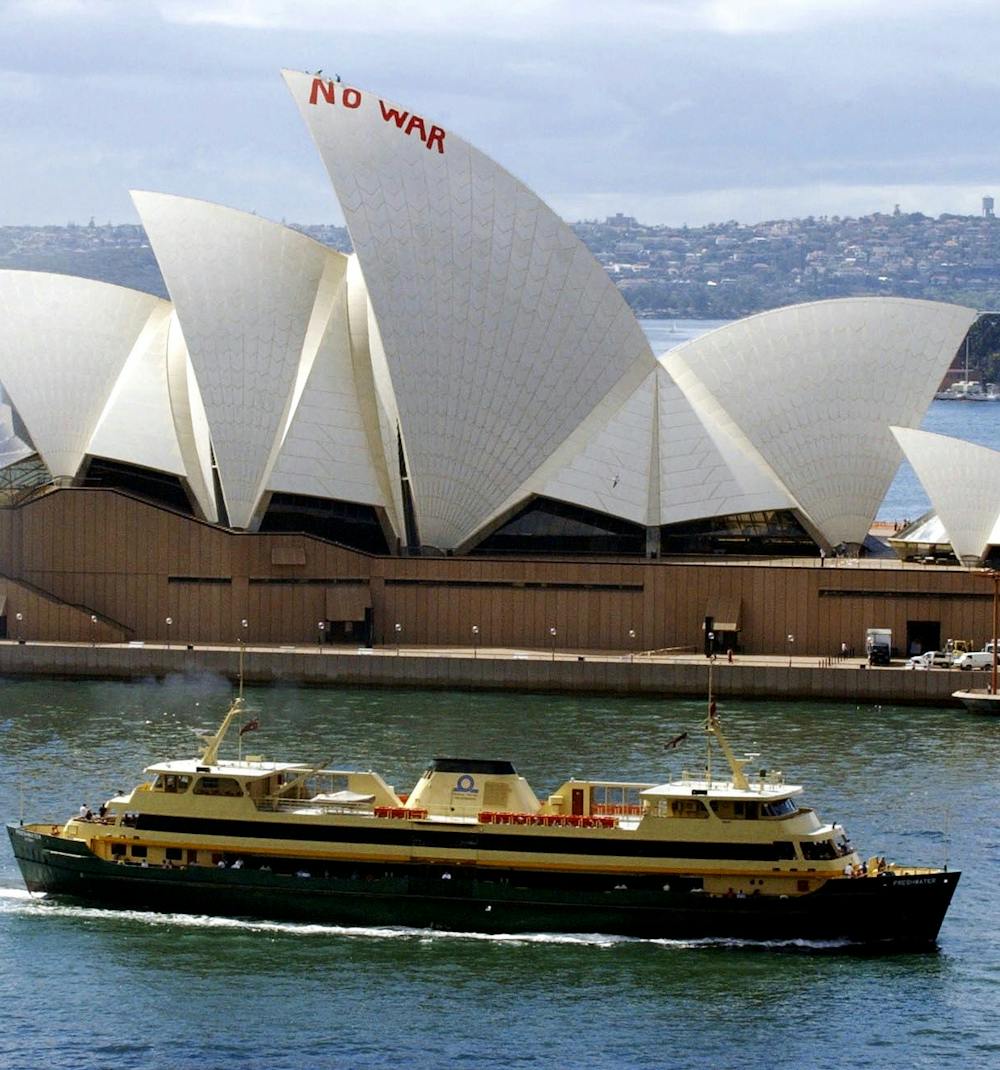
Concerns about the commercialisation of public space were similarly expressed in response to the use of the Sydney Opera House as a billboard to promote the Everest horse race last October. The Opera House’s chief executive opposed the highly controversial decision by the New South Wales government. More than 310,000 people signed a change.org petition against the decision.


Read more: View from The Hill: The uncivil Mr Jones


The use of the Opera House to promote a horse race triggered public protests.
The Opera House sails were the site of an anti-war protest in 2003. Mick Tsikas/AAP

Such numbers did not deter the state government, which had several prominent figures supporting its decision. Among them was Prime Minister Scott Morrison, who described the iconic building as “the biggest billboard Sydney has”.

The PM’s crude description is, strictly speaking, correct. Despite its policy forbidding “logos, corporate identities or colours”, the Opera House sails have been regularly used for promotional purposes. Unofficially, it has also served as a canvas for various protest slogans. However, the Everest uproar was as much about commercial promotion as it was about the power of the city’s political elites.

Concern about commercialisation is an old one

Concerns about the commercialisation of city streets and landmarks are nothing new. In 1880, Brisbane’s Telegraph newspaper took aim at billboards “occupying two of the most prominent sites in the city”, labelling them “terrible eyesores”. Sydney’s lord mayor expressed similar sentiments in 1907 when he was reported as saying:

It was an outrage in a civilised community that every square inching of land abutting on the public streets should be made hideous by posters.

Significantly, one of the first items printed in Australia was a playbill from 1796 promoting a theatrical performance. Like government orders, the playbill and other commercial notices were posted in prominent locations in city streets. Retailers added their mark to city streets by employing signwriters to adorn their premises and promote their wares.

The significance and impact of such commercial signage was formally recognised in 1830, when the governor of New South Wales decreed that it was illegal to “keep up any Sign, Writing, Painting, or other Mark, on or near to his House or Premises” that falsely gave the impression a house was licensed.

As commerce duly grew, so too did the amount of advertising on city streets. By the early 20th century, commercial signs and advertisements were an entrenched and inescapable aspect of urban life. They permeated walls, hoardings and all parts of public transportation systems. Electricity and neon lighting extended outdoor advertising’s reach into the night-time hours.

In recent times, sports grounds have added another commercial layer by selling their naming rights. Melbourne’s Marvel Stadium has previously been known as Colonial Stadium, Telstra Dome and Etihad Stadium. More confusingly, Brisbane and Sydney have both been home to ANZ Stadium (formerly known as QE II and Stadium Australia/Telstra Stadium respectively).

And then there are the signs we love

The Skipping Girl advertising sign in Melbourne is heritage-listed. Joe Castro/AAP

Our relationship with commercial signs is not static. Some signs have taken on a life of their own. The Coke sign in Sydney’s King’s Cross and the Skipping Girl in Melbourne’s Abbottsford have become a part of the respective cities’ cultural heritage.

The interest generated by the uncovering of a long-hidden “ghost sign” for Peapes menswear near Wynyard Station in Sydney similarly reveals that commercial signs and advertising are less utilitarian than critics suggest.

Commercial advertising is a part of our city’s fabric and heritage. While the VCAT decision certainly raises legitimate concerns about processes and the values we apply to public space, the approval of the giant billboard is entirely consistent with our past.

Whether or not we like it is, of course, a different question.

ref. Selling out the city to advertising? Nothing new to see here – http://theconversation.com/selling-out-the-city-to-advertising-nothing-new-to-see-here-114972

How highly sexualised imagery is shaping ‘influence’ on Instagram – and harassment is rife

Source: The Conversation (Au and NZ) – By Jenna Drenten, Assistant Professor of Marketing, Loyola University Chicago

Australians are some of the most active social media users in the world and Instagram is particularly popular. One in three of us have an account, with more than 9,000,000 monthly active users. The rise of Instagram reflects our increasingly visual culture, with 45% of Australians having taken a selfie and uploaded it to social media.

But Instagram isn’t just a place for personal photos, it’s big business. The platform is the birthplace and breeding ground of influencer marketing: a relatively new, multi-billion dollar industry, projected to grow from US$6 billion in 2018 to US$10 billion in 2020.

Influencers generate digital content and gain the attention of a “following” on social media through representations of their everyday lives, in which various commodities and brands play a vital role. The larger the audience, and the more attention they receive, the greater the monetisation potential.

Most influencers, are women, who aspire to build a personal brand. There are more than 558,000 influencers on Instagram who have more than 15,000 followers.

Theirs is a precarious form of work, with none of the traditional workplace protections and they can can spend an extraordinary amount of time and effort generating the “perfect shot” to upload. It’s a job that is always “on”, with the platform functioning 24/7 and delivering a constant stream of notifications.

The body plays a crucial role in influencers’ selfies. Conforming to rigid standards of attractiveness and femininity is fundamental to their gaining attention. This means a lot of work for them but also has broader cultural effects in shaping attitudes about body image.


Read more: Social media, the ‘bikini bridge’ and the viral contagion of body ideals


One of the easiest ways for women to gain attention on social media is through a highly sexualised aesthetic, which is increasingly “pornified”, i.e., borrowing a “look” associated with mainstream, pornographic imagery.

We analysed 172 female influencers’ social media pages over a period of four months. They ranged from women who willingly promote brands with no remuneration to those who market themselves as a personal brand. Our sample of influencers was drawn internationally and sourced from “shoutout pages”, which act as virtual currency to build popularity and thus gain attention. We analysed the images, interactions, and comments of the influencers studied.

We found a continuum of pornified self-representations by these social media influencers on Instagram. This ranged from “softer” references – where influencers pose to highlight sexualised body parts and employ “porn chic” gestures such as gently pulling their hair, touching their parted lips and squatting with legs spread to the camera – to images that were hard to differentiate from mainstream commercial pornography.

Here, pornified representations grab viewers’ attention with the goal of being monetised to sell products, such as protein powder, gummy vitamins, or detox tea.

Our data does not show an enormous breadth of ways in which women might wish to be sexual, but rather a fairly monotonous repetition of “sexiness” and sexual availability that is shaped by porn chic.

The women in our study ranged from having hundreds of followers to millions. Those with a higher number of followers were associated with a more explicitly pornified aesthetic – sometimes using the Instagram platforms to redirect viewers to more direct paid-access pornography on external sites such as OnlyFans.com or private messaging applications like Snapchat and WhatsApp.

But all of this monetised attention comes at a cost of significant sexual harassment, which many argue is poorly policed by Instagram. Monitoring the women’s social media feeds, we found that many female influencers are subject to sexually aggressive comments, objectifying messages from followers, and a lack of privacy in their personal lives. Influencers in our study were subject to sexual solicitation and even physical threats.

Such comments range from: “I would love your art work but it’s your bum I want”, or “love to spank and kiss your gorgeous ass”, to the more aggressive “Turn around before I take out my dick and beat you…”

Sexually aggressive comment on an influencer’s posted image. Instagram.com

Rebuking harassment or deleting hostile comments also comes at a cost for influencers. More engagement, including these kinds of comments, results in more potential attention for a given post. This, in turn, is directly tied to their ability to monetise influence.

Hence, we found that reading such harassment, and making the choice to not delete it, simply becomes “part of the job”. The fear of losing a partnership with a brand is always a concern, so influencers build their audience by engaging with followers in upbeat, positive and convivial ways.

The intensity, volume and public nature of this harassment makes social media influencers particularly vulnerable. They do not have the support of a traditional workplace and employer in dealing with these constant and inescapable interactions.

As well as having negative consequences for the influencers themselves, the trend towards a pornified aesthetic also has consequences for gender equality, more broadly. It’s an aesthetic that positions women and girls as existing for men’s sexualised consumption.

ref. How highly sexualised imagery is shaping ‘influence’ on Instagram – and harassment is rife – http://theconversation.com/how-highly-sexualised-imagery-is-shaping-influence-on-instagram-and-harassment-is-rife-113030

Health check: why do we get motion sickness and what’s the best way to treat it?

Source: The Conversation (Au and NZ) – By Ric Day, Professor of Clinical Pharmacology, UNSW

Motion sickness can be mild, but in some people it’s debilitating, and takes the fun out of a holiday.

We think it’s caused by temporary dysfunction of our brain’s balance centres.

The perception of motion of any sort can bring on symptoms of travel sickness. These include dizziness, nausea, vomiting, excessive saliva, rapid breathing and cold sweats.

The good news is, there are strategies and medicines you can use to prevent motion sickness, or to help you ride it out.


Read more: Curious Kids: Do astronauts get space sick when they travel from Earth to the International Space Station?


Ears and eyes disconnect

As we move through space, multiple sensors in our middle ear, limbs and eyes feed information to our balance centre in our brains to orientate us. It’s when these sources of information are in apparent conflict that we may experience motion sickness.

This diagram of the ear shows the vestibular nerve, which is central to our balance. From shutterstock.com

For example, in those who are particularly susceptible, watching certain movies can induce motion sickness as our eyes indicate we are moving, although other sensors confirm we are stationary.

A boat trip in rocky seas or a car trip on winding roads means our head and body will be moving in unusual ways, in two or more axes at once, while sensing accelerations, decelerations and rotations. Together these are strong stimuli to bring on an attack of motion sickness.

Motion sickness is common

Around 25-30% of us travelling in boats, buses or planes will suffer – from feeling a bit off all the way to completely wretched; pale, sweaty, staggering, and vomiting.

Some people are extremely susceptible to motion sickness, and may feel unwell even with minor movements such as “head bobbing” while snorkelling, or even riding a camel.

Susceptibility seems to increase with age, while women are more prone to travel sickness than men. There is a genetic influence too, with the condition running in families. It often co-exists with a history of migraines.

Preventing motion sickness

Sufferers quickly work out what to avoid. Sitting in the back seat of the car, reading in a car or bus (trains and planes are better), facing backwards in a bus or train or going below deck on a boat in rough conditions are all best avoided if you’re prone to travel sickness.

Medicines that control vomiting (antiemetics) and nausea (anti-nauseants) are the mainstay of medicines used for motion sickness and are effective. But as there are unwanted side effects such as drowsiness, it’s reasonable to try behavioural techniques first, or alongside medicines.


Read more: Monday’s medical myth: peanuts stop motion sickness


More time “on deck”, keeping an eye on the horizon if there’s a significant swell, and focusing on other things (for example looking out for whales) are good examples.

Desensitisation or habituation also work for some. For example, increasing experience on the water in relatively smooth conditions in preparation for longer and potentially rougher trips can help.

There tends to be a reduction in symptoms after a couple of days at sea. Medicines can then be reduced and even stopped. Symptoms often return when back on dry land, usually for just a day or two.

Motion sickness can hit us on boats, as well as planes, trains, buses and in cars. From shutterstock.com

Chewing hard ginger has been claimed to work for naval cadets, but other studies have not confirmed its effectiveness.

Some people find wrist bands that provide acupressure to be effective, although when these have been studied in controlled trials, the proof is lacking.

Glasses with a built-in horizon to combat motion sickness were patented in 2018, so watch this space.

How medications work

Travel sickness medications are more effective when taken pre-emptively, so before your journey begins.

Antiemetics and anti-nauseants act on the brain and nervous system. Medicines used to prevent and treat travel sickness most commonly are either sedating antihistamines or anticholinergics. They block the effects of neurotransmitters (molecules that transmit information) such as histamine, acetylcholine and dopamine in our balance control centres.

But these sorts of medicines are not very specific. That is, they block the effects of acetylcholine and histamine wherever these neurotransmitters act throughout the body. This explains unwanted side effects such as sedation, drowsiness, dry mouth, constipation and confusion (in older, vulnerable people).

Drowsiness is more likely to reach dangerous levels if other central nervous system depressants are taken at the same time. This includes opioids (morphine, oxycodone, codeine), alcohol, sleeping pills and some antidepressants.

So what’s the best option?

A comprehensive review of clinical trials in 2011 compared the medicine scopolamine as a preventative with other medicines, placebos, behavioural and complementary therapies.

Most of the 14 studies reviewed were in healthy men serving in the Navy with history of travel sickness. Women have rarely been subjects, and there are no studies in children.

Although scopolamine was found to be marginally more effective than the alternatives, there’s not much to go on to recommend one travel medicine over another.


Read more: Prepare for a healthy holiday with this A-to-E guide


If you’re somebody who experiences motion sickness, speak to your doctor or pharmacist. Most medicines for motion sickness are available over the counter. You may need to try a few different medicines to find the one that works best for you, but always follow dosage instructions and professional advice.

Once motion sickness is established, the only option is to ride it out. Lying down where possible, getting fresh air and focusing on the horizon can all help alongside appropriate medications. Importantly, for prolonged episodes, try to keep your fluids up to avoid dehydration (especially if vomiting occurs).

If you experience motion sickness for the first time, and if it’s associated with a migraine-like headache, you should seek the advice of a doctor to rule out other neurological conditions.

ref. Health check: why do we get motion sickness and what’s the best way to treat it? – http://theconversation.com/health-check-why-do-we-get-motion-sickness-and-whats-the-best-way-to-treat-it-112861

Media freedom in Melanesia focus of next PJR and upcoming forum

By Michael Andrew

Media freedom in Melanesia will be the focus of the next edition of Pacific Journalism Review in partnership the Melanesian Media Freedom Forum with academics and journalists invited to submit papers on the subject.

The research journal will focus on the political and socio-cultural challenges and constraints for a free press in Melanesia.

This will follow a special double edition due to be released this July.

READ MORE:Pacific media freedom and news ‘blackholes’ worsen for World Press Freedom Day

Pacific Journalism Review editor David Robie … “tremendous opportunity to uphold media freedom.” Image: AUT

PJR editor and director of the Pacific Media Centre Professor David Robie welcomed the opportunity to partner with the forum for the conference in November.

“Media freedom is tracking downwards at the moment and we need a challenging forum like this to clear the air over threats to the region,” he told Pacific Media Watch.

-Partners-

“Also, those courageous journalists in the region who are holding the line need to be celebrated for their work and this will be a tremendous opportunity to uphold media freedom.”

Papers can include but are not restricted to human rights journalism in Melanesia, gender and identity, environmental or climate change journalism, press freedom and the intersection between custom and indigenous knowledge in contemporary Fourth Estate practice.

Other topics
Other journalism topics will be publish as usual in themed editions of the journal.

The deadline for submissions is January 20, 2020.

Pacific Journalism Review is also encouraging presenters to take part  in the Melanesian Media Freedom Forum in Brisbane on November 11/12, 2019.

Co-organised by Griffith University and the Melanesian Media Freedom Group, the forum will give priority to presentation on media freedom in the region, but also welcomes presentations on social justice, human rights, environmental and climate change reporting in the Melanesian media.

Forum co-organiser and director of the journalism programme at Griffith University, Dr Kasun Ubayasiri said the time was right for practitioners, academics and media freedom activists to come together to discuss the changing media landscape in Melanesia.

“We are hearing about increasing threats to media freedom in Melanesia from journalists, editors and media watchers across the sub-region,” he told Pacific Media Watch.

“There seems to be a spread in authoritarian attitudes, policies and practices by governments, often presented under the pretext of ensuring ‘stability’, and the apparent increase in intensity and frequency of threats seem to align with this shift in Melanesian politics.”

Incidents reported
Pacific Media Watch has reported on recent incidents involving such threats and policies in the region:

Dr Ubayasiri, who is co-editing the next edition of PJR, said a free press was vital for a robust and healthy democracy and there was no logical reason to undermine it.

He said he had worked under media restrictions and censorship in South Asia as a former journalist.

“Media freedom is an issue very close to my heart.”

The Melanesian Media Freedom Forum … “an opportunity to address the challenges media freedom faces throughout the region.” Image: MMFF

Chair of the Melanesian Media Freedom Group and MMFF co-organiser Dr Tess Newton Cain said she appreciated the challenges to a free media.

Difficult circumstances
“Based on my experience of living and working in Melanesia, I am very well aware of the difficult circumstances in which journalists and media outlets are operating.”

An expert on Melanesia, Dr Newton Cain said she hoped the forum would provide senior members of the industry with an opportunity to come together and address the challenges media freedom faced throughout the region.

Scholars are invited to submit 200-300 word abstracts for conference presentations.

The forum abstracts deadline is June 20, 2019.

Print Friendly, PDF & Email

Article by AsiaPacificReport.nz

Why Adani’s finch plan was rejected, and what comes next

Source: The Conversation (Au and NZ) – By Samantha Hepburn, Director of the Centre for Energy and Natural Resources Law, Deakin Law School, Deakin University

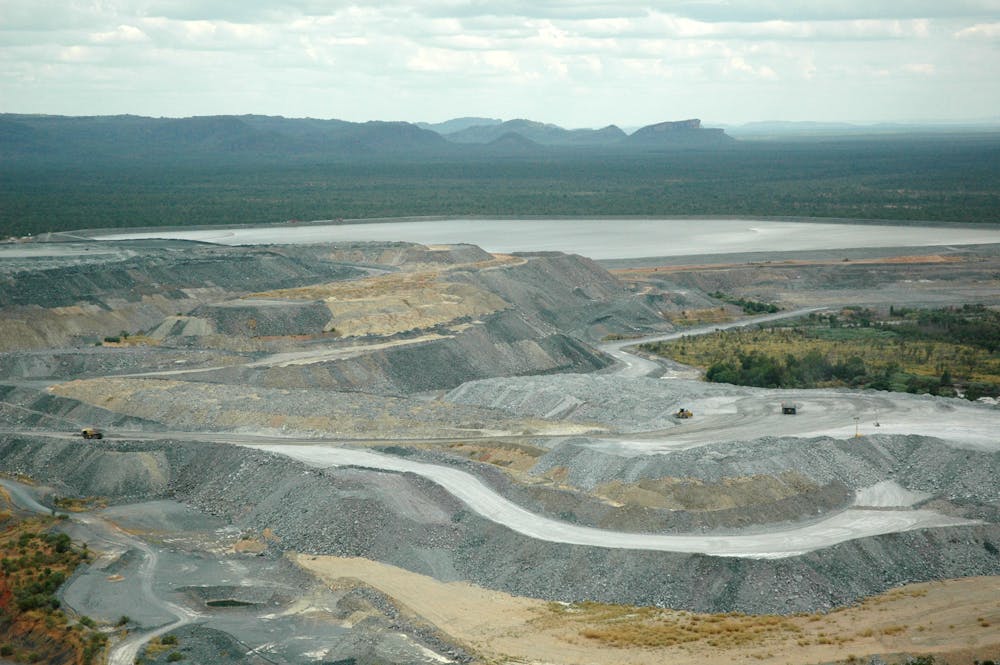
Adani’s plan to manage an endangered finch was rejected last week by the Queensland government, stalling progress on the Carmichael mine.

The mine would cover much of the best remaining habitat for the endangered black-throated finch. The Queensland government required Adani to commit to gathering more accurate finch population data, limit the cattle grazing in the finch conservation area and determine food availability throughout the year, before they could approve the plan.

The rejection is one of two outstanding environmental approvals required before Adani can commence work on the mine. The second is the plan to manage groundwater-dependent ecosystems, which the Queensland government has yet to come to a decision on.


Read more: Unpacking the flaws in Adani’s water management plan


The federal government has been reported as “already approving” the finch plan. But legally, the Queensland government must determine whether the plan complies with the conditions of the environmental authority and, under the bilateral framework, the federal government must give due regard to this assessment.

What’s wrong with Adani’s plan?

Last Friday Queensland’s Department of Environment and Science decided not to approve Adani’s black-throated finch management plan because it does not fulfil certain basic requirements.

The decision is based on a detailed report from an independent expert panel.

The black-throated finch is on the verge of extinction, one of 238 threatened Australian birds.

The black-throated finch is experiencing habitat loss and degradation. Steve Dew/flickr, CC BY

Read more: For the first time we’ve looked at every threatened bird in Australia side-by-side


The greatest threat to the black-throated finch is habitat loss: it has disappeared from over 80% of its original range. Strong protection, and careful management, of its remaining habitat is crucial.

The finch, once found across north-eastern Australia, is now largely found on Moray Downs and surrounding properties, north-west of Clermont in central Queensland. A core part of the habitat is within the 28,000 hectare (ha) footprint of the Carmichael mine, where there are far more black finches than elsewhere due to the intact woodlands and a history of minimal livestock grazing.

It is expected the mines will disturb 50,977 ha of black-throated finch habitat, and that 34,156 ha will be completely cleared.

A total of 87 square kilometres of habitat will be destroyed through the creation of open pits, and a further 61 square kilometres may be degraded beyond repair due to the influence of underground mining on groundwater.

After habitat loss, the second greatest threat to the finch is cattle grazing, which destroys the grass seeds they need to survive. Yet Adani’s management plan for the black-throated finch involved grazing cattle on areas that are supposed to be devoted to conservation of the finch.

Instead of establishing a finch conservation reserve, the Adani plan proposed what was in effect a paddock. Providing a species management plan that effectively conserves finch habitat is a core condition of Adani’s mining licence.

State vs federal priorities

The Queensland government’s rejection of the plan brings into stark focus some of the problems with the existing environmental assessment framework.

The Adani plan includes cattle grazing, despite the threat to finch habitats. Shutterstock

The environmental authority for the mining licence was approved by the Federal government. The environmental management plan for the finch did not, however, address core impact concerns. And yet this is the very reason that the plan was required from the outset. The inadequacies of the plan only became apparent because of the oversight of the Queensland government.

The federal government has not been proactive despite’s its mandate under our National environment act – the Environmental Protection Biodiversity Conservation act. In fact, a recent analysis found the federal government has approved hundreds of projects to clear black-throated finch habitat over the last 18 years.


Read more: Death by 775 cuts: how conservation law is failing the black-throated finch


There are clearly differences in priorities regarding the environment between a federal Liberal and a state Labor government. However, environmental assessment can only be effective if is not undermined by political agendas, and is grounded in scientific rigour and scrutiny.

A one-stop shop

At the federal level, any project likely to have a “significant impact” on a matter protected by the Environment Protection and Biodiversity Conservation Act must be referred to the federal environment minister.

If the minister decides the project impacts a matter of national environmental significance, he or she will then determine how to assess that project at the national level. Legislated options include: an environmental impact statement, a public environment report and public inquiry.

The federal government has entered into bilateral agreements with all state and territory governments. As a result, rather than the state and federal governments conducting separate assessment, the aim is to promote a single, focused environmental evaluation.

The Queensland government has entered into a bilateral assessment agreement with the Commonwealth government for Adani’s coal project, which effectively allows it to make an environmental assessment that the Commonwealth Minister will then take account of when deciding whether to grant approval.

This means that both the Queensland and the federal government are involved in the approval and assessment process environmental authorities and conditions, one of those being the management plan for the black-throated finch. In order to optimise outcomes they need to work together collaboratively.

Where to next?

The rejection means that Adani will now need to submit a new or revised plan that addresses the Queensland government’s concerns. In particular, Adani will need to limit cattle grazing in the conservation area, and gather more information regarding the availability of seed throughout the year.

This may take time but is critical, because in its current form, the plan does not meet the legal requirements for the Environmental Authority, which means that it cannot be approved at the state level.

Without state approval the Adani coal mine cannot proceed. The Queensland government has rigorously assessed Adani’s management plan by commissioning a report by an independent expert panel and then acting on the advice of this report.

This robust approach is crucial to the whole framework of environmental assessment. Genuine commitment to protecting endangered species and managing vital groundwater resources is vital if we want to reverse Australia’s dire trajectory of environmental decline.

ref. Why Adani’s finch plan was rejected, and what comes next – http://theconversation.com/why-adanis-finch-plan-was-rejected-and-what-comes-next-116525

5 tips on how to be a good mentor to someone twice your age

Source: The Conversation (Au and NZ) – By Julie Nyanjom, Lecturer – School of Business and Law, Edith Cowan University

Plato and Aristotle. Barbara Walters and Oprah Winfrey. Steve Jobs and Mark Zuckerberg. In each of these famous relationships it was the older person with more experience acting as mentor, guiding the much younger “mentee” in their career.

But changes in the modern workplace suggest we will increasingly see more circumstances in which mentors may be younger – sometimes much younger – than their mentees.

Think back to starting a new job. Even if your workplace didn’t have a formal mentorship program – pairing you with a more experienced colleague, separate to your manager, whose role was to help you succeed – it’s likely at least one person took you “under their wing” informally.

Who will do the same for the 63-year-old returning to a workplace that looks and operates differently to the one he or she left a decade ago?

Workplaces must prepare for an ageing workforce. Twenty years ago, just a quarter of Australia’s population kept working after they turned 55. Now a third do, and the proportion will continue to rise. As people stay in the workforce longer and change jobs more often, it’s increasingly likely there will be times an older colleague might benefit from mentoring.

It isn’t even necessary to be new to an organisation. Some companies that recognise the value of staying current are embracing “reverse mentoring”, in which millennials can school older executives on technology and cultural trends.

But social norms and expectations about age and experience can make it hard for someone younger to be the mentor.

So how do you get it right?

Why it matters

Generalisations about generational differences are common. Perhaps you’ve read baby boomers (born between 1946 and 1964) value loyalty, and gen-xers (born between 1965 and 1980) work-life balance, while millennials crave innovation and change.

Such notions are more myth than fact. Stereotyping people by their membership of an age group is no less problematic than doing it according to ethnicity or gender. It can encourage unhealthy biases and create barriers to communication and understanding.

A typical image portrayal of ‘millennials’ being addicted to their portable media devices. Shutterstock.com

A better term than “reverse mentoring” is “inclusive mentoring”. This takes the focus off thinking there is a “natural” age order to mentoring and puts the emphasis on simply encouraging shared learning between colleagues. Everyone has something of value to learn, or teach, in a respectful environment free from age or hierarchical biases.

The key is to be conscious of the barriers. You must be aware of the stereotypes and biases – that influence expectations and perceptions to do with age, but also of the chance that different experiences can lead to different outlooks to life.

Start out by asking your colleague about their expectations of their new role, their understanding of their tasks, their past work experience, and how they anticipate the relationship going.

It’s important to remember the essentials of mentoring practice. These remain the same. A mentoring relationship is about support, sharing knowledge and insights, and being a friend. Both mentor and mentee bring something to the table.

Five top tips

  1. Understand stereotypical assumptions influence the potential success of the mentoring relationship. Tension is more likely if either of you have negative perceptions of the other based on age difference. Training in how to identify your unconscious biases might be a good idea before you start

  2. open and respectful communication should be the focus. Start the conversation by clarifying the objectives of the mentoring relationship between both of you. Being clear and focused is a good basis for mutual respect

  3. give yourselves adequate time to settle into the relationship. Your outlook towards life and work may be different. Give yourself time to get to know one another and to find common ground

  4. be open and willing to learn. You might know more about some things, but your colleague is likely to know things you don’t. Think of the mentoring relationship as a collaborative partnership where mutual learning takes place

  5. it’s OK to be apprehensive. You may feel challenged. Your colleague may feel just as uncomfortable. But with time and effort this apprehension will fade.

Becoming a good mentor, or a good mentee, isn’t automatic. It takes takes time and effort. But it is worth the effort, enriching the experience and skills of both parties, and contributing to an organisation able to compete in a changing world.

ref. 5 tips on how to be a good mentor to someone twice your age – http://theconversation.com/5-tips-on-how-to-be-a-good-mentor-to-someone-twice-your-age-114189

Explainer: how a royal commission will investigate Christchurch shootings

Source: The Conversation (Au and NZ) – By Kris Gledhill, Professor of Law, Auckland University of Technology

The trial of the man accused of the murders and attempted murders in the Christchurch mosque attacks is one small but important legal process.

Another one has now started. A Royal commission of inquiry, to be led by the senior judge, Justice William Young, and an as yet unannounced second person, will look into the specific circumstances leading up to the shootings on March 15 that left, as of now, 51 people dead.

The commission will investigate whether police or intelligence services could have done more to prevent the atrocity, but its terms of reference do not allow it to look into the role of social media.


Read more: Explainer: trial of alleged perpetrator of Christchurch mosque shootings


Duty to protect life

Coroners exist to investigate the circumstances of a death and to make recommendations designed to reduce the risk of further deaths. However, mass deaths, whether in a disaster or atrocity, may call for a different process. The investigation then needs to have a focus on systematic matters.

The Inquiries Act 2013 refers to three different types of wider inquiry: a Royal commission (which is formally a matter of the Royal Prerogative), a public inquiry (established by the Governor-General) and a government inquiry (established by a minister). There is a hierarchy, with royal commissions at the top.

Recent examples of incidents that involved significant loss of life and merited a Royal commission include the Pike River coal mine explosion and the failures of buildings during the Canterbury earthquakes.

There is an important international human rights dimension. The International Covenant on Civil and Political Rights (OHCHR) 1966, binding on New Zealand since 1978, obliges the New Zealand government not to take life arbitrarily and to protect life.

This duty to protect is in focus here. The question that requires a Royal commission is whether officers of the state, most obviously in the police and intelligence services, failed in their duty to protect the victims by preventing the atrocity from occurring in the first place.

Answering this question is part of an implied further duty on the state to investigate possible fault on its part. As duties are by definition owed to someone, fixing this as part of the right to life reveals that it is owed to the families of the deceased victims, and those whose right to life was put at risk, and their families. They must be at the centre of the investigation. They have the clearest stake in needing to know whether more could and should have been done to prevent the atrocity.

Focus of the inquiry

Naturally, the desire of those most directly affected to get to the truth is a powerful tool for ensuring that an investigation is kept on track. The rest of us have an obvious interest as well, because we all want to have any necessary changes made to reduce the risk of similar atrocities occurring. But the personal interest adds to this.

The terms of reference for the Royal commission have been released, and should be interpreted in light of this international human rights obligation. But the place of the victims is not prominent. At most, paragraph 4 refers to the expectation that the inquiry will “connect with the Muslim community” in its work, and paragraph 16 has a similar reference and a note about appointing a liaison person or persons.

But nothing in the terms of reference prevents the families being at the centre of the process, and the statutory power of the commission to regulate its own process allows it to do what it considers as proper in this regard.

The scope of the commission’s investigation is a mixed bag. In paragraph 7 of the terms of reference, which sets the scope of the inquiry, the first six points are directly about the activities of the accused person. The final three, which relate to state sector agencies, are phrased as sub-points to the activities of the individual. But the investigative duty must focus on the potential failures of state officials to fulfil an obligation. It will be important that this is construed appropriately by the commission.

Paragraph 8 (relating to findings needed) and paragraph 9 (relating to recommendation to be made) suggest that defaults by state agencies and changes that should be made are central. This is reinforced by the introductory comments, which also have a suitable focus on state agency default and required changes. The problematic paragraph 7 can be interpreted accordingly.

What the commission will not do

Paragraph 13 of the terms of reference makes it clear that the commission will not investigate arms laws. Separate action has already been taken in changing New Zealand’s gun laws.


Read more: Why NZ needs to follow weapons ban with broad review of security laws


Nor will the commission investigate non-state operators such as media organisations, or the police response once alerted to the atrocity. These two limitations are unnecessarily narrow.

It may be that the response of the police was incredibly professional and appropriate. If so, that should be recorded. But if more could have been done, the commission is prohibited from even raising the thought.

As for media platforms, if part of the problem is that governments have failed to regulate the hate-filled corners of the internet, that is part of what we should know in order to protect us from similar acts.

While the government might have been concerned to delay the commission’s findings, which are due by 10 December 2019 and can be supplemented by interim findings, it would have been possible to create a timeline that required the commission to conduct an inquiry in several parts with different dates. The problematic part of paragraph 13 requires governmental reconsideration.

ref. Explainer: how a royal commission will investigate Christchurch shootings – http://theconversation.com/explainer-how-a-royal-commission-will-investigate-christchurch-shootings-116122

Coalition plans to improve online safety don’t address the root cause of harms: the big tech business model

Source: The Conversation (Au and NZ) – By David Watts, Professor of Information Law and Policy, La Trobe University

At about the same time on Sunday afternoon that former Labor prime minister Paul Keating was referring to him as a “fossil with a baseball cap”, Prime Minister Scott Morrison announced a re-election promise to crackdown on social media platforms and online predators, and “protect children, families and the community”.

Our government’s determination to address online safety is to be commended, but the current proposals contain few details on policy and implementation.

In reality we’re unlikely to see much improvement in online safety unless we tackle the real elephant in the room: big tech’s business model.


Read more: How big tech designs its own rules of ethics to avoid scrutiny and accountability


Four initiatives

The plan consists of four initiatives.

The first would see increased maximum penalties for existing crimes such as using the internet to menace, harass or cause offence. Penalties would also increase, and new offences created, for a range of child sex offences that rely on the internet.

The second initiative is designed to hold major social media platforms to account by enacting laws that require them to provide transparency reports relating to illegal, abusive and predatory content by their users – that is, trolling.

The third is to provide parents with tools to “make their own decisions about how their children use the internet”. It will become mandatory for online apps, games and services marketed to children to be pre-configured with the most restrictive privacy and safety defaults.

Complementary initiatives involve providing a filtered internet service that blocks sites considered unsafe by the eSafety Commissioner, and providing point of sale and point of account creation information to parents about online safety and parental controls.

The final initiative is to work with the G20 to “ensure that technology firms meet obligations regarding the prevention and protection, transparency and deterrence to stop terrorists weaponising the internet”.

Scandals and social harm

In the wake of a variety of scandals that have plagued “big tech” over the last few years – including the Facebook Cambrige Analytica controversy, and Robert Mueller’s investigation into Russian interference with the 2016 US Presidential elections – governments across the world have become increasingly concerned about the social harms produced by a largely unregulated technology sector.

The Coalition’s election announcement comes soon after the passage of amendments to the Criminal Code to address live streaming of “abhorrent violent material” by social media platforms in the wake of the Christchurch massacre. It should be seen as an advance in governmental resolve to address the excesses of big tech. This is a long overdue and welcome development.


Read more: Livestreaming terror is abhorrent – but is more rushed legislation the answer?


Extra offences and tougher penalties, particularly for online-enabled sexual exploitation of children, play well in a febrile pre-election environment. The prospect of more punishment and denunciation seems like tough and determined action will be taken.

But the deterrent effect of criminalising activity and imposing harsher jail sentences is based on an assumption that people weigh up the costs and benefits of their actions whenever they make decisions – that they make rational criminal choices. This assumption is open to question where online harassment and child sex offending occurs.

Equally, there is little evidence that jail time for sex offenders serves rehabilitative objectives or that, long term, the community is safer. After all, when offenders have served their time they are released and return to the community.


Read more: Helping to rehabilitate sex offenders is controversial – but it can prevent more abuse


It’s easy – and cheap – to legislate for new offences and more incarceration. It’s harder – and expensive – to ensure the community is safer in the long term. This involves addressing causes, not effects.

Only the ‘major’ platforms

The proposed greater transparency measures appear to apply only to “major” social media platforms. Presumably, this means digital platforms that have a corporate presence in Australia – like Google and Facebook – and who can be compelled to obey Australian laws.

But there are many other sites that Australians access which have no presence, other than a cyber presence, in Australia.

Has the Coalition taken account of the fact that those who choose to propagate “illegal, abusive and predatory” content may simply switch their activities to platforms like 4 Chan, 8 Chan or reddit to avoid transparency requirements, making it harder to regulate them? How will they be made transparent?

Another challenge is how to define “illegal, abusive and predatory content”. Presumably government will provide legislative guidance about this in its proposed Online Safety Act, but it will be interesting to see how Silicon Valley corporations steeped in US first amendment free speech doctrine interpret and implement this requirement.


Read more: We need to talk about the data we give freely of ourselves online and why it’s useful


Policing is the hard bit

One of big tech’s most consistent arguments to avoid regulation is that we should rely on technology to solve technology-caused harm. The Coalition’s proposal to provide parents with controls to “make their own decisions about how their children use the internet” falls into this category.

But how are default privacy and safety settings to be policed? What will stop curious, technically-literate children simply changing the default settings behind their parents’ backs?

Likewise, the proposal to supply filtered internet services that block sites nominated by the e-Safety Commissioner seems like an invitation to find work-arounds to avoid censorship.


Read more: Sorry everyone: on the internet, you’re always the product


As commentators like Roger McNamee, Zeynep Tufekci and Tristan Harris have argued, the risks that big tech poses to society are caused by their “free” service business model.

The need to collect more and more personal data and keep their users’ attention focused on their services by feeding them more and more content that they “like” is baked into social media corporate DNA. Companies create “filter bubbles” and “preference bubbles” that ensure popular content is succeeded by more extreme and disturbing versions of the same.

Big tech’s business model is the root cause of the harms the Coalition’s online safety package is designed to address. Although any government action to address these harms is to be encouraged and supported, the package is likely to fall short of our expectations.

ref. Coalition plans to improve online safety don’t address the root cause of harms: the big tech business model – http://theconversation.com/coalition-plans-to-improve-online-safety-dont-address-the-root-cause-of-harms-the-big-tech-business-model-116592

Look at me! Look at me! How image-conscious but visionless leaders have made for a dreary campaign

Source: The Conversation (Au and NZ) – By Mark Kenny, Senior Fellow, Australian Studies Institute, Australian National University

Some weeks back, Sydney Morning Herald political editor Peter Hartcher grimly characterised the election as a choice between an angry dad figure in a baseball cap and a sad sack who learned public speaking in funeral parlour.

Unkind but funny.

There has been precious little wit since in the procedural campaign dirge rolled out on either side – a rare exception being Bill Shorten’s “space invader” quip directed at Scott Morrison in last Friday night’s leaders’ debate.

It was probably focus group feedback rather than Hartcher’s astringent barb, but both leaders do seem to have modified their presentation as the campaigns have progressed.

But not much.

Image is everything – and nothing

Still tetchy and frustrated, Morrison seems to have benched the American baseball cap headwear – although not quickly enough to forestall a caustic Paul Keating attack:

Here’s the prime minister walking around with a lump of coal, coal is a fossil and the problem is the prime minister is a fossil himself. He’s a fossil with a baseball cap but he’s a fossil.

For his part, Shorten has apparently been told to smile no matter what. Such insouciance begins to look odd if it persists under verbal assault from his opponent or when confronted by an aggressive interviewer. Abnormal might be another word for it.

Amazingly, the parties’ body language experts have subtracted nothing much from nothing at all – and come up with even less. So much for politics obeying the “iron laws of arithmetic”, as John Howard was fond of saying.


Read more: ‘Fairness’ versus ‘strength’ – the battle to frame the federal election


Who was it who observed that, sincerity is everything – once you can fake that, you’ve got it made?

To call the major party campaigns risk averse makes them sound occasionally intriguing, perhaps even adventurous to a point.

They are not. Nor is their rhetoric inspiring, with neither leader seeking to invoke a national vision except inasmuch as it can be safely conveyed within an orthodox economic rationale.

Empty campaign messages

US Democratic strategist James Carville’s now-ubiquitous entreaty in Bill Clinton’s 1992 presidential campaign “it’s the economy, stupid,” has become the cold heart of modern politics – a prevailing neoliberal dictum that denudes political imagery of anything that cannot also be shown on a balance sheet.

What’s forgotten is that Carville’s supposed primacy of the economy was just one of three key messages Clinton campaigners were asked to stress, the others being “change versus more of the same” and “don’t forget health care.”

It’s uncanny how these work for Shorten now. Indeed, more of the same might well be the greatest risk in this election – more dangerous than budget blowouts, higher taxes or rising debt.

So arid has the governmental battleground become that Keating, arguably the most economically focused of Labor’s prime ministers, is looking for soul. While attending Labor’s campaign launch in Brisbane, he emphasised:

No, no, it’s about the economy “and” society. The economy is there for society. The Liberals have nothing to offer. You know, I’m surprised how threadbare their program is. If you look, there is no panorama. There’s no vista. There’s no shape…

Campaigning not to lose

Intended or otherwise, “Big Picture” Keating’s lament over the barely referenced vision thing applies to Labor also – if to a lesser extent.

The sharpest segue toward any sort of grand vision can be found in Labor’s education and training plans, which are fiscally bold – long-hand for expensive – yet mostly iterative in a pure reform sense.

Ditto for the crimping of tax loopholes such as negative gearing, franking credit cash bonuses and capital gains tax. These changes are electorally bold, and undeniably redistributive, but they are also essentially remedial rather transformative in economic reform context.


Read more: Politics with Michelle Grattan: Caroline Fisher on the spin machines of #AusVotes19


Climate change is perhaps the big values difference, but after a decade of bruising political negation on carbon emissions, Labor’s plans are substantially pared back from its ambitions of a decade ago. They are now largely those of the government, if delivered faster – no carbon tax, no cap and trade scheme, and the plan to revive Malcolm Turnbull’s national energy guarantee.

Much theorising has gone into explaining the record pre-poll turn-out, which had reached 915,000 people on Monday, vastly higher than the last federal poll in 2016.

The Coalition in particular is sweating the cause of this psephological phenomenon, amid speculation – much of it indistinguishable from wishful thinking – that voter keenness portends an electoral bloodbath for the Coalition.

This could be right, or it might be something else, such as the depressing reality of a campaign that is so dreadful to watch, it can be fully ignored once one’s duty has been discharged. The debates, for example, have been excruciating – two middle-aged men in suits trying not to lose.

Putting women front and center

Yet for all this, there have been significant optical differences between the two sides. Differences that amplify realities within each camp.

While Morrison has barely appeared before the cameras without a female Liberal candidate by his side, these women have mostly been political non-entities, unknown by voters beyond their own electorates.

The transparent aim has been to counter the hard truth that the Liberals have a women drought in their ranks – one of their own determined making.

Morrison appearing with Liberal candidate for Lingiari Jacinta Price and Liberal candidate for Solomon Kathy Ganley in Darwin last month. Mick Tsikas/AAP

Read more: Quotas are not pretty but they work – Liberal women should insist on them


Julie Bishop’s relative absence in this campaign is profound, highlighting the unpalatable fact that the government’s most popular and trusted figure has quit after being ignored as a leadership option.

The associations are unpleasant: think J-Bish and you also think Turnbull, which leads quickly to turmoil, betrayal and to Tony Abbott.

On Labor’s side, the aim has been to underline this difference as visually as possible.

By the time Shorten addressed the party faithful at his party’s Brisbane campaign launch, no fewer than four powerful female identities had sung his praises: Annastacia Palaszczuk, Penny Wong, Tanya Plibersek, and his wife, Chloe Shorten – otherwise known among Labor women as, “Bill’s feminist conscience”.

Labor putting the gender equity of its shadow ministery on display at the party’s election campaign launch. Darren England/AAP

If that didn’t make the point strongly enough, the entire Labor alternative cabinet was on stage for the event, arranged in the familiar boy-girl-boy-girl order – its 50-50 split as obvious as the squares on a chess board.

Images aren’t everything in this election, but given the absence of charisma and paucity of inspiring vision, the leaders are relying on them to send the right message.

ref. Look at me! Look at me! How image-conscious but visionless leaders have made for a dreary campaign – http://theconversation.com/look-at-me-look-at-me-how-image-conscious-but-visionless-leaders-have-made-for-a-dreary-campaign-116421

Curious Kids: why don’t horses sit or lie down even while sleeping?

Source: The Conversation (Au and NZ) – By Susan Hazel, Senior Lecturer, School of Animal and Veterinary Science, University of Adelaide

Curious Kids is a series for children. If you have a question you’d like an expert to answer, send it to curiouskids@theconversation.edu.au You might also like the podcast Imagine This, a co-production between ABC KIDS listen and The Conversation, based on Curious Kids.


Why don’t horses sit or lie down even while sleeping? – A question from Zulfiqar.


I’m glad you have asked about one of the mistakes lots of people make about horses. It’s true they do have an amazing ability to sleep standing up. But they do also sleep lying down. If you’re a horse, you need to be able to do both.

I’ll explain why.


Read more: Curious Kids: how did the months get their names?


Why should horses be able to sleep standing up?

Horses first evolved in open plains. As a prey species (one that other animals eat), they needed to be able to see quickly if another animal that might eat them (a predator) was nearby.

Being able to rest or sleep standing up meant they could get their rest, but if they saw a predator, they could quickly run away. That’s one of the reasons horses run so fast – to get away. The early horses that ran the fastest were more likely to survive.

Horses have evolved to be able to run at almost any moment, in case a predator arrives. Flickr/Cowboy Dave, CC BY

Three legs on, one leg off

The most interesting part of horses resting standing up is how they do it. In horses there is a special arrangement of muscles and the parts that connect muscles and bones together (ligaments and tendons). This is called the stay apparatus.

The stay apparatus means that horses can stand on three legs and rest the other leg. They can change the leg they rest so all of their legs get a chance to have a break. A horse can weigh more than 500kg so their legs need a rest!

Horses can rest standing up or lying down. Flickr/Cowboy Dave, CC BY

Even though they can sleep standing up, scientists think horses still need to lie down and sleep each day. Your sleep is not the same all night. Everyone goes through different stages of lighter and deeper sleep, and horses are the same.

The deeper stages of sleep are only seen in horses lying down. Both horses and humans need to go through deeper stages of sleep for our brains to work properly.


Read more: Curious Kids: is water blue or is it just reflecting off the sky?


Hello, curious kids! Have you got a question you’d like an expert to answer? Ask an adult to send your question to curiouskids@theconversation.edu.au

CC BY-ND

Please tell us your name, age and which city you live in. We won’t be able to answer every question but we will do our best.

ref. Curious Kids: why don’t horses sit or lie down even while sleeping? – http://theconversation.com/curious-kids-why-dont-horses-sit-or-lie-down-even-while-sleeping-116156

Constitutional reform made easy: how to achieve the Uluru statement and a First Nations voice

Source: The Conversation (Au and NZ) – By Eddie Synot, Senior Research Assistant, Griffith University

The Uluru Statement from the Heart is almost two years old and now enjoys bipartisan political support. Labor’s policy, if elected, is to hold a referendum on enshrining a First Nations voice in the Australian Constitution in their first term. The Coalition, while supporting the Uluru Statement from the Heart following the report of the Joint Select Committee on Constitutional Recognition Relating to Aboriginal and Torres Strait Islander Peoples, has budgeted for a design process to establish a model of the First Nations voice to parliament before going to referendum.

The support for the Uluru statement is a remarkable turning point in the history, and future, of the Australian nation. By issuing the Uluru statement to the Australian people, rather than to politicians, participants at the First Nations National Constitutional Convention in 2017 invited all Australians to “walk with us in a movement of the Australian people for a better future”. This invitation has been resoundingly embraced.


Read more: The Uluru statement showed how to give First Nations people a real voice – now it’s time for action


At the core of this invitation is the principle of being heard. Australians have come to understand that First Nations peoples have a political and cultural right to be heard and to determine their own affairs.

Many also understand that this power is key to addressing what the Uluru statement termed “the torment of our powerlessness”. This means a new relationship between Indigenous and non-Indigenous peoples in Australia that establishes the foundations for a better future.

The establishment of this new relationship is also why it is important to enshrine these changes in the constitution before negotiating what this relationship will be.

The Australian Constitution is the foundation of the Australian nation, and it must be changed to enable a renewed relationship. Without addressing this first, any future changes implemented outside of the constitution will remain susceptible to the current arrangements that do not appropriately recognise First Nations peoples.

However, the need for constitutional change has been conflated with concerns about the need for a detailed design of the First Nations voice before a referendum, and misrepresentations of the process that is required to achieve this change. First, change the constitution. Then, negotiate the design of the voice.


Read more: The Indigenous community deserves a voice in the constitution. Will the nation finally listen?


The deferral of the detail of what the voice might be is a normal process of constitutional reform. Effective constitutional reform requires that any new addition to the constitution be explicit enough to provide for the establishment of the voice while being subject to the constitution. But it should not be so detailed that it becomes restrictive and meaningless to Indigenous and non-Indigenous peoples into the future.

There already exists significant research on the future design of a body that could be the First Nations voice. This includes eight reports since 2012, including the First Nations-led Referendum Council dialogues that produced the Uluru Statement in 2017 and the 2018 report of the joint select committee.

Participants in the regional dialogues of the Referendum Council and the First Nations National Constitutional Convention in 2017 provided a clear pathway forward. This is represented by submission 479 to the joint select committee. Importantly, the submission was written by experts who advised the regional dialogues and is representative of the desires of First Nations participants.

Submission 479 detailed the insertion of a new “Section 129: The First Nations Voice” and a simple referendum question to achieve this as detailed below.

Proposed Amendment

Chapter 9: First Nations

Section 129: The First Nations Voice

(1) There shall be a First Nations Voice.

(2) The First Nations Voice shall present its views to Parliament and the Executive on matters relating to Aboriginal and Torres Strait Islander peoples.

(3) The Parliament shall, subject to this Constitution, have power to make laws with respect to the composition, functions, powers and procedures of the First Nations Voice.

Referendum question

Do you approve an alteration to the Constitution that establishes a First Nations Voice?

YES / NO

This is a simple but powerful amendment. It provides recognition and the ability of First Nations peoples to negotiate with government while also respecting the place and authority of parliament and the constitution. This is, importantly, not a simple inclusion but rather a representation to the Commonwealth that is respectful of First Nations political and cultural identity and authority.

Conventional wisdom tells us that achieving constitutional reform can be difficult. But too much can be made of conventional wisdom, to the point that it stymies progress.


Read more: Lessons of 1967 referendum still apply to debates on constitutional recognition


Laws are meant to change. Section 128 of the constitution specifically provides for that ability and the successful 1967 referendum is an example of what can be achieved.

In 1967, it wasn’t the technical change to the constitution that held weight, nor was any specific detail about the future of Indigenous affairs entered into the constitution. Rather, it was the principle of “vote yes for Aborigines” that resonated.

Today, it is that same principle of respect and recognition for First Nations peoples that can deliver reform for a better future.

ref. Constitutional reform made easy: how to achieve the Uluru statement and a First Nations voice – http://theconversation.com/constitutional-reform-made-easy-how-to-achieve-the-uluru-statement-and-a-first-nations-voice-116141

Around 50% of homes in Sydney, Melbourne and Brisbane have the oldest NBN technology

Source: The Conversation (Au and NZ) – By Tooran Alizadeh, Senior Lecturer in Urbanism, Sydney Research Accelerator (SOAR) Fellow, University of Sydney

The NBN was touted as dream infrastructure, and the Coalition says it is close to completing the A$50 billion national broadband network.

But Australia recently slipped three spots to place 62nd in global broadband rankings, with our average download speed of 35.11 Mbps far below the global average of 57.91 Mbps.

Labor has ruled-out a large scale upgrade of the NBN if it wins the 2019 federal election, saying flaws in the NBN are due to “six years of vandalism” by the Coalition government.


Read more: Labor will prioritise an NBN ‘digital inclusion drive’ – here’s what it should focus on


In reality it’s hard to get an accurate picture on the balance of NBN technologies that are already in place in Australia. To get around this opacity, we used the “check your address” tool on the NBN website as a way to collect data on the footprints of technologies currently or about to be in place in three Australian metropolitan cities of Sydney, Melbourne and Brisbane.

The data suggests around half (40-60%) of homes in the three cities only have access to very old technology: hybrid fibre-coaxial (HFC). For people in these residences, access to the so-called “fibre network” remains only a fairy tale.

Around 55% of homes have old NBN technology in Sydney. Green areas represents addresses with fibre technology (FTTX) and red areas represent addresses with older hybrid fibre-coaxial/satellite NBN (HFC/Sat). Tooran Alizadeh, Author provided

Real data on the NBN

Lack of data transparency is a vexing aspect of the NBN. In our experience, NBN Co does not disclose meaningful information on service footprints in a single, usable dataset. This makes it difficult to evaluate outcomes and perform policy analysis associated with the service.

Nevertheless, our latest research has collected some data we believe was undisclosed previously.

Over December 2018 to February 2019, we used the “check your address” search function on the NBN Co website along with basic data mining techniques to extract data from a representative sample of all addresses across the three metropolitan regions of Sydney, Melbourne, and Brisbane.

We uncovered footprints of mixed-technology NBN, including current or planned fibre to the premises (FTTP), fibre to the node (FTTN), fibre to the building (FTTB), fibre to the curb (FTTC), hybrid fibre-coaxial (HFC), fixed wireless and satellite (Sky Muster).

Here we mainly focus on hybrid fibre-coaxial (HFC), which is the oldest technology component of the NBN. HFC is the cable network you might have connected to in the past to get Foxtel subscription TV.

Around 42% of homes have old NBN technology in Melbourne. Green areas represents addresses with fibre technology (FTTX) and red areas represent addresses with older hybrid fibre-coaxial/satellite NBN (HFC/Sat). Tooran Alizadeh, Author provided

Major cities rely on HFC

The three maps shown here represent the spatial presence of fibre infrastructure versus more inferior HFC/satellite NBN in three metropolitan regions of Sydney, Melbourne and Brisbane (In reality very few urban homes use satellite, as shown in bar graphs below).

The three maps suggest inferior NBN technology is in abundant use across all three metropolitan cities. 62% of all addresses in the greater Brisbane region, 42% of all addresses in Melbourne, and 55% of all addresses in Sydney are (or will soon be) connected to the NBN via HFC.

These figures are at odds with a recent claim by Minister for Communications Mitch Fifield that his government is rolling out “a new network” to the whole nation. For about half of the addresses in three major Australian metropolitan regions, the NBN “rollout” looks like a re-branding exercise using an old cable network.

Around 62% of homes have old NBN technology in Brisbane. Green areas represents addresses with fibre technology (FTTX) and red areas represent addresses with older hybrid fibre-coaxial/satellite NBN (HFC/Sat). Tooran Alizadeh, Author provided

Socioeconomic patterns of the NBN

To look at socioeconomic patterns of the NBN rollout, we used the Australian Bureau of Statistics’ (ABS) socio-economic indexes for area (SEIFA) and its index of Relative Socio-economic Advantage and Disadvantage (IRSAD) from 2016. We then cross examined the SEIFA data (divided into ten ranked groups known as “deciles”) with the NBN data extracted via the data mining exercise (described above).

It’s clear in the graphs below that a mix of both old and new technologies are in play across the three metropolitan regions of Sydney, Melbourne and Brisbane.

The analysis did not find any clear socioeconomic patterns comparing better-off SEIFA deciles of 8-10 versus worse-off deciles of 1-3. Nevertheless, the size of HFC adoption across the socioeconomic spectrum in all three major cities is quite concerning.


Availabilities of different technologies across different socioeconomic deciles (1 = lowest socioeconomic status, 10 = highest) in Sydney, Melbourne and Brisbane. NBN technologies are FTTP (fibre to the premises), FTTN (fibre to the node), FTTB (fibre to the building), FTTC (fibre to the curb) and the older HFC (hybrid fibre-coaxial) and Sat (satellite).

The second most dominant technology in the three major cities is fibre to the curb (FTTC). This is a technology that was only added to the mix 12 months ago, as a partial solution in response to the mounting issues related to the HFC network.

If it was not for this late addition to the network, the NBN footprint may have had an even higher dominance of old HFC technology than currently. It’s also clear that the rate of FTTC adoption in greater Brisbane is well below that in Melbourne and Sydney.

An NBN upgrade is inevitable

Since the announcement of mixed-technology NBN, experts have warned against the serious shortcomings of the old HFC technology.

While these were mostly ignored initially, Bill Morrow (then CEO at NBN) later admitted that NBN speed was slowed by reliance on copper network. Supporting this, an analysis by the Australian Communications and Media Authority (ACMA) revealed that the average household on the HFC network was reporting between 2 to 3.6 times more faults than those on fibre, and making between 3 and 5 times more complaints.

It’s also been reported that about 40% of the NBN is fibre to the node (FTTN) which has its own fair share of issues.

Interestingly, there have already been some partial upgrades within NBN Co’s plans, as FTTC reportedly accounts for about 12% of the national network, to serve the areas that were previously assigned to receive HFC.

Having said this, Labor’s latest announcement seems to be focusing on what can be described as “improving consumer experience” without making any commitment for more fibre-to-the-premises (FTTP), or at least more fibre.

We argue that for Australia and Australian major cities to be competitive on the global platform, an NBN update is inevitable.

ref. Around 50% of homes in Sydney, Melbourne and Brisbane have the oldest NBN technology – http://theconversation.com/around-50-of-homes-in-sydney-melbourne-and-brisbane-have-the-oldest-nbn-technology-115131

The uranium mine in the heart of Kakadu needs a better clean up plan

Source: The Conversation (Au and NZ) – By Rebecca Lawrence, Affiliate, Sydney Environment Institute; Honorary Associate, Macquarie University, Macquarie University

Can a uranium mine be rehabilitated to the environmental standards of a national park and World Heritage site?

That’s the challenge faced by the controversial Ranger uranium mine inside Kakadu National Park.

But our new research report found the document guiding its rehabilitation is deficient, and urgent changes are needed for the heavily impacted mine site to be cleaned up well.

Kakadu has been a national park since the 1970s, but the Ranger mine, while surrounded by Kakadu, has never formally been part of the park. This classification is in the interests of resource extraction, and has failed to recognise or protect the area’s cultural and environmental values.

Kakadu National Park encompasses a precious natural heritage. It protects valuable ecosystems of outstanding value, diversity and beauty, and contains the world’s richest breeding grounds for migratory tropical water birds.


Read more: Australia’s problem with Aboriginal World Heritage


Recent diggings and studies have documented at least 65,000 years of continuous human habitation at a site on the land of the Mirarr people – this is currently the oldest occupation site in Australia.

How was the mine developed?

The boundaries of Kakadu National Park were conveniently drawn around the Ranger mine site through a series of political and administrative negotiations following the Fox Inquiry, which gave a cautious green light for the Ranger operation.

Likewise, Ranger was excluded from the requirements of the Aboriginal Land Rights Act that would have otherwise given the Mirarr people the right to say no to the mine.

Now, as the mining stops and the repair begins, mining companies and government regulators are being tested on their environmental commitment, and capacity to make meaningful change.


Read more: Treasure from trash: how mining waste can be mined a second time


But rehabilitating what is essentially a toxic waste dump is no easy task.

And the inadequacy of the Energy Resources Australia’s Mine Closure Plan – the key document guiding the rehabilitation – shows they are failing this test so far.

The Ranger uranium mine, owned by Energy Resources Australia (ERA), sits in the heart of the world heritage listed Kakadu National Park. AAP Image/Tara Ravens

Problems with the Mine Closure Plan

Our new research report – jointly conducted by Sydney Environment Institute and the Australian Conservation Foundation – examines the Mine Closure Plan and finds it is seriously wanting in key areas.

These include significant data deficiencies regarding management of mine tailings (mine residue), land stability, and modelling of toxic contaminants likely to flow off site into Kakadu National Park.

The Mine Closure Plan is almost completely silent on crucial governance questions, such as the Ranger mine’s opaque regulatory processes and rehabilitation, and current and future financing – especially in relation to future site monitoring and mitigation works.


Read more: Ranger’s toxic spill highlights the perils of self-regulation


After the price collapse following the Fukushima nuclear crisis, times in the uranium trade have been tough. Coupled with a mandated end to commercial operations by early 2021, Rio Tinto has accepted the era of mining has now been replaced by the need for rehabilitation.

But the challenge for Energy Resources Australia and Rio Tinto, who own and operate the mine, is not simply to scrape rocks into holes and plant trees. It is to ensure radioactive and contaminated mine tailings are:

physically isolated from the environment for at least 10,000 years [and that] any contaminants arising from the tailings will not result in any detrimental environmental impacts for at least 10,000 years.

These are time-scales of epic proportions, yet the Mine Closure Plan says little to assure the public this can be achieved.

In fact, Energy Resources Australia concedes it won’t actually be possible to monitor and measure this over the next 10,000 years, so a model will be required instead. But this model has not been publicly released.

Kakadu is home to more than 280 different types of birds, such as the white bellied sea eagle. Shutterstock

Rehabilitation success is determined by the mining company

And this speaks to a broader problem with the whole process: the success of the rehabilitation will be judged by criteria created by the mining company.

It is naive to assume a mining company is best placed to propose their own rehabilitation criteria, given their corporate imperative to reduce rehabilitation costs and future liabilities.

And the stakes here are very high. The rehabilitation of Ranger will be a closely-watched and long-judged test of the credibility, competence and commitment of the regulators and the mining companies.

The Conversation reached out to Energy Resources Australia and Rio Tinto for comment on this report, but they declined to provide a response.


Read more: Traditional owners still stand in Adani’s way


The Supervising Scientist Branch – a federal agency charged with tracking and advising, but not regulating, the Ranger operation – also made an assessment that should be ringing alarm bells:

[The company’s current plan] does not yet provide sufficient evidence to demonstrate that the current plan for rehabilitation of the Ranger mine site will achieve the required ERs [Environmental Requirements].

The Supervising Scientist Branch’s disturbing initial analysis is a red flag demanding an effective response.

Australia has a long history of substandard mine closure and rehabilitation in both the uranium and wider mining sector.

There is a real need to see a better approach at Ranger, and the first step in that journey is by increasing the scrutiny, accountability and transparency surrounding this essential clean up work.

ref. The uranium mine in the heart of Kakadu needs a better clean up plan – http://theconversation.com/the-uranium-mine-in-the-heart-of-kakadu-needs-a-better-clean-up-plan-115566

For Aboriginal artists, personal stories matter

Source: The Conversation (Au and NZ) – By Louise Martin-Chew, Freelance art writer and PhD candidate, The University of Queensland

In the recent Julian Schnabel film about Vincent van Gogh, At Eternity’s Gate, Vincent asserts, “I am my painting”. The lives of certain artists are often viewed popularly through the prism of biography.

But in the contemporary art world, this perspective is not celebrated. Many art historians argue that the life of the artist should be viewed independently of the art. Indeed in Australia, suggests art historian Dr Sue Best, “This reductive [biographical] approach sheds almost no light on the art, except in some very unusual circumstances”.


Read more: Fogies, insiders and press release summarisers: art criticism in Australia


For Aboriginal artists, however, their lives and ancestry are crucial to an understanding of the work they make and its often passionately political delivery.

Urban Indigenous artists (often art school trained and resident in the city) draw on subject matter from the change and trauma that European invasion wrought on their sovereignty. Aboriginal artists who live and work outside the city also make work about their connections to place, ancestry and its extension into deep time.

In the case of Aboriginal artist Fiona Foley (Badtjala, born 1964), her life builds a contextual narrative around her artwork, offering an insight into the important issues that she explores, as an artist, Aboriginal woman, spokesperson, curator, academic and cultural leader.

In the early 1980s, for instance, Foley found an image of a young, bare-breasted Badtjala woman dated c.1899 in the archives of the State Library of Queensland. It was captioned, “Aborigine, Fraser Island”. This young woman had been photographed without the dignity or recognition of a name. The image stimulated Foley’s protective desire on behalf of her ancestor. As she explains:

She had a name, and a birth year, and a role in society. She had a day that she died. There was no information at all with the photograph. She deserved more. I thought, ‘I could recreate that image. I’d have to reveal myself similarly, to do it bare-breasted’.

Foley’s emotional and familial investment in this story fuels the power of her photograph Native Blood (1994).

Indeed, most Aboriginal artists choose subject matter that relates strongly to their Aboriginality in their artmaking. This necessarily draws on their own personal story, what Aboriginal curator Djon Mundine has described as their “history, spiritual connection”. Writes Mundine:

For Aboriginal people there was never an explicit word for art, art is a cultural expression; a history of a people; a statement through a series of life experiences of self-definition; a recounting of an untold story; the bringing to light of a truth of history.

Likewise, life-writing specialists and academics Sidonie Smith and Julia Watson suggest that “personal narrative has been a venue through which Indigenous Australians have rewritten the history of encounter and state oppression”. An understanding of the level of trauma that Aboriginal Australians experienced during colonisation and since has been expressed through life narratives and art, and is crucial to the shifting national story.

The power of Aboriginal history and personal connections is evident in the work of artists such as Judy Watson (born 1959), who creates unframed canvases that move like water, reflecting her ancestry as a Waanyi woman. Their seductive aesthetic draws the events of the past into the present.

Judy Watson, shadow land (installation view), 2017, Acrylis, pastel, crayon on canvas, 225 x 157 cm. Courtesy the artist and Milani Gallery, Brisbane.

Dale Harding (born 1982) uses stencils and sprays paint directly on the wall to echo the cave paintings and carvings from his country in Carnarvon Gorge.

Dale Harding working on his commission Wall Composition in Reckitt’s Blue 2017 on site at the Queensland Art Gallery. Photographs: Chloe Callistemon © QAGOMA.

Michael Cook (born 1968) explores his identity as an Aboriginal man adopted into a white family through photographs that imagine alternative histories for Indigenous Australians.

Most recently, his Invasion (2018) uses tropes from sci-fi epics to portray the fear and confusion that would follow an invasion of over-sized Aboriginal people and Australian native animals in London. (The parallell here is with the experience of Indigenous people encountering the ships and muskets of colonisers in Australia 200-odd years ago).

Michael Cook, Invasion (Laser girls), 2017, Inkjet print, 81 x 120 cm, edition 10 or 135 x 200 cm, edition 6, courtesy the artist and Andrew Baker Art Dealer, Brisbane.

For Aboriginal artists, their lives and family histories lie at the heart of what they make and why. The prism of biography accommodates the broader cultural remit within which their art-making is located.

ref. For Aboriginal artists, personal stories matter – http://theconversation.com/for-aboriginal-artists-personal-stories-matter-113029

Curious Kids: is it true that dogs at the pound get killed if nobody adopts them?

Source: The Conversation (Au and NZ) – By Melissa Starling, Postdoctoral researcher, University of Sydney

Curious Kids is a series for children. If you have a question you’d like an expert to answer, send it to curiouskids@theconversation.edu.au You might also like the podcast Imagine This, a co-production between ABC KIDS listen and The Conversation, based on Curious Kids.


Is it true that dogs at the pound get killed if nobody adopts them? – Abhilasa, age 10, Melbourne.

First of all, animal shelters and pounds don’t always use the same rules. In Australia, most animal shelters are run by local councils, but some are run by animal rescue organisations. Different councils and different rescue organisations can have different rules about how long they can keep animals.

Those rules are in place because of resources – that means how many people and how much money and how many kennels the shelter or pound can use to look after unwanted animals. If they only have a few kennels or a few people to look after the animals or a little bit of money to pay for food and for someone to care for the animals, then they can only have a few animals at a time.


Read more: Curious Kids: how do babies learn to talk?


If the shelter or pound is not full and they have enough money to hire enough people and buy enough food to look after all the unwanted animals they have, they can choose to keep looking after those animals until they find a home. Many shelters and pounds do just that. The unwanted animals might stay there for months looking for a new home.

Pounds and shelters are not happy places for dogs to stay in for a long time, though. So everyone tries to find an unwanted dog a new home as quickly as possible.

It’s important to choose a dog that is right for your family. Flickr/Terrah, CC BY-ND

Foster homes

If the dog needs a little extra training or a quieter home, or the pound is getting full, the people that run the pound or shelter might agree to give the dog to a rescue organisation that will put the dog in a foster home.

That’s a temporary home where the dog will live with a human family that has volunteered to care for them. The rescue organisation puts ads on the internet telling everyone they have this dog in foster care who is looking for a new home. In this way, many unlucky dogs who had owners that didn’t want them can have all the time they need to find a new home.

As a last resort

However, occasionally it’s not possible to find a dog a new home. The pound might run out of room and dogs that have been there longest have to either be taken in by another rescue, or they will be put to sleep to make room for more unwanted dogs. Many of these dogs are saved by rescues and get the time they need, but not all of them. Some of them might have health or behaviour problems that make them difficult to live with, or they might be old.

With so many dogs that need homes, the dogs that are hard to look after are the ones that it’s hardest to find a new home for. Some dogs have had a difficult life and are not safe to be around. For these dogs, life might be very hard for them still. They don’t understand how to make friends and the world is full of things that frighten them, or perhaps they are in pain a lot of the time. For these dogs, it may be a kindness to put them to sleep so they don’t have to suffer anymore. That means they are given an injection that makes them feel calm, fall asleep and then die painlessly in their sleep.

There are lots of things we can do to help reduce the number of unwanted dogs. You could consider adopting a rescue dog, or volunteering to be a foster home for unwanted dogs, or donate to rescue organisations. We can make sure our own dogs are de-sexed so they can’t have puppies. We can keep them in a fenced yard so they can’t get out and get lost or in trouble, and make sure they are microchipped so they can be returned if they do get lost.

Have you considered adopting a rescue dog? Flickr/小亨利Little Henry, CC BY-ND

When choosing a dog for your family, make sure you get a dog that will suit your family so that you won’t find yourself with a dog that is causing you and your neighbours a lot of trouble. Dogs that are too noisy or big or active for their families are sometimes the ones that end up unwanted.


Read more: Curious Kids: why do we have a QWERTY keyboard instead of putting the letters in alphabetical order?


Hello, curious kids! Have you got a question you’d like an expert to answer? Ask an adult to send your question to curiouskids@theconversation.edu.au

CC BY-ND

Please tell us your name, age and which city you live in. We won’t be able to answer every question but we will do our best.

ref. Curious Kids: is it true that dogs at the pound get killed if nobody adopts them? – http://theconversation.com/curious-kids-is-it-true-that-dogs-at-the-pound-get-killed-if-nobody-adopts-them-115803

Former editor blasts Post-Courier over ‘trash’ coverage on PNG crisis

Pacific Media Watch Newsdesk

A former editor of the PNG Post-Courier has condemned is old newspaper for a front page article “insulting the intelligence” of Papua New Guineans as tension builds over the looming vote of no confidence in the government.

Parliament resumes today and Prime Minister Peter O’Neill faces the biggest challenge to his leadership since 2011.

Writing on social media, Alexander Rheeney distributed yesterday’s Post-Courier front page lead story favouring O’Neill drawn from a government press release and said the country deserved “independent” coverage.

READ MORE: PNG vote of no confidence too close to call

Former Post-Courier editor Alexander Rheeney’s criticism. Image: PMC screenshot

“Woke up to more trash published by Papua New Guinea’s oldest daily newspaper and my former employer,” said Rheeney, who is also a former chair of the PNG Media Council and currently an editor of the Samoa Observer.

“This is not a story — it quoted a PNG Government press release verbatim — without incorporating critical background on Peter O’Neill’s role in 2011 in usurping the [Sir Michael] Somare government from office, an action which the PNG Supreme Court later declared to be illegal and ordered the Somare government’s reinstatement.

-Partners-

“Please stop insulting the intelligence of Papua New Guineans with your content and start practising real journalism, which will empower rather than disempower citizens.

“If anyone knows who the editor of the Post-Courier is these days, get a screenshot of my post and send it to him or her.

‘Critical juncture’
“PNG has come to a critical juncture in its history, and we in the media have a responsibility to give readers, listeners and viewers independent coverage of the political developments in Port Moresby and the looming vote of no confidence.”

As editor of the Post-Courier, Rheeney was renowned for his ethical and independent brand of journalism.

Under a “staff reporters” byline, the entire 14 paragraph story in the Post-Courier yesterday was a directly quoted press release.

The story claimed the O’Neill government was “firm and ready” with its coalition partners to govern for the rest of the parliamentary term, “as they were mandated by the people of Papua New Guinea at the 2017 elections”.

O’Neill was quoted as saying his government still had the support of 60 MPs in the 111-seat Parliament.

The Prime Minister praised his government’s policies and accused the National Alliance Party of “vigorously encouraging the behind the scenes activities to destabilise political parties” in the country.

‘Too close to call’
Meanwhile, a seasoned analyst and commentator on PNG politics and affairs, Keith Jackson, described the looming no-confidence vote as “too close to call”.

Jackson, who publishes the PNG Attitude blog, said that the “disparate alliance of opposition forces had achieved a narrow lead” in the race to gain support to oust O’Neill.

He said that as more politicians had joined the self-declared “alternative government”, they had brought with them a litany of complaints about the capability of the O’Neill administration

Jackson quoted former prime minister Sir Mekere Morauta as saying: “We have a government that is government by one man for one man, for his benefit and the benefit of his friends.”

“The PNG that Michael Somare, Julius Chan, Paias Wingti, Rabbie Namaliu and others shaped has been changed profoundly and for worse in the last seven years by just one man.

“Papua New Guinea is sick and we get sicker if we don’t change this man. We can fix it. We have the medicine.”

Print Friendly, PDF & Email

Article by AsiaPacificReport.nz

How the major parties stack up on industrial relations policy

Source: The Conversation (Au and NZ) – By Sarah Kaine, Associate Professor UTS Centre for Business and Social Innovation, University of Technology Sydney

Today we kick off a four-part election series on wages, industrial relations, Labor and the union movement ahead of the 2019 federal election. You can read an analysis of Labor’s living wage policy here.


Industrial relations is in the DNA of Australian politics: it is the defining policy issue that has traditionally distinguished Labor from the Coalition.

Industrial relations issues have featured prominently in recent election campaigns, with Australian Workplace Agreements (AWAs), WorkChoices and union governance being the subject of fierce contestation between the major parties. However, this election the policy contrast is especially evident.

While the policies of the major parties have always differed, over the past 30 years there was a neoliberal consensus on economic policy that in some respects extended to industrial relations.

For instance, the Fair Work Act implemented by the Rudd government reversed some but not all elements of Howard-era industrial relations policies. It largely maintained constraints on trade union power.


Read more: Grattan on Friday: Unions likely to be more challenging for a Shorten government than boats


But this consensus is fracturing, as reflected in the policy settings of the two major parties. The Coalition has held steadfast to the idea that industrial relations and labour market issues are best left to the logic of the market. From this perspective, a strong economy enabled by low taxation and minimal government intervention results in employment and wage growth.

In contrast, and in light of the evident decoupling of economic growth and wages growth, the ALP has taken a more interventionist stance. This reflects less confidence in market mechanisms alone to solve persistent issues such as gender inequality, low pay and the proliferation of precarious work.

The Coalition’s commitments

Much of the Liberal and National parties’ policy platform focuses on what the Coalition has achieved in office. Most prominent is the focus on the Coalition’s job record, particularly its claim to have created 1.3 million jobs since it was first elected in September 2013.

The Coalition highlights recent job growth among younger workers, increased workforce participation among women and the creation of full-time jobs. This is despite persistent challenges relating to gender equality at work, unemployment and under-employment among young workers and a prevalence of insecure and non-standard work arrangements.

Very little is said explicitly about wages, job security and other “core” industrial relations issues. One explanation for this could be memories of the “WorkChoices election” of 2007 when the Howard government’s weakening of worker protections led to its removal from office.


Read more: Grattan on Friday: What was that about making Parliament House a better workplace for women?


Or it could be because of an ideological view that removing market constraints, particularly for small business, will lead to improved conditions for workers. This is a strong theme in the Coalition’s platform: it claims that lower taxes are “a critical part of our plan to deliver a strong economy and record job creation”.

The Coalition also points to its record in “tackling union lawlessness”, particularly through the establishment of the Australian Building and Construction Commission. A key aspect of the Coalition’s policy platform is to highlight Labor’s perceived weaknesses through its links with the union movement and also the potential impact of climate change policies on employment in carbon-intensive industries.

But it’s hard to see this resonating much among voters, who for the past two decades have seen unions are having much less power than big business (see below).

Voters’ perceptions of the power of trade unions and big business, Australia, 1967-2016

Australian National University, Australian Electoral Study 1987–2016

Labor’s commitments

Reflecting a renewed enthusiasm for policy aimed at challenging the free rein of the market, the Labor Party has announced a suite of interventionist measures. Some appear aimed squarely at amending the Fair Work Act – for example, legislating to prevent employers using agreement termination to revert to award wages and conditions, and to impose higher penalties for wage theft.

However, the bulk of Labor’s announcements relate to three themes: the problems of ongoing wage stagnation and income inequality, job insecurity and gender equity at work.

Key to the ALP’s wages policies is a commitment to develop a “living wage” to keep working people out of poverty. Details of how this will be calculated will likely be left to the Fair Work Commission.

Another headline announcement by the ALP, easier conversion from casual to permanent work, draws a connection between the prevalence of insecure forms of work and historically low wage growth.

Commitments to ensure labour hire workers receive the same pay as those who are directly employed and an undertaking to “make sure workers in the gig economy are paid properly and not used to undermine Australian wages, including by changing the legal test for sham contracting” suggest enthusiasm for a recalibration of labour market regulation away from free-market logic.


Read more: The false hope offered by talk of a living wage


This is reinforced by a broader set of policies focusing on the eradication of modern slavery, the inclusion of superannuation in the National Employment Standards and reporting requirements for CEO pay in listed companies.

Gender equity at work policy provides a stark area of contrast between the two main parties. The ALP has pledged A$400 million towards closing the gender superannuation gap, a 20% increase in pay for early childhood educators and prioritising gender equity in the Fair Work Act and in the work of the Fair Work Commission.

Linking gender equity to wage stagnation, Labor has announced it will reinstate penalty rates, the loss of which has had a disproportionate impact on female-dominated industries such retail services and hospitality.

Comparing apples and oranges

The small-target approach of the Coalition to industrial relations during this election campaign is very difficult to compare to the comprehensive suite of policies released by the ALP. This is partly a result of the inherent nature of election campaigns – the incumbent seeks to defend its record and the challenger to present a convincing agenda for change.

What the industrial relations policies of the major parties most starkly reveal is a Coalition that maintains its conviction that fiscal measures such as tax cuts are the best way to “regulate” the labour market, and a Labor Party that’s looking to curb market excesses and redress what it sees as market failures.

This provides a stark choice for voters.

ref. How the major parties stack up on industrial relations policy – http://theconversation.com/how-the-major-parties-stack-up-on-industrial-relations-policy-116256

If Labor wins the 2019 federal election, what role will unions play?

Source: The Conversation (Au and NZ) – By David Peetz, Professor of Employment Relations, Centre for Work, Organisation and Wellbeing, Griffith University

If, as the polls indicate, Labor wins government on May 18, what role will the unions play?

There are two mutually exclusive, extreme views on unions and politics – sometimes argued by the same people. There are outcries about Bill Shorten’s union past, claims he has made deals that gave too much to the employer and too little to workers. And there are cries that unions will hold all the cards after the election, and wages will go up.

I argue two key points. First, unions are still relevant, and they can be quite influential at elections. Second, though, their hold over the ALP is not very strong when it is in government.

Union influence on elections

There is no doubt unions have built up their campaigning skills. This was one of their responses to the loss of institutional support they faced, especially for spreading wage increases, after the early 1990s. In the 2007 election, fought principally over climate change and industrial relations, union campaigning was critical. The Coalition government’s ‘WorkChoices’ legislation was divisive and electoral poison.

Unions’ “Your Rights at Work” campaign, according to statistical analysis, probably led to an additional swing of 1.3 to 2.0 percentage points in seats where unions ran campaigns (and possibly 5-7 more Labor seats).

Rudd may have won anyway. But while unions’ campaigning in the very close 2010 election was much less effective, Gillard may not have held on that year without them. This was because of the “sophomore effect”, in which new Labor members from 2007 built up a base of electoral support to cushion themselves against an anti-government swing.


Read more: Grattan on Friday: Unions likely to be more challenging for a Shorten government than boats


By 2016, union campaigning had become more sophisticated. Although there was no WorkChoices to campaign against, they mobilised effectively in 22 seats and probably added 1.7-2.0 percentage points to the Labor vote in those seats, and swung about five seats from Coalition to Labor.

In 2019, unions are continuing to campaign, this time in 16 seats. The campaign is more focused on wages than in 2016. It will likely be more effective, though the additional impact it has in 2019, on top of that in 2016, may not be as noticeable.

Still, with polls tight, it is feasible that they could be the difference between a Shorten and a Morrison government.

Union influence on the ALP

The influence of unions on the ALP is always stronger when Labor is in opposition. The formal ties between the unions and ALP are strong, and this matters a lot in opposition. Unions account for defined proportions (typically, half) of voting blocs at Labor state conferences. From time to time, union officials’ next career move ends up being in a state or federal parliament.

But in government, Labor is influenced by many other groups. Power is centralised within Cabinet and its sub-committees, party conferences matter little, and lobbyists and corporates flock to Parliamentary offices and Canberra cafes and cocktail parties to have their say. Union power is very diluted.

Even Gough Whitlam, Labor Prime Minister from 1972 to 1975 and not someone from a union background, lamented the greatest economic failure of his government was to not have a closer relationship with the union movement, because of the impact its distance had on wages inflation over those years.

Partly in response to that failure, the closest relationship between a Labor government and unions occurred with the 1983-96 Accord. Union membership was still high, but the Labor government was heavily influenced by other forces. Even the then powerful Amalgamated Metal Workers Union could not prevent its vision for an Australia Reconstructed being swamped by the bureaucrats’ preference for the emerging market liberal policy ideas.

By the time of the Rudd-Gillard governments, unions had a smaller share of the workforce, and there was no prospect of a revived Accord. When the government negotiated the Fair Work Act with both unions and employers, it gave roughly equal weight to both sides’ interests.

Despite their role in the 2007 election victory, unions’ influence on those governments was limited.

Unions and the 2019 federal election

The unions’ current “change the rules” campaign covers a broader set of issues than are encompassed by Labor promises. Perhaps the biggest potential area for controversy is on the scope for multi-employer bargaining.

Once upon a time, wage determination in Australia was mostly done at a multi-employer level. But wages were settled not through direct bargaining between the parties but by award decisions of the tribunal (in those days called the Arbitration Commission).

In the early 1990s, the then Labor government and ACTU leadership agreed that wage fixing would shift from a predominantly multi-employer, award basis to exclusively single-employer, bargaining-based methods. Replacing awards with bargaining was part of modernising IR, and making parties take responsibility for their own decisions.

But replacing predominantly multi-employer with exclusively single-employer bargaining produced a fundamental shift of power to corporations that persists to this day. At the time, its significance was lost to most unions, but it has become increasingly apparent since then and now dominates union thinking. That power shift is why employers are keen to maintain the status quo.

Yet even the OECD now sees merit in multi-employer bargaining, as wage coordination across sectors is “associated with better employment outcomes”. Labor’s policy supports some easing of the restriction where enterprise bargaining is failing, but the details are not fleshed out.

If the unions were sold or sold themselves short in these later Accord negotiations, a similar thing happened in the negotiations over Julia Gillard’s Fair Work Act. By then, unions had no more bargaining power with Labor than employers.

The Labor government wanted to be seen to be reintroducing balance after the excesses of John Howard’s WorkChoices. The unions prioritised abolishing individual contracts that undercut award conditions (the Australian Workplace Agreements) and reintroducing protections against unfair dismissal. The employers prioritised maintaining the majority of the provisions on industrial action and bargaining.

Although the outcome met neither side’s best hopes, both got what they prioritised. The details were altered in procedures enabling employers to use the Fair Work Commission to thwart industrial action or terminate agreements. But they remained largely in place. In the end these have turned out to be critical in minimising the power of workers to obtain wage increases.

These laws about industrial action aren’t the only factors that have led to the current wage stagnation. Other factors have been critical, including

  • the decline of unions in the face of opposition from employers and governments
  • the growing power of the finance sector to dictate corporate behaviour
  • the resultant spread of corporate models (such as contracting and franchising) that separate profit centres from the formal employers of workers and thereby minimise accountability for breaking labour laws
  • the growth of underemployment as a reserve source of labour.

After the election

As Labor nears the 2019 election, many of its stated policies are aimed at boosting wages for the lowest paid. Ultimately, though, doing something more substantial about stagnant wages requires policies that deal with the imbalance of power between capital and labour that developed over the past three decades.

We can expect a lot of furious activity, publicly and behind the scenes, by both unions and employer associations, in the period after the election if Labor wins.


Read more: ALP urges Fair Work Commission to give “substantial” minimum wage increase


The unions that will be of greater importance will depend on the issues involved: examples include United Voice and the Australian Services Union on low paid workers, the Community and Public Service Union on public service bargaining issues, the Nurses and Midwives Association on health issues, and the Australian Manufacturing Workers Union, United Voice, and many others on multi-employer bargaining.

On climate change, different unions will be pushing very different agendas, and there are even differences within unions.

In all cases, unions will have to counter the well-resourced lobbying by corporate groups, the market liberal inclinations of bureaucrats, and the nervousness of politicians.

The outcomes will ultimately determine whether workers generally have much of a chance of gaining real wage increases over the medium and longer term.

ref. If Labor wins the 2019 federal election, what role will unions play? – http://theconversation.com/if-labor-wins-the-2019-federal-election-what-role-will-unions-play-116343

What are the major parties promising on health this election?

Source: The Conversation (Au and NZ) – By Stephen Duckett, Director, Health Program, Grattan Institute

The major parties’ manifestos for the 2019 federal election present voters with starkly contrasting health policies. These policies are shaped and constrained by the overall themes presented by the party leaders, but have some unique elements.

Liberal – money in your own hands

The Liberal campaign has two main messages: standing on the government’s claimed record as good economic managers, and offering significant tax cuts in the long-term. The tax cuts are marketed as giving people the power to make their own choices about how the money should be spent.

In health care, this spending-light approach has led to a focus on re-announcing existing policy, and spending down the Medical Research Future Fund with research announcements popping up every other day.

The Future Fund announcements have attracted good publicity for the government, even though they do not represent any increase in research funding, just a change in how the available funding is to be used.

The re-announcement approach can probably best be seen in the Liberal’s policy on youth mental health and suicide prevention, where the five-page policy concludes:

The Coalition’s plans for youth mental health and suicide prevention will not place additional costs on the Budget.

Throughout his term as health minister, Greg Hunt has highlighted new drugs being added to the Pharmaceutical Benefits Scheme in formulaic ministerial media releases such as new listings of drugs for cancer, attention deficit hyperactivity disorder, and spinal arthritis.

He has sought to contrast the Coalition’s approach – where the advice of the Pharmaceutical Benefits Advisory Committee about listing a new drug has always been followed – to that of the previous Labor government, which deferred some listings after the global financial crisis.


Read more: The Coalition’s report card on health includes some passes and quite a few fails


Minister Hunt has continued this focus during the campaign. In a unique approach, he used much of his time in the National Press Club health debate last Thursday to tell stories about new Pharmaceutical Benefits Scheme listings. It is an old political aphorism that “all politics is local”. Minister Hunt was presenting the message that all politics is personal.

The personal stories and the real impact a new listing can have were quite touching, helping to humanise the minister and presenting the government as really caring for individuals in need.

Health minister Greg Hunt has focused on telling the stories of individuals who benefited from new drug listings. Mick Tsikas/AAP

Of course, drugs being listed on the PBS is part of the routine business of government, and Labor has committed to listing the same drugs. The difference is in the way the government chose to inject these stories into the political debate. The message was: vote for us and we will look after your individual needs and care for you as an individual, because we are the party that supports innovation in pharmaceuticals.

This focus on individuals is very much in the Liberal tradition, harking back to the “forgotten people” meme of the Menzies era.


Read more: Budget 2019 boosts aged care and mental health, and modernises Medicare: health experts respond


The only significant spending announcement by the Liberals in this campaign was to reduce the co-payment thresholds for the Pharmaceutical Benefits Scheme from 60 to 48 scripts for pensioners and health care card holders, and from an annual cap of A$1,550.70 to A$1,470.10 for other patients.

This is a good policy which Labor has now matched.

Labor – cost of living needs to be addressed

Labor’s campaign on health is quite different from the Liberals. A key overarching theme is the cost of living. The Labor message is: wages have flat-lined, but prices keep going up, and Labor will fix that.

Labor’s policies on childcare and minimum wages fit within this general theme. So does shadow minister Catherine King’s approach to health policy.

Labor has made health a centrepiece of its campaign, with five big announcements.

The first big announcement was to promise billions of dollars to reduce out-of-pocket costs for people with cancer and to expand funding for public hospitals.

Labor has committed to funding 50% of the hospital funding growth. Jacob Lund/Shutterstock

The cancer announcement played extremely well, tapping into concerns that opposition leader Bill Shorten had picked up in his “listening tour” of dozens of town hall meetings throughout Australia since the last election.

The cancer policy includes:

  • new items on the Medicare Benefits Schedule to encourage bulk billing by cancer specialists
  • a guarantee that new drugs will be listed on the Pharmaceutical Benefits Scheme
  • expansion of cancer outpatient services in public hospitals.

Read more: Labor’s cancer package would cut the cost of care, but beware of unintended side effects


The second big-ticket health promise was to restore the share of the cost of public hospital funding growth met by the Commonwealth to 50%, up from 45% now.

The cut from 50% to 45% was announced in Prime Minister Tony Abbott’s 2014 budget. Labor has identified the impact of that cut on every public hospital in the country.

The third big promise was to reduce the out-of-pocket costs of dental care. As the 2019 Filling the Gap Grattan Institute report showed, more than 2 million Australians miss out on dental care each year because of cost.

The promised Labor scheme is for seniors only. Importantly, though, the policy commits Labor to introducing a universal dental care scheme in the long-term.


Read more: Too many Australians miss out on timely dental care – Labor’s pledge is just a start


The fourth big health promise, announced during the official campaign launch on Sunday, was extra funding for public hospitals to improve emergency services.

A fifth health initiative does not involve specific spending but also addresses cost of living — a cap of 2% on private health insurance premium increases for the next two years while the Productivity Commission reviews the private health sector.

Together, these policies will not only help address cost of living pressures; they will reshape the health sector significantly.

Opposition leader Bill Shorten and shadow health minister Catherine King have made health the centrepiece of Labor’s election campaign. Lukas Coch/AAP

The dental announcement especially is transformative, addressing a major gap in Australia’s public funding of health care.

The new bulk-billing item for cancer care could also have a major effect.

And the Productivity Review of private health could lead to a major shake-up of that sector.


Read more: Labor’s 2% cap on private health insurance premium rises won’t fix affordability


The bill for Labor’s health policies is big: more than A$8 billion over the next four years.

Where’s the money coming from?

Labor’s answer is to close what it calls tax loopholes for multinationals and wealthy people; taking from the very rich to give to ordinary Australians.

Different prescriptions

Health policy was a significant feature of the 2016 election, when Labor’s so-called Mediscare campaign tapped into voter concerns.

This time Labor is front-footing health policy, fitting neatly into its overall campaign meme of addressing cost of living pressures.

The Liberal campaign is not a big spending one, and so re-announcements of previous commitments and an innovative personalisation of the benefit of new drugs are being used to present the Liberals’ health credentials.

ref. What are the major parties promising on health this election? – http://theconversation.com/what-are-the-major-parties-promising-on-health-this-election-116427

‘Revolutionary change’ needed to stop unprecedented global extinction crisis

Source: The Conversation (Au and NZ) – By Michelle Lim, Lecturer in environmental and sustainability law, University of Adelaide

We are witnessing the loss of biodiversity at rates never before seen in human history. Nearly a million species face extinction if we do not fundamentally change our relationship with the natural world, according to the world’s largest assessment of biodiversity.

Last week, in the culmination of a process involving 500 biodiversity experts from over 50 countries, and 134 governments negotiated the final form of the Global Assessment of the Intergovernmental Science-Policy Platform for Biodiversity and Ecosystem Services (IPBES).


Read more: Radical overhaul needed to halt Earth’s sixth great extinction event


IPBES aims to arm policy-makers with the tools to address the relationships between biodiversity and human well-being. It synthesises evidence on the state of biodiversity, ecosystems and natures’ contributions to people on a global scale.

The IPBES Global Assessment provides unequivocal evidence that we need biodiversity for human survival and well-being. To stem unprecedented species decline the assessment sets out the actions governments, the private sector and individuals can take.

Importantly, a whole chapter of the Global Assessment (about one-sixth of the assessment) is dedicated to examining whether existing biodiversity law and policy is adequate. This chapter also outlines ways to address the vortex of biodiversity decline.

If we are to halt the continued loss of nature, then the world’s legal, institutional and economic systems must be reformed entirely. And this change needs to happen immediately.

All four species of quoll have declined dramatically in numbers because of habitat loss or change across Australia, and introduced predators such as foxes and cats. Shutterstock

What makes IPBES Assessments special?

IPBES is the biodiversity equivalent to the Intergovernmental Panel on Climate Change (IPCC). Assessments are a fundamental part of IPBES’s work.

IPBES Assessments review thousands of biodiversity studies to identify broad trends and draw authoritative conclusions. In the case of the Global Assessment, IPBES authors reviewed more than 15,000 publications from scientific and governments sources.


Read more: Of bunyips and other beasts: living memories of long-extinct creatures in art and stories


Governments and stakeholders give feedback on the draft text, and experts respond meticulously to the thousands of comments before revising and clarifying the draft. A final summary of key findings is then negotiated with member states at plenary meetings – these meetings concluded on Saturday.

What did the Global Assessment find?

Human activity severely threatens biodiversity and ecosystem functions worldwide. About 1 million species are facing extinction. If nothing changes many of these could be gone within just decades.

But nature is vital to all aspects of human health. We rely on natural systems, not only for food, energy, medicine and genetic resources, but also for inspiration, learning and culture.

The report also reveals the loss of biodiversity and ecosystem function is much less pronounced on lands managed by Indigenous peoples and local communities. It also recognises the significant role of Indigenous knowledge, governance systems and culturally-specific worldviews which adopt a stewardship approach to managing natural systems.

The report identified agriculture, forestry and urbanisation as the number one reason for biodiversity loss in land-based ecosystems and rivers. In the sea, fishing has had the greatest impact on biodiversity and is exacerbated by changes in the use of the sea and coastal lands.

This is followed closely by:

  • the direct use of species (primarily through harvesting, logging, hunting and fishing)

  • climate change

  • pollution

  • the invasion of non-native species.

These factors are aggravated by underlying social values, such as unsustainable consumption and production, concentrated human populations, trade, technological advances, and governance at multiple scales.

The Global Assessment concludes that current biodiversity laws and policies have been insufficient to address the threats to the natural world.


Read more: Maybe we can, but should we? Deciding whether to bring back extinct species


What’s more, if nothing changes, neither the Convention on Biological Diversity’s Aichi Targets nor the United Nations’ Sustainable Development Goals are likely to be met.

And yet, the Global Assessment has an optimistic outlook. It emphasises that if the world’s legal, institutional and economic systems are transformed then it is possible to achieve a better future for biodiversity and human well-being in the next 30 years.

But this is only possible if reform happens immediately, as incremental change will be insufficient.

What must be done?

Pollution is one of the main reasons biodiversity is in rapid decline. Shutterstock

The Global Assessment puts forward these next, urgent steps:

  • we need to redefine human well-being beyond its narrow basis on economic growth

  • engage multiple public and private actors

  • link sustainability efforts across all governance scales

  • elevate Indigenous and local knowledge and communities.

The report also recommends strengthening environmental laws and taking serious precautionary measures in public and private endeavours. Governments must recognise indivisibility of society and nature, and govern to strengthen rather than weaken the natural world.

What can I do?

Produce and consume sustainably

Individuals can make meaningful change through what we produce and what we buy. Our food is an important starting point. You could, for instance, choose local or sustainably produced meals and reduce your food waste.

Champion the inclusion of Indigenous peoples and local communities

Indigenous and local communities need to be included and supported more than ever before. The Global Assessment provides clear evidence that lands managed by Indigenous and local communities are performing better in terms of biodiversity. Still, these lands face serious threats, and Indigenous communities continue to be marginalised around the world.

Provoke governments to do better

Current biodiversity laws and policies don’t adequately address the threats to the natural world. The report recommends the world include biodiversity considerations across all sectors and jurisdictions to prevent further degradation of natural systems. We have an important role in rallying our governments to ensure this occurs.


Read more: 5 periods of mass extinction on Earth. Are we entering the sixth?


We are losing biodiversity at record-breaking rates. The majesty of the natural world is disappearing and with it that which makes life worth living. We are also undermining the capacity of the Earth to sustain thriving human societies. We have the power to change this – but we need to act now.

ref. ‘Revolutionary change’ needed to stop unprecedented global extinction crisis – http://theconversation.com/revolutionary-change-needed-to-stop-unprecedented-global-extinction-crisis-116166

El Niño has rapidly become stronger and stranger, according to coral records

Source: The Conversation (Au and NZ) – By Mandy Freund, PhD Researcher, University of Melbourne

The pattern of El Niño has changed dramatically in recent years, according to the first seasonal record distinguishing different types of El Niño events over the last 400 years.

A new category of El Niño has become far more prevalent in the last few decades than at any time in the past four centuries. Over the same period, traditional El Niño events have become more intense.

This new finding will arguably alter our understanding of the El Niño phenomenon. Changes to El Niño will influence patterns of precipitation and temperature extremes in Australia, Southeast Asia and the Americas.

Some climate model studies suggest this recent change in El Niño “flavours” could be due to climate change, but until now, long-term observations were limited.


Read more: Explainer: El Niño and La Niña


Our paper, published in Nature Geoscience today, fills this gap using coral records to reconstruct El Niño event types for the past 400 years.

Central Pacific El Niño event frequency relative to Eastern Pacific El Niño event frequency over the past four centuries, expressed as the number of events in 30-year sliding windows. Author provided

What is El Niño?

El Niño describes an almost year-long warming of the surface ocean in the tropical Pacific. These warming events are so extreme and powerful that their impacts are felt around the globe.

During strong El Niño events, Australia and parts of Asia often receive much less rainfall than during normal years. The opposite applies to the western parts of the Americas, where the stronger rising motion over unusually warm ocean waters often results in heavy rainfall, causing massive floods. At the same time many of the hottest years on record across the globe coincide with El Niño events.

El Niño and its global impacts. Schematic of idealised atmospheric and sea surface temperature conditions during Central (top left) and Eastern Pacific events (top right). Annual global temperature anomalies (lower panel) show the familiar upward trend due to climate change. Many of the hottest years on record coincide with El Niño events. NOAA National Centers for Environmental information, Climate at a Glance: Global Time Series

The reason for such far-reaching influences on weather is the changes El Niño causes in atmospheric circulation. In normal years, a massive circulation cell, called the Walker circulation, moves air along the equator across the tropical Pacific.


Read more: 500 years of drought and flood: trees and corals reveal Australia’s climate history


Warmer waters during El Niño events disrupt or even reverse this circulation pattern. The type of atmospheric disruption and the climate impacts this causes depend in particular on where the warm waters of El Niño are located.

The new ‘flavour’ of El Niño

A new “flavour” of El Niño is now recognised in the tropical Pacific. This type of El Niño is characterised by warm ocean temperatures in the Central Pacific, rather than the more typical warming in the far Eastern Pacific near the South American coast, some 10,000km away.

Although not as strong as the Eastern Pacific version, the Central Pacific El Niño is clearly observed in recent decades, including in 2014-15 and most recently in 2018-19. Over most of the last 400 years, El Niño events happened roughly at the same rate in the Central and Eastern Pacific.

Differences between Central and Eastern Pacific El Niño events and their associated drought impacts.

By the end of the 20th century, though, our research shows a sudden change: a sharp increase of Central Pacific El Niño events becomes evident. At the same time, the number of conventional Eastern Pacific events stayed relatively low, but the three most recent Eastern-type events (in 1982-83, 1997-98 and 2015-16) were unusually strong.

Using coral to unlock the past

Our understanding of the new Central Pacific flavour of El Niño is hindered by the fact that El Niño events happen only every 2-7 years. So during our lifetime we can observe only a handful of events.

This isn’t enough to really understand Central Pacific El Niño, and whether they are becoming more common.

That’s why we look at corals from the tropical Pacific. The corals started growing decades to centuries before we began routinely measuring the climate with instruments. The corals are an excellent archive of changes in water conditions they experience as they grow, including ocean changes related to El Niño. We combined the information from a network of coral records that preserve seasonal histories.

At a seasonal timescale, we can see the characteristic patterns of past El Niño events in the chemistry of the corals. These patterns tell us which El Niño is which over the last 400 years. It is in this continuous picture of past El Niños obtained from coral archives that we found a clear picture of an unusual recent change in the Pacific’s El Niño flavours.

Underwater drilling of corals off Christmas Island (underwater team: Jennie Mallela, Oscar Branson; surface team: Jessica Hargreaves, Nerilie Abram). Jason Turl, Nerilie Abram

This extraordinary change in El Niño behaviour has serious implications for societies and ecosystems around the world. For example, the most recent Eastern-Pacific El Niño event in 2015-2016 triggered disease outbreaks across the globe. With the impacts of climate change continuing to unfold, many of the hottest years on record also coincide with El Niño events.


Read more: Australia moves to El Niño alert and the drought is likely to continue


What’s more, the Pacific Ocean is currently lingering in an El Niño state. With these confounding events, many people around the world are wondering what extreme weather will be inflicted upon them in the months and years to come.

Our new record opens a door to understanding past changes of El Niño, with implications for the future too. Knowing how the different types of El Niño have unfolded in the past will mean we are better able to model, predict and plan for future El Niños and their widespread impacts.

ref. El Niño has rapidly become stronger and stranger, according to coral records – http://theconversation.com/el-nino-has-rapidly-become-stronger-and-stranger-according-to-coral-records-115560

Move away from a car-dominated city looks radical but it’s a sensible plan for a liveable future

Source: The Conversation (Au and NZ) – By Hussein Dia, Professor of Future Urban Mobility, Swinburne University of Technology

More shared spaces, safer streets and fewer cars in the city are all part of a newly released ten-year plan by the City of Melbourne. This evening, Town Hall will consider the ambitious draft transport strategy that would boost pedestrian, cycling and tram access across the CBD’s Hoddle Grid.

A map of central Melbourne, with the Hoddle Grid, including the ‘little’ streets, at its heart. Wikimedia, CC BY-SA

A significant amount of on-street parking and road space would be reallocated to walking, cycling and greenery. Some “little” streets would be converted to shared zones that give priority to pedestrians, with reduced speed limits. Variable parking pricing would be trialled and congestion charging not be ruled out.

The strategy recognises the role of technology in delivering community benefits. It supports trials of shared mobility (all types of conveniently accessible rental vehicles) and tech-enabled seamless travel solutions (people using mobility as a service, typically via an app and single payment platform, when they need it).

The result of these digital technology-driven mobility shifts is a lower proportion of people owning vehicles.


Read more: For Mobility as a Service (MaaS) to solve our transport woes, some things need to change


The strategy also foresees transport in the city will be emissions-free by 2050. On-demand travel and deliveries by air could be in the mix of solutions.

An analysis of public feedback to the city council on walking in the city. Participate Melbourne/Melbourne City

While the plan might seem radical, these policies are sensible, comprehensive and crucial to the city’s future. They’re aligned with best practice in leading global cities.

Some cities have far more aggressive policies and emissions reduction targets. Around the world, 15 cities are already starting to ban cars altogether from urban centres.

Melbourne’s transport strategy “refresh” follows a year of reviews and public consultation (you can see the public responses here).

There will be implementation challenges, which the draft strategy acknowledges. It notes the need to provide access for people with disability.

The plan also includes ongoing access for commercial vehicles, delivery vans and emergency services.


Read more: Four ways our cities can cut transport emissions in a hurry: avoid, shift, share and improve


Responding to travel trends

The new strategy recognises that Melburnians’ travel habits have changed and will continue to adapt to modern-day urban living. This includes recent trends towards increased use of public transport and active travel options such as cycling and walking.

Today, walking accounts for about 90% of all travel in the Hoddle Grid, yet pedestrians are allocated only 24% of street space.

Across Melbourne since 2003, the growth in public transport use has been around three times the growth in private transport use. Over this time the growth in car use has been slower than population growth.

Growth in private and public transport passenger kilometres in Melbourne since 2003

More than 900,000 people move into, within and through the municipality each day, the strategy notes. This is expected to climb to 1.4 million people a day in 2036. The city’s streets and places would need to adapt to support these changes.


Read more: The battle to be the Amazon (or Netflix) of transport


Another policy in the draft strategy is to reduce through-traffic. Around 43% of cars coming into the city are heading for a destination beyond the Hoddle Grid. Spencer Street, King Street and William Street carry most of that traffic.

Proportion of through-traffic entering the Hoddle Grid at each entry point. City of Melbourne, Draft Transport Strategy 2030, page 53

The strategy calls for the city council to work with government to contain through-traffic to freeways and arterial roads. Removing non-essential vehicle trips can free up space to make streets safer and more efficient. It also improves access for emergency vehicles, on-road public transport and deliveries.

Rethinking transport priorities

The draft strategy represents a call for action to overcome unsustainable transport practices. For Melbourne to thrive, the transport priorities need to be rearranged to meet travel demand, emissions targets and citizens’ changing needs.

In adopting this approach, the strategy reflects the changing landscape and emerging trends of urban mobility, as well as community expectations.

The changing landscape of urban mobility. Low Carbon Mobility for Future Cities: Principles and Applications, Author provided

The draft strategy gives priority to policy solutions that will improve liveability and promote a safe and healthy city. These focus on active modes of transport, integrating transport and land use, investments in pedestrian-oriented initiatives, optimising use of scarce space and encouraging public transport.

The strategy also looks to overcome barriers to urban innovation. It points to the need for more agile regulation to support emerging modes of travel such as dockless bikes and e-scooters.


Read more: Banning ‘tiny vehicles’ would deny us smarter ways to get around our cities


What’s the next step?

Councillors will consider the draft strategy at a Future Melbourne Committee meeting today. If endorsed, it will be released for further public consultation and feedback for six weeks.

The strategy will require a shift in travel behaviour. Whether the public embraces or objects to the new policy directions remains to be seen. The details will be critical.

Many would be excited by this vision and would want certain policies rolled out today, not by 2030. Others might be sceptical and some would still want to drive into the inner city, even if other attractive travel options are made available.

If well executed and implemented, the strategy’s proposals will improve liveability and access to the city. Together with some state government projects, such as Melbourne Metro, these policies will help to modernise the city’s infrastructure to meet the needs for smart and sustainable growth and jobs.

ref. Move away from a car-dominated city looks radical but it’s a sensible plan for a liveable future – http://theconversation.com/move-away-from-a-car-dominated-city-looks-radical-but-its-a-sensible-plan-for-a-liveable-future-116518

Bill Shorten’s promise of a living wage is both realistic and necessary. But it’s not enough.

Source: The Conversation (Au and NZ) – By Andreas Ortmann, Professor, UNSW

Today we kick off a four part election series on wages, industrial relations, Labor and the union movement. In the first, University of NSW professor Andreas Ortmann examines Labor’s proposal to have the Fair Work Commission award a so-called “living wage” instead of a minimum wage. You can read a comparison of Labor and the Coalition’s industrial relations policies here.


If elected, Labor has promised to ask the Fair Work Commission to substantially increase the minimum wage, at present pegged at A$18.93 per hour or $719.20 per week.

It says the intervention is justified because under current rules, the commission is required to set a minimum that is a bare safety net, rather than a minimum that someone could use to live properly. This was a change introduced by the Howard government.

Labor’s change will take place “over time,” taking into account the capacity of businesses to pay, and the potential effects on employment, inflation and the broader economy.

It will only apply to the minimum wage, not to other award wages.

The first step will be for the Fair Work Commission to determine what a living wage should be. In doing so, the Commission will consider submissions from community organisations, business representatives and unions. The Commission will also take into account Australia’s social wage (the amount of tax people pay, and any family tax benefits or other transfers they receive)

The second step will be for the Fair Work Commission to consider the time frame over which the increase should be phased in, taking into account the capacity of businesses to pay, and the potential impact on employment, inflation and the broader economy. It will be the Fair Work Commission’s responsibility to determine a fair and responsible phasing in of a living wage.

The idea makes sense as part of an election strategy that responds to concerns about stagnating real wages growth as well as the impact of the Fair Work Commission’s penalty rates decision, the well-documented problem of wage theft, and the related problems of a growing gig economy and a growingcasuals labour market segment.

What’s happening to the land of the fair go?

There is considerable evidence to back up the perception that Australia is no longer the land of the fair-go that it once was perceived to be.

Exhibit A: According to a recent Reserve Bank bulletin, the share of Australian income going to labour has drifted from its height of above 60% in the 1970s down towards 50%. At the same time the share of factor income going to the owners of capital has climbed from 25% towards 40%. (The remainder is classified as “gross mixed income” which has remained fairly stable.)

Exhibit B: Over the past half-decade, wage growth has done little more than keep up with inflation.

Exbibit C: Inequality is increasing, a point recently acknowledged by the Productivity Commission. At the top it seems to be driven more by the seeking of favours than by productivity, a point persuasively argued by Gigi Foster and Paul Frijters.

What happens when you push up minimum wages?

There is debate in the academic literature about the effects of lifting minimum wages. The basic claim is that, as for most things, the higher the price of a worker (the worker’s wage) the less of the thing (the worker) an employer will use.

This may not be a bad thing for workers, a point many people do not seem to grasp. If the percentage wage increase brought about by a higher minimum wage was bigger than the percentage drop in quantity demanded for labour that followed, it might still be worthwhile from the workers’ point of view.

As it happens, there is considerable real-world evidence suggesting that when minimum wages are increased, the quantity demanded for labour doesn’t fall much if at all. I recently reviewed the extensive academic literature on the minimum wage. It got a jolt in the mid-1990s with the massively-cited study by Card and Krueger who found a fairly big jump in the New Jersey minimum wage had no effect whatsoever on employment in the New Jersey fast food industry.

Minimum Wages and Employment, David Card; Alan B. Krueger. The American Economic Review, Vol. 84, No. 4. (September 1994)

While not everyone likes the conclusion, the literature that has followed over the next three decades has overwhelmingly confirmed that employment effects of higher minimum wages are nonexistent or minimal at worst. It also suggests that in some circumstances, higher minimum wages might actually help employers by cutting turnover.

Australia current minimum wage appears to be in the zone where a further increase would cause few problems.

Of course, there’s more to work than supply and demand. Work is where most of us spend much of our lives. It gives us meaning, allows us to feel valued, and gives us the means to make the most of the leisure time it leaves over.

Unless work is fairly paid, crime for example might become attractive.

Where did the idea of a living wage come from?

In 1907, three years after the Commonwealth Conciliation and Arbitration Court had been formed, its first president Henry Higgins used an application for tariff protection from the maker of Sunshine harvesters as a test case to determine not merely what was the minimum that their workers should get, but what each needed to support a wife and three children in “frugal comfort”.

His test was “the normal needs of the average employee regarded as a human being living in a civilised community”. After interviewing workers and their wives, he arrived at the sum of 42 shillings per week.


Read more: How the old idea of the living wage has been embraced by the political establishment


Although it was challenged (and lost) in the High Court, the idea of the legislated minimum being a living wage rather than a bare minimum became the Australian standard, until the WorkChoices Act introduced by Prime Minister John Howard in 2005, which specified instead that it should be a “safety net

It seems hard to argue that in light of Exhibits A – C that the current minimum wage of $18.93 is a living wage.

Could it work?

The mechanism that Labor has proposed should ensure the move to a higher minimum wage is not too disruptive. Slightly more disruptive might be its promise to restore Sunday and public holiday penalty rates cut by the Fair Work Commission in 2017.

But unless it also address other issues including wage theft, increased underemployment and the related problem of an increasing casualisation of labour, as well as tax concessions for negative gearing and capital gains that benefit high earners at the expense of low earners it won’t have done enough.

Work is changing. Automation is likely to destroy 14% of of our current jobs in the next 15 to 20 years; another one third are set to change radically. Union membership has fallen from more than half of the workforce to about one sixth leaving the future for many workers uncertain and their ability to ask for wage rises handicapped.


Read more: Australian politics explainer: the Prices and Incomes Accord


In the 1980s, Australia’s Hawke government negotiated an Accord with the trade union movement in order to ensure predictable but not inflationary wage rises.

Between 1967 and 1977, West Germany adopted a program known “concerted action” to achieve the same sort of thing.

While neither were lasting successes, the idea of building trust between parties that have conflicting interests has potential. In some ways it is similar to the process that the Fair Work Commission currently uses to determine annual adjustments of minimum wages and awards. A lot can be achieved when people think they are being listened to and think the process is fair.

To work, it needs trade unions respected and taken into the tent as representatives of workers. Bill Shorten is in a good position to do it.


Read more: The false hope offered by talk of a living wage


ref. Bill Shorten’s promise of a living wage is both realistic and necessary. But it’s not enough. – http://theconversation.com/bill-shortens-promise-of-a-living-wage-is-both-realistic-and-necessary-but-its-not-enough-116153

On rate-cut Tuesday, here are four reasons why the Reserve Bank shouldn’t jump

Source: The Conversation (Au and NZ) – By Mark Crosby, Professor, Monash University

Every first Tuesday of every month but January the Reserve Bank Board meets to decide whether to adjust interest rates. It announces its decision at 2.30 pm eastern time.

It ought to be an easy decision. Officially, the bank aims for a target inflation rate of between 25 and 3% “on average over the cycle.”

It’s has been the way the Reserve Bank Act has been interpreted since the early 1990s, with the view being that keeping inflation low is the best way it can support sustainable economic growth.

With inflation now showing no overall price rise (0%) over the first three months of this year and only 1.3% over the past twelve months, it would seem incumbent upon the bank to cut rates – now – to get inflation back up.

But, for what it’s worth, here are the reasons I think it shouldn’t, at least not now.

Rate cuts don’t do what they did

First, interest rate cuts normally do their work by encouraging people to spend, which then feeds through intro price rises. However, it has long been understood by economists that at very low rates, further interest rate cuts may have only limited effects. With household debt already high, it is doubtful that a further cut will encourage people to borrow even more in order to spend more.

Of course another reason not to cut rates is the fact that an election will take place in 11 days time. It’s a difficult one for the bank. It quite rightly wants to be seen as independent. Cutting rates ahead of an election runs the risk of making it look as if it is trying to help the government, although ironically, at the moment a rate cut might help the opposition by putting beyond doubt its argument that the economy is weak.

All in all I think it would be better for the bank to wait a month until after the election, given that the need for a cut isn’t urgent.

House prices are still too high

A third reason not to cut rates is that the rate cuts we have had have distorted asset prices. House prices might have fallen, but the prices are still well above levels that would prevail if interest rates were normal. To cut rates now risks reigniting house prices.

The main reason why I think we shouldn’t have a rate cut is that we rely much too heavily on monetary policy (which is interest rates).

The main reason wage and economic growth is low because productivity growth is low. Lower interest rates will do little to lift it. The policies that might lift it have been few and far apart in the election campaign, but it is what we need, and it is difficult. The Productivity Commission came up with a list in the first of its five-yearly productivity reviews. It’s key points were better health care, a better education system, taxes on unused land, better planning, and a properly functioning energy market and industrial relations system.

There are better ways to lift incomes

Instead, we run to the monetary policy teat at the first sign of economic weakness because it is easy and comfortable and has delivered before.

It is time also to reassess the Reserve Bank’s 2-3% inflation target. Weak consumer demand, demographic change and global competition might have created a new normal, meaning a target of 1-3% or even 0-3% might be more realistic.

Economists tend to dislike a zero inflation target because of the risk of missing and bringing on deflation, but inflation volatility has been low enough in recent years to make 1-3% target pretty safe and to stop us running to the bank each time things look weak.


Read more: Vital signs. Zero inflation means the Reserve Bank should cut rates as soon as it can, on Tuesday week


ref. On rate-cut Tuesday, here are four reasons why the Reserve Bank shouldn’t jump – http://theconversation.com/on-rate-cut-tuesday-here-are-four-reasons-why-the-reserve-bank-shouldnt-jump-116590

Inside the story: The Merger – a sports film as a vehicle for social change

Source: The Conversation (Au and NZ) – By Craig Batty, Professor of Creative Writing, University of Technology Sydney

Why do we tell stories, and how are they crafted? In a new series, we unpick the work of the writer on both page and screen.


Set against the political backdrop of Australia’s refugee policy and the racism it generates, Mark Grentell’s The Merger (2018) uses the genre of the sports film to explore – and ultimately challenge – the attitudes around this hotly contested topic.

Adapted from a comedy play of the same name, written by and starring Damian Callinan (also in the film), The Merger draws on the tropes we expect of the sports film – world, character, structure, theme – to tell a poignant, and important, tale of how a struggling Aussie Rules footy team (The Roosters) in an equally struggling town (Bodgy Creek) learns to accept people for who they are and what they can offer a community.

Structurally, a hallmark of the sports film is its dramatic shape as a rites-of-passage rite of passage?. A protagonist faces a problem and grows out of it, becoming a new person who is able to prove their value to the world. The dramatic goal of winning a game or tournament represents triumph for the protagonist, and the team or town.

In The Merger, Troy (Callinan) – a disgraced local blamed for the town’s decline (he led a protest to close down the timber mill, leading to mass job losses) – is drafted in by naïve teenager Neil (Rafferty Grierson) to help The Roosters improve their game – literally and, as we come to learn, morally.

As in many sports films, Troy – who functions as the protagonist of the story and also the team’s mentor – is a former brilliant footy player, meaning he has both the credibility and respect (albeit lost) of someone who knows how to do things. This allows him to give advice that, while falling on deaf ears initially, will eventually save the day.

Troy is also given a chance for redemption – a second go at saving the town he allegedly destroyed. Not surprisingly, Troy’s character arc sees him invited back into the community. A mirror to the core thematic story of accepting refugees, this storyline sees Bodgy Creek’s residents understand and forgive his past and value him for who he is now.

The structural and thematic connection between Troy and Neil is important to note here. The son of “leftie” Angie (Kate Mulvany) – whose father-in-law, Bull (John Howard), happens to be The Roosters’ president (and a racist) – Neil is young, naïve and innocent. To him, Troy is just a man who has the skills The Roosters need – so why are people being so nasty to him?

Thematically, then, just as we are asked to consider the perspectives of refugees, Neil also sees Troy for what he is – no baggage, no prejudice.

Damian Callinan, Fayssal Bazzi, and Rafferty Grierson in The Merger (2018) idmb

A dramatic quest

Structurally, Neil provides the initial “call to adventure” for Troy, willing him into the story. Archetypally, this is an expected part of a film’s structure, setting the story in motion with a dramatic question or challenge – in this case, to come back to the sport.


Read more: Are you monomythic? Joseph Campbell and the hero’s journey


Neil’s mother runs a local refugee centre, and it is through this that The Merger’s story really begins. A grant scheme to employ refugees is suggested as a way of finally getting the clubhouse fixed up. (It’s condemned with asbestos – a nice thematic nod to the notion of poison and rot.) Here, the film’s title is used to punctuate the dramatic question of the story. The community is forced to think hard about the benefits of taking the refugee grant – do you want to merge, or do you want to fold?

In terms of story world, the setting of Bodgy Creek is important. A former award winning “tidy town”, it is now brimming with rubbish and morale is at an all-time low. Here, world is used purposely to reflect the film’s central theme – a place where people have given up on not only themselves, but also on each other.

This is typical of the sports film, where the team or town as world is in dire need of a change – that will be brought about by sport. Even if the final tournament isn’t won, the act of training for it and bonding – the team or town uniting as one – will triumph.

Damian Callinan in The Merger (2018). idmb

Narrative need for change

In screenwriting terms, this represents the narrative demand that something has to change – people, places, attitudes, values. In the sports film, the team and its desire for success (plot) reflects a deeper need for meaning and renewed hope (theme).

This is especially important for The Merger’s political context of refugees being settled in Australia, where footy – and by association, the town (its only hope lies in the team) – acts as a vehicle for bringing the characters together and teaching them (and the audience) about respect and reciprocity.

The sports film requires a range of characters to explore these tensions, which is why team members are used to give differing perspectives and attitudes. The openness and kindness of Troy, Angie and Neil in The Merger is contrasted by club president Bull, a racist and traditionalist who only learns to “see properly” through the team’s eventual success.

Fayssal Bazzi (Sayyid) in The Merger (2018). Screen Australia, Umbrella Entertainment

Loutish antagonist Carpet Burn (Angus McLaren) also represents the nasty, bigoted views of many Australians towards refugees. His character arc comes when he realises new (refugee) player Sayyid (Fayssal Bazzi) is a better player than him, and that if he wants the team to succeed, they need to join forces.

In all honesty, this conflict is a weak aspect of the film. There are not enough story beats (moments of physical and emotional character change) to warrant the arcs of Bull and Carpet Burn. They change too easily, not pushed dramatically enough for an audience to feel this shift is justified. But the sentiment is there, and we know what the film is trying to say.

With echoes of the British film Grow Your Own, which also tackles ideas of immigration, racism and perceived threats to “traditional” life, The Merger uses the tropes of the sports film to explore – in an entertaining and thus palatable way – contemporary attitudes towards refugees in Australia.

Perhaps a hallmark of many Australian films, mateship triumphs as we see the team and its players unite for the benefit of footy. Attitudes and beliefs are swept aside in favour of what, for many, lies at the core of a “fair go” Australian life.

ref. Inside the story: The Merger – a sports film as a vehicle for social change – http://theconversation.com/inside-the-story-the-merger-a-sports-film-as-a-vehicle-for-social-change-115702

Apocalypse Now turns 40: rediscovering the genesis of a film classic

Source: The Conversation (Au and NZ) – By Alfio Leotta, Senior Lecturer, Victoria University of Wellington

The ocean rushes below as suddenly the LOUDSPEAKERS BLARE out Wagner’s Ride of the Valkyries.

So reads the screenplay for the 1979 war movie Apocalypse Now. It describes the sequence in which a squadron of American helicopters blasts Wagner while attacking a Viet Cong village during the Vietnam War.

The scene would become one of the most iconic in cinema history – acknowledged, celebrated and parodied in countless subsequent films.

On the occasion of the film’s 40th anniversary, director Francis Ford Coppola has now unveiled Apocalypse Now: Final Cut.

This scene from Apocalypse Now has been referenced in many movies since.

Apocalypse Now and film history

Apocalypse Now’s contribution to cinema history is not limited to the helicopter attack sequence. In 2004, this memorable monologue uttered by Robert Duvall as Lt. Colonel Kilgore was voted the best-ever film speech by a survey of 6,500 movie buffs.

You smell that? Do you smell that? Napalm, son. Nothing else in the world smells like that. I love the smell of napalm in the morning.

The epic scale of the production, shot on location in the Philippines jungle, and Coppola’s operatic direction that brought together spectacular cinematography, a hypnotic soundtrack and brooding performances, make Apocalypse Now a major cinematic landmark.

On its initial release 40 years ago, the film received mixed reviews. It was honoured with the Palme D’Or at Cannes but failed to win the Best Picture Academy Award. With time, it gradually acquired the status of a classic film. This was further reinforced in 2001 with the release, to much acclaim, of the extended version, Apocalypse Now Redux.

This year marks another major turning point in the film’s history with Coppola’s release of Apocalypse Now: Final Cut. The film, which premiered at the 2019 Tribeca Film Festival in New York, has been described as “a new, never-before-seen restored version of the film … remastered from the original negative in 4K Ultra HD”.


Read more: Apocalypse now: our incessant desire to picture the end of the world


John Milius: from Nirvana Now to Apocalypse Now

Apocalypse Now is usually considered to be Coppola’s magnum opus, alongside The Godfather Part I and II. As producer, director and co-writer, he is regarded as the auteur of the film. In Hearts of Darkness: A Filmmaker’s Apocalypse (1991), his wife Eleanor Coppola’s documentary about the making of it, discussion of Apocalypse Now has tended to glorify Coppola as a genius filmmaker able to overcome all sorts of obstacles to bring his masterpiece to light.

The cover of The Cinema of John Milius, written by the author. Alfio Leotta, CC BY-ND

Most contemporary viewers might not be aware of the major contribution another, less known figure made to the film. John Milius, credited as co-writer of the film, was responsible for creating some of its most iconic moments, including the helicopter attack sequence. He also wrote some of the film’s most memorable lines, including “I love the smell of napalm” and “Charlie don’t surf”, and even the title itself.

Although most contemporary film viewers have forgotten him, in the early 1970s Milius was a central figure of the so called “New Hollywood”, a moment in American cinema history characterised by an anti-establishment, innovative approach to filmmaking. During this period, Milius achieved international fame as creator of cinematic icons such as Dirty Harry (1971) and Jeremiah Johnson (1973).


Read more: Big Wednesday: four decades between surfing and myth making


It was Milius who had the idea, during his studies at the University of Southern California Film School in the 1960s, of making a film loosely based on Joseph Conrad’s 1899 novella Heart of Darkness. Milius thought the Vietnam War, which was raging at the time, would provide the perfect setting for an adaptation of Conrad’s story. Before him, a number of filmmakers, including Orson Welles, had tried and failed to adapt Heart of Darkness. Milius was intrigued by the possibility of making history by being the first to succeed.

Milius came up with the title of the film before actually writing the screenplay. He said the title Apocalypse Now emerged out of his own contrarian spirit and rejection of the hippy culture that was increasingly gaining terrain in late 1960s California. In Milius’s words:

I had the title, Apocalypse Now, because the hippies at the time had these buttons that said Nirvana Now. I loved the idea of a guy having a button with a mushroom cloud on it that said Apocalypse Now. You know, let’s bring it on, full nuke.

Milius envisions the Vietnam hell

Milius wrote extensive notes and recorded stories of returning Vietnam veterans, but did not write the screenplay until contracted to do so in 1969. During this period, he discussed the project at length with fellow USC student George Lucas, who was interested both in the Vietnam War and in directing the film. In 1969, Coppola, who had studied film at the University of California Los Angeles and was a close friend of both Milius and Lucas, established independent production company American Zoetrope, which would fund a number of innovative projects, including Apocalypse Now.


Read more: How science fiction and fantasy can help us make sense of the world


According to the original arrangement, Lucas would direct the film while Milius would write the screenplay. The story was conceived as a journey into the horrors of the Vietnam War and was influenced by Milius’s passion for the classics of world literature, particularly Homer’s Odyssey and Dante’s Inferno.

While writing the screenplay, Milius imagined a soundtrack that would include Wagner and The Doors. Milius’s idea to use Wagner for the helicopter attack was inspired by real events, as American troops sometimes played rock and roll music from loud speakers during the Vietnam War as a way of intimidating the enemy. The Doors, who had written several songs about the madness of the war, provided another major source of inspiration.

In Milius’s original screenplay, rogue American Colonel Kurtz (played in the film by Marlon Brando) is a big fan of Jim Morrison and his band. In one of the sequences of the original script, Kurtz orders his soldiers to blast Light My Fire by The Doors on big speakers as their compound is attacked by the North Vietnamese army. Eventually, Coppola never shot the scene featuring Light My Fire, but used extracts of another Doors hit, The End, in both the opening and closing sequences of the film.

Milius and Coppola: clashing auteurs

Originally, Milius and Lucas envisioned Apocalypse Now as a pseudo-documentary shot on location in 16mm and black and white. They were interested in emulating the realist aesthetic of films such as Gillo Pontecorvo’s The Battle of Algiers (1966) and The Anderson Platoon (1967), a documentary about the Vietnam War directed by one of Milius’s favourite filmmakers, Pierre Schoendoerffer. Milius and Lucas intended to bring cast and crew to Vietnam where they would intersperse a mix of scripted and improvised scenes of performers interacting with real soldiers and events.

But eventually, Lucas abandoned the project to direct Star Wars (1977) and was replaced by Coppola, who radically changed the original approach to Apocalypse Now. He envisioned a large-budget spectacular production.

After Coppola completed revisions of the screenplay in 1975, Milius spoke out about the two filmmakers’ conflicting creative visions. Milius was particularly critical about Coppola’s attempt to transform Apocalypse Now into an anti-war film and accused the San Francisco-based director of rejecting the creative input of his collaborators. In a 1976 interview Milius claimed:

Francis Coppola has this compelling desire to save humanity when the man is a raving fascist, the Bay Area Mussolini.

Milius’ legacy

But a comparison between the 1969 and 1975 versions of the screenplay dispels the myth promoted by Milius that Coppola completely rewrote it. More importantly, the final film version was far from what Milius contemptuously defined as “an anti-war movie”. Many scenes and lines created by Milius remained virtually untouched and Coppola retained Milius’ key themes, in particular the conception of war as simultaneously exciting and horrific, the ultimate expression of man’s “inherent bestiality”.

Later in his career, Milius changed his opinion of the film, expressing appreciation of Coppola’s revisions and describing the director as “a genius on a par with Orson Welles”.

For their work on Apocalypse Now, Milius and Coppola received a nomination for best screenplay at the 1979 Academy Awards. In the 1980s, Milius went on to direct films such as Conan the Barbarian (1982) and Red Dawn (1984), but a combination of commercial flops and health problems would lead to the gradual decline of his career in the 1990s and 2000s.

Milius is now considered a minor figure in film history. For creating many of the ideas behind Apocalypse Now, however, he should be remembered as a major contributor to one of the most influential stories ever told on the big screen.

ref. Apocalypse Now turns 40: rediscovering the genesis of a film classic – http://theconversation.com/apocalypse-now-turns-40-rediscovering-the-genesis-of-a-film-classic-113448

Politics with Michelle Grattan: Richard Eccleston on the electoral mood in Tasmania

Source: The Conversation (Au and NZ) – By Michelle Grattan, Professorial Fellow, University of Canberra

University of Tasmania political science professor, Richard Eccleston, says a lack of a coherent energy policy could count against the Coalition in the island state.

“The party which seems to offer the more compelling commitment to climate change and renewable production will probably be well placed to capitalize on that [Tasmania’s environmental interests].”

Eccleston told The Conversation the volatile seats of Braddon and Bass could won by the Liberals.

However he says Lyons should be a “safe Labor hold” after to the controversy over the Liberals’ now-dumped candidate Jessica Whelan.

On the Senate, Eccleston says there will be an impact from the minor parties, with fisherman Craig Garland – who attracted a big vote at the Braddon byelection – “a name to watch”. But he doesn’t think Jacqui Lambie will be successful. Lambie, who resigned from the Senate in the citizenship crisis, is trying to make a comeback.

“She’s clearly got a profile but I think she’ll be struggling to get a seat at a half-Senate election.”

New to podcasts?

Podcasts are often best enjoyed using a podcast app. All iPhones come with the Apple Podcasts app already installed, or you may want to listen and subscribe on another app such as Pocket Casts (click here to listen to Politics with Michelle Grattan on Pocket Casts).

You can also hear it on Stitcher, Spotify or any of the apps below. Just pick a service from one of those listed below and click on the icon to find Politics with Michelle Grattan.

Additional audio

A List of Ways to Die, Lee Rosevere, from Free Music Archive.

Image:

Facebook

ref. Politics with Michelle Grattan: Richard Eccleston on the electoral mood in Tasmania – http://theconversation.com/politics-with-michelle-grattan-richard-eccleston-on-the-electoral-mood-in-tasmania-116613

Assassination of Kanak leader Jean-Marie Tjibaou marked 30 years on

By RNZ Pacific

Commemorations have been held in New Caledonia over the weekend to mark the 30th anniversary of the assassination of the pro-independence leader Jean-Marie Tjibaou and his deputy on 4 May 1989.

Tjibaou, leader of the pro-indeoendence Kanak and Socialist National Liberation Front (FLNKS), was killed along with Yeiwéné Yeiwéné.

The two Kanak leaders were gunned down on the island of Ouvéa by a local independence advocate Djubelly Wéa who was upset with the signing of the 1988 Matignon Accord which ended years of unrest.

READ MORE: Blood in the Pacific: 30 years on from the Ouvéa massacre

Wea was in turn shot dead by Tjibaou’s bodyguard.

On the island of Ouvéa, there was also a remembrance of the 19 Kanaks killed by French commandos in the Ouvéa cave hostage crisis a year earlier.

-Partners-

In Hienghène in the north east of the main island, where Tjibaou used to be the mayor, this year’s Tjibaou Cup sports events have been timed to conincide with the anniversary.

Print Friendly, PDF & Email

Article by AsiaPacificReport.nz

Media celebrated as ‘backbone of democracy’ in Pacific

Pacific Media Watch Newsdesk

The role of the media in elections and democracy was a celebrated theme on World Press Freedom Day on Friday with multiple events and talks held throughout the Pacific.

In a statement on the day, Pacific Islands News Association (PINA) president Kora Nou said that a free media was the “backbone of democracy”.

“Here in the Pacific, national media organisations are organising activities to celebrate the day and be reminded of the important role the media plays in promoting democracy and rule of law,” reports the Vanuatu Daily Post.

READ MORE: Pacific Media Centre and Pacific Media Watch coverage of World Press Freedom Day issues

World Press Freedom Day – May 3

“The media can only play this role well if it is guaranteed freedom of expression to deliver messages to the people without being oppressed or intimidated by authorities or any entities that have authority to prevent information from the people.”

The sentiments in Samoa were similar with a celebration organised by the Journalists Association of Samoa (JAWS) and held at the Niule’a building at the National University of Samoa.

-Partners-

Keynote speaker Electoral Commissioner Faimalomatumua Mathew Lemisio said the evening was about celebrating the importance of journalists’ work, reports the Samoa Observer.

A former journalist, Faimalomatumua implored young reporters to become more involved in the electoral process and cover it in more depth.

“This is the process that elects our leaders. If the process is corrupt, that means the leaders we elect are corrupt.”

Countering fake news
At the Suva-based regional University of the South Pacific, journalism students discussed and debated ways journalists could counter “fake news” and the leaders who viewed “media as an adversary”.

Meanwhile, celebrations were marred by grim reports about the state of journalism in the Phillippines and Indonesia.

A report in the Philippines published by the Philippine Center for Investigative Journalism found that threats, harassment and attacks against journalists had significantly increased in the past six months.

“The number of cases of threats or harassment against online news agencies also increased from 30-50.”

Indonesia’s President Joko Widodo has been criticised for breaking his promise to allow more media freedom and access to West Papua.

“It is still difficult for foreign journalists to gain access to Papua and this is evidence that the president has yet to fulfil his verbal pledge,” Alliance of Independent Journalists chairperson Abdul Manan told VOA–Indonesia.

“For RSF (Reporters Without Borders) and the international community, the issue of foreign journalists’ access to Papua is a pledge that will continue to be sought. Jokowi made this pledge openly in 2015″.

Print Friendly, PDF & Email

Article by AsiaPacificReport.nz

‘Not good enough!’ Auckland Councillor Daniel Newman Slams Mayor Goff’s CCO Review

Auckland councillor, Daniel Newman represents South Auckland's Manurewa-Papakura ward.

Politically powerful South Auckland Councillor Daniel Newman has labelled Auckland Mayor Phil Goff’s promise to review the city’s Council Controlled Organisations as ‘Not good enough!’ Newman insists some of the CCOs be axed as they are “not fit for purpose”.

Auckland councillor, Daniel Newman represents South Auckland’s Manurewa-Papakura ward.

Auckland Council is split into two significant blocks, referred to as Goff’s A-team and his opposition, the B-team, which is often strategically positioned by Manurewa-Papakura ward Councillor Daniel Newman.

Over the past twelve months, the B-Team has siphoned support off the Mayor, and can claim some big hit wins, including out-politicising Goff over the city’s stadium-strategy and also winning a reprieve for Speedway, effectively ensuring the sport is able to continue operating at Western Springs albeit for a finite period.

Auckland Council’s CCO, Regional Facilities Auckland (RFA), has come under significant attack by the B-Team, and Newman singles it out for pushing what he calls, a “disastrous Venue Development Strategy”.

The B-Team councillors want to have some of the CCOs axed and the structure of Auckland’s supercity council reformed.

Newman’s reaction to the Mayor’s campaign promise suggests at least half of the city’s councillors believe Goff’s move is tepid and will not correct a power imbalance where CCOs have too much control and elected councillors are rendered ineffective due to the legal and corporate structure of the Auckland supercity.

CCOs were initially set at seven, but now number five. They are: Auckland Transport, Watercare, Auckland Tourism, Events and Economic Development (Ateed), Regional Facilities Auckland and Panuku Development Auckland.

The supercity was designed in 2010 by former leader of the ACT party, Rodney Hide. He was then the local government minister in John Key’s National-led Government and was given free-reign to restructure and legislate to pull all of the greater Auckland region’s city and district councils under one supercity umbrella.

Hide, like those of his party, ideologically believed Auckland’s councillors had too much say in the city’s affairs, and structured the new Auckland Council so that the CCOs could effectively operate undeterred as commercial entities or elites. Problems arose when the CCOs were seen to under-perform (as Auckland Transport did during the Rugby World Cup). They were seen by the public as beyond reach and faceless corporate entities.

Under the current structure, there’s a sense that at least half of the city’s elected councillors feel they are unable to adequately represent their constituents – even when they inject a good dose of public interest into their politics.

Clearly, something has to change. On one side, the current Mayor Phil Goff promises to have an ‘independent review’ of the CCO structure. On the other hand, Daniel Newman and the B-Team want some CCOs to be axed, brought under control, and for councillors to again become effective representatives of their respective communities.

For more, read Mayor Phil Goff’s view in the New Zealand Herald report by Bernard Orsman titled: Auckland Mayor Phil Goff promises review of council-controlled organisations if re-elected

For Councillor Daniel Newman’s view, read below:

Not good enough. This is completely insufficient and is doomed to deliver no meaningful change.

I am not surprised that Mayor Phil Goff reportedly favours appointing “… four independent people” to review council-controlled organisations (CCOs). Nor am I surprised that he reportedly has no fixed plans to axe any of these organisations.

I have come to the conclusion that Mayor Goff prefers to appoint ‘independent people’ to undertake review exercises such as this one because it’s a convenient way to avoid taking a controversial decision.

Here’s a better option: how about we axe CCOs that are not fit for purpose.

The most obvious CCO to go would have to be Regional Facilities Auckland (RFA). That CCO’s performance in relation to its disastrous Venue Development Strategy has bled support within the community for years.

The debacle over trying to turf speedway out of its spiritual home at Western Springs is a case in point. I note that years of forecasting the demise of Western Springs as a venue for speedway was reversed after approximately one week of bad publicity and 30,000 (THIRTY THOUSAND) Aucklanders signing a petition declaring they wont stand for that eviction.

The EBITDA results for stadia run by RFA is inferior to the financial performance of Eden Park. The financial performance of RFA in relation to other entities like the Auckland Art Gallery isn’t much better, frankly. Quarterly meetings with RFA have become something of a ritual …. questions from me and colleagues like John Watson and Wayne Walkerabout unfavourable results against financial targets elicit sobering reflections about the need to constantly review assumptions etc etc. You get the picture?

I support Watercare Services Limited but I think Panuku is the product of the wrong strategy to sell-down too many publicly-owned landholdings when in fact you hold assets to build your wealth. But the A-team are generally the practitioners of asset sales, which surprises me as many of them claim to come from the Left-side of politics. As from ATEED, it was Mayor Goff’s decision to promote the controversial Accommodation Provider Targeted Rate, which (wrongly) rates the capital value of property rather than bed-nights (and which is now subject to a judicial review in the High Court).

Unlike the majority of my colleagues I did not vote to put the boot into Auckland Transport in April 2019. I am surprised the Mayor did but suspect it had more to do with political calculation.

Mayor Goff removed elected councillors from the board of Auckland Transport. The Mayor took the decision to remove Christine Fletcher and Mike Lee from the board of directors, thus removing an immediate reference to the community that elects regional councillors.

Mayor Goff championed the regional fuel tax despite that tax being hypothecated. A hypothecated tax does not provide for revenue derived from charging my constituents 10 cents per litre of fuel at the pump with the means easily move that revenue around to address community need and community expectation in the transport space. This is something that colleagues like Fa’anana Efeso Collins, Mike Lee, Greg Sayers, Desley Simpson, Sharon Stewart, Sir John Walker and I pointed out.

Mayor Goff lamented Auckland Transport’s no-show at St Heliers (but I do pay tribute to Desley Simpson who is a formidable advocate for her constituents). Did he front similar meetings at other centres subject to painful and controversial changes such at the Mt Albert and Mt Eden town centre upgrades?

This campaign promise is a bland one.

India election 2019: millions of Indian youth are underemployed and going to the polls

Source: The Conversation (Au and NZ) – By Sunanda Creagh, Head of Digital Storytelling

Here’s an astonishingly large number. Around 900 million Indians are heading to the polls to decide if they want to reelect the current government of Narendra Modi and his Hindu nationalist Bharatiya Janata Party (BJP).

India Tomorrow is a seven-part podcast series by The Anthill (produced by The Conversation UK), exploring some of the major issues facing India – identity politics, the rise of Hindu nationalism, Kashmir, the role of caste and gender in shaping Indian society, and how women and young people experience these phenomena.

Part one, an episode on India’s information wars and how fake news fuels violence, launched on April 9. You can sign up to The Anthill newsletter to stay up to date and send questions via podcast@theconversation.com or via Twitter @AnthillPod. The producers will be putting your questions to academics.


Read more: Why Australia should engage with the unemployment crisis affecting Indian youth


Today on Trust Me, I’m An Expert, we’re hearing from an academic featured on India Tomorrow. Craig Jeffrey is the director and CEO of the Australia India Institute and Professor of Development Geography at the University of Melbourne.

He explains what issues are front of mind for India’s millions of first-time voters delivering their verdict on the performance of the BJP government, led by Narendra Modi.

“Two things are really crucial. One is jobs. Young people across India and particularly in parts of India where the economy’s been less successful at creating jobs – so some of the northern states, for example, are going to be really concerned with the capacity of the government to provide better employment opportunities,” Professor Jeffrey told The Conversation’s editorial intern Bageshri Savyasachi.

“The second issue, I think, that they’ll be very concerned about is education. So they’ll be looking to see which political parties and politicians are promising to improve higher education […] Because for a lot of young people who aren’t part of the elite in India, there is a mismatch, often, between the educational opportunities they obtain in school or university and then the employment markets and the demands of key private sector firms.”

“A third area that’s perhaps less obvious is the issue of health care and public health. And my own observations, as an anthropologist and human geographer working in mainly Uttar Pradesh and Uttarakhand over the past 25 years on social change, is that young people are often demanding access to health services that are poorly provisioned in provincial India, particularly in relation to issues like sexual health, mental health, reproductive health and that’s an area where I think young people are looking to government for more action.”

Join us as Professor Jeffrey explains what implications this enormous election will have for the world’s second most populous nation, and for the rest of the globe as well.


Read more: India Tomorrow: a podcast series from The Anthill – episode guide


New to podcasts?

Podcasts are often best enjoyed using a podcast app. All iPhones come with the Apple Podcasts app already installed, or you may want to listen and subscribe on another app such as Pocket Casts (click here to listen to Trust Me, I’m An Expert on Pocket Casts).

You can also hear us on Stitcher, Spotify or any of the apps below. Just pick a service from one of those listed and click on the icon to find Trust Me, I’m An Expert.

<imgsrc=”” alt=”Listen on Apple Podcasts” width=”268″ height=”68″/> <imgsrc=”” alt=”” width=”268″ height=”68″/>

<imgsrc=”” alt=”Stitcher” width=”300″ height=”88″/> <imgsrc=”” alt=”Listen on TuneIn” width=”318″ height=”125″/>

<imgsrc=”” alt=”Listen on RadioPublic” width=”268″ height=”87″/> <imgsrc=”” width=”268″ height=”82″/>

Transcript

Craig Jeffrey: Those numbers are astonishing, aren’t they? And it’s very difficult, I think, for pundits to predict what precisely they’ll do in terms of the elections. What’s slightly easier to say, though, I think, is what’s in the minds of those voters. And I think two things are really crucial, one is jobs. So young people across India and particularly in parts of India where the economy’s been less successful at creating jobs – so some of the northern states, for example – are going to be really concerned with the capacity of the government to provide better employment opportunities. The second issue, I think, that they’ll be very concerned about is education. So they’ll be looking to see which political parties and politicians are promising to improve higher education, tertiary education more generally, the skills environment and school education. Because for a lot of young people who aren’t part of the elite in India, there is a mismatch, often, between the educational opportunities they obtain in school or university and then the employment market and the demands of key private sector firms.

So I think jobs and education are going to be at the top of young people’s minds as they go into the polling booths. What are parties and politicians promising in those areas?

A third area that’s perhaps less obvious is the issue of health care and public health. And my own observations, as an anthropologist and human geographer working in mainly Uttar Pradesh and Uttarakhand over the past 25 years on social change, is that young people are often demanding access to health services that are poorly provisioned in provincial India particularly in relation to issues like sexual health, mental health, reproductive health and that’s an area where I think young people are looking to government for more action. And I think that will also be in young people’s minds in the lead up to the elections.


Read more: India Tomorrow part 1 podcast transcript: Fake news and the battle for information


Bageshri Savyasachi: What jobs are available to young people and do they want to do those jobs?

Craig Jeffrey: Well, I think one of the stories of Indian economic growth since 1990 is its failure to create a large number of what might be regarded as white collar or middle class jobs for the increasing numbers of young people who are getting high school matriculation certificates or degrees in India. Now, India’s not especially unusual in that regard. Particularly since the global financial crisis in the late 2000s, economies around the world have often found it difficult to create secure employment opportunities for people. Of course, automation, mechanisation is changing the nature of work throughout the world. So this isn’t specific to India but India is an almost very condensed or intense example of the failure of economic growth to create lots of good quality jobs, that long predates 2014 and the coming to power of the BJP. It’s a structural feature of the Indian economy since 1990 and especially since the mid-2000s period.

So to get to your question of what jobs actually exist, in many cases what we’re seeing in India is people having to realign their expectations of what work they’re going to do in that five to 10 year period after they graduate from high school or university. This is not new. Ronald Dore wrote in his book The Diploma Disease in 1970 that India was the country of the BA bus conductor. So that sense of having to downplay your expectations in light of circumstances is quite old in India. But now, I would argue, that a lot of people with bachelors degrees in India would be very keen to have a job on state roadways as a bus conductor, so intense and cut-throat has the employment market become. So you’re seeing people with masters degrees, with PhDs having to do very small scale entrepreneurial business work, you’re seeing them especially having to go back into agriculture – not as large-scale agricultural innovators making large amounts of money and employing other people but rather working on quite small plots of land in an environment where they didn’t imagine that they would go back into farming. So one of the alarming statistics, I think, is that while in most of the period between 2000 and 2010 the number of young people in agriculture was declining, as you would expect in a country that’s undergoing a structural transformation from agriculture into manufacturing and services, in the 2010s and particularly since 2014 there has been an increase in young people in agriculture. Now that is quite worrying for India and reflects the point that jobs in the modern economy are not becoming available quickly enough, young people are not finding the infrastructural and institutional environment conducive to moving into successful medium-scale entrepreneurship where they employ other people and find an outlet for their talents.

Bageshri Savyasachi: How crucial has mobilising young people been to the electoral successes of the ruling party, the BJP?

Craig Jeffrey: That’s an easy question to answer because of the demographic structure of India and the figures for voting in 2014 in particular show that of course the BJP has been very successful at mobilising people generally in India to vote for them and that includes young people. It’s done so through making a series of important statements about its approach to social and economic change. And it has done so also through tapping into, I think, a sense of national identity that’s important to young people. So the BJP has been pretty successful. Not just the BJP but also various organisations connected to the party at the grassroots level.

Bageshri Savyasachi: Is young people’s support for Modi on the wane? A lot of young people supported him when he was first running for prime minister but now a lot of young people are feeling disappointed. What do you think?

Craig Jeffrey: I should do that classic academic thing of saying that I’m not an expert on the contemporary views of young people in India. Where I’ve done most of my research has been in particular pockets of India, Uttar Pradesh and Uttarakhand and the bulk of that research was done in the period between 1995 and 2010. Since 2010, my work has been mainly in a village in quite a remote part of Uttarakhand, in Chamoli district, and I’ve written quite a lot about the social and political attitudes of young people in that village. Now, those are quite particular to one part of India. Like you and like lots of people, I read the newspapers, I talk to friends in different parts of India, I try to pick up on the streets a sense of the mood. But in that regard, I’m an armchair or amateur interpreter of young people’s political views at the moment.

With those caveats in mind, my sense is that young people may not support Modi as much as they did five years ago but that doesn’t mean that they won’t vote for him. So one needs to maybe distinguish between support and how people will actually behave in the ballot booth. I think lots of people that I speak to recognise that given the high pitch to which Modi raised people’s aspirations in 2014 there was always going to be a sense of disappointment, that skilling hundreds of millions of people quickly was going to be a very tough ask. And that the vision of New India, while attractive in certain respects, is not borne out in social reality for those outside of the elite and particularly in provincial parts of India, in small town and rural India. So people see on the social and economic side a kind of mismatch between promise and actuality. And I think that’s undermined a certain enthusiasm for the ruling BJP government. I’m really not in a position to be able to adjudicate on the extent to which people have sort of fallen out of love with a particular vision of the nation as primarily Hindu or driven by a Hindu civilisational push. That’s, I think, more difficult to ascertain. It’s tricky. The question, I suppose, is: is 2019 to be like 2004, where there was a bit of a surprise that actually the Indian population, including the young population, did move away from the BJP? And it was partly because they didn’t feel that they were sharing in the social gains associated with economic growth. And it was partly, as you just observed, that some of the aspects of the sort of rhetoric of Hindu nationalism were not anymore particularly attractive. So it is possible that the same kind of cocktail will still exist in 2019, of sort of a sense of social and economic exclusion and a sense of being a little bit tired of the same message coming out from the government. But it’s very very difficult to tell. As I said, one has to distinguish between support and enthusiasm on the one hand and the actual decision to vote on the other. Because one thing you see again and again in elections in India is people putting their votes in for politicians or parties that they don’t actually very much like but they feel like they ought to. Ultimately, it’s the least bad choice that they want to make, which is of course it’s not distinctly Indian, it’s an aspect of how people vote across the world.


Read more: India Tomorrow podcast series from The Anthill – trailer


Bageshri Savyasachi: We’ll just have to wait and watch. What is the state of youth unemployment in India? My impression is that for young people, it’s hard to get a job if you don’t have a masters or a bachelor’s degree. And even then you may not get a job in your chosen field.

Craig Jeffrey: Oh, that’s absolutely right. The recent NSSO figures show that youth unemployment in India is something around 16 or 17%. Now those figures are contested but my view is that they are fairly robust. And, of course, beyond that problem of outright unemployment, there’s a very large problem of underemployment where people are working in part-time insecure work that doesn’t reflect their skills, ambitions and credentials. So both outright unemployment and underemployment are becoming increasing problems in India. In 2010, I wrote a book called Timepass which drew attention to this problem based on fieldwork work in Western Uttar Pradesh. I talked about the emergence of a generation of young people who described themselves as people with nothing to do. Who were doing nothing but also in some sense saw themselves as being nothing. A very intense form of social suffering associated with a prolonged period of unemployment or underemployment.

When I talk to young people in the same area now they say that actually that book is more relevant in 2019 than it was in 2010. Someone told me when I visited India two weeks ago “I felt like it had been written yesterday” and this reflects the way this problem of unemployment and underemployment to young people has intensified over the past nine years rather than dissipated.

Bageshri Savyasachi: In her recent book, Dreamers: how young Indians are changing the world, the prominent Indian journalist Snigdha Poonam writes, “the world’s future depends on young Indians meeting their aspirations but it’s a pipe dream at this point”. How big of a problem is this disconnect between young Indians’ aspirations and their reality?

Craig Jeffrey: Well, I think it’s a huge problem and I think that the book Dreamers is very successful in setting that out. It’s worth again going back to the point about demographics. One in eight people in the world is an Indian under the age of 30. It’s worth repeating that: one in eight people in the world is an Indian young person, someone under the age of 30. Now, that’s an extraordinary statistic and it gives a sense of the importance of that demographic for the future of Asia and of the world. Now unlike the same generation 25 years ago, that set of young people are very well aware of events in other parts of the world which are streamed to them via their mobile phones or on the internet. They are increasingly in secondary school, including young women, and in school they’re learning to obviously dream big. And the government is also encouraging those young people to see themselves as part of a new India that’s modern, in which people are based often in urban areas doing what historically has been described as sort of middle class work, service work. And now where you’ve got that situation of both demographic growth and the rapid sort of revolution of rising aspirations, you need an outlet for young people so that they feel as they move into their 20s and 30s that they’re achieving the goals that they desire. And that’s not happening. And the question then is, how much of a problem is that? Well, obviously for the young people concerned it’s a big problem for their families. Young people are not passive in that situation, they actively and creatively seek ways to make do. That may be entering into fallback work in agriculture. It may be finding jobs that perhaps they weren’t aspiring to originally but which provide a means for establishing a family and getting by, in areas like sales and marketing. But there is also a lot of just disappointment, I think, and a sense of stuckedness and limbo that, again, I wrote about in detail in my book Timepass. What’s surprising, perhaps, is that that sense of social suffering hasn’t led to more unrest in India and I think there are several reasons for that. I think partly because India is a democracy people have an outlet for frustration through the political system, through voting, through demonstrating on the streets. I think a second reason why there hasn’t been more political mobilisation is that people often perceive this as a personal failure rather than a failure of government or of society or as a structural failure, as social scientists would put it. They see it as “Well, I didn’t try hard enough” or “I wasn’t successful enough in that examination”. So it’s quite a lot of this failure I think often is personalised rather than seen as a reflection of the structural features of the Indian economy and the wider institutional environment in which people may be trying to start businesses. There’s a whole history of commentators on India talking about the country as being poised to sort of fall into unrest. I’m not going to do that. I think India, it holds together and as I said people are, young people are actively finding ways to make do. But I do think it’s a major social issue at the moment, the lack of capacity for young people to realise their aspirations and it should be and will remain an absolutely critical issue for government in India.

Bageshri Savyasachi: How has national politics played out in Indian universities under Modi?

Craig Jeffrey: Well, the information that leaks out on this issue tends to come from a small number of the very well-known universities in India. So universities like Jawaharlal Nehru University, Hyderabad University, Delhi University and that there has been, over the past few years as you’ll be well aware, a series of controversies over the government’s treatment of student protesters in those universities and of the ideological, the role of government in shaping how universities operate ideologically through, for example, the appointment of particular vice-chancellors with particular views on politics that then shape those institutions. Now, that’s a very important debate and it’s one that people can follow through a whole series of articles in magazines and newspapers in India. What interests me more is what’s happening outside of those well known central universities. What is happening actually in universities like the one that I worked in quite a bit 15 years ago. Chaudhary Charan Singh University which is the sixth largest university in the world if one excludes universities that provide distance education. And is actually, according to some sources, the second largest university in India after Indira Gandhi National Open University, which of course is largely a distance university, distance education university. So what’s happening in those big state universities that are affiliating other colleges. And that’s an area which desperately requires consideration. I think it would repay close social research. You’re seeing the emergence of different types of student politics to that which existed 15 years ago and some of those forms of student politics are linked to a Hindu nationalist agenda. Some are not. There’s a great deal of foment in those sort of more provincial universities that operates under the radar on which commentators and social scientists know very little about but which is really important in terms of shaping the environment in which the vast majority of students in India study, which is in colleges, not actually in universities. It’s in colleges affiliated to universities like Chaudhary Charan Singh University. I’d be really interested in hearing from anyone who’s listening to this podcast about their views or experiences of the curricular, of student action in India’s colleges where most people study.

Bageshri Savyasachi: Do you think there is a growing shift towards illiberalism among India’s youth?

Craig Jeffrey: Well, I think that’s a really interesting question. First, one has to think about, well, what is liberalism? And if we define that relatively narrowly in terms of a commitment to formal equality and individual freedoms then I think there’s evidence both ways. There’s evidence of young people contesting those visions of formal equality and individual freedom, for example through their views on areas like sexuality. So there was a recent Centre for the Study of Developing Societies survey that showed that the majority of young Indians didn’t approve of homosexuality. So there’s some evidence there of a certain kind of “illiberalism”. There’s evidence of young people’s involvement in societies or organisations that are policing people’s right to eat certain foods, again which would suggest the rise of a certain form of illiberalism. But there’s also of course a great deal of evidence the other way, that young people are very active in nongovernmental organisations that are seeking to protect people’s formal equality, protect people’s freedoms. The number of youth NGOs in India is growing very, very quickly. There’s also, I think, a very interesting debate about the relationship between the individual and liberalism in India. So an argument that’s been made by several people is that actually liberalism in India is organised around a sense of group rights rather than around individual rights. So it’s perfectly possible to be part of a caste organisation or a religious organisation that’s about equality and freedom but nevertheless is articulating those notions of equality and freedom through reference to caste and religion. So that would be an argument that I think lots of Hindu nationalists would make, is that even though Hindus are the majority and even though that they’re making an argument in Hindu terms, it’s an argument about tolerance and about liberalism rather than about violence or exclusion or limiting people’s freedoms. So it’s a very complicated question. There’s evidence both ways. There’s also a tangled set of debates about whether you could have a kind of liberalism based on a sense of group rights and whether so-called Western visions of liberalism can really be applied to a place like India, where notions of religion and caste and family are so strong. That might be a more detailed answer than you wanted but it’s one that really interests, this is a question that really interests me.

Bageshri Savyasachi: What do young people think now in 2019 that their parents or grandparents may not have thought at the same age?

Craig Jeffrey: Well, I think one of the effects of more young people studying in secondary school is that they’ve often absorbed notions of citizenship and good government that are communicated in school textbooks. So in one of the villages where I work, I was sitting working with a young person who was doing an English lesson recently and one of the English exercises was to write a letter to the local district magistrate in English complaining about the state of the drains in their neighbourhood. And this was obviously an attempt not only to learn English but to inculcate a particular vision of the citizen and of the state. And I think the effect of having large numbers of young people in school, being exposed to these narratives is actually that many more people have accepted and appreciate that kind of vision of rights and citizenship than in the 1990s when I started doing fieldwork in north India. So you see that’s reflected, for example, in young people’s support for anti-corruption movements. You see it in terms of young people’s questioning of forms of malpractice that exist in certain bureaucracies in India. Another point I’d really like to stress is the revolution that’s been happening in India with reference to women’s and especially young women’s rights and capacities. And that’s, I think, really a major success story in the last 20 years in India or 30 years, is that women and young women have achieved a much greater degree of autonomy and voice at all levels of society and in cities as well as in villages. Now, that comes, of course with all sorts of caveats about the continued problems of gender violence, of disparities in terms of pay and access to schooling and social goods. Nevertheless, I think that is a really important point to stress about the achievements of India in the period since 2000.


Additional audio

Kindergarten by Unkle Ho, from Elefant Traks

Image:

Shutterstock

ref. India election 2019: millions of Indian youth are underemployed and going to the polls – http://theconversation.com/india-election-2019-millions-of-indian-youth-are-underemployed-and-going-to-the-polls-113563


Labor’s election pledge to improve Australian diets is a first – now we need action, not just ‘consideration’

Source: The Conversation (Au and NZ) – By Gary Sacks, Associate Professor, Deakin University

Last week Labor pledged to consider serious steps to improve Australian diets and tackle our obesity epidemic. This would form part of a A$115.6 million plan from the Opposition to address preventable illness.

This is the first time one of the two major parties in Australia has included such a strong focus on nutrition as part of its election commitments.

Key elements of the preventive health package include promises to consider making the health star rating food labelling scheme mandatory, together with food reformulation targets for manufacturers.

But these aren’t concrete commitments. Rather, they are actions the party said it would consider as part of its preventive health pledge.

Firmly committing to these measures, and taking action on them, is crucial as we face a growing obesity crisis in Australia.


Read more: Election stays on tax and health battlegrounds


What are food reformulation targets?

Packaged foods and drinks available in Australia include many products with excessive levels of saturated fats, added sugar, and salt.

Almost half of all packaged food and drinks available in our supermarkets are classified as “discretionary”. These are foods that are not necessary as part of a healthy diet, and are recommended to be consumed only in small amounts.

There have been no significant improvements in the overall healthiness of packaged foods in Australia over the past two years. This indicates that is has not been an effective strategy to leave it up to food manufacturers to voluntarily reduce nutrients of concern.

A growing number of other countries have already legislated to reduce levels of either saturated fats, added sugar or salt in the food supply. A prominent example is South Africa, where mandatory salt-reduction targets were introduced across a range of food categories in 2013. Several countries have banned trans fats from being added to foods.


Read more: The ten things Australia needs to do to improve health


Labor has said mandatory reformulation targets will be on the cards if the industry does not voluntarily take steps to reduce unhealthy ingredients. With no good evidence that food manufacturers are systematically doing so, there is an urgent need for policy change.

Restricting the levels of harmful components such as fats, sugars and salt from the foods we eat would help Australia keep pace with other countries already taking serious action in this area.

Importantly, mandatory implementation of health star ratings would complement food reformulation targets for packaged foods.

What is the health star rating system?

The health star rating is a front-of-pack labelling system that rates the overall nutritional profile of packaged food. Each product is assigned a rating from ½ a star to 5 stars. The system provides a quick, standard way to compare similar packaged foods.

Australian governments first endorsed the health star rating scheme in 2014 for voluntary implementation. About a third of packaged foods in Australian supermarkets now display the health star rating.


Read more: Food labels are about informing choice, not some nanny state


Consumers have the right to know about the healthiness of the foods they buy. Some food manufacturers have put the health star rating on all of their products. But many food manufacturers have elected only to display the health star rating on their healthier products.

The health star rating system will work best for consumers when it’s displayed on all packaged foods. Mandatory implementation would ensure that. It would also ensure a “level playing field” for manufacturers.

If the system were to continue to be voluntary, it’s hard to imagine how implementation would increase much beyond current levels, unless powerful incentives were put in place. Simple encouragement to increase implementation is unlikely to be sufficient.

So this proposed policy, too, needs unambiguous commitment over mere consideration.

What difference would these policies make?

Unhealthy diets and obesity are leading contributors to poor health in Australia. Some 35% of the energy Australian adults consume every day comes from discretionary foods. The proportion is even higher for children.

Health star ratings on packaged foods make it easier to identify healthy choices. From shutterstock.com

Recent modelling shows mandatory implementation of the health star rating system would result in substantial reductions in diabetes, heart disease and stroke. The policy is also likely to be highly cost-effective. This is because it is likely to reduce government health-care costs and deliver large health benefits over the long term.

Mandatory reformulation targets are also likely to be excellent value for money.

A welcome focus on prevention

Australia currently spends far less on preventive health (as a proportion of total expenditure on health) than most other comparable countries.

Labor’s election commitment would go some way to addressing this substantial preventive health spending gap. The commitment is particularly commendable for having multiple elements, for being coordinated across different sectors, and for being evidence-based.

The proposed policies with respect to obesity are consistent with best-practice recommendations from the World Health Organisation as well as consensus recommendations from key health groups in Australia.

The commitments also address major gaps in Australia’s obesity prevention efforts when compared with international benchmarks.


Read more: Industry winning the fight against better food labelling


Labor’s announcement indicates a willingness to address one of the most critical issues influencing the health of Australians.

The challenge for Labor, should it win the election, will be to follow through with effective action. A common political road to prevention policy is that strong initial plans are met with forceful opposition from commercial vested interests (such as the processed food industry). Politicians then buckle to the pressure, and minor ineffectual policy changes are the result.

We can’t afford that now – our health depends on it.

ref. Labor’s election pledge to improve Australian diets is a first – now we need action, not just ‘consideration’ – http://theconversation.com/labors-election-pledge-to-improve-australian-diets-is-a-first-now-we-need-action-not-just-consideration-116425