Source: The Conversation (Au and NZ) – By Navjot Bhullar, Associate Professor – Faculty of Medicine and Health; School of Psychology, University of New England
You might have noticed that being in nature can improve your mood. Whether it’s walking in a beautiful rainforest, swimming in the ocean or a moment of wonder at the plants and animals around you, nature offers a respite from daily routines and demands.
In 1984, the sociobiologist Edward O. Wilson described this innate desire to connect with natural environments – and the positive experiences we derive from this connection – as the “biophilia hypothesis”:
Biophilia, if it exists, and I believe it exists, is the innately emotional affiliation of human beings to other living organisms.
There is evidence to back up the link between exposure to natural settings and better psychological well-being.
And my own research suggests that virtual exposure to nature via film (videos) or virtual reality can mimic this effect.
Studies on the psychological benefits of exposure to nature show spending time in natural settings can result in:
Two major theories help us understand how exposure to nature increases mood and psychological well-being.
First, Attention Restoration Theory is the idea that natural environments restore attention. We can only focus our attention for a certain period of time before feeling mentally fatigued. A short break in natural environments helps restore it.
This sense of “restorativeness” improves our sense of well-being, and breaks the routine of our every day life. Restorativeness explains some of the association between nature experience and psychological well-being.
Then there is Stress Reduction Theory. This suggests that natural environments promote recovery from stress, which is different from attention fatigue.
Non-threatening, natural environments would have increased the chances of survival for our ancestors because they provided opportunities for reproduction, food and shelter. As a result, we’ve evolved to respond positively to such settings.
Emotional responses to aesthetically pleasing stimuli, such as green spaces, also tend to decrease physiological arousal, thus making us feel relaxed.
In a meta-analysis of 32 studies, researchers compared the effects of exposure to both natural and urban environments. Results showed that exposure to natural environments showed a moderate association with higher positive mood.
This exposure doesn’t have to take place in-person. Research I conducted with my colleagues at the University of New England’s Applied Psychology Lab showed that while people got the most psychological benefit from physical exposure to nature, exposure to simulated natural environments – such as film or virtual reality – had a comparable effect.
One study showed that taking part in a virtual reality experience of a natural environment resulted in higher levels of positive affect and greater attention restoration compared to a virtual reality experience of an urban environment.
Psychological benefits seem to be dependent on the type of nature experience. Another study found that a virtual experience of wild nature (defined as natural settings, such as wilderness with little human interference) improved positive mood. By contrast, a virtual experience of urban nature (such as parks in urbanised areas) exerted its beneficial effect by reducing negative mood.
The studies also showed that simulated natural environments providing realistic representations of nature, such as interactive virtual reality, resulted in greater psychological benefits than less immersive mediums such as photographs of natural settings.
In a modern world increasingly characterised by built environments, it’s not always possible to spend time in nature every day. Promoting exposure to virtual natural environments seems like an effective way of improving psychological well-being.
Simulated representations of nature can help improve urban and indoor environments where access to nature is limited, such as hospitals, urban offices, apartments, and inner city schools.
That might mean displaying photographs and moving videos of natural colours and patterns, installing living green walls, or placing potted plants in areas people move through everyday.
On Wednesday, the High Court handed down a landmark decision that confirmed parentage rights to a man who donated his sperm to a woman who wanted to have a child.
The ruling could impact thousands of couples and single women whose children were conceived with known sperm donors.
It could also significantly impact the relationship between Commonwealth and state laws on parental matters in situations where children are born via artificial conception.
The facts of the case
Robert Masson and Susan Parsons (their court pseudonyms) had been friends for decades before deciding to “privately and informally” conceive a child in December 2006.
According to court documents, Masson was involved in the girl’s life from birth and developed a close relationship with her, including overnight visits and attending school performances. Masson was listed as the father on the girl’s birth certificate, and she refers to him as “Daddy.”
After the girl was born, Parsons had a second child with her partner, who is not biologically related to Masson. In 2015, Parsons married her partner in New Zealand and wanted to relocate there permanently with the two children.
Masson took legal action to prevent the women from moving, a move that would have effectively separated him from his biological daughter.
Legal parentage considered in family court
In 2017, Justice Margaret Cleary of the family court prevented the mothers from relocating to New Zealand, ruling that Masson was the father of the girl based on a section of the Commonwealth Family Law Act 1975 that deals with the parentage of children born via artificial conception procedures.
In her ruling, Cleary gave weight to Masson’s intentions when the girl was conceived and his subsequent involvement in her life.
On appeal, the mothers argued that Cleary failed to consider a section of the NSW Children Act 1996 which states:
If a woman (whether married or unmarried) becomes pregnant by means of a fertilisation procedure using any sperm obtained from a man who is not her husband, that man is presumed not to be the father of any child born as a result of the pregnancy.
This section goes on to state that this presumption is irrebuttable.
The full family court agreed with this argument and found that this section of the state act must be applied when questions of parentage arise in a federal court.
As a consequence, Masson was presumed not to be the legal parent. The court also rejected the notion that a child can have more than two parents.
Masson filed an appeal to the High Court earlier this year. In an unusual step, both the Commonwealth and Victorian attorneys-general filed notices of intervention to argue which laws they believed should apply when determining parentage rights in sperm donor cases. (Victoria intervened because it had an interest in making sure state law was applied, even though the case originated in NSW.)
Can a sperm donor be a legal parent?
In this week’s ruling, a majority of the High Court found there was no reason to doubt Cleary’s conclusion that Masson was, in fact, a parent of the child.
The court concluded that the federal act’s definition of a parent was not exhaustive, and
the question of whether a person is a parent of a child born of an artificial conception procedure depends on whether the person is a parent of the child according to the ordinary, accepted English meaning of ‘parent’.
Interestingly, the court was silent on whether a child could have more than two legal parents, but did suggest that the federal act might support this assumption.
The majority pointed out that it was
unnecessary to decide whether a man who relevantly does no more than provide his semen to facilitate an artificial conception procedure that results in the birth of a child falls within the ordinary accepted meaning of the word ‘parent’.
In this case, Masson had clearly demonstrated an ongoing involvement and relationship with the child, meeting the definition of “parent” under the federal act.
What is the impact of this decision?
This means that the federal act, which recognises a broad range of people who may qualify as parents, will apply in future cases seeking to determine parentage rights. This can now include sperm donors who demonstrate they meet the definition of a parent under the act.
While the extension of the definition of “legal parent” to a sperm donor may initially appear to be far-reaching, the implications of this decision are limited.
A fundamental principle in family law is that the best interests of the child be a paramount consideration. As a consequence, there is a presumption that shared parental responsibility is also in a child’s best interests.
It is these underlying principles that have been applied in this case.
The High Court has arguably taken a common sense approach by recognising that any person – including a sperm donor – who is found to be taking on a parental role should share in the responsibilities of raising a child.
This decision does not open the door to custody battles from anonymous sperm donors who have never seen or had a relationship with their biological child. However, the ruling does point out that sperm donors who develop a relationship with their biological children may find themselves taking on the role of a “legal parent”, whether they intend to or not.
This could also serve as a deterrent for sperm donors who may have been open to some level of contact or connection with a child in the past. Now, many may refuse such contact in fear they could be found to have legal responsibilities – including possibly financial obligations – to their biological children.
The threshold at which a person transitions from “sperm donor” to “legal parent” remains somewhat unclear.
Ultimately, prospective parents, including those involved in arrangements that deal with artificial conception, have been put on notice that a child’s right to both parents is paramount – even where this might infringe on a parent’s individual rights.
Source: The Conversation (Au and NZ) – By Frank Jotzo, Director, Centre for Climate Economics and Policy, Crawford School of Public Policy, Australian National University
When unveiling government data revealing Australia’s rising greenhouse emissions, federal energy minister Angus Taylor sought to temper the news by pointing out that much of the increase is due to liquefied natural gas (LNG) exports, and claiming that these exports help cut emissions elsewhere.
LNG exports, Taylor argued, help to reduce global emissions by replacing the burning of coal overseas, which has a higher emissions factor than gas. In reality, Australian gas displaces a mix of energy sources, including gas from other exporters. Whether and to what extent Australian gas exports reduce emissions therefore remains unclear. Meanwhile, Australia’s coal exports clearly do increase global emissions.
The way Australia can help clean up world energy systems in the future is through large-scale production and export of renewable energy.
In a statement accompanying the latest quarterly emissions figures, the Department of Environment and Energy stated:
Australia’s total LNG exports are estimated to have the potential to lower emissions in importing countries by around 148Mt CO₂-e [million tonnes of carbon dioxide equivalent] in 2018, if they displace coal consumption in those countries.
In truth, the assumption that every unit of Australia’s exported gas displaces coal is silly. The claim of a 148Mt saving is wrong and unfounded. The real number would be much smaller, and there could even be an increase in emissions as a result of LNG exports.
For the most part, exported gas probably displaces natural gas that would otherwise be produced elsewhere, leaving overall emissions roughly the same. Some smaller share may displace coal. But it could just as easily displace renewable or nuclear energy, in which case Australian gas exports would increase global emissions, not reduce them.
How much might gas exports really cut emissions?
Serious analysis would be needed to establish the true amount of emissions displaced by Australian gas. It depends on the specific requirements that importers have, their alternatives for domestic energy production and other imports, changes in relative prices, resulting changes in energy balances in third-country markets, trajectories for investments in energy demand and supply infrastructure, and so forth. No such analysis seems available.
But for illustration, let’s make an optimistic assumption that gas displaces twice as much coal as it does renewable or nuclear energy. Specifically, let’s assume – purely for illustration – that each energy unit of Australian exported LNG replaces 0.7 units of gas from elsewhere, 0.2 units of coal, and 0.1 units of renewables or nuclear.
Under the optimistic and illustrative set of assumptions outlined above, we calculate that Australia’s LNG exports would have reduced emissions in importing countries by about 10 million tonnes of CO₂ per year. (See the end of the article for a summary of our calculations.)
They might equally have reduced emissions by less, or they might in fact have increased these countries’ emissions, if more renewables or nuclear was displaced than coal. But whatever the the actual number, it’s certainly a long way short of the 148 million tonnes of emissions reduction claimed by the government.
We also should consider the emissions within Australia of producing LNG. The national emissions accounting shows that the increase in national emissions of 3.5 million tonnes of CO₂-e compared with the year before is mostly because of a 22% increase in LNG exports. This means that LNG production in Australia overall may be responsible for 16 million tonnes of CO₂ emissions per year.
A full analysis of global effects would also need to factor in the emissions that would be incurred from the production of alternative energy sources displaced by Australia’s LNG.
The picture is more clear-cut for coal. If there was no Australian thermal coal (the type used in power stations) in world markets, much of this would be replaced by more coal mined elsewhere. The remainder would be replaced by gas, renewables or nuclear. As for the case of gas, the precise substitution effects are a matter of complex interactions.
The crucial point is that all alternative fuels are less emissions-intensive than coal. In the substitution of Australian-mined coal for coal from other sources, there could be some substitution towards coal with higher emissions factors, but this is highly unlikely to outweigh the emissions savings from the substitution to nuclear, renewables and gas.
So, removing Australian coal from the world market would reduce global emissions. Conversely, adding Australian coal to the world market would increase global emissions.
Australia exported 208 million tonnes of thermal coal in 2018, which according to the official emissions factors would release 506 million tonnes of CO₂ when burned. On top of this, Australia also exported 178 million tonnes of coking coal for steel production.
If a similar “replacement mix” assumed above for gas is also applied to coal – that is, every unit of coal is replaced by 0.7 units of coal from elsewhere, 0.2 units of gas, and 0.1 units of renewables or nuclear – then adding that thermal coal to the international market would increase emissions by about 19% of the embodied emissions in that coal. As in the case of LNG, this is purely an illustrative assumption.
So, in this illustrative case, Australia’s thermal coal exports would increase net greenhouse emissions in importing countries by about 96 million tonnes per year.
This figure does not consider the coking coal exports, nor the emissions from mining the coal in Australia and transporting it.
The real opportunity is in export of renewable energy
Thankfully, there actually is a way for Australia to help the world cut emissions, and in a big way. That is by producing large amounts of renewable energy for export, in the form of hydrogen, ammonia, and other fuels produced using wind and solar power and shipped to other countries that are less blessed with abundant renewable energy resources.
Even emissions-free production of energy-intensive goods like aluminium and steel could become cost-competitive in Australia, given the ever-falling costs of renewable energy and the almost unlimited potential to produce renewable energy in the outback. Australia really could be a renewable energy superpower.
Such exports will then unambiguously reduce global emissions, because they will in part displace the use of coal, gas and oil.
Once we have a large-scale renewable energy industry in operation, the relevant minister in office then will be right to point out Australia’s contribution to solving the global challenge through our energy exports. In the meantime, our energy exports are clearly a net addition to global emissions.
Summary of data and calculations
LNG emissions and displacement – illustrative scenario
Emissions inherent in Australia’s LNG exports of 69.5 million tonnes (in calendar year 2018) are 197 million tonnes (Mt) of carbon dioxide, based on emissions factors published by the Australian government.
If the same amount of energy was served using coal, emissions would be:
197Mt CO₂ + 148Mt CO₂ = 345Mt CO₂
Emissions under the mix assumed for illustration here would be:
0.7 x 197 (LNG) + 0.2 x 345 (coal) + 0.1 x 0 (renewables/nuclear) = 207Mt CO₂
That is 10Mt higher than without Australian LNG.
Coal emissions and displacement – illustrative scenario
Assuming typical emissions factors for fuel use in electricity generation of 0.9 tonnes of CO₂ per megawatt-hour (MWh) from black coal and 0.5 tonnes of CO₂ per MWh from gas, the emissions intensity of electricity generation under the mix assumed for illustration here would be:
0.7 x 0.9 (coal) + 0.2 x 0.5 (gas) + 0.1 x 0 (renewables/nuclear) = 0.73 tonnes CO₂ per MWh
This is 19% lower than the emissions intensity of purely coal-fired electricity, of 0.9 tonnes CO₂ per MWh.
The sudden departure of ANZ CEO David Hisco this week has been sold as the bank having high standards of accountability. The intention is obviously to reassure the public, customers, shareholders, regulators and the politicians that all is well, and the local board of ANZ has everything under control. But not everyone’s convinced. And there are increasing questions about the wider banking sector and whether a Royal Commission of inquiry is needed.
He wonders “why wasn’t some agreement reached that didn’t require him to be publicly thrown under the bus?” But here’s his main point: “it’s hard not to wonder if there’s more to Hisco’s departure than publicly claimed by ANZ. Whilst undoubtedly a bad look, Hisco’s alleged conduct is hardly the crime of the century. Especially not for a CEO who must have met his shareholder’s financial expectations over almost a decade, and who has worked for ANZ for 39 years.”
Like other journalists, Vaughan suggests that it had more to do with a recent, more substantive, scandal in which ANZ was in huge trouble with the Reserve Bank for not following some important lending rules: “Hisco’s tenure as ANZ NZ CEO was certainly blotted recently with news the bank was being censured by the Reserve Bank, which also revoked ANZ NZ’s accreditation to model its own capital requirements for operational risk, citing a persistent failure in controls and the director attestation process at the country’s biggest bank that dates back five years. The attestation failure is a big deal… However in Monday’s press conference Key blamed a junior staffer for the events leading to the Reserve Bank censure.”
John Key’s role in all of this – as Chair of ANZ NZ, and Hisco’s executioner – is being focused on by a number of journalists. For Hamish Rutherford, Key’s performance on Monday to explain Hisco’s departure was very impressive, but in reality “Key is starting to look like an advertisement for stronger regulation” – see: ANZ is building a case for stronger bank regulation.
In terms of the scandal involving ANZ’s problems with the Reserve Bank, Rutherford was alarmed to see “his blithe dismissal of concern about the way ANZ’s board handled itself around its failure to discover that it had been using an unauthorised model to calculate part of its operational risk model, since 2014, without knowing about it”.
Rutherford sees Key’s casual dismissal of the details of the serious failings of ANZ as actually making it more likely that stronger regulation will result: “It all sounded pretty plausible in real time, but Key’s performance has surely put both the organisation he heads, as well as the industry, under more scrutiny. After all the drama of the Royal Commission into the financial services industry in Australia, everyone in New Zealand banking circles is aware that the Reserve Bank is sensitive to claims that it is a light touch regulator which is being gamed by the money boys. ANZ might believe its board was entitled to rely on what it had been told, but no one else has been held responsible for the mistake.”
And now the Reserve Bank is under scrutiny for its regulatory rule of the banks, particularly for allowing ANZ to get away with flouting the rules for so long. According to Rutherford, Finance Minister Grant Robertson will very interested to ascertain if the Reserve Bank’s regulations are too light: “Robertson will soon move to the second stage of a review of the Reserve Bank, with this one looking at whether or not the current regime under which it regulate banks – which to a large extent is based on trust – is adequate.”
The best single article examining John Key’s role in the multiple ANZ scandals has been written by Bernard Hickey, who suggests that Hisco’s axing is an attempt by Key to stave off other resignations (including his own) and to generally prevent the sort of scrutiny that might lead to a Royal Commission of inquiry being established – see: The smiling assassin returns for his biggest hit.
Hickey reminds us of Key’s previous modus operandi as prime minister of “quickly and cleanly cutting out people who he saw as having failed or erred, and were dangerous to National’s success in government.” He suggests that the same ruthless leadership style is on display here, and that “Hisco represents Key’s most significant engineered exit” yet.
Here’s Hickey’s conclusion: “Key’s removal of Hisco was the least he could do to protect the bank, to show leadership for the big four banks’ reputations here, and to protect his own position, especially in the eyes of the ANZ group board, which he is a member of. He faced some big calls as Prime Minister. He just made his biggest one yet in his directorial career. It remains to be seen whether it’s enough to save his own position, ANZ’s position, and to stave off a Royal Commission here.”
Similarly, Gordon Campbell today writes that “Hisco’s managed exit is just another conduct and culture diversion. It should be treated as a scapegoating exercise, and not as a genuine gesture of reform” – see: On our Wild West banking culture.
Campbell views this episode as a good example of obvious complacency in the banking sector, as well as complacency from the politicians about the need for a proper inquiry: “Another example of Key being asleep at the wheel? Maybe so. Remember how – when the Australian Royal Commission into banking came up with its damning findings in February about how the banking industry operated – our bankers and politicians claimed that we did things differently here? We were supposed to believe that whatever bad things the parents of the Aussie banks that dominate our banking environment did at home, their branches here behaved quite, quite differently. Yeah right. Somehow, the recent Reserve Bank and Financial Markets Authority inquiry into the conduct and culture of our banks missed the debacles at ANZ entirely.”
One banking insider – former BNZ chairperson Kerry McDonald – has been particularly scathing about the role of Key and his fellow ANZ board members. He asks: “So what was the New Zealand board doing to manage and monitor expenses?”, and he says “If the ANZ board is not capable of having systems and processes in place that identify problems of this nature – chief executive spending or the way risk is managed – then you’ve got to have serious doubts about their ability to run a bank” – see RNZ’s ANZ boss’s departure raises ‘serious doubts’ over NZ board’s ability.
There have already been more limited inquiries and review set up. But these are not assuaging McDonald’s concerns, according to this article: “Mr McDonald said the recent banking sector inquiry was ‘once-over-lightly’. He said the Finance Minister should get directly involved, and it was time the Reserve Bank showed it could regulate the sector effectively, or that there were wholesale changes at the central bank.”
The same report quotes Prime Minister Jacinda Ardern playing down the need for intervention: “Ardern doubted that the central bank was failing to do enough. ‘That’s not something I would necessarily have thought was true.’ She said the banking inquiry was focused on whether consumers were being treated fairly, rather than the personal integrity of those operating in the sector.”
There are now renewed calls for some sort of Royal Commission of inquiry into the banks in New Zealand. The leading voice is former banker and current KiwiSaver provider Sam Stubbs. He has written an opinion piece arguing that, although the Australian banks insist that they operate with greater ethics in New Zealand, “the opposite seems to be unfolding” – see: ANZ’s David Hisco debacle shows New Zealand needs a banking Royal Commission now.
Here’s his case for a thorough inquiry: “This debacle shows that a Royal Commission of inquiry into banking is sorely needed in New Zealand. The FMA and Reserve Bank do not have the powers of enquiry a Royal Commission would have. Management need to be under oath and whistleblowers protected by law. It would cost approximately 1 per cent of bank profits this year, and give everyone confidence. Given this is an industry that is so critical to our individual and collective wellbeing, a properly resourced enquiry is what we deserve. And politicians should establish one quickly”.
Stubbs has also argued that it’s a potential conflict of interest for John Key to be a board member of both the local New Zealand operations of ANZ and also the Australian-based parent company. Similarly, he says “Doug McKay is chairperson of BNZ, and on the board of parent company NAB. In holding dual directorships, both are potentially conflicted. In tough times they could be in the unenviable position of having to choose whether to look after the parent company in Australia, or their NZ subsidiary” – see: ANZ and BNZ directors can’t have a bet each way.
Finally, this week’s ANZ CEO expenses scandal is far from being the first time that bank has been in serious trouble. In fact, the ANZ has had a whole list of dodgy dealings in recent years, which is covered well by Rob Stock in his article:Six times ANZ has been in regulators’ naughty corner.
The recent crash of four-time Tour de France winner Chris Froome put his attempt for a record-equalling 5th title on hold. (The 2019 Tour de France starts on July 6.)
But the spectacular, career-limiting smash also fuelled conspiracy theories surrounding the events leading up to and following the incident.
Conspiracy theories in sport are remarkably common. They help sports fans make sense of significant, unusual, and large-scale events. However, where those conspiracy theories have no basis in fact, they can lead to serious reputational harm to their subjects.
Team Ineos (formerly Team Sky) manager, Sir Dave Brailsford, told reporters Froome took his hands off the handlebars momentarily to blow his nose, and a gust of wind caused him to lose control.
The conspiracy theory behind Froome’s sudden, dramatic and largely undocumented crash is unsurprising.
Being the richest cycling team, Sky/Ineos is no stranger to controversies. With mystery packages and missing medical files, these previous narratives serve as a background for scepticism and distrust in the team and its performances, and are key ingredients in conspiracy theories.
Conspiracy theories are lay beliefs that attribute the ultimate cause of an event, or the concealment of an event from public knowledge, to a secret, unlawful, and malevolent plot by multiple actors working together.
Common attributes of conspiracy theories are their negative and distrustful representation of other people and groups. In addition, conspiracy theories require:
Patterns: connections between actions, objects, and people are non-random – the incidents that caused the event did not occur through coincidence. Sceptics of Froome’s case say he was not simply blown from his bicycle into a wall at speed, but rather argue that evidence related to his speed and the number of accounts he was following on Twitter are a nod and wink to the Illuminati and Freemasons.
Agency: the event was planned by intelligent actors. In this example, conspiracy theorists allege that Froome and Ineos orchestrated the crash.
Coalitions: it involved multiple actors. In the recent case, Team Ineos, other cyclists, photographers, and doctors have all been accused by conspiracy theorists of involvement in Froome’s crash.
Hostility: the coalition was pursuing evil and/or selfish goals. For example, it has been suggested on Twitter that Froome crashed to avoid a doping test.
Continued Secrecy: it must be unproven, and not yet exposed by evidence. This is key for it to be a conspiracy theory, as opposed to just a conspiracy. In Froome’s case, conspiracy theory exponents have cited the lack of video or photographic evidence .
Researchers suggest people are drawn to conspiracy theories because they satisfy three needs, or motives:
Epistemic: understanding one’s environment and making sense of the world. Impactful events, such as the multiple Tour de France champion crashing out, are not satisfied by mundane explanations, such as “Froome lost control of his bike while blowing his nose”.
Existential: being safe and in control of one’s environment. Disempowered fans, such as those who already distrust Team Ineos, regain some personal control by rejecting the official narratives and developing their own.
Social: maintaining a positive image of the self and the social group. Believing and sharing these beliefs may satisfy a desire to belong to and maintain a positive image of the self and other like-minded fans.
Conspiracies theories aren’t just harmless fun endorsed by the tinfoil hat brigade. The consequences of some conspiracies (such as climate change or vaccination) may seem obvious compared to sporting ones; however, there is still a dark side to sporting conspiracies.
While a healthy scepticism of powerful teams or authorities may be warranted at times, it is important to recognise that conspiracy theories can erode trust between the fans, the sport, and those who govern the sport.
The Australian Aboriginal and Torres Strait Islander population is ageing at a much faster rate than the non-Indigenous population.
Aboriginal Australians record high mid-life rates of multiple chronic diseases including heart disease and stroke, lung disease, and type 2 diabetes. Type 2 diabetes, for example, is more than twice as common in the Indigenous population than the non-Indigenous population.
There remains a life expectancy gap of around ten years between the Aboriginal population and the non-Indigenous population.
The poor Aboriginal health status when compared with the majority population reflects the persisting social, emotional and physical disadvantage experienced by the Aboriginal population. All of these factors relate to the long-term effects of intergenerational trauma.
This week, the Royal Commission into Aged Care Quality and Safety has turned its attention to aged care in remote areas. Hearings in Broome are looking at issues of access and inclusion, and the unique care needs of Aboriginal Australians.
Aboriginal people face several barriers to accessing appropriate aged care services in their communities. Aged care policy must consider the diversity of circumstances and needs of older Aboriginal people across different locations.
Most Aboriginal Australians live in cities
Remote communities face specific challenges related to their geographic isolation, such as limited workforce and sparsity of services. But where cultural values and community preferences often go unrecognised, living in an urban location doesn’t necessarily mean better access to services for Aboriginal people.
Although the Commission is currently looking at care in remote communities, the majority of Aboriginal Australians (more than 80%) actually live in urban rather than remote communities. This includes many thousands of older Aboriginal people.
So it’s important when we’re thinking about older Aboriginal Australians, we don’t only consider those living in remote settings.
My Aged Care is the portal designed for older Australians to access aged care services including home care and residential aged care. But this in itself – a relatively impersonal and highly bureaucratic system – forms a major access barrier to older Aboriginal peoples’ information gathering and decision making.
Firstly, Aboriginal older people across all geographic locations often lack basic reliable phone and internet access to the centralised My Aged Care assessment process.
Further, while the system focuses on the individual and prioritises the privacy of the client, Aboriginal people are likely to perceive this approach as hostile to family involvement in their care.
It’s only the minority of Aboriginal people who live in remote communities.From shutterstock.com
The My Aged Care process must recognise that Aboriginal aged care involves extended families and communities. In fact, most Australian aged care is carried out by families, and aged care services primarily support family carers.
Policymakers must act urgently to facilitate access by less educated or cognitively impaired older people in general, and by Aboriginal aged and their family carers in particular. If they can’t navigate the services available to them, it’s not a promising starting point.
The ‘older’ old and the importance of culturally secure care
The number of Aboriginal Australians aged 75 years or older – the “older old” – is rising rapidly in remote, regional and urban areas.
In this group, the need for community or residential care in Aboriginal communities is often determined by cognitive decline and subsequent dementia. In these circumstances, family support is essential.
The aged care needs of the “older old” are currently met by community support within the local area, and by high levels of extended family support, including Indigenous cultural constructions of the role of aunts and uncles, elders and children.
These concepts don’t necessarily align with the non-Indigenous emphasis on individualised care and privacy.
Aboriginal people are often reluctant to engage with mainstream service providers based on past negative experiences including perceived inconsistent, unreliable or culturally insensitive service provision.
And as we’ve heard during this week’s hearings, ageing on Country is felt to be important for culturally appropriate aged care for many Aboriginal people living in remote areas.
Capitalising on community care
All Australians are ageing rapidly, but Indigenous Australians are ageing with added challenges.
In working towards the provision of culturally appropriate aged care for Aboriginal Australians, Indigenous voices must be heard strongly. From policy making to direct episodes of care, the actions of non-Indigenous people caring for older Aboriginal Australians must be informed by their cultural needs.
Aboriginal access to person centred care requires its delivery in an Aboriginal framework of family and community involvement, and ideally through Aboriginal community controlled services.
These health services have unique cultural competency, but not yet the capacity, to navigate at risk, disadvantaged, older Aboriginal people through the fractured Australian aged care system. They are the future agents of choice to provide the bulk of acceptable Aboriginal aged care assessment and services.
Source: The Conversation (Au and NZ) – By John Fischetti, Professor, Interim Pro Vice Chancellor of the Faculty of Education and Arts; Dean/Head of School of Education, University of Newcastle
This essay is part of a series of articles on the future of education.
The nature of global communication (for better and worse) has changed. Virtually all young people in Australia spend an average of nine hours a day online and about three hours of that interacting on social media. That means they spend more time online than sleeping.
Smartphones and smart technologies are our personal assistants with diary, shopping, research, translation, social and telecommunications capabilities all a swipe away. As you read this, or have Siri read it to you, people are solving problems, writing music, dating, visiting a tele-nurse and conducting business – all online. It is the new normal.
Meanwhile, massive open online courses (MOOCs) offer tens of thousands of opportunities for people to be exposed to the best researchers, practitioners and university talent in the world. MOOCs are one example of our interconnected world, which allows expertise to be universal and accessible – anyone can learn what they want, where they want, when they want and how they want.
Our world is online and universities need to get with the times.from shutterstock.com
If you want to study psychology, master computer coding or complete an MBA, why would you pay big fees to a large university to support its infrastructure costs and hear someone lecture in a huge hall, when you could watch the world’s best experts from the comfort of your apartment or on your phone, wherever you are?
To remain relevant, Australia’s universities will need to transform into very different entities, with new business models that foster innovation and embrace the interconnection technology offers. And they will need to do so quickly.
The old university model is becoming obsolete
The American business academic Clayton M. Christensenused the term “disruption” to discuss the implications of the massive changes to the student base of universities.
He likened the situation to how discount stores such as Target disrupted the business models of department stores like Myer and David Jones, capturing an increasing chunk of middle-class spending on everyday personal and household goods. Christensen challenged universities not to be like the big steel mills that are mostly relics of the past.
Similarly, US scholar Cathy N. Davidson has urged universities to abandon generic degrees and impersonal forms of teaching, to make university education more accessible and relevant.
In most university programs, a student completes courses in large facilities at mandated times. In the first year of many degrees, learning is primarily passive and assessment is typically in the form of easily marked exams.
The current university funding model is mainly based on the assumption completing multi-year undergraduate and postgraduate coursework degrees, broken into semesters or terms of 10-15 weeks, is still a relevant measure of learning.
This mode of “seat time” as learning is becoming obsolete. Learning in courses made of short chunks, certificates, or micro-credentialledmini units of study is growing as the preferred method for this generation of students and industry.
The passive, seat-mode of learning is becoming obsolete.from shutterstock.com
But these features are generally bolted on to the status-quo funding model, based on teaching the first year of a program cheaply to drive profit that can be spent on more engagement-oriented upper-level courses, and to support research and infrastructure.
These pop-up innovations are mostly used to drive the marketing of university brands and promote reputations rather than as sustainable ways of doing business. They are mostly loss leaders, similar to sales at your local supermarket.
What are the three pillars of a future-focused university?
With a population of 25 million people, does Australia need 40-plus universities? Probably not if it means 40-plus big stores whose business models require mass lectures in the first year, bolstered by increasing international student enrolments to fund high infrastructure and staffing costs.
But there is a bright future ahead if universities redefine themselves beyond the rhetoric of value propositions and marketing schtick, and fully embrace the below three key pillars:
1. Promote engagement and impact
Virtually every academic program should be formatted to embrace new ways of learning. Students of any short course, module, certificate or degree should have meaningful opportunities to do real work for real purposes as part of their experience. Students should learn by doing and learning should connect theory with practice.
While this seems obvious in nursing and teaching, it is just as critical in English or biology. Likewise, assessment should primarily be for learning more than of learning.
STEM.from shutterstock.com
2. Enhance humanity
The complexities of interconnection are leading us quickly toward a machine-based world. Decisions we make about our future interconnections will not just be about driverless cars, but about handing over moral decisions to smart tools.
To preserve humanity, our STEM-focused career tracks should embed multiple opportunities to integrate ethics, history, arts, philosophy and morality.
3. Expand student access
To this point, most universities have been sorting institutions. High marks and test scores from school leavers have equalled access and opportunity. Yet, high failure rates in first year driven by poor assessments lead to a large exodus of students.
With lifelong learning required for all of us to stay flexible both intellectually and professionally, we must shift our attention to opportunity, knowledge promotion, and flexible entry and access points for the new-fangled chunks of learning experiences we offer.
Maintaining high expectations, rooted in fairness and widening opportunity coupled with flexible designs, will be a challenge for large universities that pride themselves on accepting high-ranking students, or that assume entrance requirements such as the Australian Tertiary Admissions Rank (ATAR) are predictors of future success in the interconnected world.
Universities must change their KPIs
University leaders use metrics such as key performance indicators (KPIs) to evaluate their performance. KPIs can be counting the numbers of website hits, noting the number of students who complete the first month of a new semester, or increasing the number of international applications.
Each faculty and supporting division at each campus will need new key performance indicators (future-focused KPIs) to launch the transformation necessary to rethink learning outcomes:
Prepare for an interconnected world
Most future life and work will be housed in interconnectedness locally, nationally and internationally. For our younger students it already is.
Become transdisciplinary experts
Most knowledge does not reside in separate disciplines as we have typically chunked them in universities. Instead, experiences should cross the dotted lines of discipline and expertise, mixing the arts and sciences in truly human ways.
Be life-ready more than work-ready
Unlike in the past, most of us will shift our career paths multiple times across our lives. University experiences should provide multiple opportunities for takeaways that help graduates of programs of whatever duration be nimble and continue to learn.
Most universities provide multiple reactionary systems for students in crisis, but they do little to frontload well-being and mental-health support into their formal offerings.
Our lack of effective self-care threatens our day-to-day human health and happiness. We often succumb to the stressors of modern life because we don’t proactively address social, emotional and physical well-being as part of our formal learning to prepare for life’s challenges.
Change ‘seat time’ as the default learning measurement
As we shift to flexible learning formats and durations, seat time in lectures and tutorials will no longer effectively determine completion. Learning will.
Semesters of 15 weeks will be replaced with personalised learning on demand. This is already the norm in military education and corporate training.
Share expertise across the world
Faculties will merge forces to share talent in creative ways, not for financial efficiency but to provide learners with access to the best and most knowledgeable teachers and scholars in the world.
Mediocre offerings will be replaced by gold-standard teaching and learning, allowing local staff to support student engagement and impact while promoting excellence and equity.
Embrace smart tools
Smart tools and mixed-reality learning experiences will make the lecture model nearly redundant. Artificial intelligence and virtual reality systems, which continue to grow in sophistication, will render didactic teaching irrelevant.
Smart tools can personalise learning in dynamic, interactive ways across all disciplines. These systems will require infrastructure to support them.
Picture lecture halls refurbished as engaged learning centres for artificial intelligence platforms, with smart tutors and mixed-reality experiences.
Over the next few years there will likely be mergers and closures across the university sector in response to the multiple disruptions facing tertiary education.
Meanwhile, every Australian will need to be part of post-secondary learning many times in their lives to remain viable. That includes retraining for new work, new learning for jobs we haven’t even thought of yet, and engaging in university experiences to help us become smarter and better people.
Disruptive innovators should be the rule, not the exception. If we come together as learners in a community of well-being, kindness and keenness to solve problems and create knowledge in flexible ways, using emerging smart tools to reinforce learning, we can fully embrace the opportunities and challenges of the interconnected world.
What is the purpose of education today? Read another essay in this series here.
Source: The Conversation (Au and NZ) – By Anthony Duckworth, Assistant Professor, Australian Urban Design Research Centre, University of Western Australia
How would you and your neighbours triple the number of households in your street block in order to keep your cherished suburb thriving and do your bit to tackle urban sprawl? You have a number of choices to make. Where do the new homes go? How big should they be? What do you do with the old houses on your street? How do you maintain the leafy, open qualities you all love? How can you build an even better community and help the environment?
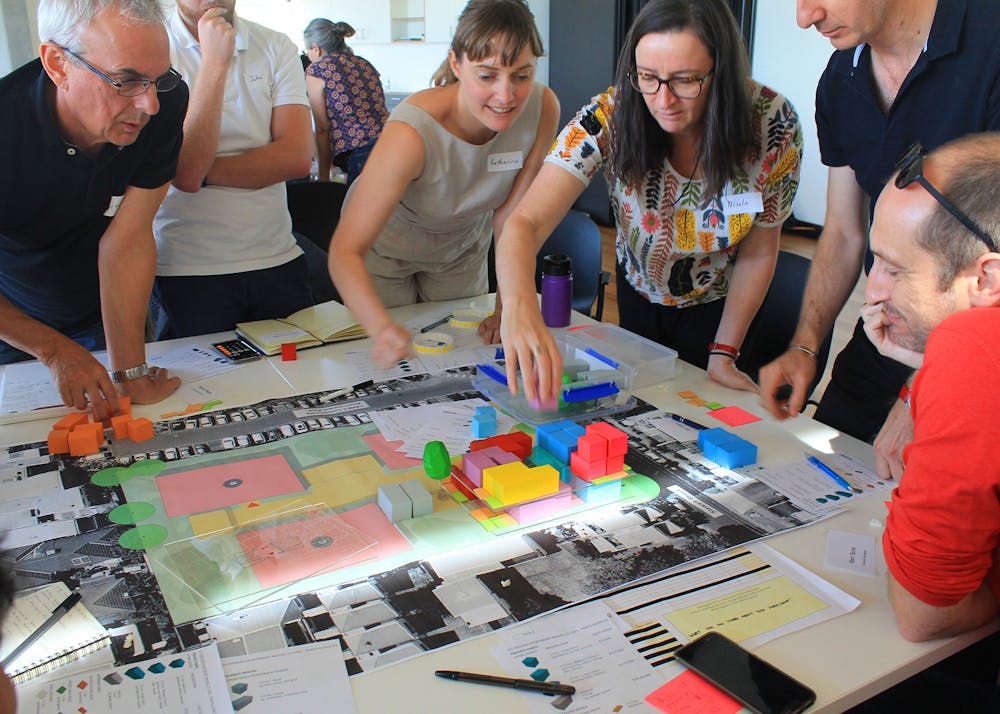
To help you do this you can now play a physical “serious game” using a range of pieces that help you and your neighbours create your future suburb on a scaled model. So take a game pack, read the guide, look at your new household characters, select your pieces and get cracking. Remember there is no wrong answer, you are here to collectively create your future burb.
This is exactly what the Fremantle community did as part of developing a new small housing policy, The Freo Alternative. They played a specially designed game, Game of Freo Life.
The Game of Freo Life in action.
It’s one of several physical interactive games/models I have developed over the past few years with the team at the Australian Urban design Research Centre (AUDRC). The aim of these games is to get communities meaningfully participating in the future layout of their local areas.
How do these games work?
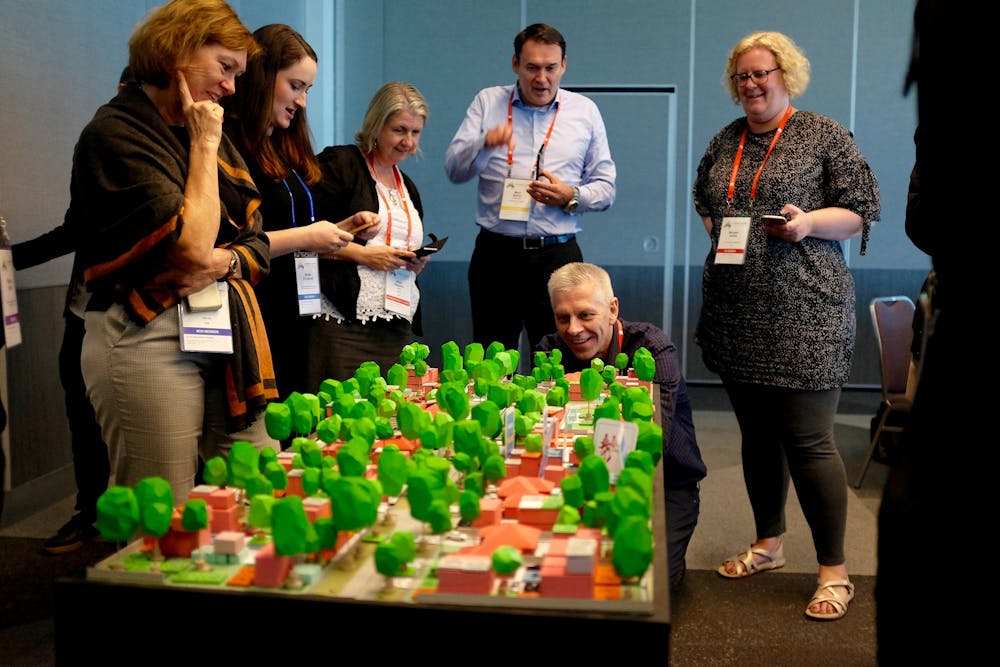
All of the games use three-dimensional scaled and interactive physical models that reconstruct familiar urban environments. Participants can then change these models and examine the results.
The tactile nature and design of the games allow a wide range of community members to get highly involved in debates and decisions about their built environment. The physical and colourful approach is broadly appealing and fun, promoting a collaborative approach – who doesn’t love a good board game?
Citizen Block is an exercise in collaborative apartment planning and design.Anthony Duckworth-Smith, Author provided (No reuse)
Serious games allow people to collectively imagine and help design their urban environments. This leads to a better understanding in the community of the trade-offs necessary in planning urban areas. It also gives policymakers and project managers important information about the values and preferences of locals.
Serious gaming not only provides the means for effective engagement, but also makes this process highly appealing.
The concept of playful participation underpins serious gaming. Engaging in play tends to diminish individual interests and promote social groupings and exchange. It’s also not obligatory – individuals can choose how much they want to get involved.
In addition, if play doesn’t have a set end point it can actively promote experimentation and exploration.
Planners are seeing the benefits
Serious gaming isn’t necessarily a new idea, but understanding of its application to community engagement has more recently developed.
The serious game used in the engagement strategy for The Freo Alternative was recognised with the Planning Minister’s Award at the 2017 Planning Institute of Australia (WA) Awards. It’s a coup for research to contribute so directly to gazetted policy and serious gaming was instrumental in achieving this.
Since then interest in and demand for tactile serious games have flourished. Serious games have been used to tackle challenges as varied as suburban infill, citizen-led housing, main street revitalisation, urban forest strategies, regeneration area master planning, adaptation of seniors housing, industrial area catalysts, and town-centre visioning. (A selection of these projects can be seen here.)
What sort of games have been developed?
One of the most recent games, Streets Ahead, reconstructed entire sections of Albany Highway in the inner-Perth suburb of Victoria Park to help explore the potential of the main street environment. This included the use of “golden tickets” for imagining and positioning new enterprises in the historic shopfronts.
The model elements were specifically designed in response to feedback from community members about their perceptions and hopes. The game outcomes formed the basis for a series of urban design recommendations.
Pimp my Suburb engages residents in playing around with the possibilities of suburban infill development.Anthony Duckworth-Smith, Author provided (No reuse)
While the suburban infill model and its various incarnations, such as Pimp my Suburb, remain the cornerstone of the serious gaming applications, Master my Plan moves into the realm of precinct-scale planning and urban design. Operating at 1:1,000 scale, this game playfully engages concepts of transport and movement, different building types, subdivisions and open space networks using different blocks and tiles.
Master my Plan involves participants in precinct-scale planning and urban design.Anthony Duckworth-Smith, Author provided (No reuse)
Master my Plan has attracted a development grant to integrate the physical gameplay with digital mapping to provide real-time measurements of participants’ physical designs in terms of health outcomes, sustainability and economic feasibility.
Expansion into the digital realm seems exciting, but it is the playful, tactile and collaborative nature of the physical games and models that seem to provoke positive outcomes. Through this process people seem to develop a more tolerant and reflective mindset, creating the possibility of reaching meaningful agreements about a common future.
The 1969 decision was a breakthrough, but also highlighted the problem of putting principle into practice, given a legacy of past decisions being based on clear notions of “male” and “female” jobs.
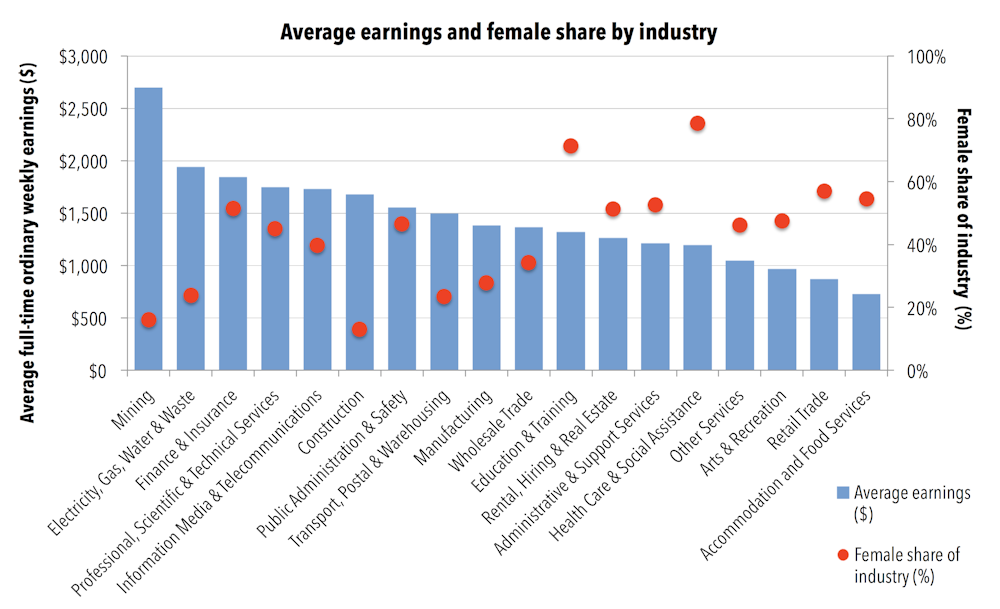
Decisions dating back a century have contributed to the unequal wage patterns we still see today, with female-dominated jobs clustered at the lower end of the pay spectrum.
ABS Census of Population and Housing 2016, and ABS Average Weekly Earnings 2018 (Cat No. 6302.0)., Author provided
It’s difficult to untangle today’s gender pay gap from the pages of history.
A living wage, but based on men
A gap between men’s and women’s pay was effectively established early in Australia’s centralised wage-fixing system.
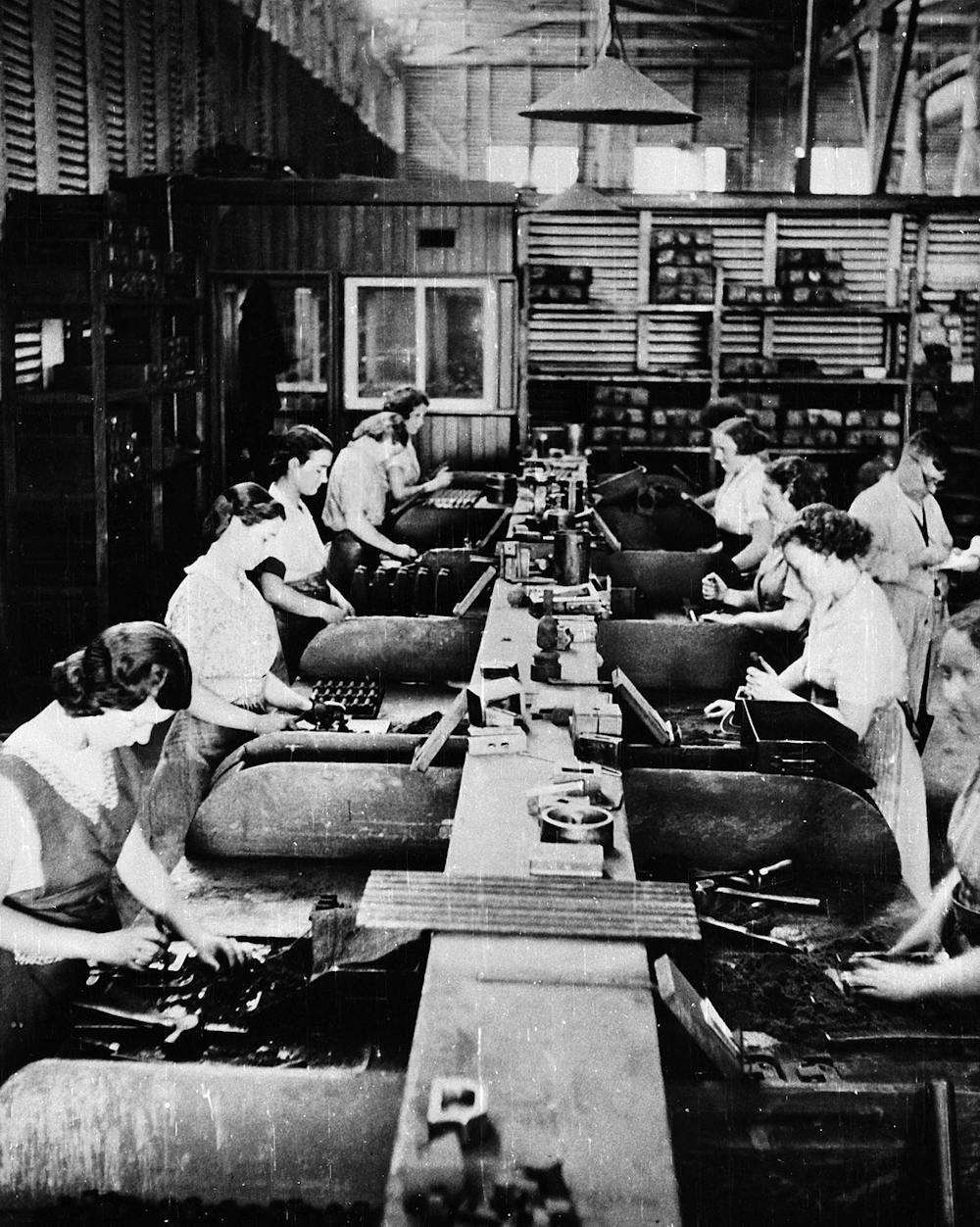
Women working in the Sunshine Harvester factory during World War II.Museum Victoria
In 1907, the first landmark decision of the new Commonwealth Court of Conciliation and Arbitration set down the principle of the “family” or “living” wage.
In the Harvester Case (stemming from a pay dispute at Sunshine Harvester, a Victorian maker of farming equipment), the court decided 7 shillings a day was the minimum pay needed by an unskilled labourer – on the basis that the labourer was male and needed to provide for a wife and three children.
The decision laid the foundation for a national minimum wage, but also left female workers out of the picture.
Equal pay, but only for men’s work
The underlying presumption that a woman didn’t need to be paid as much as a man was confirmed by Justice Henry Bourne Higgins, the president of the Court of Conciliation and Arbitration, in the Fruit Pickers Case of 1912.
In this, the court’s first explicit ruling on women’s pay, Justice Higgins declared women should be paid the same as men – but only when they did jobs predominantly performed by men (such as blacksmiths) or were “in competition” with men (such as fruit-picking). This was out of concern that allowing a lower pay rate for women could put men out of work.
In jobs undertaken only or mainly by women, such as packing fruit, it was a different matter. A woman’s wage could be lower than a man’s, Justice Higgins said, under the assumption that women “have to find their own food, shelter, and clothing; not food, shelter and clothing of a family”.
It was men, he explained, who had the obligation to provide for their wife and children:
How is such a minimum applicable to the case of a woman picker? She is not, unless perhaps in very exceptional circumstances, under any such obligation.
Justice Higgins set the minimum pay for fruit-packing jobs – “in which men are hardly ever employed” – at 75% of that for fruit-picking. In the Clothing Trades Case of 1919, more concern about costs led him to decide the basic wage for women should be 54% of men’s.
This gender discrepancy in pay narrowed to 75% with World War II, when women stepped into jobs vacated by men and special regulations were enacted. This 75% rate was accepted as the standard in the 1949-50 Basic Wage Case.
Accepting equal pay, in principle
As social attitudes evolved, the 1950s and 1960s saw more women joining the paid workforce. Pressure grew to match international conventions on equal pay. Unions led by the Australasian Meat Industry Employees Union, with a young Bob Hawke serving as their lead advocate, took up the cause.
In the 1969 Equal Pay Case, the Conciliation and Arbitration Commission (which had replaced the Court) finally accepted the principle of equal pay for equal work.
It tempered this acceptance, however, by acknowledging that putting the principle into practice would be complex:
While we accept the concept of “equal pay for equal work” implying as it does the elimination of discrimination based on sex alone, we realise that the concept is difficult of precise definition and even more difficult to apply with precision.
Zelda D’Aprano,a clerk at the Australasian Meat Industry Employees’ Union, chained herself to the front doors of the building occupied Commonwealth Conciliation and Arbitration Commission.Museum of Australian Democracy
The “mere similarity in name of male and female classifications”, the commission said, “may not be enough to establish that males and females do work of a like nature”.
This meant the principle only immediately applied to women doing exactly the same work as men, and employed in predominantly male occupations. Fewer than one in five working women benefited from the outcome.
Three years later, the 1972 Equal Pay Case expanded on the 1969 principle to encompass “equal pay for work of equal value”, with a single rate for a job, regardless of gender.
But with women and men often finding themselves in different types of work – and the nature of that work often differing vastly – the dilemma of figuring out how to measure “work of equal value” remained. It persists to this day.
Finding a ‘comparable’ male job
Today’s Fair Work Commission has inherited the legacy of its past judgements.
To agree a low wage rate in an occupation dominated by females is an issue of gender inequality, Australia’s Fair Work Act requires identifying a “comparable” male occupation.
When the wider benefits of a job are not reflected by the market wage, this creates what economists call a market failure. It spells a role for governments to step in and correct it.
One innovative approach could be to use occupation-targeted lower income tax rates for jobs with high societal value.
Netflix officially entered the Australian market in 2015, and now reaches 50% of Australia’s adult population. Despite its remarkable success, Netflix has been a purely virtual operation – with no local staff, office, or “boots on the ground”.
This looks likely to change when Netflix opens its Australian headquarters later in the year. The company has hired two senior Sydney-based staffers – a head of publicity for Netflix originals in Australia/New Zealand, and a director of public policy – and is looking for office space to house what is expected to be a team of around 10 employees.
All this suggests Netflix may be inching closer to becoming a “local” media company, with an increased presence in our small but profitable national market. What might this mean for local screen producers?
The context
The streaming revolution has brought with it benefits and risks for different parts of the industry.
On the positive side, Netflix and its local competitor Stan have introduced welcome competition into broadcast and pay-TV markets; provided the production industry with another distribution and funding source; picked up and revived series dumped by broadcasters; addressed underserved viewing communities; contributed to more cosmopolitan popular culture consumption; and provided a global platform for select Australian content.
Yet there are significant policy challenges ahead, especially when it comes to local content. A study of the Netflix Australia catalogue last year by members of our research team found it carries around 1% Australian content. Unsurprisingly, Netflix is under pressure to increase the number of Australian originals and to increase the number and discoverability of Australian titles in its catalogue.
On the production front, Netflix and Stan are largely responsible for the rapid growth – off a low base – in online drama expenditure, which totalled $53 million in 2017-2018 (for the first time, more than the total spend for kids’ television). However, this needs to be seen in the context of total production expenditure, which has fallen to a six-year low.
Another issue to consider is the government’s recent decision to extend the Post, Digital and Visual Effects and Location Offsets to streamers. Previously available only for broadcast, pay-TV and film producers, these schemes will now extend to Netflix, Amazon Prime and Stan, who can claim a refundable tax offset when producing in Australia.
This will have the knock-on effect of employing local production houses, actors and other businesses and is likely to further increase investment in the online drama category.
But one thing is for sure – if there is no move to incorporate streamers into the regulatory framework, the disparity between commercial broadcasters’ regulatory burden and that of foreign streamers will grow, strengthening the regularly-put case by broadcasters and pay-TV for deregulation.
Hannah Gadsby during an appearance on CBS’ The Late Show with Stephen Colbert last year. The airing of her special Nanette on Netflix took her to a vast new audience.WENN/AAP
On the ground in Australia
This context is important for understanding why Netflix has chosen to establish an official Australian headquarters. Opening foreign branch offices is partly about shoring up a policy presence in jurisdictions that might need on-the-ground sensitivity, which would suggest Netflix expects heightened pressure for regulation to support local content.
Netflix runs most of its operations out of California, but has recently opened a number of overseas production hubs (including Toronto and Madrid), with regional headquarters in Singapore, Amsterdam, São Paulo.
A physical presence in Australia means that key Netflix decision-makers will be more accessible to local producers, policy stakeholders, and government agencies.
It’s too early to track direct correlation effects, but we should note that Netflix’s non-US offices are based in territories where they have commissioned much of their non-US original product, so that is a positive sign for future growth in investment in Australia.
However, it is important to stress that the company’s decision does not come with a promise to establish a global production hub. Instead, the Sydney office is likely to focus on policy liaison and managing the company’s advertising and PR budgets for Australia and New Zealand.
It will be interesting to see what other kinds of local activities may result. Stan, also based in Sydney, regularly uses its headquarters for premieres, viewing parties and marketing events.
The big picture
Foreign production and distribution interests have long been a significant presence in the Australian television market. And history suggests that establishing local offices tends to increase media giants’ responsiveness to foreign audiences and governments.
Time will tell, of course, but Netflix’s move might be the latest stage in the gradual localisation of a global media giant.
Several unions made a concerted strong stand of support for John Setka on Tuesday, as the executive of the Construction, Forestry, Maritime, Mining and Energy Union discussed the push against its embattled official.
Statements came from the Australian Manufacturing Workers’ Union Victorian branch, the Electrical Trades Union of Australia, the Rail, Tram and Bus Union’s Victorian branch, the Plumbing and Pipe Trades Employees Union, and the Victorian branch of the United Firefighters Union.
Setka, who is the construction union’s Victorian secretary, is under pressure on two fronts.
Anthony Albanese is moving to have him expelled from the ALP for allegedly denigrating anti-domestic violence campaigner Rosie Battie and generally bringing the party into disrepute by his behaviour.
ACTU secretary Sally McManus has told him he should resign his union position for causing reputational damage to the union movement. Setka is facing court this month charged with using a carriage service to harass a woman.
The Setka affair has split the union movement with many unions calling for him to stand down.
He has been backed by the Victorian branch of his union w hicthis week called for the national executive to issue a statement of support and instigate an investigation of the leak from the union executive meeting at which he allegedly denigrated Battie – which he denies. If Setka was expelled from the ALP all financial support to the ALP from the union’s Victorian branch would cease, a resolution said.
The state branch also struck back at those unions which have called for Setka’s resignation, saying it “will no longer recognise traditional long-held membership coverage and demarcation lines with unions that have attacked this branch.”
The Australian Manufacturing Workers’ Union Victorian branch declared it “strongly condemns any external interference in union matters. Unions are for members, by members, and are not to be used as pawns for political clout.
“John Setka should remain in his position until such a time as the members of the CFMMEU decide otherwise.”
The ETU attacked “the anonymous leak from the CFMMEU national executive meeting two weeks ago” and “the media circus of disinformation which has followed it.”
“John Setka has been a tireless leader of the CFMMEU and wider union movement for over 20 years and has always supported his members and advocated tirelessly for their health and wellbeing.”
The Victorian branch of the RTBU said Setka “should have a right to a fair trial, the right to address personal issues with his family” and condemned “the conflation of alleged comments leaked from the CFMMEU national executive”.
The PPTEU committee of management denounced “the manufactured leak stemming from the CFMMEU NEX and the anonymous individual behind it. Their actions have caused a great deal of harm to John and his family, as well as the reputation of the general union movement.”
The Victorian branch of the United Firefighters Union said Setka should not resign, “as that is clearly a matter that is decided solely by his members, and not third parties.”
It added in its statement, “With the current public debate, one has to question ‘solidarity forever’”.
Let’s start with a number. On any given day, more than 17 million barrels of oil pass through what is known as the world’s most important chokepoint.
Those 17 million-plus barrels constitute about 20%, give or take a few percentage points, of world oil consumption daily.
The waterway in question is the Strait of Hormuz at the entrance to the Arabian Gulf to the north. It is 33km wide at its narrowest – where its “chokepoint” shipping lane measures just 3km across.
This is barely enough space for supertankers to pass.
Any interruption to seaborne oil-trade through the strait in the world’s most volatile region would immediately push up oil prices, add to risks of a global recession and prompt concerns about a wider conflagration in the Middle East.
The Strait of Hormuz is not simply a chokepoint. It would become a flashpoint in the event of military confrontation between the US and Iran.
It is hard to overstate the dangers of unintended consequences from an escalation of American military pressure on Iran that risks bringing the region to the brink of war and severing an economic lifeline to the rest of world.
This scenario hardly bears thinking about. Yet Donald Trump has seemed determined to push Iran to the brink by re-instituting punitive economic sanctions that are causing real hardship to Iranians.
What is at stake for the regime in Tehran is its survival. It will not yield to crude American pressures which reflect a certain mindset in Washington that appears to believe that regime change on the cheap is achievable.
At the heart of an escalating dispute between the US and Iran is the US withdrawal from the 2015 Joint Comprehensive Plan of Action nuclear deal and re-imposition of sanctions, notwithstanding that Iran was complying with its obligations. Iran is now threatening to resume production of low-enriched uranium beyond amounts specified in the deal.
This agreement was negotiated over many months by the permanent members of the United Nations Security Council plus Germany to forestall Iran’s nuclear ambitions. Washington’s abrogation of it ranks as the most irresponsible act – among many – of the Trump administration.
America’s stringent sanctions that penalise entities that do business with Iran, allied with risks of conflict in the Gulf, are exerting enormous stress on the Western alliance.
American leadership in this case is perceived to be part of the problem, not part of the solution.
Vali Nasr, an Iranian specialist at the International Crisis Group, warns of a mistake or a miscalculation. He told The New York Times:
President Trump may not want war, but he will get one unless he balances coercion with diplomacy.
At this point, there is not much sign that American diplomacy provides a real prospect of an easing of tensions.
This week, the US announced it was deploying another 1,000 troops to the region to join more than 6,000 already in place. It has sent an aircraft carrier battle group to the Gulf, and has positioned B-52 bombers on bases in proximity to Iran.
All this is feeding high levels of anxiety in the Gulf region and across the Middle East. Further afield, markets across Europe, Asia and North America are nervously watching developments.
Whatever Washington’s strategy of exerting maximum pressure on Iran is, it is not working. It is also not clear whether there is a plan B.
America’s avowed aim is to bring Iran back to the negotiating table to force concessions on the nuclear deal. The US also wants the Iranians to scale back what Washington perceives to be their destabilising behaviour in the region.
Circumstantial evidence of Iranian involvement is fairly compelling. But such is the damage done to Western intelligence credibility by mistakes in the lead-up to the Gulf War in 2003 that anything Washington says based on its own intelligence is questioned.
Let’s put forward another figure. The 17 million barrels passing through the Strait of Hormuz daily represent 30% of the world’s seaborne-traded oil.
Those shipments account for the bulk of oil shipped by the world’s major oil producers and OPEC members – Iran, Iraq, Saudi Arabia, Kuwait and the United Arab Emirates.
There’s another figure that is relevant. About 25% of the world’s traded liquefied natural gas (LNG) also transits what is arguably the world’s most strategically important waterway. Qatar, which matches Australia as the world’s largest exporter of LNG, sends almost all of its LNG through the strait.
In other words, this is a crowded energy superhighway by any standards.
The strait connects the Arabian Gulf with the Gulf of Oman to the south and the Arabian Sea beyond.
It is bounded on the eastern perimeter by Iran and to the west by the oil-rich Gulf states led by Saudi Arabia.
The Saudis have been urging their American allies to take “surgical” reprisals against Iran for attacks on shipping in the Gulf. In such a case, Iran would not turn the other cheek.
Tehran is certain to have a roster of retaliatory options starting, no doubt, with a further disruption to shipping in the Gulf. American naval forces could be deployed to keep Gulf sea lanes open, but this would come at a cost.
The most immediate cost would be felt in the world’s energy markets. What could not be discounted is another war in the Middle East and the destabilisation of the entire region.
Nearly six years into the revival of its offshore detention policy, Australia’s government is facing a story of corporate and administrative intrigue that highlights the utter unsustainability of our current approach to people seeking our protection.
The details of Australia’s contract with a little-known security provider called Paladin, as first reported in the Australian Financial Review, were colourful: Paladin was registered to a beach shack on Kangaroo Island and had a post box in Singapore.
According to media reports, there were mysterious characters, including a company director denied a PNG visa and sanctioned by Australia’s home affairs department. The Australian government also ran a “limited tender” process, inviting only one party, Paladin, to bid.
The dollar figures were extraordinary: the contract to provide housing and security for refugees on Papua New Guinea’s Manus Island was for A$423 million over 22 months, or A$20.9 million a month. That’s about A$1,600 per day per person – not including food or welfare services.
A suite at a five-star hotel in Sydney costs less than this. Of course, the conditions for a refugee on Manus Island are nothing like those in a luxury downtown hotel. A retired logistics manager estimated that the real cost of accommodation is A$108 per person per night, which explains why Paladin is estimated to be pocketing a profit of A$17 million a month.
Keeping refugees on Nauru and Manus Island costs Australian taxpayers 56 times more than it would to have them live among us.
PNG increasing the pressure
Now, with the Paladin contract due to expire in less than two weeks, the re-elected Coalition government is being questioned about its plans, and PNG is pushing back.
It is messy. On Sunday, Home Affairs Minister Peter Dutton said “the likely arrangement is that there will be a continuation” of Paladin’s contract, while on Monday PNG’s immigration minister, Petrus Thomas, said his government expects to cancel the contract and have a transparent bidding process that favours local companies.
The PNG government’s motivations in seeking the termination of Paladin’s contract are mixed – they are not purely altruistic. On opening the bidding process to local firms, the immigration minister said:
Papua New Guinean companies now have the capacity and expertise to do the job and should be given the opportunity to participate.
PNG is also increasingly putting pressure on Australia to find a permanent, durable solution for the refugees on Manus. The governor of Manus Province, Charlie Benjamin, is alarmed by the high rate of self-harm and suicide attempts among the refugees, as well as the potential damage to Manus’ reputation as a safe and welcoming place, and attendant social problems. He is demanding Australia take action:
They don’t want to be here and Australia, you have to take responsibility. You have to move them.
Deeper problems with Australia’s refugee policy
The Paladin contract has been heavily scrutinised during Senate Estimates and is being investigated by the Commonwealth auditor-general and internal auditors in the Department of Home Affairs.
While the secrecy, lack of transparency and ducking of responsibility are gobsmacking, this has become part and parcel of Australia’s largely bipartisan approach to refugee policy in recent years.
Indeed, the so-called “Paladin Affair” raises the broader problem of Australia’s overall approach to asylum. It highlights the challenge of Australia trying to impose its refugee policy on another country and seeking to “contract out” its international legal obligations – something it cannot do, as a matter of law.
It also shows why an approach built on deflecting the issue, rather than confronting it, is not a sustainable way to address the needs of the world’s displaced people.
A successful refugee policy not only manages national borders, it also protects people who need safety. This is why we must begin to develop an approach that is both pragmatic and principled, realistic and achievable.
The Kaldor Centre Principles on Australian Refugee Policy, launched last week by UNSW Chancellor David Gonski, provides concrete examples of how Australia can create a manageable refugee system – one that simultaneously benefits refugees and the Australian community. These principles are grounded in evidence-based research and are informed by good practice – both from overseas, and from Australia’s past experiences.
Australia’s offshore processing regime is not only causing trauma comparable to that seen in war zones or refugee camps around the world, it also costs billions of dollars that could be redirected towards more effective and humane alternatives.
Other countries manage to process, accommodate and protect refugees without resorting to a policy like this, so we should be able to do the same.
Australia’s current policies are causing harm to men, women and children who have committed no crime but to seek the protection of one of the world’s most stable, peaceful democracies. Now, more than ever, it is essential to shape a long-term vision for Australian refugee policy.
Former New Zealand prime minister Sir John Key, (right) with former US president, Barak Obama pictured on the golf course in Hawaii. Key is currently ANZ New Zealand's chairperson.
Shock, horror! An extremely wealthy CEO has been using chauffeur services, and the bank that he runs has been paying for it. Furthermore, that bank has been paying for the storage of his wine in Australia because they re-located him to New Zealand to be the CEO of their local operations here.
For the full details of the downfall of ANZ CEO David Hisco, see RNZ’s ANZ CEO leaves due to ‘blind spot’ on recording expenses – John Key. This reports on the press conference held by John Key and acting CEO Antonia Watson to explain Hisco’s departure. Key, who is ANZ’s New Zealand chairperson, explained that “Hisco believed he had authority from the previous chief executive to spend money on the cars, but because this was ‘oral authority’ it was difficult to prove or disprove.”
According to Key, the outgoing CEO would be paid the rest of his year’s salary but will “forfeit unused options to buy shares in ANZ, worth about $6.4m.”
What is perhaps the most interesting and revealing aspect of this scandal is that it’s a scandal at all. It certainly should be, but it simply wouldn’t have been in the past. The idea of a CEO hitting the headlines and being forced out for relatively minor expenses being “mischaracterised in ANZ’s books” would have hardly been conceivable a decade or two ago.
What’s more, this is the CEO of New Zealand’s biggest bank, and the most profitable company in the country – last year ANZ made a record $1.98b. By all accounts, Hisco was a high-performing leader, which is why he was on a salary of $3.8m a year. That salary might go some way to explaining why Hisco might have thought that his expenses of something like $5,000 a year for chauffeur services and wine storage wouldn’t be a big issue for ANZ.
But the world has changed so much. Especially since the huge upheaval of the 2008 global financial crisis, there has been a whole new way of looking at wealth, power and elites. Suddenly it has all come under scrutiny, and the wider public has become much more sceptical and attuned to the problems of inequality, corruption, and general unfairness. The age of anti-elitism means that “privilege” and “discrimination” are now the watchwords in democracies like New Zealand. And matching this is a significant decline in levels of public trust in business (and other elites such as politicians).
Many commentators are actually surprised to see this happening. For example, today The Spinoff’s Alex Braae labels it an “extraordinarily unusual departure”, saying “I’ll admit, I wasn’t aware that was a sackable offence for highly paid CEOs, as opposed to just being standard practice” – see: Key rolls back the years with presser performance.
But there’s no doubt Hisco’s downfall is a huge deal, and it’s fuelling further criticism of others in the banking industry. For example, banking critic (and founder of a not-for-profit KiwiSaver provider) Sam Stubbs, argues this scandal again shows the need for a clean-up of the whole industry. He’s put forward his “cockroach theory”, which “says that if you find one under the fridge, there is rarely just one. And so it seems with ANZ” – see: ANZ’s David Hisco debacle shows New Zealand needs a banking Royal Commission now.
Stubbs suggests others might also be responsible for Hisco’s incorrect expenses not being discovered, and that further action is needed: “That’s also shareholders’ money, and we also want it back. And if Hisco won’t pay it, perhaps the board of the ANZ should, because for nine years this went on under their watch. A question also needs to be asked of the Reserve Bank and Financial Markets Authority regarding their recent inquiry into the conduct and culture of the banks. How did they miss this?”
This article cites a marketing academic at the University of Auckland, Bodo Lang, discussing the likely reaction of ANZ customers: “He says many consumers already struggle with how much bank bosses are paid. There’s definitely something about being stung $12 for paying a credit card bill late when the boss of the company is putting a wine ‘collection’ on the tab.”
The wider point of the article, however, is that the public has become very distrusting of the banks in general: “If you asked most people what they think of the banks, the answers probably wouldn’t be complimentary. As the big-four banks record profit after record profit, many New Zealanders think it’s coming at their expense. Consumer NZ found this year only 35 per cent of consumers think banks have their best interest at heart. Almost half said they couldn’t be trusted.”
There is also a much greater inclination for the media to report on the economic inequality aspect of scandals like this, and the view of workers. For the best example of this, see Michael Cropp’sANZ staff outraged at boss’s expenses, says union. This reports that “ANZ staff are said to be outraged by their chief executive’s luxury lifestyle while they’ve struggled for a pay rise… First Union general secretary Dennis Maga said Mr Hisco’s actions were especially galling when members worried about staffing levels and pay were told the bank was trying to cut costs.”
The same article also reports the analysis of Consumer NZ’s head of research Jessica Wilson, who explains how ANZ customers would view the scandal: “It indicates there was some sort of culture of excess going on, that a chief executive thought that this is what he should be entitled to as well as a very generous salary – that other expenses such as this should be covered as well.”
Furthermore, there will now be a greater suspicion of the banks: “Wilson said consumers were rightly asking questions about the banking industry’s bumper profits, why charges were so high and, now, whether that was going into banking products, or luxury pastimes. This would do little for their trust in banks, for which ANZ ranks among the worst, she said.”
Even the Institute of Directors has spoken out against the practices that ANZ directors were arguably complicit in, with general manager Felicity Caird being reported saying that “It was up to the board to make sure the chief executive’s expenses were closely and regularly scrutinised”. She also “said organisations must have clear rules for reasonable expenses, rather than what Sir John described as an oral agreement between Mr Hisco and a former chief executive.”
In explaining Hisco’s departure, John Key gave some reasons that are very much in sync with the Zeitgeist: that the elite have to be subject to the same rules as those at the bottom, and that transparency and process are of vital importance – all the type of arguments that might have been de-emphasised in the past if a company board really wanted to retain its CEO.
But it’s bigger than this. As the Herald’s Liam Dann argues, “it is Key as chairman who is responsible for the issues emerging under his watch. The highly unusual nature of this departure puts more pressure on the former Prime Minister” – see: Pressure mounts on Sir John Key as ANZ turmoil grows (paywalled).
This article, and others, also draws attention to Key’s role in another recent scandal with the ANZ bank: “Last month, the Reserve Bank of New Zealand revoked ANZ Bank New Zealand’s accreditation to model its own operational risk capital requirement due to a ‘persistent failure’ to properly calculate risk. It was ordered to increase the capital it holds as a safety net to absorb possible losses, by 60 per cent to $760 million. That prompted former BNZ chairman Kerry McDonald to write to Reserve Bank governor Adrian Orr, saying he was ‘amazed’ at the limited penalty imposed on the bank. He called for ANZ chief executive David Hisco and Key to resign.”
Finally, for a sense of how the new mood for questioning the status quo is filtering through to a public demand for understanding the role of banks and business elites in our democracies, see the trailer for a new movie which has its premiere in New Zealand next month: Capital in the 21st Century – Official Trailer. This film – which is a New Zealand-French production – is an adaptation of French economist Thomas Piketty’s ground-breaking book of the same name, looking at power, inequality and wealth. (And I have a small role in it too).
Clinging to to the top of a swaying coconut tree, Vanuatu journalist Edgar Howard carefully plucks out his phone from his pocket.
He’s clambered up there looking for a strong enough signal, so he can file his report to VBTC, the country’s public broadcaster in the capital, Port Vila.
That’s the way Edgar Howard often files his stories as one of the world’s most remote radio and TV correspondents, reporting on news and current affairs from Vanuatu’s northernmost islands in Torba province.
With increasing effects of climate change and rising seas, his work has become all the more important.
For 15 years he’s travelled between the 13 islands, sometimes motoring in his banana boat in high seas and strong winds for five hours at a time to reach the far-flung communities.
-Partners-
“The government must be informed about what’s happening in the province of Torba,” he said.
“I think there’s a lack of information there and that’s why the government does not know how exactly to help those people.”
According to him, there are plenty of stories to tell among the province’s 8000 people who make a living mostly from copra, coconuts, crabs, lobster and fish.
Self-taught and committed Howard is self-taught and so committed he funded himself for the first few years until the public broadcaster VBTC took him on as a paid correspondent.
“I start like bottom up. I start with nothing and I build myself up and now I’m working with national TV and radio.”
Paying passengers hitch a ride on his boat to help defray the expensive fuel costs.
Howard doesn’t have a story in mind when he sets out as he knows there’s always something happening.
“Every day I get a story with the local people,” he said, explaining that the chief is always his first port of call when arriving on an island.
“He directs me to the people I have to talk to and I make my interview.”
Climate change coverage The effects of climate change on the province’s coastal communities are some of the main stories he covers.
“Now they [have to] start to move inland because the place they lived before is covered by the sea.
“We’re not used to living in the middle of the bush. It’s a big change.
“Some of the historical sites we lost because of climate change, like the oldest places of our grandfathers.”
Resulting conflicts over land are also a big issue.
Conflict over land “Because the land is not now enough, population growth is one issue and makes sometimes conflict with the land, the tribes.”
The loss of fish varieties, troubles with crops and ways to ensure fishing is sustainable for future generations are all subjects for his reports.
Howard has a 30-minute TV programme to fill every week which he films, edits and voices himself with a self-recorded stand-up at the start.
The recognition he gets when walking down the street on his occasional trips to Port Vila make him proud.
“They say, woah …Vois Blong Torba!” he laughed, referring to the name of his programme which he sends off on the weekly flight to the capital.
Risky reporting It’s a risky business sending some of his reports from the top of a 30-metre-high tree, especially in heavy rain.
“Sometimes the tree is too slippery. I must make sure the phone is in my pocket. I find a branch of the tree to make sure I don’t fall and slowly I take the phone out of my pocket and I start to communicate.
“It takes me about 20 minutes up there to finish all my reporting.”
The reporting may be difficult, but the effort is worth it, Howard said.
An Australian-funded police post in Sola came about through his reporting.
“I feel so glad because it’s good feedback for my job. It’s so satisfying and I’m really glad because I feel I have contributed to the project.”
This article is published under the Pacific Media Centre’s content partnership with Radio New Zealand.
A prominent Cook Islands lawyer intends to take a court challenge against the censor’s impending ban of the film Rocketman, reports the Cook Islands News.
Lawyer Heinz Matysik announced he would challenge the ban, if it proceeded.
“If the chief censor wants to roll this way, I will bring a full legal challenge and test the boundaries of our Constitution. I am serious,” he said.
Hundreds of people have already protested online, after Cook Islands News reported that chief censor Dennis Tangirere intended to ban Rocketman.
One LGBTQ community member on the island, Roger Dunfee, is mobilising his friends in California and around the world to overturn the ban.
-Partners-
Te Tiare Association president Regina Potini issued a pointed reminder that the Cook Islands Constitution provides for freedom of speech and expression.
“A prohibition of this film/work of art will impinge on this fundamental right guaranteed under the Cook Islands Constitution.”
Members of Te Tiare Assocation and the LGBTQ community have spoken out to express their concern, but also to show that the sentiments behind the ban are not representative of wider Cook Islands opinion.
Others, though, have taken to social media in grief or anger.
“Today I question my patriotic pride,” wrote Teherenui Koteka.
“The fact I belong to a community who in this day and age so outrightly marginalises the LGBTQ community, a community I am proud to be a part of, further illustrates why our country continuously fails to move forward in the modern day world stage.”
“This honestly makes me sad,” said Ally Donnerly. “If my country can’t accept a movie then how can they accept me?”
And Brenda said, “As a trans woman from Mangaia with a great career in aviation, I find it sad that we are not an evolving nation. More worried about your image in the Pacific than your people.”
The film, a biography of the English pop singer Elton John which depicts intimate gay sex scenes, had been showing at empire cinema for around seven days, but is believed to have been pulled from screening last Friday.
Tangirere spoke to Cook Islands News before the film was pulled, saying he was planning to ban Rocketman because it contained scenes of homosexuality.
The conservative Islamic nation of Egypt had already banned the film, and Samoa followed suit, saying the film did not “go well with the cultural and Christian beliefs of Samoa”.
News of the Cook Islands ban has made overseas headlines, and momentum against the ban is building rapidly.
“This is the wrong message that the Cook Islands wants to be sending the rest of the world” says Roger Dunfee, who postponed a flight to California to mobilise opposition to the ban.
Dunfee, who watched the movie last week, says the ban could have a “detrimental effect” on Cook Islands tourism.
“People are likely to just spend their money travelling somewhere else,” he says.
“There are kids now who see this as a complete disapproval of their lifestyle, of what they want to identify as, of who they really are,” he warns. “I know kids who have committed suicide because of these types of issues.”
Sydney Morning Herald reporter Jacqueline Maley evoked the spectre of the Orwellian surveillance state recently when discussing how library staff had been implicated in the ParentsNext program. Maley reported that private providers contracted to run the program phoned libraries or local pools to check on parents’ attendance.
The program aims to get parents “work-ready” after child-rearing. Single parents receiving the ParentsNext benefit are required to report their attendance at particular activities with their children to providers. Activities are based on an approved list, which includes storytime at a local library, swimming lessons, or a playgroup. Payments can be stopped for “not taking part in set activities”.
As critics have asserted, this kind of heavy-handed monitoring is problematic for many reasons. It is an example of the stigmatisation of single parents and policing of their parenting practices, despite the stated aim of the program being to help parents re-enter the workforce.
The policing of the program raises issues of privacy and devalues unpaid care work. It also shows a lack of any real understanding of the challenges of single parenting and of the additional barriers single mothers encounter (95% of those receiving the benefit are single mothers).
What is also deeply troubling is the enrolment of community workers and public spaces in the monitoring of parents. The Sydney Morning Herald’s headline, “The government parenting program turning librarians into snitches”, rightly captures this sense of outrage.
The CEO of the Australian Library and Information Association (ALIA) said: “If staff uphold library values of ‘free access’ and refuse to be complicit in the ParentsNext process, single parents can be denied essential payments. If we sign storytime attendance forms, we are supporting a system which penalises families already on the poverty line.”
In a nice twist of surveillance tactics, ALIA promises to report to the minister the names of ParentsNext providers who use storytime attendance – without prior consultation with the parents – to monitor families’ eligibility for welfare payments. While not explicitly challenging the practice of monitoring parents, it at least highlights the need for better consultation with parents.
A worrying aspect of ParentsNext is the expectation that staff working in community spaces will help monitor parents’ attendance.Tyler Olson/Shutterstock
Ray Oldenburg described such spaces as “third places”: inclusive, egalitarian places outside of work and home, where people can socialise, converse and debate. Examples include churches, cafes, clubs and public libraries. Oldenburg argued that these places are important for civic engagement and democracy.
Community spaces like public libraries or playgroups are also important places of “everyday multiculturalism” where social differences are accommodated and diverse groups of people can interact. They can help shift prejudice and encourage tolerance and inclusion.
Crucially, third places are sites of voluntary attendance. The very fact that people are free to participate in these places makes them such valued sites of social support and leisure.
Third places are inclusive, egalitarian spaces where people can seek support and leisure.Rawpixel.com/Shutterstock
Public libraries are spaces for social connection and support
In her short-story collection, Public Library and Other Stories (2015), Ali Smith argues that public libraries are often treasured spaces to which people feel a strong emotional connection. Libraries are places of discovery where people can “become on their own terms”. Local librarians work hard to create an atmosphere of non-judgment and inclusion.
At the same time, public libraries have always been a site for government agencies to interface with the community. Libraries promote an informed citizenry who can actively participate in democratic life. As with all public institutions, there is a fine line between informing and empowering citizens, and coercing them to conform to ideas about being a “good citizen”.
In this case, the line has been well and truly crossed. Activities that could be empowering and enjoyable become mandated, additional burdens, based on arbitrary criteria that appear to have little to do with work-readiness. Community spaces of social connection and support become sites of surveillance.
It is imperative to ask what this might mean for our city’s third places. Would this kind of monitoring lead vulnerable people to disengage from the very services they need most?
In the context of shrinking public spaces in the city and the withdrawal of social services, such third places are a bastion. We need to continue to advocate for the right of citizens to use these and other community spaces freely and according to their own needs, not those of a surveillance state.
Unhealthy diets cause multiple physical and mental health problems. To help consumers make healthier choices, Australia and New Zealand introduced the voluntary Health Star Rating (HSR) system in 2014.
The system is supposedly designed to provide consumers with an overall signal about a food’s healthiness. Presumably, this should nudge consumers to make more informed and healthier decisions.
Five years on, the Australian and New Zealand governments are conducting a system review. Our research shows that, while the initiative is noble, the devil is in the details. There is a need, and hopefully an opportunity, to improve the system and reconsider some of its key aspects.
Under the HSR system, products are labelled from 0.5 stars (the least healthy score) to 5 stars (the healthiest products). The rating is determined by evaluating the overall nutritional value of the product. It compares the content of “good” ingredients (i.e. fibre, protein, fruit, vegetables, nuts and legumes) with the “bad” ones (i.e. saturated fat, energy, total sugar and sodium).
It is also likely that most consumers are unaware that the HSR rating is calculated on an “as prepared” basis. This means a product can enjoy a high rating based on the nutritional value of preparatory ingredients.
Milo found itself embroiled in controversy for displaying 4.5 stars on its chocolate powder, though the powder itself clearly does not merit this rating. The 4.5-star rating was based on consuming merely three teaspoons of powder combined with skim milk. But who actually consumes Milo this way?
Furthermore, HSR scores are intended to allow comparison only among similar products. A four-star rating for a cereal cannot be compared to a four-star rating given to milk. While the two products display the same number of stars, their healthiness may differ significantly.
There is scepticism about the HSR’s authenticity, reliability and effectiveness. This stems in part from the system being self-regulated.
In addition, the system is non-mandatory, leaving manufacturers free to decide when and how to use it. For instance, only around 20% of packaged goods available in New Zealand and Australian supermarkets have an HSR. To add to the distortion, a disproportionate number of these show high ratings. This indicates that manufacturers only use the HSR for their healthier products.
A voluntary system does little to counter the inbuilt incentive that manufacturers have to use unhealthy components such as sugar, salt and saturated fats. These produce pleasure and create “craveable” foods and food addiction. Manufacturers likely do not use a HSR for these products. However, consumers do not interpret missing information as “the worst-case scenario”, but assume average quality.
Finally, the system does not effectively assist the vulnerable consumers who need it the most. While HSR does help some middle- to high-income consumers, it does a poor job with respect to consumers of low socio-economic status. This suggests that the label requires consumers to be educated about its meaning.
Time to move forward
Some improvements could carry the HSR forward a great distance.
If the system were made mandatory, it would likely raise consumers’ awareness. There should also be more education initiatives about the HSR. This, in turn, would incentivise manufacturers to produce healthier foods and beverages.
At the same time, we should strive to minimise the costs involved and consider backing the system with government funding. This would allow all businesses to participate in the program, including less profitable or smaller businesses. It would also prevent costs from being passed onto consumers.
As a minimum, if the system is not made mandatory, a general “non-participation” label should be introduced. If a producer opts not to label its product, it should be required to use a conspicuous cautionary statement. Such a statement should declare, for instance, that “the manufacturer has chosen not to verify the health rating of this product” or “the healthiness of this product cannot be verified”.
Studies show the HSR rating would have a bigger impact if placed in the upper left corner of the packaging and used colours. It could use a traffic light system, with 0.5-2.5 stars on a red background, 3 to 4 stars on amber and 4.5-5 star products on green. The colour-coded system has proved to be more effective with marginalised groups of consumers.
All easier said than done.
Healthy diets are important for physical and psychological well-being and for strengthening our communities and economies. However, any regulation of the food industry is likely to be resisted by its strong and well-organised lobbying power. To fight this battle, the consumers’ voice is crucial to ensure we can all make good and healthy foods choices.
Review: The return of Ulysses, Pinchgut Opera, Sydney.
Claudio Monteverdi entered the 73rd year of his life when he composed his opera, Il ritorno d’Ulisse in patria, or The Return of Ulysses. (He wrote yet another opera three years later …) But his incredible artistic agility is not the only reason why we admire his accomplishments.
Being the right person at the right time, he played a cardinal role in the gestation of opera as a genre and, furthermore, he also helped to turn opera, in its initial phase an exclusive form of entertainment for the nobility, into a significant commercial genre. Astonishingly, by the end of the 17th century, four opera houses served the needs of the burgeoning opera industry in Venice.
Sydney’s only Opera House had never offered a production of Il ritorno; in fact, Pinchgut Opera’s premiere on Thursday may have been the first time this wonderful work was presented professionally in this country. Pinchgut programmed Monteverdi’s Orfeo in 2004, The Coronation of Poppea in 2017. With Il ritorno, the trifecta of his surviving operas is thus completed and in their repertoire.
Douglas Kelly and Roberta Diamond.Brett Boardman
The intimate stage of the City Recital Hall was transformed through the perceptive imagination of the director, Chas Rader-Shieber, into the various sets of the opera: a palace, a seascape and a woodland scene. (He was ably assisted by designer Melanie Liertz and lighting designer Nicholas Rayment.)
A floor to ceiling, diaphanous, white voile served as backdrop to the stage, on which a long table with chairs suggested the scenes in the palace. A few branches covered with green leaves carried around represented the forest. The minimalist prompts were ingeniously used, for example at Ulysses’s slaying of Penelope’s three suitors, each of the three men pulled out a red handkerchief while falling to their death.
Jacob Lawrence navigates the white voile.Brett Boardman
The large cast of 22 roles was dispersed between ten singers, with most of them singing two or three different roles. Through simple changes in their costumes, this did not cause any confusion. Apart from the two protagonists, the singers were not household names, although several have participated in previous Pinchgut productions. The standard was mostly very high and the cast’s youthful energy, while singing and acting, often filled the gaps in the slow pace of the action.
Primus inter pares, first among equals, was the Portuguese guest singer, Fernando Guimarães, in the role of Ulysses. Not only was he clearly comfortable with the arduous length and difficulty of his part, but his intimate familiarity with the requisite singing style was most impressive. His voice, never forced, shone through the sympathetic orchestral texture. It was expressively detailed and attentive to the minute details of the text.
Fernando Guimarâes: his intimate familiarity with the requisite singing style was most impressive.Brett Boardman
Like other cast members, he used vibrato as a delicate ornament, rather than a constant ingredient. He made Monteverdi’s musical invention, the stile concitato, (literally: agitated style, short passages performed with rapidly repeated syllables) his own; this tool, seldom used today, can increase the intensity of Baroque singing immensely.
Catherine Carby, once a frequently employed mezzo at Opera Australia, performed Penelope, Ulysses’s faithful spouse. Her velvety timbre eminently suited the character she formed. In the opening lament of Act I, her expression of grief, doubts and confusion was hauntingly beautiful. In some of the later scenes, however, her interaction with her colleagues seemed less convincing. At times, she appeared to be observing the events around her, rather than participating in them.
Catherine Carby and Fernando Guimarâes.Brett Boardman
Elsewhere in the cast, Mark Wilde brought a welcome comic quality (unusual in Monteverdi’s music) to the role of the overweight, here mumbling, there stuttering Iro. Of the three suitors, all of them immaculately dressed with black hats and tails but, alas, under the waist only long underpants, Nicholas Tolputt’s sweet countertenor voice was the most impressive. Douglas Kelly impersonated another laughable villain well, with a lovely tone.
The ungrateful role of projecting Monteverdi’s many low notes fell onto the third suitor, Wade Kernot, whose bass voice was not ready for such challenges at this stage of his career.
Both Brenton Spiteri and Jacob Lawrence gave credible humanity and expressive finesse to their roles. Roberta Diamond’s lithe figure was coupled with agile singing and Lauren Lodge-Campbell’s beautiful soprano voice was radiant, particularly on her higher, held notes.
Lauren Lodge-Campbell: a radiant soprano voice.Brett Boardman
The performance was firmly based on an excellent instrumental ensemble of merely ten players. Their tone was rich, elegant and as refined as their intonation. Most of them contributed to the eloquent and varied continuo sections (providing the bassline, but also some harmonies), thus the upper strings played a much smaller than usual role.
It was all kept together with unaffected elegance by Pinchgut’s Artistic Director, Erin Helyard. His multiple functions included playing harpsichord and a chamber organ (resourcefully, the former was placed on top of the latter); creating and constantly maintaining a transparent balance between stage and ensemble and following his singers unfailingly. With his vast knowledge, he created a historically informed performance that was both stylish and thoroughly enjoyable.
If Il ritorno is not Monteverdi’s most inspired creation, it is close to it. But the myriad of fine musical nuances in every one of its numbers more than compensated the listener for the occasional loquaciousness of its overall structure.
The Return of Ulysses is on Tues 18 June at 7pm and Wed 19 June at 7pm in Sydney.
Source: The Conversation (Au and NZ) – By Corey J. A. Bradshaw, Matthew Flinders Fellow in Global Ecology and Models Theme Leader for the ARC Centre of Excellence for Australian Biodiversity and Heritage, Flinders University
The size of the first population of people needed to arrive, survive, and thrive in what is now Australia is revealed in twostudies published today.
It took more than 1,000 people to form a viable population. But this was no accidental migration, as our work shows the first arrivals must have been planned.
Our data suggest the ancestors of the Aboriginal, Torres Strait Islander, and Melanesian peoples first made it to Australia as part of an organised, technologically advanced migration to start a new life.
Changing coastlines
The continent of Australia that the first arrivals encountered wasn’t what we know as Australia today. Instead, New Guinea, mainland Australia, and Tasmania were joined and formed a mega-continent referred to as Sahul.
This mega-continent existed from before the time the first people arrived right up until about 8,000-10,000 years ago (try this interactive online tool to view the changes of Sahul’s coastline over the past 100,000 years).
When we talk about how and in what ways people first arrived in Australia, we really mean in Sahul.
We know people have been in Australia for a very long time — at least for the past 50,000 years, and possibly substantially longer than that.
We also know people ultimately came to Australia through the islands to the northwest. Many Aboriginal communities across northern Australia have strong oral histories of ancestral beings arriving from the north.
But how can we possibly infer what happened when people first arrived tens of millennia ago?
It turns out there are several ways we can look indirectly at:
where people most likely entered Sahul from the island chains we now call Indonesia and Timor-Leste
how many people were needed to enter Sahul to survive the rigours of their new environment.
To do this, we developed demographic models (mathematical simulations) to see which island-hopping route these ancient people most likely took.
It turns out the northern route connecting the current-day islands of Mangoli, Buru, and Seram into Bird’s Head (West Papua) would probably have been easier to navigate than the southern route from Alor and Timor to the now-drowned Sahul Shelf off the modern-day Kimberley.
While the southern route via the Sahul Shelf is less likely, it would still have been possible.
Modelled routes for making landfall in Sahul. Sea levels are shown at -75 m and -85 m. Potential northern and southern routes indicated by blue lines. Red arrows indicate the directions of modelled crossings.Michael Bird
Next, we extended these demographic models to work out how many people would have had to arrive to survive in a new island continent, and to estimate the number of people the landscape could support.
We applied a unique combination of:
fertility, longevity, and survival data from hunter-gatherer societies around the globe
“hindcasts” of past climatic conditions from general circulation models (very much like what we use to forecast future climate changes)
well-established principles of population ecology.
Our simulations indicate at least 1,300 people likely arrived in a single migration event to Sahul, regardless of the route taken. Any fewer than that, and they probably would not have survived – for the same reasons that it is unlikely that an endangered species can recover from only a few remaining individuals.
Alternatively, the probability of survival was also large if people arrived in smaller, successive waves, averaging at least 130 people every 70 or so years over the course of about 700 years.
As sea levels rose, Australia was eventually cut off from New Guinea around 8,000 to 10,000 thousand years ago.Corey Bradshaw
A planned arrival
Our data suggest that the peopling of Sahul could not have been an accident or random event. It was very much a planned and well-organised maritime migration.
Our results are similar to findings from several studies that also suggest this number of people is required to populate a new environment successfully, especially as people spread out of Africa and arrived in new regions around the world.
The overall implications of these results are fascinating. They verify that the first ancestors of Aboriginal, Torres Strait Islander, and Melanesian people to arrive in Sahul possessed sophisticated technological knowledge to build watercraft, and they were able to plan, navigate, and make complicated, open-ocean voyages to transport large numbers of people toward targeted destinations.
Our results also suggest that they did so by making many directed voyages, potentially over centuries, providing the beginnings of the complex, interconnected Indigenous societies that we see across the continent today.
These findings are a testament to the remarkable sophistication and adaptation of the first maritime arrivals in Sahul tens of thousands of years ago.
Australia’s future prosperity is at risk unless we take bold action and commit to long-term thinking. This is the key message contained in the Australian National Outlook 2019 (ANO 2019), a report published today by CSIRO and its partners.
The research used a scenario approach to model different visions of Australia in 2060.
We contrasted two core scenarios: a base case called Slow Decline, and an Outlook Vision scenario which represents what Australia could achieve. These scenarios took account of 13 different national issues, as well as two global contexts relating to trade and action on climate change.
We found there are profound differences in long-term outcomes between these two scenarios.
In the Slow Decline scenario, Australia fails to adequately address identified challenges.CSIRO, Author providedThe Outlook Vision scenario shows what could be possible if Australia meets identified challenges.CSIRO, Author provided
Slow decline versus a new outlook
Australia’s living standards – as measured by Gross Domestic Product (GDP) per capita – could be 36% higher in 2060 in the Outlook Vision, compared with Slow Decline. This translates into a 90% increase in average wages (in real terms, adjusted for inflation) from today.
Australia’s real GDP per capita in 2016, and the modelled outcomes for Slow Decline and Outlook Vision. In Outlook Vision, the darker shade shows outcomes under a cooperative global context and the lighter shade under a fractious global context.CSIRO, Author provided
Australia could maintain its world-class, highly liveable cities, while increasing its population to 41 million people by 2060. Urban congestion could be reduced, with per capita passenger vehicle travel 45% lower than today in the Outlook Vision.
Australia could achieve net-zero emissions by 2050 while reducing household spend on electricity (relative to incomes) by up to 64%. Importantly, our modelling shows this could be achieved without significant impact on economic growth.
Low-emissions, low-cost energy could even become a source of comparative advantage for Australia, opening up new export opportunities.
And inflation-adjusted returns to rural landholders in Australia could triple to 2060, with the land sector contribution to GDP increasing from around 2% today to over 5%.
At the same time, ecosystems could be restored through more biodiverse plantings and land management.
Historical trend for vehicle kms travelled (VKT) on urban roads, per capita, and projections resulting from the modelled Slow Decline and Outlook Vision scenarios. The shaded area for Outlook Vision represents the range of outcomes possible depending on how regional satellites cities develop.CSIRO, Author provided
The report, developed over the last two years, explores what Australia must do to secure a future with prosperous and globally competitive industries, inclusive and enabling communities, and sustainable natural endowments, all underpinned by strong public and civic institutions.
ANO 2019 uses CSIRO’s integrated modelling framework to project economic, environmental and social outcomes to 2060 across multiple scenarios.
The outlook also features input from more than 50 senior leaders drawn from Australia’s leading companies, universities and not-for-profits.
So how do we get there?
Achieving the outcomes in the Outlook Vision won’t be easy.
Australia will need to address the major challenges it faces, including the rise of Asia, technology disruption, climate change, changing demographics, and declining social cohesion. This will require long-term thinking and bold action across five major “shifts”:
industry shift
urban shift
energy shift
land shift
culture shift.
The report outlines the major actions that will underpin each of these shifts.
For example, the industry shift would see Australian firms adopt new technologies (such as automation and artificial intelligence) to boost productivity, which accounts for a little over half of the difference in living standards between the Outlook Vision and Slow Decline.
Developing human capital (through education and training) and investment in high-growth, export-facing industries (such as healthcare and advanced manufacturing) each account for around 20% of the difference between the two scenarios.
The urban shift would see Australia increase the density of its major cities by between 60-88%, while spreading this density across a wider cross-section of the urban landscape (such as multiple centres).
Combining this density with a greater diversity of housing types and land uses will allow more people to live closer to high-quality jobs, education, and services.
Enhancing transport infrastructure to support multi-centric cities, more active transport, and autonomous vehicles will alleviate congestion and enable the “30-minute city”.
In the energy shift, across every scenario modelled, the electricity sector transitions to nearly 100% renewable generation by 2050, driven by market forces and declining electricity generation and storage costs.
Likewise, electric vehicles are on pace to hit price-parity with petrol ones by the mid-2020s and could account for 80% of passenger vehicles by 2060.
In addition, Australia could triple its energy productivity by 2060, meaning it would use only 6% more energy than today, despite the population growing by over 60% and GDP more than tripling.
Primary energy use in Australia under the modelled scenarios. Primary energy is the measure of energy before it has been converted or transformed, and includes electricity plus combustion of fuels in industry, commercial, residential and transport.CSIRO, Author provided
The land shift would require boosting agricultural productivity (through a combination of plant genomics and digital agriculture) and changing how we use our land.
By 2060, up to 30 million hectares – or roughly half of Australia’s marginal land within more intensively farmed areas – could be profitably transitioned to carbon plantings, which would increase returns to landholders and offset emissions from other sectors.
As much as 700 millions of tonnes of CO₂ equivalent could be offset in 2060, which would allow Australia to become a net exporter of carbon credits.
A culture shift
The last, and perhaps most important shift, is the cultural shift.
Trust in government and industry has eroded in recent years, and Australia hasn’t escaped this trend. If these institutions, which have served Australia so well in its past, cannot regain the public’s trust, it will be difficult to achieve the long-term actions that underpin the other four shifts.
At least one in ten of us suffer some sort of troublesome, long-term (chronic) pain. But not all have fibromyalgia.
People with fibromyalgia have chronic widespread pain — including musculoskeletal aches, pain and stiffness, and soft tissue tenderness — in many areas across the body.
This affects other systems like the brain, impacting a person’s ability to concentrate and remember things. People who have fibromyalgia often refer to this as the “fibro fog”. It can affect sleep patterns, emotions, and many other aspects of everyday living.
An online survey of 596 people with fibromyalgia found a few common causes reported by participants. Around two thirds of people could relate the start of their symptoms to a specific incident or event, such as a physical injury, a period of sickness that might have involved surgery, or a stressful life event.
Notably, many of those surveyed said they experienced negativity and stigma when trying to explain and authenticate their symptoms to professionals, their families, and their communities.
Who is affected?
Fibromyalgia affects around 2% of the world’s population. A recent literature review showed the frequency of fibromyalgia in the general population was between 0.2 and 6.6%. It’s often reported as higher in women, at a ratio of three to one.
The World Health Organisation recognised fibromyalgia as a disease in 1994. Since then, doctors have debated how fibromyalgia should be diagnosed and who should diagnose it, leading to the so-called “fibro wars”. It continues to be controversial.
The latest version of the International Classification of Diseases says for someone to be diagnosed with fibromyalgia, there needs to be pain in “at least 4 of 5 body regions and is associated with significant emotional distress”.
The drugs pregabalin and duloxetine work by altering the neurotransmitters in the brain (gamma amino butyric acid and serotonin), and are effective for many people.
There are many other options including medication specifically for pain (analgesics), muscle relaxants (benzodiazepines), or treatments to address nerve or spinal pain (neuropathic treatments).
Many of these medications can have side effects, including constipation, or allergic reactions like digestive upset or inflammation. They can also be addictive. Always be honest with your GP about what painkillers you’re taking so they can help you safely manage your pain.
Another common treatment is using a TENS machine (transcutaneous electrical nerve stimulation). This involves applying pads around the area of pain, or the nerves that might be sending the pain message, and interfering with these using small electrical pulses.
Some patients find therapy with a TENS machine helpful, where pads are placed on the body and electrical pulses applied.from www.shutterstock.com
This effective treatment is thought to increase levels of endorphins produced by the brain and spinal cord to provide pain relief. But the effects may weaken with ongoing use.
It’s important to check with your doctor if TENS treatment is appropriate because it might affect pacemakers or people with epilepsy.
In time, we might be able to look for diagnostic immune markers for fibromyalgia in our genetic material to help find who might be at risk of developing the condition, and take preventative action.
Many of the symptoms of fibromyalgia can be found in people who have a condition known as myalgic encephalomyelitis, or chronic fatigue syndrome. Our research is currently looking at the blood of people with fibromyalgia and chronic fatigue syndrome to see if there are specific inflammatory markers that may help us understand how these illnesses develop.
If we can understand the interaction of the immune system with pain and inflammation, then we can begin to target treatments more effectively for people living with fibromyalgia.
After a recent foray into the debate over Australia’s so-called “climate election”, I received plenty of critical replies to my argument that Australians should take climate action more seriously. The most common rebuttal was that Australians were right to focus on other issues at the ballot box because Australia’s contribution to global climate change is small anyway.
This is precisely the argument Alan Jones advanced in a now notorious Sky News segment in which he used a bowl of rice to explain away Australia’s climate obligations.
Australia, Jones noted, contributes only 1.3% of global carbon dioxide emissions from human activity, which in turn represents just 3% of the overall amount of CO₂ in the atmosphere, which in turn makes up little more than 0.04% of the whole atmosphere. So why, he asked while triumphantly brandishing a single rice grain, are we so obsessed with Australia’s climate policy when the planet is so big and the consequences of our actions are so tiny?
This is a powerful critique and, on the face of it, a simple and compelling line of argument, which is precisely why it’s so often used. Why bother, if we lack the power to do anything that makes a difference?
But there are at least three obvious responses to it.
The ‘per capita’ problem
The first and most obvious response is that Australia emits much more than our fair share.
Sure, our emissions are 1.3% of the global total. But our population is 0.3% of the global total.
This isn’t the only way to allocate national emissions targets. But if rich countries like Australia aren’t doing more to reduce their disproportionately high emissions, what possible incentive is there for developing countries to take the issue seriously? Nations such as India, Brazil and China can ask – as indeed they have at various climate talks – why they should reduce emissions when Australia does so little.
In this sense, Australia’s position on climate action is significant, not only for the 1.3% of greenhouse gases we produce, but for the potential influence on global policy.
As a nation so proud of “punching above its weight” in fields such as sport and technology, Australia is missing a big chance to show global leadership on climate.
The ‘coal exports’ problem
The 1.3% statistic is only true if we focus purely on greenhouse emissions within Australia itself. Fair enough, you might say, given that this is the way the Paris Agreement, and the Kyoto Protocol before it, measures countries’ emissions.
But this approach excludes some significant factors.
First, it fails to take proper account of emissions created in one country while manufacturing goods for export to other countries. Emissions due to Chinese-produced goods destined for Australian consumers, for example, count towards China’s emissions, not Australia’s. If we take this “consumption shadow” into account, the climate impact of developed countries, including Australia, becomes much higher.
Second, there is a similar issue with coal exports. Coal dug up by one country but burned in another counts towards the latter’s emissions. As one of the world’s largest coal exporters, this is clearly important for Australia.
Time to get off the global coal train?Dan Himbrechts/AAP
In 2012, the campaign group Beyond Zero Emissions estimated that if Australian coal was factored into Australia’s emissions, our contribution to global emissions would be 4% rather than 1.3%. This would make Australia the world’s sixth-largest contributor to climate change.
Are we responsible for what other countries do with Australian coal? According to the Paris treaty, the answer is no. But drug barons and arms dealers use similar arguments to wash their hands of drug addiction and war.
What’s more, Australia already limits a range of exports based on concerns about their use in importing countries, including weapons, uranium and even livestock.
So there’s certainly a precedent for viewing exports through the lens of our international responsibilities. And with the UN secretary-general joining recent calls to end all new coal power plants, a global coal treaty or even embargo might eventually force Australia’s hand.
The ‘capacity to respond’ problem
The third rebuttal to Alan Jones’s arguments is that Australia has far more capacity to take climate action than many other nations. Again, this works at two levels.
First, we’re rich. Australia is a top-20 world economy in terms of both size and average wealth. This means we are more able than most countries to manage the economic costs of moving away from fossil fuels.
Second, thanks to decades of relative climate policy inaction and modest targets, there’s a lot of low-hanging fruit for Australia to ratchet up its climate ambition. This applies most obviously to the renewable energy sector, but also to areas such as energy efficiency and transport.
Australia’s land-clearing rates are also among the highest in the world – we are the only developed nation to feature in a 2018 WWF list of deforestation hotspots. Reducing this would significantly cut emissions while also protecting important carbon stores.
As economist John Quiggin has noted, the longer we wait to move away from fossil fuels, the more expensive it will be.
What does this all mean for Australia?
Jones’s argument is a beguilingly simplistic response to a wicked problem. Climate change is a global problem that requires global action. But the calculations around who should take the lead, and how much constitutes each nation’s fair share, are fiendishly complex.
But, by almost any measure, a country like Australia should be leading the way on climate policy, not being dragged kicking and screaming to take action that falls far behind that of comparable nations.
Noisy, ugly and dirty. Advertising has polluted cities, annoyed consumers, and jeopardised its own existence. Beyond a mass-media cacophony, brand communications’ significant carbon footprint and runaway consumption are certainly contributing to what economists call market failure.
Advertising, even when not promoting consumption, creates an environmental cost because of its emissions.Author provided
In the UK, for instance, advertising produces 2 million tonnes of carbon dioxide emissions a year. That’s equivalent to heating 364,000 UK homes for a year, according to CarbonTrack.
In this sense, should messages such as a City of Melbourne campaign inviting people to cycle more even be allowed? On the one hand, it is better to communicate a solution (cycling) to the issue than not. On the other, if the communication contributes to the problem more than the solution, what’s the point of it?
Jerry Seinfeld’s 2014 infamous line at the Clio awards called out the advertising sector to its face:
I think spending your life trying to dupe innocent people out of hard-won earnings to buy useless, low-quality, misrepresented items and services is an excellent use of your energy.
Jerry Seinfeld’s speech about advertising at the 2014 Clio Awards.
Still, contrary to that sentiment, marketers and their brands can (and should) move away from being part of the problem to becoming part of the solution for sustainable development and the industry’s own sustainability.
Because of increased demand for ever more comfortable lifestyles, urban infrastructures have been feeling “growing pains” for decades now. Whether it’s energy, education, health, waste management or safety, cities’ services are struggling to keep up with their larger and “hungrier” populations.
The strategic opportunity here is to reframe brand communications from the promotion of conspicuous consumption to becoming a regenerative force in the economy of cities. That means using brands’ touch points as more than mere messengers, but rather delivering public utility services. I’ve coined it Urban Brand-Utility.
For example, Domino’s Pizza’s Paving for Pizza program fixes potholes, cracks and bumps said to be responsible for “irreversible damage” to pizzas during the drive home.
This may sound silly, but the US National Surface Transportation Policy and Revenue Study Commission estimates that simply to maintain the nation’s highways, roads and bridges requires investment by all levels of government of US$185 billion a year for the next 50 years. Today, the US invests about US$68 billion a year.
The Paving for Pizza program fixes potholes that Domino’s says ‘can cause irreversible damage to your pizza during the drive home’.Domino’s Pizza
According to Bill Scherer, mayor of Bartonville, Texas: “This unique, innovative partnership allowed the town of Bartonville to accomplish more potholes repairs.” Eric Norenberg, city manager of Milford, Delaware, said: “We appreciated the extra Paving for Pizza funds to stretch our street repair budget as we addressed more potholes than usual.”
In Moscow, major Russian real estate developers approached Sberbank to collaborate on better infrastructure planning in residential areas. People’s opinions on local needs fuelled targeted campaigns, promoting loans for small businesses. The “Neighbourhoods” campaign generated nine times as many small-business responses as traditional bank loan advertising.
The ‘Neighbourhoods’ campaign sought people’s opinions on local neighbourhood needs.
In other words, people had their needs met. And neighbourhoods become more attractive as a result. The city increases tax collection from the new businesses being set up, which also reduces the costs of having to deal with derelict areas.
A shift to serving citizen-consumers
If we could see ourselves as citizen-consumers, as opposed to individual shoppers in the market, every dollar spent would enable business to tackle the issues that matter most.
Here’s a hypothetical situation. Let’s assume Domino’s Paving for Pizza program is taken to its full potential, generating a large surplus to the City of Bartonville by minimising the costs of repairing potholes. Rather than treating this as a one-off campaign, smart mayors would try to create a virtuous cycle, where the city retains 50% of the surplus, 25% is returned to the advertiser, and 25% goes to the agency and media owner – a value only unlocked by repeating the approach.
This way, marketing budgets are effectively turned into investment funds. The returns are in the form of brand cut-through, happier customers, social impact and more effective city management, as shown in the model below.
Author provided
In a circular economy, products and services go beyond an end user’s finite life cycle. Similarly, Urban Brand-Utility looks at brand communications as closed loops by designing a system bigger than fixed campaign periods, target audiences and business-as-usual KPIs.
Brands with some level of foresight will be able to broaden their audiences from customers to citizens and their revenue model from sales to the creation of shared value. These will be game-changers for profit and prosperity.
Markets, choice and competition are not just a consumer’s best friend, but their civic representation. After all, as one of the tribunes asks the crowd in Shakespeare’s Coriolanus: “What is the city but the people?”
Source: The Conversation (Au and NZ) – By Stephen Kirchner, Program Director, Trade and Investment, United States Studies Centre, University of Sydney
With its official cash rate now expected to fall below 1% to a new extraordinarily low close to zero, all sorts of people are saying that the Reserve Bank is in danger of “running out of ammunition.” Ammunition might be needed if, as during the last financial crisis, it needs to cut rates by several percentage points.
This view assumes that when the cash rate hits zero there is nothing more the Reserve Bank can do.
The view is not only wrong, it is also dangerous, because if taken seriously it would mean that all of the next rounds of stimulus would have to be come from fiscal (spending and tax) policy, even though fiscal policy is probably ineffective long-term, its effects being neutralised by a floating exchange rate.
The experience of the United States shows that Australia’s Reserve Bank could quite easily take measures that would have the same effect as cutting its cash rate a further 2.5 percentage points – that is: 2.5 percentage points below zero.
In a report released on Tuesday by the University of Sydney’s United States Studies Centre, I document the successes and failures of the US approach to so-called “quantitative easing” (QE) between 2009 and 2014.
It demonstrates that it is always possible to change the instrument of monetary policy from changes in the official interest rate to changes in other interest rates by buying and holding other financial instruments such as long-term government and corporate bonds.
The more aggressively the Reserve Bank buys those bonds from private sector owners, the lower the long-term interest rates that are needed to place bonds and the more former owners whose hands are filled with cash that they have to make use of.
In the US the Federal Reserve also used “forward guidance” about the likely future path of the US Federal funds rate to convince markets the rate would be kept low for an extended period.
It is unclear which mechanism was the most powerful, or whether the Fed even needed to buy bonds in order to make forward guidance work. However in a stressed economic environment, it is worth trying both.
As it comes to be believed that interest rates will stay low for an extended period, the exchange rate will fall, making it easier for Australian corporates to borrow from overseas and to export and compete with imports.
The consensus of the academic literature is that QE cut long-term interest rates by around one percentage point and had economic effects equivalent to cutting the US Federal fund rate by a further 2.5 percentage points after it approached zero.
QE need not have limits…
Based on US estimates, Australia’s Reserve Bank would need to purchase assets equal to around 1.5% of Australia’s Gross Domestic Product to achieve the equivalent of a 0.25 percentage point reduction in the official cash rate. That’s around A$30 billion.
With over A$780 billion in long-term government (Commonwealth and state) securities on issue, there’s enough to accommodate a very large program of Reserve Bank buying, and the bank could also follow the example of the Fed and expand the scope of purchases to include non-government securities, including residential mortgage-backed securities.
It could also learn from US mistakes. The Fed was slow to cut its official interest rate to near zero and slow to embark on QE in the wake of the 2008 financial crisis. Its first attempt was limited in size and duration. Its success in using QE to stimulate the economy should be viewed as the lower bound of what’s possible.
…even if it becomes less effective as it grows
It often suggested (although it is by no means certain) that monetary policy becomes less effective when interest rates get very low, but this isn’t necessarily an argument to use monetary policy less. It could just as easily be an argument to use it more.
Because there is no in-principle limit to how much QE a central bank can do, it is always possible to do more and succeed in lifting inflation rate and spending.
Fiscal policy may well be even less effective. To the extent that it succeeds, it is likely to push up the Australian dollar, making Australian businesses less competitive.
US economist Scott Sumner believes the extra bang for the buck from government spending or tax cuts (known as the multiplier) is close to zero.
Reserve Bank Governor Philip Lowe this month appealed for help from the government itself, asking in particular for extra spending on infrastructure and measures to raise productivity growth.
He is correct in identifying the contribution other policies can make to driving economic growth. No one seriously thinks Reserve Bank monetary policy can or should substitute for productivity growth.
But it is a good, perhaps a very good, substitute for government spending that does not contribute to productivity growth.
Three myths about quantitative easing
In the paper I address several myths about QE. One is that it is “printing money”. It no more prints money than does conventional monetary policy. It pushes money into private sector hands by adjusting interest rates, albeit a different set of rates.
Another myth is that it promotes inequality by helping the rich to get richer.
It is a widely believed myth. Former Coalition treasurer Joe Hockey told the British Institute of Economic Affairs in 2014 that:
Loose monetary policy actually helps the rich to get richer. Why? Because we’ve seen rising asset values. Wealthier people hold the assets.
But it widens inequality no more than conventional monetary policy, and may not widen it at all if it is successful in maintaining sustainable economic growth.
A third myth is that it leads to excessive inflation or socialism.
In the US it has in fact been associated with some of the lowest inflation since the second world war. These days central banks are more likely to err on the side of creating too little inflation than too much.
Some have argued that QE in the US is to blame for the rise of left-wing populists like Alexandria Ocasio-Cortez and “millennial socialism”. But it is probably truer to say that their grievances grew out of too tight rather than too lose monetary policy.
QE has been road tested. We’ve little to fear from it, just as we have had little to fear from conventional monetary policy.
A “top five” list from a major film festival will inevitably annoy many people, because, by necessity, there are many films that one is not able to see, and the scheduling at this year’s Sydney Film Festival involved significant clashes.
Still, perhaps the best thing about large film festivals is that they make people watch films they normally wouldn’t. Of the 30 or so I did catch, there were fewer spectacular ones – and notably, fewer duds – than in years past. Here are my five stand-outs.
School’s Out
Directed by Sébastien Marnier, School’s Out was my pick for best film at the festival. The narrative follows Pierre (Laurent Lafitte), a substitute teacher who takes over a class of elite students at a French private school, after the suicide of their teacher in the film’s opening scene. What begins as mere attitude from the arrogant students, led by Apolline (brilliantly played by Luàna Bajrami in her first feature film), turns into something more menacing as the film progresses.
For the most part, the film is told from Pierre’s point of view, and this creates a sense of claustrophobic paranoia as he feels increasingly threatened by his students. We can never quite put our finger on the reason for this and this interplay between his sense of danger and the objective perspective of the other teachers regarding the saintliness of the elite students drives the tension.
The teacher in School’s Out feels increasingly threatened by his students.Avenue B Productions, Canal+, OCS
The whole thing is undergirded by a deep ecological anxiety that endows the film with a sense of significance greater than the ostensible clash between a teacher riven with an inferiority complex and his precocious students. It is as if we are watching a staging of the struggle between entrenched power, which continues to destroy the planet, and the nihilistic youth who are in tune to this, following their final, fatal attempts to do something about it.
This thematic material is engaging enough. But it is the sheer control with which Marnier manages the tension and manipulates the viewer (whilst avoiding thriller cliches) that makes School’s Out a masterpiece. A magnificently wrought, flawless film, it also happens to be incredibly engaging at an affective level.
Bacurau
The “people hunting people for sport” sub-genre has produced some of the most disturbing – and effective – films in genre cinema, dating back to The Most Dangerous Game of 1932. Cornel Wilde’s The Naked Prey (1965) remains one of the best, as does John Woo’s Hard Target (1993), one of the only genuinely good Jean-Claude Van Damme films. Bacurau, an excellent genre thriller from Brazilian writer-directors Juliano Dornelles and Kleber Mendonça Filho, marks another entry on this continuum.
Bacurau is an excellent Brazilian genre thriller.Arte France Cinéma, CinemaScópio Produções, SBS Films
Set sometime in the near future, the film revolves around a hamlet of the same name in the sertão in north-east Brazil. The inhabitants notice that Bacurau has disappeared from GPS mapping. This is quickly followed by a series of murders of the inhabitants, the victims of a squad of mercenary killers led by Michael (played by the inimitable Udo Kier). Most of these killers are from the US, and, whilst there are political motivations underpinning their invasion of the town, they seem to be mainly doing this for the fun of it (which includes only hunting with old-fashioned weapons such as Tommy Guns!).
The inhabitants catch wind of the situation pretty quickly, and, led by guerrilla freedom fighter Lunga (Silvero Pereira), organise their resistance to the coloniser, which, needless to say, involves a great deal of blood. The second half of the film, channelling the films the directors clearly love in staging this struggle (ie those made by Sam Peckinpah and John Carpenter), is more effective than the first half, which is a little meandering in its kind of loose, new wave style.
It is an extremely violent – and extremely funny – film, with bad taste aplenty. And this will, surely, alienate many viewers. But Bacurau will not disappoint those of us who like trashy genre films.
The Brink
The Brink follows alt-right puppeteer Steve Bannon, after his dismissal as Trump’s Chief Strategist, as he sets about fostering a populist, anti-immigration movement uniting Europe and the US in the lead up to the US congressional election of 2018. Filmmaker Alison Klayman is given extremely close access to Bannon, and we see him strategising in meetings with European leaders of far-right parties, in “fly-on-the-wall” style – there is no clear exposition, and no talking heads and voice-overs here.
The viewer (like Klayman) simply accompanies Bannon throughout his self-styled campaign. The intimacy she is granted is, perhaps, testament to Bannon’s vanity – he and his team are very open about their activities (for instance, they laugh at a supporter’s house at one point), and he does seem to be performing for the camera a lot of the time.
Steve Bannon and Nigel Farage in The Brink.AliKlay Productions, Claverie Films, RYOT Films
What is particularly interesting, though, is the insight the film gives into Bannon and his motivations. Often presented as a kind of fringe lunatic and extreme right zealot in the popular media, Bannon is revealed here as little more than a cynical Machiavellian who will do whatever he can to maintain his power – and class privilege. (Like Trump, he pretends he is an outsider who appeals to blue collar workers but most of his support comes from white collar workers. He is, after all, the ex vice-president of Goldman Sachs, and was educated at elite universities.)
We see, perhaps more than anything, how Bannon relies on personal charm, irony and humour to try to disarm his critics and opponents. Bannon appears as a man desperate to be liked – a bit of a loner, a nerd – unwilling to face any direct confrontation or challenge of his views. When a Guardian reporter, for example, challenges his antisemitic rhetoric, Bannon responds by touching the man’s arm and trying to laugh it off in a blokey way.
The Brink offers a thrilling, energising insight into political strategy. To call Bannon deceptive – or to moralise about his actions – would be to miss the point. The film suggests Bannon’s aim is to consolidate power, and the ways he goes about this reveal important lessons for anyone interested in politics and populism.
The Mountain
American indie director Rick Alverson’s latest film is an exquisitely photographed and scored exercise in weirdness featuring Jeff Goldblum as a kind of snake-oil salesman who drives around the American west in the 1950s hawking lobotomies and electroshock therapy treatments to willing hospitals. Andy (Tye Sheridan), a young man with his own mental health issues, is employed as his photographer, visually documenting his surgeries and his patients’ experiences.
There is an eerie starkness to the film – the white of winter snow (with faint echoes of The Shining), of lab coats, of asylum walls – that grounds its at times heavy-handed attempts at strangeness.
Jeff Goldblum and Tye Sheridan in The Mountain (2018)idmb
Although a little pretentious in places, The Mountain is so beautifully made, and the story offers such an effective mixture of comedy and horror, that it is one of the strongest “strange cinema” films of recent years. At the same time, The Mountain, for all its hammy weirdness, does mark an effective intervention into narratives of medical progress through its measured depiction of the brutal treatment of mental illness in America.
God Exists, Her Name is Petrunya
Despite the irritating title (which perhaps works better in its native language, Macedonian), God Exists, Her Name is Petrunya is a delightful parable from Macedonian writer-director Teona Strugar Mitevska. Set in a small Macedonian town, the film follows the social ostracism and persecution of unemployed Petrunya (Zorica Nusheva), when she wins a religious game traditionally played by men involving the retrieval of a cross cast by a priest into a freezing cold river. She is hounded by police, representatives of the Church, and an increasingly violent mob of men, yet refuses to return the cross to the Church.
Every image in God Exists, Her Name is Petrunya is beautifully framed.Sister and Brother Mitevski, Entre Chien et Loup, Vertigo
Her persecution is in tandem with journalist Slavica (played by the director’s sister, Labina Mitevska) and her attempts to present the hapless Petrunya as some kind of champion of womens’ rights, a modern day feminist martyr suffering for gender equality in the Balkans.
Despite the incisive points the film makes about small town politics in general, it has a whimsical and gentle humour. Every image is beautifully framed, and realised with a subtlety rare in films on the festival circuit. Remarkably, the film is based on real events that happened in the town in which it is set and shot.
And the rest
There are, of course, several other excellent films that screened at the festival. Some of these, like Meeting Gorbachev, Werner Herzog’s latest documentary, could easily have been in the top five. Herzog’s study of the Soviet leader shows his usual cruel and absurd brilliance. It interweaves footage from 1980s USSR and US with commentary about the fall of the Soviet Union and contemporary interviews with Gorbachev himself and figures from the time who worked against or alongside him.
Werner Herzog and Mikhail Gorbachev in Meeting Gorbachev (2018).Werner Herzog Filmproduktion
Peter Strickland’s In Fabric – a demented tale involving a coven-like department store and a demonic red dress – could also feature in the top five, and is definitely something to watch and re-watch.
Other highlights included the anime film Children of the Sea – typically enigmatic, and great to watch on a big screen – the bloody and comical horror thriller Come to Daddy, starring Elijah Wood as a son returning to his prodigal father, the intense, extremely well-made French cop thriller Les Misérables, the ambitious Australian medieval fantasy, Judy and Punch, the sentimental but effective film from Emilio Estevez about the position of the public library in an America of have-nots, The Public, and Pedro Almodovar’s Pain and Glory, a stately reflection on ageing with Antonio Banderas playing a subdued filmmaker reflecting on his childhood and career.
Antonio Banderas in Pain and Glory (2019).Canal+, Ciné +, El Deseo
The only real disappointment was Claire Denis’ High Life, a space film starring Robert Pattinson and Juliette Binoche that seemed to confuse being obscure with being interesting. This film has all the right elements. Its premise is great – deep space experiments into sexual reproduction involving death row inmates – as is its cast (and budget). But nothing really works, and, aside from a moderately interesting final 20 minutes or so, the whole thing was something of a bore.
One of the annoying aspects of festivals playing across multiple screens – and Sydney has been expanding its number of screens in recent years – is that one seldom gets to see everything one wishes to see. Some of the bigger films I missed, this year, which are, from all reports, excellent, include: Thomas Vinterberg’s submarine thriller, Kursk, Florian Henckel von Donnersmarck’s Never Look Away, Korean auteur Joon-ho Bong’s Parasite – which won the festival prize – the Mongolian thriller Öndög, and the Jim Jarmusch zombie film The Dead Don’t Die.
Most of these will see general theatrical release in Australia, so perhaps festival tickets are better used catching films otherwise impossible to see on a big screen.
At the May 18 election, the size of the lower house was expanded from 150 to 151 seats. The Coalition parties won 77 seats (up one since the 2016 election), Labor 68 (down one) and the crossbench six (up one). The Coalition government holds a three-seat majority.
Owing to redistributions and the loss of Wentworth to independent Kerryn Phelps at an October 2018 byelection, the Coalition notionally had 73 seats before the election, a one-seat advantage over Labor. Using this measure, the Coalition gained a net four seats in the election.
The Coalition gained the Queensland seats of Herbert and Longman, the Tasmanian seats of Braddon and Bass, and the New South Wales seat of Lindsay. Labor’s only offsetting gain was the NSW seat of Gilmore. Corangamite and Dunkley are not counted as Labor gains as they were redistributed into notional Labor seats.
Four of the six pre-election crossbenchers easily held their seats – Adam Bandt (Melbourne), Andrew Wilkie (Clark), Rebekha Sharkie (Mayo) and Bob Katter (Kennedy). The Liberals narrowly regained Wentworth from Phelps, but independent Zali Steggall thrashed Tony Abbott 57%-43% in Warringah. In Indi, independent Helen Haines succeeded retiring independent Cathy McGowan, defeating the Liberals by 51.4%-48.6%.
The Coalition easily defeated independent challengers in Cowper and Farrer.
While Bandt was re-elected, the Greens went backwards in their other inner-Melbourne target seats of Wills and Cooper. Only in Kooyong did the Greens manage to beat Labor into second.
The final primary votes were 41.4% Coalition (down 0.6%), 33.3% Labor (down 1.4%), 10.4% Greens (up 0.2%), 3.4% United Australia Party (UAP) and 3.1% One Nation (up 1.8%).
The final two-party vote was 51.5% for the Coalition to 48.5% for Labor, a 1.2% swing in the Coalition’s favour from the 2016 election. It is the first pro-government swing since the 2004 election.
It was expected the Coalition would do better once the 15 “non-classic” seats were included; these are seats where the final two candidates were not Coalition and Labor. However, 11 of these seats swung to Labor, including a 9.0% swing in Warringah and a 7.9% swing in Wentworth. Eight non-classics were inner-city electorates that tended to swing to Labor.
The table below shows the number of seats in each state and territory, the Coalition’s number of seats, the Coalition’s percentage of seats, the gains for the Coalition compared to the redistribution, the Coalition’s two-party vote, the swing to the Coalition in two-party terms, and the number of Labor seats.
Final seats won and votes cast in the House for each state and nationally.
Four of the six states recorded swings to the Coalition in the range from 0.9% to 1.6%. Victoria was the only state that swung to Labor, by 1.3%. Queensland had a 4.3% swing to the Coalition, far larger than any other state. Labor did well to win a majority of NSW seats despite losing the two-party vote convincingly.
Official turnout in the election was 91.9%, up 0.9% from 2016. Analyst Ben Raue says 96.8% of eligible voters were enrolled, the highest ever. That means effective turnout was 89.0% of the population, up 2.6%.
Education divide explains Coalition’s win
Not only did Steggall thump Abbott in Warringah, the electorate’s 9.0% swing to Labor on a two-party basis was the largest swing to Labor in the country. Abbott’s two-party vote percentage of 52.1% was by far the lowest for a conservative candidate against Labor since Warringah’s creation in 1922; the next lowest was 59.5% in 2007.
While Abbott did badly, other divisive Coalition MPs performed well. Barnaby Joyce won 54.8% of the primary vote in New England and gained a 1.2% two-party swing against Labor. Peter Dutton had a 3.0% two-party swing to him in Dickson, and George Christensen had a massive 11.2% two-party swing to him in Dawson, the second-largest for the Coalition nationally.
According to the 2016 census, 42% of those aged 16 and over in Warringah had at least a bachelor’s degree, compared with 22% in Australia overall. Just 13.5% had at least a bachelor’s degree in New England, 19% in Dickson and 12% in Dawson.
In Victoria, which swung to Labor, 24.3% of the population had at least a bachelor’s degree in 2016, the highest of any state in the nation.
The Grattan Institute has charted swings to Labor and the Coalition, taking into account wealth and tertiary education. Only polling booths in the top-income quintile swung to Labor; the other four income quintiles swung to the Coalition.
Areas with low levels of tertiary education swung strongly to the Coalition in NSW and Queensland, but less so in Victoria. There were solid swings to Labor in areas with high levels of tertiary education.
Some of the swings are explained by contrary swings in 2016, when the Coalition under Malcolm Turnbull performed relatively worse in lower-educated areas and better in higher-educated areas. However, Queensland’s 58.4% two-party vote for the Coalition was 1.4% better than at the 2013 election, even though the national result is 2.0% worse. The large swings to the Coalition in regional Queensland are probably partly due to the Adani coal mine issue.
Morrison’s appeal to lower-educated voters
Since becoming prime minister, Scott Morrison’s Newspoll ratings have been roughly neutral, with about as many people saying they are satisfied with him as those dissatisfied. After Morrison became leader, I suggested on my personal website that the Coalition would struggle with educated voters, and this occurred in the election. However, Morrison’s appeal to those with a lower level of education more than compensated.
In my opinion, the most important reason for the Coalition’s upset victory was that Morrison was both liked and trusted by lower-educated voters, while they neither liked nor trusted Labor leader Bill Shorten.
Earlier this month, The Guardian published a long report on the social media “death tax” scare campaign. While this and other Coalition scare campaigns may have had an impact on the result, they did so by playing into lower-educated voters’ distrust of Shorten. Had these voters trusted Shorten, such scare campaigns would have had less influence.
Labor also ran scare campaign ads attacking Morrison for deals with Clive Palmer and Pauline Hanson. But I believe these ads failed to resonate because lower-educated voters liked Morrison better.
I think Morrison won support from the lower-educated because they are sceptical of “inner-city elites”. The Coalition leader emphasised his non-elite attributes during the campaign, such as by playing sport and going to church. Turnbull was perceived as a member of the elite, which could explain swings to Labor in lower-educated areas in 2016.
Parallels can be drawn to the 2017 election in the UK. Labour performed far better than expected in the election, reducing the Conservatives to a minority government when they were expected to win easily. Labour had adopted a pro-Brexit position, which may have sent a message to lower-educated voters that they could support the party.
This offers an option for Australian Labor to try to win back support from lower-educated voters: adopt a hardline immigration policy. Votes that Labor would lose to the Greens by doing this would likely be returned as preferences.
See also my similar article on how Donald Trump won the US 2016 presidential election.
The problem with the polls
The table below shows all national polls released in the final week compared to the election result. A poll estimate within 1% of the actual result is in bold.
Federal polls compared with election results, 2019.Author provided
The polls did well on the One Nation and UAP votes, and were a little low on the Greens. The major source of error was that Labor’s vote was overstated and the Coalition’s was understated. Only Ipsos had Labor’s vote right, but it overstated the Greens vote by about three points – a common occurrence for Ipsos.
No poll since July 2018 had given the Coalition a primary vote of at least 40%. In the election, the Coalition parties received 41.4% of the vote.
As I said in my post-election write-up, it is likely that polls oversampled educated voters.
Seat polls during the campaign were almost all from YouGov Galaxy, which conducts Newspoll. The Poll Bludger says these polls were, like the national polls, biased against the Coalition.
Analyst Peter Brent has calculated the two-party vote for all election-day and early votes. The gap between election day and early votes increased to 5.0% in 2019 from 4.6% in 2016. This does not imply that polls missed because of a dramatic late swing to the Coalition in the final days; it is much more likely the polls have been wrong for a long time.
Boris Johnson very likely to be Britain’s next PM, and left wins Danish election
I wrote for The Poll Bludger on June 14 that, after winning the support of 114 of the 313 Conservative MPs in the first round of voting, Boris Johnson is virtually assured of becoming the next British PM. Polls suggest he will boost the Conservative vote.
I also wrote on my personal website on June 6 about the left’s win in the Danish election. Also covered: a new Israeli election, the German Greens’ surge, and the left gaining a seat in the May 4 Tasmanian upper house periodical elections.
Anthony Albanese says he has legal advice to back his move to have John Setka expelled from the ALP, warning him against wasting union members’ money on court action.
This followed fighting words on Monday from Setka, the Victorian construction boss of the Construction, Forestry, Maritime, Mining and Energy Union, who threatened that if Albanese tried to expel him without due process he would take legal action. But, speaking to The New Daily, he also admitted it would be costly and it would be “up to the members”.
Albanese last week had Setka suspended from the party and will move for his expulsion when its national executive meets on July 5.
The opposition leader originally targeted Setka primarily over denigrating remarks he was reported to have made at an internal union meeting about anti-domestic violence campaigner Rosie Batty.
But whether he did denigrate Batty is contested. While still maintaining his claim, Albanese stresses Setka’s history of inappropriate behaviour.
Setka had been on the front pages for a long period “for all the wrong reasons,” Albanese told Sky on Monday.
“He used his kids to send a very frank message to the ABCC [Australian Building and Construction Commission].
“He gave a speech at a rally in Melbourne where he spoke about knowing where people live, and people won’t be able to go to their local sporting clubs and their local activities. It essentially was an attempt at intimidation that can only be viewed in that way.”
On Batty, Setka had conceded he mentioned her, Albanese said. “He concedes that it was in the context of his [pending] court case and he concedes that he has spoken about him not getting a fair go in that.
“In what way is it possible that he raised Rosie Batty without criticising her work? It’s very clear that that was the context.”
Albanese said the ALP as an organisation had the right to determine who joined. “The national executive has complete power to determine membership issues – that’s been dealt with in the courts before,” he said.
His message to “anyone who wishes to waste money on legal cases, particularly using … the members of the union’s money” was that such action would fail. The ALP had legal advice and was going through the proper process.
Setka claimed in his New Daily interview the real reason for the expulsion move was that he threatened at the union meeting to stop funding to the ALP. “What I said was no more money to the ALP. […] Not one more cent.”
Setka is also resisting pressure from a growing list of unions to quit his union position. ACTU secretary Sally McManus last week urged him to stand down, citing the court case in which he is accused of using a carriage vehicle to harass a woman (he has said he plans to plead guilty).
McManus and the unions supporting her are concerned that his behaviour conflicts with the union movement’s strong stand against domestic violence and in general is damaging to the general standing of a movement which has become increasingly feminised.
Unions which have called on Setka to resign his union position include the Australian Nursing and Midwifery Federation, the National Tertiary Education Union, the National Union of Workers, the Finance Sector Union, the Community and Public Sector Union, the Australian Education Union, the Independent Education Union, the Media, Entertainment and Arts Alliance, the Australian Services Union, the Australian Workers’ Union, United Voice, the Shop, Distributive and Allied Employees Association, and the Transport Workers Union.
At a conference last week, Australia’s defence minister Linda Reynolds and Defence Force chief Angus Campbell referred to national security risks using two terms that may not be familiar to many. In her speech, Senator Reynolds said:
What is clear now, is that the character of warfare is changing, with more options for pursuing strategic ends just below the threshold of traditional armed conflict – what some experts like to call grey-zone tactics or hybrid warfare.
The concepts of “hybrid warfare” and the “grey zone” arguably build on longstanding military strategies. What is relatively new is adversaries exploiting information technology vulnerabilities to achieve an outcome.
As Senator Reynolds and General Campbell highlight, activities in the information domain are a serious threat to our national interests. They demand the development of strategies to counter them.
Hybrid warfare is an emerging, but ill-defined notion in conflict studies. It refers to the use of unconventional methods as part of a multi-domain warfighting approach. These methods aim to disrupt and disable an opponent’s actions without engaging in open hostilities.
While the concept is fairly new, its effects and outcomes are often in the headlines today. Russia’s approach to Ukraine is an example of this form of warfare. It has involved a combination of activities, including disinformation, economic manipulation, use of proxies and insurgencies, diplomatic pressure and military actions.
The term hybrid warfare originally referred to irregular non-state actors with advanced military capabilities. For example, in the 2006 Israel-Lebanon War, Hezbollah employed a host of different tactics against Israel. They included guerilla warfare, innovative use of technology and effective information campaigning.
Following that war, in 2007, American defence researcher Frank Hoffman expanded on the terms “hybrid threat” and “hybrid warfare” to describe employing multiple, diverse tactics simultaneously against an opponent.
What do is meant by the ‘grey zone’?
Related to hybrid warfare, the term political warfare commonly refers to power being employed to achieve national objectives in a way that falls short of physical conflict.
Such warfare is conducted in the “grey zone” of conflict, meaning operations may not clearly cross the threshold of war. That might be due to the ambiguity of international law, ambiguity of actions and attribution, or because the impact of the activities does not justify a response.
Recent discussions, including last week’s speeches, focus on the newer aspects of these concepts – specifically activities in the information domain.
Our increasing connectivity and reliance on information technology is a vulnerability that is being targeted by two key threats: cyber attacks, and the subversion of our democratic institutions and social cohesion. Both are recognised challenges to our national security.
These are “hybrid threats” as they may be employed as part of a broader campaign – including political, criminal and economic activities. And because they feature the ambiguity associated with the grey zone, they are well suited to achieve political outcomes without resorting to traditional conflict.
While cyber attacks are carried out by a variety of actors, there is an ongoing low intensity cyber conflict between nation states. This includes attacks and counter-attacks on critical infrastructure, such as power grids, reported between the US and Russia.
Cyber attacks are of particular concern to the Australian government. What makes them quite different from traditional warfare is that the targets of cyber attacks are not just the military (although the Australian Defence Force (ADF) has recognised the significant risks it faces in operating highly information-dependent systems).
A hybrid warfare approach would likely target all elements of national power including critical infrastructure, business systems and individuals.
Australia has taken great steps to protect against cyber attacks. Led by the Australian Signals Directorate (ASD), public and private sector organisations are being encouraged to improve their cyber security through the “essential 8” mitigations. These mitigations are focused on improving the security of systems via controls, such as patching vulnerabilities and multi-factor authentication, but they should be complemented with programs to increase user awareness of cyber threats.
ASD also has an acknowledged ability to undertake active defence to respond to attacks. This effectively makes ASD the only authorised entity in Australia who can hack back.
Despite efforts to characterise the cyber grey zone, it is surrounded by gaps in international law. The government’s international cyber engagement strategy is helping to address these gaps. The strategy establishes priorities to work with other nations on security, standards of behaviour and cooperative mechanisms to fight cyber crime.
Disinformation and deception are not new concepts in warfare, but we have seen a significant change in how information is being manipulated by nation states, especially through social media.
Authoritarian governments have demonstrated the ability and intent to control information domestically. For example, information in China is controlled by the state through a censorship system commonly known as the Great Firewall of China.
There also is growing evidence such authoritarian governments may seek to interfere with other nations’ affairs through manipulation of information. The 2016 US election and UK Brexit vote are suspected to have been influenced through such interference by Russia.
Democratic nations have a level of transparency and adherence to international law that precludes their involvement in disinformation campaigns. For similar reasons, they also typically aren’t prepared to defend against such campaigns.
But, as suggested by General Campbell, this needs to change. More needs to be done to develop our national ability to coordinate efforts to counter a hybrid campaign.
The hybrid warfare term may be in vogue, and its continuing use is uncertain. But hybrid warfare, with its various forms, is here to stay due to its obvious benefits to the actor employing it: deniability and exploiting the legal grey zone.
While the term might be interpreted by some as a matter for the military, there are many aspects that require a coordinated national effort if we are to preserve our freedoms and interests. In that regard, Senator Reynolds made a very important point in her speech last week:
It is vital that we bring all of our sources of national power to bear on this problem, not just those of Defence.
In the weekend, Act leader David Seymour relaunched his party in a way that will polarise the electorate, triggering both hate and respect. At the centre of this latest attempt to reinvent the party is a firm concentration on political freedoms and “freedom of speech” – which aligns Seymour’s party with a variant of rightwing populism and an anti-Establishment Zeitgeist that is resonating widely in other parts of the world.
It’s a change that could well end up ensuring Act’s survival – and maybe even its growth – at next year’s election. By repositioning the party as some sort of antithesis to what Seymour sees as the “woke” liberal establishment that is now recasting New Zealand politics, Act is possibly making itself more relevant than it’s been for a long time.
The issue has a growing potential to win votes. As Graham Adams argues today, “In hitching his wagon to the star of free speech, Seymour has no doubt calculated that it is a sleeper issue that will draw a swag of new voters — even from among those who would normally have to hold their nose to cast a vote for Act in the light of other policies they may find distasteful” – see: Can defending free speech boost David Seymour’s fortunes?
Adams also argues that a focus on political freedoms fits with Act’s traditional libertarian philosophies: “It’s a no-brainer for Seymour to stand up for free speech. Act has always been a party dedicated to keeping the long arm of the state out of our lives (and pockets) in a way that National often only pretends to be. It is a topic — like assisted dying — that is perfectly suited to Act’s liberal philosophy.”
Of course, at its core, Seymour’s new-look Act Party is still the same economically rightwing party it has always been. At the conference in the weekend we saw the usual re-assertion of those values and principles with the return of Roger Douglas style policies around flat-tax, education vouchers, and talk of reducing the bureaucracy. The splash of pink that’s been added to the party’s logo shouldn’t be taken to indicate much more than an attempt to soften the party’s old-fashioned image.
There’s some reason to be sceptical about Seymour’s motives for Act’s re-orientation towards the Zeitgeist issues of free speech and hate speech. In the past, Act and Seymour have certainly descended into political desperation and opportunism at times. Their last annual conference in August was embarrassing in how much the party pandered to populism and social conservatism. At the time, I wrote that the party was in danger of losing the last semblance of any coherent appeal or political soul – see my column, The death throes of the Act Party.
However Seymour’s stance on free speech appears to be genuine. He’s been pushing such positions on political liberty for quite some time. Furthermore, there’s something very different about this latest reorientation. Partly it’s because the ideological landscape has changed so much in the last few months. This is a response to the Christchurch massacre, but also due to the growing “culture wars” and debates over personal behaviour and speech.
Of course, the Government has also announced its intention to bolster hate speech laws. Clearly Seymour is aware of a growing divide around issues of political freedoms and is strongly positioning himself on one side. Such divides relating to the “culture wars” need to be taken seriously, as they could yet have a big impact on New Zealand politics.
In this, Seymour suggests the political left has now given up on the principles that they used to hold on political freedoms: “For a long time, we could rely on the liberal left to uphold freedom of expression. They may have wanted to take your property, but at least they’d let you have your thoughts and opinions.”
As this article explains, Seymour has announced a new “Freedom to Speak” policy to reform the current laws around hate speech. Apparently, a member’s bill “would repeal parts of the law that makes some speech unlawful if it is threatening, abusive or insulting and likely to ‘excite hostility’ against a group of people or bring them into contempt on the ground of their colour, race or ethnicity. Today, Seymour said the bill would remove from the Human Rights Act the words ‘abusive’ and ‘insulting’ and leave only ‘threatening’ as a crime.”
Seymour explains: “It should never be a crime to insult or abuse someone with language because nobody should ever be punished on the basis of subjective opinion.”
As the article accompanying this interview explains, “David Seymour wants Kiwis to have the right to be offensive without having to worry about getting arrested. Instead, he hopes ‘contempt and ridicule’ will stop racists from spreading their poisonous views.”
In the interview, Seymour also takes aim at the Human Rights Commission, explaining that he would abolish it, saying “As an electorate MP, I have been to the Human Rights Commission and asked them to help with constituents, and they’ve run for the hills”.
Liberal/Illiberal backlash
There’s been a strong reaction to both Seymour’s proposed legislation and his shift to campaign on free speech issues. Newshub has reported the head of the Māori Council, Matthew Tukaki, arguing that Seymour’s bill is a “protection racket for those who think it’s their right to call me a n****r”, and furthermore, “I say to David Seymour if you were black and someone called you a n****r, or a fat black bastard or a black c**t, you’d want to have some protection and right of legal challenge” – see: Māori leader ‘sick and tired’ of free speech advocates looking for ‘excuse to call me the N-word’.
As well as Tukaki associating Seymour with racism (“This is not the apartheid-era South Africa where he gets to pick and choose what names people call people of colour, like myself”), this article reports Barrister Thomas Harre arguing that the courts need to be given the power to decide whether certain statements are “freedom of speech or something that should be punished”.
Another lawyer, Thomas Beagle, the chairperson of the NZ Council for Civil Liberties, suggests that Seymour’s reform of the speech laws would be bad for civil liberties: “The problem we’re seeing these days is that people are using speech to stop other people speaking, they’re using it to suppress certain groups” – see Ollie Ritchie’s David Seymour faces backlash over Freedom to Speak Bill.
Beagle also says: “I think it could be a dangerous approach because there’s a lot of speech out there which is very harmful for people, and when we look at laws around changing that we need to worry about the harm as well as the freedom of expression”.
Plenty in the media have condemned Seymour’s stance on free speech. On Twitter, for example, a number of journalists have been showing their disgust and disagreement with Seymour’s stance. For example, Stuff journalist Philip Matthews (@secondzeit) has tweeted: “I don’t think David Seymour is a Nazi or a racist but there’s no doubt he’s trying to (and will fail to) exploit an opportunity presented to him by the murder of 51 Muslims. I wish he’d rethought it.”
In contrast, the AM Show’s Duncan Garner has lent support this morning: “I think it’s dangerous to have limits to free speech – it’s a hot debate right now. Act Leader David Seymour made some good points over the weekend, and I think the state has to be very careful it doesn’t pass too many laws and rules around what we can and can’t say” – see: Government’s clampdown on free speech dangerous for all of us.
An ongoing campaign for Seymour
The weekend wasn’t the first time that Seymour has been outspoken or controversial about speech or political freedoms. He’s written a number of opinion pieces in recent months about his concerns. For example, last month he explained how Now more than ever we must defend free speech. In this he makes the case that free speech is vital in a democracy, because it helps solves problems and allows open debate. By contrast, he argues that hate speech laws are counterproductive: “laws which criminalise offensive opinions are likely to create resentment and anger rather than cure hate.”
He poses three challenges for those in favour of increased hate speech laws: “Here are three important questions for those favouring strong hate speech laws: “How is hate speech to be defined? Who gets to define it? And how can we trust those people not to use hate speech laws to suppress ideas they don’t like?”
A much more contentious clash involved Seymour arguing that Green Party MP Golriz Ghahraman is “a real menace to freedom in this country” due to her campaigns on hate speech. This has caused a strong response, not just from the Greens, but also from Judith Collins who condemned Seymour’s language – see: Act leader David Seymour taken to task for Golriz Ghahraman comments.
At the time, Ghahraman was being subjected to threats from white supremacists, which required an upgrade to her parliamentary security. For the Act leader’s response to all this, see Belinda Feek’s David Seymour: I’m not racist, that’s ‘absolutely absurd’ (paywalled).
Seymour has claimed that the clash with Ghahraman has led to increased offers of help for his party – with a 30 per cent increase in membership and improved fundraising. According to one report: “Seymour attributes his public ‘free speech’ spat with Green MP Golriz Ghahraman as an unexpected driver of donations. He told Stuff that Act received ‘tens of thousands’ in donations afterwards. The number of people who joined Act and donated money over that week was the party’s best week since he had been leader and likely for a decade before that, he claimed” – see Collette Devlin’s Are these the last rites for the Act Party or its rebirth? ().
Finally, where is the National Party in all this? And does Seymour also criticise the main party of the right for their stance on free speech? For the best discussion of this, see Graham Adams’ Simon Bridges is hobbled in hate-speech debate.
A minister of a Pacific church in Auckland has spoken out against rugby star Israel Folau’s homophobic attack.
Samoan Minister Apelu Tielu from the Pacific Island Presbyterian Church has criticised Folau’s misuse of the Bible, saying Folau has used the Bible “as an excuse”.
Folau has defended his homophobic stance despite being fired by Rugby Australia after an independent panel found his social media posts were a “high level breach” of professional player conduct.
Folau posted a “warning” to his 313,000 Instagram followers which said “homosexuals” should repent or “hell awaits you,” and quoted Bible verses.
Reverend Apelu Tielu disagreed that Folau was merely stating his religious beliefs, saying that the Bible has historically been misused to justify acts of hate, including apartheid and slavery.
-Partners-
Instead, Tielu says that people need to understand the context that the Bible was written in, and that it is better to treat it as metaphoric rather than literal.
Tielu posted on facebook about Folau and has written an E-tangata article saying that Christianity is about “love, not judgment”.
Reverend Apelu Tielu…”the Bible has historically been misused to justify acts of hate, including apartheid and slavery.” Image: authors.org.nz
Amy Tielu, 33, a Filipino-Samoan business analyst in Canberra, told her parents about her attraction to both men and women when she was 16, and is outspoken about being a queer christian.
“It’s not “God loves you in spite of this” it’s “God loves you including this part.””
While Folau has been fired by Rugby Australia, Amy Tielu would like to see reparations to the LGBTQI community for the harm done.
“I would like the $4 million from his contract invested into scholarships or something for LGBT rugby players.”
Amy Tielu hopes that Folau would reflect on his homophobic actions and “open his heart and mind to consider maybe God is trying to communicate something to him through these people he might have assumed are his enemies”.
While the Tielu family is Samoan, and Folau is Tongan, other Pacific people are also distancing themselves from Folau’s extreme views.
Leilani Tamu, a New Zealand-based Pacific social commentator of Tongan, Samoan and German descent, says her reaction to Folau’s social media post was “distress and upset for all the people I know his comments would have hurt directly.”
While Christian faith is central to Tamu’s identity, as it is for Folau, she says that there is a spectrum of views within Pacific communities.
Tamu believes Folau is misguided, saying, “Jesus never turned anyone away”.
Tulia Thompson is of Fijian, Tongan and Pakeha descent and is based in Aotearoa. She has a PhD in Sociology and is currently completing a Postgraduate Diploma in Journalism at AUT.
The latest protests in Hong Kong on Sunday, which organisers said brought some 2 million people to the streets, represented yet another striking show of “people power” in the semi-autonomous Chinese city.
Chief Executive Carrie Lam’s efforts to bring calm to Hong Kong included an uncharacteristic about-face on her position over the weekend, a rare apology and the indefinite suspension of the proposed changes to the city’s extradition laws, which sparked the initial protest against the government last weekend.
But laden with qualifications and a subtle rebuke of the protesters, Lam’s repositioning of the issue has had limited impact, suggesting that she may have seriously underestimated the anger and determination of her constituency. The protesters are now calling for nothing less than her resignation, making her the “lightening rod” for public anger in the face of growing resentment towards Chinese influence in Hong Kong.
As the people of Hong Kong continue to take to the streets, one wonders whether the real struggle has only just begun.
How the fight over the extradition bill mushroomed
For many, Lam’s controversial extradition bill represented the “thin edge of the wedge” of Chinese control. If passed, the proposed law could have seen local and foreign criminal suspects sent to mainland China to stand trial in a judicial system that is opaque and vastly uncompromising.
But there’s much more at stake for the people, identity and prospects of Hong Kong. For those concerned about China’s rising influence in the city, the legislation represented a dangerous break in the firewall that has preserved civil liberties for the people of Hong Kong within the “one country, two systems” framework.
While its proponents claim the bill has a narrow application, many fear it would enable China’s leadership to target political opponents, entrepreneurs and activists as part of its wider strategy for exercising control over the region. The implications for Hong Kong’s reputation as a vibrant global financial, business and transit hub would be significant.
Of course, the latest demonstrations cannot be viewed in isolation – they are the latest chapter in Hong Kong’s longstanding tradition of public dissent. And there have been some notable successes in the past, including the indefinite suspension of plans to implement a national security law in 2003 and the reversal of a proposed comprehensive national curriculum in 2012.
Yet, as the 2014 Umbrella Movement protests revealed, the mood in Hong Kong appears to be taking on a more sombre tone. Much of this reflects the changing mood within China.
Protesters in Hong Kong wore black on Sunday night, a striking change from the white apparel worn last week.Roman Pilipey/EPA
Under President Xi Jinping, civil protests — even those organised in the special autonomous region of Hong Kong — are increasingly fraught. Xi himself set the tone with a particularly hard-line speech during his 2017 visit to the city for Lam’s swearing-in.
Flagging new levels of intolerance for activities that might be interpreted as encouraging Hong Kong independence from China, Xi noted:
Any attempt to endanger China’s sovereignty and security, challenge the power of the central government … or use Hong Kong to carry out infiltration and sabotage activities against the mainland is an act that crosses the red line and is absolutely impermissible.
Despite the efforts of China’s state-run Global Times newspaper to lay blame for the “uncontrolled street politics” on “Western forces” and “malice from afar”, however, Chinese political authorities have remained relatively quiet on the Hong Kong protests this week.
This is unsurprising. Coming just a week after the 30th anniversary of the Tiananmen Square protests, China was never likely to take an openly provocative stance against the protesters.
But it is clear Beijing is keeping a close eye on the situation, pushing back on criticisms from abroad and now possibly wavering in its support for Lam. Ever sensitive to external critiques that relate to questions of sovereignty, the Chinese government may decide to take a harder line should the protests continue to gather momentum.
Lack of foreign pressure
Thus far, the response to the protests has been relatively muted. The European Union has called for the rights of the Hong Kong people to be respected, noting its concern for the “potentially far-reaching consequences” of the extradition bill. UK Prime Minister Theresa May, meanwhile, has called on authorities to ensure the extradition arrangements “are in line with the rights and freedoms” set forth in the joint declaration when the British handed Hong Kong back to China in 1997.
US President Donald Trump has remained ambivalent so far, saying only last week, “I’m sure they’ll be able to work it all out.” But according to his secretary of state, Mike Pompeo, Trump is now expected to raise the issue when he meets Xi at the G20 Summit at the end of the month. This is only significant insofar as it reminds us of Trump’s transactional interest in the region.
As for Australia, Foreign Minister Marise Payne issued a fairly neutral statement in support of the Hong Kong people’s right to protest. It left many, including those in Sydney, Melbourne and elsewhere who protested in support of Hong Kong last week, somewhat underwhelmed.
Beyond the protests, how the current tensions unfold will have serious implications for Australia’s engagement in the region and our ongoing relationship with China. The 2017 Foreign Policy White Paper reinforces the core values underpinning our international engagement, including support for political, economic and religious freedoms, liberal democracy and the rule of law.
How and when we articulate our commitment to these values, and reinforce their place in our region, will be the key test of our diplomacy going forward.
As protesters turn their ire on Carrie Lam, the Chinese government may retreat from its support for her.Roman Pilipey/EPA
Where do the protests go from here?
Lam’s decision to suspend consideration of the extradition bill offers a necessary moment for pause. But it hasn’t taken the heat out of the protests.
At this stage, Lam hasn’t backed away from her intent to revive the bill at a later stage. It’s also likely the Chinese government will continue to press towards that outcome, though perhaps in a different form and even under different leadership. Much hangs in the balance.
Hong Kong’s protesters appear galvanised by their cause. But whether they can sustain the necessary momentum for the long game — where crossing red lines may come at a cost — is another matter altogether.
The proposal has worried Cook Islands’ LGBTI community, as it did across the Pacific.
Samoa’s principal censor had told local media the film did not “go well with the cultural and christian beliefs of Samoa”.
-Partners-
Tangirere acknowledged that other films had previously been censored in the Cook Islands on“religious grounds”.
“We have banned films here before for containing homosexual content,” he said.
Rocketman is billed as a musical fantasy about Elton John’s breakthrough years. It has received critical acclaim overseas.
It was released at the local empire cinema on June 6 and has screened about seven times since. The movie was not screened on Friday last week, with cinema management citing “technical issues”.
Cook Islands News understands the movie is unlikely to be screened again at the cinema, a family business run by Pa Napa.
When questioned as to why the film was already being screened at the cinema, Tangirere stated that he was usually provided with a list of films cinemas prior to their screening, but this did not happen last week.
So he was oblivious to the fact that Rocketman would be screened here.
“I usually watch the films before they are screened. However, Napa was late with the list last week,” Tangirere said.
The looming ban has drawn criticism from the local LGBTI community, with the secretary of Te Tiare Association Valentino Wichman saying: “Rocketman is just another film which people should have the freedom to watch.
“Banning films based on certain grounds affects people in different ways. Actions like this brings up certain views and emotions which can be damaging.”
“The ban may bring unwanted attention to members of our community and may reignite certain attitudes which are better left somewhere else. The message to the community is that this ban does not mean that we (the LGBTI community) are less normal, or that we should feel angry and sad,” said Wichman.
“We are an integral part of this community and to a large extent are socially accepted members of our society.”
In both Samoa and the Cook Islands, sodomy is an illegal act.
“These archaic laws have never been used, however the fact that they are there and can be used is a worry for our community.”
Wichman promised to follow up with the censor office regarding the ban and encouraged people to still watch the film.
“You can still get a copy from overseas and watch it in your homes.”
Our research, published recently in the Journal of Cleaner Production, looked at the barriers to managing solar panel waste, and how to improve it.
A potentially toxic problem
Solar panels generally last about 20 years. And lead-acid and lithium-ion batteries, which will be the most common battery storage for solar, last between five and 15 years. Many solar panels have already been retired, but battery waste will start to emerge more significantly in 2025. By 2050 the projected amount of waste from retired solar panels in Australia is over 1,500 kilotonnes (kT).
Mass of end of life solar panels (a) and battery energy storage (b) 2020-2050.Salim et al. 2019
Solar panels and batteries contain valuable materials such as metals, glass, ruthenium, indium, tellurium, lead and lithium.
Recycling this waste will prevent environmental and human health problems, and save valuable resources for future use.
Product stewardship
Australia has a Product Stewardship Act, which aims to establish a system of shared responsibility for those who make, sell and use a product to ensure that product does not end up harming the environment or people at the end of its life.
In 2016, solar photovoltaic (PV) systems were added to a priority list to be considered for a scheme design. This includes an assessment of voluntary, co-regulatory and regulatory pathways to manage the waste streams.
Sustainability Victoria (on behalf of the Victorian state government and with the support of states and territories) is leading a national investigation into a system of shared responsibility for end-of-life solar photovoltaic systems in Australia. Our research project has supported the assessment process.
Industries play a crucial role in the success of any product stewardship scheme. As we move into assessing and testing possible schemes, Australia’s PV sector (and other stakeholders) will have critical input.
A preferred product scope and stewardship approach will be presented to environment ministers. Scheme design and implementation activities are tentatively set to start in 2020.
This approach aims to reduce the need for virgin raw materials, extend product life, maintain material quality at the highest level, prioritise reuse, and use renewable energy throughout the process.
Businesses in Australia currently have little incentive to innovate and improve the recycling rate. By helping implement circular business models such as lease, refurbishment and product-service systems, we can boost recycling, reduce collection costs and prolong tech lifetimes.
Requiring system manufacturers, importers or distributors to source solar panels and batteries designed for the environment makes both economic and environmental sense. By doing so, recyclers will recover more materials and achieve higher recirculation of recovered resources.
Consumers need to be provided with proper guidance and education for responsible end-of-life management of solar panels and batteries.
Immature domestic recycling capability
Now that China is no longer accepting waste for recycling, Australia needs to rapidly develop its domestic recycling industry. This will also spur job creation and contribute to the green economy.
Given Australia is struggling to recycle simple waste, such as cardboard and plastics, in a cost-effective way, we need to question our capability to deal with more complex solar PV and battery waste.
And even if China were to suddenly start accepting Australia’s waste – an unlikely proposition – we cannot simply export our problem. As a signatory to the Basel Convention, exporting hazardous materials requires permits.
A previous study suggests half of Australia’s scrap metal is exported for overseas processing, which indicates the lack of incentives for domestic recycling.
Even if we build domestic recycling capability for solar panels and batteries, it will be underused while landfills remain available as a low-cost disposal option.
It’s promising that South Australia and the ACT have banned certain e-waste categories from entering landfill, while Victoria will implement an all-encompassing e-waste landfill ban from July 1 2019. This means any end-of-life electrical or electronic device that requires an electromagnetic current to operate must be recycled.
Creating a circular economy for solar and battery waste will need a strong commitment from policymakers and industry. Ideally, we need to prioritise reuse and refurbishment before recycling.
If we combine sensible policies with proactive business strategy and education to promote recycling rates, we can have a reliable and truly sustainable source of renewable energy in this country.
The authors would like to acknowledge the contribution of Michael Dudley from Sustainability Victoria to this article.
Curious Kids is a series for children. If you have a question you’d like an expert to answer, send it to curiouskids@theconversation.edu.au You might also like the podcast Imagine This, a co-production between ABC KIDS listen and The Conversation, based on Curious Kids.
Who came up with the first letters? – Chase, age 6, Adelaide, SA.
This is a great question, Chase!
We don’t know exactly who invented the first letters. The Phoenician alphabet is considered the first known alphabet, but experts think it has its roots in an earlier Old Canaanite tradition.
You’re probably wondering: who are the Phoenicians? What does Old Canaanite mean? You’re right – these are unfamiliar terms to most people today. To explain, let’s look a little deeper into human history.
Humans began to communicate using speech some 50,000 years ago but writing has only been a part of the human story for the last 5,000 years.
Writing wasn’t just invented once by a single person. Many different ancient societies invented writing at different times and places.
It seems writing was such a great idea, it just kept being created by humans living in all different parts of the world.
Writing was invented in different places
Thousands of years ago, people lived in Mesopotamia (near the modern day Middle East), Egypt, China, and Mesoamerica (near what we now call Central America). These different groups all invented their own kind of writing independently.
For example, the ancient Mayans in Mesoamerica had their own written language, which would have looked strange to the Sumerian people who lived in Mesopotamia. They had their own writing style, called cuneiform.
There were also ancient people who lived in the Indus River valley (near what we now call Pakistan and India) who also developed their own kind of writing. Ancient people in Elam (near what we now call Iran) invented another type of writing.
There is also the mysterious Rongorongo script from the people of Easter Island (also called Rapa Nui), which no one has been able to read – at least, not yet!
There was also plenty of copying and borrowing among ancient writers who came across other writing systems when they travelled.
This is true for the English letters we write with today. We call these letters the Roman alphabet because a long time ago, they were used by the people of ancient Rome (in Italy) to write Latin
Many early styles of writing involved hundreds of symbols, pictures, and signs.
In one of the earliest types of writing, called cuneiform, a single sign could be used for a word, or a sound, or even give a hint about the type of word to follow. These scripts could be quite difficult to read.
Then came alphabets. An alphabet is a set of letters or symbols that can represent the sounds we make when we talk. The different parts of the alphabet can be put together to make different words, just like LEGO pieces that can be clicked together in different ways.
You know our alphabet, I’m sure, but other languages may have their own alphabet.
The Canaanites lived in an area of the ancient world called the Levant, in what we now call the Middle East.
The Old Canaanite script appeared around 3,500 years ago, and the Phoenician alphabet came after.
Unlike the art of writing more broadly, it is thought that all known alphabets (including our own) are in some way related to the Phoenician system.
The Phoenicians lived in what we now call the Middle East. They invented an alphabet with 22 consonants and no vowels (A, E, I, O or U). Vowels only became part of the alphabet much later.
The Phoenicians were great traders, buying and selling things like wood, perfumes, honey and a type of purple dye worn by kings and queens.
The busy trading of the Phoenicians meant their inventions quickly spread to their trading partners. People soon realised writing was a good way to keep track of what they bought and sold.
So as you can see, writing has changed a lot over time. And it is still changing today!
The Pyrgi gold tablets are inscribed with Phoenician and Etruscan. The Etruscan alphabet seems to be derived from the Greek alphabet.By Sailko – Own work, CC BY-SA 4.0, CC BY
In most countries, the question of whether to produce guns or butter is a metaphor for whether a country should put its efforts into defence or well-being. In New Zealand, this debate is much more literal and has been won easily by butter.
Relative geostrategic isolation means New Zealand’s security has been more about ensuring global trade routes stay open for exports, like butter. But climate change is now challenging that notion as environmental change is expected to generate instability in the South Pacific.
Big ticket items such as warships and military aircraft last for decades and purchases are often years in the planning. Platforms purchased for the New Zealand military, including some acquired during the Vietnam War, are now reaching the end of their life.
New Zealand is facing significant bills as major aircraft, ships and army vehicles will need to be purchased in the next few years. The timing is particularly awkward for the government as it is shifting its spending towards well-being.
The first purchase to come consists of new C-130J-30 Super Hercules transport planes. They will replace the Royal New Zealand Air Force’s existing C-130s which are now more than 50 years old. At the time of writing, all five of these planes have been grounded due to maintenance problems. A major justification for the upgrades is greater need for a variety of relief, monitoring and peacekeeping missions caused by the effects of climate change.
A recent New Zealand Defence Force report warned that extreme weather patterns will threaten water, food and energy security in the region and shortages could spark violence. New Zealand’s military provides humanitarian aid and disaster relief in the Pacific and the climate crisis is shifting the rationale for defence spending and the politics of defence in general.
Criticism from the opposition National Party has been less about the plan and more about whether it fits with the government’s overall well-being approach. But the real flak has come from the coalition government’s Green Party support partner.
This shows the complexity of defence politics in New Zealand, as different political parties represent distinct strands of public opinion on the role of the military.
Balancing pacifist and martial traditions
The last 50 years have seen significant disagreement over how the country should engage with the rest of the world and what it should do with its military in particular. Decisions over big purchases and overseas deployments can open up major divisions over New Zealand’s strategic identity.
New Zealand’s strong martial and pacifist traditions are both represented in the current government and major defence decisions have to be made with care. Jacinda Ardern’s coalition is managing this complex balancing act. The coalition is made up of the centre-left Labour Party and the moderately populist New Zealand First Party, with the Green Party providing confidence and supply.
NZ First is the strongest supporter of the country’s martial traditions. It has always had a hawkish attitude towards China, which has become more relevant in recent years.
While Labour is generally seen as more dovish than the National Party, the differences have been largely over tone rather than substance. Attitudes towards anti-nuclear policies, the scrapping of the RNZAF fighter wing, and the 2003 invasion of Iraq have been major points of difference in the past.
Labour has generally differentiated itself by being slightly more willing to criticise allies and placing more faith in collective security, the United Nations and disarmament.
To limit criticism that it is spending on “tanks not teachers”, Ardern’s coalition has skilfully outsourced the job of replacing ageing defence equipment to NZ First’s minister of defence Ron Mark. It was probably no coincidence that last year’s announcement that NZ$2.3 billion would be spent on new maritime patrol aircraft was made by NZ First leader Winston Peters while Ardern was on maternity leave.
Ardern has let NZ First claim the political credit and take the political risk with expensive defence replacements, lest they take the shine off Labour’s focus on social policies. That balancing was on show again last week when Ardern announced that New Zealand was ending its military training deployment to Iraq.
Pacifism in the age of climate change
By sitting outside cabinet, the Greens are able to represent the pacifist end of the political spectrum. The party has its roots in the Values Party of the 1970s, which helped make anti-nuclear attitudes mainstream in New Zealand and, by 1984, Labour Party policy.
The party’s defence spokesperson Golriz Ghahraman described the transport plane purchase as “war making capability” when New Zealand is good at humanitarian aid delivery, monitoring and supporting Antarctic research. She reconfirmed the Green Party’s commitment to peacekeeping through the UN.
This attitude is problematic as it forgets that the tools for war fighting are the same as those for peacekeeping and disaster relief. As the focus of Green movements worldwide has shifted to climate change, the commitment to disarmament is becoming more at odds with the realities of climate change. Rising sea levels, crop failures and mass migration will be massively destabilising to the international system.
It is not tenable to criticise the purchase of aircraft that will be largely used to send relief missions to the Pacific, scientists to Antarctica and peacekeepers to UN missions, simply because they could be used to send soldiers into combat. The challenge for the Greens will be to find a coherent message on the military that tackles the climate crisis and represents the views of its pacifist base.
The challenge for New Zealand’s allies will be to understand and respect how these contradictory threads of New Zealand’s strategic culture direct and constrain its defence spending.
Source: The Conversation (Au and NZ) – By Will J Grant, Senior Lecturer, Australian National Centre for the Public Awareness of Science, Australian National University
In an ideal world, people would look at issues with a clear focus only on the facts. But in the real world, we know that doesn’t happen often.
People often look at issues through the prism of their own particular political identity – and have probably always done so.
In research published today in Environmental Communication, my colleague Matthew Nurse and I report that even some of the smartest among us will simply refuse to acknowledge facts about climate change when we don’t like them.
The research took place just before Australia’s 2019 federal election.
We asked 252 people who were planning to vote for the Greens and 252 people who were planning to vote for One Nation to consider some data we’d put together. To understand that data, they would need to do some mental maths, just like you would when looking at a typical scientific report.
While there was no significant difference in the mathematical ability between the two groups of voters overall, it seemed that political affiliations can have an impact on how people answered a mathematical question, depending on the subject.
For example, in one experiment we told participants that data in the scientific report was about whether a new skin cream would cure a rash, as shown below.
We asked them to indicate whether the experiment shows that using the new cream is more likely to make the skin condition better or worse. Participants in our study got the correct mathematical answer 48% of the time.
However, when we showed them exactly the same data but said it was about whether closing coal-fired power stations would significantly reduce carbon dioxide emissions in the local area (by 30% or more), we got a very different set of answers.
For example, when the report showed CO₂ emissions would go down significantly, only 27% of One Nation supporters got the right answer.
When the report showed CO₂ emissions would not significantly go down, only 37% of Greens voters got it right.
So it seems our participants were less likely to answer a question correctly when it went against their political ideology.
We decided to find out whether numeracy – maths ability – played a role in people getting the wrong answers. First, we looked at those with below-average numeracy.
We found many of these people just gave their preferred, ideologically aligned answers when it came to the climate change question. This is a well-known effect called motivated reasoning.
But surely the more numerate groups of people, those better at maths, would fare better? Well, not really.
The groups of people with above-average numeracy sometimes did worse than the less numerate groups. Some did no better than chance at 50%, and some did far, far worse than that, as the graph below shows.
More numerate people are more polarised about climate change data.Matt Nurse, Author provided
When we showed people reports about CO₂ emissions, the more numerate people were much more politically polarised than any other group. For example, the participants considered a report showing that CO₂ would go down significantly, a One Nation supporter with a numeracy score of seven (out of nine) was only 5% as likely to provide the correct answer as a Greens supporter in the same numeracy category.
Motivations change brain function
This is counterintuitive, but this isn’t the first study to reveal this effect.
These findings build on research previously done by a Yale professor, Dan Kahan. The phenomenon is a type of motivated reasoning called motivated numeracy.
While Kahan’s previous research focused on the politically polarising issue of gun control in the United States, some people suggested the same thing might happen with other topics, particularly climate change.
These findings build on the theory that your desire to give an answer in line with your pre-existing beliefs on climate change can be stronger than your ability or desire to give the right answer.
In fact, more numerate people may be better at doing this because they are have more skills to rationalise their own beliefs in the face of contradictory evidence.
So what?
You might ask whether it really matters if people sometimes get the wrong answer on questions like this.
We’d argue yes, it does matter. Successful democracies rely on a majority of voters being able to identify and understand risks, and make the appropriate voting choices.
If people remain entrenched in their ideological corners when threats come along, and are unwilling to face facts, societal problems can fester, potentially becoming much more difficult to resolve later.
Just imagine scientists had discovered human activity was damaging our atmosphere. They said this problem would cause Earth’s climate to get hotter and threaten our livelihoods. Politicians and the people they represented saw this as a legitimate issue worth acting on, regardless of their political views. Imagine the world united to fix this problem, even though it would cost a lot of money.
In fact, we don’t need to imagine too much, as this isn’t just a hypothetical situation. It actually happened when scientists found evidence the use of industrial chemicals was depleting the ozone layer.
In 1987, for the first and only time, all 197 members of the United Nations agreed to sign the Montreal Protocol regulating the man-made chemicals that destroy the ozone layer. More than 30 years later we can measure the benefits of this agreement in our planet’s atmosphere.
A matter of science, not politics
Unlike the current climate change debate, people largely saw this risk as a matter of science, not politics.
But it seems people are increasingly encouraged to see risks like this through a political frame. When this happens, facts can become irrelevant because no matter how smart people are, many will simply deny the evidence to protect their side of the political debate.