“How good is Gladys Berejiklian?” Prime Minister Scott Morrison asked a jubilant crowd of Liberal supporters on the evening of her March 23 2019 state election win. Only as good as her most recent legislative adventure, it would seem.
When, barely six months ago, the NSW Liberal premier returned the state’s Liberal-National coalition for a third term, a leadership spill was the furthest thing from the minds of her supporters and detractors. She had defied a strong challenge from Labor and federal political distractions to secure a narrow win and contain the carnage for her Nationals partners to a handful of seats.
But a leadership spill is precisely the scenario three of her party-room colleagues — Lou Amato, Tanya Davies and Matthew Mason-Cox — attempted to force upon her late in the evening of September 16. Their chief rationale? The premier’s failure to act on their concerns
by stopping the fast-tracking of [an] abortion bill and immediately establishing a joint select committee into abortion law reform in NSW.
The rebels withdrew the spill threat ahead of a September 17 party-room meeting, claiming they’d been promised
further concessions will be forthcoming in relation to amendments to the abortion bill.
Any chance of concessions to the bill went out the window last night when they started this. We don’t negotiate with terrorists.
Clearly the matter is anything but resolved.
How is it a political leader with freshly consolidated electoral support, a budget in surplus, low trending unemployment and record infrastructure investment found herself so publicly undermined by backbench colleagues in such an 11th-hour stunt? The reasons are diametrically simple and complex.
At a basic level, the events are an airing of protracted and unresolved factional tensions within the National and NSW structures of the Liberal Party. Moderates and conservatives are in a battle for the soul of the party. This thwarted spill proves that even electoral success has not resolved that destructive impulse.
At last year’s Liberal federal council, the party’s conservatives put forward motions to, for example, sell off the ABC and move Australia’s embassy in Israel to Jerusalem. At the NSW branch level, preselections are no longer simply fraught, they verge on out-and-out warfare, resulting in allegations of bullying and intimidation.
From a less partisan and broader ideological standpoint, single-issue or emblematic politics — a lens through which many view the abortion bill — is rearing its head to an unprecedented extent globally. It is apparent in Brexit, where crashing out of an economic union is proxy for the perceived failure of trickle-down economics.
Street-by-street regionalism is also infusing the decision-making of parliamentarians, eclipsing state-based or party positions.
Take Tanya Davies’ scenario where she contends with an electorate of pronounced social conservatism. Rates of Catholicism are nearly twice the national average in Davies’ outer western Sydney electorate of Mulgoa. The rate of Mulgoa residents identifying as being of “no religion” is almost half the national average. It is this electoral picture that may be emboldening Davies to take a strong stance on certain issues, even if it means not toeing the party line.
Parliamentarians appear to feel increasingly compelled for electoral or personal imperatives to take a stand on conscience issues that ordinarily they’d rationalise on the basis of consolidated party positions. That impulse won’t end with an abandoned spill.
As if these unresolved fissures weren’t troubling enough for Berejiklian, she also faces a near stalemate in the upper house. Her chief Legislative Council negotiator, moderate Don Harwin, has proven abysmal at delivering legislation through an increasingly fraught chamber that features an emboldened Mark Latham, Shooters, Fishers and Farmers Party and assorted crossbenchers, all intent on clipping their respective tickets to the premier’s legislative agenda.
One of the state’s most effective premiers in terms of economic fundamentals finds herself in an unusually perilous position. The spill may be off, but her leadership is anything but certain.
Gambling on low-profile support, instead of high-profile stewardship, of the abortion bill looks to have been a miscalculation.
But it is hard to see how any position on this issue would consolidate her leadership at this time and in this emerging political climate.
This story is part of Covering Climate Now, a global collaboration of more than 250 news outlets to strengthen coverage of the climate story.
The Australian Medical Association (AMA) recently declared climate change a health emergency, reflecting similar positions taken by a growing list of peak medical bodies around the world.
The AMA’s statement highlights the significant impacts climate change is having on physical health, including an increase in climate-related deaths. The World Health Organisation regards climate change as “the greatest threat to global health in the 21st Century”.
But the statement also draws the very important issue of mental health out of the shadows.
Climate change can affect people’s mental health in a number of ways, both directly and indirectly.
We know experiencing extreme weather events is a risk factor for mental illness. And many thousands of people around the world are displaced from their homes as a result of climate events, putting them at perhaps even higher risk of mental illness.
More generally, people feeling distressed about the state of the planet may find themselves in a spiral of what’s been termed “eco-anxiety”.
Extreme weather events and psychological distress
Unprecedented weather events across Australia are already demonstrating clear and devastating impacts on the mental health of Australians, particularly in rural areas which are being hit the hardest by unseasonal drought, fires and floods.
These extreme weather events have resulted in the loss of homes, land and livelihoods. Research has found these experiences are taking a significant psychological toll on Australian farmers, who feel their sense of place and identities are under threat. Meanwhile, we’ve seen increasing rates of suicide among rural communities.
Elsewhere in the world, research similarly shows being affected by extreme weather events is a major risk factor for mental illness. This was evident, for example, in the aftermath of Hurricane Katrina in the United States.
Long-term environmental changes, including once fertile land turning to desert, erosion of soil and coastlines, and sea level rise, are predicted to result in large-scale displacement, a major risk factor for mental illness.
Global statistics already estimate that in 2017 the majority of people forced from their homes around the world were displaced as a result of climate-related disasters.
Parents sometimes worry about how climate change will affect their children’s lives in the future.From shutterstock.com
In Australia, low-lying islands such as those in the Torres Strait are at the forefront of this reality, with relocation plans already under consideration.
At the extremes, the reality of climate-induced social instability is already tangible across numerous countries, and the Asia-Pacific region is considered as high risk.
The existential dread of climate change
For many Australians, the existential dread of what the future holds in the face of unmitigated climate change is having documented impacts on their mental health. Australia’s youth have been exemplary at voicing their despair and “eco-anxiety” around the foreseeable deterioration of our planet.
For those too young to have a voice, parents are feeling anxiety and distress on their behalf. Mums and dads are under pressure to instil values such as caring for the environment, while worrying about the future of the planet they are leaving their children.
And this emerging narrative of how climate change is impacting people’s mental health is not complete. The relationships between climate events and mental health are complex and not always apparent.
Extreme heat has been observed to be harmful to multiple aspects of mental health and well-being. Data from South Australia demonstrates hot days are associated with increased hospital admissions for mental and behavioural disorders.
Other research has found spikes in temperature were associated with increased suicide rates in Sydney, Melbourne, Brisbane and Hobart.
A less obvious impact arises from the strong connection between nutritional status and mental health. Climate-related impacts on agriculture lead to reduced availability of nutritious foods, and poor nutritional intake can affect mental health.
The AMA’s recent statement has echoed calls from other medical associations for leadership on a national strategy for health and climate change. But what is it we can be doing to protect people from climate change-related mental health challenges?
Doing everything we can to reduce the progression of climate change is one clear way to address this issue.
But with the knowledge the climate crisis is only escalating, some practical responses will focus on preparing the health system for climate change. This should include increasing awareness of the mental health effects of climate change across the community, private, and government sectors.
It will also be important to invest in areas where mental health services are under-resourced, which are often the rural areas where the mental health effects of climate change are likely be most severe.
A small but significant consolation is the public awareness being generated through the tireless work of advocacy groups and purposeful media reporting of farmers’ personal stories of distress.
Climate change adaptation strategies are in their infancy, but already we’re seeing some programs aimed at strengthening communities, particularly rural communities most severely affected by drought.
There will be no single solution to address the mental health impacts of climate change; a broad perspective and a range of actions will be necessary. As the climate crisis continues to unravel in Australia and globally, this will require strong leadership and some innovative thinking.
If this article has raised issues for you, or if you’re concerned about someone you know, call Lifeline on 13 11 14.
Fiona Charlson, the author of this piece, is available for a Q+A on Wednesday the 18th of September from 2pm-3pm AEST to take questions on this topic. Please post your questions in the comments below.
Taiwan’s President Tsai Ing-wen has said she “regrets and strongly condemns” the Solomon Islands’ decision to establish diplomatic relations with China.
The Solomons cabinet made the decision yesterday after which Taiwan terminated its 36-year relationship with the Pacific country.
Tsai said China’s promises of financial assistance often come up “empty” and that “Taiwan’s contributions to Solomon Islands, particularly in medicine, agriculture, education, and culture, could not be measured in dollars.”
“Taiwan’s attitude towards its diplomatic allies has been one of sincere friendship. We spare no effort and treat our allies with sincerity. However, in the face of China’s interference and suppression, we will not stand to be threatened, nor will we be subjected to ceaseless demands,” Tsai said.
Taiwan will close its embassy in Solomon Islands today and recall all technical and medical personnel stationed there, she said.
“I want to thank them for fighting bravely to the last for our diplomatic relationship. It is indeed regrettable that their unfinished cooperative projects must come to an end, and it is a loss for Solomon Islands people,” Tsai said.
– Partner –
“However, this is the choice that Solomon Islands’ government has made, leaving us with no other option but to respond in this way.
“Although we have terminated diplomatic ties, I want to extend my gratitude to the people of Solomon Islands for their support for Taiwan, and to our allies in the international community who sought to help mediate this issue.
“Changes in the diplomatic arena are indeed challenging, but Taiwan still has many friends around the world willing to stand with us, and we are not alone.”
This article is published under the Pacific Media Centre’s content partnership with Radio New Zealand.
This means that, for someone at Greenwich, magnetic north (the direction in which a compass needle points) would have been in exact alignment with geographic north.
Geographic north (also called “true north”) is the direction towards the fixed point we call the North Pole.
Magnetic north is the direction towards the north magnetic pole, which is a wandering point where the Earth’s magnetic field goes vertically down into the planet.
The north magnetic pole is currently about 400km south of the north geographic pole, but can move to about 1,000km away.
The lines of the Earth’s magnetic field come vertically out of the Earth at the south magnetic pole and go vertically down into the Earth at the north magnetic pole.Nasky/Shutterstock
How do the norths align?
Magnetic north and geographic north align when the so-called “angle of declination”, the difference between the two norths at a particular location, is 0°.
Declination is the angle in the horizontal plane between magnetic north and geographic north. It changes with time and geographic location.
The declination angle varies between -90° and +90°.Author provided
On a map of the Earth, lines along which there is zero declination are called agonic lines. Agonic lines follow variable paths depending on time variation in the Earth’s magnetic field.
Currently, zero declination is occurring in some parts of Western Australia, and will likely move westward in coming years.
Locations on this 2019 map with a green contour line have zero declination. Lines along which declination is zero are called agonic lines.Author provided, Author provided (No reuse)
That said, it’s hard to predict exactly when an area will have zero declination. This is because the rate of change is slow and current models of the Earth’s magnetic field only cover a few years, and are updated at roughly five-year intervals.
At some locations, alignment between magnetic north and geographic north is very unlikely at any time, based on predictions.
The ever-changing magnetic poles
Most compasses point towards Earth’s north magnetic pole, which is usually in a different place to the north geographic pole. The location of the magnetic poles is constantly changing.
Earth’s magnetic poles exist because of its magnetic field, which is produced by electric currents in the liquid part of its core. This magnetic field is defined by intensity and two angles, inclination and declination.
The relationship between geographic location and declination is something people using magnetic compasses have to consider. Declination is the reason a compass reading for north in one location is different to a reading for north in another, especially if there is considerable distance between both locations.
Bush walkers have to be mindful of declination. In Perth, declination is currently close to 0° but in eastern Australia it can be up to 12°. This difference can be significant. If a bush walker following a magnetic compass disregards the local value of declination, they may walk in the wrong direction.
The polarity of Earth’s magnetic poles has also changed over time and has undergone pole reversals. This was significant as we learnt more about plate tectonics in the 1960s, because it linked the idea of seafloor spreading from mid-ocean ridges to magnetic pole reversals.
Geographic north
Geographic north, perhaps the more straightforward of the two, is the direction that points straight at the North Pole from any location on Earth.
When flying an aircraft from A to B, we use directions based on geographic north. This is because we have accurate geographic locations for places and need to follow precise routes between them, usually trying to minimise fuel use by taking the shortest route. All GPS navigation uses geographic location.
Geographic coordinates, latitude and longitude, are defined relative to Earth’s spheroidal shape. The geographic poles are at latitudes of 90°N (North Pole) and 90°S (South Pole), whereas the Equator is at 0°.
An alignment at Greenwich
For hundreds of years, declination at Greenwich was negative, meaning compass needles were pointing west of true north.
At the time of writing this article I used an online calculator to discover that, at the Greenwich Observatory, the Earth’s magnetic field currently has a declination just above zero, about +0.011°.
The average rate of change in the area is about 0.19° per year, which at Greenwich’s latitude represents about 20km per year. This means next year, locations about 20km west of Greenwich will have zero declination.
It’s impossible to say how long compasses at Greenwich will now point east of true north.
Regardless, an alignment after 360 years at the home of the Prime Meridian is undoubtedly a once-in-a-lifetime occurrence.
At this stage, it is not clear to what extent facilities at Saudi Arabia’s main refinery have been crippled, but initial reports indicate it could be weeks and possibly months before it is brought back into full production.
Australia’s former foreign minister, Julie Bishop, has offered to intervene with the Iranian authorities in an attempt to secure the release of the Australian nationals being held in Tehran.
These include Mark Firkin and his UK-Australian girlfriend, Jolie King. The two were arrested earlier this year for the unauthorised flying of a drone near a military facility on the outskirts of Tehran. They have not been charged.
More serious at this stage, however, is the case of Melbourne University Middle East specialist and joint UK-Australia citizen Kylie Moore-Gilbert, who was detained in October 2018. She has been sentenced to 10 years in jail.
University of Melbourne Middle East specialist Kylie Moore-Gilbert.Department of Foreign Affairs and Trade Handout/EPA
Iran has not publicly announced details of charges against her.
The cases of Moore-Gilbert, Firkin and King have, inevitably and unhelpfully, become enmeshed in wider geopolitical tensions in which Iran is fighting back against a US sanctions regime that seeks to cripple its economy.
Iran is being accused of “hostage diplomacy” by resorting to the incarceration of foreign nationals at a time when sanctions are rendering enormous damage to its oil-exporting economy.
While Australian officials insist Canberra’s decision to commit to a US-led mission to protect ships travelling through the Strait of Hormuz is unconnected to the detention of its citizens, Tehran has a history of using individuals ruthlessly as bargaining chips in a wider geopolitical game.
Hostage taking, or “hostage diplomacy”, has a lengthy tail in the history of the Islamic Republic going back to the November 4, 1979, seizure of the American embassy in Tehran and a siege that ensued for 444 days. Fifty-two Americans were held hostage for more than a year.
More recently, Washington Post reporter Jason Rezaian was held in Iran for 544 days before being released with three other Iranian-Americans as part of a prisoner swap in 2016, just before economic sanctions on Iran were lifted under the terms of the nuclear deal.
In recent weeks, Iran has also detained a UK-flagged oil carrier in the Persian Gulf. The Stena Impero remains in Iranian custody, but members of its crew have been let go.
US blaming Iran for Saudi attack
All this was contributing to heightened tensions in the gulf before this weekend’s attacks at the very heart of Saudi Arabian oil infrastructure.
US Secretary of State Mike Pompeo wasted little time in blaming Iran for the attacks. Although Houthi rebels in Yemen claimed responsibility for the strikes using drones, Washington is investigating whether cruise missiles were the weapon of choice, fired from either Iraq or Iran itself. A Trump administration official told Reuters,
There’s no doubt that Iran is responsible for this. No matter how you slice it, there’s no escaping it. There’s no other candidate.
Saudi Arabia and its Yemeni government allies have been engaged in a vicious conflict with Houthi rebels since 2015. Thousands have been killed, and many more displaced, in what is regarded as the most serious humanitarian crisis in the world today.
Iran is supporting the Houthis and is widely accused of fuelling the Yemen conflict to weaken Saudi Arabia.
In other words, the gulf and its environs are primed for worsening conflict unless the US and Iran can reach an accommodation that would enable an easing of sanctions.
President Donald Trump has been angling for a face-to-face meeting with Iranian President Hassan Rouhani at the upcoming United Nations General Assembly to address ways in which tensions could be eased.
Attacks on Saudi Arabian oil facilities – and, thus, the global economy – hardly provides a favourable environment for discussions that might, or might not, take place.
Satellite image of smoke from fires at two major oil installations in Saudi Arabia after the attack over the weekend.NASA Worldview Handout/EPA
Australia’s limited leverage
Meanwhile, the Australian government finds itself in a situation where it has limited leverage. Trade between Australia and Iran is negligible and holds little promise as long as sanctions remain in place. Canberra’s decision to join a US-led mission in the Middle East means that it is now identified with Washington’s “maximum pressure” approach.
Australia is one of three countries to have signed up to the US initiative. The others are Britain and Bahrain.
Iran made repeated representations to secure the release of Negar Ghodskani after her arrest in 2017. She has pleaded guilty to conspiring to facilitate the illegal export of technology from the US and faces a hefty fine and jail time.
This is a tangled web, and hardly likely to become less so.
Source: The Conversation (Au and NZ) – By Alison McEwen, Head of Discipline of Genetic Counselling, Graduate School of Health, University of Technology Sydney
If you have a question you’d like an expert to answer, send it to curiouskids@theconversation.edu.au.
Why are some twins identical and some not? – Chloe, age 12, Australia
We have spent many years explaining how genes work to people who would like to have children, so we’re happy to answer this excellent question.
There are two types of twins: fraternal and identical.
Fraternal twins may be born on the same day but are not genetically the same. They look different, have different genes and may be of the same sex or the opposite sex.
Identical twins, on the other hand, look the same, share the same birthday and share the same genes. They are the same sex, meaning they will both be girls or they will both be boys.
To understand why, we need to look at what happens at the time a pregnancy starts. We call the start of a pregnancy the time of conception.
Most women produce one egg each month. Each time a man and woman have sex, the man produces thousands of sperm. If the man and woman have sex and do not use contraception (for example a condom, IUD or the Pill), there is a chance that a sperm will fertilise the egg and the woman will become pregnant.
Most of the time, a single egg is fertilised, and goes on to develop into a single baby. If the egg is not fertilised, the woman will soon have her period, which is the way a woman’s body prepares itself for a new egg to be fertilised the next month.
We call a fertilised egg a “zygote”. This is a good word to remember, as we use it to help us understand the different ways identical twins develop during pregnancy (and knowing a word like zygote might impress your science teacher one day).
Identical twins have come from a single egg and a single sperm, so they share the same genes as each other.Heather/flickr, CC BY-NC-ND
How do identical twins happen?
As you may know, genes are the instructions that tell our bodies how to develop and grow. They are like a recipe for creating each of us as unique individuals.
We have two copies of each of our genes: one from our biological mother and one from our biological father. That’s why we look like both our mother and our father.
Identical twins happen when a zygote splits into two in the first few days after conception. They have come from a single egg and a single sperm, so they share the same genes as each other. The reason the zygote splits is thought to be inherited, which may be why some families have a few sets of identical twins.
Because identical twins come from a single zygote that splits in two, they have exactly the same genes – exactly the same recipe. They will both have the same coloured eyes and hair, and will look the same. Identical twins are always the same sex too – they will both be girls or they will both be boys.
How do non-identical twins happen?
Identical twins are also called monozygous twins. This just means that they have come from the same, single zygote (mono means “one”). Non-identical twins are sometimes called dizygous twins (di means “two”, so dizygous means two zygotes).
Earlier on, we said that most women produce one egg each month. Occasionally, a women will produce more than one egg in a month. Non-identical twins happen when a woman produces two eggs (in the same month) and both eggs are fertilised by two different sperm.
Unlike identical twins, non-identical twins do not share the same genes as each other. They grow together and share the same birthday, but they are only as related as any other brothers and sisters. Non-identical twins could both be girls, or both be boys, or could be one girl and one boy twin.
Identical twins come from a single zygote that splits in two. Non-identical twins happen when a woman produces two eggs (in the same month) and both eggs are fertilised by two different sperm.Shutterstock
Interestingly, there are more non-identical twins in Australia now than there have been before. The number of twin pregnancies has grown over the past 30 years. This might be partly because women in countries like Australia are having children when they are older and the chance of a twin pregnancy increases as women get older (as they are more likely to produce more than one egg in the same month).
The chance of a twin pregnancy is also higher if a couple uses assisted reproductive technology to help them to become pregnant.
But the reality is that we continue to live in a business-as-usual world. Our media is filled with enthusiastic announcements about new fossil fuel projects, or the unveiling of the latest fossil-fuelled supercar, as if there’s no relationship between such things and climate change.
In Australia, the disconnect among our political leaders on the deadly nature of fossil fuels is particularly breathtaking.
Energy Minister Angus Taylor, left, and Prime Minister Scott Morrison. Both believe the polluting coal industry has a strong future in Australia.Lukas Coch/AAP
Prime Minister Scott Morrison continues to sing the praises of coal, while members of the government call for subsidies for coal-fired power plants. A few days ago, Energy and Emissions Reduction Minister Angus Taylor urged that the nation’s old and polluting coal-fired power plants be allowed to run “at full tilt”.
In the past, many of us have tolerated such pronouncements as the utterings of idiots – in the true, original Greek meaning of the word as one interested only in their own business. But the climate crisis has now grown so severe that the actions of the denialists have turned predatory: they are now an immediate threat to our children.
A ‘colossal failure’ of climate activism
Each year the situation becomes more critical. In 2018, global emissions of greenhouse gases rose by 1.7% while the concentration of carbon dioxide in the atmosphere jumped by 3.5 parts per million – the largest ever observed increase.
No climate report or warning, no political agreement nor technological innovation has altered the ever-upward trajectory of the pollution. This simple fact forces me to look back on my 20 years of climate activism as a colossal failure.
Many climate scientists think we are already so far down the path of destruction that it is impossible to stabilise the global temperature at 1.5℃ above the pre-industrial average without yet to be developed drawdown technologies such as those that remove greenhouse gases from the atmosphere. On current trends, within a decade or so, stabilising at 2℃ will likewise be beyond our grasp.
And on the other side of that threshold, nature’s positive feedback loops promise to fling us into a hostile world. By 2100 – just 80 years away – if our trajectory does not change, it is estimated that Earth will be 4℃ warmer than it was before we began burning fossil fuels.
Far fewer humans will survive on our warming planet
My children, and those of many prominent polluters and climate denialists, will probably live to be part of that grim winnowing – a world that the Alan Joneses and Andrew Bolts of the world have laboured so hard to create.
Thousands of school students from across Sydney attend the global climate strike rally at Town Hall in Sydney in March 2019.Mick Tsikas/AAP
How should Australia’s parents deal with those who labour so joyously to create a world in which a large portion of humanity will perish? As I have become ever more furious at the polluters and denialists, I have come to understand they are threatening my children’s well-being as much as anyone who might seek to harm a child.
This is our darkest hour. Humanity finds itself embroiled in an event unprecedented in its history, one which, unless immediately addressed, will catapult us further into the destruction of all we hold dear […] The wilful complicity displayed by our government has shattered meaningful democracy and cast aside the common interest in favour of short-term gain and private profit […] We hereby declare the bonds of the social contract to be null and void.
Words have not cut through. Is rebellion the only option?
Not yet a year old, Extinction Rebellion has had an enormous impact. In April it shut down six critical locations in London, overwhelmed the police and justice system with 1,000 arrests, and forced the British government to become the first nation ever to declare a climate emergency.
So unstable is our current societal response that a single young woman, Greta Thunberg, has been able to spark a profoundly powerful global movement. Less than a year ago she went on a one-person school strike. Today school strikes for climate action are a global phenomenon.
Greta Thunberg, a 16-year-old climate change activist from Sweden, participates in a school strike in Washington in September 2019.Shawn Thew/EPA
On September 20 in Australia and elsewhere, school principals must decide whether they will allow their students to march in the global climate strike in an effort to save themselves from the climate predators in our midst, or force them to stay and study for a future that will not, on current trends, eventuate.
I will be marching with the strikers in Melbourne, and I believe teachers should join their pupils on that day. After all, us older generation should be painfully aware that our efforts have not been enough to protect our children.
The new and carefully planned rebellion by the young generation forces us earlier generations of climate activists to re-examine our strategy. Should we continue to use words to try to win the debate? Or should we become climate rebels? Changing the language around climate denialism will, I hope, sharpen our focus as we ponder what comes next.
Paddy Manning’s excellent account of the Australian Greens will not be the last word on Australia’s most successful third party, but will doubtless remain important and influential for many years to come.
Manning’s exhaustive (but never exhausting) Inside the Greens pulls the reader through almost half a century of battles over development that threatened the natural world. It spans Tasmania’s Lake Pedder battle in the 1970s to this year’s Galilee blockade over future coal extraction, including the proposed Adani mine – all while explaining the tensions between pragmatists and idealists.
Inside the Greens should be read not just by those particularly interested in the issues, and the political tragics who buy all these sorts of books, but by anyone who feels the need to combat what veteran political journalist Laura Tingle calls “political amnesia”.
A well-informed perspective
Black Inc.
Manning has been working on this book for several years and some portions of the work have appeared in The Guardian and the Sydney Morning Herald. He has excellent access to archives and activists, and has interviewed extensively – including Bob Brown, Christine Milne and Richard Di Natale – and referenced sources such as writer Amanda Lohrey’s Quarterly Essay Groundswell and journalist Paul Kelly’s book Triumph and Demise.
Manning is not the only writer to tackle the Greens of late. In the same way Shaun Crowe, author of Whitlam’s Children (astutely reviewed in Overland) was clear where his sympathies lay, so is Manning.
However Manning has not traded his critical faculties for access. While his sympathies are clear, both about the Greens party itself and within its ranks, you trust him not to soft-pedal. For example, he is perfectly happy to call out bad behaviour. Discussing the furore around Alex Bhathal, a perennial Greens candidate in Victoria, Manning says:
On a blunt assessment, Bhathal was a high-profile victim of a long-running feud between two Melbourne branches, the Darebin and Moreland Greens. Hardly anyone knows whence it started, or what it’s about.
The main strengths of the book are that Manning resists the temptation to merely handwave at the 1970s and ‘80s before diving into the gory (and much told) dilemmas of the Rudd-Gillard years (anyone looking for new juicy gossip about that period will be disappointed). Nor does he descend into blow-by-blow accounts of the tensions within the New South Wales Greens, and between the NSW and federal parties.
Inevitably in a book of this length and detail (and given that it was only completed after the recent federal election), some ambiguities and errors have slipped through. Among the more obvious, the 20% greenhouse emissions reduction target was propounded by Bob Hawke’s government, not John Howard’s, and Australia did in fact sign the Kyoto Protocol (in April 1998), but only ratified it in November 2007 under Kevin Rudd. Far less importantly, Ben Oquist was not executive director of The Australia Institute in 2014 when the bizarre Palmer-Gore deal saved the Clean Energy Finance Corporation and ARENA – Richard Denniss was (I know, I know, I should get out more).
The first 11 chapters give a chronological account of the political pushes for sustainability in the 1960s and ’70s (without perhaps giving enough attention to pro-conservation Liberals and Labour at the time, or the tensions within the Australian Conservation Foundation) all the way through to the recent wars within the NSW Greens and the 2019 election.
The second, shorter half of the book is perhaps not quite as strong. Manning gives a serviceable account of the climate emergency, before an examination of tackling inequality in the “aspirational era”. A better chapter takes on the Greens’ defence and military policies – he approvingly quotes, but doesn’t cite, the defence expert Alan Carris.
Manning finally talks about the challenges ahead for the Greens. Herein lies the book’s greatest shortcoming. On page 398 Manning had already quoted Jonathan Moylan (he of a fake press release that temporarily wiped A$314 million from a coal company’s market value) saying “what we need is a movement powerful enough that it can’t be ignored by any politician”.
Indeed. And that is the great, largely unexamined, and seemingly unacknowledged failure of the green left, both inside and outside parliament. In the same way Denniss did a very good job of elucidating the problem with affluenza, Manning has diagnosed the problems for the capital G and lower-case greens without necessarily putting forward concrete or specific curatives. But nonetheless, this book deserves a very wide readership.
This story is part of Covering Climate Now, a global collaboration of more than 250 news outlets to strengthen coverage of the climate story.
A recent report by the Greater Sydney Commission singles out urban heat as one of four priority areas given our coming climate. It identifies tree canopy as the top response for reducing city temperatures and delivering amenity. However, the public conversation about urban heat often misses the complex relationship between trees, people and the built environment, which challenges this response.
In soon-to-be-published research supported by the Landcom University Roundtable we found that responding to a more extreme climate requires new social practices and new relationships with the commons. Commons are the spaces, resources and knowledge shared by a community, who are, ideally, involved in the regeneration and care of those commons. Trees are an important social commons, but they also present multiple challenges.
For one, trees are an outdoor amenity, but we are spending more and more time indoors. For those who can afford it, air conditioning delivers cooling in the privacy of your own home or car – no need for trees.
However, staying in cool bedrooms and car rides mean less time outdoors and with others, which isn’t ideal for human health and well-being.
Air conditioning also uses more fossil-fuel-based energy, which generates more greenhouse gas emissions. The result is more climate change.
Mixed feelings about trees
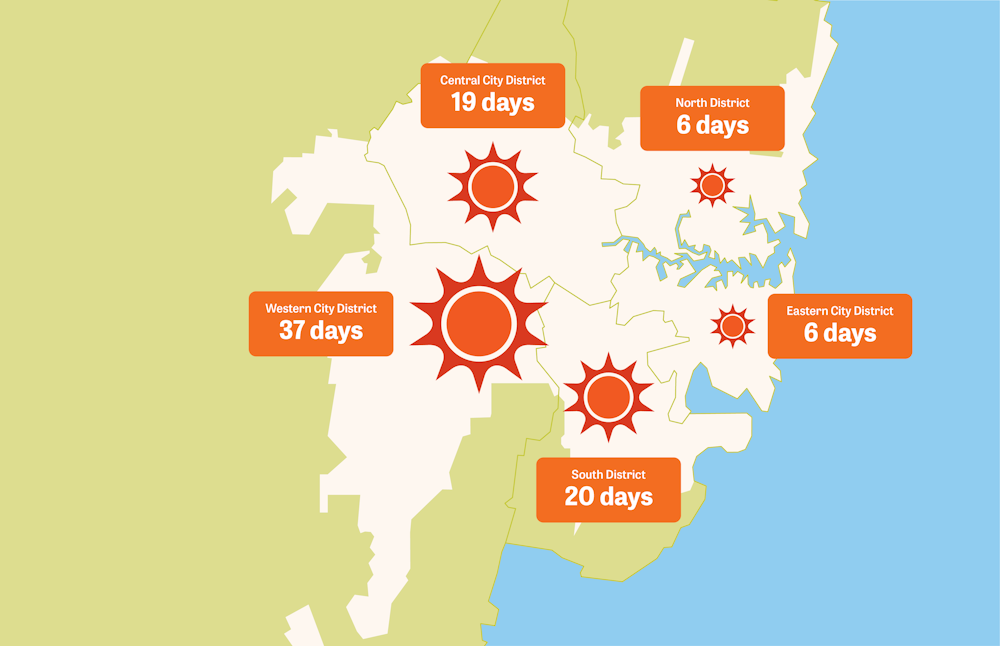
As the Greater Sydney Commission report makes clear, tree canopy in Greater Sydney is roughly proportional to household wealth. The “leafy suburbs” are the wealthier ones. This means tree planting is an important investment in less wealthy parts of the city, which experience more extreme heat days.
However, research also shows people have mixed feelings about trees. In comparison to the neat shrubbery and easily maintained sunny plazas we’ve become used to in our cities, trees can be “messy” and “unpredictable”. Leaf litter can be slippery and natives like eucalypts, with their pendulous leaves, provide limited shade. People worry about large trees falling over or dropping branches.
Trees are often at the centre of disputes between neighbours. They can also be perceived as a security problem – if trees reduce visibility they might provide cover for wrongdoers.
Urban development tends to give priority to roads and delivering the maximum number of dwellings on sites. This leaves little space for trees, which need to fit into crowded footpaths with ever-changing infrastructures. For example, will larger trees interfere with 5G?
When juggling priorities in the streetscape, trees often lose out.
It’s an obvious point, but trees take time to grow. It can take many years for a planted sapling to become a shade tree. In that time there will be no shelter from the heat.
Also in that growing period, which can sometimes be unpredictable, trees need to be nurtured, especially in times of drought. And, once the tree is mature, fingers crossed that extreme weather events do not undo all those years of waiting.
So, while increasing tree canopy sounds like an obvious solution, trees are in fact a complex social challenge. In our research, we point to ways some of these tree-related tensions can be managed.
Shade in the meantime
A structure to support fast-growing vines has been built on one of Darwin’s hottest streets, but even these will take some time to grow.Darwin We Love It/Facebook
Shade is an important civic resource. Large, mature trees with spreading canopy provide the best shade, so strategic construction bans and tree preservation orders are an obvious first step.
However, if shady canopy is decades off, we need to think about other, creative ways to provide shade in the meantime to ensure, for example, that people of diverse abilities can walk their city in reasonable comfort. This might include temporary shade structures such as awnings, bus shelters and fast-growing vine-trellised walkways (if there is space to create troughs for soil and the structure doesn’t cause access problems).
And, as the Cancer Council consistently reminds us, we all need to adopt more climate-defensive clothing.
An important alternative is to follow our regional neighbours and start to populate parks and other public spaces at night. This suggests a need for removable shade, so we can take part in activities like stargazing.
Cultivating an intergenerational commons
Mature trees can die back or die altogether, so other trees should be maturing to take their place. Usually, experts design and maintain landscapes for others to enjoy.
However, users of the cooling services of parks could be invited into the process of planning and realising landscape designs. This would give them a say on the trees of which they have “shared custody”. Planting for succession can create an intergenerational sense of ownership over a shared place.
Current planning practices tend to ignore wind and solar patterns. The result is urban forms that make heat worse by prioritising comfortable private interior spaces over the commons of public space. Designing cool cities means using trees, water and buildings to create cool corridors that work with cooling breezes – or even summon these in still, heat-trapping basins like Western Sydney.
These few examples point to new ways of living with trees as social commons, but they also point to new forms of commoning – collaborative forms of care and governance that invite people to adopt new social practices better suited to living well in the coming climate.
It is a positive step that state development agencies like Landcom aim to demonstrate global standards of liveability, resilience, inclusion, affordability and environmental quality. In so doing, they initiate transitions to these more commons-based ways of living.
In addition to the authors of this article, the Cooling the Commons research team includes: Professor Katherine Gibson, Dr Louise Crabtree, Dr Stephen Healy and Dr Emma Power from the Institute for Culture and Society (ICS) at Western Sydney University (WSU), and Emeritus Professor Helen Armstrong from Queensland University of Technology (QUT).
“This is a bit controversial, we know that,” deputy prime minister Michael McCormick told the National Party’s federal council, which on the weekend voted for a national roll-out of cashless debit cards for anyone younger than 35 on the dole or receiving parenting payments.
The Nationals have joined the chorus within the federal government proclaiming the cards a huge success.
The Minister for Families and Social Services, Anne Ruston, has even gone so far as to claim welfare recipients are “singing its praises”.
Really?
Both McCormick and Ruston have proclaimed success based on the most recent trial of cashless welfare in Queensland. This trial began barely six months ago, and the independent evaluation by the Future of Employment and Skills Research Centre at the University of Adelaide is ongoing.
A more complex story emerges out of my research into lived experiences of the first cashless debit card trial, which began in Ceduna, South Australia, in March 2016
I spent about three months in the town of Ceduna between mid 2017 and the end of 2018 talking to people about life on the card.
Ceduna is located on the north-west coast of Eyre Peninsula, South Australia.www.shutterstock.com
All communities are diverse and people’s experiences diverge. Some liked the card, or had come to accept it, others were caught up dealing with far more significant problems.
But I talked to people who found the card “an insult”. They told me it made them feel “targeted” and “punished”. They talked of degradation and defiance. They also told me the card didn’t work.
As for the the claim by both Ruston (and her ministerial predecessor Paul Fletcher) that the card empowers people to “demonstrate responsibility”, the opposite was true. In the words of June*, an Indigenous grandmother, foster carer and talented artist: “It has taken responsibility away from me. It’s treating me like a little kid again.”
Indigenous testing grounds
Ceduna, in the far west of South Australia, was the first of four sites chosen to trial cashless debit cards. The second was in the East Kimberley
The location of these two trial sites meant early trial participants have been predominately Indigenous. I am of the view that Indigenous communities are being used as testing grounds for new technologies and controversial measures.
In the first two trial sites, income support recipients younger than 65 have just 20% of their payment deposited into their bank account. The remaining 80% goes on to their debit card, which cannot be used at any alcohol or gambling outlet across the nation. Nor can they be used to withdraw cash.
The lead-grey cashless debit card is similar but different to the lime-green BasicsCard, introduced as part of the 2007 Northern Territory National Emergency Response (the “Intervention”). The use of the BasicsCard as an “income management” tool was extended to non-Indigenous people in the Northern Territory in 2010, and to other states in 2012.
The BasicsCard generally quarantines 50% of a social security recipient’s income so that it cannot be spent on alcohol, gambling, tobacco or pornography. BasicsCard holders need to shop at approved stores. In contrast, the cashless debit card, administered by financial services company Indue, can theoretically be used wherever there are Eftpos facilities.
Shame and humiliation
My research wasn’t based on collecting statistics but “hanging out” and getting to know people. I came to see the stigma associated with the “grey card” sometimes resonated with past experiences.
Robert*, for example, told me about growing up on a mission and then suddenly finding himself as “one little blackfella” in a large high school. He was acutely sensitive to the “smirks” and judgements of others whenever he used the grey card to pay for things.
Pete* left high school after a couple of weeks to join an itinerant rural workforce that has since vanished. After decades of manual work, finding himself unemployed due to ill health was devastating enough. Being issued the grey card compounded his humiliation.
Others voiced their belief the grey card was designed to induce shame. But they refused that shame, expressing instead a defiant belief in the legitimacy of their need for support.
The welfare system often defines people by the one thing they are not currently doing – waged employment. But many people I spent time with in fact laboured constantly: it just wasn’t recognised as work. People like June*, for example, looked after sick kin, the elderly and children. Yet the grey card treated them as dependents.
I heard about ways of getting around the card’s restrictions. As one acquaintance put it: “Drunks gonna drink!” One strategy involved exchanging temporary use of the card for cash. With terms that nearly always disadvantage the card holder, it has the potential to make life tougher for people living in hardship.
The evaluation of the Ceduna trial for the Department of Social Services was more positive, noting that alcohol drinkers and gamblers reported doing so less frequently. But it also noted no reduction in crime statistics related to alcohol consumption, illegal drug use or gambling. And the Australian National Audit office was so critical of the government’s evaluation it concluded that it was difficult to ascertain “whether there had been a reduction in social harm” as a result of the card’s introduction.
Which makes simplistic claims about the card’s success look a bit rich.
The Regional Comprehensive Economic Partnership has been touted as the best hope for keeping world trade flowing after the attacks on the World Trade Organisation.
The WTO isn’t dead yet, but in a two-pronged attack, US President Donald Trump has been flouting the spirit if not the letter of its rules by on one hand imposing tariffs on China and other countries, and on the other blocking appointments to its appellate body. The latter means that after December the appellate body will no longer have enough members to hear new cases.
Although nothing like a proper replacement for the WTO (it would have 16 member nations instead of the WTO’s 164) the Regional Comprehensive Economic Partnership (RCEP) is being talked about as a backstop. The 16 RCEP members account for almost half the world’s population; among them China, India, Japan, Indonesia, Malaysia, Vietnam, Australia, and New Zealand.
The RCEP negotiations have dragged on since 2012, in part because of what had been seen as a near intractable sticking point: so-called investor-state dispute settlement (ISDS) procedures.
ISDS was one of worst parts of the RCEP
The World Trade Organisation doesn’t have ISDS. In the WTO, governments can take action against governments under WTO rules but corporations can’t sue governments.
ISDS provisions, present in many one-on-one or regional trade deals, allow foreign corporations (but not local corporations) to take on governments.
When the Philip Morris tobacco company lost its case against the Australian government over plain packaging laws in Australia’s High Court, it was able to have a second go in an international tribunal using the ISDS provisions of an Australia-Hong Kong investment treaty. This right would not have been available to an Australian company.
Although Australia successfully had the case thrown out, it took it seven years and cost A$24 million. Australia recovered only A$12 million from Philip Morris.
ISDS provisions were developed in the post-colonial period after World War II to compensate international investors for the direct expropriation or taking of property by governments. But over the past 20 years they expanded to include “indirect” expropriation, “minimum standard of treatment” and “legitimate expectations”, which do not involve taking of physical property and do not exist in many national legal systems.
Because the cases are very costly, they are mostly used by large global companies that already have enormous market power, including tobacco, pharmaceutical, agribusiness, mining and energy companies.
There are now 942 known ISDS cases, with increasing numbers against health and environment laws, including laws to address climate change.
The tide is turning against it
Legal experts like former High Court Chief Justice Robert French have noted they are conducted by temporary tribunals often presided over by practising advocates who can represent a corporation or government in one case and then sit on a tribunal the next, calling into question their independence. The decisions need not make use of precedents and have no appeals, meaning they need not be consistent.
The EU is not including ISDS in any of its current negotiations, including those for a EU-Australia free trade agreement.
In the longer term, Europe is pursuing a controversial proposal for a permanent Multilateral Investment Court, which would once again allow foreign investors to sue sovereign governments but would address procedural concerns about temporary tribunals. It hasn’t yet gained support from the US, Japan, Australia or other key players, so is not likely to be implemented soon.
The US and Canada have excluded ISDS from their part of the new North America Free Trade Agreement, known as the United States-Mexico-Canada Agreement.
Two institutions that oversee ISDS cases, the United Nations Commission on International Trade Law and the World Bank International Centre for Settlement of Investment Disputes, are conducting reviews of the system.
It looks as if the RCEP will be free of it
Australia is notoriously tight-lipped about international trade negotiations. But late last week Malaysia’s trade minister Datuk Darell Leiking revealed that Malaysia and each of the other 15 parties to the RCEP negotiations had agreed to exclude ISDS provisions from the deal.
Malaysia, India, Indonesia and New Zealand are all officially opposed to ISDS provisions, but this is the first public sign that all the RCEP countries have agreed to exclude it.
“Once the agreement is in force, which is within two years, the member states will re-look into it and see whether or not we are going to have the ISDS. But it must be an agreement made by all countries,” he is quoted as saying. “For now, there is no ISDS.”
Opposition to ISDS is growing. The Australian government’s apparent agreement to remove ISDS provisions from the RCEP raises questions about why it is continuing to pursue such provisions in the Indonesian and Hong Kong trade deals currently being reviewed by the parliament’s joint standing committee on treaties.
It also raises the question of whether Labor, the Greens and the Centre Alliance, each of which has has policies opposing ISDS, will support the agreements when committee reports on them in mid-October.
But problems remain
Defeating ISDS in the RCEP will be a victory for social movements and governments concerned to retain public interest regulation.
But other problematic proposals remain on the RCEP agenda.
These include longer monopolies for medicines that would delay the the availability of cheaper medicines and would have the worst impacts in developing countries.
It remains to be seen whether this and other sticking points can be resolved and the negotiations completed by their current target date of the end of 2019.
In 1955, an enormous photographic exhibition, The Family of Man, challenged the world as to what it meant to be human. The curator, Edward Steichen, assembled 503 photographs by 273 photographers from 68 countries, while his brother-in-law, the poet Carl Sandburg, provided the lyrical subtext to the show and its title.
In his poem, The Long Shadow of Lincoln: A Litany (1944), Sandburg wrote, “There is dust alive/ With dreams of the Republic,/ With dreams of the family of man/ Flung wide on a shrinking globe”.
In some ways, this new vast exhibition, Civilization: The Way We Live Now, a version of which has just opened at the National Gallery of Victoria, catches the flame of the challenge of The Family of Man with its dreams of humankind living on a rapidly shrinking globe.
The show brings together over 100 contemporary photographers from Africa, Asia, the Americas, Europe and Australia with over 200 photographs. Unlike its illustrious predecessor of more than 60 years earlier, many of the photographs in this exhibition are huge in dimensions and in a very wide range of mediums.
“Civilization”, the title of numerous exhibitions, conjures the image of civilisations of the past – Egypt, Rome, Byzantium – empires that rose and collapsed. This exhibition explores the concept of a “planetary civilisation” – one, where for the first time in human history, more people live in cities, than in rural settings.
Human mobility and interconnectivity have meant that more people, countries and economies are interdependent than ever before. For the first time, there is a real prospect that the human species stands to comprehensively annihilate itself, not through an act of war, but through man-made climate change and over consumption. It is also the first time that photographers are virtually everywhere and are photographing virtually everything.
The curators of this exhibition, William A. Ewing and Holly Roussell, have examined many thousands of contemporary photographs and have spoken to hundreds of photographers around the world.
Through this process of interrogation, the material has suggested eight fluid, porous sections around which the exhibition is arranged: Hive, Alone together, Flow, Persuasion, Control, Rapture, Escape and Next. These, as Ewing stresses, are some of the broad themes that are preoccupying many of the world’s finest photographers today.
Last year, the exhibition was shown in Seoul, earlier this year in Beijing and now it is in Melbourne, where it has been considerably trimmed of some of its international content and supplemented by a number of Australian photographers.
Next year, the exhibition will travel to Auckland, in 2021 to Marseilles and there is promise of future venues in the coming years. The Family of Man was to tour for eight years and attracted over nine million visitors and there is every possibility that this exhibition will match or exceed this number.
‘Homogenising humanity’
If The Family of Man posed the question what do humans have in common to make them human, photographs in Civilization focus on what the curators term the “shared human experience”. The historian Niall Ferguson noted in his book Civilization: The West and the Rest (2011): “It is one of the greatest paradoxes of modern history that a system designed to offer infinite choice to the individual has ended up homogenising humanity.”
This homogenised humanity prevails in many of the photographs, whether it be in the claustrophobic clutter of the great metropolises of the “Hive” or the truly unsettling images of the “Next” section. This is a future where a perfect race appears in Valérie Belin’s models, robots replace humans in Reiner Riedler’s photographs and we leave this crowded planet in the images of Michael Najjar.
In navigating this extensive exhibition, you experience mixed emotions – on one hand these photographers are holding up a mirror to this concentrated global urban environment that we recognise as real and a shared experience, but on the other hand this is an exhibition of very significant art.
Many of the names of these photographers read like a roll call of some of the leading documentary and art photographers in the world.
In one of the iconic images of this exhibition, Thomas Struth’s “Pergamon Museum 1, Berlin” (2001), a huge type C photograph, our civilisation has recreated a past civilisation so that we can stand in triumph over past achievements.
The great veteran photographer, Lee Friedlander, records America through the prism of the car window, while the Canadian Edward Burtynsky presents a huge panoramic view of mass food production in his “Manufacturing #17, Deda Chicken Processing Plant, Dehui City, Jilin Province, China” (2005).
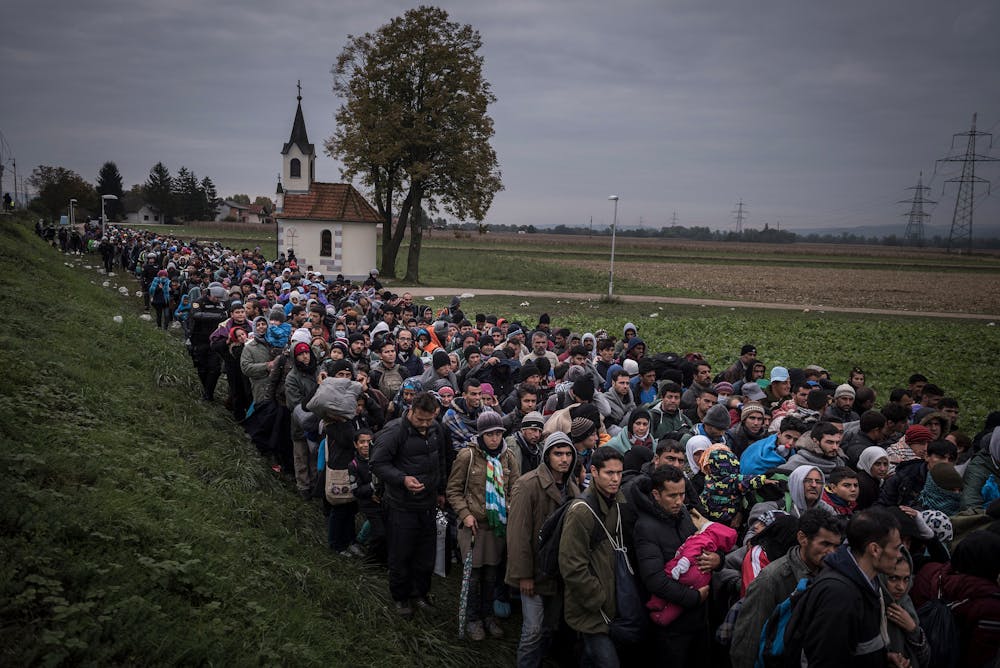
The young Russian photographer, Sergey Ponomarev, in one of the most moving photographs in the exhibition, “Migrants walk past the temple as they are escorted by Slovenian riot police to the registration camp outside Dobova, Slovenia, Thursday October 22, 2015” comments on the theme of mass migration in the era of the new world order.
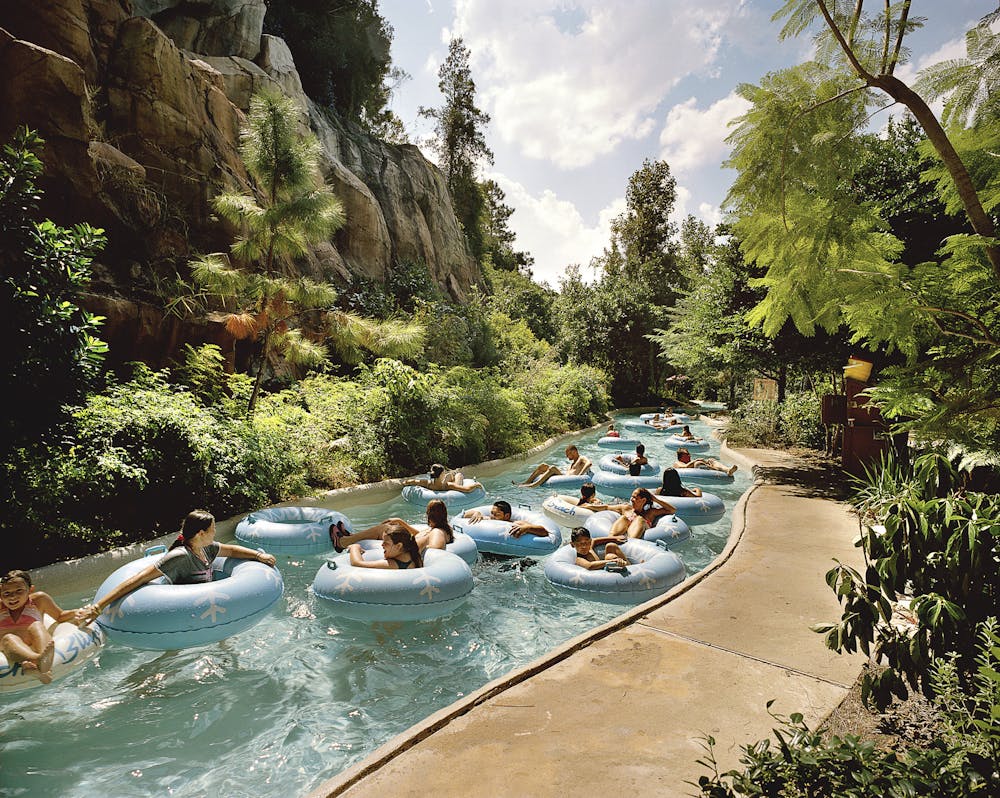
There is also a powerful section on images of escape – an escape from a created reality that now imprisons us – the fake wilderness in American amusement parks recorded by the Austrian Reiner Riedler or the American Jeffrey Milstein’s “Caribbean Princess” (2014) an inkjet print from the Cruise Ships series.
A hallmark of a memorable exhibition is that it seduces the viewer through its sheer beauty, while at the same time making us question the reality that we inhabit.
Civilization: The way we live now is an important milestone exhibition that raises questions of the single planetary civilisation that is now evolving, where a stranger on social media may appear more real than our neighbour, and where our very future appears increasingly problematic.
Civilization: The Way We Live Now is at NGV Australia, Federation Square until 2 Feb 2020.
From 2022, New Zealand history will be taught at all schools as part of the compulsory national curriculum. The announcement is an astonishing turnaround, given that the ministry of education and parliament’s education and workforce select committee were opposed to any degree of compulsion just a few weeks ago.
New Zealand has been one of few countries in the world not to ensure that its citizens have some experience of their own past at school. As a history professor, I give frequent visiting lectures and in one of these, last week, only two students could clearly identify 1840 as the year of the Treaty of Waitangi, despite two thirds of the class being New Zealand born. None of them knew much about the treaty itself or about New Zealand’s colonial history, or about the Waitangi Tribunal, which has been dealing with treaty settlements for the last 30 years.
It would be hard to imagine that students in the United States did not know the importance of 1776, the year that sparked the American Revolution. Or for those in India and Pakistan to be ignorant of 1947, the date of partition, and the struggle that preceded it. Or for Australian university students not to be aware of the date of federation in 1901.
The campaign to have history taught in New Zealand schools has been long and sustained, led notably by a group of Ōtorohanga secondary students, who were surprised to find that they lived close to several key events of the New Zealand wars, including the battle of Ōrākau and the sacking of Rangiawhia in the 1860s. The New Zealand History Teachers Association presented an impassioned submission to a parliamentary select committee this year, but none of this was enough at the time to convince the ministry.
As Graham Ball, the association’s president commented, and as all historians know, history is as much about debate, contested narratives and disputed interpretations, as it is about facts.
Understanding why things happened, and their consequences, requires a significant grounding in historical knowledge, including dates, people, events and the context in which everything takes place. But how we explore these facts, how we interpret them, and the lessons we learn for the present, are all dramatically influenced by politics, cultures and the expectations of today’s society.
Each generation reinterprets the same facts, remembers new ones and forgets others. Teaching history at school, even to primary school students, will be far from simply providing a list of what they need to know.
Deciding what we must teach our children and our grandchildren about our past is a question we have avoided for decades, going back to a time when history was almost always someone else’s: largely the tales of British kings and queens and the wars which marked their reigns.
Much of the impetus for having New Zealand history taught in schools has been around understanding colonisation and its impact on Māori. Some of the calls were for the compulsory teaching of colonial history, Māori history, or even just the New Zealand wars. The current decision has a much broader brief, as it must. Today’s schoolchildren have to see in their history the experience of their own communities, as much telling the story of recent migrant communities and their place in New Zealand as the story of 19th-century colonialism.
This is a debate that cannot be left to historians and history teachers, and government will find it needs to be well resourced. We need both a national debate and one in local communities.
Our stories have a lot of pasts to include: the histories of hapū and iwi, as well as Māori as a whole, the Irish, the English and Scots and other Europeans, as well as Samoan and other Pacific communities. They need to have places for early Chinese and Indian migration, as well as for the large number of diverse communities that have arrived here in the last half century.
These histories need to be alive to other forms of difference, to gender, to poverty and to divides between rural and urban communities. But they should not just be divided histories. They should also explore the society these communities created here, examining what they had in common, as well as what has separated them.
At my own university, interest in medieval studies has risen substantially, reflecting the Game of Thrones and Vikings effect. Fantasy and history that replicate a medieval world appear a safe place to understand the past, where a distance of centuries allows an understanding of history that rarely has political impact in the present.
In making New Zealand history compulsory, we are forcing our young people to confront the challenging questions of inequality, racism and legacies of the Empire.
This will only be a success if it avoids easy stereotypes, and simple narratives that divide the world into heroes and villains. At the end of their compulsory schooling, New Zealanders should know more of the detail of their past, but they should also have the skills to handle its complexity and its contradictions.
They need histories that are not too earnest, that cover not just the good, the bad and the ugly, but the funny, the ludicrous and the entertaining.
Shadow Treasurer Jim Chalmers says it’s time to change Australia’s economic course “in a responsible and affordable way which doesn’t jeopardise the surplus”.
Chalmers predicts the budget outcome for last financial year, forecast to be a deficit at budget time, could possibly show a surplus, because of high iron ore prices and other factors including an underspend on the NDIS.
He argues the government can have both a more stimulatory policy and a surplus going forward, given the various boosts to the budget’s bottom line. “I don’t think the government has come to a fork in the road where it’s a choice between a surplus or doing something responsible to stimulate the economy.
“As it stands right now it’s possible to do both and we think the government should do both”.
The government should boost Newstart, Chalmers tells Michelle Grattan, although he wouldn’t oppose it first holding “a short sharp review” to examine interactions with other payments.
On Labor’s way ahead, now being debated within the party, Chalmers says “we’d be mad not to learn the lessons” of the election result.
With some of the opposition’s most controversial election policies in his portfolio, notably on franking credits and negative gearing, Chalmers is already consulting widely.
There’s agreement on two things, he says. “Nobody expects us to finalise our policies three years before the next election […] and nobody expects us to take an absolutely identical set of policies to the 2022 election”.
New to podcasts?
Podcasts are often best enjoyed using a podcast app. All iPhones come with the Apple Podcasts app already installed, or you may want to listen and subscribe on another app such as Pocket Casts (click here to listen to Politics with Michelle Grattan on Pocket Casts).
You can also hear it on Stitcher, Spotify or any of the apps below. Just pick a service from one of those listed below and click on the icon to find Politics with Michelle Grattan.
Lucy (Charlotte Nicado) is a pink-haired millennial having a quarter-life crisis. Her school friends have drifted away, she has a useless law degree, and a depressing rotation of casual jobs has left her broke.
To top it off, her ex-boyfriend just Facebook-announced his engagement.
Lucy sets her sights on internet stardom to give her life some direction. When Lucy flips her car while she’s livestreaming she becomes a viral meme as #flipgirl, and so begins her addiction to the most controversial currency of our age: attention from strangers on the Internet.
Content, the new series from ABC, derives humour from the intersections and misalignments of online life and reality, but it goes one step further: it’s the first show set entirely on an iPhone screen.
Filmed vertically, Content is built to watch on your phone, and the narrative unfolds through messages, FaceTime calls, and whatever Lucy’s phone sees when she opens her camera (including the selfies she’ll delete later).
We see not only the selfies Lucy shares, but the ones she deletes, too.ABC
We get to see the things Lucy makes public, but also her search history, the people she stalks, and the messages she never sends. This provides a unique view of Lucy, exploring both her private and public personas.
While her real life spirals into a comedy of errors, she’s compelled by the digital world’s norm of mandatory positivity to show only a happy, upbeat attitude that people will want to “follow” and “like.”
Watching a show set on a phone on your phone has some uncanny effects. Sometimes on reflex I tried to pause or scroll on Lucy’s screen, which was my screen, but not really my screen, creating an enjoyable slippage between reality and the show.
Using the currency of popular nonfiction forms to give an appealing twist to a fictional story isn’t new. Novels did it with fictional autobiographies, movies did it with mockumentary, and digital producers have been treading this territory for years (see lonelygirl15 hoax-turned-web-series and the performance art of Amalia Ulman).
Content reformulates a little bit of each of these strategies, creating a self-reflexive version of streaming media that reaches towards a metafictional viewing experience.
Mobile technology is an increasingly dominant mode of media consumption – and production. There’s no doubt that phones are changing the way we make TV and movies. Festivals like the Cinephone International Smartphone Short Film Festival and the SmartFone Flick Fest have been developed to celebrate and foster the art of phone-shot media.
But Content isn’t trying to use the smart phone to create the appearance of a more legitimate production. Instead, it deliberately creates an amateur aesthetic that resembles your own smartphone usage. Filmed with an iPhone, often held by the actors, Content uses the selfie as a camera technique rather than for self-portraiture.
Content is not only designed to be watched on your phone – it was shot on phones, too.Mia Forrest/ABC
This creates an authentic world for millennials Lucy and Daisy: a generation living much of our lives through phone screens.
The traps of the attention economy
Content emphasises the trap of internet fame, particularly for young women.
Girls are socialised to be experts in impression management, and the currency of internet attention monetises this complex social skill. The source of Content’s comedy is that Lucy isn’t very good at the negotiations required in this setting – busting the myth that millennials are “born digital” and therefore inherently understand digital worlds.
As Lucy breaks into the attention economy, she perceives the quantitative data of likes and comments as positive. Bemoaning the lack of support from her friends and parents, Lucy sees her newly gained online following as a support network, telling best friend Daisy “hundreds of thousands of people are here for me.”
There is a difference between the followers who like you, and those who watch to mock.ABC
But the viewer is able to see beyond the numbers to the qualitative evidence: most of the comments Lucy receives are negative. She is openly mocked by her followers who laugh at her and call her names.
It’s a shame that Content encourages us to laugh at Lucy more than with her as we follow her journey. Girls who derive a sense of confidence and self-worth from digital forms of sociality are an easy target, and I wanted more moments where Lucy is more than a narcissistic stereotype.
The show misses opportunities to flesh out the figure of the wannabe influencer even as it explores the funny and terrible ways that the attention market shapes young people’s lives.
But its forays into female friendship prove more fruitful. Lucy’s lifeline is her long-time bestie, the sensible and camera shy Daisy (Gemma Bird Matheson). They’re the perfect odd couple for a female-centred buddy picture, and their dynamics drive the show’s best moments.
Ultimately, even if we already know Content’s take-home message – that the “real” people we watch online are faking it most of the time – we are still compelled to consume the lives of others for entertainment.
Commentary on the social media market that focuses on how it is turning us into narcissists overlooks a crucial aspect: the continued demand for such media indicates we’re just as interested in the lives of others as we are in our own.
New episodes of Content are released Wednesday and Friday through @ABCTV social accounts
Each year, from September to mid-October, the tiny and very precious mountain pygmy-possums arise from their months of hibernation under the snow and begin feasting on billions of bogong moths that migrate from Queensland to Victoria’s alpine region.
But for the past two springs, moth numbers have collapsed from around 4.4 billion in alpine areas to an almost undetectable number of individuals. And the mountain pygmy-possums went hungry, dramatically affecting breeding success among the last remaining 2,000 that live in the wild.
This year’s migration of bogong moths to the possums’ alpine home is crucial for the critically endangered mountain pygmy-possums. That’s why we’re asking you to do two simple things: turn off your lights at night, and if you see a bogong moth, take a picture.
What’s happened to the moths?
Bogong moths make an epic migration through Australia every spring.Credit: Donald Hobern
We don’t know exactly why the moths are not making it to their summer alpine destination. It’s likely extreme drought, pesticides and changes in agricultural practices are all major factors. However, scientists believe that because moths use both the Earth’s magnetic field and visual cues on the horizon to navigate, light pollution from urban centres can confuse the moths and stall their journey.
Some of the greatest beacons on their path are Parliament House and Canberra’s bright surrounds. Both parliamentarians and the general public are being asked to turn unnecessary outdoor lights off from September 1 to October 31, as part of the Lights Off for Moths campaign.
Artificial night lighting has dramatically changed the nocturnal environment. In urban environments, the soft glow of moonlight is overpowered by bright streetlights, security lights and car headlamps. These light sources can be more than 1,000 times as bright as moonlight, and their biological impact is increasingly visible and widespread.
One of the most obvious impacts of artificial light at night is that it can attract animals (sometimes fatally). While a “moth to a flame” may be somewhat poetic, when one moth becomes hundreds, or potentially thousands, the ecological impact may be catastrophic. Current global lighting practices may be creating this very scenario.
When a species like bogong moths decline, it has huge ramifications. Insects in particular are vital pillars supporting whole ecosystems – without bees and other insect pollinators, for example, we risk the extinction of our flowering plants. Many birds, reptiles and mammals depend on insects as part of their diet.
Tiny mountain pygmy possums, like many other animals, depend on the annual bogong moth migration for food.Tim Bawden
For mountain pygmy possums, the fatty, nutrient-rich bounty of bogong moths arrives right as they are waking up in the spring. They are one of the only Australian mammals that hibernate, and can spend up to seven months sleeping under the alpine snow.
The possums awake ravenously hungry, and devour the bogong moths to regain crucial fat stores. Without the moths there at the right time, the possums struggle to secure enough energy to breed successfully.
Snap that moth
Alongside the Lights Off for Moths campaign, Zoos Victoria has launched Moth Tracker, an app that allows Australians to photograph and log any potential sightings of migrating bogong moths.
Moth Tracker, which can be accessed through any laptop or smartphone, is adapted from the popular Southern Right Whale watching app in collaboration with Federation University and Victorian conversation network SWIFFT.
Bogong moths migrate from their winter breeding grounds throughout Queensland, New South Wales and western Victoria in search of cooler climates for the Spring and Summer in the Victorian and NSW Alpine regiiit fro on wmhere the mountain pygmy-possums live.
Before they become moths, the larvae look like tiny, shiny brown capsules and are commonly referred to as cutworm. Migratory bogong moths are dark brown, with two lighter spots on each wing. They are small, only about the length of a paper clip. During the day they’re often seen grouped together like roof tiles. At night, they are more active and flying around.
If you see a bogong moth (or something you think might be a bogong month), we need you to take a photograph and log the location, day and time with Moth Tracker. Scientists will use the data to determine whether any moths are making their way to the precious, and very hungry, possums that are just starting to wake from their winter hibernation.
The Victorian Mountain Pygmy-possum Recovery Team, together with partner organisations, is also investigating options for interventions in the wild if needed. These may include a world-first airdropping of “bogong balls” to feed the hungry possums, as well as improving habitat connectivity and captive measures to support populations through the breeding season.
But with unnecessary outdoor lights switched off and citizen scientists looking out for bogong moths, there is still hope for the mountain pygmy-possums.
Expectant mothers receive an avalanche of information about potential risks to their baby. There’s a growing list of foods, toxins and environmental threats to avoid. It’s normal for this to lead to an increased level of anxiety.
As a result, some women believe it’s safer to avoid any risks in pregnancy, no matter how small. Vigorous exercise may be considered one of these risks.
But we’ve recently reviewed the research and found vigorous exercise is safe during pregnancy, including in the third trimester. And not only is it safe; it’s healthy, too.
The safety of moderate intensity exercise during pregnancy has been well established. Walking, swimming and using an exercise bike are all activities that could be considered moderate intensity.
Expectant mothers who do at least 150 minutes of moderate intensity physical activity per week, as recommended by the Australian Physical Activity Guidelines, are healthier, happier, stronger, and develop fewer complications like gestational diabetes and pre-eclampsia.
When we’re talking about vigorous exercise, this means exercising to an intensity where you struggle to maintain a conversation, but can still manage a sentence. This could include activities such as jogging, circuit-based resistance training, or interval training on a stationary bike.
In the broader population, it’s exercise at 70-90% of your maximum heart rate (where maximum heart rate is about 220 beats per minute minus your age).
For pregnant women, it may feel a little harder to achieve vigorous intensity exercise because of some normal changes to the heart and blood that occur during pregnancy.
And the safety of doing vigorous exercise during pregnancy has been more controversial. For example, past research has suggested that during vigorous exercise, blood flow is re-directed to the muscles and could take away oxygen and nutrients from the growing baby.
Our research
We collated all studies looking at mothers exercising at a vigorous intensity during the third trimester, to understand how safe this was for mothers and babies. Our review included 15 studies totalling 32,703 pregnant women.
What we found should be reassuring for active women with healthy pregnancies: vigorous exercise appears to be safe for both mum and baby, even when continued into the third trimester.
Yoga can be a gentler form of exercise to do during pregnancy.From shutterstock.com
The studies looked at a range of outcomes for both mum and baby, and none showed any meaningful increase in risk. There was no difference in birth weight of babies when their mums did vigorous exercise; and in particular no difference in the number of babies born small for gestational age.
For women in the healthy weight range, vigorous exercise didn’t affect the amount of weight they gained during pregnancy. That is, they followed the expected trajectory of weight gain as their pregnancy progressed.
But, in overweight and obese women, for whom it can be more difficult to adhere to the recommended weight gain during pregnancy, vigorous exercise did appear to reduce maternal weight gain.
It was also associated with a slightly lower chance of a baby being born premature, and a few extra days of gestation.
High-intensity and high-impact exercise
Exercise at greater than 90% of maximum heart rate is considered “high-intensity exercise”. This is where you can’t even string a sentence together.
We don’t yet know if high-intensity training carries any risks, so there’s still a limit to what mums might want to do later in a pregnancy. We’d recommended mums do the “talk test” to make sure they can still speak while exercising.
Expectant mothers should also be cautious about doing high-impact exercise in the third trimester, like running, jumping or lifting heavy weights. The findings from our review suggest these types of high-impact activities are not likely to affect the baby, but it’s still not known whether they may weaken the mother’s pelvic floor muscles, which may contribute to incontinence.
If expectant mothers want to keep these activities up, we’d recommend they consult an exercise professional and their doctor.
Exercise during pregnancy is important – but it doesn’t have to be vigorous
Vigorous exercise is an efficient strategy for improving a mother’s physical and mental health. The benefits to her heart, lungs, muscles and mood are likely to be the same, if not greater, than for moderate exercise.
The main aim of physical activity in pregnancy is to achieve health-enhancing benefits in a way that is safe, enjoyable, and sustainable.
Some women may find it difficult to be mobile in the third trimester, let alone exercise vigorously. So, if you’re happily doing lighter exercise, like regular walks, you can feel confident in the benefits you’re providing both you and your baby.
Pregnancy specific yoga or pilates may also be a gentler way to improve muscular strength, heart health and mental health. These activities might help you prepare your body for the upcoming challenge of childbirth, and subsequent recovery.
If you’re struggling to achieve the recommended 150 minutes per week, particularly in the third trimester, then find ways to increase your breathing rate in shorter bouts. For example, by taking the stairs, parking the car a little further away, or going for brisk walk in your lunch break.
Mothers will usually get the most benefit with some extra support, whether from an exercise professional (like an accredited exercise physiologist), a medical practitioner, or both. Programs can be tailored to the most suitable exercise intensity for you.
The National Party is in trouble again for its Facebook advertising campaigning. Late last week, the Advertising Standards Authority (ASA) ruled against one of the party’s social media ads targeting the Government’s vehicle efficiency feebate scheme. The authority ruled it was “likely to confuse or deceive consumers”. The ad had claimed that the feebate scheme would cause the costs of some cars to be increased by $6000 when, in fact, the highest direct fee would be $3000.
According to Newshub’s Dan Satherley, despite the ASA’s ruling, the offending ad remained online and there was nothing the ASA could do about this: “As of Friday, the ads remained online. The ASA has no statutory power to force the party to take them down. The ASA has plans to set up a rapid-response unit to tackle misleading political ads with far more urgency next year, which is an election year” – see: National to appeal after ‘car tax’ advert ruled misleading.
National argued that the party had followed the spirit of the law but the ASA have got them on a technical breach: “It has been the previous view and practice of the Advertising Standards Authority that the spirit of the code is more important than any minor technical breaches… People have a right to express their views and this right should not be unduly or unreasonably restricted by rules.”
The whole issue raises questions about whether New Zealand is headed into an environment of “post-truth” online advertising of dirty politics and deliberate deception, as has been witnessed in other political systems. There is increasing debate about “weaponised advertising technology” being used by political parties.
There have been a number of recent media stories investigating the surge of Facebook advertising by various parties, with a strong concern about the dangers this poses for democracy, especially since many of the ads are dodgy. For the best investigation of this, see Q+A’s seven-minute video (and article): Voters warned to prepare for dirty politics as battle steps up online a year out from election.
Here’s the main point: “A year out from the General Election, political observers are warning voters to prepare for some dirty politics, with the battle for votes increasingly being fought online. TVNZ1’s Q+A has discovered New Zealanders are already being targeted with some of the less-than-transparent tactics seen overseas. Like never before, National is churning out the attack ads on social media, it’s campaign machine already in full throttle.”
National is particularly under scrutiny, with allegations that the party is moving into some sort of Trump-like post-truth way of operating. For example, Peter Dunne highlights in the Q+A item how National leader Simon Bridges recently claimed “one person’s facts are another person’s misinformation” when justifying misleading claims by a National MP.
The suggestion is that National is importing aggressive and negative social media tactics from its counterparts overseas – with many noting a recent trip by Bridges to meet with the Australian Liberal Party and Scott Morrison, who were notable for their aggressive social media campaigning that helped them pull off their surprise election victory this year. As the Q+A item notes, the Liberals “had the help of some Kiwi digital whizzes – Young Nats Sean Topham and Sam Guerin, and social media strategist Kelly Boxall, another Kiwi who has recently been working in Simon Bridges’ office.”
The item features Labour’s election campaign chair Megan Woods vowing that Labour won’t be going negative in its election next year, but pointing the finger at National: “I’m worried that we are seeing these green shoots of a reasonably desperate and negative campaign that’s coming through already”.
National’s campaign chair is Paula Bennett, and in the video she defends the party’s rather simplistic attack messages as being helpful for voters: “People don’t have a lot of time in their lives to sit down and wade their way through a 40-page document like this Government sometimes puts out, that literally says nothing. So we are able to take that, condense it down to what matters”.
Cooke points to National’s heavy use of Facebook advertising, saying that at one point the party had 14 separate advertisements running. But the parties of Government have also embraced this platform: “Labour also runs a large number of ads on Facebook – 15 as of Thursday evening. Most of these ads promoted Labour policies, both nationally and in specific regions, or simply asked users to sign up for updates on the page. But Labour and the Greens have dipped their toes into negative Facebook campaigning.”
The attractiveness of Facebook advertising is outlined by Cooke: “Facebook ads are much cheaper to both produce and broadcast than traditional television advertising, and can be targeted at minute slices of audience and easily tested with those audiences.”
The question is whether there is enough regulation of these advertisements, especially given the increasing fears about “political parties posting untrue or exaggerated content”. As a possible solution, Cooke points to a new Facebook transparency tool that has been introduced, which might help keep the campaigning cleaner: “The ‘Ad Library Report’ is mandatory in several countries and allows the public to track every ad a political party or issue group puts out on the platform, and see how much money is being spent and who the ad is targeted at.” It keeps an archive of all the ads run by political parties and advocacy groups – so even if a Facebook ad is only up for a short period it can still be located after the fact.
Unfortunately, Cooke reports that none of the political parties have yet signed up to the tool, despite its availability. National is quoted about this: “We are already subject to a rigorous approval process of our ads by Facebook, and public transparency of the ads we are actively running on Facebook at any one time. We have yet to consider the Ad Library Report function in Facebook, and will no doubt make a decision on this in due course.”
Cooke also explores the reluctance, or lack of ability, of authorities to regulate social media political advertising in his article, Stopping viral misinformation in the next election will be a task for all of us. He adds that there’s “good reason” to avoid too much regulation: “We respect free speech, especially political speech.”
New Zealand’s official election agency is a focus for some of this debate: “The Electoral Commission regulates political ads on the authorisation level – but has no jurisdiction over truthfulness.” Cooke does suggest that “The Electoral Commission could look into demanding that parties be more transparent about their online ad spending, if Facebook itself would make them.”
Instead, it’s the Advertising Standards Authority (ASA) that has responsibility for dealing with claims of accuracy. But, it’s “a voluntary industry body with no legal power to compel anyone to do anything. It also generally takes about two weeks to deal with a complaint, although it does have a quicker response team during elections.”
The role of the ASA is discussed further by RNZ’s Colin Peacock, who reports: “For the last election the ASA ran a ‘fast-track’ process during the campaign period which required a response from the advertiser and any other relevant party within 24 hours of a complaint – and its website says most complaints were settled within three or four days. The ASA told Mediawatch the arrangements for next year’s election have yet to be determined” – see: Oncoming online onslaught of paid political ads?
Peacock points out another important part of the issue – that a lot of Facebook and social media ads are taxpayer funded. It’s unclear to what extent current ads are paid for out of parliamentary funding budgets, but certainly when it comes to the election they will be taxpayer-funded. Peacock explains: “Electoral law changed in 2017 to allow political parties to spend more of their own money on online ads – as well as $750,000 previously earmarked by the Electoral Commission for opening and closing addresses on TV and radio.”
In this, a distinction is made between misinformation and disinformation: “While misinformation often arises out of genuine political debate, disinformation is typically a covert attempt by a maligned state or interest group to distort public views.” The suggestion is that it’s the use of the latter which could be a challenge for New Zealand democracy, as it has been elsewhere. The argument is: “Disinformation campaigns contributed to the rise of President Donald Trump in the United States and to Brexit in the United Kingdom.”
Both major parties accuse each other of producing “fake news”, and the article cites challenges that have been made to them to commit not to. Tom Barraclough, who is researching how to detect the use of “deep fakes”, says: “I have not seen any commitment by political parties to refrain from using manipulated imagery or video”.
Technology commentator Paul Brislen also identifies in this article that it’s the Facebook platform that is particularly “dangerous”. This is because “There are growing trends among older people to just use Facebook as a source of news and that alarms me”. Young people are of less concern he explains: “Today’s students are being taught critical thinking skills in the classroom and know not to believe everything they read online”.
In this, Newsroom political editor Sam Sachdeva suggests that “post-truth” manipulation of voters has always been in politics, particularly with the central role of political party spin-doctors, but that it is potentially becoming worse with the use of Facebook and so forth: “I guess the question some people raise is, with the rise of social media, this eroding trust in politicians from the public, and the ability to amplify misinformation, or simplistic soundbites, or key phrases that you want to get out – being able to do that through Facebook, Twitter, or other mediums – has that made it worse?”
As to whether we should worry about the effectiveness of the surge of Facebook ads, it’s worth noting that Claire Robinson – who is the New Zealand authority on political advertising, and published a very good book on its history last week – has given reason not to worry: “Decades of international research has failed to find solid evidence that political ads (of any kind) have any effect on changing a voter’s mind and therefore manipulating the outcome of individual elections” – see: How Facebook has revolutionised the art of political persuasion.
Robinson says that we should be more worried about how governing political parties are now more inclined to put out official information via their Facebook pages instead of through traditional government channels. She says: “Today, video policy announcements are as – or more – likely to be posted on a Labour, New Zealand First or Green Party social media feed as they are to be logged as formal government documents on the Beehive website.”
She suggests this is “insidious” and “potentially more damaging to our democracy” because it means “the lines between the interests of, and accountability to, the public and the political party get blurred”.
In a similar way, this week the Herald’s Claire Trevett has commented that Jacinda Ardern “uses social media in a more cunning way than any Prime Minister has before”, explaining that she “enjoys a benefit none of her predecessors really had, one that was delivered to her by the Twitter and Facebook: easy livestreaming” – see: Prime Minister Jacinda Ardern’s social media stealth propaganda (paywalled).
Trevett also challenges Simon Bridges’ recent claim that Ardern spends too much time on Twitter: “it is untrue. Ardern has tweeted only three times this year. Bridges has sent out at least 30 in the last month alone. The last time Ardern tweeted was in May to acknowledge the death of former Australian PM Bob Hawke. She did not even tweet about meeting Mr Twitter – although Dorsey did.”
Finally, there will be no surprises about what politician is doing the best on Facebook this year, see Zane Small and Taylor Sincock’s report from April about New Zealand’s most Facebook-savvy MPs revealed.
If the political reputation of the Labour-led Government and Jacinda Ardern have been badly or even fatally damaged by the ongoing #MeTooLabour scandal, it will be because they’ve disappointed their own supporters, and failed to live up to their own values.
This is very different to a leftwing government and prime minister being undermined by their opponents or the political right. It’s one thing for opposition MPs, businesspeople, or conservative commentators to condemn the Labour-led Government on something like business confidence or law and order. Any perceived shortfalls on such matters often don’t actually hurt Labour over the longer-term. But when progressives, party supporters, and the political left are losing trust in the Government, it’s a much more serious problem. It could mean that mobilising those activists and voters at the election is that much more difficult.
This sense of disappointment was well expressed in The Guardian yesterday by journalist and #MeToo campaigner Alison Mau who says: “Ardern’s leadership has, all along, been about connection, equality, and justice by her own measurement. That entire fairytale now risks being brought down by a series of bungled attempts by her party apparatchiks to deal properly with examples of the very [#MeToo] issue she so boldly addressed at the UN” – see:Labour’s #MeToo moment eats away at Jacinda Ardern’s most prized asset – trust.
Mau points out that the latest controversy comes on top of other issues that Labour supporters might feel let down on, such as the failure to deal with the housing crisis. It’s the fact that Ardern and her Government have always projected themselves as something different, that now seems at variance with reality: “The boldest of Labour’s promises have always been its underlying strength and power – that this would be a caring and transparent government, the like of which had not been seen in several generations. It’s a very different Labour party we are seeing this week. The party wing has been exposed as anything but caring and transparent in the #MeToo space, and it’s threatening to bring down not only a number of party officials, but the prime minister herself.”
Of course, the whole scandal might soon fade away, writes Henry Cooke today, but it’s impact will remain for many: “What doesn’t fade is trauma. A lot of people across this country have experience with some sort of sexual harassment or assault. They also have experience with the people and companies who constantly preach progressive politics protecting the people responsible when accusations are made” – see: This mess will follow Jacinda Ardern.
Cooke says there’s now a mismatch for many: “Ardern was supposed to be different. She oozes approachability and sympathy.” And while her supporters might never be clear about the PM’s real involvement in any wrongdoing, “there is enough grey here to make Ardern lose a seriously large amount of trust”.
As long-standing political journalist John Armstrong says, the scandal goes entirely against what the Labour Party and its leaders are supposed to stand for: “Labour claims to be the voice of the powerless fighting against the all-too powerful. In this instance, it was trampling the powerless into the dust. It has all made a nonsense of Ardern’s positioning herself as a promoter of women’s rights and a voice of young voters” – see: Are we witnessing the beginning of the end of Ardern’s administration?.
In Armstrong’s must-read column, he reiterates the historical extent of the crisis for Labour: “the tumult of the past week has been as serious a crisis as any that have afflicted the party since the bitter ideological warfare which tore Labour apart in the late 1980s.”
He says that for Ardern’s supporters, a seed of doubt has been planted: “They have trusted her as someone who tells the truth. But they are having a real struggle in convincing themselves that she has done so this week. For them, it will be the first step in their becoming what might be termed as doubters of Ardern’s capacity to actually walk all the talk which pours in torrents from her lips. For those who are already doubters, the past few days will be another step on the path to them dismissing her as a fake and a flake.”
Part of the problem is that Ardern has raised supporters’ expectations. Armstrong argues that the scandal has “made a mockery of Ardern’s declared intention to inject kindness and compassion into the conduct of politics. It has made Ardern’s parading of herself as some kind of Mother Theresa-Lite look like a hollow charade. This unseemly affair is a lesson in the risks of a leader wearing their heart on their sleeve. It is fine for Ardern to espouse the principles which she holds dear. But the bigger the bouquets for being seen to bring a fresh and more enlightened approach to the practise of politics, the bigger the brickbats when things go wrong.”
The risk therefore is that those who have until now adored Ardern, and who might have believed that she can’t have possibly known about what was going on, might suddenly lose their faith. This is nicely characterised on the RNZ website by Liam Hehir, who draws parallels with feudalistic times when loyal peasants eventually lost their faith that their ruler was actually on their side – see: If Only The Czar Knew…
Here’s the basic tale: “It is said that Russian peasants being victimised by local officials would wail ‘If only the Czar knew!’ Because, the lament went, if the Emperor of All Russia understood what local officials were doing in his name, he would put an end to it. Of course he would.” But in the end, the loyal supporters lost faith: “For a long time, the Czars cruised along on with the adoration of the people. But eventually the people worked out that, if the Czar did know, he didn’t really care – or really show it if he did. In politics, that amounts to the same thing.”
Even Labour MPs are apparently unhappy about being left uninformed. Collette Devlin reports: “There is understood to be a level of frustration among MPs about the lack of updates coming from Labour leadership outside of caucus meetings” – see:Labour Party insiders told not to speak after sexual assault scandal.
The article raises the prospects of the leader’s relationship with the party organisation becoming fraught. And people in the organisation, as well as MPs, are being told not to say anything: “Those who are in the know, along with Labour Party Council members, have been told not to talk – presumably by the Prime Minister’s Office, which is in damage control”.
Here’s Cooke’s main point: “An investigation into the Labour scandal may only cover the actual sexual assault allegations – not the party’s reaction to them. The draft terms of reference for QC Maria Dew’s investigation, seen by Stuff, are generally limited to the alleged sexual assault and bullying itself, not the party’s process in dealing with them – which has formed a large part of the political scandal engulfing the party. This has led to a stoush within the party over whether to approve the terms of reference, as some in the party want to prove that they handled the initial complaints appropriately, Stuff understands.”
Ardern is, however, promising the review will sufficiently deal with all of the complainants’ concerns. She’s also inviting existing or new complainants to contact her directly. One hiccup about this is that yesterday the PM said that her office hadn’t yet heard directly from the complainants, which Newshub’s Tova O’Brien says isn’t strictly true: “Newshub was copied into an email on Thursday night, which was – sent directly to Jacinda Ardern – from someone who says they told Labour they were assaulted by the staffer who resigned yesterday” – see: Prime Minister Jacinda Ardern was sent email by alleged sexual assault victim.
O’Brien says: “if you invite feedback from complainants, checking emails, responding to them and acknowledging that contact seems key to getting the process right.”
It’s also now the PM’s top advisers who are the focus of scrutiny – and not just in the media, but by party activists who are apparently wanting to know why they have let Ardern down. The chief of staff at the time that many of the allegations were being put to officials was Mike Munro. He stood down from the position in June, but is now back working in another ministerial office.
Claire Trevett writes about Munro’s role: “He was the main liaison between the PM and the party, and was updated on the investigation in weekly briefings with former Labour Party president Nigel Haworth. It was likely it was Munro and [Raj] Nahna who checked with the party whether sexual assault was involved after the claims were first raised in the media in August” – see: Labour sex assault claims: What did PM Jacinda Ardern’s staff know? (paywalled).
Others in the firing line include chief spindoctor Andrew Campbell as well as Rob Salmond (who infamously developed the “Chinese-sounding names” campaign to accompany Labour’s policy of banning foreign purchases of housing). Trevett reports: “Salmond is the director of the Labour Leader’s Office at Parliament but has some crossover to the Prime Minister’s Office. According to Bennett, two people who worked at Parliament went to Salmond last December to complain about the staffer. It is not clear what the nature of those complaints was or whether Salmond was aware of any allegations of sexual assault or harassment.”
The question of which senior staffers knew about allegations is dealt with by Andrea Vance in her must-read feature article:How to make the Labour abuse scandal worse. According to this article which covers the entire scandal, Vance’s research shows that the party’s general secretary Andre Anderson “says that he, or Haworth, knew the following people had been told: Ardern; her former chief of staff Mike Munro; new chief of staff Raj Nahna; chief press secretary Andrew Campbell; and the party’s solicitor Hayden Wilson.” But it’s still not clear how much these staff knew and how they acted on the information.
There’s also an increasing focus on Finance Minister Grant Robertson, and speculation about what he knew, why he’s gone so quiet, and whether he will have to go too – see, for example, Duncan Garner’sMud stinks, and now it’s sticking to the people at the top.
However, it’s the fact that progressives and the left are feeling disillusioned with the Prime Minister and Labour that will ultimately determine whether this scandal is of longer-term consequence.
What a week it has been in the Apple core. In recent days the tech giant has released a litany of products, including new phones, watches, tablets, and more.
The big-ticket items are clearly the new iPhone 11 range. These hint at some interesting technology directions, which will most likely spread across the mobile sector.
Of course, it’s hardly radical to create a phone that is also a camera, web browser, computer, and gaming device. That idea is as old as smart phones themselves.
But Apple’s continued progression down this road raises the question of whether this trend can be sustained indefinitely, or whether there is in fact a limit to what the market will bear in terms of functionality, aesthetics, and cost. The new iPhones are priced from A$1,199 for the basic model up to A$2,499 for a top-spec iPhone 11 Pro Max.
Cameras, computing and competition
In keeping with its rivals, Apple has clearly made the camera system the focus (pardon the pun) of its new iPhones. Aesthetically minded users might find the cluster of camera lenses jarring – more function than form – and doubly distressing if you’re unlucky enough to suffer trypophobia, the fear of irregularly clustered bumps or holes.
The back of the 11 Pro sports three cameras with different focal lengths. Despite still being only 12 megapixels each, in this era of filters and digital enhancements, pixel-count is no longer the crucial metric.
Each camera, including the front-facing one, can be used simultaneously. It’s now conceivable to film an entire feature-length movie on a phone (should you ever actually want to). This requires a significant amount of internal coordination to ensure that colour grading and exposure blend seamlessly between these cameras, which in turn brings us to the question of computing power.
The new iPhones are equipped to handle not just complex computational photography but also advanced augmented reality and fast-learning artificial intelligence.
This level of highly integrated computing is one of the clearest direction changes in the iPhone lineup. It makes perfect sense from Apple’s point of view, not just because it helps to enhance performance, but because Apple controls its entire research, development and production line anyway.
But all of this integration comes with a couple of obvious downsides for the user. One is that it’s increasingly difficult to service your own phone. The other is that for all their “multitasking” claims, it’s still only possible to do one thing at a time. One of the reasons I sound sceptical about filming feature-length movies on an iPhone is the question of what happens if you receive a phone call halfway through shooting a big scene.
What are ‘pro’ phones really for?
Despite the “Pro” moniker, and the suggestion that they can be used to produce commercial-standard creative work, even top-end iPhones are still inherently personal devices. Of course, Apple isn’t really pitching its phones as essential kit for film directors. The actual use case is somewhat more prosaic.
The top-end price tag of A$2,499 looks remarkably like laptop pricing. For professionals who do most of their work on their phone, Apple clearly thinks even this hefty price tag will represent a sensible investment for a versatile piece of kit.
Remember that mobile phones in the early 1990s were comparatively just as astounding in price, yet they sold to professionals who were busy and affluent enough to require one (or at least wanted to look as if they were).
That said, flagship phone pricing is creating a digital divide between those who insist on the latest phone and those happy to make do with an older model. As a result, the budget and mid-range phone market has become as competitive as it is varied, with fantastic handsets available for less than A$400 outright, as well as a booming secondhand market.
I always consider repairability when buying technology. I maintain my phone by replacing screens and batteries, which anyone can do with the right guidance. But many manufacturers work hard to thwart these home repair efforts.
Many phone components, including batteries, are now often “authenticated” with the phone’s central processing unit, so that should an unofficial repair occur the device may refuse to work as intended. Sadly, users have little control over this.
If you buy a device, you should have the right to repair it. When buying a flagship phone, remember you will almost undoubtedly one day drop it on the floor, so it pays to think about how you’ll get it fixed, and whether you’re happy to play by the manufacturer’s rules.
It is clear that modern mobile devices are trying to be the “everything” device, balancing functionality with aesthetics, and even trying to take a bite out the laptop market (with a price tag to match). Premium pricing structures have been tested and appear set to say. It seems that expensive phones bristling with high-performance cameras have become the new norm.
Source: The Conversation (Au and NZ) – By David Smith, Senior Lecturer in American Politics and Foreign Policy, Academic Director of the US Studies Centre, University of Sydney
Prime Minister Scott Morrison’s official visit to Washington this week carries some prestige. It is just the second “official visit” (including a state dinner) by a foreign leader during the Trump presidency, and the first by an Australian since John Howard in 2006. Despite a rocky start, relations between Australia and the US have been uniquely smooth in the Trump era.
Many traditional allies have learned to endure constant insults from the president. Trump complains bitterly about allies taking advantage of the United States in trade deals and defence alliances. France, Germany, South Korea, Japan, Denmark, Canada, Mexico and the whole of NATO have all been on the receiving end of Trump’s scorn.
In contrast, the leaders of a select group of Middle Eastern allies – Saudi Arabia, Israel, the UAE, and Egypt – have enjoyed extravagant backing from Trump, born of a mutual hostility to Iran and Barack Obama.
Australia seems to be in its own category as a long-standing ally that rarely attracts the attention of the president. In the absence of either tantrums or patronage, business as usual has quietly continued.
Australia’s unique position may be largely because we have a trade deficit with the United States, rather than the other way around. This is an issue of core importance to Trump, and the US gets its fifth-largest trade surplus from Australia at US$7.8 billion.
Morrison also understands the usefulness of a close personal relationship with the president and has steadilyworked on this. It helps that Trump believes he has some political affinity with him.
But the relationship between the Australian and American governments is much broader than the one between president and prime minister. It is conducted behind the scenes every day by public servants on both sides and reflects decades of cooperation. Earlier this year, pro-Australian forces in the US government successfully defused Trump’s irritation at the volume of Australian aluminium exports to the US. Australia remains the only country with a complete exemption from American steel and aluminium tariffs.
This very stability may limit the scope of what Trump and Morrison can talk about. Most issues are relatively settled. However, the US-China trade war, and Australia’s role in it, will almost certainly be a topic of conversation.
Given the risks to Australia from a trade war, some had hoped Morrison could influence Trump to de-escalate tensions. In June, Morrison warned against the development of a “zero-sum mindset” on trade. He told a London audience that the World Trade Organisation, then under attack from the US, needed support as the US-China trade conflict put prosperity and living standards at risk.
Australia has long shared American concerns that China flouts the rules to the extent that it undermines the whole system. Indeed, Australians have sometimes worried that Trump’s obsession with trade deficits is actually a distraction from this deeper issue.
In February, Hockey warned Trumpagainst making a deal with China that would reduce the deficit while leaving structural issues unaddressed. But none of this means Morrison would accept an invitation from Trump to join the US in the trade war.
Morrison has already committed Australian support to the US effort to guard oil shipments from Iranian seizures in the Strait of Hormuz. This is the kind of invitation Australia rarely refuses. A frigate, surveillance and patrol aircraft and some personnel will go to the Persian Gulf, though it is unclear when.
Other US allies, some of whom are signatories to the Iran nuclear deal, have declined to make even modest contributions such as these. They see the current crisis, correctly, as Trump’s fault and they fear provoking further conflict with Iran.
Even after Trump unilaterally withdrew the US from the Iran nuclear deal, reimposing sanctions that led to increased hostilities, the Morrison government opted to continue support for the deal, subject to Iranian compliance (which is now evaporating).
Both major parties are framing Australia’s support for the US in terms of our commitment to freedom of navigation and a rules-based international order.
In fairness to Trump, polls conducted in 2008 and 2012 found even smaller numbers of Australians wanted John McCain (16%) or Mitt Romney (5%) to win those presidential elections. The Republican Party this century has been well to the right of nearly every other mainstream conservative party in the world, including the Liberal Party.
Trump isn’t the first deeply unpopular president Australia has seen and he won’t be the last. In the 2019 Lowy Institute Poll, 64% of respondents say Australia “should remain close to the United States under President Donald Trump”.
There is no danger of that changing under Morrison.
On the way home, you wander into the supermarket for a loaf of bread. But before you reach the bread aisle, you drop in your prescription at the supermarket pharmacy. Shopping done, you pick up your pills on the way out.
Across the US, UK and mainland Europe, supermarket pharmacies are becoming the norm. But in Australia, they’re banned.
The Commonwealth government is negotiating the seventh Community Pharmacy Agreement with pharmacists, which outlines how community pharmacy is delivered over the next five years, who delivers it and where.
So could pharmacies in supermarkets be an option for Australia?
Canada’s largest supermarket Loblaw announced plans in 2010 to expand more aggressively into the pharmacy business. It later bought pharmacy chain Shoppers Drug Mart.
Arguments against
The Pharmacy Guild of Australia argues pharmacies in supermarkets means community pharmacies would be unable to compete, supermarkets would put shareholders’ interests ahead of patients, and consumer protection would be lost. Such critics argue supermarkets would push smaller players out of the market, limiting consumer choice and access.
The Guild also suggests it would be hypocritical for supermarkets to run pharmacies when they rely on cigarette and alcohol sales.
Overseas, there is public support for small, independently run community pharmacies over supermarket-owned ones.
For instance, in 2013 almost 2,000 people petitioned against supermarket giant Tesco, fearing an existing pharmacy across the road would be “bulldozed” out of business.
For instance, Walmart employs more than 10,000 pharmacists across 3,000 retail pharmacies throughout the US and launched a 24 hour pharmacy service over a decade ago. Then it began dispensing generic medications for as little as US$4.
Supermarkets also seem committed to supporting pharmacies in store, despite tough times. In 2019, Tesco, which runs 300 in-store pharmacies, reported no pharmacy staff positions would be lost when 9,000 store positions became redundant.
There are also claims of hypocrisy. Why does existing Australian legislation prevent a supermarket from owning a pharmacy, but not a pharmacy from owning a supermarket?
What might work in Australia?
If Australia follows international trends, we might consider two models:
straight-out ownership, where a supermarket owns a chain of pharmacies and employs pharmacists to run them, or
a strategic alliance, where a pharmacy chain, like Chemist Warehouse, has smaller versions of its stores inside a supermarket.
In-store pharmacies might be convenient, but is that enough to convince policy makers they’re right for Australia?from www.shutterstock.com
Examples of straight-out ownership include Sainsbury’s in the UK and Walmart in the US. This arrangement allows them to sell these assets at a later stage.
This is what happened with Sainsbury’s, which sold its 281-store pharmacy business to Celesio, the owner of the Lloyds Pharmacy chain, for £125m in 2015. Sainsbury’s indicated the move would enable further growth, while extending their pharmacy services to customers.
Boots supplied health care, pharmaceutical products and services, like flu jabs and medical check-ups to Waitrose, and Waitrose supplied food to Boots. Pharmacies in 13 Waitrose stores were also re-branded “Boots Pharmacy”.
However, existing legislation prevents either option in Australia unless changes are made in the new Community Pharmacy Agreement. This is because current pharmacy ownership rules prevent supermarkets or anyone (other than a pharmacist) from owning a pharmacy.
If ownership rules were lifted, but location rules remained, supermarkets would be prevented from operating pharmacies opening within 1.5km of one another.
This means if Coles had an in-store pharmacy, then Woolworths across the road, could not operate one, and vice versa. And if there was already a pharmacy in the neighbourhood, neither could open one, even if ownership rules were relaxed.
Are we set for regulation or liberalisation?
The Pharmacy Guild of Australia, which represents owners of community pharmacies, and the Pharmaceutical Society of Australia, which represents individual pharmacists, both support current ownership rules — strong regulation over ownership and location.
However, pharmacy giant Chemist Warehouse and Ramsay Health Care (which owns pharmacies as well as private hospitals), say ownership rules are redundant and ineffective. And they’re not alone.
Critics of the current Community Pharmacy Agreement argue over-regulation of pharmacies, particularly surrounding ownership and location, limits competition and growth.
And in 2015 the Harper Report into competition policy recommended:
[…] pharmacy ownership and location rules should be removed in the long-term interests of consumers. They should be replaced with regulations to ensure access to medicines and quality of advice regarding their use that do not unduly restrict competition.
European countries seem to be moving towards deregulation. In 2017 Italy passed legislation to allow corporate entities to own a pharmacy business, and also increased the number of pharmacies a proprietor may own.
In the US, in-store pharmacies in supermarkets are common, convenient and can offer cheaper products. But current Australian pharmacy ownership rules ban them.from www.shutterstock.com
So what are the impacts of deregulation? If we look at evidence from Europe, when the UK relaxed ownership and location rules, pharmacies operated more efficiently. Pharmacies also had more freedom to set prices for over-the-counter products and offered a wider range of services.
Yet, the same research also found where there was stronger regulation, such as in Spain, consumer access to pharmacy improved, as new pharmacies were opened based on geographic, demographic or needs-based criteria. Simply, if there was already one pharmacy servicing a neighbourhood, they didn’t need another.
Is Australia likely to see supermarket pharmacies?
Whether Australia is likely to see supermarket pharmacies any time soon is open to debate.
In a speech to the Pharmacy Guild’s national conference in 2019, federal health minister Greg Hunt said there would be no change to the ban on locating pharmacies within supermarkets.
However, other powerful groups are calling for change. These include the Australian Medical Association, which wants the regulations changed to allow broader ownership of pharmacy businesses.
If supermarkets were to guarantee sufficient controls — such as to ensure the safe use of medicines, staff were properly trained and there were safeguards to ensure equitable access for elderly patients, Aboriginal and Torres Strait Islander people, particularly people living in rural and remote areas — it would be hard to argue for existing rules about pharmacy ownership and location.
Source: The Conversation (Au and NZ) – By Frank Jotzo, Director, Centre for Climate and Energy Policy, Crawford School of Public Policy, Australian National University
This story is part of Covering Climate Now, a global collaboration of more than 250 news outlets to strengthen coverage of the climate story.
Climate action will be on the world stage again at a meeting of world leaders in New York on September 23. The United Nations has convened the event and urged countries to “come with a plan” for ambitious emissions reduction.
UN Secretary-General António Guterres called the meeting because he says global efforts to tackle climate change are running off-track. He wants leaders to present concrete, realistic pathways to strengthen their existing national emissions pledges and move towards net zero emissions by 2050.
Australia is not expected to propose any significant new actions or goals. Prime Minister Scott Morrison – in the US at the time to visit President Donald Trump – will not attend the summit. Foreign Minister Marise Payne will attend, and is likely to have to fend off heavy criticism over Australia’s slow progress on climate action.
For many afar, it is difficult to understand the policy vacuum in a country so vulnerable to climate change.
In turn, the federal government points out that Australia is one of the few countries that has fully met its emissions reductions targets under the Kyoto protocol period to 2020, and says that it expects to meet the 2030 Paris emissions targets.
An island in the low-lying Pacific nation of Tuvalu, which is threatened by inundation from rising seas.Mick Tsikas/AAP
Come with a plan, and make it good
The landmark Paris agreement includes a global goal to hold average temperature increase to well below 2°C and pursue efforts to keep warming below 1.5°C above pre-industrial levels.
Australia set a target to reduce emissions by 26-28% below 2005 levels by 2030. Under the Paris treaty, the national pledges should be reviewed and strengthened every five years.
The UN convened the summit to ensure countries are developing concrete, realistic pathways to enhance their NDCs. The new pledges should be in line with a 45% cut to global greenhouse gas emissions over the next decade, and net-zero emissions by 2050.
Australia’s annual greenhouse gas emissions are about 12% lower than in 2005, the base year for the Paris target. But since 2013 they have steadily risen, and are continuing to rise.
Australia’s greenhouse gas emissions, past and projected. Data drawn from Department of the Environment and Energy report titled ‘Australia’s emissions projections 2018’Department of the Environment and Energy
Nevertheless, the Australian government is loudly confident of reaching the Paris target – including by using a large amount of accumulated credits from the Kyoto Protocol period. On average, Australia stayed below the Kyoto emissions budgets from 2008 to 2020, and the plan is to count this “carry-over” against an expected overshoot in the period to 2030.
This may be compatible with the Paris Agreement rule book. But it would receive scorn from countries that care about climate commitments. The Kyoto targets were not in line with the ambition now spelled out in the Paris agreement, and Australia’s Kyoto targets are seen by many countries as lax.
With meaningful policy effort, Australia could meet the Paris target without resorting to Kyoto credits, and possibly meet a much more ambitious target. This would set us up better for deeper cuts down the road.
Rapid and large emissions reductions could be made in the electricity sector – especially if the investment boom in renewables of the last two years were to continue. However the latest indications are that renewables investment is tailing off.
The transition to renewables is transforming the electricity sector. Pictured: a high voltage electricity transmission tower in central Brisbane.Darren England/AAP
Large improvements can readily be made in transport by shifting to electric vehicles and improving the rather dismal fuel efficiency of conventional cars still sold in Australia. Gas and coal use in industry can be cut by improving efficiency and shifting to electricity, and by phasing out some old energy-hungry and often uneconomic plants like aluminium smelters.
The gas industry can do better through improved management of leaks and reduced venting of methane; we can also improve agricultural practices and land management.
The transition in the energy sector will definitely happen, based on the cost advantage of renewables, unless governments actively stand in the way. The question is how quickly and smoothly it will happen.
The advantages of the renewables transition extend beyond our shores. Solar and wind energy could be converted to carbon-free hydrogen and other zero-emissions fuels at massive scale and then exported. Electricity could also be sent through undersea cables to Asia.
This is shaping up as a real possibility, depending on technology costs and whether the world kicks the fossil fuel habit.
Outside electricity generation, policy measures are needed to achieve, or at least encourage, these changes. A price on carbon like many countries now have, would do a very good job, combined with the right regulation and public investment.
Cattle stir up dust on a property outside Condobolin in NSW’s central west. Most of the nation is currently gripped by drought.Dean Lewins/AAP
Limiting the risk of catastrophic climate change demands that global emissions fall rapidly in coming decades. Keeping temperature rise to 2°C or less means reducing emissions to net-zero.
Australia will be expected to table strategies to get to net-zero by 2050 next year, at the UN’s climate COP, or “conference of the parties”.. That process should be a chance for Australian governments, industry and civil society to put heads together about how this could work.
The year 2050 is beyond the horizon of most corporate interests vested in existing assets, and it allows greater emphasis on long term opportunities than on short term adjustments. This should encourage a more open discussion than the often acrimonious debates about 2030 emissions targets and short-term policies.
Australia should show the world it can imagine a zero-emissions future, and hatch the beginnings of a plan for it. It would help position the nation’s resources industries for the future and help with our international reputation.
Source: The Conversation (Au and NZ) – By Vaughan Cruickshank, Program Director – Health and Physical Education, Maths/Science, Faculty of Education, University of Tasmania
Physical education is one of the most popular subjects for children in their early school years. Yet by secondary school less favourable attitudes towards what’s known in the Australian school curriculum as Health and Physical Education (HPE) can start to creep in.
By adulthood, the mention of HPE brings on both pleasant (for those who enjoyed HPE at school or completed HPE activities well) and unpleasant memories (those who suffered embarrassment, bullying or injuries).
These attitudes towards HPE are important as early life experiences can be linked to our health later on. Adults with positive memories of HPE are more likely to be physically active throughout their lives.
That’s why we need to get students hooked on a range of activities they don’t give up on and can enjoy doing for many years after they leave school.
Exercise for our health
One of the major focuses of any HPE program in schools is to develop movement skills and physical activity in young people. The United Nations Educational, Scientific and Cultural Organisation (UNESCO) says physical activity is vital to improve mental, social and physical health, as well as preventing diseases such as obesity, cancer, diabetes and heart disease.
Lifestyle diseases are likely to be an increasing problem in Australia due to the projected increase in the percentage of the population aged 65 years and over.
For this reason, a high-quality HPE program early on at school that provides opportunities for students to experience a range of activities they can engage in later in life is important.
This can prepare students for the skills needed for lifelong engagement in physical activity and to lead active and healthy lives.
Our activities change as we age
The activities with the highest participation by Australians of different age groups are shown in the table below. These findings show some obvious differences between age groups.
School-aged students participate in more team-based activities. Often these involve physical contact and/or require speed and agility. Participation rates in these activities decrease substantially after the age of 35.
Playing soccer is popular among the 5 to 11 age group, but participation falls as people get older.Flickr/, CC BY-NC-ND
Australians aged 65 and over mainly participate in less intense aerobic activities. Seven of the top 10 (walking, golf, cycling, bowls, yoga, bush walking and pilates) activities for the 65-plus age group do not even make the top 10 for school-aged Australians.
Giving students increased access to these activities might assist schools in meeting UNESCO’s challenge to help young people develop lifelong participation in physical activity.
Teach them healthy habits when they’re young
Some school HPE and outdoor education programs are likely to include a few of these activities listed for the adult age groups.
But the crowded curriculum and specific HPE time allocations can be a problem. Teachers often don’t have time to cover these activities in enough detail to really hook students in. That means students don’t get to the point where they want to make these activities a permanent part of their movement tool kit.
Busy schools should consider integrating aerobic activities into other subject areas. For example, an excursion to a local park or reserve for bushwalking or orienteering could be linked with geography and science. It could also help inspire writing tasks in English or measurement tasks in maths.
Teachers could be encouraged to use class breaks for short yoga sessions. Yoga and pilates could be offered at lunchtime, either with a teacher, posters and signs, or via an app projected on a screen.
Doing a web search for your location and activities (for example, “golf/bowls/bushwalking clubs near me”) will help schools find nearby clubs to connect students with. Schools could invite club staff or volunteers to come to talk to the students and run practical sessions.
Being aware of local recreational clubs and organisations and the opportunities they provide (such as barefoot bowls nights), as well as websites where they can get more information (bushwalking trails), will make it easier for students to engage with these activities.
Barefoot bowls appeals to many different age groups.Flickr/Josh McGuiness, CC BY-NC-ND
Engaged students are active and healthy for life
So we need to make sure students are provided with enough choice in activities.
Improved choice for students within HPE programs allows them to discover activities that provide appropriate levels of challenge for them to be able to overcome and achieve for overall enjoyment.
Evidence suggests that providing such a mastery climate in school HPE and junior sport can help students feel high levels of competence in their physical abilities. This then assists with students’ individual motivations to be physically active.
Teach children to enjoy yoga at an early age and it will stay with them as they age.Flickr/Mike Bull, CC BY-NC
This story is part of Covering Climate Now, a global collaboration of more than 250 news outlets to strengthen coverage of the climate story.
Climate change increasingly threatens communities all over the world. News of fires, floods and coastal erosion devastating lives and livelihoods seems almost constant. The latest fires in Queensland and New South Wales mark the start of the earliest bushfire season the states have ever seen.
What happens when climate change causes extreme events to become chronic, potentially rendering some communities unviable? This question is fuelling a new strand of global research focused on “climigration”. Climigration is the planned relocation of entire communities to new locations further from harm. And it has already begun.
The Isle de Jean Charles community is the first to receive US government funding to relocate because of climate change.
It takes a lot to convince a community to move. But extreme events disrupt communities socially, economically and physically. Buildings and infrastructure are damaged, as are community cohesion and morale. Lives may be lost; many others are changed forever.
When extreme events disrupt communities, responses usually occur in one of two ways. We can try to repair damage and continue as before, which is known as resilience. Or we try to repair and fortify against future damage in a process of adaptation. Climigration is an extreme form of climate change adaptation,
This article draws on our recently published research, which investigated how land-use and strategic planning frameworks can prepare for climigration.
From imagination to reality
Climigration is no longer a concern for the future; it is a challenge today. The notion of strategically relocating entire communities has quickly moved from imagination to reality.
Property damaged by extreme weather and later abandoned on Isle De Jean Charles.Maitri/Flickr, CC BY-NC-SA
Climigration options were previously considered in Alaska. Climate-induced coastal erosion has threatened the viability of the village of Newtok for many years. Its residents voted in 2003 to relocate to higher ground but the relocation looks unlikely to be completed before 2023.
Climigration is, of course, not a phenomenon restricted to the US and Australia. It is a growing concern for many countries.
Our research sought to establish a framework for effective climigration planning. We systematically reviewed international case studies of community relocations undertaken because of environmental hazards. As part of this we developed a hierarchy of influencing factors in planning for climigration.
We found that the degree to which a community agrees on the need to relocate is a crucial influence. Consensus generates social capital, which supports action and improves the prospects of successful outcomes.
Perception of the timing and severity of risks is another critical factor. Immediate, obvious risks are more likely to motivate action. Motivation can be low if risks are seen as a problem for the distant future, even if impacts may eventually be devastating.
Political, economic and logistical support from government moderately influences the success of community relocation. Relocation may still occur without government support, but this is not preferable and the chances of success are lower.
Strong local leadership can improve the capacity of communities to face the reality of relocation and then to resettle. Strategic leadership from outside agencies is a complement to local leadership, not a substitute.
How to plan successfully for climigration
Strategic and land-use planning systems will be central public agencies in many climigration cases.
Planners already have relevant skills and training. These include community consultation, mediation and stakeholder engagement. Planners can coordinate land acquisition and development applications. They can provide temporary housing, infrastructure and transportation.
Planning for climigration also requires other professional input, including disaster management, social psychology and engineering.
Strategic planning for climigration should begin as early as possible. Vulnerable communities can be identified using risk mapping.
Residents of bushfire-prone areas that become impossible to defend might have to consider moving.Dean Lewins/AAP
Alternative sites can then be shortlisted and potential logistical demands identified.
Securing land for relocation may place planners in the middle of competing forces. They need to be careful and deliberative to balance the expectations of residents, government, and the market.
Consultation is vital to secure community consensus in the event of climigration. It is a key tool for planners to explain risks and engage residents in crucial decisions.
Specific policy frameworks for climigration are preferable but not essential. When used, they can improve coordination and reduce the risk of negative outcomes.
A confronting concept
While climigration is not yet a common planning issue, it is likely to become an increasingly urgent agenda. Climigration events like those in Louisiana, Alaska and Queensland are just the first wave.
There are limits to the feasibility of climigration. It might only be viable for small towns and villages. Undoubtedly there will be cases where climigration is rejected as too much of challenge.
Accepting the notion of climigration may be the biggest challenge for planners. The idea that the only viable future for a community is to be relocated elsewhere is unusual and confronting. Managing climigration through planning practice may prove more straightforward than adjusting to the idea in the first place.
Source: The Conversation (Au and NZ) – By Hugh Breakey, Senior Research Fellow, Moral philosophy, Institute for Ethics, Governance & Law, Law Futures Centre, Griffith University
Argument is everywhere. From the kitchen table to the boardroom to the highest echelons of power, we all use argument to persuade, investigate new ideas, and make collective decisions.
Unfortunately, we often fail to consider the ethics of arguing. This makes it perilously easy to mistreat others — a critical concern in personal relationships, workplace decision-making and political deliberation.
Logic and commonsense dictate that, when deliberating with others, we should be open to their views. We should listen carefully and try to understand their reasoning. And while we can’t all be Socrates, we should do our best to respond to their thoughts with clear, rational and relevant arguments.
Since the time of Plato, these norms have been defended on what philosophers call “epistemic” grounds. This means the norms are valuable because they promote knowledge, insight and self-understanding.
What “critical thinking” is to internal thought processes, these “norms of argument” are to interpersonal discussion and deliberation.
In a recent article, I contend that these norms of argument are also morally important.
Sometimes this is obvious. For example, norms of argument can overlap with commonsense ethical principles, like honesty. Deliberately misrepresenting a person’s view is wrong because it involves knowingly saying something false.
More importantly, but less obviously, being reasonable and open-minded ensures we treat our partners in argument in a consensual and reciprocal way. During arguments, people open themselves up to attaining worthwhile benefits, like understanding and truth. If we don’t “play by the rules”, we can frustrate this pursuit.
Worse, if we change their minds by misleading or bamboozling them, this can amount to the serious wrongs of manipulation or intimidation.
Instead, obeying the norms of argument shows respect for our partners in argument as intelligent, rational individuals. It acknowledges they can change their minds based on reason.
Obeying the norms of argument also has good effects on our character. Staying open-minded and genuinely considering contrary views helps us learn more about our own beliefs.
He who knows only his own side of the case knows little of that.
This open-mindedness helps us combat the moral perils of bias and groupthink.
What’s more, the norms of argument aren’t just good for individuals, they are also good for groups. They allow conflicts and collective decisions to be approached in a respectful, inclusive way, rather than forcing an agreement or escalating the conflict.
Indeed, arguments can make collectives. Two arguers, over time, can collectively achieve a shared intellectual creation. As partners in argument, they define terms, acknowledge areas of shared agreement, and mutually explore each other’s reasons. They do something together.
All this accords with everyday experience. Many of us have enjoyed the sense of respect when our views have been welcomed, heard and seriously considered. And all of us know what it feels like to have our ideas dismissed, misrepresented or caricatured.
Why we have trouble arguing calmly
Unfortunately, being logical, reasonable and open-minded is easier said than done. When we argue with others, their arguments will inevitably call into question our beliefs, values, experience and competence.
These challenges are not easy to face calmly, especially if the topic is one we care about. This is because we like to think of ourselves as effective and capable, rather than mistaken or misguided. We also care about our social standing and like to project confidence.
In addition, we suffer from confirmation bias, so we actively avoid evidence that we are wrong.
Finally, we may have material stakes riding on the argument’s outcome. After all, one of the main reasons we engage in argument is to get our way. We want to convince others to do what we want and follow our lead.
All this means that when someone challenges our convictions, we are psychologically predisposed to hit back hard.
Worse still, our capacity to evaluate whether our opponents are obeying the norms of argument is poor. All the psychological processes mentioned above don’t just make it hard to argue calmly and reasonably. They also trick us into mistakenly thinking our opponents are being illogical, making us feel as if it’s them, and not us, who’s failing to argue properly.
How should we navigate the moral complexity of arguing?
Arguing morally isn’t easy, but here are five tips to help:
Avoid thinking that when someone starts up an argument, they are mounting an attack. To adapt a saying by Oscar Wilde, there is only one thing in the world worse than being argued with, and that is not being argued with. Reasoned argument acknowledges a person’s rationality, and that their opinion matters.
There is always more going on in any argument than who wins and who loses. In particular, the relationship between the two arguers can be at stake. Often, the real prize is demonstrating respect, even as we disagree.
Don’t be too quick to judge your opponent’s standards of argument. There’s a good chance you’ll succumb to “defensive reasoning”, where you’ll use all your intelligence to find fault with their views, instead of genuinely reflecting on what they are saying. Instead, try and work with them to clarify their reasoning.
Never assume that others aren’t open to intelligent argument. History is littered with examples of people genuinely changing their minds, even in the most high stakes environments imaginable.
It’s possible for both sides to “lose” an argument. The recently announced inquiry into question time in parliament provides a telling example. Even as the government and opposition strive to “win” during this daily show of political theatre, the net effect of their appalling standards is that everyone’s reputation suffers.
The upshot
There is a saying in applied ethics that the worst ethical decisions you’ll ever make are the ones you don’t recognise as ethical decisions.
So, when you find yourself in the thick of argument, do your best to remember what’s morally at stake.
Otherwise, there’s a risk you might lose a lot more than you win.
Source: The Conversation (Au and NZ) – By Alastair Blanshard, Paul Eliadis Chair of Classics and Ancient History Deputy Head of School, The University of Queensland
Comedy often succeeds where tragedy fails. Fangirls, the pop musical which premiered on Thursday night in Brisbane, is not the first drama to explore our fascination with the wild, uncontrollable power of young female passion and girls’ infatuation with their boy-loves. Yet its catchy tunes, witty dialogue, and hilarious, occasionally absurdist, comic scenes set it apart.
Over 2,500 years ago, Euripides’ play The Bacchae featured a chorus of maenads, followers of Dionysus and the world’s first fangirls, who ecstatically tore cattle apart with their bare hands. Any unfortunate male who crossed their path was similarly rendered limb from limb. Fear of uninhibited female obsession runs deep.
Stephen King’s Misery, starring the psychotic uber-fan Annie Wilkes (Kathy Bates), struck a chord in our collective psyche. The delusional female fan has long been a character to be feared and shunned. At best a figure of derision, at worst a figure in need of strong medical and psychiatric intervention.
It is against this background that Fangirls seems so refreshing. This musical doesn’t stigmatise the world of the fangirl and her pop-star fixations, it revels in it. It emerges from a genuine desire to understand and celebrate its subject. Driven by such compassion, the laughs – and there are many – are never cheap.
The musical teaches us that the boundless creativity of young girls needs to run free, not be stifled by convention or ideas of proper behaviour. Armed with unbreakable determination and a few instructional YouTube clips these girls can achieve anything. The bouncy, upbeat music and dynamic video-walls that dominate the stage capture well the frenzied energy unleashed by the fangirl. Whatever it is, idol worship is not idle worship.
Talented Fangirls creator and star Yve Blake.Photo: Stephen Henry
The story and music were written by the abundantly talented Yve Blake who plays the lead role of young 14-year-old Edna. The plot of the musical concerns Edna and her fixation on Harry (Aydan), the lead singer of the world’s biggest boy-band True Direction. With smouldering eyes and perfect hair, Harry’s effect on his teenage fanbase is visceral.
In an early musical number, Harry’s fans writhe around in half-agony, half-ecstasy clutching their pillowcases as they remember the first time that they witnessed him take the stage. As a former star of the hit talent show The Voice, Aydan is perfectly suited to the role.
Edna’s devotion to Harry and her unshakeable conviction that only she truly understands him is a source of tension between Edna, her school friends and her mother (Sharon Millerchip). Edna escapes from her increasingly fraught home life through the internet and the chatrooms full of True Direction fans.
Together with her online BFF Saltypringl, brilliantly played by James Majoos, Edna writes fan fiction in which she and Saltypringl imagine scenarios where they each team up with Harry to fight against their common enemies. The opponents become increasingly outrageous, but the trajectory of the stories remain the same. With the opposition out of the way, Edna and Saltypringl can each enjoy time alone with Harry as they giddily tousle those begging-to-be-played-with locks. Gradually the line between fiction and reality becomes blurred with literally riotous results.
A musical first crush with all the feels, Fangirls is bright and joyous.
In the hands of another dramatist, Edna could be a figure to be pitied. In Fangirls, you constantly cheer her on, no matter how ridiculous her plans. Her friends may treat her badly, but you forgive them as well. They possess such vitality and spunk that most crimes can be forgiven.
Edna’s frenemy Jules (Chika Ikogwe) is so fabulous in her narcissism that you forget all of the terrible things she says and does. In all her naked unrestrained power she is a joy to behold.
This musical neatly exposes the gender double standard that lies at the heart of our treatment of fangirls. We mock them for their exuberance, but if a boy showed similar passion for a footballer or cricketer, we wouldn’t hesitate to applaud such devotion.
It equally reveals the cynicism of the commercial music industry that seeks to atomise its fanbase. The songs of boy bands claim to speaking to you alone. Anyone else who thinks otherwise is delusional. It is an irresponsible strategy that promotes intense rivalries, online trolling, and fights between fans. Boy bands cause division as much as they unite.
The scenes of teenage life are painfully well observed and many parents will wince in recognition of how Edna speaks to her mother. Yet it is the warmth of the drama that shines through. This musical is a celebration of love in all its forms. It is a reminder that it is love that makes us better people, repairs shattered friendships, and teaches us to appreciate life. It is love, not some pop star – no matter how perfect the hair – that makes us whole.
Fangirls runs until 5 October at Brisbane’s Bille Brown Theatre and will open at Sydney’s Belvoir Theatre from October 12.
Autosomal-dominant polycystic kidney disease (ADPKD) is the most common genetic kidney disorder, and the fourth most common cause of kidney failure in Australian adults. It affects about one in 1,000 Australians.
In people with ADPKD, a mutation in one or two genes leads to the development and progressive growth of cysts in the kidneys, causing a decline in kidney function.
Labor senator Malarndirri McCarthy, a Yanyuwa woman, recently spoke publicly about having ADPKD after she became unwell with a kidney infection and had to leave the Senate.
But a newly available treatment for ADPKD shows promise for people with the disease.
If one parent has ADPKD, the children have a 50% chance of inheriting the gene (though up to 10% of patients don’t have a family history).
Where it is inherited, the age of diagnosis and rate of progression to kidney failure in the parent gives some indication of how the disease will develop in affected children.
The cysts are like balloons filled with water, which start small in childhood and increase in size over time.
Typically, the cysts don’t start to cause problems until later in life. The average age at diagnosis is 27 years.
As the cysts grow, normal working tissue in the kidney is replaced with enlarging cysts. So with time, the kidneys don’t work as well.
For about half of people with ADPKD, their condition will eventually progress to kidney failure, which may be treated with dialysis or a transplant.
Cysts grow on the kidneys of a person with polycystic kidney disease, often impacting kidney function.From shutterstock.com
While the loss of kidney function is paramount, the cysts may cause other symptoms and complications too.
Symptoms can include high blood pressure and chronic pain or heaviness in the back, sides and abdomen. The growth of cysts means the kidneys can grow to as large as 5-6kg in size.
Blood in the urine, urinary tract infections, kidney stones and infections in the cysts are not uncommon in people with ADKPD, and can all impact quality of life.
Other organs may also be affected. People with ADPKD can develop cysts in the liver, pancreas and bowel, and about 10% will experience balloon dilations of the blood vessels in the brain, called aneurysms.
Treatment
Until recently, treatment of ADPKD was directed towards early detection, control of blood pressure, lifestyle measures such as quitting smoking, weight control and diet, antibiotics for infections, analgesics for pain and the management of progressive kidney dysfunction via dialysis and transplantation. None of these therapies however directly slowed the growth of cysts.
But on January 1, 2019, tolvaptan was listed on the Pharmaceutical Benefits Scheme. Australia now joins the United States, the European Union, and several other countries where this drug was already available.
Tolvaptan, which is taken in tablet form, slows the growth of cysts by blocking a hormone called vasopressin. Vasopressin is critical in triggering the formation of cysts. In this way, tolvaptan prolongs the time to kidney failure.
In one study, three years of treatment with tolvaptan reduced the rate of cyst growth by around 50% in comparison to a placebo treatment. The authors suggested tolvaptan may delay dialysis or the need for a transplant for six to nine years for patients with ADPKD, particularly if started early.
People who took tolvaptan in this study also had lower incidence of ADPKD-related complications including urinary tract infections and kidney pain.
Kidney disease and Indigenous Australians
ADPKD is not actually more common in Aboriginal and Torres Strait Islander communities, as other causes of chronic kidney disease are. This may be because ADPKD is inherited.
The majority of chronic kidney disease develops as a complication of diabetes, which affects Aboriginal and Torres Strait Islander populations more commonly and typically at a younger age than the overall Australian population.
Kidney disease, whatever the cause, remains a significant issue for Aboriginal and Torres Strait Islander communities. People in remote Indigenous communities in particular face challenges around accessing treatments in large urban centres, and have poorer access to organ transplants.
There are several nationally targeted activities and proposals aimed at reducing the burden of chronic kidney disease in Indigenous Australians.
The Renal Health RoadMap is designed to support health systems in early detection and management of diabetes and chronic kidney disease. It also seeks to address the social determinants of poor health in Indigenous communities, including housing quality and availability, and health infrastructure.
In 2018, Minister for Indigenous Australians Ken Wyatt commissioned a report detailing how access to and outcomes of kidney transplants could be improved among Indigenous Australians. He also established a National Indigenous Kidney Transplantation Taskforce to implement the recommendations from this report.
Some key recommendations include improving the communication between health-care teams, patients and their families, addressing cultural bias in the delivery of health care, and improving the quality of data around transplant access and outcomes.
Addressing transplant and treatment inequities will benefit Indigenous Australians with kidney failure sustained from ADPKD and chronic kidney disease more broadly.
British health-care conglomerate Bupa runs more nursing homes in Australia than anyone else. We now know its record in meeting basic standards of care is also worse than any other provider.
This is more than a now familiar story of a corporation putting shareholders before customers. It is also about another abysmal design failure in regulation.
Health care is meant to be one of our most regulated sectors. In this case, Bupa’s facilities were inspected and certified by the Aged Care Quality and Safety Commission.
The regulator’s inspectors found 45 of Bupa’s 72 nursing homes failed health and safety standards. In 22 homes the health and safety of residents was deemed at “serious risk”. Thirteen homes were “sanctioned” – with government funding being withheld and the homes banned from taking new residents.
Yet none of this appears to have spurred Bupa’s management into action, according to media reports. Flurries of inspection reports and written warnings over months and years only underlined that the regulatory tiger, even if it had teeth, had a very soft bite.
Responsive regulation
We have seen examples of equally insipid regulation in other areas. In the building sector, for example, a range of regulatory flaws including outsourced building certification have led to shoddily built and dangerous apartment construction.
In the financial sector, the banking royal commission castigated the industry regulators – the Australian Securities and Investments Commission and the Australian Prudential Regulatory Authority – for their unwillingness to enforce rules.
“The conduct regulator, ASIC, rarely went to court to seek public denunciation of and punishment for misconduct,” noted royal commissioner Ken Hayne. “The prudential regulator, APRA, never went to court.”
This failure is due to more than individual agency shortcomings. It’s an unintended consequence of the design of “responsive regulation” – the system that has superseded command-and-control regulation over the past three decades.
Responsive regulation was popularised by Australian sociologist John Braithwaite and American law professor Ian Ayres in the early 1990s. It was intended to overcome the pitfalls of the command-and-control model, which involved regulators employing large numbers of inspectors to look for non-compliance.
From about the 1970s it had become increasingly evident this model wasn’t working. It was also very expensive. Consider, for example, the cost of having fire and health and safety inspectors visit every single building site, particularly when most builders were doing the right thing. The cost and intrusiveness of the system fuelled calls to do away with regulation .
Too big to fail
Ayers and Braithwaite saw their model as a way forward. “Responsive regulation is not a clearly defined program or a set of prescriptions concerning the best way to regulate,” they explained. “On the contrary, the best strategy is shown to depend on context, regulatory culture and history.”
Responsive regulation assumes that in most cases the enterprises being regulated are interested in compliance and will respond to light-touch directives. It assumes that often compliance failures are due to ignorance or inadequate procedures. Its approach is to give parties a chance to amend their ways.
But there’s a potentially huge flaw in the responsive regulation model. What happens when an organisation is so large it is deemed too big to fail, or deems itself so?
This seems to have been the case with a number of financial companies whose misdeeds were exposed by the banking royal commission. It seems it might have been the case with Bupa.
In such cases, because of the timidity of the regulator or the confidence of the enterprise, the warnings might just go on and on. The company continues to book its profits – which may well eclipse any penalty it might have to pay if crunch time does ever come.
Markets have their limits
This design flaw highlights a more fundamental problem with governments positioning themselves as rule makers and leaving the rest to the “market”.
Markets are designed to facilitate exchange on the basis of profits. The profit motive means market participants look for the lowest-cost option. In aged care this means paying the lowest possible wages, possibly to unqualified staff, and cutting corners to cut costs.
Markets are very useful for increasing individual choices and efficiently allocating resources, but they are not suited to every task. They fail when factors other than profit ought to be considered.
We therefore need to think about the design of regulatory systems more holistically, as part of a broader social process.
The pioneers of responsive regulation certainly understood this. They emphasised flexibility, taking into account context, culture and history.
What those three things now tell us, given widespread regulatory failure across industries, is that government should not resist stepping in to provide important public services where the private sector cannot or will not do so at an acceptable level. Nor should it be afraid to act through empowered regulators, with ressources and powers to fulfil their mandates.
Source: The Conversation (Au and NZ) – By Hugh Breakey, Senior Research Fellow, Moral philosophy, Institute for Ethics, Governance & Law, Law Futures Centre, Griffith University
Argument is everywhere. From the kitchen table to the boardroom to the highest echelons of power, we all use argument to persuade, investigate new ideas, and make collective decisions.
Unfortunately, we often fail to consider the ethics of arguing. This makes it perilously easy to mistreat others — a critical concern in personal relationships, workplace decision-making and political deliberation.
Logic and commonsense dictate that, when deliberating with others, we should be open to their views. We should listen carefully and try to understand their reasoning. And while we can’t all be Socrates, we should do our best to respond to their thoughts with clear, rational and relevant arguments.
Since the time of Plato, these norms have been defended on what philosophers call “epistemic” grounds. This means the norms are valuable because they promote knowledge, insight and self-understanding.
What “critical thinking” is to internal thought processes, these “norms of argument” are to interpersonal discussion and deliberation.
In a recent article, I contend that these norms of argument are also morally important.
Sometimes this is obvious. For example, norms of argument can overlap with commonsense ethical principles, like honesty. Deliberately misrepresenting a person’s view is wrong because it involves knowingly saying something false.
More importantly, but less obviously, being reasonable and open-minded ensures we treat our partners in argument in a consensual and reciprocal way. During arguments, people open themselves up to attaining worthwhile benefits, like understanding and truth. If we don’t “play by the rules”, we can frustrate this pursuit.
Worse, if we change their minds by misleading or bamboozling them, this can amount to the serious wrongs of manipulation or intimidation.
Instead, obeying the norms of argument shows respect for our partners in argument as intelligent, rational individuals. It acknowledges they can change their minds based on reason.
Obeying the norms of argument also has good effects on our character. Staying open-minded and genuinely considering contrary views helps us learn more about our own beliefs.
He who knows only his own side of the case knows little of that.
This open-mindedness helps us combat the moral perils of bias and groupthink.
What’s more, the norms of argument aren’t just good for individuals, they are also good for groups. They allow conflicts and collective decisions to be approached in a respectful, inclusive way, rather than forcing an agreement or escalating the conflict.
Indeed, arguments can make collectives. Two arguers, over time, can collectively achieve a shared intellectual creation. As partners in argument, they define terms, acknowledge areas of shared agreement, and mutually explore each other’s reasons. They do something together.
All this accords with everyday experience. Many of us have enjoyed the sense of respect when our views have been welcomed, heard and seriously considered. And all of us know what it feels like to have our ideas dismissed, misrepresented or caricatured.
Why we have trouble arguing calmly
Unfortunately, being logical, reasonable and open-minded is easier said than done. When we argue with others, their arguments will inevitably call into question our beliefs, values, experience and competence.
These challenges are not easy to face calmly, especially if the topic is one we care about. This is because we like to think of ourselves as effective and capable, rather than mistaken or misguided. We also care about our social standing and like to project confidence.
In addition, we suffer from confirmation bias, so we actively avoid evidence that we are wrong.
Finally, we may have material stakes riding on the argument’s outcome. After all, one of the main reasons we engage in argument is to get our way. We want to convince others to do what we want and follow our lead.
All this means that when someone challenges our convictions, we are psychologically predisposed to hit back hard.
Worse still, our capacity to evaluate whether our opponents are obeying the norms of argument is poor. All the psychological processes mentioned above don’t just make it hard to argue calmly and reasonably. They also trick us into mistakenly thinking our opponents are being illogical, making us feel as if it’s them, and not us, who’s failing to argue properly.
How should we navigate the moral complexity of arguing?
Arguing morally isn’t easy, but here are five tips to help:
Avoid thinking that when someone starts up an argument, they are mounting an attack. To adapt a saying by Oscar Wilde, there is only one thing in the world worse than being argued with, and that is not being argued with. Reasoned argument acknowledges a person’s rationality, and that their opinion matters.
There is always more going on in any argument than who wins and who loses. In particular, the relationship between the two arguers can be at stake. Often, the real prize is demonstrating respect, even as we disagree.
Don’t be too quick to judge your opponent’s standards of argument. There’s a good chance you’ll succumb to “defensive reasoning”, where you’ll use all your intelligence to find fault with their views, instead of genuinely reflecting on what they are saying. Instead, try and work with them to clarify their reasoning.
Never assume that others aren’t open to intelligent argument. History is littered with examples of people genuinely changing their minds, even in the most high stakes environments imaginable.
It’s possible for both sides to “lose” an argument. The recently announced inquiry into question time in parliament provides a telling example. Even as the government and opposition strive to “win” during this daily show of political theatre, the net effect of their appalling standards is that everyone’s reputation suffers.
The upshot
There is a saying in applied ethics that the worst ethical decisions you’ll ever make are the ones you don’t recognise as ethical decisions.
So, when you find yourself in the thick of argument, do your best to remember what’s morally at stake.
Otherwise, there’s a risk you might lose a lot more than you win.
The creation of all-male or all-female groups of animals, known as monosex populations, has become a potentially useful approach in aquaculture and livestock rearing.
Researchers and those in the produce industries are interested in how we can take advantage of the natural traits exhibited by a certain gender in a species.
In the poultry industry, the production of all-female groups for eggs and the production of all-male groups for meat would be desirable. This is also true for milk and beef production in cows and bulls, respectively. However, these animals’ sexual development process means we are currently unable to produce monosex populations of them.
On the other hand, monosex culturing is already common practice for some aquatic species. In fish species such as tilapia and catfish, males grow faster, whereas in other species such as grass carp and salmon, females do. Creating monosex populations of the faster-growing gender increases production rate.
As the science develops, I and my colleagues in this field continue to find ways in which monosex animal populations can benefit humans.
Superfood, but not as you know it
During my PhD at Ben-Gurion University I developed the molecular tools required for commercial-scale production of monosex populations in the giant freshwater prawn, Macrobrachium rosenbergii. This technology is now marketed and distributed by several companies across the globe.
Enzootic is one of the companies using this technology on a commercial scale.
Besides being a commercially important species, the giant freshwater prawn has a fascinating social hierarchy. Males compete for reproductive success using different growth strategies and develop into either small or large subordinate males, or large dominant males.
While some of the dominant males grow much larger than females, they suppress the overall growth and survival of the entire population. It’s therefore advantageous to produce only females.
All-female groups use feed more efficiently, have a greater survival rate (even at a much higher stocking density), and are more uniform because there’s no unwanted breeding; the genetic breeding program is highly controlled.
When unplanned breeding occurs it results in crowding and leads to wasted energy due to sexual activity at the expense of growth. In controlled breeding, the mating is done only in specified breeding tanks, whereas prawns in the other tanks invest only in growth.
Combating disease
These monosex prawn populations were recently trialled in western African countries as a potential biological control of schistomiasis.
This deadly disease is caused by parasitic flatworms in freshwater snails. The snails are a delicacy to giant freshwater prawns, meaning the prawns can break the deadly parasite’s life cycle.
Introducing monosex populations of these prawns to areas where they are not native is also ecologically safe. They will not reproduce unchecked and can’t establish the next generation of prawns. Even if leakage should occur into natural waterways, it wouldn’t be viable for more than one generation.
The fact that they’re a prized food commodity also means they can help sustain villages wanting to produce and sell them.
Making monosex populations
Production of all-female populations in the giant freshwater prawn relies on induced sex change.
This is done using a male-specific organ called the androgenic gland. When cells of this gland are inserted into females at an early stage (when they are about the size of a rice grain), they develop into males.
Using the genetic sex markers I developed, researchers have established these altered “males” carry a female sex chromosome, making them neo-males. When neo-males are mated with females, they produce a population of about 25% “super-females”.
These super-females can then be turned into super neo-males. When super neo-males are bred with super-females, they produce only super-females, by virtue of eliminating the male sex chromosomes from the population.
The way ahead
The challenge with monosex populations of the giant freshwater prawn and other species is that it results in the genetic narrowing of population diversity. Diversity is crucial to combating disease in cultured populations and is a huge concern for aquaculture species.
To circumvent this issue, researchers are developing breeding programs to reinvigorate the genetic lines treated with this technology.
In other species of crustaceans we are yet to figure out how to manipulate gender the same way it can be done in M. rosenbergii. The crustacean research community, myself included, is working diligently to develop similar technologies for other species such as crabs and lobsters.
The great paradox of sex determination and making monosex populations is that while the outcome is the same across animals (separate sexes), the way these are produced varies greatly, even between closely related species. This makes it a complicated task to unravel the underlying machinery for different species.
Predictably, both major political parties are resisting calls this week for a parliamentary conscience vote to declare a climate emergency in Australia.
A majority of Australians accept that climate change is happening, although, like the minister for natural disasters, David Littleproud, a surprising number don’t necessarily believe it is caused by humans. Moreover, when climate change is made an economic issue, many voters are less likely to support tougher action if they perceive this is going to impact on their cost of living.
Despite the fact he lost his own seat in the recent federal election, former PM Tony Abbott said the Coalition’s overall victory made this point abundantly clear.
Where climate change is a moral issue, we Liberals do it tough. But where climate change is an economic issue […] tonight shows we do very, very well.
There is no better illustration of Abbott’s zealous observation than in Queensland during the 2019 election.
Former Greens leader Bob Brown, believing he could turn the controversial Adani coal mine into another Franklin River dam, led a convoy of climate activists through Queensland towns. But pushing climate change as a moral issue became an insult to the coal communities there.
Bob Brown’s anti-Adani protests didn’t play well in some Queensland communities.Rohan Thomson/AAP
Labor also talked tough on climate change, with former leader Bill Shorten declaring in the final week of the May campaign:
It is not the Australian way to avoid and duck the hard fights. We will take this [climate change] emergency seriously.
At the same time, Labor vacillated over Adani. The party’s prevarication over climate led to much confusion, and when the votes were counted, it did not win a seat north of metro Brisbane.
Fast-forward to today, and the painful loss of the election has ensured that Labor isn’t taking any chances on coal.
In fact, shadow Foreign Minister Penny Wong didn’t hesitate last month when she said,
coal remains an important industry for Australia and it remains part of the global energy mix.
And Labor may now be preparing to walk away from its ambitious climate target of cutting emissions by 45% by 2030, in favour of a focus on a net-zero pollution target for 2050.
Greens leader Richard Di Natale accused Labor of “caving in to the coal, oil and gas lobby” if it abandons its 2030 emissions reduction target, and added,
Labor will have lost whatever remaining credibility it has on the climate crisis.
The politics of a national emergency
In many city councils and certain electorates across Australia, declaring a climate emergency has been a clever strategy both for political consumption and to mobilise behavioural change on a local scale.
But on a national scale, where climate change is so heavily politicised, the declaration of a climate change emergency would be an unmitigated disaster for the major parties, and for the cause of effectively communicating climate change.
This is not to say that climate change isn’t anything short of an emergency. It absolutely is.
The monstrous amounts of energy going into the oceans right now guarantees continued global warming that is fast heading towards the equivalent of the climatic violence of the Eemian period of 118,000 years ago.
And among the countless tipping points we are seeing unfold before us, the shock of a premature fire season in NSW and Queensland, with winter barely over, is just one way in which climate change is having an impact at a local level.
In some ways, there is no better time to raise awareness of climate change than during extreme weather events, as people are looking for explanations as to why they are occurring and how they can be so severe.
But to declare a national climate emergency, pushed so strongly by the Greens and independents, is not only politically difficult in Australia at the moment, it is also a hopeless communications strategy.
Communicating a climate emergency
Here are six reasons why declaring a climate emergency is so deeply problematic.
1) Without bipartisan support, which is likely to be the case, it will further entrench the politicisation of climate change in Australia. Australians are already divided on anthropogenic climate change, and are increasingly afflicted by issue fatigue. This is precisely because climate change is thrashed about as a political issue (which turns on opinion) rather than a matter of physics (which turns on facts).
2) If such a conscience vote fails in parliament, it will marginalise any well-intentioned instigators as a partisan minority.
3) If ever such a conscience vote succeeded, it would merely come to serve as a symbolic cover for inaction in the face of steadily rising emissions.
4) Without meaningful decarbonisation policies, such a declaration would become a twisted apologia for such inaction, as long as political parties are able to spin national accounting carbon emissions figures.
5) Recent research by the Monash Climate Change Communication Research Hub found that the term “climate emergency” didn’t resonate with Australians as much as other phrases, such as climate change, global warming, extreme weather, climate crisis, and complex weather. Only 6.93% of Brisbane respondents and 4.03% of Melbourne respondents preferred “climate emergency” to the other terms.
6) By far the most overwhelming problem with such a declaration is that politicians are the least trusted sources of information on climate change.
To regain trust on climate change, politicians need to lead with genuinely effective policies and decisions, rather than the foil of a hollow sentiment that has no legal or economic status.
In the meantime, there needs to be better public understanding of the science behind climate change, delivered by trusted sources, that allows people to come to terms with the true urgency of the crisis.
That’s because health practitioners with an objection to performing the procedure on religious grounds may have stronger legal protection and may not be compelled to refer women to an alternative provider.
This may lead women to consult multiple services, if available, before finding a doctor willing to perform the procedure.
In the new bill, the term “health practitioner” has a broad meaning. It includes doctors, nurses, midwives and pharmacists. If the bill passes into law, it would apply to health practitioners around Australia. This means it has the potential to override current state and territory laws protecting women seeking abortions.
At the moment, in states such as Victoria and NSW, health professionals may conscientiously object to performing abortions but must refer women to another service.
However, this new bill may override state laws by allowing health professionals with a conscientious objection to refuse to refer them.
The bill may also restrict the ability of private hospitals or private clinics to enforce a workplace policy that requires health practitioners to refer patients to other health practitioners if they object to abortion themselves.
If the new bill becomes law, the only situations where the health professional would be compelled to provide an abortion is if his or her employer would suffer “unjustifiable adverse impact” or if the patient would suffer “unjustifiable adverse impact”.
It is unclear how the courts will interpret these rules.
The bill may also exacerbate problems some women already face in accessing an abortion.
For instance, in Tasmania, somewomenare forced to travel to Victoria due to the difficulty of accessing medical practitioners to perform the procedure in their home state.
In 2018, a Cricket Australia employee Angela Williamson spoke out after being forced to travel from Hobart to Melbourne for this reason. After speaking out on Twitter about the poor access to abortion services in Tasmania, she lost her job.
Conscientious objection is already a problem
Not all doctors act legally under existing legislation. A recent study focusing on Victorian providers found doctors had:
broken the existing law by not referring women to another provider if they objected to perform an abortion
attempted to make women feel guilty about requesting an abortion
attempted to delay women’s access to abortion services, or
claimed an objection for reasons other than conscience.
The study also showed how government phone staff authorising abortion pills, pharmacists, institutions like private hospitals and political groups all used or misused conscientious objection. They either delayed or blocked access to existing services or contributed to the actual lack of abortion providers and services, via lobbying the public or government.
The study found misuse occurred partly because people do not have to justify or register their conscientious objection. So there is no way of knowing if someone’s conscientious objection is a genuine or deeply, consistently held religious position.
The new bill will likely make these types of situations more common.
Right to religious freedom vs right to health care
The bill is controversial because it elevates the protection of religious freedom above other rights, such as the right to health care for women seeking an abortion.
Hugh de Kretser, executive director of the Human Right Law Centre, says:
Australia needs stronger protections from discrimination for people of faith, but the current bill introduces unjustified carve-outs for people to express discriminatory views and to override state and territory protections which ensure fair treatment, particularly for women accessing abortion services.
Adrianne Walters, senior sawyer at the Human Rights Law Centre, says:
The bill will undermine women’s reproductive health. In some jurisdictions, like South Australia and Western Australia, it will allow doctors to abandon their patients. The bill unjustifiably prioritises a doctor’s personal religious beliefs over the right of women to access the healthcare they need.
In 2018, an International Women’s Health Coalition study found a failure to provide abortions to women has terrible impacts by placing “patients at risk of discrimination, physical and emotional harm, and financial stress”. Those possible harms included death.
What we’d like to see
The Religious Discrimination Bill should be amended to strike a better balance between religious rights and women’s right to access abortion. It is important to require conscientious objectors to refer the patients seeking abortion to other providers.
There should also be provisions in the bill to ensure conscientious objectors genuinely have deeply and consistently held religious positions, perhaps through a registration scheme.
Looking at the state of policy on energy and climate change in Australia, it’s tempting to give in to despair. At the national level, following the abandonment of the National Energy Guarantee last year, we have no coherent energy policy and no serious policy to address climate change.
In this context, the announcement of two separate inquiries into the feasibility of nuclear power (by the New South Wales and federal parliaments) could reasonably give rise to cynicism. The only possible case for considering nuclear power, in my view, is that it might provide a way to decarbonise our electricity supply industry.
Activists dressed as nuclear waste barrels protesting at the Lucas Heights nuclear reactor in 2001. Nuclear technology in Australia has long raised concern among environmentalists.Laura Frriezer/AAP
Yet in a situation which all responsible people view as a climate emergency, we can’t afford the luxury of despair. For this reason, rather than dismissing these inquiries as political stunts, I made a submission to the federal inquiry setting out the conditions required to allow for any possibility of nuclear power in Australia.
The submission was picked up by the national media, which largely focused on my proposal to lift the state ban on nuclear power and implement a carbon price.
The reception from commentators on the right, who want the ban lifted, and from renewables advocates, who want a price on carbon, suggests a middle ground on nuclear power may be achievable.
The three big problems with nuclear power
Three fundamental problems arise immediately when considering the prospect of nuclear power in Australia. First, the technology is expensive: more expensive than new fossil-fuelled power stations, and far too expensive to compete with existing fossil fuel generators under current market conditions.
Second, given the time lags involved, any substantial contribution from nuclear power in Australia won’t be available until well beyond 2030.
Third, given the strong public opposition to nuclear power, particularly from the environmental movement, any attempt to promote nuclear power at the expense of renewables would never get broad support. In these circumstances, any investor in nuclear power would face the prospect of losing their money the moment the balance of political power shifted.
A technician uses a hot cell which shields radioactive material at the Opal nuclear research reactor at Lucas Heights in Sydney.Tracey Nearmy/AAP
On the first point, we have some evidence from the contract agreed by the UK government in for the construction of the Hinkley C nuclear power plant. This was the first new nuclear construction project to be approved in an OECD country for a number of years.
The agreement to construct Hinkley was based on a guaranteed “strike price” of £92.50/ megawatt hours (MWh), in 2012 prices, to be adjusted in line with the consumer price index during the construction period and over the subsequent 35-year tariff period. At current exchange rates, this price corresponds to approximately A$165.
Prices in Australia’s National Electricity Market have generally averaged around A$90/MWh. This implies that, if new nuclear power is to compete with existing fossil fuel generators, a carbon price must impose a cost of A$75/MWh on fossil fuel generation.
Assuming emission rates of 1.3 tonnes/MWh for brown coal, 1 tonne/MWh for black and 0.5 tonnes for gas, the implied carbon price ranges from A$50/tonne (to displace brown coal) to $150/tonne (to displace gas). On the basis that nuclear power is most plausible as a competitor for baseload generation from brown coal, I considered a price of A$50/tonne.
A blueprint for reform
The central recommendations of my submission were as follows:
Nuclear power, while costly, could dramatically reduce Australia’s electricity sector emissions.AAP
Recommendation 1: A carbon price of A$25/tonne should be introduced immediately, and increased at a real rate of 5% a year, reaching A$50/tonne by 2035.
Recommendation 2: The government should immediately adopt the recommendations of its own Climate Change Authority for a 40% to 60% reduction in emissions by 2030, relative to 2000 levels, and match other leading OECD countries in committing to complete decarbonisation of the economy by 2050.
Recommendation 3: The parliament should pass a motion:
affirming its confidence in mainstream climate science and its acceptance of the key conclusions of the United Nations’ Intergovernmental Panel on Climate Change;
legislating a commitment to emissions reductions;
removing the existing ban on nuclear power.
Let’s all meet in the middle
Rather to my surprise, this proposal received a favourable reception from a number of centre-right commentators.
Reaction from renewables proponents, on social media at least, was cautious. But it did not indicate the reflexive hostility that might be expected, given the polarised nature of the debate.
There are immediate political implications of my proposal at both the state and federal level. It will be more difficult for the Coalition-dominated committees running the two inquiries to bring down a report favourable to nuclear power without addressing the necessary conditions – including a carbon price. If the government’s hostility to carbon pricing is such that a serious proposal for nuclear power cannot be considered, it will at least be clear that this option can be abandoned for good.
Former Nationals leader and now backbencher Barnaby Joyce is a strong advocate for nuclear power.Lukas Coch/AAP
In the admittedly unlikely event that the Coalition government shows itself open to new thinking, the focus turns to Labor and the Greens.
Given the urgency of addressing climate change – a task that is best addressed through a carbon price – it makes no sense to reject action now on the basis that it opens up the possibility of nuclear power sometime in the 2030s. And, if renewables and storage perform as well as most environmentalists expect, nuclear power will be unable to compete even then.
Political hardheads will doubtless say that this is all impossible, and they may be right. But in a world where Donald Trump can win a US presidential election, and major investment banks support UK Labour leader Jeremy Corbyn over Prime Minister Boris Johnson, “impossible” is a big claim
In the absence of any prospect of progress on either energy or climate, the grand bargain I’ve proposed is at least worth a try.
Source: The Conversation (Au and NZ) – By Jihyun Lee, Associate Professor of Educational Assessment and Measurement at the School of Education, UNSW
Australia’s education system takes almost one in ten of all international students from countries that are members of the Organisation for Economic Co-operation and Development (OECD).
The OECD report says Australia’s higher education sector is heavily reliant on international students. They represent about 48% of those enrolled in masters and 32% in doctoral programs.
This is partly due to a lack of interest among Australians in pursuing higher-degree study compared to other countries, about 10% in Australia versus 15% across OECD countries.
International students make up 40% of doctoral graduates in Australia, compared to 25% across OECD countries. That’s higher than the US (27%) and Germany (18%), the other two popular destinations for international students.
Australian students are not choosing some STEM (science, technology, engineering and mathematics) subjects as much as those in other OECD countries. For example, only 17% of adults (aged 25 to 64) with a tertiary degree had studied engineering, manufacturing and construction.
This trend appears to be getting worse because the proportion of new students entering STEM-related bachelor degree programs is lower in Australia (21%), compared to 27% across OECD and partner countries.
While the government here provides for up to four years of post-higher-degree stay for international students, it is inevitable that Australia faces a drain of foreign-born specialists who were educated in Australia.
We need to provide better incentives for those who complete a higher-degree program, especially in the STEM areas, to stay on in Australia.
The OECD’s report says people who studied information and communication technologies (ICT) and engineering as well as construction and manufacturing will continue to benefit greatly from strong labour-market opportunities everywhere in the world.
Australia can do better in attracting younger generations to be trained in the STEM area at higher-degree levels. We then need to try to retain more of the foreign-born higher-degree holders rather than sending them back home.
Being afraid of an influx of Chinese or Indian students who will contribute to development of innovation and technological changes in this country should become a thing of the past.
Good news for Australia’s education
The Education at a Glance program aims to give an annual snapshot of the effectiveness of educational systems – from early childhood to doctoral level – across all OECD and partner countries.
At almost 500 pages, the 2019 report does contain some good news for Australia.
The Australian education system strongly promotes compulsory education. Our 11 years of compulsory education is the longest among OECD countries. That means each student gets 3,410 more hours over the period of compulsory education.
When it comes to people going on to further studies, the proportion of tertiary-educated Australians has increased over the past ten years. It is now 51%, compared to the OECD average of 44%.
On graduation, the average debt for Australian students is US$10,479 (A$15,243), one of the lowest among OECD countries. It’s about half that of New Zealand US$24,117 (A$35,080), which has similar tuition fees and financial support systems.
Although earning power is still greater for those with a higher level of educational attainment, the financial return from more schooling is far smaller in Australia.
Compared to those with upper secondary education, full-time tertiary-educated Australian workers earn 31% more, compared to 57% more on average across OECD countries. Adults with a master’s or doctoral degree earn 52% more, compared to 91% more on average across OECD countries.
The OECD attributes this trend partially to good labour-market opportunities for those with upper secondary vocational qualifications.
The OECD also notes that the average employment rate for Australian tertiary-educated adults is 85%, only two percentage points higher than the 83% for those with a vocational upper secondary or post-secondary non-tertiary qualification.
This is one of the smallest differences across OECD countries.
Public submissions opened this week for a major overhaul of the waterfront and centre of New Zealand’s biggest city, Auckland (Tāmaki Makaurau).
The Auckland Council’s upgrade plans highlight the importance of local Māori communities as a key part of the process, but my research shows that mana whenua (the Māori groups that hold authority over tribal land) have been displaced and marginalised.
To make more than a token gesture, the council’s plans will need to address issues affecting Auckland’s indigenous communities.
Despite Treaty of Waitangi promises to protect Māori land, forests and fisheries, British control, reinforced by an imperial ethos of global expansion, has influenced education, land use and business practices in New Zealand over the past 150 years. This has physically displaced Māori from their ancestral lands and contributed to widespread ecological degradation.
To provide more economically lucrative pasture for sheep and dairy farms, settlers made “improvements” by burning large swathes of indigenous forests. In 1888, initially under the Kauri Timber Trading Company and from 1919 under the New Zealand Forest Service, thousands of ancient tōtara, kauri, rimu and awa trees were extracted until the supply ran out.
The combination of timber extraction and forest burn-offs for farmland contributed to ecological degradation, the extinction of native birds and marginalisation of indigenous flora and fauna. Dairy and sheep farms continue this ecological degradation through the loss of biodiversity, methane emissions and pollution of rivers and shorelines.
These activities have affected ecosystems and the well-being of indigenous communities. Although #GoodMorningWorldNZ ad campaigns promote New Zealand as “pure”, our prosperity and wealth are reliant on industries that are toxic to all things indigenous.
Colonisation has displaced Māori from their ancestral lands, which has impacted on their economic, cultural and spiritual well-being. Our land use practices have degraded local ecosystems, leading to the extinction of many species.
Assessing the wider impact
The adverse impact of our wealth-generating activities is evident in data published in Environment Aotearoa 2019, which notes that two-thirds of New Zealand’s rare ecosystems face extinction.
Coupled with this, Aotearoa has a serious issue with homelessness. The prevalence of homelessness has grown by 15% since the 2006 census. In 2013, at least 41,000 people were homeless, or about one in every 100 New Zealanders. And, if you walk down Auckland’s Queen Street, it is obvious Māori are over-represented in the homeless population.
Māori now own around 5% of land in Aotearoa. More than 95% of Māori are displaced from their ancestral lands or unable to build on their land. Obstructive legislation limits options for building Māori-centred developments within urban areas or on Māori-owned land in rural regions. The spatial marginalisation of Māori communities, particularly from maintaining tribal ownership of land in urban or economically productive areas, has generated ongoing intergenerational trauma and poverty.
Colonisation is not something that happened in the past. It continues to adversely affect Indigenous communities and local ecologies in countries with a colonial history.
A range of unique initiatives and developments will provide all Aucklanders and visitors with a deeper understanding of mana whenua histories, associations and aspirations within the city centre and waterfront. Collaboration, innovation, creativity and the direct involvement of mana whenua will develop and deliver a thriving Māori culture and identity for the area, from which Aucklanders and visitors will benefit.
While the council promises to develop projects that enable the public to have a deeper understanding of mana whenua histories, it is important to consider how this will address the real economic and spatial injustices associated with the ongoing displacement and marginalisation of indigenous communities.
The council needs to consider how it will tackle homelessness, not only of mana whenua but also of mata waka (Māori who have been displaced due to land loss). As internal refugees, as people who have been displaced from their ancestral lands, poverty lies at the heart of most of the issues our communities face.
The impact of this loss is intergenerational. Telling stories about our histories won’t guarantee that Māori have the same access as other citizens to well-paying jobs, good schools, medical care and an ability to accumulate intergenerational wealth through property ownership. To arrive at more than a token inclusion of Tāmaki Makaurau’s mana whenua, the discussion needs to address these inequalities.
If you’ve seen the movie The Big Short you will remember Christian Bale’s quirky character Michael Burry – the manager of the Scion Capital hedge fund who realises the US mortgage-backed security market is a massive bubble. He goes on to make a fortune by betting on its crash.
Given Burry’s track record, he’s hard to ignore. Last week in an extended (email) interview with Bloomberg News he claimed to have identified the latest bubble: passive investing.
Whereas active investment is about choosing particular stocks based on their potential to outperform the market, passive investing is all matching the market. It’s generally done through index funds, which spread their investments across the stock market.
An index fund might, for example, be based on the S&P500 index, making weighted investments in the top 500 listed companies in the US. An Australian fund might be based on investing in the Australian Securities Exchange’s ASX 200 index. If a given company represents 3% of the index, a passive investor will put 3% of their money into that stock.
Passive investing has become hugely popular for a couple of reasons. One is that passive funds generally charge very low fees, like 0.2% a year. Sometimes even lower. Another is that that passive funds typically provide higher returns than all but the best active fund managers.
Lower cost, higher returns. What’s not to like?
Passive endorsements
Perhaps that’s why legendary investor Warren Buffett’s general investing advice is to buy an S&P 500 low-cost index fund: “I think it’s the thing that makes the most sense practically all of the time.”
Eugene Fama, a Nobel Prize winner in economics and the father of the “efficient markets hypothesis”, gives the same advice: “The default option in a government-mandated program should be low-fee passive funds.”
Fellow Nobel Laureate Richard Thaler (and colleague of Fama at the University of Chicago) concurs. Interestingly, Thaler’s Nobel award was for documenting how people make irrational decisions, while Fama’s was for the opposite. Even with such different perspectives, they agree passive investing is the way to go.
Why then, does Burry think he’s spotted another bubble?
For one thing, passive investment has become a huge part of the market – perhaps partly due to the recommendations of the likes of Buffett, Fama and Thaler. According to Bank of America Merrill Lynch, passive investing now represents 45% of the overall stock market, up from 25% a decade ago.
Burry thinks all that money automatically flowing into stock indices means nobody is doing fundamental analysis of what stocks are good. As he put it in his Bloomberg interview:
This is very much like the bubble in synthetic asset-backed CDOs before the Great Financial Crisis in that price-setting in that market was not done by fundamental security-level analysis, but by massive capital flows based on Nobel-approved models of risk that proved to be untrue.
To Burry, not looking at individual stocks is like not looking at the individual loans that investment banks packaged up into the mortgaged-backed securities. Without that stock-by-stock analysis, he thinks prices aren’t reflecting their “true” value by being bought and sold on their own merits. Economists call this form of price determination through analysis and then buying and selling “price discovery”.
According to Burry:
And now passive investing has removed price discovery from the equity markets. The simple theses and the models that get people into sectors, factors, indexes, or ETFs [exchange-traded funds] and mutual funds mimicking those strategies – these do not require the security-level analysis that is required for true price discovery.
Small discoveries go a long way
If passive funds were 100% of the market, Burry’s argument would have real force. In that case nobody would be looking at fundamentals, and there would be no reason to believe a large market capitalisation stock deserved to be so. There would be all herding and no price discovery.
But the crucial point is that even a small amount of price discovery can go a long way in getting market prices to reflect underlying value.
Burry ought to know this. It was in no small part due to his own analysis and price discovery that led to the correction (crash) in prices of supremely overvalued mortgage-backed-securities in 2008.
Moreover, those markets were extremely opaque. Burry’s strategy to “short” them required using credit default swaps (a type of derivative) in non-exchange or “over the counter” markets (basically just contracts with investment banks). This allowed mispricing to persist for even longer than it should have.
Markets for equity securities, on the other hand, are incredibly large and incredibly liquid. Anybody who spots mispricing can easily profit from that information through buying and selling stocks. That is what drives stock prices toward their “true” value.
Burry is right about there having been a huge increase in passive investing. But that’s a good thing. It’s helping individual investors get higher returns at lower cost. But at 45% of the market, there is no danger of passive investing creating a bubble.