Source: The Conversation (Au and NZ) – By Marissa Parrott, Reproductive Biologist, Wildlife Conservation & Science, Zoos Victoria, and Honorary Research Associate, BioSciences, University of Melbourne
Australia’s water rats, or Rakali, are one of Australia’s beautiful but lesser-known native rodents. And these intelligent, semi-aquatic rats have revealed another talent: they are one of the only Australian mammals to safely eat toxic cane toads.
Our research, published today in Australian Mammalogy, found water rats in Western Australia adapted to hunt the highly poisonous toads less than two years after the toads moved into the rats’ territory.
The rats, which can grow to over 1kg, are the only mammal found to specifically target large toads, neatly dissecting the toads to eat their hearts and livers while avoiding the poisonous skin and glands.
Water rats
Water rats are nocturnal and specially adapted to live in waterways, with webbed feet and soft water-resistant fur. Their fur is so impressive there was once a thriving water rat fur industry in Australia.
They can be found in lakes, rivers and estuaries, often living alongside people, in New South Wales, Queensland, Tasmania, South Australia, far north and southwest Western Australia, the Northern Territory, and Victoria, where they can even be seen along St Kilda Pier.
Water rats are also highly intelligent, as shown by their rapid adaptation to hunting and eating one of Australia’s most toxic introduced species – the invasive cane toad.
Cane toads were introduced to Australia in 1935 in an ill-fated attempt to control the cane beetle. They have spread across the north of the country at up to 60km per year, leaving devastation in their wake. Many native species, such as northern quolls, yellow-spotted monitors, and crocodiles, have suffered widespread declines, and in some cases local extinctions, as a result of eating cane toads.
The toads secrete a toxin in their parotoid glands (on the back, neck and shoulders) that can be fatal even in very small doses.
A cane toad at our field site in the Kimberley.Marissa Parrott, Author provided
Eat your heart out
Cane toads arrived at our field site in the Kimberley, Western Australia, in 2011-12, leading to a crash in the populations of predators including numerous lizards and northern quolls.
However, in 2014 we found a creek dotted with the bodies of cane toads that had clearly been attacked. Every morning we discovered up to five new dead toads with small, near-identical incisions down their chest in just a five-metre stretch of creek. What was using almost surgical precision to attack these toads?
Post-mortem analysis showed that in larger toads the heart and liver had been removed, and the gall bladder (which contains toxic bile salts) neatly moved outside the chest cavity. In medium-sized toads, besides the removal of the heart and liver, one or both back legs had been stripped of their toxic skin and the muscle also eaten.
The finding intrigued us enough to dissect waterlogged and rotting toad bodies in 40℃ heat. Using remote infrared camera footage and analysis of the bites left on the muscle, we found our clever attacker – the native water rat!
A water rat caught on camera hunting for cane toads in the Kimberley.Marissa Parrott, Author provided
What kind of toads are rats eating?
While there have been anecdotal reports of water rats eating toads in Queensland and the Northern Territory, there were no published reports of this in Western Australia, where the toad was a more recent arrival.
We also didn’t know whether rats could tolerate the toad toxins, or were targeting non-toxic parts of the body. And we wanted to find out whether the rats were targeting small (and less toxic) toads, as some other rodent species do, or were deliberately going after larger toads which are a better source of food.
During our study we captured and measured more than 1,800 cane toads in just 15 days in the vicinity of the water rats’ creek. The vast majority, 94%, were medium-sized; 3.5% were small (less than 4cm long); and just 2.5% were large (greater than 10cm long).
But despite medium toads being far more common, three quarters of the dead toads we found were large, and the remainder were medium. No small toad bodies were found or observed being attacked.
While some species, such as keelback snakes and several birds (including black and whistling kites, and crows) can eat cane toads, there has been less evidence of mammals hunting this new type of prey and living to tell the tale.
Some rodents can eat small juvenile toads, but no rodents have been documented specifically targeting large toads. In our case, water rats preferred to eat large toads, despite medium-sized toads outnumbering them by 27 to 1.
A water rat eating at Healesville Sanctuary.
We’re not sure whether water rats have very rapidly learned how to safely attack and eat cane toads, or if they are adapting a similar long-term hunting strategy that they may use to eat toxic native frogs.
Water rats are very well placed to pass on hunting strategies, as they care for their offspring for at least four weeks after they finish producing milk. This could help spread the knowledge of toad hunting across streams and creeks over time.
While this behaviour seems to be confined to local populations, if these tactics spread, water rats may be able to suppress toad populations when they reach water bodies – another small line of defence against this toxic killer.
Taiwan suffered two major diplomatic blows in the Pacific this week with both the Solomon Islands and Kiribati severing their ties in favour of China.
In just four days, Taiwan’s diplomatic allies fell from 17 to 15, further isolating the island as Beijing aggressively courts the handful of countries that still recognise the government in Taipei.
The Pacific had been a stronghold of support for Taipei as its diplomatic allies steadily dwindled. Until this week, six countries in the region recognised Taiwan over China. But in terms of population, Solomon Islands and Kiribati were the biggest.
The first domino to fall was Solomon Islands. Since the government of Prime Minister Manasseh Sogavare was re-elected last year, there had been persistent murmurings about a potential switch that only grew louder when a taskforce formed by Sogavare recommended a change in relations.
On Tuesday, Taipei tried to front-foot an imminent announcement from Sogavare, declaring that ties with Solomon Islands had been severed with immediate effect.
– Partner –
At 11:30am, the Taiwanese flag in Honiara was lowered, and the plaque removed from the embassy entrance. A plane was on its way to take their diplomats home. All technical and medical personnel would be leaving, too.
“This is a choice the Solomon Islands government has made, leaving us with no other option but to respond in this way,” said Taiwan’s President, Tsai Ing-wen.
On Friday, the second domino fell.
Kiribati President Taneti Maamau made an announcement on national radio. His country would also be switching to China. That, too, brought swift rebuke from Taiwan.
In a statement, foreign minister Joseph Wu said Taiwan “deeply regrets and strongly condemns the Kiribati government’s decision” and accused Maamau of holding “highly unrealistic expectations regarding China.”
The statement said Maamau had recently sought financial assistance from Taiwan to help buy airplanes for the national airline, Air Kiribati. The Taiwan government had suggested lending money to buy the planes, but the Kiribati government had instead demanded a donation.
“According to information obtained by Taiwan, the Chinese government has already promised to provide full funds for the procurement of several airplanes and commercial ferries, thus luring Kiribati into switching diplomatic relations,” the statement read.
Maamau and the Kiribati government were unable to be reached for comment on Saturday.
Taiwan is ruled by the Republic of China government in Taipei, where it has been based since it lost a civil war on mainland China to Mao Zedong’s communist forces in 1949. Beijing considers the island its own territory – a renegade province – and neither Beijing or Taipei will maintain diplomatic ties with countries that recognise the other.
Reaction and Justification
As the flag lowered outside the Honiara embassy on Tuesday morning, a large mournful crowd had gathered to farewell the ambassador, Oliver Liao. Local staff were in tears as Liao embraced them a final time on his way to the airport.
“Our friendship continues, especially our friendship with the civil society, we continue to regard you as really good friend,” Liao told the crowd. “Over the past few years, in my tenure serving this embassy, I have been so deeply touched by your support and your friendship.”
“We really love you,” he said ruefully.
Later on Tuesday, a crowd marched through central Honiara protesting the decision by the Sogavare government.
The premier of Malaita province, Daniel Suidani said his people were not happy with the switch, with the change the latest touchstone for the independence movement there. Suidani said he would push for independence to maintain ties with Taiwan, if there was backing from Malaitans.
An opposition politician in the national parliament, Peter Kenilorea Jr, said the government’s hasty decision was “regrettable.”
Kenilorea, who is the son of the country’s founding Prime Minister, was once the permanent secretary of the Ministry of Foreign Affairs and is the current chair of the parliamentary foreign affairs committee, said the signs for the future were already ominous.
“The reality is that we will be expecting a lot of interest now from such a dominant partner, and the fact that we are already marching to their drumbeat … is an ominous sign that they are already dictating our every next moves,” he said.
In Kiribati, there was a similar reaction there, too.
“We cannot understand the decision,” said Sir Ieremia Tabai, a former President who is now a leading opposition parliamentarian. “At the last election they said to the public that there would be no change in terms of recognition of Taiwan, so we are very surprised that they made the decision now.”
“They don’t have the mandate to change the recognition,” Sir Ieremia said.
But unlike Solomon Islands, it is not the first time Kiribati has changed colours. For 23 years from 1980, Kiribati maintained relations with Beijing, even hosting a Chinese satellite tracking station on South Tarawa, near a similar US facility in the Marshall Islands.
That was until former President Anote Tong switched to recognise Taiwan in 2003, and the Chinese satellite facility and embassy in Tarawa were promptly abandoned.
Sir Ieremia said that if the opposition was elected to government in elections that are due to be held in Kiribati next year, then diplomatic recognition would be switched once again.
The Solomon Islands Prime Minister, Manasseh Sogavare, was adamant that there would be no going back. In an 11-page statement released to media on Friday night, he defended his cabinet’s move, saying any decision otherwise would have been irresponsible.
“While we cannot deny the longstanding friendship we have maintained with Taiwan, the future stability and wellbeing of Solomon Islands depends on our own ability to engage at the international level with development partners capable of advancing our national interests,” he said.
Sogavare stressed that recognising China would not mean taking on risky loans or falling into a debt trap, as Taiwan’s President warned in her announcement.
Blow for Taiwan
Losing its two largest diplomatic allies in the Pacific is a significant blow for Taiwan and its President, Tsai Ing-wen, ahead of elections on the island in January. Since she was elected in 2016, seven allies have fallen to Beijing amid rising tension between the two sides of the Taiwan Strait.
The latest decisions by Solomon Islands and Kiribati are likely to ripple through domestic politics there, analysts have said, with elections less than four months away.
Tsai, a pro-independence politician, will be fighting for re-election against Han Kuo-yu, an opponent who is friendlier towards China.
But that local dynamic was one of the justifications given by Sogavare in his statement.
“The Solomon Islands is better served making a decision that reflects our long-term development interests rather than being uncertain over what might happen should one day Taiwan democratically decide to reunite with mainland China,” he said.
For now though, Taiwan’s remaining allies in the Pacific are remaining steadfast in their support.
The Marshall Islands and Palau, both countries in free association with the United States, have confirmed their continued backing for Taipei, and Tuvalu’s new Prime Minister, Kausea Natano, on Friday affirmed his country’s continued support.
However, the government of Nauru’s new President Lionel Aingimea is yet to comment publicly about his country’s relations with Taiwan.
But that doesn’t mean Taipei and Beijing won’t continue hustling.
At a news conference on Friday, a Chinese foreign ministry spokesperson, Geng Shuang, was asked whether China was pushing for Tuvalu to switch recognition.
“China’s position is consistent and clear,” he said. “We stand ready to develop friendly cooperative relations with countries around the globe on the basis of the ‘One China’ principle.”
This article is published under the Pacific Media Centre’s content partnership with Radio New Zealand
If you have a question you’d like an expert to answer, send it to curiouskids@theconversation.edu.au.
Where do phobias come from? – Olivia, age 12, Strathfield, Sydney.
Phobias are an intense fear of very specific things like objects, places, situations or animals. The most common phobias for children and teens are phobias of specific animals such as dogs, cats or insects.
When someone suffers from a phobia, they tend to avoid these places or things at all costs. That can be very hard to do and often leads to a lot of other problems.
There are many different factors that might make it more likely for someone to develop a phobia.
However, research tells us that to some degree specific phobias are learned. In addition, factors such as life experiences, your personality, and even how the people around you cope all contribute to developing a phobia or not.
Specific phobias are very common, especially among children and adolescents. Research tells us that approximately 10% of children will experience a specific phobia, making this type of anxiety one of the most common anxiety disorders affecting young people.
Here are three main learning scenarios that may influence whether or not you develop a phobia.
Seeing other people (such as parents or friends) get really scared in a specific situation, or around a particular object or animal. This is called “modelling”. When you see someone else “model” a fear reaction to certain things, you may learn to be afraid of the same thing.
Hearing or reading scary stories about a situation, object or animal. For example, a parent who always tells you, “dogs are dangerous”, “never approach a dog”, “beware of dogs”, teaches you that ALL dogs are dangerous, ALL of the time, which may contribute to you developing a fear or phobia of dogs.
Having a frightening experience with a particular object, animal or situation. We call this “direct conditioning”. For example, you may have been growled at or even bitten by a dog; or be swept up in a rip in the ocean; or have had a tree fall on your house in a bad storm. These experiences are often very scary, and some children may then feel afraid whenever they are in that situation again.
It is important to remember, however, that not all children who see, hear or experience bad things develop a specific phobia. There are other things that might contribute. Research suggests phobias often run in families, so there may be a genetic link. Personality (or what doctors call “temperament”) may even play a role.
A bad experience can make you develop a fear or phobia.Shutterstock
The good news
The good news is that there are many other factors that might help to protect children or adolescents from developing a phobia, even if you have had a very bad experience. For example, support from family and friends can help and comfort you when something scary happens.
Some research suggests that being optimistic can protect you from fear. Being someone who thinks about the world and themselves in a really positive way – seeing the glass half full instead of half empty – may reduce the impact of or development of anxiety and fears.
And finally, the most powerful way to stop a fear turning into a phobia is to face your fears – even when you feel nervous or scared. For example, you might feel really scared about giving a speech. But if you practise and do some public speaking, you might realise it’s not as bad as you imagined!
You may learn you are braver and stronger than you know.
The phrase “climate emergency” became part of the political lexicon this year. Governments at all levels made declarations of a climate emergency, as did various organisations such as the Australian Medical Association. Even the Pope joined in.
But what has this meant in practical terms? Very little so far, given the continuing rise in global greenhouse gas emissions.
For instance, the Canadian government’s decision to triple the capacity of an oil pipeline one day after acknowledging the climate emergency suggests the declarations have rhetorical and symbolic, rather than practical, significance.
Nevertheless, such official declarations make it clear climate change is, in fact, an emergency. And in light of its current and projected global impacts – including drought, catastrophic bushfires, increasing coastal inundation and erosion, flooding, melting ice caps, the demise of shallow tropical coral reefs, food and water shortages and massive relocation of populations – the emergency is both unprecedented and extraordinary.
Like all extraordinary emergencies, climate change requires an urgent and drastic response. As the emergency develops, our current understanding of what is reasonable and what is lawful will inevitably change.
Climate activists are making this argument by deploying a statutory defence in Queensland courtrooms: the extraordinary emergency defence in section 25 of the Queensland Criminal Code.
Greg Rolles, a climate change activist who erected a tripod over a railway line in north Queensland, unsuccessfully argued the defence during his May trial. And four Extinction Rebellion activists, including Rolles, intend to raise it in their trials in Brisbane on October 22.
What does the law say?
The defence permits law-breaking in circumstances of “sudden or extraordinary emergency” if:
an ordinary person possessing ordinary power of self-control could not reasonably be expected to act otherwise.
It’s a version of the common law “necessity defence”, which allows law-breaking to avoid greater harm or irreparable evil. This defence has been argued by climate activists in the US and UK for over a decade.
But unlike the common law defence, the extraordinary emergency defence is only activated by a sudden or extraordinary emergency.
A climate change protester removed by police earlier this month in Melbourne. In the face of the unprecedented emergency of climate change, civil disobedience is a reasonable response.AAP Image/James Ross
Using climate change as a legal defence worked in the UK in 2008 when Greenpeace protesters painted graffiti on the chimney of a British power station. A jury acquitted them of property damage charges on the basis of necessity.
And earlier this year, another UK jury acquitted Extinction Rebellion founder Roger Hallam and a fellow activist of similar charges. While the judge ruled climate change was irrelevant, the jury was persuaded by the defendants’ argument that their actions were a proportionate response to the climate crisis.
In the US, judges have been largely reluctant to let climate activists use this defence, and no climate activist has yet been acquitted of criminal charges when they do use it.
However, in 2018, a US judge downgraded the charges against pipeline protesters to civil infractions and then found them not responsible on the basis of necessity. And, in 2019, “Valve Turner” protester Ken Ward succeeded in having his conviction overturned, on the basis he should have been allowed to argue necessity as a constitutional right.
A UK jury acquitted Extinction Rebellion founder Roger Hallam of criminal charges, on the basis of necessity.Wikimedia commons, CC BY-SA
In Australia, no climate activist has been acquitted on the basis of the necessity defence.
But framing the “necessity defence” as an “extraordinary emergency defence” in jurisdictions like Queensland allows Australian climate activists to take advantage of the growing acceptance of climate change as emergency.
Still, they face difficulties in persuading judges that peaceful, non-violent acts of civil disobedience are a reasonable response to that emergency.
Climate change emergency makes legal norms unworkable
The extraordinary emergency of climate change could make existing legal norms unworkable. It’s already reshaping legal understandings of governments’ duties to their citizens.
Youth litigants are highlighting issues of intergenerational inequity, such as in the Juliana lawsuit against the US government. The nature of corporate responsibilities is also under scrutiny, and there are ongoing legal attempts to hold the world’s biggest fossil fuel producers to account.
These developments foreshadow a tsunami of legal conundrums thrown up by climate change, as I discuss in my recent book.
We will have to confront the implications of widespread statelessness as territory disappears with rising sea levels. International law falls short in assigning criminal responsibility for the death and suffering to come from climate impacts such as more frequent and intense natural disasters.
What’s more, some human rights – including property rights, freedom of movement and the right to reproduce – exacerbate the climate crisis. At the same time, climate change jeopardises many of these rights.
The Torres Strait is under existential threat from rising sea levels, and the law as we understand it may not hold up in this crisis.AAP Image/Supplied by Phillemon Mosby
As novelist Amitav Ghosh has speculated, our time may come to be known as the Great Derangement: a time when reason failed to prevail, and through inertia, ignorance, apathy and avoidance we rushed heedlessly towards planetary catastrophe.
Attempts to avert this catastrophe through non-violent acts of civil disobedience will come to seem reasonable.
We must learn from past mistakes, says institute researchers Brendan Coates and Jessie Horder-Geraghty. They are right, but nor should we throw the baby out with the bathwater.
There may have been problems with the NRAS, but the idea behind it – a scheme to leverage private sector investment – remains one of three key policy legs on which a strategy to address rental affordability rests
Mobilising private investment
The NRAS was introduced in 2008. It paid an annual subsidy of about $11,000 for 10 years to an owner of a newly built dwelling if they rented out the property at a 20% discount to the market rate. Eligibility to rent and live in such properties depended on earning below certain income thresholds ($51,398 for one adult, for example).
The scheme had three objectives: provide relief for low and moderate income earners suffering significant rental stress; encourage new housing; and mobilise institutional investment in affordable rental housing.
It was inspired by the much vaunted Low Income Housing Tax Credit in the United States. The idea was that by bridging the gap between the investor’s expected market return and what they could make from an “affordable” rent, the scheme could harness private capital to benefit low and moderate income households.
The Rudd government paid this “return gap” subsidy in the form of an annual grant, on the basis it was more transparent, accountable and efficient than a tax credit or tax break.
Coates and Horder-Geraghty reckon the NRAS failed on all three objectives. The scheme’s eligibility requirements, they say, were too loose, and most properties were still too expensive for low-income households even with the discount. They see no evidence it encouraged new housing.
There’s little evidence NRAS encouraged housing construction, according to the Grattan Institute.Joel Carrett/AAP
The major outcome, they calculate, was a A$1 billion windfall to developers – because the average annual subsidy paid ($11,000) was much more than the rent discount (about $4,000) owners had to give.
The Grattan Institute’s analysis makes it seem pretty conclusive that no such scheme should be part of the policy architecture for affordable housing in the future.
But things a bit more complicated than that.
The tortoise and hare dilemma
It’s a fact any government effort to encourage the private sector to provide affordable housing will, in the long run, be more expensive than a government directly investing in building, owning and operating housing itself, or doing so through the not-for-profit sector.
Private landlords expect a return on their investment – a profit, in other words. In a scheme like the NRAS it’s the government that’s effectively paying that profit. If the government provides housing itself, it saves itself that cost.
Simple, right?
Here’s the policy dilemma.
Direct government investment would require spending up to $500,000 per dwelling. Leveraging private capital can supply the same dwelling for one year at a fraction of the capital cost to the government – $11,000 per dwelling in the case of NRAS. If the federal government had spent the $3 billion it paid out through the NRAS on instead building its own affordable housing, it might have been able to provide about 6,000 affordable dwellings for rent.
With the NRAS it instead provided rent relief to about 35,000 households for 10 years.
There’s a tortoise and hare dilemma to this policy choice; should the government have a much bigger impact on the affordable housing problem in the short term, or slowly build up its own stock of social and affordable housing to ultimately help more people in the long term?
Few aspects of government housing policy are simple. For example, Coates and Horder-Geraghty recommend increasing Commonwealth Rent Assistance for stressed households. But without action to also boost supply, this will most likely push up rents.
The crisis in housing affordability is now so monumentally large that the full troika of policy measures is required: income support, direct government investment and private sector leveraging.
Something like NRAS needs to be part of the mix. But it will require tweaking.
The bridging subsidy for private investors needs to be set at just the right level to attract super funds and other institutional investors, just as it has in the US.
Australia has some peculiar challenges in this respect because of the tax treatment of housing investment.
Yields from private rental housing are quite low compared to the returns typically sought by institutional investors. In part, this is because the sector is largely a cottage industry, dominated by “mum and dad” landlords.
They are primarily driven by the prospect of capital gains, which are tax advantaged. The availability of negative gearing also means investors are not always motivated to maximise yield.
Institutional investors, however, are concerned with yield (net rental income). By and large the NRAS subsidy was not enough for them to participate. They were also deterred by the risks of managing large-scale residential portfolios.
These issues would need to be tackled in a future version of NRAS, but they are not insurmountable.
In all Australia’s capital cities, average share-house rents in the inner suburbs (where jobs are concentrated) leave people without enough money for food and other basics, new research shows.
This research, for a forthcoming report by the authors, proves there is a rental housing crisis for people on Newstart (and other low-income earners) everywhere in Australia.
The analysis was based on Real Estate Institute of Australia (REIA) data, using common indicators such as housing affordability and stress. Housing stress for people on low incomes is defined as when rent costs more than 30% of their income.
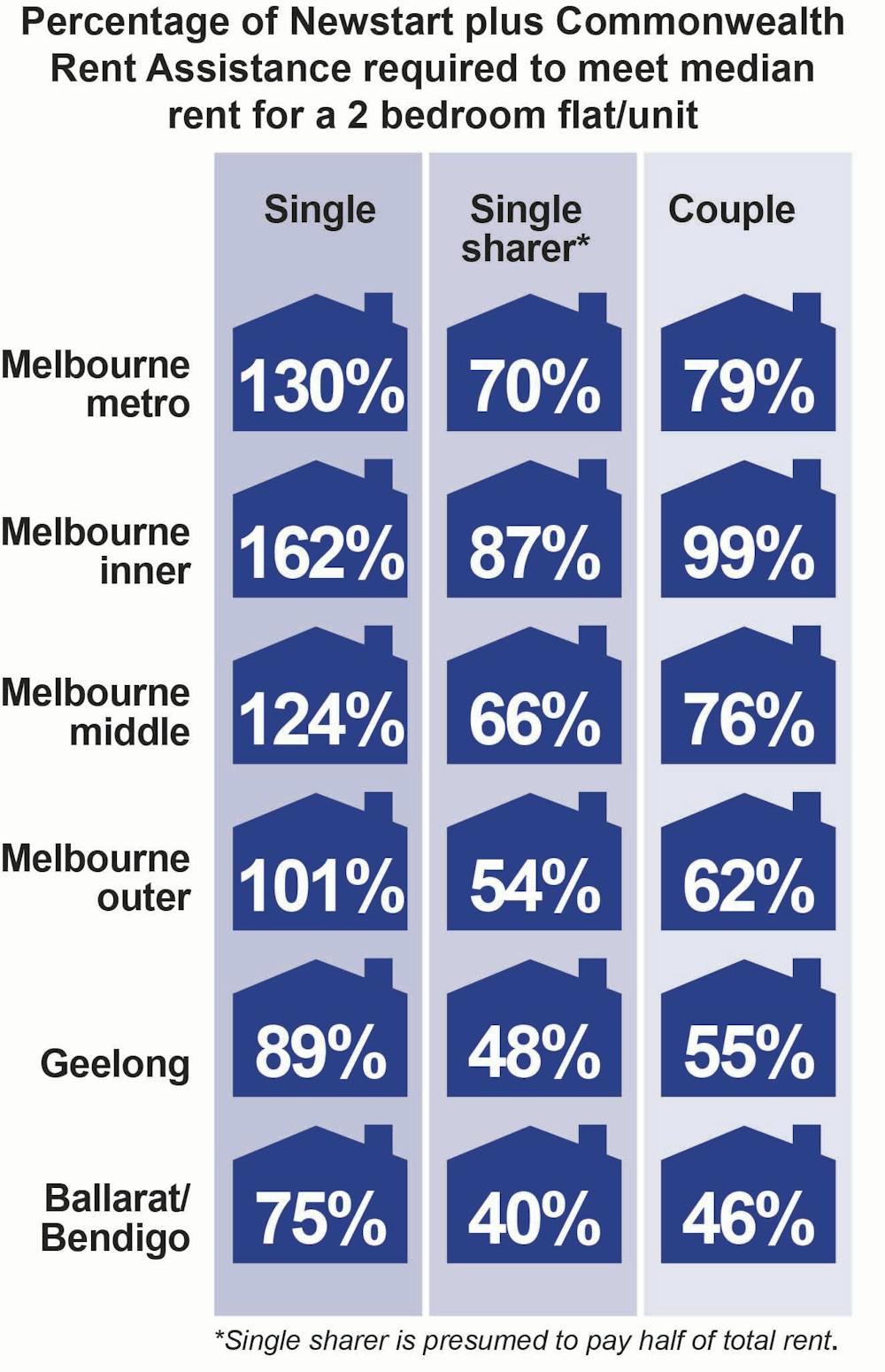
For example, the dataset for Victoria (the third-most-expensive rental market and broadly representative of the nation) shows rent for a share house in Melbourne averages 70% of income for a single person receiving Newstart (A$277.50 per week) and Commonwealth Rent Assistance (A$45.74 per week). This leaves people with A$98 a week to live on. That’s less than half the A$216 a week that experts calculate is a healthy base level of income for a single unemployed person.
After paying rent, people on Newstart have just A$14 a day to cover food, utilities and the costs of job seeking such as mobile phone plans and travel cards (A$4.40 a day in Melbourne).
Author analysis based on REIV data, Author provided
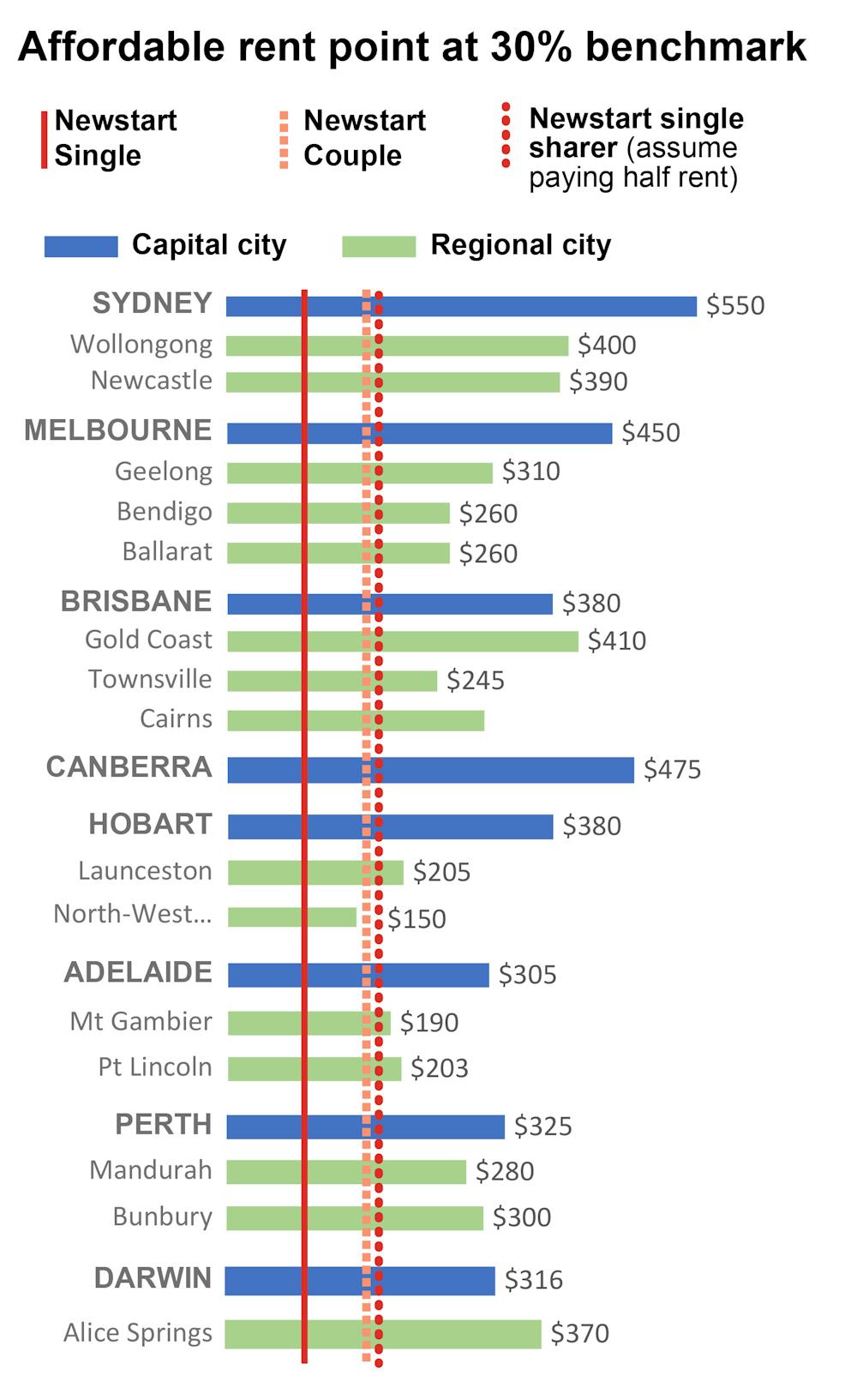
While it was assumed rent for people on low incomes eats up much of their benefits, this analysis shows just how bad the situation has become in all capital cities. It is worst in Sydney. As the chart below shows, median weekly rent in Sydney is A$550, which when split between two renters amounts to A$275 each. This leaves a renter on Newstart with the princely sum of just A$48.24 a week – A$6.89 a day – to live on.
Affordable rent points compared to median rents in capital cities.Author analysis using REIV data, Author provided
Another worrying aspect of the data is it suggests high rents are compelling people on Newstart payments to relocate from inner cities to the outer suburbs and satellite towns with worse labour markets and higher transport costs. And even in these towns, the data paint a bleak picture.
In Victorian regional cities like Bendigo and Ballarat the rent for sharers exceeds the commonly accepted 30% benchmark for housing stress. Here they would be paying A$130 a week – almost half their Newstart payments. With Rent Assistance, that would leave them with A$192 – still A$24 less than the healthy benchmark.
There are only two regions in all of Australia where single unemployed people would have any hope of meeting rents. These are northern Tasmania and outer Hobart, where the youth unemployment rate is 16%. You can add about another 10 points to the unemployment rate to get a real sense of the challenges of getting jobs in these places.
Affordable rent points compared to median rents for regions.Author analysis using REIV data, Author provided
Benefit increases are essential
So what is affordable for people on Newstart? For single people receiving Newstart and Rent Assistance, share-house rents would have to be A$87.
While the table below shows A$97, that would be the affordable rent if maximum Rent Assistance were paid. But it does not actually kick in until weekly rent exceeds A$61. So low-rent places do not attract as much of a subsidy from Rent Assistance as higher-rent properties.
This points to the need for Rent Assistance to kick in at a lower income point. It also needs to be increased to avoid housing stress.
Author provided
The federal government’s response to this kind of evidence always relies on an argument that Newstart is intended as a “transitional” payment. The unemployed are told they should “get a job”.
But it is very clear this is not as easy as it sounds. That is because there are increasing numbers of people on Newstart with disabilities and over 55 years old – the majority of long-term unemployed are now mature-age job seekers.
Many welfare agencies are preparing submissions to a Senate inquiry into Newstart and related payments in time for the September 30 deadline. These submissions are expected to contain even more compelling analysis showing it is impossible to survive on Newstart.
Tonight is the AFL’s annual night of nights, the red-carpet spectacular known as the Brownlow Medal vote count.
The Brownlow is awarded to the season’s “fairest and best” player. But is the way the medal gets decided really the fairest?
Research I’ve done with Aaron Smith of Loughborough University suggests footballers don’t compete for the Brownlow on a perfectly level playing field. There’s a slight bias towards team leaders.
As a sports economist, I’m fascinated by what the Brownlow Medal count can tell us about the science of evaluating performance in any organisation. In any job, all other things being equal, a performance appraisal may be better (all else equal) once you have worked your way up the corporate ladder. In a perfect meritocracy this would not be the case.
Evaluation bias
Aaron and I have long been interested in the extent to which people in leadership positions receive undeservedly high performance evaluations just because of the managerial networks that arise from the status those positions provide.
Generally we think this occurs because of inevitable human-relationship factors. The more interesting question is whether it happens in cases where the evaluation process is entrusted to external agents (such as HR consultants) supposedly independent of such influences.
This is a difficult question to investigate. Business organisations are not inclined to hand over employee evaluation data to pesky academics. The Brownlow offers a rare analogous opportunity to analyse empirical data.
Richmond’s Dustin Martin won the 2017 Brownlow medal.Julian Smith/AAP
Brownlow Medal votes are allocated by field umpires (who are, of course, similarly “external” to the competing firms). After each game of the regular season they confer and nominate the three top players. The best player gets three votes, the second two and the third one. This is actually a very rare case within the pantheon of global best-player awards in major sporting leagues where umpires cast the votes.
And come medal count night, the votes are in the public domain.
The data goes back to 1984 (before that, votes were not recorded to the match in which they were cast), and is available on the AFL Tables website. We have used different statistical tools to analyse the data, as well as a comprehensive database of match statistics for about 100,000 player-within-match records from all 2,254 home-and-away AFL matches played from seasons 2006 to 2017. These statistics cover the number of goals, kicks, handballs, tackles and so on by each player.
Significant statistics
Testing for bias towards team leaders has an intuitive underlying justification. Umpires have more contact with captains, such as through the pre-match coin toss. This may unconsciously influence umpires’ perceptions.
The raw data did tell us captains earn, on average, a lot more more Brownlow votes. But this alone does not imply a voting bias. Other factors must be considered. For one thing, captains are likely to be credentialed and talented players. That’s why they’re captains.
We sought to take this into account by figuring into our model a large range of player statistics indicating individual performance within each match.
Our results show that, when controlling for player performance, team captains poll between 1.3% and 2.1% more votes than all other players. There is a strong statistical significance here.
The effect for vice-captains was smaller, from 0.6% to 1.5%. There was no significant vote boost for acting captains who normally have no leadership position.
Mitigating factors
In explaining the results, we cannot rule out possible actions not captured within our statistics at which captains have excelled and that have been noticed by umpires.
It may be, for example, that captains have kicked a crucial goal with a higher than average degree of difficulty or made a decisive tackle that has helped turn a game. Statistics alone don’t tell the whole story. Identical player data doesn’t necessarily have the same vote “impact”.
But based my own experience as a former umpire for 15 years (at suburban level for Melbourne’s Northern League), I am convinced captaincy status does really matter in junior games when the umpires are often not previously familiar with any of the players.
Carlton co-captain Patrick Cripps, centre, is considered a strong contender to win the Brownlow Medal for 2019.Michael Dodge/AAP
Field of favourites
But it’s a game of percentages. No captain has won the Brownlow since Carlton’s Chris Judd in 2010. Essendon captain Jobe Watson did poll the most votes in 2012, but he was later stripped of the award due to the club’s doping scandal.
So I am noncommittal about tonight’s Brownlow Medal outcome, though our research does seem especially relevant given the favourites this year.
Most obviously there is Carlton’s Patrick Cripps, recently awarded the Leigh Matthews Trophy given by the AFL Players Association to the league’s “most valuable player”. Cripps also became Carlton co-captain this year.
Also among the bookies’ favourites (though at longer odds) are Fremantle captain Nathan Fyfe and Collingwood captain Scott Pendlebury.
The information we encounter online everyday can be misleading, incomplete or fabricated.
Being exposed to “fake news” on social media platforms such as Facebook and Twitter can influence our thoughts and decisions. We’ve already seen misinformation interfere with elections in the United States.
I and two colleagues have received funding from Facebook to independently carry out research on a “human-in-the-loop” AI approach that might help bridge the gap.
Human-in-the-loop refers to the involvement of humans (users or moderators) to support AI in doing its job. For example, by creating training data or manually validating the decisions made by AI.
Our approach combines AI’s ability to process large amounts of data with humans’ ability to understand digital content. This is a targeted solution to fake news on Facebook, given its massive scale and subjective interpretation.
The dataset we’re compiling can be used to train AI. But we also want all social media users to be more aware of their own biases, when it comes to what they dub fake news.
Humans have biases, but also unique knowledge
To eradicate fake news, asking Facebook employees to make controversial editorial decisions is problematic, as our research found. This is because the way people perceive content depends on their cultural background, political ideas, biases, and stereotypes.
Facebook has employed thousands of people for content moderation. These moderators spend eight to ten hours a day looking at explicit and violent material such as pornography, terrorism, and beheadings, to decide which content is acceptable for users to see.
Consider them cyber janitors who clean our social media by removing inappropriate content. They play an integral role in shaping what we interact with.
A similar approach could be adapted to fake news, by asking Facebook’s moderators which articles should be removed and which should be allowed.
AI systems could do this automatically at a large scale by learning what fake news is from manually annotated examples. But even when AI can detect “forbidden” content, human moderators are needed to flag content that is controversial or subjective.
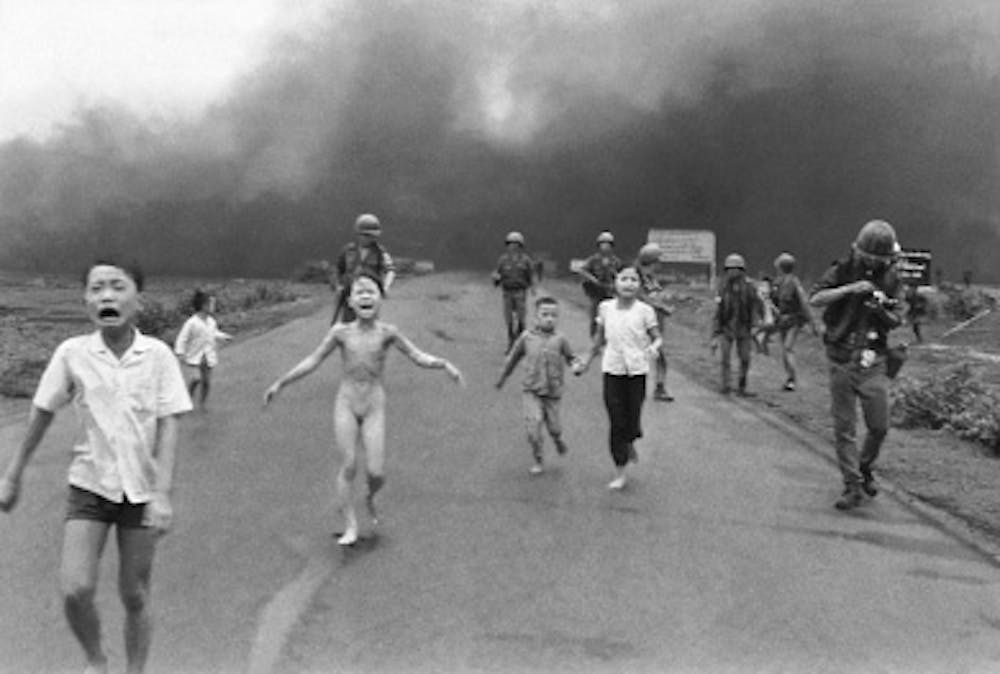
A famous example is the Napalm Girl image.
The nine-year-old in the Napalm Girl image is Canadian citizen Phan Thị Kim Phúc OOnt.Nick Ut / The Associated Press
The Pulitzer Prize-winning photograph shows children and soldiers escaping from a napalm bomb explosion during the Vietnam War. The image was posted on Facebook in 2016 and removed because it showed a naked nine-year-old girl, contravening Facebook’s official community standards.
Significant community protest followed, as the iconic image had obvious historical value, and Facebook allowed the photo back on its platform.
Using the best of brains and bots
In the context of verifying information, human judgement can be subjective and skewed based on a person’s background and implicit bias.
In our research we aim to collect multiple “truth labels” for the same news item from a few thousand moderators. These labels indicate the “fakeness” level of a news article.
Rather than simply collect the most popular labels, we also want to record moderators’ backgrounds and their specific judgements to track and explain ambiguity and controversy in the responses.
We’ll compile results to generate a high-quality dataset, which may help us explain cases with high levels of disagreement among moderators.
Currently, Facebook content is treated as binary – it either complies with the standards or it doesn’t.
The dataset we compile can be used train AI to better identify fake news by teaching it which news is controversial and which news is plain fake. The data can also help evaluate how effective current AI is in fake news detection.
Power to the people
While benchmarks to evaluate AI systems that can detect fake news are significant, we want to go a step further.
Instead of only asking AI or experts to make decisions about what news is fake, we should teach social media users how to identify such items for themselves. We think an approach aimed at fostering information credibility literacy is possible.
In our ongoing research, we’re collecting a vast range of user responses to identify credible news content.
While this can help us build AI training programs, it also lets us study the development of human moderator skills in recognising credible content, as they perform fake news identification tasks.
Thus, our research can help design online tasks or games aimed at training social media users to recognise trustworthy information.
Other avenues
The issue of fake news is being tackled in different ways across online platforms.
It’s quite often removed through a bottom-up approach, where users report inappropriate content, which is then reviewed and removed by the platform’s employees..
In each case, the need for people to make decisions on content suitability remains. The work of both users and moderators is crucial, as humans are needed to interpret guidelines and decide on the value of digital content, especially if it’s controversial.
In doing so, they must try to look beyond cultural differences, biases and borders.
Not to put a damper on things, but Australian food hasn’t always made us happy little Vegemites.
One needn’t look further than the humble meat pie to see how our love/hate relationship with Aussie tucker has evolved. In the early 20th century, the dog’s eye was just a cheap staple on our menus and was peddled by roaming pie-carts.
So low was the lowly meat pie that it became a pejorative term for second-rate boxers, racehorses and bookies. The Australian meat pie western took its place alongside the spaghetti western as a low-quality US cowboy flick not actually filmed in the US (the latter were filmed in Italy).
But Australians love an underdog, and things began to look up for the meatie from the second world war. When American soldiers arrived, their “Pocket Guide to Australia” noted that meat pies were
the Australian version of the hot dog.
And since at least the 1970s, we’ve had the high mark of patriotism being as Australian as a meat pie.
Of course, modern Australian (mod Oz) cuisine is much more than meat pies and steak and cake (in the words of author Patrick White). So, we thought we’d play babbler (babbling brook “cook”) and cook up a tale of Aussie tucker and its words — a kind of degustation with gobbets of linguistic and culinary history. .
Classy eating, bush tucker and the wallaby trail
From the time of settlement, Australian eating was a story of haves and have nots.
The first Australian cookbook was released in 1864 under the title An Australian Aristologist. The aristologist was the foodie of the 19th century, but the word never took off, pushed out by others like gourmet — French has always given the dining experience a certain je ne sais quoi.
The Australian Aristologist (prominent Tasmanian, Edward Abbott) extolled the virtues of herb gardens, yeast and 30 or so types of bread, but his privilege led him to largely ignore the core staple of many everyday Australians —damper.
This simple, unleavened bread baked in ashes comprised (along with tea and mutton) the bushman’s dinner. It was the linguistic offspring of the original British damper “anything that took the edge off an appetite” with a verbal twist (to damp down “cover a fire with coal or ashes to keep it burning slowly”).
Life could be rough for the bushman and the itinerant worker. Those lucky enough to make tucker (“earn enough to eat”) might tuck in to (“eat”) some banjo (“a shoulder of mutton”), the Old thing (“damper and mutton”) or the bushman’s hot dinner (“damper and mustard”). Those less lucky might be reduced to their billy, a duck’s breakfast (“water”) and the wallaby trail (“the search for food or work”).
The bush diet could be quite muttonous (“sheep-based”), but meat-eating was fraught with gastronomic red herrings (John Ayto’s term). Underground mutton wasn’t mutton, but rather “rabbit”. Colonial goose actually was mutton (“boned leg stuffed with sage & onions”) and so was colonial duck (“boned shoulder with sage and onions”). But Burdekin duck was neither duck nor mutton, but rather “sliced meat fried in batter”. And we reckon seafood fans best steer clear of bush oysters (“testicles”).
Sausage wars and snake’s bum on a biscuit
The Australian food lexicon is often driven by our relationships with one another and the world.
German migration, especially to South Australia, led to the German sausage or the Fritz. However, first world war anti-German sentiment led to attempts to relabel this sausage the Austral. Such renaming efforts were to no avail in South Australia, where Fritz remains Fritz, but were more successful elsewhere.
When the British Royal family changed their surname from Saxe-Coburg-Gotha to Windsor in 1917, Queenslanders followed suit and the German sausage became the Windsor.
Perhaps our most honest assessment of sausages (but also snags, snaggles, snorks, snorkers, starvers, Hitler’s toe in its many varieties) comes from Australian homes and housewives: mystery bags.
Nancy Keesing’s “Lily on the Dustbin” is a treasure trove of such food slang and metaphor among Australian women and families. Keesing highlights heaps of fun ways of expressing hunger:
I could eat a hollow log full of green ants.
I could eat a horse and chase the rider.
I could eat the bum out of an elephant.
I could eat a baby’s bottom through a can chair.
And there are equally fun and cheeky answers for that perennial question, “what’s for dinner?”:
Snake’s bum on a biscuit.
Wait and see pudding.
Standby pudding.
Open the dish and discover the riddle.
Though humorous, Keesing notes that many of these sayings have sombre origins in the Depression era, when dinner really might have been an unfolding mystery from day to day.
Multiculturalism beyond the “culinary cringe”
South Australian Premier Don Dunstan’s 1970s cookbook begins with the following:
For the most part, before the Second World War, our cuisine reflected the decline into which the average English cook of the nineteenth century had sunk. After the war, the influence of migrant groups […] influenced Australian food habits for the better.
The delightfully named (and delightful) Australian food writer Cherry Ripe announced in the 1990s that we were saying goodbye to the culinary cringe – and ours was among the best food in the world.
Our acceptance of multicultural delights have played no small role in this.
For many years, Chinese and Greek pub cooks were relegated to cooking standard Australian fare (such as steak and eggs). But the dim sim/dim sin has long been a bellwether for the culinary delight to come. In fact, American servicemen in Australia during the second world war were informed in their “Pocket Guide to Australia” that the “dim sin” was the Australian replacement for the hamburger.
But since then, we’ve seen a proliferation of multicultural food items — our cook’s tour has barely scratched the surface. Lots of words are like the cocky on the biscuit tin (“left out”).
We’d love to tell you more about how the chiko roll evolved from observations that chop suey rolls kept falling out of footy fans’ hands. And we’d love to tell you how the lives of the bushmen might have been easier — if they had only taken to the delicacies offered by Australian Indigenous people.
But alas, dear reader, we can but invite you to contribute your favourite food words and stories below!
Sam is a high school drama teacher — articulate, funny, smart. It’s an ordinary day and she isn’t feeling great, but pushes through. At morning tea, she spills coffee down her shirt; at lunch she notices a strange sensation in her lips and tongue. Then her speech starts to sound odd, slurred, indistinct.
Sam is having a stroke. In the following months, her speech is still painstakingly slow, full of mistakes, hard to understand.
Sam is still funny and smart but no-one can see that. She can’t work. Her friends are impatient or embarrassed, condescending at times, and they gradually disappear.
Fortunately, help is available. But the path to recovery will test Sam’s mettle and redefine her identity.
How common are conditions like Sam’s?
Speech disorders like Sam’s can affect people at any age. But people aren’t generally aware these problems can arise as an adult.
In Australia, someone has a stroke every nine minutes. That means about 153 people have a stroke every day. Up to 70% of people who survive a stroke cannot speak clearly and intelligibly. For about a quarter of these stroke survivors, these effects persist for months to years.
About a third of stroke survivors are under the age of 65, like this man who now has an asymmetrical face, and whose speech might be impaired.from www.shutterstock.com
While stroke is most common in the elderly, 30% of stroke survivors are under the age of 65.
Acquired speech disorders are even more common in other conditions. About 50% of people with Parkinson’s disease, up to 50% with multiple sclerosis, and as many as 65% with a traumatic brain injury have them.
Sam’s stroke damaged the area of the brain that controls her mouth movements, causing a motor speech disorder. There are different types. But Sam has the type called apraxia of speech. Her muscles still work fine for eating but, when it comes to speech, she can no longer control precisely where they move and when.
Other types of motor speech disorders are called dysarthrias and can make the muscles too tense, too relaxed, or limited in their range of movement.
Motor speech disorders are different to language disorders, called aphasia. Aphasia affects your ability to find the right words and sentences to convey your ideas or to understand what others say to you. However, motor speech disorders and aphasia can occur together.
The effects can go beyond losing your speech
Sam told me, as part of yet-to-be published research, out of all the difficulties after her stroke:
[…] speech was by far the most alienating one.
If you lose your speech, you can lose your job, your social network, your independence, your identity. Some have likened it to being in a foreign country and not being able to communicate at all.
But it’s not quite the same. People with motor speech disorders often can understand everything you say. They want to respond and contribute to the conversation, but their disorder means people don’t understand what they say or they speak too slowly.
In this example, someone with a motor speech disorder, like the one Sam has, finds it difficult to say longer, more complex words. The person is saying “the municipal judge sentenced the criminal”.
If you lose your speech, what can you do?
People rarely realise learning to speak required thousands of hours of practice. By the time children turn four, they produce on average 1,900 speech vocalisations a day. These not only include words, but also phrases produced on one breath.
But you can’t remember this, so developing your speech seemed effortless. In fact, most of us take our speech for granted.
The good news is, speech is like any other complex motor skill. It is like swimming or playing the piano, or relearning to walk after a stroke. If you use it, you can improve it.
As Sam realised:
If I work as hard as I can, there’s no way I can’t get a little better.
What type of therapist do I need?
So, what type of help is available? A good place to start is a speech pathologist.
You can find one in hospitals, rehabilitation centres and in the community. They work with you to build a program of practice and activities to improve your speech.
A speech pathologist will work with you to build a program of activities and practice to improve your speech.from www.shutterstock.com
While relearning to speak is not easy, we nowknow people respond to carefully structured therapy that stimulates activity in the undamaged parts of the brain that control movements needed for speech.
For instance, a typical session might involve practising useful words or phrases (by yourself or out in the community), making sure you use all the right sounds, over-enunciating, and gradually speeding up to sound more natural.
Not everyone can access therapy
But there’s a problem. Most people can’t afford one-on-one sessions with a “trainer” or therapist for multiple practice sessions a week. And it’s uncommon for a speech pathologist to work with a patient for months at a time.
According to Speech Pathology Australia’s submission (submission 224) to a Senate committee into speech pathology services, specialist services for adults with speech disorders are “extremely limited”.
The support of friends and family is critical in helping people on the long road to recovering their speech.from www.shutterstock.com
While health-care systems and funding may support people in the early stages after a stroke or injury, the submission continues “long term help available in the community, and support for communication are severely lacking”.
This situation is perplexing given a communication disorder has a “huge impact on an individual’s productivity and participation”.
What happened to Sam?
This was Sam’s experience of working with a speech pathologist. She told me:
First you have […] contact but then it’s expensive.
Sam and her family soon realised the ball was in their court:
That’s how it all started – taking accountability for my own recovery. The most important thing for me was knowing it’s possible – instilling hope.
Sam used what she had learned in her speech therapy sessions. Combined with her intelligence, common sense, tenacity, and her family and friends, she created her own rehabilitation program.
It included a range of exercises to target specific skills, such as challenging words, speech rhythm, and fluency in conversation. She practised every day in different environments — at home, out with friends, in noisy and quiet environments. She used different supports, sometimes a notepad, other times a phone app.
Like a personal training program at the gym, she has done this every day, ever since.
It is now nine years since Sam’s stroke. She’s back working. Her speech, most of the time, doesn’t attract attention. She trips over the occasional longer word (legitimatise is one recent example) and her speech can sound a little drunken if she gets over-tired. She says, it was perhaps the greatest challenge of her life but worth the fight.
What could we do better for people like Sam?
Sam is just one example of how the current health-care model of rehabilitation services for people with long-term communication difficulties is not fit for purpose.
Sam embraced the challenge to create her own program but for many this is overwhelming.
The predominant model of therapy, heavily supervised by an expert clinician, needs to change. Instead, we need to encourage a person’s “ownership” of their own recovery, encourage people to share accountability for therapy goals and outcomes with clinicians, have programs available in the community, and support people to build a strong network of family, friends and colleagues.
A speech pathologist is a critical member of the team. But people with speech disorders will be disadvantaged until we embrace models of care like Sam’s.
Find an Australian speech pathologist near you. Paid and free resources about motor speech disorders are also available.
Our research project explored the everyday lives of disabled young people, aged from 12 to 25 years, with mobility, vision and hearing impairments. We measured and asked them about factors that enabled or constrained their opportunities to fully participate in community life, including education, employment and recreational activities.
With support from participants and our research advisory group of young disabled people and their whānau (extended families), we have collaborated with graphic artist Toby Morris on a comic to highlight participants’ accounts of everyday ableism they encounter. We hope this comic will invite and challenge able-bodied people to think and act differently.
Toby Morris/Health Research Council, CC BY-SAToby Morris/Health Research Council, CC BY-SA
In Aotearoa New Zealand, one in four people are disabled. As elsewhere, they have lower levels of participation compared to their non-disabled peers. Urban environments are structured from ableist perspectives to work well for “ableds” who fit hypothetical norms of movement, sight and hearing. They presented numerous obstacles to participation. But participants identified discriminatory ableist attitudes as a greater constraint on their community participation than physical barriers.
Toby Morris/Health Research Council, CC BY-SAToby Morris/Health Research Council, CC BY-SA
Reducing emissions from deforestation and farming is an urgent global priority if we want to control climate change. However, like many climate change problems, the solution is complicated. Cutting down forests to plant edible crops feeds some of the world’s hungriest people.
More than 820 million people suffer from hunger, and about 2 billion people face moderate food insecurity – meaning they do not always know when their next meal will come.
After a decade of slow decline, climate change is driving this number up again, particularly in Africa and Asia, where competition over land for both farming and forest conservation is acute.
But villagers in the Himalayas are turning to a traditional practice that can slow land clearing and feed people: growing and collecting food from the forests.
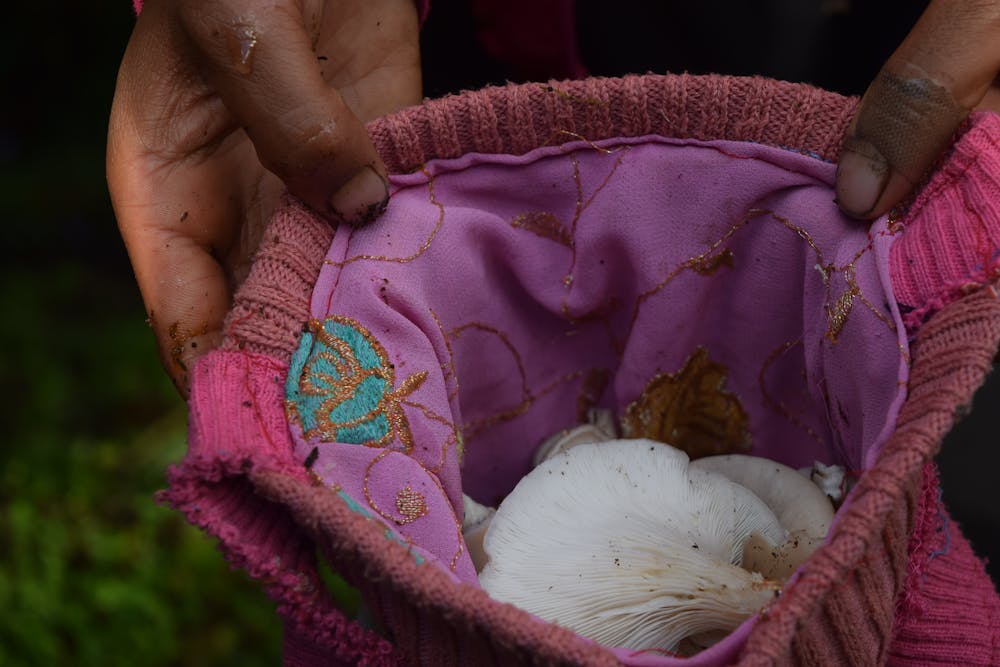
Mushrooms, as well as honey, roots and other edible plants are harvested by locals as an important food source.Jagannath Adhikari, Author provided
Food in the forest
My research in the Himalayan region, where high population density means farmland is very scarce, investigated how people used their forests as a food source.
An “edible forest” is one in which people have planted trees and crops that can produce food in the forest, as well as harvesting what naturally grows. In fact, this is a traditional practice in the Himalayan region. A farmer I interviewed in Siding village, at the base of Mardi Himal – one of the peaks in Annapurna Himalayan range – told me:
I go to [the] forest when food is scarce at home. I collect vegetables, fruits, nuts, medicinal herbs, spices, roots and tubers. Sometimes I also collect wild honey, bamboo shoots and mushroom, which is consumed at home and also sold in the market. Occasionally, we also get wild meat.
Traditionally, these villagers see forest and farms as an extension of each other rather than distinct categories, and manage them so they support each other.
Generally, people plant trees useful for households – for their wood, for example, or fruit – in the forest close to the villages, and preserve those grown naturally.
The community itself protects the forest, in the past even pooling grains and cash to hire a guard if needed.
This forest food is supplementary, becoming more important in scarce times and as a buffer during famine. Taking wood for fuel or timber is strictly regulated, but there are no restrictions on gathering food, to the great benefit of the poorest.
Collecting food is mainly the work of women, who gather a few things whenever they go into the forest for firewood or animal fodder. They have a great deal of knowledge about edible plants. Men take part by hunting for honey and wild animals. Children, too, go to the forest in their free time to gather berries and tubers.
Sometimes villagers collect these foods to sell in nearby markets as a seasonal source of cash.
A woman sells bamboo shoot in Pokhara, Nepal. These bamboo shoots are collected in forests at high altitude, 2,200-2,600 meters above sea level.Jagannath Adhikari
Modern bureaucracy
The centralised forest management and curtailment of traditional rights of the communities that came with modern forest bureaucracy in the Himalayan region distanced people from the forest. This also led to rapid deforestation between the mid-1960s to 1980s.
This trend was reversed in the early 1990s, when community rights came to the forefront and communally managed forestry gained a strong foothold. This helped reduce poverty. Yet it is still hard for locals to grow food in the forests as they once did. One farmer told me,
We do not destroy forest when collecting these things, but conservation regulation is making this collection difficult.
We need power to move from centralised governments to local stewardship and local knowledge. Government oversight would still be required to protect the local interests, but any new mechanism needs to be developed in consultation with local communities. Research institutions could play a role in finding better ways to meet the interest of local communities when they manage their forest.
If people are actively planting and harvesting in a forest, it may not qualify as protected or conserved land. Conversely, if a local community depends on their forest for food, they may hesitate to register for a formal scheme, for fear they will lose a valuable resource.
If reforestation schemes can be expanded to take into account planting that doesn’t compromise tree coverage, we can encourage rapid growth of edible forests and speed up our response to climate change. It will help meet goals like food security, mitigation and adaptation to climate change, and reducing desertification and land degradation that the United Nations’ Intergovernmental Panel on Climate Change has recommended for sustainable land management in the light of climate change.
Wages sent home by those who move away is a huge part of food security and reducing poverty for many people. In 2018 about US$530 billion was transferred to low- and middle-income countries between family members, compared with US$162 billion in development aid.
This flow of money means families with marginal land – like farmland on hill slopes in Nepal’s case – can afford to slowly convert it to plantations or forests. Migration and remittances – which contribute some 28% of Nepal’s gross domestic product – helps increase forest coverage, especially in marginal lands vulnerable to erosion and landslides.
There is an opportunity to increase planting in these lands, which have been abandoned for farming. If official reforestation policies can acknowledge and support edible forests, we could see the Himalayan region lead the pack on a new way of thinking about forests and food.
Reading aloud can help young children learn about new words and how to sound them. There’s great value too in providing opportunities for children to enjoy regular silent reading, which is sustained reading of materials they select for pleasure.
But not all schools consistently offer this opportunity for all of their students. We regularly hear from teachers and teacher librarians who are concerned about the state of silent reading in schools.
They’re worried students don’t have enough opportunity to enjoy sustained reading in school. This is important, as many children do not read at home.
For some young people, silent reading at school is the only reading for pleasure they experience.
Silent reading silenced
Research suggests silent reading opportunities at school are often cancelled and may dwindle as students move through the years of schooling.
Where silent reading opportunities still exist, we’re often told that the way it is being implemented is not reflective of best practice. This can make the experience less useful for students and even unpleasant.
Yet regular reading can improve a student’s reading achievement. Reading books, and fiction books in particular, can improve their reading and literacy skills.
Opportunity matters too, as the amount we read determines the benefits we get from reading. Regular reading can help with other subjects, such as maths.
So, what should silent reading look like?
Silent reading in school should be fun.Shutterstock/wavebreakmedia
Here are ten important things we need to do to make the most of silent reading in our schools.
If we want young people to choose to read more to experience the benefits of reading, then silent reading needs to be about pleasure and not just testing.
2. Students choose the books
Young people should not be prevented from choosing popular or high-interest books that are deemed too challenging. Books that are a bit too hard could motivate students to higher levels of achievement.
Students have reported enjoying and even being inspired by reading books that were challenging for them, such as J.R.R. Tolkein’s The Lord of the Rings.
Silent reading of text books or required course materials should not be confused with silent reading for pleasure.
3. The space is right
Like adults, children may struggle to read in a noisy or uncomfortable space.
Schools need to provide space that is comfortable for students to enjoy their silent reading.
Children need space to enjoy silent reading.Shutterstock/weedezign
4. Opportunities to chat (before or after)
Discussion about books can give students recommendations about other books and even enhance reading comprehension.
But silent reading should be silent so all students can focus on reading.
5. Inspired by keen readers
If students see their teachers and teacher librarians as keen readers this can play a powerful role in encouraging avid and sustained reading.
School principals can also be powerful reading models, with their support of silent reading shaping school culture.
6. Students have access to a library
Even when schools have libraries the research shows students may be given less access to them during class time as they move through the years of schooling.
Not all students are given class time to select reading materials from the library.
All students should be encouraged to access the school library.Shutterstock/mattomedia Werbeagentur
7. It happens often
This is particularly important for struggling readers who may find it hard to remember what they are reading if opportunities for silent reading are infrequent.
These students may also find it difficult to get absorbed in a book if time to read is too brief.
8. Paper books are available
Reading comprehension is typically stronger when reading on paper rather than a screen.
Screen-based book reading is not preferred by most young people, and can be associated with infrequent reading. Students can find reading on devices distracting.
9. There is a school library and a teacher librarian
Teacher librarians can be particularly important in engaging struggling readers beyond the early years of schooling. They may find it hard to find a book that interests them but which is also not too hard to read.
Librarians are also good at matching students with books based on movies they like, or computer games they enjoy.
10. We need to make the school culture a reading culture
Reading engagement is typically neglected in plans to foster reading achievement in Australian schools.
Practices such as silent reading should feature in the literacy planning documents of all schools.
Allowing students to read for pleasure at school is a big step toward turning our school cultures into reading cultures. Students need opportunities to read, as regular reading can both build and sustain literacy skills.
Reading should be part of the culture of a school.Shutterstock/wavebreakmedia
Unfortunately, literacy skills can begin to slide if reading is not maintained.
We need people to continue to read beyond the point of learning to read independently, though research suggests this message may not be received by all young people.
Where children do understand reading is important, they may be nearly twice as likely to read every day. So silent reading is important enough to be a regular part of our school day.
This article was co-authored by Claire Gibson, a librarian who’s studying a master in education by research at Edith Cowan University.
In Dervla McTiernan’s book, The Scholar, published earlier this year, women are consistently used as the “fall guys” for men with high aspirations. Two young women are killed when they uncover fraud. Another female colleague is then framed for the murders.
Before writing crime fiction, McTiernan worked as a lawyer for 12 years, for international companies like the one in The Scholar. Her background lends her book authority, even though it’s fiction.
McTiernan joins a batch of crime writing women bringing professional clout to their books. Others are Kathy Reichs, Patricia Cornwell, Marcia Clark, Alafair Burke, Anne Holt, and Lisa Scottoline. This list is a tiny fraction of the trailblazing authors.
Crimes close to home
Last week, Elizabeth Farrelly wrote that “crime fiction is the morality drama of our time” that can “heighten and dissect the battle of good against evil enacted daily in our living rooms, cities and streets”. She compared crime books about violence against women with Australia’s deplorable record on domestic violence and rape.
In books written by ex-justice professionals, we are asked to examine our cultural and moral compasses. These authors don’t just write about serial killers – who are thankfully more common in the pages of crime books than in real life – they more often focus on murders by spouses, family members or colleagues of the victim. Some push for changes to how rape trials are prosecuted. They focus on the justice system problems that women face, as victims and as professionals.
The stories also ask us to question how we perceive professional women. These authors’ characters, who often have much in common with their creators, face a barrage of harassment on the job. Lisa Scottoline’s fictional all-women law firm is consistently targeted by abusive prank callers. In her latest book, Feared, the firm is sued for “reverse” sexual discrimination.
What’s the appeal?
Australians are avid readers of crime fiction. In a 2017 study, 48.5% of respondents read crime fiction, making it the most popular genre for enjoyment.
While researching my book on the topic, I had the opportunity to read Dorothy Uhnak’s fan letters, held at the Howard Gotlieb Archival Research Center at Boston University. Readers (many of whom were prison inmates) repeatedly told Uhnak that her books touched on inequalities in the justice system that rang true for them, and reading her work was therapeutic.
Cosy vs hardboiled
Female crime writers have historically been pigeonholed as writing “cosy crime” novels as opposed to more graphic masculine representations of “hardboiled” detectives.
We are used to reading about women as amateurs, from Agatha Christie’s spinster sleuth, Miss Marple, to Janet Evanovich’s bumbling and untrained bounty hunter, Stephanie Plum. Since the 1970s, more authors have written about women as hardboiled private detectives.
Agatha Christie is acknowledged as the grande dame of crime fiction.www.shutterstock.com
Now, we are increasingly seeing women characters in professional roles. When the author is also a professional, she has even more authority. She has “insider knowledge.” Priscilla Walton and Manina Jones surveyed women who read feminist crime series and found that readers identify with the struggles of characters who are realistic professional women. Often, the fictional investigations have similarities to real ones the author has worked on. Central Park 5 prosecutor turned crime author Linda Fairstein received pointed criticism about these similarities.
Ruth Rendell and other authors remember being discouraged from writing crime.
In Australia, ex-police officer Y.A. Erskine’s debut The Brotherhood tells the story of rookie cop Lucy Howard who is blamed when a senior sergeant is killed on a routine call-out. She can’t join the brotherhood of the Tasmanian police force, because, in her words, she doesn’t have the “standard-issue penis”. She is an outsider inside the system.
In Erskine’s follow-up, The Betrayal, Lucy is raped by a colleague. When she makes a complaint, she is vilified and blamed for tarnishing the reputation of the police. The complaint is briefly investigated before being dropped.
Another Australian ex-cop writing crime is P.M. Newton. Her debut, The Old School (notice the theme in the titles?), follows Australian-Vietnamese officer, Nhu “Ned” Kelly. She deals with the racism and corruption of her male colleagues before being shot by one of them.
Newton’s following book, Beams Falling (a reference to Dashiell Hammett’s Flitcraft parable within The Maltese Falcon), tracks Ned’s struggle with post traumatic stress disorder. While fictional detectives usually bounce back quickly after violence, Ned never fully gets over the trauma, and her work offers little support.
Ex-cop Karen M. Davis, has also created a character damaged by her policing experience. Davis’ Lexie Rogers has been stabbed in the neck, and fears facing her attacker in court – a fear exacerbated by her insider knowledge of the justice system. Davis has spoken about how she retired from the police because of trauma, and began writing as a kind of catharsis. Erskine has spoken out about how the rape of Lucy in her books is based on her own unreported rape by a colleague.
These authors have seen the inside of the criminal justice system, its flaws and the experience of women within it. They bring this cachet of lived experiences to their crime fiction. Bestsellers by Marcia Clark or Anne Holt could spark moral reflection, validate women’s experiences, and be part of the cultural shift needed to end violence against women.
Scott Morrison was frank, when quizzed at a news conference during his visit to Washington, on whether he would be seeking to travel to China in the next year.
“Well, you have to be invited to go,” he said.
With Australia-China relations at a low point – due to Australia’s foreign interference legislation, the banning of Huawei from 5G network and other issues – there’s no indication when an invitation might come.
Not that the Prime Minister wants to seem anxious.
He referred to his encounters with the Chinese leadership in the margins of summits, as well as senior level meetings in the areas of foreign affairs, defence and trade.
Pressed on whether he would like to be invited, Morrison said: “Well of course we would go if there was an invitation to attend.
“But it’s not something that is overly vexing us because we have this partnership. We continue to work closely with China,” he said. “So it’s not an issue that’s troubling me at all.”
Amid the glamour and glitter and the mutually admiring exchanges of rhetorically hype between Donald Trump and Morrison, China and Iran were the central policy issues of interest.
Morrison made clear that Australia and the United States brought differing economic perspectives on China. He was keen to encourage a deal to end the US-China trade war, but also to show understanding of Trump position.
He praised Trump’s “natural instinct of restraint” on Iran, despite the President making reference to his nuclear arsenal. Morrison also stressed Australia’s present commitment was strictly limited to the protection of the sea lanes.
He did not explicitly rule out further involvement if the situation escalated, rather saying nothing like that had been asked and people should not get ahead of themselves.
The theme of the Morrison visit is repeated over and over – renewing and modernising the deep connection between the two countries, which is now cast as looking from one century of “mateship” to a second century of it. Leaders of more powerful nations would visit America, Morrison said, “but you won’t find a more sure and steadfast friend, a better political mate, than Australia”.
From where Trump sits, Australia and its PM could hardly tick any more boxes.
The US has a trade surplus with Australia. Australia, as Morrison emphasised, would be spending 2% of GDP on defence – that is, an ally putting its weight. And, as Trump emphasised, it is buying a great deal of defence equipment from the US.
Then there is the fact that Morrison is right up Trump’s alley as a leader – a conservative who has won an election against the odds.
No wonder Trump had a ready reply when reminded of George W Bush dubbing Howard “a man of steel” – Morrison is “a man of titanium”.
On China, the President dwelt on the pain the US was imposing. “They’re having a very bad year, worst year in 57 years. … We’re taking in billions and billions of dollars of tariffs. … They’ve lost over three million jobs there. Supply chain is crashing. And they have a lot of problems. And I can tell you, they want to make a deal.”
Morrison highlighted Australia’s strategic partnership with China. “We have a great relationship with China. China’s growth has been great for Australia.
“But we need to make sure that we all compete on the same playing field,” he said.
On the Middle East, when asked “are you open to further military action against Iran or is the Australian commitment solely contained to a freedom of navigation patrol exercise?” Morrison replied: “As the President said … there are no further activities planned or requested for assistance from Australia, so the question to that extent is moot”.
He praised the “calibrated, I think very measured response” of the US, as the administration announced further sanctions.
“Obviously at any time when issues are raised with us as an ally, we consider them on their merits at the time in Australia’s national interests,” Morrison said at their joint news conference.
Speaking at his news conference for the travelling media Morrison said there were no discussion of anything beyond the present commitment.
“I think people need to be careful about getting ahead of themselves and in running off on where these things might go. I mean these matters … are dealt with I think in a very iterative way, and I think that’s what you’re seeing.”
Morrison announced a five year $150 million investment for the Australian Space Agency to “foster the new ideas and hi-tech skilled jobs that will make Australian businesses a partner of choice to fit out NASA missions” to return to the Moon and travel to Mars.
He said the investment would bring more jobs, new technologies and more investment.
“We’re backing Australian businesses to the moon, and even Mars, and back,” he said.
“We’re getting behind Australian businesses so they can take advantage of the pipeline of work NASA has committed to. There is enormous opportunity for Australia’s space sector which is why we want to triple its size to $12 billion to create around 20,000 extra jobs by 2030.”
The announcement prompted Malcolm Turnbull to tweet:
Morrison repeatedly dismissed as “gossip” – but did not deny – a Wall Street Journal report that he had wanted his close associate Hillsong founder Brian Houston invited to the state dinner but the Americans had vetoed him.
Houston said: “I have had no invitation to the White House and I have had no discussion with the prime minister or anyone else about this”.
Houston received an adverse finding from the royal commission into child sexual abuse. It found that “in 1999 and 2000, Pastor Brian Houston and the National Executive of the Assemblies of God in Australia did not refer the allegations of child sexual abuse against Mr Frank Houston [ Brian’s father] to the police”.
Social media and tech industries have been replicating the ugliest aspects of capitalism from the 1800s, according to an AUT computer science lecturer.
Associate Professor Tony Clear says that social media and tech executives are taking advantage of unregulated markets in a similar way as wealthy industrialists or “robber barons” who exploited abundant resources and cheap labour in the 19th century.
Only now according to Clear, the resources aren’t gold, coal or silks managed out of London or New York. Now it’s data out of Silicon Valley.
“The world of the robber barons has come back to life again with data as the gold dust.”
While the resources might have changed, he says the masses of “manipulated” people are still needed to turn the cogs and drive the profits of the giant digital machine.
– Partner –
“They’re manipulating us through their algorithms. The more we use their platforms, the more we give them, the more they can know about us, the more they can manipulate and control our behaviour.”
“I don’t think it’s a far deal.”
A editor and columnist for computer education magazine ACM Inroads, Clear has written extensively on the flaws in the tech and computing sectors.
He says a lack of ethics throughout the industry, coupled with rampant growth and innovation have made social media platforms dangerous environments where hate – such as that which lead to the Christchurch Mosque Attack – can fester and spread rapidly.
Letter to PM
Which is why after that atrocity, he penned a letter to Prime Minister Jacinda Ardern’s office urging for a “regulatory regime” to be imposed on social media platforms in New Zealand.
While the “robber barons” comparison is not a new one, Clear believes that regulation is key to moderating the potentially dangerous whims of industry heads.
“Because these guys [social media executives] have no moral base we need to regulate the hell out of them,” he says.
Governments appear to have taken steps on this. At the May 15 “Christchurch Call” in Paris, Jacinda Ardern and French President Emmanuel Macron implored social media platforms to take more of a hand in regulating their content.
Tony Clear … “”We’ve got a pact with the devil at the moment…But I think the people will realise they’re being exploited.” Image: Michael Andrew/PMC
It’s not as simple as just asking however, as according to Clear, few industry heads actually know what harmful or bigoted content looks like.
“They don’t know the difference between free speech and hate speech,” he says.
“They neatly wrap it around the US constitution and freedom of speech idea which means you can say any hateful bloody thing that you like.”
While globally Facebook deletes 66,000 posts per week which breach its own definition of hate speech, Clear argues that the platform hides behind the argument that it is not a publisher and does not need to take a strong moral position like newspapers would.
Domestic regulation
This grey area with freedom of speech is the reason some countries are regulating platforms based on their own laws.
Massey University’s Professor Paul Spoonley is an advocate of such a move. An expert on hate speech, he doesn’t think the “Christchurch Call” will make much difference. However, he praises some European countries for already taking the initiative and regulating social media platforms based on domestic law.
“See what the Germans have done which is quite successful. The ethics is not that of Facebook, it is that which has been deemed important by an individual country, in this case Germany,” he says.
Introduced in January 2018, the German law as known NetzDG puts the onus on Facebook and Twitter to differentiate between hate speech and free speech, requiring them to remove any “obviously illegal” hate speech from their sites within 24 hours or face a potential 50 million Euro fine.
As a result Facebook now has 1200 reviewers based in Essen and Berlin deleting at least 15,000 posts each month in Germany.
While regulation appears to be the most obvious tool to fix the tech sector’s ethical vacuum, there is one option that targets the root of the issue. And it starts in the universities.
Ethics in schools
Clear says that young computer science students need to be exposed to more “social good” or ethics papers which can help lay down sound moral foundations on which they will build their careers.
“Its about teaching young computer scientists that there is a bigger world than what they see technically,” he says.
This comes with challenges however.
Along with other leading academics, Clear wrote a paper on value-driven computer science education. It found that many students do not see a link between computer science and societal benefit as they would in careers like nursing and teaching. This also discourages more women from enrolling in computing courses.
“Many avoid taking CS classes because they do not perceive a computing career as having the power to do good and make a difference,” the paper read.
It also read that if there are papers on ethics or social good available, they are usually not introduced until the third or fourth year of studies, long after many students with such inclinations have become discouraged and dropped out of the courses.
Wellington-based computer programmer Oliver Bridgman agrees, saying he couldn’t recall many ethics papers during his studies a decade ago.
“If they were there they were optional and only made up about 5 of 200 points” he says.
He too, draws comparisons between low and mid-level computer science workers and the proletariat of old.
“In my opinion the coders on the front lines are basically your coal miners in the early 1900s except now they get paid a ton more so have to care even less.”
“So your real ethics conundrum is the money behind it all, which is almost always driven by the same capitalism.”
‘Careless’ code
Senior software developer Alex Frere expressed a similar opinion, citing such incidents as the recent Boeing 737 jet malfunction as a result of carelessly written code.
“It’s staggering really that no real code of ethics, or industry standard regulation exists across the tech sector, despite how deeply it’s rooted in modern society.”
However, he points out that there are big players addressing the ethics issue within the industry such as Robert Martin, or Uncle Bob – renowned as one of the fathers of computer science.
“Uncle Bob has coined a bullet point list called the “Programmers Oath”,” Frere says.
“It’s of a similar vein to a doctors Hippocratic Oath, or a lawyer being sworn in after passing the bar.”
While Frere couldn’t recall much ethics being taught in his university course, he hopes that more grassroots teaching along with an increased focus on societal good from an “enlightened youth” will eventually revolutionise the industry.
According to Tony Clear, these types of changes are inevitable as more end users begin to comprehend the insidious perils of technology and the price that must be paid to enjoy it.
“We’ve got a pact with the devil at the moment,” he says.
“But I think the people realise when they’re being exploited.”
Kaveh Zahedi is Deputy Executive Secretary of the United Nations Economic and Social Commission for Asia and the Pacific (ESCAP).
Op-Ed by Kaveh Zahedi, Deputy Executive Secretary of the United Nations Economic and Social Commission for Asia and the Pacific (ESCAP)
Kaveh Zahedi is Deputy Executive Secretary of the United Nations Economic and Social Commission for Asia and the Pacific (ESCAP).
In less than ten days world leaders will be gathering at the United Nations in New York for the Climate Action Summit. Their goal is simple; to increase ambition and accelerate action in the face of a mounting climate emergency.
For many this means ambition and action that enables countries to decarbonize their economies by the middle of the century. But that is only half the equation. Equally ambitious plans are also needed to build the resilience of vulnerable sectors and communities being battered by climate related disasters of increasing frequency, intensity and unpredictability.
Nowhere is this reality starker than in the Asia Pacific region which has suffered another punishing year of devastation due to extreme events linked to climate change. Last year Kerala state in India had its worst floods in a century. The floods in Iran in April this year were unprecedented. Floods and heatwaves in quick succession in Japan caused widespread destruction and loss of life. In several South Asian countries, immediately following a period of drought, weeks of heavy monsoon rains this month unleashed floods and landslides. Across North-east and South Asia, record high temperatures have been set.
The latest research from the United Nations Economic and Social Commission for Asia and the Pacific has shown that intense heatwaves and drought are becoming more frequent; unusual tropical cyclones originate from beyond the traditional risk zones and follow tracks that have not been seen before; and unprecedented floods and occurring throughout the region. The science tells us that the impacts are only going to increase in severity and frequency as greenhouse gas emissions concentrations in the atmosphere continue to rise.
The poor and vulnerable are taking the biggest hit. Disasters cost lives and damage livelihood and assets. Increases in disaster exposure are increasing child malnutrition and mortality and forcing poor families to take children out of school – entrenching inter-generational poverty. And they perpetuate inequalities within and between countries. A person in the Pacific small island developing states is 3 to 5 times more at risk of disasters than a person elsewhere in our disaster-prone region. Vanuatu has faced annual losses of over 20% of its GDP. In Southeast Asia, Lao, Cambodia and Viet Nam have all faced losses of more than 5% of their GDP. In short, disasters are slowing down and often reversing poverty reduction and widening inequality.
But amidst this cycle of disaster and vulnerability lies a golden opportunity for careful and forward-looking investment. The Global Commission on Adaptation recently found that there would be over $7 trillion in total net benefits between now and 2030 from investing in early warning systems, climate-resilient infrastructure, improved dryland agriculture, mangrove protection, and in making water resources more resilient could generate.
So where could countries in the Asia Pacific region make a start? First, by providing people with the means to overcome shocks. Increasing social protection is a good start. Currently developing countries in Asia and the Pacific only spend about 3.7 per cent of GDP on social protection, compared to the world average of 11.2 per cent, leaving people vulnerable in case they get sick, lose their jobs, become old or are hit by a disaster. In the aftermath of Typhoon Hyan in the Philippines we saw effectiveness of social protection, especially cash transfers, but these were only possible because the government could use the conditional cash transfer system and mechanism already in place for poor and vulnerable people.
Second by lifting the financial burden off the poor. Disaster risk finance and insurance can cover poor and vulnerable people from climate shocks and help them recover from disaster, such as Mongolia’s index-based insurance scheme to deal with the increased frequency of “dzuds” where combination of droughts and shortage of pasture lead to massive livestock deaths. Disaster risk finance can also help countries pool the risks as is happening through the emerging ASEAN Disaster Risk Financing and Insurance programme.
Third by increasing investment in new technologies and big data. Artificial Intelligence driven risk analytics as well as fast combination of sensor and geospatial data, can strengthen early warning systems. Big data, including from mobile phones, can help identify and locate vulnerable populations in risk hotspots who have been the hardest to reach so far, ensuring faster more targeted help after disasters. Experience around the region has already shown the potential. In India, a combination of automated risk analytics, geospatial data and the digital identity system (the so called AADHARR system) have helped to identify and deliver assistance to millions of drought-affected subsistence farmers. But much more investment in needed to make technology an integral part of disaster risk response and resilience building.
Climate related disasters are likely to increase in Asia Pacific. This is our new climate reality. The Summit provides the perfect platform to make the commitments needed for helping communities and people to adapt to this reality before decades of hard-won development gains are washed away.
Kaveh Zahedi is Deputy Executive Secretary of the United Nations Economic and Social Commission for Asia and the Pacific (ESCAP)
University of Canberra Deputy Vice-Chancellor Leigh Sullivan discusses Scott Morrison’s new family law inquiry with Michelle Grattan. They also speak of the developments in the Tamil family from Biloela’s case, and the UN barring Australia from speaking at the upcoming climate change summit.
Climate Explained is a collaboration between The Conversation, Stuff and the New Zealand Science Media Centre to answer your questions about climate change.
Electric cars, trains, trams and boats already exist. That logically leads to the question: why are we not seeing large electric aircraft? And will we see them any time soon?
Why do we have electric cars and trains, but few electric planes? The main reason is that it’s much simpler to radically modify a car or train, even if they look very similar to traditional fossil-fuel vehicles on the outside.
Land vehicles can easily cope with the extra mass from electricity storage or electrical propulsion systems, but aircraft are much more sensitive.
For instance, increasing the mass of a car by 35% leads to an increase in energy use of 13-20%. But for a plane, energy use is directly proportional to mass: increasing its mass by 35% means it needs 35% more energy (all other things being equal).
But that is only part of the story. Aircraft also travel much further than ground vehicles, which means a flight requires far more energy than an average road trip. Aircraft must store onboard all the energy needed to move its mass for each flight (unlike a train connected to an electrical grid). Using a heavy energy source thus means more energy is needed for a flight, which leads to extra mass, and so on and on.
For an aircraft, mass is crucial, which is why airlines fastidiously weigh luggage. Electric planes need batteries with enough energy per kilogram of battery, or the mass penalty means they simply can’t fly long distances.
Despite this, electric aircraft are on the horizon – but you won’t be seeing electric 747s any time soon.
Today’s best available lithium ion battery packs provide around 200 watt-hours (Wh) per kilogram, about 60 times less than current aircraft fuel. This type of battery can power small electric air taxis with up to four passengers over a distance of around 100km. For longer trips, more energy-dense cells are needed.
An experimental flying taxi, with a vertical take-off-and-landing, was unveiled in 2019 show in Las Vegas. It is powered by a hybrid-electric system.Bell/Cover Images
Short-range electric commuter aircraft that carry up to 30 people for less than 800km, for instance, specifically require between 750 and 2,000Wh/kg, which is some 6-17% of kerosene-based jet fuel’s energy content. Even larger aircraft require increasingly lighter batteries. For example, a plane carrying 140 passengers for 1,500km consumes about 30kg of kerosene per passenger. With current battery technology, almost 1,000kg of batteries is needed per passenger.
To make regional commuter aircraft fully electric requires a four- to tenfold reduction in battery weight. The long-term historical rate of improvement in battery energy has been around 3-4% per year, doubling roughly every two decades. Based on a continuation of this historical trend, the fourfold improvement needed for a fully electric commuter aircraft could potentially be reached around mid-century.
While this may seem an incredibly long wait, this is consistent with the timescale of change in the aviation industry for both the infrastructure and aircraft design lifecycles. A new aircraft takes around 5-10 years to design, and will then remain in service for two to three decades. Some aircraft are still flying 50 years after their first flight.
Does this mean long-distance flying will always rely on fossil fuels? Not necessarily.
While fully electric large aircraft require a major, yet-to-be-invented shift in energy storage, there are other ways to reduce the environmental impact of flying.
Hybrid-electric aircraft combine fuels with electric propulsion. This class of aircraft includes design without batteries, where the electric propulsion system serves to improve the thrust efficiency, reducing the amount of fuel needed.
Hybrid-electric aircraft with batteries are also in development, where the batteries may provide extra power in specific circumstances. Batteries can then, for instance, provide clean take-off and landing to reduce emissions near airports.
Electric planes are also not the only way to reduce the direct carbon footprint of flying. Alternative fuels, such as biofuels and hydrogen, are also being investigated.
Biofuels, which are fuels derived from plants or algae, were first used on a commercial flight in 2008 and several airlines have performed trials with them. While not widely adopted, significant research is currently investigating sustainable biofuels that do not impact freshwater sources or food production.
While biofuels do still produce CO₂, they don’t require significant changes to existing aircraft or airport infrastructure. Hydrogen, on the other hand, requires a complete redesign of the fuelling infrastructure of the airport and also has a significant impact on the design of the aircraft itself.
While hydrogen is very light – hydrogen contains three times more energy per kilogram than kerosene – its density is very low, even when stored as a liquid at -250℃. This means that fuel can no longer be stored in the wing but needs to be moved to relatively heavy and bulky tanks inside the fuselage. Despite these drawbacks, hydrogen-fuelled long-distance flights can consume up to 12% less energy than kerosene.
This is a concerted effort among news organisations to put the climate crisis at the forefront of our coverage. This article is published under a Creative Commons licence and can be reproduced for free – just hit the “Republish this article” button on the page to copy the full HTML coding. The Conversation also runs Imagine, a newsletter in which academics explore how the world can rise to the challenge of climate change. Sign up here.
“Diversity” is a central theme of the current local government elections – with the common criticism that incumbent politicians are generally too “stale, male, and pale” (or variations on that). Numerous commentators and candidates have lamented the lack of women, ethnic minorities, and youth in local government.
There are signs, however, that the current elections – with voting beginning today – will bring more diversity, with a big push for candidates outside the traditional local government demographics to stand, and for voters not to automatically choose the “stale, male, and pale” options. I’ve covered this in a previous column with regard to generational change – see my roundup: Is a local government “youthquake” happening?
Democracy’s diversity problem
What about other “diversity” demographics? Especially in terms of gender, ethnicity and disability? The best summary of the local government diversity problem is Charlie Mitchell’s must-read analysis of the current demographics of the various elected offices, The white, male, middle-aged face of local government. In this, Mitchell asks the question: “just how unrepresentative are our councils?” The answer: “Probably more than you realised.”
Here’s his summary: “An analysis of nearly 900 elected members, who together represent district, regional and city councils, show they collectively bear little resemblance to the people they represent. Of the 77 local authorities in New Zealand, not one of them demographically reflects their community, and none even come close.”
Only 38 per cent of councillors elected in 2016 are women. And Mitchell points out that there are only three councils in the country where the majority of politicians are women: “Kaipara, Whangarei, and Waipa, each of which has a one woman majority. Another four councils are evenly split, leaving the remaining 91 per cent of councils as majority male”.
The Minister for Women, Julie Anne Genter, also feels strongly about this, giving a speech in July saying “Women are more than 50 per cent of the population, it would make sense if they were around or closer to 50 per cent of the local government representatives” – see Cherie Sivignon’s Half of local government representatives should be women: Julie Anne Genter.
Speaking to a group that was organising to get more women elected, the article reports: “Genter urged the members of the crowd to stand for election or support those who did.” She said other candidates from underrepresented demographics needed support: “It’s not just women, we need all types of diversity… I would like to see more diversity of age, diversity of ethnicity and background… people who are differently able.”
And on this latter point, see Chris Ford’s opinion piece, Local government’s missing voice. He argues that decision-making at the local level is disadvantaged by the lack of councilors with disabilities, and that unfortunately, there “has been the perception that disabled people are not up to the job.”
Similarly, ethnic minorities are underrepresented. Evan Harding reports: “In a nationwide Local Government New Zealand survey of elected members on councils, local boards and community boards in 2016, people identifying as having predominantly European ethnicity accounted for 89.8 per cent of seats, yet that same group makes up only 74 per cent of the general population. Māori sit at 10.1 per cent of local government seats but represent 15 per cent of the population, Pasifika make up just 2.1 per cent of elected members but are 7 per cent of the population while people identifying as Asian ethnicity represent just 1.4 per cent of seats yet make up 12 per cent of the population.”
The newspaper writes: “That our elections reliably deliver something distressingly close to a conveyor belt of older white men doesn’t mean that, whatever our own background, we share a collective contentment that these are the people we need, such is the depth of their skills and the acuity of their social insights.”
What’s behind the lack of diversity?
There’s a host of reasons that local government – like other parts of the political system – has a representation problem. According to Charlie Mitchell, it’s about prejudice. He says voters “can be susceptible to ‘in-group bias’, a psychological phenomenon in which the person shows an unconscious favouritism to those similar to themselves.”
However, a lot of international research on voter behaviour shows that the public are generally willing to vote for under-represented demographics such as women (who actually tend to have a higher chance of being elected than men), and the problem is instead that there are simply many fewer candidates from these demographics.
A lack of choice is raised by Kate Hawkesby in her column, Where are the women in Auckland mayoral race? She says about the Auckland mayoral race: “Well at the risk of sounding like a gender equality preacher – where are the women? Not that a woman would necessarily be any better, but it’d be nice to have some variety in the race. This is 2019, come on.”
Here’s Marvelly’s longer point: “where are the whip-smart, forward-thinking female Māori, Pasifika, Asian, Indian candidates (because you can’t tell me that of the many amazing women of colour in this country there aren’t a few who could stand for mayor)? Where are the LGBTQ+ candidates? And if they’re already putting their hands up, why are they not getting the same traction/support/media attention as Phil Goff, John Banks, John Tamihere and co.?”
Marvelly’s explanation is this: “I would venture that the establishment hasn’t been particularly welcoming to them. Councils have historically been colonial hangovers dominated by land-owning men.”
Could the problem relate to the electoral system that is still used in most local government contests? The First-past-the-post system is pinpointed by Julie Anne Genter as the problem, and she argues that the system tended “to discourage a whole range of people from standing”. She told a Nelson meeting she spoke to in July that the Single Transferable Vote (STV) system – which is used in cities like Wellington and Dunedin – is “more democratic and ensures that there’s greater representation of diverse groups and women”.
This system is discussed in more detail by Hayden Donnell in his article, The one, stupidly obvious change that would vastly improve our local elections. According to this, “STV’s ability to better reflect the will of the entire voting population means it’s more likely to produce councils that look like the communities they represent. Research by Hayward and Professor Jack Vowles shows more women were elected under STV voting systems in the 2013 elections.”
The STV voting system’s purported ability to produce diversity will be tested again this year, as it’s been adopted for the elections in New Plymouth, where a typical underrepresentation problem currently exists: “Māori – who make up 15 percent of the population – are not represented at all. Women hold just two seats despite outnumbering in men in the district. Middle-aged Pākehā males fill 12 seats while one councillor has European-Chinese heritage” – see Robin Martin’s New Plymouth District Council seats: ‘We need a good mix to make good decisions’.
Many are sceptical as to whether STV will make a difference. Businesswoman Anneka Carlson (31), who is also the youngest candidate, is reported as saying the STV system is a bigger problem than the lack of diversity, as few understand how it works, herself included.
She’s making a pitch for the diversity vote nonetheless: “You know not just vote for the straight white old males, but be like I’m going to give these young people a shot. I’m going to give Māori, Asian whatever you are gay, straight a shot and see what they’ve got… And then next time around if they did nothing and were useless well you go back to the stale, old, white male.”
The same article cites the former mayor of New Plymouth, Andrew Judd, who is also a campaigner for “set seats” on the council for various demographics, as believing the shift to STV won’t help, as “the tyranny of the majority dominates”.
Reducing barriers via childcare allowances
Could the diversity problem be caused by the way that councils are run, being that meetings and procedures are often said to suit those who are either retired, own their own businesses, or don’t have commitments to young families?
The issue of childcare has been identified as one of the barriers for some candidates stepping forward to be involved in local government. Hence there has been a campaign to establish an allowance in local government for councillors who are also primary caregivers, which would help pay for childcare while on council duties.
The origin of this initiative is covered by Emma Dangerfield in her article, Costs for childcare could be covered for local government representatives. Two councillors, Julia McLean from Hurunui and Matt Lawrey from Nelson campaigned for the establishment of the allowance, which is capped at $6000 a year. According to this article, “Lawrey said a lot of people did not understand how difficult it was financially and logistically for people who were not retired to serve on councils, particularly in the regions.” He is quoted saying, “If adopted, this policy will remove one of those barriers for younger people and women in particular.”
The Remuneration Authority agreed to a request from Local Government New Zealand (the representative body of local politicians), but instead of making the allowance universal they handed the final decision about its introduction to individual councils. A list of some of the councils who have adopted the allowance can be seen in Kiri Gillespie’s article, ‘Selfless’ Western Bay of Plenty council votes for childcare allowance.
Numerous councils have controversially decided against the allowance. For example, “Tauranga mayor Greg Brownless said the city council did not have such an allowance ‘because there was nobody in that position [of needing childcare]’.”
Voting on the issue in councils across the country doesn’t appear to have been along gender lines. For example, when Palmerston North City Council voted against its introduction a few weeks ago, the six votes in favour were three men and three women, and the seven votes against were four men and three women – see Janine Rankin’s Childcare payments for councillors off the table.
For example, the Labour Party’s representative on the council, Lorna Johnson, voted against, saying “I do not think councillors are a special case… We do not pay all our staff a living wage and we are not proposing childcare payment for staff. It’s an issue of fairness.”
Overall it does seem likely that when results come in on 12 October, the 2019 elections will bring a much more representative local government than ever before. This is partly because of the surge of women candidates running – with 73 more standing than in 2016 – but also because of the greater societal awareness about the diversity problem.
Finally, there are also a number of contests in which there are only female candidates running – for example in the mayoral races for both North Canterbury’s Hurunui District Council and Central Hawke’s Bay’s – see Emma Dangerfield’s Women-only mayoral races could signal a new progressive era for local government. Similarly, “Six women at the Central Otago District Council are believed to have scored a New Zealand first by making up the first council to have an all-female executive team” – see Pam Jones’ All-female team thought to be NZ first.
As world chiefs and youth leaders gather in New York at the United Nations Climate Action Summit, many of us as individuals are feeling powerless and overwhelmed. Making big personal changes can appear costly in terms of happiness. And anyway, why should I bother when any difference I can make will be negligible?
As we contemplate our future, we can seek insight from the great philosophers of the ancient world to guide our choices.
Virtue
Socrates wrote nothing, but many of his ideas found their way into the dialogues of his star pupil, Plato. The main character in these dialogues is indeed Socrates himself. In Plato’s most famous work, the Republic, Socrates suggests that he and those around him discuss the most important question there is: how one should live?
One of his interlocutors rather aggressively suggests that the answer is obvious: you should do anything that gives you money, power, and pleasure, and ignore all the constraints of so-called morality, which is just a con dreamed up by the powerful to keep us in our place.
The conflict between the personal goods that Thrasymachus (a sophist and character in The Republic) lists and virtue – or doing what’s right – is at the heart of the climate crisis. Should I take this highly paid job with an international oil company, or work for a local environmental charity? Shall I buy a new SUV, or donate the money and put up with the inconvenience of public transportation?
A harmonious soul
Socrates has some snappy responses for Thrasymachus, but they don’t really work, so he starts to develop a more sustained argument based on the idea of “the soul” – that set of qualities that make us the kind of living beings we are.
There are three main aspects to the soul: reason, desire, and spirit (or emotion). Socrates suggests that the best souls will have reason in charge, shaping and directing the desires with the help of the emotions. So though I may want to be sitting right up there in that SUV, feeling powerful and loving the admiring looks I get from passers-by, what I should ask is whether this is what I have strongest reason to do.
Thrasymachus will of course say: “Obviously, yes!” But Socrates compares souls to cities, and he compares the souls of people like Thrasymachus, who follow their desires wherever they lead, to tyrannies.
While it might seem great to be a tyrant, Socrates predicts that tyrants will slide into a frenzied search for ever greater power and pleasure, never tasting true freedom or friendship. His idea is that you are essentially a rational being, and if you are led by your desires then you are not actively living a life at all. Politicians, take note.
The apparent conflict between personal goods and virtue, then, is only apparent, since you will be not truly happy without virtue. And there does seem to be some modern support for the Socratic view from modern “positive psychology”. This relatively new field suggests many people who care about others and commit themselves to moral goals, report higher well-being and a greater sense of meaning and purpose. Having this sense of life’s purpose has even been associated with a lower risk of death.
But at a time when change is needed, how do I decide exactly what the virtuous thing to do is? Here we can learn from Plato’s most famous pupil, Aristotle.
Aristotle sees that human life consists in various spheres, and that each sphere can often be characterised in terms of a feeling or an action. Take anger. To live virtuously, you have to feel anger in the right way – at the right time, for the right reasons, towards the right people and so on. And there are two ways you can go wrong, by feeling anger in the wrong way, or by failing to feel anger in the right way. The moral life, then, consists in our attempt to hit the sweet angry spot between the two ways that anger can go wrong.
The analysis works in the same way with actions. Generosity is to do with giving away money, and that should be done in the right way. If you don’t do it in the right way, then you are stingy; if you do it in the wrong way, then you are wasteful.
In terms of our climate, this relates to the releasing of CO2. So the central environmental virtue is eco-sensitivity. Someone who releases carbon in the wrong way (leaving their engine running while they visit the shops, for example) is eco-insensitive, and there might also be cases of eco-oversensitivity (refusing to call an ambulance, say, for someone who needs urgent help).
Aristotle notes that we are often more attracted to one particular vice, and here that is of course eco-insensitivity. What we should do, then, is reflect on our own practice. If we think we are tending towards that vice, we should try to come closer to the mean. We don’t have to aim at perfection. We can take one step at a time in the right direction. And – if Socrates is right – we will find that you have not sacrificed much, if anything, of your happiness as you do so.
Since ancient times, other virtues have been added to the list, and hope is another important virtue in facing the environmental crisis.
The ancients did not really consider cases in which a group of people are doing something terrible, though each individual’s contribution makes no perceptible difference. One of the central environmental virtues here is collaborativeness, which leads us in the direction of political as well as personal action.
We are also more aware than the ancients were of the moral significance of allowing things to happen, as opposed to actually doing something about them. We need to take “negative responsibility”, not just stand by and watch as our planet is damaged.
Virtuous action is needed, from the individual up. But by looking to the ideas of the ancient philosophers we can recognise that, at least as far as the climate is concerned, morality requires only small shifts in each moment rather than the seismic shifts that many might fear.
This story is part of Covering Climate Now, a global collaboration of more than 250 news outlets to strengthen coverage of the climate story.
Health authorities in the United States are investigating 530 cases of lung illness, including seven deaths, reportedly connected to vaping. Some of these patients have been diagnosed with lung inflammation caused by inhaling oil.
The US Food and Drug Administration (FDA) has advised many samples tested have contained tetrahydrocannabidol (THC), the psychoactive ingredient in cannabis, as well as significant amounts of vitamin E.
No cases of vaping-related lung disease have been reported in Australia to date. But we know a small proportion of people in Australia do vape (about 1.2% of the population), and may therefore be worried about developing this serious lung disease.
Of people who vape, it’s those relying on the practice to avoid smoking cigarettes who may find the current headlines most confronting.
Many experts regard the delivery of nicotine through vaping to be less risky than smoking traditional cigarettes, because it avoids most of the harmful combustion products inhaled through cigarette smoke.
Whether vaping works to help people quit smoking continues to be debated, although some clinical trials show it is more effective than other quit aids such as nicotine patches. We know some people who vape in Australia are doing so because they used the practice to quit smoking cigarettes.
While vaping products containing nicotine are banned in Australia, some people source them illegally or obtain a prescription to bring them in from overseas. For others, the behavioural features of vaping nicotine-free products may be enough to prevent them going back to smoking cigarettes.
The widespread reports of an outbreak of a sudden-onset and serious lung disease associated with vaping may leave this group wondering if they would be better off ditching vaping and returning to smoking.
The simple answer is, no, they wouldn’t. Research shows vaping poses less of a danger to our health than smoking traditional cigarettes. But that doesn’t mean it’s without risk.
The chemicals in vapour
Most commercially produced vaping liquids contain water soluble liquid (propylene glycol, glycerol), nicotine (though not in Australia), and flavourings. The liquid is heated by the vaping device to produce a mist that’s inhaled into the lungs.
Other substances can also be used in vaping devices. Vaping cannabis extracts and concentrates such as THC oil (known as “dabbing”) has increased in recent years, particularly in the US, where 11 states have legalised recreational cannabis use and over 30 have legalised medical cannabis. It’s likely these sorts of products are in circulation among people who use cannabis illicitly in Australia, too.
Cannabis vaping liquids are often oil-based, unlike most nicotine vaping liquids. Many come from the black market and may be contaminated with pesticides, fungi and heavy metals. There may also be serious risks posed by added ingredients, such as vitamin E oil, a focus of the current US investigation. This additive is used to dilute and then thicken the liquid to hide the dilution.
The risks from inhaling these vaporised cannabis liquids are not fully known, but likely differ from vaping water soluble liquids.
No single chemical has been identified as the cause of all cases in the US outbreak. This may be impossible because for some cases there is no vaping liquid leftover to test, some cases used multiple products, and some people don’t want to admit to using illicit substances.
But based on evidence of a strong association between the cases of illness and vaping illicit cannabis liquids, the FDA recommends consumers “avoid buying vaping products on the street, and to refrain from using THC oil or modifying/adding any substances to products purchased in stores”.
There have been calls in Australia to ban all vaping products in response to the US outbreak. But because most of the outbreak cases have admitted to vaping illegal THC oil liquids, this would be unlikely to prevent similar cases from occurring here.
No recall of commercial nicotine vaping products has been issued in the US, suggesting the regulator does not currently suspect those products are responsible for the outbreak.
The short-term risks associated with vaping commercial nicotine liquids appears to be very low. The long term risks are less certain but there is widespread agreement vaping nicotine liquids is less risky than smoking cigarettes.
Some people turn to vaping as a way to quit smoking.From shutterstock.com
This isn’t the first time vaping has raised health concerns
In 2009, the FDA tested 18 e-cigarette cartridges and found diethylene glycol, an ingredient in anti-freeze, at 1% in one cartridge. However, subsequent studies have either not detected this contaminant, or found it at the trace levels allowed in medicines.
There were also fears vapers could develop bronchiolitis obliterans, a serious and irreversible lung disease, because research found diacetyl, a flavouring added to give a buttery taste, in some vaping liquids.
This disease was nicknamed “popcorn lung” after microwave popcorn factory workers, who were exposed to airborne diacetyl, developed the condition. The urban myth that vaping causes popcorn lung persists, despite no cases being reported from vaping.
Cigarette smokers are actually exposed to more diacetyl from tobacco than are vapers from vaping diacetyl-containing liquid. Nevertheless, the UK banned diacetyl as an ingredient in vaping liquids in 2016 as a precaution.
Other potentially harmful chemicals have been found in the vapour from commercially produced nicotine vaping products. These include metals, acrolein and formaldehyde. But again, these chemicals are found in much higher levels in cigarette smoke, along with more than 5,000 other chemicals, including many carcinogens.
One study that compared the harmful chemicals in nicotine vapour and cigarette smoke estimated the lifetime cancer risk from smoking was 250 times that from vaping.
So, what’s the take home message?
Vaping should not be seen as a harmless practice. Cell and animal studies indicate vaping may adversely affect lung tissue, although it’s uncertain how these effects translate into disease risk in humans. Across the board, we still have a lot to learn about the health effects of vaping long term.
People who do not smoke tobacco should not begin vaping. However, for someone who smokes tobacco, the choice is more complicated because of the very high risks from smoking. Ideally, the safest option is not to smoke or vape, but the priority for smokers should be to stop smoking.
Professional support from Quitline and medicinal nicotine products or prescription medicines can help. But those who have tried and failed to quit, and have switched instead to vaping, should not return to smoking on the basis of these cases in the United States.
To reduce risks to their health, people who vape should avoid any liquids that contain oils, and especially avoid cannabis/THC liquids. Only purchase vaping products from reputable manufacturers, such as those that comply with European regulatory standards. Working towards stopping vaping is also recommended, if this can be done without relapsing to smoking.
In August, a 24-year-old woman appeared before the Western Australian District Court after pleading guilty to concealing the birth of her newborn baby in 2018.
The charge of concealment of birth refers to hiding the dead body of a child after their birth in order to conceal the fact that they were born.
Concealment of birth is a complex charge. It does not investigate how a child has died, or seek to ensure conviction in this matter; instead, it focuses only on whether the body of a baby has been hidden. The charge is also separate from the charges of infanticide or murder.
The unnamed young woman, who was sentenced to a 12-month intensive supervision order, had repeatedly denied being pregnant, concealed her pregnancy and had given birth in secret before placing the body of her child in a box in her bathroom.
During the trial, both the prosecutor and Judge Stephen Scott believed the charge to be a first in Western Australia.
In fact, there has been a long history of women being charged with, and prosecuted for, concealment of birth both within WA and the rest of Australia. And while it may seem a relic from a bygone era, it still happens today, and needs greater research attention.
How common is concealment of birth?
In Western Australia, charges of this kind have been brought before the courts from European colonisation. My PhD research investigated 55 cases linked to infanticide and concealment of birth in WA between 1829 – 1901. Exploration of the TROVE newspaper database provides hundreds of examples across Australia, and the Prosecution Project highlights many more. In some instances, pregnancies were so successfully concealed that when children were found dead after birth, they were never linked to their parents.
Within a historical context, the link between these cases was the shame surrounding illegitimacy and the legal frameworks that prosecuted women who gave birth outside of marriage. While we may live in a society that no longer outwardly condemns women who give birth outside of marriage, powerful social pressures still exist that leave some women feeling unable to access the support they need to access terminations or admit to being single and pregnant.
This means that while it is rare, concealment does still occur.
My research unpacks the history of concealment and explores the striking similarities between a modern-day case of concealment undertaken by a 24-year-old Irish backpacker in 2014 and the case of an unmarried woman in 1832.
In 2014, Caroline Marie Quinn had been travelling with friends in the Kimberley. Quinn “did not realise that she was pregnant” when she went into labour. She appears to have given birth alone, and when her child died due to unexplained circumstances she hid the corpse for several days.
No-one in the sparsely populated Hall’s Creek community or any of Quinn’s friends noticed her pregnancy, nor did they realise that she had given birth to a baby until the body of the child was discovered hidden in a hotel room several days later. The case was not brought to the authorities until Quinn’s friends took her to the local hospital and staff notified police.
Charged with concealing the birth of a child, Quinn was granted leave by the chief magistrate to return home to Ireland while she awaited her trial, as “without trivialising the matter, nothing more serious was alleged than the concealing of the birth”.
She was not required to return to Australia to attend trial and all charges against were dropped as the prosecutor felt “it was not in the public interest” to proceed with legal action.
Any person who, when a woman is delivered of a child endeavours, by any secret disposition of the dead body of the child, to conceal its birth, whether the child died before, at, or after its birth, is guilty of a crime, and is liable to imprisonment for 2 years.
Yet, the legalities surrounding this issue are complex and often come down to individual cases. It can also be difficult to pin down statistics on the frequency of pregnancy concealment nationally.
What can be done to help women and children?
So, why are are there still cases of women concealing pregnancies and what can be done about it?
Shame is timeless. It runs like a viral code through the centuries to resonate within the legal response to women who conceal the birth of their children in Western Australia.
Despite the isolated nature of the state, the nearly 400 years since the laws surrounding concealment of birth were was formed in England, and the varying locations where these women lived and worked, their stories are remarkably alike.
While it is certainly not the case that all concealed pregnancies will lead to the death of a child, little is known about the risk factors linked to pregnancy concealment in Australia. Increasing knowledge in this area should start with a closer look at historical cases, and investigating ways to support women who find themselves in these traumatic circumstances.
Brain regions exchange information by sending and receiving signals through a network of nerve connections.
This exchange is crucial to all aspects of the brain’s functioning, including how we experience the world, form and retrieve memories, and make decisions.
But scientists don’t have a clear idea of how signals find their way through the brain’s complicated wiring.
To understand this problem, our research team spent the past three years studying how brain regions communication with each other, and what we found can help us better understand how our brains function.
Using non-invasive MRI scans, we reconstructed the network of nerve fibre bundles of the human brain. This gave us a model of brain wiring, which we used to investigate how signals may travel between the brain’s regions.
There are three steps in the modelling of the brain’s network of nerve fibre bundles. First, we consider the human brain’s anatomy. Then we use MRI scans to create a 3D model of all nerve connection bundles. Lastly, we reconstruct the brain’s wiring network and use it to understand communication between brain regions.Left: Wikimedia Commons. Centre and right: author provided.
In our research, published in Nature Communications, we discovered that based on how our brains are wired, certain regions are better at sending electrical signals, while others are better at receiving them.
This is an important discovery because it helps us understand how neural traffic is directed in the brain.
Malfunctions in brain communication may be the cause of many debilitating mental health conditions such as depression and schizophrenia. By understanding how brain regions communicate with each other, we can potentially develop new treatments for such diseases.
Two-way connections
In the brain, a nerve bundle connects two regions and allows signals to travel between them.
These connections can be one-way, where signals only travel in a single direction, or two-way, which allows communication both ways.
Scientists discovered this a long time ago by dissecting the preserved brains of humans and other animals.
Non-invasive MRI scans can tell us which brain regions have nerve bundles connecting them, but we can’t know whether they are one or two-way connections.
Also, if they’re one-way connections, we don’t know the direction of movement. This is a limitation of current brain scan technology.
Because scientists cannot tell the difference between a one or two-way connection in the brain, they usually assume all nerve bundles are two-way connections. This is a reasonable simplification in many cases, and has helped us understand a lot about the brain.
But this simplification makes it difficult to study the direction in which electrical signals are travelling. While we can study communication between two parts of the brain, it’s hard to know which region is sending signals and which is receiving them.
Our research helped us get around this problem.
Senders and receivers in the brain
To better understand, imagine you’re on vacation in Paris and decide to rent a car and go for a drive. You’re driving without a destination in mind when you serendipitously arrive at the famous Arc de Triomphe.
‘Receivers’ in the human brain act like landmarks in cities, as they are easy to get to from other locations.Shutterstock
This is not a coincidence. Cities are designed so that important places are easy to get to from many locations. While it may be easy to drive from the car rental agency to the Arc de Triomphe, starting from the famous landmark and accidentally coming back to the agency is less likely.
Our research shows brain communication may work in a similar way. We found that certain regions are, on average, quickly accessible from everywhere else in the brain. We call these regions “receivers”.
Other regions are, on average, good at efficiently reaching most places in the brain, but may not be so easy to get to. We call these regions “senders”.
We found that the division of the brain’s regions into senders and receivers matches previous ideas about how the brain operates.
Senders are in charge of sensory signals such as visual or auditory information. They are the first regions to deal with information coming from the outside world, and can efficiently send this data to the rest of the brain.
On the other hand, receivers are important for complicated thoughts and problem solving. They act as meeting points for information coming from many other regions. They then collect and process this data, with the goal of ensuring our decisions make sense with what is going on in the outside world.
New possibilities
Our research shows that knowledge about sender and receiver regions in the brain can be obtained from a two-way connection model of the human brain’s wiring. Importantly, we reconstructed the wiring using non-invasive MRI scans.
Until now, scientists thought that understanding how the brain’s wiring directs neural traffic was only possible by dissecting the brains of humans and other animals after their death.
Our research introduces possibilities to better understand brain functioning in living people, and how disruptions in neural communication may lead to mental disorders.
Over the next 12 months, a joint parliamentary committee will examine Australia’s family law system. It will be led by conservative Liberal MP Kevin Andrews and One Nation leader Pauline Hanson.
But it would appear the driving force behind this new inquiry is Hanson’s recent unsupported claim that women are frequently making up allegations of domestic violence in family courts.
The Greens and Labor do not support the inquiry. In fact, the Greens described it as “a sop to One Nation by the government” and Labor suggested the prime minister had “done a deal with One Nation”.
It is the latest in a string of inquiries into the family law system and its failings.
In fact, there have already been two very recently: the 2017 House of Representatives inquiry into a “better family law system to support and protect those affected by family violence”, which made 33 recommendations, and the Australian Law Reform Commission inquiry released just this year, which made 60 recommendations to the government. The government has not responded to either of those reports.
We do need to hear more about family violence, not less. But we need action, not yet another inquiry.
No evidence backing Hanson’s claims
There is no evidence, beyond anecdotes, to support Hanson’s claims. In fact, studies conducted in Canada and Australia in the early to mid 2000s found false allegations about child abuse were rare. When they did occur, they were more likely to come from fathers who did not have the primary care of the children.
We have heard all this before. Similar concerns about false allegations were a significant influence on then Prime Minister John Howard’s 2006 reforms to family law.
The research following those changes found the measures designed to address false allegations – for example imposing costs orders, and assessing whether parents were “friendly” about their former partner’s contact with children – only served to silence women. One of the reports, which recommended changes to these provisions, noted:
family violence must be disclosed, understood, and acted upon. […] The family law system, and each component in it, needs to encourage and facilitate the disclosure of family violence, ensure that it is understood, and act effectively upon that understanding.
In other words, there is still a need to enhance the quality and nature of information about family violence provided to the courts.
Inquiries are not the same as research
Family law cases are complex. Those that go all the way to a final hearing before a judge often involve multiple issues, of which family violence is one. They frequently also involve concerns about child abuse, drug and alcohol use, mental health, parenting capacity and neglect.
The courts rely on a range of information and evidence to help them reach a decision. Hanson suggests protection orders have some power in the decisions, but they are just one of the various factors courts will assess to determine the best interests of children and the need to protect them from family violence.
Kevin Andrews and Pauline Hanson will lead the inquiry into family law reform.AAP Image/Mick Tsikas
It is critical any focus on false allegations also includes a consideration of the responses to those allegations. Research has found male perpetrators of family violence engage in a range of tactics to deny, minimise and shift blame about violence.
A parliamentary inquiry is not a research exercise. To suggest it will be able to provide clear evidence about the extent of false allegations (or false denials) is simply untrue.
Parliamentary inquiries receive submissions from a range of people, including members of the public. And in the context of family law, the submissions are likely to come from those who are unhappy with their experience. This is not a representative sample from which it will be possible to draw firm conclusions.
The composition of the inquiry, and the terms of reference, are not likely to encourage victims of family violence, or those working in the services that support them, to come forward and make submissions.
We need action on family violence
The multiple inquiries preceding this announcement show there is a pressing need to address the fragmentation that results from Australia’s federal system, in which family law is a federal concern, while domestic violence orders and child protection are state or territory matters.
This fragmentation results in gaps in information and responses to domestic and family violence.
Also pressing is the need to address the high cost and delays in the family law system. In its report, the Australian Law Reform Commission found 33% of matters pending in the Family Court in June 2018 had been filed over a year ago, and a further 48% had been filed more than two years ago. These delays are mainly a result of under-funding of the courts over a number of years.
Delays are a problem for everyone in the family law system, but they create particular concerns for families with family violence, as interim orders are made without the benefit of full and adequate evidence.
Delays exacerbate costs, and together provide a powerful incentive to settle. And there is concern parties may settle for outcomes that are not safe or satisfactory.
These pressing needs are well documented in earlier reports which include recommendations about how to address them. Action on these recommendations is needed rather than further inquiries.
This story is part of Covering Climate Now, a global collaboration of more than 250 news outlets to strengthen coverage of the climate story.
For three years in a row, the World Economic Forum’s Global Risks Report has identified climate change as the gravest threat for global business and industry.
The disruption of supply chains in food, medicines and even recycling from climate-related events poses innumerable problems for nations. But one way of dealing with various facets of climate change is levering change through central government procurement.
Policies that govern supply and how goods, construction and services are procured are increasingly important as the capacity to mitigate through government purchasing choices faces greater pressure.
The rules include broader outcomes, connecting wider social and environmental priorities to procurement processes. This is the first time New Zealand lays out specific rules about how the government plans to use its own purchases to help fulfil its wider promises.
A cabinet paper on effective government procurement policy, released in late 2018, laid out four outcomes, one of which focused on supporting the transition to a net zero emissions economy and meeting the government’s goal of significantly reducing waste by 2020.
The policy’s priorities include reducing the emissions profile of the government vehicle fleet and reducing emissions from fossil fuels used in electricity generation and in direct production of industrial heat. Describing the government’s intention, Economic Development Minister David Parker said:
We are looking beyond just the price of what we purchase, to ensure procurement is contributing to the transition to a low-carbon economy, inclusive growth and prosperity.
The government’s commitment is to make its own vehicle fleet emissions-free by 2025-26. When replacing vehicles, chief executives of government agencies must purchase vehicles with emission profiles substantially below their current fleet average.
The government fleet – at 14,995 vehicles (with only 0.24% electric) – has a job on its hands. But already it is reporting that emissions have dropped between April and July 2019. The reduction is partly due to 400 fewer vehicles and minor shifts in driving patterns.
This is a gutsy move, especially given cost implications and market challenges. But jurisdictions such as Germany and Sweden have promoted renewable sources for some time through legislation and multiple instruments including procurement that supports innovation. Others, such as Transport London, have been shifting to electric public transport fleets.
New Zealand has been conservative in its approach to linking procurement with objectives beyond “best value”, which is nearly always interpreted as least cost. But times are changing. A growing number of people in most agencies are trying to raise the profile of procurement beyond a purchasing exercise.
Procurement as opportunity and responsibility
Leaving the market to decide how taxpayer funds are spent through a clunky contracting process is missing an opportunity to procure the best services and infrastructure, as well as increasing workforce skills. Research on sustainable procurement has grown and the topic now features at the OECD.
There are different targeted approaches. One is an “emissions dashboard”, which shows the average emissions profile of each agency’s fleet and tracks emission reductions. But dashboards are only indicative, given the inevitable variation in reporting across organisations and the underlying reasons why an agency might have a high emissions rating.
Australia’s Indigenous procurement policy has used a very targeted approach requiring 3% of government contracts go to Indigenous business by 2027. Māori Development Minister Nanaia Mahuta has been looking at the potential for something similar in New Zealand. A report on the benefits of indigenous procurement policies is expected.
Planning to replace vehicle fleets is a tangible use of the procurement lever to move towards lower emissions. But to support a fairly rapid change, supply chains need to be taken into consideration to ensure enough electric vehicles are available.
While there are many technical issues to resolve, New Zealand’s approach to procurement is a step in the right direction. Procurement can’t do everything at once, but it is an important instrument that needs to be directed at policy problems, underpinned by research and evidence.
Women’s nipples have long been a source of fascination and controversy, from celebrity gossip stories of wardrobe malfunctions and “nip slips” to feminist movements for gender equality. Nipples even became a fashion accessory.
Men’s nipples are a different story. While they don’t tend to attract the same type of controversy, people have long been fascinated about why men have them. The question even made it into a popular science book.
So, if (most) men don’t breastfeed, why do men have nipples? The answer lies partly in how we develop in the womb. We’ll get to male breast milk later.
Very early in development, embryos of both sexes have primitive structures that can develop into either male or female reproductive organs (or rarely into a bit of both).
Several genes determine whether the baby ends up with either male or female reproductive organs. A gene called SRY (sex-determining region Y) on the short arm of the Y chromosome is considered the master gene.
This is activated when the embryo is around seven weeks old. When activated, it eventually leads to the development of male reproductive organs and the disappearance of the primitive female reproductive duct.
As females don’t have a Y chromosome, the primitive female reproductive duct continues to develop into female reproductive organs while the primitive male reproductive duct disappears.
But breasts and nipples start to form before the SRY gene has been activated, between weeks four and six. This is when two ridges called mammary crests or milk lines extend between the primitive armpit and the groin.
So, later in male development, even as most of the mammary crest disappears, the cells around the chest that form primitive nipples and areola smooth muscle remain. These remaining cells go on to form the final breasts and nipples.
At around seven weeks, a critical gene is activated that puts embryos on the path to being male or female. But by then, critical cells that go on to become breasts and nipples have already developed.from www.shutterstock.com
Once you’re born
At birth, boys’ and girls’ nipples and breasts look alike. It’s only at puberty, under the influence of hormones, when they begin to change. The nipples of both enlarge but female nipples enlarge more. At the same time, the ducts of the male breasts shrink while female breasts enlarge and remodel. By adulthood, male nipples are smaller and less variable than female ones.
From an evolutionary standpoint, some argue male nipples remain, not because they present any advantages for a male, but because they do no harm. There is no benefit in eliminating them.
When development goes wrong
Sometimes, as with any other body structures, development can go wrong. Around one in 20 people have supernumerary (or extra) nipples. This occurs when parts of the mammary crest remain. Often these nipples are purely cosmetic and resemble nothing more than a small pigmented mole. Only rarely are they fully functional. The highest number of nipples ever recorded on a human male is seven.
Unless you’re one of the rare men who can use their nipples to breastfeed, men benefit from this seemingly redundant body part for a much more common reason.
Nipples respond to sexual stimulation in both sexes. One study found over half the male participants reported feeling enhanced sexual arousal in response to nipple stimulation. There is even one report describing a heterosexual man who requested breast enlargement to increase sexual function of his nipples.
How about ‘man boobs’?
But for some men, breast enlargement can be the unexpected consequence of being overweight or obese. And as we are seeing more obesity in western populations, we’re seeing a rise in “man breasts” or “man boobs”, which are mostly being made up of fat deposits.
Unusually, men can develop breast cancer and it can have serious consequences.
Only 0.5-1% of all breast cancers are diagnosed in men. However, lower awareness of the disease in men means it is more likely to be at an advanced stage when diagnosed. That’s why lumps and changes in men’s nipples (for example, nipple discharge or skin ulcerations such as cracks in the skin), should be checked by a doctor to rule out cancers.
As we’ve seen, men’s nipples deserve as much attention as women’s nipples. Although, this is unlikely to distract the celebrity gossip columnists from their selective obsession with this part of the female anatomy.
One of the great paradoxes of climate change communication in Australia is that politicians command the most attention on the issue, yet are among the least trusted sources of climate information.
Research has shown that domestic politics has the strongest influence on Australian media coverage of climate change. In contrast, in India and Germany media attention is driven by factors such as international climate meetings and the activities of environmental advocacy groups.
In Australia, the four most trusted information sources on climate change are climate scientists, farmers, firefighters, and weather presenters, according to Monash University research.
This suggests people want to hear more from scientists about climate change – if only they had greater visibility. Farmers and firefighters may have won the public’s trust because they work at the frontline of climate change, in figuring out how to grow our food with diminishing rainfall or put out fires in an ever-expanding fire season.
Then-Treasurer Scott Morrison hands then-Deputy Prime Minister Barnaby Joyce a lump of coal during Question Time in Parliament in 2017. Research shows that politicians are not a trusted source of information on climate change.Mick Tsikas/AAP
Of this exclusive group, only weather presenters have the distinction of being both trusted and skilled communicators, and having access to large audiences. As such, they can play a very important role in delivering factual, apolitical information to millions of Australians.
Our research at Monash shows that even Australians concerned about climate change have surprisingly low levels of climate literacy, relative to the immense scale of the problem. This is not to say that simply giving people more facts will improve their knowledge – the assumption that underpins the “deficit model” of science communication. Facts, in themselves, will not necessarily influence people. But when they are delivered by trusted sources they can be very powerful.
People still love the nightly news
In the age of ubiquitous media coverage, it is remarkable that television remains the single largest source of news in Australia. People enjoy the ritual of news delivered at a dependable time that marks the end of the working day.
Veteran news anchors and weather presenters can fill the same place in a viewer’s day for decades, providing a sense of constancy. Weather presenters in particular deal with variations of the same serialised story, and many find that incorporating climate information improves the bulletin.
Channel Seven’s Melbourne weather presenter Jane Bunn, presenting a graphic charting the city’s dry February days.Seven News/MCCCRH
Just as these broadcasters present the day’s observed temperatures, they also present observed climate trends over a longer time scale.
The research hub offers graphics and information that weather presenters may use. Channel Seven weather presenter Jane Bunn and the ABC’s Paul Higgins, both of whom are broadcast in Melbourne, were the first to sign up to the Australian pilot program. See video below.
In an article in The Age newspaper in February this year, Bunn said she wanted to communicate only “the facts, quietly put through in a straightforward way that people can understand”.
A reel of Australian weather presenters improving their broadcasts with climate information.
This point touches on another finding of our research – that the public is most receptive to information that is “non-persuasive” or does not attempt to advocate one way or another.
Bunn told The Age that viewers were “generally fascinated with weather trends anyway and this is just giving them more of what they want”.
Weather presenters get it
When surveyed, 91% of Australia’s 75 weather presenters were interested in presenting local historical climate information.
Those participating in the Australian program generally present observed climate trends over 30-50 years: more than 30 years, because that is what the science says is needed for a strong climate signal, but less than 50 years because most people don’t care about the time scale beyond that.
The Monash project examines long-term climate trends in each month of the year, such as how many March days in Sydney have been hotter than 25℃, or the coldest September night Melbourne has experienced.
Chris Mitchell removes flood-damaged items in Townsville, February 2019, after days of torrential rain.Dan Peled/AAP
Notably, the project presents only local trends in climate relating to cities, towns and regions in Australia. Our research consistently shows that audiences connect with local information much more than national and global data, because the local information is seen to be far more relevant.
Audiences may also link the information to stories about local extreme weather events associated with climate change, such as floods and more violent storms.
Audiences hungry for more in weather reports
The appetite of Australians for information about climate trends is also very high. A 2017 survey of Australian television audiences found that about 88% of respondents were interested in learning about the impacts of climate change in a weather bulletin. Almost 85% would continue watching their main news program if it started presenting climate information.
More importantly, 57% of respondents said they would switch from their regular news program that wasn’t presenting on climate change to a rival channel that did.
The communication of climate information to audiences can help overcome a little-understood phenomenon known as “pluralistic ignorance”, sometimes also referred to as “perception gap”. It refers to the fact that while more than 75% of Australians say they are concerned about climate change, just 50% believe others have the same level of concern.
A farmer surveys a cracked riverbed on his drought-stricken property near Cunnamulla, Queensland.Dave Hunt/AAP
This phenomenon is more common in nations such as Australia and the US where there is a strong denialist lobby, or merchants of doubt – groups that may be small but can strongly influence a person’s confidence to discuss climate change in their everyday life. The point is that if others are perceived to be unconcerned, it leads to strong self-silencing among the vast majority of Australians.
So if trusted sources such as weather presenters can show leadership in the public conversation by normalising climate information, this will help bridge the perception gap – and hopefully prompt more discussion of how to respond to the climate crisis.
The participation of our school students is a sign of how seriously they see climate change. As the organising website says:
We are striking from school to tell our politicians to take our futures seriously and treat climate change for what it is – a crisis.
By the end of this century, average temperatures on the surface of our planet are predicted to be more than two degrees Celsius or higher than today. The average level of the ocean surface could be more than a metre higher. Such changes will challenge the ways we live now.
There are plenty of evidence-based projections of future climate readily available, such as the work of the Intergovernmental Panel on Climate Change (IPCC).
But then there are denial, scepticism and misconceptions about climate change that confuse people and create unnecessary fear and anxiety, especially in school-age students.
Young people are still developing their ability to critically reason, contextualise and realistically assess risk. They are vulnerable to emotion-charged information and less likely to understand the possible agendas of people with differing ideas.
Fear and anxiety about climate change
Anxiety is a form of fear we experience when a threat is not immediate or catastrophic but has the potential to be so. It can be useful when it mobilises us to act on a problem.
Two important criteria underpin both fear and anxiety. You find yourself faced with a potentially dangerous situation that appears to be uncontrollable and unpredictable.
Either unpredictability or uncontrollability on their own can lead to a fear or anxiety response. In concert together they form a perfect storm of stress and confusion.
Looking at climate change through this emotional lens, we can certainly see the element of uncontrollability. Some climate scientists and activists believe we have started a chain reaction that is almost irreversible.
Most climate scientists are careful not to talk about predictions of future climate and favour model-informed projections. That still gives us an idea of the nature of our future world, at least for most of the rest of this century.
It is therefore not surprising that many of our younger generations feel particularly anxious about the impacts of climate change.
On the one hand, teenagers are especially sensitive to fear-based messages as they have a tendency to catastrophise – they imagine the worst possible outcome.
Fast forward to today and climate change is seen as the next big threat for future generations.
How to ease the anxiety
Today’s school students know they will inherit the fallout of climate change. They will live to see their children and grandchildren doing the same. So they have reason to be concerned, and anxiety may mobilise useful action.
So what can we reasonably say to teens who are feeling shut out of the debate and experiencing heightened anxiety about their future?
Adaptation is one of the most valuable skills of the human species. Understand that we can and must adapt to the impacts of climate change.
Climate change isn’t new so we will need to work together to care for the Earth and one another. Importantly, taking an interest in understanding why and how things happen helps us to manage them (rather than sticking our collective heads in the sand and engaging in denial).
While there is genuine cause for some anxiety, a fear reaction that is out of place or disproportionate to the actual threat serves very little actual purpose other than leaving a person in great distress.
Listening to the valid concerns of school students, and engaging them in discussions about the mitigation and adaptation strategies we will need to adopt, will go some way towards easing their fears and anxieties.
In Western Australia more than half the children placed in state care are Aboriginal. The state government committed this month to reducing this over-representation, in a move that parallels the Closing the Gap Refresh draft target nationally. Despite concerns about another stolen generation, Australia has yet to act on a root cause – the difficulty Indigenous women escaping family violence face in finding safe housing.
Care for children is a cornerstone of Aboriginal cultures. Child removal often has severe mental and physical health effects, with risks of substance use, homelessness and incarceration.
Consequences are similar for children, who also suffer from cultural dislocation. Yet Indigenous children are admitted to out-of-home care at 11 times the rate for non-Indigenous children. Far from declining, rates are increasing – by 21% between 2012 and 2017.
This issue is not primarily one of isolated remote communities. The rate of Indigenous children in out-of-home care is highest in our major cities.
Contrary to public discourse, sexual abuse accounts for only a tiny percentage of substantiated notifications. Proportions are below those for non-Indigenous children (see chart below).
Emotional abuse, which includes the child’s exposure to family violence, accounts for most notifications. The second-most-common type is neglect. This occurs at more than double the non-Indigenous rate and includes inadequate, insecure or unsafe housing.
In situations of family violence many Aboriginal woman face an impossible situation when trying to protect their children. If they stay with the perpetrator they risk notification for emotional abuse. If they leave but cannot find suitable housing, they risk allegations of neglect.
This dilemma applies to all low-income women, but it is most acute for Aboriginal women. The combination of discrimination and low income means few find private rental housing. Crisis services are often full. The bottlenecks in the homelessness system result in long waits for transitional accommodation.
Waiting times for scarce public housing are long. Many also face delays in being added to priority wait lists due to housing debt – even though this is often a result of their partner’s financial abuse.
Delays in being appropriately housed can prevent children from ever being returned to their parents. Child protection timelines generally allow only 12 months before removal can become permanent.
Data sourced from Child protection Australia 2017–18, AIHW (2019)Cripps and Habibis (2019), Author provided
A policy blind spot
Housing’s critical role at the intersection of child protection and domestic violence has yet to be recognised in public policy. The national Fourth Action Plan to reduce violence against women and their children refers to “inadequate housing and overcrowding” as a factor in Aboriginal family violence. Despite this, it offers no specific guidelines or strategies to overcome these problems.
The Closing the Gap policy focus on housing is limited to reducing overcrowding. While critical, this misses the relationship between housing shortages and family violence and its impact on mums being separated from their children. And the Refresh targets are uncertain and underdeveloped.
Without specific housing targets, it is hard to see how the other targets to reduce violence and overrepresentation in out-of-home care will be met.
As Indigenous policy is realigned under the Closing The Gap Refresh the Australian government must act on this missing link. It should increase the number of crisis beds and consider targets to reduce the numbers of Aboriginal women and children turned away from crisis accommodation.
Programs should support timely access to secure housing. This is especially important for women seeking to reunify with children in state care.
Within the Safe at Home program, special funds should be made available for housing safety upgrades so Aboriginal women can remain in their own homes.
Beyond this, what’s needed are holistic solutions that work with the whole family, including the perpetrator. These solutions need to be developed and delivered in partnership with Aboriginal people, communities and services, building on the strengths of individuals and communities to overcome the impacts of violence and intergenerational trauma.
The short-term nature of funding is also a problem. Investment needs to go beyond political cycles. Current short-term funding arrangements undermine trust in services and greatly reduce their capacity and potential effectiveness.
Given the long-term intergenerational costs of child removal and domestic violence, such measures should prove cost-effective. More importantly, they would reduce violence against women and the over-representation of Aboriginal children in out-of-home care.
Newstart recipients and other Australians on benefits get their half-yearly pay rise today (and also on March 20). This one is vanishingly small.
Announced very quietly by Social Services Minister Anne Ruston earlier this week, it amounts to just A$3.30 per fortnight for someone on the Newstart unemployment benefit.
That’s $1.65 per week, less than 24 cents per day.
It’s enough to buy about 36 peanuts – or more if you buy them in bulk.
More galling still for Australians on Newstart, age and disability pensions will increase by twice as much – $6.80 per fortnight, an increase the government was keener to highlight in its press release than the increase in Newstart.
It is hard to comprehend how it could have come to this. Back in 1997 Newstart and the pension were about the same in dollar terms. Each was probably somewhat less than a single person needed to live on.
How did it come to this?
Then the Howard government effectively froze Newstart, forevermore increasing it only in line with inflation (which back then was typically 2.5% per year) while using a formula that lifted pensions in line with wage growth or inflation, whichever was the bigger (back then wages were growing by more than 3% per year).
The difference wasn’t big, but over the past two decades it has compounded. Prime Minister Kevin Rudd helped it along in 2009 by a one-off $64 per fortnight increase in the single pension, unmatched by an increase in Newstart.
Source: Ben Phillips ANU, DSS
It means that from today the single pension will be $850.40 per fortnight, while the single Newstart payment will be $559 – a mere two-thirds of the pension.
And it’ll get worse.
Because inflation is low, and each low increase is off what is now a much lower base than the pension, Newstart increases are small while pension increases are twice as big.
If prices and wages continue to grow at the rates they have over the past decade (2.1% per year for prices, 2.7% for wages) by 2070 Newstart will be just half of the pension. By the end of the century it’ll be just two fifths of the pension.
Ben Phillips, Peter Martin ANU, DSS, ABS
If it can’t continue, it won’t
Herbert Stein was an economic advisor to US presidents Nixon and Ford. These days he is best remembered among economists for Stein’s Law, which says pithily:
If something cannot go on forever, it will stop.
It’s a warning against the dangers of extrapolations of the kind I have just done, and also a guide to the future. A Newstart rate of just two fifths of the pension, way below everyone else’s standard of living, would be intolerable.
The formula will change well before it gets that bad. It’ll have to.
I was in favour of freezing when it happened, but I think it has probably gone on too long.
The question is how it will change. Labor promised a review and an increase during the last election.
The Coalition is holding firm, although it can’t if it continues to remain in office.
A decade ago the Organisation for Economic Co-operation and Development warned that Newstart was low enough to raise “issues about its effectiveness in providing sufficient support for those experiencing a job loss, or enabling someone to look for a suitable job”.
The Australian Council of Social Service wants the government to lift Newstart by $150 per fortnight to $709, still well short of the pension, and afterwards to lift it in line with the pension and wages, so that it never falls further behind.
It wants the same for Youth Allowance, Austudy, Abstudy, Sickness Allowance, Special Benefit, Widow Allowance and Crisis Payment, which all move in line with Newstart.
The hit to the budget would be $3.3 billion per year, small enough to be funded by projected surpluses.
And it would get smaller. Deloitte Access Economics says that after some years about $1.5 billion per year would return to the budget in extra tax as Newstart recipients and the other beneficiaries spent what they were given and boosted economic growth.
The budget was for practical purposes in neither deficit nor in surplus in 2018-19, the final figures released by Treasurer Josh Frydenberg and Finance Minister Mathias Cormann on Thursday reveal.
The underlying cash deficit was just A$690 million, which, on the scale of Commonwealth budgets, is close to nothing: 0.0% of GDP.
It’s a $3.5 billion improvement on the forecast made just five months ago in the April budget, and a $13.8 billion improvement on the original estimate for 2018-19 in Scott Morrison’s May 2018 budget.
If there is a surprise in the result, it is that there wasn’t a surplus despite booming commodity prices, stronger than expected employment growth and a massive $4.5 billion saving on the roll out of the National Disability Insurance Scheme.
Underperformance abounded.
Company tax receipts haven’t changed much from the April estimate, despite much stronger than forecast commodity prices at the end of the financial year. Tobacco taxes came in at just $12.1 billion despite a forecast of $12.9 billion five months ago.
The tax boost is dwindling
Tax receipts from individuals were a little higher than expected in April, due mainly to higher taxes from capital gains and dividends. Personal income taxes were a little lower than expected, perhaps suggesting that the efforts of the Tax Office to make sure individuals pay more tax may have run its course.
If so, it’s good news for the economy, as it suggests consumers might start to enjoy stronger growth in post-tax incomes.
Here’s how Reserve Bank Governor Philip Lowe expressed his concerns about the Tax Office’s recent success to the Economic Society in May:
Over the past year, tax paid by households increased at a much faster rate than did income; almost 10%, compared with 3.25% – that is a big difference and it is unusual.
Where to now?
With the budget effectively in balance, a surplus in the financial year ahead seems all but assured. With government finances in good health, the next question is what to do with the surplus.
There is, as one commentator said after the release of the final outcome, “a mountain of debt to be repaid”.
That is currently the plan, but there is also a growing call for the government to spend more or cut taxes further to lift consumer spending and economic growth and take pressure off the Reserve Bank.
Neither option grasps the important opportunity that restored government finances present.
The surplus should be used for something special…
Australia’s most serious economic challenge is to reignite productivity growth and get the benefit of that into everyone’s pay packet via higher real wages.
With the election out of the way, now is the perfect time to re-set the economic policy agenda.
Structural reform is politically difficult. Getting out of bad industries and work practices into better ones is painful and hard to sell. But it works. It’s what the Hawke government did for us in the 1980s.
What’s needed is to encourage businesses to invest in technologies and work practises that maximise the output of every hour that people spend at work.
It requires a 20 year view, and it is best done by compensating losers. That’s expensive and can only really be done when finances are in good order, as they have just become.
…not simply spent
Right now the case for short-term stimulus isn’t particularly clear.
We are still waiting to see the effects of the tax refund boosts announced in the 2018 and 2019 budgets. We also need to wait a little longer to see what the impact of rate cuts and the easing of rules governing lending on the housing market and consumers.
The early signs are mixed. The only strong reaction we are seeing is in the Sydney and Melbourne property markets. Auction clearance rates are surging to boom-time levels and property prices are on the rise again.
Consumption seems to have stabilised and consumer attitudes to their own financial positions remain healthy. The latest employment numbers show continued growth while the Treasurer noted that the proportion of working age population on welfare is at its lowest in 30 years.
Until it is clear that the economy is faltering, or employment growth is threatened, I very much doubt that this government will contemplate short-term fiscal stimulus.
It shouldn’t. There are more important uses for its money.
It includes a new plan boasting a download speed of 1 gigabit per second and an upload speed of 50 megabits per second for $80 a month.
These are 20-fold improvements on the maximum NBN speeds now. Almost a decade since the first customers were connected, NBN Co is thinking about a genuinely 21st century offering in terms of speed and price.
The NBN is late, over budget and slow. Australia places 58th globally for fixed-line broadband speed. Not only do the NBN’s advertised speeds lag international standards but the actual speeds often don’t come close to what is promised.
Customer interest as a result has been unenthusiastic. NBN Co may well need to take a massive write-down on its assets because they don’t look like they’re worth A$50 billion.
All of this was entirely predictable, based on politicians failing to remember three basic lessons from Economics 101.
1: Technology often outstrips imagination
The history of innovation is littered with examples of remarkably important things being invented with no clear purpose in mind, or by accident, and then exceeding our wildest expectations.
When the Coalition decided to scuttle Labor’s NBN plan for fibre-optic cable to every premises, on the basis that “fibre-to-the-node” and using existing copper telephone wires to the premises would be much cheaper, this is what the chief spruiker of the Coalition’s NBN plan, Malcolm Turnbull, said about broadband needs in 2010:
There isn’t much or anything you can do with 100 Mbps that you can’t do with 12 Mbps for residential customers.
The breathtaking lack of insight and imagination in this comment is responsible in no small part for the Flintstonian broadband infrastructure Australia now has.
Prioritising speed of roll-out (which hasn’t even happened) over speed of internet (which sure has happened) was a massive mistake.
Pedestrian performance: prime minister Malcolm Turnbull at a National Broadband Network publicity event Sydney in September 2016.Mick Tsikas/AAP
2: Positives justify subsidies
You having fast internet is good for me when we connect. When consumers can connect quickly to a business’s website that’s good for the business. It makes it more profitable for businesses to invest in their internet operations. This has benefits for other consumers and even other businesses.
A great illustration of this is in Dunedin, New Zealand, where there have been all sorts of business-to-business spillovers from the city having the fastest internet speeds in Australasia. The ABC’s Four Corners program has highlighted how this has revolutionised New Zealand’s video-game development industry, among other things.
Economists call spillover effects to third parties externalities. Pollution is a negative externality, while the benefit of fast internet is a positive externality.
A sound business model for the NBN ought to recognise the positive externalities and ensure they are incorporated into the price mechanism, by offering a partial subsidy to encourage people to sign up. Like the reverse of a carbon price.
One of the NBN’s key problems is the way successive governments structured national investment in it. Setting up NBN Co as a quasi-corporate entity needing to make a commercial rate of return on the roughly A$50 billion investment in the network was a huge mistake. It was the opposite of providing a subsidy.
The telecommunications companies who retail the NBN have complained that NBN Co’s wholesale price points mean it is hard for resellers to make a profit. It’s a kind of quality death spiral: an unattractive product means fewer people buy it, leading to the product getting worse, leading to even fewer people buying it.
3: Uniform pricing doesn’t work
Finally, it’s never a good idea to charge everyone the same price when there are different costs to serve different people.
The idea was that higher returns from easy-to-service city homes would subsidise the higher costs of service homes in regional and remote areas. But city homes, precisely because they are cheaper to service, have other options. If not enough city customers signed up to the NBN, prices would be driven up, making the network even less attractive to city customers. It’s textbook adverse selection, just like in health-insurance markets.
The government tried to get around this by banning competition. But that’s never really possible, especially from technologies not yet invented. Like 5G. The 2010 business case assumed no more than 16% of households would go wireless. Oops.
NBN will never make a return on the cost of its capital or meet its customer targets if it faces competition. Its corporate plan says so, at point 1: “The plan assumes effective regulatory protection to prevent opportunistic cherry picking […] the viability of the project is dependent upon this protection.”
What to do from here
Multiple governments have bungled the NBN. But there is a way to salvage things – a bit.
Holding constant the technology (fibre-to-the-node), the best thing the government could do is write down its investment massively – ideally so low that it can flog NBN Co off to someone who can be subject to access regulation – ensuring, like other utilities, ownership of infrastructure doesn’t stymie competition – and make a modest rate of return.
Our super funds are always sticking up their hands for infrastructure investment. This would be a good one.
Ideally, though, the technology should be fixed. Fibre-to-the-premises was always going to be expensive, but it was also going to be fast, and as future-proof as we could get.
Lack of imagination and inability to think past 12 Mbps less than ten years ago should not hold the nation back now.
Friendship is an incomparable, immeasurable boon to me, and a source of life — not metaphorically but literally.
-Simone Weil
About eight years ago, I went to dinner with a dear friend I had known for more than 40 years. It would be the last time we would see each other and by the end of that evening I was deeply shaken. But more lasting and more unsettling than this has been the feeling of loss without his friendship. It was a sudden ending but it was also an ending that lasted for me well beyond that evening. I have worried since then at what kind of friend I am to my friends, and why a friendship can suddenly self-destruct while others can so unexpectedly bloom.
My friend and I were used to going to dinner together, though it had become an increasingly tricky matter for us. We had been seeing each other more infrequently, and our conversations had been tending towards repetition. I still enjoyed his passion for talk, his willingness to be puzzled by life’s events, our comically growing list of minor ailments as we entered our sixties, and the old stories he fell back on — usually stories of his minor triumphs, such as the time his car burst into fire, was declared a write-off by insurance, and ended in an auction house where he bought it back with part of the insurance payout and only minor repairs to be made. There were stories of his time as a barman in one of Melbourne’s roughest pubs. I suppose in a lot of long-lasting friendships it is these repeated stories of the past that can fill the present so richly.
What do we do when a friendship of 40 years ends?Tim Foster/Unsplash
Nevertheless, both his opinions and mine seemed to have become too predictable. Even his desire to come up with the most unpredictable viewpoint on any problem was a routine I expected from him. Each of us knew the weaknesses in the other’s thinking, and we had learned not to go too far with some topics, which were of course the most interesting and important ones.
He knew how politically correct I could be, and shrewdly enough he had no time for my self-righteousness, the predictability of my views on gender, race and climate. I understood this. He knew too that his fiercely independent thinking was often just the usual rant against greenies or lefties. Something had begun to fail in our friendship, but I could not properly perceive this or speak of it.
We were a contrasting pair. He was a big man with an aggressive edge to his gregarious nature, while I was lean, short and physically slight next to him, a much more reserved person altogether. I liked his size because big men have been protective figures in my life. At times when I felt threatened I would ask him to come with me to a meeting or a transaction, and just stand next to me in his big way. During one long period of trouble with our neighbours he would visit when the tension was high to show his formidable presence and his solidarity with us.
I was always reading and knew how to talk books, while he was too restless to read much. He knew how to sing, bursting into song occasionally when we were together. He had been unable to work professionally since a breakdown that was both physical and mental. By contrast, I was working steadily, never quite as free with my time as he was.
Nearly two years before our last dinner together his wife had suddenly left him. As it turned out, she had been planning her departure for some time, but when she went he was taken by surprise. I saw a more confused and fragile side of him during those months when we would meet and talk through how he was dealing with their counselling sessions, and then how the negotiations were proceeding over belongings and finally the family house. He was learning to live alone for the first time since he had been a young man, and was exploring what it might be like to seek out new relationships.
We had met when I was a first-year university student boarding at my grandmother’s home in an inner Melbourne suburb. I was studying for a Bachelor of Arts, staying up through the nights, discovering literature, music, history, cask wine, dope, girls and ideas.
He lived in a flat a few doors away in a street behind my grandmother’s place, and I remember it was the local parish youth group, or the remnants of one, that used to meet in his flat. In my friend’s flat we would lie around the floor, half a dozen of us, drinking, flirting, arguing about religion or politics until the night was strung out in our heads, tight and thin and vibrating with possibilities. I loved that sudden intimate and intellectually rich contact with people my own age.
My friend and I started up a coffee lounge in an old disused shopfront as a meeting place for youth who would otherwise be on the street. I was the one who became immersed in the chaotic life of the place as students, musicians, misfits, hopeful poets and petty criminals floated through the shop, while my friend kept his eye on the broader picture that involved real estate agents, local councils, supplies of coffee, income and expenditure.
Perhaps the experience helped delay my own adulthood, allowing me time to try out a bohemian, communal alternative lifestyle that was so important to some of us in the early 1970s. My friend, though, was soon married. It was as if he had been living a parallel life outside our friendship, outside the youth group, coffee shop, jug band, drugs and misadventures of our project.
This did not break us up, and in fact after his marriage he became another kind of friend. I was at times struggling to find some steady sense of myself. Sometimes in those years I would not be able to talk or even be near others, and I remember once when I felt like this I went to my newly married friend’s home, and asked if I could lie on the floor in the corner of their lounge room for a few days until I felt better.
They indulged me. I felt it was this haven that saved me then, giving me the time to recoup and giving me a sense that there was somewhere I could go where the world was safe and neutral.
Friendship can create a place to feel safe.Thiago Barletta/Unsplash
In time, and more bumpily and uncertainly than my friend, I was with a partner raising a family. He was often involved in our children’s birthdays, other celebrations, our house-moving, and just dropping in on family meals. It worked for us. I remember him lifting our cast iron wood-burning stove into its place in our first renovated Brunswick cottage. He lived in a more sprawling home near bushland on the edge of Melbourne, so one of my pleasures became the long cycling trips out to see him.
My partner and I were embraced by a local community thanks to the childcare centre, kinders, schools and sport. Lasting friendships (for us and for our children) grew in the tentative, open-ended, slightly blindly feeling way of friendships. Through this decade and a half though, the particular friendship with my songful friend held, perhaps to the surprise of both of us.
‘Tolerating much, for the sake of best intentions’
In his thoroughly likeable 1993 book on friendship, the political scientist Graham Little wrote under the bright light of writings by Aristotle and Freud, that the purest kind of friendship “welcomes the different ways people are alive to life and tolerates much in a friend for the sake of best intentions”.
Here perhaps is the closest I have seen to a definition of friendship at its best: a stance imbued with sympathy, interest and excitement directed at another despite all that otherwise shows we are flawed and dangerous creatures.
On that evening, the evening of the last time we went out to dinner together, I did push my friend towards one of the topics we usually avoided. I had been wanting him to acknowledge and even apologise for his behaviour towards some young women he had spoken to, I thought, lewdly and insultingly nearly a year before in my home at a party. The women and those of us who had witnessed his behaviour felt continuing tension over his refusal to discuss the fact that he had wanted to speak so insultingly to them and then had done it in our home in front of us. For me, there was some element of betrayal, not only in the way he had behaved but in his continued refusal to discuss what had happened.
The women were drunk, he said, just as he had said the last time I tried to talk to him about this. They were wearing almost nothing, he said, and what he’d said to them was no more than they were expecting. My friend and I were sitting in a popular Thai restaurant on Sydney Road: metal chairs, plastic tables, concrete floor. It was noisy, packed with students, young couples and groups out for a cheap and tasty meal. A waitress had put menus, water and beer on our table while she waited for us to decide on our meals. Wanting to push finally past this impasse, I pointed out to him that the women had not insulted him, he had insulted them.
If that’s the way you want it, he replied, and placed his hands on each side of the table, hurling it into the air and walking out of the restaurant as table, bottles, glasses, water and beer came clattering and smashing down around me. The whole restaurant fell silent. I could not move for some time. The waitress began mopping up the floor around me. Someone called out, “Hey, are you all right?”
This was the last time I saw or heard from him. For many months, I thought of him every day, then slowly I thought of him less often, until now I can think of him more or less at will, and not find myself ashamed of the way I went for him in a conversation where I should have been perhaps more alive to whatever was troubling him.
Improvised, tentative
For some years after this, I felt I had to learn how to be myself without him. I have read articles and essays since then about how pitiful men can be at friendship. We are apparently too competitive, we base our friendships on common activities, which means we can avoid talking openly about our feelings and thoughts. I don’t know about this “male deficit model”, as some sociologists call it, but I do know that the loss of this friendship took with it a big part of my shared personal history at that time. It dented my confidence in ever having properly known this man or understood our friendship — or in knowing how secure any friendship might be.
I was drawn to read and re-read Michel de Montaigne’s gentle and strangely extreme essay on friendship where he was so certain that he knew with perfection what his friend would think and say and value. He wrote of his friend, Etienne de Boëtie, “Not only did I know his mind as well as I knew my own but I would have entrusted myself to him with greater assurance than to myself.”
Against this perfection of understanding between friends, there is George Eliot’s odd excursion into science fiction in her 1859 novel, The Lifted Veil. Her narrator, Latimer, finds he can perceive perfectly clearly the thoughts of all the people around him. He becomes disgusted and deeply disturbed by the petty self-interest he apparently discovers within everyone.
After 40 years of shared history, there was not the disgust Eliot writes of, nor Montaigne’s perfect union of mind and trust between me and my burly friend, but there was, I had thought, a foundation of knowledge whereby we took each other’s differences into ourselves, as well as our common histories of the cafe we had run, and as it happened our common serving of time in semi-monastic seminaries before we’d met — differences and similarities that had given us, I thought, ways of being in sympathy with each other while allowing for each other.
Montaigne’s dearest friend, Etienne, had died, and his essay was as much about the meaning of this loss as about friendship. His big idea was loyalty, and I think I understand that, though not in the absolute way Montaigne wrote of it.
Loyalty is only real if it is constantly renewed. I worry that I have not worked enough at some friendships that have come into my life, but have let them happen more passively than the women I know who spend such time, and such complicated time, exploring and testing friendships. The sudden disappearance of my friend left me with an awareness of how patched-together, how improvised, clumsy and tentative even the most secure-seeming friendship can be.
When the philosopher and brilliant essayist, Simone Weil wrote shortly before she died in 1943,
I may lose, at any moment, through the play of circumstances over which I have no control, anything whatsoever that I possess, including things that are so intimately mine that I consider them as myself. There is nothing that I might not lose. It could happen at any moment ….
she seemed to be touching on the difficult truth that we run on luck and hope and chance much of the time. Why haven’t I worked harder at friendships, when I know that they provide the real meaning in my life?
Some years ago, when I was told by a medical specialist that I had a 30% chance of having cancer, as I waited for the results of a biopsy, I remember that in response to these dismal odds I had no desire to go back to work, no desire to even read — all I wanted to do was spend time with friends.
Inner worlds laid waste
To know what it is we care about, this is a gift. It should be straightforward to know this and keep it present in our lives, but it can prove to be difficult. Being the reader that I am, I have always turned to literature and fiction for answers or insights into those questions that seem to need answering.
I realised some time after the ending of my friendship that I had been reading novels dealing with friendship, and was not even sure how consciously I had chosen them.
For instance, I read The Book of Strange New Things by Michel Faber, a novel about a Christian preacher, Peter Leigh, sent to convert aliens in a galaxy ludicrously far from earth on a planet with an equally unlikely atmosphere benign to its human colonisers.
It is a novel about whether Leigh can be any kind of adequate friend to his wife left behind on Earth, and whether his new feelings for these aliens amounts to friendship. Though my suspension of disbelief was precarious, I found myself caring about these characters and their relationships, even the grotesquely shapeless aliens. Partly I cared about them because the book read like an essay testing ideas of friendship and loyalty that were important and urgent to the writer.
I also read at that time Haruki Murakami’s novel, Colorless Tsukuru Tazaki and His Years of Pilgrimage, a book that came with a little game of coloured cards and stickers, and I found that I cared about Tsukuru Tazaki too, for I felt all along that Murakami’s character was a thin and endearing disguise for himself (what a beautiful word that is, “en-dearing”).
The novel centred on lost friendships. I heard a tone in its voice that was the oddly flat, persistent, vulnerable and sincere searching of a man for connection with others. If Murakami’s novel has a proposition it wishes to test it would be that we only know ourselves in what images of ourselves we receive back from our friends. Without our friends we become invisible, lost.
In both those novels, the friendships are crashing to pieces in slow motion in front of the reader’s helpless eyes. I wanted to shake those characters, tell them to stop and think about what they were doing, but at the same time I saw in them mirrors of myself and my experiences.
I read John Berger too, on the way a human looks across an abyss of incomprehension when looking at another animal. Though language seems to connect us, it might be that language also distracts us from the actual abyss of ignorance and fear between all of us as we look, across, at each other. In his book on the savage mind, Lévi-Strauss quotes a study of Canadian Carrier Indians living on the Bulkley River who were able to cross that abyss between species, believing they knew what animals did and what their needs were because their men had been married to the salmon, the beaver and the bear.
I have read essays by Robin Dunbar on the evolutionary limits to our circles of intimacy, where he suggests that for most of us there needs to be three or maybe five truly close friends. These are the ones we lean towards with tenderness and open ourselves to with endless curiosity — those in whom we seek only the good.
My partner can name quickly four friends who qualify for her as part of this necessary circle. I find I can name two (and she is one of them), then a constellation of individual friends whose closeness to me I can’t easily measure. It is this constellation that sustains me.
Recently I was away from home for three months. After two weeks away I wrote a list in the back of my diary of the friends I was missing. A little more than a dozen of these were the friends, men and women, with whom I need contact, and with whom conversations are always open-ended, surprising, intellectually stimulating, sometimes intimate, and often fun. With each of them I explore a slightly different but always essential version of myself. Graham Little wrote that “ideal soulmates are friends who are fully aware that each has himself as his main life project”.
To live this takes some effort of imagination, and with my friend at dinner that night I might in myself have been refusing to make this effort.
There are also, it occurs to me, the friends who came as couples, with whom my partner and I share time as couples. This is itself another manifestation of friendship, one that crosses over into community, tribe and family — and no less precious than the individual intimacy of a personal friendship. For reasons I can’t properly fathom, the importance of this kind of time with coupled friends has deepened as I have grown through the decades of my fifties and sixties.
Perhaps it is that the dance of conversation and ideas is so much more complex and pleasurable when there are four or more contributing. It could be too that I am absolved from the responsibility of really working at these friendships in the way one must when there are two of us. Or it might be the pang and stimulus of the knowledge that opportunities to be together are brutally diminishing as we grow older.
But to lose an individual friend from one’s closest circle is to have large tracts of one’s inner world laid waste for a time. My feelings over the end of this particular friendship were a kind of grief mixed with bewilderment.
Loosing a friend can create feelings of grief and bewilderment.Robert Bye/Unsplash
It was not that the friendship was necessary to my existence, but that perhaps through habit and sympathy it had become a fixed part of my identity. Robin Dunbar would say that by stepping away from this friendship I had made room for someone else to slip in to my circle of most intimate friends, but isn’t it the point of such close friends that they are in some important sense irreplaceable? This is the source of much of our distress when such friendships end.
Still learning
When I told people about what had happened in the restaurant that night, they would say, reasonably, “Why don’t you patch things up and resume your friendship?”
As I imagined how a conversation might go if I did meet my friend again, I came to understand that I had been a provocation to him. I had ceased to be the friend he needed, wanted or imagined.
What he did was dramatic. He might have called it merely dramatic. I felt it as threatening. Though I cannot help but think I provoked him. And if we had “patched” a friendship back together, on whose terms would this have been conducted? Would it always be that I would have to agree not to press him on questions that might lead him to throw over some table between us again?
Or worse, would I have to witness his apology, forgive him myself, and put him on his best behaviour for the rest of our friendship?
Neither of those outcomes would have patched much together. I had been hurting too over what I saw as his lack of willingness or interest to understand the situation from my point of view. And so it went inside me as the table and the water and the beer and the glasses came crashing down around me. I had been, in a way, married to my friend, even if he was a salmon or a bear — a creature across an abyss from me. Perhaps this was the only way out of that marriage. Perhaps he had been preparing for (moving towards?) this moment more consciously than I had been.
The ending of this friendship, it is clear, left me looking for its story. It was as if all along there must have been a narrative with a trajectory carrying us in this direction. A story is of course a way of testing whether an experience can take on a shape. Murakami’s and Faber’s novels are not themselves full-blown stories, for there is almost no plot, no shape, to their stumbling episodic structures, and oddly enough in both books the self-doubting lovers might or might not find that close communion with another somewhere well beyond the last page of each novel.
These novels cohere round a series of questions rather than events: what do we know and what can we know about others, what is the nature of the distance that separates one person from another, how provisional is it to know someone anyway, and what does it mean to care about someone, even someone who is a character in a novel?
When an Indian says he is married to a salmon, this can be no stranger than me saying I spent a couple of weeks on a humid planet in another galaxy with an astronaut who is a Christian preacher and an inept husband, or I spent last night in Tokyo with an engineer who builds railway stations and believes himself to be colourless, though at least two women have told him he is full of colour. But do I go to this story-making as a way of keeping my experiences less personal and more cerebral?
When I got home that night eight years ago, I sat at my kitchen table, shaking, hugging myself, talking to my grown-up children about what happened. It was the talking that helped — a narrative taking shape.
Dunbar, like me, like all of us, worries at the question of what makes life so richly present to us, and why friendships seem to be at the core of this meaningfulness. He has been surveying Americans with questions about friendship for several decades, and he concludes that for many of us the small circle of intimate friendships we experience is reducing.
We are apparently lucky now, on average, if there are two people in our lives we can approach with tenderness and curiosity, with that assumption that time will not matter as we talk in a low, murmuring, hive-warm way to a close friend.
My friend cannot be replaced, and it might be that we did not in the end imagine each other fully enough or accurately enough as we approached that last encounter. I don’t know precisely what our failure was. The shock of what happened and the shock of the friendship ending has over the time since that dinner become a part of my history in which I remember feeling grief but am no longer caught in confused anger or guilt over it. The story of it might not have ended but it has subsided.
Perhaps in all friendships we are not only, at our best, agreeing to encountering the unique and endlessly absorbing presence of another person, but unknown to us we’re learning something about how to approach the next friendship in our lives. There is something comically inept and endearing about the possibility that one might still be learning how to be a friend right up to the end of life.
John Howard is remembered by his Liberal tribe as a reformer, but his legacy is mixed. The GST has endured but he essentially doomed his government when he let his ideological obsession with industrial relations run away with him.
The Liberals lost the next election, and had to stand by as Labor dismantled WorkChoices.
Now a subsequent Liberal government is starting on workplace change, with industrial relations minister Christian Porter on Thursday releasing the first discussion papers.
It’s early days and in politics sheep can always put on wolves’ clothing. But on what we see, the measured approach of Scott Morrison and Porter is a far cry from that of Howard and likely to be more successful and lasting.
That’s not to ignore the government’s tough stand against militant unionism. The Ensuring Integrity bill from last term is back, and its prospects – provided there is some fine tuning – appear better this time, thanks in no small part to the antics of John Setka.
(On Thursday the Senate referred Setka to the privileges committee which will investigate the claim his comments at a private union meeting amounted to a threat against Centre Alliance senators in relation to their vote on the integrity bill. The CFMEU immediately declared it looked forward to appearing before the committee.)
More broadly, the government says industrial relations changes should meet three criteria: they need to create jobs and put upward pressure on wages, boost productivity, and promote economic growth.
Porter, in his Thursday address to the Committee for Economic Development of Australia (CEDA), said the matters selected for scrutiny were based on what stakeholders had been telling the government.
The first two discussion papers cover proposed criminal penalties for wage theft, and extending the permitted length of greenfields enterprise agreements for major projects.
They have been chosen strategically. The second is relatively uncontroversial. The first is pitched towards workers.
These will be followed by papers on the building code that applies to Commonwealth-funded building work; casual employment; the small business fair dismissal code, and several aspects of enterprise bargaining. Some of these will be more controversial than the initial ones.
Porter sought to put the need for change in perspective: “the present system benefits from the great virtue that in most sectors most of the time it is a relatively orderly rules based system”.
Howard went for root-and-branch change; the Morrison government is looking for incremental reform.
Morrison is not an industrial relations crusader. Crucially, in all areas he is outcomes-oriented. He wants the changes he seeks to get through the Senate, where he would need crossbench support. Having unexpectedly won control of the Senate at the 2004 election, Howard had no check on his ambitions.
As Porter puts it, there are two crucial questions before a government wanting IR changes: what improvements are most important to strengthening the economy and “what possible changes can achieve a significant enough degree of consensus that they can be supported through parliament?”
Unsurprisingly, wrangling legislation through the upper house preoccupies the government. The Senate this term, with its smaller crossbench, is easier to deal with, though not necessarily easy. The half a dozen non-Green crossbenchers include Cory Bernardi (now in practice a government vote), two One Nation senators, two from Centre Alliance and Jacqui Lambie.
When Labor and the Greens vote against legislation the Coalition needs four of these crossbenchers to carry it. The government is shameless in throwing them bones of various shapes and sizes.
For Lambie’s support on the tax package, it forgave Tasmania’s $157.6 million housing debt.
This week Pauline Hanson was given a win, for past and future favours, when the government announced a joint parliamentary committee would examine the family law system.
Hanson, who thinks men get a bad deal in the system, has been constantly agitating for an inquiry, including putting some draft terms of reference to Porter. On Tuesday came the statement from Morrison and Porter.
The government is appointing as chairman Kevin Andrews, a Liberal conservative with a strong, long-term interest in and commitment to marriage counselling. It is backing Hanson as deputy chair (a position formally chosen by the committee). Of the ten-member committee five will be from the government; the ALP (which opposed the inquiry) will have three, and there will be one lower house crossbencher (Zali Steggall, who as a barrister specialised in family law).
This inquiry, though supported by the Law Council of Australia, seems unnecessary and is provocative.
Unnecessary, because the government already has a detailed report from the Australian Law Reform Commission, which it asked for, with a large number of recommendations on family law policy. That came earlier this year and the government has yet to address it. There was also a parliamentary inquiry last term that focused on protecting people affected by domestic violence in the family court system. There has been a plethora of other reviews over the past decade.
Provocative, because it is all about Hanson.
She caused immediate outrage after the announcement by her comment that “a lot of the women out there abuse the system by instigating false DVOs against their former partners or their husbands. They use that to further their needs”.
She also said: “In legislation there is 50/50 custody but it is at the discretion of the judges and I don’t think that is good enough.”
Anti-domestic violence campaigner Rosie Batty said in reply to Hanson’s DVO claim: “Obviously there are some women who do abuse the system, but overwhelmingly we know that one woman a week is being murdered at the hands of a violent man”.
Batty said Hanson’s comments showed she already had an agenda. “It cannot possibly be an unbiased inquiry with these two people heading it up,” she said.
The family law system is one of the most fraught and sensitive policy areas. It is more than unfortunate that it has become a pawn in the wider Senate play. This is all about politics. It’s far from a best practice path to reform of a system that affects so many people – critically, so many children.
This story is part of Covering Climate Now, a global collaboration of more than 250 news outlets to strengthen coverage of the climate story.
Global warming is accelerating, driven by the continuing rise in greenhouse gas emissions. Australia’s climate has warmed by just over 1°C since 1910, with global temperatures on course for a 3-5°C rise this century.
Australia is ahead of the global temperature curve. Our average daily temperature is 21.8°C – that’s 13.7°C warmer than the global average of 8.1°C.
Heat extremes (days above 35°C and nights above 20°C) are now more frequent in Australia, occurring around 12% of the time compared to around 2% of the time between 1951 and 1980.
So what do high temperatures do to our bodies? And how much extra heat can people and our way of living tolerate?
More scorchers ahead
Australia’s summer of 2018-19 was 2.14°C warmer than the 1961–90 average, breaking the previous record set in 2012–13 by a large margin. It included an unprecedented sequence of five consecutive days with nationally averaged maximum temperatures above 40°C.
The Bureau of Meteorology (BOM) has warned this summer will be another scorcher. Hot dry northerly winds tracking across drought-affected New South Wales and Queensland have the capacity to deliver blistering heat and extreme fire risks to the southern states, and little relief is in sight for those in drought.
Some rural Australians have already been exposed to 50°C days, and the major southern metro cities are set to do the same within the next decade or so.
How our bodies regulate heat
Like most mammals and birds, humans are endotherms (warm-blooded), meaning our optimal internal operating temperature (approximately 36.8°C +/− 0.5) is minimally influenced by ambient temperatures.
Quietly sitting indoors with the air temperature about 22°C, we passively generate that additional 15°C to keep our core temperature at about 37°C.
Even when the air temperature is 37°C, our metabolism continues to generate additional heat. This excess internal heat is shed into the environment through the evaporation of sweat from our skin.
Temperature and humidity gradients between the skin surface and boundary layer of air determine the rate of heat exchange.
When the surrounding air is hot and humid, heat loss is slow, we store heat, and our temperatures rises.
That’s why hot, dry air is better tolerated than tropical, humid heat: dry air readily absorbs sweat.
A breeze appears refreshing by dislodging the boundary layer of saturated air in contact with the skin and allowing in drier air – thus speeding up evaporation and heat shedding.
What happens when we overheat?
Heat exposure becomes potentially lethal when the human body cannot lose sufficient heat to maintain a safe core temperature.
When our core temperature reaches 38.5°C, most would feel fatigued. And the cascade of symptoms escalate as the core temperature continues to rise beyond the safe functioning range for our critical organs: the heart, brain and kidneys.
Much like an egg in a microwave, protein within our body changes when exposed to heat.
While some heat-acclimatised elite athletes, such as Tour de France cyclists, may tolerate 40°C for limited periods, this temperature is potentially lethal for most people.
As a pump, the heart’s role is to maintain an effective blood pressure. It fills the hot and dilated blood vessels throughout the body to get blood to vital organs.
Exposure to extreme heat places significant additional workload on the heart. It must increase the force of each contraction and the rate of contractions per minute (your heart rate).
If muscles are also working, they also need an increased blood flow.
If all this occurs at a time when profuse sweating has led to dehydration, and therefore lower blood volume, the heart must massively increase its work.
Dry air readily absorbs sweat, whereas humid air doesn’t, making it less tolerable.Cliplab/Shutterstock
The heart is also a muscle, so it too needs extra blood supply when working hard. But when pumping hard and fast and its own demand for blood flow is not matched by its supply, it can fail. Many heat deaths are recorded as heart attacks.
High aerobic fitness levels offer some heat protection, yet athletes and fit young adults pushing themselves too hard also die in the heat.
Who is more at risk?
Older Australians are more vulnerable to heat stress. Age is commonly associated with poorer aerobic fitness and impaired ability to detect thirst and overheating.
Obesity also increases this vulnerability. Fat acts as an insulating layer, as well as giving the heart a more extensive network of blood vessels to fill. The additional weight requires increased heat-generating muscular effort to move.
Certain medications can lower heat tolerance by interfering with our natural mechanisms necessary to cope with the heat. These include drugs that limit increases in heart rate, lower blood pressure by relaxing blood vessels, or interfere with sweating.
Core temperatures are increased by about half a degree during late stage pregnancy due to hormonal responses and increased metabolic rate. The growing foetus and placenta also demand additional blood flow. Exposure of the fetus to heat extremes can precipitate preterm birth and life-long health problems such as congential heart defects.
Won’t we just acclimatise?
Our bodies can acclimatise to hot temperatures, but this process has its limits. Some temperatures are simply too hot for the heart to cope with and for sweat rates to provide effective cooling, especially if we need to move or exercise.
We’re also limited by our kidneys’ capacity to conserve water and electrolytes, and the upper limit to the amount of water the human gut can absorb.
Profuse sweating leads to fluid and electrolyte deficits and the resulting electrolyte imbalance can interfere with the heart rhythm.
Mass death events are now occurring during heat waves in traditionally hot countries such as India and Pakistan. This is when heat extremes approaching 50°C exceed the human body’s capacity to maintain its safe core temperature range.
Heatwaves are hotter, more frequent and lasting longer. We can’t live life entirely indoors with air conditioning as we need to venture outdoors to commute, work, shop, and care for the vulnerable. People, animals and our social systems depend on this.
Besides, on a 50°C day, air conditioning units will struggle to remove 25°C from the ambient air.
Today, the Sri Lankan family who had resettled in the small town of Biloela in Queensland was given a last-minute reprieve in their fight to stay in Australia. A federal court judge ruled the family had established a prima facie case to remain in the country until a final hearing at a date yet to be determined.
The family of four are part of a group of asylum seekers and refugees who arrived in Australia by boat between August 2012 and January 2014. Their case highlights some of the problems with the “fast-track” refugee assessment system set up by the Coalition government in late 2014 to handle the flood of boat arrivals.
The system was intended to deny access to permanent residency for the refugees and create a faster system for processing their asylum claims.
In practice, however, it has been marked by prolonged delays and restrictions on the types of visas available to the refugees, contributing to their mental deterioration and despair.
The “fast-track assessment caseload” includes individuals, families and children who arrived by boat during that 18-month period from 2012-14. It also includes children born after their arrival, like the Biloela couple’s children, Kopica and Tharuunica.
It is estimated there are currently around 31,000 individuals in this group, some of whom still remain in limbo while their status is determined by the government.
The Australian Human Rights Commission raised deep concerns around the treatment and well-being of these refugees in a report in July.
According to the Monash University Australian Border Deaths Database and our own research, there have been at least 18 deaths by suspected or confirmed suicide in the caseload since June 2014.
Endless paperwork and delays
Policy and legislative changes in recent years have resulted in the group of refugees in the “fast-track” caseload being subjected to different treatment compared to other asylum seekers. The reason was to further discourage people from risking the journey by boat.
They were barred from applying for any visas until 2015 when the then-minister for immigration, Peter Dutton, started inviting them to apply for temporary protection visas under the new “fast track” process.
Asylum seekers were then given a deadline of October 1, 2017 to lodge their protection claims, which placed huge strains on the pro bono legal community. The application process itself is incredibly complex, involving the completion of lengthy forms in English, taking at a minimum 10–15 hours to complete.
Since then, these asylum seekers have been subjected to extended delays. Department of Home Affairs statistics from July 2019 show that of the 31,000 in the initial “fast track” caseload, there are nearly 8,200 waiting for their cases to be dealt with.
This means that, in total, these asylum seekers have been waiting almost seven years for their visa applications to be processed.
Trapped in visa limbo
Despite these hurdles, approximately 70% of those in the “fast-track” caseload have been found to be owed protection and provided with temporary visas to remain in Australia.
For most, the granting of one of these visas provides no relief. Their temporary status means they cannot seek reunification with family members overseas. And because all of their visas will have to reassessed when they expire, the uncertainty surrounding their lives never fully goes away.
Those who have their temporary visa applications refused by the Department of Home Affairs have access to a limited merits review by the independent Immigration Assessment Authority (IAA). The IAA only considers new information if there are exceptional circumstances. And in 87% of cases, it affirms the decision of the Department of Home Affairs.
Statistics show that in cases involving applicants claiming asylum from Sri Lanka, the IAA agrees with the initial visa refusal in 93% of cases.
The reduction in funding for legal assistance, combined with the lack of access to a robust system of review, has led the Australian Human Rights Commission to conclude that some individuals may have been refused visas despite having good claims for refugee status.
Others have pointed to serious issues in the application process for the Biloela family, in particular the mother, Priya.
Those who remain on temporary visas for years while their fates are being determined feel deeply marginalised and disenfranchised.
They also face a minimum of ten years on a temporary visa without the prospect of reuniting permanently with separated family members, creating a subclass of people who likely will never feel that they “belong” in Australia or are fully settled.
Given such concerns, and in the absence of any shift in policy, we set up a crowdfunding campaign to provide suicide prevention training for non-government and government-sector workers supporting refugees and asylum seekers. The results so far are promising. More than 400 workers across Australia have taken part in the training.
The Australian Human Rights Commission has also put forth its serious concerns about the robustness of the fast-track process.
The commission has recommended that those refused visas should be able to have their cases re-examined in a full merits review by the Administrative Appeals Tribunal. This would provide them with a new hearing and allow for the consideration of all their claims, including any new information.
Until this happens, the commission further recommends that the Australian government not remove any asylum seeker who has been refused under the fast-track process.
Reforms to the current system for the processing and granting of visas are urgently needed. It is also critical for the government to provide adequate legal and mental health support for those in the fast track caseload. Suicide-related despair for this group is excruciating and unendurable. Lives matter irrespective of the politics.
The crashing chords of punk echoed through the end of the 70s, heralding the arrival of a diverse bunch of subcultures. In Brisbane, none was more notable than the tribe known as Goth.
Just like the punks before them, they had a deep commitment to visual style – black clothes, big hair, whiteface with the streak of red, young eyes peering from lakes of kohl. No visible skin. They were as close to vampiric as we had yet seen – that they might dissolve with a whispered howl in our sub-tropical summer seemed quite likely.
Inspired by the Sex Pistols, British Goth pioneers Siouxsie Sioux and Steve Severin had started The Banshees in 1976, on the way borrowing from contemporaries like The Slits, and Magazine. By the time the 80s arrived, they had developed a unique musical persona.
The songs were dancy, literate, smart and funny, with psychedelic guitars and skittering tom-toms, influenced by The Velvet Underground and The Doors, Rimbaud and Shelley, Poe and Wilde – mood was everything. After touring with The Banshees in 1979, The Cure’s Robert Smith changed not only his band’s sound but his look. With UK DECAY, Joy Division and Bauhaus, a dark army was rising.
There were Australian bands dropping in to Brisbane in the 80s that can be included under the cowl of Australian Gothic, though they disavow any connection to the scene. The Birthday Party’s Nick Cave was inspired by quintessential goth poets like Baudelaire, while gloomy Melbourne also produced Dead Can Dance, whose drum-driven, howling sound and dark album art was described as “Goth as it gets”.
As the subculture bloomed in Britain in the early 1980s, Brisbane was in sync, thanks to import record stores like Rocking Horse Records, and music/pop culture press like NME, Melody Maker and The Face. Brisbanites Karen Litzow and Stephen Crowther started fashion label Salon Dada to make clothes as darkly original as the music.
The imported vinyl was played on community radio station 4ZZZ by DJs who were also instrumental in the growing the city’s club scene, which formed the spine of Goth subculture in the 80s.
Swampies and Morticia’s
DJs Jane Grigg and Peter Mogg both spun 12″ tracks on 4ZZZ, treating disparate, desperate suburban youth to new releases from bands like The Fall, Sisters of Mercy and The Cult. They started Club Vortex d’Junk in 1985, screaming that punk was “DEAD and BURIED.” It was unique and vital, and short-lived.
Morticia’s flyer designed by Stephen Crowther. Courtesy of Phillipa Berry.Stephen Crowther
Around the same time, Ian Whittred and Jonny Griffin were building their own audience. First with the club Hades, and then Morticia’s in 1987, they created a home for the Goths and “swampies” – a peculiarly Australian variant who dolled up the black with a touch of paisley and loved The Church, The Scientists, Wall of Voodoo and The Gun Club.
Morticia’s became the Goth mainstay in the Brisbane club scene, moving from venue to venue through the late 80s and 90s as landlord greed or room size forced their hand. From Warhols to the Canberra Hotel (a teetotalling Country Party throwback) to the Brisbane Music Hall, the crowd danced and smoked and loved one another.
Morticia’s gave way to new clubs and new venues, like Junkyard, Midian, and Industry, with a lineage that leads to the current day.
On Sunday nights today on 4ZZZ, DJ Doom presents Batcave, where she keeps the songs of Siouxsie and The Cure alive but also plays contemporary Goth bands such as Melbourne’s No Sister or Brisbane’s Pleasure Symbols. Global warming has not deterred these gentle folk; age has not wearied them.
Goth now
Although the airwaves carry the message, alternative Goth bands in Australia struggle to attract an audience. IKON from Melbourne has built a strong European following with frequent appearances at Wave Gothik Festival, but in Australia they are lucky to fill a room. The story of Vowws a Sydney Band that moved to LA, has played with Gary Numan and is now opening for The Cult shows that Australia might not be big enough for new Goth bands.
Australian born Zoe Zanias is a thriving Electronic Body Music artist but lives in Berlin where she co-founded the Fleisch collective and the record label of the same name.
Electronic Body Music springs from Industrial but it is more dance-oriented. Front 242 and Covenant are good examples of this genre.
The community continues to have a presence due to the passion of people like Rachael Blackemore, who moderates a Goth Facebook group. Originally from Adelaide, she ran the original 1334 Club dedicated to Deathrock and Trad Goth music in Melbourne from 2007.
Now based in Brisbane, the growth of the subculture online has allowed her to collaborate on interstate events like Bat Attack, where DJs from different states play similar genres like Death Rock and Trad Goth on the same night. It is evidence that the Australian Goth subculture has a strong national identity.
Goth DJs from Melbourne and Sydney get together for a night of Death Rock and Trad Goth.Artwork by Xerstorkitte
Although places to gather are still rare in Brisbane, Faithnightclub run by Richard Warman for nearly 20 years helps to feed the city’s Goth subculture. In the early 2000’s, Brisbane was the only city in the country with a weekly Goth club, a sanctuary, if you will, still running today.
Here’s a glimmer from the past: Brisbane in the 90s. Summer. The Goths drift through the heat haze; insults and disapproval hang in the air. But they only have eyes and ears for one another. The tribe is everything.
On the days when those tight black pants were unbearable, with the sun bleaching the sky and the humidity closing in, the boys would discuss it, and the shorts would make a rare appearance. Still black, of course. A colour you can wear for days without washing. Friendly, familiar, black.