A team of scientists in Hungary recently published a paper that hints at the existence of a previously unknown subatomic particle. The team first reported finding traces of the particle in 2016, and they now report more traces in a different experiment.
If the results are confirmed, the so-called X17 particle could help to explain dark matter, the mysterious substance scientists believe accounts for more than 80% of the mass in the universe. It may be the carrier of a “fifth force” beyond the four accounted for in the standard model of physics (gravity, electromagnetism, the weak nuclear force and the strong nuclear force).
Most researchers who hunt for new particles use enormous accelerators that smash subatomic particles together at high speed and look at what comes out of the explosion. The biggest of these accelerators is the Large Hadron Collider in Europe, where the Higgs boson – a particle scientists had been hunting for decades – was discovered in 2012.
Attila J. Krasznahorkay and his colleagues at ATOMKI (the Institute of Nuclear Research in Debrecen, Hungary) have taken a different approach, conducting smaller experiments that fire the subatomic particles called protons at the nuclei of different atoms.
In 2016, they looked at pairs of electrons and positrons (the antimatter version of electrons) produced when beryllium-8 nuclei went from a high energy state to a low energy state.
They found a deviation from what they expected to see when there was a large angle between the electrons and positrons. This anomaly could be best be explained if the nucleus emitted an unknown particle which later “split” into an electron and a positron.
This particle would have to be a boson, which is the kind of particle that carries force, and its mass would be around 17 million electron volts. That’s about as heavy as 34 electrons, which is fairly lightweight for a particle like this. (The Higgs boson, for example, is more than 10,000 times heavier.)
Because of its mass, Krasznahorkay and his team called the hypothetical particle X17. Now they have observed some strange behaviour in helium-4 nuclei which can also be explained by the presence of X17.
This latest anomaly is statistically significant – a seven sigma confidence level, which means there is only a very tiny possibility the result occurred by chance. This is well beyond the usual five-sigma standard for a new discovery, so the result would seem to suggest there is some new physics here.
The new research is led by Attila Krasznahorkay (right).Attila Krasznahorkay
Checking and double checking
However, the new announcement and the one in 2016 have been met with scepticism by the physics community – the kind of scepticism that did not exist when two teams simultaneously announced the discovery of the Higgs boson in 2012.
So why is it so hard for physicists to believe a new lightweight boson like this could exist?
First, experiments of this sort are difficult, and so is the analysis of the data. Signals can appear and disappear. Back in 2004, for example, the group in Debrecen found evidence they interpreted as the possible existence of an even lighter boson, but when they repeated the experiment the signal was gone.
Second, one needs to make sure the very existence of X17 is compatible with the results from other experiments. In this case, both the 2016 result with beryllium and the new result with helium can be explained by the existence of X17 but an independent check from an independent group is still necessary.
Krasznahorkay and his group first reported weak evidence (at a three-sigma level) for a new boson in 2012 at a workshop in Italy.
Since then the team has repeated the experiment using upgraded equipment and successfully reproduced the beryllium-8 results, which is reassuring, as are the new results in helium-4. These new results were presented at the HIAS 2019 symposium at the Australian National University in Canberra.
Scientists believe that most of the matter in the universe is invisible to us. So-called dark matter would only interact with normal matter very weakly. We can infer that it exists from its gravitational effects on distant stars and galaxies, but it has never been detected in the lab.
So where does X17 come in?
In 2003, in one of us (Boehm) showed that a particle like X17 could exist, in work co-authored with Pierre Fayet and alone. It would carry force between dark matter particles in much the same way photons, or particles of light, do for ordinary matter.
In one of the scenarios I proposed, lightweight dark matter particles could sometimes produce pairs of electrons and positrons in a way that is similar to what Krasznahorkay’s team has seen.
This scenario has led to many searches in low-energy experiments, which have ruled out a lot of possibilities. However, X17 has not yet been ruled out – in which case the Debrecen group might have indeed discovered how dark matter particles communicate with our world.
More evidence required
While the results from Debrecen are very interesting, the physics community will not be convinced a new particle has indeed been found until there is independent confirmation.
So we can expect many experiments around the world that are looking for a new lightweight boson to start hunting for evidence of X17 and its interaction with pairs of electrons and positrons.
If confirmation arrives, the next discovery might be the dark matter particles themselves.
When farmers descended on Parliament House in Canberra this month to demand the Murray Darling Basin Plan be dumped, they reserved sharp words for Nationals leader Michael McCormack.
“The National Party is not going to exist after the next election unless you grow some spine,” one angry irrigator warned him.
“Get up there and say ‘this is not f—ing good enough’. Get angry!”
By the end of the week, federal Minister for Water Resources David Littleproud, a Nationals MP, had announced a review of water sharing arrangements under the basin plan, claiming it would “take the politics out” of the issue.
But that hope will be in vain. If irrigators in New South Wales get more water, that means less for the environment and other water users downstream including irrigators in South Australia.
The Nationals are wedged between NSW irrigation communities and its coalition with the Liberals. But this crisis is largely of the party’s own making, and it will not go away any time soon.
Farmers say water shortages are threatening their livelihoods and communities.AAP
A political bind
The Murray Darling Basin Plan became law in 2012. It’s meant to determine how much water can be drawn from the river system by users, mostly irrigators who use about 95% of extracted water. The plan aims to return some water to rivers, wetlands and flood plains by buying it from willing sellers on the water market, and improving infrastructure to prevent water loss.
The National Party has long blamed the basin plan for a raft of problems facing rural communities. This attitude might have served the Nationals’ short-term political interests. But it created a monster: stoking dissatisfaction from rural voters it is now unable to manage.
The beneficiaries are right-wing minor parties such as One Nation, to which rural voters in NSW and southern Queensland are now turning.
The Nationals’ base might be rural, but it is in coalition with the Liberals who must appease both capital city voters concerned about the environment, and constituents in downstream South Australia where voters of all persuasions think their state does not receive a fair share of water.
The Nationals are wedged between their rural base and Liberal voters.Mick Tsikas/AAP
A history of white-anting
It is ironic farmers now accuse the Nationals of not doing enough to oppose the basin plan, given the party’s record on water policy at a state and federal level.
As far back as the 1980s, it became clear water salinity and over-extraction by irrigators was degrading river environments in the Murray Darling Basin.
Over ensuing decades the Nationals could have helped affected communities accept the need to take a basin-wide approach to water extraction. Instead they fuelled resentment by demanding more water for irrigators, implicitly dismissing the legitimate needs of the environment and downstream water users.
In the early 1990s, for example, when a cap on further extractions was being planned, the NSW government (whose water policy was controlled by the Nationals) insisted water licenses not yet activated should be accepted within the cap. This substantially increased the volume of water extracted.
Later as part of the Howard government, the Nationals reluctantly helped prepare the Water Act 2007 which underpins the basin plan. When it finally went before Parliament in 2012, McCormack, then a backbencher, opposed it. Such opposition has been a hallmark of Nationals policy ever since.
Receding waters in the NSW Menindee Lakes which is under pressure from low water flows.Dean Lewins/AAP
In NSW, Nationals water ministers have undermined the plan in many ways, including by failing to ensure the timely delivery of “water resource plans”. These plans are supposed to outline how water will be shared between irrigators and the environment at a regional level, and are essential to the success of the broader basin policy.
Meanwhile federally, Nationals MPs have insisted water for the environment be acquired by improving water infrastructure rather than taking water from irrigators. The building of this infrastructure has led to additional costs for taxpayers for little environmental benefit.
Farmers at a rally outside Parliament House. They want the basin plan scrapped.Lukas Coch/AAP
So what next?
The basin plan now appears on the brink of collapse. The NSW government is threatening to pull out if changes are not made and Littleproud’s decision to review water-sharing arrangements is hardly a ringing endorsement of the plan.
Meanwhile the Greens and other critics say the plan was never adequate anyway, given the low volumes of water redirected to the environment and its failure to properly recognise climate change.
If irrigators succeed in having the plan scrapped, their victory is likely to be short-lived. Public anger at ongoing environmental degradation will only grow. And depending on the party in government when a new Murray Darling policy is drafted, irrigators may be treated with far less sympathy.
They concluded 47% of US jobs were threatened by automation. Since then, Frey has taken multipleopportunities to repeat his predictions of major labour market disruptions due to automation.
In the face of threats to employment, some progressive thinkers advocate jettisoning our work ethic and building a world without work.
If machines can do our work, why not reduce the working week drastically? We should be mature enough to decide what truly matters to us, without tying our identity to a job, or measuring happiness in dollars and professional status. Right?
Not quite.
The reality is that work is tied to our constitution as a species. And this fact is too often overlooked in discussions about the future of work.
Work is a feature of the human species
Recent studies have raised alarms that advances in automation and artificial intelligence (AI) will leave all sectors open to the threat of machines replacing human workers.
The power of AI will supposedly, according to these studies, even make high-skilled specialists redundant – threatening medical practitioners, bank associates, and legal professionals.
Predictions about the rise of the robots either take a pessimistic stance, focusing on disruptions to economic organisations, or view “undoing work” as an opportunity to move to a fairer social model.
However, these views disregard the central role work has played in humanity’s development.
Findings over the past two decades have confirmed that features of modern Homo sapiens are directly tied to their tendency to work.
Three basic ideas of the old philosophers are reaffirmed by contemporary research in archaeology, anthropology and genetics.
First, humans haven’t evolved to fit into their environments as seamlessly as other animals. Humans have had to compensate for a lack of fit.
They did this by learning about the ecosystems around them, the plants and animals they could eat, and the natural processes they could use, or should avoid. This knowledge was applied to create instruments, tools and weapons.
Knowledge of nature, technical skills and intervention in the environment are all characteristics of humans’ capacity to work. These allowed us to adapt to highly diverse geographies and climates.
Working on ourselves, and with others
Each new generation has to learn the skills and knowledge that will enable it to sustain its particular mode of survival.
Australian philosopher Kim Sterelny has shown in detail how evolution selected genetic traits that sustain humans’ capacity to learn, specifically by enhancing social behaviour and tolerance towards the young.
And as humans worked on nature, they also worked in ways that influenced their minds, and their bodies.
It has been demonstrated that cooperation in humans reaches a level unknown in other species. This cooperative capacity has its roots in each individual’s dependency on the knowledge, skills and efforts of others.
No human is able to sustain themself on their own, and collaboration exceeds what each person can produce alone. Even the most brilliant astrophysicist calls the plumber to fix a broken toilet.
Humans have to work to survive, and this entails working with, and for, others.
The future of work
Acknowledging the anthropological depth of work means admitting current scenarios advocating “the end of work” are not the right answer. They take an unrealistic view of who we are.
We need to recognise work as a human need. As Marx said:
… labour has become not only a means of life, but life’s prime want.
The question should not be whether there’s room for human work in an automated future. The question should be: how will human work find its place next to machines and robots?
Even if automation becomes widespread, we’ll still apply our minds, bodies and hands to productive tasks. We’ll still experiment and learn from others.
If machines could truly do all human work, then they’d make humans redundant, as 2001: A Space Odyssey anticipated back in 1968. While this isn’t a pleasant scenario, it’s not a likely one either.
Automation might bring major social and economic disruptions in the short-term, but it won’t get rid of the need for humans to work.
Human needs are also infinitely complex. Nobody can foretell what new activities, techniques, and consequent modes of working will fulfil future needs.
Even if we reject the modern work ethic, we’ll still find ways to learn through action and emulate experts.
Human intelligence is geared towards producing useful goods, so we’ll continue to look for purposeful activities, too. And we’ll seek collaboration with others for mutual benefit.
This is the influence of work on us. We are heir to thousands of years of evolution, and it would be pretentious to assume evolution could stop with us.
However, the likelihood is that 2020 will be worse, and bloodier.
Conditions that spawned global unrest on every continent in 2019 are unlikely to recede. Rather, they are likely to worsen in the face of a slowing global economy and little sign of causes of disaffection being addressed.
Washington as disruptor
In a word, the world is in a mess, made more threatening by the retreat of the Trump administration from America’s traditional role as a stabilising force.
President Donald Trump has moved the US away from its traditional role of global stabilising force.AAP/EPA/Kevin Dietsch
Washington’s defenestration of the JCPOA and its reimposition of tough sanctions on Iran has further destabilised the world’s most volatile region.
All this and more, including an unresolved trade conflict between the US and China, virtually guarantees 2020 will stretch the sinews of a fragile global order.
An evolving US-China technology war and risks of a technological decoupling add to the gloom.
The world is in worse shape than during the GFC
The Global Financial Crisis of 2007-08 was a period of intense uncertainty as a global financial system buckled. But, for the most part, that distress was confined to governments, boardrooms and the offices of international lending institutions.
The GFC did not fuel widespread global unrest as a shell-shocked financial world came to terms with the reality of a regulatory framework that had failed.
In 2019, the story has shifted dramatically.
Mass protests over the skewed benefits of globalisation accompanied by faltering confidence in a democratic model are challenging the assumptions on which a Western liberal capitalist system has rested. Local grievances are fuelling protests against an established order in places as far apart as La Paz in Bolivia and Beirut in Lebanon. Endemic corruption is looming larger.
If there is a defining issue that is driving popular unrest more or less across the board, it is that people do not feel they are sharing the benefits of an extended period of global economic expansion.
In January, Oxfam reported that the world’s 26 richest individuals owned as much wealth as the poorest half of the global population.
Billionaires grew their combined fortunes by US$2.5 billion (A$3.66 billion) a day in 2018, while the relative wealth of the world’s poorest 3.8 billion people declined by US$500 million a day.
A rich-poor gap is widening across the world to the point where it is no longer possible to argue that an economic growth model that advantages the few is lifting all boats.
Inequality and anger
Something had to give.
Professor Henry Carey of Georgia State University acknowledges differences in causes of localised unrest now sweeping the world, but he also identifies shared characteristics. He writes:
Each protest in this worldwide wave has its own local dynamic and cause.
But they also share certain characteristics: fed up with rising inequality, corruption and slow economic growth, angry citizens worldwide are demanding an end to corruption and the restoration of the democratic rule of law.
Carey makes the useful point that, as the world becomes more urbanised, overcrowded cities are staging points in a global wave of unrest.
In 1950, there were only two mega-cities with populations of 10 million or more – the New York metropolitan area and Tokyo. Today, there are 25 such megacities.
Of a world population of 7.7 billion people, 4.2 billion, or 55%, live in cities and other urban settlements. Another 2.5 billion will move into cities in poor countries by 2050, according to the United Nations.
In other words, poverty, gang crime, drug trafficking and all the other ills associated with an impoverished urban environment will become less manageable as overcrowding gets worse in cities, parts of which have become urban slums. Carey writes:
Ignored by the municipal government, [overcrowded urban settlements] usually lack sanitation, clean drinking water, electricity, health care facilities and schools […] The injustices of this daily life underlie the anger of many of today’s protesters. From Quito to Beirut, extreme marginalisation of so many people living in big dysfunctional and dangerous places has boiled over into deadly unrest.
In these circumstances, it is no accident that Latin America, with the world’s slowest economic growth and most glaring inequality, has exploded in the longest-lasting violent protests.
In Chile, where economic grievances boiled over into days of mass protests, an Asia-Pacific Economic Cooperation forum summit was abandoned because of security concerns.
In Bolivia, the long-serving populist president, Evo Morales, was forced out of office and the country by days of urban unrest.
In Haiti, protests over corruption, lack of employment and extreme poverty have paralysed the functioning of the state for months.
In countries such as Ecuador, Peru and Venezuela, unrest is barely contained in the face of endemic corruption and government failures to provide basic services.
In the Middle East, it is a similar story.
In Lebanon, riven by protests for months, Prime Minister Saad Hariri was forced to step down amid growing anger about rising living costs, lack of job opportunities, stagnant wages and corruption.
In Iraq, bloody protests over government failures to address inequality led to the resignation of Prime Minister Adel Abdul Mahdi amid risks of a resumption of a civil war between the country’s Shia and Sunni populations.
In Iran, days of protests over economic austerity were put down brutally by a regime that is battling crippling sanctions.
Elsewhere in the Middle East, the Egyptian regime of Abdel Fattah al-Sisi is under immense pressure from an exploding and impoverished population. Jordan has witnessed its own protests recently over economic hardship.
Libya is riven by civil war that is both driving and facilitating an asylum-seeker exodus across the Mediterranean, principally to Italy. This is, in turn, fuelling anti-immigrant tensions in that country.
In France, mass protests over President Emmanuel Macron’s attempts to address the country’s economic malaise show little sign of easing.
Elsewhere in Europe, unrest is barely contained. In Spain, tens of thousands of Catalonian independence protesters have taken to the streets of Barcelona in a tense standoff with Madrid.
In Russia, sporadic demonstrations against official corruption have become a feature, as they have elsewhere in the former Soviet Union.
In Eastern Europe, authoritarian regimes such as those in Poland and Hungary carry with them their seeds of confrontation with a disaffected population.
In Africa, all the ills mentioned above are present in spades.
South Africa is struggling to cope with huge economic challenges posed by an influx of refugees and a vast underclass camped in townships on the fringes of its major cities.
In Hong Kong, a proposed extradition law that would have facilitated the removal of those accused of crimes or misdemeanours to the mainland might have prompted mass protests. But at the heart of the demonstrations are economic grievances. Hong Kong’s wealth disparities are obscene.
Climate unrest
Across the globe, unrest over climate change is a common denominator and is likely to become more – not less – challenging to governments.
In Australia, in the midst of what may well prove to be the worst bushfires since white settlement, agitation over climate is exerting enormous pressure on the government of the day.
Whether this is fair or not, the government is perceived to be indifferent to climate concerns.
In a study of protest movements, the Brookings Institution found multilateralism flourished, global GDP rose and the percentage of people living in absolute poverty declined steadily after the fall of the Berlin Wall in 1989.
Paradoxically, this was an era that also sowed the seeds of present challenges. Advances in technology and globalisation, spurred by lower trade barriers, boosted global GDP but also led to the dislocation of middle-class livelihoods in many Western societies. The study concludes:
Now, in the wake of the global financial crisis, two critical dynamics have unfolded: first, the powerful democracies of the trans-Atlantic community (the bulwark of the Western-led order) are facing political turmoil at home and setbacks in the liberal quality of their own governments.
Second, the democracies find themselves losing ground internationally to authoritarian powers bent on breaking the hold of these democracies on the character of the international order.
This is not helped by an administration in Washington that has yielded ground to authoritarian dictatorships at a time of global unrest in which stable Western leadership has hardly been more necessary.
Antibiotic-resistant infections already cause at least 700,000 deaths globally every year.
Although the phenomenon is most concerning for serious infections people are admitted to hospital with, antibiotic resistance means common bacterial infections could one day be impossible to treat.
Appropriately, the issue has received national and global attention in public health policy making.
Antibiotics are medications used to treat bacterial infections. But when bacteria are repeatedly exposed to antibiotics, they can adapt and survive against the antibiotics previously known to kill them.
Using antibiotics unwisely, for example for a viral infection, taking a low dose when a high dose is needed, or stopping a course of antibiotics before an infection has resolved, all contribute to antibiotic resistance.
In northern Australia, the bacteria Staphylococcus aureus, (or S. aureus for short, also known as golden staph) causes skin and soft tissue infections. When S. aureus becomes resistant to the antibiotics commonly used to treat these infections, we call it methicillin resistant S. aureus, or MRSA.
The rates of MRSA in northern Australia are significantly higher than elsewhere in the country. Recent government figures show among people with S. aureus infections, the rate of MRSA in remote and very remote areas was double that of major cities (roughly 40% versus 20%).
Australia doesn’t have a national surveillance system for monitoring rates of MRSA. So the figures can vary depending on the location, time period and the population studied.
Some studies have reported MRSA rates close to 60% in parts of central and northern Australia, compared to about 13% elsewhere in Australia.
Up to three-quarters of all people in remote Indigenous communities who attend a medical clinic each year present at some stage for treatment of a skin and soft tissue infection such as skin sores, boils or cellulitis.
The prevalence of MRSA in northern Australia means these people can no longer rely on simple, first line antibiotics for treatment.
Treatment failure because of antibiotic resistance means skin and soft tissue infections take longer to get better, and are more likely to spread to other people.
In more serious cases, the infection can invade past the skin and cause a bone, blood or lung infection. If this happens, the patient will likely need to be flown to a hospital thousands of kilometres away.
This issue is compounded when certain antibiotics are unavailable due to shortages.
Skin and soft tissue infections are often caused by the bacteria golden staph, which is increasingly resistant to antibiotics.From shutterstock.com
Why is antibiotic resistance so much higher in remote Indigenous communities?
The heavy burden of infections such as skin infections (as many as one in two remote living Aboriginal children suffer from a skin infection at any one time), ear infections, pneumonia, and sexually transmitted infections, mean antibiotics need to be prescribed frequently and broadly. This allows antibiotic resistance to spread.
In addition to high levels of infection, underlying social determinants of health like household crowding and poor access to facilities such as working washing machines and showers facilitate the ongoing transmission of bacteria.
Health-care workers in remote clinics come from all across Australia and New Zealand, sometimes only for short stints. So it’s important they are educated about local antibiotic resistance rates and local treatment guidelines.
Similarly, doctors in remote clinics need to be able to access real-time local antibiotic resistance rates. Pleasingly, an online atlas for health practitioners of antibiotic resistance rates across northern Australia, called “HOTspots”, is currently being set up.
Addressing antibiotic resistance in remote Indigenous communities must be part of the ongoing effort to close the gap in health outcomes between Indigenous and non-Indigenous Australians.
Inclusion of remote Indigenous populations as a priority in the National AMR Strategy is essential. These groups are not mentioned in the current strategy (2015-2019) but we are hopeful they will be included in the new strategy, to be released soon.
Implementing the the National AMR Strategy for remote living Indigenous Australians must be a high priority to ensure antibiotics are available to treat infections among this already vulnerable section of our population.
Dr Lorraine Anderson, medical director at Kimberley Aboriginal Medical Services in Broome, Western Australia, contributed to this article.
Recently, several elite sportswomen have spoken out about toxic sport culture and the damage it does to their long-term health.
Mary Cain went from being the fastest and the youngest American track and field athlete to make a world championships team to having her health completely break down. Cain revealed how coaches, sponsors and medical support staff told her to lose weight for performance, and refused to listen to her concerns about her physical and mental health.
Cain was experiencing a condition known as low energy availability. But it had become so normalised within the sporting world her pleas for help went unanswered.
This condition occurs when athletes’ food intake does not match the energy they expend during training and day-to-day functioning. For many athletes this happens because they restrict their diet in the belief weight loss will improve performance. The condition can lead to reproductive dysfunction, lower bone density and compromised immunity, as well as increased cardiovascular risk and lower performance.
Our new research shows a lack of knowledge about the condition among coaches and athletes and that hierarchical power relations and stigma are contributing to it.
Over the past three decades, opportunities for women in sport have grown exponentially. Sportswomen now perform on the world stage, gain media coverage and win corporate sponsors.
They are challenging longstanding associations between sport and masculinity. But we are still a long way from a level playing field and sportswomen are experiencing body image pressures from many sources.
Before Cain, British runners Bobby Clay, Anna Boniface and Jess Piasecki also spoke about experiencing low energy availability, but none so directly linked the problem with toxic culture in elite sports. After Cain’s story, other athletes are speaking out and challenging the culture of elite sport that has been designed by men and for men.
These pressures are particularly pronounced in aesthetic (ballet, figure-skating, gymnastics), endurance (marathon, triathlon) and weight-classed sports (light weight rowing) that celebrate a lean and toned body. But attitudes are changing towards the importance of functionality and performance. Female athletes are gaining confidence in strong and muscular bodies.
In 1992, the American College of Sports Medicine coined the term Female Athlete Triad to illustrate the three separate but interrelated risks of bone mineral loss, disordered eating and chronic loss of menstruation (amenorrhea). In 2014, the International Olympic Committee renamed this phenomenon “relative energy deficiency in sport”, or RED-S, and both groups agree low energy availability is the key contributor.
This graphic shows how the bodies of females athletes are affected by the condition known as relative energy deficiency in sport, or RED-S.Katie Schofield, CC BY-ND
The condition can be difficult to diagnose because many sportswomen have come to expect loss of menstruation as normal. Many athletes and coaches even believe it is a sign of peak performance. Unfortunately, because many sportswomen use oral contraception, the natural menstrual cycle is masked and an important symptom is often overlooked.
An important message to all sportswomen is that menstruation is a sign of good health. When training is planned around the cycle, performance can in fact be enhanced.
Most research into these conditions has focused on prevalence and the effects on performance and on the individual. But to aid prevention, we argue high-performance sports organisations need to prioritise and protect the long-term health of sportswomen.
Across each of the sports we studied (triathlon, rugby sevens, weightlifting), we found high levels of misunderstanding, stigma and normalisation of low energy availability. More importantly, we found sporting cultures play a key role in the prevalence of the condition, how an athlete is diagnosed and how she is supported towards recovery.
In 2017, High Performance Sport New Zealand initiated a project called Healthy Women in Sport: A Performance Advantage (WHISPA). The goal is to disseminate research specific to female athletes to improve health and the culture of high-performance sports.
Despite ongoing work in several countries, changing entrenched sporting cultures is hard to do. Some coaches are taking proactive approaches, but the majority struggle to have these difficult conversations with their female athletes. Even worse, some still reinforce unhealthy body ideals, based on assumptions leaner bodies lead to better performances.
Cain’s story is an extreme case of an elite sport culture putting performance over everything else. But the condition of low energy availability is increasingly common among women across all sports. With stigma, silencing and misunderstanding, female athlete health continues to be compromised.
To turn our attention to prevention, we need to be asking critical questions about the hierarchical power dynamics and priorities within high-performance sports. Is it possible to support our athletes towards their sporting hopes without compromising their long-term health? The answer must be yes, but we must start by addressing the toxic culture in elite sports.
Since the OECD’s Programme for International Student Assessment (PISA) began in 2000, published results have sent commentators and politicians in some countries into meltdown. The release of the 2018 test results last week was no exception.
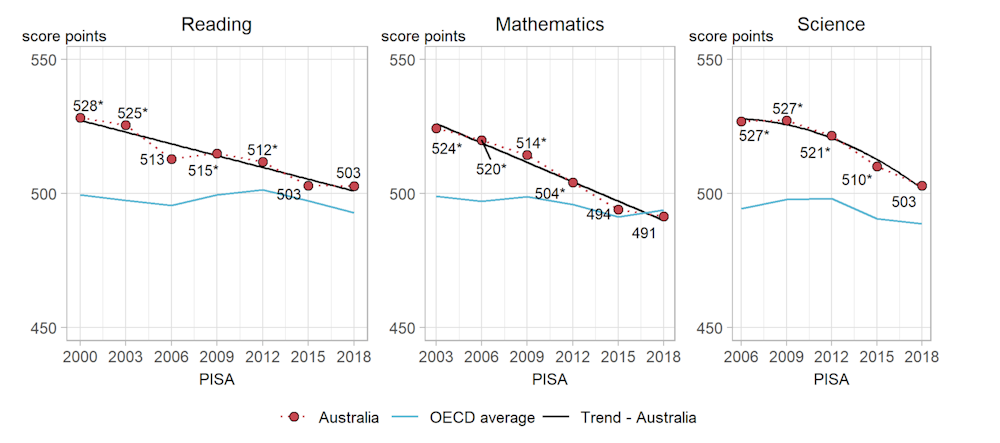
Out of 79 participating countries and economies in 2018 Australia came equal 11th (with countries including NZ, UK and US) in reading (in 2015 it was 12th); equal 13th (with countries including US, UK and Germany) in science (in 2015 it was tenth); and equal 24th (same as the OECD average, and NZ and Russia) in maths (in 2015 it was 20th).
According to education minister Dan Tehan, “alarm bells should be ringing”. Tehan claimed he would raise the issue with state and territory ministers for education at the Education Council meeting in Alice Springs this week.
In particular, Tehan said he wanted to “take a chainsaw to the curriculum” and “put literacy and numeracy back to the heart” of it.
There are two striking features of the reactions to the PISA results. First, it seems broadly accepted PISA defines educational quality when it only tests three subject areas and the methodology itself is questionable.
And second, the results inevitably produce a flurry of policy responses, none of which have been specifically tested as a means to improve our PISA scores.
There are serious problems with PISA scores
PISA has seemingly become the arbiter of education quality in Australia and around the world. When the results are released, the numbers are broadly accepted as accurate measures of the quality of the world’s education systems.
These same concerns were raised by 100 educational researchers around the world in a public letter to the Director of PISA at the OECD in 2014.
Some such concerns relate to the problems of making an international test neutral when it is converted to many different languages and cultures. Other concerns come from educational statisticians and researchers who argue the validity and reliability of the tests themselves are at best dubious and at worst render the league tables “useless”.
There are also issues with the sampling process. Some participating countries only include certain parts of the country or exclude more schools and students from the tests than others. This clearly makes it more difficult to compare countries.
Mainland China is an example. For instance, when Shanghai finished top in each of the three domains in the 2012 PISA tests, Tom Loveless from the Brookings Institute in Washington argued the students tested weren’t representative of the students in the city.
He wrote Shanghai’s PISA-tested students didn’t include thousands from poor rural areas whose parents had moved to the city in search of work.
The OECD’s Education Director Andreas Schliecher, admitted to the UK’s House of Commons Education Select Committee that, in fact, only 73% of students were represented in the Shanghai province’s sample of students in the 2012 test.
Loveless’ also analysed the recent results, which were reported in the Washington Post. He noted the four Chinese provinces participating in 2018 (Beijing, Shanghai, Jiangsu and Zhejiang) did significantly better than the four (Beijing, Shanghai, Jiangsu and Guangdong) that participated in 2015.
Loveless wrote “the typical change in a nation’s scores is about ten points. The differences between the 2015 and 2018 Chinese participants are at least six times that amount…”. He hypothesised this had something to do with the change in provinces selected for testing.
These and other problems with PISA’s methodology suggest it is foolhardy to accept the test results as precise readings of educational quality in any country, or for ranking countries.
Knee-jerk policy fixes will only take us backward
The other feature of the reaction to PISA results is the litany of policy proposals to fix the problems PISA has supposedly unearthed.
Minister Tehan confined his strategies to “stripping back” the “crowded” Australian curriculum and focusing on “the basics”, as well as fast tracking professionals from other fields into teaching.
But there is no obvious link between the PISA results and the strategies proposed and certainly no analysis of what information PISA offered to support them. Even if PISA data are taken seriously, we are obliged to investigate the reasons for educational outcomes before designing policies to address the problems.
And although PISA only tests three areas of the curriculum, the strategies proposed apply to the whole curriculum and, it seems, to the whole of schooling.
Minister Tehan should explain what part of the PISA data convinced him that the Australian curriculum should be pared back to “the basics”. And if that data exists, why should it apply to every other area of the curriculum apart from the three areas tested by PISA: maths, science and reading?
Or is PISA simply being used as a convenient vehicle for introducing favoured policy positions?
I am not suggesting some of the PISA data cannot usefully contribute to the ongoing effort to enhance the quality of Australian education. There is a strong case to be made for sharing educational ideas and practices with other countries.
But superficial, knee-jerk readings of international standardised test data are more likely to impede than advance quality improvement.
The meeting of the Education Council this week could use the opportunity to do two things when they reach the agenda item on PISA.
First, it could set in train a process for achieving national agreement about an approach to educational accountability which goes beyond the simplistic reliance on standardised tests. This would start with the purposes of accountability, including supporting schools to enhance education quality, and aim to provide the community with rich information about educational progress.
Inevitably new approaches would mean broadening our evidence options. These should be both qualitative as well as quantitative. They should also support teachers in their work rather than impose time consuming form-filling. And they should be based on trust in the professional expertise of our teachers.
Second, the Education Council should institute a review of PISA which might consider the flaws in the testing regime, and ways to overcome these. This might help ensure policy, media commentary and research based on PISA results would acknowledge the limitations of the tests and be more tentative about using PISA as the sole arbiter of what constitutes quality in education.
These two steps would help break the destructive cycle of the release of PISA tests results every three years, followed by the barrage of criticising educators and the work of schools, as well as a flurry of political, ideologically pre-determined policy proposals.
After all, it is somewhat ironic that the policy makers who for so long have enforced a standardising educational policy regime, simply double down on it when their own standardising measures have deemed such policies to have failed.
Australia needs a new education narrative, and work on it should start this week at the Education Council.
Alan Reid is the author of “Changing Australian Education: How policy is taking us in the wrong direction and what can be done about it”, out now from Allen and Unwin.
This is the second article in a series to mark the 50th anniversary of the landmark Melbourne Transportation Plan.
Transport models are often singled out as a barrier to providing more sustainable and equitable transport services. However, abandoning transport models would most likely weaken planning, not enhance it. But getting the best out of such modelling requires transparency to overcome the increasing problem of its misuse to justify predetermined political decisions.
On the 50th anniversary of the Melbourne Transportation Plan, we review the role of transport modelling as a planning tool. What are models now telling us about the future of Australian cities?
From rational planning …
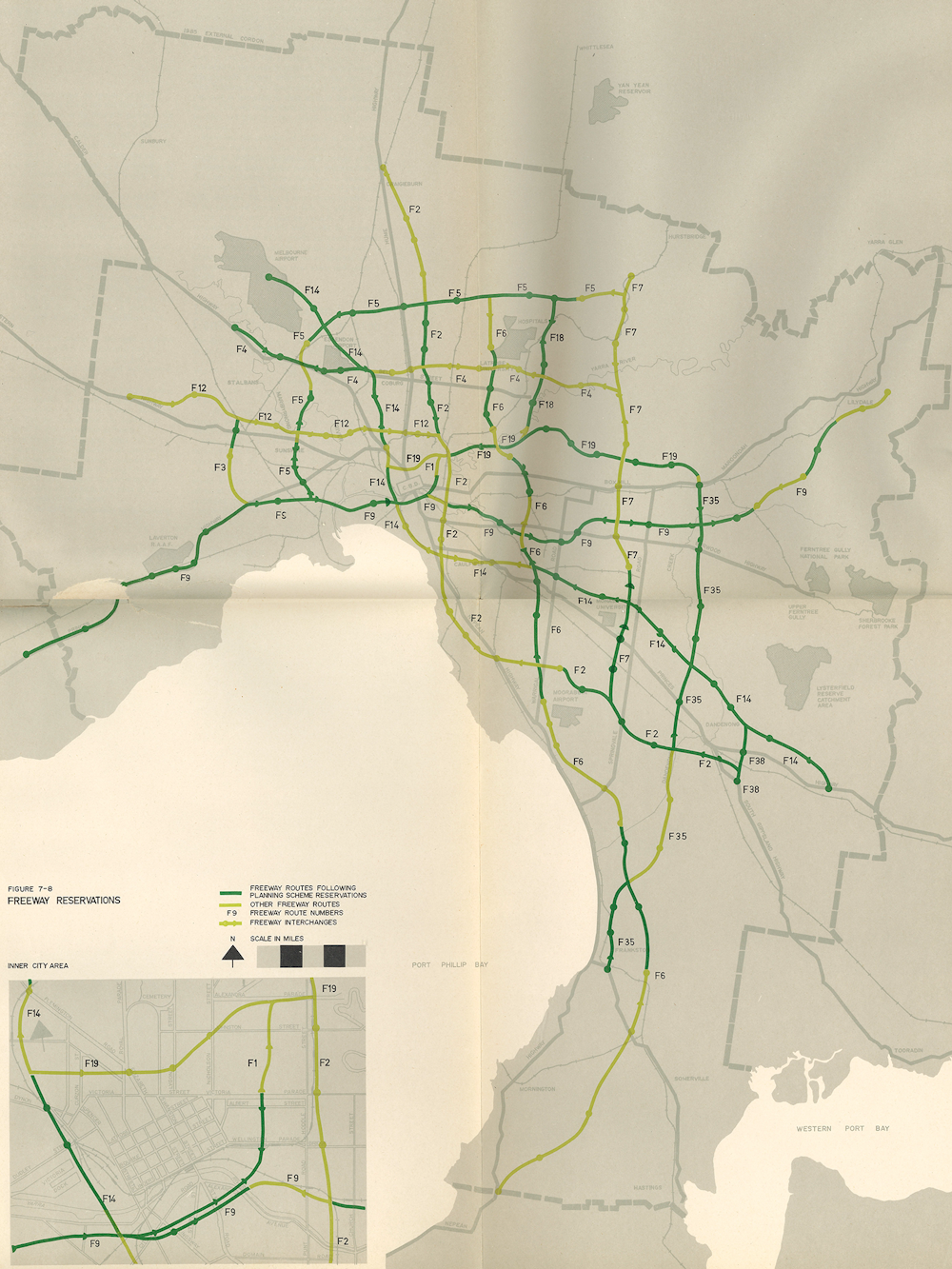
The 1969 Melbourne Transportation Plan was based on the Chicago Area Transportation Plan, an approach that other Australian cities then adopted. A feature was the extensive collection of travel data, often for the first time. Newly available computer models were then used to predict travel demand, which the plan sought to accommodate.
This is often referred to as the “rational” or “predict and provide” approach to transport planning.
By today’s standards, the goals of the ’69 plan sound like a utopian dream of free-flowing freeways and frequent, comfortable public transport services. It assumed a population living in detached housing on quarter-acre blocks.
Melbourne’s “solution”, and that of many other cities, was to build an extensive freeway network. The car took over from the rail system as the primary mode of travel.
Today’s reality shows this has been no solution to the seemingly intractable problems of congestion and overcrowding, coupled with inequitable access to services, jobs and other opportunities.
… to political mandates
In response, it seems Australian transport agencies have abandoned the preparation of comprehensive transport plans. Gone are the days of foreshadowing projects decades into the future, with land for these road and rail projects being reserved in the planning scheme.
We operate in an era where political mandates have replaced comprehensive planning. Transport models are no longer used to plan for the future. Instead, they are used to justify the most recent announcement.
The nexus between transport models and the justification of controversial projects results in much critical commentary. The models become guilty by association.
It is true model outputs are far from infallible. One problem is that models depend on key input assumptions such as future population. The ’69 plan, for example, assumed Melbourne would reach a population of 3.7 million by 1985, but this didn’t occur until 20 years later.
Aside from the inherent challenge of predicting the future, models suffer from the problem of “strategic misrepresentation” – more simply, lying. This can occur when models are called upon to justify a predetermined political decision.
The best safeguard against such behaviour is transparency. This is achieved by making the detailed modelling results available for peer review. Under these conditions, models can provide useful planning intelligence.
More of the same is a poor plan
A recent Infrastructure Australia report predicts worsening road congestion and public transport crowding over the coming decades in all Australian capitals. These predictions are the result of the lack of endorsed strategies to deal with population growth coupled with Australia’s dependence on the private motor vehicle. Indeed, the report highlights many examples where major new road projects will worsen congestion by encouraging more car use.
A lesson from the past 50 years is that Australia’s major capitals occupy large areas by world standards and are ill suited to a transport strategy based on low-occupancy vehicles. It isn’t surprising “Europeanesque” inner suburbs based around walking, cycling and public transport are increasingly valued as preferred places to live.
Can modelling be blamed for our collective failure to devise a realistic plan to accommodate our cities’ growing populations? At what point does the reality of everlasting congestion trump predictions of incremental travel time savings?
US President Dwight Eisenhower once said: “Plans are worthless, but planning is everything.” Intuitively we know the pressure of population growth and the climate emergency demand a considered response. The recent work of Infrastructure Australia provides a prediction of the scale of this challenge.
We urgently need a sensible discussion about developing a realistic plan to deal with this challenge. Doing more of the same, as we have done over the past 50 years, doesn’t sound like a solution to us.
A public event to mark the 50th anniversary of the Melbourne Transportation Plan will be held on December 12 2019, hosted by RMIT University and supported by Swinburne University, Monash University and the University of Melbourne – details here.
An important part of the World Trade Organization will cease to function from midnight. December 10 is when the terms of two of the remaining three members of its Appellate Body expire. It is meant to have seven.
The Appellate Body hears appeals from WTO adjudications. If it can’t function, and if there is an appeal, those adjudications have no force. Appointments to the Appellate Body can be blocked by any one of the WTO’s 164 members.
The United States has blocked every proposed appointment and reappointment since June 2017, meaning after midnight the Appellate Body will be left with just one member.
It will be unable to hear new appeals, as the minimum requirement for any decision is three.
Members of the World Trade Organization will still be able to launch complaints and receive initial rulings about trade disputes from December 11, but if any party appeals there will be no means of hearing it and the case might end up in limbo with no resolution.
Did Trump kill the WTO?
While there is much that can be said about the current US President’s attitude towards trade rules, the seeds of the problem predate Trump.
The US began blocking some appointments under the Obama Administration, although Obama was still supportive of the WTO and engaged with it about the future of its Appellate Body. Trump has not engaged with it. He has simply refused to appoint replacements for members who have retired.
There are over 60 different agreements under the WTO umbrella – about 550 pages worth of rules – that operate on a daily basis to smooth worldwide trade.
It is also worth bearing in mind many disputes are headed off at the political level through discussions in WTO committees.
These will remain in place after the Appellate Body ceases to function. By and large, WTO members have adhered to rulings without appealing.
Does it matter for Australia?
Australia needs the WTO dispute settlement system to get justice when political solutions have not been successful. It’s the international equivalent of needing to take your business partner to court when you have tried everything to negotiate a solution.
The WTO dispute settlement system is vitally important for a country such as Australia, which relies heavily on exports for its economic well-being.
In the increasingly uncertain trade environment, Australia has been resorting to it more. Right now, Australia has two big disputes pending.
One is a claim against India’s sugar subsidies. Sugar accounts for the employment of 40,000 Australians. Indian production and export subsidies are driving down international prices at a time when drought and flood are placing immense stress on farmers.
The other dispute is against Canada, where some provinces have restrictions on alcohol sales that make it hard for smaller, foreign producers to get their wine onto shelves. Australian wine exports to Canada have fallen by almost half between 2007 and 2016.
Imagine a world without it
If the attacks on the World Trade Organization continue to the point that the entire organisation collapses, we stand to lose greatly.
Trade would risk returning to the power-based system of settling disputes that preceded the World Trade Organization.
Powerful nations could act as they please, leaving less powerful nations with only diplomatic channels to make their voice heard and little clout.
One-on-one and regional trade agreements would proliferate in the WTO’s place, but they are more complex for businesses to understand and use.
They are also subject to power politics. This is an important consideration for a country like Australia, which relies so heavily on trade with large, powerful partners.
The World Trade Organization is in need of reform. A world without functioning global trade rules will marginalise everyone but the most powerful.
The WTO is down but far from out. It is in Australia’s interest to use what influence it has to restore it.
Fans of Ridley Scott’s 1982 masterpiece Blade Runner returned to cinemas last month for an unusual milestone: history catching up with science fiction.
Blade Runner opens in Los Angeles, in November 2019. Furnaces burst flames into the perennial night and endless rain. Flying cars zoom by. The antihero film-noir detective, Deckard (Harrison Ford) has seen too much, drinks too much, and misses his mother between “retiring replicants”.
As in “Back to the Future day”, (October 21, 2015), which marked Marty McFly’s journey into the future in the 1989 film, the Blade Runner screenings came with a flurry of discussion about what the filmmakers got right and wrong. Environmental collapse, yes. But where are our flying cars?
So: what now that the future is here?
Our current versions of near future stories – namely the television series Black Mirror (now on Netflix) and SBS’s Years and Years – explore more extreme versions of the present.
Charlie Brooker’s Black Mirror is an anthology of standalone episodes, produced between 2011 and 2019, each set in a slightly different, undated, near future.
Years and Years, written by Russell T. Davies, bravely spans 2019 to 2034 with each episode leaping forward a few years through striking montages of fictional news events: the collapse of the European Union, the US leaving the United Nations, catastrophic flooding, mass migration, widespread homelessness.
We are in a very familiar world. The “near” is depicted in a realistic way through identifiable locations, documentary-style visuals, news footage, and lifelike dialogue.
Technology: good and bad
Back in the real world, the future in the 21st century is unfolding in the palm of our hands. Elections are won and lost on social media, Sydney is covered in smoke. The rate at which technology is altering our lives is rivalled only by the rate we’re transforming our planet.
These shows explore these rates of change. In a 2016 episode of Black Mirror, “Nosedive”, every interpersonal interaction becomes a transaction: an extreme version of Uber Ratings with China’s Social Credit System.
Lacie (Bryce Dallas Howard) is an ambitious young professional excited by the opportunities higher ratings open up, such as discounts on luxury apartments, but being pleasant to her barista and workmates only gets her so far. So begins a perilous spiral of trying too hard to be liked, echoing the personality-as-product phenomenon of social media influencers around the world.
The standalone episode format of Black Mirror means it can be challenging to develop empathy for characters, consequently the interest often rests on the single concept or final twist. The episode “Striking Vipers” explores the possibility of extra-marital love between best mates in Virtual Reality; “Hang the DJ” envisions dating apps as an authoritarian apparatus.
Most episodes are neatly wrapped up for viewers to escape to for pure entertainment – but also to escape from each dystopian possibility.
In Years and Years, we follow one Mancunian family over 19 years. The series opens with Trump re-elected for a second term. In the UK, the unconventional populist Four Star Party, led by straight-speaking Vivienne Rook (Emma Thompson), rides to success on the back of social instability.
Sci-fi concepts are introduced early on so we can explore their evolution and implications. In the first episode, teenager Bethany declares herself “trans”. As progressive parents, Stephen and Celeste immediately comfort their child, who they presume is transsexual.
Bethany shrugs, “I’m not transsexual … I’m transhuman”. A concept not lost on Blade Runner fans who may be aware of transhumanist gatherings in Los Angeles in the 1980s, transhumanism is premised on the idea that humans have breached evolutionary constraints through science and technology. Biology is a restriction to the possibility of eternal life.
Disgust and dismay ensue from parents unable to comprehend why their child wants to rid her flesh and live forever as data. Through the course of the series we see how Bethany’s transhuman ambitions influence her personal relationships, health, career trajectory, and political activism.
It even starts to feel normal.
Years and Years delicately resists portraying a dystopia, allowing room for technology to demonstrate a positive influence on society. “Señor”, the ubiquitous virtual assistant, connects the Lyons family whenever they wish. Like Alexa or Siri, Señor is always at hand to answer questions – but more importantly, facilitates an intimacy that could easily be lost to technological isolation.
In 2029, grandmother Muriel digs up the dusty digital assistant Señor because she misses its company. By now, virtual assistants are embedded into the walls and omnipresent digital cloud but the Luddite grandmother resists.
“I like having something to look at, I’m not talking to the walls like Shirley Valentine,” she says.
It’s moments like these that remind us of our agency over technology and hint at its revolutionary potential to connect us all.
Lessons for the present
While classics like Blade Runner looked to the future to ignite our technological desires, near-future fiction reveals how new technologies are injected into our lives with little choice as to whether we should adopt them and little thought to their long-term appropriateness and sustainability.
These shows ask us to be critical of what might seem like minor developments in technology and politics. In an age of rapidly changing political landscapes and the climate catastrophe, it can feel like we are approaching the final frontier. In creating stories set in the near, instead of the far, future, science fiction provides valuable lessons for the present.
In other words: the choices we fail to stand up for in the near-future may prevent us from having a distant future at all.
Five people have been confirmed dead, 23 have been rescued and several remain unaccounted for after a sudden volcanic eruption on Whakaari/White Island off the east coast of New Zealand.
The island is a tourist destination and around 50 people were on it when it erupted on Monday afternoon. Volcanologists at GeoNet, which operates a geological hazard monitoring system, described the eruption as impulsive and short-lived, with an ash plume that rose to about three kilometres above the vent.
This footage was taken by Michael Schade whose family got off Whakaari/White Island 20 minutes before it erupted.
Volcanic hazards
White Island is one of several volcanoes in New Zealand that can produce sudden explosive eruptions at any time. In this case, magma is shallow, and the heat and gases affect surface and ground water to form vigorous hydrothermal systems.
In these, water is trapped in pores of rocks in a super-heated state. Any external process, such as an earthquake, gas input from below, or even a change in the lake water level can tip this delicate balance and release the pressure on the hot and trapped water.
The resulting steam-driven eruption, also called a hydrothermal or phreatic eruption, can happen suddenly and with little to no warning. The expansion of water into steam is supersonic in speed and the liquid can expand to 1,700 times its original volume. This produces catastrophic impacts.
The expansion energy is enough to shatter solid rock, excavate craters and eject rock fragments and ash out to hundreds of metres away from the vent. We know of sites in New Zealand where material has been blasted out over three kilometres from the vent by such eruptions.
The eruption on White Island sent sent huge amounts of steam and ash into the air in the blast.GeoNet, CC BY-ND
Potential for further eruptions
The hazards expected from steam-driven eruptions are violent ejections of hot blocks and ash, and the formation of “hurricane-like” currents of wet ash and coarse particles that radiate from the explosion vent. These can be deadly in terms of impact trauma, burns and respiratory injuries.
The eruptions are short-lived, but once one happens, there is a high chance for further, generally smaller ones as the system re-equilibrates. White Island is an acute location for such activity, but it is not the only location in New Zealand where this can happen.
Mount Ruapehu (crater lake), Mount Tongariro (Te Maari and Ketetahi) and geothermal areas of the central North Island all have the potential to cause such events. We know there have been more than 60 hydrothermal eruptions in the last 100 years in New Zealand. Some of these have caused loss of life.
Monitoring and warning for hydrothermal eruptions is a huge challenge. We don’t normally see these eruptions coming, no matter how much we would like to. Many systems are already “primed” for such events, but the triggers are poorly understood.
The warning periods, once an event gets underway, are likely in the order of seconds to minutes. Our only hope for anticipating these events is to track potential vapour and liquid pressure in hydrothermal systems and to learn from their long-term behaviour when they are at a super-critical state. Unfortunately there are no simple rules that can be followed and each hydrothermal system is different.
In this age of technology and instrumental monitoring, it seems irrational that there should be little or no warning for such eruptions. The eruption is not caused by magma, but by steam, and this is much harder to track in our current monitoring systems.
We have seen several other fatal hydrothermal catastrophies unfold in other parts of the world, such as the 2014 eruption of Mount Ontake in Japan. New Zealand has been luckier than many other parts of the world, until now.
Public broadcasting faces an even bigger change as the government ponders a complete restructure. The proposal is to disestablish both the public interest radio broadcaster RNZ (Radio New Zealand) and the commercially funded television broadcaster TVNZ to create an entirely new public media entity.
TVNZ chief executive Kevin Kenrick has argued the government’s intention is to “strengthen the public media – not weaken commercial media”. But the likely consequences will be the loss of hundreds of journalism jobs and less quality news.
The restructuring of state-owned broadcasting comes on the back of TVNZ’s earlier announcement that it will not pay a dividend to the government – even though its only mandate is to make a profit and pay that dividend.
The government is expected to announce its plans for the new public media entity before Christmas. Its advisory group has suggested TVNZ and RNZ operations should be disestablished and a mixed funding model used to support the new broadcasting company. A mixed model would allow the broadcaster to fund parts of its operations through advertising, sponsorships and partnerships. It remains to be seen if the government follows that advice.
The Swiss Broadcasting Corporation has a mixed funding model, but last month confirmed plans to reduce its workforce by 200 as one of several measures to tackle its financial crisis. Whatever broadcasting model emerges in New Zealand, Prime Minister Jacinda Ardern has said doing nothing is not an option.
In many countries, including Ireland, public broadcasters have already hit an “existential financial crisis”. In 2019, Ireland’s public broadcaster, RTÉ, warned it would not survive without a government rescue plan. In 2018, Danish public broadcaster DR announced up to 400 job cuts and closures of three television channels and three radio stations as part of a media reform package.
Commercial broadcasting in dire straights
New Zealand’s commercial broadcasting news operations are in serious trouble as a consequence of streaming services flooding the market. In this environment, monetising television viewers has become ever more challenging.
My research in digital journalism shows media companies and platforms compete for attention, which has become a scarce and fluid commodity.
In this context it’s not surprising MediaWorks is trying to sell its television arm. At the time of writing, no buyer had emerged for the loss-making television business.
The pay-television company Sky TV is also struggling as it competes against telecommunications company Spark in sports broadcasting. Sky’s business model has been affected by a number of streaming services entering New Zealand (including Disney+ and Apple TV).
In November, Sky TV warned that its 2020 revenue will fall NZ$45 million compared to 2019. For the financial year 2019, the company did not pay a dividend to shareholders. Its share price fell 66% between November 2018 and November 2019.
Private equity influence
While the fate of public broadcasting is in the hands of the government, the future of the commercial television sector will be decided by private equity firms, investment managers and financial shareholders.
This means potentially more asset stripping, job cuts and restructuring of businesses. As many have observed, private equity firms have become ruthless media barons as they attempt to extract value out of already distressed media assets. Since 2011, the New Zealand Media Ownership reports have warned that media companies are vulnerable as private equity financiers do not have an interest in news or newsrooms.
In 2019, Australian Quadrant Private Equity and American Oaktree Capital have become joint owners of MediaWorks. Quadrant announced it was buying Australian outdoor advertiser QMS, which has a 40% stake in MediaWorks. Oaktree Capital remains the company’s largest shareholder with a 60% stake in the company. If MediaWorks’ owners fail to sell its television business, it will likely close, with hundreds of jobs at risk.
Two financial institutions, Scottish asset management firm Kiltearn Partners and British fund manager Jupiter Asset Management, are also the largest shareholders of Sky TV. The company is considering a restructure which could affect 250 jobs.
New Zealand’s media ecosystem may be on the verge of collapsing, not just in the broadcasting sector. The merger of New Zealand’s two largest news publishers – NZME and Stuff – is back on the agenda. Back in 2017, the Commerce Commission rejected the merger, but as media company profits and revenues continue to shrink, NZME confirmed last month it was in talks with Nine Entertainment to buy Stuff.
Should the merger go through this time, it would bring massive job cuts and most certainly less quality news coverage in New Zealand.
Source: The Conversation (Au and NZ) – By Dominic O’Sullivan, Adjunct Professor, Faculty of Health and Environmental Sciences, Auckland University of Technology and Associate Professor of Political Science, Charles Sturt University
In 2018, Daniel Love and Brendan Thoms left prison. They had been sentence to 12 and 18 months respectively. This means they are not of good character and may be deported, according to the character test for non-citizens living in Australia that the minister is applying.
Neither Love nor Thoms are Australian citizens, but have lived in Australia since their early childhood. Love is a Kamileroi man born in Papua New Guinea, and Thoms is a native title holder and Gunggari man, born in New Zealand.
The men appealed the minister’s decision, and a hearing was held at the High Court on Thursday. The court has reserved its decision.
For the men, the decision will effectively determine whether they can keep the associations that make them Indigenous.
This includes their right to keep their ancestral connections to country, to be part of an Indigenous family, to language and, ultimately, whether the minister may lawfully deny their human right to culture.
The federal government’s position is that they need state citizenship to belong to their land, even though their ancestral presence predates colonisation by at least 65,000 years.
These men are not ‘aliens’
Since both men are citizens of other countries, the federal government says they owe allegiance to a foreign power. This, along with their non-citizen status, makes them “alien” and so eligible for deportation.
The men’s lawyers disagree, arguing Love and Thoms aren’t alien because culture and ancestry give them a “special relationship” to Australia. They cite the definition of a judge used in a 1988 case:
An alien […] is in essence a person who is not a member of the community which constitutes the body politic of the nation state.
The High Court will make its decision from nuances in the law. But important political points must also be considered.
The power to remove an Indigenous person from their traditional country is a power over that person’s indigeneity. It shows how Australia is still asserting colonial power over the identity of its First Peoples.
The Victorian Government also appeared in court in support of Love and Thoms, arguing it was “unthinkable” Indigenous people didn’t belong to Australia.
It argued that because they’re Indigenous Australians “it is irrelevant [they] were born outside Australia, are citizens of another country, and are not citizens of Australia”.
The right to culture
I believe the men’s “special relationship” to Australia should be understood as an allegiance to their own Indigenous nations – a “belonging” that the Indigenous nation, not the state, should define.
Indigenous peoples and individuals have the right to belong to an indigenous community or nation, in accordance with the traditions and customs of the community or nation concerned. No discrimination of any kind may arise from the exercise of such a right.
Indigenous peoples […] have the right to maintain and develop contacts, relations and cooperation, including activities for spiritual, cultural, political, economic and social purposes, with their own members as well as other peoples across borders.
States, in consultation and cooperation with Indigenous peoples, shall take effective measures to facilitate the exercise and ensure the implementation of this right.
In other words, while self-determination is a right that belongs to everybody, it occurs in context, requiring geographic, cultural and familial associations.
Australia was one of just four states to vote against the declaration when it was adopted in 2007.
But in 2009, it changed its position, accepting the declaration as an “aspirational” statement and to recognise the “fundamental freedoms” of Indigenous people.
One of these freedoms is the right to culture, a right the Australian government is ignoring in this case.
Challenging citizenship claims around the world
This is the same right descendants of the Maori diaspora population claim against the New Zealand state.
New Zealand born Maori citizens may pass citizenship on to their children born overseas, but not to their grandchildren. They have no automatic right to part of what makes them Maori – a physical association with an identifiable place.
But belonging is a matter of whakapapa (ancestry), not place of birth.
The state’s position is that state citizenship comes before membership of an Indigenous nation, and may be required for access to one’s ancestral home.
It’s also a state position Indigenous peoples on the US-Canadian border and in the Arctic Circle have challenged. In each case international borders have been drawn across Indigenous territories.
We were and are not citizens of the United States, Britain or Canada and as it was agreed when the US Canadian border was drawn it ought to remain ‘ten feet above our heads’.
In the case of Love and Thoms, the legal questions the present Australian High Court case must resolve may be complicated. However, the political question is straightforward. Should the state be able to take away a person’s indigeneity?
Andrew Hastie, Liberal member for the seat of Canning, is one of the most outspoken government members on the issue of foreign interference.
He’s used his position as a backbencher – and as chair of the Parliamentary Joint Committee on Intelligence and Security – to speak openly about his concerns and what he sees as the expansion of “revisionist” countries trying to “remake the world order … pushing out to secure their economic and strategic influence beyond their geographical borders”.
He also talks about why he thinks it would be untenable to have security clearance for every member of parliament, the role of the media in scrutinising candidates, and concerns about mental health among returned veterans.
New to podcasts?
Podcasts are often best enjoyed using a podcast app. All iPhones come with the Apple Podcasts app already installed, or you may want to listen and subscribe on another app such as Pocket Casts (click here to listen to Politics with Michelle Grattan on Pocket Casts).
You can also hear it on Stitcher, Spotify or any of the apps below. Just pick a service from one of those listed below and click on the icon to find Politics with Michelle Grattan.
Review: Farnace, composed by Vivaldi, Pinchgut Opera
When a performance of Farnace was cancelled at the theatre of Ferrara after the artistic failure of Vivaldi’s opera Siroe re di Persia in December 1738, Vivaldi’s chance to have his favourite opera performed in one of the top theatres in Europe evaporated.
He defended his operatic writing, blaming the harpsichordist for Siroe’s poor reception. It didn’t matter. Farnace was cancelled; and then largely forgotten.
Newly revived in Sydney, this ambitious undertaking of Pinchgut Opera artistic director Erin Helyard demonstrates that Farnace is a masterpiece of 17th century Venetian opera.
Antonio Lucchini’s libretto explores honour and love in the aftermath of war in Pontus, a kingdom on the threshold of Europe and Asia: a region currently experiencing unrest, bringing this story too close for comfort.
The defeat of Farnace (Christopher Lowrey), King of Pontus, presents impossible dilemmas for him and his family. Farnace asks his wife, Tamiri (Helen Sherman), to kill their son and then herself to save them from the dishonour and torture in the hands of their enemies.
Farnace asks his wife to kill their son, to save them from dishonour.Brett Boardman/Pinchgut Opera
Leading from the harpsichord, Helyard casts his magic spell over the orchestra, continuo players, and singers with depth and nuance. The spirited performance of Orchestra of the Antipodes is marked by brilliance of attack, rhythmic dynamism, and finesse of phrasing.
The audience is overwhelmed by excitement, astonishment and delight.
A triumph of a production
Vivaldi’s ingenuity lies in virtuosic melodic writing and instrumental colours. Horns, played by Doreé Dixon and Carla Blackwood, bring out the military elements of the narrative. Mikaela Oberg’s flute adorns Tamiri’s outpouring of love and loyalty in “Sol da te, mio dolce amore” (Only in you my sweet love).
Brought into the present and located in a prison vault, danger and death is palpable. Hanging corpses haunt the stage with eerie swaying. Mark Gaal’s direction brings rhythm to the narrative: punctuating slams of the upstage double door, and intensifying movement on stage during the repeat of the first section of the arias.
The presence of a child actor (Matthew Simon) and two teenage soldiers (Jack Curry and Joshua Hammond) makes the story even more true to present day guerrilla warfare.
Corpses hang above the stage.Brett Boardman/Pinchgut Opera
Unusually for opera, three strong women are central to this fable.
Love’s virtue and patience are embodied by Tamiri, sung with feeling by Sherman, although she needs to find a better connection with the character in the intricacies of the Italian prosody.
Courage and loyalty are represented by Farnace’s sister Selinda, given zest and allure by Taryn Fiebig – her rendition of the flute obbligato aria is a highlight.
Berenice is destructive in her rage, portrayed with macho histrionics and a steely high register by Jacqueline Dark, who achieves great contrast with unexpected vocal tenderness in Berenice’s surrender and forgiveness at the end of the opera.
Gilade is sung by Max Riebl with an exquisite countertenor tone and agility. Riebl sparkles in the arias, adorned with magnificent cadenzas.
Lowrey brings unprecedented intensity to his performance. His full-bodied countertenor voice is eloquent and heartbreakingly truthful in the plight of the noble king.
The symbiosis of sonic and visual expression of emotion came to a climax in the aria “Gelido in ogni vena” (Frosty in every vein). Lowrey stands in spotlight. Falling snowflakes reference the chilled chords from the Winter movement of the Four Seasons concerto.
‘Gelido in ogni vena’ (Frosty in every vein) is a highlight of sonic and visual expression.Brett Boardman/Pinchgut Opera
Lowrey uses vocal colour to achieve dramatic effect, expressing the profound grief of a father who ordered the death of his son. This is one of the most poignant opera scenes I have ever experienced.
Farnace is the best revival production by Pinchgut Opera yet, demonstrating high standards of historically informed practice, vibrancy and subtlety of staging. Vivaldi’s disappointment has been transformed into a triumph almost three centuries later, on the other side of the globe by an ensemble of baroque experts that prides itself on reviving forgotten operatic gems for a modern audience.
Farnace plays at City Recital Hall, Sydney, until December 10.
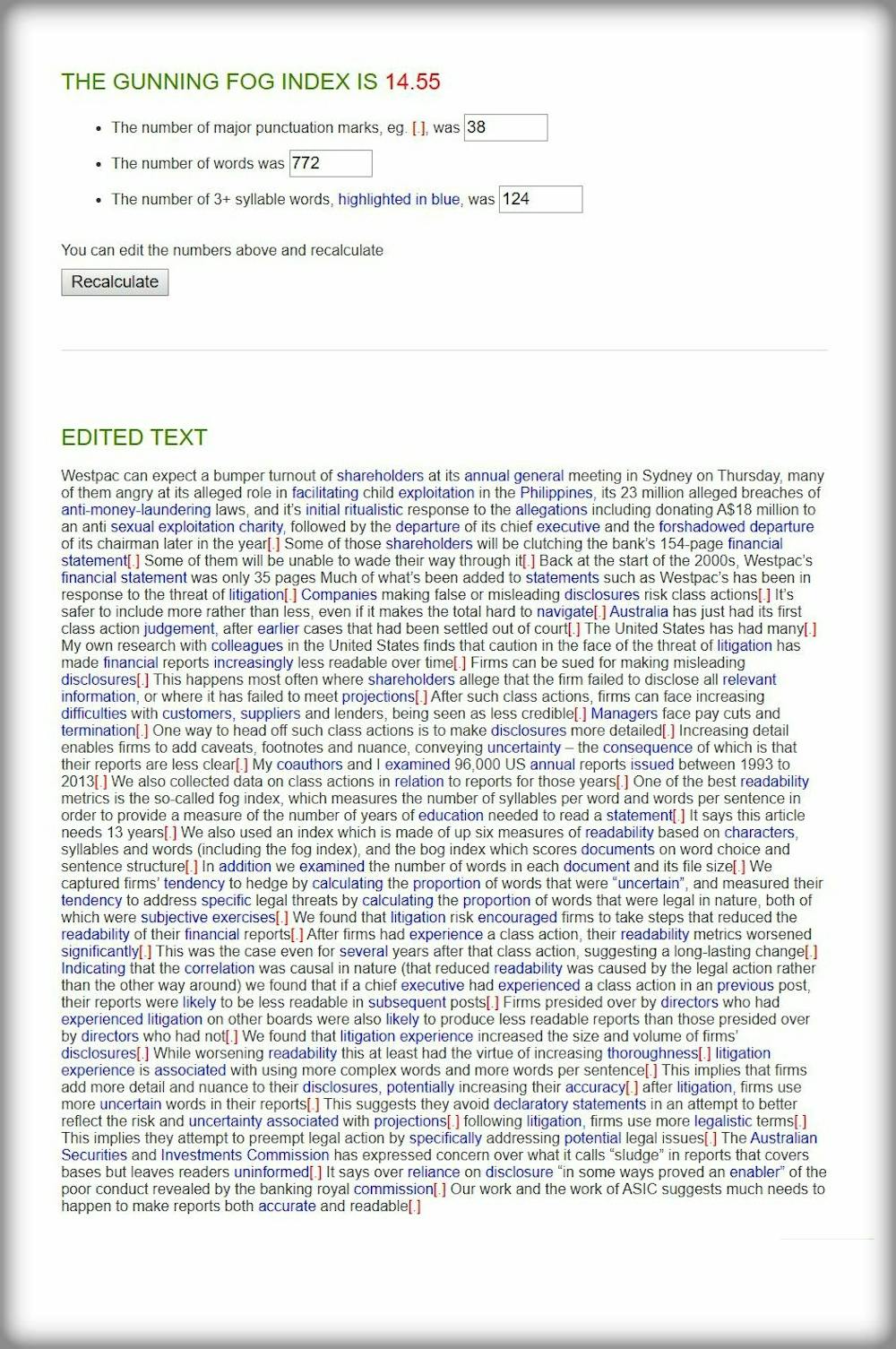
Westpac can expect a bumper turnout of shareholders at its annual general meeting in Sydney on Thursday, many of them angry at its alleged role in facilitating child exploitation in the Philippines, its 23 million alleged breaches of anti-money-laundering laws, and its initial ritualistic response to the allegations.
This included donating A$18 million to an anti sexual exploitation charity, followed by the departure of its chief executive and the foreshadowed departure of its chairman later in the year.
Some of those shareholders will be clutching the bank’s 154-page financial statement. They’ll need to understand it to ask questions about Westpac’s financial performance.
Back at the start of the 2000s, Westpac’s financial statement was only 35 pages
Much of what’s been added to statements such as Westpac’s has been in response to the threat of litigation. Companies making false or misleading disclosures risk class actions. It’s safer to include more rather than less, even if it makes the total hard to navigate.
Australia has just had its first class action judgement, after earlier cases that had been settled out of court. The United States has had many.
My own research with colleagues in the United States finds that caution in the face of the threat of litigation has made financial reports increasingly less readable over time.
How might litigation make reports harder to read?
Firms can be sued for making misleading disclosures. This happens most often where shareholders allege that the firm failed to disclose all relevant information, or where it has failed to meet projections.
After such class actions, firms can face increasing difficulties with customers, suppliers and lenders, being seen as less credible. Managers face pay cuts and termination.
One way to head off such class actions is to make disclosures more detailed.
Increasing detail enables firms to add caveats, footnotes and nuance, conveying uncertainty – the consequence of which is that their reports are less clear.
My coauthors and I examined 96,000 US annual reports issued between 1993 to 2013.
We also collected data on class actions in relation to reports for those years.
One of the best readability metrics is the so-called fog index, which measures the number of syllables per word and words per sentence in order to provide a measure of the number of years of education needed to read a statement.
It says this article needs the best part of 15 years.
We also used other indexes including the so-called bog index which scores documents on word choice and sentence structure.
We captured firms’ tendency to avoid declarative statements by calculating the proportion of words that were “uncertain”, and measured their tendency to address specific legal threats by calculating the proportion of words that were legal in nature, both of which were subjective exercises.
What we found
We found litigation risk encouraged firms to take steps that reduced the readability of their financial reports.
After firms had experienced a class action, their readability metrics worsened significantly. This was even the case several years after that class action, suggesting a long-lasting change.
We found if a chief executive had experienced a class action at one job, their reports were likely to be less readable in subsequent jobs, strongly suggesting that litigation drove hard to read reports rather than the other way round.
We also found:
litigation experience increased the size and volume of firms’ disclosures. While worsening readability, this at least had the virtue of increasing thoroughness
litigation experience was associated with using more complex words and more words per sentence. This implies firms add more detail and nuance to their disclosures, potentially increasing their accuracy
after litigation, firms used more uncertain words in their reports. This suggests they avoid declaratory statements in an attempt to better reflect the risk and uncertainty associated with projections
following litigation, firms use more legalistic terms. This implies they attempt to preempt legal action by specifically addressing potential legal issues.
The Australian Securities and Investments Commission (ASIC) has expressed concern over what it calls “sludge” in reports that covers bases but leaves readers uninformed.
It says over-reliance on disclosure “in some ways proved an enabler” of the poor conduct revealed by the banking royal commission.
Our work and the work of ASIC suggests much needs to happen to make reports both accurate and readable.
Growing up, no one ever gave me the rundown on how or what I should do to keep my penis clean […] I’ve never read any reliable answer beyond washing it with water. Do I use soap? Any soap? How normal is smegma? If my penis gets itchy from smegma should I go see a doctor? If so, my GP or a urologist? — Anonymous
Key points
clean under the foreskin, using soap, but not too much
smegma is normal
if you have any concerns, see your GP.
It’s a shame some people think talking about cleaning and caring for our genitals is embarrassing or taboo. We probably know more about hair care than penis care.
The penis is simply another part of our anatomy, so cleaning should be relatively straight forward.
If you’ve been circumcised, where your foreskin was removed soon after birth, your penis will look something like the one in the diagram (below, right), with the head (or glans) always exposed.
But if you have a foreskin (below left and centre), there are some extra things to think about when washing, which we’ll get to soon.
But first, some foreskin facts. From around the time you turn five, your foreskin separates from the head of your penis, bit by bit. This allows you to pull back your foreskin (retract it). In some boys, the foreskin can stay partially stuck to the head of the penis until puberty.
You should never forcibly pull back your foreskin. That’ll be painful, you could bleed, you could scar, or have other complications.
When it’s time to dry off, retract the foreskin again so you can dry the head of the penis with a towel. Then, you guessed it, pull the foreskin forward to its normal position.
It’s OK to clean with soap whether you have a foreskin or not. But generally, too much soap is worse than none at all. Excessive cleaning removes essential body oils that would normally keep our skin moist and reduce friction. If you have sensitive skin, you can use a soap-free wash from the chemist.
What about smegma?
Smegma is a thick, whitish discharge consisting of a build-up of dead skin cells, oil and other fluids under the foreskin. And it’s very useful. It protects and lubricates the penis.
Some people have oilier skin than others and tend to have more smegma. So some smegma is normal, but if you have too much or it becomes smelly, you may need to clean more.
Things to watch out for (and when to see your GP)
If the head of your penis becomes painful, red, itchy and has a discharge, you may have a treatable condition called balanitis.
It’s more common if you have a foreskin. And the bacteria and fungus that cause it like the warm and moist conditions under there.
Skin disorders, infection, poor hygiene, friction from sexual activity, and using too much soap all cause the condition.
You can clear a mild case with good hygiene and simple treatments, such as an antiseptic or antifungal cream. You can buy these from any pharmacy. In addition to the medication, the cream itself helps protect and moisturise the inflammed skin.
If you have balanitis you may need to be more careful than usual to avoid urine irritating your inflamed skin. Retract your foreskin when you urinate. Dry the head of the penis gently after you finish.
If your penis is still inflamed after a week of these simple measures it’s best to see your GP. They can then investigate other causes, such as psoriasis or an allergy.
I Need to Know is our series for teens in search of reliable, confidential advice about life’s tricky questions. Here are some questions we’ve already answered.
Source: The Conversation (Au and NZ) – By Lisa Kewley, Director, ARC Centre for Excellence in All-Sky Astrophysics in 3D, Australian National University
Australian astronomy punches well above its weight, in terms of the research it leads and the facilities it houses.
We have made remarkable discoveries in the past year alone. Our scientists have recently narrowed down the time frame for the first light in the universe. We have established that the black hole in the Milky Way had a massive explosion just 3.5 million years ago.
But to make the most of the next wave of stargazing technology, we will need true diversity in our astronomical community.
As I argue in a paper published this week in Nature Astronomy, Australia’s astronomers have made great strides in improving diversity in recent years – and the way we have achieved this offers lessons for other scientific communities.
Very soon, however, even more impressive stargazing hardware is due to start operating. The Australian segment of the Square Kilometre Array, and the Extremely Large Telescope in Chile will be part of a new generation of mega-telescopes.
These new super-tools will be capable of revealing the universe in unprecedented detail, and gathering data in unprecedented bulk. As a discipline, we must be prepared to extract maximum benefit from them.
Sifting maximum signal from this fresh collection of noise will not simply require more astronomical hands on deck. It will require different types of hands, and different ways of seeing.
There is ample evidence from other fields – particularly business – to show the benefits of diversity within organisations, at all levels. It results in higher productivity, more profits, and more robust outcomes.
And it’s not just in social work or education. Even in number-crunching science, personal history and lived experience influence decisions, how questions are framed, and how networks are built.
Gender equity and the Australian example
In recent years, Australian astronomy has made striking progress towards gender equity, in large part because of a system known as the Pleiades Awards operated by the Astronomical Society of Australia.
There are about 500 working astronomers in this country. The 2016-25 Australian Astronomy Decadal Plan, commissioned by the Australian Academy of Science, sets a target of 33% of positions at all levels to be filled by women within the next six years.
The Pleiades provide a structured approach to improving equity. Given the enthusiastic participation of almost all the 14 universities, two Centres of Excellence and three organisations that house Australia’s astronomical communities, I have little doubt that this marker will be achieved.
However, we need to broaden our thinking, and our ideas of what constitutes a fair and empathetic workplace, beyond simple questions of binary gender.
The next generation of telescopes will be huge international collaborations with intense competition between partner countries. To extract the maximum benefit from the extraordinary power of these telescopes, we need to look beyond traditionally conservative hiring practices.
We will need to draw on people from every possible background and experience, and inject new ideas. We need to draw from the academic talent and insight to be found among LGBTIQA+ astronomers, Indigenous astronomers, disabled astronomers, chronically ill astronomers, and astronomers who hail from non-Western cultures.
There are skilled and highly gifted scientists who fall within these categories, yet for some the prospect of a stable long-term career with steady support and funding seems faint. Science research organisations and institutions are as guilty as those in any other field of not building proper structures around understanding, inclusion and empathy.
As female astronomers not too many years ago would often testify, sometimes the welcome and support inside the Australian faculties and organisations could have been a bit warmer.
Thanks to the schemes such as the Pleiades, women in my field can reasonably expect to be recognised for their skills, and to be promoted according to their merits. The same cannot yet be said for people in other, more heterogeneous categories, and that must now start to change. Fairness demands it, but just as importantly the science requires it.
This article is the first in a series exploring gender and Christianity.
Jane* was a member of Australia’s evangelical Christian community, and throughout her marriage she heard many sermons on honouring a husband’s authority.
These sermons focused on a wife submitting to her husband’s authority in everything, from finances to where and when she worked. He was to be respected as head of the family, because this was “God’s plan”.
For three decades, Jane’s husband abused her under the guise of this notion of authority. He isolated her, denied her money and the use of a car. He yelled at her, kicked and punched her, told her she was mad and threatened to kill her.
Jane is a case study participant in my research, and she told me that when she went to her church leaders for support, they asked her what she was doing wrong. When she attempted to escape the abuse after the first decade of marriage, they told her to continue attending church with her husband.
Then, they told her to move back into the family home and resolve her marital issues, and that this would be the last time they gave her counselling on the matter.
Jane’s story is a familiar one – an ABC investigation last year showed how conservative Christian churches both enable and conceal domestic violence.
My ongoing research shows this is exacerbated by what’s taught in evangelical church communities, creating fertile ground for domestic violence, its justification and its concealment.
A literal reading of the Bible
Evangelical Christians believe biblical scripture is “truth” that “requires our unreserved submission in all areas of life”. They consider scripture to be “inspired by the Holy Spirit”, so “it is the supreme and final authority on all matters on which it speaks”.
The effect of evangelical Christianity on women’s vulnerability to domestic violence is yet to be measured through a comprehensive survey in Australia. But the extensive reporting on domestic violence in the evangelical Sydney Anglican Diocese challenges harmful and stubborn attitudes that place religious doctrine over the safety of women.
This resistance to cultural change is also shown by teachings on the permanence of the marriage covenant, another way women are potentially trapped in violent marriages.
The authority of men and the subordination of women are considered ‘permanently binding’ principles.Rod Long/Unsplash
A backlash against 1980s Christian feminism
In the 1980s, Christian feminists began to challenge the exclusivity of male leadership in the church, as well as aspects of theology, including the assumption God was masculine in nature.
The feminist movement that had been gaining momentum in wider society during the 1960s and 1970s underpinned this revolt against male privilege in the church.
In fervent response, evangelical factions of the Christian church began to double down on men’s authority over women.
This backlash resulted in a renewed call for women to stop any resistance to their husband’s authority, a call still echoing almost 40 years later.
Male authority in God’s plan
Traditional understandings about male headship, both in the family and the Church, were promoted as being ordained by God. This meant the authority of men and the subordination of women were considered to be “permanently binding” principles.
Conservative evangelical Christians enthusiastically embraced this as a form of resistance against the feminist movement, and still support these “permanently binding” principles today.
Sadly, there are no statistics on the prevalence of domestic violence in the Australian Christian community, but it’s addressed in international research. More Australian research is needed urgently.
In a survey of churchgoers in Cumbria, England, one in four respondents had experienced at least one of the nominated abusive behaviours – such as being kicked, punched, threatened with a weapon, isolated or sexually coerced – in their current relationship. And more than 40% of respondents had experienced at least one in a current or previous relationship.
The researchers noted evangelical churches were reluctant to participate in the survey, perhaps indicating the reluctance of these churches to address domestic violence in their own communities.
According to research carried out in North America, the rates of domestic violence in evangelical communities is considered to be at least as high as rates in other churches. But other US research conducted a few years later suggests the rate could be even higher in evangelical churches because they are more likely to create an environment endorsing gender inequality.
Considering gender inequality is a well-known driver of domestic violence and abuse, peddling women’s subordination as being ordained by God is placing the safety of conservative Christian women at risk.
Changing a toxic culture
The culture of male privilege in evangelical Christian communities can be changed with more women positioned as senior ministers. This move can disrupt notions that men have authority over women, and mean problems that affect women might no longer be overlooked.
These communities can also benefit from more education to understand that violence, with visible injuries, isn’t the only form of domestic abuse. If church leaders and their congregations can recognise abuse in all its forms, they can take more appropriate steps to offer support to victims.
Most importantly, congregations benefit from hearing sermons that admonish domestic violence and advise victims to seek support and prioritise their safety, rather than sermons demanding women obey their husbands even in abusive circumstances. This would help stop Christian perpetrators using the Bible as an excuse for their behaviour.
When perpetrators use their Christian beliefs to justify abuse, women like Jane are not only facing long-term physical and mental harm, but they are being denied a spiritual journey that can bring peace and friendship within a like-minded community.
Names have been changed to protect privacy.
The National Sexual Assault, Family & Domestic Violence Counselling Line – 1800 RESPECT (1800 737 732) – is available 24 hours a day, seven days a week for any Australian who has experienced, or is at risk of, family and domestic violence and/or sexual assault.
If you’ve ever Googled the causes of a skin complaint or damaged hair, chances are someone on the internet has pointed the finger at SLS, or sodium lauryl (or laureth) sulfate, a common ingredient in beauty products, washes, toothpastes and even cleaning products.
So what does this ingredient do, why is it in everything, and what does the evidence say about how safe it is?
Why SLS?
When we use a wash or beauty product on our skin, it’s probably a liquid made of a water phase and an oily phase. As we know, oil and water don’t mix, so something is required to keep the ingredients together.
That something is called a surfactant. A surfactant allows the oil and water molecules to bind together – it’s what’s found in soaps and detergents so we can wash our oily faces or dishes with water and get the grime to disappear.
Sodium lauryl sulfate is a surfactant, and its efficacy, low cost, abundance and simplicity mean it’s used in a variety of cosmetic, dermatological and consumer products.
Your toothpaste, shampoo and body wash probably all contain SLS.from www.shutterstock.com
Our skin’s outermost layer is specially designed to keep harmful stuff out, and this is where a surfactant can cause problems. Using a chemical that weakens this defence mechanism can potentially cause our skin harm.
And some surfactants are more irritating to our skin than others. For something to be harmful, irritant or allergenic, it has to fulfil two criteria.
It has to have been found in studies to irritate human skin, and it has to have the ability to penetrate the skin. SLS ticks both of these boxes.
Researchers from Germany tested 1,600 patients for SLS irritancy and found 42% of the patients tested had an irritant reaction.
Another study, on seven volunteers over a three and a half month period, found regular contact caused irritation, and the irritation subsided once the skin was no longer exposed to SLS.
Another study found the warmer the water used with SLS, the more irritating it will be.
In fact, SLS is so known to cause irritation, it’s used as a positive control in dermatological testing. That is, new products being tested to see how irritating they might be to human skin are compared to SLS – something we know definitely to be irritating.
If a person is sensitive to SLS, they might find the area that has been in contact is red, dry, scaly, itchy or sore.
It’s also important to note there’s no scientific evidence SLS causes cancer, despite what you may read on the internet.
If you suspect you are sensitive to SLS, stop using the product and consult your GP or pharmacist.from www.shutterstock.com
So why is it allowed?
So if it’s known to be irritating to human skin, why don’t the regulatory authorities ban its use?
For SLS to be considered dangerous, it would have to be in contact with the skin for a long period of time. Generally, with consumer products such as washes that contain SLS, it’s assumed they won’t be on the skin for very long, meaning the chance of your skin being affected is pretty low. So authorities don’t ban its use, but instead cap the maximum percentage at which it can be used in products.
This cap varies based on how long the product is likely to be in contact with the skin. So products that will be on the skin for a prolonged time can contain no more than 0.05-2.5% SLS in most countries.
All consumer and cosmetic product manufacturers are required to conduct thorough testing and include any adverse findings in the form of warnings on their labels. So on products containing SLS, you should see something like “if this product causes any skin redness or irritation, discontinue use and consult a medical practitioner”.
People with a history of sensitive skin, hyperirritable skin and patients suffering from skin conditions such as atopic dermatitis (eczema), rosacea and psoriasis are best to avoid products containing SLS.
There are many safer alternatives available (look for fatty alcohol ethoxylate, alkyl phenol ethoxylate or fatty acid alkoxylate on the label). If you think it might be SLS causing a skin irritation, stop the use of the product and ask your pharmacist or GP for advice. Skin care products also have hotline numbers on the packaging that can be contacted to report adverse effects.
Household electricity bills in Australia have increased sharply in the past decade. But new official figures show they are projected to fall markedly – in some cases by 20%.
In-house modelling we conducted at the Australian Energy Market Commission (AEMC) shows that a wave of new renewable energy entering the electricity grid is pushing down retail prices. The findings are contained in a report released today.
Retail electricity bills are projected to fall by 7.1% between 2019 and 2022, based on the national average. In southeast Queensland, household bills are expected to fall by 20% in that time – an average annual saving of A$278. Falls in other states are projected to be smaller.
An electricity tower on the Brisbane skyline. Retail electricity prices in Queensland are projected to fall by 20%.AAP
A quick history
The National Electricity Market (NEM) is one of the largest interconnected electricity systems in the world. It comprises about 40,000km of transmission lines and cables, supplying around 9 million customers in all Australian jurisdictions except Western Australia and the Northern Territory.
1955 to 1998, before the east coast’s National Electricity Market (NEM) was established. Prices fell due to economies-of-scale achieved by building large coal-fired power stations and transmission lines
1999 to 2009, the first ten years of the NEM, when prices declined due to the introduction of competition between generators, improved price transparency and pricing efficiency
2009 to 2019, when retail electricity prices doubled.
The increase between 2009 and 2019 was due to three factors: a significant and largely unnecessary rise in spending on network infrastructure (“poles and wires”); uncertainty about climate policy; and a large increase in wholesale prices.
The latter was triggered by both rising coal and gas prices and sudden exit of coal-fired power generators, and created a disorderly transition to firmed renewables.
What’s happening now
Electricity prices are determined by five main factors:
wholesale costs: the cost of generating electricity from coal, gas, hydro, wind and solar
transmission costs: the cost of transmitting electricity across the country
distribution costs: building and maintaining the poles and wires in our streets
environmental costs: government policies that drive new investment in renewable and low-emission generation
retail costs: the cost of billing, customer service and managing the financial risks of operating in the wholesale market.
Our modelling shows that additional electricity supply is now putting significant downward pressure on wholesale prices. Across the country, prices are expected to fall by 7.1% from 2019 to 2022.
This is due to a very large quantity of new renewable projects coming online, adding much-needed supply. In fact, at the time of our wholesale market modelling earlier this year, investors had committed to around 7,500 megawatts of new gas, wind, solar and hydro projects. For perspective, the largest coal-fired generator in the market today is around 2,000MW.
So what’s driving this new investment? The sudden closure of coal-fired power stations such as Hazelwood in Victoria took a lot of electricity from the system, leading to higher wholesale prices. This drove new investment in gas, wind and solar generation, which is projected to cause prices to fall.
Our modelling shows wholesale costs falling by 10-17% by 2022 across the NEM, which should flow on to the retail price paid by households.
An influx of new renewable energy, including solar power, is driving wholesale prices down.Lucas Coch
How much you could save
The below table shows the projected fall in electricity bills expected in each state and territory in the NEM. They range from a 20% fall in Queensland to 2% in South Australia.
The figures vary between states because of the other factors which determine retail prices. For example, network prices are expected to fall in Queensland but increase in Victoria.
Environmental costs are also expected to fall across the NEM as subsidies such as the Renewable Energy Target wind down.
The wholesale market operates according to real time electricity supply and demand, meaning prices are likely to change across the day. Increased solar generation has long been expected to reduce prices in the middle of the day when solar farms are at maximum production. This is now happening.
In the past few months, this has even led to negative pricing – generators paying customers to stay in the system.
As shown in the chart below for Queensland, price reductions from 2019 to 2022 are most pronounced in the middle of the day, and most limited in the evening when electricity demand peaks but solar output is zero.
So what next?
A lot of work is required to ensure these projections are realised in the longer term. The Australian Energy Market Operator’s Integrated System Plan outlines the need for investment in new transmission infrastructure to ensure new supply can feed into the system. National energy authorities must also keep improving the design of the market beyond 2025.
Electricity prices are not the only factor affecting the size of your bill; how much electricity you use is obviously also important. Policymakers must continue to enable customers to minimise their energy bills through measures that encourage energy efficiency, as well as lowering peak electricity demand.
Education news in Australia last week was dominated by Australia’s worst ever showing in the OECD’s PISA (Programme for International Student Assessment) tests. The mathematical literacy of our students has fallen to the OECD average. It’s not good enough for a rich country like Australia.
Improving outcomes will need good policy, steady support for schools, and consistent hard work.
Economically illiterate arguments from our leaders don’t help. When the PISA results came out, federal education minister Dan Tehan said:
Our government is providing record funding of $310.3 billion to schools. Money is not the issue because Estonia was the top-performing country in reading and science and they spend half as much money per student as Australia.
In fact, Estonia spends virtually the same per student as Australia, once wage differences are taken into account.
It’s not ‘half as much money per student’
Estonia’s performance in PISA 2018 was impressive. Although they weren’t “the top performing country”, they were one of them and did significantly better than Australia. But what about their funding?
According to the OECD’s Education at a Glance 2019 report, Estonia spends the equivalent of US$6,900 per student per year for both primary and secondary students, while Australia spends US$10,000 per primary student and US$11,650 per secondary student.
Estonia’s spend per student is around 60 to 70% that of Australia’s.
Leaving aside the fact 60-70% is quite a long way from half, the real problem with Tehan’s claim is that wages are very different in the two countries.
The starting wage for a secondary school teacher in Estonia, for instance, is US$22,200. In Australia, it’s exactly double that. Here’s why that matters.
Wages are higher in richer countries
Generally speaking, high wages reflect high labour productivity. But workers in rich countries still tend to be paid more even if they are no more productive than those in poorer countries.
Cost comparisons must adjust for differences in wages. And teacher wages are much higher in Australia than Estonia, because all wages are higher.
As average wages in a country rise, so do teachers’ wages.
Like other service professions, labour productivity in teaching probably doesn’t rise much over time. The number of students a teacher can teach in an hour, with a given quality of instruction, is pretty stable.
Yet as wages in other sectors rise, reflecting productivity growth, teacher wages must also rise to stop teachers from chasing bigger bucks elsewhere.
Put bluntly, teachers get paid more in Australia than Estonia because Australian teachers have better-paid alternatives.
On this basis, Estonia spends the same on school education as Australia – 22% of GDP per capita for each student. Looking just at public spending, Australian governments spend 15% less than the Estonian government, and about 16% less than the average of other comparable OECD country governments.
Australian governments spend less than the Estonian government on schools.
Private funding of school education is higher in Australia than Estonia, but much of this goes to sports ovals and arts centres, not teaching.
But didn’t Australia massively increase school funding?
No. The nominal dollars spent each year on schools went up by A$21 billion in the decade to 2017, but mainly because wages and student numbers grew.
Over the decade to 2017, government schools got just 1% more money for teaching students – a miserly A$15.50 per student per year. Think sandwich and milkshake, not specialist teachers or more support for students with disability.
Government schools got just 1% more money for teaching students in ten years.
Our recent report, “Attracting High Achievers into Teaching” showed Australia could transform its teaching workforce for just A$620 per student per year. This is one-third of the increase government schools would receive if they got their full “Gonski” allocation.
Most of the extra money would be used to create a structured career pathway to give expert teachers more time to support their peers. This proposal – which builds on recommendation 16 in David Gonski’s 2018 report on how to achieve excellence in Australia’s schools – is what education ministers should be discussing when they meet this week in Alice Springs.
Of course money is never the only answer. But investing in great teachers would pay for itself many times over, because a better-educated population would mean a more productive and prosperous Australia. And it might just be the key to reversing Australia’s PISA woes.
This is the first article in a series to mark the 50th anniversary of the landmark Melbourne Transportation Plan.
—-
The 1969 Melbourne Transportation Plan was perhaps the most influential planning policy in the city’s history. Every freeway and major arterial road built since then, as well as many current freeway and tollway projects and proposals, stem from this plan.
At the same time, technological changes transformed our way of life. New manufacturing opportunities provided jobs to support families and consumer goods to fill their lives with. The Australian dream of a family home on a quarter-acre block was reinforced in this era.
Cars shaped the post-war suburbs. Estates typified by free-standing dwellings with garages had become the norm by the 1960s. The opening in 1960 of Chadstone, Melbourne’s first modern shopping mall based on the US model, set the pattern for car-based planning.
Advertisement for the Holden FC, Australia’s Own Car, in the late 1950s.Linklater, B. R., lithographer
The 1954 Metropolitan Planning Scheme embraced these trends. It proposed low-density car-based suburban development and a freeway system to serve it. These policies were adopted across the English-speaking world, with the United States its primary advocate.
This pattern was followed in the United Kingdom, New Zealand and Australia, where trams were ripped out of every capital city except Melbourne.
The 1969 plan
This environment was the context for the 1969 plan, which US consultants supervised. Faith in the desirability of a car-based future obscured the flaws in the transport modelling assumptions.
The plan forecast a rise in car usage and laid out an extensive road network to support this. It did not discuss effects on urban form, merely characterising itself as supporting the 1954 Metropolitan Planning Scheme and existing development trends.
The plan proposed 307 miles (494 kilometres) of freeways. This accounted for 64% of the proposed spending. The network was to provide for the predicted 6 million daily car trips by the plan’s scheduled completion in 1985.
The recommended freeway system.1969 Melbourne Transportation Plan
A 323-mile (520km) highway and arterial road network – both new and widened roads – was to support the freeway network. Some 80 level-crossing removals would promote free-flowing traffic. Combined, these road proposals were costed at A$2.2 billion (in 1969 dollars) – 85% of the proposed budget.
In contrast to the rest of Australia, the plan proposed retaining and modernising Melbourne’s tram system. There were to be 910 new trams (the system today has about 475).
The plan also included rail improvements, notably the City Loop, electrification to outer areas, rail duplications or triplications, new radial lines to Doncaster and Monash, and suburban loop lines between Huntingdale and Ferntree Gully and between Dandenong and Frankston. Only 13.5% of the plan’s spending was to be on rail.
Proposed general railway development to 1985.1969 Melbourne Transportation Plan
The community responds
The plan triggered a backlash against freeways being built through urban neighbourhoods. Residents mobilised against demolitions and what they saw as the destruction of their neighbourhoods. Communities were already opposing the Victorian Housing Commission’s campaign of “slum reclamation” and high-rise tower construction.
The Eastern Freeway (F19) construction, begun in 1970, was fiercely opposed. Protests increased through the 1970s.
Public opposition was partly responsible for the plan’s scope being reduced in 1973.
The changed social context of the 1970s demanded a more responsive government. As attitudes and expectations change, so too must the plans for cities.
How might things have been different?
The 1969 plan laid out a freeway network as a blueprint for subsequent governments to follow. Much of this network has been built, but very few of the public transport projects were implemented.
The City Loop rail tunnels opened in stages from 1981 to 1985, but only the smallest of the rail extensions has been built. Some lines have closed since 1969. This has marginalised the rail system’s usefulness to most people except those travelling to and from the central city.
The effects on Melbourne have been profound and far more biased towards cars than even the plan intended, yet things could have been otherwise. Washington DC and Vancouver both proposed extensive freeway networks in the 1960s. In these cities, governments responded to community opposition by shifting the focus towards public transport, cycling and walking.
Rising transport emissions are the largest single contributor to global heating. Melbourne is at a tipping point, needing to embrace transport options that lower emissions and support sustainable urban development.
Current rail projects are largely playing catch up. If all of the lines proposed in the 1969 plan, along with its level-crossing removals, had been completed as planned by 1985, Melbourne would be quite different today, and for much less than the cost of all of the roads built or planned in the foreseeable future.
This is an immense challenge, but we should look back on 1969 to see the long-term impacts such a plan can have. Despite its name and breadth of content, it was a road plan rather than a comprehensive transport plan. Yet we need the type of long-term city-shaping thinking that underpinned that plan, but directed in ways that fit a genuinely sustainable, smart and fair 2019 vision for 2069 that we can all support.
A public event to mark the 50th anniversary of the Melbourne Transportation Plan will be held on December 12 2019, hosted by RMIT University, supported by Swinburne University, Monash University and the University of Melbourne – details here.
Source: The Conversation (Au and NZ) – By Sarah Backhouse, Research Fellow, Learning Environments Applied Research Network (LEaRN), University of Melbourne
Public libraries embody the values of democracy by offering free access to knowledge. But the role of contemporary public libraries extends far beyond access to books.
Libraries are places for learning and discovery, forums for debate, galleries for exhibitions and events, and spaces for work and pleasure. As cultural centres and community hubs, libraries bring people together.
Library staff are experts in knowledge systems and adept at seizing the possibilities presented by these changes. This ability to innovate ensures public libraries remain relevant and vital.
Such innovation is evident throughout Melbourne’s State Library Victoria which reopened this week to reveal the final phase of its Vision 2020 transformation. The transformation of Australia’s oldest – and now newest – library is cultural, social, economic and architectural.
State Library Victoria already holds a prominent place in Melbourne’s cultural and urban fabric. It is now ready for the future.
Less is more
Good civic architecture embodies the needs of the community it serves, amplifying and adapting to the activities and lived experiences in it.
The State Library Victoria, Australia’s first free public library, photographed in 1859.SLV
Today, the revitalised heritage reading rooms remain majestic symbols with their large lofty ceiling and voluminous spaces with natural light . People may wish to linger in these hushed traditional spaces and return.
This major redevelopment was entrusted to Australian design studio Architectus in partnership with Danish firm Schmidt Hammer Lassen Architects. Their work demonstrates great restraint and respect for the original building, coupled with the creation of new spaces, connections and opportunities relevant to libraries of now and the future with a thoughtful approach of less is more.
Fine design details skilfully juxtapose the old and the new. New stone covers the historic and slippery marble stairs that head up from the Swanston Street foyer, the original treads visible at each edge. Long admired murals above the stairs are conserved.
The old, slippery staircase is re-covered – but the original edges peek through.Patrick Rodriguez/SLV
Entering from Swanston Street, The Quad is the contemporary centerpiece, beyond the foyer of the library. It provides a welcome zone that invites people of all ages, interests and backgrounds to enjoy the wonder of learning. This invitation can be simple: a place to charge your phone, to talk with friends, to escape the weather. Simple activities that make you stop and pause, and want to venture further and find out more.
Ideas Quarter offers shared work space for budding entrepreneurs. Conversation Quarter is a tech-rich destination for sharing, connecting and broadcasting ideas. Create Quarter includes recording, mixing and editing facilities. Children’s Quarter is a playful multi-level realm for family exploration with age-specific areas and programs.
Entering through The Quad, visitors enter a space of conversation and collaboration.Patrick Rodriguez/SLV
In this sequence of spaces, knowledge is everywhere, yet books are few.
The Quad is not the hushed or book-filled library experience you might expect. But those calmer spaces are still there, undisturbed by all this new activity thanks to careful acoustic design: a balance between the traditional and the new.
In the beautiful Ian Potter Queen’s Hall, the visitor catches glimpses of decorative paintwork in the Classical Greek style, discovered under layers of paint during the restoration.
Curiosity thrives in libraries, and the curious will uncover more.
The curious will find many secrets uncovered by the restoration.Trevor Mein/SLV
Libraries are for people
In an increasingly digital age, what can public libraries offer that our smartphones and computers cannot?
They offer community.
Many Victorian voices informed the Vision 2020 project: community groups, library users, local residents, business, school students, parents. These voices inspired the enriched diversity of services and experiences. The Library Board, state government, benefactors, and community fundraising made the vision possible.
Public, school and university libraries have all evolved to embrace a broader understanding of lifelong learning including and beyond what can be learnt from books. Libraries bring people together.
Libraries today are about learning and connection, both with and without books.Trevor Mein/SLV
These institutions contribute to social capital by fostering new relationships, sustaining and advancing informed communities and offering equity to close the digital divide.
New library spaces can elevate the human experience, and State Library Victoria proves public libraries have an exciting future.
Source: The Conversation (Au and NZ) – By Hannah Soong, Senior Lecturer in Teacher Education Practice, School of Education, University of South Australia
Australian 15 year olds were around three and a half years behind their counterparts in China in maths, according to the OECD’s latest results for education systems around the world.
The four cities of China (Beijing, Shanghai, Jiangsu and Zhejiang) that participated in the Programme for International Student Assessment (PISA) topped the league tables in maths, science and reading.
These four cities don’t represent China as a whole, but their combined size is comparable to a typical OECD country. However, it’s important to mention China’s PISA results don’t reflect the huge number of students living outside the big cities.
Many Westerners believe Chinese students are superseding them because of their Confucian values which see students as hardworking, disciplined and therefore teachable.
But my research into middle-class parents in Shanghai shows they find traditional schools too rigid. They want their children to be globally-minded and adopt values those schools don’t focus on as much – like self-discovery and creativity.
The hybrid education model
My two-year research involved interviews with a group of 46 middle-class Chinese parents in Shanghai.
China’s rapid social and economic transformation means it’s fast becoming a middle-class nation with significant spending power. Only 4% of China was made up of middle-class urban households in 2000, but this is estimated to soar to 45% by 2022.
I chose to interview these parents because they represent the recent shift in the educational landscape in Chinese cities. The parents I interviewed are demanding a world-class education for their children. While academic achievement, such as that evidenced by PISA scores, is important to them, they all said the local Chinese school system was too rigid and exam-oriented.
These parents are more accepting of a Western-style education because they believe it will give their children an “edge” and grant them access to international opportunities.
They have enrolled their kids in what are called “hybrid” or “East-meets-West” schools. Here, Chinese students learn subjects such as maths, Chinese language and values education from local teachers. But they also study for the International Baccalaureate or the General Certificate of Education at Advanced-Level (the higher school certificate in the UK).
Subjects such as English, arts, music, physical education and philosophy within these curricula are taught by Western expatriate teachers and Chinese bilingual teachers.
The parents who send their children to such schools also value extra-curricular activities and overseas holiday study tours for their children. These extra curriculum activities aren’t just “cram school”. They include drama, dance, singing, sports, and learning one or two musical instruments.
What parents said
China’s one-child policy (which ended in 2015) means parents feel more pressure for their child’s success. The modern Chinese family has an inverted family structure, known as the “4-2-1” (four grandparents, two parents and one child).
The Shanghai middle-class parents in my study were mostly single children themselves. This partly explains why education, and the desire to ensure their child has good job prospects, is so vital for them, as they support their elderly parents alone, and their children are expected to also.
Still, the parents I interviewed placed more emphasis on developing their children’s global mindsets and intercultural competence than just having them attain good academic results.
Mrs Xuan told me her ten-year-old son’s school “exposed (him) to various Western teachers’ way of speaking and communicating […] They have taught him how to communicate better and think differently”.
She said:
I want to give my child different options that will allow him to see multiple perspectives and know how to find his own direction.
Another parent, Ms Ju, who owns a private business believes a “good” education involves giving her 11-year-old daughter an opportunity to experience being “under-pressure, but not just at school.
She told me:
I don’t want my child to just focus on doing well academically which is why […] she is playing piano competitively outside school so that she can learn how to manage her time and improve herself.
Professor Zheng, an engineering academic, talked about his experience of teaching an increasingly diverse university student cohort in his elite Chinese university.
He believes his role is to prepare his son (who was eight years of old when I interviewed him) for a world that is becoming a “global village”:
My son and his generation will see the world differently from my parents and me because of the technological and economic advancements that he is now experiencing. […] Through travelling, he understands what cultural diversity is and gets to learn how to live in a globalised world.
Other studies on Chinese parents who send their children to international schools have suggested they offer a haven for domestic students from the competitive and discriminatory features of the Chinese educational system.
Education is more complex than what we see on the PISA chart. Shanghai parents’ aspirations for their children show they are leaning towards the kind of educational system countries like Australia are known for.
More than a year ago, the world was shocked by Chinese biophysicist He Jiankui’s attempt to use CRISPR technology to modify human embryos and make them resistant to HIV, which led to the birth of twins Lulu and Nana.
Now, crucial details have been revealed in a recent release of excerpts from the study, which have triggered a series of concerns about how Lulu and Nana’s genome was modified.
How CRISPR works
CRISPR is a technique that allows scientists to make precise edits to any DNA by altering its sequence.
When using CRISPR, you may be trying to “knock out” a gene by rendering it inactive, or trying to achieve specific modifications, such as introducing or removing a desired piece of DNA.
Gene editing with the CRISPR system relies on an association of two proteins. One of the proteins, called Cas9, is responsible for “cutting” the DNA. The other protein is a short RNA (ribonucleic acid) molecule which works as a “guide” that brings Cas9 to the position where it is supposed to cut.
The system also needs help from the cells being edited. DNA damage is frequent, so cells regularly have to repair the DNA lesions. The associated repair mechanisms are what introduce the deletions, insertions or modifications when performing gene editing.
How the genomes of Lulu and Nana were modified
Jiankui and his colleagues were targeting a gene called CCR5, which is necessary for the HIV virus to enter into white blood cells (lymphocytes) and infect our body.
One variant of CCR5, called CCR5 Δ32, is missing a particular string of 32 “letters” of DNA code. This variant naturally occurs in the human population, and results in a high level of resistance to the most common type of HIV virus.
Jankui’s team wanted to recreate this mutation using CRISPR on human embryos, in a bid to render them resistant to HIV infection. But this did not go as planned, and there are several ways they may have failed.
First, despite claiming in the abstract of their unpublished article that they reproduced the human CCR5 mutation, in reality the team tried to modify CCR5 close to the Δ32 mutation.
As a result, they generated different mutations, of which the effects are unknown. It may or may not confer HIV resistance, and may or may not have other consequences.
Worryingly, they did not test any of this, and went ahead with implanting the embryos. This is unjustifiable.
The mosaic effect
A second source of errors could have been that the editing was not perfectly efficient. This means that not all cells in the embryos were necessarily edited.
When an organism has a mixture of edited and unedited cells, it is called a “mosaic”. While the available data are still limited, it seems that both Lulu and Nana are mosaic.
This makes it even less likely that the gene-edited babies would be resistant to HIV infection. The risk of mosaicism should have been another reason not to implant the embryos.
Moreover, editing can have unintended impacts elsewhere in the genome.
When designing a CRISPR experiment, you choose the “guide” RNA so that its sequence is unique to the gene you are targeting. However, “off-target” cuts can still happen elsewhere in the genome, at places that have a similar sequence.
Jiankui and his team tested cells from the edited embryos, and reported only one off-target modification. However, that testing required sampling the cells, which were therefore no longer part of the embryos – which continued developing.
Thus, the remaining cells in the embryos had not been tested, and may have had different off-target modifications.
This is not the team’s fault, as there will always be limitations in detecting off-target and mosaicism, and we can only get a partial picture.
However, that partial picture should have made them pause.
A bad idea to begin
Above, we have described several risks associated with the modifications made on the embryos, which could be passed on to future generations.
Embryo editing is only ethically justifiable in cases where the benefits clearly outweigh the risks.
Technical issues aside, Jiankui’s team did not even address an unmet medical need.
While the twins’ father was HIV-positive, there is already a well-established way to prevent an HIV-positive father from infecting embryos. This “sperm washing” method was actually used by the team.
The only benefit of the attempted gene modification, if proven, would have been a reduced risk of HIV infection for the twins later in life.
But there are safer existing ways to control the risk of infection, such as condoms and mandatory testing of blood donations.
In health, we are already seeing promising results with the editing of somatic cells (that is, non-heritable modifications of the patient’s own cells) in beta thalassemia and sickle cell disease.
However, we are just not ready for human embryo editing. Our techniques are not mature enough, and no case has been made for a widespread need that other techniques, such as preimplantation genetic testing, could not address.
There is also much work still needed on governance. There have been individual calls for a moratorium on embryo editing, and expert panels from the World Health Organisation to UNESCO.
Yet, no consensus has emerged.
It is important these discussions move in unison to a second phase, where other stakeholders, such as patient groups, are more broadly consulted (and informed). Engagement with the public is also crucial.
The decision to merge the Department of Communications and the Arts with Transport, Infrastructure and Regional development (dropping the “Arts” entirely) ends a year in which Australian politics has been deeply confused over its genre.
Tragedy or farce? Realism or escapism? Character study or soapie potboiler? One thing is sure: the problems looming on the national horizon – ecological, economic and cultural – are very different from their predecessors of a few years ago, when our actions and their consequences were not so tightly aligned.
A sluggish economy is framed by a fractious global polity, quieter here, full-volume in the US and the UK. So far, Australia has been lucky. No divisive issue of nuclear intensity or truth-proof populist has emerged to shake the country’s bones. But we are at a fragile moment and now is the moment to reclaim the sensible centre.
Without it, the arts – in name and support – will enter a death spiral. It is imperative the government and the sector take action to prevent this.
Bottom lines
Alison Croggon recently argued the political big picture affects, and is affected by, the smaller one of Australian arts and culture. Her description of the “desertification” of the sector is alarming, and the problems will only get worse for that pluralist oasis, the small-to-medium arts companies, when the next round of Australia Council four-year grant decisions is made.
Prime Minister Scott Morrison has announced the arts will merge with departments that manage roads and rail.AAP
The arc of depletion is a long one. Research by Caroline Wake at the University of NSW, drawing on data from the Australian Charities and Not-for-Profits Commission, shows signs of a decline in net assets of many Council-funded “key” companies.
Over the last five years, many smaller cultural organisations have run down the reserves they worked hard to accumulate the previous decade. Any further reduction of federal support and the sector will lurch from crisis to catastrophe.
Cultural cringe
Two questions arise for cultural policy going forwards. First, what can be done about a dire situation; second, why should anybody care about it? The answers are linked, since the value of culture is defined by positive interactions with it.
When the arts withers, so do our interactions. We care less, because there is less to care about. A cycle of terminal decline is triggered, common in Australia’s past, when we were a dumping ground for low-grade cultural product made for overseas audiences.
Since 2016, cultural policy-making has all but stalled. It has lacked energy, purpose, direction and force. Above all it has lacked new programs, the tentpole initiatives around which to construct an inclusive conversation about the nature, role and benefits of Australian arts and culture.
The decision to do away with a department of arts exacerbates this state of affairs. There are many things the government could do to give practitioners heart when it seems to be turning its back on the arts. The imperative is to show positive leadership: develop a proper program of cultural priorities, and properly fund them.
For the sector, the issue is not so simple. The most disturbing words in Croggon’s article are:
[It’s] difficult to identify the initial conditions that spawned the current critical situation. By the time the effects became noticeable, the causes were lost in the confusion.
How is it possible for the sector to arrive at the mother-of-all-dead-ends with no idea of how it got there? What does it say about how it advocates and presents itself?
It has provided plenty of quantitative evidence of its economic impact.
In the last 18 months alone there has been Measuring the economic value of cultural and creative industries by the Statistics Working Group of the Meeting of Cultural Ministers, Australia’s Creative Industries: Valuation by SGS Economics and Planning, Born Global by the Australia Council (“calculates the value of the Australian music industry as an international export”), and the Ministry’s own report “shows a 30% increase in the value of cultural and creative activity, from $86 billion in 2008-09 to $111.7 billion in 2016-17”.
Telling our story
Plug in the search “economics and culture” to the Analysis and Policy Observatory website and you get close to 1,500 reports, articles and commentary. Perhaps it’s time to ask why all this data has only intermittent influence on policy-making.
Part of the challenge for the sector is moving beyond the language of general effects. It’s laudable that culture should supply benefits to the economy (or social cohesion or well-being or soft power or whatever other positive power for all). But it’s often difficult to work back from aggregate figures to see exactly how it delivers them. If you already know what the sector does, the jump from the general to the particular is a short one. If you don’t, it looks like a leap of faith.
The sector needs to say why these numbers are important, rather than pumping them into the public domain in the wan hope they will assume a meaning obvious to everyone.
The arts sector has already promoted its monetary value. It’s time to create a narrative.AAP Image/Joel Carrett
Policy narratives determine the interpretation of data, not the other way around. It is on the level of story, not just the level of numbers, that the battle for hearts and minds must be fought. You can only have evidence-based policy making if you have a policy narrative – a credible consensus of belief that makes action possible – to have evidence for.
There are signs of more nuance in whole-of-sector research, such as A New Approach’s recent report Transformative: Impacts of Culture and Creativity. In the past, there’s been talk about “the cultural ecology”. But behind the words are usually coded bids for funding without awareness of the systemic pressures all artists and organisations labour under.
It is easy to see why the cultural sector has neglected the task of explaining itself holistically to the outside world. If a tree fell in a forest and there was no one there to hear it, it would sound like a career in the Australian arts. Who’s got time to consider those who are, by definition if not by desire, one’s competitors? Let alone make a common cause with people whose work one does not actually like?
Yet that is exactly what needs to happen in 2020 if Australian cultural policy is to reverse out of the cul de sac it is currently stuck down.
Dr Julian Meyrick is incoming Professor of Creative Arts at Griffith University.
When you find dinosaur skeletons, how can you tell how old the dinosaur was? Like, if the skeleton is from a child dinosaur or an adult dinosaur? – Henry, aged 8.
Hi Henry, that’s a good but tricky question.
There are a couple of ways we can try to tell how old a dinosaur was when it died.
If you cut open a fossil dinosaur bone, you can see lines, just like if you were looking at rings in a tree. Trees rings happen when a tree grows slowly in a tough season like an icy cold winter. You can count the rings to see how many winters that tree has lived through. And because there is only one winter each year, then you know how many years old the tree is. Easy!
Animals, like dinosaurs, formed similar lines in their bones whenever they slowed down their growing. But there’s a catch: this might not happen once each year like in a tree.
Why would a dinosaur slow down its growing? A dinosaur might not grow very fast if there is not enough food to eat. This might happen if there hasn’t been much rain and so there are not as many plants around to eat. Or there might be loads of food around, but the dinosaur is using all its energy to fight other dinosaurs, rather than using it to grow.
There might be lots of times each year when the dinosaur stopped growing, and each time would make a growth line in its bones. So if you find a fossil with lots of growth lines, you might not be looking at the bones of a really old dinosaur, but a very busy, stressed-out dinosaur! So this is quite a complicated way to try and guess its age.
Use your head
Another way to try to guess the age of a dinosaur is to look at how its skull bones connect to each other. Lots of baby animals don’t have a solid skull. Instead, their skull is made up of different bits that gradually stick together into one piece as it grows.
We’re not sure whether baby dinosaurs had skulls that grew like this. Some scientists have tried to find out by looking at skulls from baby emus and alligators, both of which are a bit similar to dinosaurs. They discovered that emu chicks have skull bones that stick together as they grow, but baby alligators don’t! So that doesn’t really give us a clear answer either.
The growth of a dinosaur called Protoceratops, from newborn baby (on the left) to grown-up (on the right).Harry Nguyen/Wikimedia Commons
Sometimes it’s really easy to tell how old a dinosaur was. If you find a dinosaur egg, you can use something called X-rays to look inside it and see if there is a baby dinosaur fossil inside. If there is, you know that dinosaur was 0 years old!
Then, if you find a bigger fossil from the same kind of dinosaur nearby, there is a chance that dinosaur was the baby dinosaur’s grown-up parent.
If you find a baby and a grown-up together, you can learn lots more things by looking at the differences between the two. It might tell you how the dinosaur changes size and shape as it gets older.
You might find a dinosaur that looks like a mixture between the two. That might be a “big kid” dinosaur that is well on its way to becoming a grown-up.
It’s still hard to tell exactly how old each dinosaur was. But scientists are like detectives, and they have lots of clever ideas that are helping them get better at it all the time.
The initial version of the bill featured 102 “safeguards”, including the regulation of access, the request and assessment process, administration and management of the voluntary assisted dying substance, mandatory reporting, protections for health practitioners, and oversight mechanisms.
As outlined in the proposed legislation, to access voluntary assisted dying in WA a person would need to:
be aged 18 years or more, and
have lived in WA for at least 12 months, and be an Australian citizen or permanent resident, and
have the capacity to make decisions about voluntary assisted dying, and
be acting voluntarily and without coercion.
The person would also need to be diagnosed with a disease, illness, or medical condition that is:
advanced and progressive, and anticipated to cause death, and
anticipated to cause death within no more than six months, or no more than 12 months for those with a neurodegenerative diagnosis, and
causing suffering to the person that cannot be relieved in a way the person considers tolerable.
A person would not be eligible to access voluntary assisted dying only because they have a disability or are diagnosed with a mental illness.
Protections for health practitioners include provisions for “conscientious objection”. They would have the right to refuse to participate in the request and assessment process, and to participate in the prescription, supply, or administration of the voluntary assisted dying substance, including being present when it is administered.
In Western Australia, eligible patients are expected to be able to request voluntary assisted dying in about 18 months.from www.shutterstock.com
Most of the amendments passed by the upper house will not substantively change the eligibility criteria or process to access voluntary assisted dying from the model initially proposed.
In a special sitting next week, the WA lower house will vote on each of the amendments. Given support for the legislation in the lower house already, it is anticipated the amendments will be ratified.
If the bill passes as expected, it will be about 18 months until the law comes into effect in WA.
Following a similar process to Victoria, there will be an “implementation period”. This will allow time to develop resources for health services, health practitioners, and community members, and for training.
WA will also establish a Voluntary Assisted Dying Board, an independent statutory body to oversee voluntary assisted dying.
Overall, health services and health practitioners in WA, including those who choose not to participate, will need to prepare for the state’s introduction of voluntary assisted dying.
Kris Faafoi, Minister of Broadcasting, Communications and Digital Media; Minister of
Commerce and Consumer Affairs;
Minister of Government Digital Services; Associate Minister for
Housing; MP for Mana.
Kris Faafoi, Minister of Broadcasting, Communications and Digital Media; Minister of Commerce and Consumer Affairs; Minister of Government Digital Services; Associate Minister for Housing; MP for Mana.
The latest allegations of a corruption scandal involving a Cabinet minister suggests this government is far too loose when it comes to providing access to power for friends and associates.
Kris Faafoi is in trouble because of his alleged role in helping a mate with an immigration matter when he was the Associate Minister of Immigration. On the face of it, the evidence is bad for Faafoi, as it looks like he has breached the Cabinet Manual rules which prohibit helping mates out by doing them a personal favour.
The text messages between Faafoi and his musician friend Jason Kerrison show Kerrison lobbying the minister for help, and Faafoi promising the sort of assistance that no normal constituent would receive. The exchange looks corrupt.
Unlike many other controversies around donations and shortfalls in ethical standards, this one is easy for the public to comprehend. The Minister clearly states he’s going to contact officials to help “speed things up”, and tells Kerrison to “send me surname and immagration nz file number” of the family member seeking residency.
And later, he reassures Kerrison he’s sorted it out but has to be careful: “Bro it’s moving. I can’t put anything in writing.” Replying to his friend’s appreciation for the favour, he essentially explains that it’s the right thing to do, saying “Whānau whānau brother”.
The correspondence suggests Faafoi knows he’s in dodgy territory, saying “I’ve enlisted the help of an MP up your way. If I deal with it directly, I will have a conflict of interest.”
Being involved at all in the case is certainly a conflict of interest according to the Cabinet Manual. This states that “a conflict may arise if people close to a Minister, such as… whānau, or close associates, might derive, or be perceived as deriving… personal, financial, or other benefit from a decision or action by the Minister or the government.”
The Manual also gives an example of inappropriate participation in the official processes as being: “attempting to intercede” on the behalf of “family members, whānau, or close associates” on “some official matter”.
According to the Herald’s Audrey Young, the situation is serious for Faafoi: “Using one’s ministerial position to help a friend is not only a breach of the Cabinet manual, it is sackable offence and has claimed the job of a minister before. Nick Smith was forced to resign from the Cabinet in 2012 when it emerged that as ACC minister in the previous term, he had intervened on an ACC case for a friend” – see: Kris Faafoi is in trouble but just how much? (paywalled)
Young says that “Jacinda Ardern will be demanding answers”, and “the answers cannot just come Faafoi himself but from the Immigration Service.” She says there’s probably only one defence that Faafoi might make – that he didn’t actually do what he promised his friend: “Ironically the one thing that would save Faafoi is a lie. If Faafoi wasn’t actually helping his mate’s mother, but was only telling his mate he was helping, then he might get to keep his portfolios.”
Faafoi denied any wrongdoing yesterday, saying “I think he did have a case which is why I offered to speak to his local MP”. He’s now refusing to comment on the story.
Broadcaster Duncan Garner, who is a close friend of Faafoi, has come out in his defence this morning, arguing that in the end the Minister’s friend didn’t actually get the outcome from Immigration NZ that he was lobbying for: “Faafoi achieved nothing for Kerrison” – see: Kris Faafoi doesn’t deserve to be sacked, his country needs him.
Garner puts forward another reason Faafoi shouldn’t be sacked: “Labour’s Kris Faafoi has been the Government’s best performing Minister by a country mile. He’s decisive, a good communicator, doesn’t promise the world and has a sense of humour… I hope he stays in Cabinet – his party needs him and so does this country.”
And perhaps, this type of lobbying of Faafoi (and other ministers) isn’t that uncommon. Garner says: “Heck, I’ve even texted Faafoi about immigration cases that have been featured on this show – no Tova, you can’t look at my text messages. But spoiler alert, I’ve actually also asked him to his face on national television and radio. So, Faafoi? He’ll have to accept some public humiliation for 24 hours but Ardern doesn’t need to sack him nor does Faafoi need to be whacked with a sledgehammer.”
Labour’s Willie Jackson came out to bat for Faafoi on The AM Show today saying that, although the situation is “messy”, “I think we’ll be able to work our way through it because the reality is he didn’t make any decisions in terms of what was happening here. The thing with Kris is he’s a good man, he’s not just a good minister. He’s a great community man” – see Dan Satherley’s Kris Faafoi’s position ‘untenable’ if claims proven – Simon Bridges.
On the same show, National’s Paul Goldsmith said that Faafoi’s actions wouldn’t be acceptable in a National government: “If it was me under a National Prime Minister, I’d be toast. You’d be spreading your peanut butter on me right now.” He argued that, in contrast, Prime Minister Jacinda Ardern “never disciplines anybody”, and pointed to various scandals involving Shane Jones.
Jackson responded that National is actually too punitive on these matters: “There’s no second chances with National – cut everyone’s throat, lock everyone up, throw the key away. Punitive, punitive, punitive. Goldie would kill ol’ Fafs off. It’s not right.”
National leader Simon Bridges is pushing the matter, appearing on various breakfast shows this morning to put the heat on Faafoi and Ardern, but as yet doesn’t appear to be calling for a resignation. On RNZ’s Morning Report, he just said the PM needed to sort it out, saying Ardern “needs to show leadership she needs to deal with this urgently. It wouldn’t be a difficult case to get to the bottom of very quickly. Faafoi should be asked what’s gone on and then deal with it” – see: PM must ‘deal with’ reports Kris Faafoi offered to help friend in immigration case – Simon Bridges.
Talking to Mike Hosking on Newstalk ZB, Bridges went further, “accusing the Government of showing favouritism to celebrities” – see the Herald’s ‘Celebrities get influence’: Bridges slams Labour over Faafoi case. He said: “Whether it’s Derek Handley, Carol Hirschfeld, Richie Hardcore or Jason Kerrison, it does start to look like, under this Government if you’re a celebrity you get influence that others don’t.”
So, how will Jacinda Ardern act on this issue? Matthew Hooton, speaking on Newstalk ZB this morning, said: “I know that the Prime Minister is taking it very, very seriously. She is investigating it thoroughly. They are going to be going through all of his communications – not just the ones that have been released, but all his communications with the relevant officials” – see: PM has one rule for Labour ministers and another for NZ First.
Hooton argues there are two scenarios, in terms of what has happened and what consequences will follow. The first: “It’s possible that he was just doing what a lot of politicians do – and John Key was probably the master of this – and all politicians do it, just saying to a mate ‘Yeah, yeah, yeah, I’ll sort that out for you mate’, but then getting back to Wellington and not in fact doing anything at all. Now if that is the case, it’s still a bad look, and it’s still a violation of the Cabinet Manual. But given that this is one of the few competent ministers in her government, I think in that case Jacinda Ardern will give him a serious bollocking”.
He says a second possibility is this: “If, however, in a second scenario, it emerges from the Prime Minister’s investigations that there is any evidence that he in fact followed up on what he is promising his mate, and did in fact put pressure on immigration authorities, then it’s an entirely different matter. And I would think the Prime Minister would, unfortunately from her perspective, have to sack him immediately.”
Finally, who is the “good friend” of Kris Faafoi, who appears to have released their correspondence to the media? The singer is actually a wannabe-politician himself, and stood unsuccessfully in this year’s local government elections – for more on this, see Denise Piper’s Opshop singer Jason Kerrison throws hat into Northland council race.
Source: The Conversation (Au and NZ) – By Gottfried Lechner, Associate Professor and Director of the Institute for Telecommunications Research, University of South Australia, University of South Australia
Satellites are becoming increasingly important in our lives, as they help us meet a demand for more data, exchanged at higher speeds. This is why we are exploring new ways of improving satellite communication.
Satellite technology is used to navigate, forecast the weather, monitor Earth from space, receive TV signals from space, and connect to remote places through tools such as satellite phones and NBN’s Sky Muster satellites.
All these communications use radio waves. These are electromagnetic waves that propagate through space and, to a certain degree, through obstacles such as walls.
Each communication system uses a frequency band allocated for it, and each band makes up part of the electromagnetic spectrum – which is the name given to the range of all types of electromagnetic radiation.
But the electromagnetic spectrum we are able to use with current technology is a finite resource, and is now completely occupied. This means old services have to make room for new ones, or higher frequency bands have to be used.
While this poses technological challenges, one promising way forward is optical communication.
Communication with lasers
Instead of using radio waves to carry the information, we can use light from lasers as the carrier. While technically still part of the electromagnetic spectrum, optical frequencies are significantly higher, which means we can use them to transfer data at higher speeds.
However, one disadvantage is that a laser cannot propagate through walls, and can even be blocked by clouds. While this is problematic on Earth, and for communication between satellites and Earth, it’s no problem for communication between satellites.
On Earth, optical communication via fibre optic cables connects continents and provides enormous data exchanges. This is the technology that allows the cloud to exist, and online services to be provided.
Optical communication between satellites doesn’t use fibre optic cables, but involves light propagating through space. This is called “free space optical communication”, and can be used to not only deliver data from satellites to the ground, but also to connect satellites in space.
In other words, free space optical communication will provide the same massive connectivity in space we already have on Earth.
Some systems such as the European Data Relay System are already operational, and others like SpaceX’s Starlink continue to be developed.
But there are still many challenges to overcome, and we’re limited by current technology. My colleagues and I are working on making optical, as well as radio-frequency, data links even faster and more secure.
CubeSats
So far, a lot of effort has gone into the research and development of radio-frequency technology. This is how we know data rates are at their highest physical limit and can’t be further increased.
The first CubeSats were launched in 2003 on a Russian Rockot launch vehicle.Jared/Flickr, CC BY-NC
While a single radio-frequency link can provide data rates of 10Gbps with large antennas, an optical link can achieve rates 10 to 100 times higher, using antennas that are 10 to 100 times smaller.
These small antennas are in fact optical lenses, and their compact size allows them to be integrated into small satellites called CubeSats.
CubeSats are not larger than a shoebox or toaster, but can employ high speed data links to other satellites or the ground.
They are currently used for a wide range of tasks including earth observation, communications and scientific experiments in space. And while they’re not able to provide all services from space, they play an important role in current and future satellite systems.
Another advantage of optical communication is increased security. The light from a laser forms a narrow beam, which has to be pointed from a sender to a receiver. Since this beam is very narrow, the communication doesn’t interfere with other receivers and it’s very hard, if not impossible, to eavesdrop on the communication. This makes optical systems more secure than radio electromagnetic systems.
Optical communication can also be used for Quantum Key Distribution. This technology allows the absolute secure exchange of encryption keys for safe communications.
What can we expect from this?
While it’s exciting to develop systems for space, and to launch satellites, the real benefit of satellite systems is felt on Earth.
High speed communication provided by optical data links will improve connectivity for all of us. Notably, remote areas which currently have relatively slow connections will experience better access to remote health and remote learning.
Better data links will also let us deliver images and videos from space with less delay and higher resolution. This will improve the way we manage our resources, including water, agriculture and forestry.
Working in optical satellite communication is challenging, as it combines many different fields and research areas including telecommunication, photonics and manufacturing.
Currently, our technology is far from achieving what is theoretically possible, and there’s great room for improvement. This is why there’s a strong focus on collaboration.
In Australia, there are two major programs facilitating this – the Australian Space Agency run by the federal government, and the SmartSat Cooperative Research Centre (CRC), also supported by the federal government.
Through the SmartSat CRC program, my colleagues and I will spend the next seven years tackling a range of applied research problems in this area.
According to the latest figures, homicides in Australia are at historic lows and compare well against international trends.
So what do the trends tell us and why is the homicide rate in Australia declining?
Perceptions and realities
A search of the Factiva media database reveals that over the past five years, there have been about 14,000 media stories each year concerning murder or homicide in Australia. In reality, there were 229 homicide incidents with 235 victims in Australia between July 1 2015 and June 30 2016.
By comparison, there were 1,295 road fatalities in Australia for 2016. This means a person is almost six times more likely to be killed in a traffic accident than be murdered in Australia.
In Australia for 2015-16 the homicide rate was 0.95 per 100,000, the lowest equal rate recorded since 1989–90. The UN 2019 Global study in homicide report indicated that the global homicide rate has been slowly decreasing for over two decades, from a peak of 7.4 per 100,000 in 1993 to 6.1 per 100,000 in 2017. Finding a simple answer to explain this is difficult due to wide variations in regional, sub-regional and even city-based trends.
Japan and Singapore had the lowest homicide rate for 2017 at 0.2 per 100,000, El Salvador had the worst homicide rate in the world for 2017 with a rate of 61.8 per 100,000.
Trends in Australia
In Australia, domestic homicides accounted for 45%, acquaintance homicides for 37% and stranger homicides 9% of the Australian total for 2015-16.
Of the victims, 65% were male and 35% female, and in 83% of the homicide incidents the victim knew their killer.
The data on perpetrators reveal a more striking gender disparity: 86% were male and 14% female. The youngest homicide offender was 11-years-old, while the oldest was 82.
More surprising may be that 45% of homicide offenders had no previous criminal history. In terms of motivation, arguments were the most common cause followed by jealousy, money, revenge, drugs and desertion in descending order.
What factors influence the homicide rate?
The UN study identified a number of contributors to acts of homicide. Drugs and alcohol are significant – these were present in 37% of homicide perpetrators in the global study.
In the AIC study, perpetrators were shown to having consumed alcohol in 20% of cases and drugs in 16%. This is a decrease from 2014-15, when alcohol was present 30% of homicide incidents and illicit drugs in 15% of incidents. Such lower rates of involvement match data from the Australian Bureau of Statistics that show that Australians are drinking less over time.
A key factor in homicides is access to weapons. The UN study indicated that firearms were used in 54% of homicides globally in 2017. In the same year in the US, firearms accounted for 73% of all murders. In Australia, firearms accounted for only 19% of homicides in 2015-16.
In the US, 42% of people indicated they live in a household where a gun is present.
Other factors contributing to homicide include socioeconomic and environmental conditions. Socioeconomic disadvantage is one reason why Indigenous Australians are over-represented in homicide figures. Indigenous Australians make up 3% of the general population, but 16% of homicide victims in 2015-16.
The UN Global report identified the lack of good societal governance, stable government and effective rule of law as contributors to homicide. The Global Peace Index provides a snapshot of those issues. Countries that perform poorly in areas such as homicide, incarceration, political instability, access to weapons, internal conflicts and displaced people are rated as less peaceful.
According to the index, the most peaceful country was Iceland. The least peaceful were Afghanistan, Syria, South Sudan and Yemen. Australia rated 13 out of 163 countries, the US rated at 128. In 2016 Australia was rated at 15 out of 163 countries.
Gender roles were seen as important in terms of contributors such as demographics and cultural stereotypes. An example of responding to such stereotypes is the adoption of national strategies and special legal provisions to reduce domestic violence-related deaths.
Australia has adopted the The National Plan to Reduce Violence against Women and their Children to address such issues. While there is still much to be done to fight the scourge of domestic violence, it is heartening to see that the intimate partner homicide rate reduced in 2015–16 to 0.26 per 100,000 population aged 18 years and older. This is the lowest rate recorded since 1989–90.
The future
Australia should be confident that it is on the right track with a historically low homicide rate. While understanding homicide is always complex, Australia has engaged in a positive manner to address such issues and reduce the known risks.
However, we must not become complacent. There is always room for improvement when it comes to saving lives.
Welcome to the next article in our Designing Hospitals series, where we explore how architecture and design shape our hospitals and medical centres. Today, we look at what Indigenous people tell us they need in hospital design.
Last year, New South Wales health minister Brad Hazzard proposed segregated Indigenous waiting areas in the emergency departments of the state’s public hospitals.
The novel policy suggested a link between Indigenous participation in health care and the design of health-care spaces.
One response called the proposal “absurd” and “apartheid”. It questioned whether racially segregated rooms were the answer to Indigenous patients leaving the emergency department without receiving care.
What was the evidence that redesigning waiting rooms would benefit Indigenous patients and their carers?
Evidence-based design aims to use research and evidence to improve hospital architecture for patients, carers and staff.
Studying physical environments that reduce patient stress, for example, is one area that has led to design changes in waiting areas, in-patient rooms, and wayfinding (how people navigate through a building).
It has also led to increasing integration of landscaping in health-care facilities and an interest in the benefits of therapeutic gardens.
But this research has largely ignored Indigenous people, despite the persistent health gap and the fact that cross-cultural design principles are being used for other buildings such as housing and prisons.
Our research attempted to determine how design can improve the way Indigenous people experience hospitals. The team included architects, anthropologists and statisticians.
We used a survey to examine the preferences and experiences of 600 Indigenous people at two locations: a metropolitan city (Townsville) and an inland regional city (Mount Isa).
We then interviewed a further 55 Indigenous people, and held meetings with the Indigenous liaison team at the Townsville Hospital.
Here’s what we found
The results reinforced anecdotal evidence that many Indigenous people find hospitals uncomfortable, alienating, and stressful.
When you’ve got people looking you up and down, it makes you feel bad. All eyes on you, makes you shame always, like you shouldn’t be there.
Many of us find hospitals stressful. But a higher proportion of Indigenous people avoid hospital appointments or leave hospital against medical advice than non-Indigenous people.
Yes, culturally appropriate, high-quality care is of primary importance in the delivery of health services.
However, the survey results and stories confirmed hospital design matters to Indigenous patients and their families.
These preferences relate to Indigenous people’s cultural and social background, which is influenced by location and histories of colonisation.
Our study confirmed that Indigenous social networks, related to both kinship and community, affect hospital use.
Indigenous patients attract larger numbers of carers and visitors, whether in maternity wards, outpatient clinics, intensive care, or in palliative care. Interviews with hospital staff supported these observations.
The views from this patient room in the Sunshine Coast University Hospital create a connection to the outdoors that Indigenous patients highly value.Architectus, Author provided
For in-patients, the larger visitor groups often stay longer, which can also place burden on staff and resources.
The results of our study indicated that larger in-patient rooms, semi-private waiting rooms located in wards, and connection to outdoors would begin to offer comfort to Indigenous visitors and families who may feel unwelcome in larger numbers.
Our research found clinics or hospital waiting rooms are rarely private enough for Indigenous people. We also found Indigenous patients and visitors feel more comfortable if they can see who is coming and going.
This visual monitoring can help maintain social relationships, either avoiding individuals — a cultural requirement in close-knit communities — or embracing supportive kin.
The spatial solution might be a challenge — providing flexible seating arrangements that offer semi-private spaces with clear views of entries. Larger waiting rooms adjoining outdoor areas would be a good start.
Can landscapes and gardens help?
The results of our study confirmed that Indigenous patients and visitors strongly preferred outdoor spaces, not just for the benefits of more natural settings, or to escape the air-conditioning, but also for social contact.
This roof garden at the Queensland Children’s Hospital offers semi-private spaces for social interaction and is preferred by Indigenous patients and visitors.Conrad Gargett Lyons, Author provided
This can be to gather in private or to seek out familiar faces entering or leaving the hospital.
Although not often designed for such, outdoor areas are commonly used for grieving and cultural rituals around death. With this diversity of use, outdoor spaces deserve as much design attention as the interiors.
Evaluating how design works
Newer clinics and hospitals include design features, such as Indigenous art, which recognise Aboriginal and Torres Strait Islander culture. But we need to make cross-cultural design more widespread and effective if we want Indigenous people to feel more comfortable in hospital.
Revised hospital design guidelines can raise awareness, but they may not capture the diversity of Indigenous people using different types of health facilities across a big continent.
This makes consultation with local Indigenous people essential if their needs and preferences are to be accommodated in new health-care buildings.
Evaluating the design of newly built hospitals also contributes to evidence about architecture, and what might work better for both patients and staff, including Indigenous people.
Governments are hyper-sensitive about criticism of new hospitals. However, evaluating their design identifies worthy and repeatable design, as well as failures.
The modest design changes needed to improve the experience of Indigenous patients are likely to benefit all people who use our public hospitals.
Aboriginal and Torres Strait Islander organisations in Townsville and Mount Isa were essential in reaching the survey participants. Professor Paul Memmott, Professor Michele Haynes, Dr Bernie Baffour, Sue York, Carys Chainey, Georgia Betros, Kali Marnane and Alex Bond contributed to the research mentioned in this article.
Read other articles in our Designing Hospitals series:
The latest Programme for International Student Assessment (PISA) results are bad news for Australian students, parents, employers and policymakers. Pretty much everyone.
Australian 15-year-olds are now below the OECD average in mathematics, and our results in reading and science have fallen badly.
Trends in performance in reading, mathematics and science: The blue line indicates the average mean performance across OECD countries with valid data in all PISA assessments. The red dotted line indicates mean performance in Australia. The black line represents a trend line for Australia. * indicates mean-performance estimates that are statistically significantly above or below PISA 2018 estimates for Australia.OECD, PISA 2018 Database
Reading has gone backwards by three-quarters of a school year since 2000, mathematics by more than one school year since 2003, and science by a school year since 2006.
The results have generated a firestorm of press coverage, and it’s true they are certainly alarming.
They underscore the need for a serious discussion about education reform in this country.
They also help explain our poor productivity growth in recent years, and are full of gloomy news for future employment prospects and income inequality.
Skills and productivity
While no test is perfect, PISA is pretty useful for understanding the skills young people are equipped with as they enter the workforce or embark on post-secondary education.
Unlike many tests and examinations, PISA does not assess students’ abilities to recall facts or basic literacy and numeracy skills. Instead, it assesses the ability to transfer and apply learning to new situations and unseen problems. This requires an understanding of fundamental concepts and principles, as well as the ability to think.
This week the Australian Bureau of Statistics published figures revealing a 0.2% fall in labour productivity for 2019, with a shocking 0.8% fall adjusting for the quality of work performed.
Many factors contribute to labour productivity, but what economist call “human capital” (essentially “skills”) are a key part. With the skills of Australia’s workforce and future workforce falling, is it any wonder that productivity is lagging?
That’s a big problem for wages growth. In the long run, one basically expects real living standards for workers to track productivity. There can be deviations for certain time periods, but as Nobel laureaute Paul Krugman famously put it in 1990:
Productivity isn’t everything, but in the long run it is almost everything. A country’s ability to improve its standard of living over time depends almost entirely on its ability to raise its output per worker.
Widening the gap
The PISA results also tell us we have also dropped relative to other countries. In a world where routine tasks are increasingly being automated and there is fairly strong international mobility of labour, that’s doubly concerning.
Our ability to compete in a globalised world of competitive international trade depends not only only our absolute level of skills but our relative level of skills.
Take mathematics. Our PISA scores are now comparable to those of Portugal, and behind Latvia and the Czech Republic. Estonia – with a GDP per capita that’s half ours – is miles ahead of us. We’re even getting beaten by New Zealand.
A final piece of depressing news is that we have fewer top performers and many more poor performers. In NSW, for instance, our number of poor performers has doubled since 2003 (from 10% to 20%). Our number of top performers has roughly halved over the same period.
As University of Chicago economics professor Michael Greenstone has emphasised, the fundamental fact of labour economics is that people get paid for their skills.
If the spread of skills between the best and worst students in Australia is getting wider, then we should expect income inequality to worsen. The tax and transfer system in Australia does a lot to mitigate that inequality, but there are limits.
What to do?
So how to improve Australia’s education system?
As I have pointed out previously, the international evidence on “what works” in education involves some things that cost real money and others that are basically free.
An excellent 2013 paper by economists Will Dobbie and Roland Fryer used data from New York City charter schools to calculate that five policies explained about 45% of the variation in school effectiveness. Those policies were:
frequent teacher feedback, the use of data to guide instruction, high-dosage tutoring, increased instructional time and high expectations.
Of course, people can argue about the “external validity” of causal effects in specific geographies or educational contexts. That’s why we need good evidence from randomised controlled trials in education in Australia.
It is only mid-November but we have to walk early to avoid the heat. A northerly wind picks up clouds of dust and pollen, sending dirty billows across the paddocks. The long limbs of the gum trees groan overhead. Leaves and twigs litter the road. We stop to pull a branch off to the side.
Not even summer yet and already we are facing our first catastrophic fire rating of the season. Normally, I don’t even worry much about fires until after Xmas. In the southern states, it is January and February that are the most dangerous.
We live in the Adelaide Hills and never schedule holidays away from home in those months, even though it is hot and unpleasant. Now I’m worried we will have to cancel our pre-Christmas holiday plans. Winter will be the only time we can leave.
We cross paths with a friend walking her dog. We share mutual exclamations about the weather and the risk and she reminds me about the neighbourhood fire group meeting. I should go. I know, better than most people, just how important and lifesaving they can be. But I just don’t want to.
On the weekend, my husband had made us start the fire pump. It’s good to make sure it is all working, but I harbour a vague, irrational resentment at having to be taught how to do it every year. I know why. Mike has all that mechanical knowledge embedded in his brain like a primary instinct, but the information trickles out of mine like water through sand. I cannot rely on remembering what to do in an emergency.
I know my limitations. I’ve attached a laminated, labelled diagram to the pump with numbered instructions on it. Leave nothing to chance. My daughters are running through the pump this year too – in case they find themselves home alone.
Fuel on, throttle on, choke on.
I worry that the pull cord will be too hard, but my youngest yanks at it with practised determination and the pump starts first go.
Choke off, throttle up, water on.
At the fire pump.Author provided
The sprinklers fire up a dull, thudding rhythm around the verandah, spraying a mist over the garden and the cat while Mike runs through the finer details of protecting the pump with a cover and sprinkler in the event of a fire.
I watch the garden soaking up the unexpected bounty and notice that some of the plants have gone a bit leggy. Their undergrowth is woody with age. I’ll have to cut that back, prune off the old growth. Some of them may have to go. Much as I love Australian plants and their waterwise habits, I can’t have many in the garden. Most of them are just too flammable.
Everything we do here, every decision we make, is shaped by fire risk: the garden, the house, our holidays, our movements, where we park the cars, our power and our water supply, even our telecommunications.
It is relentless. A friend of mine who went through Ash Wednesday said she was just tired, after 45 years, of the constant worry. She wanted to move somewhere safer. But she couldn’t bring herself to leave the bush.
Perhaps it would be easier not to know the risk, to live in ignorance.
Though the worry is constant, many people can’t bring themselves to leave the bush.Author provided
‘Too busy’
My local fire brigade had an open day a few weeks ago. The volunteers were busy for days, cleaning the shed, preparing the sausage sizzle. Lots of new people have moved into the area, mostly from the city, and chances are they don’t appreciate the risks of living in a bushfire-prone area.
The brigade put up signs, distributed flyers and knocked on doors with invitations. On the open day, I wander over and ask how many people have turned up.
“Oh about half a dozen,” says the captain brightly, before adding, “Well, maybe four actually. And only two of those are new.”
Someone asks about a family who has moved into a property down the road, a younger couple with kids and a stay-at-home dad. Would he be interested in joining the fire brigade?
“Said he was too busy. Maybe later when the kids are older.”
There are more and more people moving into the high risk urban fringes of our major cities, where houses mingle with flammable vegetation. Fewer and fewer people have the time or inclination to join their local volunteer fire brigade.
Many of them commute for work. They think fire-fighting is what happens when you ring 000. They don’t seem to realise that outside of the city, it is every community for itself. We have to fight our own fires.
Increasing population in the urban interface.Author provided.
I’m watching the news filled with images of the fires in New South Wales. Traumatised householders stand in front of the twisted wreckage of their homes. Tumbled masses of brick and iron are all that remain of a house full of memories.
“We never expected….”
“I’ve never seen….”
“I never imagined….”
No matter how well prepared we are for fires, we always underestimate the scale of the loss – the photos, the family pets, the mementos and heirlooms, or simply the decades of work building a house, a property, a business.
Looking at the television screen, I can’t help but notice the blackened tree trunks next to the ruins of their homes. I worked for a while in community safety for the Country Fire Authority when we lived in Victoria, researching and writing reports, and later a book, on how people respond to bushfires.
I’m well versed in the risk factors – proximity to native vegetation, fuel loads, clearance around houses, house construction and maintenance and most importantly of all, human behaviour.
Leaving is not easy
I used to live in a forest too, with mature eucalypts surrounding my house. We always knew this was a risk. We cleared the undergrowth and removed any “ladders” of vegetation that could allow ground fires to climb the trees. We removed new saplings growing close to the house.
We did as much as we could to make our 1970s home fire safe: installing sprinklers, sealing the roof, covering all the timber fascias in metal cladding.
In an average fire, we probably would have been fine. But when the Kinglake fires approached from the north on Black Saturday, I was no longer sure we would survive. A last-minute wind change swept the fire away from our home.
Army personnel join Victoria Police in a search for bushfire victims in Kinglake area in 2009.Jo Dilorenzo/Department of Defence
Like many people, in and around the impact zone, the fires uprooted us and disconnected us. There were so many deaths, so many people and houses gone. And yet so many are still living in the same risky buildings, often rebuilt in the same risky locations. As if we never learn.
We no longer felt so attached to our home. When the opportunity to leave arose, we took it. When we moved to South Australia, we still wanted to live in the bush, despite the fire risk. But it seemed impossible to find a home that had been built for bushfire safety.
A real estate agent showed me an elevated timber home that looked out to the south-west across vast hectares of native forest. A death trap if ever there was one.
“Yes,” agreed the agent. “I’ll just have to find a buyer who doesn’t mind about that.”
Our new house is built of stone, steel and iron, with double-glazed windows and a simple roofline surrounded by sprinklers and hard paving. Every crack and crevice is sealed. And it sits in the middle of a cleared paddock surrounded by a low-flammability garden. We look out over the bushland from a safer distance.
When my children were small, I packed them up and took them into town on every or total fire ban day. It was the prevailing advice from fire authorities. I cannot recall anyone else who did so – it is too hard, too disruptive and too inconvenient. And what do you do with the pets and horses and sheep? Let alone farms and businesses whose assets are practically uninsurable.
Besides, there are so many total fire ban days and they are getting more and more frequent. We’d be leaving for all of summer soon and not everyone has somewhere safer to go.
My former colleagues at the CFA confirmed that few people take this advice to leave on total fire ban days. When the fire risk categories were upgraded to include “catastrophic”, people simply recalibrated their fire risk range to suit.
Now total fire ban days are everyday, ordinary events and people only talk about leaving if the risk is catastrophic or “code red”. And even then, few of them do.
That’s why fire agencies continue to put so much effort into teaching people how to stay and defend their homes – because that is where they are going to end up, no matter what they are told or what they say. After the shocking deaths on Black Saturday, urban politicians thundered in self-righteous fury.
Some of the groups in Victoria have continued for years, often meeting annually just before the fire season to run through their plans and discuss issues they might be having. They share advice on how to protect properties, what to do when things go wrong, whose house offers the safest refuge, who is leaving and who is staying. They establish phone trees to warn everyone of imminent dangers and to stay in touch.
I know these programs work. I surveyed many of the fireguard groups who survived Black Saturday and compared them to neighbours who weren’t in groups.
The active members of fireguard groups were more likely to defend their houses. Active members’ houses were also more likely to survive, even when they were not defended. A handful felt their training had not prepared them for the severity of the fires they faced. In truth, I don’t think anyone, not even the most experienced firefighter, expected the severity of those fires. But the vast majority were certain their training helped, and had saved their lives.
Burning off on private property.Author provided.
In every group, there are people who do the work and those who don’t. There are always neighbours who are too busy for the training and just ask for the notes, which they never read. They want to be on the phone tree, even though they have not prepared their property and have not thought about what they will do in an emergency. These “inactive” members do not seem to benefit from training. Their houses have the same loss rates as people who aren’t in fireguard groups.
No matter how much other members of the group support them and encourage them, it does not help. I’ve tried to help before, running a fireguard group, but I don’t want to do it again. I don’t want to hold myself responsible for other people’s fates. It is enough to take responsibility for myself and my family.
I remember the fireguard trainers who blamed themselves, who were blamed by others, when neighbourhoods they had worked with suffered deaths and house losses. They often targeted the riskiest locations, areas that were virtually indefensible. Their information was not always accepted.
Trainers, some of whom had lost friends, neighbours and houses in the fires themselves, felt criticised for advice that had not been given, and also for advice that had not been taken. You cannot defend yourself against such angry grief, particularly when you are carrying so much of your own. You just have to listen. A court of law, which looks only for someone to blame, is no place to resolve the complexities of bushfire tragedies.
I had originally thought, when I wrote my book about bushfires, that it would be a simple analysis of the lessons we had learnt. After the Black Saturday fires, I had to write a completely different book. I realised it wasn’t about lessons learnt (even though there are many), it was about our failure to learn from history, our astonishing capacity to repeat the mistakes of the past.
Harder and harder to protect people
“We never expected….”
“I’ve never seen….”
“I never imagined….”
The same things are said after every fire. Blaming a lack of prescribed burning in distant parks when we know that preparation within 100 metres of our own homes is far more important.
Waiting for an “official” warning, as an evil-looking, yellow-black cloud streams overhead and embers land sizzling in the pool beside you.
A bushfire north of Perth in 2018 sends smoke over the city.Sophie Moore/AAP
Politicians with slick, easy point-scoring ways that divert attention from their own policy obstruction.
The hopeful denial that bad things only happen to other people and won’t happen to us.
There is no avoiding the fact that for the next few decades, we face an increasingly dangerous environment. We have more people living in more dangerous areas, in a worsening climate. Our volunteer firefighters are ageing, and local brigades struggle to entice new members to join. It’s getting harder and harder to protect people.
It would be great if we had a cohesive suite of integrated bushfire policies across states, strong enough to survive from one generation to the next. They could include adequate building standards and access to materials, effective planning and development codes, integrated municipal, state and federal strategies incorporating education, health and safety campaigns. We could create a culture of fire-awareness, rather than panicked responses to disasters followed by a long, inevitable slide into apathy and ennui.
Perhaps one day we will. But in the meantime, our best protection lies in our own hands, safeguarding our own property and making carefully considered plans in advance as to how to save our own lives. It is not an easy path, and one none of us wants to take. But in the end, we are the only ones who can do it.
Scott Morrison said it with a straight face, and repetition for emphasis. “I’m very pleased, very pleased, with the performance of all of my ministers,” he declared on Thursday.
This ringing if unconvincing universal endorsement came as the unfortunate Angus Taylor wallowed more deeply in his mire, which this week took a bizarre turn.
Controversial American feminist writer Naomi Wolf, in an extended phone call (which she videoed) with a Taylor staffer, demanded an apology from the energy minister over his inaccurate claim they’d been corridor near-neighbours at Oxford in 1991 and for implying that she’d campaigned against Christmas.
This story went back to Taylor’s maiden speech. In that, he mentioned Wolf, then segued to students (without naming her) who opposed having a Christmas tree, against whom he and his “mainstream” friends successfully “pushed back”.
Wolf wasn’t living at Oxford then, says she enjoys Christmas, and, being Jewish, accuses Taylor of anti-Semitism.
In her video Wolf (who’s had her own problems with accuracy in her writings) was unrelenting, refusing to be deflected by the staffer who happened to pick up the office phone very late at night.
In parliament on Thursday Taylor insisted he’d met Wolf at Oxford and declared that, given his grandmother was Jewish, her accusation of anti-Semitism was “deeply offensive”.
Taylor also argues he didn’t say she was one of the anti-Christmas brigade. But he did leave that impression.
It appears another case of Taylor being sloppy with facts and refusing to clean up his mess quickly, or at all.
In a rational political world, Morrison would use the opportunity of the extensive restructure of the public service he announced on Thursday for a shake up of his ministry early next year, enabling him to move Taylor, who struggles in his portfolio as well as being permanently stuck to fly papers of his own creation.
But under questioning at his Thursday news conference Morrison indicated he had no reshuffle in mind.
It is a missed opportunity, however Morrison would rather live with a problem minister in a key post than give a scalp to Labor. That’s assuming the NSW police clear Taylor over the alleged “doctored” document he used to make false claims about City of Sydney councillors’ travel.
While the Taylor saga became messier, the government did manage to achieve its desire to end the parliamentary year with a significant legislative win, achieved by an unrelenting effort to persuade crossbencher Jacqui Lambie to vote for the repeal of medevac.
Morrison’s personal involvement in the Lambie negotiations was a mark of how important this was to him. His commitment to medevac’s demise was out of proportion to the issue’s significance. Medevac had been imposed on the government during that brief pre-election period of minority government, and the PM was determined to reverse the defeat.
What it took to secure Lambie’s vote neither she nor the government will reveal (the speculation is it involves a commitment to pursue the New Zealand resettlement option at some later point).
This secrecy is disgraceful. Morrison is reinforcing the image of a government contemptuous of transparency. Lambie’s hiding behind “national security” is unconvincing, as was her emotional performance in the chamber.
Given her tiny electoral base (she won the last Tasmanian Senate spot), she has immense and disproportionate power in this parliament. For her, that is the luck of the Senate voting system. Under any notion of accountability, she has a duty to disclose to the public the back stories behind her decisions.
Regardless of its consequences and what it says about various players, the medevac repeal will fade soon from the public mind. Wednesday’s national accounts are another story. They reinforce the message that the Australian economy is caught in sluggish growth, creating serious concern for the coming year.
Annual growth is currently at 1.7%. There’ll have to be a strong turn-up to reach the budget forecast of 2.75% for 2019-20.
Business is cautious about investment. People have saved much of their tax cuts. It’s their choice whether to spend or save them, the government says, but the closed wallets flatten the numbers.
On Monday week we will see the revised economic forecasts in the budget update, and the latest estimate of the surplus. Thanks to high commodity prices, low growth can co-exist with a good surplus (although the government has done some spending since the budget).
While so much of our political debate is superficial, dominated by “spin” and the exchange of abuse, this week brought sharp reminders of Australia’s urgent need to do better on the fundamentals.
The national accounts showed annual productivity growth is negative. On another front, Australia’s results in the OECD’s Program for International Student Assessment (PISA) should be galvanising. Our school students are doing poorly on the basics and have gone backwards over recent years, despite substantially increased school funding.
Australia needs to lift its game in many areas, but our political debate is so dominated by point scoring, hyper-partisanship and the knee jerk reaction of interest groups that policy discussions have become like quicksand, as treasurer Josh Frydenberg found when he recently canvassed older people working longer.
The parliamentarians have departed Canberra exhausted from a year bifurcated by the election; they return to voters often contemptuous of them.
Morrison remains triumphant, although the final fortnight underlined the post victory reality.
Immediately after the election, the commentary said the Senate would be much easier for the government than last term, and that still holds. But Pauline Hanson is brittle and Lambie can be fickle.
Landing legislation with them will often involve a lot of palaver. After last week’s debacle when Hanson sank the ensuring integrity bill, industrial relations minister Christian Porter reintroduced it this week and the government pushed it though the lower house at top speed by stifling debate. Another attempt to have it passed in the senate is a task for the new year. Next time Lambie will be heavily courted.
Morrison had hoped to have the religious freedom legislation introduced by now, but that proved impossible, after arguments broke out on all sides. Delay won’t solve the problems.
And we are yet to see specifics of the PM’s stated desire to pursue environmentalists who urge boycotts of resource companies.
Despite the embarrassment around Taylor and other difficulties, especially the economic uncertainty, Morrison is comfortable at the end of the parliamentary year.
He will go into next year in his own bubble of personal confidence that does not admit error or allow for self doubt. That might fireproof him, or it might mean he gets burned. Whether he can learn to be a good prime minister is the big question for 2020.
Source: The Conversation (Au and NZ) – By Jane Tomnay, Assoc. Professor / Director of Centre for Excellence in Rural Sexual Health, University of Melbourne
Around one in six Australian women have had an abortion by their mid-30s. These women come from all age groups and demographics: some are mothers already, while others are child-free; some are partnered, others are single.
One option for women seeking a termination is to have an early medical abortion, as opposed to a surgical termination.
A medical abortion involves inducing a miscarriage using a combination of two oral medications – mifepristone and misoprostol – which can be used in pregnancies up to nine weeks.
Women can take the medications home, along with instructions of how the process works and possible complications to look out for, and a telephone number to call with any questions or concerns.
While these measures were hoped to improve access for women in rural and remote areas, medical and surgical abortion services remain concentrated in capital cities and major regional centres. So rural women must travel – often at great expense – to seek a medical or surgical abortion.
There are several barriers to early medical abortion in rural areas.
Some rural doctors have inconsistent knowledge about medical abortion, either not knowing what it entails or even, at times, that it’s an option. Others lack training in abortion. They may have missed out on it in their undergraduate studies and haven’t done any further training in the area.
Rural GPs sometimes lack support from the local hospital service to provide abortion care or if something goes wrong, which can deter them from performing medical abortions. Doctors in emergency departments may not have training about medical abortion and how it works, or may even object to abortion.
Rural communities also have higher numbers of overseas trained doctors who are more likely to have conscientious objection to abortion (65%) than doctors trained in Australia (15%).
In rural areas, it’s often difficult to access affordable and timely ultrasounds. An ultrasound is required before the medical abortion to determine the gestation (which must be less than 63 days) and to ensure the woman doesn’t have an ectopic pregnancy (when the embryo implants in the fallopian tubes rather than the uterus).
Time ticks away for these women if they realise they have an unplanned pregnancy at, say, six weeks. They often have to wait up to a week or two to see a GP, have an ultrasound and blood tests, and undergo counselling before having the abortion. If it takes a week or two to get an appointment for ultrasound after seeing the GP, there’s a risk the woman may pass the 63 day cut-off and will need to have a surgical termination instead.
Every step takes time, and this can push women over the 63 day cut-off.Bohbeh/Shutterstock
Some rural GPs therefore see the cost of providing abortion as unaffordable. Providing medical abortion takes GPs more time than a standard consultation to ensure all options for the woman are explored. Usually more than one consultation is required and the remuneration received through Medicare is minimal.
Another barrier women may face when seeking abortion in rural areas is community stigma. In rural communities, “everyone knows everyone” and women worry about their privacy and how people will judge them for choosing to have an abortion.
When you have fewer choices of health care professionals, you can also face institutional stigma if, for example, the closest hospital, pharmacist or sonographer (who performs the ultrasound) has ties to a specific religious group or clearly objects to abortion.
GPs are often the first point of call for women with an unplanned pregnancy in rural areas. They are well placed to provide early medical abortion.
But nurses can also play an important role. In recent years, a number of small Victorian towns have successfully integrated early medical abortion into their community health services. These clinics are predominantly led by nurses, working with a GP.
Nurse-led early abortion services are safe, affordable and welcomed by women. Our clinical audit and interviews with women found no unexpected complications. Women were grateful to have affordable access in their own community and relieved they didn’t have to go to Melbourne or Sydney.
Better access to early medical abortion also requires the creation of a specific Medicare item number so GPs and nurses can be adequately remunerated for providing the service.
Finally, we need to increase the number of GPs and practice nurses who can provide medical abortions by providing better training. Early medical abortion needs to be seen as part of women’s sexual and reproductive health and should be incorporated into nursing and medical education at both the graduate level and in post-graduate specialist training.
This article was co-authored by Catherine Orr, Gateway Community Health, Wodonga.