

Source: The Conversation – France
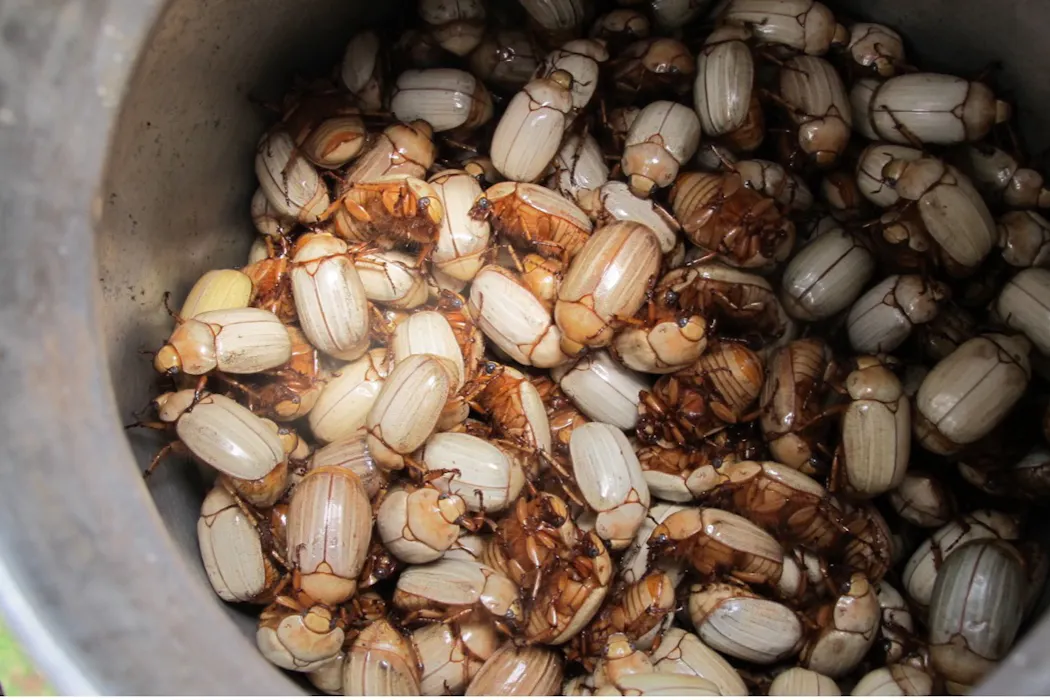
KEY TAKEAWAYS
-
Eating insects is often perceived only as a last resort in case of famine or extreme poverty.
-
Yet, in the countries where they are usually eaten, insects are often considered a rare delicacy, even a luxury, because the prized species are difficult to track down.
-
In some cases, consuming insects also helps to control the proliferation of crop pests.
Do people eat insects when there is nothing else to eat? Are insects really “food for the poor” or famine food?
In the West, insects weren’t considered as food but as vermin, crop pests, vectors of disease or sources of unpleasant bites, while other societies learned to live with them, as ethnobiologist Darrell Posey had already noted in 1978 about Amazonian people.
More than 2,000 edible species are consumed worldwide
When we look at eating attitudes toward insects on an international scale, Europe and North America are actually an exception compared to Latin America, Africa, Asia, and Oceania, where more than 2,000 species are consumed by hundreds of millions of people.
Publications from the first half of the twentieth century that described insect consumption, particularly those by colonial doctor Émile Bergier or entomologist Friedrich Bodenheimer, presented eating insects as an exotic practice, unique to “primitive tribes”. Nevertheless, Bodenheimer already noted insects’ nutritional value at the time.
This reality was confirmed in 2013, in a report by the United Nations Food and Agriculture Organization (FAO) on edible insects. The researchers commissioned by the FAO even developed the interest of these foods in alleviating hunger around the world. Analyses of insects’ nutritional value show that their protein levels are higher than those of other animals, and that they are also rich in vitamins, minerals and unsaturated fatty acids. Are insect consumers necessarily aware of this nutritional contribution? Could this be what leads them to eat insects?
What is an insect?
To answer this question, let’s start by seeing what we mean by insects. Western biologists classify insects, along with arachnids, myriapods and crustaceans, as arthropods, invertebrate animals with segmented bodies and articulated legs. In Latin, insectum refers to what is cut and segmented. Insects are defined as animals whose bodies are split into three parts and who have six legs, a pair of antennae and are usually winged and undergo moulting and metamorphosis. The morphology of the other groups differs: spiders, arachnids sometimes mistaken for insects (while they feed on them), have four pairs of legs, and no wings or antennae.
But this way of categorising insects differs in many societies. Even in France, during the Middle Ages, these creatures were not referred to by the generic term “insects”, but only by their proper names (“cicada” or “grasshoppers”…).
In the Ñuu Savi (Mixtec) language of Mexico, for example, the insect category does not exist. Insects are simply considered to be “small animals”, “which are born alone” (wild, without human intervention), that humans “go searching for” in nature, as they do for plants, mushrooms, or game. Collecting insects is therefore assimilated to either hunting or gathering. For example, in the Brazilian Nordeste region, ant gatherers say they “hunt” them.
Population-specific food choices
Consumers of insects therefore take advantage of what they find in their environment and choose to eat them, as they would any other animal or plant species. But this does not mean that they eat all the available species. Culture guides their dietary choices. Insects eaten by some populations are not necessarily consumed by their neighbours living in a similar environment and, within the same country or region, some social groups may consume insects, while others do not.
This consumption has often been perpetuated in indigenous, marginal, poorer than average populations, which is why it has been perceived as a practice associated with poverty. The fact that insects are gathered in nature, more rarely in urban areas, has reinforced this perception. In societies that have become urbanised and modernised, hunting and gathering can refer to archaic practices.
Prejudices associated with poverty
In Natal, in Brazil’s Nordeste region, the anthropologist Julie Cavignac and myself observed that people were ashamed of eating or having eaten tanajuras (Atta queen ants), as well as of having practised hunting and gathering in the hinterland before the development of the city and its surroundings. All of the Nordeste region, which has suffered several periods of drought throughout history, has long been considered to be the country’s poorest area. These stigmas, which still stand today, contribute to rejecting what appears to be backwards.
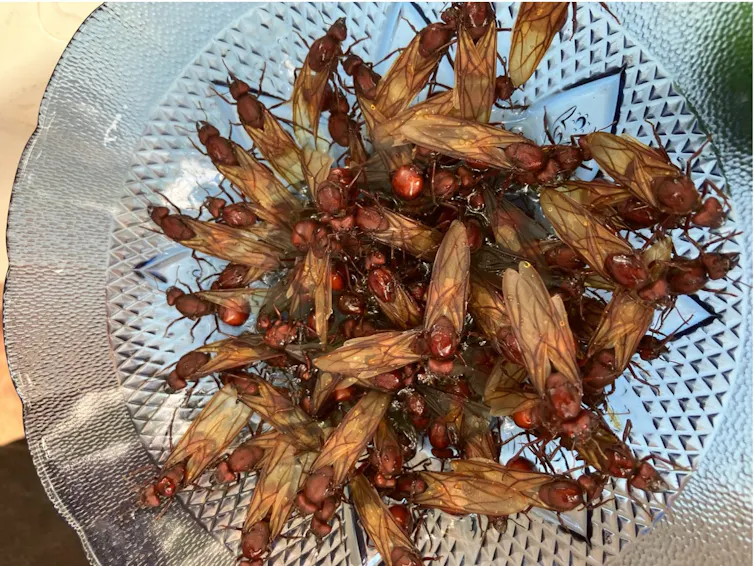
Fourni par l’auteur
Yet tanajuras are not famine food. When people were facing shortages due to drought, they ate cactus pads instead, usually given to livestock, wild tubers or palm fruits rich in starch, or a variety of cassava that must be detoxified for hours. Ants, on the other hand, are actually a delicacy, which appears only once a year, at the time of the ‘nuptial flight’.
Are common crop pests edible?
As Bodenheimer had already noted, insects may have been a famine food in certain circumstances, for example, grasshoppers or locusts, which, by swarming on crops, deprive farmers of their food sources, however, it is not famine that motivates this consumption.
Eating pests partly compensates for agricultural losses and limits their damages. In the tropics, palm weevils (Rhynchophorus spp.), which are considered a real plague in monospecific plantations, are, on the contrary, welcomed by populations that feed on their larvae and thereby control their proliferation.
Insects do not satisfy hunger in cases of starvation
Insects are, in fact, rarely regarded as famine food because they do not satisfy hunger in the same way as starchy foods. Nevertheless, they are a useful source of nutrients for populations suffering from vitamin or mineral deficiencies, or who consume little animal protein.

Fourni par l’auteur
However, people who have access to game or farmed meat also consume insects, in the Amazon for example. People who eat insects eat them mainly based on their taste, as already noted by Bodenheimer. Palm weevils are appreciated throughout the tropical belt, in America, Africa or Asia. The same is true of grasshoppers and termites in various countries, Atta queen ants in Latin America, and many other species.
Fourni par l’auteur
Luxury dishes rooted in local knowledge
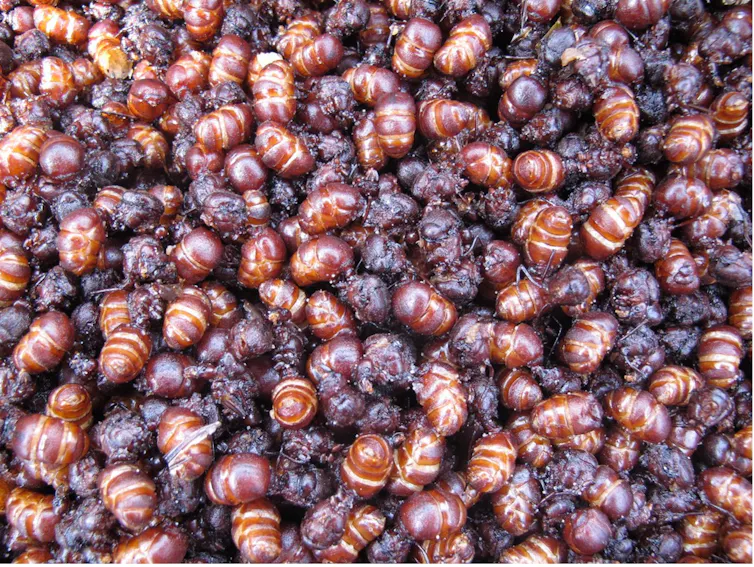
Some insects, such as the escamoles, eggs and pupae of the Liometopum ants, regarded as “Mexican caviar,” are also deemed so tasty that they are subject to predation and are marketed and even served in upper-class restaurants.
Weevil larvae are sold at least in Cameroon and in the Peruvian, Ecuadorian, Colombian, and Venezuelan Amazonia; the mopane caterpillars are traded in all of southern Africa; grasshoppers are sold in very large quantities in Mexico and in Thailand; insects that only come out once a year, at the time of swarming, arouse even more collector and consumer excitement.
Therefore, collecting insects does not only mean extracting resources from the environment, it also requires specific knowledge of fauna, flora, meteorology and ethology. You need to know insects’ habitats, possibly their host plants, the time of year when they are found, the signs announcing their swarming or arrival, and the climatic conditions that make swarming possible.
Insect-collecting can be dangerous
Insect collecting missions often require physical effort, travelling to isolated places, in uncomfortable conditions, and involve risks (sunstroke, falls in steep places, venomous animal bites). Preparing them demands culinary knowledge, often acquired over decades or centuries of practice.
For such efforts to be made, it must be worthwhile. Insects are actually tasty, and can generate income. The most appreciated ones are fetching ever-higher prices, well above prices for meat. It happens not only in small villages, but also in capital cities, where immigrants of rural origin, nostalgic about these dishes, started selling them. This is how the trade reached Bangkok, Mexico City or Bogota.
Expression of a cultural identity
In Mexico, for example, UNESCO registration of the traditional cuisine as Cultural Intangible Heritage has brought this consumption up to date. Therefore most insects are worth at least 50 euros per kilogram, or even more when they are sold in small portions or served at a restaurant. Selling insects provides additional income to rural families, but also tends to deprive them of nutritious food that they could have eaten.
Some people of rural origin abandon this practice when they emigrate to the city, while others, by perpetuating it, affirm their attachment to the territory, a local identity and a peasant or indigenous history.
Such is the case of the Quitu-Cara, the native inhabitants of the Quito Valley in Ecuador, who consider so-called catzos beetles as a treat, or the inhabitants of the department of Santander, Colombia, for whom the hormigas culonas, Atta queen ants, represent their culinary and cultural heritage. Still other people, especially city dwellers, become new consumers, drawn to a new fashion trend or initiated by friends. And again, their motivation for eating insects is not necessity, but taste.
This article is published as part of the Fête de la science, annual event in France honouring Science in all its forms (which runs until October 12, 2026) – a The Conversation France partner event. This new edition focuses on the theme “Saveurs Savantes”. Find all the events at Fetedelascience.fr.

A weekly e-mail in English featuring expertise from scholars and researchers. It provides an introduction to the diversity of research coming out of the continent and considers some of the key issues facing European countries. Get the newsletter!

Esther Katz ne travaille pas, ne conseille pas, ne possède pas de parts, ne reçoit pas de fonds d’une organisation qui pourrait tirer profit de cet article, et n’a déclaré aucune autre affiliation que son organisme de recherche.
Original source: https://analysis1.mil-osi.com/2026/10/08/are-insects-really-poor-peoples-food/