

Source: The Conversation (Au and NZ)
It’s a familiar experience for many Australians. Shopping at discount supermarket chain Aldi, you see an off-brand product that looks similar to a major brand’s product you know and love. You decide to buy it, because not only does it look familiar, it also costs much less than you would pay elsewhere.
Aldi has successfully used this dupe or “lookalike” strategy for decades. However, the approach is not without risk, particularly in the eyes of Australian copyright law.
Last week, Aldi lost a bid to overturn a 2024 Federal Court ruling that the packaging on three products in its Mamia baby snack range infringed the copyright of the rival Bellies brand, owned by a company called Hampden Holdings IP.
Here’s what this case can tell us about the line between being inspired by a competitor’s design, versus infringing on copyright.
The allure of lookalikes
By deliberately taking inspiration from competing brands, Aldi can tap into shoppers’ familiarity with products they know, while offering an attractive, lower price.
The supermarket has hardly tried to be coy about this marketing strategy. A now-famous advertising campaign for Aldi from the 2010s had the slogan “Like Brands, Only Cheaper”.
Protecting an expression, not an idea itself
When thinking about how copyright applies to any kind of packaging, it must be noted that copyright protects the expression of an idea, rather than an idea, concept or style.
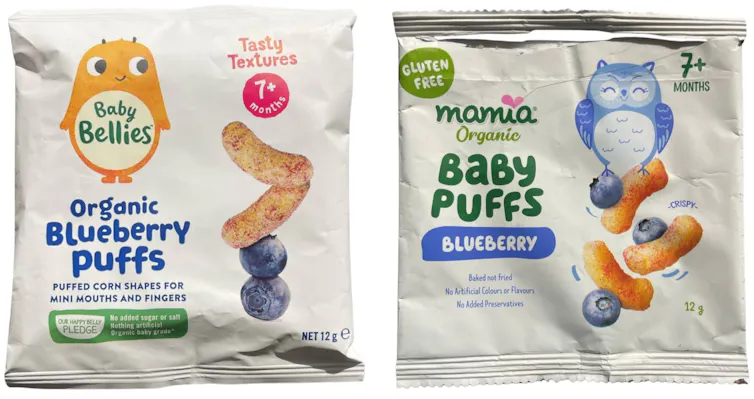
For example, the idea to make baby snack packaging appeal to parents by using an orange cartoon animal on the front is a concept. Using a white background for a package is a design choice.
It is only when an orange creature or a blue owl is produced on packaging with a white background that the actual expression of these packages may be protected under copyright. The snack packaging artwork is classified as an artistic work.
How much copying is too much?
Aldi’s Mamia range of baby puffs snack products first went on sale in 2021.
Hampden Holdings, the company that owns the branding for the Baby Bellies, Little Bellies and Mighty Bellies snack ranges, launched legal action against Aldi in 2022 regarding 11 products, having already made formal complaints.
One of the tests for determining copyright infringement is called the “substantial similarity” test.
In this context, this test examines whether one product’s branding has reproduced a substantial part of another’s. It requires a causal connection between both products and a degree of objective similarity.
In other words, did the designers of one product access the other when creating theirs – and if so, how similar are the two?
In this case, evidence suggested a causal connection did exist. This was because the court heard Aldi’s design agency used their competitor’s products as a benchmark when designing their own packaging.
Federal Court of Australia, Aldi Foods Pty Limited v Hampden Holdings I.P. Pty Limited
In the 2024 trial judgement, it was found Aldi had followed the “architecture” of the Hampden products.
However, using a competitor’s product for inspiration does not necessarily amount to copyright infringement. Rather, it is a question of degree and fact.
In the trial judgement, the degree of objective similarity between each product was compared systematically, with a checklist-like approach.
The court then assessed whether these identified elements amounted to a breach of copyright law by Aldi, ruling that for three products, it did.
Aldi goes ‘slightly backwards overall’
Aldi appealed (and Hampden cross-appealed) this ruling, with arguments there were flaws in the approach taken and findings given by the trial judge in 2024.
In the appeal proceedings, the Full Court – a panel of three Federal Court judges – found the approach the judge had taken in the initial ruling was flawed, because it did not engage in a side-by-side comparison of the alleged Aldi duplicates of the Hampden products.
This included that it needed to focus more on the overall significance of original elements found in Hampden’s packaging, and – when taken together – the extent to which a particular Aldi product’s packaging was similar.
While Aldi did win some of its appeal, it went “slightly backwards overall”, according to the judgement. That’s because the Full Court upheld the infringement findings – and found that two additional Mamia products were also in breach.
The rise of the dupe
There is a bigger story here. Businesses are increasingly producing dupes of their competitors’ products that sit somewhere between inspiration and infringement.
Consumers are drawn to these products, because they promise the look or functionality of a more expensive product at a lower price. But where a dupe sits in the eyes of Australian copyright law requires individual, nuanced assessment.
A product might look similar to a competitor’s and be considered lawful, while another may infringe copyright – the short answer is “it depends”.
The key takeaway is this: designing a dupe of a successful product is not an inherently unlawful commercial strategy. However, deliberately copying the distinctive elements that make the original product recognisable runs the risk of becoming a copyright liability.

Wellett Potter is a member of the Copyright Society of Australia and the Asia-Pacific Copyright Association.
Original source: https://analysis1.mil-osi.com/2026/08/25/aldi-is-famous-for-its-dupes-wheres-the-line-between-clever-lookalike-and-copyright-breach/