

Source: The Conversation (Au and NZ)
Violent crime in Indigenous communities is often the subject of media headlines. It usually results in governments adopting “tough on crime” responses, including increased policing and restricting bail.
Recent data show the toughening of Northern Territory bail laws has led to more Aboriginal people in jails than ever before. At the same time, high levels of violence in remote Aboriginal communities persist.
Our new research looks at what’s happening on the ground, specifically in the remote Aboriginal communities of the West Daly region in the Northern Territory.
Elders have revealed there are complicated drivers of community violence and unrest, many of which go unaddressed by typical law and order responses. Here’s what they’re doing instead.
Indigenous people across the country face a range of social policy challenges, many of which are often politicised. In this three-part series, experts examine issues with child protection, violence and reconciliation and look at evidence-based policy approaches that would help improve the lives of Aboriginal and Torres Strait Islander people.
Different social structures
Over the last few years there has been an increase in community violence in the West Daly. Aboriginal townships and homelands that have been largely free of community violence in the past have experienced episodes of conflict and rioting.
This new unrest requires innovative strategies to achieve peace.
In 2024, the federal National Indigenous Australians Agency working with the NT attorney-general’s department, set up the West Daly Peace Project. It involved a small team of Indigenous and non-Indigenous peacemakers working in the remote townships of Nauiyu, Peppimenarti, Nganmarriyanga and Wadeye.
Key to this work is understanding First Nations social structures. They differ from region to region across the country and aren’t like traditional Western ways of relating to one another.
In East Arnhem Land, for example, Aboriginal people, animals and plants belong to one of two halves, called “moieties”. In the Tiwi Islands, social organisation is structured through four skin groups.
Across the West Daly region, all living things fall into four ceremony groups, called Wangka, Tjarnpa, Lirrga and Wulthirri. These groups have their own recognised leaders, and are connected through their songs and ceremonies. These ensure language, land and dreaming stories are correctly passed down through the father’s lineage.
These social structures have endured for thousands of years, but since colonisation also frequently exist in tension with Western ways of doing things. First Nations people, and government staff, can struggle to uphold both systems at once. This leads to disputes.
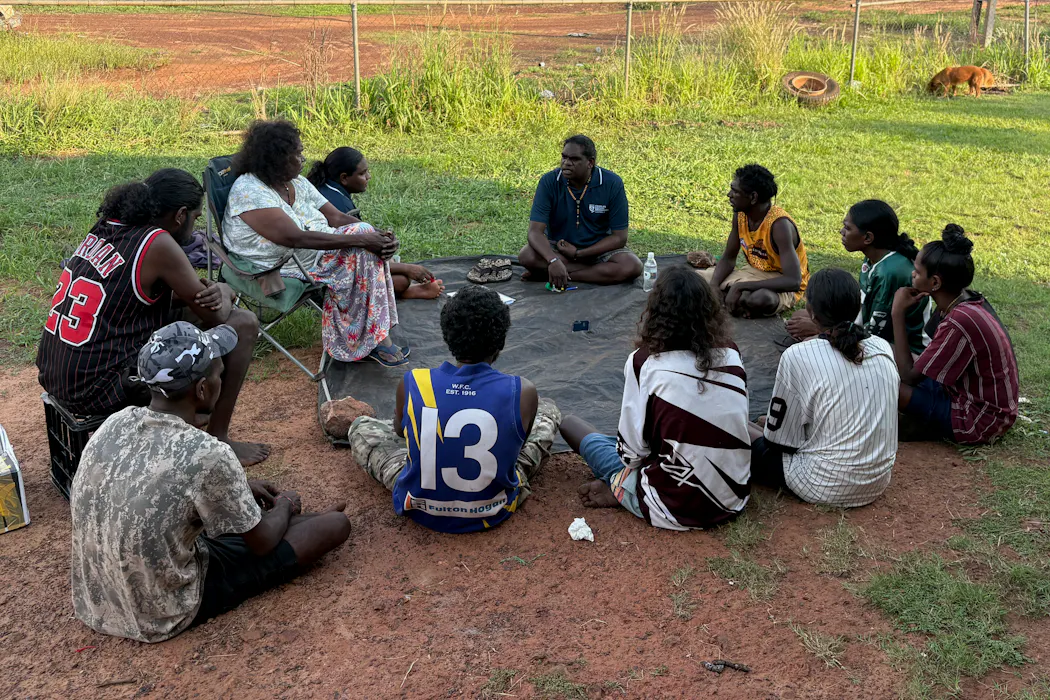
This is where the West Daly Peace Project comes in. Respecting Aboriginal people as first responders in community conflict, we’ve worked with Elders, families, local agencies and other government departments across a wide range of issues and community conflicts. The goal is to settle conflict and support the growth of peace in the region.
Our research team has completed an evaluation of the project, guided by elders and local researchers working in their own places and languages. It has some important lessons.
Not just resolving disputes
Elders guiding the research drew a clear distinction between creating lasting peace and dispute resolution.
They saw community disputes as a result of longstanding issues of local governance. This includes where different Aboriginal social structures come into conflict with each other due to conditions generated through government approaches.
When government services staff focus on resolving these disputes without considering the conditions that gave rise to them, they risk perpetuating further injustice. We saw this in violence continuing for many years, despite attempts to stop it.
Nurturing peace, on the other hand, is a sustainable process of practising traditional Indigenous governance in the present.
This means reinvigorating healthy networks of kin on Country that had generally allowed for peaceful coexistence before townships were established. Such processes maintain the kin networks integral to social order, and respect that local Elders have kin authority only in their own family groups.
When leaders work beyond their own family groups they are often seen locally as stepping outside their remit, which further exacerbates community tension.
Working for positive peace
The distinctions raised by the Elders are also in academic literature dating back to the 1960s.
Scholars have long discussed the difference between “negative peace” (as an absence of violence generated through increased arrests and incarceration) and “positive peace” (as an integration of justice and equity within sustainable social structures in place).
In the West Daly, negative peace would look like more incarceration, which can further inflame inter-family tensions, especially when former prisoners are released back into the community without negotiated arrangements between lawyers, courts, families and on Country support programs.
But positive peace turns its attention in a different direction. Rather than investing in resolving continually recurring tensions, it focuses on ensuring Aboriginal people can maintain their connections of kin on Country.
When these conditions are tended to, elders are respected and disputes tend to resolve themselves.
And while government services alone can’t achieve this peace, they play a crucial role in making it possible.
Building from the ground up
Fortunately, within the West Daly there are locally-led initiatives that have achieved remarkable success.
These includes the work of Janine Cooper (author) working to reconstitute strong networks of family and kin in Nauiyu/Daly River following a period of rioting and unrest.
Engaging different family and ceremony groups, in honour of a young man who had passed away due to suicide, she worked carefully to revive a local football event. It sounds simple, but it’s actually far from it.
Drawing in other teams from ceremony and family groups across the region, meant everyone in Nauiyu could cheer for the same team and unite as a community after years of unrest. It also meant the organisations involved, from the sausage sizzle crew to the collaborating funding partners, could align with traditional social structures and work within them, rather than against them.
It built strength and trust across the whole region, Indigenous and non-Indigenous alike.
There are also a number of proposals by Elders and emerging leaders, who are looking towards ways of organising through the four ceremony groups, to improve opportunities for employment, partner with local services and put a stop to violence.
This includes in schools. Here, ceremony groups can be embraced alongside classrooms and year groups as important organising systems within teaching and learning.
Back to the future
The West Daly Peace Project identified specific ways these outcomes can be achieved, usually through respectful conversations carried out on the ground, led by local researchers and guided by Elders who understand the social structures at play.
To work in other regions, these approaches would need to be specific to those locations, and their local histories and ancestral groups.
With strong connection to Country, healthy kin networks and respected Elder authority, Aboriginal people have always been able to live well. This research backs up what history shows to be true.

Michaela Spencer receives funding from the Northern Territory Attorney-General’s office and Australian Research Council.
Janine Cooper is affiliated with Mamulbak Aboriginal Corporation.
Latisha Marranytya is affiliated with Miriam Rose Foundation.
Troy Mardigan is affiliated with Merrepen Arts.
Annunciata Nunuk Wilson does not work for, consult, own shares in or receive funding from any company or organisation that would benefit from this article, and has disclosed no relevant affiliations beyond their academic appointment.
Original source: https://analysis1.mil-osi.com/2026/08/13/indigenous-people-want-violence-out-of-their-communities-heres-a-new-approach/