

Source: The Conversation – Canada
Casting Lupita Nyong’o as Helen and Elliot Page as Sinon the soldier were bold and exciting choices in Christopher Nolan’s The Odyssey.
Both signalled a departure from conventional, hyper-masculine Hollywood treatments of Greek myth. The comments of Elon Musk and many others on X confirmed Nolan’s success in that regard.
But as a scholar of ancient Greek literature and culture, I found the film disappoints in its portrayal of women.
Nolan’s women are (mostly) strong independent characters central to his anti-war theme. However, they play singular roles — wife, mother, caregiver, queen, witch — that lack the sexual and intellectual complexity of Homer’s poem. Their desires, agency and choices are either not as vibrant or lost.
Homer’s women are so psychologically complex in The Odyssey that in 1897, British writer Samuel Butler argued its author was actually a woman. (The Odyssey emerged from an oral tradition, and its authorship remains unknown. “Homer” is more of a literary convention than historical fact).
Penelope
Nolan’s Penelope knows the powerlessness of a queen whose husband has been absent for years, and whose kingdom is threatened by men seeking to take his place.
She uses her skill as a weaver to delay the suitors pressuring her to remarry, claiming she must finish weaving a burial shroud for her father-in-law while secretly undoing her work each night.
Her role as a faithful wife and dedicated mother are pivotal to Homer’s Odyssey. Penelope at her loom has become shorthand for female sexual virtue, appearing in art from classical red-figure vase paintings to neoclassical portraits, like that of Angelica Kauffman (1741-1807).
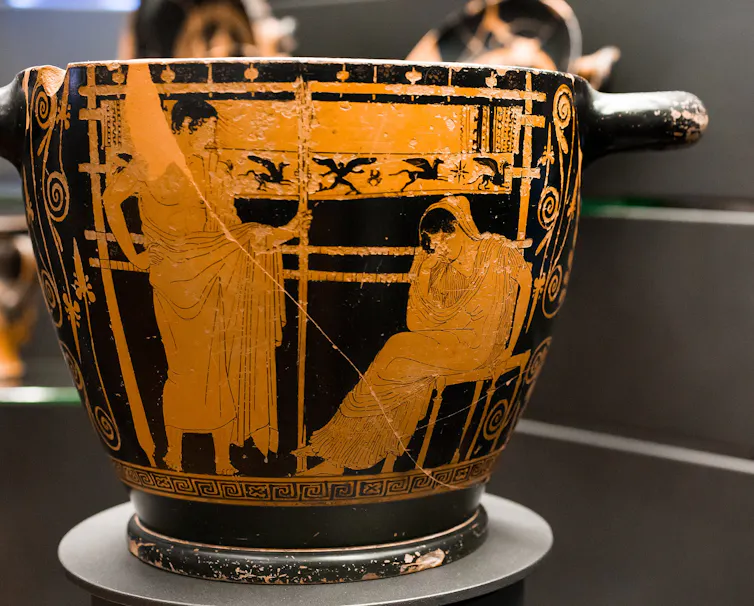
(Wikimedia/Museo archeologico nazionale di Chiusi), CC BY
In Nolan’s film, Penelope is never far from her loom. Significantly, one of the most important moments in Homer’s story is missing: her test of Odysseus after his return.
The Homeric Penelope wishes to verify Odysseus’ identity after his long absence. Knowing he carved their marital bed from a rooted olive tree, she tells a servant to make the bed up outside the bedchamber to see how Odysseus responds. He suspects she has been unfaithful until he learns the bed has remained fixed in place.
Her trick of the bed cements her as the equal of the polutropos man (“the man of many wiles”). But it also requires her to voice the possibility of her own infidelity.
The question of Penelope’s virtue hangs over Homer’s account when she appears to the suitors, with even Telemachus questioning whether Odysseus is really his father.
Penelope’s charged mythical tradition is taken up in Margaret Atwood’s Penelopiad, which reimagines the story from the perspective of Penelope and her 12 maids. Her story has also become a vehicle for exploring the complex emotions of spouses of soldiers deployed to combat zones.
Circe
The most engaging of Nolan’s female characters is Circe, and not simply because of the scene in which she transforms Odysseus’s men into swine.
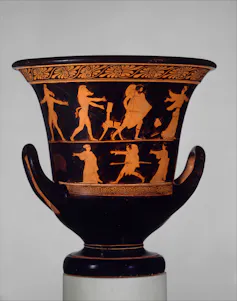
(Metropolitan Museum of Art)
It’s through her that Nolan comments on sexual violence as a strategy of warfare, not an unfortunate consequence. In doing so, he builds on American novelist Madeline Miller’s reading of Circe’s craft as a defence against male violence, although that is never threatened in the original poem.
Her novel Circe is one of a number of recent adaptations of Homer, including Pat Barker’s Women of Troy series and Natalie Haynes’ A Thousand Ships, that give voice to women characters and apply a feminist lens to Homeric epic.
Circe’s identity as a witch in Nolan’s film is a more of a later tradition. In Homer, she is a goddess with knowledge of plants, like other gods. Hermes offers Odysseus the protective plant, moly, so he can resist her drugs.
In Homer, Circe’s singing entices Odysseus’ men to her house, where she transforms them into pigs. When Odysseus follows, he forces her to restore his men to human form. He then allows Circe to seduce him, enjoying her hospitality and sharing her bed for a year.
Helen
The most disappointing of Nolan’s portrayals is Helen, whose abduction by the Trojan prince Paris is said to have sparked the Trojan War. In antiquity, the Spartans honoured her with a shrine as part of a hero cult.
In Nolan’s Odyssey, Helen is a domesticated, repentant and physically disfigured beauty. The film reworks her grand entrance from the epic: Menelaus turns Helen’s face to Telemachus, Odysseus’ son, revealing a scar and questioning whether she is still desirable.
Nolan presents her as more of a minor character than the poem does. Her most significant moment in the film is when Telemachus is taking his leave and she requests he tell Penelope how sorry she is for all the pain she has caused.
By contrast, Homer’s Helen is more complex and engaging. When she first appears in The Odyssey, she narrates her own tale, explaining how near the end of the war, and no longer influenced by Aphrodite, she was ready to return home. She recalls helping (or perhaps seducing) Odysseus when he visited Troy disguised as a beggar.
Menelaus then describes how she walked around the Trojan horse calling to the warriors inside in the voice of their wives, enticing them to come out. Together, these stories highlight her cunning alongside her sexuality and agency, which remained central to later versions of her story.
The Greek lyric poet Alcaeus slut-shames her. The poet Stesichorus and historian Herodotus offer versions in which Helen was in Egypt during the war (her sexual virtue intact), with an eidōlon (“a double”) taking her place at Troy.
Read more:
Guide to the classics: Euripides’ The Trojan Women – an unflinching look at the brutality of war
The playwright Euripides explores both versions of Helen in two different plays, Trojan Women and Helen. Sappho, one of the few female voices from the ancient Greek world, praises her for choosing Paris over her husband and daughter because she acted on her desire.
Each version demands engagement with her sexuality and reflects on a sexual autonomy and power not permitted to the average ancient Greek woman.
Women as desiring subjects
Homer’s Odyssey is more than 2,500 years old. Its survival depends partly on the many ways later generations have retold and reinterpreted it.
In Nolan’s film, the women characters are reimagined for an anti-war tale — a timely theme to be sure. Circe punishes Odysseus’s men for their war crimes, Helen becomes a victim of a soldier’s rage and Penelope an audience for a soldier’s self-reflection.
But in doing so, Nolan continues a long tradition of appropriating women’s stories through a man’s perspective. It misses an opportunity to explore women as desiring subjects with sexual agency who struggle against double standards that judge their choices and cast them as a source of anxiety.
Nolan’s Odyssey reminds us that violence, even sexual violence, is still more acceptable to viewers than female sexual autonomy.

Allison Glazebrook does not work for, consult, own shares in or receive funding from any company or organisation that would benefit from this article, and has disclosed no relevant affiliations beyond their academic appointment.
Original source: https://analysis1.mil-osi.com/2026/08/03/christopher-nolans-the-odyssey-disappoints-in-its-portrayal-of-homers-women/