

Source: The Conversation – Global Perspectives
Nearly every country in the world has acknowledged that climate change is a serious problem. It’s hard to ignore, as billions of people suffer through increasingly destructive storms and extreme heat.
In response, most governments have promised repeatedly to cut greenhouse gas emissions that are driving global temperatures higher. Yet those emissions are still hitting record levels, and global negotiations over how to slow climate change routinely end with weak promises.
There’s a reason: All it takes to water down a deal during these negotiations – the 2026 U.N. climate conference started Nov. 9 – are a few voices obstructing progress, often without ever saying “no,” and all the while maintaining the appearance of being a climate leader.
As a professor of environmental studies and international relations at the University of Southern California, I’ve attended and observed international climate negotiations for over a decade. My research lab investigates climate justice concerns and the forces that obstruct progress at the global U.N. climate talks.
As world leaders and their negotiators meet for the latest climate talks, COP31, in Antalya, Turkey, Nov. 9-20, you can also pick out who is obstructing progress. Here are five tactics among many that powerful people at these conferences use to delay, weaken or redirect meaningful action while still appearing committed to addressing climate change:
1. Say we can’t afford it
“We don’t have the money” is a familiar refrain at U.N. climate negotiations.
At COP29 in Baku, Azerbaijan, in 2024, wealthy countries pointed to tight budgets, pandemic debt and rising inflation as reasons they could not meet the US$1.3 trillion in assistance that developing countries were demanding. They instead offered $300 billion annually by 2035 as a finance target.
Poorer countries that did little to cause climate change want longtime fossil fuel users to pay for the damage emissions have caused. The COP29 agreement itself estimated that developing countries’ climate needed $5.1 trillion to $6.8 trillion in total through 2030.
In reality, affordability is really about priorities.
For example, the International Institute for Sustainable Development found that governments around the world provided more than $1.2 trillion in public financial support for fossil fuels in 2024, about five times the $254 billion they provided for clean energy.
Military budgets tell a similar story. Over the decade from 2014 to 2024, the U.S. contributed $2 billion to the Green Climate Fund, meant to support poorer countries as they adapt to climate change, while Congress simultaneously approved at least $79 billion to help foreign countries by U.S. military weapons. Recent research points out that rising military spending makes climate goals even harder to reach because so much military activity runs on fossil fuels.
The money exists. The question is where governments choose to spend it.
2. Promise to fix it later
Another tactic is claiming that technological innovations will clean things up eventually, so drastic emissions cuts can wait or even be avoided.
This technological optimism has deep roots. In 2004, Princeton scholars Steve Pacala and Robert Socolow proposed the “stabilization wedge” approach to addressing climate change. It slices future emissions growth into 15 strategy wedges, each representing a way to cut 1 billion tons of carbon dioxide. Selecting from that menu, government could piece together a suitable emissions reduction strategy.

Congressional Budget Office
Renewable energy solutions such as solar and wind were proposed as wedges, but so were carbon capture and storage technologies – which would allow the burning of fossil fuels to continue.
Scientists, including one of the original authors, have claimed that the wedges approach makes a difficult problem look deceptively simple to solve. Recent reporting by ProPublica tracked money behind the wedges project back to the fossil fuel giant BP.
Yet the same logic is now present in agreements emerging from recent climate talks.
3. Water down the promise
Another tactic is to agree to something, then water it down over time until it is no longer binding.
At COP26 in Glasgow, Scotland, in 2022, early drafts of the agreement called for the “phasing out” of fossil fuels. It would have been a true milestone, as it was the first time the words “fossil fuels” had appeared in a climate agreement.
However, after a late push led by India, backed by China, South Africa and others, the final text was changed to “phasedown” of “unabated” coal power instead. Additionally, the pact said nothing of oil and gas, the fuels that wealthier countries depend on most.

Kiara Worth/UNFCCC, CC BY-NC-SA
The first fossil fuel language in a U.N. climate pact came out diluted. Four years later, at COP30, 88 countries backed a roadmap to move the world away from using fossil fuels, but the final decision left it out.
4. Make promises, then fail to deliver
Countries are really good at making pledges to help, but not so much at providing the funding.
In 2009, wealthy countries promised developing countries $100 billion annually to help them address climate risks. They missed that target for over a decade. Even when they did claim to hit the target, they relied largely on dubious accounting, with donors counting fossil fuel projects, airports and even ice cream shops as climate aid.
The Loss and Damage Fund created at COP27 in 2021 to help countries manage disaster damage shows a similar pattern. Only about half of the roughly $822 million pledged had been paid in five years later, and the fund has not paid out a single dollar to a country hit by a disaster.
Nepal has emerged as a critical test of the fund’s integrity. After a glacier collapse triggered a sudden flood that killed more than 1,400 people in Nepal in August 2026, the government estimated the country had suffered $2.7 billion in damage. Nepal requested $20 million, and, in a first, the fund’s board agreed in October to “provisionally set aside” $21.6 million, but that’s only the beginning of the paperwork.
5. Make decisions without everyone at the table
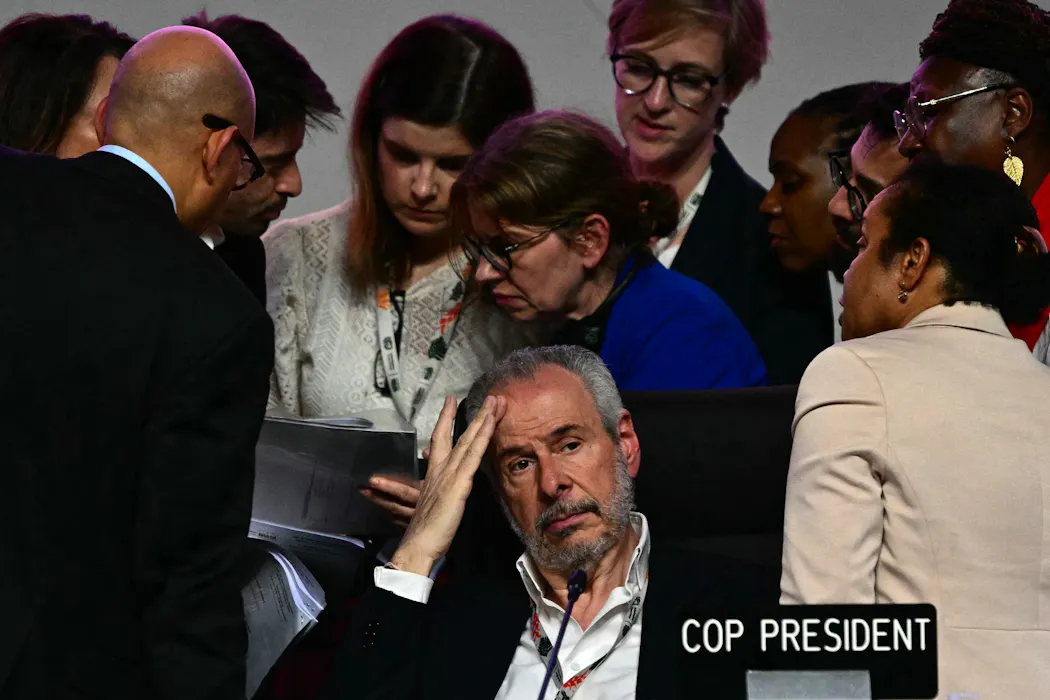
Decisions at the U.N. climate conference are taken by consensus, meaning they’re considered adopted when no country formally objects. This act is marked by the banging of a gavel.
At COP28 in Dubai, the conference president “gaveled through” a key decision before representatives of the Alliance of Small Island States had reached the room, meaning they had no chance to object. The lead negotiator for the islands’ group told the meeting that they would have objected, as they considered it too weak to keep warming to the agreed limit of 1.5 degrees Celsius (2.7 Fahrenheit) within reach.
In 2025, at COP30 in Belém, Brazil, a similar scene played out.
After swiftly gaveling through many decisions, the conference president failed to recognize Colombia’s request to speak until after the gavel had fallen. Colombia objected that the text of the formal decision failed to discuss a transition away from fossil fuels. The COP president later apologized but said the decision could not be reopened.
What to watch for at COP31
At COP31, my team and I will be watching for decisions about financial support, whether talk of technology crowds out reducing fossil fuel use, and who gets a voice.
Much of what matters at these conferences happens out of the spotlight. Plenary sessions, where decisions are formally adopted, are the part most people see. But the wording of those decisions is usually worked out in smaller rooms and closed-door huddles among a handful of delegations. Small delegations can’t staff every room, and some rooms are closed to observers.
My team will be tracking what happens, whose proposals survive, and what quietly drops out between drafts of the agreement text. We’ll also be paying attention to who, quietly or not, says “no.”
Ridwan Intisaar Mahbub, a graduate student in public diplomacy, and Richie Sanchez, an undergraduate student in environmental studies at USC, contributed research for this article.

Shannon Gibson does not work for, consult, own shares in or receive funding from any company or organization that would benefit from this article, and has disclosed no relevant affiliations beyond their academic appointment.
Original source: https://analysis1.mil-osi.com/2026/11/09/5-ways-countries-stymie-climate-negotiations-without-actually-saying-no/