

Source: The Conversation – UK
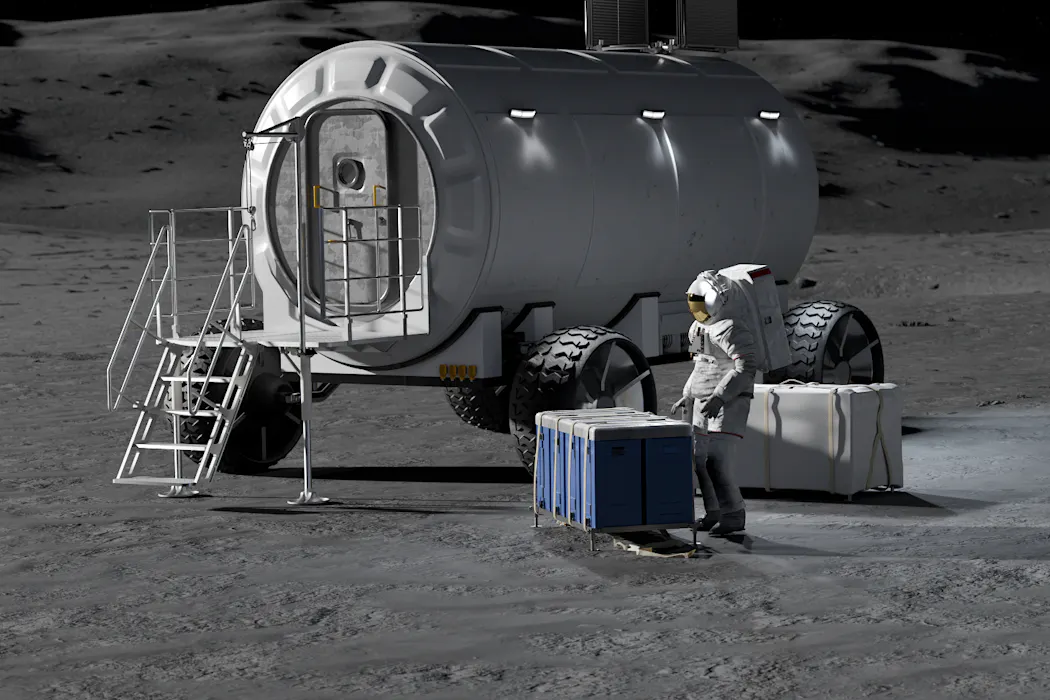
Sixty years ago, the United States and the Soviet Union were embroiled in a race to the Moon, which the USA won. The 21st-century lunar contest, with China stepping in for the Soviet Union, has many similarities, but key differences.
The Apollo astronauts planted the stars and stripes in lunar soil, bounced – and drove – around, set up experiments and collected scientifically valuable rock samples. Ultimately, however, there was no real plan to stay.
The new Moon race is different: space agencies are targeting the south pole of the Moon due to its deposits of water ice. This water can be used for life support on a lunar base. It can also be turned into rocket fuel, splitting it into the hydrogen and oxygen used by space vehicles, making it a valuable resource.
But ice deposits are not evenly distributed and suitable spots for establishing human outposts are finite. This could spark competition to bag the best spots. So will the US-China lunar contest turn into a land grab?
For anyone growing up in the 1980s and 90s, human space travel almost seemed to become “routine”, but that era was still mainly the domain of the US and the Soviet Union (and then Russia). While the European Space Agency was growing, it focused largely on robotic scientific mission and commercial launches. Now, 30 years later, the sector has grown massively, and space is no longer the sole domain of a few superpowers.
Around 20 nations are able to carry out space launches, mainly to send satellites into orbit. But there have also been privately funded robotic missions to the Moon – albeit with significant support from government agencies.

Nasa
Despite this globalisation of space, only three countries are currently able to send humans into space using their own rockets: the US, Russia and China. This is largely a reflection of the fact that spaceflight gets much harder when people are involved, because they need continuous supplies of food, water, heat and air.
Space is an unforgiving environment, so there is absolutely no margin for error. There’s limited scope for backup or rescue, and so everything needs to be tested and tested again.
That’s part of the reason China is on track to catch up with the US and Russia in terms of achievements in space, despite starting decades later. As of 2021 they operate a modular, permanently crewed space station called Tiangong. While not as large as the International Space Station, there is plenty of scope for expansion.
The very successful Chang’e lunar programme has returned samples from the Moon’s far side, deployed relay satellites to provide more reliable communications, and explored the lunar terrain with rovers. It’s due to these successes that China, partnering with Russia, is the main competition for the United States in Moon race 2.0.
So how should we expect this lunar contest to unfold? The US-led effort has a medium-term goal of establishing a permanent human base at the south pole. These lunar outposts would probably operate in a similar way to the International Space Station, and the research bases in the Antarctic, staffed by rotating crews.
Nasa is using the Orion spacecraft to carry astronauts from Earth to our closest celestial neighbour. But they will need a separate vehicle to land. These landers do not yet exist in final form. Two companies, Blue Origin and SpaceX, are competing to develop separate landing craft. An important test will take place next year: for Nasa’s Artemis III mission, an Orion capsule will attempt to dock with one or both landers in low Earth orbit.
Over the next few years a fleet of robotic craft will also send experiments, deliver cargo and use drones and rovers to scout landing sites and locations for lunar outposts. Like the lunar lander, many of these missions will be led by private industry.
Nasa
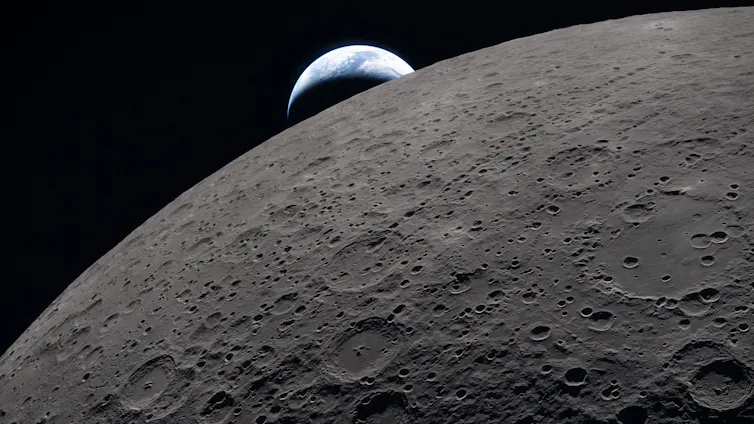
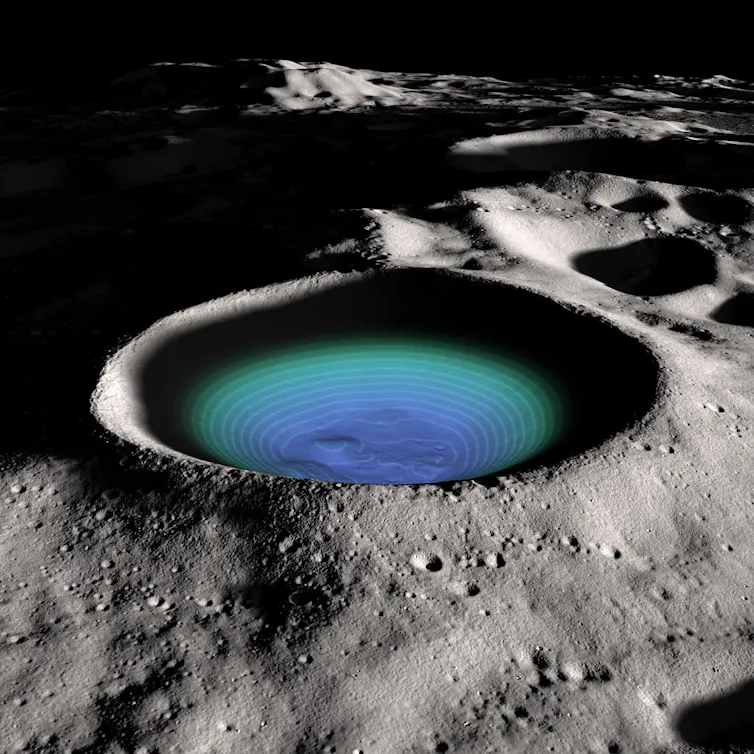
But the lunar south pole is a challenging place for astronauts to operate. The ice deposits are at the bottom of craters that never see sunlight, where temperatures are more than 200 degrees below zero. There are mountaintops near the pole that are almost always visible from Earth, but relay satellites in lunar orbit are needed to help with communications when they do drop over the horizon.
The Sun also rises to just a few degrees above the horizon, and is sometimes below it for days at a time – plunging some locations into darkness. The low temperatures require heating units for humans and equipment alike. But, with inconsistent sunlight to generate solar power, other energy sources, such as nuclear fission, will be needed to keep the batteries charged.
NASA’s Scientific Visualization Studio
The next phase of lunar exploration, pencilled in for 2029-2032, should see the laying down of key infrastructure, such as power supplies and communications systems.
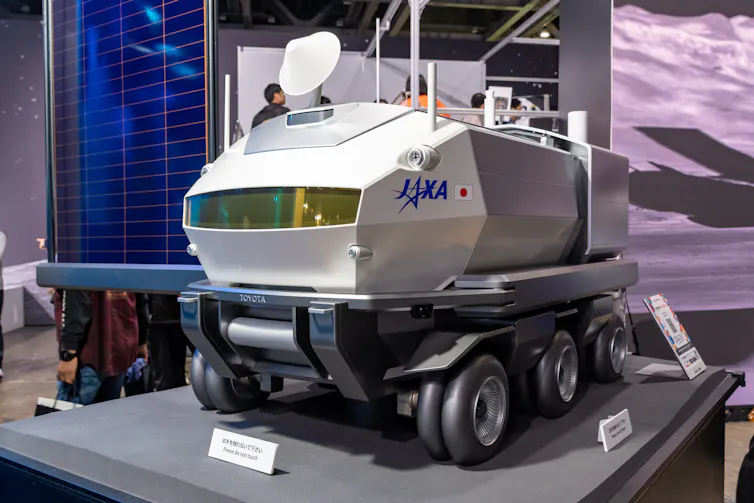
Drilling and digging will prepare the ground for an eventual base, which could be partly underground to protect against radiation and impacts by tiny space rocks. Nasa will also send a more sophisticated Japanese-built rover to the surface with a pressurised interior. This will allow astronauts to live and work in a mobile lab without bulky space suits
The plans for the final phase, from 2032 onwards, involves people living for long periods on the Moon, building up a modular base and taking advantage of the Moon’s resources to produce water, oxygen and even building materials.
SuFlyer, CC BY
For the rival effort to build a lunar base, China is partnering with Russia and collaborating with several other countries. Over the next couple of years, Beijing will test its Mengzhou crew capsule and Lanyue landing vehicle ahead of a first lunar landing around 2030.
Construction of a base, called the International Lunar Research Station, is scheduled to be underway by 2035. The planned location for this base is also the lunar south pole, so there’s a race to pick the best spot.
There’s plenty of science to be done by crews living in these bases, some of it related to understanding the structure and formation of the Moon itself, as well as investigations related to medical and materials research.

Nasa
Another scientific goal could be to establish radio telescopes on the far side of the Moon, where they would be shielded from the sea of radio communications originating on Earth. This could allow astronomers to detect faint cosmic signals that are otherwise impossible to detect using ground-based instruments.
And the relatively low gravity of the lunar surface could make it easier than Earth for launching missions to other destinations in the solar system. By sending up components and assembling them on the Moon, future missions could use much larger, more capable spacecraft. That’s particularly important if there are people on any of those missions.
There are also economic benefits to having a lunar presence. Private companies will make money by building the landers, rovers and other key technologies. There may also be a market in transporting equipment and experiments to the lunar surface. Making rocket fuel on the Moon would make space exploration cheaper than lugging it from Earth. It could even be used to refuel satellites in Earth orbit.
If humanity can do one thing well, for better or worse, it’s to exploit the natural environment.
The 1979 United Nations Moon Agreement states that no one can claim sovereignty over the Moon, and must use its resources responsibly – which sounds promising. Unfortunately, almost none of the countries involved with Artemis, including the US and UK, have signed it. As scientists, we live in hope that this doesn’t all turn into a big land grab.

Chris North does not work for, consult, own shares in or receive funding from any company or organisation that would benefit from this article, and has disclosed no relevant affiliations beyond their academic appointment.
Original source: https://analysis1.mil-osi.com/2026/07/13/why-the-us-china-moon-race-could-turn-into-a-lunar-land-grab/