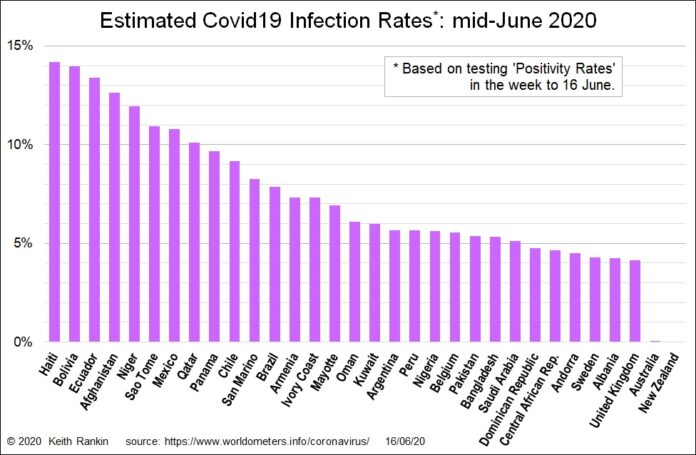
The above chart shows my estimates for the actual infection rates of Covid19 for all countries with an (estimated) infection rate of above four percent of their population. Plus, Australia and New Zealand.
The principal method of estimation is to use the testing ‘positivity rate’. If the average positivity rate over the last week is 10% of test undertaken, then my estimate will be 2.5% of the country’s population, plus existing notified cases. (The exceptions are United Kingdom, Belgium, Andorra and San Marino – where most of the cases are ‘recovered’ – and which have high proportions of elderly people in their populations. For these cases, I divided the notified deaths by 1.5%, the likely case fatality rate in these countries.)
The highest (estimated) infection rates are mostly in Latin America and Arabia. The worst of these countries (Haiti to Mexico) have done comparatively little testing, and have positivity rates close to 50%. For these, the estimates may come down with more information.
We also note that Pakistan and Bangladesh most likely have higher infection rates than India.
Of particular concern to us in New Zealand is Qatar, which appears to have a 10% infection rate, and that could be an understatement. Many people flying into New Zealand are coming via Qatar, presumably on Qatar Airways flights. This includes New Zealand’s latest two Covid19 cases, who flew via Doha. If any country gains ‘herd immunity’, it may well be Qatar. But now, it is highly infectious with more notified daily new cases – per capita – than anywhere else; and Qatar has been in this situation for some time.
All passengers coming into New Zealand transiting in Doha should automatically be treated as likely Covid19 suspects. New Zealand officials should have been alerted to this.
Another country of much concern is Panama – an international financial centre – which is only just starting to take testing seriously, and has positivity rates close to 40% of tested people.
Like Panama, Sweden has only taken testing seriously in recent weeks, and still has 15% positivity rates. On this basis, I am estimating Sweden’s actual infection rate to be 7.5 times its notified rate. This still only leaves 4.26% of Swedes infected, suggesting that Sweden will fall short of attaining herd immunity. The main issue here though, may be that many people testing negative in Sweden had Covid19 in March. So my sense is that Sweden will end up with 10% of its population eventually having the disease.
While the United Kingdom has an estimated present 4.1% infected, over the last week less than one percent of people tested returned positive results. So we can conclude that 95% of Brits do not have Covid19.
We may note that New Zealand has a total estimated infection rate of 0.03%, and Australia has 0.04%. We may also note that Uruguay, a country sandwiched between Brazil and Argentina, has a set of statistics much like New Zealand. I estimate that they have a 0.05% present infection rate, compared to 8% in Brazil.
Sometime on Monday, an Indian army patrol skirmished with Chinese troops in the Galwan River Valley, high in the Himalayas.
According to reports, no guns were involved, but the fight left at least 20 Indian soldiers dead from injuries caused by stones, makeshift clubs, and falls down the steep cliffs of the valley.
Although standoffs and even fistfights between Chinese and Indian troops have been relatively common in recent years, there have been no deaths on the disputed border for decades.
Such confrontations are usually defused by talks between commanders on the ground, leading to choreographed disengagements.
In this case, it appears those processes have failed, and at a moment when relations between China and India – both nuclear armed states – are already tense.
Origins of the dispute
When India gained its independence in 1947, it inherited unsettled frontiers with several neighbours.
That situation was exacerbated by Chinese leader Mao Zedong’s decision to seize control of Tibet – which up to that point had been a buffer state – three years later.
More than a decade of failed negotiations to agree a border followed, to the frustration of all. Then, in October 1962, in the midst of the Cuban Missile Crisis, Mao ordered a sudden attack on Indian forces.
China decisively won this short “pedagogic war” – designed to teach New Delhi a lesson. It gained ground from India, but then withdrew its forces, bringing them back close to their starting positions.
Several more fruitless rounds of talks to settle an official border have taken place. And there have been several military standoffs, including one in 1975 that left four Indian soldiers dead.
Mounting tensions and the threat of war
The Galwan River Valley incident is by far the worst to occur on the LAC for some time. It also comes against a backdrop of several years of deteriorating relations between China and India, dating from the rise to power of Chinese President Xi Jinping.
Since 2013, New Delhi has reported a series of incursions by Chinese troops into what it regards at its territory.
The visits of both Chinese Premier Li Keqiang in May 2013, and Xi in September 2014, were overshadowed by such incidents.
And in mid-2017, there was a ten-week standoff between Chinese and Indian troops in Bhutan, in a disputed area called Doklam (or Donglang).
During that crisis, Beijing openly warned that if New Delhi did not pull back, it might go to war.
Disagreement over other issues
At the same time, China and India have quarrelled and competed over a number of other issues.
New Delhi has emerged as a vocal critic of Xi’s Belt and Road Initiative (BRI) and has tried to dissuade other states in South Asia and the Indian Ocean region from signing on to BRI projects.
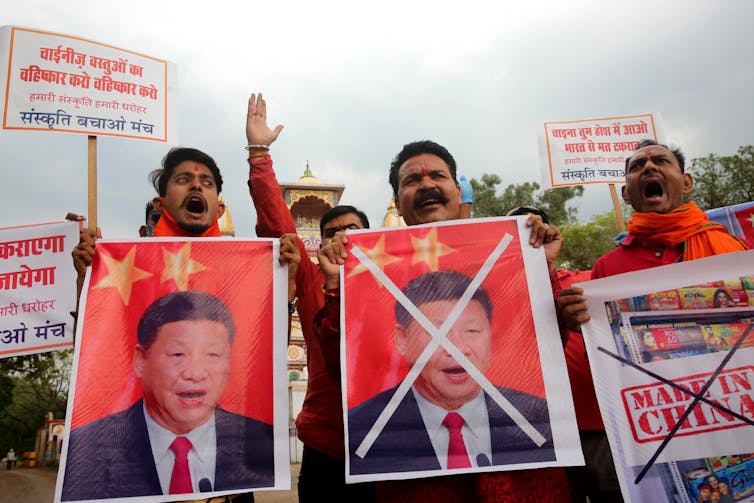
China and India disagree over more than their borders.Harish Tyagi EPA/AAP
India has complained about China’s trade practices, pointing to a growing trade deficit with its northern neighbour, as well as Beijing’s alleged attempts to influence the policies of smaller states such as Nepal.
There can be little doubt that what just happened in the Galwan River Valley constitutes the biggest test yet faced by Narendra Modi’s government.
India’s prime minister has long been portrayed as a “strongman”. This image has been burnished by retaliatory strikes against Pakistani targets for cross border terrorism in 2016 and 2019, as well as by his government’s apparent resilience during the Doklam crisis.
There have been protests in India after the Himalayan clash.Sanjeev Gupta EPA/AAP
Modi’s options are, however, constrained.
If he backs down, or even concedes the area around Galwan River Valley that some think Chinese soldiers are now occupying, he could face a political backlash from Indian voters.
If he orders some kind of military response, he risks a wider war. There have been persistent reports of troop build-ups right along the 3,500 kilometre frontier with China.
There is no guarantee a limited action would not escalate into something bigger, nor that India’s friends and partners, including the US, would support such a move.
All eyes now on China
Much depends on what Beijing hopes to gain.
If Xi is simply seeking to humiliate India for perceived transgressions – and warn it off deepening ties with its security partners – he may now order his troops to pull back, having made his point.
But if he wants to redraw the border and send a message to others – in Taiwan, Japan, Southeast Asia, or elsewhere – that China is determined to take what it claims – then deescalating the situation will be very difficult for New Delhi.
Australians have taken a special interest in section 92 since mid-March. Debating the constitutionality of state border closures in response to COVID-19 seemed to be trending with everyone staying home to help flatten the curve.
Legal challenges on border closures are already underway in the High Court, with arguments of its constitutionality.
Now, this interest in section 92 is being rekindled with the partial re-opening of borders between South Australia, Western Australia, the Northern Territory and Tasmania.
With Australia being one country, it was hard enough to accept it is constitutional for states to close their borders, but now South Australia seems to be offering travellers from these states and the territory special treatment.
West Australian Premier Mark McGowan has more recently suggested the partial opening of borders may be unconstitutional. Is it?
The issue is not the partial opening of borders. It is the rationale for these actions.
When South Australia announced this partial re-opening, it also indicated it plans to open its borders to all remaining states by July 20. The issue then is whether South Australia’s discrimination against New South Wales, Victoria and Queensland can be justified by efforts to prevent a second wave of COVID-19 deaths.
Since 1988, the High Court has interpreted section 92 as prohibiting discrimination of a protectionist kind – that is to say, the section prevents states from passing legislation to restrict trade. In the 1988 case of Cole v Whitfield, the High Court, in a unanimous decision, upheld Tasmanian regulations prohibiting a person from taking, buying or selling crayfish of less than a prescribed size, whether or not taken in Tasmanian waters.
In the course of his interstate trade, David Whitfield brought crayfish from South Australia to Tasmania for the purpose of sale to mainland and overseas markets. The crayfish were less than the prescribed size under the Tasmanian regulations, though above the prescribed size under comparable regulations in South Australia. The court explained in the decision that the legislation was not protectionist in nature. It was intended to help protect Tasmanian crayfish rather than restrict trade. The court elaborated in the following terms:
[D]iscrimination commonly involves the notion of a departure from equality of treatment. It does not follow that every departure from equality of treatment imposes a burden or would infringe a constitutional guarantee of the freedom of interstate trade and commerce from discriminatory burdens […]
As was the case when all states decided to close their borders, the legal issue is whether the purpose of the closures is to restrict trade or to help protect the citizens of each state from becoming infected with COVID-19.
The orthodox view among Australian constitutional jurists is that section 92 does not allow for a balancing exercise between the competing interests of free trade and combating a pandemic. This might well be a question for the High Court to elaborate on when deciding the legal challenges brought against the Queensland government.
At a different analytical scale, the issue is not the interpretation of section 92, but rather the effect of crises on the interpretation of our constitution.
This interpretation is not impervious to pandemics or other crises. We see this in what are known as purposive powers, such as the defence power in section 51. In times of war, the core of this power will expand to equip the Commonwealth with the type of intervention necessary to keep Australia safe. There is no reason this rationale would not extend to pandemics.
Enter the principle of subsidiarity. Elsewhere, I have argued the Commonwealth Constitution is superior to the Canadian and US constitutions, because it is more efficient. It allows for a wider area of concurrent powers. Our federal model is more agile, in the spirit of true subsidiarity, with its rules of assistance, non-interference and helping states acquire more competencies over time.
It is this principle of subsidiarity that holds the key to understanding the constitutionality of border closures and partial re-opening in response to the coronavirus pandemic. The states are best positioned to judge what intervention will work best in their case.
First, we tried the antimalarial drug hydroxychloroquine. Then we tested the antiviral drug remdesivir. But new UK research gives the strongest indication yet we may have found a useful treatment for COVID-19.
This time it’s an old anti-inflammatory drug, dexamethasone, which has been described as cheap, old and boring.
Preliminary results from a clinical trial just released indicate the drug seems to reduce your chance of dying from COVID-19 if you’re in hospital and need oxygen or a machine to help you breathe.
The results were significant enough for the UK to recommend its use for severe COVID-19.
Before we roll it out in Australia, we need to balance the drug’s risks with its benefits after peer-review of the full trial data.
What is dexamethasone?
Dexamethasone has been used since the late 1950s, so doctors are familiar with it. It’s also inexpensive, with a packet of 30 tablets costing around A$22 (for general patients) under Australia’s Pharmaceutical Benefits Scheme.
So if it does work for COVID-19, this cheap and boring drug, already available in Australia with a prescription, would be easy to add to current treatments.
Dexamethasone belongs to a class of drugs known as corticosteroids and is used to treat a range of conditions related to inflammation. These include severe allergies, some types of nausea and vomiting, arthritis, swelling of the brain and spinal cord, severe asthma, and for breathing difficulties in newborn babies.
And it’s dexamethasone’s application to those latter two respiratory conditions that prompted doctors to think it may also help patients severely affected by COVID-19.
The researchers put patients into one of three groups: those needing ventilation (a machine that helps them breath); those who just needed oxygen therapy; and those who needed no treatment to help them breathe.
Patients in each of those groups were given dexamethasone (6mg once a day, either as a tablet or via intravenous injection), for ten days. A fourth group (a control group) was not given the drug.
Dexamethasone was most useful for the ventilated patients; deaths for this group dropped by about one-third with drug treatment. In contrast, deaths only dropped by one-fifth for those patients who were only receiving oxygen therapy. There was no benefit to patients who could breathe normally.
Results of the dexamethasone trial have just been released.
The researchers calculated that giving dexamethasone to eight ventilated patients would prevent one from dying, on average. And giving it to around 25 patients needing oxygen alone would prevent one death.
When a patient has severe COVID-19, their immune system ramps up to catch and control the virus in the lungs.
In doing this, their body produces more infection-fighting white blood cells. This results in inflammation and pressure on their lungs, making it very difficult for them to breath.
It’s therefore likely dexamethasone reduces this inflammation, and so reduces pressure on the lungs.
There are potential complications with using dexamethasone.
First, dexamethasone also suppresses the immune system when it reduces inflammation. So, it’s not usually recommended for people who are sick, or could be sick, from other infections. So doctors will need to make sure patients have no other infections before they are prescribed the drug.
If the results of this trial are correct though, the drug doesn’t appear to compromise the patient’s ability to fight COVID-19; it might just affect their ability to fight off other diseases.
Second, the drug is only useful for patients with difficulty breathing and needing some assistance either through ventilation in a hospital or from oxygen therapy.
There appears to be no benefit for patients who don’t need help breathing. So we shouldn’t be giving it to everyone who tests positive to the virus.
Third, like all drugs, dexamethasone has side effects that need to be monitored. Serious, but rare ones include: severe stomach or intestinal pain, sudden changes with vision, fits, significant psychiatric or personality changes, severe dizziness, fainting, weakness and chest pain or irregular heartbeat, and swelling of the face, lips, mouth, tongue or throat, which may cause difficulty in swallowing or breathing.
What happens next?
The results of the clinical trial are preliminary. So we need to wait for the full study data and scientific peer-review before we can make a definitive decision as to whether dexamethasone treatment is a worthwhile, and safe, addition to COVID-19 therapy in Australia.
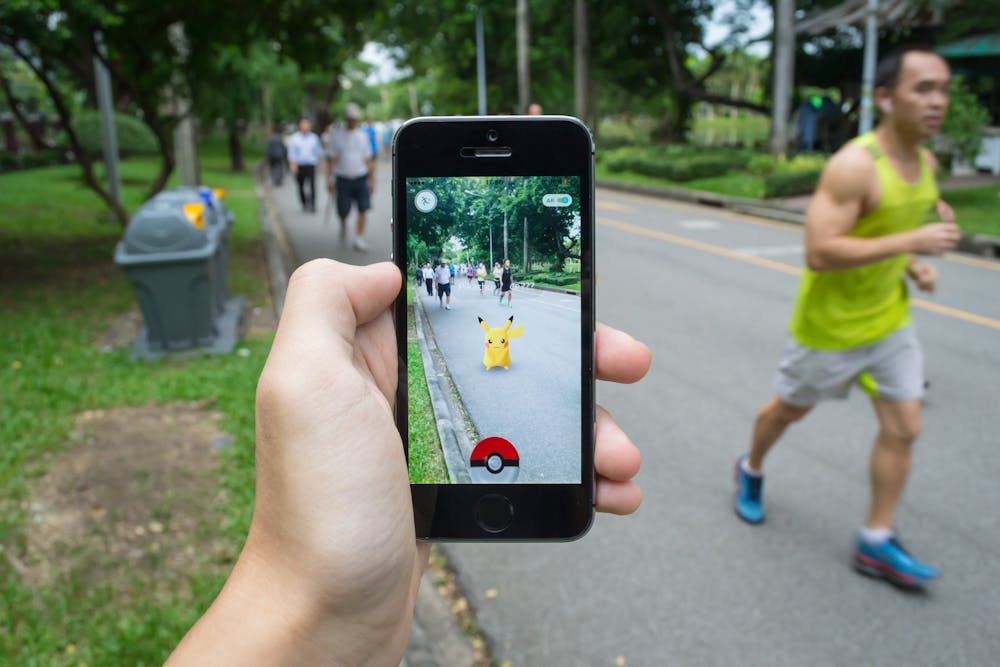
In 2016, the mobile game Pokémon Go sent hundreds of millions of players wandering the streets in search of virtual monsters. In the process it helped popularise augmented reality (AR) technology, which overlays computer-generated imagery on real-world environments.
Now Pokémon Go is set to take AR to a new level. A new feature within the game will encourage players to create and upload 3D scans of real-world locations.
The game’s developer Niantic also just acquired the AR maps start-up 6D.ai for an undisclosed sum. Chief executive Jon Hanke announced the companies’ ambitions:
Together, we’re building a dynamic, 3D map of the world so we can enable new kinds of planet-scale AR experiences.
And it’s not just Niantic. In February, Facebook acquired Scape Technologies, an AR start-up that was creating a 3D map of the entire world, and Microsoft’s Minecraft Earth AR mobile game touts the same kind of planet-scale AR play.
These scans, and this type of data collection, will likely affect all of us in the near future.
Turning data collection into a game
One reason for Niantic’s huge success has been how it uses digital games to collect data about the world.
Niantic was initially formed as Keyhole Inc by John Hanke in 2001 with backing from the CIA’s tech venture capital firm, In-Q-Tel. The company developed mapping technologies used by the US military in the early 2000s.
Keyhole Inc was acquired by Google in 2004, and was instrumental the development of Google Maps. In 2010, Keyhole was rebranded as Niantic and focused on games. It stayed part of Google until 2015, when it became an independent company again.
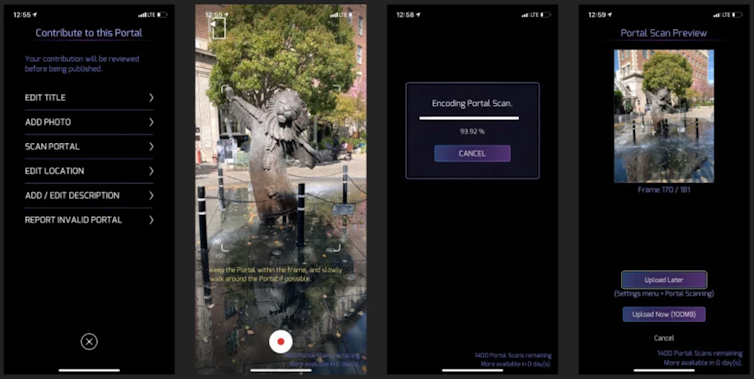
In 2012 Niantic launched a game called Ingress, which saw players photograph and upload millions of locations of interest that became “portals” within the game.
Screenshots of the Ingress Portal Scan Feature, via Niantic.Brian/Niantic
These portals became the underlying infrastructure that powers Pokémon Go and other games, but just as valuable was the data collected about how players moved around the world while playing.
Niantic’s latest game, Harry Potter: Wizards Unite, collects each player’s location every five seconds or so, which is often enough to recognise individual behaviour patterns and detect intimate details of their life.
Tech companies and investors think this kind of data is immensely valuable. In December 2019, Niantic raised funds at a valuation of USD$3.9 billion.
The 3D scans Pokémon Go players are collecting are intended to create new possibilities in the game, but they will also give Niantic’s platform for AR developers an advantage over competitors.
Having a system that can recognise 3D environments around the world makes it easier for developers to make shared AR experiences and environments that “exist” even when the user logs off.
Apple, Facebook, Microsoft and Google are all developing AR products that are likely to depend on a technique called simultaneous localisation and mapping or SLAM to continuously scan – and collect data about – the users’s physical environment.
The next iPhone is rumored to have a powerful LiDAR scanner to create more detailed 3D scans, and better support Apple’s AR ecosystem.
Facebook acquired the virtual reality (VR) company Oculus in 2014 for USD$2.3 billion, and Mark Zuckerberg frames success with VR as being key to the company’s AR ambitions.
This is well exemplified in LiveMaps, a technology demonstrated by Facebook’s Andrew Bosworth at the 2016 Oculus Connect developer conference.
Facebook’s LiveMaps tech demo depicts the types of experiences that could be possible with ubiquitous AR, but also hints at the amount of data technology companies will need to hold about our homes and lives to function.
Any system like LiveMaps will demand constant collection of finely detailed data about the users’ home and everything in it:
AR glasses will scan the surroundings to create a live dynamic index amplified by crowd-sourced data, allowing the maps to recognise when things have changed and update automatically.
The implications of augmented reality
What will pervasive augmented reality mean? Beyond relatively benign possibilities such as more targeted advertisements, we need to think critically about the consequences of technologies like these before they are firmly entrenched.
Keiichi Matsuda’s short film Hyper-Reality envisions an augmented reality future.
“by virtue of the way they operate, augmented reality systems must simultaneously act as very sophisticated surveillance systems”.
Ever-growing unregulated collection of spatial data across the globe has the potential to create powerful systems of surveillance, control, and influence. We have examined this potential in detail in a recent report on the ethical implications of emerging mixed reality technologies.
Better to prevent than to cure
Like technologies such as facial recognition, granular spatial data might be used in order to dominate, oppress and discipline populations, and particularly the most marginalised in society. As awareness grows of the problems with facial recognition, companies such as IBM and Amazon have recently begun to distance themselves from the technology.
We are also already seeing the rapid growth of an AR industry which doesn’t (at least solely) sell to the commercial market, instead selling to workplaces, law enforcement, security agencies and the military.
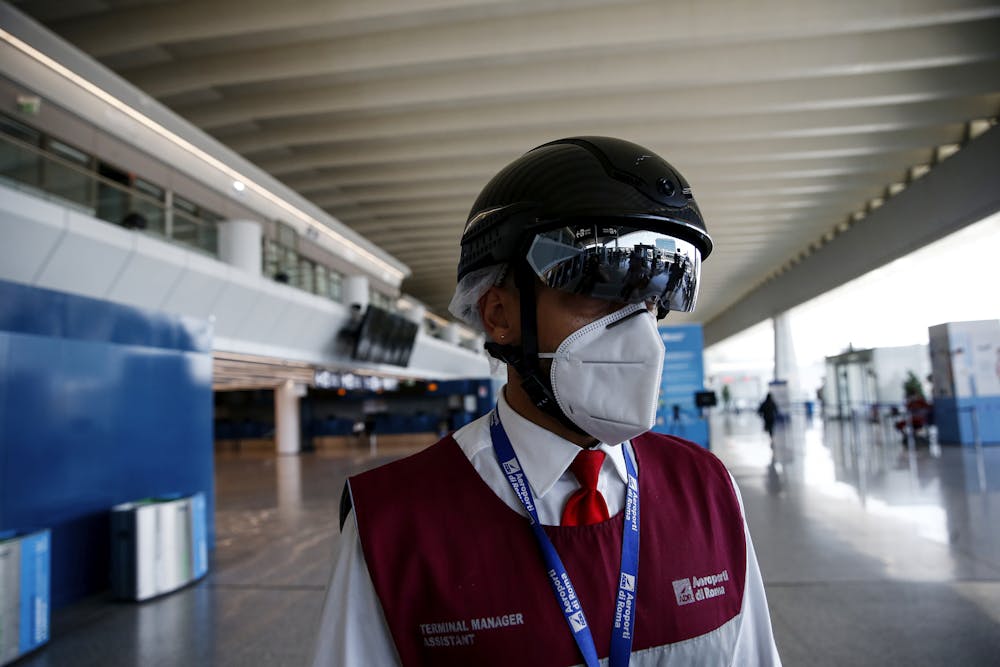
AR smart helmets in use in Italy during the Covid-19 pandemic. These devices can scan crowds of people and trigger an alarm, despite the limited evidence supporting temperature screening as a preventative measure. The same devices have automatic facial recognition modes and other surveillance capabilities.LaPresse / Sipa USA
As the Cambridge Analytica scandal showed, the dangerous impact of emerging technologies is often only realised once they have done some damage.
If what we share on social media can be used to influence elections, what might the data about the contents of our home be used for? Or everything we encounter in a given day?
Let’s take these technologies for what they really are: not just for entertainment, but apparatuses for extracting data and accumulating power and profit.
Aboriginal and Torres Strait Islander readers are advised this article contains names of deceased people.
An Indigenous teenager is suing the state of NSW, alleging he was assaulted by police, according to The Sydney Morning Herald.
But this is a rare example.
Amid the Black Lives Matter protests and focus on Indigenous justice here in Australia, there have been increasing calls for police and authorities to be held accountable for the harm caused by their actions.
There are few calls for victims or their families to take police to court to get compensation, even though this could provide a path to justice and accountability.
So, what are the grounds for suing the police or the state? And what are the chances of success?
Legal grounds to sue
There are several main avenues for taking police or prison officers to court, depending on the circumstances.
Situations where officers use physical force may constitute “battery” if there is non-consensual physical contact. Usually, this will only be worth suing for if the victim has been injured as a result.
To make police liable, the physical contact also needs to go beyond what was legally authorised. For instance, earlier this month, the High Court ruled the use of tear gas on four teenagers at Don Dale youth detention centre in 2014 was battery. This was because the use of weapons against minors was beyond the powers given to police and prison officers under Northern Territory legislation.
Another option is “false imprisonment” if police detain someone without any legal authority, while threats of imminent non-consensual physical contact may be “assault”. Technically, this can be grounds enough for taking an officer to court, but assault is usually only worth suing for where it accompanies battery, or where it causes serious psychological harm.
The High Court found teenagers who were tear-gassed at Don Dale are entitled to damages.Glenn Campbell/ AAP
In 2019, the Victorian Supreme Court found the 2015 arrest of Eathan Cruse during a terror raid was unlawful and the use of force was not necessary. Even after handcuffing Cruse, police continued to beat him, threatening that there was “more to come”, and told him “don’t fucking say a word”.
Cruse was awarded $400,000 in damages.
‘Negligence’ also an option
Once a person is in custody, they are owed a duty of care, and this duty can even require protecting them from harm by others or themselves.
This means another potential avenue for suing the police is “negligence”, which involves carelessness that causes harm.
Negligence is relevant, then, in situations where police or prison officers carelessly fail to seek medical assistance for a person in custody or ensure they are safe.
Where negligence leads to a victim’s death, family members can sue on their behalf – as in the case of 19-year-old Trent Lantry, whose mother sued the state of New South Wales in 2005. Prison officers involved were found to have been negligent by placing Lantry in a cell with easy access to a hanging point.
Challenges accessing justice
Despite the well-documented crisis of Indigenous deaths in custody, and criticism regarding the failure of governments to implement recommendations from the 1991 royal commission, civil cases against police or prisons are relatively infrequent and usually not well publicised.
To sue successfully, a victim needs to have access to evidence, and effective access to legal aid or resources to fund their own representation.
They must also act within statutory time limits. A claim for personal injury must usually be brought within three years from the time of the injury, but exceptions or extensions may apply.
The rigidity of these limits was demonstrated earlier this year, when the Federal Court dismissed Tamica and Edward Mullaley’s application for a time extension. The pair were hoping to sue the state of Western Australia for alleged police negligence causing them significant mental harm.
What can happen if successful?
If a plaintiff establishes liability, then the defendant is typically ordered to pay them a sum of money as compensation.
If the misconduct has been particularly bad, or has resulted in serious humiliation, then “exemplary’ or “punitive” damages may also be ordered. This was the outcome in the 1989 case of Henry v Thompson, in which police officers punched, kicked and urinated on the Indigenous victim.
The legal community has pointed to a growing awareness of the option to sue police or the state for wrongdoing in custody. But it is still an under-utilised area of law.
Even in individual cases, it is typically the government department and not the individual police officer or prison guard who pays any compensation.
While this may mean a victim is more able to access compensation, it also means fewer consequences for the individual officer involved, and so less deterrence for other police.
Black Lives Matter protests have included calls for better treatment by police.Bianca De Marchi/AAP
If the departments who are paying see such claims as simply “the cost of doing business”, nothing will change.
These claims are therefore best thought of as part of a “regulatory web”, that sits alongside and boosts policy reform and other mechanisms of accountability.
If more victims can be supported to approach the courts and enforce their rights, then this area of law could help keep police and other authorities accountable in the ways they exercise force.
Australia’s energy market is outdated. It doesn’t encourage competition and that’s holding back the transition to renewable energy. Important reforms to modernise the market are on the way, but big energy companies are seeking to use the cover of COVID-19 to prevent the change.
This is bad for consumers, and for climate action. Reform would help create a modern grid designed around clean energy, pushing coal-fired generators to retire earlier. Over time, it would also bring down power costs for households and business.
Renewable energy is the cheapest form of new electricity. It’s far better for the environment than coal and gas, and can deliver reliable supplies when backed by batteries and other energy storage.
Instead of delaying reform, Australia should be advancing it.
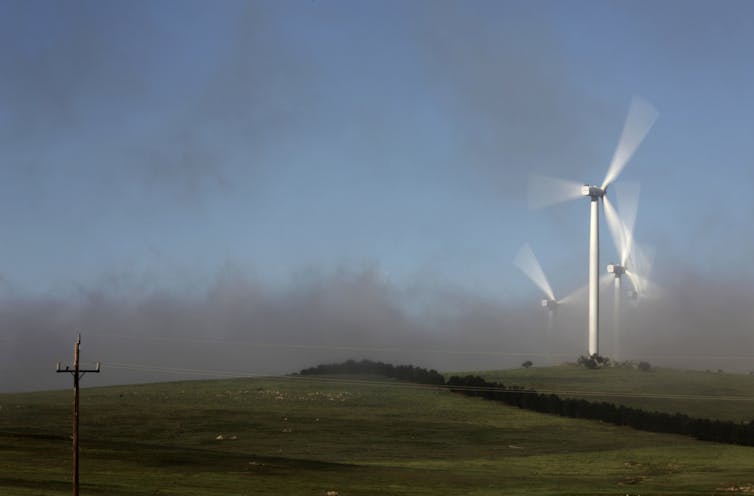
Wind and solar energy is better for the environment, and consumers.Tim Wimborne/Reuters
What’s this all about?
Regulators and governments recognise the need to modernise the rules governing the National Electricity Market. That market, established in 1998, supplies all Australian jurisdictions except Western Australia and the Northern Territory.
Reliable electricity requires that supply and demand be kept in balance. This balance is primarily provided by a system known as the wholesale spot market. Every five minutes, electricity generators bid into the spot market, specifying how much energy they will provide at a certain price.
An entire redesign of the market rules is scheduled for 2025. This should make the market work efficiently and reliably as coal retires and is replaced by renewable energy.
In the meantime, one important rule change is due to start in July next year, known as “5-minute settlement”.
Currently, electricity is sold and sent out from generators in 5-minute blocks. But the actual price paid for this electricity in the wholesale market is averaged every 30 minutes. This means there are six dispatch periods, each with their own price, which are then averaged out when the market is settled.
This strange design has enabled big electricity generators to game the market. One method involves placing high bids in the first interval, then placing low or even negative bids in the remaining five intervals. This ensures that electricity from the big generators is purchased, but that they and all other generators receive an artificially high average price for the whole 30-minute period.
In 2017, the Australian Energy Market Commission (AEMC) decided to replace 30-minute settlement with 5-minute settlement.
The commission says the current system was adopted more than 20 years ago due to technological barriers which have since been overcome. It argues moving to 5-minute settlement would better reflect the value to consumers of fast-response technologies, such as batteries storing renewable energy and so-called “demand response” (a concept we’ll explain later).
The rule change would reduce power costs for consumers.Brendan Esposito/AAP
According to the AEMC, the rule change would lead to lower wholesale costs, cutting electricity prices for consumers.
But on March 19 this year, the Australian Energy Council, which represents most coal-fired power stations and the big three electricity retailers, sought to delay the reform. It wrote to federal energy minister Angus Taylor and his state counterparts, arguing the pandemic means energy companies must focus on “critical supply and reliabilty” issues, rather than implementing the rule change.
But energy consumption has barely changed during the pandemic, the Australia Institute’s national energy emissions audit shows. So delaying the reform to deal with supply and reliability issues appears unjustified.
Despite this, the Australian Energy Market Operator has proposed delaying the change for a year. Our submission, endorsed by energy and technology leaders, opposes the delay.
Moves by regulators to delay another 16 market reforms due to COVID-19 also seem to be afoot.
Change is possible
Last week, one big rule change to the National Electricity Market did proceed as planned. It allows “demand response” energy trading from 2021.
Demand response involves reducing energy consumption during peaks in demand, such as during heatwaves. Basically, the rule means big energy users, such as smelters and manufacturing plants, could power down in these periods, and be paid for doing so.
Australia has successfully used demand response to provide emergency electricity capacity and otherbenefits. But it’s never been unleashed in the wholesale energy market.
The rule change doesn’t involve smaller users such as households. But it’s a promising start that creates new competition for fossil fuel generators and allows energy users to help make the grid more reliable.
Political warfare over climate policy has held back Australia, and the electricity market, for more than a decade. But energy reform that encourages greater market competition can readily be supported by political conservatives.
Newly built renewable electricity is cheaper than new coal-fired power.Petr Josek/Reuters
Getting future-ready
Once the health crisis is over and economic recovery has begun, Australia will need the economic and social benefits of electricity market reform even more than before.
Such reform “stimulus” would help ready the grid for the inevitable retirement of coal-fired power stations, such as Liddell in 2023.
It would also align with state government investments in renewable energy, and boost private investment in new generation (which has recently slumped) and large-scale batteries.
Electricity remains Australia’s highest-polluting sector. Around the world, electricity markets are planning the transition from high to low emissions.
Delaying reform in Australia would be a major setback on the path to our essential energy transition.
Richie Merzian, Climate & Energy Program Director at The Australia Institute, contributed to this piece.
Scott Morrison says “we shouldn’t be importing” the Black Lives Matter movement. But in the 1800s, Australia imported plantation owners from the American South.
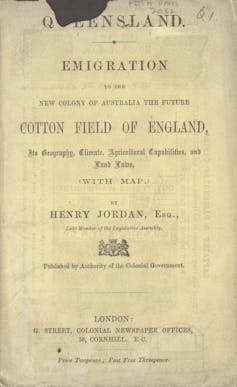
Prior to the outbreak of the American Civil War, the American south produced almost all of the world’s cotton. As war threatened, plantation owners returned to England and English cotton mills ground to a halt.
Emigration to Queensland, ‘the new cotton field of England’ was actively encouraged.Trove
A new source of cotton was required, and Queensland would be widely promoted as a cotton growing colony and the “future cotton field of England”. The colony government invited mill and plantation owners and workers to re-migrate and re-establish their industry in Queensland.
Under 1861’s “Cotton Regulations”, individuals and companies could lease land and receive the freehold title within two years if one-tenth of the land was used for growing cotton.
As early as June of that year – barely two months after the civil war officially began – the Muir brothers, Robert, Matthew and David, established the Queensland Manchester Cotton Company and initiated plans to send an agent to Queensland to begin the process of establishing plantations.
Believed to be Robert Muir, photographed at Benowa Sugar Plantation at Pimpama, ca. 1875.State Library Queensland
The brothers owned cotton plantations in Louisiana before returning to Manchester and then on to Queensland. The manager of the company, Thomas William Morton, also migrated from Louisiana to Queensland via England. His son Alexander went on to become the prominent curator of the Tasmanian Museum and Art Gallery.
After an agreement was made between the government and shipping companies in 1863, thousands of “cotton immigrants” travelled to Queensland, and profits of American slavery were reinvested in Queensland’s new tropical plantation economy.
A colony for cotton
Disruption of the American slave trade didn’t only lead to the search for new fertile soil. Plantation owners also wanted cheap labour for the burgeoning Australian cotton industry.
The free labour of enslaved African Americans had generated immense profits, and Australian plantation owners were unable to induce sufficient numbers of white men to labour in the tropics on low wages.
(Popular medical theories also posited the physical unsuitably of white men for work in the tropics, conveniently maintaining racial hierarchy.)
Plantation owners turned to the Pacific Islands to ensure a steady supply of indentured labour.
Under the indenture system, workers were bound to an employer for a specified length of time. These contracts were governed by Masters and Servants Acts with conditions set steeply in favour of plantation owners.
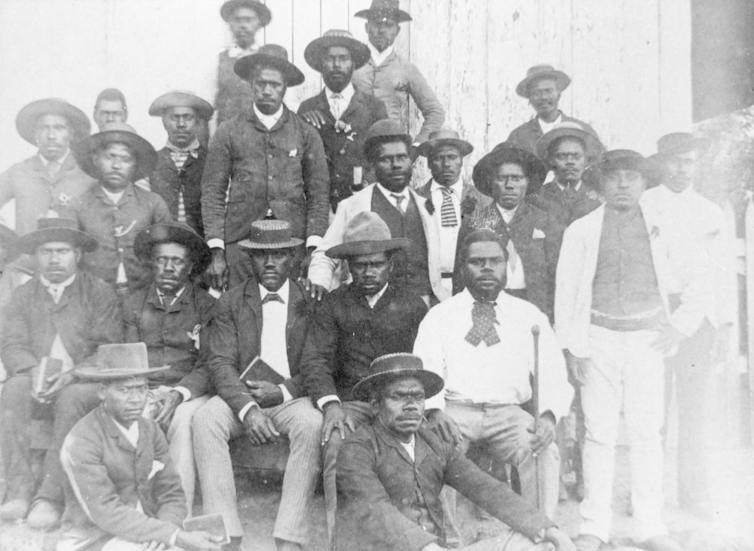
Australian South Sea Islanders at Otmoor sugar plantation in Upper Coomera, Queensland, ca. 1889.State Library of Queensland
The work was physically demanding, and rates of death and injury were high. During a Pacific Islander’s first year of indenture, the death rate was 81 per 1,000 – especially startling given labourers were in their physical prime, usually between 16 and 35 years of age.
Most cotton plantations failed by 1866 due to flooding and crop disease. Owners reinvested in sugar and the labour trade grew to meet demand.
Between 1863-1902, 62,000 Islanders migrated to Australia.
An ongoing legacy
The Queensland colonial government established a tropical plantation economy which benefited from capital, workers and working conditions imported from the American south to the sugar fields of Queensland.
Labourers’ obligations to their employers were almost unlimited, and their rights were limited to the payment of wages.
The legal conditions of indenture made a worker’s refusal to comply with duties demanded by his or her master a prosecutable offence, no matter how small (or unreasonable) the task. Planters could bring charges in local courts against workers for absconding, “malingering”, or “shirking” (deliberately working slowly) – actions sometimes employed by Islanders as forms of resistance.
The Islander workers fought for increased rights, resisting Australian colonial society at times, while at other times adapting to it. The workers would be granted increased protections from “blackbirding” (recruiting labour via kidnapping, coercion or exploitation) under the Polynesian Labourers Act 1968, and later fought for their rights against deportation under the White Australia Policy.
South Sea Islander woman planting sugar cane in a field, 1897.State Library of Queensland
Despite the harsh conditions, many South Sea Islanders returned to Queensland on multiple contracts, entering a pattern of “circular migration” from the islands of the Pacific to Queensland and back again. Others stayed on after their contracts had expired, became knowledgeable about the labour market and the value of their skills, and engaged in short term contracts on their own terms.
Many Islanders laid down permanent roots in Queensland, marrying Aboriginal and white Queenslanders, starting families and establishing homes.
These people are the ancestors of the contemporary Australia South Sea Islander community, who went on to have important roles in Australian society and advocate for recognition of their communities.
Australia doesn’t need to “import” protests against racism now: this importation happened centuries ago.
In the charged atmosphere of Black Lives Matter demonstrations, Prime Minister Scott Morrison recently made the mistake of stating there was no slavery in Australia. Morrison later apologised for causing offence. He clarified that his comments related specifically to the colony of New South Wales.
The relevance of slavery to the experience of First Nations and other communities was quickly and forcefully addressed. Robust evidence demonstrated that, of course, slavery did exist in Australia.
Academic Clinton Fernandes has revealed the British Parliament granted compensation in the 1830s to former slave owners for the loss of their slaves (but not to those who had been enslaved). Some former slave owners used this compensation to settle in Australia.
It is hardly surprising, then, that First Nations peoples in Australia were forced into indentured servitude and had their wages stolen.
Another example of slavery was the practice of “blackbirding” Pacific Islander people for work on Australian sugar plantations. Today’s South Sea Islander community in Queensland have asked the prime minister to familiarise himself with their experience and its legacies.
Global efforts to confront “modern slavery” challenge understandings of slavery as a purely historical experience. Modern slavery is an umbrella term used to describe human trafficking, slavery and slavery-like practices. It includes bonded labour, forced marriage and forced labour.
Just like historical slavery, modern slavery is a multi-billion-dollar industry. An estimated 40.3 million men, women and children are subjected to modern slavery around the world.
In Australia, we can look to contemporary labour mobility schemes to see the continued vulnerability of Pacific Islanders to modern slavery. Stories continue to emerge of worker exploitation in Australia.
About 15,000 people are subject to modern slavery in Australia, including sex trafficking, forced marriage and forced labour. Cases of forced labour predominantly occur in industries such as agriculture, construction, domestic work, meat processing, cleaning, hospitality and food services. Even more people are enslaved through the supply chains of Australian companies operating overseas.
The Modern Slavery Act 2018 marks an important development. It requires large businesses and Commonwealth entities to report on risks of modern slavery in their operations and supply chains, and actions to address those risks.
The first reports under the act are expected to be published this year and will be available for public scrutiny. Unfortunately, there are no penalties for non-compliance. An advisory group established to support implementation of the act lacks civil society and survivor representation.
Domination and exploitation.
Racist ideologies reflected in current events find their roots in colonisation and slavery. The broader issue of the over-incarceration of Indigenous peoples in Australia is gaining renewed attention through the current protests. Indigenous Australians make up 28% of the Australian prison population, meaning they are the most incarcerated people on Earth. The high rate of Indigenous deaths in custody has also gained renewed attention.
Experiences of over-incarceration and slavery are distinct and important in their own right. Yet such experiences are linked in how they reflect ongoing limitations and violations of civil and citizenship rights for First Nations and other communities in Australia.
For example, the over-incarceration of First Nations peoples contributes to their political disenfranchisement, as Australian electoral law politically silences those in prison.
Similarly, Pacific Islanders and others subject to modern slavery in Australia are often kept silent for fear of losing work and residency rights. The marginalisation of their experiences implicitly authorises their continued exploitation.
The capacity of our democracy to function equitably for disadvantaged communities is compromised by their lack of equal representation or involvement in law and policy-making.
Where to from here?
It is evident the scourge of racism and slavery is not confined to the past. Nor is it an issue that only affects other countries. It is here, it is now, and it must be tackled.
Political and legislative responses to modern slavery are encouraging. But significant gaps remain in the promotion and protection of Indigenous rights.
This is why the Uluru Statement From The Heart and its constitutional reform proposals are so important. The Uluru Statement calls for the constitutional protection and entrenchment of a Voice to Parliament and a Makarrata Commission to supervise treaty-making processes and truth-telling initiatives.
The Voice to Parliament is in its design phase with Australian government and elected First Nation representatives. Now, more than ever, First Nations require a Voice to Parliament and for that voice to be heard, respected and protected. Its constitutional entrenchment would signal a momentous shift in Australia’s engagement with the justice demands of First Nations people.
Meaningful reconciliation is impossible while Indigenous rights and perspectives are oppressed. True progress calls for learning from the world’s oldest living cultures. Healing requires learning from the past and present.
Since lockdown, everyone has had to rely heavily on digital technologies: be it Zoom work meetings and lengthy email chains, gaming and streaming services for entertainment, or social media platforms to organise everything from groceries to protests. Human existence is now permeated by non-human computer language.
This includes poetry. Digital technologies can disseminate and publish contemporary poetry, and also create it.
Digital artists combine human and computer languages to create digital poetry, which can be grouped into at least five genres.
1. Generative poetry
Generative poems use a program or algorithm to generate poetic text from a database of words and phrases written or gathered by the digital poet.
The poem may run for a fixed period, a fixed number of times, or indefinitely. Dial by Lai-Tze Fan and Nick Montfort, for example, is a generative poem that represents networked, distant communication. It depicts two isolated voices engaged in a dialogue over time. Time can be adjusted by clicking the clocks at the bottom of this emoji-embedded work.
A still from generative poem Dial (2020) by Lai-Tze Fan and Nick Montfort.nickm.com
The recent web-based work Say Their Names! by digital artist John Barber generates a list from more than 5,000 names of Black, Hispanic, and Native Americans who have been killed by police officers in the United States from 2015 to the present day. No judgement regarding the victims’ guilt or innocence is made. Each name is simply spoken – in a sometimes incongruously cheerful tone – by a computerised voice.
Nick Montfort’s generative poem Taroko Gorge was inspired by a visit to Taroko Gorge in Taiwan.
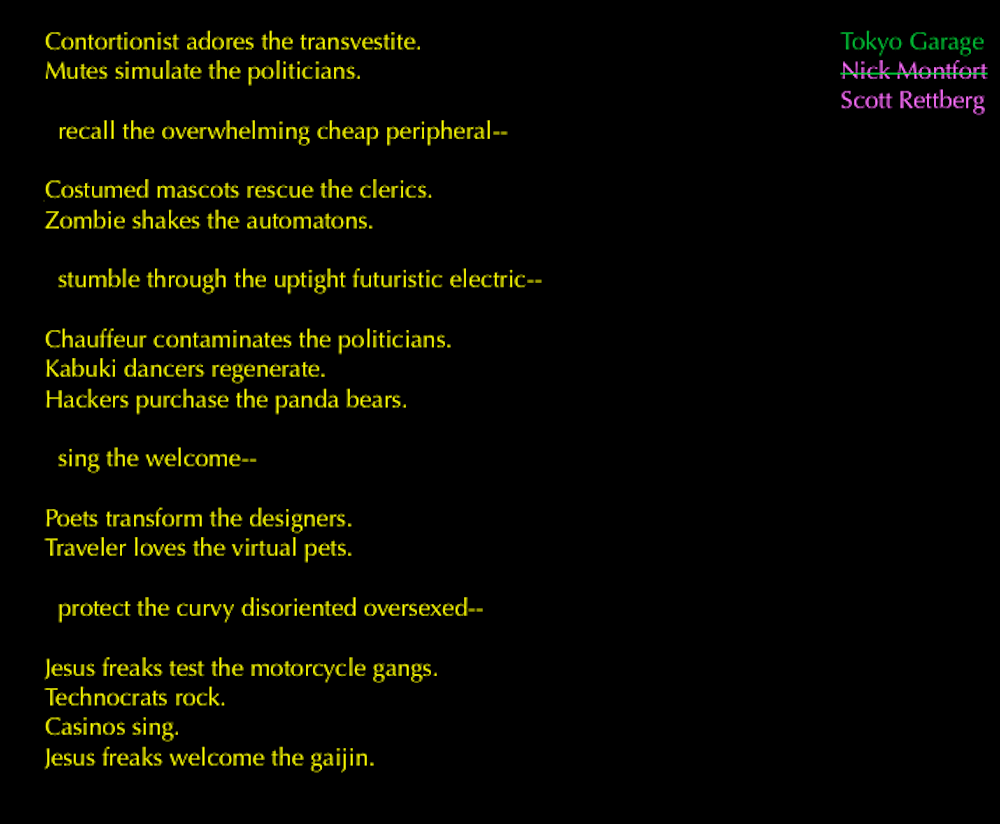
Montfort writes: “If others could go to a place of natural beauty and write a poem about that place, why couldn’t I write a poetry generator, instead?” Scott Rettberg then took the code from Montfort’s poem and replaced the vocabulary to produce Tokyo Garage, turning Montfort’s minimalist nature poem into a maximalist urban poem.
J.R. Carpenter undertook a similar transformation – replacing the nature vocabulary with words associated with eating.
There are now dozens of Taroko Gorge remixes. By inspecting the source of Montfort’s poem, one can carve into the code to remix one’s own version.
Scott Rettberg’s Taroko Gorge remix.
3. Visual verse
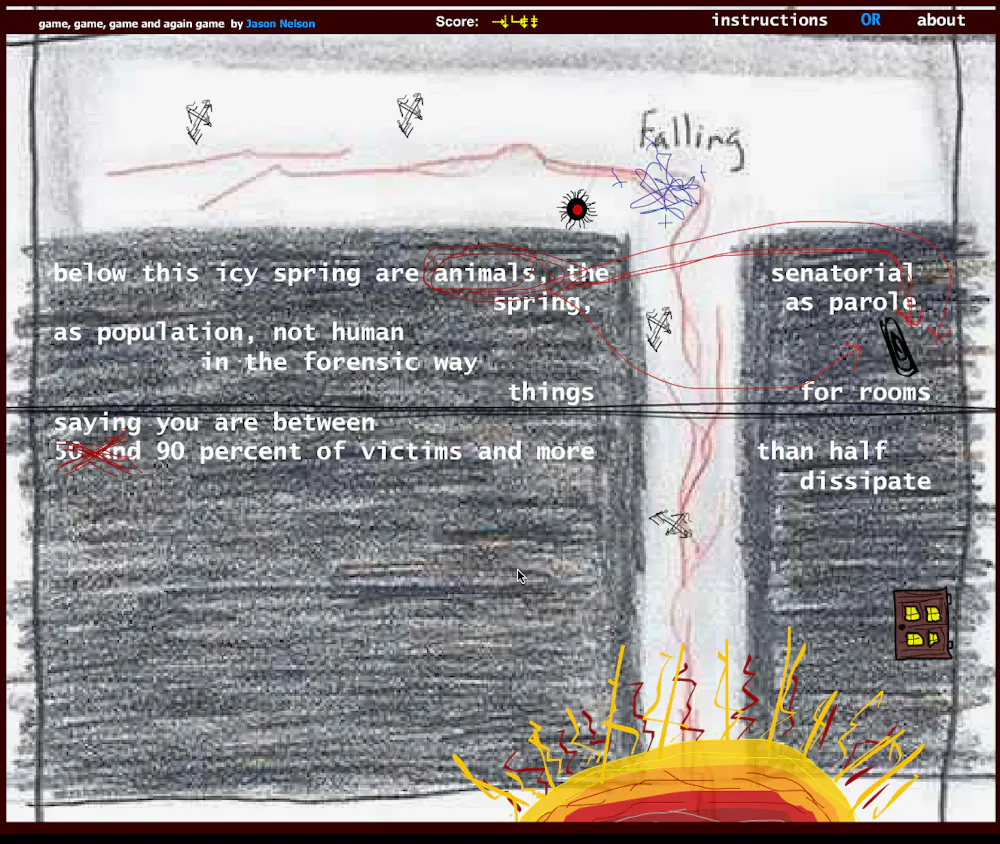
For centuries, poets have combined poetry and images. In the late 1700s, William Blake combined poetry with engraved artwork in his conceptual collection Songs of Innocence. Contemporary poets use digital technologies to similarly adorn poetry with imagery.
The title of Qianxun Chen’s work Shan Shui means mountain and water in Chinese, and landscape when combined as shanshui. It also refers to traditional Chinese landscape painting and a style of poetry that conveys the beauty of nature. With each click, a new Shan Shui poem is generated with a corresponding Shan Shui landscape painting.
Shan Shui (2014) by Qianxun Chen makes a new illuminated poem with each click.elmcip.net
Visuals also find their way into poetry performance. The Buoy by Meredith Morran is a poetic work of auto-fiction that uses a series of diagrams to create a new form of language to address political issues involving marginalised identities.
Morran combines abstract images, performance and PowerPoint presentation software to indirectly address a personal history of growing up queer in Texas.
A Brief History of How Life Works (2017) by Meredith Morran.
A still from game, game, game, and again game (2007) by Jason Nelson.elmcip.net
The emergence of virtual reality games, such as Half-Life: Alyx, has also met with poetry.
Australian digital artist Mez Breeze’s V[R]ignettes is a virtual reality microstory series. The audience can experience this work by donning a virtual reality headset or viewing it in 3D space in browser. Each V[R]ignette combines poetic text, 3D models, and atmospheric sound design. The reader (or user) can navigate by clicking on the “Select an annotation” bar at the bottom of the screen, or simply look around in 3D space and freely explore the work.
A still from V[R]ignettes (2019) by Mez Breeze.elmcip.net
5. Coded messages
Code poetry is a genre that combines classical poetry with computer language.
Code poems, such as those compiled by Ishac Bertran in the print collection code {poems}, do not require a computer to exist. However, they do use computer languages, so to comprehend the poem one must be able to read computer code.
Like so many untranslatable Russian and Chinese poems, these works require a knowledge of the original language to be appreciated.
Source: The Conversation (Au and NZ) – By Patrick O’Leary, Professor and Director of Violence Research and Prevention Program, Griffith Criminology Institute and School of Human Services and Social Work, Griffith University
Today is a far cry from what we hoped for and expected from 2020.
After Australia’s disastrous summer of bushfires, the unprecedented upheaval of the COVID-19 pandemic has seen serious social and economic effects for us individually and collectively.
Hope provides a positive vision for the future about what’s possible, motivating us to look forward. While it’s an optimistic state of mind, hope can emerge from distressing and even tragic situations.
Research shows both mental and physical health deteriorate quickly when we don’t have hope.
Feeling hopeful it associated with better mental health.Shutterstock
A lot of us are probably feeling a lack of hope right now
To have hope, it’s vital we feel a sense of meaning in our lives. Particularly during a crisis, having meaning or purpose can protect our mental health.
In recent months, two things that give our life meaning – work and connections with friends and family – might have been disrupted.
And while necessary to prevent the spread of COVID-19, social distancing measures have meant many of the things we looked forward to – from holidays to going to the theatre to simply having dinner at a restaurant – were off, in favour of staying at home.
Coronavirus restrictions have had more serious consequences for vulnerable groups. For example, some victims of domestic violence lost the safe refuge normally found in school or the workplace.
All of this brings uncertainty and throws our plans into jeopardy.
Adjusting our goals
To work through grief and hopelessness, we need to modify our goals to ensure they’re realistic within the “new normal”, and we have a clear pathway to achieving them.
For example, you might have been saving for a big family trip. But now – due to financial challenges, or travel restrictions, or both – it will be more realistic to plan a holiday in a nearby caravan park.
It’s important to focus not only on long-term hopes, but on the short term too. If we focus too much on the future, we can lose sight of what’s achievable and important to us now.
We should ask ourselves, what can we reasonably do this week or next month within current restrictions?
Things that are important to us – such as family, friends and career – are unlikely to change, but we may need to find new ways to connect with loved ones or feel accomplished in our jobs. For example, we might spend more time socialising using digital technologies rather than face-to-face.
We can even think about setting goals daily. How can we do something to enact our values each day? This could be as simple as a kind gesture towards a loved one or work colleague.
Even as restrictions ease, we worry about the potential for virus outbreaks.
Meanwhile, people in financial trouble won’t simply recover overnight, and may face added stress at the prospect of the government ending its support programs.
And people who have experienced mental health problems during the pandemic will need ongoing support.
Fear can get in the way of identifying pathways to achieving our hopes. So to nurture hope we must recognise, acknowledge and address our fears.
As things change, you should adjust your goals to ensure they’re still achievable.Shutterstock
If this all feels like a lot, setting a goal such as going for walk during the day can give us space to reflect.
Further, research shows engaging in mindfulness meditation and focusing on the present can reduce our stress and increase our sense of hope.
Sharing hope
Sharing your hopes with trusted others means you’re supported not only to dream of exciting things, but also to make these things happen.
We’re actually programmed to share in each others’ hopes and dreams. Vicarious hope is the desire for something positive to happen to someone else. It switches our attention to how our actions might contribute to other people’s hopes as well as our own.
The two travellers in question came from the UK, where the disease is still very active.
The two women arrived in New Zealand on June 7, via Doha and Brisbane, and stayed in a managed isolation hotel in Auckland. But they were granted an exemption on compassionate grounds on June 12 to travel to Wellington to visit their dying parent.
Such compassionate exemptions from managed isolation have now been temporarily suspended.
– Partner –
This development shows how important our border controls are. Currently, all new arrivals must remain in quarantine for at least 14 days, unless they receive an exemption. It is unlikely someone is still infectious after 14 days without showing symptoms, so this should minimise the chances of spread from overseas arrivals.
It does not mean zero risk But as these cases show, this doesn’t mean the risk is zero. Whether from an exemption on compassionate grounds as in this case, people working at the border, or from people getting infected shortly before leaving quarantine, it is inevitable that new cases will make it across the border.
As we explained in our previous article, to stop the virus coming back, we need more than just good border controls.
New Zealanders will need to keep avoiding the three Cs of possible infection – closed spaces, crowded places and close contact – as best they can. And it’s crucial we keep meticulously tracking where we’ve been and who we’ve been in contact with.
It also shows the importance of getting tested. One of the travellers reported mild symptoms, but didn’t associate these with covid-19. Anybody with symptoms should get tested and stay home until the results come through, especially if they have had contact with someone who has been overseas or work in a high-contact job.
Now that New Zealand is at alert level 1 and 40,000 people can go to the rugby, it’s more than important than ever that we don’t let our guard down.
The government’s HomeBuilder scheme allows certain home owners to apply for a tax-free grant of A$25,000 if they are spending between $150,000 and $750,000 renovating a home or building a new home. Eligibility criteria are strict.
The scheme has boosted renovation talk in some circles (although, as CoreLogic has pointed out, it may merely bring forward works that were already planned).
Here are some questions to ask yourself when trying to decide between renovating and moving – and how to add value to your existing home.
Property market observers advise updating or renewing bathrooms or kitchens – even small fixes such as replacing a cracked or dated splashback, replacing a bath or adding skylights can go a long way.
Think about easy repairs that create an invaluable good first impression – a fixed-up fence, a new carpet or resurfaced flooring or even good old decluttering.
But remember you’ll only qualify for HomeBuilder if you plan to spend at least $150,000 on an owner-occupied home worth no more than A$1.5 million (CoreLogic has listed which suburbs have the most owner-occupied properties under A$1.5 million).
Get expert advice before you dive in.Shutterstock
Factors to consider if you’re thinking of renovating
How long till you retire? How secure is your employment? Thinking carefully about your earning potential between now and retirement will help you understand how what you can borrow and afford. If you are planning to stay, you will get the benefit and enjoyment of the renovations.
Do you need to stay close to school or work? If that’s a consideration, renovating may be worth more to you than buying further out.
Look closely at what your property is worth (there are plenty of online calculators) and keep track of how much similar local properties with one extra bedroom or bathroom sell for. That will give you a sense of the value-add to your home equity that a renovation might represent.
Be honest with yourself about the total cost of renovation. There are myriad expenses not always initially apparent. These may include:
planning fees (the cost of getting a development assessed by council)
the cost of architectural drawings
consultants’ fees for environmental impact statements or arborists’ reports
extra costs due to a heritage listing
renting, if it’s not possible to live at home during renovation
the cost of protecting underground public assets such as water or sewerage pipes
extra costs caused by poor access or other limitations.
Consider the possible long-term savings of retrofitting your home to be more energy-efficient. Proper insulation, secondary glazing, draught excluders and solar PV energy are expensive upfront but will save on long term running costs. It’s likely, as energy costs increase, homes that are at least partially off grid will be more attractive and valuable over time.
And remember that for some, even with help from HomeBuilder, renovation won’t stack up economically.
Some older people may eschew home renovation to put money aside to help children get a foot on the property ladder.
Others may decide potentially expensive renovation is worth it to hold onto a family home to which children return as they get older. It might sound sentimental but the idea of Christmas in the family homestead is worth it, for some.
Tax considerations
Find out what tax breaks, if any, you might be eligible for if you renovate to divide the family home into a smaller space (if you’re keen to downsize, or enhance the accessibility of your home, for example) and adding a self-contained granny flat.
However, if the granny flat is leased out, this section of the home would be considered income-producing. Your “main residence” is generally exempt from capital gains tax when it comes time to sell, but you may not qualify entirely for this exemption if a section of the property is income-producing.
You may also consider remodelling the family home into a duplex and, depending on council planning laws, convert the title into dual occupancy. However, these suggestions may complicate eligibility for the HomeBuilder grant (which seems to exclude property investors, although there’s no mention of partly converting the main place into a dual occupancy).
The best option here is to seek advice from a tax specialist.
Factors to consider if you’re thinking of selling up and buying elsewhere
How important is proximity to work? Particularly if the coronavirus pandemic has opened your (or your employer’s) eyes to working remotely, would you consider a move to a more remote area where you can afford a bigger house?
Chat with a range of real estate agents and get into the habit of reading market media coverage. Have a sense of what houses sell for that featured your desired attributes (such as more bedrooms or off-street parking).
As a chartered building surveyor, I’d advise would-be downsizers to be cautious when buying a brand new high-rise apartment, due to risks of potentially costly defects that might become apparent over time.
And remember, even if you do sell and buy a new place, very few are able to find the perfect home. You may decide to make renovations anyway.
Find someone who has been through it and ask what they’d do differently.Shutterstock
There are no easy answers. It comes down to your individual circumstances, your attitude to risk and ensuring you have a good grasp of the relative costs of each option.
Talk to a financial adviser, tax accountant, real estate agents, builders, architects and others who have been through each process about what they’d do differently next time.
Roads, cycleways and housing developments are among 11 projects announced this week as the first tranche of infrastructure developments to kickstart New Zealand’s economic recovery in the wake of the COVID-19 pandemic.
New Zealand is investing at least NZ$3.3 billion into “shovel-ready” infrastructure projects, which will be fast-tracked under a new law currently going through parliament.
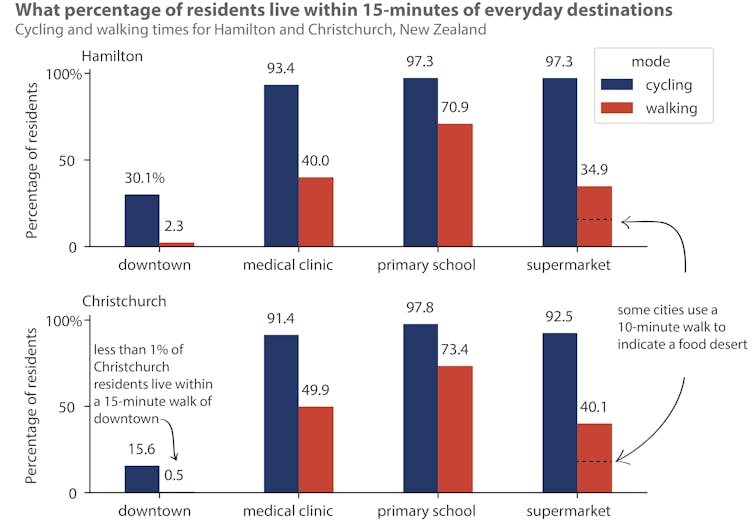
But this approach ignores an important aspect of recovery. In our research, we make the case that communities become more resilient to future crises when people have access to basic services such as supermarkets, hospitals and schools.
The people selecting recovery projects should ensure the projects prepare communities for future hazards and reduce future vulnerability.
This first set of projects lacks a broad, cohesive vision for future communities; perhaps a consequence of the fast-tracking that limits feedback and innovation.
Instead, we should look at ideas such as Hamilton’s 20-minute city: a city where all residents are within 20 minutes of essential services, without depending on a car. Better yet, Paris and some of Britain’s cities have proposed 15-minute cities.
Explore access to various services in Christchurch and Hamilton. Created by Tom Logan, Mitchell Anderson, Dai Kiddle and Michael Freeman.
This is not a call for highways and on-street parking. Instead, it can be achieved by providing new facilities in deprived areas and through smart planning.
Housing projects can bring people back into community centres. Medium-high density and mixed-use housing developments, in or near community hubs, would stimulate local economies long after the projects themselves are completed.
This type of initiative adds incentives for family-owned stores and cafes to return downtown. For example, as Christchurch continues to rebuild after the 2011 earthquake, affordable medium-high density housing in the empty lots of the inner city would invigorate local shopping and hospitality while enhancing safety of the community centre.
Travel times in Hamilton and Christchurch. Please note, downtown is defined using a single point.
So-called anchor projects (such as stadiums or pools) that bring only occasional pulses of activity continue to fail our communities.
The challenge is to define what community resilience actually means. In the past, it has been characterised through two lenses: community capacity and infrastructure functionality.
Capacity-based resilience seeks to build a community’s ability to prepare, respond, recover and improve when faced with a hazard. The infrastructure functionality approach focuses on ensuring that infrastructure withstands disruptions and can quickly be restored afterwards. But this approach can be limited in its potential to enable necessary change.
Instead of these ideas, we argue that decision-makers should think about community resilience in terms of people’s access to amenities and opportunity. Fundamentally, communities need everyday services such as water, food, education, health care and employment to function.
Given the fast-tracking of consent processes, decisions should at least consider two aspects: hazard exposure and the equitable distribution of amenities.
Investment must consider hazard exposure. But given that essential infrastructure continues to be developed in exposed places – for example, the Buller hospital, Nelson airport and Napier airport are all built near sea level – there are major concerns about decision processes.
As much as NZ$14 billion worth of existing local government infrastructure, in New Zealand alone, is at risk from sea-level rise. Stimulus investment is an opportunity to reduce this exposure.
The second factor is community vibrancy, which can be achieved through equitable access to essential infrastructure and services. This brings benefits to community resilience, physical and mental health and local economic growth.
Today, we have the computational ability to evaluate and improve access and its equity. We can even evaluate how access changes during a disaster like Hurricane Florence, which struck Wilmington, North Carolina, in 2018. We can optimise the location of amenities like supermarkets to reduce food deserts and ensure they’re safe from future disasters.
Building resilience for people
This shift to a more contemporary, people-centric, thinking about community resilience should happen without needing the prompt of a global pandemic.
Before a disruption, we need to improve community well-being and health (the Māori concept of hauora) and social connectedness (whanaungatanga) through equitable access to services. In doing so, we foster the conditions necessary for resilience. It has been devastatingly evident during the Black Lives Matter protests how social injustices undermine community cohesion.
Following disruptions, we should focus on people’s access rather than solely on restoring infrastructure functionality. For example, providing generators may restore access to food or health care more rapidly than focusing on the electricity network.
Communities can be designed and retrofitted to achieve both lower exposure to natural hazards and improved equity in access. This is not the “green nirvana” NZ First MP Shane Jones opposes. Instead, it is a blueprint for invigorating and preparing communities for the next disruption, be that a drop in tourism, a global pandemic or a natural hazard.
Victorian Premier Daniel Andrews sacked Adem Somyurek on Monday.Scott Barbour/AAP
As federal Labor MP and former academic Andrew Leigh has shown, the propensity of Australians to join formal organisations has been in steady decline for 50 years, and parties are a key example. Weeds have sprouted in these ruins.
The infrastructure of party and union branches that once underpinned politics in Labor heartlands has collapsed. The factories are gone and Labor branches have in most cases shrunken to a few ageing true believers.
Branch stacking is possible because Labor’s active membership is now so low they can be easily swamped by those “stacked” into the party.
Preselections for safe seats in state parliament are often determined by fewer than 50 votes at the local level.
We have been here before
Branch stacking is, however, not new.
During the Cold War, membership soared as left and right battled for control. But back then, it reflected real ideological disagreements that mobilised thousands. This popularisation sparked a catastrophic split in the ALP.
Today, Labor is not divided by deep ideological battles and as a consequence, its membership is much lower. As a further result, it is much easier to stack the branches.
With Labor as the dominant political force in Victoria, it is now mostly jobs – from lowly electorate officers to ministerial roles – that people fight about. The power of factional bosses rests on their ability to control access to these positions.
The need for change
The decline in the levels of Labor membership and the commitment of Labor voters have concerned supporters for decades.
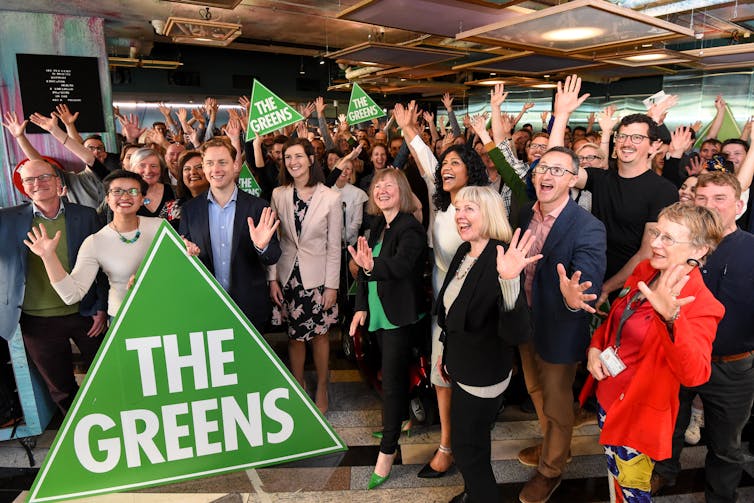
Today, new political forces such as the Greens and independents are now going after Labor in their heartland. Even at the 2018 landslide victory of the Andrews government, the Greens retained three seats and independents mounted serious challenges in safe Labor seats.
The Greens are challenging Labor in heartland seats.Penny Stephens/ AAP
One popular proposal has been to increase the rights of members, so they can have a greater say in how the party is run.
At the federal level and for some states, this has taken the form of direct ballots for parliamentary leaders.
This method was described by former ALP national secretary George Wright as “an outrageous success” in 2013, leading to an extra 4,500 members at the time. But some states – including Victoria – have not gone down this path.
Some have argued it would be better to give up the dream of building a mass membership Labor Party and instead allow all Labor voters, not just party members, to select candidates by an American-style system of primaries.
However, here, the likely outcome would be an even more media-centric politics, where political celebrities – such as Canadian leader Justin Trudeau – would communicate directly with voters. It is a weak shield against a populist right on the march.
Organisational reforms flagged
On Tuesday night, ALP president Wayne Swan announced former Victorian premier Steve Bracks and former federal frontbencher Jenny Macklin had been appointed administrators of the Victorian branch until the end of January 2021.
They will report on how the branch “should be restructured and reconstituted so that the branch membership comprises genuine, consenting, self-funding party members”.
But in the absence of a larger and engaged membership, organisational reforms will always be subject to evasion. The highly-centralised pre-selection system in Victorian Labor provides an incentive to stack, but reform of this would disrupt the delicate factional balance within the ALP.
The political fallout
The branch stacking scandal also presents political opportunities for Labor’s opponents.
For the Greens, this latest scandal offers the opportunity to challenge Victorian Labor’s progressive image. In the short run, the Andrews brand is strong enough to ride out the loss of less talented ministers, but one day, the political tide will turn. The collapse of the once all-conquering NSW Labor Party is a cautionary lesson.
The branch stacking scandal is an unwelcome distraction for Anthony Albanese ahead of the Eden-Monaro by-election.Mick Tsikas/AAP
At a federal level, it drags Albanese back into mire of Labor politics and undercuts his attempt to present him as an inner-suburban everyman – unlike former leader Bill Shorten, who could never escape his identity as a political hack.
If Labor loses the forthcoming Eden-Monaro byelection, this is something all Labor MPs, not just the Victorians, will have more to worry about.
Prime Minister Scott Morrison yesterday announced environmental approvals for 15 major infrastructure projects will be fast-tracked to accelerate investment as Australia emerges from the COVID-19 lockdown.
Under the current system, proponents must seek both state and federal approvals for big developments. The new “single touch” approvals process will involve teams of state and federal officials assessing the projects jointly.
This is by no means the first attempt by governments to streamline environmental approvals. Morrison says the latest push will be informed by a ten-year review of the Environmental Protection and Biodiversity (EPBC) Act, which has also been framed around cutting so-called “green tape” that slows developments. An interim report is due this month.
I was a federal environment official for 13 years, and from 2007 to 2012 was responsible for administering and reforming the Act. There are ways the laws can be streamlined without sacrificing the environment. But isolated from more comprehensive environmental reform, faster approval will bring significant environmental risk.
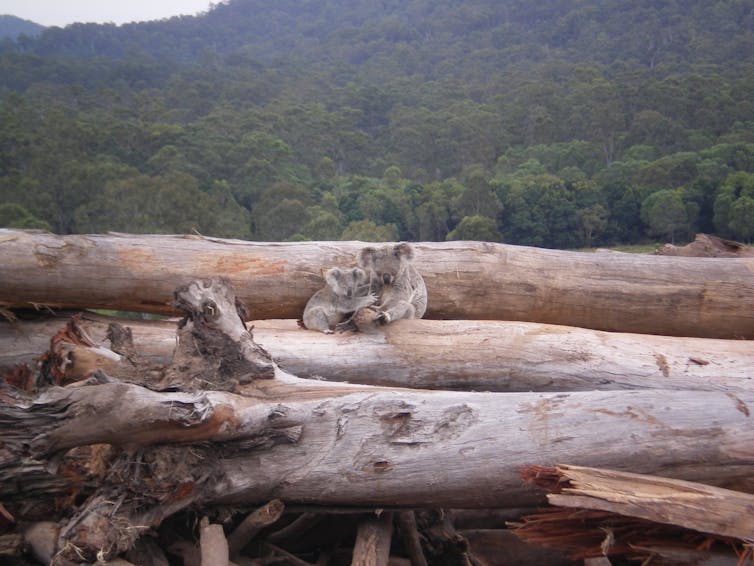
Faster environemnt approvals brings environmental risk.WWF Australia
We’ve been here before
The first national agreement to streamline environmental approvals dates back to 1990, and Bob Hawke’s “New Federalism” push to reduce overlap between Commonwealth and state environmental laws.
More recently, the Gillard government in 2012, at the urging of business interests, sought to strike bilateral agreements with the states to reduce duplication in environmental approvals. The push was abandoned when each state demanded different arrangements, making the proposed system too messy and complex.
In 2014 the Abbott government revived this “one-stop shop” approach, but the move was blocked by the Senate.
A risky business
Environment advocates naturally oppose moves to streamline environmental laws and approval processes. They argue the regime already fails to protect threatened species and biodiversity, and the bar should not be lowered further.
It’s true that while governments may claim faster approvals won’t erode environmental standards, there aren’t many hard-and-fast standards to maintain.
Environmentalists argue current laws are already inadequate.Larine Statham/AAP
Instead, EPBC Act decisions mostly hinge on the minister’s conclusion that assessed environmental impacts are “not unacceptable”, provided certain conditions, such as minimising a project’s physical size, are met. But this is no standard at all, because such decisions are arbitrary and no “bottom line” for a project’s environmental performance is set.
As things stand, the closest thing to an on-ground environmental standard is the environmental offsets policy, which allows environmental damage from a project to be compensated for by environmental improvements elsewhere. But policies are not binding, there is no public register of approved offsets and little evidence of them being monitored and enforced.
The Act does include mechanisms for setting standards. These include “bioregional plans” intended to inform industry and decision-makers of the environmental values and objectives of a region, and how these should be met.
But since the Act commenced in 2000, just five such plans for marine areas have been developed, and none have been prepared for regions on land.
The Act also provides for recovery plans setting out the actions necessary to support listed threatened species. But as of 2018, fewer than half these species have recovery plans, and where they exist, the plans are often out of date and not specific enough.
Efficient approvals require proper resources
Morrison said his government wants to reduce Commonwealth assessment and approval times for major projects, from an average of 3.5 years to 21 months. But to do that, his government must stop starving its own regulatory systems of resources.
Between 2013 and 2019, the federal environment department’s budget was cut by 39.7%, according to an assessment by the Australian Conservtaion Foundation. So it’s little wonder approval processes slowed.
In November last year the Morrison government announced A$25 million to reduce unnecessary delays in environmental assessments, including the establishment of a major projects team. In effect, this was merely a reversal of previous funding cuts by this government and some of its predecessors.
What’s more, an efficient approvals process needs good information, yet this can be hard to come by.
The much-needed National Plan for Environmental Information was established in 2010 “to improve the quality and accessibility of Australian environmental information”. It would have reduced the need for fieldwork in environmental assessments. But in my view it was never properly resourced, and it has since been abolished.
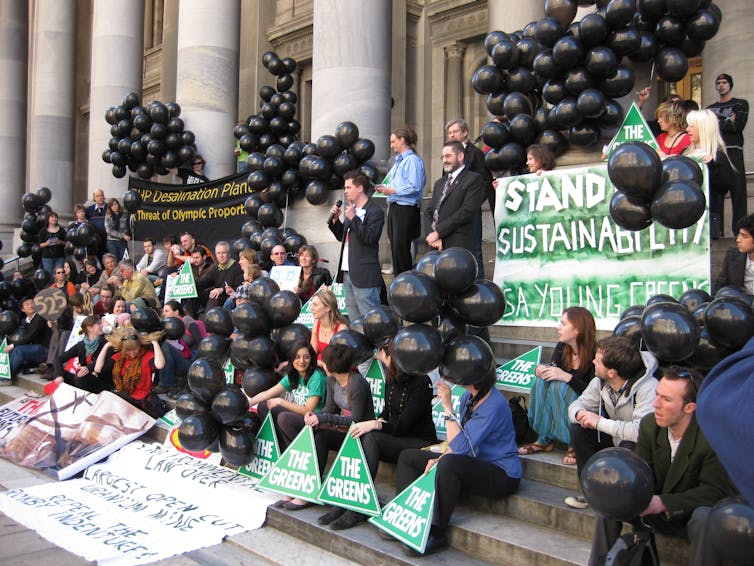
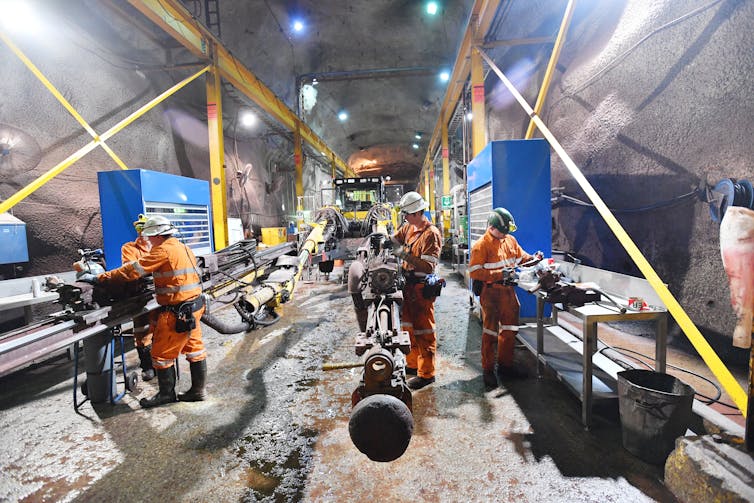
An expansion of BHP’s Olympic Dam mine site in Roxby Downs, South Australia, is among the priority infrastructure projects.David Mariuz/AAP
But streamlining could work
There are ways the Commonwealth and states could cut environmental approval times without cutting corners.
The proposed joint assessment teams would have to be well-resourced. They would also have to be authorised to negotiate procedural or cultural obstacles to meeting both federal and state legal requirements.
When I was in the environment department, it was common for federal and state officials to complain their counterparts were not addressing the assessment and approval requirements of the other jurisdiction.
And if companies behind developments want faster approvals, they will have to provide information to officials in a timely fashion – something that doesn’t always happen now.
Australia has learnt much during the pandemic – not only about cooperation between the Commonwealth and the states, but also between government and business. Success in this latest streamlining attempt will demand excellence in both.
The larger challenge is to speed up the process without lowering the environmental bar.
The federal government should commission independent monitoring and evaluation of the environmental outcomes of approvals under these new arrangements. In 2009 a Senate committee recommendedmore resources for monitoring and audits, but nothing has improved in the decade since.
Independent evaluation won’t win over the sceptics, but it might assuage their worst fears.
SpaceX’s recent Falcon 9 rocket launch proves humanity has come leaps and bounds in its effort to reach other worlds. But now there’s a quicker, safer and environmentally friendlier way to travel to the centre of the galaxy – and you can do it too.
NASA has co-developed a free virtual reality (VR) adventure providing 500 years of travel around the black hole at the centre of the Milky Way. The experience is available to download from two major VR stores, Steam and Viewport, in a non-collapsed star system near you.
And this kind of spacefaring may be the tip of the iceberg when it comes to the potential of virtual travel and tourism.
Simply speaking, VR refers to technology that immerses users in a computer-generated world that removes them from reality. Augmented Reality (AR), however, aims to superimpose virtual imagery over a user’s view of the real world. Pokémon Go is a popular AR game.
According to Forbes, Pokemon Go made US$176 million in August last year.Shutterstock
VR-based tourism has a longer history than you might think. In the 1850s, it involved staring at stereographs with a stereoscope. With this invention, viewers looked at slightly different images through each eye, which were then assembled by the brain to make a new image providing the illusion of spatial depth (in other words, a 3D effect).
Cinerama originally involved using multiple projectors to project images simultaneously onto a large, curved screen.Andyj/Wikipedia Commons
A century later, 1950s Cinerama widescreen viewing inspired cinematic travel though its large, curved screens and multiple cameras.
The 1960s Sensorama foretold a shiny future of multimodal immersive cinematic experiences, playing 3D films with sound, scents and wind to immerse users. In VR circles, Ivan Sutherland became famous for inventing the head-mounted display, as well as augmented reality (AR).
Travel restrictions under COVID-19 present an opportunity for virtual reality travel to finally take off.
In an era of lockdowns and social distancing, we could use VR to travel to remote, distant or even no longer existing places. Remote tourism is here (the Faroe Islands offers a great example), and interest in VR tourism is blossoming.
What is deemed “virtual” varies greatly across different devices and platforms. Let’s look at some of the ways this term is applied.
Desktop virtual environments: these are computer-based 3D environments on a flat screen, without the spatial immersion of VR platforms.
Cinematic VR: these are phone-based panoramic environments. Many desktop experiences of 360° movies or images can be conveyed in low-cost stereoscopic VR through smartphones. Google Street view can be viewed in Google VR on Android and some Apple smartphones, but it’s not real VR.
Most smartphones today have panoramic photography capabilities.Shutterstock
Head-mounted displays: HMDs such as Google Cardboard and Google Daydream are what many people think of when they hear “virtual reality”. Some HMDs are self-contained, not requiring connection to a computer or console. Arguably, the market is dominated by the Oculus range owned by Facebook, the HTC Vive range, and PlayStation VR.
VR in a pandemic
In a post-coronavirus age, device sharing is problematic. HMDs aren’t easy to clean and VR software can quickly become obsolete, with new headsets sometimes not running two-year-old software. Users also have to deal with costly updates, eyestrain, and having to share displays that sat on someone else’s face.
Developing and sharing content across different devices can be a nightmare but there are increasingly simple and effective ways to create AR and VR content, despite a bewildering range of platforms and equipment (there are more than 140 3D file formats).
Despite this, many VR projects are not preserved – including virtual heritage projects! Even for the largest HMD companies, supplies can be limited.
Places you can virtually visit now
Nonetheless, there are plenty of VR programs available to help relieve lockdown boredom, with many sites offeringlists of their favourite picks.
Or you may want to stay in Australia. Australian company White Spark Pictures’ Cinematic/360 experience of Antarctica tours museums. Melbourne-based company Lithodomos brings “the ancient world to life” and Hidden AR offers mythical augmented reality.
Many types of VR head-mounted displays are available, ranging in price and features.Hafizur Rahaman and Erik Champion, Curtin University, Author provided
Escapism through gaming
There are also VR games with which you can:
VR can show your outer space, and also convey interpretations of time and space. With it, there is vast potential for travelling to infinity and beyond.
Children are exposed to junk food marketing everywhere
Globally, we’ve seen persistent calls to protect children from exposure to the marketing of unhealthy food and drinks.
This recognises the harmful effects of junk food marketing on children.
While some governments have adopted legislation to restrict kids’ exposure to the marketing of unhealthy foods, these laws typically don’t apply to social media.
Some food companies have voluntarily pledged to restrict their marketing of unhealthy foods to children. But most of these pledges are narrow in scope and full of loopholes that allow junk food marketing to proliferate.
McDonald’s Australia advertising on Facebook, 2020.Author provided
As a result, children are heavily exposed to unhealthy food marketing, including on TV, online and through outdoor advertising.
Junk food marketing on social media
In Australia, a recent study found almost half of children aged 10-12, and almost 90% of those aged 13-16, were active on social media.
Junk food brands target children on social media through direct advertising, sponsored posts, and by integrating their brand into engaging and entertaining content.
This includes establishing promotional relationships with online “influencers”, who then promote the brand as part of the content they post.
In one recent study, more than half of Australian kids who were active on Facebook had “liked” a fast food brand, which subscribes them to its content. A similar proportion of kids had “liked” a soft drink brand.
Another study showed teenagers engaged with posts advertising junk food more often than they engaged with posts promoting healthy food.
There’s also evidence that when kids are exposed to unhealthy food marketing on social media, it increases the chance they’ll consume the promoted product over an alternative brand of the same type of snack.
Social media policies on junk food advertising
In our study, we focused on the 16 largest social media platforms globally. These included platforms popular with children, such as Instagram, TikTok, YouTube, Snapchat and Facebook.
We examined each platform’s advertising policies related to food and drinks.
We found none of the social media platforms have comprehensive restrictions on the advertising of unhealthy foods to children.
YouTube Kids, a platform popular with children under 13, does ban direct junk food marketing. But media reports have shown children could still be exposed to junk food brands through product placement and promotional videos on the platform.
Almost 9 out of 10 Australian teens aged 13-16 use social media.Shutterstock
Other advertising policies
We also looked at each platform’s advertising policies related to other areas affecting public health.
We found most of the social media platforms were prepared to take a stand against tobacco, alcohol and gambling ads targeting kids.
In many cases, their policies in these areas are aligned with government regulations. But in some cases they go further.
Facebook and Instagram also recently implemented a ban on advertising diet and weight-loss products as well as cosmetic procedures to users under 18. These policies are substantially more restrictive than most government policies.
Notably, current social media advertising policies don’t completely eliminate children’s exposure to ads in these areas. For example, children still report seeing gambling ads on social media.
Although these policies need to be more comprehensive, they do signal social media platforms’ willingness to take action to protect children from the advertising of unhealthy products.
Social media platforms have an opportunity
Social media platforms have demonstrated they recognise the important role they can play as corporate citizens.
There’s now a real opportunity for them to take concerted action to reduce children’s exposure to junk food marketing.
In doing so, they can follow the lead of children’s entertainment networks, such as Disney and Nickelodeon, that have taken steps to restrict advertising of junk food to children.
Public health groups have consistently highlighted that food industry self-regulation in the area of junk food marketing has proven ineffective. As such, there are strong global recommendations for comprehensive national and international government regulation.
But the potential role of social media platforms in regulating junk food marketing has largely escaped attention.
While we await further government regulation, social media platforms can take immediate action to protect children from the marketing tactics of junk food advertisers. This would be a critical contribution to efforts to improve young people’s diets and address the growing problem of obesity worldwide.
As Black Lives Matter protests rage across the world, many of us are motivated to learn more about racism, and talk to our students and children in ways that can facilitate change.
Education is a powerful took for creating change. So, it’s important teachers don’t shy away from difficult conversations in the classroom, even if they may feel daunting.
Here are some things teachers can consider to help them discuss racism with their students.
1. Provide accurate, historical context
Understanding and coming to terms with past racist practices is essential to an anti-racist education.
When historical oppression is denied, omitted or whitewashed – as when Prime Minister Scott Morrison incorrectly claimed Australia didn’t have a history of slavery – it is difficult to explain how racism still affects black, Indigenous and people of colour today.
A teacher can take students to visit memorials and museums, or ask them to research place names. Do names in your local community, for example, hark back to racist practices? In some towns, “Boundary Road” recalls a line Indigenous Australians could not cross after curfew.
Teachers can encourage students to critically reflect on whose stories are celebrated in public memory, and brainstorm what would better represent the contributions and experiences of all members of the community.
2. Explain racism is not just done by ‘bad people’
Racism should be taught as a system of racial hierarchy that is sustained consciously and unconsciously by the idea that one group of people is superior. Because of this presumed superiority the ideas, books, voices and expertise of one group are seen as the “norm”.
Racial discrimination today is often referred to as “soft” or “new” racism, often expressed through covert microagressions.
Categorising racism as something only “bad” people do means the “good” ones are denied the opportunity to examine how their everyday thoughts and actions may be sustaining society’s racial hierarchy structure.
The below video of the blue-eyed/brown-eyed experiment (in which kids are told brown-eyed people are superior to blue-eyed people and vice versa), is a good way to show students how unconscious behaviours emerge and how quickly prejudice can form.
This video shows how quickly prejudice can develop.
3. Show the impacts of unintended harm
People commonly assume their good intentions bear more weight than their unintended consequences. Just because someone did not intend to be racist, does not lessen the impact on the person experiencing it. You can use metaphors to illustrate this.
For example, if you accidentally pour hot coffee on someone, the natural response is not to say “why are you upset when it wasn’t my intention to pour a hot drink on you?”.
The more appropriate response is to acknowledge your mistake, apologise to the other person and move more carefully in future.
The insidiousness of “new” racism is that people who do not consider themselves racist might actually be perpetuating racism without being aware of it.
4. Encourage students to be brave in calling out racist behaviour
Being silent after observing racist behaviour is being complicit in racism. Teachers need to practise giving constructive feedback on racist speech and behaviour, and support students in being resilient about taking on board anti-racist feedback.
Actively anti-racist teachers are quicker to notice and respond to racial micro-aggressions when they occur in the classroom, such as teaching students not to use racial nicknames or stereotypes.
5. Explain there are hierarchies within racism
Experiences of racism are magnified when different forms of discrimination combine to create a more intensified exclusionary experience for people, based on intersections between their multiple marginalised identities.
Experiences of racism for young black men, for example, may vary a lot from the experiences for young black women. Explain to students it is possible to experience oppression in one identity category but be privileged in another.
Privilege isn’t linear.
6. Be aware of students’ racial trauma
Teachers sometimes strive to teach about racism, without considering that it is the lived experience of some of their students.
Racialised trauma is passed across generations, and can include indirect and direct experiences of interpersonal and systemic racism.
We need to support people who have been traumatised by racism, not just challenge those who instigate it.
Teachers should also be sensitive about the way anti-racist teaching is delivered. If you are going to discuss sensitive topics, you can provide trigger warnings in advance to the class. This way students can prepare or raise concerns in advance.
Be aware of who is in your class and avoid using potentially re-traumatising images, examples or videos.
7. Model inclusive behaviour
Teachers should model anti-racist behaviour in their classroom. For example, they should not mock or say inappropriate things about other people’s cultural and racial backgrounds. Teachers should encourage students to think of the various cultures as different and not superior to, or better than, others.
You can also model an understanding of relevant cultural protocols, including through Acknowledgements of Country, or avoiding the use of names and images of Indigenous people who have passed away.
8. Ensure diversity in the curriculum
A consequence of colonialism has been the centring of white experiences and knowledge, and erasure of other ways of knowing and being.
We can challenge the historic and continued silencing of alternative voices by integrating diverse voices into our curriculum.
Anti-racist and decolonial education is often just as much about unlearning, as it is about learning.
We may have to challenge ourselves to unlearn inaccurate history and stereotypes, question our own deeply ingrained thoughts and habits, and practise different ways of listening to, and working with, people from different backgrounds.
Local governments across Australia are mandated to consult their residents on urban development issues. They are increasingly using digital platforms to do this.
Early findings from our international research project, Democratic Urban Development in the Digital Age, are that the use of digital technologies for community consultation mirrors patterns of offline engagement. So, for example, we see tightly designed questions and a prescribed process. Councils often disregard social media feedback such as Facebook accounts run by residents’ groups.
Digital engagement hasn’t replaced traditional consultation and participation processes. Council Facebook pages and web-based consultation portals sit alongside resident surveys, town hall meetings and citizen juries. However, the COVID-19 pandemic has increased reliance on these technologies.
Little research has been done on whether e-participation overcomes some of the problems of traditional participatory governance, which is often seen as favouring the articulate and powerful. Digital engagement might even be creating new barriers, such as digital exclusion or distrust in the handling of data.
Issues of public consultation especially matter for urban development projects. Local councils typically regulate these projects. Poor development can harm local amenity and residents’ well-being, while irreversibly changing urban forms.
How can the digital become a part of everyday governance, including community engagement? More frequent, higher-quality engagement would be required for a start. And citizen participation would then have to be channelled into policy.
Digital platforms are often limited to simply collecting information. Genuine participation is more challenging.
Participation by diverse populations is a particular challenge. Some councils pay specific attention to this issue. An example is the City of Melbourne’s digital place-making initiative.
Melbourne City Council’s approach to digital place-making considers how to engage all members of a diverse community.
However, as online and offline boundaries blur, digital technologies may help overcome barriers to participation.
Barcelona and Jackson, Mississippi, are two cities that have customised digital participation. It’s part of their design and implementation of community engagement, whether on social media or on dedicated digital platforms.
The City of Brimbank, in outer Melbourne, designed a digital engagement project as a game. Council staff took to the streets with iPads. The game was also available in shops, train stations and community centres.
Real-time data analysis enabled the council to adjust locations and boost the diversity of participants. Co-ordinating online and offline approaches was the key to achieving broad participation.
It is important to understand if and how digital engagement perpetuates inequities. The methods and platforms used for participation might be a factor in this.
Digital engagement is often limited to surveys. This could be due to a lack of council time and resources to analyse any other qualitative data that might be generated. Providing those resources would signal the data generated through digital engagement, and the process itself, are being taken seriously.
The feedback from community social media accounts can be rich and candid. But analysing this sort of data involves greater effort on the part of councils. This makes closing the feedback loop difficult.
Councils prefer bespoke web-based digital platforms. They’re easier to manage, both in deciding which issues are open for consultation, and in organising data for analysis.
These platforms are increasingly popular with councils. Yet sole reliance on them may favour digitally savvy citizens who are already engaged and familiar with planning processes.
It’s an open question whether the politically engaged and digitally literate dominate such campaigns. But they do remind us urban development is an arena of political contest. It’s more than just a topic for consultation, whether online or offline.
Important strategies in community engagement include:
working with all stakeholders, both formally and informally
paying attention to the purpose and variety of digital methods available
helping with access, whether digital or offline.
Ensuring robust community engagement in these ways supports better urban development.
If you are a city official, a representative of business, non-government or civic organisations, a community member or a politician in an inner Melbourne council and would like to contribute your experience to the project Democratic Urban Development in the Digital Age, please participate in the 10-12 minute survey here.
Source: The Conversation (Au and NZ) – By Flavio Romero Macau, Senior Lecturer in Supply Chain Management and Global Logistics, Edith Cowan University
Hand-written letters and posted bills are disappearing, and they were vanishing well before the latest slump.
Australia Post says between 2007 and 2019 the volume of personally addressed letters more than halved (over a period in which Australia’s population grew 20%).
Over the past year, between May 2019 and May 2020, they slumped a further 36%.
Worldwide, postal operators reliant on letters have been experiencing heavy losses. In 2019 the letter side of Australia Post lost $192 million.
As it notes on its website, “the amount of postage you are charged to send a letter is substantially less than what it costs us to deliver it”.
But, like a couple investing in bigger and bigger homes as its family grows, it is now finding time has moved on and it’s left with too much space for the wrong thing.
Lower letter volumes mean trucks leave buildings less than full, equipment is no longer run at full capacity, workers are less-fully occupied, and volume discounts with freight forwarders shrink.
Aggressive delivery standards are the last straw.
Daily delivery matters less
Australia Post has been required to deliver daily (Monday to Friday) to 98% of delivery points. Within cities it has to get there within three business days.
The requirements have made it hard for it to aggregate volumes in order to regain scale.
Rather than waiting for full truckloads it has had to send them out less than full, effectively “moving air”.
So in May the government eased the regulations, “temporarily” for 13 months until the end of June 2021.
Within cities, deliveries could take up to five business days. Mail could be pushed into the slots of city mailboxes (but not country mailboxes) only every second day.
Labor will seek to overturn the change, arguing, with good cause, that the changes are intended to be permanent and that COVID-19 is being used as cover.
It is right to want a debate, but that debate ought to face up to some hard truths
email and instant messaging have replaced letters for communication
apps have largely replaced mail for credit card statements
platforms such as Instagram have largely replaced postcards
platforms such as Facebook have largely replaced birthday cards
(And where people still want to use the post to send cards for events such as birthdays, Mothers Day and Christmas, they can plan well in advance.)
While the door is closing on letters, a window is opening for parcels.
Labor is right to want a debate
COVID-19 accelerated the move from brick-and-mortar stores to e-commerce. Australia Post says parcel volumes almost doubled in May, and are 80% higher than this time last year.
Britain’s Royal Mail reports a 31% increase, a trend it expects to continue after lockdown is lifted.
The challenge is to adapt the previous system to the changed demands.
Different equipment is needed, and retraining. A parcel is heavier than a letter and comes in a wider variety of sizes and shapes.
Automated warehouses and vans can be better suited to handling them than letter sorting machines and motorbikes.
Service will be measured differently
And there’s a need for a different way of measuring good service.
With parcels, people want to know what’s happening. They are often not as concerned with how long it takes to deliver a parcel as not knowing where it is. There’s a role for apps, SMS and emails and options including the delivery to smart lockers where parcels can be collected 24 hours a day.
What comes next for Australia Post will be an unfolding story. Competition in parcel delivery is fierce in the new sharing economy. Anyone with a big enough trunk soon will be able to do deliveries as crowd shipping gains momentum.
Since lockdown, everyone has had to rely heavily on digital technologies: be it Zoom work meetings and lengthy email chains, gaming and streaming services for entertainment, or social media platforms to organise everything from groceries to protests. Human existence is now permeated by non-human computer language.
This includes poetry. Digital technologies can disseminate and publish contemporary poetry, and also create it.
Digital artists combine human and computer languages to create digital poetry, which can be grouped into at least five genres.
1. Generative poetry
Generative poems use a program or algorithm to generate poetic text from a database of words and phrases written or gathered by the digital poet.
The poem may run for a fixed period, a fixed number of times, or indefinitely. Dial by Lai-Tze Fan and Nick Montfort, for example, is a generative poem that represents networked, distant communication. It depicts two isolated voices engaged in a dialogue over time. Time can be adjusted by clicking the clocks at the bottom of this emoji-embedded work.
A still from generative poem Dial (2020) by Lai-Tze Fan and Nick Montfort.nickm.com
The recent web-based work Say Their Names! by digital artist John Barber generates a list from more than 5,000 names of Black, Hispanic, and Native Americans who have been killed by police officers in the United States from 2015 to the present day. No judgement regarding the victims’ guilt or innocence is made. Each name is simply spoken – in a sometimes incongruously cheerful tone – by a computerised voice.
Nick Montfort’s generative poem Taroko Gorge was inspired by a visit to Taroko Gorge in Taiwan.
Montfort writes: “If others could go to a place of natural beauty and write a poem about that place, why couldn’t I write a poetry generator, instead?” Scott Rettberg then took the code from Montfort’s poem and replaced the vocabulary to produce Tokyo Garage, turning Montfort’s minimalist nature poem into a maximalist urban poem.
J.R. Carpenter undertook a similar transformation – replacing the nature vocabulary with words associated with eating.
There are now dozens of Taroko Gorge remixes. By inspecting the source of Montfort’s poem, one can carve into the code to remix one’s own version.
Scott Rettberg’s Taroko Gorge remix.
3. Visual verse
For centuries, poets have combined poetry and images. In the late 1700s, William Blake combined poetry with engraved artwork in his conceptual collection Songs of Innocence. Contemporary poets use digital technologies to similarly adorn poetry with imagery.
The title of Qianxun Chen’s work Shan Shui means mountain and water in Chinese, and landscape when combined as shanshui. It also refers to traditional Chinese landscape painting and a style of poetry that conveys the beauty of nature. With each click, a new Shan Shui poem is generated with a corresponding Shan Shui landscape painting.
Shan Shui (2014) by Qianxun Chen makes a new illuminated poem with each click.elmcip.net
Visuals also find their way into poetry performance. The Buoy by Meredith Morran is a poetic work of auto-fiction that uses a series of diagrams to create a new form of language to address political issues involving marginalised identities.
Morran combines abstract images, performance and PowerPoint presentation software to indirectly address a personal history of growing up queer in Texas.
A Brief History of How Life Works (2017) by Meredith Morran.
A still from game, game, game, and again game (2007) by Jason Nelson.elmcip.net
The emergence of virtual reality games, such as Half-Life: Alyx, has also met with poetry.
Australian digital artist Mez Breeze’s V[R]ignettes is a virtual reality microstory series. The audience can experience this work by donning a virtual reality headset or viewing it in 3D space in browser. Each V[R]ignette combines poetic text, 3D models, and atmospheric sound design. The reader (or user) can navigate by clicking on the “Select an annotation” bar at the bottom of the screen, or simply look around in 3D space and freely explore the work.
A still from V[R]ignettes (2019) by Mez Breeze.elmcip.net
5. Coded messages
Code poetry is a genre that combines classical poetry with computer language.
Code poems, such as those compiled by Ishac Bertran in the print collection code {poems}, do not require a computer to exist. However, they do use computer languages, so to comprehend the poem one must be able to read computer code.
Like so many untranslatable Russian and Chinese poems, these works require a knowledge of the original language to be appreciated.
Reporters Without Borders (RSF) has condemned the up to six years in jail sentence that Philippine journalist Maria Ressa faces on a criminal libel charge in a “shocking judicial masquerade” in Manila yesterday.
It called on the country’s justice system to recover a “semblance of credibility” by overturning her conviction on appeal, RSF said in a statement as global media freedom and human rights watchdogs protested over the verdict.
A Manila regional court convicted Maria Ressa, co-founder and director of the independent news website Rappler, over an article published in 2012 that was the subject of a complaint by a businessman.
But the case was brought under a cyber crime law that took effect after the article’s publication. Rappler‘s former researcher-writer Reynaldo Santos Jr received the same sentence.
Both were allowed to post bail, pending an appeal.
– Partner –
As no criminal legislation can be retroactive, the National Bureau of Investigation dismissed the case in February 2018. But President Rodrigo Duterte’s Department of Justice decided otherwise.
‘Continuous publication’ It revived the case in February 2019 on the grounds that a supposed principle of “continuous publication” could be applied to websites.
“By passing this extremely harsh sentence at the end of utterly Kafkaesque proceedings, the Philippine justice system has demonstrated a complete lack of independence from the executive,” said Daniel Bastard, the head of RSF’s Asia-Pacific desk.
“This sentence bears the malevolent mark of President Duterte and his desire, by targeting Rappler and the figure of Maria Ressa, to eliminate all criticism whatever the cost.
“We urge Manila’s judges to restore a semblance of credibility to the Philippine judicial system by overturning this conviction on appeal.”
?? @rapplerdotcom‘s @mariaressa could get six years in jail! By passing this harsh sentence after utterly Kafkaesque proceedings, the #Philippines‘ justice system has demonstrated a complete lack of independence from from pdt #Duterte‘s administration. https://t.co/RSK6RARyfM
Systematic harassment This conviction of Ressa and Rappler is the latest chapter in the systematic judicial harassment to which they have been subjected by various government agencies for more than two years.
Either directly or through Ressa, the website is facing 10 other similar complaints, each as baseless as the other, with the aim of intimidating its journalists.
ABS-CBN, the biggest Philippine broadcast network and one of the few other media outlets to dare criticise the government, had its franchise withdrawn last month.
Its radio stations and TV channels all stopped broadcasting on May 5 at the behest of the Justice Department and National Telecommunications Commission.
After falling seven places since 2017, the Philippines is ranked 136th out of 180 countries and territories in RSF’s 2020 World Press Freedom Index.
‘Damaging precedent’ In Brisbane, Professor Peter Greste, director and spokesperson of the Alliance for Journalists’ Freedom and UNESCO chair of journalism and communication at the University of Queensland, said the verdict set “an extraordinarily damaging precedent” for Asia-Pacific and global press freedom.
“To suggest there was no political pressure in this case would be incredibly naïve. The Philippine government has made it abundantly clear that they don’t think Maria should be free. The judge will have been acutely aware of this pressure.
“As a former political prisoner myself, I am deeply concerned about Maria and her former colleague, researcher-writer Reynaldo Santos Jr. who was also convicted in this case. More broadly though, I am concerned about what this means for the people of the Philippines.
“They might not all read Maria’s website, Rappler.com, but they all benefit from a free press that is able to question and challenge those in power. This judgment strikes a blow for every independent journalist in the country, chilling the kind of enquiry that makes democracy work.
“But this is not just about the Philippines. The human rights group, Freedom House, has charted a decline in democracy across the Asian region, and this conviction accelerates that trend.
“The AJF urges democratic governments – including Australia’s – to respond swiftly and decisively. This is a test case for the world’s resolve in standing up to authoritarianism by supporting press freedom.”
‘Another nail in coffin’ In Auckland, Professor David Robie, director of the Pacific Media Centre, said the conviction of Rappler’s Maria Ressa and Raynaldo Santos Jr “drives another nail into the coffin of a free press and democracy” in the Philippines.
“It is also a chilling cautionary tale for the Asia-Pacific region and especially for those Pacific countries, such as Papua New Guinea and Fiji, that have imposed draconian cyber crime and social media laws that are really designed to stifle free expression and a free media.
“Fiji is currently deploying its social media law in a blatant attempt to muzzle its democratic opposition and intimidate the media. The behaviour of the state and security forces frequently display the typical characteristics of a virtual dictatorship.”
Foreign Minister Marise Payne has attacked China’s “disinformation” about racism in this country and committed Australia to a more activist role in pressing for reform of multilateral institutions, including the World Health Organisation.
In a Tuesday night speech titled “Australia and the world in the time of COVID-19”, Payne rebutted criticism of the Morrison government for getting out in front of other countries in pushing for an inquiry into the origins and handling of COVID.
“We can be small in our thinking, timid in purpose and risk averse. Alternatively …we can be confident, believe in Australia’s role in the world and prioritise Australia’s sovereignty – and Australians’ long term interests – by making the difficult decisions and choices,” she said.
Payne condemned countries using COVID “to undermine liberal democracy and promote their own, more authoritarian models.
“I have also been very clear in rejecting as disinformation the Chinese government’s warnings that tourists and students should reconsider coming here because of the risk of racism.
“I can say emphatically that Australia will welcome students and visitors from all over the world, regardless of race, gender or nationality,” she said, adding that law enforcement agencies would deal with individual crimes.
“The disinformation we have seen contributes to a climate of fear and division when what we need is cooperation and understanding.
“Australia will resist and counter efforts at disinformation. We will do so through facts and transparency, underpinned by liberal democratic values that we will continue to promote at home and abroad.”
Payne said a foreign affairs department audit of Australia’s engagement in multilateral institutions, commissioned by Scott Morrison last year, had recognised the limitations of these bodies. But “Australia’s interests would not be served by stepping away and leaving others to shape the global order for us”.
“We must stand up for our values and bring our influence to bear in these institutions to protect and promote our national interests, and to preserve the open character of international institutions based on universal values and transparency.
“Australia will continue to work to ensure global institutions are fit-for-purpose, relevant and contemporary, accountable to member states, free from undue influence, and have an appropriately strong focus on the Indo-Pacific.
“We will continue to support reform efforts in the United Nations and its agencies to improve transparency, accountability and effectiveness. This is foreign policy designed to use Australian agency and influence to shape a safer world and make us safer at home.”
On the World Health Organisation, she said, “Through our role on the WHO executive board, and proactive participation in a range of regional and global health forums, Australia will present tangible proposals and initiatives to ensure that the global health architecture emerges stronger from Covid-19.”
In general, Australia would direct its efforts to preserving three fundamental parts of the multilateral system:
rules protecting sovereignty and peace and enabling international trade and investment
international standards on health, transport, telecommunications and other matters underpinning the global economy
norms underpinning universal human rights, gender equality and the rule of law.
“We will work to ensure that the development of new rules and norms to address emerging challenges is consistent with enduring values and principles. This is particularly important in the case of critical technologies, including cyber and artificial intelligence, and critical minerals and outer space.”
“Effective multilateralism, conducted through strong and transparent institutions, serves Australia’s interests,” Payne said.
“Our challenge is to ensure the institutions, and our active engagement, delivers for Australia and for Australians. To do this, Australia must better target our role in the global system.
“Australia’s role in seeking an independent review of COVID-19 is a prime example of this active engagement in the national interest,” she said.
The ALP national executive has decided on sweeping federal intervention into the crisis-ridden Victorian ALP, in the wake of revelations of the alleged “industrial scale” branch stacking and threats by now former state minister and power broker Adem Somyurek.
Former state premier Steve Bracks and former federal cabinet minister Janny Macklin will run the state branch and prepare reforms, while the ALP national executive will handle federal and state preselections.
The intervention follows Nine’s 60 Minutes and The Age revealing recorded conversations in which Somyurek boasted of his power over state and federal MPs, and of running massive branch stacking. He also used highly offensive language about a female colleague.
Victorian premier Daniel Andrews sacked Somyurek from his cabinet on Monday, and two other ministers, Robin Scott and Marlene Kairouz, whose staff were allegedly associated with the stacking have resigned, while denying any wrongdoing. Somyurek quit the Labor party on Monday before he was due to be expelled.
The scandal comes at the worst time for federal leader Anthony Albanese who is fighting the byelection in the Labor held seat of Eden-Monaro, which is on a margin of under 1%.
Another complication for the federal party is that some of the secret recording was apparently in the electorate office of Victorian federal Labor MP Anthony Bryne, who is deputy chair of the powerful parliamentary committee on intelligence and security.
ALP national president Wayne Swan said in a statement after a national executive hook up on Tuesday night that Bracks and Macklin “will provide the national executive with recommendations on how the Victorian branch should be restructured and reconstituted so that the branch membership comprises genuine, consenting, self-funding party members”.
He said in developing their recommendations, the administrators would consult party members and affiliated unions.
“The conduct exposed in recent days is reprehensible and at odds with everything the ALP stands for,” Swan said. “The national executive takes these matters incredibly seriously.”
Andrews wrote to ALP national secretary Paul Erickson calling for profound reform of the branch, and asking for its members’ voting rights to be suspended.
“I have no confidence in the integrity of any voting rolls that are produced for any internal elections in the Victorian branch,” he said.
“Accordingly we must suspend those elections and begin a long and critical process of validating each and every member of the Labor party in Victoria as genuine, consenting and self-funded”.
All state officials and staff will have to report to Bracks and Macklin, who are appointed until January 31 next year. All committees are suspended.
All voting rights are suspended until 2023.
Bracks and Macklin will do a scoping report by the end of next month, including recommendations on integrity measures that are needed for the branch. By Novemeber 1 they are to produce a final report on the restructuring and reconstitution of the branch.
New Zealand is one of a handful of countries where community transmission of COVID-19 has been eliminated.
But with two new cases announced today (June 16), we have learned that elimination is not the end – rather, it’s the the start of the next phase.
Probability of elimination of COVID-19 community transmission.
After 23 consecutive days with no new cases, today’s announcement that two people returning from overseas have tested positive does not mean New Zealand’s elimination strategy has failed. Just two weeks ago, we estimated we were likely to see one or two cases a week at New Zealand’s border.
The two travellers in question came from the UK, where the disease is still very active.
The two women arrived in New Zealand on June 7, via Doha and Brisbane, and stayed in a managed isolation hotel in Auckland. But they were granted an exemption on compassionate grounds on June 12 to travel to Wellington to visit their dying parent.
This development shows how important our border controls are. Currently, all new arrivals must remain in quarantine for at least 14 days, unless they receive an exemption. It’s unlikely someone is still infectious after 14 days without showing symptoms, so this should minimise the chances of spread from overseas arrivals.
But as these cases show, this doesn’t mean the risk is zero. Whether from an exemption on compassionate grounds as in this case, people working at the border, or from people getting infected shortly before leaving quarantine, it is inevitable that new cases will make it across the border.
As we explained in our previous article, to stop the virus coming back, we need more than just good border controls. New Zealanders will need to keep avoiding the three Cs of possible infection – closed spaces, crowded places and close contact – as best they can. And it’s crucial we keep meticulously tracking where we’ve been and who we’ve been in contact with.
It also shows the importance of getting tested. One of the travellers reported mild symptoms, but didn’t associate these with COVID-19. Anybody with symptoms should get tested and stay home until the results come through, especially if they have had contact with someone who has been overseas or work in a high-contact job.
Now that New Zealand is at alert level 1 and 40,000 people can go to the rugby, it’s more than important than ever that we don’t let our guard down.
Two new cases of covid-19 in New Zealand were women aged in their 30s and 40s who visited a dying parent in Wellington under compassionate grounds, says Dr Ashley Bloomfield says.
Dr Bloomfield said both women were from the same family. They arrived in New Zealand from the UK on June 7.
– Partner –
“A new case is something we hoped we wouldn’t get, but it’s also something we expected and have planned for,” he said.
They traveled from the UK via Doha and then Brisbane. Australian authorities were contacted to trace people in Australia, Dr Bloomfield said. It was uncertain where they became infected.
One had mild symptoms, the other was symptom free.
Today’s NZ public health media briefing. Video: RNZ News
Gone into self-isolation As part of their agreed plan under the compassionate circumstances agreement, they were tested in Wellington. Both have since gone into self-isolation in the Wellington region.
Dr Bloomfield said they had applied for an exemption on Friday, June 12, to visit their dying parent and were allowed to travel to Wellington in a private vehicle to do so the following day, on June 13. Their parent died that night.
“They were in a managed isolation hotel in Auckland and were permitted on compassionate grounds to leave managed isolation to travel to Wellington via private vehicle.”
He said there was only one additional family member who may be at risk, and who was being tested and isolated. Other potential contacts included people on the same flight from Brisbane and people who were in or had been in the same managed isolation facility in Auckland, including staff.
“There was an agreed plan in place as a part of the approval process for the compassionate exemption and that included the travel arrangements.”
He said the funeral for the parent would be delayed until family members had completed their next 14-day minimum isolation period.
“The family has asked for their privacy to be respected.”
Staff stood down, tested Staff at the managed isolation facility – the Novotel Ellerslie hotel in Auckland – who had contact with the pair would be stood down and tested, Dr Bloomfield said.
The pair “must have” had a vehicle that was able to make the journey without stopping for fuel, Dr Bloomfield said, and made the journey without using public facilities.
“I won’t go into details but there is a lot of empty roadside between here [Wellington] and Auckland.”
Dr Bloomfield said the situation exemplified why compassionate exemptions did not extend to funerals or tangihanga where there might be large groups of people.
From now on, people must return a negative result before being allowed an exemption, he said.
“We should not be complacent, we should remain vigilant. There is a pandemic raging outside our shores.”
He said there were several hundred New Zealanders entering the country on most days.
‘We expected more cases’ “We expected more cases, good thing here is we’re maintaining, I believe, what are good rates of testing in the community given we’ve got very low rates of influenza-like illness in our community.”
He said contact tracing was good and this would be a good test for it. Stress testing of the contact tracing system would also begin shortly.
The new cases bring New Zealand’s confirmed cases to 1156, and the combined total of confirmed and probable cases to 1506.
New Zealand has had 22 deaths from the virus.
Health Minister David Clark said the two new cases showed the importance of having strict controls at the border.
He said New Zealand has some of the toughest border controls in the world for a reason.
This article is republished by the Pacific Media Centre under a partnership agreement with RNZ.
If you havesymptomsof the coronavirus, call the NZ Covid-19 Healthline on 0800 358 5453 (+64 9 358 5453 for international SIMs) or call your GP – don’t show up at a medical centre.
Source: The Conversation (Au and NZ) – By Celeste Rodriguez Louro, Senior Lecturer and ARC DECRA Fellow, Discipline of Linguistics, University of Western Australia
Aboriginal English is spoken by an estimated 80% of Aboriginal and Torres Strait Islander people, and is the first and only language spoken by many Aboriginal children.
There are similarities between Standard Australian English and Aboriginal English, but this can pose serious obstacles for its speakers, who are misinterpreted by some as speaking poor English.
In fact, Aboriginal English has its own structure, rules and the same potential as any other linguistic variety.
Aboriginal English ranges from light varieties, spoken by most Aboriginal Australians, to heavy varieties. These heavy varieties tend to be inaccessible to an outsider, and are sometimes closer to Kriol, a creole language spoken in northern Australia.
We collected Aboriginal English stories about family, history and the supernatural. From there, we studied the conventions that arise from the way language is used in society. Here are ten features unique to Aboriginal English, based on our observations in Nyungar country in Perth, Western Australia.
1. Address terms and kinship
Aboriginal English speakers convey respect by referring to people as Auntie or Uncle, including senior people the speaker has never met before.
Aboriginal English also makes use of reciprocal address, where certain words apply to people interchangeably. For example, the term “granny” may be used by a grandmother to address her granddaughter and for the granddaughter to address her grandmother.
2. Eye contact
While Standard Australian English speakers are expected to hold direct eye contact, for some speakers of Aboriginal English this can be perceived as rude or threatening.
3. Questions
In seeking information, Aboriginal English speakers are likely to prefer uninverted questions such as “That’s your Auntie?”, rather than “Is that your Auntie?”
4. Endings
The term unna is frequently used at the end of spoken utterances to establish shared knowledge.
So when someone says “She wicked big, unna” the speaker uses unna to seek confirmation for her statement. Unna is used widely in Western Australia but also appears in varieties of Aboriginal English spoken in the Northern Territory, Queensland and New South Wales.
5. Sounds
A common feature of Aboriginal English is the omission of the “h” sound at the beginning of words, such as “appy” from “happy”.
This “h” sound is also sometimes added to the beginning of words, with “instance” becoming “hinstance”.
Aboriginal English speakers also switch “k” and “s” sounds in the word “ask”, pronouncing it as “aks”. This also happens in African American Vernacular English throughout the USA.
6. Grammar
The irregular verb “be” (which includes the forms “is”, “was”, “are”, “been”) is often left out, as in “she wicked big”.
Sometimes when the verb “be” is used in speech, it doesn’t change with speakers in the same way it does in Standard Australian English. So someone might say “we was yarning” instead of “we were yarning”.
Double negatives are commonly used. Aboriginal English speakers may say “No one got out of no motor”, where “no one” and “no” are used together to express negative meaning.
Aboriginal English also uses the word “them” in place of words such as “those”. For example, “all them tablets” instead of “all those tablets”.
These are not grammatical errors: they are correct given the rules of Aboriginal English.
Some words in Aboriginal English are Standard Australian English words but with different meanings. “Deadly” is used to mean “really good” and “hungry” is used to mean “great”.
The word “cruel” is used as an intensifier (“cruel tired”), and the term “shame” is used to mean “embarassed”, as in “I was shame to say that in front of my people”.
8. Nyungar terms
Speakers sprinkle their speech with words from original Australian languages. In the Nyungar community, these include boya (money), boodjar (country), maya-maya (camp/home) and moorditj (awesome/the best).
These give Aboriginal English in southwest Western Australia its unique flavour.
9. Quotes
The practice of quoting someone using the phrase “be like” has spread rapidly across the English speaking world over the past 50 years, including in Aboriginal English.
In white communities, “be like” can introduce a speaker’s internal thought process. Someone may say “I was like, ‘That hat looks wrong on you’ but I didn’t say it”. In Aboriginal English speakers also use “be like”, but they mostly do it to introduce content that was actually said.
Young speakers of Standard Australian English have almost abandoned “say” in favour of “be like”. But young Aboriginal English speakers use “say” a lot: almost 50% of their quotative verbs are instances of “say”, as in “They was saying, ‘Quick, tell them to get away from the house’”.
10. Yarning
Yarning is a conversational and storytelling style where Indigenous people share stories based on real experience and knowledge, from intimate family gatherings to formal public presentations.
The expression has recently gained momentum in Indigenous Health contexts where it is used to help people quit smoking, for therapy and healing more generally. Instead of a formalised question-and-answer interview, health information is gathered through conversation and story-telling.
In our research, we didn’t need interview questions. The Aboriginal researcher engaged the community in sharing experience and knowledge through yarning. It’s yarning that helps Aboriginal English thrive.
Foreign lives matter, especially (but by no means only) when they are our foreigners.
As intimated on 15 March 2019, our foreigners include all non New Zealand citizens in New Zealand, at a given point in time (the ‘present’). And our foreigners include all non New Zealand citizens normally resident in New Zealand (a wider group than persons with ‘permanent residence’ immigration status) but not presently in New Zealand.
Thus, in ‘the present’, many people have two national identities. This of course includes New Zealand citizens not presently in New Zealand. (A few – with multiple citizenships – have more than two ‘present’ national identities.) ‘Our people’ are made up of citizens, denizens, and visitors.
If a major incident happens in New Zealand, then we as a polity have a duty of care to all people presently in New Zealand. If a major global incident happens, we have a duty of care to all New Zealand citizens, all people in New Zealand, and all people with present residential rights in New Zealand; that is, to all of ‘our people’. Our duty of care may include mobility restrictions, including tight quarantines (eg in airport premises) and internal border restrictions.
Realm Citizens
Many countries, including New Zealand, have a ‘realm’. The United Kingdom has a three-tier realm, with the United Kingdom countries themselves being the first tier, the Isle of Man being an example of a second-tier country, with Bermuda as a third-tier country. France has a quite complex realm. The United States has a conceptually simpler realm than France, which includes American Samoa; it even includes a country which drives on the left (Virgin Islands).
In the strictly-legal sense, New Zealand has a two-tier realm. Though I would argue that New Zealand really has a three-tier realm. The Chatham Islands are part of the first tier. The Cook Islands, Niue and Tokelau are the second tier. The third tier is Samoa, which has a historical constitutional relationship with New Zealand; a relationship which continues to involve some duty of care from New Zealand.
The rights of Cook Islanders to be New Zealanders are essentially the same as the rights of Manx people to be British. When we treat them as if they have less of a right to be in New Zealand than people who are unambiguously foreigners – people such as Australians who might want to come to New Zealand for a skiing holiday – then we move into the peculiar mercantilist way of thinking which only offers a full set of rights to a core group of citizens.
Even today, we deny the right to vote to citizens in prison. In the nineteenth century (before 1890) we only gave full New Zealander rights to property-owning men; everyone else entitled to be in New Zealand was more denizen than citizen. The current experience – when our political leaders feint from discussion about the access rights of New Zealand realm citizens to New Zealand – shows that, in the mindframe of much of New Zealand’s political class, these people attached to New Zealand are denizens rather than citizens.
The word ‘denizen’ conveys the mercantilist concept of ‘monetary utility’ – denizens are people we embrace when they are ‘making money’ for our country, but whom we feel free to discard as jetsam when they are no longer doing so, or able to do so.
Freeing New Zealanders to visit Cook Islands represents a ‘loss of money’ to core (first tier) New Zealand. Whereas allowing Australians to ski in Queenstown represents a ‘gain of money’ to core New Zealand. (This way of thinking is, of course, one-sided mercantilist nonsense! They gains from economic transactions are mutual.) Reading between the lines, we can see that – at least in some corners of government – an opening to realm countries may jeopardise the more lucrative opening to Australia. (And an opening to Cook Islands could then lead to stronger pressure to open to Samoa.) Indeed, we sense that our relationship to Australia is very much like the relationship of Cook Islands and Samoa to New Zealand; we find ourselves pleading to the bigger (asymmetric) ‘partner’ to do us favours.
Mercantilist Mindframe
As already noted in earlier writing in this space, we think and behave today using mindframes largely set in the European mercantilist era, which is broadly the quarter-millennium from 1500 to 1750. (Indeed, we are now starting to denounce James Cook – who came to New Zealand with a relatively enlightened mercantilist mindset – while continuing, unquestioningly, to retain most of our mercantilist mental baggage.)
The words that most define the mercantilist era are ‘money’, ‘foreign’, and ’empire’. Mercantilist empires were essentially global commercial empires; global political empires were creatures mainly of the century 1850 to 1950.
In the mercantilist mindframe, money (‘real money’) was understood by almost everyone as gold and silver. Money was won from foreigners by the agents of new entities called nation states; money was won ‘for a nation’ through exporting, invading, mining, exploiting, plundering and swindling. If the gold or silver mines that a kingdom coveted were in some distant land, then your cannon-backed navy or army would invade and try to annex that land. Thus, commercial empires – or realms – were created.
Before 1500, most human societies – including New Zealand’s – had histories (often long histories) of slavery, of coerced labour. The concept of slavery had little to do with the colour of a person’s skin, though tended to be associated with the ethnicities of people who had suffered military defeat. Indeed, the word ‘slave’ derives from the ‘Slav’ ethnic group. Thus, slaves were ‘foreigners’, though by no means all foreigners were slaves.
Foreigners were ‘them’; people without rights, but highly valued for their utility (especially but not only monetary utility) to ‘us’. (Further, foreign nations were rivals, much as sporting teams are rivals. Accumulated gold and silver served as scoring points in the game.) At the extreme ‘slavery’ end we imported them, exerted property rights over them, and mainly deployed them in the realm lands rather than the homelands.
Mercantilist mindframes give license to cold calculated cruelty to people who could be labelled as ‘foreign’; cruelty by neglect as well as by overt intent. If we have a narrow conception of citizenship, then we have a broad conception of ‘foreigner’. Our denizens become foreigners – without political rights and open to exploitation – when we adopt this mindset. Australia’s denizens, including those holding New Zealand passports, are ‘without political rights and open to exploitation’.
While citizens of any country should practice kindness towards citizens of all countries, they should be especially kind to their own denizens, practising members of their communities.
Conclusion – he tangata, he tangata, he tangata
New Zealand needs to behave in a principled rather than a mercantilist way. New Zealand should be prioritising its duties of care to its people; including its ‘denizens’, people subject to New Zealand’s duty of care. Duty of care always takes priority over ‘loss of money’ considerations. All people matter. Most of us in New Zealand understand who our people are, who we should not abandon during the pandemic.
Source: The Conversation (Au and NZ) – By Val Hooper, Associate Professor, and Head of the School of Marketing and International Business, Te Herenga Waka — Victoria University of Wellington
Anyone familiar with George Orwell’s novel 1984 will relate to the menace of Big Brother watching their every keystroke and mouse click. For a growing share of the workforce that dystopian reality arrived while most of us were hunkering down in our “bubbles”.
With employees working from home during the COVID-19 pandemic, more companies felt the need to track them remotely. US-based Hubstaff, which develops and markets employee time-tracking software, boasted a three-fold increase in New Zealand sales during the first month of lockdown alone.
Now, with some organisations thinking of continuing work-from-home flexibility beyond the pandemic restrictions, that scrutiny should cut both ways.
Employers have long used swipe cards and video surveillance for safety and security, and monitoring staff email during work hours is nothing new. But the latest generation of employee surveillance software has transformed the modern workplace into a digital panopticon.
While newer tools aimed at tracking employee productivity, such as computer-usage monitors, have increased the management arsenal, most focus on specific activities. What is now proposed are mechanisms that monitor employees 24/7, including apps that can be loaded onto mobile phones.
One such product advertises its ability to “catch disgruntled employees and protect business intellectual property”. It can “monitor all social media and networking apps by accessing conversations, passwords and media shared through the apps”.
More trust means better productivity
The uncomfortable reality is that many employers feel entitled to monitor employee activity. If I’m paying their salaries, they argue, they should be doing my work. Their time is mine.
The problem with effectively intimidating employees into being productive is that it strongly suggests an organisational culture of mistrust – yet research shows that mistrust undermines productivity.
Spyware that is introduced outside the collective bargaining process concerns trade unions, who argue workers’ privacy may be unfairly invaded in the name of performance measurement.
In the year to June 2019, only 5% of collective agreements in New Zealand included a specific clause (or referred to a document outside the agreement) dealing with internet or telephone monitoring. That amounts to only 1.1% of employees on such agreements.
The prevalence of agreements that mention work being electronically monitored varies considerably across the labour market. But far more employees are on collective agreements that make no mention of it, despite their work being regularly monitored.
Those who make up the 80% of the New Zealand workforce covered by individual agreements have few choices. The obligation to install and use monitoring software derives from the duty of employees to obey the reasonable orders of their employer, and contractual obligations to comply with employer policies.
The law is getting left behind
The standard against which actions are judged is that of the “reasonable employer” – not a neutral party, let alone a reasonable employee. The result is that employees have very limited protection from intrusions into their privacy and personal life.
Compounding the problem, monitoring software is evolving so rapidly the law has no time to respond. Other than in the most egregious circumstances, the courts are unlikely to hold that using already widely adopted tools constitutes the action of an unreasonable employer.
Under the principles of the Privacy Act 1993, people should be made aware of any information being collected about them and why. They are entitled to know how it will be used and stored, who will have access to it and whether anyone can be modify it.
The information should not be kept longer than necessary, and it is essential to know how it will eventually be disposed of and by whom. Above all, such information should not be collected if it intrudes “to an unreasonable extent on the personal affairs of the individual concerned”.
Naturally, people should be entitled to access that information. However, as with employment law, privacy law tends to give greater weight to the right to manage than to intrusions into employee privacy.
Privacy is a health and safety issue too
The law reflects an underlying assumption that time spent on a job equates with higher-quality work. But this is not necessarily correct.
In many industries, including IT, the focus is very much on the task. Employees are often dotted all over the world in different time zones. They contribute at times of day that work for them.
Monitoring attendance, productivity and hours worked – in other words, checking up on employees to ensure they’re not “skiving off” – leaves them feeling mistrusted and that their privacy has been invaded. Stress and sick days increase, morale drops and staff turnover rises.
As yet, the health and safety implications of intense monitoring have received little attention in the courts from workplace health and safety regulator Worksafe.
Allowing staff to work at home requires trust and the openness to have honest, frank and supportive discussions if substandard performance is noticed. Employers seriously considering monitoring employees working at home should be very clear about their reasons before jumping on the post-COVID work-from-home bandwagon.
The devices that allow the monitoring of home workers should be used carefully and not exploited. Otherwise, the trust inherent in good workplace culture will quickly erode, along with the productivity that goes with it.
Source: The Conversation (Au and NZ) – By Euan Ritchie, Associate Professor in Wildlife Ecology and Conservation, Centre for Integrative Ecology, School of Life & Environmental Sciences, Deakin University
Feral and pet cats are responsible for a huge part of Australia’s shameful mammal extinction record. Small and medium-sized ground-dwelling mammals are most susceptible.
But we’ve found one mammal in particular that can outsmart cats and live alongside them: the long-nosed potoroo.
These miniature kangaroo-like marsupials are officially listed as vulnerable. And after the recent devastating fires, extensive swathes of their habitat in southeastern Australia were severely burnt, leaving them more exposed to predators such as foxes and cats. But the true extent of the impact on their numbers remains unclear.
Amid the devastation, our new study is reason to be optimistic.
Long-nosed potoroos are a bit like mini kangaroos, but spend much of their time digging for fungi.Zoos Victoria
Using motion-sensing camera traps on the wildlife haven of French Island – which is free of foxes, but not cats – we found potoroos may have developed strategies to avoid prowling cats, such as hiding in dense vegetation.
If these long-nosed potoroos can co-exist with one of the world’s most deadly predators, then it’s time we rethink our conservation strategies.
Surviving cats with a deadly game of hide and seek
We conservatively estimated that between five and 14 cats lived in our study area (but it takes only one cat to eradicate a population of native animals).
Although cats were common here, we detected them less often in areas of dense vegetation. By contrast, this was where we found potoroos more often.
French Island’s thick vegetation provides potoroos with critical refuge to evade feral cats.Vivianna Miritis
Long-nosed potoroos are nocturnal foragers that mainly, but not exclusively, feed in more open habitat before sheltering in dense vegetation during the day. But we found potoroos rarely ventured out of their thick vegetation shelter.
This may be because they’re trading off potentially higher quality foraging habitat in more open areas against higher predation risk. In other words, it appears they’ve effectively learnt to hide from the cats.
Another intriguing result from our study was that although potoroos and feral cats shared more than half of their activity time, the times of peak activity for each species differed.
Cats were active earlier in the night, while potoroo activity peaked three to four hours later. This might be another potoroo strategy to avoid becoming a cat’s evening meal.
Temporal activity of cats and long-nosed potoroos for winter and summer, on French Island, Victoria. Their overlap is represented by the area shaded in grey. Modified from Miritis et al. (2020).
Still, completely avoiding cats isn’t possible. Our study site was in the national park on French Island, and it’s likely cats saturate this remnant patch of long-nosed potoroo habitat.
It’s also possible cats may be actively searching for potoroos as prey, and indeed some of our camera images showed cats carrying young long-nosed potoroos in their mouths. These potoroos were more likely killed by these cats, rather than scavenged.
Cats are expert hunters
Cats are exceedingly difficult to manage effectively. They’re adaptable, elusive and have a preference for live prey.
The two most common management practices for feral cats are lethal control and exclusion fencing. Lethal control needs to be intensive and conducted over large areas to benefit threatened species.
“Safe havens” – created through the use of exclusion fencing or predator-free islands – can overcome some of these challenges. But while exclusion fencing is highly effective, it can create other bad outcomes, including an over-abundance of herbivores, leading to excessive grazing of vegetation.
Camera traps can tell us a lot about how introduced predators and native wildlife interact.Zoos Victoria and Deakin University
In any case, removing introduced predators might not be really necessary in places native species can co-exist. If long-nosed potoroos have learnt to live with feral cats, we should instead focus on how to maintain their survival strategies.
Why cat eradication isn’t always the best option
It’s clear cats are here to stay, so we shouldn’t simply fall back largely on predator eradication or predator-free havens as the only way to ensure our wildlife have a fighting chance at long-term survival.
Yes, for some species, it’s vital to keep feral predators away. But for others like long-nosed potoroos, conserving and creating suitable habitat and different vegetation densities may be the best way to keep them alive.
But perhaps most important is having predator-savvy insurance populations, such as long-nosed potoroos on French Island. This is incredibly valuable for one day moving them to other areas where predators – native or feral – are present, such as nearby Phillip Island.
In the absence of predators, native wildlife can rapidly lose their ability to recognise predator danger. Programs aimed at eradicating introduced predators where they’re co-existing with native species need to pay careful attention to this.
Conversation-Democracy 2025 Podcast on “Political Trust in Times of COVID-19” produced by ContentGroup
A week ago, the British Foreign Secretary Dominic Raab announced that the number of people killed by the coronavirus in the United Kingdom stood at 32,313, the second highest death toll in the world.
The number of deaths from COVID-19 in Australia currently stand at 103.
Critics have accused a “complacent” British government of “massively underestimating” the gravity of the coronavirus crisis.
The prominent Italian newspaper Corriere della Sera reported that the situation in the UK was “like a nightmare from which you cannot awake, but in which you landed because of your own fault or stupidity”. London correspondent Christoph Meyer writes, Britain has emerged as Europe’s “problem child” of the COVID-19 crisis.
Although international comparisons of COVID-19 death tolls, are methodologically problematic and morally bankrupt, there can be no doubt that the lived citizen experience of COVID-19 has been dramatically different in the United Kingdom when compared with Australia.
Every citizen has a heart-breaking personal story to tell.
In contrast, most Australians, have been blessed voyeurs on the pandemic further perpetuating its image as the Lucky Country.
In this podcast Mark Evans and Michelle Grattan explore differences in the management, experience and impact of the crisis in the company of three leading British academic thinkers and members of the Trustgov project at the University of Southampton.
Will Jennings is Professor of Political Science and Public Policy at the University of Southampton. He is an expert on public policy and political behaviour, Principle Investigator on the Trustgov project, Co-Director of the UK Policy Agendas Project, and elections analyst for Sky News.
Dr. Jennifer Gaskell joined the TrustGov project as a Research Fellow in July 2019. She holds an interdisciplinary PhD in Web Science from the University of Southampton. Her research focuses on the ways new Information and Communication Technologies (ICTs) impact civic and political participation. She is also the co-founder of Build Up, a social enterprise working at the intersection of new technologies, civic engagement and peace-building.
Gerry Stoker is Professor of Governance at the University of Southampton and Centenary Professor at the University of Canberra. He is an expert on democratic politics and governance, and advisor to governments and international organisations on public sector reform.
If you’re lucky enough to be able to afford a winter holiday, some good news: ski fields are reopening across the country as coronavirus restrictions continue to ease.
This makes the slopes perhaps more attractive than they’ve ever been. Indeed, the website of one of New South Wales’ most popular venues, Thredbo, crashed last week as 25,000 customers tried to buy a lift pass at once – the largest volume the resort had ever experienced on its online store.
What’s more, skiing is great exercise and also good for both the tourism industry and the economy. And it’s an outdoor activity (which makes it safer than indoor activities as far as COVID-19 risk is concerned).
But there are still risks. So how do you stay safe on the slopes?
Many of these holiday spots have COVID-19 advice on their websites, which is worth reading closely before you book.
Good news: the coronavirus pandemic won’t prevent you from throwing snowballs at your friends.AAP/Perisher
Caution required
The risk of contracting COVID-19 in the community is much reduced thanks to all our efforts over the previous few months. But we still need to still be cautious and sensible as we navigate the next phase with our newly granted freedoms.
There is no doubt things will be different this year on the slopes, as ski companies do what they can to make sure you’re safe.
Some extra planning and care can reduce the coronavirus risks to you, your loved ones and the community.
The first and most important rule: stay home if you are sick. This should go without saying but if you have any symptoms, such as a sore throat or fever, get tested. Consider cancelling your holiday until you know you’re COVID-19-free.
You could also consider downloading the COVIDSafe app before you set off and make sure you know how to use it.
Remember, all ski slopes in Australia will limit numbers to ensure people can maintain social distancing.
Demand for ski holidays will be great, with overseas getaway options limited. But many ski resorts will operate at about 50% capacity to ensure social distancing, which means some people may miss out on accommodation and lift passes.
Furthermore, all resorts are asking people to book resort entry and lift passes well ahead of time, to help with planning. Same-day lift ticket sales will not be available at many resorts.
Besides the usual warm clothing, pack hand sanitiser and perhaps even a few face masks for times you’re not able to physically distance.
Most Australian ski fields will be operating at half capacity for the 2020 season.Tracey Nearmy/AAP
What will the new normal look like?
Ski resorts face a range of challenges in dealing with the pandemic, and you should expect things to feel very different.
Aside from limiting numbers to ensure patrons can physically distance, resorts will have to institute rigorous cleaning protocols.
And the usual international ski workers will not be available due to travel restrictions.
Resorts are placing limits on classes. Although some are running lessons for adults, others are not running group lessons at all. Thredbo and Mount Buller are offering private lessons only. Make sure to check your destination’s rules before leaving.
There will be strict enforcement of social distancing in queues and limitations in the numbers on ski lifts. Mt Hotham is restricting ski lifts to two people per quad chair and asks that you only ride with those you’re sharing accommodation with on the mountain. Like many resorts, it is also banning cash.
Indoor seating at cafes and restaurants will be strictly limited and some resorts advise you to pack your own snacks and lunch.
Tobogganing and snow play is prohibited throughout Perisher this year, to reduce COVID-19 risk.
There will also be hand sanitiser stations and increased cleaning protocols, particularly of frequently touched surfaces such as lift guardrails.
What about when you’re not skiing or snowboarding?
What will be most obvious is the absence of events that bring large groups of people together at ski resorts. Restaurants and cafes will operate in line with their respective state guidelines, involving limits to the numbers of people allowed indoors.
And just like the rest of Australia currently, there will be no nightclubbing.
As with all our activities, it’s your own responsibility to stay safe by making sure you maintain hand hygiene and physical distancing wherever possible.
However, resorts will be adapting to the current situation to keep you safe. With a bit of planning and flexibility, it can be a great holiday for you and your family that also supports Australia’s tourism industry.
Nine’s 60 Minutes program recently aired surveillance footage appearing to show Victorian minister Adem Somyurek, an upper house MP in the Andrews government and a member of the ALP national executive, preparing a folder of cash along with dozens of party membership forms for the alleged purpose of branch stacking.
The program also aired recordings in which Somyurek disparaged his colleagues, including Premier Daniel Andrews, and other office staff. Apparently, the tapes were recorded over the past 12 months. It is not clear how this was done, or who made and released them.
The recriminations were fast and furious. Andrews immediately sacked Somyurek from his cabinet, and referred the matter to the police and the state’s anti-corruption commission, IBAC. Two more ministers have since resigned pending an investigation.
In a statement, Somyurek claimed he had been a victim of an illegality:
It is clear that I was taped and surveilled in a federal electorate office without my knowledge and that this material was published without my knowledge of its existence or my consent […] The conversations published without my knowledge or consent were with someone who I trusted about internal party matters […] I will be taking steps to seek a police investigation into these matters.
Does he have a valid argument? Are his private conversations protected?
To answer these questions, we need to look at the laws that regulate surveillance devices such as cameras and microphones. Unsurprisingly, the law is a patchwork of some federal but mainly state and territory legislation.
All Australian jurisdictions have laws regulating the use of listening devices, some for the past 50 years. Each of these statutes makes it an offence to listen to or record a private conversation using a listening device.
Broadly speaking, it is illegal to install a listening device without an appropriate police warrant. It is an offence in all jurisdictions to broadcast a recording of a taped conversation or publish the information from it.
Indeed, a person may be committing an offence in some jurisdictions by simply possessing a report that contains a summary of the contents of the recording. Most jurisdictions have now expanded their legislation to embrace cameras and CCTV, too, under the broader term “surveillance devices”.
Most relevant for our purposes is the Victorian Surveillance Devices Act 1999. This law protects a “private conversation” from surveillance. And that protection extends to the broadcasting of any recording.
A private conversation is one that is “carried on in circumstances that may reasonably be taken to indicate that the parties to it desire it to be heard only by themselves”.
So far, so good, for Somyurek.
But as Nine’s lawyers would have advised the 60 Minutes producers, all Australian legislation provides for a public policy exception. For example, this may apply where surveillance is designed to protect the lawful interests of the person making the recording. It may also apply where it appears activities are being carried out for nefarious purposes, such as an alleged abuse of ministerial office.
Section 7(2) allows a defence to the charge of installing and monitoring a surveillance device if the installation, use or maintenance is reasonably necessary for the protection of any person’s lawful interests. That’s a very broad defence.
And section 11(2) allows a communication of any recording for a “publication that is no more than is reasonably necessary in the public interest”.
This same “public interest” defence would apply to the publication of the internal briefing with Rio Tinto staff last week following the destruction of an ancient Aboriginal site at Juukan Gorge.
This tape was leaked to The Australian Financial Review. The lawyers arguing for the release of a private recording of a company meeting would argue (if challenged) that the testy interactions heard therein indicated the views of Rio employees about the company’s unapologetic stance on the destruction of the site.
In this instance, the “public interest” arguably relates not only to the authorisation of the blast, but also the reputation of all members of staff who are seen as representatives of Rio Tinto and its values.
Applying the public interest defence in the Somyurek and Rio Tinto cases, one could argue, has led to appropriate outcomes. But these laws and the protections they are designed to offer need improvement. The variety of offences, and the breadth and length of the numerous defences in each jurisdiction, all illustrate the awkward consequences of state and territory governments failing to pursue uniform legislation.
This multitude of approaches leaves Australian surveillance laws (including laws regulating telephone tapping, internet snooping and metadata surveillance) complicated and confusing. This applies not only in matters like those discussed above, but also to what is and what is not permitted in relation to workplace surveillance.
It is high time that attorneys-general (state and federal) around Australia came together to craft a consistent approach to surveillance device laws.
Source: The Conversation (Au and NZ) – By Carol Johnson, Emerita Professor, Department of Politics and International Relations, University of Adelaide
The Conversation is running a series of explainers on key figures in Australian political history, examining how they changed the country and political debate. You can read the rest of the series here.
Paul Keating was one of Australia’s most charismatic and controversial prime ministers.
Born in Bankstown, New South Wales, into an Irish-Catholic, working-class and Labor-voting family, he left school before he turned 15. Keating joined the Labor Party as a teenager, quickly honing the political skills that would serve him so well in later life. He entered parliament as MP for Blaxland in 1969 at just 25 years old, and briefly served as minister for Northern Australia in the ill-fated Whitlam government.
He subsequently served as a very high-profile treasurer in the Hawke government from 1983-1991, before defeating Bob Hawke in a leadership ballot in December 1991. In doing so Keating became Australia’s 24th prime minister, serving until John Howard defeated him in the 1996 election.
To Keating’s supporters, he is a visionary figure whose “big picture” ideas helped transform the Australian economy, while still pursuing socially inclusive policies. To his conservative critics, Keating left a legacy of government debt and rejected “mainstream” Australians in favour of politically correct “special interests”.
He was a skilled parliamentary performer, renowned for his excoriating put-downs and wit.
Keating played a major role in transforming Australian political debate. He highlighted the role of markets in restructuring the economy, engagement with Asia, Australian national identity and the economic benefits of social inclusion.
Economic rationalism
Keating is remembered most for his eloquent advocacy of so-called “economic rationalism” both as treasurer and later as prime minister.
Under Hawke and Keating, Labor advocated free markets, globalisation, deregulation and privatisation, albeit in a less extreme form than the Liberals advocated. For example, while Labor introduced major public sector cuts, it attempted to use means tests to target the cuts and protect those most in need. Nonetheless, Hawke and Keating embraced the market far more than previous Labor leaders had.
Along with New Zealand Labour, Australian Labor became one of the international pioneers of a rapprochement between social democracy and a watered-down form of free-market neoliberalism. Years later, British Prime Minister Tony Blair, who had visited Australia during the Hawke and Keating years, was to acknowledge the influence of Australian Labor on his own “Third Way” approach to politics.
The Hawke cabinet in 1990, with Keating again as treasurer.AAP/National Archives of Australia
Keating justified his economic rationalism on the grounds that the Australian economy needed to transform to be internationally competitive in a changing world. To avoid becoming one of the world’s “economic museums” or “banana republics”, in Keating’s view, there was no alternative but to embrace his economic rationalist agenda.
Trade unions and the ‘social wage’
At the same time, Keating argued that his economic policies would avoid social injustices. This contrasted with the outcomes of the extreme economic rationalism of the Thatcher and Reagan governments.
Unlike in the UK or US, where anti-union policies were pursued, the Labor government was prepared to work with the trade union movement to introduce its economic policies. Under the Accord agreements, trade unions agreed to wage restraint, and eventually real wage cuts, in return for government services and benefits.
Hawke and Keating referred to this as the “social wage”. They claimed the resulting increased business profits would encourage economic growth and rising standards of living.
Social inclusion and economic growth
Keating saw his economic policies and progressive social policies as compatible. Increased social inclusion would contribute to economic growth.
Drawing on Hawke-era affirmative action legislation, Keating argued improved gender equality would mean women could contribute their skills to the economy.
Keating was also a passionate advocate for reconciliation with Indigenous Australians, including acknowledging the injustices of Australia’s colonial past and facilitating Native Title. He envisaged an Australia where Indigenous people would benefit from sustainable economic development, cultural tourism and could sell their artworks to the world.
National identity, Asia and the republic
In Keating’s ideal vision, Australia would engage more with Asia and benefit from the geo-economic changes occurring in the Asia-Pacific region.
Then Opposition Leader John Howard accused Keating of rejecting Australia’s British heritage. In fact, Keating acknowledged many positive British influences on Australian society. However, he argued that Australia had developed its own democratic innovations such as the secret ballot long before Britain accepted these. He also suggested Australian values had become more inclusive as a result of diverse waves of immigration.
While Keating maintained cultural and economic links with the US and Europe, he also sought to improve relations across the Asia-Pacific.AAP Image/National Archives of Australia
Consequently, it was time for Australia to throw off its colonial heritage, including the British monarchy, and become a republic. Keating believed that doing so would enable Australia to be more easily accepted as an independent nation in the Asian region. He established a Republic Advisory Committee as part of preparations for a referendum on becoming a republic.
Keating’s legacy
Australia’s greater relationship with Asia has had major benefits for the economy, although Keating underestimated the downsides of increased competition. Recently, he complained about what he sees as excessive security fears in relation to China and their impact on Asian engagement. The republic remains unfinished business.
Keating’s vision has also left some unintended consequences for Labor today. Despite his patchy record in achieving them, Keating argued that both tax cuts and budget surpluses were important, even at the expense of public sector cuts.
Consequently, it became harder for Labor leaders to make a case for deficit-funded stimulus packages when needed (as Kevin Rudd tried to do during the Global Financial Crisis). Similarly, it became harder for Labor leaders to argue for increased taxes to fund a bigger role for government, as Bill Shorten attempted during the 2019 election.
In addition, as I argue in a recent book, Keating-era policy contributed in the longer term to poorer wages and conditions for workers. Labor is predictably loath to acknowledge this. Keating also underestimated the detrimental impacts of economic rationalism on other vulnerable groups in the community.
The 2019 election result suggests many Australians no longer believe Labor governments will improve their standards of living.
Rather than the prosperous brave new world he envisaged, parts of the Keating legacy may have made things harder for subsequent Labor leaders. Nonetheless, Keating remains a revered figure in the Labor Party and one of its most memorable leaders.
Fiji police were today questioning the University of the South Pacific chief librarian, Dr Elizabeth Reade Fong, at police CID headquarters in Toorak, reports FBC News.
Dr Reade said was being questioned regarding protests at the university’s Laucala campus in Suva last week.
However, Dr Reade maintains that they were not protesting but rather supporting the now suspended vice-chancellor Professor Pal Ahluwalia.
Dr Elizabeth Reade Fong with Professor Pal Ahluwalia at the opening of the refurbished USP library last year. Image: USP
The Fiji police has started an investigation into the public gathering of staff and students at the university.
Police Commissioner Brigadier-General Sitiveni Qiliho had earlier said the police were looking into possible breaches of covid-19 restrictions by those who had been protesting at the Laucala campus.
– Partner –
For the past week, there have been many “solidarity” gatherings for Professor Ahluwalia across the Pacific at USP campuses and centres.
Fiji Village reports Dr Reade has been a staff representative speaking out against Professor Ahluwalia’s suspension pending investigations.
She was also part of the group of staff and students that had gathered at USP in support of Professor Ahluwalia last Monday.
Dr Reade was also interviewed on Mai TV’s Simpson @ Eight programme about the future of the university.
Ms Elizabeth Fong (USP librarian) has been called to the CID office in Toorak for questioning. Staff intimidation continues. pic.twitter.com/IpYEP4LD2D
Source: The Conversation (Au and NZ) – By Caroline Fisher, Co-author of the Digital News Report: Australia 2020, Deputy Director of the News and Media Research Centre, and Assistant Professor of Journalism, University of Canberra
Australian news consumers are far more likely to believe climate change is “not at all” serious compared to news users in other countries. That’s according to new research that surveyed 2,131 Australians about their news consumption in relation to climate change.
The Digital News Report: Australia 2020 was conducted by the University of Canberra at the end of the severe bushfire season during January 17 and February 8, 2020.
It also found the level of climate change concern varies considerably depending on age, gender, education, place of residence, political orientation and the type of news consumed.
Young people are much more concerned than older generations, women are more concerned than men, and city-dwellers think it’s more serious than news consumers in regional and rural Australia.
15% don’t pay attention to climate change news
More than half (58%) of respondents say they consider climate change to be a very or extremely serious problem, 21% consider it somewhat serious, 10% consider it to be not very and 8% not at all serious.
Out of the 40 countries in the survey, Australia’s 8% of “deniers” is more than double the global average of 3%. We’re beaten only by the US (12%) and Sweden (9%).
While most Australian news consumers think climate change is an extremely or very serious problem (58%), this is still lower than the global average of 69%. Only ten countries in the survey are less concerned than we are.
Strident critics in commercial media
There’s a strong connection between the brands people use and whether they think climate change is serious.
More than one-third (35%) of people who listen to commercial AM radio (such as 2GB, 2UE, 3AW) or watch Sky News consider climate change to be “not at all” or “not very” serious, followed by Fox News consumers (32%).
This is perhaps not surprising when some of the most strident critics of climate change science can be found on commercial AM radio, Sky and Fox News.
Among online brands, those who have the highest concern about climate change are readers of The Conversation (94%) and The Guardian Australia (93%), which reflects their audiences are more likely left-leaning and younger.
More than half of Australians get their information about climate change from traditional news sources (TV 28%, online 17%, radio 5%, newspapers 4%).
However, 15% of Australians say they don’t pay any attention to news about climate change. This lack of interest is double the global average of 7%. Given climate change impacts everyone, this lack of engagement is troubling and reflects the difficulty in Australia to gain political momentum for action.
The polarised nature of the debate
The data show older generations are much less interested in news about climate change than news in general, and younger people are much more interested in news about climate change than other news.
News consumers in regional Australia are also less likely to pay attention to news about climate change. One fifth (21%) of regional news consumers say they aren’t interested in climate change information compared to only 11% of their city counterparts.
Given this survey was conducted during the bushfire season that hit regional and rural Australia hardest, these findings appear surprising at first glance.
But it’s possible the results simply reflect the ageing nature of regional and rural communities and a tendency toward more conservative politics. The report shows 27% of regional and rural news consumers identify as right-wing compared to 23% of city news consumers.
And the data clearly reflect the polarised nature of the debate around climate change and the connection between political orientation, news brands and concern about the issue. It found right-wing news consumers are more likely to ignore news about climate change than left-wing, and they’re less likely to think reporting of the issue is accurate.
Regardless of political orientation, only 36% of news consumers think climate change reporting is accurate. This indicates low levels of trust in climate change reporting and is in stark contrast with trust in COVID-19 reporting, which was much higher at 53%.
The findings also point to a significant section of the community that simply don’t pay attention to the issue, despite the calamitous bushfires.
This presents a real challenge to news organisations. They must find ways of telling the climate change story to engage the 15% of people who aren’t interested, but are still feeling its effects.
the majority of Australian news consumers will miss their local news services if they shut down: 76% would miss their local newspaper, 79% local TV news, 81% local radio news service and 74% would miss local online news offerings
more than half (54%) of news consumers say they prefer impartial news, but 19% want news that confirms their worldview
two-thirds (62%) of news consumers say independent journalism is important for society to function properly
around half (54%) think journalists should report false statements from politicians and about one-quarter don’t
news consumption and news sharing have increased since 2019, but interest in news has declined
only 14% continue to pay for online news, but more are subscribing rather than making one-off donations
TV is still the main source of news for Australians but continues to fall.
The ‘COVID-trust-bump’
In many ways these findings, including those on climate change reporting, reflect wider trends. Our interest in general news has been falling, along with our trust.
This changed suddenly with COVID-19 when we saw a big rise in coverage specifically about the pandemic. Suddenly, the news was relevant to everyone, not just a few.
We suspect that key to the “COVID-trust-bump” was the news media adopting a more constructive approach to reporting on this issue. Much of the sensationalism, conflict and partisanship that drives news – particularly climate change news – was muted and instead important health information from authoritative sources guided the coverage.
This desire for impartial and independent news is reflected in the new report. The challenge is getting people to pay for it.
A former vice-chancellor of Papua New Guinea’s University of Technology says politics has no place in university governance.
Professor Albert Schram’s comments follow last week’s suspension of the vice-chancellor of the University of the South Pacific, Professor Pal Ahluwalia, by the USP Council’s executive committee.
Some see the latest developments as an attempt by Fiji to nationalise the regional institution.
Dr Schram said while most governments hold the appointing authority at universities, they should not select people who pursue personal and limited agendas.
– Partner –
“Politics should be kept out of university and there is broad consensus among all students and staff at universities in the Pacific that you shouldn’t import the problems from national politics into the university.
“Governments should be wise and not appoint people who are pursuing personal and very limited agendas.”
Nationalising plan ‘untrue’ Fiji’s Education Minister Rosy Akbar slammed claims the government was nationalising the USP.
Akbar said the criticisms were “untrue and frankly uncalled for”.
Barely two months into his new role, he alleged abuse of office and serious mismanagement by his predecessor and the council’s leadership group led by pro-Chancellor Winston Thompson.
The Kenya-born academic said he welcomed any investigation but it should be carried out independently and not determined by the people who seemed to have a vendetta against him.
Dr Albert Schram (third from left) with UN and Korean government officials during a visit to a settlement in Madang in Papua New Guinea. Image: Albert Schram/RNZ
Students, faculty and staff at the USP – including Pacific leaders and government officials – have joined calls for the removal of the executive committee.
Prior to his role at the USP, Thompson was Fiji’s ambassador to the United States in 2009 and before that served in various government ministries and companies, including a senate nomination in 1996.
Forum chief supports special meeting The secretary-general of the Pacific Islands Forum Secretariat, Dame Meg Taylor, is one of the latest figures to support Nauru’s call for a special council meeting to look into the long-running leadership and employment issues at the USP.
The chair of the Pacific Islands Forum, Tuvalu Prime Minister Kausea Natano, said he was concerned at last week’s developments.
Natano urged Forum members to “work together, and in the Pacific way, to chart a course forward for our premier institution of learning”.
Samoan Education Minister Loau Sio has also chimed in calling on Mr Thompson to step down.
And the Cook Islands Ministry of Foreign Affairs shared on its social media platform the need for the USP Council to ensure good governance and management was administered by due processes.
Samoa’s Fiame Naomi Mata’afa … “The latest development at the university is quite appalling”. Image: RNZ
Tonga and USP donors Australia and New Zealand are in agreement that a special meeting could help to resolve the impasse.
Samoa’s Deputy Prime Minister Fiame Naomi Mata’afa, who is also chair of a USP Council subcommittee, said Professor Ahluwalia’s suspension was made by a committee which took over council powers under the cover of covid-19 emergency regulations.
Committee ‘behaving in irregular ways’ “The latest development at the university is quite appalling,” she said. “The governance which was raised in the BDO report seems to be continuing the way it is as people are behaving in very irregular ways and not following due process.”
But Thompson, who is also USP council chair, said while the professor’s suspension was not linked to the BDO report, the executive committee acted within its powers.
“The governance instruments under which we operate are clear,” he said. “The executive committee has the power under the statute and ordinances of the university to take action in the case that it did.
“For anyone to claim that it’s acting illegally is clearly incorrect.”
Dr Schram said the suspension of Professor Ahluwalia had eerie similarities to when he was dismissed in PNG in 2018 for “failing” to present his credentials.
He said the PNG Council had been misled by disgruntled staff after he eliminated illegal allowances.
He said the hiring and sacking of a vice-chancellor is the responsibility of the USP Council and not the executive committee.
Universities ‘close to becoming dysfunctional’ “I’m not surprised at all that vice-chancellor Ahluwalia ran into the same problems that I had because universities in the Pacific are very close to becoming completely dysfunctional and collapsing.
“And in that manner they aren’t able to provide a good learning environment for the students and do not contribute to nationbuilding at all.”
Dr Schram said the USP episode left a bad taste of “corruption and xenophobia” and warned the university could succumb to political infighting as had happened in PNG.
He said universities should govern their own affairs.
“From my experience what you have seen in the last 10 years or so is that without changing the acts of the university, the governments in the Pacific have been encroaching upon their [universities] autonomy slowly.
“In Papua New Guinea, we have seen how that how that can really get out of hand. In 2014, they passed the Higher Education Act, which had some consequential amendments for the University Act, but the only consequential amendments regarded the appointment of the vice-chancellor and chancellor.
“So the Higher Education Act was all about the government getting control and as the vice chancellor, you have the responsibility of upholding the provisions of your University Act.”
Student experience needs to be at centre Dr Schram, who also served on the council of the University of Papua New Guinea, said Fiji should avoid the fate of PNG universities.
“We’re used to putting the students’ experience as the centre of all our activity, not the allowances and the appointments of the staff.
“Now if you have a heavily politicised university then the only reason for its existence becomes as a source of income for the staff families and that’s not how it should be.”
USP’s Winston Thompson … “The executive committee has the power.” Image: RNZ
Stakeholders at the regional institution are being urged to act quickly to address the fallout from the suspension.
Dr Schram said New Zealand was one of the main financial contributors to the university and along with Australia needed to take a lead role in resolving the situation at the USP.
The University of the South Pacific is headquartered in Suva, but is owned by 12 governments, with campuses in several countries.
Meanwhile, a special meeting of the USP Council is supposed to be held this week.
Nauru President Lionel Rouwen Aingimea has proposed that either Australia or New Zealand will organise the virtual meeting rather than staff from the university.
In a letter to Thompson, Aingimea said this was for “transparency and security reasons”, saying “the suspension of Professor Ahluwalia must be dealt with at the first possible opportunity”.
This article is republished by the Pacific Media Centre under a partnership agreement with RNZ.