Writing is a pastime best conducted on your own — or so common wisdom would have it. Yet writing teams exist, and in many realms they are expected. Take television, where the writers’ room is the norm. Or the academy: one physics paper has 5,154 authors.
In literature, collaborations are more common than you might realise. For every superstar Neil Gaiman and Terry Pratchett team-up (Good Omens), there might be an F. Scott Fitzgerald and his uncredited wife Zelda, or a “James S. A. Corey” (The Expanse) being the pseudonym for Daniel Abraham and Ty Franck.
Although new writers such as the Brontë siblings may collaborate, the practice seems to fall away with age, perhaps because writing relationships can be as fraught as familial ones, with as many pitfalls to navigate.
Add to this a collaboration nearly always proves to take as long as a solo work and any monies might have to be divided among the contributors. Why would anyone willingly share their art with someone else for little to no benefit?
In my experience, collaborating can be creatively stimulating, educative, motivating, productive, and revitalising. Plus, it’s great to have a friend to keep you company on a publicity tour.
Here are six techniques to help would-be co-writers take their first steps in this direction.
1. The chain
This is the simplest method, one of two that require first settling on what your story will be and then breaking the writing of it into bits completed separately, in chronological order.
There are many ways to serially tackle the discrete tasks that will combine to form a glorious whole. Some teams might choose to write alternate scenes, chapters or sections; others might alternate whole drafts, giving each participant long stretches of time to work on solo projects.
Whichever way you tear it down, every member of the team has a professional obligation to deliver. Break one link in the chain and it falls apart.
The chain method can give each writer long stretches of time to work on solo projects.Brad Neathery/Unsplash
2. Parallel processing
The second way to devolve an outline requires trust and communication beyond that required of ordinary collaborative relationships.
In parallel processing, you divide characters among authors, so one provides the voice of X, another Y, and so on. Each arc is written separately, then edited together when complete. If X or Y diverge too much from their expected paths, plotting and structural problems can arise, but the powerful juxtaposition of distinct voices can outweigh the risk.
3. The hothouse
An extreme version of serial collaboration, this method used to require being physically in the same room as your writing partner(s). One starts writing and keeps writing until they get stuck. They then tag in the next writer, who takes over. Repeat until done. Food and sleep are optional.
The benefit of this method is the words are guaranteed to keep coming.
These days the “in person” requirement is greatly relaxed. Google Docs is just one platform allowing writers to work on the same document at the same time, no matter where they are.
4. The undertakers
Brainstorming what a story will contain is, for many collaborators, the fun part — providing they can agree on a final project.
One method of achieving this agreement is by giving one of the co-writers a veto to be exercised when consensus can’t be reached.
Another method requires every element of the final project must be agreed to by every collaborator. This can be time-consuming to achieve but avoids any lingering resentment if someone is outvoted or overruled.
To avoid any lingering resentment, every decision can be agreed on by every collaborator.Toa Heftiba/Unsplash
More generally, every shared undertaking should have a binding agreement in place before serious work commences, covering issues such as whose name goes first, which agent will sell the work, how any resulting IP will be divided, and so on.
It is much better to have these agreements in place and not need them than the other way around.
5. The Marxist Manifesto
Collaborators should have common ambitions but complementary skills, otherwise you might as well work alone. The way roles are divided in the working relationship can reflect those skill sets – which might, of course, lie in non-writerly areas such as business or marketing.
To some, the perfect collaboration is one in which every participant’s weaknesses are covered by strengths in their fellows. Everyone contributes and everyone learns by example.
Not everyone needs to write. Someone on the team might have the perfect brain for business or marketing.Helena Lopes/Unsplash
6. Resurrection of the dead
Finally, the easiest and safest way to audition a potential co-writer is to give them a failed draft and see what they accomplish with it. If it’s a success, great: the original author gains a new collaborator and a finished work.
Should this (or any of these methods fail) the author is no worse off.
They can just revert to writing alone – for some their natural habitat.
Source: The Conversation (Au and NZ) – By Katharine Kemp, Senior Lecturer, Faculty of Law, UNSW, and Academic Lead, UNSW Grand Challenge on Trust, UNSW
The Australian Competition and Consumer Commission (ACCC) has expressed concern about Google’s proposed acquisition of fitness tracker company Fitbit.
The acquisition will let Google add years’ worth of Fitbit users’ data to its already unequalled consumer data collection. This could reduce competition in certain health services and other markets in Australia.
Google revealed its plans to acquire Fitbit Inc. for US$2.1 billion last November. But the deal will only go ahead if it gets clearance from competition regulators around the world.
Google has left many questions unanswered about how it would use the data. Consumers have reason to be sceptical about Google’s privacy promises, and the competitive effects of the merger.
Sharing your intimate details
Fitbit collects highly personal information, including sleep patterns, heart rate, active minutes, height and weight, date of birth, food logs, mobile number, biography and precise location data.
According to estimates by Forbes, Fitbit co-founders James Park and Eric Friedman will each receive as much as US$150 million (before taxes) as a result of selling their shares in Fitbit.TechCrunch/Flickr
For those using Fitbit’s live coaching services, it also collects wellness plans and goals, calendar events, and communications with a coach. If you’re a woman using “female health tracking”, data can also include your periods, fertile times, ovulation days and health symptoms.
The ACCC regards Fitbit data as having “unique attributes”, noting that datasets from other wearable devices are “not as voluminous, reliable or broad”.
Last November, Google and Fitbit were quick to reassure consumers that “Fitbit health and wellness data will not be used for Google ads”. A Google spokesperson told The Conversation:
Similar to our other products, with wearables, we will be transparent about the data we collect and why. And we do not sell personal information to anyone.
However, the ACCC points out Google is not bound by its commitment to not use the data in its advertising businesses. As the competition watchdog’s Chair Rod Sims said:
It is a stretch to believe any commitment Google makes in relation to Fitbit users’ data will still be in place five years from now.
It’s also worth noting Google has not promised to refrain from using Fitbit data in its non-advertising businesses. This could include health services or, in future, health or life insurance. Google would not need to “sell” your data to use it for these commercial purposes.
Google’s huge data advantage
Google already has the most extensive collection of consumer data on the planet. This includes data from Google search, YouTube, Gmail, Google Maps, Google Nest, Android and Google devices – as well as consumer data collected from millions of third-party websites using Google’s services such as Google Analytics, Google Ads and reCAPTCHA.
The ACCC acknowledges Google already uses its pervasive data collection to create unique profiles of individual users. It points out acquiring Fitbit would give Google “one of the largest and most detailed existing fitness and health datasets, as well as another avenue through which it can continue to gather consumer data”.
The ACCC is particularly concerned the proposed acquisition could substantially reduce competition between Fitbit, Google and others in “data-dependent health services” such as those supplying:
tailored digital advice based on individual health signals to users of Fitbit and other wearables on how to improve their health or manage a medical condition
insights to insurance companies or employers wishing to compile risk profiles, reduce costs or enhance productivity
diagnostic tools for medical institutions and doctors to determine early indicators of chronic disease and
insights or raw data for health researchers.
If Google acquires Fitbit’s user data, it could gain a significant advantage over other suppliers of these services and prevent them from accessing the dataset.
According to the ACCC, it could also have an incentive hinder rivals such as Apple, Samsung and Garmin, by removing their access to Google Maps, Google Play Store and Wear OS (a Google operating system for wearables).
Google makes most of its annual revenue (more than US$100 billion) from online advertising services. Privacy advocates have criticised the ad tech industry, including dominant players like Google and Facebook, for creating a “data free for all” where consumers’ intimate information is exchanged between hundreds of companies engaged in targeted advertising.
The ACCC says it is concerned that by acquiring Fitbit’s datasets, Google could entrench its market power in certain ad tech markets. For example, it could “even more effectively target advertising to consumers with health-related issues”.
What can the ACCC actually do about it?
The ACCC plans to announce its final stance by mid-August on whether Google’s merger with Fitbit would contravene Australia’s competition legislation. If it decides the merger is likely to substantially lessen competition, it could seek orders from the Federal Court to prevent the merger.
But practically speaking, regulators will likely try to coordinate their response internationally, with the overall outcome decided in larger markets such as the United States and European Union.
The European Commission is expected to release its ruling in July. And past events indicate the commission could impose conditions, or prevent the merger going ahead internationally – even if the US Department of Justice gives it the green light.
Indonesia has urged the international community to speak up and take decisive action against racial violence at a United Nations forum in Geneva, Switzerland.
But Indonesia’s call comes amid concerns of racial discrimination at home.
The UN Human Rights Council last Wednesday held an urgent debate on racial violence, the forum of which was requested by several African countries in response to the rise of racial violence, particularly in relation to the murder of African-American George Floyd that has attracted global attention and given greater prominence to the antiracism movement Black Lives Matter.
According to a statement from the Indonesian Permanent Mission to the UN in Geneva, Indonesia called on the council and the Office of the High Commissioner of Human Rights to strengthen cooperation in the eradication of racial discrimination in law enforcement.
“In connection to this, Indonesia, among others, called for respect and tolerance of racial and ethnic diversity at the community level, the strengthening of the rule of law and accountability of law enforcement agencies and the expansion of human rights education in police academies and other law enforcement agencies,” the statement read.
In addition to speaking in a national capacity, Indonesia, represented by Indonesia’s permanent representative to the UN in Geneva, Hasan Kleib, was also entrusted with delivering the joint statement on behalf of the core group of the Convention Against Torture Initiative (CTI), which consists of Chile, Denmark, Fiji, Ghana, Indonesia and Morocco.
On behalf of CTI members, Indonesia called for “a zero-tolerance policy against racism and discrimination and reiterated the importance of a people-centered and violence prevention approach in law enforcement”.
Tainted by racism at home However, Indonesia’s vocal stance on the global stage is tainted by persistent issues of racism at home.
As the Black Lives Matter movement began to go global, Indonesians flooded public forums with the hashtag #PapuanLivesMatter, drawing attention to several controversial cases of alleged racial discrimination, including the prosecution of the Balikpapan Seven — a group of Papuan student activists put on trial for their involvement in a series of antiracism protests in Jayapura, Papua, in 2019.
The protests came in response to a racially charged incident in which Papuan university students living in a dormitory in Surabaya, East Java, were targeted last August in what became widely known as the Papuan Uprising.
Reports said the students were physically and verbally attacked by security personnel and members of local mass organisations, who accused them of refusing to celebrate Indonesia’s 74th Independence Day.
Despite arguments that the seven students — Buchtar Tabuni, Ferry Kombo, Irwanus Uropmabin, Hengki Hilapok, Agus Kossay and Stevanus Itlay — staged the protests in a peaceful manner, a court in East Kalimantan found them guilty of treason.
Ironically, the issuance of the verdict coincided with the Geneva forum, during which Jakarta, in its national capacity, also delivered a statement expressing concern about the acts of violence and discrimination in many parts of the world, particularly due to the rise of racial violence and hate crimes.
Demands for acquittal Members of public, human rights advocates and activists had demanded the defendants be cleared of all charges, while prosecutors sought sentences of up to 17 years’ imprisonment.
Contacted by The Jakarta Post for comment, Foreign Ministry spokesman Teuku Faizasyah said that “as a matter of principle, Indonesia is against any form of racism and discrimination.
“In the national context, racism is an aberration to our motto of unity and diversity, as Indonesia is a mosaic of multiple ethnicities and cultures.”
The decision by the lower court in Balikpapan was made with due diligence, he added.
“The incident of mistreatment of Indonesians of Papuan origin are isolated and do not in any way reflect the policies of the government,” Faizasyah told Reuters recently.
A protester is seen next to a sign at the All Black Lives Matter solidarity march on June 14 in Los Angeles, California, United States. Image: JP/AFP
After the collapse of the Soviet Union, there was a sense history had ended, and that the United States represented a supreme endpoint.
Today, the US is not dominant, it is in crisis: convulsed by riots and protest, riven by a virus that has galloped away from those charged with overseeing it, and heading into a presidential election led by a man that has possibly divided the nation like no other before him.
Using the most common metrics available to political scientists, there are signs the United States is failing.
Comparative politics pays great attention to the role of ethnic conflict as a predictor of state failure. Those who study African countries, where most of the flare-ups are currently taking place, often observe that ethnic conflicts are closely correlated with battles to secure key resources, such as water and arable land. This closely relates the study of so-called “grievance studies”, which typically regards deep-seated inequalities as causing resource conflicts.
Black Lives Matters protesters in Washington D.C.AAP/Sipa USA/CNP
However, it would be a mistake to think this is because of different ethnic groups per se. It is more to do with how inequality and poverty exacerbate perceived racial and cultural fissures. The US reflects this problem, where the experience of many black Americans is telling: they feel “criminalised at birth”, and when this perception reaches a critical mass among a large enough population, states fail.
The global conflict zones that political scientists largely focus on are where groups are fighting for basic resources. These include water, mineral, and other basic economic rights.
So, areas that are deeply impoverished, such as Flint, Michigan, or almost any other recent area of profound socio-economic distress, are highly analogous to failed countries. They have also been some of the biggest challenges to the “united” part of the United States.
Signs of increased economic inequality
Yet, the economic indicators are not only dire for minority groups. America’s economy has grown at a good clip for decades, but the wealth has been taken up almost entirely by the wealthiest. For example, CEOs’ pay went from 20 times the average workers’ salary in 1965 to 278 times their salary in 2018.
Disproportionately, this is a problem affecting black Americans. This might go some way to explaining recent riots, but is far from a complete picture. All poor Americans are getting relatively poorer, which may also explain why poor white Americans seem increasingly likely to fight against the perceived injustices of other ethnic groups. They do this by pitting themselves against similarly politically and economically disenfranchised groups, rather than the power system that keeps them dispossessed.
Two children paint a mural at Black Lives Plaza, Washington D.C.AAP/EPA/Michael Reynolds
Adding to this, a major historical study by Thomas Piketty showed the disconnect between the poorest and wealthiest Americans is getting exponentially worse, the middle class is shrinking, and the wealth of the top 1% is taking up an increasing share of the pie.
Is there a democratic deficit?
This wealth disconnect is increasingly represented as a deficit in democracy. As one study showed, America’s democracy is being seriously undermined.
In fact, “undermined” is putting it mildly: after a rigorous analysis of voting from 1982 to 2002, Gilens and Page showed the preferences of the top 10% routinely trumped those of average voters.
It would be a mistake to underestimate the importance of these findings. As analyses of the 2016 general election showed, the US states that flipped from Democrat to Republican (supposedly part of Hillary Clinton’s “firewall”) were almost exclusively part of the so called “rust belt”. Once part of America’s all-powerful manufacturing base, they are now people who feel forgotten, and increasingly angry.
The black and white, racial narrative of America’s woes misses an important, but even more consequential point: while there is no doubt black Americans are disproportionately suffering, an increasing majority is losing out, regardless of race.
American hope
The American revolution centred on the very sensible idea there should be no taxation without representation. Yet, there is now significant evidence that a majority of citizens are not being represented.
The US has one advantage: for all of its flaws, it remains an at least semi-functional democracy. This may well mean blame for state failure can exist with individuals or parties, rather than the entire system.
However, the democratic institutions of the United States continue to break down, and successive governments have proved unable to respond and listen to their citizens. Bizarrely, by the most important indicators available to political scientists, the United States is failing.
Even among its most ardent critics, few would consider America’s failure to be anything other than a catastrophe. The domestic deterioration of the world’s biggest nuclear and military superpower would prove unprecedented and frightening beyond rational analysis — rhetoric suggesting this is merely the new “fall of Rome” is almost glib.
The challenge now is whether the world’s oldest continuous democracy can live up to its own ideals.
Source: The Conversation (Au and NZ) – By Hugh Saddler, Honorary Associate Professor, Centre for Climate Economics and Policy, Australian National University
Amid the urgent need to slow climate change by cutting greenhouse gas emissions, energy efficiency makes sense. But as Australia’s chief scientist Alan Finkel last week warned, we’re not “anywhere close to having that nailed”.
Energy efficiency means using less energy to achieve the same outcomes. It’s the cheapest way to cut greenhouse gas emissions and achieve our climate goals. Improving energy efficiency is also vital to achieving so-called “energy productivity” – getting more economic output, using the same or less energy.
It set a goal of a 40% improvement in energy productivity by 2030. But my analysis, based on the most recent official data, shows that in the three years to 2017-18, energy productivity increased by a mere 1.1%.
Clearly, there is much work to do. So let’s take a look at the problem and the potential solutions.
Energy efficiency reduces power bills for consumers.Julian Smith/AAP
Energy efficiency: a low-hanging fruit
Better energy efficiency lowers electricity bills, makes businesses more competitive and helps manage energy demand. Of course, it also means less greenhouse gas emissions, because fewer fossil fuels are burnt for energy.
Business, unions and green groups recognise the benefits. Last month they joined forces to call for a sustainable COVID-19 economic recovery, with energy efficiency at the core, saying:
In Australia, a major drive to improve the energy efficiency of buildings and industry could deliver over 120,000 job-years of employment […] Useful upgrades could be made across Australia’s private and public housing; commercial, community and government buildings; and industrial facilities.
The group said improvements could include:
more efficient and controllable appliances and equipment, especially for heating and cooling
improved shading and thermal envelopes (improving the way a building’s walls, ceiling and floors prevent heat transfer)
smart meters to measure energy use
distributed energy generation and storage, such as wind and solar backed by batteries
fuel switching (replacing inefficient fuels with cleaner and economical alternatives)
equipment, training and advice for better energy management.
the power sector will be at the heart of Australia’s energy system transformation […] International best practice suggests that both energy efficiency and renewable energy are key drivers of the energy transition.
Since then, renewable energy’s share of the electricity mix has increased. But energy productivity has stalled.
To understand how, we must define a few key terms.
Primary energy refers to energy extracted from the environment, such as coal, crude oil, and electrical energy collected by a wind turbine or solar panel.
Final energy is the energy supplied to a consumer, such as electricity delivered to homes or fuel pumped at a petrol station.
A lot of energy is lost in the process of turning extracted primary fuels into ready-to-use fuels for consumers. For example at coal-fired power stations, on average, one-third of the energy supplied by burning coal is converted to electricity. The remainder is lost as waste heat.
Until 2015, Australia and most other countries used final energy as a measure of how rapidly energy efficiency was improving. But the national productivity plan instead set goals around primary energy productivity – aiming to increase it by 40% between 2015 and 2030.
This has made it possible for governments to hide how badly Australia is travelling on improving energy efficiency. I analysed national accounts figures and energy statistics, to produce the below table. It reveals the governments’ sleight of hand.
Over the three years from 2014-15 to 2017-18, final energy productivity increased by only 1.1%, whereas primary energy productivity increased by 3.5%.
The reduced primary energy consumption is mostly due to a large increase in wind and solar generation. The efficiency of energy used by final consumers has scarcely changed.
A sustainable future
The lack of progress on energy productivity is not surprising, given governments have shown very little interest in the issue.
As Finkel noted in his address, Australia’s energy productivity plan is absent from the list of national climate and energy policies. The plan’s 2019 annual report has not been released. And those released since 2015 have not monitored progress in energy productivity.
What’s more, the plan makes no mention of previous similar agreements, in 2004 and 2009, to accelerate energy efficiency with regulation and financial incentives. Since 2013, almost all Commonwealth programs supporting those agreements have been de-funded or abolished, and many state programs have also been cut back.
The IEA’s sustainable recovery plan, released last week, outlined what a sustainable global economic recovery might look like. In particular, it said better energy efficiency and switching to more efficient electric technologies will deliver triple benefits: increased employment, a more productive economy and lower greenhouse gas emissions.
In this carbon-constrained world, relatively easy and cheap opportunities such as energy efficiency must be seized. And as Australia spends to get its post-pandemic economy back on track, now is the time to act.
Source: The Conversation (Au and NZ) – By John Fischetti, Professor, Pro Vice Chancellor of the Faculty of Education and Arts; Dean/Head of School of Education, University of Newcastle
Federal education minister Dan Tehan in recent days announced an overhaul of the fee structures for undergraduate degrees – and the courses based in those degrees – to direct students towards ones it believes are more likely to get them a job.
Student contributions for degrees in teaching, nursing, clinical psychology, English and languages will fall by 46%; agriculture and maths by 62%; and science, health, architecture, environmental science, IT and engineering by 20%.
But the student contributions for law and commerce will increase by 28%, while for the humanities, they will more than double (up by 113%).
Universities exist to expand knowledge and create a civil society. They allow us to understand, challenge, collaborate, inquire, discover, create, design, confront and imagine.
The implications of the government’s announcement are about more than incentivising the career trajectories of students. They are a direct assault on the premise of universities.
What’s a university for?
The first modern university in the West was founded in Bologna, Italy, in 1088. It became a widely respected school of canon and civil law.
It also became a model for other universities such as the University of Paris and Oxford. The initial faculties were of theology, law, medicine and the liberal arts.
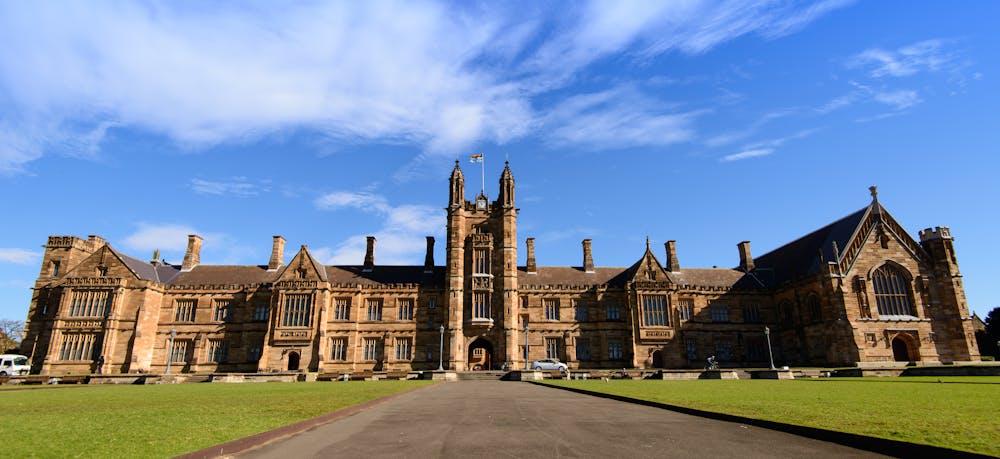
The University of Sydney, founded in 1850, is the oldest university in Australia. William Charles Wentworth is noted as proposing the idea of Australia’s first university, imagining “the opportunity for the child of every class to become great and useful in the destinies of this country”.
The university’s motto is a beacon – Sidere mens eadem mutato – which translated means “the stars change, the mind remains the same”. The broad evolving mind remains the raison-d’etre for universities, more than the fad of the day.
The University of Sydney’s motto – Sidere mens eadem mutato – means ‘the stars change, the mind remains the same’Shutterstock
The evolution of the modern university, funded increasingly over time by governments, moved the focus from promulgating religious tenets to values that are civic-minded, and centred on knowledge transmission accessible to all citizens – not just the wealthy.
Of course, work still needs to be done to improve diversity. But the overarching purpose of the university was to advance human discovery, promote diversity of thinking and enhance the common good.
The library – solemn with books – was the hub of a university education. As knowledge evolved, libraries grew into subject departments.
The physical library and its virtual equivalent still form the foundation of the student academic experience.
The government is overstepping the mark
Government support for public universities was intended to come with few strings. If we agree the purpose of universities is to disseminate knowledge and advance society, we cannot allow a political agenda to diminish academic freedom and equitable student choice.
And yet, the trend in the United Kingdom, the United States and Australia is for conservative-leaning governments to see their role as shaping universities to match their agendas.
This is counter to long-held beliefs universities should operate independently to shape knowledge. Public engagement and social impact are the overall goals for higher education.
In stating its plan expands job preparation and promotes economic growth, the government is overstepping its charge, undermining the notion of choice and opportunity for all.
The library is the centre of university learning.Shutterstock
These fee changes will have most effect on working class families. Wealthy families who are not price sensitive will be able to choose across the current array of offerings without financial worries.
This inequity may price some Australians out of their dreams of a liberal arts education because they can no longer afford it.
What is the danger in that?
Degrees in humanities, society and culture, and communications are singled out as not preparing graduates for the jobs of the future.
Yet the skills fostered in these degrees are in high demand. Critical thinking, problem-solving, collaboration, strong writing prowess and people skills are valued as future-focused “human” skills that translate across the employment sector.
With many people getting their information from an increasingly narrow bandwidth of social media influences, the role of a university education is even more important. It’s there to teach students to question, seek evidence and think independently.
A university education promotes open mindedness and the pursuit of knowledge across a diverse set of disciplines, especially those that have now been marginalised.
Students across all disciplines need these attributes to help advance humanity and address the global challenges we face.
It remains to be seen whether the plan minister Tehan has put forward to steer undergraduate students into certain degrees will be successful in promoting “jobs and growth”.
What is clear is this move oversteps the government’s role and function by dictating to Australians and their universities what the priorities should be for building a fair, civil and just society.
The government proposes we engineer our way to the future, rather than think, collaborate and imagine our way forward.
As we emerge from the lockdown phase of the pandemic, there are many lessons to learn. One is that when given credible warning of an existential threat, it is better to act early and risk doing too much than to delay acting and face a much bigger and harder to solve problem when the warnings turn out to be correct.
While the pandemic will pass, one way or another, the problem of global heating, and its many consequences, is going to be with us for the rest of our lives, and those of our children and grandchildren.
Already the world has had decades of warnings, and has done little to heed them.
To hold the increase in global temperatures to 2⁰C, the world needs to reduce emissions of carbon dioxide by 25% over the next decades, and cut them to zero by 2050.
Current commitments are inadequate to achieve this.
In Australia’s case, the unjustified use of “carryover credits” means the government is actually proposing an increase in emissions over the next decade, with even larger increases likely in the future.
Quite simply, there is no way of prevent catastrophic climate change unless we stop burning coal to generate electricity, and do it sooner rather than later.
We need to switch 20-25,000 jobs
As of 2020, coal-fired electricity generation is the only major use of carbon-based fuels for which we have a well-developed and affordable alternatives.
For most other uses of carbon-based fuels, alternatives rely on using electricity, as in the case of electric vehicles and “green” hydrogen.
These alternatives are helpful only if the electricity that powers them is coal-free.
But in Australia, any move to break with thermal coal runs up against the claim that jobs in coal mining and coal-fired power are essential for workers and for communities.
It finds that a transition from thermal coal mining could be managed fairly, without significant job losses and while protecting coal-dependent regions.
25,000 is not a big number
Contrary to widespread perceptions, thermal coal mining is not a major employer, and most workers in the industry are not miners in the ordinary understanding of the term.
According to the latest Labour Force Survey, in February 2020 coal mining employed about 43 300 people, down from a peak of 60 000 in 2012.
Since Australia’s coal output is roughly evenly divided between coking and thermal coal, it seems likely that about 20-25,000 are employed producing the thermal coal that is used for heating and electricity generation.
This compares with a Bureau of Statistics estimate of about 26,850 in renewable energy. A successful transition to a decarbonised electricity sector would require at least a doubling of the current growth rate of renewables, implying more than 26 000 new jobs.
Many of the jobs are transferable
Many of the people employed in coal mining in February 2020 were not miners in the ordinary sense of the term. About 14% worked in white collar (managerial, professional and clerical) jobs.
A large portion of the remainder, such as carpenters, truck drivers and labourers, worked in trades not tied to mining.
The exception is the category known as Drillers, Miners and Shot Firers, which accounts for about 20% of total mining employment. If the same proportion applies in coal mining, there would be around 5,000 specialist drillers, miners and shot firers in producing thermal coal.
A transition program for these workers could be funded for less than the government’s recently announced HomeBuilder.
The wages high, but the conditions are bad
Advocates of coal mining point out that coal mining generally pays higher wages than other industries, including the renewable energy industry. This partly reflects high levels of unionisation, which could be encouraged more broadly.
More significant is probably its reliance on socially destructive fly-in, fly-out working arrangements, which necessitate high wages to offset family separations.
An indication that the wages earned by workers in the mining industry represent compensation for poor conditions can be derived from evidence on workforce turnover.
The mining industry is characterised by annual turnover of 20% to 30%, substantially higher than that for the labour market as a whole.
And much of the employment isn’t local
Largely because of fly-in, fly-out, the number of communities that depend on coal as the primary source of their local employment is small.
Moreover, in many cases, these communities, such as those of the Bowen Basin, are well endowed with solar and wind resources.
With appropriate planning (instead of the current chaos in electricity policy) these communities could be given priority in the development of utility-scale solar and wind generation, along with the necessary transmission links.
The result might be be a net gain in local employment.
On Monday the Minerals Council of Australia announced a Climate Action Plan, proclaiming the need for action to reduce the risks of human-induced climate change and expressing support for “world-wide decarbonisation”.
What it did not do was suggest that the 25,000 or so Australians who work in coal mining could be switched to other industries.
That has been the conventional wisdom for some time – that a switch of 25,000 jobs from one industry to another would be too much for Australia to handle.
Yet when the coronavirus hit, we shut down industries employing three million Australians overnight, and dealt with the economic consequences impressively.
We have demonstrated our capacity to do the same for the much more dangerous, if less immediate, risk of catastrophic climate change.
Source: The Conversation (Au and NZ) – By Mary Frances O’Dowd, Independent Scholar, Ethical Citizenship & Racism Studies, CQUniversity Australia
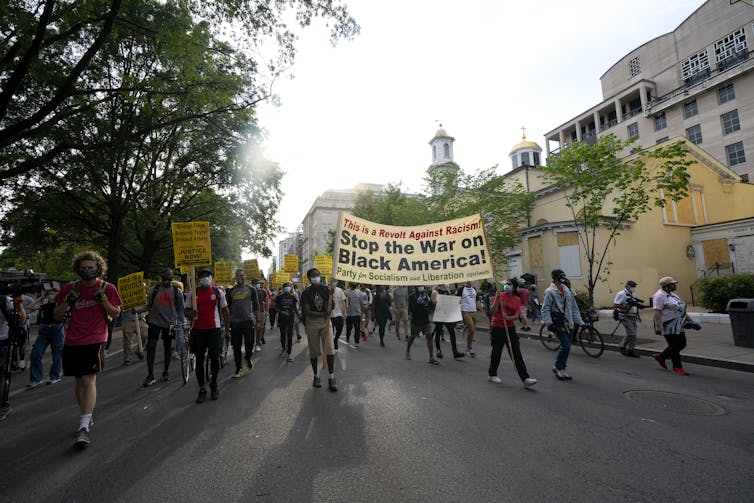
Colonisation is invasion: a group of people taking over the land and imposing their own culture on Indigenous people.
Modern colonisation dates back to the Age of Discovery in the 15th century, as European nations sought to expand their influence and wealth. In the process, representatives of these countries claimed the land, ignoring the Indigenous people and erasing Indigenous sovereignty.
Laws and policing were significant tools of dispossession and oppression. Indigenous people were brutalised, exploited and often positioned as subhuman. As Jean-Paul Sartre described colonisation:
[…] you begin by occupying the country, then you take the land and exploit the former owners at starvation rates […] you finish up taking from the natives their very right to work.
Colonisation is more than physical. It is also cultural and psychological in determining whose knowledge is privileged. In this, colonisation not only impacts the first generation colonised but creates enduring issues.
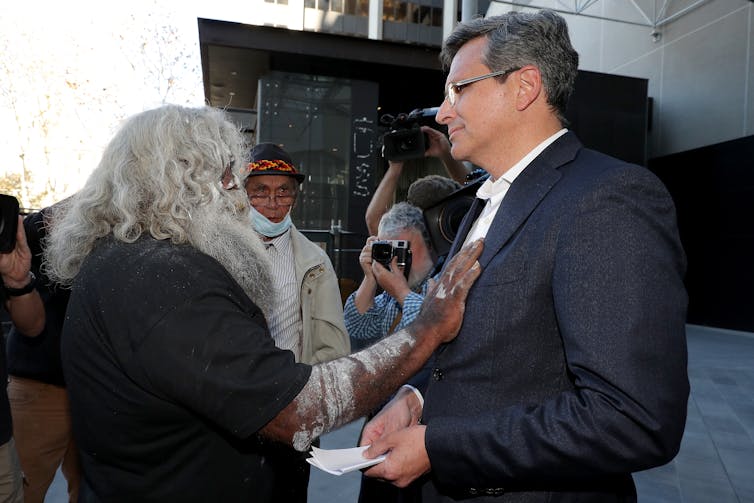
Decolonisation seeks to reverse and remedy this through direct action and listening to the voices of First Nations people.
Seeking independence
The word “decolonisation” was first coined by the German economist Moritz Julius Bonn in the 1930s to describe former colonies that achieved self-governance.
Many struggles for independence were armed and bloody. The Algerian War of Independence (1954- 1962) against the French was particularly brutal.
Other struggles involved political negotiations and passive resistance.
While the exiting of the British from India in 1947 is largely remembered as nonviolent resistance under Gandhi’s pacifist ethic, the campaign started in 1857 and was not without bloodshed.
The quest for independence is rarely peaceful.
Justice
Decolonisation is now used to talk about restorative justice through cultural, psychological and economic freedom.
In most countries where colonisers remain, Indigenous people still don’t hold significant positions of power or self-determination. These nations are termed “settler-colonial” countries – a term made popular in the 1990s by academic Patrick Wolfe, who said “invasion is a structure not an event”.
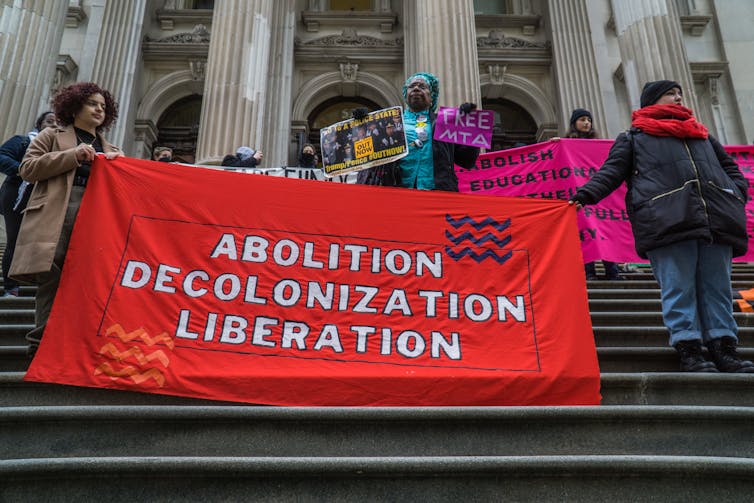
The activist group Decolonize this Place protesting in New York City, January 31,2020.shutterstock.com
Another word that is useful in understanding decolonisation is “neocolonial”. It was coined by Kwame Nkrumah, Ghana’s first president, in the early 1960s to refer to the continuity of the former coloniser’s power through economic, political, educational and other informal means.
In these neocolonial or settler-colonial countries, advocacy for the rights of Indigenous people is not always matched by action. The voices of Indigenous people for treaty and truth in culture, politics, law and education resound while practice lags.
Indigenous peoples have the right to self-determination. By virtue of that right they freely determine their political status and freely pursue their economic, social and cultural development.
It lists several important rights in the process of decolonisation, including:
the right to autonomy and self-government, including financing for these autonomous functions
freedom from forced removal of children
protection of archaeological and historical sites, and repatriation of ceremonial objects and human remains
the right to provide education in their own language
state-owned media should reflect Indigenous cultural diversity
legal recognition of traditional lands, territories and resources.
Decolonisation must involve challenging both conscious and subconscious racism. Non-Indigenous people in settler-colonial societies can start by asking:
whose Country do I live on – what nation?
if my land was stolen, my culture and sovereignty denied, what rights would I want, need and expect?
who on Country must I listen to and work with?
To engage with decolonisation you can:
value Indigenous knowledge and scholarship. In Australia, this can mean listening to Indigenous people on their knowledge about bushfire management
encourage and insist on teaching about Indigenous people and cultures in schools
support restitution efforts, such as programs which are revitalising Indigenous languages
call on institutions – including across education, the arts, media and politics – to hire Indigenous people throughout the organisation and in positions of leadership
look for ways people in your workplace might face discrimination and unconscious bias, and speak up against these structures
fight for justice arising from Indigenous guidance, by walking alongside Indigenous people at rallies and placing their voices front-and-centre at events.
We might kneel to remember those murdered. But we need to call on institutions to enact required reforms for decolonisation. We need to support people in organisations who speak out against racism. We need to question whether colonisation taught us to stand, in institutional uniforms of the mind, and passively watch the choking.
Source: Council on Hemispheric Affairs – Analysis-Reportage
By Rita Jill Clark-Gollub (Washington), Erika Takeo (Managua), and Avery Raimondo (Los Angeles)
“A nation that cannot feed itself is not free.” Fausto Torrez, Nicaraguan Rural Workers Association
An array of UN agencies is predicting a global hunger pandemic triggered by COVID-19 lockdowns, with the head of the World Food Program stating that there is “a real danger that more people could potentially die from the economic impact of COVID-19 than from the virus itself.”[1] At least 10 million more Latin Americans are expected to join the 3.4 million who were already experiencing chronic food insecurity.[2] These devastating effects will be long-term, as each percentage point drop in global GDP is expected to cause 0.7 million more children to be stunted from undernutrition.[3] There are clear signs that the food shortages have already arrived, as flags indicating hunger are spotted outside homes from Colombia to the Northern Triangle of Central America,[4] while violently repressed hunger protests have occurred in places such as Honduras[5] and Chile.[6] As a street vendor in El Salvador put it, “If the virus doesn’t kill us, hunger will.”[7]
But in the second poorest country in the Western Hemisphere, there are no hunger flags flying. The market stalls are stocked, customers are buying, and prices are stable. Nicaraguan small farmers produce almost all the food the nation consumes, and have some left over for export. We will examine how this is possible.
At the June 9, 2020 launching of his Policy Brief: The Impact of COVID-19 on Food Security and Nutrition,[8] UN Secretary-General António Guterres not only called for urgent action to address this hunger crisis, but also to take the opportunity to shift towards more sustainable food systems. This transition is something that the world’s peasants have been calling for since they founded La Vía Campesina (LVC) in 1993. It is now urgent to listen to what over 200 million peasants, women farmers, indigenous and Afro-descendant peoples, fisherfolk, and pastoralists have been saying about our food systems:
“The pandemic has highlighted yet another ill of countries becoming too dependent on large international food industries [and their international supply chains]. For decades, governments did little to protect small farms and food producers which were pushed out of business by these growing dysfunctional corporate giants.…They stood idle as their countries grew increasingly dependent on a few major suppliers of food who forced local producers to sell their produce at unfairly low prices so corporate executives can keep growing their profit margins.”[9]
Agribusiness is also exacerbating the world’s most pressing problems: its Confined Animal Feeding Operations (CAFOs) crowd immune-stressed animals, making them susceptible to viruses that can cross over to humans;[10] its fossil fuel- and chemical-intensive practices account for at least a third of the greenhouse gas emissions driving climate change;[11] and its genetically modified seeds are known to diminish biodiversity. Moreover, in Latin American commercial food systems, it is fueling price increases during the pandemic.[12]
La Vía Campesina’s answer is food sovereignty, which is defined as “the right of people to healthy and culturally appropriate food produced through ecologically sound and sustainable methods, and their right to define their own food and agriculture systems.”[13] It prioritizes: 1. local agricultural production in order to feed the people; and 2. peasants’ and landless people’s access to land, water, seeds, and credit. This approach actually works in combating hunger, as peasants and smallholders produce 70-75 percent of the world’s food on less than one quarter of the world’s farmland.[14] When peasant movements partner with progressive governments, the results can be astounding, as in the case of Nicaragua.
The peasant movement in Nicaragua
The Asociación de Trabajadores del Campo (Rural Workers Association or ATC) was founded during the war to overthrow the U.S.-backed Somoza dictatorship, one year before the 1979 victory of the Sandinista People’s Revolution. It brought together peasants, both small farmers wanting to procure their own land as well as farm workers organizing for union rights. The ATC has continued to represent these groups of workers throughout its 42-year history and was one of the national organizations that founded La Vía Campesina in 1993.[15]
Peasant march in 1980s. “We are not birds who live in the air; we are not fish who live in the sea; We are Men who live off the land.”
In the 1980s, the Nicaraguan revolutionary government launched a massive land reform program, which distributed about half the country’s arable land (5 million acres) to 120,000 peasant families. Several other peasant groups formed during that first decade of the revolution as the cooperative farming movement prospered, even coming to include the families of former contra fighters, who had been adversaries of the Sandinista government. Later, during the neoliberal administrations of 1990-2006, these groups worked to defend the gains of the revolution, sometimes including worker occupations of state farms to prevent them from being privatized. By 2006, and inspired by the 1987 Constitution that guarantees protection against hunger,[16] some 73 Nicaraguan organizations belonged to the Interest Group for Food and Nutritional Sovereignty and Security (GISSAN) that was advocating for a Food Sovereignty Law. Several of them helped the Sandinista National Liberation Front (FSLN) get elected back into office at the end of that year.[17]
Food Sovereignty since 2007
In the current stage of Sandinista governance that started in 2007, the strategy to increase food sovereignty by providing land has continued. Almost 140,000 land titles (some from land distributed during the 1980s land reform) were issued to small producers from 2007 to 2019. Women have particularly benefited from receiving proper titles to their land (55 percent) and 304 indigenous and Afro-descendant communities on the Caribbean coast have received collective titles. The titled area amounts to 37,842 Km2, or 31.16 percent of the national territory.[18]
Social programs that help small farmers feed themselves and their communities have imbued life in the countryside with dignity while reducing hunger. These initiatives are inspired by Augusto C. Sandino’s vision of an economy based on land-owning peasants and indigenous peoples farming in organized cooperatives—a core component of the FSLN’s Historic Program. Law 693 on Food and Nutritional Sovereignty and Security, enacted in 2009, was one of the first in Latin America to recognize the concept of food sovereignty and actually build it with government support.[19] The commitment of the FSLN government to food sovereignty has led to dozens of programs to improve the livelihoods and autonomy of small farmers while strengthening local food systems.
The signature initiative is the Hambre Cero (Zero Hunger) program which began in 2007 and provides pigs, cows, chickens, plants, seeds, and building materials to women in rural areas to diversify their production, improve the family diet, and strengthen women-led household economies.[20] By 2016, the program had benefited 150,000 families or 1 million people, increasing both their food security and the nation’s food sovereignty.[21]
Some 150,000 families in the Zero Hunger program have received farm animals and farming inputs (photo-credit: Susan Meiselas, Fundación Entre Mujeres).
Interviews completed as part of a solidarity testimonies project[22] with ATC members in the Marlon Alvarado community, many of whom are also beneficiaries of government programs, illustrate the impact of Hambre Cero. For example, one woman said:
“I have always been in social movements, since I was young. We are a group of women working here. We are united and in solidarity, all of us. …The ATC has taught us about women’s entrepreneurship… The government is encouraging us to always cultivate our land, so that we have our food. They give us citrus, they give us bananas, papaya, lemons. We just have to go harvest. We have jocote, mango. They always continue the [Hambre Cero] program so that we grow something. In our plot, we are always growing something.”
Another woman in the same community said:
“I have two male pigs, boars, for breeding: if someone else has a sow, they bring it to the boar and I get a piglet in return. For every sow they bring to the boar, I get a little pig. Or if someone says to me, ‘I have all the piglets sold; I’ll give you the money. What do you say?’ ‘Okay,’ I say. We agree.”
Additionally, the Ministry of the Family, Community, and Cooperative Economy (MEFCCA) and municipal governments organize farmers markets to improve peasant incomes while making nutritious, locally-grown food accessible to consumers, that is produced without chemical fertilizers or pesticides. The Nicaraguan Institute of Agricultural Technology (INTA) works to improve and maintain the country’s genetic material by organizing community seed banks,[23] and the National Technological Institute (INATEC) provides free technical degrees in agriculture, livestock care, value-added processing, and beekeeping, to name a few.[24] A new program called NicaVida will reach 30,000 rural families with tools, fencing, water tanks, chickens, and other materials to improve family diets and household economies in the Dry Corridor[25] areas which are particularly impacted by climate change.[26]
Emerita Vega of the Marlon Alvarado community in Santa Teresa Carazo, coordinator of the ATC women’s group, in her pineapple parcel. Pineapples provided by a government farm diversification program through INTA (photo-credit: “Asociación de Trabajadores del Campo”, Rural Workers Association, or ATC).
The breadth and territorial reach of these programs keep Nicaragua’s peasants and small farmers free from dependence on global markets; their diversified production is organized to feed their families and local communities, with increasing access to seeds, water, and credit, thereby creating the conditions to achieve food sovereignty.
A poverty and hunger fighting program targeting urban residents is Zero Usury, which is part of the national food ecosystem since it serves many who work in open-air markets. This program, administered by the MEFFCA, gives low interest loans and grants to small business owners (primarily women) and offers free entrepreneurship training, funded in part by Venezuela and other ALBA countries. Over 800,000 women have benefited from the program since 2007, which has been crucial to the success of the popular economy (self-employed workers, small farmers, family businesses, and cooperatives) which accounts for over 70 percent of employment.
Long-time activist and current presidential advisor Orlando Núñez explains the philosophy behind these programs and why they work:
“The heart of the Hambre Cero program is giving capital to peasant families. A cow is capital because she reproduces; sows, seeds, and hens reproduce. The first message is not to treat people like poor people; they are only poor because they have been impoverished. … Offering poor people a glass of milk or a slice of bread is an act of charity, not revolution. … The revolutionary thing about Hambre Cero in Nicaragua is that it treats people like economic actors. …That is the most revolutionary message of the Sandinista revolution.”[27]
The initiatives for this second phase of the Sandinista Revolution are all complemented by the grassroots work of social movements. The ATC and LVC have established a campus of the Latin American Institute of Agroecology (IALA) in Nicaragua for youth from Nicaragua and throughout the Mesoamerican and Caribbean region. The school not only imparts technical training on agro ecological production of crops and animals, but also political and ideological education so that students come to understand today’s clash between two models of agriculture: one (the agribusiness model) in which food is a business for the benefit of corporations, and another (the food sovereignty model) in which food is a human right for all. The program encourages peasants to be each other’s teachers and have agency over their own lives, reclaiming their peasant identity and culture. It is an education that focuses on staying in the countryside and producing food that stays within the local market.
Throughout the country the ATC and other peasant organizations have been organizing local workshops to train agroecological promoters, support women’s cooperatives in marketing their farm products, formalize peasants’ land titles, and prepare on-farm biofertilizers and composts. All of this supports the construction of food sovereignty.
Students at La Vía Campesina’s Latin American Institute of Agroecology campus in Santo Tomás, Chontales (photo-credit: Latin American Institute of Agroecology “Ixim Ulew”).ATC youth make biofertilizer in an agroecology workshop, in Santa Emilia, Matagalpa, 2015 (photo-credit: “Asociación de Trabajadores del Campo”, Rural Workers Association, or ATC).
Hunger outcomes in Nicaragua and Central America
All indications are that these programs have resulted in a better fed population in Nicaragua. In its 2019-2023 Strategic Plan for Nicaragua, the United Nations World Food Program said that “In the last decade… Nicaragua is one of the countries that has reduced hunger the most in the region,”[28] while the government reports that chronic child malnutrition dropped from 21.7 percent in 2006 to 11.1 percent in 2019 for children under 5 years of age.[29] Nicaragua was also one of the first countries to achieve Millennium Development Goal Number 1 of cutting undernutrition in half from 2.3 million in 1990-1992 to 1 million in 2014-2016, placing it among the countries of the region that had reduced hunger the most in the previous 25 years. Vitamin A deficiency among children under 5 was also eliminated.[30]
Nicaragua’s advances are reflected in the Food and Agriculture Organization’s Hunger Map.[31] Unfortunately, that map shows that neighboring Honduras and El Salvador did not achieve the Millennium Development Goal on hunger reduction, and that Guatemala did not even make progress. This stagnancy may be related to the fact that US exports to the Northern Triangle countries increased substantially since the signing of the Dominican Republic-Central American Free Trade Agreement (CAFTA-DR). These three countries imported about US$5.9 billion of agriculture products from the world in 2016, including beans and dairy products from Nicaragua, and corn, soybean meal, wheat, poultry, rice, and prepared foods from the US. Imports of many of these US foods increased by 100 percent or more from 2006-2016, coming to comprise about 40 percent of all food imports for these countries.[32] Unfortunately, food prices in these countries are on the rise precisely when people have less income with which to purchase food due to COVID-19 lockdowns at home and in the US, from which Central American countries receive remittances. Parts of Guatemala are already receiving half the remittances they received at this time last year.[33] Even Nicaragua’s wealthier neighbor to the south, Costa Rica, has become dependent on imported beans, rice, beef, and corn after opening the market through free trade agreements. At a recent LVC regional meeting, a Costa Rican peasant leader discussed how vulnerable the country has become, saying “COVID is stripping us bare.” Not only are grain prices rising while vegetable crops rot because they cannot reach consumers, unemployment is expected to double from 12.5 percent to 25 percent,[34] and 57 percent of Costa Ricans report having trouble making ends meet.[35] This brings major worries of increased hunger.
Food sovereignty and the pandemic in Nicaragua
Ninety percent of the food consumed in Nicaragua is produced within the national borders, 80 percent of it by peasants.[36] This includes all of the beans, corn, fruits, vegetables, honey, and dairy products, while there is sufficient surplus of beans and dairy to export. Nicaragua’s food self-sufficiency is growing precisely while other developing countries are increasingly becoming agro-exporters of a few crops (e.g. pineapples or bananas) while ever more dependent on imports to feed their populations. Rice is the only component of the basic diet that is not completely homegrown, but domestic rice production has increased from meeting 45 percent of the country’s demand in 2007 to 75 percent of demand today. The government is working with producers to bring it up to 100 percent within 5 years. Nicaragua is indeed very close to achieving food sovereignty, the true anti-hunger model, which bodes well for times of crisis such as now with the economic impacts of the pandemic and the interruption of food distribution supply chains in other countries.
In the context of the pandemic, both the government and social movement organizations are determined to take food sovereignty to the next level. For example, the government just launched a National Plan for Production focused on increasing production of basic grains to cover all internal food needs, and also guarantee the production of crops for export.[37] Food stocks are normal, prices are stable, production has continued normally since there has not been a work lockdown and most food is produced in small family units, and the rains have started for what looks to be a good planting season. Meanwhile, the Nicaraguan member organizations of LVC are launching the Agroecological Corridor, a process of territorializing agroecology based on peasant-to-peasant exchanges as a response to the threats being posed by climate change.[38] Because training of youth also must continue, coursework at LVC’s flagship Latin American Institute of Agroecology is taking place online[39] while the institute’s campus is implementing a full food production plan that includes grains, root vegetables, and animals. LVC has also launched the emergency campaign “Return to the Countryside”[40] to be adopted not just in Nicaragua, but internationally.
Traditional field work by a pair of oxen in a (non-GMO) corn field in the northern department of Madriz (photo-credit: Friends of the ATC).
Other challenges to Nicaragua during the pandemic
COHA has previously reported on the Nicaraguan government’s robust response to COVID-19 within the health sphere, amidst a vigorous disinformation campaign waged against the population and government in what clearly appears to be a regime change operation funded by the US.[41] That regime change effort is no doubt partially inspired by Nicaragua’s food sovereignty policy, which threatens the dominance of US corporate agribusiness around the globe. For example, USAID has flooded food systems with Monsanto (now Bayer) GMO seeds in countries ranging from India[42] to Iraq[43] to several countries of Africa[44] and Latin America.[45] This approach could be undermined if more developing countries decide to produce their own food through agroecological practices.
USAID was one of the agencies funding opposition groups involved in a violent attempted coup in Nicaragua in 2018, as is well-documented in Live from Nicaragua: Uprising or Coup?[46] It is not surprising, then, that the representative of Cargill in Nicaragua and head of the U.S.-Nicaragua Chamber of Commerce was one of the leaders of the opposition during the attempted coup.[47] While Nicaragua does not have the oil and minerals that draw international attention to Venezuela and Bolivia, agribusiness is a hugely profitable industry and the Nicaraguan peasants are setting a powerful example by rejecting it and feeding their people to boot.
Fighting a disinformation campaign while the country faces the same pandemic that has overwhelmed much wealthier countries will certainly be challenging for Nicaragua, particularly since unilateral coercive measures illegally imposed by the US block access to aid funds. But at least her people have the comfort of knowing that there will be no death caused by hunger. In fact the food system recently withstood a formidable test during the 2018 coup attempt, when violent roadblocks held all the main roads and highways captive. Thanks to local food production and distribution systems, and clever determination to circumvent the roadblocks, people using the popular economy were still able to get food and at relatively stable prices, even when the Walmart-owned supermarket chains had empty shelves.
In an interview in late April, the leader of a peasant women’s organization was asked about Nicaragua’s handling of the coronavirus. Her concern was not as much about catching the virus as that,
“We will have food. It’s true that it is going to be hard; we will probably have a recession. But the important thing is that we have all the basic foodstuffs. We Nicaraguans are not quite 100 percent food self-sufficient. But we [in the Fundación Entre Mujeres] will do everything within our power to be as self-sufficient as we can so that the government does not need to give us aid and can give it to people who have greater needs than we have. We are taking a stance of dignity, being part of the solution.”[48]
That attitude, coupled with a commitment to agroecology and food sovereignty, is what has Monsanto/Bayer, Cargill, and their guardians at USAID worried.
This graphic by the Fundación Entre Mujeres (FEM) of northern Nicaragua shows the difference between market-based food systems and agroecology-based ones.
Rita Jill Clark-Gollub is aCOHA Assistant Editor/Translator, based in Washington, DC
Erika Takeo is a member of theInternational Relations Secretariat of the Rural Workers Association (ATC) andCoordinator of the Friends of the ATC solidarity network and is based in Nicaragua
Avery Raimondo, from Friends of the ATC solidarity network, is based in Los Angeles, California
The following guest editors commented on this text:
Christina Schiavoni is a food sovereignty activist based in the US and PhD researcher focused on agrarian studies at the International Institute of Social Studies (ISS) in The Hague, Netherlands. She has over a decade of experience studying food sovereignty in Venezuela.
Magda Lanuza, a Nicaraguan who lives in El Salvador, holds a Master’s in International Sustainable Development from Brandeis University and has several years of experience working on social development and environmental protection in Central America.
[Main photo: Lucila Reyes of the Marlon Alvarado community, in Santa Teresa, Carazo where women play an active role in the construction of food sovereignty through peasant organizations and government programs. Shown with tomatoes grown in her agroecological garden. Photo-credit: Asociación de Trabajadores del Campo (Rural Workers Association or ATC)]
[17] Araujo and Godek, “Opportunities and Challenges for Food Sovereignty Policies in Latin America: The Case of Nicaragua,” in Rethinking Food Systems – Structural Challenges, New Strategies and the Law, (New York: Springer, 2014), 51-72.
An investigation commissioned by the High Court of Australia has found six former court staff members who were judges’ associates were sexually harassed by former High Court Justice Dyson Heydon.
In a strongly worded statement, Chief Justice Susan Kiefel said that the findings were of extreme concern to her and other members of the court, and they were “ashamed that this could have happened at the High Court of Australia”.
Importantly, Kiefel offered a personal apology to the young women and stated in clear terms that the women had been believed. She further acknowledged the difficulties the women would have had in coming forward:
We have made a sincere apology to the six women whose complaints were borne out. We know it would have been difficult to come forward. Their accounts of their experiences at the time have been believed. I have appreciated the opportunity to talk with a number of the women about their experiences and to apologise to them in person. I have also valued their insights and suggestions for change that they have shared with the Court.
An investigation by the Sydney Morning Herald uncovered further allegations of Heydon’s predatory behaviour, including an allegation from a judge who claims that he indecently assaulted her.
In a statement through his lawyers to the SMH, Heydon denied any allegations of predatory behaviour or breaches of the law. The statement also said
our client says that if any conduct of his has caused offence, that result was inadvertent and unintended, and he apologises for any offence caused.
In response to the inquiry commissioned by the High Court, his lawyers have further emphasised this process was an internal administrative inquiry conducted by a public servant and not by a lawyer, judge or a tribunal member.
Sexual harassment is endemic within law
The inquiry’s finding that a retired High Court judge sexual harassed judges’ associates certainly reflects poorly on the court, and the legal profession more broadly.
It reinforces wider and ongoing concerns about the effectiveness of legal responses to sexual harassment. These concerns point to systemic issues within the profession that are significant beyond individual behaviour. This is not to diminish the experiences of the young women complainants. Rather, their experiences speak to the wider consequences of feeling unsafe at work — one complainant left the profession and another abandoned plans of becoming a barrister.
Working in law, particularly in the courts, is a prestigious and hierarchical profession. In fact, the kind of power imbalances that shape working relationships in law create additional hurdles in holding people to account for their actions.
The International Bar Association’s Us Too? Report provided confirmation about the extent to which bullying and sexual harassment are rife in the profession, finding that one in three female respondents and one in 14 male respondents had been sexually harassed in a workplace context.
Closer to home, the Australian Human Rights Commission’s Respect@Work Sexual Harassment Inquiry confirmed that 33% of people who had been in the workforce (not just in law) in the previous five years said they had experienced workplace sexual harassment.
The report noted that hierarchical workplace structure, such as the legal profession, can increase the risk of sexual harassment. Workplaces that were (or are) dominated by men also tend to see a greater prevalence of sexual harassment.
Might this be the tipping point?
That the chief justice acknowledged the difficulties that victims of sexual harassment have in coming forward is significant. There are all kinds of disincentives in bringing a formal complaint in sexual harassment, and these have been examined in the numerous reports and inquiries interrogating the deficiencies in the current legal framework, and devising strategies for reform. Fear of not being believed. Fear of being branded a troublemaker. Limiting career and employment prospects.
Most recently, the 2020 Respect@Work inquiry identified significant deficiencies in the Australian legal framework for combating sexual harassment.
Legally, sexual harassment is an unwelcome sexual advance, unwelcome request for sexual favours, or other unwelcome conduct of sexual nature in the circumstances that the person who was harassed would be offended, humiliated and/or intimidated.
Noting that most people who experience sexual harassment do not report it, the Human Rights Commission in its report identified the need for a new approach. This would be based not on individual victims bearing the onus of bringing a complaint, but on imposing duties on employers to create safe places of work free from sexual harassment.
The Sex Discrimination Act 1984 does not currently impose a positive duty on employers to prevent sexual harassment. The Respect@Work inquiry recommended that a positive duty be imposed on employers to take reasonable and proportionate measures to eliminate sex discrimination, sexual harassment and victimisation, as far as possible.
Sexual harassment can happen in any workplace. The High Court’s response, including setting out the steps it has taken to create a safer place of work, is a move in the right direction.
Yet, the fact sexual harassment has been able to go largely unchecked for so long, speaks to the need for more widespread change. One important shift is holding employers to account through the imposition of a positive duty, rather than placing the onus on the very individuals who have been subjected to it.
A Thousand Cuts, Ramona Diaz’s documentary on democracy and press freedom in the Philippines, has won the top prize at the 2020 Doc Edge Festival in New Zealand.
Other international award-winners include Far From Home by Felicia Taylor as best international short, and Paris Stalingrad directors Hind Meddeb and Thim Nacacche as best international directors.
Doc Edge, is a documentary festival that is currently being held online due to the coronavirus pandemic.
Because Doc Edge is an Oscar-qualifying festival, winners of the top prizes, including A Thousand Cuts, qualify for consideration for the 93rd Academy Awards.
A Thousand Cuts follows Rappler chief executive and executive editor Maria Ressa and the news organisations’ reporters as they navigate the struggles of a free press in President Rodrigo Duterte’s government.
The film streamed for free in the Philippines on June 12, and was available for 24 hours. It also opened the Doc Edge festival and will be screened again on July 4.
Rappler has faced many legal battles since 2016, including a cyber libel case over an article published even before the cybercrime law took effect.
An investigation commissioned by the High Court has found former judge Dyson Heydon sexually harassed six young female associates who worked for him when he was on the court.
In a statement late Monday, Chief Justice Susan Kiefel said: “We’re ashamed that this could have happened at the High Court of Australia”.
Heydon served on the court between 2003 and 2013. He came to national political attention when then prime minister Tony Abbott appointed him as royal commissioner to investigate trade union governance and corruption.
Kiefel said the court had acted immediately to commission an independent inquiry after receiving last year the allegations of sexual harassment. The investigation was done by Vivienne Thom, a former Inspector-General of Intelligence and Security.
Kiefel said the court had “made a sincere apology to the six women whose complaints were borne out. We know it would have been difficult to come forward.
“Their accounts of their experiences at the time have been believed. I have appreciated the opportunity to talk with a number of the women about their experiences and to apologise to them in person.” She said she had also valued their suggestions for change.
The Sydney Morning Herald, which published late Monday the result of its own investigation, said Heydon’s predatory behaviour had been an “open secret” in legal and judicial circles.
The Herald reported that Heydon in a statement through his lawyers Speed and Stracey had denied the allegations in the High Court inquiry.
“In respect of the confidential inquiry and its subsequent confidential report, any allegation of predatory behaviour or breaches of the law is categorically denied by our client,” the statement said.
“Our client says that if any conduct of his has caused offence, that result was inadvertent and unintended, and he apologises for any offence caused.”
The law firm Maurice Blackburn is representing three of the women, including Rachael Collins and Chelsea Tabart.
The investigation was instigated after Josh Bornstein, principal lawyer with Maurice Blackburn, then representing two of the women, wrote to the chief justice and the court’s chief executive in March last year with allegations of the harassment. Bornstein also raised concerns about inadequate procedures within the court for dealing with judicial misconduct.
Bornstein said in a statement on Monday the investigation had unveiled a pattern of predatory behaviour and sexual harassment over many years towards young female associates Heydon employed. When the harassment occurred Heydon was “in his 60s, a conservative judge, a prominent Catholic and a married man”.
“The women he employed were in their early 20s and often straight out of university. He was one of the most powerful men in the country, who could make or break their future careers in the law,” Bornstein said.
“There was an extreme power imbalance between Mr Heydon and the young women he preyed on. The fear of his power and influence meant that the women did not feel able to come forward until recently,” he said.
He said the investigation “also found that the associates employed by the High Court were largely on their own in trying to protect themselves and manage Mr Heydon’s behaviour.
“The Court did not have a clear procedure which permitted a complaint of mistreatment by a judge to be aired.
“As a result, outgoing female associates felt a duty to try and warn incoming female associates of Mr Heydon’s behaviour and to give advice about how to try and protect themselves,” Bornstein said. A number of the women had abandoned legal careers after these experiences, he said.
The Herald reported that a current judge had told it “Mr Heydon slid his hand between her thighs at a professional law dinner not long after he joined the High Court bench.”
It quoted the unnamed judge, who was a barrister at the time of the incident, as saying, “He indecently assaulted me. I have no doubt it was a crime and he knew I was not consenting.” She told the Herald Heydon was too powerful to complain about, saying he “was a giant of the profession”.
Kiefel said the investigation had made a number of recommendations that the court had acted on. These were to
develop a supplementary HR policy to cover personal staff of justices
review the induction of associates to ensure it covers material relevant to their role
identify an appropriate person to form a closer working relationship with associates. The person would liaise with associates and provide support if required
clarify that the requirements for associates to observe confidentiality related only to court work
make clear to associates they were not obliged to attend social functions .
consider canvassing current associates to find out more about their experiences while working at the court.
“We have moved to do all we can to make sure the experiences of these women will not be repeated,” Kiefel said. “We have made sure there is both support and confidential avenues for complaint if anything like this were to happen again.”
Law Council of Australia president Pauline Wright said: “The attrition rate of women lawyers is high, and experiences of sexual harassment are a key reason why women leave the law”.
This continues a spike that has now spanned several days. Victoria accounted for 83% of new cases across the country over the past week (up to June 21).
Of the 116 new cases recorded in Victoria over this period, 29 (25%) were returned overseas travellers whose infections were detected while in quarantine. The remaining 87 cases were primarily acquired in the community.
As a result of the increase in community-acquired infections, the Victorian government at the weekend announced a tightening of restrictions — including reducing the number of visitors allowed in homes to five.
While the easing of some restrictions planned for today, such as the reopening of gyms, have gone ahead, others, like increasing the number of people allowed to dine in restaurants, are on hold.
What’s behind this spike?
Cases among returned overseas travellers are expected, and with quarantines in place, they’re not a major threat. However, there’s still a 1% chance someone could be infectious beyond the mandated 14 days of quarantine.
But it’s the community-acquired cases that are of greatest concern to public health officials. They indicate there are sources of infection in the community that health authorities don’t know about, making it difficult to control the epidemic.
According to the Victorian Department of Health and Human Services, most of these community-acquired infections have occurred during family gatherings. They suggest some people have not followed the advice to limit the number of people invited to a home, nor physical distancing or appropriate hygiene within this setting.
Even if this is correct, why aren’t we seeing a similar problem in other states? Could Victorians have more or larger family gatherings, or be less likely to maintain social distancing and hygiene than residents of other states? We don’t have answers to these questions, and probably never will.
If we regard this level of cases as a wave, Victoria now appears to be on its fourth wave. The second and third occurred in early May and early June, respectively.
The current wave is about at the same level as the one in early May, but could well grow rapidly. It’s causing significant concern because the epidemic appears to be dying out in all other jurisdictions.
It’s unclear why Victoria is getting these repeated waves, unlike the other states, which, apart from a few minor blips, have only had one major peak.
Victoria’s situation is a threat to other states and territories
The Northern Territory, ACT, South Australia and Tasmania have just about eliminated COVID-19.
The remaining states are on the same path, although New South Wales is still recording a few community-acquired cases.
Any state that allows travel to and from Victoria, particularly without quarantine, runs the risk of restarting the epidemic.
Queensland chief health officer Jeannette Young has declared all 31 local government areas (LGAs) in Greater Melbourne, as well as five bordering LGAs, to be COVID-19 hotspots.
This means anyone who has spent time in one of these hotspots within the last 14 days must self-quarantine for 14 days upon entering Queensland (unless the travel to Queensland is for a limited number of essential purposes).
Victoria is already doing the right things to try and flatten this new outbreak. The reimposing of restrictions on family gatherings should work, provided people stick to them.
Victoria currently has the highest rate of testing of all states and territories, with roughly 10% of the population tested so far. Testing, especially in hotspot communities, is one of the best ways to locate and control community-acquired infections.
Six Melbourne local government areas have been identified as coronavirus hotspots. These are Hume, Casey, Brimbank, Moreland, Cardinia and Darebin.
The Australian Health Protection Principal Committee (AHPPC) has advised against travel to and from these areas until community transmission is under control.
Even if the Victorian government elects to impose stay-at-home restrictions in these areas, it will be impossible to seal them off completely from the rest of the state.
But it’s clear the Victorian health department needs to focus testing in these areas, and conduct an information campaign explaining to residents why adhering to restrictions is so important.
How worried should we be?
Is it likely to get worse? Potentially, yes. If it does, the Victorian government will need to rapidly expand its contact tracing and testing. South Australia is already sending contact tracers to help.
There’s still a good chance the Victorian government can gain control of the situation before it gets out of hand — but it will have to move fast.
Other states and territories should insist all visitors from Victoria undertake mandatory quarantine.
Finally, we must all realise further outbreaks could occur anywhere in Australia, and it’s up to all of us to continue to follow social distancing rules.
Could the quarantine and testing botch-ups have an impact on the election? The Government might have been hoping that the scandal was a one-week wonder, but the stories of quarantine and testing fiascos keep coming and will be felt strongly by the public. Many voters will now have much less confidence in the Government’s handling of the Coronavirus health crisis, and there is a risk of that flowing through to the election campaign.
Public losing faith in the Government
The Government’s extremely high polling is based on its competent and successful management of the Coronavirus crisis. I was quoted by the Guardian in the weekend suggesting that “The public clearly thought that this government deserved support due to that competency and this is a major blow to that narrative” – see Charlotte Graham-McLay’s From celebration to dismay: the week Covid-19 re-emerged in New Zealand.
Watkins argues that the public, having made immense sacrifices to beat Covid-19, naturally expected the Government to play their part: “we believed we had entered into a solemn contract with the Government. Their end of the deal was to use that gift of time wisely; the lockdown was their time to plan, to prepare – and to execute a world-class system that would make all the sacrifices worth something. World-class border measures, world-class detection and quarantine procedures, and world-class contact tracing systems. That was the contract.”
She argues the “Government’s border measures have been exposed as farcical”, and for the public it’s as if “all that effort has been thrown back in their face.” Watkins says the only way to restore confidence is a truly independent inquiry.
For Newstalk ZB’s Heather du Plessis-Allan, the scandal has serious political implications: “The impact of this may be that it showcases Woodhouse as a solid performer in National, knocks a bit off the PM’s frothy popularity and reminds a few voters of the Government’s trouble in getting its actions to match its rhetoric. But the biggest disappointment to the Government must be that this blemishes its otherwise fawned-upon health response. Just weeks out from the election, that would’ve been quite the trump card to be able to play” – see: Labour has squandered its trump card (paywalled).
The Government is more concerned “to show Things Were Being Done” about the border mess, rather than fixing the issues or showing accountability, says du Plessis-Allan, with many “pointless announcements” being made to try and spin the problem as being under control. She believes the Government may be hoping that the stories will blow over, and the public will regard the scandal as a “beltway” issue.
Herald political editor Audrey Young is in no doubt that the public will have lost some confidence in the Government over the “deluge of debacles”, showing “just how fragile confidence has been” in the Government’s handling of the crisis. Furthermore, it’s the Prime Minister who may be particularly weakened by the scandal, because it involves another example of her “tolerance of weak ministers” – see: Deluge of debacles over Covid-19 but a swift response from Jacinda Ardern (paywalled).
National has been pushing the narrative that Labour’s talent pool in Cabinet is shallow, and Young says this is only reinforced by the fact that Ardern has had to hand responsibility for the border problems to “Ms Fix-it” Megan Woods, who is already busy attempting to salvage KiwiBuild and running Labour’s election campaign.
What’s more, Young says National leader Todd Muller and health spokesperson Michael Woodhouse have performed well over the issue. Young says: “It has been political gold for National to have a health issue to concentrate on, a departure from its usual focus on the Government’s ability to lead the economic recovery.”
This could all have a massive impact on the election according to new BusinessDesk columnist Jane Clifton, who points out that if more is to come on this scandal, then “the border issue will be an election disruptor, endangering Labour’s commanding lead.” She argues that “Even if little or no covid is found to have spread from such idiocy, the breach of faith with voters could be massive” – see: Good old-fashioned incompetence (paywalled).
Clifton argues that the problem of lost confidence could get worse: “Politically, the border lapses risk multiplying that sentiment many times because people may now feel lied to as well as let down. They were told the border was subject to strict isolation lockdown – by officials and politicians who, it turns out, never actually checked whether that was so.”
Furthermore, she argues that there are many other elements that appear to have been mismanaged or at least not honestly dealt with by the Government – especially in terms of the supply of protective equipment for health professionals, and contact tracing capacity.
Other political journalists are pointing out that such failures could quickly erode the Government’s seemingly secure lead in voter popularity. Thomas Coughlan warns against complacency: “Ardern shouldn’t rest on her stratospheric polling. In a time of national crisis, the numbers move fast. Just ask President George H W Bush who went from being one of America’s most popular presidents to one of its least in the space of a year in 1992. If Ardern can’t find someone to hold to account, voters may decide accountability rests with her” – see: Heads have to roll over border catastrophe, but whose head should it be?.
Today, the New Zealand Herald editorial argues that trust can evaporate quickly: “Basic and obvious competence is the secret sauce any government and ministry need to maintain trust. Incidents that appear to be at odds with what people believed was happening can cast doubt on the bigger picture. People reassess their impressions with fresh information. A long series of blunders can seriously erode confidence in leadership. The drifting poll data for Trump and British Prime Minister Boris Johnson are current examples of that” – see: Our coronavirus reality check is a timely wake-up call.
Lack of accountability
Who’s to blame? And should anyone be taking responsibility for the fiasco? This is best examined by Thomas Coughlan in his column, above, in which he discusses New Zealand’s constitutional accountability arrangements. He looks at the various candidates for blame: Minister of Health David Clark, Director-General of Health Ashley Bloomfield, John Ombler who is overseeing the government response to Covid-19, and former Police Commissioner Mike Bush, who has been in charge of the isolation facilities.
Coughlan argues that it’s hard to disentangle the fault, but it seems to be a classic case of the Government coming up with good policies in terms of dealing with Covid at the border, but failing to implement these properly, or at least failing to ensure systems were in place so that the policies wouldn’t fail. And Coughlan suggests that this has been the pattern throughout the crisis.
Some people are blaming the two women who were given compassionate leave to drive from Auckland to Wellington. This focus is misguided according to Andrea Vance, who argues that “if anyone deserves kindness, it is these women. A flawed system failed them, just as it did the rest of us” – see: If there must be anger, direct it at those who set unrealistic expectations. She says, “If there must be anger then it should be directed at those who allowed the quarantine system to break down.”
A Stuff editorial defends Director-General of Health Ashley Bloomfield, arguing that although the failures are unforgiveable, we should forgive the person in charge – see: Bloomfield can be forgiven – this time. The newspaper says of Bloomfield: “He is like a football player who creates three marvellous goals against the opposition but then scores an own goal.”
Audrey Young says there’s been a consistent lack of transparency throughout the crisis from the Ministry of Health. In this latest case, “even more disturbing was what else it showed about the Ministry of Health’s systems and its lack of records and procedures. Bloomfield has been unable to quickly produce figures as to how many others who had been granted a compassionate exemption had not been tested. Even yesterday – some four days after the case of the sisters – he was unable to give that figure and indicated the ministry would be gathering the statistics later.”
Does David Clark need to go?
None of the candidates for blame come out of this well. But in Thomas Coughlan’s investigation, he comes down hardest on the Minister of Health: “If there are repeated failings at the Ministry, then Clark is certainly at fault for repeatedly failing to appropriately audit what the health ministry said it was doing. Clark’s angry disavowal of all and any culpability – pushing the blame back on the ministry – is embarrassing. If he’s not responsible for the ministry, then the prime minister should find someone in her caucus who is.”
Of course, Clark has already been in trouble, and although Ardern continues to express confidence in him, a recent Newshub Reid Research poll showed that 57% of the public want him gone, with only 36% wanting him to stay.
Making the strongest case for his departure is John Armstrong, who argued yesterday that Ardern has continually chosen to protect Clark, and this is a big mistake: “Keeping him in that post was a mistake. It was a mistake then. It is an even bigger one now. It quite possibly ranks as the biggest mistake of Ardern’s tenure as prime minister” – see: David Clark is Minister of Health in name only after calamitous Covid-19 testing bungle.
Regardless of Clark’s guilt, Armstrong says his firing is a simple necessity: “sometimes it is necessary to cut through what is a tangled constitutional web and sack a minister from the Cabinet if only to clear the air and restore public confidence and trust in the way a particular portfolio is being managed. In Clark’s case, that time is long past. He should be long gone.”
Similarly, Duncan Garner gives his advice to Ardern about Clark: “I would sit him down and ask him what he knew about the weaknesses in our border and quarantine testing, given the latest and avoidable mess we find ourselves in. If he knew all about it and had said nothing, I would sack him. If he knew nothing and had clearly asked little questions, I would sack him” – see: David Clark leaves people with the impression he’s barely capable of ordering his own coffee – sack him.
Garner argues that Clark’s previous mistakes have been seriously superseded by this controversy: “much, much, much more important than those sideshows is the serious lack of performance and judgement when it mattered most. The Prime Minister looks compromised and weak holding onto Clark. Yes, she’s a formidable communicator but she has failed to send her weakest and errant ministers the tough message when it’s needed most. She needs to be more ruthless with Clark”.
Source: The Conversation (Au and NZ) – By Deanna Kemp, Professor and Director, Centre for Social Responsibility in Mining, The University of Queensland
The board has appointed Michael L’Estrange, an independent non-executive director of Rio Tinto and former Australian high commissioner to the UK, to conduct the review.
The process will focus on Rio Tinto’s internal heritage standards, procedures, reporting and governance, and its relationship with the Puutu Kunti Kurama and Pinikura peoples in Western Australia.
But there are many questions about the inquiry that remain unanswered. For one, there is no indication L’Estrange will step aside from normal board duties to focus on the review, or that an independent investigating body will be created to support the process.
The credibility of the process hinges on a number of other factors, as well. These include the scope of the review, how it will be conducted, what will be disclosed publicly and who will be protected, and how will the company will respond to the review recommendations.
Protester Herbert Bropho talks with Brad Haynes, Rio Tinto’s vice president of corporate relations, after handing over a list of demands outside the Rio Tinto office in Perth.Richard Wainwright/AAP
How other mining companies have conducted public inquiries
This is not the first time a mining giant has been thrust into the public spotlight and effectively forced to commission an independent inquiry on the impact of its operations on local communities.
Our preliminary research indicates public-private inquiries in mining can bring much-needed transparency to the industry’s typically closed approach to investigating contentious issues. They can also bring to light information that would have otherwise been invisible to the public.
The impact and effectiveness of such inquiries, however, relies on transparency over the scope, process and output itself.
For example, the global mining industry has another, very public inquiry currently underway: the Global Tailings Review (GTR).
The review was commissioned after a series of catastrophes involving “tailings” – a byproduct of mining that comes from crushing ore before mineral extraction. In early 2019, a tailings dam in Brazil collapsed, resulting in the release of 12 million cubic metres of tailings and the deaths of some 270 people.
After that disaster, the International Council on Mining and Metals, representing 27 of the world’s largest mining and metal companies, the United Nations Environment Program and the Principles for Responsible Investment agreed to co-convene the review.
They appointed an independent chair from outside the industry to oversee the process of identifying lessons learned from past failures and developing a new industry standard.
The chair was given a dedicated secretariat to support his mandate and the power to appoint a multi-stakeholder advisory group and panel of disciplinary experts who were familiar with the industry, but did not work for a mining company. The inquiry also allowed for public submissions and consultations.
The process certainly suggests a separation of power between those conducting the review and the mining industry itself.
Mud and waste from the disaster caused by dam spill in Brazil in January 2019.Yuri Edmundo/EPA
In 2015, another mining company, Newmont, launched an independent fact-finding mission in Peru following persistent allegations by local and international stakeholders of human rights violations as part of a land dispute with a local family.
Newmont and a US-based non-government organisation, RESOLVE, jointly appointed an independent mission director to head the inquiry, who in turn selected a team to collect evidence. An advisory group was also appointed to observe and provide outside perspectives on the process as it was being conducted.
The review was completed over a 12-month period and details were available for public scrutiny on a dedicated website during the process, including the final report.
In a statement after the report was released, the company explained why transparency and independence were so important.
While some of the findings in the report do not correspond with our view of the dispute, we recognise that in order to move beyond the current stalemate we must be open to understanding all perspectives, not just our own.
These and other inquiries have all emerged rapidly in response to pent-up public pressure for action from mining companies. But there is limited evidence they lead to lasting change.
This is one reason Newmont is now partnering with the University of Queensland, Australian National University and the US-based non-government organisation RESOLVE in a three-year ARC Linkage project to study the impact and effectiveness of public-private inquiries in the mining sector.
What should Rio Tinto do?
Calls for the public release of Rio Tinto’s review findings are important. Equally as important are calls for a sound process that guarantees independence and protects against corporate capture.
Here are our recommendations for what Rio Tinto needs to do to ensure its inquiry is fair and transparent:
Ensure the review is conducted independently and avoids conflicts of interest.
Appoint a review secretariat to guarantee a confidential avenue for informants to contribute evidence and testimony, at arms length from the company.
The scope should be co-designed with impacted parties – in this case, the Puutu Kunti Kurama and Pinikura peoples – and include a process for stakeholders to track the review and the company’s response.
The scope should include the systems and structures of Rio Tinto PLC, and not be limited to Rio Tinto Iron Ore.
The review should focus on identifying systemic and structural issues within the organisation, and making recommendations for improvement, rather than seeking to assign blame to individuals.
Interview transcripts, field reports and other evidence should be made accessible to the public (for example, via a dedicated website), where they are not deemed confidential or commercial in confidence.
The chair should have unfettered access to advisers and experts of their choosing in matters relating to the review.
The chair should issue a public report at the conclusion of the process.
If company-commissioned inquiries are to become the norm for investigating contentious issues and incidents in mining, it is essential we ask how they are conducted and to what end.
The expansion of telehealth services was a deliberate strategy to help reduce the risk of COVID-19 transmission between practitioners and patients, so is it working?
According to our analysis, the answer is that telehealth is indeed reducing the risk. Since March 2020, more than 7 million MBS-funded telehealth consultations have been reported, with the vast majority (91%) being done by telephone.
Before then, only Australians living outside major cities were eligible for Medicare-funded telehealth consultations, via video only. This was limited largely to medical specialist services and a very small number of GP and allied health services.
In response to COVID-19, the federal government increased Medicare-funded telehealth services, including making telephone consultations available for the first time. They removed geographical constraints and increased the range of telehealth services available.
At first these expanded services were only open to vulnerable patients, such as older Australians and those with a chronic illness. But by early April, these restrictions were lifted, meaning all Australians could access Medicare-funded telehealth.
By April, Medicare-funded telehealth was available to all Australians.YouVersion/Unsplash, CC BY
Tracking telehealth
We have been tracking the increased uptake of Medicare-funded telehealth during COVID-19. We have collected information on six different health-care discipline groups, and also compared the rates of telephone versus video consultations.
During the first six weeks after access to telehealth was expanded on March 13, 7 million consultations – or 22% of the services we examined – were delivered by telehealth.
This represents 7 million avoided face-to-face interactions between patients and health service providers, thus reducing the risk of transmission and infection.
Medicare-funded telehealth activity in Australia amid the COVID-19 outbreak.UQ Centre for Online Health
We also found:
GP appointments accounted for 80% of all consultations examined. During April, GP telehealth activity was largely done by telephone but accounted for 36% of all GP consultations. This was associated with a slight reduction in face-to-face consultations – from an average of 10.5 million consultations per month before the outbreak, to 8.3 million consults in April.
The proportion of specialist consultations delivered via telehealth increased tenfold in March, from 0.7% in February to 7% in March. When all eligibility criteria were lifted in April, this proportion rose to 37%.
Although psychiatrists have provided videoconference consultations to Australians since 2002, the coronavirus outbreak prompted a steep decline in face-to-face consultations and an increase in telehealth consultations. Prior to coronavirus, around 4.5% of all consultations each month were via telehealth, this rose to 26% in April this year.
Mental health services provided by non-psychiatrists (including sessions provided by psychologists) showed an increase in telehealth (50% phone, 50% videoconference), and a 50% reduction in face-to-face consultations.
Telehealth consultations for allied health services and nurse practitioners were very limited before the pandemic. But in the six weeks from March 13, roughly 29,000 allied health and nursing telehealth consultations were reported through Medicare. Most allied health services involved video consultations, whereas nursing consultations were mainly by telephone.
Are Australians using health care more?
Is the rise in telehealth the result of patients switching from face-to-face consultations to telehealth, or are people simply accessing health care in greater numbers amid the COVID-19 pandemic? The answer varies between different parts of the health system.
Our data suggest the total number of specialist, allied heath, psychiatric and mental health consultations has stayed roughly the same. This suggests face-to-face consultations were simply being replaced by telehealth.
But for GPs and nurse practitioners, the total number of consultations rose significantly, from 10.8 million in February to 12.9 million in April. Around 90% of these telehealth consultations were delivered by phone, so the increase in activity may partly be due to the ease and simplicity of using the telephone. Alternatively, the increase may have been due to more people having health concerns amid the pandemic.
Much easier than heading to the clinic in person.YouVersion/Unsplash, CC BY
It remains to be seen whether the increase in GP and nursing consultations will continue after the pandemic, or whether it is purely related to COVID-19.
Are phone consultations adequate?
According to Medicare guidelines, telephone consultations should be offered only when video conferencing is not available. There is little doubt telephone consultations are effective in some scenarios, but we don’t yet know if they are as effective as video consultations. For this reason it has been suggested phone consultations be limited to no more than half of a practice’s telehealth provisions. This issue is one we are keen to research further.
A small survey conducted by the Consumer Health Forum found 80% of patients offered a telehealth option accepted, and 68% of patients found it better or equivalent to an in-person consultation. Public awareness of telehealth has increased rapidly, and it is likely that this awareness will help drive the continuation of telehealth.
Telehealth is not new, but its uptake had been slow and fragmented until COVID-19 came along. The sudden telehealth switch has prompted an overnight shift in the way health care is delivered in Australia, and shown (again) that telehealth is feasible and relevant to patients’ needs. The challenge now is to make it a sustainable and routine part of health care into the future.
This is a complex task. The health workforce will need telehealth training and education; the health system will need systems to promote, refer, document and remunerate telehealth appropriately; and everyone, including patients, will need to be encouraged to view telehealth not as a stopgap or emergency option, but as an integral part of health care.
In a Conversation article a year ago we applied negotiation theory to changes to the Victorian Planning and Environment Act. The changes were designed to support local councils in negotiations with developers to secure affordable housing. A council may now negotiate with a developer to deliver or fund affordable housing as part of a development approval or planning amendment process.
We wrote that these arrangements were likely to be ineffectual. Our survey of almost 150 affordable housing stakeholders now suggests we were right about this system of voluntary negotiations.
Tellingly, a majority of each class of stakeholders – developers and financers, local government and non-profit providers – would prefer to have consistent mandatory affordable housing requirements applied to all developments.
We argued in our 2019 article that negotiations are shaped by stakeholders’ interests, the potential for mutual gains, and access to information. Our survey has since found one of the key barriers to successful affordable housing negotiations is a lack of incentives to be involved.
Respondents also identified the lack of capacity to enforce affordable housing contributions as a key issue, as the table below shows.
Cross-sector assessments of barriers to negotiating and implementing affordable housing agreements.The Conversation. Data: Author provided. (Percentages might not add up to 100 because of rounding)
Even when affordable housing is agreed upon, the development might not be completed for many years. Over that time, council staff may change many times. And things can slip through the cracks if no one is championing affordable housing delivery.
The other key barrier is a lack of effective mechanisms to give developers and councils incentives to engage in time-consuming and potentially costly negotiations.
Floor area uplift or density bonuses (allowing a developer to build more dwellings than would otherwise be permitted) are commonly offered as an incentive to build affordable housing. However, it is only effective in areas where being able to increase density is a valuable asset to a developer and doesn’t greatly add to construction costs.
We also found a lot of distrust in the industry. Developers referred to a “complete lack of understanding of […] commercial reality” in councils. Other respondents accused developers of looking for ways to “wriggle out of their obligations”.
Across sectors, respondents felt it was almost inevitable developers would manipulate information and operate unfairly in negotiations. Developers felt this way about local councils.
A majority of respondents felt developers were likely or very likely to manipulate or hide information during negotiations.The Conversation. Data: Author providedTwo-thirds of developers thought councils were likely or very likely to manipulate or hide information during negotiations.The Conversation. Data: Author provided
Large variations in the skills and knowledge held by individuals across sectors add to this lack of trust. These information and skill discrepancies affect power relations in negotiations.
Private developers reported substantial knowledge of development feasibility. But they typically don’t understand the affordable housing sector or relevant legislation well.
State and local government representatives report having lower levels of skill in development feasibility. And they also have lower confidence in leading negotiations. These patterns are also reflected in the amount of formal training different sectors have received in development feasibility.
The Conversation. Data: Author provided
Mandatory systems are preferred
One of the key problems with voluntary negotiations is a lack of consistency in affordable housing expectations. Each agreement is negotiated on a case-by-case basis.
In other parts of the world affordable housing contributions are mandatory. Developers buy land and make development decisions on the assumption that 10%, 20%, 40% or even 50% of the dwellings will be sold or rented at below-market rates. This mechanism is often called inclusionary zoning.
It works because affordable housing expectations are established in the developer’s initial feasibility analysis. These expectations are applied consistently across all sites in the area from the outset. In other countries, these requirements are often tied to financial support from multiple levels of government.
The survey revealed an almost unanimous preference for an inclusionary zoning approach in Victoria. The current system of voluntary negotiations was ranked third of four policy approaches.
The Conversation. Data: Author provided
Progress falls well short of meeting needs
Despite these limitations, negotiations are happening to a modest degree in Victoria. These arrangements are producing some new affordable housing.
For example, Women’s Housing Limited bought seven units for low-income women at a discounted rate in Box Hill. And in Glen Eira the provision of land for affordable housing was a key factor in a planning scheme amendment for East Village.
These outcomes should be celebrated as an example of changing expectations in the development industry. They are a step forward in generating affordable housing using the planning system.
We continue to argue that the right mechanisms are not yet in place in Victoria to ensure affordable housing negotiations are efficient, equitable and transparent.
The research team are seeking people involved in the affordable housing and development sectors with experience in affordable housing negotiations to participate in interviews for ongoing research. To be involved or to find out more, please email affordable-housing@unimelb.edu.au
New Zealand’s coronavirus reality check last week is a “timely wake-up call” crucial to moving towards a transtasman travel bubble, says The New Zealand Herald.
“There cannot be any complacency or missteps once our border controls are eased. The risks need be managed as well as possible,” said the country’s largest and most influential newspaper in an editorial today.
“There is time to ensure entry processes are running smoothly before the next big step.”
The Herald gave its verdict in the wake of a series of shock border lapses in a week that catapulted the country from virtually a 28-day covid-free status to nine active cases – four in the last two days. All are directly travel-related cases.
Prime Minister Jacinda Ardern announced at her news briefing today that the government was extending a ban on cruise ships and updating its health order to make clear that travellers may be required to take multiple tests.
Director-General of Health Dr Ashley Bloomfield said the first case today was a teenage girl who arrived in New Zealand on June 13 and was travelling with her family, who have tested negative so far, reports RNZ News.
Runny nose, or no symptoms They were staying at the Novotel Auckland Airport hotel.
Dr Bloomfield said the teenager’s only symptom was a runny nose. The second case was a man in his 30s who had arrived from India on June 15.
He was staying at the Grand Millennium in Auckland and had no symptoms.
“Fortunately,” said TheHerald today, “in terms of new coronavirus infections, we have so far avoided much damage after the case of two sisters from Britain [last week] revealed that the isolation and testing systems had not been working properly…
“It is not as though other countries which have largely subdued covid-19 have avoided hiccups either.
“China has battled a spike in Beijing. South Korea had to hose down a virus flare-up centred around nightclubs.
“Germany has hundreds of new cases linked to abattoirs.
“Australia’s outbreak is at a low level, but it is still experiencing new infections and has more than 400 active cases.
“On Saturday, the US gained 32,000 new cases – the most in a day since May 1. The states of most concern are Texas, Florida, and Arizona.
What the saga of the two travellers from Britain and other such stories had told New Zealand, The Herald said, was that the public’s trust was easily shaken.
“Quick action to arrest a slide is then essential. The Prime Minister appears to understand that,” the newspaper added.
“Basic and obvious competence is the secret sauce any government and ministry need to maintain trust.”
Aridly undulating to the horizon in hillock after hillock, comfortless and irrational, with no lines that the mind could grasp, conceived apparently in a delirious moment of creation.
This is the description of a scorched, unruly Sicilian landscape – both protagonist and spectator of the story of its people – in Giuseppe Tomasi di Lampedusa’s The Leopard.
The Leopard (Il Gattopardo) is one of the greatest Italian literary works of the 20th century. Since its publication in 1958, it has been regarded as a classic of European literature. Written by a Sicilian nobleman and set in the 19th-century during the Risorgimento – the movement for Italian Unification – it recounts the decline and fall of Sicily’s aristocracy.
Rosary, macaroni, faded grandeur
The action begins in 1860 when Italian general and patriot Giuseppe Garibaldi and his thousand volunteers land in Sicily to take the island from the Bourbons. They aim to unify the Kingdom of Naples – also known as the Kingdom of the Two Sicilies – with the Italian peninsula under the monarchy of Victor Emmanuel II. Events in the novel mark the passing of feudalism and the advent of modernity.
Yet everyday activities foreground the novel: daily recital of the Rosary, evening readings around the fire, faded grandeur of meals where “monumental dishes of macaroni” are served among massive silver and splendid glass, a walk and hunting expedition in the sunburnt Sicilian countryside, a magnificent ball.
The central character of the story is the irascible and reclusive Don Fabrizio Corbera, Prince of Salina, an aristocratic landowner and lover of astronomy, faithfully accompanied by his Great Dane Bendicò.
His family’s ancestral coat-of-arms shows an African serval or ocelot (mistakenly translated as leopard). The prince’s favourite nephew, the impoverished ambitious and frivolous Tancredi Falconeri, opportunistically supports the unification efforts of Garibaldi.
Tancredi falls in love with the beautiful Angelica, leaving a cousin who loves him devastated and his aunt distraught. Angelica is the daughter of Don Calogero Sedàra, a member of the merchant class ascending to power.
The novel’s main tension lies in class struggle: between the falling elites represented by the house of Corbera and the climbing middle class represented by the unscrupulous Sedàra. The national unification led by Piedmont in Northern Italy – and by statesman Camillo Benso, Count of Cavour – will mark the end of the aristocracy’s as well as of the church’s privileges in Italy.
Don Fabrizio reluctantly realises the only way to ensure the career of his nephew, who aims to become a diplomat, is to give his blessing to Tancredi’s marriage with Angelica. The union will provide Tancredi with the money he will need to succeed in the new regime. It will also bestow a title of nobility on Angelica and her parents. By the book’s end, set in 1910, the prince has died and his line has ended.
The manuscript was initially rejected in 1956 and 1957. Important Italian publishers such as Mondadori and Einaudi thought it ideologically deficient, reactionary for its representation of an immobile history, and structurally weak. It also failed to align with the mainstream Italian literature of the time.
The manuscript was subsequently reviewed by writer Giorgio Bassani and published for Feltrinelli in 1958, a year after its author’s death.
Generally classified as a historical novel, The Leopard became a bestseller both in Italy and abroad, with 52 editions printed in the first four months. It won the prestigious Strega literary prize in 1959.
But critical debate erupted. The book appeared during an economic boom and when Italian intellectual culture was strongly politicised. Leftist intellectuals saw it as a backward, conservative portrayal of Sicilian elites written by a little-known man with no sense of progress.
After a few years, initial objections waned and the novel came to be appreciated for its writing and modern narrative structure.
With supple and ornate language, the book has an introspective storyline and alludes to the works of Shakespeare, Sterne, Tolstoy, Baudelaire, Keats, Proust and Stendhal. The narration is characterised by stylistic shifts that reflect both Prince Salina’s varying points of view and the unnamed but all-knowing narrator’s perceptions of history.
In 1963 director Luchino Visconti recreated The Leopard’s opulence in an unforgettable screen adaptation starring Burt Lancaster.
‘Nostalgia very similar to Gone With The Wind … says The New York Times!’
Meditations on history and humanity
Although The Leopard is a representation of 19th century Sicilian aristocracy, it is also a contemplative and ironic distancing from this same world. It is, above all, a novel that provides a profound meditation on transition and historical causality.
Besides, The Leopard is an ambitious political book. Critical interpretations of the novel have divided on whether the author was bemoaning the decline of the traditional ruling class, mercilessly critiquing it, or reflecting on the limits of political reforms.
In the plot, we can find similarities between the Bourbons’ supremacy and fascism, between Garibaldi’s conquest and the allied occupation at the end of the second world war. The book foreshadows political life in the newly unified kingdom and economic transformations that paved the way for corruption and criminal organisations in post-1945 Italy.
As journalist and author, Luigi Barzini, once said, the book “made all us Italians understand our life and history to the depths.”
The most memorable – and misread – line in the book is
If we want things to stay as they are, things will have to change.
Spoken by Tancredi, it references Sicilian society’s resistance to change. It is also the narrator’s rumination on modern Italy with its various paradoxes and divisions.
The Leopard is a family saga, a psychological novel, a meditation on death and on the loss of collective memory. It has been read as a lyrical and prophetic contemplation on the experience of modernity and on the risks that it involves, such as ambition, and loss of beauty and traditions.
A solitary, melancholic man, author Tomasi di Lampedusa was deeply aware of his own mortality. The Leopard was his only novel that, together with a collection of short stories and literary studies, was published posthumously. His book would sell more than 3.2 million copies, be translated into more than 37 languages, and rightly honoured as an “immortal” masterpiece.
The Pacific Conference of Churches has called for justice in Mā’ohi (French Polynesia) and for Oscar Temaru, the activist mayor of Fa’aa and former territorial president.
Fa’aa mayor Oscar Temaru … taking public prosecutor Herve Leroy to court in a political lawsuit. Image: PCC
“This refusal makes a mockery of France’s national motto – Liberté, égalité, fraternité (Liberty, Equality, Fraternity).”
RNZ news reports the march was organised by the community organisation Nunaa a Ti’a, with two separate groups walking from either side of Pape’ete to the square outside the Territorial Assembly.
The event was attended by nuclear test veterans groups and union members as well as supporters of mayor Temaru who this month took the public prosecutor Herve Leroy to court over the seizure of his personal savings.
Case due in court The case is due in court today where Temaru wants a preliminary ruling on the legality of Leroy’s action.
The meeting also attracted opponents of a vast roading project on the south side of Tahiti and people raising their concerns about 5G technology.
Among the banners on display, one quoted French President Emmanuel Macron saying “colonisation is a crime against humanity”.
More demonstrations are planned over the next two weeks, including the commemoration of France’s first nuclear weapons tests in 1970.
From Suva, the Fiji-based PCC said in its statement: “The Pacific churches also call on France to allow the people of Mā’ohi a voice on their political future by holding a referendum, similar to the political process in Kanaky (New Caledonia).”
Reverend Bhagwan said the recent arrest of “freedom fighter” Oscar Temaru appeared to be linked to his role in bringing about the re-inscription of Mā’ohi at the UN.
Mā’ohi was reinscripted seven years ago to the UN Decolonisation List after strong international advocacy aided by the PCC. The full PCC statement said:
PCC statement “Justice For Mā’ohi , Justice for Temaru
“As the people of Mā’ohi (French Polynesia) remember the seventh year of their reinscription on the United Nations decolonisation list, the Pacific Conference of Churches calls on France to act with justice.
“France has ignored the wishes of the Mā’ohi people and the United Nations for their inalienable right to hold an act of self-determination.
“Seven years ago, the Pacific churches supported the Etaretia Porotetani Mā’ohi (Mā’ohi Protestant Church) in the process of re-inscription and has joined the EPM as a petitioner at both the United Nations Special Committee on Decolonisation (C-24) as well as the UN Special Political and Decolonisation Committee (Fourth Committee).
“Today, we note with concern that France has failed to hear the cry of the people and the voice of the United Nations. This refusal makes a mockery of France’s national motto – Liberte, Egalite, Fraternite (Liberty, Equality, Fraternity).
“The Pacific churches also call on France to allow the people of Mā’ohi a voice on their political future by holding a referendum, similar to the political process in Kanaky (New Caledonia).’
“The recent arrest of freedom fighter, Oscar Temaru, appears to be linked to his role in bringing about the re-inscription of Mā’ohi at the UN.
“Temaru is in court over allegations on the misuse of public funds in Fa’aa where he is mayor. The courts have also ordered the seizure of US$100,000 of Temaru’s savings.
“The courts must never be used as a tool for political expediency or revenge against opponents. Our courts must act impartially as instruments of a legal system which is fair and just, not prejudiced and oppressive.
“We call for Temaru to be treated justly. We remind France that it has yet to bring about just reparation for the thousands of people – including French civilians and service personnel – crippled and debilitated by the fallout from nuclear tests at Fangataufa and Moruroa.
“And we call on the people of the Pacific to pray for the Mā’ohi church and justice for all in the region who face tyranny and injustice from their leaders.
“In the name of Christ and in the service of a just, peaceful and free Pacific.”
Reverend James S, Bhagwan General Secretary Pacific Conference of Churches (PCC) Suva, Fiji
The transport sector is Australia’s second-largest polluter, pumping out almost 20% of our total greenhouse gas emissions. But everyday drivers can make a difference.
In particular, the amount of time you let your car engine idle can have a significant impact on emissions and local air quality. Engine idling is when the car engine is running while the vehicle is stationary, such as at a red light.
Opting for a bike is a great way to reduce your carbon footprint.Shutterstock
This contributes 1% to 8% of total carbon dioxide emissions over the journey, depending on the vehicle type. To put that into perspective, removing idling from the journey would be like removing up to 1.6 million cars from the road.
Excessive idling (idling for longer than five minutes) could increase this contribution further, particularly for trucks and buses. When you also consider how extensive idling may create pollution hot spots around schools, this isn’t something to take lightly.
Pollution hot spots
Reducing idling doesn’t just lower your carbon footprint, it can also lower your fuel costs up to 10% or more.
Drivers simply have to turn their engines off while parked and wait in their vehicle. Perhaps crack open a window to maintain comfortable conditions, rather than switching on the air conditioner.
Some idling is unavoidable such as waiting for a traffic light or driving in congested conditions, but other idling is unnecessary, such as while parked.
When many cars are idling in the same location, it can create poor local air quality. For example, idling has been identified overseas as a significant factor in higher pollution levels in and around schools. That’s because parents or school buses don’t turn off their engines when they drop off their kids or wait for them outside.
Parked you car? Turn off the engine.Shutterstock
Even small reductions in vehicle emissions can have health benefits, such as reducing asthma, allergies and systemic inflammation in Australian children. In 2019, Australian researchers identified that even small increases of exposure to vehicle pollution were associated with an increased risk of childhood asthma and reduced lung function.
Anti-idling campaigns make a difference
Overseas studies show anti-idling campaigns and driver education can help improve air quality around schools, with busses and passenger cars switching off their engines more frequently.
In the US and Canada, local and state governments have enacted voluntary or mandatory anti-idling legislation, to address complaints and reduce fuel use, emissions and noise.
The results have been promising. In California, a range of measures – including anti-idling policies – aimed at reducing school children’s exposure to vehicle emissions were linked to the development of larger, healthier lungs in children.
But in Australia, we identified almost no anti-idling initiatives or idle reduction legislation, despite calls for them in 2017.
However, “eco-driving”, as well as a promising new campaign called “Idle Off” is poised to roll out to secondary school students in Australia.
What about commercial vehicles?
Commercial vehicles can idle for long periods of time. In the US, typical long-haul trucks idle an estimated 1,800 hours per year when parked at truck stops, although a significant range of between 1,000 and 2,500 hours per year has also been reported.
Fleet operators and logistics companies are therefore in a good position to roll out idle reduction initiatives and save on operating (fuel) costs while reducing emissions.
In fact, fleet operators overseas have actively sought to reduce idling emissions. This is not surprising as fuel costs are the second-largest expense for fleets, behind driver wages, typically accounting for 20% of a trucking fleet’s total operating costs.
The transport sector contributes 18.8% of Australia’s total emissions.Shutterstock
Various technologies are available overseas that reduce idling emissions, such as stop-start systems, anti-idling devices (trucks) and battery electric vehicles.
But unlike other developed countries, Australia doesn’t have fuel efficiency or carbon dioxide emission standards. This means vehicle manufacturers have no incentive to include idle reduction technologies (or other fuel-saving technologies) in vehicles sold in Australia.
For example, the use of stop-start systems is rapidly growing overseas, but it’s unclear how many stop-start systems are used in new Australian cars.
Emission reduction technologies also come with extra costs for the vehicle manufacturer, making them less appealing, although cost benefits of reduced fuel use would pass on to consumers. This situation probably won’t change unless mandatory emission standards are implemented.
In any case, it’s easy for drivers to simply turn the key and shut down the engine when suitable. Reducing idling doesn’t require technologies.
Reducing your carbon footprint
If reducing emissions or saving money at the fuel bowser is not enough incentive, then perhaps, in time, exposing children to unnecessary idling emissions will be regarded in the same socially unacceptable light as smoking around children.
And of course, there are other measures to reduce your transport carbon footprint. Drive a smaller car, and avoid diesel cars. Despite their reputation, Australian diesel cars emit, on average, about 10% more carbon dioxide per kilometre than petrol cars.
Or better yet, where possible, dust off that push bike, or walk.
“What will it take to encourage much more widespread reliance on working at home for at least part of each week?” asked Frank Schiff, the chief economist of the US Committee for Economic Development, in The Washington Post in 1979.
Four decades on, we have the answer.
But COVID-19 doesn’t spell the end of the centralised office predicted by futurists since at least the 1970s.
The organisational benefits of the “propinquity effect” – the tendency to develop deeper relationships with those we see most regularly – are well-established.
The open-plan office will have to evolve, though, finding its true purpose as a collaborative work space augmented by remote work.
If we’re smart about it, necessity might turn out to be the mother of reinvention, giving us the best of both centralised and decentralised, collaborative and private working worlds.
Cultural resistance
Organisational culture, not technology, has long been the key force keeping us in central offices.
“That was the case in 1974 and is still the case today,” observed the “father of telecommuting” Jack Nilles in 2015, three decades after he and his University of Southern California colleagues published their landmark report Telecommunications-Transportation Tradeoff: Options for Tomorrow. “The adoption of telework is still well behind its potential.”
But it has taken a pandemic to change the status quo – evidence enough of culture resistance.
In his 1979 article, Schiff outlined three key objections to working from home:
how to tell how well workers are doing, or if they are working at all
employees’ need for contact with coworkers and others
too many distractions.
To the first objection, Schiff responded that experts agreed performance is best judged by output and the organisation’s objectives. To the third, he noted: “In many cases, the opposite is likely to be true.”
The COVID-19 experiment so far supports him. Most workers and managers are happy with remote working, believe they are performing just as well, and want to continue with it.
Personal contact
But the second argument – the need for personal contact to foster close teamwork – is harder to dismiss.
There is evidence remote workers crave more feedback.
As researchers Ethan Bernstein and Ben Waber note in their Harvard Business Review article The Truth About Open Offices, published in November 2019, “one of the most robust findings in sociology – proposed long before we had the technology to prove it through data – is that propinquity, or proximity, predicts social interaction”.
Waber’s research at the MIT Media Lab demonstrated the probability that any two workers will interact – either in person or electronically – is directly proportional to the distance between their desks. In his 2013 book People Analytics he includes the following results from a bank and information technology company.
Be Waber, People Analytics: How Social sensing technology will transform business and what it tell us about the future of wok, FT Press, 2013
Experiments in collaboration
Interest in fostering collaboration has sometimes led to disastrous workplace experiments. One was the building Frank Gehry designed for the Chiat/Day advertising agency in the late 1980s.
Agency boss Jay Chiat envisioned his headquarters as a futuristic step into “flexible work” – but workers hated the lack of personal spaces.
Less impressive inside: the floor plan for the Chiat/Day building in Venice, California.MIT Libraries, CC BY-NC
Less dystopian was the Pixar Animation Studios headquarters opened in 2000. Steve Jobs, majority shareholder and chief executive, oversaw the project. He took a keen interest in things like the placement of bathrooms, accessed through the building’s central atrium. “We wanted to find a way to force people to come together,” he said, “to create a lot of arbitrary collisions of people”.
Yet Bernstein and Waber’s research shows propinquity is also strong in “campus” buildings designed to promote “serendipitous interaction”. For increased interactions, they say, workers should be “ideally on the same floor”.
Being apart
How to balance the organisational forces pulling us together with the health forces pushing social distancing?
We know COVID-19 spreads most easily between people in enclosed spaces for extended periods. In Britain, research by the London School of Hygiene and Tropical Medicine shows workplaces are the most common transmission path for adults aged 20 to 50.
We may have to get used to wearing masks along with plenty of hand sanitising and disinfecting of high-traffic areas and shared facilities, from keyboards to kitchens. Every door knob and lift button is an issue.
But space is the final frontier.
It’s going to take more than vacating every second desk or imposing barriers like cubicle walls, which largely defeat the point of open-plan offices.
Shutterstock
An alternative vision comes from real-estate services company Cushman & Wakefield. Its “6 feet office” concept includes more space between desks and lots of visual cues to remind coworkers to maintain physical distances.
Of course, to do anything like this in most offices will require a proportion of staff working at home on any given day. It will also mean then end of the individual desk for most.
This part may the hardest to handle. We like our personal spaces.
We’ll need to balance the sacrifice of sharing spaces against the advantages of working away from the office while still getting to see colleagues in person. We’ll need new arrangements for storing personal items beyond the old locker, and “handover” protocols for equipment and furniture.
Offices will also need to need more private spaces for greater use of video conferencing and the like. These sorts of collaborative tools don’t work well if you can’t insulate yourself from distractions.
But there’s a huge potential upside with the new open office. A well-managed rotation of office days and seating arrangements could help us get to know more of those colleagues who, because they used to sit a few too many desks away, we rarely talked to.
The Conversation is running a series of explainers on key figures in Australian political history, looking at the way they changed the nature of debate, its impact then, and it relevance to politics today. You can also read the rest of our pieces here.
Pauline Hanson and her party have only achieved modest electoral successes. Yet, she is undoubtedly Australia’s most successful populist politician and has had a profound impact on the way the country talks about issues like multiculturalism and immigration.
Hanson’s entire political career can be seen as a denial and rejection of the realities of whiteness in Australia – that is, the unearned benefits and privileges afforded to white people in settler-colonial countries.
Hanson has benefited from – and helped to shape – the normalisation of racism and xenophobia in Australia. She has pushed the boundaries of what can be “acceptably said” in public discourse and has had a disproportionate influence on the national debate.
In doing so, she has also created the political space for other far-right figures like Fraser Anning to emerge and become more a part of the political mainstream.
Hanson’s political fortunes have come and gone, but she’s remained a fixture in the public consciousness.Dean Lewins/AAP
The birth of One Nation
Hanson first emerged on the political landscape in 1996 when she was disendorsed as the Liberal Party candidate for Oxley following racist comments she made about Indigenous people in a letter to the Queensland Times.
She contested the election anyway, running as an independent on a self-described nationalist, populist and protectionist platform, and won the seat with a large swing against the Labor incumbent.
In her maiden speech to the House of Representatives, Hanson claimed to speak on behalf of “mainstream Australians” and promised a “common sense” approach to politics.
Most controversially, Hanson warned Australia was “in danger of being swamped by Asians”, called for the abolition of multiculturalism and railed against Indigenous rights, so-called “political correctness” and “reverse-racism”.
The times suited Hanson. After 13 years of Labor government, John Howard and the Liberal Party looked to exploit a sense of resentment and grievance on the issues of multiculturalism and immigration, which arguably opened up the space for Hanson and helped to legitimise her views.
Indeed, in a 1996 speech delivered to the Queensland Liberal Party, Howard celebrated the idea people felt able to speak a little more freely and could do so
without living in fear of being branded as a bigot or racist.
Hanson can best be described as a populist radical right politician, alongside such figures as Donald Trump, Nigel Farage, Marine Le Pen and Viktor Orbán.
But more importantly, the populist radical right also uses the language of “us-versus-them” and portrays immigrants and refugees as existential threats to the safety, security and “culture” of a particular society.
In Hanson’s view, non-natives must either assimilate and embrace “Australian culture and values” or “go back to where they came from”.
Hanson has consistently drawn on a sense of grievance and victimhood – in particular, white victimhood. She has espoused a belief in the existence of so-called “reverse-racism” or “anti-white” racism since the outset of her political career.
Emboldened by years of normalised Islamophobia in Australia and the electoral successes of far-right parties globally, Hanson’s maiden Senate speech warned Australia was now
in danger of being swamped by Muslims, who bear a culture and ideology that is incompatible with our own.
Hanson’s resurgence has clearly cemented Muslims as the new “dangerous other”, though her racist attitudes towards First Nations people and Asian immigrants have also remained a constant.
It was only later, after a vocal outcry, that the Coalition backed down and claimed the votes were made in error.
The media have played a key role in the mainstreaming of Hanson and One Nation by consistently giving them a platform to voice far-right ideas.
Hanson’s legacy and impact on society
There are a couple of ways to think about Hanson’s legacy and impact on society.
The first is to gauge her direct influence on government policy through her role as a parliamentarian. There’s no doubt she has wielded considerable influence as one of a number of senators to hold the balance of power in recent years.
Yet, despite some success in influencing legislation and her recent appointment as deputy chair of the family law inquiry, Hanson has been largely unsuccessful in seeing her signature policies realised.
And while acknowledging Hanson’s role in mainstreaming far-right ideas, it’s important to note these ideas have existed before her maiden speeches and will exist well beyond her time in politics.
Exclusively focusing on Hanson’s individual acts ignores the systemic nature of racism and the role of the mainstream political class in reproducing and upholding these racist structures.
When assessing Hanson’s legacy, it may be comforting to view her as an aberration and reflection of a bygone era, but she remains very much a product of the Australian settler-colonial story.
It’s perhaps more accurate to think of Hanson as a symptom of racism and xenophobia in Australia, rather than its cause.
The Papua New Guinea government has announced a ninth covid-19 case in the country, and this has since been confirmed by the Australian Defence Force as being an officer posted to Port Moresby.
This news came on Friday as the country entered the fourth day of operating under the new Pandemic Act recently passed by Parliament after the implementation and enforcement of the State of Emergency (SoE), reports the PNG Post-Courier.
The case, a 44-year-old military officer had been in the country since January and he has been isolated.
He reported symptoms of covid-19 on June 9, almost two weeks ago.
When the announcement was made, there were no indications of restrictions being imposed.
– Partner –
Eight previous cases have been seven Papua New Guineans and a foreign national mine worker who was repatriated to Australia.
All previous cases have recovered from covid-19.
ADF confirmation The Australian Defence Force confirmed that an officer had tested positive for coronavirus in Papua New Guinea, reports ABC Radio Australia.
In a statement, the ADF said that the member had tested positive for covid-19 on June 18.
“The member self-isolated on June 5 after reporting cold and flu-like symptoms and has been following medical directions since that time,” the ADF statement said.
Australia’s High Commission has conducted contact tracing and provided this information to the PNG government, and ADF says the officer is following the directions of PNG authorities.
University of the South Pacific staff say they are happy with the USP Council’s decision to reinstate Professor Pal Ahluwalia as vice-chancellor and president, according to staff union general secretary Ilima Finiasi.
However, he said, they expected council to follow through with how the BDO New Zealand report alleging irregular university finances and remuneration policies would be handled.
“I think everyone was pretty happy that the council has decided that Professor Pal will return to office,” he said.
Finiasi said it was “rather disappointing” to see how Professor Ahluwalia has been treated, compared with those who were implicated in the BDO report.
“That was really unfair, in terms of the events which began last week, when everyone was made aware of the accusations against Professor Pal and, at the same time, his suspension — we can really see the unfairness on how this whole thing turned out.
– Partner –
“But as I said, we have full confidence in our council so we will let the council decide and there will be more work for them to sort through and we are happily waiting for that to come through.”
Finiasi said that following the release of the BDO report, the union had requested those who were named in it to “do the right thing”.
“I think the union, from the start of this whole thing, requested that anyone who has been implicated, they should be allowed to step down, pending investigations, but that did not happen.
“We respect the work of the council, we have full confidence in our leaders of the region and that is already before the council.
“You might be aware that the council themselves have selected a commission to look at the BDO report and to also recommend how the BDO report should be implemented and with total respect, we will allow the council to continue with their work.”
The COVID-19 pandemic forced us all to change the way we live. The lockdown altered fundamental aspects of our lives, not only to protect our own health but also the health and lives of others.
Just as Australians have shown a remarkable ability to adapt to a world with COVID-19, so too has Australia’s health system. In a report released today, the Grattan Institute outlines seven key lessons that can help make the health system more effective, efficient and equitable, and better able to deal with future crises.
Lesson 1: telehealth works
Since mid-March, Australians have been able to consult their GP or a specialist from the comfort of their own homes, via phone or video (known as telehealth). Although face-to-face consultations are sometimes still necessary, the pandemic has shown the enormous potential for telehealth to provide more efficient care in many instances, such as for routine appointments or mental health check-ups.
During the pandemic, telehealth was a no-brainer to protect patients and health professionals from getting sick or making others sick. But given its widespread adoption and success, it is also a no-brainer for telehealth to become a permanent fixture of health care in Australia.
The federal government should revise the temporary telehealth Medicare items to ensure they promote continuity of care and make them more appropriate for the longer term, couple them with e-referrals (to replace the museum-era fax machines), and introduce rules to prevent rorting.
Alongside telehealth, the pandemic prompted a rapid expansion of hospital-in-the-home care, including new “virtual hospitals”. Many people with chronic health conditions, or who are in rehabilitation or residential aged care, can be monitored by health professionals and given health advice without face-to-face contact, using technologies such as telemonitoring.
Commonwealth and state governments should fund further expansion of these services.
Telehealth consultations have become more commonplace during the pandemic.Shutterstock
Lesson 3: Australia needs new funding arrangements for general practices
Australia’s rigid primary care funding model, in which doctors are paid on a fee-for-service basis, made it hard for GPs to set up new practice models during the pandemic – such as quickly establishing COVID-19 testing clinics or making outreach calls to vulnerable patients.
Governments should remove barriers in the Medicare system to allow for different models of care.
Lesson 4: public and private systems should be more integrated
The pandemic showed the potential for public and private health-care systems to work better together. Private hospitals were set up to deal with the overflow from potentially overwhelmed public hospitals. At the same time, private hospitals effectively came to a halt when governments suspended non-urgent elective surgeries, to free up resources to tackle the pandemic.
Now there is a huge backlog of patients who need elective surgeries. Clearing this backlog should not be a business-as-usual matter. The pandemic provides an opportunity for Australia to move away from the current inconsistent wait-list process, to a standardised, efficient, equitable process with a single wait-list priority system to properly manage elective surgeries.
State governments should also consider negotiating long-term contracts with private hospitals for extra help.
Lesson 5: there are gaps in Australia’s pandemic preparedness
Despite Australia’s largely successful response to the pandemic, our preparedness regime was not totally up to scratch. Australia had not contemplated a crisis of this scale, and as a consequence the early response was characterised by reactive policy-making and mixed messages to the public.
Future pandemic planning should include a workforce strategy to support the rapid expansion of health-care capacity; provide a national surveillance approach to quick and accurate reporting of disease data; and ensure that secondary health effects such as mental health problems and domestic violence are built into the plan and managed in the longer term.
Lesson 6: the health system needs a stronger supply chain
During the pandemic, health workers had to cope with inadequate supplies of testing kits and personal protective equipment (PPE) such as face masks. Problems with Australia’s supply chains hampered ready access to supplies, and the global surge in demand forced Australian health departments to join the global bidding for fast-tracked supplies from overseas.
We’ve seen shortages of PPE during the pandemic.Shutterstock
Australian governments need to strengthen local supply chains, by drawing on a diverse set of suppliers and increasing product standardisation to enable easier substitution of products. The National Medical Stockpile also needs to be reviewed, because it did not have sufficient supplies.
Lesson 7: Commonwealth and state governments can better coordinate primary care
The creation of the National Cabinet improved national coordination in response to the pandemic, as the old fractured federal relationships were temporarily set aside.
Renewed cooperation through primary care agreements, and strengthened Primary Health Networks, could reduce – or, better still, end – the overlap in services provided by the Commonwealth and states, and improve primary care delivery.
Australia’s health care must not “snap back” to the old order. The pandemic has shown us a better way. Now reform is needed to transform these temporary improvements into long-term successes.
But reform and a “new normal” won’t just happen automatically. Consumers and clinicians should be engaged now to build on what went well during the pandemic, to ensure our health system is better than it ever was before the pandemic.
Because we are rich in coal and gas, Australia has been plagued with two decades of wars over climate policy. The wars have claimed three prime ministers: Kevin Rudd, Julia Gillard and Malcolm Turnbull. They have also, in the words of journalist Alan Kohler,
ruined Australia’s ability to conduct any kind of sensible discussion about economic policy and to achieve consensus on anything.
The response to the pandemic shows that consensus and effective, evidence-based policy are not impossible for Australia’s politicians. Faced with a crisis of life and death, they can put aside ideology and stare down vested interests.
The optimists among us hope they can do this with the life and death crises humanity is facing as the planet heats, and that the terrible fires last summer will have convinced our leaders climate change is real, and effective action urgent. So far, the calls for urgent action are louder from business than from political leaders. Innes Willox, the chief executive of the Australian Industry Group, has linked restoring growth after the pandemic to the achievement of net-zero emissions by 2050.
The federal government, by contrast, is championing gas as a “transition fuel” between coal and renewables. Prime Minister Scott Morrison’s handpicked chair of the National COVID-19 Co-ordination Commission, Nev Power, has strong links to the gas industry.
Calling gas a “transition fuel” at least admits the need for a transition. But gas also contributes to the planet’s heating, and the federal government has no plausible plan to meet Australia’s Paris target, nor to ramp it up, which must be done for a safe future.
The grip that coal and gas has on our political elites goes back to the 1960s, when minerals replaced wool as the mainstay of our commodity exports. Iron ore and coal led the way.
About the same time, mining’s social licence was being challenged by Indigenous Australians, who objected to mining on their traditional lands, and by environmentalists concerned about mining’s destructive impact on natural habitats. The miners’ response was a concerted public relations campaign to align their interests with the national interest by convincing Australians their prosperity depended on mining and should not be curtailed.
In this, the miners have been spectacularly successful. First, in the 1980s, they stymied the implementation of the Hawke Labor government’s plan for uniform land rights legislation, which would include protection of sacred sites, the right to royalties and a veto over mining on Indigenous land.
In Australia, unlike other common law countries, the Crown owns the minerals, so the veto would have given Indigenous owners more rights than freehold owners. Miners launched a furious public campaign centred on the argument that Indigenous Australians should not have special rights.
A decade later, after the High Court determined in the Mabo and Wik judgements that forms of native title had survived European settlement, the miners fought again to make sure the resulting legislation did not include any veto over mining; and it didn’t.
Second, they have delayed effective government action on climate change. At the end of the century, as pressure mounted for a reduction in the burning of fossil fuels, Australia’s coal producers organised to prevent the federal government from signing international agreements to reduce carbon emissions. Their core argument was that mining underpinned Australia’s wealth, but they also spread scepticism about climate change amongst conservative elites, turning it into an identity marker for the Australian right.
A coal-fired power station in western NSW. The mining industry has delayed climate action.Daniel Munoz/AAP
Under John Howard, fossil fuel advocates gained extraordinary access to government decision-making on climate and energy policy. This access was not given to environmental non-government organisations (NGOs) or climate scientists. So much for balance.
The power of the fossil fuel lobby was weaker after Howard lost the 2007 election. Later, it was unable to prevent the Gillard government from implementing a price on carbon and establishing a series of agencies to advance action on climate change.
But with Tony Abbott as prime minister, the industry’s power was back. Scepticism about climate science spread to science and expertise generally, undermining the federal government’s commitment to innovation and research. The fossil fuel lobby is not solely to blame for the Coalition’s philistinism under Abbott, but it bears some responsibility for its self-interested spreading of climate scepticism.
The mining lobby’s third success has been to capture the National Party and turn it into the party of coal and coal seam gas, even when extracting these destroys the good agricultural land on which our food security depends. This is an astonishing achievement.
In March 2019, on Network 10’s The Project, Waleed Aly asked Nationals leader Michael McCormack
Could you name a single, big policy area where the Nats have sided with the interests of farmers over the interests of miners when they come into conflict?
Off the top of his head, McCormack could not name one. Mining has so successfully aligned itself with perceptions of the national interest that the National Party now champions the jobs of miners more energetically than the livelihoods of the farmers it once regarded as the heart of the nation.
The biggest lesson from the pandemic is that governments are our risk managers of last resort. Ours, both state and federal, have been prepared to inflict massive economic pain on businesses and individuals to protect our health, and we are grateful.
As we face the much larger but more slow-moving crisis of the heating planet, governments must stare down the fossil fuel industry and its supporters, for all our sakes, even if this inflicts on them some economic pain.
If they can do it for the pandemic, they can do it for climate change.
Judith Brett’s Quarterly Essay, The Coal Curse, is out today.
This month, federal authorities finally announced an upcoming ban on mercury-containing pesticide in Australia. We are one of the last countries in the world to do so, despite overwhelming evidence over more than 60 years that mercury use as fungicide in agriculture is dangerous.
Mercury is a toxic element that damages human health and the environment, even in low concentrations. In humans, mercury exposure is associated with problems such as kidney damage, neurological impairment and delayed cognitive development in children.
But Australia is yet to ratify an international treaty to reduce mercury emissions from other sources, such as the dental industry and coal-fired power stations. This is our next challenge.
Prime Minister Scott Morrison visiting a sugar cane farm in 2019. Mercury-containing pesticides will be banned.Cameron Laird/AAP
A mercury disaster
Mercury became a popular pesticide ingredient for agriculture in the early 1900s, and a number of poisoning events ensued throughout the world.
They include the Iraq grain disaster in 1971-72, when grain seed treated with mercury was imported from Mexico and the United States. The seed was not meant for human consumption, but rural communities used it to make bread, and 459 people died.
In the decades since, most countries have banned the production and/or use of mercury-based pesticides on crops. In 1995 Australia discontinued their use in most applications, such as turf farming.
Emissions of the element mercury are a threat to human health and the environment.Wikimedia
Despite this, authorities exempted a fungicide containing mercury known as Shirtan. They restricted its use to sugar cane farming in Queensland, New South Wales, Western Australia and the Northern Territory.
According to the sugar cane industry, about 80% of growers use Shirtan to treat pineapple sett rot disease.
But this month, the Australian Pesticides and Veterinary Medicines Authority cancelled the approval of the mercury-containing active ingredient in Shirtan, methoxyethylmercuric chloride. The decision was made at the request of the ingredient’s manufacturer, Alpha Chemicals.
Shirtan’s registration was cancelled last week. It will no longer be produced in Australia, but existing supplies can be sold to, and used by, sugar cane farmers for the next year until it is fully banned.
Workers and nature at risk
Over the past 25 years, Australia’s continued use of Shirtan allowed about 50,000 kilograms of mercury into the environment. The effect on river and reef ecosystems is largely unknown.
What is known is that mercury can be toxic even at very low concentrations, and research is needed to understand its ecological impacts.
The use of mercury-based pesticide has also created a high risk of exposure for sugar cane workers. At most risk are those not familiar with safety procedures for handling toxic materials, and who may have been poorly supervised. This risk has been exacerbated by the use itinerant workers, particularly those from a non-English speaking background.
South Sea Islanders hoeing a cane field in Queensland, 1902. Cane workers have long been exposed to mercury.State Library of Queensland
Further, in the hot and humid conditions of Northern Australia, it has been reported that workers may have removed protective gloves to avoid sweating. Again, research is needed to determine the implication of these practices for human health.
To this end, Mercury Australia, a multi-disciplinary network of researchers, has formed to address the environmental, health and other issues surrounding mercury use, both contemporary and historical.
Australia is yet to ratify
The Minamata Convention on Mercury is a global treaty to control mercury use and release into the environment. Australia signed onto the convention in 2013 but is yet to ratify it.
Until the treaty is ratified, Australia is not legally bound to its obligations. It also places us at odds with more than 100 countries that have ratified it, including many of Australia’s developed-nation counterparts.
Australia’s outlier status in this area is shown in the below table:
Accession, acceptance or ratification have the same legal effect, where parties follow legal obligations under international law.
Mercury-based pesticide use was one of Australia’s largest sources of mercury emissions. But if Australia ratifies the convention, it would be required to control other sources of mercury emissions, such as dental amalgam and the burning of coal in power stations.
The coal-burning Mount Piper Power station near Lithgow in NSW. Government efforts to reduce mercury emissions should focus on coal plants.David Gray/Reuters
Time to look at coal
If Australia ratified the Minamata Convention, it would provide impetus for a timely review and, if necessary, update of mercury regulations across Australia.
Emissions from coal-fired power stations in Australia are regulated by the states through pollution control licences. Some states would likely have to amend these licences if Australia ratified the convention. For example, Victorian licences for coal-fired power stations currently do not include limits on mercury emissions.
Australian environment authorities have been examining the implications of ratifying the convention. But progress is slow.
The issue of mercury emissions does not attract significant public or political attention. But there is a global scientific consensus that coordinated international action is needed.
The pesticide phase-out and ban is an important step. But Australia still has a way to go.
The federal government’s announcement they will more than double the cost of humanities and communications degrees for university students has taken the sector by surprise – not least because it goes against increasing evidence that these programs are the key to our nation’s future success.
If the government wants to support university courses that lead to jobs, they’d do well to listen to their business leaders who have been quite clear, in recent years, about the sorts of graduates they’re looking for.
Business leaders call for humanities
Chief Executive of the Business Council of Australia, Jennifer Westacott, said in a 2016 speech all 21st century successful leaders would need “some form of humanities perspective and education”.
I argue this because I believe our economic and technological success has not been matched with a constant orientation towards a better human condition.
She said the humanities produce people who can “ask the right questions, think for themselves, explain what they think, and turn those ideas into actions”.
She went further to say the key skills required by industry and business were nested in the humanities: “critical thinking, synthesis, judgement and an understanding of ethical constructs”.
Another valued industry body, Deloitte Access Economics, reported in 2018 that humanities and communications graduates delivered 30 technical skills hugely sought-after by employers.
Their analysis was based on graduate outcomes and employer satisfaction surveys, coupled with wide-ranging consultations with global business, public sector agencies and researchers.
They found 72% of employers “demanded” communication skills when hiring, but only 27% of potential hires actually had those skills.
They also found transferable skills, such as as teamwork, communication, problem-solving, innovation and emotional judgement, “have become widely acknowledged as important in driving business success”.
The report concluded
[…] humanities education and research has a fundamental role to play in understanding how our society and economy can adapt to these changes, in creating future value, and in helping individuals gain rewarding employment.
If our purpose is to incentivise programs that lead to jobs, which will equip the nation for the future, and will elicit innovative and creative responses to complex problems, then we must encourage broad study in the humanities and social sciences.
Our society calls for humanities
Most of us working in these fields can explain with great conviction the richness our disciplines bring to students, and ultimately to the societies they live in.
They bring an understanding of the world, of past mistakes and future threats, of current failings we can try to solve, and of medical, social and environmental challenges that confront us.
Our ability to understand the impact of the current global pandemic or migration, the environmental crisis, social cohesion, poverty and its many side-effects, domestic violence, the effects of social media and politics are daily concerns in the humanities.
And increasingly, we are aware the scale of these problems and the failure of our current institutions to deal with them – the often-discussed “crisis of trust” – cannot be solved by science, mathematics, engineering and technology alone.
It is the contribution of the humanities and social sciences to the STEM (science, technology, engineering and maths) disciplines that may ultimately lead us to some real and applied solutions to the crises we face.
It’s therefore curious the education minister Dan Tehan is encouraging humanities students to add a “job-ready” edge to their studies by doing (soon-to-be much cheaper) courses in technology, science and maths.
And at the same time, he is actively discouraging students of technology, science and maths from being able to take some humanities courses as part of their degree because of the prohibitive higher cost.
“So if you want to study history, also think about studying teaching. If you want to study philosophy, also think about studying a language. If you want to study law, also think about studying IT”, Tehan said in his National Press Club address.
Interdisciplinary knowledge, and combining humanities and social science with the STEM disciplines, is a strong concept. We already do it in many of our communications and arts degrees.
But to suggest this should only be one-way traffic is highly problematic.
Microsoft president Brad Smith and head of Microsoft’s AI division Harry Shum recently wrote that lessons from liberal arts would be “critical to unleashing the full potential of AI”.
They wrote
[…] skilling-up for an AI-powered world involves more than science, technology, engineering, and math. As computers behave more like humans, the social sciences and humanities will become even more important. Languages, art, history, economics, ethics, philosophy, psychology and human development courses can teach critical, philosophical and ethics-based skills that will be instrumental in the development and management of AI solutions.
Leading universities around the world are increasingly combining core study in engineering and IT with humanities study. They acknowledge the communication, interpersonal and adaptable skills gives a much longer “shelf life” to the technical skills learned while at university.
And let’s not forget world leaders with Arts degrees
The Academy of Social Sciences reports two out of three CEOs of Australia’s ASX200 listed companies have a degree in the social sciences. There are similar proportions of government senior executives, and federal parliamentarians holding social science degrees.
And of course, the roll call of important world leaders of the 20th and 21st century with a humanities or social science degree – Barack Obama, Martin Luther King, Youtube CEO Susan Wojcicki, and Indira Gandhi among them – tells us our messages now must be around the importance of the humanities, not the reverse.
So I return to the start. There is increasing confirmation, in Australia and across the world, that humanities, social sciences and communication are key to a viable future.
On what evidence, then, has the federal government proposed these changes? We have to trust this is not an attempt to muzzle critical thought and new ideas in our universities – but rather, a misguided attempt that needs a little more work.
As we re-open our economy and workers gradually return to workplaces, overall travel will increase. However, the need to maintain social distancing means public transport can’t operate at usual capacity. And fears of crowded public transport will lead to commuters making a much higher proportion of trips in private vehicles – unless they are offered viable alternatives such as the ones we discuss here.
Our initial analysis (as yet unpublished) of Australia’s major cities suggests a shift to cars will produce severe traffic congestion if even a modest proportion of the workforce returns to their usual workplaces during the COVID-19 recovery. In this article, we suggest some public transport solutions to avoid congestion caused by a shift to car travel.
Globally, this trajectory is already becoming apparent. As lockdowns are eased, car use is rising much more quickly than public transport use. The latest figures from cities as diverse as Berlin, Los Angeles, Chicago, Auckland and Sydney all show this.
What are the implications of this trend?
First, the shift to private vehicles will be a bigger problem in cities with centres traditionally served by public transport than dispersed, car-dominated regions. Modelling by Vanderbilt University in the US showed an 85% shift of mass transit riders to cars would increase daily commute times by over sixty minutes in New York, but merely four minutes in Los Angeles. This is because public transport serves a mere 5% of journeys to work in Los Angeles but 56% in New York.
In cities that rely heavily on public transport, or even those with car-dominated suburbs but transit-dominated centres such as Sydney and Melbourne, a shift to cars for CBD trips will very quickly overwhelm the capacity of the road network. Pre-pandemic, 71% of trips to the Sydney CBD and 63% to Melbourne’s CBD were on public transport. So, while travel volumes may remain well below pre-pandemic levels for some time, road traffic is recovering faster than other travel modes.
Sydney’s and Brisbane’s road traffic volumes have already returned largely to pre-pandemic levels even while most CBD offices remain empty. Melbourne isn’t far behind. Returning commuters are in for a shock.
Several commentators suggest now may be the time to apply congestionpricing – charging a fee to use roads in peak periods. However, when many people are making travel decisions based on the health risks, such policy may not produce the desired behaviour change.
The alternative is to improve commuters’ public transport options, rather than trying to price congestion away. The aim should be to allow it to operate more effectively while still providing room for on-board social distancing.
This is no easy task, yet it may be politically and technically easier than rapidly bringing in a comprehensive road-pricing regime. Even with social distancing restrictions, public transport will use roads more efficiently than private cars.
The return to work must be gradual and supported by considerable flexibility in working hours. This will help manage peak demands. But on its own it’s not enough if frequent public transport services continue to be offered only during a limited commuter peak.
More services, more often
So, public transport services need to run at high frequencies for many more hours in the day. Some analysts suggest services be run at peak frequencies for most of the day.
Many suburban bus services, particularly direct services along arterial roads, should run much more often than their existing peak offerings. Routes can be tweaked to remove unnecessary detours that lead to slow travel times.
Bus lanes enable much more efficient use of scarce road space than is possible with individual car use.Dave Hunt/AAP
Most importantly, we need to rapidly create “pop-up” dedicated bus lanes right across metropolitan areas. These lanes allow buses to avoid being held up by increasing traffic volumes. Although bus lanes may reduce capacity for private vehicles, when buses run frequently they are a much more efficient use of scarce road space.
Faster travel times for public transport would, in turn, mean operators could deliver more frequent services with existing fleets and drivers. This would reduce the operational cost of allowing for social distancing.
Frequent services on these pop-up corridors will provide a critical, time-competitive alternative to driving. Although not without its challenges, implementing a fast and frequent bus network is conceptually straightforward and the cost is modest compared to the congestion impacts it could offset.
This solution will require a nimble and co-operative approach from state and local transport authorities and private operators. Success will mean our transit-centred CBDs and district centres continue to function efficiently.
In the longer term, a fast and frequent metropolitan transit network will leave a lasting positive legacy, supporting carbon reduction and city-shaping investments such as Sydney’s Metro and Brisbane’s Cross River Rail. Failure will lead to crippling congestion that erodes the economic and social strength of our previously vibrant cities.
The impact of COVID-19 on New Zealand’s international education sector can hardly be overstated. Almost overnight, the global travel ban thwarted the plans of thousands of international students. Lecture theatres, halls of residence and private accommodations stood empty.
By the end of April 2020, overseas enrolments stood at 17,570 students – about half the total number during the same period in 2018.
However, given the closed borders and early lockdown, it’s heartening that universities have continued to receive overseas inquiries and enrolments for next year.
The fact students still want to study in New Zealand can be attributed to two things.
First, despite the recent border control failure, New Zealand is in a singular position as the first OECD country in the world to eliminate COVID-19. Praise from the media has been global and glowing, which prospective students will have noticed.
Second, New Zealand universities have acted swiftly to ensure current international students here and abroad can continue their studies with minimal disruption.
Both these aspects will play a crucial role in re-establishing New Zealand as a preferred destination as the economy recovers. Targeting potential student groups and marketing New Zealand as a quality education centre will be key to this.
The Australian National University campus: part of a trial to bring international students directly to Australia.Shutterstock
It will need to be a priority. Already two Australian universities, in partnership with state and federal governments, are trialling direct charter flights for international students in anticipation of re-opened borders.
We already have a competitive edge
New Zealand has positioned itself well as a leading international education destination over the past two decades.
Our global reputation as a clean, green and welcoming place to study translates into an international education sector estimated to be worth NZ$5.1 billion. That makes it the fourth-largest export earner and the second-largest services export sector. It contributes around 1.5% of New Zealand’s GDP.
International students make direct and indirect contributions to the economy. They are obviously a vital source of revenue for the New Zealand education sector, but they also help to redress critical skill shortages in the labour market.
In 2019, for example, international students filled about 47,000 jobs. They add value by gaining qualifications in critical areas like health care and science and technology. And they contribute to the broader economy by spending on tourism and hospitality.
On average, each international student has an economic value of close to $40,000 per year.
If New Zealand’s elimination strategy succeeds, it will remain an attractive destination for international students – particularly if other leading destinations (namely the US, UK and EU) struggle to contain the pandemic.
Out of crisis comes opportunity
New Zealand’s victory over the virus will mean a win for New Zealand universities. The primary aim of marketing strategies should now be to further emphasise New Zealand as a safe, internationally competitive and quality destination to pursue tertiary study.
As the UK and US continue to struggle with the COVID-19 crisis, Australia and New Zealand are poised to become preferred destinations for international education. This presents New Zealand universities with a unique opportunity to target students who might previously have preferred to study in those bigger markets.
Universities can also capitalise on support from local councils. They are backing calls to let international students return, such as the recent proposal from Auckland Council and the wider education sector.
New Zealand universities should also aim to develop new partnerships with leading international institutions within our key export markets. The recently established New Zealand Centre at the Indian Institute of Technology (IIT) Delhi, and the University of Auckland China learning centres are examples of such alliances.
The latter model – on-campus learning for international students in China while they wait for borders to open – should be explored by other players in this sector. Given that most New Zealand universities have limited enrolments from Southeast Asia, a similar approach with leading academic institutions in the region could tap new markets.
Northeast Forestry University in Harbin, China: a University of Auckland initiative for students unable to enter New Zealand due to border restrictions.
The government’s role could be vital
As the world grapples with containing COVID-19, the move to open our borders for international students presents two main challenges: safety and cost.
New arrivals will have to quarantine in regulated facilities and be tested regularly for an agreed period. This will inevitably mean extra costs for students. Many of them will not be able to afford it.
One possible solution is that New Zealand universities, together with the government, offer financial packages for deserving international students. This would be justified as critical for maintaining our competitiveness in an increasingly knowledge-based global economy.
Business as usual is no longer an option. Only by creatively adapting to the new realities of a post-COVID world will the New Zealand brand grow again and our universities become a preferred destination for international education.
Source: The Conversation (Au and NZ) – By Weihuan Zhou, Senior Lecturer and member of Herbert Smith Freehills CIBEL Centre, Faculty of Law, UNSW Sydney, UNSW
China’s landmark investigations into Australian barley led to the imposition of “anti-dumping” and “anti-subsidy” tariffs of 80.5% in May, threatening an Australian export market worth $A600 million a year.
China says it made its own calculations on the extent to which Australia subsidised barley after Australian authorities failed to give it all the information it needed in the form it requested.
It set out its findings on subsidies in a report at present only available in Chinese.
One was that Australian officials “did not comply” with its requirements in relation to the Sustainable Rural Water Use and Infrastructure Program.
At first glance the possibility that Sustainable Rural Water Use and Infrastructure Program could have had anything to do with subsidising barely exports seems baseless.
The Murray Darling Basin Plan, of which the Sustainable Rural Water Use and Infrastructure Program is a part, is a long-running program aiming to remedy a century of over-exploitation of water.
It includes no discussion of production targets, export volumes or anything else that might be expected to set off trade alarm bells.
Plan more than environmental
But the plan and its A$13 billion budget is about more than the environment.
It originally prioritised the environment, but in 2010 its goal was explicitly changed to address a triple bottom line of economic, social and environmental concerns.
From there, its management became a major economic and political issue.
Stories abound of favoured companies or regions reaping large windfalls at the expense of taxpayers, other farmers, the environment, or all three.
Administered with ‘habitual’ secrecy
Australia’s Department of Agriculture says the government fully engaged with China’s investigation, “including providing extensive information on production and commercial information on the Australian barley industry”.
But the department hasn’t always been forthcoming about its operations.
A South Australian Royal Commission concluded that its claim to be committed to engaging in public debate and open dialogue should be regarded with “deep suspicion”.
The behaviour was “habitual”, in the assessment of the Royal Commission.
We might have given China a case
Even if Australian officials did participate in the Chinese investigation in good faith, the potential for confusion is considerable given the jargon that engulfs both water management and trade law.
Few water managers speak trade law and equally few trade lawyers understand the jargon of the Murray Darling Basin Plan.
From a trade law perspective, although the Sustainable Rural Water Use and Infrastructure Program and the Basin Plan do not explicitly subsidise exports, the fact that much of the Basin’s produce is exported means it could be argued that they distort trade.
It is open to a country such as China to take action if the program has conferred benefits to an Australian industry and the subsidised exports have caused a material injury to a competing domestic industry.
China alleges this is the case for barley, but a stronger case could perhaps be argued for the Basin’s bigger export crops: cotton, almonds and walnuts.
Part of the reason is that the program involves government spending, but it is possible to argue that the implementation of the Basin Plan has also subsidised exporters in another way, by environmental mismanagement.
The Barwon-Darling has been described by environmental regulators as “an ecosystem in crisis”. Contributing to the crisis has been a system that allocates scarce water to irrigators and diverts huge volumes of floodwater into private dams.
This arguably illegal practice of “floodplain harvesting” provides huge benefits to cotton exporters.
It is uncertain whether China’s barley decision will bring about changes to Australian water management that downstream communities, irrigators, Indigenous nations and environment groups have long called for.
It would help if water regulators explained what they were doing in terms that can be understood by ordinary Australians and Chinese trade experts alike.
Contributing to this article were Maryanne Slattery, a former director at the Murray Darling Basin Authority and a director of water consultancy Slattery Johnson, Rod Campbell, Research Director at the Australia Institute and Allan Behm, director of the Australia Institute’s International and Security Affairs program.
Last year, nearly one third of Australian adults owned a smart speaker device allowing them to call on “Alexa” or “Siri”. Now, with more time spent indoors due to COVID-19, smart voice assistants may be playing even bigger roles in people’s lives.
But not everyone embraces them. In our paper published in New Media Society, we trace anxiety about smart assistants to a long history of threatening robot voices and narratives in Hollywood.
The warm and solicitous female voices of smart assistants contrast with cinematic robot archetypes of the “menacing male” or “monstrous mother”, with their highly synthesised voices and dangerous surveillant personalities.
Instead, smart assistants voices have been strategically adapted by companies like Google, Apple and Amazon to sound helpful and sympathetic.
‘Menacing males’ and ‘monstrous mothers’
In the early 20th century, robots were marvels of futuristic technology. The first voice given to a robot was Bell Labs’ “the Voder” in 1938. This was a complex device (typically played by Bell’s female telephone operators) that could generate slow and deliberate speech, composed of various manipulations of generated waveforms.
While they appeared in earlier movies, in the 1950s robots truly came into their own on screen.
With distinctive sounds that gave the robots a sense of otherness, they became associated with narratives of science gone out of control, such as in Forbidden Planet (1956) and The Collossus of New York (1958). HAL 9000, the infamous computer in Stanley Kubrick’s 2001 A Space Odyssey (1968), becomes murderous as the computer shows its allegiance to the mission at the cost of the crew.
Later, film makers started exploring robots as maternal figures with misplaced instincts.
In the Disney movie Smart House (1999), the home turns into a controlling mother who flies into a rage when the family refuses to cede to her demands. In I, Robot (2004), the computer VIKI and her robot hordes turn against people to protect humanity from itself.
But perhaps the most enduring vision of robots is neither a menacing male nor a monstrous mother. It is something more human, as in Bladerunner (1982), where the replicants are hard to distinguish from humans. These humanoid robots continue to predominate on the small and big screen, showing increasingly more psychologically complex characteristics.
As the robots Maeve and Dolores achieve more sentience in the Westworld TV series (2016), their behaviour becomes more natural, and their voices become more inflected, cynical and self-aware. In Humans (2015), two groups of anthropomorphic robots, called “synths”, are distinguished by one group’s ability to more closely resemble humans through features of natural conversation, with more animation and meaningful pauses.
From fiction to reality
In these films the voice is a crucial vehicle with which robots express a persona. Smart assistant developers adopted this concept of developing persona through voice after recognising the value in getting consumers to identify with their products
Apple’s Siri (2010), Microsoft’s Cortana (2014), Amazon’s Echo (2015) and Google Assistant (2016) were all introduced with female voice actors. Big tech companies strategically selected these female voices to create positive associations. They were the antithesis of the menacing male or monstrous mother cinematic robot archetypes.
But while these friendly voices could steer consumers away from thinking of smart assistants as dangerous surveillant machines, the use of female-by-default voices has been criticised.
Perhaps it is for this reason the newest smart-voice is the BBC’s Beeb, with a male northern English accent. Its designers say this accent makes their robot more human-like. It also echoes traditional media practices using the masculine voice of authority.
Of course, it’s not all in the voice. Smart assistants are programmed to be culturally competent in their relevant market: the Australian version of Google Assistant knows about pavlova and galahs, and uses Australian slang expressions.
Gentle humour, too, plays a significant role in humanising the artificial intelligence behind these devices. When asked, “Alexa, are you dangerous?”, she replies calmly, “No, I am not dangerous.”
Smart assistants resemble the humanoid robots in latter-day pop culture – sometimes nearly indistinguishable from humans themselves.
Dangerous intimacy
With voices that are apparently natural, transparent and depoliticised, the assistants give only one brief answer to each question and draw these responses from a small range of sources. This gives the tech companies significant “soft power” in their potential to influence consumers’ feelings, thoughts and behaviour.
Smart assistants may soon play an even more intrusive role in our everyday affairs. Google’s experimental technology Duplex, for instance, allows users to ask the assistant to make phone calls on their behalf to perform tasks such as booking a hair appointment.
If it/she can pass as “human”, this might further risk manipulating consumers and obscuring the implications of surveillance, soft power and global monopoly.
By positioning smart assistants as innocuous through their voice characteristics – far from the menacing males and monstrous mothers of the cinema screen – consumers can be lulled into a false sense of security.
The government’s higher education changes, announced last week, appear driven by three factors. How you judge the result will depend on where you sit.
In sum, the shake up will reduce student fees for courses in areas the government identifies as potentially job-rich and increase them for the humanities and certain other courses to produce a result that’s funding-neutral for the government.
The first driver of the policy is the surge in demand for places. This is coming both from what’s dubbed “the Costello baby boom” (“have one for mum, one for dad and one for the country,” Peter Costello said when treasurer) and from the COVID-flattened economy, which will stop many young people taking a gap year.
The government wants to manage this pressure without having to fork out more money.
Secondly, the changes reflect Scott Morrison’s overwhelming preoccupation with jobs. This is the main element in both his rhetoric and his policy across government. When he announced recently the national cabinet would be made permanent, he said its singular focus would be jobs.
While it is understandable that at the moment most issues are being seen through the employment prism, in the longer term a government’s lens should be wider. Work (with the opportunity to obtain it) is critical to the well-being of the individual and the community. At the same time it is not everything, certainly not if people are to have rounded and fulfilling lives.
Finally, there does seem to be an ideological tinge to the policy, notably in the treatment of the humanities. The cost for these courses will rise by a massive 113%. This compares with hikes of 28% for law and commerce.
There is an anti-intellectual streak in this government, with ministers unsympathetic towards universities, which many of them see as breeding grounds for left-leaning activists. Education Minister Dan Tehan, for one, has been very critical of what he has identified as curbs on free speech in the universities.
This government and its prime minister are a very long way from Liberal Party founder Robert Menzies’s views. Menzies saw as one of his major achievements the expansion of Australia’s universities, and he had a broad view of higher education.
David Furse-Roberts wrote in a Quadrant article titled, “A Rugged Honesty of Mind: Menzies and Education”: “Far from functioning merely as utilitarian “degree factories” to churn out the greatest volume of graduates, Menzies esteemed universities as the great nurseries of civilisation. In addition to equipping undergraduates with essential training and vocational skills, the university would serve to cultivate the character of students and encourage them to seek truth and beauty in their chosen discipline.“
Menzies strongly defended the humanities (although it has been noted the “humanities” as taught in universities of his day looked rather different from much of today’s content). And, it should be added, universities then did not teach the wide range of vocational courses they do today.
The Morrison government takes a basically “utilitarian” view of universities. Indeed, universities have made themselves very utilitarian, as they have transformed into giant businesses – substantially in response to governments of both persuasions pushing them on the revenue front.
This strengthened the Australian economy, as higher education ballooned into a massive export sector.
But COVID has brought home the over-dependence of our universities on foreign students, for many thousands of whom they are now desperately trying to find a passage back.
It is not just the financial position of institutions that has been compromised by excessive reliance on overseas students, who pay so much more than the domestic cohort.
So have some academic standards, although this is not often publicly admitted. One hears frequent complaints, for example, from domestic students who find themselves working (and assessed) in groups with overseas students who have limited English language skills. And some staff feel under the pump to pass foreign students.
The COVID crisis should mark a point where universities take stock of how they are managing the trade offs between foreign income on the one hand and educational standards and the needs of domestic students on the other.
Coming back to the Tehan package for domestic students, the reaction has been predictably diverse, according to how various stakeholders see it affecting them. The winners are applauding; the losers cross.
In terms of its broad effects Andrew Norton, professor in the Practice of Higher Education Policy at the Australian National University, believes it will not alter students’ choices substantially.
He tells The Conversation that student course choices are primarily driven by their interests. For most of them, that includes the career they hope for after finishing their degree. Student with firm goals would not change a fundamental life choice due to a change in fees, he says. Students who are less clear about exactly what kind of job they want after finishing their career will only choose within their range of interests.
Norton argues that if some students are not aware of courses that might interest them, then improved careers advice and course marketing would be a better solution than shuffling hundreds of millions of dollars in student payments between courses.
He says the changes raise questions of fairness. While those benefitting from lower fees, such as students undertaking teaching and nursing, will pay off their student debts more quickly than under the current system, those graduating from the humanities could be saddled with debt for decades. “This mix of windfall gains and heavy new debt burdens seems unnecessary to achieve the policy goal of improving graduate employment outcomes.”
The government will need to get its changes through the Senate. When it launched a sweeping plan to deregulate fees some years ago, it could not obtain parliamentary approval. It stresses this is not deregulation, but whether it will be more successful with this proposal remains to be seen.
Prime Minister Voreqe Bainimarama says while Australia and New Zealand work out their Trans-Tasman bubble, Fiji’s equal greater success against the Pacific nation into a position to take the lead among island states, reports FBC News.
The Prime Minister revealed that Fiji was working on its own bubble – a “Bula Bubble”, between Fiji, New Zealand, and Australia.
But he made no mention of the rise in covid-19 cases in both Australia – 27 new cases in the past 24 hours – and New Zealand – two in the last 24 hours, taking the number of ac tive cases to seven after 28 “covid-free” days with no new cases.
“Working with Fiji Airways and Tourism Fiji, we’ll be welcoming Aussies and Kiwis to holiday in Fiji in a manner that is carefully controlled and safely insulated.
– Partner –
“Everywhere they go will be wholly dedicated to others who match the same criteria, safely guided by what we’re calling ‘VIP lanes’ allowing them to Vacation In Paradise.”
However, the Prime Minister highlighted that to come to Fiji, Australian and New Zealand tourists would have to follow some protocols.
He highlighted that intending travellers must present a certificate from a recognised medical institution certifying their 14 days of quarantine in their home country, along with proof of a negative covid-19 test result within 48 hours of their departure for Fiji.
He said at this point they could immediately start their “Bula Bubble” holiday within confined VIP lanes.
“They can complete 14 days of quarantine at their own cost in a Fijian Government-designated quarantine centre or a hotel of their choosing, after which a negative covid-19 test can clear them to start their “Bula Bubble” vacation.”
He said this Bula Bubble would allow Aussies and Kiwis to once again enjoy the best of Fiji while remaining separate from any other travellers and the general public.
“To be clear, any tourist who comes to Fiji on these terms still won’t be able to move freely throughout the country. All of their movement will be contained within the VIP lanes, starting on the airplane, then from the Nadi Airport onto designated transport to their designated resort or hotel, where they’ll remain throughout their stay.”
Identifying isolated resorts The Prime Minister said Fiji was currently identifying geographically-isolated resorts that were the best fit for the “Bula Bubble”.
Fiji Airways, in collaboration with Tourism Fiji and the Ministry of Commerce, Trade, Tourism and Transport would announce more details in due course.
RNZ News reports there have been two new cases of covid-19 detected in New Zealand today, both in isolation.
One of the new cases is the child of the couple who tested positive yesterday, and the other is a 59-year-old woman who travelled from Delhi.
The Ministry of Health said in a statement they would not provide the exact age of the child who arrived with its parents from India, but it was under two years old.
“We are pleased to report that all family members are doing well at the Jet Park Hotel, the quarantine facility in Auckland.”
The second case arrived in Auckland on 15 June on flight AI1316.
Seven active cases in NZ There are now seven active cases in New Zealand.
The total number of confirmed cases is 1161. The combined total of confirmed and probable cases is 1511.
RNZ News also reports that Auckland’s covid-19 isolation facilities have reached capacity, with 4272 New Zealanders in managed isolation and almost 900 more expected to arrive in the country in the next two days.
This article is republished by the Pacific Media Centre under a partnership agreement with RNZ.
If you havesymptomsof the coronavirus, call the NZ Covid-19 Healthline on 0800 358 5453 (+64 9 358 5453 for international SIMs) or call your GP – don’t show up at a medical centre.
“On June 12, 2020, Defendant I filed an appeal against the Jakarta Administrative Court Decision’s ruling No. 230/G/TF/2019/PTUN-JKT dated June 3, 2020,” wrote the copy of the appeal letter received by Tempo on Friday.
In this case, the Communication and Information Minister Johnny G. Plate acts as Defendant 1, while President Jokowi acts as Defendant 2.
“Yes, I have (received it),” said Sasmito via short message to Tempo on Friday.
As widely reported, the government throttled the internet bandwidth in the West Papua region due to the unrest in August 2019 following mass demonstrations against racism against Papuans.
In early June, the court declared the government guilty of violating the law on emergency conditions.
Moreover, there was no initial announcement regarding the dangerous situation.
The panel of judges then sentenced the government defendants to each paying the court fee of Rp457,000 (NZ$50).
Dewi Nurita is a Tempo reporter, Dewi Elvia Muthiariny is the story English langiage translator and Markus Wisnu Murti editor.
A woman at the centre of a manhunt after a police shooting in New Zealand yesterday has been arrested in West Auckland.
Police said Natalie Bracken was found just after 3pm today, taken into custody without incident, “and is assisting police with enquiries”.
Natalie Bracken … in custody. Image: NZ Police/RNZ
She was wanted on warrants for driving charges and as an accessory to the murder of Constable Matthew Hunt, and is now due to appear in Waitākere District Court on Monday morning.
Waitematā police officer Hunt, 28, was killed, and another officer was shot in the leg amid a hail of bullets fired after a car they had tried to pull over crashed on Friday, in the West Auckland suburb of Massey.
A man who had been loading things into his car on the roadside at the time was also injured when a vehicle hit him. He and the injured officer remain in a stable condition in Auckland Hospital.
Commissioner of Police Andrew Coster earlier today said the police force across New Zealand was mourning Hunt’s death.
Constable Matthew Dennis Hunt, who was shot and later died in Auckland yesterday. Image: NZ Police/RNZ
The 28-year-old criminology major fullfilled a lifelong dream when he began working as a police officer in 2017, after earlier working as a case manager at Auckland Prison.
Until yesterday, the most recent killing of a police officer in New Zealand was in 2009 in Napier.
This article is republished by the Pacific Media Centre under a partnership agreement with RNZ.
The Fiji authorities must respect the rights to freedom of expression and peaceful assembly for university staff and students and immediately cease intimidation tactics, say international human rights groups Amnesty International and Civicus.
About 200 university staff and students held peaceful protests from 8 June 2020 to show support for the vice-chancellor Professor Pal Ahluwalia who was suspended later that day.
On 9 June, police entered the USP campus to shut down the protest, stating that any continuation of the protest would require a permit.
Following the peaceful protests, the police obtained photos of protesters from journalists.
– Partner –
The police also confiscated some of the photos from the office of The Fiji Times newspaper on 12 June, using a search warrant.
On 16 June 2020, the police questioned staff from the university, focusing on possible breaches of covid-19 rules by participating in the peaceful protests.
Gatherings prohibited Since March 2020, the Fiji government has prohibited all gatherings of more than 20 people as part of its covid-19 response.
On 5 June 2020, Prime Minister Voreqe Bainimarama announced that all 18 people who had confirmed cases of covid-19 nationally had recovered, and that there had not been a new positive test result in more than 45 days.
Under international human rights law, the right to peaceful assembly may be limited in a public health emergency, but such restrictions must be reasonable, necessary and proportionate to a legitimate aim.
“Given Fiji’s effective response in containing cases of covid-19 in the country, continuing restrictions on gatherings need to be specifically justified and may amount to a violation of human rights,” said Amnesty International and Civicus in a statement.
“Preventing people from protesting collectively in public as a result of covid-19 measures must be a last resort based on compelling needs, and due weight must be given to the importance of the right to peaceful assembly and the need of people to jointly raise their voices.
“There have been a number of instances over the last few years where peaceful protests have been arbitrarily restricted in Fiji, under the Public Order (Amendment) Act 2014, particularly protests organised by trade unions.
“Authorisation under national laws to hold protests have been denied without any valid reasons and often at the last minute.”
The governments of Australia, Nauru, New Zealand and Samoa have issued statements expressing varying degrees of concern about the leadership issues at the University.
Established in 1968, USP is jointly owned by governments of 12 member countries – Cook Islands, Fiji, Kiribati, Marshall Islands, Nauru, Nuie, Samoa, Solomon Islands, Tokelau, Tonga, Tuvalu and Vanuatu. Other international partners, including Australia, New Zealand, the European Union and Japan are key donors to the university.