The Cook Islands episode in AUT’s Pacific language video series – “Adapting to a changing world, shaping resilient futures” – is out now.
The video is narrated in Cook Islands Māori (with English subtitles) to acknowledge the language being celebrated in Aotearoa this week.
Pacific Islands Families Study (PIFS) data in 2002, and then again in 2011, indicated that Pacific children in the study, were three times more likely to suffer hearing problems from ear diseases compared to other children.
Associate Professor El-Shadan Tautolo, director of the Pacific Islands Families Study, said that alongside the need to understand what was driving these concerning patterns, the findings also drew attention to the importance of screening children early on for any hearing issues.
“We can’t underestimate the importance of screening,” said Associate Professor Tautolo.
“It enables us to uncover and identify a range of developmental issues that, if detected early, can be addressed and enable our Pacific children to reach their full potential.”
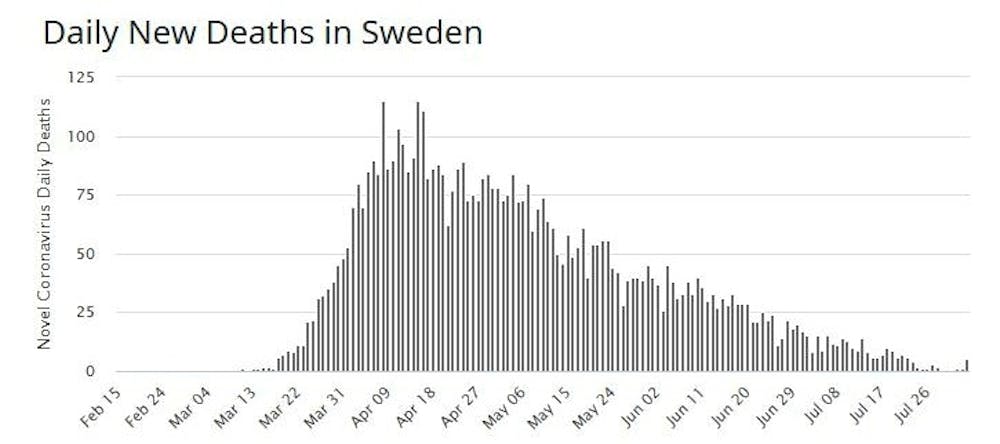
Sweden’s death rate is indeed high compared to others at this stage.
At the time of writing worldometer suggests Sweden is one of the worst nations in the world in terms of deaths per million population, being beaten among the populous nations only by Belgium, Britain, Spain, Italy, and Peru.
So far Sweden’s done badly in terms of deaths
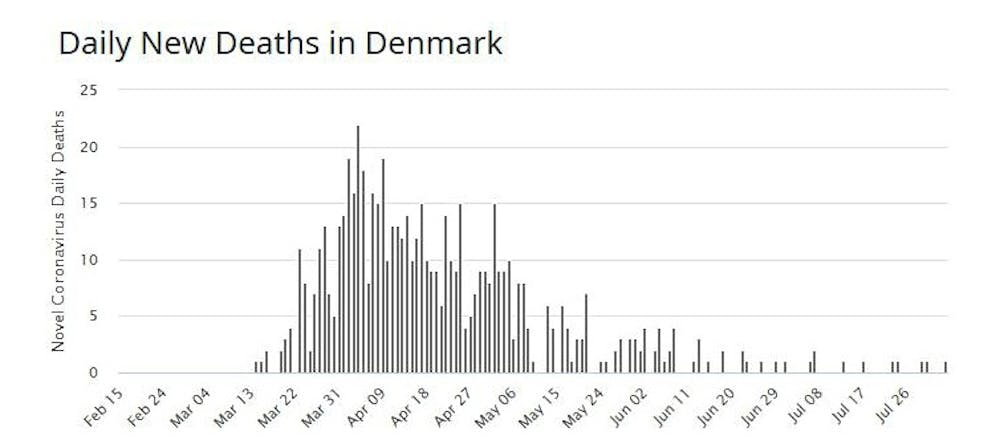
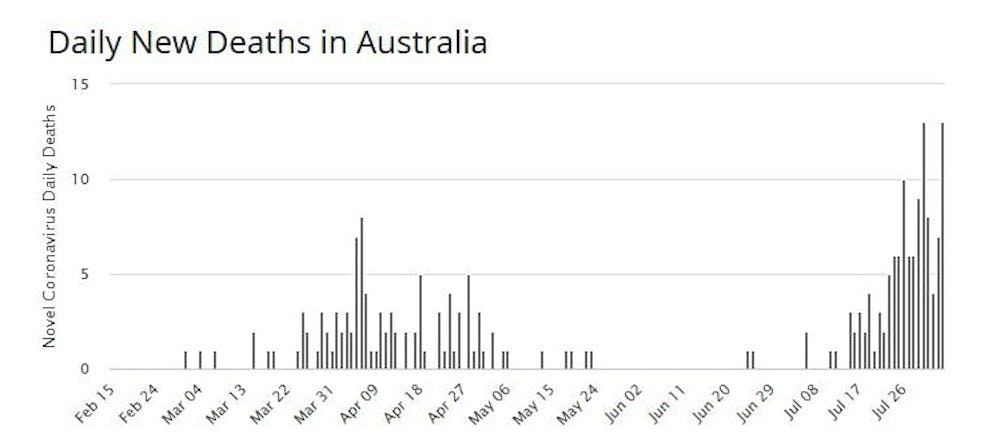
At 568 deaths per million it has done worse than the United States (480) and much worse than nations such as Denmark (106), Australia (9) South Korea (6) and New Zealand (4).
And on one reading its economic performance doesn’t seem much better than Denmark’s.
Denmark imposed strict restrictions from early March, closing the border to all foreign nationals, limiting social gatherings to ten, shutting schools, universities and non-essential work, and encouraging the entire population to stay home and minimise social contact.
Neighbouring Sweden allowed bars and restaurants to remain open with capacity constraints and table service. Preschools and primary schools were kept open but senior schools closed, and its borders remained open to people from Europe. At the same time it banned visitors from aged care facilities and encouraged old people and those with pre-existing health conditions to avoid social contact.
The University of Copenhagen study cited by those who argue Sweden got it wrong finds that in Sweden aggregate spending dropped 25% whereas in neighbouring Denmark it dropped 29%.
The authors conclude
even when there are no major restrictions on economic activity, as in Sweden, a pandemic induces a sizeable contraction of spending; the additional drop in spending caused by a shutdown, as in Denmark, is relatively small
But it might not stay that way
The University of Copenhagen study was close to a snapshot, presenting data for the four weeks between March 11 to April 5.
Shortly after the snapshot ended, after April 5, Sweden’s daily death count began falling. Its daily deaths are now close to zero.
Anders Tegnell, Sweden’s chief epidemiologist, says in many ways the voluntary measures put in place in Sweden were just as effective as the complete lockdowns in other countries, and might be more sustainable.
On its performance to date, Sweden has the world’s eighth highest death rate.
But if present trends continue, the ranking will fall. It is possible that by the time a proper accounting is done it won’t even make the top 20.
We will know soon how Sweden did economically in the second quarter of the year. Bank forecasts have its economy down only 7% to 8% in that quarter compared to 12% for the European Union as a whole.
It’s too early for a full accounting
A full accounting of how Sweden’s approach has fared compared to other country’s will take time, and will involve trading off health, economic, educational and other outcomes.
Confidence in its Public Health Agency remains high at 65%, suggesting Swedes are not unhappy with the tradeoffs made. And they are prepared to follow directions, perhaps more than Australians and residents of the United States and the much-touted Germany.
Sweden’s Civil Contingencies Agency says 87% of the population is complying with the social distancing restrictions that are in place, up from 82% a month ago.
The safe reopening of entry points into six Pacific Islands countries amid the covid-19 pandemic is being discussed at a meeting in Fiji this week.
The virtual roundtable is being convened by the United Nations and the Asian Development Bank with representatives from Solomon Islands, Kiribati, Tonga, Tuvalu, Vanuatu and Fiji.
The UN’s Sanaka Samarasinha said the discussion would be addressing border security.
“All these countries have a minimum standard of safety. At the end of the day, countries will agree to let people in if they feel that those who are coming – the source country have also safety standards that the receiving country accepts. If that doesn’t happen, there’s not going to be movement between two countries,” he said.
Samarasinha said similar roundtables were being planned for the Cook Islands, Niue, Samoa and Tokelau.
Samarasinha said the UN and the ADB had emphasised at the meeting clear protocols and the importance of ensuring that the airlines, seafarers associations and tour operators were included in preparing plans for reopening borders.
He said support from the international community can include initiatives such as the training of customs, immigration, police and health officials and the distribution of personal protective equipment for use at airports and seaports.
Dependent on tourism He said small island developing states, which depended largely on tourism for their economies, had been hit hard by the global slowdown due to the pandemic.
“The UN has, from the beginning of this crisis, advocated for the safe, responsible and timely reopening of national entry points, on which many small businesses and jobs depend,” he said.
“While the decision of when, how and with whom to open borders is a sovereign decision, safety, vigilance, responsibility and international co-operation are critical as the world slowly opens up again.”
Masayuki Tachi’iri, director of the ADB’s Pacific sub-regional office in Suva, said collective action was needed now to support health systems and economies in the Pacific.
“The ADB’s latest assessments suggest the effects of lockdowns and travel bans have been particularly severe on the region’s tourism-dependent economies, with some facing double-digit declines in gross domestic product in 2020,” he said.
This article is republished by the Pacific Media Centre under a partnership agreement with RNZ.
What does a pandemic smell like? If dogs could talk, they might be able to tell us.
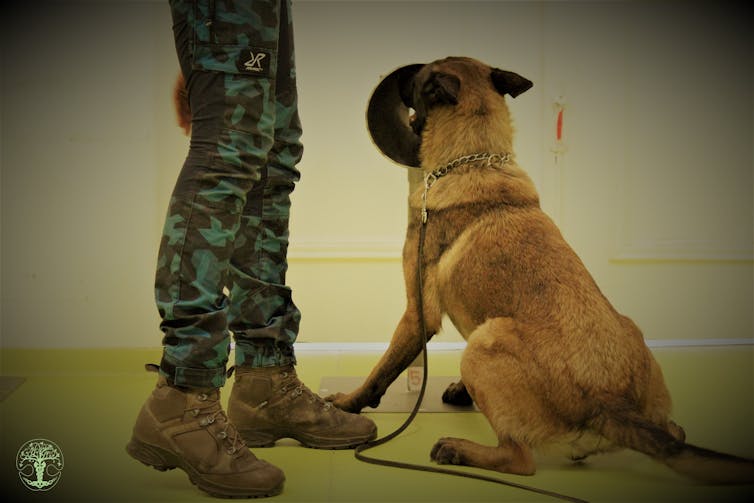
We’re part of an international research team, led by Dominique Grandjean at France’s National Veterinary School of Alfort, that has been training detector dogs to sniff out traces of the novel coronavirus (SARS-CoV-2) since March.
These detector dogs are trained using sweat samples from people infected with COVID-19. When introduced to a line of sweat samples, most dogs can detect a positive one from a line of negative ones with 100% accuracy.
Across the globe, coronavirus detector dogs are being trained in the United Arab Emirates (UAE), Chile, Argentina, Brazil and Belgium.
In the UAE, detector dogs – stationed at various airports – have already started helping efforts to control COVID-19’s spread. This is something we hope will soon be available in Australia too.
A keen nose
Our international colleagues found detector dogs were able to detect SARS-CoV-2 in infected people when they were still asymptomatic, before later testing positive.
When it comes to SARS-CoV-2 detection, we don’t know for sure what the dogs are smelling.
On average, dogs have about 220 million scent receptors.Shutterstock
The volatile organic compounds (VOCs) given off in the sweat samples are a complex mix. So it’s likely the dogs are detecting a particular profile rather than individual compounds.
Sweat is used for tests as it’s not considered infectious for COVID-19. This means it presents less risk when handling samples.
Here in Australia, we’re currently working with professional trainers of detector dogs in South Australia, Victoria and New South Wales. The most common breed used for this work so far has been the German shepherd, with various other breeds also involved.
We are also negotiating with health authorities to collect sweat samples from people who have tested positive to the virus, and from those who are negative. We hope to start collecting these within the next few months.
We will need to collect thousands of negative samples to make sure the dogs aren’t detecting other viral infection, such as the common cold or influenza. In other countries, they’ve passed this test with flying colours.
Once operational, detector dogs in Australia could be hugely valuable in many scenarios, such as screening people at airports and state borders, or monitoring staff working in aged care facilities and hospitals daily (so they don’t need repeat testing).
To properly train a dog to detect SARS-CoV-2, it takes:
6-8 weeks for a dog that is already trained to detect other scents, or
3-6 months for a dog that has never been trained.
Coronavirus cases recently peaked in Victoria. Having trained sniffer dogs at hand could greatly help manage future waves of COVID-19.Daniel Pockett/AAP
Could the dogs spread the virus further?
Dogs in experimental studies have not been shown to be able to replicate the virus (within their body). Simply, they themselves are not a source of infection.
Currently, there are two case reports in the world of dogs being potentially contaminated with the COVID-19 virus by their owners. Those dogs didn’t become sick.
To further reduce any potential risk of transmission to both people and dogs, the apparatus used to train the dogs doesn’t allow any direct contact between the dog’s nose and the sweat sample.
The dog’s nose goes into a stainless steel cone, with the sweat sample in a receptacle behind. This allows free access to the volatile olfactory compounds but no physical contact.
Furthermore, all the dogs trained to detect COVID-19 are regularly checked by nasal swab tests, rectal swab tests and blood tests to identify antibodies. So far, none of the detector dogs has been found to be infected.
Dogs are not susceptible to the negative effects of the novel coronavirus.Eyepix/Sipa USA
Hurdles to jump
Now and in the future, it will be important for us to identify any instances where detector dogs may present false positives (signalling a sample is positive when it’s negative) or false negatives (signalling the sample is negative when it’s positive).
We’re also hoping our work can reveal exactly which volatile olfactory compound(s) is/are specific to COVID-19 infection.
This knowledge might help us understand the disease process resulting from COVID-19 infection – and in detecting other diseases using detector dogs.
This pandemic has been a huge challenge for everyone. Being able to find asymptomatic people infected with the coronavirus would be a game-changer – and that’s what we need right now.
A COVID-19 detector dog enrolled in the NOSAIS program led by professor Dominique Grandjean and Clothilde Julien from the Alfort Veterinary School (France).
A friend to us (and science)
Perhaps we shouldn’t be surprised about dogs’ ability to detect COVID-19, as we already know their noses are amazing.
Their great potential in dealing with the current pandemic is just one of myriad examples of how dogs enrich our lives.
We acknowledge Professor Riad Sarkis from the Saint Joseph University (Beirut) and Clothilde Lecoq-Julien from the Alfort Veterinary School (France) for first conceiving the idea underpinning this work back in March.
Source: The Conversation (Au and NZ) – By David Smith, Senior Lecturer in American Politics and Foreign Policy, US Studies Centre, University of Sydney
Americans were alarmed last week when their president suggested on Twitter that the November 3 presidential election should be delayed because mail-in ballots would be fraudulent.
The president has no authority to change the date of an election. The US Constitution gives that power to Congress alone, and Republicans in Congress, including Senate leader Mitch McConnell, quickly dismissed any possibility of delay.
But the real danger here isn’t the possibility that Trump would delay the election, which his own allies won’t allow. It is his campaign to delegitimise the election in advance.
Trump has long made baselesscomplaints about voter fraud to cast doubt on election results. Throughout 2016 as he trailed Hillary Clinton in the polls, he repeatedly said the election would be “rigged”. Even after he won in the electoral college, he insisted he also would have won the popular vote but for ““millions of people who voted illegally”.
With his standing in the polls again precarious, mail-in ballots have become the latest targets of Trump’s obsession with “fraudulent” voting, despite the fact he and 15 other members of his White House staff have recently voted by mail.
There are currently endemic delays in the United States Postal Service resulting from cost-cutting measures introduced last month by new Postmaster General Louis DeJoy, a Trump fundraiser. These measures are supposed to deal with a longstanding “financial crisis” in the USPS.
This crisis is itself a political creation. It has its origin in punitive legislation from 2006 forcing the USPS to fully fund its pensions 75 years in advance. No other business in America faces this requirement.
The day after Trump’s “delay the election?” tweet he had another tweet that got less blowback but was nearly as ominous.
If thisyear’sprimaries are any guide there is every chance election results will not be known for days, especially if the vote is close.
But other commentators, noting his long record of unfulfilled threats, say Trump is unlikely to try to “steal” the election by refusing to leave office (as Joe Biden suggested he might). While Trump’s Republican allies have generally stuck with him throughout his numerous assaults on democratic norms, their reactions to his “delay” tweet show there are limits to what they will tolerate when it comes to attacks on the peaceful transition of power.
If Trump loses narrowly, the problem may not be removing him from office. It may be a further deepening of political polarisation in the United States. There have been partisan attacks on the legitimacy of the last four presidents. Trump could become a new “lost cause” figure whose supporters never accept his defeat and whose “betrayal” accelerates right-wing radicalism in the Republican Party.
Biden has a good chance of winning the election, but his chances of restoring “normality” are a lot worse.
According to 2016 Census data, 3.5% of Australians have limited English proficiency.
When they’re receiving health care, it’s essential these Australians have access to interpreters. Research has shown professional interpreters facilitate effective communication between the patient and clinician, boost the quality of care, and improve the patient’s health outcomes.
With COVID-19, we’ve seen a shift towards interpreting services being delivered remotely.
These remote services are important for vulnerable groups during the pandemic. They should also pave the way for improved care for people with limited English in the future.
Certain groups of people are at increased risk of serious illness from COVID-19. These include people aged 70 and over (or 65 and over with a chronic medical condition), Aboriginal and Torres Strait Islander people aged 50 and over with a chronic condition, and people with compromised immune systems.
Vulnerability to COVID-19 can also relate to factors like homelessness or insecure housing and socioeconomic status.
Many people with limited English proficiency will fit into these vulnerable groups.
People with limited English may also be at increased risk of COVID-19 because they don’t have the language and literacy skills to understand and respond to pandemic-related information.
People with limited English proficiency can have trouble understanding general public health messaging.Shutterstock
While data on language and COVID-19 cases is regrettably lacking in Australia, evidence from overseas suggests people from non-English-speaking backgrounds may be faring worse.
In the United States, for example, communities with large numbers of people with limited English account for a high percentage of COVID-19 hospitalisations and deaths, disproportionate to the general population.
So as well as providing suitable health messaging to multilingual communities, providing interpreting services is vitally important at this time.
Independent of the pandemic, evidence suggests interpreters are underused in health-care settings in Australia.
In acute care, for example, one recent study found 54% of hospital patients who required an interpreter received one. But this rate is considerably higher than those reported in otherstudies.
We don’t know how often interpreters are used in aged care, but there’s clearly a need there too.
COVID-19 gives us an opportunity to improve the use of interpreters in these areas.
A shift to remote delivery
Before the pandemic, professional interpreting services in health care were delivered through a combination of face-to-face and remote services (via telephone or video conferencing).
In Australia, these services are made available through a range of private and government-funded services. For example, in New South Wales there are five health-care interpreting services. Nationally, the Department of Home Affairs funds the Translating and Interpreting Service (TIS), which offers free interpreting for eligible health organisations and clinicians.
There are no data from before COVID-19 to tell us what proportion of interpreting services were delivered face-to-face, rather than remotely. But during the pandemic, consistent with the sharp increase in telehealth, we’ve seen a sudden shift to remote delivery of interpreting services across Australia.
At the Royal Melbourne Hospital for example, video interpreting appointments have increased from 10-15 appointments per month before COVID-19 to 100-200 a month currently.
Importantly, it allows for continued access to services in a COVID-safe way (minimising physical contact between interpreters, health-care professionals and consumers).
Other benefits include rapid and increased access to interpreters in a wide range of languages, and improved efficiency. It allows interpreters to spend more time interpreting rather than commuting between sites.
During COVID-19, interpreters are increasingly working remotely.Shutterstock
But there are also some potential disadvantages. There’s the absence of visual communication, especially associated with telephone interpreting. A person might offer cues via their body language, but a telephone consultation will miss these.
Drawbacks could also include technical problems such as poor video or audio quality, and issues related to digital literacy and participation more broadly, particularly for older Australians.
The rapid transition in service delivery necessitated by COVID-19 presents an opportunity for systemic change to professional interpreting services.
To ensure safe, quality care is provided during the pandemic, and to capitalise on the opportunity COVID-19 has afforded for improved care into the future, we need to see several things happen:
all health-care personnel providing services to people with limited English proficiency should take up appropriate remote interpreting services
providers and staff should undergo training to increase familiarity with available technology and ensure its appropriate use
health services’ rates of remote interpreting uptake should be measured and reported as an indicator of access
barriers to the use of remote interpreting services should be explored to ensure they’re addressed and overcome
cost and effectiveness of remote delivery should be further evaluated. This includes comparing modes (for example, telephone versus video) to inform best practice and policy.
Access to mental health support has never been more important, as Melburnians are hit with a stage 4 lockdown and much of the rest of Australia braces for a potential second wave of COVID-19.
This year, many mental health professionals have moved to providing telehealth services via phone and video calls.
But what options are available for those who don’t like talking on the phone, or who find it difficult to find a quiet space to have a private conversation?
Fortunately, there are several ways to get help without having to speak a word.
You can access free web chat or text messaging services that allow you to talk with a therapist via messaging.
Lifeline launched an online chat service in 2011, and in 2018 it set up an SMS text service that is available between 6pm and midnight (AEST). These services provide short-term support if you’re in a crisis, with research showing reduced distress and increased coping and connectedness among users of the service.
The Beyond Blue online chat service is another option, established in 2013 and available daily between 3pm and midnight. This is a general service that offers short-term counselling with a trained counsellor, but does not provide crisis support. A recent study found those who received help from Beyond Blue experienced lower levels of distress (although the study evaluated the services as a whole, rather than separating out those who received help over the phone versus via web chat).
Similar web chat services are available for children, teens and young adults via the Kids Helpline.
For some of us, hearing our phone ring is a daunting experience. Thankfully, there are many ways to talk to a therapist via text.Shutterstock
2. Online clinics or programs
Online clinics provide a range of self-guided mental health treatment programs. This means you work your way through the program at your own pace, without input from a mental health professional. These programs tend to have a variety of modules that provide information about common mental health symptoms, and include some suggested strategies about how best to manage these symptoms.
MindSpot is Australia’s first free national online clinic that offers psychological assessment and treatment for people experiencing common mental health problems such as anxiety, stress and depression. After completing an online assessment, you are directed to the appropriate online program, and can connect with a MindSpot therapist if you wish.
Mindspot programs include up to five lessons that can be completed over about eight weeks. Each lesson takes a few hours, and the general structure is to read through the lesson information and then practise the skills in your daily life. Throughout the program there are also real-life examples of people who have managed to overcome their symptoms, and there is an option for a weekly check-in with a therapist (although that would be over the phone). There have been more than 100 research studies relating to MindSpot, showing these treatment programs are effective in helping to reduce common mental health issues.
This Way Up programs are a suite of short online courses that cover a range of mental health concerns. You can select the course you’d like to do, and then work through a series of lessons and activities. For example, if you are struggling with low mood and worry, there is a mixed depression and anxiety course that provides material to develop skills in managing these symptoms. There are also options for you to select the approach that most appeals to you, including mindfulness-based or cognitive behavioural therapy (CBT) approaches (CBT uses strategies to help change unhelpful thoughts and behaviours). These courses cost A$59 each and access is available for three months. If you already have a psychologist, they can supervise your progress through the program.
These programs have been evaluated in many randomised controlled trials, with findings consistently showing they can be as effective as face-to-face therapy.
3. Peer support forums
Online peer support forums provide a safe online space where you can anonymously share your personal experiences and questions, and get support from others on the forum who may have helpful advice and suggestions based on their own experiences. These forums are usually moderated by professionals or trained volunteers and are places to get support rather than counselling, mental health treatment or crisis management.
Some popular mental health forums include those moderated by SANE, BeyondBlue, and headspace (for people aged 12-25). While evidence suggests peer support forums don’t necessarily reduce anxiety or depression, they are not harmful and may help to normalise emotional experiences and help users feel connected to others.
4. Smartphone apps
There are many mental health smartphone apps available to download.
Many of these apps have not been scientifically tested to verify their health claims, although some apps that are supported by evidence include the Headspace app and Smiling Mind, both of which have a mindfulness focus. Mindfulness uses meditation to develop awareness and acceptance to reduce the impact of negative thoughts and feelings. Evidence suggests mindfulness meditation programs have beneficial effects on mental health.
Many smartphone apps offer guided meditation and mindfulness, which can help you focus on the present and improve your mental health.Shutterstock
5. Chat bots
A chat bot is a program designed to simulate conversation with you, often using artificial intelligence. What this means is that you type in your thoughts, feelings and questions and an AI bot will respond to you.
There are several chat bots designed to provide mental health support. The most widely used ones are Woebot and Wysa (for children and teens). Both use artificial intelligence to deliver information based on cognitive behavioural principles, which can help you change your patterns of thinking or behaviour.
They aren’t designed to replace other forms of mental health support, but rather to complement them. But there is emerging evidence that chat bots can benefit mental health.
Research published in July showed three-quarters of Australians are reporting worse mental health since the pandemic began, with feelings of loneliness, stress and worry being most common.
At a time when face-to-face consultations are impossible for many Australians, and if telehealth is just not your style, there are a host of other options worth considering — and many of them are free.
Yesterday, Australia’s eastern states felt a vicious cold snap, and these wintry blasts make hunkering down in isolation at home a little easier. But as the temperature rises at home, so does our carbon footprint and energy bills.
Heating and cooling often accounts for up to 40% of energy bills. And energy consumption inside an Australian house is typically responsible each year for 8.5 tonnes of greenhouse gas emissions, not including what we produce from transport and the food we eat or the things we buy.
Of course, the extent you warm up or cool down your home depends on individual circumstances, such as whether you live in a house or an apartment, the size of your home and its orientation towards the sun. Here are a few tips to reduce your footprint (and energy bills) that can apply to many circumstances.
At no cost
There are several small things you can do that don’t really cost much but will make a huge difference to your comfort levels.
For example, making sure all windows are covered, and using doors or partitions, reduces heat and cold transfer between your rooms and the outside. Similarly, identifying and addressing any drafts or leaks around doors and windows, chimneys, gaps in floorboards, and so on, will also help improve the thermal comfort of your house.
Layering up inside is good, but combining it with exercise is better.Giulia Bertelli/Unsplash, CC BY
You’ve probably been told to just layer up, rather than switching the heater on. It’s true – adding a scarf and a woolly hat can help, but combining them with five minutes of exercise each hour (try a few star jumps) also makes a huge difference to your warmth. It’s much more effective than layering up while sitting passively.
Switching on an electric blanket for half an hour uses about the same electricity consumption as heating the kettle for a hot water bottle – but I suspect the hot water bottle would keep you warmer for longer.
Over the three months of winter, heating a kettle everyday for a hot water bottle would use about nine kilowatt hours of electricity, according to my calculations. That’s about nine kilograms of greenhouse gas, and the electricity would cost about A$2.50.
Running a three kilowatt reverse cycle air conditioner for heating a single bedroom for half an hour, and over the three months of winter, is far worse for your energy bills and the environment. It would use about 45 kilowatt hours, which is five times the greenhouse gas of a hot water bottle, and five times the cost.
Compared to an electric blanket, a hot water bottle uses far less energy to make and keeps you warmer for longer.Shutterstock
Gas, electricity or reverse cycle air conditioning?
Reverse cycle air conditioning can have a similar or smaller carbon footprint than gas heating, depending on your location. And gas heaters have carbon footprints two or three times smaller than electric heaters.
Medium to large household gas heaters can generally supply significantly more power for heating than an electric heater. So if you’re using a gas appliance instead of reverse cycle air conditioning, you may find it gives you a warmer house but consumes more energy.
Depending on where you live, an air conditioner typically produces about one-third of the carbon emissions compared to an electrical heater.
But if just one small room needs to be heated and it’s too hard to install a small air conditioner, and too inefficient to run the main house air conditioner, then a small gas or electric heater may be the best solution. Do remember to keep the house and room properly ventilated where you are using gas heaters.
It’s rare a heating system needs to be on for 24 hours a day in every room of the house – it would cost a small fortune to run. Take care not to leave doors open unnecessarily, use room partitions where possible, and use the zone controls if your heating system has them to manage the rooms that need to be heated. If you have a timer on your heating system controller, use it instead of just letting the heater run.
Split or ducted air conditioner systems?
Air conditioning systems are often classed as either split or ducted. With split systems, part of the air conditioner is outside the house and the other part is in the room being heated or cooled. In this case, the outside unit sends hot or cold refrigerant through pipes to one or more inside units and these heat or cool air in the rooms.
With ducted systems, the inside unit is not in the room being conditioned, but typically may be in the ceiling or floor, where it warms or chills a stream of air delivered through air ducts to each room.
Split systems of air conditioning are more efficient because they usually heat up or cool down only one area.Shutterstock
So which is more efficient?
Split systems are more efficient than unzoned ducted systems because they heat just the rooms that need to be warmed. Also, ceiling spaces can get very hot or cold, so ducting needs to have its own high-quality insulation, which should be regularly checked and repaired as necessary. Otherwise, you could easily double or triple your energy consumption.
Ducted systems are useful where there are large numbers of rooms that need to be conditioned, or if the house is in a damp location so occasionally passing warm air through the whole house keeps it dry.
When buying an air conditioner, check it has a star rating to indicate energy efficiency and look out for as many stars as possible.
Be wary of standby power
When you switch off an air conditioner with the hand control, it will still use electricity, even if it’s not heating or cooling. Older models may consume as much electricity on standby as when running. So if you’re buying an air conditioner that can’t routinely be switched completely off, my advice is to ask how much standby power it uses.
Gas heaters can give you a warmer house, but use more energy.Shutterstock
Be wary – some suppliers may only tell you the standby power for the inside unit, ask them for the standby power for the whole system including both the inside and outside units. If it’s much more than 20 watts, consider another model.
When it comes to taking action on climate change, we can all play our part to save energy and reduce emissions. Following just some of these tips will not only help you stay warm, but also keep your emissions profile lower.
Source: The Conversation (Au and NZ) – By Alan Brent, Professor and Chair in Sustainable Energy Systems, Te Herenga Waka — Victoria University of Wellington
Climate Explained is a collaboration between The Conversation, Stuff and the New Zealand Science Media Centre to answer your questions about climate change.
If you have a question you’d like an expert to answer, please send it to climate.change@stuff.co.nz
Why can’t I use the battery from my electric car to export solar power to the grid when I don’t need it?
Technically it is possible. You could charge your electric vehicle (EV) with solar photovoltaic panels (or any other means), and if the EV is not used, the stored energy could be pushed back into the grid, especially during hours of peak demand for electricity when market prices are high.
This is known as vehicle-to-grid technology and is seen as the future as we move towards more electrification of transport and a smart grid.
But manufacturers of electric vehicles have been reluctant, at first, to allow the bidirectional flow of power, for two reasons.
First, it could accelerate the degradation of batteries, which means they would need to be replaced more often. Second, the EV has to connect to the grid in the same way a solar photovoltaic system does, complying with standards to protect line operators and maintenance personnel working on the grid.
Such advanced bidirectional charge controllers come at an additional cost. Nevertheless, EV manufacturers such as Tesla and Nissan have now taken steps to enable vehicle-to-grid connection with some of their models.
For EV models that do not have onboard inverters (to convert the DC electricity in the electric car to AC electricity we use in our homes), there are now bidirectional inverters available to connect any electric car. But the issue of battery life remains.
The continual charging and discharging through a 90% efficient converter shortens the life of the battery, and depending on brand and model, it may need replacing every five years. At more than NZ$5,000, this is a significant price tag for “energy prosumers” – people who both produce and consume energy.
There are other considerations that are very context-specific. These relate to the additional charges for enabling the export of electricity from households, which vary between lines companies and retailers (or local authorities), as well as the buy-back rate of the electricity, which again depends on the purchaser of the electricity.
At the moment, these specific circumstances are seldom favourable to justify the additional cost of the infrastructure needed to connect an electric car to the grid.
There are also practical considerations. If the EV is used for the morning and evening commute, it is not at the home during the day to be charged with a solar system. And if it is (hopefully) not charged during peak demand hours, but mostly in off-peak hours at night, then the vehicle-to-grid route makes less sense.
It only starts to make sense if an EV is not used daily, or if EVs are available to a larger network than just one household. There are major opportunities for EVs to be used in communities with microgrids that manage their own generation and consumption, independent of the larger grid, or if large smart grid operators can manage distributed EVs remotely and more efficiently.
Investigations are ongoing to make this a more practical reality in the near future.
In early July, Victorian Premier Daniel Andrews announced government school students in prep to Year 10 — in Metropolitan Melbourne and the Mitchell Shire —would learn from home for term three. Students in Years 11 and 12, as well as those in Year 10 attending VCE or VCAL classes, and students with special needs, would learn face to face.
The exemption for students doing VCE subjects to go class was made to ensure the least amount of disruption to the final years of schooling.
From today, however, after the announcement of harsher, Stage 4 restrictions for metropolitan Melbourne and Stage 3 restrictions for the rest of Victoria, students in Years 11 and 12 will learn remotely with every other student in the state.
With Year 12s studying for their final year exam, the score of which will be converted into a ranking as related to their peers across the country, many Victorians are worried they may be set back.
So, will remote learning at the end of schooling mean Victorian students will fall behind the rest of the country?
Setting up Year 12s for further learning
Year 12 marks the end of school and the shift to work and further education for most students.
The Year 12 journey is sprinkled with milestones and rites of passage: the school formal, leadership opportunities, gaining independence with a new driver’s license and for many, turning 18 and being regarded as an adult.
In classrooms, learning is highly regulated by the teacher. Whereas in vocational education and training, and university, learning is rapidly moving to a more online, independent, mode. Even before the pandemic, post-school education required students to be more self-directed learners than they were at school.
This year’s Year 12 students won’t experience many common milestones and rites of passage. But many will have gained significant experiences of learning online, and independently — beyond what they ordinarily would have — which will set them up for similar learning beyond school.
The chance to develop online learning capabilities while being supported by their school teachers will give Year 12s learning remotely a real advantage.
Year 12s like learning independently
We conducted a survey of students who experienced remote schooling during March and April this year at an independent school in Queensland. Overall 1,032 students completed the survey, across prep to Year 12.
Just over 41% of students, overall, said they found learning at home stressful. But this was generally not the case for students in Year 12. Year 12 students were keen for the flexibility to learn at their own pace, and being free to determine the order of study each week, rather than follow a timetable set by the school.
Younger students find remote learning more stressful than do Year 12s.Shutterstock
Year 12 students said they preferred to concentrate on one subject a day and to work intensely.
Generally Year 12 students said they disliked live video sessions and found them disruptive to their study flow. While 75% of Grade 7 students valued form class or home room live sessions, only 16% of Grade 12 students did. They preferred to spend their time focusing on given subject materials.
Other studies suggest there is no significant difference in learning outcomes between students in distance education (when students live too far from the school to attend in person) and face-to-face learning.
But there are significant variations in outcomes within each approach. This means a student’s ability to learn online, the design of the online learning environment and even the amount of time needed for students to get familiar with learning online can affect their outcomes.
Students have been conditioned for over 12 years to learn in classrooms from a teacher. This can make it difficult for them to become familiar with new ways of learning.
A major issue associated with online learning is a student’s ability to regulate themselves. This means being able to stay on task especially when a problem arises. Being unfamiliar with new ways of accessing and interpreting online environments and subject content, as well as working with peers online in communication spaces, presents new challenges for students.
However, the problem may again have to do with age. In our survey, mentioned above, 75% Year 12 students believed they were able to work through a problem productively online. This was higher than the other high-school year levels.
Tips for Year 12 students
There are many advantages to learning online. Students can work at their own pace, revise and review teacher made videos for examples, and engage with extensive notes and study guides to help with assessment and exams.
Students can also access their teachers in more varied ways and at different times of day. In other words, moving online for Year 12 students can provide a world of resources and access to teachers they have not experienced before.
The new Netflix documentary Athlete A details how Larry Nassar, the US women’s gymnastics team doctor, was brought to justice after sexually abusing hundreds of gymnasts.
Since its release, gymnasts around the world have come forward with stories of physical and emotional abuse.
By raising the age, we can discourage behaviour that has historically enabled abuse in the sport.
A distinctly feminine sport
Women’s gymnastics was created at a time when exercise and competition were thought to endanger women’s health.
Keen to allay these fears, in 1933 the International Gymnastics Federation put together a women’s committee to create a sport to showcase femininity, with passive, graceful, flowing movements.
Women’s gymnastics was accepted into the Olympic Games in 1952 when the International Olympic Committee deemed it “appropriate”. In early decades, competition featured mainly adult athletes. Over time, the sport became more focused on acrobatics, and gymnasts became younger.
Soviet gymnast Larisa Petrick in 1966.Wikimedia Commons
When 15-year-old Larisa Petrik won the Soviet National Championships in 1964, she was the image of a young girl performing complex acrobatics while maintaining her femininity.
At the 1972 Olympics, Olga Korbut combined intricate acrobatics with a youthful appearance. The 17-year-old in pigtails laughed, cried, and popularised a childish brand of gymnastics around the world.
When 14-year-old Nadia Comăneci scored the first perfect 10 at the Games in 1976, she wasn’t just portraying youthfulness — she was a child.
These success stories fostered the idea that gymnasts should be young to succeed: the sport’s femininity became entwined with girlhood.
History of abuse
Abuse in gymnastics goes at least as far back as the child gymnasts.
Korbut and Marcia Frederick, America’s first gymnastics world champion, allege their coaches sexually abused them in the 1970s. Korbut’s coach died last year. Frederick’s coach Richard Carlson has denied any wrong doing.
American Olympian Kathy Johnson Clarke described being emotionally abused by a coach in the late 1970s. Soviet gymnast Yelena Mukhina blamed her paralysis in 1980 on coaches forcing her to train despite injury.
Allegations about the brutal methods of coaches Béla and Márta Károlyi – again implicated in Athlete A – go back to at least the early 90s. A 1992 article in Sports Illustrated described Béla as “a ruthless Svengali, overworking his innocent young gymnasts for his own megalomaniacal needs”.
Bela Karolyi training Dominique Moceanu, then 14, in 1996.AP Photo/Susan Walsh
This is compounded when gymnasts are trained to be docile and compliant.
As Athlete A producer and former elite gymnast Jennifer Sey explains: “obedience was trained into us and we were terrified to speak up”.
Minimum age rules
In response to the growing number of adolescent gymnasts in international competitions, in 1971 the International Gymnastics Federation instituted its first minimum age rule, requiring gymnasts be 14 to compete internationally.
Still, the average age of competitors continued to decline. In 1981, the minimum age was raised to 15.
In 1993, in a public relations push after a number of serious injuries and abuse allegations, the age was raised to 16 – coming into force in 1997.
The minimum age limit hasn’t been revisited since.
Raising the minimum age for elite competition to 18 would offer a number of protections for athletes.
Later specialisation would broaden gymnasts’ exposure to other life experiences, making it harder to accept the normalisation of abuse.
Maggie Nichols has become a strong voice against the abuse of athletes in the sport.Melissa J. Perenson for AP / Netflix
While other elite sports have young athletes, they tend to be the exception: women’s gymnastics has the youngest mean age of all disciplines at the Olympics.
Since Comăneci’s heyday, coaches and officials have assumed gymnasts need to master the sport before the onset of puberty. “Trying to get in 10,000 hours [of practice] before the age of 16 means [I have to place them in] a pressure cooker,” one coach explained.
But there is growing evidence puberty is not the end of gymnastics. If we re-imagine gymnasts peaking at an older age and scale their careers accordingly, they could have a much longer career in an adult body.
Raising the age could limit the need for intense childhood training, especially if accompanied by restrictions on training hours.
A minimum age of 18 would also position athletes to make informed decisions about their training and the sacrifices they are asked to make. Adult gymnasts train fewer hours and work in partnership with their coaches.
Older college gymnasts, for instance, look happy and vibrant as they perform. Not coincidentally, they display a much more modern form of femininity.
Tackling other problems
This change wouldn’t fix all of the sport’s problems.
Aspects of the anti-doping model could also be used to prevent abuse. Accredited specialists could monitor training environments during frequent spot checks.
Professional development programs educating people about how to recognise and report abuse, how to motivate without using fear and how to ensure a positive training environment should also become mandatory for coaches.
Abusers at every level of the sport must be banned.
Scott Morrison says the COVID-19 crisis has created new opportunities for “like-minded economies” to work together – but warned against “solely transactional” trade approaches undermining these relationships.
In a Wednesday keynote speech to the US Aspen Security Forum, delivered virtually, Morrison says expanding the scope and scale of co-operation by like-minded economies must be done “thoughtfully”.
“Security and trade policy approaches must be well integrated, not at odds with each other,” he says in the address, released ahead of delivery.
Although Morrison is unspecific about which countries he has in mind on the trade front, his remarks will be read as a reference to the United States. President Trump’s America First policy, with its aggressive transactional approach and emphasis on “deals” has come with costs for a number of like-minded economies.
Morrison says: “A solely transactional approach to trading relationships can undo some gains made in other parts of relationships with like-minded partners. Australia’s foreign policy is not simply transactional.”
“As we build the network of like-minded economies, we need to build a greater sense of unity across all elements of our engagement.
“That means taking a more pragmatic and rounded approach to our global and regional relationships,” he says.
“The sense of unity necessary among like-minded partners can be undermined if positive political and security relationships are accompanied by abrasive or confrontational trade relationships.
“We should avoid cases where we build closer strategic co-operation, only to see the cohesiveness of those relationships undermined by trade disputes.”
Morrison says he is not suggesting seeking to constrain “the national instinct of our business people and exporters to compete in global markets”. Nor should we “turn a blind eye to unfair trading measures imposed by our friends”.
Morrison’s speech continues his recent assertiveness about Australia’s foreign policy and defence stance.
Saying that in 2020 international society is under strain, he emphasises we have to deal with the world as it is, not as “we’d like it to be”.
“The liberal rules and norms of the American Century are under assault.
”‘The jungle is growing back,’ as [US foreign affair expert] Robert Kagan has observed.
“We need to tend to the gardening.
“A critical priority is to build a durable strategic balance in the Indo-Pacific,” which is “the epicentre of strategic competition”. Australia will play its part in this, investing in regional relationships.
More like-minded nations need to align and act more cohesively and consistently, Morrison says.
“I assure you that Australia is not being passive – we’re acting to shape that tomorrow right now,” he says.
“We are building the capability and potency of our defence force, sharpening our focus on our immediate region, and increasing our capabilities to deter actions against our interests”.
Morrison says China has a role “to enhance global and regional stability, commensurate with its new status” as a major economic partner.
“Such a role is about the broader global and regional interest, rather than a narrow national interest or aspiration.”.
China and the US together have a responsibility to uphold the rules that build an international society.
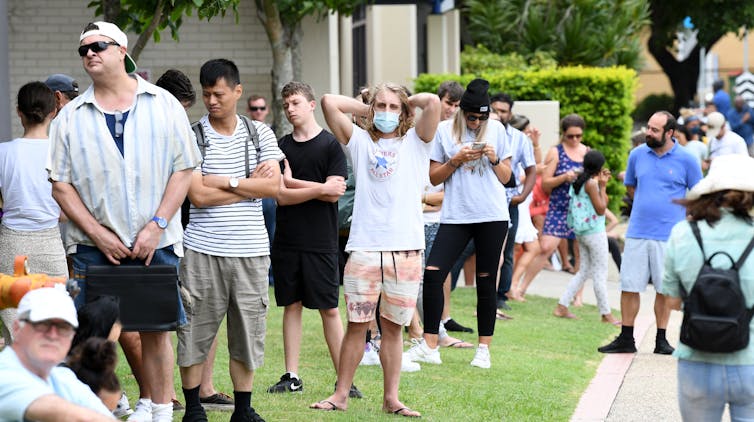
Papua New Guinea has one new case of the novel coronavirus covid-19 reported yesterday bringing total cases to 111, reports EMTV News.
National Pandemic Response Controller David Manning in a statement late yesterday said the new case was a 27-year-old male of the National Department of Health and was in isolation at the Rita Flynn Isolation Centre.
He was tested during a targeted testing of health staff following the confirmation of seven staff with covid-19 at the department.
“Over the past 48 hours we have conducted more than 1906 tests. This includes testing of staff of the National Control Centre, the National Department of Health as well as inpatients and staff at the Port Moresby General Hospital,” Commissioner Manning said.
“I thank residents in Port Moresby for their patience and for presenting themselves at the hospital and health facilities in the city for testing.
“What you are doing is essential to limit any potential spread of covid-19. Getting tested helps us find any cases in the community as quickly as possible. This ensures we are doing everything we can to manage the pandemic,” Manning said.
He encouraged all residents of NCD to continue to come forward for testing if they had developed any covid-19 symptoms, even if mild.
Testing at urban clinics Symptoms may include fever, cough, sore throat, headache, chills, runny nose, shortness of breath and muscle ache.
“As of today, there are testing facilities right across the city and swabbing has started at the Lawes Road, Gordons, Pari and Tokara clinics. It’s really important if you’re showing any symptoms at all, please go get tested.”
Manning also stressed the importance of wearing masks, social distancing, washing hands with soap and water or the use of hand sanitisers and not to stand in crowded locations.
Recommendations and control measures proposed by the Covid-19 Health Advisory Committee will also be discussed to ensure the measures are reflective of the need of Papua New Guineans.
Meanwhile, contact tracing for the two cases in Lae is continuing with results for the 74 contacts of the second Lae case becoming available tomorrow.
The third case identified on Sunday has been isolated at the 11 Mile Isolation Centre.
Commissioner Manning said these new cases now brought the total to 73 known active cases. These included 33 patients under care, with four admitted to the Port Moresby General Hospital.
“There are currently one moderate and 28 mild patients under care at Rita Flynn Isolation Centre after five were discharged today,” said Manning.
The Pacific Media Centre collaborates with EMTV News.
Should the public know the details of all the Victorian aged care facilities that have had COVID-19 cases?
“Yes” seems the obvious answer. But not according to the Health department or Aged Care Minister Richard Colbeck.
At Tuesday’s hearing of the Senate committee monitoring the government’s responses to the pandemic, Greens senator Rachel Siewert sought this information, asking about providers, residents, cases and deaths.
Health department secretary Brendan Murphy – formerly chief medical officer who in that role was often at Scott Morrison’s side at news conferences – asked to provide the information to the committee “in camera”.
“Some of the facilities don’t want it publicly known that they have outbreaks,” Murphy said.
“Many, many of them have been open about it and it’s in the media. But some of them have just had one staff member and the facility has been locked down and it’s been controlled. And they’re obviously worried about reputational issues.”
When Siewert put it that the public had a right to know, Colbeck said the families with a member in a facility were “aware of what’s happening.
“But I am concerned about the stress that’s placed on facilities by some of the public elements of this process.
“I understand where you’re coming from in one sense, but talking to, particularly some of the smaller facilities, their capacity to deal with a huge influx of, say media inquiry can severely impact on the facility.
“And in the circumstance where they’re doing well, the families are being appropriately advised … I’m reluctant to have a public hit list of facilities that have been unfortunate enough to have an outbreak of COVID within them.”
He and Murphy said facilities with outbreaks are locked down and don’t take new residents.
Victorian premier Daniel Andrews reported on Tuesday that all of the latest 11 deaths were linked to outbreaks in aged care facilities. They are part of a chain of multiple deaths, now announced day after day, from aged care in this Victorian second wave. On Tuesday’s figures, there were 1186 active COVID cases relating to aged care facilities (this includes residents and staff).
The Victorian government provides a list of the facilities that have had the largest outbreaks. State government sources, asked on Tuesday night, said it is not seeking to keep secret the others. It doesn’t provide details of deaths in circumstances where that would identify individuals.
The arguments advanced by Murphy and Colbeck for secrecy are flawed and can give the public little confidence.
These are institutions funded and regulated by the federal government, and provided with a great deal of taxpayers’ money. There should be total transparency about what happens in them.
We know from official and media reports over years, and the experience of many families, that it’s vital to get as much information as possible in real time about what’s happening in aged care.
While facilities that have had minimal COVID cases are not in the same class as those with massive outbreaks, it doesn’t mean the details of those homes and cases should be hidden.
It is understandable facilities do not want “reputational” damage. But the magnitude of what is occurring in the sector in Victoria means we are past that concern. It is now a question of accountability.
Colbeck is worried about “media inquiries” and a “hit list”.
“Media inquiries” refers to journalists asking for facts, questions the public would reasonably want answered. As for a “hit list”: families making decisions in the future about institutions have the right to know how an institution performed in the COVID crisis.
How cases arose in facilities – even a single case – is also relevant to assessing the pandemic across the sector.
Committee chair Katy Gallagher said later on Twitter the committee would consider Murphy’s request for the information to be provided in camera.
But she added it would need to be persuaded “of the public interest test of keeping it secret”. That, one would think, would be very difficult.
Source: The Conversation (Au and NZ) – By Flavio Romero Macau, Senior Lecturer in Supply Chain Management and Global Logistics, Edith Cowan University
With Victoria’s declaration of a state of disaster and imposition of Stage 4 restrictions, many Melburnians have returned to panic buying. Supermarket shelves across the city have been stripped of canned goods, fresh vegetables and meat.
The meat buying, at least, makes some sense.
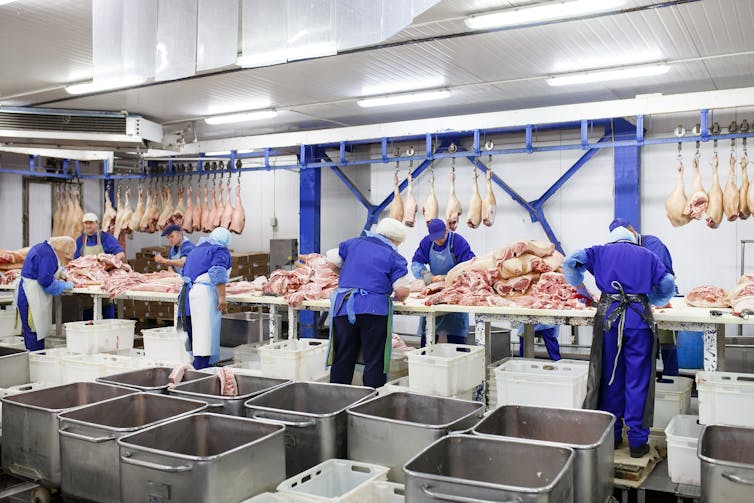
After aged care homes, meat-processing facilities have been a major contributor to Victoria’s COVID-19 outbreak. Hundreds of coronavirus cases have been linked to about a dozen sites, with the biggest outbreaks at those in Melbourne’s outer western and northern surburbs.
There were expectations following the state government’s lockdown announcement on Sunday that these facilities might be closed completely, along with the other business restrictions announced on Monday.
That didn’t happen. But the state’s 70-plus meat-processing facilities will be required to reduce their production capacity by one-third.
They must also implement, in the words of premier Daniel Andrews, “some of the most stringent safety protocols that have been ever put in place in any industrial setting”, including workers dressing “as if they were a health worker – gloves and gowns, masks and shields.”
This is going to affect the supply of meat to Victorian supermarkets, and prices. But thankfully not for long.
Why meat processors?
Processing meat is the opposite of an assembly line. It’s a disassembly line, the equivalent of auto workers pulling apart cars – removing the wheels, doors, seats, engine and so on – to sell the parts. Now imagine each car is slightly different, and must be taken apart in a slightly different way, at fast pace.
Automating such work is difficult. It is complex and intensive manual labour. Lots of people work close together, in a hard environment, for long hours, in cold and dry spaces. These factors make it easy for COVID-19 to spread.
The Victorian government’s directive that meat-processing facilities reduce output by one-third is to ensure workplace changes such as gaps between shifts, more physical distancing, and more attention to measures such as wearing personal protective equipment and not sharing cutting equipment.
So production will go at a slower pace. Output will be lower, and the per-unit cost of packaging meat products for consumers will be higher.
Slaughterhouse meat workers.Shutterstock
Synchronising the system
Quality and price are key purchasing decisions for most meat shoppers, and the meat industry has been geared to providing fresh produce at lowest cost.
Getting your favourite beef, lamb, chicken and pork cuts to your local supermarket or neighbourhood butcher is a complex game. Meat processing and distribution centres work out how much to produce, where to deliver and when to do it with great precision, planning up to 90 days ahead. They must synchronise supplies from farmers with demand from retailers.
Think of the system’s smooth operation as being like keeping a roomful of clocks synchronised.
If one clock fails, no problem. You can fix it. But what if a handful more clocks fail before you can fix it, and then dozens more fail? In a short time there will be so many faulty clocks that coordination is compromised. Eventually you won’t even know what the right time is.
Reducing capacity in one or two abattoirs for a few days could be worked around with minimal effects to consumers. But there’s no quick fix to reducing capacity in all of them for six weeks.
Supplies for some meat products will almost certainly be lower, and prices could increase. This is most likely to occur for the most common and popular meat cuts, like T-bone steaks or chicken drumsticks. If your preference is offal or giblets, though, you may not have a problem.
First, thanks to refrigerated transport, meat processors in other states can help meet lower production in Victoria. The industry has some flexibility to move from north to south, from west to east.
Second, supermarkets have been quick to bring restrictions back to prevent the panic buying and hoarding that make shortages even worse. Coles and Woolworths have already imposed two-pack limits on meat packages (and other products).
Third, to hoard meat you need freezer capacity, and it’s quite possible those disposed to stockpiling still have frozen meat from the first COVID-19 wave.
Fourth, supermarkets and hundreds of smaller operators such as butchers will be affected in different ways at different times. Finding what you want may simply require looking in more than one shop.
Fourth, there are options. Not just between different fresh products such as beef, chicken, pork, lamb and fish, but between preserved, frozen and canned alternatives.
So it might be just a bit harder to have your preferred choice of meat for dinner in the coming days. But the situation won’t be as dire as some fear.
Childcare services and most preschools have remained open throughout the COVID-19 restrictions in Australia. From Wednesday, however, Melbourne’s stage 4 restrictions mean most children (except for vulnerable children and those of essential workers) in metropolitan Melbourne will no longer be able to attend early childhood education and care for at least six weeks.
Kindergarten and early childhood centres in regional Victoria, however, remain open to all children.
So, what will not being able to send children to childcare or preschool mean for Melbourne’s families and the early childhood education and care sector?
Most of these children will have to stay at home with their families for at least six weeks, plus school holidays for children attending sessional kindergarten.
Parents will face similar challenges as parents whose young school children were learning from home in terms two and three. But they’ll be doing this with younger children with different (often greater) needs, without the learning and developmental remote support being provided by schools.
Recent research with parents of schoolchildren shows this is likely to take a significant emotional toll as parents attempt to balance care, early learning and paid work. Guilt and anxiety about not doing any of these jobs well is common among parents.
The government put in place a relief package in April to support families and services in the early childhood education and care sector, because many people pulled their children out of childcare.
The government provided centres with around 50% of their revenue based on enrolment numbers between February 17 and March 2, on the basis parents weren’t charged any fees. Services were also able to access JobKeeper for eligible employees.
Childcare was the first sector to lose JobKeeper in July, as part of the transition back to pre-COVID funding arrangements. The federal government is providing a transition payment to operators until September 27. The payment makes up 25% of the childcare service fee revenue from February 17 – March 1.
This is one way of addressing the fact only a few early childhood education and care workers are eligible for JobKeeper. The Minister for Education Dan Tehan told a press conference on Tuesday nearly one-third of the early childhood workforce weren’t eligible for the package.
Parents whose income has been reduced due to COVID-19 are eligible for an increase in subsidised hours (up to 100 per week), but they’ll still have to pay the gap fees. For many families who have lost income, these fees are likely to be unaffordable, and the increased allowance won’t make a difference.
Dan Tehan said on Tuesday the federal government (which funds the childcare sector) is working with Victoria on a suitable arrangement for parents and the sector during the stage 4 restrictions. Further announcements are expected later this week.
Will the sector survive a six-week shutdown?
Australia’s mixed model of childcare provision means unlike government schools, there won’t be a common plan rolled out across the sector. Private companies and non-profit and community organisations will need to assess their own situations, make their own plans, and communicate these with families.
Support to providers will be critical to ensuring services can remain open for families of permitted workers, and open their doors too all families as restrictions are eased.
What are the options, and what if this happens again?
The transition payment to childcare operators was designed to support the shift back to stage one and two restrictions — it is not fit for stage 3 or 4 restrictions. This payment to providers should be increased to ensure they can survive the next few months.
The government should be considering several options, geared towards minimising damage and disruption for children, families and the sector.
JobKeeper could be reintroduced for early childhood educators to protect educators’ jobs and support services. But while JobKeeper provided a guaranteed level of funding to support employers and employees, large numbers of casual early childhood educators were not eligible.
A better option would be to temporarily increase the federal government’s transition payment to services, with the remainder of services’ revenue made up by fees from parents whose children are still attending, and federal government subsidies. This could also be improved by strengthening the employment guarantee provisions for educators.
The employment guarantee linked to the transitional payment only requires employees to keep their jobs, which for many casuals may mean only a few shifts per week.
This may not be the last time we experience stage 4 restrictions in Australia. The childcare sector has been near collapse, followed by government rescue twice in 2020, in stark contrast with the stable schools system, that has been able to focus all their attention on children’s and educators’ learning and well-being.
It’s time for Australia to get serious about developing a more sustainable system that provides high quality and genuinely affordable early learning to all Australians, which is not at constant risk of collapse as we navigate the challenges of COVID-19.
The Queensland government has quietly released the state Law Reform Commission’s long-awaited report on reforming the state’s controversial sexual consent laws.
After much lobbying by survivors of sexual assault for comprehensive changes to the law, the recommendations are a huge disappointment.
The QLRC review was prompted by concernsabout the mistake of fact excuse in rape cases — what some have called a “loophole” that allows rapists to walk free.
Defendants in rape trials often argue the other person consented to sex. However, the mistake of fact excuse also allows defendants to argue they honestly and reasonably believed the other person consented to sex — even if that person did not. The excuse has been part of Queensland law since 1899.
The state attorney-general, Yvette D’Ath, asked the QLRC to examine the mistake of fact excuse last July, along with the state’s consent laws generally.
This followed a high-profilecampaign led by Women’s Legal Service Queensland, author and activist Bri Lee and myself.
The Queensland Law Society and the Queensland Bar Association both strenuouslyopposed any reforms to the existing laws on consent and mistake of fact, claiming there was insufficient evidence of the need for changes. The QLRC’s report effectively endorses this position, while giving the superficial appearance of progressive change.
None of the five recommendations significantly changes the existing law. The proposals do nothing to strengthen the law on sexual consent, nor do they address the problems that prompted the review in the first place.
The definition of consent
Rape in Queensland is defined as sexual intercourse without free and voluntary consent. The QLRC’s report recommends three amendments to the definition of consent in the criminal code.
The first change would state that a person is not assumed to have consented to a sexual act just because they don’t actively say no. This is an important principle. However, as the QLRC acknowledges, it is already well established in case law.
Importantly, this proposal leaves open the possibility that passivity can still amount to consent in some circumstances. The QLRC quotes a recent judgement by the Queensland Court of Appeal president, which says “in some circumstances” consent may be expressed “by remaining silent and doing nothing”.
The second recommendation by the QLRC would clarify the same definition of consent applies to rape and other sexual assaults. This is a technical reform that does not change the definition of consent itself.
The third reform would amend the law to state there is no consent in situations where a sexual act continues after consent is actively withdrawn. This principle, too, is already part of case law.
This reform is potentially problematic because it seems to put the onus on people who are subjected to unwanted sexual acts to withdraw their consent. This may not be realistic when a previously consensual sexual encounter turns violent or the nature of the activity suddenly changes.
Mistake of fact and consent
The QLRC’s fourth and fifth reforms address the mistake of fact excuse.
The fourth reform would allow juries to consider anything a defendant said or did to determine if the other person wanted to have sex in deciding whether the defendant made an honest and reasonable mistake.
This amendment, too, does not change the existing law. Notably, the proposal falls short of requiring defendants show the positive steps they took to ascertain consent — as is the case in Tasmania.
In practice, this means defendants could point to anything they said or did to determine consent, no matter how inadequate, to bolster their mistake of fact argument. On the other hand, a defendant who did nothing to ascertain consent may still be able to use the excuse.
The QLRC’s fifth recommendation clarifies that a defendant cannot rely on their drunkenness to argue a mistake about consent was reasonable. This principle, like the others, is already part of case law.
Under the existing law, a defendant’s intoxication does not make their mistaken belief more likely to be reasonable. It can, however, make the mistake more likely to be considered honest.
The defendant’s drunkenness can therefore lower the bar for the mistake of fact excuse. The QLRC’s proposal does nothing to change this.
Survivors’ concerns ignored
The QLRC’s report completely ignores the most serious problems with the current law. The mistake of fact excuse can potentially be used even if a person is asleep or heavily intoxicated when a defendant has sex with them. The report says nothing about this.
There is also no mention of the role of the freezing response in mistake of fact cases, where rape victims “freeze” and are unable to vigorously fight off their attackers.
The QLRC’s own research found the mistake of fact excuse was raised more often in cases where a victim gives evidence of freezing during an attack or trying to placate an attacker. This potentially allows the defendant to use the victim’s lack of resistance to avoid conviction.
The QLRC report also ignores the role of rape myths in the mistake of fact excuse. Rape myths are false beliefs about sexual violence, like the idea that flirting with someone, kissing them or going to their house means you are “asking for sex”. All these factors have been found to potentially support a defendant’s mistaken belief in consent.
The QLRC report relies heavily on research from the UK to dismiss the idea that jurors are influenced by rape myths. This research, as the QLRC admits, “has not yet been published or peer reviewed”.
By contrast, the report overlooks recent peer-reviewedAustralianresearch showing rape myths continue to influence rape trials.
What would real reform look like?
Bri Lee and I have proposed in peer-reviewed research that the mistake of fact excuse be limited so it can’t be used when a defendant is reckless or does nothing to find out if the other person is consenting.
Our proposal would also remove the excuse in cases where a victim is asleep, unconscious or heavily intoxicated, as well as preventing a defendant’s drunkenness from counting in their favour.
This proposal was unanimously endorsed by 39 sexual violence survivors and their supporters at a consultation session held by the QLRC in February.
The QLRC report mentions the session in passing, but does not discuss the views expressed at the meeting. The legal profession’s preference for the status quo seems to have prevailed over survivors’ calls for reform.
If you or someone you know is impacted by sexual assault or family violence, call 1800RESPECT on 1800 737 732 or visit www.1800RESPECT.org.au. In an emergency, call 000.
Perhaps predictably, last week’s announcement that Behrouz Boochani had been granted refugee status in New Zealand quickly became election campaign fodder.
Both National Party leader Judith Collins and NZ First leader Winston Peters alluded to Boochani being a “queue-jumper” and the beneficiary of elite favouritism.
Originally from Iran, Boochani arrived in New Zealand last November after six years in a detention centre on Manus Island. Using a smuggled smartphone, he detailed his experience as a refugee in what became an award-winning book, No Friend but the Mountains.
His lawyer rejected the queue-jumping label. He said neither the minister of immigration nor Immigration New Zealand had given direction to allow Boochani to enter New Zealand.
Green MP Golriz Ghahraman said the comments of Peters and Collins were “race-baiting” and “dog-whistling” that would lead to New Zealand’s minority communities feeling “less safe”.
Peters called Ghahraman’s comments “disgraceful”, while Collins said her party “will not be cowed into not asking legitimate questions about processes”.
Anti-refugee sentiment as an electoral strategy
The campaign has moved on for now, but the exchange firmly placed Boochani within a history of using anti-refugee sentiment for electoral gain. The strategy was most successful during the Australian election in 2001 when John Howard turned the MV Tampa refugees and the “children overboard” affair into electoral victory.
The fact the 9/11 terror attacks occurred in the midst of that campaign reinforced the border security focus of Howard’s campaign and led to a conflation of Muslim refugees with Islamic terrorism.
The hot-button issues of refugees arriving by boat being a threat to border security, the queue-jumper claim and global terrorism were all parts of a deliberate attempt to sow fear and division in the electorate.
Its primary purpose was to draw attention away from negative coverage of other issues. Crafted by Howard’s campaign directors Crosby Textor (now known as CT Group), it became known as the “dead cat” strategy.
According to a later Crosby Textor client, British Prime Minister Boris Johnson, “throwing a dead cat on the table” inevitably makes people focus on the cat – “and they will not be talking about the issue that has been causing you so much grief”.
This style of campaigning won plaudits for Crosby Textor (and a knighthood for Lynton Crosby) and led to a high demand for their services in other parts of the world, including the UK, Canada and New Zealand.
While anti-refugee politics has never packed the punch in New Zealand that it has in Australia, former prime minister John Key occasionally referred to the threat of a boat making it from Indonesia to these shores, and in 2012 he declared Sri Lankan asylum seekers were not welcome.
The link to March 15
The 2019 terror attack in Christchurch was so shocking in its scale and in the depth of hatred and racism it revealed that many hoped it would transform political conduct in New Zealand and internationally.
The fact the attacker was born and raised in Australia lent support to the claim that a toxic political culture built in large part around anti-refugee and anti-Islamic sentiment was at least partly responsible for what happened.
Many of the refugees who were rescued by the MV Tampa and became central to the Australian election in 2001 were later resettled in New Zealand. Tragically, many were personally affected by the March 15 attacks at the Al-Noor and Linwood mosques.
Boochani himself has said the attack had “roots in Manus and Nauru”. The Australian government and a compliant media, he argued, “produced violence and exported that violence to Manus and Nauru for years […] and finally they exported this violence to such a peaceful place such as Christchurch”.
Beyond the dead cat strategy
In her contribution to the parliamentary condolences after the attack, Judith Collins expressed her “hope that when we get to the bottom of what could be done in the future to help stop this happening again, we will have a much safer and a much better community from it”.
Winston Peters praised Prime Minister Jacinda Ardern’s “clarity, empathy and unifying leadership” following the attacks and promised to “follow that example”.
Unfortunately, “queue-jumping” rhetoric during an election campaign gives the opposite impression – that National and New Zealand First are again reaching for the false comfort of the dead cat strategy.
One legacy of the March 15 attack should be that political campaigns are conducted carefully on any issues that relate to race, religion, immigration and refugees.
It should not be up to the voting public to ignore the dead cats being thrown on the table. The political leaders who would throw them should show greater responsibility for their words, listen to those who are the potential victims, and reconsider how they want to conduct their campaigns.
Australia is facing one of its biggest crises in unemployment since the Great Depression, and yet already, extra COVID-19 supports to the unemployed are being wound back.
From today, the conditions around JobSeeker payment will get tougher for all job seekers, apart from those in Victoria. Come Christmas time, it’s possible people on the unemployment payment could be back to a meagre $40-a-day payment.
This is counterproductive and counterintuitive. But unfortunately, it is not surprising.
Australia has a long history of viewing unemployment as some sort of moral failing that needs to be punished, rather than supported.
The current situation
JobSeeker – and its predecessor, Newstart – has not increased in real terms since 1994. Business, community groups and researchers are among the consistent chorus pushing for a significant boost to the payment which, on average, is about A$40 a day.
Almost one million Australians have lost their jobs since the start of COVID-19.Dan Peed/ AAP
When COVID-19 hit, JobSeeker recipients were given an additional $550 payment per fortnight. But as we learned in last month’s economic update, this will reduce to $250 per fortnight come September 25. There is no certainty about what will happen after December 31.
Meanwhile, mutual obligation requirements are re-starting from today. This means Australians who are out of work will have to submit four job applications a month to keep their payments and will be penalised if they refuse a suitable job.
While these requirements do not apply to people in Victoria, it comes amid high unemployment rates around the country. The July jobs figures showed about one million Australians were unemployed. A further 250,000 people are now expected to be stood down Victoria due to the stage 4 restrictions.
According to recent estimates, there is only one job advertised for every 13 people on JobSeeker or Youth Allowance. Even well before the COVID-19 crisis, there was only one job for every eight people.
JobSeeker and the ‘impediment’ to finding work
When asked in late June about the level of JobSeeker, Prime Minister Scott Morrison warned generous payments could stop people finding jobs (even if the jobs don’t exist).
What we have to be worried about now is that we can’t allow the JobSeeker payment to become an impediment to people going out and doing work, getting extra shifts.
The sentiments expressed here go to the very heart of the problem with Australia’s attitudes towards unemployment payments – the belief social support needs to compel people into paid work. This means welfare is crafted as a deterrent against people in need.
The government’s frequent use of terms like “welfare dependency,” brand unemployment as a failure of the individual, not the economy. It also overlooks the vast number of Australians who do not receive JobSeeker Payment, but are dependant on government support with lucrative tax concessions for things like superannuation funds, business tax breaks and negative gearing.
Australia’s long history of blaming the unemployed
To fully understand our approach to unemployment, however, we need to look back in time. Australia has a long history of viewing unemployed people as somehow at fault.
During the Great Depression, sustenance or “susso” was given to the unemployed in the form of either a payment, rations or community work. Each state administered these programs differently, but the support was barely enough to survive.
The Depression was caused by Wall Street crashing and export industries suffering a downturn, with unemployment in Australia hitting a peak of 32%. But “susso” was still seen as degrading and those receiving it were portrayed as lazy or undeserving. There were newspaper reports of “huge dole frauds” threatening to “cripple” the system. The Daily Telegraph reported the case of a lazy, “chicken-eating” family, living in “luxury” on the dole.
Unemployment reached 32% during the Great Depression.National Museum of Australia
These views acted in part as a deterrent. Only 53% of unemployed people in NSW took sustenance payments and work during the 1930s, while in Victoria, only 23% took up this support.
‘Dole blugers’, ‘activity plans’ and frozen Newstart
This centred around the “active participation” of the unemployed. For the first time, recipients were required to sign an “activity plan” in order to receive support.
This focus on a deficiency in the unemployed (as opposed to the economy) has led scholars to view the AES as a “less social and more moral” shift in Labor’s policy.
Job seekers have faced stricter requirements over the last 30 years.www.shutterstock.com
The Howard government then increased the use of “mutual obligation” – or the tasks people need to do in order to obtain welfare payments – introducing “work for the dole” in 1997. The same year, the Coalition tied Newstart to inflation – as opposed to the pension, which is tied to wages. This effectively froze the payment.
Popular support for this shift was helped by media stories of “dole bludgers” and arguments young people were “too fussy” when it came to finding work.
This general distrust of the unemployed has continued under successive Labor and Coalition governments, reinforced by austerity measures in the wake of the Global Financial Crisis. Punitive approaches to welfare, such as plans to drug test welfare recipients and the introduction of cashless debit cards, have only intensified.
It’s OK to give people adequate payments
Social security doesn’t need to be so harsh. The $550 Coronavirus Supplement has enabled people to spend money on essentials like fresh fruit, heating, medical needs and education.
Providing adequate, non-punitive welfare support doesn’t stop people from trying to get jobs when they are available, either. In the 1970s, Canada’s Negative Income Tax trials showed only a small decrease in labour market supply when people were given an adequate payment. The people who delayed returning to work were women re-entering the workforce after having children and young people staying longer in education.
Paying people more welfare does not stop trying to get jobs.Stefan Postles/AAP
Yet when it comes to people’s economic security, it is so often framed as a trade-off against reducing the budget deficit. This is despite the importance of spending to help the economy recover from our current recession.
Australia has a long history of stigmatising and distrusting its unemployed. With hundreds of thousands of Australians out of work due to COVID-19, now is the chance to break with tradition by providing non-punitive and adequate income support.
The federal government recently announced 16 Closing the Gap targets, seen by some as a policy re-set for yet another “once in a generation” chance to address Indigenous disadvantage.
But one barrier Indigenous people still face when accessing health care remains under-discussed: some are so concerned about how they will be treated in hospital, they don’t identify as Indigenous when asked.
We need to understand why that’s happening and address the reasons, or we’ll be left lamenting yet another failure to deliver on closing the gap.
Many Indigenous patients are incorrectly identified
In general, most hospital data in Australia is of a very high standard. Hospitals collect information about patient care, waiting times, disease and other factors. These data are sent to the national hospital information reporting system run by the Australian Institute of Welfare (AIHW). By and large, this data set is comprehensive, coordinated and consistent.
Indigenous status has been a mandatory data item since 1996 for all hospitals in Australia. But as the most recent report from the AIHW on hospital data notes, the “true” number of separations (meaning hospital admissions) should be about 9% higher than reported for Indigenous Australians.
Studies measuring identification of Indigenous patients in hospitals, GP clinics and other health services have found rates of accurate identification could be as low as 34%.
My study of 784 cardiac patients (70% Indigenous and 30% non-Indigenous) found only 60% of the Indigenous patients were accurately recorded as Indigenous at hospital.
The Australian Bureau of Statistics (ABS) also acknowledges that accurately calculating Indigenous life expectancy isn’t easy, noting “particular methodological challenges” and that the proportion of the increase in the Indigenous population in Census counts changes in a way that can’t be easily explained. In other words, people’s propensity to self-identify as Indigenous can change over time or depending on circumstances.
The responsibility for accurately counting Indigenous patients falls on the service provider. The beliefs, knowledge, attitudes and skills of staff (clinical and administrative) may be instrumental in determining how accurately Indigenous patients are counted.
Hospital staff may be reluctant to ask a patient whether they are Indigenous, because they may harbour a belief Indigenous people get preferential treatment, or may fear provoking an angry response from patients.
Other countries, such as the United States and Canada, also have issues collecting information about race and ethnicity.
Ethnicity data for First Nations peoples in Alaska and the rest of the US was said to be “very problematic” and the validity of ethnicity information was related to the way it was collected. Data collection was inconsistent and often inaccurate.
Hospital staff may be reluctant to ask a patient if they are Indigenous.Shutterstock
Differing levels of care
Indigenous people are reluctant to identify for many reasons, including:
uncertainty around having to prove they are Indigenous (even though it’s not a requirement to prove their Aboriginality)
mistrust
previous negative experiences
concerns about confidentiality or clinical and cultural stereotyping.
It’s no wonder some are concerned about receiving different treatment.
AIHW reports that Indigenous Australians have, in general, longer waiting times than other Australians for many surgical procedures.
After acute coronary syndrome (heart attack), Indigenous Australians receive, on average, fewer diagnostic investigations and procedures compared with non-Indigenous patients with the same condition.
Indigenous patients have, on average, higher death rates for cardiovascular disease after leaving hospital compared with non-Indigenous patients.
It’s not uncommon to hear rhetoric suggesting this lower standard of care is somehow the fault of the Indigenous patient; that poorer outcomes can be put down to incomplete health records, lower levels of education, or competing personal and family demands. Cultural misunderstandings, transport issues, financial constraints or “being more mobile” are also sometimes used to excuse poor health-care delivery.
These excuses reinforce the dominant cultural viewpoint in Australia about Indigenous people to explain away systemic shortcomings that reinforce and perpetuate racism.
Geographical access is not the cause, as only 12% of the Indigenous population live in very remote areas. Most Indigenous people live in cities and urbanised areas with well-equipped local hospitals.
Hospital staff (both clinical and administrative) reflect the attitudes and beliefs of their own community. But we assume and expect them to park unconscious biases and personal prejudices at the door when they start work.
My study into cardiac care for a cohort of Indigenous patients found racism influenced the patient journey of Indigenous people within mainstream hospital and health services.
Racism is, as Beyond Blue says in its campaign, the invisible discriminator.
Central to these actions is the idea that care should be culturally safe and identification of Indigenous status should be improved.
However, we are yet to see meaningful progress.
It’s important to collect and report data on Indigenous status among hospital and health-care patients. But we must make sure it is done in a way that is respectful and clinicians take more responsibility in collecting and reporting Indigenous status. Indigenous status must be used to inform a higher quality of care for Indigenous patients first, then used to report on Closing the Gap targets.
Clinicians must be better trained to prevent conscious and unconscious bias creeping into their work practices. We need to combat racism in the health-care sector, and we’re not going to achieve that while Indigenous status remains just another box-ticking exercise.
The restrictions in place for metropolitan Melbourne now are in some ways stricter than those that were in force during New Zealand’s COVID-19 lockdown. A curfew is in place and most people have to wear masks when they leave their home – neither of which happened in New Zealand.
But the state of Victoria has lost valuable time to bring the outbreak under control. Stage 3 restrictions that came into force on July 8 for everyone living in metropolitan Melbourne and the Mitchell Shire provided too many opportunities for the virus to spread. As a result, there are now around 7,000 active cases, and still several hundred new cases each day. For more than 2,000 cases, contact tracers don’t yet know where people were exposed to the virus.
My major concern with Victoria’s approach is that cases outside Melbourne will continue to grow under stage 3 restrictions. The sad reality is that the more opportunities the virus has to spread from person to person, the harder it will be to stop community transmission.
Putting the entire state under stage 4 restrictions would give Victoria the best chance of success, rather than setting it up to play an endless game of COVID-19 whack-a-mole.
There is a major difference in how Australia and New Zealand approached COVID-19 when it first emerged. New Zealand decided on an elimination strategy, while Australia took the suppression path. It meant Australia could be looser with their earlier restrictions and relax them more quickly.
In March, New Zealanders entered an alert level 4 lockdown, aimed at stopping community transmission of the virus altogether. And it worked. In contrast, the goal of Australia’s suppression strategy was to lower community transmission to some manageable level.
Between early April and the middle of June, new case numbers in the state of Victoria were between one and 20 each day, including some cases of community transmission. But they began to rise again from the end of June.
How asking people to stick to their ‘bubble’ could help
During New Zealand’s alert level 4, our households became “bubbles”.
There were no funerals and we couldn’t get takeaways. Bakeries and butchers were closed. Construction was shut down unless the work was needed to make a building safe.
The bubble concept helped people to restrict their contact to those within a home or between households with shared care arrangements. It reinforced that any contact with people from another bubble would provide an opportunity for the virus to spread.
Even under Melbourne’s stage 4 lockdown rules, that message of choosing a bubble at the start of lockdown and trying hard to stick to it could be a helpful addition to Victoria’s health messaging.
While announcing the new business restrictions for Melbourne and regional Victoria yesterday, the Victorian premier Daniel Andrews was asked about how his lockdown rules compared to New Zealand – and he replied that “this is a uniquely Australian and Victorian approach”, adding:
If you look at what New Zealand did, they went a fair bit further than this.
And in many ways he’s right: while Melbourne has a curfew and compulsory mask wearing, it’s not closing as many non-essential businesses or restricting people’s movement for things like takeaways as strictly as New Zealand did in level 4 lockdown.
While Victoria and New Zealand have similar populations, no one should pretend that one country’s strategy is the perfect solution for another. Victoria today is at a very different stage to New Zealand a few months ago.
New Zealand went into lockdown with just 102 confirmed cases and no known deaths. Compare that to about 7,000 active cases for Victoria right now. That’s why I think it’s all the more important to make the stage 4 lockdown state-wide. Without it, Victoria runs a very high risk of having to do it all again in a few months’ time.
In our series Art for Trying Times, authors nominate a work they turn to for solace or perspective during this pandemic.
During the lockdown in Sydney, I turned to my shelf of well-loved books and found Antoine de Saint-Exupéry’s The Little Prince. Browsing through it again, I realised that the situation in which the book’s narrator finds himself uncannily resembled my own: crash-landed in the middle of a desert, his plane’s motor broken, he had nowhere to go.
He was stuck – stuck in a place that seemingly provided little hope of surprise or wonder.
The first night, then, I went to sleep on the sand, a thousand miles from any human habitation. I was more isolated than a shipwrecked sailor on a raft in the middle of the ocean.
But little did he know! The next morning, a boy appears seemingly out of nowhere who claims to be a prince from a faraway planet.
His account of intergalactic travels takes the desert castaway to a number of places as strange as they are familiar: one planet inhabited by a king and nobody else, another by a conceited man, a third by a lamplighter, a fourth by a businessman, a fifth by a tippler and so on.
In Saint-Exupéry’s book, first published in French in 1941, the point is that all these individuals live in their own little worlds.
The king believes everybody arriving on his planet to be a subject. The conceited man considers each comer a potential admirer. The lamplighter turns the single streetlight on his little planet on and off, on and off, multiple times a day. The businessman counts all the stars he can see in the belief this will make them his own. The tippler drinks to forget that he feels guilty for drinking.
Even though they pursue different ends, there is a certain uniformity to these characters: in the uncompromising resoluteness with which they apply themselves to their tasks, they reduce and diminish their lives and worlds.
The lockdown cuts back the radius of our actions. Even though some of the frantic activity that defines our days continues online, it deprives us of many of our usual interactions. No more twice-daily commutes, no more school runs, no more rushing to social engagements, no more travel.
Rather than looking for adventure outside, in public and faraway places, lockdown involves taking a fresh look at things close to home. And this long hard look in the mirror can bring the realisation that our pre-pandemic lives resembled those of the king, the conceited man, the lamplighter, the businessman, and perhaps even the tippler in more ways than we are prepared to admit.
‘People where you live,’ the little prince said, ‘grow five thousand roses in one garden, … yet they don’t find what they are looking for.’
In some sense, and in addition to other central themes such as love, friendship and loss, The Little Prince is a story about looking: about how we see only what we are prepared to see; about the narrowness that can come with our perspectives, professional and otherwise; about the way grownups and children look at the world differently.
Moments of rupture, of crisis, and distress, when everything we took for granted suddenly seems up in the air, always also harbour an opportunity to take stock and to reassess. To look at our life and the lives of those around us from the point of view of an intergalactic traveller, or, indeed, a child.
‘Men,’ said the little prince, ‘set out on their way in express trains, but they do not know what they are looking for. Then they rush about, and get excited, and turn round and round…’
Back home in lockdown with my little daughter (aged seven), I was fortunate to have my own guide who took me to once familiar but long-forgotten places: listening to the sounds of the sea in an empty seashell; throwing paper planes down a cliff; blowing dandelion seeds; gazing at the stars at night. Our radius had shrunk considerably. And yet the world seemed rich and marvellous and full of wonder.
At one point in the book, the little prince explains to the castaway that real seeing is not even a physical activity but a matter of the heart.
And now here is my secret, a very simple secret: It is only with the heart that one can see rightly; what is essential is invisible to the eye.
Richard Kiley and Steven Warner in a 1974 film version of The Little Prince.Paramount Pictures
What changes our world and our being in the world is that there are things, activities, and people we care for deeply; and we make them as special (for us) as they are. In Saint-Exupéry’s book it is a flower with four thorns back on his home planet, that the little prince misses and holds dear. But it could be anything, really …
Saint-Exupéry’s book ends with the little prince returning home and the narrator repairing his plane and returning to civilisation. And yet, he never looks at the world again with the same eyes.
The knowledge that somewhere up there among the myriad little planets there was one with a prince and his beloved flower, a sheep, and three volcanoes (one extinct) made all the difference.
And what about us? Will we too look at the world differently once this has passed? Or will we return to the routines and habits that defined our worlds before?
Ask yourselves: Is it yes or no? Has the sheep eaten the flower? And you will see how everything changes …
Police Commissioner David Manning’s media conference yesterday about the K200 million drug heist. Video: Loop PNG
Pacific Media Watch Newsdesk
Papuan New Guinea’s massive drug haul of more than 600kg of cocaine, seized after a mysterious plane crash by the alleged smugglers more than a week ago, has shaken authorities in both Australia and PNG.
The haul has been estimated at worth up to K200 million (A$80 million) at street value.
The collaborative operation has resulted in the arrests of at least six Australians – one in PNG – and four Papua New Guineans with investigations ongoing. Here are two reports fron the PNG daily newspapers:
By Marjorie Finkeo in Port Moresby Four men allegedly involved in the attempted export of 28 bags of cocaine to Australia have been arrested at two locations in Port Moresby.
Two were arrested at Manu Autoport with A$40,000 (K100,000) cash and electrical items in their possession while the other two were apprehended at Sunset Lodge outside the city.
Police Commissioner David Manning said at a press conference yesterday the suspects were all PNG nationals.
A search conducted at Sanctuary Hotel at Waigani came up empty, Manning said.
He said a joint investigation was continuing and more charges were likely to be laid against the Australian pilot David Paul Cutmore who was charged under Immigration Act 1978 for illegally entering PNG and fined K3000 last Friday.
He said the investigation team was also looking at additional charges against Cutmore under the National Pandemic Act 2020. – PNG Post-Courier
Pacific Media Centre’s Southern Cross radio comment on the investigation yesterday.
By Miriam Zarriga in Port Moresby
The National newspaper’s front page today. Image: The National
The country’s biggest drug bust, involving more than 600kg of cocaine estimated to cost around K160 million, has been hailed as “great detective work” and the result of a two-year investigation by Australian and PNG police.
A team of police and Customs officers led by Deputy Police Commissioner Operations Donald Yamasombi found 28 black duffle bags containing “high-grade” cocaine wrapped in plastic, some Australian dollars and a flat-screen television near Papa-Lealea village, 30km outside Port Moresby last Friday.
It was near the makeshift airstrip where a Cessna 402C aircraft, which entered the country from Australia without clearance last Sunday, crashed when it tried to take off with its illegal cargo.
Police Commissioner David Manning said police knew “at the time it was a substantial amount of cocaine”.
“(There was an) organised gang involved in this and from what we knew, they were planning to have it removed from PNG via a black flight, a flight that was registered to fly into PNG airspace,” Manning said.
“We now know that the flight landed successfully (but) could not take off due to some mechanical fault.
‘Flight failed to take off’ “What ensued is the result of that flight (failing) to take off.
“The bags were left in an undisclosed location within the village.”
Australian Federal Police senior liaison officer Detective Superintendent Julian Bianco said what was achieved by both police forces was an “excellent result for law enforcement in the Pacific”.
“The seizure brings to a conclusion the long-time operation that has been overseen by the Royal PNG Constabulary and the AFP and Australian law enforcement,” Bianco said.
The National’s front page arrests picture today. Image: The National
“Without the assistance of the PNG police and the great detective work, we certainly would not be standing here with this (illegal drugs).
“The aircraft travelled to PNG to collect drugs to take back to Australia.
“We are thankful to the PNG constabulary for stopping it from entering our shores.”
According to pictures obtained by The National, inside each of the black duffle bag was 1kg of cocaine wrapped and labelled 777.
Manning said the drug bust was the largest in the country’s history and the culmination of a two-year operation, and the result of “good detective work” by the Papua New Guinea and Australian police. – The National
Round up of the alleged PNG-Australia drug plotters “great detective work”. Image: The National
As Victorians face yet another long period of enforced lockdown, serious concerns are being raised about people’s capacity to comply with the new orders and the mental health impacts of such prolonged social isolation.
The risks of being dispirited, chronically stressed and socially disconnected are real and substantial. While the behavioural consequences of “lockdown fatigue” are becoming more obvious, the questions to be answered from a mental health perspective are:
who is most likely to be harmed by a longer, more stringent lockdown?
what are the public policy responses that are most likely to deliver real benefits?
Melbourne’s streets have emptied under the latest restrictions.James Ross/AAP
Job losses and social disconnection
On the first issue, Sydney University’s Brain and Mind Centre has produced both place-based models and a provisional national simulation model to estimate the possible size of the impact of the pandemic on mental health and suicide rates, as well as identifying those who are most likely to be affected.
Prior to the recent spike in cases in Victoria, our most conservative estimates were a 14% increase in overall suicide rates due to COVID-19 restrictions and the subsequent social dislocation and economic fall-out nationally.
We also estimated at least a 25% increase in suicide rates in rural and regional areas with pre-existing high levels of unemployment and educational disadvantage.
The real drivers of these substantive health risks are job losses, social disconnection and, for young people, the availability of support for ongoing education and training.
Given the return to lockdown in Melbourne, we now expect to see much greater levels of uncertainty about job prospects — particularly in those industries like hospitality, tourism and the arts that were already devastated — as well as a more prolonged period of social disconnection.
For both of these factors, both the duration of the lockdown and the degree of uncertainty it generates really do matter.
What can government do to minimise harm to people?
Given the necessity to “act fast and go hard” to contain the spread of the virus, the harder question to answer is the second one: what can our political and social leaders do to minimise the impact on people’s mental health and well-being?
Top of the list is job certainty. Conceptually, JobKeeper is critical because it ties people to real workplaces, social contacts and their social identity.
However, in its initial application it missed many casual workers, women and young people. Each of these groups were massively affected by COVID-19 restrictions and are now facing even tougher long-term employment prospects.
Our model suggests JobKeeper, in its current or appropriately modified form, now needs to be in place until at least 2022. And our place-based approach suggests policy-makers need to think about how it can best function in Melbourne and surrounding districts.
JobKeeper will continue until March, but payments will fall to $1,200 a fortnight.David Mariuz/AAP
From a social connection perspective, all governments need to get their public messaging on track. An over-emphasis on top-down, law-and-order directives has limited and short-term utility for achieving the required behaviour changes. Often, it has the reverse effect to that intended.
What is really required are public health messages that engage people to be community-minded and active in their local settings to support and care for each other in really testing times.
The diverse faces and voices of genuine and trusted community leaders, elders, celebrities, sporting identities and young people — not simply politicians — are critical. These have much greater impact on two key outcomes: promoting best public behaviour and providing the necessary person-to-person support we all require.
Importantly, from a public mental health and health services perspective, any substantive actions rely heavily on close cooperation between the federal and Victorian governments. We cannot risk a retreat to the finger-pointing we saw during the Ruby Princess and quarantine hotel failures, and are now starting to see in the COVID-19 aged care crisis.
From a public messaging perspective, people experiencing mental distress are being encouraged to use mental health hotlines or seek help from their family doctor or other mental health practitioners.
While these may seem to be straightforward and sensible messages, we have shown that simply increasing awareness without expanding the actual capacity of an already thinly stretched (if not broken) care system can have more negative outcomes.
What is really required are two clear actions. One is public messaging about supporting each other, and those who are distressed, within our families, workplaces, communities and churches throughout this period. The other is rapid action to fix key elements of the mental health system.
As demonstrated by Health Minister Greg Hunt’s actions in the early phases of the pandemic, it is possible to mobilise simultaneously both our private and public health services to respond to a national emergency.
That is now urgently required for mental health. We need to use our private health capacity to help public hospital emergency departments, and other acute care services, meet the increasing need for mental health services.
For instance, we could immediately make use of private hospital beds and clinics for those who have attempted suicide or are in need of urgent care, but who do not require admission to a public psychiatry unit.
While this need will soon likely become acutely obvious in Melbourne, we have already seen evidence in national surveys, and other state systems, of the escalating demand for these types of mental health services.
This has been most obvious for young people, who often do not easily connect with general practice doctors and typically present for care in a crisis situation.
Amid the chronic uncertainty that is now emblematic of the COVID-19 pandemic — often confusing government responses and the long-term economic and social impacts of the crisis — it is now time we respond to this looming mental health crisis cohesively, collectively and intelligently.
If this article has raised issues for you, or if you’re concerned about someone you know, call Lifeline on 13 11 14.
As Victorians face yet another long period of enforced lockdown, serious concerns are being raised about people’s capacity to comply with the new orders and the mental health impacts of such prolonged social isolation.
The risks of being dispirited, chronically stressed and socially disconnected are real and substantial. While the behavioural consequences of “lockdown fatigue” are becoming more obvious, the questions to be answered from a mental health perspective are:
who is most likely to be harmed by a longer, more stringent lockdown?
what are the public policy responses that are most likely to deliver real benefits?
Melbourne’s streets have emptied under the latest restrictions.James Ross/AAP
Job losses and social disconnection
On the first issue, Sydney University’s Brain and Mind Centre has produced both place-based models and a provisional national simulation model to estimate the possible size of the impact of the pandemic on mental health and suicide rates, as well as identifying those who are most likely to be affected.
Prior to the recent spike in cases in Victoria, our most conservative estimates were a 14% increase in overall suicide rates due to COVID-19 restrictions and the subsequent social dislocation and economic fall-out nationally.
We also estimated at least a 25% increase in suicide rates in rural and regional areas with pre-existing high levels of unemployment and educational disadvantage.
The real drivers of these substantive health risks are job losses, social disconnection and, for young people, the availability of support for ongoing education and training.
Given the return to lockdown in Melbourne, we now expect to see much greater levels of uncertainty about job prospects — particularly in those industries like hospitality, tourism and the arts that were already devastated — as well as a more prolonged period of social disconnection.
For both of these factors, both the duration of the lockdown and the degree of uncertainty it generates really do matter.
What can government do to minimise harm to people?
Given the necessity to “act fast and go hard” to contain the spread of the virus, the harder question to answer is the second one: what can our political and social leaders do to minimise the impact on people’s mental health and well-being?
Top of the list is job certainty. Conceptually, JobKeeper is critical because it ties people to real workplaces, social contacts and their social identity.
However, in its initial application it missed many casual workers, women and young people. Each of these groups were massively affected by COVID-19 restrictions and are now facing even tougher long-term employment prospects.
Our model suggests JobKeeper, in its current or appropriately modified form, now needs to be in place until at least 2022. And our place-based approach suggests policy-makers need to think about how it can best function in Melbourne and surrounding districts.
JobKeeper will continue until March, but payments will fall to $1,200 a fortnight.David Mariuz/AAP
From a social connection perspective, all governments need to get their public messaging on track. An over-emphasis on top-down, law-and-order directives has limited and short-term utility for achieving the required behaviour changes. Often, it has the reverse effect to that intended.
What is really required are public health messages that engage people to be community-minded and active in their local settings to support and care for each other in really testing times.
The diverse faces and voices of genuine and trusted community leaders, elders, celebrities, sporting identities and young people — not simply politicians — are critical. These have much greater impact on two key outcomes: promoting best public behaviour and providing the necessary person-to-person support we all require.
Importantly, from a public mental health and health services perspective, any substantive actions rely heavily on close cooperation between the federal and Victorian governments. We cannot risk a retreat to the finger-pointing we saw during the Ruby Princess and quarantine hotel failures, and are now starting to see in the COVID-19 aged care crisis.
From a public messaging perspective, people experiencing mental distress are being encouraged to use mental health hotlines or seek help from their family doctor or other mental health practitioners.
While these may seem to be straightforward and sensible messages, we have shown that simply increasing awareness without expanding the actual capacity of an already thinly stretched (if not broken) care system can have more negative outcomes.
What is really required are two clear actions. One is public messaging about supporting each other, and those who are distressed, within our families, workplaces, communities and churches throughout this period. The other is rapid action to fix key elements of the mental health system.
As demonstrated by Health Minister Greg Hunt’s actions in the early phases of the pandemic, it is possible to mobilise simultaneously both our private and public health services to respond to a national emergency.
That is now urgently required for mental health. We need to use our private health capacity to help public hospital emergency departments, and other acute care services, meet the increasing need for mental health services.
For instance, we could immediately make use of private hospital beds and clinics for those who have attempted suicide or are in need of urgent care, but who do not require admission to a public psychiatry unit.
While this need will soon likely become acutely obvious in Melbourne, we have already seen evidence in national surveys, and other state systems, of the escalating demand for these types of mental health services.
This has been most obvious for young people, who often do not easily connect with general practice doctors and typically present for care in a crisis situation.
Amid the chronic uncertainty that is now emblematic of the COVID-19 pandemic — often confusing government responses and the long-term economic and social impacts of the crisis — it is now time we respond to this looming mental health crisis cohesively, collectively and intelligently.
If this article has raised issues for you, or if you’re concerned about someone you know, call Lifeline on 13 11 14.
In Victoria, more than 1,100 health-care workers have now been infected with SARS-CoV-2, the coronavirus that causes COVID-19. Some 11% of active cases are workers in the health-care sector.
Health-care workers are reported to be among those fighting for life in Victorian intensive care units.
While we don’t know what proportion of the Victorian health-care workers currently infected with COVID-19 acquired it at work rather than in the community, it’s almost certain a portion of these infections were contracted in the workplace.
Early experience from China found the proportion of health-care workers who contract COVID-19 can be up to 29% in settings with inadequate personal protective equipment, or PPE.
Lessons from China also show workplace transmission of SARS-CoV-2 can be reduced to negligible numbers with sufficient supply, and correct use of, airborne precaution PPE.
Right now, Australia is sitting somewhere in the middle. National guidance needs to be urgently updated to reflect safest practice and acknowledge what we’re learning about the airborne spread of the virus.
It includes items such as masks, respirators, face shields, gowns and gloves.
PPE is categorised into three tiers, corresponding to the type of hazard.
Level 1: standard and contact precaution PPE
This PPE limits exposure to standard contact hazards. Examples include face coverings and administrative controls such as hand hygiene, cough etiquette and physical distancing.
Level 2: droplet precaution PPE
This PPE prevents exposure to contact and droplet hazards. Examples include surgical masks, eye shields or goggles, long-sleeved gowns, and gloves.
Level 3: airborne precaution PPE
This PPE aims to prevent exposure to contact, droplet and airborne hazards. It includes N95/P2 respirators or powered air-purifying respirators with a P2 filter, eye shields or goggles, fluid-resistant gowns, double gloves, disposable head and neck wear, and protective footwear.
We’ve heard a lot about PPE in the context of coronavirus. But PPE isn’t just for health-care settings.Shutterstock
Current Australian guidelines
The national guidance on the use of PPE in hospitals during the COVID-19 outbreak has been written by the Infection Control Expert Group and endorsed by the Australian Health Protection Principal Committee.
The guidance doesn’t recommend universal airborne precaution PPE for health-care workers dealing with patients suspected or confirmed to have COVID-19. It only recommends level 3 protection for highly specialised procedures such as intubating a patient.
A preprint in the Medical Journal of Australia has criticised the current guidance, noting it’s not aligned with increasing scientific evidence regarding airborne transmission of SARS-CoV-2 and is therefore inadequate to protect health-care workers.
Transmission of SARS-CoV-2 occurs by direct contact with droplets and contaminated surfaces — but emerging data suggests it can also be spread by the airborne route.
An analysis of health-care worker deaths in the United Kingdom found none among wearers of level 3 PPE, suggesting airborne precaution PPE was protective.
Surgical masks don’t offer as much protection against COVID-19 as respirator masks.Shutterstock
Importantly, surgical masks are primarily designed to protect the environment from the wearer. They’re not designed to protect the wearer from respiratory pathogens.
A recent review found N95 respirators offered significantly better protection against viruses including COVID-19 than surgical face masks, while one study found N95 respirators provided 8-12 times more protection than surgical masks against small viral particles.
In Australia, N95 is synonymous with P2 respiratory protection and refers to the filtration efficiency (so N95 means 95% of particles are filtered). But it’s the total inward leakage — what goes through and around the facemask — that’s the critical factor in determining the level of protection the wearer achieves.
To ensure total inward leakage is minimised, respiratory masks used under level 3 PPE must meet certain standards, including fit testing and the training of wearers in their use.
We need immediate action
SARS-CoV-2 is a highly contagious virus with the potential to cause significant ill health and death. In health-care settings, it should be classified as a lethal biohazard and managed accordingly.
The safest approach is to consider all people with confirmed or suspected COVID-19 in hospital, being transported to hospital or being tested for COVID-19 as being able to spread the virus via the airborne route. As such, the use of airborne precaution PPE with a correctly fitted N95/P2 respirator is essential.
There’s also an urgent need for a national registry of health-care worker infections, containing data about the category of health-care worker, where the infection was acquired, severity of disease, hospitalisation, intensive care and death numbers.
This will give us a better understanding of the scope and specifics of the problem, and inform policy and prevention strategies.
Finally, adequate supply of airborne precaution PPE must be available throughout Australia to protect health-care workers from COVID-19.
Weaving creative, heartfelt or even risqué words into the formal Latin names for new species has long been common in taxonomy — the science of classifying flora and fauna.
An 18th century botanist, for example, named a genus of flower “Clitoria” after the human clitoris, and some scientists have named species after celebrities, or their loved ones.
The ‘Deadpool fly’ went viral last week for its striking resemblance to the Marvel superhero.Isabella Robinson/CSIRO
In any case, naming a species is the first step to understanding and protecting our precious biodiversity. Only 30% of the world’s species have been named and many are lost to climate change, deforestation and introduction of invasive species before ever being known to science.
Here, five experts tell the stories behind species they’ve named or researched, from a Hugh Jackman-esque spider to a tiny crustacean named for the researcher’s partner’s swimming prowess.
Wolverine (Wolf) spider, Tasmanicosa hughjackmani
Volker Framenau
This wolf spider species honours the Australian actor Hugh Jackman, who played Wolverine in the X-Men film series. I named the spider in 2016 after Jackman’s extraordinary artistic skills, and for his numerous philanthropic activities.
Of course, wolf spiders are much more remarkable than wolverines. For example, if you hold a torch or spotlight near your head, their sparkling green eyes reflect back into yours.
At night you might catch its sparkling green eyes reflected in your light.Volker Framenau, Author provided
They can orientate using polarised light, even in the absence of direct sunshine or moonlight. This allows spiders to position themselves along coastal or riverbank environments, without needing a direct view to water.
The wolverine spider can also “fly” using gossamer threads (their spider silk) to catch the wind. They also use multimodal (visual, chemical, percussive) communication. Their mothers carry their eggs and subsequently often hundreds of young on their back, and they can live without food for more than a year.
The genus name Clitoria, is taken from Latin, meaning “from a human female genital clitoris”. And if you look at the distinctive shape of the flower, you may be able to see why.
The genus of the butterfly pea was named after the human clitoris.Shutterstock
I’ve researched species within this genus, such as Clitoria ternatea, but it was 18th century Swedish botanist Carl von Linne (or Carolus Linnaeus) who named it. Linnaeus is credited with formalising “binomial nomenclature”, the way we name species today. And he was largely responsible for several rather ribald names, including orchids, named Orchis from the Greek word for “testicle”.
Clitoria ternatea, or the butterfly pea, is a legume originating in Africa, but is now widespread through much of Asia and tropical regions in Australia. It was used in a variety of indigenous medicines throughout Asia ascribed with a range of activities, including anecdotal evidence of their use as an aphrodisiac.
Clitoria ternatea has found numerous uses in Australia as a forage crop for grazing or for soil remediation. It is popular in horticulture for its bright blue flowers, and is revered in India as a holy flower. It’s also widely used in food and beverages — from rice to tea to cocktails and liqueurs.
Butterfly peas can be used for food and beverages, with a striking colour.Shutterstock
More recently, it has been found to offer protection from insect pests, and has been commercialised as Sero-X, an eco-friendly insecticide.
If this sparks your interest, then you might also be interested in Nepenthes species or Amorphophallus titanum!
The Beyoncé fly, Plinthina beyonceae
Bryan Lessard
Naming a species after a celebrity is a creative way to draw attention to a particular creature and taxonomy.
The first species I ever named was a golden horse fly from the Atherton Tableland in Queensland. It was originally collected in 1982, but there were no horse fly experts in the country to identify it, so it was archived in Australian natural history collections for 30 years.
The Beyoncé fly, because Beyoncé is fly.Bryan Lessard, Author provided
Then, during my PhD in 2012, I immediately recognised it as a new species, and named it after Beyoncé since I was listening to a lot of her music while examining the species under the microscope. The specimens were even collected in the same year she was born!
Plinthina beyonceae, its official name, sparked a global discussion on the importance of flies. And scientists are just starting to realise how important the Beyoncé fly and other horse flies are at pollinating some of our iconic native plants including eucalypts, tea trees and grevilleas.
Since the Beyoncé fly, our team at CSIRO has been more imaginative in naming species. Our PhD student Xuankun Li recently named a species of a winter-loving bee fly with crown of thorn-like spines after the Night King from Game of Thrones. And just last week our undergraduate student Isabella Robinson named a heroic group of assassin flies after Deadpool and other Marvel characters.
Mogurnda mosa
Aaron Jenkins
I’ve been fortunate enough to discover, describe, and name several species new to Western science, including 11 new species of fishes. While many of these critters have legitimately avoided recognition in any language, several have long been known and named by local indigenous people.
So, to say I “discovered” and “named” them is blatantly untrue and pongs of colonial misappropriation of traditional knowledge.
Lake Kutubu, where this fish was discovered.Ambok1/Wikimedia, CC BY
About 20 years ago I was the first person to SCUBA dive in Lake Kutubu — an exceptionally clear, high altitude lake in Southern Highlands in Papua New Guinea. As part of this marvellous experience I found several species of fishes new to Western science. One of which was a preferred food fish for the local Foe people, named “mosa” in Foe tokples (local language in Melanesian Pidgin).
In recognition of the tokples name of this species, I simply provided mosa as the species name in my scientific description. This new species is now named Mogurnda mosa in Western science, combining “Mogurnda”, which is an Aboriginal name used in Australia, and the tokples name “mosa”.
The Mogurnda mosa fish, found in Papua New Guinea.Western Australian Museum Field Guides and Catalogues
This fish is a true indigenous species of Oceania, named to honour the original names of the traditional custodians. But oil and gas drilling around the lake significantly threatens the entire known, critically endangered population. Additional threats include invasive species.
Moody’s swamp amphipod, Kartachiltonia moodyi
Rachael King
Finding tiny crustaceans in unusual places is one of the best parts of my work as a research scientist. I’ve trawled the deep-sea floor on big oceanographic vessels, fished down bore holes in arid deserts, and dug in swamps, seeps and springs in the outback — all in an effort to find new species.
In 2009 my colleague and I travelled to Kangaroo Island and collected specimens from a new site to us — a spring-fed swamp near Rocky River. The specimens ended up being a new genus and species of amphipod, which we called Kartachiltonia moodyi.
The name breaks down roughly as “Karta” for the local Indigenous name of Kangaroo Island, and “chiltonia” for the family (Chiltoniidae) it belongs to.
An illustration of the Moody’s swamp amphipod.Author provided
The last part to the species name was named after my partner, whose last name is Moody. This animal basically has a whole extra set of gills that no other Australian chiltoniid amphipods had — and my partner was a good competitive swimmer in his youth. It made perfect sense to me (Phar Lap had a bigger heart, right?!).
He’s quite happy to have a species named for him, and also happy any similarities weren’t based on something like a giant head or weirdly shaped feet (neither of which he, or the amphipod, has).
And with the recent bushfires roaring through this swamp area on Kangaroo Island, we have been on tenterhooks to see if the species managed to survive. This week we’ve managed to get some samples from nearby, and it’s looking good, but I won’t know for sure until I get them under a microscope.
Source: The Conversation (Au and NZ) – By Lauren Vargo, Research Fellow in the Antarctic Research Centre, Te Herenga Waka — Victoria University of Wellington
Glaciers around the world are melting — and for the first time, we can now directly attribute annual ice loss to climate change.
We analysed two years in which glaciers in New Zealand melted the most in at least four decades: 2011 and 2018. Both years were characterised by warmer than average temperatures of the air and the surface of the ocean, especially during summer.
Our research, published today, shows climate change made the glacial melt that happened during the summer of 2018 at least ten times more likely.
Scientists have been monitoring glaciers in New Zealand for more than 40 years.Dave Allen, Author provided
As the Earth continues to warm, we expect an even stronger human fingerprint on extreme glacier mass loss in the coming decades.
During the 2018 summer, the Tasman Sea marine heatwave resulted in the warmest sea surface temperatures around New Zealand on record — up to 2℃ above average.
Research shows these record sea surface temperatures were almost certainly due to the influence of climate change.
Summer sea surface temperature anomalies (in °C, relative to mean temperatures between 1979 and 2009) for December 2010 to February 2011 (left) and December 2017 to February 2018 (right),Author provided
The results of our work show climate change made the high melt in 2011 at least six times more likely, and in 2018, it was at least ten times more likely.
These likelihoods are changing because global average temperatures, including in New Zealand, are now about 1°C above pre-industrial levels, confirming a connection between greenhouse gas emissions and high annual ice loss.
Changing New Zealand glaciers
New Zealand’s glaciers lost more ice in 2011 and 2018 than in any other year in the last four decades.Dave Allen, Author provided
We use several methods to track changes in New Zealand glaciers.
First, the end-of-summer snowline survey began in 1977. It involves taking photographs of over 50 glaciers in the Southern Alps every March.
From these images, we calculate the snowline elevation (the lowest elevation of snow on the glacier) to determine the glacier’s health. The less snow there is left on a glacier at the end of summer, the more ice the glacier has lost.
The second method is our annual measurement of a glacier’s mass balance — the total gain or loss of ice from a glacier over a year. These measurements require trips to the glacier each year to measure snow accumulation, and snow and ice melt. Mass balance is measured for only two glaciers in the Southern Alps, Brewster Glacier (since 2005) and Rolleston Glacier (since 2010).
Both methods show New Zealand glaciers lost more ice in 2011 and 2018 than during earlier years since the start of the snowline surveys in 1977.
Images taken during the end-of-summer snowline survey show how the amount of white snow at high elevations on Brewster Glacier decreases over time, compared to darker, bluer ice at lower elevations.
Earlier research has quantified the human influence on extreme climate events such as heatwaves, extreme rainfall and droughts. We combined the established method of calculating the impact of climate change on extreme events with models of glacier mass balance. In this way, we could determine whether or not climate change has influenced extreme glacier melt.
This is the first study to attribute annual glacier melt to climate change, and only the second to directly link glacier melt to climate change. With multiple studies in agreement, we can be more confident there is a link between human activity and glacier melt.
Franz Josef is another iconic New Zealand glacier. This timelapse video shows it has retreated by 900 metres since 2012. Credit: Brian Anderson.
This confidence is especially important for Intergovernmental Panel on Climate Change (IPCC) reports, which use findings like ours to inform policymakers.
Recent research shows New Zealand glaciers will lose about 80% of area and volume between 2015 and the end of the century if greenhouse gas emissions continue to rise at current rates. Glaciers in New Zealand are important for tourism, alpine sports and as a water resource.
Glacial retreat is accelerating globally, especially in the past decade. Research shows by 2090, the water runoff from glaciers will decrease by up to 10% in regions including central Asia and the Andes, raising major concerns over the sustainability of water resources where they are already limited.
The next step in our work is to calculate the influence of climate change on extreme melt for glaciers around the world. Ultimately, we hope this will contribute to evidence-based decisions on climate policy and convince people to take stronger action to curb climate change.
All Victorian school students will be learning remotely from Wednesday. Prior to the state’s premier Daniel Andrews announcing a tightening of restrictions over the weekend, only students in prep to Year 10 in Melbourne and the Mitchell Shire were learning from home.
But on Wednesday, schools will close for Year 11 and 12 students in Melbourne and the Mitchell Shire, as well as every student across Victoria — except for students in special schools and children of essential workers.
Like with the last remote learning period in Australia, the current uncertainty in Victoria might cause disarray and stress among teachers, parents and students.
In response to the closures in April, with seven other researchers across Australia, New Zealand, Singapore and the US, we designed a survey that asked teachers 16 open-ended questions about how COVID-19 affected them and their students.
The teachers ranged from early childhood education through to school and university. We also included other educators, such as at museums.
The survey opened on May 4, 2020 while most countries in the survey engaged in home-based learning. There have been 621 responses to date. Of these, 179 are from Australian teachers, with 65% having over 21 years teaching experience, from which this article reports.
Number of respondents, by sector.Author provided
Our survey gained rich responses about the sudden closure of schools, transition to online learning, and the difficulties of negotiating social-distancing and increased hygiene maintenance.
Relentless workload
When asked, “How has COVID-19 impacted your teaching and learning?”, responses most commonly referred to technical issues, then the pragmatics of teaching and workload.
Overwhelmingly, teachers from early childhood to higher education experienced a significant increase in their workload. One teacher said the sudden change to online learning created “endless paperwork and programming issues” and “has been relentless”.
Another said
It’s definitely added significantly to my workload and taken the holiday time that would normally provide some respite, meaning I am closer to burnout than ever.
Social distancing requirements also increased teachers’ workload, creating “lots of additional cleaning requirements and having to collect children from the carpark as families are not allowed to enter”.
One teacher said
It is draining. Exhausting. Time consuming. The work never stops.
‘I don’t want to teach anymore’
The impact on the mental and physical health of teachers was the next most frequently expressed — after the technical, pragmatic and workload issues.
One teacher told us:
I struggle to sleep at night for thinking about work all the time. I’m very stressed and anxious; my physical health has been impacted.
Another said:
It has challenged everything I enjoy about teaching.
And another wrote:
All the teachers I work with are EXHAUSTED beyond measure.
Teachers said a lack of voice and agency in decision making made them feel “unmotivated” or “unvalued”.
(we) may have felt more supported had we been consulted and listened to by management and government.
One teacher wrote:
In the beginning, I felt I could have dropped dead at home and my workplace wouldn’t even notice.
Another said:
Going through this, not feeling safe, and then seeing teachers belittled in the media, has made me come to the realisation that I don’t want to teach anymore.
‘It was a scramble’
When asked, “What are the issues you are struggling with and need support with?” some teachers mentioned the management and decision-making concerning school closures.
The word cloud below shows the most frequent words in response to the question.
Most frequent words in response to ‘What are the issues you are struggling with and need support with?’
One teacher said:
Our school closed down at the end of term one. It was a scramble and our management made some decisions which made life harder for teachers.
One early childhood and childcare teacher said:
The government has largely ignored the realities of EC [early childhood] environments, the impossibility of social distancing with children under five, and the fact we have high exposure to bodily fluids.
But the most frequently mentioned struggle for teachers in Australia was maintaining quality in pedagogy and curriculum delivery. Teachers are worried the quality of education might be compromised during this uncertain time.
One teacher said:
We are in social repair time. And you know what — no one cares what we are doing in our rooms — just get through ‘til term’s end.
The teachers named student disengagement, uncompleted work and the disparity of access to online materials as the key challenges to quality.
The second most frequent struggle was insufficient time to attend to teaching and learning demands. Many reported working 60% to three times more hours than they were contracted and paid. The sudden shift to online required teachers to self manage production and delivery of online teaching and learning materials, without adequate training and resourcing.
In the longer term, this sudden change in education may lead us to think of innovation in the area. But for now, teachers, schools and students are just trying to survive, and they need all the resources necessary to make it through this year — and beyond.
Older women renters are struggling in an insecure and unaffordable rental housing market. A combination of high rents and low incomes leaves many living in substandard housing and unable to afford necessities like food and energy bills.
My research shows rent increases further stress household budgets, and evictions magnify these risks. COVID-19 makes the need for reform even more urgent. Secure housing is the first line of community defence against the pandemic.
Many households experience relatively short periods of rental stress. However, older low-income renters have very limited options.
In a report released today, single older women living on low incomes describe to me how high and rising rents left them struggling to meet day-to-day costs. Many paid rent before they bought food or paid power bills because the alternative was eviction. This is why the Productivity Commission describes rental affordability as a “driver of disadvantage” for low-income households.
For example, a rent increase left Tracey, a participant in my research, with only $30 after other essential costs were covered. She described her efforts to survive as “like my job. I’d go to one [charity] where they had the food cupboard and fresh produce” and to another where she could get a monthly food voucher. This experience was common.
To reduce their rental costs women often lived in substandard housing. For example, Michelle moved house seven times to find more affordable housing. She described her most recent house:
Gaps around all the windows and all the doors where literally, when it was windy, the curtain would blow and the wooden shutters, the wooden blinds, would actually blow.
While the rent was affordable, the cost for the house “rose astronomically” due to the need to use a heater throughout winter. Another participant, Toni, bought heavy curtains to try to block out the cold in her rental and, in an extreme example, clad the outside of two properties with tarpaulins to reduce draughts.
Rental insecurity
Older women also lived with high levels of rental insecurity. Private renters move more often than people in other housing tenures.
Older renters face a higher risk of eviction. Landlord decisions to repurpose housing or increase rents can trigger involuntary moves. These are recognised drivers of first-time homelessness in older age.
For low-income older renters moving house drives financial risks. Moving house can be expensive. Costs include bond (typically four weeks’ rent, paid in advance), disconnection and reconnection of utilities, and removalists or vehicle hire.
The costs of moving house can set back renters’ budgets for months.Shutterstock
As Gwen explained, “It’s all a cost factor.” For women living on already stretched budgets the risks are magnified.
Many women borrowed money to cover moving costs. This left them in debt that, as Gail explained, could take “months” to recover from.
Most downsized their possessions to make moving house cheaper and more manageable. Jenny explained:
You’ve got no choice. You’re parting with things that – well everything you’ve got together are part of your belongings and part of who you are and who you’ve established yourself to be. […] It’s part of your home.
Michelle drew parallels with the experiences of people “whose house caught fire or who’d had a flood” – only she was able to make choices about what to keep and what to give away.
The emotional costs were immense. Women described the stress and disappointment of forced relocations. Jenny explained the need to emotionally detach from her house:
And once you know you’re moving, all of a sudden that house is no longer your home. You get to the point of saying, okay, this house isn’t mine – it’s only a house where I’m living at the moment.
Relocating, Alice explained:
[…] means rifling through my paltry possessions fairly often and that I find upsets me a bit. […] uprooting, no matter how small a plant you are, is a trauma.
Our federal government needs to permanently raise the JobSeeker payment and act on housing affordability to give low-income renters a fighting chance.
At a state level, it is time to end “no grounds” evictions. “With cause” measures, as recently introduced in Victoria, better balance tenants’ needs for housing security with the rights of landlords to repurpose properties when required.
We also need quantified minimum rental housing standards. New Zealand’s Healthy Homes standards can be a model for us. These standards ensure only properties that are healthy and sound go to market.
The number of older Australians who rent is projected to increase over the next decade as home ownership levels decline. The stories of older women in the private rental sector are a warning about the risks that declining housing affordability and rental insecurity pose to this growing group. They are the “canary in the coalmine” for Australia’s housing system.
Older women have been recognised as the fastest-growing group of homeless people in Australia in recent years. Yet until now we have not known exactly how many older women are at risk of homelessness. Our research, released today, finds about 240,000 women aged 55 or older and another 165,000 women aged 45-54 are at risk of homelessness.
The startling data from our research give us a much better picture of the scale of the problem. We also quantify the impacts of the various factors that may increase women’s risk of becoming homeless.
Effective policy is grounded in quantifying the nature and complexity of issues. To date, a limited but growing number of studies have highlighted the experiences of older women who are homeless or at risk of homelessness. But few studies quantified the numbers at risk and the factors that increase the risk.
What puts women at risk?
Older people who live in private rental housing are at higher risk of becoming homeless.Shutterstock
Older people are generally considered to be at less risk of homelessness because of their higher rates of home ownership. But increasingly unaffordable housing has added to concerns about the circumstances and living situations of older people who do not own homes, have limited wealth and savings and do not have the benefit of living in social housing. These households rely on the private rental market and are at considerable risk of housing affordability stress and hence homelessness.
To examine risk profiles, we constructed an empirical model of risk of homelessness since the 2007-09 Global Financial Crisis using data from the Household, Income and Labour Dynamics in Australia (HILDA) Survey. The modelling included people who hold a mortgage or pay rent in private or public housing and are aged 45 or older.
This work found older women are more likely to be at risk of homelessness if they have one or more of the following characteristics:
• have been at risk before
• are not employed full-time
• are an immigrant from a non-English-speaking country
• are in private rental housing
• would have difficulty raising emergency funds
• are Indigenous
• are a lone-person household
• are a lone parent (but little evidence for those never married).
We estimated these profiles using a statistical model to analyse the relationship between homelessness risk and the characteristics of interest. We controlled for other characteristics that are likely to influence the risk of becoming homeless but which were not the focus of the study.
Risk factors compound each other
Multiple factors compound the risk of being homeless. While noting sampling limitations (small samples in subgroups of the data and annual volatility), the HILDA data for the post-GFC period suggest:
for women aged 55-64 in a private rental, about 28% are likely to be at risk
for women who are also not employed full-time the percentage at risk increases to about 34%
for those who are also a lone parent the risk rises to over 65%
the risk increases to over 85% if, in addition, they have experienced at least one prior occurrence of being at risk.
Data: HILDA Survey, Author provided
Clearly, a person’s propensity to be at risk of homelessness is cumulative over time.
Our estimates of the numbers of people at risk are accurate to within plus or minus 10%. Based on Australian Bureau of Statistics population projections, it is clear that, without changes to policy, these numbers are likely to increase due to one important factor. The model shows a lone-person household is a dominant factor in increasing the likely risk of homelessness.
Lone-person households are expected to comprise 24-27% of all households by 2041. This equates to between 3.0 and 3.5 million Australians (of all ages). Female lone-person households are projected to increase by between 27.6% and 58.8% (ABS 2019b).
The Ageing on the Edge Older Persons Homelessness Prevention Project – funded by the JO and JR Wicking Trust and administered by Housing for the Aged Action Group (HAAG) – has worked over the past five years to give voice to these older women who are homeless or at risk of homelessness. The project works with interested agencies (government and non-government) to identify and promote early intervention and prevention strategies and to lobby for government policy change.
Of course, there is one simple answer to achieving long-term outcomes that allow people the basics of a decent older age: an appropriate affordable home.
No, as it happens. In 2011 the Queensland Premier suddenly announced a cap on charges. Overnight the system was disbanded and replaced with a fixed charge statewide.
Developers want lower infrastructure charges
The reality was that developers didn’t just want certainty and transparency, and they weren’t particularly keen on proportionality. They wanted lower charges.
In Victoria the property lobby is arguing for lower charges directly, without going through the charade about wanting less uncertainty and red tape.
To see the value of lower charges for developers, consider that current contributions in NSW are usually in the range of A$20,000 to A$70,000 per new apartment.
If a $50,000 charge was halved, for example, it would create a $2.5 million windfall for the owner of a site who developed 100 apartments. Add that up across all the sites owned by developers and it comes to billions.
Yet they are enriched by rezoning
It’s not as if developers can’t afford what’s charged. The moment their properties are rezoned they make much, much more.
Here’s an example.
A well-situated industrial site in Sydney’s inner west was bought for $8.5 million, rezoned high density residential, then sold again for $48.5 million. The 470% windfall was the result of a government decision: rezoning.
The rezoned site of the Lewisham Estates in Sydney’s inner west.Inner West Council
Not only are these windfalls enormous, they can add to the cost of infrastructure.
An industrial site in Altona North in Melbourne was bought by a developer for $8.7 million, rezoned for “comprehensive development” and then compulsorily acquired by the Victorian government for the West Gate Tunnel project for $22.5 million.
The Altona North rezoning added $14 million to the cost of the tunnel.
The simplest way to fund council infrastructure would be to remove all fees and charges and sell the property rights granted through rezoning at market prices.
It could raise eight times what infrastructure charges do.
We know it can be done because the Australian Capital Territory has been doing it since 1971, charging 75% of the market price for new property rights granted through rezoning.
In Sao Paulo, Brazil, the rights to develop to at higher densities have to be bought from the government at auction.
Developers won’t like it. Yet it would give them what they say they want, which is certainty. More than anyone else, they are acutely aware of what rezoning does to the value of their properties.
It wasn’t the first time I’d crashed a film set. My first was the 1984 film The Coolangatta Gold. You’ll recognise me in one of the shots because I’m the only person wearing jeans on a beach.
Many years, and many film sets later, I heard from a friend who was working on a movie that mixed cute furry farm animals with state of the art technology. I knew instantly I had to get smuggled on this one.
That film is now one of the most cherished children’s classics of the 90s – Babe. It has been 25 years since the talking pig first appeared on international screens, and revisiting the film today shows it has not lost any of its charm or wonder.
Directed by Chris Noonan and starring James Cromwell and Magda Szubanski as farmers Mr and Mrs Hoggart, Babe made over US$250 million (A$351 million) at the international box office. It spawned a (much less succesful) sequel, Babe: Pig in the City in 1998.
The story of a young piglet raised by a Border Collie to become a sheep herding star was a crowd favourite not just because of the cute animals, but because of the dazzling technology, which makes these animals look like they really are speaking.
With its story of achieving in the face of adversity, coupled with simple lessons – cooperation is better than intimidation, you can aspire to more than what others expect of you – Babe still appeals to both adults and children alike.
Hollywood is here
I’d never heard of the book the film was based on, The Sheep Pig by Dick King-Smith, so at the time I went looking for the Babe film set I knew next to nothing about the story apart from the fact that it featured talking animals.
When I got to Bowral, NSW, no one could resist telling me Hollywood had come to the region. Ask anyone where Babe was filming and they pointed along the road to Robertson, a 25-minute drive east, through gentle hills and valleys surrounding a small village.
The Hoggart’s farmhouse looked like it sat perfectly in the landscape. But, of course, it was only a set.Universal Pictures
It was not long before the conglomeration of film trucks, tents and trailers came into view. But the thing that really caught my eye was the pens full of animals – dozens of sheep, chickens, cows, dogs and pigs.
Because filming took months, the production needed to constantly bring in new baby animals – the ones they filmed one week would soon grow too large and need replacing.
I was used to the hustle and bustle of a hot set, but this was like a circus.
Taking risks
Why was Babe such a massive worldwide hit? It wasn’t the first film to feature talking animals. Disney had made an industry out of this with The Jungle Book, The Lion King and, of course, Mickey, Minnie and Donald.
The combination of computer graphics and animatronics used in Babe is common now, but 25 years ago it was cutting edge and known only to a few specialists: the movie even beat Apollo 13 for the Oscar for best visual effects.
Still, while Babe was a film big on technology it didn’t let the multi-million dollar special effects get in the way of the story and characters. The heart of the story is always the animals.
Children feel a strong bond to the animals in the film because they are portrayed as child-like themselves. In Babe, the central character is a piglet and speaks with a child’s voice. He has a sense of innocence and wonder.
Babe wasn’t a film about what it means to be an animal – it was about what it means to be a child.Universal Pictures
As a kids’ movie, Babe, also took big risks. The pigs, sheep and cattle on Hoggett’s farm were explicitly meat animals, and at one point, wild dogs kill a sheep – dark concepts for small children.
The scene where Babe is told humans eat pigs is particularly disturbing for younger viewers. But these risks are handled sensitively, and pay off.
I think why the film was embraced internationally was because it isn’t what we would classify as an “Australian ” film. There’s very little in it that defines it as “Aussie”.
Hoggett’s farm looks more Dorset or Devon in the south of England. There are no kangaroos or koalas, there’s no red-dirt “outback” in sight. Even the accents are a global mish-mash. Babe doesn’t belong to any one time or place.
The film resonates because it stands apart from time and place.Universal Pictures
Audiences of all nationalities could enjoy it because it was truly international. Ultimately, though, Babe stays in our hearts and minds because it was a good story, well told. Do we really need anything else? That’ll do, pig, that’ll do.
Timor-Leste’s Journalist Association (AJTL) and journalism students marched through the streets of the capital Dili today calling on the government to scrap plans to change the law to make defamation a criminal offence.
Under the proposed law journalists could face jail sentences.
Opponents of the proposed law say it is an attack on democracy in a country with the highest world press freedom ranking in the region.
The announcement of stage 4 restrictions in Victoria marks a new, and depressing, stage in Australia’s response to COVID-19.
The new measures will close non-essential retailers and most child-care centres across Melbourne, and impose stringent controls on industries such as meatworks and construction. The Victorian government estimates the measures will stop a further 250,000 workers from travelling to work.
The Victorian economy will probably be better off with this sharper, hopefully shorter lockdown than persisting with Stage 3 restrictions for many months.
The federal government has taken the sensible step of announcing pandemic leave disaster payments of $1,500 for those Victorians that need to isolate for 14 days. But it will need to do more to help Victorian businesses and households make it safely to the other side.
Victoria was already struggling before stage 4
Even before Sunday’s announcement of Stage 4 restrictions, economic activity in Melbourne was back down to similar levels to the first shutdown. Movement around the city, as measured by the number of times people used Apple Maps to get directions, was about half its February level.
By comparison, in Perth (where the virus has been effectively suppressed) drivers were out and about a little more than in February. Sydney was more or less back to normal, with a slight dip at the end of July as people curtailed their movements a little. Across all three cities public transport use remains dramatically below its normal levels, with Melbourne much further away from normal than Sydney and especially Perth.
Movement in three cities.
The number of jobs in Victoria was 7.3% lower in mid-July than in mid-March, a deeper fall than any other state. In inner Melbourne, the number of jobs was down nearly 10% from mid-March levels. Eight of the ten federal electorates hardest-hit by job losses are now in Victoria. Without JobKeeper, the picture would be much worse.
Jobs in three states.
Under the new restrictions on workplaces in Melbourne, employment in construction, manufacturing and retail will plummet. These industries employ about 900,000 Victorians between them. Not all of these people will be thrown out of work, but many will.
JobKeeper and JobSeeker are needed even more
The federal government should reconsider its plans to begin winding back JobKeeper and JobSeeker payments after September. JobKeeper is set to fall from A$1,500 to A$1,200 for full-time workers, and to A$750 for part-timers. And JobSeeker falls from $1,215 to $815 a fortnight.
These income-support programs were absolutely necessary in March when Stage 3 restrictions were imposed. They are even more necessary now, as Stage 4 restrictions put an even tighter clamp on economic activity, stretching many businesses to breaking point and throwing more Victorians out of work.
The “tapering” of these support payments clearly cannot happen from late September, as currently scheduled.
By the end of September Victoria will hopefully be out of Stage 4 restrictions. But at best Melbourne will be back to Stage 3, the same level of restrictions for which the federal government to introduced the JobKeeper and the JobSeeker schemes.
Delivery riders in Melbourne’s deserted CBD on Sunday August 2 2020.Erik Anderson/AAP
The eligibility rules for JobKeeper should also be reconsidered.
Some businesses whose revenue did not fall enough to qualify for JobKeeper in March will now take a bigger hit. Other companies that qualified in March but saw a rebound in June will be excluded by the current rules from receiving JobKeeper beyond September.
The federal government COVID-19 “disaster payment” should help address the crucial problem of those without paid leave entitlements being forced to choose between self-isolating and going to work to pay their bills. But the scheme is palliative rather than preventative, since it only applies in states once community transmission has ramped up to disaster levels.
Two-speed economy
The diverging fortunes of Victoria and the rest of Australia gives new meaning to the term “two-speed economy”.
The federal government may be reluctant to do what’s needed just for one state, given the recovery is progressing elsewhere, but that would be a mistake. Victoria accounts for one quarter of the national economy. There is no “moral hazard” here. No state is going to allow thousands of its citizens to catch a deadly virus on the expectation the federal government will turn on the fiscal taps.
The federal government should waste no time wrangling over who pays the costs of getting through the crisis. Trying to split the bill with Victoria will take valuable time, and only concentrate costs on the state hardest hit by the crisis.
Last week the federal government finalised arrangements to borrow A$15 billion through issuing 31-year bonds. These bonds have a fixed interest rate of 1.94%, below the bottom of the Reserve Bank’s inflation target band.
That means investors buying the bonds were willing to lend money to the federal government and most likely get back less, in inflation-adjusted terms, three decades from now. And investors were queuing up to buy them. In fact the government could have sold A$37 billion worth, rather than A$15 billion.
The federal government should use this ample fiscal firepower to ensure Victorians get through this crisis. Australia’s economy won’t recover unless Victoria does too.
How do you occupy a child for long enough to get any work done?
This will be the question confronting more than 150,000 Melbourne families for at least the next six weeks.
The Stage 4 restrictions announced by the Victorian government to contain the city’s COVID-19 outbreak include closing all child-care centres for the first time in the pandemic.
Only services for vulnerable children and children whose parents are deemed essential workers will continue.
This will have a big impact on workforce participation – particularly for mothers, who take on the lion’s share of unpaid care.
Child-care and workforce participation
The health advice is that these closures are needed to get Victoria’s COVID-19 outbreak under control. So the focus needs to be on what governments can do to cushion the impact on parents – and to support workforce participation on the other side.
Child-care is critical for women’s workforce participation. Its closure will have significant economic fallout. About 170,000 Melbourne children aged five and under are enrolled in formal early childhood education and care services. The average child in long day care attends for more than 25 hours a week.
The common backup plan for parents in lieu of professional child-minding services – grandparents – is not an option for many either, given health concerns and travel restrictions.
Most parents with young children don’t have much “slack”. On average, they do more than 80 hours a week of paid and unpaid work – the most of all adults.
It seems inevitable the only way many households will be able to manage their caring responsibilities is by reducing their paid work. This will be a financial hit not only for them but for the wider economy, further reducing spending and economic activity.
Women most affected
The closure of child-care centres will be especially tough on working mothers. Australian women still do the bulk of looking after children and housework.
A 2019 Deloitte analysis estimated the average Victorian woman spent 13 hours more on unpaid work and care a week than the average Victorian man. Men generally do more paid work, but this still doesn’t make up the full gap.
Deloitte’s findings are consistent with patterns Australia-wide, where the balance of paid and unpaid work in heterosexual couples is more gendered than almost anywhere else in the western world.
During the first lockdown, the unpaid workload increased for both women and men, but more for women.
Responses to an online Work and Care in the Time of COVID-19 survey between early May and June suggest women have more commonly borne the brunt of juggling work and children, including supervising online schooling.
These patterns indicate it will be women who are most likely to reduce their hours of paid work without school or day-care services available. This has already been seen overseas.
Any hit to women’s workforce participation – particularly if it becomes entrenched – will further widen the lifetime earnings gap between men and women. On pre-pandemic working patterns, the average 25-year-old woman who goes on to have at least one child could expect to earn 47% less than an average 25-year-old man who becomes a father.
Policy can help on the other side
The challenge for policy makers is to prevent this short-term economic pain becoming permanent.
The federal government has introduced temporary arrangements to enable Victorian parents to keep their child-care place through this lockdown. Providing income support for child-care workers who may be stood down during the shutdown is also important.
But these policies alone will not be sufficient to support female workforce participation when child-care reopens.
If governments are serious about reducing the fallout, we need to talk about making it more affordable on the other side.
Child-care costs are one of the biggest barriers to female workforce participation.
Raising the federal government’s Child Care Subsidy would help parents, particularly women, get back to work – supporting both the short-term economic recovery and growing the economy in the longer term.
Non-essential retailers across Melbourne will be shut except for “click and collect” and delivery sales, and industries including meatworks and construction will be drastically scaled back, under Victoria’s unprecedented lockdown.
The business shutdown details came as Scott Morrison announced a “pandemic disaster payment” worth $1,500 for Victorian workers who have to isolate for two weeks and do not have sick leave.
The leave can be taken multiple times if needed but it will only be available to those hit by the Victorian disaster.
Premier Daniel Andrews estimated 250,000 more workers would be stood down as a result of his government’s measures, which run for six weeks. “We know there is about 250,000 people stood down in one form or another and this will add a further 250,000 in rough numbers.”
Melbourne supermarkets, grocery stores, bottle shops, pharmacies, petrol stations, banks, newsagents and post offices will remain open, giving people access to necessities.
Businesses have been put into three categories:
those able to stay open
full “onsite” closures – including retail stores and services, some manufacturing and administration – which must shut by 11.59pm Wednesday
those that will have to drastically reduce their operations.
While most of the restrictions relate to Melbourne, the provision for meatworks – on which many COVID cases have been centred – apply across the state.
Andrews said workers in these enterprises would be dressed like health nurses – with shields, masks, gowns, gloves – and have to undergo temperature tests. The on-site workforces at meat works will have to be reduced by one third.
Bunnings, which has been particularly popular during the pandemic, will be only allowed to offer “drive through” sales to the public, although tradespeople will be able into the store for purchases.
Services from tradespeople to the public will be confined to emergencies. Cleaners will not be able to go to houses.
Different rules will apply to various parts of the construction industry, which will move to what Andrews called “pilot light” levels.
Workforces constructing large commercial buildings above three stories will need to be reduced at any one time to no more than 25% of normal numbers.
No more than five people will be able to be working on a house-building site at one time.
The state government has already reduced its large-scale projects and will look at further reduction.
Warehousing and distribution centres in Melbourne will be limited to no more than two thirds of their normal workforce on site at one time.
Workplaces that are continuing to operate will have extra requirements including more personal protective equipment, staggered shifts and breaks, health declarations and more support for sick workers to ensure they stay home.
Daniels announced the latest Victorian number of new cases was 429; there had been 13 deaths, of whom eight were linked to aged care.
Morrison said many Victorians “would have reached breaking point trying to come to terms with what has happened in their state”.
Andrews warned if the changes didn’t work “we’ll need a much longer list of complete shutdowns”.
Treasurer Josh Frydenberg flagged changes to eligibility for JobKeeper to take account of the impact of the Victorian hard lockdown.
Last month the government announced eligibility would be tightened under the revised scheme to operate after September – businesses would have to demonstrate they had met the relevant 30% decline in turnover test in both the June and September quarters.
But on Monday Frydenberg foreshadowed tweaking to ensure businesses badly hit in the September quarter were not disadvantaged because they had not had low turnover in the June quarter.
The change would apply nationally, not just in Victoria.
The Business Council of Australia and the ACTU on Monday wrote jointly to the federal government strongly urging it “to move quickly to introduce a paid pandemic leave scheme”.
After the announcement, the ACTU said the pandemic leave disaster payment was a step forward but didn’t go far enough.
“The $1500 a fortnight is the minimum wage when the average wage is double this amount. This means that nearly every fulltime worker will still suffer a financial penalty for isolating. Only full wage replacement, like sick leave, can fix this,” the ACTU said.
The Australian Industry Group said the economic impact of the draconian Victoria lockdown would “devastate the livelihoods of millions in the state”.
CEO Innes Willox said: “Closing or restricting large swathes of manufacturing and construction as well as their supply chains brings the hammer down on sectors that have been responsible for relatively little transmission, which have followed strict COVID-safe plans and are vital to the community and the country’s economic well-being.”
Source: The Conversation (Au and NZ) – By Philip Russo, Associate Professor, Director Cabrini Monash University Department of Nursing Research, Monash University
Victorian Premier Daniel Andrews has announced sweeping changes to businesses across metropolitan Melbourne, including closure of retail stores and restrictions on some industries, including construction. The new constraints come into force from midnight on Wednesday night.
They come after metropolitan Melbourne moved to stage 4 restrictions on Sunday, with a nightly curfew and stricter limits on residents’ movement.
Andrews said maintaining stage 3 restrictions would mean new daily cases plateau at 400-500 indefinitely, so the aim of these new stronger restrictions is to drive daily numbers down. Given the apparently widespread transmission of the virus at workplaces, the hope is that restrictions on business will help improve the situation.
We also expect to see the effects of mandatory mask-wearing alongside other measures, to become evident in the case numbers over the coming week, and further reduced numbers from the latest round of lockdown restrictions to become apparent in two weeks’s time. But this will only happen if we stick to the rules.
What are the new restrictions?
Monday’s restrictions relate to businesses, and will be in place for at least six weeks. The Victorian government has grouped businesses into three categories:
those that can continue full operations on-site, while maintaining COVID-safe practices. This group includes supermarkets, grocers, butchers, bottle shops, post offices, pharmacies, fuel stations and facilities involved in the frontline pandemic response
others that have to operate under new restrictions. This group includes meat processing and construction sites, which will have to observe new limits on staffing levels
some that will cease all on-site activity and move to home or drive-through delivery where possible. This includes non-essential retailers and restaurants.
Andrews assured Melburnians that the continued operation of supermarkets and grocers means there is “no need to be buying months’ worth of groceries”. Melburnians can also take heart in the fact takeaway coffee is still allowed.
Construction and meatworks can continue but will look very different. Major government infrastructure projects, such as level crossing removals, will continue but with around 50% fewer on-site personnel. Large commercial buildings above three storeys need to reduce to the “practical minumum”, operating at no more than 25% staff capacity. Residential building sites can have no more than five people working on-site at any time.
Abbatoir workers will be required to wear full personal protective equipment, including masks, face shields, gloves and gowns. They will also have their temperatures checked and will be regularly tested for COVID-19. Meat processing facilities will reduce to two-thirds operating capacity. The rules to abattoirs apply statewide, not just in metropolitan Melbourne – a move Andrews said was essential to prevent the industry’s problems with COVID-19 spreading to regional areas.
The retail sector will have to close storefronts. However, these businesses can continue to provide “click-and-collect”, takeaway or delivery services where possible, all of which minimise interactions between people.
Hairdressers, education, elective surgery, brothels and strip clubs, legal services, advertising, and food courts will all be required to cease on-site operations.
Andrews has flagged a “permit system” under which certain workers can be granted permission to travel more than 5km from their homes, and to breach curfew. More details will be provided on this later in the week.
Why are the new measures important?
The most common method of spread is through close contact, and a lot of transmission of the coronavirus has been occurring in workplaces. This is because, ultimately, workplaces bring people together. Even masks won’t stop the spread if people come very close together.
The new restrictions will reduce the movement of people, reducing the frequency of contact and the contact time between them. They will reduce the risk of transmission in key industries that have had clusters in the past, such as the Cedar Meats outbreak.
Melbourne needs to see hundreds of thousands fewer interaction between people every day to bring case numbers down from their current levels.
Don’t worry, Melbourne. Takeaway coffee is still allowed under the latest restrictions — as long as it’s within 5km of your home.James Ross/AAP
But the central messages remain
The new measures are welcome, in epidemiological terms at least, and are likely to reduce the spread of the virus. And despite the new strictures, the underlying message remains the same: staying at home, and limiting your interactions with other people as much as possible, is crucial to slowing transmission.
Even when we need to leave the house for one of the accepted reasons, physical distancing still remains the most effective preventative intervention.
Every morning, Melburnians wake up and look at the new daily numbers — often with despair. Over the past few weeks, since the start of stage 3 restrictions, new cases have plateaued at around 400-500 every day, but are not decreasing.
As Victoria’s Chief Health Officer Brett Sutton pointed out today, stage 3 restrictions have prevented cases spiralling out of control, but have not reduced numbers as much as we would like.
The latest restrictions will apply for six weeks, but there will be a daily review of the data by health authorities. The restrictions could be modified or extended if there are any hiccups along the way.
We expect to see the effects from the latest round of lockdown restrictions to become apparent in roughly two weeks’ time.
In what seems to be a common occurrence, Chinese video-sharing app TikTok is once again in the headlines.
After months of speculation about national security risks and users’ data being harvested by the Chinese Communist Party, US President Donald Trump has announced plans to ban TikTok in the United States any day now.
In response, a deal is being negotiated between TikTok’s parent company ByteDance and US software giant Microsoft. If successful, Microsoft will take over the app’s operations in the US and potentially also in Canada, Australia and New Zealand.
A US ban would not be unprecedented. India barred TikTok last month, alongside dozens of other Chinese-owned apps and websites.
Microsoft has indicated any takeover would include a complete security review and an offer of:
… continuing dialogue with the United States government, including with the president.
Moving ownership to a US company could help address concerns surrounding the perceived influence of the Chinese government over TikTok. But there will need to be strong oversight to ensure existing user data is transferred entirely to Microsoft’s control.
While Microsoft has pledged to ensure TikTok data are deleted “from servers outside the country after it is transferred” – it would be difficult to prove copies had not been made before control was handed over.
What’s more, a Microsoft-owned TikTok may not appeal to everyone. Some may think Microsoft is too closely tied to the US government, or may consider it a monopoly holder in the personal computing market.
Also, it would be naive to think foreign governments will not be able to covertly access US-stored user data, if they are so inclined.
Last year, the Microsoft Corporation’s market capitalisation passed the US$1 trillion mark.John Nacion/STAR MAX/IPx/AP
Who will benefit?
Should the deal go ahead, it may open an opportunity for the Australian and New Zealand governments to align with a US-supported initiative.
Australia is still deciding how to proceed, with the Senate Select Committee on Foreign Interference through Social Media due to hear from TikTok representatives on August 21. The committee has been tasked to look at the influence of social media on elections and the use of such platforms to distribute misinformation.
TikTok won’t be alone though – Facebook and Twitter are both due to attend. It is, however, unlikely the Microsoft acquisition will have much influence on the proceedings as the deal is still in the early days of discussion.
Microsoft’s acquisition may introduce fresh concerns about the US government’s influence over TikTok. Although, this is perhaps more politically palatable than potential Chinese government influence over the app – given the Chinese Communist Party’s unsavoury record of privacy abuses.
Perhaps the only winner from the deal would be ByteDance itself. A product that is increasingly disliked by foreign governments will only become harder to sell with time. It would make sense for ByteDance to cash out its asset sooner rather than later.
The deal would also likely earn it a significant payout, given TikTok’s millions of users.
Despite ongoing allegations, there is no solid evidence of a threat to either national security or personal data from using TikTok. Many of the concerns hinge on data sovereignty – specifically, where data are stored and who can use and access them.
TikTok has responded to allegations by stating its user data are not stored in China and are not subject to Chinese government influence or access.
That said, while TikTok user data may well be stored outside China, it is unclear whether the Chinese government has already secured access, or will seek to do so later through legal channels.
There are, however, other potential issues that may be driving the US’s concerns.
For instance, in 2018 an unexpected consequence of sharing fitness tracker data through the Strava website inadvertently revealed the locations of secret US military bases.
How a fitness app’s heat map accidentally uncovered military bases in the US. Youtube/The New York Times.
Thus, services such as TikTok which are meant to be relatively benign (if used ethically) can, under certain circumstances, present unexpected threats to national security. This may explain why Australia’s defence forces have banned the app.
A number of TikTok users reserved tickets to the Trump rally and didn’t show up, as a protest against the president. The rally saw only a few thousand supporters attend, out of hundreds of thousands of allocated tickets.