Page 911

Biden will place Asia back at the centre of foreign policy – but will his old-school diplomacy still work?

Source: The Conversation (Au and NZ) – By Nick Bisley, Dean of Humanities and Social Sciences and Professor of International Relations at La Trobe University, La Trobe University

The election of Joe Biden represents not only a repudiation of Donald Trump and his divisiveness, but an embrace of centrism and a mainstream approach to government and policy.

On the global stage, as at home, Biden is likely to follow a familiar script. Most obviously, he will embrace America’s alliances and strengthen its engagement with multilateral institutions. Rhetorically at least, he will give human rights and democracy a much more prominent role in Washington’s approach to the world.

In short, he is likely to pursue a global role much more in line with how the US has acted globally since the end of the Cold War. While it might be tempting to assume Biden will run foreign policy as a continuation of the Obama administration, there will be some points of continuity but also key changes. And some very significant challenges will remain.

Asia, and particularly China, in focus

One area of continuity, with both Obama and Trump, will be the centrality of Asia to US global strategy. This is in part for the same reasons his predecessors made the region a priority: it will be the most consequential part of the world for decades to come. But it is also because stretched US finances will mean the country will be unable to sustain a significant European presence or the kinds of policies it has pursued in the Middle East.

For Obama, the “pivot” to Asia was a choice about where to focus efforts. For Biden, the scarcity of resources will focus the mind on Asia. It will also mean a scaling back of US activity in those other theatres.

The biggest foreign policy question facing Biden will be how to approach the People’s Republic of China. Under Trump, the US moved toward a posture, on paper at any rate, of full-spectrum strategic competition. The 2017 National Security Strategy described China as intent on eroding Washington’s global advantage, and the US would reorient the instruments of national power to contest that effort.

In practice, Trump’s China policy was incoherent and inconsistent. Trump himself pursued a peculiar relationship with Xi Jinping, even allegedly encouraging the herding of millions of Uyghurs into concentration camps.


Read more: Trump took a sledgehammer to US-China relations. This won’t be an easy fix, even if Biden wins


Biden is unlikely to move US China policy back to its “engage but hedge” setting of previous years – the mood in the US has hardened decisively, and not only because of Trump. However, the way the US competes with China is likely to change and there will be a need for co-operation. Biden won’t wind back the trade conflict significantly and moves to delink the two economies will continue, particularly in high-technology areas.

The US will continue to work to limit China’s ambitions to change Asia’s regional order, but it is likely to try to build on some areas of common interest to improve co-operation. The aim will be to advance their shared goals on that issue but also mitigate against the more damaging consequences of geopolitical competition.

This is most like to occur in relation to climate change. The Biden administration will put a very high premium on this vast threat and to advance that agenda meaningfully will require collaboration with China. So expect a more moderated approach to competition with the PRC but not an end to contestation in the region.

… and North Korea, too

North Korea was the scene of Trump’s most high-profile foreign policy gambit. While nuclear testing has stopped, it is increasingly clear that, in spite of protestations to the contrary from the president’s Twitter account, North Korea has a functional nuclear weapon capability.

The US-DPRK relationship, such as it is, has become highly personalised and the move away from Trump raises questions as to whether North Korea will revert to its bombastic past form – it has described Biden as a “rabid dog”. The most likely scenario will be a Biden administration that learns to live with a nuclear North Korea and, in contrast to Trump, works closely with its allies in South Korea to co-ordinate their approach.


Read more: ‘America First’ is no more, but can president-elect Biden fix the US reputation abroad?


Resuming normal transmission

The return to normality in Washington will greatly hearten America’s allies. They will no longer be ignored or, in some cases, overtly disparaged by the president. The Biden administration will place a strong emphasis on the role allies play in its foreign policy ambitions. It will value the alliances, rather than debase them, and use the reach they allow and political support they create to drive a more strategic approach to managing China.

But this greater value will not come cost-free. A financially constrained US will expect allies to do more to advance their shared security interests than they have in the past. This will be most evident in Asia, where treaty allies like Australia, Japan and South Korea will be under renewed pressure to play a more expansive, risky and expensive role in the region’s geopolitics. For Australia this will be a challenge in terms of both its capacity and its risk appetite.

A Biden presidency will restore dignity to US leadership and bring a much more integrated approach to managing its global interests. It will also act in stable and predictable ways.

But Biden will inherit an America whose power and credibility are in decline. The global institutions that the US built to stabilise international order and advance its interests are in a parlous state, and not only because of the attacks of the Trump presidency. It faces a global stage with ambitious emerging powers that have shrewdly used the incoherence of the Trump presidency to advance their position.

Biden’s election symbolises a return to orthodox ways in Washington. His instincts, and that of his foreign policy team, will be in line with how the US has approached the world for many decades.

We know the Trump approach has undermined US power and prestige. What remains to be seen is whether Biden’s instincts are the right ones in a dangerous and unstable global environment.


Read more: The China-US rivalry is not a new Cold War. It is way more complex and could last much longer


ref. Biden will place Asia back at the centre of foreign policy – but will his old-school diplomacy still work? – https://theconversation.com/biden-will-place-asia-back-at-the-centre-of-foreign-policy-but-will-his-old-school-diplomacy-still-work-148095

NSW has joined China, South Korea and Japan as climate leaders. Now it’s time for the rest of Australia to follow

Source: The Conversation (Au and NZ) – By Tim Nelson, Associate Professor of Economics, Griffith University

It’s been a busy couple of months in global energy and climate policy. Australia’s largest trading partners – China, South Korea and Japan – have all announced they will reach net-zero emissions by about mid-century. In the United States, the incoming Biden administration has committed to decarbonising its electricity system by 2035.

These pledges have big implications for Australia. With some of the best renewable resources in the world, we have much to gain from the transition. And this week, the New South Wales government embraced the opportunity.

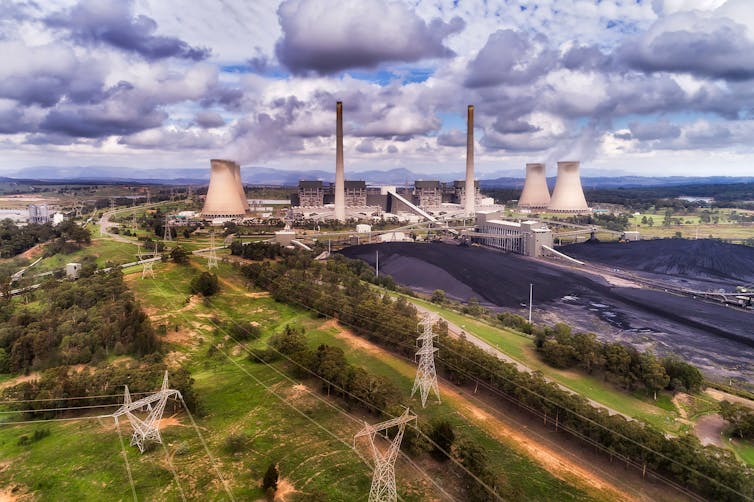
Its new A$32 billion Electricity Infrastructure Roadmap will, among other things, support the construction of 12 gigawatts of new renewable energy capacity by 2030. This is six times the capacity of the state’s Liddell coal-fired power station, set to close in 2023.

The roadmap was developed by NSW Environment Minister Matt Kean through extensive consultation with industry and others, including ourselves. While we believe a national carbon price is the best way to reduce emissions, the NSW approach nonetheless sets an example for other states looking to increase renewable energy capacity. So let’s take a closer look at the plan.

NSW Environment Minister Matt Kean
The authors worked with NSW Environment Minister Matt Kean, pictured, to help devise the policy. Dean Lewins/AAP

What’s the roadmap all about?

The roadmap acknowledges that within 15 years, three-quarters of NSW’s coal-fired electricity supply is expected to reach the end of its technical life. It says action is needed now to ensure cheap, clean and reliable electricity, and to set up NSW as a global energy superpower.

The plan involves a coordinated approach to transmission, generation and storage. By 2030, the government aims to:

  • deliver about 12 gigawatts of new transmission capacity through so-called “renewable energy zones” in three regional areas by 2030. It would most likely be generated by wind and solar

  • support about 3 gigawatts of energy storage to help back up variable renewable energy supplies. This would involve batteries, pumped hydro, and “hydrogen ready” gas peaking power stations

  • attract up to A$32 billion in private investment in regional energy infrastructure investment by 2030

  • support more than 6,300 construction and 2,800 ongoing jobs in 2030, mostly in regional NSW

  • reduce NSW’s carbon emissions by 90 million tonnes.

The plan also aims to see the average NSW household save about A$130 a year in electricity costs, although this might be hard to achieve in practice. And regional landholders hosting renewable projects on their properties are expected to earn A$1.5 billion in revenue over the next 20 years.

The Liddell coal-fired power station
12 gigawatts of new renewables capacity is about six times the capacity of NSW’s Liddell coal-fired power station. Shutterstock

Giving generators options

One of the most innovative aspects of the NSW proposal is that generators will have two options when it comes to selling their electricity.

First, the government will appoint an independent “consumer trustee” to purchase electricity from generators at an agreed price – giving the generators the long-term certainty they need to invest. The trustee would then sell this electricity either directly to the market, or through contracts to retailers.

But the trustee will encourage generators to first seek a better price by finding their own customers, such as energy consumers and other electricity retailers.


Read more: Zali Steggall’s new climate change bill comes just as economic sectors step up


This system is different to the approach adopted in Victoria and the ACT, where government contracts remove any incentive for generators to participate in the energy market. Over time, this limits market competition and innovation.

The NSW plan improves on existing state policies in another way – by aligning financial incentives to the physical needs of the system. The Consumer Trustee will enter into contracts with projects that produce electricity at times of the day when consumers need it, and not when the system is already oversupplied.

While this won’t be easy for the trustee to model, this approach is likely to benefit consumers more than in other jurisdictions where lowest-cost projects seem to be preferred, irrespective of whether the energy they produced is needed by consumers.

One shortcoming of the roadmap is it does not financially reward existing low-emissions electricity generators in NSW, nor does it charge carbon-heavy electricity producers for the emissions they produce. This could be corrected in the future by integrating the policy into a nationally consistent carbon price, which transfers the cost of carbon pollution onto heavy emitters.

A $50 note sticking out of a power socket
Electricity generators will be guaranteed a floor price for their electricity. Julian Smith/AAP

Why is all this so important?

NSW’s ageing coal-fired power stations are chugging along – albeit with ever-declining reliability. But it’s only a matter of time before something expensive needs fixing. This was the case with Hazelwood in Victoria: the old walls of the boilers had thinned to less than 2 millimetres. The repair cost was prohibitive and the station closed with just five months’ notice. Electricity prices shot up in response to unexpectedly reduced supply.

In NSW, the consumer trustee will be tasked with helping ensuring replacement generation is delivered in a timely way. This means developing new generation capacity well ahead of announced coal plant closures.

This is a helpful development. But ultimately a stronger measure will be needed to ensure coal plants give early notice of their intention to exit the market. The Grattan Institute has previously suggested coal generators put up bonds that are forfeited if they close early. We think this model is worth considering again.

Seize the opportunity

As the world’s largest exporter of coal and LNG, Australia has much to lose as global economies shift to zero emissions. But our renewable energy potential means we also have much to gain.

Australia needs a durable, nationally consistent policy framework if we’re to seize the opportunities of the global transition to clean energy. The NSW roadmap is a significant step in the right direction.


Read more: Biden says the US will rejoin the Paris climate agreement in 77 days. Then Australia will really feel the heat


ref. NSW has joined China, South Korea and Japan as climate leaders. Now it’s time for the rest of Australia to follow – https://theconversation.com/nsw-has-joined-china-south-korea-and-japan-as-climate-leaders-now-its-time-for-the-rest-of-australia-to-follow-149731

New cyclone forecasts: why impacts should be the focus of hazardous weather warnings

Source: The Conversation (Au and NZ) – By Sally Potter, Hazard and Risk Management Researcher, GNS Science

November 12 marks the 50th anniversary of Cyclone Bhola, the deadliest weather event on modern record.

When this storm made landfall over Bangladesh, it coincided with a lunar high tide. The subsequent storm surge killed at least 300,000 people.

This month also marks the start of the cyclone season in the Pacific. The outlook suggests New Caledonia should prepare for stronger cyclone activity. New Zealand also faces a higher risk of being battered by ex-tropical cyclones.

In the 50 years since Cyclone Bhola, the accuracy of weather forecasts has improved dramatically. Today’s five-day cyclone forecast is as good as a three-day forecast was 20 years ago. But the way we communicate their risks and impacts is lagging behind.

The World Meteorological Organization is moving to impact-based cyclone forecasting.

The World Meteorological Organization (WMO) is working with its member countries to change that by shifting to impact-based forecasting — moving from communicating what the weather will be, to what the weather will do.

Preparing for a storm surge

Storm surges generated by tropical cyclones are among the world’s most deadly and destructive natural hazards. They may have killed as many as 2.6 million people around the world over the past two centuries.

The warming of the oceans means the world is experiencing more intense cyclones. Relative to 2000, sea level is expected to rise by 20–30cm by 2050, leaving many coastal communities, especially those in small island nations, increasingly vulnerable to cyclone-generated storm surges.


Read more: Storm warning: a new long-range tropical cyclone outlook is set to reduce disaster risk for Pacific Island communities


Traditional hazard-based warnings are based on criteria such as wind speeds or rainfall intensity, but impact-based forecasts focus on the level of damage expected from an impending storm.

Impact-based forecasts for small island nations

When Cyclone Winston hit Fiji on February 20, 2016, it was the most intense cyclone ever recorded in the southern hemisphere.

In 2017, the unprecedented hurricane season in the Caribbean unleashed major hurricanes Irma and Maria, devastating many small island countries.

The premise of impact-based forecasting is that a well communicated warning will enable people to make decisions and take actions to reduce their exposure to life-threatening risks.

Damage from Cyclone Winston in Fiji, in February 2016.
Cyclone Winston was the most intense cyclone recorded in the southern hemisphere. Fiji National Disaster Management Office, Author provided

But while such warnings may be more effective in increasing awareness of potential impacts, my earlier research suggests this does not necessarily translate to more action.

Preparedness is also an essential part of the equation, and can only be achieved by working with communities and emergency services before extreme events. Impact-based forecasting will only be effective if it helps at-risk communities to take action ahead of these impacts.


Read more: Our new model shows Australia can expect 11 tropical cyclones this season


Early-warning systems a priority

The 2020 State of Climate Services report, published by the WMO and 15 other agencies last month, suggests impact-based forecasting could be a game-changer for small island nations in the Pacific and Caribbean regions.

Since 1970, small island developing states have lost US$153 billion because of weather, climate and water-related hazards. Almost 90% of small island developing nations have identified early-warning systems as a top priority in their pledges under the Paris climate agreement.

Known as nationally determined contributions, or NDCs, these pledges describe efforts by each country to reduce national emissions and adapt to the impacts of climate change.

While the knowledge of cyclone risk is high in small island developing states, their capacity to communicate impacts and disseminate warnings is lower than the global average. In an interview, the WMO’s chief of early-warning services, Cyrille Honoré, told us the move towards impact-based forecasting should improve the way different agencies can work together to protect vulnerable communities:

The reason we are introducing impact-based forecasting in small island nations is because it will help to save more lives and better protect assets, infrastructure and livelihoods. In the context of small island nations, these impacts may be significant enough to annihilate years of development efforts, so this is really a contribution to enhancing the resilience of these nations.

Fiji’s prime minister Josaia Voreqe Bainimarama told us he hopes impact-based forecasting will help Fijians prepare to deal with the new normal of “climate-fuelled, extreme weather patterns”:

This work to improve cyclone forecasting is vital because it gives us a lifesaving window of opportunity to prepare for a storm’s arrival, allowing relevant authorities to make accurate and timely predictions for better informed decisions.

ref. New cyclone forecasts: why impacts should be the focus of hazardous weather warnings – https://theconversation.com/new-cyclone-forecasts-why-impacts-should-be-the-focus-of-hazardous-weather-warnings-149358

Fewer Australians are taking advanced maths in Year 12. We can learn from countries doing it better

Source: The Conversation (Au and NZ) – By Linda Galligan, Associate professor, University of Southern Queensland

A recent New South Wales report showed about one quarter of Year 12 students did not take any Higher School Certificate (HSC) maths courses over the last decade. This was compared to around 6% students who opted out of HSC maths in 2000.

In Queensland, reports show nearly one-third of senior students drop out of the intermediate mathematical methods subject, which includes algebra and calculus. The number of Year 11 students choosing the easiest maths subject (not automatically counted towards the ATAR), essential mathematics, has soared by 45% this year — from 12,687 in 2019 to 18,431 in 2020.

Because of the move towards automation, some recent industry reports note 75% of the fastest growing occupations will require high-level skills in STEM (science, maths, engineering and technology). But studies consistently show in Australia, participation in secondary school advanced maths continues to decline.

Although national participation rates in Year 12 maths subjects are still high — at around 80% — the proportion of students choosing advanced (calculus-based) maths subjects has declined sharply in the last 20 years. In every year of the last decade, fewer than 30% of students chose intermediate or higher mathematics.

Changes at university level aren’t enough

Strategies designed to improve participation in maths include reintroducing maths prerequisites for certain areas of university study (such as engineering) and offering bonus points for university entry for students who have done advanced maths. The government’s recent job-ready graduates legislation will also make STEM degrees cheaper to study.


Read more: The government is making ‘job-ready’ degrees cheaper for students – but cutting funding to the same courses


These strategies all focus on improving the flow to tertiary education.

But students’ engagement with maths, including their level of achievement and attitude to its importance, are formed much earlier than senior secondary school. This means the impact of the above initiatives may not be as effective as intended.

Recent NSW data shows the University of Sydney’s reintroduction of prerequisites for a wide range of their degrees has failed to shift the dial significantly for falling enrolments in HSC mathematics.

A 2019 report by the Australian Council for Educational Research, suggested that, for the Group of Eight universities in the study, most students entering science degrees had in fact completed an appropriate level of maths even though they weren’t required to.

What about other countries?

It is hard to get standardised data useful for comparing Australian and international participation in upper level, high school maths. There are differences in curriculum structures and content across and within countries.

For example, comparing participation in countries where maths is compulsory until the end of school, for example, Sweden, Japan, Korea, Russia, Finland, Taiwan, and Estonia,to those where it is not, makes little sense.

A young Asian boy writing calculations on a chalk board.
Maths is compulsory until the end of school in many countries. Shutterstock

Some interesting comparisons, however, can still be made. In the US, where maths is not compulsory, only 19% of students who completed high school in 2013 took calculus-based courses.

The United Kingdom, after recognising participation in advanced maths was in serious decline, launched a national campaign to reverse the trend. This included a £67 million initiative to improve teacher supply in maths and physics. While there was some improvement after the campaign, almost three-quarters of students who achieved good marks in maths still chose not to study it after the age of 16.

Participation rates in higher level maths can predict the number of tertiary STEM graduates and the future of the STEM workforce. But strong levels of achievement in maths earlier in the school years are essential to feed the pipeline.

Maths achievement scores for Australian 15-16 year olds, based on international comparative reports — such as the Programme for International Student Assessment PISA and the Trends in International Mathematics and Science Study TIMSS — have shown steady decline since 2003. Perhaps even more concerning is that the ranking-gap between Australia and top performing countries is widening.


Read more: Estonia didn’t deliver its PISA results on the cheap, and neither will Australia


In recent TIMSS reports, which also provide information about students’ attitudes to maths, Australian Year 8 students place almost the same value on maths as their international peers. But a striking difference in attitude emerges from the data — Australian students are significantly less satisfied and engaged with maths than their international peers.

Half of our students don’t like maths, compared to 38% of students in other countries. About one-quarter of our students find maths teaching unengaging, compared to 17% for international students.

What can we do?

Australia can look to successful strategies overseas.

Estonia, the highest ranked European country for maths in PISA in 2018, has small classes and almost no high-stakes tests for school children, leaving more time for instruction.

In Australia, the introduction of NAPLAN has resulted in no perceivable improvement in student outcomes. NAPLAN has come under increased criticism, particularly around the amount of valuable class time that may be devoted to NAPLAN style tasks.

Australia needs to concentrate on high-quality student instruction not testing, and improving attitudes to, and engagement in, mathematics.

Australia has one of the highest rates of out-of-field teaching (teaching outside field of expertise) in mathematics and science in the world. Only in the United States, Brazil and Australia does this occur on a large scale. And it appears to be worse in Australia than the United States.


Read more: More teens are dropping maths. Here are three reasons to stick with it


Over half of school principals in 2017 reported they had maths and science classes being taught by teachers who weren’t fully qualified in the discipline. Research has also found 22% of Australian Year 8 students were taught by out-of-field teachers, compared to an international average of 13%.

The Australian government has tried to close this gap by providing A$9.5 million for professional learning and resources for teachers from primary to secondary school. But more funding needs to be directed towards out-of-field maths teachers in higher year levels to reach international standards.

In Ireland, for example, about €7 million has been committed towards professional development for out-of-field maths teachers in the post-primary years.

Australian maths curricula are ambitious, including a strong emphasis on calculus. And they have recently expanded the amount of statistics included at upper year levels.

The UK has looked to successful STEM-education countries like Singapore. Half of its primary schools will adopt their model of deep learning of maths. This moves away from simple rote learning to focus on teaching children how to problem solve. It also covers fewer topics in far greater depth.

Whatever strategies Australia adopts over the next decade to improve maths participation for school children, all levels of education must be involved and include teacher professional development.

ref. Fewer Australians are taking advanced maths in Year 12. We can learn from countries doing it better – https://theconversation.com/fewer-australians-are-taking-advanced-maths-in-year-12-we-can-learn-from-countries-doing-it-better-149148

A third of our waste comes from buildings. This one’s designed for reuse and cuts emissions by 88%

Source: The Conversation (Au and NZ) – By Roberto Minunno, Research Fellow in Sustainability Buildings, Curtin University

Designing buildings so they can easily be taken apart and the materials reused provides a feasible and commercial pathway for minimising waste and greenhouse gas emissions. Our research shows one such Curtin University building, the Legacy Living Lab in Fremantle, reduces construction waste and cuts emissions to almost a tenth of what a conventional building process would produce.

The modular, circular economy building produces benefits in all six environmental indicators we assessed. It’s part of our vision for the decarbonisation of buildings.

The Legacy Living Lab is proof that designing buildings for disassembly and reuse greatly reduces their environmental impacts.

Read more: Buildings produce 25% of Australia’s emissions. What will it take to make them ‘green’ – and who’ll pay?


Learning from nature

Natural biogeochemical cycles create little or no waste. These circular cycles eventually transform used material into a new resource. For example, through the nutrient cycle a fallen leaf provides the building blocks for future leaves.

It’s simple and beautiful. The opposite of a linear model of “take, make, dispose”. It’s complex and ugly.

Unfortunately, this is the model industrialised society has adopted. And not only for our coffee pods, which mostly end up in landfill, but also for most commercial and residential buildings.

The building industry consumes about 50% of mineral resources and produces about 35% of waste. It’s a major source of global greenhouse gas emissions. What, then, can be done?

steel frames of a building under construction
The reuse of steel frames for building saves costs and reduces resource consumption and emissions. Author provided

Read more: We create 20m tons of construction industry waste each year. Here’s how to stop it going to landfill


Rethinking ‘downward spiral’ recycling

The answer lies in revisiting the basics of our recycling practices. Since the late 1990s, recycling has been considered an environmental solution, with recycling bins popping up everywhere. However, researchers and consumers alike have begun to realise recycling often comes down to mere “wishcycling”. Less than 10% of plastics is actually being recycled.

Reprocessing is considered the best way to keep materials in use, particularly for artefacts like coffee cups or microchips. However, for many other products, such as building materials, recycling often translates into less than helpful down-cycling.

Even seemingly environmentally benign material, such as timber, often cannot be recycled. Rather, it is remanufactured into products of lower economic value and quality. The material is in a downward spiral that only delays its disposal to landfill.

Clearly, it is much better for the environment if we can find ways to reuse products. Indeed, there are “reusable alternatives for almost everything: beeswax or silicone food wraps, reusable coffee pods, shampoo and conditioner bars, reusable safety razors and bars of soap, rather than liquid soap”.


Read more: With the right tools, we can mine cities


Applying reuse principles to buildings

Can this reuse practice be adopted for buildings too? After all, a building is a sophisticated and complex product compared to coffee pods or cling wrap.

Researchers from Curtin University Sustainability Policy (CUSP) Institute put this question to the test by building a modular, reusable laboratory. It’s a place where researchers, builders and citizens alike can meet to prototype and study new products.

interior of building
The Legacy Living Lab is a highly functional building that can be taken apart and reused elsewhere within a matter of days. Author provided

The Legacy Living Lab (L3) is a highly functional, state-of-the-art building with offices and space for collaboration. Yet it can be taken apart – deconstructed or disassembled – moved and reused anywhere within weeks.

Findings from studying the environmental impact of this facility point towards a resounding yes to the question of whether reuse practices can be adopted for buildings. The in-built reuse practices of the L3 save 18 tonnes of construction materials from disposal compared to common building industry practices. This leads to an 88% decrease in greenhouse gas emissions.

So how was this done? Simply, by choosing reused steel frames, opting for steel foundations instead of concrete, and designing internal wall cladding that’s easily disassembled. This makes it almost as easy to take the building apart as your average Lego spaceship.

wall cladding
The internal wall cladding is designed to be easily taken apart. Author provided

Read more: Green cement a step closer to being a game-changer for construction emissions


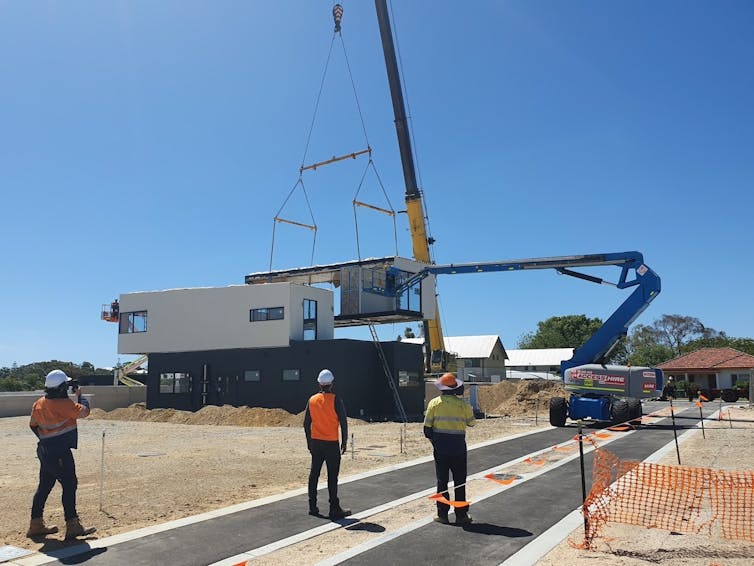
When the time comes to decommission the building, it can be deconstructed as eight modules. These can be moved to the next site for reuse rather than being demolished.

Modular buildings are made of box-shaped structures, built off-site and delivered on-site in a matter of hours. This has the added benefit of minimum disruption for our cities compared to traditional construction sites.

Modular buildings come in all shapes and dimensions, from tiny houses to skyscrapers and factories. They are often more cost-effective to produce than traditional double-brick constructions.

Thus, as well as a minimal environmental footprint, the advantages of modular buildings include flexibility, speed and cost.

People watch as a crane lowers a building module into place
The building’s eight modules were built off-site and then rapidly put together on site. Author provided

Creating a new building materials market

By adopting easily disassembled modular buildings, we can create a whole new market for reusable building materials. Design-for-disassembly and closed-loop supply chains can keep building components in the material loop as they are – without the need for wishy-washy and wasteful recycling procedures.

Similar to the way nature operates, the team at CUSP created a building whose byproducts from one process remain in the loop as inputs for the next, keeping waste to a minimum. In this way, disassembly becomes much safer and cleaner, which benefits our cities and their residents.


Read more: Unbuilding cities as high-rises reach their use-by date


All that does not mean recycling building waste isn’t beneficial. It all depends on the project. Timber can at least be chipped into garden mulch, bricks and concrete crushed into road base, and so forth.

But this approach is not nearly as neat as nature’s way of handling waste. Design for disassembly and modularity comes closer to that. It can lead the way towards a marketplace where it is common practice to retain material in the supply chain.

If our goal is to create products and processes that “solve our greatest design challenges sustainably and in solidarity with all life on Earth”, it’s time we turned toward nature. We believe it will be a wiser guide than any other in our efforts to redefine wasteful, linear business models.

ref. A third of our waste comes from buildings. This one’s designed for reuse and cuts emissions by 88% – https://theconversation.com/a-third-of-our-waste-comes-from-buildings-this-ones-designed-for-reuse-and-cuts-emissions-by-88-147455

When to buy Christmas gifts online to get them in time? The answer is now

Source: The Conversation (Au and NZ) – By Flavio Romero Macau, Senior Lecturer in Supply Chain Management and Global Logistics, Edith Cowan University

Santa Claus is the ultimate global logistics worker, magically delivering gifts all over the world in a single night.

The rest of us have to rely on more mundane delivery systems to get gifts under the Christmas tree and into stockings – and this year those systems are under huge pressure.

So if you’re ordering gifts online, how late can you leave it to guarantee they arrive in time?

Our advice is to lock in your orders in the next few days. Anything ordered from late November may not arrive before 2021.

Even if you’re planning on traditional bricks-and-mortar Christmas shopping, do it sooner rather than later. The supply chains that usually keep shops stocked during December could fall behind.

Leave it too late and you may find your most wanted item out of stock.


Read more: Whatever the hardships of COVID-19, let’s be thankful it wasn’t COVID-99


Parcel pressures

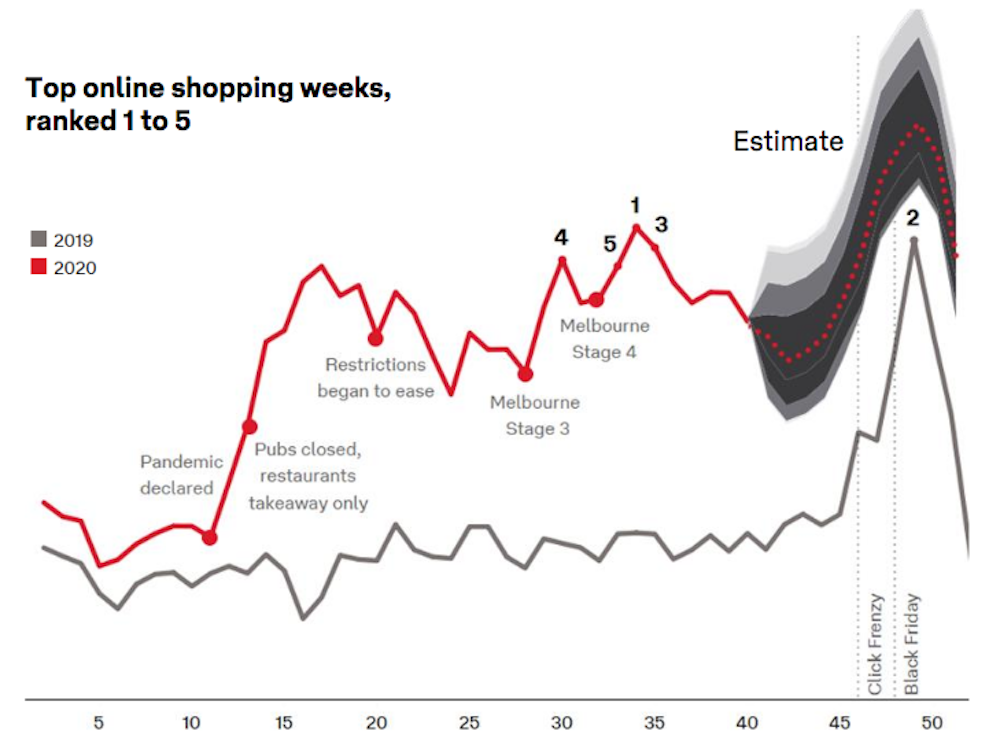
Delivery services have been under strain for most of 2020 due to the dramatic increase in online shopping driven by the COVID-19 pandemic.

In the US online shopping is up more than 30% year on year. The UK is similar, and set to increase as the country goes into another lockdown. In Australia it’s up more than 75% to last year.

With online sales in September already more than 7% higher than the 2019 Christmas peak, Australia Post is projecting a huge increase in the month prior to Christmas.


Number of online purchases, Australia, 2019-2020

Australia Post

What this means, of course, is many more parcels to deliver – more than eight times the monthly average if 2019 is anything to go by. Delivery services will find it hard – if not impossible – to cope.

As noted by James Thomson, chief strategy officer with US company Buy Box Experts (a service provider to Amazon sellers) the weakest link in the delivery chain is “last-mile delivery capacity”.

With consumers moving so many more shopping dollars online, all of those sites need last-mile delivery through UPS, FedEx, USPS, etc […] While these carriers are building capacity, they likely will not build anywhere near enough, resulting in late shipments and disappointed customers.

If that’s the case in the US, it’s even more true in Australia. In 2019 Australia Post delivered 41.5% of parcels to premises. While it and other postal services (such as the UK’s Royal Mail) hire thousands more casual workers from as early as September to cope with the load, there are still only so many sorting facilities and delivery vehicles.


Read more: You’ve got (less) mail: COVID-19 hands Australia Post a golden opportunity to end daily letter delivery


Overseas delays

To these local delivery delays, add delays for goods coming from overseas.

Many regions are experiencing renewed COVID-19 restrictions, reducing manufacturing and distribution capacities. These disruptions, going back over the whole year, will mean shortages.

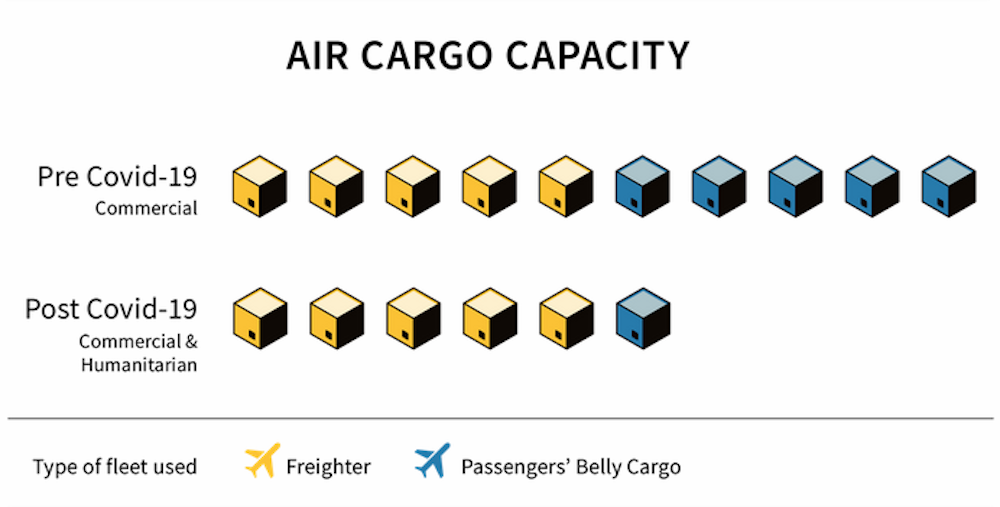
Also, many items “shipped” from places such as China have historically come by air – not just in dedicated cargo planes but also commercial passenger planes. Prior to the COVID-19 pandemic half of all air cargo was transported in passenger planes. The International Civil Aviation Organisation estimates passenger aircraft “belly cargo capacity” has fallen 80%.


International Civil Aviation Organisation

While freighter capacity has increased, as of late October global air cargo capacity was still 20% lower than a year ago.

December is usually the busiest period for air travel, with these extra passenger flights helping to deliver higher cargo volumes. That’s not going to be the case this year. So expect any deliveries relying on air transport to take longer.

Currently Australia Post advises allowing for more than 25 days for international deliveries.

Post haste

These stresses on international supply chains will also affect stocks in local retail shops.

Even in the best of times supply chains are pushed to their limits towards the end of the year. If they are not healthy to start with, Christmas can be the last straw. Inventory for products as different as bicycles, video games and dumbbells are already way down.

The signs are there – out-of-stock messages, caveats on expected dispatch times, and long delays in promised delivery times.

So you want the full Christmas experience with a tree full of presents, order or buy now to avoid disappointment.

This is not a year to procrastinate, or wait until the last moment to get the best deal. In 2020 first come will be first served.

ref. When to buy Christmas gifts online to get them in time? The answer is now – https://theconversation.com/when-to-buy-christmas-gifts-online-to-get-them-in-time-the-answer-is-now-149157

View from The Hill: When Australia’s first law officer is in the dock of public opinion

Source: The Conversation (Au and NZ) – By Michelle Grattan, Professorial Fellow, University of Canberra

It’s quite a moment, when the country’s first law officer is asked on his home town radio station, “So you don’t think you’re a sleazebag or womaniser or someone who’s drunk in public too much now?”

Overnight, Christian Porter had been reduced from high-flying attorney-general to a man forced to publicly confront a nightmare episode of “This is Your Life” delivered by Monday’s Four Corners.

“No, it’s definitely not indicative of who I am now,” he told interviewer Gareth Parker.

Parker did not resile from going to some of the worst of the confronting detail in the program. “Did you ever say you wouldn’t date a woman who weighed over 50 kilograms and preferred that they had big breasts?‘

“Absolutely not. I mean, like, give me a break.”

But Porter – who’s having to turn up on the House of Representatives frontbench all week under the eye of colleagues and opponents – was given no breaks in this long-distance grilling. His regular Perth 6PR spot became akin to a courtroom, with him in the dock.

First up: had he ever had an intimate relationship with a staffer?

Well, certainly not the staffer he’d been seen drinking with at Canberra’s Public Bar in December 2017, in the (details disputed) incident that led then-PM Malcolm Turnbull telling him to watch his ways.

Indeed, Porter said, the woman in question had categorically denied to Four Corners (which said she worked for another cabinet minister) the slant put on the story or that it indicated any relationship. But (unfortunately for him) her denial had been “off the record,” he said. it was not reported.

Porter was lawyerly when quizzed about whether he’d ever had a relationship with any other staffer. He wasn’t going to be pushed down byways. “Is there another allegation?” he countered.

With the nose of the experienced prosecutor he once was, Porter smells political payback.

The program’s biggest punch was delivered by Turnbull, with whom Porter had a major falling out just before the former PM lost the leadership.

In a heated dispute Turnbull argued the governor-general should refuse to commission Peter Dutton, if he won the leadership, because he might be constitutionally ineligible to sit in parliament. But Porter insisted Turnbull’s suggested course would be “wrong in law” and threatened to repudiate his position if he advanced it publicly.

“I often suspected that there would be some consequences for that,” Porter said in the 6PR interview.

“I don’t think that Malcolm is a great fan of mine, I’d say that much,” he told Parker, when asked whether he was suggesting Turnbull was motivated by revenge.

Porter’s strategy is to own and apologise for his distant past – “I’m no orphan in looking back on things that I wrote and did 25-30 years ago that make me cringe” – but strongly contest the construction put on his more recent life.

He’s threatened legal action, but his Tuesday tone suggested he’s more likely to suck up the damage rather than taking the distracting, expensive and risky course of going to a real court.

He and fellow cabinet minister Alan Tudge – whose affair with his staffer the program exposed – retain the support of Scott Morrison.

Morrison relies on the “BBB” defence. That is, these incidents were Before the Bonk Ban – specifying no sex allowed between ministers and their staff – imposed by Turnbull early 2018 in response to the Barnaby Joyce affair.

Morrison was at the time, and is now, an enthusiastic supporter of the prohibition. He’d like to see it embraced by Labor, who’d “mocked” it when it was announced. (One of the government’s many gripes about the Four Corner’s program is that it didn’t poke around to find Labor’s dirty washing.)

“I take that code very seriously and my ministers are in no doubt about what my expectations are of them,” Morrison told a news conference.

But please, can people keep the language more delicate? Terms matter to this PM, who once lectured the media against using “lockdown”.

When female minister Anne Ruston was asked (at their joint news conference on another matter) to reflect on whether the parliament house culture had become better or worse since the “bonk ban”, Morrison interrupted her.

“How this ban is referred to I think is quite dismissive of the seriousness of the issue,” he said.

“I would ask media to stop referring to it in that way. We took it very seriously and I think constantly referring to it in that way dismisses the seriousness of this issue, it’s a very serious issue.”

We can’t know whether the Porter story will fade or there’ll be some fresh spark.

Porter was asked if he could “go to bed tonight, comfortable in the knowledge that there isn’t a woman out there who’s going to come forward and give a truthful account of her interactions with Christian Porter that would further embarrass you or damage the government”.

Porter said: “I haven’t conducted myself in a way that I think would lead people to provide that sort of complaint about me”.

Whether the story goes somewhere or nowhere, one thing seems clear. The hopes of 50-year old Porter – who switched to federal politics after an impressive state career – of ever reaching prime minister are in the mud.

In under an hour on Monday night, a red line was likely struck through his name on the list of future Liberal leadership prospects.

ref. View from The Hill: When Australia’s first law officer is in the dock of public opinion – https://theconversation.com/view-from-the-hill-when-australias-first-law-officer-is-in-the-dock-of-public-opinion-149841

90% efficacy for Pfizer’s COVID-19 mRNA vaccine is striking. But we need to wait for the full data

Source: The Conversation (Au and NZ) – By Harry Al-Wassiti, Bioengineer and Research Fellow, Monash University

German biotech company BioNTech and US pharmaceutical Pfizer announced on Monday promising early results from their phase 3 clinical trial for a vaccine against SARS-CoV-2, the virus that causes COVID-19.

These early results are what is known as an “interim analysis”. It’s an early look at the data before a study is complete, to understand if there is any indication of whether the vaccine might work.

Currently, this trial has enrolled 43,538 volunteers, giving half the volunteers two doses of the vaccine and the other half two doses of a placebo. These volunteers then continued their normal lives, but they were monitored for any symptoms that could be COVID-19, with testing to confirm.

Analysis of 94 volunteers with confirmed COVID-19 suggests the vaccine has an efficacy of over 90%.

This means that if you took ten people who were going to get sick from COVID-19 and vaccinated them, only one out of ten would now get sick.


Read more: Australia’s just signed up for a shot at 9 COVID-19 vaccines. Here’s what to expect


Can we get excited yet?

There is more data to come. This is a press release and the data have not undergone “peer-review” through scientific publication, although it has been assessed by an independent monitoring board. The study also won’t be complete until 164 volunteers have confirmed COVID-19, and the estimate of efficacy may therefore change. Finally, the volunteers must be monitored for a defined period of time after vaccination for any side effects and this must be completed.

Important questions also remain. It’s unclear how long protection will last, as this study has only been underway for three months. It’s unclear if this vaccine protects against severe disease or if this vaccine will work equally well in everyone. For example, a phase 1 clinical trial with this vaccine showed that immune responses were lower in older people.

Pfizer's manufacturing plant in Belgium
90% efficacy would be far higher than the FDA’s threshold of 50%, and greater than that of many flu vaccines, which tend to provide around 60%. Virginia Mayo/AP/AAP

But 90% efficacy is striking. To give some context, the US Food and Drug Administration indicated they would licence a SARS-CoV-2 vaccine with 50% efficacy. The flu vaccine often provides around 60% efficacy and the mumps vaccine, which is currently the fastest vaccine ever made at four years, provides around 88% efficacy.

The BioNTech/Pfizer vaccine could outstrip that, after just nine months of development. This level of efficacy means virus transmission could be very effectively controlled.

That has the research community excited. It bodes well for other vaccines currently being tested for SARS-CoV-2 and we could end up with multiple successful vaccines. This would be great because some might work better in certain populations, like older people.

Multiple vaccines could also be manufactured using a broad range of established infrastructure, which would accelerate vaccine distribution.

Australia has no capacity to produce mRNA on a commercial scale

The BioNTech/Pfizer vaccine is what’s called an mRNA vaccine.

As this article by Associate Professor Archa Fox, an expert on molecular cell biology from the University of Western Australia, explains:

mRNA vaccines are coated molecules of mRNA, similar to DNA, that carry the instructions for making a viral protein.

After injection into muscle, the mRNA is taken up by cells. Ribosomes, the cell’s protein factories, read the mRNA instructions and make the viral protein. These new proteins are exported from cells and the rest of the immunisation process is identical to other vaccines: our immune system mounts a response by recognising the proteins as foreign and developing antibodies against them.

The problem is Australia can’t make mRNA vaccines onshore yet.

The Australian government has an agreement for ten million doses of the BioNTech/Pfizer vaccine. Since this vaccine requires two doses, this agreement is sufficient for five million Australians. It’s unclear how long it will take until any vaccine is widely available, but we may hear more about this in the coming weeks and months.

The vaccine requires storage at a temperature below -60℃. This will certainly be a challenge for shipping to Australia and local distribution, although not impossible. One solution to this problem is to form vaccination centres to roll out the vaccine once it becomes available. In a briefing by Pfizer, the company said it will use ultra-low temperature shipment strategies and the vaccine can then be distributed on “dry-ice”.

Currently, Australia has no capacity to produce mRNA on a commercial scale given the technology’s novelty. But we (the authors) and others have been working to coordinate and build the manufacturing capacity in Australia for future mRNA vaccine and therapeutics. With financial support aimed at private-public mRNA manufacturing collaboration, Australia can equip itself with this vital technological asset.


Read more: Australia may miss out on several COVID vaccines if it can’t make mRNA ones locally


ref. 90% efficacy for Pfizer’s COVID-19 mRNA vaccine is striking. But we need to wait for the full data – https://theconversation.com/90-efficacy-for-pfizers-covid-19-mrna-vaccine-is-striking-but-we-need-to-wait-for-the-full-data-149818

JobSeeker supplement extended to end-March, at lower rate

Source: The Conversation (Au and NZ) – By Michelle Grattan, Professorial Fellow, University of Canberra

The federal government will extend the JobSeeker Coronavirus supplement for an extra three months, to the end of March, at a cost of $3.2 billion.

The supplement, which is currently $250 a fortnight, will be at a reduced rate of $150 a fortnight during that period.

Prime Minister Scott Morrison said the financial “lifeline” that had been extended during the COVID crisis could not be allowed now to hold Australia back, as the country moved into the next phases of recovery.

The extension is a recognition that longer-term assistance is needed for the high number of people who will be unemployed early next year and that extra stimulus is needed to help lift the economy out of recession as soon as possible.

But the government is still avoiding the question of what change it will make to the base JobSeeker rate, which was widely recognised as inadequate long before the pandemic.

At the same time, the government is pushing a tougher approach to trying to ensure people take what jobs are available.

Morrison told a news conference mutual obligation requirements were being enforced. There were nearly 260,000 suspensions between September 28 and October 31, and from August 4 to October 31, 242 payments were cancelled.

“So the mutual obligation requirements are there and we are serious about them. But we are also serious about the support we need to provide to Australians,” Morrison said.

We are seeing confidence return, whether it’s on the NAB measures just released today, the ANZ measures showing confidence getting above where it was pre-pandemic or the Westpac figures that were released for last month,” Morrison said.

“Australia is safely reopening and it needs to remain safely open. Jobs are returning. Job advertisements have doubled since May on the most recent figures in October, and we know that employers are looking for people to come back to work and we need to ensure that we have the right settings in place to support that.”

The shadow minister for families, Linda Burney, said the government would “cut unemployment support by $100 per fortnight after Christmas.

“With the Morrison Government expecting 1.8 million Australians to be on unemployment support by the end of the year, now is not the time to cut unemployment support. There are simply not enough jobs for every Australian who needs one.”

ref. JobSeeker supplement extended to end-March, at lower rate – https://theconversation.com/jobseeker-supplement-extended-to-end-march-at-lower-rate-149829

Shy rodents may be better at surviving eradications, but do they pass those traits to their offspring?

Source: The Conversation (Au and NZ) – By Kyla Johnstone, PhD candidate, University of Sydney

Rodents such as house mice (Mus musculus) aren’t just pests at home, they can cause serious damage to native ecosystems.

Lord Howe Island, for example, harboured up to 150,000 introduced rats and 210,000 introduced mice that wrought havoc on the island’s native wildlife, before an intensive eradication effort was carried out. It was declared a success earlier this year, although monitoring for survivors will continue.


Read more: Invasive predators are eating the world’s animals to extinction – and the worst is close to home


But emerging research suggests the success of eradicating pests may depend on the personality of individual animals within a species.

Bolder, more active, aggressive or social individuals are more likely to interact with baits, traps or new objects and foods. As a result, they can be removed quickly.

On the other hand, shyer or less active individuals can take longer to be caught.

Why is this so important? Well for starters, animals that actively avoid eradication will breed and repopulate.

If the personality traits of these survivors are reflected in all, or even most, offspring then we could be facing a pest population that is incredibly difficult to remove. This is what our new research aimed to find out.

Aerial view of Lord Howe Island
Islands, such as Lord Howe Island off NSW, are refuges for a range of wildlife often not found anywhere else in the world. Shutterstock

When eradication efforts fail

Australia is home to more than 8,300 islands that provide refuge for unique species often found nowhere else in the world, including species now extinct on the mainland.

Introduced mammalian pests, particularly rodents, are huge threats to island species, which often evolve without predators. They don’t recognise these introduced mammals as a threat, making them easy targets.

For example, a 2010 study observed house mice literally eating albatross chicks alive on Marion Island near Antarctica. Neither the chicks nor parents showed any defensive or escape behaviour.


Read more: Feral animals are running amok on Australia’s islands – here’s how to stop them


Eradicating introduced pest species is the ultimate solution if we want to protect native island ecosystems.

But eradication efforts are only effective if every animal in a population is eliminated. While most failed efforts likely go unreported, on average, 11% of eradication attempts for rodents fail. For house mice in particular, failure rates can be as high as 75%.

Nesting albatross on Marion Island
Nesting albatross on Marion Island, where chicks were found to be eaten by introduced house mice. Shutterstock

When efforts fail, pest populations quickly bounce back. One study in 2016 found around 50 rats survived an eradication attempt by avoiding baits on Henderson Island in the South Pacific. Within only two years, the population had exploded into roughly 75,000 animals.

Developing personality traits

So if animal behaviour influences if an individual enters a trap or takes a bait, how much of the parent personality is reflected in the offspring?

If you’ve thought about the similarity between parents and children — in both human and our animal companions — then you know some offspring behave just like their parents, while others are very different.

Personality traits develop through a combination of experience, learning from parents and genetic inheritance.

Humans have selectively bred domestic animals, including dogs, cattle and horses for preferred personality traits, such as docility.


Read more: Understanding dog personalities can help prevent attacks


And studies on laboratory animals, including mice and chicks, have found selecting for preferred traits in parents can lead to these traits being strongly expressed in the offspring within a single generation.

However, can this immediate generational response occur in wild populations?

What our study did

To begin untangling this web, we used house mice as a model species and mimicked a failed eradication, where residual mice (the would-be survivors) were selected for biased personality traits.

A mouse in our study caught in a trap. Kyla Johstone, Author provided

After catching wild house mice, we tested for personality traits by filming their behaviour in a modified open-field arena. Mice that moved frequently between compartments and into light compartments (which present a risky scenario to a small nocturnal rodent) were considered to be “high active-bold” individuals.

Based on their behaviour, we then grouped individual mice into populations: high active-bold individuals, low active-bold (shy) individuals and intermediate individuals.


Read more: How to know if we’re winning the war on Australia’s fire ant invasion, and what to do if we aren’t


To closely mimic wild conditions, we released the populations into large outdoor yards and left the mice to breed for one generation. After recapturing every single mouse from the yards, we tested the offspring for the same personality traits.

The good news

Interestingly, although the parent populations had strong personality biases, there was a broad spectrum of personality among offspring of every population. In other words, bold mice didn’t necessarily produce bold offspring, nor shy mice, shy offspring.

A juvenile mouse
A juvenile mouse from our study. Mice born from shy parents didn’t necessarily have shy personalities. Kyla Johnstone, Author provided

This was reassuring news. However, demonstrating there’s no generational bias in house mice doesn’t mean it can’t arise elsewhere or in other species. And our study is an important stepping stone to explore this concept in other invasive species and over multiple generations.

Still, for house mouse eradications at least, our findings suggest that, even if all surviving individuals had a similar personality, by the next generation a broad spectrum of personality should emerge again.

This suggests we’re unlikely to be faced with a population that’s impossible to remove, and can focus on improving success rates for these difficult-to-remove individuals and species.


Read more: ‘Compassionate conservation’: just because we love invasive animals, doesn’t mean we should protect them


ref. Shy rodents may be better at surviving eradications, but do they pass those traits to their offspring? – https://theconversation.com/shy-rodents-may-be-better-at-surviving-eradications-but-do-they-pass-those-traits-to-their-offspring-146924

Evening Report’s Tech Now LIVE with Sarah Putt + Selwyn Manning at 8pm

LIVE TONIGHT on https://EveningReport.nz ‘s TECH NOW programme, Sarah Putt and Selwyn Manning will discuss the latest news and views emerging from the technology sector including tech-trends in New Zealand and around the world.

Tonight’s topics:

  • The new Labour-led Government has appointed David Clark as New Zealand’s Tech Minister. Sarah will take us through how the tech sector has responded to this controversial, but vitally important, appointment.
  • Trump’s out. Joe Biden’s in. How tech-friendly will US President-elect Joe Biden be?
  • And, we have heard about the Internet of Things, but what’s the Internet of Behaviours?

LIVE INTERACTION: If you join us while we are live via Facebook, Twitter or Youtube, do comment as we will be able to bring your comments, questions and views into the live programme.

Here are the interaction accounts: Facebook.com/selwyn.manning and Twitter.com/Selwyn_Manning and Youtube.

Remember, if you missed the live show, you can view it as video-on-demand, and earlier episodes too, by checking out EveningReport.nz

Climate explained: why do humans instinctively reject evidence contrary to their beliefs?

Source: The Conversation (Au and NZ) – By Peter Ellerton, Senior Lecturer in Critical Thinking; Curriculum Director, UQ Critical Thinking Project, The University of Queensland

CC BY-ND

Climate Explained is a collaboration between The Conversation, Stuff and the New Zealand Science Media Centre to answer your questions about climate change.

If you have a question you’d like an expert to answer, please send it to climate.change@stuff.co.nz


Why do humans instinctively reject evidence contrary to their beliefs? Do we understand why and how people change their mind about climate change? Is there anything we can do to engage people?

These are three very significant questions. They could be answered separately but, in the context of climate science, they make a powerful trilogy.

We understand the world and our role in it by creating narratives that have explanatory power, make sense of the complexity of our lives and give us a sense of purpose and place.

These narratives can be political, social, religious, scientific or cultural and help define our sense of identity and belonging. Ultimately, they connect our experiences together and help us find coherence and meaning.

Narratives are not trivial things to mess with. They help us form stable cognitive and emotional patterns that are resistant to change and potentially antagonistic to agents of change (such as people trying to make us change our mind about something we believe).


Read more: How do you know that what you know is true? That’s epistemology


If new information threatens the coherence of our belief set, if we cannot assimilate it into our existing beliefs without creating cognitive or emotional turbulence, then we might look for reasons to minimise or dismiss it.

At odds with each other

Consider the current presidential election in the United States and the supporters of Donald Trump and Joe Biden. The seemingly irreconcilable views of segments of the population are the result of very different narratives.

A Trump supporter holding a sign saying 'Dead people voting' and a Biden supporter holding a sign saying 'Hey Donald, you're fired'.
Very different viewpoints from supporters of Donald Trump and Joe Biden in the presidential election. Ringo H W Chiu/AP Photo

Each side interprets events through a lens of pre-existing beliefs that determines the meaning of new information. They might all be looking at the same thing, but they understand it in very different ways.

Information that one side points out can refute a claim from the other side is dismissed as conspiracy or deliberate falsehoods, or whatever it takes not to have to engage with and assimilate it.

More than this, sometimes we can only make sense of people who don’t share our world view by assuming they have some defect of perception or cognition that limits their ability to see things as clearly as we do.

After all, if they could see as clearly, surely they’d agree with us!

Climate science denial

Climate science is a typical example of this kind of effect.

Not only are there very different narratives people use to describe themselves and each other, but misinformation produced by some media organisations and private corporations is designed to feed into and amplify existing narratives for the purposes of creating doubt and dissent.

But it gets even worse. Because of an increasingly polarised political environment in many parts of the world and the intensification of the so-called culture wars, stances on topics that might once have been shared across the political and ideological spectrum are now grouped together.

Sign on a fence in the US saying 'Trump: COVID and climate denier'.
Not one, but two denials. Phil Pasquini/Shutterstock

For example, denial of the science of climate change is linked to denial of COVID-19 as a legitimate concern. We also find positions on climate science highly correlated to other, more basic ideologies.

Pick a topic and it’s increasingly easy to predict what someone might think about it based on their opinion about another topic in that same political basket of ideologies. The narratives are becoming more inclusive; it’s been a while since the politics of climate science has just been about the science.


Read more: Climate sceptic or climate denier? It’s not that simple and here’s why


It is also the case that belief in climate science is not a binary affair. There are many shades of belief here.

But all this does not mean people are immune to changing their view, even when they are deeply woven into their personal identity.

Yes, you can engage people … and change their mind

US musician, actor and writer Daryl Davis is a black man responsible for dozens of members of the Ku Klux Klan leaving and denouncing the organisation, including national leaders.

He did this through engaging them in conversation, and ultimately befriending them, in a genuine attempt to understand their world views and the deep assumptions on which they were based.

For Davis, mutual respect and a desire to understand each other are necessary conditions for peaceful coexistence and a convergence of views.

What Davis appreciated is a core principle of public reasoning, or reasoning together. If we wish others to join us in believing in something or in some course of action, we must not only have reasons that make sense to us, they must also be meaningful to others. Otherwise, explaining our reasoning amounts to little more than making another kind of assertion.

Creating shared meaning through reasoning together requires respectful dialogue and an intimate understanding and appreciation of each other’s world views.

Don’t lose sight of the truth

Let’s be clear, trying to understand how someone thinks is not about meeting them halfway on everything. The truth still matters.

A protest sign saying 'Denial is not a policy'.
Protests against climate change denial. Michael Coghlan/Flickr, CC BY-SA

In the case of climate change, we know that the planet is warming, that the consequences of this warming are very serious and that humans contribute significantly to it.


Read more: Climate explained: are we doomed if we don’t manage to curb emissions by 2030?


We like to think of ourselves as rational creatures, and we are. But that rationality is not devoid of emotional contexts. Indeed, we seem to need emotions to be rational.

For this reason, facts alone are not as convincing as we would like them to be. But facts coupled with respect, understanding and compassion can be enormously persuasive.

ref. Climate explained: why do humans instinctively reject evidence contrary to their beliefs? – https://theconversation.com/climate-explained-why-do-humans-instinctively-reject-evidence-contrary-to-their-beliefs-149436

Gene editing is revealing how corals respond to warming waters. It could transform how we manage our reefs

Source: The Conversation (Au and NZ) – By Dimitri Perrin, Senior Lecturer, Queensland University of Technology

Genetic engineering has already cemented itself as an invaluable tool for studying gene functions in organisms.

Our new study, published in the Proceedings of the National Academy of Sciences, now demonstrates how gene editing can be used to pinpoint genes involved in corals’ ability to withstand heat stress.

A better understanding of such genes will lay the groundwork for experts to predict the natural response of coral populations to climate change. And this could guide efforts to improve coral adaptation, through the selective breeding of naturally heat-tolerant corals.

A threatened national treasure

The Great Barrier Reef is among the world’s most awe-inspiring, unique and economically valuable ecosystems. It spans more than 2,000 kilometres, has more than 600 types of coral, 1,600 types of fish and is of immense cultural significance — especially for Traditional Owners.

But warming ocean waters caused by climate change are leading to the mass bleaching and mortality of corals on the reef, threatening the reef’s long-term survival.


Read more: The first step to conserving the Great Barrier Reef is understanding what lives there


Many research efforts are focused on how we can prevent the reef’s deterioration by helping it adapt to and recover from the conditions causing it stress.

Understanding the genes and molecular pathways that protect corals from heat stress will be key to achieving these goals.

While hypotheses exist about the roles of particular genes and pathways, rigorous testings of these have been difficult — largely due to a lack of tools to determine gene function in corals.

But over the past decade or so, CRISPR/Cas9 gene editing has emerged as a powerful tool to study gene function in non-model organisms.

CRISPR: a technological marvel

Scientists can use CRISPR to make precise changes to the DNA of a living organisms, by “cutting” its DNA and editing the sequence. This can involve inactivating a specific gene, introducing a new piece of DNA or replacing a piece.

In our 2018 research, we showed it is possible to make precise mutations in the coral genome using CRISPR technology. However, we were unable to determine the functions of our specific target genes.

For our latest research, we used an updated CRISPR method to sufficiently disrupt the Heat Shock Transcription Factor 1, or HSF1, in coral larvae.

Based on this protein-coding gene’s role in model organisms, including closely related sea anemones, we hypothesised it would play an important role in the heat response of corals.

Injection going into coral egg.
We injected CRISPR components into the fertilised eggs of the coral species Acropora millepora to inactivate the HSF1 gene. Phillip Cleves/Carnegie Institute for Science, CC BY-NC-ND

Past research had also demonstrated HSF1 can influence a large number of heat response genes, acting as a kind of “master switch” to turn them on.

By inactivating this master switch, we expected to see significant changes in the corals’ heat tolerance. Our prediction proved accurate.


Read more: What is CRISPR, the gene editing technology that won the Chemistry Nobel prize?


What we discovered by injecting coral eggs

We spawned corals at the Australian Institute of Marine Science during the annual mass spawning event in November, 2018.

We then injected CRISPR/Cas9 components into fertilised coral eggs to target the HSF1 gene in the common and widespread staghorn coral Acropora millepora.

_Acropora millepora_ coral colony during a mass spawning event.
Acropora millepora colonies can be found widely on the Great Barrier Reef. They reproduce sexually in ‘mass spawning’ events. Mikaela Nordborg/Australian Institute of Marine Science, Author provided

We were able to demonstrate a strong effect of HSF1 on corals’ heat tolerance. Specifically, when this gene was mutated using CRISPR (and no longer functional) the corals were more vulnerable to heat stress.

Larvae with knocked-out copies of HSF1 died under heat stress when the water temperature was increased from 27℃ to 34℃. In contrast, larvae with the functional gene survived well in the warmer water.

Let’s understand what we already have

It may be tempting now to focus on using gene-editing tools to engineer heat-resistant strains of corals, to fast-track the Great Barrier Reef’s adaptation to warming waters.

However, genetic engineering should first and foremost be used to increase our knowledge of the fundamental biology of corals and other reef organisms, including their response to heat stress.

Not only will this help us more accurately predict the natural response of coral reefs to a changing climate, it will also shed light on the risks and benefits of new management tools for corals, such as selective breeding.

It is our hope these genetic insights will provide a solid foundation for future reef conservation and management efforts.

During mass spawning events, corals release little balls that float to the ocean’s surface in a spectacle resembling an upside-down snowstorm.

ref. Gene editing is revealing how corals respond to warming waters. It could transform how we manage our reefs – https://theconversation.com/gene-editing-is-revealing-how-corals-respond-to-warming-waters-it-could-transform-how-we-manage-our-reefs-143444

Joel Fitzgibbon quits Labor frontbench but not his fight over the party’s climate policy

Source: The Conversation (Au and NZ) – By Michelle Grattan, Professorial Fellow, University of Canberra

Opposition resources spokesman Joel Fitzgibbon has quit the frontbench, accusing Labor of talking too much about issues like climate change and not enough about the needs of its traditional base.

Fitzgibbon told a news conference Labor should wait for Prime Minister Scott Morrison to set a medium-term emissions reduction target and then consider backing it.

Although he said he’d planned to step down from the frontbench 18 months after the election – and had told Labor leader Anthony Albanese some months ago he would do so before Christmas – Fitzgibbon’s timing couldn’t be worse for his leader.

It undermines Albanese’s push to use Democratic presidential candidate Joe Biden’s victory in the US election to ramp up Labor’s attack on the government over climate policy.

Fitzgibbon’s exit from the shadow ministry follows his increasingly outspoken public campaign – which has infuriated many colleagues and caused serious friction with climate spokesman Mark Butler – to push Labor’s climate and energy policy towards the centre.

The tensions between Fitzgibbon and Butler forced the shadow cabinet recently to settle an agreed set of words on the party’s position on gas, to contain public differences on that issue.

At the weekend, Fitzgibbon, who is from the NSW right, sent a thinly veiled warning to his party, saying “this idea that a Biden victory is a vindication of all those who want to set Australia on a path to slower economic growth and large job losses is delusional”.

Fitzgibbon’s behaviour came under fire at a Monday night meeting of left caucus members.

He will be replaced on the frontbench and in the agriculture and resources post by the NSW right’s Ed Husic, who was squeezed out of a frontbench position after the election to accommodate Kristina Keneally.

Fitzgibbon affirmed his support for Albanese’s leadership, saying he would lead to the election. But with some in caucus restless at Albanese’s failure to cut through, there is always a risk of leadership destabilisation.

At Tuesday’s caucus, Albanese moved a motion recognising Fitzgibbon’s service.

Fitzgibbon said that since the election “I’ve been trying to put labour back into the Labor Party. Trying to take the Labor party back to its traditional roots, back to the Labor party I knew when I first became a member 36 years ago.”

“I think the Labor party has been spending too much time in recent years talking about issues like climate change – which is a very important issue – and not enough time talking about the needs of our traditional base.”

He said he had told the caucus meeting Labor should allow candidates and members “to express the aspirations of their local communities”. It couldn’t expect a candidate in an inner Melbourne seat to be saying the same thing as one in central Queensland.

Asked what Labor should do on climate policy, Fitzgibbon said its policy should be “meaningful”.

“I’m a serious believer that the climate is changing and humankind is making a contribution. And government should act.”

But “we need to stop so often being government-in-exile,” he said.

He said Morrison was committing a lot of money on the technology side of the climate change issue, rather than addressing it with a constraint on carbon.

“If Scott Morrison is serious about his actions, spending taxpayers’ money, then who knows where we’ll be on the carbon output equation or ledger in possibly two years’ time?” he said.

“I think we should let Scott Morrison make his investment, allow him to encourage others to invest. … Let him establish his next medium-term target.” Once he did so “the Labor Party should think about backing it.”

Fitzgibbon said he supported 2050 net zero emissions “as an ambition”.

“But the path to 2050 will not be linear. As technology kicks in, the effort will reduce. See, you don’t have to be halfway there at the halfway point.

“So, let Scott Morrison govern it. Let’s hold him to account. Let’s see what he sets. And let’s take some time to see whether he’s on track to meeting the commitment he makes.”

Fitzgibbon said Labor could not form government without winning at least two central and north Queensland electorates, and a couple around the rim of Perth, where there were a lot of fly-in-fly-out workers.

He said Labor had had at least six climate change/energy policies in the last 14 years.

“Only one of them was ever adopted by a Labor government. And, of course, that policy, having been legislated, was repealed by Tony Abbott.

“So, the conclusion you can draw from that is that after 14 years of trying, the Labor party has made not one contribution to the reduction of greenhouse gas emissions in this country,” he said.

“So, if you want to act on climate change, the first step is to become the government.

“And to become the government, you need to have a climate change and energy policy that can be embraced by a majority of the Australian people. That is something we have failed to do for the last seven or eight years.”

ref. Joel Fitzgibbon quits Labor frontbench but not his fight over the party’s climate policy – https://theconversation.com/joel-fitzgibbon-quits-labor-frontbench-but-not-his-fight-over-the-partys-climate-policy-149825

Joel Fitzgibbon quits Labor frontbench but not his fight over the party’s climate polcy

Source: The Conversation (Au and NZ) – By Michelle Grattan, Professorial Fellow, University of Canberra

Opposition resources spokesman Joel Fitzgibbon has quit the frontbench, accusing Labor of talking too much about issues like climate change and not enough about the needs of its traditional base.

Fitzgibbon told a news conference Labor should wait for Prime Minister Scott Morrison to set a medium-term emissions reduction target and then consider backing it.

Although he said he’d planned to step down from the frontbench 18 months after the election – and had told Labor leader Anthony Albanese some months ago he would do so before Christmas – Fitzgibbon’s timing couldn’t be worse for his leader.

It undermines Albanese’s push to use Democratic presidential candidate Joe Biden’s victory in the US election to ramp up Labor’s attack on the government over climate policy.

Fitzgibbon’s exit from the shadow ministry follows his increasingly outspoken public campaign – which has infuriated many colleagues and caused serious friction with climate spokesman Mark Butler – to push Labor’s climate and energy policy towards the centre.

The tensions between Fitzgibbon and Butler forced the shadow cabinet recently to settle an agreed set of words on the party’s position on gas, to contain public differences on that issue.

At the weekend, Fitzgibbon, who is from the NSW right, sent a thinly veiled warning to his party, saying “this idea that a Biden victory is a vindication of all those who want to set Australia on a path to slower economic growth and large job losses is delusional”.

Fitzgibbon’s behaviour came under fire at a Monday night meeting of left caucus members.

He will be replaced on the frontbench and in the agriculture and resources post by the NSW right’s Ed Husic, who was squeezed out of a frontbench position after the election to accommodate Kristina Keneally.

Fitzgibbon affirmed his support for Albanese’s leadership, saying he would lead to the election. But with some in caucus restless at Albanese’s failure to cut through, there is always a risk of leadership destabilisation.

At Tuesday’s caucus, Albanese moved a motion recognising Fitzgibbon’s service.

Fitzgibbon said that since the election “I’ve been trying to put labour back into the Labor Party. Trying to take the Labor party back to its traditional roots, back to the Labor party I knew when I first became a member 36 years ago.”

“I think the Labor party has been spending too much time in recent years talking about issues like climate change – which is a very important issue – and not enough time talking about the needs of our traditional base.”

He said he had told the caucus meeting Labor should allow candidates and members “to express the aspirations of their local communities”. It couldn’t expect a candidate in an inner Melbourne seat to be saying the same thing as one in central Queensland.

Asked what Labor should do on climate policy, Fitzgibbon said its policy should be “meaningful”.

“I’m a serious believer that the climate is changing and humankind is making a contribution. And government should act.”

But “we need to stop so often being government-in-exile,” he said.

He said Morrison was committing a lot of money on the technology side of the climate change issue, rather than addressing it with a constraint on carbon.

“If Scott Morrison is serious about his actions, spending taxpayers’ money, then who knows where we’ll be on the carbon output equation or ledger in possibly two years’ time?” he said.

“I think we should let Scott Morrison make his investment, allow him to encourage others to invest. … Let him establish his next medium-term target.” Once he did so “the Labor Party should think about backing it.”

Fitzgibbon said he supported 2050 net zero emissions “as an ambition”.

“But the path to 2050 will not be linear. As technology kicks in, the effort will reduce. See, you don’t have to be halfway there at the halfway point.

“So, let Scott Morrison govern it. Let’s hold him to account. Let’s see what he sets. And let’s take some time to see whether he’s on track to meeting the commitment he makes.”

Fitzgibbon said Labor could not form government without winning at least two central and north Queensland electorates, and a couple around the rim of Perth, where there were a lot of fly-in-fly-out workers.

He said Labor had had at least six climate change/energy policies in the last 14 years.

“Only one of them was ever adopted by a Labor government. And, of course, that policy, having been legislated, was repealed by Tony Abbott.

“So, the conclusion you can draw from that is that after 14 years of trying, the Labor party has made not one contribution to the reduction of greenhouse gas emissions in this country,” he said.

“So, if you want to act on climate change, the first step is to become the government.

“And to become the government, you need to have a climate change and energy policy that can be embraced by a majority of the Australian people. That is something we have failed to do for the last seven or eight years.”

ref. Joel Fitzgibbon quits Labor frontbench but not his fight over the party’s climate polcy – https://theconversation.com/joel-fitzgibbon-quits-labor-frontbench-but-not-his-fight-over-the-partys-climate-polcy-149825

Open access to higher education is about much more than axing ATARs

Source: The Conversation (Au and NZ) – By Alwyn Louw, Vice Chancellor, Torrens University Australia

The importance of higher education for the growth and development of society is generally accepted. But openness and access to education for all is essential to maximise its benefits. Leaders in higher education must be ready to examine what it will take to achieve this.

What do we mean by open access? Higher education should provide access for as many people as possible to reach their full potential as individuals. It is a priority in the United Nations Sustainable Development Goals because inequality is emerging as a key threat to societal development.

Openness in education depends on the democratisation of societies and, with it, the democratisation of information and knowledge. Nobel Prize-winning Indian economist Amartya Sen described development as freedom. That is, development that enhances meaningful and quality living.

In this context, openness broadly refers to flexible, fair, welcoming and unprejudiced access to higher education. Openness of access requires adherence to basic purpose values – the promotion of self-regulated life-long learning, self-determination and personal agency. Enabling citizens to realise these aspirations contributes to strengthening our democracy.

So what will it take?

Changes in mindset will be non-negotiable for open access. Removing barriers, challenging assumptions and finding innovative means to ensure access and support are important starting points.

Torrens University and Think Education, like other institutions such as ANU and Swinburne, recently announced the Australian Tertiary Admissions Rank (ATAR) will no longer be the only thing that determines students’ entry into university. We now have alternative entry pathways. Systematic support and monitoring to ensure student success will be critical.


Read more: Students are more than a number: why a learner profile makes more sense than the ATAR


Higher education openness should also be understood in terms of the choice and flexibility it allows individuals. Service delivery needs to respond to personal circumstances and learning and support needs. It enables people to choose between different types or modes of access, geographical locations, synchronous (learning with others at same time) or asynchronous (learning individually in one’s own time) activity – in timeframes that suit their circumstances.

This is why online or hybrid learning is essential. At Torrens University, students can choose face-to-face or online study – or both – to undertake their studies.

Importantly, online offerings must never compromise on quality. Students studying remotely must not be worse off than students learning face-to-face.

Student talking as he studies online
Students who study online must not be disadvantaged compared to those learning face-to-face. insta_photos/Shutterstock

Offering choice through innovation

To help secondary students consider their options, higher education providers pulled together a series of virtual expos this year. Technology enabled these expos to reach almost 20,000 students across Australia and New Zealand. These expos showed how the higher education sectors in Australia and New Zealand can adapt, innovate and collaborate to ensure no one lacks choices.


Read more: New learning economy challenges unis to be part of reshaping lifelong education


It is important to understand that the ideas of openness and inclusive learning environments do not refer to having no norms or boundaries. Openness or open access to higher education depends on the values, ideology and practices of each institution. Equally important are regulatory and societal systems that provide the freedoms and incentives for institutions to develop complementary approaches and capacity.

In South Africa, for example, the higher education and school systems were transformed to open opportunities for all. Policies to increase participation among disadvantaged communities included financial and academic support throughout the education journey.

A set of enabling values and mechanisms will be critical. This means putting in place ideology that gives people the right and the means to participate. It involves creating an ethos that ensures every person is welcome in the education system.

Students in a lecture
A deliberate process of transformation opened up formerly exclusive institutions in South Africa. Sunshine Seeds/Shutterstock

A full spectrum of support services will be just as important. But why? And what will they be?

Well, while you may open up education for all, remote locations as well as lack of resources in secondary schools could be barriers. So you need arrangements in place to ensure access. Adjustments to entrance requirements and financial support might also be needed to deliver on the promise of education for all.


Read more: Poorer NSW students study subjects less likely to get them into uni


Time to come down from the ivory tower

In higher education, the institutionalised roles of knowledge creators and education providers require them to lead and support societal development through the creation of knowledge that supports innovation. This equips citizens with the social and human capital they need to prosper.

This advancement of human well-being will necessitate breaking down existing barriers between higher education and society. It requires coming down from the ivory tower where a monopoly over knowledge, knowledge creation and distribution has been institutionalised. It means reviewing entrance requirements, policies and procedures that result in exclusion.


Read more: After coronavirus, universities must collaborate with communities to support social transition


This is not to suggest it will be straightforward.

Higher education providers function in a complex and dynamic environment. Each institution will have to carefully choose the focus and scope of its activities. Institutions will have to follow up with strategies, systems and processes that open their boundaries to interaction with industry, society, decision-makers and government, while providing for individual choice and participation.

At Torrens University, Think Education and Media Design School, for example, we collaborate with industry from the outset as we build our curricula. This engagement continues throughout the student journey – through work-integrated learning, our “success coaches” and teaching staff who are industry leaders in their own right.

Openness is therefore not only a matter of access to higher education. It is an inclusive process of opening entrance opportunities, followed by a purpose-driven support environment that aims to prepare successful graduates to contribute to society.

ref. Open access to higher education is about much more than axing ATARs – https://theconversation.com/open-access-to-higher-education-is-about-much-more-than-axing-atars-147447

Why can’t some people admit defeat when they lose?

Source: The Conversation (Au and NZ) – By Evita March, Senior Lecturer in Psychology, Federation University Australia

When US President-Elect Joe Biden and Deputy Vice President-Elect Kamala Harris gave their victory speeches on Saturday evening, local time, the tally of Electoral College votes showed they had decisively passed the crucial 270-vote threshold, delivering them to the White House this January.

Tradition dictates the losing candidate also gives their own speech to concede defeat. But their vanquished opponent, Donald Trump, hasn’t done that.

We cannot psychoanalyse Trump from a distance, though I am sure many of us have tried. We can, however, apply psychological theories and models to understand the denial of defeat. My area of research — personality psychology — may prove particularly useful here.

Reluctance to admit defeat, even when the battle is hopelessly lost, is a surprisingly understudied phenomenon. But there is some research that can help give an insight into why some people, particularly those who display a trait called “grandiose narcissism”, might struggle to accept losing. Put simply, these people may be unable to accept, or even comprehend, that they have not won.

Other psychological theories, such as cognitive dissonance (resulting from the discrepancy between what we believe and what happens) can also help explain why we double down on our beliefs in the face of overwhelming contrasting evidence.

Joe Biden wearing a mask and celebrating becoming the next US president
Joe Biden has been declared the winner of the 2020 presidential election. But current president Donald Trump is yet to concede defeat. JIM LO SCALZO/EPA/AAP

If you think you’re better than everyone, what would losing mean?

Personality traits may provide insight as to why someone could be unwilling to accept defeat.

Narcissism is one such trait. There is evidence to suggest there are two main forms of narcissism: grandiose narcissism and vulnerable narcissism.

In this article, we’ll focus on grandiose narcissism, as characteristics of this trait seem most relevant to subsequent denial of defeat. People who show hallmarks of grandiose narcissism are likely to exhibit grandiosity, aggression, and dominance over others. According to researchers from Pennsylvania State University, publishing in the Journal of Personality Disorders, this type of narcissism is associated with:

…overt self-enhancement, denial of weaknesses, intimidating demands of entitlement … and devaluation of people that threaten self-esteem.

The grandiose narcissist is competitive, dominant, and has an inflated positive self-image regarding their own skills, abilities, and attributes. What’s more, grandiose narcissists tend to have higher self-esteem and inflated self-worth.

For the grandiose narcissist, defeat may compromise this inflated self-worth. According to researchers from Israel, these people find setbacks in achievement particularly threatening, as these setbacks could indicate a “failure to keep up with the competition”.

Instead of accepting personal responsibility for failure and defeat, these individuals externalise blame, attributing personal setbacks and failures to the shortcomings of others. They do not, or even cannot, recognise and acknowledge the failure could be their own.

Based on the profile of the grandiose narcissist, the inability to accept defeat may best be characterised by an attempt to protect the grandiose positive self-image. Their dominance, denial of weaknesses, and tendency to devalue others results in a lack of comprehension it’s even possible for them to lose.

Why do some people double down despite evidence to the contrary?

In the 1950s, renowned psychologist Leon Festinger published When Prophecy Fails, documenting the actions of a cult called The Seekers who believed in an imminent apocalypse on a set date.

Following the date when the apocalypse did not occur, The Seekers did not question their beliefs. Rather, they provided alternative explanations — doubling down on their ideas. To explain this strengthened denial in the face of evidence, Festinger proposed cognitive dissonance.

Cognitive dissonance occurs when we encounter events that are inconsistent with our attitudes, beliefs, and behaviour. This dissonance is uncomfortable as it challenges what we believe to be true. To reduce this discomfort, we engage in strategies such as ignoring new evidence and justifying our behaviour.

Here’s an example of dissonance and reduction strategies.

Louise believes she is an excellent chess player. Louise invites a new friend, who has barely played chess, to play a game of chess with her. Rather than the easy win Louise thought it might be, her new friend plays a very challenging game and Louise ends up losing. This loss is evidence that contradicts Louise’s belief that she is an excellent chess player. However, to avoid challenging these beliefs, Louise tells herself that it was beginner’s luck, and that she was just having an off day.

Some researchers think experiencing dissonance has an adaptive purpose, as our strategies to overcome dissonance help us navigate an uncertain world and reduce distress.

However, the strategies we use to reduce dissonance can also make us unyielding in our beliefs. Ongoing rigid acceptance of our beliefs could make us unable to accept outcomes even in the face of damning evidence.

Trump supporters holding signs saying 'stop the steal' while protesting the election result
When something happens that goes against our beliefs, some of us are motivated to reduce this mental distress by any means possible. John Locher/AP/AAP

Let’s consider how grandiose narcissism might interact with cognitive dissonance in the face of defeat.

The grandiose narcissistic has an inflated positive self-image. When presented with contrary evidence, such as defeat or failure, the grandiose narcissist is likely to experience cognitive dissonance. In an attempt to reduce the discomfort of this dissonance, the grandiose narcissist redirects and externalises the blame. This strategy of reducing dissonance allows the grandiose narcissists’ self-image to stay intact.

Finally, the act of not apologising for one’s behaviour could also be a dissonance strategy. One study by researchers in Australia found refusing to apologise after doing something wrong allowed the perpetrator to keep their self-esteem intact.

It might be safe to say that, if Donald Trump’s denial of the election loss is a product of grandiose narcissism and dissonance, don’t hold your breath for an apology, let alone a graceful concession speech.

ref. Why can’t some people admit defeat when they lose? – https://theconversation.com/why-cant-some-people-admit-defeat-when-they-lose-149740

Another Pacific death as covid cases in Guam and CNMI keep rising

By RNZ Pacific

Guam has suffered its 90th covid-related death with the US Pacific territory now recording 5233 cases.

The Pacific Daily News today reported 249 new cases on infection yesterday.

Guam’s Joint Information Centre reported that 75 people were hospitalised with covid-19, including 18 in intensive care and 13 on ventilators.

The latest figures came as the US President-elect Joe Biden appealed to American citizens to wear masks as the best way to “turn this pandemic around”.

Biden said the US faced a “very dark winter” and the “worst wave yet”, and Americans had to put aside political differences to tackle covid-19.

He has named a new task force and vowed to “follow the science” as he puts together his transition team.

Covid cases in the US since the epidemic began are nearing 10 million, and there have been more than 237,000 deaths recorded so far, Johns Hopkins research shows.

The latest death in Guam was a 73-year-old man with underlying health conditions who was admitted to hospital on Sunday and died the following day.

Governor Lou Leon Guerrero offered her thoughts to the family and friends of the man saying the tragedy of covid-19 is in its isolation and how it kept families apart.

Guerrero appealed to the community to maintain health precautions to minimise risk of infection.

“If we come together and remain committed, we can end this pandemic.”

1742 cases are currently active in the community.

CNMI reaches 100 cases
Meanwhile, the Northern Marianas has now recorded 100 cases of covid-19 after two incoming passengers tested positive on Sunday.

The new cases were identified through travel screening and have been moved into quarantine .

The Commonwealth Healthcare Corporation has begun contact tracing for the most immediate contacts of the new cases.

Out of the 100 total confirmed coronavirus cases in CMNI, 74 are from incoming passengers.

The CNMI’s last case of community transmission was in early August.

As part of its recovery efforts the Northern Marianas Housing Corporation has reopened applications for the Emergency Solutions Grant-COVID programme, which will provide affected homeowners with financial assistance for 12 months.

The grant utilises federal funds to support communities in providing street outreach, emergency shelter, rental assistance, and related services.

It provides resources for adults and families with children experiencing or at-risk of homelessness.

This article is republished by the Pacific Media Centre under a partnership agreement with RNZ.

Print Friendly, PDF & Email

Article by AsiaPacificReport.nz

Radioactive: new Marie Curie biopic inspires, but resonates uneasily for women in science

Source: The Conversation (Au and NZ) – By Merryn McKinnon, Senior lecturer, Australian National University

Marie Curie is one of the most recognised scientists of the last 200 years. She was the first woman to win a Nobel Prize – let alone two – and the first to win in two different fields (physics in 1903, and chemistry in 1911).

Curie changed the prevailing understanding of the world and the practice of medicine along the way. She won acceptance and acclaim from the same colleagues who once thought she had no place in science.

Marie Curie’s 1903 Nobel Prize portrait. Wikimedia Commons

Radioactive, Jack Thorne’s screenplay adaptation of Lauren Redniss’ graphic novel, is directed by Marjane Satrapi (most famous for her own graphic novel, Persepolis). Purportedly biographical, it attempts to portray the drive and dedication Curie must have possessed to achieve her career success.

Curie’s story is incredible, without any need for dramatic emphasis or artistic licence. Radioactive, which employs both, does manage to convey her brilliance. It also highlights and reinforces issues affecting women – and other marginalised groups — in science, then and now.

Paris, 1894

The story begins with Maria Sklodowska (Rosamund Pike) literally bumping into her future collaborator and husband, Pierre Curie (Sam Riley), on the streets of Paris. Pierre is quickly established as a similarly poorly respected scientist. He and Marie share a respect for each other’s work.

The film focuses on the Curies’ discoveries – in particular the theorising of radioactivity and the discovery of polonium and radium.

The dichotomy between the initial use of the Curies’ findings of radium in makeup, matches and toothpaste is in stark contrast to the scenes showing some of the key applications of their work after their death.

The elements they discovered enabled radiotherapy medical treatments, but were also a key component of the nuclear devastation in Hiroshima and Chernobyl.

Advances in knowledge come with the potential for both harm and good, a theme reiterated throughout Radioactive.


Read more: Radium revealed: 120 years since Curies found the most radioactive substance on the planet


Pierre and Marie Curie in 1903. Smithsonian Institution @ Flickr Commons

We are shown the realities of being a female scientist in that time. Curie’s isolation is palpable. She is frequently the only woman in a professional context, and further ostracised because of her immigrant status. This isolation of science professionals because of their gender, culture and/or socioeconomic status can still happen today.

Working in the physics laboratory of Professor Gabriel Lippmann (Simon Russell Beale), Curie expresses her frustration at the repeated movement of her equipment in the shared laboratory space. Lippmann revokes her access to the laboratory, citing her “constant demands”.

All Curie wants is the same courtesy and respect shown to the men who work in the laboratory, but she is portrayed as “difficult”.

Curie is presented as prickly, arrogant and often emotionally distant to both her colleagues and family.

Satrapi says she liked the flawed nature of Curie that emerged in the screenplay, her diaries and from discussions with Curie’s granddaughter. She has said it made Curie “a human being, she’s not perfect and she doesn’t do everything right.”

But in the process, Radioactive reinforces what some women in male dominated STEM fields might still encounter today: women can be perceived as competent or likeable, but not both.

Role model or cautionary tale?

Satrapi and Pike have spoken of how they want the scientist and the science in Radioactive to be an inspiration – especially to young girls. The film is certainly a tale about the value of intelligence and the importance of tenacity and perseverance.

It shows the human side of Curie, especially through her familial relationships. Pierre and Marie’s partnership – both scientific and romantic – is given the hallmarks of an epic love story.

Pierre and Marie look at a glowing vial.
In Radioactive, Pierre and Marie are shown as partners in life, and in science. Studiocanal

Pierre is a staunch ally and advocate, ensuring Marie is recognised for the quality of her work and thinking. The original nomination for the Nobel Prize made by the French Academy of Sciences excluded Marie – she was only added at Pierre’s insistence.

Still, Radioactive takes some liberties in the retelling of Marie’s life. It shows Pierre attending the Nobel Prize ceremony in Stockholm alone to accept the Curies’ award, ostensibly because Marie had just given birth.

This reinforces the idea that motherhood creates impediments to career progression. In reality, Marie and Pierre attended the ceremony together in 1905.

Marie is portrayed as a sometimes distant mother to her two daughters. In a scene with her now adult eldest daughter, Irene (Anya Taylor-Joy), driving an ambulance on a World War I battlefield, Marie turns to her daughter and says: “I wasn’t a very good mother was I?”

Irene responds she is proud of her mother, but the not so subtle subtext is you can’t be a world-leading scientist and a good parent at the same time.

Marie and her daughter drive a WWI ambulance.
Radioactive promotes the idea women cannot be both great mothers and great scientists. Studiocanal

Certainly a recent study shows increasing difficulty for parents to reconcile caregiving with STEM careers, with nearly half of new mothers and a quarter of new fathers leaving full-time employment in STEM.

Some things haven’t changed

Radioactive shows how the media fed voraciously upon Marie’s scandalous affair with a married man in the years after Pierre’s sudden death in 1906.

The media, she tells her sister, are “merely having a hard time separating my scientific life from my personal life”. This is still seen in media coverage of women scientists today: their physical appearance is commonly mentioned in stories about their professional accomplishments.

Still, in Radioactive, it isn’t her gender that Curie identifies as the greatest impediment in her career. “I have suffered much more from a lack of resources and funds,” she says, “than I ever did from being a woman.”

Radioactive is in cinemas now.


Read more: Gender diversity in science media still has a long way to go. Here’s a 5-step plan to move it along


ref. Radioactive: new Marie Curie biopic inspires, but resonates uneasily for women in science – https://theconversation.com/radioactive-new-marie-curie-biopic-inspires-but-resonates-uneasily-for-women-in-science-148986

Young people are exposed to more hate online during COVID. And it risks their health

Source: The Conversation (Au and NZ) – By Joanne Orlando, Researcher: Children and Technology, Western Sydney University

COVID has led to children spending more time on screens using social networks, communication apps, chat rooms and online gaming.

While this has undoubtedly allowed them to keep in touch with friends, or connect with new ones, during the pandemic, they are also being exposed to increased levels of online hate.

That’s not just the bullying and harassment we often hear about. They’re also being exposed to everyday negativity — Twitter pile-ons, people demonising celebrities, or knee-jerk reactions lashing out at others — several times a day.

This risks normalising this type of online behaviour, and may also risk children’s mental health and well-being.

What are children exposed to?

Hate speech can consist of comments, images or symbols that attack or use disapproving or discriminatory language about a person or group, on the basis of who they are.

It can even be coded language to spread hate, as seen on the world’s most popular social platform for children, TikTok. For example, the number 14 refers to a 14-word-long white supremacist slogan.


Read more: TikTok can be good for your kids if you follow a few tips to stay safe


People can be exposed to hate speech directly, or witness it between others. And one study, which analysed millions of websites, popular teen chat sites and gaming sites, found children were exposed to much higher levels of online hate during the pandemic than before it.

The study, run by a company that uses artificial intelligence to detect and filter online content, found a 70% increase in hate between children and teens during online chats. It also found a 40% increase in toxicity among young gamers communicating using gaming chat.

Of particular note is the rise of hate on TikTok during the pandemic. TikTok has hundreds of millions of users, many of them children and teenagers. During the pandemic’s early stages, researchers saw a sharp spike in far-right extremist posts, including ideologies of fascism, racism, anti-Semitism, anti-immigration and xenophobia.

Children may also inadvertently get caught up in online hate during times of uncertainty, such as a pandemic. This may be when the entire family may be in distress and children have long periods of unsupervised screen time.


Read more: Social media can be bad for youth mental health, but there are ways it can help


Witnessing hate normalises it

We know the more derogatory language about immigrants and minority groups people are exposed to (online and offline), the more intergroup relations deteriorate.

This leads to empathy for others being replaced by contempt. Terms like “hive mind” (being expected to conform to popular opinion online or risk being the target of hate) and “lynching” (a coordinated social media celebrity hate storm) are now used to describe this online contempt.

Being exposed to hate speech also leads young people to become less sensitive to hateful language. The more hate speech a child observes, the less upset they are about it. They develop a laissez-faire attitude, become indifferent, seeing hateful comments as jokes, minimising the impact, or linking hateful content to freedom of speech.

Teenage girls playing soccer outside, both trying to kick the ball.
In real life, people are sent off the pitch for bad behaviour. But there is no such consequence in online gaming. Shutterstock

There is also little reputational or punitive risk involved with bad behaviour online. A child playing soccer might get sent off the field in a real-life sporting game for “flaming”, or “griefing” (deliberately irritating and harassing other players). But there is no such consequence in online gaming.

Social platforms, including Facebook and TikTok, have recently expanded their hate speech guidelines. These guidelines, however, cannot eradicate hate speech as their definitions are too narrow, allowing hate to seep through.

So kids are growing up learning “bad behaviour” online is tolerated, even expected. If what children see every day on their screen is people communicating with them badly, it becomes normalised and they are willing to accept it is part of life.


Read more: Technology and regulation must work in concert to combat hate speech online


Witnessing hate affects children’s health and well-being

Prince Harry recently warned of a “global crisis of hate” on social media that affects people’s mental health.

It impacts the mental health of all involved: those giving out the hate, those receiving it, and those observing it.

If a young person has negative, insulting attitudes or opinions, this is often put down to having unresolved emotional issues. However, channelling pent-up emotions into hate speech does not resolve these emotional issues. As hate posts can go viral, it can encourage more hate posts.

And for people who are exposed to this behaviour, this takes its toll. The increased mental preparedness it takes to deal with or respond to microaggressions and hate translates into chronically elevated level of stress — so-called low-grade toxic stress.


Read more: 6 actions Australia’s government can take right now to target online racism


In the short term, too much low-grade toxic stress lowers our mood and drains our energy, leaving us fatigued. Prolonged low-grade toxic stress can lead to adverse health outcomes, such as depression or anxiety, disruption of the development of brain architecture and other organ systems, and increases in the risk of stress-related disease and cognitive impairment, well into the adult years.

It can also cause a child to develop a low threshold for stress throughout life.

Children growing up in already vulnerable, stressed environments will be more impacted by the stress they are also exposed to long-term online.


Read more: With kids spending more waking hours on screens than ever, here’s what parents need to worry about


What to do

Unfortunately, we can’t eradicate hate online. But the more we understand why others post hate speech and the strategies they use to do this helps a child be more in control of their environment and therefore less impacted by it.

Hate speech is driven not only by negativity, but also by the simplicity in how groups are portrayed, for instance, boys are superior, girls are side-kicks. Teach children to notice over-simplicity and its use as a put-down strategy.

An aggressor (the one dishing out the hurt) can also easily hide behind a non-identifying pseudonym or username. This type of anonymity allows people to separate themselves from who they are in real life. It makes them feel free to use hostility and criticism as a viable way of dealing with their pain, or unresolved issues. Teach your child to be aware of this.


Resources on the impact of toxic stress on young people, mental health support and what to do if you experience or witness online hate are available for parents and children.

If this article has raised issues for you, or if you’re concerned about someone you know, call Lifeline on 13 11 14.

ref. Young people are exposed to more hate online during COVID. And it risks their health – https://theconversation.com/young-people-are-exposed-to-more-hate-online-during-covid-and-it-risks-their-health-148107

Zali Steggall’s new climate change bill comes just as economic sectors step up

Source: The Conversation (Au and NZ) – By Anna Malos, Project Manager, climate and energy policy, ClimateWorks Australia

Yesterday, Zali Steggall, the independent member for Warringah, introduced her long-awaited climate change bill to the Australian parliament.

Much of the debate around the bill centres on what needs to be done for Australia to reach net zero emissions by 2050. That’s a crucial discussion — but it’s equally vital to recognise what’s already been committed.


Read more: Conservative but green independent MP Zali Steggall could break the government’s climate policy deadlock


Our project, the Net Zero Momentum Tracker, monitors Australia’s journey towards net zero emissions, tracking climate commitments and progress in key sectors of the economy. This includes superannuation, transport, retail, property and local government, and a forthcoming analysis of the resources sector.

We’ve found progress is, in general, going well. These sectors are increasingly making more climate-active commitments, which means the moment is right for precisely the kind of pivot Steggall’s bill seeks to facilitate.

What the climate change bill proposes

Steggall has garnered huge support outside of politics. In a joint letter this week, more than 100 Australian businesses, industry groups and community organisations endorsed the bill as a critical step in the recovery from the pandemic.

This included Oxfam, the Business Council of Australia, the ACTU, the Australian Medical Association and our organisation, ClimateWorks Australia

Along with the 2050 target, the bill proposes the establishment of an independent Climate Change Commission. It also adopts the government’s low emissions technology roadmap and would require the government to introduce risk assessment and adaptation plans.

To reach the 2050 target, the bill calls for a process to review the target every five years, and ensure independent advice on five-yearly emissions budgets.

An emissions budget sets the amount of greenhouse gases that can be emitted over five-year periods — in line with requirements for the Paris Agreement on climate. This is important because the amount of global warming depends on cumulative emissions, not emissions in any one year.

Tracking the sectors

Australia can no longer consider a commitment to a net zero target as a matter of ideology or a moral gesture. Increasingly, it’s simple economic common sense, especially for investors.

In 2019, Geoff Summerhayes from the Australian Prudential Regulation Authority pointed out that climate change now constitutes “a legally foreseeable risk facing many different companies in a range of different industries”. As such, the financial sector has an obligation to act.

In 2020, the level of ambition in the superannuation sector rose considerably, with REST super now joining Cbus, HESTA and UniSuper with net zero pledges.


Read more: Super funds are feeling the financial heat from climate change


Similarly, the recent ANZ announcement of “strong action to support the Paris Agreement” signals that all the major banks and insurers are moving away from thermal coal, as the International Energy Agency declares solar energy to be the cheapest source of electricity in history.

Wind turbines against a blue sky
Most of Australia’s trading partners have committed to transform their economies. AAP Image/Mick Tsikas

Certainly, some sectors of the Australian economy are moving faster than others. Our analysis of 21 major property companies found 90% had set an emissions reduction target, while nearly a third were already committed to net zero.

The local government sector is equally proactive. Over a third of the largest local governments we assessed (representing a fifth of the Australian population) have committed to reaching zero community emissions by or before 2050.

And more than half are acting to reduce their operational (or direct) emissions by, for instance, installing solar panels and switching their vehicle fleet to electric vehicles.

By contrast, our analysis showed the retail and transport sectors have a long way to go before they’re aligned with net zero.

Asking ‘how’, not ‘why’

Even in a historically difficult sector like resources, progress is being made.

BHP, for instance, now says it can flourish under conditions compatible with the Paris Agreement. Rather than posing a problem for business, action to decarbonise the global economy will, it declares, present “opportunities to invest in commodities such as potash, nickel and copper”, which will “provide a strong foundation” for its business.

This shows when it comes to net zero many of Australia’s biggest companies no longer ask “why”, but instead focus on “how”.

In part, that’s because businesses that don’t change know they increasingly risk isolation.

For example, the International Energy Agency said in its annual report that demand for Australian thermal coal has peaked, and renewables will meet 80% of the world’s energy demands in the coming years.

Japan, South Korea and the European Union have committed to reaching net zero by 2050, and US President-elect Joe Biden says his administration will make the same pledge. China also recently committed to reaching net zero by 2060.


Read more: Biden says the US will rejoin the Paris climate agreement in 77 days. Then Australia will really feel the heat


That means the vast majority of Australia’s exports are going to trading partners who have committed to transform their economies.

This will result in a shift in demand from high-carbon products and services, such as thermal coal, towards zero or near zero carbon alternatives, such as renewable hydrogen.

An opportunity, not a threat

Such a demand also presents extraordinary opportunities. The international transition to cleaner economies is a chance for Australia to become a renewable energy superpower.

After all, Australia possesses the world’s third-largest reserves of lithium and currently produces nine of the ten elements required for lithium-ion batteries.

Likewise, by 2030, Australia could be using renewable electricity and water to produce 500,000 tonnes of green hydrogen annually, one of the most important commodities of the transition into a clean economy.

Scott Morrison holds a lump of coal
Many other countries already have their own climate change acts. AAP Image/Lukas Coch

Providing certainty to businesses

In tracking the momentum to net zero, we’ve seen the importance of clear targets in raising ambition, encouraging innovation and fostering the deployment of known solutions quickly and at scale.

And a parliamentary commitment to decarbonisation at the federal level, backed by interim targets set every five years, would provide businesses and the public with the certainty they need to plan.


Read more: The UK has a national climate change act – why don’t we?


Many other countries, such as Britain, already have their own climate change acts. So, too, does the state of Victoria.

Across the country, all the state and territory governments have made net zero commitments – and our assessment of local governments found many of them to be taking strong stands, too. It’s time for the federal parliament to get on board.

ref. Zali Steggall’s new climate change bill comes just as economic sectors step up – https://theconversation.com/zali-steggalls-new-climate-change-bill-comes-just-as-economic-sectors-step-up-149728

COVID to halve international student numbers in Australia by mid-2021 – it’s not just unis that will feel their loss

Source: The Conversation (Au and NZ) – By Peter Hurley, Policy Fellow, Mitchell Institute, Victoria University

The international student crisis is causing a population shock that is only going to get worse, a new report by the Mitchell Institute has found. The education policy think tank estimates over 300,000 fewer international students — half the pre-coronavirus numbers — will be in Australia by July 2021 if travel restrictions remain in place. The pandemic has already cut the number of international student who would normally be in Australia by over 210,000.

The report, Coronavirus and International Students, uses the latest data to map the impacts on international student numbers across Australia’s cities.

Where are international students now?

Since the pandemic began, the Australian government has released data showing the location of international students inside and outside Australia.

The table below compares the figures from March 2020, at the start of the pandemic, and November 2020.

The table shows total enrolments are down by 12% since March 2020. Border closures mean new students are not replacing current students as they finish their courses.

The number of Australian-enrolled international students now studying remotely from outside Australia has increased from 116,774 to 138,060.

Enrolments from China have been the most affected. This is because travel restrictions were first imposed on people travelling from China in February. Many Chinese students were unable to enter Australia before the start of semester one in 2020 and remain outside Australia.

These data suggest Australia is facing the dual problem of fewer enrolments and fewer international students inside the country.

How will Australian cities be affected?

The Mitchell Institute has used the latest data to update previous research to explore the impact of the international student crisis on our cities.


Read more: Interactive: international students make up more than 30% of population in some Australian suburbs


Our research shows the location and density of the reductions in international students vary by city.

For instance, an estimated 72,000 fewer international students are living in Sydney because of the pandemic.

Shown below is a three-dimensional visualisation of where in Sydney this reduction is likely to have occurred. The higher the column, the greater the reduction.

Three-dimensional map showing the estimated reduction in international students in Sydney.
Source: Mitchell Institute analysis of ABS and DHA data

The map shows inner-city regions have been the most affected. Areas with large Chinese international student populations, such as Hurstville in Sydney’s south-west and Strathfield in Sydney’s west, also show significant reductions.

Melbourne has experienced a similar reduction to Sydney — an estimated 64,000 international students. The three-dimensional visualisation for Melbourne is shown below.

Three-dimensional map showing the estimated reduction in international students in Melbourne.
Source: Mitchell Institute analysis of ABS and DHA data.

Compared to Sydney, the reduction in numbers is much more concentrated in the inner city. There is also a notable reduction in Melbourne’s south-east, near Monash University’s Clayton campus.

Every major Australian city will be experiencing a significant drop in international students, although in different ways.

The tables below list the ten areas in each state and territory estimated to have had the greatest reduction in international students to October 2020. (Click through the pages to find each state and territory.)

The interactive map of Australia below shows the Mitchell Institute estimates of reductions in population across each city because of the international student crisis. (Click on the magnifying glass icon to search for a city.)

As the crisis continues, the impact on Australia’s cities will evolve. The initial shock affected areas with large Chinese student populations. Further reductions are likely to involve students from other countries.

This will result in a more noticeable impact in areas with higher populations of non-Chinese international students.

What can be done?

The location of international students is important. These students spend in the wider economy. About 57%, or A$21.4 billion, of the A$37.5 billion associated with the international education sector comes from spending on goods and services.

If international students are outside Australia, this will affect the many local communities and businesses that rely on them.


Read more: Australian universities could lose $19 billion in the next 3 years. Our economy will suffer with them


Trials are planned to bring international students back into Australia. This will help those whose studies have been disrupted by the pandemic.

However, it is unclear whether such efforts will be enough to reverse the downward trend in the number of international students living in Australia.

Australia’s handling of the coronavirus pandemic might also create opportunities. Australia competes with other countries in the international education market, such as the United Kingdom and the United States.

Fewer cases of coronavirus might make Australia a more attractive study location than other countries.


Read more: Coronavirus: how likely are international university students to choose Australia over the UK, US and Canada?


Ultimately, Australia’s international education sector will look very different after coronavirus.

The emphasis that the Australian government has placed on the international education sector suggests it is not a matter of “if” international students return, but “when”.

It may also be wise to add “how” to the discussions. This is because there were concerns before the pandemic about Australia’s reliance on international student revenue.

Planning for the return of international students will ensure Australia rebuilds with a sustainable and equitable international education sector.

ref. COVID to halve international student numbers in Australia by mid-2021 – it’s not just unis that will feel their loss – https://theconversation.com/covid-to-halve-international-student-numbers-in-australia-by-mid-2021-its-not-just-unis-that-will-feel-their-loss-148997

JobMaker is nowhere near bold enough. Here are four ways to expand it

Source: The Conversation (Au and NZ) – By Brendan Coates, Program Director, Household Finances, Grattan Institute

The government has targeted its JobMaker Hiring Credit too narrowly.

The scheme to go before the Senate this week will give employers who take on someone aged 16 to 29 years who has been on JobSeeker or a related benefit a bonus of A$200 per week, and a bonus of $100 per week if the person is aged 30 to 35 years.

New hires older than 35 won’t attract a bonus, and nor will new hires who have been out of work but not on JobSeeker.

The bonus will last for up to a year.

There are reasons to focus on young people. Youth unemployment is 14.5%, almost double the economy-wide average, and young people have lost more working hours than older people.

Also, young people will arguably be scarred for longer by the experience of unemployment (although many older people will be scarred for just as long or longer, never returning to work).

But Australians aged 35 and younger make up less than half of those on JobSeeker.

Most – about 800,000 of the 1.5 million – are older than 35.


Grattan Institute, DSS

With Victoria reopening, summer coming and the treasurer talking confidently about “fighting back”, it is easy to forget how serious our unemployment problem is.

Unemployment is at 6.9%, the highest it’s been this century. If the thousands working zero hours on JobKeeper were included, it would be higher still. Even without including those people, treasury the unemployment rate to reach 8% by Christmas.

Official forecasts say unemployment won’t fall to 5.5% for three-and-a-half years, until mid 2024, an extraordinarily slow recovery by the standard of previous downturns.


Read more: In defence of JobMaker, the replacement for JobKeeper: not perfect, but much to like


JobMaker as presently configured won’t do enough to speed it up.

The budget speech said the hiring credit would support around 450,000 jobs , but treasury has since told a Senate hearing that only about 10% of those jobs will be jobs that wouldn’t have been created anyway – about 45,000.

In our submission to the Senate inquiry into JobMaker we recommended four fundamental changes.

1. Open it to all ages

Opening the scheme to new employees of all ages, not just those age 35 or younger, could more than double the reach of the scheme.

It would also roughly double its cost, from $4 billion to roughly $8 billion, but that cost would remain modest in the context of the government’s stimulus spending to date.

Targeting younger workers would make sense if expenditure needed to be highly constrained, but with a need for more government spending rather than less there is no point in making the subsidy available to only some of the people who could benefit from it.

2. Extend it beyond the unemployed

Limiting the credit to jobs filled by new hires who have been on JobSeeker or a related payment is unnecessarily constraining.

If the most suitable candidate for a role is already employed, hiring that person provides an opportunity for someone else to fill their old position. If it is a new job, it is likely to ultimately put an unemployed person into work.

The goal ought to be to strengthen overall labour demand, not to encourage only the subset of job creation where the new job happens to be a good match for someone presently unemployed.

3. Allow more employers to use it

The scheme requires employers to demonstrate that new hires have boosted payroll beyond where it was in the three months to September 30 2020.

But the payroll baseline is defined as including jobs supported by JobKeeper.

As firms become ineligible for JobKeeper, and the payment rate is reduced in January and again in March, many businesses that relied on the payment will have to lay off staff. As a result, they will have an actual payroll bill well below where it was in the three months to September 30 2020.


Read more: Budget 2020: promising tax breaks, but relying on hope


This will effectively exclude them from the scheme, giving them no extra incentive to retain staff as they come off JobKeeper, or to increase working hours or hire more staff as conditions improve.

The government should ease the criteria to require employers to only demonstrate that they have boosted payroll net of JobKeeper receipts.

4. Ban ‘harvesting’

The test should be more demanding. As designed, employers can claim back up to 100 per cent of an increase in their payroll, which creates incentives for employers to “harvest” credits by converting full-time jobs to part-time.

As an example, an employer who reduces the hours of an existing employee from 40 per week to 20, while hiring two new employees at 20 hours each would be able to claim the hiring credit twice – despite total hours worked and wages paid increasing by only one 20 hour job.

This could be fixed by requiring each new hire to boost payroll by a multiple of credit paid.

A better, simpler model

A better model would be to simply pay employers a proportion of their payroll growth, as proposed by economist Peter Downes.

Our calculations suggest that as presently designed JobMaker will skew employment towards lower-wage, part-time jobs.


Sources: Fair Work Commission, ABS and Grattan Institute calculations

A rebate on additional payroll would instead encourage employment growth of all types – full-time as well as part-time, and extra hours worked by existing staff.

But even such a better-designed credit won’t help much if there’s weak demand for workers. To get it, we will need more stimulus, more government spending.

Either way, we’re going to have to boost the economy

Our estimate is that an extra $50 billion would drive unemployment down to 5% and kickstart wage growth nearly two years ahead of the government’s schedule.

There are plenty of good options for doing it, and a more ambitious JobMaker is one of them.

ref. JobMaker is nowhere near bold enough. Here are four ways to expand it – https://theconversation.com/jobmaker-is-nowhere-near-bold-enough-here-are-four-ways-to-expand-it-148980

We asked 24 women to reflect on images of ‘hot’ men — and it’s good news for those with ‘dad bods’

Source: The Conversation (Au and NZ) – By Andrea Waling, ARC DECRA Research fellow in Sex & Sexuality, La Trobe University

Since the 2012 hit film Magic Mike explored the hedonistic lifestyle of men who strip for women, popular culture has exploded with images of sexy, muscular, athletic and shirtless (or pantless!) “hot” men.

In our contemporary digital world, pornography and online dating apps offer male bodies to look at in various states of undress.

Some people celebrate the growth of such imagery as an increasing recognition of women’s sexual interests and desires. Others express concern about the potential consequences of objectification for young men, in a similar vein to that of women.

Matthew McConaughey and Channing Tatum in Magic Mike (2012). Iron Horse Entertainment (II), Extension 765, St. Petersburg Clearwater Film Commission

Researchers have argued sexualised images of men do not advance feminist values, as they glorify “superficial” ideals of beauty and youthful, able bodies. Others say this media representation of a muscular male body ideal reinforces “toxic” aspects of masculinity by emphasising strength and power.


Read more: Why the sexual objectification of men isn’t just a bit of fun


But what do everyday women think?

We conducted focus groups with 24 women living in Melbourne. We wanted to understand how they thought about the increased sexual visibility of men’s bodies — and what this might mean for sexual equality.

Most participants were university educated and familiar with popular feminist ideas about sexual objectification.

We showed them a range of images of men’s sexualised bodies from advertising, films and TV and asked various questions. We also asked whether they felt the phenomenon of men being more interested in their appearance affected their sexual relationships with women.

Participants were asked about their responses to men’s sexualised bodies. shutterstock

The women took pleasure in talking about sexualised male bodies. As one participant noted of the star of Magic Mike, “Damn! Channing Tatum can move!”

Yet despite this, participants did not talk about men’s appearance alone. They did not want to be thought shallow, unethical, or “un-feminist”. Some struggled to “objectify” men at all, and when it came to their preference for a long-term relationship, sexy fantasy figures were out.


Read more: Where are the Willies? The Missing Penis in “Magic Mike”


Personality over abs

Interestingly, some women described the attractiveness of men’s bodies according to what men could do, rather than how they looked. They also discussed specific body parts as aspects of the whole person. This was partly about not wanting to be seen as treating a man as just a body part, as women often see men doing to other women.

Kaitlyn, (24, bisexual, single), noted:

I can become fixated on somebody’s hands because it shows how they’re interacting with the environment, or how they’re interacting with my body as well.

Some women thought themselves sexually deficient in not being able to objectify men. They thought men who posted sexualised images of their bodies on social media or dating sites might be shallow or superficial.

Scarlett, (30, heterosexual, single), said:

I’m looking for the personality in the picture of their body and I’m not getting that necessarily from someone that posts a picture of their washboard abs.

Personality in a partner was seen as more important than body shape. unsplash

Others thought muscular and attractive men represented broader interests in fitness and athletics that might not align with their own values.

Yu, (19, unsure/pansexual, in a relationship), noted:

… I guess if someone’s like super muscular, I don’t think they’re, like, a douche bro or anything but, like, I guess it gives me the impression that they really value fitness and stuff. So, that’s not really, particularly within my interests.

Intensifying women’s anxieties

Women described muscular and athletic men as sexual fantasy figures but discounted them as viable, long-term partners. They thought them too preoccupied with their own attractiveness. Indeed, these men’s work on their muscles intensified some women’s anxieties about their own bodies.

Jane, (34, heterosexual, in a relationship), said

Yeah, I want my superman to be really big […]. But I think if I was married to someone that would feel a bit uncomfortable, like, I wasn’t keeping up my end of the bargain.

Some women also thought that while conventionally attractive men were acceptable for sexual gratification, they were less certain about such men for serious, committed relationships.

Jane said:

I’ve had one boyfriend who was like, massive, perfect … I’d show him off to people … It wasn’t a serious relationship; it was very shallow.

Asked if she had thought about a long-term relationship with this man, she replied, “No, no way, he fulfilled a certain role and, yeah, fun.”

Added Abigail, (45, heterosexual, in a relationship): “The ‘shut up and f..k me’ role.”

‘A little bit of tummy’

Some participants described their preferences for “dad bods” over muscular physiques, gesturing to other qualities that could define a partner as attractive.

Harriet, (29, pansexual, in a relationship), said:

I really love that dad bods are in … that’s the perfect body, guys who are having fun and a little bit of a tummy.

A little bit of tummy was seen as OK. shutterstock

Our research found while women might consider a sexy hunk for a fling, they would not necessarily do so for a long-term relationship. “Dad bods” spoke to what were thought to be more easygoing, equitable and grounded personalities.

Elsa, (33, mostly straight, single), noted:

Most of my ex boyfriends have been, I guess — dad bods actually does describe it reasonably well, like, a little bit of weight, not super muscly … And it’s never really worried me as long as … they’ve got nice hands, like, I can look into their eyes and feel a connection. The rest of it isn’t super important.

In seeking to avoid treating men like “objects”, these women struggled with familiar ideas linking vanity with femininity, monogamy with ethical sex, and the need to value men according to a wider set of attributes than appearance alone (unless in casual sex).

This suggests that beneath the veneer of sexual empowerment presented by Magic Mike etc., women’s sexual lives are still often shaped by traditional values.

ref. We asked 24 women to reflect on images of ‘hot’ men — and it’s good news for those with ‘dad bods’ – https://theconversation.com/we-asked-24-women-to-reflect-on-images-of-hot-men-and-its-good-news-for-those-with-dad-bods-146753

Porter rejects allegations of inappropriate sexual behaviour and threatens legal action after Four Corners investigation

Source: The Conversation (Au and NZ) – By Michelle Grattan, Professorial Fellow, University of Canberra

Attorney-General Christian Porter and fellow cabinet minister Alan Tudge have been accused of sexual indiscretions, in a sensational Four Corners expose the government first tried to head off and then to discredit before it went to air.

In the program, former prime minister Malcolm Turnbull recounted how in December 2017 he had told Porter, then social services minister, that “I had heard reports of him being out in public having had too much to drink in the company of young women”.

“He knew that I was considering appointing him attorney-general, which of course is the first law officer of the Crown, and has a seat on the national security committee, so the risk of compromise is very very real,” Turnbull told the program.

Turnbull, however, was satisfied with the conversation and went on within a fornight to promote Porter to the post.

Rachelle Miller, a Liberal staffer in 2010-18, told the program she had a consensual affair with Tudge when on his staff.

Tudge had “put a lot of pressure” on her, asking her “to ‘war game’ the line that I was going to give the journalists to try and kill the story” when rumours spread of their liaison.

She said when she walked into a parliamentary mid-winter ball with Tudge, she felt like “I was being used as an ornament”.

Miller described an incident in Canberra “Public Bar” near parliament house, where there were journalists and politicians, when she and Tudge saw Porter with “someone in the corner”.

“They were cuddling, they were kissing. It was quite confronting given that we were in such a public place”.

She said Tudge had demanded a journalist delete photographs taken of Porter.

Before the program aired Four Corners executive producer Sally Neighbour tweeted “The political pressure applied to the ABC behind the scenes over this story has been extreme and unrelenting. All credit to the ABC’s leadership for withstanding it”.

The program, “Inside the Canberra Bubble” focused on what it described as the “heady, permissive culture” around federal politics that “can be toxic for women”. Its investigation questioned “the conduct of some of the most senior politicians in the nation”.

In Senate estimates the ABC’s managing director David Anderson faced hostile questioning from Liberal senators, with pre-emptive attacks on the program for not looking at the behaviour of members of other parties.

Anderson strongly defended the program’s integrity including saying the ABC chair Ita Buttrose had seen it and approved it going to air.

He said government staff had questioned whether the program was in the public interest, but had not made threats. The Prime Minister’s Office had not been involved.

The controversial investigation will intensify the criticisms of the ABC constantly made by some in the Coalition and media critics of the public broadcaster.

The program presented a damaging picture of Porter, delving back decades to expose his attitudes to and comments about women.

Barrister Kathleen Foley said she knew Porter from when she was 16. She was in the Western Australian state debating team and he was brought in to coach it; later she knew him when she was at the WA state solicitor office and he was at the office of the director of public prosecutions.

“I’ve known him to be someone who was in my opinion, and based on what I saw, deeply sexist and actually misogynist in his treatment of women, the in way that he spoke about women,” she said.

In a statement late Monday night Porter said many of the claims on Four Corners were defamatory and “I will be considering legal options.”

He “categorically rejected” the depiction of the Public Bar incident.

“The other party subjected to these baseless claims directly rebutted the allegation to 4 Corners, yet the programme failed to report that. This fact usually would be expected to be included in a fair or balanced report.”

Porter said that journalist Louise Milligan “never contacted me or my office, despite my awareness that for many months she has been directly contacting friends, former colleagues, former students – even old school friends from the mid 1980’s – asking for rumours and negative comment about me.

“The ABC’s Managing Director told a Senate Committee just today that all relevant information had been provided to Ministers who were the subject of tonight’s programme – that is not the case,” Porter said.

He said that in his time as attorney-general in Turnbull’s government, “I never had any complaint or any suggestion of any problem from Malcolm regarding the conduct of my duties as AG until the last week of his Prime Ministership when we had a significant disagreement over the Peter Dutton citizenship issue”.

Porter did apologise for sexist material he wrote in a law journal 24 years ago.

Tudge, who is now Minister for Population, Cities and Urban Infrastructure, said in a statement after the program: “Tonight, matters that occurred in my personal life in 2017 were aired on the ABC’s Four Corners program.

“I regret my actions immensely and the hurt it caused my family. I also regret the hurt that Ms Miller has experienced.”

The President of the Law Council, Pauline Wright, said: “Allegations of misconduct regarding public or elected officials require an appropriate framework for investigation, which is why the Law Council has long called for an integrity commission to be established at the federal level with appropriate powers and definitions of misconduct”.

Porter is in charge of the legislation recently released in draft form for an integrity commission.

ref. Porter rejects allegations of inappropriate sexual behaviour and threatens legal action after Four Corners investigation – https://theconversation.com/porter-rejects-allegations-of-inappropriate-sexual-behaviour-and-threatens-legal-action-after-four-corners-investigation-149774

What’s next for the Republicans after Trump? Here are 5 reasons for pessimism — and 5 reasons for hope

Source: The Conversation (Au and NZ) – By Timothy J. Lynch, Associate Professor in American Politics, University of Melbourne

In a post-election poll for the University of Melbourne’s US election webinar series we asked the several hundred people in the audience if President Donald Trump’s defeat would mean the death of “Trumpism”. A full 92% said “no”.

Now that Democratic challenger Joe Biden has won the election and will become the next president, the logical question for the Republican Party is: what’s next?

Will Trump — and Trumpism — remain dominant features of American life after the election, and if so, what does this mean for the Republicans?

If you are conservative, there are at least five reasons to feel concerned about Trump’s legacy — and another five to be optimistic about it.

Five reasons to be pessimistic

1) Biden has won the presidency with the largest popular vote tally in American history (more than 75 million and counting).

His mandate is considerable for this reason. He now gets to establish the country’s political agenda, both domestically and internationally. Republicans will seek to block him at every turn, but as they they have now lost the presidency, they have also lost the initiative.


Read more: Why Republicans and others concerned about the economy have reason to celebrate Biden in the White House


2) Trump’s enduring popularity (no Republican has ever received more votes in a presidential election) means he will continue to set the agenda and tone of conservative politics for at least the next few years.

This will no doubt upset conservative critics and “Never Trumpers” like David Brooks, Bret Stephens, Peter Wehner and Jennifer Rubin, as well as activists at the Lincoln Project, who have articulated a revulsion for Trump since he became a presidential contender.

For them, he represents a brand of populism antithetical to conservative values like the importance of institutions in public life, reverence for good character and the rule of law.

Trump supporters protesting the presidential election results in Michigan. David Goldman/AP

3) Trump’s ability to galvanise grassroots conservatives around the country means polarisation is set to endure.

This will happen at two levels. Polarisation will likely deepen between the two parties, making bipartisan decision-making on COVID-19, China, climate change and the national debt impossible.

And the rift between the two wings of the GOP will likely widen, making a return to civility and compromise more nostalgic than real. The party looks set to be a noisy voice of discordant protest – “This election was stolen!” – rather than a key force of conservative renewal.

There is already evidence of division within the GOP over whether to support Trump’s claims of electoral fraud, with many choosing to remain silent rather than pick a side.


Read more: Trump still enjoys huge support among evangelical voters — and it’s not only because of abortion


4) Despite being the party that liberated African Americans from slavery after the Civil War, the Republicans remain too white and too rural today.

These twin demographics are in long-term decline, which makes replicating Trump’s electoral success on the national stage a losing game. As long as Trump’s brand of ethnic nationalism and white identity politics endures, Republicans will find it hard to build the governing coalitions necessary for national power.

The GOP needs to appeal more to non-whites in the cities and suburbs. Trumpism complicates that task.

5) If the party can’t reach more diverse voters, this creates a climate where conservatism is increasingly depicted by its opponents as illegitimate and politically incorrect.

Public discourse will mutate further into a shouting match of the extremes. The reasonableness and common sense so crucial to the conservative disposition will struggle to be heard.

Biden and Trump supporters frequently clashed during the race. Jeff Swinger/AP

Five reasons to be cheerful

1) Significant parts of the political and judicial systems look likely to remain in conservative hands.

The Republicans have a good chance of retaining control of the Senate (depending on two run-off elections in Georgia in January), and they have strengthened their minority in the House.

With Amy Coney Barrett’s recent appointment, the Supreme Court also has six conservative-leaning justices (against three liberals).

As a result of all this, conservatism will remain a vital institutional component of American politics.

2) Despite Trump’s loss, there was still a strong Republican vote among those who feel they’ve been ignored or forgotten by the Democratic Party.

The poorest states in the union generally voted GOP, while the richest went Democratic. This trend has been evident for some time, but was affirmed in the election.

Trump galvanised Republican voters like few candidates before. Evan Vucci/AP

And though Biden made some inroads among white voters without college degrees, their support for Trump remained strong. He won six in ten of those voters nationally, according to The Washington Post exit poll.

Expect Republicans to hone their working-class appeal as they build toward taking back the White House (with or without Trump) in 2024.

3) A white demographic decline need not spell disaster for the GOP. Despite his dog-whistle racism, Trump performed better than expected among Black voters. According to The New York Times and Post exit polls, which took into account early voting, nearly one in five Black men voted for Trump.

He also laid to rest the canard that Latino and Asian voters are the exclusive preserve of the Democratic Party. Trump fared better among both demographic groups than expected, particularly among Latino voters in Florida and Texas, where he increased his vote margin from 2016.

Overall, Trump won 26% of the non-white vote, according to the Times and Post exit polls. The trick now is to turn this into a lasting multiracial conservative voting bloc.

Cuban-American voters turned out in large numbers for Trump. Lynne Sladky/AP

4) Albeit crudely, Trump has tapped into a fervour for conservative politics among large sections of the voting public that his predecessors could not and that his successors can draw strength from.

He outperformed the pre-election polls in key battleground states when everything from an economic recession to a global pandemic suggested he would struggle.

Getting past Trump’s long shadow will be a central issue for Republicans – 52% of GOP voters said they cast their ballots in professed loyalty to him.


Read more: Who exactly is Trump’s ‘base’? Why white, working-class voters could be key to the US election


5) The Biden win obscures how riven progressive politics have become.

Biden was a compromise candidate — the only one acceptable to both the progressive and moderate wings of his party. According to The New York Times exit poll, just 47% of Democrats voted for Biden, mainly because they supported him, while 67% said they were voting against Trump.

Biden will have to learn how to bargain not just with Republicans in Congress, but with his own side. This task would be exhausting for any leader, not least for the oldest man to ever hold the office.

Trump has increased the appeal of American conservatism, even as he has complicated its meaning. Republicans and Democrats must now find a way of appealing to a forgotten American middle class that Trump energised. That could be his most enduring and positive legacy.

That is good for democracy. And if Republicans can make this support routine, it could be good for conservatism and the diversity of ideas on which the American experiment itself depends.

ref. What’s next for the Republicans after Trump? Here are 5 reasons for pessimism — and 5 reasons for hope – https://theconversation.com/whats-next-for-the-republicans-after-trump-here-are-5-reasons-for-pessimism-and-5-reasons-for-hope-149526

How life-cycle assessments can be (mis)used to justify more single-use plastic packaging

Source: The Conversation (Au and NZ) – By Trisia Farrelly, Senior Lecturer, Massey University

After banning plastic bags last year, New Zealand now proposes to regulate single-use plastic packaging and to ban various hard-to-recycle plastics and single-use plastic items.

These moves come in response to growing public concern about plastics, increasing volumes of plastic in the environment, mounting evidence of negative environmental and health impacts of plastic pollution and the role plastics play in the global climate crisis.

Addressing plastic packaging is key to reversing these negative trends. It accounts for 42% of all non-fibre plastics produced.

But the plastics industry is pushing back. Industry representatives claim efforts to regulate plastic packaging will have negative environmental consequences because plastic is a lightweight material with a lower carbon footprint than alternatives like glass, paper and metal.

These claims are based on what’s known as life-cycle assessment (LCA). It’s a tool used to measure and compare the environmental impact of materials throughout their life, from extraction to disposal.

Industry arguments to justify plastic packaging

LCA has been used to measure the impact of packaging ever since the Coca-Cola Company commissioned the first comprehensive assessment in 1969.

While independent LCA practitioners may adopt rigorous processes, the method is vulnerable to misuse. According to European waste management consultancy Eunomia, it is limited by the questions it seeks to answer:

Ask inappropriate, misleading, narrow or uninformed questions and the process will only provide answers in that vein.

Industry-commissioned life-cycle assessments often frame single-use plastic packaging positively. These claim plastic’s light weight offsets its harmful impacts on people, wildlife and ecosystems. Some studies are even used to justify the continued expansion of plastics production.


Read more: Cheap plastic is flooding developing countries – we’re making new biodegradable materials to help


But plastic can come out looking good when certain important factors are overlooked. In theory, LCA considers a product’s whole-of-life environmental impact. In practice, the scope varies as practitioners select system boundaries at their discretion.

Zero Waste Europe has highlighted that life-cycle assessment for food packaging often omits important considerations. These include the potential toxicity of different materials, or the impact of leakage into the environment. Excluding factors like this gives plastics an unjustified advantage.

Plastic bag floating in the ocean
Life-cycle assessment of plastic packaging fails to account for marine pollution. Andrey Nekrasov/Barcroft Media via Getty Images

Researchers have acknowledged the method’s critical failure to account for marine pollution. This is now a priority for the research community, but not the plastics industry.

Even questionable LCA studies carry a veneer of authority in the public domain. The packaging industry capitalises on this to distract, delay and derail progressive plastics legislation. Rebutting industry studies that promote the environmental superiority of plastics is difficult because commissioning a robust LCA is costly and time-consuming.


Read more: Why the pandemic could slash the amount of plastic waste we recycle


Life-cycle assessment and packaging policy

LCA appeals to policymakers aspiring to develop evidence-based packaging policy. But if the limitations are not properly acknowledged or understood, policy can reinforce inaccurate industry narratives.

The Rethinking Plastics in Aotearoa New Zealand report, from the office of the prime minister’s chief science adviser, has been influential in plastics policy in New Zealand.

The report dedicates an entire chapter to LCA. It includes case studies that do not actually take a full life-cycle approach from extraction to disposal. It concedes only on the last page that LCA does not account for the environmental, economic or health impacts of plastics that leak into the environment.

The report also erroneously suggests LCA is “an alternative approach” to the zero-waste hierarchy. In fact, the two tools work best together.

The zero-waste hierarchy prioritises strategies to prevent, reduce and reuse packaging. That’s based on the presumption that these approaches have lower life-cycle impacts than recycling and landfilling.

Dispensers for cereals, nuts and grains in zero waste grocery store
New Zealand has a growing number of zero-waste grocers. Shutterstock/Ugis Riba

One of LCA’s limitations is that practitioners tend to compare materials already available on the predominantly single-use packaging market. However, an LCA guided by the waste hierarchy would include zero-packaging or reusable packaging systems in the mix. Such an assessment would contribute to sustainable packaging policy.

New Zealand already has growing numbers of zero-waste grocers, supplied by local businesses delivering their products in reusable bulk packaging. We have various reuse schemes for takeaways.

New Zealand is also a voluntary signatory to the New Plastics Economy Global Commitment, which includes commitments by businesses and government to increase reusable packaging by 2025.

Prominent organisations, including the Ellen MacArthur Foundation and the Pew Charitable Trusts, estimate reusables could replace 30% of single-use plastic packaging by 2040. The Pew report states:

A reduction of plastic production — through elimination, the expansion of consumer reuse options, or new delivery models — is the most attractive solution from environmental, economic and social perspectives.

The plastics industry has misused LCA to argue that attempts to reduce plastic pollution will result in bad climate outcomes. But increasingly, life-cycle assessments that compare packaging types across the waste hierarchy are revealing that this trade-off is mostly a single-use packaging problem.

Policymakers should take life-cycle assessment beyond its industry-imposed straitjacket and allow it to inform zero-packaging and reusable packaging system design. Doing so could help New Zealand reduce plastic pollution, negative health impacts and greenhouse gas emissions.

ref. How life-cycle assessments can be (mis)used to justify more single-use plastic packaging – https://theconversation.com/how-life-cycle-assessments-can-be-mis-used-to-justify-more-single-use-plastic-packaging-147672

What’s next for the Republicans after Trump? Here are 5 are reasons for pessimism — and 5 reasons for hope

Source: The Conversation (Au and NZ) – By Timothy J. Lynch, Associate Professor in American Politics, University of Melbourne

In a post-election poll for the University of Melbourne’s US election webinar series we asked the several hundred people in the audience if President Donald Trump’s defeat would mean the death of “Trumpism”. A full 92% said “no”.

Now that Democratic challenger Joe Biden has won the election and will become the next president, the logical question for the Republican Party is: what’s next?

Will Trump — and Trumpism — remain dominant features of American life after the election, and if so, what does this mean for the Republicans?

If you are conservative, there are at least five reasons to feel concerned about Trump’s legacy — and another five to be optimistic about it.

Five reasons to be pessimistic

1) Biden has won the presidency with the largest popular vote tally in American history (more than 75 million and counting).

His mandate is considerable for this reason. He now gets to establish the country’s political agenda, both domestically and internationally. Republicans will seek to block him at every turn, but as they they have now lost the presidency, they have also lost the initiative.


Read more: Why Republicans and others concerned about the economy have reason to celebrate Biden in the White House


2) Trump’s enduring popularity (no Republican has ever received more votes in a presidential election) means he will continue to set the agenda and tone of conservative politics for at least the next few years.

This will no doubt upset conservative critics and “Never Trumpers” like David Brooks, Bret Stephens, Peter Wehner and Jennifer Rubin, as well as activists at the Lincoln Project, who have articulated a revulsion for Trump since he became a presidential contender.

For them, he represents a brand of populism antithetical to conservative values like the importance of institutions in public life, reverence for good character and the rule of law.

Trump supporters protesting the presidential election results in Michigan. David Goldman/AP

3) Trump’s ability to galvanise grassroots conservatives around the country means polarisation is set to endure.

This will happen at two levels. Polarisation will likely deepen between the two parties, making bipartisan decision-making on COVID-19, China, climate change and the national debt impossible.

And the rift between the two wings of the GOP will likely widen, making a return to civility and compromise more nostalgic than real. The party looks set to be a noisy voice of discordant protest – “This election was stolen!” – rather than a key force of conservative renewal.

There is already evidence of division within the GOP over whether to support Trump’s claims of electoral fraud, with many choosing to remain silent rather than pick a side.


Read more: Trump still enjoys huge support among evangelical voters — and it’s not only because of abortion


4) Despite being the party that liberated African Americans from slavery after the Civil War, the Republicans remain too white and too rural today.

These twin demographics are in long-term decline, which makes replicating Trump’s electoral success on the national stage a losing game. As long as Trump’s brand of ethnic nationalism and white identity politics endures, Republicans will find it hard to build the governing coalitions necessary for national power.

The GOP needs to appeal more to non-whites in the cities and suburbs. Trumpism complicates that task.

5) If the party can’t reach more diverse voters, this creates a climate where conservatism is increasingly depicted by its opponents as illegitimate and politically incorrect.

Public discourse will mutate further into a shouting match of the extremes. The reasonableness and common sense so crucial to the conservative disposition will struggle to be heard.

Biden and Trump supporters frequently clashed during the race. Jeff Swinger/AP

Five reasons to be cheerful

1) Significant parts of the political and judicial systems look likely to remain in conservative hands.

The Republicans have a good chance of retaining control of the Senate (depending on two run-off elections in Georgia in January), and they have strengthened their minority in the House.

With Amy Coney Barrett’s recent appointment, the Supreme Court also has six conservative-leaning justices (against three liberals).

As a result of all this, conservatism will remain a vital institutional component of American politics.

2) Despite Trump’s loss, there was still a strong Republican vote among those who feel they’ve been ignored or forgotten by the Democratic Party.

The poorest states in the union generally voted GOP, while the richest went Democratic. This trend has been evident for some time, but was affirmed in the election.

Trump galvanised Republican voters like few candidates before. Evan Vucci/AP

And though Biden made some inroads among white voters without college degrees, their support for Trump remained strong. He won six in ten of those voters nationally, according to The Washington Post exit poll.

Expect Republicans to hone their working-class appeal as they build toward taking back the White House (with or without Trump) in 2024.

3) A white demographic decline need not spell disaster for the GOP. Despite his dog-whistle racism, Trump performed better than expected among Black voters. According to The New York Times and Post exit polls, which took into account early voting, nearly one in five Black men voted for Trump.

He also laid to rest the canard that Latino and Asian voters are the exclusive preserve of the Democratic Party. Trump fared better among both demographic groups than expected, particularly among Latino voters in Florida and Texas, where he increased his vote margin from 2016.

Overall, Trump won 26% of the non-white vote, according to the Times and Post exit polls. The trick now is to turn this into a lasting multiracial conservative voting bloc.

Cuban-American voters turned out in large numbers for Trump. Lynne Sladky/AP

4) Albeit crudely, Trump has tapped into a fervour for conservative politics among large sections of the voting public that his predecessors could not and that his successors can draw strength from.

He outperformed the pre-election polls in key battleground states when everything from an economic recession to a global pandemic suggested he would struggle.

Getting past Trump’s long shadow will be a central issue for Republicans – 52% of GOP voters said they cast their ballots in professed loyalty to him.


Read more: Who exactly is Trump’s ‘base’? Why white, working-class voters could be key to the US election


5) The Biden win obscures how riven progressive politics have become.

Biden was a compromise candidate — the only one acceptable to both the progressive and moderate wings of his party. According to The New York Times exit poll, just 47% of Democrats voted for Biden, mainly because they supported him, while 67% said they were voting against Trump.

Biden will have to learn how to bargain not just with Republicans in Congress, but with his own side. This task would be exhausting for any leader, not least for the oldest man to ever hold the office.

Trump has increased the appeal of American conservatism, even as he has complicated its meaning. Republicans and Democrats must now find a way of appealing to a forgotten American middle class that Trump energised. That could be his most enduring and positive legacy.

That is good for democracy. And if Republicans can make this support routine, it could be good for conservatism and the diversity of ideas on which the American experiment itself depends.

ref. What’s next for the Republicans after Trump? Here are 5 are reasons for pessimism — and 5 reasons for hope – https://theconversation.com/whats-next-for-the-republicans-after-trump-here-are-5-are-reasons-for-pessimism-and-5-reasons-for-hope-149526

Biden presidency likely to be boost for climate change, West Papua issues

By Laurens Ikinia in Auckland

US President-elect Joe Biden’s pledge to rejoin the Paris Climate Agreement is “fresh air” news for Pacific Islands countries, say some commentators.

The US formally left the Paris pact a day after the US elections last week – a year after the Trump administration gave notice it was quitting.

However, the same day Biden promised that his incoming administration would restore US commitment to the agreement.

The UN agency that oversees the agreement expressed regret over the Trump administration action, saying: “There is no greater responsibility than protecting our planet and people from the threat of climate change.”

Biden posted a tweet saying that the US would restore membership in “exactly 77 days”.

Biden’s victory will also help make the issue of human rights violations in West Papua more prominent.

This is because Biden and the Democratic Party have greater concerns about raising human rights issues, says international relations academic Dr Teuku Rezasyah of Padjajaran University.

Human rights pressure
“As a democratic country, [the United States] often argues, it gets pressure from within the country to pay attention to human rights aspects in Papua,” said Dr Rezasyah.

Last week, a renewed call was made for the UN High Commissioner for Human Rights to visit West Papua by the UK government through the Minister of State (Foreign, Commonwealth and Development Office), Nigel Adams.

“The UK supports a visit by the UN High Commissioner for Human Rights (UNHCR) to Papua,” the statement said.

“Officials from the British embassy have discussed the proposed visit with the Indonesian Ministry of Foreign Affairs and continue to encourage the Indonesian Government to agree on dates as soon as possible.”

The former Minister for Asia and the Pacific, Heather Wheeler, attended the Pacific Island Forum in August 2019.

“It is our longstanding position that we regard Papua and West Papua provinces as being part of Indonesia and consider dialogue on territorial issues in Indonesia as a matter for the Indonesian people,”Adams said.

Pacific leaders have congratulated Biden and Vice-President Kamala Harris for their success.

Ardern welcomes Biden
In Wellington, Prime Minister Jacinda Ardern said it was important for New Zealand to have tight connections with the US on big global issues – including trade, covid, and climate change – and she would pursue a strong relationship with Biden.

In Fiji, Prime Minister Voreqe Bainimarama is reported to have become the first world leader to publicly congratulate US President-elect Joe Biden on his victory – despite there being no clear winner on Saturday morning when he did so.

RNZ Pacific reports that Cook Islands Prime Minister Mark Brown said he admired Biden’s patience as results had trickled in and his calming comments assuring people their votes would be counted.

Brown also praised Biden’s unifying speeches, describing them as “inspirational” to the American people and many internationally.

Northern Marianas Governor Ralph Torres, a Republican and staunch supporter of Trump, said his administration hoped it could work with the incoming Biden-Harris administration for the betterment of the people of the US and the islands.

Torres recognised the historic milestone of leadership for women in the US with the election of Harris.

“We look forward to working with them and their Democratic administration, just as we did with President Obama and his administration to great success,” Torres said.

Presidency for ‘all’ Americans
NMI Democratic Party chair Nola Hix said they were confident that the Biden-Harris team would be a presidency for all Americans.

American Samoa’s Congresswoman, Aumua Amata Radewagen, a Republican, expressed the need for bipartisan work across the political spectrum.

Papua New Guinea’s Prime Minister James Marape congratulated Biden yesterday and mentioned Harris, who would be the first woman and first Black and Asian-American person to serve as vice-president.

He thanked departing President Trump for his support, particularly for sending former Vice-President Mike Pence to APEC 2018 in Port Moresby, and for signing a $US2.3 billion deal with Australia, New Zealand and Japan to improve PNG access to electricity and the Internet.

“The US election was an event that captivated the world, including PNG, with our people glued to their TV screens and internet to get the latest updates,” Marape said.

In Australia, Prime Minister Scott Morrison congratulated Joe Biden and Kamila Harris, wishing them “every success” in office.

“The Australia-US Alliance is deep and enduring and built on shared values. I look forward to working with you closely as we face the world’s many challenges together,” he said.

However, The Guardian reports that Biden’s election would increase diplomatic pressure on Australia to step up its commitments on climate change.

Laurens Ikinia is a Papuan Masters in Communication Studies student at the Auckland University of Technology who has been studying journalism. He is on an internship with AUT’s Pacific Media Centre.

Print Friendly, PDF & Email

Article by AsiaPacificReport.nz

Brutal rituals of hazing won’t go away — and unis are increasingly likely to be held responsible

Source: The Conversation (Au and NZ) – By Aashish Srivastava, Senior Lecturer, Department of Business Law and Taxation, Monash University

Students enter university as young adults embarking on a new life. Hazing rituals are meant to be a lighthearted initiation into university life that breaks down barriers between seniors and freshers and prepares the newcomers for their future. But hazing can be a terrifying ordeal.

Many practices associated with being initiated by other students are cruel and inhumane. Hazing has, in some cases, led to homicide, rape, sodomy, infliction of physical injuries, mental torture and forced binge drinking of alcohol.

Innocent lives are lost and student careers ruined. Many carry the mental scars of hazing for life. However, if they refuse to participate in hazing, they are ostracised.

Internationally, courts are increasingly holding universities responsible for the impacts of hazing on their students. Unlike other countries, Australia lacks legislation that clearly makes universities and their colleges responsible for hazing. But the overseas experience shows legislation alone isn’t enough; cultural change is essential.

How widespread is the problem?

Hazing is culturally entrenched in Australian universities, especially in residential colleges. The 2018 privately commissioned The Red Zone Report: An investigation into sexual violence and hazing in Australian university residential colleges describes hazing as “endemic”. Sydney University’s vice chancellor has confessed he is “powerless” to stop hazing.


Read more: Hazing and sexual violence in Australian universities: we need to address men’s cultures


In 2017, 39 Australian universities had commissioned the Australian Human Rights Commission report Change the Course. The report was scathing about the prevalence of hazing, sexual assault and harassment at university campuses and residential colleges.

Hazing poses a threat to international education in Australia, a A$35 billion “export industry” employing more than 200,000 Australians. It is just behind iron ore, coal and natural gas.

In the US, 55% of students on university campuses face hazing. In India 60% of students at universities and professional institutions are victims of hazing. In 2018 reported incidents of hazing increased by 75% in India.

Police tape around a university college building
Police investigate the death of a Louisiana State University student in 2017, one of several who died in hazing rituals at US campuses that year. Hilary Scheinuk/The Advocate/AP/AAP

In Australia, as many as half (51%) of all Australian university students were sexually harassed in 2016, many as part of hazing rituals. Many are subjected to other indignities.


Read more: Why hazing continues to be a rite of passage for some


Universities can’t escape responsibility

While the individual perpetrators of hazing are subject to criminal and civil sanctions, the reality is that it is up to institutions to deal with the problem. Australia does not have standalone hazing legislation that clearly makes this the responsibility of universities and/or their colleges.

Such legislation exists in the US (in 44 out of 50 states) and India (in 14 out of 29 states). These laws provide for wrongdoers to be imprisoned or fined. However, criminal liability has failed to stem the tide of hazing.

Students parade naked during a hazing ritual
Other countries, but not Australia, have specific laws making institutions responsible for the humiliation and harm caused by hazing. AP/AAP

Civil courts have sought to help. They have recognised the university’s responsibility to its students and awarded damages to them under tort law. The US courts began this trend by imposing a duty of care on universities that left them liable for failure to control hazing.

In Mullins v Pine Manor College it was held that the university controlled residential premises. Thus, it was liable for the rape of a campus resident that happened due to its failure to arrange adequate security.

Furek v University of Delaware resulted from a fraternity hazing ritual during which oven cleaner was poured on the plaintiff’s face and neck, burning and permanently scarring him. The court held the university liable as through its clearly pronounced policies it had assumed responsibility for controlling hazing.

A 2018 US case, Regents of University of California v Superior Court, produced the most expansive view on the university’s liability. The behaviour of a student who suffered from schizophrenia had become erratic. The university knew about his behaviour. This student attacked another student with a kitchen knife, who then sued the university.

The court held the university liable as there was “a special relationship” between a university and students, creating a duty to protect the latter. The Regents decision reflects the modern reality of how much control an institution exerts over students and how much they depend on the university for their safety.

In Australia, there have been calls for a statutory duty of care to be imposed on universities. The ACT Supreme Court recently reached the same conclusion.

In SMA v John XXIII College (No 2), the plaintiff had non-consensual sex with a fellow student following the hazing ritual of binge drinking on the college premises and outside. She sued an affiliate college of ANU. The defendant was held liable for breaching its duty of care to the plaintiff on the grounds it failed to:

  • stop the hazing ritual of drinking

  • direct the students in an intoxicated state to leave the college

  • properly handle the student’s sexual harassment complaint.


Read more: Why governments should be cautious about criminalising hazing


Cultural change is essential

Cover of Change the Course report
The Human Rights Commission’s Change the Course report emphasises the need for cultural change. AHRC

Universities are an ecosystem in which students prepare for their life ahead. Judicial decisions both in the US and Australia emphasise universities have assumed responsibility for student safety, and it is they who must control hazing.

Hazing has become a “pandemic”. An isolated civil suit by a student helps but does not go to the heart of the problem.

What is required is cultural change. The institutions themselves must drive this change.

A failure to stop hazing damages an institution’s own students and tarnishes its image. Universities, members of civil society and political leaders need to get serious about tackling the evil of hazing.


This article was co-authored by D.K. Srivastava — formerly professor at the City University of Hong Kong and pro-vice-chancellor of OP Jindal Global University, India.

ref. Brutal rituals of hazing won’t go away — and unis are increasingly likely to be held responsible – https://theconversation.com/brutal-rituals-of-hazing-wont-go-away-and-unis-are-increasingly-likely-to-be-held-responsible-147849

Science communication is more important than ever. Here are 3 lessons from around the world on what makes it work

Source: The Conversation (Au and NZ) – By Toss Gascoigne, Visiting fellow, Centre for the Public Awareness of Science, Australian National University

It’s a challenging time to be a science communicator. The current pandemic, climate crisis, and concerns over new technologies from artificial intelligence to genetic modification by CRISPR demand public accountability, clear discussion and the ability to disagree in public.

However, science communication is not new to challenge. The 20th century can be read as a long argument for science communication in the interest of the public good.

Since the Second World War, there have been many efforts to negotiate a social contract between science and civil society. In the West, part of that negotiation has emphasised the distribution of scientific knowledge. But how is the relationship between science and society formulated around the globe?

We collected stories from 39 countries together into a book, Communicating Science: A Global Perspective, to understand how science communication has unfolded internationally. Globally it has played a key role in public health, environmental protection and agriculture.

Three key ideas emerge: community knowledge is a powerful context; successful science communication is integrated with other beliefs; and there is an expectation that researchers will contribute to the development of society.


Read more: Three key drivers of good messaging in a time of crisis: expertise, empathy and timing


What is science communication?

The term “science communication” is not universal. For 50 years, what is called “science communication” in Australia has had different names in other countries: “science popularisation”, “public understanding”, “vulgarisation”, “public understanding of science”, and the cultivation of a “scientific temper”.

Colombia uses the term “the social appropriation of science and technology”. This definition underscores that scientific knowledge is transformed through social interaction.

Each definition delivers insights into how science and society are positioned. Is science imagined as part of society? Is science held in high esteem? Does association with social issues lessen or strengthen the perception of science?


Read more: Engaging the disengaged with science


Governments play a variety of roles in the stories we collected. The 1970s German government stood back, perhaps recalling the unsavoury relationship between Nazi propaganda and science. Private foundations filled the gap by funding ambitious programs to train science journalists. In the United States, the absence of a strong central agency encouraged diversity in a field described variously as “vibrant”, “jostling” or “cacophonous”.

The United Kingdom is the opposite, providing one of the best-documented stories in this field. This is exemplified by the Royal Society’s Bodmer Report in 1985, which argued that scientists should consider it their duty to communicate their work to their fellow citizens.

Russia saw a state-driven focus on science through the communist years, to modernise and industrialise. In 1990 the Knowledge Society’s weekly science newspaper Argumenty i Fakty had the highest weekly circulation of any newspaper in the world: 33.5 million copies. But the collapse of the Soviet Union showed how fragile these scientific views were, as people turned to mysticism.

A gloved hand holds a copy of Russian newspaper Argumenty i Fakty.
At its peak in 1990, the government-published Russian newspaper Argumenty i Fakty had a circulation of 33.5 million copies per week. Shutterstock

Many national accounts refer to the relationship between indigenous knowledge and Western science. Aotearoa New Zealand is managing this well (there’s a clue in the name), with its focus on mātauranga (Māori knowledge). The integration has not always been smooth sailing, but Māori views are now incorporated into nationwide science funding, research practice and public engagement.

Ecologist John Perrott points out that Māori “belonging” (I belong, therefore I am) is at odds with Western scientific training (I think, therefore I am). In Māori whakapapa (genealogy and cosmology), relationships with the land, flora and fauna are fundamental and all life is valued, as are collaboration and nurturing.

Science communication in the Global South

Eighteen countries contributing to the book have a recent colonial history, and many are from the Global South. They saw the end of colonial rule as an opportunity to embrace science. As Ghana’s Kwame Nkrumah said in 1963 to a meeting of the Organisation of African Unity:

We shall drain marshes and swamps, clear infested areas, feed the under-nourished, and rid our people of parasites and disease. It is within the possibility of science and technology to make even the Sahara bloom into a vast field with verdant vegetation for agricultural and industrial developments.

An African man in the foreground wearing a white suit and waving a white hat next to a 1960s Chevrolet car. More men, cars and forest in the background.
Ghanaian president Kwame Nkrumah believed science could aid his country’s development. L.A. van Es, CC BY-NC-SA

Plans were formulated and optimism was strong. A lot depended on science communication: how would science be introduced to national narratives, gain political impetus and influence an education system for science?

Science in these countries focused mainly on health, the environment and agriculture. Nigeria’s polio vaccine campaign was almost derailed in 2003 when two influential groups, the Supreme Council for Shari’ah in Nigeria and the Kaduna State Council of Imams and Ulamas, declared the vaccine contained anti-fertility substances and was part of a Western conspiracy to sterilise children. Only after five Muslim leaders witnessed a successful vaccine program in Egypt was it recognised as being compatible with the Qur’an.

Three key ideas

Three principles emerge from these stories. The first is that community knowledge is a powerful force. In rural Kenya, the number of babies delivered by unskilled people led to high mortality. Local science communication practices provided a solution. A baraza (community discussion) integrated the health problem with social solutions, and trained local motorcycle riders to transport mothers to hospitals. The baraza used role-plays to depict the arrival of a mother to a health facility, reactions from the health providers, eventual safe delivery of the baby, and mother and baby riding back home.

A second principle is how science communication can enhance the integration of science with other beliefs. Science and religion, for example, are not always at odds. The Malaysian chapter describes how Muslim concepts of halal (permitted) and haram (forbidden) determine the acceptability of biotechnology according to the principles of Islamic law. Does science pose any threat to the five purposes of maslahah (public interest): religion, life and health, progeny, intellect and property? It is not hard to see the resemblance to Western ethical considerations of controversial science.


Read more: What science communicators can learn from listening to people


The third is an approach to pursuing and debating science for the public good. Science communication has made science more accessible, and public opinions and responses more likely to be sought. The “third mission”, an established principle across Europe, is an expectation or obligation that researchers will contribute to the growth, welfare and development of society. Universities are expected to exchange knowledge and skills with others in society, disseminating scientific results and methods, and encouraging public debate.

These lessons about science communication will be needed in a post-COVID world. They are finding an audience: we have made the book freely available online, and it has so far been downloaded more than 14,000 times.

ref. Science communication is more important than ever. Here are 3 lessons from around the world on what makes it work – https://theconversation.com/science-communication-is-more-important-than-ever-here-are-3-lessons-from-around-the-world-on-what-makes-it-work-147670

New Biden era heralds global climate politics switch with US rejoining Paris

ANALYSIS: By Christian Downie, Australian National University

When the US formally left the Paris climate agreement, Joe Biden tweeted that “in exactly 77 days, a Biden Administration will rejoin it”.

The US announced its intention to withdraw from the agreement back in 2017. But the agreement’s complex rules meant formal notification could only be sent to the United Nations last year, followed by a 12-month notice period — hence the long wait.

While diplomacy via Twitter looks here to stay, global climate politics is about to be upended — and the impacts will be felt in Australia if President-elect Biden delivers on his plans.

Under the Biden administration, the US will have the most progressive position on climate change in the nation’s history. Biden has already laid out a US$2 trillion clean energy and infrastructure plan, a commitment to rejoin the Paris agreement and a goal of net-zero emissions by 2050.

As Biden said back in July when he announced the plan:

If I have the honour of being elected president, we’re not just going to tinker around the edges. We’re going to make historic investments that will seize the opportunity, meet this moment in history.

And his plan is historic. It aims to achieve a power sector that’s free from carbon pollution by 2035 — in a country with the largest reserves of coal on the planet.

Biden also aims to revitalise the US auto industry and become a leader in electric vehicles, and to upgrade four million buildings and two million homes over four years to meet new energy efficiency standards.

Can he do it under a a divided Congress?
With the US elections outcome, Democrats control the presidency and the House, but not the Senate.

This means President-elect Biden will be able to rejoin the Paris agreement, which does not require Senate ratification. But any attempt to legislate a carbon price will be blocked in the Senate, as it was when then-President Barack Obama introduced the Waxman-Markey bill in 2010.

In any case, there’s no reason to think a carbon price is a silver bullet, given the window to act on climate change is closing fast.

What’s needed are ambitious targets and mandates for the power sector, transport sector and manufacturing sector, backed up with billions in government investment.

Fortunately, this is precisely what Biden is promising to do. And he can do it without the Senate by using the executive powers of the US government to implement a raft of new regulatory measures.

Take the transport sector as an example. His plan aims to set “ambitious fuel economy standards” for cars, set a goal that all American-built buses be zero emissions by 2030, and use public money to build half a million electric vehicle charging stations. Most of these actions can be put in place through regulations that don’t require congressional approval.

And with Trump out of the White House, California will be free to achieve its target that all new cars be zero emissions by 2035, which the Trump administration had impeded.

If that sounds far-fetched, given Australia is the only OECD country that still doesn’t have fuel efficiency standards for cars, keep in mind China promised to do the same thing as California last week.

What does this mean for Australia?
For the last four years, the Trump administration has been a boon for successive Australian governments as they have torn up climate policies and failed to implement new ones.

Rather than witnessing our principal ally rebuke us on home soil, as Obama did at the University of Queensland in 2014, Prime Minister Scott Morrison has instead benefited from a cosy relationship with a US president who regularly dismisses decades of climate science, as he does medical science. And people are dying as a result.


Obama on climate change at the University of Queensland.

For Australia, the ambitious climate policies of a Biden administration means in every international negotiation our diplomats turn up to, climate change will not only be top of the agenda, but we will likely face constant criticism.

Indeed, fireside chats in the White House will come with new expectations that Australia significantly increases its ambitions under the Paris agreement. Committing to a net zero emissions target will be just the first.

The real kicker, however, will be Biden’s trade agenda, which supports carbon tariffs on imports that produce considerable carbon pollution. The US is still Australia’s third-largest trading partner after China and Japan — who, by the way, have just announced net zero emissions targets themselves.

Should the US start hitting Australian goods with a carbon fee at the border, you can bet Australian business won’t be happy, and Morrison may begin to re-think his domestic climate calculus.

And what political science tells us is if international pressure doesn’t shift a country’s position on climate change, domestic pressure certainly will.

With Biden now in the White House, it’s not just global climate politics that will be turned on its head. Australia’s failure to implement a serious domestic climate and energy policy could have profound costs.

Costs, mind you, that are easily avoidable if Australia acts on climate change, and does so now.The Conversation

Dr Christian Downie is an Australian Research Council DECRA Fellow at the Australian National University. This article is republished from The Conversation under a Creative Commons licence. Read the original article.

Print Friendly, PDF & Email

Article by AsiaPacificReport.nz

American columnist apologises to NZ for ‘scary’ Trump leadership

Pacific Media Watch Newsdesk

An American columnist and high tech expert has apologised to the people of New Zealand over the “scary” experience of authoritarian presidential rule over the past four years and appealed for a “second chance”.

Dick Brass, a former vice-president of Microsoft and Oracle for almost two decades and an ex-New York Daily News editor, says it will take a while to restore trust in the American system after Donald Trump who has been defeated by Joe Biden in a closely fought election. Trump is due to leave office in January.

“I think the absolute low point for me came the night after the election. In a tweet that will live in infamy, our President [Trump] ‘claimed’ for himself states that had barely begun to count their votes,” Brass wrote in his New Zealand Herald column today.

“This was pretty shocking, because even populist demagogues like Putin and Erdogan pretend to wait for the results.”

Brass quoted from Trump’s tweet:

“’We have claimed, for Electoral Vote purposes, the Commonwealth of Pennsylvania … the State of Georgia, and the State of North Carolina. … Additionally, we hereby claim the State of Michigan.’ Hereby claim? I hereby claim this land for Spain!”

Brass summed up his response to Trump.

‘Just dumb bluff?’ – it was
“Was he for real? Had militias been mobilised? Or was it just a dumb bluff from a beaten man? Well yes, turns out it was.

“As the numbers inexorably turned against Trump, even Rupert Murdoch began to distance himself. First Fox called Arizona for Biden, undermining Trump’s hope to seriously play his phoney rigged election ‘claim’.

“Yesterday, all of Murdoch’s various organs agreed that with Pennsylvania, Biden had won.”

Brass said it must have been a hard four years for New Zealanders as well as Americans.

“We elected a cruel and rude man who called for a Muslim ban [in the US] and talked about
“America First” as though we no longer cared about anyone else. To prove it, he renounced decades of commitments.

“We pulled out of the Paris Climate Accord just as climate disaster loomed. We pulled out of the World Health Organisation as covid raged.

“We started trade wars. We acted like we couldn’t be trusted.

Hiding ‘covid bungling’
In August, Brass wrote, Trump had tried to “hide his covid bungling … by pretending New Zealand was having a ‘big surge’ of new cases. You had nine that day. We had 42,000. On Saturday we had 132,000. You had two.”

Brass also referred to past differences such as New Zealand’s nuclear-free stance.

“Like in 1985, when we refused to honour your sovereign right to a nuclear-free country and insisted on our right to park a nuclear-armed destroyer in one of your ports.”

In a amusing footnote, he wrote that the destroyer was sunk as target practice in 2000.

“Authoritarianism is often much easier to see from abroad,” wrote Brass.

“At home, it looks like a mixture of patriotism and new-found national purpose. The ravings of a mad king seem entertaining, powerful or just different.”

Last week, Brass had penned a Herald column predicting that Trump would not survive the covid “Army of the Dead”.

Brass lamented the “236,000 covid dead here, rising to perhaps 400,000, depending on what Trump now finally does post-election”, but concluded:

“He has been defeated and America has been given a second chance. That’s not nothing.”

Print Friendly, PDF & Email

Article by AsiaPacificReport.nz

NZ’s Ardern seeks Biden leadership on climate change, global issues

By RNZ News

Prime Minister Jacinda Ardern says it is important for New Zealand to have tight connections with the US on big global issues – including trade, covid and climate change – and she will be pursuing a strong relationship with President-elect Joe Biden.

Joe Biden has become President-elect after a teeth-gritting election.

The result was called yesterday after Biden overtook President Donald Trump in the state of Pennsylvania, winning the state gave Biden 290 Electoral College seats – 20 more than the margin he needed for victory.

President-elect Biden visited New Zealand in 2016 in his role as Vice-President.

Jacinda Ardern told RNZ Morning Report there was no question personal connections made a difference to a relationship.

“But I’ll be wanting to make sure that on behalf of New Zealand that we are maintaining good strong relationships, particularly in our [Pacific] region which has been quite contested over a number of years, and working together on issues that matter to the whole global community; trade, covid, climate change.”

The strength of the relationship is important regardless of whether bilateral discussion take place over the phone or in person, she said.

“I will be pursuing a strong relationship there because it matters to us, it’s important for us to have the ability on big issues to really have those tight connections when we need them…”

Ardern said the leadership of the World Trade Organisation was important to New Zealand but there had been dispute over certain appointments which had held things up for New Zealand exporters.

“We need to have those strong relationships and engagements there,” she said.

“Trade issues will certainly be high on our agenda.”

New Zealand will be encouraging the US to take leadership on the international commitment to climate change, she said.

This article is republished by the Pacific Media Centre under a partnership agreement with RNZ.

Print Friendly, PDF & Email

Article by AsiaPacificReport.nz

How midnight digs at a holy Tibetan cave opened a window to prehistoric humans living on the roof of the world

Source: The Conversation (Au and NZ) – By Bo Li, Associate professor, University of Wollongong

A mountainside cave now used as a Tibetan Buddhist sanctuary was home to prehistoric humans known as Denisovans for tens of millennia.

Our painstaking efforts there are helping unravel the story of how early humans adapted to live in one of the world’s most remote and mountainous places.

Our research, published in Science, provides a better understanding of the little-known prehistoric humans who lived tens of thousands of years ago on the roof of the world.


Read more: Fresh clues to the life and times of the Denisovans, a little-known ancient group of humans


Mountain retreat

In 1980, half of a fossilised jawbone was found by a monk in the Baishiya Karst Cave in China’s Gansu province, in the northeastern part of the Tibetan Plateau. The jawbone’s long-deceased owner was dubbed “Xiahe Man”.

Close-up of jawbone fossil
This jawbone fragment represents the only known remains of the mysterious Xiahe Man. Author provided

Analysis showed the mandible was actually the 160,000-year-old remains of a Denisovan. This group of mysterious prehistoric humans was originally discovered in the Denisova Cave in Siberia, Russia.

So this fossil was not only the earliest evidence of human occupation on the Tibetan Plateau, but also the first Denisovan fossil to be found outside of Denisova Cave — and the largest to ever be found.

However, without other archaeological evidence to put the solitary jawbone in context, this single fossil gave us little convincing evidence to piece together the full story of the mysterious Denisovans living on the roof of the world.

For this, we needed to properly excavate the Baishiya Karst Cave and see what we could find. After dozens of visits to the cave and others nearby, in 2016 we finally found the first indisputable stone artefacts (probably made by Denisovans) on the cave floor.

With this, we became further convinced the cave was a treasure trove of archaeological deposits that could help tell the story of the Denisovans. But, as it’s also a Buddhist holy cave, we weren’t allowed to dig inside it — not even one scrape of a trowel.

Midnight digging in the depths of winter

After two years of wrangling with authorities and extended negotiations with the temple’s Buddhist caretakers, we finally got permission to excavate a limited area within the cave. This was on the condition we worked late at night during the cold of winter, when no monks or tourists were visiting.

So every night, for three weeks, we inched our way across a frozen river, trudged up the mountainside through prickly branches and thick snow to reach the cave 3,280 metres above sea level. We slept during the day and excavated at night.

Despite the bone-chilling wind and darkness punctuated only by weak lamplight, it was exciting work. And our efforts were rewarded.

The archaeological remains we uncovered were richer and even more beautiful than we’d expected, including stone artefacts and animal bones buried throughout the sediments.

In 2019, a fresh permit allowed us to work during the day, too, albeit still in December (the coldest month of the Tibetan winter). We found yet more archaeological riches, including stone artefacts, animal bones and the remains of fires — crucial evidence of people living in the cave.

Archaeologists dig in cave walls.
Researchers sampling the Baishiya Karst Cave. Han Yuanyuan

Crucial questions

Our discoveries have raised several questions. Who lived in the cave and made these artefacts, and when? Were they Denisovans like the original Xiahe Man from 160,000 years ago, or modern humans? Or perhaps a genetic combination of both?

The “when” question was tackled using two techniques. By radiocarbon-dating the animal bones, we worked out when they were brought into the cave — either as food for human occupants, or simply animals sheltering alongside humans.

Our dating techniques, similar to those used previously at Denisova Cave, revealed the oldest stone artefacts in the Baishiya Karst Cave were buried more than 190,000 years ago. Since then, sediments and stone artefacts accumulated over time until at least 45,000 years ago, or perhaps more recently still.

DNA identification

But who were the people who lived there? To answer that question without any fresh human fossils besides the original jawbone, we needed to examine human DNA in the sediment samples.

We focused on identifying sequences of “mitochondrial DNA”, as cells contain many more copies of this than they do nuclear DNA. Thus, mitochondrial DNA is easier to obtain and analyse for research.

We found mitochondrial DNA matching Denisovans in cave sediments between 100,000–60,000 years old. What’s more, we found the newer samples were more closely related to those from Denisova Cave than older ones, indicating Denisovans were indeed more widespread than originally thought.

It’s possible they could have even contributed significantly to modern human DNA. For example, they may have helped today’s Tibetan Plateau dwellers on their evolutionary journey of adapting to high-altitude mountain life.

To confirm this, we’ll need to find out how long the Denisovans lived in the region around the Baishiya Karst Cave, and crucially, whether they survived long enough to intermingle with the modern humans who arrived on the Tibetan Plateau between 40,000–30,000 years ago.

Although, even if Denisovans and modern humans did come face to face, they would have actually had to interbreed for Denisovans to be able to share their high-altitude evolutionary adaptations.


Read more: Explainer: what are mitochondria and how did we come to have them?


It’s difficult to know whether this happened by only analysing mitochondrial DNA, since this only carries information about the maternal lineage.

This means it doesn’t always reflect the complete population history of a specimen. Future attempts to extract nuclear DNA from the Baishiya Karst Cave may finally provide the tools needed to explore these questions.

ref. How midnight digs at a holy Tibetan cave opened a window to prehistoric humans living on the roof of the world – https://theconversation.com/how-midnight-digs-at-a-holy-tibetan-cave-opened-a-window-to-prehistoric-humans-living-on-the-roof-of-the-world-148927

Not a day passes without thinking about race: what African migrants told us about parenting in Australia

Source: The Conversation (Au and NZ) – By Kathomi Gatwiri, Senior lecturer, Southern Cross University

Race informs how Black parents raise their children in Australia. Our study, published in the journal Child and Family Social Work, found it complicates parenting in ways that non-Black parents might not have to consider.

We interviewed 27 highly skilled professional African migrants from eight different Sub-Saharan African countries about their experiences of employment, belonging and parenting in Australia. Parents of Black African children told us they had to consider how race affected the identity, perception, opportunities and well-being of their children.

One parent, who overheard her daughter telling her (white) friends about her experiences as a Black teenager, reflected:

This week I heard her tell one of her friends; there is no one day that passes without her thinking about this (race). Yeah, and her friends were really, really […] shocked. They said they do not have to think about it. Then, she said, ‘Every day when I get on to the bus, you know, I think about who I am and if somebody is going to say something, when I am on the streets, you know, I think about what will somebody think or say or do.’

A group of children run around at school.
Parents of Black African children report having to consider how race affected the identity, perception, opportunities and well-being of their children. Shutterstock

Read more: Growing Up African in Australia: racism, resilience and the right to belong


Parenting is complicated by race

Many parents said they were unprepared for the extent to which race would become a defining marker of their parenting process in Australia.

One parent noted school was especially difficult for his children. He described instances in which his son had been called “a nigger” and threatened with violence, as well as fighting for his daughter’s rights to wear her afro-natural hair in school.

It put a lot of pressure on them and on me as a parent to explain without creating differences between them and the white kids […] We create a lot of explanations and conversations around who they are.

Parents of Black men and boys, in particular, reported feeling more concerned about the stereotype of black masculinity and how much more likely their sons were to be criminalised or profiled by police.

One parent said she constantly reminds her son that, because he is a young African male, he must

…always be conscious wherever he goes or wherever he is.

Some parents reported feeling overwhelmed and unprepared to support their children to deal with racial slurs, micro-aggressions (such as racial “jokes”, comments and “nicknames”) and racial exotification (such as hair-touching, invasive questions about their bodies or being described as “exotic”).

A parent and child cuddle.
Parents of Black men and boys, in particular, reported feeling more concerned about the stereotype of black masculinity. Shutterstock

Teaching Black children about racial dignity

Participants reported a significant aspect of parenting involved teaching their children about their blackness and self-worth.

Because blackness is often inferiorised in white-dominant contexts, many told us they felt if their children weren’t taught about racial dignity and self-worth, they would grow up internalising feelings of inferiority.

One parent explained how, for her two children:

We have conversations about what they look like, how they are different to other people, and people may want to point out those differences. [We teach them] being different does not mean being inferior or anything like that […] we talk to them to be confident about who they are and to be proud about where they have come from and their African heritage.

Another parent reflected:

We have had instances […] where he has sort of alluded to the fact that somebody told him, ‘You are Black, you are not like us’. And we have taken that up very quickly with the school authorities (but) we have (also) tried to tell him in a soft way […] being African doesn’t make him inferior.

‘Having the talk’ and affirming children’s experiences

Most parents in this study considered that explicitly teaching their children about race was necessary while growing up in Australia.

This involved “having the talk” and explaining to children about why their skin colour was different — preparing them to live in a world where their blackness was sometimes going to be a hindrance and how deal with such instances, including interactions with police.

This process of teaching children about race and racism while also sharing positive cultural knowledge, concepts racial dignity and resilience is called racial socialisation.

A parent and child walk to school.
Most parents in this study reported explicitly teaching their children about race and racism was necessary while growing up in Australia. Shutterstock

However, despite the efforts to instil a sense of pride about their African heritage in their children, many parents also encouraged their children to “curate or minimise” their blackness and/or Africanness in an effort to reduce their experiences of racism or racial profiling.

Others told us they pushed their children “to be exemplary”; that they had to be great representatives of the African/Black communities.

For the children, these expectations from family can lead to their blackness being worn as a “burden”. Parents, however, saw it as a necessary form of racial socialisation that prepares their children to face racial discrimination with greater resilience.

‘Colour-blind parenting’

A minority of parents interviewed believed their children “do not see colour” and tried their best “not to make race an issue”. One parent, for example, said:

We always taught our children race is not an issue, we are all the same, so it was easy for them to fit in.

Another parent said:

…when it comes to my children, they do not really have that idea of […] ‘I am a certain colour’ […] we’ve not had that conversation because there has been no reason to. We are people, we are not ‘coloured’ people.

This “colour-blind parenting” aligns with mainstream Australian ideas that people “are all the same”, and that racism is not a significant issue in contemporary multicultural Australia.

While well-intentioned, such an approach might make it harder for children to discuss potential experiences of “racial otherness” with their parents.

Where to from here?

Media representations of African migrant families often depict irreconcilable cultural clashes after relocation. But our interviewees were able to successfully adapt and change their parenting behaviour and attitudes after migrating, which improved family dynamics.

If you’re a parent, talk with your children about race and racism, and its effects. It is important Black children know that they are not imagining their racialised experiences.

Think about ways you can introduce these concepts to your children. Young children can understand complex concepts when discussed in age-appropriate terms — and through humour.

Children’s books such as Sharee Miller’s Don’t touch my hair!, for example, help introduce the importance of setting — and respecting — personal boundaries.

We also summarised some tips on how to raise racially conscious children in an SBS video here.


Read more: The politics of black hair: an Australian perspective


ref. Not a day passes without thinking about race: what African migrants told us about parenting in Australia – https://theconversation.com/not-a-day-passes-without-thinking-about-race-what-african-migrants-told-us-about-parenting-in-australia-149167

3 billion animals were in the bushfires’ path. Here’s what the royal commission said (and should’ve said) about them

Source: The Conversation (Au and NZ) – By Ashleigh Best, PhD Candidate and Teaching Fellow, University of Melbourne

The Black Summer bushfires were devastating for wildlife, with an estimated three billion wild animals killed, injured or displaced. This staggering figure does not include the tens of thousands of farm animals who also perished.

The bushfire royal commission’s final report, released on October 30, recognised the gravity of the fires’ extraordinary toll on animals.


Read more: Click through the tragic stories of 119 species still struggling after Black Summer in this interactive (and how to help)


It recommended governments improve wildlife rescue arrangements, develop better systems for understanding biodiversity and clarify evacuation options for domestic animals.

While these changes are welcome and necessary, they’re not sufficient. Minimising such catastrophic impacts on wildlife and livestock also means reducing their exposure to these hazards in the first place. And unless we develop more proactive strategies to protect threatened species from disasters, they’ll only become more imperilled.

What the royal commission recommended

The royal commission recognised the need for wildlife rescuers to have swift and safe access to fire grounds.

In the immediate aftermath of the bushfires, some emergency services personnel were confused about the roles and responsibilities of wildlife rescuers. This caused delays in rescue operations.

An orphaned joey with green bandages on his feet
Australia does not have a comprehensive, central source of information about its native flora and fauna. AAP Image/Steven Saphore

To address this issue, the royal commission sensibly suggested all state and territory governments integrate wildlife rescue functions into their general disaster planning frameworks. This would improve coordination between different response agencies.


Read more: The bushfire royal commission has made a clarion call for change. Now we need politics to follow


Another issue raised by the commission was that Australia does not have a comprehensive, central source of information about its native flora and fauna. This is, in part, because species listing processes are fragmented across different jurisdictions.

For example, a marsupial, the white-footed dunnart, is listed as vulnerable in NSW, but is not on the federal government’s list of threatened species.

To better manage and protect wild animals, governments need more complete information on, for example, their range and population, and how climate change threatens them.

As a result, the royal commission recommended governments collect and share more accurate information so disaster response and recovery efforts for wildlife could be more targeted, timely and effective.

A wildlife rescuer holds a koala with burnt feet in a burnt forest
Adelaide wildlife rescuer Simon Adamczyk takes a koala to safety on Kangaroo Island. AAP Image/David Mariuz

Helping animals help themselves

While promising, the measures listed in the royal commission’s final report will only tweak a management system for wildlife already under stress. Current legal frameworks for protecting threatened species are reactive. By the time governments intervene, species have often already reached a turning point.

Governments must act to allow wild animals the best possible chances of escaping and recovering on their own.

This means prioritising the protection and restoration of habitat that allows animals to get to safety. As a World Wildlife Fund report explains, an animal’s ability to flee the fires and find safe, unburnt habitat — such as mesic (moist) refuges in gullies or near waterways — directly influenced their chances of survival.


Read more: Summer bushfires: how are the plant and animal survivors 6 months on? We mapped their recovery


Wildlife corridors also assist wild animals to survive and recover from disasters. These connect areas of habitat, providing fast moving species with safe routes along which they can flee from hazards.

And these corridors help slow moving species, such as koalas, to move across affected landscapes after fires. This prevents them from becoming isolated, and enables access to food and water.

An animal’s ability to flee fires determines whether it survives. Shutterstock

Hazard reduction activities, such as removing dry vegetation that fuels fires, were also a focus for the royal commission. These can coexist with habitat conservation when undertaken in ecologically-sensitive ways.

As the commission recognised, Indigenous land and fire management practices are informed by intimate knowledge of plants, animals and landscapes. These practices should be integrated into habitat protection policies in consultation with First Nations land managers.

The commission also suggested natural hazards, such as fire, be counted as a “key threatening process” under national environment law. But it should be further amended to protect vulnerable species under threat from future stressors, such as disasters.


Read more: Let there be no doubt: blame for our failing environment laws lies squarely at the feet of government


Governments also need to provide more funding to monitor compliance with this law. Another World Wildlife Fund report, released today, warns that unless it is properly enforced, a further 37 million native animals could be displaced or killed as a result of habitat destruction this decade.

And, as we saw last summer, single bushfire events can push some populations much closer to extinction. For example, the fires destroyed a large portion of the already endangered glossy black-cockatoo’s remaining habitat.

What about pets and farm animals?

Pets and farm animals featured in the commission’s recommendations too.

During the bushfires, certain evacuation centres didn’t cater for these animals. This meant some evacuees chose not to use these facilities because they couldn’t take their animals with them.

To guide the community in future disasters, the commission said plans should clearly identify whether or not evacuation centres can accommodate people with animals.


Read more: Seven ways to protect your pets in an emergency


Evacuation planning is crucial to effective disaster response. However, it is unfortunately not always feasible to move large groups of livestock off properties at short notice.

For this reason, governments should help landholders to mitigate the risks hazards pose to their herds and flocks. Researchers are already starting to do this by investigating the parts of properties that were burnt during the bushfires. This will help farmers identify the safest paddocks for their animals in future fire seasons.

Disasters are only expected to become more intense and extreme as the climate changes. And if we’re to give our pets, livestock and unique wildlife the best chance at surviving, it’s not enough only to have sound disaster response. Governments must preemptively address the underlying sources of animals’ vulnerability to hazards.


Read more: How we plan for animals in emergencies


ref. 3 billion animals were in the bushfires’ path. Here’s what the royal commission said (and should’ve said) about them – https://theconversation.com/3-billion-animals-were-in-the-bushfires-path-heres-what-the-royal-commission-said-and-shouldve-said-about-them-149429

Is learning more important than well-being? Teachers told us how COVID highlighted ethical dilemmas at school

Source: The Conversation (Au and NZ) – By Daniella J. Forster, Senior Lecturer, Educational ethics and philosophies, University of Newcastle

As an educational ethicist, I research teachers’ ethical obligations. These can include their personal ethics such as protecting students from harm, respect for justice and truth, and professional norms like social conformity, collegial loyalty and personal well-being.

Moral tensions in schools can come about when certain categories of norms conflict with each other. For example, sometimes students’ best interests are pitted against available resources. These present difficult decisions for the teacher, the school community and its leaders.

As part of a global study on educational ethics during the pandemic, I conducted focus groups with Australian childcare, preschool, primary and secondary school teachers to find out what ethical issues were most pressing for them.

Below are three ways in which the pandemic highlighted existing tensions between ethical priorities.

1. Student well-being versus learning

The Australian Professional Standards for Teachers emphasise student well-being is important to learning. But they note teachers’ main priority is making sure the student learns at their stage of the Australian National Curriculum.

During COVID, this flipped and well-being took precedence. A primary school teacher told me:

It’s the first time in my teaching career where the learning became a low priority, and well-being took over … if we could keep them chugging along, that was good enough.

An Aboriginal-identifying teacher who shared their strong cultural background with students said:

… a lot of the Aboriginal students … didn’t have access to … resources. And so there was already this disconnect that became even wider by the time they had to learn from home … Some students were not able to complete the work that I was putting on the online forum because they were caring for little brothers and sisters when they were at home … or home life was extremely volatile …

A secondary school teacher said:

There were certain students that we were made aware of by the well-being coordinators that we weren’t to make contact with. If there were more extenuating circumstances in the life of the child then we weren’t to … exacerbate that by sending emails home about them not completing work …

Some teachers found it particularly difficult to identify students at heightened risk and to put in place their duty of care requirements.


Read more: ‘The workload was intense’: what parents told us about remote learning


A public primary school principal in a low socioeconomic area said:

We had a couple of instances where we would have had more contact with family, community services and since (then) we have heard stories of what happened when the children weren’t coming to school … we would have made an instant call to DOCS [Department of Community Services], but because we weren’t having that day to day contact we didn’t know. A lot of those things were hidden, very serious issues.

2. Government policy versus staff well-being

Leading teachers and principals found the tension between their personal safety and that of their colleagues were often in conflict with a lag in institutional directives.

Textbooks, a mask and sanitiser on a teacher's desk.
Education departments often put out instructions long after principals felt the safety of their staff was compromised. Shutterstock

For instance, on March 25 The NSW Teachers’ Federation urged the education department to immediately prioritise the safety of staff and students.

But the department took time to mandate social distancing measures, school closures and learning from home. In the meantime principals were on alert for risk management, anticipating directives for extensive social distancing, such as cancelling school assemblies, before being instructed to do so.

One public school principal said:

The federation is telling us this. The department is telling us that … I would make a decision and then a couple of weeks later … the department would come up with the same strict instructions … it was the well-being of the staff first for me … even to the point where we sent the kids home for the first week with no learning … the second that one child comes to school and catches COVID, then I’m not going to be able to live with myself.


Read more: ‘We had no sanitiser, no soap and minimal toilet paper’: here’s how teachers feel about going back to the classroom


But it wasn’t the same in all schools. A primary school teacher in a bushfire affected area reflected on the decisions made by the principal.

I’m trying to be diplomatic … We were very slow to engage with kids who were starting to be kept home from school. And we were very slow for teachers to be able to work from home and we were very quick to come back to … school … We have a parent who worked at the local high school saying, ‘Oh, yeah, we’ve been working at home all week’. We haven’t even been told that’s a possibility …

3. Personal well-being versus professional integrity

A teacher’s professional integrity is how they evaluate the alignment between the expectations of their role and their values. When a schism arises, it throws into question some core professional values.

One public school principal’s integrity had an extremely high bar.

I’ll be really honest, despite all of the warnings and all of the advice, my own well-being was my last priority. And the ethical dilemma for me was, I can’t look after myself because I’ve got so many other people to look after first, despite all the warnings, despite all the advice.

Teachers reported the personal cost of changing work arrangements into remote settings, concerned about how they were to fulfil their professional integrity to provide the kind of meaningful interactions students needed.

A secondary Catholic school teacher said:

Remote learning really threw me off balance and I struggled to find myself and how I fit into that situation … I had to learn to let go and … work out what is really important.

For the next generation of teachers, the dilemma was more about how to set boundaries in an emerging professional identity.

One early career public secondary teacher said:

I did go out of my way to with my Year 11s, them being my most senior year … Which did bring up the ethical thing … there were times I would get a message at one o’clock and I’d be up but I’d say, I’m not answering that, I’m not looking at it. I’m looking at it in the morning. That’s too much in each other’s heads. And, yeah, the barriers were tough.

An experienced secondary teacher in an International Baccalaureate school said:

I was working sending emails at midnight, and getting up three hours before my lessons to try and make sure that the platform is working … and obviously all my lessons that I plan had to be then turned into online lessons. So that takes a whole other weekend for everything … I got WhatsApp messages at all hours …

She said students sent her emails to thank her for the commitment. She realised it was a toxic message to send, and that implied this should be the norm for teachers. While teaching is a generous profession, COVID highlighted the expectations on their generosity.


Read more: ‘Exhausted beyond measure’: what teachers are saying about COVID-19 and the disruption to education


ref. Is learning more important than well-being? Teachers told us how COVID highlighted ethical dilemmas at school – https://theconversation.com/is-learning-more-important-than-well-being-teachers-told-us-how-covid-highlighted-ethical-dilemmas-at-school-144854