Page 9

How two friends who co-own a house make it work

Source: Radio New Zealand

“What if things turn sour?” people often asked when Bennett and Gray mentioned they were investing in a house with a former flatmate.

But people don’t ask that question when romantic partners buy a home together, Bennett points out on RNZ’s Thrift podcast, and those relationships often don’t work out.

After flatting together in Tauranga and Christchurch, the friends thought they might live one day together again or even buy a place together, but that seemed like a “wild pipe dream”.

– Published by EveningReport.nz and AsiaPacificReport.nz, see: MIL OSI in partnership with Radio New Zealand

New ministry to combine housing, transport and environment

Source: Radio New Zealand

Chris Bishop RNZ / Nick Monro

The government has announced a mega ministry which will take on the work of housing, transport, and local government functions.

The new Ministry of Cities, Environment, Regions and Transport (MCERT) will bring together the ministries of environment, transport, housing and urban development and the local government functions of Internal Affairs.

Housing, Transport, RMA Reform and Infrastructure Minister Chris Bishop said currently much of the government’s reform work spanned multiple agencies.

“For example, solving our housing crisis is impossible without fundamental planning reform, which is currently the responsibility of the Ministry for the Environment (which looks after city, district and regional plans).

“It is also impossible without reforms to infrastructure funding and financing (currently split across HUD, DIA and Transport).”

Bishop said the current system was too fragmented and uncoordinated.

“New Zealand is very well served by outstanding public servants in all of these agencies doing their best to serve ministers and the public in difficult circumstances.

“My experience is that they are often as frustrated as ministers are by the duplication, overlapping responsibilities and lack of coordination.”

Public Services Minister Judith Collins said the new ministry would deliver the best results for taxpayers.

“We are investing to ensure its success and while it is not intended as a cost-cutting exercise, we do expect to see efficiencies in the medium to long term.”

A chief executive will be appointed in the first half of 2026, with the MCERT fully operational by July next year.

Sign up for Ngā Pitopito Kōrero, a daily newsletter curated by our editors and delivered straight to your inbox every weekday.

– Published by EveningReport.nz and AsiaPacificReport.nz, see: MIL OSI in partnership with Radio New Zealand

Want to donate blood after the Bondi attacks? Here’s what you need to know

Source: The Conversation (Au and NZ) – By Yasmin Mowat, Clinical Project Manager, Kirby Institute, UNSW Sydney

Australian Red Cross Lifeblood’s website and call centre have been inundated with people responding to calls for blood donations since Sunday night’s terrorist attack at Bondi Beach.

At least 16 people are dead and 38 others are in hospital in Sydney after two gunmen opened fire on crowds celebrating the Jewish holiday of Hanukkah.

On Sunday evening, Lifeblood issued several large life-threatening orders for type O blood to hospitals in Sydney and urged people – especially those with type O-negative blood – to donate.

On Monday morning, New South Wales premier Chris Minns encouraged those wanting to help to contact Lifeblood. By 1pm on Monday, more than 20,000 people had contacted Lifeblood to donate blood – a response not seen since the Black Saturday bushfires.

But the surge of interest can put a strain on services, especially when people turn up with no appointment or without checking eligibility.

There will continue to be an urgent need for blood in the days and weeks ahead. If you want to donate, here’s what to know.

Why do hospitals in NSW need blood right now?

Serious incidents such as the mass shooting in Bondi yesterday can, and do, place sudden and intense pressure on hospital systems.

Patients with major injuries may require multiple units of blood within hours – particularly red blood cells, plasma and platelets – to manage blood loss, support surgery, and stabilise trauma patients.

Unlike many medical supplies, blood cannot be manufactured. It can only come from people who donate their blood.

Blood has a limited shelf life. Red blood cells last around six weeks and platelets only seven days. This means donations must be continuous to keep the system functioning safely.

While hospitals plan carefully and maintain reserves, events like this can rapidly draw down existing stocks.

Blood is also needed not just in the immediate aftermath, but in the days and weeks that follow, as patients undergo further surgeries, recover from complications, or require ongoing treatment.

Beyond crises, every day across Australia, blood transfusions are essential for people undergoing cancer treatment, complex surgeries, childbirth complications, chronic blood disorders, and medical emergencies.

So hospitals rely on a steady, predictable supply so clinicians can act immediately when lives are at risk.

Why are they asking for type O blood?

Some blood types are incompatible with others. But type O-negative blood is known as the “universal donor” type. This means it can be given safely to patients of any blood group. This type is critical in emergencies, when there is no time to determine a patient’s blood type.

In the event of a serious trauma event or emergency, up to 100 blood donations may be needed to save just one life.

Fewer than 7% of Australians are O-negative. But a supply is reserved for certain groups in emergencies, so this makes it challenging to maintain enough of this blood type overall, both for hospitals and Lifeblood.

How do I donate?

Following major incidents, many people understandably want to donate at the same time, which can overwhelm centres if donors arrive without appointments or without checking eligibility.

The most effective way to help is to book an appointment and attend only if you are eligible.

To book, visit lifeblood.com.au, call 13 14 95 or download the free Lifeblood app.

If appointments are full, or you can’t get through on the phone or website, don’t give up. Wait and book for the coming days or weeks, when your donation will still play a critical role.

But first, check – are you eligible?

Recent research shows 57% of Australians aged 18 and over are currently eligible to donate blood. Eligibility criteria are used to make sure donors and patients stay safe and minimise the risk of infections entering the blood supply.

Those excluded from donating include people who are pregnant and are low in iron.

You can check your eligibility using this quiz.

Some blood types are more in demand than others, but people with any type can donate. Lifeblood will determine your type the first time you donate, and keep a record for future donations.

Can only people in NSW donate?

No, we need blood donations from all over Australia.

In response to the additional demand in Sydney, Lifeblood is transferring blood donations from multiple states to support hospitals in NSW. So we need to keep the supply steady across the country.

The Bondi atrocity is a stark reminder of our reliance on Australia’s excellent system of blood collection, storage and distribution. While the need now is acute and urgent, there is rarely a time when Lifeblood does not need more donors.

The authors would like to acknowledge the contribution of Nina Dhondy (Lifeblood), Veronica Hoad (Lifeblood), James Daly (Lifeblood), John Kaldor (The Kirby Institute, UNSW Sydney), Jessica Willet (Lifeblood), Jemma Falkenmere (Lifeblood), Skye McGregor (The Kirby Institute, UNSW Sydney) and Bridget Haire (The Kirby Institute, UNSW Sydney).

The Conversation

Yasmin Mowat recieves funding from a National Health and Medical Research Council (NHMRC) Partnership Grant, implemented with Lifeblood.

David Irving works for Australian Red Cross Lifeblood and is affiliated with University of Technology, Sydney as an Adjunct Professor and is an Investigator on NHMRC and ARC research grants.
Australian governments fund Australian Red Cross Lifeblood to provide blood, blood products and services to the Australian community

ref. Want to donate blood after the Bondi attacks? Here’s what you need to know – https://theconversation.com/want-to-donate-blood-after-the-bondi-attacks-heres-what-you-need-to-know-272055

Communities must be central to climate adaptation strategies – 10 insights to guide national policy

Source: The Conversation (Au and NZ) – By Bruce Glavovic, Professor in Natural Hazards Planning and Resilience, Te Kunenga ki Pūrehuroa – Massey University

Getty Images

Discussions about how New Zealand should adapt to a changing climate have been going on for more than two decades.

While both major political parties agree on the need for a nationally coherent adaptation plan, there is an impasse between the previous Labour government’s Treaty-based, equity-centred approach and the current National-led coalition’s fiscal discipline and burden-shifting logic.

Major parties agree New Zealand needs an adaptation plan but take different approaches.
Republished with permission, CC BY-ND

The recently released National Adaptation Framework aimed to close this gap, but the four-page document merely touches on foundational issues such as the sharing of risk information and costs.

Most troubling is the government’s signal it intends to withdraw Crown support for post-disaster bailouts and managed retreat in about two decades.

Serious interventions such as seawalls and planned relocation are unaffordable for virtually all at-risk local communities, tangata whenua and their governing authorities. We argue that Crown cost-sharing is essential.

The profound multi-generational implications of escalating climate risk require robust, informed debate to make sure new adaptation legislation establishes an enduring, equitable framework for generations to come.

But despite the policy gap at government level, local adaptation action is underway. And we are learning valuable lessons from these efforts.

How to enable communities to adapt

We identified ten adaptation imperatives based on research with four frontline communities: Tangimoana and Pūtiki in the Manawatū-Whanganui region, and Rōhutu and Waitōtara in the Taranaki region.

These communities have already been affected by climate-compounded extreme events. Adaptation is key to their future.

Located on the banks of the Whanganui River, Pūtiki has experienced major flooding, as has Tangimoana and the Waitōtara village. Rōhutu is also exposed to flood risk. Other than Waitōtara village, all these communities are exposed to the impacts of rising sea level.

We worked with at-risk residents, tangata whenua, local government and government agencies to understand the barriers and enablers for mainstreaming community-based adaptation.

We argue the following ten insights should be embedded in the national adaptation framework:

1. Community-based adaptation is a relationship-building process. It is rooted in trust and centred on at-risk residents. It enables community leadership supported by local government, tangata whenua and other relevant parties such as local businesses.

2. It is important to build shared understanding about natural hazard risk, adaptation options and plausible pathways. But sharing hazard data is merely a starting point. More important is understanding how to build adaptive capabilities, founded on mātauranga Māori (which includes accumulated local knowledge of place over many generations), robust science and professional expertise.

3. The communities most exposed and vulnerable to climate-compounded risks must be prioritised. Risk is the intersection of exposure to natural hazards and social vulnerability. The government has a duty enshrined in law to enable Tiriti-led, just and equitable adaptation in fiscally responsible ways.

4. Local government support is crucial. Strategic, sustained institutional support is vital, prioritising the most at-risk communities. Adaptation strategy and practice need to be aligned within and between regional councils and territorial authorities. The latest announcement to abolish regional councils does not eliminate the need for local adaptation efforts to be aligned within and across regions.

5. Tangata whenua are and should be foundational partners. Mana whenua should lead adaptation in Māori communities, with support from other governance bodies, to enable tino rangatiratanga (self-determination) and mana motuhake (political authority and control over a peoples’ destiny).

6. Community-based adaptation is best framed as pact-making. Agreed values and principles for working together and enduring commitments should be recorded in agreements that enable partners to work together and adapt as circumstances, needs and capabilities change over time.

7. Climate action partnerships enable enduring community-based adaptation. Agreements need to be mainstreamed into strategies and day-to-day operations of partner organisations so they can be monitored, evaluated and adjusted as work progresses through inevitable change, contestation and uncertainty.

8. Mainstreaming community-based adaptation into regulatory and non-regulatory processes and practices is not linear and sequential. Rather, it is an entanglement of mobilisation, reflection, planning, action and evaluation.

9. Independent but trusted individuals or small teams of intermediaries can play a vital mediation role to build trust and broker agreements between interested and affected parties.

10. Given escalating climate-compounded risk, rising premiums and insurance retreat, and the ever-increasing cost of adaptation interventions amid a cost-of-living crisis, a cross-party, legislated national adaptation framework is essential to enable just and equitable adaptation action.

Addressing these ten insights to shape the national adaptation framework before it is enacted will help those most at risk navigate the climate challenges they face.


We are grateful to all project partners, including Pūtiki Emergency Response Group, Pūtiki Hapū Working Group, Pūtiki community; Tangimoana Community Committee, Tangimoana Resilience Group members, and residents; Rōhutu Trustees and residents; staff and elected members of the Horizons Regional Council and Taranaki Regional Council and the District Councils of Whanganui, Manawatū, New Plymouth, and South Taranaki; and NZ Transport Waka Kotahi. Many others contributed in valuable ways, especially our research assistants, Robbie Richardson and Michael Pye, and Palmerston North City Council planner Hilary Webb, who was a core member of the research team while at Massey University.


This research was part of the Deep South national science challenge supported by Horizons Regional Council.

Huhana Smith has received funding from NZAGRC for collaborative research on harnessing mapping technologies for Māori land holdings.

Derrylea Hardy and Martin Garcia Cartagena do not work for, consult, own shares in or receive funding from any company or organisation that would benefit from this article, and have disclosed no relevant affiliations beyond their academic appointment.

ref. Communities must be central to climate adaptation strategies – 10 insights to guide national policy – https://theconversation.com/communities-must-be-central-to-climate-adaptation-strategies-10-insights-to-guide-national-policy-269926

Auckland gets professional golf tournament after 20 year hiatus

Source: Radio New Zealand

The Royal Auckland & Grange Golf Club. www.photosport.nz

A world class professional golf tournament will return to Auckland for the first time in more than 20 years with the launch of the Japan-Australasia Championship.

The tournament, which is co-sanctioned by the Challenger PGA Tour of Australia and the Japan Golf Tour Organisation, will be played at Royal Auckland and Grange Golf Club from 5-8 March, 2026.

The $1.4 million event will showcase leading players from Australasia and Japan alongside rising stars from across the region.

The tournament will become the third leg of a three-week New Zealand swing and will follow the New Zealand PGA Championship at Paraparaumu Beach on 19-22 February and the New Zealand Open at Millbrook Resort, which starts on 26 February.

PGA of Australia chief executive Gavin Kirkman hailed the new event as a significant milestone for golf in the region.

“This tournament represents an exciting new chapter for golf in our part of the world,” Kirkman said.

“Partnering with the Japan Golf Tour for the first time is a tremendous opportunity to strengthen ties between our Tours and provide our players with a truly international stage.”

Royal Auckland and Grange Golf Club recently completed a major redevelopment and club captain Ian Blair said being approached to host the event was recognition of their world-class course and facilities.

“This is Auckland’s first major men’s professional tournament in 20 years, and we’re honoured to showcase our course to international audiences while engaging with our wider community and inspiring the next generation of golfers. It’s a historic moment that reflects both our proud heritage and our exciting future.”

The New Zealand Open was last held in Auckland at the Grange in 2004.

Sign up for Ngā Pitopito Kōrero, a daily newsletter curated by our editors and delivered straight to your inbox every weekday.

– Published by EveningReport.nz and AsiaPacificReport.nz, see: MIL OSI in partnership with Radio New Zealand

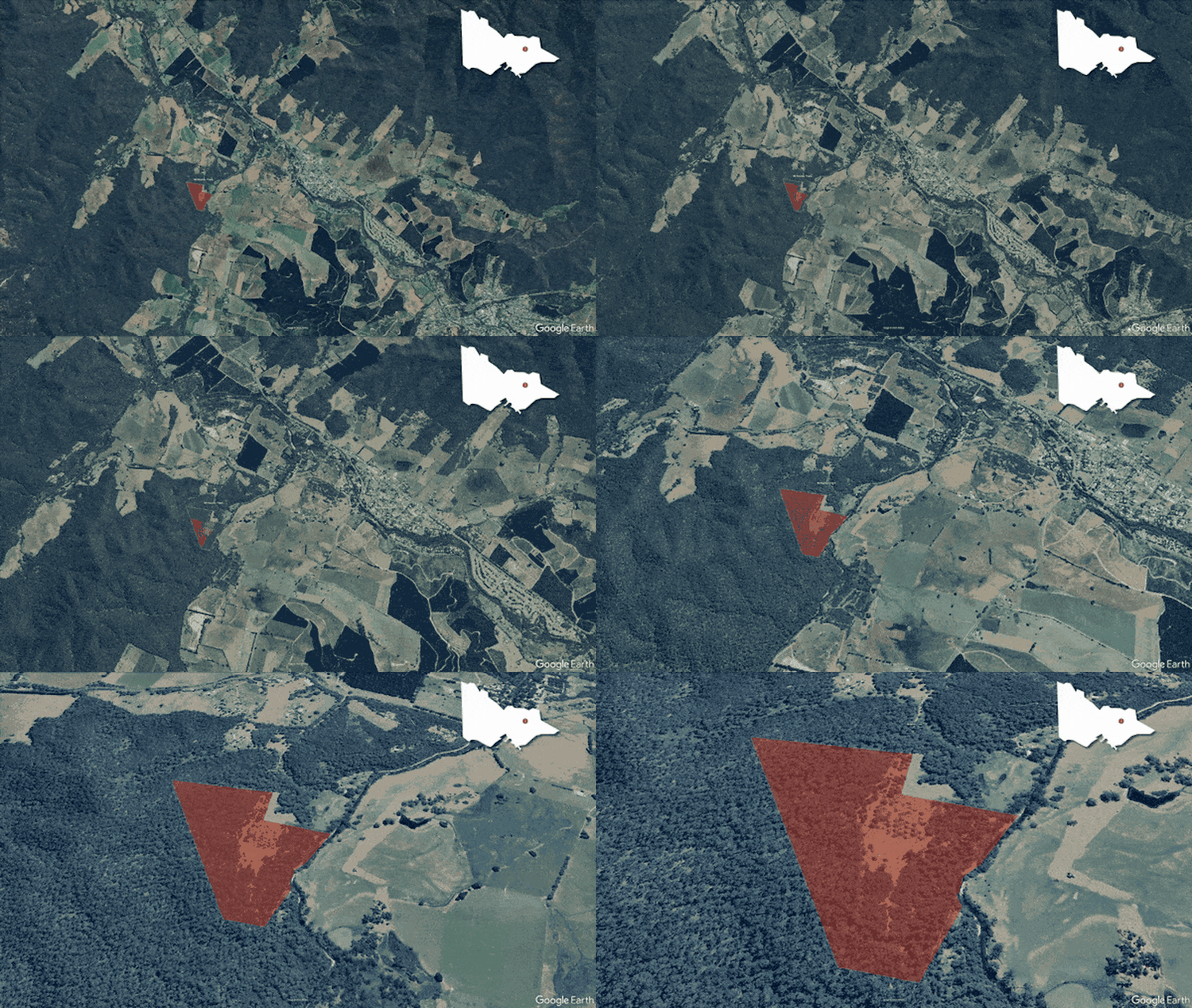
South Taranaki fire spreads to 100 hectares

Source: Radio New Zealand

Firefighters expect they will be battling the fire for days. Pretoria Gordon / RNZ

A fire in South Taranaki has grown overnight to an estimated 100 hectares, with firefighters expected to be battling the blaze for several days.

The fire, located between Waitōtara township and Waiinu Beach settlement, started on Monday afternoon and is yet to be contained.

Fire and Emergency (FENZ) says two firefighting crews, two helicopters, and heavy machinery are working to extinguish the blaze, with additional help on the way.

There have been no evacuations, but residents have been told to prepare to leave.

FENZ says the smoke is currently blowing out to sea but are advising local residents to limit their exposure by remaining inside with windows and doors shut.

Waiinu Beach Road is closed from Silver Fern Farms Waitōtara to the turn-off to the Waiinu Beach settlement.

A separate forestry fire southeast in Parikino has seen reinforcements from the New Zealand Defence Force and the Department of Conservation called in.

The blaze in Lismore Forest near Parikino – near Whanganui – has scorched more than 100 hectares, after being first reported at 5.15pm on Sunday.

FENZ Incident Controller, Assistant Commander Renee Potae says the fire, which is still not contained, is burning through slash piles, cutover pine forest and underneath standing pine trees on the forest floor in several locations, across difficult terrain.

“There will be multiple crews on the ground today with support from heavy machinery and five helicopters.”

She says the weather forecast could hamper firefighting efforts.

“The wind has picked up significantly and some rain is forecast which could make the ground muddy and make access more difficult for ground crews.”

Sign up for Ngā Pitopito Kōrero, a daily newsletter curated by our editors and delivered straight to your inbox every weekday.

– Published by EveningReport.nz and AsiaPacificReport.nz, see: MIL OSI in partnership with Radio New Zealand

Jane Austen would have turned 250. Here’s why she is still relevant

Source: Radio New Zealand

Austen’s six novels – including Emma and Pride and Prejudice – were groundbreaking in the early 1800s.

As a pioneer of free indirect style and the marriage plot, her mastery has inspired many homages and imitations — both on the page and the screen — over the last two centuries.

On the 250th anniversary of her birthday, we look back at Austen’s life and legacy.

A portrait of Jane Austen based on a drawing by her sister Cassandra.

Public domain

Industrial fire burning in Wiri in south Auckland

Source: Radio New Zealand

A large fire in the South Auckland suburb of Wiri has resulted in road closures.

The fire is understood to be at an industrial building and large plumes of dark grey smoke can be seen from several kilometres away.

Police have closed Roscommon Road and are directing traffic back on to the motorway.

An industrial fire is burning in the south Auckland suburb of Wiri. Supplied / Ben Chissell

An industrial fire is burning in the south Auckland suburb of Wiri. Shaun McLaughlin

More to come…

Sign up for Ngā Pitopito Kōrero, a daily newsletter curated by our editors and delivered straight to your inbox every weekday.

– Published by EveningReport.nz and AsiaPacificReport.nz, see: MIL OSI in partnership with Radio New Zealand

Japanese and Korean sunscreens are trendy – but do they work under NZ’s sun?

Source: Radio New Zealand

Once niche imports, Japanese and Korean sunscreens are now lining shelves at retailers, including major places like Farmers, and slipping into the routines of New Zealanders tired of the heavy, chalky formulas they grew up with.

Auckland hairstylist and makeup artist Naeema Bhikoo has watched the shift firsthand. After years of putting up with “sticky and heavy” Western sunscreens that left a white cast, she says she began exploring Asian formulas during trips to Japan and South Korea.

“I used to hate wearing sunscreens. The only time I’d wear a sunscreen would be if I knew I was going to the beach,” she says. “Asian sunscreens in general, they’re very lightweight, just feel like a regular moisturiser, some of them have gel textures … it just feels like it soaks right in, no white cast.”

Auckland hairstylist and makeup artist Naeema Bhikoo.

Supplied / Mala Patel

– Published by EveningReport.nz and AsiaPacificReport.nz, see: MIL OSI in partnership with Radio New Zealand

Man charged with killing fellow prisoner

Source: Radio New Zealand

Jonathan Trubuhovich died in hospital earlier this month after being assaulted. 123RF

An inmate has been charged with killing a fellow prisoner at Mt Eden Prison.

Jonathan Trubuhovich, who was 69, was assaulted at the end of November and died in hospital 10 days later.

Police launched a homicide investigation and have now charged a man with manslaughter.

The 28-year-old man is due before the Auckland District Court today.

A spokesperson for the dead man’s family earlier said they’re in shock, and want Corrections held accountable.

Trubuhovich had been remanded in custody in May and was due to be sentenced yesterday on burglary, shoplifting and disorderly behaviour charges.

Sign up for Ngā Pitopito Kōrero, a daily newsletter curated by our editors and delivered straight to your inbox every weekday.

– Published by EveningReport.nz and AsiaPacificReport.nz, see: MIL OSI in partnership with Radio New Zealand

What the election of Tonga’s new noble PM means for democracy

Source: Radio New Zealand

Lord Fakafanua is Tonga’s new prime minister. VNP / Daniela Maoate-Cox

The election of a noble to lead Tonga’s next government is raising concerns over the direction of the country’s democracy.

Lord Fakafanua, 40, beat incumbent prime minister Dr ‘Aisake Eke – the only other nominee – in Monday’s vote for the top job. The country’s 26 elected representatives cast ballots for the two candidates, with Fakafanua winning 16 votes to 10.

It comes about four weeks after the cohort were elected in the country’s general election on 20 November.

Fakafanua, set to be Tonga’s youngest ever prime minister, spoke to RNZ Pacific following the vote and identified unity in the new parliament as a top priority.

“What I wanted to advocate for was for us to look back at our roots and our foundation as a nation, so we can work together,” he said.

“Because this continued divisive politics is not only a waste of energy and taxpayers’ money, but it directs us away from the real priorities, and that’s to lift poverty and build the economy and help lower the cost of living.”

Lord Fakafanua, 40, is set to be Tonga’s youngest ever prime minister, but not everyone is convinced having a nobles’ representative as the country’s leader is the best way forward. RNZ Pacific / Teuila Fuatai. Teuila Fuatai

Fakafanua entered politics at age 24 in 2008 after being elected as a nobles’ representative for Ha’apai. At age 27, he was elected to the role of speaker, becoming the youngest person to ever hold the role.

Since then, he has been praised for his ability to maintain control of the debating chamber and different factions in Tonga’s Legislative Assembly.

As prime minister designate, Fakafanua will now be looking towards picking his cabinet, which must be approved and appointed by the King. He reiterated his desire for stability in a new government following Monday’s vote.

“I would love to build a cabinet built on a general consensus for the 26 members of parliament,” he said.

However, despite Fakafanua’s message of cohesiveness, pro-democracy advocates have warned that having a noble at the helm of the government is a slide backwards for Tonga’s democracy.

In 2010, the country’s constitutional reforms were implemented to shift the balance of power from the King and the nobles to the people. Now, the Legislative Assembly is made up of 17 people’s representatives, which are elected by the general public, and nine nobles’ representatives, elected in a separate voting process by the nobles.

When Fakafanua is formally appointed to the role of prime minister by King Tupou VI, it will be the second time a nobles’ representative has led the government since the reforms.

Former political adviser Lopeti Senituli said while he believed Fakafanua had performed well as speaker, he feared that a noble as prime minister signalled a shift in power back to the monarchy.

Lopeti Senituli is concerned by some of the political manouvres being made in Tonga. ABC News

“What I’m worried about is that the reassertion of the nobility and the King’s control of government.

“The political reform that we adopted in 2010 was the relocation of what is called executive authority – that was transferred from absolute authority of the King to shared executive authority between the King and the elected prime minister.”

Senituli warned that a nobles’ representative as prime minister effectively resulted in less checks on the King and nobles’ powers because they were not accountable to the general public in the same way a peoples’ representatives are through the four-yearly general election vote.

He also pointed to the role of speaker and deputy speaker in parliament, which can only be held by nobles’ representatives. Lord Vaea, the brother of Queen Nanasipau’u was elected the new speaker of parliament at yesterday’s vote, while Lord Tu’iha’agana was elected deputy speaker.

“No people’s representatives can be elected to those two positions,” Senituli said. “So, we are at a disadvantage because the nobles have control over parliament and the deputy speaker and the speaker of parliament.”

Teisa Pohiva, daughter of the late pro-democracy leader and former prime minister ‘Akilisi Pohiva, went a step further and said the outcome of the vote was a “sad day” for Tonga’s democratic reforms.

In a post on Facebook, she highlighted the disparity between the election process for nobles’ representatives like Fakafanua and peoples’ representatives. Both voting processes take place on polling day, however only nobles vote towards the nine nobles’ representatives resulting in a far smaller voting pool.

“New prime minister elect Lord Fakafanua – elected by three people into parliament and elected by 16 Parliamentarians to prime minister,” Pohiva wrote.

She also pointed out the close links between Fakafanua and King Tupou VI.

Fakafanua is a member of the Tonga’s royal family through his mother – who was a granddaughter of the beloved Queen Salote III. He has noble lineage through his father, who held the Fakafanua title before him. His sister is also married to Crown Prince Tupouto’a Ulukalala.

However, despite the criticisms, Fakafanua remains focused on the next steps.

He told RNZ Pacific he understands the new parliament is due to have its first sitting on 19 January, when the MPs and cabinet will be sworn in.

He said he feels “very privileged” to be elected to the role of prime minister and is committed to doing everything he can for the people for Tonga.

“I look forward to working with everyone and hope to have the support from everyone in the country, so that the aspiration of uniting the nation and bringing us all to work towards a common goal is realised.”

– Published by EveningReport.nz and AsiaPacificReport.nz, see: MIL OSI in partnership with Radio New Zealand

NZ police to guard Jewish community locations following Bondi attack

Source: Radio New Zealand

Police outside Kosher Deli NZ Nick Monro

New Zealand police expect officers to guard key locations for the Jewish community until at least the end of the week.

Police say the officers, who have been armed, will stay while they continue to assess the deadly attack at Bondi that killed 15 people.

“We’re maintaining our presence while we assess what’s happened in Australia, while we ensure that everything is in New Zealand as it should be,” Assistant Commissioner for National and International Security, Mike Pannett said.

“It’s probably just a reminder that our national terrorism level remains at low in New Zealand, so that indicates there’s no immediate threat to New Zealand, but absolutely important that we give reassurance to all our communities, and on this occasion, particularly our Jewish community.”

Local leaders have said they’ve stopped holding religious celebrations in public because it is too much of a security threat.

New Zealand police have been working with the Jewish Council to ensure everyone can celebrate the Hannukah festival safely.

They say they are in contact with security agencies here multiple times a day, and also in regular contact with police in Australia.

“We are mindful that we take nothing for granted and that we are far better to be prepared and having contingencies in place,” Pannett said.

When asked how long police would remain at key sites, he said it was being assessed on a daily basis.

He expected officers to remain posted until the end of the week, if not longer.

“We are also speaking with other parts of the community of New Zealand as well, including the Muslim community,” Pannett said.

“We’re ensuring that we give them that reassurance to let them know that we are there in the event of something happening.”

Pannett said police were looking at significant events, particularly for the Jewish community, happening over the week.

“And we are maintaining a presence at those events that present a risk, but also provide the reassurance opportunity,” he said.

There was no immediate threat or increased risk to New Zealand, Pannett said.

“We are simply proceeding with caution as we assess the situation and the information that comes in from our partner agencies in Australia.”

Sign up for Ngā Pitopito Kōrero, a daily newsletter curated by our editors and delivered straight to your inbox every weekday.

– Published by EveningReport.nz and AsiaPacificReport.nz, see: MIL OSI in partnership with Radio New Zealand

New Zealand’s Winter Olympics team uniforms revealed

Source: Radio New Zealand

Snowboarder Cam Melville Ives, left, skier Fin Melville Ives and skier Mischa Thomas model the uniforms the New Zealand team will be wearing at the Winter Olympics in northern Italy in February. SUPPLIED

Twins Cam and Fin Melville Ives have revealed the New Zealand team’s uniform for the Milano Cortina 2026 Olympic Winter Games.

Snowboarder Cam and skier Fin have been selected for the New Zealand team for the games, which take place in northern Italy in February.

The release of the uniform comes only days after Fin Melville Ives won the freeski halfpipe World Cup event in China. He is the current world champion.

His victory has been followed by Queenstown skier Alice Robinson winning her maiden Super G World Cup title in St Moritz in Switzerland.

New Zealand apparel firm Kathmandu, a sponsor partner for the New Zealand team, has designed the new uniforms, having tested them in the harshest winter conditions on Aotearoa’s mountains.

The collection includes t-shirts, trousers, hoodies, parkas, and accessories, all featuring the silver fern.

The uniforms will be worn at training, in the athletes’ village and ceremonial events.

In a fresh innovation a QR-code badge is woven into the athletes’ opening ceremony jacket, which when scanned will connect them to a digital platform containing messages of support from New Zealanders and overseas fans.

Kathmandu said the jackets, trousers and anoraks designed for wearing in the mountains will withstand repeated impacts with ice and snow.

The Melville Ives brothers said they felt proud to wear the new uniforms, which they modelled with skier Mischa Thomas, who aspires for selection in the New Zealand team.

“I’m so hyped to be able to compete next year, alongside my brother and wear the fern on my chest, repping New Zealand,” said Cam Melville Ives.

His brother Fin said: “Growing up in New Zealand, it’s so awesome to see all the idols repping the silver fern, it means so much to show it off while representing the country,” he said.

New Zealand Olympic Committee CEO Nicki Nicol said the uniform reveal was a significant milestone in Kathmandu’s four-year partnership with the NZ team.

“I think Kathmandu has done a fantastic job with their first uniform – our team have already been packing it in the bags, bound for Italy.

“The athletes collaborated closely with the NZOC and Kathmandu to ensure the design delivers on both style and performance. I’m looking forward to seeing our New Zealand Team wearing it with pride at the Games in February next year.”

Kathmandu said Kiwis can also wear the same gear with a replica collection launched today.

– Published by EveningReport.nz and AsiaPacificReport.nz, see: MIL OSI in partnership with Radio New Zealand

Climate change could claim nearly all of NZ’s glaciers, research shows

Source: Radio New Zealand

Tourists on Fox Glacier on the West Coast. supplied / Fox Glacier Guiding

Almost all of New Zealand’s glaciers could completely disappear if global warming continues on its current track, new research shows.

Local glacier researchers say that level of loss would contribute to sea-level rise, make water shortages worse, and affect tourism.

The study, published in Nature Climate Change on Tuesday, modelled the number of glaciers around the world that will completely melt at different levels of warming above pre-industrial levels.

It found that if the world warms by 2.7°C, 87 percent of New Zealand’s 3300 glaciers will disappear by the end of this century.

That level of warming is a plausible scenario, according to international non-profit Climate Action Tracker, which tracks the effects of current climate change policies.

In an even more dire scenario, where global warming reaches 4°C, just 100 of the country’s glaciers would remain.

A more optimistic scenario, where the world manages to limit warming to the Paris Agreement target of 1.5°C, could double the number of glaciers that still exist worldwide, the study found.

The study shows glacier loss in New Zealand peaking between 2035 and 2052, at a rate of more than 50 a year.

Globally, as many as 4000 glaciers a year could be lost by the mid-2050s,

Antarctic Research Centre associate professor Brian Anderson was not involved in the new study but has been part of long-term monitoring of New Zealand’s most well-known glaciers for 25 years,

It was “quite shocking” how fast change was happening already, Anderson said.

“[One] glacier we’ve been studying for a long time is Brewster Glacier near Haast Pass, and particularly in the last decade, it’s not just that it’s continually retreating, it’s breaking into parts – it’s sort of falling to bits and becoming quite unlike what it used to be.”

Brewster Glacier has significantly thinned and retreated since Brian Anderson began monitoring it. Claire Concannon / RNZ

Franz Josef Glacier on the West Coast – a major tourism drawcard – had retreated up the valley by more than two kilometres since he first studied it.

While many of the smaller glaciers that would disappear first were not as well-known, they were still important, Anderson said.

“They’re dotted right throughout the Southern Alps, more or less, so the impact of losing them is very widespread.

“There’s an insidious loss that perhaps we don’t notice because it’s happening piece by piece everywhere and nobody’s really counting.”

Canterbury University associate professor Heather Purdie has also been involved in long-term monitoring of New Zealand’s glaciers and said there were widespread consequences if they were lost.

“Every glacier that’s disappearing is then becoming more water in the ocean, so it has implications for cause sea level rise.”

New Zealand was lucky to have plentiful water, but glaciers were still an important resource, Purdie said.

“Glaciers are these wonderful towers of frozen water sources that release water in the summer when we need it the most. There are countries that rely fully on glacier meltwater for irrigation, for water supply.”

Losing glaciers completely would also change the shape and flow of rivers, as snow and rain falling at the heads of valleys would no longer be slowed by their presence.

“If you don’t have snow and ice or particularly ice at the top of your catchment, the minute it rains, that water runs straight off down into like a collection lake, if you’ve got one, or straight down the river and out to the ocean.”

Purdie has monitored Rolleston Glacier in Arthur’s Pass for many years and said the pace of change had quickened in the last five to 10 years.

“You stand up there and look over it, and it’s just like – wow. This thing is really thinning, it’s really just shrinking before our eyes,” she said.

“We’ve had these summers where absolutely no snow has been left on small glaciers like the Rolleston Glacier by the end of summer… The summers were just too hot, too warm, too much melt, and so your glacier is going to be going backwards really fast when it’s doing a lot of melting and not getting any gain at all.”

Heather Purdie, right, carries monitoring equipment up Rolleston Glacier Rasool Porhemmat

The new research made it clear that limiting warming could save thousands of glaciers around the world from that fate, she said.

“That’s a frustration of working in this space, is that we’re witnessing increasing temperatures, decreasing ice mass, and yet at the moment, our current government is pulling back on our pledges.”

The economic argument was often used as an excuse not to take more action, Purdie said.

“People need to be able to put food on the table and pay their rent or pay their mortgages, but if we’re in it for the long game and start thinking long-term, there’s actually also economic implications for not doing anything.”

That included the potential effects on tourism.

“Here in New Zealand glaciers are a really integral part of our recreation and tourism industries – glacier guiding, glacier hiking, mountaineering, just people even coming to view New Zealand’s amazing Southern Alps and glaciers,” she said.

“If it gets to the point where visitors just can’t turn up and easily be able to go and see these amazing places because they’ve all shrunken up into the tops, the very far reaches of the mountains, then that’s got economic implications too.”

Trampers view Franz Josef glacier from a distance. It is no longer possible to walk up to the glacier’s terminal face. ruslankphoto.com / 123RF

Even now, it was much harder to see the glaciers up close than it was a decade ago, she said.

“These things are happening and they’re happening now, and we just can’t afford to wait.”

Sign up for Ngā Pitopito Kōrero, a daily newsletter curated by our editors and delivered straight to your inbox every weekday.

– Published by EveningReport.nz and AsiaPacificReport.nz, see: MIL OSI in partnership with Radio New Zealand

Splore festival will end for good in 2026

Source: Radio New Zealand

Splore music and arts festival organisers have announced that next year’s will be the last due to lower than hoped for ticket sales.

Splore curator John Minty said after 18 years of financial viability the festival first hit headwinds with Covid postponements and cancellations. Then the cost of living crisis led to low ticket sales for the 2024 event.

“We took a rest last summer hoping things would pick up for the 2026 event but so far that hasn’t happened to the degree that we wanted,” Minty said in a statement on Tuesday morning.

The festival organisers had been hoping for some support from the government’s $70 million Event Boost Fund but that had not been forthcoming, he said.

“I have been involved with Splore at Tāpapakanga for 20 years and I feel now is a time to move on,” Minty said.

“I am incredibly proud of all that the festival has achieved and the devoted crew and Splorers who have created such magic and community over that period.

“However, it’s becoming more difficult to sustain a festival of Splore’s quality and depth so rather than diluting it I’d rather it finish with a bang.”

Splore began in Kariotahi in 1998 and was Aoteroa’s longest-running music, arts and camping festival.

The last installment of the three-day music and arts festival will go down at Auckland’s Tāpapakanga Regional Park from 20-22 February, 2026.

The bill included Sister Nancy, Nightmares on Wax, Mind Enterprises, General Levy, Tami Neilson, Miss Kaninna, Parson James, Illustrious Blacks, Beatles Dub Club, Coco Solid, Christoph El Truento, Te KuraHuia, Romi Wrights, Jess B, Franca, Dick Move, Estere and Half Queen.

– Published by EveningReport.nz and AsiaPacificReport.nz, see: MIL OSI in partnership with Radio New Zealand

Parliament bill set to return historic Māori site in Northland to Ngāpuhi

Source: Radio New Zealand

Kororipo Pā as seen from the other side of Kerikeri Basin with Kemp House, New Zealand’s oldest surviving building, on the right. RNZ / Peter de Graaf

A bill returning one of New Zealand’s most historic sites to Māori is due to be passed by Parliament on Wednesday, ending a 20-year quest by Northland iwi Ngāpuhi.

To the untrained eye Kororipo Pā, at Kerikeri Basin, looks like a modest headland across the water from the better-known Stone Store.

However, these grassy terraces were the stage for some of the most formative events in this country’s history.

In fact, some historians argue it’s the place where modern New Zealand began.

The land is currently managed by the Department of Conservation but the Kororipo Pā Vesting Bill, due for its third and final reading on 17 December, will return it to Ngāpuhi.

Local hapū Ngāti Rēhia will act as kaitiaki [caretakers] on the iwi’s behalf.

The return is also significant because it offers a glimmer of hope for Ngāpuhi’s long-stalled Treaty settlement.

Te Rūnanga o Ngāti Rēhia chairman Kipa Munro. RNZ / Peter de Graaf

Te Rūnanga o Ngāti Rēhia chairman Kipa Munro said Kororipo Pā was associated with one ancestor in particular, Hongi Hika, and the Musket Wars of the 1820s.

“Kororipo was the place that they departed from,” he said.

Later, chiefs from across Ngāpuhi would gather at the pā to discuss important matters.

“It became more of a place of wānanga [learning] where the likes of Hone Heke used to report back to his people.”

Kororipo Pā with a panel showing how it looked in Hongi Hika’s day. RNZ / Peter de Graaf

Munro said the pā also provided protection to New Zealand’s first lasting European settlement, built at Hongi Hika’s invitation on the other side of Kerikeri Basin.

From his hill-top pā, the chief could keep an eye on the new arrivals from the Christian Missionary Society.

While Kerikeri was not the first mission settlement in Aotearoa – that was at Oihi, on the Purerua Peninsula – it was the first place Māori and Europeans lived side-by-side for an extended period of time.

“That coming together of the first Europeans and Māori was likened to the coming together of the salt water and the fresh water, which is what happens right at that site,” Munro said.

Kororipo translated as “swirling waters”, an apt metaphor for the changes that began at Kerikeri Basin just over 200 years ago.

The Stone Store (1832-36) and Kemp House (1821-22) as seen from Kororipo Pā. RNZ / Peter de Graaf

Heritage New Zealand Northland manager Bill Edwards said the first formal contact between Māori and the British Crown could be traced to Kororipo Pā.

In 1831 a gathering of 13 rangatira penned a letter to King William IV, raising concerns about the intentions of the French navy and the behaviour of British subjects.

“It’s nationally significant because it’s a meeting place. It’s a place where not only different hapū met, but it’s also a meeting place of Māori and Pākehā. But importantly, it’s also that letter to the king in 1831, which was really the beginning of what we see now as modern Aotearoa New Zealand.”

Munro said the push to get Kororipo back started 20 years ago with a hui at Whitiora Marae in Te Tii, north of Kerikeri.

The hui resolved to seek the return of the pā to Ngāpuhi, with Ngāti Rēhia as the kaitiaki.

Kororipo Pā as seen from the Kemp House lawn. RNZ / Peter de Graaf

Munro said it had been “a long time coming”.

“Our thinking was that whilst we wait for that full and final settlement, we asked the government at that time, let’s have a look at a significant site in Ngāpuhi. It was a mark of good faith on both our sides to proceed and try and get that back. It’s a good start.”

Munro said there were conditions attached to the site’s return, but Ngāpuhi could revisit those later as part of its full and final settlement.

He expected the formal handover, due to take place early next year, would be charged with emotion.

“A lot of these places have been lost to us for so long, it’s almost like the pā site has suddenly come alive again. Many of our people may not even know about the pā because the connections they had to these places have been severed, they’ve been lost. But I think it’ll be an emotional day, certainly for those that have been on this pathway for its return.”

Munro said it would also be a chance to remember those who first called for the pā’s return.

“Twenty years later, a lot of those kaumātua and leaders of Ngāpuhi are no longer with us anymore. And so it’s significant that their moemoea, or their dreams and aspirations, are nearly achieved. So the job that was given to us, we can say we’ve done it on their behalf.”

Munro said the hapū had learned a lot from the negotiations about how government bureaucracy worked – and he hoped the government had learned from its dealings with the hapū.

He was also hopeful the pā’s return would set a precedent for other Ngāpuhi cultural sites.

Workers from DOC cadet scheme Hēteri-ā-Nuku help get Kororipo Pā ready for its return to Ngāpuhi. RNZ / Peter de Graaf

Bill Edwards’ response to the pa’s return was unequivocal.

“It’s utterly fantastic. And it’s about time.”

The first reading of Te Pire Whakahoki i a Kororipo Pā/Kororipo Pā Vesting Bill, on 11 September, passed unanimously.

At the time Treaty Negotiations Minister Paul Goldsmith said it was the first redress the Crown had provided to Ngāpuhi, and demonstrated the government’s commitment to a settlement.

He hoped to progress negotiations “as soon as possible”.

“Kororipo Pā is significant to New Zealand as part of early settlement. It was a place of learning and trade between Ngāpuhi, missionaries and settlers. Ngāpuhi would assemble there before going to war and rangatira would meet to discuss politically important issues,” he said.

Goldsmith said the pā would retain its historic reserve status and public access would not be affected.

DOC cadet Mikey Cook (Ngāti Hau) tackles invasive Taiwanese cherry during a clean-up at Kororipo Pā. RNZ / Peter de Graaf

Department of Conservation Bay of Islands operations manager Bronwyn Bauer-Hunt said the department had been “incredibly privileged” over the years to administer such an important cultural site.

“We’re really looking forward to continuing to work in partnership with Ngāti Rēhia, on behalf of Ngāpuhi, to achieve their aspirations for that tohu whenua [landmark] site.”

DOC is leading a series of “muck-ins”, which started on 10 December, to remove weeds and upgrade paths before the site is handed back to Ngāpuhi.

Sign up for Ngā Pitopito Kōrero, a daily newsletter curated by our editors and delivered straight to your inbox every weekday.

– Published by EveningReport.nz and AsiaPacificReport.nz, see: MIL OSI in partnership with Radio New Zealand

Australia’s national plan says existing laws are enough to regulate AI. This is false hope

Source: The Conversation (Au and NZ) – By Jessica Russ-Smith, Associate Professor of Social Work and Chair, Indigenous Research Ethics Advisory Panel, Australian Catholic University

Earlier this month, Australia’s long-anticipated National AI Plan was released to a mixed reception.

The plan shifts away from the government’s previously promised mandatory AI safeguards. Instead, it’s positioned as a whole-of-government roadmap for building an “AI-enabled economy”.

The plan has raised alarm bells among experts for its lack of specificity, measurable targets, and clarity.

Globally, incidents of AI harm are growing. From major cyber crime breaches using deepfakes to disinformation campaigns fuelled by generative AI, the lack of accountability is staggering. In Australia, AI-generated child sexual abuse material is rapidly spreading, and existing laws are failing to protect victims.

Without dedicated AI regulation, Australia will leave the most vulnerable at risk of harm. But there are frameworks elsewhere in the world that we can learn from.

No dedicated AI laws in Australia

The new plan doesn’t mandate for a standalone AI Act. It also doesn’t have concrete recommendations for reforms to existing laws. Instead, it establishes an AI Safety Institute and other processes including voluntary codes of conduct.

According to Assistant Minister for Science, Technology and the Digital Economy Andrew Charlton, “the Institute will be [..] working directly with regulators to make sure we’re ready to safely capture the benefits of AI with confidence.” However, this institute has only been afforded guidance and advisory powers.

Australia also has a history of blaming algorithms for legal failures, such as the Robodebt scandal. Current legal protections aren’t enough to manage existing and potential AI harms. As a result, the new AI plan risks amplifying injustices.

Legal whack-a-mole

Holding tech companies legally liable is no easy feat.

Big tech consistently seeks loopholes in existing legal systems. Tech giants Google and OpenAI are claiming “fair use” provisions in US copyright law legalise data scraping.

Social media companies Meta and TikTok are exploiting existing laws – such as broad immunity under US Communications Decency Act – to avoid liability for harmful content.

Many are also using special purpose acquisition companies (essentially shell companies) to circumvent antitrust laws that target anti-competitive conduct.

As per the new national plan, Australia’s “technology-neutral” approach argues that existing laws and regulations are sufficient to combat potential AI harms.

According to this line of thinking, concerns such as privacy breaches, consumer fraud, discrimination, copyright and workplace safety can be addressed using a light touch – regulation only where necessary. And the AI Safety Institute would be “monitoring and advising”.

The existing laws referenced as sufficient include the privacy act, Australian consumer law, current anti-discrimination, copyright and intellectual property laws, as well as sector-specific laws and standards, such as those in the medical field.

This might appear as comprehensive legal oversight. But there remain legal gaps, including those related to generative AI, deepfakes, and synthetic data made up for AI training.

There are also more foundational concerns around systemic algorithmic bias, autonomous decision-making and environmental risk. A lack of transparency and accountability looms large, too.

Big tech often uses legal uncertainty, lobbying and technical complexity to delay compliance and sidestep responsibility. The companies adapt while the legal system attempts to catch up – like a game of whack-a-mole.

A call to action for Australia

Just like the moles in the game, big tech often engages in “regulatory arbitrage” to circumvent the law. This means shifting to jurisdictions with less stringent laws. Under the current plan, this is now Australia.

The solution? Global consistency and harmonisation of relevant laws, to cut down on the number of locations big tech can exploit.

Two frameworks in particular offer lessons. Harmonising Australia’s national AI plan with the EU AI Act and Aotearoa New Zealand’s Māori AI Governance framework would enhance protections for all Australians.

The EU AI Act was the world’s first AI-specific legislation. It provides clear rules on what is allowed and not allowed. AI systems are assigned legal obligations and responsibilities based on the level of potential societal risk they pose.

The act puts in place various enforcement mechanisms. This includes specific financial penalties for non-compliance, as well as EU- and national- level governance and surveillance bodies.

Meanwhile, the Māori AI Governance Framework outlines Indigenous data sovereignty principles. It highlights the importance of Māori data sovereignty in the face of inadequate AI regulation.

The framework includes four pillars that provide comprehensive action to support Māori data sovereignty, the health of land, and community safety.


Read more:
AI affects everyone – including Indigenous people. It’s time we have a say in how it’s built


The EU AI Act and the Māori Framework articulate clear values and translate them into specific protections: one through enforceable risk-based rules, the other through culturally-grounded principles.

Meanwhile, Australia’s AI plan claims to reflect “Australian values” but provides neither regulatory teeth nor cultural specificity to uphold them. As legal experts have called for, Australia needs AI accountability structures that don’t rely on individuals successfully prosecuting well-resourced corporations through outdated laws.

The choice is clear. We can either chase an “AI-enabled economy” at any cost, or build a society where community safety, not money, comes first.

The Conversation

The authors do not work for, consult, own shares in or receive funding from any company or organisation that would benefit from this article, and have disclosed no relevant affiliations beyond their academic appointment.

ref. Australia’s national plan says existing laws are enough to regulate AI. This is false hope – https://theconversation.com/australias-national-plan-says-existing-laws-are-enough-to-regulate-ai-this-is-false-hope-271725

How stores fighting thieves risk putting off shoppers with disabilities and kids

Source: The Conversation (Au and NZ) – By Paul Harpur, Associate Professor, TC Beirne School of Law, The University of Queensland; Syracuse University

ad0sy/Reddit

“Welcome”, the sign at the supermarket entrance says, above a drawing of a shopper walking in and pushing a trolley.

But for many shoppers – especially those with wheelchairs, walkers or pushing kids in prams – it looks anything but welcoming.

Ten white batons stretch into the middle of the entryway, which you have to push through to enter. A Reddit user snapped the photo at a Woolworths store in suburban Melbourne this month and it soon went viral.

According to Woolworths, it’s a trial at just one store, being tested to see if deters thieves.

Retail theft is a huge, growing problem in Australia. There were more than 268,000 cases of theft in retail settings last year, according to data released in September. That came after 2024 research found record levels of shoplifting, employee theft, fraud and customer aggression costing up to A$7.79 billion.

Woolworths is not alone in trialling tougher physical security measures; other supermarkets here and in New Zealand have used this style of entry before. Kmart, Bunnings and other retailers are also testing new styles of security gates.

But as researchers in disability discrimination and inclusive planning, this new Woolworths entry appears to be the most overtly hostile – and potentially unsafe – design we’ve seen in Australian retail to date.

If this is where retail security is headed, it could have unwelcome, unintended consequences for millions of Australians.

One design does not fit all

More than one in five Australians – around 5.5 million people – have a disability of some kind. This includes millions of older Australians. More than half of Australia’s 4.2 million people aged 65 and over live with disabilities. Others also live with chronic health conditions.

Then there are around 1.5 million kids aged four or under, many of them pushed around in strollers.

Some of those millions of people may feel fine and be able to walk upright through a baton barrier entry.

But what if you’re a parent pushing a toddler in a low stroller? Or in a wheelchair and using walking sticks (like Lisa)? Or totally blind and using a guide dog (like Paul)? Would you feel comfortable using that trial Woolworths entrance?

The day-to-day reality millions of Australians live with is that too many public places are not designed with us in mind.


Read more:
What does a building need to call itself ‘accessible’ – and is that enough?


Why do ‘universal’ vs ‘hostile design’ matter?

The idea of “universal design” is design for everyone: our different sizes, ages and bodies, and the different ways we think, feel and experience space.

When we start from that perspective, we end up designing spaces that work better and are safe for everyone.

In contrast to universal design, “hostile” or “defensive architecture” is when you design something to deter antisocial behaviour, often justified as crime prevention measures. Examples of hostile design include:

  • benches with armrests in the middle of the seat to stop anyone lying down

  • metal studs on ledges, windowsills, or under bridges deter sitting or sleeping.

  • concrete seating or “leaning benches”, so people can’t sit or linger long.

A man at a train station, sitting on a metal bench divided into four with armrests.

PxHere.com, CC BY

These are usually targeted at young and homeless people. But they often end up affecting others in the process, with dangerous unintended consequences.

For instance, if you’re an older person or a person with fatigue, if you’re in an area with hostile architecture, you’ll typically find far fewer places to stop, rest and be safe.

That kind of “ableism” – prioritising the needs of people without disability over everyone else – ends up excluding people from using everyday spaces.

That’s what researchers Imogen Howe and Sheelagh Daniels-Mayes have called the “silent violence” of ableism in architecture. Unfortunately, it’s deeply embedded in design and planning.


Read more:
Ableism and disablism – how to spot them and how we can all do better


Big retailers can set the bar higher

The two biggest supermarkets, Woolworths and Coles, have often been better than many other retailers at creating more accessible stores. They generally have wider aisles, making it easier to safely navigate in a wheelchair or walker than many smaller, more crowded stores.

They’ve both introduced things like “quiet hours” to reduce the sensory load for shoppers at certain times of the week. And they’ve been named employers of choice for people with disabilities.

Responding to questions from The Conversation, Woolworths confirmed the trial in Melbourne is still going and said:

if a customer uses a mobility aid or is unable to use the entry for any reason, we encourage them to let a team member know so they can use an alternate entry. We will carefully assess customer feedback on this trial.

The next time a major retailer is looking to design a new entry to deter thieves, best practice would be to seek community engagement first – and co-design a solution that actually works for everyone.

The Conversation

Paul Harpur receives funding from the Australian Research Council as a Future Fellow.

Lisa Stafford receives funding from the Australian Research Council as a Future Fellow.

ref. How stores fighting thieves risk putting off shoppers with disabilities and kids – https://theconversation.com/how-stores-fighting-thieves-risk-putting-off-shoppers-with-disabilities-and-kids-271397

Festering families, difficult truths and transcendent grace: best podcasts of 2025

Source: The Conversation (Au and NZ) – By Siobhan McHugh, Honorary Associate Professor, Journalism, University of Wollongong

Wellcome Collection

Quality narrative podcasts experienced a downturn this year, with industry layoffs in key networks including Pineapple Street Studios and Wondery. But commercial cutbacks have reinvigorated the artistic spirit of the genre.

In a class of its own is a soaring audio biography of Fela Kuti, the brilliant Nigerian artist who invented Afrobeat and asserted his country’s cultural and political independence. It could only have been made by Jad Abumrad, legendary inventor of Radiolab, with his trademark mash-up of music, social history and searing critique.

Looking ahead, Resonate Festival’s Pitch Party is a podcast of indie pilots, featuring would-be shows and aspirations. The Vodou Project is my tip.

2025 also offered these gems.

Gina

Guardian Australia

Her eerily soft voice belying her ruthless profiteering and court battles with her children, Gina Rinehart is a fascinating subject.

Sarah Martin dives deep into the many-chaptered life of Australia’s richest person, from her isolated childhood near the Pilbara iron ore mine founded by her father Lang Hancock to her anointing as mining magnate and Trump devotee.

Martin balances the personal and public in this deftly produced series, featuring revealing interviews from Lang’s garrulous mate John Singleton to a memorable episode devoted to Gina’s eldest son, John, estranged from his mother for 20 years, over real life stoushes that would give Succession a run for its money.

Fallout: Spies on Norfolk Island

SBS Audio

If it wasn’t for the fact that an innocent man, Fernando Pereira, died when a Greenpeace protest ship was blown up in Auckland Harbour in 1985, this podcast could be called an entertaining romp.

We move from semi-amateur police on tiny Norfolk Island to the sinister efficiency of the French agents who mounted the attack as a riposte to New Zealand’s rejection of nuclear weapons.

Richard Baker introduces a fabulous array of characters as he navigates the gnarly geopolitics that saw Pacific “allies” stymie New Zealand’s attempts to solve this outrageous act of terrorism.

Half-life: The History Podcast

BBC and Falling Tree

Dark themes nestle alongside tender family moments in this beautifully judged podcast, opened by host Joe Dunthorne excavating a journal left by his Jewish great-grandfather, a chemist in Germany in the 1930s.

The series is elevated by fresh, unflinching writing and aching music, while evocative sound design takes us from a German chemical weapons factory to Turkish caves redolent with ghosts.

Missing in the Amazon

The Guardian

In 2022, British journalist Dom Phillips and Brazilian Indigenous defender Bruno Pereira vanished in the Amazon. The pair had been documenting the predations of mining companies, drug dealers and poachers.

Host Tom Phillips traces the doughty campaign by these two men to protect the Amazon and its inhabitants. Family memories bring both men vividly to life.

The podcast vibrates to ear-popping sounds of the jungle as Tom recreates their last journey.

Unravel: Huntsman

ABC

Rachael Brown unveils the chilling back story to Greg Lynn, convicted of murdering High Country camper Carol Clay in 2020. The podcast sat on ice for a year under a judicial suppression order, lifted last month. The conviction was quashed last week due to procedural issues and a retrial ordered, but the ABC has decided to keep the podcast available to listeners.

21 years before Clay’s death, Lynn’s separated wife, Lisa, was found dead in strange circumstances.

Her body was found on the lawn. A Nick Cave song, Nobody’s Baby Now, was playing on repeat – Cave was a favourite of Lynn. An inquest found Lisa died from a mix of alcohol and medication, yet friends insist she would never have over-indulged with her toddler sons inside.

With a measured tone, Brown builds a disturbing picture of a woman trapped in what we now recognise as coercive control. It should be mandatory listening for domestic violence responders.

Heavyweight

Pushkin Industries

The simple premise of this luminous, quirky podcast is to help listeners resolve a query from their past. The episode Kevin features the titular Vietnamese American man, who wants to be reunited with his friends, Jason and Gerald, from the housing project where they grew up.

Host Jonathan Goldstein tracks down Gerald, now a gentle drifter who’s sleeping rough but wants to be around for his kids. This brings up traumatic memories for Kevin, now happily married.

The skill involved in encouraging these informants to so reflectively tell their story is matched only by the artistry with which their words are crafted into glorious moments of wisdom and compassion.

The Retrievals, season two

Serial Productions and the New York Times

The Retrievals is a reminder of how assured, gimlet-eyed writing – along with a pressing story premise, strong interview talent, solid research and flawless production – can elevate a narrative podcast to a compelling hybrid of art and journalism. Susan Burton eschews the usual host-focused lens, and is all the more persuasive for it.

The series examines how women’s pain is ignored and downplayed, here in regard to Caesarian sections, the most common major surgery in the world.

Division Street Revisited

PRX

It’s a delight to hear interviews conducted in the 1960s by renowned oral historian and broadcaster Studs Terkel with “ordinary” Americans – a janitor, a Native American activist, a union leader, an Appalachian mother of 15 – reframed via the keen observational eye of Mary Schmich.

Schmich gets contemporary friends or family to add their own interpretation.

Division Street Revisited manages to be both gentle and punchy, conveying social history as engaging personal story.

We Used To Be Journos

Ette Media

Lebanese Australian journalists Jan Fran and Antoinette Lattouf are friends with a shared passion – to give two fingers to the stale white male media establishment and increase media literacy. In We Used To Be Journos, these high profile media insiders “break down broken news”.

They’re sassy, funny – and building new audience demographics who lap up their pointed media analysis.

The Conversation

Siobhan McHugh receives funding from Australian Research Council. She has previously worked with journalist Richard Baker.

ref. Festering families, difficult truths and transcendent grace: best podcasts of 2025 – https://theconversation.com/festering-families-difficult-truths-and-transcendent-grace-best-podcasts-of-2025-270687

Paws on board: Inside the Pet Bus as it travels the country

Source: Radio New Zealand

was due

Nearly two-thirds of households in New Zealand own a pet, and many more are planning to welcome a furry friend this Christmas.

In Auckland, a family-run business is making sure pets get where they’re going safely – transporting more than 100 animals at a time on a bus that runs from Auckland to Invercargill.

The business is run by Karyn McLauchlan, who said the idea grew out of a bad personal experience.

“I was a Blue Heeler breeder and had a terrible experience with an airline, and from that point onwards I decided I was going to deliver all my pups myself throughout the country,” she said.

“That’s how it all started. Other breeders got wind of what I was doing and wanted me to pick up their puppies and deliver them. It was all word of mouth at first, and then we started getting birds, cats, kittens, rabbits – all sorts of things.”

The pet bus business is run by Karyn McLauchlan. RNZ / Marika Khabazi

What began in a small van has since grown into a full-sized bus with an attached trailer.

McLauchlan and her sister Leanne run what might be one of New Zealand’s most unusual bus services – carrying dogs, cats, and the occasional surprise passenger.

“We’ve had working dogs, family dogs. We’ve had poultry – chickens, ducks, geese, turkeys – even ostriches, baby ostriches,” Leanne said. “It is a zoo.”

The pet bus leaves Auckland twice a month over the year, travelling up and down the country on an eight-day journey.

The bus was rarely empty, often transporting more than 100 animals during a single trip.

Nine-month-old foster puppy Henry was one of them, heading to his forever home in Wellington.

His foster mum, Jordan, said finding the pet bus had made the decision much easier.

“Our foster group recommended them, and I did some research as well. They seemed really good, so I was happy to put my trust in them and give him a safe ride down,” she said.

That week’s trip left Auckland on Monday, with plenty of stops along the way.

Nine-month-old foster puppy Henry was heading to his forever home in Wellington. RNZ / Marika Khabazi

Leanne said many of the passengers were Christmas presents – wrapped in fur.

“Christmas time’s a good time, especially when kids don’t know they’re getting a puppy or an animal,” she said.

“Seeing the look on their faces is quite precious.”

But not every journey began with a wagging tail.

American bulldog Lilly was heading to Wellington after being re-homed.

Her previous owner said sending Lilly south had been an easier decision once she learned about the Pet Bus. .

“We recently had a big life change, and I just didn’t have enough time for her,” she said.

“I had to make the best decision for her, and I know she’s going to be very happy.”

And it was not just cats and dogs making the journey.

Karyn McLauchlan. RNZ / Marika Khabazi

Whangārei-based Debbie had worked with the Pet Bus for the past 15 years, helping transport animals from Northland down to Auckland.

She said some of the passengers had been more exotic than others.

“We’ve had dragons, bearded dragons, blue-tongued lizards. I’d never seen one up close until I started here,” she said.

McLauchlan said no one was left behind, no matter how many legs they had.

“We’ve done an ant farm down to a big school in Invercargill. We’ve done spiders, big wolf spiders,” she said.

“There was a big trend a few years ago with kids having these wolf spiders.”

On board, larger dogs were given individual walks, and food was provided unless a pet had a special diet.

“We don’t take puppies out of their crates at all because of distemper, parvo, and all the nasties on the ground,” McLauchlan said.

“My sister keeps everything watered and cleaned, while the dogs get walked three to four times a day, individually. We’ve got stopping points throughout the country, and I’m on a logbook system, so every five hours we’re stopping anyway.”

The bus also had a live tracker, allowing owners to keep tabs on their animals’ journey.

The pet bus leaves Auckland twice a month over the year. RNZ / Marika Khabazi

McLauchlan said the layout of the bus helped keep every passenger calm and comfortable.

“We’ve got all the quiet animals down the back – cats, turtles, rabbits, mice, rats – and the noisier ones, mostly dogs, up the front. That helps keep them relaxed,” she said.

“That helps keeping them all relaxed.”

McLauchlan and her sister stayed with the animals around the clock, sleeping on the bus between crates.

The bus has a live tracker, allowing owners to keep tabs on their animals’ journey. RNZ / Marika Khabazi

While McLauchlan did the driving, Leanne kept a close eye on the passengers.

Leanne said the work was rewarding work, but it was not exactly a walk in the park.

“If we get really unsettled puppies, we’ll put music on. I’m up and down all the time, and if one’s really stressed, I’ll take it out of the crate and give it a cuddle,” she said.

“You’re dealing with people’s pets – they’re precious – so you have to treat them like precious cargo.”

The final pet bus of the year left Auckland on Monday and was due to roll into Invercargill just in time for Christmas.

– Published by EveningReport.nz and AsiaPacificReport.nz, see: MIL OSI in partnership with Radio New Zealand

Our Changing World: Return of The Kākāpō Files

Source: Radio New Zealand

The males stay in one spot and attract the females through their boom and ching calls. Jake Osborne, DOC

On the small, bush-clad, Whenua Hou / Codfish Island preparations are underway. People and supplies are being dropped in by helicopter. Food hoppers are being filled. Transmitters are being checked. And come nighttime, a booming sound has begun to fill the air.

Anticipation is high, and building, for what may turn out to be the biggest kākāpō breeding season ever.

Follow Our Changing World on Apple, Spotify, iHeartRadio or wherever you listen to your podcasts

Today there are 237 kākāpō. Alison Ballance

“The first male who was heard booming this year was Faulkner, in late November,” Alison Ballance said, having heard the news from Department of Conservation’s Kākāpō Recovery Programme members, who are keeping a close eye on developments. “Faulkner is 9 years old, coming on 10. So this will be his first booming season. And over the weeks that have followed, lots of other males have joined in now.”

Kākāpō are ‘lek’ breeders. The males stay in one spot and attract the females to them through their boom and ching calls. They also prepare a pathway and shallow depressions for the ladies to admire, says Alison. “The boys have been doing lots of housework, which is always good to hear. So the male kākāpō have been tidying up their track and bowl systems.”

The earliest mating can happen around Christmas Day, but most of the action takes place a week or two after, over the New Year.

Well known for The Kākāpō Files podcast released in 2019 during her time as Our Changing World host and producer, Alison’s association with kākāpō goes back much further than that – to her days working in natural history filmmaking.

It started in 1995, when she found herself filming kākāpō nests on Whenua Hou “That was a real high point for me in my life journey really, getting involved with kākāpō. But that point in time was a real low point for the kākāpō population.” At that time there were just 51 known birds.

1995 was also the year that the Kākāpō Recovery Programme began in its current form. In the 10 years running up to 1995 there had only been three kākāpō chicks that survived to adulthood. So the newly formed programme aimed to change those odds.

In the late 80s and early 90s every known wild kākāpō was uplifted and transferred to predator free offshore islands to try halt their decline. Whenua Hou became the new ‘kākāpō central’, and the most important breeding site for this attempted comeback.

Fast forward 30 years and today there are 237 kākāpō.

It has been a huge conservation effort, with continuous tracking and monitoring of the birds, and it gets stepped up even further when a breeding season happens to include artificial insemination, egg incubation, supplementary feeding and chick hand-rearing.

So a lot of work when breeding happens, but that’s not every year, says Alison. “The one thing you need to know about kākāpō is you have to be very, very patient…. because they only breed every two to four years, and the last time they bred was four years ago”.

Rium fruit carpet the forest floor and provide a plentiful food supply for growing kākāpō chicks Alison Ballance

Their breeding is tied to the rimu tree fruiting, called a mast. These birds are tuned in to the rimu cycle, and after careful years of study, DOC’s kākāpō recovery team is too. By counting the growing tips on the rimu branches a full year in advance, they can know if the parrots will breed. And, says Alison, the numbers stack up for this to be a bumper year “The previous biggest mast on record was 2019, when we did the first season of The Kākāpō Files. And the autumn count on Whenua Hou at that time was 47 percent. Well, this year the autumn count on Whenua Hou was 63 percent. So it’s by far and away the biggest rimu fruiting season on record.”

However, no one is willing to count their chicks ‘before they fledge’. “Unfortunately lots of things could happen,” says Alison, “The rimu fruit might not ripen, it often doesn’t. And in that case, chicks might starve.” Disease is always a concern too. The 2019 breeding season saw an outbreak of a fungal infection called aspergillosis which killed both adults and chicks. Plus, there’s the ongoing concern about the arrival of the highly pathogenic strain of bird flu that’s been sweeping the globe.

There is something new happening this year too, says Alison. Now, with the numbers up and the kākāpō spread across three breeding islands, DOC is keen to take a new ‘lighter touch’ approach on two of those islands. “They’re trying to do themselves out of a job really… In the last 30 years it’s been important to increase numbers as quickly as possible, but you can’t keep up this intensity of effort for this many birds.”

Kākāpō Atareta in her nest on two eggs during the bumper 2022 breeding season. Andrew Digby / Department of Conservation

Across this season Alison will be collaborating with [www.doc.govt.nz/our-work/kakapo-recovery/ DOC’s Kākāpō Recovery] Programme team members to get updates from the breeding islands – when the birds mate, when eggs are laid, how many chicks hatch safely, and whether they are healthy and growing – and she will be bringing them to RNZ audiences once again through the second season of The Kākāpō Files. She thinks this season, with its hands-off approach, will bring a ‘very different vibe’. And with 84 adult female kākāpō that could breed, 2026 has the potential to be real turning point for this iconic manu.

Follow and listen to the Kākāpō Files II on your favourite podcast app, or on the RNZ podcast webpage.

– Published by EveningReport.nz and AsiaPacificReport.nz, see: MIL OSI in partnership with Radio New Zealand

Homelessness in Auckland more than doubles to 940 people in year to September – survey

Source: Radio New Zealand

The latest six-monthly survey of housing support providers shows homelessness in Auckland has more than doubled to 940 people in the year to September. RNZ / Finn Blackwell

A worker at a special court that helps Auckland’s homeless who have committed low-level offences turn their lives around, says she is seeing increasing levels of poor mental health and distress over the past six to 12 months at the court, as the city continues to see a rise in the number of people without shelter.

On Tuesday, the release of the latest six-monthly survey of housing support providers under the National Homelessness Data Project (NHDP) showed that homelessness in Auckland has more than doubled from 426 to 940 people in the year to September.

The report, released by the Salvation Army and Community Housing Aotearoa, found that 14 of the 21 agencies interviewed reported an increase in homelessness.

It highlighted that the number of emergency housing applications that were declined increased from 4 percent in March 2024 to 36 percent by June 2025, while the assessment of whether people had “contributed to their own homelessness” remains a major reason for declining grants.

The report said there was little evidence to suggest that the Ministry for Social Development (MSD) had adjusted its “use of discretion” to be more accommodating when assessing emergency housing applications, despite directives from the government in September.

Carmel Claridge has worked for more than three years as a coordinator at Te Kōti o Timatanga Hou (the Court of New Beginnings) based at the Auckland District Court, which provides a therapeutic approach to offenders who are homeless in the Auckland CBD.

She said she had noticed people coming to the court recently were giving up on applying for emergency housing due to the cost of the housing, the dangerous environment, and past experiences of being declined.

“The last half dozen people that I have assessed for suitability to come into our court, of those people, not a single one of them was prepared to even apply for an emergency housing grant,” she said.

The latest Salvation Army report under the NHDP stated that emergency housing grants fell from 7068 in March 2024 to 1833 by December 2024. One agency reported that in one month, all 27 people they referred to the MSD for emergency housing were declined.

The Court of New Beginnings coordinator Carmel Claridge with one of its graduates, Tim. RNZ / Amy Williams

Claridge said the people she works with at the court are at “the bottom of the ladder” when it comes to getting housing assistance – often denied access due to addictions, mental health struggles and past convictions.

She said she was seeing more distress and emotional dysregulation of people coming to the court over the past six to 12 months.

“What I’m seeing is people presenting up at the Auckland District Court with very poor, often untreated or unmedicated mental health issues, combined with perhaps alcohol or drug addictions, and sometimes also with criminal history as well.

“Those people are very, very difficult to house at the best of times, but when they are completely shut out of a housing continuum by denial of a basic emergency housing grant, they’re effectively cut off from any support whatsoever,” Claridge said.

Claridge said this cohort was unable to get help for drug and alcohol issues without a fixed address, which puts them in a “vicious cycle” of being denied the support needed to sustain a stable tenancy.

There was a need for housing that provides a supportive environment where their mental health, drug and addiction issues can be addressed, she said.

The government and the council’s move on orders for the homeless in Auckland was not a humane solution to a very complex problem, she said.

Claridge said there could be wider social consequences if nothing was done to support people.

“If you have a group of people out there in the community who are very mentally unwell, who are not receiving the medical help they need, who are not properly medicated, who are not having their conditions monitored, or their prescribed medication controlled in some way.

“It is inevitable that you are going to get more incidents of random acts of violence on the wider members of society,” she said.

Salvation Army and Community Housing Aotearoa December report

The report acknowledged that the government’s $17 million in targeted funding in September, for 300 Housing First places and outreach support, has had some positive impacts – including more people helped into Kainga Ora housing in Hamilton, and more outreach workers for some providers in Auckland, Christchurch and Wellington.

However it raised concern that the funding ends in June 2026, as well as the lack of relief for smaller centres such as Whangārei, Rotorua, Taranaki, Nelson or Dunedin. It is calling for sustained funding beyond June 2026.

It also highlighted that government budgeted funding for homelessness support in the current year to June 2026 has reduced by $79m, compared to the year to June 2025.

The report calls for more tailored responses to women’s homelessness, including young women with children, older women, and Wāhine Māori – who make up more than a third of homeless women in New Zealand.

Older people facing homelessness was identified as a growing issue in the report, with service providers reporting a growing proportion of pensioners renting and vulnerable to unstable housing.

Youth outreach service providers also reported that youth homelessness is becoming more visible, with nearly 50 percent of those experiencing severe housing deprivation being under the age of 25.

Tama Potaka says the report did not provide a national head count but reflected “provider experience” in particular places. RNZ / Samuel Rillstone

Associate Housing Minister Tama Potaka: government is addressing the issues

Associate Housing Minister Tama Potaka said in a statement the report findings reinforce what the government knows of homelessness as a complex issue, “shaped by long-standing Whānau and system breakdowns”.

“We know there are real issues, however, we are taking action to address these. We are working closely with community housing providers, Iwi, Māori organisations and frontline services, and we take their insights seriously,” he said in the statement.

Potaka said the figures cited in the report reflected “provider experience” in particular places, and were not a national headcount.

Ian Hutson, director of the social policy and parliamentary unit, said it was concerning that there was currently no government funded comprehensive data to capture the real extent of homelessness in the country.

The figures on Auckland’s homelessness came from the council and community providers who had counted the number of homeless people known to them, he said.

The real numbers would be much higher, Hutson said.

An earlier briefing released by the Salvation Army in July this year found through OIA requests and a range of sources that one in every 1000 people in New Zealand is without shelter, and 57,000 women are experiencing homelessness, often in unsafe or unstable living situations.

Potaka added that it was too early to judge the impact of the $17m committed by the government in September.

“We are investing over half a billion dollars a year in housing and support, backing Iwi- and community-led solutions, and fixing a system that was fragmented and ineffective.

“Support is delivered nationwide based on need, and funding shifts reflect a deliberate move away from crisis responses toward stable housing outcomes,” he said.

Meanwhile, Potaka said MSD had clear direction to apply discretion where people face genuine hardship.

“Based on feedback I have received there is a noticeable difference and providers are working effectively with MSD,” he said.

Sign up for Ngā Pitopito Kōrero, a daily newsletter curated by our editors and delivered straight to your inbox every weekday.

– Published by EveningReport.nz and AsiaPacificReport.nz, see: MIL OSI in partnership with Radio New Zealand

Think you know Hans Christian Andersen? Four experts pick his weirdest fairy tales to read this Christmas

Source: The Conversation (Au and NZ) – By Ane Grum-Schwensen, Associate Professor at The Hans Christian Andersen Centre, Principal Investigator of "Fairy Tales and Stories – The Digital Manuscript Edition", University of Southern Denmark

Hans Christian Andersen is one of Denmark’s most cherished writers – a master of the literary fairy tale whose influence stretches far beyond The Little Mermaid, The Emperor’s New Clothes and the other classics many of us first encounter in childhood.

Born in 1805 in Odense, on the island of Funen, Andersen was the son of a shoemaker and an illiterate washerwoman who would grow into an author who wrote across genres – novels, travelogues, poems and plays. But in his short tales he created a form uniquely his own: emotionally daring, stylistically inventive and rich with both whimsy and existential bite.

Although not all of his stories are about winter or Christmas, Andersen’s name has become closely associated with the festive season around the world.

His tales have been read aloud for generations, adapted into countless winter performances and films and returned to each year for their blend of wonder, melancholy and moral imagination. They remind us that the season is not only about sparkle and celebration, but also reflection, hope and the small fragile miracles of being human.

So, as the days grow shorter, we’ve asked four leading Andersen experts to choose one story they believe is perfect for reading – or rereading – this Christmas. Their selections may not be the Christmas tales you’ve come to associate with Andersen. But they showcase the author at his most profound and playful – and offer new ways into his writing.


The Story of a Mother

Ane Grum-Schwensen, associate professor in the Department of Cultural and Linguistic Studies at The Hans Christian Andersen Centre, University of Southern Denmark

Choosing a single Andersen story as a favourite feels almost impossible. There are so many remarkable ones and my favourite often ends up being the one I have most recently revisited. Yet some stories return to me repeatedly, both in thought and in research.

One of these is The Story of a Mother, first published in 1847. It is a fantastic tale in every sense of the word. It includes classic fairy-tale elements: a protagonist – the mother – leaving home and facing trials, helpers guiding her and an ultimate antagonist, Death. Yet Andersen challenges this structure: the helpers demand steep prices and the antagonist could even be seen as a kind of helper. The story also reflects the fantastic, as seen in modern fiction, through its dreamlike quality and its unsettling open ending, where the mother finally allows Death to carry her child into the unknown.

This story is profoundly moving. It portrays both the desperate lengths a parent will go to to protect a child and the crushing surrender when confronted with an irreversible fate. Andersen’s ability to capture this parental anguish so vividly, despite never having been a parent himself, is striking.

The theme of the dying child was common in 19th-century art and literature, partly because of the harsh reality of child mortality. In the early decades of the century, roughly one-third of all Danish children died before their tenth birthday. Andersen addressed this theme repeatedly. Indeed, his first known poem, at age 11 was written to comfort a grieving mother. Later, in 1827, another poem he wrote, The Dying Child was published anonymously and widely translated.

The language and narration in The Story of a Mother are quintessential Andersen. Within the first few paragraphs, the theme is clear and features his imagery-rich language:

The old clock whirred and whirred, the great lead clockweight slid straight down to the floor, boom! and the clock too stood silent.

Although Andersen had written about dying children before, he struggled with the ending of this story, even in the handwritten copy he delivered to the printer. His first version was what you might call a happy ending: the mother wakes to find it was all a dream. He immediately crossed this out and replaced it with: “And Death went with her child into the ever-flowering garden”.

Still unsatisfied, he changed “ever-flowering garden”, a synonym for paradise, to “the unknown land”. A Danish critic recently described this creative shift as “how to punk your sugar-coated sentiment into salty liquorice” – a fitting metaphor for Andersen’s refusal to settle for sentimentality.

Today, the story is not as well known as some of his other tales, yet its influence in its own time was undeniable. It was translated into Bengali as early as 1858 and became popular in India. When Andersen turned 70 in 1875, one of his gifts was a polyglot edition of the story translated into no less than 15 languages – a testament to its global reach.

You can read the full version of The Story of a Mother, here.


The Comet

Holger Berg, special consultant at The Hans Christian Andersen Centre, University of Southern Denmark

No spectacular comets appeared in the sky in 1869, but the year nevertheless stands out in literature thanks to The Comet. Andersen’s reflective tale of the cosmos and the soul begins simply. A boy blows bubbles while, by the light of a candle, his mother seeks signs about the child’s life expectancy. Childlike delight and superstition live side by side in their home.

The superstitious mother was an archetype, but Andersen’s depiction is shaped by memories of his own mother, Anne Marie Andersdatter. Illustration by Lorenz Frölich. The Hans Christian Andersen Centre. Public Domain.

More than 60 years pass. The boy has become an elderly village schoolmaster. He teaches history, geography and astronomy to a new generation, bringing each subject vividly to life. Science has not destroyed his wonder – it has deepened it. Then the very same periodic comet returns.

What allows The Comet to echo across the ages is, paradoxically, its quiet, unassuming form. In earlier works, Andersen confronted one of the great fears of his age: that a comet might strike the Earth and end human civilisation. He responded either with comedy or with factual precision, but neither approach proved moving.

In 1869, he shifted away from satire and intellectual argument and towards poetic prose. Meaning now emerged through suggestion rather than debate. He also abandoned the romantic mode of his youth, in which the moon, the morning star and other celestial bodies directly commented on earthly affairs.

Part of my fascination with this tale lies in the four surviving manuscripts. Andersen gradually developed his narrative from a quaint scene in a village classroom into a life story with genuine cosmological reach and this can be seen in each version of the story.

It’s often said that a human life is merely a glimpse when measured against astronomical time. In Andersen’s time, people quoted the Latin expression homo bulla: the human being is but a soap bubble. To this familiar poetic image, Andersen in his second manuscript added the comet. Against the brevity of the bubble, he set the vastness of the comet’s arc – and with it, the question of where the human soul travels once it leaves the body.

This print unites six of the largest comets known in 1860. Andersen had seen three of them. In late January 1869, he began the first full draft of The Comet. Engraving by James Reynolds in a copy at The Wellcome Collection. Public Domain.

Andersen achieved his narrative breakthrough in late January of 1869 through a shift in both theme and structure. In the third manuscript, he added a final paragraph nearly identical to the opening. This narrative circle matches the subject at hand: “Everything returns!” the schoolmaster teaches us, be it periodic comets or historical events. And yet the tale ends by imagining what does not return: the “soul was off on a far larger course, in a far vaster space than that through which the comet flies”.

Andersen invites us to gaze upward with the openness of a child. And raises profound questions about what it means to be human, both in this world and, for spiritually inclined readers, in whatever may lie beyond it.

You can read the full version of The Comet, here and listen to a podcast on the story here.


The Shadow

Jacob Bøggild, associate professor at The Hans Christian Andersen Centre, University of Southern Denmark

The Shadow by Hans Christian Andersen was first published in 1847. In some ways, it is Andersen’s darkest tale. The character the reader is led to believe is the protagonist is known only as “the learned man,” a figure never given a name, whereas his shadow – which breaks away from him – gives the tale its very title.

At the end of the story, the shadow has the learned man executed and marries the daughter of a king, implying that they will rule her country together. Thus, the shadow triumphs in the manner of a genuine fairy-tale protagonist, while his former master dies miserably.

But the tale is not solely dark and tragic. The scene in which the shadow separates from the learned man is perfectly choreographed in accordance with the way a shadow follows every movement of the body that casts it.

Afterwards, it irks the learned man that he has lost his shadow, but since he is visiting a country with a warm climate he soon grows a new one. And one reason the shadow can seduce the princess is that he is a wonderful dancer – he is, of course, ever so light on his feet. Throughout the tale, Andersen treats each impossible occurrence as though it were entirely natural, and the effect is extremely funny (as well as uncanny).

In traditional fairy tales, the protagonist often leaves home because some imbalance has occurred. Away from home, out in the wide world, the protagonist must accomplish a number of tasks. The happy ending usually means that the character finds a new home, often by marrying a princess and becoming ruler of half a kingdom.

In The Shadow, the learned man is already away from home at the beginning, visiting a country with a hot climate before returning to his own homeland with a cold one. It is here that his former shadow appears and manipulates him into exchanging roles, making the learned man literally the shadow of a shadow. The two then travel to a spa. The learned man is once again far from home, and it is there that he dies.

The shadow, on the other hand, begins its story “at home”, since its home is wherever the learned man is. It then separates itself, goes out into the world and becomes highly successful – albeit through mischief. Its ultimate triumph comes when it establishes a new home for itself by marrying the princess. The Shadow is a reversed fairy tale in every possible sense.

The way Andersen executes this reversal is a masterpiece and bears witness to his acute awareness of genre conventions and narrative structures – something that has, unfortunately, rarely been recognised as fully as it deserves.

You can read the full version of The Shadow, here.


The Princess on the Pea

Sarah Bienko Eriksen, postdoctoral researcher at The Hans Christian Andersen Centre, University of Southern Denmark

The Princess on the Pea has suffered the odd fate of being so popular that many people never bother to read it. This is an oversight. And given that it clocks in at about 350 words, or shorter than the article you’re reading right now, it’s also a problem that’s easily remedied.

The tale opens with a prince’s worldwide search for a “real” princess. He’s met plenty of hopefuls along the way, but they weren’t really “real”, and for him, only a “true” one will do. The words “real” and “true” (in Danish, rigtig/virkelig) appear in this tiny story a total of nine times — very much in defiance of certain truisms about good writing and the spice of life.

So when a prospective princess shows up to the castle one stormy night with rainwater gushing down her hair and out of her heels, she quite literally embodies the problem of how to tell whether something is real or not. Is it visible at a glance? Can it be observed through behaviour? Or must we simply feel it?

To see if their guest is the genuine artefact, the queen tests her with a bed fit for a princess: 20 duvets piled atop of 20 mattresses and at the very bottom, a single pea. Not a pearl or a diamond but the lowliest of domestic objects.

A single pea under a stack of mattresses becomes a delicate measure of truth and the power of perception.
Stories from Hans Andersen, with illustrations by Edmund Dulac, London, Hodder & Stoughton, Ltd., 1911.)

The guest, however, doesn’t miss a thing, awakening black and blue and worse off than when she arrived. The court is immediately satisfied – only a true princess could be so sensitive! – yet amusingly, the entire exercise brings them no closer to actually spotting one: it’s her powers of observation that pass the test, not theirs. The real, it seems, simply knows itself.

We can all guess what happens next, but what comes after the wedding? Here we find Hans Christian Andersen’s most innovative contribution to this traditional fairy tale: namely, that the pea gets its own ending, receiving a place of honour in the Royal Museum “where it can still be seen, providing no one has taken it”.

A Dane reading this story in 1835 couldn’t help but notice this nod to the 1802 theft of Denmark’s national treasure, the Golden Horns of Gallehus, from that same location. Less obvious is that with this reference, Andersen bursts the bubble containing all fairy tales and thrusts the pea into the real world.

Did we feel it? Perhaps not. But then again, it might have been stolen.

“Now, that was a real story!” the tale concludes, knowingly. Not a true story, mind you, but the impossible state of being “real fiction”. (And if we wish to test this for ourselves, it won’t be Andersen’s fault that the genuine artefact is missing from the Royal Museum.)

Unlike our princess, this tale offers no tidy resolution, which is precisely the richness of great art: it prompts reflection, hides wonder in the humble detail and is never truly finished, inviting us to play along in happily ever after.

You can read the full version of The Princess on the Pea, here.


This article was commissioned as part of a partnership collaboration between
Videnskab.dk and The Conversation.

The Conversation

Ane Grum-Schwensen receives funding from Augustinus Fonden, Aage og Johanne Louis-Hansens Fond and The Danish Research Reserve.

Holger Berg receives funding from Augustinus Fonden, Aage og Johanne Louis-Hansens Fond and The Danish Research Reserve.

Sarah Bienko Eriksen receives funding from the Independent Research Fund Denmark.

Jacob Bøggild does not work for, consult, own shares in or receive funding from any company or organisation that would benefit from this article, and has disclosed no relevant affiliations beyond their academic appointment.

ref. Think you know Hans Christian Andersen? Four experts pick his weirdest fairy tales to read this Christmas – https://theconversation.com/think-you-know-hans-christian-andersen-four-experts-pick-his-weirdest-fairy-tales-to-read-this-christmas-270725

Firefighters sent to Rangipo Power Station after false fire alarm

Source: Radio New Zealand

Firefighters are attending a reported fire at Rangipo Power Station (File photo). RNZ / Nate McKinnon

Multiple Fire and Emergency crews were sent to Rangipo Power Station, after reports of a fire on Monday night.

A spokesperson said crews were called to the site Kaimanawa Forest Park shortly before 9pm.

They said the report suggested it was the power station’s generator room that was on fire.

Fire and Emergency later confirmed the reported fire was a false alarm.

Crews from Tūrangi, Southern Lakes, Waiouru and National Park had been sent.

Sign up for Ngā Pitopito Kōrero, a daily newsletter curated by our editors and delivered straight to your inbox every weekday.

– Published by EveningReport.nz and AsiaPacificReport.nz, see: MIL OSI in partnership with Radio New Zealand

Firefighters sent to Rangipo Power Station after false fire alarm

Source: Radio New Zealand

Firefighters are attending a reported fire at Rangipo Power Station (File photo). RNZ / Nate McKinnon

Multiple Fire and Emergency crews were sent to Rangipo Power Station, after reports of a fire on Monday night.

A spokesperson said crews were called to the site Kaimanawa Forest Park shortly before 9pm.

They said the report suggested it was the power station’s generator room that was on fire.

Fire and Emergency later confirmed the reported fire was a false alarm.

Crews from Tūrangi, Southern Lakes, Waiouru and National Park had been sent.

Sign up for Ngā Pitopito Kōrero, a daily newsletter curated by our editors and delivered straight to your inbox every weekday.

– Published by EveningReport.nz and AsiaPacificReport.nz, see: MIL OSI in partnership with Radio New Zealand

Live: Emotional vigils held for Bondi Beach shooting victims

Source: Radio New Zealand

Australia is mourning 15 people shot dead in the Bondi terror attack, with thousands attending vigils in Sydney and Melbourne.

Sixteen people – including one of two gunmen – were killed after a father and son opened fire at a Jewish holiday celebration at Bondi Beach.

Australian officials described it as a targeted, anti-semitic terror attack.

Overnight, Sydney’s iconic Opera House was lit up with an image of candles on a menorah, and thousands attended vigils held in multiple states. International leaders have also condemned the attack.

Australian authorities said far more people would have been killed were it not for a bystander, identified by local media as fruit shop owner Ahmed al-Ahmed, 43, who was filmed charging a gunman from behind, grappling with him and wresting a rifle from his hands.

Prime Minister Anthony Albanese proposed “tougher gun laws” on Monday, after police confirmed one of the assailants was licensed to hold six firearms.

“The government is prepared to take whatever action is necessary. Included in that is the need for tougher gun laws.”

See our liveblog above for all the latest.

– Published by EveningReport.nz and AsiaPacificReport.nz, see: MIL OSI in partnership with Radio New Zealand

Tim Seifert blazes to a Big Bash century for Melbourne Renegades

Source: Radio New Zealand

Tim Seifert has hit a century after six weeks out with a finger injury. Photosport

Black Cap Tim Seifert has hit a century to help the Melbourne Renegades to a 14-run victory over the Brisbane Heat in their opening game of Australia’s Big Bash.

Seifert’s 102 came off 56 balls and he relished the short boundaries at Geelong, smashing nine fours and six sixes.

It was a welcome return to the game after six weeks out with a broken finger, which had caused him to pull out the Black Caps’ T20 series against the West Indies last month.

Seifert became only the second Renegades player to score a BBL century, after former Australian white ball captain Aaron Finch.

The New Zealander set up the win for the Renegades as they made 212 for five in their 20 overs, with Australia under-19 captain Oliver Peake backing him up with 57 off 29 balls.

In reply, the Heat never seriously got close to the Renegades total once opener and former Black Cap Colin Munro was out for 55 off 32 balls.

They finished up with 198 for eight.

Seifert didn’t take the field in the Heat innings, saying he picked up a slight niggle while batting.

“They wanted me to take it easy,” he said.

He said it was a ”nice knock” after returning from the finger injury

The Renegades join the Perth Scorchers at the top of the points table, with a win each.

The Scorchers beat the Sydney Sixers by five wickets on Sunday, with Black Cap Finn Allen scoring 16.

– Published by EveningReport.nz and AsiaPacificReport.nz, see: MIL OSI in partnership with Radio New Zealand

What’s really going on with Canterbury’s water

Source: Radio New Zealand

Depending on who you ask, Canterbury is either in the grip of a nitrate emergency orcontrolled by environmental alarmists waging a war on dairy cows. Despite the disagreement, there is no dispute the region’s dairy boom has coincided with a decline in water quality. In the first of RNZ’s three-part series Water Fight, Tim Brown reports on the health concerns raised by worsening drinking water contamination.

Luis Arevalo is about to welcome a grandson into the world but he does not think the child will ever drink from his kitchen tap because of nitrate-tainted water.

His family only drinks bottled water because he is worried about nitrate exposure from the Oxford Rural 1 supply where he lives in Canterbury’s Waimakariri district.

Council testing shows nitrate-nitrogen levels between 4.3 to 5.17 milligrams per litre (mg/L) over the past two years, well below the drinking water standard of 11.3 mg/L, but Arevalo is concerned about emerging evidence detailing the potential health risks of nitrate at far lower levels.

“I’m old enough to remember when smoking was okay. I’m old enough to remember when seatbelts weren’t needed in cars. When scientists and politicians and organisations and corporations were saying there’s nothing to worry about, well, they’ve been proven wrong,” he said.

“If enough scientists are saying we’ve got a problem here, I dare say we have got a problem.”

Luis Arevalo’s family no longer drinks the tap water in Oxford due to concerns for their health. RNZ / Stan McFerrier

Arevalo’s concern was now even more personal, with the baby on the way.

“Our grandson will probably never drink the water out of the tap,” he said.

“We know that what’s being dumped in now won’t come through for another 20 or 30 years, so we are going to have an increase.”

Arevalo was so alarmed that he formed the Waimakariri Residents Against Nitrates community group 18 months ago after getting his water tested by Greenpeace.

He said the group aims to raise awareness about nitrate levels and the potential risks to people’s health.

“Without the right information people aren’t going to stand up. What we are trying to do is get as much information as possible out to the public. Governments will not change until their voting base says ‘this is not ok’.

“They will be getting away with this for as long as they can.”

‘Huge number of bores’ in breach or close to breaching drinking water standards

Since 1990, Canterbury’s dairy herd has increased by about 1000 per cent, to well over a million cows.

Between 2002 and 2019, nitrogen fertiliser use in Canterbury increased 326 percent, while the area being irrigated increased by 99 percent over the same period.

An Earth Sciences New Zealand-led study published in November confirmed that Canterbury has the highest percentage of elevated groundwater nitrates in the country, following testing of 3800 rural drinking water samples from private wells between 2022 and 2024.

Researchers identified nitrate-rich cow urine as a primary cause of contaminated groundwater.

The Canterbury Regional Council’s (ECan) [https://www.ecan.govt.nz/get-involved/news-and-events/2025/annual-groundwater-survey-yet-to-show-improvements-in-water-quality

latest annual groundwater survey] shows nitrate increasing in 62 percent of the 300 test wells.

More than 10 percent of wells tested had nitrates above the drinking water limit, including 18 of the 36 wells in the Ashburton zone.

In September, regional councillors voted nine to seven in favour of declaring a nitrate emergency, although some branded the move a political stunt, virtue signalling and an attack on Canterbury farmers.

University of Canterbury public health associate professor Dr Tim Chambers supports the move.

Public health researcher Dr Tim Chambers believes the current legal limit for nitrates in drinking water is too high. RNZ / Nate McKinnon

“I think it’s a positive step to recognise how big an issue nitrate contamination is within ECan’s jurisdiction,” he said.

“There are a huge number of bores now that are either breaching or near breaching the drinking water standard.”

The maximum acceptable value (MAV) of nitrate-nitrogen in drinking water was set in the late 1950s by the World Health Organisation (WHO) to guard against blue baby syndrome, a rare but potentially fatal condition caused by nitrates starving the body of oxygen.

New Zealand’s drinking water standards set out the maximum amount of nitrate acceptable in drinking water, generally based on WHO guidelines.

A 2021 study co-authored by Chambers found up to 100 cases of bowel cancer and 40 deaths might be caused by nitrate-contaminated drinking water each year, with about 800,000 New Zealanders exposed to potentially hazardous levels.

Bowel cancer is the second highest cause of cancer death in New Zealand, with particularly high rates in South Canterbury.

A link to bowel cancer is in dispute, with Bowel Cancer New Zealand saying current evidence suggests nitrates in drinking water are highly unlikely to increase the risk in Aotearoa, while the Cancer Society notes nitrates can react with other substances when metabolised to form compounds widely shown to be carcinogenic.

Chambers argues the drinking water limit is too high and potentially puts people at risk of pre-term birth and bowel cancer.

“There is a lot of emerging evidence suggesting that level should be lower,” he said.

“There are international studies that are linking nitrate with pre-term birth risk and also with bowel cancer. The levels at which we are seeing that increased risk in those studies is much lower than the current MAV, but exactly where it should be set based on that evidence is not clear yet because it hasn’t gone through the regulatory assessment.”

Most New Zealanders drank from supplies with nitrate at less than 1 mg/L of water but hundreds of thousands of people on private and public rural supplies were being exposed to levels of concern, Chambers said.

On 5 December, the Waimate District Council reported the Lower Waihao and Waikakahi East rural water scheme had reached nitrate levels of 8.8 mg/L, where supplies were off limits for extended periods in 2022 and 2024 because of breaches of drinking water standards.

Chambers said intensive dairy farming in areas with shallow groundwater had resulted in rapid changes to nitrate levels.

“We’ve had that situation in Waimate where a local drinking water supply went from under one milligram per litre to breaching the drinking water standard in as short a time as six or seven years,” he said.

“We need to do better with our environmental management. We need to do better with our source water protection – this lands on the councils. If there is a problem we need to try to find alternate water supplies or apply appropriate treatment methods at the plant before it hits the tap.”

‘People can’t smell it, they can’t taste it’

While public drinking water was tested by local councils and the results published online, people on private supplies must do their own testing.

At a Greenpeace-run testing day in Darfield in November, more than 100 people turned up to get their samples checked for free.

More than 100 people showed up to a Greenpeace event in Darfield to have their drinking water tested for nitrates. RNZ / Nate McKinnon

Results showed the town supply was about half the acceptable limit but nine private bores were above the standard.

One local, who did not want to be named, told RNZ he was concerned about nitrate levels in his tap water.

“The problem is people can’t smell it, they can’t taste it, so they don’t even know they’re drinking it,” the man said.

The College of Midwives advised pregnant women and parents with bottle-fed babies to use bottled water if nitrates exceeded 5 mg/L, which was less than half of the MAV.

Midwifery advisor Claire MacDonald said a “precautionary approach” made sense.

Claire MacDonald, of the College of Midwives, is advising pregnant woman and parents with bottle-fed babies to avoid water where nitrates exceeded 5 mg/L. RNZ / Stan McFerrier

“When we’re thinking about something as fundamental as drinking water we need to take a long-term vision and we need to recognise that what we do now will impact on generations to come,” she said.

“The babies that we as midwives welcome into the world, they’re going to live well beyond our lifetimes and into the 22nd century and then their grandchildren will live further on, so this is not just about the now. This is about the future.”

The regional council was the regulator responsible for protecting source water used for Canterbury drinking supplies and followed national health authorities’ lead on determining safe drinking water limits for contaminants.

New council chair Deon Swiggs voted against declaring a nitrate emergency but said he now saw it as a chance to raise awareness about drinking water contamination.

“Once we all have more of an understanding about what it is we can work with the industry to start addressing some of the problems where there are hotspots and where there are issues,” he said.

“No one is saying there aren’t issues. The last thing we want is people to not believe there’s an issue when there potentially is an issue. Get everybody on the same page so we can start addressing it because the industry’s the one that’s going to need to start addressing some of these challenges.”

‘People are losing faith in regional councils’

Some political leaders were explicitly against the emergency declaration, including new Selwyn mayor Lydia Gliddon who believed it overstated the district’s situation and did not reflect the progress already made.

“Nitrate levels in Canterbury are a long-term legacy issue, largely driven by land-use practices of 20-30 years ago. In Selwyn, farming systems have already changed significantly. Fertiliser use is down, irrigation is more efficient, nutrient limits are tighter and farm environment plans are mandatory,” she said.

“What our community needs is accurate information, long-term planning and steady, science-based work, not heightened rhetoric.”

Cabinet minister Chris Bishop told RNZ the declaration was “precisely why people are losing faith in regional councils”.

“It’s political grandstanding and empty symbolism that does nothing to improve the environment and pits rural against urban and town v country,” he said.

“The declaration does nothing to improve water quality and undermines decades of collaborative work by farmers, iwi, councils and communities and fuels division and panic rather than solutions. Farmers are reducing synthetic nitrogen fertiliser use and 84 percent of dairy farms now operate under a farm environment plan (compared to 32 percent in 2021).”

Health Minister Simeon Brown said the MAV for nitrates in New Zealand drinking water was consistent with international guidelines, including the WHO, European Union and Australia.

“Drinking water suppliers are responsible for providing safe and sufficient water to the communities they serve. That means taking action to identify hazards, including emerging hazards that relate to their supply and how any risks associated with these hazards will be managed,” he said.

Water regulator Taumata Arowai, the Ministry of Health and the Ministry for the Environment also pointed to New Zealand’s nitrate MAV as being in line with international guidelines.

In December, Denmark was investigating lowering its legal limit by 88 percent, which is equivalent to a nitrate-nitrogen MAV of 1.36mg/L in New Zealand, because of concerns about bowel cancer risks and nitrates in drinking water.

Sign up for Ngā Pitopito Kōrero, a daily newsletter curated by our editors and delivered straight to your inbox every weekday.

– Published by EveningReport.nz and AsiaPacificReport.nz, see: MIL OSI in partnership with Radio New Zealand

McLeod’s Daughters star Rachael Carpani dies

Source: Radio New Zealand

Australian actress Rachael Carpani has died, aged 45.

Carpani was best known for her role as Jodi Fountain on the hit show McLeod’s Daughters.

In an Instagram post Carpani’s parents Tony and Gael say Carpani “unexpectedly but peacefully passed away after a long battle with chronic illness”.

She died in the early hours of Sunday.

“Rest in Peace our beautiful girl….the “baby” of our MD family….” McLeod’s Daughters co-star Bridie Carter wrote in a tribute on Instagram.

“We love you, we cherish you…. This is the wrong order of things. We are better people for having the privilege of sharing time with you…

“May your blessed spirit, so vivid, so full of life, laughter, joy generosity, unique talent, energy, fervour, intelligence, resilience, courage and great humour, and a gentle humility, may you rest in peace.”

– Published by EveningReport.nz and AsiaPacificReport.nz, see: MIL OSI in partnership with Radio New Zealand

Young Kiwi golfer chasing a professional dream

Source: Radio New Zealand

New Zealand golfer Darae Chung. supplied

Young Lower Hutt golfer Darae Chung loves playing collegiate golf and hopes that one day it will lead to her competing on the LPGA Tour.

Twenty-one-year-old Chung is one of nine New Zealand golfers who have been invited to compete at the Women’s Asia-Pacific Amateur Championship at Royal Wellington in February.

Current world number one Jeeno Thitikul of Thailand won the inaugural tournament in 2018.

Chung is a junior at the University of Oregon and loves studying for a degree and playing golf at the some time.

“It is definitely an environment that doesn’t exist anywhere else in the world,” she told RNZ.

“It is a really tight space where it is just your team, your coaches and advisors where everyone is supporting you to get a degree, which is their priority, and for you to also experience playing golf in America.”

Chung won the New Zealand age group championship and a Charles Tour event as a 15-year-old in 2019.

She headed to college in the US in 2023 which she said is the best move for all hopefuls.

“To play the top amateurs in the world, play against the people you are probably going to turn pro with, it is just a very special time where you can experience this all at once.”

Chung looks up to the likes of Dame Lydia Ko, Annika Sorenstam and Nelly Korda with the intention of playing professional golf one day.

LPGA golfer Jeeno Thitikul of Thailand. Brian Spurlock/Icon Sportswire / Photosport

However, having played against so many good young players in NCAA competition, she realises that it is going to be tough.

“The more competition there is the better it is,” Chung said.

“The sad reality is that not everyone makes it, but there is a lot of merit in the journey of trying.

“If you make it or you don’t the most important thing is that you are proud of what you’ve accomplished to that point

“If I make it it has always been my dream and if I don’t then I got a degree.”

The other New Zealand invitees for the 2026 Women’s Asia-Pacific Championship are Eunseo Choi, Vivian Lu, Caitlin Maurice, Emma Zheng, Teresa Wang, Chloe So, Juwon Kim and Cherry Lee.

As well as the three major championship starts, the WAAP (Women’s Amateur Asia-Pacific) champion will also gain starts in the Hana Financial Group Championship, ISPS Handa Australian Open, The 123rd Women’s Amateur Championship and an invitation to play in the Augusta National Women’s Amateur.

The Royal Wellington Golf Club has hosted the New Zealand Open seven times.

It also hosted the Asia-Pacific Amateur Championship (men’s) won by China’s Yuxin Lin in 2017.

Sign up for Ngā Pitopito Kōrero, a daily newsletter curated by our editors and delivered straight to your inbox every weekday.

– Published by EveningReport.nz and AsiaPacificReport.nz, see: MIL OSI in partnership with Radio New Zealand

David Seymour promises to reignite Treaty principles debate in 2026

Source: Radio New Zealand

Deputy Prime Minister and ACT leader David Seymour. (File photo) RNZ / Mark Papalii

ACT leader David Seymour is promising to reignite the Treaty principles debate next year, saying he’ll never move on from his vision for equality in New Zealand.

Seymour – who’s deputy prime minister – made the comments in a sit-down interview with RNZ, reflecting on the past year and looking ahead to the 2026 election campaign.

The Treaty Principles Bill, championed by ACT, was voted down at its second reading in April, but not before provoking massive public outcry and the largest hīkoi to ever reach Parliament’s grounds.

The issue had largely shifted from public focus since then, but Seymour said he remained committed to the idea and “quite confident” in its long-term prospects.

“Our friends abandoned us and did not support us for the vote in Parliament,” he said. “But… we’ve planted the seeds of a movement of equal rights for this country that won’t go away anytime soon.

“I’ll never move on from the idea that we are all equal. Our universal humanity trumps any superficial differences in relation to race or culture… nobody can make those simple facts go away.”

The proposed law would have scrapped the existing understanding of the Treaty’s principles and replaced them with three new principles: that the government has the right to govern, that everyone has equal rights before the law, and that the only exception to that is where it’s set out in Treaty settlements.

ACT secured the legislation during coalition negotiations with National but did not receive any guarantees beyond its first reading.

National voted the bill down at second reading, calling it “too simplistic”, and Prime Minister Christopher Luxon ruled out entertaining another iteration as part of a future coalition.

Despite that, Seymour said he had not given up on the debate. He said ACT would campaign on the issue again but was still developing the exact shape of the policy.

“We will be campaigning on the idea that New Zealanders, whatever wave of settlers you may be part of, the first being Māori, or any later ones, you nonetheless are human beings with hopes and dreams and equal rights in this country.

“The mechanism and the vehicle for that, well… we’re not going to burn all our powder in the first few months.”

Indeed, ACT looked likely to hold back more of its policy offerings until later in election year, with Seymour admitting the party “peaked too early” in the 2023 campaign: “We were pooped.”

The Treaty principles debate resulted in some tense exchanges between the coalition parties, a dynamic which has played out again more recently over Seymour’s Regulatory Standards Act.

Despite voting for the legislation last month, NZ First leader Winston Peters swiftly vowed to repeal it next term. The National Party had also left the door open to rolling it back.

Initially, Seymour fired up, suggesting Peters was gearing up to support a Labour coalition.

But Seymour was now playing the dispute down, advising RNZ not to over-egg the parties’ differences.

Asked whether his partners had acted in good faith, he said: “I’m not getting into characterising other people or their faithfulness. My view is that this government has signed up to do it, and we would expect it to continue.”

Other internal differences this term included over firearms reform, with ACT twice invoking the ‘agree to disgree’ clause. The eventual Arms Act rewrite also fell short of what the ACT party had hoped for.

But Seymour said the outcome was still an ACT Party victory and would not have happened at all without its advocacy.

Asked whether he expected more internal feuding in election year, Seymour said ACT would remain “very collegial” with its number one focus on keeping the opposition parties out of power.

He noted the government had passed more legislation in the first two years than any other MMP-era parliament despite claims the coalition parties were “always warring and dysfunctional” .

“And to the extent that there has been disagreement, and some of it’s been public, I say, so what?” Seymour said.

“New Zealand needs to get better at having disagreement but still being able to work together. The alternative is cancel culture.”

Seymour acknowledged 2025 had been a “tough time for everybody” and said it was “no secret” the ACT party wanted more aggressive cuts to spending.

But he said he had been “really thrilled” with policy progress, arguing years of ACT campaigning had shaped major reforms across regulation, resource management and earthquake building standards.

Seymour said he had “every intention” of staying on as party leader up to the election and to then serve out another term.

“I still think that I’m getting better at it… I got into Cabinet, became the deputy prime minister… we’ve absorbed that pressure and we’re ready to go again.

“So long as I’m still growing, I’m still going.”

Sign up for Ngā Pitopito Kōrero, a daily newsletter curated by our editors and delivered straight to your inbox every weekday.

– Published by EveningReport.nz and AsiaPacificReport.nz, see: MIL OSI in partnership with Radio New Zealand

Emergency services attending house fire in Toi Toi, Nelson

Source: Radio New Zealand

RNZ / Nate McKinnon

Fire crews are working to put out a house fire in Nelson.

They were called to the suburb of Toi Toi at about 3.40am on Tuesday.

Fire and Emergency (FENZ) said neighbouring homes were evacuated at one point.

It said there were early concerns somebody was still inside the home, but everyone was now accounted for.

Police and St John were also called – FENZ said it was not aware of any injuries.

Sign up for Ngā Pitopito Kōrero, a daily newsletter curated by our editors and delivered straight to your inbox every weekday.

– Published by EveningReport.nz and AsiaPacificReport.nz, see: MIL OSI in partnership with Radio New Zealand

The best games we played in 2025

Source: Radio New Zealand

Gaming in 2025 feels like it’s at an all-time high with the release of new games consoles, exceptional independent titles, and tonnes of mobile games.

Kingdom Come Deliverance 2

Food and fibre exports set to reach record $62b next year

Source: Radio New Zealand

Agriculture and Forestry Minister Todd McClay. Nick Monro

Food and fibre exports are set to reach a record $62 billion next year, up from the $60.4b record set this year.

The data comes from the government’s latest Situation and Outlook for Primary Industries report.

It showed meat and wool revenue was forecast to rise 7 percent, horticulture 5 percent, forestry 2 percent, and dairy 1 percent.

In a statement, Agriculture and Forestry Minister Todd McClay said it was an outstanding result and showed New Zealand’s economy turning a corner.

“From meat and wool to kiwifruit and cherries, our producers are remarkable. The world wants New Zealand’s high-quality, sustainable, safe food and fibre,” McClay said.

“The sector is well positioned to capitalise on robust demand and strong prices, supported by good growing conditions and higher production in most areas.”

Food and fibre accounts for about 83 percent of New Zealand goods exports.

McClay said the government was helping by cutting red tape, driving higher producer returns, delivering tools and technology to tackle agricultural emissions, and investing in rural health.

“One in every seven people work in food and fibre – a successful sector means thriving communities, a growing economy and a prosperous New Zealand.”

Sign up for Ngā Pitopito Kōrero, a daily newsletter curated by our editors and delivered straight to your inbox every weekday.

– Published by EveningReport.nz and AsiaPacificReport.nz, see: MIL OSI in partnership with Radio New Zealand

Rents taking 40 percent of average income

Source: Radio New Zealand

New data shows renters still have to spend about 40 percent of an average individual’s income on rent each month. RNZ / Nate McKinnon

Rents might have eased but New Zealand renters still have to spend about 40 percent of an average individual’s income on rent each month, new data shows.

Property Knowledge has released a new report in conjunction with property managers Property Brokers, which tracks how rents compare to earnings around the country.

It shows while at a national level, renters spent 40 percent of their income on rent in August, Wellington is the cheapest region, at 34 percent, while Bay of Plenty renters are spending 47 percent.

In dollar terms, Otago and Auckland have the highest rents. Otago had the highest monthly average recorded over five years between January 2020 and August 2025, at $3033. But in August, Auckland had the highest, at $2817.

Average monthly earnings nationally were $6367 at the August snapshot, with Wellington ranked first at $7116 and the West Coast at the bottom with $5359. Wellington also had the highest over five years.

Professor Graham Squires, of Lincoln University, led the research and said the highest rent-to-income percentage recorded between January 2020 and August 2025 was 54 percent in Gisborne. The highest the national level reached was 45 percent.

Auckland renters spend an average 40 percent but the highest level recorded there was 46 percent.

Over the past year, a number of regions had a fall in the percentage of income required for rent. This was led by Gisborne, followed by Nelson Bays and Wellington, then Northland, Otago and Marlborough.

The biggest drop in dollar terms was in Wellington, down $225 a month over a year, and Nelson and Bays, down $130 a month. Southland rents increased $130.

On a national level, affordability did not change even as average rents dropped $22 a month.

“Wellington’s been struck quite hard, given public sector jobs have fallen away,” Squires said.

“There’s no hiding from that fact really… to see that coming through in the data is quite telling. As we track this index over time the rental changes in regions such as Wellington are going to be interesting to follow.”

Professor Graham Squires, of Lincoln University. Supplied

Wellington had a year-on-year fall in earnings of $37 a month. Canterbury was down $6. But Gisborne was up $667 and Southland $127.

“The story over the past year has been rents falling by and large,” Squires said.

“You can sort of see that in part following what’s happening with mainstream housing sales. Given that a third of the stock is rented out, that’s going to be a significant problem for those that rent out the properties – the landlords.

“You’re sort of seeing an ease in pressure for some tenants. We’re seeing that in Gisborne given incomes are increasing. But when we look at this data, what type of economies are in which regions? There’s been a very different economy to what Auckland is, to what Wellington is. You could argue Gisborne is a bit more based around the agricultural seasonal sort of stuff.”

He said while price growth and rental prices had tended to trend upwards over the longer term, the downturn and stagnant market had made some people wonder what might be next.

“It’s not going to be a rapid bounce back to what it was five years ago pre-Covid…. You could argue that markets are corrected but I don’t think once corrected they’re going to be on the same sort of trajectory they once were.”

Renters United president Luke Somervell said the data was interesting given the reports that it was a renter’s market “or a bonanza for renters at the moment”. “What we’re really seeing in this data is that renters aren’t getting bargain prices… we’re just seeing them going from paying over half their income in rent to a third… I don’t think renters are going to be breaking out the champagne any time soon.”

He said renters wanted more security. “We’ve seen some good things from this government in making it easier to build and it’s specifically related to the areas people want, like in central cities, by rapid transit lines and the rest of it… we definitely encourage that but we think we also need to make sure renters are getting looked after.”

He said it was also important to note that things would be harder again for those earning less than the average.

“Minimum wage earners on average will get $3670 a month. For some people that’s going to mean more than two-thirds of their income on rent if you’re using the national average of $2500. Beneficiaries, I don’t know where to start. I think for a single parent with two kids it’s like $2000 a month in benefits and the national rent is $2500 so without other supplements they would be in trouble.”

Sign up for Money with Susan Edmunds, a weekly newsletter covering all the things that affect how we make, spend and invest money.

– Published by EveningReport.nz and AsiaPacificReport.nz, see: MIL OSI in partnership with Radio New Zealand

Inland Revenue liquidates nearly 900 companies in one year

Source: Radio New Zealand

Inland Revenue made applications to wind up more than 120 business in November. RNZ

Inland Revenue made applications to wind up more than 120 business in November, as it draws to the end of a year in which it moved to liquidate almost 900 businesses with tax owing.

Keaton Pronk, an insolvency practitioner at McDonald Vague, said the 167 winding up applications in November, including 127 from IRD, was the highest in six years. It included a group of 45 sushi companies.

For the year to November, Inland Revenue (IRD) applied to wind up just under 900 companies.

“In January they had advertised 100 which was massive compared to what they had done in previously Januaries.

“They always ramp up towards the end of the year but they’ve exceeded what they’ve done in the last five years quite easily.”

He said IRD had taken a soft approach through the Covid years but now significantly changed its approach.

“You look at the winding up applications they did over that time, sometimes they weren’t doing any in a month, they were just posting …then their debt is now blowing out to $9 billion and they’ve got a government sitting there saying we want that money so we can spend it, which is reasonable. They have bills that they need to pay.

“So IRD is now taking an approach where they need to try and go and collect that $9b.”

He said there was a new generation of business owners that had never dealt with a hard-line IRD.

“This is what they’ve done in the past…but you’ve got a bunch of your business owners that weren’t operating back then. So they don’t recall the IRD taking a tougher approach.

“Because their debt has blown out, they can’t allow it to continue to grow because there’s a reason we all pay taxes and everyone should be paying their fair share evenly and it’s IRD’s responsibility to go out there and collect that.”

He said he did not expect to see any let-up in 2026.

“It’s going to take at least until the middle of next year at a minimum. They are still going to be pushing hard.

“The debt is not specific to one industry or one business type – what we’re dealing with is very widespread and it’s taking a while to resolve. It’s not a quick recession, it’s gone on for a couple of years and every industry is affected.”

He said the work was paying off for IRD because it had a rate of return of about eight times what it spent on its recovery efforts.

Pronk said people should not be taken by surprise by the efforts.

“IRD certainly sends out a lot of correspondence to let them know that they’re in debt.

“It’s whether or not they’ve chosen to ignore it. I mean, some of the appointments that we see is just simply a case where they haven’t kept their registered office updated on the company’s office or the contact details with the IRD.

“It’s not just the IRD, it’s other creditors that have chased businesses and they’ll say, well, we never knew. And it’s your responsibility to keep your contact details for your registered office correct.

“The thing with IRD debt is it’s very hard to claim that you didn’t know you owed it if you’re paying staff and you’re not paying the PAYE, what do you think is going to happen here?”

Pronk said it was rare to see any liquidation where there was not a Covid loan or some other sort of IRD debt.

Chartered Accountants Australia New Zealand spokesperson John Cuthbertson said he expected IRD’s debt to hit $10b soon.

“There’s still quite a bit of work to be done and a combination of old debt and new debt and they’re certainly taking a tougher stance on new debt as well.”

He said the IRD’s liquidation activity had stepped up by about 30 percent in the last year.

Liquidating companies did not give as much of a return as some other enforcement work, he said.

“They’ve said to us that they don’t get much return from that despite having preferential claims for both GST and PAYE, but overall it’s an important action for them to take in terms of overall integrity of the tax system and in reality… it’s really the last rites for zombie companies.

“Even though you’re seeing a lot of liquidations, they do see it as their last resort and it’s often because they can’t make contact with the taxpayer. So, the taxpayer will ignore all attempts by IR to contact them, you know, emails, in-person phone calls and eventually they just have no other option but to start the proceedings.”

He said there were hundreds of thousands of arrangements in place to pay tax by instalment.

“Ideally, they’ll want to get as much money as they can out of their overdue tax debt from a taxpayer but, in some cases, there’s just nothing to be had.”

Sign up for Money with Susan Edmunds, a weekly newsletter covering all the things that affect how we make, spend and invest money.

– Published by EveningReport.nz and AsiaPacificReport.nz, see: MIL OSI in partnership with Radio New Zealand

Disgraced former top cop Jevon McSkimming set to be sentenced

Source: Radio New Zealand

Disgraced former top cop Jevon McSkimming. RNZ / Mark Papalii

Disgraced former top cop Jevon McSkimming is due to be sentenced at the Wellington District Court on Wednesday.

He pleaded guilty in November to three representative charges of possessing objectionable publications, namely child sexual exploitation and bestiality material knowing or having reasonable cause to believe that the publication is objectionable.

McSkimming was suspended on full pay from his role as Deputy Police Commissioner, amid investigations into sexual misconduct, in December.

Charges are still being pursued against the woman behind those allegations.

In early January, McSkimming released a statement through his lawyer saying he intended to return to work in due course – but in March, he was notified of a second criminal investigation relating to his use of his work devices.

RNZ reported his Google searches included AI material, including references to nude toddlers and a nude nazi girl, and other words typed included ‘slave’, ‘abuse’ and ‘extreme’.

On 12 May, Police Minister Mark Mitchell announced McSkimming had resigned, saying he had effectively jumped before he could be pushed, marking the end of a 29-year career.

A damning report by the Independent Police Conduct Authority released last month found serious misconduct at the highest levels, including former Commissioner Andrew Coster, over how police responded to the allegations of sexual misconduct against McSkimming.

Coster resigned from his new role at the head of the Social Investment Agency on 3 December.

Sign up for Ngā Pitopito Kōrero, a daily newsletter curated by our editors and delivered straight to your inbox every weekday.

– Published by EveningReport.nz and AsiaPacificReport.nz, see: MIL OSI in partnership with Radio New Zealand

Tom Phillips filmmakers agreed police could edit documentary

Source: Radio New Zealand

Tom Phillips – who had been hiding in bush with his children – died following a shootout with police. RNZ / Supplied / Police

The producer of The Marokopa Project agreed the police could preview and edit its feature-length documentary before it airs.

A film crew from Dunedin-based NHNZ Productions has been following the hunt for fugitive Tom Phillips and his kids for more than a year, gaining exclusive access to the investigation.

Phillips died following a shootout with police after they were called to reports of a burglary in September.

The documentary makers’ ‘access agreement’ – released to RNZ under the Official Information Act – outlines exactly what the filmmakers and police signed up to back in March.

Filmmakers got exclusive opportunities to view evidence, and attend and record police briefings, meetings and operations over the course of the year.

In exchange for this access, the police retained extensive control over the documentary project.

Details from the documentary’s final proposal:

  • A focus on follow-footage following staff involved in Operation Curly and associated operations
  • Interviews with key investigation and district staff
  • Interviews with specialist police officers
  • Footage of police visits to the Marokopa community and local stakeholders (subject to permissions being granted)
  • Done footage during aerial operations
  • Additional footage, audio recordings and still images held by the police
  • Recordings or transcripts of interviews
  • Access to stills, CCTV and trail camera footage being used as evidence (subject to permissions being granted)
  • The contract gives authorities the right to preview any broadcast and require edits or removals a range of grounds including security, sensitivity, privacy and relevant court orders.

    The police also holds veto rights over replays or altered versions of the documentary, and the right to terminate filming access at any time.

    Grounds for termination include the producer breaching any term of the access agreement and failing to remedy the breach within five working days.

    The contract says if a breach can not be remedied, including where the producer or their staff disobey a police direction, authorities can terminate the agreement without notice.

    The filmmakers can not use any material recorded for the documentary for any other purpose whatsover, unless authorised by the police in writing.

    The agreement also states the filmmakers can not use photos of the children, with the exception of those already published in the media, without permission from their legal guardian and the police.

    These provisions all exist within the context of heavy suppression orders made by the Family Court that remain in place today.

    The producers’ employees, agents and contractors all had to be vetted by the police, and the producer signed off on liability limited to $1 million for the documentary.

    The contract was signed by the police and Dunedin-Based NHNZ Worldwide, in partnership with London-based Grain Media Ltd, on 20 March 2025.

    It is expected the documentary will be broadcast in 2027, though this is subject to court proceedings.

    Sign up for Ngā Pitopito Kōrero, a daily newsletter curated by our editors and delivered straight to your inbox every weekday.

– Published by EveningReport.nz and AsiaPacificReport.nz, see: MIL OSI in partnership with Radio New Zealand

Teaching Council interim CEO resigns from board for ‘avoidance of doubt’, chair says

Source: Radio New Zealand

Teaching Council chair David Ferguson. Supplied – David Ferguson

The Teaching Council’s interim chief executive has resigned from the council’s governing board following RNZ inquiries about the legality of his appointment.

The council appointed Tom Gott to the role last month even though the Education and Training Act says the chief executive “may not be a member of the Teaching Council”.

The Education Ministry and the Teaching Council last week told RNZ the appointment was appropriate and pragmatic, but neither could confirm it was legal.

Tom Gott. Supplied / LinkedIn

The council said it checked its decision with the ministry and was told it was appropriate in the circumstances so long as the appointee, Tom Gott, stepped away from all governance work.

RNZ asked the ministry if the appointment was legal and was told “it was a pragmatic solution for a short-term arrangement”.

Asked to clearly state whether the appointment was legal the ministry said: “Please refer our previous response. The Ministry’s role is limited to advising on appointments to the Teaching Council. The Ministry does not comment on other legal issues.”

This week council chair David Ferguson told RNZ: “For the avoidance of doubt, Mr Gott has now resigned from the Board. In his interim Executive function, he continues to ensure Teaching Council operations remain uninterrupted through this period”.

Gott was appointed to the interim role because regular chief executive Lesley Hoskin is on leave during a Public Service Commission investigation of the council’s procurement and conflict of interest processes.

The issue comes amid widespread opposition among education sector organisations to the government’s decision to next year change the council’s membership so that a majority are ministerial appointees.

Until Gott’s resignation, the council had six ministerial appointees and six elected members.

The Post Primary Teachers Association and the Council of Deans of Education had been concerned that Gott’s appointment did not appear to be legal under the Education and Training Act.

Meanwhile, the Public Service Commission would not comment on its investigation of procurement and conflict of interest at the council other than to say its work would not be completed this year.

Sign up for Ngā Pitopito Kōrero, a daily newsletter curated by our editors and delivered straight to your inbox every weekday.

– Published by EveningReport.nz and AsiaPacificReport.nz, see: MIL OSI in partnership with Radio New Zealand

Firefighters attending Rangipo Power Station after reports of fire

Source: Radio New Zealand

Firefighters are attending a reported fire at Rangipo Power Station (File photo). RNZ / Nate McKinnon

Multiple Fire and Emergency crews have been sent to Rangipo Power Station, after reports of a fire.

A spokesperson said crews were called to the incident in the Kaimanawa Forest Park shortly before 9pm.

They said the report suggests it is the power station’s generator room that is on fire.

Crews from Tūrangi, Southern Lakes, Waiouru and National Park are in attendance, and Fire and Emergency is still investigating the extent of the blaze.

Sign up for Ngā Pitopito Kōrero, a daily newsletter curated by our editors and delivered straight to your inbox every weekday.

– Published by EveningReport.nz and AsiaPacificReport.nz, see: MIL OSI in partnership with Radio New Zealand

- ADVERT -

MIL PODCASTS
Bookmark
| Follow | Subscribe Listen on Apple Podcasts

Foreign policy + Intel + Security

Subscribe | Follow | Bookmark
and join Buchanan & Manning LIVE Thursdays @ midday

MIL Public Webcast Service


- Advertisement -
- Advertisement -
- Advertisement -
- Advertisement -
- Advertisement -