In recent years, international donors have poured large amounts of aid into development and peacebuilding programs in Myanmar. But when military forces seized power in a coup earlier this month, the international aid community was left grappling with how to respond.
The UK has announced it will review its aid programs to Myanmar, while New Zealand has committed to ensuring its aid does not benefit the military.
The US has indicated it will redirect development assistance away from the military state and toward civil society.
Other embassies in Myanmar, including Australia’s, have condemned the actions of the military and called on security forces to refrain from violence, but haven’t specified yet how they will adjust their aid programs.
And international NGOs working in Myanmar have voiced their commitment to supporting local and national civil society partners.
Yet, it will take time for donors and international agencies to find new ways forward and disentangle their programs completely from the Myanmar government and the complex administrative structures that were developed over the past decade.
The situation illustrates the need for more flexible and politically sensitive approaches to aid programming in countries like Myanmar that are transitioning to democracy and are prone to setbacks like this.
When Myanmar was last ruled by the military in the 1990s and early 2000s, Western donors mainly provided humanitarian aid by bypassing the state.
For some, this meant supporting community-based organisations like the Back Pack Health Worker Team and non-state systems like the Karen Department of Health and Welfare. Such organisations historically worked across borders (“cross-border aid”) and in partnership with ethnic armed organisations, fighting for self-determination in the country’s disputed borderlands.
But when Myanmar began its democratic reforms in 2011, donors engaged more with the state and increasingly channelled aid directly through government agencies or through international agencies based inside the country.
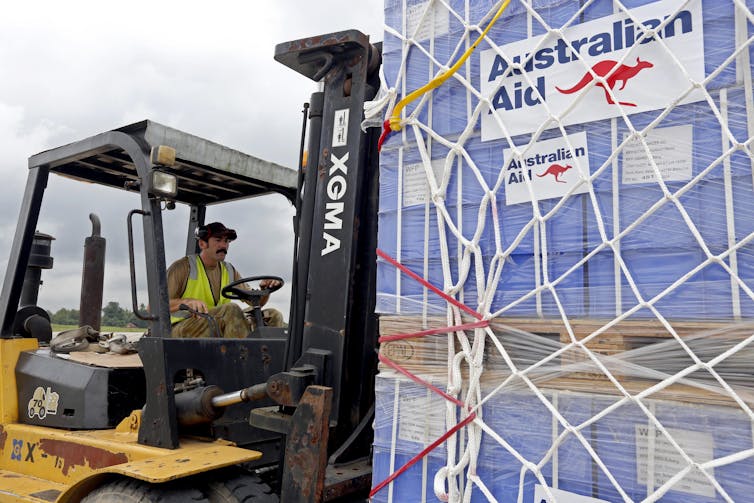
Australian Air Force personnel unload humanitarian relief supplies for flood victims in Myanmar in 2015.NYEIN CHAN NAING/EPA
Donors also focused more on long-term development goals. By 2013, official development assistance to Myanmar had reached US$6 billion — almost a 60-fold increase compared to 2005.
Over the past decade, international aid to Myanmar has fostered an increasingly vibrant civil society. It supported large-scale development programs in sectors like health, education and livelihoods.
A nationwide vaccination campaign in Myanmar in 2019 to eradicate measles and rubella.LYNN BO BO/EPA
A number of donor-funded initiatives also supported both state systems as well as community-based organisations and non-state actors in border areas. This developed valuable collaborations between individuals and groups that were historically divided by conflict.
But the shifting aid economy was not all positive.
Community-based organisations and non-state actors serving ethnic minority communities often felt sidelined from key decisions affecting their activities. Many faced funding cuts or were forced to access donor support through more bureaucratic funding streams inside Myanmar, instead of through partner agencies in places like Thailand, as they did in the past.
Internationally funded development initiatives were also seen as undermining Indigenous health and education systems and increasing centralised state control over border areas.
And peacebuilding initiatives were criticised for being co-opted by the military and bolstering efforts by the central, Bamar-dominated state to consolidate control over ethnic groups in border regions.
Rolling back of last decade’s achievements?
The coup not only draws increased attention to these issues, but also throws into question much of the development and peacebuilding work that has taken place in recent years.
With the military now in control and key ministerial leaders replaced or having resigned, work to develop government systems and capacities has ground to a halt. Development workers fear the past decade’s achievements will be rolled back.
The ability of international NGOs and UN agencies to continue their operations is also now in question, with staff safety and access to local communities jeopardised.
Myanmar’s junta historically restricted international access to people in ethnic minority regions along the borders. The new regime — if it remains in power — could create a similarly difficult environment for aid workers.
And community-based organisations face other difficulties. A civil disobedience movement is intensifying across the country among civilians opposed to the coup, leading many people employed by the government and in other industries to boycott work.
As such, many banks are closed and organisations cannot access funds for the day-to-day running of their programs.
Nationwide protests have broken out in Myanmar since the coup took place earlier this month.KAUNG ZAW HEIN/EPA
Leaders of community-based health organisations working in border areas also tell me that much of their funding is now funnelled through centralised administrative systems, which are frozen and would not be able to operate under the military regime.
As a result, the leaders of these health organisations are asking donors to support community programs and once again fund cross-border aid. Yet, they don’t know how donors will be able to adapt to the current situation or what this will mean for them.
The need for flexible and politically sensitive aid programs
After the coup in Myanmar, much criticism has been directed toward international actors for their faith in the country’s shaky political transition. But what is really needed is a constructive dialogue about how foreign governments and aid organisations should approach development and peace-building in countries like Myanmar.
A new approach is needed that recognises countries do not always transition from conflict to peace, or from military rule to democracy, in a linear fashion. Rather, they can be unstable and subject to major setbacks.
This means supporting vulnerable people in such countries requires a two-pronged approach that combines both flexible and shorter-term “humanitarian” aid and longer-term, more state-focused “development” assistance.
International donors and agencies must also build greater flexibility and concrete contingency plans into their programs from the outset when working in “transitional” countries.
In Myanmar, international donors shouldn’t pull out of the country entirely. Instead, they must listen to and work with community and civil society actors to devise programs that can be adapted to an evolving and unstable situation.
This should include support for community-level groups that were developed in response to decades of military rule and have the experience and structures in place to continue helping people in the current climate.
The Conversation is a great news site. But, for the most part, people don’t read it like a newspaper. Instead, articles on specialised topics are shared with other people. One way is via Facebook.
Yesterday, almost none of that was possible worldwide for the Conversation’s Australian content because Facebook opted to ban all news (even seeming news ) from Australian sources to avoid being designated for compulsory negotiations under legislation before the Australian parliament.
The government’s new media bargaining code was a response to the Australian Competition and Consumer Commission’s digital platforms inquiry that found it was hard for content providers, including but not limited to news organisations – to deal with platforms whose rules were always changing.
Parts of these grievances are legitimate, and relate to editorial and algorithmic issues. Others relate to the platform’s stranglehold on online advertising.
But rather than tackle these issues head on, Australia’s government sliced out a sliver of the sites affected – news sites – and attempted to fix things for it, saying it’s concerned about competition.
Competition policy without more competition
To any economist, the point of competition policy is to encourage competition. In this case, either more digital platform options for consumers, or more news content options.
But the government’s legislation seems to be uniquely designed to deliver neither.
The code allows news organisations to negotiate with large digital platforms about things such as how their algorithms work to prioritise content, and money.
And money is what it is really all about. The news organisations want more of it, large digital platforms have it. It’s that simple.
The code empowers news organisations to get money from digital platforms by
making it unlawful for digital platforms that do not pay up to provide links to Australian news, giving big news outlets quasi-monopoly bargaining power
allowing deals to be made without the need for authorisation by a regulator concerned about the public interest
providing a regulatory stop-gap should that not happen, whose design is tilted in interest of one of the parties
This last step requires a little explanation.
It is not unknown, especially in Australia, for competition policy to work by first allowing parties to negotiate, and then imposing a regulated settlement only if they fail.
And its normally about empowering the little guy, in the belief that’s what leads to socially desirable outcomes.
Little guys locked out
But not in this case. It is only the large news organisations that would be allowed to negotiate over money.
It’s quite different to the system adopted in France, whose government is able to collect money from digital platforms via a tax, which can, should the government wish, be distributed to content providers on a criteria other than naked private interest. The French system isn’t clearly pro-competition either, but it at least provides a mechanism that could enable good outcomes to occur.
The Australian process fails to deliver competition in two ways.
First, it allows the treasurer, rather than a judge, to designate the platforms the process will apply to. He is unlikely to designate a platform that large media organisations have no problem working with, as that will entail work.
Second, the treasurer is unable to designate a platform that doesn’t carry any Australian news. So if a digital platform wants out, it can get out.
Both of these things have begun to come to pass in the last day — even before the code has been legislated.
Facebook gains a bargaining tool
Google has done deals with some large news outlets and thereby signalled it will do deals with others to ensure it is not designated. It means Google won’t have to deal with all of the other smaller voices that also have a problem with it.
Facebook have opted out of the news content business altogether, as the law allows it to. It decided Australian news wasn’t worth it, at least for now. Australians can still share news from around the world, which in some ways is more valuable to them than local news they are already aware of.
Facebook might be doing it to get a better deal when negotiations take place.
Bizarrely, before the government’s proposed legislation, if Facebook had excluded content from suppliers in order to get a better deal, Australia’s Competition and Consumer Commission could have prosecuted it for exclusionary conduct.
The new code gives Facebook a license to do what it has just done, and argue that it could not have been exercising market power because it was merely using the steps identified in the code as necessary for it to avoid compulsory arbitration.
Never mind that this really means Facebook
has been able to demonstrate to news outlets how much they need it
is now able to get news organisations to agree to better conditions than if it had not been given this licence.
In other words, the entire process has had the (I hope) unintended consequence of enhancing the very market power that it claimed to intend to contain.
No more platforms, no more competition
Those games aside: where will this end up? It will end up with the large digital platforms doing deals with the largest news outlets. Those deals will be multi-year lump-sum payments which enable everyone to go about their business. There will be no new digital platforms, no new content providers, no more competition.
The shareholders of the large digital platforms will be a few million dollars poorer and the shareholders of large Australian news outlets a few million dollars richer.
There will be no improvement in any competitive outcome whatsoever. As often happens in Australia, oligarchies will consolidate, and consumers will get nothing.
Narratives around sexual assault in Hollywood are changing – on screen and off.
There is a longstanding genre of film dedicated to depicting the crime of rape as it affects the fathers of the victims, showing fathers dishing out violent retribution.
Contemporary directors have been moving away from depictions like this, with many films choosing to complicate the simplistic morality of their predecessors.
But these films have generally been low-budget affairs with limited cinematic runs — unlike the budgets and stars pumped into stories about fathers, like Taken (2008) and Death Wish (2018).
With the success of 2020’s Promising Young Woman, it is likely there will be more revisionist films like these reaching wide audiences and critical acclaim.
This is a refreshing change of pace in a genre packed with films depicting rape as an attack on the father’s honour.
The rape-revenge film genre has a fairly sleazy reputation, summoning images of a battered and traumatised woman taking violent revenge on her attacker(s), as in I Spit On Your Grave (1978).
These early films rose in prominence in 70s and relied heavily on the shock value of brutal rape scenes, followed by the even larger shock of the victim’s sadistic revenge.
But entries in the genre didn’t always focus on the reaction of the victim.
Frequently, filmmakers found more mainstream success if the avenger was the victim’s father.
The Virgin Spring focuses on the father’s pain, not the daughter’s being.IMDB
The Virgin Spring begins as the story of the titular virgin, Karin (Birgitta Peterson), but after her rape and murder the focus pivots to her distraught father Töre (Max von Sydow).
In 1972, Wes Craven, an admirer of the film, made the much more violent The Last House on the Left, which takes just a beat to focus on the pain and humiliation of Mari (Sandra Peabody), before relishing in the sadistic revenge her parents take on her murderers.
Unlike Mari and Karin, Carol (Kathleen Tolan) of Death Wish (1974) survives her assault, but the film ignores her pain.
Instead, Death Wish focuses on her stoic father Paul (Charles Bronson) and whiny husband Jack (Steven Keats). Jack is heartbroken when he hands the catatonic Carol over to the care of a mental hospital, and Paul takes his grief out on the petty criminals of New York City.
In Death Wish, a daughter’s rape must be avenged over and over again.IMDB
First with a sock full of pennies, and then with a gun, former pacifist Paul becomes a powerful deterrent to would-be criminals, reducing crime in his city by a staggering amount.
This movie has four sequels of roughly the same plot and varying quality (1985’s Death Wish 3, in which Kersey defends an apartment building full of senior citizens, is a lot of fun) and the 2018 remake starring Bruce Willis.
Planning a murder
I have watched an unhealthy number of these movies, but perhaps the most illustrative in this tradition is Taken.
Liam Neeson plays former Green Beret Bryan Mills, who begins the film attempting to rebuild his relationship with 17-year-old daughter Kim (Maggie Grace).
Bryan is horrified when Kim wants to visit Paris accompanied only by her irresponsible friend Amanda (Katie Cassidy). He reluctantly agrees, but his hesitance is vindicated when Kim and Amanda are kidnapped by an Albanian sex trafficking ring.
In Taken, Liam Neeson picks up the gun – just like men before him.IMDB
Bryan travels to Paris and tortures every Albanian he can get his hands on. In one particularly upsetting scene, he electrocutes information out of a mid-level gang member, Marko (Arben Bajraktaraj). When Bryan has what he needs, he turns the electricity on and walks out, leaving Marko to be gradually electrocuted to death.
Eventually, Bryan fulfils his fatherly responsibility by murdering everyone and rescuing Kim.
What women need
Taken ends with Kim back in America with Bryan, apparently not changed at all by her ordeal. She is just as cheerful as she was in the opening scenes.
Of course she is: this is not her story. It is Bryan’s story and he got exactly what he wanted. Kim is safe, and his authority as her father no longer in question.
Even rape-revenge films starring women rarely focused on her internal journey, instead showcasing her acts of incredible violence. But new iterations in rape-revenge centre the protagonist’s path to healing from trauma.
Natalia Leite’s 2017 film M.F.A. (released in Australia as Revenge Artist) brings its audience into the experience of its protagonist Noelle (Francesca Eastwood), who learns that violent revenge may be cathartic, but does not heal her trauma.
Finally, women are being placed in control of their own stories.IMDB
Promising Young Woman focuses on a protagonist’s inability to cope with her friend’s suicide following a sexual assault. The HBO/BBC series I May Destroy You follows a woman doing her best to put her life back together after a traumatic assault.
More and more stories are being brought to screen focusing on what a rape survivor needs — rather than who her father wants to punch. This is an industry realising when a woman is raped, it is a tragedy because that woman is a human being, not because she is a daughter.
If this article has raised issues for you, or if you’re concerned about someone you know, call the 1800 Respect national helpline on 1800 737 732 or Lifeline on 13 11 14.
Source: The Conversation (Au and NZ) – By Susanne Becken, Professor of Sustainable Tourism and Director, Griffith Institute for Tourism, Griffith University
With each passing day, the grave future of Earth becomes more stark. The disruption of COVID-19 has not been enough to shift the trajectory, nor has it prompted polluting sectors of the economy to reconsider the harms they inflict on the planet.
Nowhere is this clearer than in the global tourism sector. Before COVID-19, international aviation emissions – already a major contributor to global warming – were forecast to potentially triple between 2015 and 2050. Likewise, emissions from the cruise ship industry were also growing.
The pandemic itself can be traced back to humanity’s relentless damage to nature. And mass global tourism is emblematic of this voracious, growth-at-all-costs mentality.
Tourism brings many economic, social and cultural benefits. But it’s time the industry seriously reconsiders its business model, and overall purpose, in a post-pandemic world.
After COVID, tourism must be done differently.Shutterstock
We can’t return to normal
The United Nations is among many voices urging the global tourism industry to address its many sustainability challenges in the wake of COVID-19.
The UN says it recognises tourism’s important role in providing incomes for millions of people. But in a recent policy brief, it said now is the time to “rethink how the sector impacts our natural resources and ecosystems”.
Unfortunately, there’s little evidence that global tourism is looking to transform. For example, the International Air Transport Association is clearly seeking to return to the “old normal”. Its resources guide to support airlines during the pandemic and beyond examines ways to restart the industry, but makes no mention of environmental sustainability.
Similarly, the World Travel and Tourism Council’s 100 Million Jobs Recovery Plan calls on nations to remove barriers to travel, saying traveller confidence is “critical to the sector’s survival and recovery”. Sustainability rates only a passing a mention.
In Australia, the federal government is passing up opportunities to encourage tourism to reconfigure towards a more sustainable model. For example, the Building Better Regions Fund offers A$100 million for tourism-related infrastructure projects that mitigate COVID-19’s economic impact. However, sustainability does not form part of the assessment criteria.
The industry’s immediate focus on recovery is understandable. But the lack of a long-term environmental vision is damaging to both the industry and the planet.
The industry is understandably focused on COVID-safe travel, but a long term environmental vision is lacking.James Gourley/AAP
A job half done
Pre-COVID-19, the global tourism and travel industry had begun to address some sustainability challenges.
For example, international aviation is seeking to improve global fuel efficiency by 2% each year until 2050. But this target is “aspirational” and even the International Civil Aviation Authority has conceded it was “unlikely to deliver the level of reduction necessary to stabilize and then reduce aviation’s absolute emissions contribution to climate change”.
What’s more, tourism’s damage to the environment extends far beyond climate change. It adds to marine plastic pollution, degrades habitat and leads to a loss of wilderness and natural quiet. The industry’s resurgence must address these and other harms.
Tourism is a big contributor to marine plastic pollution.Shutterstock
A vision for the future
People travelling outside their normal context are open to new experiences and perspectives. In this way, tourism presents an opportunity to encourage a new connection with nature.
So what should the future of tourism look like? I and others are advocating for a more sustainable tourism sector that’s vastly different to what exists now. Travel should be closer to home, slower, and with a positive contribution at its core. In this model, all erosion of natural, cultural and social capital ceases.
Practices under the model (some of which already exist at a small scale) might include:
more travel to regional and local destinations, involving shorter distances. Under COVID-19, the trend towards such tourism has already begun. However, communities must be empowered to determine what type of tourism they want.
travellers paying a conservation-focused levy upon entering a country, such as those imposed in New Zealand and Botswana.
the donation of time, money or expertise to support environmental restoration as an integral part of the travel experience. For example, the Adventure Scientists initiative shows people with outdoor skills how to collect environmental information as they travel, providing new data for researchers.
businesses that “give back” by design. For example, Global Himalayan Expeditions empowers communities by electrifying remote villages in Ladakh, Kashmir. Trekkers co-finance solar panels and carry them as part of their travel experience.
ambitious industry standards, which ramp up over time, for sustainable management of environmental, cultural and human resources.
The UN Sustainable Development Group has suggested other changes, including:
a frequent flyer levy
incentives for domestic tourism
restrictions on flight advertising
no more airport expansions in high-income countries
Tourism must refocus towards low-impact tourism, closer to home.Shutterstock
Bouncing back differently
The above vision for tourism involves great changes. The industry’s focus must shift from growth and profit to “regeneration” – helping to restore the natural world that humans have so badly damaged.
And the transition must happen gradually, to allow tourism-dependent economies and businesses to adjust.
The global tourism industry will persist after COVID-19. But it must be reimagined as, first and foremost, a public good rather than a commercial activity.
And the goal of ecosystem restoration must be at the industry’s core. Planetary health is inextricably linked to our own well-being – and that of the tourism industry. After all, there’s no tourism on a dead planet.
But people might be surprised to learn there have been another 48 missions to the red planet so far. Of these, more than half failed at stages from take-off to deployment — including the 1999 Mars Climate Orbiter, destroyed on Mars entry after someone failed to convert imperial measurements to metric.
Successful missions include Mars Insight, which is studying the interior via measurement of “marsquakes”, and the Curiosity rover, which touched down in 2012 and has been examining the geology of Mt Sharp.
This selfie of NASA’s Curiosity Mars rover shows the vehicle on Vera Rubin Ridge, with Mt Sharp in the background.NASA, CC BY-ND
Although there have been no return missions, there is a lot we can learn without travelling to Mars — from the more than 260 Martian meteorites that have fallen on Earth.
Images taken by orbiters reveal Mars has more than 40,000 craters, each formed by an asteroid colliding with the surface. You can explore these craters yourself by going to Google Earth, toggling the Google Mars mode and zooming in.
If some of the debris from the large impacts reached escape velocity (about 5 km/s on Mars), it would be able to leave the planet’s gravitational field. Eventually, some of the ejected Martian material has intercepted Earth’s trajectory, flashing through the atmosphere until it either burned up or came to rest on the surface.
Although Martian meteorites have been found across Earth, most have been collected from Antarctica or the deserts of northwest Africa. In both cases, the black crust that forms as the meteorite partially burns up passing through Earth’s atmosphere stands out clearly against ice or sand.
A fragment of the NWA7397 meteorite, found in the Sahara desert in 2012.Wikimedia/Gozitano, CC BY-ND
This mode of interplanetary travel is important because it raises the possibility that life could inadvertently travel from one planet to another. Back in 1996, one Martian meteorite, ALH84001, was controversially thought to contain fossilised bacteria.
Some of the older landers have almost certainly taken Earth bacteria to Mars, since they were not purified before launch.
A bubble of Martian atmosphere
Small planets cool quickly and it has long been suspected that Mars’s core has largely but not totally crystallised. This means Mars has mostly lost the protective magnetic field that deflects cosmic radiation.
But we are confident Mars once had an ocean, containing water as we know it. The temperature was above freezing and conditions were suitable for life. The stripping away of the magnetic field early in Mars’s history means this ocean is long gone and the average temperature is now -65℃, but frosts, clouds and ice caps remain.
The remains of an ancient delta in Mars’s Jezero Crater, which NASA’s Perseverance Mars rover will now explore for signs of fossilised microbial life.ESA/DLR/FU-Berlin
Not being fortunate enough to roam the deserts of Africa or the icy plateaus of Antarctica, I instead found my first Martian meteorite sitting in a cabinet in a gem store in the small New Zealand town of Akaroa.
Using a scanning electron microscope, my examination revealed it was a shergottite, one of the most common Martian meteorites — equivalent to what we know on Earth as basalt. If it’s basalt, though, how do we know it’s from Mars?
There are several ways of recognising a Martian meteorite. One is from its gas content. When a meteorite strikes the surface of Mars, the “target” rocks are subject to such great pressures they partly melt and trap Martian atmosphere within gas bubbles. Some of these rocks are then ejected from the planet — becoming meteorites themselves.
The gases in these meteorites can be measured back on Earth and compared to the known Martian atmosphere, which comprises 95% carbon dioxide and distinct noble gas concentrations.
The thousands of craters scarring Mars’s surface mean it is ancient. This was confirmed when one meteorite was dated to be 4.4 billion years old. Properties of some other Martian meteorites show Mars formed within 13 million years of the formation of the Solar System. This in turn means some of the first planetary crust that formed on Mars likely still exists at the surface.
Some Martian meteorites capture samples of the red planet’s atmosphere in gas bubbles.Wikimedia, CC BY-ND
Old and cold — but not dead
This inference, along with some meteorite mineral and isotopic properties, implies Mars has not been shaped by plate tectonics — the global process that formed the continents, mountain ranges and ocean basins on Earth.
And, as most dated Martian meteorites are less than 1.5 billion years old, volcanism has continued throughout its history. Mars may be cold but it is not dead.
Martian meteorites also hold clues about how people may one day be able to survive on the planet.
While living in hollowed out lava tubes in Martian basalt may appeal to some hopeful interplanetary settlers, we’ll ultimately need to build shelters to protect us from the cosmic radiation and vast dust storms that engulf the planet.
Martian meteorites show olivine, a magnesium-silicate mineral, is common. Experiments are underway to assess the use of a breakdown component, magnesium carbonate, to form a concrete binder from which we could fashion buildings.
Martian meteorites show that big insights can be gleaned from little rocks and reveal what Mars is made of.
But people might be surprised to learn there have been another 48 missions to the red planet so far. Of these, more than half failed at stages from take-off to deployment — including the 1999 Mars Climate Orbiter, destroyed on Mars entry after someone failed to convert imperial measurements to metric.
Successful missions include Mars Insight, which is studying the interior via measurement of “marsquakes”, and the Curiosity rover, which touched down in 2012 and has been examining the geology of Mt Sharp.
This selfie of NASA’s Curiosity Mars rover shows the vehicle on Vera Rubin Ridge, with Mt Sharp in the background.NASA, CC BY-ND
Although there have been no return missions, there is a lot we can learn without travelling to Mars — from the more than 260 Martian meteorites that have fallen on Earth.
Images taken by orbiters reveal Mars has more than 40,000 craters, each formed by an asteroid colliding with the surface. You can explore these craters yourself by going to Google Earth, toggling the Google Mars mode and zooming in.
If some of the debris from the large impacts reached escape velocity (about 5 km/s on Mars), it would be able to leave the planet’s gravitational field. Eventually, some of the ejected Martian material has intercepted Earth’s trajectory, flashing through the atmosphere until it either burned up or came to rest on the surface.
Although Martian meteorites have been found across Earth, most have been collected from Antarctica or the deserts of northwest Africa. In both cases, the black crust that forms as the meteorite partially burns up passing through Earth’s atmosphere stands out clearly against ice or sand.
A fragment of the NWA7397 meteorite, found in the Sahara desert in 2012.Wikimedia/Gozitano, CC BY-ND
This mode of interplanetary travel is important because it raises the possibility that life could inadvertently travel from one planet to another. Back in 1996, one Martian meteorite, ALH84001, was controversially thought to contain fossilised bacteria.
Some of the older landers have almost certainly taken Earth bacteria to Mars, since they were not purified before launch.
A bubble of Martian atmosphere
Small planets cool quickly and it has long been suspected that Mars’s core has largely but not totally crystallised. This means Mars has mostly lost the protective magnetic field that deflects cosmic radiation.
But we are confident Mars once had an ocean, containing water as we know it. The temperature was above freezing and conditions were suitable for life. The stripping away of the magnetic field early in Mars’s history means this ocean is long gone and the average temperature is now -65℃, but frosts, clouds and ice caps remain.
The remains of an ancient delta in Mars’s Jezero Crater, which NASA’s Perseverance Mars rover will now explore for signs of fossilised microbial life.ESA/DLR/FU-Berlin
Not being fortunate enough to roam the deserts of Africa or the icy plateaus of Antarctica, I instead found my first Martian meteorite sitting in a cabinet in a gem store in the small New Zealand town of Akaroa.
Using a scanning electron microscope, my examination revealed it was a shergottite, one of the most common Martian meteorites — equivalent to what we know on Earth as basalt. If it’s basalt, though, how do we know it’s from Mars?
There are several ways of recognising a Martian meteorite. One is from its gas content. When a meteorite strikes the surface of Mars, the “target” rocks are subject to such great pressures they partly melt and trap Martian atmosphere within gas bubbles. Some of these rocks are then ejected from the planet — becoming meteorites themselves.
The gases in these meteorites can be measured back on Earth and compared to the known Martian atmosphere, which comprises 95% carbon dioxide and distinct noble gas concentrations.
The thousands of craters scarring Mars’s surface mean it is ancient. This was confirmed when one meteorite was dated to be 4.4 billion years old. Properties of some other Martian meteorites show Mars formed within 13 million years of the formation of the Solar System. This in turn means some of the first planetary crust that formed on Mars likely still exists at the surface.
Some Martian meteorites capture samples of the red planet’s atmosphere in gas bubbles.Wikimedia, CC BY-ND
Old and cold — but not dead
This inference, along with some meteorite mineral and isotopic properties, implies Mars has not been shaped by plate tectonics — the global process that formed the continents, mountain ranges and ocean basins on Earth.
And, as most dated Martian meteorites are less than 1.5 billion years old, volcanism has continued throughout its history. Mars may be cold but it is not dead.
Martian meteorites also hold clues about how people may one day be able to survive on the planet.
While living in hollowed out lava tubes in Martian basalt may appeal to some hopeful interplanetary settlers, we’ll ultimately need to build shelters to protect us from the cosmic radiation and vast dust storms that engulf the planet.
Martian meteorites show olivine, a magnesium-silicate mineral, is common. Experiments are underway to assess the use of a breakdown component, magnesium carbonate, to form a concrete binder from which we could fashion buildings.
Martian meteorites show that big insights can be gleaned from little rocks and reveal what Mars is made of.
Armida Salsiah Alisjahbana is the United Nations Under-Secretary-General and Executive Secretary of the Economic and Social Commission for Asia and the Pacific (ESCAP).
Article by Armida Salsiah Alisjahbana –Under-Secretary-General of the United Nations and Executive Secretary of ESCAP
Armida Salsiah Alisjahbana is the United Nations Under-Secretary-General and Executive Secretary of the Economic and Social Commission for Asia and the Pacific (ESCAP).
Tomorrow (February 19) marks the entry into force of a new international agreement promoting paperless trade, a timely reminder of how the COVID-19 pandemic has brought digital solutions to regional development challenges into the limelight.
Paperless trade across borders has proven an effective way to mitigate trade disruptions since the onset of the crisis, enabling commerce to continue while limiting physical contact. Yet, despite the increasing acceptance of electronic documents across borders, implementation of cross-border paperless trade remains low according to the United Nations Global Survey on Digital and Sustainable Trade Facilitation for Asia and the Pacific.
Across Asia and the Pacific, governments must move from time-consuming paper-based processes to electronic and traceable trade procedures that can significantly enhance competitiveness and address new challenges associated with e-commerce and the digital economy. In doing so, our region can also recover some of the $200 billion in illicit financial flows that sharply reduce the capacity of governments to put in place support measures for vulnerable groups.
At the United Nations Economic and Social Commission for Asia and the Pacific (ESCAP), in 2016, member States adopted the Framework Agreement on Facilitation of Cross-border Paperless Trade in Asia and the Pacific to accelerate trade digitalization – the electronic exchange of trade-related data across borders – while leaving no one behind.
More than 25 countries worked together to develop the treaty, which is now open for accession to all 53 members of ESCAP. The five countries that have ratified or acceded to the treaty — Azerbaijan, Bangladesh, China, the Islamic Republic of Iran and the Philippines – represent a diverse group of countries spanning the wider Asia-Pacific region but all are committed to regional cooperation in this critical area. Armenia and Cambodia signed the treaty in 2017 while several other ESCAP members are in the process of completing their accession this year, before implementation of the agreement starts in earnest in 2022.
But we must do more to realize the transformative potential of trade digitalization.
First, we need to fully use the Framework Agreement toprovide a region-wide multilateral intergovernmental platform, a dedicated space for developing and testing legal and technical cross-border paperless trade solutions that build on national, bilateral, and subregional initiatives. This treaty marks the beginning of a new journey, one focused on turning cross-border paperless trade into reality through cooperation, testing, innovation, and implementation.
Second, we have to ensure that the Framework Agreement is catalyst forthose countries that become a party to it to implement key measures featured in the Trade Facilitation Agreement (TFA) of the World Trade Organization (WTO), including Single Windows and other actions requiring the use of information and communication technologies.
Third, we recognize that the Framework Agreement is an inclusive and highly flexible cooperation and capacity building opportunities that countries can participate in regardless of their levels of development and digitalization. The estimates presented in the most recent regional trade facilitation report by the Asian Development Bank (ADB) and ESCAP suggest that the Framework Agreement can help reduce trade costs by more than 20 per cent in most of the region’s developing countries. So, this is particularly important now when many bilateral or regional deals exclude some of the least developed countries.
I encourage all ESCAP member States to join the treaty as soon as possible and demonstrate political will. There is no deadline for acceding to the treaty but doing so early on will ensure a seat at the table when the Parties formally discuss the implementation of priorities. The benefits of cross-border paperless trade multiply with the number of countries involved. So, the more countries on board, the larger the development gains for all. It is time to accelerate the excellent bilateral and subregional paperless trade initiatives that have emerged across the Asia-Pacific region to build truly seamless and resilient supply chains as we recover better together in the post-COVID-19 era.
Armida Salsiah Alisjahbana isUnder-Secretary-General of the United Nations and Executive Secretary of ESCAP
When one of us (Ilya Mandel) started grad school at the California Institute of Technology 20 years ago, he was greeted with a series of bets hanging on the wall outside the office of his PhD advisor, Kip Thorne.
One bet from 1974 was a wager with theoretical physicist Stephen Hawking, on whether an observed galactic X-ray source known as “Cygnus X-1” was actually a black hole feeding on hot gas.
Hawking bet it wasn’t, as a consolation prize in case black holes turned out not to exist (since this would mean a lot of the work he had done would be wasted).
At the time, black holes were exclusively theoretical predictions of Albert Einstein’s theory of general relativity: singularities in the fabric of space-time that prevented anything (including light) from escaping.
By 1990, astronomers were convinced Cygnus X-1, a binary star system, indeed hosted a black hole. Hawking conceded his bet against Thorne.
Three decades later, Cygnus X-1 is a gift that keeps on giving. In a paper published today in Science, our team reports the Cygnus X-1 black hole is heavier than previously thought, weighing about 21 times the mass of the Sun.
This makes it the heaviest stellar black hole — formed from the collapse of a star — ever detected without the use of gravitational waves. As it turns out, perhaps in line with a black hole not wanting to divulge its secrets, Cygnus X-1 still contains many mysteries.
Updated measurements from it are forcing us to revise our understanding of the most massive stars — particularly the rate at which they lose mass in stellar winds.
Introducing Cygnus X-1
Cygnus X-1 is located inside the Milky Way about 7,200 light years from Earth. It comprises what we now know to be a black hole in a 5.6-day orbit around a massive supergiant companion star.
Some of the gas blown off the surface of the star by its strong stellar wind is captured by the black hole. The gas spirals in towards the black hole, forming what’s known as an “accretion disk”.
Powerful jets (the contents of which are still debated) are also launched outwards from near the black hole, travelling close to the speed of light.
We wanted to measure the mass of the black hole. But to do so, we first needed to know how far away it was from Earth.
How do you weigh a black hole?
As Earth moves around the Sun, we see Cygnus X-1 from different vantage points. It appears to move back and forth very slightly against stationary background objects, in an effect we call “parallax”.
The amount of this tiny motion lets us calculate the distance between us and Cygnus X-1. But for an accurate measurement, we also had to take into account the orbital motion of the black hole around its companion star.
With a network of radio telescopes, we mapped out the black hole’s orbit, with a positional accuracy the equivalent of localising an object on the Moon to within ten centimetres.
By using our distance to Cygnus X-1 and the brightness and temperature of the star, we computed the size of the star. With this knowledge and the measured motion of the star during its orbit around the black hole, we could determine the black hole’s mass.
It is almost 50% more massive than previously thought, with a mass that’s 21 times that of the Sun.
Astronomers observed the Cygnus X-1 system from different angles, using the orbit. of the Earth around the Sun to measure the perceived movement of the system against background stars.International Centre for Radio Astronomy Research, Author provided
Why do we care about its mass?
Seeing a stellar remnant this heavy in our own galaxy offers insight into how much mass stars can lose to stellar winds. In general, the larger and more luminous a star is, the faster its rate of mass loss.
Some stars lose the equivalent of an Earth’s mass of gas (or more) each day. Mass is lost faster if the star has a high concentration of heavy elements, particularly iron.
Black holes are created when massive stars collapse in on themselves. Thus, the heaviest black holes are expected to form from the deaths of massive stars with the lowest iron concentrations, as these would have retained the most mass up until death.
The current iron concentration in our Milky Way galaxy suggests even stars that weigh hundreds of times the mass of the Sun at birth could lose enough of it to leave behind a fairly pedestrian remnant — only a few times the mass of the Sun.
Now, finding a black hole with a mass that’s 21 times the Sun’s tells us these stellar winds can’t be that strong, after all. So it means we need to slightly retune our models of how stars lose mass through their winds.
Likely not a gravitational wave source
Cygnus X-1 is also interesting because it could potentially be a frame from a film showing the formation of pairs of black holes, which later merge to produce gravitational-wave signals.
These waves can be observed using advanced instruments, such as the Laser Interferometer Gravitational-wave Observatory (LIGO) in the United States.
According to our new measurements, the star in Cygnus X-1 weighs more than 40 times the mass of the Sun. It’s therefore massive enough to one day form a black hole in its own right.
However, while it’s tempting to say Cygnus X-1 provides a link between pairs of stars and merging black holes, that would come with its own challenges.
For example, as described in a companion paper to our Science paper, published in the Astrophysical Journal, the Cygnus X-1 black hole is spinning on its own axis almost as rapidly as general relativity allows.
By comparison, the merging black holes in LIGO sources have far slower spins. This suggests the pathway by which those black holes formed may have been somewhat different.
In another companion paper we argue Cygnus X-1 won’t make a gravitational-wave source because, after the collapse of the companion star, the resulting two black holes would be too far apart to merge.
Still, many questions remain regarding the history and the formation of Cygnus X-1, as well as its future. There may be a few more bets to be made and resolved, yet.
Source: The Conversation (Au and NZ) – By David Smith, Associate Professor in American Politics and Foreign Policy, US Studies Centre, University of Sydney
It still looks like Trump’s party, but for how long? Bill Cassidy, one of the seven Republican senators who voted to convict Trump, says Trump’s power over the party will “wane”. He will certainly hope so. The Republican Party of Louisiana has already censured Cassidy for his disloyalty to Trump.
On the other hand, Lindsey Graham, one of Trump’s top allies, believes Trump and his supporters are so important to the future of the party that Republicans should nominate his daughter-in-law to replace retiring Senator Richard Burr (who voted to convict).
In any case, the party went in the opposite direction from the path of moderation that the last autopsy recommended, and within four years they were back in control of the whole federal government.
The Republican Party has a huge and energetic pro-Trump base that controls the grassrootsmachinery of the party. It also represents a formidable primary voting bloc.
It has a much smaller but high-profile faction that wants to leave Trump behind, with significant representation among legislators, donors and media commentators.
For now, the two sides are stuck with each other.
In the past few weeks, figures on bothsides have threatened to form new parties if they can’t control the direction of the GOP.
These threats have quicklyevaporated. The most a new conservative party could achieve is to damage the electoral prospects of Republicans (something Trump might have contemplated in the face of the impeachment threat).
It has been more than 160 years since divisions over slavery destroyed majorparties in the United States. The Republican and Democratic parties have survived since the Civil War despite numerousfractures and even violentconflicts.
Congressional outcasts occasionallydefect to the other major party. But, more often, members at odds with their party eventually retire and are replaced by new members more closely aligned with its direction. This process is one of the factors leading to the current polarisation of Congress.
Senate minority leader Mitch McConnell warned that “loony lies and conspiracy theories” are “a cancer for the Republican Party and our country”. Greene fired back: “The real cancer for the Republican Party is weak Republicans who only know how to lose gracefully. This is why we are losing our country.”
Newly elected representative Marjorie Taylor Greene has a long history of amplifying conspiracy theories.Shawn Thew/EPA/AAP
Many Republicans in Congress acquiesced to the “stolen election” fantasy, some with the excuse that they are faithfully representing their constituents. Even McConnell waited weeks before acknowledging Biden’s victory.
The historical willingness of American conservatives to police extremism has been overstated. It doesn’t matter that Trump and Greene are poison to the larger electorate. Neither election losses nor the stigma of “extremism” are enough to kill right-wing political movements in America.
‘Trumpism’ without Trump could be tough to pull off
No one knows yet what role Trump will play in future Republican politics. His recent attack on McConnell suggests he at least wants to continue to punish Republicans he sees as disloyal. The possibility Trump could run again will make politics awkward for Republicans eager to claim his mantle for their own presidential ambitions.
Trump has breathed new life into old conservative staples such as law and order and the perils of socialism. But Trump’s relationship with his supporters goes far beyond his political positions, or even the grievances and emotions he harnessed.
Trump’s appeal was based on the perception that he had unique gifts that no politician ever had. He cultivated a media image that made him synonymous, however incorrectly, with business success. His tireless verbal output, whether through Twitter or at endless rallies, created an alternative reality for his followers. Many saw him as chosen by God.
That kind of charismatic magic will be extremely difficult for any career politician to recapture. Republicans may discover that Trumpism is not a political movement but a business model, a model only ever designed for one benefactor.
The revelation that Air New Zealand had been silently contracting services to the Saudi Arabian navy was apparently not the only instance of New Zealand’s connection to the murderous war in Yemen.
A week after Air New Zealand apologised to the government, it emerged the Ministry of Foreign Affairs (MFAT) had approved exports of military equipment to Saudi Arabia in 2016 and 2018.
Both cases involved a startling lack of transparency and direct inconsistencies with both corporate and country commitments to upholding international human rights obligations.
The conflict in Yemen is currently the world’s worst humanitarian crisis. From indiscriminate targeting of civilians to torture, sexual violence and starvation, the situation reads like a textbook case of war crimes.
Since 2014, there have been an estimated 233,000 deaths, including 131,000 from indirect causes such as lack of food, health services and infrastructure. More than 20 million experience food insecurity, and 10 million are at risk of famine.
The war is complex, fed by opposing regional, national and religious ambitions. While all sides justify their involvement, none have clean hands. All have been increasingly brutal in pursuit of their goals.
The first step towards calming the conflict will involve a halt to providing weapons to those forces not fighting in accordance with international humanitarian law — Saudi Arabia included.
Selective embargoes
Despite being on record supporting calls for all parties in the Yemen conflict to abide by international law, New Zealand can no longer deny any potential complicity in this humanitarian abyss.
Efforts to control the situation stretch back to 2014. As well as various peace initiatives, the UN Security Council has mandated a limited arms embargo, which New Zealand complies with. But these are targeted primarily at the Houthi rebels and associated terror groups, not the Saudi-led coalition fighting them.
The inconsistency reflects the power of veto in the Security Council, but a UN panel of experts agreed all parties to the conflict have committed egregious violations of international humanitarian law and international human rights law.
Theory and practice
In theory, the 2013 Arms Trade Treaty should help curtail the trade in weapons to this disastrous conflict. Its signatories (including New Zealand) agree not to authorise any transfer of conventional arms, ammunition, parts and components, if they know such material could contribute to war crimes being committed.
In practice, this meant countries like New Zealand amended export laws to ensure all military and dual-use equipment was strictly controlled and not destined for the wrong places.
All military-related exports must be explicitly permitted. Permits will be refused if the export violates UN Security Council arms embargoes, contravenes New Zealand’s other international obligations, or if it is known such materials would be used in the commission of genocide, crimes against humanity or war crimes.
Reasonably, there should now be no military trade with the Saudi-led coalition (or the other belligerents). No country can seriously claim not to be aware of the extreme violations of international humanitarian law in Yemen.
Profit over principle
Unfortunately, it seems the excessive profits to be made from a soaring arms trade have pushed aside evidence of war crimes or assassinations (in the case of the extrajudicial killing of Jamal Khashoggi).
Initially, New Zealand’s involvement was confined to humanitarian aid, providing millions in assistance. But if the latest reports are correct, the government must end any further military or dual-use engagement and ask how such decisions were justified in the past.
New Zealand’s involvement is comparatively small, but the scale of the trade matters less than its legal and ethical basis.
The government must also require full transparency from Air New Zealand as its majority shareholder.
The airline has come a long way since it was famously accused of “an orchestrated litany of lies” over the 1979 Erebus disaster. As a putatively responsible corporate citizen it upholds social and environmental sustainability as part of its core values and code of conduct.
Air New Zealand takes these responsibilities seriously enough to have pledged itself to the ten principles of the Global Compact. This UN initiative encourages businesses to adopt sustainable and socially responsible policies, and to report on their implementation.
Principle 2 requires that a company should not be complicit in human rights abuses. Air New Zealand said in its 2020 report to the compact:
We take legal advice in the local jurisdictions we operate in about human rights compliance and require managers across the organisation to comply with all company policies.
So far, none of this adds up — for MFAT, Air New Zealand or the government. An independent review of New Zealand’s involvement in the Yemen crisis — its scale, justification and status under existing laws and principles — is now called for.
The much anticipated rollout of the Pfizer-BioNTech COVID-19 vaccine will begin in Australia on Monday.
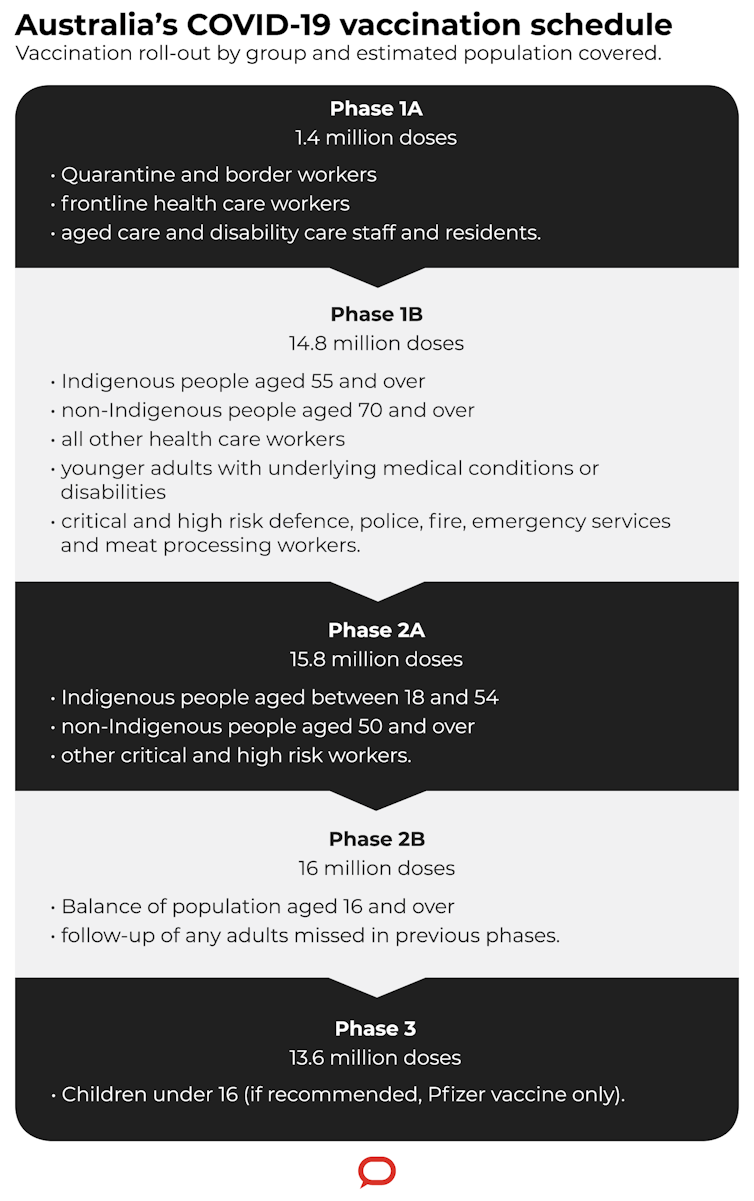
The first groups to receive the jab will be quarantine and border workers, frontline health-care workers, aged-care and disability-care workers, and aged-care and disability-care residents.
For aged-care residents, their age, health and living situation makes them especially susceptible to becoming very sick or dying from COVID-19. So it’s right they are receiving priority access to a vaccine.
But there are also ethical issues that arise when administering vaccines to aged-care residents, who often have diminished capacity to provide consent. Health authorities now face a significant challenge to ensure older members of the community feel safe, comfortable and respected during the vaccination process.
A vulnerable group
One challenge of vaccination in aged care is the fact many older people have dementia, or other conditions that affect their ability to communicate and process information.
Around one in 15 Australians over the age of 65 have dementia, and the risk of developing some form of dementia increases significantly once people enter their 70s and 80s. Among a host of challenges, dementia makes it more difficult for people to consent to medical treatment.
Older people with dementia may also become upset and agitated when things change in their routine or living environment. This means they can easily become distressed during medical procedures.
Evidence supporting the safety of COVID-19 vaccines is growing every day. We do know, however, that mild side-effects like headache, fever and chills are more common in COVID mRNA vaccines than standard flu vaccines (the Pfizer vaccine is based on mRNA technology).
These mild side-effects may be exacerbated when someone is already frail and suffering from several pre-existing illnesses.
That said, trial data suggests people over the age of 55 are less likely to experience side-effects from the Pfizer vaccine than younger people.
Health-care workers will provide information to aged-care residents about the vaccine.Shutterstock
Informed consent
A special team of health-care workers assembled by the federal government will administer COVID vaccines in aged care. These health-care workers must obtain consent from residents receiving the vaccine.
One challenge here is determining whether aged-care residents have capacity to consent. Capacity refers to a person’s ability to make their own decisions.
Generally, a person is said to have capacity if they understand the information relevant to the decision, and the effect of the decision. In the case of vaccination for COVID-19, people must understand they are receiving a vaccine for coronavirus. They must also be made aware of relevant risks and benefits of the vaccine.
The concept becomes more complicated when a patient has a condition like dementia, as their decision-making capacity can ebb and flow depending on the time of day, their location, and the support they have when receiving information.
Unfortunately, the stigma surrounding ageing and physical and cognitive decline means older patients are sometimes subject to prejudice and inappropriate treatment.
It’s important clinicians avoid making assumptions about older patients’ decision-making capacity before speaking to them, and then provide information in a manner the person can understand.
When health-care workers determine a person doesn’t have capacity to consent, they will require what’s called a substitute decision-maker. This is usually someone who has a close and continuing relationship with the person (such as a partner or other family member).
Many people, particularly in aged-care settings, would have completed the relevant legal documentation to appoint a substitute decision-maker (sometimes known as medical power of attorney). Where a substitute decision-maker has not been appointed, aged-care staff must determine who is legally allowed to make decisions on behalf of the patient.
What can we learn from other countries?
Many countries are already weeks or months into their vaccine rollout, so we can take their experiences into account.
One challenge that’s arisen overseas has been tracking down substitute decision-makers when they’re needed. This process can sometimes take days or weeks.
Other countries have already started rolling out COVID vaccines to older people.Emilio Morenatti/AP
We should also be prepared for complex situations where substitute decision-makers refuse vaccination for those in their care. In a recent case in the United Kingdom, the British Court of Protection ruled it was in the best interests of an 80-year-old woman with dementia and diabetes living in a care home to have the COVID vaccine, despite her son’s objections.
Similar situations will likely come up in Australia. Aged-care staff should contact substitute decision-makers as soon as possible to avoid unnecessary conflicts.
Some aged-care providers have already released messages to residents and their families addressing common concerns about vaccination in general, and COVID-19 vaccines in particular.
Looking ahead
There will be immense pressure on medical practitioners to deliver COVID-19 vaccines quickly to those who are most vulnerable to infection and illness. It already takes significant time and resources to deliver vaccines in aged-care homes, and there may be a temptation to give less importance to consent procedures.
But it’s vital COVID-19 vaccines are given in a manner that respects the autonomy and dignity of older members of the community.
This is particularly important in light of the disastrous response to COVID-19 outbreaks in aged-care facilities during the height of the pandemic in Australia and around the world. Residents’ dignity and autonomy has already been violated once, and we can and should avoid a repeat.
The koala is a much-loved species and lucrative tourism drawcard. Yet, for all its popularity, koalas are forecast to be extinct in NSW within 30 years.
Understanding the koala-human relationship might go some way to saving the species. My research examined the dynamic by tracing the representation of koalas in natural history books, children’s stories, postcards and tourism brochures.
I found that “anthropomorpism” – attributing human qualities to a non-human animal – has helped shift attitudes towards the koala away from the scientific and economic to a more romantic, emotional view. In particular, koalas share physical characteristics with human babies, which further endears them to us.
Anthropomorphism can trigger positive emotions in humans which helps with conservation actions. Ultimately, however, threats to koalas are the result of political decisions in which sentiment plays little part.
Koalas hold a special place in the national psyche.Shutterstock
Seeing ourselves in koalas
When humans see themselves in other animals, this can engender greater empathy and concern for the species. And the koala, with its human baby-like qualities can be readily anthropomorphised.
Indeed, koalas exhibit “neoteny”, whereby mature animals retain juvenile physical features. This has been shown to trigger positive emotional responses from human adults.
These features include:
a prominent forehead with eyes positioned below the centre of the head
rounded head and body
soft elasticity of the body surface
a vertical posture.
Newspaper articles published in the first half of the 20th century often infantilised koalas. For instance, an article in the Glen Innes Examiner refers to koalas as “little bears” that sit “up like babies in the trees”.
Koalas even make a crying sound when hurt or upset, adding to their baby-like qualities.
A scientific curiosity
Koalas have not always endeared themselves to post-colonial Australians.
European settlers sought to understand the animal with frames of reference available at the time. As such, the earliest accounts of the koala variously referred to it as a monkey, a sloth, a lemur and a bear.
In the 19th and early 20th centuries, Australians viewed the koala predominantly through a detached, scientific lens. Scientific illustrations and paintings were made of koalas, and information and images were published in natural history and zoology publications.
At the same time, the koala was also seen as an economic resource. From the early 1800s until the 1920s, hundreds of thousands, if not millions, were slaughtered for the fur trade.
Into the 1900s, zoological representations of the koala continued to be published in natural histories. They included Le Souef and Burrell’s The Wild Animals of Australasia, published in 1926, which stated:
The quaint koala, or native bear, a creature which, perhaps, holds the affection of Australians more than any other of their wild animals – a fact for which its innocent, babyish expression and quiet and inoffensive ways are largely responsible.
This passage indicates a shift towards a more romantic view of koalas as akin to humans.
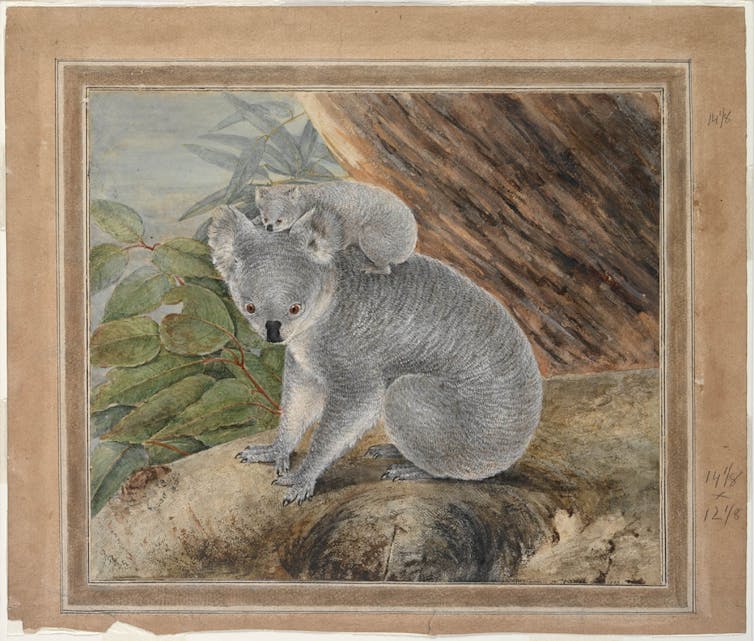
An 1803 illustration by JW Lewin titled ‘Koala and young’. In the 1900s koalas were often depicted in scientific illustrations.Mitchell Library, State Library of NSW
The love affair
Two books published in 1918 encouraged public affection for koalas. Norman Lindsay’s The Magic Pudding, featured an anthropomorphised koala character called Bunyip Bluegum, who wore smart slacks, a jacket and a bow tie. May Gibbs’ Snugglepot and Cuddlepie also included friendly koalas.
The books reached a far wider audience than natural histories. They helped fuel outrage when the open season of koala hunting was declared in Queensland in 1927.
The rapid rise of photography in the 20th century also helped cement koalas’ public appeal. Groups of koalas were arranged for photos to be reproduced as postcards, often captioned “Australia’s teddy bear”.
A 1903 postcard featuring a ‘native bear’.Author provided, Author provided
Zoologist Ellis Troughton, in his landmark 1931 book Furred Animals of Australia, recorded the special place koalas occupied in the national psyche:
This attractive and rather helpless orphan which has become world famous in caricature and story, holds the affection of fellow Australians more than any other animal of their adopted country.
The popularity of koalas fed into an emerging tourism industry eager to create national distinctiveness in the global tourism market.
Today the koala’s image is still reproduced on tea towels, t-shirts, postcards and other souvenirs. Pre-COVID, the economic value of the koala to Australian tourism was estimated at up to A$3.2 billion a year.
Unlike other native species, koalas now have their own dedicated “hospitals” in three states. At the time of writing, a crowd-funding campaign for the Port Macquarie Koala Hospital, set up after the Black Summer bushfires, had raised almost A$8 million.
And koalas attract far more government funding than most species. For example, research last year showed conservation funding for the koala far outstripped that for the northern hairy-nosed wombat. The wombat is listed as critically endangered while the koala is off less conservation concern – listed as vulnerable in parts of Australia.
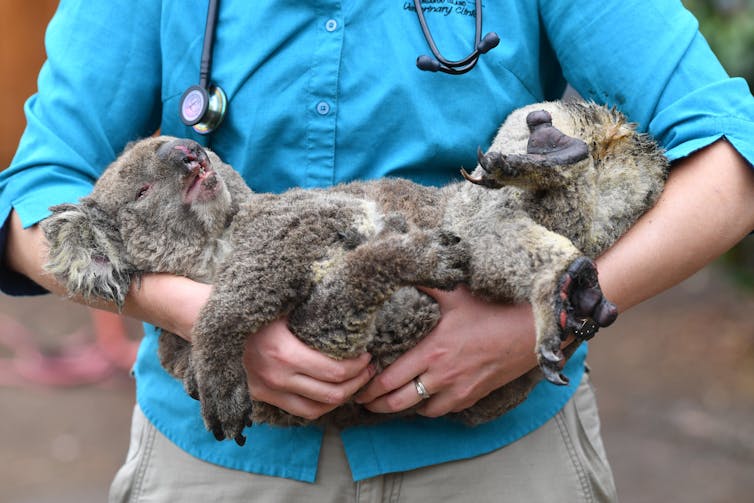
The plight of koalas after the Black Summer fires drew international attention.Daniel Mariuz/AAP
Saving what we love
Anthropomorphism can be a powerful way to generate concern and action for a species. However, there are limits to its effectiveness.
For all their popularity, koalas face extinction in NSW within 30 years. Estimates of the wild national koala population vary from 140,000 to 600,000.
It might seem baffling that such a well-loved animal could be headed for extinction. But the koala’s continued survival depends on political decisions where emotion and public sentiment are so often overridden by economics and vested interests.
Australians clearly care deeply for their koalas. But that sentiment must translate into collective political pressure if the species is to survive.
“At the end of the war men returned from the battlefield grown silent — not richer, but poorer in communicable experience”, wrote Walter Benjamin after the first world war. So too, school students may reflect on the pandemic of 2020 and its effect on their experiences.
Almost every day, they heard anxiety-provoking news from across the globe, doled out in rapid fire. Yet many will be poor in the stories of their anticipated rituals and rites of passage to retell in later years.
They have other stories though, of cancellation and loss.
Gather any group of students together and they spontaneously tell different stories — of how their formal was cancelled or modified; how their classes were delivered remotely; how they adjusted to the rules of social distancing; or how they missed the opportunity to celebrate their milestone birthday with friends.
And they are instantly captivated by each other’s experiences.
The telling of stories is a crucial coping device, enabling individuals to situate themselves in relation to a bigger event and to gain perspective on the human experience.
We recommend storytelling using oral, written and creative arts formats, linking key events to form a plot, to adapt and improvise, and to share the story to reveal how very different people can share the same life experience. And how human nature can transcend this moment.
Missing stories
The loss of significant events — whether traditions such as school graduation celebrations, or more mundane everyday losses such as routine sport or other extracurricular activities — can have profound, long-term impacts on students.
Rite-of-passage events, such as formals, are important cultural markers, cementing peer relationships and firming the foundations for ongoing well-being.
They are the stories we tell again and again during our lives, locating our belonging with and for others. But it is not just a simple loss of moments and unmade memories.
At this crucial stage in the development of the adolescent brain, the foundations are laid for decades to come through their experiences.
Rites of passage events are important cultural markers. They’re stories we tell again and again.Unsplash/Kimson Doan
The adolescent years, known as the second sensitive period of brain development, are important because this is when shaping of the brain occurs in earnest, in response to the unique environmental experiences of the individual.
This process of synaptic pruning — which starts with the onset of puberty and continues for at least the next five years — results in unused connections being removed. While those that are used are strengthened and “hard wired” with a coating of a substance called myelin.
The spectre looms of brains shaped by unmet expectations, disrupted routines, missing significant events, ongoing anxiety, fear and stress about what may be ahead the next day, week, month or year.
Our understanding of neuroscience points to such experiences as paving the way for lifelong reduced outcomes, such as poorer health, lowered educational achievement and the loss of optimism and hope.
Everything is different
The United Nations International Children’s Emergency Fund estimates 1.6 billion students and 91% of schools in 2020 experienced emergency education. That means there was an adaptation to the usual routines of teaching, learning, attendance and curriculum, as a response to the COVID-19 disaster.
There is much talk of schools and universities needing to help our adolescents become more resilient, acquire greater grit, and to be equipped with positive psychology strategies such as learned optimism.
There is a physiological tipping point though, when toxic stress resulting from strong, frequent or prolonged activation of the body’s stress response system, can lead to adverse impacts on brain structures. And students will not learn as before, especially if their brains have become hardwired during times of stress, anxiety and trauma.
How can we ensure our young people are happy and uncompromised along well-being indicators, including a person’s ambitions and understanding of the qualities of their life?
Meeting and slightly exceeding expectations is the key to happiness and well-being. When a person is happy there is an alignment, or a slight increase between what is ideal or expected, and reality.
In a year of unmet expectations, negative impacts on well-being and subjective happiness are unavoidable. This can be seen with numbers seeking the support of mental-health providers increasing dramatically during 2020.
There is a brooding concern identified globally and by the Foundation of Young Australians, that every aspect of how young people
live, learn and work has been forever changed by COVID-19 and will continue to be felt by young people in the decade to come.
The importance of telling the stories of 2020
Young people can benefit from opportunities to create and remember stories, and to use storytelling as a way to come to terms with their experiences of the pandemic, to aid healing and to create optimism for the future — both for themselves and their communities.
Storytelling requires a listener, and hence a community of shared experience emerges, building understanding and acceptance. These are crucial for promoting a sense of belonging and well-being.
The acceleration of change and the likelihood of a “new normal” points to the need to tell the story of how and why change has occurred, and how the individual has experienced this change.
Research in health settings shows storytelling can be therapeutic. People telling stories as a way of dealing with topics such as trauma, anxiety and illness, are “encouraged to work through their experiences and reflect on and deepen their understanding of what really matters in their lives”.
Health professionals have increasingly been drawn to collective storytelling for this reason. Now, more than ever, it is needed in schools and in universities, where teachers intersect with the lives of students constantly and have the capacity to make a significant impact.
The lived experiences and disappointments can be shared through the development of storytelling skills, such as learning how to appreciate multiple points of view and that listeners and tellers can perceive events differently. These can provide us with a way to chronicle, share, and make meaning of experience, thereby enabling a retelling of the events, even when they reflect a poverty of expectations.
Teachers are the pivotal gate keepers of the future in so many ways, not only in grade setting but in recounting stories of success, both personal and from near and far, opening new future-oriented windows of opportunity to think and act.
In doing so, we reconnect with the important processes of adolescent cognition to rewire the brain, leading to the potential for a more optimistic, hopeful perspective rather than one of disappointment, loss and regret.
The importance of storytelling for all students will continue to grow as we tread the uncertain path of 2021 and beyond.
Australia urgently needs housing types that meet the needs of older women facing homelessness. One such model is Chinese siheyuan courtyard housing, which provides safe, affordable and private living spaces while maintaining a sense of community. It has potential for adapting existing buildings for re-use in Australia in a way that makes financial, social and environmental sense.
A simple (and obvious) solution for older women facing homelessness is to provide them with access to appropriate, safe and affordable homes for the long term. So why is this problem so difficult to solve?
Recent attempts to meet this need for older women’s housing include “pop-up” or “meanwhile use” accommodation in vacant aged-care facilities and tiny houses. While both types provide good short-term options, they do not create long-term housing that meets older women’s needs to age in place and have secure tenure and a sense of belonging. All these aspects are important for their well-being.
What if we were to take the idea of adapting existing buildings and merge it with the idea of tiny homes? Chinese courtyard housing – siheyuan – has some important principles that could be culturally adapted to the Australian context.
Finding new spaces in old stock
Adaptive reuse involves the conversion of new spaces within old ones. An existing building is recycled by integrating a new set of functions into the existing skin to suit the needs of new inhabitants.
This is not a new concept – think of the Hagia Sofia in Istanbul, originally a mosque, then church, now museum. Or Paddington Reservoir in Sydney, originally infrastructure, then petrol station, then ruin, now urban performance space.
Adaptive reuse works on a triple-bottom-line approach: economic, environmental and socio-cultural. Recycling an existing building is cheaper, better for the environment and ensures the collective memory of a place is not erased. For buildings as for older women, respect for age, connection to place and care for the environment are important.
The name “siheyuan” translates into quadrangle courtyard housing. This type of housing comes from traditional Confucian ideas of the extended family unit, arranged around a courtyard or series of courtyards with graduated levels of privacy.
Hugo Chan, Author provided
The interesting thing about the siheyuan arrangement is the highly ordered series of rooms with private units organised around open spaces and communal halls for gatherings. In Beijing today, an estimated 400,000 courtyard houses remain. About 500 have been preserved as historic sites.
The hierarchical order of the siheyuan presents a great opportunity for adapting it to suit the needs of older women. It’s a type of co-housing arrangement: people live independently but together, sharing some facilities like open space and areas to come together for occasional meals. This model could form part of the rise in shared housing configurations.
The courtyards meet the needs of older women to maintain a strong connection to a garden space, with potential for them to be active in maintaining this area. The courtyards promote social contact and exercise, as well as space for quiet contemplation. This interior-landscape connection is important to the well-being of older women.
The connections between private living areas, courtyards and gardens promote well-being through social contact and exercise.ByLorena/Flickr, CC BY-NC-SA
The hall serves as a social connector. It’s a place for communal activities, connecting with family or friends, creative projects or listening. Women retain their sense of independence; they decide when they participate.
Another important requirement for older women is to have the space to welcome family and friends, so they maintain their social connections to the world. The hall is an efficient way to share space that everyone needs, but only some of the time.
The small luxury of having a room of one’s own should not be underestimated. Many older women have rarely had this luxury. For them, it provides much-needed dignity.
This sort of adaptive reuse is not just about what we do with existing buildings. It’s also about adapting cultural wisdom, and ideas from the past, to develop alternative ways of living together. Many currently underutilised or vacant buildings in Australia could be adapted to courtyard housing.
It will need a radical shift in policy and developer-driven economics. But this opportunity would meet so many current needs of older women, be good environmental practice and provide social housing. As Confucius said, “Everything has beauty, but not everyone sees it.”
The financial burden on taxpayers and service providers is dramatically reduced by providing secure affordable housing in the first place. The solution to the problem of homelessness lies not in our obsession with new housing models or new development, but perhaps, if we look hard enough, in our existing urban fabric. Right under our noses, existing buildings offer opportunities ripe for adaptation.
Netball Australia has signed a five-year deal it describes as “ground-breaking”.
Every game of every round of each year’s Super Netball competition will be broadcast live and ad-free on Foxtel platforms including its sports streaming app Kayo Sports.
For viewers who don’t want to part with cash, two games each week will be available live and free on Kayo Freebies, although viewers will have to hand over their email and other details.
That several events will be free is good for Netball Australia — it gives it potential access to the mass audience it would have had on free-to-air TV – and also good for Foxtel because it will pioneer a way of getting around the anti-siphoning rules that are meant to ensure major events can be watched by everyone.
Rugby Union is doing something similar.
From tonight every match will be shown live on Stan Sport, part of the movie streaming platform Stan owned by Nine, under a three-year deal worth a reported A$100 million.
Enough matches will be shown free on the Nine network to satisfy the anti-siphoning rules.
The Rugby deal replaces an earlier one with Foxtel, which used the Ten network to broadcast free matches.
Cricket is now broadcast on both Foxtel and the Seven Network, a deal Seven is reportedly trying to get out of. It means fans must now subscribe to watch domestic men’s One Day Internationals for the first time.
Australia’s anti-siphoning laws were enacted with the birth of pay TV thirty years ago in order to ensure all Australians retained access to “culturally significant” sports and events.
So-called “broadcast events notices” specify events that, in the opinion of the minister, “should be available free to the general public”.
Among those currently on the list are every event at the Summer and Winter Olympic games, the Melbourne Cup, every match in the AFL and AFL premiership competitions, and each cricket test played in Australia or overseas by a representative team chosen by Cricket Australia.
The rules don’t compel free-to-air networks to broadcast these events, but they do require them to be given first dibs.
While broadly successful in securing sporting events for free-to-air television and the viewing public, the rules are becoming battle weary.
‘Freemium’ not tested
Netflix, Amazon, Twitter, Facebook, Stan, Kayo, Telstra and the smartphone didn’t exist when the rules were drawn up.
The rules as written appear to allow Kayo to pursue a Spotify and YouTube-style “freemium” strategy while fulfilling the requirements of the legislation.
As worded, the law refers to events “available free to the general public” rather than events available on free-to-air TV.
Kayo is opening the way for Fox Sports and others to meet the formal requirements of the anti-siphoning laws while raiding sports until now housed on free-to-air TV, the AFL and Rugby League among them.
Netball the canary in the coalmine
Liz Watson of the Vixens and coach Simone McKinnis celebrate victory during the Super Netball Grand Final.ALBERT PEREZ/AAP
A key question will be whether access via an app is really “free”. Surrendering email addresses and demographical information in return for watching isn’t quite the same as free. Facebook and Google have made it more than clear that such data is valuable.
The stakes are high for sport leagues, media outlets and fans.
It has been argued that even in the hypothetical absence of an anti-siphoning list, most sports would be well served to choose a free-to-air broadcast partner to maximise their exposure and popularity.
Super Rugby’s 25-year decline behind a Foxtel paywall is used as a cautionary tale.
Sport accounts for about only 10% of commercial television air time, yet rates consistently highly. Sport, news and reality television account for all of free to air’s top twenty programs.
Free-to-air’s share of the advertising market is at present predicted to decline from 20% in 2018 to 14% in 2023.
The loss of sport could send it into an even faster nosedive.
Source: The Conversation (Au and NZ) – By Henry Reynolds, Honorary Research Professor, Aboriginal Studies Global Cultures & Languages, University of Tasmania
Aboriginal and Torres Strait Islander readers are advised this article contains images of deceased people.
Historical research of the last 20 years has confirmed the central importance of the killing times. They lasted far longer and were much more deadly than generations of Australians were led to believe.
For many years the truth was either deftly avoided or consciously suppressed. Aboriginal families kept alive their own memories of those terrible times, even if they were not necessarily aware of the broader national story.
A pioneer Queensland pastoralist who had worked for years with Indigenous stockmen came to appreciate the continuing legacy of the violent early years, or what he termed “the remembrance of the blood red dawn of their civilisation”.
Once anthropologists and linguists began to work in First Nations communities in the 1930s and 1940s, they too learnt how vigorously alive were memories of historical violence. They should perhaps have known more about it but often didn’t. Their education had let them down.
The violence, the “line of blood”, was well known in colonial society. It had been discussed and argued about from the earliest years in New South Wales and Tasmania. The central points of contention still confront us.
Was it an inescapable companion of colonisation? Was it a case of forced appropriation or none at all? Were all the colonists, including those with no experience of the frontier, complicit by remaining in Australia? Did the new societies bear a collective moral burden? Or was it necessary to distinguish the culpability of free settlers from that of the convicts and the Australian-born children?
“This right to Australia is a sore subject with many of the British settlers”, a Victorian pioneer noted in the 1840s, “and they strive to satisfy their consciences in various ways”.
No title (Aboriginal man holding a gun) c. 1873. No. 18 from the Australian Aboriginals portfolio, photogaph by JW Lindt.National Gallery of Victoria, Melbourne
At much the same time, the South Australian settler Francis Dutton thought that the claims of the blacks were “superior to ours”, although his contemporaries were “too eager on all occasions … to persuade ourselves that such is not the case”.
The Aboriginal question “gave rise to more argument” than any other matter in Queensland in the 1860s according to the editor of the Rockhampton Bulletin.
Running close to the colonial debate about the morality of settlement was the unavoidable question of frontier conflict. Was it a form of warfare even if of quite a distinctive kind? Or were the pioneer settlers murderers? Were they heroic pathfinders or criminals?
There were very few court cases where such questions might have been assessed and therefore publicised. On the other hand, war and homicide were matters widely understood, each with their own place in the popular mind. So there was no consensus, no resolution that has been passed down to us. We have to resolve the matter ourselves.
Our most important war
There were always settlers who opted for warfare as the way out of the moral quandary of colonisation. And many of the military men who lived and worked in NSW and Tasmania talked openly of war. Many of them were career officers with battle experience.
It is not surprising therefore that many of the historians who have rewritten the history of frontier conflict over the last 40 or so years have followed in their wake. More to the point is that since at least 1990, Australia’s professional war historians have both accepted and promoted the idea that frontier conflict must be considered alongside Australia’s overseas wars.
But that can only be the start of a significant transformation in the way we think about both the frontiersmen and the warriors of the First Nations who confronted them all over the continent.
Rigorous truth-telling will be of critical importance here, but that can only be part of the required transformation. The telling must be heard and treated with gravity. Changes in traditional accounts of national history will have to be accepted.
Portrait of Truganini, a member of The Freedom Fighters, c 1866, photographed by CA Woolley.National Library of Australia
Above all, we must bring together the ways we think about and commemorate the two forms of national war-making … the many overseas campaigns on the one hand and the war fought in Australia for the ownership and control of the continent on the other.
The truth-telling will have achieved its ultimate purpose when Australian children are able to consider that the long-running and widespread conflict that accompanied Australian life for 140 years was arguably our most important war.
Aboriginal people on the frontier
But how can two such disparate narratives be spliced together? It will clearly take time and will need steady and persistent commitment. Many small threads will have to be engaged. Complexity will have to replace simple sagas of heroic settlement. For instance, few people appreciate that Aboriginal people participated from the earliest years in the outward thrust of the frontier.
The first expeditions that pushed out into the interior were invariably accompanied by Aboriginal escorts who acted as guides and diplomats. They were able to find their way across country, discover water, track straying horses, hunt and gather food. They could quickly construct temporary shelters and simple bark rafts to ford rivers.
Aboriginal police trackers Woodley and Gordon in the Kimberley, 1920.State Library Western Australia
Their value was so obvious that it became a settled custom for expeditions, both private and official, to recruit young men and women to act as valued auxiliaries. When the squatters surged out into the interior of NSW, Aboriginal people went with them and quickly developed the skills that made them valued and competent stockmen and women.
Children, often enough kidnapped, were taken along as personal servants and eventually sexual partners. Once the vast savannah lands of the tropical north were occupied, local Aboriginal people became the mainstay of the workforce, given the scarcity, cost and unreliability of white labour.
They were an essential component of the successful establishment of the northern pastoral industry and, consequently, the principal claim the settler Australians could make to prove they were in effective occupation of as much as a quarter of the continent.
The same skills made young Aboriginal men ideal troopers for native police forces in Victoria, NSW and particularly Queensland. Their bushcraft was essential to the success of the northern force in crushing the resistance of the First Nations over a vast area of the colony. They were also much cheaper to maintain than a comparable force of European troopers.
Queensland Native Mounted Police contingent sent to Victoria to help hunt the Kelly Gang, 1879.Queensland Police Museum, CC BY-NC-SA
There seems to be no precise record of the number of Aboriginal young men who served in the force. In his history of the Native Police, The Secret War, Jonathan Richards listed just over 250 white officers who spent varying periods of time out in the field. But he provided no estimate of the equivalent number of Indigenous troopers.
There must have been hundreds and possibly as many as a thousand. The conclusions that follow from this are compelling. The troopers almost certainly killed more Aboriginal people than the settlers.
In total, they may have been responsible for up to a quarter of all deaths in the frontier wars all over Australia. This too has to be part of our truth-telling.
The response of many people when this matter is raised is to express amazement that the troopers could shoot their own people and assume they must have been coerced into killing. But the critical point is that the idea that the First Nations were members of one race or one people was a European one and had little bearing on the situation on the ground.
The young troopers were invariably campaigning far from their own homeland in country previously unknown among people foreign to them. And the locals were people to be feared. If the troopers were caught away from their detachment they would almost certainly have been killed, and this kept them together as much as the discipline imposed by white officers.
So whether as paramilitary troopers, workers, trackers, guides, servants and sexual partners, many hundreds of Aboriginal Australians were participants in the outward thrust of the frontier.
The implication is inescapable. Many Indigenous families have ancestors who were pioneers in the precise meaning of that term, both black and white, whether recognised and acknowledged or not.
White fear
Truth-telling allows us to weave new stories and to make old ones richer while, at the same time, more complex. This is particularly true when it comes to our understanding of frontier warfare. The common view is that the Aboriginal peoples were, for much of the time, passive victims of European brutality.
Such ideas help explain the one-time common view that the Aboriginal peoples were quite unable to put up a spirited resistance of the kind seen in New Zealand and North America, that they were “pathetically helpless” in their response to the invaders of their homelands.
Pemulwuy was a significant figure in the resistance to colonisation. This is believed to be the only picture of him, drawn in 1803, a year after his murder.State Library Victoria
Such opinions, common among professional historians until the 1960s, underpinned the idea that we had a uniquely peaceful history. Since then, the violence of the frontier has flooded back into the national story. But the overwhelming idea of Aboriginal people as victims of irresistible violence has lived on as a powerful political weapon, readily mobilised to assault the conscience of white Australia. Still, as is often the case, good politics makes bad history.
A few days’ research among the documentary records of the colonies would dispel these ideas. It was understood at the time that white fear was overwhelmingly important. The brave frontiersmen were terrified of the Aboriginal people. The evidence for this will be found everywhere.
A Sydney Morning Herald journalist who toured North Queensland in the 1880s concluded that “mere wanton slaughter would be unknown if the natives were not feared so much”.
Some years later, on the other side of the continent, the government resident at Roebourne reported that the “fears of whites are more the cause of disorder than the aggression of blacks”.
This should come as no surprise. In most frontier districts the invading force was spread very thin. The small parties were almost everywhere outnumbered by resident bands. They were in country they knew little about. It looked, felt and smelt dangerously exotic. They had no maps and had no idea where Aboriginal parties periodically disappeared to.
The people they were displacing had a profound knowledge of their own land. They were in many cases taller, stronger and better nourished than the Europeans, who got by on a very limited diet. And they were hunters trained from childhood.
Print depicting formal Aboriginal combat scene from the time of the Baudin voyage, c1825.Mitchell Library, State Library of New South Wales
They could track the intruders and stalk them without being seen or heard, and throw their spears with lethal force and accuracy. Guns were important, particularly late in the 19th century when men on the frontier carried revolvers and high-powered repeating rifles.
But it was the horse that had tipped the balance in the invaders’ favour. Their power, speed and endurance made all the difference on the vast open plains of inland Australia.
When speaking in their own defence, frontiersmen insisted that they acted in response to Aboriginal aggression. A typical argument was advanced by the editor of the Hodgkinson Mining News who wrote in 1877:
It is not the rule that the white men are the aggressors. The first settlers came peaceably onto the land they had got by right from the Crown, and no sooner had they done so than the hostilities of the natives compel them to adopt not merely defensive but offensive measures.
It was special pleading but there is no doubt the frontiersmen, like invaders anywhere, would have preferred to achieve a bloodless usurpation.
The editor’s comment nudges us, however, towards an enhanced understanding of the frontier wars. It was Aboriginal resistance that determined where and when conflict broke out and for how long it lasted. And that was clearly the result of innumerable political decisions, made often at band level, about how to respond to the white men.
Initially there was a choice of attempting to accommodate the intruders, avoiding them altogether or spying on them in order to gather information about them. The fateful decision to begin forceful resistance often took some time.
It may have begun with a compelling desire to carry out a revenge mission aimed at a particular individual for what would have been a crime in traditional society — the kidnapping and rape of a kinswoman, for instance.
From that point on, violence spiralled out of control. Attacks on vulnerable white men were often combined with the killing of sheep, cattle and horses; the burning of huts and crops; and the pillaging of undefended camp sites.
The fighting continued until the Aboriginal bands decided that the cost they were paying was too high. Once again there must have been intense and urgent debate about how to bring the merciless killing to an end.
And even then, the question of how to negotiate a capitulation must have occupied time and thought. But everywhere, sooner or later, the survivors were, in the victors’ words, “let in” to pastoral stations, mining camps or rudimentary townships.
Not everyone was willing to surrender, and small parties of what the white men called myalls continued to live independently in remote areas of their homeland.
‘We are at war with them’
The explorer Edward Eyre was one of the people who was able to look beyond the conventional view that the warriors were dangerous but lacking martial virtue. He observed that:
It has been said, and is generally believed, that the natives are not courageous. There could not be a greater mistake … I have seen many instances of an open manly intrepidity of manner and bearing, and a proud unquailing glance of eye, which instinctively stamped upon my mind the conviction that the individuals before me were very brave men.
From an admiration of Aboriginal bravery it required a further step to regard the warriors as heroic patriots defending their homelands, although that was one too demanding for most colonists. It required an even-handed approach difficult to sustain in times of conflict and that threatened to undermine the legal and moral foundations on which the Australian colonies rested.
‘The First Execution’, drawn by W. F. E Liardet c, of the execution of Tunnerminnerwait and Maulboyheenner.State Library Victoria
It was the war in Tasmania in the 1820s that produced one of colonial Australia’s most provocative manifestos. It was printed in a Launceston newspaper at the very end of five years of conflict. The author J.E., assumed to be the young surveyor James Erskine Calder, posed what he called some solemn questions about the islands’ Aboriginal peoples. He declared:
We are at war with them: they look upon us as enemies – as invaders – as their oppressors and persecutors – they resist our invasion. They have never been subdued, therefore they are not rebellious subjects, but an injured nation, defending in their own way, their rightful possessions, which have been torn from them by force.
Given the time that it was written that was provocative enough. But J.E. followed the logic of his position much further arguing:
What we call their crime is what in a white man we should call patriotism. Where is the man amongst ourselves who would not resist an invading enemy; who would not avenge the murder of his parents, the ill-usage of his wife and daughters, and the spoliation of all his earthly goods, by a foreign enemy, if he had an opportunity? He who would not do so, would be scouted, execrated, nay executed as a coward and a traitor; while he who did would be immortalised as a patriot.
Why then shall deny the same feelings to the Blacks? How can we condemn as a crime in these savages what we should esteem as a virtue in ourselves? Why punish a black man with death for doing that which a white man would be executed for not doing?
They were challenging questions then. They remain so today.
Warriors as patriots
I came across J.E.’s letter years ago and have used it in several books. I have also read it to audiences in many parts of Australia. In almost all cases people have found it a complete surprise. They are amazed that a colonist would publish such an enlightened letter almost 200 years ago. They correctly assess that his questions still confront and challenge us.
Can we, by which I mean Australia as a nation, regard the First Nations’ warriors as patriots? Can we immortalise their heroic defence of their homelands? We have a great deal of experience when it comes to remembering and commemorating our citizens who have died in conflict. No expense is spared. The phrase “Lest We Forget” is surrounded by a sacred penumbra.
But do we want to allow the heroes of the First Nations to join the chosen ones? Do we want to extend to them the honours we award to the war dead from all our overseas engagements?
Do we want to honour them with a place in the nation’s pantheon? Do we want to share the honours we have hitherto preserved for our warriors who fought on foreign soil? See it as a national priority? If the answer is yes, what would be required?
Aboriginal and Torres Strait Islander War Memorial in Adelaide.AAP Image/Margaret Scheikowski
Memorials to our overseas wars can be found all over the continent, even in the smallest and most isolated villages. In his book Sacred Places, Ken Inglis estimated that there are more than 4,000 war memorials of one kind or another.
And then there are the tens of thousands graves cared for by the War Graves Commission in Australia and many places overseas. During the carnival of first world war commemoration we witnessed between 2014 and 2018, old monuments all over the country were refurbished and avenues of honour replanted.
A new museum costing $100 million was built in northern France to commemorate the achievements of the AIF. Meanwhile the Australian War Memorial had achieved an unparalleled place in national life. Visiting schoolchildren are taught that it is where they must go to understand what it means to be an Australian.
The memorial’s apotheosis has been achieved during the years when many aspects of Australian history were transformed and in particular our new understanding of the magnitude of the frontier wars.
But rather than embrace the new historiography, the memorial has turned its back on it, despite the highly relevant research and writing of many of the Canberra-based war historians, some of whom have actually worked inside the institution.
The reason for this recalcitrance has never been convincingly outlined. The most common explanation is that while frontier conflict has been accepted as part of the national story, it should come under the aegis of the National Museum rather than the War Memorial.
A new national museum
The War Memorial’s implicit disrespect for the warriors of the First Nations represents a case of profound moral failure. It has let us all down. It was made worse by a parallel political failure as a consequence of the complete lack of interest in the subject from all sides of the federal parliament.
The problem could have been resolved so easily. One formal ceremony would have woven the two traditions together. The placing of a tomb for the unknown warrior in the heart of the memorial next to the grave of the unknown soldier would have been an event of immense national importance, a symbol of respect, inclusion and reconciliation. What a difference that would have made to the way we feel about ourselves!
The tomb of the unknown solider is an important place of remembering the unnamed lost.Lukas Coch/AAP
There seems little chance now that this will ever happen. We will have to persist with two separate stories of war. The inescapable implication is that the nation itself is deeply divided, its soul bifurcated and located in different places.
But if the two histories are to be told in different ways and in distinctive institutions, they must be given equal resources to not only continue the truth-telling, called for in the Uluru Statement from the Heart, but to enable the truth to be proclaimed and illustrated in a compelling way.
The call must be: “If not inclusion then equality”.
What is clearly required is a new national museum dedicated to the frontier wars and supported with the same level of funding that is received by the War Memorial.
It will be expensive, but if $100 million can be lavished on building a museum dedicated to a few years of fighting in France, that is the least that should be expected to establish an institution here dedicated to the story of the conflict experienced in all parts of the continent over 140 years.
The new institution could then provide advice and encouragement to regional organisations to consider ways to research and commemorate the war fought within their own traditional boundaries.
Not every community would necessarily respond, but the variety of the chosen manner and form would likely provide an exhilarating experience for locals and visitors alike. In some places the descendants of the white pioneers might be invited to participate in the commemoration.
Museums and monuments are important instruments to both remember the past and to engage in truth-telling.
Scott Morrison has been wounded by the public revelation this week of an alleged rape in Parliament House. But the fear must be that along the way Brittany Higgins, the young woman whose story shocked the country, has become a victim twice over – not just of the incident itself but also of the fallout these past days.
Politicians praise her courage in coming forward, but some use her trauma in their own cause.
For the media, her experience has fed into the recurring narrative of bad behaviour in Parliament House, and the wider one of violence against women. It’s been salacious.
But where will Higgins be left when the political and news caravans move on? In a personally bad place, one suspects. This is the cost of speaking out sometimes.
The political focus of the issue moved from whether or to what degree Linda Reynolds, then defence industry minister, fell down in her duty of care to her staffer, to when Morrison and his office knew about Higgins’ alleged assault by a colleague in Reynolds’ office in March 2019.
Morrison says he first knew of the rape allegation on Monday this week, and his staff only learned of it on Friday last week.
The prime minister threw Reynolds under the proverbial bus for not telling him, with a rebuke delivered in the House of Representatives.
At one level, of course the PM should know about a crime allegedly committed under his workplace roof. The question of whether Reynolds should have told him is, however, debatable.
If she had made the information more widely available, Reynolds would not just have breached Higgins’ privacy but possibly, given the nature of politics, jeopardised her prospects.
As it was, post-election Higgins had job offers from several ministers and went to Michaelia Cash’s office, where she apparently got on well.
Morrison was being expedient in his public swipe at Reynolds for staying mum. But if Reynolds feels any private resentment she might recall she had the benefit of Morrison’s expediency before the election, when he took the unusual step of promising she’d be defence minister if he won. He wanted to bolster his credentials on women.
Reynolds this week gave a general apology to Higgins but, apart from meeting her in the room the incident took place (the minister’s own office), it is not clear where her treatment of her staffer was at fault.
Higgins said on Wednesday Reynolds’ then chief of staff, Fiona Brown, who primarily handled things, “continually made me feel as if my ongoing employment would be jeopardised if I proceeded any further with the matter”.
Yet Reynolds wanted Higgins to seek police action (while recognising her right not to). She did speak to the police, as did Reynolds. It is understandable Higgins felt she was choosing between laying a complaint and protecting her career. But if Reynolds advised her to pursue a complaint, presumably she would have stood by her if she had done so.
On Thursday Reynolds said in the Senate: “I made it clear to Brittany that she would have my full support in whatever course of action she decided to take”.
Not long after the incident, Higgins told Brown how appreciative she’d been of her support and advice.
On the other hand, text evidence shows Higgins, reacting to unrelated reported bad behaviour, later referring to how she’d received little help in the wake of the assault. Not surprisingly, her mood varied.
Brown is very relevant to the row over what Morrison knew and when.
Previously working for now-ambassador to Washington Arthur Sinodinos, Brown is described by one staff source (not in the PM’s office) as a sensitive, maternal figure who’d follow proper process.
She’s currently in Morrison’s office. She knew everything about these events. If Morrison says Reynolds should have passed on the information, doesn’t he think Brown should have done so?
His “Chinese walls” justification for apparent double standards sounds ludicrous.
He told Parliament there was a convention a staffer didn’t talk about what happened in a previous office they’d worked in.
“That knowledge related to her time in that [COS] role. Not in her role in my office. […] Seeking to conflate those things […] and to suggest that involves a knowledge of my office […] would be misplaced,” he said.
If such a convention existed (before this week), surely it would apply only to work matters – policy discussions and the like.
More probably, if Brown said nothing it was because she thought the issue closed or, like Reynolds, she was being discreet.
Whatever Brown did or didn’t do, Morrison’s claim that his office was unaware of the allegation until late last week is self-evidently false and illogical, because Brown was fully across it. The thing nobody in the office knew was that it was about to become a big story.
There’s another strange aspect about Morrison’s timeline. He says his office learned of the allegation on Friday February 12. That was when journalist Samantha Maiden made inquiries. She published her report on news.com.au early Monday.
We know Maiden was dealing with the Prime Minister’s office through last weekend. Morrison has a bevy of senior media advisers. It’s odd they didn’t alert him that Maiden, a tiger when she’s on the scent, might be about to cause him grief.
Morrison certainly knew he was walking on eggshells after the story broke, but plunged increasingly into trouble, not least when he smashed the whole egg carton by invoking Jenny’s advice to think as a father.
At a political level, the Higgins issue has been a test of four high-profile Senate women: two ministers, Reynolds and Cash, and Labor’s Senate leader and deputy, Penny Wong and Kristina Keneally.
Wong and Keneally are among the opposition’s fiercest attack dogs, and homed in on Reynolds, who after the rebuke at first stonewalled, then made a statement on Thursday. The strain was showing – she broke down when dealing with a separate matter.
Higgins was still employed in Cash’s office when she decided to quit recently.
In an emotional account, Cash told the Senate she tried to persuade Higgins to stay, and offered to accompany her to the police if she wanted to make a complaint. Cash, who says she only learned of the rape allegation on February 5, also offered to go with her to Morrison’s office. But Higgins declined, saying she wanted to preserve her privacy.
Their discussion was after Morrison stood beside Australian of the Year Grace Tame, an advocate for survivors of sexual violence – an image Higgins has pointed to as one trigger for her decision to go public.
It is not clear what mix of motives caused Higgins to go public. It is clear she is now very vulnerable.
A new Australian study, published overnight in Nature Communications, gives an insight into how kids’ immune systems respond to infection with SARS-CoV-2, the virus that causes COVID-19.
It’s the first study, to my knowledge, that directly compares children and adults with mild COVID.
Children are less likely to become infected, and when they are, they are more likely to be asymptomatic. This is in contrast to other viral and respiratory infections that are more prevalent among young people.
This new research helps explain how kids’ immune systems work when confronted with the coronavirus — and gives us clues as to why they generally seem to fare better than adults.
The researchers studied 48 kids, mostly in primary school, across 28 households during Melbourne’s second wave. All children were exposed to the coronavirus in their households by infected parents.
This study focused on the “innate” immune response in children, which forms the early part of the immune system’s attack on a virus (or bacteria, or other pathogens). The innate immune system plays an important role in viral protection before the body raises antibodies.
The study found there were dynamic changes in kids’ early immune responses, compared with coronavirus-infected adults.
One key innate immune cell that was elevated in children exposed to the virus was a type of white blood cell called “neutrophils”. These cells patrol the body for infections. When they discover a pathogen, they have a unique ability to respond by trapping and killing the invading pathogen (in this case, the coronavirus).
This role may ensure the virus is not able to infect more cells. This potentially decreases the “viral load”, basically the amount of virus in your body.
For some of the kids in the study, the early immune responses kept the viral load so low that they never returned a positive test, despite being tested throughout the study and having been exposed to coronavirus.
One strength of this study is that it was “longitudinal”, meaning it studied families over time, rather than simply at one point in time. The researchers looked at immune responses of the families just after their exposure to the virus, and returned more than 30 days later to see what had changed. This allowed them to identify the key changes induced because of the exposure to the virus.
Kids vs adults
A key question arising from this research is: why did the kids show such strong immune responses, resulting in few or no symptoms, while their parents were very ill?
It’s a difficult question to answer, at least so far. But the key differences in responses are likely to lie in the early responses of the immune system.
There is some previous research that might give some clues.
One theory surrounds the fact that children have less of the receptors called “ACE2” in their respiratory tract. These receptors are the pathway of entry for the virus into our cells. In theory, less ACE2 receptors mean less chance for the virus to break in and infect our cells. Virus’ don’t survive for very long outside a cell. With less ACE2 receptors, it may give more time for the innate immune cells to control the virus as much as it can while waiting for other immune cells to come along and help.
Another possibility relates to “interferons”, which are alert signals released by cells to tell the body there’s a virus around. Researchers think higher levels of interferons during the early phase of an infection are very important for controlling coronavirus. Potentially, interferons may help promote the increased neutrophils that were seen in children, compared with lower numbers observed in adults.
The wide range of symptoms in COVID are intriguing and frustrating at the same time. Conventional wisdom was that kids are more prone to getting sick with respiratory illnesses than adults — just ask any parent! But with COVID it seems to be the opposite.
Often when we think we’ve nailed down a specific mechanism as to how this new virus works and how our bodies respond to it, it turns out such a mechanism is different across different people. We can see this in the huge range of symptoms that different people display — some get a runny nose, others get a cough, and others suffer extreme exhaustion and respiratory distress or develop “long COVID”, in which symptoms drag on for months.
Coronavirus is still keeping immunologists on their toes. Studies like this one help solve some of the puzzle in understanding who’s at most at risk of severe disease and why.
In denying news content to its Australian users, Facebook is arguably overplaying its hand, behaving as a big company that thinks it can intimidate governments.
If it keeps doing this, it will ultimately lose customers, and that’s the last thing Facebook wants.
Perhaps you’re already considering breaking up with Facebook, whether in reaction to the news ban, or out of a broader unease about its business model, which profiles its users with the goal of earning revenue from targeted advertising.
If so, the good news is it’s definitely possible to delete Facebook. Or, if you’re not ready to go the whole hog, you can certainly minimise your footprint on the platform.
From Facebook’s arrival page, there’s a drop-down menu in the top right corner (marked with a downward arrow icon). Click on this icon, then hit Settings & Privacy > Settings > Your Facebook Information > Deactivation or Deletion.
If you deactivate your account it goes dormant but all the data are still there. This is a good option if you want to just take a break, or if you’re the kind of person who fancies a “detox” from Facebook and is back on it two weeks later.
Selecting “delete” from the same menu is a stronger option. If you do this, Facebook says it will delete your account, but it’s a little bit unclear about what happens to the data. This means we can’t say definitively that all data gets deleted, never to be seen again.
In the European Union, the General Data Protection Regulation (GDPR) includes giving users the “right to be forgotten” from the internet, so no one can dig up awkward information about what you did 20 years ago. This extends to EU citizens living in Australia.
Australia’s Privacy Act guarantees a person’s right to request their records and to request corrections to inaccurate records. It also guarantees protection against unwarranted invasion of their privacy resulting from the collection, maintenance, use and disclosure of their personal information.
What if you have a change of heart after deleting your Facebook? Data is always recoverable if you really want it, although it would be very difficult.
There are plenty of other social media options out there – but remember Facebook owns some of them.Adem Ay/Unsplash, CC BY
Good housekeeping
There is a third way: a “social media spring clean”, which goes a step further than the standard “cull” of Facebook friends. It involves rebooting your entire Facebook presence by replacing your existing account with a new one that connects only with your most trusted friends.
First, decide which of your friends you want to stay in touch with, and then tell them you’re replacing your old account and to expect a new friend request from you soon.
Then set up a new account, with the settings set to the privacy level you are comfortable with, and your connections limited to just a few trusted people.
The whole purpose of Facebook — in Facebook’s view, at least — is to collect enough demographic data about users so they can use clever AI to target advertising. It’s awesome how good they’re getting at that, and the more data they get, the better they get.
Their whole modus operandi is to keep you on the platform for as long as possible so they have more chances to show you advertising. That’s the whole reason they want you there.
By just hanging onto your closest friends, and starting with a clean slate, it’s possible to slim this enterprise down.
Keeping prying eyes away
Via your settings, you can also ask Facebook to show you which third-party apps are currently using data from your Facebook account. Some people have dozens or more of these, and all of them are potentially accessing your data to profile you. I’m personally not comfortable with that, and I have very few third-party apps looking at my data.
If you see Facebook posts containing phrases such as “if you want to know who’s been looking at your profile, click here”, some of these are little more than Trojan horses for data harvesting.
It goes even further than that: your friends’ settings can also allow third-party apps to gain access to your personal data. This kind of practice sits in a grey area in terms of ethical informed consent.
You might be very careful about what apps you use, but some of your friends might be more reckless. If you’re doing a social media spring clean, it’s probably wise not to re-friend that old work colleague who always posts personality quizzes with titles like “which household appliance are you?”
Life after Facebook?
There’s no shortage of other platforms that people can use. Popular alternatives include LinkedIn, Twitter, Reddit, Parler and MeWe. Bear in mind that Facebook also owns WhatsApp, Pinterest and Instagram. There has been talk recently about data being shared across all four Facebook-owned platforms.
Over time, Facebook accounts accumulate more and more dross, and it’s all data for the platform’s algorithms. Facebook wants you to build up hundreds and hundreds of friends, and it’s all grist to their mill.
It’s good to do a periodic spring clean of all your social media accounts – not just Facebook. Take out contacts who are no longer relevant, or who you can’t remember how you ever came to be friends with them.
If you want to take it to the next level, deactivate your Facebook account and take a break. Or delete it and set up a new account with only the friends you really want.
The ultimate is to simply take the entire account — and the probably gigabytes of data Facebook has accumulated on you — and cast it into oblivion.
Source: The Conversation (Au and NZ) – By Caroline Fisher, Co-author of the Digital News Report: Australia 2020, Deputy Director of the News and Media Research Centre, and Associate Professor of Journalism, University of Canberra
Facebook’s decision to remove Australian news from its platform is the latest gambit in a running stoush with the federal government over its proposed news media bargaining law.
For months, the tech giant has been threatening to restrict Australian news on its service. On the eve of the legislation being passed, it made good on its threat.
In the heat of the power struggle between the government and Facebook CEO Mark Zuckerberg, it is important to refocus the debate on the users who will be most impacted by the decision.
Our research indicates Facebook’s blocking decision is likely to hurt regional, elderly news consumers the most.
A study of local news consumption by the News and Media Research Centre at the University of Canberra shows 32% of people in small local government areas with populations under 30,000 have been turning to social media to fill the news gap.
Newspaper closures and job losses have hit regional Australia hard. More than 100 local news outlets have closed during the COVID-19 pandemic. Removing news from Facebook will further restrict the choices of people with already limited access to news.
More than a quarter (27%) of those who experienced news closures in their local area use social media to get local news, compared to only 16% of those who did not experience a closure.
While younger generations use social media more than older generations, they get news from several social media platforms. For older people, Facebook tends to be the only social media they use for news. Therefore, they are more likely to be affected by this block.
Where do Australians get their news?
While certain marginalised groups will be impacted more than others, it is important to remember that for most Australians in a hybrid media environment, Facebook is just one source of news.
The Digital News Report Australia 2020 shows three-quarters of news consumers get their news from two or more different online and offline sources.
While Facebook is by far the most popular social media platform for news in Australia (39%), almost all consumers use more than one platform to get their news. Only 6% of Australians use Facebook to access news to the exclusion of all other social media platforms.
Further, the use of Facebook for news is plateauing globally. In Australia, it has fallen from 45% in 2016 to 39% in 2020.
While news consumption generally surged in the early months of the COVID-19 pandemic, international studies show news consumption is returning to pre-pandemic levels.
Prior to this decision by Facebook in Australia, there were indications news organisations were considering ways of reducing their dependence on the major platforms. A study by the Reuters Institute for the Study of Journalism shows 76% of media leaders identified the importance of increasing digital subscription more than advertising revenues.
Adding to concern about misinformation
Another concern is that if there is no longer news on Facebook, people may be more vulnerable to misinformation. The majority (64%) of Australians already have high levels of concern about misinformation, especially on Facebook (36%). This is higher than their concerns about misinformation on news websites or apps (19%), and other social platforms.
In particular, Australians are concerned about misinformation from Australian governments, politicians and political parties (35%) and activist groups (20%), compared to 14% who are worried about journalists and news organisations being a source of misinformation.
This is worrying given Facebook is removing the more trusted news sites from their platform and leaving behind partisan sources.
If this is permanent and Facebook maintains its block on Australian news, then news consumers need to change their behaviour.
At the moment, 31% of online news consumers go directly to news websites, whereas 37% come across news on social media. Those whose main source of news is social media (16%) are less likely to go directly to news brands compared to those who use TV (27%).
To help news organisations break their dependency on the tech platforms, they need to encourage citizens to go directly to their branded websites or apps.
This might prove difficult because those who access news via social media are less interested in news than those who seek it directly.
One-third of people with low interest in news come across it while they are using social media. For these people, news is incidental – like having the radio on in the background.
Perhaps paradoxically, one of the unintended consequences of the mandatory News Media Bargaining Code might be that some Australians end up with fewer places to get reliable and trustworthy news.
Information is everywhere, right? Well, here in Australia, we now have one less source of news information at our fingertips.
Today, Facebook banned Australian users from posting news links, and sharing or viewing Australian and international news content. This will have a far-reaching impact on many organisations and groups.
For the public – people of all ages, demographic backgrounds and political persuasions – this represents a dramatic and powerful imposition of control over how we find, share and critique information in our daily lives. How will we cope with this shift?
Facebook, like other social media platforms, offers a useful way to engage with family, friends and colleagues. We share recipes online, we send weather reports to relatives in other countries, we watch videos of our nephews’ first steps. And we share the news of the day.
Another COVID lockdown in Melbourne? I share news stories with family in Canada so they know I’m safe. The US Capitol under siege? Australians tracked the tumultuous events in Washington, many of them via trusted news outlets posting content on Facebook.
The challenge is compounded by Facebook’s heavy-handed definition of a “news organisation”, which has also seen it restrict access to many other (non-news) organisations, temporarily in some cases. Earlier today, users found pages missing for the Bureau of Meteorology, non-profit organisations such as 1800Respect, politicians, community groups and others.
1800Respect was caught up in the ban but has since been reinstated.Author provided
Many of the affected pages have since been restored, and Facebook does have an appeal process, but it’s unclear whether members of the public can engage in recommending sites be reinstated, rather than the site’s administrators themselves. It’s not clear now long it will take to bring all of the unduly affected sites back online.
Social media shapes our lives
In our book Looking for Information, my colleague Donald O. Case and I documented the importance of social media and news sources in shaping people’s daily lives. In my research, I explore how people find, share, make sense of, and critique information – not just from news media, but from all corners of their lives.
I have conducted research with children, university students, hospital patients, farmers, and many other people who rely on trusted sources to make daily decisions.
Although the news media represent a key resource for most people, it’s the information shared by close contacts, debated by friends, family and trusted public figures, and used or applied by people we trust, that matters the most.
What’s more, people are very adaptable when it comes to finding the information they need. The adage “where there’s a will, there’s a way” certainly holds true here.
International news outlets such as the BBC are also off-limits for Australian Facebook users.Author provided
Here are some straightforward ways to fill the gap left by Facebook’s restrictions:
Australian news organisations’ websites, apps and print subscriptions
non-Australian news organisations’ apps and websites
other social media platforms, such as Twitter, that feature Australian news.
There are also some craftier strategies you can use to get around the restrictions, including:
scrolling through content on international organisations’ Facebook pages (such as www.facebook.com/nytimes) while not logged into your account
accessing Facebook subpages (such as www.facebook.com/nytimesscience) while logged into your account; these appear not to be affected by the ban in the same way as the organisations’ main Facebook pages
taking photos and screenshots of sources to share on Facebook, instead of direct links
asking friends, family and others overseas to send articles via email or messaging services.
These examples demonstrate a few ways Facebook users will adapt and change in this new landscape. The worst outcome would be if people simply stop reading the news.
Our research (for example with Australian farmers using social media) shows people will use the path of least resistance in looking for information. This means they might just scroll through what’s in front of them online, without realising what’s no longer there.
Although some readers will be very savvy and know how best to navigate the news without Facebook’s help, others need support. We can use this as an opportunity to educate and support those around us, so people continue to get the information they need, when they need it, and in a way that allows them to continue to engage across their social networks of trusted contacts.
As the government looks for ways to address the toxicity of Australia’s parliament for the women who work there, it’s important to consider the underlying issue that pervades Australian politics: male privilege.
In making public allegations of rape by a colleague, former parliamentary staffer Brittney Higgins identified what needs to be done to protect women in the future — a review of the Members of Parliament (Staff) Act and an independent body to handle complaints.
The precarious nature of staffers’ employment has been identified as a key issue in the power imbalance that can leave employees vulnerable to bullying and abuse, with nowhere to turn.
But these matters have been aired before, most recently in November, when the Four Corners report Inside the Canberra Bubble put the spotlight on the behaviour of two senior Cabinet ministers, Alan Tudge and Attorney-General Christian Porter.
In a workplace of lawmakers, why is it so hard to make changes to the way parliament operates? And how can we implement the necessary policy reforms to improve gender equality?
Unpacking privilege: what our research finds
Our research points to male privilege as the key stumbling block – and shows how it entrenches women’s disadvantage.
In a new paper, we examined two male-dominated workplaces in Australia — politics and construction. Instead of focusing on women’s under-representation in these fields, we looked at it from the viewpoint of men’s over-representation and privilege.
In both sectors, male privilege acts as a barrier to the attraction, retention and progression of women. We found this playing out in three different ways.
1) A culture of denial
In the construction sector, the culture of denial keeps women from being recruited into jobs. When asked about the lack of gender diversity in the sector, men typically respond by saying, “Women don’t want to work in the jobs that we work in”.
In politics, the culture of denial often takes the form of “turning a blind eye”. In many cases of sexual assault, including this latest matter relating to Higgins, senior staff have been made aware of complaints of sexual harassment and abuse, but none responded appropriately.
In the majority of these cases, women who have been victimised leave their jobs, further entrenching those in power who fail to take these matters seriously.
2) Perceptions that rules are neutral and applied objectively
In both of these male-dominated arenas — construction and politics — there is a narrative that rules and procedures are gender-neutral and applied objectively. However, this prevents any serious questioning of the rules themselves.
The fact there are no codified rules or sanctions in parliament to address sexual harassment and assault is just one example of how this plays out. Both professions are geared around men’s expectations and the view that their experiences are universal.
3) Backlash and resistance to keep the gender status quo in place
There’s no shortage of examples of the backlash to the growing presence of women in Australian politics.
In a 2019 speech about the Liberal Party’s “women problem”, former Prime Minister Malcolm Turnbull admitted that reform was needed to recruit more women.
At the same time, he anticipated that moves towards quotas would be made difficult by backlash at the grassroots level from Liberal Party members.
Male over-representation was perhaps no more evident than in Tony Abbott’s cabinet in 2013.Daniel Munoz/AAP
It’s time to stop tinkering around the edges
In response to Higgins’ allegations, Prime Minister Scott Morrison has initiated three inquiries. They will focus on a new code of conduct for Coalition MPs, a mechanism to enable staff to make complaints externally and the working culture of parliament more broadly.
Leaving aside concerns about the independence of these inquiries, what is most important is they get to the heart of the structural issues that keep male privilege intact.
Morrison has asked Liberal MP Celia Hammond to lead reviews of parliament’s workplace culture.Lukas Coch/AAP
There are some good examples overseas of steps to support this kind of institutional change.
The first step would be the introduction of an independent reporting system for all parliamentary members and staff – one that protects the anonymity of the person reporting a complaint and is enforceable with sanctions.
In New Zealand, the parliament is also grappling with these issues. The 2019 Francis report found widespread bullying and harassment in the parliamentary workplace there, as well as allegations of sexual assault and racism.
New Zealand’s current parliament is the most diverse in the nation’s history, with nearly 50% of seats held by women and 21% by Māori MPs.Nick Perry/AP
In the UK, Professor Sarah Childs, a gender and politics expert, published a comprehensive report on women’s representation and inclusion in parliament in 2016. It provides a blueprint for reform, with recommendations including cross-party agreement on unacceptable and unprofessional behaviour in the House of Commons.
In 2019, the Inter-Parliamentary Union, a global organisation of national parliaments, also published guidelines on eliminating sexism and gender-based abuse from parliaments.
It detailed five important elements for handling complaints. Such systems must be
confidential
responsive to the complainants
fair to all parties
based on a thorough, impartial and comprehensive investigation and
The male privilege in Australia’s parliament has given its members such a sense of exceptionalism, they seem to think the standards of the corporate office or roadworks site should not apply to their workplace.
But there’s no reason why conduct that would be banned on a construction site should be treated any differently inside Parliament House. Whether a woman wears a hardhat or a lanyard, both have an equal right to safety at work.
Citizen science is ripe with benefits. Programs can involve hundreds, sometimes thousands, of volunteers who collect reliable, long-term and geographically widespread data. These people donate their time for a cause (or just for fun).
For biodiversity conservation, these kinds of data are invaluable to enable important large-scale projects, from assessing wildlife recovery after bushfires to shedding light on how warming oceans threaten fish.
But we’ve found the benefits of citizen science extend well beyond data collection.
In a new research paper, we show how our environmental citizen science program TurtleSAT is not only an important source of knowledge and skill development, but also influences participants’ attitudes and behaviours towards the environment.
Saving the turtles
TurtleSAT has so far engaged more than 1,600 volunteers who collect observations of freshwater turtles. Almost 10,000 sightings have been registered since it launched in 2014. The data will ultimately help turtle conservation and management across the country.
A large freshwater turtle in Queensland. Citizen scientists throughout the country are learning to record turtle sightings and stopping turtles dying on roads or from predators.TurtleSAT
Turtles live in most freshwater habitats across mainland Australia, from wetlands to rivers, and are a vital component of the ecosystem. For example, in previous research, we revealed turtle scavenging can remove fish carcasses from the water five times faster than natural decomposition, dramatically improving water quality.
But turtle numbers have been in steep decline since the 1970s, mainly due to fox predation, road collisions, diseases and poor water quality.
The benefits of the TurtleSAT app to scientists have been clear from the start. Most recorded turtle sightings (alive and dead) have involved turtles crossing roads and nests that are either intact or have been destroyed by foxes.
This has allowed researchers and communities to identify road death and nesting hotspots — and then do something about it.
Creating environmental stewards
However, the benefits to participants were less clear. So, we surveyed them to gauge any changes in behaviour or attitudes since they got involved.
Of the 148 participants who responded, most (70%) said they’ve learned more about turtles and feel like they’re helping them by participating. After one of our school workshops, for example, a parent told us she didn’t know turtles could live outside the ocean until her daughter began participating in TurtleSAT.
After learning about the turtle population decline, 39% of respondents started restoring habitats, 35% protected nests and 30% implemented pest management mechanisms, such as fox control and predator exclusion fences.
A citizen scientist removing a freshwater turtle from a road in Victoria. TurtleSAT users are trained to safely remove turtles from roads before they’re hit.TurtleSAT
Importantly, 70% of respondents said participating in the program made them more worried about turtles than they were before.
These findings show how a mostly self-directed project can provide benefits to citizen scientists, while also providing a platform for them to contribute to the conservation of animals they love.
Local issues motivate action
Citizen science programs link the fields of science and the humanities to create an educated and informed public that knows how to solve problems and, most importantly, care enough to do so.
One reason many people aren’t motivated to address climate change and other global issues is the effects are relatively distant from their day-to-day living.
Most people aren’t forced to confront the specifics of climate change (such as extreme weather disasters) in their everyday lives, and so can treat it as an abstract concept. Simply put, this doesn’t motivate people to act.
Major weather events such as bushfires often occur away from populated areas, and so can feel like a distant issue to many people.Shutterstock
Citizen science programs, however, can show how climate change does actually affect participants. They become equipped with the information and tools to make significant positive changes to their local area and, most importantly, see direct outcomes.
For example, when citizen scientists spot migratory birds in their neighbourhood, it can help researchers develop long-term databases to evaluate whether changes in migration timing can be attributed to average spring temperature changes.
Likewise, we’re monitoring the timing of turtle nesting with TurtleSAT, as many turtles in eastern Australia are cued to nest in late spring. Similar research found Loggerhead sea turtles were nesting earlier due to warmer ocean temperatures.
This knowledge wouldn’t have been possible without long-term citizen science data.
Local action, global significance
Making a difference at a local level can even address global issues, such as extinction risks. Citizen science may now re-define the phrase “think global, act local” to “think local, act local, network global”.
A citizen science project tracks cultivated Wollemi pine growing in gardens and parks all around the world, to help save the few left in the wild.AP Photo/Wollemi Pines International, Jason Loucas, HO
The I Spy a Wollemi Pine survey, for example, encourages people from all around the world to log sightings of Wollemi pine. These trees are cultivated in many countries, but fewer than 1,000 remain in the wild.
The simple act of paying attention to nearby trees means scientists can learn what environments the Wollemi pine can tolerate, and better protect it from extinction.
Technology advances have largely driven the explosion of citizen science projects over the last decade. Most people have a computer, camera and GPS in their pockets when they carry their smartphone, so taking part in a citizen science project has never been easier.
If you’re interested in joining a project, you can jump on board one that’s already established, or even develop your own for a common environmental issue in your local area.
Most recorded turtle sightings on TurtleSAT have involved turtles crossing roads.Shutterstock
WomSAT: if you have a passion for wombats and are concerned about road mortality and disease (such as mange)
Frog ID: a fantastic app where you can record frogs croaking in the night and an expert will identify the species for you
Sea Slug Census: snorkelers and divers can upload photos and discuss the identities of some of these weird and wonderful creatures
1MillionTurtles: thanks to the success of TurtleSAT, we’re launching a community conservation program where people can actively help restore declining turtle populations.
I handed down the final report of a two-year review of the New South Wales school curriculum in June 2020. One of the review’s key recommendations was to introduce what I called “untimed syllabuses”. This is where students who need more time for their learning are given it, and those ready to move on to the next stage are able to do so.
The NSW government has agreed to trial this recommendation over the coming years.
I made this recommendation in response to a problem teachers had identified. They explained the current curriculum lacks flexibility. It expects every student of the same age to learn the same things at the same time. This sounds fair, and it might be if all students began the school year ready for the year’s curriculum.
In reality, as the Gonski report observed, evidence from testing programs shows the most advanced students in each year of school are about five to six years ahead of the least advanced students. Instead of beginning on the same starting line, students begin each school year widely spread on the running track.
Despite this, they are all judged against the same finish line: the year-level curriculum expectations.
Some students are behind, others ahead
The differences we see in students’ performances mean many students begin each school year one, two or three years behind average for their year group and struggle. At the end of each year, they are required to move to the next curriculum, often not having mastered the content of the current curriculum.
For some, the year-level curriculum becomes increasingly beyond their reach and they fall further behind each year. The low grades they receive fail to reveal the progress they are making and reinforce their belief they are poor learners.
By 15 years of age, according to the OECD’s Programme for International Student Assessment (PISA), one in five Australian students has failed to achieve even a minimally acceptable level of reading or maths. Another one in five has failed to achieve a “proficient” standard (that is, a challenging but reasonable expectation) in these basics. Many of these students have struggled with year-level curricula throughout their schooling.
Worse, the students most affected are those also disadvantaged by their socioeconomic circumstances.
At the same time, some more advanced students, who are ready for more challenging material, are prevented from advancing to the next curriculum until the allotted time has elapsed.
Not all students start the school year on the same starting line.Shutterstock
This is not an observation about teachers; they do the best job they can to meet the needs of individual students. But teachers work within the constraints of a timed, lock-step and sometimes crowded curriculum that expects them to deliver the same content to everybody.
A 21st century approach
The 21st century requires a more flexible and personalised approach. Learners of the future will learn anywhere at any time, progressing at their own rates, often with the support of technology. In this world, there will be no place for determining what individuals are ready to learn from their age.
My proposal is for a curriculum consisting of a sequence of levels through which every student progresses, but not necessarily at the same pace. This provides teachers with a frame of reference for establishing where individuals are in their learning and ensuring every student is taught and challenged at their current level.
Under this proposal, schools would continue to be organised into year groups and students in each year group normally would work in mixed-ability classes. The difference is that students in the same year group could be working at different curriculum levels.
This is not the same as streaming. When students are assigned permanently to different instructional groups, they usually become “locked in” to those groups, with the result that ceilings are set on how far some students can progress. Under my proposal, every student progresses over time through the same sequence of curriculum levels.
Rather than simply judging all students against the same finish line, this approach recognises and rewards the progress individuals make over the course of a year, regardless of their starting points. Every student is expected to make excellent progress every year.
Is this backed by research?
It has long been established — including through the work of American psychologist David Ausubel and Soviet psychologist Lev Vygotsky — that the way to maximise learning is to stretch or challenge learners in a way that is appropriate to the points they have reached in their learning.
Students do not learn effectively when given material for which they are not ready or material well within their comfort zones. However, this is the experience of many students in our schools.
A number of countries have recognised the importance of providing every student will well-targeted learning challenges. Some, such as high-performing Finland and Estonia have dedicated teachers or small-group teaching for students who slip behind in their learning. Others, such as Scotland and Wales, have restructured their curricula into levels or “steps” through which all students progress.
Arguments against my proposed approach sometimes claim it is “fair” to hold all students to the same age-based expectations. But fairness is not achieved by treating all students equally — it depends on recognising individual differences and meeting each student’s current learning needs.
It is also often argued the best way to improve performance is to hold all students to the same standards. But this is what is currently done in Australian schools, with no evidence of improvement in either NAPLAN or PISA. The best way to lift standards is to ensure every student is presented with appropriately challenging material.
My review recognised that restructuring the school curriculum would be a major undertaking that would require time to test and get right. As many teachers observed, increased curriculum flexibility is essential if every student is to learn successfully and achieve their potential.
Source: Council on Hemispheric Affairs – Analysis-Reportage
By Jimmy Centeno From Los Angeles, California
La Marea/Corriente (Wave/Current 2020) is filmmaker Miguel Novelo’s counter narrative to the American dream. One of the main emphases in the 14 minute short documentary presented by CiNEOLA (a platform for Latin American stories) touches on the most overlooked dream, “The Mexican Dream.”[1] In this case Jorge’s dream. A youth whose desire is to not leave Mexico like so many others who, facing dire economic and social conditions, emigrate in order to survive. The documentary begins with the ocean’s soft lullaby of gentle waves.
The film carries a youthful layer of optimism with a subtle dialectic framework between the Mexican filmmaker who immigrated to the United States and his conational who decides to pursue the Mexican Dream. The main protagonist, Jorge, affirms his place of dwelling in the world distant from the major metropolises of Mexico and the global North.
Novelo pans across Seybaplaya, Campeche (Mexico), a town of fishermen in the most circular time frame. It is a sequence that runs, walks and moves at the pace of a non-urban town, unlike other films where time is squeezed, rushed, sliced, flattened and linear. It is a moment with a movement. Unlike most urban cities with chaotic dissonance of noises stacked on top of each other with no rhythm, La Marea’s soundtrack evokes the common living elements of nature: thunder, rain and lighting, which sing differently to a town that grasps the notes of flashes, drips, and singing roosters with a distinct tempo of organic rhythms and meaning. Seybaplaya’s surrounding nature “is not a landscape, it is, memory.” It is Jorge’s and his town’s biography.[2]
The documentary has the quality reminiscent of the advice that renowned Revolutionary Cuban filmmaker Humberto Solas, founder of the first Cine Pobre Film Festival in 2003, shares with filmmakers. He says, “film life, go film the children, the beach, the sea” and he points to a nearby street fair with mechanical rides lit up beneath the tropical night skies of Gibara, Cuba. “There, film that!”[3] In this same film festival the best documentary was awarded to an Iranian filmmaker who for Solas spoke of war without ever showing it.
La Marea falls under the same spell/spirit expressed by Humberto Solas. Its visual presentation takes the viewer through the unspoiled happiness from/through the shadow of an encroaching (terrorizing) adverse effect of the the fanatic politics of neoliberalism on all life. The word neoliberalism is too often tossed around without revealing its concept or its meaning. Philosopher Rafael Bautista best describes it as an attempt to canonize capitalism in which all life is susceptible to become a commodity for sale in today’s globalized world. La Marea is the unseen crossroad made visible.[4]
Its visual presentation takes the viewer through the unspoiled happiness from/through the shadow of an encroaching (terrorizing) adverse effect of the the fanatic politics of neoliberalism on all life.
Novelo’s short documentary poses a question between life and nature understood by a capitalist society and what makes it challenging to those who seek alternative that no longer objectify life. Bautista elaborates, “capitalism (modernity’s baby) removes the sensorial perception which constructs, shapes and forms individual life with solidarity and community consciousness.” The interpretation of nature as an object of exploitation, translates, for scholar Juan José Baustista Segales, into a subject-object relation. The way in which we treat nature as an object of exploitation and domination the same relation will carry over between human interaction. Neoliberalism becomes “the principles and the parameters by which new semantics grounded on market values are forged”[5] into today’s politics and culture. And, it is modernity that maintains the judiciary and rationality that feeds the social relations required for the maintenance and function of capitalism.[6] The irony of social programs (federal to non profits) set to alleviating poverty by a state fathered by capitalism are the same ones which systematically produce poverty.
Jorge’s wish is to become an animal caretaker rather than continue the family tradition of fishermen and divers. His friends ask Jorge why he is not following in the footsteps of his father and grandfather. Jorge, a musician who plays the guitar, seems to have chosen to spend his youth in activities that do not carry the weight of a corporatist’s spirit by extending/nurturing his caring sensibility to creatures dear to him and not be at the mercy of the market as an objectified/alienated laborer. One step towards the north away from his non urban town with ways of being not quite diluted is one step less for Jorge’s preservation of his particular being. As minute as it might be it is one less human empowering the control and domination of the U.S dollar over all aspects of Mexico’s economy, as well as its cultural and political identity.
The innocence of both the film and the director is expressed in many scenes, in particular during the circus performance with no animals, just clowns and tricks. Rain works its way through the seams of a weathered canvas only to be met with laughter and surprise. The audience responds by improvising. They move around the bleachers in search of a clear spot to continue enjoying the performance.
Improvisation as a quality of resilience enhances the film. This same resilient approach is what makes La Marea authentic and distinguishes it from exuberant cinematic formulas. The author’s technique of using extended slow scenes of a community in coexistence with its environment gives hints of Andrei Tarkovsky’s slow poetic and textured film language, but with a slight difference. La Marea has ontological sprinkles of working within the realm of what is precisely there (Dasein), the un-staged. Novelo is merged with the content of his film. This content is an extension of his experience with that of Jorge’s. In other words he does not sever his philosophy and politics from his art. However, La Marea could do without the interactive digital component, which is a remnant of Novelo’s experimental stage. The story by itself is strong enough to stand on its own two feet. The digital interactive aspect of the film works more as a close-up; it magnifies rather than bringing nearness. Nearness is built on narrative. It supplies proximity of one subjectivity to another. Digital interaction does facilitate communication but does not transfer any sense of lived experience in community.Its transmission is colonial. It is soundless!
La Marea is a critique of the exceptional hegemonic dream which projects itself above all other aspirations; the American dream, brings in view a phantasmagoria or a house of mirrors that does not allow looking beyond the distorted reflections caused by the mirrors and its soteriological content. What does this entail for people around the world impacted by such a claim to all other manifestations of hope? Jorge’s narrative takes the form of a dream at risk in a hyper fetishized digital era. Novelo moves La Marea’s storyline away from a post nostalgic scenario of defeat and regret by making us realize that happiness does exist in the Global South. Unexamined perception that happiness only exists in rich Global North countries (The Disneys of the world) is an extension of imperial propagandas.
The trek made to the Global North, in this case to the U.S., is often met with hostility from all sides. Some label immigrants as intruders and aliens, while others tag immigrants as an extension of the colonial settlers. Such definitions come from those who have no clue, fail or care not to understand the core/periphery relations between empires and Global South nations as satellites; providers of labor, resources, and fiscal space for investments and speculation. A recent article by Arian Arahonian brings to our attention empirical evidence about the abysmal disparities in North/South core-periphery relations. Arahonian’s article also points out that there are “economists that work for the rich to become richer and economists that work for the poor to be less poor.”[7]
The film carries a sensibility that is in contrast with today’s hyper-violent neoliberal culture. It is a prayer of action through cinema for the Mexican Dream as an existential possibility for a new horizon which departs from and affirms life. It is a film that keeps the liberatory project from instantly being erased. By mapping potential liberating ways not dominated by a saturated culture of anxiety, likes, shares, information vs. knowledge, La Marea allows us a moment of reflection. Hence, neoliberalism as a modern civilizing program is one that is set to evaporate small towns like Seybaplaya. Or be converted by the planning of mega projects by both conservative and progressive governments into resorts for those who can afford such exclusive luxury in the name of progress.[8] In Saving Beauty philosopher Byung Chul Han writes as his last sentence in his book “The saving of beauty is the saving of that which commits us.”[9]
The film carries a sensibility that is in contrast with today’s hyper-violent neoliberal culture. It is a prayer of action through cinema for the Mexican Dream as an existential possibility for a new horizon which departs from and affirms life
La Marea, in its simplest form works as a life affirming commitment that carries its own shape and form in creating cinema with a layer of resistance by “saving of the other.” This means we, as spectators should not be a mere reflection of circumstances complying with a rationale that destroys lives and eco-narratives like those shown in La Marea. La Marea intends to demonstrate all that is in-between cause and effect. It is an existential visual moment/glimpse before and at risk to completely dissipate into the burning furnace of progress. In The Swarm: Digital Prospects Byung Chul Han affirms, “All those who participate in the capitalist system belong to It.”[10] Can towns like Seybaplaya survive in a world of finite resources? What are the effects of the geopolitical strategies formulated in the Global North that shape the politics and social/community relations in the Global South? What are the consequences of industrial fishing on traditional and local ways of subsistence for small towns?[11] What is the impact of bourgeoise science and its economic philosophy on life? Philosopher Rafael Bautista states: “Los límites están hablando (the limits are speaking)!”
La Marea’s narrative is a utopia that belongs to all those who retain a spirit of youth and the will of life aimed at change and becoming today what we all want to collectively be tomorrow regardless of age. It is an attempt to rescue the liberating content in utopia. For utopia is more than a slogan of yes we can. It is mythic energy encapsulated within horizons of hope in human memory. When fertilized and ingested, it can bring us closer to seeing an un-fractured reality beyond the double pane mirrors. It clears out any deterministic conscious and unconscious values that perpetuate visions unable to integrate concepts that enrich the human experience. A dialectic engagement between utopia and the historical moment for the desirable, necessary and the possible is crucial for the gathering of a new language that allows memory to reach beyond inventing and instead learn how to construct and read reality. Perhaps this can be a liberating moment from what Chul Han describes as “perpetrator and victim at the same time.” Utopian theory must depart from the political lived reality. The closer theory is to the current political reality, the better equipped we are to understand our role in the world in community that is: el ser humano es el ser supremo para el ser humano in coexistence with nature.[12] For there is no moment in human history without the company of utopias.
Jimmy Centeno is a founding member of Philosophies of Liberation Encuentros (PLE) in The United States and a regional coordinator for Association of Philosophy and Liberation, AFYL (USA). He is an independent art curator, writer, welder, and artist.
This review is dedicated to professors and compañeros Rafael Bautista and Juan José Bautista Segales.
In memory of filmmaker Fernando Solanas (1936 -2020), who did cinema not on behalf of an expression or for communication, but a cinema of action for liberation.
Sources
[1] CiNEOLA was founded by producer Daniel Díaz (www.cineo.la)
[4] It is a stateless state acting as a manager on behalf of private interest vs. the public good. It is no coincidence today to be told “you must market yourself.” For the Andean/Indigenous/Latin American philosopher, “It is the quantifying of reality. The modern world yanks away the sacred content in life and produces irrationality.” The godlike/religious status inherent to neoliberalism’s economic doctrine is the “consumption of indifference and the naturalization of such indifference.” In other words we “consume domination” and exploitation. Bautista further adds that capital removes the means of subsistence under communal relations by converting the community into ‘modern‘ individuals competing against one another to get an individual return at any cost. It is essential for the reproduction of the system to shape individuals to have the same expectations, perspectives and perceptions.
[12] The human being is the Supreme Being for the human being, is a conversation between philosophers Franz Hinkelammert and Juan Jose Bautista. The phrase according to the conversation originates with Karl Marx. Hinkelammert expands the supreme Being to configure the excluded, marginalized, the poor and discarded by capitalism as a priority for all of humanity. This priority extends to include the co-existing with nature as a subject and no longer as an object.
Source: The Conversation (Au and NZ) – By Nicholas Wood, Associate Professor, Discipline of Childhood and Adolescent Health, University of Sydney
From Monday, people at high risk of COVID-19 will be lining up to receive the Pfizer vaccine, marking the start of Australia’s long-awaited COVID vaccination program.
We’ve heard about the need to store the vaccine frozen at about -70℃ — a temperature well below freezing and unusually cold, even for Antarctica. The vaccine also comes in a multi-dose vial, meaning the vaccine will have to be diluted then individual doses taken from the vial.
These two aspects make the Pfizer vaccine rollout one of the most complex vaccine programs ever delivered. So all nurses and doctors set to give the Pfizer vaccine in Australia need to have gone through specialtraining in how to store, handle and administer the vaccine.
If you’re one of the high-risk groups set to receive the Pfizer vaccine from next week — because of your occupation or you are in aged- or disability care — here’s what goes on behind the scenes to get the vaccine from the freezer into your arm.
The thawing process has rules. Frozen vials are transferred from the freezer to a fridge set at 2-8℃ to thaw. A pack of 195 vials, containing about 975 doses, may take three hours. But it can sit in the fridge for up to five days, if needed. To speed things up, it is possible to thaw the frozen vials for 30 minutes at temperatures up to 30℃. But then, the vaccine needs to be used within two hours.
Either way, people must be lined up ready to be vaccinated to avoid wastage.
Once thawed, the vaccine needs to be mixed gently. So the vaccinator needs to turn each vial up and down (invert it) ten times. They cannot shake the vial as the vaccine is fragile.
Then each vial is split into individual doses
One of the challenges with the Pfizer vaccine is that it comes in multi-dose vials, containing enough vaccine for five or six doses.
Nearly all current vaccines in our national immunisation program are single-use. Many come already prepackaged in the needle and syringe. So for many vaccinators, “drawing up” and giving a vaccine from a multi-dose vial will be new. This too has rules.
The vaccinator first needs to clean the top of the vial with an antiseptic swab. This is important to ensure the vials remain free from contamination.
Then the vaccinator injects a set amount of sterile saline into the vial, through the top, to dilute the vaccine. Care must be taken not to introduce contaminants during this part of the process.
Vaccinators have several steps to go through before giving the Pfizer vaccine.www.shutterstock.com
The vial then needs to be turned up and down ten times to make sure the saline mixes with the vaccine. Again, the clock is ticking. Once the vaccinator injects the saline into the vial and mixes it, the vaccine must be used within six hours. After that, any unused vaccine must be discarded.
The vaccinator must then take a new needle and syringe, clean the top of the vial again and “draw” up 0.3 millilitres of vaccine from the vial. This is a new volume for our vaccinators to get used to as most vaccines given as part of our current immunisation program are 0.5 millilitres.
Once the 0.3 millilitres is in the syringe, it is ready to be injected into the upper arm.
The vaccinator must use a new needle and syringe to “draw” up the next dose. This is repeated until five or six doses have been removed from the vial.
Next, the injection itself. In most cases, the person will be sitting down and have their upper arm exposed so the vaccinator can see the deltoid muscle. This is the large fleshy part of muscle on the outer edge of your upper arm.
There is usually no need to clean the upper arm unless it is visibly dirty. The needle is then inserted at 90⁰ to the arm and the vaccine injected slowly over a few seconds.
Once you have been given the vaccine you will be asked to stay in the clinic for at least 15 minutes to make sure you don’t have any reactions. In some cases, especially if there’s a history of severe allergic reactions, people will be asked to wait for 30 minutes.
Your vaccine details will be added to the Australian Immunisation Register. This is now mandatory. That’s because it is very important we know exactly which vaccine you were given and will be checked when you return for the second dose, 21 days later.
Source: The Conversation (Au and NZ) – By Maryke Steffens, Research Affiliate, University of Sydney; Research Fellow, National Centre for Immunisation Research and Surveillance; PhD Candidate, Macquarie University, University of Sydney
Facebook’s decision to ban media organisations from posting links to news articles on the social media giant’s platform comes less than a week before Australia’s COVID-19 vaccine rollout begins. The ban also prevented many health organisations, government health departments and other organisations from posting links (some, but not all, have now been restored).
The combined effect of this could be incredibly damaging.
My research is on how poor-quality information and misinformation in online environments, including social media, is presenting serious challenges for public health.
When I saw the news about Facebook’s ban this morning, I was struck by the terrible timing. Now, more than ever we need credible, evidence-based information about COVID-19 vaccines circulating on social media.
A balance to less credible information
Of course, not all media reporting is perfect. But research by myself and others has shown the media in general plays an important role as gatekeepers and disseminators of high-quality public health information to the public.
You can be critical of individual news organisations or reports while also recognising that much of the media has provided a crucial counterbalance to less credible information and misinformation on social media about vaccines.
We are now at risk of an imbalance in the types of COVID-19 vaccine information available on social media, just when the public needs reassurance and evidence-based answers to their often quite reasonable questions.
Facebook has said government pages should not be affected — but some have been. Some have now been restored and Facebook said it will reverse the ban on any pages accidentally affected.
Public health organisations — including government departments, research institutes, charities and not-for-profits — do so much in the vaccine information and hesitancy space.
Many people understandably have genuine questions and concerns about COVID-19 vaccines. People are really hungry for information right now. One of the main ways people get it is through social media.
Public health organisations support people with concerns on social media by digesting complex information, translating it for non-scientists, and answering questions.
And that’s why this timing is incredibly poor.
Facebook has traditionally been the place where a lot of vaccine misinformation has been spread. The social media giant does appear to be making an effort to fight misinformation. It recently did a purge and made it harder for posts by groups spreading vaccine misinformation to appear in people’s newsfeeds. Facebook has also pledged to fight misinformation about COVID-19 vaccines.
But banning links from media and public health organisations, just as we prepare to begin a national vaccine rollout, certainly won’t help that effort.
Screenshot of the Queensland Health Facebook page at 11:30am. It has now been restored.Facebook
Positive vaccination messaging will suffer
Many media organisations are likely planning a lot of coverage to go with the COVID-19 vaccine rollout.
In general, I have been impressed with the efforts of many media organisations to inform people about the science that underpins the new COVID-19 vaccines and debunk vaccine myths and misinformation.
They have been doing a lot of the heavy lifting and complementing the work of public health organisations, many of which lack the budget to do that kind of health messaging on their own.
By minimising the media’s role at this moment, Facebook will make it harder for people to access good information, at a time when they need it most.
We are living through a significant public health event. Facebook has a moral responsibility to support public health messages being put out by experts and today’s decision doesn’t help achieve that.
Facebook today made good on its threat to block Australians from accessing or posting news content. The ban includes blocking links to Australian and overseas news publishers.
Facebook said the ban was a direct response to the federal government’s news media code legislation, which is expected to become law soon and would require digital platforms such as Facebook and Google to pay news media companies whose content they host.
Why has Facebook done this?
The move is either a last-ditch attempt to gain concessions in the legislation, or a simple cut-and-run by Facebook.
The social media giant claims news publishers derive more value from news sharing than Facebook does. This is plausible, as news content makes up only 4% of sharing on the platform, whereas many news sites gain a large fraction of their traffic from Facebook referrals.
But this is probably more about flexing some muscle. Facebook may be demonstrating to the Federal government that if it doesn’t like the rules, it can damage national interests.
Collateral damage
Australians will feel some short-term negative impacts of Facebook’s flex.
Certain government Facebook pages, such as those belonging to the Bureau of Meterology and some health department sites, have been caught up in the ban. Facebook says this is due to the wording of the legislation, stating:
As the law does not provide clear guidance on the definition of news content, we have taken a broad definition in order to respect the law as drafted.
While Facebook says it will restore non-news pages, the action will put pressure on the government to define more clearly what it means by news content.
In the meantime, the move will affect Australians’ access to vital information related to emergencies and the COVID pandemic. Without a concerted effort to ensure online behaviour change from users, this could be dangerous.
We can also expect to see a short-term proliferation of misinformation as Facebook’s news feed will have a vacuum of professionally sourced and fact-checked news.
A significant number of Australians discuss news on Facebook, both via their newsfeed and in groups. Being able to source factual information from news sites is part of the everyday political and social participation that social media platforms facilitate.
The democratic impact of Facebook’s ban will be felt – and is counter to Facebook’s stated principle of connecting people and its recent pledge to tackle misinformation.
Will it hurt Facebook?
The impact of this action against the legislation on Facebook itself is yet to be seen.
The reputational damage from blocking important sites that serve Australia’s public interest overnight – and yet taking years to get on top of user privacy breaches and misinformation – undermines the legitimacy of the platform and its claimed civic intentions.
Facebook’s actions may send a message to the government, but they will also send one to their Australian users.
Readers are likely to find other ways to get their news. If we learn from the experience of Google’s news ban in Spain, we can see that after an initial dip in traffic, most major news organisations in Spain regained much of their web traffic after about a year.
Surfing social waves
Tools such as Facebook are only useful if people want to use them. And for some existing users, the lack of news might be a dealbreaker.
Facebook already faces a long-term problem of an ageing user demographic, as under-25s turn to Instagram, Snapchat and TikTok [for news and information/). (https://www.digitalnewsreport.org/survey/2020/overview-key-findings-2020/)
Young people may have Facebook profiles, but they are less likely to be active users.
News organisations are already following their lead. For example, The Conversation Australia has 325,735 Facebook followers and will probably feel the impact of the loss of engagement there.
But it also has more than 21,000 Instagram followers and counting. It is increasingly making visual news “tiles” to cater for the younger demographic of users who source news from other platforms. It has also been working to reach readers directly via regular email newsletters, which one in five US readers now say is their primary way of accessing news.
News organisations have already learned how to pivot fast. When Facebook changed its algorithms in 2018 to deprioritise news publishers, many took action to reduce their reliance on Facebook’s traffic, analytics or digital advertising dollars.
What now?
Larger news organisations will be OK in the long run. But Australia’s smaller outlets, including local publishers and non-profits that produce public interest journalism, will need protection.
The long-term task for news organisations and journalists is to convince the public – especially young people – that it’s worthwhile to actively seek out professional news and journalism as part of their daily online lives, rather than simply reading whatever comes across their feed.
As for Facebook, going back to its original purpose of facilitating personal connection and social networking, rather than posing as a forum for public information, may not be a bad thing. But the reputational damage and publisher exodus will eventually damage its core business: digital advertising revenue.
PODCAST: Buchanan + Manning on the Australia-New Zealand Special Relationship
/
RSS Feed
Share
Link
Embed
In this episode of A View from Afar, Selwyn Manning is joined by political scientist and former Pentagon analyst Paul Buchanan to discuss:
* Australia and New Zealand – are these two Pacific nations culturally and politically too distant and different to sustain their traditional ‘special relationship’?
* The latest spat between New Zealand’s Prime Minister Jacinda Ardern and Australia’s Prime Minister Scott Morrison involves Australia acting in bad faith. In effect, cancelling the citizenship of an alleged terrorist sympathiser so that New Zealand is forced to relocate her and her two children.
Also, in Australia, centre-right commentators have labelled Jacinda Ardern’s New Zealand government as socialist and siding with China over Australia and the PRC’s diplomatic and trade battles.
* Can the AU-NZ special relationship be salvaged, or has it now gone too far?
Fewer reported cases than the New Year peak, but still more than in the first peak. Chart by Keith Rankin.
Analysis by Keith Rankin.
Fewer reported cases than the New Year peak, but still more than in the first peak. Chart by Keith Rankin.Convergence of reported cases, at three to six percent of the population. Chart by Keith Rankin.United States approaching confirmed infection rate of ten percent. Chart by Keith Rankin.Latest death rates reflect differences in restrictions rather than vaccinations. (Arithmetic scale.) Chart by Keith Rankin.The worst death tolls – including UK – now approaching two per thousand. Chart by Keith Rankin.Canada’s death rate 100 times New Zealand’s; other Anglos worse. Chart by Keith Rankin.
Source: The Conversation (Au and NZ) – By Zahra Zsuzsanna Stardust, Adjunct Lecturer, Centre for Social Research in Health, Research Assistant, Faculty of Law and Justice, UNSW
Officially, the Morrison government’s new bill aims to improve online safety.
But in doing so, it gives broad, discretionary powers to the commissioner, with serious ramifications for anyone who engages with sexual content online.
Broad new powers
After initial consultation in 2019, the federal government released the draft online safety bill last December. Public submissions closed on the weekend.
The bill contains several new initiatives, from cyberbullying protections for children to new ways to remove non-consensual intimate imagery.
Julie Inman Grant was appointed as the government’s eSafety Commissioner in 2016.Lukas Coch/AAP
It contains rapid website-blocking provisions to prevent the circulation of “abhorrent violent material” (such as live-streaming terror attacks). It reduces the timeframe for “takedown notices” (where a hosting provider is directed to remove content) from 48 to 24 hours. It can also require search engines to delete links and app stores to prevent downloads, with civil penalties of up to $111,000 for non-compliance.
But one concerning element of the bill that has not received wide public attention is its takedown notices for so-called “harmful online content”.
A move towards age verification
Due to the impracticality of classifying the entire internet, regulators are now moving towards systems that require access restrictions for certain content and make use of user complaints to identify harmful material.
In this vein, the proposed bill will require online service providers to use technologies to prevent children gaining access to sexual material.
Controversially, the bill gives the commissioner power to impose their own specific “restricted access system”.
This means the commissioner could decide that, to access sexual content, users must upload their identity documents, scan their fingerprints, undergo facial recognition technology or have their age estimated by artificial intelligence based on behavioural signals.
But there are serious issues with online verification systems. This has already been considered and abandoned by similar countries. The United Kingdom dropped its plans in 2019, following implementation difficulties and privacy concerns.
The worst-case scenario here is governments collect databases of people’s sexual preferences and browsing histories that can be leaked, hacked, sold or misused.
eSafety Commissioner as ‘chief censor’
The bill also creates an “online content scheme”, which identifies content that users can complain about.
The bill permits any Australian internet user to make complaints about “class 1” and “class 2” content that is not subject to a restricted access system. These categories are extremely broad, ranging from actual, to simulated, to implied sexual activity, as well as explicit nudity.
In practice, people can potentially complain about any material depicting sex that they find on the internet, even on specific adult sites, if there is no mechanism to verify the user’s age.
The potential for complaints about sexual material online is very broad under the proposed laws.www.shutterstock.com
The draft laws then allow the commissioner to conduct investigations and order removal notices as they “think fit”. There are no criteria for what warrants removal, no requirement to give reasons, and no process for users to be notified or have opportunity to respond to complaints.
Without the requirement to publish transparent enforcement data, the commissioner can simply remove content that is neither harmful nor unlawful and is specifically exempt from liability for damages or civil proceedings.
This means users will have little clarity on how to actually comply with the scheme.
Malicious complaints and self-censorship
The potential ramifications of the bill are broad. They are likely to affect sex workers, sex educators, LGBTIQ health organisations, kink communities, online daters, artists and anyone who shares or accesses sexual content online.
While previous legislation was primarily concerned with films, print publications, computer games and broadcast media, this bill applies to social media, instant messaging, online games, websites, apps and a range of electronic and internet service providers.
Sex education material may be subject to complaints.www.shutterstock.com
It means links to sex education and harm reduction material for young people could be deleted by search engines. Hook up apps such as Grindr or Tinder could be made unavailable for download. Escort advertising platforms could be removed. Online kink communities like Fetlife could be taken down.
The legislation could embolden users – including anti-pornography advocates, disgruntled customers or ex-partners – to make vexatious complaints about sexual content, even where there is nothing harmful about it.
The complaints system is also likely to have a disproportionate impact on sex workers, especially those who turned to online work during the pandemic, and who already face a high level of malicious complaints.
We need new ways to think about moderating sexual content.
Historically, obscenity legislation has treated all sexual content as if it was lacking in value unless it was redeemed by literary, artistic or scientific merit. Our current classification framework of “offensiveness” is also based on outdated notions of “morality, decency and propriety”.
Instead, some have proposed human rights approaches. These draw on a growing body of literature that sees sexual health, pleasure and satisfying sexual experiences as compatible with bodily autonomy, safety and freedom from violence.
Others have pointed to the need for improved sex education, consent skills and media literacy to equip users to navigate online space.
What’s obvious is we need a more nuanced approach to decision-making that imagines sex beyond “harm”, thinks more comprehensively about safer spaces, and recognises the cultural value in sexual content.
Review: Firestarter – the Story of Bangarra, directed by Wayne Blair and Nel Minchin
Aboriginal and Torres Strait Islander readers are advised this article contains names and images of deceased people.
Watching Firestarter is like being immersed in a Knowledge Story. A story that contains deep, secret knowledge at its heart, while sharing an outside, public version. If I had to sum up the outside layer of this story, I would say it is one about energy transformation.
The film gives insight into the emergence of contemporary Indigenous dance in 1970s Australia. It’s a story about embodied activism birthed by founding figures such as Carole Y Johnson and Cheryl Stone through the fusion of contemporary dance forms with ancient living ones.
And it’s the story of three Page brothers — choreographer Stephen, composer David and dancer Russell — who established the iconic style that is Bangarra movement.
Three brothers. Sounds like the beginning of a story …
Since 1989, Bangarra Dance Theatre has used dance to craft spaces in important national moments. The opening ceremony of the 2000 Olympics, for example, allowed Aboriginal and Torres Strait Islander knowledge of movement, music and song to be seen, heard and felt.
And just as a public version of a Knowledge Story helps make connections to deeper meanings, Firestarter gives you access to stories containing ancient wisdom fused with contemporary colonial trauma.
If you’ve ever seen a Bangarra performance you will know that dance is a thread straight to the Dreaming. A ceremonial form with physical and metaphysical knowledge embodied by, and shared with, movement.
Watching the documentary, like watching a Bangarra performance, requires you to pay attention, make connections, explore possible interpretations and potentially be transformed by the telling of it.
Djakapurra Munyarryun in Ochres.Ashley De Prazer/Icon Films
The founding of the Aboriginal Islander Dance Theatre in 1975 was a moment in this nation-state’s history that saw the hearts, minds and bodies of mobs of different Blackfellas merge together to begin to shape what would become Australia’s leading Indigenous dance movement.
The dance theatre’s transition into the National Aboriginal and Islander Skills Development Association — better known as Australia’s Aboriginal and Torres Strait Islander Dance College — cemented the fusion of cultural knowledges, dance forms, political activism and historical events that would lead to the birth of Bangarra, a Wiradjuri word meaning “to make fire”.
Bangarra has always been both a mirror and a portal. It reflects the aliveness and sentience of stories that come from different mobs and their Countries across Australia while at the same time navigating ongoing colonial trauma.
Corroboree (2001) explored three stories of Dreamtime in a fusion of traditional and contemporary dance.AAP Image/Bangarra Dance Theatre
Through the sharing of stories — the dilemma of how we remember Bennelong, a long history of cultivation through Dark Emu (based on Bruce Pascoe’s book), the yearning for cultural connection in Blak, of the Stolen Generation in Mathinna — the company allows moments of moving through the traumatic to access glimpses of love, healing, transformation and possibilities.
Contemporary Indigenous dance speaks to and of survival, despite 200-odd years of colonial policies aimed at ensuring cultural disconnection.
As the association’s co-founder Carole Y Johnson says in the film:
Australia wasn’t acknowledging Aboriginal people. They had been taken off of their land so many times and I was shocked to understand it was really within living memory of so many people. In terms of dance, Indigenous people were actually ahead and I thought they had something very unique and special to offer.
In telling the story of Bangarra, the film tells stories of creation, trauma, connection and hope.
A significant part of the telling is the influence of the three Page brothers who use music, dance and story to navigate disconnection and reconnection through grief and praise.
Their childhood was lived alongside 12 siblings filled with music, storytelling, laughter and the lived impacts of being cut off from language, land and culture. The brothers went on to use their powerful creative abilities to tell stories about finding your identity, connecting with cultural knowings and acknowledging violent colonial lived experiences.
Brothers in arms: Russell Page, Stephen Page and David Page.Paul Sweeney/Icon Films
Such service comes with a heavy responsibility.
The brothers don’t just carry the burden for themselves, but for any Aboriginal and Torres Islander person who knows their ancestors are there but does not know how to access them.
Firestarer explores how the deaths of Russell in 2002 and David in 2016 continues to be felt by artists and audiences, magnified by the power of their performances and music.
Bangarra has, time and time again, stepped up to the challenge of sharing stories through dance to create moments of access for all Australians who hold a relationship with this land’s First Nations’ peoples, its living colonial history and Country itself.
The story of Bangarra is the story of ignition: Bangarra, for 31 years, has nurtured, protected and breathed life into an ancient ember of light that is then shared with the collective consciousness of Australia — and the world.
Bangarra today.Daniel Boud
Stephen Page, Bangarra’s artistic director since 1991, states:
… art, dance, music, they’re such good medicines. […] Storytelling is the best medicine you can have, it’s what sustains us as a society.
So I need to acknowledge and pay my respect to the heat, oxygen and fuel that is the story of Bangarra and all those who have contributed to creating the energetic and powerful being that it continues to become.
Thank you for carrying the responsibility of telling both living ancient stories woven with painful contemporary ones that speak of both national and personal tragedies.
New Zealand’s unemployment rate dropped to 4.9% in the December quarter, down from 5.3% in the previous quarter. One commentator argued this drop clearly establishes that a strong health response from the government was also the best economic response.
That may well be true but the conclusion is not obvious based on the data we have at our disposal.
The Stats NZ report that provides the unemployment information also points out that despite this quarterly fall, the number of unemployed people is still 25,000 (about 22%) higher than it was a year ago.
More people on job keeper support
In the meantime, according to the Ministry of Social Development, the number of people receiving “job seeker–work ready” support has increased from about 85,000 in January 2020 to 135,000 in January 2021, a net increase of 50,000.
In fact, the number of recipients jumped dramatically from around 85,000 to around 120,000 by the middle of 2020 with a modest increase after that.
Something here seems amiss because if the unemployment rate drops then the number of job seeker benefit recipients should drop as well.
The unemployment rate for the economy is defined as the fraction of those unemployed out of those in the labour force.
On the basis of Stats NZ’s household labour force survey data we know that the 4.9% unemployment rate comes from a total of 141,000 unemployed out of 2,874,000 in the labour force.
To be categorised as unemployed in New Zealand, a person aged 15 or more must not have a paid job, must be available to start work and have been actively seeking work in the last four weeks or be due to start a new job in the next four weeks.
Who’s ‘actively seeking work’?
I think it is the “actively seeking work” part that is a source of contention since it is entirely possible there are people capable of working but not actively looking (or have given up looking) who are not considered part of the labour force.
What if we assume that since the start of 2020, there are an additional 50,000 people — as the job seeker figure would indicate – who could be working but are not?
This changes the December quarter unemployment rate to about 6.5%, which is higher than the previous quarter reported.
But what may be of more immediate concern is the level of underutilised labour in the economy. Stats NZ’s underutilisation rate is a better measure of this.
This measures the total number of people who are unemployed, underemployed (working part-time but with the desire and availability to increase their hours), or currently not in the labour force.
On the plus side, this underutilisation rate has fallen from 13.2% of the labour force to 11.9% during the last quarter of 2020. But this is still above where it was in December 2019, when underutilisation was at 10.1%.
According to Stats NZ, in December 2019, NZ’s labour force was 2,830,000 and 10.1% (283,000) were underutilised. By December 2020, the labour force has grown to 2,874,000 and the underutilisation rate is at 11.9%, 342,000 people; an increase of 59,000, which includes the additional 25,000 increase in unemployment.
To be clear, this is not to suggest these other measures are somehow closer to the truth than the unemployment rate. But it appears to me that collectively the increases in jobseeker benefit recipients and the underutilisation rate paint a picture that is less rosy than the 4.9% unemployment rate suggests.
Why the figures matter
This difference matters crucially because the kinds of policies we should espouse if the true unemployment rate is 6.5% (or higher) are different from those we should follow if the unemployment rate is 4.9%, as reported.
If the latter figure is true then we are truly out of the recession and there is little need for any further pump priming. At the very least the Reserve Bank can stop its quantitative easing and there is very little need for further lowering of interest rates.
Indeed, it may be time to start considering raising the interest rate to thwart inflationary pressures.
But if the underutilisation rate is a better reflection of the underlying economic conditions then the economy is not in great shape. In that case the policy settings need to change and the government would be ill-advised to let up on providing economic stimulus.
Over the past few days, Google has been inking multimillion-dollar deals to pay media companies for news content that will appear on Google News Showcase.
Rupert Murdoch’s News Corp is the latest beneficiary of a partnership with the tech giant. It will receive significant payments over three years, a share of ad revenue, and inclusion in the development of a subscription platform.
News Corp, owned by media magnate Rupert Murdoch, signed a three-year agreement with Google which will span its global publications. News Corp will also get ad revenue from Google.Christopher Smith/AP
The timing of these deals raises questions. The long-contested News Media Bargaining Code, which aims to get Google and Facebook to pay for news, is set to be introduced into federal parliament. The tech giants have been vocal critics of the code, arguing they have no obligation to pay media companies for Australian news that appears on their platforms.
While Facebook has simply pulled all news content for its Australian users, and all Australia news from the rest of the world, Google instead is handing out millions to local publishers. Why?
Searching for a solution
The bottom line is Google is desperate to avoid paying for news that appears in Google Search, which Treasurer Josh Frydenberg initially planned to make them do.
Google believes this would strike at the core of its business model. It maintains search engines are supposed to index the web passively, collect whatever is available, and present the results to users.
Paying news outlets for content on Search would mean giving them special treatment above all other businesses and creators whose web pages also appear in search results.
The Morrison government originally ignored these complaints. However, according to a Sydney Morning Herald report, Frydenberg could be willing to hold off on designating Google Search under the code for as long as deals are being made.
According to the report, Google is playing ball and offering deals that are:
… worth the same, or a similar amount, to what a company would have received for appearance of content in Google search.
But we still don’t know the end result. Frydenberg has the power to designate, at any time, which Google products are subject to the code. Google Search could be included at a later date if the amount of money handed over is deemed insufficient.
The future of the bargaining code
Both the Australian Competition and Consumer Commission (which initially proposed the code) and the federal government both likely see these deals as a positive outcome.
This is because the code was essentially meant to bring the platforms to the negotiation table. Facebook and Google had given money to certain news outlets in the past – in an ad hoc way, but with no intention of setting a global precedent to pay for all news content produced across a country.
The trick the ACCC and the government employed was to introduce legislation that would force platforms to pay for news. A key element of this reform was the use of “final offer” arbitration.
With this, if a deal can’t be struck between Google and a media company, both will have to present their offers and defer the final decision to an arbiter. This arbiter would then be able to adjust the figures if neither offer was in the public interest.
Businesses are desperate to avoid speculative costs linked to arbitration schemes. They want certainty. Google had a good reason to start making deals, especially if it means potentially only paying for news content that appears on Google News Showcase and not Search.
This doesn’t mean the News Media Bargaining Code won’t be used (Google has only started making deals), but it would be a surprise if Google planned to end up in arbitration.
The recent developments have underlined the curious role of the bargaining code: it’s meant to operate as a legislative threat so arbitration only happens when platforms and news outlets can’t agree. If Google keeps handing out money, this is unlikely to happen.
Treasurer Josh Frydenberg yesterday said ‘none of these deals would be happening if we didn’t have the legislation before the parliament’ — before Facebook removed all Australian news from its platform.Lukas Coch/AAP
What it means for journalism
These deals will likely give Australian journalism a long-awaited financial boost. Unlike the occasional partnership in the past, media businesses can now bank on a form of sustained revenue stream from Google.
The challenge now will be to ensure this new revenue funds public interest journalism, which is really the only benefit the average Australian can receive. The government has indicated there will be a review after one year to ensure the code is working as intended.
Also, the deals are being struck with major media companies that have significant bargaining power. While the code enables smaller outlets to bargain collectively, or accept a standard offer, it remains to be seen if Google will be as generous to regional publishers.
They may also have to plan for less revenue overall if Facebook sticks to its guns, decides to stay away from the negotiating table and keeps Australian news content banned on its platform.
The Parliamentary Commissioner for the Environment’s second tourism report urges the government to take advantage of the disruption caused by COVID-19 to transform the tourism industry.
introducing a departure tax to address the high and unavoidable emissions associated with international air travel
making central government funding for tourism infrastructure conditional on environmental criteria.
strengthening legislation allowing the Department of Conservation to fully protect Aotearoa’s most spectacular natural areas
strengthening existing standards for self-contained freedom camping.
These represent a paradigm shift away from industry subsidy to increasing tourist and tourism business accountability.
Protecting pristine environments is a priority: the report recommends tighter rules for freedom campers and rental companies.GettyImages
Not business as usual
There is also much to like about the three key principles underpinning the commissioner’s recommendations:
tourism should be treated like any other sector of the economy, without special priority and public subsidy
communities and mana whenua should be central to tourism decision-making
tourists and tourism businesses should meet the costs of the resources they consume (including finite environmental resources).
The report acknowledges the threat to the survival of many local tourism businesses from the crippling of international travel. But the commissioner argues there is great interest in, and wide support for, using this disruption to shape the industry’s recovery.
However, that transition will require active intervention to avoid a return to the status quo.
The famous Whakarewarewa thermal village in Rotorua: Māori need more say in tourism development and management.www.shutterstock.com
Over-tourism and climate change
There are two standout features of the report. First, it identifies the key concerns of many New Zealanders and tackles them head on. These include freedom camping, crowding and loss of natural quiet in our most stunning conservation areas.
The recommendations extend to strengthening rules around commercial activity on conservation land and water, improving the certification process for campervans, and requiring rental agencies to play a greater role in collecting freedom camping infringement fees and fines.
Central to the report is the need to empower mana whenua and local communities to be heard in tourism development and management planning, and to further the scope for Māori to exercise tino rangatiratanga, kaitiakitanga and manaakitanga.
Secondly, and perhaps most importantly in terms of shaping the re-emergence of a 21st-century tourism system, the report tackles the inescapable global issues arising from the high emissions of international air travel.
Return of the departure tax?
New Zealand is a geographically remote destination, dependent on long-haul markets. It is also a place of spectacular natural beauty in a world of accelerating environmental degradation.
Parliamentary Commissioner for the Environment Simon Upton.Supplied
As such it is a destination threatened less by sensitivity to increasing travel costs — the impact of a passenger tax on tourist demand is likely to be modest — and more by climate concerns and growing “flygskam” (flight shame).
The commissioner recommends the introduction of a distance-based departure tax that would generate between $NZ100 million and $400 million annually, ring-fenced to support efforts to reduce emissions.
Tax revenue aside, this is critically important in terms of global leadership. The failure of the Carbon Offsetting and Reduction Scheme for International Aviation (CORSIA), introduced by the International Civil Aviation Organisation (ICAO), means individual countries showing leadership is the only way to transition away from the high-carbon global aviation regime.
The proposed departure tax raises important questions about how ring-fenced funds are best deployed. The commissioner recommends such revenues go to supporting the development of low-emissions aviation technologies and providing climate finance for Pacific Island nations.
But low-emissions aviation research and development is a long-term, multi-billion-dollar challenge. It requires a global commitment and response via the ICAO and aviation manufacturers such as Boeing and Airbus. The commissioner concedes this is only likely to yield benefits over time.
If we are to ring-fence taxes on New Zealand tourists, then, why not give priority to the immediate enhancement of a low-carbon New Zealand tourism sector?
The Climate Change Commission recognises that investing in low-carbon local and domestic transportation involves some relatively low-hanging fruit: electrification of New Zealand’s vehicle fleet, development of recharging networks, light rail, safe active transport including cycle trails and cycle networks, and other low-carbon transport investments.
So, investment in gondola access to ski fields, for example, could offer immediate opportunities to shift away from the queues of private vehicles we saw streaming up ski field access roads last winter.
These low-carbon transitions will future-proof our tourism industry and allow us to enjoy immediate advantages over our international competitors when international travel is restored.
Tourism NZ’s ‘travelling under the social influence’ campaign already aims to divert tourists from popular but overcrowded locations.
NZ’s early advantage
Countries that adopt air transport carbon charges will seize the advantages available to early adopters. As others recognise the growing urgency of joining the successful club, rather than staying in a collective race to the bottom, change accelerates.
Replacing marginal price advantages under the old regime with highly marketable low-carbon advantages under the new one will only build New Zealand’s standing as a global leader in sustainable tourism.
Implementing a departure tax also opens up the possibility of multilateral agreements with other vanguard countries that want to lead ambitious action on climate change.
The commissioner concedes his four policy proposals are not comprehensive. Other issues remain, such as reining in the high environmental costs of the cruise industry.
However, his report does outline ways to transition the industry and begin to build a sustainable, resilient and climate-safe tourism system fit for the 21st century. For that reason, it is important these policy proposals are acted on.
Source: The Conversation (Au and NZ) – By Rodney Tiffen, Emeritus Professor, Department of Government and International Relations, University of Sydney
Sadly, history has largely forgotten the Rector Thomas Beverley. In 1695, he wrote a book predicting the world would end in 1697. In 1698 he wrote another book, complaining the world had ended but no-one had noticed. If he were alive today, he might be a Republican senator or perhaps a senior executive at Rupert Murdoch’s Fox News.
The defeat of Donald Trump is not quite the end of the world for Fox News, but it is the passing of a golden age, and the network has met it with a large dose of denialism. In the two weeks after Fox News called the US presidential election for Joe Biden, the network’s hosts and guests cast doubt on the results at least 774 times, according to Media Matters for America.
There has rarely, if ever, in any democracy been such a partnership between a news network and a government leader as there was between Fox and Trump. Fox was the preferred conduit for his administration’s announcements and interviews. The president was also the network’s chief publicist, tweeting his views, often in real time, about what Fox News was broadcasting.
This was a mutually beneficial partnership. Trump got his views out without serious contradiction or questioning, while everyone in the political class had to give constant attention to Fox.
It also paid off commercially. While Fox News had been the leading cable news channel for 20 years, by 2020 it was the third-most-watched network in the country in prime time on weekdays – not just in cable, but all of television, behind only CBS and NBC. And 2020 was its most successful year yet. In the third quarter, its ratings were nearly double the year before.
For Fox, Trump’s defeat was almost as painful as it was for Trump himself. After the election, its ratings fell sharply. In January, for the first time in two decades, it trailed behind the other two cable news channels, CNN and MSNBC. The day the Capitol was stormed, January 6, was CNN’s most watched day in the network’s history, and Fox only pulled just over half as many viewers (8.2 million to 4.6 million).
Indeed, the attack on the Capitol caught the Fox commentariat off balance and the network has been entertaining two contradictory theories since. The first is that it was a “false flag” operation mounted by far left groups masquerading as Trump supporters; the other is that the rioters were “solid Americans” and “deeply frustrated” (Tucker Carlson) and the “majority of them were peaceful” (Hannity).
None of Fox’s prime-time stars has yet blamed Trump for his role in inciting the riot. But they know others’ reports are wrong. Carlson asserted “they [unspecified] are lying to you” about the attacks. “The known facts bear no resemblance to the story they’re telling – they’re just flat out lying.” So that takes care of that.
At the same time as the network was bleeding audiences to its more mainstream competitors, it was also under attack on its right flank. Its most grievous sin here had been predicting on election night that Biden would win Arizona. This call – which several experts thought was premature, but which proved to be accurate – incurred the wrath of Trump and his supporters.
Rupert Murdoch was reported as telling colleagues the way Fox handled it had caused reputational damage and cemented the view among some Trump supporters that Fox had turned against him. Not coincidentally, the two people directly responsible for that call – Bill Sammon and Chris Stirewalt – were forced out in network changes after the election.
Two other right-wing news networks, News Max and One America News, pose little threat to Rupert Murdoch’s Fox.AAP/AP/Mary Altaffer
Two other, even more tribally right-wing news networks started to challenge Fox. Newsmax and One America News saw their ratings increase as they steadfastly supported the fantasy that the election had been stolen. In addition, there has been loose talk that Trump will start his own TV network to compete against Fox.
My guess is that each of these potential challengers will disappear or be much reduced in the near future. Establishing his own network would be beyond Trump’s very limited managerial prowess. The saving grace of his administration has been his incompetence. The two others lack Fox’s polish, variety of programming and resources.
Nevertheless, protecting the network against any market openings to the right seems to be the Murdochs’ main strategic response to the post-Trump challenges. Their most important decision has been to strengthen the opinion elements of their programming at the expense of the news operations.
The key to Fox’s rating strength has been its evening prime-time line-up. From 8pm to 11pm, Carlson, Hannity and Laura Ingraham each have an hour show. Fox will now devote the 7pm slot to another opinion program, taking the time slot away from news. It is ready to attack the Biden administration, with Hannity having attacked “the weak, the frail, the cognitively struggling Biden” on the day of his inauguration.
Tens of millions of Americans have no chance; they’re about to be crushed by the ascendant left. These people need a defender.
He and his colleagues, of course, are up for the battle. In his inaugural speech, Biden talked of the need for unity and said the US was threatened by racism, nativism, political extremism, white supremacy and domestic terrorism. As Carlson commented on this, a chyron under him asserted: “Party in power is demonizing half of the country”.
started the most sweeping mass censorship campaign in the history of this country.
A Republican strategist commented that these audiences “want their ‘news’ to affirm them rather than inform them”. The network will reach a much smaller ghetto, and attract less attention from others. But the essential Fox strategy for the new era is more of the same.
Source: The Conversation (Au and NZ) – By Nina Jane Chad, Infant Feeding Consultant, World Health Organization; Research Fellow, University of Sydney School of Public Health, University of Sydney
From Monday, Australia’s front-line health workers, quarantine staff, border control officers, and workers and residents in aged-care homes will be offered the Pfizer COVID-19 vaccine.
Some of these workers will be women who are pregnant, planning a pregnancy, and/or breastfeeding.
So they may be concerned about whether the vaccine is safe for themselves and their babies.
What issues do these women need to consider?
Remind me again, which vaccine?
Australia’s drug regulator, the Therapeutic Goods Administration (TGA), has approved two vaccines. Pfizer’s vaccine has been approved for people aged 16 years and older; the AstraZeneca vaccine for people aged 18 and older.
Although neither approval excludes women who are pregnant or breastfeeding, the TGA recommends their use in pregnancy be based on an assessment of whether the benefits of vaccination outweigh the potential risks.
The federal health department has issued a decision guide to help women who are pregnant, breastfeeding, or planning pregnancy assess whether the benefits of having the Pfizer vaccine outweigh the risks.
Although no studies have specifically investigated whether COVID-19 vaccines get into breastmilk, the baby’s stomach acid would destroy them if they did.
Antibodies against the virus have been detected in the milk of mothers who have been infected with COVID-19. So, if the antibodies the vaccine triggers also pass into breastmilk, getting vaccinated while you’re breastfeeding may even help to protect your baby against COVID-19. Antibodies in breastmilk are widely known to help protect infants against a wide range of infections.
Even if the vaccine passed into your breastmilk, it would be destroyed by the acid in your baby’s stomach.www.shutterstock.com
How about if I’m pregnant?
The Australian health department is encouraging women who are pregnant and at high risk of catching COVID-19, or who have medical conditions that make them more vulnerable to severe COVID-19 disease, to consider getting vaccinated.
The World Health Organization is even clearer in recommending women who are pregnant to be vaccinated if they are at high risk of catching COVID-19 or of developing severe COVID-19 disease.
While it might seem safer to wait until you’re no longer pregnant to be vaccinated, that may be riskier. Pregnant women are more likely to get severe COVID-19 than other infected women, and are slightly more likely to give birth prematurely if they have COVID-19.
So vaccination is important, especially if you are a front-line health, aged-care, or quarantine worker.
Are the vaccines safe for pregnant women and their babies?
Almost all vaccines are safe during pregnancy and some are recommended to protect women and their babies from infectious disease. Even those that are not generally recommended can be given to pregnant women in certain circumstances, for instance when it would be safer to have the vaccine than to be exposed to infectious disease without the protection vaccination provides.
The active ingredient in the Pfizer vaccine is mRNA, a tiny fragment of genetic material (messenger ribonucleic acid) that triggers our own cells to produce a spike protein similar to the one on the surface of the coronavirus. This triggers an immune response that destroys the spike protein and teaches our bodies to recognise the virus that causes COVID-19. mRNA is very fragile, so it is destroyed in our bodies very quickly.
While we are still gathering more information about the use of COVID vaccines in women who are pregnant, there are some encouraging signs. About 20,000 pregnant women in the United States alone have been vaccinated and there have been “no red flags” around safety.
Women who are not working in front-line health, aged care, border protection or hotel quarantine will not be offered COVID-19 vaccination for some time yet.
Fortunately, in Australia it is very unlikely for someone who is not a front-line worker to be exposed to COVID-19 because there are so few cases in the community.
By the time vaccination is offered to healthy women who are not in high-risk occupations, many hundreds of thousands of pregnant women will have been vaccinated worldwide, giving us more information on which to base our recommendations.
So, why the controversy?
Researchers did not include women who were pregnant or breastfeeding in COVID-19 vaccine research. So when the first vaccines were offered to health workers in the United Kingdom, for instance, health authorities did not recommend vaccinating women who were pregnant or breastfeeding.
While this may have been motivated by a desire to protect them, it had the opposite effect. UK women in jobs that placed them at high risk of contracting COVID-19, were left without the protection offered by vaccination. Some womenstopped breastfeeding. Others felt it meant choosing between working while unvaccinated and not working at all. Recommendations in the UK have since changed, and pregnant or breastfeeding women in high-risk occupations are now offered vaccination, just as they will be here.
In Australia, the Royal Australian and New Zealand College of Obstetricians and Gynaecologists (RANZCOG) says that, although there is no evidence COVID-19 vaccines could cause harm when given to women in pregnancy, there is insufficient evidence to recommend Australian pregnant woman routinely get vaccinated. This recommendation may change if the number of COVID-19 cases increases in Australia.
However, RANZCOG does recommend that women with particular underlying medical conditions discuss the pros and cons with their health-care provider. It also suggests pregnant women working in high-risk environments be offered alternative duties that reduce their chance of exposure to the virus.
From what we know so far, breastfeeding women can be vaccinated without risk to their babies. And the World Health Organization says vaccination is safer for pregnant women who work in places where they are at high risk of exposure to COVID-19 than not getting vaccinated.
Women who are not working in high-risk occupations, whose risk of exposure is low because community transmission is low, will not be offered vaccination for some time. By the time it’s their turn, health authorities should be able to make clearer recommendations.
Australians have a love-hate relationship with sulphur-crested cockatoos, Cacatua galerita. For some, the noisy parrots are pests that destroy crops or the garden, damage homes and pull up turf at sports ovals.
For others, they’re a bunch of larrikins who love to play and are quintessentially Australian.
Along with other scientists, I had a unique opportunity during the COVID-19 lockdowns to study things that had intrigued me closer to home, perhaps for years. While isolating in the suburbs of Melbourne, I wanted to find out why cockatoos return to the same places, and what they’re after.
The answer? Onion grass, reams of it.
Onion grass is a significant weed, and I estimated in a recent paper that one bird gorges on about 200 plants per hour. A flock of about 50 birds can consume 20,000 plants in a couple of hours.
This significantly reduces the weed level and may make expensive herbicide use unnecessary. So if you have a large amount of onion grass on your property and are regularly visited by sulphur-crested cockatoos, it would be wise to let them do their weeding first.
When play verges on vandalism
Most of us see cockies whether we live in rural communities or major cities, but how much do you really know about them?
Sulphur-crested cockatoos nest in old hollow trees.Shutterstock
In late winter and early spring in many parts of Australia, flocks of sulphur–crested cockatoos can be seen grazing on the ground. They’re usually found close to water, nesting in woodlands with old hollow trees, such as river red gums, Eucalyptus camaldulensis.
Where these forests and trees are being cleared, the number of cockies falls. But they are resilient and adaptable birds, and have spread their range to cities and the urban fringe, where numbers are increasing.
The birds are known to play with fruits, hang upside down on branches or perform flying cartwheels by holding a small branch or powerline with their feet, flapping their wings as they do loop after loop.
Sometimes their play verges on vandalism as they follow tree planters, deftly pulling up just-planted trees and laying them neatly beside the hole.
While cockatoos feed on the fruits and seed of native species, they’ve adapted very quickly to the introduction of exotic species, such as onion grass from South Africa, which is plentiful and easy to harvest.
I observed flocks ranging from nine to 63 cockatoos at seven sites along the Maribyrnong River in Keilor last July and August. Onion grass was the only item on their menu.
A pest for humans, a feast for birds
Onion grass (Romulea rosea) is small and usually inconspicuous with grass-like leaves. It’s typically only noticed when it flowers in spring, producing pretty, pink and yellow-throated flowers.
Onion grass comes from South Africa, and is a big problem for native grasslands.Harry Rose/Wikimedia, CC BY
Onion grass can be a serious weed that’s very difficult to control. It’s not only a problem for agricultural land, but also for recreational turf and native grasslands.
In some areas, there are nearly 5,000 onion grass plants per square metre. This is a massive number requiring costly control measures, such as spraying or scraping away the upper layer of top soil.
Onion grass gets its name from its onion-like leaves. At the base is a small bulb, which works as a modified underground stem called a “corm”. The corm is what cockatoos will travel many kilometres for, to dig up and return to for days on end.
When cockatoos eat onion grass corm, it prevents the weed from regenerating.Harry Rose/Wikimedia, CC BY
Their super weeding effort
Like other native parrots, sulphur-crested cockatoos are famously left-footed. So it was interesting to observe them primarily use their powerful beaks to pull onion grass plants from the ground and dig up corms, using their left foot only occasionally to manipulate the plant.
The cockatoos fed for between 30 minutes and two and a half hours. At each feed, one or two sentry (or sentinel) birds, depending on the flock size, would keep watch and give raucous warning should danger threaten.
The cockies could remove a plant and corm from the ground in as little as six seconds, but sometimes it could take up to 30 seconds. They then removed and consumed a corm every 14 seconds on average in wet soil and every 18 seconds from harder, dry soil.
When flocks feed, one or two sentinel birds keep watch for danger.Shutterstock
This means a flock of 63 birds could remove more than 35,400 onion grass plants in a feeding session lasting two and half hours. This is a super weeding effort by any standard!
Future partnerships
My further investigation revealed most of the corms were within 20 millimetres of the soil surface, so the holes left in the soil by the birds extracting the onion grass were shallow and quite small. This shouldn’t give seeds from onion grass any great advantage.
And they’re very efficient: the birds eat over 87% of the corms they lift, which then won’t get a chance to generate in future years. So, if we’re going to try to eradicate onion grass, it may be better to let the cockies do their work first before we humans take a turn.
We have a lot to learn about how our native species interact with introduced weeds, and more research might reveal some very useful future partnerships. They might be birdbrains, but sulphur-crested cockatoos really know their onions when it comes to, well, onion grass.