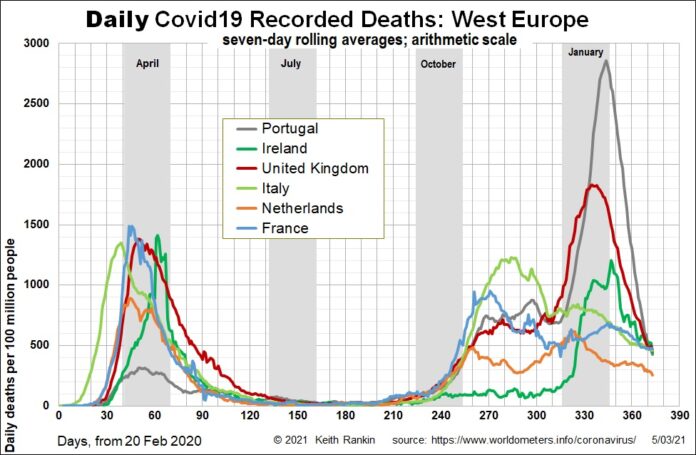
Deaths, West Europe still not "out of the woods". Chart by Keith Rankin.
Analysis by Keith Rankin.
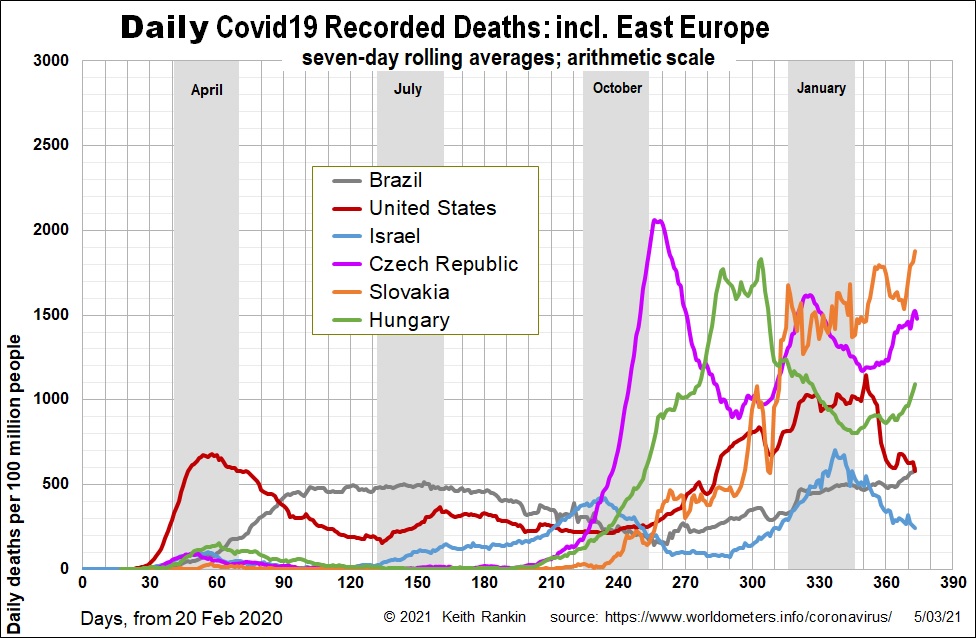
Deaths, West Europe still not “out of the woods”. Chart by Keith Rankin.Deaths, East Europe remains a major concern. Chart by Keith Rankin.
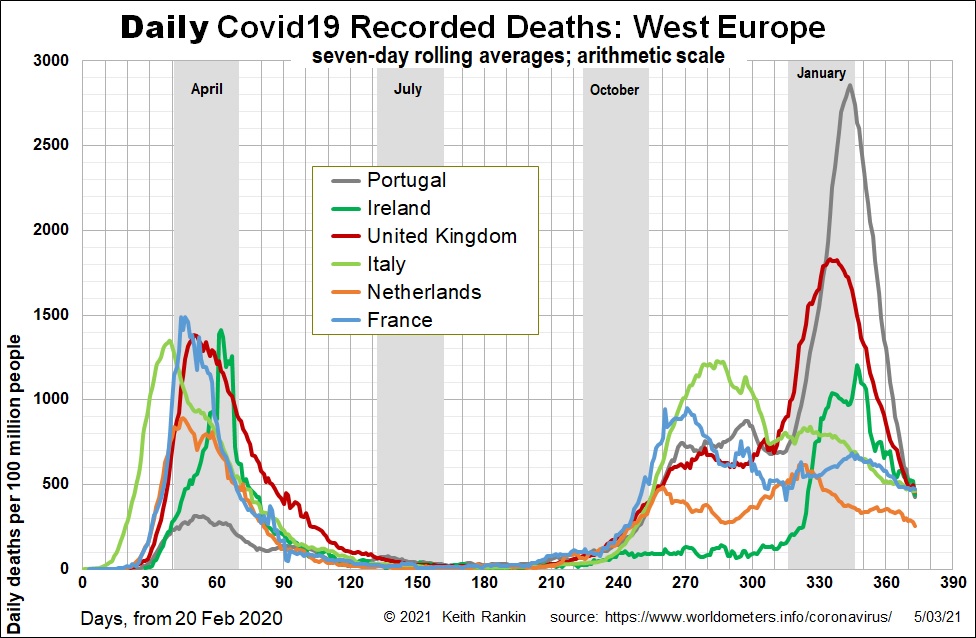
At first glance through our rear-vision mirror, western Europe had a substantial spring outbreak of Covid19, and further outbreaks in spring and autumn. Three countries really ‘spiked’ in the northern winter: United Kingdom, Portugal and Ireland. This was the impact of the “more transmissible” ‘UK variant’. While the other countries shown had much smaller January peaks, their recoveries may have stalled. All countries seem to have converged at around 4 daily deaths per million people in the population (equivalent to 20 daily deaths in New Zealand); probably Netherlands too which for at least some of the period under-recorded its Covid19 deaths.
This chart makes it look as though the Tokyo 2020 Olympic Games could have gone ahead in July 2020, especially given that ‘deaths’ is a lagging indicator of Covid19 in the communities.
Looking further afield however, we see that United States, Brazil and Israel had substantial rates of infection during the northern summer. Eastern Europe, though, had been hardly affected, at least by western European standards.
These three non-European countries – among others – kept the covid‑fires burning, and Eastern Europe was in the vanguard of the European covid revival.
In the last two weeks, in the non-European countries shown, improving death rates have stalled despite vaccinations. And, in Eastern Europe, recent death rates remain stubbornly close to 2020 West European peaks. While the ‘vaccine rollout’ in the European Union may have initially been equitably distributed throughout the European Union, it’s now looking as though we are once again seeing a two-tier Union. (Now East versus West, instead of the North versus South that we saw in the early 2010s’ economic crisis.)
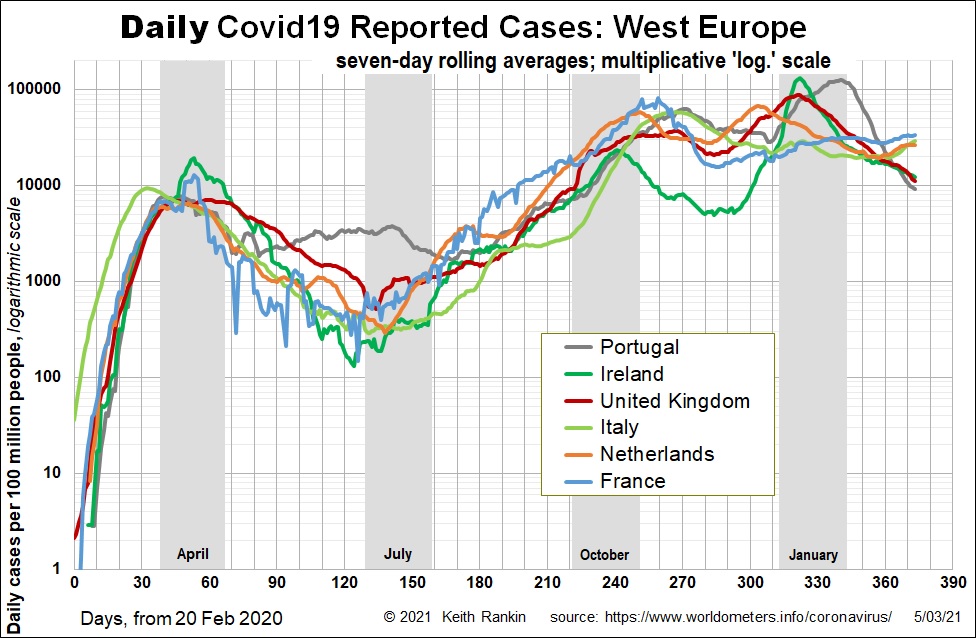
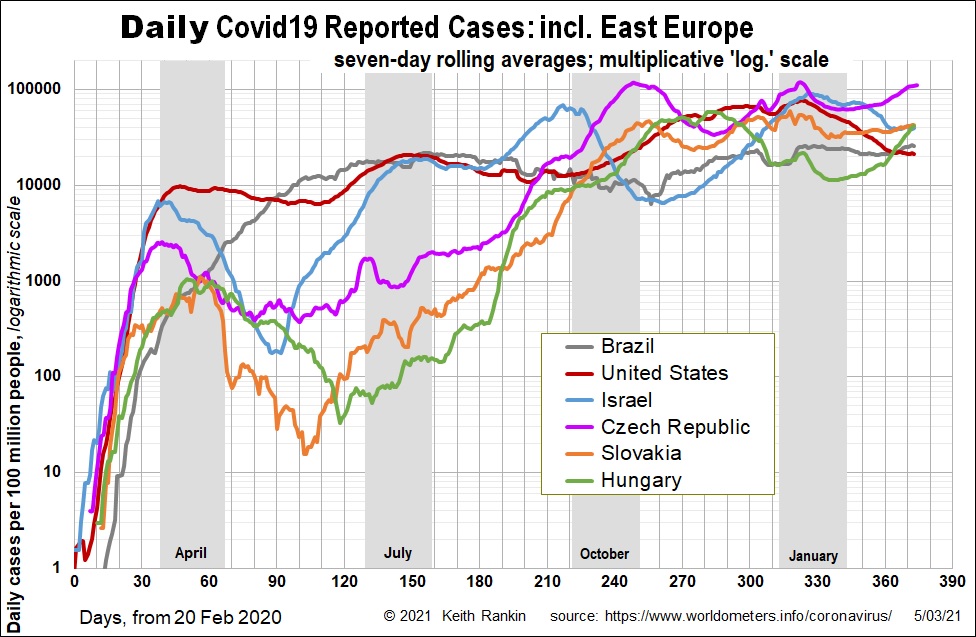
Countries least connected to the UK are reporting a new wave of cases. Chart by Keith Rankin.Brazil and United States lowest, despite reports of more cases. Chart by Keith Rankin.
The case data, shown on a ‘multiplicative scale’ that is more sensitive to the early stages of infectious outbreaks, the present European crisis was already starting in July 2020. This went well under the radar, while countries like United States, Brazil and Israel were having record case numbers.
Eastern Europe, still having the worst Covid19 crisis of any region in the world, is now having more new cases, not less. Indeed, in the north, it is only the countries linked to the United Kingdom that are still showing persistent falls in case numbers. Given that Portugal and Ireland – European Union members –have had less vaccination per person than the United Kingdom, it seems most likely that the improvements in case numbers in these countries are mainly due to ‘lockdowns’ than to vaccines.
News of the blockage of a shipment of 250,000 COVID-19 vaccines from Europe to Australia has caused concern and outrage.
The immediate problem will probably be quickly solved through diplomatic channels. Even if it is not, onshore manufacturing of the AstraZeneca vaccine will soon make up for any shortfall in Australia’s vaccine supply.
But to avoid these types of supply shortfalls in future, it’s important to address the underlying problems behind this example of vaccine nationalism. Australia is both a victim of these problems, as well as a contributor.
Why has Australia’s shipment of vaccines been blocked?
Italy has blocked the shipment of AstraZeneca vaccines based on export authorisation rules introduced by the European Union in January. These rules require vaccine manufacturers in the EU to seek authorisation to export vaccines to some countries outside the bloc.
This is the first time this process has resulted in a planned delivery of vaccines being blocked. The EU could have objected to Italy’s action, but did not.
The EU introduced the authorisation requirement due to concerns it was not receiving the quantities of the Pfizer and AstraZeneca vaccines that the companies had agreed to provide within certain time frames.
Italy’s blocked vaccine export was the first intervention under the EU’s controversial export authorisation scheme.Cecilia Fabiano/AP
How much of a problem will the blockage be for Australia?
The immediate problem will probably be quickly solved through diplomatic negotiations. The EU is also likely to face intense criticism and pressure from other countries that fear the more widespread use of export restrictions.
So, it’s unlikely the export ban on these 250,000 vaccines will remain in place for long, or that Australia will face further export restrictions.
Even if the shipment never arrives in Australia, onshore manufacturing of the AstraZeneca vaccine by CSL will soon fill the gap, with the first locally produced doses expected to be available around the end of March. Any resulting delay in the rollout of Australia’s COVID-19 vaccination program is likely to be shortlived.
But the blockage of a vaccine shipment points to bigger problems that threaten to undermine the global distribution of vaccines and the world’s recovery from the pandemic.
The bigger picture of vaccine nationalism
The global distribution of COVID-19 vaccines has so far been extremely inequitable. By November 2020, governments had negotiated pre-purchase agreements for almost 7.5 billion doses, 51% of which had been reserved by wealthy countries representing only 14% of the global population.
In mid-January, the director-general of the World Health Organization warned of a “catastrophic moral failure”. He said that 39 million vaccine doses had been administered in high-income countries at that time, but just 25 doses had been provided in “one lowest-income country”.
WHO chief Tedros Adhanom Ghebreyesus has warned ‘the world is on the brink of a catastrophic moral failure’.SALVATORE DI NOLFI/EPA
At this rate, it could be 2023 or 2024 before vaccination brings the pandemic under control globally.
Uncontrolled transmission of the virus in some parts of the world also raises the risk of more variants emerging that are resistant to existing vaccines.
Much of the reporting on vaccine nationalism tends to focus on the hoarding of vaccines by particular countries. But we should question why the supply of vaccines is so limited in the first place.
This comes down to privately held monopolies on the intellectual property and other types of knowledge, data and information needed for making vaccines. While there is manufacturing capacity available globally to ramp up vaccine production, the exclusive rights to make and sell the vaccines are held by a small number of companies. This is despite a huge investment of public funding in the development of many vaccines.
It’s estimated most high-income countries will achieve widespread vaccination coverage by the end of 2021, but low- and middle-income countries will have to wait.John Locher/AP
The intellectual property rights that impede rapid scaling-up of vaccine production are enshrined in the World Trade Organization’s Agreement on Trade-Related Aspects of Intellectual Property Rights (TRIPS). This agreement requires that WTO members make available 20-year patents for new pharmaceutical products, along with other types of intellectual property protection.
TRIPS includes safeguards like compulsory licensing, which governments can use to enable patented inventions to be produced without the consent of the patent owner in situations like a public health emergency.
But these are time-consuming and difficult to use, and they only apply to patents and not the other types of knowledge, data and information that are needed to manufacture vaccines.
Australia’s support needed for global solutions to vaccine scarcity
Two important mechanisms have been proposed to solve this problem of artificial vaccine scarcity and enable production of COVID-19 medical products to be rapidly scaled up. Neither has received Australia’s support to date.
India and South Africa put a proposal to the WTO in October 2020 that certain intellectual property rights in the TRIPS agreement be waived for COVID-19 medical products during the pandemic. This proposal, known as the “TRIPS waiver”, is supported by many developing countries, but opposed by the EU, US and other wealthy countries, including Australia.
The World Health Organization has also set up a mechanism for sharing intellectual property, knowledge and data for COVID-19 products, known as the COVID-19 Technology Access Pool (C-TAP).
C-TAP has been endorsed by 40 countries and many inter-governmental and civil society organisations, but lacks support from many high-income countries, including Australia. So far, it has been unused.
To address the real problems underlying the current supply blockage, Australia will need to reconsider its opposition to these proposed global solutions.
By early afternoon, the National Emergency Management Agency (NEMA) lifted the evacuation order but stressed that people should stay off beaches and the shore.
All three earthquakes happened along the Tonga Kermadec subduction zone, where the Pacific tectonic plate dives under and then sinks beneath the Australian plate.
This subduction zone is the longest and deepest such system on Earth. It spans from just north of the East Cape, some 2600km to the north-east in an almost straight line to south of Samoa.
One of the questions seismologists around the world are now trying to answer is whether the three quakes were linked and the earlier ruptures triggered the magnitude 8.1 quake.
Potential links between ruptures
The Tonga Kermadec subduction zone terminates north-east of the East Cape, where it then becomes the Hikurangi subduction zone. The first 7.3 magnitude rupture struck at 2.27am, 174km off the east coast, where the Hikurangi and Tonga Kermadec systems merge.
The US Geological Survey recorded this event at a depth of 21km, not 95km deep as the first reports in New Zealand suggested. This quake had an unusual mechanism — an element of sideways movement known as strike-slip.
The other two quakes were about 900km north, but just west of the Tonga-Kermadec trench and at depths of about 56km (for the 6.40am magnitude 7.4 event) and 20km (for the magnitude 8.1 quake at 8.28am). These later events had thrust, or compressive, mechanisms, in which one body of rock compresses against another, sliding up and over it during the earthquake.
This is what we might expect in a subduction zone where one tectonic plate is sliding under another and creating a collision, which in turn gives rise to compression.
As the Pacific plate starts to slide under the Australian plate, it starts off at a shallow angle and then turns along a curved trajectory to finally fall away at a very steep (60 degrees) angle. But when it’s at a shallow level, it is only dipping at say 10-20 degrees and creates a lot of friction with the overlying (Australian) plate. This is typically where these large earthquakes occur.
Triggering sequence
Magnitude 8 quakes in these subduction zone settings are not unusual. Indeed, quakes up to magnitude 9 can occur, such as Japan’s 2011 Tōhoku earthquake, the undersea earthquake off Sumatra that set off the 2004 Indian Ocean tsunami, and quakes in Alaska in 1964 and in Chile in 1960.
What is curious about this sequence offshore from New Zealand is whether or how the ruptures relate to each other. Certainly, the first of the two later quakes, located within tens of kilometres of each other, can be regarded as a foreshock, followed by the main magnitude 8.1 shock. But was the earliest 2.27am earthquake north of East Cape related?
Generally, seismologists regard a 1000km distance as too far for even a magnitude 7.4 rupture to disturb the ground enough to trigger another. But increasingly there are arguments that the Earth is critically stressed in plate boundary settings to such a level that just a small nudge can set off another event.
After the 2004 Sumatran quake, scientists made a good argument that it triggered further quakes an hour later, some 11,000km away in Alaska. But in this case, they were smaller events following a large triggering quake.
It’s also interesting that large earthquakes have happened off the Kermadec Islands in the past. In 1976, a magnitude 7.7 event was followed 51 minutes later by a magnitude 8 event. This mirrors what we saw today.
Both events in 1976 were thought to be thrust earthquakes like today’s shocks. Then in 1986, at a depth of 45km, a magnitude 7.7 event displayed both thrust and sideways strike-slip motion. The interpretation of this event was that it was not a plate interface event, but had happened within the subducted and bending Pacific plate.
This could explain the second earthquake this morning, as its depth of 56km seems to place it within the Pacific plate. We will need to wait until the final depths and mechanisms are resolved.
University of Canberra Professorial Fellow Michelle Grattan and Director of the Institute for Governance & Policy Analysis Dr Laine Dare discuss the week in politics.
This week the pair discuss some of the 148 recommendations made by the Royal Commission into Aged Care, including the likelihood and feasibility of their adoption. Also discussed, the allegations against Christian Porter, the national accounts figures released on Wednesday, and Linda Reynold’s political future.
Celebrity testimonials abound for pills, potions and creams that purport to make you look younger.
This time collagen supplements are in the spotlight, after Jennifer Aniston became the face of one wellness brand’s collagen campaign in late 2020.
While some research has found benefits of collagen supplementation for some aspects of skin health, it’s a case of buyer beware. The evidence is generally weak, with many of the studies claiming to find positive effects from collagen supplementation funded mostly by industries that manufacture these products. Therefore, the results need to be interpreted with caution.
When you’re reading articles promoting these products, be especially wary of phrases such as “we may receive compensation for some links to products and services”. These statements often mean the publication has negotiated some kind of payment for featuring products in its editorial coverage. Therefore, what you’re reading isn’t necessarily an independent evaluation of the product’s effectiveness.
Rather than spending a lot of money on collagen supplements that promise to defy signs of ageing, smooth wrinkles and renew your skin, spend it on healthy food. You will get better value in terms of your health and well-being in the long-term.
A 2019 review of collagen supplements, conducted by US university researchers, found four of the five studies included had reported some degree of improvement in some skin variables.
Across the studies, closer scrutiny of the methods by the reviewers found many were rated as being of low methodological quality. The reviewers flagged a number of limitations of the studies. These included that the supplements differed across the trials, as did the types of people included in the studies, meaning you can’t compare results between trials.
It also wasn’t clear how the results translated to actual changes in skin appearance and whether this was noticeable to other people.
Amino acids needed to make collagen can be found in other foods containing protein. There’s no reliable evidence amino acids in collagen supplements speed up the process by which the body makes collagen.
What’s more, most of the studies were either fully or partly funded by cosmetic or supplement companies. This means the results of the research should be interpreted with caution, especially when the affiliation statement shows the study authors were also employed by the supplement manufacturer. Further high quality, independent research studies are needed.
What is collagen and where does it come from?
Collagen is the major structural protein in skin and other connective tissues such as cartilage, bone, tendons and ligaments.
It has a triple helix structure. Imagine three slinkies coiled around each other, and that’s roughly what collagen looks like.
An artistic depiction of the collagen triple helix structure. Collagen is the human body’s main structural protein.Shutterstock
The triple helix shape makes it very strong and flexible.
Vitamin C is essential for the chemical pathway that makes collagen in the body. Without adequate vitamin C, the collagen would be unstable, meaning the coils would unfurl, and you would develop scurvy.
Before you grab a bottle of collagen supplements, you may want to consider where it came from. Rich sources of collagen include pig skin, cattle hide, pork and cattle bones, tendons and cartilage, chicken cartilage and fish scales.
A bottle of collagen supplements costs anywhere between roughly A$15-20 to over $100. Each capsule, or per serve, contains roughly between half a gram up to five grams of collagen.
By comparison, you can get better value for money by eating foods rich in protein like meat, chicken, fish, eggs, milk, cheese, nuts, tofu, dried beans and legumes. This will provide the amino acids your body needs to make collagen.
Because collagen would be unstable without vitamin C, it’s also important to regularly eat foods rich in it. Good sources include broccoli, Brussels sprouts, capsicum, tomatoes, spinach, kiwifruit, lemons and oranges.
Also aim to regularly eat foods rich in other nutrients needed to help keep skin healthy. This includes:
vitamin A, from oily fish, egg yolks, cheese, tofu, nuts, seeds, whole grains and legumes. Vitamin A helps immature skin cells develop into a mature skin layer which forms the body’s first layer of protection. “Beta-carotene” found in vegetables can be converted into vitamin A in the body. Good sources include pumpkin, carrots and leafy green vegetables.
A couple of days ago, the musician Grimes sold some animations she made with her brother Mac on a website called Nifty Gateway. Some were one-offs, while others were limited editions of a few hundred – and all were snapped up in about 20 minutes, with total takings of more than US$6 million.
Despite the steep price tag, anybody can watch or (with a simple right-click) save a copy of the videos, which show a cherub ascending over Mars, Earth, and imaginary landscapes. Rather than a copy of the files themselves, the eager buyers received a special kind of tradable certificate called a “non-fungible token” or NFT. But what they were really paying for was an aura of authenticity – and the ability to one day sell that aura of authenticity to somebody else.
NFTs are a cultural answer to creating technical scarcity on the internet, and they allow new types of digital goods. They are making inroads into the realms of high art, rock music and even new mass-markets of virtual NBA trading cards. In the process, they are also making certain people rich.
NFTs are digital certificates that authenticate a claim of ownership to an asset, and allow it to be transferred or sold. The certificates are secured with blockchain technology similar to what underpins Bitcoin and other cryptocurrencies.
A blockchain is a decentralised alternative to a central database. Blockchains usually store information in encrypted form across a peer-to-peer network, which makes them very difficult to hack or tamper with. This in turn makes them useful for keeping important records.
The key difference between NFTs and cryptocurrencies is that currencies allow fungible trade, which means anyone can create Bitcoins that can be exchanged for other Bitcoins. NFTs are by definition non-fungible, and are deployed as individual chains of ownership to track a specific asset. NFTs are designed to uniquely restrict and represent a unique claim on an asset.
And here’s where things get weird. Often, NFTs are used to claim “ownership” of a digital asset that is otherwise completely copiable, pastable and shareable – such as a movie, JPEG or other digital file.
So what is an authentic original digital copy?
Online, it’s hard to say what authenticity and ownership really mean. Internet culture and the internet itself have been driven by copying, pasting and remixing to engender new forms of authentic creative work.
At a technical level, the internet is precisely a system for efficiently and openly taking a string of ones and zeroes from this computer and making them accessible on a that computer, somewhere else. Content available online is typically what economists call “non-rivalrous goods”, which means that one person watching or sharing or remixing a file doesn’t in any way impede other people from the doing the same.
Producer 3LAU raised US$11.6 million on an NFT auction around his latest album. The top bidder received a ‘custom song created by 3LAU with winner’s creative direction’, an NFT for each track on the album, unreleased music, and even a physical copy on vinyl.3LAU
Constant sharing adds up to a near-infinite array of material to view, share, copy or remix into something new, creating the economies of abundance on which online culture thrives.
TikTok is built around reimagining common audio loops with seemingly endless but unique accompanying visual rituals, which are themselves mimicked in seemingly endless variations. On Twitter, tweets are only valuable to the extent they are retweeted. Fake news only exists insofar as Facebook’s algorithm decides sharing them will increase engagement via driving more sharing.
Information wants to be free
The life and longevity of digital content has depended on its ability to spread. The internet’s pioneering cyber-libertarians had a motto to describe this: information wants to be free. Attempts to stop information spreading online have historically required breaking aspects of technology (like encryption) or legal regimes like copyright.
NFTs, however, bring code and culture together to create a form of control that doesn’t rely on the law or sabotaging existing systems. They create a unique kind of “authenticity” in a otherwise shareable world.
What’s next?
Nearly 40 years ago, Canadian science-fiction writer William Gibson famously described cyberspace as a “consensual hallucination” in which billions of users agreed that the online world was real. NFTs take this to the next level: they’re a consensual hallucination that this string of ones and zeroes is different and more authentic than that (identical) string of ones and zeroes.
The animation CROSSROADS by Beeple can be viewed online for free – but the NFT independently conferring ownership of the work recently changed hands for US$6.6 million.Beeple
NFTs work by reintroducing a mutual hallucination of scarcity into a world of abundance. There is no shortage of buyers: the NFT market is already worth hundreds of millions of dollars. Even humble sports trading cards will never be the same.
Are NFTs different enough to break the internet?
The real function of NFTs is to create a clear delineation between ordinary creators and consumers of online content and those privileged enough to be paid to produce content or claim to own “authentic” work. The internet decentralised content creation, but NFTs are trying to recentralise the distribution of culture.
NFTs facilitate the exchange of fungible money for non-fungible authenticity. It’s a well-known move that occurs in all sorts of industries, and one with a long history in, well, art history.
How the culture-code of NFTs will evolve is anyone’s guess, but at the moment, it is opening a lot of new ways to make new money change hands.
At first take, it might seem that this presents artists everywhere with a recourse to get paid for their otherwise copy-pastable work. Yet creating normative rules around paying for content online has not so far gone smoothly: think of the lacklustre payments musicians receive from streaming services like Spotify.
NFTs have also been criticised for their profligate energy consumption, because they depend on a lot of computer power to encrypt their tokens. According to the online calculator at CryptoArt, the computations required to create NFTs for each of Grimes’ animations would have used enough electricity to boil a kettle 1.5 million times – and resulted in around 70 tonnes of CO2 emissions. I’m not sure that cost for future generations was priced into the current market value, or any appreciation as tokens cryptographically change hands.
Other than their tonnes of CO2 emissions, what’s real about NFTs is how their creation of technical scarcity enables a new cultural agreement about how something can be authentic and who controls that authenticity. NFTs create new forms of hierarchy, power and exclusion on the wider web. They have already created a new type of haves and have-nots.
An 8.0 earthquake has struck near the Kermadec Islands, hours after a 7.4 quake near the Kermadecs and a 7.1 off the North Island coast,
A 7.4 quake struck near the Kermadec Islands earlier this morning. The islands are 800km to 1000km from New Zealand.
National Emergency Management Agency (NEMA) said people on the East Coast of the North Island should head to higher ground immediately because of a tsunami threat from the 8.0 quake.
In its third earthquake warning, the National Emergency Management Agency (NEMA) said people in the East Coast of the North Island from the Bay of Islands to Whangārei, from Matata to Tolaga Bay including Whakatāne and Opotiki and Great Barrier Island must move immediately to higher ground.
It said people in the areas indicated on the mane should not wait, but should evacuate these areas even if they didn’t feel the earthquake.
“A damaging tsunami is possible,” it said.
The Kermadec Islands are more than 800km from New Zealand, and is an area where there is a lot of earthquake activity.
The last major quake in the region was in June, also a 7.4 magnitude tremor, which prompted warnings of strong currents around New Zealand’s coast but no damage was reported.
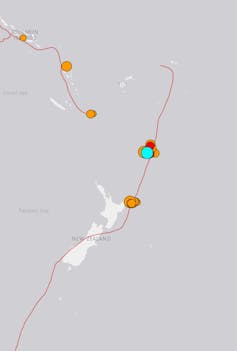
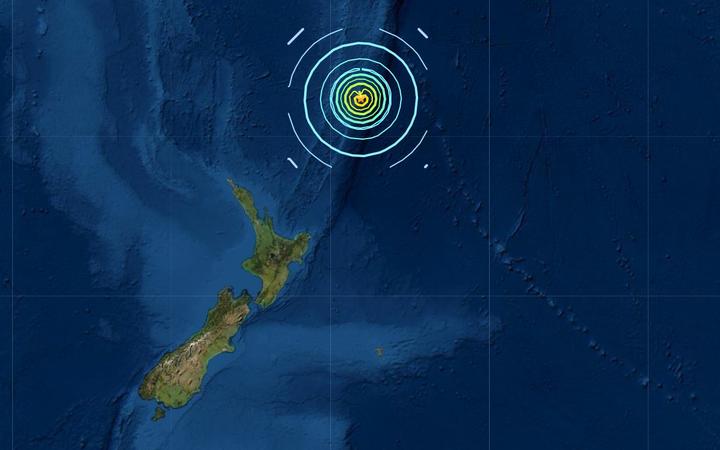
Two major quakes struck near the Kermadec Islands this morning. Image: USGS
GNS Science seismologist John Ristau said today’s quake was along the boundary of the Pacific and Australian tectonic plates.
It was the second severe quake in New Zealand waters this morning, after a strong 7.1 magnitude quake struck off the north Island coast.
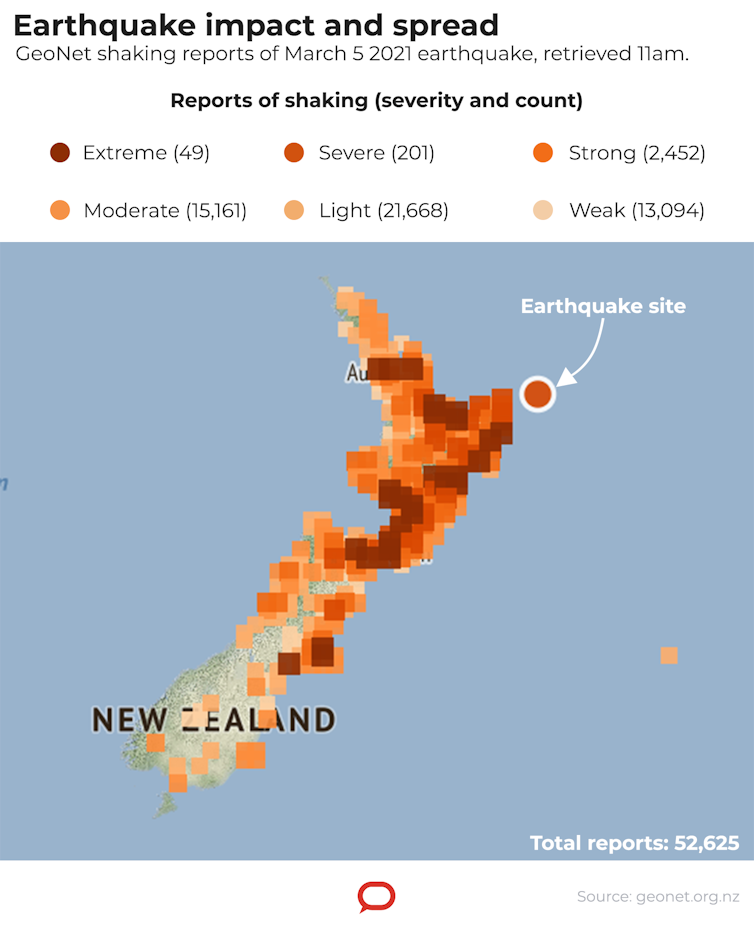
More than 52,000 people reported on GeoNet that they felt the quake. It struck at 2.27am, 105km east of Te Araroa at a depth of 90km.
Hundreds of people moved to higher ground but there have been no immediate reports of damage. A tsunami warning for that quake was cancelled around 6am.
TSUNAMI WARNING: Areas that need to evacuate are indicated on this map. Evacuate these areas even if you did not feel the earthquake. DO NOT WAIT. A damaging tsunami is possible. More info at https://t.co/ccVFYQQoBrpic.twitter.com/bnEgZy8ikF
— National Emergency Management Agency (@NZcivildefence) March 4, 2021
This article is republished under a community partnership agreement with RNZ.
Although international travel restrictions for Australia have been extended to at least June, there may still be potential for a trans-Tasman bubble with New Zealand (and maybe some other countries), according to reports.
Air New Zealand will begin trialling digital vaccine passports (or “immunity passports”) on routes to Australia in April. Ideally, these digital certificates will allow authorities to quickly check whether prospective travellers have been vaccinated.
The specific passport system New Zealand is set to adopt — along with Qantas, Malaysia Airlines, Singapore Airlines and Qatar Airways — is the International Air Transport Association (IATA)‘s digital Travel Pass app.
But to be effective, this system would need to meet several key criteria. The vaccine passports would need to be linked securely to travellers, comply with different countries’ regulations and be almost impossible to illegally copy or modify.
Air New Zealand will trial the Travel Pass app on flights between Auckland and Sydney. Qantas is also set to trial the app but hasn’t yet announced exactly which vaccine passport technology it will adopt.Shutterstock
How would it work?
It’s expected at least the vast majority of people travelling on an airline using the IATA software will have to use the pass. The system has four steps:
a vaccine-recording component for when a person is first vaccinated
the transfer of this person’s vaccine-related and personal data to the IATA software
verification of the data by an authorised party
digital cross-checking, to ensure a government’s travel requirements are applied to all travellers entering or leaving that country. This would also make sure each traveller has the necessary prerequisites needed to enter their destination country.
The software would work by establishing an international network of trusted vaccine providers. The IATA is already compiling this list. These providers, including hospitals and clinics, would receive access to the software’s vaccine-recording component.
With this they’d log information about a patient’s vaccination and identity details (such as passport number). So you’d almost certainly need to present a valid passport when getting vaccinated.
For those already vaccinated by the time the system is rolled out, an option would be needed to transfer existing records to the app. Again, this would require confirmation the person requesting the data transfer is the same person who was vaccinated.
Once your vaccine and identification details are logged, this would generate a data file to be sent securely to the app’s software. This file would be encrypted and stored on the device itself, only to be retrieved by an authorised person with your consent.
Border and airline staff could check whether the lab identification is valid by comparing it to the IATA’s list of trusted vaccine providers. This check would be done using a wireless near-field communication system, similar to that used for contactless payments.
Near-field communication between devices can happen over a distance of four centimetres or less.Shutterstock
At this point, the border control unit would also confirm if the identification you presented when getting your vaccine is still valid. They could also check your passport against the national passport database, which is standard procedure.
Such a system could be set up to flag important updates. If a vaccine batch failed quality control, or a certain provider was removed from the approved providers list, this would need to be reflected quickly.
Security advantages of vaccine passports
A notable advantage of vaccine passports is they’re hard to forge compared to paper records. The IATA software would unbreakably link your identification details with your vaccination status.
Even if someone stole your phone or copied its data, this data would match only your passport. If they stole your passport, too, they’d likely still get caught during normal passport checks.
On Apple (iOS) smartphones the in-built “secure enclave” feature would prevent your Travel Pass app information from being moved remotely to another device without the right permissions. Android and other operating systems have similar tools used for smart wallets.
Using vaccine passports also minimises data sharing. In each case of information transaction, such as when crossing border control, the only data shared are your identification details and vaccine information.
An achievable set-up
Most countries are requiring that all COVID vaccines administered be recorded on a national register. In Australia, this is the Australian Immunisation Register.
The IATA will publish the Travel Pass app’s software interface, which is what enables other programs to transfer data to and from the software.
With the interface available, countries should be able to simply integrate the software into their own vaccine management systems. Governments could even apply their own rules to the software.
For instance, one may decide to reject vaccine records from a particular provider, or demand a longer waiting period once a vaccine is received.
This could obviously cause problems for travellers who may be planning to go to a destination with different protocols to the origin country. That’s why this would have to be sorted prior to travel, just as visas often are.
Minor issues and loopholes
For now, a digital vaccine passport would only be available for people with a smartphone or tablet. Also, each traveller in a group would need their own vaccine passport.
This could be tricky for families with young children or other dependants who don’t (or can’t) use smart devices. One fix would be for parents or carers to store dependants’ information on their own device.
The only credible route for vaccine passport forgery would be if a vaccination management system, such as one used by a GP or hospital, somehow recorded patient data incorrectly.
This could be done by someone deliberately impersonating someone else. Then again, the impostor would have to convince both the health worker administering their vaccine and staff at the airport. This would be difficult if a passport is used.
Similarly, a hacker could potentially attack the Australian Immunisation Register (or other vaccine registers) to generate false data to feed into the IATA system. But these registries tend to be well-protected.
And if one were compromised, it would be simple to invalidate vaccine certificates tracing back to it for as long as the issue wasn’t resolved.
The United States’ drug regulator, the Food and Drug Administration (FDA), said last week COVID vaccines updated for variants won’t need to go through full randomised controlled clinical trials.
The booster shots will only be required to undergo initial testing to check they are safe and produce an immune response. They won’t need to go through lengthy “phase 3” efficacy trials which would normally enrol tens of thousands of participants.
The European Medicines Agency hasn’t published formal guidelines, but has taken the same position. Chair of the agency’s vaccine evaluation team, Marco Cavaleri, told Reuters: “We will ask for much smaller trials, with a few hundred participants, rather than 30,000 to 40,000”. The focus would be primarily on safety and immune response data.
This is encouraging news, because it means we could get access to booster shots much more quickly than if they went through full trials. And because drug companies will have to prove they’re using the same technology and manufacturing process as the original vaccines, we can still be assured they’ll also be safe.
Australia’s Therapeutic Goods Administration (TGA) has not yet confirmed whether it’ll do the same, but history tells us we can probably expect it to follow suit.
Why do we need boosters?
Variant strains of the virus have been detected around the world, including those originating in the UK, South Africa and Brazil. People infected with these variants have been found in Australian hotel quarantine, and the B.1.1.7 strain, first found in the UK, has escaped the quarantine system several times.
For those tested, the current crop of vaccines still perform relatively well against the B.1.1.7 strain.
And data suggest most COVID vaccines will still be somewhat useful in preventing hospitalisation and death from these variants.
However, efficacy against mild to moderate illness, and against transmission of the virus, has likely dropped off sharply against some of these variants.
For example, preliminary data suggest vaccine efficacy for AstraZeneca’s vaccine dropped to just 10% against mild-moderate illness from the B.1.351 variant which originated in South Africa. Efficacy of Novavax’s shot slid from 89% to 60% against this variant. These data were from small trials and more studies are needed, but it’s still very concerning.
We don’t have solid real world data yet about the performance of the Pfizer vaccine against the B.1.351 variant.
Drug companies have flagged the need to develop updated booster shots to cover these new variants, which would involve tweaking their sequences.
Some scientists were worried this would mean drug companies would have to go through full randomised controlled clinical trials, including large phase 3 efficacy trials, to get these booster shots to market. These phase 3 clinical trials include many thousands of volunteers and the primary aim is to determine if the vaccine can prevent people from getting the disease.
By the time these trials were completed, it may be too late to control outbreaks caused by variants, and new variants may emerge that we’d need coverage for. In a pandemic, we don’t have the luxury of time.
But the FDA has dispelled this fear. The drug regulator seems most interested in ensuring any booster shots are safe and the manufacturing process hasn’t been modified from the original vaccines it approved.
The boosters will still require smaller trials to show they’re safe and generate an immune response. The trials typically involve a few hundred people and would examine the percentage of vaccinated volunteers who make antibodies to the variants, as well as the strength of the immune response.
This would be similar to what’s done for annual flu shots, although not exactly the same. We get very different flu strains circulating every few years, but current COVID-19 vaccines and variant “boosters” could be sufficient to use for several years — we don’t know yet.
The FDA also indicated boosters won’t necessarily need to undergo animal testing before progressing to human testing, which will also save time. But this may be encouraged if results from human trials are ambiguous.
How do we know they’ll be safe and effective?
Any potential side effects from a vaccine are mostly based on how the vaccine is made, the technology and how it’s delivered.
If drug companies keep all these factors the same, and only make minor sequence changes to cover variants, then we can expect the boosters to still be very safe vaccines.
The US and EU drug regulators would like to see data where the booster is given to people who’ve already had an original COVID vaccine, given this will be the likely scenario for most people receiving a booster shot by the time they’re approved.
The boosters will probably also be tested in people who haven’t had any COVID disease or vaccine. This is to ensure the boosters can induce strong immune responses like the original vaccine.
When required, the TGA will independently review all of this data. It will also likely seek advice from internal and external experts.
It’s also unclear when booster shots will be available or if they will be necessary in the short term. Melbourne-based biotech company CSL, which is producing the AstraZeneca vaccine onshore, said this week booster shots to cover coronavirus variants probably won’t be available until the end of the year.
New variants will continue to arise, but the best chance we have of stopping or slowing this process is by continuing public health measures to ensure as few people as possible become infected.
This includes vaccinating as many people as possible globally with the currently approved vaccines, which underscores Australia’s responsibility to assist countries in our region in getting vaccinated.
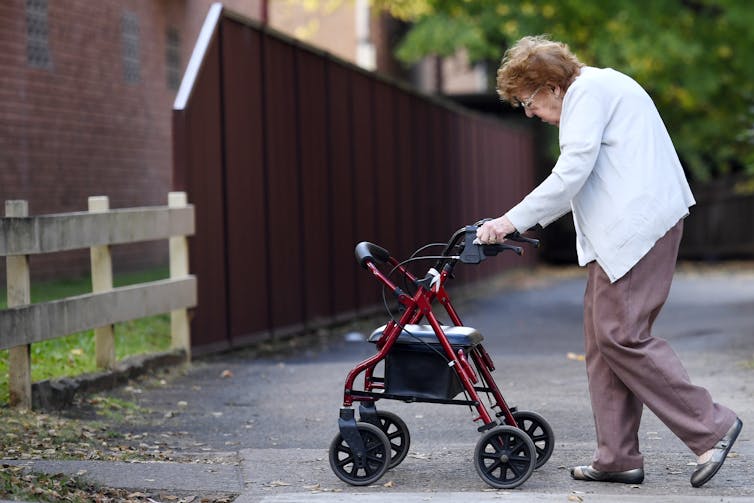
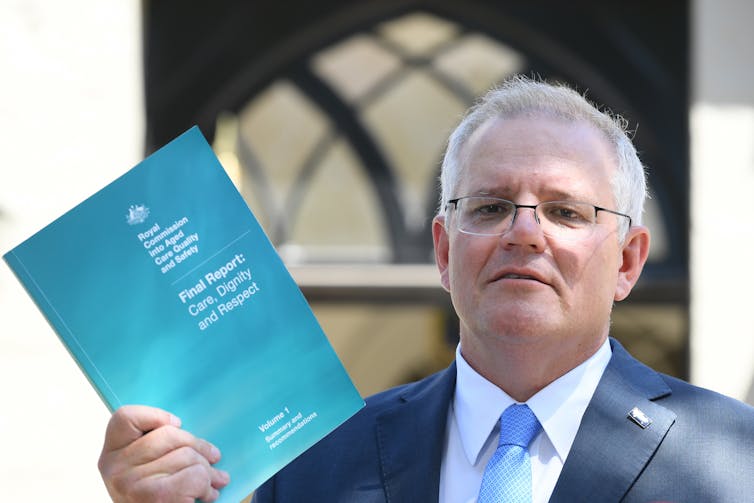
The final report from the aged care royal commission this week was damning. Speaking of a system in crisis, it calls for an urgent overhaul.
The Morrison government has been facing difficult questions regarding which of the 148 recommendations it will adopt. It also needs to grapple with how to pay for the much-needed changes.
On this question, the royal commissioners disagree. Commissioner Lynelle Briggs calls for a levy of 1% of taxable personal income, while commissioner Tony Pagone recommends the Productivity Commission investigate an aged care levy.
A 1% levy could cost the median person who already pays the medicare levy about $610 a year, while boosting funds for the aged care sector by almost $8 billion a year.
So far, the government has played down the idea of new taxes. There is a view this would be hard sell for a Coalition elected, at least in part, to lower taxation.
But as debate continues about how to make the changes we need to aged care (and not just talk about it), our research suggests many Australians support a levy to improve the quality and sustainability of our aged care system.
Our research
In September 2020, we surveyed over 1,000 Australians aged 18 to 87 years, representative by age, gender and state. We wanted to find out how the pandemic influenced attitudes to health, well-being and caring for others. Our findings indicated overwhelming public support for aged care reform, to ensure all older Australians are treated with dignity.
The vast majority of our respondents (86%) either “strongly agreed” or “agreed” Australia needed more skilled and trained aged care workers. On top of this, 80% thought aged care workers should be paid more for the work that they did.
More than 80% also either “strongly agreed” or “agreed” that nurses working in aged care should be paid at an equivalent rate to nurses working in the health system. Currently, nurses working in aged care are paid, on average, about 10-15% less.
The crunch point
Importantly, 50% of our respondents showed a willingness to pay additional tax to fund better pay and conditions for aged care workers. Of those willing to pay more tax, 70% were willing to pay 1% or more per year.
Australians want to see more skilled aged care workers and for them to receive better pay.Paul Miller/AAP
Here we found similar levels of public support for increased income tax contributions to support system-wide improvements. This suggests politicians seem to underestimate the public appetite for improvements to the system, and people’s willingness to contribute to achieve this.
Changing ideas about economic ‘success’
Our survey findings also highlighted a growing recognition among Australians of the importance of a broader range of social and economic goals.
This would see governments focus on policies that promote a more equal distribution of wealth and well-being, where the fundamentals of community cohesion are highly valued and our natural resources are protected.
We asked our survey respondents to rank the relative importance of seven key areas of public policy in framing Australia’s pathway to recovery from the COVID-19 pandemic, including:
dignity (people have enough to live in comfort, safety and happiness)
nature and climate (a restored natural world which supports life into the future)
social connection (a sense of community belonging and institutions that serve the common good)
fairness (equal opportunity for all Australians and the gap between the richest and the poorest greatly reduced)
participation (having as much control over your daily life as you would want)
economic growth (an increase in the amount of goods and services produced in Australia), and
economic prosperity (full employment and low inflation levels).
The criteria ranked most important by the largest proportion of our survey respondents were dignity (20.1%) and fairness (19.3%).
Traditional economic indicators were not the highest priorities for the Australians we surveyed. Instead, economic growth and prosperity were only ranked as a top priority by 15.3% and 15.2% of our respondents respectively.
This suggests the general public recognises the importance of moving beyond the traditional markers of a successful society.
What Australians want
Our research shows significant aged care reform is entirely consistent with the current priorities of the Australian public.
The Morrison government says it will respond fully to the report in the May 11 federal budget.Dean Lewins/AAP
The burning question now is whether the Morrison government will step up to the challenge.
After 200 years of European farming practices, Australian soils are in bad shape – depleted of nutrients and organic matter, including carbon. This is bad news for both soil health and efforts to address global warming.
The native Australian echidna may hold part of the solution. Echidnas dig pits, furrows and depressions in the soil while foraging for ants. Our research has revealed the significant extent to which this soil “engineering” could benefit the environment.
Echidnas’ digging traps leaves and seeds in soil. This helps improve soil health, promotes plant growth and keeps carbon in the soil, rather than the atmosphere.
The importance of this process cannot be underestimated. By improving echidna habitat, we can significantly improve soil health and boost climate action efforts.
Echidnas can help improve soil health.Shutterstock
Nature’s excavators
Many animals improve soil health through extensive digging. These “ecosystem engineers” provide a service that benefits not only soils, but plants and other organisms.
In Australia, most of our digging animals are either extinct, restricted or threatened. But not so the echidna, which is still relatively common in most habitats across large areas of the continent.
Echidnas are prolific diggers. Our long-term monitoring at Australian Wildlife Conservancy’s Scotia Sanctuary, in southwest New South Wales, suggests one echidna moves about seven tonnes – about eight trailer loads – of soil every year.
Soil depressions left by echidnas can be up to 50cm wide and 15cm deep. When ants are scarce, such as at highly degraded sites, echidnas dig deeper to find termites, making even larger pits.
This earth-moving capacity unwittingly provides another critically important function: matchmaking between seeds and water.
Echidnas’ huge digging capacity brings many environmental benefits.Shutterstock
Playing cupid
For seeds to germinate they must come together with water and soil nutrients. Our experiment showed how echidna digging helps make that happen.
We tested whether seeds would be trapped in echidna pits after rain. We carefully marked various seeds with different coloured dyes, and placed them on the soil surface in a semi-arid woodland near Cobar, NSW, where we’d dug pits similar to those echidnas create. We then simulated a rain event.
Most seeds washed into the pits, and those that started in the pits stayed there. The experiment showed how echidna pits encourage seeds, water and nutrients to meet, giving seeds a better chance to germinate and survive in Australia’s poor soils.
The recovering pits then become plant and soil “hotspots” from which plants can spread across the landscape.
Our research has also found pits also harbour unique microbial communities and soil invertebrates. These probably play an important role in breaking down organic matter to produce soil carbon.
It’s no wonder many human efforts to restore soil imitate the natural structures constructed by animals such as echidnas.
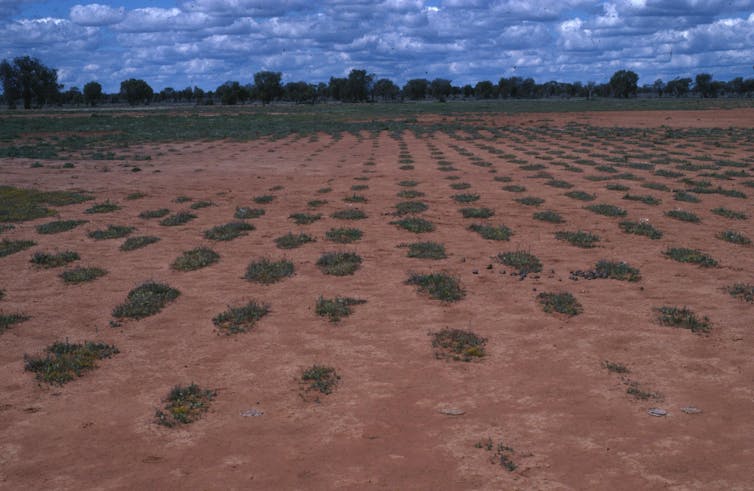
Plant growth in artificial pits used to regenerate degraded semi-arid soils – a method that imitates echidna pits.
Echidnas as carbon farmers
Our recent research also shows how echidna digging helps boost carbon in depleted soils.
When organic matter lies on the soil surface, it’s broken down by intense ultraviolet light which releases carbon and nitrogen into the atmosphere. But when echidnas forage, the material is buried in the soil. There it is exposed to microbes, which break down the material and release carbon and nitrogen to the soil.
This does not happen immediately. Our research suggests it takes 16-18 months for carbon levels in the pits to exceed that in bare soils.
This entire process of echidna digging, capture and buildup creates a patchwork of litter, carbon, nutrients, and plant hotspots. These fertile islands drive healthy, functional ecosystems – and will become more important as the world becomes hotter and drier.
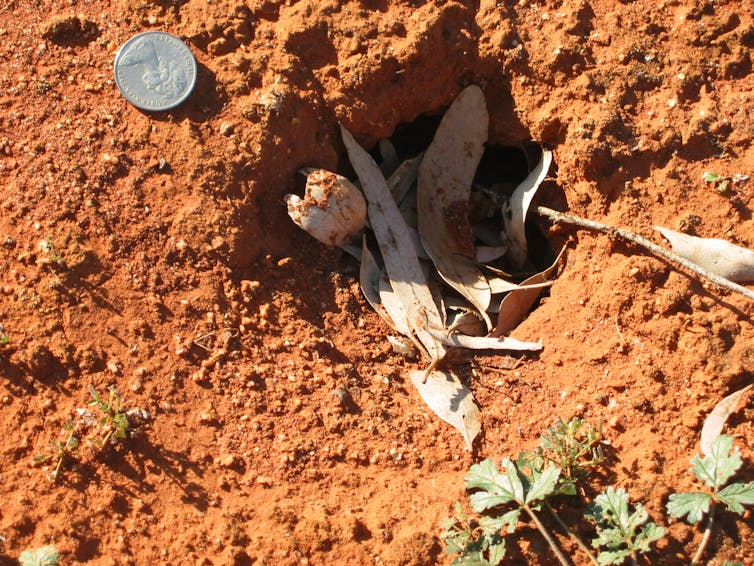
An echidna foraging pit with litter, seed and soil.
Harness the power of echidnas
Soil restoration can be expensive, and impractical across vast areas of land. Soil disturbance by echidnas offers a cost-effective restoration option, and this potential should be harnessed.
Australia’s echidna populations are currently not threatened. But landscape management is needed to ensure healthy echidna populations into the future.
Echidnas often shelter in hollow logs, so removing fallen timber reduces their habitat and feeding sites. Restrictions on practices such as firewood removal are needed to prevent habitat loss.
And being slow-moving, echidnas are often killed on our roads. To address this, shrubs and ground plants should be planted between patches of native bush, creating vegetation corridors so echidnas can move safely from one spot to the next.
Why did the echidna cross the road? Because there were no vegetation corridors.Shutterstock
And while an echidna’s sharp spines give it some protection from natural predators, they’re less effective against introduced predators such as foxes and cats. So strategies to control these threats are also needed.
The health of Australia’s fragile environment is in serious decline. Echidnas are already providing a valuable ecosystem service – and they should be protected and nurtured to ensure this continues.
Students are heading off to universities around Australia, whether for the first time or as returning students, with expectations of a year of learning, making friends and enjoyable socialising. For some students this will not be the case. Bullying by other students continues to be a serious but neglected problem at Australian universities.
Our recent study of 39 Australian universities found 20 did not have an anti-bullying policy relating to students. The other 19 had a mix of student-specific policies and staff policies with students added on.
With growing numbers learning online, it is more important than ever to ensure universities are properly protecting their students. Students need accurate, relevant and usable information to counter bullying.
First, a little context
Despite the evidence of the harm bullying in universities does, it hasn’t received the same attention as bullying in schools or workplaces.
Australia has laws to ensure workplaces and schools have anti-bullying policies for employees and students. Each state’s department of education provides a template and guidelines on what must be included in school policy and how it should be communicated to staff, students and parents.
Bullying in schools has attracted much more public and political attention.Ed Jackson/AAP
Policies are a great prevention and intervention strategy as part of efforts to stop student bullying. The problem is this government-based approach to bullying has not included tertiary education.
So what are universities doing?
The support provided for students who are bullied varies from university to university. But, overall, policy-based support is lacking.
The numbers found in our recent study are worrying. Only 66% of university policies defined bullying and 69% mentioned cyberbullying. Only 23% provided contact details for students to report the bullying to their university.
The study assessed universities’ policies for quality and usability of content. This revealed an important problem in addition to the overall lack of information. Where these policies exist, they lack accurate and usable information.
Cyber bullying is on the rise but it isn’t mentioned in nearly a third of university anti-bullying policies.aslysun/Shutterstock
How useful are these policies?
We checked the information provided against a list of 37 items, including:
definitions of bullying
practical information on how to report and what support is available
usability of information – is the policy easy to find and understand?
overall prevention and intervention strategies.
On average, universities in Australia included only 15 of the 37 items in their anti-bullying policies. This means the existing policies are not providing important information to students about bullying and what to do if they are bullied.
Analysis of the content universities provided to students in each state and territory clearly shows how widespread the issue is. All on average included less than half of the items they should have included. The averages were:
9 of 37 in Australian Capital Territory, Northern Territory and Tasmania
14 of 37 in Victoria and Western Australia
17 of 37 in Queensland and New South Wales
18 of 37 in South Australia.
As well as the information left out, the information provided by anti-bullying policies was often incorrect or contradicted by the university’s other policies, procedures or information pages. This is especially true of the definitions of bullying. The words bullying, harassment and discrimination are often used interchangeably.
The usability of these policies is another issue. Some are hard to find. The policies also do not use student-friendly language and are difficult to understand.
Many policies do not use student-specific examples of bullying behaviour. This is especially true of staff policies that have had students added on. Information about reporting the bullying, and who they should talk to for advice and support, is often relevant for staff only.
How can this situation be fixed?
These problems should be tackled on several fronts, including:
state governments mandating that each university has a student-specific anti-bullying policy using a provided template so information is accurate and consistent across all universities
universities drawing on well-developed policies and practices such as those in the UK, which use online reporting forms and have student advice lines
universities actively promoting a bully-free culture on campus and online, and ensuring students know of the policies and their options.
Universities have a duty of care to students. This mean they must make sure students can learn in a safe and supportive environment. Universities must take a firm stance on bullying and ensure students know how to identify and report bullying, and trust their university to believe and support them when bullying does occur.
As first-year students flooded onto campuses around the country this week, gripped with uncertainty and curiosity about their new lives, I too returned to university to learn.
For the first time since what feels like forever, but in reality was 1997 when I finished my PhD, I am now a bona fide university student.
It’s confronting to go back as an undergraduate online student (I’m doing a BA, through my own university, Massey University). But at the same time, it’s exciting and new. And for me, with a science background, stepping into the humanities is a whole other world.
The last time I was a student I used the scientific method; I tested, palpated and measured as a veterinary science undergraduate. In the humanities, it feels more fluid, more open to interpretation. As Vice-Chancellor I’ve known this, but to now be in it, well … I’ve surprised myself, because I’ve found I really like it.
I haven’t yet told my mother I’m doing a BA — she’ll find out when she reads this (sorry, Mum). I’ve been nervous about telling her; as a scientist in a family full of humanities graduates, I’ve always been a bit of a black sheep and was enthusiastically critical of my siblings’ choices as a youngster.
But increasingly I began to recognise our different disciplines have different ways of looking at the world, and that’s incredibly valuable for critical and creative thinking.
Back to class: Jan Thomas at last year’s graduation procession in Palmerston North.Author provided
Into the third space
I’m now stepping into a new space. In the Aboriginal world, in my native Australia, they talk about the “third space” — a place where white people and Indigenous people come together to begin to understand the other’s perspective.
You don’t have to agree to it, but it’s essential to understand it, otherwise you’re constantly in tension. The two separate worlds just keep flowing on in parallel, and nothing ever truly changes.
My first course is He Tirohanga Taketake: Māori Perspectives, taught by Te Rā Moriarty at Te Putahi-a-Toi. We’re studying perspectives from Māori authors, through Māori teachers, alongside Māori and non-Māori students, gaining a deeper understanding of concepts such as tapu, mana, and whakapapa.
We’re examining social structures within Māoridom, the influence of colonisation, and the Māori world view on things such as the environment, family and personal characteristics such as humility and respect for kaumātua.
I’m asking myself as I go, if I am standing in a Māori person’s shoes, what does the world look like?
Well, it looks pretty different. And that’s why I believe fostering understanding is essential to constructing the way forward together.
Although I managed to pass te reo Māori to level 5 at Te Wānanga o Aotearoa over three years, I feel I’ve still got so far to go. I’m not even dipping a full toe into the water yet — maybe just the toenail.
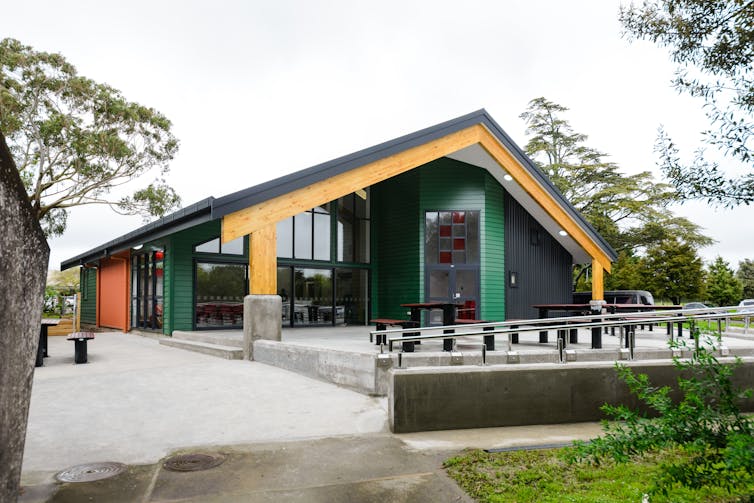
The whare kai, part of Te Putahi-a-Toi, on Massey University’s Manawatū campus.Author provided
Strength and direction
The world has changed dramatically over the past five to ten years, and many businesses and institutions now have strong aspirations to incorporate Te Tiriti o Waitangi into how they operate. Massey is no exception.
But it’s got to be more than just lip service, more than just te reo greetings in corporate emails. If we’re going to get the partnership right (and I recognise there’s a better word than “partnership” — perhaps fusing or blending), the responsibility has to fall on all of us.
Everyone has to work on it. And for me, entering the third space, I’m not trying to “be Māori”, but I know I’ve got to understand Māori perspectives and why others might want certain things.
Sure, it might help me avoid giving offence, and that’s essential. But more than that, we might find areas of common interest, things that make meaning for both parts of the partnership. I know if I’m going to lead a university that upholds diversity, equity and excellence in Aotearoa, I need to engage fully.
There are te reo Māori terms for the sides of the stream and the middle of the stream. The sides are “au taha” — the side currents, where the water doesn’t flow swiftly. In the middle, it’s “au kaha”, which has more strength, direction and forward momentum.
Historically, we’ve had Pākehā on one side of the stream and Māori on the other. We’ve got to get into the middle of the stream together, au kaha, and move forward together down the river.
Don’t be satisfied paddling in the easy bits on the side, but find moments to meet in the middle. Get right into the stream, and be brave enough to work in that (sometimes) turbulent place.
After years of repeatedly missing its inflation target through too timid monetary policy, in the past week the Reserve Bank has decided to get tough.
Not only did it hold its closely watched cash rate target steady at 0.10% at Tuesday’s board meeting, it ramped up its efforts to defend its separate 0.10% target for the three-year government bond rate in the face of a mini-revolt by bond traders.
A few weeks back, some of the traders in Australia and elsewhere got it into their heads that big borrowing by governments would force up bond rates – a relationship that was once thought to be clear cut but hasn’t held for some time.
The traders sold government bonds issued by Australia and other nations, which in the case of the bond market, forces up the bond interest rate.
Then other traders piled on, partly because economic outlooks are improving and they thought governments might soon be issuing fewer bonds, and partly because they thought other traders might agree with the traders.
That’s right: “thought other traders might agree with the traders”.
Beauty contests can make markets mad
In financial markets you don’t make money by correctly guessing what will happen, you make it by correctly guessing what other traders think will happen.
In Family Feud, you win if you guess the most popular answers, not the right answers.
One of the founders of modern economics, John Maynard Keynes, described it as a beauty contest in which judges are rewarded not for picking the most beautiful face, but for picking the face other judges will think is the most beautiful.
It works a bit like this in Family Feud.
The yield on Australian Commonwealth 10 year bonds climbed from 0.98% at the start of the year to 1.11% a month later, to an extraordinary 1.87% a month after that – a near-doubling in a matter of weeks.
Even the yield on three year bonds, which the Reserve Bank has pledged to keep at 0.10% crept up to 0.13%.
Last Friday, the Reserve Bank fought back.
It bought extra bonds a day after completing its usual purchases on Thursday.
This Tuesday, in its statement after its monthly board meeting, it added nine words to its usual acknowledgement that “wage and price pressures remain subdued”.
And then it released a separate statement reiterating that when its A$100 billion program of buying $5 billion of government bonds each week expires in May it will launch another $100 billion program, taking the scheduled bond buying through to November.
Since the program began last November, the bank has bought $74 billion of bonds. Its message was that if traders thought it was within $26 billion of running out of ammunition, it had another $100 billion. It doubled the size of its knife.
The bank can’t afford to lose
Keeping control of rates is a fight the Reserve Bank has to win. When it announces a change in an interest rate, usually the cash rate, it uses words along the lines of “the board decided to lower the cash rate,” implying that it can.
The more accurate words it used to use were “the bank will be operating in the money market this morning to reduce the cash rate,” an admission that it could only try to move the cash rate, by trading in financial instruments.
So effective have its pronouncements become that in recent years it hasn’t needed to do much trading to move the cash rate – it has just announced the move knowing that traders will fall into line because it could buy or sell financial instruments if it wanted to.
If it loses a battle with traders over rates, what it says will have much less force.
It has the resources it needs to win
The bank will win whatever battle it chooses to fight because it has unlimited resources. Unlike traders, it can create as many Australian dollars as it needs in order to buy as many bonds as it needs.
So far it has chosen to defend its ground on the cash rate and the three-year bond rate. It wants both at 0.1%.
It said on Tuesday it would “not increase the cash rate until actual inflation is sustainably within the 2 to 3% target range”.
It added that for that to occur, wage growth will have to be “materially higher”, which would require significant gains in employment and a return to a tight labour market.
And then the killer sentence, the last, aimed directly at the traders: “The Board does not expect these conditions to be met until 2024 at the earliest.”
Although it released the statement one day before Wednesday’s national accounts that showed the economic recovery continuing, it would have been aware of what they were likely to show.
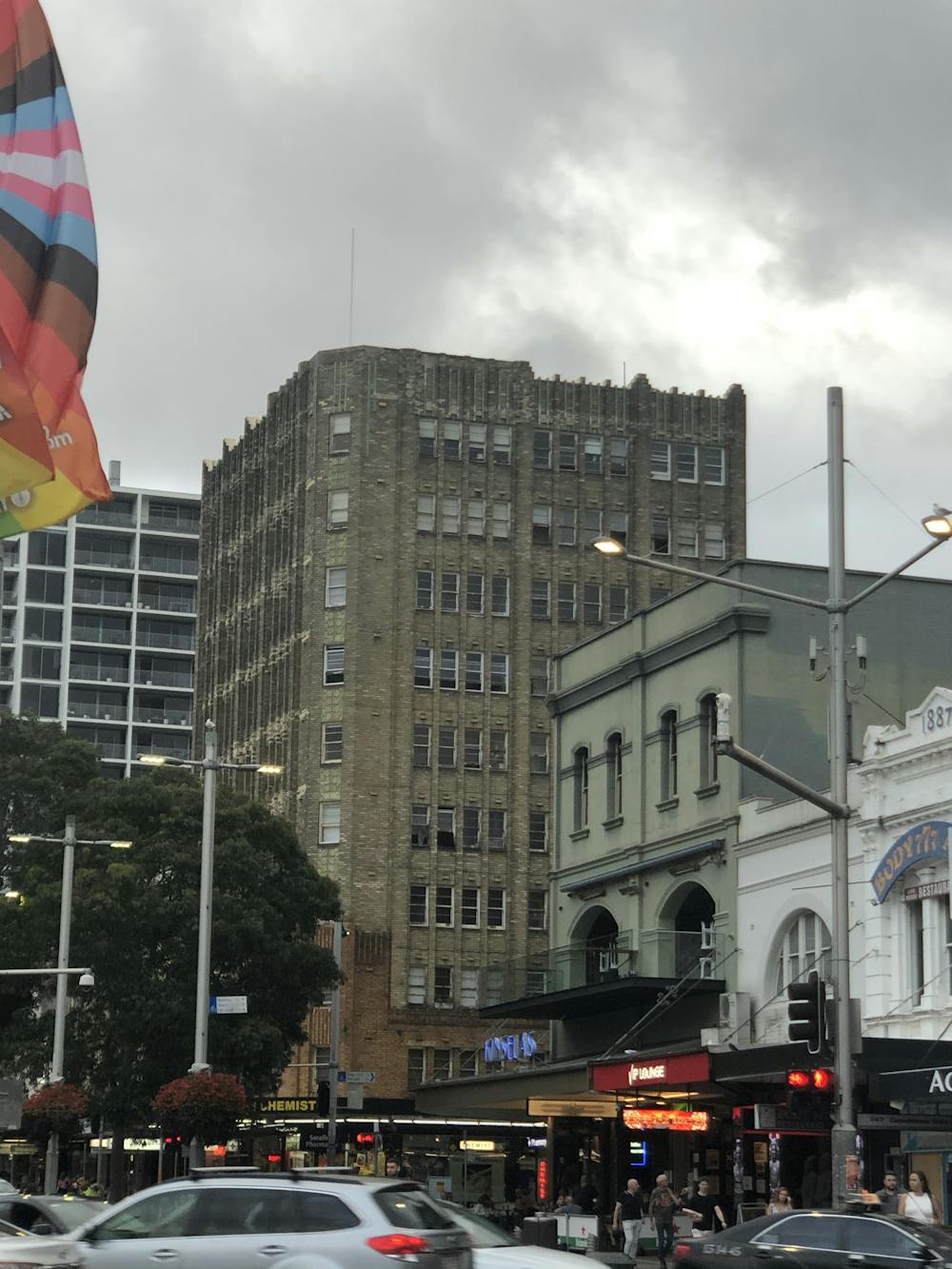
It’s Sydney Lesbian and Gay Mardi Gras festival time. LGBTQI people are enjoying what some call “gay or lesbian Christmas”. It’s not quite the same in the era of COVID, but a contained version of the famous street parade will be beamed into living rooms on Saturday.
The public face of Mardi Gras, which began in 1978 with a protest parade, is remarkable in a nation that has been deeply prejudiced toward gay and lesbian people. Part of the power of Mardi Gras for older generations was that it removed queer sexualities from the “secret” confines of semi-legal bar and club locations and private parties to the public street. Being on the front page of the newspaper no longer meant you might be going to jail.
Still, Australian queer people did not suddenly emerge in the 1960s and 70s, the years of gay liberation. Where were they before and how can they be identified? Because male homosexuality was criminalised, much can be discovered from the press and crime reports. Letters, memoirs, diaries, art, photographs and the memories of gay, lesbian, and transgender people also provide clues.
Andrew George Scott, alias Captain Moonlite.Wikimedia Commons
There is evidence of what historian Robert Aldrich calls “conjoined” same-sex male couples in 19th-century Australia, including the famous bushranger Captain Moonlite (Andrew George Scott). As he waited to be hanged in Darlinghurst Jail in 1880, he wrote of his fellow ranger James Nesbitt: “We were one in heart and soul, he died in my arms and I long to join him …”
Homosexuality was often associated with foreigners and cosmopolitan affectation. George Francis Alexander Seymour, future Marquess of Hertford, lived in Queensland briefly around 1895. Likely inspired by international dance sensation Loie Fuller, he shocked locals by wearing sequins and a veil for “skirt dancing” performances in front of “kanakas” (South Pacific men coerced to work in the canefields).
George Francis Alexander Seymour, future Marquess of Hertford, dancing.National Library of Australia.
William Lygon, later 7th Earl Beauchamp — the governor of New South Wales for a short time from 1899 — travelled with a retinue of good-looking footmen and lavished praise on the natural grace of Australian athletes and lifesavers.
He was disgraced as a homosexual by his brother-in-law in 1931 and became the subject of the famous statement by King George V: “I thought people like that always shot themselves.”
In the inter-war years, there was a marked queer presence in the worlds of Australian art, design, entertainment and retail. This was the period of art deco and Australian “genteel modernism”. Art Deco (called moderne or futurist style at the time) was inseparable from fashion and fantasy and frequently derided as an effeminate style — it has even been called the “International Style in drag”.
Cultural nationalist and the director of Melbourne’s National Gallery of Victoria from 1936–1941, J. S. MacDonald, claimed this type of art and design had been promoted by women and “pansies”, meaning homosexual men.
Smith’s Weekly, The Bulletin and the New Triad mocked the “wasp waists” and “goo goo boys” who worked in retail and enjoyed theatre.
Some queers worked as entertainers or drag queens. In NSW this was a summary offence of indecency (still used by police in the 1970s). Drag queens and cross-dressers had to wear male underwear or else risk arrest.
Cross-dressing was also associated at the time with street prostitution. A police mugshot from 1942 shows two cross-dressed male sex workers wearing women’s coats, one with huge rabbit-fur-trimmed sleeves, as well as a turban and makeup. The men still look very male and defiant, suggesting a part of their sexual charge came from precisely this lack of ambiguity; it was clear they were not women.
Clearly annoyed, one of the pair remarked to the tabloid Truth:
We were bundled out of the police cell, and snapped immediately. My friend and I had no chance to fix our hair or arrange our make-up. We were half asleep and my turban was on the wrong side.
Gay male artists and commercial designers in Sydney lived their queer lives discreetly on moderate incomes. The flower painter Adrian Feint, who lived in Elizabeth Bay, produced many bookplates depicting languid young men with a queer mood.
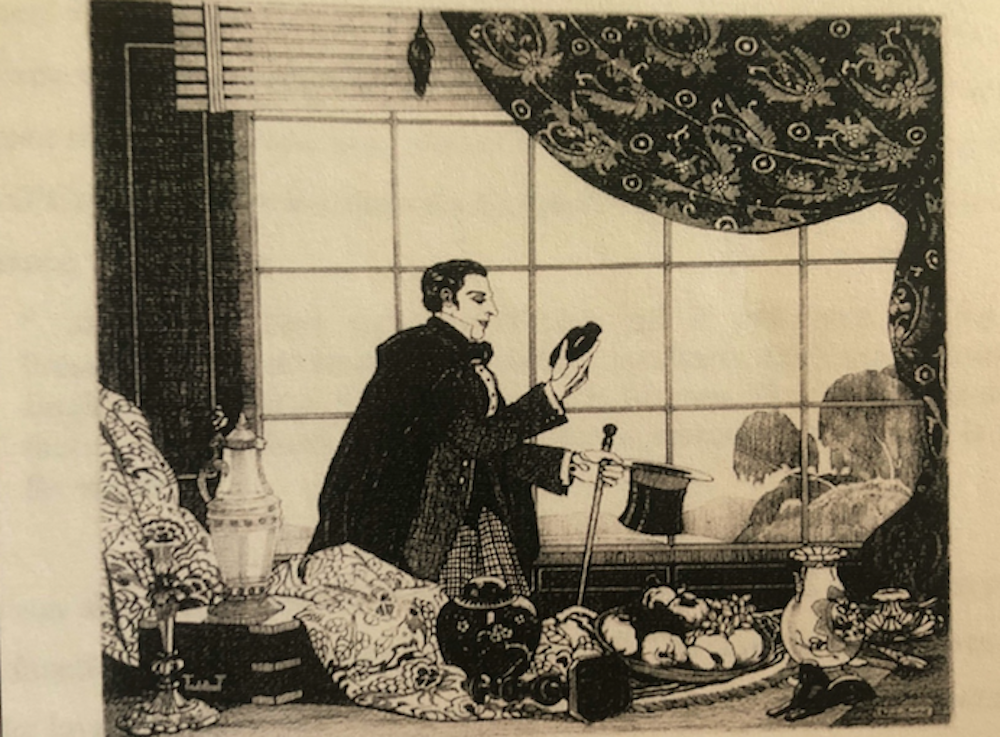
His disguised self-portrait etching of a dandy entitled The Collector (1925) carried the suggestion of eye and lip makeup, depicting archaic Edwardian dress, a top hat, a cane, plaid suit and cape.
Adrian Feint’s disguised self portrait.author provided
His remarkable cover for the upmarket magazine The Home (July 1929) featured a “Rum Corps” officer whom Feint transformed into a languid, heavily made-up beauty, recalling both the Ballets Russes, who were touring Australia, and the famous queer movie star Rudolph Valentino.
Cover of The Home journal, Volume 7 No.10. July 1 1929, designed by Adrian Feint.Wikimedia Commons
The culture of hedonism, promiscuity, heavy drinking, pub life and mixed-class socialising that characterised life in the colonies pervaded Australian gay life until recently. Pubs and clubs were crude, brash and fun. Bohemian ideas were also important. All sorts of behaviour were excused at the Artists’ Balls, which were held in Sydney from the 1920s until 1964. Gay balls were often accompanied by a blind orchestra (not unusual at the time due to war injuries) so the goings on could not be observed.
A 1925 sketch by Mandi McCrae of one such ball in The Home, September 1925, delineates a transsexual, two men with arms akimbo, and several gender-indeterminate figures. The press loved running stories of cross-dressed men whose dresses were so large they had to arrive in delivery vans. One told of a live bird in a cage worn as a Marie Antoinette-style headdress.
A sketch of an Artist’s Ball from The Home, September 1925.Author provided
Urban subcultures
In the interwar years, a queer urban subculture coalesced for the first time in Sydney around art deco sites and buildings: city hotels, the Archibald Fountain by night for cruising, and the new high-density housing of Kings Cross, Potts Point, Darlinghurst and East Sydney.
High density housing helped foster the bachelor life.Peter McNeil
Boonara, a middle-class block of flats in Woollahra, built by a widow and a “spinster” in 1918, was let only to women and one male artist, William Lister Lister. Restaurants catering to a homosexual clientele included Madame Pura’s Latin Cafe in the now demolished Royal Arcade.
Many Australian artists and writers became expatriate in this period to escape wowserism, censorship and the anti-art tenor of Australian society. They included Nobel winning novelist Patrick White, who conducted one of the great same-sex love affairs with Manoly Lascaris from 1941 until White’s death in 1990. White spent his youth in England, writing from a desk designed by the queer interior decorator and later famed artist Francis Bacon.
Back home in the 1940s, a group of queer artists, dancers and designers lived in Merioola, a run-down mansion in Edgecliff known then as “Buggery Barn”. They included artists Donald Friend and Justin O’Brien, acclaimed costume designer Loudon Sainthill and his partner, the theatre critic and gallery director Harry Tatlock Miller. The landlady was the butch looking Chica Lowe. She provided a set-like stage on which residents performed their counter-cultural lives.
Wealthier queers conducted their lives at private dinners, where ironic cross-dressing provided entertainment. They used camp girls’ names such as Connie, Simone, Zena and Maude. Cross-dressing was a popular diversion for groups of gay friends, who hired country and beach houses for private parties around the country.
A queer sensibility can tell us as much as a queer identification at a time when non-binary sexuality could lead to financial ruin for both women and men.
Australia’s first interior decorator, Margaret Jaye, was almost certainly a lesbian, and one of the nation’s first industrial designers, Molly Grey, was photographed in 1935 with a Sapphic hairstyle and severe dress of oversize mannish collar, bow tie, and cuffs. Interior design, being connected to domesticity and the home, was one of the few professions where married women and gay men could work undisturbed.
Molly Grey photographed in Potts Point Sydney by Harold Cazneaux circa 1935.State Library of New South Wales
The author Eve Langley (who changed her name to Oscar Wilde by deed poll in 1954) and her sister June cross-dressed in country Gippsland when young, where they were known as the “trouser women”. Eve continued to wear mannish attire in her old age in the Blue Mountains.
Sydney: from port to gay city
World War II was a watershed for Australian queer identity. Historians such as Garry Wotherspoon have noted how port cities such as Sydney and San Francisco threw large numbers of young men together, away from their families, in new types of housing such as bachelor flats. These cities were the ones that later developed the first large homosexual communities, often in neglected inner-city areas, in the 1960s and 1970s.
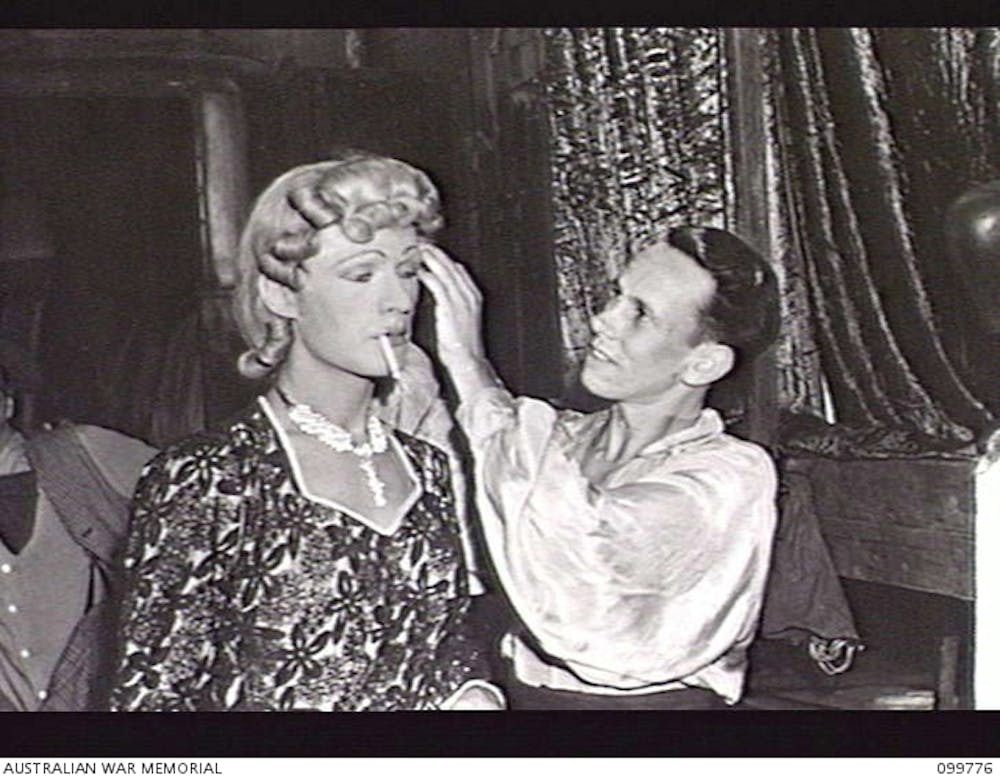
World War II also threw into the mix female impersonators who performed for the forces. The Australian armed forces had 20 concert party groups and gave 12,000 shows in Australia, the Middle East and the Pacific. The Kiwi (New Zealand) Concert Party wore drag made from muslin, dishcloths and silver paper as well as real fashions. They continued to perform for nine years after the war ended.
Official war artist Roy Hodgkinson captured a moment of revelry among Australian military forces at a New Guinea Concert Party in 1942.Australian War Memorial
Academic Chris Brickell has made the important point that although many of the performers pretended to be co-opted for their roles, most were more than willing. Their drag acts “drew from, and subsequently inspired, gay civilians’ own drag performances”.
Lance-Corporal J. C. Robinson adjusting the wig of Private G. J. Buckham, female impersonator in the dressing room of the Kookaroos Concert Party, Torokina, Bougainville, 1945.Australian War Memorial
1950s Australia saw an increasing witch hunt around queer sexuality, fuelled by the churches, the demands of the police and Cold War anxiety about Communist inflitration. The tabloid press continued earlier sensational reporting: (“Degenerate Dressed up as a Doll … St Kilda Sensation—Man-Woman Masquerader”) with headlines such as “Police War on this Nest of Perverts”. Even the famed 1950s American muscle culture magazines were banned under strict censorship here.
Lesbian butch and femme subcultures had emerged by this time, in which one partner was styled in a hyper-feminine way, the other donning trousers and shorter hair. Writer Gavin Harris notes that Lillian Armfield, NSW’s first policewoman, claimed department stores blacklisted lesbians who were trying to “recruit” from among their “innocent” customers.
Blak and queer
Queer Indigenous people have been prominent for several decades in art forms such as dance, where they contribute to new formulations of ideas of “blak beauty,” blak being a term consciously deployed by contemporary queer visual artists, including Brook Andrew.
The biography and survival story of Indigenous dancer and choreographer Noel Tovey (born 1934) charts a trajectory from abandonment and abuse to a life as a successful actor and dancer in London in the 1960s. Here Tovey mixed with gay circles and gained resilience and self-esteem.
Tovey described in his autobiography Little Black Bastard the Artist’s Ball in Melbourne as “the only night of the year when the police turned a blind eye to the number of drag queens looking for a cab”. Characters who might turn up there included “Puss in Boots” or a reclusive “Greta Garbo”: the latter refused to talk to anyone all night. Tovey was later involved with the spectacular Awakenings opening dance sequence at the 2000 Sydney Olympic Games
From blending to assertion
William Yang has been photographing queer Brisbane and Sydney since 1969. In that year, he photographed David Williams, or Beatrice, who performed in drag at the Purple Onion Club, Sydney (opened 1962), singing “The Sound of Mucus” and “A Streetcar Named Beatrice”. The clothes matched the crude titles: synthetic crinolines and huge feather hats.
Yang also photographed gays who wished to blend, whose clothes appear very ordinary, with a slight edge that can only be read through the focus on casual softness.
Calls for an end to the criminalisation of homosexuality in Australia appeared by the early 1960s, following the UK Wolfenden Committee report of 1957, which recommended decriminalisation. The concept of “gay liberation” spread from activism in Sydney with the formation of CAMP Inc group in 1970, and at the University of Melbourne in 1971, into the wider public domain.
Sydney’s notorious street protest, the first Sydney Gay Mardi Gras (later Gay and Lesbian), took place in 1978. The first march was notorious for the arrests and the violence directed at the participants at the old Darlinghurst Police Station (now closed) and created a catalyst for further activism. Many more bars, clubs and community organisations opened and provided relatively safe spaces for LGBTQI to gather.
In recent decades we have witnessed a massive shift from situational, private and criminalised sexualities to open, liberationist and perhaps also commodified ones.
But there are gays and lesbians everywhere if you look carefully in the past, even if not all were as striking or spectacular as the ones outlined here.
Scott Morrison has a near obsession with control. But suddenly – in the course of only weeks – he has found himself presiding over a government in a shambles, where he is reacting rather than driving.
All the mayhem flows from a common source – two rape allegations, one involving staffers in a minister’s office in 2019, the other relating to a minister accused of assaulting a woman, now dead, years before he entered politics.
Waves from these allegations have embroiled the Prime Minister’s staff in a “who knew what” inquiry, threatened the futures of two members of his cabinet, and are now complicating the progress of a key part of the government’s policy agenda.
Attorney-General Christian Porter and Defence Minister Linda Reynolds are still standing, walking wounded anxiously hoping Morrison does not kick away their crutches.
But they are both on leave, coping with stress. Other ministers are having to rush around filling the gaps they’ve left.
Porter is also industrial relations minister. He was due, when parliament meets for the week starting March 15, to steer the government’s workplace legislation through the Senate. Ahead of that, he’s been negotiating on the detail with crossbenchers crucial to its fate.
If the bill isn’t finalised that week, there won’t be another opportunity until the budget session.
Porter’s mental health leave appears open-ended – maybe a fortnight, perhaps longer. Employment Minister Michaelia Cash is filling in for him in the two portfolios, as well as continuing her own work. It’s hardly ideal when the government wants the IR bill done and dusted ASAP so it doesn’t have to talk about it anymore.
Foreign Minister Marise Payne, standing in for Reynolds, this week has had to deal with the backlash over the miscued remarks from Chief of the Australian Defence Force Angus Campbell. However well intentioned, Campbell’s reported advice to cadet officers for keeping safe – guard against “four As”, namely alcohol, out after midnight, alone and attractive – was seen as sexist. In Reynolds’ absence, Payne gave Campbell a mild verbal clip over the ear.
Reynolds this week took another hit when it was leaked that she’d called Brittany Higgins, who alleged a colleague raped her in the minister’s office, “a lying cow”. Reynolds, who made the remark on February 15 within the open section of her office, wasn’t doubting Higgins’ allegation but rather, her claim about the inadequate level of support she received after making it.
Morrison, while condemning Reynolds’ “offensive” remark, for which she later apologised to staff, defended her, saying among other things that it had been made in a “stressful week”. But Higgins on Thursday threatened to sue unless she received an apology.
Reynolds was due back at work next Monday but is extending her medical leave.
Most difficult for Morrison now is how the Porter story will pan out. The Attorney-General’s Wednesday statement, denying the deceased woman’s allegation, has done little but further polarise attitudes.
Like Tony Abbott before him, Porter has become a lightning rod for the passionate determination of activist women campaigning on a range of issues, in this case violence against women.
Calls for Morrison to establish an independent inquiry into the historical rape claim have met a brick wall, as the PM casts the issue as a test of the “rule of law”.
So it is, but it is equally a test of the power of mobilising emotion and anger as a political force, and that is proving extremely potent.
On Thursday the woman’s family issued a statement via a lawyer, saying they were “supportive of any inquiry which would potentially shed light on the circumstances surrounding the deceased’s passing”.
The Prime Minister’s Office reads this in the context of a South Australian inquest into her death, but the statement puts strong new pressure on Morrison. If he continues to fend off calls for an inquiry, he could find himself at odds with the family.
If he did a highly unlikely u-turn and agreed to an inquiry, it would be very hard for him not to require Porter to stand aside while it was held. Given the range and centrality of Porter’s job, that would impede significant parts of the government’s work in the coming months.
The woman making the allegation had met police in Sydney in February 2020. According to the account, during that meeting she disclosed she had health issues and said she dissociated “and wanted to ensure when supplying her statement that she was ‘coherent and as grounded as possible’”.
Investigators had contact with her at least five times in the next three months, the police statement said.
On June 23 2020 the woman had emailed the police “indicating she no longer felt able to proceed with reporting the matter, citing medical and personal reasons. The woman very clearly articulated in that email; that she did not want to proceed with the complaint.” She took her own life the following day.
Innocent or not, there is no obvious way Porter can get out of the morass he’s in. Morrison needs a circuit breaker and the most obvious would be for Porter to quit the ministry.
The government argues this would set a precedent of forcing someone out even though he has not been found guilty of anything.
But there is a point when a minister, fairly or unfairly, has become damaged goods, and keeping them extracts too high a price. This especially applies when we are talking about the attorney-general.
Although the circumstances were different and the consequences less far reaching, Bridget McKenzie had to fall on her sword after the sports rorts affair.
If Porter went to the backbench, this would facilitate a degree of reset for the government. The debate about Porter would continue, but its political impact would be defused.
Porter’s departure from the ministry would trigger a reshuffle, which would enable Morrison to move Reynolds into a portfolio better suited to her than defence is.
A great deal has been written and said in the last few days about the next steps in the historic claim of rape against Attorney-General Christian Porter.
There are mounting calls for an independent inquiry amid constant references to the decision of the NSW police to close their investigations. But our attention should now switch to the South Australian coroner. I’ll explain why.
How police decide a case can be pursued
One of the frequently asked questions about this case is how the NSW police prosecutors determined, seemingly very quickly and without questioning Porter, that they would not be proceeding with any more investigations — let alone criminal charges.
As far as they were concerned, the matter was now closed.
Why do NSW police have the final determination and how could they move so quickly? Well, the alleged victim was South Australian and the alleged perpetrator was Western Australian, but the assault was alleged to have taken place in NSW. Hence, it fell to that state’s police to make an investigation and consider their options.
At the early stages of any investigation, police are the “gatekeepers” for decisions that might lead to a prosecution. The guidelines used by police prosecutors are straightforward: they decide whether the evidence is capable of leading to a successful conviction, and whether it is in the public interest for a prosecution to proceed.
They do not, and cannot, go on “fishing” expeditions. They cannot launch a prosecution hoping something will emerge down the track that might lead to the conviction of the accused.
In this case, we can assume the police decided the fact the complainant was deceased (and could not give evidence) and that the alleged offence happened more than three decades ago provided too little evidence to go on.
In their statement, the police used the term “admissible evidence”. By that, one can assume, they meant any hearsay evidence that was not capable of being corroborated could not be taken into account.
It may seem to many that the idea of deciding not to proceed without questioning the alleged perpetrator was a little odd, but the discretion attached to pre-trial decision-making is broad.
It is important to note that the inability of a complainant to give evidence for any reason (including death) is not the end of the matter. I know of no jurisdiction in Australia where a prosecution will be abandoned solely on the lack of a complainant’s testimony.
That was not always the case. In days gone by, once a complainant withdrew his or her complaint, a prosecution was inevitably withdrawn.
The rules of evidence have also been reformed to make it easier for prosecutors to lead at trial with evidence of the propensity of an accused to commit offences of a sexual nature.
Nevertheless, the chances of a prosecution in a sexual offence case leading to a conviction remain slim.
As criminologist Kathleen Daly pointed out a decade ago, of 100 complaints recorded by the police in Australia at that time, only 28% proceeded past the police to prosecution, 20% were finally prosecuted at trial, and only 11.5% resulted in convictions to any sexual offence. It would not be too much different now.
Over to the coroner
So where to from here? There have been calls for the launching of some form of inquiry into the entire matter from a number of quarters, including some MPs, the bereaved family and their friends.
Prime Minister Scott Morrison has made it very clear such an inquiry is not going to take place, and that is his, and no one else’s, political judgement call to make.
Morrison has dismissed calls for an inquiry into a historical rape allegation against Porter.Darren Pateman/AAP
On the morning of 1 March 2021, an investigation file regarding the death of a woman in June 2020 was delivered to me by South Australia Police. The woman’s death and related matters have been the subject of media reporting in recent days. Whilst SAPOL has provided information to me, I determined that the investigation is incomplete. This was particularly evident having regard to information contained in recent media reports.
The coroner has yet to decide whether to hold an inquest. He awaits further investigation by SA Police. But if he does, his power to draw matters to his attention, including from the statements of witnesses he may call (but not compel), is considerable.
It is not the state coroner’s role to establish whether a crime has been committed or to find a person guilty of that crime. But the coroner has considerable power fashioned over the centuries to get behind matters and dig deep. Remember, too, he is not bound by the rules of evidence.
The story has not ended just yet.
If this article has raised issues for you, or if you’re concerned about someone you know, call the 1800 Respect national helpline on 1800 737 732 or Lifeline on 13 11 14.
Source: The Conversation (Au and NZ) – By Carola Garcia de Vinuesa, Professor and Co-Director, Centre for Personalised Immunology, NHMRC Centre of Research Excellence, Australian National University
Some 90 prominent scientists, including Nobel laureates and other leading Australian and international researchers, today called for convicted child murderer Kathleen Folbigg to be pardoned and released from jail.
They say genetic evidence published in November 2020 shows some of the children had genetic mutations that predisposed them to heart complications. They argue these mutations are what likely led to their deaths.
This evidence was not available at the time of Folbigg’s conviction in 2003. Instead, she was convicted of smothering her children. She remains in jail and maintains her innocence.
I was one of the scientists who published the genetic evidence behind today’s petition to pardon Folbigg, which I signed. I was also an unpaid expert witness in the recent judicial inquiry into her conviction. Here is what our genetic analysis found. Here is also what I learned from my experience as a first-time expert witness.
Conviction and inquiry
In 2003, Folbigg was convicted of murdering her children Patrick, Sarah and Laura, and of manslaughter of Caleb. They ranged in age from 19 days to 18 months when they died.
Based on existing medical and pathological evidence, a petition to re-examine the possibility the children had died of natural causes led to a judicial inquiry, which was heard in April 2019.
The inquiry heard Sarah and Laura had a never-before reported mutation in the CALM2 gene, which controls how calcium is transported in and out of heart cells. Mutations in this gene are one of the best-recognised causes of sudden death in infancy and childhood.
In May 2019, after the hearings had concluded, a similar mutation in two siblings in the United States caused one of them to die of an irregular heartbeat (cardiac arrhythmia) and the other to have a heart attack (cardiac arrest).
Based on this evidence and before the judge made his findings, we wrote a report concluding this mutation was likely to be the cause of Sarah and Laura’s deaths. World experts in the genetics of cardiac arrhythmias (Professor Peter Schwartz) and of cardiac conditions caused by CALM genes (Professor Michael Toft Overgaard), endorsed this conclusion and alluded to the need to reopen the inquiry to further discuss the mutation.
In July 2019, the inquiry found there was no reasonable doubt as to Folbigg’s conviction, based principally on interpretation of her diaries and the rarity of many cases of SIDS (sudden infant death syndrome) in one family.
Since then, I was part of an international group of researchers who has published further evidence showing the CALM2 mutation impairs how calcium is transported. We also found it is as severe as other known CALM mutations that cause sudden death in infants and children, while awake or asleep.
We concluded that mutations in the female Folbigg children likely led to disruptions in their heartbeats resulting in sudden cardiac death.
Here’s why scientists are calling for a pardon.
Let’s unpack that genetic evidence
At the time of the 2003 trial, genomics was in its infancy and the geneticists involved in the case could not find a genetic cause for any of the children’s deaths.
However, in 2018, I was approached by Folbigg’s solicitors and asked whether current gene sequencing technologies would now enable finding a possible genetic cause for their deaths. This was indeed possible: in the past decade numerous genetic causes of sudden unexpected deaths have been discovered.
My team first sequenced Folbigg’s genome from saliva and swabs taken from the inside of her cheek, since there was a possibility she was a carrier of one of these mutations. We were surprised to find she had the never-before reported CALM2 mutation.
In early 2019, I was officially asked to form part of a team of geneticists to analyse the genomes of Folbigg and her children as part of the inquiry into her convictions.
From a technical perspective, it was an incredible achievement. The Victorian Clinical Genetics Service sequenced the entire genomes of two of the children from blood samples on heel-prick cards babies typically have at birth. These samples were more than 20 years old. Frozen tissue and immortalised cells were available from the other two children.
Researchers analysed blood samples taken when Folbigg’s children were born.from www.shutterstock.com
We found the two girls had the same mutation as their mother in the CALM2 gene, known as variant G114R.
The study published into the impact of this variant show it affects the way calcium binds and moves through the heart cells, affecting how the heart muscle contracts.
We concluded this variant likely contributed to the natural deaths of the two girls by altering the heart’s normal rhythm. This may have been triggered by infections both girls had around the time they died and the medication they were given, which combined with their mutation, made them particularly susceptible to heart complications.
Laura, in particular, had such extensive myocarditis (inflammation of the heart) that all three professors of forensic pathology present at the 2019 inquiry stated, prior to the hearings on genetic evidence, they would have listed Laura’s cause of death as myocarditis.
The two boys also had medical conditions that point towards dying of natural causes. One had difficulty breathing due to a floppy larynx, the other had epilepsy and blindness.
Only recently, as we were re-analysing the Folbigg genomes, we found the two boys had two different novel and rare variants in a gene known as BSN (or Basoon), one inherited from their mother and the other presumably inherited from their father.
This is a gene that when defective in mice, causes early onset lethal epilepsy — mice die young during epileptic fits. We are currently investigating whether the variants found in the Folbigg boys can cause disease.
What can we learn from this?
I have not been involved in any other legal proceedings before the judicial inquiry into Folbigg’s convictions. But I want to talk about my experience as a scientist expert witness.
My experience left me thinking it had several blind spots when it comes to evaluating scientific evidence.
As a scientist and trained medical doctor, I found the procedure of the inquiry bewildering. Even before we made the genetic findings, there was credible medical and pathology evidence to indicate the Folbigg children had died of natural causes.
In this case, and as far as I can tell, Folbigg was selected for investigations because of the rarity of the events, with circumstantial evidence gathered from interpretations of her diaries presented as evidence of her guilt. Such an approach forgets that rare events do occur. And in genetics, one-off events are commonplace.
Then there was the notion of expertise. In the lead-up to the inquiry, I was expecting subject matter experts to be called to give evidence. But there was not a single expert in the genetics of heart arrhythmias, nor an expert in CALM genes.
This absence of safeguards to ensure the evidence presented was robust and well-informed made for a negative experience. It has discouraged me from engaging in similar court cases in the future. If my experience is not unique, and this is common, the law runs the real risk that career scientists will not want to engage in legal matters.
If we want scientists to participate in cases involving complex or technical scientific issues, I think we need to improve the process of recruiting expert witnesses. We should be choosing scientists who support their reasoning based on peer-reviewed scientific evidence.
I also hope the experience of giving evidence could be made less combative. I felt intimidated throughout the hearing, being forced to answer yes or no to many questions and being cut off repeatedly. The natural world rarely exists in binary.
If scientists do not feel they are treated as equals to their legal peers, they are unlikely to volunteer their time to assist the court. Instead, the law will be left with only a handful of professional expert witnesses that are unlikely to be representative of their respective fields.
I hope that in coming years, we will see an increased appreciation for the scientific method in a legal setting. Complex cases like this one are likely to become more frequent as our scientific tools improve and increasingly find their way out of the lab and into the courtroom.
The Royal Commission into Aged Care has now delivered its final report, and its findings are an indictment of the inadequacies of the present system. The report calls for a refocus within the aged care system, placing the people receiving care at the centre.
However the feasibility and affordability of the 148 recommendations are yet to be assessed.
Patricia Sparrow is CEO of Aged & Community Services Australia, a peak body which represents not-for-profit members providing residential care for some 450,000 people throughout the country.
Speaking to Michelle Grattan, she says she is disappointed the commmission did not provide estimates of the funding needed to reform the system.
“Royal commission research showed that Australia spends around 1.2% of its GDP on aged care, but other comparable countries in the OECD, the average they spend is around 2.5%.
“I’m not saying that’s exactly what’s needed, but I think it gives us a sense of the scale and the scope of what’s going to need to be considered.”
As for fears the government might fall short of serious change when it releases its full response around budget time, “I think the indications are that they will do a serious response, but [there have been] 20 reports over 20 years and that hasn’t happened.”
“We want to ensure that…there is a desire to fundamentally reform the system. Because anything short is not going to cut it.”
The continuing media coverage of rape and sexual assault allegations faced by current and former political figures has put many sexual abuse survivors at risk of being traumatised all over again.
Widespread media attention features near-constant social media updates and extensive commentary. It means many sexual violence survivors are directly exposed to triggering and retraumatising content that resurfaces the pain of their own past experiences.
The impacts of sexual violence are often long-lasting and hard to overcome. How an individual survivor is affected can depend on a range of factors, including the level of trauma that a person has already experienced in their life, their relationship to the perpetrator, and whether the violence was prolonged or repeated.
Sexual violence can affect survivors in a many different ways: emotional, physical, psychological and social. The list of common impacts is vast, and includes fear, shock, grief, shame, confusion, denial, post-traumatic stress disorder (PTSD), insomnia, nightmares and other sleep disturbances, intrusive thoughts and flashbacks, nausea, loss of appetite and gastrointestinal issues, reduced libido and/or difficulty engaging in consensual sexual activity, anxiety, depression, suicidal thoughts, sexually transmitted infections or blood-borne viruses, unwanted pregnancy, social withdrawal, and difficulty trusting others.
All sexual violence survivors will respond in different ways. They may experience some, none or all of the impacts described here. These effects may ease over time, especially with appropriate support. Healing and recovery from sexual violence is certainly possible.
As an aside, we should note here that it is simplistic to view sexual violence purely through a trauma lens. This is not to deny the very real harms experienced by survivors, but rather to point out that framing sexual trauma as a series of symptoms requiring treatment puts the onus on individual survivors to “fix the problem”, and allows society to avoid grappling with the underlying causes of sexual violence.
Retraumatisation (also known as “secondary trauma” or “secondary victimisation”) is a common experience for many survivors. This can happen when a survivor is exposed to a “trigger” that reminds them of past sexual violence, causing the body to go into a fight, flight or freeze response. In other words, the body responds as if there is a direct and immediate threat.
Survivors can be triggered in many ways, and by things specific to their individual experiences or by more general exposure to discussions of sexual violence. This can occur at different stages, depending on each survivor’s individual recovery journey.
Retraumatisation is a common experience for survivors of sexual abuse.Shutterstock
The role of the media and authority figures
Saturation media coverage of stories involving sexual violence can also trigger retraumatisation. This is particularly the case when people in power, including senior members of the government, publicly deny, downplay or refuse to act on allegations of sexual violence.
The rapid dissemination of information through media platforms re-exposes survivors to a stream of violence. It also reinforces how the structures of society sustain men’s power and privilege over women.
There are guidelines for news media outlets reporting on violence against women. These include respecting the dignity of survivors and their families, and providing details of appropriate support services at the end of a story.
Media outlets need to be mindful that many survivors will be exposed to their content. Respect and dignity should be extended to these survivors as well as those featured directly in the story.
Comments that seek to apportion blame to survivors, or which suggest they may be lying or exaggerating — evident in the media coverage of the historical rape allegations against federal Attorney-General Christian Porter, which he has denied — do not just discredit one survivor, but all who have been treated similarly.
Retraumatisation can also be exacerbated by false myths and stereotypes, such as Australian Defence Force chief Angus Campbell’s advice, widely criticised as victim-blaming, that female cadets should avoid alcohol, going out alone and being “attractive”.
All of this serves to challenge the credibility and truthfulness of survivors, and intensifies the barriers that women encounter in having their stories heard in male-dominated institutions. This might remind survivors of their own experiences of being blamed or disbelieved, and thus minimise and silence their voices.
How to guard against retraumatisation
Self-care strategies can help individual survivors manage their trauma during times of heightened media reporting or exposure to other triggers.
There are comprehensive guides available for survivors, and those who support them, outlining effective strategies for coping with trauma.
Self-care strategies can help.Shutterstock
Some common suggestions for self-care include:
limiting exposure to media content (and other triggers) on sexual violence
meditation, breathing and grounding exercises
speaking with a trusted friend or professional
writing about what you are feeling, such as in a personal diary or journal
taking care of your general health and well-being, such as through exercise and healthy eating
engaging in enjoyable and calming activities, such as cooking, being outside, reading, or spending time with a pet.
Caring for myself is not self-indulgence. It is self-preservation, and that is an act of political warfare.
Self-care is an act of resistance in a world that is all too often hostile towards sexual abuse survivors. By engaging in self-care, we can continue to do the important (but difficult) political work of fighting for change to the underlying structural and cultural causes of sexual violence.
If this article has raised issues for you, please contact 1800 RESPECT through their toll-free national counselling hotline or online. You can also find support through Lifeline on 13 11 14.
So it’s no surprise modern politicians such as Prime Minister Scott Morrison have a bag of rhetorical strategies and tricks they bring into parliament and to every press conference.
As a linguist, I have followed Morrison’s rhetorical development from his budget speeches as treasurer, his defence of himself and his government in the face of the 2019-2020 bushfire crisis, and now allegations of rape against a senior staff member then in the defence minister’s office, and another against Attorney-General Christian Porter.
Under the pressure of these complex political matters, Morrison has developed his trademark, slippery rhetorical style.
In response to questions he doesn’t like, he dismisses “the Canberra bubble”, aligning himself with the ordinary people not driven by the insiders’ navel-gazing.
He regularly rejects the premises of the questions put to him, speaks in language so general and contentless that he could be answering a thousand different questions, or answers specific questions with broad generalisations or policy statements. When it suits, the matter just doesn’t fall within his sphere of influence.
And he also brings a belligerence to his rhetorical game.
While Victorian Premier Dan Andrews fronted daily press conferences on Victoria’s lockdown, answered every question and rarely responded with impatience or anger, Morrison tries to wield his power to control speaking turns of journalists at press conferences, as this Tik Tok mashup of “Andrew, you don’t run this press conference” reminds us.
Being aggressive to journalists is an extension of his “man in the street” impatience with the “Canberra bubble” insiders. Until now, it has been a successful strategy for containing questions and dodging accountability.
But while a rhetorical strategy can work a treat in one context, it can be a total train wreck in another.
To contain the growing political problem now engulfing the government, Morrison has gone back to his belligerence. At a press conference ostensibly for releasing the report into the Aged Care Royal Commission report this week, Morrison lectured and belittled journalists.
To avoid dealing with the rape allegations, he strung out the questions on aged care as long as he could. On three occasions, a journalist tried to ask him about the historical rape allegation against one of his cabinet ministers.
But Morrison insisted such questions had to wait until he was ready. Rape, it seems, could wait her turn.
Morrison answered 45 questions on aged care. To some, he gave lengthy, if empty, answers. The average overall was 86 words per answer.
When these questions looked like drying up, he drummed up more business. He answered every single question on aged care.
When discussing aged care, his authority appeared to have no limits. He interrupted a legitimate question about the government’s position to remind the journalist that he was the prime minister, and that he and his cabinet would take the necessary decisions.
But on the rape allegation, his power suddenly evaporated. “See, I’m not the commissioner of police” and “I’m not the police force”, he told assembled journos. It was the sexual assault version of his famous line “I don’t hold a hose, mate”.
After fielding 26 questions – many of which he answered in the most minimal of terms, and now averaging just over 50 words per answer – Morrison actively shut down the questioning.
For so many women, their experience of sexual violence is made even more traumatic by the symbolic violence that follows it. They are told they are to blame, it’s all in their head, just get over it.
Or they are deliberately silenced.
Morrison’s “everyman” pantomime, his artful dodging and his dismissive belligerence are now coming up against a rising tide of anger. And, so far, none of his standard strategies have cut through.
Review: A Midsummer Night’s Dream, by Benjamin Britten, directed by Neil Armfield, Adelaide Festival.
Transfixed, Transported. Transfigured. Three hours pass in the blink of an eye.
How did this happen, or was it all just a dream? For a start, there’s the play, Shakespeare’s A Midsummer Night’s Dream. For many, it is the Shakespeare play we encountered first.
On playing the king of the fairies at age 16, director Neil Armfield recalls:
I cut a rather dashing Oberon – swathed in brown chiffon with knee high lace-up boots and butterfly wing eye make-up.
His words hint at why some of us cringe at this play. We have seen so many dreadful amateur productions that we have forgotten the power and the magic of this work.
The costumes in this production are sensational.Andrew Beveridge/Adelaide Festival
The story is both simple and complex. Set in a mythical Athens, one couple (Lysander and Hermia) runs away to elope; another (Demetrius and Helena) is hot on their heels in the forest.
Meanwhile, the power couple ruling the fairy world (Oberon and Tytania) are having marital problems. Enter the sprite Puck, whose misunderstandings of his master Oberon’s instructions cause endless complications until order is restored.
Benjamin Britten’s Midsummer Night’s Dream is not merely a play, but an opera. When it premiered in 1960, Britten was already an accomplished composer and librettist.
And what Britten does departs radically from grand opera of the 19th century. Unlike the great classic Italian operas, there are no “hit” tunes. (Think Nessum Dorma from Puccini’s Turandot. You know this song even if you think you don’t.)
There are no stand and deliver moments in Britten’s opera where an emotive tune is belted out by a static singer. Instead, Britten’s music is inextricably linked to the mood, character, and dramatic action.
Britten excels in marshalling the sounds of a vast orchestra to support action. He conjures the fairy world with the light touch of harps, lively percussion, and stringed instruments sliding between notes, known as glissando .
And Britten likes brass. The unique capacity of the trombone to bellow and slide underscored the play’s comic moments. Muted trumpets, similarly, are particularly good for farting sounds when onstage ridiculousness is at a fever pitch. Who knew?
Superb vocal pairings
Yet despite these musical instructions, Britten’s music is open to a range of interpretive possibilities. And it’s in this space that the creative team led by Armfield and set and costume designer Dale Ferguson weave their extraordinary magic.
Armfield has had lifetime love affair with Britten’s operas, and is the leading interpreter of his work internationally. Having previously directed this opera for the Houston Grand Opera, the Canadian Opera Company, and the Lyric Opera of Chicago, the Adelaide Festival production is its Australian premiere.
It’s a big ticket item, with ticket prices to match. But the creative and human forces required to stage this production are nothing short of gargantuan. Joining a large cast of opera performers of international stature was a sizeable contingent of musicians from the Adelaide Symphony Orchestra, and the Young Adelaide Voices choir.
The creative and human forces required to stage this production are nothing short of gargantuan.Tony Lewis/Adelaide Festival
One of the unique features of this opera is its vocal pairings. The most famous is that of the fairy king and queen, Oberon and Tytania.
Playing Oberon is American opera superstar Aryeh Nussbaum Cohen, who arrived from New York in early January to undergo quarantine. Cohen is one of the few opera singers globally who sings in the vocal range pitched above a tenor, known as a countertenor.
His richly supported voice is beautifully paired with Rachelle Durkin’s Tytania. Durkin’s role relies on the otherworldly vocal embellishments of a coloratura soprano. Together the couple sounds enchanted, not of this world.
The “young” lovers Lysander (Andrew Goodwin) and Hermia (Sally-Anne Russell) and Demetrius (James Clayton) and Helena (Leanne Kenneally) are equally well cast. Their superb musical timing and strong, clear characterisations are a source of delight.
The royal couple, Theseus (Teddy Tahu Rhodes) and Hippolita (Fiona Campbell), who kick off Shakespeare’s play, don’t appear until the final scene. Along with the two couples, they assemble to watch the Mechanicals stage the “tragic comedy” Pyramus and Thisbe. This famous scene has rarely been more hilarious than in the delightful, comic hands of Warwick Fyfe (Bottom) and Louis Hurley (Flute).
The Mechanicals scene is hilarious.Tony Lewis/Adelaide Festival
Ferguson’s costumes are sensational, particularly the spangly, sequined, form-fitting creations worn by Oberon and Tytania. His superbly magical set is dominated by a translucent, shimmering, floating sheet above the stage.
It’s as if the sky breathes in sync with the orchestra and the audience. As Armfield observes:
Britten’s extraordinary music floats and shimmers, drifts and breathes with the hypnotic pulse of the human body. We are, in a sense, inside the mind, inside a kind of released imagination where the translucent skin of reality lifts and falls with the slow rhythms of enchanted sleep.“
This is a superbly well crafted production. The sure-footed direction, the subtle vocal shadings, brilliant comic timing, orchestral precision, and magical presence of Young Adelaide Voices transported the audience into a world of dream and wonder.
In reviewing the opera’s premiere in 1960, famed music critic Howard Taubman predicted, “The chances are that Mr. Britten’s ‘Dream’ will reach many stages of the world.”
Fortunately for us, his prediction has proven true.
Gender influences how people experience and respond to climate change. This is particularly evident in developing nations where women and men adapt to climatic shocks differently. Women work harder and longer, in poorer conditions, while men are more likely to migrate to find work that’s often insecure and unreliable.
In an article published today in Nature Climate Change, we reviewed the literature on climate change and gender in low and middle-income countries from the last six years. And we discovered many unhelpful assumptions still plaguing climate change policy and research.
These assumptions hinder the pursuit of gender equality. They do this by misdiagnosing the causes of inequality and propping up ineffective strategies that seem like good ideas.
Assumption 1: Gender equality is a women’s issue
In many climate change policies and projects, gender equality is assumed to be a women’s issue.
But in many cases, this participation amounted to women simply being passive recipients of information, rather than having an active role in decisions about the design and implementation of initiatives.
In many climate change policies and projects, gender equality is assumed to be a women’s issue.Finn Thilsted/Flickr
In the 1980s, targeting women was a key strategy of development organisations to achieve economic development and poverty alleviation. But this often played out as development “being done” for women, regardless of their actual needs and aspirations.
At worst, it co-opted women into labour markets, such as the shea butter industry, where they received low wages and had their labour exploited by more powerful actors in the value chain.
Assumption 2: Women and men are homogeneous groups
Within genders, there are many differences. For example, the circumstances of older widows are likely to be vastly different to those of a young, unmarried woman. Likewise, the needs of men may vary depending on their ethnicity or economic status.
In Australia, for instance, women and men on low incomes (often single parents) are likely to be most vulnerable to rising energy prices.
But we found climate change projects and policies often gloss over these differences, missing opportunities to increase resilience.
This was shown in a 2019 analysis of 155 policy documents on agri-food policies to build climate change resilience in Tanzania and Uganda. It found many characterised women as marginalised and vulnerable, while men were largely ignored.
In Mali, older and younger women and men had different farming strategies and goals, and so very different needs for climate information. The information provided by Mali’s Agrometeorological Advisory Program was only really useful for around 15% of men.
Women fish retailers negotiate fish prices with wholesalers in Shakshouk village, Fayoum, Egypt.Sara Fouad
Assumption 3: Women are innately caring and connected to the environment
As with economic development in the 1970s, climate change work continues to position women as innately caring and more “in touch” with their environment through domestic work, such as water collection and firewood gathering.
Buying into this assumption means women get saddled with responsibility to act as saviours of their environments, families and communities. In the process, women’s labour gets doubled or tripled in the name of climate adaptation or mitigation.
For example, in Burkina Faso in West Africa, a REDD+ program connected women with global markets for non-timber forestry products to enhance gender equality. But women’s desire to be involved in the programme was taken as a given, and women had little voice in negotiating the terms of their labour.
Women are often depicted as connected to the environment through domestic labour.ILRI/Georgina Smith
Assumption 4: Gender equality is a numbers game
If women take part in a forum or activity in numbers equal to or greater than men, climate projects and policies often consider this an adequate proxy for gender equality.
In India, UN REDD+ projects aimed to have an equal number of women and men in decision-making groups. But the women had little to no influence in the decision-making process, couldn’t sway opinions and were dissatisfied with decisions and accountability within the group.
While reaching equal numbers of women and men in decision-making groups is indeed an important step, it is not enough.
Numbers don’t automatically translate to equal benefit or empowerment. Strategies are needed to ensure women and men can engage in ways that support their rights, voice and influence.
Composting at a farm near Rupa Lake, Nepal, as part of the Climate Smart Villages initiative.CIAT:CCAFS/N. Palmer
So, with these assumptions laid bare, we suggest three ways forward for anyone engaging in climate mitigation and adaptation strategies and associated research.
First, be specific and precise about gender equality. What does an organisation, project or a policy seek to achieve in terms of reach, benefit or empowerment? Each has different measures and goals.
Second, conduct, critique and communicate data that separate gender and gender research. This is a critical first step for research, evaluation and communication.
To do this better, climate change programs and institutions need to direct more resources towards gender equality, longer time lines and better gender training and capacity.
As the world braces for more climate change impacts, working towards gender equality requires serious and informed commitment at all levels: from global leadership to organisations and communities at the forefront of change.
No one is ‘cancelling’ Dr Seuss. The author, himself, is dead for one thing, which is about as cancelled as a person can get.
Laying aside a multimillion-dollar publishing business, tattered copies of Dr Seuss books clutter children’s bedrooms around the globe. Parents still grapple nightly with the tongue-twisters of Fox in Socks, Horton Hears a Who! or Hop on Pop, and try their best to keep their eyes open through a 20th reading of Green Eggs and Ham.
However, on Tuesday (what would have been Dr Seuss’s 117th birthday), the company that protects the late author’s legacy announced its plan to halt publishing and licensing six (out of more than 60) Dr Seuss books.
In If I Ran the Zoo, young Gerald McGrew builds a “Bad-Animal Catching Machine” to capture a turbaned Arab for his exhibit of “unusual beasts”.
“People will stare,” Gerald marvels, “And they’ll say, ‘What a sight!’”. Chinese “helpers” with “eyes at a slant” hunt exotic creatures in the mountains of Zomba-ma-Tant.
A reading recorded for Dr Seuss Day in 2019, removes the racist taunt. Instead of helpers who “wear their eyes at a slant”, the helpers “all wear such very cool pants”.
Nevertheless, pervasive racial imagery and subservient typecasting remain. That doesn’t mean Dr Seuss books should — or can — be scrapped altogether. Instead, these books present an opportunity to build awareness and teach young readers about history and context.
The visage of Theodor Seuss Geisel, known as Dr Seuss, at the Massachusetts museum that honours his legacy.AP Photo/Steven Senne, File
Children’s books are among those most often banned or censored. In this case, removing the Dr Seuss titles recognises that he was writing in a time and place when racial stereotyping was commonplace and frequently the focus of humour.
Elsewhere, controversy over golliwogs as racist caricatures was confrontingly played out in Enid Blyton’s Noddy stories. In her original telling of In the Dark, Dark Wood, Noddy is carjacked by three golliwogs who trap him, strip him naked, and leave him crying. “You bad, wicked golliwogs!” Noddy says. “How dare you steal my things!”
Similarly, in the first edition of Roald Dahl’s Charlie and the Chocolate Factory, the Oompa-Loompas are African pygmies who have been “rescued” by Willy Wonka and enslaved in his factory. When Charlie says, “But there must be people working there,” Grandpa Joe responds, “Not people, Charlie. Not ordinary people, anyway.”
In his political cartoons, which appeared in a New York newspaper in the early 1940s, Dr Seuss ran the gamut of racist depictions, from African-American people as monkeys to Japanese characters with yellow faces and “rice paddy” hats.
In the now-suspended The Cat’s Quizzer, there is “a Japanese” depicted in conical hat and stereotypical dress. On Mulberry Street, a Chinese man with bright yellow skin wears geta shoes and carries a bowl of rice.
In early editions, the caption underneath reads “A Chinaman who eats with sticks”. In 1978, over 40 years after the book was first published, the character’s skin tone and braid were changed. The caption was changed from “Chinaman” to “Chinese man”.
An earlier 1964 edition of And to Think That I Saw It on Mulberry Street features a character described as ‘a Chinese boy’ with yellow skin and a long ponytail, while a 1984 edition changes the character to ‘a Chinese man’ and alters his appearance.Christopher Dolan/The Times-Tribune via AP
If I ran the library … by today’s standards
Dr Seuss’s work contains racism and xenophobia, but should we judge him by today’s standards?
Children’s literature has always been subject to socio-historical shifts. It is a product of its time and the context in which it is created. Viewed through the changing lens of history, childhood itself is an unstable concept.
In other words, it is impossible to separate children’s literature from the ideological structure of our world, and from the particular historical moment in which it is produced.
While Dr Seuss’s best-loved characters — the Cat in the Hat, Horton the elephant, the Grinch — have earned their place in the canon, what we should be concerned about is the question of diversity in children’s literature.
We know from numerous studies that white children dominate children’s books, with talking animals and trains outnumbering the representations of First Nations, Asian, African and other minority groups.
More recently, Richard Scarry’s books were updated to depict Daddies cooking and Mummies going to work, while the latest film adaptation of The Witches cast actor of colour Jahzir Bruno as the boy protagonist.
Instead, finding meaningful ways to contextualise these historical aspects for young readers today might be a better focus, rather than withholding a few and letting more prominent titles slide by.
Kids and teens, like adults, need to see themselves in the books they read, and young white readers need to see other cultural groups as something more than illegal, or violent, or criminal.
As chidren’s literature expert Perry Nodelman notes: “Stories structure us as beings in the world”. In the same week a Lowy study found one in five Chinese Australians have been threatened or attacked, it could not be more important to invest in an inclusive future for our kids.
‘I literally know The Cat in the Hat by heart without the book,’ said Donald Trump Jr. Stephen Colbert’s segment finishes with suggested books by authors of colour.
Many will now try to recollect some experience, some exchange or brush with the Grand Chief Sir Michael Thomas Somare who fell to pancreatic cancer on February 26 after a long checkered career in politics as our founding Prime Minister.
That he was an engaging conservationist is true. He was captivating, sincere and focused.
His humour was infectious and he used it often. He was kind and fair. He could be firm and tough when the situation demanded it.
And he could lose his temper. Trust me, I know.
I felt his temper flare once in March 1987 and although I maintain my innocence in that little exchange, the memory is now something I shall hold special as the great man, whom I too call Papa, lies in State.
He had returned from Taiwan via Singapore to Port Moresby and had called a media conference upon landing. He had read a story on the plane flying in that ran in the Post-Courier under my byline.
It said a building was going to be built in Waigani and that it was going to be called the Somare Foundation House. Funding was to come from Taiwan which was what the Grand Chief had secured on his most recent trip abroad.
No particular investigation I did no particular investigation for this piece. Somebody sent me a page of a newspaper cutting that had a picture of the Grand Chief shaking hands with an important personality in Taiwan. Nothing else was discernable to me as the newspaper was written in Chinese characterS.
I had it translated by the Singapore consul and the Chinese Embassy separately and the translated story matched.
The Chief was incensed which surprised me at the press conference in Parliament because I thought he would announce further details of the deal. Instead, he was guarded and angry.
Frank Senge Kolma interviewing Sir Michael Somare. Image: PNG Post-Courier
I worked out later that the publication would place our country at odds with the Chinese Embassy which had always maintained a One China policy since it first recognised PNG’s Independence and entered into bilateral relations with the new nation in 1976.
Papua New Guinea respected that stance and had always maintained a Taiwanese Trade Mission but never elevated that to any higher recognition.
To have our own Grand Chief now appear to have received some assistance to build a building named after himself would create all manner of diplomatic tensions. And so the Chief lost it and my cheek, on the day, was in the way of a swinging open slap. It stung.
I remember saying: “Why are you attacking me? I did nothing wrong,” but he did not hear me in the commotion as other journalists scurried out of the way fearing they too might receive similar treatment.
First direct contact “And there it was, my first direct contact with the hand that had signed so many things into existence, including my country’s nationhood.
A week later, in Parliament and witnessed by Ted Diro, Lady Veronica Somare and a few others we made our peace in Parliament.
He was good like that: a sudden storm and immediate calm weather. I look back now and consider that encounter a rare sort and I cherish the memory.
Frank Senge Kolma is one of Papua New Guinea’s leading journalists, commentators and newspaper editors. This commentary was first published in the PNG Post-Courier.
Despite the pandemic, Australia is in the midst of a hugely competitive auction market. Sydney, in particular, is experiencing dizzying auction clearance rates and the Reserve Bank’s decision this week to keep interest rates extraordinarily low will no doubt keep auctioneers busy.
If you’ve ever taken part in an auction, you’ll know emotions can run high, and sometimes drive us to bid more than originally intended.
That’s obviously valuable information for sellers. But if you’re a buyer, the good news is there’s a lot you can do to ensure your competitive spirit doesn’t leave you with a bad case of buyer’s remorse.
To see just how far people were willing to go to win, we studied people’s behaviour in one of the most competitive bidding environments possible: a Dutch auction.
What is a Dutch auction?
Dutch auctions are a special auction format where the price starts unrealistically high and then comes down in increments and the first person to bid wins.
Originating in the Netherlands for the rapid sale of perishable goods such as flowers, these auctions are fast, exciting and ultra-competitive. Bidders put everything on the line with the timing of a single bid.
Bidders must trade-off between certainty and price: bid early to secure the item and you pay top dollar; bid later at a lower price and you risk losing to another bidder.
Dutch auctions run this way are not common in the Australian property market, but by studying how people behave in them we can learn a bit about how competitive spirit influences decision-making in other settings.
A strong sense of competitive spirit may be a human trait honed by years of evolution, but in a heightened competitive environment you may become more willing to take risks you otherwise would not.
You might find your focus drifting toward a different (and possibly dangerous) form of motivation — the desire to win at all costs.
Who among us has not bid too much on eBay and then regretted it when we won?Shutterstock
Burning through the budget
Our recent study looked at people’s bidding behaviours during a series of simulated Dutch auctions where we asked participants to imagine being managers of a warehouse.
They were asked to bid against their competitors to buy goods and fill up their warehouse, while staying within their allocated budget.
By bidding early, they stood a better chance of filling up their warehouse quickly but risked paying too much for the goods and running out of money before the warehouse was full. Wait too long and they risked losing the chance to buy stock at all, and watching it go into their competitors’ rapidly-filling warehouses.
In this tense environment, we found people were willing to sacrifice a better long term financial outcome for the sake of simply beating their competitors. In other words, they often burned through their budget too quickly just to “win”.
People initially made well placed and reasonably priced bids early in the auction series.
As the auctions continued, however, we watched participants place bids that unnecessarily, and perhaps irrationally, drained their budget for the sake of a short term victory.
Three ways to win without losing in the long term
Our study helps shed light on bidder behaviour in lots of markets, whether it is property, eBay, auction houses or any setting where the competitive spirit can take hold.
If you’re attending an auction, and don’t want to be a winner who loses in the long term, here are three ways to avoid falling victim to your own competitive spirit:
be aware that your decisions when in “competition mode” can push you past your budget. Separating the emotion from the decision can help minimise your risk of overspending.
set your spending limit before you start and know when to stop. Our findings suggest that competition can easily drag us past that point. While winning is nice, it can also be a curse.
give a friend your budget and have them bid for you. Beware their sporting nature, though; they might also be tempted by the thrill of victory.
RocketLab successfully deploys another satellite into orbit.
A View from Afar
PODCAST: Buchanan + Manning on private enterprise and the conflict market
/
RSS Feed
Share
Link
Embed
A View from Afar: Thursday March 4 @ midday (NZDST / Wednesday, 6pm USEST) Paul G. Buchanan and Selwyn Manning conduct a deep dive into the largely covert role of private enterprise in the intelligence, conflict, and war markets.
Most recently, New Zealanders discovered that its national airline had been in business with Saudi Arabia’s military. After the revelations, Air New Zealand then announced it had cancelled the Saudi contract. Air New Zealand also admitted that it does business with the military wings of five to six other countries.
The Prime Minister Jacinda Ardern has instructed New Zealand’s Ministry of Foreign Affairs and Trade to investigate the issue.
Then there’s RocketLab – once celebrated as a great Kiwi initiative. Now it is owned and controlled by United States interests, and, from its New Zealand base near Mahia, RocketLab sends satellites into orbit that are designed to provide advantage to US military forces and fighters in global conflicts.
* How does this fit with New Zealand’s independent culture and foreign policy?
* If New Zealand Government is transitioning toward a more ethics-based trade and service regime, should it tighten up on its compliance/approval regimes?
* And should private enterprise read the tea-leaves and back out of the foreign military and conflict market?
COMMENT ON THIS DISCUSSION:
You can comment on this programme by clicking on one of these social media channels. Here are the links:
A View from Afar: Thursday March 4 @ midday (NZDST / Wednesday, 6pm USEST) Paul G. Buchanan and Selwyn Manning conduct a deep dive into the largely covert role of private enterprise in the intelligence, conflict, and war markets.
Most recently, New Zealanders discovered that its national airline had been in business with Saudi Arabia’s military. After the revelations, Air New Zealand then announced it had cancelled the Saudi contract. Air New Zealand also admitted that it does business with the military wings of five to six other countries.
The Prime Minister Jacinda Ardern has instructed New Zealand’s Ministry of Foreign Affairs and Trade to investigate the issue.
Then there’s RocketLab – once celebrated as a great Kiwi initiative. Now it is owned and controlled by United States interests, and, from its New Zealand base near Mahia, RocketLab sends satellites into orbit that are designed to provide advantage to US military forces and fighters in global conflicts.
* How does this fit with New Zealand’s independent culture and foreign policy?
* If New Zealand Government is transitioning toward a more ethics-based trade and service regime, should it tighten up on its compliance/approval regimes?
* And should private enterprise read the tea-leaves and back out of the foreign military and conflict market?
Join Buchanan and Manning LIVE to discuss this issue.
COMMENT ON THIS DISCUSSION:
You can interact with the programme by clicking on one of these social media channels. Here are the links:
Human rights lawyer Veronica Koman has challenged the contrasting positions taken by the Indonesian government in response to calls to resolve the Papua problem and in its response to the military coup in Myanmar.
Koman said Indonesia’s position on the Myanmar coup had been very good, but not its attitude on the Papua issue.
“It’s funny, Indonesia pays no attention to international pressure to resolve the conflict in Papua, but has the courage to stand up to Myanmar, which is actually a very good move”, said Koman during a webinar held by the Milk Tea Alliance Indonesia last Sunday.
Koman said the Indonesian public could not take a position of indifference in addressing the coup in Myanmar.
This is because, according to Koman, what has happened in Myanmar could well happen in Indonesia as well.
“I think that the problem of the coup d’etat in Myanmar is a mutual problem, it doesn’t mean that with the coup in Myanmar we as Indonesians can just be ambivalent, let alone our ASEAN neighbours, so it’s very important that Indonesia stands in solidarity [with the Burmese people],” she said.
“Because, what is happening in the region is actually very influential. Don’t consider it something inconsequential, because if we look at the Arab Spring it took place [across an entire] region.
Militarism ‘can spread too’ “Revolutions can spread, so why can’t militarism [too],” said Koman.
Koman noted that the Indonesian Legal Aid Foundation (YLBHI) and the Commission for Missing Persons and Victims of Violence (Kontras) had stated that the military in Indonesia were becoming more of a problem because they were now taking part in guarding demonstrations by civil society.
According to Koman, the thing that actually differentiates Indonesia from Myanmar is only the coup itself.
“Actually it’s the same, just in Indonesia there hasn’t been an obvious coup d’etat, yet the military in Indonesia is already involved in civil [affairs] through regulations which allow the TNI [Indonesian military] at civil demonstrations,” said Koman.
Leaving this aside, Koman is calling on the Indonesian public to speak out in order to pressure the government to take a firmer stand on the Myanmar coup d’etat.
Koman said that this represents a moment for the people of Southeast Asia to rise up against undemocratic tendencies in the region.
“Because there is something which is known in international circles as the ASEAN way, and this has been criticised by many people, it means just staying quiet as if they support each other’s non-democracies,” she said.
Reporters Without Borders (RSF) is dismayed by the sudden intensification of the ruling junta’s crackdown on journalists during the past three days, one month after the military coup in Myanmar on February 1, and warns the junta of its responsibility in the eyes of history.
In all, at least 28 journalists have been arrested in the course of the past month of pro-democracy street protests, against which – after hesitating for weeks – the junta suddenly began making much wider use of deadly force last weekend.
But, whereas reporters covering past protests were quickly released after being arrested, things have changed radically in the past few days, and at least 11 journalists were in detention, said the RSF statement.
The latest to be arrested was Kaung Myat Naing (aka Aung Kyaw) of the Democratic Voice of Burma news agency, who livestreamed police coming to arrest him at his home in the far south city of Myeik at around 10:30 pm on Tuesday.
You can hear him ask the police if they have a warrant, to which they respond with shouts and gunfire.
“We call on Myanmar’s government to order the immediate and unconditional release of all the journalists currently detained, and to drop the charges against them,” said Daniel Bastard, the head of RSF’s Asia-Pacific desk.
“It is absolutely crucial that reporters should be able to cover this dramatic moment in Myanmar’s history. The generals who took power must realise that the world is looking at them and that history will judge them.”
Monywa Gazette reporter Lay Min Soe was arrested yesterday in Monywa, in the central region of Sagaing, but was released later in the day after sustaining injuries in the beating he received from the police.
A Chinese reporter for the Xinhua news agency was meanwhile hit by rubber bullets while covering a protest in Yangon, Myanmar’s largest city, in the south of the country.
Six journalists were arrested in various parts of the country on February 28.
YamaNya Taing reporter Lin Tun was released the next day after being arrested in the southern city of Mawlamyine. 74 Media website reporter Paung Lan Taung was released later the same day after being arrested in the northern city of Myitkyina.
Ye Yint Tun, a journalist with the Than Taw Sint newspaper, was jailed after being arrested in the southwestern city of Pathein.
Chun Journal editor Kyaw Nay Min was taken to Inn Sein prison after being arrested in Yangon. Freelance reporter Soe Yarzar Tun suffered the same fate.
The sixth journalist to be arrested on February 28 was Shin Moe Myint, a Yangon-based psychology student who was covering the protests as a freelancer. Two witnesses told RSF she was badly beaten before being bundled into a police van and taken in the direction of Inn Sein prison.
She was finally released on Tuesday.
Multiple arrests Six reporters were arrested on February 27 while covering protests in their respective cities. Associated Press photographer Thein Zaw and Myanmar Pressphoto Agency photographer Ye Myo Khant were briefly arrested in Yangon’s Hle Dan district.
Myanmar Now reporter Kay Zon Nwe was livestreaming the crackdown on a protest at Yangon’s Myaynigone Junction when the police arrested her and took her away. Freelance editor Banyar Oo was also arrested and sent to Inn Sein prison.
In the central region of Sagaing, the staff of the Monywa Gazette reported on Facebook that their CEO Kyaw Kyaw Win was badly beaten by plainclothes police on February 27 before being taken away in a police van.
He was released the next day. Hakha Times CEO Par Pwie was also released the next day after being arrested while livestreaming a protest in the western state of Chin.
Myay Latt newspaper’s Zar Zar was arrested in the central city of Magway. She was released the same day.
Two years in jail According to the information obtained by RSF, which has not been confirmed by the authorities, the 11 journalists currently being detained are to be charged under article 505 (a) of the penal code with spreading false information, which carries a possible two-year jail sentence.
Those close to Ye Myo Khant, one of the photographers arrested on February 27, said they shared this fear.
On February 26, before this wave of arrests, RSF posted a video of Yuki Kitazumi, a Japanese reporter and documentary filmmaker, being arrested in Yangon. He was released the same day.
Wai Yan, a Chinese photojournalist working for the Xinhua news agency, was also briefly arrested on February 26.
Two Monywa-based reporters, Tin Mar Swe of MCN TV News and Khin May San of The Voice magazine, were quickly released after being arrested on February 25 but have been charged under article 505 (a) of the penal code.
The February 1 coup cut short a transition to democracy in Myanmar and has set press freedom back 10 years, back to when prior censorship was the rule and independent media were constantly persecuted.
Myanmar is ranked 139th out of 180 countries in RSF’s 2020 World Press Freedom Index.
Rioters described by Papua New Guinea police as “opportunists” taking advantage of the death of Grand Chief Sir Michael Somare have looted shops and destroyed cars in three provinces – Morobe’s Lae, National Capital District (NCD) suburb Gordon and New Ireland’s Kavieng.
Shots were fired and people ran helter-skelter, scurrying for cover, as police were stretched to bring the looters under control on Monday.
Police Minister William Onglo sternly warned opportunists not to take advantage of the loss of PNG’s founding father to riot or cause public disorder.
“Rioters and looters will be dealt with in the strongest term possible,” he said.
“Rioting and looting will never be the way the Melanesians resort, please show respect and honour during mourning.”
Onglo said the PNG and Melanesian way was to take the loss of Sir Michael Somare on Friday to heart.
Lae’s metropolitan commander Chief Inspector Chris Kunyanban said a crowd had gathered at 2-Mile outside Lae with the intention of marching to the Sir Ignatius Kilage Stadium.
Police confront crowd “Police confronted the crowd at 2-Mile and told them they were not allowed to stage such a march,” he said.
“The crowd started pelting the policemen with whatever they could get their hands on.
“Several shots were fired from the crowd at the policemen and we had to fire tear gas into the crowd.
“End of an era” – how The National reported the death of founding Prime Minister Sir Michael Somare on Monday. Image: The National
“The crowd was dispersed, however, another group started gathering at Bumayong and Bumbu.
“Both areas were contained by police.”
Across to Kavieng, the largest supermarket, Joe Tong, was raided by opportunists who waited for police to leave after an awareness programme on the public holiday.
A crowbar was used to open the doors and the rioters rushed in to loot the supermarket.
Raiders in and out Station commander Chief Sergeant Gabriel N’Drihin said the raiders were in and out in seconds.
Policemen arrived when they had already left.
In Port Moresby’s Gordon, a shop was looted after it was alleged that the shop owner tried to open its doors and looting was also reported at 2-Mile.
Assistant Commissioner of Police NCD/Central command Anthony Wagambie Jr said citizens would have access to basic necessities throughout the mourning period.
“We will be out in full force to ensure people moved about peacefully,” he said.
Later in the afternoon, The National’s Lae reporter Jimmy Kabele reported several attacks on PMVs, private vehicles and stores in Lae.
Kalebe went to the area and said several roadblocks were set up by people and sticks and stones were strewn across the road.
The situation on the ground in Lae was tense and police were out on main roads to tell people to go home while vehicles were told to get off the roads for the day.
Chief Superintendent Kunyanban said some police vehicles were stoned.
Asia Pacific Report republishes The National articles with permission.
New Zealand’s Covid-19 Response Minister Chris Hipkins says the actions of the Destiny Church leaders in leaving Auckland on the eve of the alert level 3 lockdown were “completely irresponsible”.
Earlier today it was revealed that church leaders Brian and Hannah Tamaki left Auckland on Saturday night, arriving around midnight in Rotorua, where they told a crowd gathered for the Sunday morning service they had “escaped” to avoid the level 3 lockdown.
It comes as concern mounts over some churches defying lockdown rules and spreading misinformation about the covid-19 pandemic.
On Tuesday, Hannah Tamaki posted on Facebook to say the couple were now touring the country and would be in Invercargill this weekend.
In this afternoon’s daily update, Covid-19 Response Minister Chris Hipkins said the Tamakis’ actions were “completely irresponsible”.
He said he encouraged everybody to exercise their own judgment.
“Sneaking out of Auckland right at the beginning of a lockdown and having large gatherings of people is simply putting people at risk unnecessarily.”
Director-General of Health Dr Ashley Bloomfield said any breaches of the current health order which underpinned alert levels were a wider government responsibility.
The Destiny Church is a Pentecostal fundamentalist Christian movement founded in 1998 by the Tamakis, who continue to serve as visionary and senior ministers. It is based in South Auckland and has a strong Māori and Polynesian membership.
No new community covid cases RNZ News reports that despite more than 16,000 tests being processed yesterday, no new cases of covid-19 have been found in the community.
Dr Bloomfield said two new cases were found in managed isolation and quarantine, and one of those was a historical case.
Dr Bloomfield had said yesterday that any positive cases that may have resulted from potential exposure to the virus in Auckland last week would start to turn up today.
Hipkins said tests were still coming in, however, and “we’re still in the critical period … we’re not quite there yet” in terms of being certain the latest cluster had not spread further.
As of midnight last night, 9431 people have received their first doses of the Pfizer vaccine, including over half of New Zealand’s covid-19 frontline border workers, Hipkins said.
This article is republished under a community partnership agreement with RNZ.
Social media has given us valuable access to the actions of both the military and anti-coup protesters in Myanmar, but a communication blackout may be coming.
The country’s military seized control of the government on February 1, after the National League for Democracy (NLD) won the general election in a landslide.
The opposition-backed army has since detained hundreds of NLD members, including party leader Aung San Suu Kyi.
Thousands have taken to the streets in protest, relying heavily on open communication channels to broadcast military abuses from inside and receive support from outside. And activists likely haven’t seen the last of the military’s attempts to shut these down.
Broadcasting human rights abuses
After just one month, there is an astonishing internet archive documenting both the harms done by the military since the coup, as well as countless acts of protest.
There are shocking videos of military personnel showing off their guns, drone footage of people being detained in monasteries, and snapshots into ongoing acts of violence.
At the same time, demonstrators are using social media to find creative ways to keep morale high, such as by staging candle-lit vigils.
In response to the massive civil disobedience movement, the military has partially stopped communications to the outside world. For the past 17 days, internet access in Myanmar has been blocked at night.
In doing so the army is demonstrating it can control internet access without, for now, completely cutting off Myanmar off from the rest of the world.
Parts of the country had already had internet cut off since June 2019, in what has been dubbed the “world’s longest internet shutdown” by the Human Rights Watch.
Days after the coup began, Facebook was blocked nationwide and remains blocked by most internet service providers. Adding to this, a new cybersecurity law has been drafted which would give the army sweeping powers to censor citizens online and violate their privacy.
So far these efforts have only been partially successful.
Myanmar’s internet-savvy younger generation began sharing information on how to avoid a communication blackout almost as quickly as restrictions were imposed.
When Facebook was blocked, they shifted to Twitter. They’ve been using virtual private networks (VPNs), which mask internet protocol (IP) addresses so a user’s internet activity can’t be traced.
They’ve migrated to platforms offering extra privacy through end-to-end-encryption, such as WhatsApp and Signal. To communicate protest times and locations, they’ve turned to older technologies such as landlines.
And at the same time, they’ve created local networks using newer Bluetooth messaging apps that work over short distances. With these small, decentralised clusters of communication they can avoid cell tower transmission.
But despite activits’ ingenuity, in this cat and mouse game the Myanmar military is ultimately stronger and equipped with far greater resources. As violence escalates, the military will be increasingly eager to limit the flow of information to and from the country’s citizens.
If the proposed cybersecurity bill becomes law, using VPNs will become illegal. The tweets, images and videos that have kept the outside world informed could come to an abrupt stop, or slow down significantly.
Cutting off internet access entirely in Myanmar would lead to huge economic disruption, too — even more than has already been felt. But the military may still see this as preferable to being derided across the globe, including by its own United Nations ambassador Kyaw Moe Tun.
The ambassador was close to tears before the UN General Assembly as he called on the international community to help restore Myanmar’s democratically elected government.
At the end of his speech Kyaw Moe Tun held up the three-finger salute, which famously featured in the Hunger Games franchise. It has become a symbol of resistance against military forces.UNTV/AP
For the rest of us, a full blackout would mean an absence of critical information that advocates and policymakers rely on to create petitions, lobby governments and corporations, and impose sanctions. But for people inside Myanmar, it would mean much, much worse.
Putting on the pressure online
For now, online tools remain salient for those wanting to put pressure on Myanmar’s military.
One online petition (now closed) urged Telenor, a Norwegian telecommunications company working in Myanmar, to push back on the proposed cybersecurity law. And the company did.
Similarly, Facebook took down all accounts linked to Myanmar’s military, blocking their use on Facebook and Instagram and thus stemming one of the military’s primary means of communication. There is still a push to get Facebook to completely ban the military from promoting its services and products.
There are also online pages that serve as clearinghouses for those who want to offer support. The coup brought Myanmar’s economy to its knees. Activists and the wider public will quickly feel the financial loss spurred by business shutdowns, the protest movement and economic sanctions imposed by foreign states (even where these are carefully targeted).
Initiatives to support them — largely channelled through groups in the United States and Australia — are taking donations to help pay for protesters’ activities and topping up their phone credits. Some onlookers may choose to support local journalists broadcasting from inside, by subscribing to English newspapers such as The Irrawaddy and Frontier.
Finally, there are border groups that combine their online presence with on-the-ground work in ethnic minority areas. For example, the Karen ethnic minority group on the border of Thailand and Myanmar posted information about recent defections of military personnel in favour of the movement.
Even if a total blackout befalls Myanmar, activists can use porous borders to cross into nearby countries, especially Thailand and Bangladesh, where infrastructures for activism already exist.
By collecting information from inside the conflict zone, crossing borders and broadcasting it, these groups have the potential to short-circuit internet bans. And with them, online efforts can carry on.
Australian women have been most effective, politically, when they have harnessed their collective rage and turned it into action. They need to do it again now.
Like many Australians, I was delighted when activist Grace Tame was named the 2021 Australian of the Year. Tame is a powerful advocate for survivors of child sexual abuse, drawing on her own experience of being groomed and abused by a paedophile when she was just 15.
Tame’s #LetHerSpeak campaign, which she created with journalist Nina Funnell and Marque lawyers, has overhauled gag laws that silenced victims of sexual abuse. Tame turned her anger into action and made change.
Accepting her award, Tame declared she was:
using my voice, amongst a growing chorus of voices that will not be silenced. Let’s make some noise, Australia.
Tame’s bravery inspired former political staffer Brittany Higgins to make some noise of her own. The revelation of her alleged sexual assault in a ministerial office and subsequent treatment by her employers has appalled observers.
Australian of the Year Grace Tame used her rage to effect change – and inspire others to do the same.Mick Tsikas/AAP
Most recently, it has been alleged a man who is now a federal cabinet minister (revealed on Wednesday to be Attorney-General Christian Porter) raped a 16-year-old girl in 1988. The response that best reveals the prevailing political culture was when Prime Minister Scott Morrison, who was sent a letter outlining the allegation, airily admitted he hadn’t read it. He added that because the minister has “vigorously denied” the allegation, there were “no matters” that required his attention.
In a defiant press conference on Wednesday, Porter denied the allegations. He refused to call for an inquiry or stand aside from his role, saying
if I stand down from my position as Attorney-General because of an allegation about something that simply did not happen, then any person in Australia can lose their career, their job, their life’s work based on nothing more than an accusation that appears in print.
To say Australian women are angry about the events of the past few weeks is an understatement. In a powerhouse address to the National Press Club on Wednesday, Tame stressed the importance of turning that rage into action:
One voice, your voice, and our collective voices can make a difference. We are on the precipice of a revolution whose call to action needs to be heard loud and clear.
Australian women’s collective rage is not without precedent.
The women’s movement of the 1970s was born, in part, out of anger. Women were angry that they couldn’t always control their fertility, or parent their own children. They were angry they were paid less than men for the same jobs. They were angry childcare was hard to access. And, frankly, they were angry at men. Activist Kate Jennings articulated this rage in a speech at an anti-war rally in 1970:
There are a lot of people who feel strongly about the Vietnam war. But how many of you, who can see so clearly the suffering and misery in Vietnam […] how many of you would get off your fat piggy asses and protest against the killing and victimisation of women in your own country.
The women’s movement drew strength from talking. Sharing their experiences in consciousness-raising groups, they realised their problems were not personal but structural, demanding structural solutions.
It didn’t take long for the movement to articulate its core demands: free abortion and childcare, equal pay, equal job opportunities, and an end to media sexism. While they did not limit themselves to activism on these issues, they focused and shaped their work.
A Women’s Electoral Lobby March in 1975. The Whitlam government had been elected in part because of WEL’s advocacy.Women’s Electoral Lobby
By early 1972, the Women’s Electoral Lobby, the movement’s moderate wing, ingeniously placed women’s issues on the political agenda by inaugurating their candidate survey. WEL members in every Australian electorate interviewed all political candidates. Not only did the survey train women in political lobbying, it laid bare the views of the (mostly) male candidates on women’s issues. It also gave women a political voice.
When the Whitlam government was elected, in part because of WEL’s advocacy, the women’s movement used their new leverage to achieve reforms on equal pay and contraception, and later made important gains in childcare, the funding of women’s refuges, and family law.
Whitlam appointed to his staff a women’s affairs adviser, Elizabeth Reid, who worked to make government more responsive to women’s needs. She, and subsequent feminists working inside the state, could not have exerted the influence they did without an active women’s movement agitating for change.
Surprisingly, violence against women was not initially a primary focus of the women’s movement. It emerged through consciousness-raising and so too did feminist methods of addressing it: rape crisis centres and women’s refuges.
Activism around sexual violence moved to centre stage: women marched against male sexual violence in Reclaim the Night Marches from 1978, and in the early 1980s feminists marched on Anzac Day “in memory of all women raped in all wars”.
Today, feminists are still campaigning against male violence against women. Over the past few years, we have mourned hundreds of women who have died due to family violence. We have witnessed royal commissions into family violence and into institutional responses to child sexual abuse. We have admired the courage of survivors like Rosie Batty. We gasped as serial sexual predators were exposed under the banner of #MeToo. But too little has actually changed.
Women are angry and they are tired. Tired of mansplainers and misogynists, and those who bleat #NotAllMen instead of asking #WhySoManyMen? Tired of women who have benefited from feminism yet refuse the label of “feminist”. And tired of having to once again fight the battles that women in the 1970s and 1980s thought they had won.
Rage is politically potent, and useful. You only need to look at the ways Donald Trump fuelled his army of supporters to understand that. But if the lessons of second wave feminism are any guide, women not only need to get angry, they need to get organised.
The women’s movement was energised by its collective nature and common goals. Today’s female rage is fierce, but it is not yet harnessed to a clear agenda for action. Women need to create this agenda together, and then work out how best to achieve it.
We know so much more about women’s oppression today than women did in the 1970s, especially the ways in which different types of discrimination overlap and combine. We are perhaps more sceptical of the ability of institutions to effect change. And we are painfully aware that neo-liberalism has shrunk the state and limited the possibilities for activism.
But our scepticism, and our lack of attention, has extracted a cost. In the 1980s, government policy was routinely audited for its impact on women. But in the 1990s, feminist policy “machinery” was steadily dismantled.
Today’s Office for Women has a tiny staff and a low profile. It was not consulted on any of the major COVID-related policy shifts, like JobKeeper or changes to superannuation.
If our parliament is full of men who ignore, belittle and disrespect women, and women who enable these men, it is because we, the voters, have put them there. But we can also vote them out.
A women’s candidate survey, ready to roll out at the next federal election, is just one strategy from the women’s movement of the 1970s that might be worth reviving today. Women need to maintain their rage, but they need to turn it into political action, too.
South Australia this week became the final Australian jurisdiction to partially decriminalise abortion.
The Termination of Pregnancy Bill passed the state’s upper house on Tuesday, meaning abortion will be moved out of the criminal code and instead regulated under health law.
The South Australian Abortion Action Coalition led a campaign for SA to decriminalise abortion.
This change paves the way for improved access to abortion, especially for rural women. Abortions can now be provided beyond selected hospitals, and women no longer need to have been South Australian residents for two months or more to access an abortion.
While this is a positive step, important legal hurdles to abortion access remain in South Australia and around the country.
Gestational limits
With the exception of the Northern Territory, where abortion remains a medical practitioner’s decision regardless of the gestation, and the ACT, where no gestational limits apply, Australian jurisdictions now permit abortion on request up to varying points in a pregnancy.
The gestational limit for an “on request” abortion in South Australia is now 22 weeks and six days. Other states range from 16 to 24 weeks.
Abortions after specified gestational limits generally require two doctors to approve on psychological, physical or, in most instances, social grounds (for example, the inability to afford another child, or intimate partner violence).
But some states are more restrictive than others. In Western Australia, after 20 weeks, two doctors from a panel of six must determine the abortion is necessary because “the mother, or the unborn child, has a severe medical condition”.
In the NT, abortions after 23 weeks are prohibited, except if it’s deemed necessary to save the pregnant person’s life.
Gestational limits restrict reproductive autonomy. The Victorian Law Reform Commission has noted gestational limits mean that, in the later stages of pregnancy, abortion becomes an “exception to a woman’s general right to determine what medical procedures she will undergo and what relationships she will enter”. They force some pregnant people to “rush into a decision”, and create “more hoops for women to jump through”.
By adopting a model of law reform that regulates abortion differently after gestational limits, governments have failed to prioritise expanded abortion access. Experts in this space in Victoria have reported access to later-term abortions has worsened since abortion was decriminalised in the state in 2008.
But in WA, access to later abortions is so restrictive that one reproductive health service directs pregnant people to Victorian services.
Over-regulation
The bills to decriminalise abortion in each jurisdiction enacted criminal laws that prevent unqualified people from performing abortions, with punishment ranging from five to ten years’ imprisonment.
This represents over-regulation, where laws seek to regulate practices that no longer exist (namely “backyard abortions”). It unnecessarily singles abortion out for special regulation, preventing its full integration into health law (which already ensures only qualified people perform medical procedures).
It would be more pertinent to focus on broadening the scope of who can perform abortions in Australia.
The World Health Organization advises all properly trained health-care providers can safely provide abortion.
Abortion care provided at the primary-care level […] minimises costs while maximising the convenience and timeliness of care for the woman.
But Australian law only permits medical doctors to perform abortions, with the exception of South Australia and the NT. In those jurisdictions, trained health professionals, such as nurse practitioners and Aboriginal and Torres Strait Islander health workers, are allowed to provide medical abortions (in the NT under the direction of a doctor).
Laws surrounding abortion differ between Australian states and territories.Shutterstock
Other instances of over-regulation and abortion exceptionalism include provisions for informed consent in New South Wales and WA, which require doctors to inform patients of the benefits and possible risks of abortion.
The Australian Medical Association has called this an “unnecessary and insulting” extra hurdle, given doctors are already required to seek informed consent for medical procedures.
States and territories differ in many aspects of abortion laws
When medical practitioners refuse to refer pregnant people to termination services, most jurisdictions require them to provide the patient with information, or refer them to a health service or provider without a conscientious objection.
But in the ACT and WA, doctors aren’t required to provide this information or referral. This is an exception to their responsibilities under professional codes of conduct that prohibit doctors from allowing their “moral or religious views to deny patients access to care”.
The new laws enacted in NSW and South Australia include provisions condemning and, in SA, prohibiting “sex-selective” abortions.
But there’s no evidence sex-selective abortion is a significant issue in Australia, so this too may be over-regulation. Possible consequences here include racial profiling, whereby some doctors may question a person’s motives for seeking abortion on the basis of their background.
Meanwhile, the abortion decriminalisation laws in WA, South Australia and NSW require doctors to provide information about counselling services (in NSW, this only becomes mandatory after 22 weeks’ gestation).
The South Australian Law Reform Institute has said this measure “undermines the autonomy of women” and creates “unnecessary delays and burdens”. Provisions relating to counselling presume women are uncertain about their decision, and establish abortion as a problematic and potentially harmful choice.
Further, WA is now the only Australian jurisdiction that doesn’t have safe access zone legislation, which protects the safety, well-being, privacy and dignity of people accessing abortion services.
Abortion access across Australia is uneven, concentrated in large cities. And, with the exception of South Australia and NT where abortions are provided under the public health system — they are costly.
Important legal obstacles remain, largely due to the actions of a handful of anti-abortion politicians who are out of step with the Australian community, which is broadly supportive of a pregnant person’s choice.
Access can be broadened within the parameters of the existing legal infrastructure. The 2019 federal Labor election pledge to require public hospitals to provide abortion care is a great example of the type of leadership we need to achieve local, timely and affordable abortion care in Australia.
Growth rates of global fossil fuel emissions in gigatonnes (billion tonnes) of carbon dioxide.
Source: The Conversation (Au and NZ) – By Pep Canadell, Chief research scientist, Climate Science Centre, CSIRO Oceans and Atmosphere; and Executive Director, Global Carbon Project, CSIRO
The global pandemic has seen an unprecedented drop in global emissions, with carbon dioxide down about 7% (or 2.6 billion tonnes) in 2020 overall compared to 2019.
But our research, published today in Nature Climate Change, found this may soon be undone, as unchecked economic recovery would see global emissions bounce back to pre-pandemic levels.
It comes as data released this week from the International Energy Agency shows global carbon emissions in December 2020 were 2% higher than the year prior.
Our research found between 2016 (right after the Paris Agreement was signed) and 2019, emissions from 64 countries were declining while emissions from 150 other countries were increasing. This meant global emissions were still growing, albeit a bit slower.
In fact, these pre-pandemic emission declines were just one-tenth of what they needed to be to keep global warming well below 2℃. This is why it’s vital to ratchet up climate mitigation commitments to meet global targets and avoid further environmental damage.
Emissions from wealthy countries
Our research looked at fossil fuel-sourced carbon dioxide emissions in more than 200 countries before and during the COVID-19 pandemic, and examined what might come next.
Between 2016 and 2019, the combined emissions from 64 countries declined by 160 million tonnes of carbon dioxide, per year, compared to the period 2011-2015. For perspective, that’s roughly one-third of what Australia emits each year.
Growth rates of global fossil fuel emissions in gigatonnes (billion tonnes) of carbon dioxide.
Most reductions were due to structural changes towards a low carbon economy after Paris commitments were made, such as switching from coal power to renewable sources. Other reductions occurred for reasons beyond climate or energy policies, such as fuel price fluctuations or economic downturns.
The biggest emission declines came from high-income economies: the UK (declined by 3.6% per year compared to the previous five years), Denmark (-2.8%), Japan (-2%) and the US (-0.7%).
For these countries, emissions dropped for both territorial emissions (associated with the use of fossil fuels) and consumption-based emissions (the consumption of goods and services, such as manufacturing, imported from other countries).
But a few high-income economies increased their fossil fuel-sourced carbon dioxide emissions in the same period. This includes Australia (+1.0%), Russian Federation (+0.2%), Canada (+0.1%) and New Zealand (+0.1%). For these nations, increased emissions can largely be attributed to the continued growth in oil and natural gas use.
If spending is focused on clean energy, then economic recovery from the pandemic could boost decarbonization.AAP Image/Supplied by Granville Harbour Wind Farm
Middle and lower income countries
There are 99 countries considered upper-middle-income economies. Thirty of which also showed reductions in carbon dioxide emissions during the five-years before the pandemic, including Mexico, Singapore, Israel, Hong Kong and Montenegro. This is a good sign, as it suggests actions to reduce emissions now extend beyond the most advanced economies.
However, the remaining 69 upper-middle-income countries continued to increase their emissions. For example, emissions from Indonesia grew by 4.7%, Chile by 1.2%, and China by 0.4% each year on average. Depending on the country, the increase was due to the continuous growth in the combustion of coal, oil and natural gas.
Finally, emissions from lower-middle-income and low-income economies showed mostly strong emissions growth. However, most started from very low levels of fossil fuel use — this group of 78 countries account for only 14% of the global fossil fuel carbon dioxide emissions.
Change in fossil carbon dioxide emissions (per cent per year) in the 5 years since the Paris Climate Agreement. Changes are shown for individual countries (dots) separated in three economic groups.Le Quere et al. 2021. Nature Climate Change, Author provided
Increasing global action on climate change and the major shake up of emissions by the global pandemic has placed the world in a different place — at least for now.
Many countries have a unique opportunity for large infrastructure expenditure as part of economic recovery plans after the pandemic. If spending is focused on, for instance, clean energy, then economic recovery could accelerate the pace of decarbonisation.
And a recent UN report shows 48 countries intend to reduce emissions beyond their previous commitments. Some countries, such as China and the UK, went beyond their legal obligations and pledged to reach net zero emissions by 2050 or soon after.
These current commitments, however, do not add up to what’s required, globally.
If these new commitments are achieved, global emissions by 2030 would be 0.2% below the 2010 level according to UN numbers released last week.
However, the Intergovernmental Panel on Climate Change indicates emissions need to be reduced by 25% to 50% below 2010 levels to keep global heating between 1.5℃ and 2℃.
Current stimulus packages in place are still likely to cause emissions to rebound to pre-pandemic levels within a few years.
Indeed, the new data from the International Energy Agency suggests global emissions already started to rise again over the second half of 2020, potentially offsetting the drops during lockdowns. Although, it’s still too early to infer the size of the rebound for 2021.
Whatever strategies we put in place, one thing is for sure. Globally, we need to do a lot more: to deliver at least ten times more emissions cuts than our pre-pandemic efforts, while supporting economic recovery, human development, improved health, equity and well-being.
Source: The Conversation (Au and NZ) – By Luke Zaphir, Researcher for the University of Queensland Critical Thinking Project, The University of Queensland
The narratives that define our culture are subtle sometimes. We all like the shared belief that hard work has good outcomes. For instance, you go to school to get a job. If you work hard in your job, you’ll have a good life, live in your own house and achieve your dreams.
We teach these ideas to children in the hopes they’ll be hard working and entrepreneurial.
But there are a couple of myths underneath these values. Firstly, there’s an implication those who succeed deserve it. And this implies those who don’t have high paying jobs only have themselves to blame.
Next we have the narrative it’s good to have a job, but we should also be more ambitious and strive for something better. Again, if we don’t get it, we have ourselves to blame.
We can see these two narratives in the way some politicians talk. Remember, for instance, when in 2015, then Treasurer Joe Hockey said people looking to buy a house just had to “get a good job”.
We can use philosophical tools to see how both these narratives are myths.
Myth 1: personal success comes from effort
This myth is based in meritocracy. It’s a common feature of neoliberal discourse and in theory it’s an admirable belief, and aspirational — anyone can succeed and be their best selves. Your achievement depends on how hard you try.
But there’s a dark side to this view. When a person doesn’t succeed, we often blame the person for not working hard enough.
There is often a mistaken judgement those who do not measure up have been lazy, stupid or lacking initiative. This is known in philosophy as a modus tollens fallacy. It goes like this:
And yet, people may have lost their job, due to the pandemic, for instance. It’s demonstrably false to say to most people on JobSeeker are the lazy dole bludgers of neoliberal legend, given twice as many people received payments in 2020 than in 2019.
Or people on JobSeeker never had the opportunity to succeed in the first place due to systemic racism, gender inequality, natural disasters and poorly designed economic policies. They may be suffering mental health issues that prevent them from being their best selves.
There are many factors in play when it comes to financial success. But one of the greatest predictors is family wealth. Two children, from different families, putting in the same amount of effort may experience completely different outcomes because of the wealth of their parents.
If we’re willing to say work success can be disrupted by COVID-19, let’s just admit there might be other causes too.
Myth 2: You should feel ashamed if your job isn’t ambitious enough
It’s a common trope in political statements, and society more generally, that people need jobs. Jobs are good. And implicitly, if you have a job, it’s good enough.
But this is often not the case due to what’s known as a conformity bias.
Nurses played an essential role in the pandemic, and still we see it as a low-prestige job.Shutterstock
This is when we adopt the beliefs and behaviours of others from their social cues, rather than using our own judgement or reasoning. Humans are social creatures and we aim to fit in with one another — conformity bias is part of that.
That’s why we see certain jobs as more prestigious than others and value people’s contribution more or less as a result.
And we often value the money in a job more highly than any other quality in a job.
The flip side of this bias though, is the undervaluing of the low earners.
Nurses serve a vital role in society as members of frontline medical staff but get paid little compared to the doctors they work alongside. Teachers performed an enormous task last year, shifting huge swaths of educational content to an online format (as well as needing to cater to the emotional needs of millions of children) and their pay is similarly low.
We are biased against retail workers and cleaners due to their low wages. We could make the argument serving others makes their job seem inferior, but this doesn’t check out as pilots, doctors and lawyers serve others too.
The amount of training and investment in the career undoubtedly plays a role in the development of the bias. Artists and creatives are not highly salaried and yet still work long hours but this matters little to those who prize high earnings above all other qualities.
And yet, having a job society sees as prestigious isn’t what will make you satisfied in life.
When we talk to our children (and ourselves) about what a good job is to us, we need to talk less in terms of wages and earnings.
We need to be talking about how meaningful it is, how much autonomy we have in it, and whether it allows for a meaningful balance with the rest of our time.
Source: The Conversation (Au and NZ) – By Sonja Pedell, Associate Professor and Director, Future Self and Design Living Lab, Swinburne University of Technology
Senior citizens need help and encouragement to remain active as they age in their own communities. Given the choice, that’s what most would prefer. The smart city can provide the digital infrastructure for them to find and tailor the local neighbourhood information they need to achieve this.
Our research shows senior citizens want to pursue active ageing as a positive experience. This depends on them being able to stay healthy, participate in their community and feel secure.
Most city planning efforts to encourage active ageing are siloed and fragmented. Older people are too often shut away in retirement villages or nursing homes rather than living in the community. Current approaches are often based on traditional deficit models of focusing on older people’s declining health.
Another issue is that senior citizens are treated as receivers of solutions instead of creators. To achieve real benefits it’s essential to involve them in developing the solutions.
Working towards age-friendly cities
To counter a rise in urban ageism, the World Health Organisation (WHO) has been promoting age-friendly cities for nearly 15 years. Its age-friendly framework includes these goals:
Smart city approaches can make urban neighbourhoods more age-friendly. One way technology and better design do this is to improve access to the sort of information older Australians need – on the walkability of neighbourhoods, for example.
It’s useful for older people to be able to find out which walking routes have shade and places to stop and rest.Shutterstock
Our research has considered three factors in ensuring smart city solutions involve older Australians and work for them.
Replace ageism with agency
Government efforts have focused on increasing life expectancy rather than improving quality of life and independence. Ignoring quality of life leads to the perception of an ageing population as a burden to be looked after.
It would be better to bring about changes that improve older people’s health so they can participate in neighbourhood activities. Social interaction is a source of meaning and identity.
Active participation by older adults using digital devices can give them agency in their lives and reduce the risk of isolation. Bloomberg reports older adults have become empowered using technology to overcome social isolation during the COVID-19 pandemic.
Connect to smart city data
Cities are about infrastructure. Senior citizens need to have access to information about this infrastructure to be motivated to spend time in their neighbourhood and reduce their risk of isolation.
Growing numbers of active ageing seniors are “connected” every day using mobile phones to interact with smart city services. Many have wearable devices like smart watches that help monitor and manage their health and physical activity.
These personal devices can also be used to better connect older adults to public data about urban environments. For example, imagine an age-friendly smart city “layer” linked to a smart watch, to highlight facilities such as public toilets, water fountains and shaded rest stops along exercise routes.
Access Map Seattle is an example of an age-friendly, interactive, smart city map that shows the steepness of pedestrian footpaths and raised kerbs. The National Public Toilet Map, created by the Australian Department of Health and Ageing, and Barcelona’s smartappcity are among other mobile apps integrating city services and urban plans.
The rise of “urban observatories” has increased the gathering and analysing of complex city-related data. These data make it possible to build a digital city layer.
PedCatch is an app that combines animated pedestrian accessibility modelling, topographical mapping and crowd-sourced geospatial data.Marcus White, Swinburne University, Author provided
This information then helps us understand and improve the liveability of neighbourhoods for older adults. The data can be used for more proactive policy and city planning.
We need to start asking senior citizens questions like “How would you like to access this data?” and “What would you like the digital layer to tell you?” Their goals and needs must drive the information provided.
It’s not just a matter of deciding what specific data older adults want to get via their devices. They should also be able to contribute directly to the data. For example, using a mobile app they could audit their neighbourhood to identify features that help or hinder walkability.
To create truly age-friendly smart cities, it is important for older people to be co-designers of the digital layer. The co-design includes deciding both the types of data available and how the data can be usefully presented. We also need to understand what mobile apps could use the data.
If we know what information within the digital city layer motivates older adults to participate more actively in their neighbourhoods, we can plan more age-friendly cities.
Through connecting infrastructures and citizen-led approaches, we can achieve social participation and inclusion of citizens regardless of their age and recognising diversity and equity. We will create places where they feel capable and safe across a range of activities. Redesigning age-friendly and smart communities directly and collaboratively with those affected can enable them to achieve the quality of life they desire.