The resurgence in humpback whale populations over the past five decades is hailed as one of the great success stories of global conservation. And right now, the federal Department of Agriculture, Water and the Environment is considering removing the species from Australia’s threatened list.
But humpback whales face new and emerging threats, including climate change. Surveying whales is notoriously hard, and the government has not announced monitoring plans to ensure humpback populations remain strong after delisting. We need a plan to keep them safe.
Australia’s whale season is about to begin. Each year between May and November, the mammals migrate north along Australia’s coastline from their feeding grounds in Antarctica to warmer waters. There, they breed before returning south.
So now’s a good time to take a closer look at the status of this iconic, charismatic species.
The resurgence of humpback whales is one of conservation’s greatest success stories.Shutterstock
A host of threats
Humpback whales live in every ocean in the world, and have one of the longest migrations of any mammal.
Humpback whale numbers dwindled as a result of commercial whaling, which in Australia began in the late 18th Century. Whaling and the export of whale products was Australia’s first primary industry. Between 1949 and 1962 Australia’s whalers killed about 8,300 humpback whales off the east coast, until only a few hundred were left.
The International Whaling Commission banned humpback whaling in the Southern Hemisphere in 1963. By then, humpback populations had fallen to about 5% of pre-whaling numbers. In the years since, some whaling continued, but has now largely ceased.
Today humpback whales face new threats. These include:
underwater noise which interferes with whale communication
pollution
vehicle collisions
getting caught in fishing gear
over-harvesting prey such as krill
marine debris
habitat degradation
climate change.
In particular, the effects of climate change – such as warming waters, shifting currents and ocean acidification – may affect the availability of prey that humpback whales need to survive.
Combined, these worsening threats could disrupt humpback whales’ recent resurgence. Indeed, under one scenario, scientists predict the increase Australia’s humpback numbers could stall — or worse, start declining – in the next five to ten years.
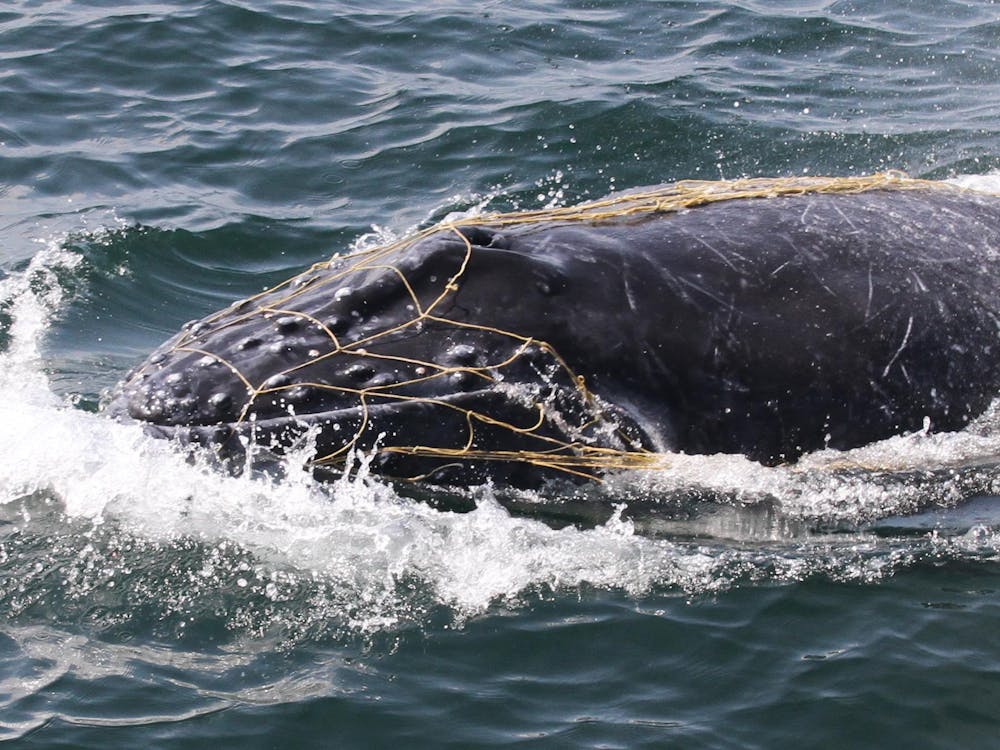
A humpback whale calf caught in a fishing net.SeaPix, Author provided
The humpbacks’ plight
According to the federal government’s delisting assessment, humpback whales’ strong recovery suggests current threats are not a risk to the population. But this assessment has shortcomings.
It states humpback whales on Australia’s east and west coast have reached, or are exceeding, the original population size – increasing by 10-11% a year over the past decade or longer.
But this information is based on models using data collected prior 2010 for Australia’s west coast, and prior to 2015 for the east coast. This data isn’t readily available to the public and does not include recent population trends.
The predicted population growth from these models doesn’t account for current and future impacts from major threats, including climate change. This is despite recent research and observations suggesting changes in the humpback population.
For example, 2019 research showed potential shifts in calving locations, with newborn humpback whales now frequently spotted outside Australian tropical waters. This — along with the early arrival of migrating humpback whales in Australia in the past years — may be a first sign of changes in breeding and migration habits.
It’s also important to compare humpback whale populations in Australia with those elsewhere, such as in the North Pacific. There, calving rates are declining, and whale abundance and distribution is showing marked shifts. The risk of entanglements with fishing gear is also rising.
Whales can get caught in fishing gear.Todd Burrows, Author provided
The problem with counting whales
The pre-whaling population size of humpback whales on the east and west coast of Australia is thought to be between 40,000 and 60,000. But information is limited and the actual number may have been much higher
Today, the estimated numbers from population models are similar: roughly 28,000 on the east cost and up to 30,000 on the west coast. But counting humpback whales accurately is very difficult. For example, on the east coast of Australia humpback whales frequently move between populations and during a census may not be attributed to their original population.
What’s more, conditions prior to whaling are not comparable with today’s conditions. Krill is a major food source for whales, and widespread whaling in the Southern Hemisphere caused krill numbers to increase. Research from 2019 suggests humpback whales’ fast recovery after whaling ceased may have been due to widely available krill.
But krill numbers have declined or their availability has shortened in recent years due to threats such as climate change and industrial fishing.
Every year humpback whales migrate from Antarctica where they feed, to breed in Australia.Shutterstock
Proceed with caution
Humpback whales off Australia’s coast will continue to have some protection under the Environment Protection and Biodiversity Conservation Act, even if they’re taken off the threatened species list.
Generally, all marine mammals are protected in Australian waters. But getting delisted means fewer resources devoted to their protection.
Forecasting the complex interactions of today’s threats, in order to predict tomorrow’s humpback whale populations, is challenging. A cautionary approach should therefore be taken.
In 2016, the US delisted some humpback whale populations. But before doing so, it established a ten-year monitoring plan to track population changes, threats and species abundance.
If Australia proceeds with the delisting, it should follow the US’ lead. Humpbacks whales should remain listed for another five years so a monitoring plan can be developed. Federal and state governments must invest resources into this process, and react swiftly if changes are detected.
A number of whale researchers and organisations concerned about the humpback whale delisting, including the author, prepared a detailed response to the proposal here.
A rockshelter in South Africa’s Kalahari documents the innovative behaviours of early humans who lived there 105,000 years ago. We report the new evidence today in Nature.
The rockshelter site is at Ga-Mohana Hill — a striking feature that stands proudly above an expansive savanna landscape.
Many residents of nearby towns consider Ga-Mohana a spiritual place, linked to stories of a great water snake. Some community members use the area for prayer and ritual. The hill is associated with mystery, fear and secrecy.
Now, our findings reveal how important this place was even 105,000 years ago, documenting a long history of its spiritual significance. Our research also challenges a dominant narrative that the Kalahari region is peripheral in debates on the origins of humans.
We know our species, Homo sapiens, first emerged in Africa. Evidence for the complex behaviours that define us has mostly been found at coastal sites in South Africa, supporting the idea that our origins were linked to coastal resources.
This view now requires revision.
The Ga-Mohana Hill North Rockshelter is located near the town of Kuruman in the Northern Cape province of South Africa.Author provided
A crystal-clear finding
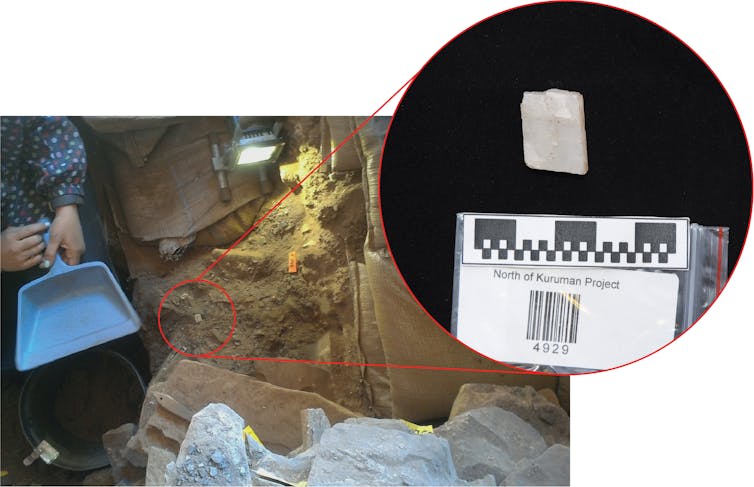
We found 22 white and well-formed calcite crystals brought to the site 105,000 years ago. We determined this using a method called “optically stimulated luminescence”, which dates sediments the crystals were excavated from.
Our analysis indicates the crystals were not introduced into the deposits via natural processes, but rather represent a small cache of deliberately collected objects.
Crystals found across the planet and from several time periods have previously been linked to humans’ spiritual belief and ritual. This includes in southern Africa.
People at coastal sites similarity started to collect non-food seashells around the same time (but not earlier) — perhaps for similar reasons.
One of 22 calcite crystals excavated from 105,000-year-old deposits.Author provided
Egg-citing technology
Ostrich eggshells can make excellent water storage containers and were used as such in southern Africa during the Pleistocene and Holocene. At coastal sites, the earliest evidence for this technology dates back about 105,000 years.
At Ga-Mohana Hill, we found ostrich eggshell fragments that show all the signs of being human-collected, based on their strong association with artefacts (including animal bones that are cut-marked from being butchered), and evidence of having been burned. These fragments may be the remains of early containers.
105,000-year-old ostrich eggshell fragments (left). Modern day example of ostrich eggshell canteen (right).Author provided
This suggests early humans in the Kalahari were no less innovative than those living on the coast.
A global effort
International and interdisciplinary collaboration makes for the best research and our paper’s authorship includes researchers from eight institutions across Australia, South Africa, Canada, Austria and the UK.
Local South African collaborators had an especially crucial role. For example, Robyn Pickering, Jessica von der Meden and Wendy Khumalo at the University of Cape Town provided important palaeoenvironmental context for the archaeology.
By dating tufa deposits around Ga-Mohana Hill, they showed water was more abundant 105,000 years ago when early humans were using the rockshelter.
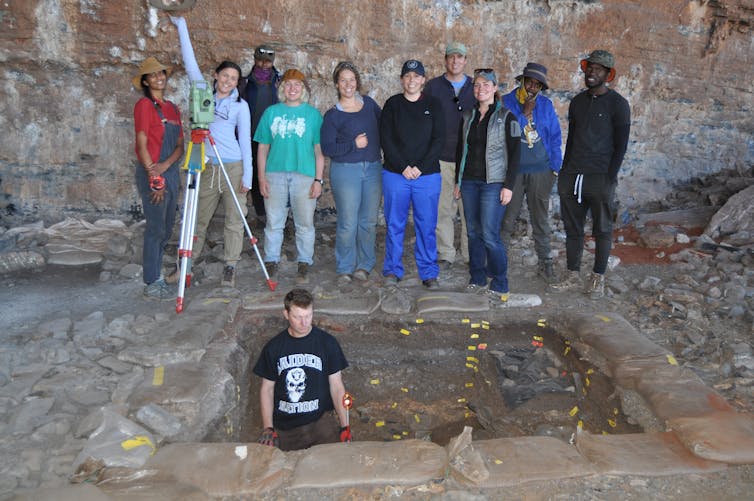
The excavation team in Ga-Mohana Hill North Rockshelter during our 2017 excavation season.Author provided
Nnoga ya metsi
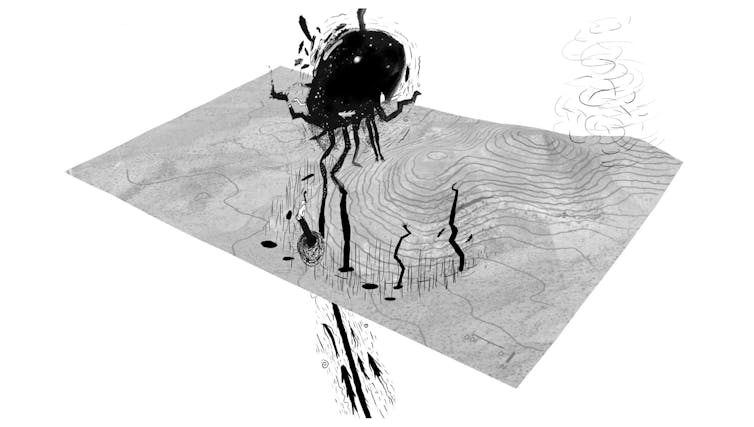
Many who visit Ga-Mohana Hill today for ritual practice see it as part of a network of places linked to the Great Water Snake (Nnoga ya metsi), a capricious and shape-shifting being. Many of these spiritual places are also associated with water.
Places such as Ga-Mohana Hill and their associated stories remain some of the most enduring intangible cultural artefacts from the past, linking modern indigenous South Africans to earlier communities.
These enduring beliefs establish an important sense of orientation in a country that has been spatially disorientated by colonial disruption.
An illustrative representation of the Great Water Snake by Sechaba Maape, Lecturer at the University of the Witwatersrand.Sechaba Maape
Respectful research benefits all
Those who visit the site today for ritual purposes rely on its association with fear to launch them into their desired ritual states. The site’s remoteness greatly contributes to this.
Recognising this significance, we’ve been adjusting our project methods to not undermine the practices held there. For example, following each excavation season, the areas we work from are completely back-filled and covered with sediment.
In this way, we can carefully recover our sections later, but leave almost no visible trace of our work. We haven’t erected any signage or structures, or otherwise left any significant permanent modifications.
Community engagement continues as we consider ways to integrate the cultural and archaeological values of Ga-Mohana Hill. We are working to further develop an approach that has a positive impact on local communities, while also reflecting on what these communities teach us — particularly regarding respect and ritual.
From an archaeological perspective, we believe this approach will help ensure Ga-Mohana Hill can continue to offer new and valuable insights into the evolution of Homo sapiens in the Kalahari.
Jayne Wilkins, ARC DECRA Research Fellow at Griffith University, summarising the significance of the finds at Ga-Mohana Hill North Rockshelter.
Scores of activists from the Papua People’s Solidarity Against Racism (SPMR) have held a free speech forum in front of the Elin traffic light intersection in Sorong city, West Papua, province.
The action was held to oppose racism against indigenous Papuans which is “flourishing and rooted” in the minds of Indonesian people, say the activists. They urged the Indonesian government to immediately investigate cases of racism against indigenous Papuans (OAP).
“The contempt towards OAP is not something that has only happened recently in Indonesia. It has been happening for a long time but the Indonesian state continues to protect the perpetrators without acting firmly against them,” said action coordinator Apey Tarami following the action on Monday.
According to Tarami, the racist attitudes shown towards Papuan soccer player Patrik Wanggai is just one more note in a long record of racism in Indonesia which has targeted the Papuan people.
“The state protects perpetrators of this flourishing racism. This is evidence of continued racism against Papuans this year. Meanwhile there are no clear legal actions taken even though it is reported to the police,” said Tarami.
Tarami noted other cases which have occurred, such as those against former Human Rights Commission member Natalis Pigai and the recent racist threats against Papuan students in Malang, East Java, by the Malang police chief (Kapolresta) as examples of how the state protects the perpetrators.
Another activist, Ando Sabarafek, said that each time there was a racist incident against Papuans it was always resolved by an apology through the mass media, but this did not heal the “spiritual injury” suffered by Papuans.
“The Malang Kapolresta must be sacked. Firm action must be taken against the perpetrators of racism against Patrik Wanggai though social media. An apology can never heal the hearts of Papuan people,” he said.
The activist from the group Kaki Abu also called on the Indonesian government to immediately give the Papuan people the right to self-determination as a democratic solution.
“The NKRI [Unitary State of the Republic of Indonesia] is a racist state. Papuan independence is the best solution so that the Papuan people will be free to determine their own future,” he said.
“As long as the Papuan people are under Indonesian [rule], racism against Papuans will continue to flourish and never disappear from the face of the earth and the character of the Indonesian people.”
The New Zealand government has appointed eight people to oversee a business case for a new public media entity to replace state-owned Television NZ and RNZ.
The Minister of Broadcasting and Media Kris Faafoi says he plans to present the business case – due to be completed by mid-year – to cabinet for approval by the end of the year.
The business case will consider what a new public media entity would cost to develop, implement and operate – and how it would “collaborate with and complement the work of private media”.
The business case for Strong Public Media is expected to be completed around the middle of the year – a tight timeframe.
The group will be chaired by former NZ First party deputy leader Tracey Martin.
Five of the Strong Public Media Business Case Governance Board members: Bailey Mackey (from left), Glen Scanlon, Sandra Kailahi, Michael Anderson, and William Earl. Image: Nate McKinnon/RNZ
Board appointees The other appointees are:
Broadcasting Standards Authority chair Glen Scanlon – a former head of news at RNZ
Former MediaWorks chief executive Michael Anderson
TV producer, former reporter and member of Prime Minister’s Business Advisory Council Bailey Mackey
Broadcasting and technology consultant William Earl
Dr Trisha Dunleavy, Victoria University of Wellington media academic
Producer Sandra Kailahi, former journalist at TVNZ’s Tagata Pasifika, Te Karere and Fair Go
John Quirk, former chair and director of state-owner transmission company Kordia.
Media Minister Faafoi said the Minister for Māori Development, Willie Jackson, was also “leading work to enhance support for the Māori media sector”.
“The Governance Group will oversee the development of a business case . . . which will look at how a potential new public media entity could meet the changing expectations of New Zealand audiences and support a strong, vibrant media sector,” Faafoi said in a statement
The minister also said the group would “lead work to gather input on a Charter for the potential new public media entity”.
The process has been heavily criticised by the National Party and its broadcasting spokesperson Melissa Lee.
She has said it has taken too long and effectively stalled progress on important projects at both broadcasters, including the review of RNZ’s Charter – which was due to begin next week – and RNZ’s plans for a new youth service, the subject of major controversy in 2020 when plans to reallocate RNZ Concert’s FM frequency and cut back the network were announced, and then scrapped.
The story so far It was back in 2019 that Minister Faafoi first raised the prospect of a new state-owned public media entity under the banner Strengthening Public Media.
Thanks to a source spilling the beans to RNZ in January 2020, it was revealed the government had settled on that option to replace state-owned RNZ and TVNZ within three years.
But back then cabinet wanted to know more about precisely how it would work and ministers demanded a business case before giving it a green light.
It was even common knowledge that PwC had been hired for the task under the guidance of the Ministry of Culture and Heritage before the minister confirmed all that the following month.
He also said it would have revenue from both “Crown and non-Crown sources” – a mix of public funding then and commercial revenue in other words.
(This was re-stated by the minister today, but he has declined to discuss the balance of public and commercial funding until after the completion of the business case).
Those who called it a “merger” were corrected by the minister and officials.
Not just mashing together They have insisted all along this was not just mashing together the public service non-commercial RNZ – whose foundation is radio – with a heavily-commercialised TVNZ founded on television broadcasting and advertising.
But how a completely new digital-age media organisation with a new charter could be created by 2023 out of the resources of two organisations with very different budgets, priorities and cultures remains an unanswered question.
When MPs asked about that in the annual reviews of TVNZ and RNZ last year, the answer was “wait for the business case”.
When covid-19 intervened in March 2020, Strengthening Public Media took a back seat to saving the media.
The business case was put on ice in April 2020.
But earlier this month, Minister Faafoi told the Parliamentary committee reviewing TVNZ and RNZ that work was back on,
TVNZ‘s chief executive Kevin Kenrick told the committee TVNZ was merely an “observer” in the process.
“This future public media entity is basically being progressed by officials at the Ministry of Culture and Heritage right now,” he said.
But RNZ chairman Jim Mather echoed the minister’s language on strengthening public media when he declared RNZ’s strong support.
“We believe, as a board and executive team, it is a once-in-a-generation opportunity to create a stronger public media system the would benefit all New Zealanders,” he told Parliament’s Social Services Committee.
This article is republished under a community partnership agreement with RNZ.
The West Sepik administration is not happy with the way illegal border crossers are being handled by the Indonesian and Papua New Guinean consular officials in Jayapura amid the worsening covid pandemic crisis.
Administrator Conrad Tilau said the provincial administration had now withdrawn its support and involvement in anything to do with border crossers due to the hike in covid-19 pandemic cases in the province.
He said the total covid-19 cases in West Sepik had increased to 336 and it was a concern for the provincial administration.
Tilau said the border crossing was one transmission pathway and the provincial administration was concerned that an isolation centre had not been established in the province.
He said the issue of border crossing was a major concern for his administration, particularly with the surge in the covid-19 cases, and illegal activities along the border.
Tilau said the border crossing into Indonesia was an illegal activity that needed Indonesian authorities to deal with them using their laws instead of sending perpetrators back to Papua New Guinea and creating more problems.
“Border crossing is still going on unnoticed and those crossers are conducting illegal activities and they should be subject to the Indonesian laws,” he said.
‘Poses more risk to PNG’ “For the PNG Consular [officials] in Jayapura to send back those illegal border crossers poses more risk to the country.
“They are illegally in Indonesia so they should be subject to Indonesian laws instead of deporting them to PNG and creating more problems like the increase in covid-19 pandemic cases.”
Tilau said the provincial administration was involved in the exercise along the border when covid-19 first entered the country in 2020 but since then it had stopped its support.
“When we tested the first case in 2021, we said no repatriation but the consular-general got approval from the Pandemic Controller [Police Commissioner David Manning] to send those people back; we do not have an isolation centre in Vanimo to deal with border crossers infected with covid-19,” he said.
‘Indonesia should help PNG’ “Indonesia should help PNG amid the surge in sovid-19 cases.
“What kind of bilateral relationship is this?
“PNG and Indonesia must cooperate to protect their borders from covid-19 and … illegal activities.
“The provincial government and provincial administration have withdrawn our involvement.”
He urged the national government, through the Pandemic Controller, to fund a covid-19 isolation centre in Vanimo given the surge in infections and movement of people along the border.
Meanwhile, the Pandemic Controller has issued a travel restriction along PNG’s international borders.
For many years I thought universities were the ideal place to establish centres of investigative journalism excellence. Now I’m not so sure.
My views have been shaken to the core by the Auckland University of Technology gutting the Pacific Media Centre. Its future in anything but name is now in doubt.
The PMC’s founder, highly regarded journalist and academic Professor David Robie, retired last December. In short order the centre’s offices were emptied and the contents, one hopes, placed in storage. The School of Communication Studies head, Dr Rosser Johnson, announced that PMC would henceforth share space in the main media studies workspace.
In an email he said “everything that the school is planning will, we believe, enhance its status and increase its visibility” and that he would be calling for expressions of interest in the leadership of the centre.
However, those previously involved in its operation speak of a communication vacuum and no resumption of centre activity. Four unmarked desks have apparently been assigned. The PMC website appears to have been frozen, apart from links to associated – but independent – operations Asia Pacific Report and the Pacific Journalism Review.
Dr Robie has made clear his views on the plight of the centre and he has been joined by a legion of concerned academics, journalists and concerned members of communities throughout the Asia Pacific region. The Australia Asia Pacific Media Initiative, in a diplomatically-worded letter to AUT warned what would be lost if PMC – “the jewel in AUT’s crown” – is closed or subsumed.
It suggested the best solution may be to reconstitute the PMC as an independent centre. The undiplomatic translation of that is “Take it away from the School of Communications Studies”.
Systemic issues at the interface I would go a step further: Take it away from AUT because there is a fundamental conflict of interest between tertiary institutions and centres of investigative journalism. There are systemic issues at the interface between academic and craft practices. The tension has been exacerbated by the fact that universities can no longer measure the success of their journalism courses by the number of graduates they place in jobs.
Many of those jobs simply no longer exist and prospective students know it. As a result, the focus has shifted to a more traditional university outlook based on theoretical teaching and research outputs.
The Pacific Media Centre is not the first to fall victim.
In Sydney, the Australian Centre for Independent Journalism, one of the county’s flagships of investigative reporting, closed in 2017 after 25 years of racking up a plethora of award-winning stories. The University of Technology Sydney unceremoniously closed the ACIJ following “periodic evaluation of performance against the strategic objectives of the faculty and the university”.
What that means in plain English is that the centre’s journalism wasn’t counting sufficiently towards the research-based metrics that determined how much funding UTS could attract from government.
AUT’s Pacific Media Centre is in exactly the same position. Its journalism may be lauded here and throughout the region (and beyond) but it does not push the required buttons by fitting neatly into conventional academic methodologies at the core of the Performance Based Research Funding (PBRF) model that determines a large part of the share of government money that each tertiary institution receives.
Professor Chris Nash, an award-winning ABC journalist who became director of the Australian Centre for Independent Journalism before moving to Monash University, told me in a telephone conversation last week that journalists were in very vulnerable positions within universities and were often pushed into internecine competition with their colleagues (let alone the broader disciplinary framework of the social sciences) over what should be their proper academic output.
Research-based imperatives He said journalism wasn’t alone in experiencing this misalignment with the research-based imperatives of academia. Nursing and architecture had been similarly afflicted, as had history which is now one of the most august disciplines in the social sciences.
Nash wrote a provocative book What is Journalism? that argues that journalism should be treated as an academic discipline on a par with history.
“Journalism is where history used to be,” he told me. “History used to manifest precisely what journalism is being accused of, which is that it is purely empirical with no analysis and no reflection.
“It’s a common political problem that disciplines have to face as they emerge in the context of a university environment. I have to say journalism has handled it fairly badly, particularly with its focus on the job market… It has seriously failed to actually develop a concept of journalism as academic research.”
That hasn’t come to pass and it’s clear from the dire situation facing the PMC that the friction between practice and research is as abrasive as ever.
Centres like the Pacific Media Centre develop an ethos that is driven by their leadership, and particularly by their founders. When it is time for the leaders to move on (and at 75 David Robie had more than earned his retirement), the issue of succession is vitally important.
After Lewis left the centre in 2004 it went through a series of directors, its fulltime staff dropped from 40 to 25 and it committed a number of embarrassing gaffs. It has since recovered its equilibrium and regained its place in the media landscape, but Lewis told me he believed insufficient attention had been paid to succession planning and to codifying values and ethos.
Dr Robie was mindful of the issue of succession and has written extensively on the values and ethos of the Pacific Media Centre but the reality is that neither he nor the staff of the centre had any control over events following his retirement. The decision-making was within the Faculty of Design and Creative Technologies and its School of Communications Studies.
Not only were there no guarantees of any continuation of the imperatives or ethos Dr Robie had built up over 13 years, but the terms of reference for a new appointee could – and likely will – pay more attention to the academic interests of the school (and its PBRF score) than to journalism.
This endgame is in stark contrast to the centre’s beginnings. It was established as one of five autonomous centres that comprised the Creative Industries Research Institute. Although the institute was within the university, it enjoyed significant independence.
The inaugural chair of the PMC advisory board, Selwyn Manning, told me that, from the onset, the centre’s purpose was clear.
The Pacific Media Centre Project – a video made by Alistar Kata for the PMC while she was contributing editor of Pacific Media Watch.
“It was established to be a place of Pacific (and Asia Pacific) identity, where undergraduates, and those from industry, could locate, research and learn. Key to the PMC’s purpose was to ensure a bridge be constructed between the university (AUT), external journalistic bodies, and industry. The work that post-graduate students produced was to have relevancy and value in both academic terms and as real examples of quality Fourth Estate reportage in the real world.
Significant support from AUT “The model attracted significant support from within AUT, from external networks, and from industry. The PMC’s governing board reflected this and under David Robie’s directorship the PMC soon became a thriving example of collaboration, where common ground was identified among its stakeholders, and the PMC’s direction and purpose was sustained.
“The support extended to the PMC from the Creative Industries Research Institute was first class. But, when some years later CIRI was disestablished, and the PMC was shifted to be within the School of Journalism, then it appeared to me support for its efforts and its autonomous-identity began to ebb. This was despite the PMC having achieved prominence among other media centres in the Asia Pacific region, and having produced a steady stream of AUT post-graduates, including many people recognised for high achievement.”
All of this points to a basic incompatibility that is not limited to AUT, its Faculty of Design and Creative Technologies, or its School of Communications Studies. They are victims of a flawed system.
The neoliberal underpinnings of tertiary funding in this country (and elsewhere) demand policies that maximise an institution’s ability to attract contestable government money. And in the neoliberal belief that everything can be measured, the whole system is skewed by decisions on what will count. In the case of New Zealand, that means academic research outputs dictated by recognised methodologies.
That system is unlikely to change in the foreseeable future so the only way in which centres such as the PMC can survive – and thrive – is for them to be separated from institutions that devalue the product of their endeavours.
Disengagement should not be total because students and faculty members benefit immeasurably from working in a rigorous journalistic environment. And, let’s face it, they represent cheap manpower while they learn and research.
The demise of the Creative Industries Research Institute suggests there is no safety in so-called independent structures within a university. The need is for structures that have their own charter, funding security, and ability to freely associate with tertiary institutions.
NZ’s Pacific aid New Zealand’s current official aid to the Pacific amounts to more than $440 million a year. A tiny fraction of that sum would finance the Pacific Media Centre, the worth of which is widely recognised in the region.
The Australia Asia Pacific Media Initiative’s letter to the AUT vice-chancellor stated that Pacific journalism is “under existential threat” and that the PMC “has a key role to play in. the survival of public interest journalism and media in the region”. That, surely, is a justification for funding.
The government already funds the Asia Media Centre (through the Asia New Zealand Foundation) and the Science Media Centre (through the Royal Society Te Apārangi). The Pacific Media Centre should be added to that list and re-established as a stand-alone trust. It should continue its original remit and maintain its associations with Asia Pacific Report and the Pacific Journalism Review.
It may be time, however, to find a new university partner. I fear AUT has damaged its associations beyond repair.
Dr Gavin Ellis holds a PhD in political studies. He is a media consultant and researcher. A former editor-in-chief of The New Zealand Herald, he has a background in journalism and communications – covering both editorial and management roles – that spans more than half a century. Dr Ellis publishes a blog called Knightly Views where this commentary was first published and it is republished by Asia Pacific Report with permission.
The Radio 531pi interview with Dr David Robie and doctoral candidate Ena Manuireva by host Ma’a Brian Sagala.
Fungi — a scientific goldmine? Well, that’s what a review published today in the journal Trends in Biotechnology indicates. You may think mushrooms are a long chalk from the caped crusaders of sustainability. But think again.
Many of us have heard of fungi’s role in creating more sustainable leather substitutes. Amadou vegan leather crafted from fungal-fruiting bodies has been around for some 5,000 years.
More recently, mycelium leather substitutes have taken the stage. These are produced from the root-like structure mycelium, which snakes through dead wood or soil beneath mushrooms.
You might even know about how fungi help us make many fermented food and drinks such as beer, wine, bread, soy sauce and tempeh. Many popular vegan protein products, including Quorn, are just flavoured masses of fungal mycelium.
But what makes fungi so versatile? And what else can they do?
Show me foamy and flexible
Fungal growth offers a cheap, simple and environmentally friendly way to bind agricultural byproducts (such as rice hulls, wheat straw, sugarcane bagasse and molasses) into biodegradable and carbon-neutral foams.
Fungal foams are becoming increasingly popular as sustainable packaging materials; IKEA is one company that has indicated a commitment to using them.
Fungal foams can also be used in the construction industry for insulation, flooring and panelling. Research has revealed them to be strong competitors against commercial materials in terms of having effective sound and heat insulation properties.
Rigid and flexible fungal foams have several construction applications including (a) particle board and insulation cores, (b) acoustic absorbers, (c) flexible foams and (d) flooring.Jones et al
Moreover, adding in industrial wastes such as glass fines (crushed glass bits) in these foams can improve their fire resistance.
And isolating only the mycelium can produce a more flexible and spongy foam suitable for products such as facial sponges, artificial skin, ink and dye carriers, shoe insoles, lightweight insulation lofts, cushioning, soft furnishings and textiles.
For other products, it’s the composition of fungi that matters. Fungal filaments contain chitin: a remarkable polymer also found in crab shells and insect exoskeletons.
Chitin has a fibrous structure, similar to cellulose in wood. This means fungal fibre can be processed into sheets the same way paper is made.
When stretched, fungal papers are stronger than many plastics and not much weaker than some steels of the same thickness. We’ve yet to test its properties when subject to different forces.
Fungal paper’s strength can be substituted for rubbery flexibility by using specific fungal species, or a different part of the mushroom. The paper’s transparency can be customised in the same way.
Paper sheets with varying transparency derived from the brown crab’s shell (C. pagurus) (column 1), fungi Daedaleopsis confragosa (column 2) and the mushroom Agaricus bisporus (column 6). Columns 3, 4 and 5 show fungal papers of varying transparencies based on mixtures of the two species.Wan Nawawi et al
Growing fungi in mineral-rich environments results in inherent fire resistance for the fungus, as it absorbs the inflammable minerals, incorporating them into its structure. Add to this that water doesn’t wet fungal surfaces, but rolls off, and you’ve got yourself some pretty useful paper.
A clear solution to dirty water
Some might ask: what’s the point of fungal paper when we already get paper from wood? That’s where the other interesting attributes of chitin come into play — or more specifically, the attributes of its derivative, chitosan.
Chitosan is chitin that has been chemically modified through exposure to an acid or alkali. This means with a few simple steps, fungal paper can adopt a whole new range of applications.
For instance, chitosan is electrically charged and can be used to attract heavy metal ions. So what happens if you couple it with a mycelium filament network that is intricate enough to prevent solids, bacteria and even viruses (which are much smaller than bacteria) from passing through?
Fungal chitin paper derived from white-button mushrooms is an eco-friendly alternative to standard filter materials.Shutterstock
The result is an environmentally friendly membrane with impressive water purification properties. In our research, my colleagues and I found this material to be stable, simple to make and useful for laboratory filtration.
While the technology hasn’t yet been commercialised, it holds particular promise for reducing the environmental impact of synthetic filtration materials, and providing safer drinking water where it’s not available.
Mushrooms in modern medicine
Perhaps even more interesting is chitosan’s considerable biomedical potential. Fungal materials have been used to create dressings with active wound healing properties.
Although not currently on the market, these have been proven to have antibacterial properties, stem bleeding and support cell proliferation and attachment.
Fungal enzymes can also be used to combat bacteria active in tooth decay, enhance bleaching and destroy compounds responsible for bad breath.
Then there’s the well-known role of fungi in antibiotics. Penicillin, made from the Penicillium fungi, was a scientific breakthrough that has saved millions of lives and become a staple of modern healthcare.
Many antibiotics are still produced from fungi or soil bacteria. And in an age of increasing antibiotic resistance, genome sequencing is finally enabling us to identify fungi’s untapped potential for manufacturing the antibiotics of the future.
Mushrooms mending the environment
Fungi could play a huge role in sustainability by remedying existing environmental damage.
For example, they can help clean up contaminated industrial sites through a popular technique known as mycoremediation, and can break down or absorb oils, pollutants, toxins, dyes and heavy metals.
They can also compost some synthetic plastics, such as polyurethane. In this process, the plastic is buried in regulated soil and its byproducts are digested by specific fungi as it degrades.
These incredible organisms can even help refine bio fuels. Whether or not we go as far as using fungal coffins to decompose our bodies into nutrients for plants — well, that’s a debate for another day.
But one thing is for sure: fungi have the undeniable potential to be used for a whole range of purposes we’re only beginning to grasp.
It could be the beer you drink, your next meal, antibiotics, a new faux leather bag or the packaging that delivered it to you — you never know what form the humble mushroom will take tomorrow.
Source: The Conversation (Au and NZ) – By Robert Breunig, Professor of Economics and Director, Tax and Transfer Policy Institute, Crawford School of Public Policy, Australian National University
Domestic violence committed on female partners in heterosexual couples occurs significantly more frequently when the woman earns more than the man — according to our findings about 35% more often.
Our research linking domestic violence to gender income balance is a world first.
We are astounded by the strength of the association.
The following graph tracks the probability of partner violence reported by women against the share of a couple’s income earned by the woman.
Probability of partner violence by % of partner income earned by the woman
It shows the likelihood of abuse increasing abruptly when a woman’s income is greater than that of her male partner.
While the probability of abuse against women seems to go back down to baseline levels once women earn 80% of income, it’s important to note that our estimates become very imprecise because of the small sample size above 75%.
Our data also sampled for incidence of emotional abuse, finding a marked 20% increase in frequency of reports from females in heterosexual couples in which female earnings were greater than male earnings.
Known but not acknowledged
Previous research has shown that other negative markers – divorce and relationship breakdown levels, unhappiness within relationships, etc – are also higher in relationships with a female earnings leader.
The data we examined, drawn from three waves of the Australian Bureau of Statistics’ Personal Safety Survey (2005, 2012 and 2016) showed the same patterns in abuse levels regardless of participants’ absolute income or education, age or countries of birth.
The frequency of reports of abuse made by males in heterosexual relationships bore no relation to relative income levels.
While our research is a world first, other research suggests our findings are understood if not widely acknowledged.
Responding to one global study, 32% of Australian women agreed with the statement: if a woman earns more than her husband, it is almost certain to cause a problem.
Globally the figure is far higher — 51% of women agreed with the statement.
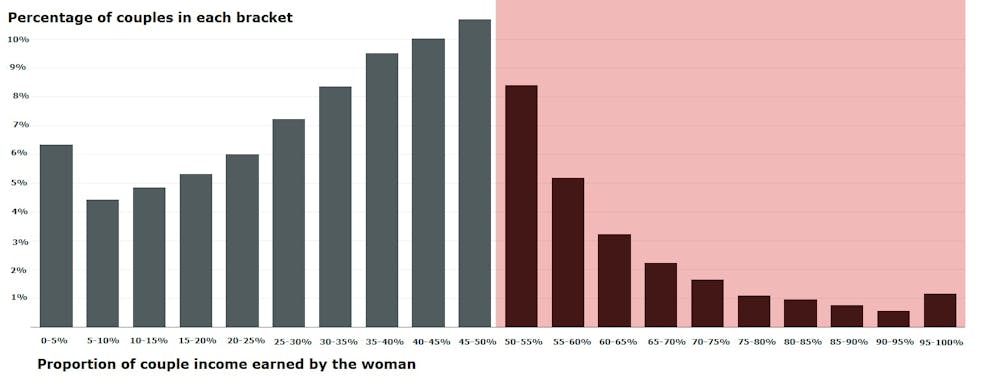
The strength of the norm that the man in a couple earns more than the woman is evidenced in data tracking the share of earnings contributed by the woman.
Few women earn more than the man
This graph, created using 17 years of data from the Household, Income and Labour Dynamics in Australia survey, shows the proportion of couples in each income distribution range.
Proportion of couples with each income distribution
The significant bulge in the number of couples whose female partner earns slightly less than the male partner suggests a gender norm inhibiting women earning more than men.
Combined with the topography of domestic abuse emerging from our study it suggests that what we are seeing reflects reality and is not an artefact of female earnings leaders feeling empowered to report.
Probably not a reporting effect
Further evidence against this being a reporting effect is that the sharp spike in reports of domestic abuse about the 50% cut off occurs irrespective of income or education. It would be an odd kind of reporting issue if it wasn’t affected by income or education but solely by this cut off.
One sobering implication is that we can not assume that domestic violence will simply disappear as women’s labour market prospects improve.
Gender norms might not evolve as quickly as women’s advances in earnings and employment.
The norm that creates a bulge of working women earning less than their partners may be a consequence of society’s tacit acknowledgement of this fact.
One hope is that by recognising and highlighting this fact we are contributing one of the missing puzzle pieces in the endeavour to understand and close the gender pay gap.
A View from Afar – Join Selwyn Manning and Paul Buchanan in this LIVE recording of this podcast on Thursday, midday (NZDST), to debate political symbolism and discuss:
How governments use symbolism to accentuate intent and identity. Some of it is fact, and some of it is fiction, some of it is designed to divert attention and deceive.
In this episode Buchanan and Manning will show you how to sift through the wheat from the chaff.
Manning says: “Once, former New Zealand prime minister, David Lange, told me… politics is all about theatre!
“Writer and former British intelligence officer, the late John le Carre, famously referred to government smoke and mirrors as… the ‘Theatre of the Real’.
“With this in mind, what can we make of the US-led coalition of countries that are highlighting human rights abuses inside the People’s Republic of China? What’s real, and what’s self-interest? Is it a mix of both?
“And, how does New Zealand Government, and others, handle symbolisms, real and illusion?”
Paul Buchanan will detail some examples of political symbolism for us to consider.
JOIN BUCHANAN & MANNING LIVE AND COMMENT ON THIS DISCUSSION:
You can interact with this LIVE programme by clicking on one of these social media channels and interacting in the social media’s comment area. Here are the links:
As COVID vaccination programs roll out around the world, our new interactive tool allows you to see where each country is at with its immunisation program. Using data from Our World in Data, you can see how each country is performing when it comes to:
total COVID-19 vaccinations administered given so far
total COVID-19 vaccinations administered per 100 people.
Due to some limitations with the source data, not all countries are shown. Our World in Data explains how they collect their data, which is being used by the WHO, over here. We’ve shown data as of March 28 below because that’s the latest data set available that’s relatively complete for a good range of countries.
Australia has administered about 600,000 doses at the time of writing (although, as shown on the interactive, it was 510,000 on March 28). That is a long way short of the target set by the prime minister to administer 4 million doses by the end of March.
Data visualisation: Kaho Cheung. Data source: Our World in Data https://ourworldindata.org. Australian data via https://covidlive.com.au/.
The Conversation asked Hassan Vally, an epidemiologist and infectious diseases expert, to reflect on what the data reveal at date of this article’s publication.
Here’s what he told us:
This visualisation provides a useful and easy way to track where countries are at in their COVID vaccine rollouts.
We are in the midst of one of the largest logistical exercises in world history and it’s easy to drown in the sheer magnitude of the numbers.
The United States has done extremely well in terms of the total number of doses given. It has clearly administered the most doses so far in total.
President Joe Biden promised to deliver 100 million doses of vaccine by his 100th day in office, which was achieved by March 19, approximately six weeks ahead of schedule. Regardless of how hard a marker you are, given the obstacles in the US, this is an impressive achievement.
China comes in second, having recently passed a significant milestone of delivering more than 100 million doses of the vaccine. The numbers of people currently being vaccinated each day are extraordinary, with goals to increase delivery to more than 10 million doses per day and immunise 40% of the population by June.
India comes in next at around 61 million doses, which is impressive given the unique challenges it faces.
The United Kingdom is also doing well on total number of doses given. After these countries, you have Brazil a fair way back at about 18 million doses at the time of writing, and then a pack of countries further back.
A different picture emerges when you adjust the data for the population sizes of countries by looking at the number of doses given per 100 people.
As has been well publicised, Israel leads the pack by a fair margin.
United Arab Emirates is doing really, as is Chile, the UK, Bahrain and the US.
Interestingly, the large countries such as China, India and the US that have delivered large total amounts of vaccine fall back from the lead when you adjust for population size.
Taking into account the size of countries to better assess the progress of the vaccination programs highlights the benefit of having a smaller population size and small geographical size.
Wealthier countries are ahead
This interactive tool also highlights that wealthier countries are generally ahead of poorer countries when it comes to the vaccination rollout. Unless addressed, that’s going to be a significant problem. Until the pandemic is stamped out everywhere, huge risks remain for all countries.
Global equitable access to vaccines is the right thing to do. But it’s also in the interests of rich nations, too. As the WHO says:
With a fast-moving pandemic, no one is safe, unless everyone is safe.
It’s fantastic to see Australia playing its role as a good regional citizen by providing vaccines and assistance to PNG to help deal with their serious COVID situation. One could argue however, that we could and should be doing more.
How’s Australia doing compared with the rest of the world?
At first glance, Australia looks to be tracking poorly compared to the rest of the world.
However, context is really important. We need to remember Australia is virtually COVID-free, making it the envy of the world.
We have access to two good vaccines suitable for all age groups, and the immunisation program has begun.
Although things have started slowly and we are behind where we would like to be, our slow start will likely ramp up significantly in the coming weeks.
It is significant that we have now entered phase 1b of the rollout, which means many millions more are now eligible to get the vaccine. We have also now started onshore vaccine production, which ensures vaccine supplies into the future.
Yes, there have been frustrations. But unlike many places, Australia has the luxury of time to carefully and safely deliver the vaccines due to our excellent performance so far in containing the spread of COVID-19.
Prince Harry has copped a pasting in the British media for his new job as “chief impact officer” with Silicon Valley startup BetterUp.
His role, and the company’s business model, has been called the “latest expression of woke capitalism” in venerable conservative magazine The Spectator. Other critics have chimed in, derideing the “Prince of Woke Capital” for “surfing a wave of wokery towards an economic abyss”.
Ridiculing people and corporations for being “woke” is, of course, a relatively easy sport for pundits on the right of the political spectrum. Harry’s critics have a point that woke capitalism involves vapid political correctness, even if they are missing its more serious ramifications for social and economic inequality.
The origin of woke
First, let’s recap the meaning of “woke” and “woke capitalism”.
The use of the term “woke” by African Americans has been traced back at least to the 1920s, though Oxford English Dictionary researchers say its meaning as being alert to systemic issues of injustice and discrimination emerged from the American civil rights movement in the 1960s.
It became more widely known with the advent of the Black Lives Matter movement in 2013 (following the acquittal of Florida man George Zimmerman for shooting dead African-American teen Trayvon Martin).
A Black Lives Matter demonstration in Los Angeles in August 2014, following the killing of Mike Brown, fatally shot by police in Ferguson, Missouri.Michael Nelson/EPA
As academics Elaine Richardson and Alice Ragland explain in a 2018 article, BLM activists used the hashtag #staywoke to urge fellow African Americans “to remain aware of what is going on around you and in society, more specifically, to remain politically aware or conscious”.
It didn’t take long for “woke” to enter mainstream culture. In 2016 the American Dialect Society declared it the slang word of the year. They defined “woke” as being “conscious, aware or enlightened, especially with regards to matters of social justice and racial inequity”.
In entering the mainstream, though, the meaning of “woke” was soon distorted. Those on the right of politics co-opted it as a term of derision – akin to “social justice warrior” – for people (especially white people) who bragged about their self-righteous positions on political issues.
What started as a serious call to political consciousness was manipulated to become a way of dismissing anyone who professed vaguely progressive views.
This wasn’t limited to individuals. Corporations too could be chastised for being woke.
In 2018, New York Times columnist Ross Douthat wrote about the trend of corporations and chief executives aligning themselves to progressive social concerns, such as immigration and gay and transgender rights, while they continued to push their own economic “self-interest on tax policy and corporate stinginess in paychecks”.
The term “woke capitalism” soon came to express the approach of companies who claim a “social licence to operate” through their public advocacy on social issues, without affecting the economic status quo.
What has all of this got to do with Prince Harry and BetterUp?
Let’s clarify what BetterUp is.
Media reports have described the San Francisco-based company as a startup “that provides employee coaching and mental health assistance”.
BetterUp’s website.
The company itself describes its business as being about “changing the world by bringing the power of transformation to each and every person”. Announcing the prince’s appointment, chief executive Alexi Robichaux declared:
“Prince Harry will expand on the work he’s been doing for years, as he educates and inspires our community and champions the importance of focusing on preventative mental fitness and human potential worldwide.”
The title of chief impact officer – or “chimpo” – comes from the not-profit sector. There’s no one accepted job decription, but such roles generally involve working to ensure an organisation is actually achieving its stated vision and mission.
How does this apply to BetterUp? That’s unclear.
Remove all the marketing babble and this is a company that exists to make a profit. Its core business appears to be an app selling professional coaching services. Its promise is to make people more “positive, engaged, and connected to every part of their lives”, both personal and professional.
In reality, the chief impact the prince is likely to have is attracting publicity for the app – helping BetterUp’s bottom line, and Harry’s bank balance.
Everyone’s a winner?
The way in which BetterUp has wrapped its reality in the language of social concern and human progress bears all the worst hallmarks of “woke capitalism”.
Its business model is all about individual empowerment. This shows no apparent awareness of the need to address systemic social and economic inequities. It would also have us believe we can all “make it” in that world, if we just get the right mental attitude.
Yet the connection between entrenched economic inequalities and myriad social problems including mental illness are well-documented. As the World Health Organization concludes, mental disorders are shaped by social and economic factors, with inequality being chief among them.
The irony is that Harry epitomises this inequality, and the limitations of meritocracy. He is the very embodiment of unearned wealth and privilege. Would he have gotten this job except for the family he was born into? Unlikely. How much is he being paid to push the idea that anyone can achieve success? BetterUp isn’t saying. Nor is he.
So while it easy to agree with criticisms of Prince Harry’s new “job” as an expression of woke capitalism, this cannot simply be dismissed as misplaced political correctness.
Inequality is the problem. Woke capitalism is not the solution.
Launched with great fanfare in 2017 by then-Attorney-General George Brandis, the inquiry was billed as the first comprehensive review of the Family Law Act since its commencement in 1976 — a rather bold claim, given the plethora of inquiries and reports on almost every aspect of family law in the intervening years.
The ALRC’s terms of reference were so broad as to be utterly unmanageable. They included such things as:
the appropriate, early and cost-effective resolution of all family law disputes
how to determine the best interests of children and listen to their views
issues concerning family violence, child abuse, drug or alcohol addiction and serious mental illness
whether the adversarial court system is the best way to deal with family law issues
the law on how to divide property when relationships break down.
The list went on and on. Any one of these topics alone was worthy of a reference to a law reform body.
Most of these issues had already been extensively explored in reports by parliamentary committees, previous ALRC inquiries and the many carefully considered reports of the Family Law Council, a statutory body that was put into hibernation by the Turnbull government.
Notwithstanding the breadth of the terms of reference, the ALRC’s small group of commissioners and research staff were given only 18 months to report.
The commission struggled valiantly with the enormous task it was given. Its report, published in April 2019, contained 60 recommendations.
The government responds — two years later
So what happened? Quietly, on March 21, nearly two years after the report was published, the Morrison government released its response.
Few of the commission’s recommendations were accepted. And those which were accepted largely involved tinkering at the margins. Numerous recommendations were simply “noted”.
The major proposed changes to the law on property division and parenting after separation were all rejected, although the government says it will attempt some redrafting to help “clarify” the law.
Many of the other recommendations were marked as “agreed in principle” or “agreed in part”.
Law reform bodies, parliamentary committees and governments have a shared interest in demonstrating how many recommendations have been accepted.
Permanent bodies like the ALRC keep score of their “success rate” when recommendations are put into action. Governments, likewise, enjoy being able to say they have implemented the recommendations of these often costly and time-consuming inquiries.
However, even where the ALRC’s proposals were “accepted in principle” or “in part”, the government’s written responses often indicated that the recommendations had, in reality, not been accepted at all. For example, it agreed in principle some disputes about children should be able to be arbitrated – but then explained all the problems involved in doing so.
Typically, the response to many recommendations sounded like, “we will think about it”, or “we will consult with stakeholders” or “we might draft something vaguely along the lines of what the ALRC was trying to achieve”.
What is not clear is why, in the two years since the report was received, the government hasn’t already thought about it, consulted with stakeholders and developed proposed reforms to the act.
Family law experts agree we already have enough data to fix the system.Shutterstock
The community’s expectations from inquiries
This raises a larger question about how governments deal with the recommendations of such bodies.
Inquiries launched with as much fanfare as the “first comprehensive review of the family law system in 40 years” create expectations there will be significant change as a result.
People and organisations invest large amounts of unpaid time in making submissions. The inquiry team burns the midnight oil to finalise the report.
These reports are written by experts or drawing on the submissions of experts. But they are too often then considered by staff in government departments who lack the same expertise and practical experience.
Public servants are generalists. They rotate through different sections of their departments every two or three years, and sometimes between departments, building up a broad range of experience. The downside of this model is a lack of continuity and depth of expertise.
In addition, the process by which governments decide whether to accept or reject recommendations from inquiries is far from transparent. Many reports never receive a response, or action, at all. That has been the case for many Family Law Council reports.
The “good news” from last week’s announcement is the government did announce its intention to reinstate the Family Law Council.
The council will write more reports. However, without a process by which governments commit to honour the effort that goes into making submissions and writing such reports, people and organisations could be forgiven for not wanting to offer any more of their time.
There is no point launching a rocket towards a black hole.
Source: The Conversation (Au and NZ) – By Dominic Dwyer, Director of Public Health Pathology, NSW Health Pathology, Westmead Hospital and University of Sydney, University of Sydney
The World Health Organization (WHO) overnight released its report into the origins of the coronavirus, a report I contributed to as a member of the recent mission to Wuhan, China.
The report outlines our now well-publicised findings: SARS-CoV-2, the virus that causes COVID-19, most likely arose in bats, and then spread to humans via an as-yet unidentified intermediary animal. The evidence we have so far indicates the virus was possibly circulating in China in mid-to-late November 2019. We considered viral escape from a laboratory extremely unlikely.
However, the release of the report prompted governments, including in the United States, United Kingdom and Australia, to share their concerns over whether investigators had access to all the data. The joint statement also called for greater transparency when investigating pandemics, now and in the future.
So what happens next?
Our report also recommended what research is needed for a more complete picture of the origins of the coronavirus.
The key focus of this next stage of investigations is looking at what happened before people realised there was a clinical problem in December 2019, not just in China but in other countries with early cases, such as Italy and Iran. This would give us a more complete picture of whether SARS-CoV-2 was circulating earlier than December 2019.
For instance, if we just focus on China for now, we know there were influenza-like respiratory illnesses in Wuhan in late 2019. In fact, we looked at data from more than 76,000 cases for the WHO report, to see whether these could have been what we now call COVID-19. But work is already under way to re-analyse those data using different techniques, to see if we’ve missed any earlier cases.
Talks are also under way to see whether blood donations in China in 2019 can be analysed to see if they contain antibodies to SARS-CoV-2. This would tell us whether the people who donated those samples had been infected by the virus. These types of investigations take time.
Then there’s what we can learn from molecular epidemiology (the genetic makeup of the virus and its spread). For instance, if we find a lot of variation in the genetic sequence of early samples of SARS-CoV-2, this tells us there had already been transmission for some time. That’s because the virus doesn’t mutate unless it infects and transmits. We can use modelling to say what might have happened up to three or more weeks beforehand.
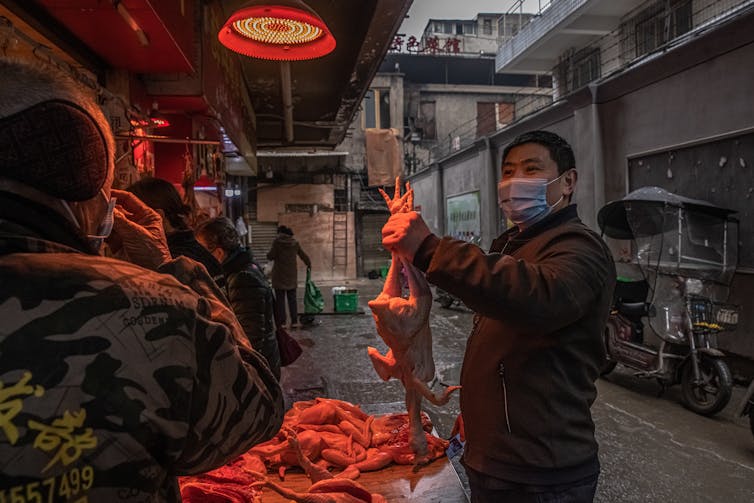
Although the WHO report has looked at the role of markets in China in the spread of SARS-CoV-2, we need to re-analyse data and look further afield.Roman Pilipey/EPA/AAP
We also need to link those molecular epidemiology data to actual clinical data. Until now those data have largely been separate, with the molecular data held in research or university laboratories and the patient data held elsewhere. We need to make those connections to tell us which infections were related, and how far back in time they go.
There are also many biological samples sitting in laboratories around the world that we need to analyse, and not just in Wuhan. So we have to do a bit of detective work to locate them and analyse them to understand the pattern of disease and to help sort out the origin. There is no central database of samples and what antibodies or genetic material they might contain.
We considered it was extremely unlikely the virus escaped from a laboratory. But laboratories around the world hold samples that have yet to be analysed and could give us clues.Koki Kataoka/AP/AAP
For instance, there are SARS-CoV-2 positive blood donations in the US and France, and cases in Italy, and there’s sewage testing in Spain. These are places with early outbreaks of respiratory illnesses that may help us find out if SARS-CoV-2 was circulating earlier than we first thought.
We also need more studies into the role of frozen food products in transmitting the virus. Although we considered the “cold chain” a possible pathway to transmission, we still don’t know how big a factor this was, if at all.
Finally, there’s ongoing sampling of animals and the environment for signs of SARS-CoV-2 or related viruses. Can we find the parent virus (the one that eventually mutated into SARS-CoV-2) in a bat in a cave somewhere? Where do we look? At bats across Southeast Asia, Central Asia, into Europe? We need to look at the range of these bats and where they live. These types of investigations can take ages.
Can we find the virus in an intermediary animal, and if so, what type of animal and where? Again, these are difficult studies to set up.
Cooperation needed
The key here is to keep trying to work together and avoid the over-politicisation of the whole exercise.
Rather than blaming governments, we need to foster cooperation and trust between investigators, between and within countries. This not only helps us during this pandemic; it’s the key to managing future pandemics. The more cooperative we are, the more likely we are to get the best results. We have to make sure politics doesn’t muck that up.
Source: The Conversation (Au and NZ) – By J. Haxby Abbott, Research Professor, Director of the Centre for Musculoskeletal Outcomes Research, University of Otago
Osteoarthritis is the most common form of arthritis, affecting almost 650 million people over the age of 40 worldwide.
In New Zealand, around one in eight adults have osteoarthritis, but it is a rapidly worsening problem. An ageing population and increasing rates of obesity and joint injury are contributing to the lowering of the age of onset from the early 60s to the mid to early 50s.
Conventional wisdom has told us that when a person begins to suffer from the sore hips or knees of osteoarthritis, there is nothing we can do — and exercise only makes things worse and wears the joints out faster. But research has now clearly shown these assumptions to be false.
International guidelines recommend exercise therapy as a first-line treatment.Shutterstock/Dmytro Zinkevych
Exercise therapy is now the most recommended treatment, across international guidelines. But New Zealand’s healthcare system is not delivering the most effective and inexpensive treatments, even though it is what people would want.
Our research shows a comprehensive national strategy to deliver all recommended treatments, from early diagnosis and treatment through to joint-replacement surgery, would likely provide more than NZ$1 billion of value each year through cost savings and improvements in people’s quality of life and productivity.
Delivering the single most recommended treatment — a high-quality programme of specific exercise therapy — would likely save the health system around $20 million per year by reducing more expensive and ineffective treatments. It would also result in health gains worth around $450 million per year.
Osteoarthritis mainly affects the knees and hips, and causes pain and stiffness of those joints. Many think it is simply “wear and tear” of the cartilage, but that is an unhelpful oversimplification. The condition affects the whole joint complex, including the cartilage, the bone beneath it, the capsule surrounding the joint, the lubricating fluid and the muscles around the joint.
Many people think osteoarthritis is a one-way street of inevitably worsening pain and function all the way to the surgeon’s table. This too is false.
Our joints are always in an active repair process. We can work them hard by day, and they repair by night and at rest. Osteoarthritis occurs when the stresses and strains placed on the joint, cumulatively day after day, are more than the body can keep up with repairing.
The main causes of osteoarthritis can be summed up as “mechanical factors”: stresses on the joint caused by overweight and obesity, past injuries to joint structures, weak muscles failing to protect the joint, poor alignment and excessive stresses of physical labour.
Inflammation and metabolic and nutritional factors play a role, too, but are a distant second. Heredity plays a relatively small part, and can be overcome. Recognising these underlying causes is crucial to knowing what the best treatments are.
There has been a lot of research in the past 20-30 years about how best to treat osteoarthritis, and best-practice guidelines from around the world are unanimous in their conclusions. The most effective treatment is exercise therapy targeting the mechanical factors. Drug treatments for pain and inflammation play second fiddle, with nutritional supplements an optional extra for small additional gains.
Exercise therapy strengthens the muscles that control the joint and act like shock absorbers, attenuating stresses. Keeping the joint moving distributes forces over a wider area, lubricates the joint, reduces stiffness and stimulates repair.
Getting started can stir up some soreness, temporarily, but exercise therapy has been shown to provide better pain relief than pain killers, and reduce inflammation better than anti-inflammatory drugs.
Exercise can trigger some temporary soreness but provides better pain relief than drugs in the long term.Shutterstock/AstroStar
The second most recommended treatment is weight loss to reduce the forces acting on the joint. Walking canes and knee braces also target the mechanical causes of osteoarthritis to useful effect.
Anti-inflammatory drugs target a less potent cause of osteoarthritis, and pain-relieving drugs just mask the symptoms. Both are now second-line recommendations, to use for as short a time as possible to avoid sometimes serious adverse effects.
Joint-replacement surgery is the last resort. It is highly effective for those who need it, and provides good value for the health system, but is recommended only for people who reach end-stage disease after receiving the first and second-line treatments.
There are fundamental flaws to how osteoarthritis is managed in the New Zealand healthcare system. The most recommended first-line treatments are underfunded and underrepresented.
Exercise therapy is mostly delivered by physiotherapists in the private sector, ready and willing to work within the primary healthcare system but shut out by archaic funding structures. The same applies to dieticians for weight management interventions.
Physiotherapy is offered mostly through the private healthcare system.Shutterstock/pryzmat
Funding barriers make GPs reluctant to refer patients to these providers for treatment, despite best-practice guidelines. By the time a patient’s osteoarthritis is severe enough to reach the priority threshold for surgery, years of increasing pain and joint damage have passed by, and the hospital system struggles to meet the growing need.
The gaps between best practice care and current reality for people with osteoarthritis are stark, but there are examples of positive initiatives. The Ministry of Health commissioned a $6 million pilot programme in 2015 to improve early access to care for musculoskeletal diseases (mainly osteoarthritis and lower back pain). It is due to report outcomes this year.
Grasping this momentum, a group of researchers, advocates and healthcare providers have presented innovative recommendations to the government and are pressing for policy progress. When all patients can access high-quality, coordinated management of osteoarthritis in primary or community care, our healthcare system will be delivering high-value care.
Brisbane has entered a snap lockdown to prevent SARS-CoV-2 transmission from a quarantine breach. Schools — including out-of-hours school care — across Greater Brisbane will be closed until the second term starts on April 19, except for vulnerable children and children of essential workers.
Daycare centres will also only be open for vulnerable children and those of essential workers.
Snap lockdowns are the new normal for managing hotel quarantine breaches. These have previously occurred in New South Wales, South Australia, Victoria and Western Australia bringing four capital cities and parts of Sydney to a halt.
While there are processes in place to try and prevent quarantine breaches happening again, this issue will be with us for some time until the COVID-19 vaccination program reaches high coverage — with a vaccine effective against variants. Soon international travel will open up as well, increasing the risk despite the use of vaccination passports.
We need to learn to live with COVID-19 as we continue efforts to vaccinate Australians. Closing daycare centres and schools has a significant effect on the mental health, well-being and learning of children and young people. We are seeing the short term effects and can only guess the long-term effects of this for now, but emerging research is concerning.
In Australia, where there is almost no community transmission of SARS-CoV-2 we need a layered strategy — depending on the amount of community transmission – to ensure the response isn’t the same every time with each snap lockdown: closing schools.
Separating schools from the snap lockdown response is possible. Here’s how to do it.
A traffic-light system
In February 2021, the Australian Health Protection Principal Committee (AHPPC) released guidelines on minimising the risk of COVID transmission in schools. These state that with COVIDsafe plans in place, schools remain safe places with students and staff “continuing to enjoy the benefits of learning on site”.
While this is national advice, states have failed to incorporate it into their lockdown planning.
International organisations such as World Health Organization, UNESCO and UNICEF recommend taking into account the level and intensity of community transmission of COVID-19 before deciding to close schools or childcare centres. They all state closing schools “should be regarded as a measure of last resort”.
The US Centers for Disease Control recommends plans to be adapted depending on the level of viral transmission in the school and throughout the community, as this may rapidly change.
We did a review into COVID-19 transmission in Victorian schools last year and found schools could be re-opened safely towards the end of Victoria’s months’ long lockdown. Our review included transmission data between January 25 2020 (the date of the first known case in Victoria) and August 31 2020.
Our analysis found children younger than 13 transmit the virus less than teenagers and adults. In instances where the first case in a school was a child under 13, a subsequent outbreak (two or more cases) was uncommon. A New South Wales report also found the transmission rate in schools to be rare (less than 1%).
Our recommendations are very similar to the US Centers for Disease Control school guidelines principles.
Standard precautions at school, when there is no community transmission should include:
staying home if unwell and getting tested
physical distancing between staff
testing, tracing and isolation if a case at school is confirmed
hand hygiene and cough etiquette
enhanced cleaning
improved ventilation.
In the case of a snap lockdown in response to a single case or small case cluster, when there is a breach of quarantine, and to avoid community transmission, the measures should be layered depending on the degree of community transmission and targeted to affected geographical areas.
Schools should stay open, but measures should be dialled up (to yellow, as below) to include masks for all teachers and staff, and secondary school students, enhanced physical distancing and no singing, indoor sports or wind instruments. Movement of adults around the school at drop-off and pick up should be limited.
During a snap lockdown in the community, high school students can be asked to wear masks.Shutterstock
If community transmission becomes more extensive and the initial three- to-five day lockdown has not contained the outbreak, measures should be dialled up again (orange) in the affected geographic areas.
Reducing class sizes in secondary school may prevent school transmission as teenagers seem to transmit to a similar degree as adults. But we suggest reducing class sizes for years 7-10 alone (such as having only 50% of students attending school in these year levels) which reduces the density of students and preserves face-to-face schooling for years 11 and 12 students who may have exam pressures.
Only when community transmission is at very high levels causing the lockdown to be extended, and community cases are rapidly rising, should we consider school closures altogether.
But again, this should only be for the affected geographic areas.
Adults can rationalise and regulate their emotions but a snap lockdown can be very distressing for children and adolescents, many of whom are still struggling, exacerbated by the very difficult process of managing uncertainty, again.
We need to change this trajectory to prioritise children’s mental health and learning. Prior to the next snap lockdown, all states and territories need to develop a plan to minimise disruption and stress on schools and families. Children will disproportionately bear the ongoing burden of COVID-19 through school shut down and parental stress. We should do our very best to minimise this into the future.
Recommendations need to be clear as to when to close only hot-spot schools and when to keep all schools open but dial up all the mitigation strategies. This would keep most kids safe, at school and protected from the impacts of school closures.
It is essential state and territory health departments work with their respective education departments and the teachers unions to develop plans now, that can be rolled out immediately and as required, based on the best evidence.
Given it is clear we will live with COVID-19 for the foreseeable future, planning to keep schools and childcare centres open during the pandemic should be an urgent priority. School closures should not be a reactionary measure but a last resort. Our kids depend on it.
Just five years ago, many people were optimistic that Southeast Asia had finally turned the corner when it comes to democracy.
Myanmar’s military had finally loosened its decades-long grip on power when Aung San Suu Kyi’s National League for Democracy party won elections in 2015. Three years later, Malaysia’s opposition party swept the long-serving Barisan Nasional from power — the first regime change in the country since independence in 1957.
These were seismic political shifts. More importantly, both changes in power took place after free, albeit not completely fair, elections. There was no bloodshed involved.
Democracy rollbacks from Manila to Naypyidaw
Today, that optimism has gone.
Much of the world’s attention has been on Myanmar’s implosion following the military coup in early February, which has resulted in scores of civilian killings and disappearances. But democracy has been rolling back across the region.
In Thailand, we are seeing the return to a monarchy-military rule with the new king, Maha Vajiralongkorn, demanding changes to the constitution to grab more executive powers for himself and take direct control of Crown Property Bureau, which manages the royal fortune.
In the process, he has become one of the richest monarchs in the world, with wealth estimated at between US$60-70 billion.
Pro-democracy demonstrators marching in Bangkok last year.Gemunu Amarasinghe/AP
Crackdowns under Thailand’s infamous lese-majeste law (better known as 112) have intensified. People are regularly targeted under the laws for anti-monarchy social media posts, and last year, the government took legal action against Facebook and Twitter for ignoring requests to remove content it deemed against the law.
In the Philippines, Rodrigo Duterte took power in June 2016 and started a popular campaign against drugs that has led to the deaths of some 12,000 people.
Duterte has also gone after the media for reporting on the killings, with one high-profile government critic being found guilty of libel last year. The country’s largest broadcast network, ABS CBN, was shut down by allies of Duterte in Congress, as well.
Seminarians and nuns protesting in Manila against drug-related killings and martial law.Aaron Favila/AP
Then, last month, the government declared a state of emergency and suspended parliament for six months. Many believed this was done to prevent the opposition from mounting a challenge to the new government.
Singapore, the richest state in the region, stubbornly remains under the stranglehold of the People’s Action Party, which just won another election last year. The PAP has been in continuous power since 1959.
The only bright spot in the region appears to be Indonesia. But there are dark clouds on the horizon. President Joko “Jokowi” Widodo appears to be backtracking on reforms and pandering to the Islamists, who are keen to make Indonesia into a quasi-Islamic state.
Why is democracy so fragile here?
All this is happening in the midst of China’s determination to position itself as the dominant power in Southeast Asia.
Beijing has sent a clear message that it does not really care what sorts of regimes or political systems are running the countries of Southeast Asia, as long as they acknowledge China as the undisputed regional power and do not question its sovereignty over the South China Sea.
This, of course, has indirectly strengthened the hand of the anti-democratic forces in the region, with some openly admiring the Chinese “strong state” system.
The pro-democracy camp, meanwhile, faces a sizeable dilemma. On the one hand, its supporters have been hoping for more help from the West, principally the US and Australia, to promote democracy in the region. On the other, they are worried they could be accused of being Western agents, driving people into the hands of the autocrats trumpeting populist nationalism.
Civil society activists rallying in support of freedom of expression in Malaysia.AHMAD YUSNI/EPA
Another challenge is the diversity of Southeast Asia. There is no single template or historical model for a stable and democratic political system in the region.
Most of the countries were colonised by European powers, who imposed their different political ideas on the societies they controlled. The one thing the colonial rulers did not do was promote democracy. They only did this after their former colonies became independent.
And by global standards, many of the nations in Southeast Asia are relatively young. Most of them were created after the second world war, and their boundaries and political systems were largely decided by their colonial masters.
This means the process of nation-building is ongoing, and the West should not assume these countries naturally aim to build liberal democracies.
In many of these countries, traditional power — often autocratic, feudal and authoritarian — lies just beneath the surface. In fact, many elites within them have ambivalent attitudes towards liberal democracy.
While they accept the concept of mass elections to choose political leaders, they also believe in the concept of “guided” leadership to elect the “right” kind of leaders.
Indonesia’s first leader post-indendepence, Sukarno, for example, was famous for practising a “guided democracy”, in which the government would force a political consensus and ensure elections were used to legitimise leaders hand-picked by the regime.
This is why cheating, vote buying and rigging the ballot box are common features in Southeast Asian elections — they are sometimes seen as justified to get the “right” kind of leaders.
There are no easy answers to the promotion of real democracy in Southeast Asia. We may simply have to wait for a generational shift before this takes root in the region. Young people do yearn for real democracy, but at the moment, they do not hold the guns or control the parliament.
As fashion trends go, the move of activewear from gyms and fitness studios into mainstream society has been impossible to ignore. Like it or not, we live in a lycra world.
Tight-fitting leggings, yoga pants, sports bras and crop tops are everywhere from the catwalk to cafes. COVID-19 accelerated the trend, with working from home driving a recent surge in sales.
But the activewear industry has been growing exponentially for the past ten years. While the clothing is made for men and women, it is the women’s market that has driven this phenomenal growth.
The trend has been widely celebrated, criticised, parodied and sometimes dismissed as simply the latest fashion trend in a society obsessed with conspicuous consumption.
On closer examination, however, activewear plays a fascinating role in 21st-century gender definitions, reinforcing and resisting popular ideas about femininity.
The rise of ‘fit femininity’
Walk through any activewear store and you will be bombarded with empowerment and self-help rhetoric emphasising the importance of achieving a fit, healthy lifestyle with the right outfit and a positive attitude.
Various scholars have shown how large activewear companies use this type of language — “get moving” and “this is not your practice life” — to reinforce the notion of women’s responsibility for their own body maintenance, regardless of any social or personal barriers.
Others have shown how activewear companies’ marketing approaches encourage women to use physical activity as a means of self-transformation and a pathway towards a more fulfilled life.
It’s a version of femininity based on a woman’s consumption and the ability to maintain her own health and appearance. As feminist sport scholars have shown, society celebrates women who are “in control” of their bodies and active in their pursuit of femininity and health.
In our own research, we argue that wearing activewear in public is a way of saying “I am in charge of my health” and conforming to socially acceptable understandings of femininity.
In this sense, activewear (not to be confused with its less sporty “athleisure” offshoot) has become the uniform of what we might term the “socially responsible 21st-century woman.”
The idealised female form
Part of the appeal of activewear is that it is comfortable and functional. But it has also been designed to physically shape the body into a socially desirable hourglass female form.
High-waisted leggings that sit just above the navel are marketed as having a slimming effect. They are also often promoted as “butt sculpting”, creating the desirable “booty” that has become valued (somewhat problematically) in mainstream culture.
As some have argued, this is yet another example of the appropriation of Black and Hispanic cultures for corporate profit.
With new materials designed to accentuate (not just support) particular aspects of women’s bodies, activewear helps promote the idealised female form as being curvy but fat-free.
And while this idealised form has changed over recent decades — from thin, to thin and toned, to the toned hourglass — the current ideal remains largely unobtainable for most women.
Not for every body: the lululemon brand aims for a specific target market.www.shutterstock.com
Freedom and conformity
But there is another side to this phenomenon. We wanted to explore women’s own experiences of wearing activewear. Interviewees of different ages, body types, ethnicities and cultures spoke about activewear as being not only comfortable and functional, but also liberating.
From corsets and long dresses in the Victorian era to the high heels of the 1950s “housewife”, the latest beauty and clothing trends have often constrained women’s bodies and movements.
But the women in our research group talked about the freedom they experienced in being able to move comfortably through the day, from work to school pick-up, from the gym to the cafe.
Even so, not all activewear-clad bodies are considered acceptable. Some, particularly larger bodies, are stigmatised and criticised when they don’t meet the feminine ideal.
Some even experience physical abuse or verbal harassment for wearing the “wrong” clothing in public. It’s all part of a long history of social attempts to regulate women’s bodies.
Until recently, activewear marketing was primarily targeted at young, thin, wealthy white women. In 2013, lululemon founder Chip Wilson openly stated his brand’s leggings “don’t work” for larger body types.
In response to these limited definitions perpetuated by the activewear industry, some women have established their own labels. In Aotearoa New Zealand these include the increasingly popular Hine Collection.
Founded by a Māori woman frustrated by the limited sizing of activewear, the brand features larger-sized models and caters to women of diverse body shapes and cultures.
Protest and empowerment
Activewear has even been worn in protest against the policing of women’s bodies in public places such as schools, churches and shops where the wearing of leggings has been deemed not respectable and too distracting for men.
In 2018, there was outrage when young track athletes in New Jersey were told they couldn’t train outside in their sports bras when the male football team was practising.
Other protests and writings have made leggings and sports bras symbols of pride and a challenge to those who seek to dictate women’s bodily choices.
Most women, however, choose activewear simply because it gives them the ability to move with purpose and comfort throughout their day. While this might not be an overtly political act, it is nonetheless a subtle statement that women are not going to be controlled or objectified. They have pride in their moving bodies.
Activewear is far from a mundane clothing choice. Rather, it contributes to our definition and understanding of femininity and gender in the 21st century.
New Zealand Parliament Buildings, Wellington, New Zealand.
Editor’s Note: Here below is a list of the main issues currently under discussion in New Zealand and links to media coverage. Click here to subscribe to Bryce Edwards’ Political Roundup and New Zealand Politics Daily.
Perhaps optimistically, Scott Morrison hopes his belated moves to involve women more formally in decision-making will arrest his government’s slumping fortunes, and grant space for other priorities.
Weeks of mealy-mouthedness in the face of horrendous claims of misogyny, boorishness, and even alleged sexual assault in Parliament House, had begun to take their toll. Morrison’s approval ratings have slid and put his government behind Labor on two-party preferred in recent Newspoll surveys.
Before then, pressure had been mounting on Opposition Leader Anthony Albanese, amid fears within Labor of a possible spring election. Nobody’s worrying about that anymore.
Monday’s female-friendly cabinet reshuffle was the first significant concession from the prime minister that he faced something wholly more substantial than a common-or-garden governmental crisis. This was not some routine controversy to be managed, spun, and outlasted.
In politics, messages are important. The most significant messages in the reshuffle were the demotion of Attorney-General Christian Porter and the elevation of the Industry and Science Minister, Karen Andrews, to the hawkishly masculine, security-heavy mega-ministry of home affairs.
As a Queenslander, she is a member of the colourfully conservative LNP, along with more bombastic alpha-males such as Peter Dutton, George Christensen, Matt Canavan, and Andrew Laming.
Yet for all their jaw-jutting, Andrews has impressed stakeholders in her industry sector. She has also attracted attention in the parliament for being both uncommonly capable, and refreshingly unpolitical.
Karen Andrews takes over from Peter Dutton in home affairs, while Dutton moves to defence.AAP/Mick Tsikas
However, competence is hardly a guarantee of promotion in Canberra. It can even be a liability. Indeed, not being a partisan attack dog can mean forgoing notoriety, and the phalanx of party true-believers that comes with it.
So while Morrison has sent the signal about upping the female participation in his executive, Andrews would certainly have made it had merit been the only selection criterion.
Breaking through glass ceilings is familiar territory for the 60-year-old former small business owner. In 1983, she joined another female student at the Queensland University of Technology to become the first females to receive a bachelor of mechanical engineering.
But all eyes now are on what her stewardship of the powerful home affairs ministry will mean for the government. More importantly, there will be much interest in what it might mean for asylum seekers and refugees, and the plethora of legal and security issues attaching to the Australian Federal Police, Australian Border Force, immigration and settlement services, cyber-security, and other agencies.
Interest in her appointment is doubly spiced by the fact she replaces Dutton, the unrivalled hard man of the Morrison government and leader of the parliamentary Liberal Party’s national right grouping.
Dutton has been a lightning rod for criticism, most notably for his uncompromising approach to asylum seekers, and his outspoken attacks on the political left.
Ahead of his move to defence, a portfolio he is known to have coveted, Dutton indicated he was considering possible defamation remedies for a slew of attacks on social media sites such as Twitter and Facebook.
Andrews has declined to comment on the possibility of bringing a more compassionate approach to refugee applications and deportations. But she has nominated one area that will be of interest to women and to Dutton, telling Sky News on Tuesday she wants to address the scourge of online disrespect – particularly by anonymous people:
[I] will certainly be taking an active interest and engaging as much as I possibly can on that issue.
Look, social media has significant challenges, one of those issues is the level of anonymity. We need to make it very clear that people can’t hide or should not be allowed to hide on these social media platforms so absolutely I will be taking a very close look at that.
The Murugappan family has been held on Christmas Island since August 2019.AAP/supplied
Top of mind for many, though, is the Biloela asylum seeker case, in which a Tamil family of four has spent more than 1,000 days in immigration detention initially in Melbourne, and since August 2019, on Christmas Island.
Dutton’s department has been desperate to deport Nades and Priya Murugappan and their Australian-born daughters, Kopika and Tharnicaa, but has been blocked by successive legal proceedings.
Advocates for the family say the deportation is cruel and the detention is unconscionable, especially in view of the willingness of the Biloela community in rural Queensland to host the family’s return.
While human rights groups will be looking for signs Andrews intends to soften the Dutton approach, she has refused to comment before extensive briefings.
Australia’s notoriously tough suite of border policies may be in for a more compassionate, case-by-case interpretation. It is possible changes could go beyond that and into broader policy.
On the other hand, it is important to remember the trophy in the PM’s office, which rather crassly proclaims, “I stopped these”, above an unmistakable silhouette of an Asian fishing boat.
As a former immigration minister, Morrison is critically aware of how the Coalition’s harsh policies allowed it to position Labor as “soft” on borders.
Populist though it is, it is not an electoral advantage that Morrison, nor for that matter Dutton as a still influential cabinet figure, will surrender lightly.
Microdosing has become something of a wellness trend in recent years, gathering traction in Australia and overseas.
The practice involves taking a low dose of a psychedelic drug to enhance performance, or reduce stress and anxiety.
While the anecdotal accounts are compelling, significant questions remain around how microdosing works, and how much of the reported benefits are due to pharmacological effects, rather than participants’ beliefs and expectations.
We’ve just published a new study following on from two earlier studies on microdosing. Our body of research tells us some benefits of microdosing may be comparable to other wellness activities such as yoga.
Existing evidence
It’s not clear how many Australians microdose, but the proportion of Australian adults who have used psychedelics in their lifetime increased from 8% in 2001 to 10.9% in 2019.
After a slow start, Australian research on psychedelics is now progressing rapidly. One area of particular interest is the science of microdosing.
In an earlier study by one of us (Vince Polito), levels of depression and stress decreased after a six-week period of microdosing. Further, participants reported less “mind wandering”, which might suggest microdosing leads to improved cognitive performance.
However, this study also found an increase in neuroticism. People who score highly on this dimension of personality experience unpleasant emotions more frequently, and tend to be more susceptible to depression and anxiety. This was a puzzling finding and didn’t seem to fit with the rest of the results.
In a recent study, Stephen Bright’s research team recruited 339 participants who had engaged in either microdosing, yoga, both or neither.
Yoga practitioners reported higher levels of stress and anxiety than those in the microdosing or control groups (participants who did neither yoga nor microdosing). Meanwhile, people who had practised microdosing reported higher levels of depression.
We can’t say for sure why we saw these results, although it’s possible people experiencing stress and anxiety were attracted to yoga, whereas people experiencing depression tended more towards microdosing. This was a cross-sectional study, so participants were observed in their chosen activity, rather than assigned to a particular group.
Microdosing involves taking a low dose of a psychedelic drug, such as LSD.Shutterstock
But importantly, the yoga group and the microdosing group recorded similarly higher overall psychological well-being scores compared with the control group.
And interestingly, people who engaged in both yoga and microdosing reported lower levels of depression, anxiety and stress. This suggests microdosing and yoga could have synergistic effects.
Our new research
Through a collaboration between Edith Cowan University, Macquarie University and the University of Göttingen in Germany, our most recent study aimed to extend these findings, and in particular try to get to the bottom of the possible effects of microdosing on neuroticism.
We recruited 76 experienced microdosers who completed a survey before undertaking a period of microdosing. Some 24 of these participants agreed to complete a follow-up survey four weeks later.
The results were published in the Journal of Psychedelic Studies this month. We found that like our earlier work, the 24 participants experienced personality changes after a period of microdosing. But the changes were not entirely what we anticipated.
This time, we found a decrease in neuroticism and an increase in conscientiousness (people who are highly conscientious tend to be diligent, for example). Interestingly, a greater amount of experience with microdosing was associated with lower levels of neuroticism among the 76 participants.
Our most recent findings suggest the positive effects of microdosing on psychological well-being could be due to a reduction in neuroticism. And the self-reported improvements in performance, which we’ve also observed in our past research, could be due to increased conscientiousness.
When considered together, the findings of our research suggest contemplative practices such as yoga might be particularly helpful for less experienced microdosers in managing negative side effects such as anxiety.
However, we cannot know for certain if the changes we’ve observed are due to microdosers holding positive expectations because of glowing anecdotal reports they’ve seen in the media. This represents a key limitation of our research.
As psychedelic drugs are illegal, it’s ethically complex to provide them to research participants — we generally have to observe them taking their own drugs. So another key challenge of this research is the fact we can’t know for sure precisely what drugs people are using, as they don’t always know themselves (especially for LSD).
Some people turn to microdosing to improve their performance at work.Shutterstock
Microdosing carries risks
Given the illegal drug market is unregulated, there’s a danger people could inadvertently consume a potentially dangerous new psychoactive substance, such as 25-I-NBOMe, which has been passed off as LSD.
People also can’t be sure of the size of the dose they’re taking. This could lead to unwanted effects, such as “tripping balls” at work.
Potential harms like these can be mitigated by checking your drugs (you can buy at-home test kits) and always starting off with a much lower dose than you think you need when using a batch for the first time.
Where to from here?
Despite the hype around microdosing, the scientific results so far are mixed. We’ve found microdosers report significant benefits. But it’s unclear how much of this is driven by placebo effects and expectations.
For people who choose to microdose, also engaging in contemplative practices such as yoga might mitigate some of the unwanted effects and lead to better outcomes overall. Some people might find they get the same benefit from the contemplative practices alone, which is less risky than microdosing.
As a next step, one of us (Vince Polito) and colleagues are using neuroimaging to investigate the effect of microdosing on the brain.
If you practise microdosing, are based in Sydney, and are interested in taking part in this research, please email sydneymdstudy@gmail.com.
This is a Conversation long read, so set aside time to take it all in.
Imagine, for a moment, a different kind of Australia. One where bushfires on the catastrophic scale of Black Summer happen almost every year. One where 50℃ days in Sydney and Melbourne are common. Where storms and flooding have violently reshaped our coastlines, and unique ecosystems have been damaged beyond recognition – including the Great Barrier Reef, which no longer exists.
Frighteningly, this is not an imaginary future dystopia. It’s a scientific projection of Australia under 3℃ of global warming – a future we must both strenuously try to avoid, but also prepare for.
The sum of current commitments under the Paris climate accord puts Earth on track for 3℃ of warming this century. Research released today by the Australian Academy of Science explores this scenario in detail.
The report, which we co-authored with colleagues, lays out the potential damage to Australia’s ecosystems, food production, urban centres and human health. Unless the world changes course and dramatically curbs greenhouse gas emissions, this is how bad it could get.
A spotlight on the damage
Nations signed up to the Paris Agreement collectively aim to limit global warming to well below 2℃ this century and to pursue efforts to limit temperature increase to 1.5℃. But on current emissions-reduction pledges, global temperatures are expected to far exceed these goals, reaching 2.9℃ by 2100.
Australia is the driest inhabited continent, and already has a highly variable climate of “droughts and flooding rains”. This is why of all developed nations, Australia has been identified as one of the most vulnerable to climate change.
The damage is already evident. Since records began in 1910, Australia’s average surface temperature has warmed by 1.4℃, and its open ocean areas have warmed by 1℃. Extreme events – such as storms, droughts, bushfires, heatwaves and floods – are becoming more frequent and severe.
Today’s report brings together multiple lines of evidence such as computer modelling, observed changes and historical paleoclimate studies. It gives a picture of the damage that’s already occurred, and what Australia should expect next. It shines a spotlight on four sectors: ecosystems, food production, cities and towns, and health and well-being.
In all these areas, we found the impacts of climate change are profound and accelerating rapidly.
Perth residents at an evacuation centre during a bushfire in February this year. Such events will become more frequent under climate change.Richard Wainwright/AAP
1. Ecosystems
Australia’s natural resources are directly linked to our well-being, culture and economic prosperity. Warming and changes in climate have already eroded the services ecosystems provide, and affected thousands of species.
The problems extend to the ocean, which is steadily warming. Heat stress is bleaching and killing corals, and severely damaging crucial habitats such as kelp forests and seagrass meadows. As oceans absorb carbon dioxide (CO₂) from the atmosphere, seawater is reaching record acidity levels, harming marine food webs, fisheries and aquaculture.
At 3℃ of global warming by 2100, oceans are projected to absorb five times more heat than the observed amount accumulated since 1970. Being far more acidic than today, ocean oxygen levels will decline at ever-shallower depths, affecting the distribution and abundance of marine life everywhere. At 1.5-2℃ warming, the complete loss of coral reefs is very likely.
Heat stress is killing corals and marine animal habitat.Shutterstock
Under 3℃ warming, global sea levels are projected to rise 40-80 centimetres, and by many more metres over coming centuries. Rising sea levels are already inundating low-lying coastal areas, and saltwater is intruding into freshwater wetlands. This leads to coastal erosion that amplifies storm impacts and affects both ecosystems and people.
Land and freshwater environments have been damaged by drought, fire, extreme heatwaves, invasive species and disease. An estimated 3 billion vertebrate animals were killed or displaced in the Black Summer bushfires. Some 24 million hectares burned, including 80% of the Blue Mountains World Heritage Area and 50% of Gondwana rainforests. At 3℃ of warming, the number of extreme fire days could double.
Some species are shifting to cooler latitudes or higher elevations. But most will struggle to keep up with the unprecedented rate of warming. Critical thresholds in many natural systems are likely to be exceeded as global warming reaches 1.5℃. At 2℃ and beyond, we’re likely to see the complete loss of coral reefs, and inundation of iconic ecosystems such as the World Heritage-listed Kakadu National Park.
At 3℃ of global warming, Australia’s present-day ecological systems would be unrecognisable. The first documented climate-related global extinction of a mammal, the Bramble Cay melomys from the Torres Strait, is highly unlikely to be the last. Climate change is predicted to increase extinction rates by several orders of magnitude.
Degradation of Australia’s unique ecosystems will harm the tourism and recreation industries, as well as our food security, health and culture.
There are ways to reduce the climate risk for ecosystems – many of which also benefit humans. For example, preserving and restoring mangroves protects our coasts from storms, increases carbon storage and retains fisheries habitat.
Climate change will accelerate species extinctions. Pictured: the critically endangered orange-bellied parrot.Shutterstock
2. Food production
Australian agriculture and food security already face significant risks from droughts, heatwaves, fires, floods and invasive species. At 2℃ or more of global warming, rainfall will decline and droughts in areas such as southeastern and southwestern Australia will intensify. This will reduce water availability for irrigated agriculture and increase water prices.
Heat stress affects livestock welfare, reproduction and production. Projected temperature and humidity changes suggest livestock will experience many more heat stress days each year. More frequent storms and heavy rainfall are likely to worsen erosion on grazing land and may lead to livestock loss from flooding.
Heat stress and reduced water availability will also make farms less profitable. A 3℃ global temperature increase would reduce yields of key crops by between 5% and 50%. Significant reductions are expected in oil seeds (35%), wheat (18%) and fruits and vegetables (14%).
Climate change also threatensforestry in hotter, drier regions such as southwestern Australia. There, the industry faces increased fire risks, changed rainfall patterns and growing pest populations. In cooler regions such as Tasmania and Gippsland, forestry production may increase as the climate warms. Existing plantations would change substantially under 3℃ warming.
As ocean waters warm, distributions and stock levels of commercial fish species are continuing to change. This will curb profitability. Many aquaculture fisheries may fundamentally change, relocate or cease to exist.
These changes may cause fisheries workers to suffer unemployment, mental health issues (potentially leading to suicides) and other problems. Strategic planning to create new business opportunities in these regions may reduce these risks.
Under climate change, drought will badly hurt farm profitability.Shutterstock
3. Cities and towns
Almost 90% of Australians live in cities and towns and will experience climate change in urban environments.
Under a sea level rise of 1 metre by the end of the century – a level considered plausible by federal officials – between 160,000 and 250,000 Australian properties and infrastructure are at risk of coastal flooding.
Strategies to manage the risk include less construction in high-risk areas, and protecting coastal land with sea walls, sand dunes and mangroves. But some coastal areas may have to be abandoned.
Extreme heat, bushfires and storms put strain on power stations and infrastructure. At the same time, more energy is needed for increased air conditioning use. Much of Australia’s electricity generation relies on ageing and unreliable coal-fired power stations. Extreme weather can also disrupt and damage the oil and gas industries. Diversifying energy sources and improving infrastructure will be important to ensure reliable energy supplies.
The insurance and financial sector is becoming increasingly aware of climate risk and exposure. Insurance firms face increased claims due to climate-related disasters including floods, cyclones and mega-fires. Under some scenarios, one in every 19 property owners face unaffordable insurance premiums by 2030. A 3℃ world would render many more properties and businesses uninsurable.
Cities and towns, however, can be part of the climate solution. High-density urban living leads to a lower per capita greenhouse gas emission “footprint”. Also, innovative solutions are easier to implement in urban environments.
Passive cooling techniques, such as incorporating more plants and street trees during planning, can reduce city temperatures. But these strategies may require changes to stormwater management and can take time to work.
Extreme storms will continue to violently reshape our coastlines.David Moir/ AAP
4. Human health and well-being
A 3℃ world threatens human health, livelihoods and communities. The elderly, young, unwell, and those from disadvantaged socioeconomic backgrounds are at most risk.
Heatwaves on land and sea are becoming longer, more frequent and severe. For example, at 3℃ of global warming, heatwaves in Queensland would happen as often as seven times a year, lasting 16 days on average. These cause physiological heat stress and worsen existing medical conditions.
Bushfire-related health impacts are increasing, causing deaths and exacerbating pre-existing conditions such as heart and lung disease. Tragically, we saw this unfold during Black Summer. These extreme conditions will increase at 2℃ and further at 3℃, causing direct and indirect physical and mental health issues.
Under 3℃ warming, climate damage to businesses will likely to lead to increased unemployment and possibly higher suicide rates, mental health issues and health issues relating to heat stress.
At 3°C global warming, many locations in Australia would be very difficult to inhabit due to projected water shortages.
As weather patterns change, transmission of some infectious diseases, such as Ross River virus, will become more intense. “Tropical” diseases may spread to more temperate areas across Australia.
Strategies exist to help mitigate these effects. They include improving early warning systems for extreme weather events and boosting the climate resilience of health services. Nature-based solutions, such as increasing green spaces in urban areas, will also help.
Air quality in Canberra was the worst in the world after the Black Summer fires.Lukas Coch/AAP
How to avoid catastrophe
The report acknowledges that limiting global temperatures to 1.5℃ this century is now extremely difficult. Achieving net-zero global emissions by 2050 is the absolute minimum required to to avoid the worst climate impacts.
Australia is well positioned to contribute to this global challenge. We have a well-developed industrial base, skilled workforce and vast sources of renewable energy.
But Australia must also pursue far more substantial emissions reduction. Under the Paris deal, we’ve pledged to reduce emissions by 26-28% between 2005 and 2030. Given the multiple and accelerating climate threats Australia faces, we must scale up this pledge. We must also display the international leadership and collaboration required to set Earth on a safer climate trajectory.
Our report recommends Australia immediately do the following:
join global leaders in increasing actions to urgently tackle and solve climate change
develop strategies to meet the challenges of extreme events that are increasing in intensity, frequency and scale
improve our understanding of climate impacts, including tipping points and the compounding effects of multiple stressors at global warming of 2℃ or more
systematically explore how food production and supply systems should prepare for climate change
better understand the impacts and risks of climate change for the health of Australians
introduce policies to deliver deep and rapid cuts in emissions across the economy
scale up the development and implementation of low- to zero-emissions technologies
review Australia’s capacity and flexibility to take up innovations and technology breakthroughs for transitioning to a low-emissions future
develop a better understanding of climate solutions through dialogue with Aboriginal and Torres Strait Islander peoples – particularly strategies that helped people manage Australian ecosystems for tens of thousands of years
continue to build adaptation strategies and greater commitment for meeting the challenges of change already in the climate system.
We don’t have much time to avert catastrophe. This decade must be transformational, and one where we choose a safer future.
The report upon which this article is based, The Risks to Australia of a 3°C Warmer World, was authored and reviewed by 21 experts.
Source: The Conversation (Au and NZ) – By Albert Van Dijk, Professor, Water and Landscape Dynamics, Fenner School of Environment & Society, Australian National University
Improved weather conditions have pulled Australia’s environment out of its worst state on record, but recovery remains partial and precarious, new research reveals.
Each year, we collate a vast number of measurements on the state of our environment. The data are collected in many different ways – including satellites, field stations and surveys – then combined to produce an overall national score.
A year ago, after prolonged drought and devastating bushfires, Australia’s environment scored a shocking 0.8 out of ten. Our new research shows nature started its long road to recovery in 2020, especially in New South Wales and Victoria.
Nationally, Australia’s environmental condition score increased by 2.6 points last year, to reach a (still very low) score of 3.2. But overall conditions across large swathes of the country remain poor.
Environmental Condition Score for 2020 by state and territory.ANU Fenner School
Scores rising but still in the red
From a long list of environmental indicators we report on, seven are selected to calculate an overall score for each region, as well as nationally.
These indicators – high temperatures, river flows, wetlands, soil health, vegetation condition, growth conditions and tree cover – are chosen because they allow a comparison against previous years. See the graphic below to find the score for your region.
The largest improvements occurred in NSW and Victoria thanks to good rains. The poorest conditions occurred in the Northern Territory and Western Australia, where there was little solace from dry conditions.
Comparing local government areas, the best conditions occurred in Nillubik Shire on the northern edge of Melbourne. In contrast, the worst conditions occurred in Katherine in the Northern Territory and in the Shire of Ngaanyatjarraku in remote WA.
From drought to rain
2020 started as badly as 2019 ended – with extreme temperatures, drought and fires, especially in Australia’s southeast. The Sydney suburb of Penrith was the hottest place on Earth on January 4 and, following the bushfires, Canberra had the most dangerous air quality in the world for several days. Clearly, climate change is already affecting our cities and nature.
By the end of summer, the high temperatures also caused another mass coral bleaching in the Great Barrier Reef – the third such event in five years.
Only in February-March did the weather turn, providing good and in some areas very plentiful rains – for example along the NSW coast. Later in the year officials declared an La Niña event – an ocean circulation pattern that normally encourages rainfall in Australia.
While rainfall was not extraordinarily high, it lifted most regions in eastern Australia out of extreme drought. Some parts of northern and western Australia missed out, however, and in some areas the drought deepened.
Taken as an average over the year and over the country, rainfall was 10% above the average for the previous two decades. The number of hot days – those reaching 35℃ – was 11% or nine days more than the 20-year average.
Values for 15 environmental indicators in 2020, expressed as the change from average 2000-2019 conditions. Similar to national economic indicators, they provide a summary but also hide regional variations, complex interactions and long-term context.ANU Fenner School
The improved rainfall helped replenish dried soils, and national average soil moisture was close to average. Growth conditions for the NSW wheatbelt were the best in many years and tree cover increased in northern and eastern Australia.
The rain refilled many dams and reservoirs, especially in Canberra and Sydney. It also made some eastern rivers flow again, including the Darling River in NSW. But with such dry starting conditions, wetlands in inland eastern Australia filled only modestly and waterbird numbers remained low.
Drought persisted across large swathes of inland northern and western Australia, where in some parts, vegetation growth conditions were the worst in decades. And the surplus rain was often not enough to reach wetlands, which continued to shrink.
Signs of life: some parts of Australia have benefited from recent rain.Shutterstock
Bushfires: few but locally severe
Fire activity in vast areas of inland Australia was very low, because a run of dry years did not leave much dry grass to burn.
Nationally, the total area burnt was 17 million hectares – 90% below the 20-year average. This led to 80 million tonnes of carbon emissions (43% below average).
Fire activity was not low everywhere. In southeast Australia, fires in southern NSW, East Gippsland and the ACT severely damaged forests and other ecosystems as well as people and property.
The full ecological damage of the Black Summer fires was not entirely apparent in 2020. That’s partly because COVID-19 restrictions made the situation difficult to assess.
But some wildlife proved unexpectedly resilient. For example, a great effort by citizen scientists showed frogs rebounded well after the rains.
Another 15 species were added to the Threatened Species List in 2020. In good news, three species were removed from the list, including two species of tree frogs that recovered from the global chytrid fungus.
The accelerating impacts of climate change will not stop here. New records will inevitably be broken. Heat, drought and fire will again damage our environment and lives. Some ecosystems will be lost forever. But even worse outcomes can be avoided – if the world can rein in greenhouse gas pollution.
There’s cause for cautious optimism. International pressure may force the Morrison government’s hand on climate action. Several states and territories have already taken decisive climate action. Low-emission energy and transport are advancing quickly. As individuals we can fly and drive less, get solar panels and divest from fossil fuel companies.
In the meantime, we must adapt to inevitable climate change and reduce other pressures on our ecosystems. Citizen scientists have proven essential in monitoring how individual species are faring – so download that app and enjoy nature even more. And plant a few trees to help nature along.
Finally, pressure your local, state and national politicians. Ask them: how are you addressing vegetation loss, invasive pests and over-extraction from rivers? If you don’t like the answer, tell them, or try to vote them out.
With greater urgency and some luck, there is still much to be salvaged.
Source: The Conversation (Au and NZ) – By David MacKenzie, Associate Professor, School of Psychology, Social Work & Social Policy, University of South Australia
Australian parliaments produce many committee reports, but only occasionally does one deserve to be described as a “landmark report”. The Legal and Social Issues Committee report Inquiry into homelessness in Victoria, released this month, may be just such a report that makes a difference, if its recommendations are followed. The report has advanced a bold reform agenda, proposing measures that would be the most significant response to homelessness in Australian history.
More crisis accommodation is already needed in some places, as the report notes. But it cautions: “Such an investment in crisis accommodation is not intended to increase the emphasis on the provision of crisis accommodation in Victoria’s homelessness system.”
Instead, the inquiry has produced a strongly argued case for providing more affordable and social housing. Its report states:
“The provision of affordable, stable, long-term housing is key to reducing the number of people at risk of, or experiencing, homelessness in Victoria.”
To advance this agenda, a significant investment is now eminently possible. The Victorian government has announced a A$5 billion program to build 9,300 new social housing dwellings over the next four years. Even with this 10% increase in dwellings at below-market rents, the report notes, Victoria will still be below the national average for social housing as a proportion of all housing.
The committee did its work under the difficult conditions of the COVID-19 pandemic. Yet the inquiry received more than 450 formal submissions and held 18 in-person and online hearings in Melbourne and regional Victoria. The committee reminds us:
“Homelessness is one of the most complex and distressing expressions of disadvantage and social exclusion in our society and requires immediate attention by government.”
Victoria can solve the problem of homelessness, the parliamentary inquiry says in its recent report.
Media coverage of homelessness often focuses on stories about people sleeping rough. The default response is often to call for more crisis accommodation.
The inquiry found that “Victoria’s homelessness system is overwhelmed with those in need”. However, the report warns: “There is significant risk in treating immediate problems in isolation.”
Putting the focus on early intervention and prevention
The report’s focus on early interventions and preventing homelessness in the first place stands out as a notable contribution to public policy discussion about homelessness. It eschews conservative thinking about funding that simply builds on the status quo – i.e more crisis accommodation – on the grounds that “early intervention is crucial to ending homelessness”.
“Early intervention involves the homelessness sector and other related sectors intervening as early as possible to prevent people becoming homeless. This is achieved through addressing risk factors which may cause a person to become homeless and to give a person the opportunity to build personal, social and economic resilience.”
Once homeless, and where a return home is not an option, finding housing as quickly as possible is the imperative.
Prevention and intervening early are particularly important for young people, the report says, “to ensure that experiences of homelessness and disadvantage at a young age do not affect the life chances of an individual and increase the likelihood of ongoing homelessness into adulthood”.
The innovative “community of schools and services” (COSS) model of early intervention, pioneered in Geelong, was examined in detail. The report concludes:
“[…] the COSS model should be expanded to other parts of the state. The evidence presented suggests that it will have substantial benefits, including reducing the incidence of youth homelessness and providing overall cost savings.”
It recommends a minimum expansion to seven pilot sites.
Pioneered by the Geelong Project, the success of the COSS model has attracted global attention.
The Kids Under Cover model of providing one- or two-bedroom studios (with bathroom) on the properties of families where a young person is at risk of becoming homeless was also found to be successful. Not every family situation has space for a studio, nor is it always appropriate for a young person to remain. Increased funding was recommended.
Kids Under Cover focuses on keeping young people connected to home, education and community.
The Education First Youth Foyers model for people aged 16-24 who are homeless or at risk of becoming homeless was identified as promising. The model provides accommodation co-located with a TAFE to make it easier for residents of the foyer to study. Notwithstanding criticism of the model’s intake criteria and effectiveness, the report recommends the Victorian government assess its suitability for other metropolitan and regional areas.
Committee chair Fiona Patten, speaking on behalf of her multiparty committee, summed up what must be done:
“We need to be smarter about where we direct our efforts. The two best things we can do are strengthen early intervention services and provide more secure, long-term housing for the homeless.”
It’s now a matter of whether the government heeds the report’s findings and implements its key recommendations. If that happens, this will prove to be a landmark report.
It’s come to this. The Australian Energy Markets Commission has produced a draft decision that will make households and small business with solar panels pay to inject their surplus production into the grid.
It suggests an annual charge of about A$100 per solar-connected household.
The arrangement will only apply to small producers — almost all of whom are solar-enabled households. It won’t apply to large producers who will continue to export to the shared grid without charge.
The Victoria Energy Policy Centre’s analysis of 7,212 household electricity bills finds the typical Victorian household with solar panels exports about 2,200 kilowatt hours per year. This is about the amount of electricity an electric vehicle needs to cover about 12,000 kilometres, which is about the average annual mileage in Australia.
On the basis of feed-in rates that will soon apply in Victoria, we estimate that the typical solar system will provide the typical Victorian household with feed-in income of around $120 per year.
The proposed export charge of $100 will therefore almost totally offset the feed-in income, meaning households with rooftop solar would effectively get nothing for the surplus power they deliver to the grid.
Net income from solar would fall to near-zero
However the proposed annual fee of $100 from the 2.7 million households with solar panels will raise $270m per year.
The Commission says it wants this sent back to all households in the form of lower charges. Before accounting for other factors that this change will effect, our calculations suggest this will cut the typical bill for households without solar by about 1.7%. After accounting for the Commission’s sun tax the typical bill for households with solar will increase by about 7%.
When the ABC and others reported the decision, it drew irate responses.
What’s the rationale?
The Commission argues that small consumers should pay to use the grid whether they are injecting electricity into it or withdrawing electricity from it, and that if charges only applied to withdrawals then those customers that injected would be subsidised by those that withdrew.
Households that inject also withdraw.
At first sight, it seems reasonable. On closer inspection, it isn’t.
This is because the households that inject electricity also withdraw electricity and injections are typically much smaller than withdrawals and do not meaningfully increase network costs.
Residential connections are usually limited to at least 40 amps which, at 250 volts, allows a flow at the rate of 10 kilowatts.
Only a tiny number of rooftop solar systems produce this much – the median system is less than half that size.
This means networks can easily accommodate residential injections without incurring significant expenditure apart from a few adjustments such as balancing the voltage across phases of a circuit or adjusting transformers.
The costs imposed by solar households are small
This is seldom more than routine work and it shows up as small claims approved by the regulator as “distributed energy integration”.
For Powercor, the Victorian distributor that has the highest rooftop solar penetration, the regulator and Powercor has agreed distributed energy integration expenditure for the next five years that will add just 0.1% to its allowed revenues.
The proposed injection charge seems to reflect the Commission’s view that injectors should pay for sunk as well as incurred costs. Standard welfare economics treats sunk costs like it treats taxes. It says the best way to recover them is to raise them from the activities that the tax will change the least.
Households have little choice but to withdraw electricity from the grid (when the sun’s not shining or their battery is running low – if they have one), but they can easily choose not to install solar.
Since the Commission’s proposal will reduce typical injection income to almost zero, it is very likely to slow the uptake of solar.
This will destroy welfare. Distributed solar provides benefits for all consumers since it is close to where it is needed (and so reduces the need for transmission) and it displaces more expensive fossil fuel generation and so reduces wholesale prices.
The 2.7 million households that already solar have another reason to be upset. It will reduce the return on the investments that governments encouraged them to make.
The Commission might feel that the consumer backlash is not its problem: it has done its job in recommending an economically sensible charge. But it is wrong: it has proposed a distortionary and welfare-destroying “sun tax”.
The states are likely to block it
The Commission reports to the states and Commonwealth. There must surely be little chance the states will accept the recommendation. If they do, to avoid confronting an administrative behemoth, they are likely to water down the recommendation to the point where all that is left is more pointless bureaucracy.
But even this relatively benign outcome would be a mistake. It would undermine consumers’ and investors’ already fragile confidence in national energy policy.
In a previous article I argued that the states should take back control of electricity from organisations such as the Australian Energy Markets Commission.
Victoria and then New South Wales passed laws last year to begin to do that and are rapidly developing their own arrangements.
The proposed sun tax is likely to encourage the states to pull away yet further.
Given the restrictions on international borders as a result of COVID-19, it is convenient The National has always been dedicated to the work of Australian artists.
Launched in 2017 as a series of three biennial exhibitions, The National treads a fine line between celebrating the work of local artists and proffering theories of a cultural homogeneity known as “Australian art”.
Australia’s heightened sense of distance from the world in 2020 threatened to amplify this tension. Instead, the exhibition presents a sophisticated and worldly response to social concerns with a return to the role of the curator as one of care.
Presented across the MCA, the Art Gallery of NSW and Carriageworks, work by 39 artists and artist teams are woven together by themes of environmental catastrophe, racial inequality and non-Western cultural traditions.
From the Art Gallery of NSW, with Fiona Hall’s graveyard of charred trees and books bearing the names of lost species, to the depictions of regenerative ecosystems in North-Eastern Arnhem Land by the late Mulkun Wirrpanda at the MCA, the exhibition ebbs and flows between despair and hope, anger and optimism.
Stories of fire and water
Hall’s bleak memorial in the gallery’s vestibule — a response to last year’s bushfires — is answered at the far end of the entrance court by Wona Bae and Charlie Lawler’s chain of concentric charcoal circles suspended at eye height, inviting spiritual connection to cycles found in nature.
Positioned between these invocations of fire, two expansive paintings by Australian First Nations artists Betty Muffler and her niece Maringka Burton establish a narrative about the land, revealing the life-giving natural systems of the Anangu Pitjantjatjara Yankunytjatjara (APY) lands in South Australia.
This watery theme extends to Judy Watson’s nearby canopy of floating canvases, capturing the flow of Sydney’s now degraded Tank Stream.
Continuing the elemental themes of fire and water, downstairs Gabriella Hirst’s double-sided film installation laments the care afforded to paintings, but not bestowed on the land they depict.
One side of the screen shows a hypnotically living landscape, a section of the Darling River gradually running dry. On the reverse side, a team of conservators work painstakingly on one of the gallery’s most famous historical paintings, Piguenit’s The flood in the Darling, 1890 (1895).
The clinical noises of their tools in the laboratory rudely interrupt the harmonious birdsong from the landscape.
The irony of the level of care between each sequence of footage is echoed in the dualistic presentation. We are forced to choose one side or the other: Western culture’s blinkered view of the land, or care for Country.
Care of culture
Phaptawan Suwannakudt’s painterly appropriations of historical propaganda posters reflect on the recent protests staged by young people in Thailand, critical of the monarchy and the prime minister.
Pakistani-Australian artist Abdullah M.I. Syed’s intimate and highly moving homage to his late mother uses everyday items arranged on the wall in a celestial pattern: kitchen crockery, reading glasses, the hand-sewn bags in which she kept each of her children’s passports.
These earthly vestiges of his mother’s life are presented alongside a confronting film of his mother on her deathbed.
The outstanding project at Carriageworks is a collaboration between Queensland Aboriginal artist Vernon Ah Kee and Yawaru dancer Dalisa Pigram.
Ah Kee has created an immersive three-screen video installation of Pigram’s award-winning solo performance, Gudirr Gudirr, restaged against the ocean and on the streets of Broome.
In her vigorous, fluid movements and spoken word, Pigram embodies the anger and exhaustion of generations of displaced and disadvantaged communities in the Kimberley. Ah Kee’s characteristic text and portraiture is expertly sewn into the footage, resulting in a stirring declaration of strength and resilience.
Art of contemporary politics
Unlike international exhibitions, such as the Biennale of Sydney and the NGV Triennial, in including only Australian artists The National has the potential to provide a snapshot into Australia’s recent social preoccupations.
However, this assumes contemporary artists are attuned to current affairs and are willing to interpret, propose alternative readings, or take a visionary stance. Many are not.
But at this year’s National, a new generation of politically-engaged curators have selected art with meaning beyond the gallery walls. The result is a globally informed and often insightful contribution to the prevailing discourse, by artists living and working in Australia today.
For many of the thousands of tertiary students who have just settled into university halls of residence, not to mention their parents, the current parliamentary inquiry into student accommodation will be raising some uncomfortable questions.
The Education and Workforce Select Committee (EWSC) launched the inquiry in June last year in response to the 2019 case of Mason Pendrous who died in his room at Canterbury University’s Sonoda hall of residence. Independent provider Campus Village Living runs the facility.
Following a critical inquiry into the tragedy, the law was amended. The education minister introduced an interim code of practice governing the pastoral care of domestic students. (The code has since been extended until the end of this year.)
The select committee inquiry’s terms of reference acknowledge the Mason Pendrous case but cast a much wider net, effectively asking how the whole student accommodation sector is performing. Written submissions closed in July last year. Oral submissions close on April 7 this year.
The submissions so far reflect a wide range of student and administrative experiences. They suggest there are genuine, systemic problems with student accommodation in New Zealand that need to be addressed.
‘More than just a room’
Halls of residence offer what is commonly assumed to be a “better start” for first-year students. Many of them will be living away from home for the first time. Marketed as “more than just a room”, halls can offer meals, wi-fi, cleaning and laundry, health care, extra tutoring and “pastoral care”.
This doesn’t come cheap. Tertiary providers or contracted third parties can charge between NZ$15,000 and $21,000 a year for a small, furnished bedroom and (usually) a shared bathroom. Halls will typically be occupied only from late February to early November — about 40 weeks.
For parents, there is clearly a peace-of-mind factor involved in placing their trust in these providers. But how much do they and their children really know about what sort of pastoral care will be provided?
This is an important question. Residential assistants (RAs), typically older students themselves, handle day-to-day care. The ratio of RAs to students varies (1:32 at one university, 1:50 at another), and there is no regulation of these ratios or their training and remuneration, which are all decided by individual providers.
In cases of financial or contractual disagreement, students have none of the protections available to tenants in flats, including the right to give reasonable notice of an intention to terminate their agreement. Students probably know very little about their rights — limited though they are — before they enter into these contracts.
Education Minister Chris Hipkins: will he support greater regulation?GettyImages
Students and parents versus providers
Submissions to the inquiry have fallen into two main camps: students, parents and student associations in one and accommodation providers in the other.
Some written submissions from students and parents have been disturbing. They include allegations of inadequate care in health emergencies and failure to properly monitor students’ well-being when the country went into lockdown in March 2020.
Oral submissions have echoed those concerns. Students and parents have related personal stories of things going badly, including allegations of racism, financial greed, lack of communication over COVID-19 arrangements, lack of pastoral care and contractual or financial concerns.
On the other hand, providers have argued they are performing well. Calls for a greater student voice in accommodation governance have been opposed as unnecessary because students spend only a year in the halls.
This back and forth has extended to providers rejecting claims they are concerned mainly with profit. They say their priority is the welfare of students.
Students and parents have also complained of being ignored. Providers have countered by saying they act in a “timely and responsive manner”.
Generally, providers (including the NZ Association of Tertiary Education Accommodation Professionals) submit they are doing a good job and regulation of their sector is unnecessary. But individual university student bodies, as well as the New Zealand Universities Students Association, are pushing for intervention and regulation.
Given the apparent lack of legislative oversight, the arguments in favour of greater regulation should be listened to. These ten things would improve the situation:
the section of the Residential Tenancies Act 1986 (RTA) exempting student accommodation should be repealed
student protections (such as the right to terminate contracts early in certain circumstances) should be included in the RTA
the interim code of practice should be strengthened to allow for student consultation processes, mandatory training and remuneration for RAs, and appropriate RA-to-student ratios
the RTA should include a definition of the “services” that should be provided, including such things as meals, cleaning, tutoring, wi-fi, linen exchange, health and counselling
there should be more transparency, with the provider self-reporting required by the interim code of practice made publicly available under the eventual permanent code
security deposits paid by students must be held by an independent body, not by the accommodation provider collecting it
the Tenancy Tribunal should be empowered by a change in the RTA to hear contractual and financial disputes involving student accommodation
widespread problems with pastoral care need to be addressed, including insufficient training of accommodation staff, as well as lack of cultural competency and diversity
if student accommodation is truly to be a “home away from home” it should be operated on a not-for-profit basis
above all, the pastoral care provisions of the Education Act 1989 should be prioritised so students receive “a positive experience that supports their educational achievement”.
Students deserve a safe and healthy place to live while they are at university. This consideration should be at the forefront of any law reform, and everything that happens in the sector should revolve around fulfilling that purpose.
The government is speeding up the establishment of its planned $1 billion Sovereign Guided Weapons Enterprise, which aims to boost Australia’s own defence production capabilities as it faces a deteriorating security outlook.
The defence department will now start the process of selecting a strategic industry partner to operate a sovereign guided weapons manufacturing capability to produce missiles and other weapons on the government’s behalf .
The new enterprise will specialise in guided missiles for use across the defence force.
The increasing assertiveness of China and Australia’s deteriorating relations with that country, as well as the lessons of COVID, have strengthened the push for greater sovereign capability.
Scott Morrison, who will announce the acceleration in Adelaide on Wednesday, said in a statement, “Creating our own sovereign capability on Australian soil is essential to keep Australians safe, while also providing thousands of local jobs in businesses right across the defence supply chain.
“As the COVID-19 pandemic has shown, having the ability for self-reliance, be it vaccine development or the defence of Australia, is vital to meeting our own requirements in a changing global environment.”
Peter Dutton, who was only sworn into the defence portfolio on Tuesday, said the announcement “builds on the agreement the Morrison government achieved at AUSMIN last year to pursue options to encourage bilateral defence trade and to advance initiative that diversify and harness our industry co-operation”.
Dutton said Australia would work closely with the United States “to ensure that we understand how our enterprise can best support both Australia’s needs and the growing needs of our most important military partner”.
The Australian Strategic Policy Institute, a defence think tank, estimates Australian will spend $100 billion in the next 20 years on buying missiles and guided weapons.
ASPI defence expert Michael Shoebridge wrote in June last year:
“The ADF gets its missiles from US, European and Israeli manufacturers, at the end of long global supply chains. And, when the home nations of these manufacturers need missiles urgently themselves, their needs can get in the way of meeting ours […]
“The deteriorating strategic environment in our region, combined with the heightened understanding of how vulnerable extended global supply chains are, means the current situation has become unacceptable.”
Companies that could be a potential partners include Raytheon Australia, Lockheed Martin Australia, Kongsberg, and BAE Systems Australia. The partner will need to be suitable to work with the US and have strong links with Australian supply chain businesses.
The new Minister for Industry, Science and Technology, Christian Porter released a National Manufacturing Defence Roadmap on Tuesday, for a 10 year plan for investment.
Anthony Albanese will promise a Labor government would deliver a discount to cut the cost of electric cars and install community batteries, in modest initiatives costing $400 million over several years.
The announcement, to be made Wednesday, comes as Labor debates its platform at a “virtual” national conference involving some 400 participants.
At present only 0.7% of cars sold in Australia are electric – considerably under the global average of 4.2%. There are only about 20,000 electric cars registered in Australia.
Labor’s policy would cut taxes on non-luxury vehicles – the luxury threshold is $77,565 in 2020-21 – exempting them from tariffs and fringe benefits tax.
The Electric Vehicle Council has estimated a $50,000 model would be more than $2000 cheaper if the import tariff was removed. These tariffs are not on all the imported vehicles – there are exclusions where Australia has free trade agreements.
If a $50,000 vehicle was provided through employment, exempting it from the fringe benefits tax would save the employer (or employee, depending on how the FBT was arranged) up to $9000 annually, Labor says.
The opposition at the last election had a policy to promote electric cars, with a target of 50% per cent of new car sales being electric vehicles by 2030.
This came under heavy attack from the government, which cast it as a “war on the weekend”.
The government recently released a discussion paper on electric cars, and flagged it would trial models for the COMCAR fleet which transports politicians.
In a statement on the initiatives, Albanese and energy spokesman Chris Bowen said electric vehicles remain too expensive for most people, although a majority of Australians say they would consider buying one. There are no electric cars available in Australia for less than $40,000.
“By reducing upfront costs, Labor’s electric car discount will encourage uptake, cutting fuel and transport costs for households and reducing emissions at the same time,” Albanese and Bowen said.
The discount would begin on July 1 2022 and cost $200 million over three years.
The community batteries would help households who have solar panels but do not have their own battery storage, which is expensive.
Australia has one in five households with solar, but only one in 60 households has battery storage, which gives the capacity to draw overnight on the solar energy produced during the day.
Labor would spend $200 million over four years to install 400 community batteries across the country. This would assist up to 100,000 households.
Albanese and Bowen said the measure would cut power bills, reduce demands on the grid at peak times and lower emissions.
“Households that can’t install solar (like apartments and renters) can participate by drawing from excess energy stored in community batteries.”
A community battery is about the size of 4WD vehicle and provides about 500kWH of storage that can support up to 250 local households.
Recent reports about the deportation of a 15-year-old from Australia to New Zealand have reignited a dispute between the two countries about the proper management of offenders who have been born overseas.
The reports came at the time Australia’s former Home Affairs Minister Peter Dutton described the program of deporting non-citizens with a criminal conviction as “taking the trash out”.
It later emerged the Department of Home Affairs said the youth had requested deportation, although it added he would have been removed anyway.
The character test
For some years we have researched the experiences of Kiwis deported from Australia under the now infamous provisions of the Australian Migration Act. These provisions authorise the relevant minister to order a deportation on “character” grounds, defined in the legislation.
We explained before that the principal provision authorising the deportations is section 501 of the Act. That is why the deportees often refer to themselves as “501s”.
There is an even more slippery provision in the Act, section 116. Under that provision, the minister can deport a person if he or she regards them as someone who would or might be a risk to the health, safety or good order of the Australian community or a segment of the community.
We return to the risk assessment exercise below. What is clear is that these deportations have torn families apart. Imagine arriving in a country with a few hundred dollars, lacking knowledge of the complexities of navigating the systems you are forced to engage with just to survive.
Feeling overwhelmed
Through our studies we encountered adults who have experienced this. When they arrive in a new country, with new rules, new systems, many reported feeling overwhelmed, leading some to experience homelessness, serious mental health breakdowns and for some, suicide.
Unsurprisingly, adults deported to a country where they may have no family, no attachments and no contacts will struggle psychologically, emotionally and financially.
Many of them have lived in Australia for several years, and many arrived in Australia as babies. New Zealand is not their home.
Imagine how much worse this would be for children cut off from their home, their family, friends and the only life they have ever known. How are children expected to manage their way through systems that have crushed the spirit of their adult counterparts?
Our research found many of the people detained under Australian immigration legislation were removed from the Australian state they were living in prior to detention and deportation.
This meant they were deprived access to family life (a human right) even before they were deported. Many are advised that instead of languishing in detention they can appeal their deportation once they are in New Zealand, but this can be very expensive and, practically, is very difficult to do.
As we have also previously observed, there is no indication that the risk assessment implicit in section 116 has been conducted by professionals (such as forensic psychologists) who are properly qualified in assessing risk.
Instead, the deportation of people on character grounds is said to be proven by the fact of prior conviction. The corrective or even redemptive effect of imprisonment is ignored.
It turns out that “paying your debt to society” is not complete once you have left an Australian prison if you have foreign citizenship.
In various media releases and interviews, Peter Dutton has indicated sections 116 and 501 are important to ensure Australia is safe from people who have committed murder or rape.
But they only made up 8% of visa cancellations in 1 July 2019 to 30 June 2020. The majority were drug (23%) and assault (17%) offences.
Former Home Affairs Minister Peter Dutton: making Australia safer?AAP
Will they re-offend?
A cursory glance at the research shows recidivism rates are not uniform across offenders.
There is a vast body of research demonstrating the risk of reoffending can be objectively measured using techniques developed by forensic psychologists over many decades.
Yet this scientific work is routinely ignored and instead people are being deported on the basis they will continue criminal activity.
Broadly, these deportations reflect the growth of actuarial justice: the classification and management of groups of people on the basis of their presumed danger.
The risk presented by an individual is not researched or even analysed, it is simply removed.
There is ample evidence of the harm these deportations produce, and limited evidence or risk of recidivism in allowing people who have paid their debt to society to stay in Australia.
We are instead risking serious and lasting damage to our dear relationship with our friends in New Zealand.
UK researchers Bill Hebenton and Toby Seddon observed in 2009 that “the limitless pursuit of security can end up subverting security and justice in deeply damaging ways”.
This seems like a pretty good example of this phenomenon.
As allegations of rape and sexual assault engulf Australian federal politics, several current and former female staffers and politicians have come forward to share their stories of a culture of toxic masculinity within Australia’s political bubble.
It’s unfortunate that while gender roles are evolving at home, gender inequality and overt sexism remain prevalent in Australian political culture and in many workplaces across the country.
While the effects of a culture of toxic masculinity are most detrimental for the victims, other employees in workplaces and the wider community can also be negatively impacted.
This opens up a broader question: how does a toxic and sexist workplace culture affect the health and well-being of employees and organisations?
What does a toxic and sexist workplace look like?
A culture of toxic masculinity is a hostile work environment that undermines women. It’s also known as “masculinity contest culture”, which is characterised by hyper-competition, heavy workloads, long hours, assertiveness and extreme risk-taking. It’s worth noting this type of culture isn’t good for men, either.
Such workplaces often feature “win or die” organisational cultures that focus on personal gain and advancement at the expense of other employees. Many employees embedded in such a culture adopt a “mine’s bigger than yours” contest for workloads, work hours and work resources.
These masculinity contest cultures are prevalent in a wide range of industries, such as medicine, finance, engineering, law, politics, sports, police, fire, corrections, military services, tech organisations and increasingly within our universities.
Microaggressions are common behaviours in workplaces steeped with a masculinity contest culture. These include getting interrupted by men in meetings or being told to dress “appropriately” in a certain way. There are also overtly dominating behaviours such as sexual harassment and violence.
These behaviours tend to keep men on top and reinforce a toxic leadership style involving abusive behaviours such as bullying or controlling others.
A hyper-masculine work environment might look like huge workloads, long hours, hostility, assertiveness, dominance and an extremely competitive culture.Shutterstock
At a very basic level, workplaces should afford women safety and justice. But women’s issues are left unaddressed in many workplaces, and many fail to provide women employees with psychological safety or the ability to speak up without being punished or humiliated.
This might be because leaders in the organisation are ill-equipped to deal with these issues, feel uncomfortable bringing them up or, in some cases, are sadly not interested at all.
Evidence suggests a toxic workplace culture can negatively affect employees’ psychological, emotional and physical health.
Emotional effects include a higher likelihood of negative emotions such as anger, disappointment, disgust, fear, frustration and humiliation.
As these negative emotions build, they can lead to stress, anxiety, depression, burnout, cynicism, a lack of motivation and feelings of self-doubt.
Research also points to increased chances of physical symptoms, such as hair loss, insomnia, weight loss or gain, headaches and migraines.
Employees in toxic workplaces tend to have poorer overall well-being, and are more likely to be withdrawn and isolated at work and in their personal lives. Over time, this leads to absenteeism, and if problems aren’t addressed, victims may eventually leave the organisation.
For some victims who may not have advanced coping skills, a toxic culture can lead to a downward mental and physical health spiral and contribute to severe long-term mental illness. They may also engage in displaced aggression, in which they bring home their negative emotions and experiences and take out their frustrations on family members.
Employees in toxic work environments are more likely to be withdrawn and isolated, both in the office and outside of work.Shutterstock
How can workplaces change?
Workplaces aiming to make a real change should start by promoting an open culture where issues can be discussed via multiple formal and informal feedback channels.
One option is formal survey mechanisms that are anonymous, so employees can be open about their concerns and feel less intimidated by the process.
A good first step is having leaders trained to address these issues.
Traditionally, workplace interventions have focused on victims themselves, putting the onus on them to do the work and come forward. However, a healthy workplace culture should see leaders actively seeking feedback to make sure any forms of toxic masculinity are stamped out.
It’s a shared responsibility, and the onus shouldn’t be solely on employees, but leaders, too.
On Sunday afternoon, Channel 9 posted a cryptic tweet indicating it was under attack. The accompanying video acknowledged that the failure to run the Weekend Today show that morning was attributed to a major cyber incident.
Reporting also confirmed the situation had affected the network’s ability to “produce its news and current affairs content”.
Emails and editing systems were all impacted by the incident, in what was described as an unprecedented attack against a mainstream media organisation in Australia. In a follow-up article, 9 News described the outage as a “sophisticated and calculated attack” that has “fundamentally disrupted how the network delivers and presents news”.
The disruption was so significant that many Channel 9 staff were instructed to work from home. They were also warned to avoid turning on or restarting computers until the problems were addressed.
Screenshot from Channel 9 news clip.Channel 9 news clip
As is often the case in the early stages of a major cyber incident, details are scarce, and it’s very hard to know who is behind it.
The speed with which the malware spread through system may indicate a concerted effort to misuse Channel 9’s systems. Some experts have pointed to the possibility of fraudulent “IT updates” being sent out to users’ computers to spread the infection. This suggests the attacker(s) may have had prolonged access to Channel 9’s systems before the events on Sunday.
Although live television broadcasts resumed quickly, it is likely that a full recovery behind the scenes will take considerably longer. It could potentially cost significant time and money to fix the existing problems and address the underlying vulnerabilities that allowed the attack to be so effective.
How did it happen?
Ransomware attacks often start with a phishing attack, in which large numbers of emails are sent to staff at an organisation.
These emails often replicate the look of a legitimate message, and can include seemingly privileged information (such as staff names and internal departments) in an attempt to appear genuine.
These emails aim to deceive individuals into clicking on a link or installing a file, perhaps by claiming this is a necessary patch to repair an issue with their computer.
Once installed, ransomware will typically encrypt important files or even entire systems, rendering them inaccessible. The malware will often target common file types such as Word documents, PDFs, spreadsheets or emails.
A ransom demand from the infamous WannaCry malware.Wikimedia
Many cyber-criminals have a financial motive, and will typically ask for a ransom in exchange for releasing the locked-out data. The “key” to unlock the data will usually be transmitted to a remote server and then deleted from the compromised system.
Another possibility is cyber-sabotage by a foreign state actor. In this context, the attack may be meant as a statement, retribution, or have some other political motivation. In such cases, it is probable that the “key” used to encrypt data is discarded on creation, rather than kept as a bargaining chip. This is distinct from financial cyber-extortion, as the intent is to wreak havoc by permanently denying access to the resources (thus this malware is sometimes referred to as “wiperware”).
Who is to blame?
Although it is too early to definitively attribute blame, media reports have pointed to a foreign state actor. This theory is bolstered by Nine’s statement that “ransomware was used but no ransom demanded”.
Previous state-sanctioned attacks have been attributed to a range of countries, including China, Iran and North Korea. But Russia is considered the most likely aggressor in this instance.
It has been alleged that this attack is a retaliation for Channel 9’s screening of an exposé on politically motivated poisonings attributed to the Russian government.
What next?
Addressing these incidents requires a careful approach. Limiting the spread of the malware is crucial — hence the instruction to staff to avoid turning on devices.
It is also important to identify the specific vulnerability that was exploited, to prevent future outbreaks. If data have been deleted (or rendered permanently inaccessible), backups will need to be retrieved.
While the focus at the moment is on restoring access to systems, the company will also need to conduct a forensic examination of the attack, to ensure lessons are learned.
While Australian news outlets have often reported on previous cyber-attacks, this incident is a wake-up call that they are not immune from becoming targets themselves.
Source: The Conversation (Au and NZ) – By Ben Phillips, Associate Professor, Centre for Social Research and Methods, Director, Centre for Economic Policy Research (CEPR), Australian National University
This week, many Australians are holding their breath.
On Sunday, we saw the end of the JobKeeper payment, with an estimated 150,000 people expected to now lose their jobs as a result. On Wednesday, the Coronavirus Supplement (which boosted the JobSeeker payment) will also stop.
Taking into account a recent $50-a-fortnight rise in the base rate of JobSeeker, this will see most people on JobSeeker earn about $620 a fortnight or $44 a day.
The Australian Council of Social Service has been among those advocating for more support for unemployed Australians, arguing people will “plunge into poverty” with these latest payment changes.
But this week, when interviewed about the impact of the cuts, Social Services Minister Anne Ruston cast doubt on concept of a poverty line. As she told Radio National’s Fran Kelly,
I’m not entirely sure I agree [there is an established line]“.
Last year, Ruston also said the government has never sought to have a “narrow” definition of poverty and does not consider a poverty line when setting welfare payments.
Technically, Ruston is correct. There is no agreed poverty line for Australia and the setting of welfare payments requires more thought than just the calculation of a single poverty line.
However, there are various estimates for the poverty line, and all are well above the JobSeeker rate for April and beyond.
How to calculate poverty
There are two main approaches to calculating poverty — you can either look at absolute poverty or relative poverty.
Absolute poverty is a concept that largely relates to developing countries and is mostly defined around the ability of a person or household to provide the most basic necessities such as food, water and shelter. Relative poverty is usually defined as a percentage of average or median incomes.
A person or household in relative poverty would be one whose income is low enough that they will struggle to provide a living standard that is generally considered acceptable in our society.
For a developed country like Australia, the relative poverty concept is usually the most relevant. These families might struggle to afford items most people take for granted such as clothes to wear for job interviews, housing, the internet, or mobile phones.
Calculating relative poverty is usually based on the reported incomes from nationally representative household surveys such as the Australian Bureau of Statistics’ Survey of Income and Housing. The usual definition used by researchers in Australia is any household whose income falls below 50% of the median (middle) income is in poverty.
There are various minor complexities around the definition of income (disposable vs gross, whether to deduct housing costs, whether to use the median or 60% of income and how to adjust incomes for different household compositions and sizes).
Ultimately, the measures are all imperfect, but so long as they are consistent through time, they provide a useful guide. They show population-wide dimensions and trends about who is likely to be under considerable financial stress.
The Melbourne Institute poverty line
The only established “poverty line” in Australia is the Melbourne Institute poverty line. This measure is a mix of both absolute and relative poverty. Absolute, in that it was based on a basic basket of goods and services a person or family could survive on and relative in that it has been indexed through time using changes in per capita income.
This measure suggests the poverty line is around $1,100 per fortnight for a single person in the workforce and $891 for someone not in the labour force (such as a retiree). An unemployed person is considered to be part of the labour force.
This poverty line is based on research from the Henderson Inquiry into poverty in the early 1970s. While this inquiry is out of date, the numbers nevertheless remain reasonably sensible and consistent.
Relative poverty measures don’t usually discriminate between employed or unemployed or the family type as does the Melbourne Institute measure. Most relative poverty estimates would put the single adult poverty line at around $800 to $1,000 per fortnight.
Our modelling
Colleagues and I have been doing modelling on the impact of these cuts on poverty in Australia, particularly for those who rely on JobSeeker payments as their main source of income.
Social Services Minister Anne Ruston has consistently dismissed calls for a significant, permanent rise to JobSeeker Payment.Lukas Coch/AAP
As we told a Senate committee earlier this month, before COVID, the poverty rate for people receiving Newstart (the old name for JobSeeker) was 88%. When JobSeeker was doubled during COVID, this dropped to 26%. From April 1, poverty will balloon out again to 85%.
Not all households are the same: some are single, some have couples, some have children and some get other payments such as rent assistance or family payments. However, the majority of households whose main income source is the JobSeeker payment will still fall well under the poverty line, whichever way you calculate it.
The problem with JobSeeker
The problem with JobSeeker is the payment has been indexed with inflation, rather than incomes, since the mid-1990s. Since then, incomes have increased by about 50% more than inflation, so the JobSeeker rate has fallen behind the general living standard in Australia. The JobSeeker payment is also about 35% below the age pension payment.
The evidence is compelling that the old JobSeeker rate of around $570 per fortnight required a much more significant increase than $50 per fortnight. This is particularly so because from April, there is likely to be a very large number of people — in the range of 1.2 to 1.4 million — on the payment. This is based on current JobSeeker recipient trends and the expected additional recipients transferring from JobKeeper.
So yes, there are different ways to define and calculate a poverty line. Butppoli there can be no doubt JobSeeker is not enough to keep people above it — or any honest assessment of a decent safety net and standard of living.
Aotearoa New Zealand has a housing problem; a very big housing problem, and a problem not unique to New Zealand. While political leaders and privileged commentators do acknowledge the problem, the discussion remains befuddled, presumably largely because of the compromised political and financial interests of those who we turn to, to lead the discussion.
We have a problem of language, in which the word ‘investing’ is used to cover a multiple of activities, some of which need to be supported and others which should be eliminated. Then we emphasise the word ‘house’, and first-home ‘buyers’; we should be talking about ‘homes’ rather than ‘houses’, and ‘home-seekers’ rather than ‘buyers’ or ‘renters’. And the kinds of ‘investors’ which home-seekers do not like should be called ‘land speculators’ rather than ‘investors in rental housing’; because, in many cases they are not suppliers of homes for rent.
The most fruitful approach to take is to promote the reality that all home-dwellers are renters, thereby downplaying the distinction between ‘owners’ and ‘renters’. Our system of national accounts makes no distinction; the rental value of all dwellings is included in gross domestic product (GDP). The trick is to understand that an owner-occupied dwelling is a property in which the same ‘family’ is both tenant and landlord. We should also note that, while governments will always need to play some role in the market for homes (and especially in times of income inequality and income precarity), the principal home-supplying institution is and should be the market.
(Here, I am going to refer to all home-dwellers as ‘families’. Families are not necessarily all blood-related, and include ‘flats’ of unrelated single people. And, while families may be households of just one person, we should be able to rely on market forces to supply more small homes in times when there are more small families.)
So let’s get some good and clear language. Urban landlords – ‘landlords’ in this context – are owners and ‘letters’ of homes; they are people who let the homes that they own. They may own one or more homes, and they may let their homes to themselves or to separate ‘tenants’. Landlords – as defined here – are good people; they represent the solution, not the problem. And these ‘good landlords’, good people as defined, may also be tenants who rent the separate home that they live in, most likely a home of a different size or in a different place from the home(s) they own. Again, these people are part of the solution, not part of the problem.
‘Good landlords’ – as carefully defined – come within the media category of ‘investor’. So do ‘slum landlords’, people who own poorly-maintained homes which they let mainly to other people (though some who are miserly may themselves choose to live in poor conditions in a home they own) whom they financially exploit. It is a moot point to what extent slum landlordism exists in Aotearoa in 2021, but we know from studies of geography and history that slum housing is the market’s response in societies with high levels of income inequality and income precarity. My sense is that Aotearoa’s policymakers will fail, and that, say in 2041, a large minority – maybe even a majority – of New Zealanders will live in slums. But ‘slum landlords’ are not the kinds of ‘investors’ I am concerned about here.
There is a second type of good investor – genuine ‘property developers’. These are people who buy urban land for the purpose of demolishing old houses and building new homes, or making new homes through subdivision, or making new homes by repurposing existing houses. These ‘brownfield’ developers are an absolutely necessary part of the solution; indeed we see in Auckland many property developments taking place, many in the form of medium-to-high density apartments which are reasonably central and well-located for public transport. These homes, located in places where urban infrastructure is already in place, incur low ancillary costs. There are also costly ‘greenfield’ property developments on the urban fringe, or sprawling beyond it into places without infrastructure and in which land may be presently used in horticulture. Property developers do tend to respond to market forces, and it is up to central and local governments to incentivise the brownfield over the costly greenfield developments. Good investment incentives – incentives that lower the cost of making homes – will in many cases be effective subsidies, not new taxes.
The bad types of ‘investors’ are the land speculators, who buy urban land, hoard it, and thereby create land scarcity, and that scarcity forces up the price of land. We know that much of this hoarding is happening, former homes ceasing to be homes, creating a shortage of homes. This reduction in the supply of homes is the principal force that is driving up rents; if good landlords are buying more houses, the result would be an increase in the supply of rental homes, and rents should not be increasing anything like as much as they are. It is this kind of false ‘investment’ – ‘landbanking’ as real estate agents call it – that is socially and economically corrosive, and needs to eliminated. This elimination should be able to be addressed largely through targeted cost disincentives, but also by the threat that land hoarding may be excised through compulsory government purchase options.
Land hoarding takes various forms. While the most blatant form of hoarding is that of empty houses, the new euphemism is ‘short-term rentals’. This may include listing properties on platforms such as Airbnb, even though the property is empty most of the time. It may include other situations which might best be called house-sitting, and in which house-sitters may be the adult children of the property hoarders. And it may include properties administratively signed over to property managers on the understanding that these managers are working, like lawyers, solely on behalf of their extortion-motivated clients. Either way, these hoarded urban properties contain houses that are not able to be proper stable family homes. For present purposes, I will include empty properties as extreme cases of ‘short-term rentals’. Short-term rentals are houses that are not homes.
Supply of and Demand for Homes
We keep hearing that ‘supply’ is the problem, and many economists emphasise the supply of land on or beyond cities’ fringes. Other aspects of the supply issue – as promoted in the media – are bureaucratic ‘red tape’ and the unpreparedness of local governments to generate infrastructure to support such greenfields housing. Surprisingly, these economists underplay the opportunity costs represented by the existing uses of such land, and the goods and services that would need to be given up to assemble a greenfields housing labour force. Also, they have underplayed supply constraints on building materials, and on construction education.
The real supply issue is that properties which were once homes are becoming ‘short-term rentals’. Thus, the supply of homes diminishes every time a house with a family in it – a home – is acquired by landbanking ‘investors’ and thereby ceases to be a home. The supply problem would be much less if, every time a home is sold, that property continued to be a home. In cases where one tenanted home is sold by one landlord to another, the default situation should be that the tenancy is simply transferred to the new landlord.
The critical issue is what happens to homes after they are sold. Because there is too little political will to actually solve the home-shortage problem, there is too little will to collect statistics about what happens to homes when they are sold to ‘investors’. We continue in an information vacuum. The convenient but untested fiction is that all investor-purchased houses are ‘rentals’ that are subsequently let to families. Just because lazy commentators label a house a ‘rental’ does not mean that the house is actually rented out to a family.
So, if the acute shortage of supply is a result of houses ceasing to be homes, then the immediate corrective is to reverse that process, using policy levers to ensure that all existing houses – or at least all houses in New Zealand’s urban centres – can become someone’s home. It matters little if these new homes are tenanted or owner-occupied; what does matter is that our houses are owned by good landlords (and noting that an owner occupier is a landlord, and usually a good landlord).
We need strong incentives against inappropriate land ‘investments’, and effective subsidies that support genuine investment in the processes of making homes.
Re the demand for homes, there should be no pretence that an owner-occupied home is in any sense a superior home to a tenanted home. A home is a home; the structural maintenance is the responsibility of the owner, and the homeliness of a home results from the ability of families to make their dwelling feel like a home. Most ‘first-home’ buyers are both making a home and an investment, whereas successful renters are simply making a home. While increased demand for homes is determined by demographics – especially population increases, employment opportunities will also substantially determine which places see the greatest increases in demand. Well-functioning markets – supported by effective and appropriate subsidies – should ensure that supply responds to demand; locally, nationally, and indeed globally.
Earlier I alluded to the issue that good landlords ‘may not live in any of the homes that they own’. A special case that needs supporting is that of families who own just one home, which they let to others, while living as tenants in a home they rent from someone else. While this situation is an obvious one for families who migrate from a provincial city to a metropolitan city, and helps to develop a home rental market in provincial cities, it also makes sense as a responsible way of getting on the ‘property ladder’. A well-functioning property-owning democracy – a liberal democracy – should have both dispersed private property holdings and acknowledged public property rights.
What should happen is that such families only pay tax on their net rental income. (If they pay more in rent than they receive in rent, then they should pay no tax on their rental income; indeed there is a good economic efficiency case that they should ‘pay’ a negative tax on a negative net rental income.) At present such people cannot offset rent paid against rent received, having to pay marginal tax rates (eg 33%) on the full rental income, though net of certain expenses including mortgage interest. If these people, whose activities facilitate the supply of homes, lose the ability to deduct interest costs from their rental earnings, then they will suffer double jeopardy.
In general, no policy that adds to the cost of home-making should be countenanced. The plan to remove the ability of good landlords to deduct interest costs from their taxable income is such a policy that should not be countenanced.
The interest rate and migration fallacies.
In addition to the widespread clamour to increase the supply of homes through costly suburban sprawl (while ignoring the on-going reduction in the supply of homes as a result of land-hoarding), many commentators point to two other factors that may be creating an excess demand for urban land.
The main bugbear over the last decade was increased immigration of people. This argument was largely false, because such immigrants tend to rent their homes, meaning that rent-increases should have preceded house price increases; in fact, it was house price increases that came first, with rents lagging. (In addition, last decade, rising house prices, predominantly in Auckland, caused a substantial exodus of population from Auckland. Those parts of Auckland with the fastest increasing house prices were the parts of New Zealand with the slowest population growth.) However, in the last decade, the immigration of capital was an important factor. Much of the immigration of capital took place within the banking sector; eg Westpac Australia lending to Westpac New Zealand.
The second issue is that of interest rates. While it is true that low interest rates stimulate consumer borrowing – hire purchase, cars – and productive business borrowing – that is, they stimulate the demand for goods and services – they do not particularly stimulate the borrowing that funds speculative asset purchases. (The most important speculative assets are land, and company shares.) The best way to see this is to consider the speculative processes at play in the years before the 2008 global financial crisis. These were years of high and rising interest rates. What happened was that banks shovelled money into the speculative markets because the high interest rates rendered productive but unsecured lending to be high risk. The situation today is similar, with – for a variety of reasons – lending to non-speculative borrowers being constrained.
(In and around 2008, I was teaching financial economics with the help of a textbook by a well-known right-wing American economist; yet that textbook made the point I have just made, with clarity. Speculative borrowing is insensitive to the rate of interest, because, during periods of high expected capital gain, the returns on such borrowing substantially outstrip even high interest costs. This was also true in the 1980s when really high interest rates also contributed to property speculation, including the overwhelming of Auckland’s city centre.)
Interest rates are low in New Zealand and the world because they need to be, to fund construction projects and consumer durables. Arguably interest rates in some countries – eg New Zealand – needed to be even lower over the last decade than they were. Countries in Europe with negative interest rates – Denmark, Sweden, Switzerland – did not have housing bubbles on the scale of countries such as New Zealand which had significantly higher interest rates.
Rent Controls?
Finally, rent controls are not the answer to the present (or any other) home-making crisis. Rent controls lead to a contraction in the supply of the homes for rent that we desperately need more of. They exacerbate shortages of homes. One possible benefit of such controls, could be an increase of house sales to people who plan to live in those houses. More likely, we would see an increase in the rate of presently rented homes being disestablished as homes upon being sold, and converted into the euphemistic ‘short-term rentals’. (I wonder how long it will be before the government resorts to becoming a customer of Airbnb, as another – in addition to motels – expensive source of emergency housing!)
Conclusion
Any policy (including but not only a tax policy) that forces landbankers to divest themselves of hoarded land – and only targets these landbankers, not home-owners nor brownfields property developers – is a good policy. The result is that houses which are not homes at present become homes once again, and that newly built dwellings in established urbs and suburbs will all become people’s homes.
————
Keith Rankin, trained as an economic historian, is a retired lecturer in Economics and Statistics. He lives in Auckland.
They asked shoppers at a New Jersey mall to take part in a so-called fluid intelligence test. Fluid intelligence is problem solving ability unrelated to language or knowledge.
The test is usually presented as a series of eight images, each different from the one before, followed by an invitation to guess the ninth.
It’s usually pretty easy. And it was indeed easy for the first half of the shoppers they tested. Comparing the scores against self-reported income, the researchers found no significant differences — “the rich and poor looked equally smart”.
Just before they presented the first half of shoppers with the test, they also presented a hypothetical scenario:
Imagine that your car has some trouble, which requires a $300 service. Your auto insurance will cover half the cost. You need to decide whether to go ahead and get the car fixed, or take a chance and hope that it lasts for a while longer. How would you go about making such a decision?
For the second half of shoppers they presented the same scenario with just one change. Instead of the car service costing $300, it cost $3,000.
The one simple change had a remarkable effect on the test results of just one group of shoppers — those on low incomes. Although completely fictional, the scenario got them thinking about how they couldn’t afford a $3,000 bill from out of the blue. They mightn’t know where to find the money.
Instead of performing as well as the high earners (which low earners had done without the $3,000 prompt) they did dramatically worse. Their mental impairment was as bad as if they had lost an entire night’s sleep.
Stress is costly when ends can’t meet
The researchers have replicated the results time and time again. Even when they pay for correct answers (which might be expected to incentivise low earners more than high earners) low earners can’t concentrate enough to do well , but only when “tickled” — when reminded of how precarious their existence is.
The authors’ conclusion is that it is incumbent on authorities not to send such people over the edge — not to make them fill in multi-page forms or reapply for assistance or attend recurring pointless meetings, and not to send them unexplained unpayable bills out of the blue — not to do anything that will remind them of how their finances don’t really allow them to cope.
When that happens, when what Mullainathan and Shafir call mental bandwidth is flooded, its hard to think properly about things such as caring for children and getting work.
Australia’s treasury gets it. Its wellbeing framework sets out five points it believes should be considered in designing programs and policies. Point five is the cost to individuals of “dealing with unwanted complexity”.
Not so treasury’s political masters. When on Thursday the government boosts JobSeeker by a meagre $25 a week it will cut the amount jobseekers actually receive by a net $50 per week because of the end of the coronavirus supplement.
Mutual obligations impose stress
To offset that generosity (it’ll be the first real increase in the base rate in 30 years) from Thursday April 1 it will ramp up its “mutual obligation” requirements. Jobseekers will have to show they have applied for 15 jobs a month, climbing to 20 jobs a month on July 1 — that’s a fresh application every working day.
Failures will attract demerit points. Too many demerits, and payments will be stopped.
There will be increased auditing of job applications to ensure they are “genuine”, a return to the compulsory face-to-face meetings suspended during the pandemic, and a dob-in line for employers to report jobseekers they think aren’t genuine.
That this will dangerously ramp up stress on the people most susceptible to it, and make it hard for them to do things such as care for their children, ought not to surprise the government.
It has been considering the three-volume report of its Productivity Commission inquiry into mental health for nine months.
The report says stringent mutual obligation requirements might do more than stress those who take part — they might precipitate “clinically-defined mental illness in previously-well participants”.
For people with pre-existing problems, “sound reasons and plausible evidence suggest this could aggravate their illness”.
The government ought to have learnt from repeated mistakes.
A Senate inquiry found the compliance measures associated with its ParentsNext program caused “anxiety, distress and harm”. Post pandemic, it reinstated those compliance measures.
Robodebt should have been a wakeup call
Its unsolicited “robodebt” demands for repayments of thousands of dollars per recipient the Federal Court found was not owed caused what another Senate inquiry found to be “breakdown, anxiety, depression requiring medication, sleeplessness, stress causing physical illness, and fear”.
The ministers who announced the program in 2016 were Scott Morrison (then treasurer) and Christian Porter (then social services minister).
They promised that smarter use of technology would “better manage our social welfare system to ensure that every dollar goes to those who need it most” and predicted it would save the budget $2 billion.
The kindest thing that can be said about what happened is that they didn’t follow through with the details, at considerable human cost.
It would be great to see something — anything — that made it look as if, five years on, they have learned from what happened.
Uber’s announcement earlier this month it will now treat its drivers in the United Kingdom as “workers” rather than “independent contractors” is a significant development for the so-called gig economy.
It follows Uber losing a five-year legal battle to avoid doing just that.
In 2016 two British drivers, James Farrar and Yaseen Aslam, successfully argued before an employment tribunal that Uber was wrong to treat them as independent contractors. The tribunal ruled they were “workers” under British employment law, with rights to entitlements including a minimum wage and holiday pay.
Uber appealed the decision all the way to the Supreme Court – Britain’s court of final appeal – which affirmed the 2016 decision on February 19.
Critically, the Supreme Court found Aslam and Farrar should have been paid for all the time they were logged into the Uber app and available to work.
Uber will now pay its UK drivers a wage of £8.72 ($A15.55) an hour instead of a fee per ride, though only for the times drivers are transporting customers (so futher legal battles are likely). It will also pay some entitlements like holiday pay, a retirement contribution and sick leave.
Former Uber drivers James Farrar and Yaseen Aslam celebrate the UK Supreme Court’s decision on February 19 2021.Frank Augstein/AP
Uber has stated fares will not increase as a result of these changes, so the overall benefit for drivers remains to be seen.
Nonetheless the Supreme Court’s decision is a landmark ruling on the independent contracting model used by Uber and other gig economy platforms to minimise costs and outsource risk. It will potentially prompt more legal challenges both in the UK and other jurisdictions.
What the Supreme Court ruled
Uber’s carefully worded contracts with drivers have defined them as contractors, effectively running their own businesses. The reality affirmed by the Supreme Court is that drivers have limited autonomy, depend heavily on the platform for ongoing work and are subject to performance management practices akin to those found between employers and employees, not between businesses.
The court ruled the employment tribunal’s original decision – that Uber drivers were “workers” under British employment law – was the only conclusion the tribunal “could reasonably have reached”.
One of the barristers representing Farrar and Aslam, Australian lawyer Sheryn Omeri, has suggested the UK ruling will lead to more tests of Australian laws. That may be so, but the likely outcomes are unclear.
While both legal systems are grounded in common law and share historical roots, their employment relations systems are different.
Uber will now categorise its British drivers as “workers” – a category that exists in Britain but not Australia, giving a person some but not all of the entitlements of an “employee”.
Australia has just the two categories – employee and independent contractor – and so far the federal Fair Work Commission, which adjudicates industrial relations disputes, has agreed with Uber that drivers are not employees on three occasions – in December 2017, May 2018 and July 2019.
Where to now
That doesn’t necessarily mean the Australian tribunal couldn’t come to a different conclusion in the future.
Critically, the British courts scrutinised the controls Uber exercised over drivers to a much greater extent than the Fair Work Commission, with the Supreme Court agreeing Uber’s combination of controls placed workers “in a position of subordination”.
In future cases, it is possible the dehumanised algorithmic management systems critical to the performance management of workers – one of the distinctive features of digitally enabled “gig” work – could be one element of the work organisation subjected to further scrutiny, leading to a different determination.
It is also possible Uber could, in reaction to such a decision, offer new terms and conditions to their drivers to again put them into the contractor category.
Questions remain about the sustainability of these organisations – Uber lost $US6.7 billion 2020, Deliveroo lost $US309 million – and the potential for further legal challenges. Nonetheless they do provide services valued by consumers, and have created work opportunities for those marginalised in the labour market. Our own research has also found that workers often do this work because of other problems associated with low-paid employment in other industries.
There are clear issues with gig work that need to be addressed. Uber and other digital platforms have put great strain on the traditional tests to determine who is, or isn’t, an employee.
We need an honest, evidence-based debate about the changing nature of work, the social security system and the experiences of those undertaking gig work to ensure fair outcomes for platforms, workers and consumers.
If anything is clear, gig workers desire flexibility and income certainty. These need not be mutually exclusive.
Discoveries of new overarching rules or “laws” in nature are very rare.
Surprisingly, my colleagues and I have found a new rule of biological growth that explains unexpected similarities in sharp structures found across the tree of life — in teeth, horns, claws, beaks, animal shells, and even the thorns and prickles of plants.
The discovery could help us look forward in evolution to predict how animals, including humans, and their many parts are likely to evolve. Our findings are published today in the open access journal BMC Biology.
The power of laws
Some patterns are very common in nature, such as logarithmic spirals that follow the golden ratio. These patterns appear because of the very simple processes that generate them. For example, a logarithmic spiral is produced when a spiral grows faster on one side than the other.
Logarithmic spirals follow the ‘golden ratio’ (~1.618). This mathematical ratio can predict patterns across nature, including in shells and plants.Shutterstock
We can describe such patterns as following rules of growth. These rules help us understand why animals and plants are the shapes they are.
In my research I am fascinated by patterns in nature. And for many years I have searched for a pattern in how teeth grow. By looking at hundreds of teeth and measuring how they get wider as they get longer, my team and I identified a simple mathematical formula that underpins tooth shape.
This is a “power law”, in which there’s a straight-line relationship between a tooth’s width and length when you take a logarithm of these measurements. Power laws are also found in the sizes of earthquakes, extinction rates of animals and movements of the stock market.
We named the new power law the “power cascade”, as it describes how the surface of a tooth cascades down while following a specific pattern. We looked at teeth from huge sharks, Tyrannosaurus rex, mammoths and humans, and saw the power cascade pattern in all of them.
Amazingly, the rule also works for claws, hooves, horns, spider fangs, snail shells, antlers, and the beaks of mammals, birds and dinosaurs. We even observed it in the horns of a Triceratops skeleton to be displayed at Melbourne Museum.
The skull of the Museums Victoria Triceratops shows the power cascade model in its three horns and beak.Museums Victoria, Author provided (No reuse)
Perhaps these structures have a common shape because many of them carry out the same job. For instance, a sharp dinosaur tooth is useful for puncturing the flesh of prey, as is a sharp claw.
Nonetheless, we still find the power cascade pattern in physical traits that aren’t for piercing and have different shapes overall, such as shells and backward-facing horns.
The power cascade can simulate the growth of animal teeth, including sabre-toothed cats, Tyrannosaurs and giant sharks.
Is it really a law of nature?
While I first noticed the power cascade about ten years ago using a technique I’d developed to measure 3D shapes, the long road to its discovery began much earlier.
The pattern builds on an idea first put forward in 1659 by Sir Christopher Wren, a polymath anatomist, physicist, mathematician and the architect of St Paul’s Cathedral in London.
Wren considered a snail shell may be a cone twisted around a logarithmic spiral. We now know shells and other shapes such as teeth and horns follow the power cascade shape, called a “power cone”.
The power cascade then seems to be the missing piece of a 350-year-old puzzle of how animals grow. But despite how common it is, can we really deem it a “law” of nature?
It was reasonably common for previous generations of biologists to refer to strong patterns (including the logarithmic spiral) as biological laws.
Biologists these days are very hesitant to use this term as it implies an unbreakable rule, such as the law of gravity. However, we can show there are very simple processes of growth which produce the power cascade pattern.
Therefore, when animals and plants grow in this way they will inevitably produce the power cascade shape, just as is the case with logarithmic spirals.
Certainly this rule can be bent, as seen by grooved snake fangs. But given the immense variety of animal parts it works for and the many shapes it makes, there’s a strong case to be made for classifying it as a power law of nature.
Future research will be able to confirm this.
The power cascade rule is seen across diverse forms of life. This venomous spider fang is one example.Alistair Evans, Author provided (No reuse)
Predicting evolution (and life-like dragons)
What can we do with this newly discovered rule? Well, to start it can help us think about the likely course of evolution.
The evolution of animals is usually thought to include a lot of “random” factors. This makes it difficult to know exactly what animals will end up looking like many millennia from now.
That said, the power cascade is perhaps the simplest way for a pointed structure to form when an animal is growing as an embryo or juvenile. Thus, we’d expect this shape to be very common both now and in the future — and we know the former to be true.
We can even apply the power cascade to imagine what shapes the teeth, horns and claws of mythical creatures might look like if they followed rules in nature. In other words, we can now design dragons in Game of Thrones and fantastic beasts in Harry Potter to look as realistic as possible.
Moreover, many structures such as horns have evolved independently in different animals. So each time this happens in the future, it will probably follow the power cascade shape. Humans with horns remain may an unlikely reality, but at least we’ll know what this would look like.
The royal commission report presented 339 recommendations to ensure the safety of First Nations people in custody. If all these recommendations had been implemented, there could have been lives spared, including perhaps these recent deaths in custody.
Too many lives cut short
The latest deaths bring the number of Aboriginal people who have died in custody since the royal commission to over 450.
On March 2, an Aboriginal man in his mid-30s died in his cell at the hospital within Long Bay prison in NSW. However, there were many preexisting medical issues that may have contributed to his early death.
On March 5, at Silverwater Women’s Prison in NSW, an Aboriginal woman in her mid-50s died in her cell. Peter Severin, Corrective Services Commissioner said he believed the woman had “killed herself”.
On March 7, in Victoria, an Aboriginal man held in Ravenhall medium security prison died in custody. His death is being investigated, after Corrections Victoria made a public statement four days after his death.
On March 18, Barkindji man Anzac Sullivan suffered a medical episode during a police pursuit in NSW. Despite attempts by police to resuscitate him, he was declared deceased at Broken Hill Hospital.
The news of two deaths this month in New South Wales came as the state’s corrective services defended the decision not to make a public statement to announce the deaths in custody.
April 15 marks the 30 year anniversary of the Royal Commission into Aboriginal Deaths in Custody report tabled in parliament in 1991. The report recorded 99 deaths in custody between 1980 and 1989, and made 339 recommendations to prevent further Aboriginal deaths in custody. The report also addressed other issues leading to the over-representation of Indigenous people within Australia’s legal system.
The recommendations in the royal commission report could have prevented the four deaths this month, had they been implemented.
The Long Bay man in this mid-30s who died due to pre-existing conditions could have been saved if recommendation 154 had been in place. There would have been appropriate cultural health services available for him, and other Aboriginal people in custody.
It’s possible the woman who died in Silverwater Prison could have been safer if recommendation 165 had been implemented (if she did in fact take her own life). This recommendation suggests police and corrective services carefully assess equipment and facilities to eliminate or reduce the potential for harm. An example of this is the removal of hanging points in police and prison cells. Peter Severin has said removing hanging points from cells is a budget issue.
Recommendation 133(a) addresses the necessity for police to undertake training to know when someone is in distress from their presence. This training could have assisted the police when approaching Anzac Sullivan.
What needs to be done?
There are no words to describe the loss suffered by families of those who die in custody. This is especially so amid the knowledge justice will never be served — there has not been one person ever held criminally responsible for the death of an Aboriginal and/or Torres Strait Islander person in custody, despite there being 450 such deaths.
Police brutality has been the centre of debates relating to the treatment of Aboriginal people in this country since colonisation began. However, since the Black Lives Matter (BLM) movement gained momentum in Australia and globally, we have seen a shift in the way wider society perceives police and their interactions with the public.
A recurring suggestion is the idea to defund and abolish the police and divert funds to First Nations community-led solutions. An ANROWS (Australia’s National Research Organisation for Women’s Safety) report highlights the importance of community-led solutions that are culturally safe, but community law efforts are often undermined by settler law and forms of government. Academic Chris Cunnen writes of community-based justice reinvestment projects in First Nations communities, which have seen reductions in offending and and incidences of domestic violence.
Unfortunately, although the BLM movement has caused people to see the ways police can abuse power, some people remain so detached from what is happening to Indigenous people they have no desire to question or challenge the dominant government paradigm for achieving safer communities. It speaks volumes regarding the public’s perceived value of Aboriginal lives, despite being the oldest, continuing living culture in the world.
Police brutality and lack of adequate knowledge on medical issues has become a common theme in Aboriginal deaths in custody, and something must be done to remedy this.
This government needs to take action to protect the lives of Aboriginal and/or Torres Strait Islander people. This can be done by implementing the 339 recommendations from the 1991 royal commission report.
Another option is to defund the police and institute community-led solutions. Both of these options are viable and easily achievable in order for Australia to stop the racist, dehumanising and degrading treatment of Aboriginal and/or Torres Strait Islander people.
Source: Council on Hemispheric Affairs – Analysis-Reportage
By Danny Shaw From New York
Like Palestinians in Israel and Latino, Asian and Muslim immigrants in the U.S., Haitians in the Dominican Republic are demeaned, harassed, and victimized in both extraordinary and mundane ways.
Pushed out of their homeland by centuries of neo-colonialism and exploitation, officially 751,080 Haitians call the Dominican Republic home. This is 7.3% of the official population. There are hundreds of thousands of other Haitians who are deemed “illegal” and do not appear in any statistics.
“Antihaitianismo,” or anti-Haitian racism, is but one glaring symptom of the economic and political elites’ mind-set in the Dominican Republic.
This article will highlight the ideological, historical and political dimensions of anti-Haitianism to show how the Dominican state, whose policies are reminiscent of apartheid, has a vested interest in harassing and scapegoating the Haitian population.
“To Improve the Race”
For decades, the Dominican people have been flooded with both intense and subtle propaganda denigrating Blackness and “Haitianidad,” depicting Hatians as “the other.” One of the pillars of the ideological legacy of Trujillismo and Balaguerismo was hispanophile, that is the exaltation of Spanish heritage, which is also a way to celebrate what is white and European.
Here are a few examples of “casual” anti-Haitianism. Some Dominican parents jokingly threaten to send their kids in a sack to a Haitian boogeyman if they misbehave. Haitians are accused of stealing animals, or even children, and sacrificing them. In the mass media, Haitians are identified with hunger, infectious disease, political turmoil, and “black magic.”
Imbued with a certain myth of their cultural and racial superiority, too many Dominicans have turned their backs on the Haitian language, history, and culture. Talk about “good hair” and “improving the race” by marrying someone lighter-skinned remains common.
Popular educators from groups like Acción Afro-Dominicana and Agenda Solidaridad work hard to reeducate the Dominican population about the Haitian reality and raise awareness of the dangers of anti-Haitian hysteria.
Dominican Presidents Danilo Medina (2012-2020) and Luis Abinader (August 2020 to the present) have invested substantial financial and human resources into persecuting Haitians who came to the Dominican Republic. These presidents have engaged in the same practices as their predecessors dating back to Trujillo.
Military checkpoints, one every few miles, line the route towards the interior of the Dominican Republic. National Guard searches of public transportation serve to publicly humiliate Haitian migrants and remind them of their status as unwanted visitors. The Dominican military intentionally provokes Haitians by aggressively searching through their belongings, mocking their language, dress, and skin color, and demanding that they pay ridiculous fines. Dominican state police have converted crossing the border and traveling into the interior into a business fueled by bribes and corruption. The most aggressive guards carry out illegal deportations and beatings if Haitians do not give in to extortion. Rhetoric about the need to patrol for Haitian arms, drug traffickers, and “illegals” serves as the eternal justification for this aggression.
Even Dominican citizens sometimes contribute to this persecution. One Sunday afternoon on a bus returning from the border town of Jimani, the author of this analysis witnessed a young Haitian man being forced from the front to the back of the bus on the charge that he had “el grajo,” or body odor. A group of Dominicans waved their hands in front of their noses as if to say that he could not sit close to them. The man was robbed of his right to take an empty seat on an eight-hour bus trip.
In counterpoint, the Dominican population is trained to be servile and obedient to German, Spanish, Italian and North American tourists. White Western “grajo” is an afterthought and not a bias permanently attached to one’s ethnic identity.
The dynamics of “el grajo” is just one element of an aggressive fear of Haitians that goes against the humble nature of the vast majority of people and secures their role as the carriers of a “necessary” racism. “Necessary” because as long as Haitians are viewed as sub-human, they can more effectively be exploited. Racism provides the cloak and justification for their super-exploitation.
“La desmemorización” (The Historical Forgetting)
The Dominican state apparatus has assumed the leading role in labeling, stereotyping, and scapegoating the Haitian community. The principal figure behind anti-Haitianism was former president Joaquín Balaguer, who dedicated his intellectual and literary talents to defaming Haitians. In his book “La isla al revés,” Balaguer stomps vulgarly on the dignity of Haitians, absurdly blaming them for the spread of venereal diseases across the Dominican Republic, among other things. He plays on Dominican society’s historical paranoia that Haitians will try once again to unify the two countries under one government as happened from 1822 to 1844. Inaccurate recounting of Dominican history under Haitian military rule is still used today to whip up anti-Haitian hysteria. In truth, the Haitian occupation brought freedom to Dominican slaves and broke up the monopolization of land and wealth by the colonial Spanish power and the Catholic Church. In the words of Dr. Silvio Torres-Saillant, “many marginalized Dominicans lived better with the unification than they did before under Spanish rule.”[1]
Any mention of the Haitian occupation today in the Dominican Republic begins with a wild tale of vicious Haitian soldiers throwing children into the air and chopping them up with their machetes as they fell. There must be a resistance to this distorted historical memory to rescue the Dominican and Haitian people’s history of solidarity. Haiti never colonized the Dominican Republic. This 22-year period deserves intense historical examination.
What is Behind the Wall?
As the Haitian people rise up in 2021 against dictatorship and neocolonialism, the Dominican Minister of Foreign Relations, Roberto Álvarez, announced that his country has embarked on the construction of a 118 mile wall on its border with Haiti. In his annual 2021 State of the Union address, president Luis Abinader lauded the wall without mentioning once the historic struggle the Haitian people are engaged in. The estimated cost is over $100 million dollars. In the year of a pandemic, where tourism, construction and remittances have taken a serious hit, it is hard to believe that this is the economic priority of the Dominican government.
These same mouthpieces of the ruling consensus, who feign concern about the welfare of “the Dominican nation,” are silent when it comes to the millionaire class that are the true masters of the nation. Ruling families like the Corripios, Bonettis and Vicinis control some billion dollars of investments in the central arteries of the Dominican economy like construction, tourism, cacao, energy, and tele-communications.
According to Oxfam, there are 265 millionaires in the Dominican Republic. To give a sense of what it means to be a millionaire in a country affected by widespread poverty and exclusion, a Dominican from the poorest 20% of the country would have to work 214 years to be able to earn what one of the 265 Dominican millionaires earns in a month. The study concludes: “The accumulated wealth of these 265 people is equivalent to 13 times the annual public investment in education, 17 times the public investment in health, or 49% of GDP.” Motivated by political opportunism, far-right careerists like Joaquín Balaguer, Vinicio Castillo, and Pelegrín Castillo have constantly attacked Haiti.
The Haitian people have long served as the easiest whipping boy in the Dominican Republic. They are blamed for many things, including disease, unemployment, and social crises. If it were not for these ideological escape valves, the political actors who develop these narratives would have to invent another enemy or confront the structural dynamics of gross class and national inequalities in the Caribbean region. The two nations do not need a wall; they need economic, educational, and diplomatic bridges of solidarity. It is the role of the Dominican people to build these bridges and complete the unfinished revolution that the Mirabal sisters, Caamaño, Mamá Tingó, Orlando Martinez, and so many others fought and died for…
Danny Shaw is Senior Research Fellow at COHA and an academic at City University of New York.
Sources
[1] From a speech at a conference on Dominican Independence at The Malcolm X and Dr. Betty Shabazz Memorial & Educational Center in Uptown Manhattan in 2016.
New Zealand Parliament Buildings, Wellington, New Zealand.
Editor’s Note: Here below is a list of the main issues currently under discussion in New Zealand and links to media coverage. Click here to subscribe to Bryce Edwards’ Political Roundup and New Zealand Politics Daily.
Last week, physicists at the Large Hadron Collider in Switzerland announced they might have discovered a brand new force of nature. Or, to be precise, they unveiled “new results which, if confirmed, would suggest hints of a violation of the Standard Model of particle physics”.
What does that mean? And why are they making such a big deal of it, while at the same time stopping short of claiming a new discovery?
The answers lie in the way particle physicists think about evidence and results, and what it would mean to find “a violation of the Standard Model”.
So what?
The Standard Model, devised between the 1950s and 1970s, has been enormously successful at explaining the behaviour of subatomic particles and three of the four fundamental forces we know about. The physicists at CERN think they’ve found a situation that the Standard Model can’t explain: where the model predicts a particle called a beauty quark should decay into other particles called muons and electrons at about the same rate, it looks like it actually decays into electrons more often than muons.
This is exciting, because we already know the Standard Model doesn’t tell the whole story about what’s happening in the universe. It’s very good at telling us about matter and energy. But it doesn’t provide an account of the so-called dark matter and dark energy scientists believe must exist to explain the large-scale behaviour of stars and galaxies.
The Standard Model is also tremendously difficult to reconcile with our best explanation of gravity, Einstein’s theory of general relativity. The Standard Model is at best a step along the road to a complete theory of everything.
The decay of a beauty meson involving an electron and positron, observed at the LHCb experiment.CERN
To go beyond the Standard Model, we need new empirical data. What we really need is evidence showing some prediction of the Standard Model is wrong, but not a prediction so central to the theory that we need to rebuild from the ground up.
That’s why the decay of beauty quarks is so interesting. The unexpected behaviour points to an area where the theory could be modified without having to start from scratch.
Sigmas and p-values
The reason scientists are cautious about the result is because it’s what’s called a 3-sigma finding.
To explain, let’s imagine you’re looking for fairies in the bottom of your garden. You start by assuming there are no fairies – that’s called your null hypothesis.
You then gather some observations seeking to reject that hypothesis. After analysing your data, you find there is a 90% probability that if there were no fairies in the garden, you would make observations like the ones you in fact made.
This gives you what’s called a p-value. A 90% probability of observing the data you in fact observed if your null hypothesis were true is the same as a p-value of 0.9.
Basically, you’ve discovered you don’t have a strong reason to reject the assumption that your garden is fairy-free. That’s not the same thing as discovering a reason to believe that your null hypothesis is true.
The p-value is the probability of the evidence, given your null hypothesis, which is distinct from the probability that the null hypothesis is true, given your evidence. (In case this seems odd, consider that the probability that someone is funny given that they’re dad is not the same as the probability that someone is your dad given that they’re funny).
Sigma values like the “3-sigma” result correspond to p-values. At the LHC, the null hypothesis is the claim that the Standard Model is correct, and the observations are of particle interactions.
A 3-sigma result means there is a roughly 1 in 1,000 probability that observations at least as extreme as those gathered would occur, given the Standard Model. That’s substantially better than your quest to find fairies and does seem to call the Standard Model into question.
Why so cautious?
Physicists don’t usually crack open the champagne until they have a 5-sigma result.
A 5-sigma result tells you there would be a chance of less than one in a million of your observation if the Standard Model were correct. That’s like wandering into your garden and chatting with a small being with wings: your “no fairies” hypothesis is starting to look quite shaky.
Why do physicists look for a 5-sigma event? There are several reasons. The first is historical: they’ve been stung before. In 2011 physicists claimed to have measured neutrinos travelling faster than the speed of light. This measurement exceeded 3-sigma, but it turned out to be due to a faulty cable.
Physicist Tommaso Dorigo has been keeping a diary of measured events that reached or surpassed 3-sigma significance. He notes 6 previous claims that were later withdrawn.
Another reason for caution is the problem of multiple comparisons. If you carry out enough tests, you are bound to see something odd.
Suppose you flip a coin 100 times and get 50 heads and 50 tails. Now suppose you repeat the experiment 100 times (flipping the coin 10,000 times altogether).
In some versions of the experiment you might see 20 heads and 80 tails. In some you see 10 heads and 90 tails. Both distributions are unlikely, assuming the coin is fair.
Do you therefore have evidence the coin is unfair? It seems doubtful. Even a fair coin will yield lopsided results sometimes.
The LHC is like a coin-flipping machine. It is constantly conducting experiments. To correct for this, physicists demand the very high 5-sigma standard. A 3-sigma result is noteworthy, but not yet a “discovery”.
Finally, there’s the adage that extraordinary claims require extraordinary evidence. The Standard Model is extremely well confirmed. It will take an extremely striking observation (such as on observation of an event that would be very unlikely if the standard model were true) to reduce confidence in the model.
What’s next?
The LHC is an extraordinarily complex experiment, and there are a lot of things that can go wrong with it. That makes it difficult to control for systematic errors.
So even reaching the 5-sigma level in itself might not be enough to confirm a new discovery. Indeed, three of the six withdrawn results documented by Dorigo reached the even higher 6-sigma level.
To confirm a discovery, ideally the results need to be replicated using a different experimental set up (one that doesn’t risk also replicating the same errors), preferably more than once. That’s why the physicists at CERN are hoping their results will be replicated by the Belle experiment in Japan.
The announcement from CERN thus may seem a bit premature. But Dorigo’s diary provides reason to be optimistic. He points out that all of the withdrawn results from particle accelerator experiments reached levels of significance that are even numbers (4 or 6-sigma), whereas genuine discoveries reached levels that are odd numbers (3 or 5-sigma).
Dorigo suggests we should take observations with odd-numbered sigma values very seriously. He’s making a joke. But behind the joke is a sociological observation: physicists don’t tend to publish 3-sigma results unless they’re confident that they will lead to a discovery. The physicists at CERN clearly believe they’re onto something, and so should we.