Although bacteria are single-celled and microscopically small, they still need energy to survive, just like us. One of the most efficient ways of acquiring energy for bacteria is through sweet, soluble carbohydrates: sugars.
In fact, the keen ability of the deadly bacteria Streptococcus pneumoniae to use the plant-derived sugar raffinose may explain how it spreads through the human body.
S. pneumoniae is a bacteria that can quickly develop antibiotic resistance. Each year it causes millions of infections and about one million deaths. Its “ecological niche”, which refers to the natural position of a species within an ecosystem, is our noses and throats, where it doesn’t cause disease.
But from there, S. pneumoniae can spread into the lungs, blood and brain, or more locally into the ear, to cause diseases such as pneumonia, bacteremia, meningitis and otitis media (middle ear inflammation).
Unfortunately, S. pneumoniae is a genetically diverse pathogen, which means it has many different strains. This complicates research efforts to identify how the bacteria spreads into specific sites of the body.
New research published today in Nature Communications Biology by my colleagues and I circumvented these genetic diversity issues by studying closely related strains of S. pneumoniae. We discovered a difference in a gene between two bacterial strains that regulated their use of raffinose, and this resulted in one being more likely to spread and cause disease.
In our previous research, two closely related strains of S. pneumoniae were isolated, one from the blood of a patient and another from the ear. Their sequenced genomes were aligned to pick out differences that may impact how they spread to different parts of the body, and hence how they cause disease.
We found a difference in the regulating gene rafR which is responsible for raffinose uptake. This difference allowed the bacteria in the blood sample to use raffinose more efficiently than in the ear sample.
When infecting mice lungs with S. pneumoniae through their nose, we found the blood sample remained in the lungs, causing invasive disease. However, the ear sample was cleared from the lungs, and was unable to cause disease.
Remarkably, swapping the rafR gene between the strains switched their ability to use raffinose, and the way the disease progressed in each case reversed too. This confirmed the rafR gene was indeed playing a large role in causing disease.
Streptococcus pneumoniae imaged with a scanning electron microscope. This bacteria is a major cause of pneumonia. When present in the nose or throat (its ‘ecological niche’) it benefits from the human body without harming it.Debbie Marshall, CC BY-SA
In our most recent work, we wanted to figure out how this sugar-regulating gene was so profoundly impacting disease progression.
Using a cutting-edge sequencing technique during live mice infections, we discovered the difference in the rafR gene altered how both the mice and the bacteria responded to infection. Notably, strains containing the rafR from the ear sample resulted in more neutrophils, an important immune cell, at the site of infection.
In experiments where neutrophils were depleted in the lungs, the ear sample was not cleared, and the risk of disease was more. This research highlights how this single difference in the gene increased neutrophil levels during infection, preventing S. pneumoniae from causing invasive disease.
Potential research impacts
Raffinose is mainly found in vegetables, grains and legumes. It’s not known whether the human body ever has high enough levels of it to dramatically impact the likelihood of disease. It may be a carbohydrate similar in structure to raffinose is activating the raffinose regulator rafR instead.
Nonetheless, our research provides insight into how S. pneumoniae causes disease. As we understand what enables this deadly bacteria’s spread through the body, more paths will open up to stopping it.
If this raffinose phenomenon proves to be widespread across S. pneumoniae strains, blocking their ability to use raffinose may prevent them from surviving in, and thus invading, the lungs.
This illustration depicts a gram stained specimen under a microscope, with a number of Streptococcus pneumoniae bacteria (the small black dashes).CDC
Treatments that prevent S. pneumoniae from spreading around the body may be better for preventing disease compared to simply inhibiting or killing the bacteria, as is current practice.
S. pneumoniae can stay in our nose and throats, where it does not cause disease. It plays an import role in this ecosystem. When this bacteria is killed, other deadly bacteria may take its place and spread to sites such as the lungs to cause disease.
Though vaccines are available, they’re far from perfect and fail to cover all the different strains of S. pneumoniae. If new treatments and vaccines aren’t created soon, the already deadly impact of this bacteria may increase.
Despite the known dangers, research into discovering new antibiotics has been slow. Many treatments in the pipeline don’t provide much benefit over existing antibiotics. Also, effective new treatments usually aren’t implemented widely, and are instead used as a back up in case all else fails. This greatly reduces their profitability, which in turn decreases incentives to make them.
In a worst case scenario, antibiotic-resistant bacteria could kill up to ten million people each year by 2050. To avoid such catastrophe, more research is needed on how bacteria cause disease. And with this knowledge we may be able to lessen the likelihood of future pandemics.
Three cartoonists had especially poignant takes on the tragic and toxic political aftermath of martyr George Floyd’s brutal killing under the knee of a white American policeman in Minneapolis last week.
The Boston Globe’s Christopher Weyant featured a split frame contrasting a red-capped “Make America Great Again” and a Covid Is A Hoax tee-short dangling his face mask while declaring: “You’re violating my freedom – I can’t breathe”.
On the other side of the frame is the accused policeman with his knee on Floyd’s neck as he gasps: “You’re violating my freedom … I … can’t breathe!”
An unnamed Greek cartoonist shared by Elena Akrita showed the Statue of Liberty bearing the flame of freedom while extinguishing a life with a jackboot.
At the other end of the globe, in the South Pacific, New Zealand Herald’s Rod Emmerson depicted President Trump holding aloft a petrol can in his right hand instead of the Bible. In the background is the legend: In God We Trust: In Trump We Just Shake Our Heads.
– Partner –
His speech bubble says: “I’m completely out of my depth, and I’m not afraid to prove it.”
The disturbing week led the Herald to play on the infamous callousness of Emperor Nero as Rome burned with a digital update in its editorial: “Trump tweets while his country burns.” (The online version of the heading was much milder).
‘Darkest time for America’ “City and police officials are now more diverse than ever, yet America’s racial problems are deep-seated and there is a palpable impatience with incremental change,” lamented theHerald.
New Zealand Herald editorial … “Trump tweets while his country burns.” Image: NZH screenshot
“It is probably the darkest time for America since 1968 when, amid the Vietnam War, Martin Luther King and Robert Kennedy were assassinated, riots rocked the country, and Richard Nixon was elected.”
Amid the chaos, the savage treatment being meted out to the messengers was also unprecedented, with many media freedom watchdogs and news organisations condemning the attacks on reporters.
Among the most dramatic incidents was the arrest of a CNN news correspondent in Minneapolis – captured live on television – with the black reporter pleading what he had done to “deserve” being detained. It was an outrageous violation of human rights and the US First Amendment.
CNN correspondent Omar Jimenez was freed an hour later with a police apology but the harm had been done right in front of a global audience.
As he told a journalism colleague, his mother and grandmother were watching as the police manhandled him. And because he hadn’t been charged with anything there was no record of where he had been taken.
A 16-year-old New York girl makes a passionate plea to “be heard” with an Al Jazeera reporter. Image: Al Jazeera screenshot
Paris-based global media freedom watchdog Reporters Without Borders (RSF) condemned this and many other attacks in the strongest possible terms and called for immediate measures to protect journalists.
Trump’s ‘demonisation’ of media It also blamed President Trump for his “demonisation” of the media for the attacks.
“Protests in at least 30 cities across the US following the police killing of George Floyd have resulted in violent attacks from police and protesters alike against journalists,” RSF stated. “Dozens of incidents have been reported so far, ranging from threats to serious physical assaults.”
At the time of a public statement on June 1, RSF said at least 68 incidents had been documented of attacks by police and protesters on media.
“They have been shot by rubber bullets and pepper balls, exposed to tear gas and pepper spray, beaten, threatened and intimidated and had their news vehicles vandalised, simply for doing their jobs,” said RSF.
“President Trump’s demonisation of the media for years has now come to fruition, with both the police and protesters targeting clearly identified journalists with violence and arrests,” said RSF’s secretary-general Christophe Deloire.
“It has long been obvious that this demonisation would lead to physical violence. RSF has warned about the consequences of this blatant hostility towards the media, and we are now witnessing an unprecedented outbreak of violence against journalists in the US.
“RSF calls on all US authorities to ensure the full protection of journalists and honor the country’s founding principles in respecting press freedom.”
National Guardsmen on the streets in some US cities. Image: Al Jazeera screenshot
Among serious attacks Among the most serious attacks cited by RSF and circulated by Pacific Media Watch:
“In Minneapolis, Linda Tirado, was left permanently blind in one eye after being struck by what she believes was a rubber bullet fired by police officers as she photographed protests.
“In Pittsburgh, Ian Smith – a photojournalist for KDKA TV – posted to Twitter that he had been “attacked by protestors downtown by the arena. They stomped and kicked me. I’m bruised and bloody but alive. My camera was destroyed. Another group of protesters pulled me out and saved my life.”
“In Phoenix, CBS reporter Briana Whitney was tackled live on air as a protester made a grab for her microphone.
“In Washington, D.C., Fox News reporter Leland Vittert and his crew were punched, hit by projectiles, and chased by protesters who had gathered outside the White House.
A man waves a Black Lives Matter flag atop the CNN logo during a protest in response to the police killing of George Floyd outside the CNN Centre on May 29, 2020 in Atlanta, Georgia. Image: RSF
Down Under rallies Crikey also reported that “on the home front”, the ABC had reported that NSW police were investigating an officer after he was filmed “kicking the legs out of an Indigenous teenager”.
“The news comes as Nine reports that over a thousand people marched in Sydney last night ahead of even more protests this weekend, while CNN lists a number of other solidarity protests across countries, including New Zealand, England, Mexico, Syria and more.
“Just remember to wear your covid-19 masks, comrades!”
However, the week has ended with some media good news after the covid-19 shakedown and huge loss of jobs in both Australia and New Zealand – AAP Newswire has been saved at the 11th hour with a promised buy-out by a group of investors and philanthropists headed by former News Corp chief executive Peter Tonagh. Between 75 and 90 jobs may be saved as a result.
Algorithmic decision-making has enormous potential to do good. From identifying priority areas for first response after an earthquake hits, to identifying those at risk of COVID-19 within minutes, their application has proven hugely beneficial.
But things can go drastically wrong when decisions are trusted to algorithms without ensuring they adhere to established ethical norms. Two recent examples illustrate how government agencies are failing to automate fairness.
1. The algorithm doesn’t match reality
This problem arises when a one-size-fits-all rule is implemented in a complex environment.
The most recent devastating example was Australia’s Centrelink “robodebt” debacle. In that case, welfare payments made on the basis of self-reported fortnightly income were cross-referenced against an estimated fortnightly income, taken as a simple average of annual earnings reported to the Australian Tax Office, and used to auto-generate debt notices without any further human scrutiny or explanation.
This assumption is at odds with how Australia’s highly casualised workforce is actually paid. For example, a graphic designer who was unable to find work for nine months of the financial year but earned A$12,000 in the three months before June would have had an automated debt raised against her. This is despite no fraud having occurred, and this scenario constituting exactly the kind of hardship Centrelink is designed to address.
The scheme ultimately proved to be a disaster for the Australian government, which must now pay back an estimated A$721 million in wrongly issued debts after the High Court ruled the scheme unlawful. More than 470,000 debts were wrongfully raised by the scheme, primarily against low income earners, causing significant distress.
Nationwide protests have erupted against racist police violence in the US.Lazzaro/Alive Coverage/Sipa USA
This systemic racism has been repeated, more insidiously, in algorithmic processes. One example is COMPAS, a controversial “decision support” system designed to help parole boards in the United States decide which prisoners to release early, by providing a probability score of their likelihood of reoffending.
Rather than rely on a simple decision rule, the algorithm used a range of inputs, including demographic and survey information, to derive a score. The algorithm did not use race as an explicit variable, but it did embed systemic racism by using variables that were shaped by police and judicial biases on the ground.
Applicants were asked a range of questions about their interactions with the justice system, such as the age they first came in contact with police, and whether family or friends had previously been incarcerated. This information was then used to derive their final “risk” score.
As Cathy O’Neill put it in her book Weapons of Math Destruction: “it’s easy to imagine how inmates from a privileged background would answer one way and those from tough inner streets another”.
What is going wrong?
Using algorithms to make decisions isn’t inherently bad. But it can turn bad if the automated systems used by governments fail to incorporate the principles real humans use to make fair decisions.
People who design and implement these solutions need to focus not just on statistics and software design, but also ethics. Here’s how:
consult those who are likely to be significantly affected by a new process before it is implemented, not after
check for potential unfair bias at the process design phase
ensure the underpinning rationale of the decisions is transparent, and the outcomes are relatively predictable
make a human accountable for the integrity of decisions and their consequences.
It would be ideal if the developers of social policy algorithms put these principles at the core of their work. But in the absence of accountability in the tech sector, numerous laws have been passed, or are being passed, to deal with the problem.
The European Union data protection law states that algorithmic decisions that have significant consequences for any person must involve a human review component. It also requires organisations to provide a transparent explanation of the logic used in algorithmic processes.
The US Congress, meanwhile, is considering a draft Algorithmic Accountability Act that would require institutions to consider “the risks that the automated decision system may result in or contribute to inaccurate, unfair, biased, or discriminatory decisions impacting consumers”.
Legislation is a solution, but it is not the best one. We need to develop and embed ethics and norms around decision-making into organisational practice. For this we need to boost the public’s data literacy, so they have the language to demand accountability from the tech giants to which we are all increasingly beholden.
A transparent and open approach is vital if we are to make the most of the technologies on offer in our data-rich world, while retaining our rights as citizens.
Research has shown that people generally see confrontational protests as unwarranted and ineffectual.
So why do some protests turn violent? And as we watch this mass movement gather pace around the world, what makes people come out into the streets in the first place?
Why do some protests turn violent?
Research suggests people who are prepared to use violent confrontation can be psychologically different from those who are not. People who are prepared to adopt violence are more likely to report feelings of contempt for political adversaries whom they hold responsible for wrongdoing.
People who turn violent at protests are more likely to have contempt for authorities they hold responsible.TNS/AAP
In the US, some commentators have suggested the violence on their streets stems from a deep sense of despair and helplessness that things never change.
Psychological research offers some support for this analysis. Where people don’t believe their appeals to authorities will be heard, protesters may be more likely to adopt violent methods of protest.
Under these circumstances, people think they have “nothing to lose”.
Heavy-handed policing can lead to violence
However, there is another key element here. Feelings of contempt and helplessness do not arise in a vacuum – they stem from real-world interactions between people and groups.
We know from decades of research into policing and crowds that violent, heavy-handed treatment from the police is a major catalyst of protest violence. Such experiences lead people to redefine their understanding of the demonstrating group’s purpose.
Put differently, even the average punter may come to see violence as more acceptable if the state responds in a way that seems unjustified and disproportionate.
Why do people protest in the first place?
Given the the recent restrictions on public gatherings, who could have imagined that we would be witnessing a global solidarity movement of this scale in the middle of a deadly pandemic?
It has long been observed that specific events can serve as tipping points that catalyse social movements. Consider the actions of US activist Rosa Parks, who famously refused to give up her seat to a white man on an Alabama bus in 1955, inspiring mass resistance to the racial segregation policies of the time.
People protest because they believe they can make a difference by acting together.Alive Coverage/AAP
Research shows people who engage in protest do so because they feel angry about injustices perpetrated against groups they are committed to and believe they can make a difference by acting collectively.
Critically, in the 21st century, specific events – and our reactions to them – can now be broadcast online and shared with millions of people, across the world, within a matter of hours.
Online interactions generate outrage and common purpose
Research has specifically shown that people who interact online about the police killings of Black people are more likely to attend protests, especially if they live in an area with historically high rates of police killings of Black people.
What does this mean for Australia?
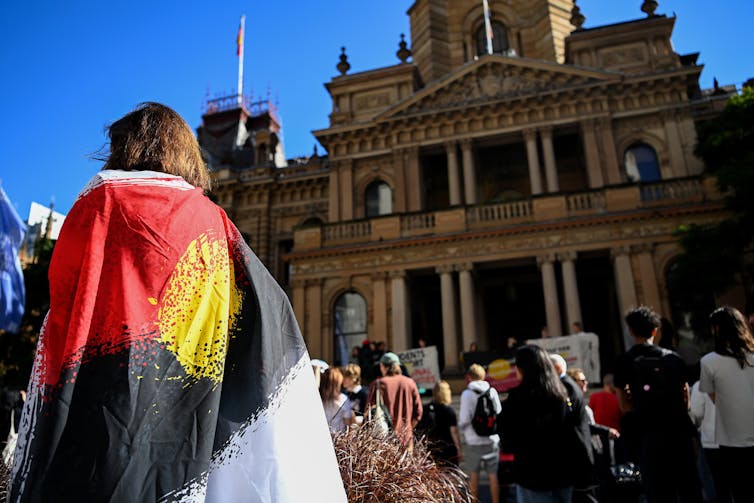
The George Floyd protest movement has also reached Australia.
Australians have taken to the streets this week.James Gourley/AAP
The COVID-19 pandemic is causing significant economic challenges for Australia. With April figures showing more than 800,000 people unemployed and last month 1.6 million on JobSeeker payments, a key focus will be job creation.
Lessons should be learned from what’s happening in New Zealand, where the government is funding projects that revive the environment. Unfortunately, Australia seems to be going the other way.
New Zealand gets it
As part of New Zealand’s innovative Wellbeing Budget the government will invest NZ$50 billion in a direct COVID-19 recovery response.
Of that, NZ$1.1 billion will be spent on creating 11,000 “nature jobs” to combat unemployment and supplement pandemic-affected sectors.
This unique investment will be delivered in a number of targeted environmental programs.
These include NZ$433 million for regional environmental projects that will provide 4,000 jobs in conserving and managing waterways. This will help restore fragile ecosystems such as wetlands, rivers and catchments.
There’s NZ$315 million for weed and feral animal control, including possums, pigs, deer and wallabies. This will provide employment through partnerships between the community, Māori land managers and government departments.
A further NZ$200 million will deliver jobs on public conservation land through the Department of Conservation for various management actions. These include predator control, restoration, regenerative planting and maintenance of tracks, huts and other assets.
Some of these investments will not only provide jobs but also conserve New Zealand’s environment. They will maintain agricultural productivity and advance existing environmental initiatives such as Predator Free New Zealand.
They will also provide households with income that will in turn help stimulate local economies.
This is a win for New Zealand’s environment and wildlife, particularly native fish species and unique birds. It’s also a win for people and the economy.
Australia’s destructive COVID-19 recovery
In contrast, the Australian federal and some state governments have resorted to environmentally destructive projects and policies to stimulate economic activity and support employment.
The relaxing of environmental legislation and protections (commonly referred to as cutting “green tape”) has been pushed by business and industry lobby groups and some quarters of the media.
Some state and territory departments, including in the ACT and the Northern Territory, recognise environmental management and protection as a source of high employment opportunity.
They all see investment in conservation and land management as a key feature of any economic recovery.
An opportunity for Australia
Economic stimulus through conservation and land management is not yet recognised as a way for Australia to respond to both the COVID-19 crisis and long-standing conservation needs.
Australian governments, if they invested similarly to New Zealand, could create jobs in the short term in any desired target region, based on economic and environmental need.
This flexibility would allow jobs to be created in regions with already fragile local economies, particularly those made worse by COVID-19. This includes regional areas that usually have high tourism, bushfire-affected communities, drought-affected regions, as well as Indigenous communities.
Feral cats are said to kill millions of native Australian animals every day.Mark Marathon/AAP
It could feature restoration activities such as tree planting, weed removal, hazard-reduction burning, and wildlife restoration and monitoring.
This type of employment is hands-on, labour-intensive and has low overhead costs. Investment is likely to be cost-effective, with most of it going straight to the worker.
Let’s stimulate the economy and the environment
Projects can be up and running quickly, so the economic stimulus is immediate.
The benefits of direct household stimulus are well understood. This form of spending provides localised economic benefits as money is likely to stay in the local community.
There is an opportunity to support the hard-hit university sector. It could get funds for research to design, monitor and assess the effectiveness of any interventions.
This week the leaders of India and Australia reaffirmed their mutual interest in closer diplomatic and economic ties.
Indian Prime Minister Narendra Modi told Australian Prime Minister Scott Morrison during their long-delayed Thursday “virtual summit”:
India is committed to expanding its relations with Australia on a wider and faster pace. This is important not only for our two countries, but also for the Indo-Pacific region and the world.
But I will not say that I am satisfied with this pace. When a leader like you is leading our friend country, then the criteria for the pace of development in our relations should also be ambitious.
Australia should be ambitious for its friendship with India. We have a long-term interest in India developing as another prosperous, harmonious democracy.
Standing in the way of that is India’s chaotic web of labour laws. There are hundreds at both national and state levels. They’ve long been a disincentive to trade and investment because of the compliance challenges for law-abiding foreign businesses.
Yet those same laws are so loosely enforced domestically that dodgy and unlawful working conditions are rife.
Indeed of India’s workforce of 500 million, it is estimated about 450 million are in the “informal sector”, with no minimum pay rates, let alone other benefits.
So there are good reasons for Australia to support India reducing its sheer number of labour laws. But there are also good reasons to encourage it to enforce the commitments required of both nations under international labour conventions.
In the shadows of the agenda to accelerate trade and investment is the risk of pushing more Indian workers into slave conditions.
450 million informal workers
In truth, no one knows the exact size of India’s informal sector. Statistics are unreliable for work defined as “disorganised”.
As in other countries, India’s COVID-19 response has hit these workers in lowly paid, insecure manual labour hardest. This was amplified by the severity and swiftness of measures.
Modi’s March 24 orders for “a complete lockdown” were issued at 8:58pm, and took effect at midnight.
Shops, markets, factories and construction sites were shut down. All public transport services were stopped. India’s population of more than 1.3 billion people was told to stay home.
Preparing beds at the Nesco Center Hall, in Mumbai, June 1 2020. The hall can accommodate more 1,200 people under quarantine. EPA/DIVYAKANT SOLANKI.Divyakant Solanki
139 million migrant wokers
But hundred of thousands had to get home first.
India has an estimated 139 million internal “migrant workers”. They come from poor regions all across India to find work in the wealthiest cities such as Mumbai, Delhi and Surat. Typical jobs are in building and manufacturing, where the average daily pay rate is about US$4.60.
With no work, no money, in fear of having no food and of catching the coronavirus, migrant workers have for weeks queued at train and bus stations for restricted services to get home.
‘Migrants’ wait to board buses at Prayagraj Junction in Allahabad, a city of about 1.1 milion in the northern Indian state of Uttar Pradesh, on May 29 2020. They are going home to their native villages. They have come from Surat, about 1,000 km to the southwest, on a train journey taking about 23 hours.Prabhat Kumar Verma/Pacific Press/Sipa USA
A survey of about 3,200 of these walkers in early April found nearly a third were in debt, usually to money lenders from their communities.
Bhagwan Das, who walked for three days to get back to his village after losing his job as a construction worker in Delhi, told his story to the Thomson Reuters Foundation
Unable to maintain repayments on the 60,000 rupee (US$787) loan he took out in 2017 for his daughter’s wedding, Das had no choice but to offer his son’s labour to service the rising debt.
8 million modern slaves
The Global Slavery Index 2018 estimates about 8 million Indians are in some form of modern slavery – in situations were they are forced to work under threat; are owned or controlled by another; are dehumanised or treated as a commodity; and are not free to leave.
Globally there is an estimated 40 million modern slaves. About 25 million are in forced labour. This may be through use or threats of violence, physical or emotional restraints, or bonded labour – also known as debt bondage, forcing people to work to pay off a debt.
Debt bondage is the most prevalent form of forced labour. In India, a 2016 investigation in the southern state of Tamil Nadu (India’s largest producer of cotton yarn) found 351 of 743 spinning mills used so-called “Sumangali” schemes to lure young women with the promise of lump sums for use as a dowry.
In practice this lump sum is made up of withheld wages, and used as a means to bind workers to the mill. Girls only receive the lump sum if they fulfil their three to five years contract period, under exploitative and unhealthy conditions. Girls who fail to do so, and many do because of health problems, abuse and exhaustion, most often do not receive the withheld wages.
This despite bonded labour being outlawed since 1976, and dowries since 1961.
Suspending labour laws
So clearly law enforcement in India needs work. As things stand, however, the push is on to do even less. Half a dozen of India’s 28 states have already signalled their desire to suspend labour laws.
The northern state of Uttar Pradesh, for example, summarily suspended most laws including its minimum wage act. It reportedly plans to maintain most suspensions for three years.
An image from the Walk Free Foundation on April 30 2020, of a carpet weaver in Varanasi, Uttar Pradesh. His community wove carpets and kept livestock for their landlord without pay before intervention by Freedom Fund local partners.AAP Image/Supplied by Minderoo, Grace Forrest)
As Radhicka Kapoor, of the Indian Council for Research on International Economic Relations, has put it, these policies are “creating an enabling environment for exploitation”.
Upholding commitments
The International Labour Organisation, which sets international labour standards, has written to Modi asking him to ensure India upholds its international commitments.
Both India and Australia are signatories to the International Labour Organsiation’s Declaration on the Fundamental Principles and Rights at Work, which states “these rights are universal” and apply “to all people in all states – regardless of the level of economic development”.
Ensuring they apply to all of Australia’s supply chains is crucial for the Morrison government to continue to be “a world leader in eradicating modern slavery” – as Home Affairs Minister Jason Woods declared just three days before the Modi-Morrison meeting.
Life in lockdown has been tough on many relationships. But negotiating the transition back to “normal” as restrictions continue to lift could also be a challenge for couples.
So what are some of the key factors that affect how relationships fare during such times?
As its name suggests, the model proposes three broad factors that affect relationship outcomes: vulnerabilities, stressors and adaptions.
Vulnerabilities are any kind of factor that makes it harder for a person to maintain enduring and satisfying relationships. Vulnerabilities can include mental health issues, personality traits (such as neuroticism), past bad relationships, addiction, and the like.
Stressors are challenging life events and experiences external to the relationship, but which put a strain on maintaining a lasting and satisfying bond. These can include financial hardship, work stress, and difficult relationships with extended family or friends.
Adaptations reflect the skills and capabilities couples possess to effectively deal with and adapt to challenging circumstances. Adaptations can include a couple’s sense of fun or humour, constructive ways of handling conflict and solving problems, and supporting one another.
A number of factors make some relationships more resilient than others.Shutterstock
Stressors and vulnerabilities increase negative relationship behaviours (such as criticism and insensitivity), and in turn increase negative relationship outcomes (dissatisfaction and relationship breakdown).
On the other hand, adaptations buffer the effects of stress and reduce the risk of relationship dissatisfaction and breakdown.
Framing this model around COVID-19
The social distancing rules enforced during the pandemic have seen couples spending long periods of time together, often in close quarters.
Accounts from across the world show us not all couples have adjusted well. China reported an increase in the number of married couples filing for divorce. Worryingly, incidents of domestic abuse may also have increased.
Lengthy periods of close contact may have acted as a stressor which intensified negative relationship behaviours and dissatisfaction, particularly for people with existing personal vulnerabilities.
The changes associated with social distancing rules, such as working from home and supervising home schooling, are additional stressors. These too are likely to have exacerbated personal vulnerabilities and destructive relationship behaviours for some couples.
Some vulnerable couples may be able to keep their relationship stable, provided that the stress of social isolation and other COVID-19-related stressors remain low, or that supports are in place to minimise stress.
However, these same couples may encounter problems if stressors increase (for example, one partner suddenly loses their job) or supports are removed (such as from friends or family).
Similarly, high-functioning couples may cope well with the challenges of social restriction and other COVID-19 hardships. But, if the stressors become too great, they’re likely to experience declines in relationship satisfaction.
What’s the ideal?
People in loving and supportive relationships are likely to cope more effectively with the enforcement and relaxation of social distancing guidelines (and other challenges, whether related to the pandemic or not).
These are typically couples who constructively deal with conflict by working together towards solving issues, take on each others’ perspectives, and respond sensitively when the other is feeling stressed.
That’s not to say these couples never argue and don’t sometimes get frustrated with one another. But their adaptive ways of communicating and supporting each other mean these couples are likely to fare better.
Some couples may benefit from relationship education programs that teach communication skills and how to manage conflict constructively.
For couples that require more intensive support, couple therapy can be effective.
These options are available online.
The pandemic has created a lot of stress, which can easily affect relationships.Shutterstock
As well as working on the relationship itself, the alleviation of stressors can help a relationship.
Studies have found that for couples and families experiencing stressors such as economic hardship or housing instability, providing them with financial aid, jobseeker programs and affordable housing can improve relationship satisfaction and reduce family breakdown to a similar extent as relationship education or counselling.
Hopefully, some of the measures the government has put in place, such as JobKeeper, have reduced stress for couples.
The easing of social distancing restrictions may also significantly reduce stress in some couples, shrinking “relationship cracks” that emerged during lockdown.
You may need to address these cracks if they resurface, but reductions in coronavirus-related stressors may well see transient relationship problems disappear.
A return to normal won’t be the answer for all relationships
Unfortunately, for some couples, the easing of restrictions may intensify relationship conflicts and dissatisfaction.
For example, if one person has health anxieties and the other is highly impulsive, they may hold very different attitudes on how to navigate situations such as social gatherings.
These differences are likely to create conflict that may increase dissatisfaction and relationship difficulties, particularly if both members of the couple typically respond to conflict in destructive ways.
So the easing of social restrictions may not have the same outcome for all. It depends in part on a couple’s existing vulnerabilities and their way of handling conflict and supporting one another.
HomeBuilder is a good idea gone bad. It is possibly the most complex and least equitable program the government could have devised to deliver construction jobs.
It gives $25,000 to people who already own a home or already have enough money to buy one while delivering a minimal stimulus to extra construction. It isn’t a program to create jobs, it is a way of making people who are reasonably well off richer.
It does not address homelessness, precarious rental or any of the other pressing problems that are caused by our current housing mix.
It might build more nice decks for sipping Chardonnay (most already planned), it might deliver ritzy new bathrooms with imported taps or even new kitchens with the latest European appliances, but it won’t help those suffering housing stress.
Construction is Australia’s third-biggest employer, after retail and health care and social assistance. It employs one in every 11 Australians, and it generates other jobs in the building supplies industry and in design and engineering.
The Master Builders Association says construction is facing a decline of 40%, with potentially horrendous implications for employment.
The industry has three main components:
residential – apartments and houses
commercial – including offices, airport terminals, retail, tourism, education and factories
engineering – including roads, railways and airport runways.
Engineering construction is doing reasonably well.
All governments have to do is keep this pipeline going, which, by and large, they are doing.
On the other hand, commercial construction will be in deep trouble by the end of the year as current projects finish without new projects to replace them.
Outlook bleak, then COVID
The outlook for residential construction is desolate, although for some people with secure jobs working from home, COVID-19 appears to have ignited a mini home renovation boom.
Prior to COVID-19, commercial construction was forecast to shrink from A$48.77 billion in 2020-11 to $41.3 billion in 2023-24.
Residential construction was forecast to bottom out in 2021-22 with only 168,000 dwelling starts, down from a peak of 233,872 starts in 2016-17.
Now, both forecasts will be slashed.
The tourism sector is dead, the education sector is near death and the multi-unit residential market, already badly impacted by confidence issues around construction quality, is in terrible shape with many projects on hold.
Not big enough, not broad enough
The HomeBuilder scheme is not big enough or broad enough to do much to reignite residential construction. To be useful for jobs, it would need to deliver an extra 60,000 housing starts.
Given the only people who will benefit from the grant will be those some way down the track to either buying or building, it is hard to guess what the additional outcome will be, but it would be surprising if the scheme generated much additional activity.
Even if the full budget allocation of the scheme is taken up, it would fund only about 25,000 projects. Many would have gone ahead anyway.
Among the peculiarities of HomeBuilder are that it won’t work in much of Sydney where many houses are likely to be valued above the $1.5M limit and it won’t work in regional towns where the required spend will overcapitalise existing houses.
Complexities aplenty
It will encourage people to build in fridges, microwaves, coffee makers and washing machines (many of them tastefully European) to bump the contract price of renovation up above the $150,000 minimum.
It is a potential administrative nightmare for state governments that are already stretched administering existing emergency relief programs.
Who will establish that the value of an existing house is less than the $1.5M upper limit? Will it be the value now in the middle of the COVID downturn or the value last year, or the value used to set local government rates?
Contracts are meant to be arms-length, but who will ensure the builder is not the cousin or the in-law of the owner, something that might be impossible to avoid in a small country town? If a garage is built on the side of a house, rather than as a separate structure, will it comply with the rules? And on and on and on.
Few extra homes
While these are legitimate questions, they ignore the big, central problem with the scheme: the opportunity to deliver a substantial program of social housing that would address real problems, including homelessness, has been missed.
And the government has done it in a way that will minimise the jobs created and maximise the wealth transfer to Australians who are relatively well off.
For a government that has mostly managed to do the right thing ever since COVID-19 hit, this has been a terrible policy clanger.
It will encourage everyone who cannot afford to buy a home, or who is homeless, to believe the government has forgotten them.
Source: The Conversation (Au and NZ) – By Trivess Moore, Senior Lecturer, School of Property, Construction and Project Management, RMIT University
The federal government’s new A$688 million HomeBuilder packagemight protect residential construction jobs but it’s a missed opportunity to deliver sustainability benefits that would save owners money in the long run. The A$25,000 grant for new homes and renovations could have been better leveraged to provide broader and ongoing benefits. In particular, it could have been used to ensure homes are more energy-efficient and cheaper to run.
The grant is available for building an owner-occupied home with property values (house and land) under $750,000. Renovations costing between $150,000 and $750,000 for a property valued under $1.5 million are also eligible. Grants are means-tested against household incomes.
The scheme could have required new houses to exceed minimum building code requirements to be eligible. The development industry would then have had to deliver housing to this standard or risk losing potential buyers. Using the right design and materials would mean any extra costs are recouped over time.
Heating and cooling energy use could be reduced by almost 25% across capital city climate zones with minimal requirements. New houses could achieve these reductions with a solar PV system and 7-star performance rating (in line with proposed changes to raise the National Construction Code’s current 6-star minimum in 2022). This would reduce utility bills and carbon footprints for householders.
The use of majority Australian-made materials could be stipulated. Local renewable energy, insulation and energy-efficiency businesses would benefit from increased demand. Job creation would follow in these and secondary industries.
Combining these sustainability measures through HomeBuilder would provide benefits across the lifetime of new houses.
The Cape is a Victorian development where all houses have a minimum 7.5-star performance rating. The first ones built have running costs of 15% of the state average for homes of the same size.Trivess Moore, Author provided
Restricting HomeBuilder grants to renovation projects over $150,000 excludes many modest renovations like upgrading a kitchen or bathroom. It has already been called a handout for the rich.
Installing a heat pump hot water system is one way to cut household costs and emissions.Trivess Moore, Author provided
A better and more equitable strategy would be to provide renovation grants for energy-efficiency retrofits in owner-occupied and rental housing.
Retrofits could be undertaken for a fraction of the price of the renovation grant and still help a range of trades. There would be demand for heating and cooling systems, insulation and draught proofing to be supplied and installed. Households would save on bills and suffer less from extreme temperatures.
Energy-efficiency retrofits are a cost-effective way to improve environmental performance, thermal comfort, health and well-being. Much of Australia’s existing housing stock could be upgraded to 5 stars for much less than the budgets required by the announced stimulus.
Retrofits should be determined by an in-house sustainability assessment by qualified assessors – another potential growth area. Programs like the Victorian Residential Energy Scorecard already offer guidance on best practice. Identifying the best retrofitting opportunities for individual properties would ensure each household gets best value for money.
A more strategic approach to HomeBuilder could help the economy and move us towards a lower-carbon future.
The need to upskill tradies and limitations of local manufacturing are often cited as barriers to improving the sustainability of Australian housing. HomeBuilder could offer incentives to overcome these obstacles. Setting higher building performance standards as a condition of the HomeBuilder grant would upskill workers and create jobs.
Tradies would have the opportunity to work on tens of thousands of houses with higher performance ratings. This would provide extensive professional experience of building more sustainable housing across the country. Local manufacturing and secondary industries could innovate and supply sustainable building materials and technologies for Australian conditions.
Improving housing sustainability would also help achieve broader federal and state government policy goals. For a start, it would help Australia achieve targets for reducing greenhouse gas emissions. It would also help with issues such as energy vulnerability and security.
As a final note, economists, housing researchers and social housing organisations argue that a program designed to deliver more social housing would provide greater benefits. Australia certainly needs to increase its social housing stock. HomeBuilder could have helped with this.
If future stimulus schemes target social housing, we suggest environmental and energy performance should be top priorities from the outset.
The coronavirus pandemic has silenced the world’s concert halls and opera theatres.
Organisations specialising in live performance face an existential crisis under current restrictions on social gatherings, with up to 75% of people employed in the creative and performing arts expected to lose work.
These technological solutions are stopgaps rather than long-term substitutes for close human contact provided by live performance.
Digital offers some possibilities …
While digital delivery has the possibility to extend reach geographically and demographically, it can prove a difficult task for groups who cater for audiences accustomed to the ritual of the concert hall – available online viewer numbers in Australia, such as on YouTube videos, are far off comparable live-audience numbers.
Small scale streamed concerts can generate revenue better than larger ones. Percussionist Claire Edwardes of Ensemble Offspring has been holding live Zoom concerts. Tickets cost A$50 per person and streams are limited to around 20 per gig to facilitate smooth communication both technically and personally.
“Everyone is seeing isolation as an opportunity that forces us to ask: how do we spread the word outside of our core supporters, and how do we actually expand our reach?,” asks Edwardes.
… but livelihoods depend on a comeback
Work for online audiences comes with significant costs – high quality streaming technology, as well as fees for artists, production teams and administration – but revenue can be minimal.
While Opera Australia is expanding its digital offerings, staff are being stood down. Chief executive officer Rory Jeffes tells me 475 staff members are on partial wages through Jobkeeper, but an additional 338 staff, mostly casuals, were not eligible and have been stood down.
Local organisations cannot compete for online audience numbers with music streaming giants like Spotify, and institutions with long-established digital offerings: the Metropolitan Opera has nearly 150,000 YouTube subscribers; Opera Australia has 8,000.
Even for companies with established digital footprints, numbers online do not necessarily translate to income. The National Theatre in London (650,000 YouTube subscribers) is considering large-scale staff redundancies despite its popular streaming performances.
And as concert halls are able to reopen, there is a long road ahead in rebuilding audience numbers.
The Berliner Ensemble has removed most of its seats in what may be a glimpse into future nights out. Others are promoting protective suits for concertgoers. Opera Australia is discussing temperature checks – the company stills hopes to stage the Ring Cycle in the 2,000 seat Lyric Theatre in Brisbane, in November.
Some companies are hoping for permission to open up to bigger audience numbers, even while social distancing rules remain. Melbourne Theatre Company executive director Virginia Lovett told The Age she hopes the government will allow performance companies to “open at a capacity that works for us” by knowing the seating details and contact information for every audience member.
But it is not just risks to the audience that will need to be considered. Virus transmission risks posed by singing and playing wind instruments will need to be taken into account in safety guidelines for performers, too.
Compact units like Ensemble Offspring are keen to lead the way back. Unless the government’s plan for lifting restrictions is revised, concert venues will first be allowed to admit just 20, then 100, patrons.
“We hope that because of the smaller size of our audiences and our performances, intimacy will be part of the gradual opening up,” says Edwardes.
And still, optimism remains
The musical performing arts face a lengthy process of dealing with threats to sustainability. Nevertheless, shock has brought on solidarity and support among organisations and venues.
David Rowden, artistic director of Omega Ensemble, expects we will see “more organisations collaborating because there is going to be more need to co-present and to share costs.”
Despite everything, he remains optimistic. “Coming out of this on the other side, maybe people will have an even greater appreciation for the arts,” he says.
Scott Morrison wants to overhaul the skills workforce to ensure a better post-COVID-19 recovery. But there may not be enough people with the necessary skills to do so. And travel restrictions, which will reduce migration, will only compound the issue.
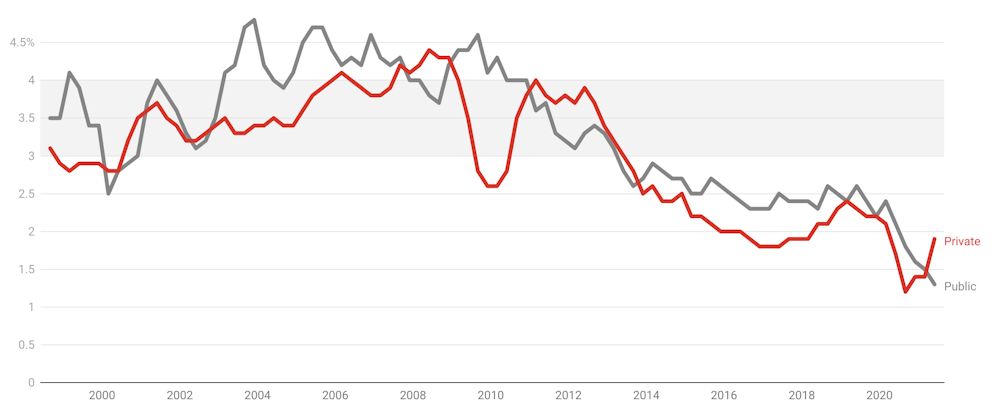
A Productivity Commission interim report released today found the proportion of people without qualifications at a Certificate 3 level or above decreased from 47.1% in 2009 to 37.5% in 2019. This will not be enough to meet a Council of Australian Governments (COAG) target of 23.6% set for 2020.
The report also found while the number of higher-level qualifications (diplomas and advanced diplomas) sharply increased between 2009 and 2012, it has since fallen to its 2009 level.
The 2020 target was set out in the 2012 National Agreement for Skills and Workforce Development (NASWD), which identified long-term federal and state objectives in skills and workforce development.
The report noted the skills agreement is no longer fit for purpose, and the A$6.1 billion governments spend annually on vocational education and training can be better allocated to improve outcomes.
What the report found
The National Agreement for Skills and Workforce Development was intended to significantly lift the skills of the Australian workforce and improve participation in training, especially by students facing disadvantage. Several targets, performance indicators and outcomes were agreed to.
These included to:
halve the proportion of Australians aged between 20-64 without qualification at certificate 3 level and below, from 47.1% in 2009 to 23.6% by 2020
double the number of advanced diploma and diploma completions nationally from 53,974 to 107,948 in 2020.
The commissioners admit some of the targets agreed to were arbitrary and ambitious.
The report says:
If targets are unattainable, they quickly become irrelevant for policymakers. The NASWD’s performance indicators were reasonable general measures but needed to be linked to specific policies to allow governments to monitor progress.
The NASWD’s targets will not be met.
The commissioners state the failure to meet the targets is not an indication the national agreement has failed overall. This is because the targets only looked at those with formal education.
It noted a large proportion of the workforce aged over 25 are more likely to do informal training to increase skills for their current occupation, as opposed to formal training to get a new job.
About 85% of workers’ non-formal learning is paid for by employers, but government policies are largely silent about this kind of training.
Noting these caveats, the report identified factors that contributed to the failure to meet the targets. These included:
a lack of uniform commitment and execution to meet the reform directions set as part of the original national agreement. This was meant to improve training accessibility, affordability and depth of skills through a more open and competitive VET market, driven by user choice
the reputational damage of the VET FEE-HELP scheme that facilitated rorting of the system
a reduction in governments’ commitment to a competitive training market. This includes a lack of accessible course information for students and inadequate sector regulation
unclear pathways to jobs through the VET system – for example through lack of proper employment advice through school career advisors.
The fall in VET participation also coincided with an increase in university enrolments. This suggests students were choosing university over VET. VET and traineeship funding also tightened from 2014.
What the report recommends
Treasurer Josh Freydenberg asked the Productivity Commission to undertake the review of the National Agreement for Skills and Workforce Development in November 2019, before the bushfires and COVID-19 hit the economy.
The request came a few months after former New Zealand skills minister Steven Joyce released a report and recommendations of his review of Australia’s VET system.
The findings of the Productivity Commission’s interim report appear to dovetail well with those of the Joyce review. This recommended the formation of the National Skills Commission, which can facilitate an overarching national and consistent approach to vocational education and training.
The interim report’s main recommendation is for governments to consider reforms to make the VET system a more efficient, competitive market. This must be driven by informed choices of students and employers, with the flexibility to deliver a broad suite of training options.
The commissioners also advocate for the use of common methods of measurement among states and territories to achieve nationally consistent VET funding and pricing.
For example, one of the most popular VET courses in Australia is the Certificate 3 in individual support — the course you’d study to work in aged or disability care. Standard subsidies for this course vary by as much as A$3,700 across Australia.
The report calls for more submissions and consultation as part of the next phase of the review.
But given the disruptions to the economy, and learning delivery having moved online, the commissioners note that while their current options and recommendations are unlikely to change in the general sense, COVID-19 is probably driving longer-term changes to the economy.
They say the pandemic may lead to structural changes in the VET sector which will also be relevant to any future agreements between governments.
The conversation around the 2020 covid19 pandemic has been widely framed as ‘health versus the economy’. It has been quite political, with people leaning to the left emphasising ‘health’, and people leaning to the right emphasising ‘the economy’.
A couple of weeks ago (27 May), on RNZ I heard outspoken British author Lionel Shriver enunciating her view favouring ‘the economy’.
Mulligan (interviewer): “You’ve said that the virus has shaken you, but not because you might get sick. What disturbs you most about this moment in history?”
Shriver: “I’m nervous about what it’s doing to the world economy. … I am concerned that these lockdowns internationally were not considered beforehand, and there’s been a kind of creepy consensus; I’m especially uncomfortable with the union of government and the media. Both in the UK and the US …”
Mulligan: “You are keen to point out that the lockdown won’t be the hard part?”
Shriver: ” … many of the businesses have plywood over the windows, and I just wonder whether I am looking at a landscape that is … long-term; and I’m also worried about a whole generation graduating from university with very few prospects.”
Mulligan: “You have written dystopian fiction about the breakdown of society and economic collapse …”
There is no doubt that 2020 has become a year of great economic and political uncertainty. We need to understand that a fullscale pandemic necessarily creates much global uncertainty and consequent economic change. Part of the uncertainty and change is due to the pandemic itself; and part of the uncertainty and change is due to actions taken by governments and other authorities. In relation to government health restrictions, these may lessen or aggravate the economic impact that would otherwise have been. Further, the various impacts may be regarded as ‘good’ or ‘bad’, with different people having different views of which impacts are good and which are bad.
The Likely Economic Impact of a Pandemic not subject to Government Restrictions
This is largely hypothetical, because almost all pandemics have been accompanied by mandatory public restrictions and requirements. We need to consider both changes in the economic behaviour of the well, and the consequences of death and sickness.
The most lenient authoritative response in the present pandemic is perhaps that of Sweden, where information is passed on to people – and absorbed by interested and aware people. These people then modify their economic choices in light of new information, and other people modify their choices in light of the choice modifications of others. We note here that, just because one government reacts in a particular way, a pandemic (by definition) is international, and foreign circumstances – healthwise, economywise, policywise – impact on the behavioural choices made by people in any given country. And we note that information from each source will have its own bias and may be subject to frequent revision. National governments and their bureaucracies may convey different messages from those messages coming from other sources. And sometimes the message received is not fully aligned with the message intended; for example, some official messaging may be ‘tone deaf’. Finally, we note that, in such situations, a major source of ‘information’ is rumour.
Economic change arises, firstly, from changes in ‘market forces’, meaning choices by people and households over what they buy, how much they buy, and the extent that they prefer ‘leisure’ (relaxation, family time, ‘hobby’ production) over paid employment. ‘Market forces’ mean ‘demand’. These economic choices are modified, subsequently, by changes in cost structures; these ‘supply’ changes work mainly through the price mechanism. People buy less of things that rise in price, and more of things that fall in price.
The principal demand changes during and after a pandemic will relate to security – especially food security, dwelling security, security from possible agents of infection or crime, and security from mandatory government actions. Re the latter, even a government – such as that of Sweden – may at any time introduce mandatory restrictions or requirements even if, previously, it promised not to. Governments, like people, change their minds; and people know that.
In general, then, demand changes will emphasise ‘needs’ over (mere) ‘wants’. As part of that, many people will demand more free time (‘leisure’), meaning that they will prefer to supply less labour; they will want sufficient incomes rather than maximum incomes. While people may become increasingly protective of their jobs, they may generally favour working fewer hours, and be willing to accept a substantial reduction in income. (There may also be a reassessment of needs and wants. Hanging out for a while in community spaces such as cafes may be re-evaluated; becoming, for many, a need rather than a want.)
Businesses supplying ‘wants’ can expect to struggle; it is difficult to make a case for government to prop-up such businesses. (The new National Party leadership in New Zealand has already promoted a subsidy to prop-up small businesses which hire more workers, seemingly regardless of market forces.) An exception is when there is a good reason to believe that the decline of a particular want will be temporary. The best form of support is subsidised debt; the role of governments here is to incentivise banks to lend to businesses that can put up a good medium-long-run business case, rather than lending to asset speculators.
Many businesses sell goods and services mainly to other businesses. Their post-pandemic viability depends on the viability of their client businesses. Again, primary support for these businesses should come from incentivised banks. Public support comes from a mix of monetary policy and incentives to lend more to businesses and less to speculators.
Historically, the pandemics with the biggest economic impact were those with a high death toll. These changed the whole relations between the ‘land’ and the ‘labour’ classes. For example, in late medieval Europe, labour became scarce and land rents fell substantially. Also, inasmuch as pandemics created ongoing uncertainty around people’s life expectancies, there was an increased incentive for people to live for ‘today’ rather than for ‘tomorrow’.
The most immediate impact of a pandemic is the loss of life itself. Life is priceless. Nevertheless, death soon becomes a ‘sunk cost’, and the ongoing impact relates to the lives of the ‘still living’.
In a pandemic where most of the fatalities are elderly people, one of the main economic impacts will be that many people of the next generation will inherit property. Indeed, for the inheritors, the pandemic will in many cases confer considerable economic benefits. Property, as security, can save a number of businesses; and that security can form the basis for new capital-raising and new businesses.
Of particular importance here is, for different pandemic locations, the balance of mortality to morbidity. Demand for care facilities for the elderly could fall, or could rise. Rather than having many deaths, a pandemic possibility is that recovered victims may suffer ongoing health indispositions, impacting on both what (and how much) they will buy, and, if of working age, on their ongoing productivity in work.
Another point to note is that any pandemic will reduce the demand for international travel; this effect is likely to be accentuated this time, because there are now good substitutes for international travel; namely the proven ability to hold conferences and the like online, and also the availability of ‘slow TV’, whereby people can enjoy simulated journeys. Indeed this latter effect has largely happened to professional sport, with by far the majority of paying spectators preferring to watch from their homes.
Speaking of homes, pandemics give renewed emphasis on people’s needs for safe and healthy homes, and can give political will to address the massive market failures associated with people’s housing.
The economic impacts of government restrictions and requirements.
We should note firstly the case of large restrictions during a pandemic that would have been a comparatively small pandemic even in the absence of restrictions. The adverse impact of such restrictions could easily be disproportionately large, and the beneficial impact disproportionately small. This is not the case of the present pandemic in New Zealand; had New Zealand followed the Swedish policy, the eventual pandemic in New Zealand would probably have been worse than in Sweden, given the onset of winter.
The main beneficial impact of restrictions is that, by shortening the duration of a pandemic, it becomes easier and quicker to either ‘return to normal’ or to settle into a ‘new normal’. Where restrictions are stronger in some countries than others – or for other reasons the pandemic is effectively resolved in some places much sooner than others – then, for the first countries to achieve it, this ‘normal’ can only be partial, and may be biased towards deglobalisation. While government-imposed restrictions may substantially reduce the domestic economic costs of a pandemic, if those restrictions are much more effective in some places than in others, then the staggered timings of the new normals may themselves make a difference to the eventual new global normal.
However restrictions themselves are costly for viable post-pandemic businesses that suffer an enforced loss of revenue during the restriction period. Many viable businesses suffering from losses of revenue during restrictions may not be fully compensated for costs incurred during periods of restriction. Generally the problem of restrictions is worse in jurisdictions where there are inadequate ‘hibernation protocols’, and particularly worse when property owners (especially landlords) paid speculative prices for their properties.
The bigger problems relate to ineffective (ie unnecessary) restrictions or requirements, restrictions or requirements that last for too long, and restrictions or requirements that are imposed without compassion (such as not allowing people to board aircraft, leaving them stranded and maybe stateless). Pandemic-management policies should be smart, not blunt. It is worth easing restrictions whose effectiveness is uncertain, in order to learn about their effectiveness. Information – timely information – is the critical currency in a pandemic.
The result of poorly targeted or poorly implemented restrictions is that people will make choices to avoid these restrictions; choices that may aggravate the pandemic that the restrictions were intended to alleviate. Examples include leaving places of infection for fear of quarantines that may be needlessly prolonged, as distinct from the attempts to flee the pandemic that necessitate quarantines. The fear of quarantines may induce more departures than the fear of disease; this is certainly true of many historical pandemics.
Also of significance here is that a post-pandemic normal may be created in which people fear arbitrary and potentially very costly (and uninsurable) interventions to their future businesses or future travel plans. This includes the world’s many ‘swallows’ – migrant or semi-nomad seasonal workers – who do essential work that is underappreciated, and difficult for young people tied to their parents’ homes to do. Further, after a pandemic, few people will want to travel to countries where too many local people are repressed, or having to resort to criminal activities to survive. Fear of foreign travel represents a long-run cost that can accentuate ‘them and us’ nationalism.
In Summary
All pandemics involve costs to global society; health costs and other economic costs including lost opportunities. As a result, pandemics are generally subject to government policies which remediate some of these costs, while creating some new costs. On balance the interventions mitigate the economic costs of a pandemic. Nevertheless, it is best to follow an economising approach, minimising the costs of interventions while shortening and flattening the pandemic. If the marginal benefit of an intervention exceeds its marginal cost, then that intervention should happen. If we do not know whether the cost exceeds the benefit, then it is generally beneficial to incur some cost to relieve ourselves of our ignorance.
Pandemics can have dystopian consequences. Lionel Shriver has reason to be concerned. Nevertheless, while bad or excessive pandemic restrictions may add to such consequences, smart restrictions may facilitate futures that are not dystopian, and might even be improvements to pre-pandemic life.
Pandemics, even unmitigated pandemics – like other highly stressful world events such as wars and depressions – can have some good consequences. For one, they may get a critical mass of people thinking about realistic change for the better, and fostering a willingness to work towards such change.
Source: Council on Hemispheric Affairs – Analysis-Reportage
By COHA Editorial Team From Washington DC
The Council on Hemispheric Affairs (COHA) joins the Black Alliance for Peace[1] and other pro-democracy organizations throughout the world in calling for the United Nations to address the systemic violations of human rights by the police and other security forces in the United States. We also express deep disappointment that the Organization of American States and its Secretary General, Luis Almagro, have remained silent in the face of these grave human violations occurring in the very place it has its headquarters and by the Member State that provides the most funding. Instead, the Secretary continues to support the illegal unilateral coercive measures the US dictates against the governments of Venezuela, Cuba, and Nicaragua, while aiding in the removal of the legitimate authorities of Bolivia.
We condemn the murder by a Minnesota police officer of George Floyd and support the clamor of millions for more just social, economic, and juridical institutions and practices, which have imposed multiple hierarchies of domination on people of color for more than two centuries within and outside the US borders.
The very conditions Washington has used to justify intervention in the internal affairs of other nations in the Western Hemisphere — alleged breaks in the democratic order — are now transparently revealed in the streets, court houses, and prisons of the US. Some of the same mechanisms of social control deployed by US-backed security forces in Latin America for more than two centuries are now turned inward with naked brutality against demonstrators, bystanders and reporters at home. Defense Secretary Mark Esper’s rejection of use of the Insurrection Act of 1807 to deploy the armed forces to repress legitimate peaceful protests is a welcome gesture. But this alone will not stop President Trump’s call for more coercive action by police, the National Guard, Customs and Border Patrol, and units of the Armed Forces. Instead of projecting the US Presidency as a conciliatory voice during these times of acute social and moral crisis, Donald Trump is using rhetoric based on animosity, military repression, political division, and bigotry.
Just as our neighbors to the South were never alone, this time the US people are receiving the solidarity of millions throughout the world.
COHA has exposed the underside of corrupt governance in Latin America for almost half a century; today that corruption is undeniably present in our own front yard. While we have documented attacks on journalists in the region, that freedom of expression and access to information is under attack right here at home in the form of police brutality against the press covering the protests. The governments of Australia[2] and Germany[3], among others, have formally complained to the US government regarding the harsh police repression suffered by journalists and cameramen of those and other countries. Some reports[4] show as many as 250 press freedom violations during the protests organized after the murder of George Floyd in Minneapolis, Minnesota.
It is not too late for the US government to change course and begin to address the root causes of police brutality and racial discrimination in the criminal justice system. By ending qualified immunity and placing public security under community control, a real start can be made towards deep reform. Also, we can only make progress to overcome economic and social inequality, militarism, and racism, if the present movement for social justice has the space to practice a politics of transformation; the attempt to crush this popular expression may have dire consequences.
In the meantime, the UN and other international organizations must condemn not only the US government’s repression of peaceful protesters, but also its longstanding practice of systemic racism. If the US is not called to account, the multilateral system would indeed be guilty of the same racist chauvinism on display within the US borders.
[Credit photo: Open license, https://www.flickr.com/photos/fibonacciblue/49939836178/]
Source: Council on Hemispheric Affairs – Analysis-Reportage
By COHA From Washington DC
Federal charges against the four protectors of the Venezuelan Embassy, who defended the building in Washington DC against violent opposition crowds for several weeks between April 10 and May 16 of 2019, were completely dropped in a case that was brought directly by prosecutors of the Trump administration.
After several months of proceedings that produced a mistrial in February 2020, the four activists expressed in a public statement that “Today’s sentence marks yet another victory in the effort to protect the Venezuelan Embassy. The Embassy Protection Collective broke through the blockade and got supplies to the people inside; the people inside prevented the coup supporters from staying in the embassy; the embassy was not turned over to Guaidó—it remains empty today—and now the federal charges have been dropped.”
The federal charges the US Government prosecutors were seeking, “interfering with certain protective functions,” were dropped entirely. The defenders were found guilty of a minor charge, “incommoding,” which corresponds to “causing a disturbance,” and falls under local DC jurisdiction. These charges resulted in a penalty of six months’ probation and a $500 fine. Under the federal charges, the defenders were risking one year in jail and up to $100,000 in fines.
Last February, Trump administration prosecutors were unable to convince the jury that retired nurse practitioner David Paul, lawyer Kevin Zeese, pediatrician Margaret Flowers and academic Dr. Adrienne Pine, broke any law during their stay at the Venezuelan Embassy while protecting it by request of the legitimate Venezuelan government of Nicolás Maduro.
The four defenders in front of the federal court in Washington DC: David Paul, Margaret Flowers, Adrienne Pine, and Kevin Zeese (Credit: COHA)
Lawyer Kevin Zeese said “We are going to increase our efforts at building solidarity in the US and Venezuela to stop US regime change. With this prosecution behind us we will work to end US sanctions, and threats of military force”. He added, “We went into the embassy to prevent its takeover as part of the US coup but our goal has always been to stand with the people of Venezuela and for their independence and sovereignty.”
Margaret Flowers stated: “I want to express my solidarity with the Venezuelan people and all people who believe in protecting human rights and resisting the US illegal exploitation and aggression. I know that together we will build a world based on cooperation, peace and respect for law.”
In their public statement, the protectors said that they “share a vision with Venezuelans and many people around the world of a future based on peace between countries, international cooperation and respect for international law”. They also “hope their government will end its sanctions, blockade and aggression toward Venezuela and all countries being targeted and join in the spirit of international cooperation that prevails in this time of a global pandemic, recession and climate crisis.”
A public webinar will be organized soon to empower the solidarity movement in solidarity with the Venezuelan people against the illegal US sanctions. More information can be found here.
View of the Embassy of Venezuela during the siege organized by Juan Guaidó’s supporters against the diplomatic building on April 2019, Washington DC. (Credit Photo: COHA)
Human rights watchdog TAPOL has condemned the demand by Indonesian prosecutors seeking 17 and five years imprisonment for West Papuan activists Buchtar Tabuni and Irwanus Uropmabin.
On June 2, the Jayapura District Prosecutor’s Office issued 33 pages containing charges against the defendant Irwanus Uropmabin.
In the document, the Public Prosecutor concluded that Irwanus Uropmabin was proven to have violated Article 106 in conjunction with Article 55 paragraph (1) of the Criminal Code, and stipulated a five-year prison sentence for the defendant.
Irwanus Uropmabin … a student activist. Image: Tapol
Irwanus is a student activist who was arrested on August 29, 2019, for participating in an anti-racism protest in West Papua in September last year.
In the demonstration, he was appointed as the security coordinator.
Papuans Behind Bars reported that Irwanus, along with six other political prisoners, were moved from Mako Brimob Jayapura to BalikPapan Class IIB East Kalimantan prison on October 4, 2019.
– Partner –
The transfer violated the Criminal Procedure Code.
Accused of ‘being the brains’ On the same day, the Public Prosecutor also read out charges against Buchtar Tabuni, a leader of “National Parliament of West Papua” accused of being the brains behind the Papua Uprising of 2019.
Despite maintaining his innocence of involvement in organising the Uprising, Tabuni has been charged with Articles 106, 110, and 160 of the Criminal Code, including treason charges.
The District Prosecutor’s office has demanded 17 years imprisonment for Buchtar Tabuni.
Tabuni is a prominent leader who has been repeatedly imprisoned for peaceful protests demanding independence for West Papua.
He has been repeatedly tortured by the Indonesian authorities during these imprisonments. This latest detention is his third.
“These sentences are excessive and at best an attempt to make examples out of West Papuan political activists who are simply trying to exercise their civil and political rights,” said TAPOL in a statement.
“These rights are protected by international principles as well as Indonesia’s national Constitution.
“West Papuans have been denouncing the injustice of these heavy sentences, as the racist perpetrators in Java who triggered the mass protests were either freed or only sentenced to 5, 7, and 10 months imprisonment.”
Source: The Conversation (Au and NZ) – By Robyn J. Whitaker, Senior Lecturer in New Testament, Pilgrim Theological College, University of Divinity
US President Donald Trump delivered an address this week in which he threatened military action on the nation. Then he walked to the nearby St John’s Episcopal Church to pose with a Bible.
Yes, Trump held the Bible like a baby holding a spoon for the first time – unsure which end is which – but the real problem was the complete disconnection between the text in his hand and the force, both verbally threatened and actually used, to clear the way for his stunt. Tear gas and militarised police cleared crowds, including some of the church’s own clergy from its grounds, in order for Trump to pose in front of the church.
While Christian outrage at Trump’s hypocrisy is genuine, for reasons that several Christian leaders have elegantly articulated, we need to ask ourselves: did Trump do anything new? Has he done anything that powerful “Christian” leaders haven’t done for centuries?
The answer is no.
Co-opting Christianity in the service of power is almost as old as Christianity itself. In the culture war raging in America, the very president who has stoked the flames of racism and white supremacy effectively claimed God is on his side. It is deeply offensive, but it is not new.
In the early fourth century CE, Flavius Valerius Constantine would defeat his brother-in-law, Maxentius, in a battle for control of the Roman Empire. His victory would solidify him as emperor of a vast western empire.
The legend goes that Constantine had a vision before the battle on Milvian Bridge: he saw a cross of light in the sky and heard a voice that said, “in this sign, conquer”. The next morning, Constantine ordered his soldiers to paint crosses on their shields. They marched into battle as the first cross-bearing “Christian” soldiers. When Constantine won, he would attribute his victory to the God of the Christians.
While historians are quick to point out that this “conversion” of Constantine is as much myth as reality, and may have been motivated by either political expediency or sheer superstition, it marked a turning point for Christianity. The new emperor’s adoption of the cross transformed a persecuted, minority sect into a legitimate religion and, eventually, the official state religion.
The use of propaganda and standardised imagery was not new for the Roman Empire. Indeed, they were already experts in using imagery to communicate dominance, power and a certain worldview. The new element in 312 CE was the type of imagery; Christian instead of pagan, a cross representing the death and resurrection of Jesus instead of a god, goddess or symbol from the Roman Pantheon.
We have been left with a legacy in Western Christianity of powerful rulers claiming God for their cause. The Crusaders rode out to fight Muslims with chests and shields adorned with the sign of the cross, popes would wield more power than kings, and God’s name would be invoked in war after war.
Eventually, Christianity became so synonymous with colonial power and whiteness that the two can be hard to distinguish. It is telling that, in the new Western empire, no American president has been elected without explicitly signalling his Christian faith.
Photoshopped images of Hitler with a Bible started to circulate this week following Trump’s stunt. Evidence already exists for the casual way in which Hitler, too, co-opted Christianity for his cause. A 1930s propaganda book titled Hitler as No One Knows Him contains numerous photographs of Hitler designed to make him likeable. One of them has him leaving a church, implying his Christian faith and basic decency, suggesting he is a good Christian just like so many of those who were deceived by his politics and drafted to his cause.
Closer to home, the Bible arrived on the shores of Australia in the hands of those who would colonise this land through violence and domination. Its diverse history here has been described by Meredith Lake. But the Bible was, at least superficially, synonymous with white culture and power. It would be (mis)used to justify colonisation in Australia just as it was to argue for apartheid in South Africa.
The co-option of Christian symbols by Western Christian empires has meant its core symbols have often been inverted in meaning. The great irony is that the cross worn as a symbol of power and victory by imperial soldiers was first the symbol of the unjust death of Jesus, a brown-skinned Jew killed by the Roman State. It was a shameful symbol in that culture, an image for a humiliating public death.
The Bible, wielded by Trump and others like him, likewise did not begin its life as the text of the victor. Had Trump read the text he held, he would have found a story of liberation for slaves, a divine preference for the poor, a demand of justice for the marginalised, a cry of lament from those who grieve, and a damning critique of any empire that oppressed its people.
What Trump did was not new. But perhaps we are offended because his delivery was so unsophisticated, an insult to our intelligence for its lack of pretence at genuine faith. He didn’t even attempt to enter the church and pray nor open the Bible and read it.
Both church and Bible were mere backdrops, doing the rhetorical work Trump needed in signalling his virtue and values to his base. Values, to be clear, that are antithetical to both the building and the book in his hand.
The food pipe is a cylinder which sits on top of the stomach, and is known scientifically as the oesophagus.
At either end of the oesophagus is a valve, called a “sphincter”. These valves are quite strong and stop food coming out again after you eat. This is why you can stand upside down after eating without food falling back into your mouth!
When these valves relax, they let out excess gas which we call a burp.
The two valves, or sphincters, are strong muscles that prevent food from coming back up into your mouth. When we burp, they relax to let the gas out.Shutterstock
Burps get rid of swallowed air
There are two types of burping. The first is known as gastric burping, which comes from your stomach. It is the most common type of burp.
Gastric burping is a normal way our body gets rid of swallowed air. We may not realise it, but every time we swallow food, around a tablespoon worth of air also enters our stomach.
Eventually, this buildup of air stretches the stomach and causes both the valves to relax at both the top and bottom of your food pipe.
For the air that escapes upwards from your stomach, your muscles help to push the air out. These muscles are in a part of your body called your “diaphragm”, and also the muscles at the front of your tummy, which you might call your “abs” or “six-pack”.
These muscles push the air up your oesophagus and then out of your mouth (or sometimes your nose!).
Burping is normal, and can increase after certain food and drinks, like fizzy drinks.Shutterstock
Gastric burping is normal – you can do up to 30 burps a day. We don’t just swallow air while eating, but all through the day. This explains why people can burp before meals as well as after.
This type of burping becomes more frequent when we drink fizzy drinks like lemonade because these drinks have bubbles in them, made of a gas called carbon dioxide. This adds to the air in our stomach and makes more burps.
Burping can also increase when we run around a lot. This is because body movement and increased pressure in the abdomen makes the lower valve relax more frequently.
Gastric burping is usually not a problem for people, except for the rare situations where some people can swallow lots of air. This is called “aerophagia” and can make people feel bloated and do lots and lots of burps.
Burping is usually fine, but it can turn into a problem if people are burping way too much. This doesn’t usually happen with stomach burps, but it can happen with a second type of burps, which come from above the stomach, in the food pipe. Some people who do these types of burps can burp hundreds of times a day!
Normally, when we try and take a deep breath, the breathing muscle contracts. But in people who do way too many burps, their breathing muscle contracts not on-purpose!
Burping is normal. But if we burp hundreds of times a day, it could be a sign of a problem.Shutterstock
This means that air gets sucked into the food pipe by accident. But air does not go all the way into the stomach. The lower valve remains closed and the “abs” strain, causing the air to be quickly pushed back up the food pipe and out of the mouth.
This type of burping might happen for people who are very stressed or sad for a long time, which we call mental illness.
After years of litigation, Australia’s highest court will today make a major decision on the fate of the controversial proposed expansion to the New Acland Coal mine in Queensland.
A so-called “special leave application”, if successful, may eventually see the matter sent back to Queensland’s Land Court for a new hearing.
If the application fails, the mine expansion is one big step closer to proceeding, with only a few approvals left to obtain.
If approved, the project will have serious ramifications for prime agricultural land and groundwater in the region. As one opponent, Oakey Coal Action Alliance (OCAA) secretary Paul King, has said:
We believe it is really crucial that these important matters are tested in court, because once groundwater is lost it’s most likely lost forever.
The New Acland Coal mine is located on Queensland’s Darling Downs about 170km west of Brisbane and just north-west of Toowoomba.
The New Acland Coal mine is behind fields in Acland, west of Brisbane.Dan Peled/AAP
The mine began operating in 2002 and a decade later was producing more than 5 million tonnes of thermal coal each year.
New Acland Coal is now seeking approval for stage 3 of the mine, which would produce 9 million tonnes of coal per year from new pits to the south of the existing mine.
The mine sits in the middle of prime agricultural land. Farmers and the community are deeply concerned the proposed expansion will have serious impacts including groundwater depletion, noise, air quality, visual amenity, soil damage, social disruption and land values. It will also absorb the town of Acland.
After some scaling down, the Queensland Labor government issued a draft environmental authority for the project in 2015. Commonwealth approval followed in 2017.
The start of litigation – the Land Court
A large group of farmers and residents, including OCAA, took their objections to the draft environmental authority and mining lease to Queensland’s Land Court.
These objections were heard together in 2016 in a mammoth 100-day hearing, the longest in the 120-year history of the court. In an equally mammoth recommendation spanning almost 2,000 paragraphs, then Land Court member Paul Smith recommended the mining lease and environmental authority be rejected.
Not all the objections succeeded. Smith based his refusal on groundwater modelling inadequacies, make-good arrangements for landholders, noise impacts and agricultural impacts.
New Acland Coal applied for judicial review of Smith’s recommendation on 15 initial grounds. One of these was apprehended bias.
The apprehended bias allegations included that Smith threatened contempt of New Acland Coal staff during the hearing, questioned their motives, rejected evidence without a genuine basis and assisted the objectors with their arguments.
During the hearing, there was a lot of focus on comments made by New Acland Coal in the media regarding delays in the Land Court. It was suggested Smith had taken personal offence to these statements.
The claim succeeded in 2018 on several grounds, mainly related to groundwater. In particular, Justice Helen Bowskill found the Land Court does not have jurisdiction to consider groundwater issues. The apprehended bias allegation did not succeed at this stage.
The rehearing in the Land Court
The matter was sent back to the Land Court for a limited rehearing, on the issues New Acland Coal succeeded on before the Supreme Court. Land Court president Fleur Kingham in November 2018 recommended approval of the mining project.
This was perhaps a reluctant recommendation, given the hearing was necessarily limited in scope. As Kingham said, a full rehearing would have allowed her to consider issues such as New Acland Coal’s past environmental performance in greater detail.
Appeal and cross-appeal
This is where is gets complicated. While waiting for the Land Court rehearing, OCAA appealed against Justice Bowskill’s decision to the Court of Appeal in May 2018. New Acland Coal cross-appealed over the finding of no apprehended bias.
In September 2019, the Court of Appeal dismissed OCAA’s arguments, but upheld New Acland Coal’s argument that apprehended bias had affected the original Land Court recommendation.
A finding of apprehended bias would generally result in the matter being sent back to the original court or tribunal for a fresh hearing before an independent person.
By this stage, a fresh hearing was not in New Acland Coal’s interests, as it already had a favourable result from the Land Court. However, a fresh hearing would be an opportunity for OCAA to test its arguments before a new Land Court member.
Fortunately for the mining company, the Court of Appeal did not order a rehearing. Instead, the court held the recommendations of Kingham and the findings of Justice Bowskill should stand.
Mine expansion stage 3: it’s in the hands of the High Court.Dan Peled/AAP
Application for special leave to appeal
It is perhaps surprising the Court of Appeal found apprehended bias, but did not order a fresh hearing.
On this basis, OCAA applied to the High Court of Australia for special leave to appeal the decision. If it succeeds in seeking special leave – and is then successful in a hearing before the High Court – the matter will go back to the Land Court for an entirely new hearing on all the facts and issues.
If the application is unsuccessful, the Court of Appeal’s decision will stand. The controversial mine expansion will have officially cleared a major hurdle and be closer to proceeding.
Today’s decision is being closely watched. It may have broad ramifications for future decisions involving apprehended bias. And it could have devastating consequences for farmers and landholders, as well as their land and groundwater supplies.
Source: The Conversation (Au and NZ) – By Nicholas Williams, Associate Professor in Urban Ecology and Urban Horticulture, University of Melbourne
Tomorrow is the first World Green Roof Day. Cities around the world will celebrate the well-documented environmental, economic and social benefits of green roofs. New ground-level green spaces are difficult to create in high-density urban areas. As a result, other forms of city greening – green roofs, green walls and vegetated facades – are increasingly popular.
Being able to grow plants up and on top of buildings combines grey infrastructure with green infrastructure. Unfortunately, most Australian cities are lagging behind many international counterparts in this aspect of urban greening.
Growing Up green roof by Bent Architecture on the top of 131 Queen Street, Melbourne.University of Melbourne, Author provided
Green wall at One Central Park, Sydney.John Rayner, used with permission, Author provided
To explore how to increase the uptake of engineered green infrastructure we ran appreciative inquiry summits in Sydney and Melbourne. More than 60 representatives from the building and horticultural industries, local and state governments and universities attended. They worked together to create a positive vision for greener Australian cities using green roofs, walls and facades.
There is a significant amount of Australian-specific information on the benefits, value and construction requirements of green roofs, walls and facades. Sharing this knowledge is essential for accelerating advances and bringing people up to speed quickly. A key recommendation was establishing a cloud-based knowledge hub and accompanying programs.
Biodiversity Green Roof at Yerrabingin Indigenous Rooftop Farm in South Eveleigh, Sydney.Junglefy, used with permission, Author provided
It’s also about job growth
Green roofs, walls and facades require a diverse mix of professions and trades to build them. As the sector grows, many jobs will be created.
Medibank Private green wall by Fytogreen at 720 Bourke Street, Melbourne.John Rayner, used with permission, Author provided
Changes to government policies and inclusion in economic recovery programs are key to this. For example, in Toronto a 2009 bylaw made green roofs mandatory on new buildings with floor areas greater than 2,000 square metres. That change is estimated to have created more than 1,600 jobs in their construction and 25 jobs a year in maintenance.
Education and training programs will be needed to upskill the new workforce. The National Skills Standards for Green Walls and Rooftop Gardens is a welcome vocational training initiative. In addition, university engineering, design and planning graduates require greater expertise in both policy and implementation, backed up by continuing professional development programs.
Research green roof at the University of Melbourne Burnley campus.Nicholas Williams, Author provided
Strong government leadership is a feature of countries and cities with a rapid uptake of green roofs, walls and facades. They have clear policies and strategies, established funding mechanisms and good co-ordination among all levels of government.
Victorian Parliament Members Annexe green roof.Rachael Bathgate, used with permission, Author provided
A national transition to more sustainable cities that incorporates systematic job-making is desirable. It could be achieved through new federal government City Deals focused on stimulating the green economy.
The European Union has already proposed fiscal recovery packages along these lines. Economists have identified policies with high potential for both economic multiplier effects and climate impact.
Cities that combine incentives with regulation have higher rates of green infrastructure installation. Education and advocacy to ensure standards of design, installation and maintenance further improve these rates. Importantly, tailored policies can produce green roofs, walls and facades that deal with specific impacts of urbanisation, such as stormwater runoff in flood-prone catchments.
Green wall by Fytogreen at 1 Bligh Street, Sydney CBD.John Rayner, used with permission, Author provided
The City of Melbourne has adopted this approach. Its Green Our City Strategic Action Plan identified the benefits of requiring new buildings to include green infrastructure via a planning scheme amendment. The amendment is yet to be approved. However, the city’s Urban Forest Fund is providing incentives for projects.
In addition, the council has released an Australian-first online Green Factor Tool to measure and improve vegetation cover on new developments. Developers have been asked to voluntarily submit a green factor scorecard with building planning applications. This is expected to increase greening in the private realm.
Crisis also creates opportunities
The upheavals in how we live and work caused by COVID-19 also provide opportunities. It’s a chance for developers and building managers to rethink apartment and office building design, with health and well-being in mind. The benefits of green roofs for the cognitive functioning and well-being of employees are already well documented.
During the pandemic we have seen high demand for urban green space and nature. Rooftop and podium-level green roofs can help meet this public need. If next to lunch rooms, these spaces may help workers feel safer in communal areas.
Breathing Wall at 485 La Trobe Street, Melbourne.Junglefy, used with permission, Author provided
A business tax incentive for retrofits of this type would also help to stimulate the construction industry.
Australian cities are already experiencing hotter days, more intense storms and flooding. Creating more green roofs, walls and facades is an important way to respond to climate change and biodiversity impacts. At the same time, these actions create engaging and restorative outdoor spaces for workers and residents. The new roadmap provides a bold but achievable path towards a more sustainable and liveable future.
Robodebt isn’t the only measure the government should consider withdrawing.
Late last Friday, after a long press conference from the prime minister which avoided any mention of the topic, the government conceded all points on its so-called “robodebt” formula for alleging welfare recipients have been overpaid.
It’ll refund all of the A$721 million collected including interest charged and collection fees charged. The 470,000 Australians affected have yet to receive an apology or damages.
Our research suggests ParentsNext needs also to be addressed .
It subjects more than 75,000 low-income parents of pre-school children, 95% of whom are female, to a compulsory, complicated and discriminatory “pre-employment program”.
Those deemed not to cooperate lose their parenting payments.
It began as a trial in ten locations in 2016. From July 2018 it was rolled out across Australia.
In December 2018, 75,259 people were in ParentsNext: 95% women, 19% Aboriginal or Torres Strait Islander, 21% culturally and linguistically diverse, and 12% with a disability.
Our interviews with participants paint a picture of a weekly “tick-the-box” exercise conducted under the threat of losing payments below the poverty line at a time when caring for children, often under challenging circumstances, is more than enough to keep them busy.
Natasha* left school in Year 10 and has since worked in sales and administration roles. She arranged for a friend to come and keep her two-year-old occupied so she would be free to take a phone call scheduled to determine her eligibility for ParentsNext.
After an hour of waiting, Natasha was stressed and her friend had to leave. Her call came eventually.
Anna’s never did. Anna* has three children and cares for people with spinal cord injuries on a casual basis. Her Centrelink payments were suspended because she was deemed to have missed a compulsory meeting about ParentsNext, deemed to have been set up in a call that never came.
Makework instead of work
ParentsNext attracted negative media attention in late 2018, with women revealing they were forced to sign participation plans agreeing to attend playgroups, story-time sessions at their local library and swimming lessons at their own expense, instead of getting appropriate training and employment assistance.
Failure to sign would have meant loss of income.
Megan* agreed to keep on taking her child to a local playgroup. Once playgroup became a compulsory matter, however, it “drained the joy” from her involvement and she grew increasingly resentful about needing to be there.
Svetlana* explained to her case-worker that most days she catches two buses across town to care for her elderly mother. This responsibility was not deemed a legitimate activity. She has health problems and is a single mother with few social connections.
“I need help,” she said simply. Like others, she had hoped ParentsNext would help get her back into the workforce. She was left demoralised after agreeing to enrol in an online TAFE course that proved too difficult to complete.
Meanwhile, program providers profit from creating and enforcing participation in “activities” of debatable benefit to participants.
These kinds of revelations led to a Senate Inquiry that reported in March 2019.
ParentsNext continues largely unreformed despite the Senate committee’s recommendation that it cease in its current form.
It is consistent with a long Australian history of blaming, punishing and stigmatising welfare recipients and single mothers in particular.
Participation requirements have been suspended during the stay-at-home period of COVID-19 restrictions, allowing participants to focus on parenting, but they are about to restart.
We can do better than forcing already stretched parents into more stressful situations. They already do huge amounts of unpaid work caring for their children.
This unpaid work is a fundamental part of economy; by some estimates worth three times as much as our mining, finance, construction or manufacturing industries.
We ought to value the role of unpaid care and view it as an irreplaceable component of the formal economy, essential to our rebuilding post-COVID.
*Pseudonyms have been used for the people taking part in our research
Andi Sebastian and Jenny Davidson (Council for Single Mothers and their Children) also authored this article.
Harvard University’s Alberto Alesina died suddenly of a heart attack on May 23.
He was 63.
His long-time colleague and friend Larry Summers wrote that before him, “there was no academic field of political economy. Today, political economy is an important component of economics and political science.”
I had the great privilege of having him on my PhD thesis committee, and counting him as a friend.
The father of political economy
The modern field of political economy views the political process as a critical determinant of economic outcomes.
It might be that political instability threatens economic growth, or that political programs designed to redistribute income or wealth hinder or help growth, depending on their design.
Whatever they do, political processes and institutions have economic consequences, and they can be examined through an economic lens.
An important institutional question he examined was the best way to control inflation.
In a series of papers with multiple coauthors he identified the advantages of an independent central bank.
The median voter in would like to appoint a central banker that cares a lot about inflation, but might also be tempted to remove that central banker because of the short-run (but not long-run) tradeoff between inflation and unemployment.
Central bank independence is the way out. As he and Summers put it
insulating monetary policy from the political process avoids this problem and helps enforce the low inflation equilibrium
The final two sentences of its abstract seem distressingly apposite in light of the current wrenching events in the United States:
Racial animosity in the US makes redistribution to the poor, who are disproportionately black, unappealing to many voters. American political institutions limited the growth of a socialist party, and more generally limited the political power of the poor
Beyond this, his work showed that political party platforms need not converge on to the interests of the median voter – something that might seem obvious now, but was revolutionary in the late 1980s.
His insight was that politicians care about more than being elected. They also care (to some degree) about the policies that are implemented when they are elected. His elegant mathematical model turned the Median Voter Theorem on its head.
The optimal number of nations
It is hard to understate the importance of this body of work, one which no doubt the Nobel Committee would have recognised one day. But for me there is one strand that captures the breadth and creativity of his scholarship.
What is the optimal size and number of nations?
This is breathtaking question that one might suspect is reserved for a statesman such as Bismark rather than a social scientist.
But in a 1997 Quarterly Journal of Economics paper and later a wonderful book with Enrico Spolaore, he provided a politico-economic model of “country formation as a result of a specific trade-off between the benefits of large political jurisdictions and the costs of heterogeneity in large population”.
Larger political entities – the European Union is the prototypical example – are so diverse that it is difficult to reach agreement on any number of matters.
Democracies give us too many
On the other hand, larger countries are better at self insuring against shocks and have bigger markets, with less need to worry about neighbours. Put more technically, governments internalise externalities.
The implications are as far reaching as the question.
Alesina and Spolaore showed that the process of democratisation leads to secessions: we should observe “fewer countries in a nondemocratic world than in a democratic one”, that “the democratic process leads to an inefficiently large number of countries”, and that the equilibrium number “is increasing with the amount of international economic integration”.
He’s already missed
Alberto was the epitome of great scholar. He posed deep and important questions central to both politics and the economy. And he showed how those questions could be answered with the mathematical and statistical tools of social science.
Very few scholars create a field, let alone one that encompasses profound issues.
Those of us whose lives he touched directly found him to be an inspiration, a supporter, a comfort, and a person of seemingly limitless intellectual and emotional generosity. We miss him already.
What keeps democracies together? As America burns, Brazilians die and Europe braces for another wave of the coronavirus, the question assumes an alarming immediacy. If the answer is complicated in one way, it is simple in another: what we have in common, what we share, and what we value as a result.
This week saw the federal government finally open discussions about real support for Australia’s flailing cultural sector as it slips ever closer to the abyss, and prepares to take a significant chunk of Australia’s GDP with it.
COVID-19 has shown up a mind-bending contradiction. On the one hand, the arts are entwined with our daily lives. Whether we are out and about, or in lockdown, it is the arts that fill our days with meaning, instruction and fun. Yet culture has all but disappeared as a major focus of federal policy. The tailored assistance packages have been manifestly inadequate, while the exclusions around JobKeeper have badly affected cultural workers and organisations.
This industry is worth an estimated $111 billion a year. It employs hundreds of thousands of Australian workers. It helps drive other industries, too, like tourism and hospitality. It’s an important part of our economy. But [the government] has done next to nothing [to support it].
Moving on from Mathias Corman’s erroneous claim that the sector has not demonstrated a significant fall in revenue, the government is now promising a culture-focused coronavirus relief fund. Details are scanty. A proposal would need to clear the expenditure review committee, and discussions with state arts ministers (reportedly tense) appear to have stalled.
The federal opposition has begun to engage with the challenges facing arts organisations. Tony Burke and Anthony Albanese meet with arts leaders at Sydney’s Enmore Theatre.AAP/Bianca De Marchi
But it isn’t just a matter of money. The real question – the one every cultural worker feels like a kick in the face – is why the sector was left out of policy calculations in the first place.
Something has gone fundamentally wrong with the relationship between government and Australian culture. This is important to acknowledge, because behind the question of how the nation should support the cultural sector is the larger one of what value the sector truly provides. Now is the moment to reconsider the whole cause and case of arts and culture, their place in Australian life. That can only be done if there is an understanding of how we got into this policy black hole in the first place.
Australia’s failed attempts at finding common ground
A central feature of arts and culture that makes them hard to manage from a policy perspective is that they include both the broadest aspects of human existence, and the most particular. Culture defines us, our common values and collective way of life. At the same time, we enjoy specific cultural activities and art forms as a matter of individual preference. This double helix makes them a profoundly challenging area for governments to address.
By conducting the conversation about arts and culture in solely economic terms – and this has been the way we have talked about them for a long while now – we neglect a host of issues key to understanding the real role they play in our lives. We strip the conversation of its political, historical, social and moral dimensions.
It is time to regain those dimensions and integrate them into a new cultural policy vision. This is not an easy task nor simply a matter of goodwill. It requires wrestling with large and sometimes uncomfortable questions of history, identity, and social purpose.
Circa and Opera Queensland’s Orpheus & Eurydice.Jade Ferguson
There are two prime examples of common values thinking whose failure weakened a proper understanding of Australian arts and culture at a policy level. Both aimed to articulate our identity as a nation, and though neither were specifically cultural documents, they both involved artists. One came from the conservative side of politics, one from the progressive side.
The first was Prime Minister John Howard’s attempt to insert a Preamble into the Australian Constitution in 1999, which was written with the help of the poet Les Murray. The other was the 2017 Uluru Statement from the Heart, which is itself an artwork, in the form of a Yirrkala bark petition, telling two Anangu creation stories in pictorial form.
Both documents sought to encompass, in a few hundred words, principles important to all Australians. There are, of course, significant differences between them. But there are also some compelling consonances, and at a time of growing social and political division, these are worth considering.
Here are eight key words the Preamble and the Uluru Statement have in common:
Yet without these kinds of common values statements, and considered debate around them, the soullessness characterising the government’s response to arts and culture during COVID-19 will continue.
When the policy case for the cultural sector is made, it is almost always in terms of its incidental effects – the social, health, diplomatic and especially economic impact. When cultural policy is developed, its relationship with our national identity, with our history, with our land, with the vast tapestry of Australian experiences and stories, is ignored or given only lip-service.
We don’t ignore these on a personal level, of course. The arts wouldn’t make any sense if we did. But when we address them in policy terms, the words aren’t there. We can’t speak to ourselves in meaningful ways about what we culturally care for and see this translated into effective public action.
However important the issue of financial assistance to the cultural sector is – and I’d be the first to say it’s vital – there is a broader conversation that determines it. It is one that Australia often seems reluctant to have. But it offers the chance to discover the things that genuinely unite us, not just the ones over which we angrily disagree.
Only by finding the courage to talk honestly and openly about difficult matters of history, identity and collective purpose can we develop the emotional and intellectual resources to value the arts and culture that are their daily expression.
Only by finding a way to agree on the common values we have as a nation will the place of Australian arts and culture be better understood by everyone. Especially by governments, who should support them as part of our precious, democratic way of life.
When Ken Wyatt, the Minister for Indigenous Australians, last week effectively pronounced dead the prospect of a referendum on indigenous recognition being put to the people this parliamentary term, the demise of his hoped-for timetable received little attention.
Partly, this was because Wyatt’s aspiration had always seemed unrealistic.
But centrally, it was that the pandemic has thrust aside nearly all other issues, including those that once generated big headlines and vociferous debate.
This total re-ordering of agendas and priorities has been understandable and necessary. When 1.6 million Australians are on the dole, millions of others are being publicly subsidised, the economy is in recession and no one can be sure how rocky to path to recovery will be, the government must concentrate all its efforts on the main task.
Certainly that’s what most Australians would want.
Still, while the government has seldom been so (usefully) busy, it is worth giving a thought to what’s been shoved aside.
Asked last week where things were up to on three issues, the indigenous recognition referendum, religious freedom legislation and the proposed anti-corruption commission, Scott Morrison fudged on the first (later clarified by Wyatt) and indicated cabinet hadn’t thought about the others for a long time.
The government already has an unreleased exposure draft for the federal anti-corruption body. There is pressure to act on this front, and it seems more than likely the legislation will be brought forward.
The religious discrimination legislation is another story. Its origins go back to the same sex marriage vote when Malcolm Turnbull, as a sop to the conservatives on the losing side, promised an inquiry into religious freedom, which was chaired by one-time Liberal minister Philip Ruddock.
Morrison got some mileage with the issue among religious communities at last year’s election, but it has subsequently turned into a nightmare.
None of the religious stakeholders like the draft legislation. They have varying objections but at the core is that they believe it doesn’t go far enough.
Liberal backbencher Concetta Fierravanti-Wells, who always wanted to go further, says: “Despite theological differences, religious leaders across the spectrum have expressed serious concerns about the draft bills”.
Attorney-General Christian Porter had carriage of the negotiations, which COVID stalled. While he’d obviously deny it, it’s fair to say his heart wasn’t really in the task.
(Porter, incidentally, is absurdly overloaded. As well as attorney-general, he is minister for industrial relations, and leader of the House of Representatives. He’ll have a great deal to do on IR for the rest of this term, given it is a central part of the government’s reform agenda. Apart from religious freedom, the anti-corruption commission also comes within his remit.)
The demands of the stakeholders on religious freedom will not be met by the government, and the legislation appears to have hit a dead end.
Fierravanti-Wells says: “No bill is better than this flawed bill. I suspect it will now be quietly shelved by the government.” She is advocating, as an alternative, the consolidation of discrimination laws across the country into federal legislation to get consistency.
On the other side of the religious freedom argument, critics think this legislation should not have been pursued in the first place – that it is unnecessary and could have undesirable consequences.
The most sensible course would be simply to inter it as soon as decently possible.
If the religious freedom legislation is yet to be formally killed off, the prospect of recognising indigenous people in the constitution would to have little chance under a Coalition government even in a subsequent term of parliament (assuming Morrison was re-elected).
Laying aside the referendum Wyatt, whose comments came during National Reconciliation Week, said: “COVID-19 has presented many challenges – unfortunately a referendum is unlikely in this term … This is too important to rush and too important to fail”.
But even without COVID, Wyatt in the next few months would surely have had to admit a referendum next year had become too hard.
In the early days of the Coalition government (under Tony Abbott) there appeared to be a window. But divisions within the Coalition’s ranks and base, Labor’s insistence the wording must go further than the government would ever accept, the expectations of First Australians, the argument over a “voice” to parliament, the high hurdle for changing the constitution – all these have made it extremely difficult (if not impossible) for the necessary support to be achieved.
It’s questionable whether a Labor government could do any better.
Current events in the United States have inevitably refocused attention on Australian indigenous issues. This is not to suggest equivalence. But we’re seeing demonstrations of solidarity, and local injustices and problems freshly highlighted.
Deaths of indigenous people in custody continue – more than 400 over the last three decades – as does excessive use of force on occasion (which happened this week with a policeman’s reaction to the threatening language used by an Aboriginal youth in Sydney).
The high rate of incarceration of Australian indigenous people remains unaddressed; appalling conditions exist in many communities.
Labor’s shadow minister for Indigenous Australians, Linda Burney, herself indigenous, said this week that “in some parts of Australia, particularly in the north, the incarcerated population – adult and juvenile – are almost all Indigenous”.
“Many First Nations Australians are in custody for short periods of time. But we need to consider factors which are prompting interactions with the justice system and the nature of those interactions, such as bail laws or police training,” she said.
Incarceration, bad living conditions, and the general disadvantage of many First Australians remain blights on our society.
In policy terms they are “wicked problems”, not capable of ready solutions, though both advocates and their opponents would often have you believe otherwise.
Neither constitutional recognition, nor even a “voice” – and remember the government treated dismissively the call in the Uluru Statement from the Heart for a voice to parliament and instead is promoting an ill-defined alternative – would solve them.
But constitutional recognition would be symbolically important to First Australians as well as a proper completion of our constitution.
And an effective “voice” could be an important practical contribution to making what have been such intractable issues a little more tractable.
Yet we seem to find these steps harder to deal with than the immense challenges of a pandemic.
The Morrison government will significantly strengthen its scrutiny of foreign investment to protect sensitive national security technology and information and further ring fence the nation’s critical infrastructure.
It will insert a new “national security test” on bids, in a sweeping overhaul of the foreign investment regime.
The action follows mounting public concern about Chinese investment, although the government – already under harsh criticism from China – will seek to play down suggestions it relates to any one country, and point out it has been a long time in the pipeline.
Planned new legislation will also strengthen compliance provisions to ensure foreign investors follow conditions attached to approvals.
During the pandemic, all foreign investment bids are being scrutinised to ensure unfair advantage is not taken of distressed companies.
But in normal circumstances those under certain thresholds escape examination by the Foreign Investment Review Board (FIRB), the body that makes recommendations to the treasurer.
While all bids from foreign governments are screened, most private investments under $275 million – or $1.2 billion if the country has a free trade agreement with Australia, as China and a number of other major trading partners do – are not scrutinised.
The government is concerned investments in some very sensitive sectors are escaping screening even when there are national security concerns. Of particular worry is the vulnerability of small and medium sized companies that have specialised expertise, but fall below the threshold in value.
Under the new test, foreign investors will have to notify FIRB if they propose to start or acquire an interest – generally 10% or a position of control – in a “sensitive national security business”.
This will mean all foreign investments in sensitive national security businesses will be examined.
Businesses which raise sensitive national security concerns are those involved in critical infrastructure, including telecommunications, energy, ports and water, as well as those which service defence and national security organisations.
The national security test will also involve new powers.
The treasurer will be able to “call in” an investment before, during or after an acquisition if it raises risks which were not picked up earlier.
The treasurer will also have a new “last resort” power enabling them to apply or vary conditions or order disposal of an investment where national security concerns emerge after approval. This last resort power would only apply to future approvals – it will not be retrospective.
The government will release draft legislation next month for consultations. It wants it passed this year, to apply from January 1 next year.
It is estimated the new security arrangements will affect only a very small proportion of total foreign investment.
The tougher compliance measures follow complaints that some foreign investors ignore the conditions that are attached to approved bids. Recently fingers were pointed at Alinta for not implementing conditions about information storage. The company was told to comply.
Increasingly, conditions have been applied to allow bids to pass. In 2018-19, 4149 applications were approved with conditions attached. This was 47.6% of total approvals. By value, more than 80% of investment was approved subject to conditions.
The government says the monitoring and enforcement powers of Treasury and the Australian Taxation Office need expansion because of the extensive use of conditions and “emerging risks caused by global developments and rapid advances in technology”.
It notes that apart from residential property investments, the treasurer’s enforcement powers are limited to taking civil action or seeking a criminal prosecution. This inhibits the government’s ability to respond proportionately, for example to a minor breach.
Under the changes, the government will have a wider range of tools for enforcement, including for example, powers to give directions to investors to prevent or address suspected breaches.
While most of the announced changes are about toughening the scrutiny regime, the government will at the same time streamline the approval process for investments that do not raise national interest concerns.
Aware of the need to attract passive investment as part of the post COVID recovery, it will narrow the definition of a foreign government investor to exclude certain passive investments in funds where the investors have no influence over the investment or operational decisions of the entity.,
The government is committing $54 million over four years to step up compliance and monitoring capability. Funding will go to Treasury, the ATO and “relevant agencies such as the Department of Home Affairs”.
Treasurer Josh Frydenberg said the changes were the most significant made to the foreign investment regime since it was introduced in 1975.
“The reforms will ensure that our foreign investment regime is able to respond to emerging risks and global developments,” he said.
“Through the introduction of a new national security test, stronger enforcement powers and enhanced compliance obligations, we will ensure that Australia can continue to benefit from foreign investment while safeguarding our national interest.”
The reforms were developed with the support of FIRB whose chairman David Irvine has a national security background, including as head of ASIO.
Irvine said the package “appropriately addresses increasing risks to the national interest whilst ensuring Australia remains welcoming and open to foreign investment”.
There is now a 95% chance COVID-19 has been eliminated in New Zealand, according to our modelling, based on official Ministry of Health data.
As of June 4, New Zealand has had 20 consecutive days of zero new cases, with only one active case remaining. The last new reported case of COVID-19 was on May 15 (going by the date the case was first suspected rather than later confirmed).
Probability of elimination assuming no new cases reported after 15 May.
This still leaves a small chance of undetected cases, and we know that COVID-19 is passed on at superspreading events.
New Zealand is now preparing to relax its COVID-19 restrictions to alert level 1 from as early as next Wednesday, which would end physical distancing and size restrictions on gatherings. But our modelling suggests removing limits on large gatherings will increase the risk of a very large new outbreak from 3% to 8%.
To reduce this risk, New Zealanders will need to continue avoiding the three Cs of possible infection: closed spaces, crowded places and close contact.
New Zealand is now very close to its elimination target. But there is still a 5% chance of undetected cases.
On June 3, Prime Minister Jacinda Ardern announced details of the impending alert level 1 rules. Border closures will largely remain (except for returning New Zealanders) but all other significant restrictions on people’s movement within New Zealand will end.
From the perspective of the virus, the most significant change will be the end of restrictions on the size of gatherings. Airlines can fill up economy class again, nightclubs can pack their dancefloors and universities can open their lecture theatres.
Someone who caught the virus three or four weeks ago may not have developed severe symptoms (which happens in around 30% of people) and not got a test. They could have passed the virus on to someone else, who also missed out on a test.
A chain of infections like this could continue for a while before it is detected. Some segments of the population, such as younger people, are less likely to develop symptoms and are therefore more likely to sustain hidden infection chains.
There is also a chance COVID-19 could enter New Zealand with an international traveller. Last week, around 200 people, almost all returning Kiwis, touched down in New Zealand every day.
Many came from places like Australia, Hong Kong or Tonga – all countries relatively free of COVID-19. Some also arrived from the USA, where the virus is widespread. Between February and April, we know that between 0.1% and 0.2% of all arrivals tested positive. With these numbers, we should expect one or two new cases to arrive each week.
New arrivals must remain in quarantine for at least 14 days. The incubation period for COVID-19 is usually five to six days and it is rare for symptoms to begin more than 14 days after being exposed.
The bigger risk is a symptom-free person arriving and passing the virus onto someone at the same quarantine hotel, who then leaves before their symptoms appear.
Ministry of Health data show eight of New Zealand’s 500 imported cases developed their first symptoms more than two weeks after arriving. Maybe they caught it before they arrived or maybe they caught it during quarantine. Either way, they would have been infectious after they left quarantine.
People who work at the border – airline cabin crew, biosecurity or immigration personnel and staff at quarantine hotels – are at similar risk.
The inevitable new case
Our models show the risk of new cases coming from within New Zealand is now comparable to that from international travellers. The risk from international arrivals stays about the same whether we’re at level 1 or 2, while the risk of domestic transmission is decreasing.
The most important question is how we will cope when the inevitable new case arrives.
Each active case is like a small spark waiting to start a fire. Superspreading theory tells us most of those sparks go out, but a small number will ignite. These sparks are the problem: it could be an infected person at a choir rehearsal, at a nightclub, or cheering for their sports team.
New Zealand is fortunate to have highly trained, experienced contact tracers standing by. But they need our help. If you were to test positive, could you remember everywhere you have been for the last week and who else was there? A contact tracer’s nightmare is a large gathering with no record of who attended.
To move to level 1, we first need to ensure our contact tracing systems, including the NZ COVID Tracer app, QR codes and sign-in sheets at shops, are up to scratch. We need to be confident we can manage the risks when hundreds of people gather or attend protest marches. We have to be able to do these things safely while COVID-19 is still out there.
Has National Party leader, Todd Muller's leadership team placed a political hit-job ahead of the public interest?
Analysis by Dr Bryce Edwards.
Political scientist, Dr Bryce Edwards.
Does National have any chance of winning the election in September? It’s looking very unlikely, especially after National’s change of leadership hasn’t exactly produced Mullermania in the first two weeks. Quite the opposite, in fact, as I summarised in Tuesday’s Political Roundup column: Todd Muller’s torrid start as National leader.
Even the National Party’s pollster, David Farrar, has blogged today on his Patreon page to say that, compared to Australia, Canada, US and the UK, the New Zealand Government’s re-election chances are the highest – see Which Governments are on track for re-election (paywalled).
Here’s Farrar’s main summary: “They have a huge lead in the polls and are forecast to win 59% of the seats in Parliament, despite using proportional representation. Ardern has stratospheric approval ratings and support for the country going in the right direction has never been higher in the back of the eradication of Covid-19. They are at 88% to win in the betting markets. The only indicator slightly less supportive is the unemployment rate.”
The bad reviews of Muller’s performance keep coming. Writing for the NBR, Richard Prebble says today, “I think National is heading for a catastrophic defeat” and “It is hard to imagine how Muller can recover from such a disastrous week” – see: Grasping defeat from the jaws of victory (paywalled).
Prebble’s critique of Muller’s performance covers his “audition to be PM… He blew it”, “the ridiculous ‘cash for jobs’ policy”, and allowing NZ First to be revived by uncertainly about ruling them out.
John Armstrong also wrote yesterday about how Muller had allowed trivial distractions to colour voters’ first impressions of him – especially the “Maga saga” and badly handled reshuffle, making him seem like “a fish very much out of water” – see: Todd Muller needs to learn that the impression he gives matters.
Armstrong sums up the problem: “It all also brings to mind the old, but still pertinent, adage that asks how can you expect voters to have confidence in your competence to run the country when there are questions about your competence in running your own political party. Above all, however, National simply cannot afford to fall victim to self-inflicted distractions which block and blot out the messages it is trying to convey to voters.”
Even the embarrassing culture war issues such as the Maga hat and white frontbench are ultimately unlikely to be a problem for National, if Muller is able to reposition the party in the centre of the political spectrum with a credible economic programme during a major recession: “As the economic impact of Covid-19 bites hard, these early setbacks are likely to be forgotten by a public more concerned with the recession than interview techniques, frontbench personnel, and hats.”
The fact that Muller is rather dull might also not be a problem, given New Zealanders generally don’t like their leaders to be too colourful, ideological or intellectual. Neither Helen Clark, John Key, or even Ardern have been particularly exciting or bold in their political work. As conservative political commentator Liam Hehir argued last week, the success of rather bland political leaders in New Zealand “might be taken as a real indication that New Zealanders prefer reassuring and benign leaders to exciting and colourful ones.” He argues that “our preference for vagueness” is a consequence of the fact that our “political system is stable and there is a high degree of trust in it” – see: Rise of the blank slate political leader.
It’s the economy, stupid
The idea that Muller’s National Party can be written off is challenged strongly by Stuff journalist Andrea Vance, who questions whether the “Wellington commentariat” truly understand the importance of the looming economic recession in determining the way the election will play out. Vance asserts that “the subjective judgements of a handful of Beehive pundits on perceived performance flaws, are now more insignificant than ever” – see: Could middle-of-the road Muller come out a winner?
She suggests that, in the context of mass economic dislocation, the debate about hats and the frontbench identities will become less important: “An economic shock has ricocheted around the world. Voters are consumed with worry about their jobs, mortgages and how to pay their bills. In a political environment where most people would struggle to name the Cabinet, it’s hard to see people getting too exercised about the make-up of the Opposition’s front bench, or which keepsakes a leader displays on his shelf.”
Vance elaborates: “In the face of soaring unemployment and plummeting house prices, middle voters may pause for thought. People who care passionately about inequality, over-tourism and climate change in the good times, tend to be less progressive when their personal economic circumstances are shaken. If National can play on that doubt: and convince centre voters they must make a choice between which priority they value the most, then middle-of-the road Muller may just come out a winner.”
Similarly, journalist Martin van Beynen thinks that although Muller and his leadership team have made some terrible gaffes, the ill-effects for National’s popularity are being inflated by out-of-touch commentators. In fact, he says the condemnation might actually help National: “the clamour over the two issues within the echo chamber of the Wellington political scene and generously reflected by the media was distracting but not the disaster some claim. The silent majority, National’s main hunting ground, won’t see the so-called blunders in the same light as its natural foes. The controversy over the cap in Muller’s office will be seen by the silent majority as a silly media-generated fuss over nothing. They will feel Muller has been unjustly pilloried and accept his souvenir story as genuine” – see: Todd Muller’s first week not a complete disaster.
According to van Beynen, National’s current orientation and apparent gaffes are simply not the big mistakes they are assumed to be: “Muller’s front bench selection is not going to win any points among the urban liberal class but grassroots New Zealand won’t necessarily see it the same way. And that is where the votes are. Māori are firmly in Labour’s camp and urban liberals will go with Ardern as well.”
He does warn, however, that Muller could take this fledgling populist approach too far: “Muller is trying to reach the real people, not the Reserve Bank board or Treasury officials, political commentators or the readers of the lefty Spinoff website. If Muller takes his appeal to the silent majority too far, he will start to sound like the sort of populist most New Zealanders distrust. He could also commit the most heinous of political sins, a lack of empathy.”
TVNZ’s Jack Tame also believes the negative focus on the Maga hat, or Muller’s stumbling TV interviews will not ultimately matter that much: “Personally I’m much more concerned with the fact we’re staring down mass unemployment and a generation-defining economic crisis than the fact Todd Muller has a Trump hat. And honestly, I think most New Zealanders are with me” – see: Todd Muller’s MAGA hat exposes our selective outrage.
Like others, Tame believes that severe economic downturn will overshadow the last week of problems for Muller: “Todd Muller had a poor few days. I was surprised at just how disorganised he and his team appeared to be. I’m sure they learnt some valuable lessons. But in two months, will any of this matter? Will we be discussing a few difficult moments on live TV or who does and doesn’t own a MAGA hat? Just wait. If there are a few hundred thousand newly unemployed Kiwis, the issues that really matter will come sharply into focus.”
Libertarian commentator Damien Grant is no fan of the new National leader and says he’d like to be able “to write Muller off” – but he agrees that the new economic context, together with the departure of Simon Bridges, gives National a chance of winning the upcoming election: “each day that passes more bad economic news will land and the unemployment rolls will creep up. This government is far more vulnerable than its supporters suppose. Labour had two positives; the unpopularity of Bridges and the perception of a successful response to Covid-19. Neither of these will matter in September. The electorate will be looking to the opposition for evidence that they have the ability to manage what is going to be a dire economic situation” – see: Todd Muller confirms himself as a middle manager promoted several rungs above his level of competence.
Things can change quickly, Grant points out: “Muller has four months to get his act together and remember it took Don Brash a single afternoon in Orewa to turn his fortunes around and come within a percentage point of power.”
Muller’s new strategy of targeting the performance of the “17 empty seats in Cabinet” is also a powerful one, and nicely avoids a losing a battle trying to criticise Prime Minister Jacinda Ardern or even Grant Robertson.
This “17 empty seats” line is nicely explained by Fran O’Sullivan, who says the arrival of Muller “puts the September 19 election back into play” – see: Todd Muller makes it all about the teams (paywalled).
Here’s the key point about Muller’s new strategy: “his decision to make the election contest between the “National team’s” capacity to drive the economic recovery, versus, that of Ardern with her ‘two or three strong performers’… and… ’17 empty seats in Cabinet’ is the correct one. Muller’s was a cleverly constructed dog whistle — even if a tad unfair — as there are at least half a dozen obviously highly competent Labour ministers… Dig beneath Ardern’s towering persona and that of the highly competent and affable Finance Minister Grant Robertson — and others like David Parker, Andrew Little and Megan Woods — and it is obvious the talent pool starts to get shallower.”
The criticism also fits with disappointments with the Labour-led Government that was building up prior to the Coronavirus crisis: “the Muller line does underscore the genuine concerns many — not just from business — have about the Ardern administration’s capacity to execute. Not just the major policy planks from Labour’s 2017 election campaign such as the hopeless KiwiBuild initiative, light rail for Auckland and eradicating homelessness and child poverty”. Therefore, “when it comes to the Herculean task of rebuilding New Zealand’s economic recovery”, National’s criticisms might start to resonate.
Although National’s most recent polling – 29% in the 1News Colmar Brunton poll – makes the idea of the September election look like a looming disaster for the party, there is still a chance it will recover and even get into Government. After all, although Simon Bridges was too unpopular to continue as leader, and Muller might not do much better in the popularity stakes, National has shown that it can pull in the popular vote. As recently as February, the Colmar Brunton poll put its support as the highest of all parties, at 46%, and suggested it could form a government. National will be hoping that such numbers can return once Labour’s handling of the Coronavirus crisis is overshadowed by the economic crisis.
What’s more, under Muller’s leadership there are some signs of a thawing relationship with potential coalition partner New Zealand First. Antagonisms between these two had previously made a 2020 coalition government between them highly unlikely, whereas now it could be back on the cards.
When a newspaper with the authority of The New York Times chooses to publish a party-political essay calculated to further inflame the violence wracking cities across America, serious questions arise.
On June 3 the Times published in its opinion section an essay by a Republican senator from Arkansas, Tom Cotton, headlined “Send in the troops”.
It argued the case, plentifully coloured by party-political asides, in support of US President Donald Trump’s threat to mobilise the US military against the protests triggered by the police killing of George Floyd.
The newspaper’s decision provoked a stream of protests on social media, including from several journalists on its own staff. Some simply stated that they disagreed with Cotton. But for others, their objections ran far deeper.
Many expressed concern that it endangered the safety of Times journalists, in particular those who are black. In circumstances where the police are already turning their violence on journalists covering the protests, this is a well-founded objection.
Nikole Hannah-Jones, a correspondent for The New York Times Magazine who won the Pulitzer Prize for commentary last month, tweeted:
The NewsGuild of New York, the union that represents many Times journalists, said in a statement:
This is a particularly vulnerable moment in American history. Cotton’s Op-Ed pours gasoline on the fire. Media organizations have a responsibility to hold power to account, not amplify voices of power without context and caution.
In the face of these cogent criticisms, it might have been expected the Times would publish a coherent and substantial account of its reasons for running the Cotton essay. It has not. It has left it to the editorial page editor, James Bennet, to respond, and he has contented himself with a Twitter thread.
His reasoning, if it can be dignified with the term, can be summarised in these statements from that thread:
Times Opinion owes it to our readers to show them counter-arguments, particularly those made by people in a position to set policy.
We understand that many readers find Senator Cotton’s argument painful, even dangerous. We believe that is one reason it requires public scrutiny and debate.
These reasons can be swiftly disposed of before moving on to questions he did not bother to mention.
Counter-arguments: by all means, but why from a party-political source at this time in American history, when party-political polarisation is as deep as at any time in the post-civil war era? Why not invite a non-party source, perhaps an expert in national security, to make the case for military intervention?
From a person in a position to set policy: just about the strongest reason not to run such a piece. It aligns the paper closely with those in power, an abrogation of the paper’s independence from government.
Scrutiny and debate: government is better scrutinised at arm’s length, and the public debate that has ensued is not about the merits of military intervention, but about the inflammatory content of the essay and the Times’s decision to run it.
Now for the questions Bennet did not mention.
Did the Times solicit the essay from Cotton or did he offer it?
To what extent, if at all, did the Times consider the likely foreseeable consequences of running such a clearly partisan essay on so volatile an issue?
What consequences did it anticipate?
How did it balance the obvious risks of aggravating an already violent situation against the public-interest grounds Bennet has advanced?
Did it ask itself why a senator, with the powerful platform of the US Senate at his disposal, would seek to harness the authority of The New York Times to his cause?
Did it perceive that in lending its authority to this essay, it would be handing a valuable propaganda tool to the White House?
The newspaper’s blithe public disregard for these questions is unsettling.
In the three-and-a-half tumultuous years of the Trump presidency, America’s serious national newspapers -– the Times, The Washington Post, the Los Angeles Times -– have been a remarkable bulwark in defence of American democracy.
Along with the judiciary, they have discharged their institutional responsibilities fearlessly. They have kept an unflinching gaze on the Trump presidency and faced down his intimidatory tactics.
With Congress paralysed by partisan divisions, it is these two institutions that have made America’s democratic arrangements work.
Yet the strains are beginning to show.
The Washington Post reported this week, in the context of police attacks on the media covering the riots, that “the norms have broken down”.
In these circumstances, the decision by the Times to publish the Cotton essay is worse than just a bad editorial call.
At a critical juncture in this crisis, it suggests a failure of nerve.
Scott Morrison’s new housing stimulus package is straight-out retail politics.
HomeBuilder offers homeowners (including first home buyers) a grant of A$25,000 to build a new home worth less than $750,000 or to spend between $150,000 and $750,000 renovating an existing home.
The scheme is limited to owner-occupiers with reported incomes below $125,000 for singles and $200,000 for couples.
Giveaways to home buyers are wildly popular. And who wouldn’t want their house renovated on the public dime? The trouble is it’s bad economics.
Take the new grants for home owners wanting to renovate.
To be eligible, they have to sign a contract with a builder by the end of the year.
But renovations costing $150,000 or more take time to plan.
The plans need to be drawn up, finance approved, and any building and development approvals secured.
Which means that anyone who signs a contract with a builder today was already planning to renovate.
And chances are that many who sign contracts over the coming months have already planned to renovate.
The new grants will also encourage the in-demand tradies to raise their prices.
They’ll add up to a lot of spending for few jobs saved.
Not many more homes
The grants for buying new homes are more likely to support construction jobs. They will encouraging buyers to bring forward purchases.
It’s why in 2008, in response to the global financial crisis, the Rudd government tripled the first home buyer grant to $21,000 for new homes.
There’s no doubt the coronavirus crisis has hit construction hard: in the past three months almost 7% of the industry’s workforce have lost their jobs.
But most industry forecasters expect at least 110,000 homes to be built (and sold) in Australia anyway next fiscal year.
And most of those first home buyers will be eligible for the grants
About 83% who had recently bought their first home in 2018 paid less than $750,000 for it. Of those, about 90% would have satisfied the income tests for the new grants.
That’s a lot of homes that will have to be funded first before HomeBuilder funds the construction of any extra homes.
And stiff competition among prospective buyers of homes selling below the $750,000 price cap will force up the prices of those homes.
That’s a big win for developers selling house-and-land packages on the urban fringe.
Perhaps the best that can be said for the scheme is that it probably won’t cost much.
The grants are uncapped, but the government expects it to cost about $688 million for roughly 27,000 grants. And since many of those homes would have been built anyway the scheme won’t support many construction jobs either.
What’d be better
It’d be better to fund the states to build new social housing or refurbish existing homes, as the Rudd government did during the global financial crisis.
Many have forgotten about that scheme because it attracted so little controversy, unlike other of Rudd stimulus programs.
Public residential construction approvals spiked within months of the announcement, and more than half of the homes built went to tenants at risk or already homeless.
Building 30,000 new social housing units today would cost between $10 billion an $15 billion. it would support the building industry, and as important, would help many of the 116,000 Australians who are homeless on any given night.
It might not make for good retail politics, but it would help people who need it. And it would be good economics.
Pangolins are also one of the world’s most threatened species but new efforts are underway to reintroduce pangolins to parts of Africa where the animal has been extinct for decades.
The reintroduction of pangolins has not been easy. But it’s vital to prevent this shy, mysterious creature from being lost forever.
A cute but threatened species
Pangolins are the only mammals wholly-covered in scales, which they use to protect themselves from predators. They can also curl up into a tight ball.
They eat mainly ants, termites and larvae which they pick up with their sticky tongue. They can grow up to 1m in length from nose to tail and are sometimes referred to as scaly anteaters.
But all eight pangolin species are classified as “threatened” under International Union for Conservation of Nature criteria.
There is an unprecedented demand for their scales, primarily from countries in Asia and Africa where they are used in food, cultural remedies and medicine.
Between 2017 and 2019, seizures of pangolin scales tripled in volume. In 2019 alone, 97 tons of pangolin scales, equivalent to about 150,000 animals, were reportedly intercepted leaving Africa.
Pangolin scales seized by Royal Malaysian Customs at Kuala Lumpur International Airport in 2017.EPA/Ahmad Yusn
There is further evidence of the illegal trade in pangolin species openly on social media platforms such as Facebook.
The intense global trafficking of the species means the entire order (Pholidota) is threatened with extinction. For example, the Temminck’s pangolins (Smutsia temminckii) went extinct in South Africa’s KwaZulu Natal Province three decades ago.
Reintroduction of an extinct species
Each year in South Africa the African Pangolin Working Group (APWG) retrieves between 20 and 40 pangolins through intelligence operations with security forces.
These pangolins are often-traumatised and injured and are admitted to the Johannesburg Wildlife Veterinary Hospital for extensive medical treatment and rehabilitation before they can be considered for release.
In 2019, seven rescued Temminck’s pangolins were reintroduced into South Africa’s Phinda Private Game Reservein the KwaZulu Natal Province.
Nine months on, five have survived. This reintroduction is a world first for a region that last saw a viable population of this species in the 1980s.
During the release, every individual pangolin followed a strict regime. They needed to become familiar with their new surroundings and be able to forage efficiently.
Pangolins curl up into a tight ball of scales.Alex Braczkowski
Pangolins released immediately following medical treatment had a low level of survival for various reasons, including inability to adapt to their release sites.
A ‘soft release’ in to the wild
The process on Phinda game reserve involved a more gentle ease into re-wilding a population in a region that had not seen pangolins for many decades.
The soft release had two phases:
a pre-release observational period
an intensive monitoring period post release employing GPS satellite as well as VHF tracking tags.
A satellite tag is fitted to each pangolin before release and transmits its location on an hourly basis.Alex Braczkowski
The pre-release period lasted between two to three weeks and were characterised by daily walks (three to five hours) of individuals on the reserves. These walks were critical for acclimatising individuals to the local habitat, its sounds, smells and possible threats. It also helped them source suitable and sufficient ant and termite species for food.
Following that, the post release period of two to three months involved locating released pangolins daily at first, and then twice per week where they were weighed, a rapid health assessment was made and habitat features such as burrows and refuges monitored.
Phinda reserve manager Simon Naylor said:
A key component of the post release period was whether individuals gained or maintained their weight.
The way the animals move after release also reveals important clues to whether they will stay in an area; if they feed, roll in dung, enter burrows. Much of this behaviour indicates site fidelity and habitat acceptance.
Following nine months of monitoring and tracking, five of the seven survived in the region. One died of illness while the other was killed by a Nile crocodile.
Released pangolins are located at burrows like this one.Alex Braczkowski
Why pangolin reintroduction is important
We know so little about this group of mammals that are vastly understudied and hold many secrets yet to be discovered by science but are on the verge of collapse.
The South African and Phinda story is one of hope for the Temminck’s pangolin where they once again roam the savanna hills and plains of Zululand.
The process of relocating these trade animals back into the wild has taken many turns, failures and tribulations but, the recipe of the “soft release” is working.
A panel of judges at the Jakarta State Administrative Court (PTUN) has granted a lawsuit filed by civil society groups against the Indonesian government’s decision to impose an internet blackout during weeks of protests in Papua and West Papua provinces last year, declaring that such a move violated the law.
The petitioners – the Alliance of Independent Journalists (AJI), the Southeast Asia Freedom of Expression Network (SAFEnet) and the Indonesian Legal Aid Foundation (YLBHI), among other groups – filed a lawsuit against President Joko “Jokowi” Widodo and the Communications and Information Ministry in January.
They said the blackout, which officials argued was put in place to prevent fake news from spreading, was flawed in authority, substance and procedure.
“The court declares [the internet blackout] was a violation of the law by government bodies or officials,” the presiding judge said reading the verdict during the hearing yesterday, as reported by YLBHI activist M Isnur through his Twitter account, @madisnur.
The judges argued the government had imposed the internet blackout without the prior declaration of a state of emergency; therefore, violating the 1959 State of Emergency Law.
– Partner –
The bench said the government failed to prove during the trial that Indonesia was in a state of emergency that required authorities to shut down the internet.
Judges also said any decision that limited people’s right to information should be made in accordance with the law and not merely based on the government’s discretion.
Use Criminal Code for fake news, says bench The government initially claimed that its move to shut down internet access across Papua was in line with the Electronic Information and Transactions (ITE) Law. However, judges said the law could only be enforced to block access to electronic information and documents violating the law, not the entire internet.
The @madisnur posting on Twitter, 3 June 2020. Image: PMC screenshot
The bench also argued that fake news should be handled by using provisions in the Criminal Code or blocking the accounts spreading such false information, rather than shutting down internet access.
The petitioners lauded the court for the verdict. “The verdict also opens the possibility for affected parties to sue the government and ask for compensation,” Isnur tweeted.
The government throttled back internet access in parts of the country’s easternmost provinces on August 19, 2019 between 1 pm and 8:30 pm shortly after widespread protests escalated in the regions in response to incidents of racial abuse suffered by Papuan students in Surabaya, East Java.
According to the lawsuit, the government imposed a blackout between August 21 and September 4, affecting 29 cities and regencies in Papua and 13 cities and regencies in West Papua.
First it’s important to understand gyms are a bit different to other places where people might gather.
Gyms are generally indoors, which means they don’t have the luxury of open air. We know SARS-CoV-2, the coronavirus that causes COVID-19, is more likely to spread indoors than outdoors.
So there may be a need for individual gyms to consider specific limitations on the number of people in a given space, especially if the ventilation is poor.
The huffing and puffing associated with vigorous exercise may cause you to cough or splutter, which can see infectious particles propelled, contaminating the environment. So keeping your distance from others is especially important in gyms.
Gym classes will be smaller for the time being.Shutterstock
SARS-CoV-2 appears to survive for longer periods on smooth, hard surfaces, such as stainless steel, compared to paper or cardboard, for example. Gyms tend to have a lot of equipment with these smooth surfaces. This makes cleaning equipment very important.
People in the gym are likely to be sweating more than the average person. While SARS-CoV-2 is primarily spread through respiratory droplets, when you sweat, you often touch your face.
You may be carrying the infectious droplets you’ve picked up from surfaces on your hands, and could risk infecting yourself in this way – or infecting others if you are infected.
Finally, shared amenities in gyms such as drinking fountains, change rooms, showers and even hair-dryers can also increase the risk of virus transmission.
Drinking fountains generally have a smooth surface and you need to use your hands to operate them, providing a potential route for transmission. Likewise, objects in change rooms and showers may be frequently touched. And hair-dryers have the potential to propel droplets, much like fans or air-conditioners.
Responsibilities for gyms
Several indoor sports facilities were implicated in a COVID-19 outbreak in South Korea which saw 112 people infected. An investigation suggested large class sizes, small spaces, and intensity of the workouts may have contributed to the outbreak.
We obviously don’t want that to happen here. So as gyms reopen, staff should ensure the number of patrons doesn’t exceed what’s allowed. Different states have slightly different rules around this.
For example, in South Australia, gyms reopened this week to a maximum of 80 patrons, but only ten in a group fitness class.
When gyms reopen in New South Wales on June 13, a maximum of 100 people will be allowed in a large gym, and similarly a maximum of ten in one class.
Gyms have been encouraged to take bookings to ensure people don’t need to be turned away at the door.
Gyms will also need to increase their cleaning practices and collect contact details from patrons to ensure they can follow up in the event of a positive case of COVID-19.
There are a number of things you can do to protect yourself and others when you’re back in the gym. The obvious top three are not going to the gym if you’re unwell (any cold or flu like symptoms), hand hygiene and maintaining sufficient distance from others.
clean equipment before and after you use it. Wash or sanitise your hands after you’ve cleaned the equipment (gyms can help by making sure cleaning materials and hand sanitiser are readily available)
increase the space between yourself and others to avoid accidentally getting closer while you exercise, especially during classes where your contact time with others may be longer
It’s a good idea to clean the gym equipment before and after you use it.Shutterstock
bring your own water bottle to avoid drinking from fountains or refilling water (water stations may be closed anyway)
change and shower at home if possible (shower facilities may be closed anyway)
go to the gym during off-peak or quieter times where possible.
At present, community transmission in Australia is low. But everyone has a role to play in keeping numbers low, particularly as we start returning to “normal”.
Taking these measures will help reduce the risk as much as possible, and hopefully ensure gyms, and the rest of society, can remain open.
Perhaps at no point in Australia’s history has the demand for real-time figures been stronger than during the coronavirus crisis.
The Australian Bureau of Statistics has stepped up its efforts to get data fast, to help inform the government’s COVID-19 decision-making.
David Gruen, the Australian Statistician and ABS head, in this podcast tells how the bureau has used small, quick surveys to mine timely data from businesses and households.
Some of the more interesting findings concern household stresses felt during the crisis.
Some 28% of women reported feeling lonely, compared to 16% of men. “Overall, only about a fifth of people said they were lonely, but that was the most common of the stressors,” Gruen says.
ABS survey results also showed 75% of parents kept their children home from school. “Women were almost three times as likely to have stayed at home to take care of their children on their own, than men.”
“About 15% of parents said that a lack of access to a stable internet connection was impeding their children’s ability to undertake schooling from home,” Gruen says.
In the wake of the roll out of the single touch payroll system last year, the ABS has also had instant access to almost all business and tax data. “[Single Touch Payroll] is a huge addition to the statistical arsenal,” Gruen says.
In the next census of the Australian population, to be held in August 2021, there will be two new fields of questions – on chronic health conditions and veterans.
But the census will no longer ask Australians whether they use the internet.
“There’s huge public value in having an accurate census, because you collect an enormous amount of information which is of value both to government decision makers, and to decision makers in the community,” Gruen says.
“The things that you learn from the census form the basis for an awful lot of decision-making in subsequent years.”
If you are neutral in situations of injustice, you have chosen the side of the oppressor. If an elephant has its foot on the tail of a mouse and you say that you are neutral, the mouse will not appreciate your neutrality.
This quote, or part of it, has been circulating on social media this week.
It is attributed to South African Anglican bishop Desmond Tutu in the 1984 book Unexpected News: Reading the Bible with Third World Eyes. So it dates from Tutu’s time as a leading opponent of the apartheid system in South Africa, in which only white people were afforded the full rights of citizens.
But in recent days Tutu’s quote has encapsulated many people’s feelings about what’s going on in the United States today.
The killing by Minnesota police of George Floyd, arrested on suspicion of passing a counterfeit $20 bill, has become the latest ignition point for grievances about the systemic overpolicing and extrajudicial killing of African Americans.
But the protests involving millions of people across the US and outside of it are fuelled by more than that. These protests are also about the systemic inequities that have recently seen America’s poorest communities take the brunt of both health and economic impacts of the COVID-19 pandemic.
So given the Black Lives Matter protests are in part about the failings of American capitalism, how the corporate world is responding is worth talking about.
A bevy of the world’s best-known brands have used their marketing channels to offer support.
“To be silent is to be complicit. Black lives matter,” said Netflix on Twitter. “We have a platform, and we have a duty to our Black members, employees, creators and talent to speak up.”
Similar tweets have come from Disney-owned Fox and Hulu. Apple Music joined the “Black Out Tuesday” campaign to raise awareness about issues of systemic ethnic inequity.
Nike has repurposed its famous slogan with its “For once, Don’t Do It” advert:
Nike’s ‘For once, Don’t Do It’ advert.
Corporations taking a stand on social issues is a relatively new phenomenon.
Normally when there’s something this divisive and controversial, you know, if you are running a big company, you stay out of it. You don’t want to be involved.
What I’m interested in here is, is this just an evolution in marketing and the way that companies do this, or does it signal – is it a kind of leadership?
Even if these companies are just protecting their commercial base (as his co-host Steve Price suggested), Aly said: “That’s still significant.”
As a researcher in the field of corporate social responsibility, I agree.
It’s easy to dismiss these statements as low-cost tokenism or politically correct wokism. It may be there’s a hard-headed business decision behind each message, weighing the costs and benefits to the bottom line.
But my research (and that of others) suggests there’s a growing need for what business academics call “political corporate social responsibility” (or PCSR).
The challenge for those embracing it is both talk the talk and walk the walk.
Political corporate social responsibility
The concept of PCSR arises out of a wider paradigm shift in thinking about the responsibilities private businesses owe society.
A traditional view – famously advocated by Nobel prize winning US economist Milton Friedman – is that a business, so long as it obeys the law, is only obliged to maximise profits for it shareholders. Nothing else.
Since the 1950s, however, a growing movement (both within business and without) has championed the cause of corporate social responsibility (CSR), arguing that it’s good business to do more than what is legally required to improve social and environmental impacts.
Political CSR (PCSR) goes one step further than the narrower focus of CSR on how companies engage with suppliers, customers and local communities.
Just last year 181 US corporations – including Apple, Deloitte, Fox, and Walmart – signed the US Business Roundtable’s revised purpose of a corporation, which aims to promote “an economy that serves all Americans”.
Research published last month shows almost a third of consumers say they buy brands whose political and social values align with their own, and about a quarter of consumers boycott brands that don’t.
Nike’s path to politics
Nike has been a forerunner in using its marketing to push social campaigns. The shoe maker has come a long way since the late 1980s, when it was the iconic corporate exploiter of both third-world labour, including children, and poor communities in rich countries. All the while spending millions on athlete endorsements to market its expensive sneakers.
Since then, however, Nike has sought to reinvent itself as an socially responsible organisation that champions “equal playing fields for all”.
It dived into PCSR into 2018 when it chose controversial American footballer Colin Kaepernick for the face of its 30th anniversary “Just Do It” campaign.
A Nike billboard featuring Colin Kaepernick near Union Square in San Francisco.D. Ross Cameron/EPA
Kaepernick began the practice of NFL players kneeling during the national anthem before games in solidarity with Black Lives Matter. US president Donald Trump called the kneelers “disgraceful”.
So Nike’s decision was not risk-free. On Kaepernick’s advice it also withdrew a sneaker featuring an early American flag.
Internally Nike has worked to improve equality, with pay equity maintained for women and members of minority groups. It funds grassroots initiatives such as PeacePlayers, whose mission is to unite communities through sport.
Walking the walk
The uptake of PCSR by so many other companies in support of Black Lives Matter is significant. But it is only the start of an evolution that corporate America must make to shake accusations of tokenism.
As Waleed Aly noted on the same episode of The Project, the focus on outbreaks of looting and violence at the expense of the much greater prevalence of peaceful protest, has helped obscure the main issue:
there’s things state governments could be doing right now that they’re not.
This is the point of PCSR – to address the “regulatory gaps” in social and environmental standards and norms.
Among the gaps in the US system contributing to overpolicing of black communities is the failure to provide equal access to public goods like education, health care and even clean air.
Guards outside a Nike store in Portland, Oregon, on June 2 2020.Alex Milan Tracy/Sipa USA
Those talking the talk of PCSR will need to walk the walk and get serious about addressing why America’s particular take on free enterprise has failed to deliver on its promise of life, liberty and the pursuit of happiness by all.
Desmond Tutu’s quote rings out across the decades as a universal truth. But a well-known aphorism also bears repeating.
Earlier this week, you might have seen your social media taken over by a stream of posts showing simple images of a black square. These posts, often tagged with #BlackoutTuesday, were gestures of solidarity with protests against the police killing of George Floyd in Minneapolis.
There have been more than 28 million of these posts on Instagram, and online services such as Spotify and Apple Music also joined the movement. Social media activism is nothing new, but the scale of #BlackoutTuesday showed not only the cause but also the method of the protest were distinctly 2020.
Last weekend, two black women working in the music industry began a campaign asking the music industry, which they note “has profited predominantly from Black art”, to put its activities on hold for a day on Tuesday June 2.
Using the hashtag #theshowmustbepaused, they began making their case by posting an image to Instagram of a black background and white text asking the music industry to pause and reflect on the ways it disenfranchises black employees.
The movement soon took off: as the week began, posts showing simple black squares quickly proliferated across social media. The hashtags varied, from the original #theshowmustbepaused to #blacklivesmatter and #blackouttuesday.
Strange effects of the black squares
The black square posts have come in many forms. Some show the square alone with no text, some with #BlackoutTuesday and others with #BlackLivesMatter, associating the trend with the established political movement.
Many captions and comments posted with the image express the poster’s desire to educate themselves and others about racial inequality, to stand in solidarity with the wider Black Lives Matter movement, or simply “to do better”.
While the trend gathered momentum with posts from US celebrities as well as ordinary people around the world, it also attracted criticism.
Criticisms include the use of the #BlackLivesMatter hashtag, which activists use to stay informed about demonstrations, for financial donations and to document racial violence by police. Filling the hashtag’s feed with black squares, some argued, obscured more direct activities associated with the movement, redirected attention and “silenced” activists.
The current situation
Despite the backlash, the sheer numbers of people around the world who have posted black squares indicates that #BlackoutTuesday is a form of political expression that has resonated with the particular moment of June 2020.
Several countries are just coming out of pandemic lockdowns that have lasted for weeks or months. These lockdowns have meant work, education, entertainment and political engagement have largely been experienced online.
The pandemic and the economic devastation in its wake have left millions of people feeling uncertain and helpless. And in this dismal environment, in the same week the US surpassed 100,000 COVID-19 deaths, George Floyd was killed by police like many other African-American men before him.
Why not everyone is an activist
From the Arab Spring uprisings of the early 2010s to the Hong Kong demonstrations of 2019-20, social media has become an essential tool for political action. Activists use it to organise demonstrations, generate debate and facilitate social change.
However, for many people outside Western, liberal democracies, and in the “Global South”, visible political engagement can have severe consequences. This is particularly true for those who are kept from freedoms and opportunities by systemic exclusion based on race, class, gender or sexuality.
These consequences range from professional or social exclusion to harassment and intimidation to outright persecution and detention. As a result, many people in such societies may subscribe to “non-activism”.
Non-activism means explicitly rejecting visible involvement with political causes to focus on everyday concerns. People may reject activism even while they know doing so makes social change less likely.
Activism for non-activists
Blackout Tuesday was in some ways an ideal form of activism for non-activists, which may explain some of its enormous international popularity.
My own analysis of posts indicates users are based in countries including Ukraine, Brazil, and the Caribbean islands. Those who posted used visual social media to connect the experiences of one individual to structural violence and race-based exclusion that is pervasive in countries beyond the US.
The black square allowed millions of people to engage with a politically charged issue without having to seem too political themselves.
For many, especially those who would not consider themselves “political”, symbolism is a legitimate form of political engagement.
Worlds colliding
Algorithms, applications and automated systems play a significant role in what we see in online media. They affect how content reaches some audiences and not others, and automated systems may also perpetuate racial bias.
When activists turn to social media to further their cause, they too are ruled by the algorithms. We saw this in the criticisms of #BlackoutTuesday posts on Instagram, and particularly those using the #BlackLivesMatter hashtag, for preventing the hashtags (and the algorithms) from doing what protest organisers wanted them to do.
We may think of “social media users” as collective audiences, but they are made up of individuals embedded in a variety of contexts who do not necessarily have much in common.
For seasoned activists, #BlackoutTuesday was a moment in which popular support paradoxically made it harder to keep people informed. But for many others, it may have been a step towards political engagement through difficult terrain.
Australia’s local governments breathed new life into embattled regional communities after the second world war. Today, this history reminds us of the role local councils and communities should play in plans to power the national recovery from the COVID-19 shutdown.
Australia’s experience of this pandemic has opened a door to the past. The Spanish flu pandemic led to emergency powers, border closures and authority contests between state and federal governments.
Now, as Australia reopens the economy, it is time to consider lessons from post-war reconstruction. It was one of the nation’s greatest achievements. Post-war reconstruction reshaped the economy and set a national agenda for the following decades.
But, in the broad memory of the period, local initiatives are often overlooked. Responses in North Queensland, for instance, proved reconstruction was not the exclusive preserve of state and federal governments.
The social and economic impacts of the war had devastated North Queensland’s isolated communities. They faced an uncertain future. Without robust connections to national authorities, the people of North Queensland were at risk of being left behind by centrally planned reconstruction programs.
In response, the region’s local governments mobilised their collective resources. They led a huge recovery program, which transformed North Queensland. The efforts of councils and their communities helped stimulate a period of record northern development.
Planning began early
Post-war planning began long before hostilities ended. Under pressure from the federal Labor opposition, Prime Minister Robert Menzies had established a small Reconstruction Division in 1940. A political crisis consumed the leadership of both Menzies and his deputy, Arthur Fadden, and Labor’s John Curtin became prime minister in 1941.
Preoccupied with the war effort, Curtin at first overlooked reconstruction. Internal party pressure soon stimulated a national agenda and the creation of the Department of Post-War Reconstruction. It began work in 1942 with Ben Chifley as minister.
opportunity to move consciously and intelligently towards a new economic and social system.
COVID-19 provides similar opportunities for a centrally planned reboot of the national economy. Perhaps, as with the post-war reconstruction of North Queensland, local innovation could then drive this recovery.
Regional alliance set agenda
From 1942, preparations for the war in the Pacific [added “in the Pacific” for the benefit of readers who might not get the context from the date] transformed North Queensland. Huge numbers of Allied troops descended on the region. This led to shortages of food, jobs and housing.
Being close to the conflict zones in New Guinea and the Coral Sea intensified fears of invasion. Local residents were frustrated by a lack of attention from distant state and federal governments.
Councils should be given a greater share in the responsibility of good government of the people in their areas. The tendency [in Australia] is to govern from capital cities, and no matter how sympathetic the Governments may be it often results in control by persons not fully acquainted with local needs.
North Queensland’s local councils devised and oversaw Northern Reconstruction. With quarterly meetings held across the region, councillors became familiar with the landscape and challenges of the entire region.State Library of Queensland
Local governments seized the initiative. Across a territory similar in size to the area from Sydney to the Gold Coast and west to Tamworth, North Queensland councils formed an ambitious alliance. They created the North Queensland Local Government Association in 1944.
The association aimed to overcome political and parochial rivalries. It formed bipartisan committees that examined regional priorities and developed a “Northern Reconstruction” agenda.
Records of the Northern Reconstruction agenda reveal an extensive and influential campaign, which lasted until at least the 1960s.Special Collections, Eddie Koiki Mabo Library, James Cook University, Author provided
The projects the association sponsored resonate with the present challenges flowing from COVID-19. Increased civic engagement helped to deliver transport projects and industrial development. Local governments formed partnerships with power companies, port authorities and chambers of commerce.
Local governments fostered better connections across the region and with the rest of Australia. The association became a conduit for the flow of local knowledge to state and federal authorities. This helped focus crucial national resources on regional problems.
The Burdekin Bridge is an essential link between North Queensland and the rest of the nation. The high-level steel bridge is one of Australia’s engineering icons and took ten years to construct from 1947.State Library of Queensland
The association even had a commitment to intellectual endeavour. It sponsored a young historian, Geoffrey Bolton, to write the region’s first scholarly history.
Regions hard hit again
The global pandemic is not over. We still face the danger of further clusters of infections, a second wave is possible, and more deaths are likely. The shock waves from job losses, social disruption and isolation continue to spread more widely than the virus itself.
The nation’s regions have experienced this pandemic differently from metropolitan areas. In northern Australia, the impacts from disruption to tourism and other local economic sectors threaten to be devastating. In Western Australia, local networks have already proven invaluable.
Across regional Australia, the historical example of “Northern Reconstruction” shows the capacity of local governments to lead disaster recovery.
Pangolins are also one of the world’s most threatened species but new efforts are underway to reintroduce pangolins to parts of Africa where the animal has been extinct for decades.
The reintroduction of pangolins has not been easy. But it’s vital to prevent this shy, mysterious creature from being lost forever.
A cute but threatened species
Pangolins are the only mammals wholly-covered in scales, which they use to protect themselves from predators. They can also curl up into a tight ball.
They eat mainly ants, termites and larvae which they pick up with their sticky tongue. They can grow up to 1m in length from nose to tail and are sometimes referred to as scaly anteaters.
But all eight pangolin species are classified as “threatened” under International Union for Conservation of Nature criteria.
There is an unprecedented demand for their scales, primarily from countries in Asia and Africa where they are used in food, cultural remedies and medicine.
Between 2017 and 2019, seizures of pangolin scales tripled in volume. In 2019 alone, 97 tons of pangolin scales, equivalent to about 150,000 animals, were reportedly intercepted leaving Africa.
Pangolin scales seized by Royal Malaysian Customs at Kuala Lumpur International Airport in 2017.EPA/Ahmad Yusn
There is further evidence of the illegal trade in pangolin species openly on social media platforms such as Facebook.
The intense global trafficking of the species means the entire order (Pholidota) is threatened with extinction. For example, the Temminck’s pangolins (Smutsia temminckii) went extinct in South Africa’s KwaZulu Natal Province three decades ago.
Reintroduction of an extinct species
Each year in South Africa the African Pangolin Working Group (APWG) retrieves between 20 and 40 pangolins through intelligence operations with security forces.
These pangolins are often-traumatised and injured and are admitted to the Johannesburg Wildlife Veterinary Hospital for extensive medical treatment and rehabilitation before they can be considered for release.
In 2019, seven rescued Temminck’s pangolins were reintroduced into South Africa’s Phinda Private Game Reservein the KwaZulu Natal Province.
Nine months on, five have survived. This reintroduction is a world first for a region that last saw a viable population of this species in the 1980s.
During the release, every individual pangolin followed a strict regime. They needed to become familiar with their new surroundings and be able to forage efficiently.
Pangolins curl up into a tight ball of scales.Alex Braczkowski
Pangolins released immediately following medical treatment had a low level of survival for various reasons, including inability to adapt to their release sites.
A ‘soft release’ in to the wild
The process on Phinda game reserve involved a more gentle ease into re-wilding a population in a region that had not seen pangolins for many decades.
The soft release had two phases:
a pre-release observational period
an intensive monitoring period post release employing GPS satellite as well as VHF tracking tags.
A satellite tag is fitted to each pangolin before release and transmits its location on an hourly basis.Alex Braczkowski
The pre-release period lasted between two to three weeks and were characterised by daily walks (three to five hours) of individuals on the reserves. These walks were critical for acclimatising individuals to the local habitat, its sounds, smells and possible threats. It also helped them source suitable and sufficient ant and termite species for food.
Following that, the post release period of two to three months involved locating released pangolins daily at first, and then twice per week where they were weighed, a rapid health assessment was made and habitat features such as burrows and refuges monitored.
Phinda reserve manager Simon Naylor said:
A key component of the post release period was whether individuals gained or maintained their weight.
The way the animals move after release also reveals important clues to whether they will stay in an area; if they feed, roll in dung, enter burrows. Much of this behaviour indicates site fidelity and habitat acceptance.
Following nine months of monitoring and tracking, five of the seven survived in the region. One died of illness while the other was killed by a Nile crocodile.
Released pangolins are located at burrows like this one.Alex Braczkowski
Why pangolin reintroduction is important
We know so little about this group of mammals that are vastly understudied and hold many secrets yet to be discovered by science but are on the verge of collapse.
The South African and Phinda story is one of hope for the Temminck’s pangolin where they once again roam the savanna hills and plains of Zululand.
The process of relocating these trade animals back into the wild has taken many turns, failures and tribulations but, the recipe of the “soft release” is working.
Over successive Sunday nights, the ABC has premiered two important television programs recounting the history of nuclear testing in Australia – the documentary Maralinga Tjuratja and a six-drama series Operation Buffalo. Both explore the ramifications of the Anglo-Australian nuclear venture conducted at Maralinga during the cold war – but in very different ways.
Interest in exploring Australia’s atomic history has lingered long after the 1980s Royal Commission into the British nuclear tests in regional South Australia between 1953 and 1963. The new programs seek to add to our understanding of the traumatic and bizarre nature of this time.
The Nuclear Futures community arts project facilitated a number of Australian and international collaborative art undertakings during 2014-16.
A major travelling exhibition, Black Mist Burnt Country (2016-19), toured galleries and museums across Australia showcasing Indigenous and non-Indigenous artworks featuring our nuclear history.
The safety of land for traditional practices at Maralinga remains uncertain.AAP/Lukas Coch
By contrast, Australian film and television drama has made rare ventures into the domain, most notably with Michael Pattinson’s Ground Zero (1987). Clearly, there is still more to say about the events at Maralinga and the other test sites.
Written and directed by Larissa Behrendt, Maralinga Tjarutja stresses that the Indigenous people of this area should not be solely defined by their displacement and exposure to the nuclear tests, but by millennia of being in-country, where culture, knowledge and country are indivisible. The Indigenous elders interviewed for the documentary reveal a perspective of deep time and an understanding of place that generates respect for the sacredness of both.
Sadness and loss is expressed in Maralinga Tjarutja by the land’s traditional owners.IMDB
Importantly, the documentary foregrounds a genuine hunger for knowledge and “truth” alongside the desire to reconcile two at times conflicting narratives, black and white.
It reveals the uncertainty that some Maralinga lands remain problematic for habitation, especially for traditional cooking. Elders, children and grandchildren describe the sadness and loss still affecting them, tinged with a hope for the future through the regeneration of the bush overseen by local Oak Valley rangers.
The profound and often tragic legacy of British nuclear testing in Australia will continue to have a long cultural and environmental half-life impacting flora, fauna and families for many generations to come. With people gagged by the UK Official Secrets Act and missing, inconclusive or disputed findings about the impacts from exposure to radiation, intergenerational trauma will linger due to uncertainty and anxiety.
Last Sunday’s introductory credits to the new six-part ABC series, Operation Buffalo, declares it “a work of historical fiction”, a point immediately qualified with the proviso “but a lot of the really bad history actually happened”.
Viewers expecting a serious docudrama forensically recounting the major controversies surrounding the British atomic tests in Australia will be disappointed.
An incongruous melange of satire, nostalgia and drama, Operation Buffalo functions akin to the traditions of Dad’s Army or M*A*S*H* rather than the deliberately grotesque and absurdist black comedy of Stanley Kubrick’s Dr Strangelove or Catch-22.
Longstanding larrikin and ocker tropes are paraded for parody alongside colonial tensions.
In the first episode men are mostly depicted as boozy, randy philanderers, unidentified rapists, lisping British boffins, or pompous and imperial patricians. The few women encountered are wily sex workers or world-weary nurses. Against this bumbling and corrupt assembly of miscreants, the initial representation of Indigenous characters is curiously played straight. Future episodes hint at a broadening of these stereotypes to include female scientists, spies and thuggish ASIO agents.
Attraction and nuclear physics meet in Operation Buffalo.IMDB
Operation Buffalo occasionally lapses from satire to farce, sprayed with scattergun effect, missing as much as hitting its comedic or political targets. Overall, the idea that such buffoons would be in charge of the nuclear testing enterprise is, of course, ludicrous. But the historical record remembers ethically odious British and Australian personnel, who ignored their own safety protocols to proceed with nuclear detonations.
The narrative economy dictated by a historical drama format often results in the conflation of characters and events, as evident is the 2019 HBO series Chernobyl. So, what obligation if any do the series creators have to accurately present these events?
In the weeks to come, Operation Buffalo will likely touch on matters still raw in the national psyche. They include Britain’s unilateral abandonment of major military and scientific joint-ventures in Australia, secret human radiation experiments, the mistreatment of Indigenous populations and service personnel, and the compounded denials and deceit over the contamination of the Maralinga lands. The scattergun approach may yet find its target.
Operation Buffalo is screening over six weeks on ABC and is available to stream on iView. Maralinga Tjarutja can still be watched via iView.
When the COVID-19 restrictions came into force more than two months ago, it meant lights out for the country’s 200,000 poker machines.
Now, the pokies are slowly turning on again across the country. This week, NSW became the first state to allow venues to reopen, with certain rules mandating patrons keep 1.5 metres apart.
While the health risks certainly need to be considered, there appears to be little to no thought being given to managing the risks of gambling harm that might come from restarting the machines after such an extensive break.
The economic recession and massive job losses make the situation even more worrisome. We know when people experience financial hardship, they are more likely to gamble. And at-risk gamblers, particularly, are more likely to experience significant financial hardship over the long-term.
When clubs, casinos and hotels were shuttered in late March, there were fears that “pokie” players could transition to online forms of gambling.
We have limited evidence, so far, as to the actual uptake of other forms of gambling during the lockdown. However, a survey of gamblers conducted in the ACT last year found that only 0.8% of gamblers engaged in offshore casino or pokie gambling.
Research in NSW has also found that only 2.3% of 18- to 24-year-olds played internet casino games and just 0.8% played online poker. These percentage decreased among older age brackets.
One of the main reasons is that online casino and poker machine gambling is illegal in Australia.
So, for your average Australian pokie player, the current closure of pokie venues is a compulsory break – a time when the constant “do I” or “don’t I” debate in people’s minds is temporarily suspended.
There will be many pokie players who will take this opportunity to turn their backs on the machines once and for all.
What if alcohol sales had been banned – and then reintroduced?
Although figures differ marginally across jurisdictions, approximately 10% of the adult population in Australia could be considered to be an at-risk or problem gambler.
Further to this, one in three people who play EGMs expand at first ref are considered at-risk or problem gamblers gamblers. This is assessed consistently across states using the Problem Gambling Severity Index, which asks questions such as, “have you felt you might have a problem with gambling?” and “has gambling caused financial problems for you or your household?”
Pre-COVID-19 analysis conducted by the ANU Centre for Gambling Research found that problem gamblers experience significantly worse social and economic outcomes than people without gambling problems – and these poorer outcomes are long-term.
This is why the reopening of venue doors is of such concern – it could result in the unleashing of months of pent-up angst for at-risk gamblers. Governments need to be thinking about harm reduction strategies now.
If alcohol purchases had been restricted during the lock-down period, for example, it would be reasonable to assume that harm-minimisation strategies would need to be put in place to manage the reintroduction of alcohol.
This is no different to the reintroduction of pokies.
Recommendations for minimising harm
As a result of COVID-19 social distancing restrictions, there will likely be requirements on venues to enforce social distancing (as in NSW) or limit the time patrons can spend on one machine or in the venue.
Restricting session time on machines to a maximum of one hour, for example, would help reduce gambling harm. We know from the 2019 ACT gambling survey that people who typically spend one hour or more in a single session are more likely to be at-risk gamblers.
Other suggestions to minimise gambling harm when restarting machines include:
public information campaigns detailing the risks associated with EGM play. This would assist people to make informed choices about whether to play again and what that means for their lives
more counselling and financial services support to help people who have effectively “self-excluded” from gambling during the shutdown to continue to do so. Research in ACT has found the vast majority of people (90%) who have gambled in the past 12 months wanted support to cut back or stop
regulators need to be extra vigilant around inducements and advertising that will be used by venues to bring gamblers back. We need to ensure this isn’t predatory.
This is a golden opportunity for state and territory governments to provide support to clubs to diversify their business models and reduce the numbers of machines on their premises.
It will also be crucial to monitor the harm when the machines come back on. Most jurisdictions have recently conducted gambling prevalence surveys, and there should be a staged data collection process to monitor any trends in behaviour.
The gambling industry sector in all the other states and territories will likely lobby governments hard to reopen soon. And governments will likely be eager to see the revenue stream of EGM taxation begin flowing again.
However, without the implementation of substantial harm-minimisation strategies to manage the re-introduction of pokies in our communities, we will likely see a significant increase in gambling harm in Australia.
The Conversation is running a series of explainers on key figures in Australian political history, looking at the way they changed the nature of debate, its impact then, and it relevance to politics today. You can read our piece on Julia Gillard here.
Henry Parkes, known today as the “Father of Federation”, set in motion the process that led to the joining of Australia’s six colonies in 1901 – a significant moment that heralded the birth of a new nation.
While he did not live to see the outcome – he died five years before the establishment of the Commonwealth of Australia – Parkes had been the driving force behind the idea of federation and a key architect of the process that ultimately created it.
Parkes’s vision was to unite the British colonies into a self-governing and democratic nation that spanned the continent. The new country would have a constitution written by Australians, but would remain “under the British crown” in an enduring relationship with the land of his birth.
Perhaps the most defining moment of his political career came in 1889, when he gave his Tenterfield Oration. Much like US President Abraham Lincoln’s Gettysburg Address in 1863, Parkes’ speech was little reported at the time, but later took on legendary status.
The great question which we have to consider is, whether the time has not now arisen for the creation on this Australian continent of an Australian government and an Australian parliament … Surely what the Americans have done by war, Australians can bring about in peace.
From radical ideas to a career in politics
Parkes was born in Warwickshire, England, in 1815 into a family of poor tenant farmers. After his family was forced off the farm by debt in 1823, he later worked in Birmingham and London.
In 1838, Parkes moved to New South Wales as a bounty migrant with his young wife and developed considerable talent as a journalist. This was all the more remarkable given he was largely self-educated.
He eventually gravitated to politics and associated himself with the radical patriots in the colony. With these radicals, Parkes pushed for universal suffrage, the transformation of the Australian colonies into a federal republic and, above all, for free trade. He also campaigned against the transportation of convicts from the UK.
Parkes later moved away from radicalism and republicanism, deciding he could achieve more in government. When New South Wales achieved control over its local affairs in the 1850s, Parkes joined the legislative assembly as one of a small group of liberals.
Parkes devoted his career to politics, moving through the ranks of the pro-free trade liberals to serve five terms as premier of New South Wales from 1872-91.
After the separation of Queensland from New South Wales in 1859, there were five self-governing colonies in eastern Australia. The colonies were competitive and largely concerned with their own affairs. Federation was not a pressing issue.
Parkes was still relatively new to politics in the 1860s, but he nonetheless became a tireless crusader for his idea of a colonial union. As NSW colonial secretary, he proposed establishing a federal council of representatives from all five colonies in 1867, and again as premier in 1880. Both times, it went nowhere.
However, a few years later, the colonies finally began to see the benefits of a stronger federation, due to unease over the expanding influence of the French and Germans in the Pacific. All except NSW ultimately supported the establishment of the federal council in 1885.
The new council had limited legislative powers and no permanent executive powers or revenues of its own. The absence of NSW also weakened it.
Nonetheless, it was the first major form of inter-colonial cooperation. The council also allowed federalists to meet and exchange ideas, setting in motion the more ambitious campaign for federation led by Parkes.
A statue of Henry Parkes today in the town named after him in NSW.Wikimedia Commons
The Tenterfield address and dawn of federation
By the end of the 1880s, opinion was divided over the future of the Australian colonies. While some advocated to “cut the painter” and separate from Britain, others preferred to protect the current system.
The concept of an “imperial federation” with a single federal state consisting of the UK at the centre and the self-governing colonies was also gaining popularity.
One of the primary obstacles to federation was the struggle between New South Wales, which supported free trade, and other colonies like Victoria, which advocated protectionism. Parkes was able to neutralise this problem by proposing that once a federation was created, a Commonwealth parliament could legislate on tariff policy.
In 1889, Parkes grasped the nettle. He proposed to the Victorian government that the colonies should appoint delegates to a convention, which would draw up the constitution for a nation and discuss its relationship with Britain.
Later that year, Parkes travelled to Queensland armed with a report on colonial defence to garner Queensland’s support for his cause. On his return journey, he delivered his famous address at Tenterfield calling for “a great national government for all Australia”.
In 1890, Parkes finally succeeded in putting together an informal colonial conference in Melbourne that led to the first National Australasian Convention in Sydney the following year. It was a revolutionary moment for the future country and produced the fundamentals of the federal system we have today.
Led by Parkes, the delegates in Melbourne and Sydney sketched out a House of Representatives, representing the people, and a Senate representing the colonies (later states). They also specified powers for the Commonwealth and the states, and envisioned a High Court to interpret the constitution.
Both conventions were a triumph for Parkes. Alfred Deakin, a young Victorian legislator at the time, noted he was
from first to last, the chief and leader.
More conventions were held over the coming years to iron out the details of a bill that was finalised in 1899 and transmitted to the UK for ratification by the British parliament.
Parkes’s legacy today
Parkes’s championing of the federal movement transformed Australia’s political agenda at a time when the colonies were still content to chart separate courses.
After his death, referendums were held in all the colonies in 1899 and 1900 and the people voted “yes”. Australia finally became a federation on January 1 1901.
Federation celebrations in Queen Street, Brisbane, 1901.State Library of Queensland
In the federation procession in Melbourne in 1901, Parkes was the only leader who received public homage, with his image and slogans festooned on signs and other paraphernalia. Other politicians, including the country’s first prime minister, Edmund Barton, yielded him the preeminent position in the pantheon of federation fathers.
After 120 years, Australians take federation as a given. But had it not been for Parkes, Australia would probably not have become a nation in 1901, and the system of government we have today might well be very different.