Page 798

Ngā āhuatanga ka akona mai ki a tātou e te ao Māori, mō te ao pakihi o āpōpō

Source: The Conversation (Au and NZ) – By Ben Walker, Lecturer (Management), Te Herenga Waka — Victoria University of Wellington
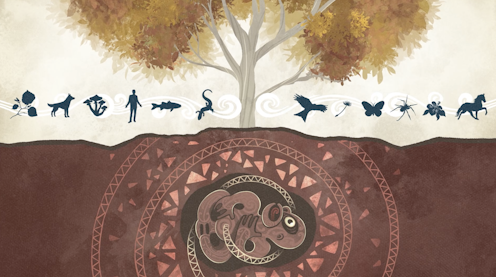
Illustration by Isobel Joy Te Aho-White Author provided

Mai i te ētita: Nā Piripi Walker i whakamāori tēnei tuhinga mō Te Wiki o te Reo Māori. Pāwhiria ki konei hei pānui i tēnei tuhinga ki roto i te reo Pākeha.

Ki te hīkoi koe ki roto i tētahi rūma poari, kura pakihi rānei, ka rongo koe i ētahi ingoa, hoki atu, hoki atu, e whakatairangatia ana: Ko Apple tērā, Tesla tērā, ko Google tērā, arā atu, arā atu. Kei hea ngā ingoa nunui, me ngā kōrero whakaharikoa mai i te ao Māori? Kāore i te rahi rawa.

He mea pōuri. Arā te tini o ngā kamupene Māori hei akoranga mō tātou i roto i ā tātou mahi whakahaere, whakapakari hinonga, kia toitū te āhua, kia nui ngā hua mō te motu katoa — he whāinga ēnei kāore i tutuki i te huhua o ngā kamupene o te ao arumoni.

He tini ngā māramatanga mō te whakahaere auaha, whakahaere toitū kua tuia ki roto i ngā tātai kōrero o te ao Māori — mai i a Kupe me te toronga mai o tana tira i te kitenga tuatahi o Aotearoa e 800 tau ki mua, tae atu ki ētahi mahi o ēnei ngahuru tau tata hei whakaora i te reo, te whawhai mō te whenua me te tiaki wāhi tapu.

Me kī, e toru pea ngā mātāpono whakahaere hei whakakapi i ēnei māramatanga. E mea ana mātou ka noho ēnei hei kaupapa e ara pūputu anō i roto i ngā kōrero pakihi whakaharikoa ā ngā rā e tū mai nei.

Me hāpai tautuhitanga whānui kē atu o tēnei mea te ekenga taumata pakihi

Tētahi āhuatanga e kitea nuitia ana i roto i ngā whakahaere Māori, ka tere kitea hoki i roto i ā rātou mahere rautaki, ko te aro nui ki te whai i ngā painga huhua, kaua ko ngā painga ahumoni anake.

I ēnei rā hoki, e kī ana ngā kamupene nui whakaharahara, ko te toitū me ētahi whāinga ehara i te ahumoni tētahi uara nui ki a rātou. Ahakoa ēnā whakapuakanga a ngā kamupene nei, e ai ki te titiro a te nuinga o te tangata, kāore anō ngā whāinga taketake o aua kamupene kia huri ki āhua kē — e noho tonu ana ko te whai kia hua ake he hua moni mā te hunga pupuru pānga, te whāinga nui.

Kāore e pēnei mō te tino nuinga o ngā hinonga Māori, ki a rātou ko ngā pānga ā-hapori, ā-taiao, ā-ahurea kei te pū tonu o ā rātou mahi. He āhuatanga tēnei e mōhiotia ana i te ao Māori, nā te mea, ka noho ēnei uara i waenga pū o te ahurea.

Ka kitea te whakaaro nui ki te hapori, ki te taiao hoki i te ao Māori katoa, mai i ngā pakiwaitara o tua whakarere, ki ngā karakia ka tākina i mua i ngā āhuatanga nunui.

He mea taketake hoki ngā whakaaro whakapūmau i te hapori, i te taiao i roto i ngā tikanga, te pūnaha o ngā uara me ngā mahi ka noho hei wāhi mō tō tātou āhua noho.

Ehara i te mea ka wareware ngā umanga Māori ki ngā āhuatanga o te nuinga o te ao mō te ine i te ekenga taumata. Me kī, ko te ōhanga Māori te wāhanga hohoro rawa ki te tupu o te ōhanga katoa o Aotearoa, ina tirohia te taha ahumoni anake.

Otiia, ko tā te nuinga o ngā kamupene o te ao he aru i te huamoni, ko tā ngā kamupene Māori (me kī, ngā umanga iwi taketake huri noa i te ao), he ara, he pou tēnei mea te mahi moni hei whakapūmau i ētahi atu ekenga taumata tiketike kē atu: te oranga o te iwi, te whāinga reo i waenga i ngā iwi o te whenua o te ao, me te toitū o te taiao.

Te titiro whakamua ki ngā whakatupuranga kāore anō kia whānau mai

Tētahi, ko te mahi a te whakahaere Māori he titiro whakamua ki tua atu i ngā pae tūtata, i mua anō i tāna whakatau take nunui.

I ngā kaporeihana e mōhio nuitia ana, ka aro nui ngā kaiwhakahaere ki ngā putanga hua hauwhā tau, ki ngā hua ā-tau rānei. Ko tā ngā whakahaere Māori he āta whiriwhiri kaupapa mō ngā hua ka puta mā ngā whakatupuranga kei mua i te aroaro, hei ngā ngahuru tau, ngā rau tau hoki kei mua.

Hei tauira, i te tau 1975, i hangaia tahitia e Ngāti Raukawa, e Ngāti Toa me Te Atiawa tāna mahere 25 tau te roa, e mōhiotia nei ko Whakatupuranga Rua Mano. Tētahi o ngā hua o tēnei rautaki ko Te Wānanga o Raukawa, he wānanga tēnei mō ngā akoranga aro ki te ao Māori, kātahi anō he wānanga pēnei ka whakatūria i te ao hou.

I ēnei tau tata, kua tīmata te mahi a te Kaporeihana o Wakatū i tāna mahere rautaki neke atu i te 50 te whāroa. E mea ana a Rachel Taulelei, tumuaki o te kamupene kai, inu hoki a Wakatū e mōhiotia nei ko Kono, e mahi ana te kamupene i raro anō i āna tirohanga 500 tau i roto i ana mahi whakamahere.

Ko tētahi take nui i pēnei ai te roa o te toronga whakaaro o ngā whakahaere Māori ko te whakapapa. Kei runga noa atu te whakapapa i ngā kāwei whakaheke noa iho o te tangata, i te ao Māori. He uara, he āhuatanga noho, ehara au i te tangata takitahi, engari he hononga, he uri nā ōku tūpuna, heke mai ki ahau, ā, heke atu ana ki ngā whakatupuranga o āpōpō.

Ngā hononga ki te hapori

Hei kupu whakamutunga, whakatairanga ai tēnei mea te umanga Māori i tōna hapori hei pūtahi mō ngā whakaaro o ngā whakahaere. Ka whakaatatia tēnei i roto i te āhua o tā rātou waihanga, whakahaere hoki i ā rātou mahi hautū.

Hei tauira, he mea tohu ngā mema poari o ngā kāporeihana nunui (te hunga kawe haepapa mō te ahunga o te ihu o te waka o te hinonga) e ētahi mema o nāianei, nā tō rātou matatau ki ao pakihi. Hei ngā whakahaere Māori, he mea pōti kē ngā poari i runga anō i te pōti o ngā mema katoa o tō rātou hapori.

Nā konei, he matahuhua ngā poari o ngā whakahaere Māori, te matatau, ngā whakaaro, huri noa i te tēpu.

Ko te mea nui pea, ka rangona ngā reo me ngā whakaaro o te hapori i ngā whakatau hira a te hinonga, nā te pōtitanga o ngā mema poari e te hapori.

Hei tauira anō, ko tētahi o ngā whakahaere Māori e mōhiotia ana e mātou kua kawea kētia āna mahi taketake kia hora whare pāpori, nā te kore whare tōtika mō te tini o te tangata o te hapori.

He mea ātaahua te huringa o ngā whakaaro o Aotearoa i ēnei tau tata ki tōna taha Māori. Ahakoa he maha ngā mahi kāore anō kia tutuki, kua huri ngā whakaaro, kua huri hoki ngā ngākau o ngā tāngata o Aotearoa mō te painga o te ako i te reo me te whakamiha atu ki ngā toi Māori.

He akoranga nui ngā whakaaro Māori mō te pakihi, mō te whakahaere, mā tātou. Mā ōna ara whakatika i te korenga e ōrite o te whiwhinga, me te panonitanga āhuarangi, ka āwhina te ao Māori i a tātou katoa kia piki anō te pai o ō tātou umanga.

The Conversation

The authors do not work for, consult, own shares in or receive funding from any company or organisation that would benefit from this article, and have disclosed no relevant affiliations beyond their academic appointment.

ref. Ngā āhuatanga ka akona mai ki a tātou e te ao Māori, mō te ao pakihi o āpōpō – https://theconversation.com/nga-ahuatanga-ka-akona-mai-ki-a-tatou-e-te-ao-maori-mo-te-ao-pakihi-o-apopo-167635
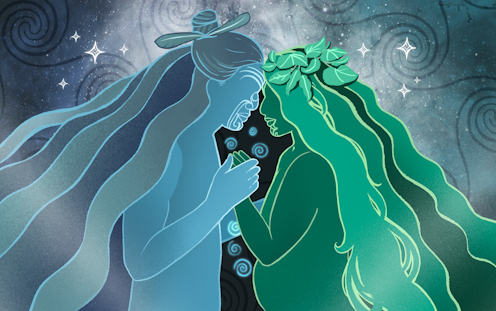
Putting the community back into business: what te ao Māori can teach us about sustainable management

Source: The Conversation (Au and NZ) – By Ben Walker, Lecturer (Management), Te Herenga Waka — Victoria University of Wellington

Illustration by Isobel Joy Te Aho-White Author provided

Editor’s note: This article has been translated by Piripi Walker for Te Wiki o te Reo Māori/Māori Language Week. Click here to read it in te reo Māori.

Walk into any boardroom or business school and you’ll often hear the same companies held up as models of excellence: Apple, Tesla, Google and so on. Sharing success stories from te ao Māori (the Māori world)? Not so much.

And that’s a shame. There are many of them, and they can teach us how to manage and grow organisations in sustainable ways that benefit the wider community — goals that often elude large Western businesses.

Insights into innovative and sustainable management are woven through the history of te ao Māori — from Kupe and his crew’s discovery of Aotearoa some 800 years ago to more recent efforts to revitalise te reo, reclaim land and protect wāhi tapu (sacred sites).

Broadly, we can bundle these insights into three management principles. We argue these will be recurring themes in future business success stories.

Embracing wider definitions of success

A common feature of Māori organisations, and one that’s often explicit in their strategic planning, is their focus on judging success against many criteria, not only financial ones.

Nowadays, of course, even the biggest businesses claim to value sustainability and other non-financial outcomes. But it’s usually accepted that the ultimate goal of such businesses has stayed the same — to turn a profit for shareholders.

This is rarely the case for Māori organisations, which almost always put community, environmental and cultural impacts at the centre of what they do. Such an approach comes naturally to those in te ao Māori, as these values are also central to the culture.

Community and ecological concerns are everywhere in te ao Māori, from the ancient pakiwaitara (legends) about how our world came to be, to the karakia (prayers) said before significant events.

Sustaining community and environment is also central to tikanga, the system of values and practices that inform our way of living.

None of this is to say that Māori businesses don’t care about conventional measures of success. In fact, the Māori economy may be the fastest growing part of the New Zealand economy in purely financial terms.

But whereas conventional companies prioritise profit, for Māori (and indeed Indigenous businesses around the world), making money is usually seen as a stepping stone to more valued destinations: community well-being, a political voice and environmental sustainability.

Taking the long view

Māori organisations also tend to take a long-term perspective when making important decisions.

In a typical corporation, managers are hyper-focused on quarterly or annual results. But it’s not uncommon for Māori organisations to approach things from a multi-generational standpoint, where success is measured over decades and sometimes even centuries.

In 1975, for example, the iwi of Ngāti Raukawa, Ngāti Toa and Te Atiawa jointly created a 25-year strategic plan known as Whakatupuranga Rua Mano (Generation 2000). One of the fruits of this strategy was Te Wānanga o Raukawa, an institute for Māori-focused tertiary education, a first of its kind.

More recently, Wakatū Incorporation has started work on a strategic plan spanning more than 50 years. And Rachel Taulelei, CEO of Wakatū-owned food and beverage company Kono, has been emphatic that the company is working to an ambitious 500-year horizon in its planning.

A major reason Māori organisations think in such long time frames is whakapapa. In te ao Māori, whakapapa is more than just one’s line of descent. It is a value, a way of being that encourages people to think and act not as individuals, but as links in the chain between past ancestors and future generations.

Connections with community

Finally, Māori businesses place their communities at the centre of management thinking. This is often reflected in how they create and maintain their leadership.

In large corporations, for example, board members (those responsible for the overall direction of the organisation) are typically appointed by existing members on the basis of their business acumen. In Māori organisations, however, boards are often democratically elected by the community they serve.

Because of this, Māori organisation boards tend to be diverse in the expertise and viewpoints they bring to the table.

Most importantly, though, the election of board members means community views are represented in an organisation’s most important decisions.

For example, one Māori organisation we know of has been considering a radical departure from its core business into providing social housing because so many in the community are struggling to find affordable places to live.

There has been a welcome shift in Aotearoa’s relationship with its taha Māori (Māori side) in recent years. While there’s still much ground to make up, New Zealanders increasingly see value in learning te reo and recognising Māori artforms.

Māori approaches to business and management can be equally enlightening. By giving us a glimpse of how to tackle troubling issues like inequality and climate change, te ao Māori can help us all build better businesses for the future.

The Conversation

The authors do not work for, consult, own shares in or receive funding from any company or organisation that would benefit from this article, and have disclosed no relevant affiliations beyond their academic appointment.

ref. Putting the community back into business: what te ao Māori can teach us about sustainable management – https://theconversation.com/putting-the-community-back-into-business-what-te-ao-maori-can-teach-us-about-sustainable-management-166501

Can an app change Australia’s car culture? Only if all moving parts work together

Source: The Conversation (Au and NZ) – By Sophia Duan, Lecturer in Information Systems, RMIT University

Shutterstock

Getting around an Australian city without a car can be a real hassle. Imagine how much easier it would be if you had the option of combining public transport and shared services — be it bus, train, tram, taxi, car share, electric bicycle or e-scooter — and could book and pay for the lot using a single app.

In Finland, this is already an option. The digital platform Whim enables you to book and pay for a trip mixing public transport, ferry service, car rental, taxi, shared bike and even e-scooter.

You simply have to enter your destination in the app, and Whim recommends the best options. You can pay on a subscription or pay-as-you-go basis. It’s convenient, flexible and better value than booking each leg separately.

The concept and technology behind Whim is known as Mobility as a Service — or MaaS. The aim is to promote more sustainable modes of travel and make individual car ownership unnecessary for urban mobility.

Whim has now expanded to the Netherlands, Belgium, Austria and Switzerland. Could such service work in Australia?

MaaS in Australian cities must obviously contend with both supply and demand challenges. On the supply side, challenges include lower population densities with less comprehensive alternatives to private vehicle use. Emulating the success of Whim would also need something like Finlnad’s national transport law, which requires mobility services to make their data and APIs open to third parties.

On the demand side, Australians have a high rate of car ownership, with fixed costs creating incentives to use those vehicles, rather than alternatives.

Could a MaaS service tempt more Australian to leave the car at home? Our research suggests some room for optimism, with 44% of 331 adults we surveyed saying they would use a MaaS regularly if it was available. But translating that enthusiasm into actual behavioural change will require getting many moving parts to mesh.


Read more:
All your transport options in one place: why mobility as a service needs a proper platform


What our survey found

We conducted our survey at the end of 2020. Our survey sample was broadly representative of Australian society. There were more women (59%) and people with degrees (40%, compared with 35% of all Australians aged 20-64). About 13% had an annual income of more than $100,000. About 84% owned a car (roughly in line with the rate of car ownership suggested by statistics).

Attitudes towards the MaaS concept were generally very favourable. Of the 144 of 331 participants who said they would use MaaS on a regular basis if it was available, 75% said they would use for social trips, 72% for commuting to work and study, and 66% for general trips (shopping, errands, visiting the doctor etc).

At the last census of Australian’s travel modes (in 2016), 69% drove to work, with another 5% being car passengers, 4% walking and 5% working from home. This means 17% used other modes. In our survey 31% indicated they were open to using MaaS for commuting.

Of course, there is almost always a difference between good intentions and actual behaviour. The phenomenon of response bias in surveys, with the desire to appear pro-social influencing respondents’ answers, is well documented.

Nonetheless our results do suggest MaaS could make a difference in shifting travel habits, not to mention making urban travel much easier for those without cars.

MaaS in Australia

Our research underlines the importance of a MaaS service being intuitive, easy to use, reliable, efficient and economical.

This last point has also been shown by the results of the one MaaS trial so far done in Australia.

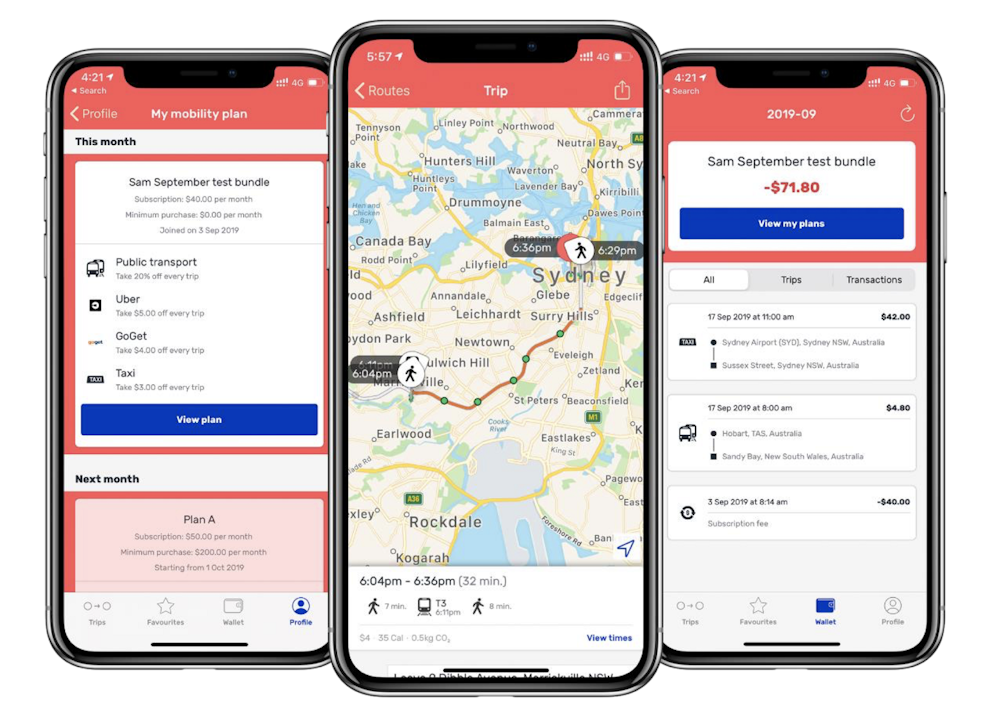
The Sydney Maas trial,ran from November 2019 to March 2021 involved 100 employees of insurance company IAG using an app (called Tripi) supplied by MaaS software developer Skedgo.

SkedGo's Tripi app, used for the Sydney Maas trial.
SkedGo’s Tripi app, used in the Sydney Maas trial.
SkedGo

The trial tested, among other things, users’ willingness to pay, either by subscription or pay as you go, for transport bundles combining public transport, taxi, ride share, car share and car rental.


Read more:
We subscribe to movies and music, why not transport?


The research was run by the Institute of Transport and Logistics Studies at the University of Sydney. The final report was published in March 2021. The key outcomes were that MaaS had appeal to car owners and frequent car users, but those most keen were already multi-modal travellers.

Notably the researchers reported:

Without a (monetary) incentive, travellers appear to see very little value in MaaS in the presence of existing apps that are improving all the time (such as Opal Connect, Apple Pay, Google Pay, and improved technical platforms that facilitate payment in addition to searching and planning) and hence one may not get enough buy-in to make a currently niche product scalable.

And also:

While a MaaS app (and hence technical actors) is important, it is only one of the many factors that we need to structure a successful MaaS program/product offer.


Read more:
For Mobility as a Service (MaaS) to solve our transport woes, some things need to change


So while our survey results show enthusiasm about MaaS, we must be cautious about about its current viability to work at scale. More understanding is needed about the design of MaaS, the sustainability of commercial models, the scalability of trials and users’ reactions and behavioural insights.

The Conversation

Dr Sophia Duan is affiliated with the Department of Information Systems and Business Analytics, RMIT University. She is a member of the Australian Computer Society, the Association for Information Systems, and the Institute of Analytics Professionals of Australia.

Professor Alemayehu Molla is affiliated with the Department of Information Systems and Business Analytics, RMIT University. He is a Member of the Australian Computer Society and the Association for Information Systems

Professor Hepu Deng is affiliated with the Department of Information Systems and Business Analytics, RMIT University. He is a Member of the Australian Computer Society.

Richard Tay is affiliated with the Department of Logistics and Supply Chain at RMIT University. He is Fellow and Life Member of the Institute of Transportation Engineer, a Fellow of the Chartered Institue of Logistics and Transport and a Senior Fellow of the Economic Society of Australia.

ref. Can an app change Australia’s car culture? Only if all moving parts work together – https://theconversation.com/can-an-app-change-australias-car-culture-only-if-all-moving-parts-work-together-167450

Why pushing for an economic ‘alliance’ with the US to counter Chinese coercion would be a mistake

Source: The Conversation (Au and NZ) – By James Laurenceson, Director and Professor, Australia-China Relations Institute (ACRI), University of Technology Sydney

Leah Millis/AP

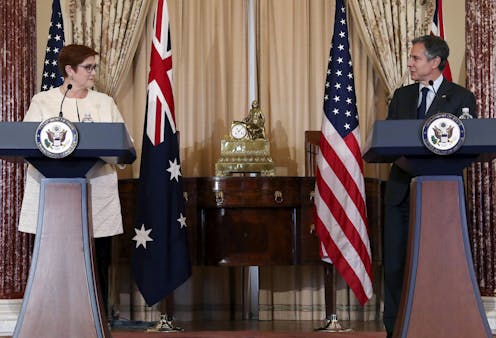
The Australian government desperately hopes this week’s AUSMIN meetings between Australian and US officials will see greater practical American support being delivered in the face of ongoing trade strikes by China.

Reports confirm that measures to combat Chinese economic coercion will be discussed at the meetings between Foreign Minister Marise Payne, Defence Minister Peter Dutton and their American counterparts.

This desire is readily understood: China’s US$14.7 trillion (A$20 trillion) economy towers over Australia’s at $US1.3 trillion (A$1.7 trillion). And since May 2020, China has blocked or disrupted around a dozen Australian exports, including beef, wine, barley and coal. Previously, sales of these goods to China had been worth more than A$20 billion per year.

Yet, there is good reason to question whether repurposing the ANZUS security alliance to tackle economic issues — and working ever more closely with Washington on initiatives aimed at Beijing — represents a coherent strategy for Canberra to get what it wants.

In 2017, the leading Australian foreign policy practitioner, Allan Gyngell, wrote that the animating force behind Australia’s foreign policy has long been a “fear of abandonment” by a “great and powerful friend” – first the United Kingdom, and since the ANZUS treaty was signed in 1951, the US.

The US has consistently signalled its support for Australia in its trade dispute with China — at least, rhetorically.

Late last year, Jake Sullivan, the new national security adviser in the Biden administration, declared the US stood “shoulder to shoulder” with Australia.

Then, in March, Kurt Campbell, President Joe Biden’s “Indo-Pacific czar”, assured Australian media the US was “not going to leave Australia alone on the field”. This message was repeated in May by Secretary of State Antony Blinken.

Yet, when Trade Minister Dan Tehan went to Washington in July, he received a more tepid message regarding Australia’s stoush with China.

Katherine Tai, the US trade representative, was only prepared to say the US is “closely monitoring the trade situation between Australia and China” and she “welcomed continuing senior-level discussion”.

The US is not always a reliable partner

What has been particularly jarring isn’t just that the Biden administration has stopped at rhetoric, without offering any material support to Canberra. Rather, it has persisted with choices that actively hurt Australia.

One example is a continuation of the tariffs the Trump administration unilaterally imposed on Chinese imports, which were subsequently assessed by the World Trade Organisation as being inconsistent with international rules.

The US then appealed the decision, which effectively ended China’s legal challenge to the WTO. This was because the Obama, Trump and Biden administrations have blocked the appointment of new judges to the WTO’s appeals body as the terms of serving judges expired.

As a result, the body was left completely paralysed in November 2020. Last month, the US rejected a proposal from 121 other WTO members to have it restored.

Lacking the sheer power of the US or China, Australia relies on global adherence to WTO rules to protect its trade interests. But the US actions mean the rules can no longer be enforced.


Read more:
Dan Tehan’s daunting new role: restoring trade with China in a hostile political environment


Another example is Tai’s insistence in February that China “needs to deliver” on the bilateral trade deal that Washington pressured Beijing into signing in January 2020.

This granted American producers favourable access to the Chinese market compared with their Australian competitors. It also served as another demonstration to China that big countries are able to use their power to coerce others.

Australia still likely to double down on US support

That US support for Australia hasn’t gone beyond rhetoric is in a sense not surprising. To do so would involve a political or economic cost to the US. The bilateral trade deal it struck with China, for example, benefits American producers.

But as Gyngell’s analysis suggests, tepid US support to date is more likely to prompt Australia to double down on its efforts to seek more US help.

Addressing the Australian American Leadership Dialogue in August, Prime Minister Scott Morrison said that in view of China’s economic coercion, he believed “bilateral strategic cooperation must extend to economic matters”.

He proposed a “regular strategic economic dialogue” — an extension of AUSMIN talks that cover defence and foreign affairs – between key senior US and Australian economic and trade officials.

The American response to the proposal was reportedly “non-committal”.

Nonetheless, a new report commissioned by the United States Studies Centre at the University of Sydney backed Morrison’s call and advocated an alliance response to China’s trade strikes on Australia.

Reasons to be concerned about an economic ‘alliance’

There’s nothing wrong with an economic dialogue with Washington. But there’s two important considerations for Canberra to reflect on.

First, the pain that Beijing has been able to inflict on the Australian economy by disrupting exports has been limited.

A new analysis by the Australia-China Relations Institute looked at 12 goods that were disrupted by China’s economic coercive actions — everything from barley to rock lobster. And it found that for nine of those 12 goods, the cost incurred by Australian exporters has been less than 10% of the total export value.

The analysis also found that in the first half of 2021, the value of Australia’s overall goods exports to China was actually 37% higher than the previous record set in 2019.

What this means is that China’s trade strikes are nowhere close to being an existential crisis. The Australian economy can weather the storm, with or without US support.

Second, what Australia wants most is for China to follow global trade rules and for these rules to be updated and extended to cover more activities, like government subsidies for agriculture and fisheries.

But the ANZUS alliance is ill-equipped to deliver on this. It has no legitimacy in setting or enforcing global trade rules. And the US has a poor record of following the existing WTO rules itself.

Further complicating matters, the US has designated China as a “strategic competitor” since 2017.


Read more:
Trump took a sledgehammer to US-China relations. This won’t be an easy fix, even if Biden wins


But as Peter Varghese, Australia’s former chief diplomat noted in June,

that does not automatically make it the strategic competitor of Australia.

The more the idea of an “economic alliance” with the US on par with its security alliance is embraced, the greater the danger of Australia getting bogged down with the US in a “forever war” against its largest trading partner — in this case, spilling treasure rather than blood.

Alternatively, the US might cut another bilateral trade deal with China, leaving Australia on the sidelines again.

If the Australian foreign and defence ministers emerge from this week’s AUSMIN meetings empty-handed on the economic front, the public might, in time, consider itself lucky.

The Conversation

James Laurenceson does not work for, consult, own shares in or receive funding from any company or organisation that would benefit from this article, and has disclosed no relevant affiliations beyond their academic appointment.

ref. Why pushing for an economic ‘alliance’ with the US to counter Chinese coercion would be a mistake – https://theconversation.com/why-pushing-for-an-economic-alliance-with-the-us-to-counter-chinese-coercion-would-be-a-mistake-167629

NSW and Victoria admit they won’t get back to COVID-zero. What does this mean for a ‘fractured’ Australia?

Source: The Conversation (Au and NZ) – By Amalie Dyda, Senior Lecturer, The University of Queensland

Australia’s two most populous states have now conceded they are unlikely to return to COVID-zero.

The highly infectious Delta variant has spread significantly in both states, making contact tracing and containment more difficult.

This may be welcome news for those in Sydney who have been under stay-at-home orders since June, and those in Melbourne who have lived through more than 220 days of lockdown over the past 18 months. It means these states will leave strict lockdowns eventually without having to wait for case numbers to decrease to zero.

But with other jurisdictions across the country continuing to pursue COVID-zero, what does this mean for Australia?


Read more:
Explainer: do the states have to obey the COVID national plan?


States and territories divided

The future is likely, at least in the short term, to look similar to the current situation with different rules for different states and territories.

Those states pursuing COVID-zero may have greater freedoms, almost resembling pre-COVID life, with generally low levels of restrictions such as mandatory venue check-ins. Though strict lockdowns would be likely when cases do appear.

States like New South Wales and Victoria will require ongoing low level restrictions, such as masks and capacity limits — even with vaccination rates of 70%–80% of over 16s.

Moderate or strict lockdowns would likely still need to occur in response to rising case numbers and local outbreaks.

The importance of ongoing low-level restrictions has been shown consistently by Australian modelling and is highlighted by the current rise in case numbers in the highly vaccinated population of Israel.


Read more:
COVID cases are rising in highly vaccinated Israel. But it doesn’t mean Australia should give up and ‘live with’ the virus


How will this impact travel?

Likely the biggest impact of divided COVID-zero policies across states and territories will be interstate travel, with different rules between jurisdictions depending on their COVID-zero status.

Restrictions imposed to date would suggest travel between COVID-zero states and territories, who haven’t had any recent COVID cases reported, would be allowed.

There’s also the possibility of interstate travel occurring between jurisdictions with ongoing community transmission.

Will other states give up on COVID-zero?

As the virus continues to spread, other jurisdictions across Australia may also stop trying to reach COVID-zero.

NSW and Victoria having high levels of ongoing community transmission makes other states and territories more vulnerable to imported COVID infection.

For example, we’ve already seen cases from truck drivers reported in Queensland and South Australia.

However, tight border control and strict lockdowns when required do appear to be working in some jurisdictions, for example Western Australia.


Read more:
What is life going to look like once we hit 70% vaccination?


How will vaccination impact this?

Modelling by the Doherty Institute and the Grattan Institute suggests easing restrictions at 80% vaccination coverage is manageable.

As vaccination rates increase, the need for lockdowns and strict restrictions decreases.

In terms of vaccination, New South Wales is currently leading the way with 76.4% of over 16s vaccinated with at least one dose, and 43.6% fully vaccinated.

Other states’ vaccination rates are also rising, albeit more slowly. Approximately 36% of over 16s in Western Australia and Queensland are fully vaccinated.

If the current rate of rollout continues, it’s anticipated 70% of over 16s in Australia could be vaccinated by early November, with 80% coverage reached later in the same month.

Graphic showing days until Australian vaccination targets reached
Australia could reach its 70% vaccination target at the start of November, and 80% not long after.
COVID Live, CC BY

With vaccination rates increasing rapidly and restrictions easing despite high case numbers, NSW and Victoria may provide test cases for the other Australian states and territories in terms of a roadmap to living with COVID.

While modelling provides a tool to guide decision makers about what to expect, these calculations are based on a number of assumptions. Predicted outcomes differ depending on key factors such as the ability of the public health workforce to maintain optimal contact tracing.

The real world experience of decreasing restrictions with COVID transmission in the community will provide important information for those that follow.


Read more:
Opening with 70% of adults vaccinated, the Doherty report predicts 1.5K deaths in 6 months. We need a revised plan


It’s important to remember, while the country is slightly fractured in its current response, we are all in this together. As vaccination rates continue to rise in the coming months, states and territories will likely return to a more level playing field.

In good news, it does seem we will have more freedom in the coming months as vaccination rates continue to rise.

But this will be an evolving situation that requires constant monitoring and changes in response to the local spread of disease, with all states and territories likely to require low level restrictions for some time.

With the easing of restrictions, it’s important we all listen to and follow public health directions and get vaccinated as soon as we can to try to maintain manageable case numbers and workload for our public health workforce.

The Conversation

Amalie Dyda does not work for, consult, own shares in or receive funding from any company or organisation that would benefit from this article, and has disclosed no relevant affiliations beyond their academic appointment.

ref. NSW and Victoria admit they won’t get back to COVID-zero. What does this mean for a ‘fractured’ Australia? – https://theconversation.com/nsw-and-victoria-admit-they-wont-get-back-to-covid-zero-what-does-this-mean-for-a-fractured-australia-167526

Research reveals why pet owners keep their cats indoors – and it’s not to protect wildlife

Source: The Conversation (Au and NZ) – By Lily van Eeden, Postdoctoral research fellow, Monash University

Shutterstock

Cat owners are urged to keep their pet indoors for a variety of reasons, including protecting wildlife and preventing the spread of disease. But our research has found an entirely different motivator for containing cats.

Concern for their cat’s safety is the primary reason people keep cats inside. And people who allow cats to roam are also motivated by concern for the animal’s well-being.

Keeping domestic cats properly contained is crucial to protecting wildlife. Cats are natural predators – even if they’re well fed. Research last year found each roaming pet cat kills 186 reptiles, birds and mammals per year.

If we want more domestic cats kept indoors, it’s important to understand what motivates cat owners. Our research suggests messages about protecting wildlife are, on their own, unlikely to change cat owners’ behaviour.

cat watches bird through window
Cats are natural predators, and can kill many animals each year if left to roam.
Shutterstock

Why keep your cat indoors?

Cat containment involves confining the animals to their owners’ premises at all times.

In the Australian Capital Territory, cat containment is mandatory in several areas. From July next year, all new cats must be contained across the territory, unless on a leash.

In Victoria, about half of local councils have some form of cat containment legislation. Current revisions to Domestic Animal Management Plans could mean the practice becomes more widespread.


Read more:
One cat, one year, 110 native animals: lock up your pet, it’s a killing machine


Cats have long been part of human societies and play an important social role in their owners’ lives. But our affection for the animals means efforts to keep cats contained can be met with opposition.

Officials, conservation groups and others put forward a range of reasons for containing cats, including:

  • preventing cats from spreading diseases and parasites such as toxoplasmosis to both people and wildlife

  • reducing threats to wildlife, especially at night

  • reducing unwanted cat pregnancies

  • avoiding disputes with neighbours, including noise complaints, and cats defecating or spraying in garden beds and children’s sandpits

  • protecting cats from injury or death – such as being hit by a vehicle, attacked by dogs, snake bite and exposure to diseases and parasites.

So which argument is most persuasive? Our research suggests it’s the latter.

The Safe Cats Safe Wildlife campaign focuses on keeping cats safe.
Zoos Victoria.

What we found

We surveyed 1,024 people in Victoria – 220 of whom were cat owners.

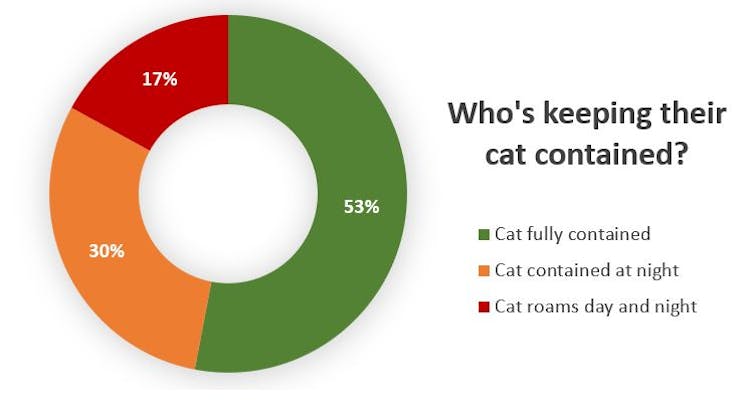
We found 53% of cat owners did not allow roaming. These people were more likely to hold concerns about risks to cats’ safety than cat owners who allowed roaming. They were also less likely to believe cats have a right to roam.

Some 17% of cat owners allowed their cats unrestricted access to the outdoors day and night, while 30% contained their cats at night but allowed some unrestricted outdoor access during the day.

Both cat owners and other respondents generally believed cat owners should manage their pet’s roaming behaviour. But for cat owners, concern about harm to wildlife was not a significant predictor of containment behaviour.

Instead, people who keep their cats contained were more likely to be worried that their cat might be lost, stolen, injured or killed.

It’s not that cat owners don’t care about native animals – only about one in ten cat owners said they’d never seriously considered how their cat affects wildlife. But our survey results show this isn’t a big motivation for keeping cats indoors.

What Victorian cat owners are doing, based on our survey findings.
Author provided.

Roaming is dangerous

A roaming lifestyle can be risky to cats. A 2019 study of more than 5,300 Australian cat owners found 66% had lost a cat to a roaming incident such as a car accident or dog attack, or the cat simply going missing.

Despite the risks, people who let their cats roam are more likely to think the practice is better for the animal’s well-being – for example, that hunting is normal cat behaviour.

Owners who let their cat roam were more likely than those who contained their cat to believe their cat did not often hunt. While not all cats kill wildlife, those that do typically only bring home a small proportion of their catch. That means owners can be unaware of their cats’ impact.


Read more:
Street life ain’t easy for a stray cat, with most dying before they turn 1. So what’s the best way to deal with them?


Cat owners must be made aware of the risks of roaming and equipped with the tools to keep their cats happy and safe at home. Unfortunately, research shows many Australian cat owners are not providing the safe environment and stimulation their cat needs when contained.

Cat containment doesn’t have to mean keeping the animal permanently in the house – nor does it require building them a Taj Mahal on the patio.

Cats can be outside while supervised or walked on leash. You can also cat-proof your backyard fence to keep them in.

Resources such as Safe Cat Safe Wildlife help owners meet their cat’s mental, physical and social needs while keeping them contained.

Moonee Valley City Council partners with the Safe Cats Safe Wildlife campaign to promote responsible cat ownership.

Changing containment behaviour

Our study shows cat containment campaigns can be more effective if messaging appeals to owners’ concern for their cats’ well-being. These messages could be delivered by trusted people such as vets.

Helping owners understand that cats’ needs can be met in containment, and giving them the tools to achieve this, may be the best way to protect wildlife.

Demonising cats is not the answer. The focus must shift to the benefits of containment for cats’ well-being if we hope to achieve a cat-safe and wildlife-safe future.


Read more:
I’ve always wondered: can I flush cat poo down the toilet?


The Conversation

Lily van Eeden works for the Arthur Rylah Institute for Environmental Research and is affiliated with ICON Science (RMIT University) and BehaviourWorks Australia (Monash University).

Emily McLeod works for Zoos Victoria, a not-for-profit zoo-based conservation organisation.

Fern Hames and Zoe Squires do not work for, consult, own shares in or receive funding from any company or organisation that would benefit from this article, and have disclosed no relevant affiliations beyond their academic appointment.

ref. Research reveals why pet owners keep their cats indoors – and it’s not to protect wildlife – https://theconversation.com/research-reveals-why-pet-owners-keep-their-cats-indoors-and-its-not-to-protect-wildlife-166263

New analysis shows Morrison government funding won’t cover any extra uni student places for years

Source: The Conversation (Au and NZ) – By Mark Warburton, Honorary Senior Fellow, Centre for the Study of Higher Education, The University of Melbourne

Shutterstock

The federal government’s promise to deliver more student places through its Job-ready Graduates Package was hollow rhetoric, as research released today demonstrates.

From university funding agreements, we now know the maximum subsidy payable to each university from 2021 to 2023.

My research shows the total amount made available isn’t enough to provide subsidies for any extra student places, let alone the extra 30,000 this year announced by Treasurer Josh Frydenberg in his budget speech in May.

Federal Treasurer Josh Frydenberg delivers the budget in May.

One year ago, the government legislated major changes to higher education funding, marketed as Job-ready Graduates. In selling these changes, the then education minister, Dan Tehan, said:

“[…] our government wants more Australians to have the opportunity to benefit from a university education. Because of the surge in demand caused by the COVID-19 recession we need those additional places from next year. Doing nothing for one or two years will not help the year 12s of 2020 and the Australians looking to retrain in 2021. Deferring our economic recovery helps no one and risks scarring a generation.”

The changes meant that, on average, student contributions should increase while government subsidies for student places decrease. An increase in student places was one of the major reasons given for accepting these changes. If we could rely on the government rhetoric about its policy, then every year this decade we should have seen more working-age Australians able to enrol in higher education than ever before.


Read more:
The 2021-22 budget has added salt to universities’ COVID wounds


What did the government promise?

The Job-ready Graduates promise was to increase the total subsidy for student places over time. This growth was in recognition of the extra demand that would arise in areas of high population growth and from the “Costello baby boom” generation reaching university age.

The government promised 27,000 extra domestic student places in 2021 and nearly 100,000 by 2030. In 2019, there were 627,545 Commonwealth-supported student places.

Table from government response to questions on notice about how many new Commonwealth-supported places there will be each year.
The government response to questions on notice about how many new Commonwealth-supported places there will be each year.
Commonwealth Parliament

The government doesn’t fund a set number of student places. Under the Job-ready Graduates arrangements, it sets the maximum subsidy it will pay to a university for student places. Each student place attracts a set subsidy, with the amount varying depending on its discipline.

Each university is free to decide the number and mix of student places it provides. But it is paid the subsidy for student places only up to the maximum amount set for it by the government. If it provides places beyond its subsidy cap, it receives only the student contribution. This would usually not be enough to cover costs.


Read more:
3 flaws in Job-Ready Graduates package will add to the turmoil in Australian higher education


I advised the Senate committee inquiry into the changes that it was a mystery how the government had produced its estimate of the number of student places to be created. We now know the maximum subsidy payable to each university from 2021 to 2023 from the publicly available funding agreements of universities. We also know how this maximum amount is proposed to increase each year to 2030.

Unis continue to be short-changed on subsidies

With Job-ready Graduates, the government appeared to radically change its attitude to funding student places from the previous three years. In 2018 and 2019, it froze funding. In 2020, subsidies increased by less than inflation. These decisions effectively reduced the number of government-subsidised student places.

By 2019, there were 27,800 places in the system from which the government was withholding over A$322 million in subsidies.

Universities were bearing that cost when COVID-19 hit in 2020. The government response to the pandemic, notably closing the borders to international students, continues to reduce the revenue universities receive.


Read more:
Universities lost 6% of their revenue in 2020 — and the next 2 years are looking worse


Hidden in the detail of the transition to Job-ready Graduates is another source of subsidy shortfall that will further limit universities’ ability to provide student places. “Grandfathered students” are students who started their courses before the changes took effect in 2021. They are protected from having to pay higher student contributions. To ensure funding for their places is not severely cut, the old, higher government subsidy rate continues for them.

In reality, university subsidy limits do not adequately allow for these grandfathered students. The shortfall is likely to be around $300 million over the time they take to complete their courses. Around $200 million relates to the period from 2023 to 2025.

Shortfall exceeds $1 billion by 2024

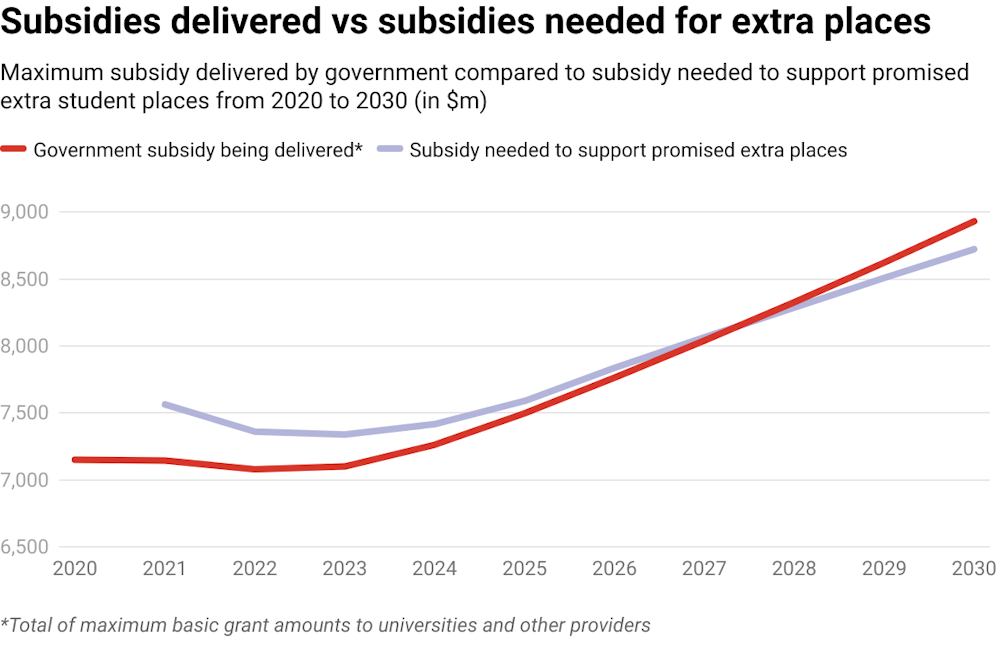
The total amount of government subsidy over the next decade is shown in the chart below.

Chart showing total amount of Commonwealth subsidies of student places compared to amount needed to support promised extra places

Data: M. Warburton, The rhetoric and reality of Job-ready Graduates (2021), Author provided

The amount made available in 2021 is not enough to provide subsidies for any additional student places. The combined effect of the changes since 2018 is that, in 2021, the government has underdelivered on its promised subsidy level by the equivalent of 39,000 student places – the 27,000 extra places promised under Job-ready Graduates and 12,000 places in the system since 2019 that remain unsubsidised.

While the shortfall reduces over time, by 2024 the government is still subsidising around 14,000 fewer student places than it promised. It would need to provide about $1.1 billion more in subsidy from 2021 to 2024 to honour the claims it made to the public and the parliament.

The government explicitly set student contributions to influence student choices. It was trying to encourage students into disciplines that it considered would make them job-ready. If students respond as desired, they will shift from disciplines with low subsidies into more highly subsidised disciplines.

If successful, however, this policy would increase the average cost of subsidy per place. And that would reduce the number of subsidised places that universities could provide within their maximum subsidy level.


Read more:
The government would save $1 billion a year with proposed university reforms — but that’s not what it’s telling us


If the government was serious about ensuring universities were able to support Australia’s economic recovery, it could have adopted a policy that was both more effective and simpler. As a first step, it could have provided the subsidies to support the student load already in the system in 2019. It could then have increased subsidy levels so that from 2021 to 2023 working-age Australians have the same opportunities to undertake higher education that they had from 2014 to 2017 before the funding freeze.

In the long term, the rate of growth in subsidies may restore these opportunities, but that time is two elections away. By then, reducing government debt may be the priority. If the government of the day decides to abandon the policy of increasing subsidies each year, it will not require any legislative change.


Read more:
Big-spending ‘recovery budget’ leaves universities out in the cold


The Conversation

Mark Warburton is an associate of PhillipsKPA and a member of the Australian Labor Party.

ref. New analysis shows Morrison government funding won’t cover any extra uni student places for years – https://theconversation.com/new-analysis-shows-morrison-government-funding-wont-cover-any-extra-uni-student-places-for-years-167542

Why can’t Australia make mRNA vaccines? Because we don’t make enough ‘deep technology’ companies

Source: The Conversation (Au and NZ) – By Julian Waters-Lynch, Lecturer Entrepreneurship, Innovation and Organisational Design, RMIT University

Pfizer/AP

Caught out by its strategy to bet on COVID-19 vaccines that could be made in Australia, the federal government is now scrambling oto manufacture mRNA vaccines locally.

Its “approach to market” strategy has effectively asked companies how much government money they need to do so. But even with subsidies, this plan will take years.

So why can’t Australia make the mRNA vaccines?

That’s not actually the right question to ask. The crucial issue is why Australia hasn’t been producing the type of companies that can make mRNA vaccines. Why don’t we produce more start-ups like BioNTech or Moderna – the two companies that developed and brought the mRNA vaccines to market?

Answering this question is important not just to vaccines but to the whole range of “deep technologies” that will shape economic development and sustainability in the 21st century.


Read more:
Australia may miss out on several COVID vaccines if it can’t make mRNA ones locally


What is deep technology

Technology is generally defined as the application of new knowledge for practical purposes. Deep technology is slightly different. It refers to the type of organisation required to bring certain types of technological innovation to fruition.

It is more accurate to talk about deep technology ventures. BioNTech and Moderna are two such examples. Both are relatively young companies — BioNTech was founded in Germany in 2008, Moderna in the US in 2010 — that have brought to market a technological solution underpinned by substantive advances in scientific research, engineering and design.

Deep-tech ventures span advanced materials, artificial intelligence, biotechnology, blockchains, robotics and quantum computing. A few are now household names, such as Tesla and SpaceX, but most fly under the radar of public awareness, as Moderna and BioNTech did before the pandemic.

They include synthetic biology companies such as the Ginkgo Bioworks and Zymergen, which can program organisms to create completely new biologically based materials for use in manufacturing. These “biofoundries” can produce everything from biodegradable plastics, new protein-based foods to probiotic microorganims that improve human health.

There are advanced engineering companies such as Carbon Engineering and Climeworks, working on ways to suck carbon dioxide from the air to use for industrial purposes.

There are experimental energy companies such as Commonwealth Fusion Systems and Helion, which are working on making the holy grail of clean energy technology, nuclear fusion, a reality.

Australia’s problem with deep tech

Australia’s problem with deep technology ventures isn’t to do with the quality of our science and research. We produce, per capita, nearly twice as many scientific research papers as the OECD average.

We also have some great support structures, such as the CSIRO, the national research and science agency, and Cicada Innovations, the deep-tech venture incubator in Sydney.

The problem is our inability to take our scientists’ knowledge and turn it into innovative ventures. Other countries are much more successful at this. Britain, Germany and France, for example, all publish fewer research papers than Australia per capita but produce far more patent applications — a key indicator of potential research commercialisation. The US produces nine times as many per capita.

The ‘valley of death’

Australia’s primary challenges here are related to the culture of innovation and entrepreneurship and our current mechanisms for long-term venture funding.

Deep-tech ventures usually require longer time horizons to translate new scientific insights into commercially successful products. Few universities are set up to see this process through. Public funding mechanisms prioritise basic research leading to publications, not the entrepreneurial processes required to find a market fit for a new product or solution.


Read more:
Want more research commercialisation? Then remove the barriers and give academics real incentives to do it


Nor are venture capital funds — the normal providers of seed funding — well placed to fund deep technology ventures. This is partly because the science itself can be difficult to understand. Also many funds prioritise ventures that can “exit” through an acquisition or public offering within 10 years.

The complex science and length of time needed to commercialise deep tech mean many good ideas die in the so-called “valley of death” — the gap between initial seed funding and sustainable revenue generated from product sales. This gap is filled in some countries by investments from sovereign wealth funds, more “mission” oriented government programs and even prizes. Australia has yet to emulate these solutions. CORRECT?

These issues help explain why Australia’s investment in R&D as a portion of GDP over the past decade has declined, from a peak of 2.3% in 2008 to 1.8% in 2019. That puts us below the OECD average (2.47% in 2019), well behind innovation leaders such as Israel (4.9%), South Korea (4.6%) and Taiwan (3.5%).

In 2020 only 12 Australian companies were listed among the world’s top 2,500 R&D leaders (as ranked by EU Industrial R&D Investment Scoreboard). This compares with Taiwan (88), South Korea (59) Switzerland (58), Canada (30) and Israel (22).

What can we do about it?

Australia’s future economic prosperity depends on our ability to translate scientific advances into innovation and entrepreneurship. Technological innovation is the only driver of economic growth over the long term. MIT professor Robert Solow won the 1987 Nobel Prize in Economics for his work demonstrating this point.

To correct our trajectory requires more “patient” capital. We are one of the world’s wealthiest nations on a per capita basis, but too much wealth is locked up in property ($8 trillion) and superannuation funds ($3.8 trillion) opting for “safer” investments.

If just 0.1% of superannuation assets were allocated to fund deep technology ventures, Australia would have a fund about as large as the the nation’s entire current venture capital pool.

We also need leadership around a shared vision of the benefits of deep technology entrepreneurship. Not enough Australians recognise the importance of science and technology in driving both economic prosperity and addressing global challenges. Some are even suspicious that technology causes more problems than it solves.

But these ventures will be crucial to addressing pressing development and sustainability challenges, including climate change.

Tomorrow’s economy and society will be built with today’s scientific breakthroughs in deep technology ventures.

The Conversation

Julian Waters-Lynch does not work for, consult, own shares in or receive funding from any company or organisation that would benefit from this article, and has disclosed no relevant affiliations beyond their academic appointment.

ref. Why can’t Australia make mRNA vaccines? Because we don’t make enough ‘deep technology’ companies – https://theconversation.com/why-cant-australia-make-mrna-vaccines-because-we-dont-make-enough-deep-technology-companies-166013

Saving these family-focused lizards may mean moving them to new homes. But that’s not as simple as it sounds

Source: The Conversation (Au and NZ) – By Holly Bradley, PhD candidate, Curtin University

Holly Bradley, Author provided

Am I not pretty enough? This article is part of The Conversation’s series introducing you to unloved Australian animals that need our help.


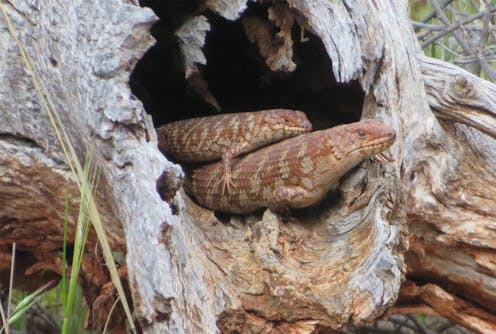
Spiny-tailed skinks (Egernia stokesii badia), known as meelyu in the local Badimia language in Western Australia, are highly social lizards that live together in family groups — an uncommon trait among reptiles.

They’re culturally significant to the Badimia people but habitat degradation and mining has put them under threat of extinction.

These sturdy, mottled lizards — which live in colonies in the logs of fallen trees and branches — are a candidate for what researchers call “mitigation translocation”.

That’s where wildlife are relocated away from high-risk areas (such as those cleared for urban development or mining) to lower risk areas.

It might sound simple. But research shows these mitigation translocation decisions are often made on an ad hoc basis, without a long-term strategic plan in place.

Example of the range in individual size/age occupying the same permanent log pile structure within the Mid West region of Western Australia.
Holly Bradley, Author provided

Not enough pre-planning or follow-up

There has been much research into assisted relocation of larger, charismatic mammals and birds. But other animals, such as reptiles with a less positive social image, have been less widely studied.

Our recent research has found there is often little pre-planning or follow-up to monitor success of mitigation translocations, even though reptile mitigation translocations do take place, sometimes on a large scale.

In fact, fewer than 25% of mitigation translocations worldwide actually result in long-term self-sustaining populations.

Mitigation translocation methods are also not being improved. Fewer than half of published mitigation translocation studies have explicitly compared or tested different management techniques.

Mitigation translocation studies also rarely consider long-term implications such as how relocated animals can impact the site to which they are moved — for example, if the ecosystem has limited capacity to support the relocated animals.

But it’s not just about ecosystem benefits. Preservation of species such as meelyu also has cultural benefits — but mitigation translocation can only be part of the solution if it’s done strategically.


Read more:
Hundreds of Australian lizard species are barely known to science. Many may face extinction


The meelyu: a totem species

As part of Holly Bradley’s research into understanding how to protect meelyu from further loss in numbers, she had the privilege to meet with Badimia Indigenous elder, Darryl Fogarty, who identified meelyu as his family’s totem.

Totemic species can represent a person’s connection to their nation, clan or family group.

The meelyu or Western Spiny-tailed Skink is significant to the Badimia people and require translocation as part of mine site restoration and mitigation of population loss.
Holly Bradley, Author provided

Unfortunately, Darryl Fogarty cannot remember the last time he saw the larger meelyu in the area. The introduction of European land management and feral species into Western Australia has upset the ecosystem balance — and this also has cultural consequences.

Preserving totemic fauna in their historic range can be a critical component of spiritual connection to the land for Indigenous groups in Australia.

In the past, this spiritual accountability for the stewardship of a totem has helped protect species over the long term, with this responsibility passed down between generations.

Before European colonisation, this traditional practice helped to preserve biodiversity and maintain an abundance of food supplies.

A strategic approach to future meelyu relocations from areas of active mining is crucial to prevent further population losses — for both ecological and cultural reasons.

Good mitigation translocation design

If we are to use mitigation translocation to shore up their numbers, we need effective strategies in place to boost the chance it will actually help the meelyu.

Good mitigation translocation design includes factors such as:

  • selecting a good site and understanding properly whether it can support new wildlife populations

  • having a good understanding of the animal’s ecological needs and how they fit with the environment to which they’re moving

  • using the right methods of release for the circumstances. For example, is it better to use a soft release method, where an individual animal is gradually acclimatised to its new environs over time? Or a hard release method, where the animal is simply set free in its new area?

  • having a good understanding of the cultural factors involved.

A holistic approach

A holistic approach to land management and restoration practice considers both cultural and ecological significance.

It supports the protection and return of healthy, functioning ecosystems — as well as community well-being and connection to nature.

Mitigation translocation could have a role to play in protection of culturally significant wildlife like the meelyu, but only when it’s well planned, holistic and part of a long term strategy.


Read more:
Photos from the field: Australia is full of lizards so I went bush to find out why


The Conversation

Holly Bradley has received funding from the Gunduwa Regional Conservation Association as part of her research.

Bill Bateman and Darryl Fogarty do not work for, consult, own shares in or receive funding from any company or organisation that would benefit from this article, and have disclosed no relevant affiliations beyond their academic appointment.

ref. Saving these family-focused lizards may mean moving them to new homes. But that’s not as simple as it sounds – https://theconversation.com/saving-these-family-focused-lizards-may-mean-moving-them-to-new-homes-but-thats-not-as-simple-as-it-sounds-162998

Criminal lawyers are regularly exposed to trauma — how can NZ’s justice system look after them better?

Source: The Conversation (Au and NZ) – By Yvette Tinsley, Professor of Law, Te Herenga Waka — Victoria University of Wellington

Getty

As many court visitors or news consumers will know, criminal law can be a mix of often horrific detail and seemingly dry procedure.

Our current system, based in large part on the English adversarial process, embraces notions of the rational and dispassionate nature of law. There is an expectation the criminal courts will take an objective – almost clinical – approach to the human condition.

Yet despite this reputation for objectivity, in reality the criminal law is steeped in emotion. Historically, moral concerns have been instrumental in deciding what behaviours we criminalise. Criminal cases – certainly those that are not minor – often document painful times in people’s lives.

This all means that criminal lawyers are regularly exposed to traumatic material and emotions. Their job requires them to work with graphic evidence and distressing testimony, from which they are expected to emotionally detach. And all with the knowledge that case outcomes will significantly affect the lives of complainants, defendants, their whānau and communities.

But over the past two years, there has been much talk of the need for transformative change of the criminal justice process. And the experience of criminal lawyers is surely a key factor in calls for greater humanisation of the criminal law as part of the ongoing reform process.

Judge's gavel and papers
The criminal law strives to be rational and dispassionate, but ‘trauma is everywhere’.
Shutterstock

The impact of working in criminal law

We know lawyers as a group are at higher risk of poor mental health as well as occupational stress and burnout. Yet there has been little research – and until now none based in New Zealand – that has qualitatively examined whether (and how) criminal lawyers’ work affects their emotional and psychological well-being.

There is even less research examining what we might do to address any negative outcomes for lawyers themselves and for the system as a whole.


Read more:
The legal profession has a mental health problem – which is an issue for everyone


We are in the early stages of a project that hopes to provide an evidence base about emotional impact, vicarious trauma and well-being in the criminal courts. Our research aims to be a first step in understanding more about the impacts of working in the criminal law, in the hope of better supporting the profession and students entering it.

In the process, we want to increase understanding about how criminal lawyers try to preserve their own well-being, what methods are successful, and how they might manage emotions positively to improve their experience and outcomes at work.

Criminal lawyers are rarely offered professional debriefing or support by a psychologist.
Shutterstock

‘Trauma is everywhere’

Under the umbrella of the project, one of our researchers has looked at the experiences of Crown prosecutors, who are exposed to some of the most violent and harmful criminal offending.

Prosecutors described several types of traumatic material and the emotional consequences, observing that “trauma is everywhere”. Written, visual and aural exposure to traumatic material is the norm, but face-to-face meetings with complainants are understandably the most difficult for prosecutors to manage and distance themselves from.

Prosecutors have a profound sense of responsibility for case outcomes and for larger problems of the criminal justice process, including over-representation of Māori as defendants and complainants. They feel professional inadequacy and guilt if they don’t secure convictions. They experience difficulties in dealing with cases that mirror their own personal trauma or have personal significance for them or their whānau.


Read more:
Despair and depression at law school are real, and need attention


It was common for the prosecutors interviewed to report an inability to sleep, an increased sense of concern for the safety of themselves and their loved ones, and limited emotional capacity for personal relationships.

Prosecutors told us about coping mechanisms they use to help them maintain professionalism, such as setting emotional boundaries, creating a courtroom persona to ensure they do not show emotion, and even aspiring to become desensitised.

Good working relationships and self-care help protect their well-being. But what prosecutors told us about the pressures of their work, self-criticism and workplace culture all suggest much more needs to be done to address the impacts of working in the criminal law.


Read more:
The law is a man’s world. Unless the culture changes, women will continue to be talked over, marginalised and harassed


A safer process for all

Unlike other professions dealing with human trauma, criminal lawyers are very rarely offered professional debriefing or support by a psychologist. Different institutional and professional care needs to be explored, as do ways to prepare those entering the profession for the reality of criminal justice work.

To produce a robust set of findings that reflect the experiences of both prosecutors and defence counsel, we’re expanding the research we’ve already done by conducting further interviews over the coming months.

From this, we hope to make recommendations about changes that could be made in the profession and to its support structures. And from there, to consider the experiences of other criminal justice professionals, especially those who work in the criminal courts.

Criminal law is a profession whose inner workings remain largely invisible, until a high-profile case makes headlines. But maintaining a healthy workforce is integral to a responsive and safe criminal process for all.


If you are a legal professional working in the New Zealand criminal courts and would like to participate in this research, contact Yvette.Tinsley@vuw.ac.nz, Nichola.Tyler@vuw.ac.nz, or visit the Firesetting and Forensic Mental Health Lab for more information.

The Conversation

Yvette Tinsley receives funding from the Australian Research Council and New Zealand Law Foundation

Nichola Tyler has received funding from the Royal Society Te Aparangi, Fire and Emergency New Zealand, and NHS England.

ref. Criminal lawyers are regularly exposed to trauma — how can NZ’s justice system look after them better? – https://theconversation.com/criminal-lawyers-are-regularly-exposed-to-trauma-how-can-nzs-justice-system-look-after-them-better-167625

View from The Hill: Kristina Keneally’s house switch stops one row, starts another

Source: The Conversation (Au and NZ) – By Michelle Grattan, Professorial Fellow, University of Canberra

When Tanya Plibersek – who many believe would give Labor its best chance if she were leader now – was asked about the party parachuting Kristina Keneally into the safe seat of Fowler, she slid all around the place to avoid giving a direct answer to an awkward question.

What might be called the Keneally “Fowler solution” is the outcome of Labor’s dilemma over its Senate ticket. Its two NSW senators from the right faction, Keneally and Deb O’Neill, were battling over who would get the ticket’s number one spot. With the left in the second spot, the loser would be relegated to the third place, considered unwinnable.

Anthony Albanese claims Keneally, as Labor’s deputy leader in the Senate, would have been on the top of the ticket if she’d nominated. But O’Neill had strong union support.

Regardless, Keneally’s endorsement by the right faction for Fowler – being vacated at the election by the retirement of the popular Labor whip Chris Hayes – stopped a row. But it started another one.

When he announced he was retiring Hayes strongly promoted a young lawyer, Tu Le, daughter of Vietnamese refugees, to succeed him. She ticked boxes on gender, diversity and local grounds.

Keneally’s pushing her aside has caused outrage in some Labor circles.

Labor MP and Muslim Anne Aly told the ABC: “Diversity and equality and multiculturalism can’t just be a trope that Labor pulls out and parades while wearing a sari and eating some kung pao chicken to make ourselves look good”. She added, “I’m one of the few people of culturally, linguistically diverse backgrounds in the parliament – this matters to me”.

Appearing on the ABC on Sunday Plibersek was pressed about where she stood on the matter.

She tried a bluff: “I’m a glass half-full person. Aren’t we lucky in the Labor Party to have three fantastic women, all who want to be in parliament representing the Labor Party”.

Several follow ups, and several dodges, later, Plibersek was where she started: “I think Kristina is a fantastic candidate who’s made a great contribution. I also think Deb O’Neill has made a wonderful contribution in the Senate, and Tu Le has got a big future.”

While Keneally’s installation may be a snub to some locals, it should be noted it doesn’t deprive ALP branch members of a rank and file ballot they would otherwise have had.

Through a peculiar arrangement that goes back decades and has its origins in branch stacking, the preselection process for Fowler, a seat designated for the right, is very top down. The right faction selects its candidate, who is then rubber stamped by the party.

Keneally’s facilitated passage into Fowler is the latest break for the one-time NSW premier who lost the 2011 state election. She was a favourite of Bill Shorten and the candidate chosen to contest the 2017 Bennelong byelection. Then after Sam Dastyari quit the Senate as a result of revelations he’d promoted Chinese interests, Keneally took the casual vacancy.

After the 2019 election Keneally became the opposition’s deputy Senate leader, elbowing out right numbers man Don Farrell. This put her number four in Labor’s hierarchy. As home affairs spokeswoman she aggressively took the fight up to then home affairs minister Peter Dutton. They were well matched.

At Friday’s right faction meeting which endorsed her, Keneally described herself as the “accidental senator” and thought her “brawler” style better suited to the lower house.

Given her quick rise and her take-no-prisoners political approach, the question inevitably is: how high can Keneally hope to fly?

Those close to her say her move isn’t driven by leadership ambitions. Maybe not, but if her career up to now is any guide, it would be strange if she didn’t harbour them.

However she is not universally popular in the party and if Labor loses, it would be too early for her. The favourite to become opposition leader would probably be Plibersek who, while on the left, would overwhelmingly win a ballot among the rank and file, which gets a 50% say, with caucus having the other 50%.

The Conversation

Michelle Grattan does not work for, consult, own shares in or receive funding from any company or organisation that would benefit from this article, and has disclosed no relevant affiliations beyond their academic appointment.

ref. View from The Hill: Kristina Keneally’s house switch stops one row, starts another – https://theconversation.com/view-from-the-hill-kristina-keneallys-house-switch-stops-one-row-starts-another-167772

Indonesian military, police continue Papua crackdown over soldier deaths

By Rahmad Nasution in Jayapura

More than a week after four Indonesian soldiers were killed by pro-independence fighters in an attack on a military post in Kisor village, South Aifat sub-district, Maybrat district, West Papua, police have arrested two suspects and launched a manhunt for 17 others.

Also, a joint team of personnel from the Indonesian Military (TNI) has continued to crack down on Papuan rebels operating in the area.

The XVIII/Kasuari Regional Military Command’s spokesperson, Colonel Hendra Pesireron, said that TNI soldiers had “secured” several villages.

The troops’ presence in villages had “restored the security situation” in Maybrat district, and guaranteed public safety, he claimed in a statement.

On 5 September 2021, TNI personnel engaged in a gunfight with several members of a pro-independence group in the neighborhood areas of East Aifat sub-district.

The rebels retreated into a thick forest to escape, Colonel Pesireron said.

Before the gunfight, the rebels destroyed a bridge, he said.

Kisor military post attacked
On Thursday, pro-independence rebels had ambushed several soldiers while they were sleeping at the Kisor military post.

Four soldiers—2nd Sergeant Amrosius, Chief Private Dirham, First Private Zul Ansari, and First Lieutenant Dirman—died in the attack, while two others suffered serious wounds.

The bodies of three soldiers had been found at the post, while the body of another soldier had been discovered in bush not far from the post.

Several local residents had fled their homes fearing for their safety.

On Friday, Indonesian police investigators named 19 alleged suspects in connection with the attack on the military post.

Rahmad Nasution is a journalist for the Indonesian news agency Antara.

Print Friendly, PDF & Email

Article by AsiaPacificReport.nz

9/11 killed it, but 20 years on global justice movement is poised for revival

ANALYSIS: By Kalinga Seneviratne in Sydney

Since the attacks on the United States by 15 Saudi Arabian Islamic fanatics on 11 September  2001 — now known as 9/11 —  the world has been divided by a “war on terror” with any protest group defined as “terrorists”.

New anti-terror laws have been introduced both in the West and elsewhere in the past 20 years and used extensively to suppress such movements in the name of “national security”.

It is interesting to note that the 9/11 attacks came at a time when a huge “global justice” movement was building up across the world against the injustices of globalisation.

Using the internet as the medium of mobilisation, they gathered in Seattle in 1999 and were successful in closing down the World Trade Organisation (WTO) meeting.

They opposed what they saw as large multinational corporations having unregulated political power, exercised through trade agreements and deregulated financial markets, facilitated by governments.

Their main targets were the WTO, International Monetary Fund (IMF), OECD, World Bank, and international trade agreements.

The movement brought “civil society” people from the North and the South together under common goals.

Poorest country debts
In parallel, the “Jubilee 2000” international movement led by liberal Christian and Catholic churches called for the cancellation of US$90 billion of debts owed by the world’s poorest nations to banks and governments in the West.

Along with the churches, youth groups, music, and entertainment industry groups were involved. The 9/11 attacks killed these movements as “national security” took precedence over “freedom to dissent”.

Dr Dayan Jayatilleka, a former vice-president of the UN Human Rights Council and a Sri Lankan political scientist, notes that when “capitalism turned neoliberal and went on the rampage” after the demise of the Soviet Union, resistance started to develop with the rise of the Zapatistas in Chiapas (Mexico) against NAFTA (North American Free Trade Agreement) and culminating in the 1999 Seattle protests using a term coined by Cuban leader Fidel Castro “another world is possible”.

“All that came crashing down with the Twin Towers,” he notes. “With 9/11 the Islamic Jihadist opposition to the USA (and the war on terror) cut across and buried the progressive resistance we saw emerging in Chiapas and Seattle.”

Geoffrey Robertson QC, a British human rights campaigner and TV personality, warns: “9/11 panicked us into the ‘war on terror’ using lethal weapons of questionable legality which inspired more terrorists.

“Twenty years on, those same adversaries are back and we now have a fear of US perfidy—over Taiwan or ANZUS or whatever. There will be many consequences.”

But, he sees some silver lining that has come out of this “war on terror”.

Targeted sanctions
“One reasonably successful tactic developed in the war on terror was to use targeted sanctions on its sponsors. This has been developed by so-called ‘Magnitsky acts’, enabling the targeting of human rights abusers—31 democracies now have them and Australia will shortly be the 32nd.

“I foresee their coordination as part of the fightback—a war not on terror but state cruelty,” he told In-Depth News.

When asked about the US’s humiliation in Afghanistan, Dr Chandra Muzaffar, founder of the International Movement for a Just World told IDN that the West needed to understand that they too needed to stop funding terror to achieve their own agendas.

“The ‘war on terror’ was doomed to failure from the outset because those who initiated the war were not prepared to admit that it was their occupation and oppression that compelled others to retaliate through acts of terror.” he argues.

“Popular antagonism towards the occupiers was one of the main reasons for the humiliating defeat of the US and NATO in Afghanistan,” he added.

Looking at Western attempts to introduce democracy under the pretext of “war on terror” and the chaos created by the “Arab Spring”, a youth movement driven by Western-funded NGOs, Iranian-born Australian Farzin Yekta, who worked in Lebanon for 15 years as a community multimedia worker, argues that the Arab region needs a different democracy.

“In the Middle East, the nations should aspire to a system based on social justice rather than the Western democratic model. Corrupt political and economic apparatus, external interference and dysfunctional infrastructure are the main obstacles for moving towards establishing a system based on social justice,” he says, adding that there are signs of growing social movements being revived in the region while “resisting all kinds of attacks”.

Palestinian refugee lessons
Yekta told IDN that while working with Palestinian refugee groups in Lebanon he had seen how peoples’ movements could be undermined by so-called “civil society” NGOs.

“Alternative social movements are infested by ‘civil society’ institutions comprising primarily NGO institutions.

“‘Civil society’ is effective leverage for the establishment and foreign (Western) interference to pacify radical social movements. Social movements find themselves in a web of funded entities which push for ‘agendas’ drawn by funding buddies,” noted Yekta.

Looking at the failure of Western forces in Afghanistan, he argues that what they did by building up “civil society” was encouraging corruption and cronyism that is entangled in ethnic and tribal structures of society.

“The Western nation-building plan was limited to setting up a glasshouse pseudo-democratic space in the green zone part of Kabul.

“One just needed to go to the countryside to confront the utter poverty and lack of infrastructure,” Yekta notes.

”We need to understand that people’s struggle is occurring at places with poor or no infrastructure.”

Social movements reviving
Dr Jayatilleka also sees positive signs of social movements beginning to raise their heads after two decades of repression.

“Black Lives Matter drew in perhaps more young whites than blacks and constituted the largest ever protest movement in history. The globalised solidarity with the Palestinian people of Gaza, including large demonstrations in US cities, is further evidence.

“In Latin America, the left-populist Pink Tide 2.0 began with the victory of Lopez Obrador in Mexico and has produced the victory of Pedro Castillo in Peru.

“The slogan of justice, both individual and social, is more globalised, more universalised today, than ever before in my lifetime,” he told IDN.

There may be ample issues for peoples’ movements to take up with TPP (Transpacific Partnership) and RCEP (Regional Comprehensive Economic Partnership) trade agreements coming into force in Asia where companies would be able to sue governments if their social policies infringe on company profits.

But Dr Jayatilleka is less optimistic of social movements rising in Asia.

Asian social inequities
“Sadly, the social justice movement is considerably more complicated in Asia than elsewhere, though one would have assumed that given the social inequities in Asian societies, the struggle for social justice would be a torrent. It is not,” he argues.

“The brightest recent spark in Asia, according to Dr Jayatilleka, was the rise of the Nepali Communist Party to power through the ballot box after a protracted peoples’ war, but ‘sectarianism’ has led to the subsiding of what was the brightest hope for the social justice movement in Asia.”

Robertson feels that the time is ripe for the social movements suppressed by post 9/11 anti-terror laws to be reincarnated in a different life.

“The broader demand for social justice will revive, initially behind the imperative of dealing with climate change but then with tax havens, the power of multinationals, and the obscene inequalities in the world’s wealth.

“So, I do not despair of social justice momentum in the future,” he says.

Republished under Creative Commons partnership with IDN – In-Depth News.

Print Friendly, PDF & Email

Article by AsiaPacificReport.nz

Hate crimes are not always terrorism.

Headline: Hate crimes are not always terrorism. – 36th Parallel Assessments

A screen grab shows police officers working outside a shopping mall following a knife attack in Auckland, New Zealand September 3, 2021. TVNZ via Reuters TV

Director Paul G. Buchanan has researched and written for over thirty years about terrorism and irregular warfare. He has participated in counter-terrorism analysis and policy development while working in and with US government intelligence and military agencies, including leadership and recruitment profiling. With this background, he offers an assessment of the recent supermarket stabbings outside of Auckland, New Zealand.

A screen grab shows police officers working outside a shopping mall following a knife attack in Auckland, New Zealand September 3, 2021. TVNZ via Reuters TV

Blood had not been mopped up from the floor after the supermarket stabbing spree when the prime minister strode to the parliamentary theatre podium and declared it to be an act of terrorism committed by an individual following an extremist ideology. Within minutes of her pronouncement the media sped to get reaction to the event. The terrorism studies industry dutifully jumped into action and joined the bandwagon labeling the stabbings as an act of terrorism committed by a “lone wolf,” followed by cheerleading the official line arguing that the powers of the State needed to be expanded so as to include acts of preparation and planning along with actual crimes of ideologically-motivated violence in the Terrorism Suppression Act (TSA). That several of the critically unreflective media-ordained “experts” who featured over the following days are associated with research centers that receive government (including security community) funding does not appear to have given a second of pause to the media booking agents (not that the funding of dedicated research centers is disqualifying but it should be acknowledged).

Allow me to present a contrary view, starting with some basic definitions of terrorism and its sub-types and then proceeding to a quick comparison between the Christchurch attacks of March 15, 2019 and what happened outside of Auckland on September 3, 2021.

There are several forms of terrorism. These include state terrorism (the most common form), where a State terrorizes its own people or other targets; state-sponsored terrorism, where a State uses a proxy to commit acts of terrorism against an enemy or its core interests (think of the Iranian relationship with Hamas or Hezbollah, or—dare I say it–the Saudi relationship with al-Qaeda); non-state terrorism, including criminal (for example, Mafia) and ideological terrorism perpetrated by non-state irregular warfare actors (al-Qaeda, Daesh, the IRA, Sendero Luminoso in Peru, Mano Blanca in El Salvador or “Triple A” in Argentina). The list is extensive and covers the entire ideological spectrum. The bottom line of non-state ideological terrorism is that it must have an explicitly political focus—it has a political end or endgame in mind.

There is also terrorism committed during war time and terrorism that occurs during peace. War terrorism is mainly a sub-set of state terrorism but is also found in irregular warfare. The fire-bombing of Dresden had little military purpose but was designed to have a psychological impact on the German population. Likewise, the nuclear bombings of Hiroshima and Nagasaki were done not so much because of the military importance of these targets but because of the psychological impact that a single bomb annihilation of a city would have on the Japanese. In both cases the purpose was to terrorize, not gain a military advantage per se. Likewise, beheadings and other atrocities committed by jihadists do not improve their military positions but do have a psychological impact on those who are witness or subject to them. Terrorism during peace are those that occur outside of recognized (declared or undeclared) conflicts. Again, this includes terrorism by the State against dissidents and criminal terrorism against authorities or non-compliant members of the public. As of 9/11, the focus has been on non-state ideological terrorism even if the specific ideology behind many acts of terrorism has shifted over time.

Terrorism can involve large-scale mass attacks or small cell and solo operator (“lone wolf”) attacks. The tactical logic at play is to commit acts of seemingly random and disproportionate violence against soft targets with the purpose of instilling fear, dread and a sense of powerlessness, if not hopelessness in the population. Be at the Bataclan in Paris or at a Labour Youth Camp in Norway, the terrorist seeks to atomise and infantilize the social subject so as to isolate and paralyze it in the face of the perpetrator’s actions. That facilitates surrender or acquiescence to the terrorist will.

Terrorism has a target, subject and an object. The target are the immediate victims of a terrorist act, the more vulnerable and helpless the better. The subject(s) is the wider audience, including the public, government and even sympathetic or like-minded groups and individuals. The object is to send a message and to bend the subject to the will of the perpetrator, that is, to get the subject(s) to do or not do something in accordance with the perpetrator’s objectives and desires.

Having said all of this, by way of illustration let us run a comparison between the Christchurch attacks and the supermarket stabbings.

The Christchurch killer meticulously planned over at least 18 months an act of mass murder, stockpiling weapons and ammunition in order to do so. He did so in secrecy and without drawing attention to his actions (or so the Royal Commission of Inquiry would like us to believe). He displayed cunning, situational awareness and observed operational security as he counted down to the attack date, which was chosen for its historical significance (the Ides of March). He wrote a lengthy manifesto detailing his ideological views and reasons for committing the attacks. As believers gathered in houses of worship on a day of prayer, his targets were highly symbolic and chosen after considerable observation and research. The acts of mass murder were carried out in a cold blooded, calculated, methodical manner, live streamed on social media and eagerly shared by his co-believers world-wide. After capture, he was determined to be sane if narcissistic in personality and interviews with those who knew him prior to March 15 said he exhibited no signs of mental illness. In fact, even though a foreigner, he had friends and socialised normally (I use the last term neutrally as opposed to differentiating between so-called “normal” and “abnormal” or “unusual” conduct).

Now consider the supermarket stabbings. By way of a broad summary, let’s note the following. The perpetrator—I will refer to him by his suppressed identity “Mr. S”– had been granted refugee status in NZ after leaving Sri Lanka in 2011 (he was Tamil) and yet for years had publicly spoken of his desire to kill infidels and his hatred of the West. He was said to be lonely and homesick, with few social contacts in NZ. After being arrested in 2015 he was assessed as being depressed, subject to wild mood swings, prone to violence as a result of having Post Traumatic Stress Disorder stemming from experiences as a Tamil in his homeland. He had come to the authorities’ attention by openly posting jihadist supportive rants online, making threats to others (including muslims) on social media, and for seemingly preparing to wage jihad in NZ or abroad. When searched his flat contained violent extremist literature and videos and hunting knives. After being arrested while trying to leave NZ on a one way ticket (which the authorities believe was to be a journey to the killing fields of Syria), he was bailed and promptly went out and bought an exact copy of a knife that had been confiscated from him, apparently from the same store that he had bought the first one. He was then re-arrested and charged with possessing an offensive weapon (charges later dropped) and with posessing objectionable materials in the form of jihadist literature and videos.

When in court he railed against the injustices done to him, threatened the judge and openly spoke about his desire to do harm to others. But, because his refugee status was being disputed, further cases against him were pending and he had served three years already while waiting for and then during trial, he was sentenced to community supervision for a year, then released on July 16 and bailed to a mosque that, as it turns out, did not have its own Imam but did have a bed. He was ordered to undergo psychiatric evaluation but refused to do so and was never forced to comply. Then came Friday Sept 3.

Rather then the culmination of months of meticulous planning and preparation, that day we saw a spontaneous act of white hot rage (which makes suggestions that strengthening the TSA to include acts of planning and preparation would have prevented the attack utterly ludicrous). He grabbed a knife off a shelf and started stabbing other shoppers (who, fortunately, were observing social distancing rules during the Level 4 pandemic lockdown). His targets were chosen opportunistically and at random–they were simply close enough to attack. He ran through the aisles yelling and shouting, thereby alerting other potential victims to impending danger. He ran from victim to victim rather than pause to finish them off in deliberate fashion. He had no manifesto and he he did not video his actions or communicate or transmit his attack to others. He had no subject other than his immediate targets and he had no object other than to satisfy his own bloodlust and sense of being wronged by society.  His message was to himself.

He had no connections to any jihadist network because even if he once did (and that has not been alleged, much less proven) his internet access was cut off after his arrest and he was largely isolated within the Sri Lankan and Muslim communities because of his notoriety. He had no affective relationships to speak of since his family remains in Sri Lanka and he had no partner or romantic attachments. Described as normally behaved before he arrived in NZ, he descended into personal and political darkness in the years after, linking the two in his public and private utterances. In fact, although he glorified ISIS violence and fetishised bladed weapons, it is unclear how deeply rooted he was in the Salafist world view that underpins ISIS’s ideology.

After he was released in July he developed, according to media reports, an obsessive focus on someone whose identity is suppressed but who was deliberately distanced from him after concerns were raised about his behaviour towards that individual in the days before the stabbings. One can only wonder if this was a case of what is known as affective displacement or transfer in which his emotional focus shifted from jihad to something more immediate and personal, and when that object of attention was removed, he snapped. If so, his ideological focus was more an opportunistic product of his mental state than of true devotion to the extremist cause. Put another way, his homicidal ideation may not have primarily been driven by ideology, which may have been more of a convenient crutch for his grievances rather than the root cause of his sociopathy.

To be clear: I am no mental health expert and defer to them on the subject, but I have learned enough over the years to believe that something more than ideological zealotry may have been at play here.

What S did have is a constant armed police surveillance presence around him because unlike the judge who released him in the hope that he could be rehabilitated, the police had no illusions that he was anything but a danger to himself and society. They therefore devoted considerable resources to surreptitiously monitoring him. As it turns out, he received no rehabilitation as well, which meant that the police emphasis on covert surveillance from a distance was certainly not designed to be pre-emptive or preventative in nature (since an intensive rehab counselor could have given them daily updates on his state of mind). As quick as the police reaction was to the stabbings, they were at a disadvantage given the nature of their surveillance technique, which apparently did not benefit from regular psychological updates. This is no slight on the police. They did what they thought best given the difficult circumstances that they were put in, and in the end they saved lives.

Even lumping Mr. S with the Christchurch killer as “lone wolves” is problematic. The Christchurch killer clearly was such a threat, quietly stalking his prey and preparing his attacks. Mr. S, however, acted impulsively and without the type of deliberation usually associated with lone wolves. Rather than “flying under the radar” of specialised and dedicated counter-terrorism units in NZ (as the Royal Commission would like us to believe with regard to the Christchurch terrorist), he was a known, clear and present danger, at least as far as the police were concerned. Likening him to the March 15 killer as a lone wolf is , again, drawing too long a comparative bow. In fact Mr. S seems closer to the May Dunedin Countdown stabber (four wounded in that attack) than the Christchurch killer, even if the demons inside the Dunedin stabber’s head were fueled by meth rather than ideology and/or mental illness.

For those who would differentiate terrorism from other violent crimes by consequences or effects, here too Mr. S’s actions fall short of the definitional threshold. The Christchurch attacks had immediate and longer-term impacts at home and abroad. While championed by white supremacists and rightwing extremists and causing wide-spread fear in NZ society in the immediate aftermath, it had a more dramatic influence on counter-terrorism threat assessments and approaches world-wide. It occasioned considerable reflection within NZ about tolerance and community and has produced numerous government initiatives to address its root causes. Its message was heard globally, albeit in different ways by different audiences/subjects. In contrast, the supermarket attacks caused a media frenzy, some political debate, assorted commentary and much questioning of how S came to be loose in public. That focused scrutiny lasted about five days, but soon the story receded on media outlets and from the public eye, replaced by coverage of the lowering of Covid lock-down levels and the usual political and social news. Beyond the victims, immediate witnesses, some politicians, pundits, activists and police, NZ society is already moving on and the consequences of the attack outside of (and arguably even within) NZ is minimal. The Christchurch attacks had long-term and wide-ranging effect; the supermarket stabbing spree has had a relatively narrow and short term impact. In other words, in consequence it does not rise to the level of a terrorist attack.

Put another way. Although the supermarket stabbings were certainly terrifying to those who were in and around the store, they were not terroristic in intent or effect.

It is interesting to consider that Andrew Little is both the Minister of Health as well as the Minister of Intelligence and Security. While this may promote efficiency in the discharge of portfolio obligations, it meant that there was no ministerial cross-check on the decision about Mr. S. Instead it presented Mr. Little with a choice when it came to Mr. S: treat him as a mental health case or as a national security threat? The institutional bias underlying the decision about him given the portfolio arrangement is now clear. National security was the priority, not Mr. S’s mental health.

The government says that it considered ordering Mr. S into compulsory treatment under terms of the Mental Health (Compulsory Assessment and Treatment) Act, but was advised that it was not realistic to do so because he did not meet the threshold for involuntary commitment. This is presumably because even though he was diagnosed with PTSD, depression and other ailments, it did not rise to the level of a recognized clinically diagnosed disorder. Fair enough, because the bar for involuntary commitment must be set very high. But what about him being a clear and present danger to himself and society? Should that have factored into the decision as to whether he should be held for assessment and treatment? Had he not held ideological views, would have national security even entered into consideration even if the threat he presented to the public was the same? What would have been the decision then?

Because the decision was made against the mental health option, the government tried to revoke his refugee status so that he could be deported as a national security threat. That is easier said than done given international protocols governing the treatment of refugees, but what seems clear is that even though (or perhaps because) the High Court struck down prosecuting S under the Terrorism Suppression Act since “planning and preparation” is not part of the language in it, the Crown was determined to treat him as a jihadist rather than someone who was violently unwell. However coincidentally, Sept 5 fell into the government’s lap when it came to pushing under urgency amendments to the TSA that incorporated “planning and preparation” into the definition of behaviour covered by the Act, and the chorus of experts all sang in harmony the government line that the law, as it stands without the amendment, is unfit for purpose. 

Three things should be noted as an aside. This is the second time that the Crown has attempted to invoke the TSA when no act of violence was committed, only to be rejected by the Court. The first was after the Urewera raids, when the not-so-merry band of activists and misfits were initially accused of being terrorists for playing Che Guevara in the bush. That attempt to lay charges under the TSA failed even though people were in fact terrorised: the innocent Tuhoe who were held at gunpoint (including children on a school bus) by Police. The second point is that even though the TSA does not allow for prosecutions for planning and preparing for a terrorist act, the Crimes Act has enough in it to do so. Just imagine if police had evidence of someone about to commit a “common” (non-ideologically motivated) murder. Would they not step in to prevent the deed by using the evidence collected under the Crimes Act? If so, what is the difference with an ideologically motivated crime that makes it only prosecutable under the TSA? As it turns out, the Crown went for six and tried to test the TSA a second time on Mr. S. And for the second time, it was given out by the Court. 

The third point is that the government had a legal remedy on national security grounds that would have kept Mr. S confined indefinitely while being assessed and treated but chose not use it: issuing a Security Risk Certificate against him recommended by the Security Intelligence Service (SIS) and once used in the Ahmed Zaoui case (even though Zaoui never threatened or committed any act of violence). The Certificate calls for the preventative detention of an individual deemed to be a threat to NZ’s national security while legal processes are pending. Unlike Zaoui Mr. S was a well recognized threat to himself and others and yet, also unlike Zaoui, the Security Risk Certificate remedy was not explored or was rejected (perhaps because it too was “unreasonable” to do so). Which is odd given that he could have been subject to the strictures of the Security Risk Certificate during and after his trial regardless of sentence on lesser charges and therefore would not have been free on September 3 or required a constant resource-draining police surveillance presence in the weeks leading up to it. (Hat tip to Selwyn Manning for alerting me to this angle of inquiry).

In any event, rather than an act of terrorism or terrorist act (take your pick), what we saw on Sept. 5 was the commission of a hate crime. It is true that NZ does not have a hate crime statute and hate crimes are usually designated as acts of violence committed against individuals or groups because of who they are (e.g. gays, Muslims, redheads). Here the phrase “hate crime” is used because Mr. S’s hatred and rage was directed at non-Muslim society in general and because of the lack of compliance with the definitions and description of terrorism mentioned above. It does not make the supermarket attacks any less heinous than those done deliberately as terrorist attacks with the same (thankfully non-fatal) outcome. But it does help distinguish between underlying motive and rigorousness of method, which in turn helps prevent us from being suckered into agreeing and complying with the agendas of security officials and vested “experts” alike.

Analysis syndicated by 36th Parallel Assessments

‘Fortress USA’: How 9/11 produced a military industrial juggernaut

ANALYSIS: By Clare Corbould, Deakin University

Since the September 11 terror attacks, there has been no hiding from the increased militarisation of the United States. Everyday life is suffused with policing and surveillance.

This ranges from the inconvenient, such as removing shoes at the airport, to the dystopian, such as local police departments equipped with decommissioned tanks too big to use on regular roads.

This process of militarisation did not begin with 9/11. The American state has always relied on force combined with the de-personalisation of its victims.

The army, after all, dispossessed First Nations peoples of their land as settlers pushed westward. Expanding the American empire to places such as Cuba, the Philippines, and Haiti also relied on force, based on racist justifications.

The military also ensured American supremacy in the wake of the Second World War. As historian Nikhil Pal Singh writes, about 8 million people were killed in US-led or sponsored wars from 1945–2019 — and this is a conservative estimate.

When Dwight Eisenhower, a Republican and former military general, left the presidency in 1961, he famously warned against the growing “military-industrial complex” in the US. His warning went unheeded and the protracted conflict in Vietnam was the result.

General Dwight D. Eisenhower in second world war.
General Dwight D. Eisenhower addresses American paratroopers prior to D-Day in the Second World War. Image: Wikimedia Commons

The 9/11 attacks then intensified US militarisation, both at home and abroad. George W. Bush was elected in late 2000 after campaigning to reduce US foreign interventions.

The new president discovered, however, that by adopting the persona of a tough, pro-military leader, he could sweep away lingering doubts about the legitimacy of his election.

Waging war on Afghanistan within a month of the Twin Towers falling, Bush’s popularity soared to 90 percent. War in Iraq, based on the dubious assertion of Saddam Hussein’s “weapons of mass destruction”, soon followed.

The military industrial juggernaut
Investment in the military state is immense. 9/11 ushered in the federal, cabinet-level Department of Homeland Security, with an initial budget in 2001-02 of US$16 billion. Annual budgets for the agency peaked at US$74 billion in 2009-10 and is now around US$50 billion.

This super-department vacuumed up bureaucracies previously managed by a range of other agencies, including justice, transportation, energy, agriculture, and health and human services.

Centralising services under the banner of security has enabled gross miscarriages of justice. These include the separation of tens of thousands of children from parents at the nation’s southern border, done in the guise of protecting the country from so-called illegal immigrants.

More than 300 of the some 1000 children taken from parents during the Trump administration have still not been reunited with family.

Detainees in a holding cell at the US-Mexico border.
Detainees sleep in a holding cell where mostly Central American immigrant children are being processed at the US-Mexico border. Image: The Conversation/Ross D. Franklin/AP

The post-9/11 Patriot Act also gave spying agencies paramilitary powers. The act reduced barriers between the CIA, FBI, and the National Security Agency (NSA) to permit the acquiring and sharing of Americans’ private communications.

These ranged from telephone records to web searches. All of this was justified in an atmosphere of near-hysterical and enduring anti-Muslim fervour.

Only in 2013 did most Americans realise the extent of this surveillance network. Edward Snowden, a contractor working at the NSA, leaked documents that revealed a secret US$52 billion budget for 16 spying agencies and over 100,000 employees.

Normalisation of the security state
Despite the long objections of civil liberties groups and disquiet among many private citizens, especially after Snowden’s leaks, it has proven difficult to wind back the industrialised security state.

This is for two reasons: the extent of the investment, and because its targets, both domestically and internationally, are usually not white and not powerful.

Domestically, the 2015 Freedom Act renewed almost all of the Patriot Act’s provisions. Legislation in 2020 that might have stemmed some of these powers stalled in Congress.

And recent reports suggest President Joe Biden’s election has done little to alter the detention of children at the border.

Militarisation is now so commonplace that local police departments and sheriff’s offices have received some US$7 billion worth of military gear (including grenade launchers and armoured vehicles) since 1997, underwritten by federal government programmes.

Atlanta police in riot gear.
Atlanta police line up in riot gear before a protest in 2014. Image: The Conversation/Curtis Compton/AP

Militarised police kill civilians at a high rate — and the targets for all aspects of policing and incarceration are disproportionately people of colour. And yet, while the sight of excessively armed police forces during last year’s Black Lives Matter protests shocked many Americans, it will take a phenomenal effort to reverse this trend.

The heavy cost of the war on terror
The juggernaut of the militarised state keeps the United States at war abroad, no matter if Republicans or Democrats are in power.

Since 9/11, the US “war on terror” has cost more than US$8 trillion and led to the loss of up to 929,000 lives.

The effects on countries like Afghanistan, Iraq, Yemen, Syria, and Pakistan have been devastating, and with the US involvement in Somalia, Libya, the Philippines, Mali, and Kenya included, these conflicts have resulted in the displacement of some 38 million people.

These wars have become self-perpetuating, spawning new terror threats such as the Islamic State and now perhaps ISIS-K.

Those who serve in the US forces have suffered greatly. Roughly 2.9 million living veterans served in post-9/11 conflicts abroad. Of the some 2 million deployed to Iraq or Afghanistan, perhaps 36 percent are experiencing PTSD.

Training can be utterly brutal. The military may still offer opportunities, but the lives of those who serve remain expendable.

Fighter jet in the Persian Gulf
Sailor cleaning a fighter jet during aboard the USS Dwight D. Eisenhower aircraft carrier in the Persian Gulf in 2010. Image: The Conversation/Hasan Jamali/AP

Life must be precious
Towards the end of his life, Robert McNamara, the hard-nosed Ford Motor Company president and architect of the United States’ disastrous military efforts in Vietnam, came to regret deeply his part in the military-industrial juggernaut.

In his 1995 memoir, he judged his own conduct to be morally repugnant. He wrote,

We of the Kennedy and Johnson administrations who participated in the decisions on Vietnam acted according to what we thought were the principles and traditions of this nation. We made our decisions in light of those values. Yet we were wrong, terribly wrong.

In interviews with the filmmaker Errol Morris, McNamara admitted, obliquely, to losing sight of the simple fact the victims of the militarised American state were, in fact, human beings.

As McNamara realised far too late, the solution to reversing American militarisation is straightforward. We must recognise, in the words of activist and scholar Ruth Wilson Gilmore, that “life is precious”. That simple philosophy also underlies the call to acknowledge Black Lives Matter.

The best chance to reverse the militarisation of the US state is policy guided by the radical proposal that life — regardless of race, gender, status, sexuality, nationality, location or age — is indeed precious.

As we reflect on how the United States has changed since 9/11, it is clear the country has moved further away from this basic premise, not closer to it.The Conversation

Dr Clare Corbould, Associate Professor, Contemporary Histories Research Group, Deakin University. This article is republished from The Conversation under a Creative Commons licence. Read the original article.

Print Friendly, PDF & Email

Article by AsiaPacificReport.nz

Top global accolades for USP, the ‘captain’ and Pacific regionalism

OPEN LETTER: By Elizabeth Reade Fong

A ranking of an institution of higher education by Times Higher Education (THE) is the ultimate recognition of excellence that an institution can aim for.

The University of the South Pacific (USP) has achieved two accolades by being ranked for 2022 and secondly being the only institution of higher education in the Pacific to gain this recognition.

All USP graduates of the 12 member country states can look back and appreciate the wisdom of the decision to establish the USP with the main campus at Laucala.

Fiji as the host of the main campus continues to be the largest beneficiary in terms of graduates and financial income and has much to be grateful for.

I am an alumni and a grateful Fijian!

This kind of recognition takes a team and every team has a captain.

Vice-chancellor and president Professor Pal Ahluwalia is the captain that took the university across “the finishing line” that won us “gold”.

In this journey he has acknowledged the contribution of the many who played a part in this achievement that is about all of us Pasefikans.

Congratulatory messages have been received from alumni, current and former staff members, stakeholders and generous donors inclusive of messages from the member governments of Nauru, Samoa and Tuvalu to date.

The silence from the leadership of the country hosting the largest campus that also leads the Pacific Islands Forum is deafening to say the least!

Should we live in hope?

Nevertheless this will not detract from USP’s status as the most successful example of regionalism in the Blue Pacific as it continues to “Shape Pacific Futures”.

Long live USP!

Dr Elizabeth Reade Fong is chief librarian at the University of the South Pacific. This letter was first published in The Fiji Times on 10 September 2021.

Print Friendly, PDF & Email

Article by AsiaPacificReport.nz

New Caledonia reports first covid death – 117 cases in four days

RNZ Pacific

New Caledonia has recorded its first death of the Covid-19 pandemic.

The fatality was announced by territorial President Louis Mapou today in a televised address.

He said the victim was an elderly person — aged 75 — who had died in hospital.

The fatality comes four days after the first three cases of the latest community outbreak were detected.

Mapou said the delta variant crisis was unprecedented and the only means to counter the pandemic was vaccination.

He said another 51 infections had been detected in the past day, bringing the total to 117.

A lockdown has been in force since Tuesday.

New Caledonia’s members of the French legislature have asked France to send medical personnel because there were not enough specialists to staff the ICUs that had been set up.

In French Polynesia, a further three covid-19-related deaths were reported but health authorities say the latest wave appears to have peaked.

Almost 400 people have died since the surge of delta cases in late July, with the daily death toll reaching more than 20 two weeks ago.

However, the number of hospitalisations has remained high, with 303 covid-19 patients in care, 57 of them in ICUs.

This article is republished under a community partnership agreement with RNZ.

Print Friendly, PDF & Email

Article by AsiaPacificReport.nz

NZ health officials investigate mystery hospital covid ‘short stay’ case

RNZ News

New Zealand health officials are investigating a mystery case of covid-19 who spent time in hospital and interacted with seven police officers before she knew she was infected.

The woman was swabbed as a precaution when she went to Middlemore Hospital yesterday for a non covid-related reason.

She spent two hours at the hospital’s emergency department and short stay ward, and the positive result came back after she had left.

She had also had contact with seven police officers on Wednesday morning.

The officers were wearing masks but have been stood down as a precaution.

The hospital staff were wearing full protective gear and are deemed to be low risk, but 36 patients were being asked to isolate.

New Zealanders are being told to keep covid-19 testing numbers up over the weekend ahead of next week’s alert level decision.

Monday alert levels meeting
Cabinet will meet on Monday to decide whether any parts of the country can move down an alert level.

More than 14,000 swabs were processed yesterday.

Director-General of Health Dr Ashley Bloomfield said 7000 of those tests were from the Auckland region.

“This continues to be giving us confidence about the outbreak, and whether or not it is controlled, and one thing I would like to emphasise is this weekend is critical that we get high testing numbers.

“So anyone who is symptomatic, particularly in Tāmaki Makaurau, please do go and get a test.”

The numbers

  • There are 11 new cases of covid-19 in the community today.
  • There are now 879 total cases, with 288 cases having now recovered.
  • There are 29 unlinked cases, including six from today.
  • Six new cases are in managed isolation and two historical cases were reported today.

This article is republished under a community partnership agreement with RNZ.

Print Friendly, PDF & Email

Article by AsiaPacificReport.nz

Activists call on Canberra to protest over human rights abuses in Papua

By Susan Price in Sydney

West Papua activists have called on the Australian government to raise concerns about the Indonesian military’s ongoing human rights abuses in West Papua, when they met with their Indonesian counterparts this week.

Foreign Minister Marise Payne and Defence Minister Peter Dutton are attending the seventh Indonesia-Australia Foreign and Defence Ministers 2+2 dialogue in Jakarta, which started yesterday, before continuing on to visit New Delhi, Seoul, Washington and New York.

Australia-West Papua Association spokesperson Joe Collins said: “We can expect all the usual statements about regional stability, peace, economic prosperity, terrorism and defence cooperation, but highly unlikely anything about human rights — unless it is criticism of China’s record.”

In a reply to correspondence from AWPA, the Department of Foreign Affairs and Trade (DFAT) indicated that because of Australia’s close relationship with Indonesia it had allowed DFAT to discuss a range of issues, including sensitive topics like the situation in Papua.

Given this close relationship, Collins said activists were hoping the human rights situation in West Papua would be raised, including: the ongoing concerns for arrested West Papuan activist Victor Yeimo; the security force operation taking place in the Maybrat Regency; and the death of Kristian Yandun from a beating in a police cell in Merauke.

Yeimo faces a number of charges, including treason with conspiracy. There is concern for his mental and physical health, which is deteriorating.

According to AWPA, after an attack on a military post in Kisor village in the Maybrat regency, security forces have retaliated, causing residents from five districts to flee their villages in fear of the Indonesian military.

AWPA is concerned that Merauke local police chief Untung Sangaji was trained by Australian Federal Police and trainers from the United States and Britain in anti-people smuggling and surveillance techniques at the Jakarta Centre for Law Enforcement Cooperation (JCLEC).

AWPA is calling on Payne and Dutton to urge Jakarta to release Yeimo and all political prisoners, and to raise the human rights abuses committed by the Indonesian security forces.

Susan Price reports for Green-Left.

Stronger Australian-Indonesian military ties
Indonesian troops could join regular training exercises on Australian soil, as part of a deepening of defence ties with Australia, reports The Guardian.

While Indonesia regularly joins naval exercises with Australia, and has participated in occasional joint military exercises on Australian land, the two countries have flagged plans to “step up” their joint training in the coming years, writes Daniel Hurst.

Australia’s defence minister, Peter Dutton, and foreign minister, Marise Payne, met their Indonesian counterparts in Jakarta yesterday, on the first leg of a four-country trip.

Indonesia’s Defence Minister Prabowo Subianto said he and Dutton had discussed “the possibility of Australia opening their training areas for the participation of Indonesian units to be training together with Australia”.

“I think this is a historical first,” Prabowo said.

Indonesian troops arrive at Sinak 100921
Indonesian security forces troops being flown in to Sinak, Puncak region, in the Papuan highlands for operations against independence fighters. Image: Screenshot APR
Print Friendly, PDF & Email

Article by AsiaPacificReport.nz

Graham Davis: In the stars? It’s in the polls, Rabuka’s final political twist

COMMENTARY: By Graham Davis

“So many detractors were saying, ‘no you won’t get it, the Supervisor of Elections won’t allow it’. I said, ‘well let him just do his work’. And I believe in the goodness of the man. We got it and we’re happy.” — Sitiveni Rabuka, CFL/FijiVillage interview. 8 September 2021


The leader of the new People’s Alliance gives Frank Bainimarama and Aiyaz Sayed-Kahyum has given yet another masterclass in how to win friends and influence people in the Fijian context.

Of course, he doesn’t necessarily “believe in the goodness” of Elections Supervisor Mohammed Saneen, who tried to prevent him from contesting the 2018 election and will do his damnedest to try to exclude him from the 2022 election.

Or maybe he does. It doesn’t matter because Sitiveni Rabuka has spoken well of someone who everyone regards as his nemesis and in doing so has presented himself as magnanimous and humble.

Fijians like that and Rabuka knows it. Which makes it all the more astonishing that Frank Bainimarama and Aiyaz Sayed-Khaiyum still don’t know it after 15 years in power.

It was Rabuka’s humility and forbearance in the face of an ordeal in the courts before the 2018 election that triggered a wave of community sympathy that manifested itself on election day and took the Bai-Kai duo to the brink of defeat.

Readers of my website will know that in the immediate aftermath of the election, I tried and failed to get Bainimarama to realise that the FijiFirst government’s appearance of arrogance — its vei beci, viavialevu attitude to everything — was the prime cause of its electoral collapse.

But they still don’t get it. And having given them a fright in 2018 but still not having learnt their lesson, I suspect that the Rabuka juggernaut is going to bear down on them in the coming months and flatten them like toads on hot bitumen.

Why? Because the Fijian people are fed up with them, not just the usual burden of longevity in government and people tiring of their increasingly tired faces but a visceral distaste for the manner in which they conduct themselves.

Always right. Never wrong. Always contemptuous. Never, ever humble.

Fiji opinion poll FS 01-09-2021
Sitiveni Rabuka is the front runner to win the next election, presuming it is ever held. The Western Force/Fiji Sun poll published in the September 1 edition of the Fiji Sun. Image: Grubsheet

Even some of my closest friends say Rabuka cannot win — that the burden of his two coups in 1987 and the hatred and bitterness that lingers — especially among Indo-Fijians – is too much of a cross to bear, let alone such things as the fiasco of the National Bank collapse under his watch when he was eventually elected prime minister.

But politics is more about perception than substance wherever it is practiced in the world. And is equally true that electors have notoriously short memories, never mind that a great many voters weren’t even born when Rabuka held the reins of power.

I am coming to the view that not only can Rabuka win the next election but probably will.

For many Fijians, the events of 1987, let alone Rabuka’s period in government, aren’t a part of their lived experience. In any event, Bainimarama and Khaiyum have yet to learn the most basic lesson of politics — that oppositions don’t win elections, governments lose them.

And these two conjoined twins — with their chronic hubris and arrogance — are doing everything they possibly can to lose.

I’ve chosen the accompanying selection of photos to illustrate Rabuka’s extraordinary journey from coup-maker in 1987 to the benign figure that the opinion polls now tell us is set to make the most extraordinary comeback in Fijian political history. Provided of course, that Bainimarama and Khaiyum keep to the election timetable and the people still get their say.

Sitiveni Rabuka
Grubsheet montage of Sitiveni Rabuka photos. Image: Grubsheet

There’s “Rambo” – the smiling tough guy and defender of iTaukei rights who forced thousands of Indo-Fijians to leave Fiji post 1987. And there’s Rabuka as Prime Minister in the 1990s forming a warm partnership with the main Indo-Fijian politician, Jai Ram Reddy, that produced the 1997 Constitution and eventually led to Rabuka’s defeat.

There’s the “treasonous” soldier who abolished the monarchy and took Fiji out of the Commonwealth when it wouldn’t accept his takeover. And there is the barefooted Prime Minister at Buckingham Palace making a formal apology to HM the Queen for his act of lese majeste and it being graciously accepted.

The man has had an incredible journey, that’s for sure. And maybe, just maybe, he is going to cement his place in Fijian history next year with an incredible final twist.

Is it in the stars? It doesn’t matter. It’s already in the opinion polls.

And you can bet your last saqamoli that it’s keeping Frank Bainimarama and his puppet master, Aiyaz Sayed-Khaiyum, awake at night with agonising intimations of their own political mortality.

Fiji-born Graham Davis is a Walkley Award and Logie Award-winning Australian-based journalist and media consultant. He is publisher of the Grubsheet blog on Fiji affairs. This commentary is republished with permission.

Print Friendly, PDF & Email

Article by AsiaPacificReport.nz

New Caledonia appeals to all medical staff to help combat covid-19 outbreak

RNZ Pacific

The New Caledonian government has appealed to all medical and paramedical staff, including veterinarians, to help in the fight against covid-19.

Sixty-six cases have been recorded since the community outbreak was first detected on Monday and a lockdown was ordered from Tuesday.

There are seven people in intensive care with two in a serious condition.

France has declared a state of emergency in both New Caledonia and French Polynesia.

The positive covid cases range in age from 20 to 80 and while some are in Noumea hospital, others are in hotels set aside for quarantine.

The virus has been detected across the main island and in the Loyalty Islands — Lifou in particular.

So far about a dozen clusters have been identified, with contacts being asked to isolate and get tested.

MaxA maximum of 800 tests a day can be done, which means that only people with symptoms are advised to get one.

Vaccinations are being stepped up as only about a third of the population of 288,000 has been inoculated so far.

Les Nouvelles Calédoniennes 100921
Today’s front page news of the covid-19 outbreak “explosion” in New Caledonia. Image: Les Nouvelles Calédoniennes

The president of the customary Senate, Yvon Kona, was among those people being vaccinated today and he urged the public to get vaccinated.

Before Monday’s outbreak, New Caledonia had recorded fewer than 140 covid-19 cases in total.

In French Polynesia, a further 13 people have died of covid-19, raising the death toll to 535.

The health ministry said 311 covid-19 patients eere in hospital and 54 of them in intensive care.

Case numbers are no longer compiled and released by the authorities who said they would be inaccurate as many people carried out self-tests.

Most of the territory is in a four-week lockdown and curfews are in place to slow the spread of the virus.

This article is republished under a community partnership agreement with RNZ.

Print Friendly, PDF & Email

Article by AsiaPacificReport.nz

A View From Afar: Could Auckland’s LynnMall stabbing attack have been prevented?

Host Selwyn Manning with security analyst Dr Paul Buchanan on this week’s A View From Afar podcast. Video: EveningReport.nz on YouTube

A VIEW FROM AFAR:
 Podcast with Selwyn Manning and Paul Buchanan

In this week’s security podcast, Dr Paul G. Buchanan and host Selwyn Manning discuss:

  • three areas that have been relied on to protect New Zealanders from terror-style attacks;
  • legal measures designed to protect communities from danger and even protect individuals from themselves;
  • and why they failed.

The background to this episode is the tragic, terrifying, attack that were committed against unarmed innocent people at West Auckland’s LynnMall Countdown supermarket, by Ahamed Aathill Mohamed Samsudeen.

The attack occurred last Friday, 3 September 2021. It ended with the hospitalisation of seven people, and, the death of Samsudeen, who was fatally shot by special tactics police officers during his attempt to kill and injure as many people as he could.

Immediately after, the Prime Minister Jacinda Ardern told the nation that the dead man was a terrorist and that she herself, the police, and the courts were all aware of how dangerous he was and had been seeking to protect New Zealand from this man.

Within days of the attacks, we learned, that Samsudeen was a troubled man with psychologists describing him as angry, capable of carrying out his threats, and displaying varying degrees of mental illness and disorder.

Refugee who sought asylum
Samsudeen was a refugee who sought asylum in New Zealand after experiencing, through his formative years civil war and ethnic cleansing in Sri Lanka, who, at around 20 years of age, arrived in New Zealand on a student visa and then sought political asylum.

He was eventually granted refugee status, and since then spent years in prison on various charges and convictions – largely involving the possession of terrorist propaganda seeded on the internet by Islamic State (ISIS), and, threats showing intent to commit terrorist acts against New Zealanders.

In this week’s episode, Dr Buchanan and Manning examine questions about whether this tragedy could have been prevented and considered New Zealand’s:

  • Security and terror laws
  • Deportation laws involving those with refugee status
  • The Mental Health Act and whether this was available to the authorities.

Dr Buchanan and Manning also analyse whether it is necessary for the New Zealand government to move to tighten New Zealand’s terrorism security laws. And, if it does, how the intended new laws compare to other Five Eyes member countries.

Republished in partnership with EveningReport.nz

Print Friendly, PDF & Email

Article by AsiaPacificReport.nz

How the terrifying evacuations from the twin towers on 9/11 helped make today’s skyscrapers safer

Source: The Conversation (Au and NZ) – By Erica Kuligowski, Vice-Chancellor’s Senior Research Fellow, RMIT University

The 2001 World Trade Center disaster was the most significant high-rise evacuation in modern times, and the harrowing experiences of the thousands of survivors who successfully escaped the twin towers have had a significant influence on building codes and standards. One legacy of the 9/11 tragedy is that today’s skyscrapers can be emptied much more safely and easily in an emergency.

Graphic showing layout of elevators in the World Trade Center towers
The twin towers’ elevator layouts meant getting to ground level was more complicated on some floors than on others.
US NIST

The 110-storey twin towers, constructed from 1966 to 1973, both had open-plan floor designs, with stairs and elevators located in the buildings’ core. Each tower had three staircases which, barring a few twists and turns, ran all the way from the top of the building down to the mezzanine level just above the ground floor. One of the stairways had steps 142 centimetres wide, but the other two measured just 112cm, which would not be permitted by today’s skyscraper building codes.

As a result of the twin towers’ system of “sky lobbies”, which was innovative for its time, the number of available elevators varied depending on the floor. The system was not designed to be used in an emergency, and today, many towers above a certain height are required to be fitted with dedicated emergency elevators or an additional staircase.

When the planes hit on the morning of September 11 2001, the twin towers were at less than half their full occupancy, with about 9,000 people in each tower. Many people who worked there had not yet arrived, partly because of a New York mayoral election scheduled for that day.

At 8:46am, American Airlines flight 11 slammed into the north face of the north tower, rendering all three staircases impassable for anyone above the 91st floor. Sixteen minutes later, and after one-third of its occupants had already evacuated, the south tower was hit by United Airlines flight 175, leaving only one staircase available for evacuees above the 78th floor.

Besides the problems posed by fires and damage on floors, and debris inside the stairways, people in both towers also faced issues with communication. The north tower’s public address system, which would have been used to make emergency announcements to the building’s occupants, was disabled by the crash.

In the south tower, three minutes before the impact, occupants were told via the public address system to stay in place and wait for further information. Two minutes later they were told they could evacuate if they wanted. This may have meant more people from higher floors were waiting at the sky lobby on floor 78 when the plane crashed into that floor.


À lire aussi :
9/11 conspiracy theories debunked: 20 years later, engineering experts explain how the twin towers collapsed


In both towers, people had only limited information on which to base their decisions. For those closest to the impacts, the seriousness of the situation and the need to evacuate was clear. But for those further away, who may have witnessed only the lights flicker, the uncertainty was palpable. Many people delayed their evacuation to seek out extra information, whether by speaking with colleagues, making phone calls, sending emails or searching online for news updates.

Many lives were saved by the brave leadership of people who took control of the situation, urging others to evacuate and helping those who needed assistance. My PhD research revealed these were typically people who were used to taking charge: high-level managers, fire wardens and people with military experience.

Hazardous exit

Evacuees faced a dangerous and claustrophobic journey down to ground level. A subsequent US government investigation found 70% of evacuees encountered crowding on the stairs. Some people recalled having to leave the stairwell either because of overcrowding, being told to do so by fire or building officials, or because they needed a rest. Other problems included poor lighting, not knowing which direction to go, and finding the route unavoidably blocked by people with permanent or temporary disabilities.

World Trade Center stairwell
One of the narrow staircases in the north tower, taken during the evacuation on September 11 2001.
NIST

While people are typically told not to use elevators in an emergency, 16% of those who escaped the south tower used the elevators to evacuate during the 16 minutes between the two impacts. Simulations of a hypothetical 9/11 in which elevators were unavailable showed that occupants’ use of elevators saved 3,000 lives in the south tower.

Not everyone was so lucky. The US National Institute of Standards and Technology (NIST) investigation (on which I was an author) estimated that between 2,146 and 2,163 people were killed in the towers, and that more people died in the north tower, which was struck first. Most of those who died on 9/11 were on or above the floors hit by the planes.

Roughly 99% of people on floors below the impacts managed to evacuate successfully. For those who didn’t, the factors linked to their deaths included delaying their evacuation, performing emergency response duties, or being unable to leave their particular floor because of damage or debris. Had the buildings been fully occupied, the consequences would undoubtedly have been even worse.


À lire aussi :
20 years on, 9/11 responders are still sick and dying


Building better

The stories of those who experienced the terrifying evacuations have helped to shape important and life-saving changes in high-rise buildings. The NIST report made several recommendations that were eventually implemented in a range of building codes and standards around the world, notably the International Building Code.

Emergency stairs in skyscrapers must now be at least 137cm wide, and feature glow-in-the-dark markings on the stair treads that are visible even if the power fails.

Stairwell in building in Taiwan
Stairwells in large buildings are now wider and have better signage.
Rico Shen/Wikimedia Commons, CC BY-SA

What’s more, while elevator use is not typically encouraged during building fires, the International Building Code now requires a new “occupant-safe” elevator system or an additional staircase in buildings over 128 metres tall. These new elevator systems are designed to be safely used during fires, offering a vital escape route for people unable to use stairs.

The tragic events of 9/11 changed the world in all sorts of ways. But hopefully, when it comes to the design of today’s skyscrapers, it has changed things for the better.

The Conversation

Erica Kuligowski currently receives funding from the National Institute of Standards and Technology’s (NIST) Measurement Science and Engineering Grants Program (as a subcontractor). She is affiliated with the Society of Fire Protection Engineers (SFPE) as a Section Editor for their Handbook of Fire Protection Engineering (Human Behaviour Section) and as a member of the Board of Governors for the SFPE Foundation. Also, from 2002 to 2020, Erica worked as a research engineer and social scientist in the Engineering Laboratory of the National Institute of Standards and Technology. While at NIST, Erica worked on NIST’s Technical Investigation of the 2001 WTC Disaster as a team member of Project 7: Occupant Behavior, Egress, and Emergency Communications. Finally, Erica gratefully acknowledges the UK WTC project HEED, funded by the UK EPSRC (grant EP/D507790/1) for providing access to the HEED database, which was used in her PhD thesis.

ref. How the terrifying evacuations from the twin towers on 9/11 helped make today’s skyscrapers safer – https://theconversation.com/how-the-terrifying-evacuations-from-the-twin-towers-on-9-11-helped-make-todays-skyscrapers-safer-167698

Vital Signs: the Greens’ super-profits tax idea could end up burning muscle, not fat

Source: The Conversation (Au and NZ) – By Richard Holden, Professor of Economics, UNSW

Earlier this year, the Australian Greens proposed a wealth tax on billionaires straight out of the (former US presidential candidate) Elizabeth Warren playbook.

This week it added what it called a “tycoon tax” that would tax so-called super-profits made by companies with annual turnovers of more than A$100 million.

It might not be the winner it seems.

If Australian taxpayers want to get more tax from super-profitable companies there might be better ways to do it.

Under the Greens proposal some companies, even large ones, would escape the extra annual tax. It would apply only to that part of their post-tax profits that exceeded an “allowance for a corporate equity”.

The allowance would be 5% of the value of the company plus the long-term bond rate, which at present is 1.2%, meaning at the moment the threshold would be a post-tax return on capital of 6.2%

Extra profit — so-called super-profit above the threshold — would be taxed at 40%, meaning almost half of it would lost.

An idea with a backstory

The Greens system is the system (and the rate) recommended by the Henry Tax Review for taxing the larger-than-normal profits from mining, and it’s the system used since 1988 for the larger than normal profits from off-shore petroleum.

What the Greens propose would apply not only to the earnings of Australian companies but also to the share of a multinational’s operations in Australia.

The mining sector would be dealt with on a project-by-project basis rather a company-by-company basis, which is what happened with Labor’s short-lived minerals resource rent tax (also 40%) between 2012 and 2014.

A 2010 Perth rally against the Resource Super Profit Tax proposed by the Rudd Labor government. Josh Jerga/AAP.
Josh Jerga/AAP

Some years ago the idea was put forward by the Business Council of Australia as part of a plan to remove the tax on normal company profits (something the Greens are not proposing to do).

In its 2009 submission to the Henry Tax Review, the Business Council said taxing only returns that exceeded a “normal” return had the “potential to stimulate investment both for locally based companies and inbound investors”.

But there are problems with the idea, as the Business Council acknowledged.

It’s hard to get right

One problem is that it is hard to know where to set the threshold between “normal” profit and “super” profit (what economists call “economic rent” which is returns in excess of those needed to justify the activity).

The threshold is unlikely to be 5% plus the bond rate across the entire economy.

If we end up not only taxing excessive economic rents but also genuine needed returns we might damage the engine of the economy. We would be like an athlete who is burning muscle as well as fat.


Read more:
The resources tax: back to the future?


Investors take a risk when they put money into a business.

Sometimes the investment goes well, other times it will fail. Grabbing 40% of the extra upside, but leaving investors to wear all of the downside or accumulate losses to offset against future profits, would create an asymmetry.

It’d seem like “heads Adam Bandt wins, tails I lose”.

Many of the companies that make so-called super-profits would stay here grudgingly. The big five banks make profits way in excess of the threshold. Some multinational franchise operations probably make them as well.

We can’t be certain companies would stay

But other companies might decide to wind down their operations in Australia, redirecting investment to somewhere else. Jobs and wages might suffer.

Also it would be hard to measure the capital base of the the company to work out how to measure the return and calculate how much of it was above 6.2%.

The Greens did the right thing getting the independent Parliamentary Budget Office to assess how much the tax would raise.

The PBO’s best guess is that the mining component would raise $124.78 billion over 10 years and the non-mining component $213.9 billion.


Read more:
Coalition to axe mining tax, but petroleum will keep on giving


The costing of one of those components (the non-mining component) includes so-called “behavioural responses” which in this case means it assumes 20% less tax would be paid than calculated as companies restructured their affairs.

That might be too mild an assumption for such a big tax change.

The costing of the mining component has not been adjusted. Anyone who remembers Kevin Rudd and Wayne Swan’s mining super-profits tax remembers the threats of big behavioural responses. They helped end Rudd’s prime ministership.

There are more promising ideas

On Monday at the ANU Crawford Leadership Forum, former Australian finance minister Mathias Cormann, who is now secretary general of the Organisation for Economic Cooperation and Development, outlined a more promising proposal.

The OECD has developed a worldwide plan to get multinationals with annual revenues of more than €750 million (about A$1.2 billion) to pay a minimum tax rate of at least 15% all over the world.

US Treasury Secretary Janet Yellen wants to go further. She is working on a global minimum corporate rate of 21%.

They are ambitious plans, but they have a real chance of success.

The Conversation

Richard Holden is President-elect of the Academy of the Social Sciences in Australia.

ref. Vital Signs: the Greens’ super-profits tax idea could end up burning muscle, not fat – https://theconversation.com/vital-signs-the-greens-super-profits-tax-idea-could-end-up-burning-muscle-not-fat-167363

Round the Twist’s fans grew up – and their love for the show grew with them

Source: The Conversation (Au and NZ) – By Jessica Balanzategui, Senior Lecturer in Cinema and Screen Studies, Swinburne University of Technology

Australian Children’s Television Foundation

Australian kids’ TV show Round the Twist gained an international following when it was first broadcast in 1989-1990. Broadcast over four seasons up until 2001, young audiences were thrilled by the supernatural adventures of the lighthouse-dwelling Twist family.

As its original fans have grown up, a veritable cottage industry has emerged around Round the Twist nostalgia.

There is an ABC podcast devoted to tracking down the child actor who played Bronson in season one. A recap podcast covers each episode. Buzzfeed is filled with pieces such as “21 Of The Most WTF Moments From Round The Twist”.

In 2016, Netflix promoted one of its most successful Original series, Stranger Things, with a trailer in the style of the Round the Twist title sequence, including the iconic theme song. In creating this mash-up trailer, Netflix acknowledged the intergenerational appeal of these two often creepy dark fantasy shows.

In 2017, the Sydney Story Company staged a special cinema screening of Round the Twist featuring live commentary from two of the three actors who played Bronson. In 2018, the UK’s largest supermarket chain, Sainsbury’s, used the show’s theme song for their Halloween advertisements. The Australian band Tinpan Orange regularly perform a plaintive, haunting version of the song.

Earlier this year, every episode was released on Netflix Australia; and now a stage musical adaptation has been announced.


Read more:
Friday essay: when television hosts take their shows home they fuel nostalgia


Horror, but for children

The production house for Round the Twist, the Australian Children’s Television Foundation, had to fight to find a home for this horror-inflected children’s show. According to ACTF founder and the show’s producer Patricia Edgar, one French company who was in discussions to co-finance the show called it “disgusting”.

Round the Twist is remembered as a challenging, subversive show: one that combines horror, dark fantasy and the grotesque. Ghosts make frequent spooky appearances, but ultimately turn out to be friendly spirits needing the family’s help to finish their business and move on.

Skeletons come to life; Santa Claus becomes “Santa Claws”; love spells go wrong; and monsters really do live under the bed.

The show has evidently left a lasting impact on its former child viewers. Horror and dark fantasy for children often leaves an impression: TV tends to be how young viewers first encounter these genres.

New life through nostalgia

Round the Twist is what media scholar Kathleen Loock describes as a “dormant” TV show: shows that continue to be meaningful to the original audience or find new audiences long after they go off the air.

These dormant shows are a key part of Netflix’s business model, and part of the contemporary nostalgia wave operating across television and the internet.

Because Netflix is not dependent on high ratings or constricted by limited airtime, they can afford to license long-cancelled series like Round the Twist. Their hope is previous fans will re-watch the show and post about it on social media, attracting more subscribers.

By hosting these shows, Netflix is able to attract adult viewers who find the nostalgia appealing; but also adults who now have children of their own, and who want to introduce their children to shows they loved as a child.

Round the Twist is joined on the platform by other 1990s shows like Goosebumps and Spellbinder, and other series – like Lost in Space, Sabrina the Teenage Witch, and the Baby-Sitters Club – have been rebooted with a 21st century spin, soliciting an intergenerational conversation between existing adult and young new fans.

Nostalgia has also proven a potent tool in launching stage musicals. Simon Phillips, who is slated to direct Round the Twist, also directed the stage musical adaptations of Muriel’s Wedding in 2017, and Priscilla Queen of the Desert in 2006.

Just as Round the Twist’s release on Netflix caused a stir, nostalgia will surely draw in the crowds to the musical: the producers already have the advantage of the beloved theme song to entice fans who first watched the show more than 30 years ago – as well as a whole new generation who have discovered it on streaming.


Read more:
Muriel’s Wedding: the Musical is a deeply satisfying tribute to Australia’s most-loved dag


Our research project, Australian Children’s Television Cultures, aims to find out more about the kids’ TV shows we remember. Let us know which shows from your childhood have stuck in your mind the most. You can also follow us on Twitter.

The Conversation

Jessica Balanzategui receives funding from the Australian Children’s Television Foundation.

Djoymi Baker receives funding from the Australian Children’s Television Foundation (ACTF)

Joanna McIntyre receives funding from The Australian Children’s Television Foundation (ACTF).

Liam Burke receives funding from the Australian Children’s Television Foundation (ACTF)

ref. Round the Twist’s fans grew up – and their love for the show grew with them – https://theconversation.com/round-the-twists-fans-grew-up-and-their-love-for-the-show-grew-with-them-167695

Aiming for 10,000 steps? It turns out 7,000 could be enough to cut your risk of early death

Source: The Conversation (Au and NZ) – By Matthew Ahmadi, Postdoctoral Research Fellow, University of Sydney

Many Australians are walking for their permitted fitness activity during lockdown. Some, emerging from winter hibernation, are taking part in STEPtember — a global initiative to raise money for cerebral palsy services and research.

The goal for participants is to reach 10,000 steps each day during the month of September. Indeed, 10,000 steps is the de-facto target around the world that many people associate with being fit, healthy and ageing well.

Now, a new study says a lower — and more achievable — daily goal of 7,000 steps will still yield substantial health benefits.

From marketing to medical advice

The 10,000 step benchmark originated from a marketing campaign rather than a specific health objective. A Japanese company (Yamasa Corporation) built a campaign for their new step-tracker off the momentum of the 1964 Tokyo Olympics. The pedometer’s brand name — Manpo-Kei means 10,000 step meter in English — and a new phenomenon was born.

The new study from the US in 2,100 adults aged over 40 found that while 10,000 steps may well be an optimal health goal, adults can still achieve significant health benefits from only 7,000 steps per day.

woman checks smart watch
Technology including smart watches help walkers and researchers keep track of steps.
Shutterstock

The researchers in the new study collected data using wearable sensors (triaxial accelerometers similar to those used in smartwatches and phones) and followed participants over a period of around ten years. Researchers looked at the average step counts and analysed the risk of death (after controlling for other factors that might influence the result, like poor health, smoking, and diet).

Compared to adults who walked less than 7,000 steps per day on average, those who reached between 7,000 and 9,999 steps per day had a 60% to 70% lower risk of early death from any cause. The effect was the same for both men and women. But there wasn’t significant further reduction in the risk of early death for those who walked more than 10,000 steps.

The effective step target might be even lower in older women. A 2019 study of 16,741 women with a mean age of 72 years found those who averaged around 4,400 steps per day had significantly lower mortality rates when they were followed up more than four years later, compared with the least active women in the study.


Read more:
Do we really need to walk 10,000 steps a day?


Not such a need for speed

The researchers found health benefits were not affected by walking pace (based on the peak steps per minute over a 30-minute period) or intensity (the total time with over 100 steps per minute).

These findings corroborate a 2020 publication and further confirm the WHO’s 2020 physical activity report that tells us “every move counts”. Such messaging is echoed in Australia’s Move it campaign.

Research has shown walking to increase our individual speed could be more important than absolute speed — emphasising the goal to challenge ourselves while out walking for exercise.

What about during lockdown?

A large UK study shows prolonged lockdown conditions may limit our movement to 3,500 steps a day. And we know less physical activity not only affects physical health, but also mental health.

Exercise during lockdown is considered an essential activity by national and international authorities — as important as obtaining food and medical care.

For the millions of Australians in lockdown right now, this new study brings positive news and a more achievable goal for protecting their health.

There is no one-size fits all when it comes to fitness. And there are many different innovative ways to stay active while we’re at home.


Read more:
Home cooking means healthier eating – there’s an opportunity to change food habits for good


Just keep walking

For those people who don’t have mobility issues, walking provides therapeutic benefits and is an excellent activity for health. It is free of charge, expends energy at any pace, can be done all year round and is a habit forming activity.

While it is estimated more than a quarter of the world’s population is physically inactive, an easy and achievable solution might be right on our doorstep.

Whether we walk or do other physical activities, it is important we do so at a speed and intensity appropriate to our personal abilities and physical capacity.

More research is needed to understand the potential long-term health benefits across the lifespan of light-intensity activities such as household activities like gardening, watering the garden or vacuuming. But evidence continues to affirm that stepping to the beat of your own drum can ensure health benefits, prevent premature death and set attainable benchmarks to make us want to keep active and motivated to continue.

Public health messaging has emphasised the need to sit less and move more. Events like STEPtember add to heightened public awareness around the health benefits of physical activity and present an opportunity to focus on efficient ways to be active.

Whether you take 7,000 or more steps a day, the most important message is every single step counts.


Read more:
Why some people find it easier to stick to new habits they formed during lockdown


The Conversation

Matthew Ahmadi does not work for, consult, own shares in or receive funding from any company or organisation that would benefit from this article, and has disclosed no relevant affiliations beyond their academic appointment.

ref. Aiming for 10,000 steps? It turns out 7,000 could be enough to cut your risk of early death – https://theconversation.com/aiming-for-10-000-steps-it-turns-out-7-000-could-be-enough-to-cut-your-risk-of-early-death-167447

The daily dance of flowers tracking the sun is more fascinating than most of us realise

Source: The Conversation (Au and NZ) – By Gregory Moore, Doctor of Botany, The University of Melbourne

Julien Christ/Unsplash

When I was a child, I was intrigued by the Queensland box (Lophostemon confertus) growing in our backyard. I noticed its leaves hung vertical after lunch in summer, and were more or less horizontal by the next morning.

This an example of heliotropism, which literally means moving in relation to the sun. We can see it most clearly as spring arrives and various species burst into flower — you might even get the feeling that some flowers are watching you as they move.

Many of us probably first got to know of heliotropism at home, kindergarten or primary school by watching the enormous yellow and black flowering heads of aptly name sunflowers, which moved as they grew.

These flowers track the course of the sun spectacularly on warm and sunny, spring or summer days. Sometimes they move through an arc of almost 180⁰ from morning to evening.

So with the return of sunny days and flowers in full bloom this season, let’s look at why this phenomenon is so interesting.

The mechanics of tracking the sun

A number flowering species display heliotropism, including alpine buttercups, arctic poppies, alfalfa, soybean and many of the daisy-type species. So why do they do it?

This is Heliotropium arborescens, named for its heliotropism. They were very popular in gardens a century or more ago, but have fallen from favour as they can be poisonous and weedy.
Shutterstock

Flowers are really in the advertising game and will do anything they can to attract a suitable pollinator, as effectively and as efficiently as they can. There are several possible reasons why tracking the sun might have evolved to achieve more successful pollination.

By tracking the sun, flowers absorb more solar radiation and so remain warmer. The warmer temperature suits or even rewards insect pollinators that are more active when they have a higher body temperature.

Optimum flower warmth may also boost pollen development and germination, leading to a higher fertilisation rate and more seeds.


Read more:
Why there’s a lot more to love about jacarandas than just their purple flowers


So, the flowers are clearly moving. But how?

For many heliotropic flowering species, there’s a special layer of cells called the pulvinus just under the flower heads. These cells pump water across their cell membranes in a controlled way, so that cells can be fully pumped up like a balloon or become empty and flaccid. Changes in these cells allow the flower head to move.

Venus fly trap
Fly traps have somewhat similar mechanics to heliotropism.
Shutterstock

When potassium from neighbouring plant cells is moved into the cells of the pulvinus, water follows and the cells inflate. When they move potassium out of the cells, they become flaccid.

These potassium pumps are involved in many other aspects of plant movement, too. This includes the opening and closing of stomata (tiny regulated leaf apertures), the rapid movement of mimosa leaves, or the closing of a fly trap.

But sunflowers dance differently

In 2016, scientists discovered that the pin-up example of heliotropism — the sun flower — had a different way of moving.

They found sunflower movement is due to significantly different growth rates on opposite sides of the flowering stem.

A sunflower facing a setting sun
Sunflowers move differently to other heliotropic flowers.
Aaron Burden/Unsplash

On the east-facing side, the cells grow and elongate quickly during the day, which slowly pushes the flower to face west as the daylight hours go by — following the sun. At night the west-side cells grow and elongate more rapidly, which pushes the flower back toward the east over night.

Everything is then set for the whole process to begin again at dawn next day, which is repeated daily until the flower stops growing and movement ceases.


Read more:
The secret life of puddles: their value to nature is subtle, but hugely important


While many people are aware of heliotropism in flowers, heliotropic movement of leaves is less commonly noticed or known. Plants with heliotropic flowers don’t necessarily have heliotropic leaves, and vice versa.

Heliotropism evolves in response to highly specific environmental conditions, and factors affecting flowers can be different from those impacting leaves.

The leaves of Queensland box, Lophostemon confertus, which track the sun.
Krzysztof Ziarnek, Kenraiz/Wikimedia Commons, CC BY-SA

For example, flowers are all about pollination and seed production. For leaves, it’s for maximising photosynthesis, avoiding over-heating on a hot day or even reducing water loss in harsh and arid conditions.

Some species, such as the Queensland box, arrange their leaves so they’re somewhat horizontal in the morning, capturing the full value of the available sunlight. But there are also instances where leaves align vertically to the sun in the middle of the day to minimise the risks of heat damage.

Plants are dynamic

It’s easy to think of plants as static organisms. But of course, they are forever changing, responding to their environments and growing. They are dynamic in their own way, and we tend to assume that when they do change, it will be at a very slow and steady pace.

Heliotropism shows us this is not necessarily the case. Plants changing daily can be a little unsettling in that we sense a change but may not be aware of what is causing our unease.

As for me, I still keep a watchful eye on those Queensland boxes!


Read more:
It is risen: the story of resurrection ferns and my late colleague who helped discover them in Australia


The Conversation

Gregory Moore does not work for, consult, own shares in or receive funding from any company or organisation that would benefit from this article, and has disclosed no relevant affiliations beyond their academic appointment.

ref. The daily dance of flowers tracking the sun is more fascinating than most of us realise – https://theconversation.com/the-daily-dance-of-flowers-tracking-the-sun-is-more-fascinating-than-most-of-us-realise-167374

VIDEO: Michelle Grattan on the ‘roadmap to freedom’

Source: The Conversation (Au and NZ) – By Michelle Grattan, Professorial Fellow, University of Canberra

Michelle Grattan discusses the week in politics with University of Canberra Associate Professor Caroline Fisher.

This week the pair discuss the National Summit on Women’s Safety, focusing on the prime minister’s opening address and the criticism it attracted. This criticism came at the same time that Scott Morrison attracted significant flack for travelling to Sydney from Canberra and back again over the weekend, to see his family on Father’s Day.

They also discuss the New South Wales roadmap to freedom, and revelations that Greg Hunt possibly could have secured more Pfizer in June of last year.

The Conversation

Michelle Grattan does not work for, consult, own shares in or receive funding from any company or organisation that would benefit from this article, and has disclosed no relevant affiliations beyond their academic appointment.

ref. VIDEO: Michelle Grattan on the ‘roadmap to freedom’ – https://theconversation.com/video-michelle-grattan-on-the-roadmap-to-freedom-167696

LGBTQ+ people are being ignored in the national discussion on family and sexual violence

Source: The Conversation (Au and NZ) – By Sophie Hindes, PhD Candidate – University of Melbourne, Monash University

This week’s Women’s Safety Summit brought together many voices calling for the government to take substantive action to address violence against women. This is happening ahead of the finalising of the next National Plan to Reduce Violence Against Women and Their Children in 2022.

However, the national safety summit failed to adequately include a significant part of our population: LGBTQ+ communities.

Research shows men are overwhelmingly the perpetrators of violence against women and children, and that women experience victimisation at greater rates than men.

However, research also shows LGBTQ+ people experience violence and abuse at similar, if not greater, rates than cisgender, heterosexual women. These rates are even higher for people who face multiple structural disadvantages, such as racism, the effects of colonisation, and ableism.

The Women’s Safety Summit did include a private round table discussion on LGBTQ+ issues, but LGBTQ+ people were not part of the public talks. Indeed, even the focus on “women’s safety” frames the issue in a fundamentally hetero-normative way.

And though the current national plan acknowledges LGBTQ+ people, this has been criticised as superficial.

So, how can we do better?

What we know about violence experienced by LGBTQ+ people

Rates of family, sexual and domestic violence in LGBTQ+ communities are under-researched in Australia. However, some data are emerging.

Notably, in a survey of the LGBTQ+ community conducted last year, researchers found over 40% of participants reported being in an abusive, intimate relationship in their lives. A similar percentage had suffered abuse from a family member (both chosen and family of origin).

A sexual health survey for trans and gender diverse people in 2018 also found that 53% of respondents had experienced sexual violence or coercion.

Other national surveys do not provide robust data. The census and the Australian Bureau of Statistics’ personal safety survey do not even collect information on sex, sexual orientation or gender diversity.


Read more:
LGBTIQ+ people are being ignored in the census again. Not only is this discriminatory, it’s bad public policy


The Pride in Prevention report released by La Trobe University researchers last year, meanwhile, sought to identify the specific drivers of violence and abuse in LGBTQ+ communities.

They found that while gender inequality was a driver of family violence, LGBTQ+ people can face additional discrimination based on their gender and sexuality, which can further fuel violence and abuse.

Barriers to help seeking

Research suggests that myths and stereotypes about sexual violence and LGBTQ people impact their ability to speak out about their experiences and get support. This also affects the way that sexual violence involving LGBTQ+ people is reported in the media, further perpetuating these stereotypes.

LGBTQ+ people frequently experience discrimination from some mainstream support services, or simply do not know if they will be met with a homophobic or transphobic response. In other cases, service workers may be supportive, but lack an understanding of queer relationships.

And in rural and remote areas, accessing LGBTQ+ specific services may not be possible or safe.

There is also a history of police violence and intolerance towards the LGBTQ+ community.

Research has found LGBTQ+ people in Australia are still reluctant to report to the police due to negative experiences and this historical policing of LGBTQ+ people.

Further, some LGBTQ+ people are politically opposed to engaging with the criminal justice system and want to reimagine ways of doing “justice”.


Read more:
New research shows how Indigenous LGBTIQ+ people don’t feel fully accepted by either community


How can LGBTQ+ people be included in the discussion?

The experiences of LGBTQ+ people must be urgently addressed in the next National Plan to Reduce Violence Against Women and Their Children. Our communities are diverse and we do not speak for everyone, however, we suggest some important starting points.

1) The next national plan must meaningfully include LGBTQ+ people beyond just acknowledging us as a minority group. To do so, it needs to build on the gendered drivers of domestic, sexual and family violence to include those outlined in the Pride in Prevention report. LGBTQ+ victim-survivors must be consulted widely to ensure the diversity of our voices are included.

2) There must be recognition of how LGBTQ+ identity intersects with other disadvantages (such as racism) and how this impacts experiences of violence.

3) There must be discussions of how support services can be better tailored and more sensitive to the specific needs of diverse genders and sexualities.

4) There should also be an emphasis on developing innovative, community-led justice responses to violence in the LGBTQ+ community, recognising the resistance from some in engaging with police and legal systems.

The exclusion of LGBTQ+ people from discussions like last week’s summit is also a missed opportunity, as we have insights that could be valuable.

For example, queer communities and organisations have been educating on sexual consent in an inclusive manner for decades.

Research has also found that LGBTQ+ people are often actively seeking more egalitarian ways of building intimate relationships.

And LGBTQ+ communities have built strong networks of care and support, which could help inform what community-based responses to family violence can look like.

Meaningfully including the experiences and knowledge of LGBTQ+ people and other diverse groups is not only important for those communities, but will likely strengthen responses and have benefits for all survivors.

The Conversation

Bianca Fileborn receives funding from the ARC and Women NSW.

Jessica Ison previously received funding from the Department of Social Services.

Sophie Hindes does not work for, consult, own shares in or receive funding from any company or organization that would benefit from this article, and has disclosed no relevant affiliations beyond their academic appointment.

ref. LGBTQ+ people are being ignored in the national discussion on family and sexual violence – https://theconversation.com/lgbtq-people-are-being-ignored-in-the-national-discussion-on-family-and-sexual-violence-167634

Vaccine passports are coming to Australia. How will they work and what will you need them for?

Source: The Conversation (Au and NZ) – By Katie Attwell, Senior Lecturer, The University of Western Australia

Shutterstock

Even before any COVID-19 vaccines were invented, vaccine passports for participation in public activities appeared likely.

Australia’s plagued vaccine rollout meant such requirements lay in a distant future — until now.

Australian political leaders have begun talking about a two-track future.

Proof of vaccination is already required in contexts around the globe by governments and private companies for people seeking to travel, dine and party.

We can expect a similar scenario here. So how will Australians be able to prove they’re fully vaccinated?

How can I prove I’m vaccinated?

NSW and Victoria are experiencing high new COVID case numbers. Both states have indicated reaching vaccination targets of 70-80% will be required for widespread easing of restrictions.

They’ve also suggested some freedoms will be only available to people who are fully vaccinated.

NSW Premier Gladys Berejiklian yesterday announced freedoms for fully vaccinated people once 70% of the state’s eligible population are double dosed. These include being able to go to hospitality venues, hairdressers and gyms, and have five people to your home.

Attention is now turning to the ways in which these and other Australian governments will require proof of vaccination for entry into public and private spaces.

Currently, vaccinated Australians can access a COVID-19 digital certificate through MyGov or the Express Plus Medicare app.

Those needing proof of vaccination for overseas travel will soon have this linked to their passport chips, along with a smartphone compatible QR code.

For returned travellers, this technology is likely to inform the circumstances under which they quarantine. Fully vaccinated travellers may have less stringent requirements than those who are unvaccinated, so technology to demonstrate this will be necessary.

States are also preparing to require proof of vaccination for local participation in hospitality venues and events. This would very likely be different to the way you would prove your vaccination status for travelling overseas.

New South Wales is set to trial and then introduce a vaccine passport in October.

Vaccination data from the Australian Immunisation Register would be embedded in the Service NSW app, meeting hospitality industry demands for a simple process.

Draft design of vaccine passport in Service NSW phone app
A draft of what a vaccine passport might look like in the Service NSW phone app.
Supplied, NSW Government

However, errors in the uploading and registration of data for vaccinated individuals will need resolving to avoid leaving them out in the cold.

Victorian Premier Daniel Andrews has announced the state will pursue its own version of a vaccine passport.

A “vaccinated economy” to be piloted in regional Victoria will allow only the double-dosed to access events, facilities and services. Again, the hospitality industry supports easy-to-use vaccine passports following their role in reopenings overseas.

What about people who can’t get vaccinated?

Currently, the only formal medical exemption in Australia for COVID-19 vaccines is available on a federal government form. Until now, this form has been used for the country’s “No Jab” policies.

Recently updated for COVID-19 vaccines, it lists a very narrow set of criteria for exemption and can be lodged only by specific medical practitioners.

All levels of government using vaccine passports will need to consider whether other types of exemptions are appropriate or necessary, including for people who have recently been infected with COVID and are advised not to vaccinate for up to six months.

Victoria’s human rights apparatus indicates a wider set of considerations or exemptions may be necessary for those unwilling or unable to vaccinate.

Governments will then need to work out how to manage these exemptions with the technologies they use.


Read more:
Could a France-style vaccine mandate for public spaces work in Australia? Legally, yes, but it’s complicated


One common way of managing people who are unvaccinated for any reason is to demand proof of a negative COVID-19 test.

Italy’s vaccination passport uses this alternative, and France’s Pass Sanitaire, or “health pass” has a similar option. Israel’s Green Pass system enables temporary passes for the uninfected, good for 72 hours.

Whether or how these negative tests would be integrated into Australian systems remains to be seen. Pending policies for nightclubs in England and Scotland are set to exclude the “negative test” opt out, meaning only the fully vaccinated will be able to access these venues.

Some Australian states and regions will be scrambling for technology if they want to go down the vaccine passport route.

The check-in app used in Queensland, Tasmania, the NT and the ACT lacks verification mechanisms and is not designed to hold a vaccine passport.

Western Australia is focused on vaccine requirements for interstate travellers and health-care workers, and so far has made no moves towards requiring vaccines for local activities; nor has South Australia.

Research suggests there’s public support for these kinds of measures in Australia, and there are good reasons to prefer governments introducing the terms of a vaccine mandate rather than private corporations.

However, there are issues of legality, viability and ethics to consider, with venue and individual compliance likely to remain a key issue.


Read more:
Would Australians support mandates for the COVID-19 vaccine? Our research suggests most would


The Conversation

Katie Attwell receives funding from the Australian Research Council and the WA Department of Health. She is currently funded by ARC Discovery Early Career Researcher Award DE1901000158. She is a member of a government advisory committee, the Australian Technical Advisory Group on Immunisation (ATAGI) COVID-19 Working Group 2. She is a specialist advisor to the Therapeutic Goods Administration. All views presented in this article are her own and not representative of any other organisation.

ref. Vaccine passports are coming to Australia. How will they work and what will you need them for? – https://theconversation.com/vaccine-passports-are-coming-to-australia-how-will-they-work-and-what-will-you-need-them-for-167531

How urban soundscapes affect humans and wildlife — and what may have changed in the hush of lockdown

Source: The Conversation (Au and NZ) – By Kurt Iveson, Associate Professor of Urban Geography and Research Lead, Sydney Policy Lab, University of Sydney

The dull roar of traffic, the barking of dogs in backyards and the screeching of cockatoos at dusk. The shattering of early morning quiet by the first plane overhead or the garbage truck on its rounds. The squealed delights and occasional fights of a children’s playground.

These sounds and many more create what Canadian composer R Murray Schafer famously called a “soundscape”. Schafer, who passed away last month, helped us realise we experience cities with our ears as well as our eyes.

In recent years, studies have confirmed these soundscapes affect the well-being of urban inhabitants — both human and non-human. But with much of the country back under lockdown, urban soundscapes have changed, sometimes bringing delight, but sometimes causing new distress.

So let’s take a moment to consider how soundscapes influence our lives, and the lives of urban wildlife.

When sounds become ‘noise’

Whether it’s housemates, traffic, or construction, we tend to respond to many urban sounds by defining them as “noise”, and try to shut them out. We do this using a range of techniques and technologies: building regulations on soundproofing, controls on the times for certain activities like construction, and planning measures.

But noise mapping efforts show such regulations tend to produce uneven urban soundscapes — some people are more exposed to loud or annoying sounds than others.

Housing quality is a major factor here, and noise problems are likely exacerbated under lockdown. A recent study of pandemic housing inequality in Sydney found increased exposure to noise during lockdown is significantly contributing to poor well-being.

For example, sounds travelling across internal and external walls of apartments were frequently a source of tension in pre-pandemic times. Now, with so many more people spending more time at home, these domestic sounds inevitably increase.


Read more:
Coronavirus reminds us how liveable neighbourhoods matter for our well-being


It’s not just humans whose lives are disrupted by city noise, as many animals use sound to communicate.

The ever-vigilant New Holland honeyeaters of Australian cities use their alarm calls to warn their friends and neighbours of danger, while the iconic chorus of banjo frogs in wetlands are the hopeful calls of males seeking mates.

This is the sound a banjo frog makes.

Noisy environments can dramatically change how these animals behave. In some cases, animals adapt to their noisy environment. Some frogs, for example, overcome traffic noise disrupting their sex lives by calling at a higher pitch. Likewise, populations of bow-winged grasshoppers in Germany exposed to road noise sing at higher frequencies than those living in quieter areas.

For other animals, such as microbats in England, disruptive noise changes how they forage and move around their environments.


Read more:
How noise pollution is changing animal behaviour


In extreme cases, these human-associated noises can drive animals away from their homes, as the disruptions to their lives becomes untenable.

Urban black-tufted marmosets in Brazil have been shown to avoid areas with abundant food where noise may interfere with their vocal communication. And research shows intruding noise in stopovers for migratory birds in the United States reduces their diversity by 25%, with some species avoiding the stopovers altogether.

Black-tufted marmosets in Brazil avoid noisy habitats even when there’s plenty of food.
Shutterstock

A new quiet?

The soundscape of cities in lockdown can be dramatically different from what we have come to accept as normal.

First, there are new noises. For example, in Sydney’s areas of concern subject to tighter lockdown restrictions, people are living with the frequent intrusive noise of police helicopters patrolling their neighbourhoods, making announcements over loudspeakers about compliance.

But in other cases, as our movements and activities are restricted, some city sounds associated with a negative impact on well-being are significantly reduced. People who live near major roads, aircraft flight paths, or construction sites will certainly be noticing the quiet as road traffic is greatly reduced and non-essential construction is paused.

But of course, while this silence might be golden for some, for others the sound of silence is the sound of lost work and income. This quietude may even be considered as unwelcome or even eerie — the sonic signature of isolation, confinement and loss.

The bow-winged grasshopper adapts to noisy soundscapes by singing at higher frequencies.
Quartl/Wikimedia, CC BY-SA

Just as many animals adapt to or avoid noisy urban environments, there is a chance many will respond to this natural experiment playing out. Quieter urban environments may see the return of some of our more noise sensitive species, but this depends on the species.

The Brazilian marmosets mentioned earlier didn’t return to those locations even during quieter times, suggesting the noise left a disruptive legacy on their habitat choice, well after it was experienced. On the other hand, other experiments show some species of birds rapidly returned to sites after noise was removed from the landscape.


Read more:
Birdwatching increased tenfold last lockdown. Don’t stop, it’s a huge help for bushfire recovery


While it’s too early to confirm any early speculation about nature returning to quieter urban environments during lockdown, there is compelling evidence many people will benefit from engaging with local nature more actively than they did before.

Birdwatching increased tenfold in lockdown last year.
Matthew Willimott/Unsplash

Many more Australians are acting as urban field naturalists. Birdwatching, for example, increased tenfold in lockdown last year.

It’s clear people are seeing novelty and wonder in animals and plants that have survived and even thrived in our cities right beneath our noses the whole time. Our increased use of local greenspace during the pandemic has created new opportunities to find the extraordinary in the ordinary.

Rethinking post-pandemic soundscapes

What might we learn from this natural experiment about the soundscapes we take for granted and the soundscapes we actually want?

This is an invitation to think about whether we ought to do more to control sounds we consider “noise”. Yes, decibel levels of activities like car and air traffic matter. But it’s also an opportunity to think beyond controlling sounds, and consider how we might create soundscapes to enhance human and non-human well-being. This is easier said than done, given there’s no universal measure of what sounds give pleasure and what sounds are perceived as noise.

This aligns with the growing body of evidence on the need to reduce noise pollution and protect biodiversity when planning and managing our cities.

Like just about every other dimension of urban life, envisioning and creating an improved urban soundscape requires careful attention to spatial inequality and diversity – including of species – and a capacity to work through our differences in a fair and just way.


Read more:
Where the wild things are: how nature might respond as coronavirus keeps humans indoors


The Conversation

Dieter Hochuli receives funding from the Australian Research Council, the City of Sydney and the Inner West Council.

Kurt Iveson does not work for, consult, own shares in or receive funding from any company or organization that would benefit from this article, and has disclosed no relevant affiliations beyond their academic appointment.

ref. How urban soundscapes affect humans and wildlife — and what may have changed in the hush of lockdown – https://theconversation.com/how-urban-soundscapes-affect-humans-and-wildlife-and-what-may-have-changed-in-the-hush-of-lockdown-166517

COVID gives us a chance to rethink traditional end-of-school exams, and move into the 21 century

Source: The Conversation (Au and NZ) – By John Fischetti, Professor, Pro Vice-Chancellor of the College of Human and Social Futures, University of Newcastle

Shutterstock

Victoria and New South Wales are in a scramble to plan for end-of-school exams. Vaccination targets may not be hit in time (for students or teachers), and there are other issues too — such as kids having missed weeks of face-to-face schooling.

NSW has postponed its HSC (Higher School Certificate) exams until November. And while Victoria postponed its General Achievement Test, it has made no changes to its HSC equivalent, the VCE.

Some critics believe postponing exams isn’t enough, and are calling on states to eliminate end-of-school exams altogether.

Both states have special consideration policies put in place for scores impacted by COVID, but is this enough? And does this unique circumstance give us an opportunity to change the way end-of-school assessments are done?

Two schools of thought

Opinions around this year’s exams fall into two main schools of thought.

The first is that year 12 students deserve to finish what they started. We have spent 12 years convincing them of the importance of this milestone. Many students are anxious, if exams are cancelled, their pathway to university and beyond will be jeopardised by using only their prior track records. Some students are advocating keeping exams for all these reasons.

The alternate school of thought is that we’ve known for years end-of-school exams can cause debilitating stress for many young people. The extraordinary pressure of the process has tipped over the breaking point this year with so much time missed in schools.

So we should take the pressure off our kids and work with vocational education and training providers, and universities, to accommodate them.


Read more:
‘How outrageous and impossible is that?’: factoring in how year 12 students coped in lockdown is a grading nightmare for teachers


There have always been alternative pathways to university and they have been expanding in recent years. We can use those already existing pathway which include subject-specific recruitment schemes, principal recommendations and portfolio entry.

There is already enough data in a student’s record to make an informed decision and allow admissions officers to move forward without this year’s exams. Perhaps we can even look toward eliminating them into the future with more lead time to do the calculations.

What is the rest of the world doing?

End-of-school exams were cancelled this year due to pandemic restrictions in the United States, France, Belgium, Ireland, the Netherlands and Germany. Exams were modified in Denmark, Israel and Austria, while Italy held oral only exams.

The United Kingdom cancelled its A-level exams for the last two years and, in Finland, students were allowed to sit their university entrance exams multiple times.

Most Asian countries have postponed their exams. Many pundits in Western countries are advocating for a major change to the high-stakes assessment process, noting universities adjusted their entry criteria in the first year of the pandemic and coped just fine.

What are Australia’s options?

Australian educational leaders and policy makers have three distinct options:

1. Keep the system we have and continue to improve it

The first option – supported by most education ministers and regulators in states and territories – is that our exams and curriculum are built on a high degree of excellence and rigour. They have been honed by years of experience and completed by millions of students.

Continuing to improve the assessments and the curriculum that feeds them will ensure high standards and credibility for excellence rather than promoting a “lowering of the bar”. Over time, we can evolve new courses and assessments, incorporating more technology-based assessments as they are tested and validated for the high-volume administrations of state exams.

2. Add a learner profile to the current system

A second option – that of “learning profiles” – is based on the idea we need to expand the skills we value in young people, beyond those in traditional academic subjects. Skills of the future include critical thinking, problem-solving and collaboration.

Digital platforms are being developed to house evidence of student engagement in the community and to store non-traditional forms of learning (including video and other media) in online tools, creating a learner profile to represent these authentic learning experiences. NSW says it will be trialling this next year, creating an “education passport” for students.

3. Transform the system with new designs for schooling and assessment

The Catholic Education Diocese of Parramatta is transforming the use of student progress data over the school years. Think of the dashboard of a car that has multiple dials and indicators and imagine using that same approach to aggregate data about students and their learning journeys.

These tools can reliably forecast student performance, allowing us to adjust our interventions to promote student success. With the use of predictive analytics, rather than waiting for end-of-school exam results, we can help students boost their future trajectories through immediate support and interventions.

The Paramatta Education Diocese is in the early days of re-designing its schools to promote personal pathways and allow students to align their passions to their emerging skillsets.


Read more:
We know by Year 11 what mark students will get in Year 12. Do we still need a stressful exam?


Stemming from a concept of “leaving to learnBig Picture Learning Australia — a not-for-profit company transforming traditional education – features internships centred around the passions of students as the core of the secondary experience. Teachers run advisories that allow for transdisciplinary learning in lieu of traditional classes, all mapped to the syllabuses of the key curriculum learning areas.

Around 40+ schools across the country are in partnership with this model. Students develop portfolios of their learning to document their journeys, organising their projects and assignments to critical learning outcomes which are assessed in a cloud-based learner credential. Nearly 20 Australian universities already accept these portfolios and the credentual for admission in lieu of end-of-school exams.

Our education system is built on 20th century (or earlier) designs of teaching, learning and assessment. COVID gives us the chance to do what we could have done already — move forward with a modern assessment model based on our current knowledge of learning. The goal is for all our children to discover and reach their potential.

The Conversation

John Fischetti is affiliated as a volunteer, unpaid Board member of Big Picture Australia.

ref. COVID gives us a chance to rethink traditional end-of-school exams, and move into the 21 century – https://theconversation.com/covid-gives-us-a-chance-to-rethink-traditional-end-of-school-exams-and-move-into-the-21-century-167038

Friday Essay: an introduction to Confucius, his ideas and their lasting relevance

Source: The Conversation (Au and NZ) – By Yu Tao, Senior Lecturer in Chinese Studies, The University of Western Australia

Confucius at the ‘Apricot Altar’. By Kano Tan’yû (Japanese, 1602–1674). Mid-17th century Museum of Fine Arts, Boston

The man widely known in the English language as Confucius was born around 551 BCE in today’s southern Shandong Province. Confucius is the phonic translation of the Chinese word Kong fuzi 孔夫子, in which Kong 孔 was his surname and fuzi is an honorific for learned men.

Widely credited for creating the system of thought we now call Confucianism, this learned man insisted he was “not a maker but a transmitter”, merely “believing in and loving the ancients”. In this, Confucius could be seen as acting modestly and humbly, virtues he thought of highly.

Or, as Kang Youwei — a leading reformer in modern China has argued — Confucius tactically framed his revolutionary ideas as lost ancient virtues so his arguments would be met with fewer criticisms and less hostility.

Confucius looked nothing like the great sage in his own time as he is widely known in ours. To his contemporaries, he was perhaps foremost an unemployed political adviser who wandered around different fiefdoms for some years, attempting to sell his political ideas to different rulers — but never able to strike a deal.

It seems Confucius would have preferred to live half a millennium earlier, when China — according to him — was united under benevolent, competent and virtuous rulers at the dawn of the Zhou dynasty. By his own time, China had become a divided land with hundreds of small fiefdoms, often ruled by greedy, cruel or mediocre lords frequently at war.

But this frustrated scholar’s ideas have profoundly shaped politics and ethics in and beyond China ever since his death in 479 BCE. The greatest and the most influential Chinese thinker, his concept of filial piety, remains highly valued among young people in China, despite rapid changes in the country’s demography.

Despite some doubts as to whether many Chinese people take his ideas seriously, the ideas of Confucius remain directly and closely relevant to contemporary China.

This situation perhaps is comparable to Christianity in Australia. Although institutional participation is in constant decline, Christian values and narratives remain influential on Australian politics and vital social matters.

The danger today is in Confucianism being considered the single reason behind China’s success or failure. The British author Martin Jacques, for example, recently asserted Confucianism was the “biggest single reason” for East Asia’s success in the handling of the COVID-19 pandemic, without giving any explanation or justification.

If Confucius were alive, he would probably not hesitate to call out this solitary root of triumph or disaster as being lazy, incorrect and unwise.

Political structure and mutual responsibilities

Confucius wanted to restore good political order by persuading rulers to reestablish moral standards, exemplify appropriate social relations, perform time-honoured rituals and provide social welfare.

Confucius painted by Kano Yôsen’in Korenobu (Japanese, 1753–1808).
Fenollosa-Weld Collection/Museum of Fine Arts, Boston

He worked hard to promote his ideas but won few supporters. Almost every ruler saw punishment and military force as shortcuts to greater power.

It was not until 350 years later during the reign of the Emperor Wu of Han that Confucianism was installed as China’s state ideology.

But this state-sanctioned version of Confucianism was not an honest revitalisation of Confucius’ ideas. Instead, it absorbed many elements from rival schools of thought, notably legalism, which emerged in the latter half of China’s Warring States period (453–221 BCE). Legalism argued efficient governance relies on impersonal laws and regulations — rather than moral principles and rites.

Like most great thinkers of the Axial Age between the 8th and 3rd century BCE, Confucius did not believe everyone was created equal.

Similar to Plato (born over 100 years later), Confucius believed the ideal society followed a hierarchy. When asked by Duke Jing of Qi about government, Confucius famously replied:

let the ruler be a ruler; the minister, a minister; the father, a father; the son, a son.

However it would be a superficial reading of Confucius to believe he called for unconditional obedience to rulers or superiors. Confucius advised a disciple “not to deceive the ruler but to stand up to them”.

Confucius believed the legitimacy of a regime fundamentally relies on the confidence of the people. A ruler should tirelessly work hard and “lead by example”.

Like in a family, a good son listens to his father, and a good father wins respect not by imposing force or seniority but by offering heartfelt love, support, guidance and care.

In other words, Confucius saw a mutual relationship between the ruler and the ruled.

Love and respect for social harmony

To Confucius, the appropriate relations between family members are not merely metaphors for ideal political orders, but the basic fabrics of a harmonious society.

An essential family value in Confucius’ ideas is xiao 孝, or filial piety, a concept explained in at least 15 different ways in the Analects, a collection of the words from Confucius and his followers.


Read more:
Can Ne Zha, the Chinese superhero with $1b at the box office, teach us how to raise good kids?


Depending on the context, Confucius defined filial piety as respecting parents, as “never diverging” from parents, as not letting parents feel unnecessary anxiety, as serving parents with etiquette when they are alive, and as burying and commemorating parents with propriety after they pass away.

Confucius expected rulers to exemplify good family values. When Ji Kang Zi, the powerful prime minister of Confucius’ home state of Lu asked for advice on keeping people loyal to the realm, Confucius responded by asking the ruler to demonstrate filial piety and benignity (ci 慈).

The first leaf to ‘Song Album of The Classic of Filial Piety in Painting and Calligraphy,’ with Confucius seated at centre. Calligraphy and painting by Gaozong (1107-1187) and Ma Hezhi (c.1130-c.1170), Song dynasty.
National Palace Museum

Confucius viewed moral and ethical principles not merely as personal matters, but as social assets. He profoundly believed social harmony ultimately relies on virtuous citizens rather than sophisticated institutions.

In the ideas of Confucius, the most important moral principle is ren 仁, a concept that can hardly be translated into English without losing some of its meaning.

Like filial piety, ren is manifested in the love and respect one has for others. But ren is not restricted among family members and does not rely on blood or kinship. Ren guides people to follow their conscience. People with ren have strong compassion and empathy towards others.

Translators arguing for a single English equivalent for ren have attempted to interpret the concept as “benevolence”, “humanity”, “humanness” and “goodness”, none of which quite capture the full significance of the term.

The challenge in translating ren is not a linguistic one. Although the concept appears more than 100 times in the Analects, Confucius did not give one neat definition. Instead, he explained the term in many different ways.

As summarised by China historian Daniel Gardner, Confucius defined ren as:

to love others, to subdue the self and return to ritual propriety, to be respectful, tolerant, trustworthy, diligent, and kind, to be possessed of courage, to be free from worry, or to be resolute and firm.

Instead of searching for an explicit definition of ren, it is perhaps wise to view the concept as an ideal type of the highest and ultimate virtue Confucius believed good people should pursue.

Relevance in contemporary China

Confucius’ thinking hs had a profound impact on almost every great Chinese thinker since. Based upon his ideas, Mencius (372–289 BCE) and Xunzi (c310–c235 BCE) developed different schools of thought within the system of Confucianism.

Arguing against these ideas, Mohism (4th century BCE), Daoism (4th century BCE), Legalism (3rd century BCE) and many other influential systems of thought emerged in the 400 years after Confucius’ time, going on to shape many aspects of the Chinese civilisation in the last two millennia.

Modern China has a complicated relationship with Confucius and his ideas.

Since the early 20th century, many intellectuals influenced by western thought started denouncing Confucianism as the reason for China’s national humiliations since the first Opium War (1839-42).

Confucius received fierce criticism from both liberals and Marxists.

Hu Shih, a leader of China’s New Culture Movement in the 1910s and 1920s and an alumnus of Columbia University, advocated overthrowing the “House of Confucius”.

Mao Zedong, the founder of the People’s Republic of China, also repeatedly denounced Confucius and Confucianism. Between 1973 and 1975, Mao devoted the last political campaign in his life against Confucianism.


Read more:
To make sense of modern China, you simply can’t ignore Marxism


Despite these fierce criticisms and harsh persecutions, Confucius’ ideas remain in the minds and hearts of many Chinese people, both in and outside China.

One prominent example is PC Chang, another Chinese alumnus of Columbia University, who was instrumental in drafting the Universal Declaration of Human Rights, proclaimed by the United Nations General Assembly in Paris on December 10 1948. Thanks to Chang’s efforts, the spirit of some most essential Confucian ideas, such as ren, was deeply embedded in the Declaration.

The first session of the drafting committee on International Bill of Rights, Commission on Human Rights, at Lake Success, New York, on Monday, 9 June 1947. Dr PC Chang was vice president of the committee, and is seated second from left.
United Nations/flickr, CC BY-NC-ND

Today, many Chinese parents, as well as the Chinese state, are keen children be provided a more Confucian education.

In 2004, the Chinese government named its initiative of promoting language and culture overseas after Confucius, and its leadership has been enthusiastically embracing Confucius’ lessons to consolidate their legitimacy and ruling in the 21st century.


Read more:
Explainer: what are Confucius Institutes and do they teach Chinese propaganda?


The Conversation

Yu Tao does not work for, consult, own shares in or receive funding from any company or organisation that would benefit from this article, and has disclosed no relevant affiliations beyond their academic appointment.

ref. Friday Essay: an introduction to Confucius, his ideas and their lasting relevance – https://theconversation.com/friday-essay-an-introduction-to-confucius-his-ideas-and-their-lasting-relevance-160708

Grattan on Friday: Morrison is wedged between Biden and Barnaby in forging climate policy for Glasgow

Source: The Conversation (Au and NZ) – By Michelle Grattan, Professorial Fellow, University of Canberra

“The evidence is clear: climate change poses an existential threat to our lives, to our economy.”

Kevin Rudd, circa 2007? No, Joe Biden this week, as he toured areas hit by Hurricane Ida, which cost many lives and left a devastating trail of destruction.

The US president had a sharp message for climate sceptics and laggards. “The people […] who are yelling that we’re talking about interfering with free enterprise by doing something about climate change — they don’t live there.”

In this US summer alone, Biden said, communities with more than 100 million Americans had been struck by extreme weather. Looking to the November Glasgow climate conference, he reiterated that America was determined to deal with climate change and “we’ve got to move the rest of the world”.

The Biden speech was noted in Australian official circles.

Scott Morrison is beset by immediate health and economic issues, with COVID out of control in New South Wales and Victoria and worse to come as lockdowns are relaxed.

He said on Thursday: “It’s very important that our country lives with this virus. The next stage will be hard. We’re about to see that in New South Wales and we’re about to see it in Victoria. As they ease up, both states know hospitals will come under pressure, we’ll see case numbers rise, and that will be challenging.”

Apart from the continuing COVID crisis, which carries the risk of another technical recession, Morrison in the coming weeks will be focused on recrafting Australia’s climate policy ahead of Glasgow.

Time before the international climate conference is getting short. The Americans will be watching Australia’s policy progress, and turning the screws.

Climate was not mentioned in Biden’s phone call to Morrison last week, which was centred on Afghanistan, ANZUS and the coming QUAD meeting. But it is one of the items on the agenda when Defence Minister Peter Dutton and Foreign Minister Marise Payne meet US Secretary of State Antony Blinken and Secretary of Defence Lloyd Austin at next week’s AUSMIN talks in Washington.

The QUAD leaders meeting, also in Washington, involving the US, Australia, Japan and India, is expected to be later this month; the PM’s trip will give Biden an opportunity to talk to him about climate policy.

Morrison is wedged between the strong and increasing US pressure to boost Australia’s ambition on climate and the limited flexibility provided by the Nationals.

The Americans are not fooled by the federal government’s oft-repeated narrative that Australia has a good record on climate – that it keeps its word and meets and exceeds targets. The Americans’ response to Australia’s boast about bettering targets is along the lines of, “If you are going to exceed the target, why don’t you set the target higher?”

The US sees Australia as a poor performer and demands more. Firstly, it wants a firm commitment to net zero emissions by 2050, not Morrison’s current fudge of net zero as soon as possible, “preferably” by 2050. Secondly, it wants Australia’s current limited ambition for 2030 to be improved, which is an especially hard ask (although an alternative would be for Australia to talk about some other medium-term target – say 2035).

What Morrison signs up for in his Glasgow policy will come down in large part not just to what Deputy Prime Minister and Nationals leader Barnaby Joyce is willing to accept but what Joyce is able to deliver.

Sources say Joyce does not want to make Morrison’s position difficult for Glasgow. The two men are pragmatists; they are anxious to avoid friction in this pre-election period. But whether Morrison, who is autocratic by nature, fully understands the situation Joyce finds himself in is less clear.

Joyce won the Nationals leadership in part because his followers liked the way he thumbed his nose at things such as the 2050 target. They thought he was the man to stand up to the Liberals, in contrast to Michael McCormack, the leader he ousted.

Joyce also won, it should be noted, only narrowly and with a ragbag of followers, including a number who are not on board on climate change. Nor is a sizeable section of the party’s base, notwithstanding the concerns of many farmers and the position of farm organisations, who fully understand the implications of global warming for bushfires, droughts and floods and want robust action. Many of the “base” these days are in the mining areas.

Joyce has authority in his party, but not the near absolute control Morrison currently enjoys over the Liberals.

When Joyce keeps saying he is waiting to see a plan for getting to net zero emissions, the media and others rightly point out he’s sounding as though he’s outside government, rather than at the very heart of it.

What he means, however, is that while he and Morrison have had conversations about their general positions, he is waiting for the expert technical detail, and the costs, to be laid out.

The Nationals argue the rural sector carried most of the weight in the earlier cutting of emissions, where a major component was reducing land clearing.

They are insistent the regions should be protected in whatever policy is put forward for Glasgow.

On a more cynical level, there is the prospect of some big financial pay-off for the regions to get the Nationals across the line.

That may work. But from Joyce’s point of view, if fringe parties like One Nation creamed off some Nationals’ votes, particularly in Queensland, on the climate issue, a good financial deal could still be a negative electorally.

The Nationals’ Queensland seats are on inflated margins, thanks to a perfect storm of factors in 2019, but Queensland is a state of big swings. Joyce would have to be “adroit” (in the words of one Nationals source) in his campaigning in these areas when defending a firm 2050 target.

Joyce can’t afford to lose seats at the election. Of course a change of Nationals leader would be expected if the Coalition lost office, but even if the government is returned, Joyce’s leadership could be vulnerable if the Nationals’ numbers went backwards.

Some of his supporters (George Christensen, Sam McMahon) will not be in the next parliament, and the competent, smooth-talking David Littleproud, at present deputy leader, would be a very viable alternative, although others could also eye the job.

The Conversation

Michelle Grattan does not work for, consult, own shares in or receive funding from any company or organisation that would benefit from this article, and has disclosed no relevant affiliations beyond their academic appointment.

ref. Grattan on Friday: Morrison is wedged between Biden and Barnaby in forging climate policy for Glasgow – https://theconversation.com/grattan-on-friday-morrison-is-wedged-between-biden-and-barnaby-in-forging-climate-policy-for-glasgow-167641

France declares covid-19 emergency in New Caledonia as cases surge to 66

Asia Pacific Report newsdesk

France has declared a health emergency in New Caledonia after covid-19 was detected in the community, RNZ Pacific reports.

The state of emergency was decreed by the French Prime Minister Jean Castex, effective immediately.

The decree, which is valid for a month, allows the authorities to impose restrictions, such as curfews or a lockdown — which the New Caledonian government had already imposed on Tuesday.

Southern province schools were also closed from Monday afternoon.

Today, a law is expected to pass in the French Senate to extend the health emergency in several French overseas territories, including New Caledonia and French Polynesia, to the middle of November.

A government statement said the pandemic had turned into a “health catastrophe” in New Caledonia because hospital capacity was limited, and people had made little use of the access to vaccines.

Les Nouvelles Calédoniennes reported today that there were 66 positive cases in the community after health authorities announced three on Monday night.

The government reported 16 covid-19 cases yesterday, but provincial and local authorities had warned the number was fast rising.

Medical experts in New Caledonia warned last month that the number of vaccinated people needed to be doubled within weeks, prompting the territorial government last Friday to make vaccinations compulsory for adults.

Les Nouvelles Calédoniennes reports 090921
Sixty six covid-19 positive cases reported today – more than three times the overnight total. Image: Les Nouvelles Calédoniennes

They also said the territory only had about one third of the number of nurses needed to be able to use the intensive care units available.

The virus is now said to be in wide circulation, and yesterday the public was told that in two to three weeks the hospitals would be full.

Until the latest outbreak on Monday, New Caledonia had recorded fewer than 140 covid-19 cases and there had been no fatality.

Since March 2020, the borders have been closed and people allowed to enter have had to spend two weeks in government-run isolation facilities.

This article is republished under a community partnership agreement with RNZ.

Print Friendly, PDF & Email

Article by AsiaPacificReport.nz

The Philippines passes the 2 million mark as COVID-19 cases surge in Southeast Asia

Source: The Conversation (Au and NZ) – By Michael Toole, Professor of International Health, Burnet Institute

Mark R. Cristino/AP

Since May, the Delta variant of the SARS-CoV-2 virus has spread rapidly through most of Southeast Asia.

Of the ten member nations of ASEAN (Association of Southeast Asian Nations), all but Brunei have experienced recent surges, most of which have seen the highest number of cases since the pandemic began. However, these nine countries have experienced different COVID-19 trends.

Thailand, Laos, Cambodia and Vietnam reported very low daily cases throughout 2020 but are all now experiencing record surges in cases. Vietnam and Thailand are reporting 13,000-14,000 cases daily.

Singapore had a huge first wave in early 2020, reaching 1,000 cases a day, mainly affecting migrant workers. The country has now fully vaccinated 79% of its entire population but is currently experiencing a spike in new cases.

Myanmar had a surge in late 2020 and a lethal second wave this July, and cases are once again increasing.


Read more:
How a perfect storm of events is turning Myanmar into a ‘super-spreader’ COVID state


The three outliers that have struggled throughout most of the pandemic are Indonesia, Malaysia and the Philippines. Indonesia’s massive third wave is now in steep decline but more than 80,000 deaths have occurred since early June.

Malaysia began to report an increase in cases in September 2020, which led to a peak in February and then to a huge ongoing third wave.

It’s now the Philippines that is cause for most concern in the region. The country has reported more than two million cases and 34,000 deaths. The daily case rate is the second highest in Southeast Asia, after Malaysia.


Our World In Data/Johns Hopkins University


Read more:
Indonesia records its highest increase in COVID cases – and numbers are likely to rise again before they fall


The Philippines’ fourth wave

The Philippines has experienced four waves of COVID-19. The first wave was modest, reaching a peak seven-day rolling average of 316 in early April 2020.

From early June 2020, cases began to steadily increase leading into the second wave, which reached a peak of around 4,300 daily cases in late August.

The third wave reached a peak of 11,000 average daily cases in mid-April 2021.

However, it is the fourth wave, fuelled by the Delta variant, which is the most severe since the pandemic began and shows no sign of slowing. By September 8, the daily average had reached almost 19,000 cases.

How has the Philippines responded?

The Philippines government imposed strict restrictions early in the pandemic. In mid-March 2020, President Rodrigo Duterte ordered Metro Manila and adjacent provinces to be put under “enhanced community quarantine” (ECQ).

Under ECQ, mass gatherings were prohibited, government employees worked from home, school and university classes were suspended, only essential businesses stayed open, mass transportation was restricted, and people were ordered to observe social distancing.

When ECQ was imposed on March 15, the country had reported just 140 cases and 12 deaths. Despite the restrictions, the totals reached 5,453 cases and 349 deaths one month later.

The government relied heavily on the police and military to ensure all health protocols were followed. This led critics to denounce its militarist approach. Some civic groups providing assistance to communities faced harassment and attacks.

Philippine President Rodrigo Duterte delivers his State of the Nation Address (SONA) in Quezon City, Metro Manila, Philippines, 26 July 2021.
Philippine President Rodrigo Duterte’s early response to COVID was among the strictest in the world.
Lisa Marie David/Pool/EPA

Others criticised the government for taking a war-like approach that focused on identifying and punishing those who breached the rules rather than working cooperatively with, and providing financial support to, affected communities.

The term “pasaway”, a Filipino word referring to a stubborn person, became a punitive target in government communications. Amid the lockdown, the term pasaway referred to people violating government-imposed health protocols.

At the end of May 2020, restrictions were gradually loosened, entailing the re-introduction of mass transportation and the opening of government offices and certain businesses. At this time, the average had risen to 578 daily cases, the highest since the pandemic began.


Read more:
Why is Delta such a worry? It’s more infectious, probably causes more severe disease, and challenges our vaccines


The easing of restrictions was driven by economic factors – the unemployment rate had risen to 17.7% and 26% of businesses had closed.

Amid the gradual easing of quarantine restrictions, the Philippines saw an accelerating increase of COVID-19 cases. By the end of July, 75% of beds in intensive care units, 82% of isolation beds and 85% of ward beds in Metro Manila were occupied.

The fourth lockdown

Fast forward to early August 2021 as daily cases surged past 8,000. A new lockdown was announced in the National Capital District, which comprises more than half the country’s economy.

By August 20, Manila and surrounding provinces had been in either ECQ (enhanced community quarantine) or modified community quarantine for a total of 170 days since the beginning of the pandemic.

On that day, restrictions were eased even as daily cases surged to a record high of 17,231 and 317 deaths. More than 26% of samples tested positive, the country’s highest positivity rate so far.

The Philippines is trying desperately to spur activity in an economy that contracted a record 9.5% last year.

However, this risks having the health system totally overwhelmed. Many hospitals fear a mass exodus of nurses who are overworked, underpaid and constantly exposed to the virus. Filipino nurses are paid the lowest salaries among nurses in Southeast Asia.

What’s needed now?

The response by the Philippines has often been among the strictest in the world. However, the imposition and lifting of restrictions have not always been based on the caseload. The easing of restrictions has been driven by a desire for economic revival.

With only 14% of the population fully vaccinated and case numbers continuing to soar, the country is unlikely to vaccinate itself out of this outbreak before the health system is overwhelmed.

With cases now occurring in all 17 provinces, a clear national “vaccine plus” policy needs to be urgently implemented to save both lives and livelihoods.

This means while accelerating the vaccine rollout, there also need to be other preventive measures, such as mask wearing, physical distancing, attention to indoor ventilation, an effective test-trace-isolate system and, when necessary, localised lockdowns.


Read more:
From ground zero to zero tolerance – how China learnt from its COVID response to quickly stamp out its latest outbreak


The Conversation

Michael Toole receives funding from the National Health and Medical Research Council.

ref. The Philippines passes the 2 million mark as COVID-19 cases surge in Southeast Asia – https://theconversation.com/the-philippines-passes-the-2-million-mark-as-covid-19-cases-surge-in-southeast-asia-167186

I’d prefer an ankle tag: why home quarantine apps are a bad idea

Source: The Conversation (Au and NZ) – By Toby Walsh, Professor of AI at UNSW, Research Group Leader, UNSW

Shutterstock

South Australia has begun a trial of a new COVID app to monitor arrivals into the state. SA Premier Steven Marshall claimed “every South Australian should feel pretty proud that we are the national pilot for the home-based quarantine app”.

He then doubled down with the boast that he was “pretty sure the technology that we have developed within the South Australia government will become the national standard and will be rolled out across the country.”

Victoria too has announced impending “technologically supported” home quarantine, though details remain unclear. Home quarantine will also eventually be available for international arrivals, according to Prime Minister Scott Morrison.

The South Australian app has received little attention in Australia, but in the US the left-leaning Atlantic magazine called it “as Orwellian as any in the free world”. Right-wing outlets such as Fox News and Breitbart also joined the attack, and for once I find myself in agreement with them.

Location tracking and facial recognition

The South Australian home quarantine app uses facial recognition software to identify users.
Government of South Australia

Despite the SA Premier’s claims, this isn’t the first such app to be used in Australia. A similar home-quarantine app is already in use for arrivals into WA, and in some cases the Northern Territory.

Both apps uses geolocation and facial recognition software to track and identify those in quarantine. Users are required to prove they are at home when randomly prompted by the application.

In SA, you have 15 minutes to get the face recognition software to verify you’re still at home. In WA, it is more of a race. You have just 5 minutes before you risk a knock on the door from the police.
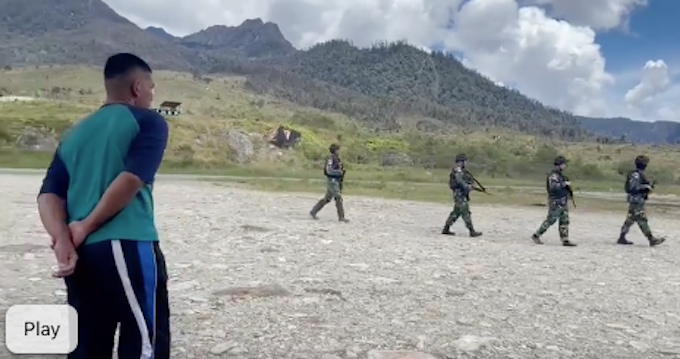
Another difference is that the SA app is opt-in. Currently. The WA app is already mandatory for arrivals from high risk areas like Victoria. For extreme risk areas like NSW, it’s straight into a quarantine hotel.

Reasons for concern

But why are we developing such home-quarantine apps in the first place, when we already have a cheap technology to do this? If we want to monitor that people are at home (and that’s a big if), wouldn’t one of the ankle tags already used by our corrective services for home detention be much simpler, safer and more robust?

There are many reasons to be concerned about home-quarantine apps.

First, they’ll likely be much easier to hack than ankle tags. How many of us have hacked geo-blocks to access Netflix in the US, or to watch other digital content from another country? Faking GPS location on a smartphone is not much more difficult.

Second, facial recognition software is often flawed, and is frequently biased against people of colour and against women. The documentary Coded Bias does a great job unpicking these biases.

The documentary Coded Bias explains the common inbuilt flaws of facial recognition software.

Despite years of effort, even the big tech giants like Google and Amazon have been unable to eliminate these biases from their software. I have little hope the SA government or the WA company GenVis, the developers of the two Australian home-quarantine apps, will have done better.

Indeed, the Australian Human Rights Commission has called for a moratorium on the use of facial recognition software in high-risk settings such as policing until better regulation is in place to protect human rights and privacy.

Third, there needs to be a much more detailed and public debate around issues like privacy, and safeguards put in place based on this discussion, in advance of the technology being used.

With COVID check-in apps, we were promised the data would only be used for public health purposes. But police forces around Australia have accessed this information for other ends on at least six occasions. This severely undermines the public’s confidence and use of such apps.


Read more:
Police access to COVID check-in data is an affront to our privacy. We need stronger and more consistent rules in place


Before it was launched, the Commonwealth’s COVIDSafe app had legislative prohibitions put in place on the use of the data collected for anything but contact tracing. This perhaps gave us a false sense of security as the state-produced COVID check-in apps did not have any such legal safeguards. Only some states have retrospectively introduced legislation to provide such protections.

Fourth, we have to worry about how software like this legitimises technologies like facial recognition that ultimately erode fundamental rights such as the right to privacy.

If home-quarantine apps work successfully, will they open the door to facial recognition being used in other settings? To identify shop lifters? To provide access to welfare? Or to healthcare? What Orwellian world will this take us to?

The perils of facial recognition

In China, we have already seen facial recognition software used to monitor and persecute the Uighur minority. In the US, at least three Black people have already wrongly ended up in jail due to facial recognition errors.

Facial recognition is a technology that is dangerous if it doesn’t work (as it often the case). And dangerous if it does. It changes the speed, scale and cost of surveillance.

With facial recognition software behind the CCTV cameras found on many street corners, you can be tracked 24/7. You are no longer anonymous when you go out to the shops. Or when you protest about Black lives mattering or the climate emergency.

High technology is not the solution

High tech software like facial recognition isn’t a fix for the problems that have plagued Australia’s response to the pandemic. It can’t remedy the failure to buy enough vaccines, the failure to build dedicated quarantine facilities, or the in-fighting and point-scoring between states and with the Commonwealth.

I never thought I’d say this but, all in all, I think I’d prefer an ankle tag. And if the image of the ankle tag seems too unsettling for you, we could do what Hong Kong has done and make it a wristband.

The Conversation

Toby Walsh does not work for, consult, own shares in or receive funding from any company or organization that would benefit from this article, and has disclosed no relevant affiliations beyond their academic appointment.

ref. I’d prefer an ankle tag: why home quarantine apps are a bad idea – https://theconversation.com/id-prefer-an-ankle-tag-why-home-quarantine-apps-are-a-bad-idea-167533

Counselling almost always happens in a room — what if more people had the option of going outside?

Source: The Conversation (Au and NZ) – By Will W Dobud, Social Work Lecturer, Charles Sturt University

Luis Ascui/ AAP

If you peered through the keyhole of any psychotherapy session, chances are they would all look very similar.

There may be nearly 1,000 types of therapies — such as cognitive behavioural and family therapy — but you will typically find a client and practitioner in a room, sitting opposite each other, talking.

Even if you travelled back in time to the 1960s, the 1940s, or even visited Sigmund Freud at the turn of the 20th century, things would also appear similar.

But this is starting to change.

What is outdoor therapy?

During COVID, many therapists took their sessions online. But others went outside, sitting on a park bench with their clients or taking a leisurely stroll through a nearby park.

This added to the existing use of the outdoors for therapeutic purposes, including camping trips, canoeing, rock climbing, gardening, and simple walk-and-talk therapy sessions.

Woman walking in a field.
Time in nature can boost the restorative potential of a therapy session.
James Ross/AAP

Outdoor therapies use outdoor excursions to address behavioural and mental health issues. Whether with individuals or in groups, practitioners combine outdoor activity with talking therapies.

We are also seeing increasing evidence outdoor therapy can improve well-being, decrease symptoms of post-traumatic stress and increase the quality of people’s participation for those who have experienced multiple therapy treatment failures.

Recipients of outdoor therapy have reported enjoying the shared adventure of being outside with their therapist. The time in nature, with its own remedial effects, also boosts the restorative potential of the sessions.

Not just a crisis response

Of course, using outdoor settings for healing is nothing new — First Nations people have appreciated the benefits of this for tens of thousands of years.

In the western world, there is also a tradition of outdoor healing. In 1901 Manhattan State Hospital developed “tent therapy” when patients in the psychiatric units developed tuberculosis.


Read more:
To safeguard children’s mental health during COVID-19, parents must look after their own


Five years later, an earthquake damaged the San Francisco Agnew Asylum requiring patients to live in outdoor settings. Adapting to these unforeseen circumstances facilitated improvements in mental and physical health, and reductions in violent behaviour.

But outdoor therapy should not just be a crisis response, it should be as accessible as sitting on a counsellor’s couch or engaging in telehealth services.

Help for veterans, people with disability

Previously, outdoor therapies have been considered as something just to help troubled young people (which has been accompanied by some valid ethical and safety concerns in cases where “tough love” has been pushed too far). But there is growing evidence it can be applied more broadly.


Read more:
Hairdressers in rural Australia end up being counsellors too


Combat veterans, Indigenous populations, people with disabilities, people with terminal illnesses are among those who have shown benefit from outdoor therapy.

For some people, traditional talk therapy does not suit. Sitting across from a therapist may seem too confrontational, or there is an expectation that business-as-usual therapy is ineffective. For example, we know that for many young people, therapy attempts fail. Taking therapy outdoors has demonstrated outcomes on par with tightly-controlled clinical trials, with regards to improved well-being and symptom reduction.

Increasing options and access

But there are compelling reasons why we should expand this option to anyone seeking psychological help. Beyond the therapeutic benefits, there are access benefits as well.

While there is no doubt what many experience in psychotherapists’ offices is effective — and online therapy can also work — the small take up rate of therapies combined with the high indicators of mental health in society show that we have an engagement problem.

Surfer prepares to enter the water.
Many people who need therapy do not seek it, or have problems accessing something that works for them.
Erik Anderson/AAP

According to the Australian Institute of Health and Welfare, around 20% of Australians experienced diagnosable mental health concerns each year, but only about 11% received a Medicare-subsidised mental health service in 2019-20.

Access is clearly an issue. Sometimes this is because costs of treatment are high, despite subsidies, and waitlists are long (something that has become an even greater problem during COVID).

We also know that different people may need different treatment options. In the United Kingdom, a huge investment in mental health care in 2008 saw 56% of those who accessed a service stop using it after a single visit. Even when therapy was free and accessible, engagement was a serious issue.

Increasing accessibility

A common concern regarding therapy outdoors is confidentiality. What happens if someone sees your client during a walk in the park?

But taking therapy outside can actually appear less visible as there is no need to walk into the local psychotherapy clinic from the street to sit in a small, crowded waiting room.

If we want more people to seek help for their mental health, get that help and stick with it, we need more options.

And an obvious one begins with opening the counselling room door.

If this article has raised issues for you or if you’re concerned about someone you know, call Lifeline on 13 11 14 or beyondblue on 1300 22 4636.

_This piece was produced as part of Social Sciences Week, running 6-12 September. A full list of 70 events can be found here. _

The Conversation

Will W Dobud does not work for, consult, own shares in or receive funding from any company or organization that would benefit from this article, and has disclosed no relevant affiliations beyond their academic appointment.

ref. Counselling almost always happens in a room — what if more people had the option of going outside? – https://theconversation.com/counselling-almost-always-happens-in-a-room-what-if-more-people-had-the-option-of-going-outside-166503