Page 776

Victoria’s controversial pandemic bill: 6 ways for the government to show it is serious about scrutiny

Source: The Conversation (Au and NZ) – By Gabrielle Appleby, Professor, UNSW Law School, UNSW

Victoria’s Pandemic Management Bill, designed to replace the current state of emergency powers in pandemic emergencies, has swiftly become one of the state’s most polarising pieces of legislation.

Amid the politics, public fear-mongering and death threats, there appears to be a growing consensus among lawyers the bill would bring positive changes to the way emergency powers have been exercised during the COVID pandemic. Still, it needs improvement.

Public law academics, the Centre for Public Integrity, the Human Rights Law Centre, the Law Institute of Victoria, Liberty Victoria, and a growing number of barristers are calling for key amendments to the bill, as well as an independent review of the law a year after its enactment.

The government’s powers rapidly expanded during the COVID pandemic. Here are six amendments to the pandemic bill we think the government must adopt to ensure these powers are used in a fair and accountable manner.

1) Give parliament stronger oversight

A fundamental democratic principle in Australia – called responsible government – is the ability of parliament to hold the executive branch (the premier and other ministers) to account. Parliament does this by asking questions, requiring documents to be released, and reporting on the government’s actions to the public.

Already, the bill includes stronger mechanisms to ensure parliament can hold the premier and health minister accountable during pandemic emergencies. For instance, it calls for the Scrutiny of Acts and Regulations Committee (otherwise known as SARC) to review the legality of public health directions, including their compatibility with the Victorian human rights charter.

However, the bill risks using the SARC to create a veneer of scrutiny only. As the Victorian Bar has argued, amendments are needed to ensure the SARC has the powers and time to conduct those reviews effectively.


Read more:
Victoria’s draft pandemic law is missing one critical element – stronger oversight of the government’s decisions


The bill should also follow emerging global best practice and create a specialised cross-party parliamentary committee that would immediately start operating when a pandemic declaration is put into effect.

This already exists at the federal level with the Senate Select Committee on COVID-19, which reviews the Commonwealth government’s actions in response to the pandemic. New Zealand also created a cross-party Epidemic Response Committee that reviews that government’s pandemic-related responses.

This kind of committee would have broader oversight powers of the executive and, therefore, work in conjunction with the more detailed reviews carried out by the SARC.

2) Bolster the expert oversight committee

The pandemic bill creates an expert committee (including public health, law, and Indigenous rights experts) to provide advice to the health minister. However, there is little guarantee this committee would be independent from the minister, or that it would have the resources and powers it needs to do its job.

A merits-based appointment process should be introduced to guarantee the independence and calibre of the committee. It must include public lawyers and have a mandate to provide advice to the government on whether certain measures would infringe on fundamental human rights.

Finally, the committee must report to parliament, rather than to the minister.


Read more:
Have our governments become too powerful during COVID-19?


3) Create an emergency review mechanism

One serious deficiency of the bill is its failure to provide for an expedited and independent merits review for individuals who might be detained or fined for breaching public health orders. This kind of mechanism would provide a way for people to contest a fine or detention if they believe it’s unlawful.

Given the significance of these powers, the inclusion of a no-cost, expedited and independent merits review process is essential – an emergency review for emergency powers.

This role could be performed by the ombudsman, or by the Victorian Civil and Administrative Tribunal (VCAT), and it must be properly resourced.

4) Protect safe protest

The bill contains no protections of the right to safe protest. The right to peaceful protest is fundamental to a liberal democracy, and is protected under the Australian constitution, the Victorian human rights charter and international law. It is essential during a pandemic.

The bill should accommodate “safe” protest that follows proper health guidelines by recognising it as an “essential” activity, similar to food shopping and exercise.


Read more:
Is protesting during the pandemic an ‘essential’ right that should be protected?


One example is allowing for socially distanced or sit-in protests (as have occurred in Israel and elsewhere during the pandemic), or a drive-by car protest that accords with social distancing rules.
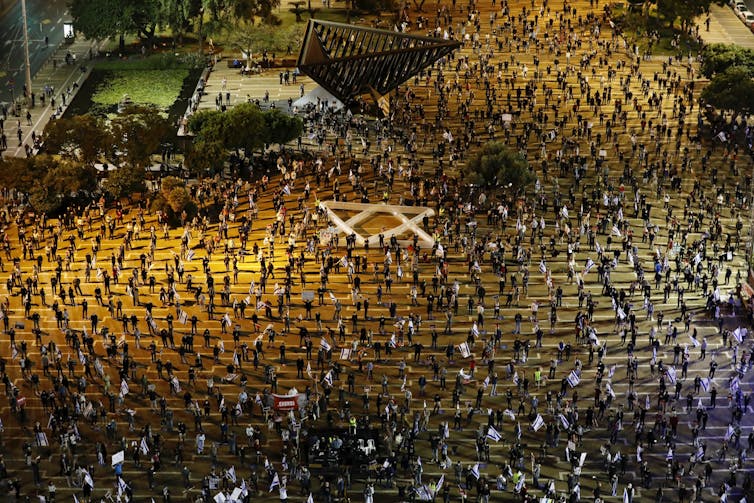
A socially distanced protest in Israel.
A socially distanced protest against the Israeli government last May.
Ariel Schalit/AP

5) Require justification of measures targeted at specific groups

The bill currently permits a pandemic order to apply differently to people with various attributes protected under the Victorian Equal Opportunity Act, such as age and pre-existing medical conditions. The government has noted this could also include how an order applies to vaccinated versus unvaccinated people.

Such a differentiation may be supported if it relates to a person’s health profile. However, the attributes in the Equal Opportunity Act also include race and political and religious beliefs (among many others). This means the bill has a wider remit than just a person’s health profile.

This aspect of the bill has therefore led to significant community backlash and concern.

The preferable means to deal with this is to amend the bill to ensure the health minister must justify any differentiation in pandemic restrictions or policies on health grounds.

6) Require a mandatory two-year review

In light of the lack of adequate time for meaningful consultation on the bill – and the serious concerns that experts have about the appropriateness of its safeguards – we recommend it should have a sunset clause. This means the law would automatically terminate after a set period of time, such as two years.

An alternative would be a mandatory independent review (for instance by a retired judge), to be completed within two years of the law being enacted.

These suggestions would allow the government to respond to the current COVID pandemic under an improved legislative framework, but also require it to conduct further consultation and review before enacting a more permanent law.

The Conversation

Gabrielle Appleby is a member of the Executive Power Project Committee for the Centre for Public Integrity. She is the constitutional consultant to the Clerk of the Commonwealth House of Representatives. She teaches the annual parliamentary law, practice and procedure course for the Australian and New Zealand Association of Clerks at the Table (ANZACATT). Gabrielle is a director of The Wilderness Society Ltd.

Catherine Williams is Research Director at the Centre for Public Integrity

Maria O’Sullivan previously received funding from the Commonwealth Attorney-General’s Department and currently serves as a legal adviser on the Human Rights Panel with Queensland Parliamentary Services.

William Partlett does not work for, consult, own shares in or receive funding from any company or organisation that would benefit from this article, and has disclosed no relevant affiliations beyond their academic appointment.

ref. Victoria’s controversial pandemic bill: 6 ways for the government to show it is serious about scrutiny – https://theconversation.com/victorias-controversial-pandemic-bill-6-ways-for-the-government-to-show-it-is-serious-about-scrutiny-171600
Coalition improves but Morrison’s slide continues in Newspoll; Liberals in danger in Kooyong

Source: The Conversation (Au and NZ) – By Adrian Beaumont, Honorary Associate, School of Mathematics and Statistics, The University of Melbourne

AAP/Dean Lewins

This week’s Newspoll, conducted November 10-13 from a sample of 1,524, gave Labor a 53-47 lead, a one point gain for the Coalition since the last Newspoll, three weeks ago. Primary votes were 38% Labor (steady), 37% Coalition (up two), 11% Greens (steady), 2% One Nation (down one) and 12% for all Others (down one).

52% (up two) were dissatisfied with Scott Morrison’s performance, and 44% (down two) were satisfied, for a net approval of -8, down four points. This continues Morrison’s slump from his pandemic highs. Six months ago, Morrison’s net approval in Newspoll was +20, and last November his net approval was +36.

Anthony Albanese’s net approval also fell, by two points to -11. Morrison’s lead over Albanese as better PM was cut to 46-38 from 48-34 three weeks ago. Newspoll figures are from The Poll Bludger.

While Morrison’s ratings are sliding, that does not mean the Coalition is doomed. Analyst Kevin Bonham says five PMs with worse ratings in the six months prior to an election have won, two with pro-government swings.

However, Morrison has failed to gain following the reopening of Sydney and Melbourne. His recent international performance appears to have hurt him, with the Liberals suffering marked declines in maintaining international relations and national security in an Essential poll (see below).

Inflation could cause problems for Morrison and the Coalition in the lead-up to the next election that is due by May 2022. It has damaged the US Democrats.

The Guardian’s datablog has 69.4% of the population (not 16+) with two vaccine doses, up from 60.3%three weeks ago. We rank 14 of 38 OECD countries in share of population double dosed, up 12 places from three weeks ago; we were ranked last a few months ago. In the past three weeks, Australia has overtaken the UK, France and Germany, and retaken the lead from New Zealand.

Official government data show 83.0% of 16+ are double dosed and 90.4% have received at least one dose. Around 90% of 16+ are double dosed in Victoria, NSW and the ACT, compared with 80% of 12+ in the UK; this shows the success of Australia’s vaccine mandates.

Liberals in danger in Kooyong seat poll

A Redbridge poll of the federal seat of Kooyong (currently held by Treasurer Josh Frydenberg) for the activist group Climate 200, conducted October 16-18 from a sample of 1,017, gave the Liberals 38%, Labor 31%, the Greens 15% and UAP 7%. The Liberals had 58.2% of the Kooyong primary vote at the 2016 election, and this dropped to 49.4% in 2019. These results imply another 11% primary vote swing against the Liberals.

There are skewed poll questions that were designed to promote a climate-focused independent. The results that have the independent ahead of the Liberals on primary votes after these questions should be ignored.

While the Coalition won the 2019 election owing to gains in regional Queensland and Tasmania, there were solid swings to Labor in inner city seats with high levels of educational attainment. A continuation of this trend would make Kooyong and other former safe Liberal seats in Sydney and Melbourne attainable for Labor.


Read more:
Final 2019 election results: education divide explains the Coalition’s upset victory


Essential poll: Morrison’s ratings slump

In last week’s Essential poll, 48% approved of Morrison’s performance (down six since October), and 42% disapproved (up five), for a net approval of +6, down 11 points. This is Morrison’s worst approval in Essential since before the pandemic began. He had gained eight points on net approval in October.

Albanese’s net approval was down two points to +5, and Morrison led as better PM by 44-28 (45-29 in October).

The Liberals led Labor on just two of nine issues canvassed: the economy (by eight points) and national security (by six). The Liberals’ position deteriorated since September on most issues, with marked falls on national security and maintaining international relations.

94% thought it important for Australia to have a good international reputation. By 47-27, voters thought Morrison had undermined, rather than enhanced, our international reputation.

Despite Morrison’s slump, the federal government’s COVID rating improved to 48-29 good from 46-31 in late October, owing to an 11-point jump in Victoria (to 45% good). The Victorian state government also benefited, with its good rating up 13 to 56%.

43% thought the net zero by 2050 commitment was not enough action on climate change, and we need to do more, while 37% thought it was enough. There was pessimism about COP26 achieving meaningful changes to address climate change both globally (52-35 not confident) and in Australia (52-37).

Morgan poll: 53.5-46.5 to Labor

A Morgan poll, conducted in late October and early November from a sample of over 2,700, gave Labor a 53.5-46.5 lead, a 0.5% gain for the Coalition since mid-October. Primary votes were 36.5% Coalition (steady), 35% Labor (steady), 11.5% Greens (down 2%), 3% One Nation (down 0.5%) and 14% for all Others (up 2.5%).

Unemployment rate jumped to 5.2% in October

The ABS reported last Thursday that the unemployment rate jumped 0.6% from September to 5.2% in October. The participation rate was up 0.1% to 64.7% and the employment population ratio – the percentage of eligible Australians employed – was down 0.3% to 61.3%; it has fallen 1.7% from its July peak of 63.0%.

This ABC report says fieldwork for the labour force survey was taken between September 26 and October 9, before lockdowns in Sydney and Melbourne were eased. Economists expect a strong rebound in November’s report.

Proposed changes to require voter ID

The government is proposing voters be required to show ID at the polls to vote. This has been compared to the US, where some Republican state governments make it harder for Democratic supporting minorities to vote.

While such tactics in the US receive much media attention and condemnation, gerrymandering – the manipulation of electoral district boundaries – has a far bigger impact on electoral outcomes.

Both Democrats and Republicans will gerrymander when given the opportunity. To gerrymander, a party usually needs control of both chambers of a state’s legislature and the governor. I had more on US gerrymandering in a Poll Bludger article on October 29.

Canada has similar requirements on voter ID to what is being proposed in Australia. But the left in Australia obsesses over the US comparison.

If these voter ID proposals become law, they will have very little impact on the next federal election.

Swings against US Democrats in off-year elections point to a drubbing next November

I live blogged the Virginia and New Jersey state elections for The Poll Bludger on November 3. Virginia voted for Joe Biden in 2020 by ten points and Democrats lost the governor election. New Jersey voted for Biden by 16, and Democrats barely won.

If these swings are repeated at the November 2022 midterm elections, when all federal House seats and one-third of the Senate are up for election, Democrats would be thumped.

President Biden is unpopular owing to inflation. Headline US inflation increased 0.9% in October to be up 6.2% for the 12 months to October, the highest inflation rate since 1990. The high inflation has resulted in real earnings falling 1.2% (hourly) and 1.6% (weekly) in the 12 months to October.

The Conversation

Adrian Beaumont does not work for, consult, own shares in or receive funding from any company or organisation that would benefit from this article, and has disclosed no relevant affiliations beyond their academic appointment.

ref. Coalition improves but Morrison’s slide continues in Newspoll; Liberals in danger in Kooyong – https://theconversation.com/coalition-improves-but-morrisons-slide-continues-in-newspoll-liberals-in-danger-in-kooyong-171593

Antarctic bacteria live on air and make their own water using hydrogen as fuel

Source: The Conversation (Au and NZ) – By Pok Man Leung, PhD candidate in Microbiology, Monash University

Ian Hogg, Author provided

Humans have only recently begun to think about using hydrogen as a source of energy, but bacteria in Antarctica have been doing it for a billion years.

We studied 451 different kinds of bacteria from frozen soils in East Antarctica and found most of them live by using hydrogen from the air as a fuel. Through genetic analysis, we also found these bacteria diverged from their cousins in other continents approximately a billion years ago.

These incredible microorganisms come from ice-free desert soils north of the Mackay Glacier in East Antarctica. Few higher plants or animals can prosper in this environment, where there is little available water, temperatures are below zero, and the polar winters are pitch-black.

Despite the harsh conditions, microorganisms thrive. Hundreds of bacterial species and millions of cells can be found in a single gram of soil, making for a unique and diverse ecosystem.

The freezing soil of Antarctica makes a surprising home for a diverse community of microbes that have adapted to life in the harsh conditions.
Ian Hogg, Author provided

How do microbial communities survive in such punishing surroundings?

A dependable alternative to photosynthesis

We discovered more than a quarter of these Antarctic soil bacteria create an enzyme called RuBisCO, which is what lets plants use sunlight to capture carbon dioxide from air and convert it into biomass. This process, photosynthesis, generates most of the organic carbon on Earth.

However, we found more than 99% of the RuBisCO-containing bacteria were unable to capture sunlight. Instead, they perform a process called chemosynthesis.

Rather than relying on sunlight to power the conversion of carbon dioxide into biomass, they use inorganic compounds such as the gases hydrogen, methane, and carbon monoxide.


Read more:
Extremophiles: resilient microorganisms that help us understand our past – and future


Living on air

Where do the bacteria find these energy-rich compounds? Believe it or not, the most reliable source is the air!

Air contains high levels of nitrogen, oxygen and carbon dioxide, but also trace amounts of the energy sources hydrogen, methane, and carbon monoxide.

They are only present in air in very low concentrations, but there is so much air it provides a virtually unlimited supply of these molecules for organisms that can use them.

And many can. Around 1% of Antarctic soil bacteria can use methane, and some 30% can use carbon monoxide.

More remarkably, our research suggests that 90% of Antarctic soil bacteria may scavenge hydrogen from the air.

Only a tiny fraction of air is hydrogen, but there’s so much air it makes an unlimited supply of fuel for bacteria that can harvest it.
Ian Hogg, Author provided

The bacteria gain energy from hydrogen, methane and carbon by combining them with oxygen in a chemical process that is like a very slow kind of burning.

Our experiments showed the bacteria consume atmospheric hydrogen even at temperatures of -20°C, and they can consume enough to cover all their energy requirements.

What’s more, the hydrogen can power chemosynthesis, which may provide enough organic carbon to sustain the entire community. Other bacteria can access this carbon by “eating” their hydrogen-powered neighbours or the carbon-rich ooze they produce.

Water from thin air

When you burn hydrogen, or when the bacteria harvest energy from it, the only by-product is water.

Making water is an important bonus for Antarctic bacteria. They live in a hyper-arid desert, where water is unavailable because the surrounding ice is almost permanently frozen and any moisture in the soil is rapidly sucked out by the dry, cold air.

So the ability to generate water from “thin air” may explain how these bacteria have been able to exist in this environment for millions of years. By our calculations, the rates of hydrogen-powered water production are sufficient to rehydrate an entire Antarctic cell within just two weeks.

By adopting a “hydrogen economy”, these bacteria fulfil their needs for energy, biomass, and hydration. Three birds, one stone.

Could a hydrogen economy sustain extraterrestrial life?

The minimalist hydrogen-dependent lifestyle of Antarctic soil bacteria redefines our understanding of what is the very least required for life on Earth. It also brings new insights into the search for extraterrestrial life.

Hydrogen is the most common element in the universe, making up almost three-quarters of all matter. It is a major component of the atmosphere on some alien planets, such as HD 189733b which orbits a star 64.5 light-years from Earth.

If life were to exist on such a planet, where conditions may not be as hospitable as on much of Earth, consuming hydrogen might be the simplest and most dependable survival strategy.

“Follow the water” is the mantra for searches of extraterrestrial life. But given bacteria can literally make water from air, perhaps the key to finding life beyond Earth is to “follow the hydrogen”.


Read more:
Hydrogen-breathing aliens? Study suggests new approach to finding extraterrestrial life


The Conversation

Chris Greening receives funding from the Australian Research Council, the Australian Antarctic Science Program, the National Health & Medical Research Council, and the Wellcome Trust.

Steven Chown receives funding from the Australian Research Council, the Australian Antarctic Science Program, the National Health & Medical Research Council and the Wellcome Trust. He is Immediate Past President of the Scientific Committee on Antarctic Research.

Pok Man Leung does not work for, consult, own shares in or receive funding from any company or organisation that would benefit from this article, and has disclosed no relevant affiliations beyond their academic appointment.

ref. Antarctic bacteria live on air and make their own water using hydrogen as fuel – https://theconversation.com/antarctic-bacteria-live-on-air-and-make-their-own-water-using-hydrogen-as-fuel-171808

COP26: the Glasgow climate summit demonstrates an appetite for change Australia simply can’t ignore

Source: The Conversation (Au and NZ) – By Frank Jotzo, Professor, Crawford School of Public Policy and Head of Energy, Institute for Climate Energy and Disaster Solutions, Australian National University

COP26 president Alok Sharma has described the pivotal United Nations talks, which concluded over the weekend, as only a “fragile win” for ambition on climate change. But, against the odds, the summit produced the goods on several important aspects of international climate policy.

It resolved tricky outstanding issues for implementing the Paris Agreement. And most importantly, it reinforced the multilateral consensus that much stronger climate action is needed in both the short and long term.

Stabilising the climate depends on a lot more than the outcome of multilateral negotiations like Glasgow. But those agreements set a frame for real-world decisions.

Here’s a preliminary interpretation of some of the decisions at COP26 on climate change mitigation, and the implications for Australia.

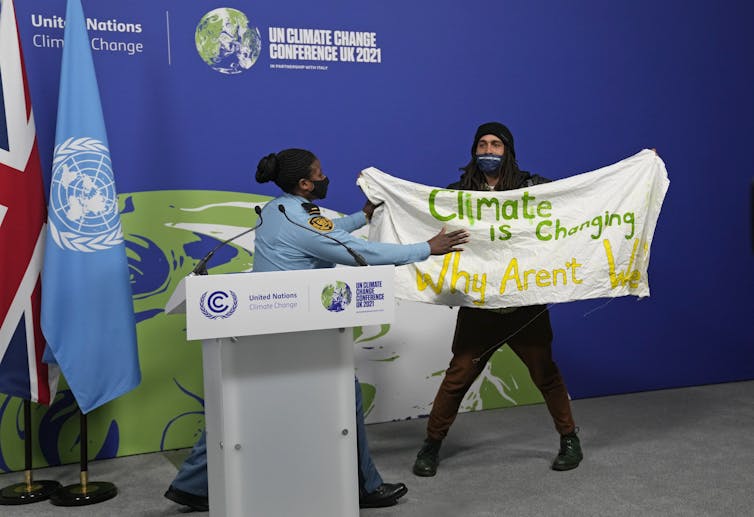
woman at lectern looks at woman holding banner
Some were unhappy with the COP26 outcome, but it created momentum for change.
Alastair Grant/AP

Coal power “phase down”

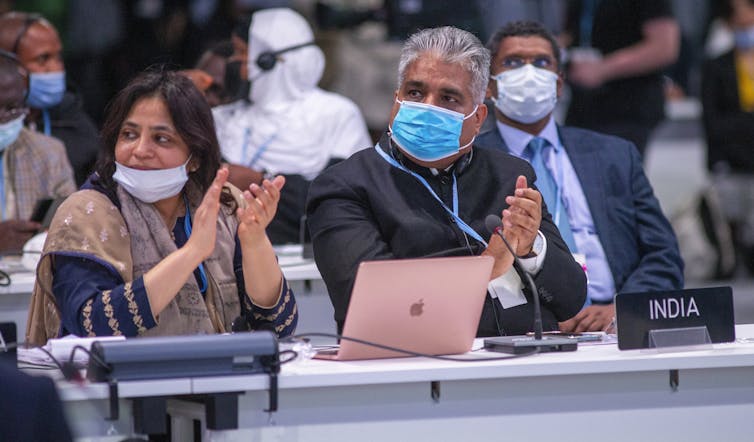
Global climate negotiations are usually a relentless grind, with occasional fireworks. One such firework moment came in the final session when India, supported by China, demanded the Glasgow Climate Pact’s language on coal should be weakened from “phase-out” to “phasedown” of unabated coal power.

To prevent the disagreement scuttling the entire deal, the revision was agreed to, despite bitter protests by many countries intent on stronger action.

The wording of United Nations agreements is cumbersome, but deliberate. Here’s the full reference to coal in the final COP26 text. It calls on the parties to the Paris Agreement to:

accelerate the development, deployment and dissemination of technologies, and the adoption of policies, to transition towards low-emission energy systems, including by rapidly scaling up the deployment of clean power generation and energy efficiency measures, including accelerating efforts towards the phase-down of unabated coal power and phase-out of inefficient fossil fuel subsidies, while providing targeted support to the poorest and most vulnerable in line with national circumstances and recognising the need for support towards a just transition.

(By way of definition, “unabated” coal power refers to the absence of carbon capture and storage in power stations. This technology is very expensive for power generation and unlikely to be used at large scale.)

So what does the above text mean, exactly? At the core of it, the international community is spelling out an expectation that countries strive to greatly reduce the use of coal in electricity generation, and to stop subsidising fossil fuels. The original “phase-out” language would obviously have meant nations should stop using unabated coal power altogether.


Read more:
Are you kidding, India? Your last-minute Glasgow intervention won’t relieve pressure to ditch coal


On the face of it, the change in wording makes a big difference. But the signal to investors in coal mining and coal power plants is the same: the international community has decided coal-fired power must fall, and its end is coming.

No previous United Nations climate change decision has so directly called for action to cut fossil fuels. So even the weakened language is unprecedented.

What’s more, nations can act independently of – and more ambitiously than – the wording in the COP agreement.

For example, China recently pledged to rely much less on coal power and stop building coal-fired power stations abroad. And the surprise US-China joint declaration on climate change announced at Glasgow enshrines the “elimination of support for unabated international thermal coal power generation”.

The international market for thermal coal – the type burned for electricity – will shrink and could do so quickly. Australia is the world’s number two thermal coal exporter behind Indonesia. We’d better get used to the fact the business is in decline.

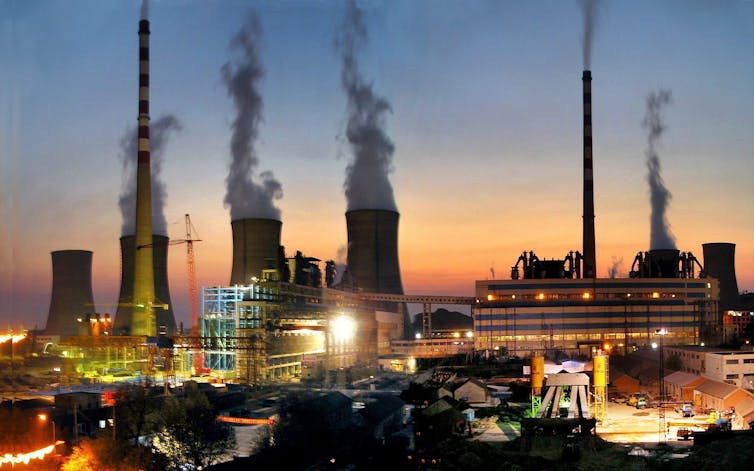
industrial scene with smoke billowing
The market for thermal coal is likely to shrink quickly.
Li Bin/AP

Ratcheting up 2030 targets

Another key aspect of the Glasgow pact is the call for stronger 2030 emissions targets and short-term action.

By the end of next year, nations are asked to strengthen their 2030 targets to align with the 1.5℃ temperature goal. This puts big pressure on Australia.

The federal government still retains the very weak target of a 26-28% emissions reduction by 2030, based on 2005 levels, and recently said the target will be exceeded by up to 9%. Prime Minister Scott Morrison’s insistence on Sunday that the target is “fixed” will not cut it over the next year.

Almost all other developed countries have strengthened their targets already, some greatly so. An important reference point is the United States, which has adopted a 50-52% reduction target in the same time frame.

In yet stronger language, the Glasgow pact “urges” countries that haven’t yet submitted a long-term emissions-reduction strategy to do so by next year’s conference.

This puts the onus on the federal government. Its recent “plan” to reach net-zero by 2050 falls far short of the mark of what constitutes a real national strategy.


Read more:
Government assumes 90% of Australia’s new car sales will be electric by 2050. But it’s a destination without a route


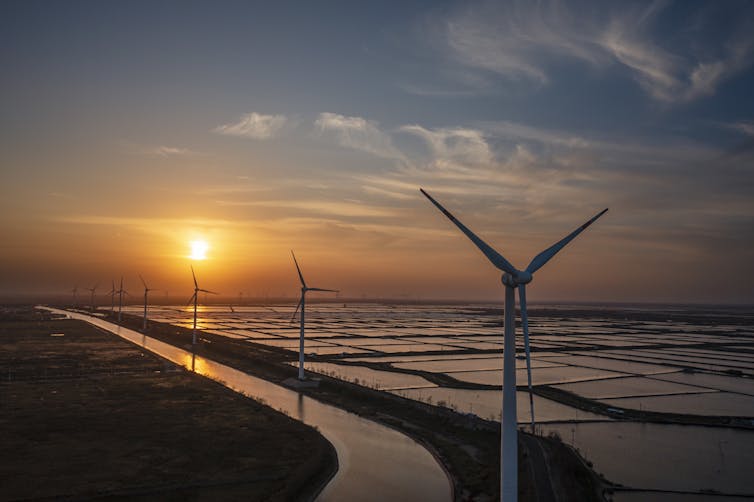
wind farm
Countries without a long-term emissions-reduction strategy should address this by next year.
Alex Plaveski/EPA

International carbon trading

COP26 managed to resolve an issue that had proven extremely difficult since the Paris talks – rules for future international carbon markets.

The compromise reached appears to largely close loopholes for double-counting of emissions reduction. What kind and extent of international emissions markets will emerge under the Paris Agreement framework remains to be seen. However, the rules to underpin them are now available.

From an Australian perspective, an outcome on international emissions markets is very positive. Australian governments and negotiators have worked to help make it happen.

It opens the door to Australian companies or governments purchasing emissions reductions achieved in other countries, if this turned out cheaper than acting more strongly to cut emissions at home. It will also help Australia work with countries in the Pacific and Southeast Asia to reduce emissions there, and to share the resulting emissions reductions between countries.

Australia’s large land mass and unlimited potential for cheap renewable energy means it’s better positioned than most countries to become a net-negative emissions economy in the long term. In other words, Australia could one day remove more greenhouse gases from the atmosphere than it emits.

So an international carbon trading framework means Australia could eventually sell emissions reduction credits to other countries, and the revenue could fund large-scale CO₂ removal from the atmosphere.

A momentum that cannot be ignored

Earth’s climate will not be determined by what is agreed at global climate talks, but by the actions that businesses and people take, and the policies governments put in place.

But what’s decided at conferences like Glasgow sets the frame for real-world decisions. The Glasgow outcome shows there is resolve to get on top of the problem.

Governments that might prefer the old ways of a carbon-intensive economy cannot ignore that momentum.


Read more:
COP26 leaves too many loopholes for the fossil fuel industry. Here are 5 of them


The Conversation

Frank Jotzo leads and has led research projects funded by a variety of funders. None present a conflict of interest on this topic.

ref. COP26: the Glasgow climate summit demonstrates an appetite for change Australia simply can’t ignore – https://theconversation.com/cop26-the-glasgow-climate-summit-demonstrates-an-appetite-for-change-australia-simply-cant-ignore-171810

Northland principal faces ‘vindictive’ abuse for backing vaccine mandate

By Ella Stewart, RNZ News reporter

A Northland high school principal says she has been accused of being “complicit in mass genocide” by people opposed to getting vaccinated.

After today, anyone who works or volunteers in an education setting in New Zealand and who has not received at least one dose of the covid-19 vaccine will be barred from school grounds.

Last week, thousands of people marched up the streets of Wellington to Parliament to protest for various covid-19-related reasons.

Some were angry at the covid-19 vaccination mandates, the lockdowns or the vaccine itself.

The protesters screamed abuse at police and media, demanding an end to covid-19 restrictions.

This level of anger is all too familiar for Whangārei Boys High School principal Karen Gilbert-Smith.

“I appreciate that what’s happening for a lot of people is really challenging, but the kind of things that have been happening from my end, and I know speaking to other colleagues, they’re experiencing similar things, is relentlessness that we’re doing something to others,” Gilbert-Smith said.

‘Worst message’
“I think the worst message that I got was that I was complicit in mass genocide by supporting the vaccination mandate,” she said.

“We get a lot of emails from parents: the vast majority of those are positive, but the ones that kind of take the wind out of your sails and that require the most thoughtful response are the ones that are really awful and vindictive.”

The abuse was coming from all angles and although it was a minority, their voices were loud, Gilbert-Smith said.

“I think it’s the ill-informed or misinformed anti-vaxxers that are really whipping up that hatred. That just feels really abhorrent to me that misinformation just gets so widely spread and is leading to that sense of lack of safety for people in their communities.”

But today the no jab, no job policy for education staff officially kicks in.

Teachers need to have received at least one dose of the covid-19 vaccine if they want to continue to work with students in a face-to-face learning environment.

‘Where are we going to find those replacements?’
Gilbert-Smith preferred not to comment on their own staffing situation at Whangārei Boys High School, but did say she was nervous.

“As principals, many of us have had conversations about the impact in our own schools and certainly in Te Tai Tokerau, it’s likely to have a significant impact on staffing across our schools, so we’re not just talking about teachers,” she said.

“We’re talking about groundsmen, canteen staff, support staff, everyone. We can ill afford to have staffing shortages and in Tai Tokerau it’s difficult enough.”

She is concerned that it will impact on students.

“It’s hard enough to put well qualified, passionate, knowledgeable, smart teachers in front of students, which is what they deserve. And now we’re in a situation of being a little bit further behind than that.

“Where are we going to find those replacements? Particularly teachers. That is very worrying to me.”

She said the constant hate and abuse was wearing her down and was making it harder for her to do her job.

‘Creating reassurance’
“Principals are creating reassurance for everyone in their community, but also fielding all the negativity that comes. Anyone with aspirations of being a principal right now, they might be reconsidering at this point,” she said.

“We are obliged to uphold the law, and that’s what we’re doing as principals, and we’re doing the best that we can. We’re managing people’s expectations and we’re dealing with their upset and distress.

“And keeping the school running as we’re supposed to do on any other day of the week, or any other time of the year. It is a lot of work.”

Gilbert-Smith said she loved her job, but the current conversations had moved too far away from being about creating better outcomes for young people in Aotearoa.

“That’s a real shame because they are the ones that will suffer, those young people in our schools.”

The impact of the vaccine mandate on teacher supply will not be known until the vaccination deadline has passed and numbers are clear, according to the Ministry of Health.

This article is republished under a community partnership agreement with RNZ.

Print Friendly, PDF & Email

Article by AsiaPacificReport.nz

Pacific scholar Dr Damon Salesa named AUT’s next vice-chancellor

Asia Pacific Report newsdesk

Pacific scholar and senior university sector leader Toeolesulusulu Dr Damon Salesa has been appointed as the next vice-chancellor of Te Wānanga Aronui o Tāmaki Makaurau Auckland University of Technology (AUT), AUT News reports.

The appointment by the University Council at Te Wānanga Aronui o Tāmaki Makaurau AUT was announced today and is the result of a global search after current vice-chancellor Derek McCormack announced his retirement in March 2022 after 18 years at the helm.

Toeolesulusulu is a prizewinning historian and former Rhodes Scholar. After obtaining his MA with first class honours at the University of Auckland, he completed his doctoral studies at Oxford University.

He is the author and editor of many books and academic articles including Island Time: New Zealand’s Pacific Futures (BWB, 2017) and Racial Crossings (Oxford University Press, 2011) which won the international Ernest Scott Prize in 2012. He is a Fellow of the Royal Society of New Zealand, and currently serves on their council.

“For 20 years AUT has been the most remarkable story in Aotearoa New Zealand tertiary education, showing how the pursuit of excellence can be set on a foundation of service, inclusion and close relationships with our communities, businesses and stakeholders,” said Toeolesulusulu.

“AUT is New Zealand’s tech university, a pacesetter in the social, educational and economic transformation in Aotearoa New Zealand. I am excited by the opportunity to lead AUT on the next leg of its journey of excellence, Te Tiriti partnership, equity and service to our city, nation, region and the world.”

His current role is as pro vice-chancellor Pacific at the University of Auckland where he also serves on the executive committee tasked with the strategic leadership and governance of the organisation.

Pacific programme in US
Toeolesulusulu has also served as co-head of Te Wānanga o Waipapa (School of Māori Studies and Pacific Studies) at the University of Auckland and previously worked at the University of Michigan for 10 years, including in roles as director of the Asian Pacific Islander American Studies Programme and as an associate professor in the History Department and Programme in American Culture.

An Aucklander, Toeolesulusulu was born and bred in Glen Innes, the son of a factory worker from Samoa and a nurse from the Far North. He is married with two teenage daughters.

Toeolesulusulu retains strong connections to many of Auckland’s communities, especially in South Auckland. He has been an innovator at the interface between schools and universities and has been an important leader and supporter of the work of schools, in pedagogy, curriculum and governance.

AUT chancellor Rob Campbell said the council was looking forward to welcoming Toeolesulusulu Dr Salesa to AUT next year.

“We are impressed by Damon’s vision of the critical contribution AUT can make to Aotearoa New Zealand and the Pacific through quality research and teaching, and the role of Te Tiriti o Waitangi throughout the work of the university,” he said.

Print Friendly, PDF & Email

Article by AsiaPacificReport.nz

The ultimate guide to why the COP26 summit ended in failure and disappointment (despite bright spots)

ANALYSIS: By Robert Hales, Griffith University and Brendan Mackey, Griffith University

After two hard-fought weeks of negotiations, the Glasgow climate change summit is, at last, over. All 197 participating countries adopted the so-called Glasgow Climate Pact, despite an 11th hour intervention by India in which the final agreement was watered down from “phasing out” coal to “phasing down”.

In an emotional final speech, COP26 president Alok Sharma apologised for this last-minute change.

His apology goes to the heart of the goals of COP26 in Glasgow: the hope it would deliver outcomes matching the urgent “code red” action needed to achieve the Paris Agreement target.

COP26 GLASGOW 2021

At the summit’s outset, UN Secretary-General António Guterres urged countries to “keep the goal of 1.5℃ alive”, to accelerate the decarbonisation of the global economy, and to phase out coal.

So, was COP26 a failure? If we evaluate this using the summits original stated goals, the answer is yes, it fell short. Two big ticket items weren’t realised: renewing targets for 2030 that align with limiting warming to 1.5℃, and an agreement on accelerating the phase-out of coal.

But among the failures, there were important decisions and notable bright spots. So let’s take a look at the summit’s defining issues.

Weak 2030 targets
The goal of the Paris Agreement is to limit global temperature rise to well below 2℃ this century, and to pursue efforts to limit warming to 1.5℃. Catastrophic impacts will be unleashed beyond this point, such as sea level rise and more intense and frequent natural disasters.

But new projections from Climate Action Tracker show even if all COP26 pledges are met, the planet is on track to warm by 2.1℃ — or 2.4℃ if only 2030 targets are met.

Despite the Australian government’s recent climate announcements, this nation’s 2030 target remains the same as in 2015. If all countries adopted such meagre near-term targets, global temperature rise would be on track for up to 3℃.

Technically, the 1.5℃ limit is still within reach because, under the Glasgow pact, countries are asked to update their 2030 targets in a year’s time. However, as Sharma said, “the pulse of 1.5 is weak”.

And as Australia’s experience shows, domestic politics rather than international pressure is often the force driving climate policy. So there are no guarantees Australia or other nations will deliver greater ambition in 2022.

Phase down, not out
India’s intervention to change the final wording to “phase down” coal rather than “phase out” dampens the urgency to shift away from coal.

India is the world’s third-largest emitter of greenhouse gases, after China and the United States. The country relies heavily on coal, and coal-powered generation is expected to grow by 4.6 percent each year to 2024.

India was the most prominent objector to the “phase out” wording, but also had support from China.

And US climate envoy John Kerry argued that carbon capture and storage technology could be developed further, to trap emissions at the source and store them underground.

Carbon capture and storage is a controversial proposition for climate action. It is not proven at scale, and we don’t yet know if captured emissions stored underground will eventually return to the atmosphere. And around the world, relatively few large-scale underground storage locations exist.

It is hard to see this expensive technology ever being cost-competitive with cheap renewable energy.

In a crucial outcome, COP26 also finalised rules for global carbon trading, known as Article 6 under the Paris Agreement. However under the rules, the fossil fuel industry will be allowed to “offset” its carbon emissions and carry on polluting. Combined with the “phasing down” change, this will see fossil fuel emissions continue.

It wasn’t all bad
Despite the shortcomings, COP26 led to a number of important positive outcomes.

The world has taken an unambiguous turn away from fossil fuel as a source of energy. And the 1.5℃ global warming target has taken centre stage, with the recognition that reaching this target will require rapid, deep and sustained emissions reductions of 45 percent by 2030, relative to 2010 levels.

What’s more, the pact emphasises the importance to mitigation of nature and ecosystems, including protecting forests and biodiversity. This comes on top of a side deal struck by Australia and 123 other countries promising to end deforestation by 2030.

The pact also urges countries to fully deliver on an outstanding promise to deliver US$100 billion a year for five years to developing countries vulnerable to climate damage. It also emphasises the importance of transparency in implementing the pledges.

Nations are also invited to revisit and strengthen the 2030 targets as necessary to align with the Paris Agreement temperature goal by the end of 2022. In support of this, it was agreed to hold a high-level ministerial roundtable meeting each year focused on raising ambition out to 2030.

The US and China climate agreement is also cause for cautious optimism.

Despite the world not being on track for the 1.5℃ goal, momentum is headed in the right direction. And the mere fact that a reduction in coal use was directly addressed in the final text signals change may be possible.

But whether it comes in the small window we have left to stop catastrophic climate change remains to be seen.The Conversation

Dr Robert Hales, director of the Centre for Sustainable Enterprise, Griffith University and Dr Brendan Mackey, director of the Griffith Climate Change Response Programme, Griffith University. This article is republished from The Conversation under a Creative Commons licence. Read the original article.

Print Friendly, PDF & Email

Article by AsiaPacificReport.nz

Anger, grievance, resentment: we need to understand how anti-vaxxers feel to make sense of their actions

Source: The Conversation (Au and NZ) – By Andrew McKenzie-McHarg, Senior Research Fellow at the Institute for Religion and Critical Inquiry, Australian Catholic University

It is not entirely irrational to fear needles (or to suffer from trypanophobia for those who prefer the Greek term). Likewise, feeling anxious about injecting a foreign substance into the bloodstream seems quite reasonable.

And it is hardly surprising that people might find these things even more anxiety-inducing because of the duty of care we feel toward loved ones, especially children.

The anti-vax movement, thus, has an understandable relationship with fear and anxiety. In fact, there has been resistance to vaccinations since at least the late 18th century when the British physician Edward Jenner began to promote them as a prophylactic measure against smallpox.

One of Jenner’s contemporaries, the caricaturist James Gillray, famously lampooned people’s fears by imagining how cows grotesquely begin to sprout from the limbs and faces of the newly vaccinated. It was an early 19th-century version of what we today might assign to the sub-genre of body horror.

A satirical cartoon by James Gillray
A satirical cartoon by James Gillray entitled, The Cow-Pock—or—the Wonderful Effects of the New Inoculation!, published in 1802.
Wikimedia Commons

The anti-vax movement is, however, no longer fuelled purely by fears about vaccines and harmful side-effects.

At recent protests against vaccine mandates in Australia, for instance, “F*** the jab” was one of the chants that could be heard. The mood was dominated by anger, not anxiety.


Read more:
Why QAnon is attracting so many followers in Australia — and how it can be countered


On first sight, there is nothing surprising about such truculence. The vaccine mandates imposed in response to the COVID pandemic are forcing some people to do something they are fearful of and would prefer not to do.

But the militancy of the protests and make-up of participants suggest many far-right nationalists and extreme libertarians have either co-opted the anti-vax movement or converged with it. Ideological differences recede into the background and common ground is found in opposing public authorities whose attempts to counteract the spread of the virus have been interpreted as the first steps toward tyranny.

From philosophy to psychology

A common denominator uniting these movements is the penchant for viewing the world through the prism of conspiracy theories.

For some, Big Pharma ruthlessly pursues profits by exploiting human frailty and gullibility. For others, the state is exploiting a health crisis with the goal of installing itself as Big Brother. For a few, the Illuminati overlords are lurking somewhere in the background.

Because conspiracy theories claim to be based in fact – unlike myths or fables – the concept encourages us to treat them as rational and therefore refutable.

At least this was the presumption guiding the philosopher Karl Popper when he delivered two lectures in 1948 that are regarded as the first effort to examine conspiracy theories from a philosophical standpoint.


Read more:
In defence of conspiracy theories (and why the term is a misnomer)


Although Popper was aware that conspiracy theories are found throughout history, his analysis was akin to a thought experiment. The experiment revolved around the question of whether it was possible to imagine events and trends in the world as the result of a conspiracy. Is this a tenable view of how society works?

Karl Popper in 1990.
Wikimedia Commons

It was not, he concluded. And refuting the claim that secret agents were responsible for a war or an economic depression, for example, was a way of edging closer to the correct understanding of such phenomena.

If this sounds somewhat abstract, the legal theorist Franz Neumann attempted to get nearer to the reality of conspiracy theories by linking them to a psychological condition.

In a 1954 lecture called “Anxiety and Politics”, Neumann diagnosed conspiracy theories as an attempt to transform people’s anxieties into fear. The distinction had political consequences. Anxiety had a paralysising effect; fear, by contrast, was a catalyst for action.

Neumann insisted that at the core of the delusions characterising conspiracy theories, there remained a “kernel of truth”. In this spirit, the suspicions long harboured by the anti-vax movement are not entirely misplaced if you take into account the far-from-unblemished public health record of pharmaceutical giants.

Much of the research on conspiracy theories since then continues to take its cues from Neumann by treating them as attempts by frightened, panicked people to get a grip on the world.

Anti-vaccination rally in Romania.
Anti-vaccination rallies like this one in Romania this month have been commonplace throughout the pandemic.
Vadim Ghirda/AP

How anger leads to falsehoods

What if, however, fear and anxiety are not sufficient to understand the social psychology at work here?

The protests against vaccine mandates, as well as earlier protests against 5G technology and the rise of the QAnon movement, suggest there are other emotions underpinning all of this. These are feelings of anger, grievance, and resentment. Add to this the restrictions and lockdowns imposed by governments over the last 18 months and the effect is like pouring fuel on the fire.

Anger makes us want to lash out – to kick the cat or some other unfortunate proxy for those deemed responsible for our troubles and woes.


Read more:
‘It’s almost like grooming’: how anti-vaxxers, conspiracy theorists, and the far-right came together over COVID


Importantly, anger also has a disinhibiting effect on our relationship to the truth. That is, when we are angry, we feel less obliged to speak truthfully and allow our emotions to take over.

For instance, research shows anger enhances our propensity to lie. And the deeper you probe into the contemporary anti-vax movement, the more you find a conscious willingness to play it fast and loose with the truth.

The movement is now driven by lies told out of spite and believed in part by those who tell them because of the gratification this brings them.

The online documentary Plandemic: The Hidden Agenda Behind COVID-19, for example, features Judy Mikovits, a discredited medical researcher with an axe to grind against Anthony Fauci, the leading infectious disease expert in the US, because of the alleged role he played in the loss of her professional reputation.

The documentary makes a series of bogus claims, culminating in the assertion that masks function as a catalyst for COVID because “they activate your inner virus.”

Another widespread lie is that philanthropist Bill Gates was using the vaccine as an opportunity to implant microchip tracking devices in humans.

Presumably, it is still possible to ask about the “kernel of truth” buried deep within such claims, yet their outlandishness suggests this model has its limits.
At some point, one has to start factoring in the role of dishonesty.

Clearly, this presents a challenge to historians and social scientists who would prefer to understand falsehoods as innocent errors caused by psychological factors or social circumstances.

Identifying a falsehood as a lie incurs the risk of moralising. And denouncing conspiracy theorists as liars will hardly alleviate social tensions. Easy fixes are hard to come by, but a start would be to understand better the anger that makes lying appear justifiable in the first place.

The Conversation

Andrew McKenzie-McHarg was a member of the five-year (2013-2018) Conspiracy and Democracy project based at the University of Cambridge and funded by the Leverhulme Trust.

Francois Soyer received postdoctoral funding from the Australian Research Council Centre of Excellence for the History of Emotions between 2012 and 2016.

ref. Anger, grievance, resentment: we need to understand how anti-vaxxers feel to make sense of their actions – https://theconversation.com/anger-grievance-resentment-we-need-to-understand-how-anti-vaxxers-feel-to-make-sense-of-their-actions-169829

Australia has not just had a ‘diplomacy fail’ – it has been devaluing the profession for decades

Source: The Conversation (Au and NZ) – By Melissa Conley Tyler, Honorary Fellow, Asia Institute, The University of Melbourne

Prime Minister’s Office

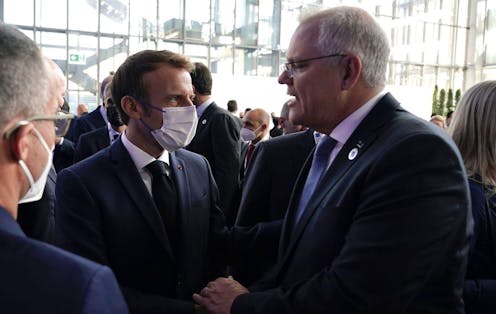
We are seeing an unusual level of discussion about Australian diplomacy.

There’s been harsh criticism – and some degree of embarrassment – surrounding what has been described been as a “diplomacy fail” in managing relations with France.

The head of the Australian Strategic Policy Institute, Peter Jennings, has gone as far as saying:

If it looks like our foreign policy is all a bit rough and ready, it’s because we have not invested in our diplomatic capability for a long time […] Acquiring some diplomatic smarts would be a damned sight cheaper than a nuclear sub.

So, what is diplomacy – and is it in decline?

Diplomatic smarts

Diplomacy is the operating system of international relations.

The responsibilities of diplomats include gathering and reporting information, communication and negotiation (both with foreign governments and other actors), promoting friendly relations (including economic, cultural and scientific) and protecting citizens abroad.

Prime Minister Scott Morrison with Australia's Ambassador to the UAE Heidi Venamore
Prime Minister Scott Morrison with Australia’s Ambassador to the UAE Heidi Venamore earlier this month.
Department of Defence/AAP

These are often in high-pressure and crisis situations.

Former ambassador Sue Boyd recalls Gough Whitlam articulating the key questions a diplomat’s job should centre on: “What’s going on? What does it mean for Australia? And what should we do about it?”.

If there’s one key diplomatic skill, it is perspective-taking: being able to see the world as others see it. Most other countries don’t share our viewpoint and don’t care about our interests. If we want to understand and communicate with them, we need to enter imaginatively into their worldview.

The analytical abilities and relationships required to answer such questions are specialist skills. Diplomats are, by definition, elite – they spend years studying other cultures, societies and economies and developing the intercultural skills required to communicate and persuade.


Read more:
‘The Australian way’: how Morrison trashed brand Australia at COP26


This doesn’t appeal to populists. Politicians such as Donald Trump prefer to see international relations as something they or their family members can do through force of personality (note how this approach to diplomacy brought no discernible dividends for the former US president with North Korea).

Underinvesting in diplomacy

We can see the decline in diplomacy starkly through Australia’s resource allocation.

In research for Australian Foreign Affairs, I charted the decline in resourcing stretching over decades from 8.9% of the federal budget in 1949 dedicated to diplomacy, trade and aid compared to only 1.3% in 2019. To compare Australia to other developed countries with similar-sized economies, Canada and the Netherlands invest 1.9% and 4.3% of their budgets in this area.

Looking at the last 20 years, there has been a pronounced drop in funding for diplomacy at the same time as funding for defence and intelligence has increased. As of 2019-20, the Department of Defence budget increased by 291% since 2011, while the allocation for the Australian Security Intelligence Organisation grew by 528% and the Australian Secret Intelligence Service by 578%.

More subtly, you can see the devaluing of diplomacy in other indicators.

This includes the Department of Foreign Affairs and Trade not being consulted on major foreign policy decisions, not being perceived as having “heft” in policy debates within government and the record level of political appointments (rather than career diplomats) to diplomatic posts.

Why the decline?

It’s worth noting, this is not just an Australian problem, with diplomatic approaches being sidelined in countries from the United States to Brazil. So the wider question is why does diplomacy get overlooked? There are three reasons:

1. Diplomacy is no longer widely regarded as a special skill

In the golden age of diplomacy, diplomats were an exclusive club that managed international engagement. Today, real-time communication technologies and ease of travel give the (false) impression that anyone can communicate seamlessly across borders.

2. Security approaches are preferred

Diplomacy deals with nuance (which can sound like being an apologist) and engagement (which can sound like appeasement). A security mindset – which sees things in black and white, defining enemies and friends – is much more comforting. In some places, like Xi’s China, diplomats are under pressure to show their patriotism and “fighting spirit”, which does not help good diplomatic communication. This is related to the third issue, that –

3. Domestic politics is seen as more important

There is always a danger good foreign policy will be crowded out by domestic political considerations. To avoid this, we need leaders who care about the long-term interests of the country as well as immediate political gain. That requires both largeness of vision and self-restraint.

Making the case for diplomacy

So, how do we make the case for diplomacy?

It begins with a dose of realism. Valuing diplomacy requires a degree of acceptance about what is possible, living with compromises, stop-gaps and partial solutions. It is incremental, rather than revolutionary.

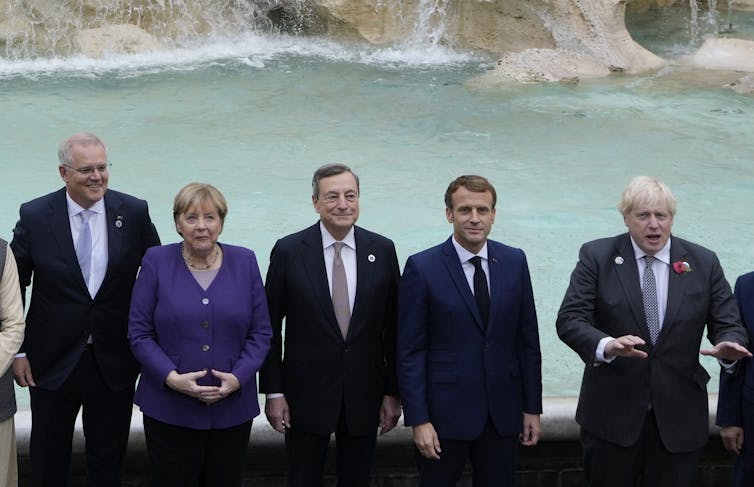
Scott Morrison and world leaders pose for a group photo at the G20.
Diplomacy is about living with compromises and being realistic about Australia’s place in the world.
Gregorio Borgia/AP/AAP

By contrast, politics can fall into the trap of magical thinking – that if only we say what we want loud enough, it will occur.

Australia is, for example, only one moderate-sized power among many, meaning there are significant limits on how much it can get of what it wants. It’s a big, tough world out there and we need the very best people trying to make sense of it and shape it to our interests.

For me, commentary that describes the Macron/Morrison episode as a “failure of Australia’s diplomacy” misses the point: in a real sense, diplomacy wasn’t even tried.

It is the sidelining of diplomacy that is the problem.


Read more:
‘I don’t think, I know’ – what makes Macron’s comments about Morrison so extraordinary and so worrying


The Conversation

Melissa Conley Tyler is Program Lead at the Asia-Pacific Development, Diplomacy & Defence Dialogue (AP4D), a platform for collaboration between the development, diplomacy and defence communities. It receives funding from the Australian Civil-Military Centre.

ref. Australia has not just had a ‘diplomacy fail’ – it has been devaluing the profession for decades – https://theconversation.com/australia-has-not-just-had-a-diplomacy-fail-it-has-been-devaluing-the-profession-for-decades-171498

Are you kidding, India? Your last-minute Glasgow intervention won’t relieve pressure to ditch coal

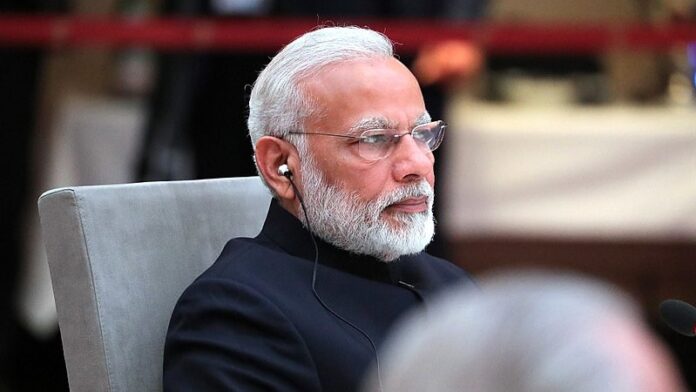
Narendra Modi, Prime Minister of India.

Source: The Conversation (Au and NZ) – By Bill Hare, Director, Climate Analytics, Adjunct Professor, Murdoch University (Perth), Visiting scientist, Potsdam Institute for Climate Impact Research

AP

As the United Nations climate summit opened in Glasgow, India’s Prime Minister Narendra Modi had a surprise positive announcement: a big net-zero target. The world cheered at the planet’s third-largest greenhouse gas emitter getting on board with net-zero, and the move made global headlines.

Fast forward to the final tense hours of COP26, and India almost derailed the talks. It demanded a key commitment in the Glasgow agreement be watered down: that a pledge to “phase out” coal be weakened to just “phase down” the fossil fuel.

China supported India’s holdout. The controversy cast a long shadow over the Glasgow agreement, which was already shaping as too weak to keep global warming below 1.5℃ this century. The world – including India – needs to phase out coal by 2040 if that warming goal is to be met, and India’s government is kidding itself to think the Glasgow intervention will make that problem vanish.

India should not consider itself off the hook. Rather than slow the decline in coal use, India has ensured it and other coal-intensive nations, including Australia, will be under even greater global pressure to ditch coal.

man and woman in face masks clap

EPA

A big coal problem

Since 2000, coal-fired power capacity in both India and China has grown massively. At COP26, the two nations were joined in their last minute demands by other big coal users like South Africa and Nigeria, along with Venezuela, a coal exporter.

India cannot absolve itself by pointing to its goal to reach net-zero emissions by 2070. Like many other nations to adopt a net-zero goal – including Australia – India has no firm plan to get there.

Nor is India’s 2030 target strong enough. A global research organisation I help lead, Climate Action Tracker, found India can largely meet the goal with policies already in place.

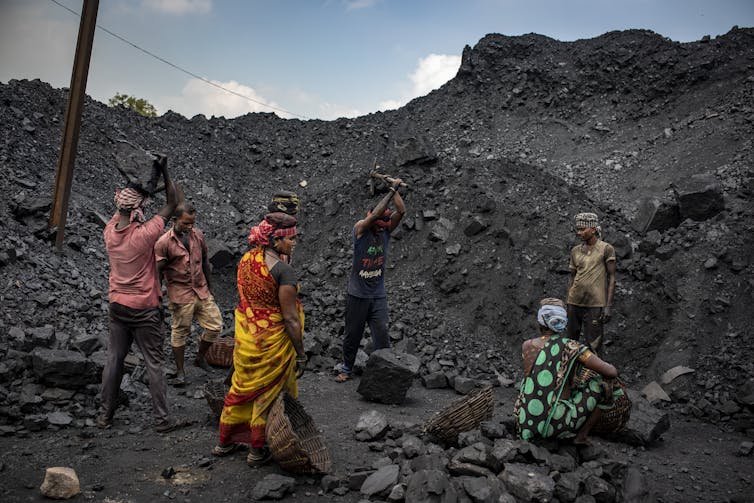
India no doubt has a big coal problem, and will need substantial support to deal with it, such as finance and technology from developed nations. But it also has enormous potential for renewable energy expansion.

Analysis shows that to prevent further climate disaster and keep warming to 1.5℃, thermal coal must be phased out by 2030 in developed nations and by 2040 globally – including in India. Softening the language in the COP26 decision doesn’t change this fact.


Read more:
The ultimate guide to why the COP26 summit ended in failure and disappointment (despite a few bright spots)


people dig in coal pile
India will need substantial support to phase out coal.
AP

Parallels with Australia

So where does all this leave Australia, one of the world’s largest coal exporters?

Like India, Australia also has a big coal problem and huge renewables potential. And like India, Australia firmly resisted signing up to big COP26 pledges for a faster phase-out of coal and large reductions in methane emissions by 2030.

Large methane reductions need to come from fossil fuels – namely coal mining and gas production. These are both industries our government has fought hard to protect.

To stay within the 1.5˚C warming limit, gas must be phased out almost as quickly as coal. But Australia’s political class is largely in denial about the gas problem.

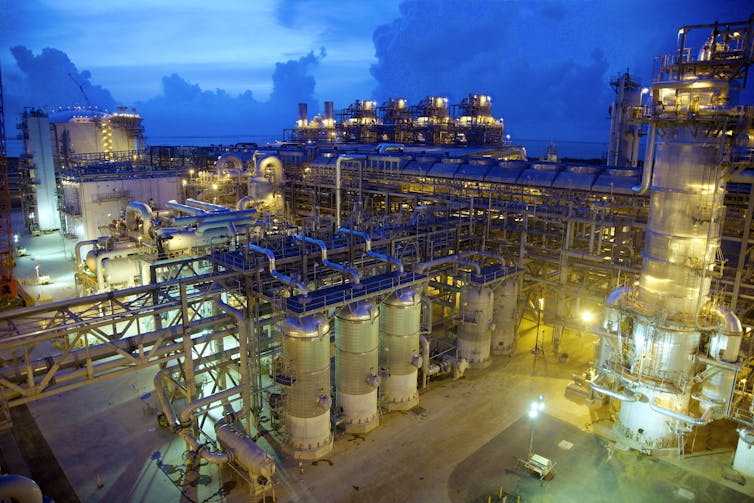
One development at COP26, however, suggests the issue will not go away. It involves a new coalition, led by Denmark and Costa Rica, known as the Beyond Gas and Oil Alliance. Sooner rather than later, we can expect it to come for Australia’s fast-expanding LNG export industry.


Read more:
Five things you need to know about the Glasgow Climate Pact


LNG plant at night
A new alliance struck at COP26 will target the gas industry.
AAP

Looking ahead to COP27

All nations at COP26 agreed to come back next year with stronger emissions reduction targets. And for all nations – including India, China and Australia – the pressure to do so will be unrelenting.

Whichever government Australia has after the next election will have no choice but to substantially increase Australia’s actions and commitments beyond our pathetically weak efforts so far.

Without strong near-term targets, the world won’t get to net-zero emissions in time. As Climate Action Tracker has pointed out, even if the world meets its 2030 targets it is still heading for a catastrophic 2.4℃ of warming this century.

So where to now? Next year, the Intergovernmental Panel on Climate Change is due to release its sixth assessment report.

So by COP27 in Egypt in November next year, we’ll have yet more compelling evidence of the devastating impacts of climate change if global warming is not limited to 1.5℃


Read more:
COP26 leaves too many loopholes for the fossil fuel industry. Here are 5 of them


The Conversation

Bill Hare receives funding from the European Climate Foundation, Bloomberg philanthropy and the Climate Works Foundation.

ref. Are you kidding, India? Your last-minute Glasgow intervention won’t relieve pressure to ditch coal – https://theconversation.com/are-you-kidding-india-your-last-minute-glasgow-intervention-wont-relieve-pressure-to-ditch-coal-171809

Where to find courage and defiant hope when our fragile, dewdrop world seems beyond saving

Source: The Conversation (Au and NZ) – By John Wiseman, Professorial Fellow, The University of Melbourne

Marc Pell/Unsplash, CC BY

The COP26 climate conference in Glasgow is over. Despite some progress, deep concerns remain about the outcomes. The final pact at least mentions the importance of exiting coal and the door remains open to ratcheting up national targets in 2022. But we’re all still on a long, hard road through wild and unfamiliar landscapes scarred by fires, floods and storms.

Accelerating the transition to a just and resilient zero-carbon future remains humanity’s most urgent task. Scientific evidence about global warming trends already locked in is, however, crystal clear: humans and all other species are on a journey into an increasingly harsh climate future.

This realisation raises two tough questions, which led me to begin work on my new book, Hope and Courage in the Climate Crisis:

– what sources of hope and wisdom can strengthen our capacity to take courageous and effective climate action?

– how do we live meaningful lives in a world of rapidly intensifying climate and ecological risks?

There are times when I imagine all the ideas and voices I have drawn on – scientists and activists, teachers and writers, poets and artists – gathered in respectful and intense debate. The conversations spark and crackle with fierce, urgent energy.

All agree the hope we need is realistic and defiant. It is not wishful thinking, denial, or delay disguised as naïve optimism.

As my research has helped me understand, humans continue to draw on a rich diversity of ideas to sustain defiant and courageous hope in dark times.


Read more:
Five things you need to know about the Glasgow Climate Pact


Science-based emergency action

I turn first to my colleagues from science and technology. Surely, they argue, our first priority remains speaking truth to power about the speed and scale of action needed to restore a safe climate?

Targets and agreements set at global conferences like COP26 are useful. But only if national and sub-national governments, cities and communities, unions and business all actually deliver on those targets and rapidly intensify their work to cut emissions, including a swift end to using coal, oil and gas.

OK, but how do we achieve the necessary political momentum? My climate activist friends seem less convinced by the promise of scientific evidence and reason.

The pandemic response has been a useful wake-up call about the possibilities as well as the limits of human ingenuity. But in the climate crisis, how do we deploy data and evidence at the speed required, while avoiding the delusional hubris that there are always technical solutions to every human problem?

Historical examples my activist colleagues turn to for inspiration are stories of solidarity and fellowship, where ethically informed collective action has achieved transformational change which once looked completely impossible.

These include the anti-slavery movement, the Suffragettes, the overthrow of Apartheid and the fall of the Berlin Wall. More recently we can look to examples like Black Lives Matter, 350.org, Pacific Climate Warriors, Beyond Zero Emissions, Market Forces and School Strike 4 Climate.

Justice, care and beauty

I turn next to my friends and colleagues from Indigenous and First Nation communities, such as the Seed Indigenous Youth Climate Network.

From them, we might learn to deepen our understanding of the histories of the lands on which we gather – and the legacies of colonialism, resistance and dispossession which have led us to these times of risk and crisis.

Climate justice – the principle that the burdens of climate change impacts and solutions should be shared fairly – is therefore one of the first propositions we should bring to the table.

In thinking about the concept of climate justice I also find it helpful to bear in mind the responses Indigenous school students gave, when Indigenous author and activist Tony Birch asked them to define climate justice:

if we fail to care for Country, it cannot care for us

This response highlights the importance of remembering that the principle of climate justice should not be restricted to humans alone.

I am joined next by teachers and scholars from a wide array of spiritual and faith-based traditions. They suggest the first key step in times of suffering and despair is thankfulness.

Buddhist poet and environmental activist Gary Snyder makes this point very well. He notes that while many severe climate impacts may already be locked in, every day he feels gratitude to this world that is.

Snyder quotes Kobayashi Issa, a poet who once wrote:

This dewdrop world

Is but a dewdrop world

And yet …

Earth
Celebrating the beauty of life on Earth can be a source of strength.
NASA/Unsplash, CC BY

Our shared responsibility

Remembering the fragile impermanence of our dewdrop world is a constant reminder of our shared responsibility to defend the beauty of the world we’ve been given, and hand this gift on to all humans and other species who’ll come after us.

Honouring and celebrating the astonishing, complex beauty of life on Earth is also, as legendary nature writer Rachael Carson reminds us, an abiding source of strength and inspiration:

Those who contemplate the beauty of the earth find reserves of strength that will endure as long as life lasts. There is symbolic as well as actual beauty in the migration of the birds, the ebb and flow of the tides, the folded bud ready for the spring.

There is something infinitely healing in the repeated refrains of nature – the assurance that dawn comes after night, and spring after the winter.

I turn finally to the theorists and writers, farmers and engineers, poets and artists and film makers who can help us imagine and create the regenerative action we need to cross the wild landscapes of the long climate emergency.

Visionary, insightful writers like Vandana Shiva, Jeremy Lent and George Monbiot who can help us clearly see the patterns and textures of our interwoven world, and understand and confront the ignorance, violence and greed threatening to tear this delicate fabric apart.

Authors and activists such as Rebecca Solnit, Kim Stanley Robinson, and Christiana Figueres, who can assist us navigate dangerous and uncertain times, remembering that the world is always full of surprises and the future is never fully settled.

The hope we need is realistic and defiant, not wishful thinking and denial.
Samuel Ferrara/Unsplash, CC BY

Sunlight on the water, wind in the trees

So, where might we find sources of wisdom, hope and courage in this world of rapidly intensifying climate consequences?

Honesty with ourselves and others about the scale and consequences of the crisis we now face. Scientific rigour, evidence and ingenuity. Working together, shoulder to shoulder to ignite and accelerate emergency speed action. Justice and care, respect and reciprocity. Thankfulness, kindness and compassion. Beauty, creativity and imagination.

And also these abiding gifts: the laughter of children. The comfort of old friends. Sunlight on the water, the wind in the trees, the silence of mountains, the roar of the ocean.


Read more:
COP26: experts react to the UN climate summit and Glasgow Pact


The Conversation

John Wiseman is a Senior Research Fellow with Melbourne Climate Futures and Melbourne Sustainable Society Institute at the University of Melbourne; a Research Fellow with the Centre for Policy Development and a Board Member of The Next Economy.
He is the author of ‘Hope and Courage in the Climate Crisis’, Palgrave Macmillan, 2021

ref. Where to find courage and defiant hope when our fragile, dewdrop world seems beyond saving – https://theconversation.com/where-to-find-courage-and-defiant-hope-when-our-fragile-dewdrop-world-seems-beyond-saving-171299

Being in a class with high achievers improves students’ test scores. We tried to find out why

Source: The Conversation (Au and NZ) – By Alexandra de Gendre, Postdoctoral Research Associate in Economics, University of Sydney

Shutterstock

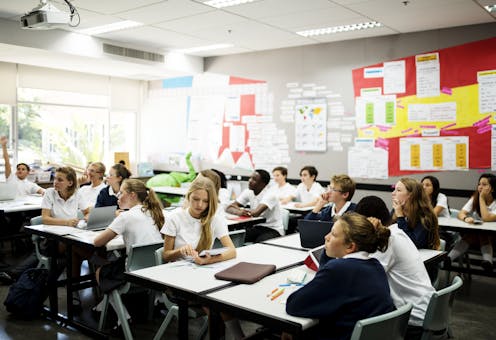
Who you go to school with matters. Almost all of us, as children or parents of children, have felt the influence of good, and bad, classmates at school.

There is a large body of research showing better peers can help increase a child’s test scores. But much less is known about how these peer effects actually take place between classmates. This is because the mechanisms through which peers positively influence other students are difficult to pinpoint.

The results of our study get us closer to understanding how peer effects work.

We found parental investment increases when a child is in a classroom with higher performing peers. This could partly explain why test scores increase for students in such classrooms. But we also found while their test scores may go up, little else does. For instance, the amount of time a student spends studying when in a classroom with higher performing peers does not go up.

Our study shows the positive effects of peers seem to occur with no real extra effort from the student.

Combining rich data and a social experiment

Our study is the first of its kind to test many of the possible mechanisms underlying the transmission of peer effects.

We tested 19 different ways peers can positively influence their classmates. These fall into three main categories: student behaviour, parental investments and school environment. They cover mechanisms such as students’ study effort and participation in class, aspirations and expectations to go to university, parents’ time, parental support and strictness, and teacher engagement.

We used data from the national Taiwanese Education Panel Survey of more than 20,000 students, parents, teachers and school administrators. The data includes student characteristics such as how many hours they spend studying per week, parental education and how much time students spend with their parents.

Girl studying on her bed.
Data included how much time students spend studying.
Shutterstock

We analysed this data from middle schools in Taiwan (ages 12 to 14, or years 7 to 9 in Australia) where students are assigned to classrooms by chance. This way, we could compare kids in the same school in classrooms with higher- or lower-achieving peers.

Each student takes a standardised test at the beginning of year 7, and another test at the beginning of year 9. We measured the progress these students made.

We compared kids who had the same test scores at the beginning of year 7, and controlled characteristics we know make a difference for test scores. These include parental education, how much time each student spends studying and teacher motivation. The only difference between the students we compared, in terms of influence on academic results, was the classroom they were assigned to by chance.

Students in top classrooms had higher grades

For simplicity, we can explain it like this. There are two students in the same school. One is assigned by chance to a classroom where the standardised test scores are the average in the country. And the other is assigned to a classroom where the test scores are the top in the country. Other than that, the two students are identical.

We examined the scores of both these two kids two years later.

In our study, the student assigned to the top classroom has progressed more than the student in the average classroom.


Read more:
Our study in China found struggling students can bring down the rest of the class


In year 7, both students answered 31 questions out of 75 in the standardised test correctly. Two years later, the student in the average test-score classroom still answered 31 questions correctly, while the student in the top test-score classroom answered nearly 32 questions correctly. This equates to 2.4% more correct answers.

While this may seem like a small difference, it is statistically significant and similar to what previous studies have found. However, our study goes beyond this.

What else we found

We also showed that two years later, the student in the top test-score classroom was 1.6 percentage points more likely to aspire to go university than the student in the average test-score classroom. And the top classroom student was 2 percentage points more confident in their ability to get into and attend university.

A later finding (which is yet to be published) was that students assigned to the top class had not changed the amount of hours they were spending on study.

However, the parents of the child assigned to a classroom with higher-achieving peers had spent more time with their child, and provided them with more general emotional support, two years later, than the parents of the child in the average test score classroom.

Reasons for peer effects remain a mystery

By testing more potential mechanisms than before, our study rules out many possible pathways for peer effects hypothesised in previous work. For example, we found no effects of high-achieving peers on students’ initiative in class, cheating, misbehaving and truancy, nor on parents‘ investments in private tutoring and aspirations for their child to go to university. There was also no difference in students’ perceptions of their school environment and teacher engagement.

While our study shows high-achieving peers positively influence student and parent behaviours, these alone don’t explain much of the positive effects on test scores in our data. In other words, the things that do change – aspirations and expectations, and parental investments – don’t fully account for the benefits of high-achieving peers.


Read more:
Will sorting classrooms by ability improve marks? It depends on the mix


The fact that our study didn’t deliver a clearer overall picture of how peer effects actually work is a testament to their complexity.

We were able to explore mechanisms due to the rich Taiwanese data combined with the unique experiment where students are randomly assigned to classrooms within schools.

But there were still two notable exceptions not measured, such as direct learning from peers and detailed teaching practices.

Collecting data on peer-to-peer interactions, such as discussing and coordinating tasks, is difficult but could be a key to unlocking the mystery of how higher-achieving peers benefit fellow students.

Data on teaching practices, like pairing students for group work and the amount of material covered in lessons, could also provide new insights.

The Conversation

Alexandra de Gendre is affiliated with the School of Economics at the University of Sydney, the IZA Institute of Labor Economics and the Australian Research Council Centre of Excellence for Children and Families over the Life Course.

Nicolás Salamanca receives funding from the Australian Research Council Centre of Excellence for Children and Families over the Life Course. He is affiliated with the Melbourne Institute: Applied Economic & Social Research at The University of Melbourne.

ref. Being in a class with high achievers improves students’ test scores. We tried to find out why – https://theconversation.com/being-in-a-class-with-high-achievers-improves-students-test-scores-we-tried-to-find-out-why-171400

​The government’s net-zero modelling shows winners, we’ve found losers as well

Source: The Conversation (Au and NZ) – By Philip Adams, Professor at the Centre of Policy Studies, Victoria University

The Conversation

On Friday November 12, after a wait of a fortnight, the government released a 100-page summary of the modelling and analysis behind its claim that an emissions target of net-zero by 2050 would leave the economy no worse off.

The report details both formal in-house modelling using a large global economic model and a relatively informal but detailed assessment of employment outcomes prepared by the consultancy McKinsey & Company.

The formal modelling starts with a scenario labelled “no Australian action”, in which every developed country other than Australia cuts its emissions to net-zero by 2050, and when taken together every country other than Australia does whatever else is needed to hold global warming to 2°C.


Department of Industry, Science, Energy and Resources

In “no Australian action” Australia as good as ignores the major green technological advances in the rest of the world (including those in hydrogen) and is penalised for not targeting net-zero via measures including carbon tariffs and a reluctance of financiers to advance money to Australian projects.

The modelling compares “no Australian action” with a number of alternative “action” scenarios, of which “the plan” is the most preferred.

Included in “the plan” are the technological advances foregone in “no Australian action” and excluded are the financial penalties.


Read more:
Australia is about to be hit by a carbon tax whether the prime minister likes it or not, except the proceeds will go overseas


Under “the plan”, Australia’s gross emissions fall to between 25% and 35% of their 2005 level by 2050. As yet unknown technological advances remove a further 15%, and the rest of the path to net zero is provided by the purchase of emissions offsets, the foreign ones costing (a remarkably cheap) A$40 per tonne.

Given the technological advances and freedom from penalties associated with the plan, it isn’t surprising that it produces a better economic outcome.

What is surprising, given those assumptions, is that the gain in real income the modellers came up with is so small.

Six months difference after 30 years

The projected gain under “the plan” compared with “no Australian action” is 1.6% after 30 years, which is about six months worth of economic growth, meaning the economy would be as big in June 2050 as it would have been in December 2050.

The summary says the employment outcomes produced by McKinsey are “broadly in line” with the outcomes produced by the macroeconomic modelling.

What this means isn’t quite explained. It might have just turned out that way, or the government might have picked or asked for results that mirrored its own.

Regardless, the summary released on Friday has little to say (except in a cursory way) about the impacts of the plan on regions, on industries other than the most emission-intensive, and on the labour market adjustments and changes to the skills and types of education that will be required.


Read more:
Five things you need to know about the Glasgow Climate Pact


As it happened, the day before the summary was released, my team at the Centre of Policy Studies at Victoria University published its own modelling of the economic impact on Australia of achieving net-zero emissions with a good deal more detail about the impacts on regions and industries.

We are preparing a second report on the impact on education with the Mitchell Institute for release early next year.

We asked a slightly different question…

My team assessed the impacts of net-zero in a slightly different way to the government, by asking what would happen to the Australian economy if the rest of the world (including Australia) moved to net-zero by 2050, comparing it to what would happen if they did not.

In our modelling Australia faced no financial penalty for not pulling its weight and there was no role for as yet unknown technologies and no ability for Australia to achieve net-zero by buying permits from overseas. This made our modelling conservative, less likely to find that net-zero produced an economic benefit.

…and got a similar answer

We found that despite deep cuts in emissions, the Australian economy would continue to grow strongly in terms of production and employment. However after 30 years real GDP and income would be slightly lower than they would have been without action.

In contrast to the government’s projected gain of around 1.6% after 30 years (six months of economic growth) we found a loss of around 1%, equivalent to four to five months of economic growth.


Real GDP in 2021 prices, base case and net-zero scenarios

Zero Greenhouse Gas Emissions by 2050: What it means for the Australian Economy, Industries and Regions.
Centre of Policy Studies, 2021

What’s significant is that when we last did this work in 2014, we estimated a larger loss in GDP of 3.8%.

The loss is smaller now because the task has become easier, thanks to lower than previously expected renewable generation costs and a faster than expected uptake of both light and heavy electric vehicles.

On employment, we found Australia would have about the same number of jobs by 2050 under either scenario.

Industries such as coal mining would suffer, although not as much as might be thought. Coal mining would continue in 2050 due to continued international demand, with production down 34% and hours worked down 37% compared to no more toward net-zero.

But more detail on jobs

Decarbonisation will provide an impetus to many industries, especially renewable electricity and forestry which would almost double as decarbonisation boosted tree planting in order to take advantage of bio-sequestration opportunities.

This would lead to significant increases in forested land and increased sales of logs for processing and export as forest pulp. Surprisingly, we found little mention of forestry or wood processing and exports in the government’s summary.


Change in hours worked by industry under net zero scenario, 2050

ANZSIC industry divisions.
Centre of Policy Studies, November 11, 2021

Electricity would replace more than all the jobs lost in coal generation with additional jobs in renewables generation and electricity distribution and supply as more of the economy became electric-powered.

Although vulnerable industries account for less than 4% of employment across the country, some regions are much more heavily dependent on them than others.


Read more:
How government modelling found net-zero would leave us better off


We identify nine of Australia’s 88 statistical area level 4 regions as vulnerable to loss of employment. They include the coal-dependent regions such as Hunter in NSW, Fitzroy in Queensland and Gippsland in Victoria.

On the other hand, another 46 regions are identified as likely to gain employment. They are more highly exposed to the industries that would grow.


Change in real state product by industry under net zero scenario, 2050


Centre of Policy Studies, November 11, 2021

By state, Tasmania benefits the most under net-zero, having more hydroelectricity, forestry and wood products industry than other states as well as no coal-fired generation. Its real gross state product would be 4.9% higher than otherwise in 2050, and employment 11,600 higher
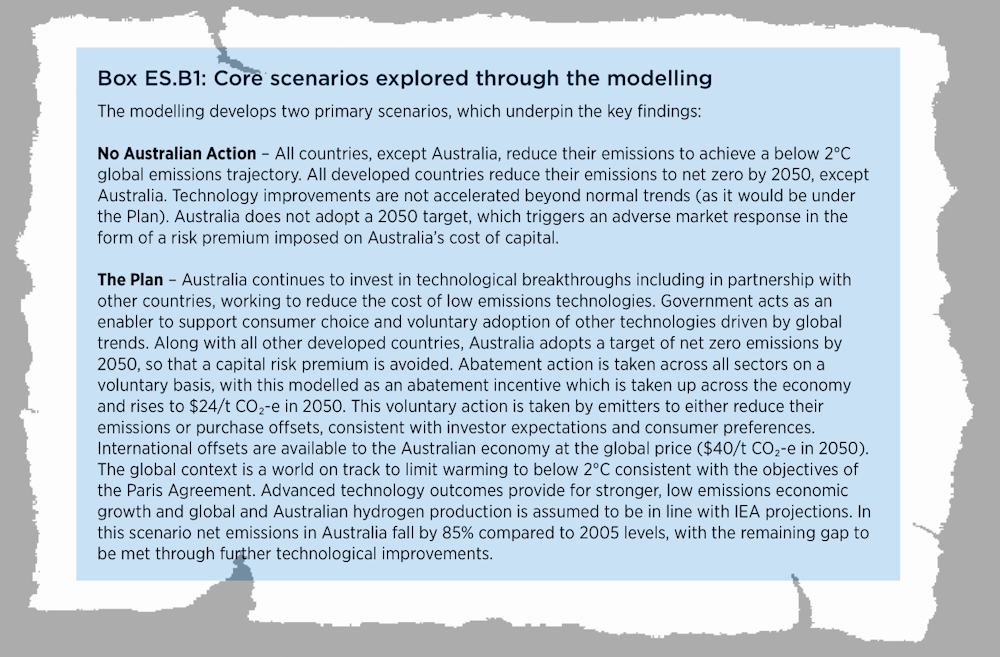
Queensland suffers the most, because of an over-representation of coal mining, broadacre agriculture and coal-generated electricity in its economy. Its real gross state product would be 5.9% lower than otherwise in 2050, and employment 97,800 lower.
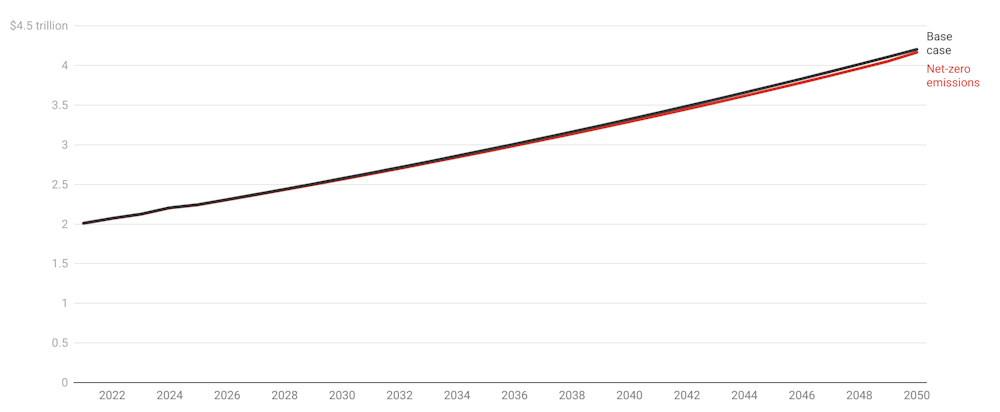


Read more:
COP26: experts react to the UN climate summit and Glasgow Pact


The worse outcomes need to be put into perspective. Queensland is expected to employ an extra 1.2 million people by 2050 without decarbonisation. With decarbonisation it would be slightly fewer extra people, an extra 1.1 million.
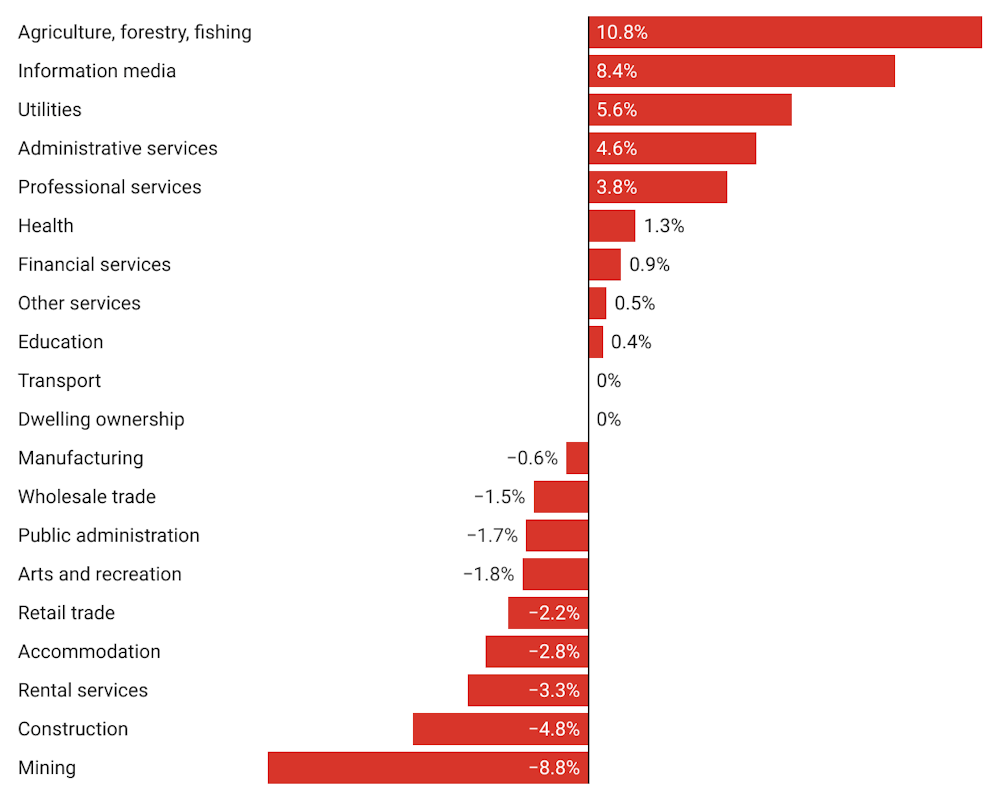
It’s important our leaders do this work too

Whatever the government does to achieve zero emissions there will be a clear need for adjustment packages to cushion impacts on those most affected.

Given that we will be embarking on decarbonisation to secure community-wide benefits, it will be appropriate for the community to fund those packages.

To do that we will need detailed projections for the parts of the economy (regions, industries, occupations by skill) that will most benefit from the changes and the parts that will be most hurt. To date, the government hasn’t told us.

The Conversation

Philip Adams receives funding from Victoria University..

ref. ​The government’s net-zero modelling shows winners, we’ve found losers as well – https://theconversation.com/the-governments-net-zero-modelling-shows-winners-weve-found-losers-as-well-171502

Mrs Morland and Isabella Murrell: the brutal murder of a domestic angel on the diggings

Source: The Conversation (Au and NZ) – By Katrina Dernelley, PhD Candidate in History, La Trobe University

Panorama of the gold mining town, Graytown, Victoria, approx. 1861 National Library of Australia

This article contains graphic depictions of historic domestic violence.

For many women in colonial Victoria, home was not a place of security and comfort. Instead, home – both on the goldfields and off – tethered women to lives that were unsafe and unpredictable.

The “private” nature of historic violence in the home presents unique challenges to historians. While newspaper reports of men’s violence towards their wives were commonplace, they presumably comprised only a small percentage of the actual domestic violence being perpetuated.

Often, only the most violent stories reached the press. In my research, I draw on the interwoven lives of the fictionalised account of Mrs Morland and the woman on whom I believe she was based, Isabella Murrell, to focus on the violent acts committed inside the homes on the goldfields. In this work, I hope to expose the realities of life inside the tent as part of a broader study of home and homemaking on the diggings.

‘A perfect treasure’

In 1866 the Australasian newspaper printed a fictionalised story of a miner who boarded with a married couple, Mr and Mrs Morland.

The narrator found Mrs Morland to be a “perfect treasure of a wife”. Her home was a clean and neat slab hut, lined with hessian kept scrupulously whitewashed. The earthen floor was “pipeclayed” every week, sack mats were regularly boiled, and breakfast was on the table every morning by half-past-six.

S. T. Gill, ‘Digger’s Hut, Forest Creek’, 1853.
National Library of Australia

“I don’t want to make out that she was an angel”, the miner noted. “I shouldn’t have liked her so well if she had been so very angelic.”

After the miner moved on to the next gold discovery, he continued to run into the couple, each time finding them more delapidated than the last. Their neat, clean home was no longer, now replaced by a “refreshment shanty”. Mrs Morland had become “a creature”. The miner could no longer bear to look at her.

Mr Morland was often brutal, repeatedly slamming and crushing Mrs Morland between the door and the wall of their slab hut.

Later, when Mrs Morland finally tried to leave her husband, he beat her to death with an iron hook attached to a windlass rope.


Read more:
Hidden women of history: how mother of 8, Mary Anne Allen, made do on the goldfields amid gunshots, rain and sly grog


Sensationalist journalism

Such sensationalist articles often appeared in colonial newspapers, and were written to entertain: they were often more fancy than fact. But many of the details of this story are horrifically, frighteningly real.

While Mrs Morland is fiction, her brutal death appears to have been based on the murder of Isabella Murrell by her husband William Dixon Murrell.

Isabella Robinson (a house servant) married William Dixon Murrell (a chandler) in England in 1852. The couple sailed to Victoria where they had three sons, the last on the goldfields in Dunolly in 1857.

S. T. Gill, ‘Sly grog tent on the swamp Ballaratt [sic]’, 1854.
Dixson Library, State Library of New South Wales

In July 1863, William viciously murdered his wife Isabella, beating her naked body for over an hour with three different weapons: a leather saddle strap and buckle, a piece of wood and a rope with an iron hook attached.

After William had beaten Isabella to death, he carried her inside their tent, dressed her in a clean shift and attempted to revive her with warm coffee and a hot flannel. He did not notice she was dead until morning.

When the police found her, Isabella’s lifeless body was cold but her stomach still warm from the flannel.

At the trial, William blamed his dead wife for his behaviour, saying Isabella was an unfaithful drunkard who needed punishing. William pleaded he had dearly loved his wife. William cried he was very sorry for what had occurred, he had no intention of killing Isabella. He was trying to punish her; she was about to repent. He had struck Isabella “in the heat of passion”.

When the defence in the colonial courtrooms argued murder was a “crime of passion”, the wife was often presented as unfaithful, immoral and unrespectable. She was put on trial for her conduct and habits as much as the husband for his acts of violence.

William was committed for Isabella’s murder and sentenced to death (later commuted by a sympathetic judge). After the verdict, William said he was concerned his actions would be perceived poorly. His intention, he said, was never to kill his wife – but to reform her.

The veneer of civilisation

The murder and trial were reported widely, and in graphic detail. Alcohol was blamed for William Dixon Murrell’s descent from a good and loving husband to wife-beating murderer. Isabella was blamed for failing at domesticity, morality and respectability.

After the discovery of gold in Victoria, there was a sharp jump in newspaper reports and articles connected to wife-beating. This coverage mirrored discussions occurring in Britain and the colony more broadly. Politicians, community leaders and newspapers alike expressed concern the scourge of “wife-beating” was a threat to civilisation itself.

The success of empire and the colonisation project was directly connected to a functioning happy and respectable home.

Women were held responsible for men’s behaviour in the newspapers and in the courts. For many women, then as now, the immediate and ongoing consequences of violence in the home were an inescapable part of everyday life.


Read more:
The long history of gender violence in Australia, and why it matters today


The Conversation

Katrina Dernelley receives funding from an Australian Government Research Training Program Scholarship and an Australian Communities Foundation Graduate Women Victoria Feminist Fathers Bursary.

ref. Mrs Morland and Isabella Murrell: the brutal murder of a domestic angel on the diggings – https://theconversation.com/mrs-morland-and-isabella-murrell-the-brutal-murder-of-a-domestic-angel-on-the-diggings-169839

The ultimate guide to why the COP26 summit ended in failure and disappointment (despite a few bright spots)

Source: The Conversation (Au and NZ) – By Robert Hales, Director Centre for Sustainable Enterprise, Griffith University

AP

After two hard-fought weeks of negotiations, the Glasgow climate change summit is, at last, over. All 197 participating countries adopted the so-called Glasgow Climate Pact, despite an 11th hour intervention by India in which the final agreement was watered down from “phasing out” coal to “phasing down”.

In an emotional final speech, COP26 president Alok Sharma apologised for this last-minute change. His apology goes to the heart of the goals of COP26 in Glasgow: the hope it would deliver outcomes matching the urgent “code red” action needed to achieve the Paris Agreement target.

At the summit’s outset, UN Secretary-General António Guterres urged countries to “keep the goal of 1.5℃ alive”, to accelerate the decarbonisation of the global economy, and to phase out coal.

So, was COP26 a failure? If we evaluate this using the summits original stated goals, the answer is yes, it fell short. Two big ticket items weren’t realised: renewing targets for 2030 that align with limiting warming to 1.5℃, and an agreement on accelerating the phase-out of coal.
But among the failures, there were important decisions and notable bright spots. So let’s take a look at the summit’s defining issues.

Weak 2030 targets

The goal of the Paris Agreement is to limit global temperature rise to well below 2℃ this century, and to pursue efforts to limit warming to 1.5℃. Catastrophic impacts will be unleashed beyond this point, such as sea level rise and more intense and frequent natural disasters.

But new projections from Climate Action Tracker show even if all COP26 pledges are met, the planet is on track to warm by 2.1℃ – or 2.4℃ if only 2030 targets are met.


Read more:
COP26: experts react to the UN climate summit and Glasgow Pact


Despite the Australian government’s recent climate announcements, this nation’s 2030 target remains the same as in 2015. If all countries adopted such meagre near-term targets, global temperature rise would be on track for up to 3℃.

Technically, the 1.5℃ limit is still within reach because, under the Glasgow pact, countries are asked to update their 2030 targets in a year’s time. However, as Sharma said, “the pulse of 1.5 is weak”.

And as Australia’s experience shows, domestic politics rather than international pressure is often the force driving climate policy. So there are no guarantees Australia or other nations will deliver greater ambition in 2022.

Phase down, not out

India’s intervention to change the final wording to “phase down” coal rather than “phase out” dampens the urgency to shift away from coal.

India is the world’s third-largest emitter of greenhouse gases, after China and the United States. The country relies heavily on coal, and coal-powered generation is expected to grow by 4.6% each year to 2024. India was the most prominent objector to the “phase out” wording, but also had support from China.


Read more:
COP26 leaves too many loopholes for the fossil fuel industry. Here are 5 of them


And US climate envoy John Kerry argued that carbon capture and storage technology could be developed further, to trap emissions at the source and store them underground.

Carbon capture and storage is a controversial proposition for climate action. It is not proven at scale, and we don’t yet know if captured emissions stored underground will eventually return to the atmosphere. And around the world, relatively few large-scale underground storage locations exist.

And it’s hard to see this expensive technology ever being cost-competitive with cheap renewable energy.

In a crucial outcome, COP26 also finalised rules for global carbon trading, known as Article 6 under the Paris Agreement. However under the rules, the fossil fuel industry will be allowed to “offset” its carbon emissions and carry on polluting. Combined with the “phasing down” change, this will see fossil fuel emissions continue.

It wasn’t all bad

Despite the shortcomings, COP26 led to a number of important positive outcomes.

The world has taken an unambiguous turn toward away from fossil fuel as a source of energy. And the 1.5℃ global warming target has taken centre stage, with the recognition that reaching this target will require rapid, deep and sustained emissions reductions of 45% by 2030, relative to 2010 levels.

What’s more, Article 21 of the Glasgow Climate Pact nature and ecosystems, including protecting forests and biodiversity. This comes on top of a side deal struck by Australia and 123 other countries promising to end deforestation by 2030.

The pact also urges countries to fully deliver on an outstanding promise to deliver US$100 billion per year for five years to developing countries vulnerable to climate damage. It also emphasises the importance of transparency in implementing the pledges.

Nations are also invited to revisit and strengthen the 2030 targets as necessary to align with the Paris Agreement temperature goal by the end of 2022. In support of this, it was agreed to hold a high-level ministerial roundtable meeting each year focused on raising ambition out to 2030.

The US and China climate agreement is also cause for cautious optimism.

Despite the world not being on track for the 1.5℃ goal, momentum is headed in the right direction. And the mere fact that a reduction in coal use was directly addressed in the final text signals change may be possible. But whether it comes in the small window we have left to stop catastrophic climate change remains to be seen.

The Conversation

Brendan Mackey has previously received research grants from the Federal government, stage governments and charitable trusts that have focussed on problems related to climate change, forests, mitigation and ecosystem services including biodiversity conservation. He is a coordinating lead author in IPCC 6th Assessment Report Working Group II, and he is a voluntary board member of the Great Eastern Ranges Initiative Inc, and a member of the Queensland Government’s Native Timber Advisory Panel.

Robert Hales does not work for, consult, own shares in or receive funding from any company or organization that would benefit from this article, and has disclosed no relevant affiliations beyond their academic appointment.

ref. The ultimate guide to why the COP26 summit ended in failure and disappointment (despite a few bright spots) – https://theconversation.com/the-ultimate-guide-to-why-the-cop26-summit-ended-in-failure-and-disappointment-despite-a-few-bright-spots-171723

NZ reports new covid case high of 207 as ‘clock ticking’ for Christmas

An epidemiologist says New Zealand’s record high covid-19 case numbers today and the spread across the North Island are a reminder that the whole country needs to be on the lookout for the virus.

Dr Siouxsie Wiles of the University of Auckland said the 207 community cases today – just above the previous record high of 206 cases on November 6 — were disappointing but not surprising, given that people are moving around more.

She expects case numbers to keep rising but said areas outside Auckland could take action to stamp out local outbreaks.

Today’s statistics included one new death at North Shore Hospital — a woman in her 90s.

The new cases reported today include 192 cases in Auckland, seven in Waikato, two in Northland, three in Taupo, one in Rotorua and two in the Tararua district.

A further Rotorua case will be included in tomorrow’s official numbers.

Keeping track needed
“We really need people to be getting tested if they have any symptoms, and also keeping track of their movements, and letting contact tracers know where they’ve been,” Dr Wiles said.

“So if everybody can do that, then we should be able to stamp out those cases again.”

Dr Wiles said if people did not take measures such as self-isolating there would be bigger outbreaks in areas beyond Auckland.

A total of 90 percent of New Zealanders have now had their first dose of the Pfizer covid-19 vaccine and 81 percent are fully vaccinated.

The latest figures show almost 27,000 first and second vaccine doses were given nationally yesterday.

Professor Michael Baker from the University of Otago said there were only five days left for people to get their first dose of covid-19 vaccine if they wanted to be fully protected before Christmas.

He said the clock was ticking and it was time to start a conversation with vaccine-hesitant friends and family.

In the areas with active cases, 71 percent of eligible Northlanders have had their second dose, 85 percent in Auckland, 78 percent in Waikato, 75 percent in Taranaki, 81 percent in Canterbury, 73 percent in Lakes DHB and 78 percent in MidCentral.

Ninety people in hospital
Ninety people are in hospital — most in Auckland but there is also one case each in Whangārei and Dargaville.

Of the hospital cases, 59 percent are unvaccinated or not eligible for a vaccine.

Dr Baker said he recommends only having vaccinated people at Christmas gatherings.

“If you have an unvaccinated person there, and the virus will be manifesting quite widely over that period, they are real risks to everyone at those events, and particularly to unvaccinated children and older people who may not have mounted such a good immune response to the vaccine,” he said.

Dr Baker said the government should keep a solid boundary around Auckland and keep the rest of the country in an elimination mode.

He also said the rollout of vaccines for children from ages 5 to 11 should start before Christmas.

“I think that would be a great Christmas gift to the children of New Zealand.”

This article is republished under a community partnership agreement with RNZ.

Article by AsiaPacificReport.nz

World strikes ‘uncomfortable’ pact at COP26 climate summit

SPECIAL REPORT: By Chloé Farand, Joe Lo, Isabelle Gerretsen and Megan Darby

After a series of tense huddles, more than 24 hours into overtime, the gavel went down on a climate deal in Glasgow, Scotland, last night.

The Glasgow Climate Pact refers to coal for the first time in the UN process. It asks countries to come back with stronger climate plans in 2022.

And it finalises the most contentious elements of the Paris Agreement rulebook, six years after the landmark deal was done.

COP26 GLASGOW 2021

What it doesn’t do is meet calls for climate reparations, to the dismay of developing countries, especially in the Pacific.

A proposal for a finance facility to help victims of the climate crisis was quashed by the US and other rich nations, as was a call to earmark a share of carbon trading revenues to fund adaptation.

Addressing the plenary before the text was adopted, US Climate Envoy John Kerry said: “There is some discomfort. Well, if it’s a good negotiation, all the parties are uncomfortable. This has been a good negotiation.”

For China, India and big emerging economies, the compromise was accepting language around 1.5C, coal and fossil fuel subsidies despite concerns that such restrictions could inhibit their development — and a grievance against developed countries taking up most of the carbon budget.

India forces concession
India’s Environment Minister Bhupender Yadav forced a concession at the last minute, getting a reference to the “phase-out” of coal power changed to “phase-down”.

Tina Stege, of the Marshall Islands, told the plenary of her “profound disappointment” about the change.

“We accept this change with the greatest reluctance. We do so only because they are critical elements in this package that people in my country need as a lifeline for their future,” she said.

Mereani Nawadra
Pacific Conference of Churches’ Mereani Nawadra … sharing a COP26 prayer from the Pacific. Image: PCC

COP26 president Alok Sharma said: “I apologise for the way this has unfolded and I am deeply sorry.”

Pausing to fight back tears, he continued, to applause from the crowd, “I think it is vital that we protect this package” before, hearing no objections, he banged down the gavel.

Vulnerable countries also expressed dismay at the incremental progress on scaling up funding to respond to the impacts of climate change. They had to make do with a body to provide technical assistance and a “dialogue” on loss and damage.

Before the plenary started on Saturday afternoon Kerry and veteran US climate lawyer Sue Biniaz roamed the meeting hall. Their longest and most animated discussions were in a huddle with Ahmadou Sebory Toure, the lead negotiator for the G77+China group of developing countries.

Emerging empty handed
Yet Toure appeared to emerge empty handed. A source in the G77 said the African group had threatened to reject the package, but small islands talked them down.

Speaking in the meeting, while Biniaz pored over texts, Gabon’s Environment Minister Lee White said one of Africa’s red lines had “been rubbed out with no compromise”.

“The [African Group] is quite unhappy,” the source said. “Aosis [group of small island states] managed to convince the rest of the blocs to revisit the issue in Egypt. For now, they believe this is the best deal we can have out of COP.”

After the meeting, Kerry strode over to Toure and they exchanged a fistbump before walking off talking with Kerry’s arm around Toure’s shoulder.

The UK presidency’s stated aim for the conference was “to keep 1.5C alive”, referring to the most ambitious global warming limit in the Paris Agreement.

Announcements last week including India aiming for net zero by 2070 and a widespread agreement to reduce methane emissions led the traditionally cautious International Energy Agency to say that global warming could be held to 1.8C.

Climate Tracker caution
Others urged caution. Climate Action Tracker projected current policies put the world on a path to 2.7C warming and strengthened emissions targets for this decade could bend the curve to 2.4C.

More optimistic assessments rely on long term — and therefore uncertain — targets.

The carbon trading rules agreed in Glasgow, while stricter than some parties wanted, risk diluting ambition, critics warned.

“We have much to do to stop companies and countries gaming the system,” said Rachel Kyte, co-chair of an initiative to boost the integrity of voluntary carbon markets. “We have no room or time for markets like buckets of water, with 100 tiny holes.”

Print Friendly, PDF & Email

Article by AsiaPacificReport.nz

Fiji political parties call for probe into elections chief Saneem’s ‘behaviour’

By Litia Cava in Suva

Leaders of four political parties in Fiji are calling for a “complete clean-up” of the Elections Office before preparations for the 2022 election get underway.

A joint statement endorsed by the Social Democratic Liberal Party (SODELPA) leader Viliame Gavoka, Freedom Alliance Party leader Jagath Karunaratne, Fiji Labour Party leader Mahendra Chaudhry and Unity Fiji party leader Savenaca Narube also called for an investigation of the Supervisor of Elections, Mohammed Saneem, for alleged misbehaviour.

They claim that Saneem had made “haphazard and uninformed decisions” and should be investigated.

The leaders said they would take legal action against Saneem if they did not receive a response from the Constitutional Offices Commission (COC).

The four leaders have given seven days to the Constitutional Offices Commission (COC) to respond to their complaint against Saneem.

A joint statement by the leaders stated that they had lodged a complaint against Saneem to the chairman of the commission, Prime Minister Voreqe Bainimarama on August 20.

“Our lawyers have delivered a follow-up letter to the COC chairman on November 9, demanding that the commission replies to our original complaint within seven days, or we will take legal action,” the joint statement said.

‘Sufficient grounds’
“In our initial letter of complaint to COC, we had cited what we believe were sufficient grounds under the Constitution to appoint a tribunal to investigate the misbehaviours of the SOE.”

The leaders claimed that the government was quick to suspend Solicitor-General Sharvada Sharma when the state lost its case against MP Niko Nawaikula.

“Likewise, we call on the commission to immediately suspend the SOE pending the appointment of a disciplinary tribunal.

“In our view, the misbehaviours of the SOE are much more flagrant than what is alleged against the SG.”

They also said in November 2016 the Court of Appeal had ruled against Saneem on legal action taken by the Electoral Commission regarding the eligibility of two candidates in the 2014 General Election.

The statement noted that Saneem had disallowed the candidacy of a Fiji Labour Party candidate but allowed a candidate of the FijiFirst Party to contest the election despite a ruling against those decisions by the Electoral Commission.

‘Gross misbehaviour’
“The insubordination by Mr Saneem of the directive of the Electoral Commission is gross misbehaviour and, under normal disciplinary rules of the public service, should have led to his summary dismissal. The statement claimed that four court proceedings in recent years had gone against the SOE,” the statement said.

“We believe that most people have lost confidence in the incumbent SOE. His misbehaviour must be investigated as soon as possible.

“The people need to regain trust in the election administrators of the nation.”

Questions sent to Saneem and Bainimarama remained unanswered when The Fiji Times went to press last night.

Litia Cava is a Fiji Times reporter. Republished with permission.

Print Friendly, PDF & Email

Article by AsiaPacificReport.nz

Auckland mayor Phil Goff calls NZ anti-lockdown protesters ‘stupid’

RNZ News

Auckland mayor Phil Goff has hit out at anti-lockdown protesters who held up traffic on roads throughout the country today, describing their actions as “crass and stupid”.

Police are promising to follow up on any offences or breaches of the laws after the Freedoms and Rights Coalition protest group took to the roads, trying to create a gridlock in New Zealand’s largest city by driving slowly.

On Facebook today, Goff said he came across them as he was returning from a Pasifika vaccination event at Mt Smart Stadium where he saw “volunteers and medical staff working in the pouring rain to ensure people are protected”.

He said their vehicles spread across three lanes of the motorway, doing 50 km an hour and deliberately blocking people from going about their business.

Goff said they were spreading disinformation and lies about covid-19 and vaccinations.

“Crass and stupid but what else would you expect?” he asked.

Cases and vaccination rates
The Ministry of Health reported 175 new community cases of covid-19 – 26 fewer than yesterday’s total.

Of those 159 are in Auckland, two in Northland, eight in Waikato, one in Taupō and the five previously announced cases in Taranaki.

The two new Northland cases have clear links to known cases.

However, the ministry late today confirmed three more positive results for Taupō in addition to the case announced earlier.

Two are household contacts.

The third is a close contact. This person, who is now isolating in Taupō, travelled to Masterton last weekend, before becoming ill on Monday.

Two other household contacts of the case have tested negative.

Ninety three people are in hospital – all in Auckland and eight more than yesterday.

Nine patients are in intensive care or a high dependency unit.

The latest wastewater result for the Taranaki town of Stratford has not detected covid-19.

Close to 90 percent target
Just over 2000 first doses of the covid-19 vaccine are needed for the whole country to officially reach the 90 percent milestone.

The latest figures from the Ministry of Health show Auckland DHB is the first to surpass more than 95 percent of the eligible population to have their first dose.

Nationally, about 80 percent have had a second dose.

This article is republished under a community partnership agreement with RNZ.

Print Friendly, PDF & Email

Article by AsiaPacificReport.nz

How government modelling found net-zero would leave us better off

Source: The Conversation (Au and NZ) – By Peter Martin, Visiting Fellow, Crawford School of Public Policy, Australian National University

Perutskyi Petro/Shutterstock

The government’s decision to target net-zero emissions by 2050 will leave each Australian nearly A$2,000 better off by then compared to no Australian action.

That’s what we were told in a six-point summary of the government’s economic modelling released at a press conference on Thursday October 26, days before the prime minister left for the Glasgow climate talks.

Slide from the prime minister’s October 26 press handout.

Prime Minister Scott Morrison said at the time the actual modelling would be released “in due course”, later clarifying that it might not be released for a fortnight, after which the Glasgow climate talks would be almost over.

The 100-page summary of modelling prepared by the Department of Industry, Science, Energy and Resources and the consultancy McKinsey & Company was released on Friday afternoon as the climate talks were concluding.

The document tells us both how the $2,000 figure was arrived at and the question that was asked.

The question that was asked

McKinsey and the department were asked to compare economic outcomes in 2050 after 30 years of “no Australian action” with economic outcomes in 2050 after 30 years of “the plan”.

“No Australian action” meant that every developed country other than Australia cut its emissions to net-zero by 2050, and all of the world apart from Australia did whatever else was needed to hold global warming to 2°C.

Australia would find it harder to raise money because of its reluctance to commit to net-zero (meaning its borrowing costs would incorporate a “risk premium”) and would get access to only those improvements in technology that were available elsewhere.

“The plan” involved Australia continuing “to invest in technological breakthroughs,” acting as an “enabler to support consumer choice and voluntary adoption of other technologies”.

Australia would adopt a target of net zero by 2050, escaping a risk premium.

The government would invest more than A$21 billion to support the development and deployment of low emissions technologies including clean hydrogen, ultra low-cost solar, energy storage, low-emissions materials, carbon capture and storage and soil carbon to 2030, and continue to play a “direct role” beyond that.


Read more:
Between the lines, the plan has coal on the way out, the future bright


Otherwise, emissions would be reduced on “a voluntary basis”.

Importantly, and so the size of the voluntary action can be incorporated into the modelling, the voluntary emissions reductions are assumed to be the same as what would be expected if Australians faced a carbon price (or tax) that climbed to A$24 per tonne of carbon dioxide equivalent by 2050.

Emitters finding it hard to cut emissions as much as they or consumers or investors wanted would be able to buy international “offsets” (overseas emissions reductions) at a price that would climb to A$40 per tonne of carbon dioxide equivalent by 2050.

$2,000 per person better off


Australia’s long-term emissions reduction plan: modelling and analysis, November 12, 2021

The modelling concludes that under “the plan” each Australian would be almost A$2,000 better off in 2050 compared with under “no Australian action”.

That’s $2,000 per year in so-called gross national income per capita, but it’s less impressive than it sounds. The latest stats have gross national income per capita approaching A$80,000.

That’s not what’s received by any one individual, but what’s received by businesses and all sorts of other entities averaged across the population.

Compounding economic growth means that by 2050 that dollar sum will be two to three times as big, against which (and given all the uncertainties) a projection of an extra $2,000 amounts to little difference.

A reasonable way to interpret the modelling is that, compared to “no Australian action”, the “plan” won’t impose significant costs on Australians.

Where the $2,000 comes from

Which isn’t to say that there won’t be big costs.

The world will move away from coal and liquefied natural gas – two of Australia’s biggest exports – but what is assumed is that will happen in any event, under both “the plan” and the “no Australian action” scenarios.

Unless you were to assume that the rest of the world won’t pull its weight in getting to net-zero (and the modelling does not assume this) Australia not pulling its weight does almost nothing to rescue its exports.


Read more:
COP26: what the draft agreement says – and why it’s being criticised


The $2,000 comprises two parts. $375 is the benefit to Australia of avoiding investors being less keen to invest in a country that isn’t pulling its weight.

The modelling says Australia would score an average of 5.5% less investment per year under the “no Australian action” scenario compared to under “the plan”.

The other $1,625 derives from the development of new industries, spurred in part by the government’s $21 billion, the most important being hydrogen production which by itself would lift national income per person by about $1,000 of the $2,000.

What was released Friday afternoon is not the modelling itself but a government-authored “summary”.

Although it is difficult to compare the McKinsey modelling with the Treasury modelling prepared for the Gillard government ahead of the 2012-2014 carbon pollution reduction scheme, it is notable that both arrived at a similar conclusion: that over time, action to reduce emissions will cost Australia little.

The Conversation

Peter Martin does not work for, consult, own shares in or receive funding from any company or organisation that would benefit from this article, and has disclosed no relevant affiliations beyond their academic appointment.

ref. How government modelling found net-zero would leave us better off – https://theconversation.com/how-government-modelling-found-net-zero-would-leave-us-better-off-171743

Government assumes 90% of Australia’s new car sales will be electric by 2050. But its a destination without a route

Source: The Conversation (Au and NZ) – By John Quiggin, Professor, School of Economics, The University of Queensland

AAP

The response to Prime Minister Scott Morrison’s announcement of an electric vehicle policy has focused on its inconsistency with his derisive statements in 2019 that the technology would “end the weekend”.

What’s more important, however, is whether the policy is consistent with the government’s belated commitment to achieve net-zero greenhouse gas emissions by 2050. Examining the modelling behind the commitment allows us to assess this, and possibly helps explain the timing of Morrison’s rhetorical pivot.

Transport is covered only briefly in the modelling, which was released late on Friday, and the government does not set out technological goals. However, it is assumed by 2050, the proportion of electric vehicles will have risen to 90%, compared to around 1% at present.

2050 is a long way off, but motor vehicles are long-lived pieces of capital equipment. If we’re going to replace 90% of the existing fleet with electric vehicles, we must start now.

cars and trucks in tunnel
We must start now to electrify Australia’s vehicle fleet.
Dean Lewins/AAP

Simple arithmetic

The average age of Australian cars is about ten years, implying they last about 20 years on average. So, the shift to electrics will need to be well under way ten years from now – by about 2030.

To illustrate the speed of the adjustment needed, suppose electrics represent 50% of new car sales by 2030. This was the target proposed by then-Labor leader Bill Shorten at the 2019 election. Morrison rejected it the time, but now appears to have tacitly embraced something similar.

Given the 2030 starting point, and assuming a 20-year vehicle life, how fast would the share of electric vehicles need to grow to reach 90% of Australia’s fleet by 2050 – and how fast would the sale of conventional cars have to fall?

According to my calculations, the sale of traditional vehicles would have to cease completely by 2038 to reach the government’s target.

Roughly speaking, Australians buy 1 million new vehicles a year, with a total stock of 20 million.

If the share of traditional vehicle sales falls from 50% to zero between 2030 and 2038, that leaves about 2 million traditional vehicles, or 10% of the total fleet, remaining on the road by 2050 (with the rest being electric vehicles).


Read more:
As the world surges ahead on electric vehicle policy, the Morrison government’s new strategy leaves Australia idling in the garage


silver cars in row
Australians buy one million new cars a year.
AAP

A challenging task

This estimate assumes the number of cars sold every year remains constant. But in fact, it has been increasing over time, which has a couple of effects.

First it means newer cars are over-represented, relative to the case of constant sales. That implies the expected lifetime of cars is actually longer than 20 years. And if the number of cars keeps growing, the task of decarbonising is even harder.

A policy of electrification should be accompanied by measures to encourage the use of public transport, cycling and walking, as well as remote work and other ways of reducing unnecessary travel.

In view of the magnitude and urgency of the task, the Morrison government’s commitment to spend A$250 million on electric vehicle charging stations (about $10 for each person in Australia) is nowhere near sufficient.

To electrify Australia’s vehicle fleet in time, the government must either provide price incentives to consumers or mandate improvements in fuel efficiency across the vehicle fleet. Such government interventions appear anathema to Morrison’s new mantra of “can-do capitalism”. But something of the the kind will be necessary.

The simplest approach would be a combination of tax relief and subsidies. This would reduce the cost difference between electric and traditional vehicles, which one estimate puts at $20,000-$30,000. This is partly offset by fuel savings and the lower repair costs of electric vehicles.

A subsidy or tax exemption of $10,000, declining over time as the cost advantage of traditional vehicles diminished, would promote fairly rapid uptake of electric vehicles. The likely cost would be around $1 billion a year, or $20 billion over the transition.

electric vehicle being charged in parking lot
A subsidy or tax exemption would promote electric vehicle uptake.
Mark Baker/AP

Getting a handle on the numbers

To put these numbers in perspective, comparisons are useful.

The New South Wales government has just announced $100 million to cover the cost difference for electric vehicles bought by councils, taxi companies and other fleet operators. This, covering part of the fleet in one state, comes on top of $490 million announced in the state’s June budget.

As NSW Treasurer Matt Kean pointed out, his Liberal-Nationals government is taking the electric vehicle transition much more seriously than its federal counterpart.

Alternatively, we could look at the inland rail scheme, a proposed 1,700km freight rail line between Melbourne and Brisbane. The National Party demanded the project be accelerated as part-payment for their acceptance of a 2050 net-zero target.

This likely white elephant is budgeted to cost $14.5 billion, an amount which will almost certainly blow out. It will reduce the use of fuel for trucks, but at an immense cost.

For the amount paid to placate one noisy lobby group, we could cover most of the cost of electrifying Australia’s road vehicle fleet.

man addresses camera
NSW Treasurer Matt Kean has implied his government is taking electric vehicles far more seriously than the Morrison government.
Joel Carrett/AAP

Not there yet

There is an alternative, recommended by bodies including the federal government’s own Climate Change Authority. It would involve a fuel efficiency requirement for new car sales, which would work similarly to the Renewable Energy Target.

Vehicle importers could decide whether to meet the target by shifting to electrics or more fuel efficient traditional vehicles.

Over time the target would fall to zero, requiring complete electrification. The cost would be spread across importers and car buyers.

A third approach would be to do nothing now, but pay owners of traditional vehicles to scrap them before the end of their working life.

This would involve something like the Cash for Clunkers scheme adopted in the United States under the Obama administration and briefly floated by the Gillard government in 2010. While enabling government to defer action, it would cost more in the long run.

The Morrison government’s commitment to a 2050 net-zero target is a welcome step, if long overdue. But as far as motor vehicles are concerned, the policies to get there are badly lagging the ambition.


Read more:
Take heart at what’s unfolded at COP26 in Glasgow – the world can still hold global heating to 1.5℃


The Conversation

John Quiggin is a former Member of the Climate Change Authority and took part in the preparation of its report proposing a Fuel Efficiency Target

ref. Government assumes 90% of Australia’s new car sales will be electric by 2050. But its a destination without a route – https://theconversation.com/government-assumes-90-of-australias-new-car-sales-will-be-electric-by-2050-but-its-a-destination-without-a-route-171741

NZ sends medical team to PNG as covid-19 overwhelms health system

RNZ Pacific

A New Zealand medical and logistics support team with essential supplies to assist Papua New Guinea with its covid-19 crisis has departed New Zealand.

Associate Foreign Minister Aupito William Sio said the PNG government had formally requested humanitarian and medical support from partner governments to respond to the health crisis, with rising case numbers, hospitalisations and deaths due to the current delta surge.

As of November 9, PNG has recorded 415 covid-19 deaths with local media reporting the health system is unable to cope with the medical crisis.

Aupito said New Zealand was deeply saddened by the increasing loss of lives in Papua New Guinea due to the pandemic.

“New Zealand remains committed to supporting its Pacific neighbours to respond to the challenges posed by the covid-19 pandemic,” the minister said.

“By working closely with our partners in the region, we can make a tangible contribution to covid-19 resilience,” Aupito said.

A logistics component comprising two NZ Defence Force logisticians and a NZ Defence Force Environmental Health Officer will support the PNG National Control Centre in the capital, Port Moresby.

A clinical component comprising two doctors and three nurses from private company Respond Global, two Fire and Emergency NZ logisticians and a representative from the Ministry of Foreign Affairs and Trade will be based in Bougainville to support the Bougainville Department of Health.

“Most of the team departed Saturday morning on a New Zealand Defence Force aircraft and will be based in Papua New Guinea for approximately one month,” Aupito William Sio said.

There are already medical teams on the ground from Australia and Britain assisting Papua New Guinea with the medical crisis.

This article is republished under a community partnership agreement with RNZ.

Print Friendly, PDF & Email

Article by AsiaPacificReport.nz

France keeps December 12 date for New Caledonia independence vote

Asia Pacific Report newsdesk

The French High Commissioner in New Caledonia, Patrice Faure, has confirmed the December 12 date for the independence referendum, fuelling tension over the ballot.

Kanaky New Caledonia’s pro-independence parties had called on Paris to postpone the vote to the second half of 2022 because of the impact of the covid-19 outbreak, which has claimed more than 270 lives, mostly Melanesian.

The pro-independence parties said they would not respect the result of the independence referendum if France retained December 12 as the date of the vote, reports RNZ Pacific.

French High Commissioner Patrice Faure
French High Commissioner Patrice Faure … stuck with the December 12 independence referendum date. Image: RNZ Pacific

The parties said that with a Kanak population in mourning, the conditions were not conducive to run a proper referendum campaign.

However, the latest announcement by the French High Commissioner has been welcomed by the anti-independence parties.

The anti-independence camp want the December date to be maintained, saying that New Caledonia needs “clarity”.

Two previous referendums, in 2018 and 2020, were won narrowly by anti-independence supporters, but the pro-independence parties increased their vote and were gaining momentum before the covid-19 pandemic.

Social media threats
In a media release, Daniel Goa, president of the pro-independence Caledonian Union (UC), has condemned a campaign of “degagism” — a political “clean out” approach designed to manipulate the youth, reports The Nouvelles Calédoniennes.

The UC announced its support for the mayor of Poindimié and President of the Northern Province, Paul Néaoutyine, who had been the target of verbal attacks and threats.

Police a now investigating a video broadcast by the Facebook page ERSK TV which allegedly carried the threats.

The UC criticised the “discourse of degagism … taking hold in the country and in popular movements”.

It said the bad atmosphere risked creating a rift between the the youth and elders, “who remain the guarantors of our political and social struggle.”

Goa called called on citizens not to be “caught up” by “manipulative and deceptive” speeches seeking to create “instability”.

Print Friendly, PDF & Email

Article by AsiaPacificReport.nz

Fiji’s Thompson and Khan voted out of USP top jobs after education saga

By Samisoni Pareti in Suva

A major development out of the besieged University of the South Pacific has meant that two main characters in a saga that threatens the financial viability of the regional institution are now out of the University Council.

Controversial chair of the USP Council audit sub-committee Mahmood Khan of Fiji was voted out of the position at the council meeting that was held virtually yesterday.

However, he remains as one of Fiji’s 5 representatives in the council.

Winston Thompson
OUT … Fiji’s controversial Winston Thompson ends his term as USP pro-chancellor at the end of this year. Image: IB

Equally controversial council chair and pro-chancellor of the university, Winston Thompson, will be replaced in the position by Hilda Heine, former President of the Marshall Islands, one of the 12 Pacific Island nations that co-own USP, together with Fiji.

She takes over the pro-chancellor and chair of the council position when Thompson completes his term on December 31.

Thompson together with the ardent support of Khan and Fiji’s Attorney-General Aiyaz Sayed-Khaiyum have been at the forefront leading moves to get USP Vice-Chancellor and President, Professor Pal Ahluwalia removed.

This began with the leak to Islands Business magazine in 2019 of a confidential report authored by Ahluwalia alleging numerous cases of administrative and financial mismanagement and abuse by the previous university administration.

Mahmood Khan
OUT … controversial chair of the USP Council audit sub-committee Mahmood Khan of Fiji has been voted out. Image: IB

It saw the purported suspension of the VC by Thompson and Khan and culminating in his deportation together with his wife from Fiji in late January of this year.

Ahluwalia is leading the university from the USP campus in Nauru where he awaits the opening of flights into Samoa, where the office of the vice-chancellor will be now based.

Samisoni Pareti is publisher and managing director of Islands Business magazine. This article is republished with permission.

Print Friendly, PDF & Email

Article by AsiaPacificReport.nz

View from The Hill: Scott Morrison caught in catch-22 over the issue of his integrity

Source: The Conversation (Au and NZ) – By Michelle Grattan, Professorial Fellow, University of Canberra

It’s not often that leaders get the blunt question 3AW’s Neil Mitchell threw at the prime minister on Friday. “You ever told a lie in public life?”

What could Morrison say?

“Yes” – the frank answer, and the discussion would turn to where and when. “No” – and that would invite sceptical responses and provide another opportunity to put French President Emmanuel Macron’s now-famous interview clip on repeat.

Morrison opted for denial. “I don’t believe I have, no.” Inevitably this set off claims that here was another lie.

It was put to him at his press conference later: “You said earlier today you’ve never lied in public life, is that really true?” “That’s what I think to be true,” he replied. “What are you suggesting? What do you think I did?”

Macron’s skilfully delivered political dagger, in the row over the French submarines, set off the current debate about Morrison’s honesty, or lack of it. And Malcolm Turnbull chimed in with the accusation his successor was a serial liar.

Coincidentally, all this has been given some underpinning by Sean Kelly’s just published book The Game: A Portrait of Scott Morrison, which analyses the PM’s character.

Recent events have provided traction to an existing perception that the PM is inclined to say anything that suits his immediate purpose.

“Lies”, it should be noted, are not the same as “broken promises” (unless the intention always was to break the undertaking). In fact, Morrison may be more careful than some predecessors about the latter, because the voters have become increasingly censorious of governments flouting pledges.

Many politicians are accused of lying. The dangerous difference for Morrison is that he risks the tag being attached to him like a sewn-on label, and a subject of conversation when voters think about him.

Nailing particular “lies” can be a tricky business, however, because “lies” shade into “being slippery with the truth”.

Take his words on electric cars this week. At one point he was asked, “How can you honestly spruik electric vehicles when you campaigned against them in the last election?”

He replied: “But I didn’t. That is just a Labor lie. I was against Bill Shorten’s mandate policy, trying to tell people what to do with their lives, what cars they were supposed to drive and where they could drive.”

It might be right that in 2019 Morrison said at some point he wasn’t against electric cars as such. But on any normal reading of what he said, he was condemning them.

How otherwise to characterise his hyperbole that Shorten would destroy the weekend – the electric cars wouldn’t be able to tow your trailer or boat?

The facts are somewhat murkier with Macron.

It’s clear enough the French were deliberately deceived. What we can’t know is precisely how Morrison deployed his words.

If there was a transcript of the Morrison-Macron mid-year conversation in Paris, would a straight-out lie be found? Or was it a matter of misleading by the impression given, then and in later Australian interactions with the French?

So in dealing with what Morrison says, it can be important to distinguish between the actual words and the sense that a person would get from the words.

For example, when recently asked why the government supported Clive Palmer’s case against the Western Australian government over its closed border, Morrison told parliament “The government did not pursue that case at all”.

Literally, he could say this was correct. It’s all about the word “pursue”. The government dropped off the case for political reasons. But anyone unfamiliar with what had happened could think from Morrison’s answer that it had not been involved.

When a person’s integrity is beyond question, one doesn’t need to be so careful; if they are slippery, every nuance must be studied. This is even more so in the age of “spin” when the spinners and their bosses live by the maxim “what the traffic will bear”.

A politician says, in a campaign, that the government “plans” to do something. This can be a statement of firm intent – or something that’s deliberately hedged so it can be reviewed later.

Kelly (a former Labor staffer who has observed a few politicians up close) argues Morrison doesn’t feel untruthful because he believes what he says “in the moment”.

Whatever he might think at the time, Morrison’s tactic often is just to slide away when confronted. Pressed by Mitchell on whether he wasn’t worried when Macron and Turnbull call him a liar, Morrison said no, because he was making the “right decisions” on defence and you shouldn’t be in the PM’s job if you couldn’t deal with the sledges.

He’s asking people to look beyond the claims about lies, suggesting they are just a nasty part of the political environment.

Many people may think the same. But past a tipping point, having the reputation of being a liar cuts through. The question is whether Morrison has reached that point with voters.

The Conversation

Michelle Grattan does not work for, consult, own shares in or receive funding from any company or organisation that would benefit from this article, and has disclosed no relevant affiliations beyond their academic appointment.

ref. View from The Hill: Scott Morrison caught in catch-22 over the issue of his integrity – https://theconversation.com/view-from-the-hill-scott-morrison-caught-in-catch-22-over-the-issue-of-his-integrity-171750

Here’s how the government’s modellers concluded net-zero would leave us better off

Source: The Conversation (Au and NZ) – By Peter Martin, Visiting Fellow, Crawford School of Public Policy, Australian National University

Perutskyi Petro/Shutterstock

The government’s decision to target net-zero emissions by 2050 will leave each Australian nearly A$2,000 better off by then compared to no Australian action.

That’s what we were told in a six-point summary of the government’s economic modelling released at a press conference on Thursday October 26, days before the prime minister left for the Glasgow climate talks.

Slide from the prime minister’s October 26 press handout.

Prime Minister Scott Morrison said at the time the actual modelling would be released “in due course”, later clarifying that it might not be released for a fortnight, after which the Glasgow climate talks would be almost over.

The 100-page government summary of modelling prepared for it by the consultancy McKinsey & Company was released on Friday afternoon as the climate talks were concluding.

The document tells us both how the result was arrived at and the question that was asked.

The question that was asked

McKinsey was asked to compare economic outcomes in 2050 after 30 years of “no Australian action” with economic outcomes in 2050 after 30 years of “the plan”.

“No Australian action” meant that every country other than Australia cut its emissions to net-zero by 2050, and that every country other than Australia did whatever else was needed to hold global warming to 2°C.

Australia would find it harder to raise money because of its reluctance to commit to net-zero (meaning its borrowing costs would incorporate a “risk premium”) and would get access to only those improvements in technology that were available elsewhere.

“The plan” involved Australia continuing “to invest in technological breakthroughs,” acting as an “enabler to support consumer choice and voluntary adoption of other technologies”.

Australia would adopt a target of net zero by 2050, escaping a risk premium.

The government would invest more than A$21 billion to support the development and deployment of low emissions technologies including clean hydrogen, ultra low-cost solar, energy storage, low-emissions materials, carbon capture and storage and soil carbon to 2030, and continue to play a “direct role” beyond that.


Read more:
Between the lines, the plan has coal on the way out, the future bright


Otherwise, emissions would be reduced on “a voluntary basis”.

Importantly, and so the size of the voluntary action can be incorporated into the modelling, the voluntary emissions reductions are assumed to be the same as what would be expected if Australians faced a carbon price (or tax) that climbed to A$24 per tonne of carbon dioxide equivalent by 2050.

Emitters finding it hard to cut emissions as much as they or consumers or investors wanted would be able to buy international “offsets” (overseas emissions reductions) at a price that would climb to A$40per tonne of carbon dioxide equivalent by 2050.

$2,000 per person better off


Australia’s long-term emissions reduction plan: modelling and analysis, November 12, 2021

The modelling concludes that under “the plan” each Australian would be almost A$2,000 better off in 2050 compared with under “no Australian action”.

That’s $2,000 per year in so-called gross national income per capita, but it’s less impressive than it sounds. The latest stats have gross national income per capita approaching A$80,000.

That’s not what’s received by any one individual, but what’s received by businesses and all sorts of other entities averaged across the population.

Compounding economic growth means that by 2050 that dollar sum will be two to three times as big, against which (and given all the uncertainties) a projection of an extra $2,000 amounts to little difference.

A reasonable way to interpret the modelling is that, compared to “no Australian action”, the “plan” won’t impose significant cost on Australians.

Where the $2,000 comes from

Which isn’t to say that there won’t be big costs.

The world will move away from coal and liquefied natural gas – two of Australia’s biggest exports – but what is assumed is that will happen in any event, under both “the plan” and the “no Australian action” scenarios.

Unless you were to assume that the rest of the world won’t pull its weight in getting to net-zero (and the modelling does not assume this) Australia not pulling its weight does almost nothing to rescue its exports.


Read more:
COP26: what the draft agreement says – and why it’s being criticised


The $2000 comprises two parts. $375 is the benefit to Australia of avoiding investors being less keen to invest in a country that isn’t pulling its weight.

McKinsey says Australia would score an average of 5.5% less investment per year under the “no Australian action” scenario compared to under “the plan”.

The other $1,625 derives from the development of new industries, spurred in part by the government’s $21 billion, the most important being hydrogen production which McKinsey says by itself could lift national income by about $1,000 per person.

What was released Friday afternoon is not the modelling itself but a government-authored “summary”.

Although it is difficult to compare the McKinsey modelling with the Treasury modelling prepared for the Gillard government ahead of the 2012-2014 carbon pollution reduction scheme, it is notable that both arrived at a similar conclusion: that over time, action to reduce emissions will cost Australia little.

The Conversation

Peter Martin does not work for, consult, own shares in or receive funding from any company or organization that would benefit from this article, and has disclosed no relevant affiliations beyond their academic appointment.

ref. Here’s how the government’s modellers concluded net-zero would leave us better off – https://theconversation.com/heres-how-the-governments-modellers-concluded-net-zero-would-leave-us-better-off-171743

A chunk of Chinese satellite almost hit the International Space Station. They dodged it – but the space junk problem is getting worse

Source: The Conversation (Au and NZ) – By Mark Rigby, Adjunct Research Fellow, University of Southern Queensland

NASA / Boeing

Earlier this week, the International Space Station (ISS) was forced to maneouvre out of the way of a potential collision with space junk. With a crew of astronauts and cosmonauts on board, this required an urgent change of orbit on November 11.

Over the station’s 23-year orbital lifetime, there have been about 30 close encounters with orbital debris requiring evasive action. Three of these near-misses occurred in 2020. In May this year there was a hit: a tiny piece of space junk punched a 5mm hole in the ISS’s Canadian-built robot arm.

This week’s incident involved a piece of debris from the defunct Fengyun-1C weather satellite, destroyed in 2007 by a Chinese anti-satellite missile test. The satellite exploded into more than 3,500 pieces of debris, most of which are still orbiting. Many have now fallen into the ISS’s orbital region.

To avoid the collision, a Russian Progress supply spacecraft docked to the station fired its rockets for just over six minutes. This changed the ISS’s speed by 0.7 metres per second and raised its orbit, already more than 400km high, by about 1.2km.

Orbit is getting crowded

Space debris has become a major concern for all satellites orbiting the Earth, not just the football-field-sized ISS. As well as notable satellites such as the smaller Chinese Tiangong space station and the Hubble Space Telescope, there are thousands of others.

As the largest inhabited space station, the ISS is the most vulnerable target. It orbits at 7.66 kilometres a second, fast enough to travel from Perth to Brisbane in under eight minutes.


Read more:
China’s Tiangong space station: what it is, what it’s for, and how to see it


A collision at that speed with even a small piece of debris could produce serious damage. What counts is the relative speed of the satellite and the junk, so some collisions could be slower while others could be faster and do even more damage.

As low Earth orbit becomes increasingly crowded, there is more and more to run into. There are already almost 5,000 satellites currently operating, with many more on the way.

SpaceX alone will soon have more than 2,000 Starlink internet satellites in orbit, on its way to an initial goal of 12,000 and perhaps eventually 40,000.

A rising tide of junk

If it was only the satellites themselves in orbit, it might not be so bad. But according to the European Space Agency’s Space Debris Office, there are estimated to be about 36,500 orbiting artificial objects larger than 10cm across, such as defunct satellites and rocket stages. There are also around a million between 1cm and 10cm, and 330 million measuring 1mm to 1cm.

The European Space Agency estimates there are around 36,500 objects larger than 10cm in orbit around Earth.
ESA

Most of these items are in low Earth orbit. Because of the high speeds involved, even a speck of paint can pit an ISS window and a marble-sized object could penetrate a pressurised module.

The ISS modules are somewhat protected by multi-layer shielding to lessen the probability of a puncture and depressurisation. But there remains a risk that such an event could occur before the ISS reaches the end of its lifetime around the end of the decade.

Watching the skies

Of course, no one has the technology to track every piece of debris, and we also don’t possess the ability to eliminate all that junk. Nevertheless, possible methods for removing larger pieces from orbit are being investigated.

Meanwhile, nearly 30,000 pieces larger than 10cm are being tracked by organisations around the world such as the US Space Surveillance Network.


Read more:
It’s not how big your laser is, it’s how you use it: space law is an important part of the fight against space debris


Here in Australia, space debris tracking is an area of increasing activity. Multiple organisations are involved, including the Australian Space Agency, Electro Optic Systems, the ANU Institute for Space, the Space Surveillance Radar System, the Industrial Sciences Group, and the Australian Institute for Machine Learning with funding from the SmartSat CRC. In addition, the German Aerospace Center (DLR) has a SMARTnet facility at the University of Southern Queensland’s Mt Kent Observatory dedicated to monitoring geostationary orbit at a height of around 36,000km – the home of many communication satellites, including those used by Australia.

One way or another, we will eventually have to clean up our space neighbourhood if we want to continue to benefit from the nearest regions of the “final frontier”.

The Conversation

Mark Rigby is a Fellow of both the International Planetarium Society and the Queensland Academy of Arts and Sciences. He is a former Curator of the Sir Thomas Brisbane Planetarium.

Brad Carter works for the University of Southern Queensland, and is the recipient of funding from the Australian Research Council. He is a member of the Australian Institute of Physics, the Astronomical Society of Australia, and the International Astronomical Union.

ref. A chunk of Chinese satellite almost hit the International Space Station. They dodged it – but the space junk problem is getting worse – https://theconversation.com/a-chunk-of-chinese-satellite-almost-hit-the-international-space-station-they-dodged-it-but-the-space-junk-problem-is-getting-worse-171735

High Court decision on $125 million fine for Volkswagen is a warning to all greenwashers

Source: The Conversation (Au and NZ) – By Michael Adams, Professor of Corporate Law & Head UNE Law School, University of New England

Shutterstock

The High Court of Australia has today refused to hear Volkswagen’s appeal against the record A$125 million fine imposed on it for deliberately deceiving regulators and customers about the environmental performance of its cars.

The $125 million fine is the largest penalty ever imposed on a company in Australia for misleading consumers. It relates to the so-called “dieselgate” scandal, by which the German car company used secret software to beat emissions standards and tests in multiple countries.

This is a significant win for the Australian Competition and Consumer Commission in its ongoing battle against “greenwash”, by which companies make false environmental claims to mislead consumers.

Research shows greenwashing harms the market for environmentally friendly products. Without being able to distinguish between genuine and dubious claims, consumer cynicism about all claims increases.

The Australian Consumer Law adequately prohibits greenwashing claims through its provisions covering false and misleading practices. But this evidence the consumer watchdog is enforcing these laws, and that the courts are upholding them, will build confidence that environmental claims can be trusted.

Background to the ‘dieselgate’ case

The ACCC initiated Federal Court proceedings against Volkswagen in September 2016, a year after the US Environmental Protection Agency revealed the car company had used “defeat” software in diesel vehicles since 2009 to produce lower greenhouse gas emissions during “laboratory” tests.

This software shut off during road use, meaning the cars performed better, but then produced nitrogen oxide pollution up to 40 times that permitted by US law.

Volkswagen's software ensured cars produced lower nitrogen oxide emissions when being tested.
Volkswagen’s software ensured cars produced lower nitrogen oxide emissions when being tested.
Shutterstock

Volkswagen had used its software globally. The ACCC alleged the car maker sold 57,000 cars with these defeat devices in Australia between 2011 and 2015.

Volkswagen initially fought the case by the ACCC, but in 2019 agreed to settle for a fine of $75 million (and $4 million in court costs).


Read more:
Volkswagen’s record settlement payout: treating the symptom not the disease


When this was taken to the Federal Court for ratification (approval) the judge, Justice Lindsay Foster, rejected the deal as “outrageous”. He called the “agreed statement of facts” about the harm caused “a bunch of weasel words”. In his ruling in December 2019 he doubled the penalty to $125 million.

Volkswagen appealed this judgement to the full bench of the Federal Court (the equivalent of a court of appeal), arguing it was manifestly excessive. In its ruling (in April 2021) the full bench disagreed and upheld the A$125 million penalty.

This led to Volkswagen appealing to the High Court (Australia’s ultimate court of appeal). Today it refused “special leave” (permission to bring the whole case) to challenge the ruling and the large penalty. Which means the A$125 million fine stands.

This sends a strong message

This decision will send a very strong message to other manufacturers and sellers of products making environmental claims.

The Australian Consumer Law’s provisions against greenwashing are contained in Section 18 of the act, dealing with misleading or deceptive conduct.

As the market for “green products” has expanded over the past few decades, so too has the temptation for unsavoury producers and marketers to make misleading statements.

In response, some consumer groups and activists have demanded new laws to prevent greenwash. But my research with Marina Nehme (now associate professor of corporate law at UNSW) led us to to the view the existing laws actually cover all the relevant situations.

The High Court decision today demonstrates this. There are hundreds of examples of the consumer watchdog successfully pursuing greenwashers, but the size of the fine in this case will stand out and serve to deter others.

The Conversation

Michael Adams does not work for, consult, own shares in or receive funding from any company or organisation that would benefit from this article, and has disclosed no relevant affiliations beyond their academic appointment.

ref. High Court decision on $125 million fine for Volkswagen is a warning to all greenwashers – https://theconversation.com/high-court-decision-on-125-million-fine-for-volkswagen-is-a-warning-to-all-greenwashers-171733

Pfizer’s pill is the latest COVID treatment to show promise. Here are some more

Source: The Conversation (Au and NZ) – By Nial Wheate, Associate Professor of the Sydney Pharmacy School, University of Sydney

Shutterstock

Pfizer says its antiviral COVID treatment Paxlovid cuts the chance of ending up in hospital or dying by 89%.

What differentiates this from other medicines we have used since the start of the pandemic is it provides the opportunity for patients to be treated at home, with a combination of a capsule and a pill.

The phase 2/3 trial data on which those hospitalisation rates are based have yet to be independently verified. Nor has the treatment been approved by any country for use outside a clinical trial.

Yet this development adds to our growing portfolio of potential options to directly target SARS-CoV-2, the virus that causes COVID-19, and to treat COVID symptoms.

What is it?

Paxlovid is a combination of two different drugs – the HIV drug ritonavir (a capsule) and an experimental drug PF-07321332 (a pill).

Ritonavir protects the body from metabolising PF-07321332. It acts by being broken down by the body first (known as a sacrificial chemical) to ensure enough PF-07321332 reaches the virus intact.

PF-07321332 is a so-called protease inhibitor (as is ritonavir). It blocks the action of a vital enzyme (protease) and stops SARS-CoV-2 from making copies of itself.

What did the trial show?

The trial included 1,219 “high risk” adults with COVID who were not in hospital. Each person had at least one characteristic or underlying medical condition associated with an increased risk of developing severe COVID. One group received the treatment, the other placebo.

The trial’s interim results showed a reduction in the risk of hospitalisation or death by 89% in the Paxlovid group compared to placebo.

At day 28, there were no deaths reported in the Paxlovid group, compared with ten deaths in the placebo group. Side-effects were similar in both groups and were generally mild.


Read more:
Could a simple pill beat COVID-19? Pfizer is giving it a go


The company said the results were so promising it was recommended no new patients needed to be enrolled into the study. And the company was recommended to submit the data to the US Food and Drug Administration for emergency use approval.

Before the drug could be used in Australia, the Therapeutic Goods Administration (TGA) would need to assess its efficacy and safety.

Just as importantly, the TGA would need to decide who may prescribe it and under what conditions. This may include whether it would be available from GPs, and what sort of patient risk factors would be considered.


Read more:
What is sotrovimab, the COVID drug the government has bought before being approved for use in Australia?


One of several potential antiviral drugs

Paxlovid is one potential COVID drug for use at home. The idea is these could be prescribed at the first sign of infection to prevent serious illness and death. People would manage their own symptoms, monitored while at home, and only be transferred to hospital if their condition deteriorates.

Merck has its own antiviral drug, molnupiravir, also for home use. It’s been approved for use in the UK, and is being considered for use in Australia.


Read more:
Take-at-home COVID drug molnupiravir may be on its way — but vaccination is still our first line of defence


Then there’s AstraZeneca’s emerging COVID drug Evusheld. The TGA has just given this “provisional determination”, meaning the company can now submit data for evaluation.

Evusheld contains two long-acting monoclonal antibody drugs – tixagevimab and cilgavimab. It’s an injection that could be given in hospital or as an outpatient to prevent infections from getting worse.

Human trials have shown when Evusheld was used before exposure to COVID, there were significantly fewer symptoms.

Although Evusheld may potentially be used to prevent COVID, it would not be a substitute for vaccination. But it could provide additional protection for people who may have an inadequate response to vaccination or who cannot be immunised.


Read more:
Stopping, blocking and dampening – how Aussie drugs in the pipeline could treat COVID-19


Treating COVID symptoms

We also have a range of existing and emerging treatments for use in hospital to treat the symptoms of infection – inflammation on the lungs and difficulty breathing.


If patients with mild COVID have certain risk factors for disease progression, such as diabetes or a heart condition, doctors may consider using hospital administered treatments such as sotrovimab, Ronapreve, or inhaled budesonide to prevent disease progression.

According to Pfizer’s trial results, Paxlovid could be used as an alternative to in-hospital treatment for preventing disease progression in patients with the same risk factors.


Read more:
Here’s what happens when you’re hospitalised with COVID


Where next?

There are several steps before we can routinely expect to take COVID drugs at home to prevent the worst of the symptoms. We need independent verification of these drugs’ efficacy and safety, and of course, regulatory approval.

Then there’s the issue of cost.

Developing new medicines, particularly at the pace required because of COVID, means these new drugs aren’t cheap. One consideration for state and federal governments will be balancing the costs of the medicines against health outcomes.

The daily cost of a patient in hospital is around A$5,000 for an uncomplicated (non-COVID) admission. This is much more than the reported cost of a full course of molnupiravir to the US government at US$700 (about A$960).

But the costs of Paxlovid, and other new COVID medicines, have not been released and may be very much higher than the hospital costs. Some medicines subsidised by the government for other conditions can cost almost A$19,000 per pack of tablets.

The Conversation

Associate Professor Wheate in the past has received funding from the ACT Cancer Council, Tenovus Scotland, Medical Research Scotland, Scottish Crucible, and the Scottish Universities Life Sciences Alliance. He is Fellow of the Royal Australian Chemical Institute and a member of the Australasian Pharmaceutical Science Association. Nial is science director of the medicinal cannabis company Canngea Pty Ltd, a board member of the Australian Medicinal Cannabis Association, and a Standards Australia committee member for sunscreen agents.

Elise Schubert is a registered pharmacist and a PhD Candidate receiving scholarship from the University of Sydney and Canngea Pty Ltd.

ref. Pfizer’s pill is the latest COVID treatment to show promise. Here are some more – https://theconversation.com/pfizers-pill-is-the-latest-covid-treatment-to-show-promise-here-are-some-more-171589

Despite US led Dirty Campaign, Nicaraguans Came Out in Force in Support of the FSLN 

Source: Council on Hemispheric Affairs – Analysis-Reportage

Print Friendly, PDF & Email

By Rita Jill Clark-Gollub
Managua, Nicaragua

Nicaragua’s Supreme Electoral Council declared President Daniel Ortega and Vice President Rosario Murillo of the Sandinista National Liberation Front (FSLN) winners in an election that drew 65% of the eligible 4.4 million voters. Although Washington and its allies in the region denounced the election as a fraud preceded by repression of the opposition, there was significant participation of the electorate; moreover, despite claims that Ortega ran virtually unopposed, his ticket was contested by several long-standing opposition parties. Winning 75% of the vote, the FSLN demonstrated solid strength despite the U.S. government and mainstream media campaign to delegitimize this election.

Rita Jill Clark-Gollub shares her report from the ground in Nicaragua:

On Sunday, November 7, 2021, millions of Nicaraguan voters showed up at the polls to cast their votes in an orderly, calm election process. I was one of over 165 international accompaniers and at least 40 independent international  journalists who collectively observed the vote at about 60 voting centers in 10 of Nicaragua’s 15 departments as well as its two autonomous regions.

Gender equity

Two pieces of background information provide helpful context. First, the Nicaraguan constitution creates an independent, non-partisan fourth branch of government to run elections, the Supreme Electoral Council (CSE). Second, the electoral law was updated this year to bring computer technology into the system, and to bring gender equity to the staff running the elections, thus completing implementation of the gender parity law passed in 2014. This means that all aspects of the CSE must be staffed with an equal number of men and women, and half of all poll workers, including poll watchers designated by the various political parties, must be women.

My observations were in the country’s second largest city, León. My first stop was a voting center at a school in the indigenous neighborhood of Subtiava, where 5,000 people are registered to vote.

Day of the election

Voters had shown up before the doors opened at 7:00 AM, and by 7:40, 500 people had already voted. A voter’s experience started by checking-in with staff manning four laptops. There had been a massive update and confirmation of the voter rolls earlier this year that informed people of their polling places. Voters were able to verify this information on paper and online, which minimized any issues at check-in. On election day, the entire voter roll for the individual voting centers was posted outside. This not only confirmed to people their voting place, but also allowed neighbors to identify names that should not be on the rolls, such as people who had died or moved away. Because of these updates and use of electronic tools, the check-in process was more efficient than people remembered in the past. Some of my fellow accompaniers even timed voters’ experiences and found the whole process usually took less than nine minutes.

Photo credit: Rita Jill Clark-Gollub/COHA

After a voter checked in, he or she went to one of 13 classrooms to cast their vote. These are called Juntas Receptoras de Votos (Vote Intake Boards–JRV). Each one is designated to serve between 380-400 voters. Again, the voter roll for that JRV is posted outside the door. When voters came in, they gave their name to the three CSE workers who then checked them off on a paper printout of the roll. Then the CSE checked to find the voter on the pages with printouts of government-issued photo identification cards, and had the voter sign under their picture. After that they were given a copy of the ballot and directed to the three voting booths to mark the ballot. As you can see from this photo of the ballot, it is rather straightforward in showing the various parties running for President and Vice-President, National Assembly, and Central American Parliament. Voters then  placed their folded ballots into the ballot boxes. After that, one of the three CSE members proceeded to mark the voters’ thumbs with indelible ink so that they could not vote twice.

Also present in the room were poll watchers (each party on the ballot is allowed to have a poll watcher present in each JRV for the entire election day) and elections police. The latter primarily provide alcohol to disinfect hands (a common practice in Nicaragua during the pandemic) and assist people with mobility issues to move within the classroom, as well as keeping disorderly people (such as drunks), from disrupting the process. I did not witness any such disruptions, nor did I hear of them (no liquor can be sold on election day). An interesting thing about the Nicaraguan voting process is that the vote tally takes place with paper ballots in the same room in which the votes are cast, and in the presence of the poll watchers. The number of ballots counted, plus the unused ballots, must match the number of ballots given to that room at the beginning of the day. A paper copy of the vote count is submitted to the central CSE, and it is also communicated electronically, but it is the paper trail that prevails in this case. Other international accompaniers who have witnessed elections in several countries said that this provides the most secure elections integrity possible.

“Nicaraguans want peace”

I saw this process repeated numerous times in the four voting centers I visited. I also asked people if they would like to answer a question, and virtually everyone I approached was eager to speak.  I asked: What is the significance of what is happening in Nicaragua today? The answer was surprisingly unanimous among the dozens of people I spoke to: They said, “Nicaraguans want peace.” They also overwhelmingly said that they want to determine their future for themselves and want respect for their sovereignty without interference from the outside.

Plenty presence of the opposition

I found it particularly interesting to speak to the poll watchers from opposition parties that were present in the voting rooms. It bears noting that five traditional opposition parties, some of which have held the presidency in the 21st century,  ran candidates for president, despite the reports we hear from the U.S. about Daniel Ortega eliminating his opponents. I asked them what they thought about participating in this election as part of the opposition. They generally indicated that it had been a smooth and respectful experience. One gentleman from the Independent Liberal Party (PLI) said, “We want to see what the people think. If a majority of people come out to vote—60 or 70 percent—then the election results will tell us what the people want. But if fewer than half of the electorate turns out to vote, that will mean that people felt they did not have a real choice in this election.”

I imagine the PLI will continue to participate in Nicaragua’s democratic process, despite the fact that the U.S. government is calling for sanctions on participating opposition parties, because of the high turnout. The landslide electoral victory indicates a clear mandate to stay on the path the country has been following since Daniel Ortega came back into office in 2007. If I needed further confirmation that this reflected the will of the people, I got it on the way back to my hotel late Sunday night from seeing people dancing in the streets and setting off fireworks in Managua.

Young voters

Another thing that was very palpable about the Nicaraguan elections experience was the massive involvement of young people. Not only were voters as young as 16 years old (the Nicaraguan voting age) turning out in large numbers, they were also working as poll watchers and accompanying entire families during what they called “a civic festival of democracy.”

As in most countries, the youth are big users of social media. But in Nicaragua about a week before the vote, over a thousand of these young people had their social media accounts shut down, causing them to collectively lose hundreds of thousands of followers. The Silicon Valley platforms said they were stopping a Nicaraguan government troll farm. I spoke with several people who were incensed by this because they personally knew real people who were accused of being bots, or were shut down themselves. A young Sandinista named Xochitl shared with me the screenshots of her FloryCantoX account that had 28,228 followers before Twitter shut it down, telling her that she violated their rules on using spam. This also happened to some of the international visitors to Nicaragua. And I have just heard from Dr. Richard Kohn, who was in Nicaragua observing the elections in the North Caribbean Coast Autonomous Region, that all of his photos and videos uploaded to Twitter on election day were removed.

The lies about the process

I am astounded at reports in the mainstream media and from the Biden administration declaring the vote a fraud, and that as few as 20% of the electorate turned out to vote. This flies in the face of my own experience. If I keep talking about it, will I, too, be accused of being a bot? And what does this information warfare mean for democracy in the United States and the American people’s right to know what is happening in other countries?

The Nicaraguan people know their lived reality. We need to continue helping to disseminate their truth.

[Credit main photo: Rita Jill Clark-Gollub/COHA]

VIDEO: Michelle Grattan on Scott Morrison seeking to reconnect with voters

Source: The Conversation (Au and NZ) – By Michelle Grattan, Professorial Fellow, University of Canberra

University of Canberra Professorial Fellow Michelle Grattan and University of Canberra Vice-Chancellor Professor Paddy Nixon discuss the week in politics.

They canvass Scott Morrison’s early start to campaigning for next year’s election, as the government lags behind in the polls. The PM has been out and about in NSW and Victoria for photo opportunities and to spruik his climate plan.

But his release of the government’s electric vehicles policy ran into immediate trouble when Morrison was confronted with his exaggerated attack on Labor’s policy in 2019.

And the now-perennial issue of trust dogged him, By week’s end he was claiming he had never lied in public life.

The Conversation

Michelle Grattan does not work for, consult, own shares in or receive funding from any company or organisation that would benefit from this article, and has disclosed no relevant affiliations beyond their academic appointment.

ref. VIDEO: Michelle Grattan on Scott Morrison seeking to reconnect with voters – https://theconversation.com/video-michelle-grattan-on-scott-morrison-seeking-to-reconnect-with-voters-171726

New Zealand’s legal aid crisis is eroding the right to justice – that’s unacceptable in a fair society

Source: The Conversation (Au and NZ) – By Kris Gledhill, Professor of Law, Auckland University of Technology

Shutterstock

Most lawyers are happy to accept we’ll never be as popular as doctors. We are probably on a level with dentists: nobody really wants to see them – until they have a toothache.

Same with lawyers. Having to sort out a legal dispute without a lawyer can often be as problematic as doing dentistry on yourself.

Disputes about all sorts of things – bullying bosses, violent spouses, governmental overreach, custody of children, what happens to people with dementia – can end up in court. Judges are given significant powers over us. They can take away liberty, property and children; they can order psychiatric treatment.

That is why the right to a fair trial is such a fundamental one – and why the legal aid system is integral to that fairness. So, the recent
Law Society survey of lawyers that found the legal aid system is “on life support” is cause for deep concern.

Balancing the odds

Our court system is largely based on the adversarial model, whereby arguments are made from those involved and the neutral judge (or judge and jury) makes a decision. This requires what is termed “equality of arms” – essentially, equal access to lawyers.

Otherwise, there is an imbalance, which might lead to an unfair result with significant adverse consequences. This is also why legal aid is of fundamental importance to a society that values equity.

Governments, corporations and well-resourced organisations will invariably have lawyers. Society pays for these in full if they are working for public bodies. Society also pays in part for lawyers who represent commercial bodies, since their fees will be allowable against income and so, will reduce taxes paid.


Read more:
Protesting during a pandemic: New Zealand’s balancing act between a long tradition of protests and COVID rules


It has long been accepted that society has to provide lawyers for those who face the power of the state in criminal proceedings. In 1912, the New Zealand Parliament enacted a legal aid system for criminal defendants who did not have sufficient means. The starting point was to pay those lawyers at the same rate as prosecuting lawyers.

But many important decisions are also made in the civil courts. A legal aid scheme for civil proceedings was introduced in 1939, aimed at “poor people”.

When the system was revised and extended in 1969, the aim was to make better provision for those of “small or moderate means”. This also proposed that legal aid lawyers should be paid 85% of the rate they would otherwise have charged.

Lawyers abandoning legal aid

Much has changed since. If you get legal aid now, it is in the form of a loan – rarely written off – bearing interest and leading to caveats on any assets.

But it is more likely you won’t be granted legal aid at all, because only those with severely constrained resources qualify.


Read more:
NZ’s hate speech proposals need more detail and wider debate before they become law


And, as the Law Society survey shows, even if you do qualify there is a good chance you won’t be able to find a lawyer. The survey found over 60% of lawyers have no interest in doing legal aid work. Of those who are willing, many have to limit the numbers of cases they can take on.

This means legally aided clients are more likely to be turned away. The situation will probably worsen, too, because a quarter of those willing to do legal aid are planning to do less in the future.

Red tape and low pay

Among the other problems identified by the surveyed lawyers is the level of bureaucracy they face. This can be traced back to a review of legal aid in 2009, which led to the current legislative framework under the Legal Services Act 2011.

The review placed a heavy reliance on anecdotal evidence of misbehaviour by some lawyers. It has always been true that legally aided spending has to be justified, but the current regime seems to be micro-managed.

The other significant problem is that legal aid pay rates are low and haven’t changed for many years. It’s not just that lawyers can earn more – a lot more – if they avoid legal aid. It’s that legal aid rates sometimes barely cover their costs.

When legal academics ask law students why they want to be lawyers, the desire to help people in difficult situations is a common answer. This can be especially true for students from groups who face more disadvantage, including Māori, Pacific Island and refugee communities.

But those desires can only go so far if the work does not provide a living.


Read more:
Criminal lawyers are regularly exposed to trauma — how can NZ’s justice system look after them better?


Eroding the right to justice

Of course, it is easy to be cynical about lawyers asking for funding for lawyers. This comes back to the image problem. Contrast it with medical professionals calling for a better-funded health service, including better pay for doctors and nurses. The public is generally sympathetic.

But just as access to health is a good thing, so is access to justice. They are both prerequisites for a decent society.

If we go back to the origins of legal aid, it involved a recognition that relying on charity was not an appropriate response when the stakes are high. There was an acceptance fair trials are a keystone of the justice system, and legal aid can contribute to equal access to justice for all.

This right to justice is recognised in the New Zealand Bill of Rights Act 1990. But it is being hollowed out as time goes by, as fewer people can obtain legal aid and fewer lawyers are willing to do such work.

The Law Society survey suggests urgent action is required to avoid a justice gap that should be unacceptable in modern New Zealand.

The Conversation

Kris Gledhill is affiliated with the Criminal Bar Association, which represents both defence and prosecution lawyers, and regularly works with lawyers, including those who undertake legally aided work; he used to be a barrister in England and Wales, where the majority of his work was paid under legal aid.

ref. New Zealand’s legal aid crisis is eroding the right to justice – that’s unacceptable in a fair society – https://theconversation.com/new-zealands-legal-aid-crisis-is-eroding-the-right-to-justice-thats-unacceptable-in-a-fair-society-171663

Xi Jinping puts his stamp on Communist Party history, but is his support as strong as his predecessors?

Source: The Conversation (Au and NZ) – By David Goodman, Professor of Chinese Politics, Acting Director of China Studies Centre, University of Sydney

As the Chinese Communist Party’s sixth plenary session wraps up in Beijing, much of the focus outside China has been on two key aspects.

The first is the meeting was primarily designed to strengthen the political position of Xi Jinping as both general secretary of the CCP and president of the country heading into next year’s Party Congress when he looks certain to secure a third five-year term as leader.

The second is the approval of a resolution on Communist Party history. This was intended not only to cement Xi’s position in the party, but also determine the official narrative of CCP history that will provide an ideological guide to future policies.

Notwithstanding Xi’s centrality in all of this – as well as the significance of a resolution on party history – these interpretations of the events may be somewhat misleading.

How Mao and Deng cemented power

The inner political dynamics of the CCP’s leadership are largely unknown. Commentators guess intelligently about groups and factions, about policy divides and preferences, about past experiences and future visions.

Xi occupies the leading position in the political system, and has done since 2012. At the same time, Xi’s current position in the party is different to that of former leaders Mao Zedong and Deng Xiaoping when they initiated the previous resolutions on party history in 1945 and 1981, respectively.

Both Mao and Deng had well-established political authority that was in many ways independent of their formal positions in the CCP.


Read more:
‘To get rich is glorious’: how Deng Xiaoping set China on a path to rule the world


From 1927 to the early 1940s, Mao had been on the outside of the party leadership in many ways. It was his insistence on a rural-based, guerrilla strategy to acquire national political power and to fight the Japanese that eventually proved successful – and proved others wrong. This became the political base of the CCP that was celebrated in 1945.

When the CCP used this strategy to take control of China in 1949, it essentially bestowed on Mao an almost unchallengeable authority over others, including apparently close colleagues (including Deng). That authority was a major contributing factor in the development of the Cultural Revolution.

Mao Zedong at party conference in 1957
Mao Zedong with female representatives of the Democracy Youth League of China at the 3rd National Representative Conference in 1957.
Wikimedia Commons

A recognition of the “political errors” of the years from 1966 to Mao’s death in 1976 was a major point of the 1981 resolution on party history, passed under Deng’s leadership.

Deng was able to bring about China’s opening up and economic reforms in the late 1970s. He also had the power to re-interpret the past because of his role in the CCP’s early development, and the fact he had been a victim of the Cultural Revolution, as well as one of Mao’s righthand men from the early 1930s.

During those years, he developed close relationships with others in the CCP’s leadership, which helped him when he was in trouble, such as during the Cultural Revolution.

How strong is Xi’s support?

It is reasonable to assume Xi has had close supporters within the leadership of the CCP, and even among former leaders. However, they are not as visible, for the most part, as was the case for Mao and Deng.

In both their cases, many of their supporters and allies were relatively well-known. In Xi’s case, this is remarkably less the case.

At the moment, he certainly does not have the degree of independent political authority enjoyed by Mao and Deng, though he may be considerably respected in his positions as the Chinese president and general secretary of the CCP.

The CCP’s formal events, such as this week’s plenary session and next year’s Party Congress, do not determine policies or party ideology, or decide on appointments and leaders. All these actions are settled well in advance. The purpose of such meetings is to transmit political messages.

Much attention will inevitably be paid to how the new resolution on party history deals with the interpretation of the past 100 years since the founding of the CCP. Of more immediate interest, though, are the pointers to the future.

Xi’s role is clearly seen as central to the party’s leadership, and especially its ideological development.

Much has been made of the change to the PRC constitution in 2018 to remove the two-term limit on presidents, enabling Xi to stay in the office after 2023. Interestingly, though, there have never been any term limits to the significantly more important position of CCP general secretary.

Only time will tell whether this will result in a personal political position with the same kind of authority and independence as Mao or Deng, as some have claimed, or the further manifestation of the coalition of ideas, people and forces who have supported him since 2012.

What other messages emerged from the meeting?

The party meeting is also significant because it confirms recent shifts in the party’s policies and strategies. These are not as dramatic as those formulated in 1981 when the country opened up, but they are likely to prove significant not just for China, but also the rest of the world.

Much of the recent commentary on political change in China over the last few years, for example, has highlighted the CCP’s appeals to nationalism and patriotism.

The communique from the meeting reinforces this, focusing on the strength of China’s emerging position in both the region in the world.

China was content in the early years of its post-Mao economic growth to keep a low profile internationally. Now, however, it has become more assertive in its international reach, not only towards Hong Kong and the South China Sea, but also through international economic institutions and strategies such as the Asian Infrastructure Investment Bank and the Belt and Road Initiative.

At the same time, domestic considerations are central to the CCP’s new ideological goals. Most obvious is the drive to grow a middle class consumer society, a goal frequently described by the CCP as creating an “olive-shaped” society.

The new (but so far largely undetailed) policy goal of “common prosperity” is designed to assist poorer people to learn new skills to improve their economic positions, while reassuring the still relatively small middle class their social status and economic wealth are not under threat.

The party was less explicit, however, in how it will deal with the likely challenge of generational change in China and the public’s continued belief in the CCP’s centrality in political life and wider society.


Read more:
Xi Jinping’s grip on power is absolute, but there are new threats to his ‘Chinese dream’


Generational change within the CCP leadership may also be of concern to many of its senior members.

This is where Xi may play a central role in holding together the CCP’s leadership coalition. Certainly this would seem to be the case from the formal communique of the party meeting.

Xi’s contributions to the party’s leadership since 2012 and for the future are indeed emphasised. At the same time, this is part of a historical trajectory that highlights not only Mao and Deng, but also Xi’s immediate predecessors, Jiang Zemin and Hu Jintao.

The Conversation

David Goodman does not work for, consult, own shares in or receive funding from any company or organisation that would benefit from this article, and has disclosed no relevant affiliations beyond their academic appointment.

ref. Xi Jinping puts his stamp on Communist Party history, but is his support as strong as his predecessors? – https://theconversation.com/xi-jinping-puts-his-stamp-on-communist-party-history-but-is-his-support-as-strong-as-his-predecessors-170874

What is the Australian merchant navy flag, the red ensign? And why do anti-government groups use it?

Source: The Conversation (Au and NZ) – By Joe McIntyre, Senior Lecturer in Law, University of South Australia

The Australian red ensign – a red version of the familiar Australian flag – has appeared all over the news and social media in recent months. The question is, why?

Historically associated with Australia’s commercial shipping vessels, the merchant navy, the flag has recently been adopted by people involved in anti-lockdown and anti-government movements.

It’s almost certain the flag has gained popularity due to its use by Australia’s sovereign citizen (or “SovCit”) movement, a fringe group who believe laws do not apply to them.

Since 2019, I’ve been researching the SovCit movement and the insights it reveals into public (mis)understanding of our legal order.

To understand why this particular flag is being flown requires a detour into their strange, conspiracy-laden, pseudo-legal culture.


Read more:
Many anti-lockdown protesters believe the government is illegitimate. Their legal arguments don’t stand up


Who are the sovereign citizens?

Self-identifying sovereign citizens – and their counterparts the “Freemen on the land” – believe they possess a pure and true understanding of the legal system. The movement emerged in America, and has spread to Australia and other countries.

According to their version of the law, individuals are “sovereign”, meaning they are not bound to the laws of the country in which they live, unless they waive those rights by accepting a contract with the government.

While the movement has no single leader or central doctrine, SovCits believe that by reciting certain phrases, such as “I am a natural living being” or “I do not consent”, they can lawfully avoid any obligation to obey laws and regulations.

Like a magic spell, these phrases grant them a cloak of legal immunity, and beneath that cloak, there is no need to wear masks, pay taxes, or hold a driver’s licence.

To those with any understanding of the legal system, these arguments are without foundation. It’s not surprising SovCits struggle to distinguish between valid and fanciful legal arguments: we do a poor job of educating Australians about how the legal system operates, and the system remains irreducibly complex and profoundly inaccessible to most Australians.

Nevertheless, SovCit arguments are devoid of any legal merit.

It is a mistake to think such eccentric movements are benign. Some SovCits have been identified as anti-government extremists and a potential terrorism threat in Australia, as well as in America.

The movement has gained prominence during the pandemic, with the “pick-and-choose” approach to legal obligations attracting anti-health measure activists, such as the infamous “Bunnings Karen”.

By encouraging people to disregard laws they don’t like, the SovCit movement presents an insidious threat to our legal order.

So what is the Australian red ensign?

Back to that strange flag. The Australian red ensign is the official flag flown at sea by Australian registered merchant ships.

The flag was developed as part of the Commonwealth government’s 1901 federal flag design competition, which resulted in two flags: the familiar Australian blue ensign for official Commonwealth government use and our national flag, and the Australian red ensign for the merchant navy, which refers to our shrinking commercial shipping fleet.

In the early years of federation, the red ensign was an important symbol of Australian identity as the main flag used by private citizens on land and at sea. Australians have fought under it during both world wars.


Read more:
Public protest or selfish ratbaggery? Why free speech doesn’t give you the right to endanger other people’s health


So, are fringe groups using it to suggest they are private citizens? The flag’s history suggest it’s not that simple.

At federation, Australia was not an independent country, but a dominion of the British empire. Australian citizenship did not exist until 1948, and the UK parliament could theoretically pass laws governing Australia until 1986.

So, in the half century after federation, the official flag for general use was the Union Jack.

Like the current governor-general’s flag, the Australian blue ensign was used only by the Commonwealth government. It did not become the general national flag until 1953.

Before that date, if citizens wanted a distinctive flag to signify an Australian rather than a British identity, they tended to (mis)use the Australian red ensign.

Why do SovCits use the Australian red ensign?

Unfortunately, the decentralised nature of the SovCit movement makes it difficult to reach definitive conclusions.

For a movement that has an inherent distrust of government, the flag’s historical usage as a “people’s flag” must seem appealing.

A similar appeal may derive from the fact the ANZACs fought under this flag (as Australian divisions of the British Army).

In both cases, though, a little knowledge is a dangerous thing. In both cases, those historical usages spoke more to Australia’s identity as a British dominion.

Indeed, RSL Australia has condemned the flag’s use by protesters as disrespectful.

Alternatively, the usage may derive from the maritime nature of the flag. One of the more outlandish claims of the SovCits is that the only valid sources of law are the common law and “admiralty law”. As such, a maritime people’s flag must seem like the perfect symbol.

There are darker possibilities, too. For some people, it could be an attempt to mirror the use of the Canadian red ensign by the far-right. In Canada, white supremacists see their red ensign as a
throwback to a time when Canadians were overwhelmingly white.

In the US, the SovCit movement has explicitly racist and antisemitic roots, emerging from the Posse Comitatus movement led by the notorious preacher William Potter Gale.

A similar undertone may underpin the use of the flag in Australia, a racist yearning for a non-existent “golden age” when Australia was “free” and “white”.

To me, the use of this flag also suggests a yearning for certainty and a simpler past, that, though misguided and exclusionary, perhaps emerges from the collective trauma of the last two years.

In the minds of these fringe protesters, they are not law-breakers, but patriots who possess a deep and true understanding of the law.

Like the Australian red ensign itself, these movements take familiar images and ideas and twist them.

The Conversation

Joe McIntyre does not work for, consult, own shares in or receive funding from any company or organisation that would benefit from this article, and has disclosed no relevant affiliations beyond their academic appointment.

ref. What is the Australian merchant navy flag, the red ensign? And why do anti-government groups use it? – https://theconversation.com/what-is-the-australian-merchant-navy-flag-the-red-ensign-and-why-do-anti-government-groups-use-it-170270

COP26 leaves too many loopholes for the fossil fuel industry. Here are 5 of them

Source: The Conversation (Au and NZ) – By Jeremy Moss, Professor of Political Philosophy, UNSW

Shutterstock

For the Glasgow climate summit to be judged a success, a key outcome had to be that parties agree the majority of the world’s fossil fuel reserves need to be left in the ground.

As recent research suggests, 89% of coal and 59% of gas reserves need to stay in the ground if there’s to be even a 50% chance of global temperature rise staying under the crucial limit of 1.5℃ this century.

The summit, COP26, has not lived up to that ambition because there are too many loopholes for the fossil fuel industry to exploit.

Some promising proposals have been put forward, including the pledge to cut methane emissions, some increased emissions reductions targets at the national level, limits to deforestation, and ending some overseas funding of fossil fuels. Yesterday, 13 countries launched a new alliance to end gas and oil production within their borders, led by Denmark and Costa Rica.

But most proposals suffer either from a lack of ambition or a lack of participation from key countries.

Take the pledge to cut methane emissions. Some of the biggest methane emitters such as Russia, China and Australia failed to sign up. Similarly, the plan to phase out coal allows some signatories such as Indonesia to keep building coal-fired power plants.


Read more:
Australia’s refusal to sign a global methane pledge exposes flaws in the term ‘net-zero’


What these proposals and, indeed, the whole COP process, suffer from is an inability to address the fact that if we’re to avoid the worst of climate change, we simply can’t keep extracting fossil fuels.

While national governments and their negotiators remain willing to listen to the interests of fossil fuel lobbyists, the COP process will continue to be riddled with loopholes that will derail the achievement of real targets. Five big loopholes come to mind.

1. Subsidies and finance

Much has been made of the Glasgow Financial Alliance for Net Zero (GFANZ), a global coalition of financial institutions which aims to accelerate the decarbonisation of the economy.

But many of its efforts will be undermined while governments continue to subsidise the fossil fuel industry. With fossil fuel subsidies globally running at US$11 million (A$15 million) every minute, GFANZ is insufficient to halt emissions because subsidising the cost of production and sale of fossil fuels continues to make the industry feasible.

Moreover GFANZ is voluntary, when we need commitments to be binding. It also includes banks who have recently provided US$575 billion (A$787 billion) in fossil fuel finance to some of the world’s biggest polluters.

Governments should not wait for future COPs to address this issue. Countries such as Australia should immediately start reining in the subsidies that make the industry profitable and should not entertain new subsidies, such as the National Party’s proposal in Australia for a coal rail line to Gladstone.

2. New production

Despite the overwhelming evidence that most of the world’s fossil fuel reserves must stay in the ground, governments are still approving new projects. The UK government has 40 fossil fuel projects in the pipeline despite being host of COP26.

Australia, too, continues to approve new gas and coal developments. The NSW government has approved eight new projects since 2018, despite the state’s target of 50% emissions reduction by 2030.

Until future climate negotiations put a ban on new fossil fuel projects and agree to a clear and rapid phase out of current production levels, the fossil fuel industry will continue to thrive.

Governments worldwide are still approving new fossil fuel projects.
Shutterstock

3. Business as usual

A further loophole for the fossil fuel industry is how it’s being allowed to continue its huge levels of production because it has committed (in some cases) to making its operations greener.

Measures such as carbon capture and storage and offsetting have been touted by some governments as solutions to bringing the industry’s emissions down. But these are not real solutions if they simply allow fossil fuel production and use to continue at dangerous levels.


Read more:
Big-business greenwash or a climate saviour? Carbon offsets raise tricky moral questions


While offsetting will have to play a role in reducing emissions in some hard-to-abate sectors such as aviation and agriculture, it is not a substitute for genuine cuts to fossil fuel use and misleadingly gives the impression fossil fuel companies are going green.

4. Influence

These loopholes that allow fossil fuel production are, of course, no accident. The largest group of representatives at COP26 were from the fossil fuel industry.

One of the striking and disturbing characteristics of government approaches to climate change is the impact of fossil fuel companies on decision making. It’s hard to think of other issues (smoking, peace negotiations) where we tolerate this kind of influence.

The industry’s influence on successive Australian governments has been well documented, with over A$136.8 million in donations recorded between 1999 and 2019.

Having a display by gas company Santos (a major donor to Australian political parties) at Australia’s COP26 pavilion rightly provoked ridicule.

5. Decoupling production

The failure to address these loopholes will mean the production of fossil fuels in countries like Australia will continue for much longer than it should.

The fact there are still willing buyers for fossil fuel assets such as BHP’s Queensland coal mines indicates investors are anticipating years of profits (and few climate liabilities) from fossil fuels, despite the measures proposed at COP26.


Read more:
BHP is selling its dirty oil and gas assets, but hold the applause


One of the most glaring failures of COP26 is the failure to connect emission cuts with production cuts. Nowhere is this more apparent than in countries such as Norway which have impressive domestic reduction targets (55% by 2030) yet continue to champion fossil fuel production through oil and gas exploration.

A key to progress at future COPs and domestically is ending the false idea one can make progress on climate by cutting domestic emissions while simultaneously supporting fossil fuel production. If countries such as Australia and Norway can’t come together to agree on cutting support for production, then we will continue to see loopholes that allow the industry to flourish.

Some countries are taking positive steps. The Beyond Oil and Gas Alliance that aims to phase out production is key to cutting supply of fossil fuels.

Multilateral action such as this, whether as part of COP or outside it – and, crucially, the pressure from below that causes it – must be a focus if we’re to avoid climate change.


Read more:
‘Try harder. Try harder’: Today, COP26 negotiators will fight to save life on Earth. The next decade will reveal if they succeeded


The Conversation

Jeremy Moss receives funding from the Australian Research Council.

ref. COP26 leaves too many loopholes for the fossil fuel industry. Here are 5 of them – https://theconversation.com/cop26-leaves-too-many-loopholes-for-the-fossil-fuel-industry-here-are-5-of-them-171398

COP26: New Zealand depends on robust new rules for global carbon trading to meets its climate pledge

Source: The Conversation (Au and NZ) – By Nathan Cooper, Associate Professor of Law, University of Waikato

Shutterstock/rafapress

As the COP26 climate summit draws to a close, debate continues on one key issue in particular: a new rule book for global carbon trading to allow countries to purchase emissions reductions from overseas to count towards their own climate action.

The world has generally welcomed headline-grabbing agreements on halting deforestation and tackling methane and coal. Likewise ambitious commitments from some large polluters, most notably India’s pledge to reach net zero carbon by 2070.

But the devil is in the detail and there is serious concern that some of these commitments are only voluntary, while others look unachievable.

Defining the rules for international carbon trading is a contentious agenda item — but one that will partly determine whether countries can meet their pledges and collectively limit global warming to as close to 1.5℃ as possible.

The new rules, known as Article 6 under the Paris Agreement, will be important for New Zealand.

During COP26, New Zealand announced its new Nationally Determined Contribution (NDC) to reduce emissions by 50% on 2005 levels by 2030.

Prime Minister Jacinda Ardern described this as “our fair share” and it is indeed a significant step up on New Zealand’s previous pledge to cut emissions by 30%. It leaves the country with 571 Megatons of CO₂-equivalent emissions to “spend” between 2022 and 2030.


Read more:
COP26: New Zealand’s new climate pledge is a step up, but not a ‘fair share’


New rules for global carbon trading

The New Zealand government stated its “first priority” was to reduce domestic emissions, but it acknowledged that alone could not meet the country’s new pledge. In fact, two thirds of the promised emissions reductions will have to come through overseas arrangements, especially with nations in the Asia-Pacific region.

The Climate Change Commission has been critical of this approach, describing it as “purchasing offshore mitigation, rather than [doing] what was necessary to achieve actual emissions reductions at source”.

But the approach is allowed under the Paris Agreement, which all states at COP26 have signed up to.

This would allow one country to buy credits from another country that has exceeded its NDC, or to carry out activities that reduce emissions in another (host) country and count those towards its own NDC. It also supports non-market approaches to climate cooperation between countries around technology transfer, finance and capacity building.

But these provisions have proved contentious, not least because they could result in double counting of emissions reductions, unless clear and robust operational rules are agreed. The COP26 summit has made some progress on this, but many finer details are yet to be resolved.


Read more:
Big-business greenwash or a climate saviour? Carbon offsets raise tricky moral questions


Cutting emissions at home versus elsewhere

Uncertainty about carbon market rules will be particularly problematic for New Zealand, given its reliance on overseas activities to meet its new NDC. There are also practical questions around how much of these activities will count towards New Zealand’s NDC, and how ready potential partners in the Pacific are for such carbon market trading mechanisms.

Pacific Island nations are not currently trading or part of established carbon markets. They may not be able to develop the necessary technical expertise to ensure fairness, compliance and transparency well in advance of 2030.


Read more:
COP26: time for New Zealand to show regional leadership on climate change


While there is scope to pursue opportunities to reduce emissions beyond our shores, we should be looking harder at what can be done domestically to help fulfil our NDC in the short time available.

Public consultation on the government’s first emissions reduction plan is currently underway until November 24. A final version is due in May 2022 and is expected to set out strategies for specific sectors (transport, energy and industry, agriculture, waste and forestry) to meet emissions budgets.

It will also include a multi-sector plan to adapt to climate change, and to mitigate the impacts emissions cuts may have on people.

It’s not ideal that a concrete plan for domestic emissions reductions is still six months away. But this does provide opportunity for people and interest groups to help shape priorities and pathways, and to encourage the government to set bolder domestic targets than would otherwise have been likely.

The Climate Change Commission has already produced recommendations for a low-emissions Aotearoa, including the rapid adoption of electric vehicles, reduction in animal stocking rates and changing land use towards forestry and horticulture.

Now is also the time to start building capacity to support Pacific Island nations in designing their carbon market policies. New Zealand has already pledged NZ$1.3 billion in funding for climate change aid, about half of which will go to Pacific Island countries.

Allocating some of this to enhancing technical know-how will help create a level playing field in carbon trading. It would ensure that whichever overseas arrangements materialise, these will be fair and deliver an “overall mitigation in global emissions”, as the Paris Agreement requires.

The Conversation

The authors do not work for, consult, own shares in or receive funding from any company or organisation that would benefit from this article, and have disclosed no relevant affiliations beyond their academic appointment.

ref. COP26: New Zealand depends on robust new rules for global carbon trading to meets its climate pledge – https://theconversation.com/cop26-new-zealand-depends-on-robust-new-rules-for-global-carbon-trading-to-meets-its-climate-pledge-171194