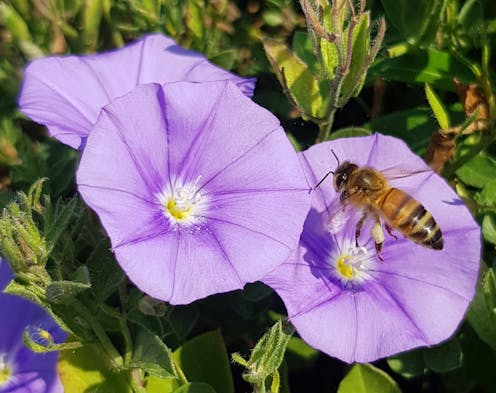
We’ve all watched a honeybee fly past us and land on a nearby flower. But how does she know what she’s looking for?
And when she leaves the hive for the first time, how does she even know what a flower looks like?
Our paper, published in Frontiers in Ecology and Evolution, set out to discover whether bees have an innate “flower template” in their minds, which allows them to know exactly what they are looking for even if they’ve never seen a flower before.
Plants and pollinators need each other to survive and prosper. Many plants require animals to transport pollen between flowers so the plants can reproduce. Meanwhile, pollinators rely on plants for nutrition (such as pollen and nectar) and nesting resources (such as leaves and resin).
As such, flowering plants and pollinators have been in partnership for millions of years. This relationship often results in flowers having evolved certain signals such as colours, shapes and patterns that are more attractive to bees.
At the same time, bees’ reliance on flower resources such as nectar and pollen has led them to be effective learners of flower signals. They must be able to tell which flowers in their environment will provide a reward and which will not. If they didn’t know the difference, they would waste time searching for nectar in the wrong flowers.
Our findings show bees can quickly and effectively learn to discriminate between flowers of slightly different shapes – a bit like how humans can expertly tell faces apart.
The amazing brains of honeybees
Honeybee brains are tiny. They weigh less than a milligram and contain just 960,000 neurons (compared to 86 billion in human brains). But despite this, they demonstrate exceptional learning abilities.
So we know bees can learn all sorts of flower-related information, but we wanted to discover how they find flowers on their first foraging trip outside the hive. We also investigated whether experienced foragers developed a bias in their foraging strategies and flower preferences.
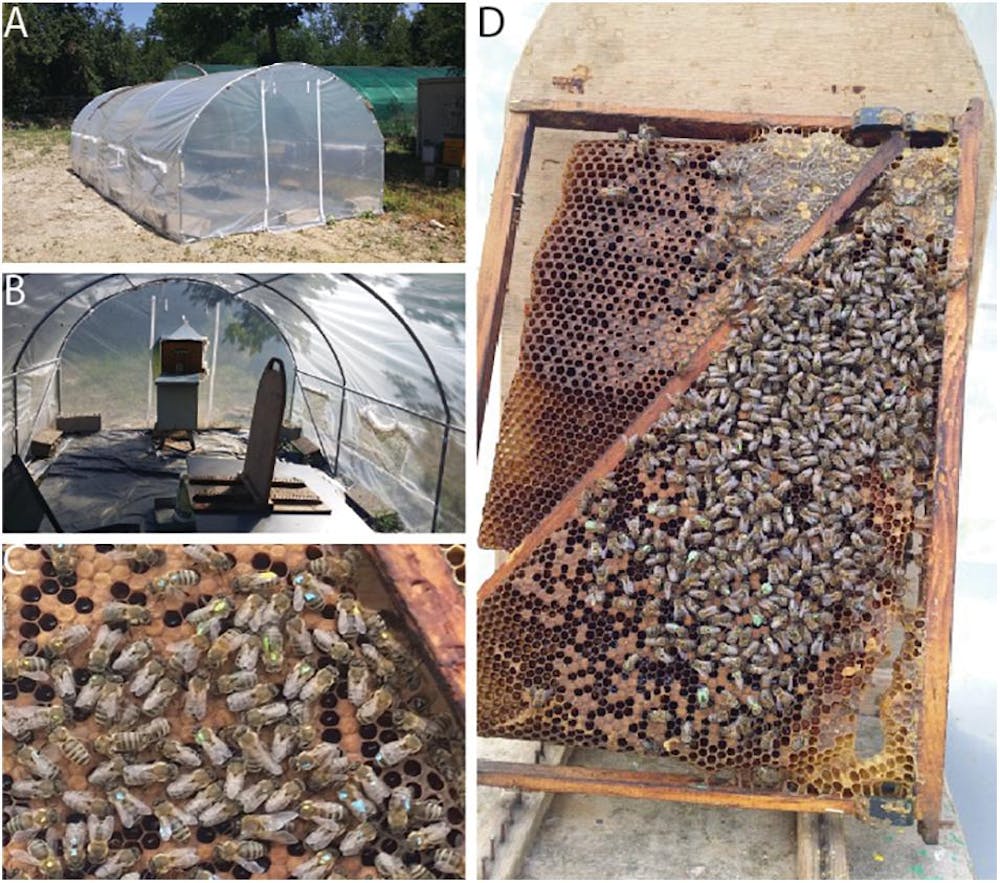
To test this, we prompted two groups of bees to discriminate between sets of flower images. One group was raised in a hive inside a greenhouse with no flowers, and had therefore never been exposed to flowers. We put a colour mark on these bees at birth, so we could track them once they emerged from the hive to forage two weeks later.
Keeping a hive inside the greenhouse ensured these bees had never been exposed to flowers. We colour marked the bees to identify them after they emerged from the hive to forage. Scarlett Howard
The second group consisted of experienced foragers which had encountered many flowers in their lives.
We trained both groups to discriminate between images of two flowers found in nature, using a reward of sugar water for choosing the correct option when directed. We also trained both groups to discriminate between the same flowers with the petals separated and randomly scrambled.
We trained ‘flower-naïve’ and experienced bees to discriminate between images of different flowers, and another set where the visual information was scrambled. Scarlett Howard
How well and how quickly the bees learnt to discriminate between the images of whole flowers, versus how long they took to discriminate between the scrambled petals, would tell us which information they preferred to learn.
Both the flower-naïve and experienced foragers learnt to discriminate between the images of whole flowers better, and more quickly, than the scrambled petals. However, the flower-naïve honeybees appeared to have less bias as they also learnt to discriminate between the scrambled information, while the experienced foragers could not.
The results reveal flower-naïve bees have an innate flower template that aids them with learning new flowers and discriminating between them. At the same time, experienced foragers become biased towards certain flower shapes as they gain foraging experience.
Overall, bees use an innate flower template to first find flowers, and also draw on their past knowledge as they become more experienced.
Innate recognition in other animals
While our findings on honeybees are remarkable, they do tie into similar capabilities in other species.
Different species have evolved brains which tune into important stimuli. For example, humans and other primates can detect, process, recognise and discriminate between the faces of other members of their species. Research has shown even human infants can detect and recognise other people’s faces very well.
Our preference for faces, and ability to recognise them, has probably evolved due to the importance of needing to discriminate between friends, enemies and strangers. This is akin to the bees needing to process images of whole flower shapes better than scrambled petal images – due to the importance of recognising flower shape for survival.
Similarly, social paper wasps evaluate their relationship with hive-mates based on the different facial markings of friends and foes. Just like bees, they do this using a combination of innate mechanisms and lived experience.
Scarlett Howard receives funding from the Alfred Deakin Postdoctoral Research Fellowship, Australian Government Research Training Program (RTP) Scholarship, and the Fyssen Foundation. She is affiliated with Pint of Science Australia.
Adrian Dyer receives funding from The Australian Research Council.
Source: The Conversation (Au and NZ) – By Thea van de Mortel, Professor, Nursing and Deputy Head (Learning & Teaching), School of Nursing and Midwifery, Griffith University
A rapid antigen test detects proteins from SARS-CoV-2, the virus that causes COVID-19, in a sample. You can collect the sample yourself at home using a nasal swab or saliva.
The test most of us will be familiar with, the polymerase chain reaction or PCR test, is different. It detects genetic material from the virus. PCR samples are collected by trained health workers, and are processed in the lab by trained technicians.
Rapid antigen tests can be done anywhere by any reasonably competent person. You can get a result in about 15 minutes, depending on the test, versus hours to days for a PCR result.
Here’s how one COVID-19 rapid antigen test works.
However, rapid antigen tests are not as reliable as PCR tests. You are more likely to get false negatives (the test indicates you don’t have COVID-19 when you do), or false positives (the test indicates you have it when you don’t).
However, the accuracy of rapid antigen tests improve if you do them when you have symptoms or within seven days of a potential exposure.
Rapid antigen tests are useful if you want to quickly check whether you have COVID-19. For instance, you might have a family gathering coming up, with lots of vulnerable, elderly relatives attending, and want to keep them safe.
You might also use a rapid antigen test if you have COVID-19 symptoms and can’t immediately get a PCR test.
Rapid antigen tests for sale in Australia need to have been approved by the Therapeutic Goods Administration (TGA), and its website lists tests approved for use at home.
Broadly, they fall into two groups. They test:
nasal secretions, from a nasal swab, or
saliva, from spitting into a tube or swabbing inside the mouth.
The TGA describes each approved test as having “acceptable sensitivity”, “high sensitivity” or “very high sensitivity”.
Ones with “very high sensitivity” are more likely to detect an actual SARS-CoV-2 infection and use nasal swabs.
Tests come with instructions (and a QR code linking to a video). You must follow the instructions to the letter to get an accurate result.
Depending on the test type, you will collect a sample of nasal secretions or saliva, which you place into a chemical solution.
You then place that chemical solution containing your sample onto an indicator device – a bit like a pregnancy test. This shows a positive result via a detectable colour change.
Rapid antigen tests look a bit like pregnancy tests. Shutterstock
7 tips to get an accurate result
These tips come from analysing instructions on the TGA website about how to use approved rapid antigen tests. Here’s what to consider:
check the expiry date. Don’t use a test that has expired
some tests need to be at room temperature for 30 minutes before use. So plan ahead
if you are using a nasal swab, blow your nose before collecting the sample. If using a saliva test, don’t eat or drink 10 minutes before collecting the sample
avoid contaminating the sample. Regardless of which test you use, instructions can ask you to clean a flat surface; wash or sanitise and dry your hands; and lay out the test items. Never, ever touch the business end of the swab (the soft end that goes in your nose) as you will contaminate it
follow the instructions on sample collection to the letter. For example, with a nasal swab you will be asked to insert the swab 2cm, rotate the swab five times, and do this in both nostrils. Once you have collected the sample it goes into the chemical solution
place a set number of drops of the solution on the indicator device. Don’t add extra “for good luck”
read the results at the exact time recommended. For example, the instructions may ask you to read the result no earlier than 15 minutes after adding the solution and no later than 20 minutes. After 20 minutes the result may no longer be accurate.
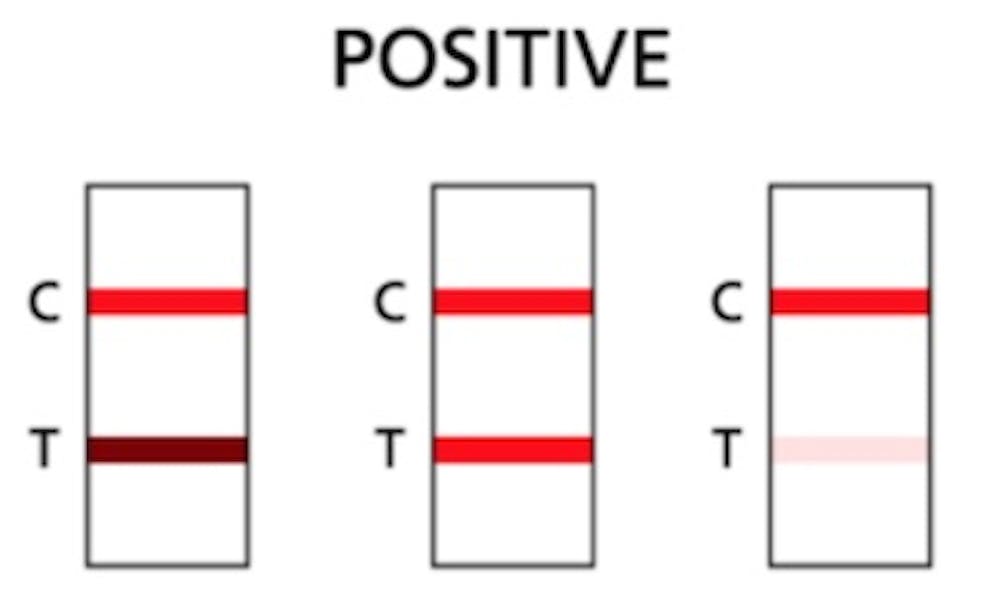
There are two coloured lines to look for. One is a C (the control). This tells you if the test is working properly. The other is a T (test) or Ag (antigen). And it’s the combination of these that gives the result:
if the C coloured line fails to show, the test is invalid. The test kit may have expired, or you didn’t take the test correctly
if the C coloured line shows and the T (or Ag) line does not, your result is negative (you’re unlikely to have COVID-19)
if both the C and T (or Ag) lines show up, your result is positive (you’re likely to have COVID-19).
What next?
If you get a negative result and don’t have symptoms, congratulations! If you have a negative result but have symptoms, take a PCR test to be sure. Avoid contact with others in the meantime.
If you get a positive result, follow up as soon as possible with a PCR test to confirm and self-isolate in the meantime.
Thea van de Mortel teaches into the Graduate Infection Prevention and Control program at Griffith University.
Source: The Conversation (Au and NZ) – By Kalervo Gulson, Professor and ARC Future Fellow, Education & Social Work, Education Futures Studio, University of Sydney
Algorithms are becoming commonplace. They can determine employment prospects, financial security and more. The use of algorithms can be controversial – for example, robodebt, as the Australian government’s flawed online welfare compliance system came to be known.
Algorithms are increasingly being used to make decisions that have a lasting impact on our current and future lives.
Some of the greatest impacts of algorithmic decision-making are in education. If you have anything to do with an Australian school or a university, at some stage an algorithm will make a decision that matters for you.
So what sort of decisions might involve algorithms? Some decisions will involve the next question for school students to answer on a test, such as the online provision of NAPLAN. Some algorithms support human decision-making in universities, such as identifying students at risk of failing a subject. Others take the human out of the loop, like some forms of online exam supervision.
Despite their pervasive impacts on our lives, it is often difficult to understand how algorithms work, why they have been designed, and why they are used. As algorithms become a key part of decision-making in education – and many other aspects of our lives – people need to know two things:
how algorithms work
the kinds of trade-offs that are made in decision-making using algorithms.
In research to explore these two issues, we developed an algorithm game using participatory methodologies to involve diverse stakeholders in the research. The process becomes a form of collective experimentation to encourage new perspectives and insights into an issue.
Our algorithm game is based on the UK exam controversy in 2020. During COVID-19 lockdowns, an algorithm was used to determine grades for students wishing to attend university. The algorithm predicted grades for some students that were far lower than expected. In the face of protests, the algorithm was eventually scrapped.
Our interdisciplinary team co-designed the UK exam algorithm game over a series of two workshops and multiple meetings this year. Our workshops included students, data scientists, ethicists and social scientists. Such interdisciplinary perspectives are vital to understand the range of social, ethical and technical implications of algorithms in education.
Algorithms make trade-offs, so transparency is needed
The UK example highlights key issues with using algorithms in society, including issues of transparency and bias in data. These issues matter everywhere, including Australia.
We designed the algorithm game to help people develop the tools to have more of a say in shaping the world algorithms are creating. Algorithm “games” invite people to play with and learn about the parameters of how an algorithm operates. Examples include games that show people how algorithms are used in criminal sentencing, or can help to predict fire risk in buildings
There is a growing public awareness that algorithms, especially those used in forms of artificial intelligence, need to be understood as raising issues of fairness. But while everyone may have a vernacular understanding of what is fair or unfair, when algorithms are used numerous trade-offs are involved.
In our algorithm game, we take people through a series of problems where the solution to a fairness problem simply introduces a new one. For example, the UK algorithm did not work very well for predicting the grades of students in schools where smaller numbers of students took certain subjects. This was unfair for these students.
The solution meant the algorithm was not used for these often very privileged schools. These students then received grades predicted by their teachers. But these grades were mostly higher than the algorithm-generated grades received by students in larger schools, which were more often government comprehensive schools. So this meant the decision was fair for students in small schools, unfair for those in larger schools who had grades allocated by the algorithm.
What we try to show in our game that it is not possible to have a perfect outcome. And that neither humans or algorithms will make a set of choices that are fair for everyone. This means we have to make decisions about which values matter when we use algorithms.
Public must have a say to balance the power of EdTech
While our algorithm game focuses on the use of an algorithm developed by a government, algorithms in education are commonly introduced as part of educational technology. The EdTech industry is expanding rapidly in Australia. Companies are seeking to dominate all stages of education: enrolment, learning design, learning experience and lifelong learning.
Alongside these developments, COVID-19 has accelerated the use of algorithmic decision-making in education and beyond.
While these innovations open up amazing possibilities, algorithms also bring with them a set of challenges we must face as a society. Examples like the UK exam algorithm expose us to how such algorithms work and the kinds of decisions that have to be made when designing them. We are then forced to answer deep questions of which values we will choose to prioritise and what roadmap for research we take forward.
Our choices will shape our future and the future of generations to come.
The following people were also involved in the research underpinning the algorithm game. From the Gradient Institute for responsible AI, Simon O’Callaghan, Alistair Reid and Tiberio Caetano. And from the Tech for Social Good group, Vincent Zhang.
Kalervo Gulson receives funding from the Australian Research Council that supported this research.
Claire Benn, Kirsty Kitto, Simon Knight, and Teresa Swist do not work for, consult, own shares in or receive funding from any company or organisation that would benefit from this article, and have disclosed no relevant affiliations beyond their academic appointment.
It cost A$49 million to add 12.5 kilometres of extra lanes to Western Australia’s Kwinana Highway, south of Perth’s CBD. That’s not unusual. On average, building a single lane of road costs about about A$5 million per kilometre.
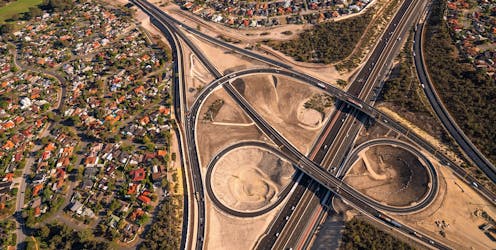
What is unusual about this stretch of extra freeway is not the money but the materials beneath the bitumen: two stabilising layers comprised of 25,000 tonnes of crushed recycled concrete, about 90% of which came from the demolition of Subiaco Oval (once Perth’s premier football ground).
Recycling building and construction materials remains the exception to the rule in Australia. The National Waste Policy agreed to by federal, state and territory governments has a target of 80% resource recovery by 2030. It’s currently about 40%.
Of the 74 million tonnes of waste generated in Australia in 2020, masonry materials comprised about 22.9 million tonnes. Plastics, by comparison, comprised about 2.5 million tonnes. Of the 61.5 million tonnes of “core waste” managed by the waste and resource recovery sector, 44% (27 million tonnes) came from the construction and demolition sector, compared with 20% (12.6 million tonnes) from households and local government activities.
Most of this waste – concrete, brick, steel, timber, asphalt and plasterboard or cement sheeting – could be reused or recycled. It ends up in landfill due to simple economics. It’s cheaper to buy new materials and throw them away rather than reuse and recycle.
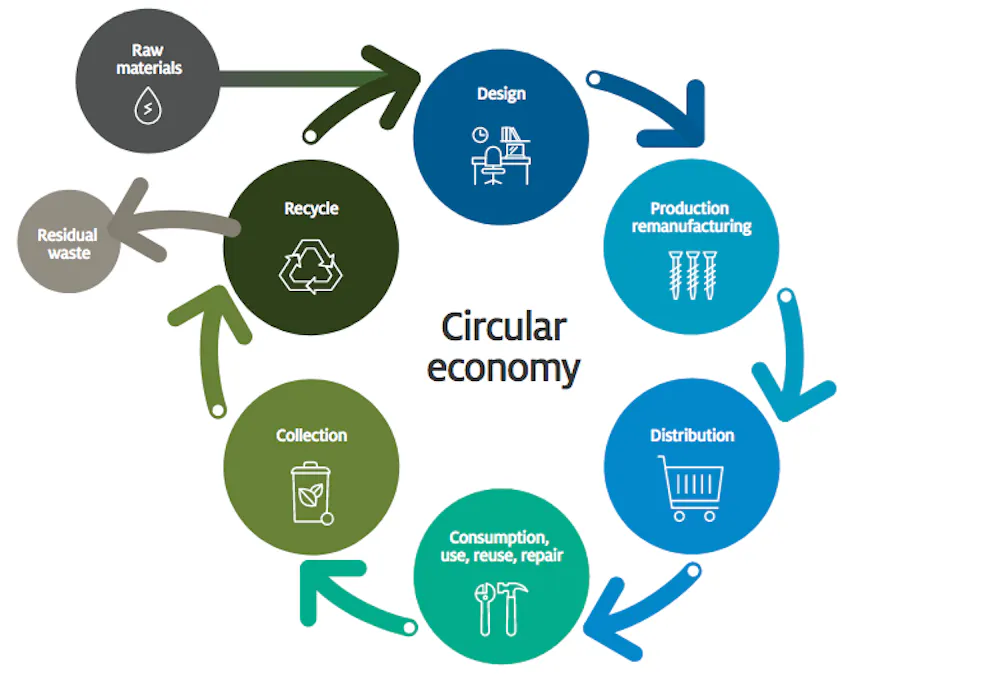
Changing this equation and moving to a circular economy, in which materials are reused and recycled rather than discarded in landfill, is a key goal to reduce the impact of building and construction on the environment, including its contribution to climate change.
The fact it is more “economic” to throw materials away than reuse them is what economists call a market failure, driven by the problem of “externalities”. That is, the social and environmental costs of producing, consuming and throwing away materials is not reflected in the prices charged. Those costs are instead externalised – borne by others.
In such cases there is a legitimate – and necessary – role for governments to intervene and correct the market failure. For an externality such as carbon emissions (imposing costs on future generations) the market-based solution favoured by most economists is a carbon price.
For construction material waste, governments have a few more policy levers to help create a viable market for more recycling.
Using procurement policies
One way to make recycling more attractive to businesses would be to increase the cost of sending waste materials to landfill. But this would likely have unintended consequences, such as illegal dumping.
The more obvious and effective approach is to help create more demand for recycled materials through government procurement, adopting policies that require suppliers to, for example, use a minimum amount of recycled materials.
With enough demand, recyclers will invest in further waste recovery, reducing the costs. Lower costs in turn create the possibility of greater demand, creating a virtuous circle that leads to a circular economy.
Australia’s federal, state and territory governments all have sustainable procurement policies. The federal Sustainable Procurement Guide states the Australian government “is committed to transforming Australia’s waste into a resource, where most goods and services can be continually used, reused, recycled and reprocessed as part of a circular economy”.
But these policies lack some basic elements.
Three key market-making reforms
Our research suggests three important reforms could make a big difference to waste market operations. This is based on interviewing 27 stakeholders from the private sector and government about how to improve sustainable procurement.
First, government waste policies that set aspirational goals are not supported by procurement policies setting mandatory minimum recycled content targets. All contractors on government-funded construction projects should be required to use a percentage of recycled waste materials.
Second, the nature of salvaging construction materials means quality can vary significantly. Cement recycled from a demolition site, for example, could contain contaminants that reduce its durability.
Governments can help the market through regularly auditing the quality of recycler’s processes, to increase buyer confidence and motivate suppliers to invest in production technologies.
Third, in some states (such as Western Australia) the testing regimes for recycled construction products are more complex than that what applies to raw materials.
More reasonable specifications would reduce compliance costs and thereby the cost of using recycled materials.
Salman Shooshtarian receives funding from Australia Sustainable Built Environment National Research Centre
Savindi Caldera receives relevant funding from Sustainable Built Environment National Research Centre, Australia.
Tayyab Maqsood receives funding from Sustainable Built Environment National Research Centre.
t.ryley@griffith.edu.au receives funding from SBEnrc (Sustainable Built Environment National Research Centre) associated with this article.
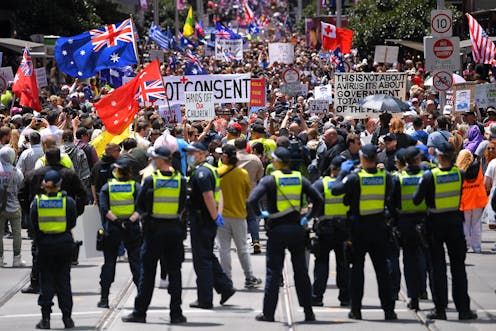
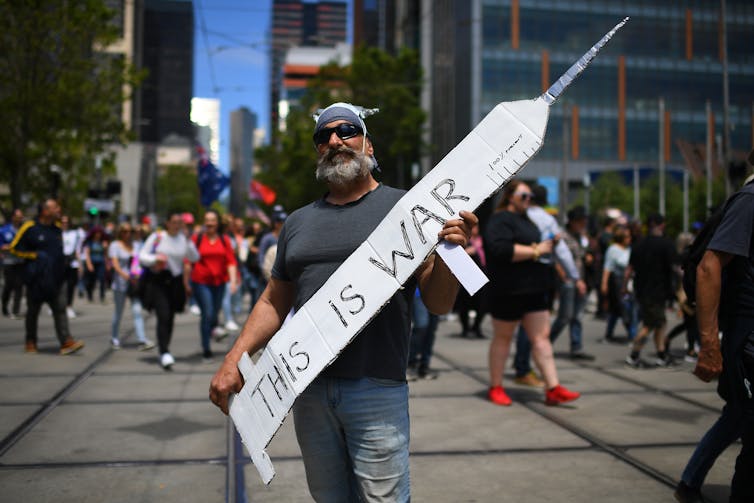
Over the weekend, tens of thousands of people gathered in Melbourne to protest vaccine mandates and the Victorian government’s proposed pandemic bill.
While the latest protests were relatively peaceful, they have followed a week of similar gatherings whose language and symbolism were at times violent. The protesters are a mix of groups, but the movement is riddled with far-right and alt-right extremists who, with their growing reach through social media and in the context of developments in the United States and Europe, pose one of the more significant challenges to Australian democracy in recent memory.
This is not an easy question to answer because it is a complex gathering of groups.
Some are simply responding to what they see as over-reach by the state on its pandemic bill or its vaccine mandates.
However, as we’ve seen with the anti-lockdown protests during the course of the pandemic, this is a movement grounded in anger and resentment. These are people who feel a deep sense of powerlessness and frustration: they may have lost their jobs, been cut off from family and friends, and they may be deeply suspicious of, if not outright hostile to, the vaccines. To them, these protests might be empowering at a time when they feel completely disempowered and forgotten.
But there is no doubt that, at the heart of the protests – their ideological roots, so to speak – are extremism and conspiracy theories. An analysis of their online activity and forums, as well as the imagery and language of the protests themselves, offers plenty of evidence of this.
Central to it is a deep distrust of science, a strong belief in conspiracies, including the notion of “big pharma” driving public policy, and a new world order of evil “liberal elites” who abuse children and rule over global affairs. QAnon is probably the best-known group associated with that thinking. There is also an embedded spiritual framing, patriotism and most alarmingly, anti-semitism that intersects with these far-right narratives.
One of the most important features of all this is the nuance with which it is carried out. It is a movement reliant on symbolism, hand signals, and single-word slogans such as “qui?” (French for “who?”) to get the message across.
This is all cloaked in patriotic symbology, with the Australian flag highly visible at the marches and patriotic folk songs sung over loudspeakers.
There are certainly far-right extremists at the Melbourne rallies. So why Melbourne? It may be, to a large extent, because Victoria in general, and Melbourne in particular, have borne the harshest of the lockdowns during the two years of the pandemic. But these groups are around the country, and are watching what is happening in Victoria in the hope of feeding off it.
Anti-vaccine policy protest is central to the Melbourne marches. AAP/James Ross
What do they want?
Again, this is hard to know, exactly, and there will be diverse views within the protest groups. Some want simple actions: the end of vaccine mandates or the destruction of the pandemic bill. These are, of course, legitimate democratic aims whether others agree with them or not. For some, the protest is the point, offering them a sense of solidarity and belonging.
However for others, including the numerous members of far right groups pictured at the protests, steering the protests toward more extreme language, actions and recruiting from among those attending are key aims. They are often supported by so-called “citizen journalists” who are themselves closely aligned with far-right ideologies.
Direct from the US
These protests are deeply connected to what is happening in the US, the roots of which stretch back to far-right groups gaining momentum in the aftermath of the Global Financial Crisis (GFC) of 2007-08. They were then further encouraged by the Trump campaign and presidency. Through social media, their ideas and symbolism have been transported to Australia.
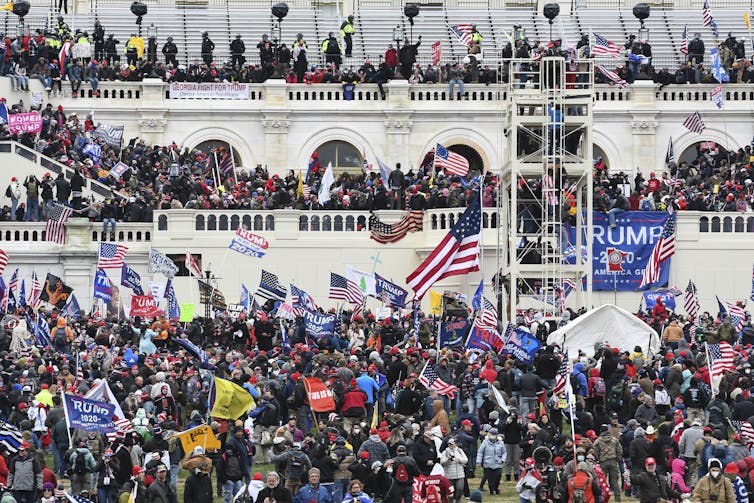
Even a cursory glance at encrypted messaging apps reveals many of those involved in planning and coordinating the Melbourne protests draw direct inspiration from events in the United States, including the January 6 Capitol insurrection.
Politicians and commentators have expressed outrage at the parading of a noose at the Victorian parliament last week, yet this was drawn directly from events on January 6, when protesters threatened to hang the US vice-president as a traitor.
Violent language at the Victorian protests, such as threats to kill Premier Dan Andrews, borrow heavily from far-right American literature and rhetoric, which suggests “traitors” will soon meet their end.
It’s hard to say whether this movement is growing: it’s certainly gaining momentum through these protests, and gaining a potential base of recruitment.
But the question is how many people at these protests would still go if they knew who they were marching alongside?
Certainly, counter-terrorism police will be looking closely at all this activity, especially threats of violence against politicians and others. They will also be interested in attempts by far-right groups to recruit new members.
Much of the rhetoric of the far-right groups involved has been transported directly from the US, given much momentum by the Capitol Riots on January 6. AAP/AP/JT/STAR MAX/IPx
We now find ourselves in a highly polarised political landscape driven by two years of severe lockdown, and the politicisation of the pandemic. On the one hand, government disaster management approaches need to better account for the ways that governance in a time of crisis plays into the hands of violent extremists.
There are also important political solutions. As unlikely as it seems at this point, what we really need is a bipartisan political approach that addresses legitimate concerns while shutting down extremist and violent activity. The two have become so entangled, it is by no means an easy task, but it is an essential one.
The protests should have a sobering effect on leaders of good sense who care about democracy. As we head into a federal election year in 2022, we are seeing the pre-conditions for fringe politicians with extremist views to be elected and hold the balance of power in parliament, by doing or saying whatever it takes to hold that power.
In that respect, if developments in the United States are any measure, Australian democracy is facing one of the greatest threats it has ever known. Those of good faith need to ensure they reaffirm the fundamental values of citizenship, democracy and peace, while allowing open debate on issues of contention and concern.
Josh Roose receives funding from the Australian Research Council (DP200102013) for a Discovery Project titled: ‘Far Right in Australia: Intellectuals, Masculinity and Citizenship’. Josh is a member of the Addressing Violent Extremism and Radicalisation to Terrorism Research Network (AVERT) Executive. He is a member of the Australian Labor Party.
Days short of the first anniversary of the farmers’ protests, Indian Prime Minister Narendra Modi said in a televised address the government had decided to repeal the three new farm laws. The prime minister also said a committee would be formed to address the farmers concerns. The committee would be made up of farmers’ representatives and agriculture policy experts.
The announcement was made on the day of an important Sikh festival that marks the birth anniversary of Guru Nanak Dev, the first of the ten Sikh gurus. Farm leaders welcomed the move, but said the protests won’t end immediately. They say they will wait until the laws are formally repealed in the Indian parliament, and all their demands are met.
Remind me again, what were the farmers protesting?
Farmers in India have been protesting three new laws they fear will fundamentally alter their ways of farming.
The laws, passed by the Indian parliament in September 2020, would open the agricultural sector to active commercial engagement by big corporates. Corporates could purchase, store, and even decide on what crops would be produced. Hence, farmers fear the new laws will trap them into contract farming arrangements with corporate buyers.
Once the laws were passed in September 2020, farmers across India began to protest. In November 2020, a large contingent arrived at the borders of the national capital demanding a complete withdrawal of these laws and introduction of concrete provisions for secure incomes from agriculture through a state-supported system of price security.
The protestors were not allowed to enter the city. So they sat, occupying some of the main national highways connecting the capital city to the rest of the country.
Two of these sites, at the Singhu and Tikri borders, are spread over tens of kilometres along the highway, with nearly 5,000-10,000 farmers staying at each site at any time.
Nearly 700 among them have died in the course of these protests. In October, four farmers were killed when a group of protestors was hit by a convoy of vehicles in the state of Uttar Pradesh.
India’s agriculture crisis, and the genesis of farmer unrest
Two-thirds of India continues to live in rural areas. A large proportion remains dependent on agriculture, partially or solely. However, household incomes from agriculture have been steadily declining.
The average size of land holdings have been shrinking over the years, with nearly 80% of them now less than two hectares. This growing stress has been visible in the form of steadily rising cases of farmers’ suicides, mostly because of their growing indebtedness.
The farmers’ desperation manifested itself in an unprecedented set of mobilisations, as we’ve witnessed in the last year.
The federal government had been largely hostile towards the protestors. But despite this, the protests have had significant political impact, especially in the states of Punjab and Haryana.
In Punjab, it’s now almost impossible for politicians of the federal-ruling Bharatiya Janata Party (BJP) to step out of their homes to address political meetings or organise events. In Haryana, too, though the BJP is also in power at the state level, the situation is similar.
The federal government had perhaps expected that the farmers would run out of steam. Since January 2021, farmers had had no formal negotiations with the government. But the movement had been gaining momentum. Besides the sit-ins, they have been holding protest meetings, maha-panchayats, across the country, attracting massive support.
They have been particularly effective in the northern states of Punjab, Haryana, Uttar Pradesh and Rajasthan, as well as others.
Two of these are politically significant states – Uttar Pradesh and Punjab – that are set to go to the polls early next year. Given the damage these protests could have on the ruling party in the forthcoming elections the federal government appears to have decided to repeal the laws.
The farmers’ determination has been rewarded. Besides putting agriculture back on the national agenda, showing their strength as a political block, they have also managed to build new solidarities across castes and communities.
This has perhaps been the longest protest movement of its kind in the recent history of India, perhaps, even globally. The protests, and its outcome, have become a source of inspiration for a wide range of political actors that wish to see democracy survive and thrive in India.
Their perseverance and grit has shown it is possible to mobilise and sustain political opposition against a powerful establishment.
Surinder S. Jodhka does not work for, consult, own shares in or receive funding from any company or organisation that would benefit from this article, and has disclosed no relevant affiliations beyond their academic appointment.
Days short of the first anniversary of the farmers’ protests, Indian Prime Minister Narendra Modi said in a televised address the government had decided to repeal the three new farm laws. The prime minister also said a committee would be formed to address the farmers concerns. The committee would be made up of farmers’ representatives and agriculture policy experts.
The announcement was made on the day of an important Sikh festival that marks the birth anniversary of Guru Nanak Dev, the first of the ten Sikh gurus. Farm leaders welcomed the move, but said the protests won’t end immediately. They say they will wait until the laws are formally repealed in the Indian parliament, and all their demands are met.
Remind me again, what were the farmers protesting?
Farmers in India have been protesting three new laws they fear will fundamentally alter their ways of farming.
The laws, passed by the Indian parliament in September 2020, would open the agricultural sector to active commercial engagement by big corporates. Corporates could purchase, store, and even decide on what crops would be produced. Hence, farmers fear the new laws will trap them into contract farming arrangements with corporate buyers.
Once the laws were passed in September 2020, farmers across India began to protest. In November 2020, a large contingent arrived at the borders of the national capital demanding a complete withdrawal of these laws and introduction of concrete provisions for secure incomes from agriculture through a state-supported system of price security.
The protestors were not allowed to enter the city. So they sat, occupying some of the main national highways connecting the capital city to the rest of the country.
Two of these sites, at the Singhu and Tikri borders, are spread over tens of kilometres along the highway, with nearly 5,000-10,000 farmers staying at each site at any time.
Nearly 700 among them have died in the course of these protests. In October, four farmers were killed when a group of protestors was hit by a convoy of vehicles in the state of Uttar Pradesh.
India’s agriculture crisis, and the genesis of farmer unrest
Two-thirds of India continues to live in rural areas. A large proportion remains dependent on agriculture, partially or solely. However, household incomes from agriculture have been steadily declining.
The average size of land holdings have been shrinking over the years, with nearly 80% of them now less than two hectares. This growing stress has been visible in the form of steadily rising cases of farmers’ suicides, mostly because of their growing indebtedness.
The farmers’ desperation manifested itself in an unprecedented set of mobilisations, as we’ve witnessed in the last year.
The federal government had been largely hostile towards the protestors. But despite this, the protests have had significant political impact, especially in the states of Punjab and Haryana.
In Punjab, it’s now almost impossible for politicians of the federal-ruling Bharatiya Janata Party (BJP) to step out of their homes to address political meetings or organise events. In Haryana, too, though the BJP is also in power at the state level, the situation is similar.
The federal government had perhaps expected that the farmers would run out of steam. Since January 2021, farmers had had no formal negotiations with the government. But the movement had been gaining momentum. Besides the sit-ins, they have been holding protest meetings, maha-panchayats, across the country, attracting massive support.
They have been particularly effective in the northern states of Punjab, Haryana, Uttar Pradesh and Rajasthan, as well as others.
Two of these are politically significant states – Uttar Pradesh and Punjab – that are set to go to the polls early next year. Given the damage these protests could have on the ruling party in the forthcoming elections the federal government appears to have decided to repeal the laws.
The farmers’ determination has been rewarded. Besides putting agriculture back on the national agenda, showing their strength as a political block, they have also managed to build new solidarities across castes and communities.
This has perhaps been the longest protest movement of its kind in the recent history of India, perhaps, even globally. The protests, and its outcome, have become a source of inspiration for a wide range of political actors that wish to see democracy survive and thrive in India.
Their perseverance and grit has shown it is possible to mobilise and sustain political opposition against a powerful establishment.
Surinder S. Jodhka does not work for, consult, own shares in or receive funding from any company or organisation that would benefit from this article, and has disclosed no relevant affiliations beyond their academic appointment.
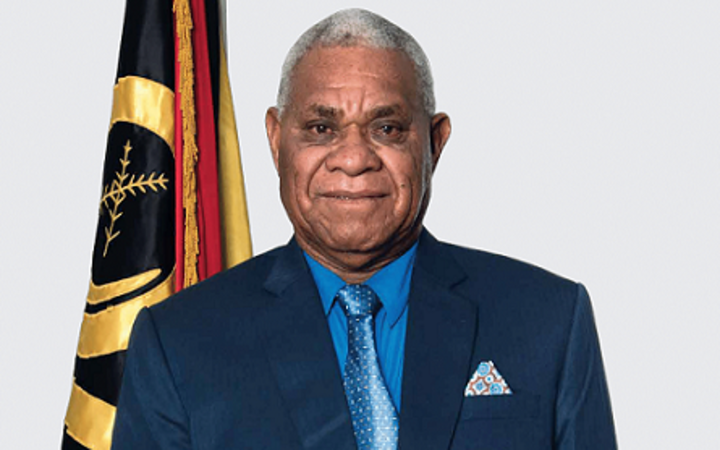
Vanuatu’s leader is formally supporting the demand of Kanaks in New Caledonia for a delay in next month’s third and final referendum on independence.
Prime Minister Bob Loughman told Parliament he would raise his concerns with French ambassador Pierre Fournier in Port Vila.
The Kanak pro-independence parties have asked Paris to delay the referendum because the indigenous people are still mourning family members who died during the pandemic.
About half of the 272 people who have died in New Caledonia from the recent covid-19 outbreak were Kanaks.
The respect required within traditional ceremonies of mourning within Melanesian culture means activities such as political awareness and campaigning cannot take place.
Vanuatu PM Bob Loughman … raising his concerns with the French envoy in Port Vila. Image: Vanuatu Govt
On Thursday, Vanuatu opposition leader Ralph Regenvanu asked Parliament if the government would add its voice in support of the Kanaks’ demand for a delay.
Loughman then told MPs Vanuatu supported the Kanaks on this issue.
‘Declaration of war’ France continues to maintain the referendum will take place on December 12 in spite of the widespread calls for a delay.
It has already sent extra military personnel to New Caledonia to provide additional security.
Opposition leader Ralph Regenvanu … Vanuatu government questioned in Parliament. Image: Hilaire Bule/RNZ
This week, one of New Caledonia’s pro-independence parties, Palika, said the French decision to maintain next month’s referendum date amounted to a “declaration of war” against the Kanaks and progressive citizens.
Last Friday, the French High Commissioner confirmed that the third and final referendum under the Noumea Accord would be held on December 12.
They said the situation was not conducive to run a proper referendum campaign and last week they had announced that their decision to shun the referendum was irrevocable.
The anti-independence parties welcomed confirmation that the referendum date would not be changed.
However, the Palika said in a statement that going ahead with the plebiscite in the current conditions amounted to a political provocation which returned New Caledonia to the turbulent stage before the 1988 Matignon Accords and the 1998 Noumea Accord.
It said the “stubbornness” of the French state clouded the political, social and economic way forward, which could create tension detrimental to social peace.
The party said that with its pro-independence partners within the FLNKS, there would be a response commensurate to the “insult to the Kanak people”.
This article is republished under a community partnership agreement with RNZ.
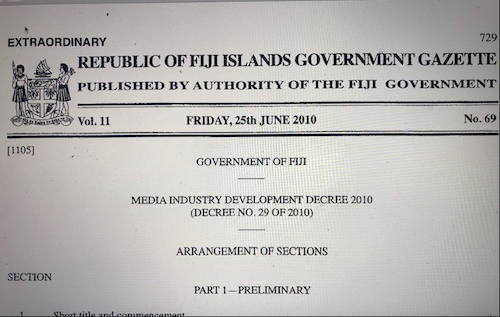
If anyone is wondering why the Fijian media hasn’t reported the details of my reporting on Grubsheet Feejee of the Prime Minister’s secret role in the sacking of the Solicitor-General, his alleged action in shutting down a police drug investigation into a close family member, or his Attorney-General’s alleged behaviour in inviting his female staff to give him massages in his hotel rooms on overseas trips, it is because they are terrified of the AG’s draconian 2010 Media Industry Development Decree and the very real prospect of prosecution.
Fiji’s Media Decree and now law since 2014 … a gag on reports of national interest. Image: GS
The following is what can happen to any Fijian news media outlet that Attorney-General Aiyaz Sayed-Khaiyum decides has breached the terms of the decree, which became legislation on the return to parliamentary rule in 2014 and has had the effect of gagging the media and preventing it from reporting stories that are genuinely in the national interest.
As you can see, the national interest is not defined in the legislation, which means the AG effectively decides what is in the national interest.
And if he thinks that it is not in the national interest for allegations against him and the PM to be aired in the local media, then he can use the law against any organisation that republishes my disclosures.
Fortunately, I am beyond his reach but these stories go untold for anyone without the internet.
[MED 22] CONTENT REGULATION:
The content of any media service must not include material which—
(a)is against the public interest or order; (b)is against national interest; or (c)creates communal discord.
[MED 24] OFFENCES RELATING TO CONTENT REGULATION:
A breach of any of the provisions in or under section 22 … by a media organisation shall constitute an offence and the media organisation shall be liable on summary conviction to a fine not exceeding $100,000 or in the case of a publisher or editor to a fine not exceeding $25,000 or to imprisonment for a term not exceeding 2 years or to both.
But how tragic it is that accessing the work of journalists outside Fiji is the only way the Fijian people can gain information on anything remotely approaching the truth about what is really happening in their country.
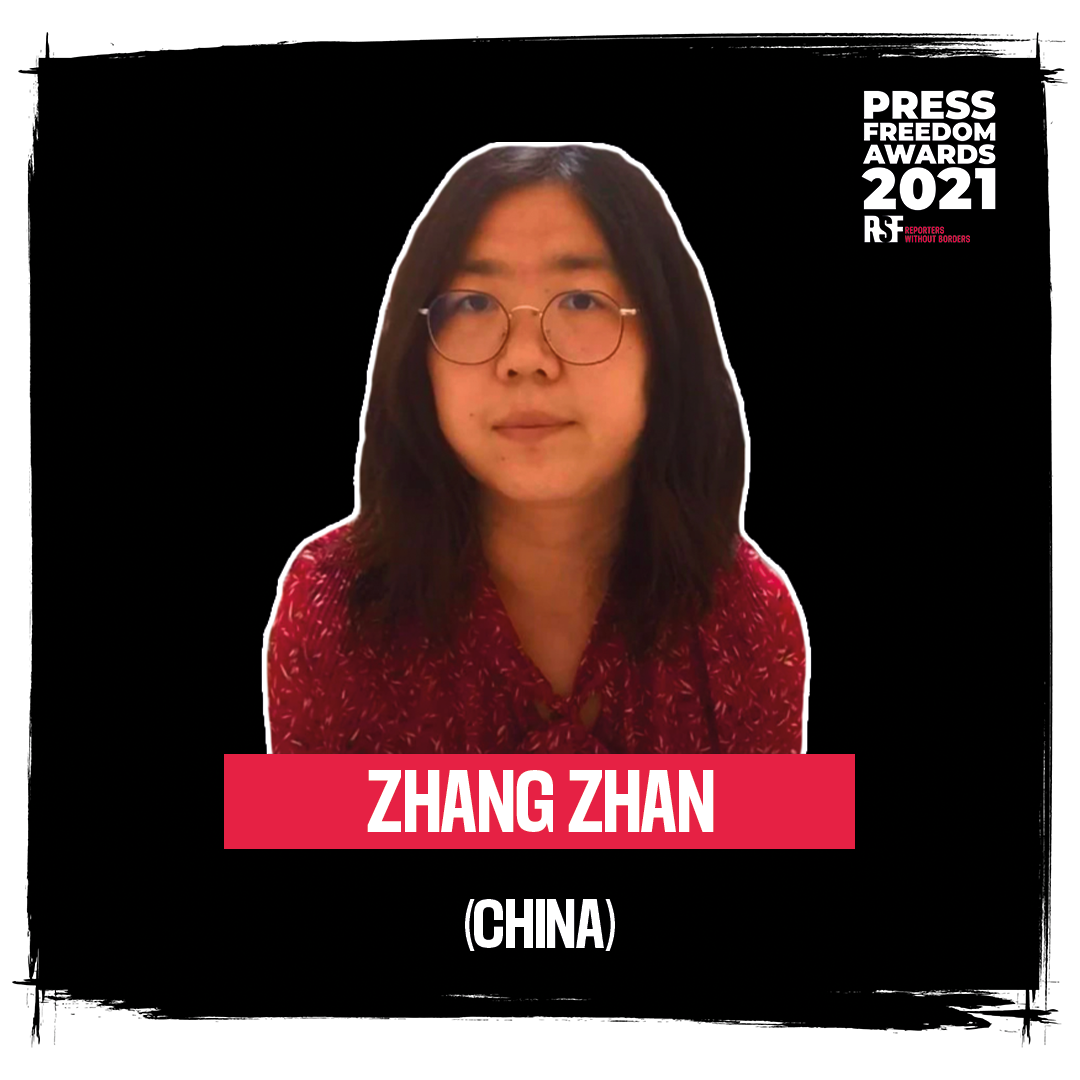
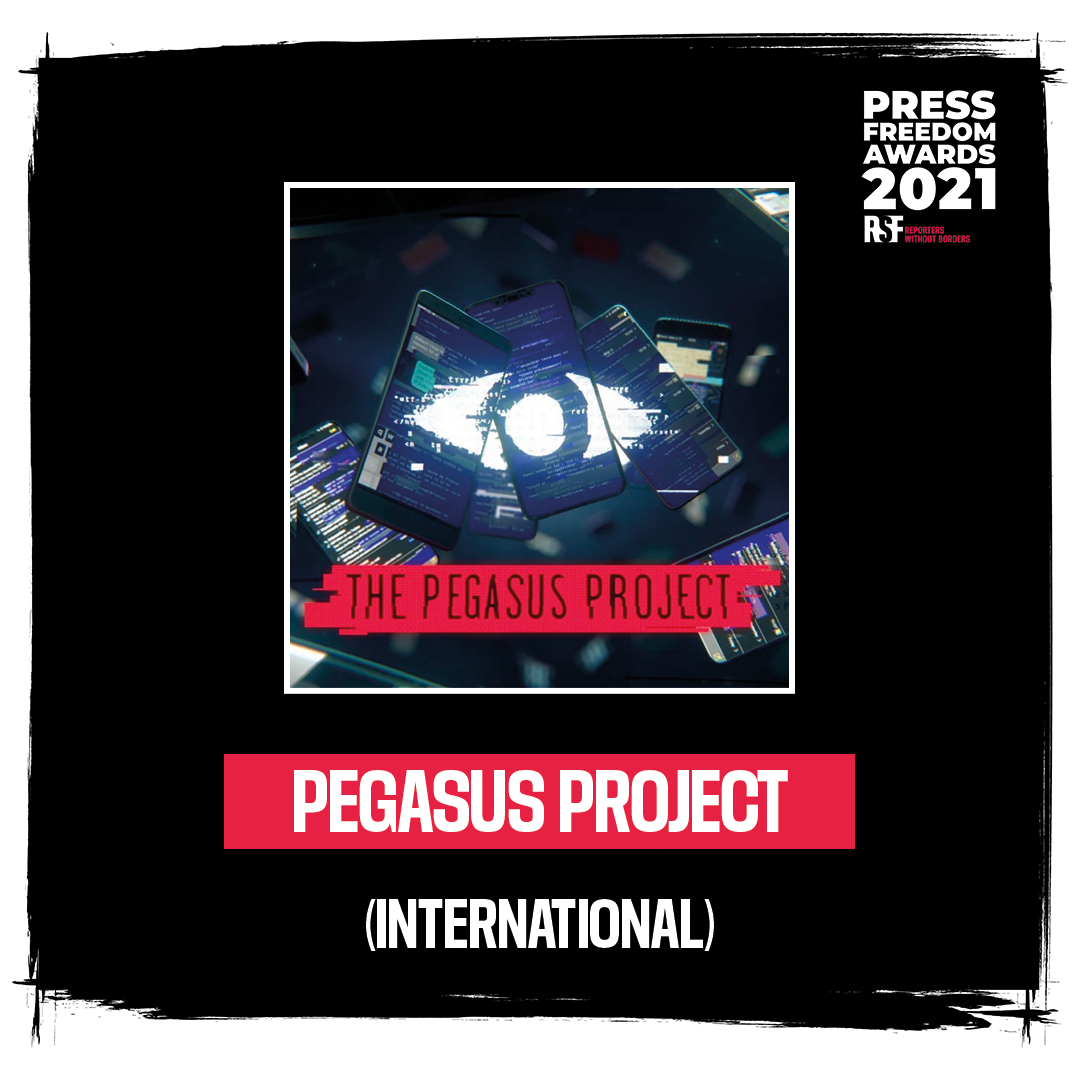
The 2021 Reporters Without Borders (RSF) Press Freedom Awards have been given to Chinese journalist Zhang Zhan in the courage category, Palestinian journalist Majdoleen Hassona in the independence category, and the Pegasus Project in the impact category.
RSF’s press freedom prizes are awarded every year to journalists or media that have made a notable contribution to the defence or promotion of freedom of the press in the world.
This is the 29th year they have been awarded.
The 2021 awards have been given in three categories — journalistic courage, impact and independence. Six journalists and six media outlets or journalists’ organisations from a total of 11 countries were nominated.
Courage Prize The 2021 Prize for Courage, which aims to support and salute journalists, media outlets or NGOs that have displayed courage in the practice, defence or promotion of journalism, has been awarded to Chinese journalist Zhang Zhan.
Despite constant threats, this lawyer-turned-journalist covered the covid-19 outbreak in the city of Wuhan in February 2020, live-streaming video reports on social media that showed the city’s streets and hospitals, and the families of the sick.
Her reporting from the heart of the pandemic’s initial epicentre was one of the main sources of independent information about the health situation in Wuhan at the time.
After being arrested in May 2020 and held incommunicado for several months without any official reason being provided, Zhang Zhan was sentenced on 28 December 2020 to four years in prison for “picking quarrels and provoking trouble”.
In protest against this injustice and the mistreatment to which she was subjected, she went on a hunger strike that resulted in her being shackled and force-fed. Her friends and family now fear for her life, and her health has worsened dramatically in recent weeks.
Independence Prize The 2021 Prize for Independence, which rewards journalists, media outlets or NGOs that have resisted financial, political, economic or religious pressure in a noteworthy manner, has been awarded to Palestinian journalist Majdoleen Hassona.
Majdoleen Hassona
Before joining the Turkish TV channel TRT and relocating to Istanbul, this Palestinian journalist was often harassed and prosecuted by both Israeli and Palestinian authorities for her critical reporting.
While on a return visit to the West Bank in August 2019 with her fiancé (also a TRT journalist based in Turkey), she was stopped at an Israeli checkpoint and was told that she was subject to a ban on leaving the territory that had been issued by Israeli intelligence “for security reasons”.
She has been stranded in the West Bank ever since but decided to resume reporting there and covered the anti-government protests in June 2021 following the death of the activist Nizar Banat.
Impact Prize The 2021 Prize for Impact, which rewards journalists, media outlets or NGOS that have contributed to clear improvements in journalistic freedom, independence and pluralism, or increased awareness of these issues, has been awarded to the Pegasus Project.
The Pegasus Project
The Pegasus Project is an investigation by an international consortium of more than 80 journalists from 17 media outlets* in 11 different countries that was coordinated by the NGO Forbidden Stories with technical support from experts at Amnesty International’s Security Lab.
Based on a leak of more than 50,000 phone numbers targeted by Pegasus, spyware made by the Israeli company NSO Group, the Pegasus Project revealed that nearly 200 journalists were targeted for spying by 11 governments — both autocratic and democratic — which had acquired licences to use Pegasus.
This investigation has made people aware of the extent of the surveillance to which journalists are exposed and has led many media outlets and RSF to file complaints and demand a moratorium on surveillance technology sales.
“For defying censorship and alerting the world to the reality of the nascent pandemic, the laureate in the ‘courage’ category is now in prison and her state of health is extremely worrying,” said RSF secretary-general Christophe Deloire.
“For displaying a critical attitude and perseverance, the laureate in the ‘independence category has been unable to leave Israeli-controlled territory for the past two years.
“For having revealed the scale of the surveillance to which journalists can be subjected, some of the journalists who are laureates in the ‘impact’ category are now being prosecuted by governments.
“This, unfortunately, sums up the situation of journalism today. The RSF Award laureates embody the noblest journalistic qualities and also pay the highest price because of this. They deserve not only our admiration but also our support.”
Chaired by RSF president Pierre Haski, the jury of the 29th RSF Press Freedom Awards consisted of prominent journalists and free speech defenders from across the world: Rana Ayyub, an Indian journalist and Washington Post opinion columnist; Raphaëlle Bacqué, a leading French reporter for Le Monde; Mazen Darwish, a Syrian lawyer and president of the Syrian Centre for Media and Freedom of Expression; Zaina Erhaim, a Syrian journalist and communication consultant; Erick Kabendera, a Tanzanian investigative reporter; Hamid Mir, a Pakistani news editor, columnist and writer; Frederik Obermaier, a German investigative journalist with Munich’s Süddeutsche Zeitung newspaper; and Mikhail Zygar, a Russian journalist and founding editor-in-chief of Dozhd, Russia’s only independent TV news channel.
Previous winners of this prize, which was created in 1992, have included Russian journalist Elena Milashina (2020 Prize for Courage), Saudi blogger Raif Badawi (Netizen category prize in 2014) and the Chinese Nobel Peace laureate Liu Xiaobo (Press Freedom Defender prize in 2004).
Pacific Media Watch works in association with Reporters Without Borders.
*(Aristegui Noticias, Daraj, Die Zeit, Direkt 36, Knack, Forbidden Stories, Haaretz, Le Monde, Organised Crime and Corruption Reporting Project, Proceso, PBS Frontline, Radio France, Le Soir, Süddeutsche Zeitung, The Guardian, The Washington Post and The Wire)
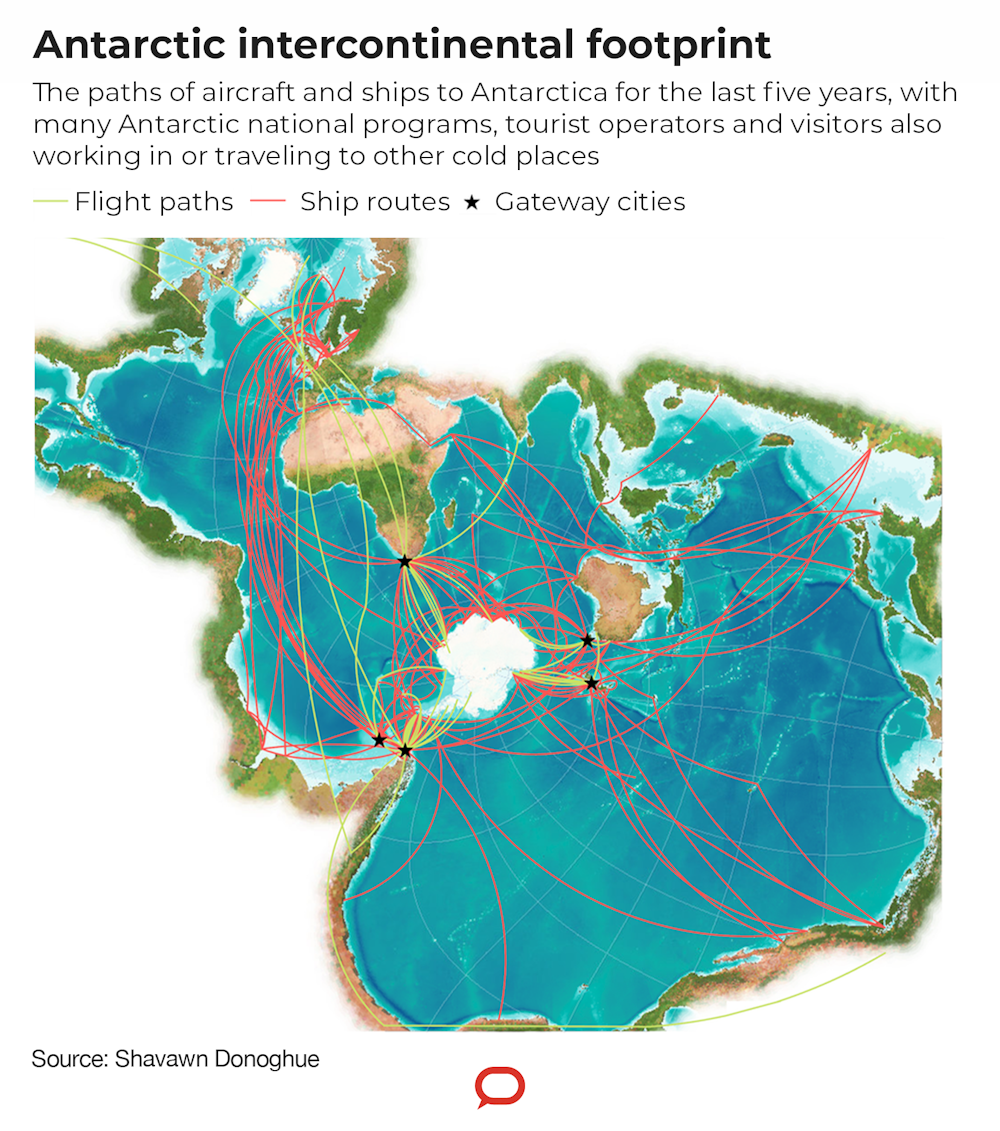
We tend to think Antarctica is isolated and far away – biologically speaking, this is true. But the continent is busier than you probably imagine, with many national programs and tourist operators crisscrossing the globe to get there.
And each vessel, each cargo item, and each person could be harbouring non-native species, hitchhiking their way south. This threat to Antarctica’s fragile ecosystem is what our new evaluation, released today, grapples with.
We mapped the last five years of planes and ships visiting the continent, illuminating for the first time the extent of travel across the hemispheres and the potential source locations for non-native species, as the map below shows. We found that, luckily, while some have breached Antarctica, they generally have yet to get a stranglehold, leaving the continent still relatively pristine.
But Antarctica is getting busier, with new research stations, rebuilding and more tourism activities planned. Our challenge is to keep it pristine under this growing human activity and climate change threat.
Author provided
Life evolved in isolation
Biodiversity-wise, much of the planet is mixed up. The scientific term is homogenisation, where species, such as weeds, pests and diseases, from one place are transported elsewhere and establish. This means they begin to reproduce and influence the ecosystem, often to the detriment of the locals.
Most life in Antarctica is jammed onto tiny coastal ice-free fringes, and this is where most research stations, ships and people are.
This includes unique animals (think Adélie penguins, Weddell seals and snow petrels), mosses and lichens that harbour tiny invertebrates (such as mites, waterbears and springtails), and an array of microbes such as cyanobacteria. The adjacent coast and ocean team with life, too.
The more we learn about them, the more outstanding life at the end of the planetary spectrum becomes. Just this week, new scientific discoveries identified that some Antarctic bacteria live on air, and make their own water using hydrogen as fuel.
When the Southern Ocean was formed some 30 million years ago, natural barriers were created with the rest of the world. This includes the Antarctic Circumpolar Current, the strongest ocean current on the planet, and its associated strong westerly surface winds, icy air and ocean temperatures.
This means life in Antarctica evolved in isolation, with flora and fauna that commonly exist nowhere else and can cope with frigid conditions. But the simplicity of Antarctica’s food webs can often mean there are gaps in the ecosystem that other species from around the world can fill.
In May 2014, for example, routine biosecurity surveillance detected non-native springtails (tiny insect-like invertebrates) in a hydroponic facility at an Australian Antarctic station.
This station, an ice-free oasis, previously lacked these interlopers, and they had the potential to alter the local fragile ecosystem permanently. Thankfully, a rapid and effective response successfully eradicated them.
Gentoo penguin on a bed of algae, Antarctica Shutterstock
Pressures from climate change are exacerbating the challenges of human activity on Antarctica, as climate change is bringing milder conditions to these wildlife-rich areas, both on land and sea.
As glaciers melt, new areas are exposed, which allows non-Antarctic species greater opportunity to establish and possibly outcompete locals for resources, such as nutrients and precious, ice-free space.
So far, we’ve been lucky
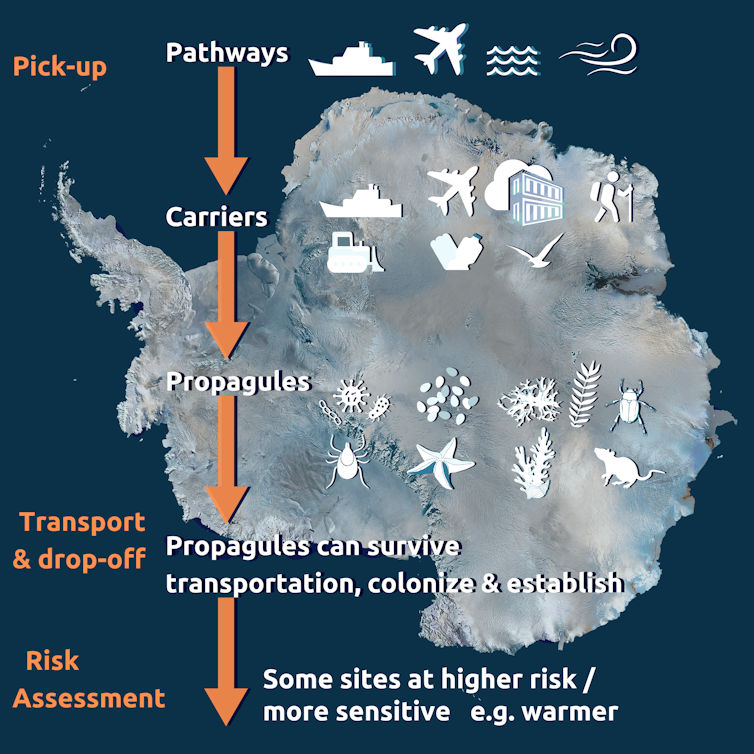
Our past research focused on non-native propagules – things that propagate like microbes, viruses, seeds, spores, insects and pregnant rats – and how they entrain themselves into Antarctica.
They can be easily caught on people’s clothing and equipment, in fresh food, cargo and machinery. In fact, research from the last decade found that visitors who hadn’t cleaned their clothing and equipment carried on average nine seeds each.
Pathways for non native species. Dana M Bergstrom
But few non-native species have established in Antarctica, despite their best efforts.
To date, only 11 non-native invertebrate species – including springtails, mites, a midge and an earthworm – have established across a range of locations in the warmer parts of Antarctica, including Signy Island and the Antarctic Peninsula. In the marine realm, some non-native species have been seen but it’s thought none have survived and established.
Microbes are another matter. Each visitor to Antarctica carries millions of microbial passengers, and many of these microbes are left behind. Around most research stations, human gut microbes from sewage have mingled with native microbes, including exchanging antibiotic resistance genes.
Last year, for example, a rare harmful bacteria, pathogenic to both humans and birds, was detected in guano (poo) from both Adélie and gentoo penguin colonies at sites with high rates of human visitors. COVID-19 also made its way to Antarctica last December.
Both these cases risk so-called “reverse zoonosis”, where humans spread disease to local wildlife.
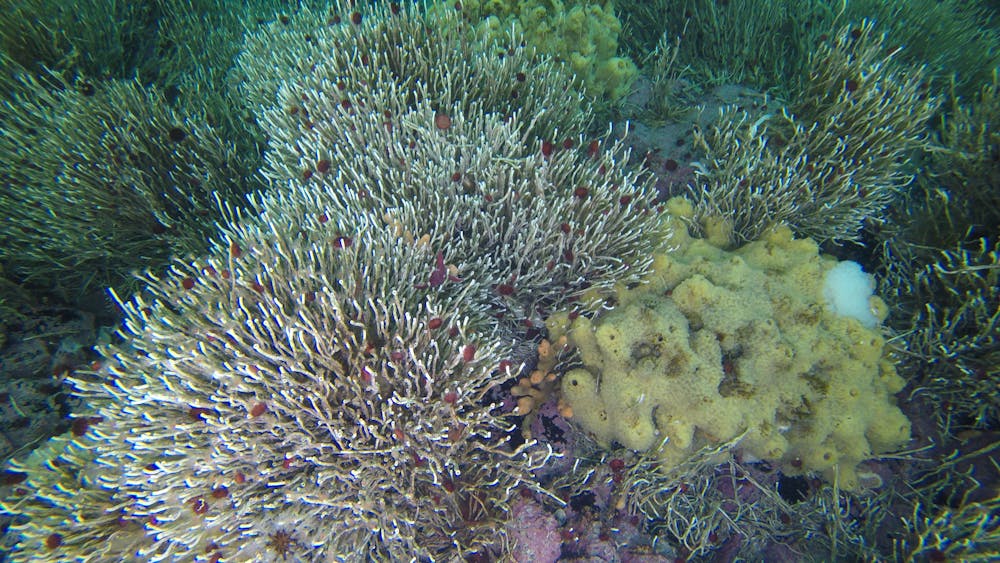
Antarctica’s coral reefs? Extensive shallow water, polychete colonies form fragile reefs that act as marine animal forests, hosting a diverse and abundant community of associated plants and animals. Jonny Stark/ AAD
What do we do about it?
Three factors have helped maintain Antarctica’s near-pristine status: the physical isolation, cold conditions and co-operation between nations through the Antarctic Treaty. The Treaty is underpinned by the Environmental Protocol, which aims to prevent and respond to threats and pressures to the continent.
There is unanimous commitment from Antarctic Treaty nations towards preventing the establishment of non-native species. This includes adopting a science-based, non-native species manual, which provides guidance on how to prevent, monitor, and respond to introductions of non-native species.
But time is of the essence. We must better prepare for the inevitable arrival of more non-native species to prevent them from establishing, as we continue to break the barriers protecting Antarctica. One approach is to tailor the newly developed 3As approach to environmental management: Awareness of values, Anticipation of the pressures, Action to stem the pressures.
This means ramping up monitoring, taking note of predictions of what non-native species could sneak through biosecurity and establish under new conditions, and putting in place pre-determined response plans to act quickly when they do.
Dana Bergstrom works for the Australian Antarctic Division and is a Visiting Fellow at the University of Wollongong. Her research and fieldwork in Antarctica was supported by the Australian Antarctic Division.
Shavawn Donoghue receives funding from Australian Antarctic Program.
This pandemic keeps surprising many people. If scientists had spent more time studying coronaviruses circulating as common cold pathogens, they would not have been surprised that immunity is short-lived. SARS 2003 was a red flag that should have led to much more research on other (endemic) human coronaviruses.
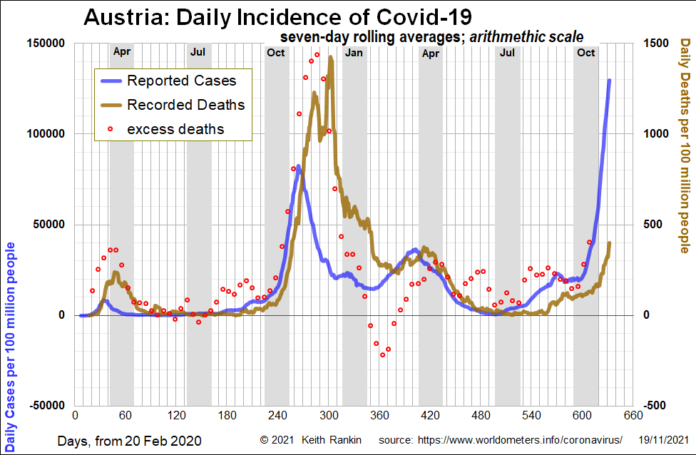
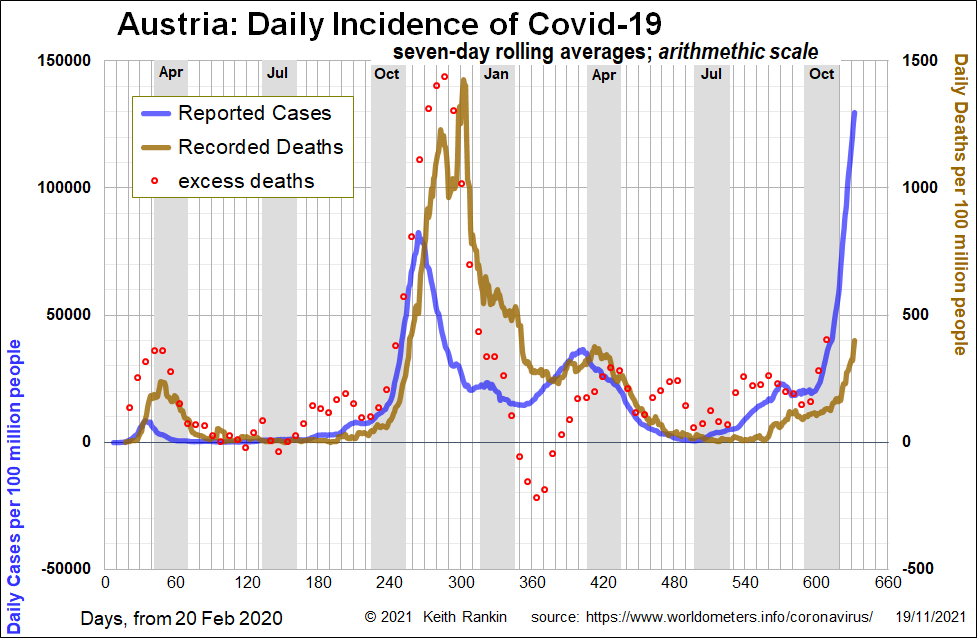
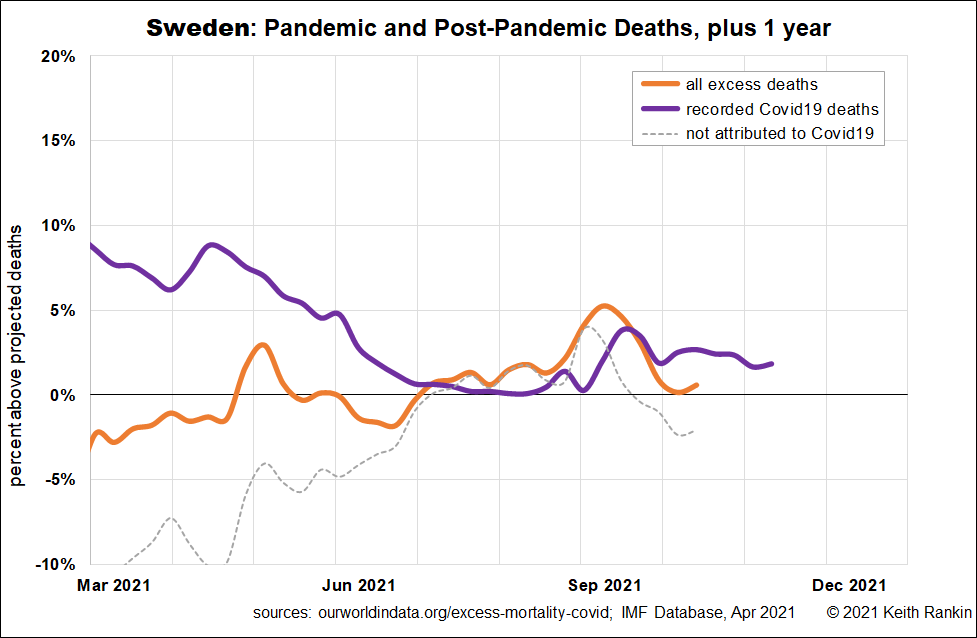
Chart by Keith Rankin.
Western Europe is now caught out by the Nth wave of Covid19. Austria has led the way in its case growth, and has had 9,380 reported cases per million of population in the last week; that would translate to 46,900 cases in New Zealand (6,700 per day; compare with the 200 that we get on average each day). It appears to have been very sudden in Austria, though excess deaths since June tell us that not all is well in what was the heart of the former Habsburg Empire. While deaths are well short of their December 2020 peak, Austria’s on a track towards a repeat of that peak.
This wave is being branded the “pandemic of the unvaccinated”. And indeed there are relatively more unvaccinated people than in New Zealand. A more truthful description would be the “pandemic of the undervaccinated”. Six months ago, Austria was a vaccination leader in Europe, on a par with Ireland and just behind Germany; and ahead of Netherlands and Sweden. And that’s the point; Austrians’ immunity has waned markedly, and they have left it too late to revaccinate effectively.
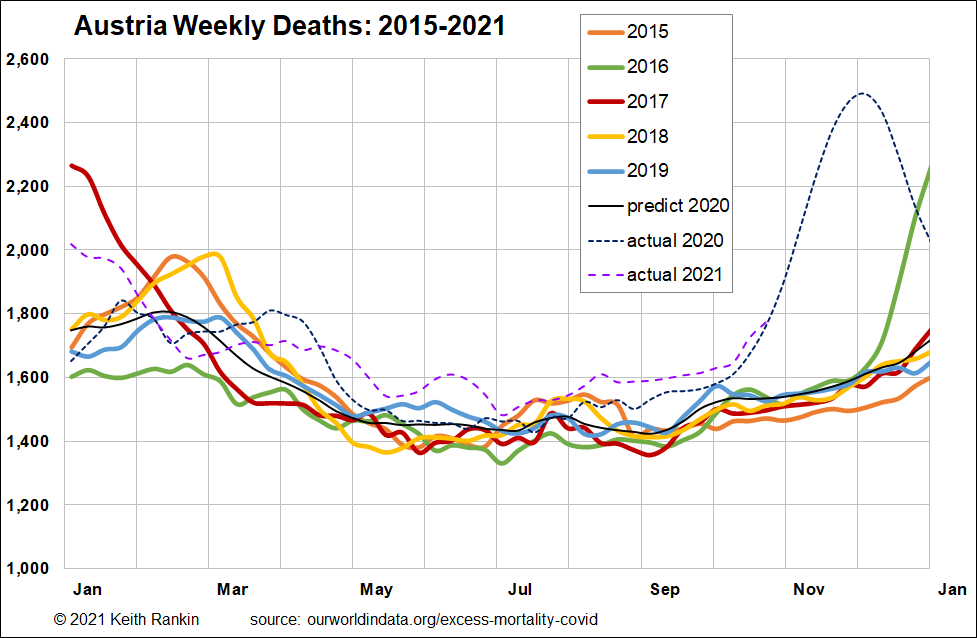
This chart shows how deaths in Austria this year have been tracking well above other years.
Chart by Keith Rankin.
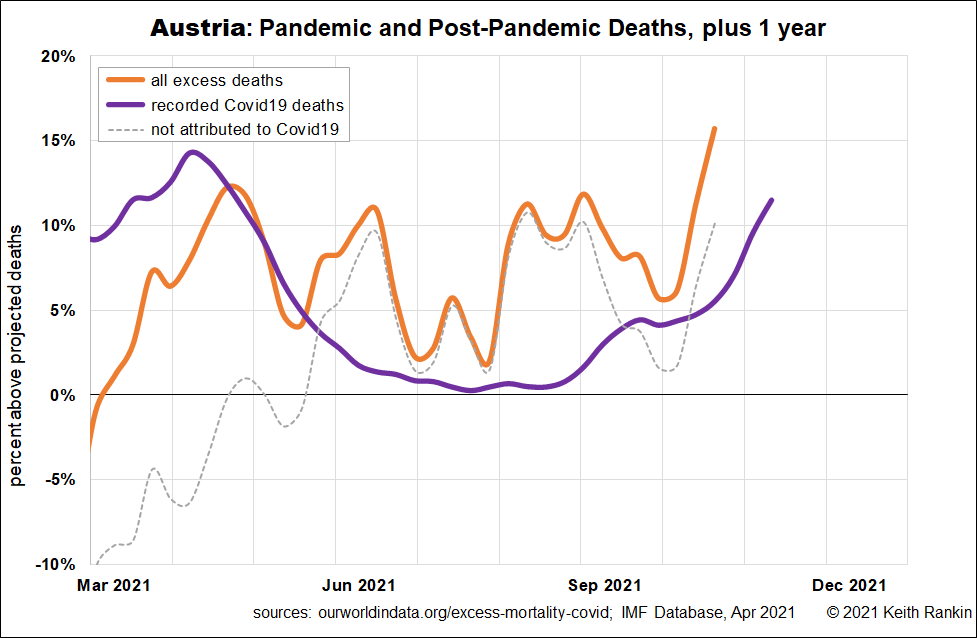
The following charts show the context of the pandemic post the 2020/21 winter, comparing Austria with Netherlands and Sweden.
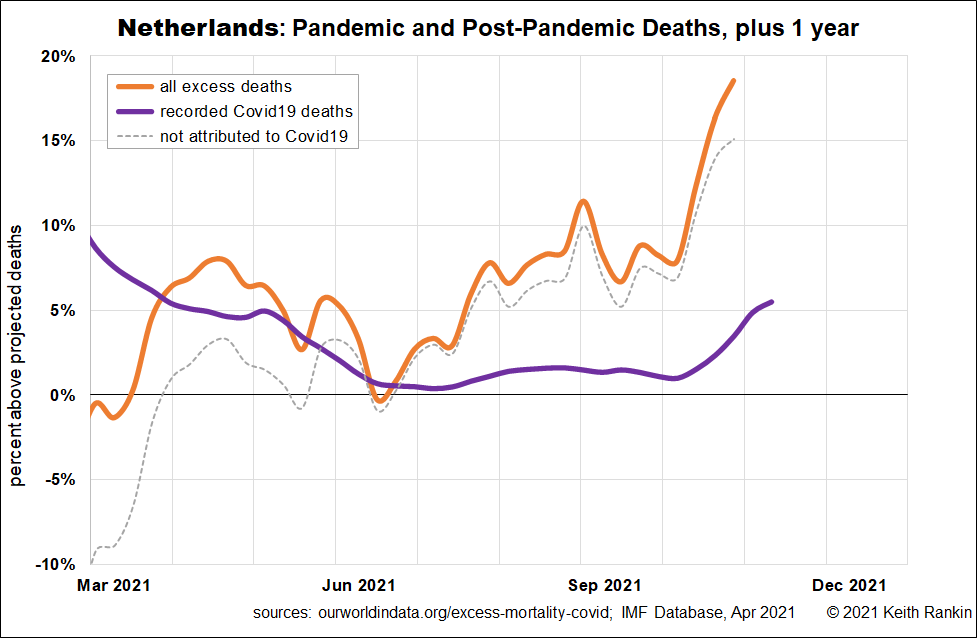
Chart by Keith Rankin.Chart by Keith Rankin.
We see that Austria has had a number of substantial and unusual mortality peaks in the summer; they have the look of an epidemic disease that may or may not be Covid19. The Netherlands shows a similar worrying picture.
Chart by Keith Rankin.
Sweden, however, looks OK. Sweden is notoriously slow to release its official Covid19 death toll. So the September peaks do in fact match. This suggests that deaths in August/September were in fact Covid. (France’s data also points to significantly more summer deaths of Covid19 than these EU populations realised.)
It’s too early to say whether Sweden will be immune to Europe’s latest covid wave. But Sweden certainly had a much better summer than Austria and Netherlands.
Keith Rankin (keith at rankin dot nz), trained as an economic historian, is a retired lecturer in Economics and Statistics. He lives in Auckland, New Zealand.
University of Canberra Professional Fellow Michelle Grattan and University of Canberra Associate Professor Caroline Fisher discuss the week in politics.
This week they discuss Liberal Andrew Bragg’s move to open a Senate investigation into the ABC’s complaints process, while there is already an ABC independent inquiry in progress. Bragg has faced a backlash from ABC chair Ita Buttrose, who has accused the government of interference and attempting to intimidate the broadcaster.
They also canvass recently announced policies from both major parties. The government has released its policy for developing and expanding critical technologies, while Labor has promised $2.4 billion to fix the NBN network.
The government was expected to produce its federal integrity commission legislation in parliament’s final sitting fortnight of 2021, which starts next week. But whether that will happen is now unclear. The government is giving priority to its religious discrimination bill.
Michelle Grattan does not work for, consult, own shares in or receive funding from any company or organisation that would benefit from this article, and has disclosed no relevant affiliations beyond their academic appointment.
Source: The Conversation (Au and NZ) – By Rajib Dasgupta, Chairperson, Centre of Social Medicine and Community Health, Jawaharlal Nehru University
COVID continues to slow down in India. The festival season, which includes Durga Puja and Diwali where large groups of Indians gather, did not lead to a surge in cases. Epidemiological modellers had earlier predicted a third wave peaking during October and November.
In India, “serosurveys” have been regularly conducted since the pandemic began. This is where blood is tested from large numbers of people to check for the presence of COVID antibodies – the things our bodies make after being infected with COVID or receiving a COVID vaccine.
The fourth national survey in July reported 67.6% of people across India had COVID antibodies present, providing them with a level of immunity against the virus. At that time 24.8% of people were immunised with a single dose of vaccine and 13% were fully vaccinated. This means a large proportion of those with antibodies had actually been infected with COVID.
Delhi reported 97% of people were positive for antibodies in October, including 80% of children. Some 95.3% of those immunised with the Indian version of the Astrazeneca vaccine Covishield had developed antibodies, as did 93% of those who received India’s own vaccine Covaxin.
The state of Haryana’s serosurvey in October found antibodies in 76.3% of adults, upwards of 70% among children, and negligible difference between urban and rural populations.
Kerala had the lowest sero-prevalence of 44.4% in the fourth national serosurvey in July, but in October it had risen to 82.6% among the general population and 85.3% among residents of urban slums.
What does this mean for a “third wave” in India?
A third wave in India is an unlikely scenario with these high levels of antibodies, and vaccination levels continuing to rise.
It’s now recognised those who becoming naturally infected with COVID and recover before vaccination develop better immunity than those who only have antibodies from vaccination. This is referred to as “hybrid immunity” – those with previous SARS-CoV-2 infection mount unusually potent immune responses to the COVID vaccines.
The Centers for Disease Control in the US notes that both the fully vaccinated individuals and previously infected groups have a low risk of subsequent infection for at least 6 months.
Results of the most recent national serosurvey in India reflect the seroprevalence during the third week of June 2021; the Delta-led second wave had bottomed out at that time. Though about 30% of the population remained susceptible, subsequent serosurveys and an absence of any post-festival surge confirm continuing high levels of protection.
“Patchwork vaccination” areas, where there are pockets of low coverage of vaccination among areas with high levels of coverage, run the risk of small outbreaks, but are unlikely to be large enough to be of any major epidemiological concern.
With high seropositivity among adults, many of the new cases can now be expected among children, particularly with the reopening of educational institutions. But high levels of immunisation among teachers (upwards of 90%) and the emerging evidence that reopening schools has not been associated with significant increases in community transmission, are reassuring.
The WHO’s chief scientist said in late August that India seems to be “entering some stage of endemicity”. Endemic refers to the constant presence or usual prevalence of a disease in a population within a geographic area, where disease spread and rates are predictable.
Could a new variant, such as the Delta Plus subvariant first detected in India in April 2021 threaten the current relative stability? While it has been said it might be about 10–15% more transmissible than the Delta variant, the evidence from Europe suggests it has not yet been able to establish any dominance over Delta.
Is vaccination on track?
Of India’s 1.4 billion people, 26.9% are fully vaccinated and 54.9% have received at least one dose so far. But 35 million fewer women have been vaccinated compared to men and independent analyses show tribal and rural districts continue to lag.
There are two current targets: achieving 90% coverage of the first dose by the end of November and timely administration of the second dose. While the first is likely to be achieved, there are widespread reports of complacency regarding the second dose. A campaign is underway to encourage people to complete the schedule.
Delivering the billion plus doses has convincingly demonstrated vaccine confidence. But convincing people to take a vaccine when for many it seems like the risk has passed is a difficult task. Prior infection-induced immunity protects against reinfection but this acquired immunity wanes over time. Hence the recommendation for COVID vaccination for all eligible persons, including those who have been previously infected.
Districts with relatively low vaccine coverage require greater outreach efforts to reduce prevailing inequities. India’s immunisation program has demonstrated its strengths in polio eradication and measles-rubella elimination campaigns. We need to borrow some of those techniques to ensure all Indians are protected against COVID.
Rajib Dasgupta is currently the co-Investigator of two projects funded by the UK Research and Innovation Global Challenges Research Fund and another project funded by the Novo Nordisk Foundation.
For many of us it feels like there’s no going back – at least not full-time. We’ve had working from home foisted upon us. We’ve worked through it. We don’t want to give it all up.
Yes, there are employers who want everyone back into the office. Google, for example, plans to end its global voluntary work-from-home policy on January 10. But other employers are happy to let staff continue to work remotely. Australian software company Atlassian, for one, is insisting only that its employees come into the workplace four times a year.
Studies and surveys are consistently clear: most of us don’t believe our productivity has been harmed, and those who do are offset by those who think they are more productive. Crucially, many managers feel the same way.
The real sticking point in working from home is not the “work” part. It’s the loss of the fun parts of a workplace – the informal networking and socialising that’s good for the individual as well as the group.
Experiments in online socialising
Managers have had their reasons for being averse to remote working. Quite apart from worries about individual productivity, many studies have shown how proximity promotes communication. For example, when Harvard organisational researchers Ethan Bernstein and Ben Waber examined a major US retailer occupying a campus with more than a dozen buildings, they found just 10% of all communications took place between employees whose desks were more than 500 metres apart.
Over the past 18 months there have been many experiments with using technology to replicate this communication. I’ve been part of one as a university academic, moving all my teaching online, and another as an organisational consultant, helping a small enterprise make the shift to remote operations.
My client, a small private TAFE college, has 11 permanent staff as well as casuals. In May 2020 the college asked me to help it move all business processes – teaching, office communications, support services and more – online. This had to be done on a shoestring given the financial impact of the pandemic. In this work we agreed it was fundamental to address the need for socialising.
This presented some challenges, particularly for a small organisation.
The value of ‘casual collisions’
Work-based socialising occurs in two broad ways.
First are “organised” social activities, such as sharing a morning tea, getting lunch, or having drinks on Friday night. To some extent these aspects are the easiest to simulate, using conferencing apps. For my client, this included activities such as virtual drinks and online games.
It’s easier to simulate organised activities such as after-work drinks than the haphazard ‘casual collisions’ of the physical workplace. Shutterstock
More difficult to replicate are what organisational expert Jessica Methot and her fellow researchers call “casual collisions”. As they wrote in the Harvard Business Review in March:
The tidbits we learn about our colleagues – for instance, that they play guitar or love dogs – build rapport and deepen trust. Research even suggests that chance encounters and spontaneous conversations with our coworkers can spark collaboration, improving our creativity, innovation, and performance.
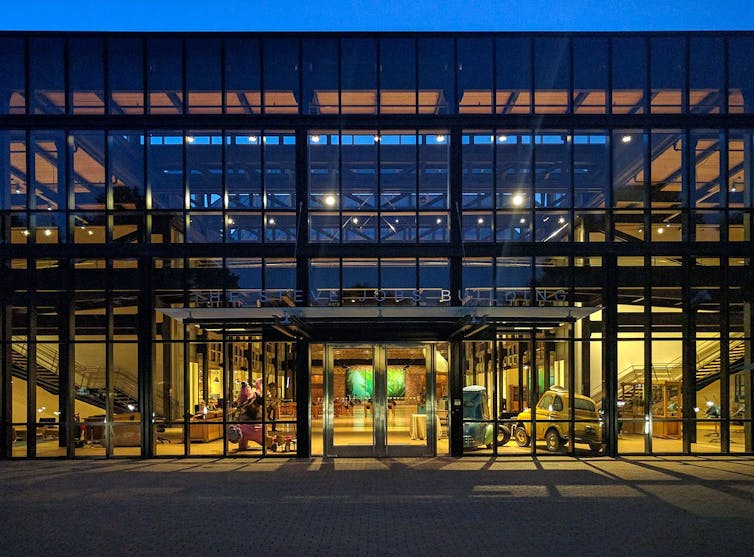
One of the best-known examples of designing a workplace for chance encounters is the headquarters of Pixar Animation Studios, which Steve Jobs oversaw during his exile from Apple. The building has a central atrium with bathrooms only on the ground floor, the idea being to create more opportunities for people to run into one another.
Designed for serendipity: the ‘Steve Jobs Building’, headquarters of Pixar Animation Studios. Grendelkhan/Wikimedia, CC BY
Yet the research by Methot and her colleagues also shows small talk can be both uplifting and distracting. This makes attempts to use software to replicate this informal, unstructured socialising even trickier.
Building an online networking space
In seeking to provide staff with an online substitute for casual collisions and chats in the lunch room, we chose an “enterprise social networking service” called Yammer. There are alternatives, each with their own strengths, but Yammer has the advantage of functionality similar to Facebook. The idea was to provide staff with an intuitive tool to communicate, and then leave it to them to use it as they liked.
It’s a work in progress. We’ve learnt some things along the way. One complaint was we didn’t provide enough initial training on how to use Yammer’s main options, which meant some staff took time to appreciate its use.
But most feedback has been positive. Despite the unplanned (and therefore chaotic) nature of the move, surveys indicate most staff think communication has actually improved. We appear to have avoided distance destroying dialogue and breeding distrust, as reported in other workplaces.
Can technology ever fully replace the serendipitous exchanges of a physical workplace? I doubt it. But done well it may provide enough of a facsimile to ensure there’s no downside to staff continuing to work a few days a week from home.
Michael Baron does not work for, consult, own shares in or receive funding from any company or organisation that would benefit from this article, and has disclosed no relevant affiliations beyond their academic appointment.
Climate change is commonly discussed as though it’s a uniquely atmospheric phenomena. But the crisis is deeply entwined with the ocean, and this has largely been neglected in international climate talks.
The latest international climate negotiations made some progress by, for the first time, anchoring oceans permanently into the multilateral climate change regime. But the Glasgow Climate Pact is still leagues from where it needs to be to adequately reflect the importance of oceans to our climate system.
Most countries have targets for land-based emissions – but there are no such targets for oceans. Yet the ocean plays a vital role in helping balance the conditions humans and most other species need to survive, while also offering a substantial part of the solution to stop the planet warming over the crucial limit of 1.5℃ this century.
So how can oceans help us tackle the climate crisis? And what progress has been made in international negotiations?
The ocean’s incredible potential
Since industrialisation, the ocean has absorbed 93% of human-generated heat and one-third of anthropogenic carbon dioxide (CO₂). The consequences of this are profound, including the thermal expansion of water (the key cause of sea level rise), ocean acidification, deoxygenation (oxygen loss), and forcing marine life to redistribute to other places.
Alarmingly, this may one day lead the ocean to reverse its role as a carbon sink and release CO₂ back into the atmosphere, as its absorption ability declines.
Oceans can also provide climate-safe, sustainable food choices. Current food systems, such as emissions-intensive agriculture, fishing, and processed foods are responsible for one-third of global emissions. Considerable environmental (and health) benefits can be gained by shifting our diets to sustainable “blue foods”.
These include seafoods sourced from fisheries with sustainable management practices, such as avoiding overfishing and reducing carbon emissions. Markets and technologies should also be geared towards the large-scale production and consumption of aquatic plants such as seagrasses.
There’s also a wealth of opportunity in “blue carbon” – capturing CO₂ in the atmosphere by conserving and restoring marine ecosystems such as mangroves, seagrasses and salt marshes. However, the success of nature-based solutions depends on a healthy ocean ecosystem. For example, there are emerging concerns around the impact of plastic pollution on plankton’s ability to absorb CO₂.
Conserving mangroves is an important way to sequester carbon from the atmosphere. Shutterstock
For more than a decade, the inclusion of oceans in climate talks has been piecemeal and inconsistent. Where they have been part of negotiations, including at COP26, talk has focused on the potential for coastal areas to adapt to climate change impacts such as sea-level rise, as first raised in international fora in 1989 by small island states.
The final COP26 agreement, known as the Glasgow Climate Pact, made slight progress.
The pact recognised the importance of ensuring the ocean ecosystem’s integrity. It established the “the Ocean and Climate Change Dialogue” as an annual process to strengthen ocean-based action. And it invited UNFCCC bodies to consider how to “integrate and strengthen ocean-based action into existing mandates and workplans” and report back.
While these are positive measures, at this stage they don’t require action by parties. Therefore, they’re only a theoretical inclusion, not action-oriented.
We still lack national targets and clear, mandatory international requirements for countries to consider sinks, sources and activities beyond the shoreline in their climate planning and reporting.
Where COP26 did progress was its focus on whether ocean impacts and mitigation will finally be brought into the mainstream climate agenda. For the first time in five years, a new “Because the Ocean” declaration was released, which calls for the systematic inclusion of the oceans in the UNFCCC and Paris Agreement process.
What do we do now?
What’s now needed is a list of mandated requirements that ensure countries report on and take responsibility for climate impacts within their maritime territories.
But as COP26 president Alok Sharma said of the summit as a whole, it was a “fragile win”. We still lack any reference to consistency with existing mechanisms, such as the law of the sea convention or how funding will be allocated specifically to oceans.
As such, the actual impact of COP26 on the inclusion of oceans in climate action remains uncertain. It will depend on how the UNFCCC bodies respond to these directives, and their success in extending obligations to state parties.
Responding to the climate crisis means we need to stop pretending the ocean and atmosphere are separate. We must start including ocean action as a routine part of climate action.
This story is part of The Conversation’s coverage on COP26, the Glasgow climate conference, by experts from around the world.
Amid a rising tide of climate news and stories, The Conversation is here to clear the air and make sure you get information you can trust. More.
Dr Sali Bache does not work for, consult, own shares in or receive funding from any company or organization that would benefit from this article, and has disclosed no relevant affiliations beyond their academic appointment.
The International Olympic Committee (IOC) this week released a much anticipated policy document aimed at making the Olympics more inclusive for transgender athletes and athletes with sex variations.
The new framework builds on more than two years of consultation with diverse athletes, advocates, and stakeholders.
The devil will be in the detail and implementation, of course. But this fresh approach, which places human rights at the centre, could herald a new era of gender-inclusive sports participation and governance.
One of the most prominent gender equity and human rights issues of recent years has been the inclusion of gender-minoritised people – those whose bodies and/or gender expression and identity do not neatly align with normative notions of the female/male binary.
This issue affects sport globally from grassroots to elite levels. Stakeholders have long called for change.
We work with sports organisations and athletes grappling with the question of inclusion in women’s sport.
Our own research has highlighted that many sports organisations develop policies with little to no knowledge of the complexity of the issue – and often without engaging the athletes affected.
The new IOC framework follows a long and much-critiqued history of efforts to define the boundaries of the female athlete category, dating back to the “nude parades” of the 1960s.
Today, however, there is wider recognition of the fact science alone cannot provide a straightforward answer to such as socially and biologically complex question.
An alternative approach, reflected in the IOC’s new framework, is to build policy around the concept of human rights.
What do the new guidelines say?
The new framework recognise human rights as a fundamental responsibility of sports governing bodies.
It explicitly takes the approach athletes shouldn’t be excluded solely on the basis of their transgender identity or sex variations. It aims to ensure everyone can practice sport safely and free from harassment, irrespective of their gender or sex-linked traits.
Importantly, the framework attempts to move sports governing bodies away from relying on testosterone as a one-size-fits-all measure of eligibility.
In its place, it emphasises ten key principles to guide the policy development process:
prevention of harm
non-discrimination
fairness
no presumption of advantage
evidence-based approaches to regulation
the primacy of health and bodily autonomy
a stakeholder-centered approach to rule development
the right to privacy
periodic review of eligibility regulations.
The relationship between testosterone and performance is so complex, sports governing bodies cannot realistically expect to rely on testosterone measures when defining eligibility.
There is just as much diversity among the bodies and performances of trans women and women with sex variations as we see among cisgender and normatively-bodied women athletes.
The IOC’s spokespeople were pragmatic: let’s take one step at a time, have faith in the ten principles, and see where they take us.
In this way, the new framework (and its underlying philosophy) moves us well beyond contentious testosterone thresholds introduced in 2015 and the 2003 Stockholm consensus, which required athletes to have affirmation surgeries and “anatomical changes”.
This includes the disproportionate burdens and harms that have been wrought upon women of colour from Global South nations in sports like track and field.
The question now is: how will other sports governing bodies, most notably the International Federations (IFs) that govern each Olympic sport, be brought on side?
The IOC now calls for IFs to take
a principled approach to develop their criteria that are applicable to their sport.
An important and welcome move
This framework represents a step forward for gender-inclusive sport but there’s more work ahead. It doesn’t mention non-binary athletes at all, meaning it still frames elite sports participation within a strict gender binary.
It’s promising to see a shift away from a paradigm focused on particular scientific and medical approaches regulating exclusion of certain groups. The move toward a contemporary vision of gender-inclusive sport is promising.
This new approach is a positive move for gender equitable sport; both trans women and women with sex variations will be valuable allies in the fight to make sport safe and inclusive for all women.
Hopefully, it will help make grassroots a more welcome space for trans and gender diverse people. These groups report alarming levels of poor mental health and suicidal ideation and have a right to opportunities to improve wellbeing through sport.
Sport has a unique opportunity to advance progress and health outcomes for marginalised communities.
This move may offer hope to young people of diverse genders and sex that they too can strive to achieve greatness in a sport they love.
Independent researcher Payoshni Mitra contributed to this article.
Ryan Storr works for/consults to Proud2Play. He is affiliated with Proud2Play.
Sheree Bekker is an invited speaker at the International Olympic Committee World Conference on the Prevention of Injury and Illness in Sport, Monaco, 25-27 November 2021.
Madeleine Pape does not work for, consult, own shares in or receive funding from any company or organisation that would benefit from this article, and has disclosed no relevant affiliations beyond their academic appointment.
Now, as restrictions are eased – and school, home and social lives return to something resembling normal – young people are having to make significant adjustments as they face new pressures.
Parents need clear, evidence-based, practical strategies to support their teen’s mental health. But this can be hard to find.
To fill this gap, our yet-to-be-published study asked 35 international experts (researchers, health professionals and parent advocates) what parents can do to support their teenager’s mental health during the pandemic.
Here are their nine key tips:
1. Parents, look after yourselves
While parents’ natural instincts are to be concerned about their children (and possibly ageing parents), looking after your own needs will put you in a better position to support those you care about.
2. Keep the conversation open
Constantly changing local regulations and restrictions, and rules around reopening, can make teens more anxious.
Help your teen feel more in control by providing them with clear, up-to-date and age-appropriate information about the pandemic and restrictions when the situation changes.
Teenagers are likely to seek answers from their peers, online, and from social media. Help your teen get information from reliable and credible sources, such as government websites or the World Health Organization.
Talking about the pandemic and easing of restrictions can help them understand and cope with what they’re hearing.
Direct your teen to reliable information. Shutterstock
3. Support teens to follow the local rules and restrictions
Be a good role model by following the local regulations and restrictions yourself.
Model flexibility and problem-solving by showing your teen how you adjust your daily life in response to changing regulations and restrictions.
4. Accept your teen’s emotions
It’s normal for teens to feel a wide range of strong emotions at different points during the pandemic: angry, scared, sad, frustrated, grief, worried, bored, confused, isolated, concerned.
You can help your teen cope with these by:
Asking and listening. Ask how they’re feeling and coping, especially as the situation changes. When they open up, focus on listening – what they need most is empathy, compassion and comfort.
Showing them how you do it. Teens look to their parents to see how to respond and how worried they should be. Try to set a good example by appearing as calm as you can, and using healthy coping strategies yourself.
Being patient, perhaps more than usual.
Being reassuring but realistic. Despite negative news they may be hearing, teens need their parents’ reassurance their family will get through the pandemic together and things will improve over time. But be careful not to make unrealistic promises.
Monitoring. Keep an eye on your teen’s stress levels – look for changes in their behaviour, health and how they’re thinking and feeling. Encourage them to do things that have helped them cope with stressful times in the past.
5. Help your teen work out what they can and can’t control
Encourage them to focus on what they can control. For example, young people can control their own COVID-safe behaviours (such as wearing masks and following local restrictions), but need to accept they can’t control the behaviour of others.
Model helpful ways of dealing with uncertainty by showing them how you accept what is outside your control and focus your effort on things you can control.
Show appreciation for their efforts to adjust to pandemic challenges, big or small.
6. Provide support as needed
The ongoing uncertainties during the pandemic can affect teens many months after local restrictions have eased.
So be prepared to provide ongoing emotional support as needed, rather than assume all will be well because life is “back to normal”.
Routines help teens feel more organised, in control, safe and secure and less stressed – this can help protect their mental health.
Ensure your teen’s routine includes set times for homework, meals and snacks, physical activity, free time for fun and relaxation, and time for socialising.
Make sure your teen has time for fun and socialising. Shutterstock
Regular sleep routines are also important. This means having a regular bed time and wake time, and minimising the use of electronic devices before bed. Review and adjust this routine with your teen as needed, such as when local restrictions change.
8. Adjust your expectations
With the changes and uncertainty caused by the pandemic, you may need to adjust some expectations of your teenager and of yourself. Focus on emotional and physical well-being rather than perfection or high productivity.
Try to practice self-compassion and forgiveness towards your teen and yourself if either of you don’t meet your expectations.
9. Look for silver linings
Try to convey a sense of confidence to your teen that things will improve over time. Encourage any optimism or hope your teen shows.
Showing compassion, empathy and kindness to others can also benefit your teen. It can help them gain perspective, give a sense of achievement and pride, and give opportunities for social interaction. Encourage your teen to take up opportunities to help others when they can.
When to get help
Seek professional mental health support if your teen has major difficulties adjusting to challenges of the pandemic or reopening, or you are struggling with your own mental health.
Some signs you or your teen might need professional support include changes in mood or behaviour that impact school, work or relationships, withdrawal from friends or family, intense distress, and problems that don’t seem to be improving with time.
Remember, by seeking support for yourself when needed, you are also setting a good example for your teen.
For more helpful tips, see the Parenting Strategies website. Parents across Australia can also access the evidence-based Partners in Parenting online program for free.
If this article has raised issues for you, or if you’re concerned about someone you know, call Lifeline on 13 11 14.
Marie Yap receives funding from the Department of Health, National Health and Medical Research Council, and Suicide Prevention Australia. She is a member of the Parenting and Family Research Alliance, Treasurer for the Alliance for the Prevention of Mental Disorders, Deputy Editor of Mental Health & Prevention, and co-chair of the Scientific Committee and member of the Steering Committee of Growing Minds Australia.
Anthony Jorm receives funding from the National Health and Medical Research Council. He is a member of the Board of Mental Health First Aid International, Chair of the Scientific Advisory Committee of Prevention United, Editor-in-Chief of Mental Health & Prevention and a member of the Association for Psychological Science.
Mairead Cardamone-Breen receives funding from the the National Health and Medical Research Council.
Source: The Conversation (Au and NZ) – By Blair Williams, Research Fellow, Global Institute for Women’s Leadership (GIWL), Australian National University
Shutterstock
The Women’s Leadership Institute Australia (WLIA) recently released its 2021 Women for Media Report, which I co-authored with academic and journalist Jenna Price.
We analysed just over 60,000 print and online news articles published in May 2021. We also interviewed leading figures in news organisations. We found that, despite the presence of more women in journalism, men’s voices continue to dominate the media landscape.
This is visible, for example, in the much greater frequency with which men’s words appear in print as quoted testimony. Of the quotes cited in the articles we analysed, 69% were attributed to men compared to 31% from women.
Men also provided the bulk of the quotes within each category of coverage, from 54% in arts and entertainment to 84% in sports. In politics, women provided only 30% of the quotes cited.
The story isn’t much better when it comes to the authorship of opinion pieces. Of the 1,800 opinion pieces analysed, women penned only 35%. This ranged from a low of 11% in the NT Times to a high of 54% in The Sydney Morning Herald.
Men once again dominated in every category, from 59% in law to 82% in disasters. The only category in which women were the majority was arts and entertainment, at 51%. Areas of national importance and influence, such as politics, business, science and law, were largely framed by the opinions of men.
The lack of women’s voices in these pages normalises a masculine perspective and implies that what women have to say is less legitimate and important.
Opinion pieces remain a key cultural symbol of power and influence, providing a space for columnists, academics, experts and political actors to influence public debate and shape policy. Yet women remain largely unheard in this space.
Numerous editors we interviewed noted that women just aren’t submitting as many op-ed pitches. Jennifer Campbell, opinion editor for The Australian, said over 80% of pitches she receives are from men:
I get a lot of emails from MPs, senior executives, think tanks, academics. These groups are male-dominated […] That [proportion] makes it challenging to get a [gender balance].
Likewise, Canberra Times opinion editor Andrew Thorpe disclosed:
Of the 130 pitches we received in May, just 23 were from women […] and sadly May was actually a pretty good month on that front.
This is not a problem isolated to Australia. Similar findings have been published in the UK and US.
So, why are women less likely to submit a pitch? Perhaps it’s because, as Catherine Orenstein, founder of the Op-Ed Project, suggests, women
discount themselves and their knowledge. If you think about it, what it means is that there’s a disconnect between what we know and our sense that it actually matters.
Or perhaps women are fearful of the backlash and online abuse they might receive.
Many women might also feel more self-doubt, while men may be more inclined toward confidence and may even overestimate their intelligence. As Gay Alcorn, editor of The Age, told us:
Men, mostly, put themselves forward more as ‘experts’ or assume they have something worthwhile to say in an opinion piece. Not all women by any means, but some women can lack that kind of confidence, and women in the public eye are also trolled far more often than men, and that makes women wary.
Or maybe women just don’t have as much disposable time. The OECD How’s Life 2020 report found that, when combining paid and unpaid labour, men tend to enjoy more leisure time than women. Women also disproportionately have to deal with the additional “mental load” of organising and planning needed to manage daily life.
So, women might just have too much stuff already on their plates to sit down and write an oped.
But where are all the women experts? Are they less visible because they’re reluctant to speak with journalists?
Price knows this problem all too well, noting she has struggled to find women experts to interview throughout her career, but has never had the same problem with men. In the launch of the report, she disclosed: “In 40 years of reporting I don’t think I’ve ever had a man say, ‘I don’t want to talk to you, it’s too scary’.”
We interviewed Kathryn Shine, a senior lecturer of journalism, about her research exploring women academic experts and the media. Shine found that her participants were nearly all willing to be interviewed by journalists and understood the benefits of sharing their research with a broader community.
However, many factors continued to act as deterrents for these women experts: lack of confidence, time constraints, reluctance to appear on camera, and a lack of understanding of how news media operate.
These problems aren’t the fault of women – there are larger institutional factors at play. One opinion editor pointed to the “structural incentives pushing you to get the pages sorted quickly and move on”, which leads to an over-reliance on the mostly male pitches in their inbox.
The Sydney Morning Herald topped our list with the most opinion pieces penned by women because its editors consciously chose to change. Opinion editor Julie Lewis told us having gender targets is key, and the masthead has been actively encouraging women. So, news organisations need to follow this example and do more.
When it comes to experts, Shine argues journalists must be proactive in seeking out and promoting diverse voices. She offers the following tips:
be clear and upfront about how much time this will take
give people as much notice as you can and negotiate a time where possible
ask them before the interview to think about the points that really matter to them
recognise that no-one owes you their time (except for politicians)
explain that you think their research or expertise is relevant and give a reason why
be interested in what they want to talk about, not just your specific focus
give courteous feedback at the end of the interview – was it what you were looking for?
We desperately need a range of women’s voices in Australian news media, both as experts and opinion writers. With it, the media cannot truly reflect and represent the views and experiences of our society.
Blair Williams does not work for, consult, own shares in or receive funding from any company or organisation that would benefit from this article, and has disclosed no relevant affiliations beyond their academic appointment.
As New Zealand readies for more covid-19 cases, warnings about the ability of public hospitals to cope are escalating.
There are 289 intensive care unit (ICU) or high dependency unit (HDU) beds at the moment, with Minister of Health Andrew Little insisting that could be ramped up to 550 if needed.
But that has been roundly questioned by opposition MPs, clinicians and ICU experts, including a recent New Zealand Medical Journalarticle concluding fully staffed, extra capacity would be more like 67 beds.
It describes New Zealand’s “comparatively low ICU capacity” as a “potential point of vulnerability” in the covid-19 response.
Intensive care There is a reason it is called intensive care.
Patients there are so sick, each one has a nurse with them around the clock.
Those there because of covid-19 are usually struggling to breathe, their lungs unable to give their body all the oxygen it needs to function.
There are doctors, physios, pharmacists who come and go to give vital care but it is the nurses who are the constant.
That’s why the shortage of ICU nurses is at the heart of the debate.
New Zealand’s intensive care was already in a perilous position long before covid-19, with one of the lowest number of beds per capita in the developed world.
Doctors and nurses have been asking for help for 10 years, failing to make meaningful traction with successive governments.
The small community pulled together, pooled resources, when crises like the White Island eruption and the mass shooting in Christchurch hit.
But covid-19 is different. It is here for longer and will hit everywhere.
Political football Little is “assured that we will manage and we will cope”.
High vaccination rates will mean fewer people will actually end up in hospital and “the vast majority who then get infected will be able to be cared for in the home with appropriate sort of monitoring, the stuff we’re putting in place at the moment”, he says.
He acknowledges any move to surge up would mean deferred operations for things like hip and knee replacements, and people needing a lower level of care getting it somewhere other than a hospital.
“The impact will be on non-covid patients who can be safely referred to other places for their care and recovery at the hospital.”
Minister of Health Andrew Little … “assured that we will manage and we will cope”. Image: Dom Thomas/RNZ
National Party MP Shane Reti says there are simply not enough specialist ICU nurses.
“Five point three nurses [needed per ICU] bed, it’s orphaned out and what we know from specialists … is that instead of the hundreds of beds that Andrew says we’ve got we’ve probably only got about 67 to surge to.”
Not wanting to sound like a “political caricature”, Little, however, lays the blame at the feet of the previous National government.
Heath underfunded “Our ICU capacity – if we’re talking about just designated ICU wards, and ICU beds, yep, that’s been a long standing problem … the reality is health has been underfunded for a long time, particularly when it comes to health facilities and buildings,” he says.
He is confident any outbreak can be managed, saying expanding to 500 or so beds would require an increase to about 200,000 covid-19 patients across the country.
However, Reti says that the May 5 public sector pay freeze has impacted on staffing, with some going to Australia, and that New Zealand’s now competing with the world for ICU nurses with an immigration system that’s not friendly to them.
National Party MP Shane Reti … May 5 public sector pay freeze has impacted on staffing. Image: Dom Thomas/RNZ
Nursing shortage Even with the known nursing vacancies, New Zealand’s needs could be met with the training of about 1400 more nurses to work in ICU under supervision, Little says.
Through May 2020 till mid August this year, there were no new, resourced ICU beds in Auckland DHB, but the ICU nurse headcount dropped from about 250 to just over 212.
Reti says the nursing shortage is a major obstacle.
“When Minister Little says, ‘I’ve trained up 1400 ICU nurses’ — no you haven’t, what you’ve done is you’ve given them half a day’s online training and half a day on a mannequin.
“In no shape or form is that an ICU nurse — they’ll be valuable, don’t get me wrong — but valuable for turning patients in ICU?”
Auckland has the biggest ICU unit in the country, and needed to find nurses from across New Zealand on September 1 when eight active cases arrived there, he says, showing just how thin the margins are.
On the ground Vice-president of the Australasian College of Intensive Care Rob Bevan says right now intensive care is coping well.
That is due, in large part, to high — and rising — vaccination rates and the fact that Auckland’s been in lockdown.
Quieter lives mean fewer car accident and workplace falls, while hospitals have delayed many of the planned operations which might involve ICU recovery.
But Dr Bevan, a specialist at Auckland’s Middlemore Hospital, says more beds will be needed next year when covid-19 is in the community and life was comparatively back to normal.
“There is going to be a burden of covid that people will need hospitalisation and intensive care for that we need to add onto what we were doing before,” he says.
“And acknowledging that our intensive care bed capacity before was still not enough to care for everybody without resorting to the deferment of planned care on occasion.”
Many who work in intensive care say the government and health bosses are wrong to count physical beds (and the equipment that comes with them) when there are not enough nurses to use them all.
Shocked by ‘training’ When they said they were training other nurses to help in ICU, the nurses organisation kaiwhakahaere Kerri Nuku said she was shocked to learn what that meant.
“Four hours online training — to go and support in ICU. Those decisions about what’s in the best interests of nursing have not been made for nurses,” she said.
Indeed, specialist ICU nurses say they would have to spend time supervising the online trained back-ups, adding more work to an already very challenging job.
And Bevan says surging up to more than 500 beds is not a realistic picture.
“That is a crisis, short term, and largely unsustainable model that we would have had to have moved to had we been overwhelmed like they have been in other parts of the world,” he says.
“But that would most likely achieve worse outcomes for all patients in ICU than they have in other parts of the world compared with our best model of care that we’ve been able to provide to date.”
The message is starting to get through to those who made decisions, he says.
Intensive care meetings Intensive care bodies are meeting with the Ministry of Health twice a week and there is work underway to try to recruit more nurses from overseas, he says.
But it has to go beyond talk and into action, first to sort the short term problem but then to keep building on that over the next several years.
“The next pandemic is inevitable … it might be in 10 years, it might be in 100 years, but it is coming,” Bevan says.
Little says he has also asked for decisions on three DHBs proposals expanding ICU capacity to be “accelerated”, but even then, those “will be some months away — they won’t be instant”.
This article is republished under a community partnership agreement with RNZ.
Tonga’s PTOA Party (Democrats) lost both their rival leaders and majority votes in some strongholds with defeats to seven independent candidates among People’s Representatives in yesterday’s elections.
The PTOA Party was split in the lead up to the elections with the creation of two rival groups — the PTOA People’s Board led by Siaosi Pōhiva and PTOA Core Team led by Sēmisi Sika.
Last night they faced the reality that they had dug their own grave.
The voters have elected nine new People’s MPs and three new nobles to the all-male Parliament, according to provisional results announced by the Supervisor of Elections Pita Vuki.
PTOA top senior members, including Mateni Tapueluelu, PTOA People’s Board leader Pōhiva and Core Team leader Sika were all defeated.
People’s Board leader Siaosi was defeated by Tongatapu 1 new MP Tēvita Puloka.
Core Team leader Sēmisi Sika lost his Tongatapu 2 seat to Dr Pingi Fasi.
Tapueluelu loses seat PTOA senior MP Māteni Tapueluelu lost his seat to incumbent Minister of Economy Tafafu Moeaki.
Tapueluelu and his PTOA rival candidate ‘Ilaiasi Lelei ‘Ufi received a combination result of 1457 votes from the PTOA voters, but because they shared that number it opened an opportunity for Moeaki to defeat them.
In Tongatapu 5, the PTOA voters gave a total of 1104 votes to the PTOA candidates, with 614 votes going to Losaline Ma’asi while her PTOA rival ‘Akanete Ta’ai got 490 votes. Dr ‘Aisake Eke won the seat by 958 votes.
In Tongatapu 7, the PTOA voters gave their candidates Sangstaer Saulala and Paula Piveni Piukala a total of 1420 votes. Sangstar won by 810 votes.
In Tongatapu 10, the PTOA rival candidates gained a total votes of 1554 while Pōhiva Tu’i’onetoa received only 1303 votes.
However, Tu’i’onetoa won after the two PTOA rivals split their votes with Kapeli Lanumata receiving 1086 votes with Vika Kaufusi gaining only 468 votes.
Nobility election: Tongatapu: Lord Vaea (13 votes) Lord Tu’ivakano (12) Lord Fohe (10) Vava’u: Lord Tu’i’afitu (9) Lord Tu’ilakepa (8) Ha’apai: Lord Tui’ha’angana (5) Lord Fakafanua (4) ‘Eua: Lord Nuku (11) Niuas: HSH Prince Kalaniuvalu, the Lord Fotofili (2)
Republished with permission.
The Tongatapu MPs elected in yesterday’s Tongan elections. Image: Matangi Tonga
Science has made impressive gains in the art of producing animal products minus the animal. Now this emerging field of cellular agriculture is taking on its biggest challenge yet: breastmilk.
Breastmilk is a complex substance, and breastfeeding is even more complicated. We are a long way from recreating it in its entirety.
It’s one thing to produce a chicken nugget or even a whole-cut steak via cellular agriculture, but providing a developing child with every nutrient they need for the first year of life is another.
Cultured ‘chicken bites’ are already on the market in Singapore. Breastmilk may be coming soon. Eat Just
But cell-cultured breastmilk could soon help non-breastfeeding parents who want a better option than existing formulas based on cows’ milk.
How to make breastmilk
Breastmilk cultivation has many similarities with the production of cultured meat. The basic steps are as follows.
First you need some of the milk-producing cells that line the breast ducts. These “mammary epithelial cells” can be cultured from donated milk.
Then you grow the cells in flasks with nutrients, allowing them to multiply.
Once you have enough cells to behave like healthy breast tissue, you transfer them to a bioreactor (a larger vessel of nutrients) with a similar structure to the mammary duct.
Next, you add a hormone called prolactin to the bioreactor. This gives the cells the green light for milk secretion on one side while absorbing nutrients on the other.
Finally, you perform quality control and safety screening.
Eventually, further supplements naturally found in breastmilk could be added, such as beneficial antibodies and bacteria or even immune cells and stem cells.
‘Let food be thy medicine, and medicine be thy food’
Breastmilk sets the brain, immune system and metabolism on a lifelong course of improved cognitive function, and reduced infection and chronic disease. For babies who are premature or sick, the value of breastmilk is particularly pronounced.
Breastmilk comprises an optimal balance of water, carbohydrates, fats, proteins, and micronutrients, along with a mix of maternal immune cells, stem cells, antibodies, and healthy bacteria that seed the child’s gut microbiome.
Breastmilk also changes over time to meet the changing needs of the developing child. It may even directly help with infections. When pathogens from the baby’s upper respiratory tract enter the mammary duct, the mother can mount an immune response and feed targeted immune cells and antibodies back to the child.
The many downsides of current breastmilk alternatives
For a wide variety of reasons, breastfeeding is not an option for many new parents. According to the latest available report from the Australian Bureau of Statistics (covering the 2017-18 financial year), only 29% of 6-month-olds were exclusively breastfed but more than half (53%) had not been introduced to solids.
This suggests around a quarter of babies are being fed formula. Infant formula is perfectly acceptable from a nutritional standpoint, but it can’t replicate the intricacies of the real thing.
Most infant formula is made from cows’ milk, which is optimal for a calf rather than a human baby, and lacks the more nuanced health-promoting factors such as the mother’s antibodies and beneficial bacteria.
Additionally, recent calculations show that feeding babies formula generates more carbon emissions than breastfeeding. This accounts for the 500 additional calories a breastfeeding mother should eat, even when the mother was eating animal-based foods.
Donated milk is another alternative to breastfeeding, but it is hard to come by and milk banks prioritise preterm and sick babies. During the 2020-21 financial year, Australian Red Cross Lifeblood recorded 2,320 litres of breastmilk donated to more than 1,000 vulnerable babies.
There are also online breastmilk markets on the likes of Facebook and Craigslist. These are unregulated, are potential sources of infectious diseases, and leave desperate parents vulnerable to exploitation.
Startups galore
While no cell-cultured breastmilk is yet commercially available, several companies are working on it. Some of those closest to releasing a product include US-based BIOMILQ, Israeli BioMilk, and US-Singaporean TurtleTree Labs.
In Australia, stem cell scientist and entrepreneur Luis Malaver-Ortega has founded a company called Me& Food Tech to produce breastmilk using novel cell-based technologies.
When will these products be available? It’s hard to say exactly.
There are appreciable hurdles in both fundamental research and regulation to overcome before cell-cultured breastmilk companies can manufacture at scale. But private investment in the industry is growing rapidly, as is interest among university-based researchers.
The authors would like to thank Luis Malaver-Ortega for his assistance with this article.
Ruth Purcell is a consultant for Nourish Ingredients, a company producing animal-free lipids for alternative proteins, and Cellular Agriculture Australia, a nonprofit working to advance agricultural products such as meat, eggs, milk, and leather without using livestock.
Bianca Le is the founder and executive director of Cellular Agriculture Australia, a nonprofit working to advance agricultural products such as meat, eggs, milk, and leather without using livestock.
Most Australian students who took part in the last OECD Programme for International Student Assessment (PISA) said they would have invested more effort if the test had counted towards their school marks.
This is a finding from a recent report issued by the Australian Council for Education Research. The data came from a questionnaire students filled out at the end of the two-hour PISA test in 2018. They were asked to rate how much effort they would have invested if they knew their results would count towards their school marks.
Some 73% of students indicated they would have put in more effort had that been the case.
While 56% of Australian students claimed to put in “high effort” in the PISA tests, this would have increased to 91% if the results were included in their school results.
We spend a lot of time focusing on debates about curriculum (what is being taught to students) and pedagogy (how it is being taught). Data from standardised tests such as PISA and NAPLAN are often used as evidence of declining standards, falling outcomes and failing teachers.
But the above results show yet again that schooling is more complex than politicians like to advocate. Methods to lift standards such as going “back to the basics” – as the then education minister, Dan Tehan, vowed to do after the last PISA results came out – or encouraging the “best and brightest” to become teachers – a goal of the current education minister, Alan Tudge – are too simplistic for the real world.
PISA generates much attention from policymakers and the media. It is often used as a proxy for making judgements about the quality of teaching and learning in Australian schools.
But there are important questions regarding what exactly the PISA tests measure and how useful the results are for informing policymaking and education debates.
Is it knowledge or effort?
The ACER report showed levels of effort in PISA were higher for female students, those attending metropolitan schools, non-Indigenous students and students from backgrounds of relatively high socioeconomic advantage.
But, when averaged out, nearly half of Australian students who sat the 2018 PISA test admitted they did not try their best.
These results are comparable with the OECD average of 68% of students claiming they tried less on the PISA tests than they would if it counted towards their school grades. In contrast, students in the highest-performing education systems of Beijing, Shanghai, Jiangsu and Zhejiang (China) reported very high levels of effort. There could be several reasons why the same theory may be less applicable to these Chinese systems, such as them having a more strongly competitive academic culture.
Educational psychologists in Australia have long studied the links between motivation, self-efficacy (students’ beliefs they can perform at the level they need to) and academic achievement.
For example, expectancy–value theory, to put it simply, suggests the lower the perceived value or usefulness of a task, the less motivated one potentially is to put in much effort.
Motivation to do the task is determined by its perceived value. Shutterstock
Perhaps one of the unintended side effects of assuring participating students that PISA is a low-stakes task — it does not count towards their school grades — is the potential for downward pressure on performance.
NAPLAN data have consistently shown a pronounced drop in performance from year 7 to year 9, when students are 14–15 years old. For example, 9.1% of year 7 students didn’t meet the national minimum standard in the 2013 NAPLAN writing task. Two years later in the NAPLAN 2015 writing task, nearly twice as many (17.7%) year 9 students didn’t meet the minimum standard.
At the higher end of performance, the proportion of students above the national minimal standard dropped from 72.2% in 2013 to 59% in 2015.
The pattern is persistent. The results from the year 9 NAPLAN writing task in 2019 clearly demonstrate a dramatic drop in performance. The percentage of students in year 9 meeting or exceeding the national minimum standard was 82.9%, compared to 95% of the same student cohort in the 2013 year 3 writing task.
Research has shown the middle years of schooling is a challenging time for many students. Their bodies and minds are changing rapidly, the demands of high school and their social lives become more complex, and the level of disengagement and disaffection with school rapidly escalates.
Instead of policies such as going back to basics, student motivation and engagement must be part of the education policy landscape.
This means paying closer attention to the lives, knowledges, experiences, hopes, fears, challenges and opportunities facing young people.
Educators and policymakers must consider complex factors of social, economic and educational disadvantage and advantage to meet the Mparntwe Declaration goals of educational excellence and equity. This includes the interplay of socioeconomics, location, culture and community, school resourcing and access for all young people to housing, health, economic and social stability, and quality schooling.
Stewart Riddle does not work for, consult, own shares in or receive funding from any company or organisation that would benefit from this article, and has disclosed no relevant affiliations beyond their academic appointment.
Source: The Conversation (Au and NZ) – By Juliette Overland, Associate Professor, Corporate Law, University of Sydney Business School, University of Sydney
Shutterstock
Insider trading is something that only happens in companies listed on the stock exchange, right?
It could be happening in Australian superannuation funds.
The Australian Securities and Investments Commission suspects so.
It has examined the behaviour of 23 members of the trustee boards of Australian super funds (both retail and industry) during the early days of the pandemic.
Super funds hold assets which are only revalued on its books from time to time, sometimes monthly, sometimes quarterly.
When asset values were falling sharply last year, it meant super fund trustees had early access to information about valuation decisions and the ability to influence those decisions.
Using information ‘for personal gain’
ASIC wanted to find out whether some trustees were “using this information for personal gain” by switching their own personal super investment options based on their knowledge of the timing of the revaluations yet to be announced.
It says the conduct it uncovered “fell below ASIC’s expectations”.
The investigation follows an inquiry by the parliament’s economics committee that found executives at AustralianSuper, NGS Super, Rest, First State, Hostplus and Intrust Super had switched their own personal super out of options exposed to revaluations at the start of the pandemic.
It’s behaviour that seems to have a lot in common with insider trading, in which insiders use inside information for their own benefit at the expense of other investors.
But while insider trading in relation to financial products is illegal, the definition of financial products used in the Australian legislation excludes superannuation products that are not provided by a “public offer entity”.
Not caught by the law
This means that the laws do not apply to some industry super funds, but might apply to others that are open to all members of the public regardless of the industry they work in.
As well, “trading” in financial products is held to only occur where a person applies for, acquires, or disposes of those products, or enters into an agreement to do so.
This means that insider trading laws might apply when a person first joins a public superannuation fund, but not when they switch their investment options within a fund.
ASIC has conceded this result in its announcement, saying the activity it has detected might not be caught by the insider trading prohibition, but is “similar to insider trading and may contravene other provisions of the law”.
When insider trading laws were last amended two decades ago under the 2002 Financial Services Reform Act, the financial products to which the laws applied were expanded to include “functionally similar” products – but not to all super funds.
At the time super funds held less than A$500 billion.
They now hold more than $3 trillion, which is much more than the entire Australian economy turns over in a year, and constitute for most Australians their biggest financial investment outside the family home.
The restriction, especially the distinction between some kinds of industry funds and others, no longer makes sense.
The Australian Law Reform Commission is currently undertaking an inquiry into financial services regulation, which includes the provisions of the Corporations Act prohibiting insider trading.
We invest more in super than in shares
It would be timely to amend insider trading laws so that they catch the switching of superannuation investment options within funds and eliminate the distinction between different types of funds.
There is no obvious reason why it shouldn’t be as well regulated.
Juliette Overland ne travaille pas, ne conseille pas, ne possède pas de parts, ne reçoit pas de fonds d’une organisation qui pourrait tirer profit de cet article, et n’a déclaré aucune autre affiliation que son organisme de recherche.
New Zealand Parliament Buildings, Wellington, New Zealand.
Editor’s Note: Here below is a list of the main issues currently under discussion in New Zealand and links to media coverage. You can sign up to NZ Politics Daily as well as New Zealand Political Roundup columns for free here.
Source: The Conversation (Au and NZ) – By Tanya Hill, Honorary Fellow of the University of Melbourne and Senior Curator (Astronomy), Museums Victoria
As the full Moon rises tonight, it won’t be as lovely and bright as usual – but it will be fascinating. Across most of Australia, the Moon will be partially shrouded in Earth’s shadow, undergoing a partial lunar eclipse as it rises.
A lunar eclipse happens roughly every six months somewhere on Earth. For most of the year, the Moon’s orbit takes it above or below Earth’s shadow, but during an eclipse the full Moon travels through it.
If the entire Moon travels through the shadow, it is a total lunar eclipse. Tonight’s eclipse won’t quite make it to totality, and instead will be a very deep partial eclipse.
Time lapse of the May 26 2021 total lunar eclipse as viewed from Braidwood, New South Wales.
The fact tonight’s event occurs at moonrise for viewers in Australia means this will be a different experience to what is typically seen when watching a lunar eclipse.
The Moon will be very low in the sky for much of the eclipse, meaning you’ll need an unobstructed view towards the east-northeastern horizon, perhaps with the aid of an elevated viewing position. In the opposite part of the sky, the Sun will be setting and Venus, Saturn and Jupiter will be visible.
The Sun sets a few minutes after the Moon rises, so for the first half-hour or so the eclipsed Moon, low on the horizon, will be battling the bright twilight sky.
As the Moon climbs higher and the sky darkens, we will have a lovely view of the final phase of the eclipse. We can watch the Moon emerge from Earth’s shadow and return to its full brightness.
Look for the star cluster Pleiades and the constellations of Taurus and Orion as the eclipse progresses. Museums Victoria/Stellarium
What to see and when?
As the eclipse occurs at moonrise for viewers in Australia, your location (latitude and longitude) will determine when you will see the Moon appear above the horizon. It’s a little uncertain exactly how much we’ll be able to make of the eclipse against the twilight sky but it’ll be interesting to see what happens.
Although the Moon won’t become fully immersed in the Earth’s shadow, it does get really close. At the moment of maximum eclipse, 97.4% of the Moon’s diameter will be in shadow, while just a sliver will remain in sunlight.
Because it’s almost (but not quite) a total eclipse, this will be the longest partial eclipse of the 21st century, lasting three hours and 28 minutes.
The Moon’s path through the Earth’s shadow (shown as the large dark grey circle) is very close to being a total lunar eclipse. Wikipedia
In Brisbane, Sydney and Canberra, the Moon will rise before the eclipse reaches its maximum. Brisbane will have the best view of all the capital cities, as the sky will have darkened and the Moon will be fairly high by the time of maximum eclipse.
Sydney and Canberra will also see the maximum eclipse but against a twilight sky.
Brisbane, Sydney and Canberra will see the eclipse maximum, although it’ll be quite different depending how far north you are. Museums Victoria/Stellarium
For the other Australian capitals, the maximum eclipse occurs when the Moon is still below the horizon. Those places will only see the Moon as it begins emerging from the shadow.
New Zealand is in a better position to see the eclipse than Australia. Viewers on the North Island will see the entire event, while for the South Island the Moon rises about half an hour after the eclipse begins. The eclipse maximum will occur at 10:03pm NZDT, so it may even be possible to see a slight red tinge to the Moon against the dark sky.
Unfortunately, Perth will miss out, as the Moon will rise ten minutes after the eclipse ends. But in northern Western Australia the Moon rises roughly an hour earlier, so the final stages of the eclipse will be visible there.
Moon illusion
Watching a full Moon rising is always special because of the optical illusion that makes the Moon appear much larger when it’s near the horizon.
Of course, the Moon doesn’t really change size at all – you can prove this by making an “OK” sign with your thumb and forefinger and viewing the Moon through the hole, or simply by using your thumb to cover the Moon. Measure the Moon at the horizon and then later in the evening when it’s higher, and its size doesn’t change.
This illusion is a trick our minds play on us, most likely because we instinctively think the Moon is further away when it is on the horizon. When we see a bird flying, for example, it is closest to us when directly overhead, and gets further away as it flies towards the horizon.
But the Moon is much further away than a bird, so its distance from us doesn’t vary depending on its position in the sky (although its distance varies slightly month to month, that’s not relevant to this effect). Yet our brains treat it as though the Moon’s distance does change, meaning when we see the (normal-sized) Moon near the horizon we assume it’s much further away, and counter-intuitively interpret it as being much bigger.
A simple way to explain this trick is using the Ponzo illusion, where objects at a distance appear larger, even though the two Moons in the image below are actually the same size.
The two moons in the image above are the same size, but we perceive the one on the horizon to be larger because we assume it’s further away. Museums Victoria
Here’s hoping the weather holds out this evening, so we can enjoy this rather interesting lunar eclipse.
Tanya Hill does not work for, consult, own shares in or receive funding from any company or organisation that would benefit from this article, and has disclosed no relevant affiliations beyond their academic appointment.
The debate about religious discrimination in Australia is back.
Attorney-General Michaelia Cash is planning to bring the latest version of the bill to parliament in the last two sitting weeks of the year, beginning next week.
We are yet to see the most current draft, but the bill seeks to prohibit discrimination “on the ground of religious belief or activity in key areas of public life”, including employment and education.
Once again, religious groups and LGBT+ advocates are raising what look to be competing concerns about the legislation’s impact on their rights and freedoms.
It is notable that the federal bill is ostensibly about religious discrimination, but in public discourse we discuss “religious freedom”. This confusion isn’t helped by their labelling on the attorney-general’s department website as “the religious freedom bills”.
Why the conflation between these terms?
What is at stake with the new bill very much depends on how discrimination is conceptualised – to be free from it, or to exercise it – and by whom it is claimed.
Context is important
This conflation between discrimination and freedom in the contemporary Australian context has been about ten years in the making. In 2011, there was a shift from religious freedom being about the right to be free from discrimination because of one’s religion, to being about the “right” to discriminate against others in the name of one’s religion.
Context is crucial here. Around this time, the campaign for marriage equality began to gain increasing traction in public debate. For example, this was the year GetUp’s “It’s Time” video in favour of same-sex marriage went viral, with more than two million views in five days.
GetUp! released a video clip in 2011, promoting marriage equality. It quickly went viral.
It was also the year that the Australian Human Rights Commission released its first report on LGBT+ discrimination, finding
significant gaps in the legal protection from discrimination on the basis of sexual orientation and sex and/or gender identity at the state and territory level and almost no protections at the federal level.
A backlash after the postal vote
But as the rights of LGBT+ people gained more prominence, so too did fears religious freedoms would be harmed. While legislation for marriage equality in 2017 was a huge milestone for the LGBT+ community, there was a backlash among some religious groups.
Following the postal vote, then-treasurer Scott Morrison said:
There are almost five million Australians who voted no in this [postal] survey who are now coming to terms with the fact that they are in the minority. That did not used to be the case […] They have concerns that their broader views and beliefs are […] therefore under threat.
To appease opponents of same-sex marriage, former Prime Minister Malcolm Turnbull set up a Religious Freedom Review. The review, headed up by Liberal MP Philip Ruddock, “did not accept the argument, put by some, that religious freedom is in imminent peril”. But it nevertheless recommended new legislative protections:
to render it unlawful to discriminate on the basis of a person’s ‘religious belief or activity’, including on the basis that a person does not hold any religious belief.
The Morrison government took a religious discrimination bill to the 2019 federal election and regards it as a key election commitment.
A (very) heated debate over the bill
The federal government has been consulting with the community and experts, but it has been a rocky road – with criticism from almost all interested parties (saying the bill either went too far or not far enough).
The bill has already been through multiple iterations. Indeed, it was initially supposed to be passed before the May 2019 federal election and an attempt to introduce it to parliament at the end of 2019 failed, amid pressure from some religious leaders to strengthen protections for Australians of faith.
The religious discrimination bill was initially supposed to be voted on before the 2019 election. Lukas Coch/AAP
For example, some conservative Christian groups want to be able to maintain the “right to discriminate” based on their beliefs. For example, the Presbyterian Church of Queensland is concerned with
whether Christian institutions such as schools can [still] assert a traditional view that God made people male and female, gender not being fluid, but corresponding with their biological sex.
[Religious texts] promote the stability of gender identity in accordance with chromosomal directive and would encourage psychological support for the confused […].
A ‘Folau clause’
Meanwhile, religious groups continue to raise “freedom of speech” concerns – in part, linked to the treatment of Israel Folau. In 2019, Folau lost his contract with Rugby Australia for social media posts about LGBT+ people. An undisclosed settlement was reached later that year.
Legal academic Patrick Emerton highlights the ongoing conflict this incident raised:
No doubt Folau’s views are sincerely held, and his adherence to his conception of the good is deep and genuine. But the lives of gay and lesbian people are lived sincerely and genuinely also.
At this point, it is important to emphasise Christians and the LGBT+ community are not locked in a zero-sum human rights game.
Some religious groups, such as The Uniting Church, backed marriage equality and now have concerns about how the proposed laws will impact upon LGBT+ people. James Ross/AAP
What’s more, the Ruddock panel found “limited evidence that the fears of religious groups expressed during that [marriage equality] debate had come to pass in Australia”.
What happens now?
Where does this leave the debate as it heads towards the floor of parliament?
It is possible for a tightly-worded bill to protect against religious discrimination and maintain the hard-won rights of LGBT+ Australians. As the Australian GLBTIQ Multicultural Council notes, they support legislation which prevents discrimination against Australians “on the basis of faith and religion, or for not holding those beliefs”, with this caution:
Any new law should be a simple anti-discrimination bill without conferring the numerous special privileges and rights that the current proposed legislation provides for.
Such legislation could ensure religious Australians – including members of minority religions – have avenues of protection if they are targets of discrimination.
Ultimately, we need to ask whether the bill is about stopping discrimination, or maintaining privilege to act beyond ordinary standards of accountability.
Louise Richardson-Self receives funding from the Australian Research Council to investigate Religious Freedom, LGBT+ Employees, and the Right to Discriminate (DP200100395).
Elenie Poulos has received funding from the Australian Research Council to investigate Religious Freedom, LGBT+ Employees, and the Right to Discriminate and is an ordained minister of the Uniting Church in Australia.
Sharri Lembryk receives funding from the Australian Research Council to provide research assistance on the project Religious Freedom, LGBT+ Employees, and the Right to Discriminate (DP200100395), and is on an Australian Government Research Training Program Scholarship through the University of NSW.
Several COVID drugs are in the pipeline for 2022, some you can potentially take at home, others for use in hospital.
It’s taken almost two years of the pandemic to get here.
However, as we argue in our paper, with more and larger collaborations, and focusing on repurposing the right drugs, we could have developed effective COVID drugs at scale, earlier.
Here’s what we can do better for the next pandemic.
One recent study found a commonly prescribed drug for depression, fluvoxamine, given to people diagnosed with COVID-19 reduced their chance of symptoms deteriorating, needing to go to hospital, and dying.
There are four powerful features of this study. It was based on:
an existing human drug: drugs designed for another purpose can have extra therapeutic benefits. We also didn’t have to design a drug from scratch and knew a lot about tolerated doses, side-effects and drug interactions, over many years of people taking it
earlier observation and data: the drug was chosen based on prior data showing people taking the same or similar drugs for depression did better with COVID-19 infection
a large population: the study included enough people to give meaningful results
an international collaboration: it is unclear why were there not many, thorough, studies of this type implemented at the very start of the pandemic. Collaboration helps with quicker recruitment and broader input into trial design.
However, this example is the exception rather than the rule when it comes to finding COVID drugs. And during the pandemic, we’ve had several mis-steps.
We can treat COVID with one of two broad strategies. One is to target or immobilise the virus itself. The other is to “treat the host”. This involves treating the body’s overwhelming response to the virus and the cause of most death and disease. Fluvoxamine mentioned above is an example of the latter.
However, we didn’t see any major strategy to “treat the host” in the early part of the pandemic, except with the decades-old corticosteroid drugs dexamethasone and budesonide.
Focusing more on “treating the host” would have bought us time to produce vaccines and antiviral drugs, which typically take longer to develop.
“Treating the host” is hardly radical. We’ve been doing this with existing medicines for infectious diseases for years.
In fact, we knew early on that we respond to COVID-19 in much the same way to being infected with other viral infections that can overwhelm the body, such as influenza and Ebola.
That’s not the only mis-step.
We backed a few wrong horses
It’s inevitable some existing drugs trialled initially for COVID-19 would fall by the wayside and never be used clinically. But we backed some of the wrong drugs, at the wrong doses. According to basic research and clinical knowledge of how drugs work in the body, this should have been obvious from the start.
Over a century after doctors unsuccessfully tried to treat the Spanish flu with quinine and its derivatives, history was repeating itself. We were asking if the related drug hydroxychloroquine could be used to treat COVID-19.
Researchers around the world conducted multiple trials with hydroxychloroquine, even after some others reported a lack of efficacy.
If we are to repurpose existing drugs, this needs to be based on our experience of that drug in humans with COVID-19, such as in the fluvoxamine example. Alternatively, the drug needs to fit with what we know about how the virus causes disease and how the infection develops in humans.
If we are to repurpose drugs identified solely on cell-based laboratory studies, this must also be based on what we know about how the human body handles the drug and how the drug works in the body. We also need the relevant quality mathematical models to get the dose right for the early phase human studies.
Using such basic approaches to drug development, which we’ve known about for years, we could have foreseen that ivermectin and hydroxychloroquine would prove to be ineffective – before larger scale human trials were ever allowed to be conducted.
During the pandemic, there have been an estimated 2,800 clinical trials for COVID drugs with fewer than 300 reported.
In one database of COVID-19 trials, 40% said researchers were enrolling fewer than 100 patients, a sample size generally too small to be useful.
For us to get a better idea if a COVID drug is safe and effective, we need larger, collaborative trials.
For example, the RECOVERY trial
enrolled about 45,000 people at 180 sites to test a range of potential COVID therapies. It showed the repurposed drug dexamethasone reduced death rates, changing standard practice.
We need to start thinking about ways of developing drugs for the early part of the next pandemic, considering what we’ve learned from this one.
This is essential if we are to have a range of safe, effective, cheap and available therapies for treating the host, to buy time to develop vaccines and antivirals.
We now know from global experiences the importance of rational choice of drugs for testing. We also know the importance of large clinical trials that come from major, international collaborations.
We also need to co-ordinate research efforts nationally, rather than compete for research dollars with other groups. Doing research in a pandemic is not like doing research in non-pandemic times. So this means countries such as Australia need to have their own centre for pandemic preparedness or centre for disease control to co-ordinate research and funding priorities.
The authors do not work for, consult, own shares in or receive funding from any company or organisation that would benefit from this article, and have disclosed no relevant affiliations beyond their academic appointment.
The COP26 summit may come to be regarded as a failure or an important milestone, but it certainly failed to address the “other” climate change problem: ocean acidification.
With the exception of rising sea levels, climate change impacts on the oceans have been treated as a peripheral matter at global climate change negotiations. This marginalisation of the oceans largely continued at COP26.
But states, including New Zealand and Australia, nevertheless have an obligation to prevent and mitigate excess carbon dioxide (CO₂) from entering the ocean.
Almost four decades ago, 168 states signed up to the UN Convention on the Law of the Sea (UNCLOS). Under this treaty, they must address CO₂ in the oceans consistent with (but distinct from) their obligations under the climate regime.
Ocean acidification (OA) is caused by excess CO₂ in seawater. Atmospheric concentrations of CO₂ have now reached 414ppm (from about 280ppm in 1750) and the oceans are a major sink, having absorbed nearly half of all anthropogenic emissions since the beginning of the Industrial Revolution some two centuries ago.
Acidifying seawater has negative impacts on shell-forming organisms and coral reefs. Shutterstock/Ethan Daniels
But rising levels of CO₂ in the oceans change the acidity of seawater, measured as pH. Ocean acidity has remained remarkably stable for more than 800,000 years, but has increased by about 30% in the last 200 years.
This has negative consequences for shell-forming organisms and coral reefs such as the Great Barrier Reef in Australia. Recent research suggests it may also affect the larvae of fish, including commercially important species such as yellow fin tuna.
It addresses CO₂ emissions, the primary cause of ocean acidification, but states have significant discretion over what action they take, and there is no explicit requirement to address CO₂ separately from other greenhouse gases.
Although the Paris Agreement sets a target of limiting average global warming to well below 2℃ above pre-industrial levels (and aims to keep it at 1.5℃), it does not set a target for limiting ocean pH change.
However, the Glasgow Climate Pact has, for the first time, explicitly set a target in respect of CO₂ emissions. It calls for a 45% cut relative to 2010 levels by 2030 and net zero by mid-century. This is a positive development in the context of addressing ocean acidification.
Under part XII of UNCLOS, which has been accepted by all states as part of customary international law, states must take all measures necessary to “prevent, reduce and control” marine pollution from any source. States also have a general obligation to protect and preserve the marine environment.
Carbon dioxide can be classed as pollution under UNCLOS, and therefore states have an obligation to avoid or control it. UNCLOS requires states to prevent pollution from land-based sources and from the atmosphere.
Article 212 is particularly relevant to CO₂ pollution. It requires states to:
… adopt laws and regulations to prevent, reduce and control pollution of the marine environment from or through the atmosphere arising from their territory or vessels under their control.
However, this is a due diligence obligation: it relates to conduct (effort) rather than result. Article 212 does not specify what states must do to meet their obligation, but stipulates they should take into account internationally agreed rules and standards.
International standards
Apart from emissions from vessels, there is no agreement on what these internationally agreed rules and standards are.
It can be argued the climate regime constitutes these standards, and if states comply with their commitments under the Paris Agreement they have met their obligations under Article 212 of UNCLOS. Supporters of this position assert it is unreasonable to expect states to go beyond their commitments under climate agreements, particularly when UNCLOS provides no additional guidance.
On the other hand, if it can be shown that commitments under the Paris Agreement are clearly insufficient to “prevent, reduce and control” ocean acidification, it would be anachronistic to say compliance with those standards constitutes “due diligence” under UNCLOS.
I argue the latter — the due diligence obligation under Article 212 of UNCLOS is not met by compliance with climate regime commitments, except where those commitments expressly relate to ocean acidification or CO₂ reductions. This conclusion is arguably supported by the UN’s 2015 adoption of the Sustainable Development Goal 14: Life in the Oceans.
One of the goal’s targets calls for states to explicitly address ocean acidification. This recognises that commitments under the Paris Agreement do not adequately address the issue.
The law of the sea requires states to protect the oceans. Shutterstock/Ethan Daniels
COP26 confirmed the climate regime is the main forum for addressing the consequences of climate change. But it is not the only game in town or the only legally relevant regime.
UNCLOS requires states to protect the oceans. These obligations must be expressly considered and incorporated into commitments made by states, including New Zealand and Australia, in international climate agreements and their actions to implement these at the domestic level.
COP27, to be held in Egypt next year, provides the next opportunity to address ocean acidification and to support a more integrated approach under both the climate change regime and the law of the seas.
Karen Scott does not work for, consult, own shares in or receive funding from any company or organisation that would benefit from this article, and has disclosed no relevant affiliations beyond their academic appointment.
Hydrogen has been touted as the fuel of the future, and the technology features prominently in the Morrison government’s plan to reach net-zero emissions by 2050.
Earlier this month the government unveiled its “future fuels” strategy to reduce emissions in the transport sector, committing A$250 million for battery electric vehicles and hydrogen infrastructure. And in September, it pledged almost A$500 million towards the Clean Hydrogen Industrial Hubs Program.
Decarbonising transport is crucial in the fight to limit global warming to 1.5℃ this century. We estimate the sector contributes about 20% of global emissions – like burning two Olympic-size swimming pools filled with fossil fuels per minute, every minute of the year.
But as independent researchers in transport emissions and energy, we believe the focus on hydrogen in road transport is misplaced.
Projections show if all nations’ 2030 emissions reductions targets are met, the planet will be on track to heat by a catastrophic 2.4℃. In this pressing need to rapidly reduce global emissions before 2030, developing hydrogen for low-emissions road transport won’t happen fast enough, and it doesn’t pose a viable alternative to electric vehicles.
Hydrogen in a nutshell
Hydrogen is already an important part of the global economy, including for the production of fertilisers and in oil refining. The federal government has identified hydrogen as a priority low emissions technology to develop further, with a focus on hydrogen refuelling infrastructure for major freight routes and passenger road corridors.
Almost all hydrogen today is produced using fossil fuels (natural gas and coal), and this accounts for about 2% of global emissions. Hydrogen is clean and climate friendly only if it’s produced from renewable sources of energy, such as solar, wind and hydro. This process uses electrolysis to convert water into hydrogen, and is aptly called “green hydrogen”.
For more than 20 years, proponents of hydrogen have been promising a future of clean energy. But while the pace of new green hydrogen projects is accelerating, most are still at an early stage of development. Just 14 major projects worldwide started construction in 2020, while 34 are at a study or memorandum of understanding stage.
Developing hydrogen technology is, indeed, important outside of the road transport sector, with promising options such as green steel which will reduce emissions and bring new Australian jobs.
But we’re not betting on hydrogen for road transport
Global sales data for cars and light commercial vehicles, along with statements from corporate leaders, suggest many vehicle manufacturers don’t seriously consider hydrogen a viable and lucrative transport fuel.
The Honda Clarity hydrogen fuel cell vehicle, for example, ceased production in August 2021 to “trim underperforming models from its line-up”. Some manufacturers are even lobbying for a faster transition to electric cars.
Hydrogen may play a larger role in the long-haul truck market, as its stated benefits include a long drive range and short refuelling times, which are important for this sector.
But hydrogen competes with a dynamic and fast-moving electric truck market, which shows significant and continuous annual improvements in battery energy density, and prices. What’s more, truck makers – such as Daimler, MAN, Renault, Scania and Volvo – have indicated they see an all-electric future.
The often-stated benefits of hydrogen dissipate when compared with alternative electric truck technology. This includes battery swapping, which allows for short refuelling times, and the development of e-highways (roads that automatically recharge vehicles when they drive along it).
While it’s true these systems are still being tested in, for instance, Europe and the US, they have a promising outlook. For example, in July the UK government announced £2 million (A$3.66 million) to design overhead charging cables that would power electric lorries on a motorway.
Likewise, the battery swapping network in China already dwarfs the hydrogen refuelling network, although the system is still in its infancy.
Low energy efficiency
An overlooked but fundamental issue with using hydrogen in transport is its low energy efficiency. Hydrogen is not an energy source, it is an energy carrier. This means it needs to be generated, compressed or liquefied, transported and converted back into useful energy – and each step of the process incurs a substantial energy loss.
In fact, hydrogen vehicles and vehicles that run on petrol or diesel have a similarly low energy performance: just 15-30% of the available energy in the fuels is used for actual driving. Compare this to battery electric vehicles, which use 70-90% of the available energy.
In other words, the amount of renewable energy required for a green hydrogen vehicle to drive one kilometre is the same as what’s required for three electric vehicles to drive the same distance.
This is a very important issue. The more energy required for transport, the more renewable energy needs to be generated, and the higher the cost and more difficult it becomes to decarbonise the economy rapidly and at scale.
Electric vehicles are much more energy efficient than hydrogen. Shutterstock
There are three other, perhaps less well known, issues with hydrogen we believe should be seriously considered.
First, the potential for significant leakage of hydrogen during production, transport and use. Hydrogen is a more potent greenhouse gas than carbon dioxide, and any loss of hydrogen reduces the overall energy efficiency.
Second, hydrogen emissions from leakage may add to local and regional air pollution, and may even deplete the ozone layer in the stratosphere, but further research is needed in this space.
And finally, hydrogen needs clean fresh water, and lots of it. A single hydrogen fuel cell car requires about 9 litres of clean, demineralized water for every 100km driven. For a large truck, this would be over 50 litres per kilometre.
If sea water and desalination plants were used to produce the water, another energy loss would be added to the production process, penalising overall energy efficiency even further.
Focus on electric vehicles
Decarbonising road transport needs to be rapid, deployed at scale, and requires a holistic strategy that promotes shifts in everyday travel behaviour. Betting on the future large-scale availability of hydrogen for this sector won’t see this happen fast enough. It also risks locking in fossil-fuel dependency, and its additional greenhouse gas emissions, if upscaling clean hydrogen falls short of expectations.
We need to minimise energy demand and improve energy efficiency in transport as much as possible and as fast as possible. The available evidence suggests battery electric vehicles are the only feasible technology that can achieve this in the near future.
For a rapid reduction in greenhouse gas emissions, we should electrify transport where we can, and use other options like green hydrogen where we genuinely can’t, such as long-range shipping and aviation. And depending on how truck electrification efforts develop, hydrogen may still have a role in long-haul trucking, but it will use a lot of extra renewable energy.
A logical first step is to convert the current global production of fossil-fuel based hydrogen to green hydrogen. But the focus must be on rolling out electric vehicles across Australia and, indeed, the world.
The authors are grateful for the discussions with and contributions made by Professor Eckard Helmers (University of Applied Sciences Trier, Germany) and Dr Paul Walker (University of Technology Sydney).
Robin Smit is the founder of and a director at Transport Energy/Emission Research (TER).
Hussein Dia receives funding from the Australian Research Council, the iMOVE Cooperative Research Centre, Level Crossing Removal Authority, City of Boroondara, Australian Housing and Urban Research Institute, Transport for New South Wales, EmissionsIQ Pty Ltd, and Department of Infrastructure, Transport, Regional Development and Communications.
Enoch Zhao does not work for, consult, own shares in or receive funding from any company or organization that would benefit from this article, and has disclosed no relevant affiliations beyond their academic appointment.
The Australian Curriculum, Assessment and Reporting Authority released a proposed revision of the foundation to year 10 national curriculum for public consultation in April. Since then, the draft national curriculum — the final version of which will be released in 2022 – has caused much controversy. Federal Education Minister Alan Tudge has perhaps been its fiercest critic.
In September 2021, Tudge wrote an opinion piece in The Australian newspaper, saying he will not support the draft in its current form. He noted the revised curriculum, which was meant to simplify the previous one, was “a ridiculously long and unwieldy document”.
The biggest problem, though, was in the draft history curriculum. It gave the impression nothing bad happened before 1788 and almost nothing good has happened since. It downplayed our Western heritage […] It almost erased Christianity from our past, despite it being the single most important influence on our modern development […]
These comments caused a stir among many historians, who have argued for the importance of critical skills in history. They also stressed being critical is not the same as “hating” Australia. Other controversial topics have included changes in maths content, which some experts have deemed “shallow and faddish”.
So, with all the controversy, some may wonder why we need a national curriculum at all.
The curriculum is like a map
Imagine the Australian Curriculum is a map — a broad picture of all the learning a teacher covers in each year of education for each particular subject. Using the map, teachers charter a course for each unit to ensure the territory is covered across the year and then plan the route they will take with their students.
When using a map to travel a particular route to your destination, you may take a detour along the way. It’s the same when travelling using the curriculum. A student may ask an interesting question, and that might take the class in a different direction for a bit. But that just adds to the journey.
A history of the curriculum
Since Federation in 1901, Australian states and territories have maintained constitutional responsibility for education and have had autonomy for their education agendas. But in 1963 the Commonwealth began funding school education, which came with a desire for more national collaboration.
Since that time, successive Australian politicians and governments have aspired to develop and implement a national curriculum. Their objective was to reduce duplication and enhance consistency across the nation’s various curricula.
The Australian Curriculum we have now is the fourth iteration of a national curriculum, but the first to be effectively implemented. Previous attempts at implementation were met with a range of barriersrelated to the states’ constitutional responsibility and desire for curriculum autonomy, as well as a lack of clear rationale, purpose and process for curriculum change.
So, the momentum fizzled out. That is, until Kevin Rudd’s 2007 election promise of an education revolution garnered the political support to develop the Australian Curriculum.
The first draft was published by the Australian Curriculum, Assessment and Reporting Authority in 2010.
What about the states’ curricula?
While the responsibility for developing the curriculum shifted federally, the states retained the autonomy to implement the curriculum. This is because each state and territory has its own senior assessment and tertiary entrance system. Although there have been attempts at an Australian Certificate of Education to mark the end of compulsory schooling, the proposal has never gathered momentum.
The curriculum authority now has the remit to develop the curriculum and the states the responsibility to implement it.
Teachers get the curriculum directly from the website. For these teachers, the Australian Curriculum is like Google Maps. It tells them what to teach.
This is why what is written in the curriculum is of utmost importance. The curriculum authorities in these states and territories exist to support implementation, providing advice on how much of the curriculum teachers are required to implement.
But Victoria, New South Wales and Western Australia, use an intermediary document (or syllabus) in place of the Australian Curriculum. These interpretations, written by their curriculum authorities, repackage the Australian Curriculum. In NSW, for instance, the syllabuses package the content in stages. These each represent two years of schooling (stage 2 is for years 3 and 4, for example).
Occasionally these state packages contain a bit more or less content compared to the Australian Curriculum. For example, the Victorian Curriculum for The Arts has Visual Communication Design as an additional content area.
Adding further complexity, some states have not yet updated some subjects (such as languages in Western Australia or the creative arts in NSW) to align with the Australian Curriculum.
Despite these differences, there is still a great degree of alignment in curricula across the states and territories. Prior to the Australian Curriculum some of this was more coincidental than coordinated.
So, why is the curriculum controversial?
Many things influence the curriculum’s development, including the power struggles between federal and state governments and their sometimes differing political ideologies.
The curriculum also needs to be responsive to the needs of today’s students, while preparing them for their future. It must prepare them for jobs that don’t currently exist, with skills we can only imagine, while also ensuring they can navigate the transitions from childhood into adolescence and beyond.
Education Professor Kerry J Kennedy has written curriculum debates are not just an academic argy-bargy over what should or should not be included, but also reflect a “nation’s soul”. It is an insight into what we value. Hence the many heated debates about what is “important” for young people to learn become value laden.
But with a clear rationale we can build the map for Australian teachers to plan their students’ learning journey.
Emily Ross does not work for, consult, own shares in or receive funding from any company or organisation that would benefit from this article, and has disclosed no relevant affiliations beyond their academic appointment.
Source: The Conversation (Au and NZ) – By Juliette Overland, Associate Professor, Corporate Law, University of Sydney Business School, University of Sydney
Shutterstock
Insider trading is something that only happens in companies listed on the stock exchange, right?
It could be happening in Australian superannuation funds.
The Australian Securities and Investments Commission suspects so.
It has examined the behaviour of 23 members of the trustee boards of Australian super funds (both retail and industry) during the early days of the pandemic.
Super funds hold assets which are only revalued on its books from time to time, sometimes monthly, sometimes quarterly.
When asset values were falling sharply last year, it meant super fund trustees had early access to information about valuation decisions and the ability to influence those decisions.
Using information ‘for personal gain’
ASIC wanted to find out whether some trustees were “using this information for personal gain” by switching their own personal super investment options based on their knowledge of the timing of the revaluations yet to be announced.
It says the conduct it uncovered “fell below ASIC’s expectations”.
The investigation follows an inquiry by the parliament’s economics committee that found executives at AustralianSuper, NGS Super, Rest, First State, Hostplus and Intrust Super had switched their own personal super out of options exposed to revaluations at the start of the pandemic.
It’s behaviour that seems to have a lot in common with insider trading, in which insiders use inside information for their own benefit at the expense of other investors.
But while insider trading in relation to financial products is illegal, the definition of financial products used in the Australian legislation excludes superannuation products that are not provided by a “public offer entity”.
Not caught by the law
This means that the laws do not apply to some industry super funds, but might apply to others that are open to all members of the public regardless of the industry they work in.
As well, “trading” in financial products is held to only occur where a person applies for, acquires, or disposes of those products, or enters into an agreement to do so.
This means that insider trading laws might apply when a person first joins a public superannuation fund, but not when they switch their investment options within a fund.
ASIC has conceded this result in its announcement, saying the activity it has detected might not be caught by the insider trading prohibition, but is “similar to insider trading and may contravene other provisions of the law”.
When insider trading laws were last amended two decades ago under the 2002 Financial Services Reform Act, the financial products to which the laws applied were expanded to include “functionally similar” products – but not to all super funds.
At the time super funds held less than A$500 billion.
They now hold more than $3 trillion, which is much more than the entire Australian economy turns over in a year, and constitute for most Australians their biggest financial investment outside the family home.
The restriction, especially the distinction between some kinds of industry funds and others, no longer makes sense.
The Australian Law Reform Commission is currently undertaking an inquiry into financial services regulation, which includes the provisions of the Corporations Act prohibiting insider trading.
We invest more in super than in shares
It would be timely to amend insider trading laws so that they catch the switching of superannuation investment options within funds and eliminate the distinction between different types of funds.
There is no obvious reason why it shouldn’t be as well regulated.
Juliette Overland does not work for, consult, own shares in or receive funding from any company or organisation that would benefit from this article, and has disclosed no relevant affiliations beyond their academic appointment.
Suddenly people are talking about inflation, even hyperinflation, in a way they haven’t since the 1980s.
In October the United States posted its highest annual consumer price index increase in 30 years, with inflation up 6.2% and “core” (excluding volatile prices) inflation of 4.6%.
Former US Treasury Secretary Larry Summers – arguably the finest policy economist of his generation – contends that what’s happening is not transitory.
He says soon inflation could soon climb to double digits, where it hasn’t been for 40 years.
There are plenty of other leading economists, including Nobel Prize winner Paul Krugman, who argue that what’s happening is just temporary, part of the adjustment to post-pandemic life, akin to the tyres of a car spinning uselessly before they gain traction.
Closer to home, the data are less alarming.
Only 12 of the 55 top economists surveyed by the Economic Society of Australia and The Conversation saw a serious risk of prolonged above-target inflation.
On Tuesday, in an address entitled Recent Trends in Inflation, Reserve Bank Governor Philip Lowe said in most economies inflation was expected to be lower next year rather than higher, with inflation rates generally clustered around 2%.
That’s RBA-talk for “chill, folks”.
Many wages are barely moving
The Bureau of Statistics reported on Wednesday that the wage-price index climbed 2.2% over the year to September, up from 1.8% over the year to June.
It’s an improvement, but some wages are barely moving. Public sector wages were up just 1.7% and the bureau reported the private sector increase was partly inflated by changes in timing, with fewer September quarter increases than normal last year during lockdowns and a more typical proportion this year.
Four out of ten Australian workers haven’t had an increase for more than a year, compared to 21% at the same time in 2019, before COVID.
Price growth is weaker than it seems
Consumer price inflation appears to be well above wages growth at 3%, but much of this is due to the unwinding of the free childcare available a year ago. Averaged over the past two years, annual headline inflation is just 1.5%.
Is it difficult to renovate a home in Sydney right now? Sure. Is it expensive to buy a car in the US at the moment? Yes it is. But ask yourself why.
Since living through this pandemic, many of us realised we might need and want to spend more time at home and decided to invest in homes better suited to that. And in the US, which is less vaccinated than Australia, many commuters now prefer to drive to work rather than take their life in their hands by catching public transport.
Any debate that sees former US Treasury Secretary Larry Summers on one side and former Treasury Secretary Janet Yellen and Paul Krugman on the other is legitimate.
But it’s been joined by “inflation “truthers”, conspiracy theorists who claim the US government – in cahoots with corporate interests – have been cooking the books on inflation, something that hasn’t been happening.
While there is always room for debate about the “basket” of goods and services used to calculate the consumer price index, in the US the method hasn’t changed for years.
The Massachusetts Institute of Technology Billion Prices Project has trawled through massive quantities of daily data and arrived at much the same conclusions about inflation as the official data.
Australia’s underlying inflation rate has been below the centre of the Reserve Bank’s target band for a record seven years. Too little inflation runs the risk of causing people to delay buying things, sending the economy backwards, which means it has been important to get inflation back up.
Doing it, as we are beginning to, ought to be seen as a policy success.
Yes, we have to be careful not to push inflation too high. But we should also be careful to avoid not finishing the job of getting inflation (and wages growth) back to where they should be. We’ve got some way to go.
Richard Holden is President-elect of the Academy of the Social Sciences in Australia.
Source: The Conversation (Au and NZ) – By Natalie Kon-yu, Lecturer in Creative and Professionaln, Literature and Gender Studies, Victoria University
My auntie has stopped speaking to her siblings. Rifts like these are commonplace in my family, where people fall out with each other like dealt cards. The size of our family doesn’t help. The original eight siblings have grown into four generations and almost 90 people. Full family parties happen only at parks and playgrounds or in the backyards of wealthy family members, which are the only backyards that can accommodate us all.
Some of the grievances are historic, dating back decades and finessed over time. Others are new, fresh. It’s a condition prevalent among migrant families, especially those like mine who have been tentative – because of differences in language, culture, class, education – to socialise widely in Australia. We are tethered to each other and this tether grows thin, frayed by too many gatherings filled with the same faces and the echoes of old pains. In this context my 70-year-old auntie’s antagonism is understandable.
Except for this. She will speak to her siblings (and presumably to us nieces and nephews) if we speak to her in English or French. She just won’t speak to anyone in Creole anymore.
It was my dad who told me this, and when I asked why, he muttered something about Creole being a low language. What do you mean, I pressed.
“A low language”, my dad said again. “You know, without proper verbs and things like that.”
Creole, the language that my Mauritian family speak with one another, is a patois – a variation on French. That’s what I’ve always been told, anyway. Google tells me something else: that it’s a mix of a European with “local” languages, especially African languages spoken by slaves in the West Indies – this is mentioned discretely, in brackets.
Like my auntie, Google also privileges French.
And while there is no official language stipulated by the Mauritian constitution, in places like Parliament, the chosen languages are English and French, despite the fact that 86.5% of the population speak Creole.
In not wanting to speak Creole, my auntie is merely doing what her country asks of her. She is also doing what her mother asked of her. Despite her Chinese husband and surname, my grandmère taught her children to speak French, but not Chinese.
Growing up, I could count to ten in Cantonese, and the only phrases I knew were “wash your bum”, “wash your vagina” and “wash your penis”. These were the height of our pre-teen insults. Once, in anger, I told my father to “gong hei fat choy”. He laughed. “What’s so funny?” I asked in indignation. “I just told you to leave me alone.”
“No you didn’t. You wished me a happy new year.”
But when it came to French, my grandmère schooled us on the intricacies of pronunciation. Her favourite grandkids were the ones who pronounced the words flawlessly, with a French tongue. Like everyone else in my family, Grandmère spoke Creole most – but for her, French was the language in which she wasn’t just seen as poor and brown, and she made sure all her children could speak it. As though the language were a cloak that could be thrown over them all, allowing them to pass, for a moment, as something they weren’t.
I loved my grandmère. There was a pillowy warmth about her. She smiled easily. She pulled us onto her lap and sang us songs and told us stories. She went to church every week, carried ten babies in her womb and buried two. When she and her family lived in Mauritius, she rose at 5am and worked until 11pm making manioc (tapioca). This meant cutting, peeling, grating and draining cassava, soaking it for days, straining and kneading and drying it. My aunts would get up and work with her before going to school for the day, their hands still bleeding.
A photo of the author’s grandmère. Author provided
My grandpère’s job was cycling around Mauritius selling DDT to farmers. While raising a large family, Grandpère became sick, first with tuberculosis and then with typhoid. A bucket was kept by his bed into which he vomited blood. My favourite auntie remembers vividly the bucket, the blood and the distance they were forced to keep from it.
This is all, of course, a way of me telling you not to judge my grandmère. I don’t judge my grandmère, or even my auntie, for privileging French over Creole. Their experiences are not my own. Neither of them had the luxury of studying for an arts degree at a university where the curriculum was taught in the language that the vast majority of the population spoke. English is a language that has been forced on us all.
That doesn’t make us all heard, by the way. But it suggests that we might be heard if we say the right things to the right people.
The author with her Grandmere and Grandpere. Author provided
Questions of identity
Like most countries with a history of slavery, both real and economic – indentured workers are not enslaved physically, but they are also not free – Mauritius has deep issues around racism and identity. It has been colonised twice, first by the French and then by the English. At one point in history, slaves constituted 80% of the Mauritian population.
It’s no surprise, then, that many Mauritians were eager to emphasise their European heritage. They hold the other parts of themselves – Chinese, African, Indian – under deep water.
The country was formally decolonised in 1968. It was too late for my family, who emigrated to Australia in 1969. They never got to feel what their country was like free of British rule, to exhale as (some) of its institutions became more democratic and multicultural. In coming here to escape British imperialism, they merely traded one form of racial discrimination for another.
Chinatown, Port Louis, Mauritius 1960s. Raouf Oderuth/ Wikimedia Commons, CC BY
This is why Grandmère insisted that her mother was light-skinned with grey eyes. This is how her story goes, though everything about us – our hair, eyes, lips, skin – suggests that this cannot be true. My grandmère’s surname before Kon-yu was Leubas (pronounced Le-bah), though this is an uncommon name and one I’ve had some difficulty tracing.
My Mauritian family has a history of strange names: Kon-yu is a strange name, a Chinese academic once told me. As far as she knew, Chinese names weren’t hyphenated. There aren’t many Kon-yus around the world, and we’re the only ones in Australia. If you search for Leubas and its variations, the most popular name you will find is Leuba (pronounced Loo-bar), which is a name most commonly found in Switzerland.
These are not our people.
Creole was one of the first languages I knew. A language I didn’t have to translate, but one that sat within my skin. I probably stopped speaking Creole in my early 20s when my grandmère died. I try to speak it still with my aunties, but I fumble, embarrassed, over my loss of basic words and phrases. I find myself translating from English to Creole in my mind.
The only time in my adult life when the language comes back to me is when I am with my children. All my lullabies are in Creole and, as it turns out, so are many of my commands. “Donne moi ton li pied,” I ask my son as I dress him in his pyjamas. “Pa touché ça!” I’ll cry out. My kids, born in Australia to two English-speaking parents, don’t know yet that they’re hearing Creole. They don’t know how low their language is.
The other language they hear, the other one I speak, my other first language, is Italian. This comes from my mother and from my nonna and nonno. It’s easier to put effort into relearning Italian – there are books and apps and classes. It is, as my father and auntie and grandmère have intimated, a proper language. People want to learn it.
Like Creole, Italian bursts out of me at odd moments. Most often at the Italian deli, where the air is thick with baccala, provolone and the sounds of words I remember, however dimly. It forces its way through, like Creole, when I am with my children. Again, lullabies and commands are sung and given in Italian. Here the languages are easy.
They slip out of me as though no other language stands in their way. There is no translating. There is just memory.
Tying down a definition
This is an uncomfortable matrix of things to be born into. Especially now, in this cultural moment when it seems as if everything must be tied down, defined. I feel a pressure, exerted from almost everywhere, to define myself in a certain way, as a woman of colour, even though this definition doesn’t quite fit.
I am wary of taking space from people who are defined much more categorically by their skin colour, who cannot pass.
And I am cautious of tying myself to a set of definitions based on my skin colour and unusual surname. When the issue is racism, then racial categorisations can only get us so far. Racism doesn’t respect geographic or religious differences. I’m also painfully aware that Mauritius is a country where the colour bar was instituted and wielded against its citizens. And I’ve never forgotten what Toni Morrison pointed out in Beloved – that “Definitions belong to the definers, not the defined”.
Yet, even so, sometime in early 2020, I decided to take a DNA test. I was sceptical, but curiosity got the better of me.
The results came during the pandemic and the first lockdown here in Melbourne. They were a brilliant moment of sunshine in days that hung greyly together. Here, at last, was the answer to who I actually was and where my family were definitely from. And yes, I know these things are not always accurate, that mistakes are made and cultures lumped clumsily together. But I was ready for a different thread of the story.
The results were a seismic shift in the narrative of who we are and where we are from. I found out I am Asian, but not Chinese. It turns out only a measly 2.6% of my DNA is Chinese. There is no French. None at all.
When I shared my DNA results with my cousins over a family group chat, they were shocked. One exclaimed, “you are more than half-Asian!” Both her parents are from Mauritius, and it reminds me that even in my own family, we categorise ourselves. I was surprised by this too, assuming my ethnicity was split down the middle, that my shorthand cultural signification was “Eurasian”. All this time, I have been far more Asian than Eur.
I grieved when I got these results. I grieved for the cultures I had been told I belonged to, whose traditions my family and I practised. Our love of yum cha, the little red envelopes my grandpère gave us at Chinese New Year when we were kids, the easy way I fold wonton and use chopsticks. My own Chinese surname. What had once seemed genetically and culturally solid now felt like an accident of fate. A Chinese man in the right place at the right time.
So where does Leubas come from? It is undeniable that both my grandmère’s names are French-sounding, but are they Creole names – Afro-French rather than European French? No one knows. And while I am used to being seen as a stranger by other people, it was quite another thing to feel like a stranger to myself. Looking at the Ethnicity Estimate in my test results, seeing myself in various coloured blobs spread out all over the world, I felt like I was from everywhere, and therefore from nowhere.
I am still Italian – at least that part of my history is true – but I’m a bit less Italian than I would like. I’m also 12% English, which explains, perhaps, my nonna’s blue eyes, passed down to my son, who is the only Kon-yu born with eyes this colour. The Englishness was a particular blow to me, as someone who does postcolonial work and habitually blames the English for All the Things Wrong With the World. I won’t lie. I felt the shift of the moral high ground change under my feet when I read this.
Mauritian didn’t even rank as an ethnicity. It can’t. Everyone from Mauritius is from somewhere else, or from many places at the same time.
Stories in DNA
I couldn’t speak English when I went to school, despite being born in Australia. I became aware of the differences between myself and my classmates when I was moved from a school of working-class brown kids to one filled with working-class and middle-class white kids. I was aware at the age of seven, when my new classmates kept a polite distance from me and my difference, how little control I had over the story of who I was. Like my auntie, I refused to speak Italian and Creole at home after I started school, knowing even then how tightly English needed to be cleaved to my self. That I needed it not only to get by, but to do well.
The author’s cousin, Morena, as a child. Author provided
With the loss of Creole and Italian I can no longer claim to be trilingual. And there are things I’ve forgotten that I want to remember. My grandmére’s stories, for one. No one in my Mauritian family remembers these stories. Not one. It’s like we lost them in the deep water between here and there, discarding them as things we no longer needed. I’ve looked for them online. I’ve bought books of Mauritian fairy tales and asked people to transcribe them. But they are not our stories. I’ve searched for African fairy tales, for Indian fairy tales, for French fairy tales. All with no luck.
So where am I actually from, and does it matter? The bulk of my DNA is West Asian (Turkey, Iraq, Iran, Azerbaijan) followed by South Asian (India, Pakistan, Nepal, Sri Lanka). The West Asian, I think, can be ascribed to my Italian family, who are from Sicily (a place that has a precarious relationship to Italianness at the best of times). The South Asian is something I share with another cousin who took the DNA test. And there are stories, hushed of course, of my grandpère’s mother, a Muslim woman who was either (depending on who tells the story) ostracised by her mostly Christian family, or was well-loved and died young.
My Ethnicity Estimate gives me 42 ethnicities. By contrast, my husband’s ethnicity comprises two major ethnic groups: Irish and Northern European. His coloured blobs sit side by side on a map. It is a map of people who were content enough to stay where they were born, who didn’t venture too far.
When I look at my own map, all I see is people fleeing.
I know that the truth doesn’t reside in a random swab of my cheek, but nor does it lie in family stories that contradict themselves. It is somewhere else, secret and hidden. The hiding makes me sad. The fact that my family come from places they want to keep hidden. The fact that we are a family devoid of lore. Nobody knows anything definite about my great-grandparents, and information about my grandparents is scarce. Where did Grandmère and Grandpère meet? I asked my favourite auntie, the one who cleaved to her mother, who listened actively for information. She couldn’t say because she didn’t know.
There is grief here, to be part of a family who have hidden themselves from recent history. Who can’t trace their lineage back more than two generations before the trail wisps into nothing. Who are probably not spelling either of their surnames (Grandmère’s or Grandpère’s) properly.
The author’s dad as a child. Author provided
Along with the sadness and loss I feel, I am lucky enough to see an exit here. To think about how this multiplicity is not all bad. As an academic and writer, I have always been interested in the in-between and how it can trouble the things surrounding it. And I am bothered by the push in our culture to define ourselves as one thing and not another.
The idea of one thing and not another has been used against us all our lives. To buy into this binary, to use it against ourselves, is to enact a kind of violence. To let it in, under our skin. As Audre Lorde told us, “The master’s tools will never dismantle the master’s house. They may allow us temporarily to beat him at his own game, but they will never enable us to bring about genuine change.”
As sociologist Malenn Oodiah writes of the Mauritian identity, “Our cultural and religious differences constitute our wealth. Looking for a single identity is impoverishing.” For me, it means inhabiting, however precariously, all of my ethnicities and owning all my family stories, however misguidedly they have been forged. To listen to my family in whatever language they choose to speak. I have to be comfortable living in between because it is the only place I actually belong.
Everything I’ve been told about my family is wrong and everything I’ve been told about my family is right. We belong here and there, on many different continents and in the vast, unknown waters between them.
Natalie Kon-yu does not work for, consult, own shares in or receive funding from any company or organization that would benefit from this article, and has disclosed no relevant affiliations beyond their academic appointment.
Since he returned from overseas, Scott Morrison has been where he’s most comfortable – on the campaign trail, in high-vis gear where possible.
Making up for time lost to lockdown and quarantine, last week the prime minister took in some ten seats in NSW and Victoria, including Labor seats being targeted and Liberal electorates being defended. This week he was out and about in NSW. He can’t get into Western Australia and Queensland, both crucial for the Coalition.
Morrison dropped various bits and pieces of policy along the way, and road-tested scares against Labor, conjuring up the spectre of higher petrol prices, interest rates and electricity charges.
Whether he can make anti-Labor “scares” believable remains to be seen. Labor’s small-target strategy and Morrison’s own credibility issues raise the bar for him. Newspoll this week brought some bad news in what has become the public debate about the PM’s character.
His ratings on various attributes have taken big tumbles since April. On trustworthines, he fell from 57% to 42%, losing his lead over Anthony Albanese, who scored 44%.
After his revitalising time on the hustings, Morrison is about to enter a special sort of “lockdown”. Parliament is returning for its last two weeks of the year and it’s likely to be a pressure cooker.
Two key pieces of legislation have been in the frame for this fortnight: the religious discrimination bill and a bill for the long-awaited integrity commission, both under Attorney-General Michaelia Cash.
The government is giving priority to the religious discrimination legislation, an odd choice when integrity is resonating strongly with many voters. And it is now leaving open the timing of the integrity bill.
Action on religious discrimination has its genesis in Malcolm Turnbull’s gesture to the conservatives who lost in the marriage equality vote. It has dogged the government ever since, with earlier iterations of the legislation unacceptable to various stakeholders.
In the latter days of Christian Porter’s attorney-generalship the bill appeared likely dead. There’s no obvious need for it, and conservative and small-l liberal critics have been worried, for different reasons, about unintended consequences.
But Morrison has revived the push, backbenchers have been briefed and a bill is set to go to the joint parties meeting next week.
The legislation, yet to be released, has been considerably watered down.
After the sacking of rugby player Israel Folau for his Bible-based attack on homosexuals, adulterers, drunks, liars and others, the earlier version would have curbed the rights of big businesses to take such action. This has now been dropped. As has a provision that would have allowed medicos to refuse to provide services on the grounds of their religion.
The bill will preserve and reinforce the right of religious schools when hiring to prefer staff who accord with their religious beliefs and principles.
For Morrison, putting up this legislation is fulfilling an election promise. But he would also see it as a possible wedge against Labor.
While for many voters this issue would be neither here nor there, it could be a different story in western Sydney, with its ethnic communities.
Labor’s Chris Bowen, who holds the western Sydney seat of McMahon, warned his party after the last election “how often it has been raised with me that people of faith no longer feel that progressive politics cares about them”.
Labor is also under pressure from the National Catholic Education Commission, whose executive director is former ALP senator Jacinta Collins.
Collins would like to see the federal bill through on a bipartisan basis before Christmas. The commission wants the federal legislation (which would override state laws) in place quickly because of its concern about proposed changes to the Victorian equal opportunity law, which it says “could curb the ability of Catholic schools to act in accordance with their ethos”.
Federal Education Minister Alan Tudge, also referencing the Victorian move, says the aim is to get the bill through this year.
Labor isn’t committing itself on the bill without seeing it, but Albanese will be extremely anxious to avoid a wedge.
For its part, the government’s challenge is to avoid wedging itself. Both moderates and conservatives in its own ranks have had gripes with the legislation and have to be reassured.
The government had consistently said it intended to introduce the integrity commission bill before Christmas, until a red flag went up when Cash dodged at Senate estimates last month. Asked by Labor, “are we going to see the legislation this year”, Cash said, “that will be a decision for the cabinet”.
On Thursday Deputy Prime Minister Barnaby Joyce and Employment Minister Stuart Robert left the timing in doubt in interviews on Sky. If the introduction is delayed the government will hand ammunition to the opposition and other critics.
Whenever it comes, the legislation will be under fire from many who will argue that, despite whatever changes the government has made to its original model, it doesn’t go far enough. Its fate would be problematic.
One bill, already in parliament, that the government will pull out all stops to have dealt with before Christmas would require people to produce ID when voting. Although the Christmas timetable isn’t vital if the election is not until May, the government won’t want to take chances. Anyway, the Australian Electoral Commission would presumably want plenty of leeway to sort out the practicalities of such a change.
This bill is highly contentious, with Labor arguing it would discourage voting by vulnerable people – including some in Indigenous communities and the homeless.
Labor will oppose the bill, which would therefore need crossbench support to get through. The situation is further complicated by a couple of rebel Coalition senators, Gerard Rennick and Alex Antic, who are threatening to withhold their vote on government legislation because of a dispute over vaccine mandates, and Pauline Hanson’s threat to cause disruption over the same issue.
For the Morrison government, parliament is more often to be endured than enjoyed. Parliament usually plays better for the opposition. The PM will be relieved when he can get out of the place and back into his high-vis uniform.
Michelle Grattan does not work for, consult, own shares in or receive funding from any company or organization that would benefit from this article, and has disclosed no relevant affiliations beyond their academic appointment.
Of 1000 Fijians surveyed by Transparency International, 11 percent claimed they were asked for sexual favours in exchange for government services or benefits at least once in the past five years.
The report said on the issue of sexual extortion or “sextortion”, sex became the currency of the bribe and people were coerced into engaging in sexual acts in exchange for essential services — including health care and education.
Respondents were asked if an official in Fiji made requests of a sexual nature in exchange for a government service or benefits.
However, Fiji’s 11 percent sextortion rate was much lower than other Pacific states, including French Polynesia, which has a 92 percent rate.
“Despite these findings, respondents across the Pacific appear to have difficulty assessing the extent of the problem,” the report read.
“It is worth noting that around a fifth of respondents (17 percent) say that they do not know how often sextortion occurs in their countries.
“It could point to a need for further investigation and community dialogue to better understand and address this heinous form of corruption.”
Survey merely confirms public perception, says Chaudhry
Chaudhry says poll ‘no surprise’ Wanshika Kumar reports that Fiji Labour Party Leader Mahendra Chaudhry said the Transparency International survey merely confirmed a widespread public perception that corruption had become endemic in the country.
Chaudhry said it was no surprise that the poll showed that the majority of the people believed there were high levels of corruption in government and the business sector.
“What else can one expect when the FijiFirst government refuses to enact constitutionally mandated legislation intended to curb corruption in high public office,” Chaudhry said.
“Section 149 of the imposed 2013 Constitution calls for a Code of Conduct for the President, Speaker, Prime Minister and other government ministers, members of Parliament and other high public officeholders.
“Likewise, Section 150 mandates the enactment of a Freedom of Information legislation to give members of the public the right to access official information and government documents.
“Section 121 calls for an independent Accountability and Transparency Commission with the jurisdiction, authority and powers to receive and investigate complaints against all persons holding a public office.
“Yet, in the past eight years, the government has ignored repeated calls to enact these laws to curb corruption in high public office and the business sector.
“What conclusions can be drawn from its failure to do so? If it were genuinely interested in tackling corrupt practices, it would have introduced these measures long ago.”
Lack of accountability Chaudhry said another reason for high levels of corruption in public office was a worrying lack of accountability and transparency in the government’s handling of public funds.
“Contracts are either awarded without tenders being called or more often than not, are awarded without due disclosure of the details,” he said.
“We have received reports from several companies to say that they have stopped bidding for public tenders because of the lack of transparency in the handling of contracts.”
He said the appointment of executives of large businesses to the boards of government commercial companies or statutory authorities in situations of conflict of interest was also of serious concern.
“Indeed, some big wigs in government are seen to be too close to top guns in the corporate sector,” he said.
“It is no wonder that more than two-thirds of our people believe corruption is high in government circles.”
Anish Chand and Wanshika Kumar are Fiji Times reporters. This report is republished with permission.
Tonga has new noble MPs and at least one returning MP among the people’s representatives, according to preliminary election results.
The polls have closed in the kingdom and counting is underway. However, results for the kingdom’s nobles was announced this afternoon by the Supervisor of Elections, Pita Vuki.
About 60,000 Tongan voters have been taking part in election.
They will be electing 17 People’s Representatives for the 26-member legislature.
The 33 noble families elected their nine representatives from within their own ranks.
Results for the nobles was announced this afternoon by the Supervisor of Elections, Pita Vuki.
For Tongatapu, the noble MPs are Lord Vaea, who makes a return to Parliament after being voted out in 2014, Lord Tu’ivakanō, who was prime minister in the first government after the reform and Lord Fohe who is a first time MP.
Vava’u seats retained Vava’u has seen both noble MPs retain their seats Lord Tu’i’afitu and Lord Tu’ilakepa.
The same for Ha’apai, with Lord Fakafānua who was the speaker of the last Parliament, and Lord Tu’iha’angana both retaining their seats.
For ‘Eua, Lord Nuku is the elected noble representative and for the Niuas, the most northern islands, Prince Fotofili, who is himself a first time MP.
RNZ Pacific’s correspondent in Tonga, Kalafi Moala, said that having three new MPs among the nobles did not indicate much politically as two out of the three new seats were held by MPs that have been out of the country for medical reasons.
At the closing of the polls at 6pm local time, among the people’s representatives the only clear front runner was Siaosi Sovaleni, a possible candidate for the prime ministership who had registered an almost unassailable lead in Tongatapu 3.
Liberal backbencher Dave Sharma, a former diplomat, is an up-and-comer in his party and one of its moderate voices.
Holding the progressive electorate of Wentworth, where formerly Malcolm Turnbull was the member and climate change is a significant issue, Sharma was among those Liberal MPs who pressed Scott Morrison on the 2050 target before Glasgow.
In this podcast Sharma discusses climate policy, the religious discrimination legislation, a national integrity commission, voter ID, China, and the Liberal party.
Asked whether the government should improve its medium-term target at next years climate conference – which the government is not disposed to do – he argues for leaving options open.
“I wouldn’t be ruling it out, but nor do I think we necessarily need to be ruling it in. I think we need to maintain our options.
“I think we always need to be mindful of where the international environment is at on this, and that’s very much shaped our attitude towards adopting net zero by 2050.
“Australia has always been a country that doesn’t seek to be an outlier in the world. It seeks to move with the major currents of world opinion and world developments.”
With the government’s religious discrimination legislation due to be introduced next week, Sharma says: “My concern is that what should be a shield only does not, is not allowed to become a sword.
“People should be protected against discrimination on the basis of their religion. But someone’s religion or faith should not give them a positive right to discriminate against other people.”
On China, he’s encouraged by the recent joint US-China statement on climate and this week’s talks between President Joe Biden and President Xi Jinping, and urges efforts to improve Australia-China relations.
“We live in the same region together. There’s a remarkable degree of common interests that we share. We’re well integrated trading and economic partners. It’s too important a relationship [..] not to be striving every day to ensure that it works better.”
Michelle Grattan does not work for, consult, own shares in or receive funding from any company or organisation that would benefit from this article, and has disclosed no relevant affiliations beyond their academic appointment.
A View from Afar - Biden's Time - Buchanan and Manning on One Year since US Voters tossed Trump out of the White House.
A View from Afar
PODCAST: Biden's Time - One Year Since Trump Lost The White House
/
RSS Feed
Share
Link
Embed
A View from Afar – In this podcast, political scientist Paul Buchanan and Selwyn Manning discuss: how it is now over one year since United States voters went to the polls and elected Joe Biden as president – or perhaps it’s fair to say, voted Donald Trump out of the White House.
In this episode, Buchanan and Manning analyse the big issues that have challenged the Joe Biden Administration, and examine Biden’s wins and losses as a first term US President.
So far there have been two iconic moments in the Biden presidency: getting an infrastructure rebuild plan through the House of Representatives; and inching toward a rapprochement with the People’s Republic of China.
Both have taken place this week.
What is the sum of Joe Biden’s impact on domestic USA and around the world?
And has Biden’s biggest challenge been domestic, on confronting the question of how to overcome the enduring legacy of Donald Trump?
While evidence suggests Trumpism has now become a vocal force throughout the United States, it has also become a cultural ideology for export . Evidence of that can be seen in liberal democracies around the world, in countries such as New Zealand and Australia.
Has Biden been able to realign the USA’s outward cultural expression to one of change, or has Trump won that fight with Steve Bannon and other disciples packaging their views for export?
Join Paul and Selwyn for this LIVE recording of this podcast while they consider these big issues, and remember any comments you make while live can be included in this programme.
You can comment on this debate by clicking on one of these social media channels and interacting in the social media’s comment area. Here are the links:
Threat.Technology placed A View from Afar at 9th in its 20 Best Defence Security Podcasts of 2021 category. You can follow A View from Afar via our affiliate syndicators.
On Tuesday (16 Nov) I was concerned to hear this story on RNZ’s Checkpoint (National distances itself from ex-MP after video with discredited academic). My concern here is not particularly with the “discredited academic”, although no academic should suffer this kind of casual public slur. (Should we go further and call Simon Thornley, the academic slurred, a ‘trailing epidemiologist’? In contrast to the epithet ‘leading epidemiologist’, as applied to Rod Jackson in this story from Newshub.) Academics should parley through argument, not insult.
As well as with RNZ, my concern is with Rod Jackson, who not only made an ad hominem attack on an academic colleague, but made an insensitive remark which, in some circles, would count as ‘casual racism’. Casual ‘institutional racism’ is often cited as a reason why, for example, Māori and Pasifika appear to underachieve in a range of national statistical indicators; and, for the most part, such institutional racism is understood to be unintended. (An example I heard mentioned recently is the under-referral of Māori by general practitioners to specialists. In my view, this evidential discrimination happens mainly because Pakeha are more likely than Māori to have medical insurance; and people with medical insurance are more likely to be referred to specialists. So I am not convinced that this example is a valid indicator of institutional racism within the Health sector.)
The problem is this sentence from the RNZ synopsis: “Professor Jackson also said it [sic] claiming Covid-19 was no worse than the flu was nonsense”, which, as well as being part of Jackson’s attack on Thornley, was an insensitive dismissal of Pasifika and Māori experiences of influenza. In 1918/19, an estimated 22 percent of Samoa’s population had died from the novel H1N1 influenza; many bodies turning black, before death, from advanced pneumonia. The ‘Black Flu’ arrived in Apia from Auckland on board the SS Talune, with infected passengers being allowed to disembark. The ship had previously quarantined in Fiji. The result was “one of the most disastrous epidemics recorded anywhere in the world during the present century, so far as the proportion of deaths to the population is concerned” (NZ History).
The historiography of epidemics in Aotearoa New Zealand is very sketchy. It is appropriate here to outline the main events over the past 125 years, noting that many Pakeha and especially Māori died from epidemic diseases before 1886. (Refer A timeline of epidemics in New Zealand, 1817–2020, Te Ara)
1886 is a good year to start a timeline of recent ‘influenza’ pandemics; it was a census year, and it was the year of the Mt Tarawera eruption. (In 1886, 120 people, ‘mostly Māori’, died as a result of the Mt Tarawera eruption; 0.25% of all Māori died in one event, comparable with the present official mortality rate in the USA from Covid19.) As this chart from Te Ara shows, Māori population in 1840 was about 80,000; and that’s after the Musket Wars which had already had a huge demographic impact on Māori. 250 years ago, the New Zealand population – all Māori – was almost certainly over 100,000. In 1886 the Māori population was estimated to be 44,000. Ten years later, in 1896, it was estimated at 42,000; its historical nadir.
Influenza and Coronavirus pandemics in New Zealand’s History
Russian Flu
‘Influenza’ (in the title to this essay) means influenza or coronavirus, given that likely past coronavirus events have been documented as influenza (indeed possibly going back to the time of Queen Elizabeth 1). From 1890 to 1894, indications are that upto 2,000 Māori died from what at the time was called the ‘Russian Flu’. That’s 4.0% to 4.5% of the surviving Māori population.
The Russian Flu pandemic has been one of the biggest unsung mysteries in epidemiological history. However the view is firming that this was Covid1889 (Coronavirus OC43). (Alternatively, it could have been A/H3N8 or A/H2N2 influenza.) Wikipedia, citing a Danish article, says “the 1889–1890 pandemic produced symptoms closer to those associated with COVID-19 (the infection caused by the SARS-CoV2 betacoronavirus) than to Influenza”.
In New Zealand this ‘flu’ circulated from 1890 to 1894, and 1,393 deaths were attributed to it, based on death certificates. This documented toll largely excludes Māori, and by no means includes all Pakeha who died from this pandemic. We also know that the Māori population took its last big hit in the period from 1891 to 1895. Whether covid or influenza, this pandemic was a big deal in New Zealand; a mass death event that fell under the historiographic radar.
Black Flu (aka Spanish Flu)
Could epidemiologists – and politicians and bureaucrats – please refrain from making statements to the effect that Covid19 has been worse (or ‘much worse’) than influenza?
The 1918 influenza pandemic’s lethal second wave took 4.2% to 4.3% of Māori lives (‘small’ when compared to Samoan lives!). For Māori, it appears to be very much on a par with the previous ‘Russian Flu’ pandemic, albeit in a more compressed time scale. The cost in lives for ‘all ethnicities’ in New Zealand was about 9,000; that’s a 0.7% toll. While this pandemic was misleadingly called Spanish Flu (Spain was a non-combatant in World War 1, and therefore was better placed to document it), it is best called the ‘Black Flu’, because many of the victims turned a black colour reminiscent of pneumonic plague. (At the time, bubonic plague was very much on epidemiologists’ radars, in New Zealand and elsewhere, with recurrent outbreaks in California.)
This lethal novel H1N1 influenza strain was possibly the result of a hybridisation of two separate influenzas circulating on the western front of World War One; one variant of American origin, and one of Chinese origin. The first wave of influenza in 1918, which hit New Zealand around August of 1918, was nasty but not lethal. It appears to have given immunity to those who caught it, which is one reason why an unusually large number of younger people died, in November in New Zealand, from the lethal second wave. (It’s also a reason why it’s hard to trace the progress of the virus through New Zealand; while death data is quite good, infection data is at best anecdotal.)
For information on the Black Flu in New Zealand, the standard reference is Geoffrey Rice’s Black November (especially the 2005 second edition, available as an e-book). For the global picture, a particularly accessible book is Laura Spinney’s The Pale Rider (2017). For a shorter account of that influenza pandemic, topped-up by accounts of subsequent global epidemics (including SARS 2003), see Mark Honigsbaum’s 2019 book The Pandemic Century.
Influenza Pandemics from 1957
Surprisingly, Te Ara’sTimeline of epidemics in New Zealand, 1817–2020, fails to even mention the 1957 and 1968/69 influenza pandemics as New Zealand events. However, Michael Baker et.al.estimated the New Zealand toll as being 0.0064%, with high a rate of 0.04% for Māori. This overall toll is comparable with Australia’s current toll for Covid19.
For 1968/69, the figure.nz chart shows how New Zealand influenza mortality relates to more recent flu seasons. While annual flu deaths were very high for that pandemic (0.05% of New Zealand’s then population, for three consecutive years) they were routinely at similar levels in the 1980s, with a sudden dive in 1997 when funded influenza vaccines became available in New Zealand.
The 2009 H1N1 ‘Swine Flu’ pandemic was a non-event in New Zealand. But, as noted in a previous essay, the 2017 influenza season was particularly bad (0.02% of New Zealanders died of it), and was a pandemic in all senses except for WHO’s designation. In Europe, some countries had higher mortality tolls from the 2017-18 flu winter than from Covid19 in 2020.
Coronavirus
Covid – whether in 1890 or 2020 – most likely affected tropical countries more than these influenzas in temperate lands. But the big novel-strain influenza pandemics also dramatically affect unprepared tropical populations, such as Samoa in 1918.
Covid19 may well be unusually problematic – as was the 1918 influenza – because it may have been a hybrid rather than a mutation. “If a bat infected with one coronavirus catches a second one, the two different viruses may end up in a single cell at once. As that cell begins to replicate each of those viruses, their genes get shuffled together, producing new virus hybrids.” (Refer New York TimesNewly discovered bat viruses give hint’s to Covid’s origins, 14 October 2021.) We also note that SARS-Cov1 (Covid02?) was a more lethal virus than Covid19’s SARS-Cov2, though less transmissible; Covid19 may have hit the sweet spot – from the virus’s viewpoint – of getting the optimal balance between transmissibility and lethality.
(It should be noted that a really significant development of the theory of evolution is the development of hybrid species. I first encountered this when reading Tim Flannery’s 2018 bookEurope. Then recently, I read Alice Roberts’ excellent 2017 book Tamed, which looks at hybridisation and species’ domestication. Indeed, humans are a hybrid species, and domestication is a mutual process. An interesting insight is the potential to apply these insights to microevolution, and to think of the present OC43 coronavirus as a domesticate of the original wild virus, and to think likewise of an immune urban human population as a species adaptation.)
Overall, which disease is worse – Covid or Influenza? The only sensible answer is that it is a tie. Neither disease should be downplayed. Both can be lethal in unprepared populations. Please do not trivialise influenza.
Selected References (excludes some media stories already linked to):
The Pandemic Century: One Hundred Years of Panic, Hysteria and Hubris, 2019, by Mark Honigsbaum
Black November: The 1918 influenza pandemic in New Zealand, second edition 2005, by Geoffrey Rice
Pale Rider: The Spanish Flu of 1918 and How It Changed the World, 2017, Laura Spinney
Tamed, 2017, by Alice Roberts
Europe, 2018, by Tim Flannery
*******
Keith Rankin (keith at rankin dot nz), trained as an economic historian, is a retired lecturer in Economics and Statistics. He lives in Auckland, New Zealand.