Page 773

Why public housing is stigmatised and how we can fix it

Source: The Conversation (Au and NZ) – By Alistair Sisson, Postdoctoral Research Associate, City Futures Research Centre, UNSW

Social and public housing is intensely stigmatised in Australia and has been for several decades. Estates in particular are often labelled “ghettos”, framed as places of danger, drugs and vice.

This stigma can lead to discrimination against tenants and can harm their sense of self-worth, as shown in Australia and around the world.

But it’s not just the Pauline Hansons of this world who are responsible for reinforcing stigma.

Stigma is the product of government policies. It also serves government policies, like privatisation and redevelopment. Until we recognise that, we’ll struggle to remove it.

The source of the stigma

Public housing is stigmatised in many different ways, as we discovered when reviewing a decade of policy documents and media coverage.


Read more: Melbourne tower lockdowns unfairly target already vulnerable public housing residents


Since the 1970s, public housing has gone through a process of residualisation due to the declining number of dwellings and the tightening of eligibility criteria. In other words, it has become home to more and more people who are marginalised and disadvantaged and portrayed as:

[…] a detached underclass unwilling or unable to engage with labour market opportunities or mainstream norms and values.

There is also a view that concentrating disadvantaged people in one area can worsen the problems they face. Common but contested ideas about concentrated disadvantage and neighbourhood effects can lead to the stigmatisation of whole estates or neighbourhoods.

Racism has also added to the stigma of some estates over the last 50 years, as access for Indigenous people has improved and as non-white migrants have been permitted to immigrate.

Decline and design

Public housing can sometimes stand out due to poor maintenance, particularly in gentrifying areas where private housing is new or renovated.

Brutalist towers in inner cities and back-to-front Radburn estates in outer suburbs can also contrast with their wider neighbourhoods.

These stereotypes stem from policies from the mid-1950s to the early 1970s that encouraged public tenants to buy their homes.

But residents who lived in apartments were excluded from such schemes, and cheaply built homes on the urban fringe were less attractive to buy. So these two types of estates became the dominant images of public housing, especially in Sydney and Melbourne.

Poets Corner in Redfern, New South Wales. Alistair Sisson

These policies also reveal how public housing is viewed as inferior to home ownership. Home owners are portrayed as independent and good citizens, despite extensive government subsidies.


Read more: As coronavirus widens the renter-owner divide, housing policies will have to change


Stigma in action

The stigmatisation of public housing has been reflected in several recent government policies.

For example, the shared spaces and facilities of the high-rise public housing towers in Flemington and North Melbourne, in Victoria, were used as justifications for the hard lockdown during the coronavirus outbreak. The tenants were represented as an exceptional risk requiring an exceptional response.

Police deployed 500 officers to enforce a lockdown of unprecedented severity, while apartment residents in other hotspots had more freedoms and forewarning.

The relocation and privatisation of public housing in Millers Point, in Sydney, NSW, was another case of governments using stigma to justify policy.


Read more: Last of the Millers Point and Sirius tenants hang on as the money now pours in


The NSW government claimed residents received huge subsidies compared to other public housing tenants. It argued this money could be used to fund more housing in cheaper places.

But as the Tenants’ Union of NSW pointed out, these subsidies were made to seem larger than they were by including the difference between market rents and tenants’ rents. The subsidies weren’t paid to residents and didn’t reflect the cost of providing housing.

Yet The Daily Telegraph’s Miranda Devine argued tenants living in higher-value areas were responsible for the long waiting list for public housing.

This misrepresents the huge magnitude of public housing shortages and distracts from chronic under-funding.

The Sirius building was one of several Millers Point properties privatised by the NSW government between 2014 and 2018. Ben Guthrie/AAP

The break-up of public housing

Stigma has also been used to justify estate renewal. The demolition and redevelopment of estates like Waterloo in Sydney and Carlton in Melbourne, along with many others around the world, has been justified by the argument that tenants’ disadvantage can result from the cultures or environments of estates.

Breaking them up is presented as a solution to disadvantage and anti-social behaviour.

These arguments divert attention away from government failures in reducing poverty. They also mask the economic and financial objectives of redevelopment, which research suggests are the primary drivers.

Meanwhile, the harm to tenants is dismissed as a cost worth paying for new or better housing.

Solutions to stigma

By shifting blame for various problems onto public housing tenants and estates, stigma reinforces the status quo of inadequate funding and thus poor maintenance, dwindling supply and cannibalisation through redevelopment and privatisation.

It also obscures the culpability of governments and the failure of markets to provide affordable housing, adequate incomes and social support.


Read more: As simple as finding a job? Getting people out of social housing is much more complex than that


To destigmatise public housing, fundamental changes in our housing system are needed. Better design, maintenance and stories are helpful, but can only do so much.

Part of the solution is to end the preferential treatment of home ownership and to treat different tenures equally through housing and tax policy. The security, stability, quality and profitability of your home should not depend on whether you own it or rent it from a private landlord or a social one.

This starts with upgrading public housing and building much more for the hundreds of thousands on waiting lists and the many more who are struggling in privately rented or mortgaged homes.

ref. Why public housing is stigmatised and how we can fix it – https://theconversation.com/why-public-housing-is-stigmatised-and-how-we-can-fix-it-142913

Vital Signs. Shorter meetings but longer days: how COVID-19 has changed the way we work

Source: The Conversation (Au and NZ) – By Richard Holden, Professor of Economics, UNSW

One of the many things COVID-19 has had a dramatic impact on is the way many of us work.

Those fortunate enough to be able to work from home have been able to adapt to this new reality – and it certainly has been “new”.

Perhaps the biggest question for both employers and employees is whether working from home has led to a decrease in productivity.

The fact major companies such as Facebook and Twitter have said they will allow many employees to work from home permanently suggests work in some sectors can be done more efficiently outside a formal workplace.


Read more: Working from home: Twitter reveals why we’re embracing it


At a minimum, time saved from commuting and greater flexibility to multitask other elements of one’s life are positives from working from home. Lack of social interaction and the inevitable distractions in most home environments are negatives.

The degree and extent of increased productivity from working at home remains to be seen. It will depend on the way in which working in a team has evolved in a remote environment using online tools like Slack and Zoom.

The big question is how the nature of collaboration has changed under COVID.

Studying 3 million people

Thanks to a fascinating analysis by researchers from the Harvard Business School and New York University, we are beginning to get the first systematic evidence on how the nature of work has changed for those working from home during COVID-19.

The authors gathered aggregated meeting and email meta-data for 3,143,270 people working for 21,478 companies in 16 cities in Europe, the United States and Israel where government-mandated lockdowns were imposed in March.

As the authors put it:

These lockdowns established a clear break point after which we could infer that people were working from home. The earliest lockdown in our data occurred on March 8, 2020, in Milan, Italy, and the latest lockdown occurred on March 25, 2020, in Washington, DC.

To explore changes in worker behaviour, their analysis compares meeting and email data during the lockdown periods (typically a month long) with data for the eight weeks prior and the eight weeks after lockdowns ended.

The data they used came from “an information technology services provider that licenses digital communications solutions to organisations around the world”.

This meta-data indicates the actual behaviour of employees in real organisations. So it’s more robust than, say, a survey asking people what they did. Survey respondents might not remember accurately, or might not tell the truth, and those that respond may not be a representative sample.

In short, the meta-data enables the authors to draw detailed and interesting conclusions that survey data would allow.

It’s the detail of a paper like this that is, in a sense, the whole point. But the bottom line is this. Lockdowns have reduced the amount of time most workers spend in meetings, but increased their working hours.

Time in meetings

Their results show the number of meetings attended by workers increased, on average, by 12.9% during lockdown – with the average number of attendees per meeting increasing by 13.5%.


Impact of COVID-19 lockdowns on meetings

Impact of COVID-19 lockdowns on meetings.
NBER Working Paper No. 27612, July 2020, CC BY-NC-ND

But the average length of meetings fell by 20.1%, with the net effect being that people spent 11.5% less time in meetings.

In European cities such as Brussels, Oslo and Zurich, meeting length declined sharply and continued to fall in the month after the beginning of the lockdown. In the US cities of Chicago, New York and Washington DC, length of meetings declined less.


Read more: Teleworkability in Australia: 41% of full-time and 35% of part-time jobs can be done from home


Email and working hours

There was, also, a significant and seemingly durable increase in working hours, based on the number of hours between the first and last email sent or meeting attended by an individual in a day.

On average, the length of the average workday increased by 48.5 minutes.


Impact of COVID-19 lockdowns on email

Impact of COVID-19 lockdowns on email.
NBER Working Paper No. 27612, July 2020, CC BY-NC-ND

Longer workdays were common across the 16 cities during lockdowns. When restrictions were lifted, average hours returned closer to pre-lockdown levels in all but three cities – San Jose, Rome and New York City.

The evolving nature of work

It is perhaps too early to draw strong conclusions about these changing patterns of communication. But there are some intriguing possibilities.

Larger meetings may be needed to get “everyone on the same page” and create what economists call “common knowledge”. This may be both easier to do in phone or video conferences, and also more important in the absence of face-to-face communication.

Consistent with this, electronic communications extending beyond normal work hours seems like an inevitable consequence, albeit a negative one for work-life balance, particularly for people with caring responsibilities.


Read more: Forget work-life balance – it’s all about integration in the age of COVID-19


The nature of work was evolving before COVID-19, and it will continue to do so as many parts of the world continue with various forms of physical distancing.

Documenting the nature of that evolution, as well as the implications for productivity, workplace culture, and time outside of work will continue to be informed by remarkable data of the kind the authors analysed.

ref. Vital Signs. Shorter meetings but longer days: how COVID-19 has changed the way we work – https://theconversation.com/vital-signs-shorter-meetings-but-longer-days-how-covid-19-has-changed-the-way-we-work-143894

Curious Kids: how did the first person evolve?

Source: The Conversation (Au and NZ) – By Ian Moffat, ARC DECRA Senior Research Fellow in Archaeological Science, Flinders University

How did the first person evolve? Mabel, age 7, Anglesea, Victoria.

Hi Mabel, what a great question!

We know humans haven’t always been around. After all, we wouldn’t have survived alongside meat-eating dinosaurs like Tyrannosaurus rex.

How the first person came about – and who their ancestors were (their grandparents, great-grandparents and so on) – is one of the biggest questions archaeologists have. Even today, it puzzles us.

When all living things were tiny

When we think of how humans first came about, we have to first understand that almost every living thing evolved from something else through the process of evolution.

For instance, the first known example of life on Earth dates back more than 3.5 billion years.


Read more: A 3.5-billion year old Pilbara find is not the oldest fossil: so what is it?


This early life would have been in the form of tiny microbes (too small to see with just our eyes) that lived underwater in a very different world to today. At that time, the continents were still forming and there was no oxygen in the air.

Since then, life on Earth has changed incredibly and taken many forms.

In fact, for about a billion years during the middle part of Earth’s history (1.8 billion to 800 million years ago), life on Earth was nothing more than a large layer of slime.

A long, long lineage

All living humans today belong to a species called Homo sapiens.

However, we have a long line of family members called hominins who came before us – including our ancient human relative, the Neanderthal (Homo neanderthalensis).

Homo sapiens are the only hominin alive today.

These two sculptures are imaginings of what a neanderthal man and woman may have looked like. Neanderthals are extinct today but were also hominins. Martin Meissner/AP

Hominins first showed up millions of years ago, and changed in mostly small ways over a long time, through evolution.

Because of this complicated family tree, in answering your question we need to think about what you mean by “person”.

This may seem silly, because we know straight away when we pass someone on the street that they’re a person, rather than a dog or cat.

However, the differences between you and your early ancestor Lucy (more about her below) who lived more than 100,000 generations ago, are much smaller than the differences between a person and a dog. This is why the answer is complicated.

So I’m going to give you two answers and let you decide which you think is right.

You and I are Homo sapiens

The first answer is to assume the first “person” was the first member of our species, Homo sapiens. This person would have been just like you and me, but without an iPhone!

The oldest skeleton discovered of our species Homo sapiens (so far) is from Morocco and is about 300,000 years old.

This ancestor of ours would have lived at the same time as other members of the human family, including Neanderthals and Denisovans. Archaeologists have long argued about what makes us different to these other ancient types of humans.


Read more: How we discovered that Neanderthals could make art


The answer probably lies in our brains. We think Homo sapiens are the only species that can do things like create art and language – although some recent discoveries suggest Neanderthals were artists too.

It’s hard to know why Homo sapiens survived and the rest of our hominin family didn’t. But there’s a good chance the creativity that led to some wonderful early cave paintings found in France and Indonesia helped us to succeed over the last 100,000 years.

This is a copy of an ancient cave painting from the Lascaux cave in France. Caroline Blumberg/EPA

Old Lucy

Another way to answer your question is by assuming the first “person” was the first hominin to split off from the rest of our extended family, which includes chimpanzees and gorillas.

We can’t be sure exactly who our first ancestor was, but many scientists think Australopithecus afarensis is a good bet.

This species would have looked different to you and me, but still would have walked upright and used tools made of stone. The best example of this is a famous fossil skeleton called Lucy.

What Lucy may have looked like when she was alive more than three million years ago. Jason Kuffer/Flickr, CC BY-NC-ND
We don’t have Lucy’s complete skeleton. Her fossils were found in Ethiopia. Marsha Miller/AP

When Lucy was alive about 3.18 million years ago she was covered in hair. And she was probably about the same height as you are now, even though her bones tell us she was an adult when she died.

Her skeleton was found in Africa, and while we have a lot of it compared to other ancient hominin skeletons, it’s not complete. This makes it hard to work out who the first “person” was.

Most fossils from Lucy’s time are incomplete, and we only have a handful of bones to study from each extinct species.

This is why every new discovery in archaeology is so exciting. Each new fossil gives us a new chance to put the puzzle of our family tree together.

ref. Curious Kids: how did the first person evolve? – https://theconversation.com/curious-kids-how-did-the-first-person-evolve-142735

Should all aged-care residents with COVID-19 be moved to hospital? Probably, but there are drawbacks too

Source: The Conversation (Au and NZ) – By Jed Montayre, Senior Lecturer (Nursing), Western Sydney University

COVID-19 is continuing to devastate Victorian aged-care homes, with 1,435 active cases now linked to the sector, and at least 130 residents having died.

The question of whether to automatically move residents with COVID-19 out of aged-care homes and into hospital has divided public and expert opinion.

There are both advantages and disadvantages to consider.


Read more: 4 steps to avert a full-blown coronavirus disaster in Victoria’s aged care homes


Different states have different policies

South Australia pledges to send any resident who tests positive for COVID-19 to hospital.

In New South Wales, a resident who tests positive is to be immediately assessed by the facility management, public health and local hospital services to plan the initial response — whether that’s a transfer to hospital or remaining at the home.

Victorian policy is similar. The public health officer responding to an outbreak notification will assess the patient and assist with this decision.

As of the beginning of this week, more than 300 Victorian aged-care residents with COVID-19 had been transferred to hospital. But that leaves a similar number remaining at home.

Certainly no other state is facing the pressure Victoria is to get this response right.

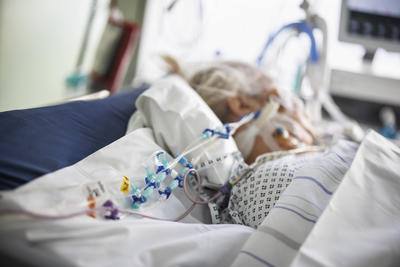
Elderly woman lying in hospital bed.
Different states have different policies on whether to move aged-care residents with COVID-19 to hospital. Shutterstock

What can hospitals offer that aged-care homes can’t?

Specialist treatment

COVID-19 is a serious infection with very high death rates among frail older people.

While aged-care homes can provide a degree of nursing and medical care, hospitals are best positioned to provide specialist treatment and the sophisticated interventions many patients will need.

Better infection control measures

Arguably the key reason to move an infected resident to hospital is to stop COVID-19 spreading to other residents and staff. Aged-care settings are not conducive to infection control in the same way hospitals are.

First, they’re not designed like hospitals. As well as not having the same clinical features, many aged-care facilities follow a “boutique” design with common areas for gatherings and events. Residents and staff can easily congregate in these spaces.

The best efforts to isolate a resident with COVID-19 in aged care could easily be compromised. For example, it’s common for residents with dementia to wander in the corridors. Being contained may exacerbate these sort of behaviours among confused and anxious residents.

More highly trained nurses

Staff shortages in aged care were well documented even before the pandemic. A further depleted workforce during COVID-19 — due to staff off work and restrictions on working across multiple facilities — likely means they’re stretched even thinner. Staff may not always have the capacity to supervise isolated residents or follow infection control procedures.

The much higher ratio of highly trained nursing staff in hospitals should ensure better adherence to the guidelines around proper use of personal protective equipment.

For example, registered nurses in aged-care facilities don’t usually provide direct care to residents. Instead they supervise care provided by unregulated staff often with limited infection control training.


Read more: View from The Hill: Aged care crisis reflects poor preparation and a broken system


What are the disadvantages of hospital transfers?

Older people benefit from carers who know them

The care people receive in aged-care homes relies significantly on staff knowing the residents’ personal and clinical profiles. Aged-care facilities promote person centred care models, which value residents’ rights while striving to create a home-like environment.

Familiar faces who understand residents’ personal preferences may be particularly valuable during a time when residents aren’t able to see their loved ones.

A nurse and a man with a walking stick are seated on a couch. The nurse is reading.
Residents in aged care develop relationships with staff over time. Shutterstock

Introducing a completely new environment during an illness, particularly for residents with dementia, may do more harm than good.

Limited knowledge about the resident could lead to unmet needs while in hospital, which could trigger behaviours that are difficult to manage.

For older adults with dementia, the likelihood of incidents like falls and infections increases when they’re admitted to hospital.


Read more: Social housing, aged care and Black Americans: how coronavirus affects already disadvantaged groups


The hospital perspective

Importantly, hospitals may not be able to cope with such a large influx of aged-care residents at one time. The rising numbers of COVID-19 cases from the general population, including older adults living in the community, have already put the health system under a lot of stress.

So there’s an argument that if COVID-19 cases can be managed within the aged-care home, they should be, to avert pressure from the hospital system.

Worryingly though, we’ve seen reports of the health department denying requests for aged-care residents with COVID-19 to be transferred to hospital.

Respecting autonomy and the right for care

On balance, as much as possible, it’s probably be better to transfer residents to hospital as soon as they test positive to COVID-19. This offers the best chance of preventing widespread infection among other residents and staff, and disease spread from the home into the community.

But we must also respect residents’ autonomy. They might have requested not to be transferred to hospital, even if their illness is life-threatening, by way of an advanced care directive. This might still be their wish, or the preference of their relatives and decision-makers.

Conversely, residents or their surrogate decision-makers might request hospital care, even when care is possible within the home. Again, we argue this is their right.

We should also allow people to change their minds, as these decisions may have been agreed upon before the pandemic.


Read more: Banning visitors to aged care during coronavirus raises several ethical questions – with no simple answers


ref. Should all aged-care residents with COVID-19 be moved to hospital? Probably, but there are drawbacks too – https://theconversation.com/should-all-aged-care-residents-with-covid-19-be-moved-to-hospital-probably-but-there-are-drawbacks-too-143826

100 days without COVID-19: how New Zealand got rid of a virus that keeps spreading across the world

Source: The Conversation (Au and NZ) – By Michael Baker, Professor of Public Health, University of Otago

On Sunda

Your heading here

, New Zealand will mark 100 days without community transmission of COVID-19.

From the first known case imported into New Zealand on February 26 to the last case of community transmission detected on May 1, elimination took 65 days.

New Zealand relied on three types of measures to get rid of the virus:

  1. ongoing border controls to stop COVID-19 from entering the country

  2. a lockdown and physical distancing to stop community transmission

  3. case-based controls using testing, contact tracing and quarantine.

Collectively, these measures have achieved low case numbers and deaths compared with high-income countries in Europe and North America that pursued a suppression strategy.

New Zealand is one of a small number of jurisdictions – including mainland China, Hong Kong, Taiwan, South Korea, Vietnam, Mongolia, Australia and Fiji – pursuing COVID-19 containment or elimination. Most have had new outbreaks. The exceptions are Taiwan, Fiji and New Zealand.

Australia adopted very similar responses to the pandemic and it is important to note that most states and territories are in the same position as New Zealand. But Victoria and, to a lesser extent, New South Wales are seeing a significant resurgence.


Read more: Two weeks of mandatory masks, but a record 725 new cases: why are Melbourne’s COVID-19 numbers so stubbornly high?


The key difference is that New Zealand committed relatively early to a clearly articulated elimination strategy and pursued it aggressively. An intense lockdown proved highly effective at rapidly extinguishing the virus.

This difference can be seen graphically in this stringency index published by Oxford University’s Our World in Data.

CC BY-SA

There are key lessons from New Zealand’s COVID-19 experience.

A vigorous, decisive response to the pandemic was highly effective at minimising cases and deaths. New Zealand has the lowest COVID-19 death rate in the OECD.

Total all-cause deaths also dropped during the lockdown. This observation suggests it did not have severe negative effects on health, although it will almost certainly have some negative long-term effects.

Elimination of the virus appears to have allowed New Zealand to return to near-normal operation fairly rapidly, minimised economic damage compared with Australia. But the economic impact is likely to keep playing out over the coming months.

Getting through the pandemic

We have gained a much better understanding of COVID-19 over the past eight months. Without effective control measures, it is likely to continue to spread globally for many months to years, ultimately infecting billions and killing millions. The proportion of infected people who die appears to be slightly below 1%.

The infection can cause serious long-term consequences for some people. The largest uncertainties involve immunity to this virus, whether it can develop from exposure to infection or vaccines, and if it is long-lasting. The potential for treatment with antivirals and other therapeutics is also still uncertain.

This knowledge reinforces the huge benefits of sustaining elimination. We know that if New Zealand were to experience widespread COVID-19 transmission, the impact on Māori and Pasifika populations could be catastrophic.

We have previously described critical measures to get us through this period, including the use of fabric face masks, improving contact tracing with suitable digital tools, applying a science-based approach to border management, and the need for a dedicated national public health agency.


Read more: New Zealand hits zero active coronavirus cases. Here are 5 measures to keep it that way


Maintaining elimination depends on adopting a highly strategic approach to risk management. This approach involves choosing an optimal mix of interventions and using resources in the most efficient way to keep the risk of COVID-19 outbreaks at a consistently low level. Several measures can contribute to this goal over the next few months, while also allowing incremental increases in international travel:

  • resurgence planning for a border-control failure and outbreaks of various sizes, with state-of-the-art contact tracing and an upgraded alert level system

  • ensuring all New Zealanders own a re-useable fabric face mask with their use built into the alert level system

  • conducting exercises and simulations to test outbreak management procedures, possibly including “mass masking days” to engage the public in the response

  • carefully exploring processes to allow quarantine-free travel between jurisdictions free of COVID-19, notably various Pacific Islands, Tasmania and Taiwan (which may require digital tracking of arriving travellers for the first few weeks)

  • planning for carefully managed inbound travel by key long-term visitor groups such as tertiary students who would generally still need managed quarantine.

Building back better

New Zealand cannot change the reality of the global COVID-19 pandemic. But it can leverage possible benefits.

We should conduct an official inquiry into the COVID-19 response so we learn everything we possibly can to improve our response capacity for future events.

We also need to establish a specialised national public health agency to manage serious threats to public health and provide critical mass to advance public health generally. Such an agency appears to have been a key factor in the success of Taiwan, which avoided a costly lockdown entirely.

Business as usual should not be an option for the recovery phase. A recent Massey University survey suggests seven out of ten New Zealanders support a green recovery approach.

New Zealand’s elimination of COVID-19 has drawn attention worldwide. We are about to publish an overview of the approach in the New England Journal of Medicine. We support a rejuvenated World Health Organization that could roll out an elimination model in other countries where there is public support for this approach.

ref. 100 days without COVID-19: how New Zealand got rid of a virus that keeps spreading across the world – https://theconversation.com/100-days-without-covid-19-how-new-zealand-got-rid-of-a-virus-that-keeps-spreading-across-the-world-143672

Bingeing Netflix under lockdown? Here’s why streaming comes at a cost to the environment

Source: The Conversation (Au and NZ) – By Michael Fuhrer, Professor of Physics, Monash University

Coronavirus lockdowns have led to a massive reduction in global emissions, but there’s one area where energy usage is up – way up – during the pandemic: internet traffic.

Data-intensive video streaming, gaming and livestreaming for business, university and school classes, is chewing up energy.


Read more: Netflix has capitalized on social isolation, but will its success continue in a post-coronavirus world?


Estimates can be notoriously difficult and depend on the electricity source, but six hours of streaming video may be the equivalent of burning one litre of petrol, due to emissions from the electricity used to power the data centres which deliver the video.

In fact, the energy associated with the global IT sector – from powering internet servers to charging smartphones – is estimated to have the same carbon footprint as the aviation industry’s fuel emissions (before planes were grounded).

But Australia is a global leader in research to lower the energy used in IT, which is vital for meeting the streaming demand without the environmental cost.

Where does the data come from?

Video requires huge amounts of data, and accounts for around 80% of the data transmitted on the internet. Much of the energy needed for streaming services is consumed by data centres, which deliver data to your computer or device. Increasingly housed in vast factory-sized buildings, these servers store, process and distribute internet traffic.

A man stands at the end of long, bluish room with walls of tech on either side.
Data centres, in factory-sized buildings, send data to your device. Shutterstock

Research in 2015 found data centres may consume as much as 13% of the world’s electricity by 2030, accounting for about 6% of global carbon dioxide emissions. And the European Commission-funded Eureca project found data centres in EU countries consumed 25% more energy in 2017 compared with 2014.

Imagine what those figures will look like at the end of this year of home-bound internet use.


Read more: Where’s your data? It’s not actually in the cloud, it’s sitting in a data centre


Meeting demands with Moore’s law

The growth in IT is often taken for granted. In contrast to the old days of dial-up internet, we now demand a three-hour movie, in high definition, to download immediately. We want phones that can take video like a pro.

None of this is free. Nor is it sustainable. Every year the number of computations, or transmission of information through space, done globally, increases by 60%, according to 2011 research.

All this computation uses “transistors”. These are tiny switches that amplify electrical signals, and are made using silicon-based technology.

For the past 40 years, our ever-increasing need for more computing was largely satisfied by incremental improvements in silicon-based computing technology – ever-smaller, ever-faster, ever-more efficient chips. We refer to this constant shrinking of silicon components as “Moore’s law”.

A hand holds the components of an iPhone 6S, pointing to a tiny chip.
Pointing to the processor chip at the heart of an iPhone 6S, which came out in 2015. This chip measures 12mm by 15mm and contains over 2 billion transistors. At this point, the transistors were 19 nanometres. Errol Hunt, Author provided

For example, since the late 1970s the length of transistors reduces by about 30%, and the area by about 50%, every two years. This shrinks the energy used in switching on and off each transistor by about 50%, which is better for the environment.

While each transistor uses only a tiny amount of energy, there are billions of transistors in a typical computer chip, each switching billions of time per second. This can add up to a vast amount of energy.

We need better chips

Recently it has become much harder (and much more expensive) to pursue such trends, and the number of companies pursuing smaller components is dropping off rapidly.

Globally, four companies manufactured chips with 14 nanometre (nm) transistors in 2014, but in recent years they’ve struggled to continue shrinking the size of silicon transistors. Global Foundries dropped out of this race altogether in 2018, and Intel experienced enormous problems with manufacturing at 10 nm. That leaves only two companies (Samsung and TSMC) making 7 nm transistors today.

So the answer isn’t to switch off Netflix. The answer is to create better computer chips.

But we’ve got everything we can out of silicon, so we need to use something else. If we want computing to continue to grow, we need new, energy-efficient computers.

Australia is a leader in low-energy solutions

Australia is leading the world in this new field to replace conventional electronics. The ARC Centre of Excellence in Future Low-Energy Electronics Technologies (FLEET) was established in 2017 to address exactly this challenge.

Michael Fuhrer explains topological materials and why they might change the world.

Last year scientists at FLEET published research in Nature revealing the discovery that the “topological” material sodium-bismuthide could be the key to achieving ultra-low energy electronics.

These so-called topological insulators, which led to a 2016 Nobel Prize in Physics, conduct electricity only along their edges, and in one direction, without loss of energy due to resistance.

This discovery is a first step towards the development of a low-energy replacement for conventional silicon-based electronics.


Read more: Why are scientists so excited about a recently claimed quantum computing milestone?


Other top research centres in Australia are addressing different parts of this challenge. For example, one centre is working to reduce the energy used in ubiquitous communication of digital data. Another two are taking a different tack, developing an entirely new quantum technology for computing which promises to enormously speed up, and improve the efficiency of, certain difficult computing tasks.

Quantum computing expert Michelle Simmons explains why this research is so important.

Other countries are equally focused on developing alternatives to the unsustainable need for better and faster electronics, since we cannot sustain the energy needed for these existing and future technologies.

All of these technologies are still confined to specialised laboratories and are probably at least a decade away from finding their way into everyday devices. But we don’t expect the demand for computing to go away, and the energy problem in IT will only become more urgent.

ref. Bingeing Netflix under lockdown? Here’s why streaming comes at a cost to the environment – https://theconversation.com/bingeing-netflix-under-lockdown-heres-why-streaming-comes-at-a-cost-to-the-environment-143190

Why degree cost increases will hit women hardest

Source: The Conversation (Au and NZ) – By Deanne Gannaway, Senior Lecturer in Higher Education, The University of Queensland

The federal government’s proposed increase in the cost of studying humanities and communications degrees at Australian universities has stirred much debate. One aspect that should not be overlooked is that these changes will disproportionately affect women.

Under the proposed changes, student contributions for social science, communications and humanities (not including English and psychology) will increase by A$7,696 per year. That’s double their current cost.


Read more: If the government listened to business leaders, they would encourage humanities education, not pull funds from it


Pushing women into STEM?

The government’s proposal has already been described as social engineering, given the government’s declared aim is to boost numbers of graduates in areas of expected employment growth, including teaching, nursing, agriculture, STEM and IT. The intention of lowering fees in these areas appears to be to attract more students to study these disciplines in preference to humanities.

If the idea is to encourage students to leave the humanities and study science instead, it’s a flawed approach. It would take a lot more than simply changing the cost of study to attract women to the field.

Women remain underrepresented at only 27% of the STEM workforce across all sectors, despite a range of initiatives designed to improve the balance.

For women, the real deterrent to studying STEM-related disciplines is related to employment outcomes and conditions, and challenges in even entering a STEM-based workforce. STEM women are likely to earn less than their male counterparts and also face poorer pay prospects than those who study humanities.

Perhaps more importantly, women in STEM have few examples of role models who clearly own the STEM space – reinforcing a notion that STEM-based work is male-dominated.


Read more: Women in STEM need your support – and Australia needs women in STEM


Pushing women away from humanities?

Increasing the costs of the humanities, then, might not push people into STEM or into areas such as nursing or education. But it might push them away from studying the humanities, and away from the vital work they do in a range of industries.

According to the federal government’s 2019 Graduate Outcomes Survey, 64.2% of humanities graduates were in a full-time position six months out from graduation. Many were employed in positions in public administration, education, business, health and science and technology – the very industries the proposed changes target. In these roles, they draw on skill sets acquired in their humanities degrees; skills that are remarkably similar to those Industry 4.0 capabilities employers are crying out for.


Read more: How the humanities can equip students for the fourth industrial revolution


Women earn less, and will pay more

Raising costs of studies in the humanities means these disciplines will shore up an effective reduction in government funding. In the longer term, women will bear the costs of this “saving”.


Read more: The government would save $1 billion a year with proposed university reforms — but that’s not what it’s telling us


The reality is that humanities and social science disciplines attract more students than any other subject areas – the majority of whom are women. Women have consistently represented the bulk of enrolments in humanities and social science disciplines over the past ten years. In 2018, they accounted for two-thirds of enrolled students.

Chart showing numbers of men and women enrolled in humanities degree courses from 2010 to 2018

Consequently, under the government’s proposal, many women will pay more for their tuition and yet they are likely to earn less than men.

Gender roles continue to have an impact on the career trajectories and earning potential of women in Australia. Even though this gender pay gap is narrowing, primary child-caring roles and responsibilities — including taking time away from work, working part-time or leaving the workforce completely — are mainly assumed by, and expected of, women.

As a result, female university graduates earn, on average, 27% less than men over their careers. This means women take longer to pay off their student debt.

The Australian university debt scheme is often praised because it doesn’t incur interest rates or have a timeline for repayment. However, the tangible effects of a larger debt mean women humanities graduates will be in debt for longer. They will have less disposable income for longer. And they will have limited capacity to invest money, and so expand income, for longer.

The argument that programs that traditionally attract more women – such as nursing and education – will be made cheaper, and therefore more accessible, doesn’t stack up either. Because there are more women in humanities-based degrees than other programs, the proposed changes still mean women will bear the brunt of these increases. Or be forced out of higher education if their calling isn’t teaching or nursing.

Making higher education unaffordable for women just adds to a raft of conditions that already ensure inequalities.


Read more: An open letter to Australia’s Education Minister Dan Tehan — signed by 73 senior professors


ref. Why degree cost increases will hit women hardest – https://theconversation.com/why-degree-cost-increases-will-hit-women-hardest-141614

Why public housing is stigmatised and how can we fix it

Source: The Conversation (Au and NZ) – By Alistair Sisson, Postdoctoral Research Associate, City Futures Research Centre, UNSW

Social and public housing is intensely stigmatised in Australia and has been for several decades. Estates in particular are often labelled “ghettos”, framed as places of danger, drugs and vice.

This stigma can lead to discrimination against tenants and can harm their sense of self-worth, as shown in Australia and around the world.

But it’s not just the Pauline Hansons of this world who are responsible for reinforcing stigma.

Stigma is the product of government policies. It also serves government policies, like privatisation and redevelopment. Until we recognise that, we’ll struggle to remove it.

The source of the stigma

Public housing is stigmatised in many different ways, as we discovered when reviewing a decade of policy documents and media coverage.


Read more: Melbourne tower lockdowns unfairly target already vulnerable public housing residents


Since the 1970s, public housing has gone through a process of residualisation due to the declining number of dwellings and the tightening of eligibility criteria. In other words, it has become home to more and more people who are marginalised and disadvantaged and portrayed as:

[…] a detached underclass unwilling or unable to engage with labour market opportunities or mainstream norms and values.

There is also a view that concentrating disadvantaged people in one area can worsen the problems they face. Common but contested ideas about concentrated disadvantage and neighbourhood effects can lead to the stigmatisation of whole estates or neighbourhoods.

Racism has also added to the stigma of some estates over the last 50 years, as access for Indigenous people has improved and as non-white migrants have been permitted to immigrate.

Decline and design

Public housing can sometimes stand out due to poor maintenance, particularly in gentrifying areas where private housing is new or renovated.

Brutalist towers in inner cities and back-to-front Radburn estates in outer suburbs can also contrast with their wider neighbourhoods.

These stereotypes stem from policies from the mid-1950s to the early 1970s that encouraged public tenants to buy their homes.

But residents who lived in apartments were excluded from such schemes, and cheaply built homes on the urban fringe were less attractive to buy. So these two types of estates became the dominant images of public housing, especially in Sydney and Melbourne.

Poets Corner in Redfern, New South Wales. Alistair Sisson

These policies also reveal how public housing is viewed as inferior to home ownership. Home owners are portrayed as independent and good citizens, despite extensive government subsidies.


Read more: As coronavirus widens the renter-owner divide, housing policies will have to change


Stigma in action

The stigmatisation of public housing has been reflected in several recent government policies.

For example, the shared spaces and facilities of the high-rise public housing towers in Flemington and North Melbourne, in Victoria, were used as justifications for the hard lockdown during the coronavirus outbreak. The tenants were represented as an exceptional risk requiring an exceptional response.

Police deployed 500 officers to enforce a lockdown of unprecedented severity, while apartment residents in other hotspots had more freedoms and forewarning.

The relocation and privatisation of public housing in Millers Point, in Sydney, NSW, was another case of governments using stigma to justify policy.


Read more: Last of the Millers Point and Sirius tenants hang on as the money now pours in


The NSW government claimed residents received huge subsidies compared to other public housing tenants. It argued this money could be used to fund more housing in cheaper places.

But as the Tenants’ Union of NSW pointed out, these subsidies were made to seem larger than they were by including the difference between market rents and tenants’ rents. The subsidies weren’t paid to residents and didn’t reflect the cost of providing housing.

Yet The Daily Telegraph’s Miranda Devine argued tenants living in higher-value areas were responsible for the long waiting list for public housing.

This misrepresents the huge magnitude of public housing shortages and distracts from chronic under-funding.

The Sirius building was one of several Millers Point properties privatised by the NSW government between 2014 and 2018. Ben Guthrie/AAP

The break-up of public housing

Stigma has also been used to justify estate renewal. The demolition and redevelopment of estates like Waterloo in Sydney and Carlton in Melbourne, along with many others around the world, has been justified by the argument that tenants’ disadvantage can result from the cultures or environments of estates.

Breaking them up is presented as a solution to disadvantage and anti-social behaviour.

These arguments divert attention away from government failures in reducing poverty. They also mask the economic and financial objectives of redevelopment, which research suggests are the primary drivers.

Meanwhile, the harm to tenants is dismissed as a cost worth paying for new or better housing.

Solutions to stigma

By shifting blame for various problems onto public housing tenants and estates, stigma reinforces the status quo of inadequate funding and thus poor maintenance, dwindling supply and cannibalisation through redevelopment and privatisation.

It also obscures the culpability of governments and the failure of markets to provide affordable housing, adequate incomes and social support.


Read more: As simple as finding a job? Getting people out of social housing is much more complex than that


To destigmatise public housing, fundamental changes in our housing system are needed. Better design, maintenance and stories are helpful, but can only do so much.

Part of the solution is to end the preferential treatment of home ownership and to treat different tenures equally through housing and tax policy. The security, stability, quality and profitability of your home should not depend on whether you own it or rent it from a private landlord or a social one.

This starts with upgrading public housing and building much more for the hundreds of thousands on waiting lists and the many more who are struggling in privately rented or mortgaged homes.

ref. Why public housing is stigmatised and how can we fix it – https://theconversation.com/why-public-housing-is-stigmatised-and-how-can-we-fix-it-142913

Shorter meetings but longer days: how COVID-19 has changed the way we work

Source: The Conversation (Au and NZ) – By Richard Holden, Professor of Economics, UNSW

One of the many things COVID-19 has had a dramatic impact on is the way many of us work.

Those fortunate enough to be able to work from home have been able to adapt to this new reality – and it certainly has been “new”.

Perhaps the biggest question for both employers and employees is whether working from home has led to a decrease in productivity.

The fact major companies such as Facebook and Twitter have said they will allow many employees to work from home permanently suggests work in some sectors can be done more efficiently outside a formal workplace.


Read more: Working from home: Twitter reveals why we’re embracing it


At a minimum, time saved from commuting and greater flexibility to multitask other elements of one’s life are positives from working from home. Lack of social interaction and the inevitable distractions in most home environments are negatives.

The degree and extent of increased productivity from working at home remains to be seen. It will depend on the way in which working in a team has evolved in a remote environment using online tools like Slack and Zoom.

The big question is how the nature of collaboration has changed under COVID.

Studying 3 million people

Thanks to a fascinating analysis by researchers from the Harvard Business School and New York University, we are beginning to get the first systematic evidence on how the nature of work has changed for those working from home during COVID-19.

The authors gathered aggregated meeting and email meta-data for 3,143,270 people working for 21,478 companies in 16 cities in Europe, the United States and Israel where government-mandated lockdowns were imposed in March.

As the authors put it:

These lockdowns established a clear break point after which we could infer that people were working from home. The earliest lockdown in our data occurred on March 8, 2020, in Milan, Italy, and the latest lockdown occurred on March 25, 2020, in Washington, DC.

To explore changes in worker behaviour, their analysis compares meeting and email data during the lockdown periods (typically a month long) with data for the eight weeks prior and the eight weeks after lockdowns ended.

The data they used came from “an information technology services provider that licenses digital communications solutions to organisations around the world”.

This meta-data indicates the actual behaviour of employees in real organisations. So it’s more robust than, say, a survey asking people what they did. Survey respondents might not remember accurately, or might not tell the truth, and those that respond may not be a representative sample.

In short, the meta-data enables the authors to draw detailed and interesting conclusions that survey data would allow.

It’s the detail of a paper like this that is, in a sense, the whole point. But the bottom line is this. Lockdowns have reduced the amount of time most workers spend in meetings, but increased their working hours.

Time in meetings

Their results show the number of meetings attended by workers increased, on average, by 12.9% during lockdown – with the average number of attendees per meeting increasing by 13.5%.


Impact of COVID-19 lockdowns on meetings

Impact of COVID-19 lockdowns on meetings.
NBER Working Paper No. 27612, July 2020, CC BY-NC-ND

But the average length of meetings fell by 20.1%, with the net effect being that people spent 11.5% less time in meetings.

In European cities such as Brussels, Oslo and Zurich, meeting length declined sharply and continued to fall in the month after the beginning of the lockdown. In the US cities of Chicago, New York and Washington DC, length of meetings declined less.


Read more: Teleworkability in Australia: 41% of full-time and 35% of part-time jobs can be done from home


Email and working hours

There was, also, a significant and seemingly durable increase in working hours, based on the number of hours between the first and last email sent or meeting attended by an individual in a day.

On average, the length of the average workday increased by 48.5 minutes.


Impact of COVID-19 lockdowns on email

Impact of COVID-19 lockdowns on email.
NBER Working Paper No. 27612, July 2020, CC BY-NC-ND

Longer workdays were common across the 16 cities during lockdowns. When restrictions were lifted, average hours returned closer to pre-lockdown levels in all but three cities – San Jose, Rome and New York City.

The evolving nature of work

It is perhaps too early to draw strong conclusions about these changing patterns of communication. But there are some intriguing possibilities.

Larger meetings may be needed to get “everyone on the same page” and create what economists call “common knowledge”. This may be both easier to do in phone or video conferences, and also more important in the absence of face-to-face communication.

Consistent with this, electronic communications extending beyond normal work hours seems like an inevitable consequence, albeit a negative one for work-life balance, particularly for people with caring responsibilities.


Read more: Forget work-life balance – it’s all about integration in the age of COVID-19


The nature of work was evolving before COVID-19, and it will continue to do so as many parts of the world continue with various forms of physical distancing.

Documenting the nature of that evolution, as well as the implications for productivity, workplace culture, and time outside of work will continue to be informed by remarkable data of the kind the authors analysed.

ref. Shorter meetings but longer days: how COVID-19 has changed the way we work – https://theconversation.com/shorter-meetings-but-longer-days-how-covid-19-has-changed-the-way-we-work-143894

Early access to super doesn’t justify higher compulsory contributions

Source: The Conversation (Au and NZ) – By Brendan Coates, Program Director, Household Finances, Grattan Institute

A big part of the Morrison government’s response to COVID-19 has been allowing people early access to their superannuation.

Australians who have claimed hardship have applied for A$30.7 billion to date.

This has been happening in an environment in which compulsory super contributions are set to climb from 9.5% of wages to 12% over the next five years starting in July next year.

Many in the super industry and former prime minister Paul Keating argue that these scheduled increases have to go ahead in order to repair the damage done to the super balances of Australians who withdrew super.

However, new Grattan Institute modelling shows most Australians will have a comfortable retirement even if they have spent some of their super early.

Withdrawals cost less than you might think

Under the government’s scheme, people who have lost their job or had their hours cut or trading income cut by 20% or more were allowed to withdraw up to $10,000 from their super between April and June, and up to another $10,000 between July and December.

More than 500,000 have cleared out their super accounts entirely. Treasury expects total withdrawals to reach $42 billion.

Retirement incomes will fall for workers who withdraw their super, but not by as much as might be thought.

The pension means test means that the government, via higher pension payments, makes up much of what’s lost.


Read more: Why we should worry less about retirement – and leave super at 9.5%


The result is that a typical (median income) 35 year old who takes the full $20,000 would see their retirement balance fall by around $58,000 but would see their actual income over retirement would fall by only $24,000.

Put another way, in retirement that worker would earn 88% of their pre-retirement income instead of 89%.

Retirees need less to live on than while working.

Both are well above the 70% post-tax replacement benchmark used by the Organisation for Economic Cooperation and Development and the Mercer Global Pension Index to determine how much is needed in retirement.

Workers on median incomes who withdraw the full $20,000 will remain well above that benchmark, even with compulsory super contributions staying where they are, at 9.5% of salary.

The very highest and very lowest income earners will receive less extra pension to compensate, and will have less of a cushion.

For most, 9.5% will remain enough

Defaults such as compulsory contributions have to be set so they work for most of the population.

While around one in five Australians have accessed their super early, four in five have not. Policy makers can only justify forcibly lowering someone’s living standards during their working life – by lifting compulsory super – if they are protecting that person from an even worse outcome in retirement.

Our modelling shows workers on all but the highest incomes will retire on incomes at least 70% of their pre-retirement post-tax earnings, the so-called replacement standard.

The graph shows that many low-income workers will receive a pay rise when they retire, even if they withdraw the full $20,000 from super.

Of course, some low-income Australians remain at risk of poverty in retirement – especially those who rent. They struggle even more before they retire.

Boosting rent assistance would do far more to help them than would higher compulsory super contributions, and would do less to make them poor while working.

COVID is another reason to keep super where it is

Before COVID-19, there were good reasons to abandon the planned increases in compulsory super; among them that it would do little to boost the retirement incomes of many Australians, that it would drain government tax revenues and widen the gender gap in retirement incomes.

COVID provides another reason. Previous Grattan work has shown that higher super comes at the expense of future wage increases. It’s a conclusion the Reserve Bank has also reached.


Read more: Think superannuation comes from employers’ pockets? It comes from yours


The retirement income review at present with the government is likely to come to the same conclusion.

Increasing compulsory super contributions in the midst of a deep recession would slow the pace of recovery. And that would be bad news for all Australians, regardless of how much we end up with in super.

ref. Early access to super doesn’t justify higher compulsory contributions – https://theconversation.com/early-access-to-super-doesnt-justify-higher-compulsory-contributions-143087

Friday essay: has Donald Trump broken satire?

Source: The Conversation (Au and NZ) – By Robert Phiddian, Professor of English, Flinders University

For a long time, the answer has been yes. When Saturday Night Live, John Oliver and the satirical establishment railed at him, the president’s supporters were only strengthened in their belief there was a highbrow plot against their guy. Trump met anger with anger, and the effect of satire on public opinion played out to a very noisy draw.

Now, however, three months out from the election in this most bizarre of years, the wheels may be falling off the Trump bandwagon. And satirists like Sarah Cooper, with her brilliantly economical lip-synching of the president’s speeches, seem to be adding to the Trump campaign’s problems in politically effective ways.

Satire might be biting back, at least to the extent of nipping at Trump’s heels, while The Virus and his response to it are breaking his image as a strong leader.

Those of us who enjoy satires like to imagine that the good ones (that is, the ones that make us laugh) change minds and form public opinion. This silver bullet effect, though possible, is extremely rare, as the long experiment in combative public rhetoric called the Trump presidency has demonstrated.

Sarah Cooper lip-synchs Trump live during his Fourth of July speech this year.

The case for yes (satire is broken)

Satire makes us laugh, so we conflate it with comedy, which also makes us laugh. However, the laughter of satire is essentially “laughing at”, rather than the “laughing with” of benign and joyous comedy. It is more critical and appeals to harsher emotions in the audience. To be specific about the satirical element of cartoons, essays, sketches, and the rest – it mobilises the emotions labelled by psychologists “the CAD triad” of contempt, anger, and disgust.

Satirists dream that the objects of their critique will shrivel under the coruscating force of their truth. This seldom happens, and never with experienced public figures. Mostly politicians ignore the satire or try to laugh it off, giving the real or fake impression they are good sports. Mostly their supporters ignore or reject it. Meanwhile, those already disposed to agree with the satire go along for the emotional ride. They vent their anger, contempt, or disgust on the person or behaviour of the target, and political life in countries with free-ish media rumbles on.

John Clarke and Bryan Dawe fed the discontent of the discontented through seven prime ministerships over nearly 30 years. The format didn’t tire because a public appetite for satire at the expense of the powerful is ever present.

It is an important part of the ecology of liberal democracies when they are functioning well, and a more urgent one in times of malfunction. It cheers us up and does something to keep the bastards honest.


Read more: Farewell John Clarke: in an absurd world, we have never needed you more


So it’s no surprise Donald Trump didn’t resign in early 2017 after John Oliver or Saturday Night Live exposed some policy flaws to ridicule. It is, however, a surprise that the massed forces of the satirical industrial complex haven’t managed to strip much paint from him or his supporters over the years.

The public shaming mechanism implicit in political satire has been singularly ineffective in moving public opinion on his presidency, and here are two reasons why.

First, Trump is shameless – he refuses the shaming mechanism that is part of satire’s deal utterly. Normal politicians (excluding those in authoritarian regimes} at least pretend to be able to take a joke at their own expense. They buy originals of cartoons, submit to comedians at press gallery dinners, and arrange their faces in a rictus loosely signifying amusement when caught on the back foot by a member of the public.

Trump refuses all this. He hasn’t attended a White House Correspondents’ Dinner as president, and he fires back with anger and disgust whenever ridiculed. He doesn’t soak up or process the hostile emotions of satire. He returns them with exaggerated force.

President Obama laughs conspicuously at the White House Correspondents’ Association dinner in April 2016. Susan Walsh/AP

Second, his supporters seem to mirror this reaction. The anger and disgust satirists seek to vent on the president, Trump supporters vent straight back on the attackers in “the elites”. The public emotions are amplified rather than diffused. Division increases, and in the favourite verb of the culture wars, opinion is weaponised.

This theatre of anger and disgust has largely worked for Trump. It has distracted his opponents and energised his supporters. The polls suggest the numbers for and against him have been very stable, and until recently, he has stayed within striking distance of a second term.

The case for no (satire may be rising again)

Things may be changing at the moment, for many reasons. A gap has opened between Trump and Biden in the polling and, if satire has anything to do with it, the key emotion is contempt.

Trump has revelled in the energetic emotions of anger and disgust, but his image as a strong leader capable of “making America great again” can bear very little of the cold detachment that characterises contempt. Australian journalist Jonathan Swan’s facial expressions and follow-up questions in his celebrated Axios interview with the president this week reflect low-voltage disdain rather than more combative emotions.

That approach kept Swan in the room and civilly engaged while his interviewee hung himself out to dry, appearing bumbling and unconvincing rather than a channel for the anger of the dispossessed.

As Farrah Tomazin in the SMH wrote of Swan’s interview:

It had all the withering satire of an ABC sketch featuring comedic duo John Clarke and Bryan Dawe […] Except this wasn’t satire at all, but a serious political interview with US President Donald Trump merely 91 days from one of the most consequential elections in US history.

Cartoonists and sketch comedians are fastening onto things like the cool, hard separations from the Trump circus by Generals Mattis and Milley. This mobilisation of contempt may really shift a few votes. In a democracy, especially such a divided one as the US, voting intention only has to move a couple of points to be decisive.

It’s true satire is seldom influential in elections. Very occasionally it can contribute to a wave of anger that wipes someone out, as perhaps happened to Jacob Zuma in South Africa, and may yet happen to Boris Johnson in the UK.

Contempt is, however, a risk for a once-strong leader who has been weakened by events. It can act as a solvent on the uncommitted, whereas anger and disgust only tend to motivate the committed.

This has happened once in Australia, not so long ago. In her brilliant Quarterly Essay on the electoral demise of John Howard, Judith Brett argued he was gone the moment the Chaser team infiltrated the APEC motorcade with an Osama bin Laden lookalike.

This was political satire that was reaching far beyond the usual suspects on the liberal left, and in the process turning the government’s national-security credentials into a national joke. When the Chaser motorcade breached the Great Wall of Sydney, Howard’s days as a strong leader were over.

ABC TV/AAP
Julian Morrow (right) and Chas Licciardello (left) from the ABC TV show The Chaser’s War On Everything after staging a fake motorcade through Sydney in June 2007 during APEC.

When Howard made people angry or proud with strong borders and the “War on Terror”, he went from strength to strength. When The Chaser and others made him look like old Uncle John wandering the streets in a green and gold tracksuit he lost crucial support.

Something like this might be happening to Donald Trump. As the nation’s death toll from COVID-19 grows, volleys of anger and disgust that tend to confirm audiences more vigorously in their convictions may be turning into a growing trickle of contempt.

In an electorate close to evenly poised, this might sap the conviction of a significant numbers of voters in a sufficient number of states to make a difference.

Sarah Cooper’s lip-synching reproductions of Trump’s speeches don’t shout angrily at the president, or present him as a terrifying menace. A fine-featured and expressive woman of Jamaican origin mouthing some of his less coherent interviews and news conferences just makes him look ridiculous.

She started with a TikTok video called How to Medical that parodies the presidential mansplaining of bleach as a prophylactic for COVID-19 with surgical precision.

It reminds me of John Clarke’s renditions of every Australian politician as himself in his own suit and voice. Cooper keeps her target’s voice (she even credits Trump as a writer) but subverts it with her vivid critical presence. While Clarke used the ethical standards of an older Australia to undermine the media spin of his victims, Cooper calls Trump out from a more modern America.

She incarnates a new turn in the cycle of American self-creation where puffy old men in suits are beginning to seem washed up.

Is this a sign of the tide changing irrevocably against Trump? Maybe not – the number of those who have underestimated his superhuman power to refuse shame is legion. His core support has never been a majority, but it has been incredibly durable.

All the same, too many more clips like Cooper’s or cartoons like this one by Clay Jones about Trump’s photo op with the Bible on June 1, and he’s in trouble. If you have come to think of someone as a dilapidated dill, you tend not to care much, or vote, for him.

Cooper’s parodies, Swan’s interview, and Jones’s cartoon detach viewers from the high emotions that Trump has ridden to defy attempts to shame and ridicule him. The cooler emotion of contempt may yet prove more corrosive.

ref. Friday essay: has Donald Trump broken satire? – https://theconversation.com/friday-essay-has-donald-trump-broken-satire-143682

Venezuela, and Trump’s Irrational Electoral Policy

Source: Council on Hemispheric Affairs – Analysis-Reportage

By Jorge Arreaza Montserrat
From Caracas, Venezuela

Elections always have an interesting effect on public policy, in particular if the person in charge of designing and implementing a certain policy is up for reelection. In politics, it is logical that an incumbent candidate decides to show successful policies and accomplishments while minimizing failures or shortcomings. However, what is irrational is that a candidate insists on presenting, preserving and deepening a policy that has proven to be a failure and that the candidate himself only supports half-heartedly. This is the case of the Trump Administration’s current failed policy towards Venezuela, which is being reinforced despite its failure while a more appropriate approach, dialogue, is being discarded.

On January 23, 2019, as John Bolton points out in his controversial memoirs, Trump advisors pushed for the U.S. Administration to recognize as “interim president”, an obscure young politician, Juan Guaidó, who represented Voluntad Popular (Popular Will), the party of Leopoldo López, Washington’s key ally who masterminded the violent protests of 2014 and 2017. Rather than produce a change of government, this action led to Venezuela’s decision to break diplomatic relations with the United States. Guaidó’s recognition has dragged the U.S. Administration, as well as many of its subordinate allies, down a path of failure after failure in their regime change policy. Furthermore, it has also dragged the people of Venezuela through a vicious blockade that has eroded their living standards and seriously jeopardized their well-being.

Support this progressive voice and be a part of it. Donate to COHA today. Click here

Over the course of 2019, the Trump Administration imagined that the whole world would dive into a collective state of denial, would stop recognizing the constitutional government of President Nicolás Maduro and would instead recognize Guaidó who in practice does not even exercise control of any institution in Caracas. A month after his self-proclamation, Guaidó, with U.S. support and propaganda, attempted to force the entry of alleged humanitarian aid into the country while hoping that the Armed Forces would at the same time betray president Maduro. They failed. On April 30, Guaidó and López, with the support of their U.S. partners and military defectors, led a failed coup attempt counting on the support of public officials that never came. This prompted Bolton to send desperate tweets and Elliott Abrams to complain because his phone calls were not answered. They failed again.

Today, more than two thirds of the Member States of the United Nations still recognize Venezuela’s legitimate government and it is Trump himself who is having second thoughts on his erratic choice. The year 2020 came, however, with an unforeseen challenge: the COVID-19 pandemic. Trump’s reelection bid was not counting on the dire impact that this pandemic would have on one of the strong points of his campaign, the economy. Even less, could he have imagined the toll this pandemic would have on the entire population: to date, over 150,000 deaths have been officially attributed to COVID-19 and a crisis with over 45 million new persons unemployed is engulfing the United States. Massive protests have taken place all over the nation, since the murder of George Floyd, an African-American man, at the hands of the police. But they are much more than protests over systemic discrimination; they are protests against a system that has abandoned the majority of its poor citizens.

Trump had in his hands a golden opportunity to show leadership, admit the shortcomings of the system and launch an unprecedented process that would redirect the priorities of the nation, cut back on the aggressive militarization of the police and of foreign policy and turn to a robust policy of relief for workers and the strengthening of the healthcare system. Instead, Trump dug himself into a labyrinth where the desperation to win the reelection clouds his thinking and rather than turning to sound domestic policy, he has opted to put the blame on foreign enemies and to divert attention from his catastrophic mishandling of the situation.

First, he placed the blame on China and resorted to a racist, Cold War-like narrative, as if this would do anything to help the suffering U.S. population. By the end of March, as the death toll increased, Trump announced he was stepping up his “maximum pressure” campaign against Venezuela. In less than a week, a man who helped justify the 1989 invasion of Panama and was now heading the Department of Justice, presented indictments against President Maduro and other top leaders of the Bolivarian Revolution for “narco-terrorism”, placing a $15 million bounty on President Maduro’s head, as in the Wild West. Then Trump’s State Department, through the voice of Elliott Abrams (whose involvement in the Iran-Contra scandal and the massacre in El Mozote, El Salvador, is notorious) proposed a “democratic transition framework” built on the principle of delegitimizing the democratic elections of President Maduro in 2018 and offered a negotiation where President Maduro’s separation from office was non-negotiable. Finally, Trump ordered the largest deployment of U.S. military to the Caribbean Sea since the Panama invasion under the pretext of fighting drug trafficking from Venezuela, when the Department of Defense’s records show that the main route for drugs to the U.S. is via the Pacific Ocean, of which Venezuela has no coast.

“Trump would do better if he followed his initial instinct of talking to President Maduro. A respectful dialogue with Venezuela is what is really in the interest of the U.S.”
Jorge Arreaza, Foreign Minister of Venezuela

In May, a group of mercenaries attempted a raid on Venezuelan coasts. Two of them were former Green Berets who confessed to having been employed by a U.S. security firm by the name of SilverCorp. The CEO of this firm presented a contract with the signature of Guaidó and his aides to carry out actions in Venezuela aimed at removing President Maduro from office and targeting other revolutionary leaders. This too, failed, and has been followed by attempts at intimidating and effectively blocking Venezuela’s trading partners from bringing much needed supplies, including gasoline, which in a time of pandemic, is key for moving medical supplies, personnel, and food throughout the country.

Venezuela has stood firm against all of these attacks. International solidarity from countries such as Cuba, China, Russia, Iran, and Turkey has been key. Strong measures and an organized and community-conscious population have allowed Venezuela to still be one of the countries with the lowest death toll and active COVID-19 cases in the region. In sharp contrast, while Washington imposes  repression on cities such as Portland, which has suffered the deployment of federal police agents, Venezuelans will once again be heading to the polls in December with the hopes of electing a renewed parliament that better reflects the political forces in the country and one whose leadership is not compromised with the promotion of sanctions and blockades against their own country, as is Guaidó.

In the distorted view of reality that Trump and his advisors have of the current conjuncture, there is a belief that hard line, regime change policies against Venezuela would lead to electoral success in Florida and therefore, nationwide. It might well be that some of Trump’s base may like to see a coup in Venezuela, but failure after failure, by now should have indicated that Venezuela is not moving in that direction. To continue attempting clumsy solutions will only repeat past frustrations. A sound policy towards Venezuela has to be in line with the aspirations of the Venezuelan people and with the real interests of the people of the U.S. Venezuelans want peace, dialogue, and politics. Trump would do better if he followed his initial instinct of talking to President Maduro. A respectful dialogue with Venezuela is what is really in the interest of the U.S. electorate. Instead of spending U.S. taxpayer money on failed adventures and made up drug cartels, it could be better spent on dealing with the pandemic and other needs of the U.S. Sound policies are more conducive to reelection. Regime change will only lead to more failure.


Jorge Arreaza is the Foreign Minister of the Bolivarian Republic of Venezuela.
This is an exclusive op-ed for the Council on Hemispheric Affairs, (COHA).

[Main photo: Protest against U.S. intervention on Venezuela, in front of the White House, Washington DC. Credit: https://elvertbarnes.com/16March2019)

Grattan on Friday: COVID divides the nation and isolates MPs from Victoria

Source: The Conversation (Au and NZ) – By Michelle Grattan, Professorial Fellow, University of Canberra

COVID-19 has now made us two Australias. There’s Victoria – most specifically Melbourne – and then there’s the rest of the country.

Melbourne’s extraordinary lockdown complete with curfew is an act of desperation by Daniel Andrews’ government, as it fights a daily tally of several hundred new cases.

Scott Morrison will remember when he berated the media for using the term “lockdown”. Now he finds himself using it all the time.

Melbourne has become a city where citizens are supervised by police and soldiers. Its economy will be crushed. Regional Victoria’s lockdown is somewhat milder but it will take a big toll.

By contrast, at least in terms of COVID itself, the other seven states and territories are, Scott Morrison said on Thursday, “in a fantastic position”.

Well, sort of. NSW is holding the line, with a few cases that so far thankfully have not morphed into a dangerous spread.

But while we are living as two Australias, we are one country. That means the huge whack the virus is inflicting on Victoria is dragging down the rest of the nation, holding back recovery.

The dire turn of events is affecting political leaders’ responses. Risk averse premiers are running their states as gated communities.

Morrison maintains a level of public solidarity with Andrews but the PM may find himself under mounting pressure from those within his party and its base who want the economy given a much higher priority.

David Kemp, a Liberal cabinet minister in the Howard government and party elder, wrote in the Australian Financial Review this week, “The federal government is making a great mistake if it does not call [the Victorian situation] out. It apparently believes that the priority is to maintain unity in the national cabinet. There is no true unity, and the pretence is inhibiting the national debate …

“This pretence is now dividing the Liberal Party and demoralising its supporters, in Victoria at least. It is also undermining national economic recovery by sanctioning gross policy overreach.”

In early May Morrison released a path out of the COVID restrictions that would have had us in reasonable shape everywhere now. Instead, we might as well hire a fortune teller to predict where we’ll be when.

The way ahead depends on two uncertainties. Will the Victorian lockdown bring COVID-19 under control? And will the virus be stopped from breaking out elsewhere?

The government has produced Treasury’s estimates of the cost of the Victorian stage 4 lockdown.

Previously Treasury said Victoria’s recent stage 3 restrictions would reduce GDP by $3.3 billion (0.75% of a percentage point) in the September quarter. The new restrictions will cut GDP in that quarter by $7-$9 billion, slicing about 1.75 percentage points off quarterly GDP growth.

The combined effect of the Victorian measures through the September quarter will be to contract growth by $10-$12 billion (2.5 percentage points).

Treasury estimates 250,000-400,000 more people will become effectively unemployed (this includes both those losing jobs and those still in jobs but working no hours). It forecasts Australia’s unemployment rate will rise above the previous estimated peak of 9.25% – released only a fortnight ago – and peak nearer to 10%.

Andrews, under intense political pressure and substantial criticism (although opinion is mixed), is sensitive when asked about the cost Victoria is imposing nationally. “There’s costs all over the place whether it be in dollar terms or in funerals,” he said.

“I’m not going to be trying to put a price tag on this. This is what we have to do, we have no choice … otherwise this won’t be six weeks, it will be six months or longer. And we’ll have to continue to bury people, we’ll have to continue to deal with an economy that is essentially closed.”

Andrews is in the ultimate corner. If stage 4 fails, the future becomes too awful to contemplate.

Victoria’s crisis is forcing the federal government into policy gyrations. After announcing a fortnight ago tighter eligibility requirements for JobKeeper post September, now it has announced an easing. The cost of the latest changes in eligibility plus the extra numbers of businesses coming onto the program because of the Victorian situation is $15.6 billion, taking the total cost of JobKeeper to $101 billion.

That Victoria is a “separate” Australia is brought home in the arrangements for parliament’s sitting from August 24.

Morrison was criticised for cancelling the early August sitting. He’s committed to the coming one, not least because the government needs to legislate some pandemic measures.

On the advice of acting Chief Medical Officer Paul Kelly, Victorian MPs going to Canberra must quarantine for 14 days beforehand. That starts from 11:59pm this Sunday.

In a letter to Morrison, Kelly said that in the context of Victoria, the sitting led into uncharted waters. “The situation in Victoria is not improving at this time,” he wrote. Victorian MPs presented “a significant risk” to ACT citizens, particularly those working in parliament house, as well as to parliamentarians and staff from elsewhere, “with the possibility of seeding into other jurisdictions”.

Kelly prefers the politicians quarantine in Canberra, but said this could be done in Victoria. The conditions are strict. While in home quarantine, no one from the household can leave for any reason and no one can visit.

One MP immediately dubbed the household isolation the “hold-the-family-hostage option”.

In practical terms, on the present sitting pattern, Victorians choosing to isolate in Canberra would only be able to return home for about a fortnight between this weekend and when parliament adjourns for the year on December 10.

Labor has been demanding parliament sit. But in a hook up of Victorian Labor members on Thursday, some were reluctant to meet the stringent conditions. As a result Albanese proposed Victorians should be allowed to tune in virtually. They would not be able to vote.

There are other wrinkles. For example, Queensland has banned arrivals from the ACT, so how about federal MPs going home? A Queensland government spokesman says, “Queensland MPs returning from Canberra will have to quarantine. National agreement is being sought on detail.”

Treasurer Josh Frydenberg and Health Minister Greg Hunt intend to quarantine in Canberra. Perhaps they’ll hope the odd curry delivery is ferried from The Lodge.

ref. Grattan on Friday: COVID divides the nation and isolates MPs from Victoria – https://theconversation.com/grattan-on-friday-covid-divides-the-nation-and-isolates-mps-from-victoria-144094

75 plus 35 years – the Hiroshima and Rainbow Warrior nuclear rewinds

Report by Dr David Robie – Café Pacific.

Hiroshima
The Hiroshima devastation 75 years ago today. Image: ICAN

By David Robie

While the globe struggles to cope with the deadly onslaught of the covid-19 pandemic, communicators, historians, journalists and activists have been deploying innovative ways of marking three nuclear-related anniversaries in barely a month.

Over the next few days, the devastating destruction, cruel loss of life and survivors’ stories from the world’s first and only deployment of nuclear weapons are being remembered in Japan and around the world.

The United States dropping of nuclear bombs on Hiroshima 75 years ago on 6 August 1945 and then on Nagasaki three days later left two utterly destroyed cities and more than 215,000 people dead. Thousands more lives were lost in the following years from leukemia, cancer and other diseases caused by the radiation from the weapons.

READ MORE: Another Hiroshima is coming – unless we stop it now

With the third anniversary, 10 July 1985, although only one life was lost – there could easily have been more – the repercussions for New Zealand and throughout the Pacific have also been shattering.

One outrage was a wartime atrocity, claimed falsely that it was carried out to shorten the Pacific war, and the other was a peacetime atrocity.

The Greenpeace flagship Rainbow Warrior was bombed by French secret agents with the loss of Dutch photojournalist Fernando Pereira. But the anti-nuclear protest that was meant to be silenced continued courageously, and a decade later France was forced to halt nuclear tests at Moruroa atoll with the last detonation in early 1996.

One of the champions of the South Pacific’s nuclear-free and independence campaigners, Oscar Manutahi Temaru, made an inspirational guest appearance last week in a retrospective webinar about the impact of the Rainbow Warrior bombing 35 years on.

The webinar, titled “The Rainbow Warrior Incident: 35 Years Later”, featured several protagonists, analysts and authors speaking about the sabotage of the environmental flagship.

It was originally planned as part of an H-France history conference in Auckland but the pandemic forced organisers to go virtual.

Temaru, five times president of French-ruled Polynesia (Ma’ohi Nui) and the mayor of Faa’a, the “nuclear-free” airport suburb on the fringe of the capital of Pape’ete, made some challenging comments.

Four years ago, he told Tagata Pasifika’s John Pulu that a half-century legacy of nuclear tests in Polynesia was to blame for the at times toxic relationship with the coloniser.

“The French government, through its President, General De Gaulle decided to use our country for the French nuclear testing,” Temaru said.

“They came down here with their private enterprises – the French army – and they have dismantled the whole life of this country. They pulled it upside down.”

Temaru knew what to expect, as during the Algerian War of Independence he was in the French navy and he was deployed to the conflict at a time when France was conducting its early nuclear tests in the Sahara Desert.

Early years of devastation
Temaru was later a customs officer in Tahiti and saw at first hand the early years of the devastation of the military machine in Moruroa and Fangataufa atolls in the southern Gambier islands as they became the new host for French nuclear tests.

France conducted 193 nuclear tests – 46 in the atmosphere – in the 30 years between 1966 and 1996, but the legacy of the testing was still felt for 50 years with the medical and environmental consequences and lawsuits continuing to this day.

Temaru’s rallying cry has been to seek independence from France.

With a Cook Islands mother and Tahitian father and having worked on school holidays in freezing works in Auckland, he has long had a strong affinity with the “independent” nations of the Pacific and aspires to Tahiti one day becoming a full member of the Pacific Islands Forum.

Thanks to strong support of several Pacific nations and the Non-Aligned Movement, the UN General Assembly voted on 17 May 2013 to put the country back on the UN list of non-self-governing territories.

Since then he has been a marked man for vindictive elements in the French establishment who see it is payback time.

Oscar Temaru
Oscar Temaru … legal challenges
against France.
Image: Tavini Huiraatira
Oscar Temaru … legal challenges against France. Image: Tavini Huiraatira

In June, he was on a hunger strike over his treatment by the French judiciary. A prosecutor has seized his personal savings of US$100,000, in an act described as illegal by his defence lawyers, in a case which he is being accused of political “undue influence”.

Last week, his Tavini Huiraatira party launched a petition outside the lawcourts of Pape’ete calling for the sovereignty of the Ma’ohi Nui people. The petition, open for a year and expected to be presented to the United Nations and the Pacific Islands Forum, also calls for compensation from France for the damage caused by three decades of nuclear tests.

‘Scandalous’ legal action
One of the two Tahitian politicians in the National Assembly in Paris, Moetai Brotherson, branded the action as “scandalous”, claiming prosecutor Herve Leroy had exceeded his powers.

The judicial controversy is over the local pro-independence station Radio Tefana which the prosecution claim is benefitting his pro-independence party Tavini Huiraata (People’s Servant Party), founded in 1977.

“As a Mangarevian, I see Oscar Temaru as our only voice for indigenous sovereignty and it starts – as he has said so many times – by making the French accountable for what they have done,” says Ena Manuireva, an Auckland-based Tahitian researcher studying the loss of cultural identity among his Mangarevan community, its origin and impact.

“Temaru has has always fought the same fight – we, the local population, must be the masters of our own destiny. The French coloniser needs to leave if they don’t want to give us independence.”

Ena Manuireva
Tahitian researcher Ena Manuireva … “Oscar has always
fought the same fight.”
Image: David Robie/Pacific Media Centre

Manuireva was one of the speakers at the webinar, hosted by Canada’s Simon Fraser University of Vancouver with support by Massey University and the University of Auckland is part of a “France and Beyond” joint conference of the Society for French Historical Studies and George Rudé seminar on French history and civilisation.

A doctoral candidate at Auckland University of Technology (AUT), Manuireva was born in Mangareva (Gambier), the smallest archipelago in Ma’ohi Nui in 1967. He left the island after the first nuclear test on July 2, 1966.

Nuclear panel speakers
Key organiser and moderator was Dr Roxanne Panchasi, an associate professor at Simon Fraser University who specialises in 20th and 21st century France and its empire. She is the author of Future Tense: The Culture of Anticipation in France between the Wars and her recent research has focused on French nuclear weapons and testing since 1945.

Also featured on the panel were:

Stephanie Mills, currently director of campaigns at NZEI Te Riu Roa, and Greenpeace’s former Pacific nuclear test ban campaigner; Dr Rebecca Priestley, associate professor at the Centre for Science in Society at Victoria University in Wellington; and me, a Pacific media educator and director of the Pacific Media Centre-Te Amokura at AUT. As a journalist, I was on board the campaign ship and wrote Eyes of Fire: The Last Voyage of the Rainbow Warrior.

This article was first published on Café Pacific.

West Papua scores lowest democracy index, free expression declines

Pacific Media Centre Newsdesk

Indonesia’s West Papua province has again been recorded as having the worst democracy index in the republic, reports CNN Indonesia.

This year (2019), the West Papuan Democracy Index (IDI) was 57.62, even dropping lower from 2018 when it was 58.29 points.

Based on data from the National Statistics Agency (BPS), West Papua has the lowest score and is in last position – below South-East Sulawesi with a score of 65.21 points.

[Pacific Media Centre editor: West Papua in the Pacific is generally taken to mean the combined mainly Melanesian region of two provinces – Papua and West Papua.]

Following next is Papua province with a score of 62.25 points, North Sumatra with 67.65 points, West Sumatra with 67.69 points, Maluku with 68.22 points, West Java with 69.0 points and Jambi province with 69.76 points.

The BPS Democracy Index categorises the level of democracy as being good, moderate and poor. A Democracy Index score under 60 is classified as a poor democracy while a score of 60-80 represents a moderate democracy and a score above 80 is a good democracy.

Among all 32 provinces in Indonesia, West Papua was the only province with a poor Democracy Index.

BPS head Kecuk Suhariyanto said that there were seven provinces in Indonesia that were categorised as good.

Two provinces improve
“In 2018 there were only five provinces, in 2019 there are seven provinces with a category of good. From five there have been two additions making seven, namely Riau Islands and Central Kalimantan provinces,” he said during an online press conference.

Suhariyanto said Jakarta was the top rated province with a score of 88.29 points followed by North Kalimantan Utara with 83.45 points and Riau Islands with 81.64 points.

This is followed by Bali with 81.38 points, Central Kalimantan with 81.16 points, East Nusa Tenggara with 81,02 points and Yogyakarta Special Province with 80,67 points.

Nationally, Indonesia’s Democracy Index rose slightly to 74.92 in 2019. Last year in 2018 it was recorded at 72.39 points. As a whole, Indonesia’s democratic score is still categorised as moderate.

Nevertheless, looking at this in detail there are six indicators which still rated poorly in the index.

Namely threats of or the use of violence by the public which obstructs freedom of expression with a score of 57.35 points followed by the percentage of women elected as members of provincial parliaments (DPRD) with a score of 58.63 points.

This is followed by violent demonstrations or labour strikes with a score of 34.91 points, regional regulations imitated by DPRDs with a score of 46.16 points, DPRD recommendations to the executive with 16.70 points and finally efforts to provide budgetary information by regional government with a score of 53.43 points.
The Democracy Index is assessed based on three main aspects, namely civil freedoms, political rights and democratic institutions. Each of these three aspects has 11 variables and 28 indicators which are used to make an assessment.

Decline in civil freedoms
Although there was a 4.92 point increase in political rights and a 4.48 point increase in democratic institutions, there was a 1.26 decline in civil freedoms. The score for civil freedoms based on the IDI for this year stood at 77.20 points.

“The index for civil freedoms in 2019 was 77.20. A slight decline compared with the position in 2018 and its respective category is moderately [democratic]”, said Suhariyanto.

Civil freedoms were assessed using four variables with freedom of assembly and freedom of association scoring 78.03 points, a decline of 4,32 points compared with 2018.

Freedom of expression, which stood at 84.29 points, declined by 1.88 points, freedom of belief scored 83.03 points, rising by 0.17 points compared with 2018 and freedom from discrimination scored 92.35 points, rising by 0.58.

If looked at in detail, there was a step back in the indicators which covered threats of or the use of violence by government agencies which obstruct freedom of expression, assembly and association, and the threat of or use of violence by social organisations related to religious teachings.

Next, actions or statements by government officials which were discriminative in terms of gender, ethnicity or other vulnerable groups and or which restricted the freedom to worship.

Meanwhile improvements were found in the indicators covering the threat of or use of violence by the public which obstructed freedom of expression, assembly and association and or on the grounds of gender, ethnicity or other vulnerable groups.

Discriminatory regulations
There were also improvements in written regulations which restrict freedom of worship and religion and or which discriminate against gender, ethnicity or other vulnerable groups.

In the aspect of political rights, two variables were assessed. The breakdown was the right to vote and be elected which scored 79.27 points, rising by 3,5 points, public participation in decision making and government supervision which scored 56.72, rising 2.44 points.

Although this was still categorised as poor.

In terms of democratic institutions, five variables were assessed. The breakdown was free and fair elections which scored 85.75 points, declining by 9.73 points followed by the role of regional parliaments (DPRD) with a score of 61.74, a rise of 2.82 points.

Then the role of the political parties which scored 80.62 points, a decline of 1.48 points followed by the role of regional government bureaucracy which scored 62.58 points, a rise of 6.84 points and the role of an independent judiciary which scored 93.66 points, a rise of
2.94 points.

This abridged translation by James Balowski of IndoLeft News is based on two articles by CNN Indonesia published on August 3. The original title of the first article was “Indeks Demokrasi Papua Barat Paling Buruk, Jakarta Terbaik”. The title of the second article was “Kebebasan Sipil Turun, Indeks Demokrasi Indonesia Naik.”

Print Friendly, PDF & Email

Article by AsiaPacificReport.nz

Beirut explosion yet another heartbreak for a country already on the brink

Source: The Conversation (Au and NZ) – By Tony Walker, Adjunct Professor, School of Communications, La Trobe University

Lebanon did not need one of the world’s most horrific accidental detonations to remind people it is a state teetering on the edge of collapse.

However, the destructive power of 2,750 metric tonnes of ammonium nitrate ignited in Beirut’s port, killing 135 people and injuring 5,000 more so far, has amplified the parlous state in which Lebanon finds itself.


Read more: Beirut explosion: the disaster was exceptional but events leading up to it were not – researchers


Lebanon might not meet the accepted definition of a failed state because it retains the trappings of a central government. But an administration corrupted by a patronage system based on the country’s confessional groupings has long failed to deliver basic services to a population of 6.8 million.

Power shortages are a fact of daily life, inflation is rampant, the Lebanese pound has collapsed, unemployment has gone through the roof, crime has sky-rocketed, and food shortages are endemic.

If not a failed state, Lebanon is a failing one.

And it has been failing for a long time.

In essence, Lebanon’s problems are structural and therefore not capable of simple, or even rational, solutions.

A young man with gauze on his face is hugged by a young woman who is crying.
A young couple caught up in the explosion in Beirut. Ibrahim Dirani/Dar al Mussawir/EPA/AAP

The problems go back to the French mandate-era constitution of 1926, which sought to divide power between the country’s Christians and Muslims.

Under these arrangements, refined over the years, the president would be a Maronite Christian, the prime minister a Sunni Muslim, and the speaker of the National Assembly, or parliament, a Shia Muslim.

Cabinet’s composition would reflect these main confessional strands. So would positions in the military, security apparatus, judiciary and bureaucracy.

Needless to say, haggling over the distribution of the spoils of office has contributed to one of the most corrupt countries on the planet.

According to Transparency International’s Corruption Perception Index, Lebanon ranks 137 out of 180 globally.

Lebanon’s wealth, such as it is, has been looted over the years by officeholders and their cronies to the point where the country is effectively bankrupt.

All this has taken place against the background of a civil war throughout the 1970s and 1980s, and two Israeli invasions, one in 1982, the other in 2006.

Then there is the increasing and disruptive influence of the Iranian-backed Hezbollah, now the dominant political force in the country. Hezbollah’s growing power is one of the reasons Lebanon’s fragile power-sharing arrangements have come under increasing stress.

At the same time, Lebanon has been inundated by Syrians displaced by their homeland’s civil war.

Relative to its population, Lebanon has absorbed more refugees than any other country in the world. They account for 30% of Lebanon’s population.

These pressures have pushed the Lebanese administration close to breaking point.

In that context, the port ammonium nitrate explosion could hardly have come at a worse moment for an embattled government. It has been engaged in months of testy negotiations with the International Monetary Fund on a bailout plan.

IMF negotiators have been frustrated by their inability to get Lebanese counterparts to sign on to an emergency relief scheme to enable Lebanon to keep functioning.

Among the sticking points has been agreement on what money has been lost or otherwise misappropriated.

“It has been really difficult. The core of the issue is whether there can be unity of purpose in the country,” the IMF’s managing director, Kristalina Georgieva, told reporters after talks had stalled.

This is an understatement.

Lebanese have been taking to the streets to protest against government corruption and incompetence. Those protests will now be fuelled by greater levels of outrage over the mismanagement by port authorities of highly combustible material that arrived on a Russian ship bound for Madagascar in 2013.

That ship did not continue the voyage. Its cargo was offloaded and placed in a warehouse. Higher authorities ignored repeated warnings from customs officials about the risks of continuing to store the ammonium nitrate.

Tragically, this episode pretty much sums up Lebanon’s central problem: lack of accountability due to a fractured and fragmented administration.


Read more: Trouble in the Gulf as US-Iran dispute threatens to escalate into serious conflict


Action is already being taken against officials deemed immediately responsible for overseeing security in the Beirut port. But this is unlikely to assuage anger among the general population over what has taken place.

A man with bandages on his head walks past soldiers in Beirut.
Lebanon was already on tenterhooks before the explosion. Hassan Ammar/AP/AAP

In the days before the explosion, and separate from it, Lebanon was already on tenterhooks in anticipation of a UN-backed court verdict in the trial of four members of Hezbollah accused of assassinating former prime minister Rafik Hariri.

Hariri, who spearheaded Lebanon’s reconstruction after its civil war, was killed in Beirut in 2005 by a massive truck bomb.

UN investigations based on phone records identified four alleged culprits, none of whom have been seen in public for years.

Hezbollah has questioned the validity of the UN’s inquiries.

The verdict was due on February 7. It has now been put off to August 18.

If the UN court finds the accused guilty it will add to sectarian tensions.

Questions have been asked in the past about whether Lebanon can survive as a confessional state based on archaic power-sharing arrangements. Those questions may resurface.

In the meantime, the country’s strategic significance, abutting Israel in the south and Syria to its east and north, means it is not in the interests of the wider Arab world, nor the West, to allow it to implode.

The outlook for Lebanon, whose main city was once known as the Paris of the East, is bleak.

ref. Beirut explosion yet another heartbreak for a country already on the brink – https://theconversation.com/beirut-explosion-yet-another-heartbreak-for-a-country-already-on-the-brink-144055

We need to Close the Gap on health. But even official dietary advice disadvantages Indigenous people

Source: The Conversation (Au and NZ) – By Odette Best, Professor, Nursing, University of Southern Queensland

Recently announced Closing the Gap targets aim to improve the health and well-being of Indigenous people.

But if that’s to happen, we need to provide health advice suitable for First Nations Australians.

That includes providing culturally safe dietary advice, and acknowledging the difficulties some Indigenous people face in reliably accessing some foods recommended by official dietary guidelines.

If we don’t, this will put Indigenous Australians at even higher risk of illness from a poor diet, worsening existing disadvantage. It will also make closing the significant gap of life expectancy and disease between Indigenous and non-Indigenous Australians even harder to achieve.


Read more: We have 16 new Closing the Gap targets. Will governments now do what’s needed to meet them?


What’s wrong with current dietary advice?

The Australian Dietary Guidelines form the foundation of nutrition advice and education in Australia.

These guidelines are based on research from around the world, analysed by a panel of experts. That evidence is then distilled into advice on everything from how many serves of vegetables to eat a day to whether it’s best to drink full-fat or reduced-fat milk.

But these guidelines have not been formulated to take into account Indigenous Australians’ traditional foods or dietary differences. Instead, they reflect the predominant Western culture, and implicitly assume Western dietary advice suits everyone.


Read more: Dietary guidelines don’t work. Here’s how to fix them


One example of how the Australian guidelines fails to address Indigenous people is when recommending dairy products. Before invasion, Indigenous diets in Australia were in stark contrast to Western diets today. Most notable was the absence of dairy-based foods.

However, the guidelines suggest dairy is an important part of diets. What happens when this is not a traditional part of your diet? A significant percentage of Indigenous people are lactose-intolerant – a fact we’ve known ever since a landmark study in the 1980s. This is not addressed in the guidelines.

The guidelines also fail to consider Indigenous people are more likely to be suffering from a chronic disease such as diabetes, stroke, heart and kidney disease — and therefore need a tailored dietary approach.

For example, traditional Indigenous proteins such as kangaroo, emu and seafood are noticeably lower in fat than introduced proteins such as beef and lamb. This makes traditional foods particularly suitable for Indigenous people with a range of chronic diseases, including diabetes and cardiovascular disease.

The guidelines also assume everyone has access to the types of foods it recommends, particularly fresh food and vegetables. But we know food access and food security are an issue, particularly for remote Indigenous communities.

We’ll hear more about this issue later this year, when the parliamentary inquiry into food pricing and food security in remote Indigenous communities reports its findings.

Indigenous foods are mentioned, but not enough

The guidelines do mention tailored foods for Indigenous peoples, such as the “Aboriginal and Torres Strait Islander Guide to Healthy Eating”, a one-page poster that includes kangaroo, seafood and goanna.

Aboriginal and Torres Strait Islander Guide to Healthy Eating poster
A single poster containing kangaroo, goanna and seafood isn’t enough. NHMRC

But this does not go far enough to address the inequity in these very generalised guidelines. For instance, these foods are only in the protein group.

When looking at the grains and cereals mentioned in the guidelines, foods offered are mostly processed and contain high levels of gluten. Gluten-dense grains such as wheat, barley and rye were not cultivated in Australia before invasion.

Instead, traditional Indigenous diets relied on seasonal fruits and vegetables for dietary fibre.

However, Aboriginal Australians were also one of the first cultures to bake bread. Breads were made without preservatives, from a variety of high-fibre foods such as grass seeds and nuts, as opposed to grain-based crops such as wheat and oats. These traditional foods are not included in the dietary guidelines.


Read more: We can close the Indigenous nutrition gap – here’s how


What could we do better?

Rather than a “one size fits all” approach, we should support First Nations people to create regionally based dietary guidelines for Indigenous people.

That’s because there is no one consistent Indigenous food source across all Australia. So dietary guidelines need to be tailored to local foods, local conditions and practices, to reflect the diversity of Indigenous people around Australia and their diets.

For example, Davidson plums are found mainly in wet, rainforest terrains, whereas saltbush is found in drier climates.

In the meantime, the lack of cultural applicability in existing dietary guidelines helps put the Indigenous population at higher risk of ill health and early death. That makes Closing the Gap even harder to achieve, whether you’re talking about health, food equity or both.


Read more: Yes, we need to Close the Gap on health. But many patients won’t tell hospitals they’re Indigenous for fear of poorer care


ref. We need to Close the Gap on health. But even official dietary advice disadvantages Indigenous people – https://theconversation.com/we-need-to-close-the-gap-on-health-but-even-official-dietary-advice-disadvantages-indigenous-people-143680

Paul Kelly biography traces his journey but not his work with young artists today

Source: The Conversation (Au and NZ) – By Liz Giuffre, Senior Lecturer in Communication, University of Technology Sydney

Review: Paul Kelly: The Man, the Music and Life in Between (Hatchette)

Stuart Coupe’s new biography of Paul Kelly takes many known elements of Kelly’s story and rouses them again. Paul Kelly: The Man, the Music and Life in Between reads the way a Paul Kelly cover version sounds: familiar, but also a bit disorienting.

Old school music fans might go to the liner notes first – in this case the back cover and acknowledgements. Both detail the insights Coupe has drawn from others: hundreds of interviews, including Kelly himself and over 80 people thanked in the acknowledgements.

Hachette

It’s a who’s who of Australian music from the last few decades – Archie Roach, Kasey Chambers, Kev Carmody, Vika and Linda Bull and Neil Finn – but not too many younger voices. Coupe’s emphasis is on how Kelly became, rather than who he is today.

The impressive interview list provides the choir that sings this cover version. Each person adds an extra layer: a solo to recall a key memory of Kelly as a band member, collaborator, business partner.

As Kelly’s former manager, Coupe also chimes in with his own testimony.


Read more: Listening to Songs of Leonard Cohen: singing sadness to sadness in these anxious times


If I could start today again

Large parts of Kelly’s early career have been lost to time, with records not added to the master log.

Particular casualties are his first two albums with The Dots, Talk (1981) and Manilla (1982). Coupe’s interviews do however explore singles like Billy Baxter and Alive and Well, which have been left out of subsequent Kelly histories, including best of compilations and Kelly’s 2018 autobiography.

As Kelly explains it:

When I gained control of my work in the late nineties I simply chose not to make them available anymore. It wasn’t the fault of the bands on those records. It was me.

Studio recordings of this time are now hard to come by (as Coupe and his colleagues lament), though a few iconic Countdown snippets linger on.

The 1982 Countdown performance of Alive and Well captures the perspectives of some of Coupe’s interviewees. Kelly is working in collaboration, but also keen to draw the spotlight for himself. He is rake thin. Is this youth’s blessed metabolism, or the drug use many remember throughout the book?

The Paul Kelly he became in terms of sound and songwriting is here, but the some of the interviews in Coupe’s book makes the wobble of his head and unsteadiness of his gait hard to ignore.

Look so fine, feel so low

References to Kelly’s use of heroin in the past appear repeatedly in the biography. Fans will be curious to know how drugs influenced Kelly’s actual music, however Coupe doesn’t focus on Kelly’s writing process in this way. Some details are there, but nothing as forensic as Kelly has already offered himself in terms of craft and context. Instead, Coupe focuses on the machinations of the music industry.

As a songwriter, Kelly’s value was seen early. Accounts by Mushroom Records alumni and other associates from the early 1980s, show how his writing talent was privileged despite his unsteady performance style.

Still, Kelly’s songs were so popular so quickly that there was money to be made. Although many of the musicians in the book were left by the wayside as Kelly moved from project to project, his publisher continued to benefit.


Read more: Death, beauty and poetry come together in Ancient Rain


Deeper water

The biography brings readers to the present day, including the 2019 How To Make Gravy concert in the Domain in Sydney and his 2020 album releases (one in lockdown, and with Paul Grabowsky).

However, it would have been nice to see Coupe explore Kelly’s continued association with youth broadcaster Triple J and the newer artists and audiences who find him via contemporary collaborations.

Kelly’s 2016 collaboration with AB Original and Dan Sultan for Triple J’s Like A Version remains as much a step up for Kelly as it does for the younger musicians.

A reworking of Dumb Things, Kelly’s anthem (and his art) is sampled into a new context. Its energy is breathtaking.

How many teenagers discovered Kelly for the first time after this?

As well, the 2019 collaboration with Dan Sultan on Every Day My Mother’s Voice shows the fundamental connection Kelly continues to make with new audiences and artists – only vaguely referenced as “the Adam Goodes song” by Paul Luscombe in Coupe’s book.

While of, course, there had to be an end to Coupe’s address book, a bit more on these more recent and younger collaborators would strengthen this story and tell us more about where Kelly is going, not just where he has been.


Read more: Why Scott Morrison’s white, male music playlists matter


ref. Paul Kelly biography traces his journey but not his work with young artists today – https://theconversation.com/paul-kelly-biography-traces-his-journey-but-not-his-work-with-young-artists-today-143350

Video: A View from Afar – The Beirut Explosion + Authoritarianism as a Covid-19 Mask

Evening Report Video: This week in A View from Afar with Paul G. Buchanan and Selwyn Manning, we examine the Beirut explosion and what is going on behind the headlines. We also debate how leaders around the world are using authoritarianism as a mask to cover their weak handling of the Covid-19 pandemic.

A View from Afar is a joint effort between EveningReport’s parent company Multimedia Investments Ltd and Paul Buchanan’s 36th-Parallel Assessments business.

The programme, A View from Afar, livestreams at 8pm US EDST (midday, NZST).

A View from Afar explores the big issues that are sweeping the world, viewed, analysed, and dissected from an independent New Zealand perspective.

The programme’s format examines the cause, the affect, and possible solutions to issues. It also includes audience participation, where the programme’s social media audiences can make comment and issue questions. The best of these can be selected and webcast in the programme LIVE. Once the programme has concluded, it will automatically switch to video on demand so that those who have missed the programme, can watch it at a time of their convenience.

So watch out for it on Facebook, Twitter, and Youtube as we will promote A View from Afar via our social media channels and via web partners. It will also webcast live and on demand on EveningReport.nz36th-Parallel.com, and other selected outlets.

You can interact with the LIVE programme by joining these social media channels. Here are the links:

In the meantime, do bookmark EveningReport.nz and we look forward to you taking part in some robust live debate.

About Us: EveningReport.nz is based in Auckland city, New Zealand, is an associate member of the New Zealand Media Council, and is part of the MIL-OSI network, owned by its parent company Multimedia Investments Ltd (MIL) (MILNZ.co.nz).

EveningReport specialises in publishing independent analysis and features from a New Zealand juxtaposition, including global issues and geopolitics as it impacts on the countries and economies of Australasia and the Asia Pacific region.

‘It is not easy’: how science and courage saved the stunning Australian Alps

Source: The Conversation (Au and NZ) – By Philip Gibbons, Professor, Australian National University

Most people probably associate the Australian Alps with skiing and snow. Others might think of the Man from Snowy River legend or the engineering feats of the Snowy Hydro-Electric Scheme.

But few people know the region’s history of exploitation and overuse, nor the courage of those who fought to save this precious wilderness area. A new book, Kosciuszko: A Great National Park, tells that important story. The result, by authors Deirdre Slattery and Graeme L. Worboys, is a positive yet cautionary tale.

Today, the park is largely protected – yet threats such as ski tourism, feral horses and the Snowy 2.0 scheme still loom. And climate change has left the region highly vulnerable, as shown by declining snow depths and a massive bushfire that tore through the Snowy Mountains last summer.

The book shows how Kosciuszko National Park is the product of robust science and hard-fought battles by dedicated individuals – battles that continue to this day.

A ranger-guided tour leaving for the Kosciuszko summit in 1964.
A ranger-guided tour leaving for the Kosciuszko summit in 1964. Gare collection in Kosciuszko: A Great National Park

A long history of occupation

The Australian Alps in southeast New South Wales is the traditional home of three Aboriginal groups: the Ngarigo, Walgalu and Djilamatang people. It is home to Australia’s highest peak, Mount Kosciuszko.

The book describes how squatters with cattle occupied the region from the 1820s. By 1840, the Snowy region had been stocked with 200,000 sheep, 75,000 cattle and 3,000 horses which grazed in the mountains each summer.


Read more: We need our Alps, so why aren’t we looking after them?


The discovery of gold in 1860 brought another 10,000 people to the Snowy Mountains. By the turn of the twentieth century, the mountains were also a playground for recreation. Hotel Kosciusko, with 93 bedrooms, a ballroom, museum, skating rink and tennis courts, catered for an upmarket clientele.

In 1949 the mountains became the site for the Snowy Mountains Hydro-Electric Scheme: 16 dams, 80 kilometres of aqueducts and more than 140 kilometres of tunnels.

By then, the signs of overuse were evident. Soils were eroding, streams became silted and unique alpine flora was diminishing.

Cattle grazing at Club Lake believed to be during the Federation Drought (1897-1903).
Cattle grazing at Club Lake believed to be during the Federation Drought (1897-1903). Kerry Studio/Costin collection in Kosciuszko: A Great National Park.

The long conservation fight

Tannat William Edgeworth David, a professor at the University of Sydney, was one of the first to document the unique values of the Snowy Mountains and advocate for their protection.

In the 1800s, the notion that an ice age once gripped Australia was considered preposterous. The book tells how David and colleagues put the matter “absolutely beyond dispute” when they mapped, on Kosciuszko’s main range, the undeniable signature left by glaciers.

David was one of the first to advocate for protection of the alpine area. In the early 1900s he said:

[I]t would be wise policy, in the interest of people and of science, to reserve from occupation and even from the depasturing of stock, all the highest points of our alpine plateau, so that this floral wonderland may be preserved intact for posterity…

It took almost 50 years before this advice was heeded. Kosciuszko State Park — later Kosciuszko National Park – was proclaimed in 1944. A decade of further scientific research led to the end of summer grazing leases above 1,350 metres in 1958.

One of the first park managers was Neville Gare. As the book notes, Gare quickly learned that feelings over management of the mountains ran deep. Soon after rangers started impounding stock found illegally in the park, an effigy of a park ranger swinging from a hangman’s noose was installed on the veranda of the Jindabyne Hotel.


Read more: Fire almost wiped out rare species in the Australian Alps. Feral horses are finishing the job


In 1950, Gare resisted a plan by head of the Ski Tourers Association, Charles Anton, to build a network of ski lodges. The book recounts how the tensions culminated at a public function when Anton snipped Gare’s tie in half to “indicate his indifference to Gare’s authority”. Some lodges were later built.

In his unpublished memoir, Gare wrote “it is not easy to conserve something and use it too”. In future years, this observation would prove all too true.

Stock being illegally moved into the park after grazing leases ended in 1958.
Stock illegally moved into the park. Alec Costin in Kosciuszko: A Great National Park

Ongoing battles

Gare and the Kosciusko State Park Trust developed the first formal plan of management for the park in 1965. The park was divided into zones for different uses: wilderness, conservation of exceptional natural and historic features, development, hydro-electricity and tourism.

This zoning was radical thinking at the time but has since been widely adopted in park management across Australia.

The plan of management for Kosciuszko National Park has been frequently amended to accommodate more tourism facilities, and the threat of further development is ever-present. As the authors note, further pressure is also coming via Snowy 2.0, a A$5 billion proposal to expand the current hydroelectric scheme.

Climate change is also a threat. Rising temperatures have triggered a 15% decline in the annual maximum snow depth, relative to the 1961-90 average.

Skiers at Perisher Valley
Climate change is reducing the snow depth in the region. Perisher/AAP

Climate change is also making the threat of bushfires worse. In January last year, the massive Adaminaby Complex fire burned through more than 93,000 hectares in the Snowy region, affecting swathes of bush. It also devastated populations of several threatened species, including the corroboree frog and the stocky galaxias fish.

And the lethal chytrid fungus, introduced to Australia, has pushed the park’s southern corroboree frog to the brink of extinction.


Read more: NSW has approved Snowy 2.0. Here are six reasons why that’s a bad move


In 2018, the NSW government declared feral horses in the park a protected species. The population has quickly grown to about 19,000, representing a considerable threat to several species.

The book reminds us that today, as throughout history, Kosciuszko National Park needs protecting. And key to that are courageous, committed individuals – and robust science.

A scenic view of the Snowy Mountains
The Snowy Mountains are protected, but threats remain. Schopier/Wikimedia

ref. ‘It is not easy’: how science and courage saved the stunning Australian Alps – https://theconversation.com/it-is-not-easy-how-science-and-courage-saved-the-stunning-australian-alps-141658

How should I clean my cloth mask?

Source: The Conversation (Au and NZ) – By Brett Mitchell, Professor of Nursing, University of Newcastle

Face coverings, such as cloth masks, are mandatory for all Victorians and are being recommended for public use in some other parts of the country.

Wearing a face covering helps prevent the spread of COVID-19 by providing a physical barrier. In saying that, they don’t replace the need to keep up physical distancing, hand hygiene, and staying at home when feeling unwell (as well as any other government restrictions). They should also be worn correctly.

Importantly, they should also be washed properly. If you come into contact with an infected person while wearing a mask, virus particles could land on your mask and contaminate it. If you don’t handle and wash your mask correctly, you may infect yourself or others by touching the contaminated mask.

When to clean

Cloth masks should be cleaned after each use. Importantly, if your mask gets wet, moist or visibly dirty, it’s time to take it off, put on a new one and wash the old one. A supply of masks will help you manage the cleaning process, so you always have one to hand. The number of masks you want to have in supply will depend on how frequently you leave the house and use them.

Remember the mask may be contaminated, so don’t touch the front of it when taking it off. Instead, use the loops or ties to take it off, then store it in a plastic bag or dedicated area, ready to be washed. And wash your hands immediately afterwards.

If you happen to have a surgical or medical mask, these are single-use only, so should not be laundered, cleaned or reused.

How to clean

Washing cloth masks is pretty straightforward. You can add them to your normal laundry wash. Make sure to use a detergent and to use the warmest temperature setting your clothes and cloth can handle.

There is no need to use disinfectant in your wash. For the detergent, you may want to use a non-scented detergent if you are sensitive to the smell.

If you want to wash your cloth mask by hand, use a bucket of hot water with a detergent. Just use hot water from the tap, no need to boil water. Let the cloth mask soak in the water, give it a hand wash and rinse. If your mask remains visibly dirty, try washing it in the washing machine.

As always, ensure you wash your hands after you put the mask in the washing machine or bucket, and after handling your mask in general.

A person washing their mask in a bucket with water and deterganet
You can wash your mask in a machine or by hand. Either way, the most important thing is to use a detergent. Shutterstock

Drying them is important

A wet cloth mask is not effective to use, so your cloth mask must be dry before using it again. You can dry your cloth mask in any number of ways.

You can use a dryer (using a heat setting) or lay it flat to air-dry. Direct sunlight is also another way to dry your cloth mask. You can hang it, but it’s best to dry it flat so it doesn’t lose its shape.

When you have washed and dried your mask, store it in a clean, dry place where it won’t get contaminated again.

How often do I need to make or buy a new mask?

Cloth masks are all very different. You may have purchased one or made one yourself. As a result, there is no set “life” of a cloth mask.

But here are some indications you may need a new one:

  • it doesn’t fit snugly on your face anymore, or has lost its shape

  • there are tears or holes, or the material is wearing thin

  • it frequently falls down or you need to keep adjusting it.


Read more: Which mask works best? We filmed people coughing and sneezing to find out


And don’t forget

When putting on a fresh mask, make sure you wear it properly, ensuring it covers your mouth and nose. Do not wear a mask slung under your chin, or have your nose protruding over the top. Avoid fiddling with your mask, moving it around unnecessarily, or excessively touching it.

Finally, masks used alone will not prevent infection. Used together with physical distancing and hand hygiene will offer the most protection.


This article is supported by the Judith Neilson Institute for Journalism and Ideas.

ref. How should I clean my cloth mask? – https://theconversation.com/how-should-i-clean-my-cloth-mask-143974

Charles Perkins forced Australia to confront its racist past. His fight for justice continues today

Source: The Conversation (Au and NZ) – By Paul Gray, Associate professor, Jumbunna Insitute for Indigenous Education and Research, University of Technology Sydney

The Conversation is running a series of explainers on key figures in Australian political history, looking at the way they changed the nature of debate, its impact then, and it relevance to politics today. You can also read the rest of our pieces here.


In his pursuit of justice and self-determination for Aboriginal people, Charles Perkins, an Arrernte and Kalkadoon man and lifelong civil rights activist, held a mirror up to Australia.

Through his outspoken and sometimes controversial advocacy, he challenged Australia to confront its own history. He kept a spotlight on discrimination and inequality, making many people uncomfortable, and in doing so, opened the space for debate and opportunities for change.

As Aboriginal rights campaigner Tom Calma said of Perkins:

If we look back at each of the major developments in Indigenous policy since the 1960s – Charlie was always there.

Perkins and other members of the Freedom Ride at Bowraville, NSW, in 1965. State Library of New South Wales

From football to activism

Perkins was born in 1936 in Alice Springs and spent his early life on an Aboriginal reserve under the tight control of authorities, forced to live with curfews and the threat of interventions by police and welfare officials. Nevertheless, Perkins also remembered the small joys of spending time with his family and people.

At about 9-years-old, Perkins was taken to a hostel in Adelaide. This provided the chance for an education not offered to Aboriginal children in Alice Springs, but the institutional setting was strict and lacked the love and sense of belonging of home.

Perkins described this period as one of the great tragedies of his life, lamenting his lost youth and disconnection from family, kin and culture.

At 16, after confrontations with hostel administrators, Perkins was forced to leave. Adelaide’s football community offered refuge. Naturally athletic and determined to win, he thrived and was soon offered a trial with professional clubs in the UK.

During a game at Oxford University, a seed was planted:

I thought about Aboriginal affairs and what my contribution might be. I thought, ‘I must go to university. I’ve got to prepare myself educationally’.

And in 1959, he turned down an offer to join Manchester United, instead returning to Australia to enrol at the University of Sydney.


Read more: As the federal government debates an Indigenous Voice, state and territories are pressing ahead


Starting the fight for self-determination

It was during this time that Perkins became an active participant in the Aboriginal rights movement, organising petitions and speaking publicly about the discrimination he and his peers experienced.

In between studies and football, Perkins worked with the Foundation for Aboriginal Affairs, helping Aboriginal people in Sydney secure housing and employment and providing a place to socialise and organise politically.

Like other Aboriginal leaders of this time, Perkins’s vision prioritised basic rights – adequate housing, education and employment opportunities – as the building blocks of self-reliant communities, able to confidently engage with non-Indigenous society on their own terms.

He was mindful of the debilitating psychological impact of protection-era policies and saw strength and resilience in Aboriginal culture and values. He told an audience in 1974:

What I would think the Aboriginal people want […] is dignity, self-respect and a place in Australian society under some of the terms we dictate.

This included land rights, an end to discrimination and an Aboriginal commission to ultimately replace the functions of the Department of Aboriginal Affairs.

The impact of the Freedom Ride

Perkins also drew inspiration from the US civil rights movement, particularly Martin Luther King Jr’s belief in non-violent protest and the 1961 Freeedom Rides across the South.

In what became a significant event of the Indigenous rights movement in Australia, Perkins led the Student Action for Aborigines on its own Freedom Ride — a bus tour of country NSW in 1965.

Stops in Walgett, where Aboriginal people could not enter the RSL, and Moree, which excluded Aboriginal children from swimming in the local pool, attracted violent opposition and national attention, forcing Australia to grapple with these issues.

Hostile crowds gathered in Moree when the Freedom Riders escorted Aboriginal children to swim in the segregated pool. State Library of NSW

This set the scene for the 1967 referendum, in which Australians overwhelmingly voted to amend the constitution to allow parliament to make laws for Aboriginal people, shifting the relationship between Aboriginal and non-Aboriginal Australians.

With the Commonwealth taking a role in Aboriginal affairs, Perkins saw the potential for national change, working within the administrative system to influence policies that affected Aboriginal people.

SBS documentary on the 1965 Freedom Ride.

‘A burning passion for advancing the interests of his people’

In 1969, Perkins joined the Office of Aboriginal Affairs. But change was slow, as the new department grappled with entrenched bureaucracies still focused on the assimilation of Aboriginal people.

Perkins persevered, though, and worked to establish institutional mechanisms to empower Aboriginal people to take charge of their own affairs. He led the National Tribal Council, with a vision of Aboriginal people

controlling their own destiny, electing their own representatives and speaking out in a strong and democratic manner whenever the need may arise.

His outspoken approach created significant tension. Prime Minister Bob Hawke noted Perkins

sometimes found it difficult to observe the constraints usually imposed on permanent heads of departments because he had a burning passion for advancing the interests of his people.

When Perkins was later appointed as the first Aboriginal person to lead the Department of Aboriginal Affairs, he brought a unique, hands-on approach to the role. He consulted widely with Aboriginal communities, spending significant time on the road.

However, following setbacks in Native Title legislation and friction with his minister, Perkins resigned in 1988. He was subjected to intense scrutiny and false allegations, but was exonerated following multiple inquiries. Hawke later acknowledged these travails as “grossly unfair”.


Read more: Lessons of 1967 referendum still apply to debates on constitutional recognition


A new generation carrying on his work

Perkins believed in the transformative power of education, becoming one of the first Aboriginal university graduates. This legacy continues to be felt today, with almost 20,000 Aboriginal and Torres Strait Islander students enrolled at universities around the country.

A scholarship has also been established in his name to send Aboriginal students to study at the world’s best universities.

Perkins recieved an honorary doctor of law at Sydney University in 2000, months before his death. Rob Griffith/AP

Perkins passionately believed Aboriginal people had a unique contribution to make to our society – they represented Australia’s conscience and could give the country its soul.

He and his contemporaries continue to inspire generations of Aboriginal people to take their rightful place in the future of this country, appreciating the solutions lie in Aboriginal communities themselves.

This legacy is present in the continued calls for recognition of Aboriginal peoples’ dignity and self-determination. It’s also felt in the push for a new relationship between Aboriginal and non-Aboriginal people that recognises the special place of Aboriginal people on our Country – the unfinished business of our nation.

Reflecting on his own contributions to Australian society, Perkins once said,

I’m here today, gone tomorrow, and I’ve only just played a small role like other Aboriginal leaders do, but we’re only passing, you know, ships in the night really. And where the answer lies, is with the mass of Aboriginal people, not with the individuals.


Read more: Three years on from Uluru, we must lift the blindfolds of liberalism to make progress


ref. Charles Perkins forced Australia to confront its racist past. His fight for justice continues today – https://theconversation.com/charles-perkins-forced-australia-to-confront-its-racist-past-his-fight-for-justice-continues-today-139303

New research shows religious discrimination is on the rise around the world, including in Australia

Source: The Conversation (Au and NZ) – By Nicholas Aroney, Professor of Constitutional Law, The University of Queensland

There is a theory that despite all the commotion, religious freedom faces no significant threat in Western democracies like Australia. Therefore, the argument goes, we do not need a federal Religious Discrimination Act.


Read more: New research shows prejudice still high in Australia, but many people seeking to promote social inclusion


A major international study challenges this idea. Bar-Ilan University’s Jonathan Fox has undertaken a painstaking analysis of the incidence of religious discrimination around the world. His analysis is based on the most detailed and comprehensive data set on the topic ever compiled.

Fox, a professor of religion and politics, recently published the results in a new book, Thou Shalt Have No Other Gods Before Me.

His conclusions are startling. They are also very concerning. And Australia is not exempt from his penetrating analysis.

Liberal democracies and religious discrimination

Fox writes that while many assume the liberal democracies of the West are the strongest bastions of religious freedom in the world, the evidence simply does not support this claim.

For a start, he points out Western democracies such as France, Germany and Switzerland engage in more government-based religious discrimination than many countries in Asia, Africa and Latin America.

Inside a church, with glowing stained glass windows
Western democracies are not bastions of religious freedom, according to new research. Tracey Nearby/ AAP

He also singles out Australia as a clear example of the recent rise of “socially-based” discrimination against religious minorities in Western democracies, especially against Jews and Muslims.

Jews in particular have been the victims of literally hundreds of instances of vandalism, harassment and threats of violence reported each year.

Last November, the Executive Council of Australian Jewry similarly warned of a steep rise in anti-Semitic incidents in Australia.

Religious discrimination is growing

Fox bases his conclusions on a data set recording the treatment of 771 religious minorities in 183 countries between 1990 and 2014.

The data set distinguishes 35 types of government-based religious discrimination. These include restrictions on the construction of religious buildings, controls on religious literature and prohibitions on chaplaincy services in prisons.

He found that in 162 countries, government-based religious discrimination was perpetrated against 574 of the minorities at some point during the study period.

Three Muslim women standing next to a harbour.
Muslims in Australia experience harassment, vandalism and violence. Keri Megelus/AAP

Fox also found the prevalence of all these types of government discrimination increased globally by almost 25% over the study period.

The data set also identifies 27 types of socially-based religious discrimination. These include discrimination in employment, vandalism of places of worship, harassment on public transport and outright violence. Jews are the minority most likely to suffer from these sorts of discrimination, but religious minorities of all kinds are subjected to it in particular countries.


Read more: How anti-Semitic stereotypes from a century ago echo today


From 1990 to 2014, the prevalence of social discrimination increased globally by almost 30%. Outright violence, which is the most shocking form of social discrimination, tragically increased by more than 50%.

What is causing this?

Fox says it is difficult to identify the underlying causes because there are multiple, crosscutting factors. And these play out differently from one country to another.

In Western democracies, he identifies several causes, such as fear of Islamic terrorism and outright anti-semitism.


Read more: Islamophobic attacks mostly happen in public. Here’s what you can do if you see it or experience it


Increasingly, particular religious groups are also being singled out as supposed cults. These include Scientologists, Jehovah’s Witnesses, Mormons, Hasidic Jews, Seventh-day Adventists and Pentecostals. Belgium, France and Germany all have explicit anti-cult policies.

Secularist policies are also increasingly being adopted by Western governments which place religious believers under mounting restrictions and regulations, such as controls on religious dress or restrictions on religious speech.

Which states discriminate? Who is at risk?

Fox says it is important to identify which types of states are most likely to engage in religious discrimination, and which minorities in those states are most likely to be subjected to it.

While it appears that Muslim-majority states on average engage in the highest levels of government-based religious discrimination, there is also a wide diversity. There is a cluster of Muslim-majority states in West Africa that are among the most tolerant in the world.

Among Christian-majority states, the data suggests it is important to distinguish between Christian Orthodox-majority states and the others.

Orthodox Jewish man at Western Wall.
Religious and secular ideology can both lead to religious discrimination. Gil Cohen Magen/Reuters

Orthodox-majority states are the second most likely type of state to engage in government-based religious discrimination. Catholic and Protestant-majority states are much less likely to do so. Fox speculates one cause of this may be developments in particular strands of Protestant and Catholic thought that are strongly supportive of religious freedom.

Ideology plays a strong role in causing government-based religious discrimination. However, it is not just religious ideology. Secular ideologies are very capable of causing religious discrimination, too.

This largely explains why Western democracies are not the paragons of virtue we readily assume them to be.

As Fox puts it, “thou shalt have no other gods before me” is still practised by many governments across the world. But to be clear, the “god” who will tolerate no competition is “often a secular one, or the state itself”.

Secularism and discrimination

Fox argues it is important to distinguish between types of secularism. Some secular states are relatively neutral and tolerant towards religion. But others are anti-religious and have a tendency to restrict religious expression, sometimes very repressively.

However, these two types of secularism don’t come in neat packages. There is a sliding scale and every Western democracy exhibits characteristics of both.

Many democratic states with officially neutral religious policies may still be influenced by secularist ideologies. And these can motivate the state to be intolerant of religious practices and religious speech.

For these and other reasons, there is more government-based religious discrimination in secular Western democracies than in many of their Asian, African and Latin American counterparts.

The threat in Australia is real

Fox’s analysis helps to explain why threats to religious freedom in Australia are very real. Elements of anti-religious hostility are already present in this country and manifest from time to time, especially in socially-based religious discrimination such as harassment, vandalism and threats of violence.

And, as Fox shows, government-based discrimination can develop, even in secular societies. This is especially when a religious minority is seen as a threat. Or its practices are deemed incompatible with the dominant ideology.


Read more: Why Australia needs a Religious Discrimination Act


Fox’s research highlights why an Australian Religious Discrimination Act is needed, to help address these issues in a principled manner, premised on the standards articulated in the International Covenant on Civil and Political Rights.

The Morrison government says it is still proposing to introduce a religious discrimination bill, even if progress has stalled due to COVID-19. This cannot be something that conveniently falls off the to-do list because of the pandemic.

Religious discrimination is a reality in Australia. Fox’s work warns us it is a reality that is not going away anytime soon.

ref. New research shows religious discrimination is on the rise around the world, including in Australia – https://theconversation.com/new-research-shows-religious-discrimination-is-on-the-rise-around-the-world-including-in-australia-141789

PNG surge in covid infections to 153 ‘expected’ and likely to rise, says doctor

Pacific Media Centre Newsdesk

A medical authority has warned that the spike in covid-19 cases in Papua New Guinea is to be expected and could reach thousands between September and December, reports The National today.

Professor Glen Mola had predicted early last month, when the number of cases of infection had been below 20, that there would be a surge.

He told The National yesterday that the ongoing increase would put a strain on PNG’s health system.

READ MORE: Al Jazeera coronavirus live updates – Spain sets post-lockdown record as cases surge

Professor Mola, a research doctor and consultant who heads the Reproductive Health and Obstetrics department of the University of Papua New Guinea’s School of Medicine and Health Services, called on all Papua New Guineans to work together to “flatten the curve”.

“There is no sudden spike in infections,” he said. “This is the expected trend in infections.”

Meanwhile, The National has also reported that the first three Australian medical personnel have arrived to help the nation deal with the covid crisis, with more help to come if the situation worsens.

Australian High Commissioner Jon Philp said the three included team leader and clinical management expert Dr Mark Little, a primary and emergency care nurse, and an expert clinical adviser.

Seven-day quarantine
The three have to go through a seven-day quarantine before they can start their work.

“The team will provide support in areas like case management, emergency management, and epidemiology, testing processes systems and logistics,” Philp said.

“They will consult with experts from the Health Department, the government and other stakeholders as to the country’s needs.”

The National 060820
The National’s front page today. Image: PMC screenshot

The three, part of the seven-member Australian medical assistance team (AustMat), arrived in Port Moresby from Brisbane.

They will also assist in other areas the PNG government may need help.

“If the virus continues to spread in PNG, there is a possibility to recommend a second larger AustMat team which could arrive in a number of weeks,” Philip said.

Papua New Guinea has reported 153 cases as at yesterday, with 101 active, two deaths and 50 recovered.

16 cases health workers
National Pandemic Response Controller David Manning said 16 of the cases were health workers such as laboratory scientists, doctors, ward clerks and medical students.

“The rest include public servants, students and patients at the Port Moresby General Hospital.”

Controller Manning has also issued 11 new orders, including the closure of the Boroko market, and the closure of bottle shops on Friday and Saturday. The 14-day shutdown in Port Moresby is expected to end next week.

“There is community transmission in the National Capital District and we all have to support efforts to contain the spread of the virus in the city,” he said.

He said more testing sites had been set up in Port Moresby “to control the spread of the virus in the city”.

Print Friendly, PDF & Email

Article by AsiaPacificReport.nz

AJF slams ‘misguided’ Malaysian investigation into Al Jazeera report

Pacific Media Watch Newsdesk

The Alliance for Journalists’ Freedom (AJF) has called on the Malaysian government to desist its current investigation of Al Jazeera English as the current methods of investigation are an attack on free, independent journalism.

If the Malaysian government takes issue with Al Jazeera’s work – or any reporting – there were appropriate complaint mechanisms within a democracy to pursue this, the AJF said in a statement.

The government could complain to the network itself, demand a right of reply, publicly criticise (as had already been done) or go through domestic complaints processes.

READ MORE: Malaysian police raid Al Jazeera’s office, seize computers

To regard this report as an act of sedition or criminal defamation, however, without providing any supporting evidence, and to then send the police in to the AJE offices, was a misguided attack on Malaysia’s democracy, said the statement.

“Investigating the report as an act of sedition is absurd. As far as we can see there was and has been no attempt by these journalists to overthrow the government,” said Professor Peter Greste, AJF spokesperson and director.

“Most viewers saw a report that turned out to be critical of government policy. In a democracy, this can be the outcome of a free press.

“It is in the best interests of the entire region to maintain support of institutions fundamental to democracy. A free and independent media is one of these key institutions.

Journalism in public interest
“We see this mistake time and time again. There is a marked difference between acts of sedition and journalistic work in the public interest and that may be critical of government policy. To conflate them is simply dangerous.”

Al Jazeera
Al Jazeera statement in response to the Kuala Lumpur raid. Image: AJ screenshot PMC

The Auckland-based Pacific Media Centre also condemned the latest raid on Al Jazeera’s Malaysian office, saying it was “unacceptable harassment and a violation of media freedom”.

Malaysian police raided Al Jazeera’s Kuala Lumpur office on Tuesday and seized two computers, the news network said, describing the incident as a “troubling escalation” in the government’s crackdown on press freedoms.

The raid came after authorities in Malaysia announced they were investigating Al Jazeera for sedition, defamation and violation of the country’s Communications and Multimedia Act.

Al Jazeera
The Al Jazeera statement over the Kuala Lumpur raid continued. Image: AJ screenshot PMC

The probe relates to a 101 East programme that aired on July 3 and examined the Malaysian government’s treatment of undocumented migrant workers during the coronavirus pandemic.

Giles Trendle, managing director of Al Jazeera English, said the network was “gravely concerned” by the raid and called on the Malaysian government to cease its criminal investigation against the network’s journalists immediately.

Print Friendly, PDF & Email

Article by AsiaPacificReport.nz

In northern China, scientists have found what may be the 2 billion-year-old birthmarks of Earth’s first supercontinent

Source: The Conversation (Au and NZ) – By Huaiyu Yuan, Senior Research Fellow, Department of Earth and Environmental Sciences, Macquarie University

Far beneath the city of Dongshen in northern China, we have discovered what may be the 2 billion-year-old birthmarks of Earth’s first supercontinent.

An ancient dipping structure in the planet’s crust appears to be a trace of an early collision between two continental masses like the one that created the Himalaya – and may record the origin of the global system of plate tectonics that persists today.


Read more: How Earth’s continents became twisted and contorted over millions of years


When did plate tectonics begin?

The theory of plate tectonics is one of the key scientific advances of the past century. It explains how Earth’s crust is made of enormous rocky “plates” floating on the planet’s molten interior, which slowly move around. These movements are responsible for earthquakes and mountain ranges.

Earth is the only planet we know of with plate tectonics. The motion of the plates gradually cycles elements between the interior of the planet, the surface and the atmosphere, generating the resources and environment that make human life possible.


Read more: Does a planet need plate tectonics to develop life?


At some point in the deep past, plate tectonics began as Earth cooled. When this happened, however, has remained controversial. Dates spanning three-quarters of Earth’s history have been proposed, from the Hadean eon (between 4.5 billion and 4 billion years ago) to the late Proterozoic eon (less than a billion years ago).

Many of these dates come from isolated samples showing the existence of single plates. However, plate tectonics is a global phenomenon in which plates interact with each other. We studied one of these early interactions: a collision in what is now northern China, in which the edge of one plate was thrust upwards while the other was pushed down.

The dipping Moho

Our new study suggests plate tectonics began globally somewhere between 2 billion and 1.8 billion years ago. The research, published in Science Advances, was carried out by an international team from China, Germany and Australia, led by Wan, Bo from the Institute of Geology and Geophysics of the Chinese Academy of Sciences (IGGCAS).

We studied an area geologists call the Ordos block, which is part of the North China craton, a very stable chunk of the Asian continent that takes in parts of northeastern China, Mongolia and North Korea.

In April 2019, we deployed 609 seismic recording stations spaced every 500 metres along a 300-kilometre line. By combining the earthquake data from these stations, we were able to form a detailed picture of Earth’s crust in this area.

Beneath the city of Dongsheng, we found a feature called a dipping Moho in which the bottom of Earth’s crust dips from around 35km deep to more than 50km deep over a horizontal distance of only 40km.

This dipping structure looks nearly identical to what is found beneath the Himalayan mountains, except it is around 2 billion years old.

A global pattern

The global network of ancient collisions that show the creation of supercontinent Nuna. Wan et al. / Science Advances, Author provided

Next, we collected seismic evidence from other studies around the world for similar dipping Moho structures that are about the same age. Putting observations from six continents together, we can form a picture of the creation of the ancient supercontinent Nuna.

Nuna (sometimes also called Columbia) is believed to have been made up of parts of most of the continents that exist today. If Nuna was the first supercontinent, we can interpret these tectonic collisions that occurred around 2 billion years ago as the oldest evidence of plate tectonics in the global sense. Even though such collisions may have occurred here and there early on, it is likely that plate tectonics did not become a global network until this time.

ref. In northern China, scientists have found what may be the 2 billion-year-old birthmarks of Earth’s first supercontinent – https://theconversation.com/in-northern-china-scientists-have-found-what-may-be-the-2-billion-year-old-birthmarks-of-earths-first-supercontinent-143846

Can Victorians stick to the stage 4 rules? Our perception of what others are doing might be the key

Source: The Conversation (Au and NZ) – By Liam Smith, Director, BehaviourWorks, Monash Sustainable Development Institute, Monash University

With new rules restricting Victorians’ activities and movements to try and stem the second wave of coronavirus cases comes the question of whether people will actually stick to them.

There are at least two ways to answer this question, from a compliance perspective and a behavioural science perspective. Both lead to a similar answer: yes. But there are caveats when it comes to people’s behaviour, and it’s important we know them to keep compliance high.

There are various compliance models that predict whether people will follow the rules.

These models describe compliance as a complex formula of different motives (for example, economic or social factors), capabilities (having the knowledge or resources available to comply with the rules), a respect for the law, and the risk of detection and punishment (including severity) if caught.


Read more: What to do with anti-maskers? Punishment has its place, but can also entrench resistance


Looking at the current situation in Victoria, it appears many of these predictive boxes are ticked, meaning compliance should be high.

For example, the new rules have been shared widely in traditional and social media, so most people should be aware of them. Daily messaging about the number of people dying from COVID-19 and the strain on ICUs provides a strong moral platform to motivate people to behave correctly.

And widespread communication about the enforcment of the rules should cause people to feel they’re likely to be caught if they break them.

Required behaviours are also highly visible — wearing face masks, being in groups of no more than two people, staying indoors after 8pm — which makes the certainty of detection higher for those who flout the rules.

And if people are caught breaking them, the punishments are severe, as evidenced by the on-the-spot fines of nearly $5,000 for people who fail to self-isolate.

Melbourne’s streets are noticeably quiet since the new restrictions went into place. James Ross/AAP

Other factors that make compliance uncertain

Yet it isn’t that simple. New research from the US adds other factors that are important, such as the many opportunities for people to break the rules, impulsiveness (vs self-control) and the perceptions of what others are doing.

These factors — along with knowledge of the rules, the practical capacity of people to follow them and the threat of COVID-19 itself — were what influenced compliance rates in the US study. The possibility of being caught and the severity of punishment, however, were less relevant.


Read more: Psychology can explain why coronavirus drives us to panic buy. It also provides tips on how to stop


These latest models suggest compliance may not be so easy. There are plenty of opportunities for people to break rules, for instance, and impulsiveness is hard to control.

There is also much sharing (and shaming) of rule breakers on social media, as well as details on the number of fines being issued, which may lead to a perception that compliance rates are lower than they are.

Perceptions of others can influence our own behaviour

There is a long history of evidence that shows how our behaviour is influenced by what others are doing around us (regardless of whether these norms are real or perceived). Importantly, this can work in both positive and negative ways.

If we believe most people (or a growing number of people) are following the rules, we are all more apt to behave properly. And highlighting this positive behaviour to others can be a powerful tool. A good example of this is Victoria Premier Dan Andrews tweeting the empty streets of Melbourne this week.

However, the influence of others can backfire when there is a perception a lot of people are breaking the rules.

This perception can be fuelled by the media regularly seeking out and sharing examples of rule breakers. If we believe there is widespread non-compliance, it often leads to further non-compliance.

It takes time to form new habits, but then they become easy

Another uncertainty is how long it takes people to grow accustomed to new rules and form new behaviours.

Some research suggests an average of 66 daily repetitions, but this is highly dependent on the specific behaviour and audience.

It stands to reason the more we become accustomed to always wearing a mask when we leave the home, the more likely this behaviour will become habituated. This makes it easier to do over time, as it requires less thinking. The behaviour simply becomes automatic.

And if behaviours become habituated, there should be fewer concerns over so-called “response fatigue”, which occurs when we become tired of having to be constantly vigilant about our behaviour — particularly when we are unsure if it’s making a difference.

Social distancing has become the norm in Australia since early in the pandemic. Erik Anderson/AAP

We need to be specific about behaviour

Lastly, people are much more apt to follow rules when the authorities are clear in their directions of what is and isn’t allowed. It’s necessary to tell people what you want them to do, why, when, where and for how long.

Such clarity can provide us with much-needed direction, motivation and persistence in times of uncertainty, even in the face of challenging tasks and difficulties tempering our lack of impulse control.


Read more: Coronavirus spike: why getting people to follow restrictions is harder the second time around


The COVID-19 world presents a unique type of compliance and behaviour change challenge. It requires high levels of compliance — all the time and over a prolonged period of time.

We can’t tolerate or ignore a small minority of people doing the wrong thing, as this will have implications for all of us.

While compliance and behavioural science research would suggest most of the right things are in place in Victoria to foster compliance, we still remain vulnerable to our own biases, desires and previous habits.

But through the sharing of collective and clear goals, a close examination of the factors that influence us (including the perception of rule breakers we see in the media) and the formation of new habits, it is possible to get everyone to fall in line and do the right thing.

ref. Can Victorians stick to the stage 4 rules? Our perception of what others are doing might be the key – https://theconversation.com/can-victorians-stick-to-the-stage-4-rules-our-perception-of-what-others-are-doing-might-be-the-key-143252

1.4 million less than projected: how coronavirus could hit Australia’s population in the next 20 years

Source: The Conversation (Au and NZ) – By Elin Charles-Edwards, Senior Lecturer in Population Geography, The University of Queensland

In the early stages of COVID-19, much of the focus of demographers – who study populations – has understandably been on mortality and morbidity.

But as the pandemic rolls on, attention is also now turning to the impact of COVID-19 on population size, structure and distribution.


Read more: COVID-19 could see thousands of women miss out on having kids, creating a demographic disaster for Australia


Our new modelling shows that under a worst-case scenario, Australia will be 1.4 million people – or 4% – smaller in 2040, than if COVID-19 had not happened.

This is largely driven by a massive reduction in international migration.

Migration under COVID-19

When the Australian government implemented an international travel ban in March, many demographers’ thoughts turned to the impact on Australia’s future population growth.

Over the last decade, net overseas migration has been the main driver of population growth in Australia, contributing 2.2 million additional residents.

Our analysis of Australian Bureau of Statistics data shows, the closure of Australia’s borders led to a 97% drop in permanent and long-term overseas arrivals in April 2020 from the previous year, most of whom were migrants.

State border closures and the COVID recession have also raised the prospect of a significant decline in interstate migration. The ABS Household Impacts of COVID-19 Survey suggests that for most Australians, the pandemic has not so far impacted their plans to move. However, our research indicates interstate migration has dropped following past Australian recessions.


Read more: Australians are moving home less. Why? And does it matter?


Births and deaths

Natural population increases – the excess of births over deaths – may also be impacted by COVID-19. Fertility often declines during economic downturns, as people become more risk averse.

On the other side of the ledger, Australia has been fortunate to so far avoid significant numbers of deaths from COVID-19. So, the pandemic is not expected to have a population-level impact on mortality in Australia.

Modelling the impact of COVID-19

Nevertheless, the rapid shift in some of the components of population change – particularly migration – means previous population projections no longer reflect our new demographic reality.

New projections are now needed to help plan economic and societal recovery from COVID-19. In a new paper, we developed three scenarios to work out plausible population futures for Australia.

People crossing the road in the Sydney CBD
COVID-19 means we need to update our population projections. Dean Lewis/AAP

Given the unprecedented nature of COVID-19, we adopted a multi-strand approach to inform our assumptions.

First, we undertook a review of the academic literature on demographic responses to shocks. Secondly, we reviewed historical data, to understand the impact of past shocks on the various components of demographic change in Australia. Thirdly, we surveyed Australian demographers on the likely impact of COVID-19 on international and internal migration.

Three scenarios for a future Australia

Our model then produced three scenarios.

  1. Light impact: assumes net overseas migration recovers quickly in late 2020. Interstate migration drops slightly in 2019-2020, before rebounding in 2020-21. Fertility is also assumed to dip in 2020-21, before quickly recovering.

  2. Moderate impact: assumes net overseas migration falls substantially in 2020-21, before recovering over the next few years. Interstate migration drops sharply over the next two years, before returning to the long-run average. Fertility falls this financial year and does not fully recover until the late-2020s.

  3. Severe impact: assumes net overseas migration plummets to zero in 2020-21 and takes eight years to return to the long-run average. Interstate migration plummets by up to a third over the next two years, before slowly recovering. Fertility drops to historic lows and takes a decade to recover to the long-run value.

In all three scenarios, life expectancy at birth is assumed to continue its long-run upward trajectory.

It is tempting to nominate a “most likely” scenario here. But uncertainty about the duration and scale of COVID-19 and the restrictions around it, makes this unfeasible. The best option currently available to demographers is to develop scenarios that model a range of plausible population futures.

Possible 4% drop in expected population

Based on the modelled scenarios, COVID-19 is expected to have a measurable and persistent impact on Australia’s population.

Under the severe scenario, Australia’s population will reach 26.6 million by 2025, 29 million by 2030 and 31.8 million by 2040. This is 1.4 million or 4% fewer than our “no pandemic” scenario.

Under the light scenario, Australia’s population will be 180,000 people fewer by 2040. Under the moderate scenario, we will be down 580,000 people.

Australia’s total population under light, moderate, severe and ‘no’ pandemic scenarios. Source: Elin Charles-Edwards and colleagues.

The impact of COVID-19 will be felt most strongly in the short-term. Annual population growth would have been 1.38% in 2020-21 without the pandemic. This will be just 0.41% under the severe impact scenario. Such a drop in annual population growth was last seen in 1916 due to World War I. Even during the Great Depression, annual growth remained above 0.70%.

States and territories

Our modelling showed different impacts on population growth across Australia. In large part, this is due to the concentration of immigration arrivals in Sydney and Melbourne, as well as an internal migration system that relocates population away from New South Wales and into Queensland and Victoria.

So, the largest impact on population numbers will be in NSW and Victoria, followed by Queensland and Western Australia.


Read more: Is slowing Australia’s population growth really the best way out of this crisis?


If the severe scenario comes to pass, the population of NSW will be almost half a million people fewer by 2040 than without the pandemic. Victoria will see a drop of 400,000, Queensland will be down by about 200,000 and WA down by more than 160,000 people.

Despite smaller population sizes, the impact of the pandemic on population ageing appears to be relatively modest. The proportion of Australians aged 65 and over will reach 20.8% under the severe scenario, compared to 20% without the pandemic.

Older people sitting on a park bench, reading, looking at phones
COVID-19 is not expected to have a big impact on population ageing. www.shutterstock.com

This is because migration has a limited impact at older ages.

What does this mean for Australia?

A decline in population growth as predicted under each of our scenarios will inevitably impact many sectors of the economy. In the short-term, industries dependent on population growth, such as construction, consumer goods and overseas students, will be the hardest hit.

There are also likely to be ongoing consequences for economic growth, urban and regional planning and labour supply.


Read more: COVID-19 could see thousands of women miss out on having kids, creating a demographic disaster for Australia


But there are also potential benefits, including a reduction in environmental impacts and lower congestion, particularly in Australia’s capital cities.

More research into the demographic responses to COVID-19 will allow us to refine assumptions and increase our confidence in the modelled output.

But the potential for an unprecedented short-term drop in population growth and its various impacts should be on the radar of decision makers. We have to start planning for life after the pandemic now.

ref. 1.4 million less than projected: how coronavirus could hit Australia’s population in the next 20 years – https://theconversation.com/1-4-million-less-than-projected-how-coronavirus-could-hit-australias-population-in-the-next-20-years-143544

Should a COVID-19 vaccine be compulsory — and what would this mean for anti-vaxxers?

Source: The Conversation (Au and NZ) – By Claire Breen, Professor of Law, University of Waikato

With COVID-19 vaccine developers reporting promising results, it is probable we will one day face a major public health question: can the government compel New Zealanders to be vaccinated?

Just as inevitably, some people will refuse a vaccine. As we have seen overseas with debates over the wearing of masks, and more generally with anti-vaccination activists everywhere, compulsion is not a simple matter.

There are competing rights and duties on both sides. Forcing an individual to be vaccinated is a violation of their fundamental right to personal autonomy, which informs the more specific right to bodily integrity.

Basically, those rights mean every person can make decisions for themselves and what can and cannot be done to their bodies.

The state’s duty to protect

While international human rights treaties support this, they do not specifically talk about the right to refuse medical treatment. Rather, they state that everyone has the right not to be subjected to medical experimentation without free consent.

And here we see how quickly the stakes are raised. These rights are part of the broader right to be free from torture, cruel and inhuman degrading treatment or punishment. The specific reference to medical experimentation is a response to what happened under the Nazi regime during the second world war.


Read more: Oxford immunologist on coronavirus vaccine: our early results look highly promising


But it’s the fundamental right to life that throws the COVID-19 vaccine issue into stark relief, because it also means governments must make some effort to safeguard citzens’ lives by protecting them from life-threatening diseases.

Although everyone has the right to the highest attainable standard of health, this includes the right to be free from non-consensual medical treatment. But this in turn may be subject to the state’s obligation to prevent and control disease.

The right to be free from non-consensual treatment can only be restricted under specific conditions that respect best practice and international standards.

The introduction of mass immunisation programs therefore requires quite a balancing act.

In New Zealand, the courts and their English predecessors have long recognised and protected the right to bodily integrity. The New Zealand Bill of Rights Act 1990 also clearly states that everyone has the right to refuse medical treatment.


Read more: Coronavirus: how countries aim to get the vaccine first by cutting opaque supply deals


Public health can trump individual rights

Any restriction of that right, any intrusion into the individual’s bodily integrity, would require explicit statutory authorisation. Such legislation would have to be interpreted very strictly and, wherever possible, consistently with the Bill of Rights Act.

There are examples of how this would work in practice. A recent decision from the Supreme Court of New Zealand addressed whether the fluoridation of water as a public health measure was a violation of the right to refuse medical treatment.

The court found it was. But – and it’s an important but – the court decided some public health measures could override the right to refuse medical treatment where these measures are clearly justified.

Clear justification would mean there must be a reasonable objective to compulsory vaccination that justifies the limits placed on the right to refuse medical treatment.

Such limits must be no more than are reasonably necessary to achieve the desired public health outcome, and they must be proportionate to the importance of mandatory vaccination.

Scientist in white coat in laboratory
A researcher at the Oxford Vaccine Group which is working on an experimental vaccine that has shown promise in early trials. GettyImages

Consequences for refusing vaccination?

In the end, should a COVID-19 vaccine become available, New Zealanders would have the right (but not the absolute right) under international and domestic law to refuse to be vaccinated. And the government could – and might even be obliged to – override that right.

So, no definitive answer. Furthermore, just because the government could make vaccination compulsory doesn’t mean it should.

It might not even have to. A person could still exercise their right to refuse vaccination but the government could then impose limits on other rights and freedoms.


Read more: Vaccine progress report: the projects bidding to win the race for a COVID-19 vaccine


In practical terms, this could mean no travel or access to school or the workplace if it placed the health and lives of others at risk. Similarly, a refusal to be vaccinated could limit jobs or social welfare benefits that depend on work availability.

But, again, the government would have to present clear justifications for any such restrictions.

Public consent is vital

Without a doubt, this would be highly controversial and the government would need to engage in another balancing act.

But a purely voluntary approach can have mixed results, too, as the 2019 measles outbreak showed. The main problem appears to have been a poorly designed immunisation program that missed various ethnic, socioeconomic and regional targets.

The success of a voluntary approach will be dependent on a highly performing vaccination program that is accessible to all New Zealanders and backed up by a strong public education campaign.

Ultimately, as the collective effort of the “team of 5 million” has already shown, the effectiveness of any law really depends on each one of us and the decisions we make.

ref. Should a COVID-19 vaccine be compulsory — and what would this mean for anti-vaxxers? – https://theconversation.com/should-a-covid-19-vaccine-be-compulsory-and-what-would-this-mean-for-anti-vaxxers-143742

Two weeks of mandatory masks, but a record 725 new cases: why are Melbourne’s COVID-19 numbers so stubbornly high?

Source: The Conversation (Au and NZ) – By Erin Smith, Associate Professor in Disaster and Emergency Response, School of Medical and Health Sciences, Edith Cowan University

Melburnians have now been wearing mandatory face coverings in public for two weeks. Yet Premier Daniel Andrews yesterday announced another grim milestone in Victoria’s second wave of COVID-19 infections: 725 new cases, a record daily tally for any Australian state since the pandemic began.

Four weeks after Melbourne reintroduced stage 3 restrictions, logic suggests the coronavirus curve should have flattened and begun heading downwards by now. And on July 27, Victoria’s chief health officer Brett Sutton suggested the plateauing figures could represent the peak of the state’s daily case numbers.

But on August 2, Andrews announced Melbourne was moving to even stricter stage 4 restrictions, imposing a night-time curfew and shutting down a swathe of Victorian businesses for a further six weeks.


Read more: Which mask works best? We filmed people coughing and sneezing to find out


Why haven’t masks made a difference?

The premier announced on Tuesday a new deterrent aimed at those who continue to disregard the restrictions: a fine of A$4,957, the largest on-the-spot fine applicable in Victoria. People who repeatedly breach the rules can also be taken to court, where the maximum penalty is A$20,000.

Proper, widespread use of masks by the public should have made a big dent in coronavirus numbers. So why hasn’t there been a drop in cases?

It can’t be blamed entirely on the government’s response. A portion of the blame also lies with the public.

Philip Russo, president of the Australasian College of Infection Prevention and Control, last week lamented the “really obvious disoedience” displayed by some people, and speculated masks may also have created a false sense of security among the wider public who may view masks as more effective than they truly are.

Andrews said “far too many people” were going to work while sick, labelling this behaviour “the biggest driver of transmission” in the state. The stage 4 restrictions will clamp down heavily on this.

People walking near Flinders Street Station wearing masks during COVID-19
It’s been exactly two weeks since Melbourne’s mandatory mask rules came into place. This should see cases begin to drop, but it has almost definitely prevented new cases from continuing to spiral upwards. James Ross/AAP Image

Julie Leask, a social scientist at the University of Sydney, said workers’ reluctance to call in sick is linked to how financially stable they feel, explaining that for casual workers:

isolation after a test could mean no work, less chance you will get a shift in future, and considerable financial stress. In that situation, it’s easy to rationalise a scratchy throat as just being a bit of a cold.

Another difficulty is the lag time between when someone is infected and when they start showing symptoms.

What we are seeing now is actually infections from 5-10 days ago. And any public health interventions implemented now will take 5-10 days to show an effect.

Taking this time lag into account, the full effect of mandatory mask wearing will start to be seen this week.

We also know COVID-19 thrives in environments where it can quickly infect large numbers of people – and the recent uptick in cases has largely been driven by workplace transmission which occurred before the stage 4 restrictions came into effect.


Read more: ‘Far too many’ Victorians are going to work while sick. Far too many have no choice


Prime Minister Scott Morrison has announced a A$1,500 disaster payment available to workers in Victoria who do not have sick leave and who need to self-isolate for 14 days.

Lax lockdown?

During July’s stage 3 lockdown, Melburnians were under the same restrictions as the original lockdown in March and April. Yet vehicle traffic was almost 20% higher than during the earlier lockdown (albeit well below normal, pre-pandemic levels).

Victorian government epidemiologist James McCaw said people generally haven’t changed their behaviour as much during the second lockdown as they did the first time around.

Nevertheless, there are early signs the stage 4 lockdown is markedly reducing the number of Melburnians who are out and about. On Monday, the first day of the new strictures, pedestrian numbers in the CBD plummeted. Typically, 1,300 people walk across Sandridge bridge during morning peak hour – on Monday it was just six.


Read more: Mapping COVID-19 spread in Melbourne shows link to job types and ability to stay home


The persistently high numbers may also be partly explained by infected people transmitting the virus to their families, partners or housemates – something that’s hard to avoid even in lockdown.

The government will presumably not attempt enforce mask wearing or social distancing within our own homes, yet this has profound implications for disease transmission.

It is helpful to consider your household as a single unit; if one person puts themself at risk, perhaps by not wearing a mask, they put their entire household at risk.

Victorian Premier Daniel Andrews wearing a mask
Victorian Premier Daniel Andrews has announced a series of severe fines for people not obeying the latest restrictions. James Ross/AAP Image

Masks have slowed “sharp upward trend”

While it’s frustrating that Victoria’s numbers have not trended downwards, it’s also true the state has successfully avoided the kind of exponential increase in cases seen in many other countries. An analysis published this week in the Medical Journal of Australia estimates that Victoria’s restrictions have averted between 9,000 and 37,000 coronavirus infections.

Masks are a crucial part of this, and the state government is distributing more than 1.37 million free reusable masks to those most in need.


Read more: A $200 fine for not wearing a mask is fair, as long as free masks go to those in need


It’s also possible Victoria is partly a victim of bad luck and unfortunate timing. The case clusters that spurred the second wave arose just as social distancing rules were easing after months of restrictions.

Regardless of how Victorians got here, it is clear what they must do next. It’s vital for people in Melbourne and Mitchell Shire to diligently follow the stage 4 restrictions, and that all Victorians maintain physical distancing, stay at home if unwell, get tested if they have symptoms, and self-isolate if they test positive.

ref. Two weeks of mandatory masks, but a record 725 new cases: why are Melbourne’s COVID-19 numbers so stubbornly high? – https://theconversation.com/two-weeks-of-mandatory-masks-but-a-record-725-new-cases-why-are-melbournes-covid-19-numbers-so-stubbornly-high-143898

What ‘The Birdman of Wahroonga’ and other historic birdwatchers can teach us about cherishing wildlife

Source: The Conversation (Au and NZ) – By Russell McGregor, Adjunct Professor of History, James Cook University

Under the first coronavirus lockdowns, birdwatching increased tenfold in Australia, with much of it done in and near the watchers’ own backyards. And as Melbourne settles into stage 4 restrictions, we’ll likely see this rise again.

The increase in backyard birding is good news for conservation and can help birds recover from bushfires and other environmental catastrophes. But backyard birding isn’t new, nor is its alliance with conservation.


Read more: Birdwatching increased tenfold last lockdown. Don’t stop, it’s a huge help for bushfire recovery


Since the turn of the 20th century, when birdwatching as a hobby began in Australia, birders have cherished the birds in their backyards as much as those in outback wilds. Birdwatchers admired wild birds anywhere, for one of their big motivations was — and is — to experience and conserve the wild near home.

Harry Wolstenholme holding a bird in front of him in his garden in Sydney
Pioneering birder Harry Wolstenholme recorded 21 native species nesting in his garden. Alec Chisholm/National Library of Australia, Author provided

This wasn’t an abstract ambition, but a heartfelt commitment. Birdwatchers have long known that if we are to conserve nature, we need not only the intellectual expertise of science but also an emotional affinity with the living things around us. Birders in Sydney in the 1920s and ‘30s knew this well.

The Birdman of Wahroonga

Harry Wolstenholme, son of the feminist Maybanke Anderson, was an office-bearer in the Royal Australasian Ornithologists’ Union and a keen amateur birdwatcher. In the 1920s, his usual birding site was his own garden in the northern Sydney suburb of Wahroonga.

There, bird life was prolific. Harry recorded 21 native and five introduced species nesting in or near his garden, plus many more avian visitors.

His garden drew a stream of notable birders from the Sydney branch of the ornithologists’ union, such as wildlife photographer Norman Chaffer, naturalist and journalist Alec Chisholm, and businessman Keith Hindwood. (The union members were predominantly male, though with a liberal sprinkling of women, including Perrine Moncrieff who became its first female president in 1932.)

Keith Hindwood in black and white, with a White-eared Honeyeater on his head
Keith Hindwood, with a White-eared Honeyeater on his head, 1929. Mitchell Library, Author provided

For his closeness to the birds, Harry earned the nickname “The Birdman of Wahroonga”. That suburb still hosts a good range of species, although the bird life is no longer as prolific as in Harry’s day.

Many others birded in city environs and, like Harry, published their suburban ornithological studies in the union journal, The Emu.

In 1932, Alec Chisholm devoted a whole book, Nature Fantasy in Australia, to birding in Sydney and surrounds. Featured on its early pages is a painting by celebrated bird artist Neville Cayley captioned “The Spirit of Sydney: Scarlet Honeyeater at nest in suburban garden”.

Scarlet honeyeater feeding on grevillia nectar
Scarlet honeyeaters can still be spotted in urban parts of Australia. Shutterstock

The fact this gorgeous little bird was common in Sydney’s gardens exemplifies Chisholm’s theme of urban Australians’ ready access to the wonders of nature. Scarlet Honeyeaters can still be found in Sydney though they are no longer common there.

Mateship with Birds

Like all Chisholm’s nature writings, Nature Fantasy promoted conservation.

Conservation then differed from conservation now, having a stronger aesthetic orientation and less ecological content. Nonetheless, these pioneer conservationists, among whom birdwatchers were prominent, laid the foundations on which environmentalists later built.

Chisholm urged people not merely to observe birds but also, more importantly, to love and cherish them. In his first book in 1922, Mateship with Birds, he urged readers to open their hearts to their avian compatriots and embrace them as friends and fellow Australians.

Jacky winter, a small, pale-coloured bird is perched on a white log.
Early birders believed names of birds like ‘Jacky Winter’ would help us embrace birds as fellow Australians. Shutterstock

One way of fostering this feeling, Chisholm and his birding contemporaries believed, was to give birds attractive names. For example, “Jacky Winter” struck the right note, and as Chisholm wrote:

it would be a healthy thing if we had more of these familiar names for our birds, bringing as they do, a feeling or sense of intimacy.

While those birders urged people to cultivate an emotional connection with nature, and while most were amateur rather than professional ornithologists, they nonetheless made major contributions to the scientific study of birds.

Science was needed, they realised, but so was feeling. As one reviewer of Nature Fantasy enthused, Chisholm was a naturalist “who in his writings combines with the exact research of a scientist the sensibility of a poet”.


Read more: Bath bullies, bacteria and battlegrounds: the secret world of bird baths


Birders today

Our city birdscapes have since changed. Some species have dwindled; some have increased. But suburbia still holds a remarkable degree of biodiversity, if only we’re prepared to look.

A woman holds binoculars to her eyes among trees
Lockdown is a great time to try backyard birdwatching. Shutterstock

The world of the birders of the 1920s and ’30s is gone. Our attitudes toward nature are cluttered with fears unknown in their day, such as climate change. Yet those early birders still have something worthwhile to tell us today: the need to connect emotionally and tangibly with nature.

To hear that message, we need not, and should not, jettison today’s environmental fears. But fear needs complementing with more positive emotions, like love.

Despite — or because of — the prominence of environmental alarms in today’s world, the need to admire and love living things remains as pressing as ever. As birdwatchers have long known, the birds fluttering in our own backyards are adept at fostering those feelings.


Read more: For whom the bell tolls: cats kill more than a million Australian birds every day


ref. What ‘The Birdman of Wahroonga’ and other historic birdwatchers can teach us about cherishing wildlife – https://theconversation.com/what-the-birdman-of-wahroonga-and-other-historic-birdwatchers-can-teach-us-about-cherishing-wildlife-143189

5 tips on writing better university assignments

Source: The Conversation (Au and NZ) – By Alexandra Garcia, Lecturer in Student Learning and Communication Development, University of Sydney

University life comes with its share of challenges. One of these is writing longer assignments that require higher information, communication and critical thinking skills than what you might have been used to in high school. Here are five tips to help you get ahead.

1. Use all available sources of information

Beyond instructions and deadlines, lecturers make available an increasing number of resources. But students often overlook these.

For example, to understand how your assignment will be graded, you can examine the rubric. This is a chart indicating what you need to do to obtain a high distinction, a credit or a pass, as well as the course objectives – also known as “learning outcomes”.

Other resources include lecture recordings, reading lists, sample assignments and discussion boards. All this information is usually put together in an online platform called a learning management system (LMS). Examples include Blackboard, Moodle, Canvas and iLearn. Research shows students who use their LMS more frequently tend to obtain higher final grades.

If after scrolling through your LMS you still have questions about your assignment, you can check your lecturer’s consultation hours.

2. Take referencing seriously

Plagiarism – using somebody else’s words or ideas without attribution – is a serious offence at university. It is a form of cheating.

Hands on a keyboard using the Ctrl C copy function
It’s so easy to copy and paste sentences, but using someone else’s words without attribution is a serious offence in the academic world. Shutterstock

In many cases, though, students are unaware they have cheated. They are simply not familiar with referencing styles – such as APA, Harvard, Vancouver, Chicago, etc – or lack the skills to put the information from their sources into their own words.

To avoid making this mistake, you may approach your university’s library, which is likely to offer face-to-face workshops or online resources on referencing. Academic support units may also help with paraphrasing.

You can also use referencing management software, such as EndNote or Mendeley. You can then store your sources, retrieve citations and create reference lists with only a few clicks. For undergraduate students, Zotero has been recommended as it seems to be more user-friendly.

Using this kind of software will certainly save you time searching for and formatting references. However, you still need to become familiar with the citation style in your discipline and revise the formatting accordingly.

3. Plan before you write

If you were to build a house, you wouldn’t start by laying bricks at random. You’d start with a blueprint. Likewise, writing an academic paper requires careful planning: you need to decide the number of sections, their organisation, and the information and sources you will include in each.

Research shows students who prepare detailed outlines produce higher-quality texts. Planning will not only help you get better grades, but will also reduce the time you spend staring blankly at the screen thinking about what to write next.

Young woman sitting at desk with laptop and checking notes for assignment
Spend some time planning your assignment before you start writing. Research shows it does pay off. Shutterstock

During the planning stage, using programs like OneNote from Microsoft Office or Outline for Mac can make the task easier as they allow you to organise information in tabs. These bits of information can be easily rearranged for later drafting. Navigating through the tabs is also easier than scrolling through a long Word file.

4. Choose the right words

Which of these sentences is more appropriate for an assignment?

a. “This paper talks about why the planet is getting hotter”, or b. “This paper examines the causes of climate change”.

The written language used at university is more formal and technical than the language you normally use in social media or while chatting with your friends. Academic words tend to be longer and their meaning is also more precise. “Climate change” implies more than just the planet “getting hotter”.

To find the right words, you can use SkELL, which shows you the words that appear more frequently, with your search entry categorised grammatically. For example, if you enter “paper”, it will tell you it is often the subject of verbs such as “present”, “describe”, “examine” and “discuss”.

Another option is the Writefull app, which does a similar job without having to use an online browser.

5. Edit and proofread

If you’re typing the last paragraph of the assignment ten minutes before the deadline, you will be missing a very important step in the writing process: editing and proofreading your text. A 2018 study found a group of university students did significantly better in a test after incorporating the process of planning, drafting and editing in their writing.

Hand holding red pen to edit paper.
Plan to give yourself time to read through and check your assignment. Assessors are not impressed by obvious careless mistakes. Shutterstock

You probably already know to check the spelling of a word if it appears underlined in red. You may even use a grammar checker such as Grammarly. However, no software to date can detect every error and it is not uncommon to be given inaccurate suggestions.

So, in addition to your choice of proofreader, you need to improve and expand your grammar knowledge. Check with the academic support services at your university if they offer any relevant courses.

Written communication is a skill that requires effort and dedication. That’s why universities are investing in support services – face-to-face workshops, individual consultations, and online courses – to help students in this process. You can also take advantage of a wide range of web-based resources such as spell checkers, vocabulary tools and referencing software – many of them free.

Improving your written communication will help you succeed at university and beyond.

ref. 5 tips on writing better university assignments – https://theconversation.com/5-tips-on-writing-better-university-assignments-130541

Warning: what COVID is doing to commercial property it is about to do to super funds

Source: The Conversation (Au and NZ) – By Theodore Connell-Variy, Lecturer, School of Property, RMIT University

We’ve heard a lot about what the present crisis will do to home prices, less about what it will do to commercial property prices.

Commercial properties include office buildings, shopping centres, hotels and warehouses.

They account for 8% of the assets of Australian super funds.

Melbourne’s Wesley Place commercial precinct is owned by a property trust.

If their values drop (and they are falling) it will affect all of us, especially those about to retire or already retired.

Until COVID-19, commercial properties were widely regarded as safe investments. They offered both reliable income streams and capital gains as population growth increased the value of scarce real estate.

With the return on government bonds falling below 1% they ought to be becoming more attractive, but offices are empty, their future uncertain, high end shopping centres are receiving less traffic, and hotels have entire floors unused.

Brisbane’s 1 William Street is owned by a superannuation fund.

In July the number of mobile phones active in Sydney’s central business district was down 52% on January and February. In Melbourne’s CBD, before the stage 4 lockdown, mobile phone traffic was down 65%.

Data centres are among the few commercial property bright spots – we are moving more data – along with distribution centres and regional shopping centres – we are shopping online and closer to home.

Over the course of the year the values of commercial property trusts listed on the Australian Securities Exchange have slid 29%, 32%, 34%,48%, 52%, and 69%.

Share price of GPT Group. GPT owns and manages retail, office and logistics properties. Source: ASX

For super funds with 8% of their assets in commercial property, a decline of 25% in values knocks 2% off their assets — A$54 billion across the industry as a whole.

In the only other big downturn since the advent of Australia’s superannuation system, the global financial crisis, commercial property offered the funds stability while shares were volatile.

Not so this time. The value of the commercial property is diving along with the stock market with just as uncertain a future.

ref. Warning: what COVID is doing to commercial property it is about to do to super funds – https://theconversation.com/warning-what-covid-is-doing-to-commercial-property-it-is-about-to-do-to-super-funds-143824

What Groundhog Day (and my time in a monastery) taught me about lockdown

Source: The Conversation (Au and NZ) – By Dawn LaValle Norman, Research Fellow, Institute for Religion and Critical Inquiry, Australian Catholic University

Phil: What would you do if you were stuck in one place, and every day was exactly the same, and nothing that you did mattered?

Stage 4 lockdown is upon Melbourne for the next six weeks. How do we cope with the new normal of staying in our houses for 23 hours a day?

One popular solution is to immerse ourselves in stories. Topical films, such as Contagion (2011), have found a new life in the pandemic. But a more prescient film, for lockdown, is the cult classic Groundhog Day (1993), directed by Harold Ramis.

Phil Connors (Bill Murray), a thoroughly unsavoury TV weatherman, mysteriously wakes up to the same wintry February morning over and over again. His wonder and excitement at the lack of consequences quickly turn to despair.

How can a flawed human deal with the repetition of the same limited day, as restrictive in its own way as a one-room prison cell?

Eventually, a major change in perspective allows Phil to transform his prison into fulfilment, granting him the love of Rita (Andie MacDowell) – and the escape back to normal temporality.


Read more: Don’t know what day it is or who said what at the last meeting? Blame the coronavirus


Transformations

Over the centuries, countless people have chosen a form of elective lockdown. When I was 25, I spent a year as a guest at the Abbey of Regina Laudis in Connecticut. I was not allowed to leave the grounds without permission, and spent my days milking cows, weaving cloth, tending beehives and singing the liturgical celebrations.

I chose to live in the monastery, as did everyone around me. That didn’t mean that the restrictions didn’t chafe. But I remember what one of the sisters said to me about the narrow borders we had placed around our lives: when you can’t change your environment, you have to change yourself.

Phil and Rita at a diner.
To make your way through, consider who you want to be. Sony Pictures

That year taught me how to sit with myself and stick to the work I had chosen – skills I needed in the difficult seven years of education that followed.

Restrictions can promote transformation through friction, like tomatoes needing compression to be sealed into jars for the winter. The condensation, the reduction, are there to produce something new. When we can’t escape we have a tremendous opportunity for change.

Deadlines

I recently learned a new etymology. The word “deadline” once referred to a prison boundary, beyond which you would be shot by guards.

For Phil, in Groundhog Day, a “deadline” is what is missing from his life. He cannot die. With that boundary removed from him, he struggles to find meaning at all. Our own lockdown also lacks a firm deadline, a time when it will certainly be over. The Victorian government is saying stage 4 restrictions will last six weeks. But will that be enough?

We are faced with the odd combination of restricted space and endless time.

Phil drinks coffee straight from the jug, over a table filled with donuts.
When our lives are the same end on end, do our choices matter? Sony Pictures

Phil experiments with goals at the beginning of the film, but these goals are questionable. He learns all he can about Rita, but only so he can seduce her. He choreographs the perfect robbery of a bank’s armoured truck to have abundant cash. He spends three hours a day for six months learning how to throw playing cards into a hat.

Somewhere in the middle of the story, as he lifts his head from a depression with the help of Rita, Phil turns a corner. He starts to realise his actions – even if they leave no trace on the next repeated day – can change himself, for the better.

He develops a pattern of care that takes up his entire day. He saves a man from choking and a boy from falling from a tree. He helps a young woman get over her cold feet before her wedding and fixes the flat tyres of a car full of elderly ladies.

Instead of short-term goals, he chooses to learn skills that enrich his life: he reads, he makes ice sculptures, he becomes an excellent pianist. He chooses to flourish.

Flourishing is compatible with a notion of infinity – no deadline needed.

Emotions

Rita: Sometimes I wish I had a thousand lifetimes. I don’t know, Phil. Maybe it’s not a curse. Just depends on how you look at it.

Being stuck in the repetition of lockdown, while at first causing only frustration, can lead us to evolve from blaming our setting to interrogating ourselves.

Watching Groundhog Day in these times is strangely inspiring. It lets us imagine a repetition in which we can flourish.

So what will we do with our coming six weeks in Melbourne? I, for one, think I will finally start learning to play the piano. Thanks, Phil.

ref. What Groundhog Day (and my time in a monastery) taught me about lockdown – https://theconversation.com/what-groundhog-day-and-my-time-in-a-monastery-taught-me-about-lockdown-143452

Morrison pursues tougher powers in fight against cyber attacks and criminals’ activity

Source: The Conversation (Au and NZ) – By Michelle Grattan, Professorial Fellow, University of Canberra

Scott Morrison will unveil on Thursday a cyber security package to give greater protection to critical Australian infrastructure and bolster the powers of the Australian Federal Police to pursue criminal networks on the dark web.

The Australian Signals Directorate would be able to go into networks to block operations against critical infrastructure.

The AFP would be given collection powers on the dark web which would enable it to call on the ASD to provide highly specialised technical assistance, using its most sophisticated capabilities.

The government would hope to have legislation for the changes passed before the end of the year, although that timetable will be tight given the limited sitting time.

Amid increasing concern about cyber disruption particularly from China, Morrison said ahead of the announcement: “We will protect our vital infrastructure and services from cyber attacks. We will support businesses to protect themselves”.

And with mounting worry about crime, especially against minors, on the internet he said, “We will track criminals in the darkest corners of the internet to protect our families and children”.

Home Affairs minister Peter Dutton said: “Pedophiles are targeting kids online in chat groups. Criminals are scamming money off our elderly by stealing their internet banking details. Businesses are being locked out of their systems by ransomware attacks.

“And some foreign governments are using the internet to steal health data and have the potential to turn off banking or energy systems.”

The cost of the cyber security package is nearly $1.7 billion but most of the money has been announced before.

The improved infrastructure security includes obligations on the providers of critical infrastructure and government assistance to quickly respond to attacks.

Some $66 million will be provided to help critical infrastructure providers to assess their networks for vulnerabilities and bolster their strength.

There will be more than $67 million to enable greater cyber security collaboration with state governments and industry.

The government will invest more than $88 million to bolster the AFP’s capabilities to investigate and prosecute cyber criminals, and create a fund to co-invest in counter cybercrime capabilities with the states.

At present the federal police and the Australian Criminal Intelligence Commission can only collect communications in an investigation of a particular person or device, connected with a specific offence, under warrant.

On the dark web it is very difficult to identify suspects.

The new power would permit access to the computers used in serious criminal activity, making easier identification of perpetrators and their activities.

This information would then be used as a basis for applying for more targeted investigatory powers, such as interception and computer access warrants.

Among measures to support better cyber security in the community the government will urge greater uptake of safe and secure online behaviour and increase funding for victim support.

ref. Morrison pursues tougher powers in fight against cyber attacks and criminals’ activity – https://theconversation.com/morrison-pursues-tougher-powers-in-fight-against-cyber-attacks-and-criminals-activity-144027

View from The Hill: Rumour, contagion and yet more bad Victorian records

Source: The Conversation (Au and NZ) – By Michelle Grattan, Professorial Fellow, University of Canberra

A rumour that Victoria’s high profile chief health officer Brett Sutton was quitting caused a flurry in state government circles on Wednesday afternoon.

Sutton has been one of the medical hardliners during the pandemic, at times an irritant in the Australian Health Protection Principal Committee. According to Sky, the suggestion he was going came from a well-placed Victorian source.

The rumour followed the absence of Sutton – who’s on leave – from those marathon news conferences Premier Daniel Andrews gives.

At first Andrews’ office provided a less than watertight rejection of the story, before issuing a denial.

On Twitter someone said, “Might as well have said nickelback have broken up, same level of middle aged women would be upset”. This drew a tweet from Sutton himself. “What?! Nickelback have broken up??”

In Victoria Sutton has become something of a cult figure – you can get Brett Sutton masks, mugs, throw blankets and much else.

All this would be of only gossipy interest if it were not that there has been a deal of movement among Victorian health officers recently. Deputy chief health officer Annaliese van Diemen shifted to non-COVID duties and a new crew came in: Allen Cheng, from The Alfred hospital, Rhonda Stuart, from Monash Health, and Paul Johnson, from Austin Health became Sutton’s deputies.

Behind the scenes, there are wheels within wheels among the nation’s army of federal and state health officials, and professional differences.

For example the use of masks was, earlier on, a matter of debate among the experts, with at least one senior federal adviser very sceptical of them. Now they are mandatory in Victoria and their use is highly recommended in NSW.

But the mask debate continues on another front. This week an open letter signed by more than 2,800 healthcare workers and sent to Health Minister Greg Hunt and federal officials called for high end masks for health workers and reform of the Infection Control Expert Group.

We don’t hear much of this group but it is influential, especially its chair, professor Lyn Gilbert. It provides advice on infection prevention and control in hospitals and other institutional settings.

The healthworkers’ letter said the ICEG needed broader representation including from the specialist medical colleges and experts with a scientific background in aerosol science, personal protective equipment and worker safety.

One plus in the COVID crisis has been that the politicians have turned to expert advice, but that can be complicated when the advisers, despite usually publicly presenting a “consensus” view, are in fact divided.

At the end of the day, both the experts and the politicians will be judged on results.

As the Victorian lockdown screws continue to tighten, the state’s health results on Wednesday were another bad landmark – a record 725 new cases and 15 deaths.

Second time round, the state’s lockdown is both harsher and more difficult to handle. Businesses are complaining of directions that are confusing and hard to implement. Many parents with small children won’t have access to child care. More people seem at the end of their tether.

The Victorian crisis continues to create wider contagion nationally.

On Wednesday NSW tightened existing border restrictions from Victoria.

Queensland premier Annastacia Palaszczuk announced the state border would be closed from 1am Saturday to people from NSW and the ACT.

The Queensland border was already closed to Victorians and people from greater Sydney.

Facing an October election the premier, who has been angered by breaches from people trying to get around current controls, declared, “I say to Queenslanders, we’ve listened to you … today is the day we say we’re putting Queenslanders first.”

A frustrated Scott Morrison, who has argued the states should talk to his government when they plan to act on their borders, said “She’ll make her decisions and I’ll leave her to explain them and the medical advice upon which it’s based.”

But as he knows from his latest stoush with Western Australia premier Mark McGowan about that state’s closed border, the public is likely to be firmly behind Palaszczuk’s action.

ref. View from The Hill: Rumour, contagion and yet more bad Victorian records – https://theconversation.com/view-from-the-hill-rumour-contagion-and-yet-more-bad-victorian-records-144024

Victoria’s childcare announcements explained

Source: The Conversation (Au and NZ) – By Kate Noble, Education Policy Fellow, Mitchell Institute, Victoria University

From tomorrow (Thursday, August 6) only children of permitted workers will be able to attend childcare in Melbourne, which is under stage 4 restrictions.

Parents and providers have been waiting to understand what this means for their children and attendance numbers for the next six weeks.


Read more: Childcare closed to most families, no JobKeeper: what Melbourne’s stage 4 lockdown means for parents and the sector


Both Victoria’s Premier Daniel Andrews and the federal Minister for Education Dan Tehan made announcements today that clarify many of these details, although questions remain.

What did Dan Tehan announce?

The federal government funds childcare, along with fees paid by parents.

In April, the government put in place a childcare relief package. Early childhood education and care centres across the country were provided with around 50% of their revenue based on enrolment numbers between February 17 and March 2, on the basis parents weren’t charged any fees.

Services were also able to access JobKeeper for eligible employees.

The package ended in July, with as well as JobKeeper for employees. But there is a transition package back to pre-COVID funding arrangements until September 27. The government is making up 25% of the childcare service fee revenue from February 17 – March 1.


Read more: Morrison has rescued childcare from COVID-19 collapse – but the details are still murky


Today, Dan Tehan announced extra provisions to the childcare transition package for Melbourne providers located in areas facing stage 4 restrictions.

This 25% of service revenue will be increased by at least 5%, and possibly more depending on their new rate of attendance and subsidy levels for children still attending.

This will mean services have a guaranteed income from the childcare subsidy plus 25% of their total revenue, as well as fees from parents of permitted workers. This is likely to provide around 80-85% of their total revenue.

Dan Tehan said parents will be given 30 extra absence days, on top of the 42 already available. Families can use their 72 total absences to cover non-attendance in the next six weeks, and won’t pay fees for those days.

The extra absences will be given to all parents across Victoria — not just those in Melbourne.

These changes will be in place from Thursday, August 6.

Parents who aren’t permitted workers should theoretically be able to keep their child’s place in childcare and not have to pay for it. Shutterstock

What did Daniel Andrews announce?

Decisions about permitted workers sit with the state, as well as decisions about whether childcare can be accessed if only one parent is a permitted worker, and the other is working from home.

Daniel Andrews said the rules on who can attend childcare will be the same for childcare, kindergarten and school. If children can be supervised at home, they must be at home — even if one parent is a permitted worker.

A permitted worker at home will be able to access these education services, but only if no-one else can supervise their children.

Parents will need to obtain an access to childcare permit from the government, in addition to their permit to work.

What is still unclear?

There remains considerable confusion in the package for families and services.

For services, it’s unclear whether they will be required to remain open if it’s not practical to do so. Some services might only have a few children eligible to attend, creating cost pressures to open with small numbers, or consider combining operations with other services.

If providers decide they need to cut costs, staff hours will be the first to go, because labour costs are a significant proportion of their budgets. While the employment guarantee that exists requires jobs to be protected, for casuals this means their hours could be minimal.


Read more: COVID-19: what closing schools and childcare centres would mean for parents and casual staff


Although Dan Tehan says it is unlikely that services will have no children of permitted workers enrolled, some services might have no children attending.

The free absence days are aimed at keeping children enrolled while ensuring parents won’t pay while they’re not using services. They are also aimed at ensuring providers can continue to operate and remain viable, and provide early learning and care to children of permitted workers who cannot care for their children while working.

But for parents to access absence days with no charge, childcare providers need to agree to waive the gap fees.

That said, there is no mechanism for the government to mandate services to waive the fees. And we have heard reports of services informing parents they are not financially able to waive gap fees for absences.

This raises the question: if a particular centre won’t waive a family’s gap fees, will that family be able to keep their child enrolled in their centre?

For families, the new permit system for permitted workers offers no clarity about how vulnerable children will be identified. These children have most to gain from attending early childhood services, and are least likely to live in families where permit systems are likely to be taken up.

There are no easy answers to these questions, which have highlighted once again how complex and essential early childhood services are. It has also highlighted the need for greater attention that governments need to give to the needs of their youngest citizens and families.

ref. Victoria’s childcare announcements explained – https://theconversation.com/victorias-childcare-announcements-explained-143991

- ADVERT -

MIL PODCASTS
Bookmark
| Follow | Subscribe Listen on Apple Podcasts

Foreign policy + Intel + Security

Subscribe | Follow | Bookmark
and join Buchanan & Manning LIVE Thursdays @ midday

MIL Public Webcast Service


- Advertisement -
- Advertisement -
- Advertisement -
- Advertisement -
- Advertisement -