Page 726

Trans-Tasman bubble to help reunify families, business, says epidemiologist

By RNZ News

It is looking increasingly likely that the much discussed trans-Tasman bubble is finally on the way.

Cabinet has agreed in principle to quarantine-free travel in the first quarter of 2021.

Prime Minister Jacinda Ardern said officials were working on contingency plans in the event of an outbreak.

The decision is dependent on Australia’s agreement and no major change in circumstances in either country.

Australian federal Health Minister Greg Hunt said his government was keen on the idea.

“We’re ready to implement from our side as soon as New Zealand’s ready. It’s the first step on a return to international normality.”

University of Melbourne epidemiologist specialising in public health professor Tony Blakely told Morning Report that Australia was working on a potential “hot-spot” definition for the different states, but could not reach a conclusion and it had fallen by the wayside now.

National-level approach
New Zealand would be looking for a national-level approach, he said.

If that did not happen, then New Zealand would have to look at which states and territories to be in a bubble with “if there’s another resurgence somewhere”.

It would impact on advance bookings, he said, but people might start to book about two weeks prior to travel.

“Welcome to covid normal, that’s the reality anywhere you live in the world, particularly for a bigger country like Australia where there’s just more people, there’s more governments and where there will be occasional incursions and outbreaks – that will happen, it’s the reality.”

He said it was about moving with the times and stated the benefits of a bubble for New Zealand.

“The three benefits you get out of this are reunification of family and friends, two is increasing your tourism, and three is business opportunities.”

He said the major risk for both countries was for covid coming from the Northern Hemisphere – from countries like UK, Spain, and US.

“There is a risk that the virus will pop into New Zealand from somebody coming from Australia but it is much less than … somebody coming from the UK for example.”

NZ epidemiologist happy with rules
University of Otago epidemiologist Professor Michael Baker told First Up most states in Australia were free of community transmission for longer periods than New Zealand.

He said Australia was taking a similar “elimination” approach and the Pacific Islands had gone a step further and “excluded” the virus completely since the start of the year.

“Now is the time to be looking at quarantine-free travel with Australia and some Pacific Islands.”

Baker said pushing out the travel bubble to 2021 was sensible because there was a higher risk of importation as the pandemic was “getting more intense in the Northern Hemisphere” and would continue for a few more months till the vaccines were available.

And it would be harder to manage an outbreak over the summer here, he said.

If there was an outbreak on either side of the border when the bubble was in operation, Baker said it would need to be instantly closed, only allowing those coming through MIQ.

“The Western world has made a horrible mess of managing this pandemic right from the beginning, and so now they’re really stuck with this difficult situation where they have to go in and out of lockdown, now the only thing for them would be the roll-out of very effective vaccines.”

This article is republished by the Pacific Media Centre under a partnership agreement with RNZ.

Print Friendly, PDF & Email

Article by AsiaPacificReport.nz

Vaccines alone won’t keep Australia safe in 2021. Here’s what else we need to do

Source: The Conversation (Au and NZ) – By Tania Sorrell, Professor of Clinical Infectious Diseases, Director Sydney Institute for Emerging Infectious Diseases and Biosecurity, University of Sydney

By any global measure, Australia’s response to the COVID pandemic has been a spectacular success. Public health measures introduced by state, territory and federal governments, with the help of the Australian community, have significantly reduced the impact of the disease.

The response has come at significant economic and broader health costs, however. As the second wave in Victoria showed, success can be fragile. The strong measures needed to regain control of an outbreak bring unavoidable social and financial harms.

To avoid another surge in case numbers, it is crucial that we plan for the coming months as we head into 2021.

Emerging evidence suggests the first-generation vaccines currently in clinical trials have a good chance of preventing SARS-CoV-2 related illness, but they are less likely to prevent infection with the virus altogether. This means it is unlikely current vaccines will adequately suppress viral transmission.

This means there’s not yet a “silver bullet” that can return Australia and the world to pre-COVID normality. Instead, we anticipate a scenario in which vaccines, antiviral therapies and other tools that become available will help reduce COVID-associated hospitalisation and deaths.

Suite of measures

To be optimally effective, vaccines must be considered as part of a wider suite of measures. The advent of vaccines does not mean we can now weaken, much less abandon, the other public health methods developed and practised in their absence.

In a new review of likely next developments, published by the Australian Academy of Health and Medical Sciences, we found that for the foreseeable future, national control of the pandemic will need to be driven by:

  • ongoing implementation of comprehensive public health measures. High levels of swab testing for the SARS-CoV-2 virus coupled with contract tracing, isolation and quarantine will be crucial. This should be set alongside physical distancing, enforced if needed, the judicious use of face masks, and effective controls at international borders. The communication and delivery of these approaches increasingly needs take into account differing socio-economic backgrounds, cultural diversity, and rural or suburban locations. To be most effective, they should be developed in consultation with these respective communities.
Airport travellers receiving temperature checks
Monitoring will be crucial as borders begin to reopen. Dean Lewins/AAP Image
  • optimal rollout of effective and safe vaccines, treatments and other interventions as they become available, including improved antigen testing to provide rapid options for active case detection

Read more: Antigen tests for COVID-19 are fast and easy – and could solve the coronavirus testing problem despite being somewhat inaccurate


  • effective prevention and management of the long-term health issues arising from the pandemic, especially mental ill-health and the effects of “long COVID”. Prevention and treatment programs must especially target people who are most vulnerable to COVID, including health professionals, older people, those in low socioeconomic groups and our first nations peoples

  • contributing to the global management of the pandemic, particularly by supporting our neighbours in the Asia-Pacific region

  • sustained and enhanced support for research and innovation to deliver the knowledge and tools required to tackle the pandemic – even when case numbers are low.

The top priorities

In our review, we identify four areas for priority attention, subdivided into 15 specific actions, to ensure Australia is equipped to build a system that is robust and yet flexible enough to continue its successful management of the pandemic – at home and abroad.

We need to create effective systems and capabilities to develop, manufacture and distribute vaccines, treatments and diagnostic tests.

We must monitor the health impacts of COVID within Australia, and the acceptability, safety, efficacy and uptake of vaccines, treatments and other interventions.

We have to enable ethical and equitable rollout of vaccines, treatments and other interventions.

And finally, we must be able to respond to the evolution of the pandemic through a readiness to modify public health measures appropriately. Frequent hand-washing and cough etiquette must be sustained. Strategies such as hotel quarantine for overseas travellers, and tightening of restrictions during periods of community COVID transmission, are major tools that have shaped Australia’s enviable achievement to date and will doubtless be needed again. This might mean periodic resumptions of strong social distancing, limits on gatherings (particularly indoors), safe use of public transport, wearing of masks, and isolation.


Read more: We modelled how a COVID vaccine roll-out would work. Here’s what we found


Australia’s capacity to deliver effective public health programs, together with our world-class research and innovation sector, mean we are well placed to execute this agenda.

Doing so successfully will bring additional, longer-term benefits, through enhancing our ability to respond to future pandemics.

ref. Vaccines alone won’t keep Australia safe in 2021. Here’s what else we need to do – https://theconversation.com/vaccines-alone-wont-keep-australia-safe-in-2021-heres-what-else-we-need-to-do-152078

As China’s trade war with Australia shows, New Zealand must be careful to balance its own economic priorities

Source: The Conversation (Au and NZ) – By Hongzhi Gao, Associate professor, Te Herenga Waka — Victoria University of Wellington

New Zealand and China are being pushed toward further regional economic integration as part of the Regional Comprehensive Economic Partnership (RCEP) signed last month.

On the face of it, the RCEP is a positive step for cross-border investments. It further integrates trade between the two nations, along with Japan, South Korea, Australia and the ten countries in the Association of Southeast Asian Nations (ASEAN).

But perhaps we should stop to ask whether the haste with which this is happening will generate equitable and sustainable benefits.

One of the main criticisms of globalisation is that, in an aggressive and politically driven push for economic integration, the institutional (legal, political) differences between trading and investment partner countries have been overlooked.

The US-China trade war in the past three years, and now COVID-19, have highlighted the differences in responses to trade, investment and the pandemic by countries with very different political and economic ideologies.

In particular, China is using its global power to expand its influence and reset the rules of trade relationships. New Zealand must be cautious about its exposure to Chinese influence at this level.

Rebalancing the books

Our analysis of foreign direct investment (FDI) application data from the New Zealand Overseas Investment Office from the beginning of 2017 to the end of 2019 shows two conflicting trends.

In financial and insurance services, and the information, communications and technology sectors, application approvals favoured the US and Australia. But in manufacturing, even after the US–China trade war broke out, approvals favoured China.


Read more: An all-out trade war with China would cost Australia 6% of GDP


This greater receptiveness to Chinese investments in manufacturing might reflect the push for more economic integration with China in recent years.

But this approach needs to be scrutinised in light of the current stand-off between China and Australia.

man shopping for wine
Wine war: Australian wine on sale in Shanghai was hit with new import duties after political tensions escalated. AAP

The downside of economic integration

The recent call by Australia (supported by New Zealand, the EU and Canada) for an independent investigation into the origin of COVID-19 shows how much deeper institutional differences matter.

China imposed tariffs and other trade restrictions on Australian beef, barley, minerals, wine and most recently coal in response to that call and to Australian government criticism of Beijing’s suppression of political dissent in Hong Kong.


Read more: NZ remains unscathed by US-China trade war, but that’s no reason for complacency


In an ideal world, the free trade agreement between Australia and China and the much-hyped regional economic integration represented by the RCEP might have salvaged the relationship and allowed the parties to talk more openly about their disputes.

But the opposite has happened. The stronger economic relationship and mutual economic dependency have actually made China’s retaliation even more painful for Australia. The less powerful party is always hurt more when a relationship goes wrong.

The lessons for New Zealand

New Zealand and Australia are not alone in being at something of a crossroads with China. Many countries are confronting the difficulty (impossibility, even) of balancing the pressure to be part of China’s economic orbit and their fundamental institutional differences.

In essence, it is the tension between greater political and economic freedoms, and state intervention and control. The implications for resolving trade disputes and other economic disagreements are profound.


Read more: Beyond travel, a trans-Tasman bubble is an opportunity for Australia and NZ to reduce dependence on China


For that reason, New Zealand’s FDI policies and application approvals should reflect a preference for countries with similar institutional conventions. While balancing its trade interests is critical for New Zealand, it should not be driven purely by immediate economic benefits.

New Zealand’s FDI policies should reflect its own best long-term interests: continued regional economic integration with Australia, enhanced post-Brexit leverage of the political, historical and cultural links with the UK, and closer economic ties with developing economies (especially Commonwealth countries such as India and Malaysia).

In doing so, New Zealand will reduce the political and economic risks of over-integration with China and avoid the kind of conflicts based on deep institutional differences we are now witnessing.

ref. As China’s trade war with Australia shows, New Zealand must be careful to balance its own economic priorities – https://theconversation.com/as-chinas-trade-war-with-australia-shows-new-zealand-must-be-careful-to-balance-its-own-economic-priorities-149966

Australia’s waste export ban becomes law, but the crisis is far from over

Source: The Conversation (Au and NZ) – By Jenni Downes, Research Fellow, BehaviourWorks Australia (Monash Sustainable Development Institute), Monash University

Last week, Australia took an important step towards addressing the ongoing effects of the 2018 waste crisis. The federal parliament passed legislation banning the export of unprocessed waste overseas via the Recycling and Waste Reduction Act 2020.

The new law provides an impetus to reconfigure local infrastructure to reprocess and re-manufacture recyclables onshore. It should create local demand to reuse these recovered materials in infrastructure, packaging and products as part of a move towards a circular economy.

It’s encouraging to see the federal government finally providing clear policy direction for the waste industry and making Australia more responsible for how our waste is recovered. But it’s far from enough to temper the waste crisis.

Is exporting waste ‘bad’?

The total amount of waste generated in 2018-19 went up 10% from just two years earlier — and only half of that was recycled. Meanwhile, opportunities to export material for overseas recycling have been drying up.

In 2019, Australia exported an estimated 7% of all waste generated. The proportion is much higher for the household commingled recycling bin, where around one-third of all paper and plastics were exported to overseas trading partners, particularly in Asia.

Exporting material recovered from waste isn’t “bad” per se, particularly when you consider Australia imports more manufactured goods than we make locally. Currently, our economy remains structured around exporting virgin (new) and recyclable materials, which are made into products offshore and then re-imported.

So, when we export well-sorted, quality, recyclable material, it’s no different than exporting, say, iron ore.

However, just dumping “rubbish” on other countries is not acceptable. And even exporting potentially recyclable material without taking responsibility for how the material will be recovered overseas leads to a greater risk of it being dumped or burned.

Stages of recycling Australia’s mixed kerbside wastes. Downes, J. (2020)

Such an economic structure makes us reliant on international markets and the policy priorities of those countries.

This was highlighted in 2018 when China banned waste imports of all but the highest purity, with other countries in Asia following suit. This shocked Australia’s (and the world’s) recycling industry, and led to plummeting prices for certain waste materials and increased stockpiling and short-term landfilling.


Read more: China’s recycling ‘ban’ throws Australia into a very messy waste crisis


What’s more, when developing countries import too much waste or low-quality material, their infrastructure and markets can become overwhelmed. The waste then ends up “leaking” into the environment, including the ocean, as litter.

A ban on Australia’s waste export was first announced in August 2019 to help address our responsibility for ocean plastics. The ban could localise much of Australia’s reprocessing — and possibly, manufacturing — activity.

What does the ban involve?

The new law passed last week will complement and extend existing laws on hazardous waste and product stewardship.

Effectively, the ban prohibits the export of specific raw (unprocessed) materials collected for recycling: plastic, paper, glass and tires. Any materials that have been re-processed and turned into other “value-added” materials (those ready for further use) can still be exported under the law. For example, a single type of plastic cleaned and shredded into “flakes”, or cleaned packaging glass crushed into “cullet”.

The law is accompanied by commitments from the federal and state governments to help address some of the critical systemic barriers to onshore processing, such as the lack of existing infrastructure and domestic markets for reprocessed material.

Prime Minister Scott Morrison announced in the budget that recycling will get a $250 million boost in a plan to stop more than 600,000 tonnes of waste ending up in landfill. AAP Image/Darren England

No room for error

Without sufficient transition measures, it’s possible the ban could lead to more waste ending up in landfills, stockpiling or illegal dumping.

For the ban to be effective, a lot of things need to go right. This includes:

Getting the transition right will be critical for Western Australia, South Australia, Queensland and the Northern Territory, which are particularly lacking in proper infrastructure.


Read more: Can we safely burn waste to make fuel like they do in Denmark? Well, it’s complicated


It’s also important for NSW and Victoria because of the high proportion of banned materials they currently export. For example, over 80% of Australia’s exported plastic was from NSW and Victoria, while 90% of exported glass was from Victoria.

Ultimately, it’s far better for the environment to reduce the generation of waste in the first place. Shutterstock

Increasing momentum

Given exports are only a part of overall waste material flows, it’s great to see the ban is part of a suite of responses. This includes the Recycling Modernisation Fund, and the recent $10 million National Product Stewardship Investment Fund and Product Stewardship Centre of Excellence.

Still, we shouldn’t lose sight of the fact these are predominantly “end-of-pipe” solutions.

While there are promising efforts from industry and government to minimise waste by improving the design of Australian-made products and packaging, more should be done.

Options include minimum design standards and extended producer responsibility, which would make manufacturers and retailers financially responsible for ensuring their products are recycled. This would incentivise better “up the chain” (design) choices.


Read more: Four bins might help, but to solve our waste crisis we need a strong market for recycled products


And as a major importer of manufactured products, Australia also needs to manage what’s coming into the country through improved standards, such as minimum requirements for recyclability and durability, or prohibiting problematic materials in inferior products that will quickly become waste.

Ultimately, it’s far better for the environment to reduce the generation of waste in the first place. Together with better design, this will move us towards a more circular economy.

If Australia’s new waste and recycling law represents increasing momentum towards a circular economy in Australia, rather than a pinnacle on which we rest, it will be an excellent step forward.

ref. Australia’s waste export ban becomes law, but the crisis is far from over – https://theconversation.com/australias-waste-export-ban-becomes-law-but-the-crisis-is-far-from-over-151675

As protests roil France, Macron faces a wicked problem — and it could lead to his downfall

Source: The Conversation (Au and NZ) – By Peter McPhee, Emeritus professor, University of Melbourne

Two years ago, the streets of France were filled with the gilets jaunes (yellow vests), a grassroots protest movement sparked by a proposed tax hike on petrol.

Though they have shed their yellow safety jackets, many of these disaffected people have joined a new wave of protests that has roiled France for weeks, presenting a major challenge for the government of President Emmanuel Macron.

The protests erupted in late October after the horrific murder of the schoolteacher Samuel Paty, who had used caricatures of the Prophet Muhammad during a lesson. Thousands marched in tribute to Paty, but also in support of freedom of speech.

In the past month, protesters have also taken aim at a proposed new security law intended to combat what the government describes as “Islamic radicalism”. Nearly 150 people were arrested last weekend after protests became violent.

Rights groups and journalists’ unions have denounced what they call ‘arbitrary arrests’ at the latest protests. CHRISTOPHE PETIT TESSON/EPA

The roots of Macron’s current challenge

An explanation of the tensions connecting these protests takes us deep into the history of France, as well as to contemporary crises. It also suggests that there is no simple solution.

In 1789, French revolutionaries sought to capture their twin aspirations of religious tolerance and freedom of speech in articles 10 and 11 of the Declaration of the Rights of Man and the Citizen.


Read more: For French Muslims, every terror attack brings questions about their loyalty to the republic


“No man may be harassed for his opinions, even religious ones”, they insisted, while asserting that “the free communication of thoughts and opinions is one of the most precious rights of man”.

Should these natural rights be curtailed in any way? Yes, of course: as article 4 stipulates, they would be limited to “ensure the enjoyment of the same rights for other members of society”. As to how this would be achieved, “only the law may determine these limits”.

Therein lay the problem. Since “the law” would be made by national legislatures, these limits would always be instrumental — that is, made by elected politicians working within a social and political context. That is Macron’s wicked problem today.

Macron called Paty a ‘quiet hero’ at a memorial service and said he was ‘killed because Islamists want our future’. Francois Mori/AP

The continuing debate over laïcité

Conflict over limits to freedom arose immediately between revolutionaries and their opponents after 1789. There were ribald, even pornographic, attacks on Marie-Antoinette and the Catholic Church, reflecting a deadly schism between secular, republican France and the church.

For republicans, a central legacy of the revolution has been the principle of laïcité, that is, of a secular public space.

Freedom of religion has been guaranteed in France so long as it does not disturb public order. Religion is seen as a private matter and its observance strictly separated from public life.

This is a deeply held conviction in France. It explains the 2010 law that bans the wearing of full-face coverings in public, including but not limited to burqas and niqābs.

An unidentified veiled woman is led away by police after the law banning face coverings came into effect. Michel Euler/AP

French supporters of laïcité would find it perplexing, if not offensive, to see one Australian prime minister, Kevin Rudd, holding Sunday press conferences outside his church, or another, Scott Morrison, welcoming the media inside his church and describing secular events (such as an election victory) as a “miracle”. In France, this might end political careers.

Australian and US commentators have been too ready to criticise France for not being as accepting of difference as their own societies, ignoring France’s different history and present.


Read more: France’s laïcité: why the rest of the world struggles to understand it


From 1789, Jews, Protestants, Muslims — as well as Catholics — were guaranteed the freedom to worship, but the fine line between religious freedoms and secular public space has always been blurred, sometimes with tragic consequences.

Take Captain Alfred Dreyfus’s false conviction for treason in 1894, followed by his imprisonment and eventual exoneration in 1906. This was profoundly polarising because it embodied the violent divisions in France about the place of Jews in public life at a time of acute anti-semitism.

Dreyfus’s anti-semitic and anti-republican accusers included many clergy — one of the reasons behind the formal separation of church and state in 1905.

The start of Alfred Dreyfus’s trial in Rennes in 1899. Wikimedia Commons

Deep national tensions over Islam

Similarly, the beheading of Paty and subsequent terror attack in Nice in late October sparked a profound response because they occurred amid deep national tensions over the place of Muslims in France.

These tensions go back to wars of decolonisation in the 1960s, but were heightened by recent attacks at the satirical magazine Charlie Hebdo and the Bataclan theatre in 2015.

Mourners leave flowers at a memorial to the victims of the knife attack at the Notre Dame Basilica church in Nice. SEBASTIEN NOGIER/EPA

While almost all Muslim organisations in France were prompt and unequivocal in repudiating those murders, elsewhere in the Muslim world, some were hostile to the freedoms accorded to media outlets such as Charlie Hebdo to publish caricatures mocking Islam and its prophet.

Leaders in Turkey, Morocco, Pakistan, Egypt and elsewhere condemned the magazine and called for consumer boycotts of French products.

Charlie Hebdo’s defence was that it mocks everybody, and it followed with an obscene cartoon of Turkish President Recep Tayyip Erdogan.


Read more: Liberty, equality, fraternity: redefining ‘French’ values in the wake of Charlie Hebdo


Macron has insisted the respect due to all religions must be balanced by the right to freedom of expression, no matter how offensive some caricatures might be to people of faith.

He has defended the right of Charlie Hebdo to publish the caricatures, even though some might be banned in other countries as deliberately offensive, even racist. While France has anti-hate laws, its highest courts have also been very reluctant to penalise satire.

At the same time, Macron’s minister of national education, Jean-Michel Blanquer, has targeted “Islamo-gauchisme”, the supposed undermining of French republican values by left-wing academics and intellectuals infected by feelings of guilt for France’s colonial past.

Can Macron find a solution?

These tensions have now spilled onto the streets in unanticipated ways, as they have become embroiled with deep anxieties and divisions about decolonisation, policing and the limits to secularism. All of this comes at a time of economic despair and strident criticism of the government’s mishandling of the pandemic.

In this context, violent police raids and a sweeping national security law, which would make a criminal offence to publish photos or film identifying police officers and expand police surveillance powers, have sparked widespread discontent.

In early December, the Macron government announced a revision of the security bill. This alone will not staunch a profound crisis of confidence in the foundational values of the republic: secularism, freedom of speech and respect for religious plurality.

In such a situation, the siren calls of cultural stereotyping may become louder, and Macron may need a “miracle” of his own to keep France out of the hands of Marine Le Pen and her Rassemblement National (National Rally), formerly known as the Front National, at the presidential elections of April 2022.

ref. As protests roil France, Macron faces a wicked problem — and it could lead to his downfall – https://theconversation.com/as-protests-roil-france-macron-faces-a-wicked-problem-and-it-could-lead-to-his-downfall-151206

LIVE: Tech Now with Sarah Putt + Selwyn Manning at 8pm – Top Tech Moves for 2020

LIVE TONIGHT on https://EveningReport.nz ‘s TECH NOW programme, Sarah Putt and Selwyn Manning will discuss the latest news and views emerging from the technology sector including tech-trends in New Zealand and around the world.

Tonight’s topics:

  • Performance of the telco networks
  • Working from home – have you thanked your IT department?
  • Cybersecurity – under DDoS attack
  • New privacy act passes into law – 27 years to update
  • Big tech wins.

LIVE INTERACTION: If you join us while we are live via Facebook, Twitter or Youtube, do comment as we will be able to bring your comments, questions and views into the live programme.

Here are the interaction accounts: Facebook.com/selwyn.manning and Twitter.com/Selwyn_Manning and Youtube.

Remember, if you missed the live show, you can view it as video-on-demand, and earlier episodes too, by checking out EveningReport.nz

You can also listen via our Podcast syndicators: Apple Podcasts (iTunes) or Spotify.

5 tips for ventilation to reduce COVID risk at home and work

Source: The Conversation (Au and NZ) – By Mary-Louise McLaws, Professor of Epidemiology Healthcare Infection and Infectious Diseases Control, UNSW

As many of us return to the office, and congregate indoors over dinner and drinks during the summer holidays, we need to think about ventilation to minimise the indoor spread of COVID-19.

SARS-CoV-2, the virus that causes COVID, is spread mostly by larger particles called droplets, but also by smaller particles called aerosols, and by touch from contaminated surfaces.

Aerosol particles are lighter than droplet-sized particles, and can be suspended in the air for longer. The suspension and therefore transmission of aerosols is facilitated by poor ventilation.

Increasing ventilation indoors, with fresh outdoor air, is a key method of dispersing viral particles. Ventilation can reduce the risk that just one COVID-positive person (who might not yet know they’re infectious) will infect others.

There are some simple measures you can take, both at home and at work, to improve ventilation over the holiday period and beyond.


Read more: Poor ventilation may be adding to nursing homes’ COVID-19 risks


1. Open windows and doors

The best strategy at home and at work is simply to open windows and doors.

If you’re having friends and family over for a meal, or your office Christmas party, consider moving tables and chairs closer to open windows and open up a door to create a through breeze.

Or, if weather permits, eat outside.

2. Set your air conditioner to pull fresh air from outside

Air conditioners can help, but they must be on the right setting.

At work or home you don’t want to recirculate indoor air, as this just fans the same air around the room (but now colder or warmer).

Instead, always make sure your air conditioner is set to bring in 100% fresh air from outside. There are settings in offices that allow the system to increase air change per hour, meaning it can reduce the time it takes for all the air inside the room to be completely replaced with outside fresh air.

A person using a remote for their air conditioner
Aircons can help ventilate rooms, but only if they’re inserting fresh air from outside, rather than recirculating indoor air. Shutterstock

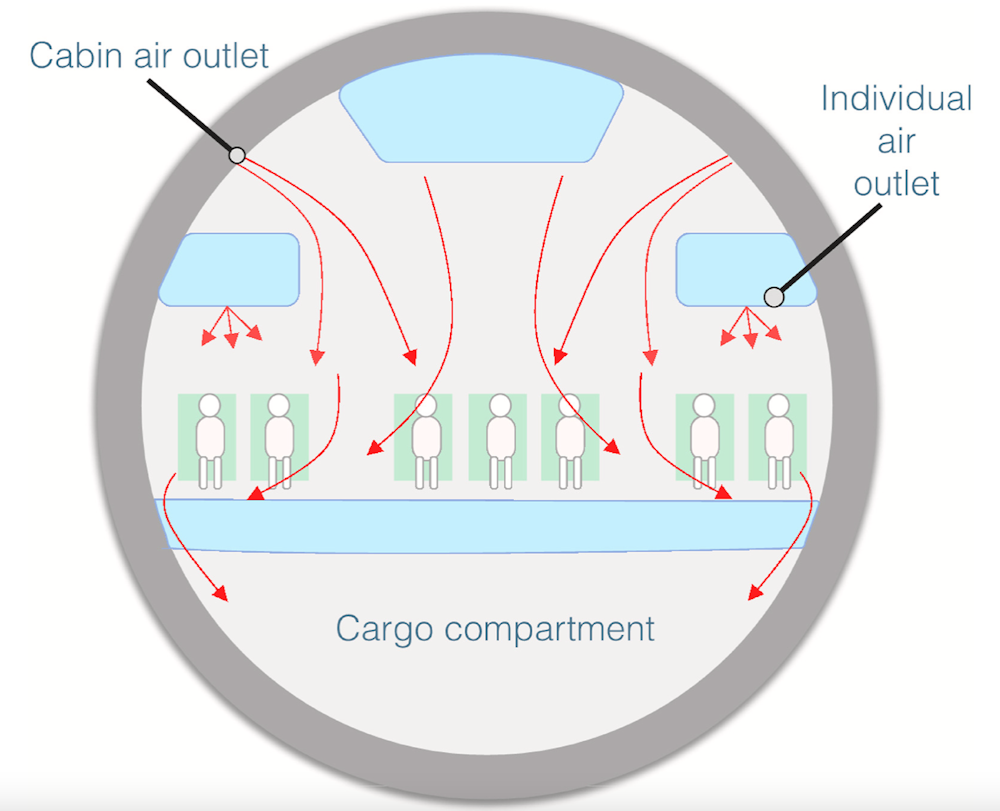
But the direction of the airflow is also important. For example, airflow from an air conditioner (that was recirculating air rather than pulling it from outside) was implicated in spreading the virus to a number of diners at tables downstream in a restaurant in China.

Offices welcoming back staff should prepare their air conditioners by having their engineers service the system to pull in fresh air faster than the pre-COVID setting (which may have been around 40 litres per second per person) at no less than 60 litres per second, per person.

In hospitals, aged-care facilities and hotel quarantine, qualified engineers should be brought in to assess the adequacy of the air conditioner’s airflow. This is particularly crucial for any “hot zones” accommodating people who are COVID-positive.

The World Health Organisation recommends hot zones have 12 airflow changes per hour (that’s 80 litres per second per person), meaning the air is totally replaced 12 times every 60 minutes. This is the gold standard for ventilation, and can be very hard to achieve in many buildings.


Read more: Many of our buildings are poorly ventilated, and that adds to COVID risks


3. Use fans

Guidelines released last week by the US Centers for Disease Control and Prevention recommend placing fans near open windows to enhance airflow. The recommendation is to keep fans on at all times when a room is occupied, for example at restaurants.

As with aircons, fans can be dangerous if they push the air directly from one person to another, and one is infectious. You should place the fan so it increases the flow of fresh air into the room, and shouldn’t be placed so the air moves from the room towards the open window or open door.

4. Don’t bother with HEPA filters at home

High-efficiency particulate air (HEPA) filters have been marketed as a way to reduce the concentration of SARS-CoV-2 particles in the air.

Their effectiveness is dependent on the airflow capacity of the unit, the configuration of the room, the number of people in the room, and the position of the filter in the room.

But there’s no evidence to suggest a portable HEPA filter unit will help in your home. So don’t rush out and buy one for Christmas.

They may be effective in some areas of health care, such as a COVID ward in a hospital or in aged care homes, particularly when used in negative-pressure rooms. The combination of the HEPA filter and negative air pressure reduces the risk of aerosol particles escaping into the corridor.

5. In public transport, taxis and Ubers

COVID outbreaks have been traced back to exposure on public transport. For example, a young man in Hunan Province, China, travelled on two buses and infected multiple people who were sitting in different areas of the buses. A study of this cluster was carried out by Chinese researchers, who put forward one theory regarding air flow:

The closed windows with running ventilation on the buses could have created an ideal environment for aerosol transmission […] the ventilation inlets were aligned above the windows on both sides, and the exhaust fan was in the front, possibly creating an airflow carrying aerosols containing the viral particles from the rear to the middle and front of the vehicle.

The study’s authors recommend all windows be open on public transport to help disperse viral particles. If you’re on a tram or a bus, you should open them if you can.

However, on some forms of public transport it might be impossible, like trains. In these instances, you should wear a mask.

Likewise, it’s ideal to have the windows down in Ubers and taxis. But if you can’t or don’t want to, turn on the air conditioner and have it pull fresh air from outside. And still wear a mask!

ref. 5 tips for ventilation to reduce COVID risk at home and work – https://theconversation.com/5-tips-for-ventilation-to-reduce-covid-risk-at-home-and-work-151758

‘I felt immense grief’: one year on from the bushfires, scientists need mental health support

Source: The Conversation (Au and NZ) – By Daniella Teixeira, Researcher, Griffith University

One night in January 2020, I couldn’t sleep. I kept waking to check my phone for news from Kangaroo Island, off South Australia. Fires had already burned through several sites where I’d researched the island’s endangered glossy black cockatoos, and now it was tracking towards two critical habitat areas.

The areas were crucial to the birds’ feeding and nesting. I knew losing these places would be a disaster for the already small and isolated population. At home in Queensland, I felt helpless and anxious.

As ecology students, we learn a lot about the problems facing the most vulnerable life on Earth, but not how to cope with them. And as conservationists, we front up to ecological devastation each day, but sometimes without the professional support to help us deal with the emotional consequences.

This was exceptionally clear to me during the Black Summer fires. I was in no way equipped to deal with the possible extinction of my study species.

The author, Danielle Teixeira, with a glossy black cockatoo.
The author, Daniella Teixeira, with a glossy black cockatoo. Mike Barth

What chance of survival?

The fires destroyed almost everything on the western half of Kangaroo Island. Most of Kangaroo Island’s glossy black cockatoo population lived in the burnt areas, and I was anxious to know their fate.

A colleague on the island emailed with some news. One critical habitat area I was concerned about, Parndarna Conservation Park, had been destroyed. The fires reached the other habitat area, Cygnet Park, but thankfully most of it was saved.

The eastern end of Kangaroo Island was untouched. This offered a sliver of hope; if the remaining habitat could be saved, the glossy black cockatoos had a chance of surviving.


Read more: ‘This situation brings me to despair’: two reef scientists share their climate grief


I started urgently raising money and dealing with media requests. Taking these pressures off the team on the island was one way I could be useful from afar.

As the fires raged, and for weeks afterwards, I poured immense energy into this mission, spurred by the belief that conservationists must be strong and resilient in the face of disaster. But I was stressed and worried. How could the island possibly recover from such a fire? What is my role as a scientist in such a crisis?

At one point, a friend and fellow conservationist checked in. He reminded me that taking time out is OK. I was thankful to hear this from another scientist; it made me feel better about periodically stepping away from my inbox and the ever-expanding fire scar maps.

Burnt landscape on Kangaroo Island
Conservationists are not always well equipped to deal with the tragedies they face. Daniel Mariuz/AAP

Heading back to Kangaroo Island

I returned to Kangaroo Island in late February. Until then, I had not grasped the gravity of the island’s condition. In many places, no birdsong remained. The wind no longer rustled through the needles of the she-oak trees.

The most difficult time was returning to a nesting site of the glossy black cockatoo which I knew well. I found nest trees burnt to the ground. Their plastic artificial nest hollows, built to encourage breeding, were a melted mess.

A nest box that melted in the fires.
A nest box that melted in the fires. Daniella Teixeira

Remarkably, amid the charred remains I found an active nest. The female watched me intently; she didn’t flee or make a sound. I watched her, amazed, and hoped there was enough food to support the four-month nesting period.

I felt immense grief standing at the nesting site. I grieved not only for the glossy black cockatoos and other damaged species, but also the loss that would come in the future under climate change.

At that time, we didn’t know how many cockatoos remained. But thankfully, in the following months it became clear most cockatoos escaped the inferno. In 2016, 373 birds were counted on the island, and those numbers increased before the bushfires, thanks to conservation efforts. In spring this year, field staff and volunteers counted at least 454 birds on the island.

It was a wonderful but surprising result, which might not have been the case if the fires took place during the breeding season when the cockatoos would be reluctant to abandon their nests. The concern now is whether the remaining habitat can maintain the population over time.

Coping with ecological grief

In the year since the fires, my acute grief at the plight of nature has lifted. But an underlying sadness, and concern for the future, remains. From my discussions with other conservationists, I know I’m not the only one to feel this way.

glossy black cockatoos on a branch
The fires destroyed critical habitat for glossy black cockatoos. Dean Ingwersen

Black Summer was a wake-up call for me. As an early career scientist, I will inevitably face more crises, and dealing with them effectively means keeping my mental health in check. I believe conservationists should be offered more mental health education and support. I don’t have all the solutions, but offer a few ideas here.

Universities and workplaces offer limited counselling services, but they may not be enough when grief is an inherent part of your job. I believe there is scope for more ongoing support for conservationists, which should be integrated into regular workplace practices and training.

Regular discussions with supervisors and colleagues can also help. I find such open and honest discussions very beneficial. There is a shared sense of grief, as well as purpose.

Importantly, we should all work to break down the culture that says action is the only response to environmental disasters. Some conservation scientists feel they are risking their reputation or career progression by taking time out. But they must be given space to process emotions such as grief and anger, without guilt or shame.


Read more: Hope and mourning in the Anthropocene: Understanding ecological grief


And scientists are easily overworked and overwhelmed in workplaces, such as universities, when productivity and output takes priority over the welfare of staff.

Since Black Summer, I have made a concerted effort to spend more time in nature. I listen to birdsong and the wind, and marvel at the complexity of life. I do this not to remember what I’m fighting to save, but simply because it brings me joy.

The author with a nestling cockatoo
The author, with a nestling glossy black cockatoo, says conservation scientists need more mental health support. Mike Barth

Read more: I’m searching firegrounds for surviving Kangaroo Island Micro-trapdoor spiders. 6 months on, I’m yet to find any


ref. ‘I felt immense grief’: one year on from the bushfires, scientists need mental health support – https://theconversation.com/i-felt-immense-grief-one-year-on-from-the-bushfires-scientists-need-mental-health-support-148251

Our research shows more Australians receive unemployment payments than you think

Source: The Conversation (Au and NZ) – By Peter Whiteford, Professor, Crawford School of Public Policy, Australian National University

Australians receiving unemployment payments are often negatively portrayed as a relatively small group of people with personal or behavioural problems that stop them from getting a job.
The unparalleled growth in unemployment during COVID-19 has opened up significant space to challenge long-held perceptions of “them and us” when it comes to welfare.


Read more: Who’s really behaving badly? Confronting Australia’s cashless welfare card


Nevertheless, extra support to Australia’s unemployed has already been substantially wound back — with plans to do so again by the end of the year.

Our new study, by a team at the Brotherhood of St Laurence, RMIT University and the Australian National University, highlights significant misunderstandings about the scale and scope of Australians who received Newstart — the unemployment payment replaced by JobsSeeker Payment earlier this year.

Bottom line? It’s much more common to get the payment than you think.

‘Everyone counts’: our research

This study makes use of a Department of Social Services database that records every interaction with Centrelink. This is the first time results from this database have been published by independent researchers.

It has given us an important opportunity to track how people have used unemployment payments — specifically Newstart Allowance — from 2001 to 2016 (the years available for study).


Read more: Forget JobSeeker. In our post-COVID economy, Australia needs a ‘liveable income guarantee’ instead


We took a simple but new approach: to count every individual who ever received Newstart between those years.

Most statistics on the number of people receiving payments are reported as the “stock”, which is the number of recipients on a specific date in that year. With these new data, we are able to measure the “flow”, which is the number of people who ever received a payment during the course of each year, as well as over the whole period since 2001.

Our analysis is part of broader research that aims to gain a clearer understanding of the dimensions of “income volatility” (sudden changes in income) in Australia.

How many people receive payments?

We found receiving unemployment payments was much more common than previously thought during the study period.

For example, between 2013 and 2016, the number of people receiving Newstart at the end of the financial year ranged between 660,000 and 750,000. But over the course of each of those years, well over 1.1 million separate individuals received an unemployment payment.

This suggests approximately one in 11 people (9%) in the labour force received Newstart in any of these years.

Overall, when we look at the “flow” figures, more than 4.4 million people received Newstart between 2001 and 2016 (nearly 2.5 million men and 2 million women). This is nearly one quarter of the qualified working-age population over this period.


Author provided/The Conversation, CC BY-ND

We also found the proportion of women receiving Newstart increased from 30% in 2001 to 46% in 2016. In part this reflects policy changes that predominantly affected women, such as restricting access to parenting payments and the increase in the Age Pension age for women.

Time spent on welfare varies

There is a widely-held view that many unemployed people rely on the payment for a long time. But our analysis provides a mixed picture on this point.

Nearly half of the Newstart population of 4.4 million (47%) received the payment for less than a year. Over two-thirds (68%) received it for less than two years.

So this would appear to contradict the idea most people rely on it long-term. However, it remains important to recognise that a significant minority still do.

At the other extreme, around 15% were on the payment for a total of five or more years. About 3.6% had been on it for ten or more years.


Author provided/The Conversation, CC BY-ND

Between the two extremes — people who had only one short period on Newstart and people who spent most of these years on it — there are a multitude of differing patterns. This reflects both the ups and downs of the Australian labour market and the volatile circumstances experienced by many working-age Australians.

Dramatic rise in payment suspensions

Fluctuating income is a key cause of household financial and emotional stress. It can affect well-being as much as (if not more than) low wages.

For people receiving an income support payment, the disruption caused by uncertain income is even worse — even a day’s delay in payment can have major consequences when it comes to paying bills or rent.

People on Newstart (now JobSeeker) can have their payments suspended either for not reporting their income correctly or not meeting job-seeking requirements. Successive governments have increasingly sought to enforce this — which has led to more uncertainty around the payment.

Our study found rates of suspension increased dramatically over the study period, from 2% in 2001 to 11% to 2016. Of those who were suspended, the likelihood of experiencing multiple suspensions increased from 2.3% to 14%.


Author provided/The Conversation, CC BY-ND

Women were more likely to have been suspended on multiple occasions than men. In 2016, 12.7% of the 556,000 women who received Newstart were suspended, compared to 9.8% of the 653,000 men.

Social security is not a ‘marginal’ issue

The biggest lesson of our study is that the idea social security payments are confined to a group of unfortunate individuals and families living at the margins of society is incorrect.

Our findings show how short-term reliance on unemployment benefits is relatively common. Social security, like healthcare and education, should be viewed as a core part of mainstream Australian life.


Read more: When the Coronavirus Supplement stops, JobSeeker needs to increase by $185 a week


Our insights also demonstrate that while longer-term reliance on Newstart is an important policy issue, short-term reliance is underestimated. They also shed new light on the increasing share of recipients — especially women — who are facing irregular payments due to suspensions.

Along with ongoing concerns about the adequacy of income support payments – highlighted once again by a recent Senate inquiry, as well as by business groups like the Australian Retailers Association — this raises questions about the extent to which the Australian social security system is effectively fulfilling its stated mission,

to improve the lifetime well-being of individuals and families.

ref. Our research shows more Australians receive unemployment payments than you think – https://theconversation.com/our-research-shows-more-australians-receive-unemployment-payments-than-you-think-151289

Revenue-contingent wage loans, a proposal for supporting jobs in times of crisis

Source: The Conversation (Au and NZ) – By Robert Costanza, Professor and VC’s Chair, Crawford School of Public Policy, Australian National University

As JobKeeper is wound back, businesses are tentatively preparing to stand on their own feet.

What follows is a simple proposal to help them share the risk (and rewards) with their workers.

It has features in common with the government’s Higher Education Contributions Scheme (HECS) in which university students get help with fees in return for making their own contribution when (and if) circumstances allow.

Recently a variant has been suggested for farms, whose income is notoriously variable and unsuited to conventional loans with regular repayment schedules.

What’s proposed is an arrangement contingent on business revenue rather than personal income as with HECS.

Farm businesses would borrow from the government or banks and make repayments when conditions permitted. It would cost taxpayers much less than subsidies or grants.

Employers could ‘borrow’ from workers

We are proposing the same sort of arrangement between employers and employees.

Universities, for example, might consider revenue-contingent salary reductions as an alternative to redundancies.

All staff or staff at risk of being made redundant might be offered a 10% salary reduction that would be refunded by the university when (and only if) its revenue bounced back by a agreed amount in the future.


Read more: Bowing out gracefully: how they’ll wind down JobKeeper


If the university’s fortunes did bounce back, the staff affected would be repaid the income they lost.

Such a scheme would support employees at risk as did JobKeeper, while maintaining the employeer-employee relationship as did JobKeeper.

It ought to work in all sorts of enterprises.

For many, jobs matter more than income

Wellbeing and life satisfaction are often more dependent on job security than they are on salary, suggesting that many people would be willing to trade-off one for the other.

Introduced through enterprise bargaining and policed by Fair Work Australia, such an arrangement might well be a win-win for workers and the enterprises they work in.

It ought to be added to the menu of possibilities being considered to support businesses and workers when JobKeeper ends on March 28.

ref. Revenue-contingent wage loans, a proposal for supporting jobs in times of crisis – https://theconversation.com/revenue-contingent-wage-loans-a-proposal-for-supporting-jobs-in-times-of-crisis-151565

Decoding the music masterpieces: Handel’s Messiah oratorio, composed in just 24 days

Source: The Conversation (Au and NZ) – By Zoltan Szabo, Cellist and musicologist, University of Sydney

The tradition of performing George Frideric Handel’s Messiah is as inseparable from festivities preceding Christmas as the oversweet carol arrangements oozing through loudspeakers at shopping centres.

It’s a tradition worth noticing, as the Messiah was originally composed as an Easter offering, first performed in Dublin on April 13, 1742. With lines such as, “He was despised and rejected of men, a man of sorrows and acquainted with grief”, this is understandable.

It is curious why this masterpiece, structured in three parts and performed for hundreds of years at Easter, gradually became a ubiquitous element of the Christmas traditions. After all, once Part I finishes, the narrative focuses on the life, suffering, death and eventual resurrection of Jesus. But over the past 70 or so years, it has become a Christmas staple, almost guaranteeing sell-out performances.

Messiah performances come in all sizes. The original one featured the voices of 16 men and 16 boys, accompanied by a small instrumental ensemble (most likely one player per part).

For many an amateur choir, this work is a recurring highlight of their repertoire. Before coronavirus destroyed so many plans, festive presentations of the oratorio included full orchestras and a large choir.

Though not for the purist, there have been even mightier performances in the past, where certain numbers (including the celebrated Hallelujah chorus) were sung by up to 600 non-professional, but enthusiastic singers, supported by a large orchestra and a grand organ.

A remarkable talent

Handel was not an Englishman, notwithstanding the fact he spent a large part of his life in London: from 1710 until his death 49 years later. He was born in Halle, Germany, in 1685, the same year as his compatriot, Johann Sebastian Bach.

Portrait of George Frideric Handel composing next to a manual harpsichord, circa 1730. Wikimedia Commons

Unfortunately, the two giants of Baroque music never met — what a conversation that could have been.

From his adolescence, the young Händel exhibited a remarkable talent composing, and playing organ and keyboard. He composed his first opera, Almira, at the age of 18.

He travelled extensively in Italy, mastering the local language and the traditions of writing opera before moving to London in 1712. He adapted to the English lifestyle well.

His reputation as an exceptional opera composer was such that, due to the constant demand, he composed 40 operas during the next three decades. He developed his own, idiomatic style of writing opera in Italian to such heights that he was able to write his brilliant Rinaldo in merely two weeks.

Some of Rinaldo’ s arias, such as Lascia ch’io pianga, became so famous they are regularly performed in concert performances on their own.


Read more: Decoding the music masterpieces: Rossini’s opera, Otello


From operas to oratorios

The much-celebrated composer was also known for his astute business acumen. His investments brought him an excellent return, and he was even active on the London share market. The same shrewd sense of recognising how his artistic investments would best work helped him to change his central interest gradually from operas in Italian to oratorios in English.

An oratorio is somewhat similar to an opera: it is performed by solo singers, a chorus and an orchestra. Unlike an opera, however, its narrative is always based on a religious topic and it is unstaged.

Due to the lack of scenery, costumes and visible interaction between the singers on stage, the action in an oratorio has to be described, rather than played out.

The chorus plays an important role in an oratorio. shutterstock

The role of the chorus is also more important, reminiscent of the traditions of ancient Greek dramas. On the practical side, putting on an oratorio was less expensive, as its success did not depend on hiring foreign (mostly Italian) star singers.

A lightening pace

From the early 1730s, Handel recognised a change in the taste of his audience and turned more towards writing oratorios. Messiah is his sixth work in this genre, (he wrote 25 oratorios in total).

As if in a frenzy, he composed the complete work in 24 days, taking about a week for each of its three parts. To assist this pace, he did recycle some of his earlier composed music, a common practice at the time.

The text of the oratorio is the work of Charles Jennens. It is based mostly on the Old Testament, as it celebrates the arrival of the Messiah, the saviour of mankind, also called Jesus Christ. Unusually, there is no dialogue in it.

The oratorio vaguely follows the events of the liturgical year, from the virgin birth prophesied at the beginning of Part I, through the life, suffering and death of Christ in Part II, to the promise of redemption in Part III.

Almost all movements are vocal, with only the Pifa (the sound of bagpipes, representing the shepherds arriving to Bethlehem) and the opening movement being fully instrumental. The Ouverture sets the mood of the work with a slow and majestic beginning, continuing with a lively fugue.


Read more: Decoding the music masterpieces: Bach’s The Art of Fugue


Most of the movements are either chorus or solo numbers, the solos being a combination of arias and recitativos. The arias usually express emotions, whereas the narrative is typically transmitted through the recitativos.

The latter are either accompanied by all the string players, a method called recitativo accompagnato (as in “Comfort ye, comfort ye my people”), or by a few bass instruments, in which case they are called recitativo secco (for example, “Behold, a virgin shall conceive”).

There are an unusually high number of chorus movements in Messiah. No wonder it is such an eternal favourite for choirs, amateur or professional. Best loved among them is the Hallelujah chorus, ending Part II.

There is an endearing tradition of the audience rising from their seats as one upon hearing the opening sound. The reason for this is a mystery. The commonly cited explanation is that King George II stood up at this point at the 1743 London premiere of the work.

However, this seems unlikely, as His Majesty could not possibly have known what glorious piece of music was about to begin. Could the explanation for such a magisterial gesture be simply a severe case of pins and needles or some other trivial cause?

Re-orchestrated by Mozart

Messiah conquered in England and on the continent. In 1776, Baron Gottfried van Swieten, an Austrian diplomat, librarian, connoisseur of music and patron and friend of Haydn, Mozart and Beethoven, brought the newly published score of the Messiah from London to Vienna. He wanted to hear it in a full-scale performance and commissioned Mozart to re-orchestrate the oratorio to appeal to contemporary tastes.

Mozart decided to use a German text based on Martin Luther’s translation of the Bible and added new parts for woodwind and brass instruments. He also cut a few movements and rearranged the order of others. Undoubtedly, this version sounds more powerful with the enlarged orchestral powers; there are, for example, three trombones added to the opening of the oratorio.

On the sixth day of April 1759, George Frideric Handel, in poor health, bedridden and almost completely blind, made an unusual request. He wanted to go to the Theatre Royal in London’s Covent Garden, to attend a Messiah performance.

Very possibly, this was the last music he ever heard; barely a week later, the 74-year-old composer was dead.

A COVID-safe performance of Handel’s Messiah was performed last week in Sydney and streamed via Melbourne Digital Concert Hall. You can listen to it here. The Messiah will also be performed at Perth Concert Hall on December 19.

ref. Decoding the music masterpieces: Handel’s Messiah oratorio, composed in just 24 days – https://theconversation.com/decoding-the-music-masterpieces-handels-messiah-oratorio-composed-in-just-24-days-151092

The ‘epicentre of women’s suffrage’ — Kate Sheppard’s Christchurch home finally opens as a public museum

Source: The Conversation (Au and NZ) – By Katie Pickles, Professor of History, University of Canterbury

Kate Sheppard was around 40 in 1888, the year she and her family moved into the brand-new wooden villa at 83 Clyde Road, Ilam. Now part of inner Christchurch, it was then a rural section some five kilometres from the city centre.

Today, 132 years later, what is now known as Te Whare Waiutuutu Kate Sheppard House will be opened by Prime Minister Jacinda Ardern.

The government bought the house in 2018 to mark the 125th anniversary of women’s suffrage and its former owner’s pivotal role in the movement. The landmark property will now be open to the public as a museum promoting and and celebrating Sheppard’s life and achievements.

The feminist pioneer had migrated to Christchurch from Scotland in 1869. She married city councillor and merchant Walter Sheppard in 1871. Their son Douglas was seven when they moved into Clyde Road, which was near where her two sisters, a brother and friends already lived.

Because women were largely excluded from the male world of politics, the house served as both home and unpaid workplace. Emblematically, a domestic space was the epicentre of woman’s suffrage, birthplace of the campaign that would see New Zealand become the first country in the world to enfranchise all women, regardless of race, class or creed, on September 19, 1893.

A centre of activism

During the prime years of her activism, from 1888 until 1902, Sheppard worked in the house, writing letters, speeches and articles. It was where newspapers and books were read, ideas formed and actions plotted. Other women activists, such as Ada Wells, and male supporters Alfred Saunders and John Hall were regular visitors.

It was in the dining room that the iconic third petition, with 32,000 signatures from around the country, was pasted together and wrapped around a wooden handle for Hall to roll down the aisle in parliament. And it was where the suffrage victory was celebrated.


Read more: Why New Zealand was the first country where women won the right to vote


After 1893 the property remained a hub of feminist ideas for social change. As Sheppard later put it, there were still many “fossilised prejudices” to work on. In 1896, she became the founding president of the National Council of Women, directing activities and fostering international connections from the house.

Kate Shappard
Kate Sheppard.

Sheppard worked hard, advocating for health and well-being, education and social, political and economic justice. The Married Women’s Property Act 1884 and the Divorce Act 1898 were two further important feminist victories, but it took until 1910 for the repeal of the 1869 Contagious Diseases Act, which unfairly targeted prostitutes.

Sheppard believed in women’s economic independence, their place in the professions and equal pay for equal work. She campaigned for women to be able to stand for parliament, to be appointed as justices of the peace, to act as jurors and to be guardians of children.

Despite its illustrious history, the Clyde Road house was mostly overlooked for decades. But thanks to a succession of owner-occupiers who poured love and money into the villa, it has not only survived but thrived.

John Joseph Dougall, lawyer and mayor of Christchurch from 1911 to 1912, bought the house from Walter Sheppard and undertook grand Edwardian improvements. It was further extended and modernised during the ownership of Julia Burbury and family, who for 33 years were the last private owners.


Read more: Did a tragic family secret influence Kate Sheppard’s mission to give New Zealand women the vote?


Unlisted and largely unknown when Burbury bought it, the house eventually became a category one historic place in 2010. By then, a second wave of feminism had raised the status of women’s history, recovering and celebrating Sheppard and her colleagues as role models.

Brick house
The Pankhurst Centre, former home of Emmeline Pankhurst where the suffragette movement began in Manchester, England. GettyImages

A feminist shrine?

With the 1993 suffrage centenary and Sheppard’s likeness gracing the New Zealand $10 note, she has become a national heroine. Is her house likely to become something of a feminist shrine, too? If so, it would be part of a global trend.

In 1965, the family home of US women’s rights pioneer Elizabeth Cady Stanton in Seneca Falls, New York, became a National Historical Landmark. She lived there from 1847 until 1862, and referred to the farmhouse as the “centre of the rebellion”.

It is now part of the extensive Women’s Rights National Historical Park. Opened in 1980, it focuses on the first Women’s Rights Convention held in Seneca Falls in 1848, but claims a broad philosophical brief:

It is a story of struggles for civil rights, human rights, and equality, global struggles that continue today. The efforts of women’s rights leaders, abolitionists, and other 19th century reformers remind us that all people must be accepted as equals.

The former home of Cady Stanton’s suffrage partner, Susan B. Anthony, also became a National Historic Landmark in 1965. The celebrated American civil rights leader ran the National American Woman Suffrage Association from the house in Rochester, New York, where she lived until her death in 1906.

Today, the Susan B. Anthony Museum and House “collects and exhibits artifacts related to her life and work, and offers tours and interpretive programs to inspire and challenge individuals to make a positive difference”.

In Britain, Manchester’s Pankhurst Centre opened in 1987 as “an iconic site of women’s activism, past and present”. The home of suffragette Emmeline Pankhurst and her family from 1898 to 1907, the first meeting of the Women’s Social and Political Union (WSPU) took place in its parlour.


Read more: NZ was first to grant women the vote in 1893, but then took 26 years to let them stand for parliament


Keeping activism alive, the house is also a women’s centre and home to Manchester Women’s Aid, a service for victims of domestic abuse. It seeks to be a “unique and vibrant place where women can learn together, work on projects and socialise”.

With hindsight, early European feminists were reformers, but they could also be agents of colonisation. In Aotearoa New Zealand, their connections with Māori focused on temperance and they tended to assume assimilation was inevitable.

In the US and Britain the emerging feminist “shrines” have attempted to widen their remits accordingly. How Te Whare Waiutuutu Kate Sheppard House views its purpose and makes public history is a story that begins today.

ref. The ‘epicentre of women’s suffrage’ — Kate Sheppard’s Christchurch home finally opens as a public museum – https://theconversation.com/the-epicentre-of-womens-suffrage-kate-sheppards-christchurch-home-finally-opens-as-a-public-museum-151828

Marine protection falls short of the 2020 target to safeguard 10% of the world’s oceans. A UN treaty and lessons from Antarctica could help

Source: The Conversation (Au and NZ) – By Natasha Blaize Gardiner, PhD Candidate, University of Canterbury

Two-thirds of the world’s oceans fall outside national jurisdictions – they belong to no one and everyone.

These international waters, known as the high seas, harbour a plethora of natural resources and millions of unique marine species.

But they are being damaged irretrievably. Research shows unsustainable fisheries are one of the greatest threats to marine biodiversity in the high seas.

According to a 2019 global assessment report on biodiversity and ecosystem services, 66% of the world’s oceans are experiencing detrimental and increasing cumulative impacts from human activities.

In the high seas, human activities are regulated by a patchwork of international legal agreements under the 1982 UN Convention on the Law of the Sea (UNCLOS). But this piecemeal approach is failing to safeguard the ecosystems we depend on.


Read more: The world’s ocean is bearing the brunt of a changing climate. Explore its past and future in our new series


Empty pledges

A decade ago, world leaders updated an earlier pledge to establish a network of marine protected areas (MPAs) with a mandate to protect 10% of the world’s oceans by 2020.

But MPAs cover only 7.66% of the ocean across the globe. Most protected sites are in national waters where it’s easy to implement and manage protection under the provision of a single country.

In the more remote areas of the high seas, only 1.18% of marine ecosystems have been gifted sanctuary.

The Southern Ocean accounts for a large portion of this meagre percentage, hosting two MPAs. The South Orkney Islands southern shelf MPA covers 94,000 square kilometres, while the Ross Sea region MPA stretches across more than 2 million square kilometres, making it the largest in the world.

Weddell seal pup and mother
Currently, the world’s largest marine protected area is in the Ross Sea region off Antarctica. Natasha Gardiner, CC BY-ND

The Commission for the Conservation of Antarctic Marine Living Resources (CCAMLR) is responsible for this achievement. Unlike other international fisheries management bodies, the commission’s legal convention allows for the closing of marine areas for conservation purposes.

A comparable mandate for MPAs in other areas of the high seas has been nowhere in sight — until now.


Read more: An ocean like no other: the Southern Ocean’s ecological richness and significance for global climate


A new ocean treaty

In 2017, the UN started negotiations towards a new comprehensive international treaty for the high seas. The treaty aims to improve the conservation and sustainable use of marine organisms in areas beyond national jurisdiction. It would also implement a global legal mechanism to establish MPAs in international waters.

This innovative international agreement provides an opportunity to work across institutional boundaries towards comprehensive high seas governance and protection. It is crucial to use lessons drawn from existing high seas marine protection initiatives, such as those in the Southern Ocean, to inform the treaty’s development.

The final round of treaty negotiations is pending, delayed by the COVID-19 pandemic, and significant detail within the treaty’s draft text remains undeveloped and open for further debate.

Lessons from Southern Ocean management

CCAMLR comprises 26 member states (including the European Union) and meets annually to make conservation-based decisions by unanimous consensus. In 2002, the commission committed to establishing a representative network of MPAs in Antarctica in alignment with globally agreed targets for the world’s oceans.

The two established MPAs in the high seas are far from an ecologically representative network of protection. In October 2020, the commission continued negotiations for three additional MPAs, which would meet the 10% target for the Southern Ocean, if agreed.

But not a single proposal was agreed. For one of the proposals, the East Antarctic MPA, this marks the eighth year of failed negotiations.

Fisheries interests from a select few nations, combined with complex geopolitics, are thwarting progress towards marine protection in the Antarctic.

Map of marine protected areas around Antarctica.
CCAMLR’s two established MPAs (in grey) are the South Orkney Islands southern shelf MPA and the Ross Sea region MPA. Three proposed MPAs (hashed) include the East Antarctic, Domain 1 and Weddell Sea proposals. C. Brooks, CC BY-ND

CCAMLR’s progress towards its commitment for a representative MPA network may have ground to a halt, but the commission has gained invaluable knowledge about the challenges in establishing MPAs in international waters. CCAMLR has demonstrated that with an effective convention and legal framework, MPAs in the high seas are possible.

The commission understands the extent to which robust scientific information must inform MPA proposals and how to navigate inevitable trade-offs between conservation and economic interests. Such knowledge is important for the UN treaty process.


Read more: Why are talks over an East Antarctic marine park still deadlocked?


As the high seas treaty moves closer to adoption, it stands to outpace the commission regarding progress towards improved marine conservation. Already, researchers have identified high-priority areas for protection in the high seas, including in Antarctica.

Many species cross the Southern Ocean boundary into other regions. This makes it even more important for CCAMLR to integrate its management across regional fisheries organisations – and the new treaty could facilitate this engagement.

But the window of time is closing with only one round of negotiation left for the UN treaty. Research tells us Antarctic decision-makers need to use the opportunity to ensure the treaty supports marine protection commitments.

Stronger Antarctic leadership is urgently needed to safeguard the Southern Ocean — and beyond.

ref. Marine protection falls short of the 2020 target to safeguard 10% of the world’s oceans. A UN treaty and lessons from Antarctica could help – https://theconversation.com/marine-protection-falls-short-of-the-2020-target-to-safeguard-10-of-the-worlds-oceans-a-un-treaty-and-lessons-from-antarctica-could-help-151282

A mental disorder, not a personal failure: why now is the time for Australia to rethink addiction

Source: The Conversation (Au and NZ) – By Dan Lubman, Executive Clinical Director, Turning Point & Director of Monash Addiction Research Centre, Monash University

The year 2020 has challenged us all. The bushfires and then the pandemic forced us to reflect on what’s important, how we respond to crises as a community, and the ways we connect and support each other.

We’re still grappling with what the long-term mental health effects of this period of fear, insecurity and social disconnection might be.

At the start of the pandemic we saw a surge in alcohol sales and reported drinking. Almost one-third of people who purchased more alcohol expressed concerns about their own drinking, or that of someone in their household.

People often turn to alcohol or other drugs to help cope with stress, financial pressures, loss and trauma. Increases in drinking are consistently reported after natural disasters, acts of terrorism and economic crises.

It’s therefore timely to reflect on our perceptions of addiction, who is affected, and how we respond.

What is addiction?

In simple terms, addiction is the inability to stop consuming a drug or cease an activity, even if it’s causing physical or psychological harm.

A common misconception is that it’s a result of a lack of willpower or poor self-control. But in reality, addiction is a complex health disorder with a range of biological, developmental and environmental risk factors, including trauma, social isolation or exclusion, and genetics.

Around one in four Australians will develop an alcohol, drug or gambling disorder during their lifetime, and around one in 20 will develop addiction, the most severe form of the disorder.

Despite common stereotypes, addiction doesn’t discriminate. It affects people of all ages and from all backgrounds.

A group therapy session. One woman is standing and addressing three others.
It often takes people experiencing addiction a long time to seek treatment. Shutterstock

Stigma is disabling

Addiction remains one of the most stigmatised of all health conditions globally. We grant compassion to people with health conditions like cancer, heart disease or diabetes, yet society doesn’t offer that same concern to someone with an addiction.

Too often, we blame the individual, believing the addiction is their fault. But addiction is an unfortunate consequence of something much more complex.


Read more: Drug rehab: what works and what to keep in mind when choosing a private treatment provider


As a consequence of feeling shame and judgement, it can often take people many years to seek help. This is compounded by multiple barriers to treatment (such as geography, cost, waiting times and concerns about privacy).

Yet our refusal to have an honest conversation about how we respond to tobacco, alcohol, drug and gambling-related harm comes at a significant cost to the Australian community, exceeding A$175 billion annually.

A broken system

Across Australia, treatment for addiction remains fragmented, with limited opportunities for ongoing care. There’s no consistent national planning, despite evidence that for every $1 invested in treatment, society gains $7.

The situation is exacerbated by a health workforce that has had limited opportunities for undergraduate and postgraduate training in addiction, meaning emergency and primary care systems frequently struggle to respond.

This is in stark contrast with other chronic health conditions, such as diabetes, asthma and heart disease, where there are clear training pathways, clinical guidelines and national models of care.

A man holds a small packet with white powder in one hand, and his phone in the other hand.
Addiction continues to have stigma attached to it. Shutterstock

So, many individuals suffering from addiction and their families are left to navigate their own pathways to treatment.

A tragic consequence of this fragmented and failing system is that we continue to see preventable deaths associated with different types of addiction.


Read more: How a simple brain training program could help you stay away from alcohol


Tackling the stigma

The recent SBS documentary series Addicted Australia follows ten brave Australians and their families as they seek professional help for addiction over a six-month period. It’s an important step in challenging prevailing myths and stereotypes around addiction.

The series opens the door to the realities of addiction, providing viewers with a deeper understanding of the disorder, the devastating effect it has on individuals and families, and what effective treatment and recovery looks like when people have access to a holistic model of care.

The hope is that this series will help change community perceptions about the reality of addiction, elevate expectations about what treatment should look like, and alter the narrative such that recovery is not just a possibility, but like for other health conditions, is a realistic goal.

Addicted Australia, which recently aired on SBS, is now available on SBS On Demand.

A call to action

Treating addiction like any other health disorder has to start with strong public policy reform and intervention to ensure the health system is adequately supported and resourced, so accessible and timely treatment is available to people who need it.

Until we change how we view addiction — from personal failure to a mental disorder, something we cannot control any more than we can control cancer — Australians, and millions globally, will continue to suffer.

We’ve partnered with more than 40 organisations to develop a national campaign, “Rethink Addiction”, that calls for a national action plan for addiction treatment and advocates for a change to Australia’s attitude and response to addiction.

We encourage anyone who has been touched by addiction or is passionate about reducing stigma to share their story and get involved in making the case for change.

After the year we’ve all had, there’s no better time to rethink addiction.


Read more: We’re told to ‘gamble responsibly’. But what does that actually mean?


ref. A mental disorder, not a personal failure: why now is the time for Australia to rethink addiction – https://theconversation.com/a-mental-disorder-not-a-personal-failure-why-now-is-the-time-for-australia-to-rethink-addiction-151686

Marine protection falls short of the 2020 target to safeguard 10% of the world’s oceans. Lessons from Antarctica and a UN treaty could help

Source: The Conversation (Au and NZ) – By Natasha Blaize Gardiner, PhD Candidate, University of Canterbury

Two-thirds of the world’s oceans fall outside national jurisdictions – they belong to no one and everyone.

These international waters, known as the high seas, harbour a plethora of natural resources and millions of unique marine species.

But they are being damaged irretrievably. Research shows unsustainable fisheries are one of the greatest threats to marine biodiversity in the high seas.

According to a 2019 global assessment report on biodiversity and ecosystem services, 66% of the world’s oceans are experiencing detrimental and increasing cumulative impacts from human activities.

In the high seas, human activities are regulated by a patchwork of international legal agreements under the 1982 UN Convention on the Law of the Sea (UNCLOS). But this piecemeal approach is failing to safeguard the ecosystems we depend on.


Read more: The world’s ocean is bearing the brunt of a changing climate. Explore its past and future in our new series


Empty pledges

A decade ago, world leaders updated an earlier pledge to establish a network of marine protected areas (MPAs) with a mandate to protect 10% of the world’s oceans by 2020.

But MPAs cover only 7.66% of the ocean across the globe. Most protected sites are in national waters where it’s easy to implement and manage protection under the provision of a single country.

In the more remote areas of the high seas, only 1.18% of marine ecosystems have been gifted sanctuary.

The Southern Ocean accounts for a large portion of this meagre percentage, hosting two MPAs. The South Orkney Islands southern shelf MPA covers 94,000 square kilometres, while the Ross Sea region MPA stretches across more than 2 million square kilometres, making it the largest in the world.

Weddell seal pup and mother
Currently, the world’s largest marine protected area is in the Ross Sea region off Antarctica. Natasha Gardiner, CC BY-ND

The Commission for the Conservation of Antarctic Marine Living Resources (CCAMLR) is responsible for this achievement. Unlike other international fisheries management bodies, the commission’s legal convention allows for the closing of marine areas for conservation purposes.

A comparable mandate for MPAs in other areas of the high seas has been nowhere in sight — until now.


Read more: An ocean like no other: the Southern Ocean’s ecological richness and significance for global climate


A new ocean treaty

In 2017, the UN started negotiations towards a new comprehensive international treaty for the high seas. The treaty aims to improve the conservation and sustainable use of marine organisms in areas beyond national jurisdiction. It would also implement a global legal mechanism to establish MPAs in international waters.

This innovative international agreement provides an opportunity to work across institutional boundaries towards comprehensive high seas governance and protection. It is crucial to use lessons drawn from existing high seas marine protection initiatives, such as those in the Southern Ocean, to inform the treaty’s development.

The final round of treaty negotiations is pending, delayed by the COVID-19 pandemic, and significant detail within the treaty’s draft text remains undeveloped and open for further debate.

Lessons from Southern Ocean management

CCAMLR comprises 26 member states (including the European Union) and meets annually to make conservation-based decisions by unanimous consensus. In 2002, the commission committed to establishing a representative network of MPAs in Antarctica in alignment with globally agreed targets for the world’s oceans.

The two established MPAs in the high seas are far from an ecologically representative network of protection. In October 2020, the commission continued negotiations for three additional MPAs, which would meet the 10% target for the Southern Ocean, if agreed.

But not a single proposal was agreed. For one of the proposals, the East Antarctic MPA, this marks the eighth year of failed negotiations.

Fisheries interests from a select few nations, combined with complex geopolitics, are thwarting progress towards marine protection in the Antarctic.

Map of marine protected areas around Antarctica.
CCAMLR’s two established MPAs (in grey) are the South Orkney Islands southern shelf MPA and the Ross Sea region MPA. Three proposed MPAs (hashed) include the East Antarctic, Domain 1 and Weddell Sea proposals. C. Brooks, CC BY-ND

CCAMLR’s progress towards its commitment for a representative MPA network may have ground to a halt, but the commission has gained invaluable knowledge about the challenges in establishing MPAs in international waters. CCAMLR has demonstrated that with an effective convention and legal framework, MPAs in the high seas are possible.

The commission understands the extent to which robust scientific information must inform MPA proposals and how to navigate inevitable trade-offs between conservation and economic interests. Such knowledge is important for the UN treaty process.


Read more: Why are talks over an East Antarctic marine park still deadlocked?


As the high seas treaty moves closer to adoption, it stands to outpace the commission regarding progress towards improved marine conservation. Already, researchers have identified high-priority areas for protection in the high seas, including in Antarctica.

Many species cross the Southern Ocean boundary into other regions. This makes it even more important for CCAMLR to integrate its management across regional fisheries organisations – and the new treaty could facilitate this engagement.

But the window of time is closing with only one round of negotiation left for the UN treaty. Research tells us Antarctic decision-makers need to use the opportunity to ensure the treaty supports marine protection commitments.

Stronger Antarctic leadership is urgently needed to safeguard the Southern Ocean — and beyond.

ref. Marine protection falls short of the 2020 target to safeguard 10% of the world’s oceans. Lessons from Antarctica and a UN treaty could help – https://theconversation.com/marine-protection-falls-short-of-the-2020-target-to-safeguard-10-of-the-worlds-oceans-lessons-from-antarctica-and-a-un-treaty-could-help-151282

Echoes of the Rainbow Warrior – have the lessons been learned?

The sinking of the Rainbow Warrior happened 35 years ago this year. The event had ramifications across the Pacific, and politicised a generation of New Zealanders. But in this age of climate change and global pandemic, have Kiwis held onto the lessons they learnt on that winter’s night in 1985? Matthew Scott investigates.

Print Friendly, PDF & Email

Article by AsiaPacificReport.nz

The Paris Agreement 5 years on: big coal exporters like Australia face a reckoning

Source: The Conversation (Au and NZ) – By Jeremy Moss, Professor of Political Philosophy, UNSW

On Saturday, more than 70 global leaders came together at the UN’s Climate Ambition Summit, marking the fifth anniversary of the Paris Agreement.

Prime Minister Scott Morrison was denied a speaking slot, in recognition of Australia’s failure to set meaningful climate commitments. Meanwhile, the European Union and the UK committed to reduce domestic emissions by 55% and 68% respectively by 2030.

As welcome as these new commitments are, the Paris Agreement desperately needs to be updated. Since it was passed, the production and supply of fossil fuels for export has continued unabated. And the big exporters — such as Norway, Canada, the US, Russia, Saudi Arabia and of course Australia — take no responsibility for the emissions created when those fossil fuels are burned overseas.

It’s time this changed. Australia is the world’s biggest coal exporter. And in 2019, emissions from fossil fuels exported by this nation, as well as the US, Norway and Canada, accounted for more than 10% of total world emissions, according to calculations from a research project on Australia’s carbon budget at the University of NSW, which I run. Exporting nations are not legally responsible for these offshore emissions, but their actions are clearly at odds with the climate emergency.

Business as usual

A 2019 UN report notes governments are planning to extract 50% more fossil fuels than is consistent with meeting a 2℃ target and an alarming 120% more than a 1.5℃ target, by 2030. Coal is the main contributor to this supply overshoot.

UN Secretary-General António Guterres urged all leaders to declare a climate emergency.

But rather than reducing their production of fossil fuels, many countries are doubling down and actually increasing supply. For example, in Australia, government figures show the greenhouse gas emissions from Australia’s exported fossil fuels increased by 4.4% between 2018 to 2019.

Australia is the world’s largest coal exporter and approved three new fossil fuel projects in recent months: the Vickery coal mine extension, Olive Downs and the Narrabri Gas Project

This is a worldwide trend. Let’s take Norway as another example. Norway gets the bulk of its electricity from hydropower and has partially divested its Government Pension Fund from some fossil fuels. Yet it’s also one of the largest exporters of greenhouse gases through its gas exports, behind Qatar and Russia.


Read more: 3 reasons meeting climate targets and dumping Kyoto credits won’t salvage Australia’s international reputation


The situation is mirrored in the corporate world. Many large fossil fuel companies are trumpeting their emissions reductions targets while continuing to push for new fossil fuel mining projects. BHP, one of the world’s biggest miners, stated it is reducing its emissions, yet in October the company increased its stake in an oil field in the Gulf of Mexico.

Responsibility doesn’t stop at the border

What underpins this situation is an outdated “territorial” model of responsibility for climate harms. Governments and companies seem to think responsibility stops at the border, not with the overall livability of the global climate. Once the coal, oil and gas products are loaded onto ships, they are no longer our problem.

Unfortunately, the accounting rules of the United Nations, under the Paris Agreement, currently allow exporters to pass on responsibility for fossil fuel emissions.

We must move from this territorial model of responsibility to one that considers the whole chain of responsibility for climate harms.

So what should Australia, Canada, the US, Norway and other exporting countries do to address the over-supply of fossil fuels?

First, they need to acknowledge their responsibility, at least in part, for the emissions and associated harms caused by their exports. Allowing compensation and funding for mitigation to track the role played in the causal chain better attributes responsibility and places mitigation burdens back on the exporting countries.


Read more: Global emissions are down by an unprecedented 7% — but don’t start celebrating just yet


Future climate negotiations, such as in Glasgow in 2021 (COP26), need to adjust the scope of their targets to include robust reductions in the supply of fossil fuels in the next round of agreements.

Instead of just focusing on reducing demand, the process needs to function as a kind of “reverse OPEC” (the Organisation of the Petroleum Exporting Countries), where exporting countries are given ambitious phase-out targets for their fossil fuel exports.

Drastic emissions cuts needed

The 2020 Production Gap report notes global fossil fuel production will have to decrease by 6% a year between 2020-30 to meet a 1.5℃ target.

Scott Morrison
Scott Morrison was denied a speaking slot at the Climate Ambition Summit at the weekend. AAP Image/Mick Tsikas

For Australia, this must mean we include the reduction in “exported emissions” as part of any net-zero target. Australia’s exported emissions are double our domestic emissions – a situation that cannot continue.

Top of the list of what’s needed, is the phasing out of generous subsidies for fossil fuel producers. The billions of dollars currently spent annually in Australia on subsidising and encouraging fossil fuel exports are simply not compatible with the aims and spirit of the Paris Agreement.


Read more: Matt Canavan says Australia doesn’t subsidise the fossil fuel industry, an expert says it does


Phasing out the supply of fossil fuels also needs to occur in a way that doesn’t just pay the current big suppliers to stop. Governments implementing a transition ought to think very carefully about how to fairly deploy scarce resources to ensure a just transition.

Last but not least, governments need to accept that the strong influence fossil fuel corporations wield over the political process is hindering global efforts to address climate change. The donations , rotation of industry staff to government positions and influence of fossil fuel lobby groups cannot lead to good decisions for the climate.

Placing a ban on such influence, particularly at future climate negotiations, would go a long way towards addressing the undue influence of the fossil fuel industry.

Until the fossil fuel export industry is subject to demanding targets, and made to accept responsibility for the emissions associated with their products, Earth will continue on its highly dangerous global warming trajectory.

ref. The Paris Agreement 5 years on: big coal exporters like Australia face a reckoning – https://theconversation.com/the-paris-agreement-5-years-on-big-coal-exporters-like-australia-face-a-reckoning-151915

The government still wants a Family Court merger — new research shows why this is not the answer

Source: The Conversation (Au and NZ) – By Miranda Kaye, Senior Lecturer, Faculty of Law, University of Technology Sydney

As federal parliament heads off on its Christmas break, a cloud of uncertainty hangs over the legal community and the Australians who use the family law system.

Amid a busy final sitting week, the Morrison government’s controversial plan to merge the Family Court of Australia and the Federal Circuit Court — which both have responsibility for family law — has been shelved until next year.

This merger has been on the cards for some time. It passed the lower house earlier this month, despite fierce opposition from Labor, the Greens and legal experts.

The Coalition is now seeking Senate crossbench support to create a single court known as the Federal Circuit and Family Court of Australia.

My new research, together with colleagues Jane Wangmann and Tracey Booth, provides further evidence as to why this would be an unhelpful move.

The high number of family law cases involving both family violence allegations and self-representation shows how safety and improved resourcing must be central to all family law proceedings — not just improved “efficiency”.

Plan for single court opposed

The government claims the merger will “help reduce delays and backlogs in the family law courts”.

But there is little, if any, evidence to support this. The government says a PwC review proves there will be new efficiencies. However, this review did not put a cost on merger models or consider the potential impact of the proposal.

Attorney-General Christian Porter
Attorney-General Christian Porter is seeking Senate support for the court merger. Mick Tsikas/AAP

At the outset, the government’s plans have been contentious — with legal experts seeing it as the effective abolition of the specialist Family Court of Australia. It has generated opposition from peak legal bodies such as the Law Council of Australia, National Aboriginal and Torres Strait Island Legal Services, Women’s Legal Services Australia and Community Legal Centres Australia.


Read more: A new family ‘super court’ may not save time or result in better judgments


More than 110 organisations signed a letter attached to a Labor senators’ report to a recent Senate inquiry, saying “safety must come first in family law”.

These signatories have no personal gain in opposing the merger. Lawyers will continue to have work from the breakdown of family relationships whatever structure is in place.

Merging makes sense … if done properly

Superficially, merging the two courts, which have almost the same jurisdiction in family law, is an attractive proposal.

Legal experts agree duplication between the two courts has created a range of difficulties for litigants.

Due to Australia’s constitutional arrangements, there is already a complex network of courts to be navigated by parties dealing with family violence and family law issues. Legal responses may require involvement in magistrates’ courts, children’s courts, district and county courts as well as the two possible courts for hearing family law matters.


Read more: The family court does need reform, but not the way Pauline Hanson thinks


Many of the opponents of the current bill see advantages in a merger, but only in a way that would retain specialisation. For example, the NSW Bar Association has proposed making the Federal Circuit Court’s family law jurisdiction a new, lower division within the specialist Family Court.

Family law needs family law specialists

We need to keep a specialist court because family law is incredibly complex.

  • The Family Law Act is a long and complicated piece of legislation. Family law judges require knowledge of the act as well as tax law, constitutional law, trusts, evidence law, and international property arrangements.

  • Family law judges also need to understand family violence and its implications for the safety of women and children. Numerous studies have shown allegations of family violence and child abuse are the core business of the family law system. A specialist court, with expert supports, is required for cases involving violence, abuse, mental health and/ or drug and alcohol issues.

  • Family law judges have to deal with high rates of self-represented litigants. In 2019-20 the Family Court noted at least one party is unrepresented in 40% of trials .

Our research on family law proceedings

My colleagues and I have just completed a large study looking at people who represent themselves in family law matters involving family violence allegations.

Funded by Australia’s National Research Organisation for Women’s Safety, our research included court observations at eight Family and Federal Circuit Court sites. We observed a total of 512 court events, 243 of which involved a self-represented litigant.

Woman looking stressed, working on a computer
Large numbers of family law matters involve both self-represented litigants and issues of family violence. www.shutterstock.com

This is problemative because self-represented litigants can slow down proceedings. Judges have the difficult task of explaining requirements to self-represented parties, while ensuring they remain impartial.

We also examined 180 court files of the matters involving a self-represented litigant. Of the examined files, 82% raised allegations about family violence.

‘Like a zoo’

During our observations, we also observed judges with huge caseloads and large daily court lists. At one Federal Circuit court, there were over 70 cases all listed for hearing at 10am before a single judge — the judge’s associate said this was a small list compared to other circuits.

One duty lawyer we interviewed described some regional circuit sitting days as

like a zoo […] there’s so many people and it’s so noisy and it’s so confusing.

We also observed run-down state Federal Circuit Court buildings, which are not suitable for cases involving family violence allegations. This includes a lack of safe rooms and separate entrances and exits. Even where safety measures, such as video links or screens, were available in the courtroom, self-represented litigants were often unaware of them.

Alternatives to merging

It is impossible to see how these matters would be improved by the current proposal to merge the courts. Instead, recent court initiatives — supported by government funding — such as harmonising forms and rules, a risk-screening system for parenting matters, a simplified process for property cases with small asset pools and upgrading particularly poor court facilities, will have a much greater impact.

So would more judicial officers and family consultants — who advise the court on parenting matters — and increased funding for legal aid and services to help self-represented litigants at court.

It is disappointing to see the government ignoring all the expert evidence and ploughing ahead with this merger, describing it as a “priority” when parliament returns next February.


Read more: Book review: The Death of Expertise


Hopefully, the Senate crossbench does not do the same. Improving the safety of litigants and their children should be the underlying reason for changes to the family law system. Not unproven efficiency gains which may actually undermine safety.

ref. The government still wants a Family Court merger — new research shows why this is not the answer – https://theconversation.com/the-government-still-wants-a-family-court-merger-new-research-shows-why-this-is-not-the-answer-151481

What’s behind the gender imbalance in top-level chess?

Source: The Conversation (Au and NZ) – By David Smerdon, Assistant Professor, School of Economics, The University of Queensland

Unlike the wildly popular Netflix chess-themed series The Queen’s Gambit, female players have struggled to climb to the top of the real-life chess world. Just 37 of the more than 1,600 international chess grandmasters are women. The current top-rated female, Hou Yifan, is ranked 89th in the world, while the reigning women’s world champion Ju Wenjun is 404th.

Why? There are certainly fewer female chess players to begin with, but it appears unlikely participation can explain the whole story.

The argument about chess’s gender gap often follows the classic nature-versus-nurture debate. On one side are those who believe men are “hardwired” to play chess, such as former World Championship challenger Nigel Short.

His comments caused a media storm in the United Kingdom. It’s true women have been shown to exhibit higher risk aversion and lower competitiveness across many domains, including chess, possibly driven by differences in testosterone. However, evidence is mixed on whether or how these traits affect performance over the chess board.

‘We are capable of the same fight as any man’

Hungary’s Judit Polgár is generally considered the strongest female chess player of all time. Stefan64, CC BY-SA 3.0, via Wikimedia Commons, CC BY

On the other side are those who argue the gender gap in chess is mainly due to societal and cultural pressures that put women off the game. A commonly cited example is Hungary’s Judit Polgár, considered the strongest female player of all time, and the only woman ever to be ranked in the world’s top ten. Her psychologist father believed geniuses are created, not born. His three daughters, home-schooled in chess from the age of three, each achieved groundbreaking success in the game.

Judit Polgár reached a peak ranking of eighth in the world and shared the same view as her father when she retired in 2015, saying:

We are capable of the same fight as any man. It’s not a matter of gender, it’s a matter of being smart.

The stereotype threat effect

Despite Judit Polgár’s success, stereotypes about female chess players remain. Her older sister Susan, a former women’s world champion, noted:

When men lose against me, they always have a headache… I have never beaten a healthy man.

The American Bobby Fischer, on whom The Queen’s Gambit’s lead character is largely based, once said women are “terrible chess players”, later opining that “I don’t think they should mess into intellectual affairs; they should keep strictly to the home”.

Another former world champion, Garry Kasparov, said in a 1989 issue of Playboy Magazine that “there is real chess and women’s chess”.

These sorts of beliefs may induce a “stereotype threat” that can explain part of the performance gap.

Stereotype threat is where minorities underperform solely because they’re aware of a stereotype that people of their group do worse. Confidence flags, interest wanes and a vicious cycle of self-fulfilling prophesy follows. The stereotype threat effect has been observed in experiments involving women and mathematics performance and in studies on lower representation of women in leadership positions.

In one study, researchers pitted male and female chess players against each other online. The sexes performed equally when identities were anonymous, but when the sex of the opponents was known, female players performed worse against male players and better against other female players.

Using a dataset of more than 180,000 players and 8 million rated tournament games, my colleagues and I recently found evidence to support a stereotype threat effect for female chess players. Female players tend to perform worse against male opponents than against female opponents, even after accounting for chess strength.

The performance drop is roughly equivalent to a woman giving her male opponent the advantage of the first move in every single game.

A scene from The Queen's Gambit.
Research suggests female players tend to perform worse against male opponents than against female opponents, even after accounting for chess strength. PHIL BRAY/NETFLIX

The winds of change

There is still much to discover about what play the biggest roles in driving the gender performance and participation gaps in chess, what policies can be used to narrow them, and what these insights tell us about other male-dominated fields.

What we do know, however, is the chess world is starting to change. In 2001, only 6% of internationally rated players were female. By 2020 this had risen to more than 15%.

Part of this may be due to “affirmative action” policies, such as chess league mandates that clubs include at least one female player in their (typically eight-player) teams. This not only increases female earnings but also has a trickle-down effect for female participation.

Two economists recently looked at the effect of this policy in the French chess league. The study, which is yet to undergo peer review, found not only that the share of female chess players in France significantly increased in subsequent years, but that the ratings gap for elite male and female players also narrowed.

A girl plays chess in a public park.
A recent study found mandating clubs include at least one female player in their teams in the French league found the share of female chess players in France increased in subsequent years and the gender gap in chess performance narrowed. Shutterstock

Attitudes are starting to change, too. After his famous loss to Judit Polgár in 2002 — the first time a female player had beaten a reigning world champion in a rated game — Kasparov was asked about his past opinions about women’s chess. His reply: “I don’t believe that now.”

The current world champion, Magnus Carlsen, said in a recent interview:

Chess societies have not been very kind to women and girls over the years. Certainly, there needs to be a bit of a change in culture.

Could The Queen’s Gambit spark that change? The show is Neflix’s most-watched scripted limited series, reaching number 1 in more than 60 countries.

Chess-related Google searches have soared since its debut. And past research has shown popular television can have a significant impact on real-world outcomes related to gender.

As to whether we’ll see a “Netflix Effect” on the chess gender gap, only time will tell.

ref. What’s behind the gender imbalance in top-level chess? – https://theconversation.com/whats-behind-the-gender-imbalance-in-top-level-chess-150637

The king, the fires and the fever: a fairytale finish to 2020

Source: The Conversation (Au and NZ) – By Frank Bongiorno, Professor of History, ANU College of Arts and Social Sciences, Australian National University

Once upon a time, there was a happy land that had no need of heroes. It had its problems, of course, but there were very few whose solution could not be put off until next year, next decade, or next century. The Great Warming was the most difficult, but the kingdom’s rulers did not worry over this very much, trusting the future to look after itself.

Life was sweet for most, and that produced a certain kind of ruler. He – and most of them were still men – was very good at creating the impression of frenzied activity while achieving very little. Many in government and parliament were graduates of student politics, and their aptitude for counting numbers and backstabbing rivals was highly valued in the Grand Palace on the Hill.

The rulers collected taxes and spent them according to formulas established long ago, while leaving over more than a little treasure to pass on to friends, patrons and favourites. They lived off the cleverness of the more able rulers of the past, those who governed in The Golden Age of the Eighties. Elections were now fought over whether shareholders should be given extra gold by the government, and how many coins landlords should be given to help them rent out cottages to poorer subjects.

The life even of rulers was cheap in the olden days, and kings and queens came and went with great regularity, the drama of it all keeping the people entertained when they became bored of Punch and Judy shows and maypole dancing. But this churn did not otherwise matter very much, as it affected only courtiers and politicians who hung around the bars near the Grand Palace on the Hill on Wednesday evenings.

Occasionally, a new monarch would come along and get excited about some unexpected happening, such as the sad time someone put some pins in the kingdom’s strawberries. Or the parliament would face a wicked problem such as how much tax backpackers should pay for the right to pick those strawberries. But generally, the rhythms of the court and the parliament were dull and predictable, and they engaged the attention of the common people very little.

“Go the Sharkies!”, said the king, and his affectionate subjects smiled knowingly. Many of them had dads, granddads, uncles, parrots and dolls with strings on their backs that you pull who said similar things.

‘Go the Sharkies!’ said the king. AAP/Craig Golding

Then along came the summer of 2019-2020. The king who said “go the Sharkies!” also said “I don’t hold a hose, mate”. As his subjects choked on thick and poisonous smoke and saw their modest cottages razed to the ground, they began to wonder whether it was a good idea to have a superannuated town crier for their ruler. There was much talk at court of arsonists, who seemed remarkably like the people who put pins in strawberries. There were ideas about clearing bush and felling trees like the pioneers of old had done. There were also evil people called “Greens” who, it was claimed, were at fault for the fires. The rulers and their scribes occasionally mentioned The Great Warming, but not if they could avoid it.

A few weeks later, The Great Pestilence came from the Rising Empire of the East. The king told the people they shouldn’t worry too much and should just be themselves, and he was off to the footy. “Go the Sharkies!”, he said.


Read more: Australia’s politicians have learned that in the era of coronavirus, the future comes at you fast


In the Great City of the South, there was agonised debate about whether a big carriage race called The Grand Prix should be held, an occasion that each year brought together the people of many kingdoms in a grand festival. But people turned on their TVs and saw that in kingdoms far away, all was not well. They saw people dying. They saw infirmaries choked with patients, corpses on the streets.

It now occurred to the rulers that pins in strawberries and backpacker taxes were no longer worthy of their attention. It was time to put away childish things. For the first time in their lives, the king and his ministers were making decisions that would decide whether their subjects lived or died. They could not pretend that it was someone else’s job to hold the hose. In an amazing metamorphosis, some even began to look grown up.

New men and women emerged. The heroes before The Great Pestilence were sports stars and the winners of cooking programs. The new heroes were winsome professors of medicine.

The king got together with the dukes and duchesses around the kingdom to create what they called the National Cabinet. The National Cabinet was not a real government, but it gave the impression everyone agreed about everything, even when they didn’t.

The king gathered with the dukes and duchesses from across the land, who in turn influenced him for good. AAP/Alex Ellinghausen

Some people in the kingdom found this reassuring, because they worried the king might again decide it was not his job to hold the hose and he would throw himself into home improvements.

But the dukes and duchesses influenced the king for good, moderating his worst instincts toward “keeping things open”. The king and his ministers also influenced the dukes and duchesses for good, moderating their cautious instinct toward “shutting things down”.

The king made a decision to stop people from entering the kingdom, unless they were his subjects returning from their crusades and adventures abroad. Such people were placed in solitary confinement for two weeks in four-star inns. The dukes and duchesses closed the borders of their territories, ordered their merchants to shut their doors, and told the people to stay home.

The streets of the kingdom were almost deserted, except for the lines of unemployed people applying for help under the Poor Law and people buying take-away coffee. The benevolent king doubled the amount paid to the indigent, and he paid to support merchants, journeymen and labourers while they were unable to ply their trade.

This cost many billions in gold and the people were astonished, for they had been told for generations there was not enough money to support the indigent. Giving money to people for doing nothing only encouraged vagrants and vagabonds, it was often said. In any case, a mistake with a slide rule and abacus meant the king did not have to spend as much treasure as he had expected.

Some worried that with so much money being thrown around, the more cunning among the nobles might be lining their pockets, for many subjects suspected there was corruption in the kingdom. The people remembered how the king’s government had preyed on the poorest of his subjects with something called Robodebt, and they wondered why the politicians mouthed platitudes about “star chambers” when anyone raised having a corruption commission.

In a crisis, a king may find he is dependent on his allies to keep order and defeat his enemies in the rural shires and distant towns. And so, when The Great Pestilence arrived, people were surprised at how much power could be exercised by the dukes and duchesses – even the minor ones – in their own lands.

At times, when the matter of border, school and business closures arose, it seemed the king had no power at all. It was the dukes and duchesses who held sway over the everyday lives of the king’s subjects. And these dukes and duchesses achieved great fame and popularity for keeping their people safe.


Read more: View from The Hill: Daniel Andrews frustrates Scott Morrison with a slow-pace lockdown exit


When disaster struck in the great Great City of the South, and The Great Pestilence spread from the four-star inns to the common people, there was much condemnation of the grand duke in command of that city. After a brief time in which many of the rhythms of normal life had begun to return to the kingdom, and even the Sharkies were playing football again, schools, shops, inns and taverns again had to shut. The grand duke imposed a strict curfew on his people. An opposition faction, some scribes, and a few fanatics tried to foment revolt against the grand duke. They painted pictures of happy lands across the seas, such as Sweden, which did not have lockdowns and curfews. But the grand duke continued to rule, and the Great City of the South overcame the pestilence.

The grand duke of The Great City of the South imposed a strict curfew on his people, and the pestilence was overcome. AAP/Erik Anderson

As the year ended, glad tidings reached the kingdom from across the seas of powerful potions, as well as the overthrow of the Orange Friend of the Plague in the Grand Empire of the West. The people now realised that their kingdom, in spite of its ordeals, had endured The Great Pestilence better than most. Scholars in the universities discovered that for the first time in many years, the people trusted their governments again.

And the king was pleased. For his eye had already alighted on when he might call an election, to allow his subjects to express their love in the only way that truly mattered to him.


Read more: An obedient nation of larrikins: why Victorians are not revolting


ref. The king, the fires and the fever: a fairytale finish to 2020 – https://theconversation.com/the-king-the-fires-and-the-fever-a-fairytale-finish-to-2020-149971

These are the plastic items that most kill whales, dolphins, turtles and seabirds

Source: The Conversation (Au and NZ) – By Lauren Roman, Postdoctoral Researcher, Oceans and Atmosphere, CSIRO

How do we save whales and other marine animals from plastic in the ocean? Our new review shows reducing plastic pollution can prevent the deaths of beloved marine species. Over 700 marine species, including half of the world’s cetaceans (such as whales and dolphins), all of its sea turtles and a third of its seabirds, are known to ingest plastic.

When animals eat plastic, it can block their digestive system, causing a long, slow death from starvation. Sharp pieces of plastic can also pierce the gut wall, causing infection and sometimes death. As little as one piece of ingested plastic can kill an animal.

About eight million tonnes of plastic enters the ocean each year, so solving the problem may seem overwhelming. How do we reduce harm to whales and other marine animals from that much plastic?

Like a hospital overwhelmed with patients, we triage. By identifying the items that are deadly to the most vulnerable species, we can apply solutions that target these most deadly items.

Some plastics are deadlier than others

In 2016, experts identified four main items they considered to be most deadly to wildlife: fishing debris, plastic bags, balloons and plastic utensils.

We tested these expert predictions by assessing data from 76 published research papers incorporating 1,328 marine animals (132 cetaceans, 20 seals and sea lions, 515 sea turtles and 658 seabirds) from 80 species.

We examined which items caused the greatest number of deaths in each group, and also the “lethality” of each item (how many deaths per interaction). We found the experts got it right for three of four items.

Plastic bag floats in the ocean.
Film plastics cause the most deaths in cetaceans and sea turtles. Shutterstock

Flexible plastics, such as plastic sheets, bags and packaging, can cause gut blockage and were responsible for the greatest number of deaths over all animal groups. These film plastics caused the most deaths in cetaceans and sea turtles. Fishing debris, such as nets, lines and tackle, caused fatalities in larger animals, particularly seals and sea lions.

Turtles and whales that eat debris can have difficulty swimming, which may increase the risk of being struck by ships or boats. In contrast, seals and sea lions don’t eat much plastic, but can die from eating fishing debris.

Balloons, ropes and rubber, meanwhile, were deadly for smaller fauna. And hard plastics caused the most deaths among seabirds. Rubber, fishing debris, metal and latex (including balloons) were the most lethal for birds, with the highest chance of causing death per recorded ingestion.


Read more: We estimate up to 14 million tonnes of microplastics lie on the seafloor. It’s worse than we thought


What’s the solution?

The most cost-efficient way to reduce marine megafauna deaths from plastic ingestion is to target the most lethal items and prioritise their reduction in the environment.

Targeting big plastic items is also smart, as they can break down into smaller pieces. Small debris fragments such as microplastics and fibres are a lower management priority, as they cause significantly fewer deaths to megafauna and are more difficult to manage.

Image of dead bird and gloved hand containing small plastics.
Plastic found in the stomach of a fairy prion. Photo supplied by Lauren Roman

Flexible film-like plastics, including plastic bags and packaging, rank among the ten most common items in marine debris surveys globally. Plastic bag bans and fees for bags have already been shown to reduce bags littered into the environment. Improving local disposal and engineering solutions to enable recycling and improve the life span of plastics may also help reduce littering.

Lost fishing gear is particularly lethal. Fisheries have high gear loss rates: 5.7% of all nets and 29% of all lines are lost annually in commercial fisheries. The introduction of minimum standards of loss-resistant or higher quality gear can reduce loss.


Read more: How to get abandoned, lost and discarded ‘ghost’ fishing gear out of the ocean


Other steps can help, too, including

  • incentivising gear repairs and port disposal of damaged nets

  • penalising or prohibiting high-risk fishing activities where snags or gear loss are likely

  • and enforcing penalties associated with dumping.

Outreach and education to recreational fishers to highlight the harmful effects of fishing gear could also have benefit.

Balloons, latex and rubber are rare in the marine environment, but are disproportionately lethal, particularly to sea turtles and seabirds. Preventing intentional balloon releases and accidental release during events and celebrations would require legislation and a shift in public will.

The combination of policy change with behaviour change campaigns are known to be the most effective at reducing coastal litter across Australia.

Reducing film-like plastics, fishing debris and latex/balloons entering the environment would likely have the best outcome in directly reducing mortality of marine megafauna.


Read more: Newly hatched Florida sea turtles are consuming dangerous quantities of floating plastic


ref. These are the plastic items that most kill whales, dolphins, turtles and seabirds – https://theconversation.com/these-are-the-plastic-items-that-most-kill-whales-dolphins-turtles-and-seabirds-151200

From power battles to education theatre: the history of standardised testing

Source: The Conversation (Au and NZ) – By Ilana Finefter-Rosenbluh, Lecturer, Faculty of Education, Monash University

Results from the Trends in International Mathematics and Science Study (TIMSS) 2019 testing round were released last week. They showed Australia had improved in Year 8 maths and science, and Year 4 science, from the previous testing cycles.

The TIMSS is a standardised, international assessment administered to check how effective countries are in teaching maths and science. Another international standardised test is the OECD’s Program for International Student Assessment (PISA). PISA examines how well students in secondary schools across 36 OECD countries, and 43 other countries or economies, can apply reading, maths, science and other skills to real-life situations.


Read more: Australia lifts to be among top ten countries in maths and science


Standardised tests have been in place in a number of educational systems for nearly two centuries. They are rooted in reformers’ desire to regulate schooling and hold educators accountable, in the hopes of improving teaching and learning. But how did such exams gain momentum and why are they so controversial?

What are standardised tests?

Standardised tests are exams administered and scored in a standard, or consistent, manner. They are scored using particular scales of standards in knowledge and skills.

Such tests can be given to large groups of students in the same area, state or nation, using the same grading system to enable a reliable comparison of student outcomes. The tests can be composed of various types of questions, including multiple-choice and essay queries.

Student filling out multiple-choice answer form.
Standardised tests can be made up of various types of questions including multiple choice or essay-style questions. Shutterstock

In Australia, for instance, 740 schools and just over 14,200 students participated in PISA 2018. The results were compared to those of students in other countries, but also between students inside Australia.

Another well known exam is Australia’s national standardised test, the National Assessment Program-Literacy and Numeracy (NAPLAN), intended for all Year 3, 5, 7 and 9 students across the country.

Similar testing programs to the NAPLAN can be found in other nations, including the UK, Israel, Germany, Mexico and Canada.

So how did it all begin and what makes countries take this approach?

A history of one-size-fits-all student testing

The 17th and 18th centuries saw English and American ministers preaching annual sermons to raise money to educate the poor. This appealed to the generosity of elites, while promoting policies that enforce tax support for charity schools.

The public expected to literally see the fruits of mass education during the industrial revolution; creating a reality in which fundraising and the display of students went hand-in-hand.

As William Reese describes in his prominent book Testing Wars in the Public Schools, “exhibitions” or “examinations” of learning became part and parcel of the US educational system. Such displays were used as a tool for citizens to judge teacher effectiveness and student accomplishment.


Read more: PISA doesn’t define education quality, and knee-jerk policy proposals won’t fix whatever is broken


Once the days of exhibition were announced, educators’, students’ and even parents’ preparations began. It highlighted their eagerness to impress the public with the childrens’ knowledge.

Often reported by the press to lift community pride and morale, such exhibitions brought a milieu of people, including politicians and members of the school committee, who distributed prizes for meritorious achievement.

Students were focused on the task-at-hand, memorising topics and orally reciting ideas to impress the crowd. Impressions did not only rest on their public performance, but teachers’ ability to successfully discipline them “on stage”.

The rise of standardised testing in the US

Photograph of Horace Mann
Horace Mann is considered by some to be the father of standardised testing. Wikimedia Commons

By the early 1840s, US reformers Horace Mann and Samuel Gridley Howe, among other reformers, became frustrated by the “theatricality” of education and aggravated by the cruelty of corporal punishment and school exclusivity.

Mann and Howe had witnessed English reformers practising advanced statistics and debating the merits of competitive testing, which soon led to civil service reform and the appointment of inspectors to examine schools.

The two reformers grappled with fundamental questions such as “What makes one school better than others?” and “How can one identify changes in teacher practice and student learning over time?”.

They decided it was time to establish a more formal, consistent and critical testing program than a simple exhibition. They were in favour of written (rather than oral) exams in schools.

Materialising in various Boston grammar schools in 1845, the reformers surprised students with a one hour test attached to a blank answer sheet. A reality of competitive, written, standardised exams that offer quantifiable configurations of teaching and learning had emerged.

Holding sensitive school data in their hands helped the reformers to control issues of teaching, teacher promotion and leave, as well as acceptance and graduation in secondary schools (and later on higher education settings).

A new power battle became the centre of a long-lasting debate about the politics and the meaning of assessment.

What about Australia?

Standardised tests are not new to Australia. Research shows that since the 1800s, and although not consistently, some Australian students have taken part in some form of standardised tests to determine their knowledge, regardless of age.

Large numbers of students, for example, participated in half-yearly exams in the 1820s, administered by Principal Lawrence Halloran at his Sydney school. Similar to the US, external inspectors were also involved for some time in monitoring student achievement on various sets of tasks in schools.

But the standardised testing similar to what we’ve seen in the US was introduced to Australia in 2008 by way of the NAPLAN. This was accompanied by the MySchool website, which lists results for Australia’s students.

Then Federal Education Minister Julia Gillard introduced NAPLAN to give accountability and transparency to families and policymakers on student performance.

Julia Gillard in front of room where NAPLAN tests are in progress.
Julia Gillard was behind the introduction of NAPLAN in 2008. ALAN PORRITT/AAP

The message was very much familiar: let the crowd judge while we, the reformers, steer the schooling ship.

The tests drummed up similar controversy and criticism as in the US. It was mostly around them being a political and negative control mechanism, and their distorted critique (of what goes on in schools), waste (with regard to classroom time spent teaching to the test) and misclassification (reflection of the students’ socioeconomic circumstances rather than learning).


Read more: A year without NAPLAN has given us a chance to re-evaluate how we gauge school quality


These came alongside confidence the tests can help diagnose learning gaps and keep parents, researchers and policymakers informed of students’ performance.

But NAPLAN’s cancellation during the 2020 COVID pandemic, as well the hiatus of standardised tests in other countries like the US, has made interested parties question whether it may be the beginning of the end of the obsession with the testing method.

Where to now?

Some successful education nations like Finland — which rank highly in international standardised tests like PISA — avoid external, national standardised tests.

Finland has been a poster child for school improvement since finding its way to the top of the international rankings after emerging from the Soviet Union’s shadow. The country has magnificently shifted from a centralised education system, that celebrating external testing, to a more localised one in which highly trained educators provide more narrative feedback to students.

As the Finnish policy analyst Pasi Sahlberg explains, Finland has made a conscious decision to avoid investing in standardisation of curriculum enforced by frequent external tests.

Instead, it focused on teacher education and providing time for teacher collaboration on issues of instruction. Student-free daily meals, health care, transportation, learning materials and counselling are also part of the package.

With the ongoing conversation about quality, possible assessment alternatives and new ways of schooling, only time will tell whether standardised testing programs continue shaping Australian and international education practices.

ref. From power battles to education theatre: the history of standardised testing – https://theconversation.com/from-power-battles-to-education-theatre-the-history-of-standardised-testing-151216

Juukan Gorge: how could they not have known? (And how can we be sure they will in future?)

Source: The Conversation (Au and NZ) – By Andrew Hopkins, Emeritus Professor of Sociology, Australian National University

How could they not have known?

That was the question on everyone’s lips after leaders of the Australian defence force claimed not to have known about the atrocities committed by special forces in Afghanistan.

It is now being asked about the leadership of Rio Tinto after that company ignored the wishes of the Puutu Kunti Kurrama and Pinikura peoples and destroyed caves containing priceless Aboriginal heritage dating back 46,000 years.

Three of Rio’s most senior executives, including the chief executive, apparently knew nothing about what was happening until it was too late. This was:

  • despite a detailed archaeological report about the heritage value of the caves which the company had commissioned

  • despite representations of traditional landowners about the significance of the caves, and that they be preserved

  • despite the concerns of Rio’s own cultural heritage staff in Western Australia

Extract from Joint Standing Committee on Northern Australia’s interim report

How could they not have known? The parliament’s joint standing committee inquiry into the destruction of the Juukan Gorge caves is a golden opportunity to get an answer.

Unfortunately, this month’s interim report only touches on this question, and none of the eight recommendations it addresses to Rio Tinto deal with it.

The closest it comes is an observation that Rio had

a structure which sidelined heritage protection within the organisation, lack of senior management oversight, and no clear channel of communication to enable the escalation of heritage concerns to executives based in London

Coalition committee member Dean Smith, Senator for Western Australia, went further in additional comments appended to the report

it is my view that … board members … enabled a culture to develop at Rio Tinto where non-executive level management did not feel empowered to inform the executive of the significance of the rock shelters

The problem is that bad news about what is happening at lower levels of large organisations travels up slowly, if at all. Matters get “stuck”, and are not addressed.

Bad news doesn’t travel up

Paedophile priests, money laundering by banks, fraudulent misrepresentation by auto companies, corruption in police departments, unacceptable safety risks taken by mining companies – in each case when these sort of issues come to light, those at the top say they knew nothing about it.

There are reasons for this failure to know: the people at the top would rather not hear about it, and so those below avoid telling them; whistleblowers get ostracised; people ‘”in the know” remain silent out of self-interest or misplaced loyalty; bonuses encourage a focus on profit at the expense of all else.


Read more: Juukan Gorge inquiry puts Rio Tinto on notice, but without drastic reforms, it could happen again


So what should leaders do to change things? The first thing is to acknowledge that there is likely to be bad news – problems, challenges and things that are not right.

Indeed, if they are not hearing bad news, something is wrong.

Chief executives and board members need to develop a sense of “chronic unease” about whether they are really getting the full story from their subordinates or whether there are hidden time bombs ticking away that will eventually explode. They need to personally seek out and reward the bearers of bad news.

Bad news needs to be sought out

Second, they need to structure their organisation to maximise the chance of bad news reaching the top. What is required in large commercial organisations like Rio Tinto is someone on the executive committee whose job is ensuring non-commercial environmental, social and governance risks are managed.

That executive should neither be responsible for, nor rewarded for, any aspect of commercial performance and should be given a direct line to board members.


Read more: Corporate dysfunction on Indigenous affairs: Why heads rolled at Rio Tinto


Specialist staff reporting to that executive need to be embedded at lower levels of the organisation and in each of the company’s divisions.

The interim report concludes that Rio Tinto’s board review has not fully grappled with these issues.

Yet Rio Tinto has made some positive changes following the catastrophe.

First, it has acknowledged that its cultural heritage staff in Western Australia have had no reporting line to higher-level social performance staff. Indeed, there have been no higher-level staff exclusively responsible for impacts to communities.

Rio is making an (uneven) start

The company is creating a “social performance” function, reporting to a group executive on the corporate executive committee.

Second (and of concern) Rio Tinto has specified that this executive will also be the culmination point for reports on new mining “projects”.

Projects are commercially and engineering oriented and might come to be seen as more important to the company and requiring greater focus from the group executive than health, safety, environment and social concerns.


Read more: Rio Tinto just blasted away an ancient Aboriginal site. Here’s why that was allowed


Third, social performance staff will be “embedded” within local mine management and product groups.

The critical question is whether reports from these social performance specialists will get diluted by the time they reach the top. The best chance is a direct line to a specialist in corporate headquarters who reports to a “group executive social performance” on the executive committee.

Rio Tinto has appointed a chief adviser Indigenous affairs who will report to the chief executive, although it is unclear what authority the position will hold.

The announced changes leave much uncertain. The inquiry will hold further hearings next year. It will get the chance to insist on proper structures.

ref. Juukan Gorge: how could they not have known? (And how can we be sure they will in future?) – https://theconversation.com/juukan-gorge-how-could-they-not-have-known-and-how-can-we-be-sure-they-will-in-future-151580

My favourite detective: why Vera is so much more than a hat, mac and attitude

Source: The Conversation (Au and NZ) – By Sue Turnbull, Senior Professor of Communication and Media Studies, University of Wollongong

In a new series, writers pay tribute to fictional detectives on the page and on screen.


Vera stands on a windswept headland contemplating the disgruntled North Sea. She’s clad in her usual garb; the battered hat, the annoying scarf and the tent-like mac that swirls around her stocky legs and scruffy boots.

When I first met Vera Stanhope in the crime fiction of Ann Cleeves, I liked her, but not so much. It wasn’t until Brenda Blethyn brought her to life in the 2011 ITV series Vera that I became truly enamoured.

Ten seasons later, with series 11 already commissioned, Blethyn has made Vera well and truly hers through a variety of mannerisms that are easy to mock but hard to get right.

A woman with quirks

Emily Taheny recently had a go on Sean Micaleff’s Mad as Hell but didn’t quite get there. Vera is much more than the hat, the Columbo mac and the attitude.

Blethyn’s version of Vera includes a wide range of audible “hmmphs”, the interrogative “hmmmms?”, and a chesty cackle. Blethyn also does a lot with her eyes. There’s Vera’s hawk-like gaze that can spot a lie at a hundred paces. There’s the evasive sidelong glance when she’s got something to hide, usually her drinking or a sugar fix.

And let’s not forget Vera’s walk, that determined short-legged stride that somehow gets her where she wants to be faster than anyone else.

Brenda Blethyn’s Vera teeters on the verge of comedy at times, but she pulls it off.

In terms of genre, Vera sits within the tradition of the elderly female sleuth. This would include Miss Amelia Butterworth who first appeared in Anna Katherine Green’s That Affair Next Door first published in 1897. Thirty years later, Miss Marple picked up her knitting and nosed onto the scene of crime.

The key difference is that Vera is no amateur, but a Detective Chief Inspector in charge of a major team whom she routinely berates like recalcitrant school pupils who haven’t done their homework.

No doubt about it, Vera can be rude and impatient. She’s also partisan, favouring her young male colleagues over her female ones, while torturing Detective Constable Kenny Lockhart (Jon Morrison) with endless boring routine investigations. Sometimes she’s hard to like.

Can we add a pic of the hapless Kenny and Vera? Or a toyboy accomplice? sfg

But Vera also has extraordinary empathy with the hard done by in an area where people have been doing it tough for a very long time. The North East of England is a region of spectacular beauty, deeply scarred by the effects of the industrial revolution that ended with the closing of the mines and the shipyards in the 1980s. It’s also my home, although I left it a long time ago.


Read more: From crime fighters to crime writers – a new batch of female authors brings stories that are closer to home


Places of imagination

One of the now well recognised pleasures of reading crime fiction or watching a TV crime drama is the sense of place. Whether the location is evoked on screen or on the page there is always a significant relationship between the characters and the environment that has shaped them.

Book cover: waves smash on cliffs near old mansion
Goodreads

In a fascinating essay on the phenomenon of the TV detective tour, cultural heritage professor Stijn Reijnders outlines the difference between two sorts of places: the lieux de mémoire (places of memory, as described by Pierre Nora) and his concept of lieux d’imagination (places of imagination).

While the former are “real” locations that serve as places of pilgrimage to memorialise past events (think Gallipoli), lieux d’imagination are the places we visit that are associated with fictional happenings, such as the Morse tour of Oxford or the Wallander tour of Ystad.

Such forms of cultural tourism enable readers, or indeed viewers, to pass from the real world into the fictional one and back again on a journey of the imagination.


Read more: My favourite detective: Kurt Wallander — too grumpy to like, relatable enough to get under your skin


As convincing as Reijnders’ argument might be, it doesn’t quite encompass how I relate to the landscape inhabited by Vera which evokes my own lieux de mémoire.

Vera’s stone cottage on the moors reminds me of our family holidays in Northumbria where I would ride the moors on a grumpy, rotund, Shetland pony that might well have been called Vera.

Police and detective Vera walk suburban streets
From the moors to council flats, Vera evokes a strong sense of place. IMDB

Every time Vera goes to Newcastle, I’m fascinated by how much cleaner the quayside looks since I last stood on the sooty pavement and contemplated the mucky Tyne bridge, the junior sibling of the Sydney harbor bridge: two bridges that connect where I was then with where I am now.

And I’m particularly delighted when Vera ends up in South Shields, my home town, and has an intense conversation with a witness or a suspect on the foreshore when there’s no reason to be outside except to capture the view.

Although I take great delight in the familiar locations, I’m constantly arguing with the geographic logic of the series while being surprised that it’s not raining — although in my memory it always is.

And so I oscillate, between the fictional and the remembered, with Vera as the character who tethers me to both through a narrative that takes me to another time and place where the answers will always be found by a smart, dumpy, older woman in a raincoat.


Read more: Friday essay: recovering a narrative of place – stories in the time of climate change


ref. My favourite detective: why Vera is so much more than a hat, mac and attitude – https://theconversation.com/my-favourite-detective-why-vera-is-so-much-more-than-a-hat-mac-and-attitude-149530

Chance for genuine industrial relations reform thrown under the omnibus

Source: The Conversation (Au and NZ) – By David Peetz, Professor of Employment Relations, Centre for Work, Organisation and Wellbeing, Griffith University

When Prime Minister Scott Morrison announced the formation of five working groups of employers, unions and government officials in June 2020, he signalled an unexpected twist to industrial relations reform.

Some observers anticipated a new politics of consensus — or even an Accord 2.0. The working groups met over several months.

They need not have bothered. The newly-released “omnibus” bill was mostly as partisan as if the working parties had never existed. To some, the omnibus looks old, oddly familiar and somewhat shady. Real reform is as distant as ever.

When an agreement over one issue was reached between the unions and the body representing large employers, it was quickly scuttled by other employers and the federal government itself.

The bill that the government released last week was organised along the five themes of the working parties.


Read more: Grattan on Friday: Who would have thought John Setka could be such a unifying force?


Casual employment

Employers wanted to overturn two Federal Court decisions that gave a legal entitlement to annual leave to many long-term leave-deprived employees. Employers wanted a definition of casuals that avoided any possibility of a leave entitlement, and retrospective voiding of any previous entitlement.

To unions, these court decisions had ended a long-standing rort enabling employers to avoid their legal responsibilities. Unions wanted the chronic insecurity facing casuals to be reduced.

The bill meets employer demands. It enables employers to define any employee as a casual, with no leave entitlements or job security, at the time employment commences, provided certain conditions were met. This is more about power than genuine flexibility in work. Existing casuals lose any previous entitlement to leave if they received the casual loading.


Read more: The truth about much ‘casual’ work: it’s really about permanent insecurity


Award flexibilities

Employers’ initial agenda had been for simplification of awards, by reducing or removing penalty rates, overtime pay, or other payments. But the government was unwilling to face the political problems with this. It was haunted by the loss of the 2007 “WorkChoices” election. So the focus switched to award “flexibilities”.

The bill enables hours for part-time employees to be increased without any overtime premium. Part-time employees take on the hours flexibility that casuals currently have, but at lower pay rates.

The main effect, though, may be to minimise employers’ incentive to take on additional workers, as they could cheaply increase hours for existing workers.

The bill also allows employers to give “flexible work directions” to employees to perform new types of work, or at new locations, if it is reasonable to “assist in the revival of the employer’s enterprise”. As “revival” is not defined, there is a lot of scope for discretion by members of the Fair Work Commission to interpret this. This matters as some say that, since 2013, the notion of “balance” in appointments to the commission has “been abandoned”, with most appointments coming from the employer side of the table.

The Fair Work Commission will have a lot of scope for discretion. AAP/James Ross

Enterprise bargaining

Both unions and employers claimed the enterprise bargaining system was too complex, but without any agreement over how to simplify it.

Some employers had called for the “better off overall test” (BOOT) to be abolished. The BOOT meant an agreement had to make any worker better off compared to under their award.

The bill tries to override it for a specific, albeit large, group (workers in firms that could claim they were affected by COVID-19) and for a specific time (agreements must be made within two years, though their effects could last many more). It has provoked so much opposition that the minister has appeared to back away from it — possibly throwing that idea under the omnibus.

The bill would reduce scrutiny of agreements, allowing only short periods before approval, cutting opportunities for employees to consider them and restricting the ability for unions to comment on non-union agreements. While non-union agreements cover only a small proportion of employees, they have lower average wage increases, are less likely to be genuinely negotiated. They are also more susceptible to loss of award conditions. This means they are more vulnerable to exploitation.

The main complexity in the enterprise bargaining system is the barriers put to unions seeking agreements. The bill addresses none of these, instead aiming to make non-union agreements easier to make. Nor does it address how an agreement with a few employees can deny the rights of a whole workforce, employed later. They lose all rights to negotiate through industrial action. Ironically, in other industrialised countries, non-union agreements are impossible anyway.

Greenfields agreements

Greenfields agreements are agreements that cover a new project, usually in construction, but also (less commonly) outsourced services, new ventures and, rarely, theatrical shows. The main employer objective here was to increase the duration of agreements on large construction sites. On this, the bill delivered.

For up to eight years, any employees recruited to a new “major” project initially approved by a chosen union will be unable to negotiate better conditions through industrial action. A major project is anything worth above $250 million that the minister declares to be “major”. That’s about the size of a motorsport entertainment complex in Toowoomba or a medicinal cannabis plant in South Australia. That’s a lot of employees denied the right to negotiate over a long period.

Compliance

Unions have long complained about systematic underpayment and “wage theft” by many employers (heightened since the loss of union rights of entry) and about business models, such as franchising and sub-contracting, that encourage it.

The bill partly addresses this by criminalising certain deliberate instances of this behaviour. It would override laws some states have.

These provisions are uncontroversial and indeed welcomed by unions.

However, the biggest problem is not that the maximum penalty is too low. Already the maximum is rarely used, and many offences are ignored. Not many are caught, and punishments are light.

True, increasing the threatened punishment for the most egregious offences might discourage wage theft. But the assertiveness of administrative action seems to be the main factor shaping employer behaviour. If you think you won’t be caught, let alone punished, you’ll keep on doing what you’re doing.

Employers win … again

Every industrial relations reform is proclaimed by its proponents as being “commonsense” and “practical”. This bill is no different.

Like most industrial relations reforms, though, it is principally about affecting who gains income and power in the workplace. The wage theft provisions purport to favour the most disadvantaged, though with uncertain effects. The remainder, more simply, favour employers over employees.

The most important changes that could be made to simplify enterprise bargaining — removing the many obstacles facing employee representatives — have been thrown under the omnibus.

ref. Chance for genuine industrial relations reform thrown under the omnibus – https://theconversation.com/chance-for-genuine-industrial-relations-reform-thrown-under-the-omnibus-151754

Editor tells how US nuclear testing legacy ‘festers on’ in Marshall Islands

Marshall Islands Journal editor Giff Johnson … “The nuclear weapons test legacy is the overriding issue in the Marshall Islands with the United States and it remains a festering problem.” Image: Giff Johnson/RNZ

By RNZ Saturday Morning

The US detonated its largest nuclear bombs around the Marshall Islands in the 1940s and 50s – but the Marshallese are still campaigning for adequate compensation.

The Marshall Islands are two chains of 29 coral atolls in the middle of the Pacific Ocean between Papua New Guinea and Hawai’i.

Following the tests, whole islands ceased to exist, hundreds of native Marshallese had to be relocated off their home islands and many were affected by fallout from the testing.

In 1977, US authorities put the most contaminated debris and soil into a huge concrete dome called the Runit Dome, which sits on Enewetak Atoll and houses 88,000 square metres of contaminated soil and debris.

It has recently received media attention as it appears to be leaking, due to cracking and the threat from rising sea levels, while some Marshallese have fears it may eventually collapse.

However, American officials have said it is not their problem and responsibility falls on the Marshallese, as it is their land.

The US has cited a 1986 compact of free association, which released the US government from further liability, which will go up for renegotiation in 2023.

Meanwhile, the Marshallese continue to campaign for adequate compensation from the US.

First hand experience
Giff Johnson, editor of the country’s only newspaper, Marshall Islands Journal, and a RNZ correspondent,  has experienced the unfolding legacy of US nuclear testing first hand. His wife Darlene Keju, an outspoken advocate for test victims and nuclear survivors, herself died of cancer in 1996.

Runit Dome
The Runit Dome was constructed in 1977 on Enewetak Atoll in the Marshall Islands to temporarily store radioactive waste produced from nuclear testing by the US military during the 1950s and 1960s. Image: RNZ

While Johnson said said suggestions that the Rumit Dome – nicknamed “The Tomb” by locals – was about to collapse were alarmist, there were still major concerns surrouding it.

“I wouldn’t say the dome is on the verge of collapse, there’s concern about its leaking, about cracks, and also about the overall contamination of that atoll,” he said.

“The issue is it’s got plutonium, which has a half-life of 24,000 years, and how long does concrete last?”

Describing the structure as a “symbol of the nuclear legacy here”, Johnson said that US government scientists had reported there was already so much contamination in the area that it would be difficult to find what leakage from the dome had added.

The United States has continued to refuse to accept responsibility for the Runit Dome’s condition, despite its history of nuclear testing in the country.

In 1954, the US carried out their first nuclear weapon test, Castle Bravo, at Bikini Atoll in 1954 – which resulted in the contamination of 15 islands and atolls. Only three years later, residents on the affected atolls of Rongelap and Utirik were encouraged to return to their homes, so researchers could study the effects of radiation.

Full compensation never paid
“The nuclear weapons test legacy is the overriding issue in the Marshall Islands with the United States and it remains a festering problem, because US compensation and medical care and so forth was only partial for what was needed,” Johnson said.

The first compact to free association between the Marshall Islands and the US contained a compensation agreement, including the establishment of a nuclear claims tribunal to adjudicate all claims. While it determined there was a large amount of compensation due to Marshallese on various atolls, this has never been paid out, apart from funding of $150 million in 1986.

Since then, the US has accepted no more liability on nuclear compensation, as the compact resulted in the Marshall Islands being an independent country, able to join the United Nations.

However, Johnson said the US Congress had taken a different position on this.

“For example, while the US executive branch would say, well the Marshall Islands is in charge of all the former nuclear test sites, the US Congress a few years back passed legislation requiring the US Department of Energy to monitor the Runit Dome, where so much radioactive waste is stored.”

There have also been big differences in the treatment of Marshallese nuclear victims and those in the United States

“The US used Bikini and Enewetak  to test its biggest hydrogen bombs,” Johnson said.

“While it maintained a nuclear test site in Nevada, it only tested relatively small nuclear devices there, because it simply could not test hydrogen bombs in the continental United States – Americans wouldn’t have stood for it.”

Not long after the 1986 free association compact ended American responsibility for nuclear compensation in the Marshall Islands, the US Congress enacted a radiation compensation act for Americans – which Johnson said really emphasised the unfairness of the situation.

‘Long story short’
“Long story short, they appropriated $100 million and then they ran out, the US Congress appropriated more, again ran out, appropriated more and fast-forward to 2020 and they’re over $2 billion in compensation awarded to American nuclear victims.

“Then the question comes, that if they’re willing to just keep recapitalising the compensation fund for American nuclear victims, why aren’t they able to reinstitute the compensation fund for Marshallese, who were exposed to far more nuclear fallout than the downwinders in Utah and Nevada?”

Johnson also had concerns about the lack of a baseline epidemiological study by the US, following the tests. Studies on the affects of radiation centred around thyroid issues, but many islanders have reported cancer, miscarriages and stillbirths in the years following.

His wife Darlene Keju died of breast cancer, which also affected her mother and father – she grew up on one of the islands in the downwind zone of the tests.

The US had never looked at rates of cancer, or studied the differences between low fallout and high fallout areas, he said.

Johnson hoped the nuclear legacy between the countries could be worked out amicably, but he was not too optimistic.

“The original compensation agreement was negotiated in a period of the Cold War and the US did it in an adversarial way with the Marshall Islands, which had no standing because it wasn’t a country at the time, information was withheld, they didn’t know what they know today, and it needs to be worked out, a suitable decent fair agreement needs to be sorted out.”

An aerial shot of the Enewetak Atoll
An aerial shot of the Enewetak Atoll in the Marshall Islands, after it was used for the first ever hydrogen bomb test. Image: RNZ/AFP/US Department of Energy

‘Black mark’ on good relationship
Despite this tension, Johnson said the Marshallese did not harbour anti-American sentiment and the compensation issues were a “black mark on an otherwise good relationship” between the two countries.

He said around 30 to 40 percent of all Marshallese were living in the US.

“The Marshall Islands, since WWII, has had a very long standing high regard and strong relationship with the US that came out of the end of the Japanese period of militarism and the execution of many islanders and privation, into a period where the US fostered democratic institutions, created opportunities for education, providing scholarships, opening the door to people going to the US and the unpacked treaty really put this together, in terms of the relationship that’s of benefit to both sides.”

However, ongoing tensions between the US and China may help the Marshall Islands in their push for further compensation.

“In the current situation where we have the US continuing to be in an uproar over China … that has elevated the strategic importance of the Marshall Islands, the Federated States of Micronesia, Palau – the three north Pacific countries that are all in free association with the US. It does give the Marshall Islands a bit more leverage in negotiating and talking with Washington.

“Possibly the changing geopolitical situation out here might offer an opening to get some interest to try to amicably do something to resolve the whole thing,” Johnson said.

But the nuclear legacy is not the only issue affecting the island – climate change is looming large and reports by US scientists have said that the Marshall Islands could be uninhabitable by the 2030s, due to rising sea levels.

“Because the Marshall Islands has such little land, these are really small islands, it magnifies the importance of land to Marshallese people,” Johnson said.

“I think people care about their islands and want to find a way to make them liveable for the long term, but that may depend on the world community to a great extent now.”

This article is republished by the Pacific Media Centre under a partnership agreement with RNZ.

Print Friendly, PDF & Email

Article by AsiaPacificReport.nz

Hong Kong police charge Apple Daily founder Lai with ‘foreign collusion’

Pacific Media Watch newsdesk

The Hong Kong police force has charged media entrepreneur Jimmy Lai, founder of Next Digital Limited, which owns the Apple Daily newspaper, with collusion with foreign forces under Hong Kong’s controversial new national security law, reports the Committee to Protect Journalists.

It is a charge that carries up to life in prison if convicted, according to the Apple Daily and news reports.

“Charging Jimmy Lai under Hong Kong’s new national security law marks a dangerous escalation in China’s attacks on Hong Kong’s independent media,” said Steven Butler, CPJ’s Asia programme coordinator, in Washington, DC.

“China appears intent on crushing what remains of Hong Kong’s much vaunted tradition of press freedom. Lai should be freed at once, and all the charges he is facing should be dropped,” he said.

Lai has been in custody since police detained him and two Apple Daily executives on a fraud charge on December 2, as CPJ documented at the time.

He is expected to remain in jail at least until a court hearing on April 16, 2021, as a court rejected his bail bid on December 3, according to news reports.

Lai’s collusion charge will enter court proceedings tomorrow at the West Kowloon Courts, according to those reports.

The Hong Kong Police Force did not immediately respond to CPJ’s emailed request for comment.

Print Friendly, PDF & Email

Article by AsiaPacificReport.nz

Rights group records 40 violations in Papua in 2020 – cases every month

By Nicholas Ryan Aditya in Jakarta

Indonesia’s Commission for Missing Persons and Victims of Violence (Kontras) has found 40 incidents of human rights violations in Papua between January and November 2020, a new report says.

The report by Kontras researcher Arif Nur Fikri was released yesterday to commemorate International Human Rights Day.

“Kontras recorded that throughout almost all of 2020, there was at least one incidence of violence every month which befell the Papuan people”, said Fikri during an event held virtually along with media.

Fikri said that these 40 cases were dominated by cases of violence in the form of shootings, abuses and arbitrary arrests by security forces.

Kontras documented that these 40 cases involved at least 276 people who were victims of arrest, were wounded or died.

“In general the victims were civilians. And this continues repeatedly every year,” he said.

Because of this, he believes that the militaristic approach by the government has been “ineffective” in dealing with violence in Papua.

Urgent reevaluation needed
According to Fikri, urgent reevaluation was needed by the government and the House of Representatives (DPR).

“Because so far there has not been any evaluation from the military actors related to human rights violations in Papua,” he said.

In addition to this, Fikri also said that the figures or total number of incidences of violence in Papua have not been accompanied by transparency which should guarantee accountability.

He gave as an example when the government blocked the internet in response to the riots in Papua in late August and early September 2019.

This incident began with a racist attack on students in Surabaya, East Java, in August 2019. This was responded to by demonstrations in several parts of the land of Cendrawasih, as Papua is known.

The government responded to the massive demonstrations in Papua by blocking or throttling the internet connection in Papua.

As has been reported, the Jakarta Administrative Court (PTUN) also declared that President Joko “Jokowi” Widodo and the Information and Communications Ministry were guilty of wrongdoing in the case.

“This is homework for the government and we always remind the government to think about the levels of violence in Papua which in the future [they] should at least minimise this figure,” said Fikri.

Based on its records, in January 2020 there were five cases of human rights violations in Papua, three in February, two in March, three in April, four in May, two in June, four in July, four in August, six in September, two in October and five cases in November.

Translated by James Balowski of IndoLeft News. The original title of the article was “Total 40 Pelanggaran HAM di Papua Sepanjang 2020, Kontras: Setiap Bulan Pasti Ada Kasus“.

Print Friendly, PDF & Email

Article by AsiaPacificReport.nz

‘Admirable leadership’ of young Pacific Climate Warriors clinches peace prize

Pacific Media Centre newsdesk

The Pacific Climate Warriors are the winners of the Pax Christi International Peace Prize 2020.

On making the judgment, the members of the Pax Christi International board acknowledged the “admirable leadership shown by young people” on this critical issue.

The award tribute said: “[The board members] also want to draw attention to the region of Oceania, a beautiful part of the world which is too often overlooked.

“The brave, nonviolent and tenacious actions of the Pacific Climate Warriors are to be applauded and encouraged.”

The Pacific Media Centre’s Del Abcede was on hand to capture the international presentation this week at St Columba Centre, Ponsonby, Auckland, in Aotearoa New Zealand.

Print Friendly, PDF & Email

Article by AsiaPacificReport.nz

An Australia–NZ travel bubble needs a unified COVID contact-tracing app. We’re not there.

Source: The Conversation (Au and NZ) – By Mahmoud Elkhodr, Lecturer in Information and Communication Technologies, CQUniversity Australia

New Zealand’s coronavirus contact-tracing app COVID Tracer was revamped yesterday.

It now uses the Bluetooth-based Google/Apple exposure notification (GAEN) framework. This allows Android and Apple (iOS) devices to communicate via a contact-tracing mechanism built into the devices’ operating systems.

Meanwhile, Australia continues to use the COVIDSafe app, which also uses Bluetooth, but with a different underlying system.

With both countries indicating they’ll likely wait several weeks before a vaccine rollout, current trans-Tasman travel arrangements continue to be a protective barrier.

Quarantine-free travel is allowed from New Zealand to certain safe travel zones in Australia, as long as travellers haven’t visited a New Zealand COVID hotspot in the preceding fortnight.

As of tomorrow, Queensland will be included in the safe zones. And discussions around expanding the “travel bubble” further are ongoing.

But in this context, New Zealand’s COVID Tracer upgrade is unlikely to help. Both countries are using different contact tracing systems that can’t communicate.

Comparing COVID Tracer and COVIDSafe

While COVIDSafe and COVID Tracer both use Bluetooth to determine proximity between users, and log close contacts with “digital handshakes” between devices, both have different approaches to reporting close contact information to authorities.

COVID Tracer requires Bluetooth to work.

If a COVID Tracer user tests positive for COVID-19, they can alert their close contacts who also have the app. These contacts then receive a notification and are advised to self isolate.

New Zealand health authorities can’t know the contacts’ details at any point, unless they themselves come forward.

On the other hand, if a COVIDSafe user tests positive, they can choose to send information about their close contacts directly to Australian health authorities — who can then follow up with manual contact tracing.

Will the apps help form a travel bubble?

Although both COVIDSafe and COVID Tracer use Bluetooth, their underlying systems are different and therefore can’t work together. This means Australians visiting New Zealand would have to download the COVID Tracer app and use it during their visit.

If a COVID Tracer user tests positive for COVID-19 they can alert their close contacts, who are advised to call the health line, wear a face mask and stay away from public spaces.

Similarly, a New Zealand resident visiting Australia would need to download and use COVIDSafe. But this may actually not be possible for many, as setting up COVIDSafe requires a verified Australian phone number and postcode.

And even if travellers do use the other country’s app during their visit, this alone won’t mitigate the risk of bringing home the coronavirus.

For instance, if they contract the virus shortly before returning home (from someone who didn’t know they were infectious) and then delete the app as soon as they return, the news of potential infection won’t reach them.

Global approaches

The Australian government reportedly updated COVIDSafe last month to address previous functionality issues, particularly for iPhone users. While the update was needed, critics pointed out adopting the GAEN framework would have been a better option.

Th GAEN framework functions more reliably and lays the foundation for potential cross-border contact tracing. It’s also relatively straightforward to redevelop existing apps to integrate it.


Read more: By persisting with COVIDSafe, Australia risks missing out on globally trusted contact tracing


But even if COVIDSafe were redeveloped to adopt this framework, developers would still need to put in more time before both COVIDSafe and COVID Trace could work together.

Such a cohesive cross-border contact-tracing solution would also require agreement by both countries on several fronts. This includes the policies governing the technology, data access permission and the location of physical data servers.

But this isn’t impossible. Australia and New Zealand could choose to follow the European Union’s efforts. Several EU member states, including Germany, Italy and Ireland, have adopted an EU-established service called the “gateway”.

Map showing which EU member states have a contact tracing app using the 'gateway' system.
This map shows which EU member states have a national contact tracing app using the ‘gateway’ system. EU, CC BY

The gateway acts as a middle man which relays information between different EU countries’ contact-tracing apps. Contact tracing can still occur while a person is travelling between the various countries, as long as their home country’s app has adopted the gateway system.

Where to from here?

Using mobile-based technologies for contact tracing comes with a range of challenges. Besides the issues discussed above, it’s also crucial for contact-tracing systems to be widely adopted by the communities they are meant to service.

This has proven challenging. Uptake of COVID-19 contact-tracing apps remains low globally, despite governments pushing for mass use.

Meanwhile, Bluetooth itself is fallible. Determining distance between two devices using Bluetooth has limitations. Signal strength (and therefore accuracy) can be impacted by environmental factors.


Read more: False positives, false negatives: it’s hard to say if the COVIDSafe app can overcome its shortcomings


For example, the signal may be weaker if a phone is kept inside a thick pocket. Or the app may pick up a signal from someone on the other side of a wall, with whom the user never came into contact.

There’s probably no quick fix. But if more time and effort are invested, we may discover a more suitable technology that can provide secure and user-friendly cross-border contact tracing.

ref. An Australia–NZ travel bubble needs a unified COVID contact-tracing app. We’re not there. – https://theconversation.com/an-australia-nz-travel-bubble-needs-a-unified-covid-contact-tracing-app-were-not-there-151761

The truth about much ‘casual’ work: it’s really about permanent insecurity

Source: The Conversation (Au and NZ) – By David Peetz, Professor of Employment Relations, Centre for Work, Organisation and Wellbeing, Griffith University

The federal government’s industrial relations “reform” bill offers a new definition of “casual” employment that creates more problems than it solves.

It effectively defines a casual job as anything described that way by the employer at the time a job commences, so long as the employer initially makes “no firm advance commitment to continuing and indefinite work”.

Anyone defined as such loses any entitlement to leave they might otherwise have got through two recent Federal Court decisions.

Fair enough, you might think. Casual jobs are meant to be flexible. There can’t be an ongoing commitment.

But that’s not what the data on “casual employment” tell us.

I’ve drilled into previously unpublished data from the Australian Bureau of Statistics to get a better sense of what “casual employment” means for those employed as such.

Overall, what I’ve found suggests the “casual” employment relationship is not about doing work for which employers need flexibility. It’s not about workers doing things that need doing at varying times for short periods.

The flexibility is really in employers’ ability to hire and fire, thereby increasing their power. For many casual employees there’s no real flexibility, only permanent insecurity.

The federal government’s new bill will not solve this. It will reinforce it.


Read more: So much for consensus: Morrison government’s industrial relations bill is a business wish list


Casual definitions

Technically the ABS does not routinely estimate the numbers of casual employees. For a few years (to 2013) it published data on workers who received a casual loading, and it occasionally asks people to self-identify whether they are casuals. But mostly its data on “workers without leave entitlements” (collected quarterly) is used as a proxy measure of casual employment.

About 24% of Australian employees were in this boat in 2019 – a high proportion compared with most other industrialised countries.


CC BY-NC-ND

Theory versus reality

The ABS data I’ve analysed includes statistics collected before 2012. But since the proportion of employees without leave entitlements has been relatively stable since the mid-1990s, the results remain relevant. They show:

  • about 33% of “casuals” worked full-time hours

  • about 53% had the same working hours from week to week, and were not on standby

  • about 56% could not choose the days on which they worked

  • almost 60% had been with their employer for more than a year

  • about 80% expected to be with the same employer in a year’s time.

Very few (6% of “casuals”) work varying hours or are on standby, have been with their employer for a short time, and expect to be there for a short time.

There are many reasons to question whether an employee without leave entitlements could really be defined as a genuinely flexible casual worker. It’s better to just call them “leave-deprived” employees.


Read more: Self-employment and casual work aren’t increasing but so many jobs are insecure – what’s going on?


A common feature: powerlessness

The common features of all leave-deprived employees are permanent insecurity and low power.

Leave-deprived employees are about twice as likely as “permanent” workers (with leave entitlements) to have variable hours. But almost all “permanent” workers with variable hours have a guaranteed number of minimum hours. Yet less than a third of leave-deprived employees have that guarantee.

Overall, 27% of leave-deprived employees have variable hours and no minimum guarantee of hours. That is the case for only 2% of “permanent” workers (see chart).


CC BY-NC-ND

We can think of variable hours as reflecting employers’ flexibility needs, and a guarantee of minimum hours as reflecting employees’ power. The big difference between leave-deprived employees and “permanents” is in the power employees have.

Sometimes you hear the term “permanent casuals”. They should more accurately be called “permanently insecure”.

Casual loading

Another sign of low power is how few leave-deprived workers receive the casual loading – the 25% extra pay meant to compensate them for their lack of leave entitlements.

When the ABS used to ask about casual loading, less than half of leave-deprived workers said they got it. That’s hardly surprising, given how often breaches of awards have been uncovered.

A study published in 2019 found low-paid leave-deprived workers in Australia, on average, were paid less than equivalent “permanent” employees.

Low power is what should be expected when an employment contract only lasts as long as the current shift. A worker might not even get formally terminated, just not be given any more hours.

Why have casual employment?

There may be good reasons to have casual employment when work is genuinely intermittent and uncertain.

But that’s not the case for most leave-deprived jobs. They are, instead, long-term and stable – yet still insecure for the employee. The only flexibility in them lies with the employer’s power to withhold work.

Allowing employers to overrule previous court decisions and define who is and is not a casual, as proposed in the current bill, will not overcome any of these problems.

Instead, it will just entrench the practice of employers using “casual employment” to increase their power.

ref. The truth about much ‘casual’ work: it’s really about permanent insecurity – https://theconversation.com/the-truth-about-much-casual-work-its-really-about-permanent-insecurity-151687

Global emissions are down by an unprecedented 7% — but don’t start celebrating just yet

Source: The Conversation (Au and NZ) – By Pep Canadell, Chief research scientist, Climate Science Centre, CSIRO Oceans and Atmosphere; and Executive Director, Global Carbon Project, CSIRO

Global emissions are expected to decline by about 7% in 2020 (or 2.4 billion tonnes of carbon dioxide) compared to 2019 — an unprecedented drop due to the slowdown in economic activity associated with the COVID-19 pandemic.

To put this into perspective, the Global Financial Crisis in 2008 saw a 1.5% drop in global emissions compared to 2007. This year’s emissions decline is more than four times larger.

These are the findings we show in the 15th global carbon budget, an annual report card of the Global Carbon Project on the sources and removals of carbon dioxide, the primary driver of human caused climate change.

It may sound like welcome news, but we can’t celebrate yet. A rapid bounce back of emissions to pre-COVID levels is likely, possibly by as soon as next year. A recent study found emissions in China snapped back to above last year’s levels during late spring when economic activity began to return to normal.

These findings come ahead of the Climate Ambition Summit on Saturday, where global leaders will demonstrate their commitments to climate action five years since the Paris Agreement. This huge drop in emissions should be taken as a unique opportunity to divert the historical course of emissions growth for good.

Emissions in the pandemic year

The total global fossil carbon dioxide emissions for 2020 are estimated to be 34 billion tonnes of carbon dioxide.

Estimated emissions at the beginning of December are lower than their levels in December last year, at least in the transport sectors. However, emissions have been edging back up since the peak global daily decline of 17% in early April.


Read more: The world endured 2 extra heatwave days per decade since 1950 – but the worst is yet to come


The decline in emissions in 2020 was particularly steep in the United States (12%) and European Union (11%), where emissions were already declining before the pandemic, mainly from reductions in coal use.

Emissions from India dropped by 9%, while emissions from China, which have returned to close or above 2019 values, saw an estimated drop of only about 1.7%.

Australian greenhouse gas emissions during the peak of the pandemic lockdown (the quarter of March to June 2020) were lower by 6.2% compared to the previous quarter. The largest declines were seen in transport and fugitive emissions (emissions released during the extraction, processing and transport of fossil fuels).

A chart showing the emissions decline for China, US, India, EU, and the rest of the world.
The 2020 emission decline was particularly steep in the United States and European Union. While China’s emissions also dropped steeply, they snapped back later in the year. Pep Canadell, Author provided

Globally, the transport sector also contributed the most to the 2020 emissions drop, particularly “surface transport” (cars, vans and trucks). At the peak of the pandemic lockdowns, the usual levels of transport emissions were halved in many countries, such as in the US and Europe.

While aviation activity collapsed by 75%, its contribution to the total decline was relatively small given the sector only accounts for about 2.8% of the total emissions on an average year. The number of global flights was still down 45% as of the first week of December.

A chart showing the emissions decline for different sectors.
The industry sector, specifically metals production, chemicals and manufacturing, was the second largest contributor in emissions declines. Pep Canadell, Author provided

Global emissions were already slowing down pre-COVID

Overall, global emissions have increased by 61% since 1990. But the pace of this growth has varied.

In the early 1990s, the growth in emissions slowed down due to the collapse of the former Soviet Union, but then increased very quickly during the 2000s, by 3% per year on average. This was, in part, due to the rise of China as an economic power.


Read more: South Korea’s Green New Deal shows the world what a smart economic recovery looks like


Over the last decade, however, the pace of emissions began to slow again, with an increase just below 1% per year. And emissions in 2019 didn’t grow much, if at all, when compared to 2018.

Behind the global slowing trend, there are 24 countries that had carbon dioxide fossil emissions declining for at least one decade while their economy continued to grow. They include many European countries such as the Denmark, the UK and Spain, and the USA, Mexico and Japan. For the rest of the world, emissions continued to grow until 2019.

This chart shows how global fossil carbon dioxide emissions has increased.
This chart shows how global fossil carbon dioxide emissions has increased since the 1990s. Note the drops in the early 1990s, in 2008, and the huge drop in 2020. Pep Canadell, Author provided

An opportunity to boost ambition

The pandemic, along with other recent trends such as the shift towards clean energy, have placed us at a crossroad: the choices we make today can change the course of global emissions.

In addition to the slow down in global emissions in recent years, and this year’s drop, there are now dozens of countries that have pledged to reach net zero emissions by mid century or soon after.

How the emissions of different countries have changed over time.

Importantly, the first (China), second (USA), third (European Union), sixth (Japan) and ninth (South Korea) top emitters — together responsible for over 60% of the global fossil carbon dioxide emissions — have either legally binding pledges or serious ambitions to reach net zero emissions by 2050 or soon after.


Read more: China just stunned the world with its step-up on climate action – and the implications for Australia may be huge


Coal production, the largest fossil fuel source of carbon dioxide emissions, peaked in 2013. Its decline continues to this date; however, increasing natural gas and oil negate much of this decline in emissions.

How the emissions from coal, oil, gas, and cement sectors changed over time.
How the emissions from coal, oil, gas, and cement sectors changed over time. Pep Canadell, Author provided

We are in the midst of extraordinary levels of economic investment in response to the pandemic. If economic investment is appropriately directed, it could enable the rapid expansion of technologies and services to put us on track towards net zero emissions.

Many countries have already committed to green recovery plans, such as South Korea and the EU, although investments continue to be dominated by the support of fossil-based infrastructure.

As global leaders prepare for tomorrow’s summit, they have an opportunity like never before. The choices we make now can have a disproportionate impact on the future trajectory of emissions, and keep temperature rise well and truly below 2℃.


Read more: Coronavirus is a ‘sliding doors’ moment. What we do now could change Earth’s trajectory


ref. Global emissions are down by an unprecedented 7% — but don’t start celebrating just yet – https://theconversation.com/global-emissions-are-down-by-an-unprecedented-7-but-dont-start-celebrating-just-yet-151757

Keith Rankin Chart Analysis – Covid-19: Worsening Incidence in Asia, USA, and Denmark

South Korea not looking so good. Chart by Keith Rankin.

Analysis by Keith Rankin – estimates, magnitudes, and new countries to be concerned about.

Turkey has suddenly discovered many more cases. Chart by Keith Rankin.

In mid-November, I published Covid-19: Orders of Magnitude. I used Turkey as my example of a Covid19  magnitude 3 country, and South Korea as my magnitude 2 example. Today, less than a month later, Turkey is now looking like a magnitude 4.5 country; magnitude five if you take estimates of unreported cases into account. Turkey’s situation represents a mix of past underreporting, and a recent and substantial new outbreak. It has gone from being near average compared to the rest of the world, to well above average.

Note that New Zealand and Australia, while technically magnitude 2 countries today, should really be understood as magnitude 1, because practically all cases are confined to the international border.

South Korea not looking so good. Chart by Keith Rankin.

South Korea is one of those Asian exemplars, where mask use is widespread, and contact tracing is legendary. It is now clearly magnitude 3, with its latest outbreak more complex and worrying than previous outbreaks. If New Zealand abandons the ’emergency levels’ approach next time there is a community outbreak, then this South Korea experience is a likely indicator of what New Zealand will look like in the winter of 2021.

Japan is like South Korea, but has been magnitude 3 for four months. Chart by Keith Rankin.

Japan is another Asian country with a widespread culture of mask use, and which has not suffered nearly as much as Europe or the Americas. It will also host the July 2021 Olympic Games. While Japan’s cases were much lower than South Korea’s initially, Covid19 has been significantly more prevalent in Japan than Korea for the last six months. If we in New Zealand ever get Covid19 incidence on the scale of Japan, this would be seen as a substantial case of government failure.

USA should now be understood to be a Covid-19 magnitude 5 country. Chart by Keith Rankin.

The United States has now recorded 3,000 deaths in one day. That number of deaths implies a true infection level 200 times higher; 600,000 new cases per day, 15 cases per day in every American town the size of Te Puke. Before Thanksgiving Day, the United States looked to have turned the corner, at least for the present wave of infections. But its now looking like USA will reach 100,000 recorded daily cases per 100 million people (that’s 330,000 recorded daily cases) in the New Year. And 4,000 daily deaths.

Denmark still on the rise. Chart by Keith Rankin.

Denmark is a Scandinavian country with a population just 750,000 higher than New Zealand, and which implemented much more restrictive policies than did its neighbour Sweden. Denmark has had an extended facemask requirement from October 29 (due to be lifted on 2 January 2021). The policy has not worked! Denmark’s incidence of Covid19 is nearly as high as Sweden’s.

VIDEO: Michelle Grattan on national cabinet, media bargaining, and 2021

Source: The Conversation (Au and NZ) – By Michelle Grattan, Professorial Fellow, University of Canberra

University of Canberra Professorial Fellow Michelle Grattan and University of Canberra Assistant Professor Caroline Fisher discuss the week in politics.

This week the pair discuss the international climate conference that Prime Minister Scott Morrison has not been invited to speak at, the array of legislation pushed through the last sitting week of parliament for the year, as well as how the government and opposition will fare in 2021.

ref. VIDEO: Michelle Grattan on national cabinet, media bargaining, and 2021 – https://theconversation.com/video-michelle-grattan-on-national-cabinet-media-bargaining-and-2021-151916

Up to 90% of electricity from solar and wind the cheapest option by 2030: CSIRO analysis

Source: The Conversation (Au and NZ) – By Paul Graham, Chief economist, CSIRO energy, CSIRO

With the cost of energy generated from wind and solar now less than coal, the share of Australia’s electricity coming from renewables has reached 23%. The federal government projects the share will reach 50% by 2030.

It is at this point that integrating renewables into the energy system becomes more costly.

We can add wind and solar farms at little extra cost when their share is low and other sources – such as coal and gas generators now – can compensate for their variability. At a certain point, however, there comes a need to invest in supporting infrastructure to ensure supply from mostly renewable generation can meet demand.

But by 2030, even with these extra costs, adding new variable renewable generation (solar and wind) to as high as a 90% share of the grid will still be cheaper than non-renewable options, according to new estimates from the CSIRO and Australian Energy Market Operator.

Calculating energy costs

International research, including from the International Renewable Energy Agency, suggests solar and wind power are now the cheapest new sources of electricity in most parts of the world.

Our estimates, made for the third annual “GenCost” report (short for generation cost), confirm this is also now the case in Australia.

We compare the cost of new-build coal, gas, nuclear, solar photovoltaics (both small and large scale), solar-thermal, wind and a number of speculative options (such as nuclear).

What we’ve been able to more accurately estimate in the new report is the cost of integrating more and more renewable energy into the energy system, as coal and gas generators are retired.

The two key extra integration costs are energy storage and more transmission lines.


Read more: Sure, no-one likes a blackout. But keeping the lights on is about to get expensive


Storage costs

For any system dominated by renewables, storing energy is essential.

Storage means renewable energy can be saved when it is overproducing relative to demand – for example, in the middle of the day for solar, or during extended windy conditions. Stored energy can then be used when renewables cannot meet demand – such as overcast days or at night for solar.

Among options being considered for large-scale investment in Australia are batteries and pumped hydro energy storage (using excess renewable power to pump water back up to dams to again drive hydroelectric turbines).


Capital costs of storage technologies in $/kWh (total cost basis). Aurecon and Entura are engingeering businesses who publish project cost estimates. AEMO ISP is the Australian Energy Market Operator’s Integrated System Plan, which also includes technology cost estimates. CSIRO

Pumped hydro sites can provide storage for hours or days. There are three schemes in Australia: Talbingo and Shoalhaven in New South Wales, and Wivenhoe near Brisbane.

Battery costs have been falling steadily and tend to be most competitive for storage electricity for less than eight hours. South Australia’s big battery (officially known as the Hornsdale Power Reserve) is the most obvious example.

The Hornsdale Power Reserve, better known as the 'big battery', in South Australia.
The Hornsdale Power Reserve, better known as the ‘big battery’, in South Australia. Hornsdale Power Reserve/AAP

Transmission costs

The other key cost to integrate more renewable energy generation into the electricity grid is building more transmission lines. Right now those lines mostly run from coal and gas power stations near coal mines.

But this not where new large-scale renewable generation will be. Solar farms are best placed inland, where there is less cloud cover, and in the mid to northern regions of Australia. Wind farms are generally better located in elevated areas and in the southern regions. We’ll need to build new transmission links to these “renewable energy zones”.

Transmission links between the states in the National Electricity Market (Queensland, New South Wales, Australian Capital Territory, Victoria, Tasmania and South Australia) will need to be improved so they can better support each other if one or more are experiencing low renewable energy output.


Read more: After two decades, the national electricity market is on its way out, and that’s alright


Total integration costs

So how much extra will it cost for Australia to have a higher share (up to 90%) of electricity from wind and solar (variable renewable energy)? The following graph summarises our findings based on 2030 cost projections.


Projected renewable generation and integration costs by variable renewable energy share in 2030.
Projected renewable energy generation and integration costs by variable renewable energy share in 2030. CSIRO

The cost of generating energy from wind and solar (shown in light blue) is about A$40 per megawatt-hour (MWh). This is is slightly below current average market prices.

A higher share of renewable energy adds storage costs (in black) and transmission costs (grey and dark blue). These integration costs increase from A$4/MWh to A$20/MWh as the variable renewable energy share increases from 50% to 90%.

At 90% renewable energy, the total cost is A$63/MWh. But that’s still cheaper than the cost of new coal and gas-fired electricity generation, which is in the range of A$70 to A$90/MWh (under ideal assumptions of low fuel pricing and no climate policy risk).


The 2020-21 GenCost report is now in the formal consultation period with stakeholders including industry, government, regulators and academia. The final report is due to be published in March 2021.

ref. Up to 90% of electricity from solar and wind the cheapest option by 2030: CSIRO analysis – https://theconversation.com/up-to-90-of-electricity-from-solar-and-wind-the-cheapest-option-by-2030-csiro-analysis-151831

How did the University of Queensland/CSL vaccine fail due to ‘false positive’ HIV tests? A vaccine expert explains

Source: The Conversation (Au and NZ) – By Adam Taylor, Early Career Research Leader, Emerging Viruses, Inflammation and Therapeutics Group, Menzies Health Institute Queensland, Griffith University

Australia’s hopes of producing a locally developed COVID-19 vaccine have been dashed with news today the University of Queensland/CSL vaccine would not proceed to further clinical trials.

However, unlike news about the Pfizer/BioNTech COVID vaccine earlier this week, there were no safety concerns with the UQ/CSL vaccine.

According to a statement to the Australian Stock Exchange (ASX) earlier today, CSL said participants in the phase 1 trial received “false positive” results to HIV tests. They were not infected with HIV, nor did the vaccine contain the entire HIV virus.

Rather, the vaccine’s signature “molecular clamp” technology was formulated with parts of an HIV protein. When injected, these prompted the production of antibodies that were picked up in a range of HIV tests. In other words, if the vaccine had been widely rolled out, this could lead many people to think they had HIV when they didn’t.

The news prompted the federal government to announce it had cancelled its agreement to supply the UQ/CSL vaccine, which was always contingent on successfully completing clinical trials.

Instead, the government will supply more doses of other vaccines, including 20 million extra doses of the University of Oxford/AstraZeneca vaccine, to be made by CSL.

The Oxford/AstraZeneca vaccine is the first COVID vaccine with published peer-reviewed results from phase 3 clinical trials, a significant milestone.


Read more: The Oxford/AstraZeneca vaccine is the first to publish peer-reviewed efficacy results. Here’s what they tell us — and what they don’t


As well as the Oxford/AstraZeneca vaccine, existing arrangements are in place to supply Australians with the Pfizer/BioNTech and Novavax vaccines, should they prove safe and effective. That’s as well as vaccines available under the World Health Organisation-backed COVAX agreement.


Read more: Australia’s just signed up for a shot at 9 COVID-19 vaccines. Here’s what to expect


How could a COVID vaccine lead to a positive HIV test?

The UQ/CSL vaccine uses “molecular clamp” technology to present the coronavirus spike protein in the best orientation to elicit an immune response. In other words, the molecular clamp stops the spike protein from “wobbling about”. This more stable presentation is more likely to lead to a protective immune response.

The molecular clamp in UQ’s vaccine contains part of an HIV protein, a string of 80 amino acids. By itself, this is harmless and cannot cause an HIV infection or AIDS.

But there was always a theoretical possibility that once injected as part of the vaccine formulation, people’s immune systems would recognise it as “foreign” and raise antibodies against it. Until now, the research team thought the chance of that happening was low. And in its ASX statement CSL said people in the 216-person trial were fully informed of this possibility.

However, from what we’ve heard today, it’s clear that people’s immune systems did recognise the HIV protein fragment in the molecular clamp.

Had we rolled out this vaccine on a wider scale, we would have seen many more “false positive” HIV tests. This would have meant unnecessary anxiety while people sought further clarification about their HIV status.

It would also have undermined the public’s confidence in the COVID vaccination program. You have to have the public on board. So by acting early to clearly communicate concerns, the researchers have acted appropriately. And this should reinforce the public’s confidence in Australia’s COVID vaccination program, due to start from March 2021.


Read more: What will Australia’s COVID vaccination program look like? 4 key questions answered


Is this the end of UQ’s ‘molecular clamp’ technology?

This particular molecular clamp is unique to UQ. So while this particular type will not be used for future vaccines, it’s likely the researchers will investigate and modify it to reduce the chance of any further HIV cross-reactivity.

I certainly don’t think it’s the end of this technology.


Read more: From adenoviruses to RNA: the pros and cons of different COVID vaccine technologies


So where does this leave us?

We’ve known all along that not all COVID-19 vaccines in early clinical trials would be successful. Safety issues or a lack of protection will halt some. But in this case, we had something different — a complication that would lead people to believe they had HIV when they didn’t, undermining people’s confidence in the COVID vaccine program.

That’s why it’s still important to pursue a broad portfolio of vaccine approaches and technologies. We don’t want to put all our eggs in one basket.

It’s also important to remember that even though the UQ/CSL vaccine will not proceed to late-stage clinical trials, phase 1 trials will continue, with results submitted for peer review in due course. That means researchers can analyse the results in more detail.

ref. How did the University of Queensland/CSL vaccine fail due to ‘false positive’ HIV tests? A vaccine expert explains – https://theconversation.com/how-did-the-university-of-queensland-csl-vaccine-fail-due-to-false-positive-hiv-tests-a-vaccine-expert-explains-151911

Far-right groups have used COVID to expand their footprint in Australia. Here are the ones you need to know about

Source: The Conversation (Au and NZ) – By Kaz Ross, Lecturer in Humanities (Asian Studies), University of Tasmania

The threat of far-right terrorism has loomed large in Australia this week. An 18-year-old from NSW has been arrested on charges of advocating terrorism and inciting others to violence. According to police, he had not only been sharing white supremacist and neo-Nazi views online, but had expressed support for being involved in a “mass casualty” event.

The arrest coincided with the launch of an inquiry into extremist movements in Australia by the parliamentary joint committee on intelligence and security. Headed by Liberal MP Andrew Hastie, the inquiry will consider both right-wing and left-wing extremism.

The teenager from Albury arrested this week by the NSW Joint Counter Terrorism Team. AUSTRALIAN FEDERAL POLICE

Also this week, the royal commission report into the Christchurch terrorist attack reported that New Zealand security and intelligence services had mistakenly ignored the potential of far-right groups to commit acts of terrorism due to an overwhelming focus on Islamist threats.

The commissioners confirmed the convicted terrorist behind the attack that killed 51 people had been active in Australian extremist groups before moving to New Zealand.

The far right becoming more visible during pandemic

Far-right extremism is not a new phenomenon in Australia, but it has certainly been on the rise in the past year in response to federal and state governments’ handling of the coronavirus pandemic.

In September, ASIO revealed that up to 40% of its counterterrorism efforts were now directed at far-right extremist activities, an increase from 10-15% before 2016.

ASIO has also warned that far-right groups were exploiting the pandemic to expand their operations. New groups have emerged and existing groups have become more radicalised and increased their memberships.


Read more: Australia recognises the threat posted by far-right groups. So, why aren’t they listed on the terror register?


One such right-wing group is the Proud Boys. They received what seemed like an endorsement this year from US President Donald Trump when, after being asked to condemn white supremacist and militia groups during the first presidential election debate in September, he said they should “stand back and stand by”.

The group has also been growing in Australia this year. Its vetting channel on the encrypted app Telegram has been increasingly active, with a steady stream of new applicants. And members have participated in protests throughout the year.

At the Melbourne Invasion Day rally, a group of Proud Boys posed at Flinders Street Station wearing T-shirts that said “Governor Arthur Phillip did nothing wrong”. They dispersed before the rally commenced.

By November, however, they were bolder and appeared wearing their signature Fred Perry polo shirts at an anti-lockdown protest at Victoria’s Parliament House. They scuffled with police before being pepper-sprayed, arrested and fined.

The Proud Boys became more of a visible presence at a November protest in Melbourne. Erik Anderson/AAP

The Proud Boys are a self-described “Western chauvinist” street-fighting gang for men. They claim to be non-racist, but members must take an oath upholding Western civilisation as supreme. Their process for becoming a member also involves violence against each other and against antifascists or “antifa”.


Read more: Why Australia should be wary of the Proud Boys and their violent, alt-right views


This year, Proud Boys members in America have been arrested for assault, street brawls and weapons offences. They are an increasingly visible presence on the streets there, frequently wearing military body armour and carrying high-powered weapons.

The increased visibility of Proud Boys at demonstrations is concerning if it signals a new strategy by the group to engage in street violence either with police or left-wing protesters.

Proud Boys members protesting the presidential election outcome in Washington. Note right Wing Death Squad badge. KYDPL KYODO/AP

Other far-right groups emerging

Other right-wing groups in Australia have benefited from public anger to the government’s coronavirus responses, as well.

Relatively new groups such as the Townsville Free Corps and the National Socialist Network, an offshoot of the Lads Society and incorporating ex-Antipodean Resistance members, have stepped up their recruitment and propaganda activities in Melbourne, Sydney and Queensland over the past year.

The Southern Poverty Law Centre in the US, which tracks far-right extremist groups, revealed in August that the white supremacist terror group The Base had also interviewed potential Australian members using its Perth-based recruiter to set up cells. By late 2019, at least a dozen Australian men had applied to join The Base.

One potential member had been a former political candidate for One Nation, the SPLC reported.

Many of these far-right groups are adherents to the same “great replacement theory” that motivated the Christchurch killer. According to this theory, white Europeans are threatened by increasing non-white immigration and are therefore facing “white genocide”.


Read more: Coronavirus and conspiracies: how the far right is exploiting the pandemic


The Base follows an “accelerationist” ideology, which aims to bring about societal collapse as a way of “winning the race war” for whites.

The National Socialist Network, which has more than 2,000 members on Telegram, uses the “great replacement theory” to recruit. Its leader, Thomas Sewell, specifically targets young, white, “disgruntled” men.

When hateful speech turns into violence

Tyler Jakovac, the 18-year-old man arrested in Albury this week, fits this description. According to NSW police assistant commissioner Mark Walton, he hated anyone who did not look like him and was specifically opposed to Jews, Muslims and immigrants.

The National Socialist Network issued a statement via an encrypted app claiming that Jakovac applied to join six months ago, but didn’t pass the vetting process. The group claims that after being rejected, Jakovac abused it as being “too moderate”.

The Christchurch killer, meanwhile, had been invited to join an earlier version of Sewell’s group. He declined and went on to act alone.

This raises a problem: extremist groups with a public propaganda strategy are easier to identify, but as the inquiry into the Christchurch attack noted, lone actors can be almost invisible to authorities.


Read more: The royal commission report on the Christchurch atrocity is a beginning, not an end


There are communities on gaming platforms, message boards and in encrypted apps that share racist, anti-semitic and hateful material every day. By ““weaponising” irony, users can hide behind plausible deniability (“it’s just a joke”) when challenged about the violence stated in their posts. But to outsiders, the language used can be confronting.

It is often insiders who have a more finely tuned sense of when someone is crossing over from sharing memes to something more sinister. We need to educate and support internet users to follow their hunches by identifying and reporting other users who are edging toward violent action.

The Christchurch murderer was reported to police in 2016 for threatening someone with retribution on the “day of the rope”, according to the inquiry report. This is neo-Nazi shorthand for the mass murder of race traitors. Unfortunately, no police action was taken.

There are thousands of references to the “day of the rope” in online groups — knowing when to step in is the challenge. And, as the events of this week show, disruptive preemptive action is essential to reduce the risk of another mass murder.

ref. Far-right groups have used COVID to expand their footprint in Australia. Here are the ones you need to know about – https://theconversation.com/far-right-groups-have-used-covid-to-expand-their-footprint-in-australia-here-are-the-ones-you-need-to-know-about-151203

Tension rises in New Caledonia over Brazilian miner Vale’s bail out efforts

BACKGROUNDER: By Michael Field

Efforts by Brazilian miner Vale SA to extract itself from one of the world’s largest nickel and cobalt operations are creating deeping tensions and confusion in the French Pacific territory of New Caledonia.

On Wednesday night Vale announced a vague deal, without disclosing full financials, but by Thursday there was uncertainty as Paris officials entered a political maze around it all.

Violence broke out this week in the capital Noumea with indigenous pro-independence groups trying to take control of the mining as small bands of white settlers, some armed, supported Vale’s exit plans.

It comes soon after New Caledonia, population 286,000, held a second referendum on independence in October, narrowly voting to retain French control.

A third referendum in 2022 may yet be held.

Indigenous “Kanaks” account for 39 percent of the population.

New Caledonia has around a quarter of the world’s known nickel reserves.

Conrontation over nickel
The current confrontation involves the Goro Nickel Project, 60 km east of Noumea which commenced production in 2010 planning to produce 60,000 tonnes a year of nickel and up to 5000 tonnes of cobalt.

It has 55 million tonnes of estimated measured and indicated mineral reserves.

Vale obtained the rights as part of a 2007 US$19 billion takeover of Canadian company Inco. But it ran several years behind creating the project, worth over US$6 billion.

Start up decisions left an operation only producing around a third of its promised annual capacity. Using a difficult technology to convert ore to nickel oxides, Vale has been unable to produce preferential battery material nickel sulfate.

Nickel production at the Goro mine reached its peak 37,400 tonnes in 2017. The mine was expected to produce 31,000 tonnes this year in 2020.

Les Nouvelles Calédoniennes 111220
Evacuation … today’s Les Nouvelles Calédoniennes front page. Image: PMC screenshot

The Goro project, which includes open cast mining, refining and a port, has been 95 percent owned by Vale Nouvelle-Calédonie with the balance held by the local government.

Vale’s plant is the second-largest employer in the Southern Province, with some 3500 employees and contractors.

Vale trying to get out
Vale has been attempting to get out, to the extent of simply closing the operation and walking away.

Earlier this year Australian-based zinc producer New Century said it was seeking a deal to buy but backed out after failing to raise enough cash.

Les Nouvelles Calédoniennes website 111220
Conflict over plans for the future of nickel lining at Goro, New Caledonia. Image: Les Nouvelles Calédoniennes/PMC screenshot

Indigenous groups sought to promote a bid from Sofinor, the financial arm of New Caledonia’s Kanak-run and majority population Northern Province and its partner Korea Zinc.

While Vale had rejected the offer, it stayed political live until last week when, as violence escalated, Korea Zinc pulled out.

University of New Caledonia law professor Dr Mathias Chauchat said the situation was a mess with five areas of concern. These included a difference in treatment between how the Prony and Sofinor bids were treated and possible conflicts of interest among directors of Vale New Caledonia.

There is also “the ecological risk of a residue dam, like in Brazil”. There was also concern over the move away from exporting finished goods and the question of whether in changed New Caledonia there was to be public sector development, or not.

In early December Vale said they would only negotiate with a new group, Prony Resources, named after the local port. Prony is led by Vale’s current New Caledonia management and employees, supported by New Caledonian and French authorities.

Singaporean group
Twenty five percent of Prony’s shares are held by Trafigura Group, a Singaporean multinational commodity trading company.

On Thursday Vale said it had a “binding put option” to formalise the sale to Prony Resources. It said the new structure offered “significant domestic participation and that takes into account the aims of social and environmental responsibility….”

It would continue long standing commitments to maintain benefits for the indigenous people of New Caledonia’s Southern Province.

“All parties to this negotiation have invested a significant amount of time and effort to reach a solution for the sustainable future of (Vale),” said Mark Travers, Vale’s executive director of Base Metals.

“Vale and everyone involved in the divestment process – including the South Province of New Caledonia, the French State and (Vale) employees and management – can be proud of the fact that those efforts have yielded such a positive result.”

As a result of the deal Vale said they expect it completed by the first quarter of next year and that “a reserve of US$500 million will be reflected on Vale’s consolidated financial statements.”

The deal remains subject to the approval of New Caledonian authorities and the French state.

Noumea at a standstill
But as the maneuvering continued this month Noumea has come to much of a standstill in the wake of demonstrations and roadblocks. Mines, shops, the port and several major roads to Goro have been blocked.

The main independence group, the Kanak Socialist National Liberation Front (Front de Libération Nationale Kanake et Socialiste; FLNKS) say their fight over Goro “is a fight against multinationals who try to loot the wealth of all New Caledonians and pollute our country”.

They want the indigenous to be majority owners.

FLNKS, which controls Northern Province, has especially objected to Trafigura, saying it amounts to “plundering of the country’s resources by multinationals”.

Europe-based public affairs consultant Sebastien Goulard, a specialist on European Union-China relations and New Caledonia said the local people did not want Trafigura, because of questions over its role in possible environmental damage.

He said the Vale-favoured deal gives more power to the French loyalists in the Southern Province, meaning the FLNKS would not be able to control the southern mine and the jobs that the mine provides.

“It is not only about economics,” he said, “and that’s why it is so difficult to conduct business in New Caledonia.”

Industrial strategy
Another point was the industrial strategy presented by Trafigura.

“Trafigura would continue the recent strategy adopted by Vale: that is to say the production of NHC (nickel hydroxyde cake), and nickel saprolite type ore to be exported to China (and Finland, if Trafigura’s option is chosen).”

Goulard asked whether it was really possible to refine nickel in New Caledonia in a competitive way.

“The pro-independence supporters prefer to keep control over the island’s main economic sectors,” he said.

“But is it really the best choice when you want to be independent and you will need bigger foreign investment in the coming years? The current crisis gives a terrible image of New Caledonia to possible foreign investors.”

Michael Field, who writes for Nikkei Asia, has provided this article for Asia Pacific Report.

Print Friendly, PDF & Email

Article by AsiaPacificReport.nz

- ADVERT -

MIL PODCASTS
Bookmark
| Follow | Subscribe Listen on Apple Podcasts

Foreign policy + Intel + Security

Subscribe | Follow | Bookmark
and join Buchanan & Manning LIVE Thursdays @ midday

MIL Public Webcast Service


- Advertisement -
- Advertisement -
- Advertisement -
- Advertisement -
- Advertisement -