Page 721

Were minor parties the big winners? 3 experts on the final leaders’ debate

Source: The Conversation (Au and NZ) – By Narelle Miragliotta, Senior Lecturer in Australian Politics, Monash University

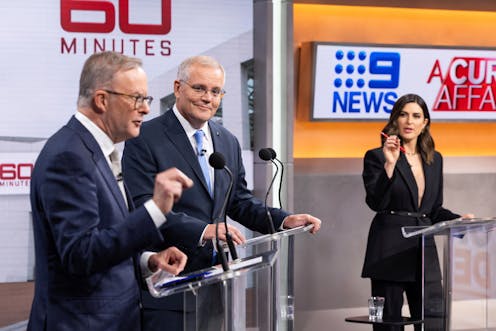
Scott Morrison and Anthony Albanese faced off in the third and final leaders’ debate on Wednesday night on the Seven network, ten days ahead of the federal election on May 21.

Both leaders were criticised after the previous debate for being overly shouty and aggressive, so were perhaps unsurprisingly more civil this time around.

The debate canvassed a wide range of issues, including wages, inflation, women’s labour participation, childcare, an integrity commission, and climate change.

Of the around 160 undecided voters from pubs across the country, 50% awarded the debate to Albanese, 34% voted for Morrison, while 16% were still undecided.

Three Australian political experts analyse the debate and give their verdict on the leaders’ performances.


Read more:
A shouty, unedifying spectacle and a narrow win for Albanese: 3 experts assess the second election debate


Narelle Miragliotta, Senior Lecturer in Australian Politics, Monash University

Leaders’ debates are an important ritual of elections, even if voters seem to pay little attention to them. TV ratings for the last two leaders’ debates suggest fewer voters are switching on than in previous elections.

In fairness, there are few incentives for voters to tune in to these events. These debates were relegated to (fairly) late evening viewing, and as more than one commentator observed of the second debate particularly, a poor debate format does little to help leaders distinguish themselves. It is painful and boring to watch squabbling politicians.

This final debate was not as shouty or as undignified as the second. Scott Morrison managed to stifle his smirk, Anthony Albanese avoided stumbling over his words, there was some substantive discussion on policy, each avoided talking over the other, and both even managed to say something nice about the other.

In their two-minute opening address, each leader stressed their perceived strengths. Morrison acknowledged his government hadn’t got everything right and there were big challenges ahead for the nation, but maintained that only his government has the experience to deliver the essential services and the infrastructure needed to keep the country safe.

For his part, Albanese spoke about his belief in the power of government to build a “better future” and the intention to work collaboratively with state governments, unions, workers, and small businesses to deliver that better future.

There was, however, no new major policy revelations, even if there was slightly more discussion about their policies for addressing climate change. Both leaders managed to stick to their speaking points, leaning in to their narratives about the character flaws of their opposite. Morrison reiterated his now familiar line that Albanese is dangerous and inexperienced, while Albanese reminded voters about Morrison’s trust and integrity deficits.

Perhaps one of the more interesting moments was when both leaders were asked to explain the appeal of the independents and minor parties. While Albanese was willing to acknowledge that leadership churn and instances of political corruption had eroded trust in the major parties, Morrison was only prepared to venture that it was the result of some unspecified external forces. Only one leader was willing to acknowledge the established parties’ complicity in public erosion in confidence in the major parties.

Is anyone likely to change their mind about either leader? Unlikely. Did either leader do enough to encourage the undecided voter off the proverbial electoral fence? According to around 160 undecided voters, Albanese won this debate. And if one had to venture why, it might be that there are limits to an appeal to the electorate that relies heavily on incumbency.

Verdict: Albanese over Morrison, but only just


Read more:
View from The Hill: Albanese and Morrison caught on fly-papers of wages, gender


Stephen Mills, Honorary Senior Lecturer in the School of Social and Political Sciences, University of Sydney

After last weekend’s shouty debate, this was the civil one, intelligently structured to allow the two leaders to argue their case across a range of substantive issues.

Both leaders managed to obey host Mark Riley’s injunction to talk about policy, not to interrupt, and to stick to the time limit.

Morrison did well in reciting his government’s achievements and throwing shade at Albanese’s inexperience and risk. Albanese did well in swinging each discussion around to his abundant, albeit sketchy, policy promises. Morrison chided Labor not to “promise the world when you know you can’t pay for it”; Albanese responded with his aspirational mantra: “we can do so much better than that”.

The downside was that, especially at the start of the debate, both leaders fell back on that scourge of modern politics, their talking points, generating storms of statistics and piles of platitudes.

Of the seven topics, I scored the first two (wages and cost of living) as a draw. I scored the third topic (character) as a win for Albanese, and the fourth (boat turnbacks) as a clear win for Morrison.

The most lively exchanges in the debate occurred on the fifth topic, covering the “teal” independents and their push for an integrity commission. The Labor leader had the better lines, including the simple acknowledgement, “We do need to clean up politics”. He also undermined Morrison’s brandishing of “347 pages of legislation” by saying, if legislation needed to be pre-approved by the opposition, “why would you vote for Scott Morrison on Saturday week?” I scored this as a win for Albanese.

The sixth topic, mining and carbon taxes, seemed a throwback to an earlier era of Australian politics, offering an easy start for Morrison on lower taxes; he threw in the pro-WA GST changes for good measure. But Albanese swung the debate to climate change, outlining plans for lower power prices, renewables and electric vehicles. When Morrison protested, Albanese punched hard: “…there he goes again. He says he supports net zero by 2050 and comes up with all the reasons why nothing should happen”. I scored this topic to Albanese.

Both men displayed a complete lack of empathy in dealing with the final topic, women. Despite “cheaper child care” being a Labor strong suit, this ended in a draw.

Unfortunately there was no mention of the Uluru Statement from the Heart or China and, in stark contrast to previous elections, hardly a peep about debt and deficits.

Verdict: Win to Albanese


Read more:
Over the last 30 years, a fifth of polls have called the wrong winner. Here are 3 things poll-watchers need to understand


Susan Harris Rimmer, Professor and Director of the Policy Innovation Hub, Griffith University

I had four questions going into this final leaders debate:

  • was this the last chance to influence the roughly 7 million voters who will vote early or submit a postal vote, and if so, who best took advantage of that?

  • will either leader finally address climate change issues with the primacy they deserve?

  • is either leader going to go after the women’s vote after polling showed a distinct gender gap at this point in the campaign?

  • and what’s the impact of commercial television stations hosting all three debates?

Vote Early?

Elections in Australia are changing since the pandemic. More and more voters will be missing out on their democracy sausage by voting early or by post according to the Australian Electoral Commission.

The ALP held their launch in Perth on May 1, but the Coalition launch is this Sunday in Brisbane. The Greens got in early with a launch in January. The other minor parties have been out early with only a few key policy ideas, such as the UAP or the “teal” indepedent candidates. Will the early birds catch the worm this time round or are the Coalition right to think people only pay attention in the last 10 days?

If I were a voter going to the pre-polling booth tomorrow, would I have enough of an idea about the key policy differences between the major parties from that debate? The voter would certainly have a contrasting narrative to consider – that, roughly, the ALP has a plan for the future that sees investment in social policy as key, while the Coalition wants a strong economy and anyone but the Prime Minister is a risk.

But most of the debate felt like a rehash of the 2019 election issues that no longer turn voters around, like boat arrivals or a carbon tax.

Vote Climate?

Griffith’s Climate Action Beacon conducted the first of five annual Climate Action Surveys in September-October 2021 with 3,915 Australian adults completing the online questionnaire. This is one of the most ambitious climate change surveys yet conducted in Australia. We found this could be the climate election.

87% of the respondents indicated they believe climate change should be a priority for the government.

76% stated that climate change will be important to them when they vote in the next federal election, but this percentage varied by preferred political party: Australian Greens (90%), Australian Labor Party (72%), Liberal Party (45%), National Party (54%), and One Nation Party (33%).

Of note, mean levels of concern tended to be higher among intending National Party voters than intending Liberal voters. Also, the prevalence of recent increases in levels of concern about climate change was higher among intending National Party voters (43%) than among intending Liberal voter (33%).

So surely Morrison is taking a risk by not mentioning climate issues at all while Anthony Albanese made four references including opening and closing with the need for climate action.

Bogans vote but so do feminists

Polling this week said the Coalition and Morrison in particular was losing the support of female voters, and that Albanese needed to make more of an impression on female voters.

Mr Morrison’s approval rating was at 44% among women at this point in the 2019 election campaign, but is now just 29% averaged over the past three polls. Primary vote support for the Coalition among women has averaged 28% over the course of the campaign, compared with 34% among men.

It was good to see childcare raised as a key issue in this debate but treatment of women within parliament was handled badly. If this was the pitch to female voters from both leaders, it needed much more, especially from the Prime Minister.

Game On

The debate chaired by Mark Riley was a marked improvement from the previous free-for-all that was an unedifying democratic spectacle, but the game show trappings in the Channel 7 format were in poor taste.

The practice of using commercial stations for all three debates has some serious issues for voters actually trying to make decisions.

Verdict: Anthony Albanese by a margin but not a romp. Families settling for “mince rather than steak” is a line people will remember. But note that of the Channel Seven pub test folk, 16% were left undecided. That might mean minor parties are still the big winners from these three debates.

The Conversation

Susan Harris Rimmer receives funding from the Australian Research Council and ONI.

Narelle Miragliotta and Stephen Mills do not work for, consult, own shares in or receive funding from any company or organisation that would benefit from this article, and have disclosed no relevant affiliations beyond their academic appointment.

ref. Were minor parties the big winners? 3 experts on the final leaders’ debate – https://theconversation.com/were-minor-parties-the-big-winners-3-experts-on-the-final-leaders-debate-182848


A tug of war between survival and fitness: how chameleons become even brighter without predators around

Source: The Conversation (Au and NZ) – By Martin Whiting, Professor of Animal Behaviour, Macquarie University

Martin Whiting, Author provided

Invasive species offer a rare research opportunity, as they often colonise new environments very different to their native habitat. One such species is the Jackson’s three-horned chameleon (Triocerus j. xantholophus), which was accidentally introduced to the Hawaiian Islands in the 1970s.

Our study, published today in Science Advances, shows Hawaiian chameleons display much brighter social signals than individuals from their native habitat range in East Africa – and could represent an example of rapid evolution.

A male Jackson’s three-horned chameleon (above) courting a female (below) in Kenya.
Martin Whiting.

A long way from home

In 1972, about 36 Jackson’s chameleons made their way from their native Kenya to the Hawaiian island of Oahu, destined for the pet trade.

The chameleons were a little worse for wear by the time they arrived in Hawaii, following a long and taxing journey that would have begun days before they were loaded onto the plane in Nairobi.

Invasive chameleons have made it to the Hawaiian islands – the world’s most isolated island archipelago.
Wikimedia Commons

The story goes that an Oahu pet shop owner, Robin Ventura, opened the crate in his garden to give them fresh air and an opportunity to recover. Presumably, he underestimated the speed with which chameleons can move (and recover) – and they quickly dispersed into the surrounding area.

This founding population represented an accidental invasion, and subsequently became an unplanned experiment in evolution. What happens when an animal with colourful social displays – from a population with lots of bird and snake predators – is introduced to an island virtually free of predators?


Read more:
How do chameleons and other creatures change colour?


Evolution in action?

We predicted Hawaiian chameleons, as a result of being relatively free from predation, would have more elaborate or brighter displays than their Kenyan counterparts. We also predicted they would be more conspicuous when viewed by their East African predators, such as birds and snakes.

In the animal kingdom, bright or colourful displays can attract the attention of sharp-eyed predators. This reduces an individual animal’s likelihood of survival and, by extension, its reproductive fitness (or the number of genes it passes on to future generations).

When survival is threatened, natural selection acts as a brake and halts the further elaboration of colour, or shifts bright colours to areas of the body less visible to predators.

For instance, many lizard species have bright colours concealed on their undersides or throats. In South Africa, male Augrabies flat lizards will signal to rival males by raising their underside and exposing the throat, which is puffed out.

Many lizard species, such as this Augrabies flat lizard, have bright colours on body parts that are less visible to predators such as birds.
Martin Whiting

On the other hand, conspicuous displays may also increase fitness. For example, brighter or more colourful males may gain greater access to females, either by winning contests with rival males, or simply appearing more attractive to females.

This tug of war between survival and fitness is well documented in species with fixed or seasonally dependent colouration. For instance, guppies become less colourful when dangerous predators share their streams. However, it’s less understood in animals with dynamic colour change such as chameleons.

Although we have a good understanding of how chameleons change colour, we don’t know if they modulate their displays when there are more predators in their environment. It may also be that natural selection prevents them from producing colour signals that are colourful or bright beyond a certain threshold.

To test our predictions, we travelled to Kenya and Hawaii to study colour change in wild chameleons.

In rivalling male chameleons, dominance is signalled by turning from green to lemon-yellow. In this clip, two males are evenly matched and both signal their dominance. When the contest is settled, the winner remains lemon-yellow a while longer while the subordinate turns brown.

Vibrant test subjects

Chameleons are great study subjects because they have a very strong stimulus response. You can pop them on a branch away from their usual haunts and present them with a fake predator or another chameleon, and they will devote all their attention to the stimulus while completely ignoring you!

We presented each male chameleon with a rival male, a female, a model bird predator and a model snake predator – each in a one-on-one interaction. During the presentations we measured their colour using an optic spectrometer.

Chameleons were exposed to a model snake (pictured: African boomslang) and bird (pictured: African cuckoo-hawk) predators.
Martin Whiting

This instrument allows us to quantify two metrics of colour: chromatic contrast (essentially how colourful they are) and luminance contrast (how bright they are). We could then estimate how detectable a displaying chameleon would be to an observer – be it another chameleon, or a bird or snake predator.

Chameleons lock horns during fights for dominance.
Devi Stuart-Fox

We also measured the leafy vegetation that forms the backdrop against which a chameleon signals. This way we could estimate how detectable a displaying chameleon would be against a particular background.

A male Jackson’s three-horned chameleon from Hawaii, showing subordinate colours.
Martin Whiting

An exciting example of rapid change

The results were particularly exciting and exceeded our expectations. We found Hawaiian chameleons had much brighter displays than Kenyan chameleons during male contests and when courting females. They were also more conspicuous against their Hawaiian background than a Kenyan background.

This is consistent with what scientists term “local adaptation”. This is the idea that signals will be fine-tuned to be more detectable in the environment in which they are used.

For Hawaiian chameleons, one unintended consequence of being brighter was they were also more detectable to their native predators.

A male Jackson’s three-horned chameleon living wild on Oahu, Hawaii.
Brenden S. Holland, Author provided

Interestingly, this effect was more pronounced when facing birds compared to snakes – probably because snakes have poorer colour discrimination than birds. Finally, Hawaiian chameleons also had a greater capacity to change colour than Kenyan chameleons – they could do so over a greater range.

We can’t be completely sure brighter signals in Hawaiian chameleons represents rapid evolution. It’s also possible this degree of colour change is due to plasticity, which is when an animal changes to a different state due to prevailing environmental conditions.

Nevertheless, plasticity itself can evolve – and colour change in chameleons may be a combination of both evolutionary change and plasticity.

A male Jackson’s three-horned chameleon from Kenya in full display colour.
Martin Whiting

The Conversation

Martin Whiting works for Macquarie University. He receives funding from the Australian Research Council.

ref. A tug of war between survival and fitness: how chameleons become even brighter without predators around – https://theconversation.com/a-tug-of-war-between-survival-and-fitness-how-chameleons-become-even-brighter-without-predators-around-182427

One in three people are infected with _Toxoplasma_ parasite – and the clue could be in our eyes

Source: The Conversation (Au and NZ) – By Justine R. Smith, Professor of Eye & Vision Health, Flinders University

Shutterstock

Toxoplasma gondii is probably the most successful parasite in the world today. This microscopic creature is capable of infecting any mammal or bird, and people across all continents are infected. Once infected, a person carries Toxoplasma for life. So far, we don’t have a drug that can eradicate the parasite from the body. And there is no vaccine approved for use in humans.

Across the world, it’s estimated 30–50% of people are infected with Toxoplasma – and infections may be increasing in Australia. A survey of studies conducted at blood banks and pregnancy clinics across the country in the 1970s put the infection rate at 30%. However, a recent Western Australian community-based study found 66% of people were infected.

The disease caused by this parasite can scar the back of the eye. Our new research looked for signs of disease in otherwise healthy people and found a significant number bore the mark of Toxoplasma.


Read more:
Cats carry diseases that can be deadly to humans, and it’s costing Australia $6 billion every year


We don’t just get it from cats

The cat is the primary host for Toxoplasma.

Cats catch the parasite when they eat infected prey. Then, for a couple of weeks, they pass large numbers of parasites in their faeces in a form that can survive for long periods in the environment, even during extreme weather.

When the faeces are ingested by livestock while grazing, parasites lodge in the muscle and survive there after the animals are slaughtered for meat. Humans can become infected by eating this meat, or by eating fresh produce or drinking water soiled by cats. It is also possible for a woman infected for the first time during pregnancy to pass the infection to her unborn child.

While infection with Toxoplasma is extremely common, the most important health statistic is the rate of the disease caused by the infection, which is called toxoplasmosis.


Read more:
Disease-causing parasites can hitch a ride on plastics and potentially spread through the sea, new research suggests


How it affects the eye

Toxoplasma really likes the retina, the multi-layered nerve tissue that lines the eye and generates vision. Infection can cause recurring attacks of retinal inflammation and permanent retinal scarring. This is known as ocular toxoplasmosis.

Contrary to much that is written about ocular toxoplasmosis, medical research shows this condition usually affects healthy adults. However, in aged persons or people with a weakened immune system, or when contracted during pregnancy, it can be more severe.

An attack of active inflammation causes “floaters” and blurred vision. When the inflammation progresses to scarring, there may be permanent loss of vision.

In a study of patients with ocular toxoplasmosis seen at a large ophthalmology clinic, we measured reduced vision to below driving level in more than 50% of eyes, and 25% of eyes were irreversibly blind.

close up of person's eye
Toxoplasma really likes the retina at the back of the eye and can leave a scar.
Unsplash/Marc Schulte, CC BY

How many eyes?

Ophthalmologists and optometrists are quite familiar with managing ocular toxoplasmosis. But the extent of the problem is not widely recognised, even by the medical community. The number of Australians with ocular toxoplasmosis had never been measured, until now.

We wanted to investigate the prevalence of ocular toxoplasmosis in Australia, but we knew it would be challenging to get funding for a major survey of this neglected disease. So, we used information collected for a different purpose: as part of the Busselton Healthy Ageing Study, retinal photographs were taken from more than 5,000 baby boomers (born 1946–64) living in Busselton, Western Australia. The photographs were gathered to look for other eye diseases, macular degeneration and glaucoma.

By screening these retinal photographs, we estimated the prevalence of ocular toxoplasmosis at one in 150 Australians. This might seem surprisingly common, but it fits with the way people catch Toxoplasma.

In addition to pet cats, Australia has huge populations of feral cats. And Australia is home to a lot of farmland, including over 50% of the global organic farming area.

Most importantly, many Australians like to eat their red meat rare, putting them at real risk.

cute cat rolls on back
Yes, cats do spread Toxoplasma. But they’re not solely to blame.
Unsplash/Daria Shatova, CC BY


Read more:
I’ve always wondered: can I flush cat poo down the toilet?


How the condition is treated

To diagnose ocular toxoplasmosis, a retina examination is necessary, ideally with the pupils dilated.

The retinal lesion is easy to spot, because of the way Toxoplasma activates retinal cells to produce certain proteins, and an ophthalmologist or optometrist can immediately recognise the appearance. Often a blood test is also performed to make the diagnosis.

If the condition is mild, the doctor may let the body’s own immune system control the problem, which takes a few months. However, usually a combination of anti-inflammatory and anti-parasitic drugs is prescribed.

Stopping the spread

Toxoplasma infection is not curable, but it can be prevented. Meat sold in Australian supermarkets may harbour Toxoplasma__. Cooking meat to an internal temperature of 66℃ or freezing it ahead of cooking are ways to kill the parasite.

raw steak on a plate
Meat needs to be well-cooked to 66℃ to kill the parasite.
Unsplash, CC BY

Fresh fruit and vegetables should be washed before eating, and drinking untreated water (such as straight from rivers or creeks) should be avoided. Gloves should be worn when changing cat litter, and hands washed afterwards.

The World Health Organization and other international and national health bodies are promoting an approach called One Health for diseases that cross humans, animals and their environments. This involves different sectors working together to promote good health. Now we know just how common ocular toxoplasmosis is in Australia, there is real justification to harness One Health to combat Toxoplasma infections in this country.


Read more:
A dangerous parasite could be used to treat cancer – new research in mice


The Conversation

Justine R. Smith receives funding from NHMRC, Macular Disease Foundation Australia, Australian Department of Industry, Science, Energy and Resources, and Flinders Foundation.

João M. Furtado does not work for, consult, own shares in or receive funding from any company or organisation that would benefit from this article, and has disclosed no relevant affiliations beyond their academic appointment.

ref. One in three people are infected with _Toxoplasma_ parasite – and the clue could be in our eyes – https://theconversation.com/one-in-three-people-are-infected-with-toxoplasma-parasite-and-the-clue-could-be-in-our-eyes-182418

Why the budget should treat public health like transport – vital infrastructure with long-term economic benefits

Source: The Conversation (Au and NZ) – By Johanna Reidy, Lecturer, Department of Public Health, University of Otago

Shutterstock

The global pandemic might have revealed the importance of robust public health infrastructure, but we still have trouble grasping the vital need to invest in it.

An analogy might help. Wellington’s recently opened Transmission Gully motorway shortens journeys from the Kāpiti Coast to the city by up to 15 minutes. First proposed 100 years ago and finally built over the past eight years, the final cost will be at least NZ$1.25 billion. Worth it to some, questionable to others.

But the key value isn’t the infrastructure itself, it’s the time saved. The efficiency and petrol saving on a journey without traffic lights and single lanes will last long after the delays and overspend on the project are forgotten.

Investment in public health has clear parallels with investment in major transport projects. Time saved on a journey is akin to lives saved from a premature end by the kinds of hidden services, like safe drinking water, that are designed to improve, protect and promote the health of the whole population.

But both infrastructure and public health investments can take years before the benefits are realised. Urgent maintenance – filling pot holes or filling hospitals – tends to crowd out strategic investment.

Public health is always the Cinderella of services in a publicly funded health system that delivers personal as well as public services, and is always vulnerable to budget cuts and under-investment.

Sadly, COVID has shown there are no fairy godmothers to step in and wave a magic wand. Globally, the lack of maintenance of public health systems is forecast to cost more than $US12.5 trillion according to the International Monetary Fund.

Positive investments: headlines such as ‘Fully immunised child doesn’t die’ are worthy, but not necessarily newsworthy.
Getty Images

The value of public health

Governments of all political persuasions want healthy populations, they just disagree on how to achieve the goal. Because of this, public health has been consistently undermined.

As the Labour government’s May 19 budget approaches, we need to acknowledge that the massive investment in tackling the pandemic could have been spent earlier to strengthen public health infrastructure.

That said, the question now is how governments can invest to be better prepared for the current and inevitable next public health threat. The shared value of public well-being must be protected by maintaining existing healthcare while investing more in public health.

First and foremost, we need to ensure public health is actually valued and invested in – whether or not there’s a pandemic. The past two years have shown how much New Zealanders are willing to pay, not just to keep themselves healthy, but to keep family, whānau and others safe.


Read more:
New Zealand’s health restructure is doomed to fall short unless its funding model is tackled first


Unfortunately, when all is going well, the true value of public health investment is invisible and unnoticed. Only when there are service failures (for example, the 2016 Havelock North water disaster), controversial health issues (such as raising the age for buying cigarettes), or a global pandemic, does public health become front of mind.

Also, public health’s focus on the whole population rather than on individual cases means it’s not as readily relatable. This lack of an emotional focal point means public health isn’t always uppermost in the minds of decision makers at budget time.

Headlines such as “Fully immunised child doesn’t die”, “Water still drinkable” or “Slight reduction in obesity rates means improved disability-adjusted life years!” are worthy, but not necessarily newsworthy.

Public and personal health

Public health’s long-term view disadvantages it within a three-year election cycle that favours fast outcomes, even if those outcomes are more expensive. It’s easier and quicker to see the impact of treatment than prevention.

Currently, the system is set up to fund personal (individual) health. It’s harder to cut personal healthcare, if only because a real person missing out on surgery or drug therapy makes better headlines.


Read more:
Community healthcare workers were left feeling isolated and under-appreciated during the pandemic


But a cut to a health promotion budget doesn’t have a face or a name. Public health is simply an easier place to make cuts and is often the first area to lose investment. Historically, it has sometimes had to be ring-fenced to stop it being pillaged to fund other services.

Disinvestment and a focus on personal health occurs even though public health has a better marginal return than personal health – it’s cheaper per person to spend on public health than on personal health.

This is because public health prevents or slows ill health. It’s less costly to tackle the root causes of rheumatic fever, for instance, than to pay for treatment, especially heart valve replacement and long-term care and rehabilitation.


Read more:
NZ’s health service is failing some communities: building a better national system requires local partnerships


The road to better investment

COVID has highlighted the need for both personal and public health services. The solution is balance, with investment in one reinforcing the other. Without prevention, personal health services would be swamped. Both aim to improve lives, but require different investment approaches.

There are two main things governments can do.

  1. Adopt investment mechanisms that specifically acknowledge public health will always lose in a popularity contest to personal health, and adjust the budget process accordingly. This means calculating the future benefits of public health investment and redressing the current bias in budget spending.

  2. Set fixed goals with robust measurement systems to capture short, medium and long-term progress. Allow for flexibility in how those goals are met according to policy priorities and the sociopolitical context. One immediate solution would be to ring-fence long-term public health investment, plus have dedicated strategy and funding, to address the major drivers of ill health – obesity, for example.

It’s time to invest in public health infrastructure as we would with major transport projects. Transmission Gully wasn’t funded by an annual budget allocation in competition with routine maintenance needs. The project’s size, the time-frame for completion and the road’s broader economic benefits all shaped decisions.

Proper investment in services that generate extra years of healthy life and avoid costly cures are surely no less important than the minutes saved on a trip into town.

The Conversation

The authors do not work for, consult, own shares in or receive funding from any company or organisation that would benefit from this article, and have disclosed no relevant affiliations beyond their academic appointment.

ref. Why the budget should treat public health like transport – vital infrastructure with long-term economic benefits – https://theconversation.com/why-the-budget-should-treat-public-health-like-transport-vital-infrastructure-with-long-term-economic-benefits-180322

Climate change hits low-income earners harder – and poor housing in hotter cities is a disastrous combination

Source: The Conversation (Au and NZ) – By Stephen Healy, Senior Research Fellow, Institute for Culture and Society, Western Sydney University

Shutterstock

Cost of living is a major focus in this election campaign, and yet political leaders have been unacceptably silent on the disproportionate impact of climate change on Australians with low incomes. This is particularly true for Western Sydney, home to around 2.5 million people.

Over the last half century, the balance of Sydney’s social housing has been pushed to the west, where it can be up to 10℃ hotter than the breeze-cooled coast. Meanwhile, rapid housing development reduces existing tree canopy daily, further intensifying heat.

This situation locks in cycles of disadvantage for decades and generations to come. Even if we limit global warming to 1.5℃ this century, Western Sydney will still experience fewer than 17 days of 35℃ per year by 2090.

Australia needs a more holistic, forward-thinking approach to the design of hot cities, one that’s up to the task of changing with the climate.

Living with urban heat now

Low-income communities are more likely to live in poorly constructed, heat-affected rental accommodation and least able to afford air conditioning. What’s more, those living in community housing may be restricted from installing air conditioning units.

Our research from 2016 found residents expend a lot of mental and physical energy during summer just to keep their homes bearable, while worrying about how much cooling might be costing.


Read more:
We still live here: public housing tenants fight for their place in the city


After interviewing vulnerable groups of people in Western Sydney – such as elderly citizens, disability carers and young mothers in social housing – we found people turn to lessons from their parents to find relief from heat.

This includes soaking sheets in water, directing fans to blow air over them and create cool pockets in the house, confine themselves to cooler rooms, and cover west-facing windows with blankets or aluminium foil.

Fan beside bed
Switching on fans in the bedroom is one way people without air conditioning try to keep cool.
Shutterstock

This summer’s La Niña weather pattern may have spared Western Sydney from scorching daytime highs, but residents had to contend with hotter and more humid nights. Wet conditions and cloud cover inhibit the capacity of poorly designed houses to shed the heat, leading to sleeplessness.

Many Western Sydneysiders work from home, too. Community organisation Better Renting recently produced a report detailing the impact of poor housing on worker productivity during the pandemic. It found those working from home without the means or capacity to improve their environments said they were stressed, couldn’t focus, and needed to finish work early during summer.


Read more:
Western Sydney will swelter through 46 days per year over 35°C by 2090, unless emissions drop significantly


Air-conditioning can provide relief and is critical for some residents, such as some people living with a disability who depend on cool homes and cars for survival. But air-conditioning displaces the indoor heat to the outside, contributing to a more hostile outdoor environment.

So while air-conditioning offers a short-term solution, it does nothing to address long-term disadvantage.

‘Solutions’ don’t go far enough

Social disadvantage underscores the limitations of well-meaning technical solutions, such as the New South Wales government’s program to plant five million trees by 2030, or City of Sydney’s project of committing to renewable-powered air conditioning.

These solutions don’t go anywhere near far enough to address the fundamental short-sightedness in how we design and plan our cities.

For example, young trees need far more care to reach maturity through extreme weather, unlike older trees, of which many have been cut down to make way for development. And solar-powered air conditioning will not undo the compounding impacts of urban heat, which research shows make us sedentary, passive and lonely and insecure because it keeps us indoors and isolated from each other.

Installing light-coloured roof tiles are a low hanging fruit for keeping homes cool.
Shutterstock

Indeed, Western Sydney’s current trajectory of urban growth will see urban heat and its impacts worsen, particularly as the state government resists mandating lighter-coloured roof tiles as a perceived impediment to development. Lighter-coloured roof tiles are better at reflecting rather than absorbing heat, and are a low-hanging fruit for cooling homes.

This trajectory will subject future generations of Western Sydney residents to a city that may become ultimately uninhabitable for months at a time. These predictions
may seem dire, but we cannot afford to ignore them.

One stark prospect is that even newer and more expensive homes being built in Western Sydney’s growth areas may become stranded assets in a future, when 50℃ summer days are a norm and the area is subject to regular flooding.

So what do we do?

Researchers and policy makers are turning their attention to making Australian cities more “climate-ready”.

While catastrophic for communities, the recent floods, fires and other disasters carry valuable lessons about design failures and community-led solutions that have ultimately kept people safe.

We’ve learnt “climate-readiness” cannot be done in a piecemeal way or achieved in the background of everyday life, like set-and-forget technologies. Instead, it means noticing how the natural and built environments interact, and the social practices that contribute to cooler, more liveable futures.

This might include enrolling communities in the care of young trees around their homes, maintaining breeze ways or shade through neighbourhoods, outdoor cooking during summer to reduce heat inside, or shifting the rhythms of social life to cooler night time hours.

This is encompassed in a process called “transition design”, which takes holistic, long-term view of urban planning to forge a sustainable future. This means starting with what residents want and know works – whether its creating cool pockets in the home or reaching out to neighbours when heat is on its way.


Read more:
How new design patterns can enable cities and their residents to change with climate change


Planners, designers and policymakers should practically link these social solutions to designs that make these more accessible, manageable, engaging and safe.

Parts of everyday life will look very different in future as we grapple with managing energy and adapting homes to changing climates. But we must also recognise and hold on to what’s important, including reclaiming what we’ve lost to rampant development.

Long-term residents of Western Sydney may recall a more liveable city, with shaded pedestrian links between homes and shops, seating and facilities in parks and better access to public transport.

These basic amenities are a commonwealth that allow us to remain at home in an increasingly less hospitable world.

The Conversation

Stephen Healy received funding from the Australian Research Council for a project focused on climate readiness in social housing. This story is part of The Conversation’s Breaking the Cycle series, which is about escaping cycles of disadvantage. It is supported by a philanthropic grant from the Paul Ramsay Foundation.

Abby Mellick Lopes receives funding from the Australian Research Council for a project focused on climate readiness in social housing.

ref. Climate change hits low-income earners harder – and poor housing in hotter cities is a disastrous combination – https://theconversation.com/climate-change-hits-low-income-earners-harder-and-poor-housing-in-hotter-cities-is-a-disastrous-combination-180960

How well off you are depends on who you are. Comparing the lives of Australia’s Millennials, Gen-Xers and Baby Boomers

Source: The Conversation (Au and NZ) – By Peter Abelson, Economist, Crawford School of Public Policy, Australian National University

Shutterstock

Most Australian voters are either Baby Boomers (born 1946 to 1964), Generation Xers (1965 to 1980) or Millennials (1981 to 1996).

And at one time or another most have been told that their generation is better off (or worse off) than the ones that came before it.

It’s tempting to think the most recent generation is always the worst off, with all the talk about the cost of living and other things in election campaigns.

But without data, or living the lives of other generations, it is hard to be sure.

Boomers are currently aged 58 to 76. They were 25-35 between 1971 and 1996.

Gen Xers are currently 42-57 and were 25-35 between 1990 and 2015. Millennials are in their 20s and 30s right now.

For most of the dimensions of well-being in which we are interested, the questions turn out to be surprisingly easy to answer, so long as we remember that the data tells us a lot about lives on average, and little about the lives of individuals.

In a study prepared for the Australian National University’s Tax and Transfer Policy Institute I’ve attempted to provide answers for nine dimensions of well-being, used by the OECD, comparisons, ranging from income to housing, to personal safety to inequality.

Income and wealth ✅

Net national disposable income per capita has been climbing over time, meaning that Millennials aged 25-35 are 51% better off than Generation Xers were at that age, and 91% better off than Boomers at that age.

And those figures are likely to understate how much better off their standard of living is.

The quality and range of goods and services from food to cars to healthcare to computers to mobile phones with cameras has improved in ways figures can’t capture. Many didn’t exist in the 1970s.

Although the Bureau of Statistics attempts to adjust its measures for improvements in quality, it concedes its efforts are incomplete. The Bureau’s underestimation of quality improvements is likely to be significant.


Millennials are also wealthier than Gen Xers and Boomers were at the same age, although recently the wealth of older Australians has been climbing more rapidly than the wealth of younger Australians, due in large measure to home prices.

Offsetting this, in due course, should be big inheritances passed from Boomers to Gen-Xers and Millennials.

Housing ❌

Millennials aged 25 to 34 are much less likely to own their homes than Boomers were at the same age.

Among those aged 25-34, home ownership has fallen from 60% in 1976 to 37% in 2017-18.

While much of this is due to prohibitively high prices, some is due to Millennials finishing education and entering the workforce and marrying later.

It should be noted that Millennials who do own a home are no worse off in terms of payments relative to income than were Boomers. But getting a deposit (unless there’s an offer from the bank of mum and dad) has become much more difficult.

Private rents have been remarkably constant over the past 25 years, at about 18% of average household income.


Rents for low earners (in the bottom fifth) remain extraordinarily high, in Sydney taking up about 30% of household income. But this isn’t a generational problem. Low earners’ rents have been high and stable as a share of income for decades.

What is a problem for the most disadvantaged is that public housing has slid from 5.8% of the housing stock in the late 1990s to about 3% today.

Work ✅

Women are much more likely to be in paid employment than 40 years ago.

Whereas in 1978, when Boomers were aged 25-35, only 40% of women were in paid work, by 2018 when Millennials were that age, a record 57% were paid workers, a proportion that climbed even higher during COVID to an unprecedented 60%.

Men are less likely to be employed. Whereas in 1978, 75% of men were paid workers, male employment fell to 67% in 1998 when Gen-Xers were 25-35, and stayed there when Millennials were that age in 2018.


And there has been a major shift from blue-collar to white collar work. As detailed in the Intergenerational Report, in 1966, machinery operators and drivers comprised 11% of the workforce, and technicians and tradespeople 21%. By 2016 these proportions had almost halved to 6% and 14%.

The share of the workforce employed in (generally less physically-demanding) professional jobs has doubled, while the share employed in personal service jobs nearly tripled. Arguably these changes mean more pleasant working conditions.


Read more:
Five questions (and answers) about casual employment


Work is also more part-time – the proportion of the workforce employed part-time has doubled, climbing from 15% in 1978 to 30% – and more casual. In 1988 only 19% of the workforce was employed in jobs without leave entitlements. By 1998 the proportion had climbed to 27%, and has since declined to 22.5%.

Health ✅❌

Australians are taller and heavier than half a century ago, in part because of better nutrition.

But we are more obese. Between 2007-08 and 2014-15 the proportion of children defined as overweight and obese women has climbed from 24.7% to 26.4%

Despite this, the extra years of life expected by men who reach 65 have climbed dramatically, from 12.3 years for a boomer born in 1953-54, to 19.6 for a Millennial born in 1994-96, to 22.3 for a man born more recently.

The extra years of life for a woman at age 65 has climbed from 15 to 19.6 to 22.3.


Importantly, the Institute of Health and Welfare finds most of the additional years are healthy years, with the proportion of lives spent in ill health little changed.

Suicide rates have fallen for women (from 7.8 per 100,000 females in the 1970s to 5.7 in the 2010s) but not for men (where they remained at about 18 per 100,000).

On the other hand, both men and women experienced major increases in reported anxiety and mood disorders, with the proportion of women reporting anxiety climbing from 12% to 16% between 1997 and 2017, and the proportion of men climbing from 7% to 11%. But harmful alcohol use and illicit drug use fell.

Education ✅

Millennials are much more educated (in terms of post-school qualifications) than Bsaby Boomers or Generation X.

Between 1975 and 2016 the proportion of men with a tertiary qualification climbed from less than 4% to 20% and the proportion of women with a tertiary qualification from less than 2% to 24%.

The benefits for those with degrees go beyond the financial. The Household, Income and Labour Dynamics survey finds they extend to well-being, social interactivity and healthy behaviours, such as physical activity and abstaining from drinking and smoking.

Safety ✅❌

Between 1996 and 2016 victims of homicide and related offences fell 50%, victims of robbery fell 56%, victims of motor vehicle theft fell 65% and victims of other theft fell by 21%.

Reported sexual assaults moved in the opposite direction, climbing from 80 per 100,000 people in 1996 to 95 in 2016.

Driving on roads has become far safer. Between 1976 and 2016 road deaths per 100,000 people fell from 25.5 to 5.3.

Overseas, far more Australians (many of them conscripts) died in the Vietnam war than in Afghanistan, making the toll from overseas conflicts the greatest for Boomers, much less for Millennials and nonexistent for Generation Xers.

Loneliness and connections ❌

The proportion of Australians actively engaged in community organisations fell from 33% in 1967 to 18% in 200, with major declines in church attendance, membership of unions and political parties, and participation in organised sport.

Whereas in the Boomer year of 1984, Australians had an average of nine trusted friends each, by the Gen-X year of 2018 that number had fallen to five.

In 1984, people could drop in on 10 neighbours. By 2018, it was only four. Seventeen percent of people who could not drop in on a single neighbour in 1984. By 2018 it had climbed to 17%.

Offsetting this to some extent is evidence of substantial volunteer work in the recent floods and bushfires, social support services that did not exist 20 or 30 years ago, and the increasing use of online communication.

Environment ❌

The US National Aeronautics and Space Administration finds the past seven years have been the hottest in recorded history.

The CSIRO finds that Australia’s climate has warmed on average by 1.44°C since national records began in 1910, and the Intergovernmental Panel for Climate Change expects Australia to suffer more from longer and hotter summers and more frequent bush fires than the rest of the world.

More than 1,700 Australian species and ecological communities face extinction.

Only partially offsetting this for Millennials are less air and water pollution than in the 1970s, less water use, and better building standards.

Inequality ❌

While the economy Millennials entered their 20s and 30s is richer than in earlier generations, its wealth and income are less equally distributed.

The Productivity Commission finds income inequality has increased “modestly” since the 1980s and wealth inequality by more.

Between 2003-04 and 2015-16 the wealth of the poorest tenth of households climbed not at all, while the wealth of middle-earners climbed 27%, and the wealth of the top tenth by nearly 40%, largely due to growing superannuation balances and home prices.


Read more:
Intergenerational reports ought to spark action, as well as scare us


Assessing the overall position of Millennial voters compared to Gen-X and Baby Boomer voters requires value judgements about the dimensions that matter the most, and also judgements about the future, including the ways in which Australia will buffeted by and respond to potential major threats including climate change, social media and the erosion of privacy, and conventional and cyber warfare.


Peter Abelson wishes to acknowledge the assistance of Aliya Gul, a millennial.

The Conversation

Peter Abelson is a war-baby.

ref. How well off you are depends on who you are. Comparing the lives of Australia’s Millennials, Gen-Xers and Baby Boomers – https://theconversation.com/how-well-off-you-are-depends-on-who-you-are-comparing-the-lives-of-australias-millennials-gen-xers-and-baby-boomers-172064

Greens condemn ‘two-tier’ NZ migrant policy as entrenching inequities

RNZ News

The New Zealand government’s immigration decisions amount to a “white immigration policy”, creating a two-tier system that will entrench inequities, claims the Green Party.

National and ACT are also critical of the moves announced by Prime Minister Jacinda Ardern and top ministers at a Business NZ lunch in Auckland today.

The new policy sees New Zealand’s border fully reopening at the end of July, with sector-specific agreements to support a shift away from lower-skilled migrant labour.

Green Party immigration spokesperson Ricardo Menéndez March said it would entrench a two-tier system.

“The workers that we called essential throughout the pandemic, many will be missing out on genuine pathways to residency and we are narrowing down pathways to residency for those that we consider high-salary migrants. This will entrench inequities,” he said.

“There are really clear wage gaps along ethnic lines — we’re effectively encouraging specific countries to come and become residents whereas people from the Global South who will be coming here, working in low wage industries, with no certain path to residency.”

He was also concerned about the prospect of international students losing working rights after their studies, and the roughly 16,000 overstayers in New Zealand.

‘Feels like a white-immigration policy’
“When we contextualise that many of the students and workers on low wages are from India and the Philippines, it kinda feels like we are creating a white-immigration policy – whether intentionally or otherwise.

“We’re also missing stuff around an amnesty for overstayers as well as addressing issues around migrant exploitation … we’ve been told by the Productivity Commission and many groups that migrant workers need to have their wages decoupled from single employers.

“These are people who have been living here for quite some time, many who are doing really important work but unfortunately are being exploited. If we’re really serious about enhancing workers’ rights, an amnesty should have been part of the rebalance.”

The new immigration settings streamline the residency pathway for migrants either in “Green List” occupations or paid twice the median wage.

National’s immigration spokesperson Erica Stanford said the broad brush approach was lazy.

“They could be far more nuanced and actually have fair wage rates per industry, per region, but instead they’re taking the easy route and a broad brush approach.

“I think it’s based on an unfair assumption that migrant workers drive down wages which, by the way the Productivity Commission said actually doesn’t happen.”

Families ‘separated for too long’
ACT Party leader David Seymour said the border should be open right now and families have been separated for far too long.

“It’s not opening the border in July, it’s opening up applications in July,” he said.

“Immigration New Zealand says that it will be five months on average to process a visa. The reality is if you’re one of 14 percent of New Zealanders born in a non-visa waiver country then your non-resident family can’t visit this year.”

Businesses are relieved the border will fully open and many will attempt to attract migrant workers here.

Business New Zealand’s director of advocacy Catherine Beard said skills shortages were across the board.

“One of the top headaches that we hear everywhere from every sector is a shortage of talent so we really need to throw the welcome mat open to immigrants. We’re competing with other countries for this talent and it’s really hurting.”

NZ Wine Growers chief executive Phil Gregan said re-opening the border to holidaymakers and tourists was important.

“First, it’s a positive signal that we’re open for business. I think it’s also going to have very positive impacts on tourism, on hospitality and our business on wine reseller doors hopefully.”

The wine sector is reliant on seasonal workers.

This article is republished under a community partnership agreement with RNZ.

Print Friendly, PDF & Email

Article by AsiaPacificReport.nz

Politics with Michelle Grattan: Grattan Institute’s Danielle Wood on election’s thin policy debate

Source: The Conversation (Au and NZ) – By Michelle Grattan, Professorial Fellow, University of Canberra

Danielle Wood is the CEO of the Grattan Institute, an independent think tank, Its purpose is to research and advocate policies to improve Australians’ lives.

Wood laments the dearth of policy debate in this election.

“There was a lot of optimism when we were coming out of COVID that this might be a period of genuine policy reform. It certainly was a period that laid bare a lot of challenges. We saw trust in government go up and there was a lot of talk of building back better in the sense that government might do some of those big things. But clearly, that’s not the election we’re in right now,” she says.

“We are now in a world where we’ve come out of COVID with government much bigger than what we went in. So we’ve baked in this higher spending on aged care, higher spending on defence, a higher spending on the NDIS.

“In fact, size of governments increase about 2% of GDP, which is pretty extraordinary. Yet we’ve had no conversation about how we pay for that.”

Climate change is to the fore in the minds of many economists as well as voters, and a central feature of “teal” candidates’ campaigns. But the government and Labor are not talking about it a great deal in the campaign.

“I think it’s really interesting to see economists so galvanised by that. We need to get on the path to net zero by 2050. Both major parties have signed on to that as a target. That is a massive economic transition. And frankly, if we don’t start making serious headway over the next decade, we’re going to leave ourselves with a very large and very disruptive task through the 2030s and forties.”

Anthony Albanese this week found himself under attack after advocating a 5.1% rise (reflecting the latest inflation figure) in the minimum wage. Wood says: “Locking in very high wage rises right now is not the right answer. But that’s not to say that wages growing at 2% is a good answer either. So it’s somewhere in between.”

Australia needs to increase productivity, but where should the focus be? “I would like to see a focus on education. There are things we can do in health as well, such as primary care reform, which could make a big difference […] And remember, that’s a big area in the economy and spending.”

Should we be more worried than we are about Australia’s debt level? “I’m not worried about the current levels of debt in terms of sustainability. Obviously we’ve come out of COVID with much higher debt levels than we went in with. But based on at least the current interest profile, it’s very serviceable and sustainable.”

The Conversation

Michelle Grattan does not work for, consult, own shares in or receive funding from any company or organisation that would benefit from this article, and has disclosed no relevant affiliations beyond their academic appointment.

ref. Politics with Michelle Grattan: Grattan Institute’s Danielle Wood on election’s thin policy debate – https://theconversation.com/politics-with-michelle-grattan-grattan-institutes-danielle-wood-on-elections-thin-policy-debate-182863

South Australia’s Limestone Coast was formed from the bones of dead fish. Cathedral brings the story of these caves to the stage

Source: The Conversation (Au and NZ) – By William Peterson, Adjunct Associate Professor, Auckland University of Technology

Matt Byrne/State Theatre Company South Australia

Review: Cathedral, directed by Shannon Rush for the State Theatre Company of South Australia

Cathedral could not be more South Australian.

This complex and challenging one-hander is the creation of SA- born playwright Caleb Lewis and brought to life by Nathan O’Keefe, one of our state’s acting greats.

The unique and spectacular underwater formations along our state’s Limestone Coast form the backdrop for the story. The play’s title is taken from a beautiful but challenging dive spot southeast of Mount Gambier, a large underwater cavern known as “The Cathedral.”

Lewis’ language describing the coast and its underwater dimensions is sumptuous and arresting, plumbing the depths of geologic time.

O’Keefe delivers these lush lines masterfully, savouring their poetry.

The coast he tells us, is “haunted by a billion, billion ghosts […] We are living on their bones.”

Land and sea floor are formed by “the slow sleep of calcium carbonate. Patterns appear “like dishes in the sea,” with “towers rising and falling over the centuries.”

But always, it is “water pushing it down.”

And it is here, in this liquid world, where the play draws its life.


Read more:
Naracoorte, where half a million years of biodiversity and climate history are trapped in caves


Living with loss

The opening monologue conflates this underwater world with the womb. O’Keefe, as the protagonist Clay, describes “the first sensation” as “floating, then sound,” then of a heartbeat, followed by drifting.

We infer from his revelation of a “brother who never left the water” he has a twin who was never born.

This is our first hint this play will be about water and loss, with how one lives with losses that never go away.

Production image
Nathan O’Keefe delivers a masterful performance.
Matt Byrne/State Theatre Company South Australia

Clay’s life was marked by loss at a young age when his mother died by suicide, leaving him in the care of his grandfather. It was his crusty old “Pops” who taught him to bodysurf and develop the confidence that led him into deep water diving.

These acts of telling are interspersed with scenes from the past acted out as if in real time. In the first of these, Clay is trapped deep inside the cathedral while diving. He calls in a distress signal on a static-filled connection, struggling to survive on a dwindling supply of oxygen.


Read more:
Free divers have long defied science – and we still don’t really understand how they go so deep


This realistic depiction of Clay’s struggle is sometimes problematic: there is literally no place to go when acting out states such as disorientation and panic.

More successful temporal shifts are the economically written passages of dialogue between Clay and the colourful offstage characters populating his life.

One such exchange between Clay and his Pops is built around his insistence that he saw his mother’s corpse on a dive. When Clay insists he saw her, Pops tells him he needs to leave the town, and go “anyplace but here.”

Clay subsequently hits the road. On the beaches of Thailand he befriends another salty character, a Scotsman named Jock.

This encounter leads him to a deep sea diving training course in the North Sea. Ever the straight talker, Jock reminds his trainees “down there you’re just a tadpole in the dark.”

Production image
‘Down there you’re just a tadpole in the dark.’
Matt Byrne/State Theatre Company South Australia

The life-threatening challenges of such work are powerfully expressed, as are the more light-hearted moments of camaraderie between divers.

In the decompression chamber following deep dives, voices sound like divers have been sucking on helium. As Clay recalls, it’s like being in a “tin can full of tough guys that all sound like Elmo.”

These laugh out loud moments give the audience welcome fleeting escape from the play’s emotional demands.

Strength in honesty

The production’s compact, functional set (designed by Kathryn Sproul) effectively evokes the limestone walls of the southeast coast and a jetty. Also serving the production well are Andrew Howard’s sound and compositions and Mark Oakley’s precise, transformational lighting.

Production image
Kathryn Sproul’s set evokes the limestone walls of the southeast coast and a jetty.
Matt Byrne/State Theatre Company South Australia

Lewis does a superb job of capturing the embodied experience of diving, of hovering over landscapes. He captures the feelings of awe and wonder, but equally the residual fear and terror in back of the mind of all divers – even experienced ones.

Facing fear and death is where the play reaches its dramatic, powerful conclusion. We have all been through the ringer these last few years, with fear and loss intruding into many of our lives. Ultimately the play’s greatest strength is its honesty.

Cathedral plays at the Space Theatre, Adelaide Festival Centre until May 21 before touring regional South Australia.

The Conversation

William Peterson does not work for, consult, own shares in or receive funding from any company or organization that would benefit from this article, and has disclosed no relevant affiliations beyond their academic appointment.

ref. South Australia’s Limestone Coast was formed from the bones of dead fish. Cathedral brings the story of these caves to the stage – https://theconversation.com/south-australias-limestone-coast-was-formed-from-the-bones-of-dead-fish-cathedral-brings-the-story-of-these-caves-to-the-stage-182121

Electricity prices are spiking, ten times as much as normal. Here are some educated guesses as to why

Source: The Conversation (Au and NZ) – By Bruce Mountain, Director, Victoria Energy Policy Centre, Victoria University

Shutterstock

Electricity prices in the short-term (“spot”) wholesale markets in Australia are surging again.

As I first drafted this, at 11.30pm on Tuesday, while electricity demands were not high, the prices quoted for each five-minute interval in Queensland, NSW, Victoria and South Australia were around A$250 per megawatt-hour, roughly ten times what they would normally be.

So far this year, average spot prices have been about 50% higher than last year in Victoria, South Australia and Tasmania, about 80% higher in NSW, and 150% higher in Queensland.

If it keeps up (which is likely), retail electricity prices will be on the rise again.

That effect is likely to be big. In NSW and Queensland, it could mean increases as high as 50% for large customers and as high as 20% for households.

Why is it happening? At first glance, it’s hard to say. The minute-by-minute readout comes without explanations.

One reason would be that coal and gas prices are surging. Newcastle “spot” coal is trading at five times its price over the past three years.

Gas and coal prices are spiking

Queensland spot gas costs five times what it did before the invasion of Ukraine.

A second reason might be that electricity producers are making hay while the sun shines by withholding generation capacity.

Steven Percy and I examined the electricity price surges that followed the closure of Victoria’s Hazelwood coal-fired generator in 2017, and found that one firm withheld capacity from the market, driving up prices.

Subsequently the government introduced so-called “big stick” legislation that imposes penalties for manipulating prices, although it has yet to be used.

We do not yet know whether manipulation can explain some of what we see now. It will require detailed study, and such analyses are contested.

The price of sunlight is not

The best way to restrain price surges in the medium term is into increase the penetration of low-cost energy from the wind and sun, and to back it with storage.

South Australia shows what can be done. The Rann and Weatherill Labor governments, and then the Marshall Liberal government, have all pushed the switchover to renewables.

By 2021, more than two-thirds of SA’s electricity came from variable renewable generation, more than in any developed economy we know of.

For most days in 2021, there was no need for any other kind of generation between 10am and 5pm.


Read more:
Labor says power prices are going up, the Coalition says not. Who’s right?


This has had a big impact on prices. From having long had the highest wholesale prices in the National Electricity Market, by 2021 SA had almost the lowest.

Conversely, Queensland, which has long had the least renewable generation, now has the highest prices. In the year to date, Queensland’s average wholesale price has been twice SA’s.

When inputs get cheap, prices fall

The reason, backed by econometric analysis is that when a free resource (wind and sun) displaces an expensive resource (coal and gas), prices fall.

Each state government now accepts this and is rapidly moving to decarbonise its supply, which is leading to a new problem. The states that get there quickly are less keen on sharing their cheaper power than they used to be.

Why would SA want to strengthen its interconnection to NSW, only to have its electricity prices dragged up to those of NSW by trade along that wire?


Read more:
20 years on, the national electricity market is on the way out, and it’s OK


The newly elected SA government opposed the interconnector currently under construction while in opposition. From SA’s point of view, the current high prices in NSW lend weight to its position.

We have reached the end of the beginning of the decarbonisation of Australian electricity. With the fossils-vs-renewables argument now over other than on the fringes, the argument has moved to whether the National Electricity Market can hold together and the best way the Commonwealth can help states get as much sunlight, wind and batteries into their systems as soon as possible.

The Conversation

Bruce Mountain does not work for, consult, own shares in or receive funding from any company or organisation that would benefit from this article, and has disclosed no relevant affiliations beyond their academic appointment.

ref. Electricity prices are spiking, ten times as much as normal. Here are some educated guesses as to why – https://theconversation.com/electricity-prices-are-spiking-ten-times-as-much-as-normal-here-are-some-educated-guesses-as-to-why-182849

Australia has rich deposits of critical minerals for green technology. But we are not making the most of them … yet

Source: The Conversation (Au and NZ) – By Mohan Yellishetty, Associate Professor, Resources Engineering, Monash University

Shutterstock

As the transition to clean energy accelerates, we will need huge quantities of critical minerals – the minerals needed to electrify transport, build batteries, manufacture solar panels, wind turbines, consumer electronics and defence technologies.

That’s where Australia can help. We have the world’s largest supply of four critical minerals: nickel, rutile, tantalum and zircon. We’re also in the top five for cobalt, lithium, copper, antimony, niobium and vanadium. Even better, many of these minerals can be produced as a side benefit of mining copper, aluminium-containing bauxite, zinc and iron ores.

But to date, we are not making the most of this opportunity. Many of these vital minerals end up on the pile of discarded tailings. The question is, why are we not mining them? Compared to other major critical mineral suppliers such as China, we are lagging behind.

While the federal government’s new strategy for the sector is a step in the right direction, small-scale miners will need sustained support to help our critical mineral sector grow.

Iron ore piles
Iron ore can also contain critical minerals.
Shutterstock

Why are these minerals so important?

Critical minerals are well-named. Lithium, nickel, cobalt and rare earth elements are critical for modern life as well as the industries of the future. But critical also refers to the fact that supply can be hard to secure.

In a time of huge geopolitical uncertainty, securing these minerals has become an ever more critical issue. Soaring demand for these minerals has led to price volatility, commercial risks, geopolitical manoeuvring and disruptions to supply.

As geopolitical tensions grow, many countries are urgently seeking reliable and secure supplies of critical minerals. When China cut off exports of rare earth elements to Japan in 2010 during a dispute, it threatened many of Japan’s high tech companies.

While cobalt, nickel and copper are perhaps the best known, there are dozens of lesser known minerals vital to the modern world.

Different countries and regions require different minerals, with a total of 73 minerals considered critical across 25 separate assessments as of 2020. Some countries are almost entirely dependent on imports of their critical minerals.

Australia could be a world leader in this area. Why aren’t we?

Critical minerals represent an enormous opportunity for Australia, given our wealth of these minerals and the soaring demand for green technology minerals like cobalt, lithium and nickel.

To date, however, our production of many critical minerals is well behind other countries when compared to our resources base.


Read more:
Imagine it’s 2030 and Australia is a renewable energy superpower in Southeast Asia


Our large resources of the minerals coupled with high environmental, social and governance standards mean the sector is well placed to respond to demand, especially where we could replace supplies from areas where mining is more destructive or dangerous. Think of the “blood cobalt” often mined by children in the Democratic Republic of the Congo.

In March, the federal government released its plan to grow the sector through boosting onshore processing to create high-wage, high-skill jobs and to offer our trading partners secure supplies of these sought-after minerals. This is a worthwhile goal, particularly the aim to make Australia the “major powerhouse of the world in critical minerals by 2030”.

A plan, however, is one thing and delivery is another. We will need to tackle some key challenges for the mining sector to make us a powerhouse.

Bottlenecks, tailings and major miners

While the demand for critical minerals is growing, there are challenges in production.

Around the world, critical minerals such as cobalt, gallium, molybdenum and germanium are produced as by-products of major commodities such as bauxite, zinc, copper and iron ore.

So why are we discarding most of these critical minerals by dumping them in tailings storage? We can, of course, recover these minerals later, but only if the value exceeds the costs of extraction and processing.

If we were smart about this, we would encourage the extraction of these minerals as a way to add value to existing commodities.

One issue is that while the demand is rising, the overall market size for many of these minerals is small relative to our export giants, iron ore and coal. That’s one reason our major miners have not shown much interest in these minerals.


Read more:
Critical minerals are vital for renewable energy. We must learn to mine them responsibly


If the majors aren’t interested, that leaves the door open for small and mid-tier mining and exploration companies such as Cobalt Blue, Iluka, VHM, Australian Vanadium, Australian Strategic Minerals and Critical Minerals Group which have seen the opportunity.

For many smaller miners, however, it can be very difficult to raise capital. That’s where the government’s A$2 billion fund should help, by allowing small and medium miners access to capital to scale up domestic production.

What else do we need to do?

If we get this right, Australia could play a major role in stabilising the markets for several critical mineral supply chains such as rare earth elements, lithium and cobalt.

For us to create this future-focussed industry, we have to plan ahead. The government should look to policies and programs such as:

● stronger domestic processing and refining sectors for metals like cobalt where our high environmental, social and governance reputation would give us an edge

● introducing incentive schemes to encourage mining companies and smelters to retrofit their facilities so they can produce critical minerals as well as process their main ores

● expand the sector’s proposed $50 million research and development centre and regional hubs to include universities, especially the critical mineral research groups.


Acknowledgements: David Whittle contributed to the research base, and Stuart Walsh, Sue Smethurst and Lilian Khaw reviewed the article.

The Conversation

Mohan Yellishetty receives funding from
Australian Government

He is affiliated with the Australasian Institute of Mining and Metallurgy

ref. Australia has rich deposits of critical minerals for green technology. But we are not making the most of them … yet – https://theconversation.com/australia-has-rich-deposits-of-critical-minerals-for-green-technology-but-we-are-not-making-the-most-of-them-yet-182331

To pat or not to pat? How to keep interactions between kids and dogs safe

Source: The Conversation (Au and NZ) – By Petra Edwards, PhD researcher, University of Adelaide

Justin Veenema/Unsplash

With dog attacks in the news over recent weeks, some parents may be wondering about how to keep interactions between kids and dogs safe – and how to keep everyone happy.

A review of hospitalisations due to dog bites in Australia found children under nine years presented most often. Dog attacks involving children often involve the family dog or a dog known to the child.

While we need more research around the events leading to these attacks, it’s likely a combination of a series of unfortunate events, rather than an inherently “bad” dog. Any dog can bite.


Read more:
What to do in a dog attack – and why they hate posties so much


Every dog and every child interaction is different, but here are general tips for good interactions and outcomes.

Teach children how to interact with dogs safely

You wouldn’t run up and hug a stranger in the street – let’s not do it to dogs. It is vital children learn how to approach dogs safely.

Children should always stop a few metres from a dog they want to pat and ask the responsible person for permission, before also asking the dog.

A cute dog looks for its owner.
Dogs might not be comfortable with strangers approaching.
Arten Baliakin/Unsplash

You can ask dogs if they want a pat by remembering “pat, pet, pause”.

1. Pat. Pat your leg to encourage a dog over.

2. Pet. If the dog comes to say “hi!”, give them a gentle pat on the shoulder or side. Never pat a dog on the head (dogs hate it!). Stand side-on so the dog can always move away.

3. Pause. Stop after three pats (or three seconds), and wait. If the dog reconnects (leans in or bumps the hand) then pat again for another three seconds. If the dog remains still, leans away or moves away, they don’t want to be patted (at that moment – you can try again later).

Children (and adults) should pat, pet, pause in every interaction with a dog – even the family dog.


Read more:
Curious Kids: how can we tell if an animal is happy without a wagging tail?


Interactions should be short, supervised and managed carefully

Not all dogs are used to kids. Some dogs may be very social and friendly, but not know how to interact with children safely.

Keep social, friendly dogs on-lead or use a play pen (or fence) to keep both dogs and children safe. Use lots of tasty treats to reinforce the dog for keeping four paws on the floor.

Girl pats dog.
Some dogs aren’t used to kids. Give three pats and pause to check.
Annie Spratt/Unsplash

Things can escalate quickly if children get excited or if a dog starts zooming around. Keeping interactions short (and supervised) reduces the chance of somebody being hurt.

Be very careful with very large or heavy breeds and young children who can get knocked over easily.

Learn to speak dog

Dogs communicate well, if we learn to listen. Dogs show signs of fear by moving away, cowering or tucking their tail between their legs. If they flick their ears back, turn their head away or close their mouths it means they’re not comfortable.

If we miss these signs, a dog might growl or even bite.

A wagging tail doesn’t always mean a dog is happy – “good” wags are mid-height, slow(ish), with a relaxed body. Dogs also wag high when tense, or very low when very nervous (both signs to say “hi!” from a distance).

Research shows young children find it difficult to identify dog body language – signs of fear or stress – although older children can increase this knowledge with education. It’s up to adults to supervise, watch both dog and child closely, and stop the interaction if the dog or child isn’t coping.


Read more:
Yes, your dog can understand what you’re saying — to a point


It’s important never to punish a dog for growling. Growling is serious (especially around children) and needs to be addressed quickly with careful management and training. However, it is clear communication. Punishing a growl stops the growl, but not the underlying discomfort (or fear) behind it. This means a dog might not give any warning before biting.

Ignoring signs of stress or fear, or finding it funny, puts everybody at risk. Stop the interaction immediately and contact a qualified, experienced dog trainer.

Respect their space

Dogs in their bed, or eating, need their own space. These are dogs’ safe zones – kids should not approach.

Kids also need a “safe” space or time away from the dogs (for example, in their bedroom).

Dogs in public spaces aren’t public property

Just because a dog is in public doesn’t mean it’s comfortable with strangers approaching. Even if a dog is walking with children, they may not want to meet new children.

A dog tethered to a bike waits for its owner.
Say hello from a distance for dogs tied up or without their parents present.
Anthony Fomin/Unsplash

Always ask the owner of the dog. If the dog is tied up in front of a shop (or you can’t see their parent), say hello another day.

Sometimes pet parents feel pressure to ensure their dog says “hi!” to children, but always listen to the dog, and feel empowered to say no to pats from children. It won’t hurt to miss this one interaction, and offers a learning opportunity for kids to respect the space of animals.


Read more:
Five top tips to consider before getting a canine companion


The Conversation

Petra Edwards is currently employed with RSPCA South Australia.

Susan Hazel is affiliated with the Dog & Cat Management Board of South Australia and the RSPCA South Australia.

ref. To pat or not to pat? How to keep interactions between kids and dogs safe – https://theconversation.com/to-pat-or-not-to-pat-how-to-keep-interactions-between-kids-and-dogs-safe-182419

Amnesty calls for halt to planned Wabu Block gold mine in Papua

By Yance Agapa in Paniai

Amnesty International Indonesia executive director Usman Hamid is asking the government to halt the planned gold mine at Wabu Block in Intan Jaya regency until there is agreement from the Papua indigenous people in the area.

“We have asked that the planned mine be halted until the state obtains agreement from the Papuan indigenous people,” said Hamid in a press release received by Suara Papua.

From the results of its research, Amnesty said that one of the largest gold reserves identified in Indonesia was located in an area considered to be a hot spot for a series of violent acts by Indonesian security forces against local civilians.

Hamid explained that Papuan indigenous people reported that violence was often committed by security forces along with restrictions on personal and public life such as restrictions of movement and even the use of electronic devices.

“Amnesty International Indonesia is quite relived by the attitude of the Papua governor who has officially asked the central government, in particular the ESDM [Energy and Mineral Resources] Ministry to temporarily hold the planned mining bearing in mind the security situation in Intan Jaya which is not favourable,” he said.

Most of the area, which is inhabited by the Moni (Migani) tribe, is still covered with forest.

According to official estimates, the Wabu Block contains 8.1 million tonnes of gold, making it the fifth largest gold reserve known to exist in Indonesia.

Relieved after meeting
Hamid also said he was relieved after meeting with Coordinating Minister for Security, Politics and Legal Affairs (Menkopolhukam) Mahfud MD in Jakarta.

“We also feel relieved after meeting with the Menkopolhukam who explained that the plan was still being discussed between ministries and would not be implemented for some time”, said Hamid.

Amnesty is concerned over the potential impact of mining in the Wabu Block on human rights, added to by the risk of conflict in the Intan Jaya regency.

“So this special concern is obstacles to holding adequate and meaningful consultation with the Papuan indigenous people who will be impacted upon in order to obtain agreement on initial basic information without coercion in relation to mining in the Wabu Block”, said Hamid.

Amnesty added, “We very much hope that the central government and the Papua provincial government will work together to ensure that the planned mine really does provide sufficient information, consultation and agreement obtained from the Papuan indigenous communities”.

Based on existing data, the Indonesian government has increased the number of security forces in Intan Jaya significantly. Currently there are around 17 security posts in Sugapa district (the Intan Jaya regional capital) when in October 2019 there were only two posts.

This increase has also been accompanied by extrajudicial killings, raids and assaults by military and police, which have created a general climate of violence, intimidation and fear.

A Papuan protest over the Wabu Block plans
A Papuan protest over the Wabu Block plans. Image: AI

Restrictions on lives
Based on reports received by Amnesty, said Hamid, indigenous Papuans in Intan Jaya faced restrictions on their daily activities and many had had to leave their communities in order to find safety in other cities or the forests.

Hamid hopes that the government will pay attention to reports released by human rights organisations in Papua.

“The government must pay attention to human rights reports which are conducted by human rights organisations such as ELSHAM [the Institute for Human Rights Studies and Advocacy] Papua,” he said, bearing in mind the recent situation in which there had been an escalation in conflict.

Earlier, the central government was urged to halt the prolonged conflict in Intan Jaya by the Intan Jaya Papua Traditional Community Rights Advocacy Team (Tivamaipa) in Jakarta.

During an audience with the House of Representatives (DPR), Tivamaipa revealed that the armed conflict in Intan Jaya over the last three years began with the deployment of TNI (Indonesian military) troops which were allegedly tasked with providing security for planned investments in the Wabu Block by Mining and Industry Indonesia (Mind Id) through the company PT Aneka Tambang (Antam).

According to Tivamaipa, on October 5, 2020 Intan Jaya traditional communities declared their opposition to planned exploration in the Wabu Block.

Four demands
In order to avoid a prolonged conflict, the Tivamaipa made four demands:

  1. That the DPR leadership and the leaders of the DPR’s Commission I conduct an evaluation of government policies on handling conflicts in Papua and West Papua provinces involving the Coordinating Minister for Security, Politics and Legal Affairs, the Defense Minister, the Minister for Energy and Mineral Resources (ESDM), the Minister for State Owned Enterprises (BUMN), the TNI commander and the Indonesian police chief.
  2. That the Commission I leadership invite the Papua and West Papua provisional governments, the Papua Regional House of Representatives (DPRP), the Papua People’s Council (MRP), the Papua and West Papua regional police chiefs, the Cenderawasih XVII and Kasuari XVIII regional military commanders, the regional governments of Intan Jaya, the Bintang Highlands, Puncak, Nduga, Yahukimo and Maybrat along with community representatives to attend a joint meeting.
  3. It urged the central government to withdraw all non-organic TNI and police security forces which have been sent to Intan Jaya regency.
  4. That the central and regional government must repatriate internally displaced people from Intan Jaya and return them to their home villages and prioritise security and peace in Intan Jaya by providing social services which are properly organised and sustainable.

Translated by James Balowski for IndoLeft News. The original title of the article was “Usmad Hamid Minta Rencana Tambang Blok Wabu Dihentikan”.

Print Friendly, PDF & Email

Article by AsiaPacificReport.nz

The age of hybrid working is here – how can businesses find the right mix between office and home?

Source: The Conversation (Au and NZ) – By Dougal Sutherland, Clinical Psychologist, Te Herenga Waka — Victoria University of Wellington

Getty Images

After more than two years of disruptions, lockdowns and uncertainty, employers are facing a new reckoning in 2022: getting staff back into the office.

Dubbed by some the “great hybrid return to work”, employers across a range of industries are being forced to consider what the work environment will look like for staff.

In an environment where labour is tight, just how much can businesses prod employees to come back into the office? And how can bosses design a solution to meet the needs of the collective after more than two years of work-from-home flexing where individual choice has reigned supreme?

This reckoning isn’t isolated to New Zealand, with stories from the United Kingdom, the United States and Australia painting a picture of a world that has fundamentally shifted, and the dawn of what may well become the work-from-home decade.

Granted, not all employees can work from home. Some never have, as they’ve continued to show up on the front line in hospitals, grocery stores and emergency response call outs. But research suggests those who got a taste of working from home are hungry for more.

Placing emphasis on coordination

A 2022 report from Stanford University heralds the benefits of a hybrid approach to work, acknowledging that most – but not all – staff benefit from a bit of time at home and a bit of time in the office.


Read more:
Stressed out working from home? Consider a hotel day pass


The Stanford recommendation is to coordinate the return to the office with agreed days (for example, Tuesday through Thursday in office, Monday and Friday at home) and reassess at the end of the year to create a long-term plan.

This copy and paste plan certainly won’t work for all workplaces but it suggests there is some merit to a coordinated approach.

Woman speaks on the computer while child leans over and touches screen.
During the global pandemic, working from home became a necessity. Many workers now prefer the work-from-home option, with businesses unsure how to get them back to the office.
Halfpoint Images

Fairness as key

Social connection isn’t the only reason some researchers are advocating for a hybrid working model where teams come in on the same agreed-upon days.

This approach can maximise fairness and equity, thereby boosting diversity and inclusion. Having teams in one place at the same time ensures equitable information transfer and opportunities for development and promotion.

This could be especially pertinent for working parents, who may already face difficulty or discrimination from working flexibly or taking parental leave, and for minority groups that have traditionally been pipped at the post for promotions or mentoring opportunities.


Read more:
Working from home: How classism covertly dominated the conversation


Fairness, one of the key protective factors against burnout at work, helps to offset feelings of cynicism, anger or indignation.

Decisions about returning to the office should be transparent and clearly communicated. And while individual approaches may be necessary, plans for work should equally advantage all groups – senior leaders and entry-level graduates alike.

Ask, don’t assume

What works for some won’t work for all, so employers should talk to their employees. This simple advice applies as much to the general well-being of employees as it does to the structure of the work week.

By engaging in genuine conversations with staff and including them in the decision making process, leaders can build and maintain a level of trust that is essential to a strong culture of well-being in the workplace and can ensure the diverse needs of employees are met.

While everyone is neck deep in the process of discovering a new normal, employers should take the opportunity to really tap into the specific wants and needs of their employees by implementing a consultation process.

This may mean providing various options for people to give input, such as informal check-ins (face-to-face, text or otherwise) or more formal meetings and forums; this formal and informal communication can be complemented by anonymous employee surveys to capture opinions that some people may find hard to give in person.

This is a once-in-a-lifetime opportunity to launch a new way of working that meets the needs of employees and allows them to participate in the process of strengthening support and well-being in the workplace.

Woman sitting in a cubicle.
While cubicles have long been the norm in modern offices, research shows the format can have a negative impact on collaborative work.
Helen King/Getty Images

Build back better

While many leaders may bemoan the reluctance of their employees to return to the office, citing a reduction in collaboration and information sharing in the work-from-home setup, it’s worth asking whether pre-COVID office spaces really that much better.

Open plan offices, the norm for many modern workplaces, can actually increase stress responses in the body and, paradoxically, reduce collaboration, well-being and engagement.

How do businesses strike a balance between opportunities for collaboration and information sharing, while protecting an employee’s individual well-being?

With the aim to build back better, employers need to consider adapting office space in a way that is fit for connection as well as focus, with multiple breakout spots, intentional collaboration opportunities and quiet working zones.

Businesses should harness the power of hybrid working too – perhaps utilising work-from-home days for deep work, with a “no meetings” rule and reserved in-person office days for collaborative working and catch-ups.

The next six months will undoubtedly be a period of trial and error for many businesses as they look to encourage workers back to the office. Following the simple rules – “ask, don’t assume” and “keep it fair” – may go a long way to ensuring the return to the office is helpful for employees and organisations alike.

Gaynor Parkin and Dr Amanda Wallis from Umbrella Wellbeing contributed to this article.

The Conversation

Dougal Sutherland works for Victoria University of Wellington and Umbrella Wellbeing

ref. The age of hybrid working is here – how can businesses find the right mix between office and home? – https://theconversation.com/the-age-of-hybrid-working-is-here-how-can-businesses-find-the-right-mix-between-office-and-home-182595

How well has the Morrison government handled relations with Southeast Asia?

Source: The Conversation (Au and NZ) – By Greta Nabbs-Keller, Senior Research Affiliate UQ Centre for Policy Futures, The University of Queensland

This is part of a foreign policy election series looking at how Australia’s relations with the world have changed since the Morrison government came into power in 2019. You can read the other pieces here.


Prior to September 2021, the Coalition had a largely positive scorecard on Southeast Asia relations.

But the announcement of Australia’s security deal with the United Kingdom and the United States (AUKUS) to acquire nuclear-powered submarines caused a serious rupture in our relations with Southeast Asia.

Further, the recently-signed security pact between the Solomon Islands and China highlights the ongoing complexities of China’s role in the Pacific and Southeast Asia.

The increasing gravitation of Southeast Asian countries into China’s orbit isn’t a fundamental failure of Australian foreign policy. It’s based largely on profound shifts in the balance of economic, political and military power in the Indo-Pacific that’s seen China’s influence grow exponentially.

But the challenge is one in which the Coalition government appears increasingly ill-equipped to manage.


Read more:
How should the next Australian government handle the Pacific?


Morrison’s track record in Southeast Asia

The Coalition’s track record was mostly positive up until the AUKUS announcement.

Prime Minister Scott Morrison built successfully on Malcolm Turnbull’s rapport with Indonesian President Joko Widodo.

This was in contrast to former Prime Minister Tony Abbott, whose clumsy responses to espionage allegations and the “Bali Nine” drug case did little to endear him to Indonesia’s political leaders.

The Coalition’s policy initiatives on Vietnam have also been commendable. In 2018 the relationship between Australia and Vietnam was elevated to a “comprehensive strategic partnership”. This will broaden cooperation between the two countries, including on defence and security. This is based on Vietnam’s closer alignment with Australia in the face of China’s maritime coercion.

In 2020, Australia signed onto the world’s largest free trade agreement with ten ASEAN member states, China and other Asia-Pacific countries called the Regional Comprehensive Economic Partnership.

This has further cemented Australia’s economic integration with major trading partners in the region.

The pandemic exposed the inadequate health infrastructure and vulnerable informal employment sectors of many Southeast Asian countries.

In response, the Morrison government quickly pivoted its aid program to COVID relief. It channelled $480 million to our hardest-hit regional neighbours.

Treasurer Josh Frydenberg provided a $1.5 billion loan to Indonesia in late 2020 as the country’s finances struggled with the effects of COVID.


Read more:
While rich countries experience a post-COVID boom, the poor are getting poorer. Here’s how Australia can help


AUKUS rupture

However, the Morrison government’s September 2021 AUKUS announcement created a serious rupture in Australia’s relations with Southeast Asia.

The nuclear-powered submarine deal – formulated in secret between Australia, the UK, and the US – threatened to undermine Australia’s foreign policy independence and credibility in Southeast Asia.

It also challenged long-established ASEAN norms opposing the presence of nuclear weapons.

Among ASEAN states it was received most negatively by its largest member state, Indonesia, whose foreign ministry demanded immediate clarification from the Morrison government.

Indonesia perceived the AUKUS agreement – and the informal “Quad” alliance comprising Japan, the US, Australia and India – as anti-China coalitions which would escalate tensions.

The spat highlights Australia and Indonesia’s increasingly divergent regional outlooks. It also highlights longstanding issues in the relationship. Indonesia believes there’s a lack of respect from Australia and that Canberra has failed to consult adequately with Jakarta on vital foreign policy issues.

Whichever party forms government after the election will have to contend with this.

Labor’s wedge

The Solomon Islands security deal with China has dramatically shifted the election dynamic. It has provided Labor with a wedge issue to argue the Coalition is incompetent on national security and regional foreign policy.

Prior to the security agreement, there was little substantive difference between Labor and the Coalition on Southeast Asia.

Where Labor has differentiated itself from the Coalition is in its increased policy commitment to Southeast Asia, its pledge to reverse cuts in Australia’s aid and diplomatic resources, and its regional climate change focus.

Now sensing a political advantage, Labor has flagged a further $525 million in foreign aid for the Pacific if elected. This recalibration of Labor’s regional foreign policy platform will likely extend to Southeast Asia with further announcements planned.

Anti-China rhetoric is currently at fever pitch in the Coalition government. For Australia to be successful in Southeast Asia, governments of both political persuasions require a more sophisticated narrative on the role of China in the region to avoid alienation from key partners.

Governments must also respect the sustainable economic development priorities of Southeast Asian countries on their own terms, not just as pawns in a larger geopolitical game.

On this point, it seems Labor is leading.

The Conversation

Greta Nabbs-Keller does not work for, consult, own shares in or receive funding from any company or organisation that would benefit from this article, and has disclosed no relevant affiliations beyond their academic appointment.

ref. How well has the Morrison government handled relations with Southeast Asia? – https://theconversation.com/how-well-has-the-morrison-government-handled-relations-with-southeast-asia-181958

Do those viral ’36 questions’ actually lead to finding love?

Source: The Conversation (Au and NZ) – By Gery Karantzas, Associate professor in Social Psychology / Relationship Science, Deakin University

Shutterstock

The “36 questions of love” have taken the dating world by storm.

First published in 1997 as part of scientific research into relationships, the 36 questions of love gained global popularity through Mandy Len Catron’s viral 2015 New York Times essay “To Fall in Love With Anyone, Do This”.

In that essay, she outlines how she used the 36 questions with a university acquaintance on a casual night out. The result was the two fell in love, not dissimilar to two research participants who took part in the study back in 1997.

In the publishing of that essay, a phenomenon was born. Social media, dating websites, dating coaches and bloggers were posting, writing or discussing the 36 questions of love – often framing these questions as a surefire method to find love – backed by science.

As people attempted the 36 questions of love during dates, it became clear the 36 questions typically did not result in people falling in love.


Read more:
Have you found ‘the one’? How mindsets about destiny affect our romantic relationships


What are the 36 questions?

The 36 questions are three sets of 12 questions. Each set is designed to increase the amount of information a person discloses about themselves to a stranger.

Not only does each set of questions increase the amount each person must disclose, but within each set, the questions increase the level of disclosure as they progress.

Couple on a first date laughing at the table over coffees.
The 36 questions have become a common feature of the dating scene.
Shutterstock

For example, one question in the first set includes “For what in your life do you feel most grateful?” The second set includes questions such as “What is your most treasured memory?”

The final set, which requires the greatest disclosure, includes questions such as “When did you last cry in front of another person? By yourself?”.


Read more:
Bridgerton offers clever relationship advice — why friendship is the foundation of happy romantic partnerships


Are the 36 questions a scientific hoax?

To answer this, one needs to go back to the original paper published by well-known relationships researcher Arthur Aron and colleagues.

The research aim was to determine if progressively increasing disclosure increases closeness between two strangers. The research was not designed to test whether the questions lead to love.

Across three studies, Aron and colleagues found support for the idea that a gradual increase in disclosure between strangers is related to an increase in closeness immediately after the experiment.

The original research never measured whether people developed feelings of love directly after the experiment or in the future. However, the final study did a brief follow-up with most matched pairs of participants.


Read more:
What is love?


Seven weeks after participating in the study, it was found 57% of the matched pairs had a follow-up conversation, 35% did something together (no more details were provided), and 37% went on to sit together in class. But again, none of these findings have anything to do with people finding love and going on to have a long-term relationship.

If indeed the 36 questions helped Mandy Len Canton find love, that is a positive thing. However, for the dating world to generalise about the love-generating properties of the 36 questions on the basis of one popularised case speaks to how pop culture can heavily misconstrue science.

What does actually lead to love?

Those of us who study how people fall in love and what makes for a lasting relationship know there are many ingredients that go into making a relationship work.

Two women smiling and hugging
There are many ingredients required for love to form.
Shutterstock

Some of these include:

  • the importance people place on what they want in the ideal partner

  • people’s similarities and differences

  • people’s history of past relationships

  • styles of dealing with conflict

  • ability to support and respond to a partner in stressful times

  • the alignment of partners’ beliefs, values and goals

  • each person’s level of commitment and the ability to regulate emotions

(and these are just some of the factors).


Read more:
There are six styles of love. Which one best describes you?


What should we take away from the 36 questions?

The point of the research conducted by Aron and his colleagues is self-disclosure and enhancing closeness are two factors that matter within the larger scheme of factors.

The other important point is the 36 questions provide a structured way to engage in self-disclosure.

Research has shown relationships can falter when people disclose too much about themselves early on in the dating process.

When people do not know each other well, it can be overwhelming for a person to hear very intimate and personal details about another. They may not know how to respond to the disclosure, or feel uncomfortable themselves. This can result in the person who disclosed coming away from the interaction feeling invalidated and vulnerable.

On the other hand, when a person feels their partner responds to their disclosures and vulnerabilities, relationship intimacy is enhanced.

But it is a high bar to set early in a relationship to expect a partner to respond appropriately to another who discloses highly personal information about oneself. Generally speaking, over-disclosure in the early stages of relationships can be problematic, especially for those who are anxious about their relationships.

So taking a gradual and measured approach to self-disclosure and ensuring each partner has the opportunity to disclose at a comfortable pace is very important.

The 36 questions are unlikely to be a “surefire” way to find love, but they can help people understand the importance of taking a gradual approach to self-disclosure. Finding love doesn’t have to be a race.

The Conversation

Gery Karantzas receives funding from the Australian Research Council, he is also the founder of relationshipscienceonline.com

ref. Do those viral ’36 questions’ actually lead to finding love? – https://theconversation.com/do-those-viral-36-questions-actually-lead-to-finding-love-176984

Philippines forgets history and sells its soul for another Marcos

COMMENTARY: By David Robie

Sadly, the Philippines has sold its soul. Thirty six years ago a People Power revolution ousted the dictator Ferdinand Marcos after two decades of harsh authoritarian rule.

Yesterday, in spite of a rousing and inspiring Pink Power would-be revolution, the dictator’s only son and namesake “Bongbong” Marcos Jr seems headed to be elected 17th president of the Philippines.

And protests have broken out after the provisional tallies that give Marcos a “lead of millions” with more than 97 percent of the cote counted. Official results could still take some days.

The Pink Power volunteers
The Pink Power volunteers would-be revolution … living the spirit of democracy. Image: BBC screenshot APR

Along with Bongbong, his running mate Davao City Mayor Sara Duterte, daughter of strongman Rodrigo Duterte, president for the past six years and who has been accused of human rights violations over the killings of thousands of alleged suspects in a so-called “war in drugs”, is decisively in the lead as vice-president.

On the eve of the republic’s most “consequential election” in decades, Filipina journalism professor Sheila Coronel, director of practice at the Columbia University’s Toni Stabile School of Investigative Journalism in New York, said the choice was really simple.

“The election is a battle between remembering and forgetting, a choice between the future and the past.”

Martial law years
“Forgotten” … the martial law years

Significantly more than half of the 67.5 million voters have apparently chosen to forget – including a generation that never experienced the brutal crackdowns under martial law in 1972-1981, and doesn’t want to know about it. Yet 70,000 people were jailed, 35,000 were tortured, 4000 were killed and free speech was gagged.

Duterte’s erosion of democracy
After six years of steady erosion of democracy under Duterte, is the country now about to face a fatal blow to accountability and transparency with a kleptomaniac family at the helm?

Dictator Marcos is believed to have accumulated $10 billion while in power and while Philippine authorities have only been able to recover about a third of this though ongoing lawsuits, the family refuses to pay a tax bill totalling $3.9 billion, including penalties.

In many countries the tax violations would have disqualified Marcos Jr from even standing for the presidency.

The late President Ferdinand Marcos
The late President Ferdinand Marcos declared martial law in the Philippines in 1972 … “killing” democracy and retaining power for 14 years. Image: Getrealphilippines.com

“A handful of other autocrats were also busy stealing from their people in that era – in Haiti, Nicaragua, Iran – but Marcos stole more and he stole better,” according to The Guardian’s Nick Davies.

“Ultimately, he emerges as a laboratory specimen from the early stages of a contemporary epidemic: the global contagion of corruption that has since spread through Africa and South America, the Middle East and parts of Asia. Marcos was a model of the politician as thief.”

Tensions were running high outside the main office of the Commission on Elections (Comelec) in Intramuros, Manila, today as protests erupted over the “unjust” election process and the expected return of the Marcoses to the Malacañang Palace.

The Comelec today affirmed its dismissal of two sets of cases – or a total four appeals – seeking to bar Marcos Jr. from the elections due to his tax conviction in the 1990s.

Ruling after the elections
The ruling was released a day after the elections, when the partial, unofficial tally showed that the former senator was on the brink of winning the presidency.

It wasn’t entirely surprising, as five of the seven-member Comelec bench had earlier voted in favour of the former senator in at least one of the four anti-Marcos petitions that had already been dismissed

Ferdinand "Bongbong" Marcos Jr
Ferdinand “Bongbong” Marcos Jr … commanding lead in the Philippine presidential elections. Image: Rappler

One further appeal can be made before the Supreme Court.

As mounting allegations of election fraud and cheating greeted the provisional ballot trends, groups began filing formal complaints.

One watchdog, Bakla Bantay Boto, said it had received “numerous reports of illegal campaigning, militarised polling precincts, and an absurd [number] of broken vote counting machines (VCMs)” throughout the Philippines.

“Intensified violence has also marked today’s election. Poll watchers have been tragically killed in Buluan, Maguindanao and Binidayan, Lanao del Sur, while an explosive was detonated in a voting centre in Kobacan, Cotabato.

“The violent red-tagging of several candidates and party lists [was] also in full force, with text blasts to constituents and posters posted within polling precincts, insinuating that they are linked to the CPP-NPA-NDFP [Communist Party of the Philippines and allies].”

Social media disinformation
Explaining the polling in the face of a massive social media disinformation campaign by Marcos supporters, Rappler’s livestream anchor Bea Cupin noted how the Duterte administration had denied a renewal of a franchise for ABS-CBN, the largest and most influential free-to-air television station two years ago.

This act denied millions of Filipinos access to accurate and unbiased news coverage. Rappler itself and its Nobel Peace laureate chief executive Maria Ressa, were also under constant legal attack and the target of social media trolls.

A BBC report interviewed a typical professional troll who managed hundreds of Facebook pages and fake profiles for his clients, saying his customers for fake stories “included governors, congressmen and mayors.”

Presidential candidate Leni Robredo
Presidential candidate Leni Robredo … only woman candidate and the target of Filipino trolls. Image: DR/APR

Meta — owners of Facebook — reported that its Philippines subsidiary had removed many networks that were attempting to manipulate people and media. They were believed to have included a cluster of more than 400 accounts, pages, and groups that were violated the platform’s codes of conduct.

Pink Power candidate human rights lawyer Leni Robredo, who defeated Marcos for the vice-presidency in the last election in 2016, and who was a target for many of the troll attacks, said: “Lies repeated again and again become the truth.”

Academics have warned the risks that the country is taking in not heeding warnings of the past about the Marcos family. An associate professor of the University of Philippines, Dr Aries Arugay, reflects: “We just don’t jail our politicians or make them accountable … we don’t punish them, unlike South Korean presidents.”

As Winston Churchill famously said in 1948: “Those that fail to learn from history are doomed to repeat it.”

Print Friendly, PDF & Email

Article by AsiaPacificReport.nz

100 PNG security forces arrive in Porgera, tension eases

By Miriam Zarriga in Mt Hagen

About 100 Papua New Guinea security personnel have arrived in Porgera, Enga Province, amid the fighting that saw 17 dead, 100 families displaced and homes destroyed over the weekend.

The arrival of the PNG Defence Force (PNGDF) in Porgera on late Sunday evening has eased the tension inside the mining township.

On Sunday about 5pm, more than 15 ten-seater vehicles with PNGDF soldiers arrived in Mt Hagen, Western Highlands, to be deployed to Porgera.

The contingent arrived late in Porgera with only a few war cries heard around the township.

Police Commissioner David Manning said: “A significant number of police and military personnel will be on the ground to address the issue at Porgera”.

When asked if armoured vehicles may be deployed to Porgera, Manning said: “The vehicles will not be deployed for this incident, an assessment of the situation on the ground is requiring a quicker response and that is the option I took.”

Mobile Squad 5 arrives
Mobile Squad 5 has arrived in Porgera to assist PNGDF with provincial police commander Chief Inspector Epenes Nili.

Police in Enga are seeking assistance from the Enga provincial government.

“The provincial government will be assisting with logistics and other necessary assistance,” Chief Inspector Nili said.

“Mobile Squad 5 arrived in Wabag late yesterday afternoon.

“They got organised last night and departed to Porgera at 4am.”

He said the situation had cooled down.

Miriam Zarriga is a PNG Post-Courier reporter. Republished with permission.

Print Friendly, PDF & Email

Article by AsiaPacificReport.nz

FNU formalises ‘exciting’ real world collaboration with Auckland Uni

The Fiji Times

The Fiji National University and the University of Auckland have formalised their partnership through a memorandum of understanding that encourages academic cooperation between the two institutions.

FNU acting vice-chancellor Dr William May said the collaboration was another opportunity to strengthen the longstanding relationship between the two universities in education and capacity building.

“I’m pleased to note that as per our action plan over the course of our five-year Strategic Plan (2021-2026), FNU intends to conduct research on national issues and priorities and build teaching and research partnerships with regional universities,” he said.

“This aligns with one of our key pillars of conducting research with real-world impact, and … regarding our regional outlook and engagement.”

“I am happy to learn that this MOU has been long-time coming … discussions regarding the partnership were initiated almost three years ago, a time before covid-19. This was spearheaded by our College of Medicine, Nursing and Health Sciences’, [which] were driven by the need for staff capacity-building.”

Dr May said that as the engagement and cooperation between the two tertiary bodies developed, the need for an official agreement was evident.

“We have both committed to at least four areas of collaboration, which are the exchange of materials, publications and information; cooperation between professors and research staff; student mobility; and joint research and meetings for research,” he said.

Exchange of knowledge
“Through this academic cooperation, we look forward to the exchange of knowledge and skills between our students and staff and their Kiwi counterparts. FNU stands ready to provide the necessary support to ensure that both parties equally benefit from this official collaboration for many years to come.”

University of Auckland Department of Paediatrics associate professor Stephen Howie said they were excited to extend and enhance the partnership between both universities.

“The MOU is a way to formalise all of the work that the University of Auckland and FNU will do together moving forward,” he said.

“It also opens the door for wider relationship-building as it is an institution to institution agreement rather than faculty to faculty, so it brings with it huge potential.”

“This is a concrete expression of the university’s Taumata Teitei vision for partnership in the Pacific region.”

As an alumni of the former Fiji School of Medicine, University of Auckland associate dean Pacific Faculty of Medical and Health Sciences, associate professor Collin Tukuitonga spoke via Zoom and said he was also excited about what the partnership meant for the region and for both universities.

“Fiji School of Medicine has been producing doctors and health workers for the region and is an icon, so to be able to align to share and support each other is fantastic,” Dr Tukuitonga said.

  • FNU now has campuses and centres at 40 locations throughout the country, running a total of about 300 different courses and programmes with a staff complement of 2000 and a student enrolment of around 26,000.

Republished with permission.

Print Friendly, PDF & Email

Article by AsiaPacificReport.nz

Australia’s future depends on science. Here’s what our next government needs to do about it

Source: The Conversation (Au and NZ) – By John Shine, President, Australian Academy of Science; Laboratory Head, Garvan Institute

The longer you live through a crisis, the less likely you are to fully appreciate that you’re in one. This is especially true if there is more than one crisis, and they overlap.

In Australia, we’ve experienced several in the past few years: bushfires and floods turbo-charged by climate change, and an enduring pandemic. These events have all taken place during my time as President of the Australian Academy of Science. As my term draws to a close, I’ve paused to reflect on how we’ve managed these overlapping events.

My observation is this: our natural human ability to absorb and respond to the shock and stress of a crisis, while usually a strength, is not serving us well when it comes to complex and sustained crises. Put differently, we appear to have become complacent. Perhaps a better explanation is that we have “crisis fatigue”.

How else to explain the lack of discussion about the fundamental role of science during this election campaign?

Our future depends on science

There has been no serious national dialogue concerning climate change and very little talk about the pandemic, which is not over nor likely to be our last. Next to nothing has been said of the role of science in supporting our defence and national security and its role in equipping the public with essential life skills.

Science is about far more than crisis management. It’s about how we understand our present and future, and realise our potential as people.

Both major parties talk about a stronger and better future, with a growing economy and more jobs. But what should this look like?

The Australian Academy of Science offers four recommendations:

A long-term investment strategy for science

A strong science sector relies on long-term, consistent and coherent government funding to support discovery and innovation. In investment terms, this is “patient capital” which doesn’t expect quick or easy returns.

This patience can eventually have huge rewards. For example, long-term funding allowed the fundamental understanding of RNA technologies which meant scientists developed a COVID-19 vaccine in less than a year.


Read more:
Messenger RNA: how it works in nature and in making vaccines


However, Australia’s investment in research and development as a percentage of GDP has declined over the past decade.

In 2021 the Australian government’s investment was 0.56% of GDP, behind nations such as Germany, Japan, the United Kingdom, France and the United States. Research shows that if Australia lifts investment in university R&D by just 1%, the economy would be $24 billion bigger over ten years.

Independent, expert advice for parliament

Fiscal and budget policy are complex matters, and not all politicians can be experts. That’s why parliament has a Parliamentary Budget Office to provide independent, non-partisan analysis.

Matters of science are complex too, and becoming more so every day. To make good decisions, our parliament, justice system and public square need ready access to the best available science.

So why doesn’t Australia have a Parliamentary Science Office?

Such an office, modelled on the United Kingdom’s Parliamentary Office of Science and Technology, would provide impartial scientific advice, evidence and data to all parliamentarians.

Our politicians must be better equipped to distinguish between evidence and fiction, while understanding how science works and how our knowledge base rapidly evolves.

Review science and research funding

In 2019–20, Industry Innovation and Science Australia reported that the Australian government’s innovation, science and research investment was split across 202 programs and 13 portfolios.

This fragmentation is indefensible, made worse because few funding programs, if any, provide enough money to cover the actual cost of research. This means researchers have to secure multiple grants for work that a single grant would cover in a fit-for-purpose system.

The next government must urgently conduct a whole-of-government review to identify the best operation, funding arrangements and architecture of the Australian science and research system to provide for a secure foundation for at least the next 20 years.

Translating science to industry

Applying the knowledge gained from fundamental science underpins the long-term health, security and prosperity of Australians. Australia needs a sustained and secure translation fund to turn science into innovative technologies and other solutions to the challenges we face in an uncertain and rapidly changing world.

Australia must also introduce a coherent strategy to develop education and training programs along with career incentives to deliver the highly skilled and knowledgeable workforce we need to seize and grow the opportunities offered by a strong science base.

A moment of truth

As election day approaches, Australia faces a moment of truth. Science can grow the knowledge economy to secure our future economic and social prosperity and prepare us to deal with the known and unknown events that the 21st century will present.

But for that to happen, the next government must prioritise and invest in science and ensure decisions are informed by evidence. At a minimum, anyone wanting to lead our nation should also lay out their vision for science at the final leaders’ debate this Wednesday evening.

The Conversation

John Shine has previously received funding from the National health and Medical Research Council .

ref. Australia’s future depends on science. Here’s what our next government needs to do about it – https://theconversation.com/australias-future-depends-on-science-heres-what-our-next-government-needs-to-do-about-it-182756

Election humour 2022: can the major parties win votes with a funny marmot or a joke about Star Wars?

Source: The Conversation (Au and NZ) – By Mark Rolfe, Honorary lecturer, School of Social Sciences, UNSW Sydney

The 2022 election campaign seems longer than Napoleon’s retreat from Moscow. And there is still ten days to go. But that does not mean the whole thing is without lighter moments.

Humour is an important and inescapable tool of persuasion used by politicians, parties and their allies during election campaigns.

What are we seeing in 2022?

Neither Prime Minister Scott Morrison or Labor leader Anthony Albanese are renowned as great wits, in contrast to Gough Whitlam and other former prime ministers who thrived in more freewheeling times.

Instead, humour is now a campaign function that can be supplied by party or non-party specialists – not necessarily comedy specialists – as part of heavily managed campaigns.

The power of a joke

Humour is a funny thing because of its many ways, receptions and uses. It is not always light-hearted and inoffensive, as fans of Ricky Gervais or Chris Rock know.

Many of us think celebrities deserve such ridicule, just as we think politicians deserve mockery laced with malice or schadenfreude. Our tradition of stereotyping politicians as corrupt began 300 years ago with satirists such as Jonathan Swift, the writer of Gulliver’s Travels.


Read more:
Funny, that: why humour is a hit-and-miss affair on the election campaign trail


Humour is not always subversive in politics, although comedians like Australia’s Charlie Pickering think their work speaks “truth to power”. After all, it can be used to reinforce community values or discipline those who step outside social conventions, for instance in the struggle against racism.

Humour as a campaign tool

Humour can also be a positive campaign tool, enhancing the credibility of politicians, even if by association.

Independent candidate Zoe Daniel appeared in a session of the recent Melbourne Comedy Festival with advocate Grace Tame and comedian and anti-fossil fuel campaigner Dan Ilic. Apart from looking like a good sport she also benefited from their mockery of her Liberal opponent in Goldstein, Tim Wilson, and Morrison.

Early voting station in Queensland.
With the start of early voting, the scramble for votes has intensified.
Darren England/AAP

Clearly, humour can be used by a party as a negative tool when getting an audience to laugh at an opponent and diminish their reputation.

To these ends, memes have been important tools since the 2016 federal election, repurposing culture with ironic humour in order to reach disengaged voters.

This continued in 2019 with the Liberals aiming to dominate the digital conflict with lots of posts. However, this means quantity can come at the expense of humorous quality.

The 2022 campaign

This time, the Liberals seem to replaying their success of three years ago with humour, focusing their efforts on Facebook (aimed at all ages) and, to a lesser extent, Instagram but not Twitter.

Since the start of the election campaign on April 10, the Liberals have had a clear lead in Facebook numbers. The federal Liberals have 1.1 million followers and had 1.69 million interactions and 1.96 million video views compared to Labor with 509,000, 1.21 million and 1.21 million.

But the Liberals have declined from a big start and Labor has caught up on average number of daily posts and getting better interaction rates.

Liberal humour hasn’t always garnered great success because of the strategy of quantity over quality. This includes a mock poster for “a new series by Flip-flop-flix”.

According to the Crowdtangle research tool, it only got 1.3 times less interactions than the average comparable Liberal post. Similar under-performing videos include the “Chronicles of Marles” at -1.7 times and a Star Wars themed post at -3.2 times with only 1,800 views.

The Liberal’s 007 meme – “flip-flopped, not stirred” – fared modestly well according to Crowdtangle, with 6.3 times the average (5,300 reactions, 1,000 comments and 1,000 shares), according to the Facebook ad library. A Gump meme, received a score of 5.7 times and more than 7,000 interactions.

Some Liberal videos have also done modestly well. One that edited Albanese into an appearance before Judge Judy received about 23,500 views. This falls short of their standard “serious” posts criticising Albanese, such as two focusing on his failure to remember the unemployment rate which got 160,000 and 80,000 views, according to Crowdtangle.

Labor jokes

Labor has been focusing its efforts more on Instagram and on TikTok, where we know younger voters spend most of their time. Only 23% of under 35s voted for the Coalition in 2019, so this is an important demographic for the ALP.

On TikTok, Labor has a huge lead, with 76,400 followers, 1.6 million likes and 3.4 million views since April 10. This is compared to the Greens with 15,000, 206,800 and 1.47 million respectively and the Liberal Party with 1,900, 22,700 and 499,000.

Labor has been using its channel to poke fun at Morrison’s “raw” chicken curry and has made use of well-known marmot footage to joke about the absence of disgraced education minister Alan Tudge during the campaign.

One Labor post with about 157,000 views depicts Morrison as a brute from the video game Halo bashing young people and making housing unaffordable, playing on their fears about the issue.

Another Labor TikTok with about 23,000 views splices a blinking Morrison replying, “It’s not my job” to Princess Leia from Star Wars begging for help.

Other players

Non-party players are also helping to fight the election with humour.

Controversial political commentator and comedian Jordan Shanks (also known as Friendlyjordies) is not an ALP contractor but is effectively a Labor party satirist in the same fashion that Swift was for the Tories in the 18th century. Shanks openly advocates for Labor and has the advantage of being more risque than the party can be. He regularly gets between 150,000 and 500,000 views on Youtube and on Tiktok.

Similarly, satirical website Juice Media usually excoriates the “shit-fuckery” of the Coalition in “honest government ads”. The latest instalment has so far earned more than 500,000 views and supports the “not-shit” independents.

What does this mean?

Labor’s internal review of the 2019 election found the party had dropped behind the Coalition when it came to digital strategy.

But this time, the record seems more mixed when it comes to humour. Of course, we await post-election analysis, but it is clear both parties view humour as a serious way of undermining their opponents.

Yet, there is no assurance that a catchy meme or a clever pop culture reference will convert voters to either party’s policies or leaders. It is possible they can be preaching to the converted, which is fine for bolstering political identity but not for boosting votes among the uncommitted.

The Conversation

Mark Rolfe does not work for, consult, own shares in or receive funding from any company or organization that would benefit from this article, and has disclosed no relevant affiliations beyond their academic appointment.

ref. Election humour 2022: can the major parties win votes with a funny marmot or a joke about Star Wars? – https://theconversation.com/election-humour-2022-can-the-major-parties-win-votes-with-a-funny-marmot-or-a-joke-about-star-wars-182292

Over the last 30 years, a fifth of polls have called the wrong winner. Here are 3 things poll-watchers need to understand

Source: The Conversation (Au and NZ) – By Murray Goot, Emeritus Professor of Politics and International Relations, Macquarie University

With voting already underway, and the sausage sizzle less than two weeks away, there are three things worth knowing if you are trying to work out which side is most likely to win:

  • the likely result in terms of the two-party preferred vote
  • the record of the electoral pendulum, based on the two-party preferred vote, in predicting election outcomes, and
  • the record of the opinion polls in predicting how far the electoral pendulum is likely to swing.

Here’s how are they used together to predict a result.


Read more:
As the election campaign begins, what do the polls say, and can we trust them this time?


The two-party preferred

The two-party preferred vote (which compares Labor and the Coalition) combines the first preferences with second or other preferences.

If Labor wins 51%, the Coalition wins 49%, and vice versa; the numbers always add up to 100.

But the two-party preferred, on its own, is not enough to predict the outcome of the election. You also need to get your head around the electoral pendulum.

The electoral pendulum

Devised by psephologist Malcolm Mackerras in 1972, the pendulum lists the seats held by Labor and the Coalition in ascending order of their two-party preferred results.

There are various versions of the electoral pendulum online, but the ABC’s is regarded as definitive.

The 2022 pendulum is based on the results of the 2019 election, adjusted for subsequent changes in electoral boundaries in Victoria and WA.

Nominate a national two-party preferred vote, and the pendulum promises to predict each side’s share of the seats.

True, this promise has been fulfilled only twice in the 19 elections held since 1972.

But it’s usually quite close; at four elections it has fallen short by only one seat, and at eight by no more than two or three. Not a bad record.

More importantly, the pendulum has only twice failed to predict which side would form government:

  • in 1998, when Labor won 51% of the two-party preferred result but got 12 fewer seats than the pendulum predicted, a result that allowed John Howard to survive; and
  • in 2010, when the Coalition won 49.9% of the two-party preferred – enough, on the pendulum, for an Abbott victory – only to see Labor bag five more seats than the pendulum anticipated, allowing Julia Gillard to form a minority Labor government.

As 2010 illustrates, the side that gets more than half the votes won’t necessarily get more than half the seats. Rather, the pendulum works off the margins by which seats are held.

At this election, Labor needs substantially more than 50% of the two-party preferred vote – 51.8% according to the pendulum – to win the majority of seats, 76. This equates to a swing of 3.3 percentage points.

How big a challenge is that? Since the war, there have been 29 elections. Labor increased its share of the two-party preferred vote in 13.

But in only six did it do so by 3.3 percentage points or more, and in only four did it do so by 4.5 points or more (the swing required for it to pick up a two-party preferred result of 53%). Not Mount Everest, but not a stroll in park.

The last time there was a swing to Labor of this magnitude was in 2007.

A two-party vote of 54% suggested by recent polls – a 5.5-point swing – is something Labor has only achieved once since the war. That was in 1969, off a much lower base (a two-party vote of 43.1% not 48.5%, Labor’s two-party vote in 2019).

So, what to make of current polls?

Labor currently enjoys a two-party preferred vote of about 54% in the polls; this translates to a gain of 17 seats on the pendulum.

A two-party preferred result of 53% would, in theory, yield just 10 seats – three more than the seven it needs to form government.

A two-party preferred result of 57%, reported by the latest Ipsos poll, would produce a Labor gain of 30 seats.

According to Sportsbet on Monday morning, punters are expecting a Labor two-party preferred result of 51.6% and a gain of the seven seats it needs, with the Coalition expected to lose another three to independents.

Current doubts about the polls’ accuracy have focused on their 2019 failure, with all of them getting it wrong and by the similar margins.

But over the past 30 years, a fifth of all the polls have called the wrong winner.

More importantly, from 1993 to 2010, the polls median error in calculating the winner’s lead was almost two percentage points.

On a median error of this size, a 54-46 lead in the polls might really be a lead of six (53-47) or ten (55-45), if the polls were entirely accurate.

Similarly, if the polls narrow, a lead of 53-47 could turn out to be a lead of 52-48 or a lead of 54-46.

Errors of this size could make a big difference.

An element of uncertainty

Before the votes are counted, the two-party preferred vote can only be a guesstimate.

In a close contest, even a smaller error could make the difference between:

  • a hung parliament in which the Coalition formed government (unlikely this time)
  • a hung parliament in which Labor formed government (a more likely outcome)
  • a parliament in which Labor commanded a majority in its own right (the outcome to which all the polls are pointing).

History suggests the polls could easily be over-estimating Labor’s two-party preferred; the chances that they are underestimating it are low.

While each of these considerations are important, as we try to work out what’s likely to happen, each involves an element of uncertainty.

Of course, uncertainty is part of life. Maybe you’ll get a good sausage sandwich when you turn up to vote, and maybe you won’t.


Read more:
View from The Hill: Labor widens leads in Newspoll and Ipsos, as pre-polling starts


The Conversation

Murray Goot receives funding from no organisation but has received funding from the Australian Research Council and various government bodies and formal inquiries in the past.

ref. Over the last 30 years, a fifth of polls have called the wrong winner. Here are 3 things poll-watchers need to understand – https://theconversation.com/over-the-last-30-years-a-fifth-of-polls-have-called-the-wrong-winner-here-are-3-things-poll-watchers-need-to-understand-182594

Planning kids? You should know the major parties’ parental leave policies before you vote

Source: The Conversation (Au and NZ) – By Anam Bilgrami, Research Fellow, Macquarie University

Shutterstock

Most new Australian mothers receive government paid parental leave to support health, encourage workforce participation and balance work and family life equally with their partners. Despite this, Australia still has one of the least generous parental leave schemes in the developed world.

Both major parties propose to improve the paid parental leave scheme this election.

If you plan on having children, it’s worthwhile understanding what each party promises. Their policies may impact your health, income and the opportunity to pursue your career differently.


Read more:
Father’s days: increasing the ‘daddy quota’ in parental leave makes everyone happier


What are the major parties promising?

The Australian government provides working parents with paid leave at the minimum wage for up to 18 weeks. This scheme was introduced by Labor in 2011 and represented a “giant leap” in social policy, but it came quite late by OECD standards.

It has since been adjusted to provide partners with two weeks of leave and increase leave-taking flexibility.

This election, the Coalition promises to “enhance” the scheme, although it will keep the total leave amount shared between parents unchanged at 20 weeks. It will also leave payments fixed at the minimum wage.

Instead, the Coalition will allow parents to completely share this leave flexibly between them as they choose, with no separate amounts earmarked for mothers or “dads and partners”.

The Coalition will fix a design flaw in the income test by connecting scheme eligibility to household income, rather than individual income. It will also increase the income threshold that cuts off access at $350,000, allowing 2,200 more families to access the scheme.

Labor has a more generous plan. It promises to increase total leave from 20 to 26 weeks to be shared between parents. It also seeks to pay benefits at a person’s full salary.

Labor aims to fund their proposed scheme from employer and government contributions. But their plan is scant on details, including how much this policy would cost, what proportion would be funded by business and government, and whether each parent will have leave earmarked for them.

A group that would be better off under either plan is single parents. They would be able to access more leave than the current 18 weeks available to them (Labor’s plan increases leave and the Coalition’s collapses leave for partners into the total leave entitlement).


Leave-taking, gender equality and scheme fairness

Take-up of the current scheme is low among Australian fathers. Some economists have criticised the Coalition’s proposal to remove leave earmarked for fathers and partners, saying it would discourage them from taking any leave at all.


Read more:
Is the budget good for women? The paid parental leave change takes us backwards and childcare costs were ignored


The argument is that if households want to maximise their income, lower paid parents (on average, mothers) would be the ones taking the entire 20 weeks’ leave, since it will be paid at the minimum wage. This means the Coalition’s plan may work against “promoting equality between men and women” in work and family life, despite offering more flexibility.

Labor’s plan better promotes equal leave-taking, since it will pay either parent taking leave their full salary.

Parental leave schemes in other countries offering higher salary replacement are funded by a combination of government, employer and employee contributions.

The Australian scheme already works together with employer-paid leave as 60% of Australian employers also offer paid leave.

This arrangement creates differences in leave-taking between parents who can also use employer-paid leave and those without this privilege. This is inequitable and may translate to differences in mothers’ health outcomes.


Read more:
Paid parental leave needs an overhaul if governments want us to have ‘one for the country’


Labor has not clarified the details of their proposed government/employer-funded approach. More details are needed on how their scheme would interact with existing employer-paid parental leave policies and whether it would help address existing inequities.

Effects on health

Labor’s plan better supports parent and child health (particularly for those without any employer-paid leave). Research has found six months’ leave after birth for mothers is optimal for their mental health, a minimum amount also suggested by the World Health Organisation for promoting breastfeeding and infant health.

Labor will get Australia’s scheme closer to this benchmark.

When fathers take leave, this is associated with better health outcomes for both mothers and fathers. It also supports children’s development.

The Coalition’s plan doesn’t increase leave from the currently low entitlement. It also only allows mothers to take more leave at the expense of fathers (and vice versa), which may compromise health.

Woman at desk talking to other woman
Parental leave policies have to offer women enough time with their baby to promote good health, but not too much time they lose contact with the workforce.
Shutterstock

Women’s workforce participation

Any changes to parental leave need to balance health promotion and gender equality with supporting women’s workforce participation.

Overly short leave increases the risk of women exiting the labour force, while overly long leave (more than one year) can result in women losing valuable skills and weaken workforce attachment. (Although neither party’s plan is anywhere near generous enough to create this issue).

The current scheme includes six weeks’ paid leave that can be used flexibly between parents any time over the first two years after birth, including while working part-time. This feature potentially supports skill retention and employment attachment, and is probably what the Coalition had in mind when proposing complete flexibility in leave-taking.


Read more:
Reforming ‘dad leave’ is a baby step towards greater gender equality


Future changes needed to support Australian women

Labor’s plan provides a health-promoting boost to leave, while the Coalition’s recognises the value of flexibility in supporting women’s work. Both plans are lacking in execution; Labor’s on details and the Coalition’s on policy design that promotes equality in leave-taking and caring.

Both parties should consider providing longer and equally split leave for each parent with an additional “flexible” component, or rewarding “bonus” leave to parents who share leave more equally.

Australia has one of the most highly educated and skilled working age female workforces in the OECD. Sadly, this still isn’t reflected in women’s workforce participation, with women more likely than men to work part-time, be under-represented in most industries and earn less.

Policy design matters, but broader changes are needed to draw on this “productivity gold”. This includes promoting high-quality flexible work and normalising fathers taking extended leave to care for children.

The Conversation

Anam Bilgrami does not work for, consult, own shares in or receive funding from any company or organisation that would benefit from this article, and has disclosed no relevant affiliations beyond their academic appointment.

ref. Planning kids? You should know the major parties’ parental leave policies before you vote – https://theconversation.com/planning-kids-you-should-know-the-major-parties-parental-leave-policies-before-you-vote-181785

Australia could rapidly shift to clean transport – if we had a strategy. So we put this plan together

Source: The Conversation (Au and NZ) – By Jake Whitehead, E-Mobility Research Fellow, The University of Queensland

Getty Images

Australia has no clear strategy to decarbonise transport. That’s a problem, because without a plan, our take-up of clean technologies like electric cars, trucks and buses is slow. It’s stopping us from meeting our climate commitments. And it leaves us paying exorbitant prices for imported oil at the fuel pump, as well as in the cost of groceries and services.

The good news? Over the last year, 18 transport and energy experts have created this independent, science-based summary of what is now possible in cleaning up land, sea and air transport as well as what will become possible in coming decades.

Our plan gives all levels of Australian government a list of priority policies. Together, these policies would make possible the delivery of a net zero transport system by or before 2050, and see Australia gain major economic, social and environmental benefits from the transition.

The pandemic has shown us how governments and experts can work together to take on wicked challenges. We can do the same here. We can draw on the knowledge of transport and energy experts, engineers, planners, and economists to develop the science-based net zero transport strategy Australia urgently needs.

High prices for petrol
Fuel prices have spiked this year due to geopolitical turmoil.
Shutterstock

Why we must rapidly reduce transport emissions

Today most of our transport relies on fossil fuels. That makes it one of Australia’s most emission intensive sectors. Worse, transport emissions are forecast keep increasing until at least 2030, during the most critical decade in the fight to slow climate change.


Read more:
Beyond electric cars: how electrifying trucks, buses, tractors and scooters will help tackle climate change


By 2030, transport emissions could grow to a quarter of the country’s domestic emissions. Australia has a high-polluting, inefficient vehicle fleet 90% reliant on imported fuel. These two factors mean many Australians have been hit hard by unprecedented fuel prices.

Shifting to clean transport is a win-win-win – we can slash emissions, cut costs to commuters and boost Australia’s fuel security in a very uncertain geopolitical time.

How can Australia reduce transport emissions?

To begin this shift, we must have a clear vision for rapid decarbonisation of transport. Our framework has three steps:

  1. avoid: where possible, avoid transport trips and shorten travel distances such as through working from home

  2. shift: for the majority of trips that are unavoidable, shift as many as possible to more efficient transport modes such as e-bikes, public transport and walking

  3. improve: boost Australia’s transport energy efficiency by adopting low and zero emission vehicles, such as electric cars, electric buses and electric trucks.

We must invest in transformative technologies to speed the transition, such as electric vehicles for land transport, and electric, hydrogen, ammonia, sustainable biofuel and synthetic fuel options for shipping and aviation.

This approach is in line with the world’s current best practice. The peak global body for clean transport says the electrification of transport is the single most important technology to decarbonise the sector.

The latest Intergovernmental Panel on Climate Change report states electric vehicles offer the largest decarbonisation potential for land transport on a lifecycle basis. The harder challenges will be finding ways to make shipping and planes run without fossil fuels. To do this, we’ll need to invest in finding the solutions.

As if saving the world from the worst of climate change isn’t enough, the economics have shifted enormously. Far from being a long-term cost to Australia, a rapid switch to clean transport could save us nearly half a trillion Australian dollars by 2035. Of this, almost $300 billion is the amount we save the health system by getting killer pollutants out of the air. Australians could also save around $2,000 every year in lower fuel and maintenance costs for electric cars. If all cars in Australia were electric, this would equate to more than $30 billion saved every year.

Tailpipe emissions in traffic
Internal combustion engines fill the air with many dangerous chemicals, causing an estimated death toll higher than the road toll.
Shutterstock

This may not surprise you to hear, but Australia is woefully behind the rest of the world on this transition. For example, we’re one of the few countries without mandatory fuel efficiency standards, which has given us a dirty and inefficient vehicle fleet.

To date, neither the Coalition or Labor’s current policies go far enough to achieve net zero transport emissions. Our next government must commit to ambitious policy to support the rapid decarbonisation of transport.


Read more:
How do the major parties rate on climate policies? We asked 5 experts


Where to from here? The road map to hit net zero transport by 2050

To reach net zero for land transport by 2045 and all transport by 2050, we need evidence-based strategies.

Clean Transport Targets.
FACTS

Given we’re almost starting from scratch, we can only make this shift through ambitious transport policies. These would include:

  • clear targets for each transport sector to achieve net zero transport by or before 2050
  • new financial incentives to help households and businesses switch to zero emission transport
  • new sales mandates and fuel efficiency targets to stimulate innovation and increase the supply of zero emission vehicles
  • investing in clean transport manufacturing and recycling industries to allow us to build batteries, produce renewable fuels and build electric vehicles locally by 2030
  • infrastructure and policies to support active transport, low emission zones and road pricing reform.

To tackle the harder-to-decarbonise sectors of shipping and aviation, we need:

  • research, development and investment into low and zero emission options, coupled with mandates for use of zero emission fuels
  • renewable hydrogen clusters to support broader economy decarbonisation and the low and zero emission shipping and aviation.

Luckily for us, we have many resources to draw on to create this better system. We have a natural resource base able to support clean transport not only locally but globally. We will be able to access enormous amounts of cheap, renewable energy, which we can harness to power mining and refining of critical resources, turn water into green hydrogen, manufacture batteries, and build our own zero emission vehicles.

Pipe dream? Hardly. Australia already has one of the world’s top EV charger companies, and we already have companies turning out electric buses.

This is all possible. But time is short. We must move to grasp this opportunity to clean our transport sector while securing new jobs, improving our national security, and cleaning the air we all breathe.


A full list of the 18 co-authors of the FACTS report can be found here, and the FACTS report is available for download here.

The Conversation

Dr Jake Whitehead is on unpaid leave from his role as a Research Fellow at The University of Queensland. He was a Lead Author of the AR6 Transport Chapter for The Intergovernmental Panel on Climate Change (IPCC), a Member of the International Electric Vehicle Policy Council, and Director of Transmobility Consulting. He has previously received government and industry funding for several sustainable transport projects, including research on both hydrogen and electric vehicles, and mobility-as-a-service. He is also holds a part-time position as the Head of Policy at the Electric Vehicle Council.

Bjorn Sturmberg has received funding from the Australian Renewable Energy Agency for electric vehicle projects.

Donna Green receives funding from the Digital Grid Futures Institute, UNSW and the Electric Vehicle Council.

Emma Whittlesea is the Program Manager for the Climate Ready Initiative at Griffith University and is an Adjunct Senior Research Fellow with the Griffith Institute for Tourism. Emma is working collaboratively with industry and government agencies, including peak bodies to progress the transition to net zero. She was previously a Principal Policy Officer working on climate change transition for the Queensland Government’s Department of Environment and Science, with a particular focus on the tourism and transport sectors.

Liz Hanna Chairs the Environmental Health Working Group for World Federation of Public Health Associations, and serves on the WHO Climate and Health Expert Working Group. She is an Honorary Associate Professor at the Australian National University

ref. Australia could rapidly shift to clean transport – if we had a strategy. So we put this plan together – https://theconversation.com/australia-could-rapidly-shift-to-clean-transport-if-we-had-a-strategy-so-we-put-this-plan-together-182598

Attending school every day counts – but kids in out-of-home care are missing out

Source: The Conversation (Au and NZ) – By Kitty Te Riele, Deputy Director (Research), University of Tasmania

Shutterstock

Consistent school attendance is important in any child’s education but for many children in out-of-home care, going to school every day is no easy thing.

There are three main types of out-of-home care in Australia: relative (or kinship) care, foster care, and residential care (small group homes). Children and young people who are unable to live safely at home, due to risk of abuse or neglect, are removed and placed in care by their state and territory child protection services.

In June 2020, there were 35,717 school-aged children (age 5-17) in care in Australia; 40% (14,444) of these were Indigenous children.

Research shows regular school attendance is crucial to educational achievement.

Unfortunately, children in out of home care face myriad challenges when it comes to attending school every day.


Read more:
Low attendance in Year 7 may mean you’re less likely to finish school


What is education like for children in care?

Evidence shows that too often these students in care end up having negative experiences in school, and worse academic outcomes than their peers.

For example:

  • 82% of students in care in Year 3 meet the national minimum standard in NAPLAN-Reading, compared to 95% nationally. By Year 9, it drops to 69% (versus 93%)
  • 81% of students in care in Year 3 meet the national minimum standard in NAPLAN-Numeracy, compared to 96% nationally. By Year 9, it drops to 61% (versus 93%)
  • 57% of young care leavers (aged 18-25) completed Year 12 or equivalent, compared to the national average of 85%.
Research shows regular school attendance is crucial to educational achievement.
Shutterstock

What are the issues and inequitable outcomes?

These young people are dealing with the impact of trauma and placement instability. But schools often lack expertise to support them.

Imagine what it’s like to attend five or more primary schools. Imagine having to get used to new teachers again and again. Dealing with new approaches to learning, new rules, and new classmates. Having to constantly catch up on what has been missed. Being thought of as the kid who is “behind”.

Aboriginal and Torres Strait Islander children in care also risk being disconnected from their culture and kin.

COVID-19 created and exacerbated problems. School closures have made school more difficult. COVID-19 uncertainty may have increased placement instability, schooling mobility, and economic and social stressors.

Quality education is essential for well-being and development. Improving education outcomes for students in care is of profound benefit to them. But it also benefits Australian society – now and for future generations.

Absence from school flows on to negative effects like leaving school early, poor academic achievement, and social isolation.
Shutterstock


Read more:
Children in care are falling behind in literacy and numeracy – but the problem is far bigger than that


Attendance is fundamental

Regular attendance is crucial to educational achievement.

Absence from school flows on to negative effects like leaving school early, poor academic achievement, and social isolation. Even short absences – including absences that are officially allowed, such as illness – can make it more difficult for children to keep up.

The effects are cumulative. Each further absence makes things harder for the student.

The experiences that make school harder for children and young people in care (such as trauma and frequently moving to new care placements and schools) also lead to lower attendance. The statistics tell an alarming story:

The average number of days absent per term is double for students in care with a substantiated concern to the state child protection authority: seven days versus 3.4 days for students not in care. A substantiated concern means a report about safety of a child/young person has been investigated by a caseworker, and they have been found to be at significant risk of harm.

Suspensions also mean students miss out on school. South Australian data suggest the proportion of students in care who were suspended is almost four times higher: 23% versus 6% across all students.

The best available data about absences and suspensions are from South Australia, but there is no reason to believe it is much different in other jurisdictions.

They show attendance is fundamental to improving outcomes for children in care. somethign funny here with the link

Aboriginal and Torres Strait Islander children and young people in care are doubly disadvantaged. For example, in a review of 1,000 cases in Victoria, 30.5% of had been suspended in secondary school. In primary school, the proportion was 11.4%.

What can be done?

Behind these figures sits a complex challenge.

It’s not the fault of these young people. They did not choose to go into care, or that their lives would be characterised by disruption and trauma.

Nor should we blame schools and teachers.

Frequent absences of children in care is a systems problem that goes beyond the responsibility of individual schools.

We’ve known about these problems for a long time. But several policy commitments now provide hope.

The 2019 Alice Springs (Mparntwe) Education Declaration names “learners in out-of-home care” as a group needing targeted support.

The 2020 National Agreement on Closing the Gap highlights school attendance as a key driver for ensuring Aboriginal and Torres Strait Islander students “achieve their full learning potential”.

The federal government’s National Standards for Out-of-Home Care require state and territory governments to work to enhance life chances for children in care, including through appropriate education.

And the relatively new Safe and Supported: the National Framework for Protecting Australia’s Children 2021–2031 recognises access to education as a “fundamental right”.

These commitments create a powerful opportunity to give children and young people in care a fair go at their education – to set them up for learning, and for life.

But this will need collaboration across education and child protection systems to ensure these children attend school. Every day counts.

The Conversation

Kitty Te Riele receives funding from a range of Australian, state, and territory governments, and non-government agencies. She is co-chair of the Board of the Australian Association for Flexible and Inclusive Education and affiliated with several foundations and organisations that support education, especially for disadvantaged students. This story is part of The Conversation’s Breaking the Cycle series, which is about escaping cycles of disadvantage. It is supported by a philanthropic grant from the Paul Ramsay Foundation.

Anna Sullivan receives funding from the Australian Research Council. She is Board Chair and Director of the Media Centre for Education Research Australia.

Daryl Higgins receives funding from the National Health and Medical Research Council, a range of Australian, state, and territory governments, and non-government agencies including out-of-home care providers.

Jesse King works for the Stronger Smarter Institute. The Stronger Smarter Institute has received funding from the National Indigenous Australians Agency.

Joseph McDowall is Executive Director (Research) at the CREATE Foundation which conducts research into the out-of-home care sector reporting the views of the children and young people living in the system.

Rhonda Coopes works for the Stronger Smarter Institute which has received funding through the National Indigenous Australians’ Agency.

Sharon Bessell receives funding from
The Australian Research Council
The Norwegian Research Council
The Australian Government through the Department of Foreign Affairs and Trade
Paul Ramsay Foundation

Emily Rudling and Michael A. Guerzoni do not work for, consult, own shares in or receive funding from any company or organisation that would benefit from this article, and have disclosed no relevant affiliations beyond their academic appointment.

ref. Attending school every day counts – but kids in out-of-home care are missing out – https://theconversation.com/attending-school-every-day-counts-but-kids-in-out-of-home-care-are-missing-out-182299

Paddy Compass Namadbara: for the first time, we can name an artist who created bark paintings in Arnhem Land in the 1910s

Source: The Conversation (Au and NZ) – By Joakim Goldhahn, Rock Art Australia Ian Potter Kimberley Chair, The University of Western Australia

The bark painting depicting a barramundi that Namadbara created for Spencer at Oenpelli in 1912 and that he identified in the interview with Lance Bennett in 1967, now in Museums Victoria Spencer/Cahill Collection (object X 19909).

Aboriginal and Torres Strait Islander readers are advised this article contains images and names of deceased people.


For students of Australian art and art collectors around the globe, Arnhem Land is synonymous with bark painting: sheets of tree bark carefully prepared as a canvas for painting by Aboriginal artists.

Bark painters such as John Mawurndjul and Yirawala are some of the most internationally renowned and sought-after Australian artists.

As the market for bark paintings emerged in the early 20th century, recording the name of individual artists was far from the collector’s mind. Museums and art galleries are full of early artworks, sometimes attributed to particular “clans” or geographic areas, but rarely including the name of the artists.

Such collections are routinely named after the collector rather than the creators. One such collection, the Spencer/Cahill Collection at Museums Victoria, is the focus for our ongoing research project.

The Spencer/Cahill Collection is vast and includes many precious objects collected by Sir Baldwin Spencer when he visited Oenpelli (Gunbalanya), Northern Territory in 1912. He later acquired further artworks and objects via his “on the ground” contact, buffalo shooter Paddy Cahill.

The Oenpelli settlement with Arrkuluk Hill in the background, c. 1912–14, photograph by Mervyn Holmes or Elsie Masson.
Pitt Rivers Museum, University of Oxford, 1998.306.120

Our project’s main focus is the approximately 170 bark paintings commissioned at Oenpelli between 1912 and 1922.

Earlier bark paintings in museum collections were generally removed from bark huts found by explorers and collectors during their travels. Spencer and Cahill took the additional step of commissioning paintings on bark from the artists: these works represent the birth of the bark painting Aboriginal art movement.

Spencer’s earlier collecting experiences had been conducted to document – as Spencer and others described – a “doomed race” before it became extinct.

In Oenpelli, Spencer was mesmerised by local artists who decorated their stringy bark huts with paintings depicting animals and spirit beings, which resemble paintings found in rock shelters in the vicinity.

He compared the delicate lines in the artworks with “civilised” Japanese or Chinese artworks and concluded the local bark paintings were:

so realistic, always expressing admirably the characteristic features of the animal drawn, that anyone acquainted with the original can identify the drawings at once.

Spencer’s encounter led him to refigure his perception of Aboriginal art towards a more aesthetic appreciation. At Oenpelli, he selected a handful of the most skilful artists to paint a series of bark paintings for him.

He left with 50 artworks. Over the following years, around another 120 barks were sent down to Melbourne.

Spencer did not record the name of the artist for each painting. But, thanks to an unpublished interview from 1967, we can now successfully link bark paintings from this collection to an individual artist.


Read more:
Review – Transformations: Early Bark Paintings from Arnhem Land


Paddy Compass Namadbara

Paddy Compass Namadbara on Minjilang (Croker Island) in 1967, photographed by Lance Bennett. The young girl is Namadbara’s granddaughter Elaine, daughter to his adopted son Thompson Yulidjirri.
Estate of Lance Bennett, courtesy of Barbara Spencer

Paddy Compass Namadbara (c. 1892-1978) is remembered by people in western Arnhem Land as a skilful artist, a “clever man”, a strong community leader and family man.

During the 1950s and 1960s he spent much of his time on Minjilang (Croker Island), where he often painted alongside contemporary artists such as Yirawala and Jimmy Midjaumidjau.

In 1967 he was visited by researcher Lance Bennett, who was there to collect bark paintings and information for a book he was writing on contemporary Aboriginal art.

During these interviews, Namadbara casually identified his own works in a book published by Baldwin Spencer in 1914, Native tribes of the Northern Territory of Australia. One work features a barramundi, another a swamp hen, black bream and painted hand stencils.

The painting Namadbara created in 1912 depicting a swamp hen, black bream and his decorated hand stencils, now in Museums Victoria (object X 19887).

Bennett asked Namadbara to recreate this painting from 1912, a painting now in The Bennett Collection at the National Museum of Australia in Canberra.

The same motifs painted in 1967 for Lance Bennett, now part of the Bennett Collection in the National Museum of Australia (object 1985.0246.0109).

Bennett took the time to ask Namadbara about his personal experiences of Spencer’s visit to Oenpelli in 1912. Namadbara said Spencer asked chosen artists to create bark paintings on small, transport-friendly bark sheets, which they had never done before. This transformed the traditional bark-hut paintings into a new media: bark paintings.

Cahill, who acted as a middleman, is remembered by Namadbara as asking Aboriginal people to shed their western clothing so Spencer could film and photograph ceremonies that were “properly old fashioned”.

Paddy Compass Namadbara recreating the 1912 bark painting on Minjilang (Croker Island) in 1967, photographed by Lance Bennett.
Estate of Lance Bennett, courtesy of Barbara Spencer

Spencer asked Namadbara to cross his hands when he created his hand stencils on the bark with the swamp hen and the black bream, which the artist found peculiar. They asked the artists to leave some of the paintings not fully decorated, so that the motifs would stand out better in photographs.

The payment for the 50 bark paintings consisted of a bag of tobacco and two bags of flour.


Read more:
This 17,500-year-old kangaroo in the Kimberley is Australia’s oldest Aboriginal rock painting


Ongoing connection

The master artists who created works for early collectors deserve to be recognised, as do the vital ongoing connections that remain between the paintings and the communities from which they were acquired.

Gabriel Maralngurra, Namadbara’s kin-grandson and one of the researchers on this project, explains:

these paintings they remain part of us, part of our community. It doesn’t matter if they are far away, we still hold them close.

Being able to identify the artists in this and other museum collections revitalises the significance of these artworks for contemporary First Nation communities, artists and their families.

It also assists cultural institutions to better understand the significance and ongoing cultural links to these collections – collaboratively charting a path for this priceless Australian heritage.

The Conversation

Joakim Goldhahn receives funding from the Australian Research Council and Rock Art Australia. This research is being undertaken in collaboration with Injalak Arts and Museums Victoria.

Gabriel Maralngurra is affiliated with Injalak Arts.

Luke Taylor receives funding from the Australian Research Council.

Paul S.C.Taçon receives funding from the Australian Research Council.

Sally K. May receives funding from the Australian Research Council. This research is being undertaken in collaboration with Injalak Arts and Museums Victoria.

ref. Paddy Compass Namadbara: for the first time, we can name an artist who created bark paintings in Arnhem Land in the 1910s – https://theconversation.com/paddy-compass-namadbara-for-the-first-time-we-can-name-an-artist-who-created-bark-paintings-in-arnhem-land-in-the-1910s-180243

Even if next week’s budget avoids the issue, it’s time New Zealand seriously considered a wealth tax

Source: The Conversation (Au and NZ) – By Lisa Marriott, Professor of Taxation, Te Herenga Waka — Victoria University of Wellington

Getty Images

Tax is back in the news. Often this means a looming budget or election, as is indeed the case now, with the government’s 2022 budget delivered next week.

The election is much further away, but if the past couple of weeks are anything to go by, the interim will see the parties’ contrasting tax positions given plenty of attention.

So it’s probably time to discuss “wealth taxes” – a term broadly used here to capture the bucket of potential taxes on wealth, including capital gains, inheritance, gift, land or other types of tax on assets.

As recently as May 3, Prime Minister Jacinda Ardern said her government doesn’t have current plans to introduce a wealth tax but was also refusing to rule one out. Either way, it’s an issue that is unlikely to go away any time soon.

What we tax

To put it in context, there are three primary means of taxation, or three “limbs”, to use a frequently used tax term.

The first is income – taxes on earnings such as wages, salaries or company earnings. The second is taxing consumption – taxes on purchases of goods and services. Finally, there are taxes on wealth – taxes on what you own, usually assets.

In Aotearoa, we have comprehensive regimes for the first two of these.

Income tax is mostly paid by individuals and companies. In 2020-21, individuals paid income tax of NZ$45 billion or 46.4% of total taxation revenue. Companies paid $15.8 billion or 16.2% of total taxation revenue in the same period. While not without its issues, it is better than many income tax systems.


Read more:
Inflation has already eroded tomorrow’s minimum wage rise – NZ’s low-income workers will need more support


Our goods and services tax (GST) is a broad-based consumption tax. This does what it says: it taxes goods and services.

Globally, our GST is often referred to as a model system due to its broad base and few exemptions. GST collected in 2020-21 was $25.6 billion (net), or 26.3% of total tax revenue.

Other consumption taxes include fuel, tobacco, and alcohol excise and duty. These are also all paid by the final consumer and totalled $5 billion in 2020-21 (5.2% of total tax revenue).

The primary issue with GST and excise taxes is that they fall more heavily on lower income earners as a proportion of earnings.

Auckland viaduct at twighlight.
The true level of wealth in New Zealand is largely unknown.
Kerry Kissane/Getty Images

The missing limb

But where is limb three? This is largely absent in Aotearoa, although we do tax assets in a small number of specific situations, such as the “bright-line” test for residential housing.

But the default is that we don’t tax wealth, and unless a transaction is explicitly included in the legislation, it will not attract tax. Why is this a problem?

First, as the OECD puts it, wealth accumulation “operates in a self-reinforcing way and is likely to increase in the absence of taxation”.


Read more:
With a mandate to govern New Zealand alone, Labour must now decide what it really stands for


The OECD also argues “there is a strong case for addressing wealth inequality through the tax system”. This is because higher income earners have greater capacity to save, which facilitates investment creation and further wealth accumulation.

Additionally, wealth inequality is greater than income inequality. But income is comprehensively taxed while wealth is not.

Not the law’s fault

The discussion inevitably comes back to fairness. We’re all familiar with the stories of the untaxed passive gains made by property owners, while those earning wages or salaries pay tax on every dollar earned.

We can’t blame “the wealthy” for this outcome. They are only following the rules as outlined in tax legislation, as they are required to by law.

We can, however, blame governments – and not just the current one, despite its parliamentary majority offering an opportunity for action that recent past governments haven’t had.


Read more:
With their conservative promises, Labour and National lock in existing unfairness in New Zealand’s tax system


The issue is that none appear willing to tackle the political unpalatability of introducing a wealth tax. And in the absence of a government willing to take a leadership role, the wealthy continue to benefit at the expense of those who have less.

It is important to note that wealth taxes are not typically directed at an individual’s personal home. They are intended to tax wealth in the traditional meaning of the word – for example, people who own multiple houses or are “land banking”.

Importantly, taxes are flexible instruments, they can have exclusions where appropriate, such as for Māori land.

David Parker sitting in front of microphones
Revenue Minister David Parker said the government will quantify the level of wealth in New Zealand but declined to say whether a wealth tax would follow.
Lynn Grieveson/Getty Images

An informed debate

Revenue minister David Parker’s recent proposals indicate some positive steps forward. Capturing more accurate information about high wealth individuals has the potential to provide the mandate for change.

As Parker said, current data used for policy purposes “effectively ignores the wealthiest”. He cited evidence that the maximum net worth collected in the current survey data used for policy purposes was $20 million, which is “out by a factor of hundreds”.

The question is, what will the government do when that information is available?

Collecting information is just the first step to inform debate in a democratic society. The issue is how much inequality our democracy is willing to tolerate.

Better quality data on who wins and who loses from a wealth tax will contribute to better quality debate. Whether we want a wealth tax, however, can only be determined at the ballot box. This should be put to the vote.

The Conversation

Lisa Marriott does not work for, consult, own shares in or receive funding from any company or organization that would benefit from this article, and has disclosed no relevant affiliations beyond their academic appointment.

ref. Even if next week’s budget avoids the issue, it’s time New Zealand seriously considered a wealth tax – https://theconversation.com/even-if-next-weeks-budget-avoids-the-issue-its-time-new-zealand-seriously-considered-a-wealth-tax-182505

View from The Hill: Albanese and Morrison caught on fly-papers of wages, gender

Source: The Conversation (Au and NZ) – By Michelle Grattan, Professorial Fellow, University of Canberra

Both Anthony Albanese and Scott Morrison landed themselves onto the sticky paper on Tuesday, as they trudged through this campaign’s penultimate week.

The issues couldn’t have been more different. But each was an area of their respective vulnerabilities – economic numbers in Albanese’s case and social views in Morrison’s.

The opposition leader unwisely tied himself to a specific figure for what would be an appropriate rise in the minimum wage. The Prime Minister dug himself further in behind his controversial Warringah candidate, Katherine Deves, and in the process fell into factual error.

Labor is campaigning hard on the need for wages to rise. Higher wages have until recently had general support across the political spectrum. But the latest 5.1% inflation figure has complicated the debate, and business is warning of the potential for substantial wage rises to entrench high inflation.

In Sunday’s leaders’ debate, Albanese conceded a Labor government could not “guarantee” real wage increases. Rather, “our objective is to have real wage increases and we have practical plans to do that”.

This was a prudent statement. The power of governments to influence wages is limited.

Under questioning on Tuesday about the minimum wage – at present just $20.33 an hour – Albanese said it should at least keep up with the cost of living. “We think no-one should go backwards,” he said.

When he was asked whether this meant he would support a rise of 5.1%, he said , “absolutely”. He answered without hesitating, and probably without thinking through the implications.

For one thing, this inflation figure may not be the relevant number.

Shane Wright, economics writer at the Sydney Morning Herald, quickly pointed out in a tweet that the Fair Work Commission had to look at inflation for 2022-23, which the Reserve Bank was forecasting at 4.3%, rather than the 5.1% number, which was the year to March.

Labor says it would replace the Morrison government’s submission to the current minimum wage case with one that argued for a rise. But it also says that submission might not nominate a figure.

Albanese points out the commission last time awarded a rise above inflation. On the other hand, critics argue the inflation spike creates special circumstances this time.

Albanese’s embrace of the 5.1% number again indicated he doesn’t always think through the detail.

But whether in this instance it will do him any harm is another matter.

The important message for many people will be that Labor will actively support a pay rise for the lowest earners, at a time when cost of living pressures are bearing down heavily on workers.

Albanese said on the ABC on Tuesday night that “the idea that people who are doing it really tough at the moment should have a further cut in their cost of living is, in my view, simply untenable”. Many voters mightn’t be too concerned about the fine print of the numbers.

On the other side of politics Deves, Morrison’s “captain’s pick”, has refuelled the furore around her by saying on Monday that when she had referred to trans children being surgically “mutilated”, this was “actually the correct medico-legal term”.

Deves has been widely condemned for this and other offensive (and now removed) tweets. But she insisted in an interview with Sky, “When you look at medical negligence cases that is the terminology that they use”.

Questioned at his Tuesday news conference Morrison said “the issues Katherine commented on yesterday, they’re incredibly sensitive.

“What we’re talking about here is gender reversal surgery for young adolescents. And we can’t pretend this is not a very significant, serious issue.

“And the issues that have to be considered first and foremost [are] the welfare of the adolescent child and their parents. We can’t pretend that this type of surgery is some minor procedure.

“Now I’m sure many other Australians are concerned. This is a concerning issue. It’s a troubling issue. And for us to pretend it’s a minor procedure – it’s not. It is extremely significant. And it changes that young adolescent child’s life forever.”

It was quickly pointed out to Morrison that the government’s own website said reassignment surgery couldn’t be undertaken by minors.

Regrouping, the PM said, “You will also understand that this process can begin in adolescence”. The surgical procedure could not take place then but discussions could commence, he said.

Morrison said he wouldn’t use Deves’ language of surgical mutilation. Asked whether he had spoken to her about her language, he said “I’m sure we’ll have the opportunity to talk”, but on terminology “I’m not a surgeon […] I’m not the Chief Medical Officer.”

One of Morrison’s motives in choosing Deves was that he judged her views against trans people competing in women’s and girls’ sport would resonate in outer suburban areas and seats with high numbers of voters from ethnic communities.

It’s notable that initially he highlighted her push on female sport but now has willingly moved on to the gender reassignment issue.

He hasn’t had much concern, it seems, for whatever fallout his defence of Deves might have where there are “teal” candidates running against Liberal incumbents.

He declared he had no regrets about choosing Deves. A lot of Liberals do, however.

The Conversation

Michelle Grattan does not work for, consult, own shares in or receive funding from any company or organisation that would benefit from this article, and has disclosed no relevant affiliations beyond their academic appointment.

ref. View from The Hill: Albanese and Morrison caught on fly-papers of wages, gender – https://theconversation.com/view-from-the-hill-albanese-and-morrison-caught-on-fly-papers-of-wages-gender-182781

Word from The Hill: Scott Morrison defends Katherine Deves (again), but slips up on surgery detail

Source: The Conversation (Au and NZ) – By Michelle Grattan, Professorial Fellow, University of Canberra

As well as her interviews with politicians and experts, Politics with Michelle Grattan includes “Word from The Hill”, where she discusses the news with members of The Conversation politics team.

In this podcast Michelle and politics + society editor Amanda Dunn canvass
how the interest rate rise has played against the government, Scott Morrison defending Katherine Deves (again), the major parties’ keeping the climate change issue low key, “gotcha” questions, and the coming Liberal launch.

The Conversation

Michelle Grattan does not work for, consult, own shares in or receive funding from any company or organisation that would benefit from this article, and has disclosed no relevant affiliations beyond their academic appointment.

ref. Word from The Hill: Scott Morrison defends Katherine Deves (again), but slips up on surgery detail – https://theconversation.com/word-from-the-hill-scott-morrison-defends-katherine-deves-again-but-slips-up-on-surgery-detail-182777

Northern Territory Chief Minister Michael Gunner resigns. Could this help Labor in the federal election?

Source: The Conversation (Au and NZ) – By Rolf Gerritsen, Professorial Research Fellow, Northern Institute, Charles Darwin University

Northern Territory Chief Minister Michael Gunner has resigned suddenly, making the announcement just after delivering the NT budget in parliament. He will stay on as a backbencher.

“My head and my heart are no longer here, they are at home,” said Gunner, who is the Labor leader and had recently celebrated the birth of his second child.

“I have grappled with this decision for some weeks and welcoming little Nash into the world sealed the deal.”

The news initially came as a surprise to me. But looking closely at the forward estimates in today’s budget papers, it became clear he’s planned it for at least a month. The forward estimates promise a return to surplus earlier than most people thought; given the years of deep deficit, I thought that seems highly improbable.

But he wants to be remembered for a budget that suggests economic and fiscal recovery is underway. He won government in 2016 promising the elimination of the budget deficit. What he has in mind is a legacy budget.


Read more:
State of the states: six politics experts take us on a trip around Australia


Federal implications: the seat of Lingiari

Gunner’s resignation may have federal election implications in the division of Lingiari, which covers most of the Northern Territory.

The seat is in play due to the resignation of Labor’s Warren Snowden, who has held the seat since 2001.

Labor’s opponent is the Country Liberal Party (known as the CLP), which has been running hard on crime in its federal election campaign. Crime is usually a state issue but the CLP aimed to link crime rates with Gunner’s legacy as chief minister, and by association, Labor federally.

So with Gunner stepping down, it takes the wind out of the CLP’s sails in terms of its capacity to associate crime rates with Labor in the federal election campaign. It may end up helping Labor retain the seat.

A cunning and resolute politician

The first Territory-born chief minister, Gunner is a resolute and cunning politician.

He’s been the subject of vituperative attacks in the media, but I believe him when he says he wants to spend more time with his family. A lot of politicians say that, but in his case the idea has more credibility than usual. He has an impeccable personal behaviour record, so the stated reason for his resignation makes sense. It’s not covering for something else.

His wife is an ABC journalist and in his resignation press conference he mentioned he’s looking forward to supporting her in the way she has supported him.

Gunner is member for the state seat of Fannie Bay and was first elected to the Northern Territory Legislative Assembly in August 2008.

As well as chief minister, he was – until today – treasurer. He took over that role after Nicole Manison, who is currently deputy chief minister and will probably be the next leader.

As treasurer he faced a real challenge managing the NT’s spiralling deficit, which revealed constrained opportunities to raise revenue along with large, recurrent expenditure commitments.

A mixed legacy

When he was elected chief minister in 2015, Gunner restored stable government after the chaos of leadership under former CLP chief minister Adam Giles. He won a second term in the 2020 election, the first of the successful “COVID election” first ministers.

But I can’t say he will be remembered for much.

We have had lots of rhetoric from the Gunner government about Indigenous housing and conditions, but not a lot of action. He was vocal on health and on crime but we haven’t seen great improvements in those areas.

He lifted a moratorium on fracking, which earned him the ire of environmentalists, and he was increasingly at odds with the police force, who were angry at his defence of the police commissioner over the Zachary Rolfe case.

So he will not be fondly remembered by key constituencies like police, conservationists and, to a degree, older people living in urban areas who are angry about crime rates being high.

But his departure will help Labor in Lingiari; it removes a lightning rod for dissatisfaction.

The Conversation

Rolf Gerritsen previously worked as a public servant, in the role of director of social and economic policy in the NT Department of Chief Minister.

ref. Northern Territory Chief Minister Michael Gunner resigns. Could this help Labor in the federal election? – https://theconversation.com/northern-territory-chief-minister-michael-gunner-resigns-could-this-help-labor-in-the-federal-election-182759

Below the Line: What issues are politicians ignoring this election? – podcast

Source: The Conversation (Au and NZ) – By Benjamin Clark, Deputy Engagement Editor, The Conversation

Channel Nine’s leaders’ debate on Sunday night may have been a “shouty, unedifying spectacle”, but Scott Morrison and Anthony Albanese will do it all again on Wednesday evening on Channel Seven.

Why? In the latest episode of our election podcast Below the Line, our panel of experts explain that our political leaders are under pressure to persuade voters as quickly as possible, given early voting centres have now opened and Australians can cast their ballots.

But what policies aren’t being talked about on the debate stages and the campaign trail? Plenty, according to the University of Sydney’s Simon Jackman and Anika Gauja and La Trobe University’s Andrea Carson. Below the Line’s usual host Jon Faine is away for this episode, but will return later in the week.

Anika identifies migration and the casualisation of work as two key issues the major parties have largely steered clear of in the campaign so far. Simon is dumbfounded by how quickly politicians and the media have dropped the topic of COVID, given how many Australians have died with the disease in 2022. Meanwhile, Andrea wonders why renters can barely get a look in amid all the discussion of first-homebuyer schemes.

Finally, the panel discusses preference deals and whether they could lead to candidates being elected to the lower house despite having relatively few first preferences themselves.

Below the Line is a limited-edition election podcast brought to you by The Conversation and La Trobe University. The show is produced by Courtney Carthy and Benjamin Clark.

To become one of the thousands of people who help The Conversation produce journalism by experts, make a tax-deductible donation here.


Image credit: Alex Ellinghausen/AAP

Audio credit: Channel Nine/60 Minutes

Disclosure: Simon Jackman is an unpaid consultant on polling data for the Climate 200 network of independent candidates.

The Conversation

ref. Below the Line: What issues are politicians ignoring this election? – podcast – https://theconversation.com/below-the-line-what-issues-are-politicians-ignoring-this-election-podcast-182757

Stand by for the oddly designed Stage 3 tax cut that will send middle earners backwards and give high earners thousands

Source: The Conversation (Au and NZ) – By Peter Martin, Visiting Fellow, Crawford School of Public Policy, Australian National University

Shutterstock

The Reserve Bank is pushing up interest rates to take money out of our hands.

The first increase in the current round
will add about A$65 a month to the cost of paying off a $500,000 mortgage.

The second will add a bit more. If, as the bank’s forecasts assume, there are another four such increases this year, that’s a further $275 a month, and so on.

The point, in the words of the Reserve Bank Governor Philip Lowe, is to “slow the economy, to get things back onto an even keel”.

In a helpful video, the Governor explains that rate rises take money out of mortgagee’s hands directly, make it harder to borrow, make people “feel less happy”, and hit the price of houses and other assets so people “don’t feel as confident and they don’t spend as much”.

Which is fair enough, if the Governor decides that’s what’s needed.

So why on earth are we scheduled to do the opposite?

As the RBA takes, the government will give

From mid-2024 the government will put an awful lot of money in to people’s hands. Stage 3 of the income tax cuts will cost $15.7 billion in its first year.

By way of comparison, that’s almost as much as the $16.3 billion will be spent on the Pharmaceutical Benefits Scheme that year, and more than the $10.5 billion that will be spent on higher education.

That it is mistimed ought not be a surprise. Stage 3 was legislated in 2018.

The treasurer at the time, back in the year Grant Denyer won the Gold Logie, was Scott Morrison, who said he was legislating Stages 1, 2 and 3 of the tax cuts all at once (and Stage 3 six years ahead) in order to provide “certainty”.

A tax switch settled years ahead of time

So uncertain was the treasury about the future back then that it only forecast the economy two years ahead, and produced less reliable and more mechanical “projections” for the following two years, neither of which extended to 2024.

At the time the Reserve Bank had been cutting interest rates (12 times in a row), at the time inflation was 1.9%. It looked as if the economy could do with a bit of a boost, albeit a boost which wouldn’t be delivered for six years.

In saying that things have changed, it’s fair to also acknowledge that things might change back again. We can’t be sure what will be needed in 2024, although we can be a good deal more sure than we had back then.

Backed by Labor

Labor’s Jim Chalmers, now backs Stage 3.
Lukas Coch/AAP

The Stage 3 tax cuts, opposed by Labor at first, but now backed by Labor treasury spokesman Jim Chalmers after “weighing up a whole range of considerations”, are overwhelmingly directed at high earners.

Of the $184.2 billion the parliamentary budget office believes Stage 3 will cost in its first seven years, $137.9 billion is directed to Australians on $120,000 or more.

Part of Stage 3, the part that cuts the rate applying to incomes over $45,000 from 32.5 cents in the dollar to 30 cents, will benefit most taxpayers.

The bigger part, that extends that low tax rate all the way up to $200,000, abolishing an entire tax rate, benefits most those on $200,000 and above.

For those high earners, the part of their income that was taxed at 37 cents will be taxed at 30, as will another part of the rest that was taxed at 45 cents.

A politician, on a base salary of $211,250, will get a tax cut of $9,075. A registered nurse on $72,235 will get a tax cut of $681 according to calculations prepared by the Australia Institute.


Read more:
Stages 1 and 2 should pass. Stage 3 would return tax to the 1950s


More broadly, a typical middle earner can expect $250 a year, whereas a typical earner in the top fifth can expect $4,230 according to a separate analysis by the parliamentary budget office.

The fate of the middle earner will be made worse by the loss of the $1,000+ middle income tax offset which wasn’t extended in this year’s budget, sending the middle earner backwards.

The typical female earner will go backwards too after the loss of the offset, getting half as much as the typical (higher earning) male, according to the budget office.

A tax switch that’ll send some bakcwards

The logic is (or was) that middle and higher earners would need big tax cuts to compensate them for bracket creep (which is wage rises pushing them into higher tax brackets), though there’s been a lot less of that than expected.

Were it not for the fact that Labor supports and will implement it, Stage 3 would provide a stark contrast with Labor leader Anthony Albanese’s approach unveiled on Tuesday of asking the Fair Work Commission to lift the minimum wage to compensate for inflation.


Read more:
Why the RBA should go easy on interest rate hikes: inflation may already be retreating and going too hard risks a recession


Such an increase would go to low wage earners first, and flow through more slowly to award wages. It would give the greatest help to those who needed it the most when they needed it, rather than years in the future when things might be quite different.

The Conversation

Peter Martin does not work for, consult, own shares in or receive funding from any company or organisation that would benefit from this article, and has disclosed no relevant affiliations beyond their academic appointment.

ref. Stand by for the oddly designed Stage 3 tax cut that will send middle earners backwards and give high earners thousands – https://theconversation.com/stand-by-for-the-oddly-designed-stage-3-tax-cut-that-will-send-middle-earners-backwards-and-give-high-earners-thousands-182751

Young voters will inherit a hotter, more dangerous world – but their climate interests are being ignored this election

Source: The Conversation (Au and NZ) – By Hannah R. Feldman, Research Fellow, Institute for Water Futures, Australian National University

While there was plenty of heat in Sunday’s night’s debate between Labor and Coalition leaders, one issue was barely mentioned: climate change. This raises a large red flag for Australia’s young voters.

In an election term marred by extreme bushfires, floods and heat waves, there was a conspicuous lack of climate change questioning during the debate. And when prompted on how young people will fare this election, both leaders quickly pivoted to housing reform and job security for all Australians.

For a generation that will face an extreme increase in environmental disasters in their lifetime, research consistently shows climate change represents one of the top challenges on the minds of young people. Students have recently been taking this message across the country, demanding greater climate action by political leaders ahead of the federal election on May 21.

So which party really has young interests at heart – and which doesn’t? Let’s look at where the major players stand on youth and climate change policy.


Read more:
How do the major parties rate on climate policies? We asked 5 experts


How does Labor rate?

According to vote compass data, more Australians have rated climate change as their top concern this election than any other issue. Climate change was also overwhelmingly rated as the top issue in The Conversation’s #SetTheAgenda poll.

But despite the long-term vision of voters, Opposition Leader Anthony Albanese was keen to focus squarely on immediate returns in Sunday’s debate, especially on issues related to “right now” – a phrase repeated nine times in his closing remarks.

Albanese took the campaign to classrooms this week, and pivoted to housing reform when directly asked about the future of youth lives in Australia.

Not only was this a missed opportunity to mention the newly announced funding for high-achievers to study teaching, but also to draw attention to the fact Labor also has an engagement plan to reconnect with young people in politics.

Youth voters often feel shut out of policy engagement exercises, finding consultation processes disingenuous and serving the agendas of people in power, rather than through genuine youth representation.

Labor policy looks to overcome some of these challenges by connecting government with youth voices in decision making. While this is still a very top-down approach, it could be a promising step towards meaningful integration of young people in politics.

With these foundations, it’s unfortunate that climate change and youth issues have not been openly championed by Albanese. Young people will have to go searching through buried policy to see whether they’ll be heard after May 21, but not before.

What about the Coalition?

Likewise, the Liberal National Party has been generally shying away from climate change discourse.

We saw this clearly in March, for example, when the federal court found Environment Minister Sussan Ley holds no duty of care towards young people facing the climate crisis. Ley had successfully appealed a previous ruling in a landmark case brought by eight students, setting a disappointing stage for the Coalition’s campaign trail.

The Liberal Party, however, do have policy support for communities and structures that surround young Australians, including funding for schools, parents, and getting young people into jobs, as Prime Minister Scott Morrison repeatedly highlighted in Sunday’s debate.

But Liberal Party youth policy also comes with a great irony: if elected, they promise large investments in youth mental health, despite climate change (and a lack of action) being a key source of anxiety and worry for young people.


Read more:
Australians are 3 times more worried about climate change than COVID. A mental health crisis is looming


Much research, including my own, has shown climate change presents an extreme burden on the mental health of young people, particularly teenagers. But while anxiety can be a source of disengagement from politics entirely, other young people can use it as motivation to engage with politics in ways they haven’t before.

This will likely be a driving force in School Strike 4 Climate events in the lead up to May 21 (and beyond), including planned action at Treasurer Josh Frydenberg’s Kooyong electorate offices.

Overall, the Coalition’s hopes for an employed youth sector are not without merit, but failing to link the need for youth reform with the climate emergency seriously tarnishes any credibility they may have had on youth issues.

The Greens and Independents?

At the last election in 2019, Australian youth were overwhelmingly left-leaning, with the lowest Liberal vote on record for voters under 35. Indeed, 37% of 18-24 year olds were primarily voting for the Greens, and that number is likely to remain high on May 21.

The Greens are the only major player in the upcoming election to specifically mention youth and climate change together in their policies. They acknowledge the long term consequences of current climate action on future Australians, and also align strongly with the demands of the School Strike 4 Climate movement.


Read more:
Polls show a jump in the Greens vote – but its real path to power lies in reconciling with Labor


Much of the Greens climate policy is mirrored in some way by “teal” Independents. But the crossbench hopefuls are decidedly targeting different demographics in their contested seats: those trending Green are generally younger and on lower incomes than those in seats turning teal.

In key electorates such as Wentworth in New South Wales or Goldstein and Macnamara in Victoria, young people represent 16-18% of registered voters. Climate-aligned platforms may well be the deciding factor in seats moving away from the major parties.

The verdict

While the near-sighted campaign trail might not care too much about youth voters, the long term consequences of their treatment will come with very real returns as they age.

Late teens and early-20s are critical ages for formulating political personas that only grow stronger into adulthood. Issues that matter to youth such as climate change are not going to diminish in their lifetimes.

Albanese may have won Sunday night’s debate by a hair according to The Conversation’s expert panel, but it was clear that Australia’s young people were not winners in the political shouting match.

The future of youth engagement and climate change may take a positive turn with a Labor government or a powerful crossbench, but the major parties are still too narrowly focused on the short term.


Read more:
A shouty, unedifying spectacle and a narrow win for Albanese: 3 experts assess the second election debate


The Conversation

Hannah R. Feldman does not work for, consult, own shares in or receive funding from any company or organisation that would benefit from this article, and has disclosed no relevant affiliations beyond their academic appointment.

ref. Young voters will inherit a hotter, more dangerous world – but their climate interests are being ignored this election – https://theconversation.com/young-voters-will-inherit-a-hotter-more-dangerous-world-but-their-climate-interests-are-being-ignored-this-election-182663

Australia’s next government must start talking about a ‘just transition’ from coal. Here’s where to begin

Source: The Conversation (Au and NZ) – By Gareth Edwards, Associate Professor, University of East Anglia

Shutterstock

At last year’s Glasgow climate conference, countries lined up to increase their ambition to cut greenhouse gas emissions. Even Australia brought a new target of net-zero emissions by 2050, and signed the final agreement which called for a global “phase down” of coal.

That leaves Australia with two particularly important tasks. First, our power grid – reliant on coal for about half our electricity – must shift to renewable energy. Second, we must dramatically reduce coal exports, which produce about 3% of global CO₂ emissions when burned overseas.

Clearly, Australia needs to have a serious conversation about what the move away from coal means, and how to make it fair. This shift is often called a “just transition”. In our recent study we examined how the idea is understood in Australia.

We found several barriers to a productive conversation about the just transition – not least, an almost complete absence of the federal government in talking about or planning for it. This is a failing the next government must not repeat.

Girl in raincoat holds sign
Amid enormous public pressure, countries at Glasgow agreed to phase down coal.
Jane Barlow/AP

A tale of two coal industries

First, it’s important to define “just transition”. Many different definitions are used, but include as a key feature that no-one is left behind when making necessary changes to energy and economic systems.

That means sharing the costs and benefits of the changes fairly, supporting workers with new jobs or retraining, and supporting communities through broader economic changes.

Our research into the just transition in Australia involved reviewing academic research and other literature; interviews with key people from civil society, government and industry; and analysis of hundreds of media articles.

Interviewees reported that the limited discussion in Australia about a just transition has focused on the electricity sector, particularly after the sudden, high-profile closure of Victoria’s Hazelwood Power Station in 2017. Discussion about winding back coal exports was considered too difficult.

Australia’s electricity sector is on the road to decarbonising, and coal-fired power stations are closing faster than expected. In February, for example, Origin Energy announced it would close its massive Eraring Power Station in three years – the soonest timeframe allowed under national rules.

But Australia’s coal mining industry dwarfs the power industry. Some 90% of Australia’s black coal is exported. Most ends up in Asia, either in power stations producing electricity or blast furnaces producing steel. Australian coal contributes more to CO₂ emissions overseas than at home.


Read more:
How do the major parties rate on climate policies? We asked 5 experts


A coal terminal at seaport
Australia’s coal mining industry dwarfs the power industry.
Shutterstock

Just transition is a toxic term

Our study revealed how “just transition” is a problematic term in Australia. This is largely driven by parts of the media and some politicians who equate the transition with job losses.

This “jobs versus environment” narrative has been cultivated throughout the so-called “climate wars” plaguing federal politics over the past 15 or so years.

The narrative was exemplified by Nationals leader Barnaby Joyce late last month. Asked if the government planned move away from coal, he said “we’re not going to be saying to people the word ‘transition’ because that equals unemployment”.

The argument resonates in regional communities for two main reasons, according to our interviewees. First, most people calling for a “just transition” are not locals and there is a perception they don’t understand the needs and aspirations of coal towns. And second, many communities have had bad past experiences of economic restructuring programs.

Many interviewees said it’s important to discuss the just transition, but they avoid using the term explicitly because of the negative connotations.

Government leadership is sorely needed

A just transition is not just something environmental or union campaigners are calling for. Our research revealed almost all key stakeholders are willing to plan for it – from industry to community groups, investors and some state and local governments – even if their motivations differ.

These groups also agreed a lack of government leadership was the biggest barrier to action. In particular, the federal government has been almost completely absent from discussions.

Whichever side wins the May 21 election needs to start talking about, and actively planning, a just transition. That means introducing policies to encourage coal power generation and coal exports to wind down, supporting new industries and helping communities manage the change.

Federal government support is crucial because the transition away from coal affects all of society. Governments can set up the stable, long-term institutions and policy mechanisms to support state and local transition efforts.

man holds lump of coal
As Treasurer, Scott Morrison said Australians should not be afraid of coal.
Lukas Coch/AAP

How to have productive conversations

Our research highlighted ways the federal government and others can have productive conversations about the just transition away from coal.

Outsiders going to regional communities should listen to people to understand their aspirations and fears.

Explain that the transition away from coal is already underway, and be explicit about what a just transition means: reducing coal production, but increasing other energy sources and diversifying regional economies.

Make clear that the transition is an opportunity for regional people with skills that society needs as our energy systems change. And explain the practical actions available to help communities undergoing major change.

Finally, centre conversations on livelihoods and communities, rather than wages and workers. The transition will only be just if it involves everyone.

two men wearing high vis in industrial setting
Coal workers are part of, not separate to, their communities.
Dan Himbrechts/AAP

Which way now?

In the absence of strong government policy, progress towards a just transition has been challenging. Notwithstanding this, we are seeing change.

Australia’s power generation industry is already transitioning away from coal. And Australia’s two largest export-oriented coal miners, Glencore and BHP, also see clear limits on ongoing coal exports.

The shift away from coal is now inevitable. But if not managed effectively, the transition will be disorderly rather than just. This will damage not just coal communities, but Australia’s economy and international standing.


Read more:
The world doesn’t care about swings in marginal seats. Climate action must spearhead a new Australian foreign policy


The Conversation

Gareth Edwards receives funding from the Leverhulme Trust for a Leverhulme International Fellowship (2021-22) and from the British Academy under its ‘Just transitions to decarbonisation in the Asia Pacific Region’ programme.

Robert MacNeil receives funding from the British Academy under its ‘Just transitions to decarbonisation in the Asia Pacific Region’ programme.

Susan M Park receives funding from the British Academy, the Canadian Research Council for the Humanities and Social Sciences, and is a Hans Fischer Senior Fellow at the Technical University of Munich.

ref. Australia’s next government must start talking about a ‘just transition’ from coal. Here’s where to begin – https://theconversation.com/australias-next-government-must-start-talking-about-a-just-transition-from-coal-heres-where-to-begin-181707

Stuff-up or conspiracy? Whistleblowers claim Facebook deliberately let important non-news pages go down in news blackout

Source: The Conversation (Au and NZ) – By Rob Nicholls, Associate professor in regulation and governance, UNSW Sydney

Shutterstock

On Friday, the Wall Street Journal published information from Facebook whistleblowers, alleging Facebook (which is owned by Meta) deliberately caused havoc in Australia last year to influence the News Media Bargaining Code before it was passed as law.

During Facebook’s news blackout in February 2021, thousands of non-news pages were also blocked – including important emergency, health, charity and government pages.

Meta has continued to argue the takedown of not-for-profit and government pages was a technical error. It remains to be seen whether the whistleblower revelations will lead to Facebook being taken to court.


Read more:
The Conversation’s submission to the Australian Senate Inquiry into the News Media Bargaining Code


The effects of Facebook’s “error”

The News Media Bargaining Code was first published in July 2020, with a goal to have Facebook and Google pay Australian news publishers for the content they provide to the platforms.

It was passed by the House of Representatives (Australia’s lower house) on February 17 2021. That same day, Facebook retaliated by issuing a statement saying it would remove access to news media business pages on its platform – a threat it had first made in August 2020.

It was arguably a reasonable threat of capital strike by a foreign direct investor, in respect to new regulation it regarded as “harmful” – and which it believed fundamentally “misunderstands the relationship between [its] platform and publishers who use it to share news content”.

However, the range of pages blocked was extensive.

Facebook has a label called the “News Page Index” which can be applied to its pages. News media pages, such as those of the ABC and SBS, are included in the index. All Australian pages on this index were taken down during Facebook’s news blackout.

But Facebook also blocked access to other pages, such as the page of the satirical website The Betoota Advocate. The broadness of Facebook’s approach was also evidenced by the blocking of its own corporate page.

The most major harm, however, came from blocks to not-for-profit pages, including cancer charities, the Bureau of Meteorology and a variety of state health department pages – at a time when they were delivering crucial information about COVID-19 and vaccines.

Whistleblowers emerge

The whistleblower material published by the Wall Street Journal, which was also filed to the US Department of Justice and the Australian Competition and Consumer Commission (ACCC), includes several email chains that show Facebook decided to implement its blocking threat through a broad strategy.

The argument for its broad approach was based on an anti-avoidance clause in the News Media Bargaining Code. The effect of the clause was to ensure Facebook didn’t attempt to avoid the rules of the code by simply substituting Australian news with international news for Australian users. In other words, it would have to be all or nothing.

As a consequence, Facebook did not use its News Page Index. It instead classified a domain as “news” if “60% [or] more of a domain’s content shared on Facebook is classified as news”. One product manager wrote:

Hey everyone – the [proposed Australian law] we are responding to is extremely broad, so guidance from the policy and legal team has been to be over-inclusive and refine as we get more information.

The blocking approach was algorithmic and based on these rules. There were some exceptions, that included not blocking “.gov” – but no such exclusion for “.gov.au”. The effect of this was the taking down of many charity and government pages.

The whistleblower material makes it clear a number of Facebook employees offered solutions to the perceived overreach. This included one employee proposal that Facebook should “proactively find all the affected pages and restore them”. However, the documents show these calls were ignored.

According to the Wall Street Journal:

The whistleblower documents show Facebook did attempt to exclude government and education pages. But people familiar with Facebook’s response said some of these lists malfunctioned at rollout, while other whitelists didn’t cover enough pages to avoid widespread improper blocking.

Amendments following the blackout

Following Facebook’s news blackout, there were last-minute amendments to the draft legislation before it was passed through the Senate.

The main change was that the News Media Bargaining Code would only apply to Facebook if deals were not struck with a range of key news businesses (which so far has not included SBS or The Conversation).

It’s not clear whether the amendment was as a result of Facebook’s actions, or if it would have been introduced in the Senate anyway. In either case, Facebook said it was “satisfied” with the outcome, and ended its news blackout.


Read more:
This week’s changes are a win for Facebook, Google and the government — but what was lost along the way?


Facebook denies the accusations

The definitions of “core news content” and “news source” in the News Media Bargaining Code were reasonably narrow. So Facebook’s decision to block pages so broadly seems problematic – especially from the perspective of reputational risk.

But as soon as that risk crystallised, Facebook denied intent to cause any harm. A Meta spokesperson said the removal of non-news pages was a “mistake” and “any suggestion to the contrary is categorically and obviously false”. Referring to the whistleblower documents, the spokesperson said:

The documents in question clearly show that we intended to exempt Australian government pages from restrictions in an effort to minimise the impact of this misguided and harmful legislation. When we were unable to do so as intended due to a technical error, we apologised and worked to correct it.


Read more:
Publishers take on Facebook and Google for failing to pay up under the News Media Bargaining Code


Possible legal action

In the immediate aftermath of Facebook’s broad news takedown, former ACCC chair Allan Fels suggested there could be a series of class actions against Facebook.

His basis was that Facebook’s action was unconscionable under the Australian Consumer Law. We have not seen these actions taken.

It’s not clear whether the whistleblower material changes the likelihood of legal action against Facebook. If legal action is taken, it’s more likely to be a civil case taken by an organisation that has been harmed, rather than a criminal case.

On the other hand, one reading of the material is Facebook did indeed overreach out of caution, and then reduced the scope of its blocking over a short period.

Facebook suffered reputational harm as a result of its actions and apologised. However, if it engaged in similar actions in other countries, the balance between its actions being a stuff up, versus conspiracy, changes.

The Wall Street Journal described Facebook’s approach as an “overly broad and sloppy process”. Such a process isn’t good practice, but done once, it’s unlikely to be criminal. On the other hand, repeating it would create a completely different set of potential liabilities and causes of action.


Disclosure: Facebook has refused to negotiate a deal with The Conversation under the News Media Bargaining Code. In response, The Conversation has called for Facebook to be “designated” by the Treasurer under the Code. This means Facebook would be forced to pay for content published by The Conversation on its platform.

The Conversation

Rob Nicholls is a member of the UNSW Allens Hub for Technology, Law and Innovation from which he receives research funding. He is also the faculty lead for the UNSW Institute for Cyber Security (IFCYBER), which provides support. UNSW has received an untied gift from Facebook, which is used to fund some of Rob’s research.

ref. Stuff-up or conspiracy? Whistleblowers claim Facebook deliberately let important non-news pages go down in news blackout – https://theconversation.com/stuff-up-or-conspiracy-whistleblowers-claim-facebook-deliberately-let-important-non-news-pages-go-down-in-news-blackout-182673

Why award honorary doctorates, and what do the choices say about our universities?

Source: The Conversation (Au and NZ) – By Kate Murphy, Senior Lecturer in Contemporary History, Monash University

Shutterstock

Universities like to associate themselves with exceptional individuals through the awarding of honorary doctorates, but this practice has often attracted controversy, creating headaches for university administrators.

Honorary doctorates highlight uncomfortable but important questions about the purpose of the university and its role in reinforcing and perpetuating social inequality.

The tradition and purpose of honorary doctorates

Honorary degrees (usually, though not always, doctorates) are awarded by universities to recognise outstanding achievement in a particular field, or service to the broader community.

While some universities have established separate honorary degrees, such as the “Doctor of the University” at Griffith University, most Australian universities have maintained the traditional system in which a range of degrees may be awarded honoris causa. This means no degree is actually undertaken, but the nominee receives the distinction in name anyway.

A committee, usually including members of the university’s senior executive, representatives of the university council and professors, receives nominations and determines which will be approved.

Universities gain a number of benefits from conferring honorary doctorates. The acceptance of an honorary degree by an exceptionally distinguished person often generates publicity and brings “reflected glory” on the university, in the words of one former Vice-Chancellor, preserved in the Monash University archives.

Honorary doctorates have long been used to foster advantageous connections with individuals, countries or organisations. The University of Oxford awarded the first recorded honorary doctorate in around 1478 to a brother-in-law of Edward IV in a clear attempt to “obtain the favour of a man with great influence”.

Honorary degrees have, unsurprisingly, usually been awarded to well-known individuals. The honouring of less-known individuals, and members of socially disadvantaged groups, has been much rarer.


Read more:
Why do we still hand out honorary academic titles?


Controversy and protest

In Australia, especially since the post-World War II dawn of federal funding for universities, honorary doctorates have occasioned public debate and sometimes protest.

In August 1962, the Australian National University declined to award an honorary degree to King Bhumibol of Thailand, reportedly because of his lack of academic qualifications. This created diplomatic embarrassment for the Australian government in the context of an impending royal visit.

The University of Melbourne stepped into the breach to make Bhumibol an Honorary Doctor of Laws in September 1962, which was judged a bad look in university circles. The Vice-Chancellor of Monash University, Louis Matheson, commented a little smugly in an internal memo that “There is no subject to which a university should bring more delicacy and sureness of touch than the selection of its honorary graduates”.

Matheson was forced to eat humble pie when in 1967 a furore erupted over his university’s honouring of Victorian Premier Henry Bolte, shortly after Bolte had sanctioned the controversial execution of Ronald Ryan.

Monash’s staff and student associations alike opposed the move, and the ceremony took place off-campus to minimise the risk of disruption by students. At a faux awards ceremony held by students on campus, a degree was awarded to a piglet. “No pedigree for pigs” was inscribed on the campus lawn.

Boy in university robes leads a pig on a leash
Students conferred an honorary doctorate on a pig to protest the one being awarded to the state premier who had sanctioned capital punishment.
Screengrab of footage from 1972 documentary ‘Yesterday I said Tomorrow’, Author provided


Read more:
Honorary doctorates: well deserved, or just a bit of spin?


After the Bolte row, Monash determined to never again honour a politician in office. Other universities have discovered since that doing so doesn’t always end well. The University of Adelaide’s award of an honorary doctorate to Foreign Minister Julie Bishop in 2017 was overshadowed by student protests about planned fee hikes and funding cuts for universities.

Undermining standards?

It is often said handing out “unearned” doctorates devalues the university’s highest academic qualification. The award of honorary doctorates to celebrities and especially sportspeople tends to raise eyebrows and draw bitter jokes from academics about when they should expect their honorary Olympic medal.

Swimmer Ian Thorpe was recognised in 2014 by Macquarie University for sport and philanthropy, the late Shane Warne had an honorary PhD, and cricketer Sir John Bradman famously turned down more than one honorary doctorate.

Places of privilege

Recent public discussion of honorary degrees has focused on the diversity of recipients. The University of Melbourne was suspended from a lucrative research funding program earlier this year after awarding honorary doctorates to a group of six white men.

The under-representation of women among honorary degree recipients was highlighted by equal opportunity policies in the late 1980s and early 1990s. In 1995 Monash acknowledged that since 1964 it had awarded honorary doctorates to 122 men and just 13 women. Along with other universities, it sought to correct this, aiming for equal gender representation among recipients – a target which remains far from being achieved.

The recent University of Melbourne controversy suggested to many that modern universities, despite their public relations nous, still carry echoes of the tone-deaf ivory tower.

Melbourne no doubt exposed itself to criticism through unfortunate optics and poor handling (the university claimed a larger group of intended recipients, including three women and an Indigenous man, were unable to attend the ceremony). However, the failure of such honours to represent the diversity of the community is a sector-wide problem.

Honorary doctorates have failed to cast off their function and reputation as a kind of academic peerage. They are uncomfortable reminders that our universities are still led and occupied, for the most part, by the socially privileged few.

The Conversation

Kate Murphy does not work for, consult, own shares in or receive funding from any company or organisation that would benefit from this article, and has disclosed no relevant affiliations beyond their academic appointment.

ref. Why award honorary doctorates, and what do the choices say about our universities? – https://theconversation.com/why-award-honorary-doctorates-and-what-do-the-choices-say-about-our-universities-179300

Imagine it’s 2030 and Australia is a renewable energy superpower in Southeast Asia

Source: The Conversation (Au and NZ) – By Melissa Conley Tyler, Honorary Fellow, Asia Institute, The University of Melbourne

Achmad Ibrahim/AP/AAP

We are into the final fortnight of the election campaign, and commentators have noted that climate change has been almost invisible. This is despite the latest IPCC report in April calling for urgent action to avoid catastrophic climate change.

So what would a positive vision for Australia as a climate leader look like?


Read more:
Scorched dystopia or liveable planet? Here’s where the climate policies of our political hopefuls will take us


Fast-forward 8 years

Imagine it’s 2030. Australia is a renewable energy superpower helping meet Southeast Asia’s energy needs. It exports renewable energy via cable from northern Australia and ships green hydrogen first from Queensland and Tasmania, and then from all around the country.

It is a significant exporter of green commodities – such green steel produced with renewable energy – and the critical minerals used in renewable technology such as solar panels and electric vehicles. It works closely with the region on climate risk assessment and disaster preparedness.

Seem fanciful? Not necessarily.

Southeast Asia’s needs

Southeast Asian countries are highly exposed to the effects of climate change, with ASEAN rating Southeast Asia as one of the world’s most at-risk regions. Southeast Asia is already experiencing the growing intensity and magnitude of extreme weather events including flash floods, forest fires, landslides and cyclones – and the economic, environmental and social damage they cause.

In an era of climate disasters, Australia needs to avoid getting caught in a spiral of simply responding to events. As one of the primary security threats of this century, we know climate change is a huge challenge for Australia’s strategic and foreign policy. But it is also an opportunity.

Southeast Asian countries will increasingly be looking for renewable energy sources, green commodities, critical minerals and associated technologies and infrastructure, with countries as diverse as Singapore, Vietnam and Cambodia and Laos all putting in place national green growth plans.

Australia’s resources

Australia should be in a position to facilitate this. It has a major competitive advantage thanks to its renewable energy resources.

One provider, Sun Cable, estimates its undersea cable from Darwin could provide up to 15% of Singapore’s electricity supply.

Australia’s natural endowment of nickel, copper, lithium and cobalt are critical to the development of solar panels and electric vehicles (which in turn can lead to job creation in raw materials, technological development and service delivery).


Read more:
IPCC says the tools to stop catastrophic climate change are in our hands. Here’s how to use them


Southeast Asian countries are looking for partners in their energy transition not just within ASEAN but among other countries. Australia’s recent green economy agreements with Singapore, Indonesia and Vietnam demonstrate this. But there are other countries who could also take advantage of this market. For example, major players in hydrogen include Japan, Korea, China and Germany.

There are barriers to overcome

To achieve this, Australia will need to overcome ambivalence and inconsistency around climate and energy policy. This has led to uncertainty for energy market operators meaning they can’t plan and commit to major projects.

In many Southeast Asian countries, there are also vested interests and political calculations that create barriers. For example, there are strong political incentives to subsidise fossil fuels in some countries that have to be managed, as Indonesia did when it scrapped petrol subsidies.

Finding ways for those who currently benefit from fossil fuel to benefit from renewables may be necessary to help them transition.


Read more:
Climate change is a security threat the government keeps ignoring. We’ll show up empty handed to yet another global summit


A window of opportunity

There is a window of opportunity for Australia to become actively involved in influencing Southeast Asian economies towards sustainable infrastructure and renewable energy sources.

Australia could use blended finance – where development finance attracts private finance – to support investment. For example, blended finance into Indonesia’s emerging car battery industry could help it become a global electric vehicle manufacturing hub, both securing a critical tech supply chain and expanding export markets for Australian lithium.

Government has a role in compiling and promoting up-to-date assessments of regional needs and Australia’s opportunity to supply these, including in critical minerals, green steel, green aluminium and hydrogen. As industry becomes more aware of the opportunities for Australian renewable exports, the volume will rise.

Thai people protesting against lack of climate action.
Citizens in Thailand have been among those demanding more action on climate change.
Narong Sangnak/EPA/AAP

Australia should also work with regional bodies on related policy issues, including standards, certification and regulation and with Southeast Asian governments on policy creation and regulation. Australian can share its expertise around energy market design to assist with development of a region-wide ASEAN electricity market.

The pathways are there for Australia to be a significant partner to achieve the global goal of net zero by 2050 in Southeast Asia, a region that will be a litmus test for the rest of the world.


Read more:
As Asia faces climate change upheaval, how will Australia respond?


The Conversation

Melissa Conley Tyler is Program Lead at the Asia-Pacific Development, Diplomacy & Defence Dialogue (AP4D). This research is based on a report “What does it look like for Australia to be a Partner in Climate Leadership in Southeast Asia?” funded by the Australian Civil-Military Centre. Thanks to all those involved in consultations to produce this report.

ref. Imagine it’s 2030 and Australia is a renewable energy superpower in Southeast Asia – https://theconversation.com/imagine-its-2030-and-australia-is-a-renewable-energy-superpower-in-southeast-asia-177646

60 years and 14 Doctors: how Doctor Who has changed with the times – and Ncuti Gatwa’s casting is the natural next step

Source: The Conversation (Au and NZ) – By Marcus Harmes, Professor in Pathways Education, University of Southern Queensland

Netflix

The BBC’s announcement that the Rwandan-Scottish actor Ncuti Gatwa will play Doctor Who from 2023 is making global headlines.

Even people who don’t watch the show have been taking to social media to comment about Gatwa’s casting. The announcement makes his the 14th casting of the show’s lead actor, the 13th to be male and the first ever to be a person of colour.

Despite a few of the usual gloomy voices, there is genuine excitement among both fans and casual viewers, proving that his casting means the 14th Doctor and the show’s 60th year look to be special.

Ncuti Gatwa has been cast as the 14th Doctor.
Alberto Pezzali/ AP

Changing with the times

Necessity is the mother of invention, as the saying goes, and necessity has enabled Doctor Who’s incredible near six decades of (interrupted) production to become the world’s most enduring science fiction series.

William Hartnell, a veteran film and stage actor, was announced as the lead in a new science fiction series in 1963 and viewers watched his adventures in space and time over the next three years.

By October 1966, Hartnell was exhausted and unwell, arteriosclerosis affecting his ability to learn lines. The BBC could cancel the show, or, do something inventive and keep the character and series intact but change the lead actor.

Patrick Troughton, another respected and prolific actor, became the Doctor. Because the Doctor is an alien Time Lord, the character has the ability to regenerate when his or her body becomes old, ill, or injured. The excellence of Troughton’s performance meant the renewal of the character was a success, now repeated more than a dozen times.

Thinking of the incredible contrast between Hartnell and Gatwa, is reminder of not only how long Doctor Who has lasted, but how the British acting profession and indeed Britain itself has changed.

Born in Edwardian England in 1908, before the invention of television and before films had sound, Hartnell was an established leading man in his mid 50s when cast as the Doctor. Gatwa is a child of the nineties, born 1992.

From Hartnell to Gatwa

The black and white Doctor Who of the Hartnell era was also monochrome in more ways than one. An all-white leading cast of the Doctor and his companions reflected the demographics of the British acting profession of the time.

Gatwa’s casting in Doctor Who is owed to what the showrunner Russell T Davies called a brilliant and show stealing audition. His acting credentials are already sky high after the massive success of Sex Education.


Read more:
Netflix’s Sex Education is doing sex education better than most schools


Doctor Who has a history of showcasing not only performers from minority backgrounds but narratives and histories of people of colour.

Besides the casting of Noel Clarke, Freema Agyeman and Pearl Mackie, to most recently Tosin Cole and Mandip Gill, the series has made casting choices that insist on the presence of black and minority ethnic people in Britain’s future and past.

The classic Doctor Who (made 1963-1989) did cast actors from minority backgrounds, but not as Doctors or companions. Since the David Tennant era (2005-2010) the show runners have made diversity part of their casting process for leads and guests alike.

Sophie Okonedo played Liz X, a British queen in the far future, while stories set in Roman Britain and 16th and 17th century England made casting choices that reflected the historically accurate presence of black people in pre-modern and early modern England.

Gender is not scary

To say that in 2017 the casting of Jodie Whittaker as the Doctor after 12 men in succession caused an epic meltdown is an understatement.

The Australian comedian Mark Humphries hilariously satirised the reactions of mostly older male fans in a sketch offering a helpline for Doctor Who fans unable to cope with the “new reality: a fictional alien that is a woman”.

Immediately after her casting, Whittaker had to assure male fans not be afraid of her gender. The anger and fear that, from some quarters, greeted her casting also prompted soul searching among fans on the sometimes unwelcoming space that fandom can be for females.

Jodie Whittaker as the 13th Doctor.
Wikipedia

Towards 60 years

It is unlikely that Gatwa’s casting will provoke satire based on race the way Whittaker’s did on gender. However with the announcement only days old, already there is counter reaction.

The conservative Telegraph has declared this shows Doctor Who’s producers no longer care about pleasing “legacy fans”, presumably suggesting that viewers old enough to remember William Hartnell can’t cope with Ncuti Gatwa.

However doomsayers predicted the show would implode with a female lead: clearly it did not. Gatwa not only brings a huge following from Sex Education but a high social media profile.

He will be the lead for the show’s 60th anniversary special. What that special will involve is as yet unknown, but 60 is an astonishing age for a television program to reach.

When played by Hartnell, the Doctor cautioned against pessimism: “there must be no tears, no regrets, no anxieties” he said, a hopeful sentiment worth remembering as we watch a young actor take the TARDIS into a new decade.

The Conversation

Marcus Harmes does not work for, consult, own shares in or receive funding from any company or organization that would benefit from this article, and has disclosed no relevant affiliations beyond their academic appointment.

ref. 60 years and 14 Doctors: how Doctor Who has changed with the times – and Ncuti Gatwa’s casting is the natural next step – https://theconversation.com/60-years-and-14-doctors-how-doctor-who-has-changed-with-the-times-and-ncuti-gatwas-casting-is-the-natural-next-step-182677