The government has stepped up pressure on Optus to immediately hand over the information it has on people whose data was breached by the hacking of the telecommunications giant.
Optus has also been told bluntly that it is inadequate just to use email to inform more than 10,000 people whose data was uploaded by the hacker to the internet, allowing it to be widely shared.
Minister for Government Services, Bill Shorten and Cyber Security Minister Clare O’Neil said the government needed all the information for those who have used Services Australia credentials for identification so action could be taken to protect them.
Services Australia wrote to Optus on September 27 asking for the details of those affected customers who had used Medicare cards, Centrelink Concession Cards, and the like.
It would use this information to place extra security measures on affected customer records and to prevent further fraud.
But as of Sunday morning Optus had not provided the requested material.
Shorten told a joint news conference with O’Neil he understood if Optus had to have a legal strategy but “the first priority has to be surely to protect Australians.
“I don’t know why they’re not on the phone every couple of hours telling us how they’re going, getting the data ready in a form which we can use.
“The drawbridge needs to come down.”
O’Neil said she was most worried about the 10,200 people whose data had been briefly online, declaring Optus had failed to adequately inform them.
“Optus have advised that they have told those people by email. But that is simply not sufficient under these circumstances.
“We are going to need to go through a process of directly speaking with those 10,200 individuals.”
O’Neil said she had spoken to both Optus and the Australian Federal Police on Sunday morning.
She had told Optus “an email was not going to cut it here.
“This is 10,200 people whose data is somewhere in the ether and we don’t know where and we don’t know who has it.
“I’ve talked to the Australian Federal Police Commissioner a number of times this morning and I’ve asked the two organisations to liaise to agree on what additional communication efforts need to be taken with regard to those specific people.”
O’Neil criticised the legislation passed by the former government to protect cyber security.
“There was a set of laws passed that were meant to be the be-all-and-end-all of cyber security reform.
“The instructions on the label told me that these laws were going to provide me with all of the powers that I would need in a cyber security emergency […] I can tell you that those laws were absolutely useless to me when the Optus matter came on foot.”
She was not flagging specific reforms. But “we do not have the right laws in this country to manage cyber security emergency incidents, and this is something that we are going to need to look at.”
She pointed to the need for mandating timely reporting to customers when their data has been breached. This was just one of a “plethora” of things the federal government should be able to do in a situation like the Optus one.
Attorney-General Mark Dreyfus said companies should not store personal information forever, indicating urgent action on privacy. “I may be bringing reforms to the Privacy Act before the end of the year to try and both toughen penalties and make companies think harder about why they are storing the personal data of Australians,” he told the ABC.
Michelle Grattan does not work for, consult, own shares in or receive funding from any company or organisation that would benefit from this article, and has disclosed no relevant affiliations beyond their academic appointment.
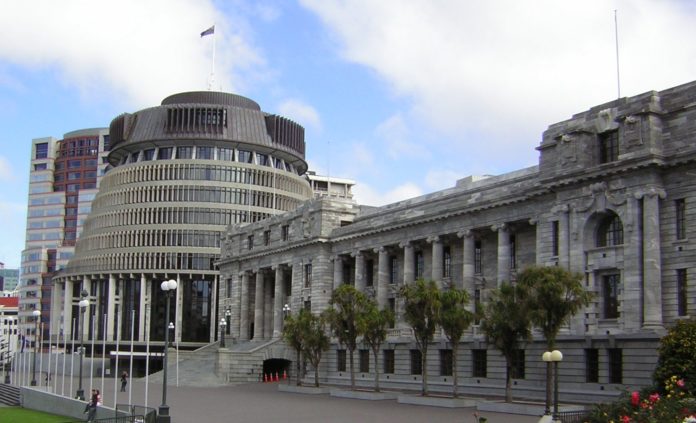
New Zealand Parliament Buildings, Wellington, New Zealand.
Analysis by Dr Bryce Edwards.
Political Roundup: Te Pāti Māori and vested interests
Political scientist, Dr Bryce Edwards.
Controversial Māori politician and president of Te Pāti Māori, John Tamihere, is in hot water over large financial donations relating to his 2019 Auckland Mayoral campaign and Te Pāti Māori’s 2020 election campaign. For him and his supporters, the allegations are “inherently racist”. For others, they illustrate that there are a lot of vested interests and wealth in te ao Māori, and this influence has the potential to have a strong impact on government decisions.
Is Te Pāti Māori a vehicle for vested interests?
Contrary to the myth that Te Pāti Māori only pursue the interests of working class or poor Māori, the party has historically often represented the interests of Māori middle class and business. In fact, this was why MP Hone Harawira split so spectacularly from the party in 2011 to set up his more working class orientated Mana Party. He complained that Te Pāti Māori had become dominated by the elite forces of te ao Māori. The two parties have now reunited, but the underlying tension that caused the split remains.
Similarly, there is a myth that, unlike other political parties, Te Pāti Māori doesn’t have access to wealthy backers. But records show that for many years the party, and its current president John Tamihere, have received large donations from wealthy individuals and organisations to use for campaigning.
Some of these large donations have been in the spotlight recently, and questions raised about their legitimacy. The latest is an investigation by Herald journalist Matt Nippert into donations given to Te Pāti Māori and Tamihere by two charitable organisations that Tamihere himself controls.
The Herald’s allegations about Tamihere’s charities
Matt Nippert’s story, published on the front page of the Herald this week, highlighted that charitable organisations are given tax-free status which saves them huge amounts of money, but this privilege is given on the basis that they do not side with political parties or give donations to election campaigns. In the case of Tamihere’s organisations, this rule appears to have been broken.
Here’s the opening paragraph from Nippert’s report: “Charities connected to Te Pāti Māori president John Tamihere are under investigation after financial reports showed nearly $500,000 in charitable funds had been used to bankroll his mayoral and general election campaigns.”
Tamihere was advanced $82,695 from the National Urban Māori Authority (NUMA) and $385,307 from Te Whānau o Waipareira Trust Group. Tamihere is the chief executive of both organisations, which endorsed his campaigns for office in 2019 and 2020.
Nippert’s article quotes Natasha Weight, the general manager of Charities Services, the agency that regulates tax-free charities, saying the rules are very clear: “a charity must not support or oppose a political party or candidate. This includes making a donation to a political party or a candidate’s election campaign, endorsing a party or candidate, or allowing a party or candidate to use a charity’s resources”.
As political finance researcher Max Rashbrooke wrote this week, “this looks terrible for Tamihere and the Trust. How can a registered charity be lending (and in effect donating, since it’s interest-free) their money to a political candidate? That’s not a ‘charitable’ purpose!”
The University of Auckland’s Peter Davis, a long-time Labour Party activist, also commented this week on Tamihere and Te Whānau o Waipareira: “He has always run the trust as a bit of a personal fiefdom and this has not been transparent until now. It was possible to forgive the early likely and anecdotal transgressions because the Trust was doing necessary work, but this crosses a line that no longer earns such sympathy.”
According to Nippert, Charities Services has issued a formal warning to Te Whānau o Waipareira, and is now engaged in negotiations over how to proceed with the alleged breach of the law. Te Whānau o Waipareira could be de-registered and Nippert says it could lose its lucrative tax-free status, which he calculates could cost it $16m.
Tamihere’s charities – which are clearly partisan – also contract to the Government to provide Whānau Ora services. When the donations first came to light last year, political commentator Shane Te Pou called for the minister of Whānau Ora to bring in the Auditor-General to investigate.
Nippert has also raised a discrepancy in the amounts that have been provided to Tamihere and Te Pāti Māori: “Tamihere declined to explain the difference between the sum recorded in accounts as being advanced by the charities for his political campaigns ($468,002), and the figure recorded as donations from them and him for the mayoral and general elections ($387,604).”
Racism allegations and defence
Tamihere and Te Whānau O Waipareira have reacted strongly to the Herald news story, accusing the newspaper of racism. Tamihere called it an example of the media demonising Māori, labelling it “a hit on the Māori”.
Talking about Nippert’s story, Tamihere says “This is a pogrom”, and likens the experience to that of the Jews facing persecution. And he says that Te Pāti Māori will no longer work with or write for the Herald, which raises important issues for media freedom and holding politicians to account.
In announcing the boycott, Tamihere states: “I will never write another word to try and educate ignorant pakeha about Māori matters for the New Zealand Herald. Nor will any Māori Party member ever be either interviewed or write anything for the New Zealand Herald or ZB radio – let’s leave it for what it is – ‘white man’s radio’, ‘racist radio’, and a racist rag… We will just go on our own platforms. We will talk on iwi radio, because we no longer need white men to define us”.
Tamihere also appealed to pakeha to intervene to curtail the questions being asked, saying Nippert’s story was fake news and a smear: “good Pākehā friends need to know what some of their kinfolk get up to and they just have to stop it and stop them. It’s not for Māori to correct things all the time and defend themselves all the time from malicious framing of us always in a negative way.”
The charity is also now crowdsourcing material from supporters in an attempt to prove that the journalist is racially motivated, using the social media hashtag #dobinaracistlikeMattNippert
The ethnicity element is centrally important to this issue, and is likely to have continued reverberations. For instance, in Parliament it caused one of the biggest political scuffles of the week, with Whanau Ora minister Kelvin Davis reacting to questions about the scandal by accusing Act MP Karen Chhour of having a “vanilla lens” and needing to get acquainted with the Māori world.
Davis’ comments were made in response to the following question in Parliament: “So does the Minister agree with John Tamihere when he says his charity and Oranga Tamariki are in a partnership and not a contract, and if Te Whānau o Waipareira is struck off the Charities Register, will the Minister guarantee that this partnership will end?”
Past issues with the Te Pāti Māori and vested interests
Matt Nippert’s revelations of the donations aren’t entirely new. His story is important because they highlight the investigations of Charities Services into the partisan activities of the two trusts.
Last year the Electoral Commission announced it was concerned about a breach of electoral law by Te Pāti Māori because they failed to declare the donations from the two charities during the election – as well as another $120,000 donation from the mysterious Aotearoa Te Kahu Limited Partnership.
The Electoral Commission made a complaint to the Police, and then the Serious Fraud Office (SFO) investigated. This week we learned that the SFO have closed their investigation and decided not to prosecute. The agency won’t provide further details of what they learned about the breach and why they’ve made their decision, simply stating: “The SFO has closed this matter and will not be taking any further steps”.
What is unknown is whether knowledge of the donations would have changed voters’ opinions of the party at the 2020 election. Te Pāti Māori kept the details secret, and then got back into Parliament when Rawiri Waititi captured the Waiariki electorate, beating Labour incumbent Tāmati Coffey by 836 votes.
Vested interests operate amongst all ethnicities
Te Pāti Māori and John Tamihere have been entirely dismissive of any questions about their financial backers and whether they are following the rules meant to make politics more transparent. This suggests they don’t take issues of corruption and vested interests seriously.
Although the party has only two MPs, there is a strong chance that Te Pāti Māori will hold the balance of power at the next election. Some in the Labour Party clearly see Te Pāti Māori as the Ardern Government’s lifeline to power at the next election should the National Party and Act win more votes than Labour and the Greens combined. Tamihere and his colleagues could have huge leverage over the next government.
When political figures are powerful they need to be held to account, regardless of race. Allegations of racism are extremely powerful, precisely because of the history of appalling discrimination towards Māori in this country. But such allegations should not be used to shield those in power from scrutiny. Te Pāti Māori is a product of our democratic political system and, as such, has to be held to account in the same way as other political parties, especially on an issue so important and fundamental as the funding of political campaigns. Double standards can’t be accepted by anyone wanting clean and fair politics – especially those of us worried about vested interests looking for ways to leverage their political donations.
Source: Council on Hemispheric Affairs – Analysis-Reportage
Alina Duarte Mexico City
Evo Morales, former President of the Plurinational State of Bolivia and President of the Six Federations of the Tropic of Cochabamba, was a special guest of President Andrés Manuel López Obrador (AMLO) during festivities marking the 212th anniversary of Mexico’s independence. The other international guests included John and Gabriel Shipton, father and brother of journalist Julian Assange; family of the late farmworker and activist César Chávez; Aleida Guevara, daughter of Che Guevara; and former Uruguayan President “Pepe” Mujica.
On September 15 Morales witnessed President Andrés Manuel López Obrador calling out the cry for independence. In addition to the traditional “¡Viva México!” of the heroes of independence, AMLO yelled, “Death to corruption! Death to racism! Death to classism!”
The former President of Bolivia also stood on a balcony of the National Palace, where he received a standing ovation from the thousands of people attending the festivities. The next day, Morales was just a few yards away from the Mexican President when AMLO called for a five-year worldwide truce.
During his short visit, Evo Morales gave me a few minutes of his time to talk about Mexico, Latin America, lithium, and the present and future of our region.
Journalist Alina Duarte speaks to Evo Morales (Photo credit: Devadip Axel Meléndez)
After meeting with the Mayor of Mexico City, Claudia Sheinbaum, Morales met with me at his hotel. He was in a hurry since his flight back to Bolivia was departing in a couple of hours. He gave a rushed greeting, sat down, took a breath, and while he was getting settled, I thanked him for taking the time to answer my questions.
Not one minute into the interview he said that he is in Mexico because he was invited by President Andrés Manuel López Obrador.
-Let’s cover that first, Evo. You are here precisely by invitation of President López Obrador. You were one of the big-name special guests to attend the Independence Day festivities. You were present when he issued the Cry of Independence—actually two events—the “cry” the night of September 15th, and the parade on September 16th, when President López Obrador gave a speech before a military parade, calling for a worldwide truce. The night before he had also called out “Death to Racism! Death to Classism!” etc. What do you think of all that?
-Andrés, the President of Mexico, is Andrés. This president has long been very humanistic, in solidarity, committed to poor families and their social programs. I met this President at his inauguration, and he greeted me saying, “my indigenous brother,” or something like that. After the coup d’etat he saved my life, he helped me, he helped us to return to democracy, along with other presidents such as the president of Argentina, Venezuela, Cuba, President [Ernesto] Samper, [José Luis Rodríguez] Zapatero, even the President of Paraguay. And now I have been invited alongside my brother, Pepe Mujica. He invited me together with Julian Assange’s father and Che’s daughter, Aleida Guevara, and other guests. I am honored to participate and attend the Independence Day activities in Mexico.
On September 15th he surprised us by yelling “Death to racism! Death to Corruption! Death to Classism!” That is a strong message, but also a message of integration. I continue to think that some day we will have a plurinational Americas, of peoples for the people. Not America in the sense that the Americans say: “All of Latin America is the backyard of the United States.” What did we hear from the US Southern Command two or three weeks ago? They are concerned about Lithium. But what is more, they consider Latin America to be a neighborhood of the United States. It pains us to still hear these kinds of messages in the 21st century. There are new leaders, such as my brother Andrés with his proposals. We heard an interesting message, a proposed [global] truce to avoid conflict, and above all, the financial crises that are leading the United States to use NATO to intervene militarily and surround Russia, provoking that armed conflict.
Left to right: Luis Cresencio Sandoval, Secretary of Defense; José Rafael Ojeda, Secretary of the Navy; Pepe Mujica, former President of Uruguay; Evo Morales, former President of Bolivia; Aleida Guevara, daughter of Ernesto “Che” Guevara; Gabriel Shipton and John Shipton, brother and father of Julian Assange (Photo credit: Government of Mexico)
-And in that speech, Evo, President López Obrador said that he proposes a five-year worldwide truce “to address the major, serious economic and social problems that afflict and torment our peoples.” The proposal, which he says Foreign Minister Marcelo Ebrard will formally present to the UN, “seeks the immediate suspension of military actions and provocations as well as military and missile tests.” It would seek to form a committee to foster dialogue between Russia and Ukraine, for which he even said he would propose the inclusion of Pope Francis and Narendra Modi, the Prime Minister of India, and on behalf of the UN, Secretary General Antonio Gutérrez.” What message does this send outside Mexico?
-First, it shows that our brother and President of Mexico is concerned about the situation with food and energy, that he is concerned with life and humanity. It is a good proposal deserving of our admiration. In fact, it surprised me and I think it surprised everyone, the idea of a truce with mediators from India, Pope Francis, the United Nations, and surely Mexico would also be with the initiative. We salute it and support it and hopefully the whole world will listen to it. I wish that NATO would stop attacking and encircling countries when they do not submit to the empire—that is the underlying issue. I heard that there was a big meeting today with China, India, I’m not sure whether it is with Pakistan, Iran, Turkey, and Russia. Hopefully it will go well and some light will be shed on how to attain peace, but with social justice.
-I think that these invitations President López Obrador is extending to you and other people are important. He might not have been able to do so four years ago when he came into office, but things have changed regionally. What is your assessment of the role that Mexico is playing in the region with all these issues you have put on the table, including at the global level?
-I feel that there is a democratic rebellion underway throughout Latin America and the Caribbean. Two, three years ago there was the Lima Group to overthrow [Nicolás] Maduro. Where is the Lima Group today? Who made up the Lima Group? The former presidents of Peru, Argentina, Mexico, Chile, and particularly of Colombia.
-Now they are all gone…
-There is no more Lima Group. Look, after we founded UNASUR (Union of South American Nations) with [Hugo] Chávez, with Lula [da Silva], with [Rafael] Correa, and with [Néstor] Kirschner and other presidents (I very much regret that some parties have become submissive to the Empire), the Lima Group was able to, I would say temporarily, paralyze UNASUR. But together with [Hugo] Chávez and Fidel [Castro] we created CELAC (the Community of Latin American and Caribbean States). But [Barak] Obama and other U.S. presidents responded to this integration proposal by organizing the Pacific Alliance to maintain the policies of the Washington Consensus or the FTAA.
Now I am wondering, where is the Pacific Alliance? These institutions or organizations that only serve to uphold U.S. policies have been defeated with this democratic rebellion.
-Such as the OAS [Organization of American States]…
-Of course, but in addition, imagine it! I am almost certain that our brother Lula will win (in Brazil) in next month’s election; plus Mexico—that is a great strategic alliance for all the countries of Latin America and the Caribbean. It gives us great hope.
Fifty or 60 years ago, at least, we saw how Cuba was expelled from the OAS. Then countries were afraid of getting expelled from the OAS. Now it is a source of dignified pride to leave the OAS. We have a responsibility to relaunch CELAC in order to truly ensure integration—but not just of heads of state—of their peoples.
President Andrés Manuel López Obrador greets Evo Morales and other guests at the Independence Day ceremony in Mexico. (Photo credit: Government of Mexico)
-Speaking of Latin America, I want to explore this further because some people call it the second cycle of progressive governments. Others talk about some unique characteristics. The truth is that there is a trend, not only in their discourse, but also in their actions, that are clearly anti-neoliberal and anti-imperialist. We see this with the victory of Gustavo Petro together with Francia Márquez in Colombia. It is important that figures like yourself pointed out that the two of them together made the victory possible, not just Petro. We also have elections in just a few days in Brazil and we see Lula da Silva with great chances of returning. How do you perceive today’s Latin America?
-First, all of the doctrines of empire have collapsed. Where is the Cold War? Where is the War on Terrorism? Why am I saying this? Now, parties of political movements, social movements with socialist tendencies and principles, with communist doctrines, are getting elected to the presidency. This did not exist before; it was only Cuba.
Terrorists… for the Empire, who are the terrorists? Social movements. I recall in 2002 U.S. Ambassador Manuel Rocha telling people “Don’t vote for Evo Morales; Evo Morales is an Andean Bin Laden and the coca growers are the Taliban.” He said, “Don’t vote that way, if you vote for Evo, there will be no aid or investment.” What a lie! In 2005 government expenditure was US$1.6 billion. In the last years I was in office before the coup, we programmed more than US$8 billion in government expenditure.
So we “terrorists” are now presidents. [Gabriel] Boric was a student leader; Pedro Castillo who was a rural patrolman or “rondero” and a leader of the teachers’ union, is now president. It was hard, but we won. I feel that the U.S. doctrine is falling to pieces. Look, some of our brothers even took up arms for their liberation 200 years after the founding of their republics, and now they are presidents, such as Daniel Ortega and Gustavo Petro. And some of us organize in social movements and some even took up arms, which I don’t support so much, but the people make it right and time will tell. But what is the danger that I see? When the Empire is in decay it resorts to violence. I do not want to think this but it is what happened to Cristina Fernández a few weeks ago. When the Empire loses its hegemony, it resorts to weapons. For that reason, I think we need to take advantage of this moment to armor ourselves, so that right-wing governments submissive to imperialism never return.
-At another point in time, talking about U.S. interference in the region was viewed as conspiracy theory, a myth, although how they orchestrate destabilization and coups d’etat has been extensively documented. We saw the social uprising in Chile; in Brazil they were liberating Lula but at the same time they were cooking up a coup d’etat in Bolivia. It is now three years since that coup. What is your view of the recovery of democracy in Bolivia, and what are the specific challenges of a right-wing which, as we have seen, has not given up its attempts to destabilize a democratically elected government, in this case, the government of Luis Arce?
-I look at the consciousness of the people. The MAS-IPSP (Movement Toward Socialism-Political Instrument for Sovereignty of the Peoples) has a political, economic, and social agenda beyond the bicentennial. The MAS-IPSP is the largest movement in the history of Bolivia, and it is headed by the indigenous movement. We in the indigenous movement have inherited our history; we have inherited the struggle going back to colonial times. We were threatened with extermination and hated during the days of the Republic, even though we engaged in a political movement to liberate all of Bolivia. I remember perfectly well that in 2005 our platform was based on three points: politically, the re-founding of the nation through the Constitutional Assembly; economically, the nationalization of natural resources and also basic resources; and socially, the redistribution of wealth. We made a lot of history in a short period of time. But there, the underlying theme, sister journalist, is that in addition to being gringos against Indians, the coup was against two things. First, it was against our economic model. The Empire does not accept new economic models that are better than the economic model of neoliberalism as dictated by capitalism. So, it was against our economic model.
And what was the basis of our economic model? The nationalization of our natural resources, but it also started with their industrialization, above all, the industrialization of lithium. You as a journalist know how many messages and evidence there was that the United States caused a coup d’etat over lithium. England had financed the coup over lithium. Elon Musk, the owner of Tesla, acknowledged his interests in the Uyuni Salt Flats and there was a coup d’etat.
What is happening should unite all of us much more. It is not only over lithium, over petroleum, over gas, or over natural resources. This is the struggle of humanity. Who do the natural resources belong to? Private parties to loot them for their transnational corporations? Or to the peoples of the world to exploit them for our States, for our governments? Of course, we need to tap into our natural resources while caring for the environment.
-Talking about the United States, Evo, you point out that the coup against you was to get the lithium, something that has been demonstrated, and this is nothing new for the United States to come after the natural resources of Latin America. But the people of Mexico are much more interested in this now that the López Obrador administration has decided to create its own company to industrialize lithium. In early August we read the news that the Bolivian and Mexican governments were trying to establish a partnership, not to sell lithium as a raw material—which is what the major powers want—but a partnership, essentially, to industrialize lithium. What did all of this mean for your administration and particularly what role did it play in the coup d’etat?
-I am a witness to that. In 2010 I was invited to visit South Korea. The job of the president is to do good business for the people. We signed some big agreements and they invited me to look at a new lithium battery industrial plant, which was beautiful. I asked them how much it cost, and the answer was “US$300 million.” At that time, our reserves were growing and we had US$10, US$11 billion in international reserves. I thought, “I can guarantee the US$300 million.” I told the Koreans, “We can build a plant just like it in Bolivia and I can guarantee the investment.” They said, “No, no, no.” And I have many other such memories. That was when I realized that, unfortunately, the industrialized countries only like us if we guarantee raw materials for them.
So then what did I do with Alvaro [García Linera], the vice-president? We started with laboratories, with a pilot plant in the great lithium industry. We hired experts for the laboratories. By the time we did the pilot plant, the young people had already learned and we had a beautiful project. And we decided that foreigners could not be involved in the extraction. Regarding markets, there are agreements and there is no problem.
Journalist Alina Duarte with Evo Morales (Photo credit: Devadip Axel Meléndez)
-(Evo leafs through various media reports around the time of the coup d’Etat against him in 2019 and reads off some of the headlines.)
–Where is that article? November 20, 2019, a few days after the coup d’Etat, “Coup in Bolivia Smells of Lithium,” first-hand report. “Trump Applauds Departure of Morales under Pressure from the Army.” Unfortunately, then the military commanders turned. “Why might the United States be behind the coup in Bolivia?” Senator Richard Black explains that it is over lithium. “U.S. Senator assures that the United States intervened over Lithium.” And that is why the owner of Tesla, the electric car company, said, “We will coup whoever we want! Deal with it.” This shows who financed the coup mongers in Bolivia. Last year it was reported, “United Kingdom supported the coup in Bolivia to access its ‘white gold,’” lithium. And they had invested, they had financed it; it was not just their verbal support. That is why in the days of coup the British ambassador was in continuous meetings with the opposition, with the coup plotters.
We have a gold mine here, “The price of lithium went up from US$4,450 per ton of lithium carbonate in 2012, to US$17,000 per ton in 2021,” last year. [Now,] in just a ten-year period it has reached US$78,000 per ton of lithium carbonate!
-In this regard, what message can you send to the government and people of Mexico, thinking that one of the paths chosen has been to nationalize lithium?
-I salute my brother President and the government of Mexico for saying that the lithium belongs to the Mexican people. I understand that it has now been nationalized. How beautiful it would be if Bolivia, Mexico, Argentina, and Chile were together on this. But in Chile it is totally in private hands; in Argentina, hopefully they can recover it. But in Bolivia and Mexico we should form a strategic partnership to industrialize our lithium.
And I remain convinced, sister journalist, that some countries of Latin America will become powerhouses in something, and we could become lithium powers, with tremendous prices. And they are going to continue to go up. Each of us and our governments have this task. I celebrate the fact that President “Lucho” Arce of Bolivia met with President Andrés Manuel López Obrador of Mexico. The technical teams are at work. They were asking me what technical people we have. We must share work experiences. We have good technicians; we have learned a lot. We have to come together to launch our industrialization of lithium, but it must be led by our governments. A State controlled by the people, not the usual way of turning it over to transnational corporations; we do not agree with that. In our experience, the nationalization of our natural resources and of strategic companies, helped us change the image of Bolivia quite a bit.
-And, finally, Evo, I do not want to let you go without saying that I saw your arrival in Zacatecas, where you were given a Doctorate Honoris Causa from the University of Zacatecas. We can now call you “Dr. Evo.” Tell me about it.
-Last year they invited me to come and receive some recognition. This year, with this invitation from President Andrés Manuel, I decided to take advantage of my visit to go to Zacatecas. Thanks to the Autonomous University of Zacatecas I was able to meet with the social movements, the peasant Indigenous movement, teachers, some political parties, and also the governor of Zacatecas. The recognition that I received is for the social movements and the Indigenous movement in particular. Without them, I would never have become president, and I thank the university and several comrades for taking this initiative. We talked quite a bit and I visited a mining area. In addition, it is a very interesting colonial town and we have a good relationship. I hope I never lose those relationships of so much trust, to open them up to humble people. Thank you very much.
-Thank you so much for your time, Evo. We hope that you will come back for other occasions, and more often. Thank you for this dialogue.
Alina Duarte is a journalist and Senior Research Fellow at the Council on Hemispheric Affairs, COHA.
This interview was edited by COHA Director Patricio Zamorano.
Translation by Rita Jill Clark-Gollub, COHA Assistant Editor/Translator
Source: The Conversation (Au and NZ) – By C Raina MacIntyre, Professor of Global Biosecurity, NHMRC Principal Research Fellow, Head, Biosecurity Program, Kirby Institute, UNSW Sydney
COVID is an exceptional disease and was at its deadliest this year, causing more deaths in Australia between June and August 2022 than at any other time. There have been 288 deaths from influenza so far this year compared to more than 12,000 deaths from COVID.
The number of deaths from COVID in Australia in the first nine months of 2022 is more than ten times the annual national road toll of just over 1,000 – but we are not rushing to remove seat belts or drink-driving laws so people can have more freedom.
Isolation flattens the COVID curve by stopping infectious people from infecting others, and is a key pillar of COVID control.
Workforce shortages have been felt in every sector during the pandemic. Shortages of health workers have resulted in the need to import workers from overseas, and deadly outcomes for patients in some cases.
During epidemic peaks this year, the workforce was so badly affected that supermarket shelves could not be stocked. Removing the isolation period is hoped to ease workforce shortages – but any relief will be short-lived.
During epidemic peaks this year, the workforce was so badly affected, supermarket shelves could not be stocked. Mari Nelson/Shutterstock
At times when COVID numbers are increasing, allowing infectious people to mingle freely at work and socially will create epidemic growth and make the crisis even worse. At the current time, when cases are relatively low, removing isolation mandates will not materially benefit the workforce, but will make the workplace and schools less safe.
Eliminating isolation rules provides the opportunity for governments to save costs. Without mandatory isolation support, payments for workers needing to isolate will end.
While politicians spin this as trusting Australians to take “personal responsibility”, sadly many Australians will simply not have the means to take time off work. With elimination of mandatory isolation periods, essential workers in low paying jobs will find themselves at even more risk of contracting COVID in the workplace.
Newer variants of SARS-CoV-2, the virus that causes COVID-19, are more immune-evasive than ever. Immunity from vaccines wanes within two to three months, and so too does immunity from infection. Hybrid immunity is cited as a reason for abandoning isolation, but is unlikely to eventuate.
Indeed, we saw this with the recent BA5 wave leading to more hospitalisations and deaths than the January/February BA1 wave, despite the presence of much higher vaccine and infection-based immunity in the community. While no doubt this immunity prevented an even worse outcome, it clearly did not keep pace with virus evolution.
While it was hoped hybrid immunity from vaccines and prior infection would reduce subsequent infections, this has not been the reality. Reinfection is becoming more common with variants that are increasingly distant from the original virus. And evidence is accruing that reinfection can cause severe disease.
The most vulnerable may be forced to withdraw from society and from unsafe workplaces to protect themselves. But it is a misconception that COVID is trivial for everyone else. People who are happy and healthy today could become disabled or chronically ill from COVID.
The long-term complications of COVID-19 are substantial, and can include effects on the lungs, heart, brain and immune system. At 12 months after infection, the risk of heart attacks, strokes, blood clots and other complications including sudden death are about double compared to people who were never infected. Chronic complications can occur even after mild infection – including heart failure, strokes and dementia.
Dropping isolation will increase COVID transmission and result in an increase in serious chronic illness. It could be a mass disabling event and so drive major economic and societal losses.
The availability of treatments has been cited as a reason to cease isolation – but these are restricted to limited subgroups, and not available to everyone.
COVID is an epidemic disease and has behaved in a predictable way since 2020, causing recurrent epidemic waves.
Ceasing isolation will hasten the onset of the next wave. Allowing mass infection also creates favourable conditions for emergence of new variants which have been more contagious or more vaccine or treatment resistant.
What we need to do instead
To maximise productivity, health and social success, instead of ignoring COVID, we should tackle it with a layered approach to mitigation of transmission. This includes raising rates of boosters, widening access to antivirals and other treatments, masks, safe indoor air, and widely accessible testing.
Making isolation a rule, and supporting people financially to do so, has been a key pillar of our defences. This is still needed as viral evolution continues to outpace immunity.
We just had our worst wave and there is nothing to suggest the next won’t be similarly bad. Workplace absenteeism is a function of transmission, so better control of SARS-CoV-2 will result in greater productivity, less disruption to families and businesses, and a more successful way forward to living with COVID.
C Raina MacIntyre receives funding from NHMRC and MRFF. She is currently receiving funding from Sanofi for research on influenza and pertussis. She is on the WHO COVID-19 Vaccine Composition Technical Advisory Group and the WHO SAGE Monkeypox and Smallpox ad hoc working group.
Brendan Crabb and the Institute he leads receives research grant funding from the National Health & Medical Research Council of Australia and other Australian federal and Victorian State Government bodies. He is the Chair of The Australian Global Health Alliance and the Pacific Friends of Global Health, both in an honourary capacity. And he serves on the Board of the Telethon Kids Institute.
The School Nancy Baxter leads receives research grant funding from the National Health & Medical Research Council of Australia, Australian Research Council, and other Australian federal and Victorian State Government bodies. She serves on the Advisory Board of The Australian Global Health Alliance and on the Board of the Nossal Institute. She has been an unpaid participant in an Advisor Board meeting for MSD Australia.
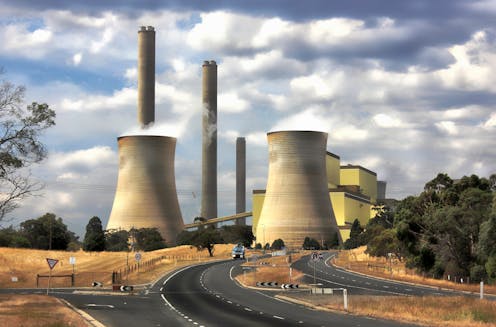
AGL Energy – Australia’s largest emitter of greenhouse gases – announced this week it will shut the Loy Yang A power station in Victoria’s LaTrobe Valley in 2035, a decade earlier than planned.
This is significant for the Australian electricity industry. Loy Yang A provides around 30% of Victoria’s power and is Australia’s largest single emitting industrial facility.
But while the announcement has made headlines, it comes as no surprise. The power station burns brown coal which, while cheap, is an inefficient and emissions-heavy source of electricity. Brown coal-fired power stations are also failing to compete with the gathering pace of renewables.
AGL promises to replace the electricity provided by Loy Yang A with large-scale renewables and firming generation (such as batteries). This is, in my view, the most important commitment, because it’ll help ensure Australians have reliable electricity in the decades to come.
A big week in energy
AGL emits more than 40 million tonnes of carbon dioxide equivalent each year. Its announcement to bring forward Loy Yang A’s closure is no doubt largely in response to consumer and shareholder views that the electricity sector must decarbonise.
Consumers are voting with their feet and increasingly demanding electricity sourced from renewable generation. Indeed, Woolworths, BHP and Aldi are just a few high profile brands that have committed to buying 100% renewable energy.
The announcement comes amid a big week of energy news. The Queensland government released its Energy Plan, which promises to shift the state to 70% renewable energy by 2032 and 80% by 2035. The plan involves an estimated A$62 billion of investment in the energy system up to 2035.
Meanwhile, the Victorian government announced plans for 2.6 gigawatts of new energy storage capacity by 2030, jumping to 6.3 gigawatts by 2035.
This is all against the backdrop of the federal government’s commitment to have 82% renewables in the Australian grid by the end of the decade.
Loy Yang A is in the Latrobe Valley, which has enormous reserves of very cheap brown coal. Brown coal is physically difficult to export, so the cost of brown coal electricity generation remains very low, even at times of high international energy prices.
But these advantages are more than offset by brown coal’s major disadvantage: it is one of the least efficient and most emissions intensive types of electricity generation.
The Victorian government has a legislated target of 50% renewable energy for the state by 2030. Such significant investments in new renewables have undermined the viability of brown coal fired power stations.
And the wave of investment is set to intensify. The Victorian government has committed to 2 gigawatts of offshore wind by the end of the decade, and a total of 9 gigawatts by 2040. In terms of energy output, this is the equivalent of two Loy Yang A power stations.
But it is Australia’s love for rooftop solar that has really undermined the economics of brown coal.
Around 30% of homes in Australia have rooftop solar panels. In fact, the total capacity of rooftop solar is now almost equal to the entire remaining capacity of coal fired generation.
When the sun is shining, rooftop solar significantly reduces the amount of electricity demand from the national grid. This forces coal-fired generators to reduce their energy output significantly. In the evening, when electricity demand peaks, coal-fired generators must then ramp up their generation again.
Coal generators weren’t built to be ramped up and down to meet demand. They were built to be switched on and left operating at their maximum output, all day every day. Operating them like a yo-yo effectively ages them prematurely, bringing forward major maintenance expenditure and the likely end of their operating lives.
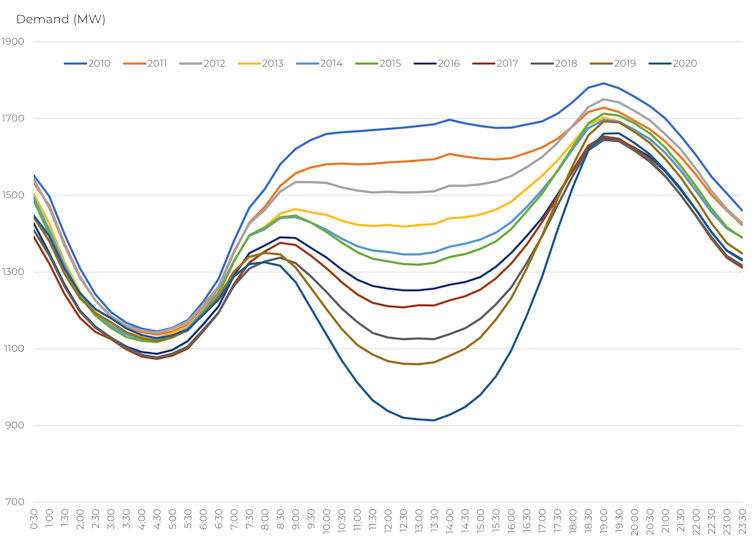
The impact on grid-based electricity demand in South Australia is shown in the chart below. It is clear that over the past ten years, grid demand in the middle of the day has fallen substantially due to the impact of solar, making it very hard for inflexible older coal plants to compete.
Changes to South Australian electricity demand over the past decade. This new shape of electricity demand is called the ‘duck curve’ (or in Australia, the ‘emu’ curve!) Tim Nelson
AGL’s even more important commitment
While the focus has been on the closure of Loy Yang A, the more important commitment relates to AGL building the new generation required to replace it. In its Climate Transition Action Plan, AGL stated:
We will seek to supply our customer demand with [around 12 gigawatts] of additional renewable and firming capacity, requiring a total investment of up to $20 billion, before 2036.
Our initial target is to have up to 5 GW of new renewables and firming capacity in place by 2030, funded from a combination of assets on our balance sheet, offtakes and via partnerships.
In other words, AGL will replace Loy Yang A with a mix of wind, solar, battery storage and other firming generation that, when combined, do the same job Loy Yang A does now – provide electricity all day every day.
This is exactly what energy consumers need: a commitment to not only close a large coal-fired power station, but a complementary commitment to build the two types of technologies required to replace it on a like-for-like basis.
Some may argue AGL’s announcements are long overdue. But with Origin Energy and AGL both indicating that the future is firm renewable energy, it’s becoming ever more likely that 100% renewable electricity in Australia’s electricity grid could be achieved by the end of the decade. That’s fantastic news for consumers, and for the climate.
Tim Nelson is an Associate Professor at Griffith University and the EGM, Energy Markets at Iberdrola Australia, that develops renewable projects and batteries. Tim was the Chief Economist at AGL up until 2018.
Australian Sean Turnell, economic adviser to Myanmar’s democratically elected leader Aung San Suu Kyi, has been in prison since the military coup of February 2021, awaiting trial for the supposed crime of stealing state secrets.
This week a puppet court sentenced him to three years in prison, alongside Suu Kyi, who has already been sentenced to 20 years’ jail in other sham court cases.
Both pled not guilty to the charge of holding confidential secret government documents. Turnell has said all he had were economic papers needed for his work as a technical economic adviser to Myanmar’s government.
The trial was held behind closed doors. Australian consular officials attempted to attend but were denied access. Foreign affairs minister Penny Minister has issued a statement rejecting the legitimacy of the trial and calling for Turnell’s release.
The Myanmar regime has agreed to take into account the 20 months Turnell has already spent in prison. So he is due for release in January 2024.
It is possible, however, that he could be released and deported early. There is a precedent for this. In November 2011 US journalist Danny Fenster was sentenced to 11 years with hard labour but released just a day later. Bill Richardson, a former New Mexico governor and US ambassador to the UN, was appointed as a special envoy and negotiated his release.
How Turnell ended up in Myanmar
I’ve known Turnell as a family friend and colleague for many years.
A working-class kid from Macquarie Fields in south-west Sydney, he attended Macquarie University, where he earned a bachelor’s degree in economics, then a PhD and ended up as an associate professor.
Turnell went on to become an expert on the links between banking systems and economic performance in developing countries, particularly in South-East Asia.
He wrote some important academic articles on Myanmar discussing how, after decades of isolation under military rule, economic reforms could rebuild the nation’s agriculture and tourism sector.
His work gained the attention of Aung San Suu Kyi. They first met in the early 1990s, before Suu Kyi was sentenced to house arrest. After her release in 2010 the junta (temporarily) allowed democratic reforms and she invited him to become her economic adviser.
Turnell’s economic competence was widely admired. He became a sort of John Maynard Keynes of Myanmar. I witnessed this in 2017 when he gave the keynote address to an Australian Myanmar Institute conference in Yangon. It was a full house with an enthusiastic audience.
On February 1 2021 the miltary staged its coup. Turnell was arrested, along with other prominent advisers to Suu Kyi, a few days later.
Is it time for sanctions?
It has been suggested that Australia should appoint a special envoy help get Turnell released, just as the US did for Danny Fenster. Former prime minister Kevin Rudd might be suitable given his good relationships in Asia.
In the meantime it is pleasing to see that foreign minister Penny Wong has been more vigorous than her predecessor Marise Payne in advocating for Turnell, and Myanmar generally.
Last month Wong raised the issue of Myanmar at a meeting of ministers of the Association of Southeast Asian Nations (ASEAN). Myanmar is one of ASEAN’s ten members, and its neighbours have been divided over the forum’s longstanding policy of “constructive engagement” versus taking a harder line.
But will the Australian government back up its rhetorical support for Myanmar’s democracy movement with the type of sanctions the movement wants from the international community?
Observers have suggested Turnell’s fate may have influenced the former government’s lack of enthusiasm for sanctions.
That still appears the case, with Wong adopting a similar stance to Payne in saying only that sanctions against members of Myanmar’s military regime “are under active consideration”.
But there’s a paradox at play here. If Turnell’s predicament really is behind the government’s reluctance to impose sanctions, that gives Myanmar’s junta an incentive to keep Turnell locked up.
Source: The Conversation (Au and NZ) – By Adrian Beaumont, Election Analyst (Psephologist) at The Conversation; and Honorary Associate, School of Mathematics and Statistics, The University of Melbourne
The United States midterm elections will be held in six weeks, on November 8. All 435 House of Representatives seats are up for election, as well as 35 of the 100 senators. Democrats won the House by 222-213 in 2020, and hold the Senate on a 50-50 tie with Vice President Kamala Harris’ casting vote.
Currently the FiveThirtyEight forecasts give Democrats a 68% chance to hold the Senate, but Republicans have a 69% chance to gain control of the House of Representatives.
That means there’s about a 31% chance of either Republicans or Democrats sweeping both chambers of Congress, and a 38% chance of Republicans winning the House while Democrats retain the Senate.
Democrats’ chances of holding the Senate are up from 67% when I last covered US politics four weeks ago, but down from 71% on September 20. Their chances of holding the House are up from 24% four weeks ago, but Democrats’ gains have slowed.
In the national vote for Congress, Democrats lead Republicans by 1.3% in the FiveThirtyEight aggregate, up from 0.8% four weeks ago. President Joe Biden had gained much ground in my last article, but his ratings gains in the FiveThirtyEight aggregate have stalled since: he’s now at 52.2% disapprove, 42.0% approve.
The 35 Senate seats up for election at this year’s midterms are 21 Republicans and 14 Democrats. As Republicans are defending more Senate seats, the FiveThirtyEight forecasts give Democrats a greater chance to hold the Senate than the House.
At the last two presidential elections in 2016 and 2020, polls overstated Democrats. But Donald Trump’s name won’t appear on the ballot paper this year, and polls at the last midterm elections in 2018 were accurate. FiveThirtyEight’s Nate Silver said on September 16 that the polls at these midterm elections could be wrong in either direction.
But September’s economic data on inflation was poor. And from an August 16 peak over 34,000, the Dow Jones has suffered falls this month to crash to just over 29,000 on Tuesday – about a 15% decline.
In my opinion, a greater focus on the economy is stalling Democrats’ gains in the FiveThirtyEight forecasts.
At every midterm election since 2006, the non-presidential party has easily won control of the House. It will be difficult for Democrats to defy this history.
Economic data: jobs and inflation
The US August jobs report was released September 2. While 315,000 jobs were created, the unemployment rate rose 0.2% from July to 3.7%. The increase in unemployment was due to a 0.3% increase in the participation rate, with the employment population ratio – the share of eligible Americans employed – up 0.1% to 60.1%.
However, both the participation rate and employment population are about 1% below their levels in February 2020, before the COVID pandemic began.
The US August inflation report was released September 13. Headline inflation increased just 0.1% after an unchanged July; the last two months were far below the 1.3% increase in June. However, headline inflation has moderated due to falls in energy prices.
Inflation excluding food and energy (“core” inflation) increased 0.6% in August after a 0.3% increase in July. Core inflation is what central banks focus on controlling, so this high reading increased interest rate expectations.
Real earnings account for inflation. In August, real hourly earnings were up 0.2% after a 0.6% increase in July, though these gains followed a 0.9% drop in June. Real weekly earnings decreased 0.1% in August after a 0.8% increase in July. However, in the 12 months to August, real weekly earnings are down 3.4% and real hourly down 2.8%.
Are Trump’s legal woes significant?
Former US President Donald Trump has been experiencing legal woes. Trump’s problems may assist Democrats in the midterms as he is still unpopular, with the FiveThirtyEight aggregate giving him a 54.0% unfavourable, 41.9% favourable rating.
Trump has continued to be heavily involved with politics, making it difficult for voters to move on from him.
For the 2024 presidential election, I don’t think Trump’s troubles with the law matter so much. If he’s unable to run, Republicans will nominate someone who is also very right-wing – the favourite would be current Florida governor Ron DeSantis.
UK Labour seizes huge poll lead after ‘horror’ budget
On September 23, new United Kingdom Chancellor Kwasi Kwarteng delivered a budget that would greatly reduce taxes to the benefit of the already well-off. Rather than cut spending, the tax cuts would be funded by borrowing. Owing to this borrowing, the UK pound plummeted on the financial markets.
Financial market turmoil has continued this week, and has been responsible for the Dow tanking.
There were four UK national polls conducted between Tuesday and Thursday this week. In three of these polls, the opposition Labour led the governing Conservatives by 17 to 21 points.
In the fourth, a YouGov poll, Labour led by 33 points, 54% to 21%. Labour’s lead is up from high single to low double digits before the budget.
The good news for the Conservatives is that the next UK general election isn’t due until late 2024.
Adrian Beaumont does not work for, consult, own shares in or receive funding from any company or organisation that would benefit from this article, and has disclosed no relevant affiliations beyond their academic appointment.
National cabinet has agreed to lift the five day mandatory isolation period for people contracting COVID, with the Commonwealth’s chief medical officer declaring “it is time to move away from COVID exceptionalism”.
In a landmark step federal, state and territory governments have essentially moved to treating COVID like the flu and similar illnesses.
The isolation requirement will be lifted on October 14. The pandemic payment, designed to compensate workers without sickness leave entitlements and so encourage them to stay at home, will be removed at the same time.
But to protect people at high risk of COVID, national cabinet agreed to continue targeted financial support for casual workers in the aged care, disability care, Aboriginal healthcare and hospital care sectors. The new payment will be on the same basis as the leave payment has been and funded 50:50 between the two levels of government.
Notably, the body that advises national cabinet, the Australian Health Protection Principal Committee (AHPPC), made up of federal and state health officers, was not asked for advice. Instead Commonwealth Chief Medical Officer Paul Kelly provided written advice, at the request of Prime Minister Anthony Albanese.
Several weeks ago Kelly had push back from the AHPPC over the proposal to reduce the isolation period from seven to five days. There was division among the state health officers, and no recommendation from the committee, which is supposed to operate by consensus. National cabinet cut the number of days anyway.
Having the advice come just from Kelly this time avoided any prospect of divided health advice.
But it will still be a controversial decision in some quarters, with epidemiologists and other medical experts split.
Australian Medical Association president Steve Robson said those pushing for the isolation periods to be cut were “not scientifically literate and are putting the public at risk”.
The strongest push for liberalisation has come consistently from the NSW government. Albanese said the national cabinet decision was unanimous.
Explaining the move from “COVID exceptionalism” Albanese told a joint news conference with the other first ministers that as decision makers “we have a responsibility to listen to the health advice but we’ve also got a responsibility to make decisions which are proportionate. That is what we have done.”
“We are changing our position based upon changing advice and changing circumstances. And that has to occur. There’s not a role for government in running every bit of people’s lives for ever. And that is my firm position.”
He said “the nature of emergency measures is that they’re not there with no end date in sight”.
“The flu has existed, and health issues have existed, for a long period of time, and the government hasn’t always stepped in to pay people’s wages while people have health concerns. It is not sustainable to have in place a system whereby the government steps in permanently.”
Kelly, sitting beside Albanese at the news conference, said “Isolation itself cannot be seen in isolation”.
It needed to be seen in the context of Australia’s high vaccination rate, high previous infection giving further protection, the availability of treatments, and measures in place to protect the vulnerable.
“It is time to move away from COVID exceptionalism, in my view, and thinking about what we should do to protect people from any respiratory disease.”
Kelly provided his advice on Thursday. The first ministers discussed the change over dinner on Thursday night.
In his letter of advice Kelly said: “In the current Australian context of low community transmission and high hybrid immunity from vaccination and recent infection, it is my view that removing mandated isolation requirements in the current period would not materially detract from Australia’s pandemic response and would be consistent with the current aims of that response.
“We have seen a rapid and substantial decrease in cases, hospitalisations and ICU admissions, and the number and size of Residential Aged Care outbreaks since the peak of the most recent BA.5 wave at the end of July 2022.
“Whilst we are closely monitoring new sub-variants of the Omicron variant which continue to emerge, at this stage the situation in Australia is stable.
“In contrast to earlier stages in the pandemic response, Australia now has a number of readily accessed pharmaceutical measures (vaccines and treatments), rapid diagnostic capability, adequate personal protective equipment and appropriate infection prevention and control procedures to protect those at higher risk of severe COVID-19 and to limit outbreaks in high-risk settings.
“On the basis of these current epidemiological and pandemic control settings, in the context of high underlying immunity within the population, as well as readily available pharmaceutical interventions, I consider that a change in mandated isolation periods at this time is a reasonable approach.”
However Kelly stressed new waves of COVID were highly likely and constant vigilance was needed. He urged a detailed transition plan to “adequately prepare Australia to respond to a surge in cases”.
Business, anxious to ensure the economy is as open as possible, especially in light of the worsening economic head winds, welcomed the decision.
The Ai Group (Australian Industry Group) said scrapping the mandatory isolation period “gets the balance right between the health of the community and the desperate need for workers facing so many businesses”.
Meanwhile the Australian Defence Force assistance to aged care facilities to help with COVID ended on Friday. This support has been provided throughout the pandemic, with reinforced efforts announced in February, after Omicron surged.
Michelle Grattan does not work for, consult, own shares in or receive funding from any company or organisation that would benefit from this article, and has disclosed no relevant affiliations beyond their academic appointment.
The leading causes of death in England and Wales are dementia and Alzheimer’s disease; heart disease; cerebrovascular diseases (such as stroke); cancer; and COVID. Other notable causes include chronic lower respiratory diseases (such as asthma); influenza; and pneumonia.
In fact, “old age” as a cause of death – alongside the vague description of “frailty” – is often categorised under “symptoms, signs, and ill-defined conditions”.
This latter category is in the top ten causes of death. But this currently trails well below COVID, and on average over a five year period, below influenza and pneumonia.
Old age, as a category for causing death, has a long history. It was a leading cause of death in the 19th century, alongside the vague description of “found dead”.
In the mid-19th century, registering someone’s death moved from clerical to secular, with the Births and Deaths Registration Act 1836 (UK).
Canadian philosopher Ian Hacking wrote that dying of anything other than what was on the official list was “illegal, for example, to die of old age”.
We may say this is a bit hyperbolic. Surely, by the end of the 19th century, it was not illegal to die of old age?
What this suggests is that providing a precise cause of death is important because it’s a valuable tool for tracking mortality trends at different levels of the population.
Eventually, “old age” became a last resort phrase to describe an unknown cause of death. Or it became useful where a person may have died from a number of complications, but where it was not practical or ethical to order an autopsy to find the precise underlying cause of death.
The other reason why “old age” has been seldom used as the cause of death in the 20th and 21st centuries was that it doesn’t provide any closure to families of the deceased.
Research shows families want information about how their loved one died, not only because it can be useful for managing their own health concerns, but also because it provides a resolution to their loved one’s death.
An unknown cause of death can exacerbate grief and trauma, particularly if the death was sudden or unexpected. Researchers have long argued families form continuing relationships with their loved one after they die. Ascertaining how they died is one part of how the family members left behind manage their grief and memorialise the deceased.
A good death
We may decide that asking for more information about how the queen died at the age of 96 is just macabre titillation. We may decide the royal family deserves privacy surrounding intimate details of the queen’s death.
However, a specific cause of death of someone who lived a privileged life and who died at an old age, for instance, can tell us much about how to lead a healthy life and plan for a good death.
Among the many questions raised by the Optus data leak – cybersecurity experts are confident it wasn’t a hack, but that may have to be decided by a court – is why the company was storing so much personal information for so long.
Optus had a legitimate need to collect that data – to verify customers were real people and potentially to recover any debts later. This is known as a “know your customer” (or “KYC”) requirement.
But the reason about 4 million former customers along with 5.8 million current customers are now worrying about their driver’s licences, passport numbers and Medicare numbers ending up in the hands of criminals is due to Optus hanging on to it for six years.
It is required by the Telecommunications Consumer Protections Code, the industry code of practice overseen by the Australian Communications and Media Authority, to provide customers (or former customers) billing information for “up to six years prior to the date the information is requested”.
But your name, address and account reference number should be all it needs for this, not your passport, driver’s licence or Medicare details. If it needs to confirm your identity it could simply ask for documents again.
The only clear legal requirement for it to keep “information for identification purposes” comes from the Telecommunications (Interception and Access) Act 1979, which requires that identification information and metadata be kept for two years (to assist law enforcement and intelligence agencies).
The big problem with Australia’s data retention laws is that there’s really no limit on how long a company can keep personal data.
The federal Privacy Act says only that information must be destroyed “where the entity no longer needs the information for any purpose for which the information may be used or disclosed by the entity”.
That’s a loose requirement. A company could theoretically argue it “needs” to keep customer information for anything – such as defending against a civil claim in court, as part of its corporate records, or for marketing. This is especially the case when we have consented to those uses when we sign up for the services, another practice the Privacy Act allows.
This is a serious weakness with our privacy laws. Consumer data is big business. Companies are collecting – and keeping – much more personal information than they need without a truly legitimate commercial or legal purpose.
I call this trend “hyper-collection”. It’s turning companies into goldfields for hackers. Once personal information is stolen there is often little authorities can do.
Australia needs to get more serious about unnecessary data collection and retention. As technology gets more interwoven into our daily lives, protecting personal data presents massive challenges.
The need for vigilance should have been made clear to the federal government in 2020, when its own myGov website was hacked.
The usernames and passwords of thousands of accounts were made available for sale on the dark web. Anyone buying those details would have had access to Medicare, Centrelink, National Disability Insurance Scheme and tax office records.
The Australian government’s MyGov website was hacked in 2020. Shutterstock
Privacy laws are too weak both in obligations and penalties. The fines for “serious interference with privacy” are $444,000 for individuals and $2.2 million for companies – hardly enough for a corporation the size of Optus to sit up and take notice. Nor do they offer comfort to those affected.
Legislative action is needed to clarify what information companies can collect, how they can collect it, and what they can do with it.
There are two obvious opportunities for the federal government to act.
The first is in its response to recommendations arising from the Attorney-General’s Department’s long-running review of the Privacy Act (which has yet to deliver its final report). Ironically Optus made a submission to the review that actually suggested weakening privacy protections.
The intention of this plan appears to be to treat data as a national asset. If so, it should strengthen policy and legislation around security, ensure Australians know their rights and responsibilities, and ensure consistent responses to cybercrime.
We need to scrutinise every company – not just Optus, and not just after the fact – and ask questions about their data collection. Why do they need to know things? What information are they keeping, how long for and why?
Without action, the next breach at this kind is a matter of when, not if.
We asked Optus to clarify the reasons it needs to keep identification data for six years but received no response.
Brendan Walker-Munro receives funding from the Australian Government through Trusted Autonomous Systems, a Defence Cooperative Research Centre funded through the Next Generation Technologies Fund.
Source: The Conversation (Au and NZ) – By Ariadna Matamoros-Fernández, Senior Lecturer in Digital Media at the School of Communication, Queensland University of Technology
Viviana Rishe/Unsplash
We live in deeply unequal societies where certain groups, such as racial and sexual minorities, continue to experience structural oppression. Humour targeted at these groups can cause individual harm through its cumulative effects, and contribute to broader social harms too.
Much of our social interaction today takes place online. So it makes sense that significant attention is paid to issues such as online hate speech, harassment and misinformation.
However, a more challenging problem is the conduct of users who aren’t necessarily trying to harm others, but still participate online in ways that can do so. For example, TikTok users have participated in viral parody challenges that trivialise police brutality, domestic violence and even the Holocaust.
The COVID-19 health crisis pushed digital platforms to curb the spread of misinformation, but it seems they did less to minimise anti-Asian content – despite signs the pandemic was being “racialised”.
In our research, we investigated how the “humorous” racist stereotyping of people of Asian descent emerged on TikTok during the pandemic, and how such behaviour should be addressed.
TikTok and racial humour
TikTok has become hugely popular across generations. Its “use this sound” feature allows users to remix audio from other videos, making it a unique platform to study racist stereotyping.
For our research we collected TikTok videos posted from January to June in 2020, with the hashtag #coronavirus, and other hashtags relevant to our research (such as “#asian” and “#funny”, for example).
We also included videos tagged with keywords related to China (#china, #chinacoronavirus, #wuhan) and with #Australia, to potentially collect examples from within the country (which has a history of anti-Asian racism).
Once we removed duplicates, unavailable videos, and videos in a language other than English, we obtained a dataset of 639 TikTok videos. After closely analysing these, we found 93 videos displayed examples of racist humour.
‘Yellow peril’ memes
Among the videos were “yellow peril” memes. These were about people or objects being “contaminated” with coronavirus by extension of their connection to China, or other Asian countries. The “yellow peril” trope dehumanises people from Asian countries by posing them as a threat to Western countries.
Three types of “yellow peril” memes were noticed in our sample:
memes targeting people of Asian descent as being the cause of coronavirus spreading
memes where people react in horror or disgust when they receive packages or goods from China
memes that blame the coronavirus on practices such as eating wild animals.
We also found a form of “digital yellowface”. In these videos users applied the “use this sound” feature to parody Asian accents in English or say “Asian sounding words” by speaking gibberish, or words like “Subaru” (the Japanese car brand) in an exaggerated way.
Some users dramatised their face to further embody the offensive caricature they were trying to portray.
Scholars researching racist stereotyping online have warned that “certain dialects, vocal ranges, and vernacular are deemed noisy, improper, or hyperemotional by association with blackness”.
During COVID-19, non-Asian users appropriated “Asian sounds” on TikTok in a similar way. They portrayed people of Asian descent as irrational or overly emotional, reducing an entire racial group to a mere caricature.
Actor Mickey Rooney did ‘yellowface’ in the 1961 film Breakfast at Tiffany’s – a depiction that’s now rightly considered very racist. Wiki Commons
What has TikTok done?
TikTok has enabled users to willingly or unwillingly contribute to racist discourse that dehumanised Chinese people, and other Asian people, over the course of the pandemic.
We are not claiming a direct causal link between this racist stereotyping and real-world violence. But research has shown attaching an illness to an historically marginalised group has immediate and longer-term negative social effects in societies.
Although TikTok joined the European Commission’s Code of Conduct on Countering Illegal Hate Speech Online in 2020, its policies still do not provide a detailed explanation of when humour can have the capacity to harm.
To improve the moderation of harmful humour, TikTok could modify its community guidelines and reporting processes to acknowledge the way humour targeted at historically-marginalised groups can have severe consequences.
This would be similar to Facebook’s expansion of its hate speech policy in 2020 to include harmful stereotypes (which came after the platform consulted with advocacy groups and experts).
TikTok’s moderation of racialised harmful humour doesn’t necessarily have to entail takedowns and user bans. There are several other remedies available. The platform could:
educate users by tagging or labelling dubious or potentially harmful content
reduce the visibility of content through algorithmic demotion
restricting engagement functionalities on “humorous” content that’s likely to cause harm.
One thing’s for sure: we can no longer excuse racism under the guise of humour. Beyond individuals, social media platforms have a responsibility to make sure they address racist humour, since it can and does cause real harm.
The authors do not work for, consult, own shares in or receive funding from any company or organisation that would benefit from this article, and have disclosed no relevant affiliations beyond their academic appointment.
Source: The Conversation (Au and NZ) – By Kathleen McPhillips, Senior Lecturer, School of Humanities and Social Science, University of Newcastle
Catholic women across the world are calling for a wide range of reforms to the church, according to the results of our survey of more than 17,000 Catholic women from over 100 countries published this month.
A substantial majority were concerned about the prevalence of abuse, racism, and sexism in church contexts, and many raised issues relating to transparency and accountability in church leadership and governance.
The International Survey of Catholic Women is one of the most extensive surveys of Catholic women ever undertaken, and its findings should inform lasting and genuine change in the Catholic Church.
The aim of the survey was to gather feedback on the experiences of Catholic women. It provides insights into the complex realities of Catholic women’s lives, the ways in which they express their faith, and their relationships with the institutional church. We devised and managed the survey along with Professor Tina Beattie from the University of Roehampton, London.
The large number of responses clearly indicates a desire by Catholic women to share their aspirations and frustrations, and to make their views on the situation of women in the Catholic Church known to the Synod.
Respondents identified themselves as women from all walks of life – single, married, divorced, LGBTIQ, and religious. While the findings cannot claim to be representative of all Catholic women, they articulate the diverse hopes and struggles of women in the worldwide church.
The views of Catholic women reflect the cultural and communal contexts within which their faith is experienced and practised. This diversity is rarely represented in church documents or theology, and many women struggle to see the relevance of church teachings to the complex realities of their lives.
Many women ‘conflicted’ with the Catholic Church
The survey found that even when women have considerable struggles with Catholic institutions, nearly 90% said their Catholic identity is important to them. Many continue to practise their faith despite ongoing difficulties with the institutional church.
Several respondents used words like “frustrated”, “hurt”, “angry”, and “conflicted” when describing their relationship with the church.
Most respondents said they would welcome reform in the Catholic Church, especially – but not exclusively – regarding the role and representation of women.
One woman from Australia observed “we walk the line of being valuable members of society but voiceless in many elements of the church”. Another, from Nicaragua said, “stop making women invisible”.
A minority of respondents expressed a preference for church reform based on a pre-Vatican II model of authority, priesthood, and liturgy. Vatican II was an important meeting of all Catholic bishops held in Rome between 1962-1965 who made progressive decisions about the future of the worldwide church.
Respondents consistently identified the sexual, physical, and emotional abuse of women, children, and other vulnerable people as a central problem for the church.
Some respondents disclosed experiences of abuse and harassment, while others expressed disappointment at the lack of effective action to address the crisis of sexual abuse.
One woman from Canada wrote:
they have a long way to go in dealing with the scandal and cover up. I know this firsthand. I feel as betrayed by the institutional betrayal as I do by my abuser […] This is coming from a committed lifelong Catholic who has never left the church.
Many respondents were deeply concerned about transparency and accountability in church leadership and governance. There was agreement that a less hierarchical and authoritarian model of the church was urgently needed, with greater collaboration and sharing of authority between clergy and laity (lay people).
A substantial majority of respondents identified clericalism as having a negative impact on church life. Clericalism is the idealisation of male clerics and subsequent abuses of power.
A respondent from Panama remarked, “I wish that women had more voice and that we were not abused by clericalism that excludes us and takes away our dignity”.
Most respondents linked their Catholic identity with social justice, and wanted church leaders to address poverty and marginalisation. Several raised the issue of economic justice in church affairs, including the lack of adequate pay for female church workers, both lay and religious.
The challenge for the Synod is to demonstrate that the many concerns raised by respondents in the survey are carefully listened to and addressed.
Kathleen McPhillips receives funding from the Fidel Götz Foundation
Tracy McEwan receives funding from the Fidel Götz Foundation.
Source: The Conversation (Au and NZ) – By Bronwyn Carlson, Professor, Indigenous Studies and Director of The Centre for Global Indigenous Futures, Macquarie University
Moratorium for Black rights Sydney from the film NINGLA ANA
This year, we acknowledge the 50th anniversary of the establishment of the Aboriginal Tent Embassy, the site of the longest protest for Indigenous land rights, sovereignty and self-determination in the world.
Now, a documentary made at the time of the Embassy’s establishment, Ningla-A’Na (“hungry for our land”), has been restored and is being re-released in Australian cinemas.
Gary Foley, one of the people who established the Embassy, calls it “the single most important film on the Aboriginal political struggle in the last 50 years”.
Director Alessandro Cavadini was the only filmmaker who was able to get up close and film intimate footage of the organisation and thinking behind the establishment of the Aboriginal Tent Embassy. The film also looks at the Aboriginal Medical Service, the Aboriginal Legal Service and the National Black Theatre.
The documentary features some of our most militant political organisers well known for their involvement in the Black Liberation movement, with footage of Foley, Paul Coe, Roberta Sykes, Isabelle Coe, Bob Maza, Shirley Smith – more fondly known as “Mum Shirl” – and many other significant Aboriginal voices from the 1970s.
But watching the film 50 years on, it feels to me we are still having the same conversations we did in the 1970s.
A protest embassy
The Aboriginal Tent Embassy was established as a protest to prime minister Billy McMahon’s announcement his government would never grant Aboriginal land rights.
This left Aboriginal people little choice other than to mobilise and become strategically politicised. The Black Liberation movement was, and continues to be, focused on the oppressive systems that operate to harm Aboriginal peoples and deny human rights.
As I watched Ningla-A’Na, I felt a great sense of pride at the staunch stand made by Aboriginal and Torres Strait Islander peoples, even as they faced violent police intervention.
In one moment in the film, Mum Shirl steps forward with determination to ensure her grandchild bears witness to the Black leadership driving the movement.
While set around the establishment of the Tent Embassy, Ningla-A’Na places this into the broader political conversation of the time.
The film captures the absolute frustration Aboriginal people felt with decades of inaction by governments to address the high levels of discrimination and racism, including the high rates of Aboriginal child mortality.
Protesters outside Old Parliament House, July 1972 from the film NINGLA ANA.
Fred Hollows features, speaking to the disgraceful state of healthcare Aboriginal people were suffering.
Hollows speaks about trachoma in Aboriginal communities, and how it had been eradicated in non-Indigenous communities. Trachoma is one of the major causes of preventable blindness in the world. In Australia it is solely a disease of Aboriginal people.
The neglect of the government to provide adequate healthcare and address racism is an ongoing battle seen recently in the ABC Four Corners report highlighting the ongoing deaths of Aboriginal people from preventable diseases.
Throughout the documentary, Aboriginal people are told to approach the situation politely and not swear or be angry.
But the people at the heart of this story have had enough of being told to be polite to appease the people and structures that continue to oppress them.
Police making arrests in George St from the film NINGLA ANA.
Anger circulates throughout the film. Anger can be an immensely effective force. This is why oppressed groups are almost inevitably discouraged from expressing anger.
Aboriginal people’s anger, their refusal to move on, their refusal to “reconcile” can clearly be understood as hope for a different future.
Ningla-A’Na shows people imagining a future without their children dying young or being removed from their families. A future where Aboriginal people are not killed in custody and have access to healthcare. A future in which Aboriginal lives matter.
Black liberation
In one scene, Isabelle Coe is talking about the white women who are trying to convince Aboriginal women to join the feminist movement. “Blacks have to liberate ourselves” she says.
I am reminded of the contemporary work of Jackie Huggins and Aileen Moreton Robinson, who have both challenged white feminism and its lack of consideration or inclusion of Aboriginal women.
Aboriginal women are discriminated against for being both a woman and for being Aboriginal.
Embassy protesters from the film NINGLA ANA.
Interviewed in the film, Gary Foley talks about his frustrations that the broader population is completely devoid of any knowledge of the basic principles that are at stake.
Aboriginal people have never been idle when it comes to defending our lands and fighting for land rights.
From the resistance to British colonisation recently highlighted in the documentary The Australian Wars to coordinated protests to “abolish the monarchy” to the #LandBack movement using digital technologies, Aboriginal people continue to call for action and land to be returned.
Ningla-A’Na is a must-watch. It is a glimpse into the past with all too much relevance to contemporary struggles.
Bronwyn Carlson no recibe salario, ni ejerce labores de consultoría, ni posee acciones, ni recibe financiación de ninguna compañía u organización que pueda obtener beneficio de este artículo, y ha declarado carecer de vínculos relevantes más allá del cargo académico citado.
With more of us living into old age than at any other time, dementia is increasing steadily worldwide, with major individual, family, societal and economic consequences.
Treatment remains largely ineffective and aspects of the underlying pathophysiology are still unclear. But there is good evidence that neurodegenerative diseases – and their manifestation as dementia – are not an inevitable consequence of ageing.
COVID and other viral infections are centrally involved in insults to the brain and subsequent neurodegeneration. COVID-positive outpatients have a more than three-fold higher risk of Alzheimer’s and more than two-fold higher risk of Parkinson’s disease.
A study of almost three million found risks of psychiatric disorders following COVID infection returned to baseline after one to two months. But other disorders, including “brain fog” and dementia, were still higher than among controls two years later.
Among more than six million adults older than 65, individuals with COVID were at a 70% higher risk than the uninfected for a new diagnosis of Alzheimer’s disease within a year of testing positive for COVID.
More than 150,000 people with COVID and 11 million controls have been involved in a study of long-term consequences of acute COVID infection. A year after infection, there was an overall 40% higher risk (an additional 71 cases per 1000 people) of neurologic disorders, including memory problems (80% higher risk) and Alzheimer’s disease (two-fold higher risk). These risks were elevated even among those not hospitalised for acute COVID.
SARS-CoV-2, the virus that causes COVID, can invade brain tissue. Other viruses can also cause direct damage to the brain. A study of almost two million people showed the risk of Alzheimer’s was markedly lower in those who had been vaccinated against influenza.
The cost of dementia
Dementia is characterised by progressively deteriorating cognitive function. This involves memory, thinking, orientation, comprehension, language and judgement, often accompanied by changes in mood and emotional control.
It is one of the major causes of disability among older people. Worldwide prevalence exceeds 55 million and there are almost ten million new cases annually. It is the seventh leading cause of death. In 2019, the estimated global cost of dementia was US$1.3 trillion and rising.
The best known form of dementia – Alzheimer’s – was first described in 1907. Dementia is generally described as developing in three stages:
impairment of memory, losing track of time and becoming lost in familiar places
further deterioration of memory with forgetfulness of names and recent events, becoming confused at home, losing communication skills and personal care habits, repeated questioning, wandering
increased difficulty walking, progressing to inactivity, marked memory loss, involving failure to recognise relatives and friends, disorientation in time and place, changes in behaviour, including lack of personal care and emergence of aggression.
There are no cures and no resounding treatment successes. Management involves support for patients and carers to optimise physical activity, stimulate memory and treat accompanying physical or mental illness.
But we do know about many of the causes of dementia and therefore about prevention. In addition to viral infections, there are at least four other contributing causes: cardiovascular disease, type 2 diabetes (especially if untreated), traumatic brain injury and alcohol.
In the absence of effective treatment, prevention is an important goal. The association with viral infections means we should pay careful attention to vaccine availability and uptake (for influenza, COVID and any future variants) and place greater emphasis on combatting misinformation regarding vaccines.
The association with atherosclerosis and stroke, as well as diabetes, supports primary prevention that involves healthier diets (plant-based diets low in salt and saturated fats), physical activity and weight control.
Alcohol consumption is a major problem globally. We have allowed high intake to be normalised and talk about no more than two glasses per day as though that is innocuous. Despite the myth of some beneficial aspects of alcohol, the safest intake is zero drinks per week.
This requires a complete national rethink around the availability and acceptability of alcohol as well as assistance with alcohol addiction and treatment of alcohol-related disorders.
Traumatic brain injury is associated with sport and, more importantly, falls and car crashes. It is recognised as a global priority and there is increasing awareness of the preventability of falls among older people. The management of head injuries is being ramped up in contact sports.
However, data on the impact of best management of the initial injury on subsequent risk of dementia are lacking and risk remains elevated even 30 years after the initial trauma.
The evidence that dementia has preventable causes, including viral infection, should better inform policy and our own behaviour.
John Donne Potter does not work for, consult, own shares in or receive funding from any company or organisation that would benefit from this article, and has disclosed no relevant affiliations beyond their academic appointment.
Eliud Kipchoge crosses the line to win the Berlin Marathon on September 25, 2022.Christoph Soeder/AP
Sixty-nine seconds.
In that time, you could reheat a cuppa in the microwave or get halfway through brushing your teeth. But for Eliud Kipchoge, the greatest men’s marathoner of all time, his life’s work has come down to a cruel clutch of seconds.
After surpassing his own world record in Berlin on Sunday, 69 seconds is all that separates him from breaking the historic “sub-2” barrier – that is, completing a full marathon (42.195 kilometres) in under two hours.
Kipchoge’s new world record of 2h, 1m and 9s was an astonishing achievement, even by his own lofty standards. It was 30s faster than his previous record (also set in Berlin, in 2018) and the second-largest lowering of the world record since 2003 (Kipchoge himself has the largest margin).
Is Kipchoge well on the way to breaking the elusive sub-2 hour marathon barrier?
The moment Eliud Kipchoge broke his world record in Berlin, on September 25, 2022. Omer Messinger/AP Images for Abbott
But wait, didn’t he already go sub-2?
First, let’s go back a step.
Back in October, 2019, Kipchoge took part in a commercial enterprise set up entirely to see him make history. Running 4.4 laps around Vienna’s Prater Hauptallee, behind a phalanx of elite distance runners set out in exquisite formation, Kipchoge kept up an alarming pace of 2m and 52s per kilometre for 42.195km.
The clock stopped to euphoric crowds and a seemingly transcendental Kipchoge; he’d smashed the sub-2 barrier with a time of 1h 59m and 40s. But as Kipchoge himself knew, an asterisk forever sits next to this time.
Kipchoge celebrates his sub-2 record in Vienna in 2019. EPA/Christian Bruna
The International Association of Athletics Federation’s rules stipulate the event must be a sanctioned race, pacers can’t substitute in and out of the event at whim, and nutrition must be taken from stationary tables (not bikes riding next to the runner as Kipchoge did in Vienna). Each of these rules was set aside for the “historic” attempt in 2019.
You may think this is overreaching by officials. But the fact is ignoring these rules does confer an advantage. And at this end of the competition, seconds determine the whole ball game.
So for all the wonder of that day, the official record remained that which Kipchoge set in 2018 in Berlin: 2h 1m and 39s. That is, until Sunday.
Using statistical tools, we can estimate not only the average tendency for the fastest marathon time to drop over the course of history, but also the likelihood that a given time will be run on a given day.
The approach I take is to fit a mathematical model to the trend of marathon records improving over time, as shown in the figure below. I can not only make predictions (by extending the fitted trend forward), but can also calculate the likelihood of a new record appearing below the average fitted trend.
It’s here the statistics get interesting.
In one previous prediction, I calculated the official sub-2 barrier would not be broken until May 2032.
Specifically, in this scenario I assumed it would be set by a highly exceptional runner even more talented than Kipchoge. This fictional runner, let’s call them runner X, would have not only accumulated the performance gains of previous generations, but would be exceptional within their own generation too.
In likelihood terms, runner X is assumed to be a “1 in 10” runner – forever navigating the 1 in 10 likelihood line of marathon progression as shown in the figure below. Runner X improves their time and gets a little faster every week, eventually crossing the sub-2 barrier in May, 2032.
Modelling the historical male marathon WR progression, before adding in the new WR set on 25 Sep 2022. Author created
Importantly, this figure shows predictions before Kipchoge’s newest record is added to the modelling, though we place his record on the figure (as “+”) to contextualise his performance.
Based on this modelling, if runner X turned up in Berlin on Sunday they would already be skating closer to the sub-2 line than Kipchoge managed – finishing at 2h 32s or better (about 37s faster than Kipchoge). You can see this time marked as the square in the figure.
But marathoners are not robots. And the monumental cog of any grand human endeavour moves forward in exhilarating leaps, not metronomic steps.
When will we see an official sub-2?
Until now, I’ve discussed predictions based on records from before Sunday’s run. What happens if I add Kipchoge’s newest record run into the annals of records past, and let the model reassess?
Here are the results.
Modelling the historical male marathon WR progression. Author created.
Two insights fall out of this new analysis. First, the goalposts have moved – substantially.
With Kipchoge’s new record included, runner X’s chance of breaking sub-2 has moved forward nine years from May 2032 to April 2023 – next year! A single data point has shifted the expectations significantly.
The second observation is also important. Have a look at the world records (the blue markers) in the plot and you’ll notice since the 1980s they all fall within the main alley, near the bold grey line.
This model tells us no runner has broached the 1 in 4 likelihood line in more than 40 years. Kipchoge runs near it, but even he falls closer to the average than to the “extraordinary”.
In other words, when trying to realistically predict when we might see a runner break the sub-2 barrier, perhaps we should look at when this would happen for someone like Kipchoge who runs close to the 1 in 4 line – rather than someone like runner X.
That brings us back to the important question: when would a runner of Kipchoge’s calibre break the sub-2 barrier?
Based on the current world record data, a runner as extraordinary as Kipchoge will demand the world’s patience, with an estimated time of November, 2031.
The statistics present us with a choice. Either we look to a runner in the mould of Kipchoge and expect the official sub-2 breakthrough in 2031, or we hold onto the hope of a seemingly impossible runner X to emerge and achieve this in the next 12 months.
Perhaps Kipchoge is teaching us something important: there is such a thing as extraordinary enough.
Life is full of the extraordinary. With elite marathon running, we can attempt to quantify it. In this rarefied realm Kipchoge is king, and perhaps the most extraordinary aspect of all is his unfettered joy in the running.
Simon D Angus receives funding from the Paul Ramsay Foundation, the Judith Neilson Institute, and the Defence, Science & Technology Group (Department of Defence). He is a co-founder of SoDa Laboratories, Monash Business School, and co-founder and the Director of the Monash IP Observatory, Monash University, and co-founder and director of KASPR Datahaus Pty Ltd. He serves on the board of City on a Hill Movement Pty Ltd.
Common colds are caused by viruses. There are no effective cures, and antibiotics do not work on viruses, so treatment is targeted at managing the symptoms until your immune system has cleared the cold.
So why might someone go to a doctor at all for a cold?
Well, occasionally a cold might turn into something more serious requiring assessment and specific treatment, and a GP visit could be warranted. Or you may just want reassurance and advice.
Problems arise when there too many unwarranted visits to GPs for cold symptoms.
Studies have shown antibiotics are still prescribed widely for viral colds, even though they don’t help, and this contributes to antibiotic resistance. It hastens the arrival of an era when many antibiotics simply don’t work at all.
Some people are more prone to colds, but we don’t know exactly why.
The usual cold persists about one week, although 25% last two weeks. In one study with 346 adults, the infection lasted 9.5 to 11 days.
Cold symptoms may last longer in younger children. One study showed an average duration of colds ranged from 6.6 to 9 days. But symptoms lasted more than 15 days in 6.5% of 1-3 year old children in home care, and 13.1% of 2-3 year old children in day care.
A cough tends to last longer than other symptoms, and often beyond the actual viral infection. The average duration of a cough is about 17.8 days.
Discoloured mucus in snot or cough is a common trigger for requesting antibiotics from a GP. But as we know, antibiotics are useless against a virus. They only work against bacterial infection.
In fact, thick or coloured nasal mucus secretion is common following colds. Only a tiny proportion involve bacterial infection.
When it happens, this is termed acute rhinosinusitis. But antibiotics are not recommended unless it lasts more than ten to 14 days and there are signs of bacterial sinusitis infection, such as:
symptoms worsening after improvement in the original cold
return of fever and
strong facial pain.
A prolonged cough after colds is usually caused by an irritated throat or the clearing of sticky mucus coming down from the nose. The cough may sound moist (so wrongly called “chesty”) due to the phlegm, but only small amounts of phlegm are coughed up.
Yellow or green coloured mucus is often interpreted as a sign of bacterial infection.
But yellow or green sputum alone does not mean you have a serious bacterial infection. One study found being prescribed antibiotics under these circumstances failed to shorten recovery time.
Nasal saline sprays and washes can be used to rinse out the nose and sinuses and possibly shorten rhinosinusitis and cough after colds.
Could it just be hayfever, or another underlying issue?
Hayfever or allergic rhinitis is a common cause for prolonged symptoms after a cold, especially cough and nasal congestion and maybe also sneezing.
The damage in the upper airways following a viral infection may allow airborne allergens to trigger hayfever. Self-medicating with antihistamines, nasal saline spray or intranasal steroids is worthwhile if allergic rhinitis is suspected.
There may be other reasons for persistence of cough, such as exacerbation of underlying asthma or chronic lung disease. If so, this may require a visit to your GP.
What about bronchitis or pneumonia?
Many people worry about developing a chest infection after a cold.
Acute bronchitis is a self-limiting infectious disease characterised by acute cough with or without sputum but without signs of pneumonia (such as high temperatures and feeling breathless). Most acute bronchitis cases are caused by viruses. Antibiotics are often prescribed, but produce no significant clinical improvement compared with placebo, so are not recommended.
Pneumonia is a potentially serious secondary disease that may follow an episode of flu in a small number of cases, but is relatively rare following a cold. Symptoms and signs of pneumonia feature heavily in the list of warning signs that signal the need for a medical assessment.
Sometimes, contacting your GP is a good idea. Shutterstock
When should I seek medical help for a cough or a cold?
Contact a GP if you experience:
shortness of breath or trouble breathing
feeling faint or dizzy
chest pain
dehydration
fever or cough symptoms that improve but then return or worsen
worsening of chronic medical conditions such as asthma.
This is not a complete list, but may guide you on what to expect and what to watch out for.
You might also contact your GP (perhaps for a telehealth consult) if you are finding your symptoms very unpleasant, or are concerned your condition is more serious or prolonged than expected. You might just need reassurance and education about self care options.
David King does not work for, consult, own shares in or receive funding from any company or organisation that would benefit from this article, and has disclosed no relevant affiliations beyond their academic appointment.
The oceans absorb more than 90% of all extra heat trapped by the emissions we’ve produced by burning fossil fuels. This heat is enormous. It’s as if we exploded an atom bomb underwater, every second of every day.
The ocean isn’t warming at the same rate everywhere. We know the heat is concentrated in the fast, narrow currents that flow along the east coasts of the world’s continents and funnel warm water from the tropics down towards the poles.
In the Southern Hemisphere, these currents – known as the western boundary currents – are warming faster than the global average at their southern limits, creating ocean warming hotspots.
Until now, we haven’t known exactly why. These western boundary currents are particularly important in the Southern Hemisphere, which is more than 80% ocean compared to just 60% for the Northern Hemisphere.
Our new research has found a vital part of the puzzle: strong easterly winds in the mid-latitudes are moving south, driving the western boundary currents further south and leading to faster ocean warming in these areas.
What are these currents and why do they matter?
These streams of warm water are like fast-flowing rivers in the oceans. They flow rapidly in a narrow band along the western side of the world’s major ocean basins, passing densely populated coastlines in South Africa, Australia and Brazil where hundreds of millions of people live.
These currents often play a role in regulating local climates. Think of the most well known of these currents, the Northern Hemisphere’s Gulf Stream, which has for millennia ensured Europe is much warmer than it would otherwise be given its latitude.
In the Southern Hemisphere, we have three major sub-tropical western boundary currents, the Agulhas Current in the Indian Ocean, the East Australian Current in the Pacific Ocean and the Brazil Current in the Atlantic Ocean.
Ocean currents tend to move in very large circles, with currents running down the western boundaries ferrying heat from the tropics. NASA, CC BY-SA
In recent decades, these currents have become hotspots for ocean warming, carrying larger and larger amounts of heat south. Since 1993, the East Australian Current has moved southward at around 33 kilometres per decade, while the Brazil Current is moving south by around 46 kilometres per decade. The currents send heat and moisture into the atmosphere as they flow. In their southernmost reaches, the heat they carry displaces the colder ocean and warms it rapidly. These areas of the ocean are warming two to three times faster than the global average.
As the currents carry more heat energy, they also generate more ocean eddies – large rotating spirals of water spinning off from the main current. If you’ve looked closely at the way a fast flowing stream flows, you’ll see small eddies forming and dissolving all the time.
Why do these eddies matter? Because they’re the way heat actually ends up in the cold seas. As the eddies get faster and more loaded with heat, they act as path-breakers, carrying heat further south and eventually into the deep ocean. This is why NASA is soon to launch a new satellite to track these eddies, responsible for up to half of all heat transfer to the deep.
Our team have a research cruise planned for September next year aboard RV Investigator, Australia’s research vessel, to explore eddies under the path of this new satellite. This will shed new light on eddy processes in the warming ocean.
Western boundary currents are driven by large-scale winds blowing across ocean basins.
You might have heard of the trade winds. These are the winds traders and mariners used for centuries to go from east to west, taking advantage of winds blowing constantly from the southeast across the tropics and subtropics.
Further south, the strongest winds are the prevailing westerlies, better known by sailors as the Roaring Forties. These westerly winds carry cold fronts and rain, and often stray north to dump rain over Australia.
These westerlies can change track over time, shifting northwards and southwards, depending on a pattern known as the Southern Annular Mode.
At present, this belt of strong westerly winds has strengthened and moved southward in what’s known as the mode’s positive phase. Since 1940, this climate pattern has increasingly favoured this positive phase, which tends to bring drier conditions to Australia.
When we analysed changes in the tropical trade winds over the past three decades, we found they too had shifted poleward 18 km per decade since 1993.
So what does this mean? The trade winds have been pushed further south while the Southern Annual Mode is increasing. As they move south, they drive the western boundary currents further southward.
Even though these currents are carrying ever-warmer water southwards from the tropics, they have not actually become stronger. Rather, they’ve become less stable in their southern regions as they’ve elongated. As the currents are pushed south, they transfer heat energy into the cold seas through chaotic eddies mixing the warmer water with the cold. These eddies aren’t small – they’re between 20 and 200 kilometres wide.
This visualisation shows the Eastern Australian Current and eddy currents spinning off it. NASA, CC BY-SA
What does this mean for people and nature?
Western boundary currents have long played a key role in stabilising our climate, by carrying heat southwards and moderating coastal climates. As these currents warp and become less predictable, they will change how heat is distributed, how gases are dissolved in seawater, and how nutrients are spread across the oceans. In turn, this will mean major changes to local weather patterns and marine ecosystems.
More intense eddies are likely to warm our coastal oceans, too, by moving warm waters closer to shore.
For many people, these currents are out of sight, out of mind. They won’t stay that way. As these vital currents change, they will change the lives and livelihoods of hundreds of millions of people who live along the coasts of South Africa, Australia and Brazil.
You’re probably familiar with the sight of a lillipilly bush. This hardy Australian staple – a glossy evergreen bearing powder-puff flowers and clusters of bright berries – features in many a garden hedge.
But you may not know this humble native has spread across the globe in waves of emigration, adaptation and evolution. Almost 1,200 species of lillipilly are now found in rainforests across the tropics and subtropics of Africa, Asia and the Pacific.
Our research helped reconstruct the evolutionary history of lillipillies in unprecedented detail. We show how lillipillies evolved in Australia and now form the largest genus of trees in the world.
Lillipillies are one of Australia’s great gifts to the natural world. But the story of these homegrown heroes may be taking a grim turn.
Show off: the lillipilly is a glossy evergreen bearing clusters of bright berries. Shutterstock
A plant on the move
Lillipillies began their international adventures about 17 million years ago. At that time, the Australian continent (which together with New Guinea is known as the Sahul Shelf) was colliding with Southeast Asia (known as the Sunda Shelf) following its breakup with Antarctica. This breakup was the final dramatic act of the fragmentation of Gondwana.
The collision provided opportunity for biotic exchange between the northern and southern hemispheres. Many plants and animals moved south to the Sahul Shelf and prospered in the new lands. Lillipillies are one of the few lineages that moved in the other direction.
Along with our songbirds, lillipillies stand as a rare example of an Australian group that set out from these shores and achieved major evolutionary success abroad.
Lillipillies are a magnet for pollinators. Shutterstock
Lillipillies light up our lives when they flower and fruit. Their showy white, cream or red flowers are followed by succulent red or purple berries. They’re a magnet for pollinators, helping fill our gardens with the songs of insects and birds.
The riberry, Syzygium luehmannii, is one of the most commonly grown and stunning garden species. It produces heavy crops of delicious fruit rich in antioxidants and prized by chefs.
Many species in the genus are used as food and medicine by Indigenous people, and potent antibacterials have been identified in the leaves of some species. Cloves, a favourite spice of home bakers, are the dried flower buds of an Indonesian lillipilly – the aptly named Syzygium aromaticum.
About 75 species of lillipilly are native to all Australian states and territories except South Australia and Tasmania.
The greatest concentration of species is in the Wet Tropics World Heritage Area of northeast Queensland. About 50 species are found there, half of which occur nowhere else on Earth.
And almost 1,200 species of lillipilly are now found in rainforests across the tropics and subtropics of Africa, Asia and the Pacific, including Australia.
As is common in the tropics, species new to science are regularly discovered and named. For example, almost 30 new species of lillipilly have been named from New Guinea in the last two years – and many more are likely awaiting scientific discovery.
But how did lillipillies achieve such international success? Our research team decided to find out.
The powder-puff flowers of lillipillies light up our lives when they flower. Shutterstock
Peering into the past
The research, led by colleagues in Singapore, involved analysing the genomes of hundreds of living species of lillipillies.
Similarities and differences in the structure of genomes can reveal how closely related the species are. Using that knowledge, we can build up a picture of their genealogy – the “family tree” that connects ancestral species and their descendants.
These techniques also allow us to estimate the amount of genetic change that has occurred along the branches of the genealogy. And, if we’re lucky enough to have an accurately dated fossil of an ancestral species – as we do for lillipillies – we can calculate the rate of genetic change even more accurately.
All this allowed us to peer deeply into the past and reveal the events that set the lillipillies on their global journey.
We already knew lillipillies evolved in Australia and emigrated into the rainforests of Africa, Asia and the Pacific. Our research showed this dispersion occurred in at least a dozen distinct waves.
Each emigrant lineage diversified rapidly and successfully in its new environment. This resulted in the nearly 1,200 lillipilly species found worldwide today – more than any other tree genus. In contrast, their relatives the eucalypts have largely remained only a local success story.
Australia’s eucalypts haven’t conquered the world as lillipillies have. Shutterstock
A sad twist?
Lillipillies may be one of Australia’s most successful botanical exports, but their future, like that of many rainforest plants globally, is threatened by habitat degradation and climate change.
The Magenta Cherry (Syzygium paniculatum), for example, is endangered by coastal development in New South Wales. And the Brotherly Love Lillipilly (Syzygium fratris), found only on Queensland’s highest mountain, is highly vulnerable to climate change.
Myrtle rust – seen here on lillypilly leaves – may be the most potent threat of all. Wikimedia
But a devastating disease – myrtle rust – may be the most potent threat of all. It’s caused by an introduced fungal pathogen and kills new foliage, flowers and fruits of plants in the family Myrtaceae, to which lillipillies belong.
Myrtle rust arrived in Australia in 2010 and spread rapidly in the wind and via human activity. Already, it threatens some plant species with extinction. Lillipilly species have been damaged by this serious disease, though none are under immediate extinction threat yet.
Lillipillies are an Australian origin story. They’re a major contributor to rainforest biodiversity and important to Indigenous cultures. And they’ve endeared themselves to generations of gardeners and cooks.
Given all this, lillipillies deserve to be recognised – and protected – as Aussie icons.
Though they’d be the last to admit it, Anthony Albanese and Peter Dutton have more in common than you might expect. They’re both unapologetic pragmatists.
Albanese, a left fighter in the distant past, is the prime minister who looks for consensus where it’s possible and useful, including with his opponent.
Dutton, who built a reputation as a head kicker of the right, as the opposition leader is seeking to reinvent himself as a more nuanced player, willing to negotiate when circumstances or interests demand or justify it.
Hence the two have met on the middle ground over the government’s planned National Anti-Corruption Commission (the NACC).
Even before the legislation was introduced on Wednesday, the government effectively had Dutton’s backing, coming out of direct discussions between him and Albanese.
One aspect on which they’re in accord is the issue that’s brought the sharpest negative reaction from critics: when the commission can hold public hearings.
The NACC would have open hearings only in “exceptional circumstances”. That’s the Victorian Independent Broad-based Anti-corruption Commission (IBAC) model, rather than the wider discretion given to the NSW’s Independent Commission Against Corruption (ICAC).
Attorney-General Mark Dreyfus, saying NACC hearings would be mostly private, points out that’s actually the case with ICAC – only 5% of its hearings are public. (We might get a different impression because ICAC’s public hearings have been so spectacular – think those involving Gladys Berejiklian.)
The government has taken on board the “reputational damage” public hearings can do, even before, or in the absence of, adverse findings.
Those wanting a less restrictive approach include a number of crossbenchers.
The small players might look more principled, but they also have less at risk. Among politicians, it’s those in government (at present, and in the past and future) who are potentially most likely to be in the frame to face investigations.
The major parties have a common interest in putting limits on the circumstances in which there are public hearings. (Remember that only a few years ago both Labor and Liberals were against a federal integrity body, while the Greens were early advocates.)
Some on the crossbench are also annoyed at being effectively marginalised by what amounts to a government-opposition agreement because (assuming the consensus holds) crossbench votes won’t be needed in the Senate.
Dreyfus says the government will look carefully at what comes out of the parliamentary inquiry into the legislation. He says he welcomes suggestions on who should head the commission, insisting the government doesn’t have a name for the job.
Given the amount of power the commission will have, it is vital its head has bipartisan support.
That power will extend to whether and when it might look at “rorts” involving ministerial behaviour in grants schemes.
Dreyfus declines to be drawn on the NACC’s remit here, saying “there’s a spectrum in these discretionary grant programs.
“At one end of the discretionary grant programs what you might have is no more than a minister choosing to disagree with a recommendation of a senior public servant. At the other end of the spectrum you’ve got absolute corruption occurring. Whether or not that’s a proper description is going to be a matter for the National Anti-Corruption Commission.”
He refuses to say where the former government’s sports rorts scheme might fall on that spectrum.
After the short parliamentary inquiry, we’ll likely see a repeat of what happened on the climate legislation. With that, the government accepted crossbench tinkering – to be seen to be consultative – but did not make significant changes.
Dutton’s effort to redefine himself is somewhat more sophisticated than when, launching a coup against Malcolm Turnbull in 2018 (which ended in Scott Morrison becoming leader), he talked about smiling more.
His supporters argue that in government Dutton was more flexible than he appeared, citing his drive for a solution on same sex marriage, but his public image was unrelentingly negative.
As leader Dutton is picking his fights (he opposed the government’s climate legislation) while being willing to co-operate in some areas.
He’s not going out of his way to defend certain aspects of the Morrison government, made easier by the fact he did not have a great deal of time for Morrison as prime minister.
He’s also on the front foot with the media, despite much of it being rugged territory for him. He gave an interview for this week’s Four Corners profile, which probably meant the program worked better for him than if he’d boycotted it.
It’s notable that with the NACC Dutton declared a position ahead of the legislation going to the Coalition party room. Earlier, he had acted pre-emptively on the climate legislation (for which he received some criticism internally).
While he has to be careful with the party room, Dutton is also in a strong position within his own side. He can’t be too high handed – that could trigger white-anting. But the parlous state of the opposition frontbench means he doesn’t have to look over his shoulder – there are no challengers.
By the same token he probably has only one election shot, so he might as well lead from the front.
But both the attempted reinvention, and the challenge of bridging the broad divide within his own ranks, will be extremely difficult for him.
He is in a near impossible position in handling the government’s referendum for an Indigenous Voice to Parliament. Opinions in the Coalition range across the board. A trenchant critic is high-profile new Indigenous senator Jacinta Price.
There has been some speculation the opposition could adopt no formal position. That would reduce the chances of the referendum getting through but put less strain on Coalition unity.
As it ended on Wednesday the last sitting before the October 25 budget, the government had every reason to be pleased with how parliament is going. It has a number of main items from its election agenda introduced and some of them already passed. The NACC is set to go through in November.
It has the blessing of a benign Senate, where it needs the Greens and one more vote to pass contested legislation. The Greens are noisy critics and independent David Pocock, the progressive to whom the government looks for support, is politely vocal. But in the end, on most issues the pivotal votes in the Senate have nowhere else to go.
Politically, the government is travelling as smoothly as it could hope. But politics is only part of the story.
This week the OECD downgraded its forecasts for Australian and world economic growth next year, and those with mortgages braced for another interest rate rise next week. As welcome and important as the NACC reform is, those economic realities will be more front of mind for most Australians.
Michelle Grattan ne travaille pas, ne conseille pas, ne possède pas de parts, ne reçoit pas de fonds d’une organisation qui pourrait tirer profit de cet article, et n’a déclaré aucune autre affiliation que son organisme de recherche.
Medicare card numbers are the latest personal details to be exposed as part of the Optus data breach.
Optus has confirmed this affects 14,900 valid Medicare numbers that have not expired, and a further 22,000 expired card numbers.
But this isn’t the first time Australians’ Medicare numbers have been exposed. And some privacy and cybersecurity experts have long been concerned about the security of our health data.
Here’s what you can do if you’re concerned about the latest Medicare breach, and what needs to happen next.
What’s the big deal?
Your Medicare number gives you access to subsidised services across Australia’s health system. Most Australians have a number, whether or not they use these services.
Your Medicare card (as a plastic card or digitally, on your phone) is an official identifier. So alongside a driver’s licence, tax file number, birth certificate and passport, it can also be used as “proof of identity”. You may have supplied your Medicare number when opening a bank account, or signing up for a phone plan.
The idea is to minimise the chance people are using fake identities to wrongfully gain benefits from governments and business, including taking part in criminal activities such as money laundering.
Businesses and agencies are not meant to match your Medicare number with other data (eroding your privacy) other than in exceptional circumstances.
But they commonly accept sight of the physical/digital card bearing the number as proof of who you claim to be and risk data breaches by retaining copies of what they saw. Optus was such a business.
What should happen to protect your Medicare number?
In theory, your Medicare number is protected by a number of different types of legislation – both national and at the state/territory level.
There are privacy laws. These are meant to prevent businesses and government agencies from unauthorised use of Medicare and other official identifiers for profiling people. These laws are also meant to prevent undisclosed sharing with other entities, such as individuals or businesses.
Then there are cybersecurity and other criminal laws. These also aim to prevent unauthorised access, sale and sharing of your Medicare number and other data (known as metadata) stored by telecommunication providers.
Medicare numbers have been breached before, in 2017. An official inquiry noted trade in stolen Medicare numbers on the dark web.
The 2017 breach was apparently much larger, but the Optus numbers may grow as the investigation continues.
Experts have also raised concern about the government’s authorised release in 2016 of apparently de-identified health data. In fact, patient details could be identified, using a number of simple steps.
These two earlier examples should have meant both health agencies and businesses have taken extra care about their obligations to safeguard health data.
Unauthorised use of a Medicare number doesn’t necessarily result in large-scale identity crime.
For instance, Minister for Government Services Bill Shorten has said a Medicare number alone cannot unlock access to someone’s myGov account (and therefore access to someone’s welfare or tax details).
However, the Optus data breach – and future data breaches in the public and private sector – does provide Australian and overseas criminals with a set of identifiers (including passport and driver’s licence numbers), that can be used for a range of identity crimes, such as impersonating someone else.
Optus is advising affected customers to replace their Medicare card, at no cost, via their Medicare online account at myGov, the Express Plus Medicare mobile app, or by calling Medicare on 132 011.
This needs to be accompanied by a hard-hitting independent inquiry of what happened at Optus. This requires IT expertise, which the Office of the Australian Information Commission may not have. Such an inquiry would also demonstrate Optus’ commitment to learn from any failures.
As we have seen before, businesses and government agencies cannot assume a data breach “won’t happen to them”. We need to find out what happened at Optus to ensure the future privacy of some of our most personal data.
Dr Arnold is currently finalising a monograph on identity crime. He is a former director of the Australian Privacy Foundation
Eligibility for the National Disability Insurance Scheme (NDIS) came under scrutiny this week, after NDIS minister Bill Shorten said he was considering whether a diagnosis of attention-defecit hyperactivity disorder (ADHD) should grant automatic eligibility for the NDIS.
The minister since walked back these comments, with a spokesperson explaining “the government currently has no plans to make changes” to this list.
However, these comments have shone a spotlight on how eligibility for the NDIS is determined. It should be based on an individual’s strengths, needs and functional capacity.
What’s the NDIS for?
The NDIS was a landmark reform of Australian disability systems. Previously administered by different systems across states and territories, the NDIS created a joined-up system across Australia.
The NDIS was passed into law in the final months of the Gillard government in 2013. The Act itself remains a visionary and progressive piece of legislation.
A critical element of the Act is its adoption of a “diagnosis agnostic” stance to disability. People would be provided access to the NDIS based on the level of functional impairment they experience, rather than whether or not they have a particular diagnosis.
This is a gold-standard approach to supporting people with disability because it helps tailor supports to the needs and desires of each individual person.
Diagnosis and the NDIS
Despite “diagnosis agnosticism” being a core component of the NDIS Act, this philosophy was lost in the NDIS rollout.
A critical moment was the NDIS’s publication of a list of diagnoses (the “List A”) that are likely to meet the disability requirements for eligibility into the NDIS.
The list was intended to provide guidance about who may be eligible for the NDIS.
However, it also had unintended consequences. The focus became on what diagnosis someone may have, rather than their individual support needs. This was the complete opposite of the intentions in the NDIS Act.
A key example is the diagnosis of autism. An autism diagnosis was included on List A, which signalled children with this diagnosis would receive swifter access to supports through the NDIS.
However, the inclusion of autism on List A also changed the way practitioners diagnosed. There is evidence, for example, that practitioners started diagnosing autism in children more prematurely than they usually would, in order to help those children access support through the NDIS.
Currently, 55% of all NDIS participants aged 18 years or younger have a primary diagnosis of autism. Because of the unique aspects of NDIS eligibility, it is difficult to compare this figure with other jurisdictions. However, based on population prevalence figures alone, we would not anticipate that more than half of children eligible for disability supports would have a diagnosis of autism.
This doesn’t mean these children do not have important and urgent support needs. There should also be no blame whatsoever on parents for pursuing all avenues to provide their child the best and fastest support they can receive.
What this does illustrate is how policy decisions within systems such as the NDIS can lead to inequities in access to support that changes family and practitioner behaviours.
What’s the problem with a diagnosis determining eligibility?
In some instances, a diagnosis is a highly precise indicator of functional impairment, such as in the case of permanent blindness. An inability to see will result in clear challenges in almost all aspects of life, and this disability will result in significantly reduced functional capacity.
However, neurodevelopmental conditions, such as autism and ADHD, present quite a different case. Because there is no biological marker for these conditions, diagnosis is based on observation of certain behaviours.
In the case of ADHD, the behaviours include difficulties paying attention (such as finding it hard to concentrate on tasks), being hyperactive (difficulty sitting still), and problems with controlling impulses (saying or doing things before thinking them through).
Importantly, ADHD does not result in the same level of functional impairment for everyone. ADHD behaviours may lead to significant functional impairment for some people but not others.
Similarly, there will be people who do not meet the diagnostic threshold for ADHD (or autism), but who experience significant functional difficulties in day-to-day life.
The inclusion of ADHD on List A would again embed an imprecise indicator of functional impairment within the NDIS architecture, which will further entrench inequity in access. It may also drive changes to family health-seeking behaviour and practitioner diagnostic practices.
What is the solution for determining NDIS eligibility?
For neurodevelopmental conditions such as ADHD, there needs to be a return to the core principles of the NDIS Act.
For eligibility, the question the NDIS must ask is who an individual is – that is, their strengths, challenges and functional capacity – rather than what diagnosis they may have.
Critically, in the context of ADHD, a return to this core principle will not restrict access to the NDIS. Rather, this approach will provide those people with ADHD diagnosis who experience functional impairments better access to the NDIS.
The Labor government has foreshadowed an enquiry into the NDIS. This key issue of eligibility should be among the host of areas this review should examine to ensure equity in access, and help the NDIS fulfil its promise as a truly visionary reform for Australia.
In the 15 years to 2020, Victoria’s emissions fell by almost 30%, according to a new government report. You might wonder how is this possible, given most of the state’s brown coal stations are still running and we’re still driving petrol cars.
One reason: the closure of Hazelwood, a power station once responsible for up to 15% of the state’s emissions before it closed in 2017. Another is that renewable power has come gushing into the grid. Just under 30% of the state’s power was renewable in 2020-21.
Emissions covering land use, changes in land use and forestry can be confusing – or used to confuse – as this sector can sometimes be a source of emissions and at other times be a net sink depending on weather patterns and farming practices, including land–clearing. These changes are not always the result of government policies. If we exclude the land use sector, Victoria’s reductions still come in at 20 percent below 2005.
So Victoria’s numbers are compelling, and the progress has been substantial. That’s likely to continue, following the government’s pledge to build major new electricity storage.
More and more renewables have come online, like this windfarm near Hamilton, Victoria. Shutterstock
How does Victoria compare to other states and territories?
Victoria’s economy is second only in size to New South Wales, at around 23% of the national economy to NSW’s 31%. The differing structure of state and territory economies offers a partial explanation of their differences in both absolute emissions and changes over the last couple of decades.
Despite the common belief Victoria’s economy is dirtier than average due to its reliance on very high polluting brown coal, it’s actually the least emissions intensive of the mainland states when measured as emissions per unit of gross state product. Despite these changes, the emissions intensity of Victoria’s electricity sector remains the highest in the country, by our calculations.
Over the 15-year period, emissions from Victoria’s brown coal generators fell by one-third, much higher than the national reduction of 13%. This was partly due to the closure of the Hazelwood generation plant in 2017 and to the growth in renewables from effectively zero in 2005 to 25% share of energy consumption by 2020.
Victoria’s transport sector contributes more to emissions than the national average, though this is offset by lower emissions from agriculture and fugitive emissions from coal mining and gas extraction than the average.
Across the country, COVID was responsible for a 6% fall in transport emissions from 2019 to 2020, although emissions had been slowly rising before that. Unlike many other countries, Australia didn’t see significant COVID-related emissions reductions in other sectors such as electricity or manufacturing.
Despite its reliance on brown coal for power generation, Victoria has made real progress – the most out of any of the eastern coal states. South Australia, which has been streaking ahead on renewables, reached a 31% cut in emissions in 2020.
What’s next?
Nationally and at a state level, we have commitment to net zero emissions by 2050. Victoria has a target to cut emissions 50% by 2030, while the Commonwealth Government recently legislated a 43% target.
While that’s positive, neither the commonwealth or any state has a comprehensive policy framework to meet these targets. Given we have an interconnected grid across most of the country, nationally consistent policies should be a priority.
As with the rest of Australia, Victoria’s high-polluting electricity sector is projected to do more than its proportional share of meeting the target. In six years, the Yallourn power station will close – four years ahead of schedule. And in 2035, the huge Loy Yang A station will shut forever – ten years ahead of schedule.
The Australian Energy Market Operator is already planning for a future without the brown coal generators, possibly within 10 years time.
To replace them means major new growth in renewables. But there are several challenges we have to meet first.
First is building transmission lines to connect renewables in regional Victoria to the grid. The old grid isn’t up to the task, as renewable developers in Mildura have found.
Major increases in interstate transmission capacity will be required between Victoria and both New South Wales and Tasmania. It’s questionable whether all this infrastructure can be built on time and on budget.
The second challenge is ensuring supply remains reliable as coal closes.
Major investment is needed in energy storage, through grid scale and smaller batteries and pumped hydro to meet extended periods of low supply from renewables. The Victorian government this week made a pre-election pledge to fund short and long term storage, from batteries to pumped hydroelectricity to hydrogen. This could help, but it will also require collaboration. The state government is working with other energy ministers to develop policies to ensure reliability. It cannot be delivered too soon.
Getting fossil fuels out of electricity is low hanging fruit. To cut emissions outside this sector will be harder.
For Victoria, the role of natural gas is particularly difficult. Domestic use of gas is far more important than in other states. While the government has a gas substitution roadmap, it has yet to demonstrate it has a clear plan to encourage households and small businesses off gas. The winner of the November state election will inherit a tricky political problem if the state’s emission targets are to be met.
So spare a moment to appreciate the great progress Victoria has made – even though we know the hardest yards are ahead.
Political Roundup: Public sector bosses must be held accountable for undermining transparency
Political scientist, Dr Bryce Edwards.
Public service bosses earn mega-salaries, yet oversee bureaucracies that frequently undermine transparency and frustrate public and media scrutiny. The obvious answer is to start docking the pay of chief executives for the failures of their agencies.
This is the upshot of an investigation by the Chief Ombudsman’s Office into the performance of government departments in releasing public information under the Official Information Act (OIA). The Chief Ombudsman, Peter Boshier, found that although there are some things to celebrate about how agencies are fulfilling their obligations under the OIA, there are also very concerning ways information is being illegally buried or constrained.
How government agencies are undermining transparency
Boshier’s report, titled “Ready or Not”, says public sector bosses are failing to ensure their own agencies follow the law when it comes to allowing the public and media to scrutinise what they are doing. Bureaucracies are essentially abusing the OIA by keeping public information secret, or at least delaying its release, and manipulating the process to suit authorities and politicians.
The report examined the compliance of 12 government agencies and found breaches of the law were common. The Ombudsman said the practices of some agencies had “little or nothing to do with the law itself”.
He was highly critical of the time it takes government agencies to deliver information that should be public. The routine wait of 20 working days for information to be supplied is unnecessarily long, and the processes are overly-complicated. In fact, an earlier report showed that 31 government departments have average response times that exceed the 20 day limit.
Part of the problem identified by Boshier is that agencies have not invested in adequate record keeping and information management. Many don’t have proper OIA training for the relevant staff who deal with the requests.
Here’s a summary from the Ombudsman about the problems: “I am growing increasingly concerned about the experiences journalists are reporting and the apparent dismissal by some agency media teams of the OIA legislation which underpins their work. In fact, the processes adopted by the agencies have little or nothing to do with the law itself and I intend to consider this matter further.”
He says there is now growing mistrust and suspicion amongst journalists and others who need to use the OIA for their jobs.
The Nefarious role of government spin doctors
Government spin doctors get much of the blame for undermining transparency in the new report. Communications staff who work in the Beehive and government agencies are growing in numbers and power. And according to the report they appear to be flouting the law. The Ombudsman says government spin doctors need “a fundamental cultural change” in order to make politics more transparent.
Boshier found that many government media teams didn’t even seem to understand the law that they are charged with fulfilling. For example, Boshier says: “There appears to be a widespread misapprehension that many media information requests don’t fall under the OIA, and that applying the law is difficult and complicated. These perceptions are false.”
For example, his investigation found “multiple examples of media teams” breaching the section of the law which requires a reason to be given when declining OIA requests. Boshier says: “Media teams are failing to give journalists a reason when they refuse to provide information or inform them of their right to complain to me.”
According to the report, Beehive staff are also playing a particularly problematic role in stifling the provision of information that is given by the different government agencies. Reporting on the Ombudsman’s investigation, Herald journalist David Fisher says: “It identified occasions in which ministerial officials tried to limit the scope of information released or tried to change an agency’s decision about what was to be released.”
Furthermore, Boshier is concerned that government departments are delaying the release of information and giving Government ministers three to five days of advance warning that such information is going out. According to Boshier the “no surprises” policy is being abused, and generally ministers should only be given the information at the same time that it is released or, at most, the day before.
The Solution is more accountability for public sector CEOs
Although government communications staff are undermining transparency in the way they deal with OIA requests, there’s an increasing call for bosses of each agency to be held accountable for their operations – or even with the Public Service Commission, which oversees all the agencies. As Boshier points out, in terms of the OIA, “There is a lack of appreciation of leadership of how fundamentally important this act is.”
Political commentator Liam Hehir argued yesterday: “The simple solution is to hold public sector CEOs personally accountable for their agencies in the same way that company directors are. If they aren’t proactively ensuring compliance then they should be personally fined.”
The Chief Ombudsman hasn’t directly put forward such a controversial solution himself, but he is pointing the finger at the public service bosses as the ones that need to be held accountable for the OIA failings. In fact, Boshier has recommended that OIA metrics be included as part of the performance criteria of public service bosses’ annual reviews. Their salaries, bonuses, and continued employment should be predicated on the basis of performance objectives that include how well their agency is delivering information to the public. And Boshier has stressed that public sector bosses need to ensure that their organisations have the systems in place – and the resources – to adequately handle their OIA obligations.
With the average public sector boss earning $485,000 in 2020/21, this could be an effective way to bring about improvements. Docking the pay of those at the top of poorly performing agencies might see OIA requests suddenly get processed faster and with more openness.
Of course, the Public Service Commission is unlikely to be keen on such changes. The head of the PSC, Peter Hughes, has come out to suggest change is already occurring and the expectations for chief executives are already clear enough. And in terms of OIA compliance, he said yesterday: “We want to get it right, but where that is not happening, I want to know about it, and I will make sure it is fixed.” And he is already very positive about how his agencies are delivering in this regard, concluding earlier this month that the public sector is “performing well on its OIA obligations”.
Unfortunately, the Public Service Commission is also refusing to release the current performance objectives and assessments for its agency bosses.
Is Labour the most transparent government ever?
In the wake of this report, which suggests that there are some big problems in terms of core transparency in government agencies, the Public Services Minister Chris Hipkins has reiterated claims that his administration is better than any previous ones: “I think we’re more transparent than previous governments have been.”
The Prime Minister has also been questioned about the performance of OIA requests under her administration, and claims there is not such a problem, explaining that some requests for information from the media just get “lost in the post”.
Perhaps it’s time for the Prime Minister to take those transparency lapses a bit more seriously. She could start by insisting that government department bosses lift their game or face financial penalty.
Dementia is a leading cause of death in Australia.
Although dementia mainly affects older people, it is an avoidable part of ageing. In fact, we all have the power to reduce our risk of developing dementia, no matter your age.
Research shows your risk of developing dementia could be reduced by up to 40% (and even higher if you live in a low or middle-income country) by addressing lifestyle factors such as healthy diet, exercise and alcohol consumption.
But the first step to reducing population-wide dementia risk is to understand how well people understand the risk factors and the barriers they may face to making lifestyle changes.
Our new paper, published this week in the Journal of Ageing and Longevity, found most older people are aware that dementia is a modifiable condition and that they have the power to change their dementia risk.
We also found the key barrier to making brain healthy lifestyle choices was a lack of knowledge, which suggests a public awareness campaign is urgently needed.
Dementia a leading cause of death in Australia. Shutterstock
We began by reviewing the published research to identify 12 factors shown to reduce dementia risk. We surveyed 834 older Australians about their awareness of the 12 factors, which were:
having a mentally active lifestyle
doing physical activity
having a healthy diet
having strong mental health
not smoking
not consuming alcohol
controlling high blood pressure
maintaining a healthy weight
managing high cholesterol
preventing heart disease
not having kidney disease
not having diabetes
The Lancet subsequently published its own list of factors that help reduce dementia risk, which covered much the same territory (but included a few others, such as reducing air pollution, treating hearing impairment and being socially engaged).
Of course, there is no way to cut your dementia risk to zero. Some people do all the “right” things and still get dementia. But there is good evidence managing lifestyle factors help make it less likely you will get dementia over your lifetime.
Our study shows many older Australians are quite aware, with over 75% able to correctly identify more than four of the factors in our list of 12.
However, few were able to name the less well-known risk factors, such as preventing heart disease and health conditions like kidney disease.
The good news is that close to half of the sample correctly identified more than six of the 12 protective factors, with mentally active lifestyle, physical activity and healthy diet in the top three spots.
Two key issues
Two things stood out as strongly linked with the ability to identify factors influencing dementia risk.
Education was key. People who received more than 12 years of formal schooling were more likely to agree that dementia was a modifiable condition. We are first exposed to health management in our school years and thus more likely to form healthier habits.
Age was the other key factor. Younger respondents (less than 75 years old) were able to accurately identify more protective factors compared to older respondents. This is why health promotion initiatives and public education efforts about dementia are vital (such as Dementia Awareness Month and Memory, Walk and Jog initiatives).
How can these findings be used in practice?
Our findings suggest we need to target education across the different age groups, from children to older Australians.
This could involve a whole system approach, from programs targeted at families, to educational sessions for school-aged children, to involving GPs in awareness promotion.
We also need to tackle barriers that hinder dementia risk reduction. This means doing activities that motivate you, finding programs that suit your needs and schedule, and are accessible.
Reducing your dementia risk means recognising change starts with you.
We are all familiar with the everyday challenges that stop us from starting an exercise program or sticking to a meal plan.
There are simple and easy changes we can begin with. Our team has developed a program that can help. We are offering limited free brain health boxes, which include information resources and physical items such as a pedometer. These boxes aim to help rural Australians aged 55 years and over to adopt lifestyle changes that support healthy brain ageing. If you’re interested in signing up, visit our website.
Now is the time to think about your brain health. Let’s start now.
Joyce Siette is the Co-Chair for the Australian Association of Gerontology NSW Division.
Laura Dodds receives funding from Western Sydney University.
The government has introduced its legislation for the National Anti-Corruption Commission, which has received the endorsement of opposition leader Peter Dutton and so is assured of passage through parliament.
But critics are unhappy that its public hearings will be limited to when there are “exceptional circumstannces”. Attorney-General Mark Dreyfus in this podcast strongly rejects the argument this is too high a hurdle.
The government has yet to nominate a head of the powerful new body, and Dreyfus says it is open to suggestions. Asked if he has anyone particularly in mind he says, “No I do not. […] We’re going to be trying to find someone who’s eminent, who has a real standing in the community.”
On the question of so-called “grey corruption”, notably misuse of ministerial discretion in grants schemes, Dreyfus stresses it will be completely up to the commission to decide what might justify investigation.
“We’ve included in this bill a broad definition of corrupt conduct. It goes to breach of public trust, abuse of someone’s office as a public official, misuse of information acquired in the person’s capacity as a public official, but leaves open to the commission to find other forms of conduct are corrupt.”
The anti-corruption legislation contains protection for whistleblowers but Dreyfus has yet to unveil an overhaul of the existing more general legislation on whitleblowers.
He says he has “a long-standing commitment to protection of whistleblowers”.
“I brought the Public Interest Disclosure Act 2013 to the parliament […] when I was last attorney-general. I was conscious then that we might not have got the scheme completely right, and provided for a statutory review to take place.” He will look at the recommendations of that review, which reported in 2016, and update it “with a view to strengthening the protection” for whistleblowers.
Michelle Grattan does not work for, consult, own shares in or receive funding from any company or organisation that would benefit from this article, and has disclosed no relevant affiliations beyond their academic appointment.
Mercury is a toxic heavy metal. When leached into the natural environment, it accumulates and builds up through food chains, ultimately threatening human health and ecosystems.
In the last century, human activities have increased atmospheric mercury concentrations by 300-500% above natural levels.
However, in some parts of the world, humans have been modifying the mercury cycle for thousands of years. This anthropogenic (human-caused) mercury use has led to mercury entering places globally it wouldn’t otherwise be found, such as in lakes or soils in remote locations.
One region with an especially long (but poorly documented) history of mercury use is Mexico and Central America. Early Mesoamerican societies such as the Olmec had been mining and using mercury in southern Mexico as early as 2000 BCE.
This map of Mexico and Central America shows sites where liquid mercury has been found, known geological sources, and Maya sites with elevated soil mercury. https://www.frontiersin.org/articles/10.3389/fenvs.2022.986119/full, Author provided
In our research, published in Frontiers in Environmental Science, we review the ways the Maya used mercury, the mystery of how they sourced it, and the environmental legacy of past mercury use.
Our present mercury problem has a deep legacy. Understanding its origins will also help us understand the trajectory of humanity’s fascination with, use of – and abuse of – this mercurial element.
Archaeologists have been finding mercury at archaeological sites in Mexico and Central America for more than a century.
The most common form reported is cinnabar (mercury sulfide, or HgS), a bright red mineral used extensively by the ancient Maya for decoration, craft, and ritual purposes such as burials and in tombs.
It has been far less common to find liquid (elemental) mercury. There are only seven occurrences of liquid mercury at Mesoamerican sites that we are aware of.
But it’s feasible there may have been many more – and that it’s simply invisible in today’s archaeological record. Liquid mercury from 1,000 or more years ago could have evaporated or oozed away into the environment through time.
Exceeding toxic levels
Most Maya settlements were great distances from known mercury sources located in Mexico and Honduras, and perhaps Guatemala and Belize. This means the production, trade, and use of mercury would have been highly valuable and logistically challenging – especially for managing toxic liquid mercury!
Over the past two decades, scientists working on Maya archaeological projects have tested artefacts, soils, and sediments for their chemical properties, including for mercury, to better understand past human activities.
They test soils and former Maya areas excavated from far below today’s ground surface, which tell us about mercury levels during the Maya’s time.
Rob Griffin sampling sediments for mercury near the bottom of the Corriental reservoir in Tikal, Guatemala. Nick Dunning
Combined data from these tests show most Maya sites have some amount of mercury enrichment in buried soils. Specifically, seven out of ten sites were found to have mercury levels that equal or exceed modern benchmarks for environmental toxicity.
Locations with elevated mercury are typically areas the Maya occupied, including domestic patios, dating to the Late Classic (600-900 CE). Mercury also made its way into some drinking water sources including central reservoirs at Tikal.
While the appealing red cinnabar ore is the likely culprit of mercury pollution, the equally appealing and shimmering liquid mercury is another possible source of persistent pollution in some locations, such as Lamanai in modern-day Belize.
Mercury, also known as quicksilver, occurs naturally and is the only metallic element that stays liquid at room temperature. MarcelClemens/Shutterstock
At more complex sites, elevated mercury levels may be the result of both modern and ancient inputs. For example, it’s not clear if the mercury detected at the island Maya settlement of Marco Gonzalez (also in Belize) is from ancient or modern times.
Our work reveals a rich history of mercury use by the Maya and challenges the idea that pre-industrial societies didn’t have noteworthy impacts on their environments.
But there is much we still don’t know. Where and how did the Maya obtain mercury? Who mined it, traded it, and transported it by foot over hundreds of kilometres across present-day Central America?
Then there’s the question of whether the Maya were affected by mercury exposure. The next step will be for geochemists and archaeologists to track down the source of mercury at key sites and, if possible, scrutinise archaeological and human remains for signs of past mercury exposure.
We also need to find out what forms mercury takes in the environment today, so we can better understand where it came from, and provide guidance on what precautions (if any) need to be taken when working with legacy mercury.
Finding clues on early mercury use is crucial to understanding the interaction between legacy mercury and current mercury contamination in the environment today.
Duncan Cook receives funding from the Australian Research Council.
Nicholas Dunning works for the University of Cincinnati. His work related to Mercury in the Maya Lowlands has been funded by grants from the US National Science Foundation and the Wenner-Gren Foundation..
Sheryl Luzzadder-Beach works for the University of Texas at Austin, and received funding for this research from this university, the US National Science Foundation, and the National Geographic Society. She is affiliated with the American Association of Geographers.
Simon Turner received funding for this mercury research from The Leverhulme Trust.
Timothy Beach works for the University of Texas at Austin and worked for Georgetown University for 21 years, and received funding for this research from these universities, the US National Science Foundation, and the National Geographic Society.
The upokororo, or New Zealand grayling (_Prototroctes oxyrhynchus_)Te Papa CC BYNC-ND 4.0, Author provided
In 1923, Te Rangi Hīroa (Sir Peter Buck) documented the last confirmed capture of a special fish – the upokororo or New Zealand grayling.
More than two decades later, the upokororo received full governmental protection, but it was too late. No further sightings were ever confirmed. In 1986, the upokororo was officially listed as extinct.
The upokororo disappeared so quickly that it’s mostly unknown to Western science.
But almost a century after the last living upokororo was seen, we are now using ancient DNA to finally provide some answers.
Our research reveals the upokororo’s ancient origins, going back 15 to 23 million years, and a link to its Australian cousins.
From fertiliser to phantom
Historical accounts show the upokororo was once very common in rivers across the country. In the 1800s, cartloads were caught and traded for use as fertiliser and food.
But then it disappeared, likely as a result of a combination of factors – pollution, overfishing, disease and predation by introduced trout.
A funnel-shaped net is set to capture upokororo in the Waiapu River. Alexander Turnball Library CC BY-NC 4.0, Author provided
Despite its abundance in the past, only a small handful of preserved upokororo still exist in museums today. This is one reason we know so little about this curious fish.
A second reason is that many of these specimens have been treated with formaldehyde, a chemical that preserves the form of the fish but plays havoc with their DNA.
Fishy frontiers
The DNA in specimens “fixed” with chemicals like formaldehyde gets broken up into small pieces and stuck together. Over time, the DNA becomes more and more damaged.
This is a big challenge for researchers who want to study species like the upokororo and a major reason why extinct fish are understudied compared to other extinct species.
An example of a formalin-fixed New Zealand grayling, caught in the Clutha River (1874). Otago Museum CC BY 4.0, Author provided
Fortunately, new methods have recently been developed that help to isolate and analyse small damaged fragments of DNA. This means genetic analysis of many “wet preserved” specimens like those of the upokororo is now possible for the first time.
Such genetic information can provide new insights into the origin and identity of extinct species.
Based on the general appearance of the upokororo, scientists have usually considered it to be a close relative of the Australian grayling. The Australian grayling is part of a family of fish that includes Stokell’s smelt and the New Zealand smelt, which are both still found in rivers across Aotearoa.
New DNA data confirmed the Australian grayling is the closest living relative of the upokororo, but only a distant cousin at best. Genetic comparisons showed the common ancestor of the two species lived more than 15 million years ago.
An ancient origin for the upokororo agrees well with the discovery of fossil grayling ear bones in lake sediments from Saint Bathans in Central Otago.
Palaeontologists sieving for fossils in the Manuherikia River, near Saint Bathans. Fossils from this location are between 16 and 19 million years old. Nicrawlence/Wikipedia, CC BY-ND
Genetic and fossil data together suggest the ancestors of the upokororo arrived in Aotearoa following the birth of the Alpine Fault. Before that time, present-day Aotearoa was mostly beneath the ocean, during the height of the Oligocene “drowning” 27 to 22 million years ago.
While baby upokororo could live in salt water, adults needed brackish or fresh water. The emergence of Aotearoa from beneath the waves would have created new habitats for the upokororo.
Some scientists have previously put forward a controversial idea. Could the Australian grayling be released into rivers in New Zealand to fill the ecological gap left by the extinction of the upokororo?
That probably wouldn’t be a good plan. Millions of years of independent evolution mean the niches filled by the Australian grayling and upokororo were likely very different.
If we can’t replace the upokororo, is it possible that they’re still out there somewhere in a remote waterway, waiting to be re-discovered? It wouldn’t be unprecedented. Takahē were thought to be extinct before a small population was re-discovered in the Murchison Mountains in 1948.
Could the New Zealand grayling be hiding out in remote waterways, such as the West Coast’s Buller River? Peter James Quinn, Author provided
Genetic data provide a new tool in the search for survivors. Environmental DNA in water samples from remote catchments can now be compared routinely to known DNA from the upokororo. Perhaps one day this will lead to a positive match that indicates the location of survivors.
Fish populations are in sharp decline globally. Lessons learned from past extinctions, like that of the upokororo, can help us preserve fish species for future generations. Hopefully we can heed the lessons from the past.
Kieren Mitchell receives funding from the Royal Society of New Zealand Marsden Fund.
Nic Rawlence receives funding from the Royal Society of New Zealand Marsden Fund.
Lachie Scarsbrook does not work for, consult, own shares in or receive funding from any company or organisation that would benefit from this article, and has disclosed no relevant affiliations beyond their academic appointment.
In 2020, China’s Chang’e 5 mission sampled more than a kilogram of Moon rock and soil and brought it back to Earth. The samples contain countless tiny beads of glass, created when asteroids hit the Moon and splashed out droplets of molten rock around the impact site.
We have analysed these glass beads and the impact craters near where they were found in great detail. Our results, published in Science Advances, reveal new details about the history of asteroids hitting the Moon over the past 2 billion years.
In particular, we found traces of several waves of impacts occurring at the same times as impacts on Earth – including the Chicxulub impact 66 million years ago that led to the extinction of the dinosaurs.
Billions of years of space rocks
The destructive power of meteorite impacts has been seen throughout human history. Recently notable event from 2013, the spectacular Chelyabinsk meteor that injured hundreds of people, was a relatively minor occurrence compared to historical impacts.
Impacts of various scales have happened throughout Earth’s long geological history. Only about 200 impact craters have been found around the world, because erosion and geological activity are constantly modifying our planet’s surface and erasing evidence of past impacts.
On the Moon, where impact craters don’t go away, several hundred million are recognisable. It is not difficult to imagine Earth experienced a similar staggering barrage of projectiles early in its life.
As the Solar System evolved over the last 4.5 billions of years, the number of asteroids declined exponentially over time as space rocks were swept up by Earth and the other planets.
However, the details of this process remain murky. Was there a smooth decay over time in the number of impacts on Earth, Moon and other planets in the Solar System? Are there periods when collisions became more frequent, against this general background of decline? Is there a possibility that collisions may suddenly increase in the future?
Splattered glass
The best available place to search for answers is the Moon, and the best available samples are lunar soils – like the ones Chang’e 5 brought home.
Lunar soil contains spherical droplets of solidified melt (glass) with sizes ranging from a few millimetres to less than a millimetre. These droplets are formed during high-speed impacts that melt the target rock.
Glass droplets from the lunar soil reveal a history of asteroid impacts. Beijing SHRIMP Center, Institute of Geology, Chinese Academy of Geological Sciences, Author provided
The melted droplets can splash out for tens or possibly hundreds of kilometres around the impact crater.
By analysing the chemical makeup and radioactivity of these droplets, we can determine how old they are. The ages of the droplets then gives us an indication of when these impacts happened on the Moon.
Each lunar soil sample appears to record multiple impacts. The ages of the impacts are spread over the past ~4 billion years, with the youngest being only a few million years old.
A simple landing site
Chang’e 5 landed at a site with a relatively simple geological history, compared to other sites on the Moon where samples have been collected.
The landing site is in the middle of a vast basaltic plateau nearly 400 kilometres across. The plateau is “only” 2 billion years old, which is young relative to the age of the lunar crust overall.
This means the history of the site is shorter and simpler to unravel. This made it easier to identify droplets originating from nearby impacts, as well as interpreting chemical and chronological data via satellite images of the surrounding lunar surface.
We combined this interpretation with modelling of how the droplets would have formed and splashed out in impacts of different sizes.
It appears that glass droplets can be transported for 20 to 100 kilometres from the site of impacts, even when the impact leaves a crater only 100 metres across. Models also indicate that impacts forming craters more than 1 kilometre across are more efficient in producing the droplets.
All this information combined helped to initiate the search for specific impact craters responsible for the production of glasses extracted from the sample.
Crater hunting
The basaltic plateau surrounding Chang’e 5’s landing site contains more than 100,000 craters over 100 metres in size. Matching glass droplets with their crater of origin is a probability game, though the odds are a little better than winning the lottery.
We can say some of the craters are likely to be the source of some of the glass droplets in the sample. Nevertheless, this matching led to another important outcome.
Previous studies had found the distribution of ages of glass droplets in the individual soil samples is uneven. There are periods in the timeline with large numbers of droplets and periods with few to none.
Our analysis of glass in the Chang’e 5 samples and our attempts to link them to specific craters confirms a variation in impact rate through time.
In addition, the ages of the periods identified from these droplets appear to be similar to those visible in a number of existing meteorite groups originating in the asteroid belt. These meteorite groups may be the results of ancient collisions within the asteroid belt.
One of these cluster ages also coincides with the dinosaur extinction. Our study did not examine this in detail, but this coincidence may indicate that, for reasons yet unknown, there are periods when regular orbits of small bodies in the solar system destabilise and head into orbits where they may hit the Earth or Moon.
Taken together, these ages suggest there may have been periods of time over Earth’s history when collisions increased throughout the inner Solar System. This means Earth could have also experienced periods when rate of impacts was higher than usual – and that similar increases are possible in the future.
How would such an increase affect the evolution of life on the planet? That remains a mystery.
Katarina Miljkovic receives funding from the Australian Research Council.
Alexander Nemchin does not work for, consult, own shares in or receive funding from any company or organisation that would benefit from this article, and has disclosed no relevant affiliations beyond their academic appointment.
Today, fournewpaperspublished in Nature carry on this tradition by revealing the world’s oldest well-preserved jawed fishes, dating between 436 million and 439 million years ago to the start of the Silurian period.
The fossil discoveries all come from new fossil sites in the Guizho and Chongqing Provinces in China. The Chongqing site was found in 2019, when three young Chinese palaeontologists were play fighting, and one was kung-fu kicked into the outcrop. Rocks tumbled down, revealing a spectacular fossil inside.
The research teams behind the papers are led by Zhu Min of the Institute of Vertebrate Palaeontology and Palaeoanthropology in Beijing. Min told me:
The discovery of the Chongqing lagerstatte (a “lagerstatte” is a fossil site of exceptional preservation) is indeed an unbelievable miracle of fossil hunting. Suddenly we realised we have found a jaw-dropping lagerstatte. We are now close to the core of untangling the fishy tree of early jawed vertebrates.
What kinds of fishes were they?
Most fishes today fall into two main groups:
the chondrichthyans (which includes sharks, rays and chimaerids) have cartilaginous skeletons
and the osteichthyans (bony fishes such as trout) have bone forming the skeleton.
The origins of these living fish groups are now much clearer due to the new findings of the oldest complete fishes from China.
These were shark-like fishes. Some were placoderms, an extinct class of armoured fish that had bony plates forming a solid shield around the head and trunk.
Others were ancestral kinds of sharks called acanthodians. These are extinct forms of “stem-sharks” that evolved as a separate branch – or stem – of the evolutionary line that led to modern sharks.
Placoderms are the earliest-known jawed vertebrates. Researching them is important as they help reveal the origins of many parts of the human body (including our hearts and faces).
A small flattened placoderm called Xiushanosteus, about three centimetres long, is the most common fish found at the new Chongqing site.
The very small Xuishanosteus is the oldest-known placoderm fish. It shows features typical of later forms from the Devonian period. Heming Zhang
Its skull shows paired bones which reflect those on top of our own heads. Frontal and parietal bones have their origin in these fishes. Zhu You-an, who led the study on these fishes, told me:
All the things are still like dreams. Today we are staring at complete early Silurian fishes, 11 million years earlier than the previous oldest finds! These are both the most exciting, as well as the most challenging fossils I have had the privilege to work on!
Zhu Min and the team collected Silurian fossils on a rainy day in Chongqing. Zhu Min et al.
The world’s oldest sharks and teeth
The new papers also describe the oldest complete shark-like fish, named Shenacanthus. It has a body shape similar to other prehistoric acanthodians (or stem-sharks) – but differs in having thick plates forming armour around it, as seen in placoderms.
The fact that Shenacanthus shares the features of both acanthodians and placoderms suggests these two groups evolved from similar ancestral stock. That said, Shenacanthus retains typical shark-like fin spines so it’s not regarded a placoderm, but a chondrichthyan (the group including today’s cartilaginous sharks).
Shenacanthus is shown restored here. It’s the oldest chondrichthyan fish known by more than just scales. Heming Zhang
The research also reveals the oldest-known teeth of any vertebrate – at least 14 million years older than any previous findings. Coming from a fossil chondrichthyan named Qianodus, the teeth are arranged as coiled rows called “whorls”. Such tooth whorls are common at the junction of the jaws in many ancient sharks and some early bony fishes such as Onychodus.
A reconstruction of Qianodus (left), an early fossil chondrichthyan that shows the oldest evidence of teeth in any vertebrate. Heming Zhang (artwork) / Plamen Andreev (CT image).
The researchers also found another early stem shark called Fangjinshania at the new site in Giuzhou. More than 300 kilograms of rock were collected and dissolved in weak acetic acid to free thousands of microscopic bits of bone and teeth.
Fangjinshania resembles a stem shark called Climatius known to have lived about 30 million years later in Europe and North America. Fangjinshania lived as far back as 436 million years ago, which tells us the fossil record of such sharks is much older than we previously thought.
Both Fangjinshania and Qianodus were about 10cm-15cm long, making them many times larger than the placoderms and the Shenacanthus. They would have been the top predators in their ancient ecosystem, and the world’s first predators armed with sharp teeth.
Fanjingshania provides evidence all jawed vertebrates probably underwent a great evolutionary ‘radiation’ (major diversification) in the Ordovician period, more than 450 million years ago. Heming Zhang
Plamen Andreev, the lead author on two of the new papers, told me:
These new finds give support to the idea that older fossil shark-like scales found in the Ordovician period could now really be called sharks.
From fins to limbs
Another interesting discovery from these fossils concerns how paired limbs in vertebrates first evolved. A new jaw-less fish called Tujiiaspis now shows the primitive condition of paired fins before they separated into pectoral and pelvic fins – the forerunner to arms and legs.
Pectoral fins were thought to have evolved in jawless fishes called osteostracans, then pelvic fins later in placoderms. But the new Tujiiaspis fossil suggests both sets of fins could have evolved at the same time from fin folds that run along the body and end at the tail fin.
Tujiaaspis fossil (left) and drawing showing its main features. Note the heavy rows of scales that define the lateral ‘fin fold’ area along the body, right down to the tail. Zhikun Gai et al.
When was the first radiation of the jawed fishes?
Finally, all these discoveries reveal that the first great major “radiation” of the jawed vertebrate (which refers to an explosion in diversity) took place much earlier than anyone imagined. Ivan Sansom from the University of Birmingham was a coauthor on one of the papers. As Sansom notes:
We’ve had hints of older material previously, but the appearance of clearly defined remains from jawed vertebrates so close to the base of the Silurian suggests jawed and jaw-less fish coexisted for longer than previously thought. There is now evidence for an earlier radiation of sharks and other jawed fish in the Ordovician period.
The four papers have shaken up the evolutionary tree, and new diagrams are showing revised hypotheses of the relationships between living fishes. Zhu Min informed me it will take many years to complete the studies on the new fossils, with several new species not yet having been described in the papers.
We’ll have to wait patiently for the next exciting discoveries to be announced from these extraordinary fossil sites.
The tiny Xiushanosteus is one of five new fossil fishes described in new research. Heming Zhang
John Long receives funding from The Australian Research Council
Source: The Conversation (Au and NZ) – By Natasa Gisev, Clinical pharmacist and Scientia Senior Lecturer at the National Drug and Alcohol Research Centre, UNSW Sydney
Paracetamol is Australia’s most widely used pain medicine, with 65 million packs sold across the country in 2021. It is available everywhere from toilet vending machines, convenience stores, supermarkets, and pharmacies.
The Therapeutic Goods Administration (TGA) is now undertaking a public consultation into access to paracetamol in the community due to concerns about poisonings, especially among young people.
What is paracetamol and what is it used for?
Paracetamol (commonly marketed as Panadol, Panamax or Dymadon) is a medicine used to treat pain and reduce fever.
Outside of pharmacies, paracetamol is available in packs of up to 20 tablets (or capsules), while pharmacies stock packs of up to 100 tablets and a range of formulations, including liquids and suppositories. Paracetamol’s wide availability and low cost make it a convenient option for people to self-treat pain without a doctor’s appointment or prescription.
The TGA is concerned about harms from paracetamol poisoning, particularly intentional overdoses among young people, which have been seen in Australia as well as internationally. In response, the TGA requested an independent expert report to support its review of paracetamol access.
The report found that between 2007 and 2020, there were 40–50 deaths each year in Australia from paracetamol poisoning. From 2009 to 2017, hospital admissions due to paracetamol poisoning increased from 8,617 to 11,697. They decreased to 8,723 in 2019–20.
Around 80% of these admissions were due to intentional self-poisoning, with young people aged between 10–24 years accounting for 40–50% of these incidents. Hospitalisations among young people due to intentional overdoses from any medicine also increased over this period. Calls to Australian Poisons Information Centres about self-poisonings involving paracetamol also increased over the last decade.
It is important to note that the number of harmful events is low compared to the amount of paracetamol sold in Australia. For every million packs of paracetamol sold, there were 100 hospital admissions for intentional self-poisoning, three hospital admissions for liver injury, and less than one death. And in recent years, both unintentional and intentional self-poisoning admissions per million packs of paracetamol sold have been decreasing.
More paracetamol involved in intentional self-poisoning was already in the home. Shutterstock
requiring a prescription to purchase higher amounts and modified-release products (such as Panadol Osteo)
requiring a prescription for people under 18.
Additional measures being considered include changes to packaging and how paracetamol is displayed in stores. At the moment, there are no recommendations to make all paracetamol products prescription-only, or to restrict their sale to pharmacies only.
Many of these strategies are focused on reducing potential harm by limiting the amount of paracetamol available. The change to pack sizes available outside of pharmacies would bring Australia in line with countries such as Denmark, Ireland and the United Kingdom. These countries have had restricted pack sizes (maximum 10–16 tablets) for sale outside pharmacies for many years and seen reductions in hospital admissions and deaths. Poisonings among people aged 10–17 years also went down in Denmark after age restrictions were introduced in 2011.
The expert report found most cases of self-poisoning involve medicines already present at home. So the benefits of these measures may be limited. But limiting pack sizes may help to reduce the overall quantity of medicines available in the home and the risk of a fatal poisoning.
The expert panel also recommended better follow-up care after self-poisoning events. Developing preventativestrategies and increasing mentalhealth support is vital to address the drivers of intentional self-poisonings more broadly.
Ready access to paracetamol allows people to conveniently self-treat their pain at minimal cost and without visiting a health professional. Reduced paracetamol availability may prompt people to switch to using other pain medicines, such as ibuprofen, which carries its own risks and may not be suitable for everyone.
Although limiting harms due to paracetamol poisoning is important, at the same time, the TGA will need to ensure paracetamol remains accessible to those in need. By keeping paracetamol on the shelves of supermarkets and pharmacies in reduced pack sizes, the TGA will be aiming to strike a balance between accessibility and safety.
The biggest potential impact for people living with chronic pain would be brought about by reducing larger pack sizes currently only available in pharmacies (such as those containing 50–100 tablets) and making modified-release paracetamol products prescription-only. The expert report notes that at 665 mg, the modified-release formulation in particular is linked to larger overdoses. As these products are currently only available from pharmacies, authorities would need to show how these changes would significantly reduce harm, without overly burdening people in pain.
The TGA is seeking feedback until mid-October to guide its decision. After that the TGA’s expert advisory committee will consider whether to amend the Poisons Standard to change how paracetamol can be accessed. For now, paracetamol is available as usual.
If this article has raised issues for you, or if you’re concerned about someone you know, call Lifeline on 13 11 14.
Natasa Gisev receives funding from the National Health and Medical Research Council.
Ria Hopkins receives funding from the National Health and Medical Research Council and the National Drug and Alcohol Research Centre.
Margaret, 63, loves playing online Scrabble everyday with her sister who lives interstate. The online game allows a playful way to keep in constant contact when geographically distant.
Tom, 70, discovered the joy of Wordle and sharing his daily outcomes with friends. Penelope, 67, gets online to play Roblox games with her grandchildren who are living interstate.
These are just a few examples of the many ways older adults are gaming across Australia.
During the pandemic lockdowns, games were not only spaces for everyday creativity and informal literacy, but a way to socialise and keep fit – both mentally and physically. So much so that, in 2020, the World Health Organisation acknowledged the communicative and social power of games for wellbeing.
Even though the typical gamer is middle-aged woman, ageist stereotypes about gamers continue to circulate, reflecting broader inherent ageisms embedded within Australian culture.
Maybe we could turn this problem on its head. Perhaps we could use games to empower ageing and ageing well, creating bridges between the generations – and even improve our relationships with animals while we’re at it.
Older adults are one of the most divergent cohort of technology users, from “silver surfer” innovators to those who have little experience or confidence.
Victoria’s Ageing Well Report lists eight attributes to ageing well: positivity, purpose, respect, socially connection, keeping up in a changing world, financial/personal security, health autonomy and mobility.
Many of these attributes can be addressed through games and play.
In our study into mobile game practices in Australian homes, we found numerous ways in which games offer intergenerational ways for socialising, connection and creativity.
Word games like Scrabble and Wordle have been deployed to add playful, social dimensions to people’s lives: older adult siblings playing online everyday, or grandparents playing with grandchildren interstate.
Game apps like Pokémon Go have been used to motivate older adults to exercise and socialise.
In countries as varied as Japan and Spain, the power of Pokémon Go has enhanced various dimensions of everyday life – from getting mobile and discovering local neighbourhoods to playing together cooperatively to win tournaments.
Game genres such as “social justice” and “games for change” have been deployed to address complex issues such as elder abuse in new ways by providing safe spaces to enhance empathy and reshape perceptions.
In our research, we accompanied and interviewed older adult players in Badalona, Spain about their use of Pokémon Go.
On the streets of Badalona, chasing Pokémons was clearly about intergenerational play and sociality. The game was such a success in older adult rehabilitation by making exercise fun and social that social workers started to prescribe it as part of their health plans.
There is a growing body of research into games for intergenerational connection. But the role of games to enhance our relationships with animals has been overlooked – despite the fact animals play an essential role in our contemporary relationships.
Despite this reality, animal companions are not acknowledged in Australia’s aged care plans. This means many older adults can be disenfranchised by the system.
For many older adults, animal companions are crucial to their social and physical wellbeing.
Digital games like Stray see the player take on the role of a stray cat. These types of games can enhance our empathy for animals, but there is a missed opportunity in relation to the human-animal bonds for ageing well.
The human-animal kinship is a space ready for gameplay which could enrich the possibility of ageing well.
During the pandemic lockdowns, Melbourne’s Cherished Pet Foundation trialled different techniques to support their community – including the use of games.
Pet Playing for Placemaking (co-designed by Jacob Sheahan) invited older pet owners and local community members to partner up and compete in treasure-hunt style gameplay.
Older pet owners, limited in mobility and vulnerable to the virus, completed digital puzzles which reveal locations where their play partner (typically a volunteer or neighbour) can walk their pet and discover more challenges that lead to other places.
Participants reported they found the game a fun way to connect with their neighbourhood and their community – and it kept their pets happy, too.
Ageing well is about positive and empowering pathways for ageing across emotional, physical and mental domains.
This can take many forms: social connection, respectful relationships, regular exercise and mobility.
Games can play an active role in empowering ageing, enriching social and intergenerational connection, mobility and health.
While the pandemic has laid bare barriers to ageing well, it has also created opportunities. Maybe we all need to play more with ageing well?
Larissa Hjorth received funding from the Australian Research Council Discovery grant fund, Games of Being Mobile (2015-2018), for her initial fieldwork into intergenerational games in the household with Prof Ingrid Richardson.
Hjorth is a partner investigator in the Canadian-based network, Aging in Data (led by Prof Kim Sawchuk).
Hjorth is also a steering group member for the Melbourne Ageing Research Collaboration (MARC) and a general member of the Australian Institute for Intergenerational Practice (AIIP).
Source: The Conversation (Au and NZ) – By A J Brown, Professor of Public Policy & Law, Centre for Governance & Public Policy, Griffith University
The prospects of Australia securing a strong federal anti-corruption agency have taken a huge leap forward, with introduction of the Albanese government’s much awaited National Anti-Corruption Commission bill into federal parliament.
It’s 17 years since Transparency International Australia first recommended this reform, and five years since a Senate Select Committee agreed unanimously it was time to give it serious consideration.
While the Greens had taken the lead and introduced bills for an integrity commission for over a decade, it wasn’t until Labor promised one in January 2018, and Independent Cathy McGowan introduced one into a hung parliament in November that year, that the then Coalition government was forced to act. However it was November 2020 before the Coalition revealed a much-criticised draft bill, which was never introduced.
Ultimately, the Morrison government’s failure to deliver a credible proposal was instrumental in its defeat in May 2022. But it also paved the way for a commission that can be not just strong and effective, but enduring, with the Coalition Opposition now signalling strongly it wants to regain credibility by supporting Labor’s vastly superior model.
In coming weeks, a joint select committee of the parliament will take submissions and review the bill, and recommend any improvements by November 10.
It will be a crucial process. The government is close to delivering on its promise to create a state-of-the-art anti-corruption body – but isn’t quite there yet.
Scope of corruption
The first strength of the proposed commission lies in the scope of corruption that it can investigate.
The Labor plan goes broader than the Morrison model, which for politicians and most of the public sector was limited to criminal offences – not “grey area” corruption where most of the scandals and problems actually lie.
Instead, it covers any conduct that could adversely affect, directly or indirectly, the honest and impartial exercise of a public official’s powers or performance of their functions. It’s a definition that’s simpler, more flexible, and less legalistic or complicated than most State definitions.
In a win for democracy, there’s almost no difference in treatment between politicians and anyone else. And to drive a stronger integrity system, the Commission has to be notified of all serious or systemic corruption issues arising across federal government, and can receive and assess information from any source about any corruption issue – even if only minor – to ensure it’s dealt with.
The strong investigative powers of the Commission itself will be saved for those corruption issues it independently assesses to be serious or systemic. But given any significant corruption issue is, by definition, serious in nature, this should present no bar to the Commission investigating what it needs to.
As flagged by Attorney-General Mark Dreyfus on Monday, not only public officials but “any person”, including private individuals or businesses that seek to corrupt public decision-making, can be in the frame.
Prevention, resources and independence
Other strengths of the bill include a clear function to drive corruption prevention and education initiatives across the Commonwealth, including holding public inquiries into corruption risks and general integrity issues. This is one of the few features preserved and extended on from the Coalition’s model.
After some early, inadequate estimates, Labor has now backed the Commission with more serious resources. It’s lifting the Coalition’s proposed annual budget of $42 million to a promised $65.5 million annually.
Together with othermeasures, flagged or underway, these features make the proposed National Anti-Corruption Commission by far the biggest integrity reform in Australian federal government for at least 40 years.
So, where are the wrinkles?
Against all these strengths, questions still surround whether:
the budget of the Commission will be sufficiently independent and guaranteed
the parliamentary committee overseeing the appointment and performance of the commission is constituted in a genuinely durable, multi-partisan fashion
and whether the proposed inspector of the Commission’s powers has wide enough functions to properly fulfil that job.
But the two biggest problems relate to public hearings, and the major gap in the federal integrity system which remains unfilled: effective whistleblower protections.
The new bill fulfils a promise to empower the commission to hold public hearings where necessary and in the public interest, like a royal commission.
However, the Albanese government’s model has unexpectedly fallen short in proposing public hearings be available only in “exceptional circumstances”.
This limit wasn’t part of the “design principles” Labor took to the election. Nor is it an accurate description of when such powers should be, and are used successfully by royal commissions and standing state anti-corruption bodies. It has proved a cumbersome barrier in the only state where it applies (Victoria).
There are ways to further ensure public hearings are only used where appropriate, to address any fears of a “kangaroo court” or “show trials”.
But our joint research between Griffith University and Transparency International Australia makes it plain: “exceptional circumstances” is unhelpful and potentially dangerous as a test for that purpose.
Finally, the government gave an election pledge that its package would be “extremely similar” to the integrity commission models previously introduced by the Greens, McGowan and her successor, Dr Helen Haines.
However the bill differs substantially from Haines’ model by not including a whistleblowing commissioner, identified by past parliamentary inquiries as also central to a strengthened integrity system.
Despite recently telling parliament the government was taking the idea of a whistleblower protection authority “very seriously indeed”, it got no mention in the Attorney-General’s speech introducing the new commission.
The government has committed to fix overdue, minor problems with federal public sector whistleblowing laws. But it’s yet to outline plans to address more serious reforms to plug this gap, including an agency to actually enforce protections and make them real.
It remains to be seen whether all these historic integrity reforms, when complete, will be enough to reverse Australia’s decade-long slide on Transparency International’s Corruption Perceptions Index.
However, there can be no doubt Australia is set to take at least one huge step forward.
A J Brown is a board member of Transparency International, globally and in Australia. He has received funding from the Australian Research Council, all of Australia’s Ombudsman offices, most of Australia’s anti-corruption agencies, other Commonwealth and State regulatory agencies, parliaments and private sector peak bodies for his research on integrity, anti-corruption and public interest whistleblowing relevant to this article, including the Australian Research Council Linkage project ‘Strengthening Australia’s National Integrity System: Priorities for Reform’ (https://transparency.org.au/australias-national-integrity-system/)
In early March Russia’s invasion of Ukraine pushed global oil prices up by about 30% and Australians faced paying more than $2.15 a litre for petrol. Contrary to economists’ advice, the Morrison government decided to halve of the fuel excise for six months, reducing the cost of petrol by 22.1 cents a litre.
That discount period ends at midnight. So what can you expect local fuel prices to do now?
To begin with, the fuel excise is indexed so it will add 23 cents to a litre of petrol. But not immediately. Your local service station’s tanks are likely to still hold fuel for which the retailer paid the discounted excise.
Federal treasurer Jim Chalmers has cited industry estimates of about 700 million litres of discounted fuel still being “in the system”. To put that in perspective, Australians consumed an average of about 42.5 million litres of petrol a day in 2021. So it may be one to two weeks, depending on where you live, before you’re paying extra.
But what you will then be paying probably won’t be that different to before Russia invaded Ukraine, with global oil prices dropping due to efforts to increase supply and a deteriorating global economic outlook suppressing demand.
Australia imports about 90% of its refined fuel needs, so the main determinants of the price of petrol and diesel in Australia are international oil prices and the value of Australian dollar to the US dollar (because oil prices are determined in US currency).
Over the past six months the Australian dollar’s buying power has declined from about 75 to 65 US cents (a 13% drop). But that has been offset by oil prices falling more than 30% since June.
There is no single oil price because oil is traded in different markets according to its quality (with names reflecting the historical source of that type of oil). The following graph shows two commonly cited benchmarks – West Texas Intermediate (from Texas) and Brent Crude (from the North Sea).
Prices spiked after the invasion of Ukraine due to Russia’s signicance as an oil exporter (the second-biggest after Saudi Arabia, accounting for about 8% of exports in 2021) and uncertainty about what the conflict would mean for those exports, as well as Russia’s gas exports to Europe and markets generally.
Increased supply, faltering demand
The steady decline since June is due to two main reasons.
First, the efforts of the European Union and the United States to increase non-Russian oil supplies. This has been both to ease inflationary pressures on their own economies as well as to drive down the windfall revenue Russia has made from its oil exports (mostly to China and India).
The G7 is working on a plan to further choke off those revenues through imposing a price cap on Russian oil exports. Whether this will succeed depends first on finding agreement in Europe, which is divided over the plan.
The Australian government is supporting the price cap but this is mostly symbolic. At this point I can’t see it having much practical impact on Australian petrol prices.
Second, the global economy is weakening, which is taking the pressure off demand. The OECD’s economic outlook published this month predicts global economic growth will slow to 2.2% in 2023.
As a consequence, the International Energy Agency’s Oil Market Report last month revised upwards its outlook for world oil supply (though it also warned “another price rally cannot be excluded” given disruption risks).
Crude oil prices are now below US$90 a barrel – less than at the start of Russia’s invasion of Ukraine. For the next 12 months oil prices can be expected to decline to below US$80. This will put Australian petrol and diesel prices back to where they were in 2021. Which is good news for motorists, if not the global economy.
Joaquin Vespignani does not work for, consult, own shares in or receive funding from any company or organisation that would benefit from this article, and has disclosed no relevant affiliations beyond their academic appointment.
Remember the popularity contests of high school? Often our athletic, genetically gifted classmates got the most attention: the school captain, the footy team captain, the prom queen. But popularity contests don’t just exist in school. And in the world of conservation, it can be a matter of survival for the “winners” and “losers”.
If we asked you to list every animal species you can think of, chances are that list would be full of mammals and birds, with very few reptiles, fish, amphibians and invertebrates. So why do we focus so much on some species and so little on others?
Our recent study challenges assumptions that people simply find mammals and birds much more engaging than other species. When these neglected species were posted to Instagram by wildlife organisations and researchers, there were no great differences in the likes they attracted.
This has implications for which species we focus on to enlist public support for conservation. A more complete picture of the wildlife around us would help reduce glaring imbalances in conservation outcomes.
However, mammals and birds make up less than 10% of all animals on Earth. With the media we’re consuming, we’re just not getting an accurate picture of the world of wildlife that surrounds us.
Where this gets worrying is in the fight for species survival. Our planet is in an extinction crisis, with species becoming extinct at extraordinary rates.
However, our focus on mammals and birds means cute and fluffy animals receive more research attention and funding. Conservation outcomes for these species are better than for reptiles, amphibians and invertebrates. Tellingly, 94% of all threatened species on the IUCN Red List are reptiles, fish, amphibians and invertebrates.
Do people really prefer charismatic megafauna?
Our study suggests this issue may be more complex than first thought. Many Australian conservation organisations use social media platforms, such as Instagram, to share their work and connect communities with wildlife. But in the busy, ever-updating world of Instagram feeds, which images are the most effective at grabbing someone’s attention?
We set out to examine which Australian wildlife species were most often posted to Instagram and which had the highest levels of engagement. Based on the belief that people will engage more with charismatic megafauna, we expected mammals and birds to be shown more frequently and to elicit higher engagement than the “creepy crawlies” such as amphibians and insects.
We analysed 670 wildlife images posted to Instagram by wildlife organisations and research group accounts in 2020 and 2021. For each image, we noted the species posted in the image. As a measure of engagement, we recorded the number of “likes” the image received in proportion to each organisation’s follower count.
An example of the Instagram posts that were analysed, and the information collected. Meghan Shaw, CC BY
What did the study find?
Our results were surprising and provide hope for the future of underrepresented wildlife.
Although the majority of wildlife images posted to Instagram by these conservation organisations were of mammals and birds (73.7% to be precise), our analysis of image engagement uncovered a surprising and promising trend. Mammals were, indeed, more engaging than other species, but only by a tiny amount. We found birds, reptiles, invertebrates, amphibians and fish were all equally as engaging for Instagram users.
The amount of engagement posts featuring each group of animal (taxon) received. Categories that do not share letters are significantly different from each other, e.g. mammals (b) received higher engagement than invertebrates, birds and reptiles (a) but not molluscs, fish or amphibians (ab). All significant differences were relatively small (1-2%). Author provided, CC BY
Are we ready to sympathise with weird bugs?
Perhaps it is time to give our creepy crawlies more of the media limelight. The more we see a wide diversity of animals, the more likely we are to support their conservation.
The Theory of Repeated Messaging suggests when we are repeatedly exposed to something, we are more likely to become familiar with, engage with and support it. Research has shown when we put effort into promoting underrepresented species, we can improve their chances of receiving a public donation by 26%.
Will we come to love the hibiscus harlequin bug (Tectocoris diophthalmus)? Magdalena_b/Flickr
Our findings suggest the media and conservation organisations can promote endangered species across all walks of life – from lizards to bugs and fish to frogs – without compromising viewer engagement. This will increase our knowledge of the amazing diversity of animals that we share this planet with. In turn, this will lead to underrepresented species receiving more of the conservation support they need to survive.
Zoos Victoria is already leading the way. The endangered native golden-rayed blue butterfly features in the new Totes for Wildlife campaign to conserve its natural habitat.
Perhaps we tend to prefer mammals and birds because we see them more, and not just because they look a certain way. After all, beauty is in the eye of the beholder.
Meghan Shaw collaborates with and receives funding from Zoos Victoria. She also receives funding from the Society of Conservation Biology’s Post-Graduate Fellowship Award, and serves on the board of the Society’s Conservation Marketing Working Group.
Bill Borrie has previously received funding from the US Forest Service and is currently a Fellow with PAN Works.
Emily McLeod is the Senior Social Science Research Manager at Zoos Victoria, a not-for-profit zoo-based conservation organisation.
Kelly Miller has previously received research funding from various Australian Government agencies and Non-Government Organisations such as the Department of Environment, Land, Water and Planning, BirdLife Australia, Mars Birdcare, among others. She currently serves on the Scientific Advisory Committee for Earthwatch Australia, is a member of Animals Australia, and Senior Fellow with AdvanceHE.
Shortly after Australian telecommunications company Optus announced the identity data of millions of customers had been stolen, a person claiming to be the hacker announced they would delete the data for US$1 million.
When Optus didn’t pay, the purported hacker published 10,000 stolen records and threatened to release ten thousand more every day until the ransom deadline. These leaked records contained identity information such as driver’s license, passport and Medicare numbers, as well as parliamentary and defense contact information.
A few hours after the data drop, the purported hacker unexpectedly apologised and claimed to have deleted the data due to “too many eyes”, suggesting fear of being caught. Optus confirms they did not pay the ransom.
They’ve said they deleted the data – now what? Is it over?
Communication from the person claiming to be the hacker and the release of 10,200 records have all occurred on a website dedicated to buying and selling stolen data.
The data they released are now easily available and appear to be legitimate data stolen from Optus (their legitimacy has not been verified by Optus or the Australian Federal Police; the FBI in the United States has now been called in to help the investigation).
The question then is – why would the hacker express remorse and claim to delete the data?
Unfortunately, while the purported hacker did appear to possess the legitimate data, there is no way to verify the deletion. We have to ask: what would the hacker gain from claiming to delete them?
It is likely a copy still remains, and it’s even possible the post is a ploy to convince victims not to worry about their security – to increase the likelihood of successful attacks using the data. There is also no guarantee the data were not already sold to a third party.
What next?
Whatever the motivations of the person claiming to be the hacker, their actions suggest we should continue to expect all records stolen from Optus do remain in malicious hands.
Despite the developments, recommendations still stand – you should still be taking proactive action to protect yourself. These actions are good cyber hygiene practices no matter the circumstances.
However it is unclear at this early stage whether free options to change these documents will be made to all data breach victims, or only a subset of victims.
Can I find out whether my data were part of the 10,200 leaked records?
Troy Hunt, the Australian cyber security professional who maintains HaveIBeenPwned – a website you can use to check whether your data are part of a known breach – has announced he will not add the leaked data to the site at this stage. So this method will not be available.
The least technically sophisticated method of targeting Optus customers is to use the details to make direct contact and ask for a ransom. There are reports blackmailers are already targeting breach victims via text message, claiming to have the data and threatening to post it on the dark web unless the victim pays.
The data have already leaked and claims about deleting the data are untrue. Paying anyone who makes these claims will not increase the security of your information.
Data recovery scams – where scammers target victims offering help to remove their data from the dark web or recover any money lost for a fee – have also become prominent. Instead of helping, they steal money or obtain more information from the victim. Anyone who claims to be able to scrub the data from the dark web is claiming to put toothpaste back in the tube. It isn’t possible.
The data could also be used to identify family members to make the “Hi Mum” or family impersonation scam more convincing. This involves scammers posing as a family member or friend from a new phone number, often using WhatsApp, in need of urgent financial help. Anyone receiving this kind of text message should make every effort to contact their family member or friend by other means.
What else can my data be used for?
The scams involved with these data will only grow in the coming days and weeks and may not be confined to the digital world.
Other possible uses involve activities like attempting to take over valuable online accounts or your SIM card, or setting up new financial services and SIM cards in your name. The advice we provided in our previous article applies to these.
Additionally, anyone with reason to be concerned about physical safety if their location is known (for example domestic abuse survivors) should consider the possibility that their names, telephone numbers and address may have leaked or may in the future.
If you have been the victim of fraud or identity theft as a result of this breach or any others, you can contact IDCare for additional aid and Cyber Report to report the crime.
The authors do not work for, consult, own shares in or receive funding from any company or organisation that would benefit from this article, and have disclosed no relevant affiliations beyond their academic appointment.
You might remember your time as a child playing outdoors with friends and walking to school. These activities had tremendous benefits for our health and development.
One way to boost communities is to create “superblocks for kids”. Pioneered in cities like Barcelona, a superblock covers several neighbourhood blocks reserved for shared use by cyclists, walkers and residents who simply want to use the street space. Superblocks allow low-speed access for residents’ cars, but exclude through-traffic.
Superblocks are a low-cost solution to the problem of the residential “stroad” – a street-road hybrid that drivers use to avoid congested main roads, many at unsafe speeds.
These stroads are a troubled mix of two different functions: roads are through routes, and streets connect neighbourhoods socially and physically. Streets connect houses to local parks, shops and through routes, but are also public places themselves. The dual role of stroads comes at the expense of residents and their children.
Superblocks for kids can be retrofitted to existing suburbs to create safer, quieter and more play-friendly streets. They are typically about a square kilometre in area, bounded by main roads and features such as rivers. Ideally, superblocks are clustered together to provide safe access to local amenities and public transport hubs.
Everyone can still drive to their home in a superblock, but they might have to take a slightly longer, more circular route. This can reduce traffic by nudging residents to walk and cycle short journeys within their superblock.
Various low-cost “filters” exclude through traffic. These filters include:
pocket parks – small areas of community green space
modal filters – bollards, gates or planters exclude cars but allow access for walkers and cyclists
The resulting superblocks are places where kids play on the streets, which are quiet and easy to cross. There’s shade and shelter, places to stop and rest, things to see and do, and the air is clean. People feel safe and relaxed. Neighbourhoods like this promote public health and community camaraderie.
Four examples of streets that could be transformed in this way are shown below:
Lyall Street, Redcliffe, Perth
A pocket park breaks up a rat run to the airport.
The Avenue, Mount St Thomas, Wollongong
Plantings and bollards eliminate a known rat run.
Lithgow Street, Abbotsford, Melbourne
Wider kerbs make school drop-offs and pick-ups safer.
Meymot Street, Banyo, Brisbane
A pocket park and residents-only car access create a safer and quieter street.
Rat-running is a big problem
Almost twice as many cars are on Australian roads today as 20 years ago. Coupled with the rise of satellite navigation technology, this has led to more drivers using residential streets as rat runs to avoid congested main roads.
Decades of prioritising cars in Australian communities have created a serious safety issue. Overall, serious road injuries are on the rise. Despite small declines in road deaths, deaths on local streets haven’t fallen.
People feel less safe on their local streets, but we know what we can do to improve safety. Preventing rat-running leads to cleaner air, less noise, safer streets and more walking, riding, wheelchairs and mobility scooters. These results all promote stronger communities.
Everyone benefits from kid-friendly neighbourhoods
A remarkable feature of building neighbourhoods for kids is how quickly residents reoccupy their streets. People emerge from their houses to talk, their voices no longer drowned by vehicle noise. Thoroughfares become communities. Children come out to play.
Neighbourhoods for kids help everyone enjoy the benefits of becoming more active. For kids, the street can connect them to nature and help them develop movement and independent travel skills for life.
Our research highlights the need to listen to communities, and kids in particular, when designing neighbourhoods.
In the vast majority of cases, any initial opposition to creating kid-friendly neighbourhoods soon dissipates. Residents see the benefits of safer and more pleasant streets for themselves and their families.
Two-thirds of Australians support improving their neighbourhood to help them be more active. We should start by creating neighbourhoods for the communities that need it most — those with the poorest access to green space and public transport, most through traffic and crashes, and highest levels of childhood obesity.
Get your community talking again! You can start by hosting a temporary play street! Demonstrating its success will help when asking your council for permanent changes.
The authors encourage the reuse of the re-imagined streets. They are freely available to download in multiple open-access formats.
Matthew ‘Tepi’ Mclaughlin (preferred name: Tepi) is affiliated with the Telethon Kids Institute, the International Society for Physical Activity and Health and the Asia-Pacific Society for Physical Activity.
Hayley Christian receives funding from the National Health and Medical Research Council, Australian Research Council and Health Promotion Foundation of Western Australia (Healthway). Hayley Christian is supported by an Australian National Heart Foundation Future Leader Fellowship (102549).
Jasper Schipperijn previously received funding from the European Union, the Danish Cancer Society, KOMPAN, TrykFonden, and RealDania. Jasper Schipperijn is affiliated with the University of Southern Denmark and the International Society for Physical Activity and Health (ISPAH)
Trevor Shilton previously received funding from the ARC, the NHMRC and Healthway, he is currently a member of the Board for the Australasian Society for Physical Activity and a member of the Advocacy Committee for the World Heart Federation.
When the World Turns by Polyglot Theatre and Oily Cart. Photographer: Theresa Harrison
Review: When the World Turns, by Polyglot Theatre and Oily Cart
When the World Turns is a beautiful new work designed for children with complex disabilities and their families.
Australian children’s theatre company Polyglot are renowned for their approach to child-centred arts experiences. Their work has a reputation for fostering the creative agency of children as audience and artists.
UK company Oily Cart creates shows for all children regardless of age and perceived ability.
Their new theatre work, When the World Turns, emerges from this combined artistic creation philosophy. At its heart is an inclusive, child-led approach.
When the World Turns begins in the foyer. Performers emerge dressed in safari suits like explorers, with torches and maps at the ready.
Each family group is greeted by one of these performers; they become the guide for the family throughout the experience.
The invitation is to help explore and discover things in a new wondrous, breathing, rustling world.
As the performer engages with us in the foyer, they introduce a scrunched-up paper ball made from a heavy, brown paper and invite us to unfold the ball to see what mysteries it reveals: the words “when you are still, you can feel the earth moving”.
The performer animates and puppeteers the map, encouraging a sensory exploration with the sounds and tactile experience of the paper.
We are then guided into the performance, a beautifully lit world held by a gentle soundscape and a scenic design consisting of hundreds of plants creating pathways throughout the space.
Each family group is led to a “pod” enveloped by plants, which acts as a home base throughout the experience.
Audience members can leave and explore, but they can always return to their family in this slightly protected zone throughout the performance.
Audience members can always return to their family. Photographer: Theresa Harrison
The performers slowly introduce sensory and story elements to this pod and interact with us. By introducing sensory elements to the audience in small direct ways, they are demystified and made familiar. The artists are then able to expand and develop the sensory possibilities of the performance as it progresses.
A large paper snake (made out of the same material as the map introduced earlier) winds its way in and around our pod, landing on shoulders and sliding over knees, before it is handed to us to animate ourselves.
A pine-cone and a mandarin are revealed as wondrous objects by the performer. We are invited to explore each item by smell and touch.
Throughout, the sound design is building slowly, with repeated motifs and intimate sonic elements gradually layering to soothe, relax and familiarise.
The performers appear in costume and with puppets to become animal-like creatures that visit the pods and engage with the audience.
The bush-like world we are in comes completely alive. A parade of creatures is formed behind a performer carrying a large glowing orb, and merrily weaves its way around the space. In the show I saw, two audience members gleefully join the parade with their own torches, at times leading the procession and at times following.
A very large sheet of paper, again the same type of paper as the map from the foyer, is placed over our pod and we shelter as the sky darkens and the sound of rain begins. Scratching and dropping noises can be heard on the material over our heads.
We shelter as the sky darkens and the sound of rain begins. Photographer: Theresa Harrison
The canopy is removed and the space all around us begins to transform, as plants are rearranged by performers to break apart the pods and open up the central performance area to the audience.
Some performers remove shoes, some lie down or lean on the plants around them. Slowly, as audience members start to call out and vocalise, the performers echo and repeat the sounds in a call and response sonic landscape. While the vocal tics of children with disabilities are often experienced as disruptive and a cause for anxiety and concern for family members, here they are celebrated and folded into the work.
Eventually, the child audience members realise they are leading the performance. The performers are responding to their noises and sounds; these are creating the shape and experience of the performance.
The performance has been handed over to the children with complex disabilities. There is an exquisite sense of joy and play permeating the room.
With that, we are told the performance has ended. A final ball of crumpled paper is unwound to reveal the words, “now this world is listening to you”.
Profoundly moving
It is hard to describe the profoundly moving experience of watching audience members arrive at the Arts Centre Melbourne and viscerally sensing the mix of excitement and uncertainty of coming to see a show, even one billed as inclusive and specifically designed for their families.
During the show, the children, earlier vocal and restless, are suddenly silent and still.
The work has been designed for these children to interact. Photographer: Theresa Harrison
Families visibly relax as they realise the work has been designed to specifically accommodate the way their children will interact with the performance.
When the World Turns reveals new possibilities for child-led approaches in sensory and participatory performance and this might expand our understanding of the transformative potential of theatre.
When the World Turns played at Arts Centre Melbourne for Alter State. Season closed.
Sarah Austin does not work for, consult, own shares in or receive funding from any company or organisation that would benefit from this article, and has disclosed no relevant affiliations beyond their academic appointment.
The Halton independent review of Australia’s COVID vaccine and treatment procurement has been handed to the federal government, which released the review’s recommendations yesterday. Topping the list of priorities are
public health campaigns designed to encourage sustained booster uptake for
those that will benefit […] delivered during 2023 and 2024 to improve coverage.
Around 72% of the eligible population in Australia have received their third dose. Fourth dose uptake is reasonably high among older adults (73% of eligible people aged over 65), but only 40% of eligible adults aged 30 to 65 (those with health conditions or a disability) have had their “winter booster”.
Around the world, authorities are rethinking how they encourage maximum vaccine protection.
A ‘new phase’
Earlier this month, the United States government announced the start of a “new phase” of its pandemic response. Under its new plan, most Americans could receive a COVID vaccine once a year, in the same way we line up to get an annual influenza vaccine. However, some vaccine experts in the US are concerned the government is “jumping the gun” without the data to justify its plan.
There are a few issues with adopting an annual COVID vaccination plan. First, the SARS-CoV-2 virus hasn’t been following a predictable annual pattern of peaks and troughs like influenza does. That makes it hard to predict when the next wave might come. And the way the virus mutates is also unpredictable – we don’t know whether there are new variants of concern on the horizon. But perhaps most importantly, we don’t know how people will feel about getting an annual COVID vaccine.
Internationally, the blame for plateauing vaccine uptake has been placed on missing or inappropriate communication. As suggested by David Grabowski, a professor of health care policy at Harvard Medical School,
Public health officials have not communicated clearly when you should get a booster and that it is an important step.
Communication failures
Impersonal, mistranslated and uninspiring government communication efforts have dogged the COVID vaccination program from the start. However, is communication failure the biggest issue now? Or does it come down to general fatigue about COVID?
“People are ready to put COVID behind them, and they just want to return to a more normal way of life,” suggests William Schaffner, a professor of infectious diseases at Vanderbilt University School of Medicine.
A recent systematic review looked at factors associated with acceptance of the first COVID booster dose, based on 14 studies including 104,047 fully vaccinated individuals. This review reported 79.0% intend to accept a booster, while 12.6% said they were unsure.
Not surprisingly, people who have previously received a COVID vaccine are more likely to roll up their sleeves again. Those who may decline the option are those who experienced or have ongoing concerns about adverse reactions and discomfort following COVID vaccination.
While these acceptance figures fluctuate a bit based on current disease patterns and public health policy requirements, it does suggest we’re not likely to see booster coverage climb beyond 80%.
This is a concern because boosters are key to keeping people out of hospital, especially people from high-risk groups.
Confusion damages trust
So how can we continue to encourage uptake? A recent online experiment from Israel suggests positive and negative monetary incentives, such as fines or monetary payments, could help get people on board with a seasonal COVID vaccine.
The study authors also mention the use of mandates, but such policies would be extremely difficult to justify at this stage in the pandemic, when vaccination is primarily for ongoing individual protection.
While information campaigns alone might not drive uptake like they did earlier in the COVID vaccine program, clear and consistent messaging remains critical. Changing vaccine recommendations has the potential to confuse the public and damage trust and confidence. If any country is going to shift towards a routine periodical COVID vaccine, this must be communicated early and with appropriate justification.
These communication efforts will require coordinated funding as well as support for primary health-care workers responsible for explaining, promoting and delivering COVID vaccines. Unfortunately, we are already seeing reductions in funding for COVID vaccine community engagement programs and vaccine promotional efforts, such as those in the UK.
Finally, messaging also needs to be designed based on evidence and take community perceptions, motivators and challenges into account.
The US Federal Drug Administration recently released a new promotional campaign calling on people to “install that update” with a bivalent COVID booster vaccine.
The backlash was swift, with some highlighting potential conspiracy theories that could be inferred from the campaign wording and others suggesting the US is “now treating its citizens like smartphones”.
As authorities consider another potential shift in the COVID vaccination program, they’ll need to listen to the community and invest in evidence-based approaches to maintain public confidence.
Holly Seale is an investigator on research studies funded by NHMRC and has previously received funding for investigator driven research from NSW Ministry of Health, as well as from Sanofi Pasteur and Seqirus.
Jessica Kaufman receives research funding from the NHMRC, DFAT and the Victorian Department of Health.
In March 2022, the author of node-ipc, a software library with over a million weekly downloads, deliberately broke their code. If the code discovers it is running within Russia or Belarus, it attempts to replace the contents of every file on the user’s computer with a heart emoji.
A software library is a collection of code other programmers can use for their purposes. The library node-ipc is used by Vue.js, a framework that powers millions of websites for businesses such as Google, Facebook, and Netflix.
This critical security vulnerability is just one example of a growing trend of programmers self-sabotaging their own code for political purposes. When programmers protest through their code – a phenomenon known as “protestware” – it can have consequences for the people and businesses who rely on the code they create.
Malignant protestware is software that intentionally damages or takes control of a user’s device without their knowledge or consent.
Benign protestware is software created to raise awareness about a social or political issue, but does not damage or take control of a user’s device.
Developer sanctions are instances of programmers’ accounts being suspended by the internet hosting service that provides them with a space to store their code and collaborate with others.
Modern software systems are prone to vulnerabilities because they rely on third-party libraries. These libraries are made of code that performs particular functions, created by someone else. Using this code lets programmers add existing functions into their own software without having to “reinvent the wheel”.
The use of third-party libraries is common among programmers – it speeds up the development process and reduces costs. For example, libraries listed in the popular NPM registry, which contains more than 1 million libraries, rely on an average of five to six other libraries from the same ecosystem. It’s like a car manufacturer who uses parts from other manufacturers to complete their vehicles.
These libraries are typically maintained by one or a handful of volunteers and made available to other programmers for free under an open-source software license.
The success of a third-party library is based on its reputation among programmers. A library builds its reputation over time, as programmers gain trust in its capabilities and the responsiveness of its maintainers to reported defects and feature requests.
If third-party library weaknesses are exploited, it could give attackers access to a software system. For example, a critical security vulnerability was recently discovered in the popular Log4j library. This flaw could allow a remote attacker to access sensitive information that was logged by applications using Log4j – such as passwords or other sensitive data.
What if vulnerabilities are not created by an attacker looking for passwords, but by the programmer themselves with the intention to make users of their library aware of a political opinion? The emergence of protestware is giving rise to such questions, and responses are mixed.
A blog post on the Open Source Initiative site responds to the rise of protestware stating “protest is an important element of free speech that should be protected” but concludes with a warning:
“The downsides of vandalising open source projects far outweigh any possible benefit, and the blowback will ultimately damage the projects and contributors responsible.”
What is the main ethical question behind protestware? Is it ethical to make something worse in order to make a point? The answer to this question largely depends on the individual’s personal ethical beliefs.
Some people may see the impact of the software on its users and argue protestware is unethical if it’s designed to make life more difficult for them. Others may argue that if the software is designed to make a point or raise awareness about an issue, it may be seen as more ethically acceptable.
From a utilitarian perspective, one might argue that if a form of protestware is effective in bringing about a greater good (such as political change), then it can be morally justified.
From a technical standpoint, we are developing ways to automatically detect and counteract protestware. Protestware would be an unusual or surprising event in the change history of a third-party library. Mitigation is possible through redundancies – for example, code that is similar or identical to other code in the same or different libraries.
The rise of protestware is a symptom of a larger social problem. When people feel they are not being heard, they may resort to different measures to get their message across. In the case of programmers, they have the unique ability to protest through their code.
While protestware may be a new phenomenon, it is likely here to stay. We need to be aware of the ethical implications of this trend and take steps to ensure software development remains a stable and secure field.
We rely on software to run our businesses and our lives. But every time we use software, we’re putting our trust in the people who wrote it. The emergence of protestware threatens to destabilise this trust if we don’t take action.
Christoph Treude no recibe salario, ni ejerce labores de consultoría, ni posee acciones, ni recibe financiación de ninguna compañía u organización que pueda obtener beneficio de este artículo, y ha declarado carecer de vínculos relevantes más allá del cargo académico citado.