Journalists may face decades in prison for “foreign interference” offences unless urgent changes are made to Australia’s national security laws, according to a University of Queensland researcher.
PhD candidate Sarah Kendall from UQ’s School of Law warned that reporting on issues relating to Australian politics, national security or international relations while working with overseas media organisations could place journalists at risk of criminal prosecution under the Espionage and Foreign Interference Act 2018.
“The law could apply to any journalist, staff member or source who works for or collaborates with foreign-controlled media organisations,” Kendall said.
“There could also be repercussions for journalists working overseas, as any news published in Australia is subject to these laws.”
The Espionage and Foreign Interference Act 2018 covers nine foreign interference offences, with penalties ranging from 10 to 20 years imprisonment.
“While these offences require some part of the person’s conduct to be covert or involve deception, this does not exclude legitimate journalistic activities,” Kendall said.
“Journalists could be acting covertly whenever they liaise with a confidential source using encrypted technologies or engage in undercover work using hidden cameras.”
Public interest protection In a Foreign Interference Law and Press Freedom briefing paper, Kendall recommended that the government introduce an occupation-specific exemption to protect journalists working in the public interest.
The paper argues that the scope of offences be narrowed to remove “recklessness” and “prejudice to Australia’s national security” as punishable elements.
“For example, a journalist could be accused of recklessly harming national security when they publish a story that reveals war crimes by members of the Australian Defence Force,” Kendall said.
“Journalists and their sources could face up to 20 years in prison if any part of their conduct was covert, even if they are engaged in legitimate, good faith reporting.”
Kendall said the law’s Preparatory Offence, which carries a potential jail term of 10 years, risked creating a dangerous precedent when combined with the offence of conspiracy.
“This offence can capture the earliest stages of investigative reporting so a discussion between a journalist and source about a potential story on Australian politics could see them charged with conspiring to prepare for foreign interference,” Kendall said.
Foreign Interference Law and Press Freedom is the latest report in UQ Law School’s Press Freedom Policy Papers series, a project aimed at laying the groundwork for widespread reform in laws spanning espionage, whistleblowing and free speech as they affect the media.
The Post-Courier daily newspaper is one of 15 companies in Papua New Guinea that have pledged to fight against gender-based violence (GBV) while promoting gender equality within and outside of the workplace.
Signing the National Capital District Commission’s “Zero Tolerance to GBV Pledge” under its GBV Strategy 2020–2022, means that as organisations, the 15 companies will partner with the NCDC to eradicate all forms of violence within the city through their employees.
City manager Ravu Frank congratulated the organisations for taking the bold step at the signing up yesterday, noting that addressing GBV-related issues in the city required a collective effort from the municipal authority in partnership with all stakeholders.
PNG POST-COURIER
“We came up with the NCDC GBV Strategy to raise awareness of the acts of violence against women with the view to end violent behavior against women and to regard them as equal partners in development,” he said.
“I am glad that a good number of our contractors have shown commitment to this cause.
“By signing the pledge all NCDC contractors agree to avoid any form of violence against women at their workplace, at home and in public.
“All NCDC contractors will be accountable for their violent actions against women and will seriously impact their engagement with NCDC leading to the termination of their contracts.”
Second batch of companies This is the second batch of companies that have contracts with the city authority to sign the GBV pledge.
NCDC commenced implementation of the three-pillar Zero Tolerance to GBV Strategy 2020–2022 last year. The first was Walk the Talk with a compulsory signing of a pledge by NCDC staff to abstain from any form of violence.
The engagement of contractors is part of the second pillar to involve stakeholders and partners and the third is the demand for a community free from gender-based violence.
Hebou Construction Limited was one of the first companies to sign up.
According to health and safety manager Larry Watson, the pledge has helped the company give back to its employees and community through promoting gender equality and ensuring that female employees get proper assistance when needed.
In an editorial on Tuesday, the Post-Courier quoted from the first African-American President Barack Obama:
“You can judge a nation and how successful it will be based on how it treats women and girls.”
“And his observation, we say, is an expression of wisdom and truth,” said the newspaper.
“No country in the world will improve itself where the culture of violence against women exists, that is what he meant in his statement.
‘A lot of talk’ “In PNG there’s being a lot of talk and even action on violence against women and girls, but the message and progress has been unsatisfactory.
“Just last week bodies of two women were discovered in the nation’s capital with preliminary examination showing that they were raped and murdered.”
The Post-Courier said that while some might say that the two incidents were isolated, “we say its not and that despite numerous efforts by NGOs, churches and even parliamentarians on this issue, the incidences of women and girls being mistreated and murdered is slowly on the rise again.”
The newspaper said there were three major factors in the violence and the community’s response:
It is a cultural issue and it is huge;
It is not recognised as a development issue; and
We’re just talking; no money and no real action
The Post-Courier said it was time to recognise that mistreatment of women was the biggest drawback in the country’s national development.
Papua New Guinea’s National Capital District Governor Powes Parkop wants the city’s police to fully investigate the gruesome murder of two women in Port Moresby late last week.
Parkop told the Post-Courier that such “despicable” brutality against womenfolk in the city and throughout the country was not welcome — and the recent crimes were not either.
The two women were allegedly raped, murdered and dumped at different locations last week.
One body was discovered at the 9-Mile public cemetery just outside the city and the other body at a spot along the Gordon storm-water drain in the early hours of Sunday morning.
“I am and will continue to be appalled that such despicable crimes continue to be committed against women and girls in our city and elsewhere in our country,” Parkop said.
“While there may be other factions contributing to these crimes, the lack of or poor respect for women and girls as equal citizens of our country remains a main cause of violence against women and girls in our country.”
Parkop is a strong advocate of women’s rights and has initiated several programmes to promote gender equality within Port Moresby and also in the National Capital District Commission (NCDC).
Women’s, girl’s lives ‘risky’ “These latest killings in our city are not an exception. Lives of women and girls continue to be risky in our country as a result of continuing gender inequality. I appeal to the police to investigate and have these perpetrators arrested and charged.”
The NCDC will continue to promote the gender equality and eliminate gender-based violence (GBV) across the city.
“On our part in the city we continue to implement our GBV strategy which we will in fact escalate [on Wednesday] with signing of more of NCDC contractors pledging to abide by and implement the strategy with us,” Parkop added.
Superintendent Ikumu urged city residents — especially young girls and women — to be more considerate about their security and safety when “hanging out with friends” during social outings.
He said such killings were a concern for police and investigations were continuing.
Claudia Tallyis a PNG Post-Courier reporter. Republished with permission.
Concerns are being raised about the future survival of the iTaukei (Fijian) language as a threat of extinction looms despite its everyday use among its people.
A language and culture scholar in Fiji, Dr Paul Geraghty, said a growing generational gap within the iTaukei language had been detected and caused concern.
Dr Geraghty said the extent of knowledge of iTaukei vocabulary and its diversity through the different dialects had reduced significantly over the years.
Fijian language scholar Dr Paul Geraghty … “People are losing their distinctiveness. The language is becoming what I would call standard Fijian.” Image: USP
“Young people of today, especially in urban areas, do not speak as well as their parents or grandparents. They don’t have the same vocabulary knowledge, so that is something to be concerned about,” he said.
“People are losing their distinctiveness. The language is becoming what I would call standard Fijian or Fijian of the urban centres.”
Dr Geraghty added that the loss of richness within the iTaukei language was rooted in Fiji’s long colonial history.
“The peculiar colonial history that we have is to a large extent to blame not only for the loss of indigenous languages in Fiji or the reduction of the knowledge of Fijian language but also perceptions are an essential thing.”
New Zealand’s influence on Fijian education Dr Geraghty explained that until 1930 all education was in the vernacular, either iTaukei, Hindi (Fiji’s second largest spoken language) or Rotuman, until it was no longer sustainable and colonial law makers began to look to the region for assistance.
“The New Zealand government began teaching in Fiji, and its education system was not inclusive towards teaching Māori, which is not the case today. But that culture was brought across to Fiji and children were punished for speaking in their native languages.”
The lasting impacts of this event were still actively practised in Fiji, added Dr Geraghty.
“We look up to English as a superior language and make jokes about people who don’t speak English well. That is not funny — English people don’t make jokes about people who can’t speak French. The most important thing in a child’s education is learning to speak their language well.”
Dr Geraghty has advocated the importance of incorporating native language into the education system as a scholar of language.
History has always been a leading guide to the future, and learning not to repeat the past, is what linguists advise.
Importance of sustaining iTaukei language Dr Geraghty said that multilingualism was vital for a child’s education as it stimulated the mind and opened many other possibilities.
“Bilingualism and multilingualism — speaking two or more languages should be encouraged as it will increase the beauty of diversity in the world and our knowledge of this world and our position in it.”
A call for the Fijian Ministry of Education to act now and implement the compulsory learning of iTaukei and Hindi in schools was paramount.
Dr Geraghty added while the Fijian government and universities had started incorporating vernacular into the curriculum, more needed to be done.
Fijian Language Week celebration
NZ’s Minister of Pacific Peoples Aupito William Sio … “The Fijian people can always rely on their language, traditions and values to sustain them.” Image: RNZ Pacific
The Fijian community has launched a week-long celebration of the Fijian language, traditions and culture with events across Aotearoa.
The Minister for Pacific Peoples, Aupito William Sio, marked Macawa ni Vosa Vakaviti — Fijian Language Week, welcoming this year’s theme of nurture, preserve and sustain the Fijian language.
Aupito acknowledged the enduring strength and sustainability of Vosa Vakaviti and its importance as the Fijian community navigated its recovery from the covid-19 pandemic.
“Fiji has been hit hard by the covid-19 pandemic and climate change’s ever-increasing impacts,” he said.
“Yet, while it faces a road to recovery, the Fijian people can always rely on their language, traditions and values to sustain them.
“Now more than ever, the Fiji language, culture, and identity is important to uphold both in Aotearoa and Fiji.”
Aupito said the Fijian community in Aotearoa, New Zealand, should be applauded for their tireless efforts in advocating for and strengthening Vosa Vakaviti.
This article is republished under a community partnership agreement with RNZ.
Thousands of New Zealand tertiary union members will go on strike at eight universities tomorrow over a cost of living pay demand.
The Tertiary Education Union (TEU) said its members were walking off the job for part of the day at the eight universities in the country.
Union members at Auckland University of Technology initially planned to refuse to enter students’ marks from October 6 to 21, the union said.
However, after the AUT management warned that striking staff would face suspension and loss of pay for two weeks, TEU withdrew the action so that staff would join the Thursday strike instead, a later union statement said today.
The TEU, which has 7000 members, is demanding an 8 percent pay rise needed to keep up with the cost of living.
Each university was negotiating its own collective agreements with the union, but the agreements expired at about the same time enabling a co-ordinated industrial action.
The action announced includes full stoppage between 1pm and 5pm at University of Auckland, University of Waikato and AUT; from 12pm to 4.30pm at Victoria University of Wellington and for shorter periods at three other universities.
There will be rallies at each university and marches and pickets at Waikato and Massey universities.
On its website, the University of Auckland stated it had explained to the unions that it had made an offer that was fair and reasonable and rewarded staff, while retaining fiscal responsibility.
“The university has made a best offer of a 5 percent and 4 percent general revision offer over two years, subject to certain conditions,” the statement said.
This article is republished under a community partnership agreement with RNZ.
Solomon Islands Foreign Minister Jeremiah Manele says the country joined an agreement with the United States only after changes to wording relating to China.
He said the country did not want to be forced to choose sides, and the Pacific should be seen as a region of peace and cooperation.
Manele was in Wellington today for an official meeting with his New Zealand counterpart Nanaia Mahuta, and was welcomed to Parliament with a pōwhiri today.
Solomon Islands has been a central focus in discussions over partnerships and security in the region after it signed a partnership agreement with China in April.
After a draft of the agreement was leaked in March, New Zealand had described it as “gravely concerning”, but the full text of the final document has never been made public.
The US has been working to contain China’s growing influence with Pacific countries, and last week brought leaders of 12 Pacific nations to Washington DC for two days with the aim of finalising a new Pacific strategy with a joint declaration of partnership.
Decision clarified Manele clarified that decision when questioned by reporters this afternoon.
“In the initial draft there were some references that we were not comfortable with, but then the officials under the discussions and negotiations … were able to find common ground, and then that took us on board, so we signed,” he said.
Asked what specifically they were uncomfortable with, he confirmed it related to indirect references to China.
“There was some references that put us in a position that we would have to choose sides, and we don’t want to be placed in a position that we have to choose sides.”
He said the Solomons’ agreement with China was domestically focused and did not include provision for a military base.
“My belief … and my hope is this — that the Pacific should be a region of peace, of co-operation and collaboration, and it should not be seen as a region of confrontation, of conflict and of war,” he said.
“And of course we are guided by the existing regional security arrangements that we have in place — and these are the Biketawa declaration as well as the Boe declaration.
US re-engagement welcomed “We welcome the US re-engagement with the Pacific and we look forward to working with all our partners.”
A pōwhiri for Solomon Islands Foreign Minister Jeremiah Manele at Parliament today. Image: Samuel Rillstone/RNZ
Manele said he was “delighted” to be in Aotearoa for the first time in about eight years, after his previous plans to visit two years ago were put on hold by the covid-19 pandemic.
He thanked New Zealand for support in helping manage and contain the virus, including with vaccines and medical equipment.
Manele said the discussion between the ministers covered the RSE scheme, the need to review the air services agreement, the 2050 Blue Pacific strategy, and maritime security.
He was keen to stress the importance of increased flights between New Zealand and Solomon Islands.
“I think this is important, we are tasking our officials to start a conversation, we’ll be writing formally to the government of New Zealand to review the air services agreement that we have between our two countries,” he said.
Boost for business, tourism “This will not only facilitate the RSE scheme but I hope will also facilitate the movement of investors and business people and general tourism.”
The country was also hopeful of more diplomatic engagement with New Zealand.
“Not only at the officials level but also at the ministerial level and at the leaders level, and your Prime Minister has an invitation to my Prime Minister to visit New Zealand in the near future, and my Prime Minister is looking forward to visiting.”
New Zealand’s Foreign Minister Nanaia Mahuta welcomes Jeremiah Manele at Parliament today. Image: Samuel Rillstone/RNZ
Increased engagement would be required, he said, from all Pacific Island Forum partners, including Australia and New Zealand, to tackle climate change in line with the Blue Pacific Continent 2050 strategy agreed at the most recent Forum meeting in Fiji.
Both Manele and Mahuta highlighted climate change as the greatest threat to security in the region.
He was to attend a roundtable discussion with New Zealand business leaders this evening.
This article is republished under a community partnership agreement with RNZ.
Delegates from French Polynesia have flown to New York for the annual meeting of the UN Decolonisation Committee.
The veteran pro-independence leader Oscar Temaru is heading his team while the French Polynesian government has sent the Equipment Minister Rene Temeharo as its spokesperson.
The territory was reinscribed on the list on non-self-governing territories in 2013, but France refuses to accept the inscription and engage in any UN-supervised process.
Temeharo said the inscription occurred at a time of political instability and without putting the issue to the voters.
He said French Polynesia was not a colony as it had a democratically elected territorial government.
French Polynesian cabinet minister Rene Temeharo (right) … Tahiti “is not a colony”. Image: RNZ Pacific
France has not responded to calls to hold a referendum on independence.
The other main French territory in the Pacific, Kanaky New Caledonia, has been on the UN Decolonisation List since 1986, which France has recognised.
This article is republished under a community partnership agreement with RNZ.
Source: The Conversation (Au and NZ) – By Meg Keen, Honorary Professor, Department of Pacific Affairs, ANU; Director, Pacific Island Program, Lowy Institute, Australian National University
Mark Schiefelbein/AP/AAP
Solomon Islands Prime Minister Manasseh Sogavare will arrive in Australia on October 6 for talks with Prime Minister Anthony Albanese. What should we expect from his visit?
Sogavare has had a tumultuous year, particularly as far as relations with Australia are concerned: in April, he signed a controversial security pact with China, the latter of which has been expanding its reach in the Pacific. It was telling that one of Foreign Minister Penny Wong’s first overseas missions after Labor won the May election was to the Pacific, including Solomon Islands.
More recently, Sogavare blasted Canberra for making an “assault on our parliamentary democracy” and directly interfering in domestic affairs after the Australian government offered to help fund the upcoming election, to avoid postponing them to accommodate the 2023 Pacific Games.
Yet only a few weeks earlier, Sogavare also referred to Australia as the country’s “security partner of choice” and gave our PM a warm hug when they met. He even accepted the election funds after securing a one year extension to his term in office. Support the 2023 Pacific Games – one of his top priorities – was banked too.
Sogavare is no stranger to political leadership — he’s been the prime minister of Solomon Islands four times since the mid-1990s. It’s a difficult job, and political allegiances in the island nation are fluid. Sogavare has benefitted from generous Chinese aid and resource revenue. His Western friends worry the increasing Chinese investment could give China strategic advantage and destabilise the delicate geopolitical balance in the region.
Of course, Honiara still benefits from generous aid from Australia and other donors. Australian assistance exceeds $150 million each year, in addition to defence cooperation. Sogavare has no intention of giving up diverse development investments; if he can, he’ll maximise all.
He’s a fiery orator and adept political operator. He regularly appeals to national pride, but when support wavers he can be assertive, even authoritarian. He switched the country’s recognition to China without waiting for advice from the Foreign Relations Committee, limited media scrutiny of his government, and withheld finances from unsupportive MPs.
A nationalist leader, Sogavare is wary of Australia and its motives. He fears Australia wants to control, not partner, with him. Feeling the political heat from the Australian government after his switch of recognition from Taiwan to China, he lashed out at Australia and others for undermining his government and failing to recognise its sovereignty.
A fractious relationship
His relationship with Australia has long been rocky. In 2006, when prime minister previously, he expelled the Australian High Commissioner over a dispute about a legal case against his attorney general. Matters reached a low during a subsequent and related raid of his offices involving Australian police. He angrily threatened to chuck Australia out of the country. It’s unlikely Sogavare has forgotten or forgiven that chapter of history.
Nonetheless, times move on. At the departure of the Regional Assistance Mission to Solomon Islands (RAMSI) in 2017, Sogavare gave an emotional speech of gratitude for what the mission (and Australia) achieved. He thanked Australia for police assistance late last year to help control rioting. The regional intervention brought calm, but Honiara still endured loss of life, looting and extensive property damage.
The inability of his police forces to control social unrest creates a political vulnerability. Sogavare signed the security pact with China to boost his response options for any future unrest and diversify aid and trade. This is in addition to the security agreement Solomon Islands has with Australia. The Chinese deal also benefitted government (and political) coffers.
Some believe the deal helped Sogavare fight off a motion of no confidence that followed the riots.
An Australian solider keeps watch over a Honiara market in 2006 as part of the RAMSI mission. Lloyd Jones/AAP
What can we expect when Sogavare comes to Australia?
The Albanese government has acted quickly to calm the political waters stirred up by the Morrison government’s strong response to the China security pact and other festering irritants related to weak action on climate change and the AUKUS deal. One of the first bilateral visits Foreign Minister Wong made was to Solomon Islands.
Like other Pacific leaders, Sogavare will leverage the tense geopolitical situation to advantage. He’ll work to diversify, not deter, donor relations, even if at times it gets rather messy. To date the strategy has boosted assistance to Solomons by hundreds of thousands.
Harsh words thrown our way by Sogavare are not well matched by public sentiment. For the people of Solomon Islands, Australian engagement is welcome, including security assistance, generous aid, and the expanded labour mobility program.
Sogavare can be tough on Australia, but it’s a careful balancing act. He’ll want to maintain, even grow, labour market access, educational scholarships, and investments in COVID recovery and infrastructure.
There is mutual interest in keeping the region and Solomon Islands stable.
For the upcoming visit, Australia will not apply pressure, but rather play the long game and advance an image of a patient and committed friend. The clear message will be that the door is open for dialogue and the relationship will endure beyond these tense times, and strengthen. Sogavare will likely also be measured and courteous as a guest of state.
There will be sweeteners. Australia will likely put additional offers of assistance on the table, which Sogavare will no doubt graciously accept. But that won’t bind him in the future. His attitude to Australia will remain prickly and wary. The message from Sogavare is he’ll call the tune, even if it is discordant. The Solomon Islands’ opposition, and many back in his country, would prefer a less bellicose approach.
Like other regional leaders, Sogavare claims to be “friends to all, enemy to none”. That’s a nice way of saying: I can go elsewhere when pressured or need resources. But true friends take care not to undermine the foundations, integrity and longevity of a relationship.
This trip is an opportunity to strengthen the relationship through quiet diplomacy, with neither side shying away from critical issues of strategic interests, media freedom and climate action.
The Pacific Island Program at the Lowy Institute receives funding from the Australian government, the private sector and non-government organisations. None of these funds influence the personal views expressed in this article. The author is not a direct recipient of these funds.
As noted in my bionote I am the Pacific Island Program Director, at the Lowy Institute. This is Australia’s leading think tank. I am also an Honorary Professor, Department of Pacific Affairs, ANU.
Source: The Conversation (Au and NZ) – By Thea van de Mortel, Professor, Nursing and Deputy Head (Learning & Teaching), School of Nursing and Midwifery, Griffith University
A new type of COVID test is set to be available from November for Australians to use at home.
It promises an alternative to rapid antigen tests (RATs), which we’re familiar with. It also promises a faster and more convenient option than PCR (polymerase chain reaction) tests performed in a lab.
It’s a type of nucleic acid test. That makes it similar in some way to lab-based PCR tests, which also detect the genetic material of SARS-CoV-2, the virus that causes COVID.
But lab-based PCR tests amplify the genetic material in a different way to this home-based test. So, strictly speaking, this new test is not a PCR test.
The new test isn’t a RAT either. RATs work by testing for viral antigens (parts of viral proteins that generate an antibody response).
But the test does use a collection technique you will be familiar with – a nasal swab.
What’s new (to the general public) is the technology behind the test and its use to detect COVID at home.
It uses a process called isothermal cross priming amplification to copy tiny amounts of viral RNA extracted from your nasal swab. It does this many, many times so there’s enough viral RNA for the test to detect.
It does this without the multiple cycles of high and lower temperatures used to copy and amplify viral RNA in lab-based PCR testing.
Health workers are already using the technology (and the better known PCR) to detect COVID in hospitals and other health-care facilities. Here, they are known as “point of care tests” because they can provide rapid results at the bedside, rather than the swab needing to be processed in a lab.
The EasyNAT takes this further because it can be done at home. The test is said to detect all current variants of SARS-CoV-2.
Unlike RATs, this test needs to be stored in the fridge before use.
You take a nasal swab, insert it into a solution in a tube, then add one drop to a special battery operated cassette.
The test uses a battery powered cassette. Elamaan Health
Then you add a buffer solution to the cassette, put the cap on, switch the cassette on to process the sample and wait 55 minutes. After switching the cassette off, you add a second lot of buffer solution, close the cap, and wait another 5 minutes before reading the result. The result must be read within 30 minutes of completing the test.
Results therefore take an hour – considerably quicker than waiting for the results from a PCR test processed in a lab, but much longer than a RAT where you get your results in about 15 minutes.
The Therapeutic Goods Administration (TGA) describes the test as having
“very high sensitivity”. This means more than 95% positive agreement with a lab-based PCR test. This is comparable to the most sensitive RATs. But it is more sensitive than some RATs on the market (those labelled “acceptable sensitivity”, which agree with lab-based PCR tests more than 80% of the time).
The manufacturer reports a percent positive agreement with PCR of 95.4%.
Both European Union and Australian regulators have approved the test for COVID.
The manufacturer also reports a figure of 99% accuracy compared to lab PCR tests. This is a reflection of the sensitivity (correctly detecting a positive case) and specificity (not giving a false positive result). The sensitivity of the EasyNAT is 95.4% and the specificity is 99.8%.
Testing errors (such as incorrect swabbing technique, incorrect storage) mean the possible errors of doing a home RAT are just as likely with the EasyNAT.
A company spokesperson says the test is expected to retail for about A$55, which is considerably more expensive than a RAT (single RATs retail from $9-10, or are free for some people).
It’s unclear if a positive COVID result using this test is enough for eligible people to access oral COVID antiviral medicines, such as Paxlovid or Lagevrio, under the Pharmaceutical Benefits Scheme.
Current requirements are for someone’s COVID status be confirmed by a PCR test or a “medically verified” RAT (one supervised by a health professional).
The EasyNAT costs more than a RAT and takes longer to complete. It doesn’t appear to be more sensitive or specific overall compared to the best “very high sensitivity” RATs. But it is more sensitive than some RATs on the market.
I’d like to know if the test allows you to detect COVID sooner after infection compared with a RAT (it generally takes at least a couple of days after infection before enough viral proteins accumulate to be detected on a RAT). Those data are not publicly available.
Thea van de Mortel teaches into the Master of Infection Prevention and Control program at Griffith University.
The New Zealand Police were recently found to have been routinely and illegally photographing young people and adults in public. Many might have expected this to see an end to the practice – but apparently not.
Despite the findings of the joint inquiry by the Independent Police Conduct Authority (IPCA) and Office of the Privacy Commission (OPC), police have not been directed to stop photographing adults. And Police Commissioner Andrew Coster has said the police “don’t necessarily accept entirely the implications of the report we received.”
At the heart of this issue, and more recent questions about the use of traffic surveillance cameras and facial recognition technology, is how the right to privacy is administered. Privacy is a fundamental but not an absolute right. The state – of which the police are a powerful arm – is allowed to collect information on people within its borders.
However there are rules governing the collection of information, with protecting privacy a key requirement. The IPCA-OPC report revealed that the police did not follow relevant privacy rules.
Police resistance
Firstly, police photographed rangatahi (young people) without a lawful purpose. Police did not explain why the photography was necessary or seek proper consent from the rangatahi or their whānau (family). These were not isolated incidents.
Secondly, this demonstrated that the police don’t fully understand New Zealand’s privacy principles.
The joint inquiry recommended significant revising and enhancing of police policy, procedures and training to conform with the provisions of the Privacy Act. But this was rejected by the Police Association on the grounds that it went too far and would hamper effective policing.
That view was in turn rejected by the Deputy Privacy Commissioner. But despite the Privacy Commissioner issuing a compliance notice nine months ago, the police continue to photograph adults in public.
Trust-based policing
Police failure to follow established rules – in privacy law or otherwise – has wider implications. Effective policing relies on a wide measure of public support and confidence. Trust is a key element of this.
In the past, trust in the police has been damaged by mistakes and poor management, including the politicisation of their role. As the 2007 Commission of Inquiry into Police Conduct recorded, there have also been instances of disgraceful conduct by police officers and associates involving the exploitation of vulnerable people.
The report’s findings can be seen as further evidence of institutionalised racism within New Zealand’s justice system, for which the police are gatekeepers. For young people, the consequences of such breaches, and the resulting distrust of police, can last their entire lives and have intergenerational effects.
Updating the law
It is clear police education, training and legislation must change.
Currently, the principles of the Policing Act require police to do their work in a manner that respects human rights, including the right to be free from discrimination.
These principles should be amended to ensure that policing also accords with Te Tiriti o Waitangi, the New Zealand Bill of Rights Act, the Privacy Act and the United Nations Declaration on the Rights of Indigenous Peoples.
Given the joint inquiry stems originally from complaints about the photographing of rangatahi, the policing principles should also accord with the United Nations Convention on the Rights of the Child, prioritising the child’s best interests, their right to be free from discrimination, and their right to be heard.
Determining their best interests must then involve kaumātua (elders) and their communities in culturally appropriate ways. We must remember that what is in the best interests of tamariki and rangatahi Māori is multifaceted: they are tangata whenua (people of the land), they are te rito o te harakeke.
Respecting the law
The Oranga Tamariki Act 1989 incorporates internationally recognised rights and principles concerning young people and children in domestic law. It also incorporates and supplements the longstanding tikanga notion of “mana tamaiti”, defined in the law as:
the intrinsic value and inherent dignity derived from a child’s or young person’s whakapapa (genealogy) and their belonging to a whānau, hapū, iwi, or family group, in accordance with tikanga Māori.
The protection of all communities and the prevention of crime are central goals of policing. But the police themselves must follow the rules and be accountable if they are to build the trust, support and confidence of the communities they serve.
Updating the Policing Act to better protect privacy will support necessary changes to police education and training, and meaningfully reflect the needs and aspirations of those at the flax roots of the community.
The authors do not work for, consult, own shares in or receive funding from any company or organisation that would benefit from this article, and have disclosed no relevant affiliations beyond their academic appointment.
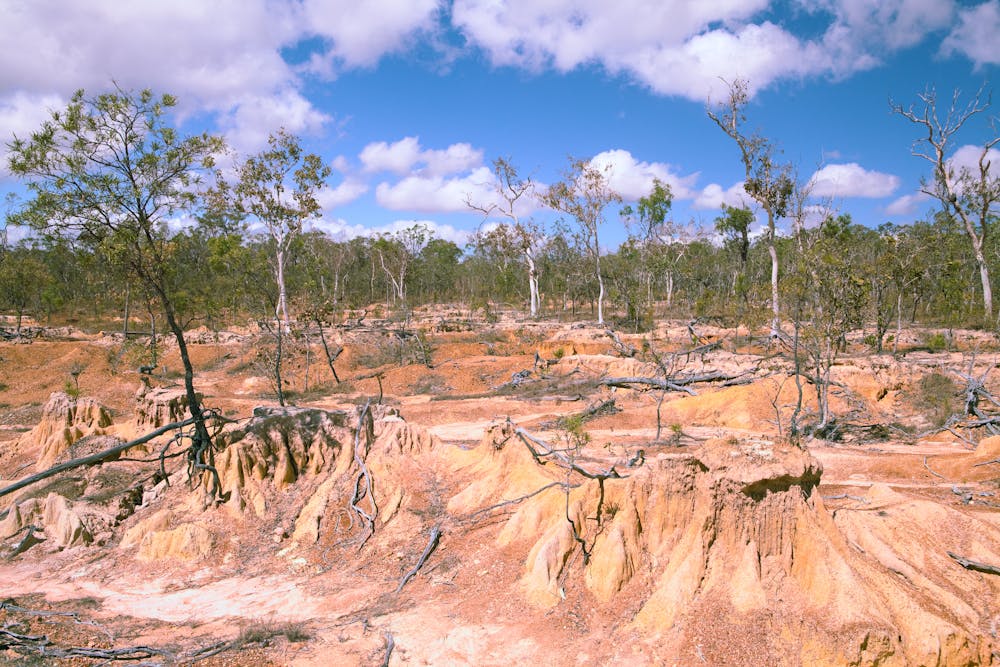
Most Australians have known drought in their lifetimes, and have memories of cracked earth and empty streams, paddocks of dust and stories of city reservoirs with only a few weeks’ storage. But our new research finds over the last 1,000 years, Australia has suffered longer, larger and more severe droughts than those recorded over the last century.
These are called “megadroughts”, and they’re likely to occur again in coming decades. Megadroughts can last multiple decades – or even centuries – with occasional wet years offering only brief relief. Megadroughts can also be shorter periods of very extreme conditions.
We show megadroughts have occurred several times across every inhabited continent over the last two millennia. They’ve dealt profound damage to agriculture and water supplies, increased fire risk, and have even contributed to toppling civilisations.
Unless we incorporate the full potential of Australian drought into our planning, management and design, their impacts on society and the environment will likely worsen in coming decades.
The role of climate change
Instrumental records only go back so far. In Australia, they cover only the last 120 years or so. Scientists can gauge local, yearly climate further back in time, by deciphering clues written in tree rings, corals, and buried ice (known as ice cores), among other archives.
To look at previous occurrences of megadroughts, we consolidated findings drawn from such datasets and a range of other long-term records.
Historically, droughts have been defined by rainfall deficits, and these deficits can be largely attributed to complex interactions between oceans and the atmosphere over a long time. For example, decades-long La Niña conditions have been linked to medieval droughts in North and South America.
In contrast, research suggests human-caused climate change is now playing a more important role in amplifying drought conditions, as rising global temperatures increase evaporation.
There is some uncertainty in climate models about the effect of climate change on rainfall at local and regional scales. However, climate change is putting places that have previously endured megadroughts – such as Australia – at an increased risk of megadroughts in future.
Megadroughts and collapsing civilisations
Currently, parts of the United States – including Arizona, Nevada and Utah – are in the throes of a megadrought, lasting some two decades. Historically, megadroughts have profoundly impacted societies and environments.
In the American southwest, megadroughts in the late 1200s likely contributed to the desertion of the Mesa Verde cliff dwellings. Likewise, the Hohokam peoples relied heavily on a canal system, and this dependence in a time of severe and extended drought may have contributed to their decline over the 14th and 15th Centuries.
In Central America, a megadrought between 1149 and 1167 likely brought instability to the Toltec state. And a megadrought between 1514-1539 weakened the Aztec state just prior to Spanish conquest.
Europe and Asia have had their share of megadroughts, too. Research shows severe megadroughts in Asia in the 1300s and early 1400s quite likely helped cause the collapse of Cambodia’s vast Khmer Empire.
The Khmer Empire in Cambodia suffered decades-long dry periods. Fred Nassar/Unsplash, CC BY
Megadroughts in Australia
While many Australians may remember the severity of the Millennium Drought between 1997 and 2009, we found this drought wasn’t actually particularly unusual. Megadroughts of the same or greater severity have occurred over the past 1,000 years across several parts of Australia, and were relatively common over much of eastern Australia.
This includes megadroughts between 1500 and the 1520s, and between the 1820s and 1840s. And while relatively short, a dry period between 1789 and 1795, coinciding with European invasion, included several years of severe drought. The year 1792 in particular was extremely dry over almost all of eastern Australia.
Western Australia’s wheat belt is currently experiencing a decline in rainfall. This, too, isn’t unusual compared to droughts there in the past. Tree rings in the region reveal that longer, more severe droughts occurred there six times in the last 700 years, including the years 1393-1407, 1755-1785, and 1889-1908.
Even in Tasmania, evidence suggests prolonged dry periods occurred in the latter part of the 16th Century, with a shorter but more severe downturn from 1670-1704.
We need to be better prepared
Water management in Australia has relied on short instrumental data. These do not capture the full range of variability in our rainfall.
This means, for example, that Australia’s infrastructure may be inadequately designed or managed to cope with major flood events or prolonged dry conditions.
Now, even relatively short but very dry periods can lead to major problems. We saw this recently in Tasmania in the summer of 2015 and 2016 when, after a dry winter and spring, water levels in major catchments were minimal and fires raged in the west. The Basslink cable, which connects Tasmania to the national grid, broke, resulting in the use of diesel power generation to keep power on in the state.
Future megadroughts will amplify the pressures on already degraded Australian ecosystems. We know from Australia’s recent past the harm relatively smaller droughts can impose on the environment, the economy, and our mental and physical health.
We must carefully consider whether current management regimes and water infrastructure are fit-for-purpose, given the projected increased frequency of megadroughts.
It’s difficult to plan effectively without fully understanding even natural variability. And this means better appreciating the data we have from archives such as tree rings, corals and ice cores – crucial windows to our distant past.
Kathryn Allen receives funding from the Australian Research Council
Alison O’Donnell receives funding from the Australian Research Council (ARC)
Benjamin I. Cook’s research, including the article this piece is based on, is funded by NASA. He is also an Advisory Board Member at Weather Promise.
Jonathan Palmer receives funding from the Australian Research Council (ARC).
Pauline Grierson receives funding from the Australian Research Council (ARC).
Paul Yore: WORD MADE FLESH, installation view, Australian Centre for Contemporary Art, Melbourne.Photograph: Andrew Curtis
Artist Paul Yore works with found and discarded materials, including other people’s abandoned craft projects. Embroidery threads, braid, cross stitch samplers and quilt pieces – once objects of promise and anticipation – sit forgotten in sewing boxes and bottom drawers, until they are consigned to the op shop or the tip.
Rescuing the residues of other people’s unrealised projects provides Yore with material possibilities and imagined histories. He works these discards together with found texts and images to produce riotous textile works expressing the flux and contestations of contemporary life.
Queer culture, corporate greed, hyperconsumption, Christianity and the police state are tackled without compromise.
In WORD MADE FLESH, the Australian Centre for Contemporary Art presents tapestries, appliques, collages and soft sculptures produced over 15 years. This comprehensive survey of Yore’s work is completed by a new commission: an architecturally-scaled pleasure palace constructed from the remnants of societal collapse.
Paul Yore: WORD MADE FLESH, installation view, Australian Centre for Contemporary Art, Melbourne. Photograph: Andrew Curtis
Also on show is Yore’s intellectual courage and energy, solidly underpinned by anthropological, philosophical and art history knowledge he uses to push against societal and Christian taboos. This pushing against taboos extracted a high personal toll in 2013, when child pornography charges were brought against him for one of his exhibitions. (These charges were later dismissed.)
The curation and design shared between the artist, his partner Devon Ackerman and the gallery’s artistic director Max Delaney maximises the immersive experience of the final work. There is only one way into the exhibition and visitors must traverse four different zones, titled “signs”, “embodiment”, “manifesto” and “horizon”, before they enter WORD MADE FLESH.
The first space introduces Yore’s practice through small textile works incorporating found texts and aphorisms about politics, gender and sexuality.
The polite media of cross stitching, tapestry and applique – usually associated with patient crafting on laps, hands kept busy to hold the devil at bay – are transformed into a transgressive methodology in form and content.
Paul Yore: WORD MADE FLESH, installation view, Australian Centre for Contemporary Art, Melbourne. Photograph: Julie Sheils
The constraints of the repetitive “x” in cross-stitching or restrictions of the tapestry grid that regulate the spacing and length of the stitches are subverted by Yore.
He achieves a visual tension through finely calibrated formal and technical skills.
“Never be queer enough” and “excuse me for feeling” are inserted into traditional bordered formats. The tranquillity of the imaginary drawing room is upended by images of syringes, skulls and pink triangles.
Embodiment, manifesto and horizon
The next three spaces chart Yore’s creative development. Rectangular forms are enlarged to become quilts, religious iconography is explored and reimagined and queer lives expressed.
The rich aesthetic of Rococo and Baroque clothing and drapery intersects with the elaborate excesses of drag queen wardrobes. Rectangles are swapped for triangles, reclaiming the symbolism of the pink triangle.
In one of his biggest works, the Darkest Secret of my Heart, the legacies of Australia’s colonial history are obscured by cartoon characters and other pop culture graphics.
Paul Yore: WORD MADE FLESH, installation view, Australian Centre for Contemporary Art, Melbourne. Photograph: Andrew Curtis
Soft sculptures of sexualised hybrid human/cartoon bodies inhabit the gallery at a scale simultaneously confronting and intriguing.
Tucked away in the last room is a temple of irreverence and critique that amplifies the pagan aesthetic of a colonising Catholicism in Africa and Latin America.
Populated by beaded collages of “mature content”, the curtained space melds the atmospherics of a confessional booth and a gay sex bar.
Societal collapse is nigh.
Entering from the low lights and institutional critiques in the previous galleries, the new space of WORD MADE FLESH shouts societal collapse from a prefab tower covered with messages.
Scavenged corporate branding jostles with handwritten placards and is camped up with the sparkle of thermal blankets and cute neons.
Paul Yore: WORD MADE FLESH, installation view, Australian Centre for Contemporary Art, Melbourne. Photograph: Andrew Curtis
The inner walls of the tower are lined with banks of screens endlessly looping hyper-illuminated montages of found images and GIFs. SpongeBob SquarePants is a reminder of simpler times.
Anthropomorphic sentinels appear to guard the installation, channelling junkyard Madonnas and marketing deities made from sales detritus.
A geodesic dome lined with handmade crochet blankets and neon symbols offers an unexpected respite. Inside, an elaborate font-like water feature confected from kitsch and plastic penises decorated with shells doubles as a kinetic musical instrument. Straw bales provide seating to contemplate the moving parts and whimsical cacophony.
In the first four galleries, Yore’s textile works built a critique of contemporary times meticulously supported by art historical, philosophical and cultural references. In WORD MADE FLESH he tears it all down and rebuilds a makeshift world made from 21st century junk – except for a hearse covered in Byzantine-style mosaic.
In a shift back to permanence and precision, this funeral wagon has been immobilised by a lavish coat of glass tiles embellished with images of phalluses and flowers and parting words like “see you in hell”. A keyboard embedded in the side of the vehicle drones out a discordant final chord.
Paul Yore: WORD MADE FLESH, installation view, Australian Centre for Contemporary Art, Melbourne. Photograph: Andrew Curtis
By choosing a material (tiles) and echoing a tradition dating back more than 1,500 years, is Yore hinting at a return to the brutality of the Dark Ages? Having constructed “a queer alternative reality, erected from the wasteland of the Anthropocene”, could he be offering a final ride in a pimped-up hearse?
Paul Yore: WORD MADE FLESH is at the Australian Centre for Contemporary Art, Melbourne, until November 20.
Julie Shiels does not work for, consult, own shares in or receive funding from any company or organisation that would benefit from this article, and has disclosed no relevant affiliations beyond their academic appointment.
New Zealand Parliament Buildings, Wellington, New Zealand.
Analysis by Dr Bryce Edwards.
Political Roundup: No confidence in dire local govt elections
Political scientist, Dr Bryce Edwards.
The “No Confidence” vote in local body elections could be as high as 60 per cent by the end of this week. That’s essentially what it is when only 40 per cent of the public choose to vote, which is what is happening at the moment. In fact, voter turnout is trending lower, meaning New Zealand could be headed for a record low voter turnout (and hence a record no confidence vote in politicians).
The reality is clear: the vast majority of the public are not inspired by what’s on offer from candidates across the country and voters aren’t convinced that voting in local elections really matters.
Voter turnout was supposed to increase in 2022
This year’s extremely low voter turnout is occurring despite circumstances that should be driving increased public involvement. Firstly, there are a large number of very competitive mayoral elections taking place – in which the likely outcome is far from decided. In Auckland, Wellington, Christchurch, Dunedin, and Invercargill, for instance, it’s not clear who will win, and a number of new mayors are likely to be elected. This situation normally drives up turnout.
In addition, there are a number of factors that many commentators and authorities believed would drive up participation:
The new Māori wards in many elections were supposed to provide for better representation of an historically under-represented demographic
There is increased media coverage of local elections and, in particular, a plethora of voices explaining the need for people to vote
The Three Waters reforms have provided a contentious public issue for voters to vote for or against as candidates take a pro or anti Three Waters stance
A much more demographically diverse range of candidates – women, Māori, young people, and so forth – standing was said to help boost turnout amongst sections of the public put off by so-called “pale, stale, and male” incumbents
Local government authorities have produced huge publicity and advertising campaigns, normally incorporating te reo Māori and an emphasis on diversity, to get people enthused about democracy.
None of these factors appear to have had a significant impact in lifting voting so far. Perhaps some of these dynamics have actually had a counterintuitively negative impact.
Could it be that the low voter turnout reflects contentment?
Of course, there are plenty of explanations for the public choosing not to vote. Some politicians and commentators have been attempting to put a more positive spin on the declining voter turnout. Much of this looks like wishful thinking. They say the declining voter turnout simply reflects public satisfaction with the politicians and their local authorities. Voters are content to just let the politicians continue doing their good work without the scrutiny and evaluation of voting.
But there is absolutely no evidence to support the view that the low voter turnout reflects contentment. In fact, there is strong evidence throughout the country that the public’s unhappiness with councils has reached an all-time high.
Surveys carried out by local authorities show that dissatisfaction with individual councils is very strong this year. For example, in Wellington, when the public were asked this year about satisfaction with council decision-making, the number of those who are “satisfied” dropped to a new low of only 12 per cent, while those who said they are “dissatisfied” jumped to 52 per cent. Similarly, those who believe that the Council makes decisions that are in best interests of the city has plummeted from 50 per cent to just 17 per cent this year.
It seems that throughout the country there is a similar level of anger and disenchantment with local politicians which should dispel any rosy idea that lower voter turnout is in some way positive.
Those pushing the “contentment theory” of low voter turnout also have to grapple with the fact that non-voters are disproportionately made up of the poor and marginalised of society. Evidence shows it’s the wealthier demographics that vote in much larger numbers than others.
For example, suburb comparisons in the 2019 Rotorua Lakes Council elections showed that the higher turnouts were from residents from wealthier housing locations, and vice versa.
Overall in Rotorua the turnout was 45 per cent, but for the affluent suburbs the turnout rates were much higher, and for the lower socio-economic areas the voting rates were about a third of this.
For example, in Rotorua’s flash suburb of Springfield, 59 per cent voted, in leafy Lynmore it was 57 per cent, and wealthy Kaharoa had a turnout rate of 56 per cent.
However, the poorer suburbs had abysmal turnout rates. In disadvantaged Western Heights it was only 27 per cent, and in the poorest area of Fordlands voter turnout was an incredible 18 per cent.
This pattern was borne out by a 2015 Auckland Council study that showed significant variation in voter turnout according to socioeconomic status.
It goes to show just how much participation in elections is a function of socio-economics. And so, a discussion of voter turnout must involve an awareness that elections in New Zealand are primarily determined by wealth.
It seems that local government isn’t working for most people. And this is especially the case for the poor. Increasingly there is a feeling that local government – much like central government – has become dysfunctional and captured by vested interests and elites.
All around the world voter turnout has generally been on the decline over the last few decades, driven by waning trust in authorities and politics. And this is evident in the rise of populist nationalism and the increased peddling of conspiracy theories.
A 17 per cent turnout in amongst poorer communities speaks to something rotten in our democratic processes. Fixing this won’t involve superficial and mechanical changes to voting systems or just more public education. A much bigger examination of the failings of our political system is necessary, and this needs to include looking at wider societal problems.
Without big change, our elections will decline further in legitimacy. As today’s New Zealand Herald points out, the Prime Minister is being “asked this week to speculate on how low the turnout threshold should be for local elections to be considered valid”. She won’t answer this. But someone is going to have to engage very quickly.
What is clear is that blaming voters for being uninspired by the candidates and the system of local government is not the answer. The public – and especially poorer New Zealanders – will just keep essentially voting “No confidence” in larger and larger numbers until it’s impossible for this message to be ignored or misunderstood.
In many ways the world has moved on from the Covid19 pandemic. And excess mortality from Covid19 mingles with excess mortality from other causes, from heatwaves to other diseases. The summer is useful because it is generally the low season for infectious respiratory illnesses.
Covid19 is a disease that is spread through air travel, and through air; not so much in airplanes or even airports, but by travellers and the people who mingle with them and who provide services to them. West Europe is the world’s preeminent tourist destination, especially in summer.
People come to the Mediterranean coastal tourist destinations in particular, but also to the places with spectacular mountain scenery. In addition, the United Kingdom, France and Germany are strong all-round summer tourist destinations. Of the Mediterranean destinations, Spain in particular has a strong ‘shoulder season’, especially for people travelling from or via the United Kingdom. Travel from North America to Europe surges in late June and peaks in July.
Travel by northern Europeans to southern Europe tends to peak in August, long regarded as the ‘silly season’ in Europe. We should note that, as a result of this ‘silly season’, the releases of mortality and other data are delayed, and data released in September may be revised upwards by more than data released in other months. So deaths in August in particular may be higher than is shown here for those countries which have released August data.
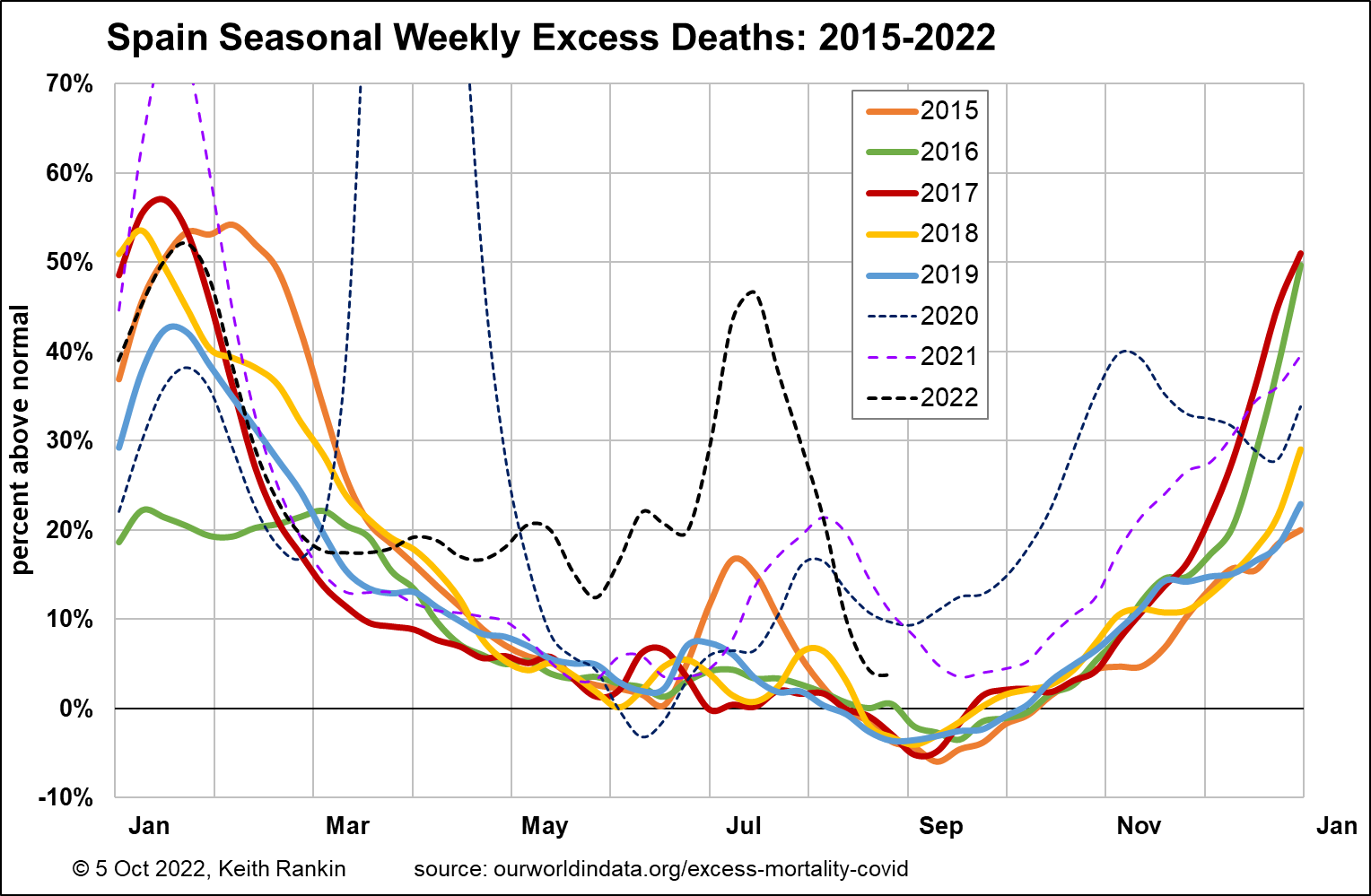
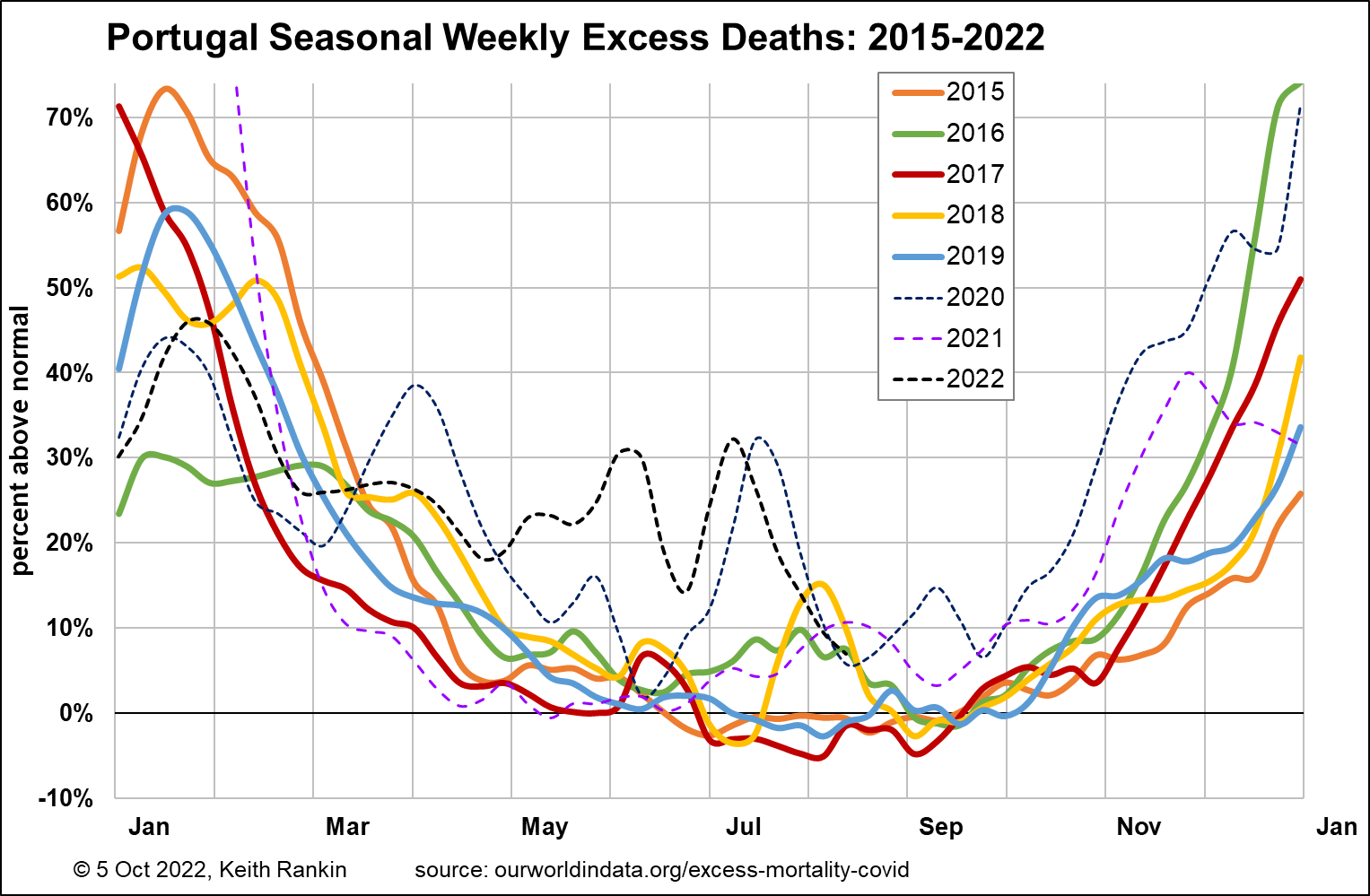
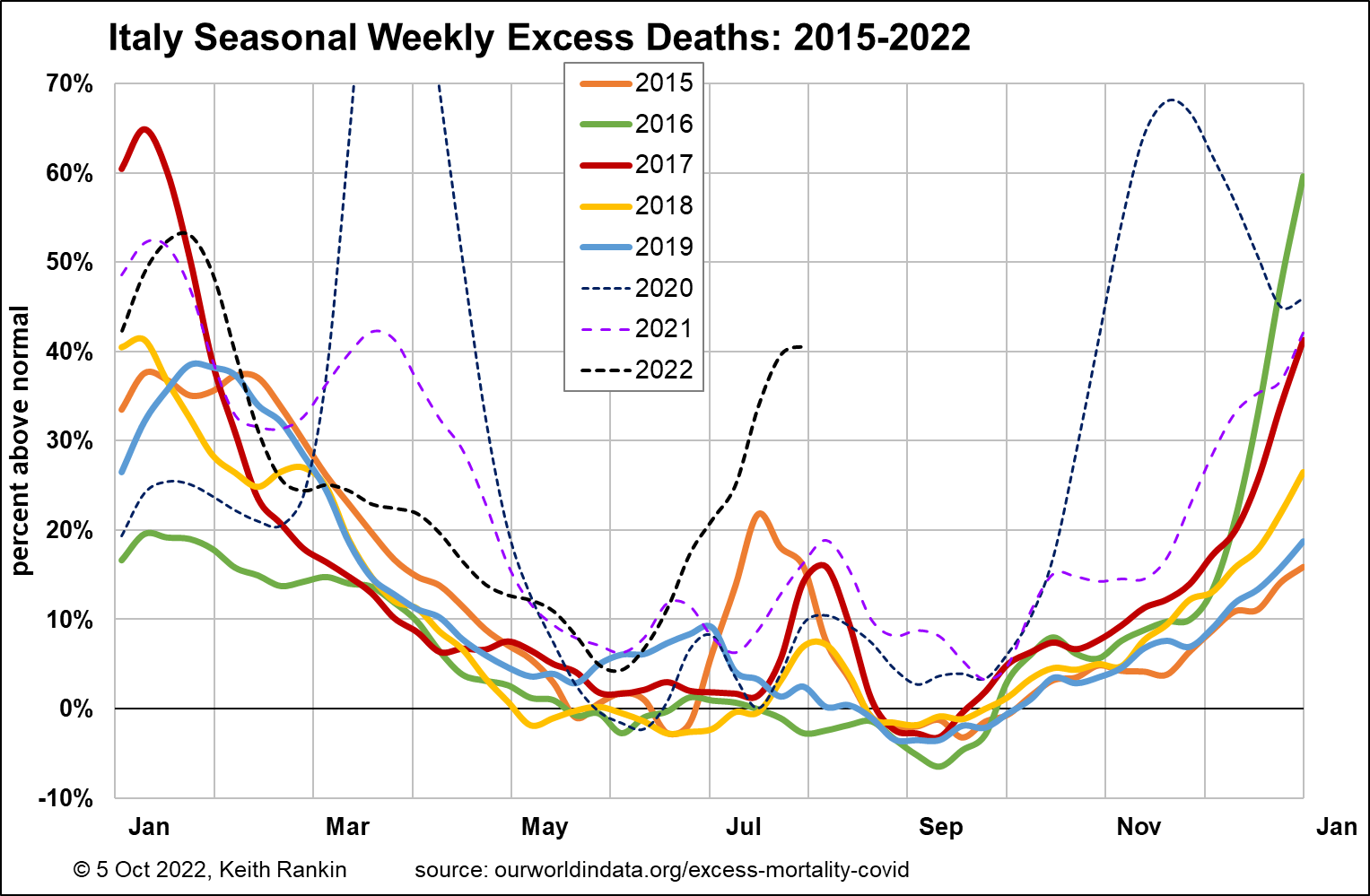
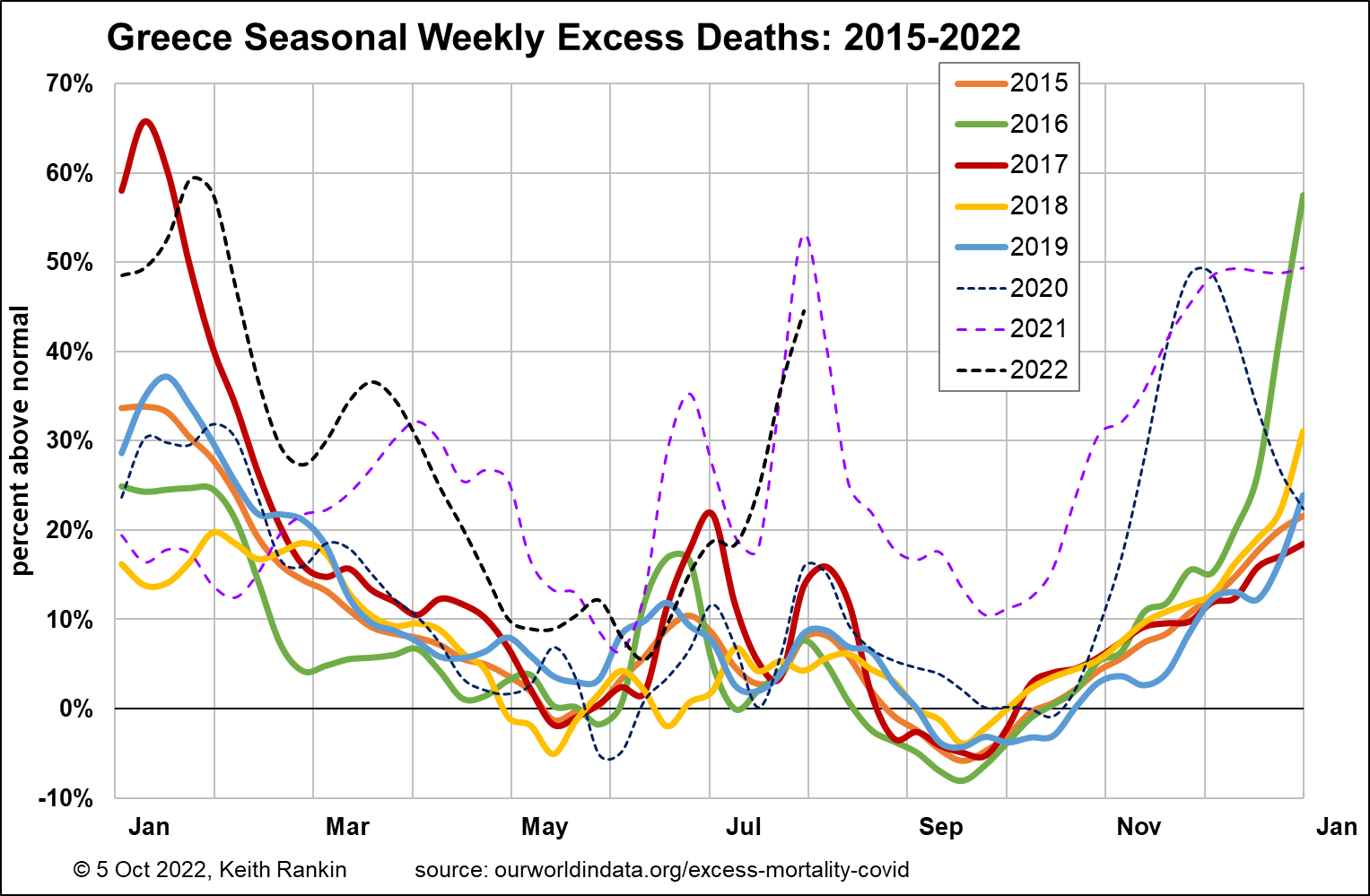
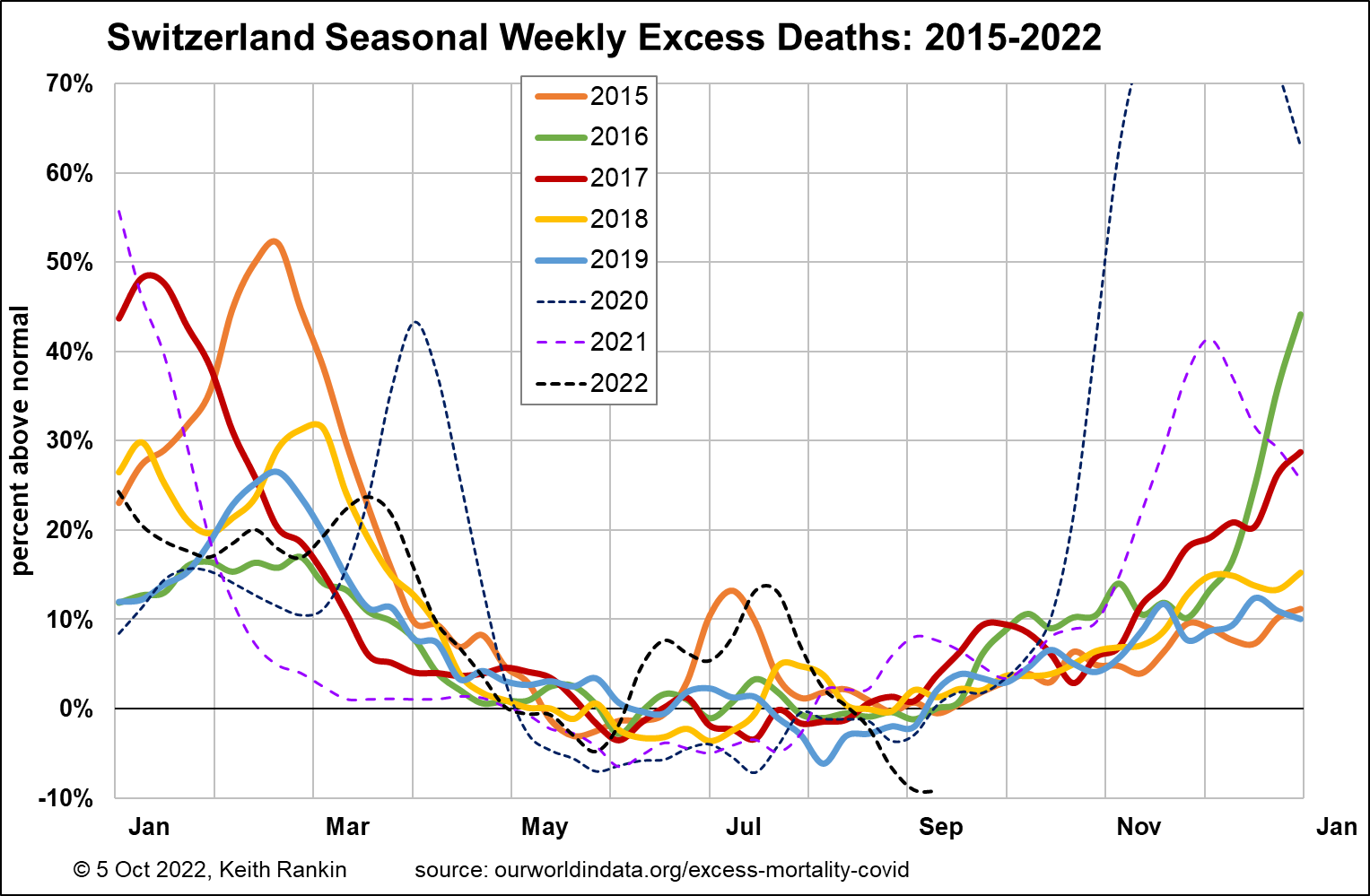
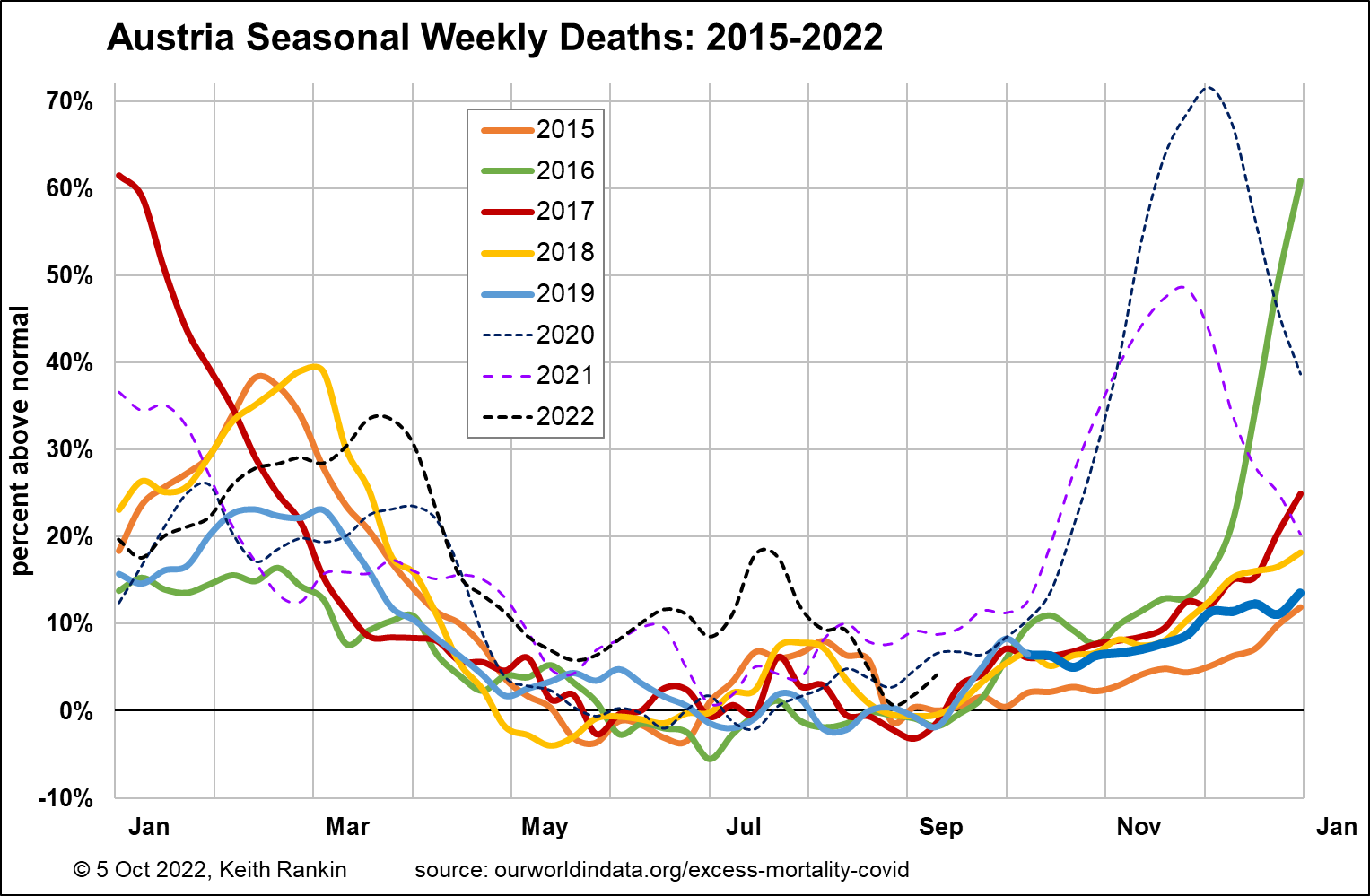
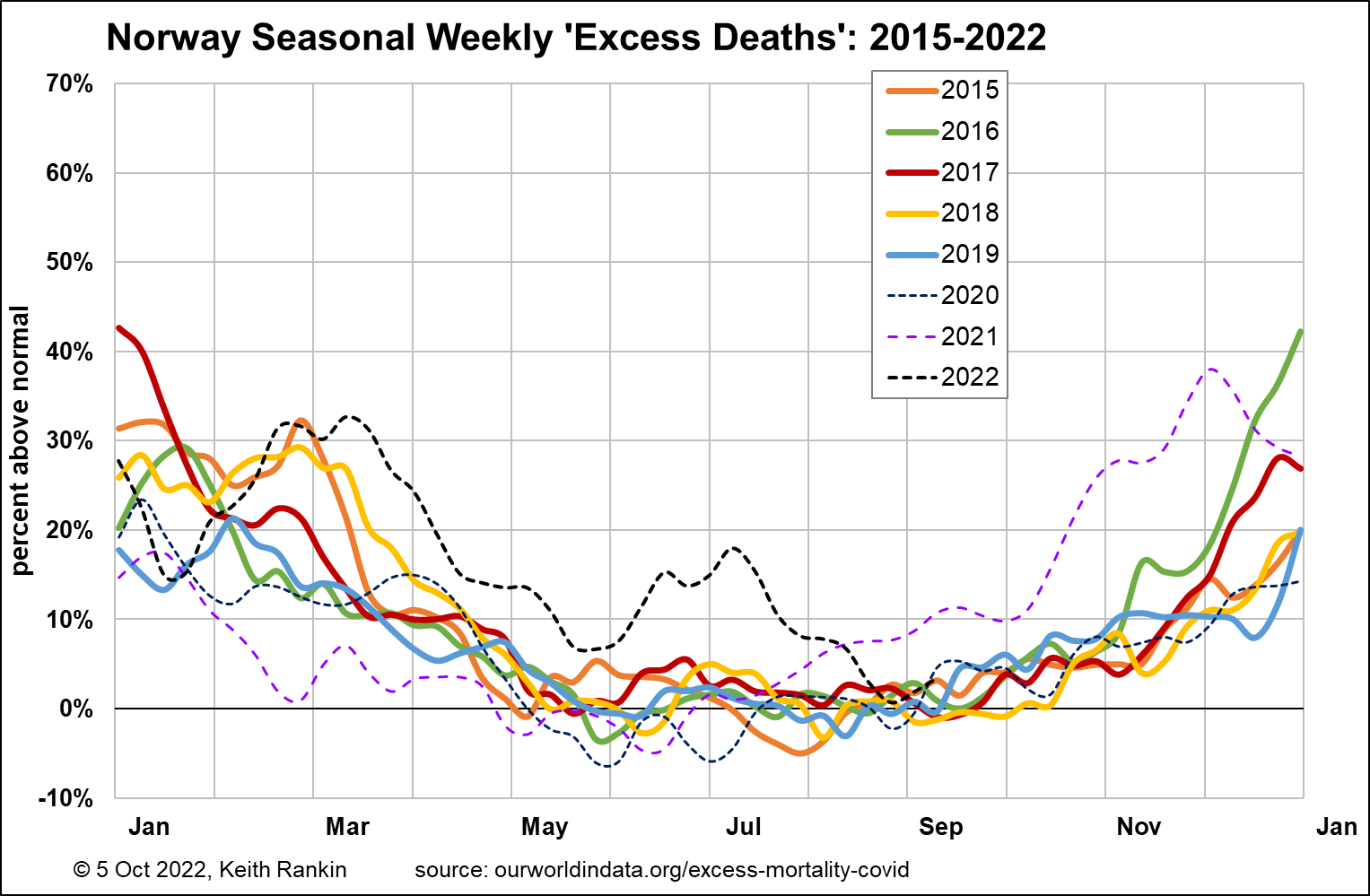
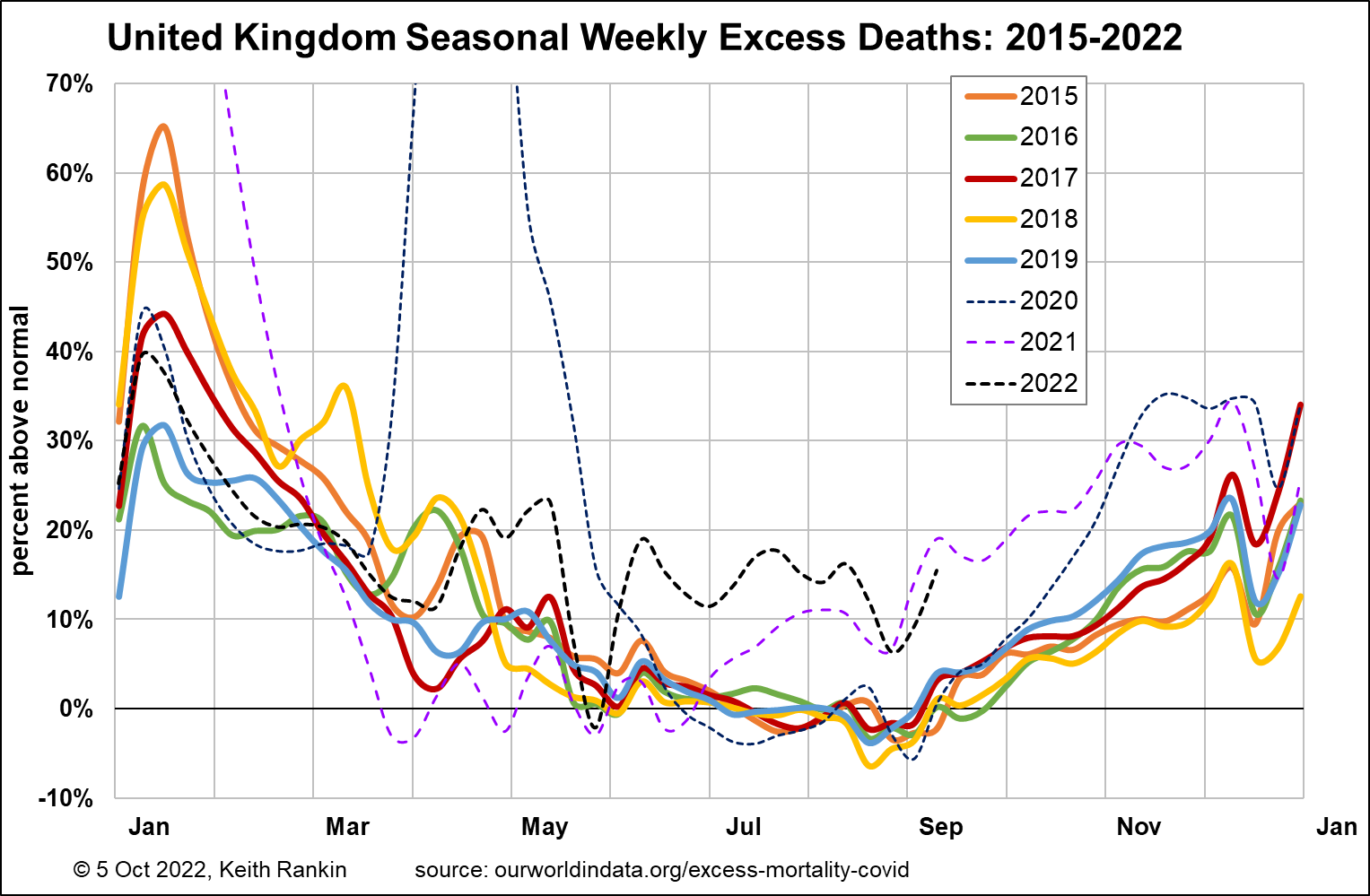
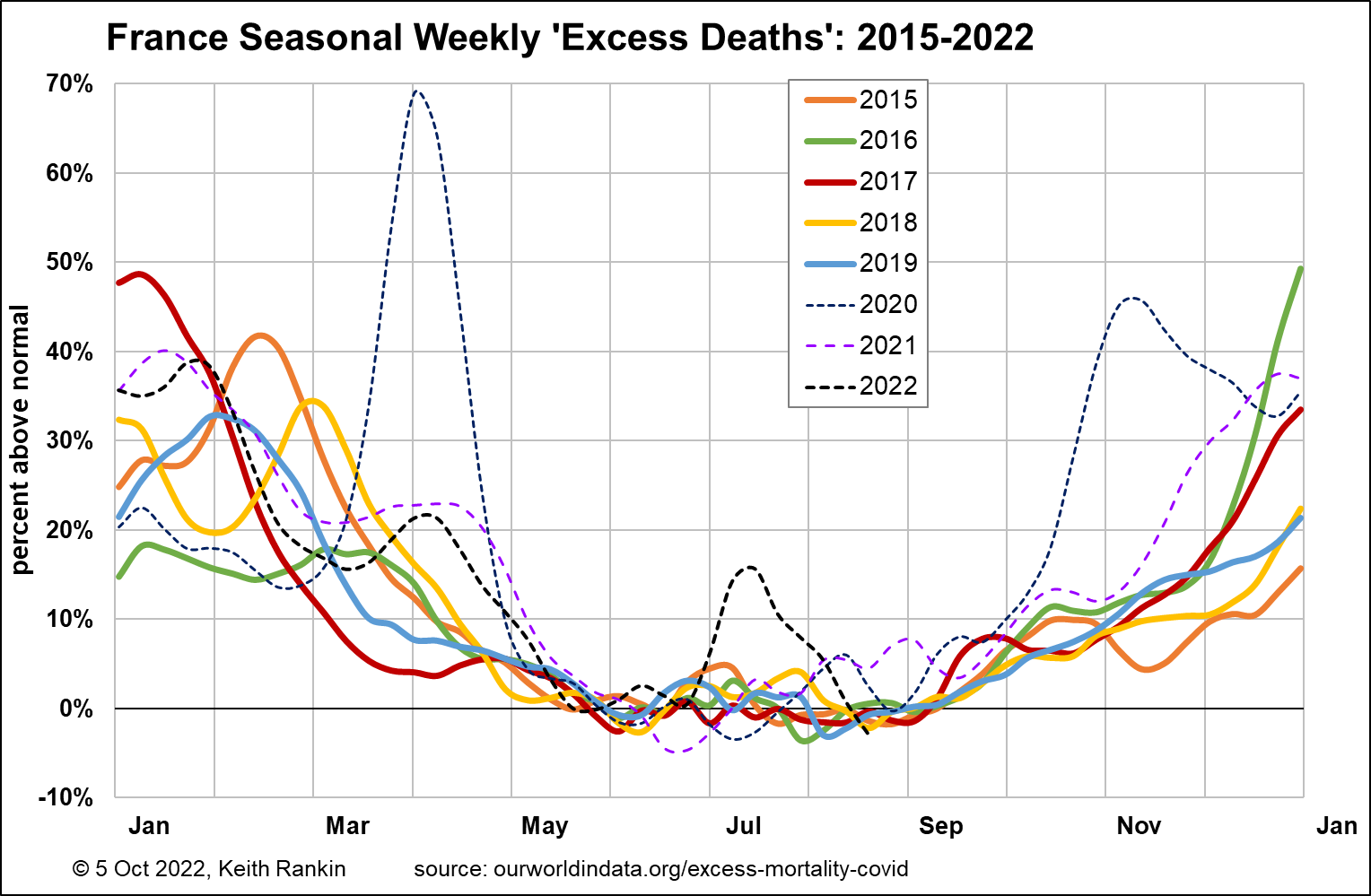
Chart by Keith Rankin.Chart by Keith Rankin.Chart by Keith Rankin.Chart by Keith Rankin.
Looking at the Mediterranean countries, we see Spain with significant and unusual mortality since April 2022, with a substantial peak in early July, just before this summer’s big wildfire peak. The excess deaths look, in the main, more like Covid19 deaths than weather-related deaths. Portugal shows a similar (if less dramatic) pattern to Spain.
Italy is as dramatic as Spain, but peaking at the end of July, and without the earlier plateau of deaths from April to June. It has the look of a wave starting in Spain and moving on to Italy. The chart for Greece reinforces this perception. (And note how different Greece is from Spain and Italy in 2020 and 2021; Greece has been very vulnerable in the later part of the ongoing pandemic.) We should also note that Malta and Cyprus show the same patterns as Italy and Greece.
This pattern of west to east travel mortality suggests, in particular the impact of tourism from North America, and also tourism from places like Australia and South America. Trips to Europe from Australia and New Zealand tend to start in the United Kingdom in April and May, and then move to Spain (before it gets too hot) and then to other destinations in Europe.
Chart by Keith Rankin.Chart by Keith Rankin.Chart by Keith Rankin.
Looking at the mountain tourist countries, Switzerland certainly shows a July peak, and it looks (as in 2015) to be a bout of epidemic illnesses. Austria looks much like Switzerland this year. Finally, Norway also shows those same patterns (more like Switzerland than Sweden or Denmark). And we should note that Iceland, now a tourist darling, shows a similar pattern to Norway.
Chart by Keith Rankin.Chart by Keith Rankin.Chart by Keith Rankin.
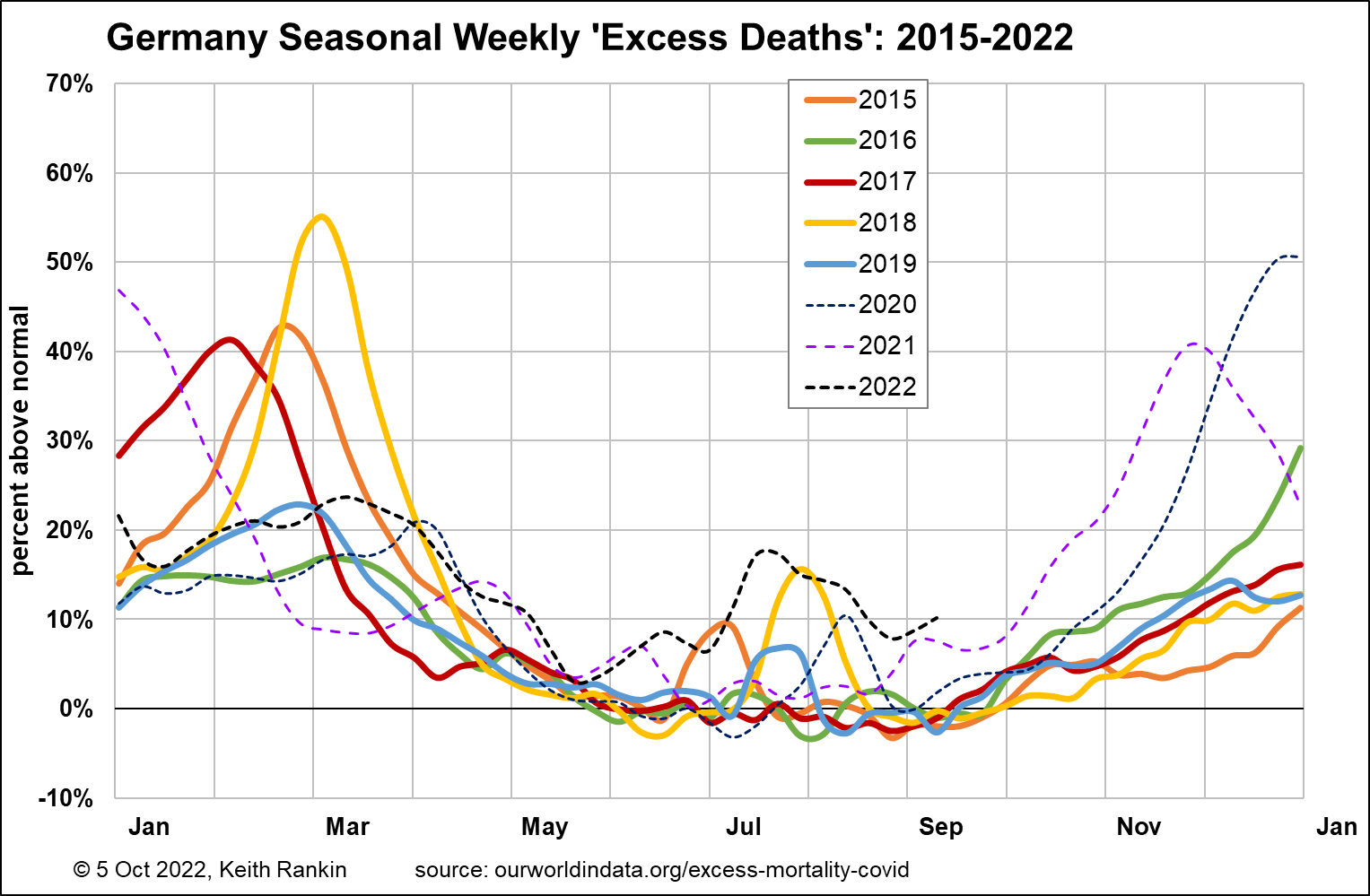
Looking at the big-three, the United Kingdom shows significant excess deaths from late April. United Kingdom data can be a bit hard to read, because it seems to show dates of registration of deaths rather than actual dates of death. The data shows lulls in the registration of deaths around public holidays, and especially the lead-up to Christmas. France shows the July mortality peak seen elsewhere (covering its peak tourism from United Kingdom and United States); otherwise, 2022 in France has been mainly a normal year. Germany also shows that peak, while showing signs that late summer deaths will also be higher in 2022 than in 2020 and 2021.
The charts overall suggest that travellers themselves may have been dying away from their home countries in significantly greater numbers than usual. And we should note that travellers include seasonal workers (including ‘backpackers’). Travellers face danger when populations in their countries of origin have reduced immunity from diseases endemic in destination countries.
This raises the issue of one big hole in demographic data, affecting the world as a whole, and especially countries (such as New Zealand) with large flows of people – as tourists and as migrants – relative to the normally resident population. For example, New Zealand’s ‘life expectancy at birth’ estimates (based on mortality data) cannot take into account many of the many New Zealand born people who die overseas. And they do include people – many people – not actually born in New Zealand.
*******
Keith Rankin (keith at rankin dot nz), trained as an economic historian, is a retired lecturer in Economics and Statistics. He lives in Auckland, New Zealand.
Last week, the government introduced into parliament the bill establishing the National Anti-Corruption Commission (NACC).
This honours the government’s election commitment to introduce a “powerful, transparent and independent” federal anti-corruption commission by the end of the year.
What are the powers of NACC?
So, how does the government’s NACC stack up against other models?
The NACC has strong coercive powers to investigate serious and systemic corrupt conduct in government, equivalent to the powers of a royal commission. This includes the power to compel documents and witnesses.
Retrospective investigations are possible, meaning the conduct of former governments can be examined.
The investigative threshold of “serious or systemic corrupt conduct” compares favourably to the previous Coalition government’s proposal, which required suspicion of corruption amounting to a criminal offence. Such a high bar would prevent investigations from even proceeding.
The NACC’s lower threshold may capture elements of “grey corruption”: that is, where a person has undue influence over a politician, such as by essentially buying that power through making large donations or hiring expensive lobbyists, particularly where it causes public officials to behave in corrupt ways.
Potentially the NACC could investigate the previous government’s repeated rorts scandals, but only where it amounts to serious or systemic corrupt conduct.
The NACC has a broad jurisdiction to investigate the actions of ministers, MPs, ministerial staff, staff of Commonwealth agencies and companies, government contractors, and those acting on behalf of the Commonwealth.
But the NACC cannot investigate parties outside the public sector if they do not have contracts with the government.
In short, the NACC is equipped with strong powers to carry out their task of investigating corruption in the public sector.
With such strong powers, safeguards are needed to ensure accountability for the NACC’s actions.
In this vein, decisions of the NACC would be subject to judicial review by the courts to ensure their legality.
The NACC will also be overseen by a parliamentary joint committee. This will be a bipartisan committee with members from government, the opposition and the cross-bench.
The parliamentary committee approves commissioner appointments and can report on the sufficiency of NACC’s budget. However, the budget is ultimately determined by Cabinet.
Anti-corruption commissions are vulnerable to having their budgets cut by hostile governments. For instance, the NSW Independent Commission Against Corruption (ICAC) has had its budget severely cut following its explosive revelations of corruption in government.
Will the NACC be effective?
One criticism of the proposed NACC is the high threshold for public hearings, which can only be held in exceptional circumstances. This is equivalent to the Victorian Independent Broad-based Anti-corruption Commission (IBAC).
However, other bodies, such as the NSW ICAC, have a broader ability to hold public hearings where it is in the public interest to do so.
Public hearings ensure proceedings are not cloaked in secrecy and will increase public trust. Having a higher bar to hold public hearings reduces transparency.
However, there are legitimate issues about damage to individual reputations where a person subject to a public hearing has their reputation tarnished in the media, but is ultimately found not guilty by the courts.
The Centre for Public Integrity has produced statistics showing that, in the seven year period up to 2020, NSW ICAC held 42 public hearings and produced 39 public reports, compared to Victorian IBAC’s 8 hearings and 14 reports.
The centre argued the NSW body’s public interest test does not lead to overuse of public hearings, as in that seven year period, NSW ICAC held 979 private examinations, compared to 42 public inquiries. So, the NSW threshold is arguably preferable.
Will we have a national anti-corruption commission by Christmas?
After many years of campaigning by interest groups and academics, Australia is finally close to having a national anti-corruption commission.
On balance, the government’s proposed NACC does provide a strong, yet proportionate, vision for an anti-corruption commission with robust powers and both internal and external accountability mechanisms.
The Coalition has signalled its in-principle support for the NACC, but noted reservations about the NACC having extensive powers.
The Greens and teal candidates may seek amendments to the bill to reduce the threshold for public hearings and empower the NACC to investigate third parties outside the public sector, even if they do not have contracts with the government.
Subject to any negotiations, it is now time for parliament to pass the bill.
The electorate has spoken and a federal anti-corruption commission is long overdue. Australians deserve a robust system of accountability that will keep our politicians honest.
Yee-Fui Ng received funding from the New South Wales Independent Commission Against Corruption to write a commissioned discussion paper for Operation Eclipse.
Source: The Conversation (Au and NZ) – By Euan Ritchie, Professor in Wildlife Ecology and Conservation, Centre for Integrative Ecology, School of Life & Environmental Sciences, Deakin University
Australia’s dire and shameful conservation record is well established. The world’s highest number of recent mammal extinctions – 39 since colonisation. Ecosystems collapsing from the north to the south, across our lands and waters. Even species that have survived so far are at risk, as the sad list of threatened species and ecological communities continues to grow.
During the election campaign, Labor pledged to turn this around. On Tuesday, federal Environment Minister Tanya Plibersek announced what this would look like: a new action plan for 110 threatened species. The goal: no new extinctions. “Our current approach has not been working. If we keep doing what we’ve been doing, we’ll keep getting the same results,” Plibersek said.
But is this really a step change? Let’s be clear. This plan is a welcome improvement – especially the focus on First Nations rangers and Indigenous knowledge, clearer targets, better monitoring and the goal of protecting 30% of Australia’s lands and seas within five years.
But the funding is wholly inadequate. The A$225 million committed is an order of magnitude less than what we need to actually bring these threatened species back from oblivion. The grim reality is this plan is nowhere near enough to halt the extinctions. Here’s why.
There’s nowhere near enough funding
Conservation costs money. Recovering threatened species takes effort. Tackling the threats that are pushing them over the edge, from feral cats to land clearing, is expensive. “Measures of last resort”, such as captive breeding, creation of safe havens and translocations, takes more still.
How much is enough? Estimates put it at A$1.7 billion per year. This is around one-seventh of the money Australian governments spent on fossil fuel subsidies last financial year. If there’s funding for that, there should be funding for wildlife.
Make no mistake – starving conservation of adequate funding is a choice. For decades, Australia’s unique environment and wildlife have been thrown consolation crumbs of funding – even though they are our collective natural heritage, fundamental to human survival, wellbeing and economic prosperity, and a major draw card for tourists and locals. You can see the results for yourself: more extinctions and many more threatened species.
Picking winners means many species will lose
Labor’s plan is focused on arresting the decline of 110 species, and 20 places such as the Australian Alps, Bruny Island and Kakadu and West Arnhem Land.
Unfortunately, that’s a drop in the ocean. Combined, we now have more than 2,000 species and ecological communities listed as threatened. Picking species to survive betrays our remarkable, diverse and largely unique plants, animals and ecosystems. It suggests – wrongly – that we have to choose winners and losers, when in fact we could save them all.
The plan assumes recovering priority species may help conserve other threatened species in the same areas and habitats. This is questionable, given only around 6% of listed threatened species are slated to receive priority funding, and how much the needs of different species can vary even in the same habitats and ecosystems. Different species respond very differently to fire regimes, for instance.
Policies and laws are essential
Funding by itself isn’t enough. Unless all levels of governments enact and enforce effective policies aimed at conserving species and their homes, the situation will worsen. Australians are still waiting to see what reforms actually emerge from Graeme Samuel’s sweeping review of the main laws governing biodiversity and environmental protection.
Alignment of policies is vital. What’s the point of saving a rare finch from land clearing if you’re simultaneously opening up huge areas to fracking, polluting groundwater and adding yet more emissions to our overheated atmosphere? Despite Labor’s rhetoric on threatened species and climate change, they are still committed to more coal and gas.
Similarly, native vegetation clearing and habitat loss is barely mentioned in the threatened species plan. Yet these are leading causes of environmental degradation, as the 2021 State of the Environment Report makes clear.
If you want to save the critically endangered western ringtail possum and endangered black cockatoos, why would you approve the clearing of habitat vital to their existence? The Labor government did just that in July.
Conserving more land isn’t a panacea
Protecting 30% of Australia’s lands and oceans by 2030 sounds great. But protecting degraded farmland is not the same as protecting a biodiverse grassland or wetland. And establishing protected areas is not the same as effective management.
To get this right, the new areas must add to our existing conservation estates by adding species and ecological communities with little or no representation. They must help species move as they would have before European colonisation, by connecting protected areas separated by human settlement or farms. And there must be enough money to actually look after the land. There’s no point protecting ever-larger tracts of degraded, weed-infested, rabbit, deer, horse, pig, fox and cat-filled land.
Protecting degraded land shouldn’t be the goal. Shutterstock
The 50 million hectares of land and sea to be added by 2027 is supposed to come almost entirely from Indigenous Protected Areas. But again, where’s the funding? Right now, these land and sea areas get a pittance – a few cents per hectare per year.
It’s also important to support conservation on private land, where many threatened species live and where significant gains can be made. Maintaining wildlife on private land can also help farmers and landholders through pollination and seed dispersal as well as broader ecosystem health.
We need laws with teeth
If you liked it, you should have put a law around it. If the federal government is serious about ending extinctions, it should be enshrined in legislation. As it stands, “zero extinctions” is a promise with no clear way for us to see who is responsible or how the promise will be kept.
Too cynical? Alas, there’s a very real trend here. Successive governments have avoided accountability for losing species doing exactly this. They release strategies on glossy paper which note we all have a role to play in conservation – but strangely omit the part about who is responsible when a species dies out. If you want to save species, make human careers depend on species staying alive.
We know strong legislation and billions rather than millions of dollars are needed to stop extinctions. So far, the new government has announced inadequate funding, a non-binding strategy with an aspirational goal, and a seemingly rushed idea of a biodiversity market, dubbed “green Wall Street”, which made conservationists including the Wentworth Group of Concerned Scientistsvery concerned.
Tossing breadcrumbs to conservation is what we’ve done for decades. It’s a major reason why our unique species are in this mess. Time’s up.
Euan G. Ritchie is the Chair of the Media and Communications Working Group of the Ecological Society of Australia, Deputy Convenor (Communication and Outreach) for the Deakin Science and Society Network, and a member of the Australian Mammal Society.
Megan C Evans receives funding from the Australian Research Council through a Discovery Early Career Research Award and has previously been funded by the Department of Agriculture, Water and the Environment, WWF Australia, and the National Environmental Science Program’s Threatened Species Recovery Hub.
Yung En Chee receives funding from the Australian Research Council and the Melbourne Waterway Research-Practice Partnership.
The toll of COVID on our health-care workers has been brutal, with many saying they want to quit their jobs.
The World Health Organization says burnout, coupled with an ageing workforce, is a “ticking time bomb” that could lead to “poor health outcomes across the board, long waiting times for treatment, many preventable deaths, and potentially even health system collapse”.
The Royal Australian College of General Practitioners’ just released annual survey reported some three-quarters of GPs say they feel burnt out.
With burnout characterised in part by a “depersonalisation” or a sense of detachment, it can be tough to care for others. “Compassion fatigue” can set in. So how can we help health workers so they can continue to help others?
A worldwide workforce shortage
Workforce projections predict health workforce shortages worldwide. Retention is a major factor and burnout the major contributor. During the pandemic, studies from the United States and Singapore reported unprecedented turnover in the health-care sector, and again burnout was the biggest factor.
In Australia, a report found that during the first wave of COVID, nurses experienced high rates of anxiety and depression. COVID disruptions meant less access to social supports. Less social support affects a person’s ability to cope.
Workplace culture was seen as negative. There were safety concerns about working with patients with COVID. A fear of transmitting the virus to their families and friends led to increased anxiety. There was inadequate, inappropriate and often limited or unavailable personal protective equipment (PPE) for health-care workers and carers. When it was available, workers felt PPE and physical distancing constraints prevented them providing the compassionate care required.
Health-care workers experienced increased violence and aggression from patients and the public when enforcing government-mandated restrictions. They also faced significant increases in workloads.
New models of care were introduced, often with little preparation or training. Staff shortages resulted from COVID isolation and staff were redeployed to areas of high need in health care, which left shortages in other areas.
Health-care workers also identified a lack of support from leadership and organisational culture compromised their psychological safety.
A large proportion of health-care workers are considering quitting. Shutterstock
The Australian Medical Association reports almost half the junior doctors in New South Wales are overworked and exhausted, and burnout could be putting patients at risk. Of 1,766 doctors surveyed, 76% reported making a fatigue-induced clinical error.
A US study reported increases in physician burnout was associated with increased medical errors and worse patient outcomes.
And an international study reveals nurses reporting “missed care”, “care at improper times” and “unfulfilled care” due to excessive job demands.
“Compassion fatigue” means health-care workers are unable to carry out their roles. Compassion fatigue can result from repeated exposure to others’ suffering in high stress environments and the constant giving of self.
It leads to complete physical and emotional exhaustion, depleting health-care workers of their ability to cope. Crucially, it disconnects them from their patients, making unable to be empathetic and provide compassionate care. Usual coping strategies aren’t effective and negative coping strategies such as alcohol or substance abuse can follow. Ultimately, workers feel a diminished sense of satisfaction in their work and burnt out.
Health-care workers can mitigate against compassion fatigue by making time for themselves, enforcing work boundaries, and creating a better work-life balance.
Strategies such as mindfulness meditation have been shown to be effective. So have employer support programs such as counselling services and advocating for organisations to provide healthy and nurturing workplaces.
During the pandemic, health-care workers have been increasingly portrayed as angels and heroes, who appear to be able to swoop in and save the day. Nurses and other health-care workers have argued this narrative is outdated and fails to recognise their complex roles.
Instead of being given hero status, nurses and other health-care workers are seeking opportunities to highlight the complex skills and compassion required to undertake their roles. This could prove transformative for media reports, fictional portrayals of doctors and nurses on screen, and even how hospitals and health centres represent health-care workers in recruitment and retention campaigns.
The pandemic has brought the predicted shortages in the health-care workforce into sharp focus. The role of burnout and compassion fatigue are important factors.
While resilience is a key protective factor – and one that health-care workers are encouraged to develop – it isn’t enough. Health-care leaders have an ethical and legal obligation to ensure all workers have access to work environments that are psychological safe and free from violence and aggression. And health needs to be adequately resourced so patient care is prioritised and workloads are safe.
After all, if we don’t care for our health workforce, who will care for us?
The authors do not work for, consult, own shares in or receive funding from any company or organisation that would benefit from this article, and have disclosed no relevant affiliations beyond their academic appointment.
Source: The Conversation (Au and NZ) – By Meredith Primrose Jones, Researcher – Oceania Cyber Security Centre; Researcher – Centre for Cyber Security Research and Innovation, RMIT University
What is clear is that the ruptures have added to already heightened tensions and an impending energy crisis in the region.
While further investigations are required, if Russia was behind such sabotage, we can view it as an evolution of “hybrid warfare”, because it would highlight how the energy sector and critical infrastructure can be strategically targeted as an unconventional warfare method.
If the damage to Nord Stream is deemed to be a deliberate act of sabotage, there will likely be an escalation in the regional conflict.
Traditionally, war was conducted on a battlefield, between two states in a defined territory. This is no longer the case. As technology has become more advanced, and the enemy more sophisticated, states have moved further away from this traditional warfare style.
Now warfare is conducted across multiple battle domains: air, land, sea, space and through cyberspace, and often simultaneously.
Hybrid warfare refers to newer and more unconventional methods of fighting a war. It can occur across the political, economic and civil spheres, often blending several warfare tactics.
Hybrid warfare blurs the lines between conventional and unconventional warfare, as well as the distinction between times of peace and war. As stated by NATO, hybrid warfare can include a variety of tactics such as terrorism, migration, piracy, corruption and ethnic conflict.
While hybrid warfare isn’t a new concept, advances in technology have allowed hybrid strategies to be executed in new ways, such as cyber attacks and information warfare.
It’s therefore understandable why some European politicians are claiming that if such critical energy infrastructure has been sabotaged, this would herald a new stage of hybrid warfare.
The recent development of new underwater technology, such as autonomous underwater drones, could also feasibly be utilised to achieve military goals. Such hybrid warfare strategies being employed in maritime zones will likely lead to further discussion on the applicability of the international law of the sea.
It’s important to note we’re not saying who we think caused the Nord Stream damage. We simply want to highlight that if a state or non-state actor were to be found responsible, such an incident could be considered an act of hybrid warfare.
Energy as a weapon
The extent of the damage to the Nord Stream pipelines, which carry natural gas from Russia to Europe, could exacerbate the already vulnerable situation of Europe’s energy crisis.
Controlling and targeting natural resources for military gain has occurred in several past conflicts. For example in Syria, Islamic State controlled an oil refinery and surrounding territory, thereby sustaining their financial model.
Also, the resultant ecological impact of the damaged Nord Stream’s gas emissions is reminiscent of an incident in the first Gulf War when Saddam Hussain deliberately destroyed oil fields and platforms to create an ecological hazard.
But the damage caused to Nord Stream isn’t within the boundaries of a territory where a conflict is occurring. It has happened in the international waters of the Baltic Sea, just outside the boundaries of the exclusive economic zones of Germany, Denmark, Poland and Sweden. It’s this feature of the incident that shows how hybrid warfare strategies have evolved – specifically how such tactics don’t need to remain in the conflict zone itself.
Indeed, the Nord Stream incident wasn’t an attack on Western or NATO states’ territories directly. As such, these are hallmarks of a “grey zone” act – coercive tactics which don’t meet the threshold of conventional military warfare.
If Russia is responsible, it could also be understood as a false flag operation. A false flag attack is one in which the actor aims to pin blame for the incident on an adversary, and to distort and weaken the opponent’s military cohesion. Such an operation would result in disinformation and could be used to trigger further military action.
It’s interesting to note that Putin has blamed the Nord Stream attacks on the United States, and the Russian ambassador to the United Nations said last week the US has much to gain from the explosions.
Such an approach would likely aim to weaken the West’s cohesion and willingness to continue supporting humanitarian and military efforts in the region.
Whoever the perpetrator is, such actions send a clear signal to the rest of the world as to the power, reach and willingness to cause disruption beyond the traditional boundaries of a conflict zone.
Sascha-Dominik (Dov) Bachmann received funding from the Australian Department of Defence for research regarding grey zone and information operations targeting Australia.
Meredith Primrose Jones does not work for, consult, own shares in or receive funding from any company or organisation that would benefit from this article, and has disclosed no relevant affiliations beyond their academic appointment.
New Zealand is generally proud of being a world leader, but there’s one claim that might not be universally admired: being home to the longest running English-language market for illegal drugs on the so-called “darknet”.
Known as “Tor Market”, it has been active since March 2018 and has outlived several larger and better known operations such as “Dream Market”, “Hydra Market” and “Empire”. The longevity of Tor Market is surprising, given so many darknet drug markets have only lasted relatively briefly.
That doesn’t mean you’ll be able to find it easily. The darknet is an encrypted portion of the internet not indexed by search engines. It requires specific anonymising browser software to access, typically I2P or Tor software – hence the local market’s name.
Many darknets sell illegal drugs anonymously, with delivery by traditional post or courier, and resemble legal e-commerce sites such as Amazon.
US authorities announce the arrest of 179 people and seizure of more than US$6.5 million in a worldwide crackdown on darknet opioid trafficking in 2020. Getty Images
The fragmented darknet ecosystem
Darknet marketplaces have disappeared as a result of increasingly sophisticated and successful law enforcement operations, including clandestinely taking over sites for extended periods to gather evidence on vendors and buyers.
Alternatively, site administrators pull off opportunistic exit scams and abscond with cryptocurrency held in accounts.
No dominant international darknet market has emerged since the “voluntary shut down” of Dream Market in 2019. And there appears to be a general loss of confidence in darknet drug supply due to those enforcement shutdowns and exit scams.
While total sales on all darknet markets increased in 2020, and again in the first quarter of 2021, data for the fourth quarter of 2021 suggest sales declined by as much as 50%.
This makes Tor Market’s performance over the same period even more remarkable. Its listings grew from fewer than ten products in the months prior to Dream Market’s closure in early 2019 to over 100 products by July that year.
After a steady period where there were, on average, 255 listings across 2020 and 379 across 2021, another period of growth happened in early 2022. This saw over a thousand products being listed on Tor Market by mid-2022 (see graph below).
This expansion was driven by a steady increase in international sales, which grew to outnumber domestic New Zealand sales by early 2022.
Filling a market gap
On the face of it, New Zealand may seem an unlikely location for a rising international darknet drug market. Its geographical isolation from large European and US drug markets, small population, and historical absence of any substantial cocaine and heroin supply should all work against it.
Yet these factors may be exactly what has driven this market innovation.
Darknets provide anonymous and direct access to international drug sellers who have MDMA, cocaine and opioids for sale – drug types not easily accessed in physical drug markets in New Zealand. These international sellers are otherwise unlikely to have any interest in supplying such a small, distant market.
By providing offerings from dozens of international drug sellers and a centralised forum for buyers, Tor Market solves the very real economic problem of “thin markets” in the New Zealand drug scene, where there are simply not enough buyers to sustain sellers for some drug types.
Usually, buyers and sellers would have trouble connecting and hence justifying large-scale international trafficking. Darknets solve this problem by offering retail quantities of drug types that are traditionally difficult to source, such as MDMA, directly to buyers.
New Zealanders have a history of innovative solutions to the so-called “tyranny of distance”. They also have a relatively high level of digital engagement and online shopping habits by international standards. Perhaps darknets offer a familiar online shopping experience.
For their part, the Tor Market administrators claim (based on their own site’s help manual) to offer a range of design innovations and features that ensure the security of Tor Market.
This kind of boasting is not uncommon among darknet operators as a marketing strategy to attract new vendors to a site. And it’s not clear whether Tor Market is really offering any superior security features or coding infrastructure compared to other sites.
More credible is Tor Market’s purported business strategy of purposely seeking to maintain a low profile compared to larger international sites. Indeed, many of the vendors on Tor Market in the early days were New Zealand-based and who only sold to local buyers.
The rising international listings on Tor Market may reflect wider problems in the darknet ecosystem, including the closure of previously dominant darknet markets and the unreliability of many sites due to denial-of-service attacks.
In the end, Tor Market’s success may be its undoing. It remains to be seen whether it can sustain its international growth and operate with a higher international profile, given the related risk of international law enforcement looking its way.
Chris Wilkins and Marta Rychert receive funding from the New Zealand Royal Society Te Apārangi Marsden Fund Grant MAU1812.
Marta Rychert receives funding from the New Zealand Royal Society Te Apārangi and NZ Health Research Council.
Source: The Conversation (Au and NZ) – By Jongkil Jay Jeong, CyberCRC Senior Research Fellow, Centre for Cyber Security Research and Innovation (CSRI), Deakin University
tsingha25/Shutterstock
Data breaches are becoming commonplace in both small and big tech companies. The most recent victim was Australian telecommunications company Optus, resulting in unauthorised access to the identity data of roughly 10 million people.
Adding to the misery of the victims, this cyber-attack further unleashed a plethora of subsequent phishing and fraud attempts using the data obtained from this breach.
Having more rigorous security measures when logging in can help to protect your accounts, and significantly reduces the likelihood of many automated cyber attacks.
Multi-factor authentication (MFA) is a security measure that requires the user to provide two (also known as two-step verification or two-step authentication) or more proofs of identity to gain access to digital services. This typically requires a combination of something the user knows (pin, secret question), something you have (card, token) or something you are (fingerprint or other biometric).
For example, the Australian Tax Office recently tightened some rules for digital service providers on the mandated use of multi-factor authentication. If you use certain services, you’re already familiar with MFA.
Furthermore, people also prefer different MFA options depending on their needs and level of tech savviness.
So what are the options currently available, their pros and cons, and who are they suited for?
There are four main methods of multi-factor authentication
SMS: Currently the most common option involving a one-time password (such as a code) sent via text message. Although quite popular and easy to use, the password or code texted to you can commonly be hacked by malicious apps on the phone or by redirecting the SMS to a different phone. The method also fails if your smartphone doesn’t have service or is powered off.
Authenticator-based: Another common method, in which an application installed on your smartphone (such as Google Authenticator) generates one-time passwords valid for a very short time span, such as 30 seconds. Although more secure than text messages, malicious apps can still steal these one-time passwords. The method also fails if your smartphone is out of power.
Mobile app: Similar to authenticator apps, but a user is sent a verification prompt rather than a one-time password. This requires your smartphone to have an active internet connection and be powered on.
Physical security key: The most secure mechanism; it uses a hardware security key (such as YubiKey, VeriMark or Feitian FIDO) that needs to be connected to the device to verify identity – many of these look a lot like USB memory sticks. It’s the current leading method supported by companies like Google, Amazon and Microsoft, as well as government agencies worldwide.
YubiKey is one example of a physical key you can connect to your device to verify your identity. Formatoriginal/Shutterstock
Each of these four methods varies in usability and security. For example, despite physical security keys offering the greatest level of security, the adoption rate is the lowest, with figures suggesting only a 10% uptake.
Not only do different multi-factor authentication types vary in security, they also have different levels of popularity. This results in a discrepancy between the most reliable MFA method (the physical security key) and what is actually the most widely used (SMS).
Results from our study indicate that people’s preferences are impacted not just by their security needs, but also by usability. The majority of users cared most about the simplicity of the MFA method – this clearly explains why SMS-based solutions still dominate the landscape, even though there are safer alternatives.
In our follow-up study, users were given the most popular physical security keys for one month, to test unsupervised. Preliminary results suggest most users found the physical keys effective and intuitive to use.
However, the lack of platform support and setup instructions created a perception that these keys were difficult and complex to install and use, resulting in a lack of willingness to adopt.
One size does not fit all
We believe there needs to be careful consideration before any government agency or company mandates MFA, with a few key steps to consider.
Different people and organisations will have different needs, so in some cases a combination of methods could work best. For example, an SMS-based solution may be used in conjunction with a physical security key for access to critical infrastructure systems that need higher levels of security.
Additionally, user education and awareness is vital. Many people aren’t aware of the importance of MFA, and don’t know which methods are the safest.
By taking some personal responsibility and using highly effective methods such as physical security keys to protect our most vulnerable accounts, we can all do our part to make the web a safer place.
The work has been supported by the Cyber Security Research Centre Limited whose activities are partially funded by the Australian Government’s Cooperative Research Centres Programme.
The work has been supported by the Cyber Security Research Centre Limited, whose activities are partially funded by the Australian Government’s Cooperative Research Centres Programme.
Source: The Conversation (Au and NZ) – By David Coghill, Financial Markets Foundation Chair of Developmental Mental Health, The University of Melbourne
A recent detailed analysis of prescribing trends for ADHD medications in Australia found prescriptions for ADHD medications doubled from 2013 to 2020. While this is clearly an important finding, it needs to be considered within the context of overall rates of prescribing, the recommendations of guidelines and, importantly, the prevalence of ADHD.
ADHD stands for attention-deficit hyperactivity disorder. About 5% of children and adolescents and 2.5% of adults worldwide have ADHD. While ADHD is a neurodevelopmental disorder that generally begins in childhood, the symptoms and/or difficulties associated with the disorder continue into adolescence and adulthood.
In Australia, and many countries outside of North America, ADHD is still under-diagnosed in childhood. This means that for many, ADHD will be first diagnosed in adulthood.
International ADHD guidelines list medications as the most effective approach to reduce core ADHD symptoms. But non-medication treatments can provide additional support to minimise the daily impact of ADHD symptoms.
So, what is ADHD?
The main features of ADHD are having real and substantial difficulty keeping attention and focus (particularly for activities that aren’t of high interest), poor organisational skills, forgetfulness, impulsivity (making decisions before thinking) and overactivity (restless, fidgety, always on the go).
We all experience some of these symptoms from time to time, but for those with ADHD, these symptoms are experienced at a high level most of the time, and impact negatively on daily life. ADHD is not new; reports of the condition we now refer to as ADHD can be traced all the way back to the 1700s.
Why are prescriptions for ADHD medication in Australia increasing?
Current ADHD guidelines recommend medication as a first line treatment for ADHD. It would therefore not be surprising to see rates of prescription increasing, as as recognition improves and the rates of diagnosis track more closely with actual rates of ADHD.
Current data suggest around 4% of children and adolescents are being treated for ADHD, which is reasonable considering a prevalence of around 5%.
For adults, however, the rates are much lower, around 0.4%. This means that fewer than one in five adults with ADHD are currently receiving ADHD medication. While this is an improvement on 2013 – when the rates were less than half of this – there is clearly some way to go.
Several medications have been shown to be very effective at reducing the core symptoms of ADHD in children, adolescents and adults.
Medications which are stimulants such as methylphenidate, dexamfetamine and lisdexamfetamine are now considered to be the first line medications for ADHD. These medications are thought to work by increasing the efficiency in several key brain circuits through their action on the neurotransmitters dopamine (the chemical in the brain that makes you feel good) and noradrenaline (the chemical that when released increases alertness and attention). The effects of these medications are rapid and can be seen almost immediately.
Two non-stimulant medications are licensed for the treatment of ADHD, atomoxetine and guanfacine. The non-stimulants are less effective than the stimulants and typically take several weeks to have a clinical effect. For these reasons they are generally reserved as second line treatments.
ADHD medications are not easy to obtain. They can only be prescribed to people who have received a diagnosis of ADHD. For many people this can be a long process due to a shortage of properly trained clinicians. Current guidelines require ADHD be diagnosed by a health professional who has experience in the area such as a paediatrician, psychiatrist or psychologist.
The diagnostic process for ADHD should involve a detailed clinical history that explores when the symptoms started and how they impact on daily life. As part of the assessment of ADHD in children, information should be collected from parents and school. For adults seeking a new diagnosis, there is a need for evidence of symptom onset in childhood. This may involve the health professional reviewing old school reports or speaking with the adults’ parents.
What other non-medication supports should be offered?
Supports will differ for children/adolescents and adults. Regardless of age, modifications to the environment should be considered to best support the person. This could involve making modifications to the environment at school or in the workplace for adults.
Sleep deprivation can exacerbate the symptoms of ADHD and so lifestyle modifications may be considered to help reduce the impact of ADHD such as getting a good night’s sleep and regular physical activity. Most people with ADHD also have one or more additional mental health difficulties (such as anxiety or depression). These additional challenges need to be considered when planning treatment and supports.
For children with ADHD, the main evidence-based non-medication support that can be offered is support for parents. This is not because ADHD is caused by bad parenting; there is no evidence to suggest this. Rather, parents often need the option for support because parenting a child with ADHD can be challenging at times.
Research shows providing support for parents of children with ADHD is associated with more positive parenting behaviours and less strained parent-child relationships. For older adolescents and adults with ADHD, the main non-medication support that can be offered are cognitive behavioural therapies, which can help to minimise the day-to-day impact of ADHD.
The treatment of ADHD should be comprehensive and will usually include both medication and non-medication interventions. However, which treatment works best for which patient, depends on the individual and how ADHD affects their life.
David Coghill receives funding from The National Health & Medical Research Council and the Medical Research Future Fund. He consults to Takeda, Medice, Novartis & Servier. He is a board member and director of the Australian ADHD Professionals Association.
Emma Sciberras receives funding from the National Health and Medical Research Council, the Medical Research Future Fund, veski, the Waterloo Foundation, and internal research funding from Deakin University. She is a member and director of the Australian ADHD Professionals Association.
In a crucial meeting for tackling the climate crisis, almost 200 countries will come together in Egypt at the start of November for a “Conference of the Parties”, or COP27.
You may remember hearing about COP26 in Glasgow about this time last year. It was often hailed as our “last best chance” to keep global warming under 1.5℃ this century.
Since then, emissions have reached record levels after the pandemic downturn. And this year alone, we’ve seen dozens of catastrophic disasters ranging from drought in the Horn of Africa to floods in Pakistan, South Africa and Australia, and wildfires and heatwaves in Europe, the United States, Mongolia and South America, among others.
As United Nations Secretary-General António Guterres said this week:
On every climate front, the only solution is decisive action in solidarity. COP27 is the place for all countries […] to show they are in this fight and in it together.
So, as disasters intensify and war rages in Ukraine, what can we expect from this important summit?
What happens at COP meetings?
Conferences of the Parties are held under the United Nations Framework Convention on Climate Change (UNFCCC), and this year marks its 30th anniversary since it was established at the 1992 Rio Earth Summit. COP27 will be held in Egypt’s resort town of Sharm el-Sheikh.
COPs allow the international community to decide on a fair allocation of responsibility for addressing climate change. That is, who should lead in emissions reduction, who should pay for transitioning to new forms of energy production and who should compensate those already feeling the effects of climate change.
They also allow countries to agree on rules for meeting commitments, or processes to transfer funds and resources from wealthy countries to poorer ones. And they provide opportunities for sharing the latest climate change research.
Just as importantly, COP meetings focus international attention on the climate crisis and responses to it. This creates pressure for countries to make new commitments or, at least, to play a constructive role in negotiations.
In some ways, COP27 is less significant than COP26. That meeting, the first for two years after a COVID-19 delay, was the deadline for countries to commit new emissions reduction targets under the rules of the 2015 Paris Agreement.
The agreement allowed countries to make their own commitments, with the expectation these would be ratcheted up every five years. Glasgow was essentially a big test of whether the deal actually worked to increase commitments addressing climate change.
Glasgow was also significant because it was the first COP since the US returned to the fold after the Trump administration’s withdrawal.
By contrast, Sharm el-Sheikh is less a test of the agreement itself. It is more an opportunity for renewed commitment on mitigation and finance, and deciding on next steps for realising these commitments.
But there is still plenty at stake, and a few crucial points of debate loom.
Will more countries make new commitments?
The first big test for COP27 will be whether countries make new emissions reduction commitments.
At Glasgow, more than 100 nations committed to new emissions reduction targets. But these commitments still fell well short of what’s needed to reach the goals agreed at Paris.
Instead of providing a pathway to limit global warming to 1.5℃ or 2℃, Glasgow commitments were shown to put the world on track for a 2.4℃ increase by the end of the century.
This would endanger people and ecosystems throughout the world. And that’s assuming those countries even meet the targets.
Despite this, in the lead up to COP27 fewer than 20 countries have provided updates, and only a handful of these have outlined new emissions reduction targets or net-zero commitments. Of these, only India and Australia are among emitters producing more than 1% of global carbon dioxide emissions.
Show us the money
Three big issues around climate finance – funds to support mitigation and adaptation – also loom in Egypt.
The first is the failure of developed states to make good on their 2009 commitment to provide US$100 billion per year in funds for developing states. This issue was raised at Glasgow, but hasn’t gone anywhere since. And there’s no prospect of this target being met in 2022.
Second, developing countries, including many Pacific nations, will call for greater focus on finance for adapting to the impacts of global warming.
So far, most of the funds have been channelled to mitigation projects, focused on helping developing states reduce their emissions. But as climate change becomes increasingly felt in developing states, funding for adaptation has become even more important.
Third, the Paris Agreement included recognition of likely “loss and damage”. This refers to destruction wreaked by climate change, where mitigation and adaptation efforts were insufficient to prevent that harm.
At the time, there was no commitment to provide compensation for loss and damage. In Egypt, developing states will likely push harder for financial commitments from the developed world.
The developed world has contributed most significantly to climate change and can better pay to insulate from its effects. But the developing world is least responsible, more likely to feel climate effects and least able to pay for managing those effects.
With the location of these talks in Africa, we can expect these issues to be particularly prominent at COP27.
The storm clouds of international politics
While global agreement on climate action has been difficult to achieve in the past, recent international politics cast further shadow over the prospects for genuine cooperation at COP27.
First, Russia’s invasion of Ukraine has led to rising global inflation, soaring energy prices and increasing international concerns about energy access. All these have taken attention – and even potential funding – from the imperative of climate action.
It also has meant Russia, a key player in international climate talks, could play a spoiler role.
Second, China, the world’s largest emitter, looks similarly disaffected with current global politics. This has been evident in its approach to international climate politics.
For example, in Glasgow, China made a breakthrough agreement with the US on climate cooperation. But this was suspended soon after US House of Representative Speaker Nancy Pelosi visited Taiwan in August 2022.
We’re running out of time
Egypt’s Minister for International Cooperation announced in May that the focus of international action at COP27 should be moving from “pledges to implementation”.
While this includes targets to reduce emissions, the hosts have also been clear about the need for developed states to make good on meeting their financial commitments. The onset of climate change has clearly made this an urgent concern for many in the developing world who are already feeling its effects.
And clearly, these talks are a pivotal moment for the planet, as we risk running out of time in our efforts to avoid climate catastrophe.
First Nations people please be advised this article speaks of racially discriminating moments in history, including the distress and death of First Nations people.
In a recent radio interview with 4BC, Prime Minister Anthony Albanese said students should learn about the atrocities suffered by Indigenous people in Australia. Historical events such as massacres should be part of the Australian history curriculum. Albanese added it was something that should be done without feelings of shame from non-Indigenous teachers.
In addition, Albanese has stated teachers’ cultural competency could be further highlighted as an educational issue to be addressed. Cultural competency involves an organisation or individual valuing the importance of other cultures and using this to inform their working practices.
This is one of the reasons the Australian education system requires the voice of Indigenous educators: Australian teachers (most of whom are non-Indigenous) can lack confidence and effectiveness in teaching Indigenous students and delivering Indigenous curriculum content.
Teaching true Australian history that represents a more balanced telling is vital. But it is only one aspect of Australia’s education system that requires urgent attention.
The Australian education system is founded on principles espoused by British colonisers and continued and redeveloped by Australians. This way of schooling predominantly follows Western ideas about education and how people learn.
As a result, the education system is not accessible to everyone. For example, Indigenous people in Australia have had their own educational practices in accordance with Indigenous knowledge systems for more than 60,000 years. These methods of teaching involved Indigenous perspectives of the world encompassing understanding about what knowledge should be learned and how.
This is why education needs to be flexible and adaptable to different ways of learning. Not all children are the same, or learn in the same way, and they can have different learning and cultural needs. Albanese has raised one issue that could be extremely important for everyone in Australia. However not all stakeholders will necessarily see it that way. Parents and teachers will have their own priorities for their children, and changing the history curriculum may not even be on their radar. Engagement with changes may be slow.
Australian prime ministers have commented on the history curriculum in the past. This has included improvements over time to teaching about Indigenous people in Australia, without necessarily having an in-depth curriculum or practical understanding. These improvements have been slow]. However, the lead-up to the planned referendum on whether to institute an Indigenous Voice to Parliament is an ideal time to discuss further opportunities for progress in education for children in Australia.
Affecting systemic change
Many Indigenous people in Australia experience difficulties in engaging with the current system, as documented annually in the NAPLAN assessment. Difficulties may include language barriers, Indigenous culture not represented in classrooms and curriculum, and disengagement. This is an ongoing concern, discussed and investigated by many academics both Indigenous and non-Indigenous.
Curriculum and ways of teaching have been addressed with the Australian Curriculum, Assessment and Reporting Authority continuing to update the Australian curriculum. These updates aim to be inclusive of Indigenous culture through cross-curriculum priorities.
These priorities are still not key learning areas within a school curriculum that focuses instead on Maths, Science and English. They are offered to teachers as opportunities to embed Indigenous related information into key learning situations, but they are not mandatory.
Difficulties could be made worse by an apparent lack of teacher knowledge and efficacy in working with Indigenous students and in teaching Indigenous curriculum content. The Australian Institute for Teaching and School Leadership has attempted to improve this by implementing changes to the Australian Professional Standards for Teachers. These changes address teachers’ cultural competency, by increasing cultural teaching resources, due to be released.
However these efforts to improve our Australian education system are temporary fixes to specific problems. We need a more complete approach guided by Indigenous education experts who understand these issues from Indigenous perspectives.
What have children been getting told about Australia’s history?
As an educator for more than 30 years, nothing has crystallised more for me the problems with the system than listening to students studying to become teachers. Year in and year out, I hear how they didn’t know about the degree of harsh treatment, cruelty and trauma suffered by Indigenous people in Australia since colonisation. “We didn’t learn this in school,” they say.
This proves school students need to be given a balanced and truthful education about Australia’s history. This needs to include the stories of massacres, dispossession, segregation and exclusion, as well as the personal long-term impact of the Stolen Generations and other racist government policies.
If these current teaching students had been afforded this education, the teaching workforce might have been better prepared to teach this. They would already have the necessary foundational knowledge and the ability to empathise through education and understanding. Without cultural competency through education we can be left with ignorance and racism, which are counterproductive to Australia’s journey to reconciliation.
Decolonisation is a word becoming more widely used to express the need for a more balanced education system that includes First Nations peoples. It has been popularised for many years in countries such as Canada and New Zealand.
Decolonisation has been defined as restorative justice through cultural, psychological and economic freedom. Embedding Indigenous ways of learning, honouring different knowledge systems, and acknowledging the histories that have impacted us would decolonise our education system. This would also provide an opportunity for all of Australia to understand First Nations peoples and centralise these cultures within the curriculum as foundational learning for all.
Indigenous educators in the Northern Territory recommended that Indigenous knowledge in education for both Indigenous students and Indigenous teachers is of great importance. It is valuable to all teachers to understand that people do not leave their culture at the school fence and pick it back up when they leave school at the end of the day.
Before anything can happen, there needs to be an informed audit of the larger underlying issues within our national education system. Although it’s significant, the way we teach Australian history is only one small part.
Dr Tracy Woodroffe is affiliated with Charles Darwin University. Dr Tracy Woodroffe is a lecturer in Teacher Education in the College of Indigenous Futures, Education and the Arts.
With the Optus data breach exposing almost 10 million current and former customers to identity theft, law firms are circling for what could end up being the biggest – and most valuable – class action case in Australian legal history.
A settlement could well be worth billions, eclipsing the current record of $494 million paid to 10,000 victims of Victoria’s 2009 Black Saturday bushfires.
Two class-action specialists, Maurice Blackburn and Slater & Gordon, are considering suing, and it’s possible others will follow. (Maurice Blackburn also has another case against Optus on its books over a 2019 data breach involving 50,000 customers.)
To proceed they’ll need to sign up at least seven people – one of whom acts as the “representative” or lead plaintiff. This shouldn’t be hard. They’ll then need to file a statement of claim for financial, economic or other loss.
Multiple class actions are possible if those claims pursue different issues. Or the firms could work together, as they have in the past.
Things to know about class actions
There have been about 700 class actions in Australia in the past 30 years. Class actions can be pursued through state or federal courts. Most go to the Federal Court, which has been empowered to hear class actions since 1992.
Less than 5% of Federal Court actions have progressed to a judgement. About 60% have ended in a court-approved settlement, with the balance dismissed or discontinued.
The most common type of class action is by shareholders for loss of earnings. These account for about a third of Federal Court class actions.
The biggest shareholder settlement so far is $200 million, paid by Centro Property Group to almost 6,000 shareholders in 2012 over misleading and deceptive conduct by Centro’s board. This followed the Australian Securities and Investments Commission successfully prosecuting Centro (also in the Federal Court).
Class actions account for less than 1% of claims lodged with the Federal Court, but their scale and complexity means they take a disproportionate amount of court time, as well as media attention.
Because of their cost, many class actions are funded by third parties as a type of business venture. This enables the law firms running the action to sign up plaintiffs on a “no win, no fee”. The litigation funder then takes a share of the settlement (as does the law firm for its legal fees).
According to Australian Law Reform Commission data for settled cases, the median percentage of any settlement going to plaintiffs is 57%, with law firms taking 17% and funders taking 22%.
What would a class action against Optus involve?
Based on what is currently known, there are two main ways a class action (or class actions) could proceed against Optus.
First, it could argue negligence, with the scope of liability outlined in state or territory legislation. Second, it could argue breach of privacy, in contravention of the federal Privacy Act, in the Federal Court.
To succeed in negligence, a court would have to find Optus had a duty of care to its customers to protect their personal information, that it breached its duty, and that customers suffered damage or loss.
To succeed on a breach of privacy, the Federal Court would have to find that personal information held by Optus was subject to unauthorised access or disclosure, or lost, and that the company failed to comply with the “privacy principles” enshrined in the Privacy Act.
A second basis for a class action in the Federal Court could be to argue a breach of the Telecommunications Act. This legislation says carriers and carriage service providers “must to do their best” to protect telecommunications networks and facilities from unauthorised interference or unauthorised access.
What are the precedents?
The closest precedent in Australia to a successful class action for a mass breach of privacy is a 2019 case in the NSW Supreme court. This involved a claim by 108 NSW ambulance service employees against the NSW Health Department.
The employees, represented by the firm Centennial Lawyers, had their personnel files sold to a personal injury law firm by a contractor (who was convicted of unlawfully disclosing information and carried out community service for the crime).
The court ordered NSW Health to pay the sum of $275,000 in compensation) – $10,000 for the lead plaintiff and about $2,400 for the others.
How much could the Optus case be worth?
Given the Optus data leak is established, there’s a strong basis to believe a class action would be successful.
If so, a court could award compensatory damages for the time and cost of replacing identification documents, as well as exemplary (or punitive) damages, to send a message to corporations handling citizens’ private information.
In determining damages, a court will take into account what efforts Optus has made to remedy the leak, mitigate the potential impact on those affected and pay for the costs of replacing drivers’ licences, Medicare cards or passports.
Though the economic loss per customer may be relatively small, multiplied by the potential class-action pool size – up to 10 million plaintiffs – compensatory damages could easily be billions of dollars, even without exemplary damages.
That makes this a hugely attractive prospect for a law firm or class-action funder.
The authors do not work for, consult, own shares in or receive funding from any company or organisation that would benefit from this article, and have disclosed no relevant affiliations beyond their academic appointment.
Source: The Conversation (Au and NZ) – By Peter Thompson, Associate Professor of Media Studies, Te Herenga Waka — Victoria University of Wellington
Shutterstock
The 980 submissions in response to the Aotearoa New Zealand Public Media Bill are a testament to the importance – and contentiousness – of public media policy.
Most are supportive of the bill’s goal of strengthening public media, but many claim the new media entity it establishes could potentially distort the market, undermine its commercial competitors, and be subject to political interference.
These are critical questions. Aotearoa New Zealand Public Media (ANZPM) will encompass TVNZ and RNZ, with up to NZ$200m in public subsidies, including a new $109 million appropriation and a further $84.8 million in funds redirected from NZ On Air.
A key challenge, therefore, will be ensuring the ANZPM public charter is not compromised by the continuing pursuit of commercial revenues. The charter objectives – to contribute to a strong New Zealand identity, te reo and tikanga Māori, an inclusive and connected society, and an informed, participatory democracy – inevitably carry commercial opportunity costs.
Put bluntly, an educational children’s program, in-depth current affairs or a documentary about Māori culture will attract fewer eyeballs and advertising dollars than an imported drama or a populist reality show like the already controversial FBoy Island.
It may be that the best solution is the creation of an independent regulatory body to oversee charter delivery and the proper use of public funding.
Internal contradictions
Supporting ANZPM’s noncommercial objectives is the primary justification for providing direct public subsidies not available to competitors. This makes the charter the institutional DNA of the new entity; it should be the end to which all revenues – public and commercial – are the means.
The government’s Strong Public Media Business Case recommended a not-for-profit status, reinvestment of surpluses in public media objectives, and free availability of all first-run content. It also anticipated additional funding over time to compensate for an expected decline in commercial revenues. But none of this is specified in the ANZPM bill.
On the contrary, ANZPM is merely required to make content predominantly free to access, opening the door to new subscription-based services, the scope of which is not defined.
Meanwhile, Budget 2022 anticipated the return of $306m in surpluses over six years. Other Treasury communications reveal pressure to assert its fiscal disciplinary oversight, and insistence on measures to ensure ANZPM maintains its commercial performance to reduce reliance on public subsidies.
Moreover, beyond 2026, there is nothing in the bill to ring-fence ANZPM’s future funding from annual budget scrambles. Any future government unsympathetic to public media could simply reduce or discontinue the public funding.
Culture clash
To anyone familiar with Labour’s previous attempt to restructure TVNZ with a public charter, the alarm bells will be ringing. Internal cabinet disagreements and Treasury demands for commercial performance saw TVNZ paying dividends exceeding its public funding and conflicted over its priorities.
Many in TVNZ resented the imposition of the charter, while commercial competitors resented public money being (mis)used to subsidise programming used to compete for ratings and revenue – including outbidding Sky for the rights to the Beijing Olympics.
The policy ambiguity in the balance of commercial and charter functions is therefore a potential risk in the current bill. RNZ and TVNZ have a very different character and philosophy, particularly in their news services.
If ANZPM combines the RNZ and TVNZ news operations and makes delivering eyeballs at 6pm the priority, its journalistic mission would look very different from a public service focus on in-depth reporting of serious issues.
Who calls the tune?
Ensuring the ANZPM entity remains independent and prioritises its charter over commercial performance will depend on the governance structure and institutional status. Board appointments and funding are potential vectors of political influence, while the source of ministerial oversight can significantly influence operational priorities.
As internal government communications reveal, the Bill aims to establish ANZPM as an Autonomous Crown Entity (ACE) rather than a Crown Entity Company (CEC). This has the advantage of giving the Ministry for Culture and Heritage primary oversight and limiting the influence of Treasury (which sought to retain a CEC structure).
However, as an ACE, it would be possible for the minister to issue directions in line with government policy – a potential source of political influence noted in several submissions on the bill.
Both RNZ and TVNZ are currently CECs, for which the Minister of Finance and Minister of Broadcasting and Media are shareholders. Although their boards agree business plans and statements of intent with the government, they are not subject to policy directives, while their governing legislation prohibits editorial interference.
The bad news, however, is that CECs are subject to the fiscal discipline of Treasury oversight which can potentially impose commercial performance objectives.
An alternative option would be to make ANZPM an Independent Crown Entity (ICE) which offers greater autonomy from government. But this is usually reserved for quasi-judicial bodies like the Broadcasting Standards Authority and would make delivery of the charter highly dependent on the internal operational culture of ANZPM.
TVNZ remains the larger part of the new entity and the Minister of Broadcasting and Media has already hinted at its reluctance to grasp the extent to which its values will need to evolve as part of ANZPM. (Former TVNZ boss Ian Fraser once remarked that changing TVNZ’s commercial culture would require a “neutron bomb”).
The risk here is that TVNZ will approach its role in ANZPM as business-as-usual plus government funding.
So, the challenge is to insulate ANZPM from political interference, commercial demands from Treasury (which would compromise the charter and risk market distortion), and from internal subversion by those opposed to the public service mission.
To avoid simply choosing between the (not so) good, the bad and the ugly options, we need an independent regulatory body to review charter delivery, ensure the appropriate use of public funding, and evaluate future funding requirements.
Peter Thompson is a board member for the Better Public Media Trust. He has previously undertaken commissioned work for The Ministry for Culture & Heritage, NZ On Air, and the Department of Internal Affairs.
As well as her interviews with politicians and experts, Politics with Michelle Grattan includes “Word from The Hill”, where she discusses the news with members of The Conversation politics team.
In this episode, Michelle and politics + society editor Amanda Dunn discuss the Reserve Bank’s Tuesday interest rate rise of 25 basis points, as the bank tries to chart a careful path between fighting inflation and avoiding the risk of pushing the economy into recession. Amid all the current economic uncertainty, overseas and domestically, there is now speculation the government may rearrange the Stage 3 tax cuts.
The podcast also canvasses the government’s plans to return Australian women and children held in Syrian camps, as well as the start in Canberra of the case involving the alleged rape of former Liberal staffer Brittany Higgins.
Michelle Grattan does not work for, consult, own shares in or receive funding from any company or organisation that would benefit from this article, and has disclosed no relevant affiliations beyond their academic appointment.
A key issue for the Liberals’ election post-mortem that reports later this year – conveniently after the Victorian election – is how the party deals in future with the “teal” phenomenon.
It is highly unlikely the Liberals can regain office without winning back at least some of the batch of seats community independents have wrested from it.
Progressive teals dispatched moderate Liberals. These MPs will be hard to dislodge anyway, once they have dug in. Commonsense would suggest the Liberals at least would need progressive candidates to have a chance in these seats.
But apparently not, in the opinion of a federal Liberal vice-president, Teena McQueen.
McQueen at the weekend told the Conservative Political Action Conference Australia: “The good thing about the last federal election is a lot of those lefties are gone. We should rejoice in that.
“People I’ve been trying to get rid of for a decade have gone, we need to renew with good conservative candidates.”
McQueen – who ousted a moderate, former MP Trish Worth, to become a vice-president – is known for airing her frank opinions, often unhelpful for her party.
The Liberals’ four federal vice-presidents are discouraged from speaking out publicly; when they do, they are supposed to get the okay of the party’s director.
Early this year, with McQueen in mind, the party’s federal executive passed a motion saying that until the election only the president and director could make public statements about federal party matters.
But McQueen, a regular contributor to Sky News, dismisses suggestions she should go quiet. Whether she remains as a vice-president after the 2023 Liberal federal council will be a test of the Liberal organisation.
On his performance so far, opposition leader Peter Dutton is trying to take a pragmatic line on issues (endorsing the proposed anti-corruption commission) and in rhetoric (declaring “we are the Liberal party”, not the “Moderate party” or the “Conservative party”).
But in the party at large, there is no consensus about the direction the Liberals should take, including whether they should give up on the teal seats or fight hard to regain them.
The Institute of Public Affairs’ John Roskam, a party member for at least three decades, wrote (shortly before the May 21 election), “Eventually Liberal attempts to woo the voters of Vaucluse and Hawthorn could be as futile as the Republicans trying to win back Manhattan”.
John Howard has always liked to talk about the Liberal party as a “broad church” embracing both the conservative and classical liberal traditions.
These days those representing the latter, the moderates, are a shadow of their former selves. Surviving moderate federal parliamentarians are scarce, although they do have some significant positions – Simon Birmingham is opposition Senate leader and Julian Leeser is shadow Attorney-General, and spokesman on the Voice to Parliament.
At the grassroots level, there is little incentive for small liberals to join the party, especially as for some the alternative can be to mobilise behind a teal candidate (which is happening at present for the November Victorian election).
Meanwhile the Liberal conservatives are divided between traditionalists and those on the hard right, the latter wanting the party to turn its back on centrist policies and candidates.
The traditional conservatives include former Howard-government minister Nick Minchin, currently one of the party’s federal vice-presidents. It was telling that he was booed at the weekend conference. Labelled as a “right winger” through his political career, Minchin wasn’t considered “right wing” enough.
Those in the uncompromising right (some of them, installed via branch stacking, coming from religious groups) appear to have a strong grip on a party that is hollowed out at rank and file level.
This contributes to the many other problems of both attracting and selecting parliamentary candidates with impressive credentials.
Preselection plebiscites, desirable in theory, can have undesirable outcomes when a party is dominated by factions and fanatics. Top-down preselections can be as bad – think Scott Morrison’s captain’s pick of Katherine Deves for the seat of Warringah.
The present (much-reduced) parliamentary Liberal party is unfit for even the purpose of opposition. It’s lacking in depth of talent, short on women, and with more people than it can afford who are embarrassments, taking up seats that should be better filled.
The Victorian and NSW state elections (the latter is in March) will be a test for Liberals versus teals.
NSW Premier Dominic Perrottet this week expressed optimism the teals wouldn’t be as big a problem as in the federal election.
“I think it comes down to policy, and I’m very proud of the policies of the [state] Liberals and Nationals in addressing those issues that the teals raised at a federal government level,” Perrottet said.
“I think you’ll see the policy framework in which we operate was very different to the previous [federal] government in relation to those issues.” We’ll see.
The review of the federal election result is being done by a former Liberal federal director, Brian Loughnane, and frontbencher Jane Hume.
If Loughnane and Hume are tempted to pull their punches they will do the party a disservice. Scott Morrison might have been the biggest negative for the Liberals in May, but behind him was a party that had become dysfunctional, a reality just highlighted by the success of the teals and other community candidates.
Michelle Grattan does not work for, consult, own shares in or receive funding from any company or organization that would benefit from this article, and has disclosed no relevant affiliations beyond their academic appointment.
In appointing Justice Jayne Jagot to the High Court, the Albanese government has made history: for the first time, the court will have a majority of women on its bench.
We have come a long way. At the turn of the 20th century, women were not permitted to practise law in any Australian jurisdiction. And even when those formal barriers to admission were eventually removed, informal barriers meant the law remained a man’s world.
For more than 80 years after its establishment in 1903, the High Court of Australia remained the exclusive preserve of men. It was not until 1987 that Mary Gaudron, became the first woman to serve on the court.
Women have been appointed to the High Court with some regularity over the past decade. Yet only seven women have been appointed of a total of 56 justices. The first woman to serve as Chief Justice of the High Court, Susan Kiefel, was sworn-in in 2017.
Justice Jayne Jagot’s appointment means the High Court will have a majority female judges for the first time. The Federal Court/AAP
Justice Jayne Jagot will replace Justice Patrick Keane on the High Court, which means four of the seven justices will be women. In announcing the appointment, Attorney-General Mark Dreyfus explicitly acknowledged the historical significance of the appointment, noting “this is the first time since Federation that a majority of Justices on the High Court will be women”. He described the new judge as an “outstanding lawyer and an eminent judge”.
The government is largely unrestrained in making their appointments beyond a requirement they consult with state attorneys-general and the appointee meets the minimum qualifications of admission as a legal practitioner. Certainly, there is nothing that compels the government to consider the value of diversity in making its appointments. Moreover, there is little transparency and accountability in the process – the government is not required to shortlist against publicly available selection criteria or to account for its decision-making.
Australia needs greater transparency in appointing judges
Calls to reform High Court appointment practice to improve diversity, transparency and accountability are not new. Importantly, these criticisms have very rarely been personal (about the suitability of individual appointees). However, these calls were renewed in 2020 in response to allegations that Dyson Heydon had sexually harassed legal associates during his time as a Justice on the High Court of Australia.
In an open letter to then Attorney-General Christian Porter, more than 500 legal women called for reforms to how Australia appoints and disciplines its judges. It called for shortlisting against publicly available criteria, including legal knowledge, skill and expertise, as well as essential personal qualities (such as integrity and good character). It was further proposed that the value of diversity in judicial appointments should also be respected in formulating criteria.
More recently, the Australian Law Reform Commission’s new report on judicial impartiality outlined a series of recommendations. One of those recommendations was for a more transparent process for the appointment of federal judicial officers.
Historically, there has been little appetite for formal reforms to High Court appointment practices. Successive governments have often avoided explicitly commenting on the value of a more diverse judiciary.
It remains to be seen whether the government will seek to implement formal reforms. However, Dreyfus is understood to be sympathetic to a more open and transparent appointment process. In announcing the most recent appointment, he explained the extensive consultation undertaken by the government, which was certainly more far-reaching than we have seen in recent years. It consulted with all state and territory attorneys-general, the heads of the federal courts, and state and territory supreme courts. It also spoke with state and territory bar associations and law societies, National Legal Aid, Australian Women Lawyers, the National Association of Community Legal Centres and deans of law schools.
Justice Jagot’s appointment has been widely praised within the legal profession. Although legal commentators emphasised that it was a welcome milestone for women, it was nonetheless framed as something of a happy (if politically expedient) coincidence given her eminence as a jurist.
Why do women judges matter?
In answering this, it is worth remembering the classic quote from Ruth Bader Ginsburg in response to questions about when there will be “enough” women judges on the United States Supreme Court. Ginsburg replied there would enough when there were nine (that is, all of them). Acknowledging that people were shocked by this response, Ginsburg famously countered
there’s been nine men, and nobody’s ever raised a question about that.
This exchange demonstrates how accustomed we are to the idea that judging is the domain of men.
This very notion is reminiscent of the question posed by American lawyer Carrie Menkel-Meadow: “what would our legal system look like if women had not been excluded from its creation?”
We can never know the answer to this question. Nor can these institutions necessarily be remade in a way that escapes their masculinist origins.
And yet, a majority of women judges sitting on an apex court is still significant, both nationally and internationally. The process of “letting women in” has chipped away at these foundations and opened up possibilities for transformation.
This is not because there is a distinctive women’s judicial voice (there isn’t). It is because a majority of women judges sitting on the High Court makes an important symbolic statement about women’s admission to legal authority in Australia.
When an institution once occupied only by men admits women into its space, the existing gender relations and gender norms cannot remain unaffected.
We saw this in 2020 with the revelations about sexual harassment on the High Court and Chief Justice Susan Kiefel’s decisive response, which was widely praised. The admission of women to historically masculine domains does have the potential to disrupt institutional norms.
Australia is certainly not the first apex court to have a majority of women justices. For example, the Federal Court of Malaysia has a majority(8/14) of women. But compared with other Western democracies, Australia has been progressive on this issue. In the UK, there is currently one woman on a bench of 12; in the US 4/9, New Zealand 3/6 and Canada 4/9.
Of course, there will always be those who say gender shouldn’t matter. But gender has always mattered. It mattered for the first 80 years when only men were permitted to exercise legal authority at the peak of our legal system. And it still matters in 2022, when the High Court has a majority women justices for the first time.
Kcasey McLoughlin receives funding from the Australian Research Council.
To quit coal and move to renewables, we need large-scale energy storage. That’s where pumped hydro comes in. Queensland’s ambitious new plan involves shifting from a coal-dominated electricity grid to 80% renewables within 13 years, using 22 gigawatts of new wind and solar. The plan relies on two massive new pumped hydro developments to store electricity, including the biggest proposed in the world.
While it sounds high-tech, it’s very simple: take two dams at different elevations. Pump water to the top dam when cheap renewables are flooding the grid. Run the water down the slope and through turbines to make power at night or when the wind isn’t blowing.
When dams are built badly, however, they can trash the environment. For two decades, I’ve pointed out the environmental destruction conventional dams can cause. But now we urgently need more pumped hydro dams to enable Australia’s transition to fully renewable power.
The campaign to save Lake Pedder (pictured in 1954) from being flooded for hydroelectricity failed – but made new large scale hydro dams less viable. Janette Asch/Flickr, CC BY
Queensland is getting pumped
Queensland’s huge new renewable energy plan relies heavily on two massive pumped hydro projects. Inland from the Sunshine Coast is Borumba Dam, which could deliver two gigawatts of 24-hour storage by 2030. This was first proposed last year. The new proposal is Pioneer-Burdekin, west of Mackay, which is intended to store five gigawatts of 24-hour storage from the 2030s. It would involve relocating residents of the small town of Netherdale, which would be inundated.
For consumers, this means energy reliability. Each gigawatt of stored power could supply around two million homes – and Queensland has around two million households.
Environmentally, the good news is we can learn from previous mistakes and build this vital infrastructure carefully to minimise local environmental damage and maximise the broader environmental benefit of quitting coal power.
The world’s largest pumped hydro facility is planned for the Pioneer Valley, west of Mackay. Steven Penton/Flickr, CC BY
Why is pumped hydro so important to the energy transition?
Solar and wind power can produce vast quantities of cheap power – but not all the time. Pumped hydro is one way to store renewable energy when it’s being generated and releasing it later when needed.
While grid-scale batteries such as Victoria’s Big Battery have drawn plenty of media coverage, they are better at storing smaller amounts of electricity and releasing it quickly. Pumped hydro is slightly slower to start feeding back to the grid, but big facilities can keep generating power for days.
Renewable fuels such as green hydrogen and ammonia may be available in the future, but not now. Nuclear energy is very expensive and would take decades to build. Batteries cannot meet supply gaps longer than a few hours, and come with environmental costs from the mining of raw materials, manufacture, and recycling and disposal of toxic materials.
That leaves pumped hydro as a vital option – especially on cold, still and overcast days in winter when solar and wind produce very little electricity.
So why is pumped hydro a better environmental prospect?
Conventional hydropower dams destroy river ecosystems and flood forests, towns and prime farm land. Globally, the hydropower industry anticipates expanding by 60% by 2050 to provide renewable electricity and storage.
I’m less worried about pumped hydro, for three reasons.
First, the two reservoirs can be built away from rivers. This alone greatly reduces the damage done by damming rivers and flooding fertile valleys.
Second, the area flooded is generally an order of magnitude smaller than conventional hydropower. This is because the great elevation difference between the two reservoirs may enable more power to be generated from limited water.
And third, pumped hydro doesn’t need much extra water once filled, as the water cycles around. A little topping up to replace losses from evaporation and seepage is all that’s needed.
More than 3,000 potential sites for pumped hydro have been identified in Australia. Importantly, these are all outside formal nature reserves and mostly located along the Great Dividing Range. We’d only need around 20 of these sites to be developed to store power for the nation. That’s around the same number currently planned, built or under construction in Tasmania, South Australia, New South Wales and Queensland.
Nearly all large renewable energy developments meet local opposition based on non-financial values. Opponents of big pumped hydro developments such as Snowy 2.0 have called for other sites to be developed instead.
If we took this approach, however, we could multiply the environmental disruption. That’s because Snowy 2.0, as well as the proposed Borumba and Pioneer-Burdekin projects in Queensland are huge. They could each generate up to ten times more power than most of the other projects being planned elsewhere.
Shifting elsewhere could mean many more smaller projects, which means more roads, transmission lines and reservoirs.
Pumped hydro relies on two reservoirs at different elevations, as visible in the Turlough Hill pumped hydro scheme in Ireland. Shutterstock
Avoiding the mistakes of the past
Environmental disruption from pumped hydro differs greatly depending on the site.
At the site selection stage, it’s vital to avoid areas of high conservation and Indigenous cultural value.
We can limit environmental damage by using existing dams, as we’re seeing at Snowy 2.0. Old mines in the right locations can have a second life as pumped hydro, as the Kidston project in Queensland demonstrates.
By using existing dams or mines, we can actually begin repairing past damage, such as by improving old dams to boost environmental flows.
That’s not to say damage won’t be done. Pumped hydro has been linked to the introduction of diseases affecting wildlife, as well as invasive plant and animal species.
Roads and transmission lines are one of the biggest impacts on the natural world. By my calculations, much more habitat will be cleared for the Snowy 2.0 overhead transmission lines (around 9,600 hectares) than the new hydro scheme road and pipeline access and waste rock disposal (around 1,000 hectares).
We could dramatically reduce environmental damage and visual clutter by putting the lines underground, or building close to existing power lines.
So, the choice is ours. While pumped hydro is a lot less damaging than traditional hydroelectricity, it will cause some environmental damage.
That’s why pumped hydro developers must choose sites and build carefully, to minimise environmental damage and maximise the benefits of storage. After all, this technology offers the enormous environmental good of freeing ourselves from the need to burn coal, gas and oil every hour of every day.
Jamie Pittock receives funding from the Australian Water Partnership and leads a project from Asia-Pacific Economic Cooperation concerning pumped storage hydropower in the Asia – Pacific region. He is a member and advises a number of non-government environmental organizations, including WWF Australia.
Richard Mosse, Broken Spectre, 2022 (still).Courtesy of the artist and Jack Shainman Gallery, New York
Review: Richard Mosse: Broken Spectre, NGV International.
The Amazon is reaching a tipping point. Once a proportion of the rainforest is lost, it will no longer be able to hold the necessary moisture to create the rainfall to sustain itself. Massive dieback will occur with a devastating release of carbon into the atmosphere with a major global impact on climate change.
How does one make an artwork about this? One that possesses a dazzling beauty and, at the same time, has the ability to stop you in your tracks and shock you into action?
This is the mission the Irish-born, New York-based photographer Richard Mosse set himself in Broken Spectre, an immersive, 74-minute-long moving image work having its world premiere at the NGV.
On a 20 metre wide screen, Broken Spectre breaks with many existing cinematographic conventions and has created new technology through which to document this existential threat to the human species.
Mosse started work on this project in 2018. Over the next few years he visited the Amazon more than a dozen times, on occasion staying in very remote villages for a couple of months at a time. Subsequently, he invited the Australian-born composer Ben Frost and the American cinematographer Trevor Tweeten as his collaborators to work in the field with him in Brazil.
Mosse is primarily a storyteller; his first degree was in English at Kings College London. Here, the narrative commences with the arrival of the settlers establishing their subsistence farming with a few cattle.
Richard Mosse, Mass Burn, Rondônia, 2021. Courtesy of the artist and Jack Shainman Gallery, New York
With time the settlers become environmental criminals, clearing more rainforest for cattle grazing and soybean. Then, destructive goldminers move in with their devastating hydraulic processes.
Great century-old trees are toppled, forests are burnt, waterways are polluted. The cattle industry adopts industrial proportions and the farmer settlers become mounted cowboys, loggers with huge chainsaws and miners.
There is a culmination in the story when a young Indigenous woman Adneia Yanomami speaks with passion to camera for seven minutes demanding help. She exclaims:
You white people, see our reality. Open your minds. Don’t let us talk so gallantly and do nothing. White people! Tell your fathers and mothers. Explain to them.
Later footage shows the demonstrations by Indigenous peoples in Brasilia and pockets of the Amazon that are still pristine and subject to ecological tourism.
Richard Mosse, Broken Spectre, 2022 (still). Courtesy of the artist and Jack Shainman Gallery, New York.
My film examines an intergenerational destruction; a legacy passed on from grandparents to grandchildren. We have only one generation left to save the Amazon rainforest.
The strength of the storytelling in part lies in that it is not a linear narrative. It is presented in patches with seams or fault lines apparent between the sweeping aerial views of dying forests presented as a surreal experience, the mounted cowboys, proud Indigenous peoples, scenes of the majestic Amazon, cattle slaughter yards and family gatherings with a constant jump between micro and macro views.
Richard Mosse, Broken Spectre, 2022 (still). Courtesy of the artist and Jack Shainman Gallery, New York
Meaning resides not in any single narrative, but in the seams between discovered by individual viewers.
When I asked Mosse as to the meaning of the title, Broken Spectre, he said it was a reference to “broken spectatorship” – the failure of story telling when confronting a topic as vast as climate change. In his film, we experience something so vast, significant and urgent as to be almost incomprehensible, yet we see it in small mosaic pieces each viewer will individually assemble together.
Richard Mosse, Broken Spectre, 2022 (still). Courtesy of the artist and Jack Shainman Gallery, New York
In terms of film history, Broken Spectre to some extent taps into the tradition of Sergio Leone’s spaghetti westerns as these modern-day cowboys settle in the Amazon.
In the old Soviet film I am Cuba (1964), the director, Mikhail Kalatozov, used infrared film (obtained from the Soviet military) to exaggerate the contrast between colonial oppression and the new Cuba. Mosse employs infrared imagery for many of the scenes of devastation. In the film, there may also be a nod to Werner Herzog’s Lessons of Darkness (1992) that documented a different ecological disaster.
Richard Mosse, Broken Spectre, 2022 (still). Courtesy of the artist and Jack Shainman Gallery, New York
Beautiful and terrifying
In his technical strategies, Mosse designed and had built for him a special multispectral camera that, when suspended from a helicopter, enabled the sweeping panoramic views of devastation in the Amazon. The landscapes appear as eerie and surreal, simultaneously beautiful and terrifying.
Richard Mosse, Broken Spectre, 2022 (still). Courtesy of the artist and Jack Shainman Gallery, New York.
Satellite data has been a key to documenting the destruction of the Amazon. By combining geographic information system data with art photography, Mosse creates deeply disturbing realities.
The destruction is on many different fronts. The film presents indexical levels of information, sweeping vistas as well as highly emotionally charged scenes that can only be read on a human level.
Frost, Mosse’s long-term musical collaborator, has responded to the challenge of the visual with a soundtrack echoing westerns, the sounds of the rainforest and sounds of destruction and some recorded on an ultrasonic recorder. The sounds are haunting, emotional and profoundly disturbing. In one sequence, environmental criminals are felling some of the giants in the forest. After the piercing noise accompanying the death of an ecosystem there follows a deadly silence that fills the entire space.
Richard Mosse, Broken Spectre, 2022 (still). Courtesy of the artist and Jack Shainman Gallery, New York.
Broken Spectre is a very beautiful but profoundly disturbing film: at times glorious and heroic but simultaneously tragic and horrifying. Despite Mosse’s high-tech equipment, there is a very artisan-like, handmade quality to the presentation – a humble human plea to save the Amazon and the human species.
Richard Mosse: Broken Spectre is at NGV International until April 23 2023.
Sasha Grishin does not work for, consult, own shares in or receive funding from any company or organization that would benefit from this article, and has disclosed no relevant affiliations beyond their academic appointment.
View from inside the Great Southern Land gallery at the National Museum of Australia. Supplied NMA.
The National Museum of Australia has just opened the most significant redevelopment in its history.
Costing $25 million, Great Southern Land weaves 2,000 objects into a natural and cultural history to show how the Australian continent has influenced and been impacted by human decisions.
The new gallery provides a place to share and explore ideas about Australia and our place in it, and to consider what actions might be necessary to ensure the nation’s future.
The exhibition is beautiful and sophisticated. Quiet where it needs to be quiet and boisterous and fun-loving in other parts, it engages all our senses as we gaze in wonder at the life-sized orca models suspended from the ceiling and squint to see the tiny fragments in display cases at knee level.
It is a pivotal moment in the ongoing life of the museum, and the nation.
A controversial museum
Aspirations for a national museum were precisely outlined in a report presented to government in late 1975. But the fall of the Whitlam government meant the political momentum for the proposal went by the wayside.
The National Museum of Australia wouldn’t open until 2001. At its launch, then prime minister John Howard criticised it as being “un-museumlike”.
Its colourful façade and shiny features jarred against Canberra’s landscape of brutalist-designed national institutions. But the museum’s difference was more than skin-deep.
Every part of it, inside and out, represented Australian history as resulting from the entanglement of many stories. Its exhibitions provided spaces for social and political commentary and challenged the credibility of national myths, particularly around the frontier wars.
The museums colourful façade and shiny feature jarred against Canberra’s national institutions. Shutterstock
Almost as soon as it opened, the museum was engulfed in fierce controversy, attacked for being both too political and not political enough. One headline in the Daily Telegraph read “museum sneers at white history of Australia”.
In a short time, polarised views hardened into attitudes, with supporters and critics both accusing the other side of distorting history to promote a political agenda. The clash culminated in a government review in 2003.
Part of the problem was the museum didn’t explain why it was so different from more familiar 19th-century-style institutions like the Australian War Memorial.
The National Museum of Australia included artefacts from recent events, things like “the small black dress” worn by Azaria Chamberlain when she was taken from her family’s tent at Uluru in 1980.
It addressed the visitor as “you”, and tried to hook them into conversations about the nation by asking them to reflect on personal experiences.
Its peers included Te Papa Tongarewa and the National Museum of the American Indian: reflecting a global museum movement that emphasised the voice of First Nations and marginalised peoples and aimed to disrupt colonial narratives.
The museum that opened in 2001 came across as overly enthusiastic, didactic, even dogmatic in parts. Instead of showing how meaning was developed, for example, by saying something about how objects were collected, its displays jumped from spectacle to spectacle.
National museums and truth-telling
Great Southern Land is the first major redesign of the museum since 2001.
As visitors enter the new exhibition through a darkened grove of towering Bunya trees, it is clear from the outset the redeveloped gallery has better articulated the 1975 plan’s ambitions for the museum to be “bold and imaginative”.
It also realises the plan’s focus on the Australian environment, Aboriginal history, the history of Europeans in Australia and the intricate relationships between people and the environment.
The bunya forest inside the Great Southern Land gallery at the National Museum of Australia. Supplied NMA.
The Bunya forest is to scale and awe-inspiring. Kids rush to touch and try to get their arms fully around a tree trunk. It introduces all aspects of the new exhibition, including the museum’s centralisation of partnerships and consultation with First Nations people and communities.
The sprawling gallery leads to the zoological specimen of a thylacine in a bath of preserving liquid. It lies prone, in the centre of the exhibition. It is, perhaps along with the Bunya forest, the most moving object story. But the extinction icon evokes horror and sadness rather than joy and awe. It tackles the decades of wilful and unintended mistreatment the artefact has endured, including by the museum.
The thylacine reiterates the museum’s attention to interconnections between human and natural history. Felted thylacine joeys made by Trawlwoolway artist Vicki West in 2019 are also displayed, showing the shared history of exclusion and oppression.
Great Southern Land is part of the institution’s remit to “to be a trusted voice in the national conversation”.
View from inside the Great Southern Land gallery at the National Museum of Australia. Supplied NMA.
Its ambition is backed up by studies showing even despite being caught up in the culture wars, museums remain one of Australia’s most trusted institutions.
It also talks about the human side of trust. A phone box destroyed in the Cobargo 2019 bushfire sits alongside a power pole from Cyclone Tracy in 1974. A community member from Cobargo says these objects represent what happens when major infrastructure fails and community doesn’t.
In this new gallery, the museum is surer of itself. It communicates an awareness of its own responsibilities as a national museum that has had to reckon for decisions made historically by it and in its name.
It understands the gravity and necessity of its role in reaching out to people, and expects visitors to come prepared to practice intellectual curiosity, self reflection and respectful discussion.
Amazon Prime Video’s recent release A League Of Their Own has been making headlines with its frank portrayal of queer women, with the show presenting a diverse range of queer bodies and expressions. The cast features women presenting queerness from high femme to more masculinised, and each representing different ways of being queer.
The TV series is an update on the 1992 Penny Marshall film starring Geena Davis and Tom Hanks. The story follows the journey of the newly formed baseball team, the Rockford Peaches during their first season.
Set in 1943, many women’s husbands were soldiers in the second world war. Due to the men being off at war, many male teams were left without enough players and this was fundamental in the formation of the All-American Girls Professional Baseball Leage (AAGPBL) which filled the gap left by men’s baseball. The show gives a fictionalised account of the real-life formation of the AAGPBL.
The show teases out a tension between femininity and queerness. In the show, the people running the AAGPBL see the two as mutually exclusive. They demand the women conform to certain expressions of femininity because they expect it will hide any queerness.
This isn’t unique to the show: as early as 1934, people thought sport would masculinise its female players. Masculinity in a woman was feared to impact their marriageability, and was thought to suggest queerness. We now see this as misguided, but it is the reason the AAGPBL put its teams through charm school, both in real life and in the show. To play, the women must look and act in certain ways. At charm school, players learn the correct way to conduct themselves both on and off the pitch.
Fears around the masculinisation of women is central to A League Of Their Own. Failure at charm school, we see, means getting kicked off the team. A woman not wearing makeup is immediately dismissed from the Peaches. A second teammate is saved from the same fate only when her new colleagues claim that she was helping them with their own makeup.
A League of Their Own showcases different manifestations of both femininity and queerness. Anne Marie Fox/Prime Video
Gender ideals and consequences
For 1940s women’s baseball leagues, these gender ideals were thought to hide queerness in their players. By presenting the women as feminine, audiences would not suspect non-heterosexual preferences.
A League Of Their Own shows that the consequences for refusing to conform are real. Careers are on the line. To stay on the team, female players must appear to be available and heterosexual to keep attracting audiences to baseball games. The real AAGPBL claimed “the natural appeal of women in every walk of life will be brought out in this venture”, which heavily implies a marketing strategy centring on women’s objectification. The fictional AAGPBL similarly pushes this agenda of the heterosexual availability of its players.
The show is explicit in highlighting the connection between the feminine ideal and queerness. Rockford Peach, Greta Gill, explains to her teammate Carson that the beauty lessons and the AAGPBL rules are “to make sure that we don’t look like a bunch of queers”.
But queerness is not so easily eliminated. Wearing a skirt doesn’t make a person less of a lesbian. Gender and sexuality are not so easily aligned.
The show emphasises the safety precautions players must take to “pass” as straight. Greta, a queer player who appears very feminine, makes sure that she is seen “on the arm of a man” before she pursues a female love interest. She lives by a set of rules designed to keep her safe. The rules are the result of her negative past experiences.
Meanwhile, Greta’s best friend, Jo de Luca, is under suspicion of being queer by her teammates, and it is because she appears more masculine. Coach and team leader, Carson, lies to protect Jo by inventing an affair with a prominent male baseball figure.
Part of what the AAGPBL aims for in enforcing femininity holds weight. Greta doesn’t have to lie. No one suspects she’s queer, because of her feminine appearance. In contrast, more masculine players are always suspect. What the AAGPBL expects from its players is only part of what queer players do to keep their sexualities hidden and themselves safe.
Of course, we know that people have always been queer, baseball players included. Maybelle Blair, who played as part of the original AAGPBL, recently came out as gay, at the age of 95. Stereotypes about gay female sports players hold impact because players are indeed sometimes gay.
But, as A League Of Their Own shows us, hiding queerness behind a veneer of femininity doesn’t erase it. People will always find ways to be true to their authentic selves.
Mersini Karkoulas does not work for, consult, own shares in or receive funding from any company or organisation that would benefit from this article, and has disclosed no relevant affiliations beyond their academic appointment.
Allergic rhinitis, commonly referred to as hay fever, is a common allergic disorder affecting up to one in five Australians. Symptoms include itchy nose and eyes, excessive sneezing or clear nasal discharge and nasal congestion.
When severe or untreated, hay fever can affect your quality of life, resulting in poor sleep, impaired learning, and difficulty in concentrating at school or work.
People with hay fever usually use over-the-counter antihistamines as required. For recurrent or frequent symptoms, corticosteroid nasal sprays are preventive medications readily available over the counter, and are most effective when used regularly.
Hay fever triggers an exaggerated immune response to otherwise harmless airborne allergens such as grass pollen, house dust mite or animal dander. These can end up on the lining of the nose and eyes, which causes irritation.
When encountering these allergens as foreign molecules, the immune system generates proteins, called antibodies. These antibodies are able to accurately recognise that particular molecule as foreign.
In people with hay fever, a particular type of antibody, called IgE, is generated. These allergen-specific IgE antibodies then “prime” or prepare cells in the lining of the nose and eyes to recognise and trigger allergic responses when exposed to these allergens.
When the “primed” cells contact the allergen, they release stored molecules, such as histamine. Histamine acts on neighbouring cells to trigger symptoms such as itch, sneeze and runny nose.
Over time, the ongoing stimulation by the allergen will trigger a chronic response. This leads to nasal congestion and tissue swelling of the nasal, or eye lining.
For some people, nasal sprays don’t provide enough relief. Shutterstock
How does allergen immunotherapy work?
The first step is to ask your GP for a referral to an allergist or clinical immunologist to discuss the best treatment for you.
Your allergist or clinical immunologist will begin by identifying your triggers. This can be done through skin prick tests when you visit the allergy clinic, or through blood tests that detect and measure the proteins (antibodies) that underpin the allergic response.
Allergen immunotherapy dampens the exaggerated response to a specific allergen. It does this by developing cells and antibodies that block rather than activate the immune response against a particular allergen.
Allergen immunotherapy is administered by either injections under the skin (subcutaneous) or drops, tablets or wafers placed under the tongue (sublingual).
The treatment is started by an allergist in the clinic. Injection allergen immunotherapy may then be administered regularly by your GP, usually monthly, while sublingual allergen immunotherapy is taken daily at home.
Patients commonly ask which treatment is better. Research indicates both are effective strategies to minimise the allergic symptoms. For an individual, the choice should depend on a number of patient factors such as asthma, expected tolerability, and, importantly, time constraints (for example, the time it takes to see a GP).
While allergen immunotherapy for children can start as young as five years of age, parents should discuss the best treatment for their child with the allergist. Some children may not tolerate regular injections, while others are unable to hold the tablet under the tongue.
How much does it cost?
The cost vary depending on product as allergen immunotherapy products are not subsidised under the PBS.
The sublingual allergen immunotherapy products costs about A$120-$150 per month.
The injection costs about A$600-1200 per year (approximately A$50-100 per month).
How long does it take to work?
The allergist will determine the best time to start allergen immunotherapy, as some products would be preferable to start before spring (for example, grass pollen immunotherapy).
Effective allergen immunotherapy should minimise the allergic symptoms after re-exposure to the allergen. However, this immune “reset” does not have an immediate effect. Patients on allergen immunotherapy typically only notice improved symptoms after six to 12 months.
Hay fever is an allergic response causing symptoms such as itchy eyes. Erik Mclean
Patients who undergo treatment should expect symptom improvement within the first year, although there may be continued gradual improvements over future years of treatment.
Allergen immunotherapy may also decrease the chance of children with hay fever developing asthma.
What are the side effects?
Allergen immunotherapy through sublingual or injections may typically cause local allergic symptoms such as itch, tingling tongue/mouth or localised redness or pain at the injection site.
Significant side effects from both allergen immunotherapy routes are very rare, and can include a severe allergic reaction, particularly if you have asthma. Patients with asthma should only start allergen immunotherapy if and when their asthma is well-controlled.
For effective allergen immunotherapy, patients should receive gradual and regular administration of the trigger allergen(s) for at least three years.
The clinical benefits from allergen immunotherapy are not indefinite, but allergen immunotherapy administered regularly over three to five years will help prolong the sustained response over at least two to three years after stopping.
During this period, patients should have at least yearly reviews with their specialist to ensure the treatment is working and there are no issues with side effects.
The authors do not work for, consult, own shares in or receive funding from any company or organisation that would benefit from this article, and have disclosed no relevant affiliations beyond their academic appointment.
Last week, London coroner Andrew Walker delivered his findings from the inquest into 14-year-old schoolgirl Molly Russell’s death, concluding she “died from an act of self harm while suffering from depression and the negative effects of online content”.
The inquest heard Molly had used social media, specifically Instagram and Pinterest, to view large amounts of graphic content related to self-harm, depression and suicide in the lead-up to her death in November 2017.
The findings are a damning indictment of the big social media platforms. What should they be doing in response? And how should parents react in light of these events?
Social media use carries risk
The social media landscape of 2022 is different to the one Molly experienced in 2017. Indeed, the initial public outcry after her death saw many changes to Instagram and other platforms to try and reduce material that glorifies depression or self-harm.
Instagram, for example, banned graphic self-harm images, made it harder to search for non-graphic self-harm material, and started providing information about getting help when users made certain searches.
BBC journalist Tony Smith noted that the press team for Instagram’s parent company Meta requested that journalists make clear these sorts of images are no longer hosted on its platforms. Yet Smith found some of this content was still readily accessible today.
Also, in recent years Instagram hasbeenfound to host pro-anorexia accounts and content encouraging eating disorders. So although platforms may have made some positive changes over time, risks still remain.
That said, banning social media content is not necessarily the best approach.
Here are some ways parents can address concerns about their children’s social media use.
Open a door for conversation, and keep it open
It’s not always easy to get young people to open up about what they’re feeling, but it’s clearly important to make it as easy and safe as possible for them to do so.
Research has shown creating a non-judgemental space for young people to talk about how social media makes them feel will encourage them to reach out if they need help. Also, parents and young people can often learn from each other through talking about their online experiences.
Try not to overreact
Social media can be an important, positive and healthy part of a young person’s life. It is where their peers and social groups are found, and during lockdowns was the only way many young people could support and talk to each other.
Completely banning social media may prevent young people from being a part of their peer groups, and could easily do more harm than good.
Negotiate boundaries together
Parents and young people can agree on reasonable rules for device and social media use. And such agreements can be very powerful.
They also present opportunities for parents and carers to model positive behaviours. For example, both parties might reach an agreement to not bring their devices to the dinner table, and focus on having conversations instead.
Another agreement might be to charge devices in a different room overnight so they can’t be used during normal sleep times.
What should social media platforms do?
Social media platforms have long faced a crisis of trust and credibility. Coroner Walker’s findings tarnish their reputation even further.
Now’s the time for platforms to acknowledge the risks present in the service they provide and make meaningful changes. That includes accepting regulation by governments.
More meaningful content moderation is needed
During the pandemic, more and more content moderation was automated. Automated systems are great when things are black and white, which is why they’re great at spotting extreme violence or nudity. But self-harm material is often harder to classify, harder to moderate and often depends on the context it’s viewed in.
For instance, a picture of a young person looking at the night sky, captioned “I just want to be one with the stars”, is innocuous in many contexts and likely wouldn’t be picked up by algorithmic moderation. But it could flag an interest in self-harm if it’s part of a wider pattern of viewing.
Human moderators do a better job determining this context, but this also depends on how they’re resourced and supported. As social media scholar Sarah Roberts writes in her book Behind the Screen, content moderators for big platforms often work in terrible conditions, viewing many pieces of troubling content per minute, and are often traumatised themselves.
If platforms want to prevent young people seeing harmful content, they’ll need to employ better-trained, better-supported and better-paid moderators.
Harm prevention should not be an afterthought
Following the inquest findings, the new Prince and Princess of Wales astutely tweeted “online safety for our children and young people needs to be a prerequisite, not an afterthought”.
For too long, platforms have raced to get more users, and have only dealt with harms once negative press attention became unavoidable. They have been left to self-regulate for too long.
The foundation set up by Molly’s family is pushing hard for the UK’s Online Safety Bill to be accepted into law. This bill seeks to reduce the harmful content young people see, and make platforms more accountable for protecting them from certain harms. It’s a start, but there’s already more that could be done.
In Australia the eSafety Commissioner has pushed for Safety by Design, which aims to have protections built into platforms from the ground up.
If this article has raised issues for you, or if you’re concerned about someone you know, call Lifeline on 13 11 14.
Tama Leaver receives funding from the Australian Research Council (ARC) as a chief investigator in the ARC Centre of Excellence for the Digital Child.
Source: The Conversation (Au and NZ) – By Greg Barton, Chair in Global Islamic Politics, Alfred Deakin Institute for Citizenship and Globalisation, Deakin University
The al-Roj camp in northeast Syria.Save the Children/AAP
National security is not a zero-sum game. If the past two decades have taught us anything about breaking the cycle of terrorist violence, it is that in the longer-run, treating people well – upholding justice and acting with compassion and humanity – keeps everyone safer.
It should not be considered controversial that, three and half years after the final collapse of the Islamic State (IS) caliphate, the Australian government is finally moving to repatriate the 60-plus Australians detained in camps in Syrian Democratic Forces (SDF)-controlled northern Syria.
Around 20 Australian women and 40 children born to them have been languishing in hellish conditions in two SDF camps near the Iraqi border since the SDF defeated IS and liberated territory under its rule.
When the al-Hawl camp rapidly became massively overcrowded in the first months of 2019, holding 60,000 women and children, including thousands of foreigners along with Iraqis and Syrians, the SDF began urging its western allies to repatriate their citizens to ease the load.
The al-Hawl camp in 2019, when it became massively overcrowded, holding 60,000 women and children. Tessa Fox/AAP
Other, mostly poorer, countries in the Middle East and Asia swung into action, accepting responsibility to deal with their people. Most western nations took a different approach, citing national security grounds at home to support the SDF becoming dumping grounds for people they didn’t want and problems that they didn’t want to deal with.
From the outset, their cynical behaviour was called out as being inconsistent with their legal obligations. It was also callous and short-sighted. It was not only that tens of thousands of children, born in, or taken to, IS territory by western mothers were innocent victims of terrorism deserving rescuing. There was also a compelling argument that, left without help, those who survived would grow up to become the next generation of terrorist fighters.
Australian politicians, following the lead of Britain (but not the US), doubled-down on policies designed to close the door on them ever coming to Australia. This included stripping Australian citizenship wherever possible.
This was despite almost all security practitioners and agencies speaking openly against such a move. From ASIO down, the case was made that keeping people offshore, and denying citizenship obligations, was actually counter to the interests of national security.
In February 2019, the Home Affairs Minister introduced legislation enabling temporary exclusion orders to be applied to those who had travelled overseas and associated with a terrorist organisation. This delayed their return to Australia for up to two years on the grounds they may “represent a threat to public safety”. This would appear to have been designed specifically to forestall the repatriation of Australians from SDF camps.
The brutal social dynamics of the massively overcrowded Al-Hawl are dominated by hardcore IS women enforcing control and punishing dissent. The remnant IS fighters maintain strong lines of communication within the camps. Beating and killings are common, along with high rates of death and disease. IS fighters have also launched multiple assaults on the camps to set their people free.
It is clear those who were not already radicalised are at great risk of becoming hardened and angry. And, in an era when digital communication and social media are weaponised by terrorist groups like IS, preventing radicalised Australians from returning does not eliminate the potential for them to influence and do harm in Australian society in future.
Australia is well-placed to deal with returned IS supporters
Ironically, of all countries, Australia is in one of the strongest positions to deal effectively with returning foreign terrorist fighters (FTFs) and IS supporters. Not only does Australia enjoy the natural advantage of being a wealthy island continent with well-equipped police forces and other agencies – as well as effective biometric identification measures at ports of entry – it also has one of the clearest and strongest legislative frameworks for efficient and effective prosecution.
Amendments to counter terrorism legislation in October 2014 meant that travelling to and residing in a proscribed area constituted an offence, unless it could be proven there was no association with IS. This is thought to apply to at least nine of 16 Australian women in al-Roj camp, where the majority of Australians were relocated to remove them from the control of IS hardliners in al-Hawl.
Britain, like many European countries, together with Canada, faces a difficult challenge in proving that IS returnees have been actively involved in acts of terrorism. The main challenge has been obtaining robust evidence from a conflict zone of terrorist activities that is admissible in a court of law. France, along with several other European states, has recently begun to repatriate its citizens, strengthening the case for Australian action.
The humanitarian imperative, particularly when it comes to meeting the rights and needs of children, is compelling. Their parents need to face justice, but that is vastly more manageable in Australia than in an overcrowded camp not designed for processing terrorism detainees.
Greg Barton receives funding from the Australian Research Council. And he is engaged in a range of projects working to understand and counter violent extremism in Australia and in Southeast Asia and Africa that are funded by the Australian government.
Source: The Conversation (Au and NZ) – By Ilan Noy, Chair in the Economics of Disasters and Climate Change, Te Herenga Waka — Victoria University of Wellington
Regrettably, the goals of advancing a better environment and a flourishing economy don’t always line up. Driving greater awareness of climate-related risks among large firms and powerful financial institutions is therefore of paramount importance and urgency.
Responding to this challenge, economists, environmentalists, activists and politicians have sought ways to ensure financial decisions factor in climate change. To that end, policymakers are now considering the introduction of mandatory climate-related disclosures for firms and financial institutions.
In essence, the idea is to employ disclosures to force large financial actors to consider their impact on climate change, and the impact of climate change on them.
For example, consider the potential exposure of a bank to climate risks. Home loans may not be recoverable if houses become uninhabitable because of rising seas. Other homes may become uninsurable because of increasing flood risks.
Likewise, agricultural loans may become riskier because of the increasing intensity of droughts. All of these risks are important not only to the bank’s profitability but also to the homeowners, farmers and manufacturers who borrowed money from that bank.
disclosures about climate-related risks and opportunities that are useful to primary users when they assess, and make decisions about, an entity’s enterprise value, including information about its governance, strategy and risk management, and metrics and targets.
The rationale behind the proposed framework is that consistent, comparable and understandable disclosures will encourage better climate-related decision-making and risk management. In turn, this will encourage firms to adopt more climate-resilient strategies, smoothing the transition to a net-zero economy.
The disclosures themselves seek to inform “primary users” – defined as “existing and potential investors, lenders and other creditors” – how companies respond to and consider the impacts of climate change. Armed with this knowledge, primary users are then presumed to be able “to assess the merits of how entities are considering climate-related risks and opportunities”.
But the proposed framework regards only investors, lenders and other creditors as primary users. The definition does not include employees, customers or the public. This narrow definition represents a missed opportunity.
Stakeholders versus shareholders
Focusing on a relatively narrow range of primary users undermines the potential for disclosures to bring about change. Including employees, customers and the public would make the disclosures more powerful. By increasing their impact and relevance, the disclosures would better serve their goals.
This touches on the modern concept of stakeholders and “stakeholder capitalism” rather than only shareholders. Shareholders will mostly (or only) care about one limited dimension of the firm’s impact: profits. If they own only a small share of the entity through the stock market or their superannuation or pension fund, shareholders may not even pay much attention to what the firm does.
Stakeholders, however, include the firm’s employees, customers and everyone directly affected by its activities. Unlike shareholders, stakeholders often have a long-term perspective and a more immediate and direct interest in what the entity does.
The public interest
Stakeholders will therefore typically look beyond the firm’s profits to consider the broader social and community interests at stake. Stakeholders will desire, or indeed demand, more sustainable strategies that benefit a larger set of groups (rather than just the shareholders).
Interestingly, the European Union adopted a similarly broad perspective in its “guidelines on reporting climate-related information” in 2019. These require firms to adopt a “double materiality” standard: looking at what is material for both shareholders (the financial audience) and stakeholders (the environmental and social audiences).
Considering the public’s interest in financial disclosures about climate change also aligns with other recent regulatory efforts, such as the Plain Language Bill currently before parliament. This signals that citizens have a democratic right to receive comprehensible information from government organisations.
While the bill focuses on public service and Crown agencies, it illustrates the need to put citizens at the centre of laws and communicate with them effectively.
The New Zealand External Reporting Board, which is responsible for the proposed disclosure framework, has invited responses and is now considering the submissions.
This final review and consultation stage provides a valuable opportunity to reconsider the definition of primary users.
While New Zealand is a world leader in advancing these measures, just how effective and useful they will be remains to be seen. A revised definition that will encompass all stakeholders – including customers, employees and the public at large – will increase the disclosures’ efficacy.
In New Zealand and elsewhere, governments should adopt as wide a target audience as is feasible for climate-related disclosures. Otherwise, we risk undermining the promise of disclosures to mitigate climate change and contribute to a more climate-resilient future economy.
The authors received funding from Toka Tū Ake-Earthquake Commission (EQC) to research the proposed climate-related risk disclosure framework. This article represents the authors’ views; the EQC is not responsible for the content of this article and has not endorsed it.
New Zealanders reacted with anger, confusion and disbelief at the sentencing in recent weeks of 18-year-old Jayden Meyer to home detention after his conviction for rape, sexual violation and indecent acts.
Meyer’s sentence resulted in protests as well as a petition signed by over 39,000 people demanding tougher sentencing. Crown prosecutors have since announced they will appeal the judge’s decision.
So how could such a sentence be justified in the first place? A brief look at the rules of sentencing might provide some insight.
Under the Sentencing Act, a judge is required to consider the purpose of sentencing as well as the principle of sentencing – what we are hoping to achieve with the punishment and how we sentence crimes of a similar nature.
The judge then needs to consider any aggravating factors, such as whether the offending was violent or cruel or whether the victim was particularly vulnerable, as well as whether there were any mitigating factors such as the age of the offender, their background and whether they showed remorse.
In line with the law
If this wasn’t complicated enough, each of these elements has to be given equal weight.
In Meyer’s case, the relevant purposes and principles would be to hold him accountable for his actions, to take into account the interests of the victim, to protect the community and to assist in the offender’s rehabilitation.
The judge likely considered several factors as aggravating, including that the offending involved violence, that the victims were vulnerable due to their ages (all were 15) and the circumstances surrounding the crimes (all had been drinking and one was asleep).
The mitigating factors are unclear, but would likely include his age (he was 16-years-old at the time).
The final sentence imposed was nine months home detention, during which he will be subject to 20 court-imposed conditions, followed by 12 months of post-release conditions.
Meyer’s sentence conditions included attendance at a rehabilitation programme, non-association with anyone under 16, and monitoring.
Possible reasons for home detention
Following a probation report which suggested Meyer was at “medium” risk of re-offending, the judge appears to have prioritised rehabilitation and community safety.
A sentence of home detention would enable Meyer to access rehabilitation programmes in the community. Community safety would be achieved in the short term by his sentencing conditions and, in the long term, by successful rehabilitation.
Would imprisonment achieve the same results? This is unlikely.
First, it is likely that the prison sentence would have been around 18 months. This is classified as a “short term” (less than 24 months) sentence, meaning that Meyer would be automatically released after serving half and would spend the second half in the community subject to parole conditions.
It is unlikely he would receive rehabilitation in prison due to this short sentence (waiting lists are too long). Instead, as was commented on about a similar case earlier this year, prison would merely “see him learning from more experienced sex offenders.”
On release, he would likely be ordered to undergo rehabilitation for the remaining nine months of his sentence (and for another six months after that). His chances of a successful outcome might, however, be lessened due to the delay in receiving rehabilitation and the impact of his time in prison.
Home detention arguably provides Meyer with the best chance for rehabilitation to decrease the likelihood of future offending.
Meyer’s sentence is also consistent with other recentsentences and with the data on the number of sex offenders serving home detention.
The sentence recognises that young offenders have the ability to change and become productive members of society, instead of labelling them as irredeemable and putting them in an environment where they become “better” criminals.
The place of victims
But where are the victims in this approach? By focusing on reducing future offending, this consequences-based approach minimises the impact the offending had on the victims and fails to recognise the short-term safety concerns of the community.
A retribution centred approach, on the other hand, punishes the offender for the actual offending, giving more weight to the harm done to the victim.
Both approaches are equally justified under the Sentencing Act.
Judging by the public outrage, the judge’s decision has left many wondering where the voices of the victims are in the sentencing process.
It is a strange feature of New Zealand’s criminal justice system that the victim plays only a limited role in criminal proceedings. They may be a witness or provide a victim impact statement, but, unlike the offender, they don’t have a lawyer to speak directly for them.
The feeling of being ignored by the system, coupled with sentences that appear unreasonably low may, understandably, leave victims reluctant to come forward.
While the final sentence imposed on Meyer is consistent with the Sentencing Act and other cases, it must be asked if this is all we require from our justice system.
Does this case, and the public response to it, suggest that it might be time to give a greater voice to victims? Perhaps this can be achieved by appointing a “lawyer for the victims” to ensure that their voice is not lost in the complicated sentencing process.
Debra Wilson does not work for, consult, own shares in or receive funding from any company or organisation that would benefit from this article, and has disclosed no relevant affiliations beyond their academic appointment.
The heart-shaped Lake Eyre Basin covers about one-sixth of Australia. It contains one of the few remaining pristine river systems in the world.
But new research shows oil and gas activity is extending its tentacles into these fragile environments. Its wells, pads, roads and dams threaten to change water flows and pollute this magnificent ecosystem.
The study, by myself and colleague Amy Walburn, investigated current and future oil and gas production and exploration on the floodplains of the Lake Eyre Basin. We found 831 oil and gas wells across the basin – and this number is set to grow. What’s more, state and Commonwealth legislation has largely failed to control this development.
State and national governments are promoting massive gas development to kickstart Australia’s economy. But as we show, this risks significant damage to the Lake Eyre Basin and its rivers.
Mining infrastructure in the Lake Eyre Basin, here recently flooded, threatens the pristine natural wonder. Doug Gimesy
A precious natural wonder
The Lake Eyre Basin is probably the last major free-flowing river system on Earth – meaning no major dams or irrigation diversions stem the rivers’ flow.
This country has been looked after for tens of thousands of year by First Nations people, including the Arrernte, Dieri, Mithaka and Wangkangurru. This care continues today.
The biggest rivers feeding the basin – the Diamantina, Georgina and Cooper – originate in western Queensland and flow to South Australia where they pour into Kathi Thanda-Lake Eyre.
As they wind south, the rivers dissect deserts and inundate floodplains, lakes and wetlands – including 33 wetlands of national importance.
This natural phenomenon has happened for millennia. It supports incredible natural booms of plants, fish and birds, as well as tourism and livestock grazing. But our new research shows oil and gas development threatens this precious natural wonder.
Our analysis used satellite imagery to map the locations of oil and gas development in the Lake Eyre Basin since the first oil wells were established in late 1950s.
We found 831 oil and gas production and exploration wells exist on the floodplains of the Lake Eyre Basin – almost 99% of them on the Cooper Creek floodplains. The wells go under the river and its floodplains into the geological Cooper Basin, considered to have the most important onshore petroleum and natural gas deposits in Australia.
Our research also shows how quickly oil and gas mining in the Lake Eyre Basin is set to grow. We identified licensing approvals or applications covering 4.5 million hectares of floodplains in the Lake Eyre Basin, across South Australia and Queensland.
The CSIRO recently examined likely scenarios of 1,000 to 1,500 additional unconventional gas wells in the Cooper Basin in the next 50 years. It predicted these wells would built be on “pads” – areas occupied by mining equipment or facilities – about 4 kilometres apart. They would typically access gas using horizontal drilling and hydraulic fracturing, or fracking.
Fracking is the process of extracting so-called “unconventional gas”. It involves using water and chemicals to fracture deep rocks to extract the gas. This polluted water, known to be toxic to fish, is brought back to the surface and stored in dams.
Two locations we focused on were in South Australia at the protected, Ramsar-listed Coongie Lakes site, which was recognised as internationally significant in 1987. The other site was in Queensland’s channel country, also on the Cooper floodplain.
In total across the Coongie Lakes sites, we found a three-fold increase in wells: from 95 in 1987 to 296 last year. We also identified 869 kilometres of roads and 316 hectares of storage pits, such as those that hold water.
Some of these dams could potentially hold polluted fracking water and become submerged by flooding, particularly at Coongie Lakes.
A disaster waiting to happen?
Examples from around the world already show oil and gas exploration and development can reduce water quality by interrupting sediments and leading to elevated chemicalconcentrations. Production waste can also degrade floodplain vegetation.
The CSIRO says risks associated with oil and gas development in the Cooper Basin include:
dust and emissions from machinery that may cause habitat loss, including changes to air quality, noise and light pollution
disposal and storage of site materials that may contaminate soil, surface water and/or groundwater through accidental spills, leaks and leaching
unplanned fracking and drilling into underground faults, unintended geological layers or abandoned wells
gas and fluids contaminating soil, surface water, groundwater and air
changes to groundwater pressures could potentially reactivate underground faults and induce earthquakes.
Fracking for unconventional gas also requires drawing large amounts of water from rivers and groundwater.
Our findings raise significant questions for Australian governments and the community.
Are we prepared to accept industrialisation of the Lake Eyre Basin, and the associated risk of pollution and other environmental damage? Have the companies involved earned a social licence for these activities? Where do the profits end up, and who will bear the social, environmental and financial costs of such intense development?
Clearly, state and federal environmental protections have failed to stop unfettered development of the basin.
These policies include the Lake Eyre Basin Agreement, signed by the states, the Commonwealth and the Northern Territory, which has been in place since 2000.
Australia’s federal environment law – the Environment Protection and Biodiversity Conservation Act – is supposed to protect nationally important areas such as Ramsar wetlands. Yet our research identified that just eight developments in the basin were referred to the Commonwealth government for approval and with only one deemed significant enough for assessment. This legislation does not deal adequately with the cumulative impacts of development.
And finally, gas extraction and production is associated with substantial “fugitive” emissions – greenhouse gases which escape into the atmosphere. This undermines Australia’s emissions reduction efforts under the Paris Agreement.
The governments of South Australia and Queensland should restrict mining development in the Lake Eyre Basin. And stronger federal oversight of this nationally significant natural treasure is urgently needed.
In response to this article, Chief executive of the Australian Petroleum Production & Exploration Association, Samantha McCulloch, said in a statement:
The oil and gas industry takes its responsibilities to the environment and to local communities seriously and it is one of the most heavily regulated sectors in Australia. The industry has been operating in Queensland for more than a decade and the gas produced in Queensland plays an important role in Australia’s energy security.
Richard Kingsford received part funding for this work from The Pew Charitable Trusts as well as the Centre for Ecosystem Science, UNSW Sydney. It was also written as part of an Australian Research Council Linkage Grant on Ramsar Sites. He also receives funding from state and Commonwealth governments, non-government organisations, including Bush Heritage Australia, the Ian Potter Foundation and Nari Nari Tribal Council. He is affiliated with the Society for Conservation Biology Oceania, Ecological Society of Australia and Birdlife Australia.
In August 2021, Tesla CEO Elon Musk announced the electric car manufacturer was planning to get into the robot business. In a presentation accompanied by a human dressed as a robot, Musk said work was beginning on a “friendly” humanoid robot to “navigate through a world built for humans and eliminate dangerous, repetitive and boring tasks”.
Musk has now unveiled a prototype of the robot, called Optimus, which he hopes to mass-produce and sell for less than US$20,000 (A$31,000).
At the unveiling, the robot walked on a flat surface and waved to the crowd, and was shown doing simple manual tasks such as carrying and lifting in a video. As a robotics researcher, I didn’t find the demonstration very impressive – but I am hopeful it will lead to bigger and better things.
Why would we want humanoid robots?
Most of the robots used today don’t look anything like people. Instead, they are machines designed to carry out a specific purpose, like the industrial robots used in factories or the robot vacuum cleaner you might have in your house.
So why would you want one shaped like a human? The basic answer is they would be able to operate in environments designed for humans.
Unlike industrial robots, humanoid robots might be able to move around and interact with humans. Unlike robot vacuum cleaners, they might be able to go up stairs or traverse uneven terrain.
And as well as practical considerations, the idea of “artificial humans” has long had an appeal for inventors and science-fiction writers!
Room for improvement
Based on what we saw in the Tesla presentation, Optimus is a long way from being able to operate with humans or in human environments. The capabilities of the robot showcased fall far short of the state of the art in humanoid robotics.
The Atlas robot made by Boston Dynamics, for example, can walk outdoors and carry out flips and other acrobatic manoeuvres.
The Atlas robot, made by Boston Dynamics, has some impressive skills.
And while Atlas is an experimental system, even the commercially available Digit from Agility Robotics is much more capable than what we have seen from Optimus. Digit can walk on various terrains, avoid obstacles, rebalance itself when bumped, and pick up and put down objects.
Bipedal walking (on two feet) alone is no longer a great achievement for a robot. Indeed, with a bit of knowledge and determination you can build such a robot yourself using open source software.
There was also no sign in the Optimus presentation of how it will interact with humans. This will be essential for any robot that works in human environments: not only for collaborating with humans, but also for basic safety.
It can be very tricky for a robot to accomplish seemingly simple tasks such as handing an object to a human, but this is something we would want a domestic humanoid robot to be able to do.
Sceptical consumers
Others have tried to build and sell humanoid robots in the past, such as Honda’s ASIMO and SoftBank’s Pepper. But so far they have never really taken off.
Amazon’s recently released Astro robot may make inroads here, but it may also go the way of its predecessors.
Consumers seem to be sceptical of robots. To date, the only widely adopted household robots are the Roomba-like vacuum cleaners, which have been available since 2002.
To succeed, a humanoid robot will need be able to do something humans can’t to justify the price tag. At this stage the use case for Optimus is still not very clear.
Hope for the future
Despite these criticisms, I am hopeful about the Optimus project. It is still in the very early stages, and the presentation seemed to be aimed at recruiting new staff as much as anything else.
Tesla certainly has plenty of resources to throw at the problem. We know it has the capacity to mass produce the robots if development gets that far.
Musk’s knack for gaining attention may also be helpful – not only for attracting talent to the project, but also to drum up interest among consumers.
Robotics is a challenging field, and it’s difficult to move fast. I hope Optimus succeeds, both to make something cool we can use – and to push the field of robotics forward.
Wafa Johal receives funding from the Australian Research Council.