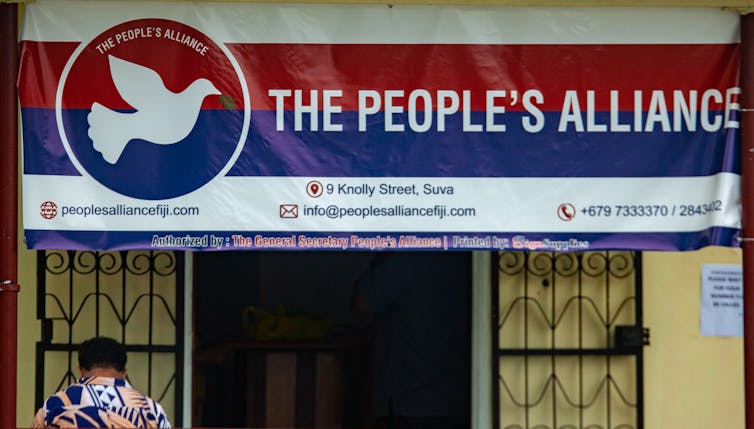
With the Fiji general election just days away, a major political party has condemned the arrests of its deputy leaders on charges of vote buying.
People’s Alliance deputy party leaders Lynda Tabuya and Dan Lobendhan appeared in court on Tuesday after being questioned by the Fiji Independent Commission Against Corruption (FICAC).
It is alleged that Tabuya tried to gain or influence votes for the December 14 election by soliciting $1000 to the Rock the Vote Volleyball tournament in May this year.
On the alternative count of breach of campaign rule, it is alleged that she also induced the participants to vote for Lobendhan.
Lobendhan is also alleged to have offered $1000 prize money to the tournament during the campaign period to gain or influence votes.
On the alternative count, he allegedly offered a monetary inducement to the participants.
In September, a complaint was lodged by the FijiFirst Party to the Fijian Elections Office (FEO) and then referred the allegations of vote buying were referred to the anti-corruption body.
Party leader claims ‘democracy hindered’ People’s Alliance Party leader Sitiveni Rabuka has labelled the arrests as an attempt to derail their election campaign and muzzle candidates.
Rabuka said the arrest was “outrageous to democratic good governance principles” and “a ridiculous assault on our individual constitutional rights to take part in political campaign activities”.
He said after a month and a half delay, and on the eve of the election, for FICAC to move on the FijiFirst complaint was “blatant and a deliberate interference” in the country’s electoral process.
The People’s Alliance has called on the FICAC Commissioner to respect the electoral system and not hinder democracy.
“It comes as a shock considering that in his reply to the FEO letter dated September 26th 2022, Lobendahn denied having paid Rock the Vote Volleyball to exclusively invite him to events to impress his presence on social media,” said Rabuka.
“Lobendahn stated that he was invited by a colleague, working towards creating awareness to attract youths and encourage them to register to vote for the upcoming elections.”
Rabuka questioned what was unlawful about enlightening and encouraging youths to register to vote?
The matter has been adjourned to February 10.
This article is republished under a community partnership agreement with RNZ.
The university has announced that 170 academic positions are being cut, but there are concerns about whether the criteria by which staff were selected to lose their jobs was fair.
Legal proceedings have been launched by the Tertiary Education Union (TEU), which says the university has truncated the processes for dismissal set out in the collective agreement.
It argues staff were selected because they failed to meet teaching and research requirements they did not know they were subject to.
Presenter Kathryn Ryan spoke to Professor Damon Salesa, who is vice-chancellor of AUT.
This article is republished under a community partnership agreement with RNZ.
Australians are currently confronting a cost of living crisis that includes soaring energy prices. Ministers have been working for weeks on a strategy to contain the prices of coal and gas, driven up by the fallout from the Ukraine war.
It’s the toughest, most complicated policy issue so far faced by Anthony Albanese, and it’s involved some head-butting with the NSW and Queensland governments.
In this podcast, we talk with Professor Bruce Mountain, Director of the Victoria Energy Policy Centre at Victoria University, about this power price conundrum, and the attempt to deal with it by price caps.
Mountain says: “One of the great difficulties in capping wholesale coal or gas prices is there’s no guarantee that that will impact the price of electricity. There’s a long chain to be followed between a wholesale cap on coal or gas and the price that the customer pays.”
When the government produces its energy policy, how quickly would that flow through to the prices manufacturers and household pay for their power?
“A cap on the wholesale price of gas might be expected to flow through to large gas users quite quickly. How it flows through in the electricity market is an altogether different story […] The wholesale caps that it has in mind perhaps have the weakest likelihood of a certain outcome that it’s seeking.
“I wish I could be more certain, but I’m afraid these issues are just so terribly complex.”
What are the implications of the crisis for renewables?
“My impression is the social licence of coal and gas has been very badly damaged here in Australia and globally.
“We hear again and again from governments a great desire to speed up the transition to ensure that they’re not in the same position again.
“I think their’s an awful clamour, obviously, to keep the lights on and to ensure customers are not exposed to the worst impacts of this. But I think there’s a great desire to not be in the same situation again.
“So it’s a strange situation, where in the short term governments are urging more exploration, more gas and coal production. But in the medium to long term, they want exactly the opposite.
“I should think that it will have stimulated investment incentives and put more lead in governments’ spine to speed up the transition in the medium to long term.”
Michelle Grattan does not work for, consult, own shares in or receive funding from any company or organization that would benefit from this article, and has disclosed no relevant affiliations beyond their academic appointment.
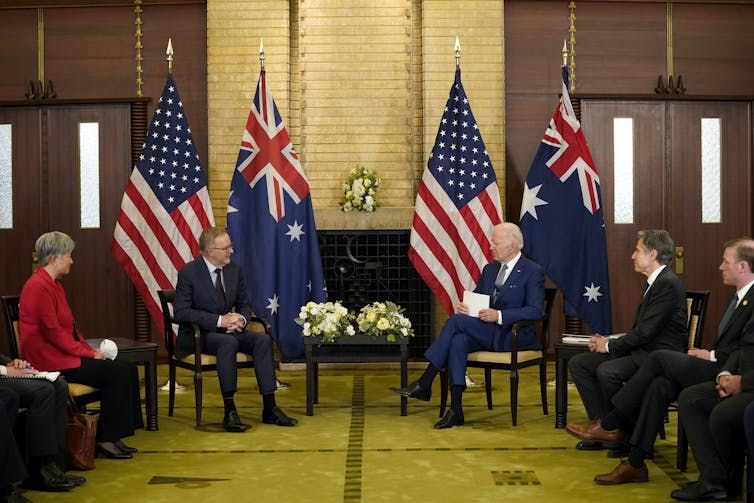
Foreign Minister Penny Wong and Defence Minister Richard Marles met with US Secretary of State Antony Blinken and Secretary of Defense Lloyd J. Austin III for the Australia-United States Ministerial Consultations (AUSMIN) in Washington, DC, on December 6.
While there is notable continuity with last year’s agenda, this year’s AUSMIN clearly bears the Albanese government’s foreign and defence policy imprint – one that has a receptive audience in the Biden administration.
With greater military co-operation, and a priority on climate action, the meeting outlines an agenda to vigorously compete with China for regional influence while advancing the alliance’s long-standing defence and security co-operation objectives.
A realist shift from 2021
There is a decidedly realist tone to this year’s AUSMIN, at least from Australia’s perspective. In her remarks at the joint press conference, Wong largely dispensed with talk of shared history and values. Instead, she cast AUSMIN as “the primary forum for us as an alliance […] to make progress on shared interests”.
Ideology has also taken a backseat. The emphasis on “democratic values” and human rights that occupied an entire section in last year’s joint statement has been condensed and accompanied by a more balanced assessment of China. This notes the need for responsible competition, risk reduction, and co-operation on issues of shared interest.
This year’s statement also sharpens the alliance’s focus on Australia’s region. The Pacific Islands are front and centre. There are four detailed paragraphs on how the Australia-US alliance is engaging these countries diplomatically, economically, militarily and in the maritime environment.
From Wong’s relentless regional engagement since taking office, to US President Joe Biden’s hosting of the first US-Pacific Islands Summit in September, and bothcountries’ Comprehensive Strategic Partnerships with ASEAN, Australia and the United States have clearly increased their diplomatic engagements with these two vital subregions.
The focus on maritime security co-operation with the Pacific Islands, in particular, complements similar alliance activities in South-East Asia, where Australia and the United States should be looking to better integrate their respective lines of effort.
By contrast, there was no reference to the Afghanistan conflict or the threat of terrorism. The statement thus reflects the conclusion of the alliance’s Middle East period.
Penny Wong’s efforts in the Pacific have been a focal point of her early months as foreign minister. Australian Department of Foreign Affairs/AAP
Incremental steps in defence cooperation
As we predicted last week, no new details of the AUKUS partnership were announced. However, Marles did emphasise the need to “uplift” Australia’s shipbuilding industry to meet the task. An update on export control reform was also not forthcoming, other than mentions of the need for “seamless” bilateral defence industrial co-operation.
On the alliance’s force posture initiatives, the meeting flagged some progress on key issues without making major new announcements. For instance, there will be an increase in the frequency and sophistication of US Air Force rotations through Australia, as heralded last year. By comparison, little was said about mooted US Army and Navy deployments to Australia.
Importantly, the statement identifies measures to strengthen the resilience and sustainability of combined Australia-US operations. This includes targeted logistics exercises and co-development of “agile logistics” capabilities, as well as efforts to enhance Australia’s ability to maintain and repair munitions in-country. This will be done by streamlining US technology transfer and information-sharing arrangements – measures that Marles emphasised during the joint press conference.
Making good on these commitments will be critical to sustaining a higher tempo of joint operations in the region.
Bringing Japan on board
Perhaps the most eye-catching development is the invitation to Japan to “increase its participation in [US-Australia] Force Posture Initiatives”. Though short on specifics, this development underscores how the Australia-US alliance has become a mechanism for “advancing a strategy of collective defence among other Indo-Pacific allies”.
Future years could see larger and more frequent deployments of Japan Self-Defence Forces in more sophisticated bilateral and trilateral joint exercises. These forces would include fighter aircraft and marines rotating through Australian facilities.
Indeed, this announcement is consistent with the trajectory of the Australia-Japan relationship set by the recently updated Joint Declaration on Security Cooperation. It makes the Australia-Japan 2+2 ministerial talks scheduled for Friday in Tokyo all the more interesting. Both countries are looking to take their defence co-operation, including with the United States, to the next level.
Climate co-operation to the fore
Wong emphasised climate co-operation as a primary area of joint collaboration. This is not entirely novel, as “climate, clean energy and the environment” received significant attention at AUSMIN 2021. There was also a brief mention in 2015.
Nevertheless, the framing of climate collaboration as one of three specific areas of focus (the others being engagement with South-East Asia and the Pacific Islands) reaffirms Prime Minister Anthony Albanese’s and Biden’s November statement of climate partnership as a “new pillar” of the alliance.
The AUSMIN meeting brought climate co-operation to the fore, consolidating the discussions between Anthony Albanese and Joe Biden in November. Mick Tsikas/AAP
This is likely to be well received by domestic and regional audiences alike. The 2022 joint statement confirms the elevation of climate, with this issue addressed in second as opposed to fourth place in 2021.
Climate efforts were also prioritised in relation to regional engagement with South-East Asia and particularly the Pacific Islands. This is a marked elevation from 2021, when climate was mentioned in less stark terms within these contexts.
Finally, the visuals of this year’s AUSMIN were also notable. Watching the first Asian-Australian foreign minister standing alongside the first African-American secretary of defense was a poignant reminder of the power of identity in shaping bilateral narratives. Wong has often said that “foreign policy starts with who we are”, and it was good to see this year’s AUSMIN reflect the diversity of our multicultural societies.
The USSC Foreign and Defence Policy Program receives funding from the Australian Department of Defence, Northrup Grumman, and Thales. Peter K. Lee also receives funding from the Korea Foundation.
The USSC Foreign and Defence Policy Program receives funding from the Australian Department of Defence, Northrup Grumman, and Thales.
The Foreign Policy and Defence Program at the United States Studies Centre receives funding from the Department of Defence, Northrop Grumman Australia, and Thales Australia.
Using fire and burning, and threats to burn, as part of family violence is more common than many people realise. These tools and tactics are used to coercively control a partner or ex-partner.
Recent legal cases highlight the issue. As one of several acts of family violence against his partner, Brett doused her in diesel and set her hair alight. Similarly, one of Michael’s acts of violence against his partner was to splash her with turpentine and threaten to “watch her burn”.
Other acts of family violence include burning the survivor’s clothing or her furniture.
Yet the threat of fire and burning isn’t routinely considered by police and family violence safety services in their risk assessments and safety planning for women who have experienced family violence.
How do perpetrators use fire and burning?
After separation, abusive partners sometimes use fire to punish their partners for leaving them. The time soon after separation is particularly risky for survivors.
Rowan Baxter set alight and killed Hannah Clarke and their children soon after they separated. Similarly, recently separated Doreen Langham and her ex-partner Gary Hely died in a house fire. The coroner found Hely intentionally lit the fire.
Burns can easily be explained away as an accident, especially to those who are not aware of the connections between family violence and the use of fire and burning. This is particularly a concern where the injured woman is unable to tell her story.
Using, or threatening to use, fire is so dangerous because once ignited it spreads easily. It can cause extreme damage, pain, and trauma and, if the woman survives, the impact of injuries can be lifelong.
Perpetrators of family violence sometimes use fire and burning to coercively control or punish their partner or former partner. Shutterstock
The use of fire and burning has long been identified as a form of family violence in South Asian countries. In India, for example, a very high proportion of deaths from fire are acknowledged as likely to be associated with family violence. Kerosene burning is considered a unique form of family violence in India.
However, burn-related violence against women and girls has been reported from countries across the world, regardless of national income. Perpetrators of burn-related violence are mostly the partners or ex-partners of injured women.
Australia has been slow to recognise and address the link between family violence and burning or threats to burn. This is, in part, due to limited data collection.
One small Australian study is the exception. This study conducted at the Royal Darwin Hospital, found women were more likely to be burnt, or were threatened with burning, during interpersonal violence, compared to men. Over 80% of the victims who suffered burns in this context required surgery, with many requiring skin grafts.
However, there’s more we can do right now. Existing burns data held in emergency clinics across Australia should be analysed to identify the links. This would provide a greater understanding of how common this form of family violence really is.
Assessing the threat
We should develop our risk assessment tools so those who provide support to survivors of family violence – such as police, health workers and family violence support workers – recognise fire and burning threats.
Improved recognition of the risk of fire, burning and threats to burn may have positive implications for safety planning and prevention. This might include arranging alternative housing, upgrading smoke alarms and disposing of fire accelerants.
Risk assessment tools should identify the threat of fire and burning. Shutterstock
Notably, in risk assessments undertaken by police before Doreen Langham’s death, fire threat was not identified. However, her ex-partner, Gary Hely, had previously been investigated for setting fire to another ex-partner’s home just five years earlier.
If Hely’s suspected fire setting had been identified as a risk factor, the history might have been uncovered and more appropriate safety planning undertaken. This might have saved her.
Fire services have an important role
Australian fire services could play an enhanced role in preventing, recognising and responding to fire related family violence. We could model the approach of England, where fire services have been part of the family safety response for more than ten years.
English fire service representatives contribute to family violence risk assessments and are represented in high-risk teams working with survivors to keep them safe. English fire services also provide enhanced home fire safety checks for those who are identified to be at risk.
Australian fire services do not collect data that allows identification of connections between fire and family violence. Collection of this type of data would be useful in improving understanding, recognition and prevention of family violence related fire incidents. The Victorian fire service, for instance, doesn’t include intentional arson deaths when publishing statistics on arson deaths. Yet this is important information.
An enhanced role for fire services would require employees receive family violence training so they can recognise family violence, know how to properly secure any potential crime scene and how to respond to, and work with, survivors. Fire service staff should also have access to mental health support after attending family violence related fires.
Fire services aren’t currently part of Australia’s family violence safety system, but including them could save lives.
If this article raises issues for you or someone you know, contact 1800 RESPECT (1800 737 732). In an emergency, call 000.
Heather Douglas receives funding from the Australian Research Council.
Yvonne Singer does not work for, consult, own shares in or receive funding from any company or organisation that would benefit from this article, and has disclosed no relevant affiliations beyond their academic appointment.
LIVE@MIDDAY NZ Time – 6pm USEST – In this, the 24th episode of A View from Afar for 2022 political scientist Dr Paul Buchanan and host Selwyn Manning will examine whether there is, in reality, such a thing as foreign policy independence in today’s world.
Specifically, Paul and Selwyn will examine the following questions:
What does it mean to be foreign policy independent, and what would independence look like?
How is foreign policy independence different from foreign policy autonomy and flexibility?
What factors inhibit or constrain foreign policy independence (domestic and international)?
In an interdependent world can FP independence be a realistic objective?
And finally: is FP independence possible for a small state in this era, if it ever was, and conversely, do great powers really exercise independence in their foreign affairs?
Threat.Technology placed A View from Afar at 9th in its 20 Best Defence Security Podcasts of 2021 category. You can follow A View from Afar via our affiliate syndicators.
Last week, four Indonesian fishermen were convicted for taking shark fins and poaching fish in Australian waters. The four men were spotted off remote Niiwalarra/Sir Graham Moore island in the Kimberley region of Western Australia, more than 150 nautical miles inside Australia’s exclusive economic zone.
But is fining them up to A$6,000 – a huge sum for these men – likely to stop sharks being killed? Hardly. The reality is, they have no capacity to pay the sum. Instead, they’ll likely serve a month or so in jail and return to Indonesia. There, they’ll face the same problem driving them into Australian waters – poverty.
Desperate Indonesian fishers are setting out across the Arafura Sea in record numbers, with 46 fishing boats detected since June this year. Many gamble with their lives – and some have lost. Authorities have found illegal fishing camps on Niiwalarra Island, alongside shark carcasses with their fins taken.
Shark fins are sought mainly in Chinese markets for use in a high-status soup and in traditional medicine. Demand has seen wholesale slaughter of these predators, essential to the proper functioning of ocean ecosystems. We’re hardly blameless – Australia exports tonnes of shark fin each year. We have to find a better way of protecting sharks in our waters – some of the last healthy populations on the planet.
Desperate fishers take the valuable fins – and leave the shark to die. Shutterstock
Would you risk your life for a shark fin?
While Indonesia’s economy is growing strongly, there’s a huge divide between rich and poor. The waters around its thousands of islands are fished heavily, and Indonesian fishers catch seven million tonnes a year, second only to China.
But heavy fishing means many fish stocks are now low, and tensions have risen between larger trawlers and small-scale fishers from villages. If you’re from a poor village and there’s nothing left to catch locally, where do you go?
You can admire the courage of fishers who set out in very small, barely seaworthy vessels with rudimentary fishing equipment to cross the Arafura to poach fish. In reality though, it’s a mix of courage and poverty-driven desperation. A 2018 report found fisher monthly income was roughly A$50 per month, well below the minimum wage in coastal regions.
You can see the choice many face. Continue in poverty – or try to catch sharks, knowing a fin can sell for as much as a month’s wages.
Not all shark fins are the same. Particularly prized are fins from the critically endangered scalloped hammerhead shark. These sharks have fins with a high thread count, meaning they are desirably fibrous. Killing of these sharks for their fins has almost wiped out populations in parts of their range – but they’re still relatively abundant in Australian waters.
How is Australia responding?
The Australian Defence Force has a near-constant presence watching for fishers through its Operation Resolute and assisting with enforcement efforts run by Australia’s fisheries management authority.
Enforcement ranges from “educating” fishers found inside Australian waters and sending them on their way to confiscating equipment and catch to criminal charges. Australia and Indonesia regularly talk about illegal fishing. And Australia has signed up to shark protection efforts internationally.
Despite this, the issue is worse than ever. Last decade, an average of 20 foreign fishing boats were intercepted each year. Last financial year, it soared to a staggering 337. Sharks aren’t the only drawcard – fishers take finfish and sea cucumber too.
Why? The pandemic. Indonesia was hit hard, with tourism drying up and many people losing income. But another is that sharks are vanishing from their usual ranges. To find them, you have to go further afield.
Why are sharks still killed for their fins?
Eating shark fins is good for no one. There are no identifiable health benefits. There’s no taste you couldn’t get from eating cartilage from farm animals instead. And when you eat the fin, you’re likely to get a dangerous dose of mercury, which accumulates up the food chain.
Shark fin soup has long been an expensive high status meal in Chinese culture, as in this 2009 photo from a Hong Kong restaurant. BionicGrrl/Flickr, CC BY
From the shark’s perspective, it’s a particularly gruesome way to die. Fins are typically cut from the shark while it’s alive. When released back to the water, it will either sink and drown, get eaten by another predator, or die from blood loss.
Sharks and their close cousins, rays, have been decimated, with populations of 18 key species falling a disastrous 70% since the 1970s. They’ve been caught as bycatch by trawlers and longliners, sought for their fins or their oily livers, or killed out of fear.
While there’s occasional good news, it is difficult to be optimistic.
Our slaughter of an estimated 100 million sharks a year is devastating for nature. Before we began killing them wholesale, shark numbers were much higher. Healthy shark populations act as a stabilising force on prey species and keeps ecosystems in balance. Tiger sharks keep seagrass beds healthy by eating the turtles which graze them.
Killing sharks can destroy other fisheries. Losing large sharks led to the end of the North Carolina scallop fishery. Without large sharks, cownose ray populations exploded, and the hungry rays ate all the scallops.
So what can we do to save our sharks from desperate fishers?
This is a wicked problem. “Education” is hardly going to stop fishers who know precisely why they’re here and what risks they’re taking, as the steep rise in illegal fishing suggests. Fines they can’t pay and the inconvenience of short prison sentences are clearly not doing the job.
You might wonder why we can’t get advance warning of fishers heading into our waters. Even modern radar struggles to spot small wooden boats across millions of square kilometres of ocean, and surveillance planes and patrol boats can’t be everywhere. Besides, until the vessels reach Australia’s exclusive economic zone, they have every right to be on the high seas.
In 2011, China launched a campaign to make shark fin soup unpopular, driving demand down 80%. But demand is still high in Hong Kong, Macau and Taiwan, and rising fast in places like Vietnam and Thailand. Wider campaigns like this are needed.
We should also help Indonesia find more sustainable ways of tending its own fisheries, and tackling coastal community poverty.
Jailing and fining fishers is a knee-jerk solution. As long as shark fin soup is on the menu and as long as we have valuable sharks, there will be fishers desperate enough to come into Australian waters to hunt them.
Zoe Schmidt contributed to the research basis for this article
Anthony Marinac is a partner in Pacific Maritime Lawyers, a law firm which routinely represents various Australian seafaring industries, occasionally including Australian fishers. He also served aboard patrol boats as a Transit Security Officer on Operation Resolute in 2008-09.
Before the Qatar World Cup began, FIFA launched a social campaign called “Football Unites the World”. FIFA acknowledged “the world is divided […] with conflicts and global crises”, but promised the World Cup “will bring people together to cross borders, unite and celebrate”.
It’s a similar message to that of the International Olympic Committee (IOC), in which the Olympic Games are said to “unify” the world of nations. Such aspirations aren’t simply about bringing countries together to play sport under agreed rules: these two global bodies also believe they have some capacity to shape international relations.
Yet, despite FIFA heralding unity and peace during the 2022 World Cup, the tournament has featured potent examples of political conflict and protest, while Russian attacks against Ukraine have intensified.
Political football
At the very time football was supposed to be “uniting the world”, FIFA was scrambling to quell what it saw as unwelcome criticism from some participants and many commentators. This dissent stemmed principally from widespread criticism about Qatar as World Cup host, notably the exploitation of foreign labourers, discrimination against LGBTQI+ communities, and constraints around drinking alcohol.
In response, Infantino sent a letter to football federations saying: “Please, let’s now focus on the football!” He urged them to “not allow football to be dragged into every ideological or political battle that exists”.
However, while football teams concentrate on winning games, some also promote bedrock values in modern sport such as inclusion, and rail against discrimination.
Many football teams – especially those from Western democratic cultures – have a progressive vision of what “unity” in sport and society should mean.
Rainbow dispute
FIFA’s 2017 Human Rights Policy prohibits discrimination “in the world of football both on and off the pitch”, with freedom of sexual orientation specifically protected, among other attributes.
In keeping with this, seven European countries informed FIFA they intended to showcase their support for sex and gender diverse communities at the 2022 World Cup. Team captains were to wear the “OneLove” rainbow-coloured armband, as had been done by the Dutch at the UEFA Euro 2020 championship.
What’s more, wearing the armband would not merely attract a fine. FIFA warned of on-field punishment in the form of yellow cards.
The European teams, while angry, now felt they had little choice other than to back down. But there were creative responses. The German team offered a symbolic protest before the start of their next match, covering their mouths to denounce being “gagged” by FIFA. Germany’s Interior Minister, Nancy Faeser, sported the OneLove armband while setting next to Infantino during that game.
Clash of values
FIFA, meanwhile, offered its own “solution”. The FIFA “No Discrimination” campaign was brought forward from the planned quarter-finals stage, with FIFA-approved armbands endorsing anti-discrimination, albeit without a specific focus on sex and gender diversity.
FIFA’s feeble public relations spin then quickly denigrated into doublespeak. Despite banning the OneLove armbands, FIFA announced it also “supports” OneLove and the LGBTQI+ community, and “Football unites behind [FIFA’s] call for #NoDiscrimination”.
That message would hardly resonate with Qatari authorities, for whom homosexuality is an affront to Islam and forbidden under law. Just prior to the tournament, Qatar’s World Cup ambassador, former footballer Khalid Salman, claimed to a German broadcaster that same sex attraction is “damage in the mind”.
Two weeks later, panellists on Qatar’s Alkass Sports channel mocked the German football team’s protest gesture, relishing their elimination from the Cup. These Europeans, they said, had failed to respect Qatar’s customs.
FIFA, in gifting the World Cup to Qatar as host, was well aware of this clash of values, but deferred to local norms.
That said, FIFA occasionally pushed back, most notably to quell the ire of fans prevented from conveying symbolic support for LGBTQI+ communities through their clothing. At the entry to stadiums, Qatari security initially refused entry to people wearing clothing with rainbow adornments. However, after “urgent talks” with FIFA, that position was rescinded. In this sense, fans ended up having more freedom of expression than players.
But not completely. When some England fans arrived at the opening match dressed as their country’s patron saint, often replete with faux helmets, plastic swords, and shields featuring the St George Cross, Qatari police refused them entry. This attire has a long tradition among English sports fans, but FIFA sided with Qatar, deciding that “crusader” costumes could be historically offensive to Muslims.
Meanwhile, Iranian spectators in Doha were confronted by security for the “offense” of wearing t-shirts or holding up placards in support of the recent protest movement against the Islamic Republic and its morality police.
Persian pre-revolutionary flags and items emblazoned with one or all of the words “Woman, Life, Freedom” were routinely seized, either by security forces or pro-government agents and supporters.
FIFA eventually intervened to assure Iranians that symbols of dissent would no longer be constrained by World Cup authorities, but this only happened after the Iran team had been eliminated from the tournament.
Elsewhere, Brazilian fans confronted a very different political quandary. In recent years their team’s iconic yellow jersey, the canarinho, has been deployed as an unofficial emblem of former President Jair Bolsonaro’s right-wing populist movement.
Many supporters of the new left-wing president, known as Lula, have concluded the yellow jersey is still politically tainted: after all, Bolsanaro and his supporters had used the canarinho in a similar vein to Donald Trump’s MAGA merchandise.
Future World Cups will be obliged to adhere to human rights obligations that Qatar (2022) and Russia (2018) weren’t required to follow.
Yet, such is FIFA’s cognitive dissonance that Infantino, on the eve of the cup, fantasised about the possibility of a World Cup in North Korea.
Daryl Adair does not work for, consult, own shares in or receive funding from any company or organisation that would benefit from this article, and has disclosed no relevant affiliations beyond their academic appointment.
New Zealand Parliament Buildings, Wellington, New Zealand.
New Zealand Politics Daily is a collation of the most prominent issues being discussed in New Zealand. It is edited by Dr Bryce Edwards of The Democracy Project.
Thousands of delegates have gathered in Montreal, Canada, for a once-in-a-decade chance to address the accelerating pace of species loss and the dangers of ecosystem breakdown.
COP15 brings together parties to the UN Convention on Biological Diversity (CBD) with a goal of negotiating this decade’s biodiversity targets and a new global framework for biodiversity protection.
The summit risks being overshadowed by the recently concluded COP27 on climate change, but the issues are linked and the importance of biodiversity protection cannot be overstated.
About one million plant and animal species are at risk of extinction. Not only are our activities driving this mass extinction, its consequences also threaten our own health and survival.
COP15 needs to mark a step change in how quickly and how seriously the international community responds to catastrophic nature loss. The focus is expected to be on 30×30, a push to protect 30% of land and sea for nature by the end of this decade.
In recent years, the global climate crisis has made more headlines than biodiversity. Yet both are inextricably linked.
Deforestation reduces the planet’s carbon carrying capacity while simultaneously destroying habitats. Erratic weather patterns, fires and floods – caused or exacerbated by climate change – erode ecosystem integrity.
As ecosystems break down, the natural barriers separating people from zoonotic diseases are reduced, with devastating consequences, as the COVID pandemic shows.
Unlike the UN climate process, which has a clear target to limit greenhouse gas emissions to 2℃, the biodiversity convention and its COPs have so far lacked a clear goal. But this might change.
30×30 could represent a significant move towards reducing humanity’s collective footprint on the planet and allowing ecosystems to rejuvenate. But as always, the devil is in the detail. It will be important to ensure Indigenous peoples’ rights are respected and that sufficient funds are released for effective management of protected areas.
The summit will also emphasise the human right to a healthy environment, for which biodiversity is essential, and a concerted push to require mandatory nature disclosures from all large businesses and financial institutions as a measure of their impacts and dependencies on biodiversity.
Mandatory nature disclosures are receiving broad support, not least from many businesses. If adopted, this would add clarity to corporate obligations and might significantly improve transparency and accountability. But safeguards will be necessary to ensure the problems around carbon offsetting are not repeated and companies cannot unduly compensate for the loss or degradation of biologically diverse ecosystems.
Nevertheless, 30×30, the human right to a healthy environment, and #MakeItMandatory, each has the potential to capture greater public attention and to galvanise global leaders into urgent action.
About a third of New Zealand’s area is already conservation land, but only 7% of its territorial sea is protected. Getty Images
New Zealand’s ambitious biodiversity strategy, Te Mana o te Taiao, sets out a blueprint for the protection and restoration of our biodiversity, as well as for its sustainable use. But despite such ambition, New Zealand’s indigenous biodiversity remains in peril.
There are numerous challenges to the country’s ecological health. These include increasing agricultural and industrial activity, invasive alien species and introduced predators, commercial fishing and trawling, and the impacts of climate change, which already bring more weather extremes.
COP15 will focus on an initiative to protect 30% of land and sea for nature by the end of this decade. Getty Images
Leadership and ambition
COP15 was originally to take place in Kunming, China, in October 2020, but was delayed by the COVID pandemic. Although it is now happening in Canada, China retains responsibility for organising most of the summit and its leadership and ambition will be crucial to its success. This is the first time China has held the presidency of a major international environmental treaty.
The summit’s ambitious theme – building a shared future for all life on Earth – now needs to be matched by an agreement on bold and substantive commitments. Sufficient financial assistance for developing states must also be made available to ensure commitments are implemented.
There is now strong consensus that human activities are altering the planet’s climate, with significant and negative consequences. Public support for action on climate change is also high.
Our chances of avoiding catastrophic climate breakdown depend in many ways on how effectively we protect and restore Earth’s biodiversity. Framing biodiversity as a crucial component of climate stabilisation could help raise the profile of COP15. It would send a message that biodiversity isn’t a limited “green” issue but simply about ensuring a healthy and habitable planet for everyone.
Nathan Cooper does not work for, consult, own shares in or receive funding from any company or organisation that would benefit from this article, and has disclosed no relevant affiliations beyond their academic appointment.
For some, it’s a pinnacle of cultural achievement. For others it perpetuates class inequality and upholds “white middle class social domination”.
To controversy, we can add contradiction! We love to hear the instruments and idioms of classical music in film and television (think of the theme from The Crown or the music from the Harry Potter films), but experience has shown classical music is most effective at repelling loiterers from public spaces.
Engaging with the controversy and contradiction of this music requires more than streaming a minute or two of Mozart. Research shows we make better judgements about music when hearing and seeing it, and classical music was designed to be experienced live.
So are you considering giving classical music a go? Here are some tips for first-time concert goers.
Where should I start?
Concerts range from intimate performances by solo players to major works for choir and orchestra featuring hundreds of musicians.
Terms like “chamber” (small ensembles like string quartets), “choral” (choirs large and small), “orchestral” (ranging from larger string ensembles to giant collections of strings, winds, brass and percussion) and “opera” (companies of musicians that include orchestral players, solo singers and sometimes a chorus) describe different groups of musicians.
Each has its own repertoire and a dizzying array of terms (such as aria, concerto, sinfonia, oratorio and cantata) help describe the pieces these ensembles perform.
The more you get to know classical music, the more you’ll understand and appreciate the terminology.
One of the most common types of classical music you’ll come across is a symphony. A symphony is a substantial orchestral work with different sections or “movements”, each with a different character and tempo. Though the term “symphony” became popular in the 18th century, composers are still writing symphonies today. Symphonies differ in purpose and duration. They can be as short as ten minutes and as long as two hours.
Sammartini’s Symphony in F from 1740, for example, has three movements and lasts about ten minutes. Its movements have simple, direct structures that aren’t too far removed from pop songs in terms of complexity and scope.
Mahler’s third symphony from 1896, on the other hand, has six movements and lasts for 90 minutes. Its breadth and complexity are astounding.
I would suggest a first timer selects an orchestral concert with multiple pieces on the program. You will get to enjoy the spectacle of many musicians and many different instruments. You’re also likely to be exposed to the work of composers from different times and places.
If money is a concern, many orchestras put on free concerts.
Classical music is pretty diverse. Just as rock ’n’ roll traverses anything from Buddy Holly to Thundermother, what we colloquially know as “classical music” spans many cultures and many centuries.
Terms like “Baroque” (composed between 1600 and 1750), “Classical” (this time with a capital C, composed between 1730 and 1820), “Romantic” (around 1820 to 1900) and “Modern” (1890 to 1950) help us keep track of when the music was written.
These eras also operate with regional descriptors such as French, German, Italian or Russian.
Overlay this with subtleties of style and the distinct personalities of individual composers and you get a sense of the vast breadth of classical music.
But it is also important to know classical music isn’t only a celebration of dead Europeans. It is a living tradition whose boundaries aren’t fixed.
Classical music readily interacts with other types of music and crosses cultural boundaries to generate new styles and new sounds. Consider the Australian work Kalkadungu by William Barton and Matthew Hindson, a work “designed to explore the transition of traditional song-lines between the past, present and future”.
Though sometimes far removed from contemporary culture, every piece of classical music has something to say about the human experience. So, what to expect in the program? Expect to be surprised.
What should I wear?
Wear what makes you comfortable. While it’s not unusual for people to dress up for a concert, it isn’t compulsory, and ordinary casual clothes are fine. In the same way people dress up for the Melbourne Cup, some people wear black tie to the opera. Don’t let it faze you.
When should I clap?
While you might be moved to clap right after hearing an incredible feat of musicianship, modern audiences generally don’t clap whenever there is a pause in the music, such as between movements of a symphony.
This reflects the idea that a symphony is a “complete” musical statement – including the pauses between sections.
If you’re uncertain when to clap, wait until others do.
What else should I keep in mind?
Going to classical music should be about enjoying the concert! Here are some final tips on how to enjoy yourself.
Enjoy the spectacle. There’s much to see at classical concerts. The interactions between the conductor and the orchestra can be particularly interesting. Watch as the conductor, with a flick of the baton, unleashes awesome sonic power.
Appreciate the skill of the musicians. Classical performers are the elite in their field. It takes decades of training to do what they do.
Learn something about the composer and the work. Some classical composers are saints (Hildegard of Bingen) and some may have been psychopaths (Gesualdo). Knowing who the composer is and what they were trying to achieve in their music will add to your appreciation.
Keep in mind that your musical taste expands as you expose yourself to new and unfamiliar sounds. The more you listen, the more you are likely to enjoy.
Oh, and sometimes, if the audience is adequately enthusiastic, there’ll be a short additional piece at the end. Encore!
Timothy McKenry does not work for, consult, own shares in or receive funding from any company or organisation that would benefit from this article, and has disclosed no relevant affiliations beyond their academic appointment.
The solution to Fiji’s problems is to vote out the FijiFirst government, says People’s Alliance party leader Sitiveni Rabuka.
Speaking to about 1000 supporters who welcomed Rabuka with cheers of “480” — his votng candidacy number — at the party rally in Labasa last Saturday, he assured voters that his team together with the National Federation Party would do everything in their power to rid Fiji of the “damaging legacy” of Voreqe Bainimarama and Aiyaz Sayed-Khaiyum.
“Again I stress that we cannot do it alone,” he said.
“We want you to be partners with us in the remaking of Fiji and we will consult with you and seek your ideas in the normal way of democracy.
“I tell you right now, you the people are the change. We the PA candidates are the change and together we are unstoppable.
“We are unstoppable all over the land. We are ready to make history on December 14 and to the candidates, keep preaching the message from our manifesto, tell the people about our planes and keep emphasising that they are the centre of our mission.”
Rabuka assured his supporters of a better future.
“We will be assessing the forestry and timber industry in Vanua Levu, again in close consultation with all stakeholders to identify how we can achieve a good, sustainable return,” he said.
“Tourism too will be given close attention in this part of Vanua Levu and in the area of Savusavu and Taveuni as we want to ensure this crucial enterprise continues to be a key driver of the entire economy.”
Serafina Silaitoga is a Fiji Times reporter. Republished with permssion.
Our society faces the grand challenge of providing sustainable, secure and affordable means of generating energy, while trying to reduce carbon dioxide emissions to net zero around 2050.
To date, developments in fusion power, which potentially ticks all these boxes, have been funded almost exclusively by the public sector. However, something is changing.
Private equity investment in the global fusion industry has more than doubled in just one year – from US$2.1 billion in 2021 to US$4.7 billion in 2022, according to a survey from the Fusion Industry Association.
So, what is driving this recent change? There’s lots to be excited about.
Before we explore that, let’s take a quick detour to recap what fusion power is.
Merging atoms together
Fusion works the same way our Sun does, by merging two heavy hydrogen atoms under extreme heat and pressure to release vast amounts of energy.
It’s the opposite of the fission process used by nuclear power plants, in which atoms are split to release large amounts of energy.
Sustaining nuclear fusion at scale has the potential to produce a safe, clean, almost inexhaustible power source.
Our Sun sustains fusion at its core with a plasma of charged particles at around 15 million degrees Celsius. Down on Earth, we are aiming for hundreds of millions of degrees Celsius, because we don’t have the enormous mass of the Sun compressing the fuel down for us.
Scientists and engineers have worked out several designs for how we might achieve this, but most fusion reactors use strong magnetic fields to “bottle” and confine the hot plasma.
A donut-shaped magnetic confinement device called a tokamak is one of the leading designs for a working fusion power generator, with many such experiments running worldwide. Christopher Roux, EUROfusion Consortium, CC BY
Generally, the main challenge to overcome on our road to commercial fusion power is to provide environments that can contain the intense burning plasma needed to produce a fusion reaction that is self-sustaining, producing more energy than was needed to get it started.
Joining the public and private
Fusion development has been progressing since the 1950s. Most of it was driven by government funding for fundamental science.
Now, a growing number of private fusion companies around the world are forging ahead towards commercial fusion energy. A change in government attitudes has been crucial to this.
In the United Kingdom, the government has invested in a program aimed at connecting a fusion generator to the national electricity grid.
The technology has actually advanced, too
In addition to public-private resourcing, the technologies we need for fusion plants have come along in leaps and bounds.
In 2021, MIT scientists and Commonwealth Fusion Systems developed a record-breaking magnet that will allow them to build a compact fusion device called SPARC “that is substantially smaller, lower cost, and on a faster timeline”.
These incredible feats demonstrate an unprecedented ability to replicate conditions found inside our Sun and keep extremely hot plasma trapped long enough to encourage fusion to occur.
By focusing nearly 200 powerful lasers to confine and compress a target the size of a pencil’s eraser, they produced a small fusion “hot spot” generating fusion energy over a short time period.
We can afford to expand adoption of current renewable energy technology like solar, wind, and pumped hydro while also developing next-generation solutions for electricity production.
This exact strategy was outlined recently by the United States in its Net-Zero Game Changers Initiative. In this plan, resource investment will be targeted to developing a path to rapid decarbonisation in parallel with the commercial development of fusion.
History shows us that incredible scientific and engineering progress is possible when we work together with the right resources – the rapid development of COVID-19 vaccines is just one recent example.
It is clear many scientists, engineers, and now governments and private investors (and even fashion designers) have decided fusion energy is a solution worth pursuing, not a pipe dream. Right now, it’s the best shot we’ve yet had to make fusion power a viable reality.
Nathan Garland receives funding from Griffith University. He has previously received funding from the US Department of Energy through its funding of Los Alamos National Laboratory.
Matthew Hole receives funding from the Australian National University, the Australian Nuclear Science and Technology Organisation, and the Simons Foundation. He is an ITER Science Fellow and Chair of the Australian ITER Forum.
Last week, the Albanese government took another important step towards the referendum on a Voice to Parliament. It introduced a bill to make changes to our referendum process, including new arrangements for public education and campaign finance.
Getting the referendum process right is essential if the Voice vote is to be fair and informed. So, what changes has the government proposed, and will they help to achieve that?
Modernising our outdated referendum rules
It is more than 20 years since Australia held its last referendum in 1999. That is the longest period in our history without a vote on constitutional change. So much time has passed that only Australians over 40 have any experience voting in a referendum.
One of the effects of this long gap is that the laws governing the referendum process have become stale. Unlike election laws, they have not always been updated to reflect changes in voting and campaigning. And some aspects – like the design of the referendum pamphlet – have barely changed in over a century.
With a Voice referendum on the horizon, it was clear a big update was needed. A major parliamentary inquiry said as much in December 2021 when it called Australia’s Referendum Act “outdated and not suitable for a referendum in contemporary Australia”.
The last time Australians were asked to consider a constitutional change was in 1999, when the republic referendum was held and failed. Parliament of Australia
The federal government proposes to modernise the law in several areas. The arrangements for postal voting, authorisation of advertisements and ballot scrutiny would all be brought into line with election laws.
But the more noteworthy changes concern public education and campaign finance. These are the most sensitive areas covered by the bill and will attract the most debate in the months ahead.
In a surprise move, the government wants to drop the official Yes/No pamphlet for the Voice referendum.
For over a century, the usual practice has been for governments to mail voters a pamphlet that contains official Yes and No arguments authorised by members of parliament.
The Bill suspends this practice for any referendum held during this parliamentary term. The government says the circulation of a hard-copy pamphlet is outdated in the digital age and that MPs can make their case in other ways, including via television and social media.
The pamphlet has never lived up to its promise as an educative tool. It is designed to persuade, not inform. Past pamphlets have often contained exaggerated or misleading claims that seem designed to confuse or frighten voters. In 1974, for example, the No campaign said “democracy could not survive” a change to how electorates were drawn. At its worst, the pamphlet can serve to spread misinformation rather than counter it.
All the same, many voters will want an accessible source of official information, both on the proposal and the arguments for and against change, to help them make up their own mind. A hard-copy pamphlet can serve that purpose, even in a digital age.
Rather than ditching the pamphlet, the parliament should reform it. It should be revised to include a clear, factual explanation of the proposal, just like similar pamphlets in Ireland, California and New South Wales. The arguments for and against should be shorter, calmer and more considered. And if we can’t trust politicians to formulate quality Yes and No cases, we should give that task to public servants or an independent body.
Civics education
The government says it wants to focus its public education efforts on a civics campaign that will provide voters with information about “Australia’s constitution, the referendum process, and factual information about the referendum proposal”. The bill temporarily lifts a block on government spending to allow that to happen.
This move is promising, and there is a precedent for it – the Howard government funded a neutral education program for the republic referendum.
But the government has not provided any detail on how the campaign would run. Careful design is crucial if it is to be trusted and effective.
Here the government should heed the recommendation of the 2021 parliamentary inquiry and establish an independent referendum panel to advise on, or even run, the civics campaign. A 2009 inquiry suggested the same.
To ensure public confidence in the body, its membership could be appointed by the prime minister in consultation with other parliamentary leaders. Ideally, the members would come from diverse backgrounds. The inquiry recommended a panel comprising “constitutional law and public communication experts, representatives from the AEC and/or other government agencies, and community representatives”.
It was disappointing that last week’s announcement made no mention of this idea. The creation of a well-designed, independent body to oversee public education could make a huge difference to voters looking for accessible, balanced and reliable information on the Voice.
It’s a shame parliament has waited so long to make changes to referendum law. But now it has a brief window to explain the changes to Australians. Mick Tsikas/AAP
No public funding for the Yes and No campaigns
The government has said it won’t provide public funding to the Yes and No campaigns. Both sides will instead have to rely on private fundraising to pay for advertising and other campaign activities.
This approach has been the norm over Australia’s referendum history. Howard allocated public money to the Yes and No sides in 1999, but that remains a one-off.
Transparency and accountability in campaign finance
The bill makes long-overdue changes to the rules on referendum campaign finance.
Labor wants campaigners to publicly report donations and expenditure that exceed the disclosure threshold (which is currently set at $15,200). It would also restrict foreign influence by banning foreign donations over $100.
These changes bring referendum laws into line with ordinary election laws – for better and worse.
They will help to improve accountability and transparency. But they replicate the failings of election laws and fall well short of best practice.
The disclosure threshold is too high, ensuring some large donations will remain anonymous. And Australians will have to wait until after the referendum to find out who gave money to the Yes and No campaigns.
A better approach would be to set a lower threshold and require real-time disclosure, as occurs in some states.
Australia’s referendum laws need an overhaul. The government’s bill is a step in the right direction, although it falls short in important areas. It has been referred to the electoral matters committee and will be debated in the new year.
It is unclear if the major parties will reach consensus on all aspects of the bill. The decision to axe the pamphlet has already proved contentious. The Liberal opposition has said that suspending the pamphlet is “worrying” and “puts a successful referendum at risk”.
Unfortunately, conversations about the referendum process are much harder on the eve of a vote. Rule changes, even when well-intentioned, are more likely to be viewed as strategic or self-interested.
Given our long referendum hiatus, it is a shame parliament has waited until now to seriously consider these process reforms.
However, there is now a short window for parliamentarians to work seriously and cooperatively towards a framework that will ensure a fair and informed vote on the Voice to Parliament.
Paul Kildea has previously received funding from the Australian Research Council.
Jonah Hill’s Netflix documentary, Stutz, is an insightful journey into the mind of his therapist, renowned psychiatrist Phil Stutz. Hill delves into Stutz’ model of care, creatively using visual depictions of key concepts and “tools” drawn by Stutz himself.
This model is founded upon one’s relationship with their physical body. When he’s discussing the importance of health behaviours like exercise, diet and sleep, Stutz estimates 85% of the initial gains to someone with mental health concerns commencing therapy can come from focusing on these “lifestyle” factors. Surprised, Hill says in the film:
When I was a kid, exercise and diet was framed to me in like, ‘there’s something wrong with how you look’. But never once was exercise or diet propositioned to me in terms of mental health. I just wish that was presented to people differently. Because for me, that caused a lot of problems.
While the 85% figure is debatable, there is now good evidence therapies targeting lifestyle factors can be a critical part of treating psychiatric conditions such as depression. A recent meta-analysis (which brings together results from different research studies) shows exercise may be as powerful as anti-depressant medication for depression.
Our own research shows a modified Mediterranean diet can substantially improve symptoms and functioning of people living with moderate to severe depression.
And the benefits of these approaches can be be experienced relatively quickly, with effects evident in as little as three weeks.
Lifestyle changes can reduce the risk of common conditions such as heart disease and diabetes, which contribute to the 20-year life expectancy gap for those experiencing mental illness.
The principal organisation representing the medical specialty of psychiatry, the Royal Australian and New Zealand College of Psychiatrists, now recommends lifestyle modification should be considered the first step in treating depression.
Despite all of this, this approach has not been comprehensively taken up by mainstream mental health-care providers in Australia or in the setting of the Stutz documentary, the United States.
‘You have to give somebody the feeling they can change right now.’
The use of lifestyle therapies is a reasonably new area to psychiatry compared to other treatments such as antidepressant medication or talk therapy with psychologists. Our randomised control trial showing diet can be a treatment strategy for depression mentioned previously was the first of its kind and was only completed in 2017.
There are various barriers to its translation in mental health care: training, funding, access and variability in quality given the historical absence of guidelines.
In October, we published the first international guidelines that can be used across any clinical setting – from general practices, to specialist mental health care and by dietitians – in any country. They cover nine established and emerging lifestyle “pillars” to support whole-of-person care. These are:
1. physical activity and exercise – improving aerobic and resistance training, yoga, reducing sedentary behaviours
2. relaxation techniques – such as guided breathing exercises
3. engaging (or re-engaging) with employment or volunteering
4. getting enough sleep
5. mindfulness-based therapies and stress management (including coping skills)
6. healthy diet that includes intake of a wide variety of plant-based whole foods and minimises highly processed foods
7. quitting smoking
8. improving social connections
9. interaction with nature – in green spaces such as forests and parks, and blue spaces like the ocean or creeks and rivers.
Exercise and engaging with natural spaces can yield mental health improvements. Shutterstock
Clinicians can shape their approach in four key ways:
increase lifestyle and social assessments. Our guidelines contain a list of recommended tools to capture changes in a patient’s health behaviours across the course of therapy as well as social screening tools to help understand their socioeconomic backdrop (such as stable housing, access to resources)
get input from allied health professionals (such as dietitians or exercise physiologists), patients’ support networks including other health professionals, community, family, carers and peers. It’s important to know, for example, how someone’s household or neighbourhood may shape their ability to give up smoking
identify behavioural change strategies. Each individual will have a different mindset in terms of their openness to changing their behaviours. Clinicians can use the guidelines to identify the best strategies for different individuals
help reduce stigma and/or assumptions that lifestyle is a choice. Instead, understand and explain to patients how individual, social and commercial factors can play a role and make it harder for them to make changes. This can make it feel less like a personal responsibility or fault and help navigate realistic changes.
While these guidelines and resources are an important first step, there are key questions in this field that remain unanswered.
These include how to best personalise treatments using a person’s unique physiology, genetics, demographics, background and individual preferences.
We need to examine how this approach compares to gold-standard care such as psychotherapy, especially for more severe depression. We are currently testing this question and recruiting participants for a national trial.
It is important to note medication and other therapies can play an important role in mental health treatment. Medications should not be ceased or changed without consulting a medical professional. We have also created a course for health professionals who want additional support.
For now, our guidelines provide a way for health professionals to begin addressing Jonah Hill’s point – that lifestyle factors should be presented to people as critical to their mental health.
If this article has raised issues for you, or if you’re concerned about someone you know, call Lifeline on 13 11 14.
Adrienne O’Neil receives funding from National Health & Medical Research Council Emerging Leader 2 Fellowship (2009295).
Dr Sam Manger is the pro-bono Vice-President of the Australasian Society of Lifestyle Medicine
Wolfgang Marx is currently funded by an NHMRC Investigator Grant (#2008971) and a Multiple Sclerosis Research Australia early-career fellowship. Wolfgang has received funding and/or has attended events funded by Cobram Estate Pty. Ltd and Bega Dairy and Drinks Pty Ltd. Wolfgang has received consultancy funding from Nutrition Research Australia and ParachuteBH.
We might look back on 2022 as the year when Australian governments finally started taking climate change as seriously as it needs to be.
Our new report shows federal, state and territory governments all substantially improved their climate action goals this year. But we’re not home and hosed yet – there’s more to do, especially if we are to hold global warming under 1.5℃.
Most of us know the federal government improved Australia’s emission reduction targets, legislating a 43% cut on 2005 levels by 2030 and net-zero emissions by 2050. But states and territories have been forging ahead too. For the first time,
the federal government and all states and territories are committed to net-zero by 2050.
That’s promising. Just last week, climate change minister Chris Bowen announced the last six months of policy announcements mean our emissions are now on track to fall 40% below 2005 levels by 2030.
A change of government makes a difference – but it’s by no means the only factor.
Policymakers have been pressing forward on many fronts for years now, often under the radar. Our national construction code now has a seven star minimum energy rating for new houses. The Australian Capital Territory and Queensland have set new electric vehicle uptake goals.
Federal and state governments are funding hydrogen hubs while the federal government will spend billions on decarbonising existing industries and developing new low-carbon industries. The federal government is planning new fuel efficiency standards, meaning Australia’s reputation as a dumping ground for high-polluting cars may end.
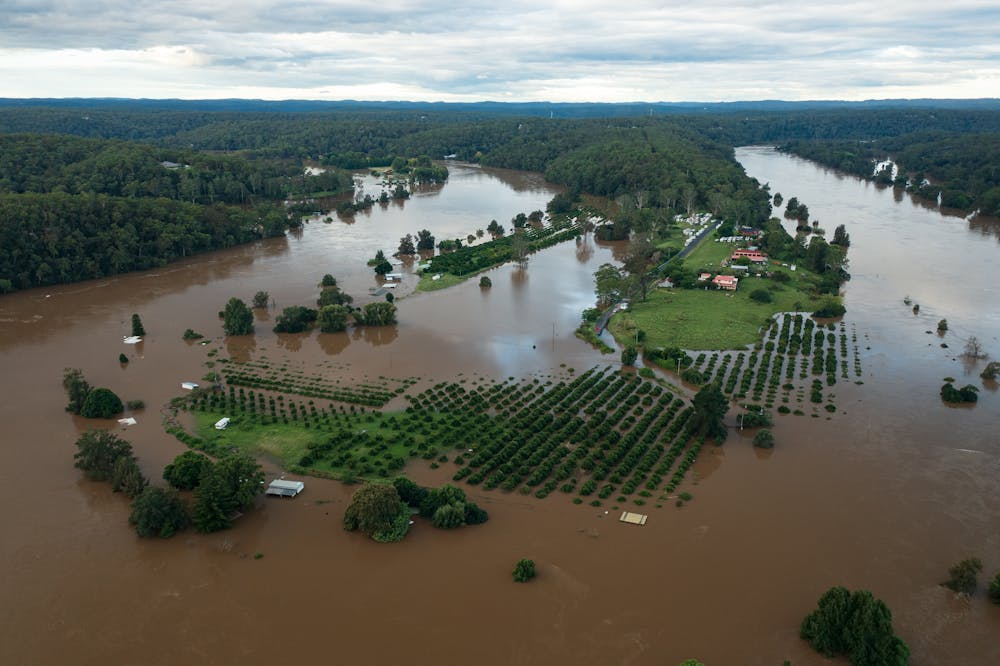
Larger and stronger disasters hitting farms like this one outside Sydney have intensified calls for climate action. Shutterstock
Electricity is where change is happening fastest
In 2022, the electricity sector saw the most change as state and territory governments invested heavily in renewables and grid capacity.
Queensland has set a renewable generation target of 70% by 2032, plans for two enormous pumped hydro schemes and A$280 million for better transmission infrastructure linking cities and industrial regions with new renewable energy zones.
Victoria, has also increased its ambition on renewable electricity. It’s aiming for 65% renewables by 2030 and 95% by 2035, and has plans for nine gigawatts of offshore wind by 2040.
New South Wales is accelerating plans to connect its renewable energy zones with cities and industrial regions, allocating $1.2 billion for transmission.
Western Australia will phase out state-owned coal-fired power by 2030. Tasmania is powering ahead with plans to export its abundant hydroelectricity via seabed cable to the national market.
Early mover South Australia will soon be the first gigawatt scale grid in the world. It went from 1% renewables to 65% renewable in just 15 years, and is aiming for 100% net renewables by 2030.
New transmission lines are a key part of the clean energy shift. Shutterstock
As state and territory initiatives set the pace, the federal government is helping coordinate and accelerate the shift to clean energy.
Importantly, the federal government is planning to spend $20 billion to make our old grid ready for a renewable future, through low-cost financing for the new transmission projects vital to connect Renewable Energy Zones with cities and industrial regions in need of power.
So far, this has included $2.25 billion committed to Victorian renewable energy zone projects and a new connection between NSW and Victoria, as well as joint funding for the Tasmania-Victoria undersea link and pumped hydro projects in Tasmania.
Federal support for six offshore wind zones will also give essential certainty for renewable developers to begin the long process of building our first offshore windfarms, where the winds are stronger and more constant.
Our analysis shows the collective impact of state and territory commitments and action represents the equivalent of an Australia-wide 2030 renewable target of 69%.
The federal government wants even more than that – 82% by 2030.
These figures approach what’s compatible to keeping warming to the internationally agreed goal of 1.5℃ or less, according to our analysis and the energy market operator’s long-term plan. But right now, they’re targets. It will take serious groundwork to make them reality.
Renewables unlock progress elsewhere – but we still need action on demand
Good news – investment in renewables will enable the decarbonisation of a large proportion of the rest of the economy. Once our electricity is clean, we can electrify everything else that uses fossil fuels, from transport to industry.
Even with these tailwinds, we’ll still need to push in one other key area: demand.
Using energy efficiently will be essential as energy demand grows alongside electrification.
What would that look like? Think more efficient appliances, better energy performance in industry and encouraging public and active transport.
There are promising signs. The federal government is consulting on a new strategy to give energy efficiency a boost. And building ministers have signed off on stronger requirements to ensure new houses use energy more efficiently.
Retrofitting existing homes with insulation, heat pumps and other energy efficiency measures could help us shake our reputation for owning glorified tents. Shutterstock
What else do we need?
Electric vehicles are finally starting to get traction, helped by stamp duty cuts and registration fee reductions in most states and territories. But we’ll also need to reduce demand by encouraging more people to use public transport, walk, cycle or use electric scooters or e-bikes.
Smart urban planning is needed too, to ensure non-car options are possible.
We still need to improve energy efficiency for existing homes, particularly for renters, as well as in new and existing commercial buildings. Retrofitting insulation and other energy-saving technologies can help cut emissions while boosting human health and comfort, and lowering bills.
Tough sectors such as heavy industry can look to ways to reduce energy demand to help manage the load on our grid.
So, as 2022 races to a close, it’s worth taking stock of our accomplishments. This year, the large-scale changes we need are beginning to happen.
In 2023, our governments should tackle the less visible but just as important question of demand, to ensure our path to a future without carbon emissions is as smooth as possible.
Alison Cleary works for Climateworks Centre as the Sustainable Economies System Lead. Climateworks Centre receives funding from philanthropy and project-specific financial support from a range of private and public entities including federal, state and local government and private sector organisations and international and local non-profit organisations. Climateworks Centre works within Monash University’s Sustainable Development Institute.
Sarah Fumei is part of Climateworks Centre which receives funding from philanthropy and project-specific financial support from a range of private and public entities including federal, state and local government and private sector organisations and international and local non-profit organisations. Climateworks Centre works within Monash University’s Sustainable Development Institute.
Source: The Conversation (Au and NZ) – By Jack Beetson, Executive Director, The Literacy for Life Foundation; Adjunct Professor, University of New England
Photo credit: Adam Sharman, Author provided
Despite years of discussion and countless reviews, the incarceration rate of First Nations adults continues to increase in Australia. The federal government has said it will address this via “justice reinvestment”. That means funding programs that keep people out of the justice system.
Justice reinvestment reduces ever-growing criminal justice system costs, which frees up more funding to invest in communities. That keeps more people out of the system. And so the positive cycle continues.
One part of the justice reinvestment picture may be boosting literacy rates. In fact, a growing body of research shows the crucial role community-controlled adult literacy campaigns can play in reducing crime and improving justice outcomes.
The research was conducted as a before-and-after study looking at six communities in New South Wales. It included 162 participants who were all students in Literacy for Life Foundation’s Aboriginal adult literacy campaign. We also drew on NSW Bureau of Crime Statistics and Research data. Study participants consented to researchers examining their criminal offence records relating to the 12-month period prior to participation in the literacy campaign, and 12-month period after participation.
The study also drew on more than 100 interviews with students, staff, community members, service providers and criminal justice practitioners.
We found:
total offences recorded (including those categorised as serious, plus other categories) declined by 32% (from 71 to 48)
among women in the study, total offences halved (from 40 to 20).
the largest reductions related to traffic offences (down 50%, from 14 to seven), public order offences (down 56%, from nine to four) and theft offences (down from five to zero).
One community leader described the impact for one participant by saying:
By the time he’d finished, he came out the other side not only having the ability to read and write, but he also came out of the other side with a licence. So that was a life-changing experience.
Low literacy can mean more contact with the justice system
Our study is among a growing body of research that highlights the correlation between low adult literacy and contacts with the police.
So what’s one got to do with the other?
Lower levels of English literacy are considered one of many factors contributing to continued inequalities in health and social outcomes for Indigenous peoples. One major area of inequality is in crime and justice.
Systemic racism and discriminatory policies across multiple sectors and over generations have contributed to Indigenous Australians facing more contacts with police, higher rates of incarceration and more contact with courts.
For many Indigenous people, entry into the judicial system is through minor, non-violent offences such as traffic infringements, in part due to insufficient literacy skills needed to pass a written driver’s licence test.
Low levels of English literacy also affect a person’s ability to understand their legal rights, seek legal counsel and read official documentation such as court attendance notifications. Not showing up to court proceedings can also result in additional charges being laid.
Convictions for these minor offences leave people with a criminal record, which make it hard to get a job. That can exacerbate issues with health and social wellbeing and perpetuate cycles of disadvantage.
Building basic literacy skills can help keep people out of jail, and for those in prison, participation in literacy and numeracy programs while in custody can help reduce recidivism (reoffending).
The Literacy for Life Foundation has recently started work with Indigenous people serving sentences in prison and it is hoped the trends highlighted in our study can be replicated.
What’s already clear is that community-led adult literacy campaigns can help reduce serious offences among participants by well over 50%, meaning the benefits extend beyond just helping people to read and write.
Research on this can help justice reinvestment programs, turning policy aspirations into practical action.
Jack Beetson is Executive Director, The Literacy for Life Foundation and Co-chair, Just Reinvest NSW. He receives funding from state and federal governments and was a Partner Investigator on the ARC Linkage Project which part-funded the research detailed in this article.
Melanie Schwartz is Deputy Dean (Education) at UNSW Sydney. She has received funding from the Australian Research Council for research into justice reinvestment.
Pat Anderson is Chair, Batchelor Institute, Director, The Literacy for Life Foundation, Chair, Remote Area Health Corps and Co-chair, Uluru Dialogue. She receives funding from state and federal governments and was a Partner Investigator on the ARC Linkage Project which part-funded the research detailed in this article.
December 7 marks the 50-year anniversary of the Blue Marble photograph. The crew of NASA’s Apollo 17 spacecraft – the last manned mission to the Moon – took a photograph of Earth and changed the way we visualised our planet forever.
Taken with a Hasselblad film camera, it was the first photograph taken of the whole round Earth and is believed to be the most reproduced image of all time. Up until this point, our view of ourselves had been disconnected and fragmented: there was no way to visualise the planet in its entirety.
The Apollo 17 crew were on their way to the moon when the photograph was captured at 29,000 kilometres (18,000 miles) from the Earth. It quickly became a symbol of harmony and unity.
The previous Apollo missions had taken photographs of the earth in part shadow. Earthrise shows a partial Earth, rising up from the moon’s surface.
Earthrise captured Earth in part shadow. NASA, CC BY-NC-SA
In Blue Marble, the Earth appears in the centre of the frame, floating in space. It is possible to clearly see the African continent, as well as the Antarctica south polar ice cap.
Photographs like Blue Marble are quite hard to capture. To see the Earth as a full globe floating in space, lighting needs to be calculated carefully. The sun needs to be directly behind you. Astronaut Scott Kelly observes that this can be difficult to plan for when orbiting at high speeds.
Produced against a broader cultural and political context of the “space race” between the United States and the Soviet Union, the photograph revealed an unexpectedly neutral view of Earth with no borders.
According to geographer Denis Cosgrove, the Blue Marble disrupted Western conventions for mapping and cartography. By removing the graticule – the grid of meridians and parallels humans place over the globe – the image represented an earth freed from mapping practices that had been in place for hundreds of years.
We have been placing grids over our maps for hundreds of years, as in this world map from 1689. Wikimedia Commons
The photograph also gave Africa a central position in the representation of the world, where eurocentric mapping practice had tended to reduce Africa’s scale.
The image quickly became a symbol of harmony and unity. Instead of offering proof of America’s supremacy, the photograph fostered a sense of global interconnectedness.
Since the Enlightenment, mapping and map making had emphasised man’s superiority over the Earth. Working against this hierarchy, Blue Marble evoked a sense of humility. Earth appeared extremely fragile and in need of protection. In his book Earthrise, Robert Poole wrote:
Although no one found the words to say so at the time, the ‘Blue marble’ was a photographic manifesto for global justice.
Blue Marble’s afterlives
The photograph has appeared across popular culture.
It is impossible to examine Blue Marble and separate it from the urgency of today’s climate crisis.
It quickly became a symbol of the early environmental movement, and was adopted by activist groups such as Friends of the Earth and annual events such as Earth Day.
The photograph appeared on the cover of James Lovelock’s book Gaia (1979), postage stamps, and an early opening sequence of Al Gore’s An Inconvenient Truth (2006).
The ways we have viewed and visualised Earth have changed over the decades.
Commencing in the 1990s, NASA created digitally manipulated whole-Earth images titled Blue Marble: Next Generation, in honour of the original Apollo 17 mission.
The 2002 Blue Marble showing Australia. NASA image by Robert Simmon and Reto Stöckli, CC BY-NC-SA
These are composite images composed of data stitched together from thousands of images taken at different times by satellites.
Space-based imaging technology has continued to advance in its capacity to render astonishing detail. Art historians such as Elizabeth A. Kessler have linked these new generation of images picturing the cosmos with the philosophical concept of the sublime.
The Blue Marble can inspire a similar sense of awe to images like Thomas Moran’s Grand Canyon of the Yellowstone. U.S. Department of the Interior Museum
The photographs create a sense of vastness and awe that can leave the spectator overwhelmed, akin to 19th century Romantic paintings such as Thomas Moran’s The Grand Canyon of the Yellowstone (1872).
In 1995, the Hubble Space Telescope revealed mountains of gas and dust in the Eagle Nebula. Known as the Pillars of Creation, the image captures gas and dust in the process of creating new stars.
This photograph of Eagle Nebula, named Pillars of Creation, was taken by the Hubble. NASA, ESA and the Hubble Heritage Team (STScI/AURA)
Building on the Hubble’s discoveries, the Webb is designed to visualise infrared wavelengths at a unprecedented level of clarity.
Stephan’s Quintet photographed by the James Webb Telescope. NASA, ESA, CSA, and STScI, CC BY-NC-SA
These advances in technology might help explain the photograph’s enduring charm from the vantage point of 2022. The first photograph of our planet was remarkably lo-fi.
Blue Marble is the last full Earth photograph taken by an actual human using analogue film: developed in a darkroom when the crew returned to Earth.
Chari Larsson does not work for, consult, own shares in or receive funding from any company or organisation that would benefit from this article, and has disclosed no relevant affiliations beyond their academic appointment.
Source: Council on Hemispheric Affairs – Analysis-Reportage
William Camacaro, Caracas Frederick Mills, Washington DC
“It is no longer possible, in the case of America, to continue with the Monroe Doctrine nor with the slogan ‘America for the Americans.’” Andrés Manuel López Obrador
December 3, 2023 will mark the 200th anniversary of the Monroe Doctrine. It will also mark its obsolescence in the face of popular resistance and the Pink Tide of progressive governments in Latin America that have been elected over the past two and a half decades. The prevailing ideology of these left and left of center movements rejects the “Washington Consensus” and opts for a new consensus based on the decolonization of the political, economic, social and cultural spheres. This consensus is accompanied by encounters and conferences that advance liberatory traditions developed since the 1960’s as well as those deeply rooted in indigenous cultures. It is Washington’s failure to respect and adjust to this political and ideological process of transformation that precludes, at this time, a constructive and cooperative U.S. foreign policy towards the region.
Decoloniality and Multipolarity
One cannot comprehend decolonization from the totalizing point of view of U.S. exceptionalism[1]. U.S. exceptionalism, the offspring of the African slave trade and the conquest of Amerindia, seeks unfettered access to the region’s natural resources and labor to serve its corporate and geopolitical interests. By contrast, decoloniality was born of five centuries of resistance to colonization. It is the critical perspective of those who have been oppressed by imperial domination and local oligarchies and seek to build a new world, one that rejects necropolitics and racial capitalism; one that advances human life in community and in harmony with the biosphere. This critical ethical attitude has been expressed over the past two years in declarations of regional associations that exclude the U.S. and Canada. All share the same ideal of regional integration based on respect for sovereign equality among nations and guided by ecological, democratic, and plurinational principles.
A necessary condition of integration based on these principles is the freedom to engage economically, politically, and culturally with a multipolar world; it is only in such a geopolitical context that the region can resist subjugation to any superpower and itself become a major player on the world political-economic stage. Such engagement is already a fait accompli. From across the political spectrum, the Community of Latin American and Caribbean States (CELAC, created in December 2011) has embraced a diversity of trading opportunities. For example, the China-CELAC forum[2] was formed on July 17, 2014 as a vehicle for intergovernmental cooperation between the member states of CELAC and China. The forum held its first ministerial meeting[3] in Beijing in January 2015, which was followed by two more summits (2018,[4]2021[5]), all of which produced economic, infrastructure, energy, and other agreements. Also significant with regard to trade, 20 countries[6] in Latin America and the Caribbean have now signed on to the Belt and Road initiative. According to Geopolitical Intelligence Services, GIS:
“Chinese trade with Latin America grew from just $12 billion in 2000 to more than $430 billion in 2021, driven by demand for a range of commodities, from soybeans to copper, iron ore, petroleum and other raw materials. These imports, meanwhile, were tied to an increase in Chinese exports of value-added manufactured goods. As of 2022, China is the region’s second-largest trading partner and the biggest trading partner in nine countries (Cuba, Paraguay, Argentina, Chile, Brazil, Uruguay, Peru, Bolivia and Venezuela).”[7]
Moreover, the World Economic Forum predicts that “On the current trajectory, LAC-China trade is expected to exceed $700 billion by 2035, more than twice as much as in 2020.” [8]
Rather than acknowledge this trend towards trade diversification, Washington is waging hybrid warfare against Venezuela, Cuba, and Nicaragua, including the use of illegal unilateral coercive measures (“sanctions”), in a bid to limit the influence of Russia, Iran, and China and reimpose its hegemony in the region.
The Special Rapporteur[9] of the United Nations on the Negative Impact of Unilateral Coercive Measures on the Enjoyment of Human Rights, Alena Douhan, has visited and documented the effect of the sanctions in Syria,[10]Iran,[11] and Venezuela,[12] and on each occasion has indicated that the sanctions “violate international law” and “the principle of sovereign equality of States,” at the same time that they constitute “intervention in the internal affairs.” As a November 2022 study by the Sanctions Kill Campaign documents, sanctions against Venezuela and other targeted countries have caused devastating hardship and thousands of deaths.[13]
In order to prevent the import of vital goods to Venezuela, the U.S. went so far as jailing a Venezuelan diplomat, Alex Saab,[14] who had managed to circumvent U.S. sanctions to import urgently needed fuel, food, and medicine. In violation of the Vienna Convention on Diplomatic Relations (1961),[15] Washington has charged Saab with conspiracy to commit money laundering (other charges having been dropped). A hearing on Saab’s diplomatic immunity was scheduled for December 12, 2022 in Southern District Court. Saab threw a wrench into Washington’s “regime change” machinery, for which he has been paying a heavy price over more than two years.
“Regime change” operations against disobedient governments in Latin America and the Caribbean over the past decade by the U.S. and its right wing allies in the Organization of American States (OAS), has not reduced the influence of China, Iran, and Russia in the region. Just the opposite. For example, while Washington was stepping up its campaign against the government of Cuba, Cuban President Miguel Díaz Canal Bermúdez went to Algeria,[16]Russia,[17]China,[18] and Turkey[19] to reinforce mutual solidarity and hammer out new economic accords. Both Russia and China recognize the strategic importance of the Cuban Revolution, for its defeat would have a demoralizing impact on the cause of independence and galvanize oligarchic interests throughout the hemisphere. Moreover, in the context of the Pink Tide of progressive governments, and the disintegration of the Lima Group (a Washington backed right wing coalition) this troika of resistance (Cuba, Venezuela, and Nicaragua) is not alone.
The Pink Tide
It is important not to isolate the period of the Pink Tide as an anomaly, for it has precursors beginning with the first indigenous uprisings and the Bolivarian resistance to Spanish rule. Today’s decolonial struggle is influenced by the spirit of Túpac Amaru, the Hatian revolution, the Sandinista revolution, the Zapatista uprising, and other challenges to conquest, colonization, and the ongoing attempt to recolonize the region.
There is no doubt, however, that the Pink Tide took a big step forward with the election of President Hugo Chávez in Venezuela (1998), Néstor Carlos Kirchner in Argentina (2003), and Luiz Inácio Lula da Silva in Brazil (2003). It was perhaps at the Fourth Summit of the Americas, held in November 2005, at Mar del Plata, that their combined bold leadership struck a significant blow to U.S. hegemony by rejecting then President George Bush’s proposal for a hemispheric agreement called the Free Trade Area of the Americas (FTAA). This defeat of FTAA[20] also signaled the determination of progressive movements to seek alternatives to the neoliberal imperatives of the U.S. and Canada.
Presidents Lula, Kirchner and Chávez, during the 4th Summit of the Americas in 2005, when the Free Trade Area of the Americas was rejected (credit photo: Twitter account of President Nicolás Maduro)
Although the Pink Tide of progressive governance has suffered some electoral and extra-constitutional setbacks since the Fourth Summit, it has received renewed force with the election of the MORENA party candidate, President Andrés Manuel López Obrador (AMLO) in Mexico in 2018. AMLO ran on a platform that promised to launch the “fourth transformation” of Mexico by fighting corruption and implementing policies that put the poor first. He has since become a major critic of the Monroe Doctrine and the OAS.
The victory of the MORENA movement in Mexico was followed by the election of left and left-of-center presidents in Argentina (Alberto Fernández, October 2019), Bolivia (Luis Arce, October 2020), Peru (Pedro Castillo, July 2021), Chile (Gabriel Boric, December 2021) and Honduras (Xiomara Castro, December 2021). Less than a year later, for the first time in its history, Colombians elected a leftist president, Gustavo Petro, in June 2022. Petro wasted no time in re-establishing diplomatic relations with Venezuela and opening their common border. This South American nation, however, still remains host to nine U.S. military bases and remains a partner of NATO. This historic win was followed by a momentous comeback of the left in Brazil with the election of former president Luiz Inácio Lula da Silva in October 2022 after the extreme right wing rule of Jair Bolsonaro. This is big news, as Brazil is not only a major economic power in the hemisphere, but a member of the BRICS (Brazil, Russia, India, China, South Africa) association, which is now expected to increase commerce and integrate a growing number of member states.
Regional associations seize the moment
These electoral victories, all of which relied heavily on the support of the popular sectors, have been the subject of critical analysis at several recent meetings of regional associations. These meetings express the formation of a consensus on advancing regional sovereignty, protecting the environment, respecting indigenous peoples’ rights, and attaining social justice.
The spirit of independence and regional integration was given new impetus when AMLO assumed the pro tempore presidency of CELAC in 2020. The last CELAC Summit[21] set the basic tone for this consensus when on July 24, 2021, AMLO evoked the legacy of Simón Bolívar in the context of the ongoing cause of regional independence; this focus opened a political space for criticizing the OAS and fortifying CELAC. The Summit was held at a time of widespread condemnation of the OAS’ role in provoking a coup in Bolivia.
The message of the CELAC summit had apparently not made much of an impression in Washington. The Ninth Summit of the Americas,[22] hosted by the United States in Los Angeles, California (June 2022), excluded countries on Washington’s “regime change” list, revealing a profound disconnect between U.S. hemispheric policy and the reality on the ground in Latin America. This exclusivity inspired alternative, more inclusive summits: the People’s Summit in Los Angeles[23]and the Workers’ Summit in Tijuana.[24] These alternative summits exposed Washington’s failure to adjust to increasingly independent neighbors to the South. To avoid embarrassment however, Washington did not invite self-proclaimed president of Venezuela, Juan Guaidó, though it now stands virtually alone in pretending to recognize this comic figure and his inconsequential, corrupt shadow government.
Five months after the divisive Summit of the Americas, there was a meeting of the Puebla Group which was founded in July 2019 to counter the right wing agenda of the Washington-backed Lima Group. It held its eighth meeting in the Colombian city of Santa Marta. On November 11th, the Group issued the Declaration of Santa Marta: The Region United for Change.[25] It declared that “the region needs to incorporate and emphasize new themes for the regional agenda that in the past, for different reasons, did not have the visibility that today appears indisputable, such as . . . gender equality, the free movement of people, the ecological transition, the defense of the Amazon and of the rights of indigenous peoples, . . . and the necessity to include new social and economic actors in the regional processes of integration.”
Mapuche protest in Chile, using signs in their language, defending their right to cultural independence and land recovery (credit photo: Pressenza International News Agency, https://www.pressenza.com/)
Just a few days later, in a letter dated November 14, a group of regional leaders called upon South America’s presidents[26] to reconstitute the Union of South American Nations (UNASUR, created in 2008). The disintegration of UNASUR was a reflection of an offensive against the Bolivarian revolution, led by Washington and Bogota. When Colombia left the organization in 2018, with its right wing allies to follow, it then joined the Lima Group, whose only political goal within the OAS was the destruction of the Bolivarian cause. And in August 2018 after President of Ecuador Lenin Moreno confiscated the UNASUR headquarters in Quito, President Evo Morales reopened the UNASUR headquarters in Bolivia. Morales declared, “The South American Parliament [UNASUR] is the center of integration and the symbol of the liberation of Latin America. The integration of all of Latin America is a path without return.” At that moment, the only country allied with Venezuela in South America was Bolivia.
The letter calling for the reconstitution of UNASUR was followed by a statement by the São Paulo[27] Forum, which met in Caracas November 18 – 19, 2022 and summed up one of the principal themes of the present juncture: “We are in a historic moment for resuming and deepening the transformations in the economic and geopolitical fields that have occurred since the beginning of the century, and for accelerating the transition to a democratic multipolar world, one based on new international relations of cooperation and solidarity.”
On November 22 – 25, in Guatemala, representatives of indigenous peoples from 16 countries came together for the second meeting of the Sovereign Abya Yala movement. The conference took place at a time of renewed political protagonism of indigenous peoples throughout the continent. For example, after the fascist coup in Bolivia in November 2019, it was the fierce resistance of indigenous peoples and the Movement toward Socialism IPSP that led to the successful recuperation of democracy one year later. The theme of the second meeting was “Peoples and communities in movement, advancing toward decoloniality in order to live well (“Buen vivir”).” Its final declaration commits to the decolonization of these territories. To accomplish this, the meeting proposed pluri-nationality as a guiding political principle, “to construct new plurinational states, new laws, institutions, and life projects that make it possible for all beings sharing the cosmic community to live together in harmony.” The declaration also recognizes the need to form political organizations that can advance these goals, including in the electoral field.[28]/
There is now a solid bloc of progressive governments in the region, presenting new opportunities to advance the causes of decolonization, integration, resource nationalism, popular sovereignty, and experiments in building a post-neoliberal order. But this juncture also poses new challenges. The U.S. recent partial lifting of sanctions against Venezuela in the oil sector and support for negotiations in Mexico between the Venezuelan government and opposition is a pragmatic response to the need to access Venezuelan crude and signals a shift in U.S. tactics to an electoral means to bring about “regime change”. This is reminiscent of the U.S. strategy in Nicaragua in the late 1980’s which led to the Sandinista electoral defeat of 1990. The U.S. is also acting with restraint because given the heightened geopolitical tensions over the war in Ukraine and the political climate in this hemisphere no other path is feasible. Washington continues, however, to pursue illegal unilateral coercive measures against Venezuela, Nicaragua, and Cuba in a ploy to keep the obsolete Monroe Doctrine alive. To meet this challenge to their existence, the targeted governments are circumventing U.S. sanctions, resisting “regime change” operations, resuming efforts at integration, deepening ties to Russia and China, and diversifying their trade partners. And while hard-liners in the U.S. Congress, stuck in a cold war mentality, are scouring the hills for communists, all of Amerindia is working to end the last vestiges of armed conflict and establish a region at peace.
William Camacaro is a Senior Analyst at COHA. Frederick Mills is Deputy Director of COHA
All translations from Spanish to English by the authors are unofficial. COHA Assistant Editor/Translator Jill Clark-Gollub provided editorial assistance for this article.
[Main photo: Mapuche protest in Chile, using signs in their language, defending their right to cultural independence and land recovery. Credit photo: Pressenza International News Agency, https://www.pressenza.com/]
Sources
[1] Based on Donald E. Pease definition, “American exceptionalism has been taken to mean that America is either ‘distinctive’ (meaning merely different), or ‘unique’ (meaning anomalous), or ‘exemplary’ (meaning a model for other nations to follow), or ‘exempt’ from the laws of historical progress (meaning that it is an ‘exception’ to the laws and rules governing the development of other nations).” American Exceptionalism, https://www.oxfordbibliographies.com/view/document/obo-9780199827251/obo-9780199827251-0176.xml
[10] “Lift ‘suffocating’ unilateral sanctions against Syrians, urges UN human rights expert.” United Nations. UN News. November 10. 2022. Accessed Dec. 3, 2022.
[13] “U.S. Sanctions: Deadly, Destructive and in Violation of International Law.” Report produced by Rick Sterling, John Philpot, and David Paul with support from other members of the SanctionsKill Campaign and many individuals from sanctioned countries. November 2022 (Updates of previous publications in September 2020 and May 2021). Accessed Dec. 5, 2022: https://sanctionskill.org/wp-content/uploads/2022/06/SanctionsImpactReport_v62c-3.pdf
[18] “El Secretario General y Presidente Xi Jinping Sostiene una Conversación con el Primer Secretario del Comité Central del Partido Comunista de Cuba y Presidente de la República de Cuba Miguel Díaz-Canel.” Ministry of Foreign Affairs of the People’s Republic of China. November 25, 2022. Accessed December 3, 2022: https://www.fmprc.gov.cn/esp/zxxx/202211/t20221125_10981082.html
Source: The Conversation (Au and NZ) – By Dominic O’Sullivan, Adjunct Professor, Faculty of Health and Environmental Sciences, Auckland University of Technology and Professor of Political Science, Charles Sturt University
Getty Images
When Fijians elect a new parliament on December 14, it’s likely their votes will be counted fairly – yet the country will remain a conditional and fragile democracy.
This will be the third election since the “coup to end all coups” in 2006, which followed two earlier coups in 1987 and a civilian overthrow of the elected government in 2000.
It shall be the overall responsibility of the Republic of Fiji Military Forces to ensure at all times the security, defence and wellbeing of Fiji and all Fijians.
In other words, overall responsibility for the wellbeing of Fiji and its people does not belong to the government or parliament. The military interprets this as meaning it is “mandated to be the guardian of Fiji”.
Democracy’s fragility is entrenched. Furthermore, Fiji’s unicameral parliament is not big enough to support robust parliamentary checks on government, even though it will grow from 51 to 55 members at this year’s election.
From self-appointed to elected prime minister: Frank Bainimarama’s FijiFirst party is likely to form a government after December 14. Getty Images
Freedom and the military
Bainimarama went from self-appointed to elected prime minister in 2014 when his FijiFirst party won the first election under the new constitution. It won again in 2018 with just over 50% of the vote in the country’s proportional representation system.
International observers found votes were fairly counted, but the campaign was marred by intimidation of opposition candidates.
Shortly before the 2018 election, opposition leader Sitivini Rabuka was charged with electoral fraud. He was acquitted just in time to take his place as a candidate.
Rabuka was prime minister between 1992 and 1999, having led the coups in 1987 and having described democracy as “a foreign flower unsuited to Fijian soil”. In 2022, however, Rabuka’s People’s Alliance, in coalition with the National Federation Party, is the most likely alternative government.
Cost of living, poverty and peaceful and orderly government are important election issues. Significantly, though, the People’s Alliance manifesto suggests exploring amendments to the constitution. It also wants to remove measures that suppress human rights, previously highlighted by Amnesty International and others.
Land rights and the protection of the indigenous iTaukei culture are also important in this campaign, to the extent they have prompted an outburst typical of Bainimarama’s florid rhetorical style. At a campaign rally last week, he said of an opponent’s land rights policy:
This conversation will cause stabbing, murder and blood spilled on our land, and unlawful entering [of property] will happen if that conversation is condoned.
Sitivini Rabuka’s People’s Alliance could form an alternative government in coalition with the National Federation Party. Getty Images
Fragile free speech
There are also restrictions on political reporting. As the Fiji Parliamentary Reporters’ Handbook (published in 2019) explains: “As in rugby, knowing the rules is the difference between enjoying the game and not being able to follow it.”
Journalists are reminded that the right to free speech does not allow “incitement to violence or insurrection”. The handbook goes on to remind them:
There is scope in the Constitution to “limit […] rights and freedoms […] in the interests of national security, public safety, public order, public morality, public health or the orderly conduct of elections”.
Interpretations of these limits can be broad. In November, for example, longstanding government critic and election candidate Richard Naidu was convicted of “contempt scandalising the court” following a lighthearted Facebook post in which he pointed out a spelling mistake in a High Court judgment.
The charge – which Amnesty International says should be withdrawn – was brought by the attorney-general.
In my 2017 book, Indigeneity: a politics of potential – Australia, Fiji and New Zealand, I argued that political stability requires ordered and principled measures for protecting iTaukei (ethnic Fijian) rights to land and culture. This is a matter of respecting human dignity, but also to ensure those rights are not used as a pretext for settling wider and sometimes unrelated conflicts.
Stability does not arise only from the freedom to vote and from being confident one’s vote will be fairly counted. It comes also from well-informed expectations of what governments should do and what constitutions should protect, including:
a free and diverse media, with a culture of detailed and critical investigation and reporting on public affairs
a politically independent military, police and judiciary that aren’t called on to intimidate opponents
a larger parliament that is more representative and allows stronger checks on the executive.
For now, while the military enjoys considerable credibility and support, its role as defender and arbiter of the public good ensures perpetual instability.
The diplomatic and economic value of its contributions to United Nations peacekeeping missions means it remains an important national institution. And the recent gift of military peacekeeping vehicles from the US is an example of the soft diplomacy used by democratic states, including Australia and New Zealand, to influence contemporary Fiji.
The effectiveness of that influence will be tested at some point. In the meantime, the Fijian people are free to change their government on December 14. But the possibility they will not be free to keep that government means, whatever the election outcome, democracy has lost before a vote is cast.
Dominic O’Sullivan does not work for, consult, own shares in or receive funding from any company or organization that would benefit from this article, and has disclosed no relevant affiliations beyond their academic appointment.
He is joined by former National Party MP Hekia Parata, and the previous secretary to Treasury, John Whitehead, as commissioners.
Pasifika Futures chief executive Debbie Sorensen said Pasifika people were essentially left to form their own response during the earlier stages of the pandemic.
That was despite Pasifika people working a large proportion of jobs in MIQ facilities and at the airport and other front line locations, she said.
Many affected Pacific families experienced a great deal of hardship, she said.
It was important for the inquiry to look at the covid-19 response in regards to specific communities, she said.
Slowness of response “We’re really clear that equity in the response and in the resource allocation is an important consideration.”
One issue was the slowness of the government’s response to both Pacific and Māori communities during the height of the pandemic, she said.
“Advice was provided to the government, you know cabinet papers provided advice on specific responses for our communities and that advice was ignored.”
An important aspect of the inquiry should be reviewing how that advice was given to the government, its response to it and how the government’s sought more information, she said.
The inquiry’s initial scope appeared to be very narrow, but it could be broadened as it went along, Sorensen said.
“The impact on mental health and the ongoing economic burden for our communities is immense — you know we have a whole generation of young people who have not continued their education because they were required to go in to work.”
Sorensen said often young people had to work because they were the only person in their family who had a job at that time due to covid-19.
Mental health demand The pandemic also increased demand for mental health services which were already under pressure, she said.
Anyone who was unwell unlikely to be able to get an appointment within six to eight months which was shameful, she said.
Sorensen would have preferred the inquiry had been announced earlier, but it was an opportunity to better prepare for the future, she said.
But Te Aka Whai Ora, the Māori Health Authority, chief medical officer Dr Rawiri McKree Jansen told Morning Report he had some concerns that the probe into the covid-19 response was coming too soon to gain a full picture.
The pandemic was ongoing and starting the inquiry so early may obstruct a complete view of it, he said.
“I understand that there’s people champing at the bit and [saying] we should’ve done it before but it’s very difficult to do that and adequately learn the lessons.”
Understanding how to get a proper pandemic response was in everyone’s interest, but the pandemic was now still in its third wave, he said.
About to begin Nevertheless, the inquiry was about to get underway and it could make a large contribution if it was done well, he said.
“I’m sure there will be many Māori communities that want to have voice in the inquiry and you know contribute to a better understanding of how we can manage pandemics really well.
“We’ve had pandemics before and they’ve been absolutely tragic. We’ve got this pandemic and the outcome for us is something like two to two-and-a-half times the rate of hospitalisations and deaths, so Māori communities are fundamentally very interested in bedding in the learnings that we’ve achieved in the pandemic.”
Dr Jansen hoped the inquiry would provide enduring information about managing pandemics with a very clear focus on Māori and how to support the best outcomes for the Māori population.
Inquiry’s goal next pandemic The head of the Royal Commission said the review needed to put New Zealand in better position to respond next time a pandemic hits.
Professor Blakely said the breadth of experience and skills of the commissioners was welcome, and would help them to cover the wide scope of the Inquiry, ranging from the health response and legislative decisions, to the economic response.
Reviewing the response to the pandemic was a big job, he said.
“There’s already 75 reports done so far, I think about 1700 recommendations from those reports, New Zealand’s not the only country that’s been affected by this cause it’s a global epidemic, so there’s lots of other reports.”
The inquiry panel would have to sit at the top of all that work that had already been done “and pull it altogether from the perspective of Aotearoa New Zealand and what would help best there.
The inquiry needed to make New Zealand was prepared for a pandemic with good testing, good contact tracing and good tools that the Reserve Bank could use to support citizens in the time of a pandemic, Professor Blakely said.
“Our job is to try and create a situation where those tools are as good as possible, there’s frameworks to use when you’ve entered another pandemic, which will occur at some stage we just don’t know when.”
Professor Blakely said he was flying to New Zealand next week and would meet with Hekia Parata and John Whitehead to start thinking about the shape of the inquiry going forward.
This article is republished under a community partnership agreement with RNZ.
As Russia’s propaganda and crackdown on journalism continue to wreak havoc, the Paris-based global media freedom watchdog Reporters Without Borders (RSF) has released its new campaign video.
Devised and produced by the Paris-based advertising agency BETC, this powerful video takes just a few seconds to demonstrate the importance of journalism in combatting propaganda.
In the new video, Russian President Vladimir Putin’s mendacious speeches to the Russian people about the invasion of Ukraine are contrasted with images of reporters covering the war.
Only the facts reported by journalists can thwart the Kremlin’s propaganda. Like the #FightForFacts campaign video that RSF released at the end of 2020, this new video aims to get viewers to appreciate the importance of journalism in raising awareness and in motivating the public about issues that are decisive for their future.
RSF secretary-general Christophe Deloire said:
“Without journalists to cover the war in Ukraine, we would be powerless against disinformation and propaganda, we wouldn’t know whether the bombing of civilians in Ukraine was true or false, or whether the Bucha massacres really took place.
“After the world was stunned by the war in Ukraine, RSF wants to raise awareness about the other war being waged by the Kremlin, the information war.
The cruel reality of the Russian invasion of Ukraine. Image: RSF
In the occupied territories, journalists are hunted down, arrested and given an impossible choice: collaboration, prison or death.
From day one, RSF teams mobilised. In Lviv and Kyiv, press freedom centres set up by RSF provide protective equipment, first aid kits, digital safety training and psychological support to both Ukrainian and foreign journalists covering the war.
This campaign video is intended to help RSF raise part of the funds it needs to continue its work in Ukraine and the rest of the world.
Targeted at the general public, it is being carried by TV channels, shared on social media and available to all websites that want it.
And it is available in 13 languages (French, English, Spanish, Portuguese, German, Swedish, Romanian, Azeri, traditional Chinese, simplified Chinese, Korean, Japanese and Mongolian).
The video was produced by and with the support of the BETC agency.
BETC looks to renew the relationship between brands and creation.
Out of desire, curiosity and commitment, BETC creates new synergies and produces its own content in the fields of music, film, publishing, design… BETC is at the heart of the Magasins Généraux project in Pantin, where it moved in July 2016.
It is a new space for creation, innovation, production and sharing that is located at the heart of Greater Paris.
Activists have protested at Indonesia’s Ternate Police headquarters in North Maluku demanding that the security forces release eight people arrested while commemorating West Papua Independence Day on December 1.
December 1 marked 61 years since the first raising of West Papua’s symbol of independence, the Morning Star flag.
Tabloid Jubi reports Anton Trisno of the Indonesian People’s Front for West Papua (FRI-WP) saying the demonstration where the group was arrested was a peaceful one.
“We expressed our aspirations peacefully. Some ojek (motorcycle taxi) drivers infiltrated the crowd to disperse the protesters. This is a violation to our freedom of speech,” he said.
Trisno asked the police to immediately release eight of his colleagues.
“We urge the Ternate police chief to immediately release the eight activists who are still detained. We demand the police release them unconditionally,” he said.
Different tactic Meanwhile, an activist group has reported a different tactic used by the security forces, which it says is concerning.
“The Papuan People’s Petition Action (PRP) in commemoration of the 61st anniversary of the ‘West Papua Declaration of Independence’ received escort and security unlike usual actions from the Indonesian Security (colonial military),” a statement said.
“Apart from vehicles such as patrol cars, dalmas, combat tactical vehicles, sniffer dogs, intelligence/bin, bais, and tear gas launchers or other weapons.
“There is also security in the form of hidden security, such as a [sniper] placed on the balcony of Ramayana Mall and Hotel Sahit Mariat which are near the location or point of action.
“This certainly shows that there is something planned to actually push back and close the democratic space for the people and resistance movements in the Land of Papua, especially in the city of Sorong.”
In Port Vila, Vanuatu’s Minister of Climate Change and a long-time supporter of the West Papua people, Ralph Regenvanu, attended the West Papua flag-raising day.
In line with Vanuatu’s stand in support of West Papua freedom, the Morning Star flag was raised to fly alongside the Vanuatu flag outside the West Papua International Office.
This article is republished under a community partnership agreement with RNZ.
You might not know it from reading Tuesday’s statement announcing Australia’s eighth consecutive increase in interest rates, but our Reserve Bank might finally have done enough.
The statement says inflation is still “too high” and that the bank expects to increase rates further, although it is “not on a pre-set course”.
But, as it happens, the bank is unlikely to increase rates again for a further two months. The board doesn’t meet in January, meaning the nine weeks between now and its first meeting for 2023 on February 7 will provide an unusually long time for reflection – the first after eight relentless months of hikes.
From time to time, Reserve Bank officials talk about the idea of a “pause”. AMP chief economist Shane Oliver has counted the number of occasions they have referred to the prospect of a “pause” in talks in public pronouncements in the past month. He has counted six.
Inflation to hit 8%, while weakening
Although the annual inflation figure for the year to December due on January 25 is expected to be high – the bank is expecting 8% – the quarter-to-quarter result is likely to show inflation weakening.
The Bureau of Statistics releases the quarterly inflation figures only once every three months. But for some time now it has also been calculating inflation monthly, using a smaller survey that seems to give a pretty good indication of what the larger survey is about to show.
Oliver has graphed what the smaller survey has been saying each month about inflation over the previous three months alongside what the larger quarterly survey has been saying. The two line up, except that in recent months the monthly measure has been sliding.
This suggests that the official quarterly figure released in January will be weak.
Oliver concedes that the new monthly measure needs to be interpreted with caution, particularly partly because it excludes 30% of the items included in the official quarterly measure, among them gas and electricity. But he says if 70% of the quarterly measure is cooling down, “that has to be a positive sign”.
Globally, oil prices and wheat prices and the prices of other things affected by Russia’s invasion of Ukraine are down one-quarter to one-third from their peaks in the middle of the year, undoing much of what has been driving inflation.
The US is considering moderation
In the United States, where inflation peaked at 9.1% in June and has since slid to 7.7%, the head of the Federal Reserve Jerome Powell has begun talking about “moderating the pace of rate increases” saying given all he has done, he mightn’t need to raise rates much further to tame inflation.
Australia’s Reserve Bank has already moderated the size of its increases, cutting each one from 0.5 percentage points per month to 0.25 points in September.
If it merely wants to get inflation down (as it says it does) and not needlessly damage the economy along the way, there’s a good case for leaving rates steady at its first meeting for the year in February, and then waiting until sees the full impact of what it has done so far.
Australia’s eight rate rises to date are set to push up the cost of payments on a typical $600,000 variable mortgage by a total of $1,000 per month.
The bank said in October that although most borrowers should be able to weather that increased financial pressure for some time, many would “need to curtail their consumption and some could ultimately see their savings buffers exhausted”.
If these households have limited ability to make adjustments to their financial situation (such as by increasing their hours worked) they could fall into arrears and “may eventually need to sell their homes or may even enter into foreclosure”.
For fixed-rate borrowers, things are worse. About one-third of mortgages are on fixed rates, and about two-thirds of them are due to expire next year. Many were taken out at fixed rates of around 2%. Depending on how high the Reserve Bank pushes things, those borrowers will suddenly find themselves paying 6-7%.
We’re tightening our belts
Spending plans are already crumbling. Asked whether now is a “good time to buy a major household item” in the Westpac-Melbourne Institute November confidence survey, consumers’ answers were about as dismal as they have ever been. Around 40% said they planned to spend less on gifts this year than the year before – the highest proportion since the question was first asked in 2009.
Wednesday’s national accounts will show company profits fell by a seasonally adjusted 12.4% in the three months to September, led down by profits in retail (-6%), manufacturing (-21%) and finance (-43%). Accommodation (up 64% after years in which it was hard to travel) is the only big exception.
Quarterly economic growth is expected to be weak, although the annual figure will look good because things were worse during the lockdowns a year before.
The national accounts will also show a jump in wage payments of 2.9% over the quarter, and 11% over the year – which sounds high, but much of it will be because of the extra 690,000 people employed. Pay per worker will have climbed 4.7%.
A good reading of Wednesday’s national accounts will be that eight consecutive increases in mortgage rates are starting to bite into household budgets in exactly the way the Reserve Bank wants, and that there’s a chance they’ll bite too hard.
On February 7 the board might feel entitled to take the view that it might have done enough, and hold off for a while it waits to see how things play out.
Peter Martin tidak bekerja, menjadi konsultan, memiliki saham, atau menerima dana dari perusahaan atau organisasi mana pun yang akan mengambil untung dari artikel ini, dan telah mengungkapkan bahwa ia tidak memiliki afiliasi selain yang telah disebut di atas.
We’ve all had some kind of interaction with a chatbot. It’s usually a little pop-up in the corner of a website, offering customer support – often clunky to navigate – and almost always frustratingly non-specific.
But imagine a chatbot, enhanced by artificial intelligence (AI), that can not only expertly answer your questions, but also write stories, give life advice, even compose poems and code computer programs.
It seems ChatGPT, a chatbot released last week by OpenAI, is delivering on these outcomes. It has generated much excitement, and some have gone as far as to suggest it could signal a future in which AI has dominion over human content producers.
What has ChatGPT done to herald such claims? And how might it (and its future iterations) become indispensable in our daily lives?
What can ChatGPT do?
ChatGPT builds on OpenAI’s previous text generator, GPT-3. OpenAI builds its text-generating models by using machine-learning algorithms to process vast amounts of text data, including books, news articles, Wikipedia pages and millions of websites.
By ingesting such large volumes of data, the models learn the complex patterns and structure of language and acquire the ability to interpret the desired outcome of a user’s request.
ChatGPT can build a sophisticated and abstract representation of the knowledge in the training data, which it draws on to produce outputs. This is why it writes relevant content, and doesn’t just spout grammatically correct nonsense.
While GPT-3 was designed to continue a text prompt, ChatGPT is optimised to conversationally engage, answer questions and be helpful. Here’s an example:
A screenshot from the ChatGPT interface as it explains the Turing test.
ChatGPT immediately grabbed my attention by correctly answering exam questions I’ve asked my undergraduate and postgraduate students, including questions requiring coding skills. Other academics have had similar results.
In general, it can provide genuinely informative and helpful explanations on a broad range of topics.
ChatGPT can even answer questions about philosophy.
ChatGPT is also potentially useful as a writing assistant. It does a decent job drafting text and coming up with seemingly “original” ideas.
ChatGPT can give the impression of brainstorming ‘original’ ideas.
The power of feedback
Why does ChatGPT seem so much more capable than some of its past counterparts? A lot of this probably comes down to how it was trained.
During its development ChatGPT was shown conversations between human AI trainers to demonstrate desired behaviour. Although there’s a similar model trained in this way, called InstructGPT, ChatGPT is the first popular model to use this method.
And it seems to have given it a huge leg-up. Incorporating human feedback has helped steer ChatGPT in the direction of producing more helpful responses and rejecting inappropriate requests.
ChatGPT often rejects inappropriate requests by design.
Refusing to entertain inappropriate inputs is a particularly big step towards improving the safety of AI text generators, which can otherwise produce harmful content, including bias and stereotypes, as well as fake news, spam, propaganda and false reviews.
Past text-generating models have been criticised for regurgitating gender, racial and cultural biases contained in training data. In some cases, ChatGPT successfully avoids reinforcing such stereotypes.
In many cases ChatGPT avoids reinforcing harmful stereotypes. In this list of software engineers it presents both male- and female-sounding names (albeit all are very Western).
Nevertheless, users have already found ways to evade its existing safeguards and produce biased responses.
The fact that the system often accepts requests to write fake content is further proof that it needs refinement.
Despite its safeguards, ChatGPT can still be misused.
Overcoming limitations
ChatGPT is arguably one of the most promising AI text generators, but it’s not free from errors and limitations. For instance, programming advice platform Stack Overflow temporarily banned answers by the chatbot for a lack of accuracy.
One practical problem is that ChatGPT’s knowledge is static; it doesn’t access new information in real time.
However, its interface does allow users to give feedback on the model’s performance by indicating ideal answers, and reporting harmful, false or unhelpful responses.
OpenAI intends to address existing problems by incorporating this feedback into the system. The more feedback users provide, the more likely ChatGPT will be to decline requests leading to an undesirable output.
One possible improvement could come from adding a “confidence indicator” feature based on user feedback. This tool, which could be built on top of ChatGPT, would indicate the model’s confidence in the information it provides – leaving it to the user to decide whether they use it or not. Some question-answering systems already do this.
Despite its limitations, ChatGPT works surprisingly well for a prototype.
From a research point of view, it marks an advancement in the development and deployment of human-aligned AI systems. On the practical side, it’s already effective enough to have some everyday applications.
It could, for instance, be used as an alternative to Google. While a Google search requires you to sift through a number of websites and dig deeper yet to find the desired information, ChatGPT directly answers your question – and often does this well.
ChatGPT (left) may in some cases prove to be a better way to find quick answers than Google search.
Also, with feedback from users and a more powerful GPT-4 model coming up, ChatGPT may significantly improve in the future. As ChatGPT and other similar chatbots become more popular, they’ll likely have applications in areas such as education and customer service.
However, while ChatGPT may end up performing some tasks traditionally done by people, there’s no sign it will replace professional writers any time soon.
While they may impress us with their abilities and even their apparent creativity, AI systems remain a reflection of their training data – and do not have the same capacity for originality and critical thinking as humans do.
Marcel Scharth does not work for, consult, own shares in or receive funding from any company or organisation that would benefit from this article, and has disclosed no relevant affiliations beyond their academic appointment.
Keith Rankin, trained as an economic historian, is a retired lecturer in Economics and Statistics. He lives in Auckland, New Zealand.
Analysis by Keith Rankin.
Keith Rankin, trained as an economic historian, is a retired lecturer in Economics and Statistics. He lives in Auckland, New Zealand.
On 29 October 2022, the New Zealand Listener published 10 Billion reasons to be cheerful, an article by Greg Dixon summarising “futurologist” Hamish McRae’s 2022 book The World in 2050: How to think about the future. (Note also the accompanying article, A blast from the past; and the letters responses.) The headline was somewhat worrying; I am sure many readers would have wanted there to be rather fewer than ten billion reasons for McRae’s optimism. Dixon’s article incongruously followed an editorial by Nigel Roberts, Back on the Brink, with the following highlighted “In 1962, I didn’t think the missile crisis would result in a nuclear war. Of today’s crisis I’m not so sure”. In addition to the Listener story, McRae gave this interview on RNZ (4 October 2022): The World in 2050: How to Think About the Future.
An important bit of context is that Hamish McRae had in 1994 published The World in 2020, in which he seems to have got many predictions correct (though not the coming significance of the internet, and social media). It should be noted that McRae’s focus was as a business and economic futurist, in the context of a world economy made up of ‘countries’, rather than a global economy of ‘people’. Thus, the achievement of having lifted many people out of poverty is based essentially on the economic success of nations (in the conventional sense of per capita average incomes) rather than of people, with the supposition that the success of a country translates to the success of its people.
A contrary point of view would point to the appalling day-to-day air quality in cities such as Beijing, New Delhi, Lahore, and many other large but smaller and less well known cities. At best, the success of 2020 vis-à-vis 1990 is that environmental poverty has displaced income poverty. Taking a more realistic view of the world in just before 2020, when looking at matters of inequality and debt entrapment withinnations, not all was as rosy in 2019 as he perceived, in McRae’s improved middle-class world.
Nicolai Kondratiev
Helpful to thinking about future history in quarter-centennial chunks, is the (fate of, and speculations of) Russian historical economist Nicolai Kondratiev (1892-1938). Kondratiev was murdered by Josef Stalin, it is said, because he believed that the 1930s’ crisis of western capitalism (the Great Depression), would be temporary; the west would eventually recover. More important for us is that Kondratiev in the early 1920s had predicted the great 1930s’ crisis of western capitalism; a crisis which, if we include World War 2 (as we should), can be argued to have lasted from 1926 to 1946.
Kondratiev is best known for his long wave hypothesis, which suggested there has been a fifty-year economic cycle characterised by alternating downswings and upswings. That would mean, in each century, there would be two of each type of cyclical ‘swing’. (Kondratiev’s work was taken up by Joseph Schumpeter – mentioned in my 30 November essay How do Left-Wing Elites Make their Money? – in his 1939 tome Business Cycles.)
Conveniently perhaps, the century years may be cusp years for this cycle, or at least for our thinking about it. Thus, possibly back to the sixteenth century (or before), we can consider world history (or, realistically, European history given the hegemony of Europe over the world from that century) in 25-year chunks. For each century, the first quarter-century was one of optimism and progress, albeit laced with large doses of inter-kingdom violence. The second quarter-century would be a period marked by deep crisis; crises which would bring about profound change, including significant technological and intellectual advances. The third quarter would be much like the first (another upswing), though probably not as violent. And the fourth, a downswing like the second, but not as revolutionary.
From my point-of-view as a political economist with an interest in economic crises, we may see the core decades of socio-economic crisis as the ‘thirties’ and the ‘eighties’. (In that context, we may understand the history of New Zealand becoming the country it is today as being rooted in the 1830s, a decade most definitely not associated with the expansion of empire, hence the reluctance of the British crown to take us on; and certainly the then reluctance of the British Treasury to commit money to the cause of what would later come to be seen as the ‘Britain of the South’.)
So, my prediction – in line with Kondratiev – is that the 2030s in particular will represent a turning point for humanity; a kind of prediction that Hamish McRae’s methodology restricts him from making. (Turning points are notoriously hard to predict, but the hardest part is to predict the ‘what’, then the ‘when’; the ‘whether’ is comparatively easy to forecast.) Probably the ‘what’ will not become apparent until around 2050. The nuclear-risk notwithstanding, my sense is that we are looking at an implosive rather than an explosive crisis.
If the post-crisis world-orders are not clarified until the end of each crisis period (eg 1850, 1950, 2050), then the Kondratiev crises themselves have usually been clearly signalled – in bits – in the early ‘twenties’ of each century (and also in the ‘seventies’ of each century). We have had enough rumblings just in the last three years – indeed a ‘perfect storm’ of pre-shocks – to suggest that the future will not be a predictable extension of the past.
While Kondratiev ‘cycles’ should not be treated as in any way deterministic, or even that any historical turning point will happen on cue, they are useful as a way of warning us that the medium-term future will most likely not be a case of the ‘linear progress’ as suggested by McRae’s form of ‘futurology’.
Hamish McRae
One point to note is that Hamish McRae belongs to what I call here the ‘Pollyanna generation’, born 1935 to 1945. The progressive gains of the twentieth century fell into their laps (especially the post-depression post-war socio-economic reforms established by their parents’ and grandparents’ generations); then that generation largely dismantled those reforms. (We may note here David Thomson’s 1989 book Selfish Generations?, in which he argues that the twentieth century welfare state had its own implicit sunset clause. And note this review in the Social Policy Journal of New Zealand, by Ann Reeves.)
McRae is a socio-technological optimist who sees the wellbeing of peoples as closely tied to the economic success of the nation states they belong to (and presumably hold allegiance to). In that sense, I feel that the underlying globalisation of the 1990s and 2000s – with its detachment of many people from their nation states, the creation of an effective global citizenry (English-speaking; though, for most, not as their first language) – has not been well understood. It means that the present phase of the reassertion of nation states is much more fraught than he understands. Far from being the vehicles for beneficent growth, nation states and their rigid rules-based structures are becoming barriers to non-elite human development.
Despite his emphasis on nation states, McRae uses the word ‘we’ a lot. I heard the same use of ‘we’ a lot in the third episode of Brave New Zealand World (on artificial intelligence). The ‘we’ in these contexts, I understand to be ‘humanity’ (as a single collective). But it really means ‘elite humanity’, with the sense of each nation being a different delivery system for national elites cloned from a supra-national ‘liberal’ template; a template highly infused with the largely outdated western ‘progressive’ assumptions of the Pollyanna generation. These values of economic growth are not the values of today’s progressive young.
An interesting quote from McRae in the Listener article is: “[One of] the two most important of these [technological challenges] will be productivity in the service sector.” He is thinking firstly about productivity in services such as health, education, and journalism; this is the techno-visionary utopian view that forever-improving high-tech will raise life expectancy (due to more and better medical interventions), will create more and better ‘human capital’, and will enable ‘us all’ to be better informed. (My guess is that we will see retrogression on those laudable outcomes; technology in those industries can also have retrograde consequences.)
But what about the other service industries? In my Using the Sex Industry to Critique Textbook Economics, I looked at ‘personal services’, with the sex-industry as my principal example. In this case, it’s very hard to increase productivity in the way McRae means. Some of these services represent ‘retreat-industries’, occupations people go to when they are casualties of productivity increases in sectors more amenable to technology. As well as the sex industry, this probably includes the ‘street-retail’ sector ubiquitous in the ‘third world’ cities where so much of humanity lives. These industries are generally characterised by overcapacity (especially excess labour capacity); they become more productive when overcapacity reduces, their ‘marginal product of labour’ is typically zero.
The ‘elephant in the room’ however is ‘producer services’. These are often well-paid services – especially financial, management, marketing, public relations, and other overlapping professional business services – performed by businesses and consultants for other businesses, for governments and for government-dependent entities. Not producers of consumable services, these are the service industries to which elite labour migrates; these are ‘problem solvers’ who market their services in part by upplaying the competitiveness problems of their potential clients. ‘Producer services’ is a sector with significant predatory elements. (As a very current example, we may note the destructuring of AUT University, where a capricious management is tithing that institution’s academic wing; see ‘Huge distress’: Post-grads students feel impact of AUT staff cuts, RNZ 6 December 2022.)
In today’s world, the problems of non-elites represent income-earning opportunities for the new service-sector elites who work not by solving these problems, but by profiting from them, and perpetuating them.
This exchange in Kathryn Ryan’s interview (27′ 15″) with Hamish McRae is instructive:
Ryan: “One final point, I think you just touched on it when you said 70 percent of the economy being services … are we going to see, are we already seeing, a significant shift from manufactured goods and consumer goods which we binged on in the second half of the twentieth century, to economies built on services, and many of these services being ‘problem-solving’? And I raise these because of the crises of climate change and environmental degradation, population explosion over the last 100 years. Might many of our economies be built on services, and might many of those services be about solving our problems? Is that too optimistic?
McRae: “no you’ve put your finger exactly what I’m trying, on one of the themes I’m trying to say. I suppose, I’ll plead guilty to being an optimist … a service-based economy inherently uses less resources than a manufacturing-based economy. Once you’ve got one decent car you can’t drive another one at the same time. True it would be nice to travel more, but maybe we’ll spend longer where we are and travel less frequently. So I think that a world where we try to live better, live more orderly lives, have a nicer time, eat well, is actually not a bad world, rather than one that insists on absorbing more resources in ways that are not much fun; I don’t really want to drive around in a big American truck, I’d much rather have my Prius and my vintage car.”
See the Pollyanna problem! What planet are they on? Both interviewee and interviewer paint a world economy piloted by problem ‘solving’ elites as utopian; an economy dominated by elites who make money off the problems they cannot solve, and have no interest in solving. If that’s 100 million elite global citizens and another billion technicians providing ancillary services to them, that leaves 89% of the world’s population in 2050 in dire straits. The expansion of marketing and marketed services – from public relations to sexual relations – will prove to be more dystopian than utopian. (We may also note that ‘people smugglers’ represents the bottom end of the same market that has ‘immigration consultants’ at the top end.)
‘Piloting’ our way out of trouble like this is not likely to work; especially when the pilots have already crash-banged-walloped the world into the problem-state that it is in. (Useful reading: The Shock of the Anthropocene, 2017, by “scientific historians” Christophe Bonneuil and Jean-Baptiste Fressoz. See reviews in The Guardian and New Scientist, with the latter referring to the piloting issue as “raising the spectre of a new self-selecting scientific geocracy” of problem solvers.) It’s fitting that the new Oxford ‘word of the year’ is Goblin mode (Guardian, 5 December 2022).
Hamish Macrae sees a better future arising from both higher productivity and a continuation of labour expansion into these understudied service industries; occupations and industries in which the assessment of productivity is extraordinarily difficult. How do we measure the productivity of elite problem-solvers? Further, if the future world is dependent on problem-solving services, what happens if the problems are actually solved? What does a successful post-problem-solving economy look like? Might it be even worse than an economy with a multitude of unsolved problems? (Obviously, such an economy need not be worse! But we have no well-enunciated vision of what a problem-solved economy looks like.)
We should also note that problem-solving has always been central to economic life. Many services presently purchased by the poor are to a large extent ‘problem-solving’ too. Personal services are either pro-pleasure or anti-pain; all the latter fit the ‘problem-solving’ moniker.
And a final note on McRae; his disparaging views about the future of Russia. If the global-warming scenarios are as bad or worse than widely-predicted today, Russia may be sitting on some of the world’s most promising (and underpopulated) real estate. The hitherto inhospitable territories of Russia may become some of the most attractive for immigration; whether by liberal means or by conquest.
The Surveillance, Propaganda and Geopolitical Dystopia
We should be aware of just how prescient George Orwell’s 1984 has proved to be, in 2022. (In an important sense, Orwell was not making a prediction for the year 1984; though that did prove to be a prescient year in New Zealand’s history. Rather, he was making a commentary about post-war life in 1948, and the concerns about how his experiences of World War 2 might be projected forward into a tri-partite cold war era. The story I heard was that 1948 was the provisional title of that book.)
In 2022 the propaganda war is between Orwell’s ‘Oceania’ and ‘East Asia’, whereas today’s physical war is between ‘Oceania’ and ‘Eurasia’. In 2022 the geopolitically-contested territory is Ukraine; in the 1960s it was Vietnam. There is a fourth geopolitical contestant, symbolised by Iran (and by the concept of ‘caliphate’, and, before that, Samuel Huntingdon’s 1996 Clash of Civilisations thesis); a contestant which has played an important role in late-modern times only since 1979, so which did not figure in Orwell’s book. In the post-Orwellian narrative, we may call this still-divided geo-bloc ‘West Asia’.
While bloc geopolitics was an important part of Orwell’s dystopia, it is the ubiquitous role of surveillance and propaganda today that may be especially problematic in affecting non-elite human life in the next quarter century. While Orwell emphasised propaganda from official sources, today we are subject to prominent cultural narratives from both pro- and anti-government sources. We in ‘Oceania’ (ie ‘The West’) can see how authority-sourced propaganda is stressing out ‘East Asia’ and ‘Eurasia’ (and ‘West Asia’). We find it harder to see, from the inside, such direction of information in our own bloc; that was, of course, George Orwell’s main point.
Macroeconomic Dystopias
In its essence, the capitalist world economy depends on the production of mass-produced ‘wage goods’ (which include those consumer services which accompany a mass-consumption society); indeed, that’s how the post-industrial-revolution captains-of-industry past-and-present made their fortunes. The problem now is that we need a massive edifice of consumer debt in order to support such spending. If we attempt to unravel that edifice in the next 25 years, the resulting deflationary depression will make The Great Depression seem rather innocuous.
If the working-class cannot afford to buy wage goods, it’s not only the human producers of wage goods that become redundant; it’s also the machines – the robots, if you like – whose main purpose (we understand) is to produce wage-goods more cheaply. This constitutes a deflationary technological dystopia; widely feared also in the 1820s and 1920s.
On the other hand, higher wages – starting to happen today – if uncontained, can lead to a cost-inflationary spiral; a process of competitive access for resources that could be exacerbated by elites wanting to spend or restructure their savings before they become worthless. This constitutes an inflationary dystopia.
If we move away from a global economy based on wage-goods to a global economy based on elite-goods, then we regress into an eighteenth-century-type world of extreme privilege, servitude, drug-assisted-ennui, and criminal desperation. Haiti, anyone?
Or we could move into the kind of capitalist world Karl Marx foretold, in which austere capitalists would keep building capitalist unconsumables until the whole edifice collapses under its own weight. (There were anti-capitalists in the 1920s’ Labour Parties who promoted pro-capitalist policies in order to bring forward the date of capitalist collapse.)
Other Candidates for Coming Revolutionary Crises
I avoid the phrase ‘existential crisis’, because, in history, Kondratiev crises have always given way to better times.
In Aotearoa New Zealand, we have just seen a locally-made television series Brave New Zealand World. It looks at these topics: nuclear war, climate change, pandemics, biological warfare, and artificial intelligence. The last two of these topics (and indeed the first) might better have been characterised as ‘artificial evil’; as such the final programme gives an unintended insight into why (at least until 2020) we – and especially the political left – never trusted ‘scientists’. Another interesting theme of the series is the idea that global elites – such as those from Silicon Valley – are eyeing up this South Pacific archipelago as a bolt-hole from which new beginnings might be possible; indeed, scheming another round of colonisation. (On bolt-holes, I cannot help but think of the final scenes from Don’t Look Up!)
Interestingly, there was no episode on socio-economic catastrophe. Maybe that’s now seen as too mundane; or maybe the new catastrophists struggle with the nuances of economics’ discourse? Perhaps we need a follow-up to Don’t’ Look Up, called Don’t Look Down? Kondratiev and Schumpeter were socio-economists, who instinctively looked to socio-economic history. As such, demography and epidemiology fall into that socio-economic brief. So does the intellectual bankruptcy of Stalin’s Soviet Union and its socialist offshoots; a bankruptcy that has, for example, made nuclear exchanges thinkable. Further, top-down politics has created (and exported) what I think of as AU; ‘artificial unintelligence’. It’s not so much humanity being displaced by robots; more it is humanity becoming robotic.
My underlying Kondratievan optimism, however, is reflected in this parody: ‘You can roboticize some of the population all the time, and all of the population some of the time; but you cannot roboticize all of the population all the time.’ We become hidebound by rules, and the ruling elites who make and enforce those rules. Humanity finds a way out, however, and we are only just seeing a bit of this in China (and in Iran) these last two weeks.
In my view the essential economic threat is liberal mercantilism, which represents a fusion of ‘nationalism’, the ‘sovereignty of exclusive property rights’, and growth as ‘the accumulation of wealth’; where wealth is conceived (in a financial sense) as being ‘money, combined with many types of tradable assets’. Liberal mercantilism is indeed the root cause of the previously mentioned ‘existential’ threats – threats that result from the linear growth mindset: climate change, trickle-down inequality leading to heightened pandemic risks, and the AU idea that new technology can always come to rescue economic growth. (Also see my Northern European Mercantilism and the Covid‑19 Emergency, Evening Report, 9 April 2020; and this reference to “individualistic mercantile capitalism” in The Shock of the Anthropocene review – a crisis centuries in the making.)
Dialectic
I would however argue that an even bigger danger than capitalism in its present form is anti-capitalism, including some of the sentiment from the ‘occupy’ movement of 2011/12. This is where anti-establishments went wrong in the 1920s, 1930s and 1940s; we still have the legacies of anti-capitalist totalitarian states which formed in those decades. The challenge is to move away from the blunt primitive capitalism which our older elites still take for granted, and to address the three components of liberal-mercantilism: nationalism, an absence of inclusive public property rights (of economic democracy), and the equating (throughout the now 500-year-old modern era) of wealth as money.
Maybe, following the formal dialectic process, we need a synthesis of capitalism and anti-capitalism; a synthesis that evolves liberalism, dumps mercantilism, and develops democratic structures more local, more global, and less national.
*******
Keith Rankin (keith at rankin dot nz), trained as an economic historian, is a retired lecturer in Economics and Statistics. He lives in Auckland, New Zealand.
It’s been some journey for Anwar Ibrahim, the new Malaysian prime minister appointed last month. It took 24 years to go from being the country’s deputy prime minister in 1998 to becoming the prime minister today, at 75 years old. Along the way, he was jailed twice, found guilty on charges of sodomy, beaten up by the police commissioner, charged with corruption and finally, received a royal pardon.
Many consider Anwar to be one of the only real Muslim democrats fighting to keep Malaysia multiracial and multicultural. On the surface, this was the fairytale ending for that fight.
No single coalition won the bare majority required to form government when the election results were announced on November 19. After five days and direct intervention by the king and the Malay Rulers, Anwar was picked to be the prime minister after proving he could cobble together a majority coalition under Pakatan Harapan (The Alliance of Hope).
It’s likely many Western governments breathed a sigh of relief on seeing Anwar triumph, as the other leading coalition, Perikatan Nasional (National Alliance), was running on a conservative, nationalistic Islamic platform. There wasn’t a single ethnic Chinese or Indian elected under the Perikatan Nasional, despite the fact non-Malays make up at least one-third of the population.
No wonder many are calling the Anwar administration the “New Malaysia”. Yet the challenges facing Anwar are colossal.
A divided Malaysia
Malaysia after the polls is a totally divided country. The two biggest parties in parliament are Parti Islam Malaysia (part of the conservative Perikatan Nasional) and the Democratic Action Party (part of Anwar’s Pakatan Harapan coalition). Parti Islam Malaysia won 49 seats, making it the largest single party in the 222-seat parliament. The Democratic Action Party is the second largest party with 40 seats.
Parti Islam Malaysia, as the name suggests, wants Malaysia to be a fully-fledged Islamic state, including throwing out the current constitution and Westminster style of government. It also strongly believes non-Muslims in Malaysia shouldn’t enjoy full political rights, but instead be treated as “dhimmi”.
Dhimmi is an Islamic term for non-Muslims living in an Islamic state. Often translated into English as “protected person”, a dhimmi doesn’t enjoy equal political rights as a Muslim and must pay a special tax to the Islamic state to retain their protected status. This status includes rights like property, life and the right to follow non-Islamic religions.
Among Islamic scholars there are disputes over exactly what a dhimmi person is entitled to under an Islamic state, but they all agree a dhimmi isn’t recognised as a full citizen, as understood by the West, in an Islamic state.
The Democratic Action Party is totally opposite to Parti Islam Malaysia. Largely supported by non-Malays (receiving about 90% of the ethnic Chinese vote), it believes in a liberal, secular Malaysia where everyone enjoys the same political rights.
The majority of the Malay community is becoming more conservative and supports Parti Islam Malaysia, while most non-Muslims are equally strong in supporting the liberal, secular Democratic Action Party. Since their ideologies are poles apart, we are really looking at two different Malaysias.
Racial politics
If that wasn’t complicated enough, people often forget there’s a third distinct political circle. There are two Malaysian states on the island of Borneo – Sabah and Sarawak. They are totally different from Peninsular Malaysia in terms of history, demography, language and culture.
Sabah and Sarawak are very multiracial. Interracial and intercultural marriages are common, and there’s little in the way of a religious divide. While political Islam is trying to make headway in both states, locals have made it clear they reject the extreme form of Islam promoted by Parti Islam Malaysia.
For the past half century, the peoples of Sabah and Sarawak have watched the obsession with racial politics and the rise of political Islam in the peninsular with bewilderment and fear. Many remember a time prior to the 1970s when Islam in the region was not used as a weapon in the political arena.
Political Islam in Malaysia only really took off after the 1979 Iranian revolution and the influx of Saudi money for spreading Islam in the region in the 1980s.
Many in Malaysia saw the rise of political Islam, but nobody expected it to arrive so soon. For years people were warning that “identity politics” had taken over the Malay community and it was more or less unstoppable.
Parti Islam Malaysia had been laying the groundwork since the 1990s by building private Islamic kindergartens, Islamic high schools, and Tahfiz schools (Quran memory schools). This indoctrination was allowed to proceed because the Malaysian authorities were afraid of offending the religious establishment, and the state itself was in competition with Parti Islam Malaysia to show who was more Islamic.
So we have three different Malaysias: Parti Islam Malaysia’s Islamic version, the Democratic Action Party’s secular version, and the pluralistic Borneo version.
Can Anwar Ibrahim, the man who wrote a book on “his vision for a more tolerant, pluralistic Asia”, bring the three into a single modern, progressive state?
I don’t know, but I hope he succeeds. Malaysia has all the elements to be a successful progressive Muslim country, rather than the polarised country it is today.
James Chin does not work for, consult, own shares in or receive funding from any company or organisation that would benefit from this article, and has disclosed no relevant affiliations beyond their academic appointment.
In Travis Linnemann’s book The Horror Of Police, he quotes David Grossman, founder of the “bulletproof warrior” seminar series, notorious for teaching police that killing is “just not that big of a deal.”
At the end of a long day, Grossman says, police should “look out on your city and let your cape blow in the wind”.
This suggests police should see themselves as superheroes. In reality, they seem drawn to one superhero in particular: the classic Marvel comics character, the Punisher.“
He doesn’t wear a cape, admittedly. He’s more famous for the stylised skull logo plastered across his chest.
The Punisher as depicted in Marvel comics in 2013. Marvel
Brutal and abusive
It’s a skull that a group of rogue officers in Milwaukee wore while on patrol in 2011. They were characterised as “brutal and abusive” by a police academy supervisor. In 2017, the logo was added to police cruisers in Lexington, Kentucky – morphed together with a Blue Lives Matter flag – and only removed after public outcry.
A Chicago officer wore a Punisher skull in 2019 while pointing his weapon at teenagers, and police wearing the same skull were spotted at the crackdowns after George Floyd’s death in 2020.
Before you think this is limited to America, the skull has appeared on an Australian police car, too.
Why do so many police love the Punisher?
What makes the Punisher so appealing to these police? Created by writer Gerry Conway and artists John Romita Sr. and Ross Andru, the Punisher first appeared in Amazing Spider-Man #129 in 1974. He was the gun-toting, ex-soldier Frank Castle, determined to wipe out crime with deadly force after his family were murdered in front of him.
While initially an antagonist, it wasn’t long before he graduated to anti-hero. By 1986 he starred in his own Marvel miniseries, by the late ‘80s he was popular enough to have multiple ongoing comic books at once.
This included ten issues of The Punisher Armory, one of the strangest series Marvel has ever published: just page after page of flat, technical drawings of weapons. As Professor of Political Science Kent Worcester wrote in Law Text Review:
It is difficult to think of another comic book figure, in any universe, that could inspire such a relentless, militaristic, and fetishistic series.
A Marvel editor, Stephen Wacker, once noted the Punisher had killed around 48,502 people since his first appearance. Compare that to Batman, who refuses to kill – much to the annoyance of some fans. According to critic Glen Weldon, this is more than a moral decision. It’s also a “deliberate storytelling choice: it would be easy to mow down a roomful of bad guys with an uzi”.
Why would the police choose the Punisher skull instead of Batman’s logo? The police chief in Lexington, Kentucky, defended its use on their police cars by saying that the skull “represents that we will take any means necessary to keep our community safe.”
The adoption of the skull is a sign some police no longer want to be police – they want to be vigilantes, capable of using “any means necessary”. After all, as Worcester states, “the legal system is little more than an inconvenience” to the Punisher.
The vigilante impulse
After American citizen Kyle Rittenhouse was found not guilty of murder, after killing two men and seriously injure a third with a gun during a Black Lives Matter protest, a New York Times opinion piece described the vigilante impulse as a “central feature of the American experience”. The police are far from immune.
Gerry Conway, the Punisher’s co-creator, is appalled by law enforcement adopting the logo. He said on Twitter:
Any ‘cop’ who wears a Punisher logo in his official capacity is identifying law enforcement with an outlaw. These ‘cops’ are a disgrace to serious police officers everywhere. They show an imbecilic level of irresponsibility and should be fired immediately.
Many called on Marvel to make a statement about the skull’s unofficial use after the George Floyd crackdown. A spokesperson said they were “taking seriously” any unlicensed usage, but otherwise referred to a general message shared by Marvel:
We stand against racism. We stand for inclusion. We stand with our fellow Black employees, storytellers, creators and the entire Black community. We must unite and speak out.
They also pointed to a specific issue of The Punisher from the year before. In The Punisher #13 (2019), Frank Castle tears up a skull decal on a police car, explaining that if the police want a role model, they should look to Captain America instead.
This set a precedent: it is the character who would apparently be speaking for the company.
As professor of Film and Cultural Studies Will Brooker writes that origin stories are those that “bury the old, battered, weaker self and give the character a new life as someone braver and bolder”. But the origin for the Punisher’s crusade – watching his family die – had already been complicated by other Marvel stories.
A recent Punisher series suggests it wasn’t his family’s deaths that created the Punisher. It shows teenage Frank as a pathetic loser in grimy flashbacks, sulking in a Captain America mask. Instead of allowing him to become “braver and bolder”, we see Frank was always prone to fits of extreme violence.
In this version, the Punisher didn’t begin as a “bulletproof warrior”. He was a disturbed child – more Dexter Morgan than Dirty Harry.
Skulls for justice
A few years ago, Punisher creator Gerry Conway launched an initiative called Skulls For Justice. It asked artists to create new versions of the Punisher skull by combining it with the imagery of Black Lives Matter. Conway explains:
For too long, symbols associated with a character I co-created have been co-opted by forces of oppression and to intimidate Black Americans. This character and symbol was never intended as a symbol of oppression. This is a symbol of a systematic failure of equal justice. It’s time to claim this symbol for the cause of equal justice and Black Lives Matter.
Punisher as depicted in Marvel comics in 2022, with a new skull logo. Wikimedia
These skulls were not approved by Marvel. However, in the latest Punisher series, Marvel has also changed the iconic logo on Frank’s chest. Almost as if they know the old skull is too toxic to be redeemed, and – at least for now – they’re abandoning it to the vigilante police who’ve embraced it.
Martyn Pedler does not work for, consult, own shares in or receive funding from any company or organisation that would benefit from this article, and has disclosed no relevant affiliations beyond their academic appointment.
Source: The Conversation (Au and NZ) – By Peter J. Dean, Director, Foreign Policy and Defence, United States Studies Centre, University of Sydney
Mick Tsikas/AAP
Climate action is firmly on the political agenda in both Australia and the United States, following a recent change in government in both nations. As this year’s Australia-US Ministerial Consultations (AUSMIN) get underway in Washington, the Albanese and Biden administrations appear keen for deeper bilateral cooperation on tackling climate change.
New research has found the political impetus for this cooperation is reflected in the views of Australians. It shows many Australians believe our defence alliance with the US should be extended to include greater collaboration on climate action.
In this respect, the US-Australia Alliance is seen by many Australians as an incomplete project. It’s now time for both the Australian and US governments to turn their rhetoric on climate cooperation into reality.
Many Australians believe our defence alliance with the US should be extended to include greater collaboration on climate action. Evan Vucci/AP
The shifting sands of climate politics
In August, the Albanese government passed its Climate Change Bill, enshrining into law an emissions reduction target of 43% from 2005 levels by 2030, and net-zero emissions by 2050.
On taking office, Albanese also announced a major review of security threats posed by the climate crisis.
The Biden administration has also passed a number of laws with significant climate provisions. They include new infrastructure laws, the CHIPS and Science Act and the Inflation Reduction Act – the latter billed as the most significant climate legislation in US history.
The outcome of last month’s midterm US elections will, however, hamper Biden’s climate efforts. Republicans now narrowly control the US House of Representatives. This means climate policy will likely be targeted and piecemeal at least until the 2024 US presidential elections.
But the Democrats’ continued control of the Senate still leaves room for progress on climate action. This is most likely on issues with bipartisan consensus such as boosting US competitiveness with China and reducing dependence on Russian oil and gas.
Ohio Republican JD Vance declares electoral victory in the midterm elections last month. The Republicans gained control of the House, but the Democrats still control the Senate. AP
Stronger together
Both the US and Australian governments have also recognised the need for deeper bilateral cooperation on climate action.
We should immediately deepen US-Australian cooperation on climate change security issues […] On coming to office, I will make comprehensive co-operation on climate change a hallmark of Alliance co-operation.
And in Washington in July this year, Defence Minister Richard Marles reiterated that climate change was “the single greatest threat” to the lives and livelihoods of Australia’s Pacific Island neighbours. He declared “Australia will lift its weight” in response – including by making climate change a pillar of the US-Australia alliance.
Senior Australian and US defence officials have also reaffirmed their commitment to “evolving” the alliance – including through better engagement on climate change – to support stability and security in the Indo-Pacific.
Our research suggests the Australian community also wants to see greater collaboration with the US on the wicked climate change problem.
Polling conducted by the University of Sydney’s United States Studies Centre found climate change was the most important international issue for respondents (57%). It came ahead of security cooperation with the US and Japan (56%), increasing trade and investment in Asia (49%) and standing up to China (48%).
Some 77% of participants said fighting climate change with the US was important for Australia. This view was largely bipartisan: 87% of Labor voters and 73% of Coalition voters said this cooperation was very important or somewhat important.
Respondents aged 18 to 34 were the most likely to support climate action in concert with the US.
People aged 18 to 34 were most likely to support US-Australia cooperation on climate action. James Ross/AAP
This data is backed by qualitative evidence gathered by myself and colleagues Andrew O’Neil and Caitlin Byrne (of Griffith University) and Stephan Fruhling (of the Australian National University). It involved community focus groups across all states and territories in Australia over the last 14 months.
We held 29 discussions with 232 community members to gauge their views on the Australia-US Alliance. The participants were drawn from wide-ranging backgrounds and recruited via a range of strategies to ensure diverse representation.
One key theme to emerge was that climate change is considered an important policy area for the future of the alliance. As one participant said:
There is an opportunity for Australia to use the Alliance for climate change and elaborate on how we define security. I think there’s a shared interest in climate policy and climate security and bringing that into AUKUS. There’s an opportunity to tie that more closely to the Alliance.
Participants broadly expressed the view that the alliance should adapt to new and emerging challenges to remain relevant in the 21st century. As one participant put it:
The Alliance is considered unbreakable so we should see how far it can be stretched.
Another participant observed:
The alliance needs to be repurposed to address real security threats rather than imagined ones — most significantly the impacts of climate change.
There is a real opportunity now to expand thinking around the alliance beyond binary questions of security and defence, to position Australia as an active peace-builder rather than a reactionary force. Climate action, and leveraging the alliance to pursue it, is central to that.
Many Australians believe cooperation with the US should extend far beyond defence. Pictured: Australian and US defence personnel fire a M777 Howitzer during a joint exercise last year. Department of Defence
Climate collaboration is key to an enduring alliance
The Australian government — by itself and in partnership with US counterparts — should inject greater energy into deeper collaboration with the US on climate action.
In opposition, Albanese outlined what that cooperation should entail, saying:
We must develop operational plans to address the natural disasters and humanitarian outcomes. We must study and plan for how other states may seek to exploit its impacts on regional security.
We must develop capabilities and shared responsibilities to mitigate its worst impacts. We should cooperate on technological development to take advantage of the economic opportunity that comes from the shift to clean energy.
As our research shows, the Australian public sees such collaboration is a key to the alliance’s future.
While crown-of-thorns starfish on the Great Barrier Reef have long been ecological villains in the popular imagination, sea urchins have mostly crawled under the national radar – until now.
Long-spined sea urchins (Centrostephanus rodgersii) have invaded Tasmania and Victoria from their historical range in New South Wales. Where it occurs, this species dominates near-shore reefs to create “barrens habitat”. This is where at high densities sea urchins remove all large brown algae (kelp), and few abalone and other important species for fishers remain.
Both climate change and over-fishing of its main predators have been blamed for the urchin’s southward extension.
This is a central issue in the ongoing Senate inquiry into climate-related marine invasive species, which has brought the challenges and contradictions of managing the marine estate into sharp relief. The inquiry received over 40 diverse and often contradictory submissions.
It’s clear there is little national consensus about the nature of the sea urchin problem, its causes, or what to do about it. In Tasmania and Victoria, policy directions are clear and being implemented. But managing barrens within New South Wales seascapes isn’t as clear cut. Although a single solution may not be clear now, there is a path forward.
A long-spined sea urchin. David Harasti, Author provided
Meet the long-spined sea urchin
Long-spined sea urchins defend themselves with a menacing armoury of long, hollow spines. By day they are found in crevices or aggregated on the reef, and emerge to forage at night. As with many sea urchins, their roe (unfertilised fish eggs and sperm) is edible and the species is harvested in all three southeastern states.
They begin their lives as minute larvae. Ocean currents carry the larvae to reefs where they settle and grow. Understanding the relative importance of processes that limit them as larvae and as grazing urchins on reefs is crucial to discerning what controls their populations.
In Tasmania and Victoria, the larval supply horse has bolted. Over the last half century, the East Australian Current has pushed further south more often as it eddies into the Tasman Sea. This incursion of warmer water into cooler, southern seas has been attributed to climate change.
Urchin larvae can tolerate a wide temperature range and survive when food is limited, making the species a good coloniser.
Still, in 2009 researchers concluded larval supply was not a sufficient explanation for urchin numbers rising in Tasmania. Rather, they argued the population boomed because a predator, the southern rock lobster (Jasus edwardsii) has been overfished.
More recent research published this year has challenged the notion that southern rock lobster predation limits long-spined sea urchin numbers.
Sea urchins in Tasmania and Victoria are currently managed with a patchwork of diver culling, subsidised sea urchin fisheries and marine reserves. Despite local successes, Centrostephanus populations continue to boom and to expand their geographic spread.
Barrens habitat in Disaster Bay, NSW, showing dominance of barrens habitat (the pale areas) with kelp inshore. BHP Technologies, Author provided
Sea urchins in NSW
Although it waxes and wanes on local scales, the total area of barrens habitat in NSW has been a relatively stable and prominent feature of reefs for more than 60 years.
But it’s not clear whether the extent of barrens habitat in NSW is “natural” or a long-term artefact of overfishing.
For example, a different lobster, the eastern rock lobster (Sagmariasus verreauxi), has been cited as a missing predator, along with the fabulous eastern blue groper (Achoerodus viridis). Certainly, both lobster and groper eat sea urchins and have historically been overfished, but the evidence for them acting as a controlling influence is weak.
Strong opinions notwithstanding, predatory control of sea urchins in NSW remains an unresolved question for now.
Innovative and committed mitigation programs can make a difference locally. Nevertheless, fishing and/or culling sea urchins has not successfully reduced overall populations in NSW where the geographic range is so large.
Sea urchins, for their part, have just got on with being good echinoderms – colonising, eating and reproducing.
Dense crayweed on a shallow fringing reef in NSW. Nokome Bentley, Author provided
The stories we tell ourselves and others
If we can’t settle on what’s driving the long-spined sea urchin boom in Victoria, Tasmania and NSW, then it’s no surprise we’re struggling to agree on how to manage them. As in many fields, this is classically a wicked problem.
If you prioritise conservation values, livelihoods, commercial fisheries or, more fundamentally, First Nations communities’ rights and aspirations, you see the problem differently. And so be guided toward different solutions.
For Traditional Owners and abalone divers, sea urchins impinge on a range of economic, cultural and social values. For others, black sea urchins are a natural and important element of the ecosystem.
Along with diverse and incompatible views, legal instruments to manage the marine estate, First Nations rights, and fisheries overlap, further defying simple solutions.
The urchins may be seen as a symptom rather than a cause of a suite of ecological, institutional and political problems. These larger issues include climate change, marginalisation and lack of voice, conflicting worldviews, and institutional paralysis.
The Senate inquiry should prompt new ways to manage the marine estate. We need a form of transparent, flexible and inclusive governance, consistent with fisheries and other legislation.
Structured management experiments to manage the marine estate, including sea urchins, should be implemented in small zones to learn how reefs respond to different management.
A diverse range of people should be brought together to design and implement such experiments. As examples of what may be considered as interventions:
the urchin fishery should be co-managed with abalone to optimise yields, maximising profitability rather than environmental sustainability
the abalone industry should be enabled and supported to cull sea urchins and otherwise fish in ways that boost productivity
First Nations communities should be enabled and supported to manage Sea Country
and Marine Sanctuary Zones should be monitored, not fished.
Shifting the centre of gravity of managing the issue to those most affected and with the greatest experience creates an opportunity for collaboration. This means marine estate managers, industry, and First Nations peoples need to be at the forefront. Researchers have important, but secondary roles, in monitoring and evaluation.
Although solutions may not be clear now, they will emerge as shared understanding evolves into common purpose. This is difficult work, but in a quote Sir Peter Medawar ascribes to philosopher Thomas Hobbes, “there can be no contentment but in proceeding”.
Neil Andrew receives funding from the Fisheries Research and Development Corporation, the Department of Foreign Affairs and Trade, and the Australian Centre for International Agricultural Research.
While some women at the University of the South Pacific’s 14 campuses found working from home enjoyable during the covid-19 pandemic, others felt isolated, had overwhelming mental challenges and some experienced domestic violence, a Pacific survey has found.
Titled “University Women Remote Work Challenges”, the survey was funded by the Council of Pacific Education (COPE) and was supported by the Association of the University of the South Pacific staff (AUSPS)
The research report, released last month, was conducted by Dr Hilary Smith (an honorary affiliate researcher at the Australian National University and Massey University) for the women’s wing of AUSPS.
AUSPS women’s wing chair Rosalie Fatiaki . . . “Women with young children had a lot to juggle, and those who rely on the internet for work had particular frustrations.” Image: AUSPS
“This survey confirms that many of our university women had support from their family networks while on Work From Home, but others were left feeling very isolated,” said Rosalie Fatiaki, chair of the AUSPS women’s wing.
“Women with young children had a lot to juggle, and those who rely on the internet for work had particular frustrations — some had to wait until after midnight to get a strong enough signal,” she said.
Around 30 percent of respondents reported having developed covid-19 during the Work From Home periods, and 57 percent had lost a family member or close friend to covid-19 as well as co-morbidities.
In the survey there was also evidence of the “shadow pandemic” of domestic abuse and although the reported levels were low, it was likely the real incidence was much higher, said Dr Smith.
‘Feelings of shame’ “That was because of the feelings of shame (reporting domestic violence). In the Pacific Islands families and communities tend to be very close-knit groupings,” Dr Smith said.
Only two of the 14 USP campuses in 12 Pacific countries avoided any covid-19 closures between 2020 and 2022 — the shortest closure was two days in Tokelau and the longest at the three Fijian campuses of Laucala, Lautoka and Labasa lasting 161 days.
There had been no cases on the Tuvalu campus until the second quarter of this year.
“For women who had older children they said they enjoyed the time with their families,” Dr Smith said.
“And it was more difficult for those with young families,” she said.
She stressed the importance of being careful with the survey in relation to domestic violence.
“With this kind of survey, we had to be a little bit careful. We can’t say we got evidence of how much there is because it is a very tricky thing to survey and especially in this kind of survey,” Dr Smith said.
‘Sensitive issue’ “And because it is a sensitive issue and people tend not to identify and it is something that people tend to be ashamed about pretty much.
“The survey was totally confidential, and we set it up so no one would who the respondents were.
“It was impossible to find out through the ANU programme we used.
“But the fact people did give some evidence then I think that we know that it is actually quite significant, and we assumed that the prevalence was quite higher.”
She said that she was not saying there were more incidents, but from media reports, particularly in Fiji, she had suspicions that it was higher than reported in the survey.
“We were responding to the fact that there were other news reports in Fiji we referenced, and there has been the other report by the UN (United Nations) women about it,” she said.
The report “Measuring the Shadow Pandemic – violence against women during Covid-19” was released by the UN in December 2021 and the Violence Against Women Rapid Gender Assessments (VAW RGA) were implemented in 13 countries spanning all regions — Albania, Bangladesh, Cameroon, Colombia, Côte d’Ivoire, Jordan, Kenya, Kyrgyzstan, Morocco, Nigeria, Paraguay, Thailand and Ukraine.
There was general support of national statistical offices (NSOs) or national women’s groups and funding from the policy and Melinda Gates Foundation, which found an incidence of 40 percent of reported domestic violence.
‘There in Pacific” “So, we weren’t saying that it was more than in other countries, but we were saying it was there in the Pacific.
“It could be more, or it could be less but because the evidence had been already highlighted in Fiji, we were just picking up on that.”
AUSPS had specifically asked for it to be followed up because of “widespread murmuring” that domestic violence was occurring.
“My colleagues at USP had indicated they wanted to follow it up because they had heard that it was an issue for some women,” Dr Smith said.
In her recommendations she had suggested counselling for women and a safe space on campus, but she was unsure if it would be acted on.
Limited counselling There was limited counselling available already and some had suggested that it should be done through religious denominations, she said.
She said internationally people had struggled with mental health issues during the pandemic, so it was common to all communities.
“There was a relatively high incidence in Fiji, and we reported the findings from the survey,” Dr Smith said.
Among the recommendations for support during isolation was the setting up of a helpline and regular calls from senior personnel and support staff.
She said even if this pandemic had passed there were other events like natural disasters, politics, and wars to be mindful of.
“Human-made or nature-made or the prevalence of other pandemics, we are basically saying the university should be prepared,” Dr Smith said.
Having a baby can be an empowering experience when women are treated with kindness and respect.
However, some women are left feeling traumatised by how they were treated. When women receive disrespectful and abusive care from health providers during pregnancy, labour and birth, or after the baby is born, it’s called obstetric violence. This includes verbal, physical and emotional abuse, threats or coercion by health providers.
Our study, published today in journal Violence Against Women, is the first to look at Australian women’s experiences of obstetric violence. Of the 8,804 women we surveyed, more than one in ten (11.6%) indicated they had, or may have, experienced obstetric violence.
Respondents who elaborated told us this ranged from disrespectful, abusive and coercive comments (42%) to physical abuse (7%) and vaginal examinations without consent (17%).
Our data comes from the Birth Experience Study, a survey asking Australian women about their birth experiences over the past five years.
We asked participants if they experienced obstetric violence and they were able to leave comments if they wanted to.
Like all surveys, women who are more educated and have English as their first language tend to respond the most. To reduce this bias, we translated the survey into seven other languages.
Some 626 women left comments describing feeling dehumanised, powerless and violated. Some experienced psychological and emotional abuse, while others were threatened and yelled at.
More alarming were the experiences of physical assault, such as forcible restraint or being held down.
Some women felt the experience was like a sexual assault. This was mainly associated with rough vaginal examinations or procedures the women didn’t consent to.
As one woman from New South Wales explained:
I was told by the doctor who just appeared in the room that he would need to do a vacuum delivery and an episiotomy and I felt him cut me as he was speaking before [using] the numbing needle, it wasn’t during a contraction and I hadn’t had a chance to consent yet.
Another woman from Queensland told us:
I felt dehumanised because A) nobody told me the procedure was optional or gave me choice to opt out. B) I was very clearly highly distressed and they didn’t pause or stop the procedure to check my consent. C) there were three people I didn’t know standing and looking at my exposed naked body. D) the midwife had joked about the procedure.
The Australian Capital Territory, Victoria and Queensland have their own state/territory human rights acts. This protects against “cruel, inhuman or degrading treatment” and requires clinicians get the “person’s full, free and informed consent” before performing any medical treatment.
However, across Australia, consent is always required before any medical treatment or examination, except where the woman is incapacitated or unconscious. The provider must explain the proposed treatment in a way that is balanced, truthful, timely, and free of harassment and coercion. And she can change her mind at any time.
Clinical guidelines don’t trump the right to bodily integrity. If guidelines suggest a vaginal examination, they need to be explained, including the reasons for the treatment and the alternatives. Then the woman has to be given an opportunity to accept or decline.
Yet our study detailed many instances of treatments or examinations with either no consent, no informed consent, or despite their refusal.
Midwives and obstetric doctors are expected to practise ethically and respect their patients’ right to refuse consent or withdraw consent.
Patients can make complaints about doctors or midwives, however there are a variety of different methods dependent on state/territory which can make the process confusing and overwhelming.
The process of making a complaint can be difficult and overwhelming. Alexander Grey
How do we eliminate obstetric violence?
All women deserve respectful maternity care, free from harm and abuse. To prevent obstetric violence, we first need to recognise it exists.
The next steps need to involve getting the main professional colleges for obstetricians and midwives, consumer organisations, universities that train health providers, health departments and governments to work together to change policies and improve education.
The International Confederation of Midwives and UN Population Fund created a RESPECT toolkit to facilitate workshops for health care providers on respectful maternity care to support their strategy to create zero tolerance for disrespect and abuse. Programs such as this could be implemented across Australia.
Alongside education, we need legislation recognising obstetric violence as a human rights violation. This would mean women are aware of their rights and have access to legal support if needed. It would also prompt governments and health services to develop quality improvement systems, including repercussions for clinicians who commit obstetric violence.
Bashi Hazard is the Chair of the Human Rights in Childbirth, a US s501(c)(3) NGO.
Hannah Dahlen and Hazel Keedle do not work for, consult, own shares in or receive funding from any company or organisation that would benefit from this article, and have disclosed no relevant affiliations beyond their academic appointment.
Post-graduate students are petitioning Auckland University of Technology over academic staff cuts — saying it is hugely disruptive and will impact on New Zealand’s research sector.
AUT planned to cut 170 academic positions — those affected had until last Thursday to take voluntary redundancy or face a compulsory layoff.
The petition states the criteria for selecting which staff would go was based on “unjust” and “flawed” performance criteria — something backed by the Tertiary Education Union (TEU) which is taking legal action against AUT on similar grounds.
The criteria included “teaching” and “research” on disputed grounds, but ignored “supervision” and “community service”, vital components of academic work.
RNZ’s Susie Ferguson talks to TEU organiser Jill Jones, and two PhD students: Sarah, and Melanie Welfare, who have both signed the petition requesting AUT reinstate staff.
Pacific Media Watch reports that the journalism programme, which celebrates 50 years of teaching media tomorrow, is among those sectors hit by the AUT layoffs.
This article is republished under a community partnership agreement with RNZ.
The New Zealand government has announced a Royal Commission into its covid-19 response.
The Commission will be chaired by Australia-based epidemiologist Professor Tony Blakely, former Cabinet minister Hekia Parata, and former Treasury Secretary John Whitehead.
It will start considering evidence from February 1 next year, concluding in mid-2024.
The Royal Commission will look into the overall covid-19 response, including the economic response, and find what could be learned from it.
Some things — like particular decisions taken by the Reserve Bank’s independent monetary policy committee, and the specific epidemiology of the virus and its variants — will be excluded.
Announcing the moves, Prime Minister Jacinda Ardern said a Royal Commission was the highest form of public inquiry in New Zealand and was the right thing to do given covid-19 was the most significant threat to New Zealanders’ health and the economy since the Second World War.
“It had been over 100 years since we experienced a pandemic of this scale, so it’s critical we compile what worked and what we can learn from it should it ever happen again,” she said.
Fewer cases, deaths “New Zealand experienced fewer cases, hospitalisations and deaths than nearly any other country in the first two years of the pandemic but there has undoubtedly been a huge impact on New Zealanders both here and abroad.”
The Royal Commission of Inquiry announcement. Video: RNZ News
Ardern said Professor Blakely had the knowledge and experience necessary to lead the work, and Parata and Whitehead would add expertise and perspectives on the economic response and the effects on Māori.
The terms of reference had been approved and the scope will be wide-ranging, covering specific aspects including the health response, the border, community care, isolation, quarantine, and the economic response including monetary policy.
Ardern said monetary policy broadly was included in the review, but “what is excluded is the Reserve Bank’s independent Monetary Policy Committee (MPC) and those individual decisions that would have been made by that committee”.
However, it “will not consider individual decisions such as how a policy is applied to an individual case or circumstance”.
“We do need to make sure we learn broadly from the tools that we used for our response so that we make sure we have the most useful lessons possible going forward. Individual decisions don’t necessarily teach us that.
“What we want to be careful about is that … we draw a distinction between individual decisions on any given day made by, indeed, officials within MBIE or the independent monetary policy committee given the role that they have and the independence of that committee, but broadly speaking monetary policy is included.”
This was because the review needed to be mindful of the independence of the MPC, Ardern said.
Impacts on Māori Terms of reference also included specific consideration of the impacts on Māori in the context of a pandemic consistent with Te Tiriti o Waitangi relationships, she said.
Things like lockdowns and the length of them in general will be in scope, but for instance whether a specific lockdown should have ended one day or three days earlier would not be, Ardern said.
Covid-19 Response Minister Dr Ayesha Verrall said the vaccine mandates were in scope, along with communication with communities, and this would be able to include looking at matters of social licence.
The inquiry will cover the period from February 2020, to October 2022.
Ardern was confident the inquiry would be able to be resourced appropriately.
So far 75 reviews of New Zealand’s response had been carried out within Aotearoa since 2020, and internationally New Zealand had been named as having the fewest cases and deaths in the OECD for two years in a row, Ardern said.
“However, we said from the outset there would be an appropriate time to review our response, to learn from it, and with the emergency over and our primary focus on our strong economic recovery — that time is now.
‘Our next pandemic’ “Our next pandemic will not be for instance necessarily just a new iteration of covid-19 … one of the shortcomings we had coming into covid-19 was that our pandemic plan was based on influenza and because it was so specific to that illness there wasn’t enough in that framework that could help us with the very particular issues of this respiratory disease.”
It would be an exercise in ensuring Aotearoa had the strongest possible playbook for a future pandemic, Ardern said.
She expected the inquiry will cost about $15 million — similar to others, with the 2019 mosque attacks inquiry costing about $14 million.
This article is republished under a community partnership agreement with RNZ.
The French judiciary has thrown out an alleged forgery and fraud case against former French Polynesian president Gaston Flosse, relating to a property transaction in Paris.
In 2018, Flosse and his son Reginald had been accused of forging management papers for a house which they had jointly owned with Gaston Flosse’s former wife.
Reginald Flosse was appointed manager of the holding company in place of his father.
When the property was sold in 2011 the proceeds were seized by the state.
This was done to ensure Gaston Flosse would repay US$2 million he owed to the public purse for misspending millions on phantom jobs to the benefit of his political party, Tahoera’a Huiraatira, in what was the biggest such case in French legal history.
To secure a partial lifting of the seizure, Reginald Flosse produced documents which the authorities believed were forged.
However, a magistrate has dismissed the allegation, and investigators have agreed to abandon the fraud and forgery case.
This article is republished under a community partnership agreement with RNZ.
Source: The Conversation (Au and NZ) – By Markus Luczak-Roesch, Associate Professor in Information Systems, Te Herenga Waka — Victoria University of Wellington
Getty Images
If the debate about Elon Musk’s acquisition of Twitter tells us anything, it’s that people – including those in governments – don’t understand how the World Wide Web works.
We know that the algorithms Twitter uses to recommend content can guide people to develop more extreme views, but what is considered extreme has changed since Musk’s takeover. Many things he considers free speech would previously have been thought to be derogatory, misogynistic, violent or harmful in many other ways.
Many countries, including Aotearoa New Zealand as the co-initiator of the Christchurch Call, are looking to Twitter and other platform providers to allow analysis of their algorithms and more transparency about their effects on individuals and the social fabric.
But what the Christchurch Call doesn’t address is a much more fundamental question that governments should think about with urgency. Is it appropriate that the infrastructure to host citizen discourse and engagement is in the private and profit-oriented hands of multinational data monopolies?
Privately owned social media platforms now house a significant portion of important public debates essential to democracy. They have become core to the modern public sphere, and as such they have to be considered a critical part of public infrastructure.
But they are set up to collect and monetise people’s data. It is time for governments to help their citizens take back control of that data.
The World Wide Web started out as a global network with a set of open technical standards to make it easy to give someone from a remote computer (also known as the client) access to information on a computer under someone else’s control (also known as the server).
Embedded into the Web standards is a principle called hypertext, which means the reader can choose to follow hyperlinks, browsing the global network of information in a self-directed fashion.
In the late 1980s and 1990s, people created their own websites, manually authoring HTML pages and linking to content other people had published. This was superseded by content management systems and – maybe more importantly – blog software.
Blogs unlocked content publishing for the masses, but it was only when social media platforms emerged – commonly also known as Web 2.0 – that literally everyone with access to the Internet could become a producer of content. And this is when the Web broke, more than 15 years ago. It has been broken ever since.
Social media platforms not only put content beyond the control of those who created it, they also sit as a monolithic interface between a whole generation and the actual Web. Gen Z has never experienced the decentralised nature of the technologies that make the apps they use work.
Each social media platform instead tries to make the entire World Wide Web just one application on one big server. This principle is true for Facebook, Twitter, TikTok and all the other social media applications.
The outcome is that platforms collect interactions in order to profile users and guide them to content through “recommender” algorithms. This means people can be
directed to products they can purchase, or their data and behavioral insights can be sold to other businesses.
Social media platforms collect interactions to profile users and guide them to content. Getty Images
How to fix the Internet
In response to the disruption from Musk’s Twitter acquisition we have seen governments and institutions set up their own servers to join the decentralised microblogging system Mastodon. These institutions can now validate the identity of users they host and ensure their content lies within their own terms and potentially legal requirements.
However, taking back control of microposts is not enough to fix the broken Web. Social media platforms have made attempts in the past to entrench more fundamental functions such as payments and banking. And people have been arbitrarily locked out of platforms, without a legal way to regain access.
Considering wide-ranging regulation on its own won’t solve the problem in the long term and at a global scale.
Instead, governments will need to assess which digital services and data currently hosted on social media platforms are critical parts of modern democratic societies. Then, they’ll have to build national data infrastructures that allow citizens to stay in control of their data, protected by their government.
We can expect a new ecosystem of digital services to develop around those data infrastructures, but one that doesn’t disenfranchise individuals or make them the product of surveillance capitalism.
This is not a Utopian vision. The Flemish government in Belgium has announced the establishment of a data-utility company to facilitate a digital ecosystem based on personal data vaults. Citizens control these vaults and any digital services that need the data interact with them if given permission (for example, public transport payment systems or content-sharing systems like Twitter).
Various blockchain businesses want to make people believe their technology allows a “Web3”, but the technologies to achieve this vision are already available and they leverage the original standards of the World Wide Web. Web technologies for decentralisation and openness have been called Web 3.0 for about 20 years now. They have matured into robust market-ready products for personal data vaults.
Governments now have to build the technical back end with regulatory oversight to ensure algorithmic transparency and trusted digital transactions. We need rich data infrastructures, run by data-utility companies.
The technologies and expertise are readily available, but we need greater awareness of what real technical decentralisation means, and why it will protect citizens and democracy in the long run.
Markus Luczak-Roesch received funding from the Science for Technological Innovation National Science Challenge under the Veracity Technology spearhead project. He is also affiliated with Te Pūnaha Matatini – the Aotearoa New Zealand Centre of Research Excellence for Complex Systems.
The Australian people will soon be asked to vote in a referendum to constitutionally recognise Aboriginal and Torres Strait Islander people through a First Nations Voice. Unfortunately, the political debate on this question has become mired in arguments over “detail” that are either ignorant or deceitful about the nature of the proposal, and the work that has been done on it.
Last week, a fractured Nationals Party announced it would not support the referendum because they were not convinced a Voice would “Close The Gap”. They also argued Labor had failed to provide sufficient “detail”.
The former Minister for Indigenous Australians Ken Wyatt accused the party of “laziness” for failing to read the detail in a 280-page report delivered to government in July 2021, a proposal Wyatt took to Cabinet twice before the last election.
This rebuke didn’t stop Liberal party leader Peter Dutton claiming there was “building bewilderment” about the lack of detail on the Voice. Special Envoy for the Uluru Statement from the Heart Senator Patrick Dodson has responded by arguing the Australian people are being asked to vote “on principle, not on detail”.
So, who is right in this debate on detail? The answer lies somewhere in the middle. Taking a step back, let’s look at the principles that should inform how we approach the question of detail.
First, it should be informed by respect for the constitutional role of the Australian people in the referendum. They must be provided with sufficient detail about the nature and likely operation of any proposed constitutional amendment so they can make an informed choice.
Second, any further detail that is released must not mislead the voters as to what they are being asked to vote on. Australians are not being asked to vote on a specific Voice model. Rather the Voice will be determined by parliament with the input of the community and the Voice itself, and will evolve and change over time.
Finally, any detail of the Voice must give sufficient assurance to First Nations people that the design of the body – particularly with respect to the pivotal question of membership – will be designed with their genuine input.
We need some detail, but not a specific model
Senator Dodson is right to say the Australian people are voting on the constitutional amendment – the principle that Aboriginal and Torres Strait Islander people should be given a say on laws and policies that affect them. There is already significant detail that has been released on that, including a draft amendment to the constitution. This is what the Australian people will be asked to vote on at a referendum, not a detailed Voice model. This is also what will be constitutionally entrenched, and unable to be changed (other than by another referendum).
Beyond this, there is further debate about what the “model” of the Voice will be.
There is real danger in providing a full, detailed model of the Voice prior to a referendum (for instance, in the form of a draft bill). A complete “model” of the Voice will mislead voters and impair the constitutional function of the referendum. Voters may think they are voting on the detail of the model, and not the actual constitutional provision they are required to vote on.
And if the referendum is successful, it would likely “lock in” that specific model (if not legally then politically). Future parliaments would be reluctant to disturb the model that was passed with the referendum, even though it wouldn’t technically be attached to the amendment itself. This would undermine the objective of allowing the model to adapt and evolve as future circumstances require, and would also undermine the authority of parliament to do so as required.
But that doesn’t mean there should be no detail. The proposal for a constitutional First Nations Voice is the result of more than ten years of dedicated inquiries and consultations on constitutional recognition. This history provides two important lessons.
Lesson 1: there’s a lot we already know
First, we have significant understanding of what the Voice will be from the last ten years of government and parliamentary inquiries. This includes the Referendum Council’s Regional Dialogues, as reported in their Final Report, the Joint Select Committee on Constitutional Recognition (2018), and the government’s Indigenous Voice Co-design Process, as reported in its Final Report of 2021.
The Indigenous Law Centre has painstakingly reviewed these reports, and determined eight key principles of the Voice design:
1) the intention of the Voice is to further the self-determination of Aboriginal and Torres Strait Islander peoples within the Australian state, by giving them greater voice and control in matters that affect them
2) the Voice is primarily a Voice to Parliament, informing the ultimate national law-making authority, but it must also be engaged with government in the development of policies and legislative proposals
3) the Voice must have a structure that represents and reflects local communities in their diversity, giving those a voice who haven’t had a voice in the past
4) the Voice must have cultural legitimacy, in that it must be selected by Aboriginal and Torres Strait Islander peoples themselves in accordance with their own local practices, protocols and expectations
5) the Voice should be designed in a way that it can achieve its functions, in particular that it is: provided with stability and certainty, without the risk hanging over it of future abolition; designed so as to be structurally independent of government; and adequately funded and resourced
6) the Voice is to be established to represent Aboriginal and Torres Strait Islander peoples politically, and while it may draw on the expertise of pre-existing organisations such as community groups and peak bodies, it performs a distinct function to them
7) the government and parliament have an obligation to engage with the Voice in certain defined areas, and the Voice has an overarching capacity to engage the government and parliament proactively about policies, legislation, and amendments
8) the Voice must be involved at multiple points in legislative and policy processes from the beginning to the end.
Lesson 2: we don’t know the design yet, but we know how to get there
Wyatt has stated the detail of the Voice is to be found at pages 15-17 of the 2021 government report. However, this should be treated with caution. The 2021 process was not directed at designing a constitutionally enshrined Voice. This is clear from the terms of reference, which directed the group to work within existing structures and specifically excluded the group from considering a constitutionally protected Voice.
Most concerning, an uncritical adoption of the 2021 co-design model would be met by significant opposition from many Aboriginal and Torres Strait Islander people. Earlier this year, an ANU issues paper on the referendum summarised the co-design process, rushed through in four months during the COVID pandemic:
[T]he consultation process was rushed. Many Aboriginal and Torres Strait Islander peoples and organisations such as the [National Aboriginal Community Controlled Health Organisation] and the Central Land Council have criticised the process, arguing that there was little opportunity for participants to consider or engage with key elements of the model.
In 2021, Indigenous public policy expert (and former community worker, senior Commonwealth and NT public servant, and ministerial adviser) Michael Dillon heavily criticised what he referred to as a “pre-emptively constrained codesign process”.
Dillon wrote that ministerial and cabinet involvement, control and ultimate veto over the process, including the involvement of departmental officials, combined with the limited terms of reference, meant the Indigenous Voice co-design process “does not amount to ‘shared decision-making’ nor to a negotiation, but is more akin to ‘managed consultation’”. The whole process created an appearance or a veneer of collaboration, while maintaining government control.
Submissions to the co-design process, including from the Central Land Council and NSW Aboriginal Land Council voiced similar concerns, and the consultation summaries reveal repeated concerns from Aboriginal and Torres Strait Islander participants about the lack of time for consultation, the availability of information, and about how members of the body would be appointed.
To secure the legitimacy and success of a constitutionally enshrined First Nations Voice, its design must be done right. It needs its own, dedicated process, where Aboriginal and Torres Strait Islander people select their own representatives and are fully apprised of the options.
This shouldn’t occur before the referendum, but the government should commit to a timeline, and the principles by which it will be conducted.
Gabrielle Appleby worked as a pro bono constitutional adviser to the Regional Dialogues and First Nations Constitutional Convention that delivered the Uluru Statement from the Heart. Gabrielle Appleby is the constitutional consultant to the Commonwealth Clerk of the House of Representative and a Director of the Centre for Public Integrity.
Eddie Synot is a Centre Associate at the Indigenous Law Centre, UNSW Sydney that works in partnership with the Uluru Dialogue.
New Zealand Parliament Buildings, Wellington, New Zealand.
New Zealand Politics Daily is a collation of the most prominent issues being discussed in New Zealand. It is edited by Dr Bryce Edwards of The Democracy Project.
The sex of human and other mammal babies is decided by a male-determining gene on the Y chromosome. But the human Y chromosome is degenerating and may disappear in a few million years, leading to our extinction unless we evolve a new sex gene.
The good news is two branches of rodents have already lost their Y chromosome and have lived to tell the tale.
In humans, as in other mammals, females have two X chromosomes and males have a single X and a puny little chromosome called Y. The names have nothing to do with their shape; the X stood for “unknown”.
The X contains about 900 genes that do all sorts of jobs unrelated to sex. But the Y contains few genes (about 55) and a lot of non-coding DNA – simple repetitive DNA that doesn’t seem to do anything.
But the Y chromosome packs a punch because it contains an all-important gene that kick-starts male development in the embryo. At about 12 weeks after conception, this master gene switches on others that regulate the development of a testis. The embryonic testis makes male hormones (testosterone and its derivatives), which ensures the baby develops as a boy.
This master sex gene was identified as SRY (sex region on the Y) in 1990. It works by triggering a genetic pathway starting with a gene called SOX9 which is key for male determination in all vertebrates, although it does not lie on sex chromosomes.
The disappearing Y
Most mammals have an X and Y chromosome similar to ours; an X with lots of genes, and a Y with SRY plus a few others. This system comes with problems because of the unequal dosage of X genes in males and females.
How did such a weird system evolve? The surprising finding is that Australia’s platypus has completely different sex chromosomes, more like those of birds.
In platypus, the XY pair is just an ordinary chromosome, with two equal members. This suggests the mammal X and Y were an ordinary pair of chromosomes not that long ago.
In turn, this must mean the Y chromosome has lost 900–55 active genes over the 166 million years that humans and platypus have been evolving separately. That’s a loss of about five genes per million years. At this rate, the last 55 genes will be gone in 11 million years.
Our claim of the imminent demise of the human Y created a furore, and to this day there are claims and counterclaims about the expected lifetime of our Y chromosome – estimates between infinity and a few thousand years
The good news is we know of two rodent lineages that have already lost their Y chromosome – and are still surviving.
The mole voles of eastern Europe and the spiny rats of Japan each boast some species in which the Y chromosome, and SRY, have completely disappeared. The X chromosome remains, in a single or double dose in both sexes.
The Amami spiny rat (Tokudaia osimensis) is endemic to the Japanese island of Amami Ōshima. Asato Kuroiwa
Although it’s not yet clear how the mole voles determine sex without the SRY gene, a team led by Hokkaido University biologist Asato Kuroiwa has had more luck with the spiny rat – a group of three species on different Japanese islands, all endangered.
Kuroiwa’s team discovered most of the genes on the Y of spiny rats had been relocated to other chromosomes. But she found no sign of SRY, nor the gene that substitutes for it.
Asato Kuroiwa leads the lab that discovered the ‘new’ sex determination gene in spiny rats. Asato Kuroiwa
Now at last they have published a successful identification in PNAS. The team found sequences that were in the genomes of males but not females, then refined these and tested for the sequence on every individual rat.
What they discovered was a tiny difference near the key sex gene SOX9, on chromosome 3 of the spiny rat. A small duplication (only 17,000 base pairs out of more than 3 billion) was present in all males and no females.
They suggest this small bit of duplicated DNA contains the switch that normally turns on SOX9 in response to SRY. When they introduced this duplication into mice, they found that it boosts SOX9 activity, so the change could allow SOX9 to work without SRY.
What this means for the future of men
The imminent – evolutionarily speaking – disappearance of the human Y chromosome has elicited speculation about our future.
Some lizards and snakes are female-only species and can make eggs out of their own genes via what’s known as parthenogenesis. But this can’t happen in humans or other mammals because we have at least 30 crucial “imprinted” genes that work only if they come from the father via sperm.
To reproduce, we need sperm and we need men, meaning that the end of the Y chromosome could herald the extinction of the human race.
The new finding supports an alternative possibility – that humans can evolve a new sex determining gene. Phew!
However, evolution of a new sex determining gene comes with risks. What if more than one new system evolves in different parts of the world?
A “war” of the sex genes could lead to the separation of new species, which is exactly what has happened with mole voles and spiny rats.
So, if someone visited Earth in 11 million years, they might find no humans – or several different human species, kept apart by their different sex determination systems.
“Nobody listened to Russia,” Vladimir Putin intoned in 2018, as he unveiled the poisonous fruit of Russia’s military modernisation project: a nuclear-powered cruise missile; a hypersonic glider; and a nuclear warhead atop a drone submarine, designed to flood coastal cities with tsunamis. “Well, listen up now.”
Whether it’s new weapons, threatening nuclear war, or illegally invading sovereign states, Putin has a habit of seeking attention. In fact, it’s been his most predictable strategic reflex. Combining a thirst for great power status with a primitive nativism that has crossed over into xenophobia, Putin has consistently sought to compel others to respect Russia, though having them fear it will also apparently do.
But what sort of Russia will Putin leave behind for the millions of citizens at whose expense he has enriched himself, both personally and politically?
As his disastrous war in Ukraine demonstrates, Putin’s achievements embody anything but greatness. He will leave Russia geopolitically weakened, economically little more than a Chinese vassal, its people viewed with suspicion and hostility. Russia will have little more than a hefty nuclear arsenal and a disregard for the laws of war to coerce its neighbours.
For those reasons, future Russian historians are likely to view Putin with revulsion, not respect.
It’s worth recalling that Putin first came to power in 2000 on a wave of popular relief, not euphoria. For years, Russians had faced unappealing leadership choices: an increasingly ill and gaffe-prone Boris Yeltsin; the Communist Party’s dour Gennady Zyuganov; and Vladimir Zhirinovsky, the neofascist “clown prince” of Russian politics.
Unsurprisingly, Russians stoically but unenthusiasticaly voted for Yeltsin as president, but repeatedly elected rogues’ galleries of communists and nationalists (often called reds and browns) to Russia’s emasculated parliament as symbols of their discontent.
Enter Putin, who was plucked from obscurity by Yeltsin to become prime minister in August 1999. He soon became acting president when Yeltsin unexpectedly resigned on December 31.
In Putin, a population disillusioned with democracy and capitalism – which it blamed for economic shocks, rampant inflation and corruption, war in Chechnya, a decline in life expectancy and a shrinking population – saw the promise of relative youth. With that also came a sense of optimism that there was an alternative future for Russia than slow sclerosis, a return to the bad old days of the USSR, or muscular fascism.
At first Putin made few commitments: a vague notion of restoring Russia’s great power status, and a promise to clean up corruption.
Early in his tenure, pundits at home and abroad speculated about Putin the man. Did his shadowy KGB past hint at a preference for control, and ultimately dictatorship? Or did his role as chief of staff to the reformist mayor of St Petersburg, Anatoly Sobchak, suggest a democrat in disguise?
Of course, any doubts about Putin’s character have long since been expunged, save for a small number of his ardent Western supporters.
Placating Putin has emboldened him
Yet it is worth recalling that the West has not just given Putin the benefit of the doubt on numerous occasions, but actively promoted him as a potential ally. Meeting Putin in June 2001, George W. Bush apparently “looked into his soul” and saw a trustworthy man. Tony Blair pushed hard (with Putin’s firm backing) for a new Russia-North Atlantic Council in 2002 to strengthen ties between Moscow and NATO members.
After those relationships soured over war in Iraq, Putin progressively repressed domestic freedoms with formal legislation and black PR, moulded the media into a propaganda arm, imprisoned oligarchs, embarked on gas wars against Ukraine, renationalised the energy industry, foreshadowed his current ultranationalism at the 2007 Munich Security Conference, launched the five-day war against Georgia, and threatened the West with nuclear annihilation.
Even then, Barak Obama still attempted to “reset” relations with the Kremlin in 2009 and 2010, prompting Russians to joke that when you reset a computer you didn’t erase its memory.
Many Western leaders, including then US President Barack Obama, have sought to placate Putin. Shawn Thew/EPA/AAP
Western attempts to socialise Putin should therefore have ended well before Russia’s seizure of Crimea in 2014. Yet the West responded with sanctions packages, reflecting an unwillingness to accept significant risks or costs. It then actively rewarded Putin with the opportunity to further extend Russian energy dominance in Europe – and the strategic leverage that came with it – via the Nordstream gas project.
The shooting down of flight MH17 by proxy Russian forces raised opprobrium, but no retributive justice. Nor did the poisonings of dissidents in Western capitals with fourth-generation chemical weapons, the horrendous conduct of Russian forces in Syria, or the Kremlin’s earnest attempts to polarise Western societies and interfere in their elections.
The dwindling ranks of those who support a softer line on Russia often justify Western behaviour with an odd sense of victor’s guilt, in which they see the West as partly culpable for Russia’s problems.
They are right, although not in the way they might expect. It is not enlarging NATO but placating Putin that has emboldened him to invade a sovereign state in the service of his imperial ambitions and throw Europe’s security order into turmoil.
Ironically, Putin’s singular capacity to divide has assisted his success in uniting Russia. He recognises that human frailties – fear, mistrust, anger – can be weaponised to generate support and even legitimacy, albeit not one recognisable in pluralist societies.
He set Kremlin clans against one another, elevating and demoting them in games of superpresidential sport. He encouraged victimhood by blaming Russia’s woes on moral decay in the West, American imperialism, liberals, “fascists”, Islamic terrorists, the Baltic states and Ukrainians.
He presented Russia’s oligarchs with a deal: they could continue to obscenely enrich themselves on the condition they stay out of politics. All the while he gradually shaped the apparatus of the state and society into a form in which he became the essence of all decisions, and the personification of Russian nationhood.
But, even in an autocracy, that only works provided there’s some good news to report.
For many of Putin’s presidencies, he was able to point to rising standards of living. Yet Russia’s structural inequalities have remained. In 2021, for instance, Russia’s 500 richest people controlled more wealth than the poorest 99.8% of the population.
That wealth is clustered in major cities. Russia’s ethnic minorities, save for local elites, are largely excluded.
Sanctions are also hurting. According to Andrei Illarionov, Putin’s former chief economic adviser, the number of Russians living in poverty will likely triple – to around one-third of the population. And an inability to diversify its economy will make Moscow beholden to Beijing as the main viable provider of capital to fund Russia’s extraction of energy and resources.
There is also no good news from the front lines. A combination of losses and defeats has made it harder to deny the scale of Russia’s military ineptitude. Having decried Ukrainians first as Nazis and then Satanists, Russia’s propagandists are now reduced to calling them ugly.
It is therefore increasingly evident that Putin has succeeded only in creating not a great power but a pre-modern petty state, characterised by fluid fiefdoms. He presides over a decaying and stratified society where wealth can be more precarious than poverty, where failure to intone whatever nonsense pours out of a cynical state media is grounds for suspicion and mistrust, and whose much-vaunted military might has been crippled by his own hubris.
Ultimately, Putin’s bequest to his people is grimness, not greatness. The next generation of Russians will be untrusted and unwanted in many of the world’s most prosperous and welcoming nations. Those who remain will be isolated, increasingly poor, and unable to shape their own destinies.
For all the suffering Putin and his people have inflicted on others, we should not be triumphant about that. On the contrary, we should lament it.
Matthew Sussex has received funding from the Australian Research Council, the Lowy Institute, the Carnegie Foundation and various Australian government agencies.