Page 644

We’re losing the vaccination race because of bungling, not bad luck

Source: The Conversation (Au and NZ) – By Richard Holden, Professor of Economics, UNSW

Eric Surprenant/Shutterstock

As one big international competition begins, another one is nearing its end. At least we hope so.

I am, of course, talking about the Tokyo Olympic Games and the international roll-out of vaccines against COVID-19.

Australia has been in the top ten in the medal tally at every summer Olympics since 1992. It is projected to again be near the top in Tokyo – certainly on a per-capita basis.

But in the vaccination standings, we are near the bottom of the OECD league.

When it comes to COVID vaccines, Australia has had a shocker. With apologies to the late legendary sports broadcaster Norman May, no one would be exclaiming: “Gold! Gold to Australia! Gold!”

Australia wins the Men’s 4×100 meter medley relay at the 1980 Olympics.

Things are not going swimmingly. If this were a 4×100 metre medley relay, our team would involve the backstroker jumping into the diving pool, the breaststroker veering into the wrong lane, the butterfly swimmer breaking, and the freestyle anchor swimmer sinking.

Unlike other competitor countries, the Australian government failed to buy a broad portfolio of vaccines. It bet on two options — one being developed by the University of Queensland, the other by Oxford University and AstraZeneca — that could be made in Australia. This has proven a mistake.

It didn’t ramp up its mRNA vaccine purchasing until very late in the game. Bypassing state governments, it thought it could rely on GPs to deliver the vaccines without paying them properly or appreciating they have limited capacity, do other important things and don’t always have the specialist freezers required to store mRNA vaccines.

Australia’s administrative state

Australians seemed to have been surprised by the incompetence of our vaccine purchasing strategy and roll-out. With the lockdowns in Sydney, Melbourne and now Adelaide exposing the folly of Prime Minister Scott Morrison’s declaration in March that vaccination “is not a race”, his approval rating has slumped to its lowest since the pandemic began.

We generally trust our governments — federal, state and local — to do most things reasonably well. Indeed, compared to the rest of the world the “administrative state” in Australia works incredibly well.

From getting a drivers’ licence to being treated in a public hospital, enrolling a child in school or obtaining government benefits and assistance, things tend to just “work”. Kind of like an Apple product.

Even in wealthy countries with excellent rule of law this is not always the case. Ask anyone who has gone to the Department of Motor Vehicles in a major US city.

Australia’s administrative state is built on the hard work and common sense of those who work in the public sector. It has a proud track record.

So why has the vaccination roll-out been so botched? Was it just bad luck? Or are there broader lessons?

More than just luck

Well, bad luck played a role.

The UQ vaccine did look promising, making it to phase 1 clinical trials before it was discovered it produced results falsely suggesting recipients had HIV. It is still in “redevelopment”.

AstraZeneca has been associated with a small risk of blood clotting, which has shaken public confidence, and led the governent’s health advisers to recommend it only for those those aged 60 or older.


Read more:
How rare are blood clots after the AstraZeneca vaccine? What should you look out for? And how are they treated?


This is why smart investors don’t put all their eggs in one — or two — baskets. They diversify.

There was a lot more to our vaccine bungles than bad luck. How things turned out depended in large part on what government did. To paraphrase an old golfing saying, the harder you work, the luckier you get.


Read more:
Is the COVID vaccine rollout the greatest public policy failure in recent Australian history?


Three lessons

There are three lessons from the vaccination debacle.

First, the public service is full of great people, but the capacity of government departments has been systematically downgraded over the past few decades.

Both sides of politics must share some of the blame. If we as citizens are appalled by the performance of a health official, then we have to look beyond the person to the office. How did he or she end up there?

Second, far too much of government at a federal level is seen through a purely partisan political lens.

States governments, which live or die largely on the quality of service delivery, are often much better in this regard. Sure, Victorian premier Dan Andrews and his NSW counterpart Gladys Berejiklian are good politicians. But their biggest political asset is their track record in delivering for their states.

Third, short-termism in government thinking is a big problem.

Short-term thinking dulls the powerful electoral incentives that (at least partly) drive politicians to perform. As any economist will tell you, people respond to incentives. But political incentives don’t seem to be working very well these days. If voters think short-term, so will politicians.

We don’t necessarily need to demand more of government. We should insist political leaders act as if they care about the future — of the country, and the planet — rather than just the next election.

Yes, this is a race

Make no mistake: Australia’s response to the pandemic is a competition.

It’s a competition for international investment, skilled migrants, tourists and students. It’s a competition to provide a supportive environment for business, a well-functioning environment for consumers, and a safe environment for citizens and visitors.

And we’re losing. Badly.

Perhaps watching the Olympics over the next couple of weeks will give our leaders a patriotic shot in the arm, and inspire them to give the rest of the vaccination race their best.

We are counting on them.

The Conversation

Richard Holden is President-elect of the Academy of the Social Sciences in Australia.

ref. We’re losing the vaccination race because of bungling, not bad luck – https://theconversation.com/were-losing-the-vaccination-race-because-of-bungling-not-bad-luck-164853

‘What country have you walked?’ Why all Australians should walk an Indigenous heritage trail

Source: The Conversation (Au and NZ) – By Stephen Muecke, Professor of Writing, Flinders University

Aboriginal and Torres Strait Islander readers are advised this article contains images and names of deceased people.

The Goolarabooloo community in Broome has been running the Lurujarri Heritage Trail for over 30 years. In July each year, tourists are welcomed by the Roe family, and embark on an eight-day trek.

Swags and tents are piled on the truck, so the walkers only have to carry a day pack. They soon pass the famous Cable Beach where less adventurous tourists are basking in the sun, and continue their walk along the beach admiring the contrast of aquamarine ocean and red pindan cliffs.

On trail, the colonial power dynamic between settler and Indigenous communities is turned on its head. The Goolarabooloo express their sovereignty (never ceded) by welcoming visitors onto their Country.

Paddy Roe at Minariny.
Author, Author provided

This kind of tourism is a rare, life-changing experience. What is special about the Lurujarri Trail is the participation of the Roe family. “Over eight days, we become friends,” tour leader Daniel Roe tells the group.

Trailblazing

It was Daniel’s late great-grandfather, Paddy Roe, who had the idea for the trail in 1987. I had written a couple of books with him, and we were working on a third at the time, which I have only just delivered on: The Children’s Country.

He wanted the text to document and protect Country from developers and miners. But it turned out the trail was a better idea. When Woodside Energy and the Western Australian government wanted to build a huge gas hub in the middle of the trail, at Walmadany, James Price Point, over ten years ago, it was the Goolarabooloo that stood in the way, and eventually won the battle.

Hundreds of people had walked the trail over the years and some came back to help in the campaign. They had developed a kind of gut feeling for Country the Goolarabooloo call liyan.


Read more:
Without James Price Point, what now for Browse Basin gas?


Extractive industries

White Europeans only arrived in West Kimberley at the end of the 19th century, so elders like Paddy Roe, who lived from about 1912 to 2001, saw their arrival unfold.

In recent years, stark divisions over mining money have emerged in the Aboriginal community and Native Title determinations have exacerbated the divisions. The Goolarabooloo did not get any Native Title rights, as their neighbours did. Some speculate their opposition to the gas had a lot to do with it.

In a sense, the walking trail is land rights by other means. They are maintaining their knowledge and passing it on.

Dreaming stories (called bugarrigarra, the law) connect communities and follow old trade routes, down through the Western Desert via Uluru into southern parts, where the local pearl-shell used to be be traded for ochre, native tobacco or new song cycles.

rocky red beach
Gantheaume Point. Indian Ocean view of the rocky red cliffs along the Lurujarri Heritage Trail, with Cable Beach in the distance.
Shutterstock


Read more:
Songlines: Tracking the Seven Sisters is a must-visit exhibition for all Australians


There are dozens of Aboriginal walking tracks across Australia: well-known are the Larapinta in Central Australia, the Bundian Way between Targangal (Kosciuszko) and Bilgalera on the coast near Eden, and Mungo Aboriginal Discovery Tours.

But it is hard to find another with the Lurujarri Heritage Trail’s family involvement, ocean swimming, bush tucker, and the most extensive set of dinosaur footprints in Australia.


Read more:
Friday essay: how our new archaeological research investigates Dark Emu’s idea of Aboriginal ‘agriculture’ and villages


More Indigenous-led walking tracks could trace storied landmarks.

In Kaurna Country around Adelaide, there is the story of Tjilbruke. This ancestor was a law man whose nephew Kulultuwi was hunting emu that were forbidden to him.

Tjilbruke was prepared to overlook the transgression, but Kulultuwi’s half-brothers speared him. Tjilbruke, in mourning, carried the body of his nephew down the coast, stopping to weep at various points where there are now freshwater springs.


Read more:
Friday essay: this grandmother tree connects me to Country. I cried when I saw her burned


Walking schools

There is increasing awareness of how Indigenous knowledges are relevant to caring for Country.

“Things must go both ways,” Paddy Roe used to say to me.

He had already experienced practices that saw knowledge transfer going one way. People would ask him about his Country in order to exploit it, for water, for pasture, for pearl-shells and now for gas and oil.

Walking tracks can teach what each territory is capable of sustaining. The people further down the track know their Country is that little bit different and what it is capable of. These pathways connect up, and knowledge transforms along the way.

People often ask, “What school did you go to?” Perhaps one day, in Australia, they will ask, “what Country have you walked?”

The Conversation

Stephen Muecke receives funding from The Australian Research Council. He co-authored The Children’s Country: Creation of a Goolarabooloo Future in North-West Australia with Paddy Roe, who is mentioned in this essay.

Daniel Roe is the general manager of the Goolarabooloo/Millibinyarri Indigenous Corporation and leads the Lurujarri Heritage Trail.

ref. ‘What country have you walked?’ Why all Australians should walk an Indigenous heritage trail – https://theconversation.com/what-country-have-you-walked-why-all-australians-should-walk-an-indigenous-heritage-trail-162519

Grattan on Friday: Morrison wrong to try to influence advice from expert immunisation group

Source: The Conversation (Au and NZ) – By Michelle Grattan, Professorial Fellow, University of Canberra

Scott Morrison this week more or less trashed Australia’s top advisory body on immunisation, in remarks that were at best ill-judged and at worst alarming.

On Wednesday Morrison told a news conference he (or the government) made a “constant appeal” to the Australian Technical Advisory Group on Immunisation (ATAGI) to review its advice on AstraZeneca according to the balance of risk.

On Thursday he said on radio: “I’ve just simply said balance of risk is changing, guys, so how is that impacting on your advice, and it’s time to think about that”.

The “guys” (and girls) on ATAGI are obviously as aware as anyone of the changing risk profile as cases increase.

Indeed ATAGI has already altered its advice on AstraZeneca in light of the Sydney outbreak. On July 13 it said where there was an outbreak and the Pfizer supply was constrained, people under 60 without immediate access to Pfizer should “reassess the benefits to them and their contacts from being vaccinated with COVID-19 Vaccine AstraZeneca, versus the rare risk of a serious side effect”.

ATAGI, whose members have qualifications in immunisation and infectious diseases, is charged with advising the health minister on immunisation issues.

There’s no doubt its advice on AstraZeneca has been very cautious. It threw a spanner in the vaccination works when it said that Pfizer (of which Australia doesn’t yet have enough) was preferred for those under 50, and then raised the age to under 60.

This was based on the very small risk of blood clots, which are more likely to occur in younger people. Two more recent deaths associating AZ and clots were announced by the Therapeutic Goods Administration on Thursday – the people were in their 40s.

Whether ATAGI is right or wrong in its caution is disputed.


Read more:
Is the COVID vaccine rollout the greatest public policy failure in recent Australian history?


But it is not the only expert source in Australia taking this position. A paper by the Kirby Institute’s Raina MacIntyre and other authors published in this month’s issue of the international journal Vaccine reported their “risk-benefit analysis for Australians aged 18–59”, comparing the risk of AZ vaccination with the risk of COVID infection.

The authors concluded: “In Australia, the potential risks of the AZD1222 vaccine in younger adults, who are at low risk of dying from COVID-19, may outweigh the benefits”.

The article also said: “The latest policy decision to avoid use of this vaccine in adults < 60 years in Australia is entirely consistent with past vaccine risk–benefit policy decisions when rare but serious adverse events were identified”.

The authors say their analysis, done after the death of a 48-year-old woman, was “shared with senior health officials in Australia on April 8, 2021”. That was the same day ATAGI advised against AZ for under 50s, with the government announcing this at a hastily-called night news conference.

It’s up to the government whether it accepts whatever ATAGI says – as ATAGI’s remit indicates, it only “advises”.

Certainly we know ATAGI’s advice (and the debate it prompted) contributed to vaccine hesitancy including among those for whom AZ is most appropriate – older people – and this is very unfortunate.

It would be legitimate – if difficult and some would say irresponsible – for Morrison at any point to say he thought ATAGI wrong, that other advisers were telling him something else, and so the government rejected ATAGI’s advice.

But what he – a leader with his back against the wall because of the Pfizer shortage and the rollout shambles – should not do is try to lean on a supposedly independent expert group to change its advice.

The PM’s aim seemed obvious. If ATAGI was pliable, he could say, “this is the new health advice – everyone should follow it”. He would have the best of all worlds.

Or perhaps not. If and when ATAGI changes its advice from now on – even if the PM’s view has nothing to do with that change – will it have the same credibility? Won’t many people, already suspicious and cynical, think: that’s just ATAGI giving into political pressure?

If the perception of ATAGI’s independence is going to be undermined, the usefulness of the body – whatever it says – becomes questionable.

At his Thursday news conference, Morrison tried to re-spin his pressure on ATAGI. He completely respected its advice, he said. “That’s why we’ve followed the advice of ATAGI. It’s my job as prime minister not just to simply accept advice uncritically. Whether it’s sitting in cabinet meetings or in other forums, of course I challenge the advice that I receive. I ask questions. I drill into it. You would expect me to do that. I think Australians would not expect me to just take this advice simply on the face of it.”

Actually, on numerous occasions, the government has made a virtue of just accepting health advice without question.

In the Australian Financial Review two economists, Ashley Craig and Matthew Lilley, have criticised ATAGI for not building into its recommendations social benefits versus risks.

They write: “ask yourself whether ATAGI made the right call by refusing to properly account for social benefits in its advice, which encouraged millions of Australians to delay vaccination”.

“It is not too late to change this message. With millions stuck in lockdowns, ATAGI could instead be emphasising how accelerating vaccinations will make society better off.”

This, however, seems wrong-headed. ATAGI is a narrow, specialist vaccination advisory body. You wouldn’t ask Treasury to assess the effectiveness of Pfizer against AstraZeneca. ATAGI’s advice is part of a wider picture, which government has the job of bringing together into one frame.

The ATAGI episode is just the latest chapter in the evolving story of the role of health experts in this pandemic.

Early on, their status was substantially unquestioned. Morrison and other leaders constantly referred and deferred to them.

But then health officials especially at state level became controversial figures, accused of being political.

Although the federal bureaucrats have not been targets in the same way as state officials, there has been a growing perception their advice is influenced by the political needs of their masters.

This makes it all the more important that independent advisory groups like ATAGI are not perceived as having a political tinge.

As Morrison struggled with what he was saying, or not saying, about ATAGI, on Thursday he did what he hates doing, to get the media off his back on another front.


Read more:
View from The Hill: Morrison and Coalition sink in Newspoll on the back of rollout shambles


He had been under pressure for earlier refusing to say “sorry” for the rollout problems – he’d resisted the word, preferring to say he took responsibility.

But at Thursday’s news conference he said: “I’m certainly sorry that we haven’t been able to achieve the marks that we had hoped for at the beginning of this year. Of course I am.”

He had decided, or been persuaded, that the “sorry” question wouldn’t go away without being dealt with. It might be harder to put the ATAGI questions to rest.

The Conversation

Michelle Grattan does not work for, consult, own shares in or receive funding from any company or organisation that would benefit from this article, and has disclosed no relevant affiliations beyond their academic appointment.

ref. Grattan on Friday: Morrison wrong to try to influence advice from expert immunisation group – https://theconversation.com/grattan-on-friday-morrison-wrong-to-try-to-influence-advice-from-expert-immunisation-group-164966

The sunlight that powers solar panels also damages them. ‘Gallium doping’ is providing a solution

Source: The Conversation (Au and NZ) – By Matthew Wright, Postdoctoral Researcher in Photovoltaic Engineering, UNSW

Shutterstock

Solar power is already the cheapest form of electricity generation, and its cost will continue to fall as more improvements emerge in the technology and its global production. Now, new research is exploring what could be another major turning point in solar cell manufacturing.

In Australia, more than two million rooftops have solar panels (the most per capita in the world). The main material used in panels is silicon. Silicon makes up most of an individual solar cell’s components required to convert sunlight into power. But some other elements are also required.

Research from our group at the University of New South Wales’s School of Photovoltaics and Renewable Energy Engineering shows that adding gallium to the cell’s silicon can lead to very stable solar panels which are much less susceptible to degrading over their lifetime.

This is the long-term goal for the next generation of solar panels: for them to produce more power over their lifespan, which means the electricity produced by the system will be cheaper in the long run.

As gallium is used more and more to achieve this, our findings provide robust data that could allow manufacturers to make decisions that will ultimately have a global impact.

The process of ‘doping’ solar cells

A solar cell converts sunlight into electricity by using the energy from sunlight to “break away” negative charges, or electrons, in the silicon. The electrons are then collected as electricity.

However, shining light on a plain piece of silicon doesn’t generate electricity, as the electrons that are released from the light do not all flow in the same direction. To make the electricity flow in one direction, we need to create an electric field.


Read more:
Curious Kids: how do solar panels work?


In silicon solar cells — the kind currently producing power for millions of Australian homes — this is done by adding different impurity atoms to the silicon, to create a region that has more negative charges than normal silicon (n-type silicon) and a region that has fewer negative charges (p-type silicon).

When we put the two parts of silicon together, we form what is called a “p-n junction”. This allows the solar cell to operate. And the adding of impurity atoms into silicon is called “doping”.

An unfortunate side effect of sunlight

The most commonly used atom to form the p-type part of the silicon, with less negative charge than plain silicon, is boron.

Boron is a great atom to use as it has the exact number of electrons needed for the task. It can also be distributed very uniformly through the silicon during the production of the high-purity crystals required for solar cells.

But in a cruel twist, shining light on boron-filled silicon can make the quality of the silicon degrade. This is often referred to as “light-induced degradation” and has been a hot topic in solar research over the past decade.

The reason for this degradation is relatively well understood: when we make the pure silicon material, we have to purposefully add some impurities such as boron to generate the electric field that drives the electricity. However, other unwanted atoms are also incorporated into the silicon as a result.

One of these atoms is oxygen, which is incorporated into the silicon from the crucible — the big hot pot in which the silicon is refined.

When light shines on silicon that contains both boron and oxygen, they bond together, causing a defect that can trap electricity and reduce the amount of power generated by the solar panel.

Unfortunately, this means the sunlight that powers solar panels also damages them over their lifetime. An element called gallium looks like it could be the solution to this problem.

A smarter approach

Boron isn’t the only element we can use to make p-type silicon. A quick perusal of the periodic table shows a whole column of elements that have one less negative charge than silicon.

Adding one of these atoms to silicon upsets the balance between the negative and positive charge, which is needed to make our electric field. Of these atoms, the most suitable is gallium.

Gallium is a very suitable element to make p-type silicon. In fact, multiple studies have shown it doesn’t bond together with oxygen to cause degradation. So, you may be wondering, why we haven’t been using gallium all along?

Well, the reason we have been stuck using boron instead of gallium over the past 20 years is that the process of doping silicon with gallium was locked under a patent. This prevented manufacturers using this approach.

Gallium-doped silicon heterojunction solar cell.
Robert Underwood/UNSW

But these patents finally expired in May 2020. Since then, the industry has rapidly shifted from boron to gallium to make p-type silicon.

In fact, at the start of 2021, leading photovoltaic manufacturer Hanwha Q Cells estimated about 80% of all solar panels manufactured in 2021 used gallium doping rather than boron — a massive transition in such a short time!

Does gallium really boost solar panel stability?

We investigated whether solar cells made with gallium-doped silicon really are more stable than solar cells made with boron-doped silicon.

To find out, we made solar cells using a “silicon heterojunction” design, which is the approach that has led to the highest efficiency silicon solar cells to date. This work was done in collaboration with Hevel Solar in Russia.

We measured the voltage of both boron-doped and gallium-doped solar cells during a light-soaking test for 300,000 seconds. The boron-doped solar cell underwent significant degradation due to the boron bonding with oxygen.

Meanwhile, the gallium-doped solar cell had a much higher voltage. Our result also demonstrated that p-type silicon made using gallium is very stable and could help unlock savings for this type of solar cell.

To think it might be possible for manufacturers to work at scale with gallium, producing solar cells that are both more stable and potentially cheaper, is a hugely exciting prospect.

The best part is our findings could have a direct impact on industry. And cheaper solar electricity for our homes means a brighter future for our planet, too.


Read more:
It might sound ‘batshit insane’ but Australia could soon export sunshine to Asia via a 3,800km cable


The Conversation

Matthew Wright receives funding from Australian Renewable Energy Agency (RND005).

Brett Hallam receives funding from the Australian Renewable Energy Agency.

Bruno Vicari Stefani receives funding from Australian Renewable Energy Agency (RND005).

ref. The sunlight that powers solar panels also damages them. ‘Gallium doping’ is providing a solution – https://theconversation.com/the-sunlight-that-powers-solar-panels-also-damages-them-gallium-doping-is-providing-a-solution-164935

A major ivermectin study has been withdrawn, so what now for the controversial drug?

Source: The Conversation (Au and NZ) – By Andrew McLachlan, Head of School and Dean of Pharmacy, University of Sydney

from www.shutterstock.com

Ivermectin, an existing drug against parasites including head lice, has had a chequered history when it comes to treating COVID-19.

The bulk of studies so far show there’s not enough evidence ivermectin is useful in treating or preventing COVID-19, either alone or with antibiotics or supplements.

Yet interest in the drug remains, on social media, in some countries, with some doctors and with one politician in particular, Liberal MP Craig Kelly, touting its benefits.

Now a large clinical trial that seemed to show positive results for ivermectin has been withdrawn. So you’d think that would be end of the ivermectin saga.

But research into ivermectin is ongoing. Here’s what the evidence says so far and what we can expect next.


Read more:
How to deal with the Craig Kelly in your life: a guide to tackling coronavirus contrarians


How was ivermectin even a contender?

Ivermectin was identified as a potential COVID-19 treatment based on experiments in isolated cells and animals. The initial lab studies into ivermectin’s effect on the coronavirus involved very high concentrations of the drug. These were many times higher than can be achieved in the body at doses recommended to treat parasites.

As the pandemic progressed, so did ivermectin clinical trials. But when experts who write doctors’ prescribing guidelines reviewed the data, they found not enough evidence to back ivermectin to treat or prevent COVID-19. These groups included Australia’s National COVID-19 Clinical Evidence Taskforce and the World Health Organization. Instead, they said ivermectin should only be used in clinical trials.


Read more:
Ivermectin is still not a miracle cure for COVID-19, despite what you may have read


The most robust summary of the evidence for ivermectin in COVID-19, published in June, goes one step further. It found available evidence showed ivermectin didn’t work.

This review carefully examined ten higher-quality (randomised-controlled) clinical trials, which involved more than 1,100 patients with COVID-19 being treated with ivermectin.

The researchers excluded many of the low-quality (observational) studies some commentators have used to support ivermectin as a COVID-19 treatment.
This was because observational studies cannot control other clinical factors that might influence how people respond to COVID-19, such as other treatments and supportive care.

This major review concluded ivermectin did not reduce death from any cause, the length of stay in hospital or people’s ability to clear the virus. The review also said ivermectin was safe but “not a viable option” to treat COVID-19.


Read more:
Head lice drug Ivermectin is being tested as a possible coronavirus treatment, but that’s no reason to buy it


But what about the withdrawn study?

In recent months, we heard the seemingly promising results from a large randomised trial, which was posted online as a pre-print and had not been independently verified (peer reviewed).

This study stood out because it found ivermectin led to “a substantial improvement and reduction in mortality rate in ivermectin treated groups” — by 90%.

However, the excitement was tempered when the pre-print was withdrawn pending a “formal investigation”. Significant questions were asked about the nature of the primary data on which the study was based and whether some of the paper had been plagiarised, among other issues. This called into question the spectacular positive result for ivermectin.

The trial and publication are still under investigation.


Read more:
Stopping, blocking and dampening – how Aussie drugs in the pipeline could treat COVID-19


Surely, that’s the end of ivermectin now?

But the ivermectin story continues. Researchers at the University of Oxford announced in June they would be starting another ivermectin trial, called PRINCIPLE.

This high-quality trial will involve investigating treatments for people at more risk of serious COVID-19. So far the trial has recruited more than 5,000 volunteers from across the UK. Another part of the trial (into another potential COVID-19 therapy) has already reported results.

This new ivermectin trial is just starting and will compare a three-day treatment of ivermectin in people within the first 14 days of COVID-19 symptoms, or having a positive test, with those having usual care. The trial is expected to report its results in the coming months.

What next?

Ivermectin remains a medicine of interest for treating and preventing COVID-19. Yet, key questions remain including the best ivermectin dose, how long ivermectin should be taken and when it should be given to people with COVID based on their stage of infection and illness.

Until then, getting vaccinated will give you the best chance of avoiding severe COVID rather than waiting for a COVID treatment, which may or may not be shown to work.


Read more:
How well do COVID vaccines work in the real world?


The Conversation

Andrew McLachlan receives research funding from the NHMRC and the Sydney Pharmacy School receives research scholarship funding from GSK for a PhD student under his supervision. Andrew has served as a paid consultant on Australian government committees related to medicines regulation. Andrew does not work for, consult, own shares in or receive funding from any company or organisation that would benefit from this article.

ref. A major ivermectin study has been withdrawn, so what now for the controversial drug? – https://theconversation.com/a-major-ivermectin-study-has-been-withdrawn-so-what-now-for-the-controversial-drug-164627

Japan signals a ‘sense of crisis’ over Taiwan — this is why it is worried about China’s military aims

Source: The Conversation (Au and NZ) – By Thomas Wilkins, Senior Lecturer, University of Sydney

A joint drill between Japan’s Ground Self-Defence Force, the U.S. Marine Corps and the French army in Japan this year. KYDPL KYODO/AP

In recent weeks, Japan has signalled a significant foreign policy shift that could have implications for security in the Asia-Pacific region.

Japan’s latest defence white paper, released last week, has for the first time made direct reference to the importance of Taiwan when it comes to peace and security in the region.

Noting an uptick in cross-strait tensions as a result of China’s “intensified military activities around Taiwan”, the document warns that Tokyo will “pay close attention to the situation with a sense of crisis.”

This follows even firmer language from Deputy Prime Minister Taro Aso, who said earlier this month that Japan “would have to defend Taiwan” alongside the United States if it was invaded by China. He later retracted the statement.

China reacted with predictable fury to the statements, both through official channels and its more bellicose media outlets.

Foreign Affairs Ministry spokesman Zhao Lijian decried the white paper as “extremely wrong and irresponsible”. Meanwhile, the Global Times newspaper claimed Japan “will lose badly” if it comes to Taiwan’s aid.

And a more incendiary video appeared on a military commentary channel advocating a nuclear response to any Japanese intervention, before being deleted.

Why Taiwan is a regional flashpoint

The unresolved status of Taiwan has long been considered a potentially dangerous flashpoint in the Asia-Pacific region. As US power has waned and China has become increasingly dominant in recent years, the issue has returned to the fore.

Beijing has never given up on its ultimate aspiration to reclaim what it dubs a “renegade province of China”. In 2005, it passed an “anti-secession law” declaring any attempt by Taipei to translate its de facto sovereignty into formal “independence” would be met by force.


Read more:
China does not want war, at least not yet. It’s playing the long game


Chinese President Xi Jinping has been particularly adamant in his desire to achieve “national reunification”, as he expressed, in colourful language, during the centenary celebration of the Chinese Communist Party in early July.

Having viewed Hong Kong’s unhappy return to the “motherland” in recent years, however, the people of Taiwan have resolved in the words of Foreign Minister Joseph Wu to “defend ourselves to the very last day”, should a Chinese attack actually materialise.

The ruling Democratic Progressive Party in Taipei has been buoyed by the increasing support of the Biden administration, though the US has sought to avoid possible military confrontation with China and stopped short of backing any move toward formal “independence”.

Why Japan is worried

This is where Japan enters the picture. Traditionally, Tokyo has been cautious in offering overt support to Taiwan due to the diplomatic sensitivities with Beijing, a major trading partner.

But for Tokyo, Taiwan’s predicament is indicative of the challenges that a more powerful and assertive China poses to Japan’s own security and to regional stability more widely. This has been heightened by the inexorable shift in the Asia-Pacific balance of power in China’s favour.


Read more:
Morrison’s Japan trip yields defence pact, but travel bubble less certain


Not only is Japan now more supportive of Taiwan as a fellow democracy, it fears for its own strategic vulnerability should China occupy Taiwan.

This is because Taiwan sits at a crucial strategic chokepoint for naval forces in the western Pacific — the so-called “first island chain” stretching from Japan in the north to the Philippines in the south.

Taiwan is just 100 kilometres from the closest island in Japan’s Ryukyu archipelago, meaning that without Taiwan as a friendly neighbour, Japan’s southern strategic flank would become extremely exposed.

How Japan is stepping up

This has led Japan to adopt a more robust stance in regional security matters, particularly under the leadership of former Prime Minister Shinzo Abe.

In 2015, for instance, Japan passed a controversial “peace and security” law that allowed it to engage in “collective self defence” with allies and strategic partners, providing the opportunity to contribute more meaningfully in any crisis scenario.

Japan has also increased its defence budget (it rose by 0.5% to 5.34 trillion yen or A$66.4 billion this year). And it has emphasised its new military capabilities, such as the retrofit of its helicopter destroyers into de facto aircraft carriers, the creation of an amphibious assault force, and the acquisition of stand-off or strike missiles.

Tokyo has also assumed the mantle of a more vocal regional leader in terms of its diplomacy. This is exemplified by its “Free and Open Indo-Pacific” vision for regional order, which emphasises the promotion of the rule of law, pursuit of economic prosperity and a commitment to peace and stability.

One of the most significant aspects of this “vision” has been the strengthening of bilateral strategic partnerships with countries such as Australia and India. Alongside the US, these countries form the “Quad”, a loose coalition seeking to counteract increasing Chinese dominance of the region.


Read more:
Australia would be wise not to pound ‘war drums’ over Taiwan with so much at stake


Is a conflict between Japan and China likely?

Japan is also concerned about increasingly assertive moves by China to expand its maritime reach and exert more pressure on Japan’s Senkaku islands, which are claimed by Beijing (as well as Taiwan) as the Diaoyu islands.

To wit, Japan’s defence white paper notes the sharp increase in the number of Chinese Coast Guard vessels that have entered Japanese territorial waters since 2019, denouncing Chinese “attempts to unilaterally change the status quo by coercion”. Moreover, the Chinese Coast Guard is now empowered to use force against foreign vessels under a new law passed this year.

A Chinese Coast Guard vessel sails near disputed Japanese islands in the East China Sea.
11th Regional Coast Guard/AP

Seeing Taiwan’s plight as part of a larger pattern of Chinese assertiveness is surely a motivator behind Tokyo’s new declaration of interest in the Taiwan issue.

Nevertheless, it is important to underline that Japan is in no sense legally obligated to provide military assistance in a potential conflict over Taiwan. There are still strict legislative restraints on the use of force firmly in place.

Rather, the defence white paper should be viewed as a strong indication that Japan believes it cannot afford to idly stand by as the Asia-Pacific security environment continues to deteriorate. It is therefore assuming greater responsibility to maintain a rules-based order that it believes will provide stability and prosperity for this dynamic region.

The Conversation

Thomas Wilkins receives funding from Japan Institute of International Affairs think-tank in Tokyo – the views expressed here are those of the author and do not necessarily reflect the policy or position of The Japan Institute of International Affairs.

ref. Japan signals a ‘sense of crisis’ over Taiwan — this is why it is worried about China’s military aims – https://theconversation.com/japan-signals-a-sense-of-crisis-over-taiwan-this-is-why-it-is-worried-about-chinas-military-aims-164562

Why calling ordinary Kiwi cyclists ‘elitist’ just doesn’t add up

Source: The Conversation (Au and NZ) – By Timothy Welch, Senior Lecturer in Urban Planning, University of Auckland

GettyImages

Something strange has happened to the perception of cyclists and cycling in the more than 200 years they’ve been around. Once a novelty, bike riding has moved from being a critical transport mode to a children’s pastime to now being popularly perceived as an elitist activity.

This was readily apparent after the recent “liberate the lane” protest on Auckland’s harbour bridge. Cyclists who broke a police barrier and rode onto the motorway were variously described as privileged, white, entitled and, yes, elitist.

Ask most people what a cyclist looks like and they’ll more than likely conjure an image of the stereotypical rider – decked out head to toe in lycra, absurd aerodynamic helmet, wraparound sunglasses and, of course, a futuristic bike capable of slicing through the headwinds.

But that image owes much more to marketing than reality. In the 1960s and 1970s, the market was full of cheap and reliable steel ten-speed bikes. These were fantastic commuters with minimal sex appeal. At that time, the stereotypical cyclist was just an average person.

Then the 1980s welcomed the newly invented mountain bike and the cycling world splintered into different camps. Road cyclists split into high-speed racing, triathlon and long-distance sub-tribes. Along the way, marketing and business were eager to sell more and more specialised gear.

But mainstream cyclists have always been there, wearing everyday clothing, obeying the rules of the road and riding modest bicycles. Their averageness has contributed to their invisibility. For this mainstream, however, one thing always remained constant: cycling is cheap.

Low cost and affordable

Cars are costly to own, especially compared to a bicycle. Thanks to the meticulous research of New Zealander John Meekings, we can directly compare those costs. Tracking his expenses from initial purchase for ten years and across 100,000km, he calculated the total cost of owning and operating his bike was about 4 cents/km.

Logically, for cycling to be an elitist transport mode, the cost of car ownership would have to be considerably lower. So, is it? The Automobile Association did the maths using a very moderately priced NZ$26,600 car (we’re in Suzuki Swift territory here).


Read more:
Ten reasons why we should all love cyclists


Taking into account variable and fixed costs, with an average annual driving distance of 14,000km, the cost of ownership was $21 per day. That works out to about 54 cents/km, or more than 13 times the cost of bicycle ownership.

At this difference, there is more than enough money left over for the average cyclist to buy a full lycra suit with all the accoutrements and still spend vastly less than what a typical driver pays.

Better yet, cyclists could extend their mobility with an e-bike, which makes cycling accessible to a large proportion of the population. Even the most expensive e-bike is a fraction of the price of a new car, not counting the unpriced environmental costs of car ownership. A good e-bike costs less than the credit available under the government’s electric vehicle “feebate” scheme.

Equitable and egalitarian

Cycling is far more widespread than we often think. More than 50% of Aucklanders own a bike, and many use that bike quite frequently. Cyclists in Auckland hail from every corner of the city, not just from the wealthiest enclaves.

Bikes are also an accessible and often vital transport mode for minority populations. Contrary to the accusation cycling is predominantly white and middle-class, for example, recent research indicates it’s just as common among Māori as with Pākehā — though Māori may be more reliant on the bicycle.

Rather than being elitist, then, cycling is perhaps one of the most equitable forms of transport.

Certainly, Auckland’s proposed $780 million bicycle and pedestrian bridge does little to reduce the elitist image, but it is also not what cycling activists were demanding.

Contrary to the elitist stereotyping, cyclists aren’t asking for gold-plated cycleways and separate infrastructure. They do want a fair share of the country’s existing road network set aside as a relatively safe place to commute — space for which they have paid through taxes and rates.

Even the most extravagantly lycra-clad cyclist, let alone the humble everyday pedal pusher, spends less on getting around than the most frugal motorist. By any such measure, if riders on cycleways are elitists, then so are pedestrians on footpaths.


Read more:
Twenty times more English children could cycle to school with better transport planning


The Conversation

Timothy Welch does not work for, consult, own shares in or receive funding from any company or organization that would benefit from this article, and has disclosed no relevant affiliations beyond their academic appointment.

ref. Why calling ordinary Kiwi cyclists ‘elitist’ just doesn’t add up – https://theconversation.com/why-calling-ordinary-kiwi-cyclists-elitist-just-doesnt-add-up-164856

How did I catch a cold in lockdown?

Source: The Conversation (Au and NZ) – By Natasha Yates, Assistant Professor, General Practice, Bond University

Shutterstock

More than half of Australia is in lockdown in an effort to stem the current Delta strain COVID outbreak, with vast numbers of us steering clear of workplaces, school, retail shops, public transport and other busy places.

If, despite all that, you or your children have developed a sniffle, tested negative for COVID and been forced to conclude it’s just a common cold, don’t worry — you’re not alone.

It’s still reasonably easy to catch a cold even during lockdown. The good news is there’s plenty you can do to greatly reduce the risk.

We cannot avoid germs altogether

The air is much more contaminated than many of us would like to believe. So even if we are isolating from humans, we are still breathing in germs all the time.

Most of them don’t make us sick, thanks to our incredible immune system, but sometimes viruses do sneak past our defences. There have even been outbreaks of the common cold on Antarctic bases after 17 weeks of complete isolation.

Pathogens are part of life, and indeed part of us. We carry around pathogens all the time, including on our skin and up our noses. Most of the time we live in harmony with them.

However, even though our skin and noses are well designed to stop serious pathogens from entering our body, if there’s a breakdown in a barrier — for example, from picking our nose — that can give them a way to get in. In fact, the commonest ways viruses enter our bodies are through our mouth, nose and eyes, which is why we are always being reminded not to touch our faces.

You are still out and about

It’s worth remembering that even during lockdown, many of us still have to go out — for exercise, essential shopping, to seek medical care or for work or compassionate care reasons. So even if you feel locked away and like you’ve not seen friends or family in eons, you have still been out and about.

You can pick up one of the 200 or more viruses that cause what we call the common cold by simply touching a shop counter when you pick up essential groceries, then rubbing the germ into your eye.

Perhaps you pushed a child on the swings and then touched your nose or mouth. A child might have picked up a cold at the playground and brought it home.

Rubbing your eye is a one way to transfer a germ from your hand to your body.
Shutterstock

Viruses that cause the common cold include rhinovirus (which can be airborne and can survive for hours on surfaces under certain conditions). Another virus that causes colds is adenovirus, which can be airborne and has been detected on surfaces.

Once you have actually picked up a cold virus, it may take days before you actually get sick — this is what we call the incubation period, meaning the time between infection with the pathogen, and the onset of symptoms.

Cold viruses can incubate for many days, so it’s possible that even though you or your household members are getting a sniffle now, it was a germ picked up some time ago that has just been biding its time.

And remember: not all “coughs and colds” are actually caused by a virus. For example, whooping cough seems very much like “just a cold” when you first get sick with it. Whooping cough is actually caused by a bacterium, and can survive up to 42 days before it declares itself. For example, my son managed to “catch” whooping cough more than two weeks into lockdown last year. It’s highly likely he picked it up from another child at school before lockdown began, but only developed the cough a fortnight later. Incidentally, he was fully vaccinated as a baby.

Washing hands and wearing masks

What all this shows is that many of us are not as great at washing our hands as we would like to think. Even surgeons, who know how to scrub exceptionally well, still sometimes pass on infections to patients. Viruses are just excellent at surviving and getting past our defences.

So if you’d like to reduce your chances of getting a cold during lockdown — and goodness knows it’s the last thing you need when you’ve got so much else on your plate — remember the basics.

Wash hands often, don’t share utensils, avoid touching your nose, mouth and eyes, wear a mask when you leave the house, and try not to get too close to any other household members who may be coughing and sneezing.

The Conversation

Natasha Yates is a member of RACGP.

ref. How did I catch a cold in lockdown? – https://theconversation.com/how-did-i-catch-a-cold-in-lockdown-164861

We’ve discovered an undersea volcano near Christmas Island that looks like the Eye of Sauron

Source: The Conversation (Au and NZ) – By Tim O’Hara, Senior Curator of Marine Invertebrates, Museums Victoria

Phil Vandenbossche & Nelson Kuna/CSIRO, Author provided

Looking like the Eye of Sauron from the Lord of the Rings Trilogy, an ancient undersea volcano was slowly revealed by multibeam sonar 3,100 metres below our vessel, 280 kilometres southeast of Christmas Island. This was on day 12 of our voyage of exploration to Australia’s Indian Ocean Territories, aboard CSIRO’s dedicated ocean research vessel, the RV Investigator.

Previously unknown and unimagined, this volcano emerged from our screens as a giant oval-shaped depression called a caldera, 6.2km by 4.8km across. It is surrounded by a 300m-high rim (resembling Sauron’s eyelids), and has a 300 m high cone-shaped peak at its the centre (the “pupil”).

Sonar sea bed image
Sonar image of the ‘Eye of Sauron’ volcano and nearby seamounts on the sea bed south-west of Christmas Island.
Phil Vandenbossche & Nelson Kuna/CSIRO, Author provided

A caldera is formed when a volcano collapses. The molten magma at the base of the volcano shifts upwards, leaving empty chambers. The thin solid crust on the surface of the dome then collapses, creating a large crater-like structure. Often, a small new peak then begins to form in the centre as the volcano continues spewing magma.

One well-known caldera is the one at Krakatoa in Indonesia, which exploded in 1883, killing tens of thousands of people and leaving only bits of the mountain rim visible above the waves. By 1927, a small volcano, Anak Krakatoa (“child of Krakatoa”), had grown in its centre.


Read more:
Krakatoa is still active, and we are not ready for the tsunamis another eruption would generate


In contrast, we may not even be aware of volcanic eruptions when they happen deep under the ocean. One of the few tell-tale signs is the presence of rafts of light pumice stone floating on the sea surface after being blown out of a submarine volcano. Eventually, this pumice stone becomes waterlogged and sinks to the ocean floor.

Our volcanic “eye” was not alone. Further mapping to the south revealed a smaller sea mountain covered in numerous volcanic cones, and further still to the south was a larger, flat-topped seamount. Following our Lord of the Rings theme, we have nicknamed them Barad-dûr (“Dark Fortress”) and Ered Lithui (“Ash Mountains”), respectively.

The voyage of the RV Investigator around Christmas Island.
Tim O’Hara/Museums Victoria

Although author J.R.R. Tolkein’s knowledge of mountain geology wasn’t perfect, our names are wonderfully appropriate given the jagged nature of the first and the pumice-covered surface of the second.

The Eye of Sauron, Barad-dûr, and Ered Lithui are part of the Karma cluster of seamounts that have been previously estimated by geologists to be more than 100 million years old, and which formed next to an ancient sea ridge from a time when Australia was situated much further south, near Antarctica. The flat summit of Ered Lithui was formed by wave erosion when the seamount protruded above the sea surface, before the heavy seamount slowly sank back down into the soft ocean seafloor. The summit of Ered Lithui is now 2.6km below sea level.

But here is the geological conundrum. Our caldera looks surprisingly fresh for a structure that should be more than 100 million years old. Ered Lithui has almost 100m of sand and mud layers draped over its summit, formed by sinking dead organisms over millions of years. This sedimentation rate would have partially smothered the caldera. Instead it is possible that volcanoes have continued to sprout or new ones formed long after the original foundation. Our restless Earth is never still.

Starfish
The large deep-sea predatory seastar Zoroaster.
Rob French/Museums Victoria, Author provided
Batfish
Small batfish patrol the seamount summits.
Rob French/Museums Victoria, Author provided
Sea pig
Elasipod sea cucumbers feed on organic detritus on deep sandy seafloors.
Rob French/Museums Victoria, Author provided

But life adapts to these geological changes, and Ered Lithui is now covered in seafloor animals. Brittle-stars, sea-stars, crabs and worms burrow into or skate over the sandy surface. Erect black corals, fan-corals, sea-whips, sponges and barnacles grow on exposed rocks. Gelatinous cusk-eels prowl around rock gullies and boulders. Batfish lie in wait for unsuspecting prey.

Our mission is to map the seafloor and survey sea life from these ancient and secluded seascapes. The Australian government recently announced plans to create two massive marine parks across the regions. Our expedition will supply scientific data that will help Parks Australia to manage these areas into the future.

Scientists from museums, universities, CSIRO and Bush Blitz around Australia are participating in the voyage. We are close to completing part one of our journey to the Christmas Island region. Part two of our journey to the Cocos (Keeling) Island region will be scheduled in the next year or so.

No doubt many animals that we find here will be new to science and our first records of their existence will be from this region. We expect many more surprising discoveries.


Read more:
This deep-sea creature is long-armed, bristling with teeth, and the sole survivor of 180 million years of evolution


The Conversation

The voyage of exploration on the RV Investigator was facilitated by a grant of sea time by the CSIRO Marine National Facility, and funding from Parks Australia and Bush Blitz, both part of the Commonwealth Department of Agriculture, Water and Environment.

ref. We’ve discovered an undersea volcano near Christmas Island that looks like the Eye of Sauron – https://theconversation.com/weve-discovered-an-undersea-volcano-near-christmas-island-that-looks-like-the-eye-of-sauron-164855

We need to collect ethnicity data during COVID testing if we’re to get on top of Sydney’s outbreak

Source: The Conversation (Au and NZ) – By Andrew Jakubowicz, Emeritus Professor of Sociology, University of Technology Sydney

There are certain facts about COVID governments in other countries quickly realised. In the US, UK, New Zealand and Canada, they have known for a long time COVID disproportionately affects people of colour from cultural minorities.

In Australia, we know more about how COVID is affecting Indigenous people — though still not enough — because we are watching this data very closely. But we have no clear idea about other ethnic groups in wider Australian society — this data remains unavailable to the public, a sure sign politics has trumped science.

In Sydney, we are now seeing how the intersection between ethnicity, class politics and public health interventions has produced serious consequences.

An outbreak that started in the east, under lax surveillance and permissive admonitions, has spread to the west where it has led to increasingly draconian policing, a virus that has yet to be contained, and feelings among some residents they are being scapegoated.

On the one hand, they feel they are framed as the cause of the pandemic spread, while on the other they find it hard to get access to vaccines.

Why the cultural geography of Sydney matters

If we had known the ethnicity and language of the first COVID carrier in the current outbreak — an unvaccinated driver who had been contracted to ferry infected flight crew to quarantine — it would have allowed health officials to focus on his ethnic networks and ensure appropriate languages and messaging were used.

However, his testing did not apparently collect ethnicity, country of birth, or language spoken at home other than English. And by the time his positive test came back, the virus was off and running.


Read more:
How can governments communicate with multicultural Australians about COVID vaccines? It’s not as simple as having a poster in their language


The jump from Bondi Junction to Hoxton Park then allowed the virus to enter a rich milieu of cultural diversity comprising many languages, dialects, cultures, and health literacy levels. The density of living arrangements, interactions among extended families, and poor quality of COVID messages in community languages contributed to the spread.

Early in the outbreak, Mariam Joseph, a doctor who works in Fairfield and Liverpool, appeared on ABC to broadcast a message in Syriac Aramaic to Assyrian Christians, the first group in the west to be badly affected. At least one Assyrian Christian has died.

While one viewer criticised the message on Facebook, saying “Assyrians are highly educated and understand the COVID rules […] we don’t need a ‘representative’ to explain it”, most comments from the community were positive and pleaded for much wider use of community languages in public messaging. One person wrote in Aramaic,

Thank you for your valuable guidance to avoid the crisis.

The cultural geography of Sydney makes clear why different strategies are important. Rates of vaccination, especially among the elderly, are much higher in the east and much lower in the west, reflecting health literacy, economic resources, education and power.

The west houses a much more extensive population of vulnerable people, many of whom are health care, aged care and disability workers. Extended families living in overcrowded housing are also at a higher risk of infection.

Moreover, there is a growing sense of inequity, with many in the west believing they have been selected for undeserved “punishment”, while the east still wanders around enjoying the winter sunshine.

Attempts to take a more proactive approach

Over a year ago, I wrote two articles that forecast the likelihood of a major outbreak in multicultural communities if steps to collect information about the ethnic makeup of tested populations were not put in place.

I then tried to get some sort of action from either the federal or NSW governments, but ran into political roadblocks.

Victoria began to amend data-collecting strategies around November, allowing health officials to see which communities weren’t receiving adequate messaging and therefore missing out on testing.

By December, the federal Health Department had set up an advisory group on cultural and linguistic diversity, many months after similar groups were established for Indigenous Australians, the arts sector, aged care, disability, and sports. Unexpectedly, I was invited to donate my services to this group.

It was not until February that Commonwealth-funded GP testing clinics began to collect data on country of birth and language spoken at home. This data, however, still is not reported publicly and makes up only a small minority of tests carried out in the states.

The private clinics that are carrying out much of the testing have yet to collect any ethnic data, though the state does in Victoria.

Concerns around collecting this data

From the outset, I was focused on the role this specific data could play in supporting local public health workers in “getting ahead” of the curve.

However, NSW seemed particularly reluctant, driven apparently by the political concerns of the state government to keep the optics right, especially as Premier Gladys Berejiklian’s contact-tracing approach was now considered the “gold standard” by the prime minister.

I have every respect for the frontline workers, multicultural health communications workers, contact tracers, and community engagement staff in state agencies, but they may be working with more than one hand tied behind their backs.


Read more:
We asked multicultural communities how best to communicate COVID-19 advice. Here’s what they told us


This is due to the fear of generating public backlash against any ethnic communities that might appear to be more vulnerable, portrayed to be more guilty of bad behaviour, or more likely to cause problems to their neighbours.

This is not an unrealistic fear, as the shock jocks have had a field day targeting African communities in Victoria’s public housing, while other ethnic communities, especially Chinese-Australians, have been the targets of vicious racist harassment.

Another concern sometimes expressed about this data is whether asking people to identify their country of birth and language spoken at home would reduce their willingness to be tested.

But people do have to provide this information when being vaccinated and it’s collected from every infected patient. Multicultural leaders support also support the collection of this data, provided there are assurances it is used sensitively.

It’s clear this lack of data has hampered NSW’s ability to reach vulnerable communities and tailor messages that may be more effective in three ways – staying COVID safe, getting COVID tested, and getting vaccinated where this is possible.

From my community networks, I have a fair sense of where the current outbreak was concentrated in western Sydney and where the next threads were likely to lead. It would be much better, though, if there were real data and real pathways to make it usable to the people who need it now.

We need a more targeted approach

Over the past year, there have been regular commentaries decrying the lack of clear strategies to ensure the safety and engagement of “multicultural communities”, yet most of these pieces end in a sense of an ongoing yet unresolved impasse.

The situation remains complex, as the federal government’s CALD COVID advisory committee has discovered in its endeavours to work through the complications generated by multiple levels of responsibility, data collection, and ethical constraints.


Read more:
Understanding how African-Australians think about COVID can help tailor public health messaging


But as the virus spreads, there are clear social measures we have chosen not to use. In order to support people effectively, craft appropriate messaging and predict transmission pathways, it is crucial to use the languages, cultures and local networks that bind these communities together.

Unfortunately, however, the public may have lost its trust in the political system to recognise these realities and protect diverse communities without regard to race, ethnicity, class or religion. That is a trust that must be won back.

The Conversation

Andrew Jakubowicz is an expert volunteer member of the Culturally and Linguistically Diverse Communities COVID-19 Health Advisory Group , which is responsible for long engagement with culturally, ethnically and linguistically diverse stakeholder groups on issues including, but not limited to, mental health, primary care, disability and aged care. This article is based on his research going back over the past eighteen months, and does not represent the position of the Group or any of its Committee-in-Confidence discussions.

ref. We need to collect ethnicity data during COVID testing if we’re to get on top of Sydney’s outbreak – https://theconversation.com/we-need-to-collect-ethnicity-data-during-covid-testing-if-were-to-get-on-top-of-sydneys-outbreak-164783

We’re paying companies millions to roll out COVID vaccines. But we’re not getting enough bang for our buck

Source: The Conversation (Au and NZ) – By Lesley Russell, Adjunct Associate Professor, Menzies Centre for Health Policy, University of Sydney

from www.shutterstock.com

How we roll out vaccines is recognised as more important to the success of vaccination programs than how well a vaccine works. And the “last mile” of distribution to get vaccine into people’s arms is the most difficult.

The Morrison government, confronted with a public service ill-prepared for big challenges and with no expertise in rolling out vaccines nationally, has contracted out many aspects of the COVID vaccine rollout to a range of for-profit companies. These include strategies and planning, vaccine distribution, delivery of vaccination programs in aged care, and systems meant to monitor these activities.

To date, vaccine rollout efforts have been clearly inadequate. Government planning has not involved all the possible players and there was no attempt to involve the states and territories in a concerted national effort. Companies have been contracted to give overlapping advice and to provide services where that expertise already exists.

The lack of transparency about how some of these contracts were awarded is also an issue, along with whether the expenditure of taxpayers’ dollars is delivering value and the needed outcomes.

Calling in the consultants

From late 2020, the federal government engaged a raft of consultancies to provide advice on the vaccine rollout. Companies PwC and Accenture were contracted as lead consultants.

PwC was described as a “program delivery partner”. It was engaged to oversee “the operation, and coordinate activities of several actors working on specific functional areas, including — for instance — logistics partners DHL and Linfox”. In other words, PwC was contracted to oversee other contractors.

Accenture was engaged as the primary digital and data contractor to develop a software solution to track and monitor vaccine doses. This included receipt of vaccines by health services, vaccination of patients and monitoring adverse reactions. It received at least A$7.8 million for this work. It is not known if any of these products were delivered or are in use.


Read more:
Is the COVID vaccine rollout the greatest public policy failure in recent Australian history?


McKinsey received a two-month contract worth A$3 million to work with the health department on vaccine issues; EY was contracted for A$557,000 last November to deliver a “2020 Influenza Evaluation and Covid Vaccine System Readiness Review”. Later there was a A$1 million contract to assess vaccine system readiness and provide advice on on-shore manufacturing.

Despite all this “expert” — and expensive — advice, the vaccination rollout has become a shambles and is far behind schedule. So the military (Lieutenant General John Frewen) has been called in to take “operational control of the rollout and the messaging around the rollout”.

Let’s look at distribution and logistics

Last December health minister Greg Hunt announced the government had signed contracts with DHL and Linfox for vaccine distribution and logistics.

The value of the contracts remains undisclosed. However, the 2021-22 federal budget provides almost A$234 million for vaccine distribution, cold storage and purchase of consumables.


Read more:
Australia has not learned the lessons of its bungled COVID vaccine rollout


The decision for these companies to be involved in vaccine distribution shocked many in the pharmaceutical supply industry. The government already has a well-established mechanism to supply pharmaceutical products to the most remote areas. It already does this via pharmacies and other outlets as part of the community service obligation funded under the Community Pharmacy Agreement.

This supply network, for which the government pays A$200 million per year, involves a small number of pharmaceutical wholesalers with decades of experience in delivering to pharmacies. In remote areas, the network also delivers to medical services and doctors’ offices. It’s the same network used every year to deliver flu vaccines.

Pharmaceutical wholesalers offered their expertise. But the government did not approach them to undertake this work. The federal government also ignored the capabilities of state hospital systems, which routinely deliver time-sensitive items such as radioisotopes and blood products.


Read more:
Vaccines are here, but how will we get them to billions of people?


More contracts, this time for vaccination programs

The federal government took on responsibility for vaccinating people in aged and disability care, and GP respiratory clinics. It has contracts totalling A$155.9 million with Aspen Medical, Healthcare Australia, Sonic Healthcare and International SOS to deliver these services.

Despite the fact these companies were selected in January, planning has been abysmal.

Only now have most residents in aged care facilities been fully vaccinated. Meanwhile many workers in these facilities and people receiving and delivering care in the community are yet to receive a jab.

The health department has not made these contracts public, citing “commercial-in-confidence” issues. There has been confusion about what the contracts covered and concern the firms involved are significant Liberal Party donors.

There have been widespread logistical problems with juggling vaccine deliveries, having the workforce available to do vaccinations, and demand. Poor planning has led to cancelled vaccinations in aged care and thousands of doses thrown away in one clinic after problems with temperature-controlled storage.


Read more:
The government is spending almost A$24m to convince us to accept a COVID vaccine. But will its new campaign actually work?


Where to next?

The key task now is to get all Australians vaccinated.

This will require a competent, reliable and integrated system operating at full efficiency. Those aspects of the system that are the responsibility of the federal government (or its contractors) must be better coordinated with the efforts of the states and territories, GPs and others involved in the vaccination rollout. That should be a key responsibility of Lieutenant General Frewen.

The effort to get more Australians vaccinated requires the public having trust in the system that will get us there and the communications that accompany that.

We have no way of knowing what advice the government has received and indeed, whether that advice was implemented. For-profit companies have been contracted to perform vital services, but we do not know at what cost to taxpayers and whether key performance indicators are being met — or even if they exist.

Openness and transparency are the pillars on which trust in government is built. Currently they are sadly lacking.

The Conversation

Lesley Russell does not work for, consult, own shares in or receive funding from any company or organization that would benefit from this article, and has disclosed no relevant affiliations beyond their academic appointment.

ref. We’re paying companies millions to roll out COVID vaccines. But we’re not getting enough bang for our buck – https://theconversation.com/were-paying-companies-millions-to-roll-out-covid-vaccines-but-were-not-getting-enough-bang-for-our-buck-164550

Wind turbines off the coast could help Australia become an energy superpower, research finds

Source: The Conversation (Au and NZ) – By Sven Teske, Research Director, Institute for Sustainable Futures, University of Technology Sydney

Shutterstock

Offshore wind farms are an increasingly common sight overseas. But Australia has neglected the technology, despite the ample wind gusts buffeting much of our coastline.

New research released today confirms Australia’s offshore wind resources offer vast potential both for electricity generation and new jobs. In fact, wind conditions off southern Australia rival those in the North Sea, between Britain and Europe, where the offshore wind industry is well established.

More than ten offshore wind farms are currently proposed for Australia. If built, their combined capacity would be greater than all coal-fired power plants in the nation.

Offshore wind projects can provide a win-win-win for Australia: creating jobs for displaced fossil fuel workers, replacing energy supplies lost when coal plants close, and helping Australia become a renewable energy superpower.

offshore wind turbine from above
Australia’s potential for offshore wind rivals the North Sea’s.
Shutterstock

The time is now

Globally, offshore wind is booming. The United Kingdom plans to quadruple offshore wind capacity to 40 gigawatts (GW) by 2030 – enough to power every home in the nation. Other jurisdictions also have ambitious 2030 offshore wind targets including the European Union (60GW), the United States (30GW), South Korea (12GW) and Japan (10GW).

Australia’s coastal waters are relatively deep, which limits the scope to fix offshore wind turbines to the bottom of the ocean. This, combined with Australia’s ample onshore wind and solar energy resources, means offshore wind has been overlooked in Australia’s energy system planning.

But recent changes are producing new opportunities for Australia. The development of larger turbines has created economies of scale which reduce technology costs. And floating turbine foundations, which can operate in very deep waters, open access to more windy offshore locations.

More than ten offshore wind projects are proposed in Australia. Star of the South, to be built off Gippsland in Victoria, is the most advanced. Others include those off Western Australia, Tasmania and Victoria.

floating wind turbine
Floating wind turbines can operate in deep waters.
SAITEC

Our findings

Our study sought to examine the potential of offshore wind energy for Australia.

First, we examined locations considered feasible for offshore wind projects, namely those that were:

  • less than 100km from shore
  • within 100km of substations and transmission lines (excluding environmentally restricted areas)
  • in water depths less than 1,000 metres.

Wind resources at those locations totalled 2,233GW of capacity and would generate far more than current and projected electricity demand across Australia.

Second, we looked at so-called “capacity factor” – the ratio between the energy an offshore wind turbine would generate with the winds available at a location, relative to the turbine’s potential maximum output.

The best sites were south of Tasmania, with a capacity factor of 80%. The next-best sites were in Bass Strait and off Western Australia and North Queensland (55%), followed by South Australia and New South Wales (45%). By comparison, the capacity factor of onshore wind turbines is generally 35–45%.

Average annual wind speeds in Bass Strait, around Tasmania and along the mainland’s southwest coast equal those in the North Sea, where offshore wind is an established industry. Wind conditions in southern Australia are also more favourable than in the East China and Yellow seas, which are growth regions for commercial wind farms.

Map showing average wind speed
Average wind speed (metres per second) from 2010-2019 in the study area at 100 metres.
Authors provided

Next, we compared offshore wind resources on an hourly basis against the output of onshore solar and wind farms at 12 locations around Australia.

At most sites, offshore wind continued to operate at high capacity during periods when onshore wind and solar generation output was low. For example, meteorological data shows offshore wind at the Star of the South location is particularly strong on hot days when energy demand is high.

Australia’s fleet of coal-fired power plants is ageing, and the exact date each facility will retire is uncertain. This creates risks of disruption to energy supplies, however offshore wind power could help mitigate this. A single offshore wind project can be up to five times the size of an onshore wind project.

Some of the best sites for offshore winds are located near the Latrobe Valley in Victoria and the Hunter Valley in NSW. Those regions boast strong electricity grid infrastructure built around coal plants, and offshore wind projects could plug into this via undersea cables.

And building wind energy offshore can also avoid the planning conflicts and community opposition which sometimes affect onshore renewables developments.

Global average wind speed
Global average wind speed (metres per second at 100m level.
Authors provided


Read more:
Renewables need land – and lots of it. That poses tricky questions for regional Australia


Winds of change

Our research found offshore wind could help Australia become a renewable energy “superpower”. As Australia seeks to reduce its greenhouse has emissions, sectors such as transport will need increased supplies of renewable energy. Clean energy will also be needed to produce hydrogen for export and to manufacture “green” steel and aluminium.

Offshore wind can also support a “just transition” – in other words, ensure fossil fuel workers and their communities are not left behind in the shift to a low-carbon economy.

Our research found offshore wind could produce around 8,000 jobs under the scenario used in our study – almost as many as those employed in Australia’s offshore oil and gas sector.

Many skills used in the oil and gas industry, such as those in construction, safety and mechanics, overlap with those needed in offshore wind energy. Coal workers could also be re-employed in offshore wind manufacturing, port assembly and engineering.

Realising these opportunities from offshore wind will take time and proactive policy and planning. Our report includes ten recommendations, including:

  • establishing a regulatory regime in Commonwealth waters
  • integrating offshore wind into energy planning and innovation funding
  • further research on the cost-benefits of the sector to ensure Australia meets its commitments to a well managed sustainable ocean economy.

If we get this right, offshore wind can play a crucial role in Australia’s energy transition.


Read more:
Super-charged: how Australia’s biggest renewables project will change the energy game


The Conversation

Sven Teske receives funding from the Blue Economy CRC. Penny Howard of the Maritime Union of Australia contributed to the research presented in this article.

The Institute for Sustainable Futures, University of Technology received funding from the Blue Economy CRC and the Australian Council of Trade Unions, Maritime Union of Australia, Australian Manufacturing Workers Union and Electrical Trades Union for the study on offshore wind.

Mark Hemer works for CSIRO Oceans and Atmosphere, and is a research program leader for the Blue Economy Co-operative Research Centre. Funding for this work came from the Blue Economy CRC, CSIRO, Saitec Offshore, the Australian Council of Trade Unions, Maritime Union of Australia, Australian Manufacturing Workers Union and Electrical Trades Union.

Dr Philip Marsh receives funding from the Blue Economy CRC, CSIRO, Saitec Offshore, the Australian Council of Trade Unions, Maritime Union of Australia, Australian Manufacturing Workers Union and Electrical Trades Union.

The Institute for Sustainable Futures, University of Technology Sydney received funding from the Blue Economy CRC and the Australian Council of Trade Unions, Maritime Union of Australia, Australian Manufacturing Workers Union and Electrical Trades Union for the study on offshore wind.

ref. Wind turbines off the coast could help Australia become an energy superpower, research finds – https://theconversation.com/wind-turbines-off-the-coast-could-help-australia-become-an-energy-superpower-research-finds-164590

Thinking of choosing a science subject in years 11 and 12? Here’s what you need to know

Source: The Conversation (Au and NZ) – By Tracey-Ann Palmer, Lecturer, Initial Teacher Education, University of Technology Sydney

Shutterstock

This is article is part of a series providing school students with evidence-based advice for choosing subjects in their senior years.

Studying science helps you make sense of the world and opens the door to a wide range of careers.

If you’ve decided to be a doctor or engineer then you will already know you need to do a science. But if you’re in the 45% of students who don’t know what career they’ll end up in, you may want to study a range of different subject types to keep your options open. Science could be one of them.

Who takes science?

In Australia, science is compulsory until year 10 – after that, it’s a choice.
The Australian Curriculum groups science into four areas:

  • biology — the study of life

  • chemistry – the study of materials and substances

  • earth and environmental science — a broad subject about the interactions between the Earth and its water, air and living organisms

  • physics — the study of the nature and the properties of matter and energy.

The specific science subjects you can choose depends on where you live and what your school offers but they will fall into these areas, or a combination.

Just over half of all students choose to continue with science into year 12. In 2010, 53.1% of girls in Australia took a year 12 science subject. This had increased to 56.2% by 2019. In contrast, the proportion of boys taking science actually dropped – from 49.6% to 46.9% in the same period.


Biology was the most popular science subject among both boys and girls – 32.4% of all students who took a science subject in 2016 took biology. This was compared to 21% taking chemistry and 15% taking physics.

But more girls (40%) chose biology than boys (24%). And more boys (21%) chose physics than girls (8%). Similar proportions of girls and boys chose to study chemistry and life and earth sciences (such as geology and agriculture).


There are several theories for this difference. Some research shows girls consistently show a less positive attitude to science than boys and don’t feel they are as good at it. This is interesting because girls get similar marks to boys in science.


Read more:
Girls score the same in maths and science as boys, but higher in arts – this may be why they are less likely to pick STEM careers


Girls tend to have better language skills than boys, so another suggestion is they are more likely to choose subjects that require those skills, such as humanities.

There are no clear answers but your gender shouldn’t matter when it comes to choosing science.

Careers in science

Back in the 1990s, 85% of students in year 12 took at least one science subject. Enrolments started to fall around 1992 and settled around where they are now. The reason for the fall continues to be debated but popular theories include a wider range of subject choices, and the perception science is too hard and not worth the effort.

Many experts consider the current enrolment levels too low and this is confusing in light of evidence that the demand for science, or more broadly STEM (science, technology, engineering and mathematics), skills is increasing.

A recent government report showed STEM jobs are growing almost twice as fast as other jobs.

Many roles are available inside and outside the lab. These are in areas such as climate change, materials science (anything involving how things are made and how they work — from nanoparticles to concrete), health, food technology, drug manufacturing and education.

Climate scientists studying images of hurricanes as a consequence of climate change.
Climate science is among the many and varied areas science graduates could work in.
Shutterstock

Of course it’s unlikely you’ll go straight out of school into a science job. You’d have to do a university or another type of course – such as vocational education and training – first. It will be far easier to do one of these courses if you did a science in your final years. Although, there are still pathways into them even if you didn’t.

The reverse is true too — you may change your mind about wanting to pursue science after studying it at school (or uni). In fact, about two-thirds of students who do a STEM subject at school or university actually end up with jobs outside of STEM.

What else can science teach you?

In my research into how students chose their subjects, most students thought science was only useful for traditional science careers such as medicine or engineering. That’s not the case.

Studying science helps build scientific literacy, which means being able to engage with and reflect on science topics in your daily life. Good scientific literacy gives you skills to see fake science for what it is and talk meaningfully about issues like climate change or COVID vaccines.


Read more:
Teach questions, not answers: science literacy is a crucial skill


Studying science also helps students understand their world and be interested in what is happening around them. Knowing how science works means you can make up your own mind about evidence. You can decide if getting solar panels makes sense or if kale really is a wonder food.

Woman buying kale at the market.
Scientific literacy can help you determine things like whether kale is in fact a superfood.
Shutterstock

Today’s 15 year olds are predicted to have five different careers and 17 changes of employer in their lifetime. So it makes sense to choose a range of subjects that build skills which are portable across a range of roles.

Including a science subject in the mix, even if you’re not planning for a scientifically related career, can provide a good balance. But only, of course, if you’re interested.

Don’t choose it for the ATAR

You may hear science subjects are great because the marks are scaled up when your ATAR is calculated. That’s not quite right.

As you probably know, the ATAR is your rank compared to other students and it’s one factor in how universities select students.

Historically science subjects have been favourably scaled because the average academic ability of students doing science has been higher than the average student. Scaling happens after the marks are in and aims to even the playing field between subjects. You have a far better chance of getting a good mark if you do a subject because you enjoy it, or are good at it.


Read more:
Choosing your senior school subjects doesn’t have to be scary. Here are 6 things to keep in mind


In my research I found both girls and boys ranked finding a subject interesting and enjoyable as the most important influences when deciding to choose or reject a subject for year 11. Next came needing a subject for a career and then their expectation of getting a good mark.

You will need to weigh this up for all your subject choices, not just science. In the words of a year 10 student from my research

if you choose everything that you love, you might not necessarily be doing very well and it might bring your marks down, but if you choose things that you are doing really well in, but you might not necessarily love them, you are not going to have the motivation to keep doing well.

You don’t have to love science but you do need to like it and think you can do the work.

The Conversation

Tracey-Ann Palmer received funding from the Australian Government. This work was supported by an Australian Postgraduate Award.

ref. Thinking of choosing a science subject in years 11 and 12? Here’s what you need to know – https://theconversation.com/thinking-of-choosing-a-science-subject-in-years-11-and-12-heres-what-you-need-to-know-164778

Australia’s government gives more support to fossil fuel research than is apparent

Source: The Conversation (Au and NZ) – By Will McDowall, Associate Professor, UCL Institute for Sustainable Resources, UCL

TKR Photography/Shutterstock

Australian governments direct billions to fossil fuel companies. Among the projects funded by Commonwealth and state governments are work on coal ports, railways and power stations, and research into “clean coal” or “coal innovation”.

Whether worthwhile or not, this funding is visible and can be debated on its merits, as The Australia Institute has done in a study characterising total government support for fossil fuel industries as hitting A$10.3 billion in 2020-21.

But there’s more that’s invisible. Research I have just published in the journal Environmental Research Letters using new administrative data from tax offices finds Australia has spent more subsidising fossil fuel research indirectly via research and development tax credits than directly via grants.

Between 2012 and 2018 fossil fuel extraction companies received A$1.4 billion in research and development tax credits from the Australian government.

My study examines the R&D tax concessions taken up in Canada, Australia, Norway and the United Kingdom.

Support through tax concessions is near-invisible

Each country has committed to reduce greenhouse gas emissions. All are part of the international Mission Innovation initiative, which aims to accelerate the development and diffusion of low-carbon technologies.

The tax data provided was the value of R&D tax credits received by companies whose principal classification code is, or has recently been, related to fossil fuel extraction.


Read more:
‘A dose of reality’: Morrison government’s new $1.9 billion techno-fix for climate change is a small step


Because some of these grants might have been used to support research into renewable or carbon sequestration technologies, I have also examined the nature of the patents published by those companies in the countries where it is available.

Of the 9,398 patents filed by UK and Norwegian fossil fuel extraction firms between 2012 and 2018, only 3% are related to climate mitigation. I was unable to obtain figures for Australia.


Most patents claimed by fossil fuel extraction companies are for fossil fuels

Number of patents filed between 2012 and 2019 by UK and Norwegian firms whose principal activity is fossil fuel extraction.
McDowall 2021

This generous support of fossil fuel innovation through R&D tax credits is unlikely to be deliberate. It is an artefact of the design of Australia’s R&D tax incentive scheme, which is unusually generous to large companies.

But it amounts to a surprisingly big amount, and longer term could be bigger still.

Much support is banked for future use

Australia’s credits can be “carried forward” to reduce future tax bills.

In 2018, the most recent year for which data was available, Australian fossil fuel companies were holding on to A$880 million in R&D tax credits that could be used in future years on top of what they had claimed.

That’s in addition to the A$1.4 billion already received, for a total of well over A$2 billion. It’s a substantial well-hidden public investment in fossil fuel R&D.


Australian fossil fuel companies are amassing credits to carry forward


McDowall 2021

Although done rarely, it is possible to design R&D tax concessions differently.

Between 2003 and 2017, the UK offered a higher rate of R&D tax credits for research on vaccines, malaria, tuberculosis and HIV/AIDS. Several states in the United States offer higher R&D tax credits for research on particular technologies.


Read more:
‘The good, the bad and the ugly’: here’s the lowdown on Australia’s low-emissions roadmap


A better and more open approach would be to replace R&D tax concessions for fossil fuel research with direct grants for lines of research that might help Australia meet its emission reduction commitments.

Research into cheaper ways of producing fossil fuels will be counter-productive to those efforts. It will create the need for higher carbon prices or other measures down the track to re-tilt the playing field.

The Conversation

Will McDowall received funding for this work from the European Union’s Horizon 2020 Programme under Grant Agreement No. 641974.

ref. Australia’s government gives more support to fossil fuel research than is apparent – https://theconversation.com/australias-government-gives-more-support-to-fossil-fuel-research-than-is-apparent-161421

Layer upon layer: uncovering the terrazzo treasures of the west and celebrating legacy floors

Source: The Conversation (Au and NZ) – By Ted Snell, Honorary Professor, Edith Cowan University

Underneath/Uncovered – Rebecca Mansell

Communities are built from a complex layering of influences.

Fremantle Walyalup, like many towns across Australia, is like a terrazzo floor made up of the contributions of the many cultural groups that live here. These rich fragments combine into a cohesive pattern over time, with each element bringing its own flavour, nuance and colour to the amalgam.

Underneath/Overlooked is the latest homage to terrazzo’s popularity in Australia. It follows the contemporary works of Ukrainian-Australian artist Stanislava Pinchuk at Heide and the devotion shown to the terrazzo texture on popular home renovation television shows, design blogs and furniture designs.


Read more:
Don’t forget the west: mid-century modern and David Foulkes Taylor


The Italian connection

One of the more vibrant components of the Fremantle Walyalup terrazzo is the Italian contribution.

The first Italians arrived in the early years of European occupation, their community building in waves as groups sought refuge from famine, political upheaval and war. Fishermen from Capo d’Orlando, Molfetta and Calabria found a new home and built a community that soon attracted others. So, when Guiseppe and Anna Scolaro arrived in 1948 seeking a better life for their young family, they settled in Fremantle.

terrazzo tile
A tile revealed and celebrated in Underneath/Uncovered.
Underneath/Overlooked

With the skills developed in his small mechanical business in Capo d’Orlando, Guiseppe began making terrazzo tiles to meet the needs of the post-war building boom, establishing the Universal Terrazzo Tile company in 1952.

In Victoria, De Marco Brothers Terrazzo Granolithic and Concrete Placing was established in 1914 by Italian brothers Annibale and Severino De Marco. They completed flooring for the Australian War Memorial’s Hall of Memory in 1955.

Using marble chips imported from Italy, the Scolaros designed tiles to be laid in renovated homes and newly constructed buildings alike.

young family
The young Scolaro family built a future out of terrazzo in Western Australia.
Supplied


Read more:
Shoeshops, tailors, TV repairs: a photographic homage to Melbourne’s vanishing small businesses is a form of time travel


Tradition

Venetian artisans began constructing decorative, durable and easily maintained flooring for their terraces (terrazzo) in the 15th-century, using discarded marble offcuts set within a coloured, concrete matrix.

Abraded and polished to create a smooth finish it was a low-cost solution with a decorative embellishment.

The popularity of terrazzo grew in the early 20th century with new grinding and production technologies. As the Italian diaspora spread around the globe, it was used extensively in public and domestic buildings.

woman making terrazzo tile
Workshops are part of the current exhibition.
Rebecca Mansell


Read more:
Design makes a place a prison or a home. Turning ‘human-centred’ vision for aged care into reality


Covered with carpet

Terrazzo enlivened many homes and offices built in Western Australia from the 1950s until the 1970s. The floors injected a cosmopolitan modernism into the built environment and generated a familiar ambience for the Italian community. Easily maintained, decorative floors were the perfect blend of the traditional with the aspirational.

Over time, these flamboyant floors fell out of favour and were covered over with carpet, forgotten until new families took up residence and discovered the hidden treasures below.

When visual artist Penny Bovell moved into a new studio in 2000, the intricate and ornate tiles were a revelation.

“The repeat patterns, contrasting colours, textual aggregates, and aged patinas become an intensely expressive language,” she explains.

It was the catalyst to discover more. She bought the Scolaro’s first home and found each room with a unique flooring character. On a quest, she set to find other houses and meet their besotted owners who lived each day with this wondrous bounty.

Forms can also guide colour designs.
Rebecca Mansell

Recreating magic

The Underneath/Overlooked exhibition at the Moores Building in Fremantle, presented as part of the Ten Nights in Port festival, is Bovell’s tribute to Guiseppe, Anna and their artistry.

Bovell and daughter, Gabby Howlett, had to find innovative ways of translating the unique presence of these environments into a public gallery.

Gabby Howlett and mother Penny Bovell worked on the exhibition and share a passion for terrazzo.
Rebecca Mansell

Set within the lofty main space within this heritage building, they have recreated the Scolaros’ first home. Printed on silk with the patterns of the various tile layouts of each room, the half-scale floating reconstruction is transformed into a magical space.

Panoramic photographs of floors from other houses activate the walls. On the floor, stacks of tiles printed on foam core can be rearranged to create new pattern variations.

This exercise brilliantly replicates Guiseppe and Anna’s working methodology. Each new client was offered the chance to create a unique pattern using combinations of templates and colours.

Speaking at the exhibition opening, their son Armando said his parents would lay out tiles, chat about colours and develop a floor that had its own character and reflected the preferences of the commissioning patrons.

Old floors, new custodians

The project is a social document. It chronicles the impact of Italian migration to Australia and documents the individuals who made and commissioned these remarkable floors and the new custodians who discovered the bounty beneath their feet.

terrazzo tile
A tile from the exhibition.
Underneath/Overlooked

As home owner Stephanie Hammill notes in the exhibition catalogue, the floors are “a precious resource linking different generations and populations. They help us to define us as a community: who we are and where we come from”.

Terrazzo was reinvigorated around 2017 when it was named an official Pinterest trend. Since then, it has become ubiquitous in magazines, on screens and stores.

Like all trends, the current interest will fade — unlike these marvellous floors and the Scolaro legacy.

Underneath/Overlooked is on until Sunday July 25th.

The Conversation

Ted Snell does not work for, consult, own shares in or receive funding from any company or organization that would benefit from this article, and has disclosed no relevant affiliations beyond their academic appointment.

ref. Layer upon layer: uncovering the terrazzo treasures of the west and celebrating legacy floors – https://theconversation.com/layer-upon-layer-uncovering-the-terrazzo-treasures-of-the-west-and-celebrating-legacy-floors-164635

Fiji’s covid horror is too late to fix, yet still our leaders stay silent

COMMENT: By Professor Biman Prasad

Pictures and videos emerging about the shocking and deplorable conditions for covid-isolated patients in Fiji hospitals are no surprise. Nor should they be.

They are a direct consequence of the Bainimarama government’s failure to lead, failure to plan – and worst of all, failure to care.

Two months ago Ministry of Health officials publicly warned us about the dangers of our health system breaking down under the weight of covid numbers.

The government refused to listen to advice. It arrogantly refused to lock down.

And now this disaster is upon us.

There is a video circulating about a dead patient being left in a temporary hospital ward for hours. Everyone knows a story about ambulances being called which never turn up.

We hear about a case where a person’s body stayed in a car for five hours in the hospital car park because no one had time or resources to help.

We were warned – by our own officials
Tragically, people affected by non-covid conditions are now dying because they cannot get into hospitals for care.

These were all things we were warned about, by our own health officials.

Up to now the bulk of our cases has been in the Central Division, which is serviced by the best hospitals. As the disease spreads around Viti Levu, the situation will get much worse.

This damage is now too late to fix. These desperate stories will continue.

We all know that deaths from this outbreak will be measured in the hundreds, and the horror of this is just beginning.

And yet, our leaders are silent. They offer no support, no information. They do not want to talk about this crisis because they have difficult questions to answer about their utter failure to lead.

Do your best to protect yourselves
Where were they when their own officials were warning them?

And where are they now?

We plead with people to do their best to protect themselves.

Wear masks, follow the physical distancing rules. Please get vaccinated, if not for yourself for the health and safety of your nearest and dearest around you.

We have a government that cannot lead and which is too ashamed and cowardly to lead.

It is now up to each of us to look after and care for each other until we rid ourselves of this failed leadership in the next elections.

Professor Biman Prasad is the leader of Fiji’s National Federation Party.

  • RNZ Pacific reports that Fiji has recorded 1054 new cases of covid-19 in the 24 hours to 8am yesterday. That compares to 784 cases and 15 deaths in the previous 24-hour period.
  • The government also confirmed 12 more deaths between 13 and 19 July, taking the death toll to 125 with 123 of these from the latest outbreak that began in April.
Print Friendly, PDF & Email

Article by AsiaPacificReport.nz

The Lambda variant: is it more infectious, and can it escape vaccines? A virologist explains

Source: The Conversation (Au and NZ) – By Adam Taylor, Early Career Research Leader, Emerging Viruses, Inflammation and Therapeutics Group, Menzies Health Institute Queensland, Griffith University

The Lambda variant accounts for almost all new cases in Peru, which has the world’s highest COVID death toll per capita. Rodrigo Abd/AP/AAP

The Lambda coronavirus variant was first reported in Peru in December 2020, according to the World Health Organization (WHO).

It then spread to multiple countries in South America, where it currently accounts for over 20% of detected variants.

One case of Lambda was recorded in hotel quarantine in New South Wales in April.

Lambda has now been detected in more than 20 countries around the globe.

The European Centre for Disease Prevention and Control has designated Lambda a “variant under monitoring”, and Public Health England regards it as a “variant under investigation”.

In June this year, the WHO designated it a “variant of interest”. This is due to mutations thought to affect the virus’ characteristics, such as how easily it’s transmitted. Though it’s not yet concerning enough for the WHO to deem it a “variant of concern”, such as Alpha or Delta.

Epidemiological evidence is still mounting as to the exact threat Lamda poses. So, at this stage more research is required to say for certain how its mutations impact transmission, its ability to evade protection from vaccines, and the severity of disease.

Preliminary evidence suggests Lambda has an easier time infecting our cells and is a bit better at dodging our immune systems. But vaccines should still do a good job against it.

Is Lambda more infectious? And can it escape vaccines?

Mutations affecting the spike protein of the SARS-CoV-2 virus can increase infectivity, which is the ability of the virus to infect cells.

What’s more, as many of the coronavirus vaccines currently available or in development are based on the spike protein, changes to the spike protein in new variants can impact vaccine effectiveness

Lambda contains multiple mutations to the spike protein.

One mutation (F490S) has already been associated with reduced susceptibility to antibodies generated in patients who had recovered from COVID. This means antibodies generated from being infected with the original Wuhan strain of COVID aren’t quite as effective at neutralising Lambda.

Another Lambda mutation (L452Q) is at the same position in the spike protein as a previously studied mutation found in the Delta variant (L452R). This mutation in Delta not only increases the ability of the virus to infect cells, but also promotes immune escape meaning the antibodies vaccines generate are less likely to recognise it.

Both mutations F490S and L452Q are in the “receptor binding domain”, which is the part of the spike protein that attaches to our cells.


Read more:
Why is Delta such a worry? It’s more infectious, probably causes more severe disease, and challenges our vaccines


Preliminary data on the Lambda spike protein suggests it has increased infectivity, meaning it’s more easily able to infect cells than the original Wuhan virus and the Alpha and Gamma variants. These early studies also suggest antibodies generated in people receiving the CoronaVac vaccine (developed by Chinese biotech Sinovac) were less potent at neutralising the spike protein of Lambda than they were the Wuhan, Alpha or Gamma variants.

It’s worth noting infectivity is not the same as being more infectious between people. There’s not enough evidence yet that Lambda is definitely more infectious, but the mutations it has suggest it’s possible.

A separate small study, also yet to be reviewed by the scientific community, suggests the L452Q mutation in the Lambda spike protein is responsible for its increased ability to infect cells. Like the L452R mutation in the Delta variant, this study suggests the L452Q mutation means Lambda may bind more easily to the “ACE2 receptor”, which is the gateway for SARS-CoV-2 to enter our cells.

This preliminary study suggests Lambda’s spike protein mutations reduce the ability of antibodies generated by both Pfizer and Moderna’s vaccines to neutralise the virus. Also, one mutation was shown to resist neutralisation by antibodies from antibody therapy to some extent.


Read more:
What monoclonal antibodies are – and why we need them as well as a vaccine


However, these reductions were moderate. Also, neutralising antibodies are only one part of a protective immune response elicited by vaccination. Therefore, these studies conclude currently approved vaccines and antibody therapies can still protect against disease caused by Lambda.

Is it more severe?

A risk assessment released by Public Health England in July concedes there’s not yet enough information on Lambda to know whether infection increases the risk of severe disease.

The risk assessment also recommends ongoing surveillance in countries where both Lambda and Delta are present be implemented as a priority. The aim would be to find out whether Lambda is capable of out-competing Delta.

With ongoing high levels of transmission of the coronavirus, there’s a continued risk of new variants emerging. The Lambda variant again highlights the risk of these mutations increasing the ability of SARS-CoV-2 to infect cells or disrupt existing vaccines and antibody drugs.

The WHO will continue to study Lambda to determine whether it has the potential to become an emerging risk to global public health and a variant of concern.

The Conversation

Adam Taylor receives funding from the Australian National Health and Medical Research Council.

ref. The Lambda variant: is it more infectious, and can it escape vaccines? A virologist explains – https://theconversation.com/the-lambda-variant-is-it-more-infectious-and-can-it-escape-vaccines-a-virologist-explains-164156

The benefits of a COVID vaccine far outweigh the small risk of treatable heart inflammation

Source: The Conversation (Au and NZ) – By Jonathan Noonan, Research Officer, Atherothrombosis and Vascular Biology Laboratory, Baker Heart and Diabetes Institute

Shutterstock

Repeated COVID-19 outbreaks in Australia have once again highlighted the need for rapid and widespread vaccination. We are extremely fortunate the global scientific community has been able to develop a handful of highly effective vaccines in such a short time.

As with any vaccine or medicine, the COVID vaccines do carry small risks. The rare blood clotting disorder caused by the AstraZeneca vaccine — thrombosis with thrombocytopenia syndrome, or TTS — has largely dominated the headlines.

But we’re also seeing reports of a potentially increased risk of myocarditis and pericarditis (heart inflammation) following the mRNA COVID-19 vaccines, developed by Pfizer/BioNTech and Moderna.

Here’s why this shouldn’t be cause for concern.

First, what are myocarditis and pericarditis?

There are three main types of heart inflammation: endocarditis, myocarditis, and pericarditis. These involve inflammation of the inner lining of the heart, the heart muscle, and the outer lining of the heart respectively.

Viruses, including the SARS-CoV-2 virus that causes COVID-19, are the most common cause of myocarditis and pericarditis. Essentially, the inflammation the immune system generates to combat infections can inadvertently lead to inflammation of the heart.

In the very rare cases of myocarditis and pericarditis observed after vaccination with a COVID mRNA shot, it’s possible a similar thing might be happening. That is, the vaccine causes the immune system to generate some level of inflammation so it’s prepared to mount a response against SARS-CoV-2, and this inflammation is partially misdirected to the heart.

But the risk is very small, and the conditions are treatable.

A heart diagram with an inflamed pericardium (pericarditis) next to a heart with inflammation showing myocarditis.

Shutterstock

What’s the risk?

The exact incidence of myocarditis and pericarditis following vaccination is still being defined, and it remains to be proven that mRNA vaccines are truly the cause of these conditions — although it seems likely.

In Australia, of roughly 3.7 million doses of the Pfizer vaccine administered up to July 11, the Therapeutic Goods Administration (TGA) reports there have been 50 cases of suspected myocarditis or pericarditis. This suggests a risk of one per 74,000 vaccines. The TGA notes most people who developed these conditions have recovered or are recovering.
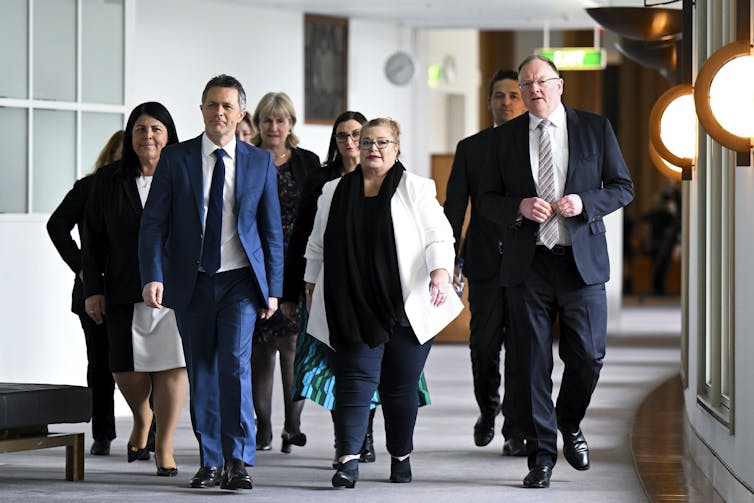
However, given the relatively small number of vaccinations administered in Australia, it’s important to consider more complete data from countries with higher vaccination rates.


Read more:
How rare are blood clots after the AstraZeneca vaccine? What should you look out for? And how are they treated?


The United States’ Centres for Disease Control and Prevention (CDC) had received 1,226 reports of myocarditis following 296 million doses of mRNA vaccines administered up to June 11. This equates to a risk of roughly one in 240,000 doses. These cases were mostly in young men and predominantly occurred after the second dose.

Independently from vaccines, myocarditis occurs in roughly 23 per 100,000 people worldwide per year (we don’t have reliable figures for pericarditis). This shows us there’s a much lower risk from vaccination than exists in the population generally.

Symptoms to look out for

Normal side effects of COVID-19 vaccines include headache, fever, chills, muscle or joint pain, fatigue and nausea.

In contrast, chest pain, irregular heartbeat, heart palpitations, shortness of breath and light-headedness could indicate myocarditis or pericarditis. Symptoms of these conditions have generally occurred within seven days of vaccination. Anyone who experiences these symptoms should seek medical attention.

In most cases, myocarditis and pericarditis can be successfully treated with anti-inflammatory drugs, such as aspirin and corticosteroids.

In Israel, 95% of cases recently investigated were classified as mild. Similarly, the CDC has reported most patients in the US have recovered quickly.

While this very small risk of heart inflammation following vaccination may be alarming, it’s crucial to understand the risk of heart damage following severe COVID-19 is far greater.


Read more:
Explainer: what is inflammation and how does it cause disease?


COVID-19 and heart damage

Damage of the heart muscle is a common consequence of coronavirus. Research shows it occurs in up to 28% of patients hospitalised with COVID-19.

Importantly, the risk of death is markedly higher in COVID-19 patients who sustain heart muscle damage. While we need further research to understand precisely how COVID-19 damages the heart, myocarditis and pericarditis are major causes of the heart damage found in COVID-19 patients.

The benefit outweighs the risk

The recent limits applied to the use of the AstraZeneca vaccine in younger age groups suggests the relatively low risk of COVID-19 in Australia justifies being highly selective over vaccine use.

But while Australia has done incredibly well at containing COVID-19, the risk of transmission here remains high given the global COVID-19 situation. We’re seeing this daily as we contend with outbreaks and lockdowns around the country.

Myocarditis and pericarditis are potentially associated with the mRNA vaccines, but these complications are extremely rare, most often mild, and seem to be treatable.

As has been the consistent message from the medical and scientific communities throughout this pandemic, the benefit of COVID-19 vaccines significantly outweighs the risk of rare side effects. This is particularly true for the highly effective mRNA-based vaccines as COVID-19 continues to spread around the world.


Read more:
What are the side effects of the Pfizer vaccine? An expert explains


The Conversation

The authors do not work for, consult, own shares in or receive funding from any company or organization that would benefit from this article, and have disclosed no relevant affiliations beyond their academic appointment.

ref. The benefits of a COVID vaccine far outweigh the small risk of treatable heart inflammation – https://theconversation.com/the-benefits-of-a-covid-vaccine-far-outweigh-the-small-risk-of-treatable-heart-inflammation-163970

Politics with Michelle Grattan: Bob Brown on his latest environmental battle, and a critique of Labor

Source: The Conversation (Au and NZ) – By Michelle Grattan, Professorial Fellow, University of Canberra

Since his retirement from parliament in 2012, Bob Brown has remained an activist on environmental causes – from campaigning against the Adani coal mine to fighting the threat to Tasmania’s Tarkine forest.

Brown was leader when after the 2010 election the Greens helped Julia Gillard retain government by entering an agreement with her. A key part of that deal was the requirement that a price on carbon be introduced.

These days Brown labels Labor “Liberal-lite” – condemning what he sees at its timid stance on climate policy as a lost opportunity to catch up with “public sentiment”.

“No doubt there are people with Labor, a younger set of people who can see this, but the old guard, and that includes Anthony Albanese, don’t see it…”

“Labor is on the edge, trying to make itself look a little bit greener that Morrison[…]but that really doesn’t cut the mustard”.

On Friday, the UNESCO World Heritage committee will vote on whether the Great Barrier Reef should be declared “in danger” – trying to head that off, Australian government has proposed an amendment that the decision be delayed until 2023. Brown believes the listing should have been made “years ago” because the reef is “not only in danger, it’s dying”.

Listen on Apple Podcasts

Stitcher Listen on TuneIn

Listen on RadioPublic

Additional audio

A List of Ways to Die, Lee Rosevere, from Free Music Archive.

The Conversation

Michelle Grattan does not work for, consult, own shares in or receive funding from any company or organisation that would benefit from this article, and has disclosed no relevant affiliations beyond their academic appointment.

ref. Politics with Michelle Grattan: Bob Brown on his latest environmental battle, and a critique of Labor – https://theconversation.com/politics-with-michelle-grattan-bob-brown-on-his-latest-environmental-battle-and-a-critique-of-labor-164863

‘Die of cold or die of stress?’: Social housing is frequently colder than global health guidelines

Source: The Conversation (Au and NZ) – By Daniel Daly, Research Fellow at the Sustainable Buildings Research Centre, University of Wollongong

Shutterstock

As you huddle inside this winter – possibly as part of a pandemic lockdown – you might be noticing the “thermal performance” of your home. In other words, does your home maintain a comfortable temperature inside, despite cold conditions outside?

If you’re a social housing tenant in New South Wales, the answer may well be no. Our new research examined the relationship between energy consumption and thermal performance in 42 social housing dwellings. We found many homes operated outside the healthy temperature recommendations of the World Health Organisation (WHO) for substantial periods, particularly during winter.

Our research also found many social housing tenants were effectively being forced to choose between keeping their home at a healthy temperature through cooling and heating, and keeping their energy bills manageable. As one tenant told us:

I put the heater on the other night for 20 minutes — it didn’t do much. But the whole time it was on I was freaking about the cost. No good — die of cold or die of stress, take your pick.

older woman clutches blanket
Social housing in NSW is often colder than WHO standards.
Shutterstock

The dangers of energy inefficiency

Social housing often brings together low-income households and poor quality building stock.

In Australia, more than one million people live in housing in poor condition – 100,000 of them in very poor or derelict housing.

Yet, little is known about the internal temperatures in social housing, or how tenants experience seasonal temperature change. Our research represents one step to address this knowledge gap.

Exposure to temperatures that are too high or too low has been linked to an increased risk of cardiovascular and respiratory illnesses and other conditions, which can lead to death.

Energy inefficient homes are blamed in part for higher winter death rates in Australia than other much colder nations, such as Sweden. Conversely, research has shown the health benefits of retrofitting housing to improve winter warmth.

Measures to make an existing home more energy efficient include:

  • insulating the ceiling, and potentially the walls and underfloor
  • sealing gaps and draught-proofing
  • installing ceiling fans
  • improving the efficiency of heating and cooling systems
  • installing efficient hot water systems
  • improving windows with shading, heavy curtains or double glazing.


Read more:
Cold weather is a bigger killer than extreme heat – here’s why


person installs insulation
Insulation helps make a home more energy efficient.
Shutterstock

Our findings

Social housing is provided by government, not-for-profit or private organisations, to tenants who are often vulnerable and marginalised.

We examined the thermal performance of 42 social housing properties in NSW between March 2017 and September 2019. Our study included energy audits monitoring of electrical energy and indoor conditions, and interviews with tenants.

We found substantial under-heating in many of the properties. According to the WHO, the minimum temperature for healthy homes is 18℃. But one-quarter of properties recorded winter temperatures below this for more than 80% of winter. More than half were below 18℃ for more than half of winter.

The problem of overheating in summer was less widespread, but still a significant issue in some homes.

Some households consumed higher-than-average levels of energy despite their low incomes (even after correcting for family size and location) while others used far less than average.

High household energy use was predominately associated with air conditioning use in hot summer climates. In most of these cases, tenants had installed window air-conditioning units with extremely low energy efficiency.

Tenants regularly reported having to forgo thermal comfort to manage their energy bills. To keep power bills down, they also spoke of relinquishing essentials such as daily showers, cooked dinners, night lighting and watching television.


Read more:
The many faces of social housing – home to 1 in 10 Australians


mother and child sit at table
Social housing tenants often forgo life’s essentials to save on electricity bills.
Shutterstock

What can be done?

The homes in our study subsequently received energy efficiency upgrades, funded by the housing provider and the NSW government. The social housing sector, while operating on tight budgets, is an innovator when it comes to retrofitting existing buildings.

In Australia, social housing upgrade programs typically focus on improving heating, cooling and hot water systems, and in some cases adding solar. This is largely because such upgrades are simple and rooftop solar costs are falling.

However, energy efficiency experts generally say improvements to the building fabric, such as installing insulation and sealing draughts, should be carried out before services to the home are upgraded.

This approach generally requires on-ground assessment of each property and can be difficult and costly to roll out on a large scale. This is a major challenge for housing providers with constrained budgets, and who are often under pressure to deliver new housing.

But building fabric upgrades are long-lasting, don’t increase maintenance costs and deliver benefits regardless of a tenant’s heating and cooling practices.

One social housing tenant told us of the benefits of such upgrades:

[Before the upgrade] I’d have my heater on, say, from half past four of an afternoon ‘til half past eleven, you just would not turn it off. [Since the upgrade] I turn it on at half past four, it’s coming off at about seven o’clock and I don’t need to turn it back on.

While our study involved a small sample size, it provided new empirical evidence of the need for substantial new investment to continue to upgrade the energy performance of our social housing stock. Such upgrades will help reduce energy costs for tenants and enhance their health and well-being.

It would also reduce greenhouse gas emissions, increase resilience to climate change and provide jobs and economic stimulus during the pandemic and beyond.


This story is part of a series The Conversation is running on the nexus between disaster, disadvantage and resilience. It is supported by a philanthropic grant from the Paul Ramsay Foundation. Read the rest of the stories here.

The Conversation

Funding for this work was provided by the Cooperative Research Centre for Low Carbon Living and the New South Wales Office of Environment and Heritage

Paul Cooper receives funding from the Australian Research Councili.

Federico Tartarini does not work for, consult, own shares in or receive funding from any company or organisation that would benefit from this article, and has disclosed no relevant affiliations beyond their academic appointment.

ref. ‘Die of cold or die of stress?’: Social housing is frequently colder than global health guidelines – https://theconversation.com/die-of-cold-or-die-of-stress-social-housing-is-frequently-colder-than-global-health-guidelines-164598

Wenda appeals to NZ, West to supply covid vaccines direct to Papuans

Asia Pacific Report newsdesk

A pro-independence movement in West Papua has appealed to several Western countries — including New Zealand — to provide urgent humanitarian help by supplying covid vaccines directly to the Papuans to cope with the “double crisis” in the Indonesian-ruled region.

Benny Wenda, interim president of the Provisional Government of West Papua, said today he had made the appeal by writing to the foreign ministers of Britain, Australia, New Zealand and the US.

“I have also written to the President of the European Commission, the WHO [World Health Organisation] and the UN High Commissioner for Human Rights regarding the escalating covid-19 situation in our land,” he said in a statement.

“This new crisis is a further existential threat to my people.”

Indonesia had caused a double crisis for the people of West Papua by launching military operations in the middle of the pandemic, Wenda said, as he had warned.

“Just yesterday, villagers from the West Moskona district were attacked by troops after attending a peaceful worship session against ‘Special Autonomy’, fleeing to the forests and the city of Bintuni,” he said.

“Woman and children are afraid to return to their villages in case the military and police arrest or attack them.”

50,000 plus displaced
“More than 50,000 people have been displaced in Nduga, Puncak and Intan Jaya over the past two and a half years. Their homes have been destroyed, their churches burned and their schools occupied by soldiers.

“They are left in internal displacement camps, where the virus will spread rapidly. Already in the cities, patients are being turned away or treated in cars outside the hospital.”

Western countries and the WHO had an urgent moral obligation to give vaccine doses direct the local Papuan government for distribution, Wenda said.

“As the 2018 Asmat health crisis showed, Jakarta cannot be trusted with the health of the West Papuan people,” he said.

“Over nearly 60 years of colonisation we have seen a chronic failure to develop health facilities in West Papua, leaving us dying on top of the natural riches Indonesia is extracting. If Jakarta is allowed to hold the reigns of vaccine development, my people will suffer further.”

Wenda said the developments were part of a “continued genocide against my people”.

“Our forests have been torn down, our mountains decapitated, our way of life destroyed. Indonesia restricts healthcare and enforces a colonial education whilst killing anyone who speaks out for self-determination,” Wenda said.

“Launching military operations in the middle of a pandemic is a policy designed to further wipe out our population. We need urgent international assistance, direct to the local Papuan government, not through the colonial occupier.”

Print Friendly, PDF & Email

Article by AsiaPacificReport.nz

The Jakarta Post: New deal, old approach over West Papua

EDITORIAL: By the editorial board of The Jakarta Post

The unanimous House of Representatives decision in Indonesia last week to endorse the revised Papuan Special Autonomy Law shows, yet again, the propensity of the Jakarta elite to dictate the future of the territory, despite persistent calls to honor local demands.

This “new deal” is not likely to end violence in the resource-rich provinces, which stems in large part from Jakarta’s refusal to settle past human rights abuses there.

On paper, the revision offers some of the substantial changes needed to help Papuans close the gap with the rest of the nation. For example, it extends special autonomy funding for Papua and West Papua to 2041 and increases its amount from 2 percent to 2.25 percent of the general allocation fund, with a particular focus on health and education.

The Jakarta Post
THE JAKARTA POST

The Finance Ministry estimates that over the next 20 years, the two provinces will receive Rp 234.6 trillion (US$16 billion).

The revisions also strengthen initiatives to empower native Papuans in the policy-making process by allocating one fourth of the Regional Legislative Council to native, nonpartisan Papuans by appointment. They also mandate that 30 percent of those seats go to native Papuan women.

Under the new law, a new institution will be established to “synchronize, harmonize, evaluate and coordinate” the implementation of special autonomy. Headed by the Vice President, the new body will answer to the President and will have a secretariat in Papua. The previous government formed a presidential unit to accelerate development in Papua and West Papua (UP4B), but President Joko “Jokowi” Widodo dissolved it shortly after taking office in 2014.

The chairman of the special House committee deliberating the revision, Komarudin Watubun, a Papuan, described the new law as “a breakthrough” as it would require the government to consult the Papuan and West Papuan governments in the drafting of implementing regulations.

But this is where the core problem of the special autonomy law lies. In democracy, respecting the will of the public, including dissenting views, is vital to the lawmaking process, precisely because the laws will affect that public. Public scrutiny should precede rather than follow a law, but in the case of the special autonomy law, that mechanism was dropped from the House’s deliberation, which lasted seven months, under the pretext of social distancing to contain the spread of covid-19.

The Jakarta elite have clearly left the Papuan People’s Assembly (MRP) behind as a representation of the customs and will of the provinces’ people, as well as the Papuan Legislative Council (DPRP), not to mention civil society groups, tribes and those who mistrust special autonomy and the government. In the words of MRP chief Timotius Murib, the revisions reveal Jakarta’s lack of good intentions for Papuan development.

This is not the first time the executive and legislative powers have colluded to bypass public consultation on a highly controversial bill. The tactic worked in the passage of the Job Creation Law last year, as well as the new Mining Law, and the approach is apparently repeating in the ongoing deliberation of the Criminal Code revision.

As long as the obsolete, Jakarta-centered approach remains intact, Papuan peace and prosperity will remain elusive.

This Jakarta Post editorial was published on 21 July 2021.

Print Friendly, PDF & Email

Article by AsiaPacificReport.nz

Pregnant PNG teacher Jerolyn walks 25km for her unborn baby – but dies tragically

SPECIAL REPORT: By Patrick Angrai

Jerolyn Arimbandai was the only woman teacher of a newly established Catholic-run high school in the Middle Ramu district of Papua New Guinea’s Madang province.

She was married to Steven Arimbandai, a local from Josephstaal,  also a teacher at Josephstaal High School. They had a child and were expecting their second.

On June 27, she decided to move to town in preparation for the birth. Her decision to move to town was due to the fact that the Josephstaal Health Centre had run out of basic medical supplies four months prior.

At eight months pregnant, she walked a 25km road. I was with the group accompanying here when we left Josephstaal at 7:00 am. We  reached Guam at 6:30 pm.

She departed for town at 9:00 pm. I couldn’t get on the vehicle since it was overloaded with passengers and cocoa bags.

At around 4:00am, they reached Bogia when she experienced the onset of labor pain and was brought to Bogia Health Centre.

Her delivery was supervised at Bogia centre and she was diagnosed with post-partum hemorrhage. She was than referred to Madang General Hospital in the hope that they would get there in time for doctors to treat her.

Died at the hospital front gate
She died in front of the Modilon Hospital gate.

Her decision to seek medical assistance elsewhere was due to poor basic government service delivery at Josephstaal.

PNG travel difficulties
Cameraman Vinansius Wavite travelled to Josephstaal with Patrick Angrai in 2020. They documented the difficulties faced by the people. Image: My Land My Country

The people of Josephstaal are still struggling, trying to bring in goods and services. The only government services that are available are health and education. All other services are all closed.

Health and education are the only “flag raisers” of the province and the nation.

Patrick Angrai
Patrick Angrai … “We have staff and equipment problems every year.  There are only a few officers serving Josephstaal LLG.  We have never had full staffing.  Most professionals do not want to go to Josephstaal because it is isolated and difficult  for their families. Image: My Land My Country

The road  is yet to be connected from Guam to Josephstaal. The existing road from the Madang-Sogeram road is now covered with tall grass and shrubs.

To get goods and services to Josephstaal is expensive. The three different payments needed are vehicle hire, boat hire and youth to help.

Sogeram Bridge was washed away by floods in 2019 and is yet to be reconstructed.

There is a mention of road construction from Guam to Josephstaal. The social media updates about the road construction and its progress are all lies.

There has been no progress.

The meaning of the death?
The Middle Ramu member of Parliament, Johnny Alonk, represents the people of Middle Ramu and Josephstaal is one of the four areas in the district.

What does Jerolyn Arimbandai’s death tell us about millions of kina committed to the so-called shopping list request from the K10 million (NZ$4.1 million) District Services Improvement Programme (DSIP) funds?

Middle Ramu does not have other roads connecting to town. The only road is the Josephstaal road.

Which road is the Middle Ramu MP funding every year while the Josephstaal road continues to deteriorate?

My question to the provincial government: Does this female teacher’s death tell you anything about your distribution of funds throughout the entire province?

The people of Josephstaal had so much hope.

Patrick Angrai is a Papua New Guinean health worker. This article was first published on journalist Scott Waide’s blog My Land My Country and it is republished with permission.

Print Friendly, PDF & Email

Article by AsiaPacificReport.nz

Gender-specific health programs address important issues, but risk creating new biases

Source: The Conversation (Au and NZ) – By Matthew Jenkins, Research Fellow, University of Otago

Shutterstock/elenavolf

Gone are the days when health programmes were designed to simply punish or reward people to encourage behaviour change. We now know lasting behaviour change is more complex and nuanced, and this has prompted a proliferation of programmes that attend to factors like motivation, confidence, social support and social determinants of health.

Among such programmes, we’ve observed a trend towards gender-targeted interventions. Examples include programmes for men focusing on rugby fandom as a route to getting them to look after their health, and those for women that concentrate on small, holistic health changes to limit the impact of damaging body ideals.

Person doing strength training
Health programmes are often tailored for either men or women.
Shutterstock/Nataliia Martseniuk

While biological sex is based on our anatomy and physiology, gender is a socialised identity. Our gendered identities accompany societal expectations of how we should or should not act.

There is no doubt gender shapes how we “do” health — the way we eat, sleep, exercise, connect with others and manage stress. While gender-specific needs are important, a gendered approach may ignore people who identify as neither and it runs the risk of creating new biases.

A case for women-focused health programmes

Women-focused health programmes were arguably developed as an antidote to an overwhelmingly patriarchal society.

The most obvious bias in health research is that much of the data on women’s health has been collected by and from men.

Gendered disadvantages or inequities for women also result from poor representation in leadership positions and unfair norms that place greater expectations on them.

For example, women spend more time than men doing unpaid household work and taking on caring responsibilities. These imbalances trickle down to shape how women spend their time and care for their health.

In response, women-specific research centres have been established in New Zealand and internationally to help close the gap in knowledge regarding women’s health.


Read more:
Research into pregnancy, birth and infant care is historically underfunded – and women are paying the price


Similarly, organisations like YWCA and Women’s Health Victoria position gendered inequities at the centre of their work and help create a better understanding of how health programmes can effectively support women’s long-term outcomes for behaviour change.

In New Zealand, Shift supports young women to be physically active through a focus on collaboration, fun, building community and leadership. Next Level Health empowers women by using a holistic and weight-neutral approach to behaviour change. This moves the focus away from body weight and defines health more broadly, emphasising well-being, connection to people and place and other behaviours.

As a result, sleep, self-care and stress management become as important as physical activity and nutrition. Such programmes create a more inclusive and relevant vision of health and counteract the body image concerns women often experience due to socialised pressures to attain an “ideal” body.

Man in doctor's room.
Men are less likely to seek medical help.
Shutterstock/Chinnapong

‘Tough’ approach to men’s health

Despite a male-dominated health system, men continue to have a higher risk of various health conditions, including coronary heart disease and being overweight.

When it comes to health behaviour programmes, men are notoriously difficult to recruit. This may be due to the fact men are less likely to seek help.

There have been urgent calls for male-specific healthy lifestyle programmes that often use “masculine” male-dominated sports (rugby, football) to entice men to join.

Some, such as Tough Talk, play with stereotypical male traits to encourage men to discuss their health. In parallel with women’s health research, male health research centres are fast becoming commonplace.


Read more:
Men are buying potentially risky steroid substitutes online to get the ‘ideal body’


Considering these gender differences, a gendered approach can be justified. Gender equality and health equity are global priorities and such programmes have potential to address them. Playing to peoples’ gendered identities may work for recruitment and effectiveness, too.

Slipping through the cracks

While gendered interventions aim to fill certain gaps, they may actually create new ones, particularly when we consider that many health programmes are funded by nationally competitive grants that often favour projects with potential for greater impact (the biggest slice of the population).

People who identify with the wider group of LGBTQI+ are vulnerable in terms of mental health. This disparity exists because of the greater inequities this community faces.

Some solutions may come from gender-diverse marketing that emphasise gender responsiveness, rather than placing a specific gender at the centre of campaigns.


Read more:
Why the way we approach transgender and non-binary healthcare needs to change


Perhaps non-gendered health programmes could create open discussion about how people identify their gender, rather than repeating an inherited gendered story. Admittedly, that might be idealistic for a lifestyle programme.

We’re not arguing against gender-specific programmes. Gender bias in health research is an ongoing issue, among others, that requires targeted action to eliminate harmful inequities.

But we suggest gender responsiveness as a compatible approach for lifestyle programmes, in which gender is embraced but does not drive the programme. A choose-your-own-path approach that allows for diverse identities and autonomy, regardless of gender. Otherwise, the gaps we aim to fill might become gaping holes elsewhere.

The Conversation

The authors do not work for, consult, own shares in or receive funding from any company or organisation that would benefit from this article, and have disclosed no relevant affiliations beyond their academic appointment.

ref. Gender-specific health programs address important issues, but risk creating new biases – https://theconversation.com/gender-specific-health-programs-address-important-issues-but-risk-creating-new-biases-155840

7 tips for making masks work in the classroom

Source: The Conversation (Au and NZ) – By David Roy, Lecturer in Education, University of Newcastle

Shutterstock

With more infectious variants of the COVID-19 virus emerging, teachers and students have been required to wear masks in high school classrooms. It was mandatory in Greater Sydney and all of Victoria before the recent switch to remote learning under lockdowns. Mask wearing has also been compulsory in schools overseas, including parts of the US, Canada and Malaysia.

The new variants appear to have increased infection risks for younger people, and most Australians are not yet fully vaccinated. Until that time, masks may well be one of our best tools to allow a return to face-to-face schooling.


Read more:
Is it more infectious? Is it spreading in schools? This is what we know about the Delta variant and kids


However, having to wear masks in the classroom may create challenges for teachers and students. Mask-wearing can have negative impacts on all students, although the issues can be greater for students from minority cultures and those with chronic health or disability barriers.

Education is primarily a communication and relational activity. Masks not only hinder the visual communication tools we rely on but can also muffle speech, create discomfort and be psychologically unsettling for some. The word mask is thought to come from the Medieval Latin masca, meaning spectre or nightmare.

Most of the barriers to wearing masks can be overcome. By harnessing the benefits of embracing the mask, classrooms can adapt and thrive during the pandemic. Adopting recommended practices for using masks in the classroom will benefit all students.


Read more:
COVID-19’s teaching challenges: 5 tips from pediatric care for teachers wearing masks


Use masks properly

Openly and regularly discuss mask use with all students. Teach and practise mask etiquette so students understand the need to avoid touching the mask and to touch only the edges if they need to adjust their mask. They may need to do this to maximise comfort and to ensure the mouth and nose are properly covered, protecting the wearer and those around them.

Encourage students to use hand sanitiser, especially after touching the mask.

Remind students to clean reusable masks every day and to dispose of single-use masks.

School student wearing mask holds out hands for hand sanitiser offered by masked teacher
Encouraging students to use hand sanitiser adds to the protection masks provide.
Shutterstock


Read more:
Rethink ventilation for a safe return to schools after the COVID-19 pandemic


Exaggerate body language and facial expressions

Young people take many visual cues from the mouth of the speaker, while adults take more visual cues from the eyes. When wearing masks covering the lower half of the face, teachers and students will naturally become more aware of upper face expressions.

Exaggeration is helpful to communicate clearly while wearing a mask. Teachers should continue to use natural facial expressions like smiling, such as the “Duchenne smile”, but exaggerate eye gestures and eyebrow movements to aid communication. The face has 42 individual muscles. We should use them all.

Play with facial expressions when using masks and have students read social cues from the eye movements they can see. Make the development of social and emotional intelligence a game of exploration to promote an understanding of psychology and how we react to others. This is merging science and the arts.

Teachers can and should use their whole body to communicate. For example, the teacher can shrug their shoulders when asking a question, or shake or nod their head to communicate a point of view. Exaggerated hand gestures and being near to the students are other helpful strategies.

Women wearing a mask with wide-eyed expression
Wearing a mask means we have to express more with our eyes and body language.
Shutterstock


Read more:
We’ve become used to wearing masks during COVID. But does that mean the habit will stick?


Use your voice

Although the mask covers the mouth, teachers can generally still be heard through the cloth. The key here is again a form of exaggeration as well as proximity to the student. Teachers can stay close to their listeners, speak more slowly, articulate all sounds clearly and increase volume.

However, teachers must balance vocal volume with projecting the voice. Teachers can practise diaphragmatic breathing to help avoid vocal straining.

Where possible, try to rely less on talking for teaching. Use PowerPoint and written communication. Keep language simple and straightforward.

In addition, check with students that they can hear and understand. Pay particular attention to children who are deaf or hard of hearing. Speak with them about the situation and take their advice.

Embrace technology

Where possible, use technology such as iPads or IT devices. Choose or make a video clip with subtitles instead of having to speak while wearing a mask. This is particularly important for students who are deaf or hard of hearing.

Use a microphone, carefully placing it near the mouth but not against the mask material.

Don’t panic

Masks do allow enough airflow to breathe comfortably. However, remain vigilant to children who do panic or feel claustrophobic when required to wear a mask. These psychological challenges can be made worse when a child has breathing difficulties such as asthma.

Schedule regular quiet breaks throughout the day – even every hour.

Create a safe space

Staff should try to include a photograph of themselves on their school ID badge, if wearing one. This can help reassure those who feel isolated and uncomfortable when people are wearing masks.

Children with neurological disabilities, such as autism or dyspraxia, will not always have the issues some might expect with wearing a mask. Like all children, they just need to know who we are and why we are all wearing masks.

The most important thing is to communicate. Talk with and listen to students, as the best teachers always do. Let them talk about their masks and take ownership of the situation, and then we can move forward with learning.

Masked teacher explains a point to masked student
Taking the time to talk with individual students and hear what they have to say is most important.
Shutterstock

Following Maslow’s Hierarchy of Needs, children will learn when they know they are safe.

See it as a opportunity to learn

The challenges of mask-wearing can be opportunities. Rather than seeing the mask as a burden, see it as an opportunity to teach and have fun.

Incorporate lessons that look at masks in history, from the earliest Greek plays through to Asian theatre and more recent times. Look at superhero movies, look at politics and public protests. Understand medicine and the use of masks throughout history – why we wear them to keep both ourselves and others healthy.

Explore the inclusive nature of masks and how they can create acceptance and equity. Research has found masks allow children to disassociate from identities and see themselves and others from a more empathetic and accepting perspective.

Many societies where people commonly wore masks prior to COVID, in parts of Asia for example, have thrived. Schools are microcosms of society. The mask is not a barrier to learning. A mask should only be a barrier to the spread of the virus, so mask up and enjoy the masquerade.

The Conversation

Jill Duncan is affiliated with Aussie Deaf Kids, Disability Council NSW, Deafness & Education International.

David Roy does not work for, consult, own shares in or receive funding from any company or organization that would benefit from this article, and has disclosed no relevant affiliations beyond their academic appointment.

ref. 7 tips for making masks work in the classroom – https://theconversation.com/7-tips-for-making-masks-work-in-the-classroom-164777

Gender-specific health programmes address important issues, but risk creating new biases

Source: The Conversation (Au and NZ) – By Matthew Jenkins, Research Fellow, University of Otago

Shutterstock/elenavolf

Gone are the days when health programmes were designed to simply punish or reward people to encourage behaviour change. We now know lasting behaviour change is more complex and nuanced, and this has prompted a proliferation of programmes that attend to factors like motivation, confidence, social support and social determinants of health.

Among such programmes, we’ve observed a trend towards gender-targeted interventions. Examples include programmes for men focusing on rugby fandom as a route to getting them to look after their health, and those for women that concentrate on small, holistic health changes to limit the impact of damaging body ideals.

Person doing strength training
Health programmes are often tailored for either men or women.
Shutterstock/Nataliia Martseniuk

While biological sex is based on our anatomy and physiology, gender is a socialised identity. Our gendered identities accompany societal expectations of how we should or should not act.

There is no doubt gender shapes how we “do” health — the way we eat, sleep, exercise, connect with others and manage stress. While gender-specific needs are important, a gendered approach may ignore people who identify as neither and it runs the risk of creating new biases.

A case for women-focused health programmes

Women-focused health programmes were arguably developed as an antidote to an overwhelmingly patriarchal society.

The most obvious bias in health research is that much of the data on women’s health has been collected by and from men.

Gendered disadvantages or inequities for women also result from poor representation in leadership positions and unfair norms that place greater expectations on them.

For example, women spend more time than men doing unpaid household work and taking on caring responsibilities. These imbalances trickle down to shape how women spend their time and care for their health.

In response, women-specific research centres have been established in New Zealand and internationally to help close the gap in knowledge regarding women’s health.


Read more:
Research into pregnancy, birth and infant care is historically underfunded – and women are paying the price


Similarly, organisations like YWCA and Women’s Health Victoria position gendered inequities at the centre of their work and help create a better understanding of how health programmes can effectively support women’s long-term outcomes for behaviour change.

In New Zealand, Shift supports young women to be physically active through a focus on collaboration, fun, building community and leadership. Next Level Health empowers women by using a holistic and weight-neutral approach to behaviour change. This moves the focus away from body weight and defines health more broadly, emphasising well-being, connection to people and place and other behaviours.

As a result, sleep, self-care and stress management become as important as physical activity and nutrition. Such programmes create a more inclusive and relevant vision of health and counteract the body image concerns women often experience due to socialised pressures to attain an “ideal” body.

Man in doctor's room.
Men are less likely to seek medical help.
Shutterstock/Chinnapong

‘Tough’ approach to men’s health

Despite a male-dominated health system, men continue to have a higher risk of various health conditions, including coronary heart disease and being overweight.

When it comes to health behaviour programmes, men are notoriously difficult to recruit. This may be due to the fact men are less likely to seek help.

There have been urgent calls for male-specific healthy lifestyle programmes that often use “masculine” male-dominated sports (rugby, football) to entice men to join.

Some, such as Tough Talk, play with stereotypical male traits to encourage men to discuss their health. In parallel with women’s health research, male health research centres are fast becoming commonplace.


Read more:
Men are buying potentially risky steroid substitutes online to get the ‘ideal body’


Considering these gender differences, a gendered approach can be justified. Gender equality and health equity are global priorities and such programmes have potential to address them. Playing to peoples’ gendered identities may work for recruitment and effectiveness, too.

Slipping through the cracks

While gendered interventions aim to fill certain gaps, they may actually create new ones, particularly when we consider that many health programmes are funded by nationally competitive grants that often favour projects with potential for greater impact (the biggest slice of the population).

People who identify with the wider group of LGBTQI+ are vulnerable in terms of mental health. This disparity exists because of the greater inequities this community faces.

Some solutions may come from gender-diverse marketing that emphasise gender responsiveness, rather than placing a specific gender at the centre of campaigns.


Read more:
Why the way we approach transgender and non-binary healthcare needs to change


Perhaps non-gendered health programmes could create open discussion about how people identify their gender, rather than repeating an inherited gendered story. Admittedly, that might be idealistic for a lifestyle programme.

We’re not arguing against gender-specific programmes. Gender bias in health research is an ongoing issue, among others, that requires targeted action to eliminate harmful inequities.

But we suggest gender responsiveness as a compatible approach for lifestyle programmes, in which gender is embraced but does not drive the programme. A choose-your-own-path approach that allows for diverse identities and autonomy, regardless of gender. Otherwise, the gaps we aim to fill might become gaping holes elsewhere.

The Conversation

The authors do not work for, consult, own shares in or receive funding from any company or organisation that would benefit from this article, and have disclosed no relevant affiliations beyond their academic appointment.

ref. Gender-specific health programmes address important issues, but risk creating new biases – https://theconversation.com/gender-specific-health-programmes-address-important-issues-but-risk-creating-new-biases-155840

How does the Pegasus spyware work, and is my phone at risk?

Source: The Conversation (Au and NZ) – By Paul Haskell-Dowland, Associate Dean (Computing and Security), Edith Cowan University

Shutterstock

A major journalistic investigation has found evidence of malicious software being used by governments around the world, including allegations of spying on prominent individuals.

From a list of more 50,000 phone numbers, journalists identified more than 1,000 people in 50 countries reportedly under surveillance using the Pegasus spyware. The software was developed by the Israeli company NSO Group and sold to government clients.

Among the reported targets of the spyware are journalists, politicians, government officials, chief executives and human rights activists.

Reports thus far allude to a surveillance effort reminiscent of an Orwellian nightmare, in which the spyware can capture keystrokes, intercept communications, track the device and use the camera and microphone to spy on the user.

How did they do it?

There’s nothing particularly complicated about how the Pegasus spyware infects the phones of victims. The initial hack involves a crafted SMS or iMessage that provides a link to a website. If clicked, this link delivers malicious software that compromises the device.

The aim is to seize full control of the mobile device’s operating system, either by rooting (on Android devices) or jailbreaking (on Apple iOS devices).

Usually, rooting on an Android device is done by the user to install applications and games from non-supported app stores, or re-enable a functionality that was disabled by the manufacturer.

Similarly, a jailbreak can be deployed on Apple devices to allow the installation of apps not available on the Apple App Store, or to unlock the phone for use on alternative cellular networks. Many jailbreak approaches require the phone to be connected to a computer each time it’s turned on (referred to as a “tethered jailbreak”).


Read more:
Holding the world to ransom: the top 5 most dangerous criminal organisations online right now


Rooting and jailbreaking both remove the security controls embedded in Android or iOS operating systems. They are typically a combination of configuration changes and a “hack” of core elements of the operating system to run modified code.

In the case of spyware, once a device is unlocked, the perpetrator can deploy further software to secure remote access to the device’s data and functions. This user is likely to remain completely unaware.

Most media reports on Pegasus relate to the compromise of Apple devices. The spyware infects Android devices too, but isn’t as effective as it relies on a rooting technique that isn’t 100% reliable. When the initial infection attempt fails, the spyware supposedly prompts the user to grant relevant permissions so it can be deployed effectively.

But aren’t Apple devices more secure?

Apple devices are generally considered more secure than their Android equivalents, but neither type of device is 100% secure.

Apple applies a high level of control to the code of its operating system, as well as apps offered through its app store. This creates a closed-system often referred to as “security by obscurity”. Apple also exercises complete control over when updates are rolled out, which are then quickly adopted by users.

Apple devices are frequently updated to the latest iOS version via automatic patch installation. This helps improve security and also increases the value of finding a workable compromise to the latest iOS version, as the new one will be used on a large proportion of devices globally.

On the other hand, Android devices are based on open-source concepts, so hardware manufacturers can adapt the operating system to add additional features or optimise performance. We typically see a large number of Android devices running a variety of versions — inevitably resulting in some unpatched and insecure devices (which is advantageous for cybercriminals).

Ultimately, both platforms are vulnerable to compromise. The key factors are convenience and motivation. While developing an iOS malware tool requires greater investment in time, effort and money, having many devices running an identical environment means there is a greater chance of success at a significant scale.

While many Android devices will likely be vulnerable to compromise, the diversity of hardware and software makes it more difficult to deploy a single malicious tool to a wide user base.

How can I tell if I’m being monitored?

While the leak of more than 50,000 allegedly monitored phone numbers seems like a lot, it’s unlikely the Pegasus spyware has been used to monitor anyone who isn’t publicly prominent or politically active.

It is in the very nature of spyware to remain covert and undetected on a device. That said, there are mechanisms in place to show whether your device has been compromised.

The (relatively) easy way to determine this is to use the Amnesty International Mobile Verification Toolkit (MVT). This tool can run under either Linux or MacOS and can examine the files and configuration of your mobile device by analysing a backup taken from the phone.

While the analysis won’t confirm or disprove whether a device is compromised, it detects “indicators of compromise” which can provide evidence of infection.

In particular, the tool can detect the presence of specific software (processes) running on the device, as well as a range of domains used as part of the global infrastructure supporting a spyware network.

What can I do to be better protected?

Although most people are unlikely to be targeted by this type of attack, there are still simple steps you can take to minimise your potential exposure — not only to Pegasus but to other malicious attacks too.

1) Only open links from known and trusted contacts and sources when using your device. Pegasus is deployed to Apple devices through an iMessage link. And this is is the same technique used by many cybercriminals for both malware distribution and less technical scams. The same advice applies to links sent via email or other messaging applications.

2) Make sure your device is updated with any relevant patches and upgrades. While having a standardised version of an operating system creates a stable base for attackers to target, it’s still your best defence.

If you use Android, don’t rely on notifications for new versions of the operating system. Check for the latest version yourself, as your device’s manufacturer may not be providing updates.

3) Although it may sound obvious, you should limit physical access to your phone. Do this by enabling pin, finger or face-locking on the device. The eSafety Commissioner’s website has a range of videos explaining how to configure your device securely.

4) Avoid public and free WiFi services (including hotels), especially when accessing sensitive information. The use of a VPN is a good solution when you need to use such networks.

5) Encrypt your device data and enable remote-wipe features where available. If your device is lost or stolen, you will have some reassurance your data can remain safe.


Read more:
Spyware merchants: the risks of outsourcing government hacking


The Conversation

The authors do not work for, consult, own shares in or receive funding from any company or organisation that would benefit from this article, and have disclosed no relevant affiliations beyond their academic appointment.

ref. How does the Pegasus spyware work, and is my phone at risk? – https://theconversation.com/how-does-the-pegasus-spyware-work-and-is-my-phone-at-risk-164781

Is the COVID vaccine rollout the greatest public policy failure in recent Australian history?

Source: The Conversation (Au and NZ) – By Carolyn Holbrook, ARC DECRA Fellow at Deakin University, Deakin University

Is the Morrison government’s COVID vaccination rollout program one of Australia’s biggest ever public policy failures?

As COVID-19 infection numbers in locked-down Sydney show little sign of abating and Victoria extends its fifth lockdown, the prospect of life resuming some level of normality appears distant.

In recent weeks, we have learned more about the flaws in the federal Coalition government’s vaccination program. There’s the failure to procure sufficient vaccine and an accompanying over-reliance on the AstraZeneca vaccine.
The complications with rolling out the latter have exposed the shortage of supply of the Pfizer vaccine.

While other international leaders personally lobbied Pfizer executives for supplies, Prime Minister Scott Morrison and Health Minister Greg Hunt were inexplicably passive.

Then there is the sluggish pace of the “it’s not a race” vaccine rollout, particularly among vulnerable people, such as aged and disability care residents, and frontline health workers. Only 13% of Australia’s eligible population (those aged 16 and above) are fully vaccinated, while 35.3% are partially vaccinated. That’s a long way short of the goal of a fully inoculated adult population by October 2021, as initially promised.

Exacerbating these problems has been the lack of an effective public education campaign about the vaccine. This has left a vacuum, which anti-vaxxers and the vaccine-hesitant have filled.


Read more:
View from The Hill: Morrison and Coalition sink in Newspoll on the back of rollout shambles


Fallout from a shambolic vaccine rollout

Public confidence in the government’s handling of the vaccine rollout has sharply diminished. The latest Newspoll shows disapproval of the rollout jumping 11 points to 57%.

The policy missteps, which have Australia languishing at the bottom of the OECD for the proportion of its population that is fully vaccinated, have elicited a rising chorus of condemnation.

Some of the criticism comes from usually supportive sources, such as right-wing commentators Janet Albrechtsen and Miranda Divine.

Former Coalition prime minister Malcolm Turnbull claimed recently he couldn’t recall “a more black and white failure of public administration” than the vaccine program. Historian Frank Bongiorno declared the rollout “the worst national public policy failure in modern Australian history”.

Public confidence in the Coalition government and the prime minister has dropped due to the vaccine rollout.
Lukas Coch/AAP

How do we measure public policy failure?

There’s no doubt the Commonwealth government, measured by its inability to reach professed objectives, which are then repeatedly revised, has performed poorly.

Disingenuous attempts by the prime minister and senior ministers to dissimulate, or deflect responsibility to others, have been well canvassed.

But are we ready to conclude that what we are seeing is a near-unprecedented instance of policy failure, especially when there are other pressing public policy issues on which the government has also been found wanting, most noticeably climate change?

There are three principal factors for measuring public policy success or failure.

The first is an assessment of how successfully the policy action ameliorates the problem it seeks to solve. This appraisal must take into account the consequences of that action. Consequences are often unintended and unanticipated. They might not become apparent for some time and can be difficult to quantify and link unequivocally to the policy in question. For example, the Coalition’s inclination to cease support for manufacturing in Australia has led, as is now evident, to our incapacity to meet the demand even for COVID vaccine production.

Second, an assessment of policy success or failure must consider the significance of the policy. That is, the failure of a minor government program has less negative impact than the failure of an economic, social, environmental or public health policy that affects the entire community.

Third, we must take account of the reputational enhancement or damage ensuing from a particular course of action. This may have decisive effects on a government’s electoral prospects.

Applying these measures, we can say that, to date, the Morrison government’s approach to the COVID vaccination rollout fares badly on all three criteria.

On all three measures of policy effectiveness, the vaccine rollout fails.
Mick Tsikas/AAP

The vaccine rollout has failed the tests of public policy success

The problem is not that the proposal – a level of vaccination that will enable the community to “live with” endemic COVID – is misconceived. It is that incompetent planning, logistics and implementation have so far prevented it from sufficiently ameliorating the threat we face.

We can see, from international comparisons, the dimensions of risk while COVID remains insufficiently checked and potentially able to generate more dangerous mutations.

Second, the significance of success or failure in this domain – brought home by recurrent lockdowns – is manifest. There are negative flow-on effects for the entire community, not only in containing the virus, but also with clear impact on the economy, mental health, domestic violence and trust in government.

We are also confronted with counter examples: Seattle, for instance, in dire circumstances not so long ago, is now more or less back to normal because of the swift uptake of vaccination.

Third, the reputational damage to the federal government is evident in a string of public opinion polls that have found a substantial decline in confidence in the Coalition and the prime minister.

… but there is one that is worse

Some other examples help us flesh out the picture. One is a public policy from recent decades that did not achieve its intended purpose: the Rudd government’s Resource Super Profits Tax and its successor negotiated by the Gillard government, the Minerals Resource Rent Tax.

These policies failed on at least two levels. First, they did not reap anything like the revenue that was forecast. Second, the taxes were electorally damaging for the Labor governments, engendering a fierce backlash from the mining industry.

A more significant public policy failure, with consequences that took much longer to become apparent, was the Howard government’s Aged Care Act of 1997. This legislation established the framework for the funding and regulation of the aged care system. Partially privatising the aged care sector, that policy regime is widely recognised as being responsible for the underfunding of the system and associated chronic shortcomings, which the recent royal commission thoroughly documented.

Perhaps the biggest public policy failure of recent times relates to climate action where, as with COVID vaccination, Australia ranks last among developed economies.

This has been a product of the failure of the parties, but in particular of internecine battles within the Coalition and a brutal politics that, as Martin Parkinson argues, brought about “a fracture of the political centre”, rendering it incapable of the negotiation and consensus necessary for resolution.

While the vaccine rollout has been a failure, inaction on climate change represents the biggest policy failure in recent times.
AAP/Department of Defence handout

Indeed, the intractability of climate change as a policy problem suggests that it, rather than the handling of vaccine rollout, is the biggest failure of modern times.

Despite the chaos that has been well documented, the required levels of vaccination can still be achieved, even if belatedly. The situation is potentially capable of resolution, and possibly in time for Seattle-like “normality” to be re-established. Adequate climate action, on the other hand, still appears to be incapable of resolution under this government.


Read more:
Spot the difference: as world leaders rose to the occasion at the Biden climate summit, Morrison faltered


But will the Morrison government’s mishandling of the vaccine rollout be politically fatal? Certainly, falling confidence in the rollout is translating into a decline in support for the Coalition. Yet we should be wary of jumping to conclusions.

The prime minister has until next May to hold an election. The government has ample time to play catch-up with the rollout. If further outbreaks are contained and the elusive herd immunity is achieved by then, lockdowns will have become a thing of the past. The relief at being able to move on may obliterate current disquiet.

Further, in normal circumstances, policy virtue is not necessarily synonymous with political success. The last federal election was an indicator of this. The Coalition triumphed despite a threadbare policy program. In other words, policy prowess is only ever one measure of a government’s success.

The Conversation

Carolyn Holbrook receives funding from the Australian Research Council.

James Walter and Paul Strangio do not work for, consult, own shares in or receive funding from any company or organisation that would benefit from this article, and have disclosed no relevant affiliations beyond their academic appointment.

ref. Is the COVID vaccine rollout the greatest public policy failure in recent Australian history? – https://theconversation.com/is-the-covid-vaccine-rollout-the-greatest-public-policy-failure-in-recent-australian-history-164396

Dr Norman Swan’s new book tests the evidence on diet, sex and the ‘bullshit’ wellness trend. Does he know what’s good for us?

Source: The Conversation (Au and NZ) – By Ray Moynihan, Assistant Professor, Bond University

Shutterstock

There’s a great moment in George Eliot’s 1861 classic Silas Marner, where a young woman bemoans how people with “neither ache nor pain” want to be “better than well”. Written more than a century before the rise of the “wellness industry” of exclusive gyms, self-help and endless supplements, the phrase is prophetic.

Now comes So you think you know what’s good for you?, a book promoted as the “ultimate health guide” from Australia’s highest profile doctor. A medical journalist with a global reputation, Dr Norman Swan has been a broadcaster with the ABC for almost 40 years.

Despite it’s smug title, and a few possible flaws we will get to later, the book has lots of welcome common sense and evidence-based tips for living healthier. And some surprises too, such as suggestions for how young queer people might best come out.

Perhaps this book’s greatest strength is its key message, often repeated, that with health, it’s better to focus on the bigger picture, the whole complex package, and not obsess too much on a few of the individual bits and pieces of the puzzle. Rise above the nutrients and think more about sharing a decent meal with loved ones, because, “social connectedness is the foundation of well-being.”

The wellness ‘bullshit’

One of the big myths busted early in the book is what Norman delicately calls the “bullshit” idea that wellness is some state of perpetual bliss we can all aspire to. “Wellness and well-being” he writes, “are intermittent phenomena”, appreciated because they stand out from the rest of our lives.

The odd bit of myth-busting aside, the book covers a lot of familiar ground. Sugar rots your teeth. Eating better, exercising more and drinking less booze will boost your chances of staying healthy longer. We’ve heard it before, but it doesn’t hurt to hear it again. And unsurprisingly, it’s convincing when it comes from this respected celebrity.

Black woman sits at a desk with her laptop, head in her hands, looking exasperated.
The idea that if we do all the right things, we’ll achieve a state of perpetual bliss is BS.
Shutterstock

Just reading the book’s opening pages made me reach for a mandarin. By day two, I’d decided to get off the couch, stop reading so much George Eliot, and do some more vigorous exercise. By day three, our household was stocking up on extra garlic and discussing extra virgin olive oil around the dinner table with our seven year old.

Food, fads and fasting

The strongest section of the book is about food. Amid the analysis of different dietary fads, there’s some simple advice:

The more plants you eat as a proportion of your diet, the better.

The classic Mediterranean diet, with its olive oil and leafy greens, gets a very big tick. Vegan fasting, despite no strong evidence to support it, is deemed worth a go.

Additives and enhanced food are written off as more about marketing than nutrition. Vitamin and mineral supplements are a multi-billion dollar industry based on very little science. “Largely a con”, says Norman.

The elements of surprise

Despite an early promise in the book there’ll be no human interest stories, there are quite a few anecdotes about the author, which will no doubt please his fans. We learn that Norman almost never sleeps, loves a daily nap, hates almond lattes, is recovering from a salt-addiction and once consulted a dietician who suggested the reason he was hungry all the time was because he ate too much.

Much more seriously we hear stories from a grey Scottish childhood with a father who “hadn’t a clue about child rearing”, and see glimpses into a year-long episode of “stomach-churning anxiety” due to illness, separation, pain and loss.

One powerful story features the four-year old Norman, on a visit with his father to a Christmas carnival. Against his wishes the toddler was “plonked” alone on a fast-moving ride, and his resulting screams of terror were misread by his “gormless dad” as just being the normal fun of the fair.

He uses the anecdote to highlight the stress that can come from a loss of control. And that opens a great section on how society’s structures can undermine our sense of control on a mass scale, and how so much of our health is determined by government policies on housing, education and fairness.

A tragic example of how economics can determine health comes from recent estimates that high prices and low incomes mean three billion people can’t afford a healthy diet.

The bit about sex

One whole section is titled “The sex thing”, which like the rest of the book, contains a good dose of common-sense. There are musings on whether a rating system is needed for pornography, strong endorsement of the role of condoms, and caution about cosmetic genital surgery.

Particularly welcome was the celebration of the clitoris, whose role in the reality of sex is still stubbornly ignored by too much of the wider screen culture. “The vast majority of women do not orgasm with penetrative sex alone” writes Norman, because “the clitoris is usually the source of women’s orgasms.”

Woman's feet stick out of the end of a bed.
Swan’s book looks at the evidence around women’s orgasms.
Shutterstock

And there’s a mention too of the push to label women’s common sexual challenges as a medical condition of low desire. “Call me a cynic,” he writes, “but creating a name for a problem is a prerequisitie for the pharmaceutical industry to find a treatment.”

He’s dead right. My book Sex, Lies and Pharmaceuticals documented how an alliance of sex researchers and drug companies have repeatedly tried to create new categories of illness, in order to build billion-dollar markets. And in my book with Alan Cassels, Selling Sickness, we expose how this problem of medicalising ordinary life is widespread across the medical landscape.

Some non-fatal flaws

One weakness, for me, was the book’s structure. There are lots of very short bites, sometimes not so coherently arranged, and a feeling now and again that words were written very quickly. The section on potential health impacts of screens and devices was just seven pages, compared to other sections that ran for more than 70 pages.

Another minor concern is the referencing. There’s a mountain of references at the end, but no use of endnotes, so it’s sometimes hard to tell which statements arise from evidence, and which are Norman’s analysis.

A deeper concern is that parts of the section on “Living Younger Longer” might feed unhealthy obsessions with constantly measuring all those individual risk factors, such as weight, waste, blood pressure and cholesterol.

The “worried well” are already the target of unbalanced promotion disguised as journalism that urges us to test more and more frequently for the early signs of heart disease, dementia and cancer, without any mention of potential downsides, such as unnecessary diagnosis and treatments that may bring us more harm than good.

A pile of colourful pills.
The ‘worried well’ are a target for unnecessary treatments.
Myriam Zilles/Unsplash

The book has the occasional poke at drug or food industry marketing, but it doesn’t go into much detail. You won’t read, for instance, that medicine’s evidence-base has been distorted through commercial funding and influence, or about global campaigns, such as The BMJ’s, to forge more independence from industry, and produce more trustworthy evidence.

Similarly, the book has the occasional enthusiastic plug for the value of medications – for depression, high blood pressure or high cholesterol – but there’s no mention of the huge threat to your health from overdiagnosis and the overuse of tests and treatments.


Read more:
Five commonly over-diagnosed conditions and what we can do about them


‘Good enough’

But let’s not quibble. The book champions the value of context, cautions against getting too distracted by tiny details, and concludes with a warning that we’re all at risk of “knowing more and more about less and less”.

And as Norman Swan reminds us, when it comes to health, going for “good enough” may ultimately be much healthier for us, than trying desperately to be “better than well.”


So you think you know what’s good for you? is published by Hachette Australia

The Conversation

Ray Moynihan is at Bond University’s Institute for Evidence-Based Healthcare, a member of the National Health and Medical Research Council, NHMRC-funded Wiser Healthcare research collaboration to reduce overdiagnosis, author of four books on the business of medicine, and host of The Recommended Dose podcast, produced by Cochrane Australia and co-promoted by the BMJ.

He receives funding from the NHMRC, and has co-produced a television program with Dr Swan.

ref. Dr Norman Swan’s new book tests the evidence on diet, sex and the ‘bullshit’ wellness trend. Does he know what’s good for us? – https://theconversation.com/dr-norman-swans-new-book-tests-the-evidence-on-diet-sex-and-the-bullshit-wellness-trend-does-he-know-whats-good-for-us-164387

If you see something, say something: why scientists need your help to spot blue whales off Australia’s east coast

Source: The Conversation (Au and NZ) – By Vanessa Pirotta, Wildlife scientist, Macquarie University

Shutterstock

Blue whales, the largest animals to ever live, are surprisingly elusive.

They’re bigger than the biggest dinosaur ever was, capable of growing over 30 metres long and can weigh over 100 tonnes — almost as long as a 737 plane and as heavy as 40 elephants. They also have one of the loudest voices, and can talk to each other hundreds of kilometres across the sea.

Why, then, are they so difficult to find in some parts off Australia?

My new research paper recorded only six verified sightings of the pygmy blue whale off Sydney in the last 18 years. Two of these occurred just last year. This blue whale subspecies is known to mostly occur along Australia’s west coast.

Rare sightings like these are important because pygmy blue whales are a “data deficient” animal. Every opportunity we have to learn about them is crucial to help us better protect them.

Blue whales down under

Don’t let its name fool you, the pygmy blue whale can still grow shockingly large, up to 24 metres in length. It’s one of two blue whale subspecies that occur in Australian waters – the other being the Antarctic blue whale, the biggest whale of them all at around 33 metres long.

A blue whale lunging for krill.

Unfortunately, historical whaling hunted blue whales to near extinction in the Southern Ocean. The Antarctic blue whale was depleted to only a few hundred individuals and, while they’re slowly bouncing back, they’re still listed as critically endangered by the International Union for the Conservation of Nature (IUCN).

In contrast, we know little about pre- and post-whaling numbers for pygmy blue whales. Their listing as a data deficient species by the IUCN means we don’t have a full understanding of their population status.

Blue whales can grow to around 30 metres, almost the same length as a 737 plane.
Vanessa Pirotta, Author provided

One reason may be because blue whales are logistically challenging to study. For example, blue whales don’t just hang around in one area all the time. They’re capable of swimming thousands of kilometres for food and to breed.

They can also hold their breath for up to 90 minutes underwater, which can make them hard to spot unless they’re near the surface. To see them, people need to be in the right place at the right time.

This may require scientists to be on dedicated research vessels or in a plane to spot them, which can be expensive and weather-dependent.


Read more:
I measure whales with drones to find out if they’re fat enough to breed


This also makes learning about them much harder compared to other, more accessible species, such as coastal bottlenose dolphins.

To learn more about pygmy blue whales in Australia, marine scientists have developed a variety of techniques, including listening to whales talking, taking skin samples and satellite tagging.

While this work is useful, it has focused mainly in areas where pygmy blue whales are known to occur, such as southern and western Australian waters.

Pygmy blue whales are known to feed in the Perth Canyon, Western Australia, and between the Great Australian Bight and Bass Strait during summer. They most likely breed in the Indian and western Pacific Oceans during winter.

But we don’t know much about pygmy blue whale presence in other parts of Australian waters, such as the east coast.

Two bottle nose dolphins
Bottlenose dolphins are more commonly seen.
Shutterstock

How can we conserve a species we know very little about?

Well, it can be tricky. The more information we know, the better we’re placed to assess their conservation needs. But focusing our efforts on species we know nothing about may require a conservative approach until we learn more.

Some would argue it’s better to protect a species we know needs our conservation dollar before spending precious resources on something uncertain.


Read more:
Curious kids: do whales fart and sneeze?


Fortunately, Australia has some of the world’s best protection policies for marine mammals, including whales. This means a precautionary approach is already in place to protect these creatures.

Since blue whales are listed as a threatened species, they’re protected under Australia’s primary environment law, the Environmental Protection and Biodiversity Conservation (EPBC) Act.

And on an international level, Australia is a signatory to the International Whaling Commission (the global body for whale conservation) and the Convention on International Trade of Endangered Species (which ensures wildlife trade doesn’t threaten endangered species).

Two blue whales near a boat
Citizen science sightings help contribute to our understanding of blue whale distributions in Australian waters.
Shutterstock

To help uphold this international and national protection, scientists must continue to learn more about data-deficient animals like the pygmy blue whale to help safeguard against known and future threats.

This includes collisions with ships, overfishing, entanglement with fishing gear, increased human activity in the ocean, and climate change, which may affect when and where whales occur.

We need extra eyes

There are more than 14,600 animal species listed as data deficient by the IUCN.

Some, like the pygmy blue whale, are poorly studied. One reason is because they’re cryptic or boat shy, such as the Australian snubfin dolphin.

Or, they might be tricky to see, such as the false killer whale, whose sightings remain irregular in Australian coastal waters. Opportunities to learn more about them occur when they become stranded.

A false killer whale pokes its head out of the water
False killer whales are another data-deficient marine animal.
Shutterstock

So while citizen science sightings of pygmy blue whales may be rare off the Australian east coast, they do help contribute to our understanding of their distribution in Australian waters.

The two sightings of pygmy blue whales off Maroubra, Sydney, last year were within two months of each other. This was thanks to drones (flown under state rules).


Read more:
Climate change threatens Antarctic krill and the sea life that depends on it


This prompted my research review of blue whale sightings off Sydney, which found citizen scientists made similar sightings in 2002 – the first official sighting from land off Sydney — and between 2012-14.

We don’t know exactly what type of pygmy blue whales these are (three distinct groups are recognised: the Indo-Australian, New Zealand and Madagascar groups). However, whale calls detected along Australia’s east coast in previous years suggest they’re most likely New Zealand pygmy blue whales, and they could have been heading to breeding waters north of Tonga.

So, the next time you are by the sea, keep a look out and tell a scientist via social media if you see something interesting. You just never know when the world’s biggest, or shiest, animal may turn up out of the blue.


Read more:
Photos from the field: these magnificent whales are adapting to warming water, but how much can they take?


The Conversation

Vanessa Pirotta does not work for, consult, own shares in or receive funding from any company or organisation that would benefit from this article, and has disclosed no relevant affiliations beyond their academic appointment.

ref. If you see something, say something: why scientists need your help to spot blue whales off Australia’s east coast – https://theconversation.com/if-you-see-something-say-something-why-scientists-need-your-help-to-spot-blue-whales-off-australias-east-coast-164620

What to look for when choosing a university as the digital competition grows

Source: The Conversation (Au and NZ) – By Gabriele Suder, Professor, RMIT University

Shutterstock

Online teaching became the norm almost overnight when the pandemic hit. For students, the situation’s complexity was brutal, the shift frustrating but unavoidable.

Prospective students weighing up study options might have been confused too. However, they are now better placed to understand what universities offer in an increasingly competitive digital learning market. They also have more choices.

Incoming University of Sydney vice-chancellor Mark Scott has warned competition for enrolments is intensifying as students’ options grow. “The [news] media experience demonstrated clearly that your competitors in the digital space went well beyond your traditional competitors in the analog space,” said Scott, a former managing editor of the ABC and senior executive at Fairfax Media.

“Digital” education will redefine how students view and select universities. It may allow for more personalised learning paths, lifelong and more accessible learning, upskilling for employment and a more remote and diverse body of students.


Read more:
New learning economy challenges unis to be part of reshaping lifelong education


There’s no going back to the old model

As learning became removed from the campus experience last year, learner-teacher engagement and peer networking altered dramatically. The digital transition was a monumental and urgent task.

But time has passed. Fully or partly digitalised university programs have proliferated. And many have become more sophisticated as academics and students receive support to take the leap.

A recent PwC report on higher education digitisation affirms:

“The changes forced by the rapid digitisation of the sector will not be undone.”

“Digital” in education can now mean anything from simple videoed lectures, online documents and tutorials to high-end digital animation and simulation tools.

Just before the current lockdowns, Macquarie University, among others, announced most lectures would continue online while “small group” in-person learning would require students to wear masks. Melbourne University said it was “planning to deliver around 90% of semester 2 subjects on campus”. It is also rolling out “blended synchronous learning” using in-venue microphones and cameras so remote and campus-based students come together in a single class, its DVC (Academic) Gregor Kennedy said.


Read more:
Digital learning is real-world learning. That’s why blended on-campus and online study is best


RMIT University posted: “Classes that require specialist spaces or equipment will be prioritised for on-campus learning.” At Sydney University, the campus was to remain open during lockdown for critical teaching and research activity only. The University of Queensland and Monash University, among many others, have introduced online invigilated examinations.

The gap between the best and worst of what institutions offer digitally is vast.

In the worst cases, digital learning means students are asked to read scanned textbook chapters and have academics or tutors talk at them through a recording without any interaction. It’s a terribly disengaging experience for the student and hence less effective for learning. But it requires very little investment by universities.

In the best cases, universities offer active learning through digitally driven simulations and well-designed activities. These include peer group activity, networking and technology-enhanced alternatives to on-campus experience. The result is a varied and engaging experience, but it requires substantial investment by the university.


Read more:
As unis eye more ‘Instagram-worthy’ campus experiences, they shouldn’t treat online teaching as a cheap and easy option


What should students look for?

So, how can prospective students tell which universities provide worthwhile digital education? They should consider the following criteria:

  • Focus on online/blended student experience

    What is the value given to students feeling connected, being part of a learning community, having a social dimension in addition to agency over their learning, and being on campus when possible?
    Do study options suit life and lifestyle needs that the pandemic brought to light as important?

  • Transparency about digital quality

    Does the university adequately communicate its definition of “digital” quality? Pay special attention to assessment mechanisms, to avoid having to deal with postponed exams, for example.

    The Tertiary Education Quality and Standards Agency (TEQSA) has provided guidelines for online learning quality. Federal Education Minister Alan Tudge has announced a renewed Higher Education Standards Panel with online and hybrid course quality as part of its new tasks.

  • Evidence of agility, convenience and accessibility

    What solutions can be adapted to post-COVID educational expectations, both locally and internationally?
    Are there options for polysynchronous learning: some on one’s own time, some with others?
    What does inclusive digital education – accessibility for vision-impaired students, for example – look like?

  • Clarity about pricing

    Is the program or unit priced to be a low-cost standardised product, or is it priced for high value? Does the university offer financial support options?

  • Ambition of digital design

    Does the program and learning design have a focus on long-term COVID-resilient learning and career outcomes? Is there solid evidence of industry relations?

    And (for the most ambitious) does the university explore and/or use artificial intelligence (AI) and data analytics to customise learning paths for individuals?


Read more:
In a world of digital bystanders the challenge is for all of us to design engaging online education


An emerging digital divide among unis

Some universities are using digital education to tap into new markets. These universities include Melbourne, RMIT (boasting RMIT Online), Adelaide and Griffith. At different price points, their offerings increasingly include demonstrated digital expertise, blended synchronous learning options and well-defined online engagement and connection.

Student looks at university website promising 'the best learning environment in the world'.
The education market is bigger and more competitive than ever before.
Shutterstock

Universities are also responding to industry demand for accessible upskilling and enhanced learning (often “micro” qualifications). Again, their offerings vary, especially across disciplines.

The PwC report predicts most universities will compete with mid-range offerings. This group will offer customised learning in parallel to mass offers, keeping revenue streams open, maintaining a brand in a technology-enhanced world and counterbalancing border restrictions on international students.

Some universities will opt for a serious quantum leap into online or blended education programs. These universities are likely to outcompete other providers and diversify their student bodies in ways that enhance the student experience.

Others continue with minimal investment or low-cost solutions. These providers are looking to return to the “old normal” of a strictly face-to-face experience. They aim to manage learners’ frustrations as they arise, rather than invest in long-term quality digital services.

This approach may be understandable for universities with serious cashflow issues. In the long run it’s probably shortsighted and may lead to student and industry dissatisfaction.

We can see the divide between these approaches in submissions from each higher education provider to the federal government in consultations on a new strategy for international education. Interestingly, providers’ views show little correlation with type of institution, whether highly ranked or not, rural or urban. Our discussion above is based on our deep dive into those submissions.

The Conversation

Gabriele has worked in or with various higher education organisations and digital service providers mentioned in this article.

Angelito Calma does not work for, consult, own shares in or receive funding from any company or organisation that would benefit from this article, and has disclosed no relevant affiliations beyond their academic appointment.

ref. What to look for when choosing a university as the digital competition grows – https://theconversation.com/what-to-look-for-when-choosing-a-university-as-the-digital-competition-grows-162766

Netflix’s Sexy Beasts tells us you can take physical attraction out of love. The reality is much more complicated

Source: The Conversation (Au and NZ) – By Raquel Peel, Lecturer, University of Southern Queensland

Netflix

Netflix’s Sexy Beasts, out today, promises to move past superficial dating by having contestants meet while wearing heavy make-up and prosthetics to disguise their physical attributes.

First up is Emma, the demon, a six-foot tall model from New York. When asked about her expectations of dating and her ideal partner, Emma explains “it is just all in the chemistry” and “sexual attraction is definitely a must.”

Throughout the series, contestants speak of physical attributes they want to see in a romantic partner: mandrill Bennett hopes to find someone with “big boobs”; beaver James explains it is “ass first, personality second”; and the pixie Amber connects with her date over his big bicep muscles.

Masks aren’t enough to disguise build, height, and complexion — or the fact all of the contestants are conventionally attractive. Although we are shown the pairs connecting in disguise, the lead up to the unmasking proves expectations of meeting someone physically attractive still remains.

In a modern-day Perfect Match, Sexy Beasts asks if people can fall in love “solely” based on personality.

But how do we really fall in love?

The biology of love can be measured …

Signs of physical attraction can be measured in the brain as biological responses to an appealing visual stimuli. Brain imaging has shown a number of areas actively light up when we see someone we consider attractive. These activated areas are consistent regardless of an individual’s gender identity and sexual preference.

A man with the head of a beaver.
Specific areas of our brains light up when we see someone attractive.
Netflix

Physical attractiveness is not just based on facial qualities. We judge physical attractiveness based on waist-to-hip ratio and breast size (for female bodies in particular); waist-to-chest radio (for male bodies in particular); and skin tone.

According to evolutionary psychology, heterosexual males tend to look for a partner who signifies youth and fertility. Heterosexual females tend to look for a partner with a strong immune system and who can provide support for the young.


Read more:
Is there really a single ideal body shape for women?


The “neurobiology of love theory” posits love is an emotion that has evolved to encourage beneficial biological behaviours such as sex, reproduction and survival of individuals and their species.

The general thesis here is love is a learned conditioned response.

… but it’s not all biology

This explanation for how we understand love is limited.

Social and developmental researchers specialising in relationships (such as myself) believe individuals will evaluate potential romantic partners based on a trade-off of three different desirable characteristics: physical attractiveness, yes, but also kindness and wealth.

A demon
You can’t just be hot. You must also be kind.
Netflix

In relationships, “kindness” can also be described as warmth and trustworthiness, having a partner who is understanding and supportive. “Wealth” relates to both status and resource, having a partner who is successful in their profession. Globally, kindness has been rated as the most important criteria, followed by physical attractiveness and then wealth.

It is highly improbable one individual will be able to perfectly meet all these standards. Therefore, expectations are often modified to justify partner selection.

Failing to adjust expectations, some individuals will continually change partners to try and find someone who can fit all of their expectations.


Read more:
Men are from Mars, women are from… Mars? How people choose partners is surprisingly similar (but depends on age)


My research has shown “falling short” or “not living up” to partners’ expectations is a recipe for relationship sabotage.

Sexy Beasts tries to take “physical attractiveness” out of the equation, forcing contestants to rely instead on their judgements of “what is important” to establish and maintain a long lasting relationship. But we can’t modify our expectations simply by completely removing one factor from consideration.

How to build a relationship

Watching Sexy Beasts as a relationship expert, I was not convinced contestants in this show connected based on personality alone. The show removes some elements of judging physical attractiveness, but it doesn’t give the space for the individuals to judge kindness and wealth.

Social context is an important factor when deciding which partner characteristics are important. As with all reality dating shows, these contestants are motivated not by love, but by winning a competition — even if that means going against what is important to them in a partner and a relationship.

A woman with a panda head and a man with a bull head feed meerkats
True love requires compatibility, but also work.
Netflix

The owl, Gabi, is a veterinary student from West Virginia who talks about her love for dogs — but she is matched to a potential partner who is allergic to dogs. The dolphin Nina is looking for a “cowboy” — but does not chose the contestant who matches that description.

The panda Kariselle, an outgoing and “nerdy” party motivator from New Jersey, is looking for a husband. But, on the show, she rejects the bull, Josh, who is “dating to marry” and looking for an outgoing partner with the same “nerdy” interests as him.

To promote connection without physical attraction we should look at other qualities. Warmth, expressivity, openness, and a good sense of humour are common factors conducive to long-term relationships. Although individuals might be able to meet and start a relationship disguised as “sexy beasts”, long-term commitment requires a connection based on personal insight and understanding of what we need in a partner.

Hours of work have gone into the creation of each of these “sexy beasts”. But it is nothing compared to the work it takes to make a relationship last.

The Conversation

Raquel Peel does not work for, consult, own shares in or receive funding from any company or organisation that would benefit from this article, and has disclosed no relevant affiliations beyond their academic appointment.

ref. Netflix’s Sexy Beasts tells us you can take physical attraction out of love. The reality is much more complicated – https://theconversation.com/netflixs-sexy-beasts-tells-us-you-can-take-physical-attraction-out-of-love-the-reality-is-much-more-complicated-164241

NZ cyber agency chief worried China hacks exploiting security weakness

RNZ News

New Zealand’s cyber security agency believes China has been behind numerous hack attacks spanning years.

The government joined Western allies and Japan in calling out Beijing for so-called state-sponsored hacks, including a major incursion in February when Microsoft email servers were targeted.

The US has charged four Chinese nationals — three security officials and one contract hacker — with targeting dozens of companies and government agencies in the United States and overseas under the cover of a tech company.

“What we do is when we see malicious cyber activity on New Zealand networks, that may be through our own capabilities that we have to help protect New Zealand networks or it may be something that’s reported to us, we look at the malware that’s used,” Government Communications Security Bureau Director-General Andrew Hampton told RNZ Checkpoint.

“We look at how the actor behaves. We look at who they might be targeting and what they do if they get onto a network.

“That allows us to build a bit of a picture of who the actor is. We then compare that with information that we receive, often from our intelligence partners who are also observing such activity.

“That allows us to make an assessment, and it’s always a probability assessment about who the actor is.

The APT 40 group
“In this case, because of the amount of information we’ve been able to access both from our own capabilities and from our partners, we’ve got a reasonably high level of confidence that the actor who we’ve seen undertaking this campaign over a number of years, and in particular, who was responsible for the Microsoft Exchange compromise, was the APT 40 group — Advanced Persistent Threat Group 40 — which has been identified as associated with the Chinese Ministry of State Security.

The RNZ National live stream.  Video: Checkpoint

“The actors here are state sponsored actors rather than what we would normally define as a criminal group. What we’re seeing here is a state sponsored actor likely to be motivated by a desire to steal information.”

Hampton said there was a blurring of lines between what a state agency does, and what a criminal group does.

“Some of the technical capabilities that previously only state organisations had, have now got into the hands of criminal groups.

“Also what we’ve seen in a range of countries is individuals who may work part-time in a government intelligence agency, and then may work part-time in a criminal enterprise. Or they may have previously worked in a state intelligence agency and are now out by themselves but still have links links back to the state.

“We don’t know the full detail of the nature of the relationship, but what we do know is the Ministry of State Security in China, for example, is a very large organisation with many thousands of of employees.

“So they are big organisations with people on their payroll but they also would have connections with other individuals and organisations.

Information shared with criminals
“Something else worth noting with regard to this most recent compromise involving the Microsoft Exchange, what we saw there is once the Ministry of State Security actors had identified the vulnerability and exploited it, they then shared that information with a range of other actors, including criminal groups, so they too could exploit it.

“This is obviously a real concern to see this type of behaviour occurring,” Hampton said.

All evidence showed the cyber attacks were all originating from mainland China, Hampton told Checkpoint.

He said such attacks would be aimed at stealing data or possibly positioning themselves on a system to be able to access information in the future.

“A common tactic we see, unfortunately, is there may be a vulnerability in a system,” Hampton said.

“It could be a generic vulnerability across all users of that particular system, and a malicious actor may become aware of that vulnerability, so they would use that to get onto the network.

“That doesn’t mean they will then start exfiltrating data from day one or something like that. They may just want to to sit there in the event that at some point in the future they may want to start doing that.

Malicious actors
“This exploitation of known vulnerabilities is a real concern. This is why all organisations need to keep their security patches up to date, because what can happen is you can have malicious actors use technology to scan whole countries to see who hasn’t updated their patches.

“They then use that vulnerability to get on the network and they may not do anything with it for some time. Or they might produce a list of all the organisations, say, in New Zealand who haven’t updated their patches.

“Then they make a decision – okay these are the four to five we want to further exploit.”

This article is republished under a community partnership agreement with RNZ.

Print Friendly, PDF & Email

Article by AsiaPacificReport.nz

‘We’ll be extinct,’ warns West Papuan churches, call for halt to ‘racist’ Otsus

Tabloid Jubi in Jayapura

The West Papuan Council of Churches (WPCC) has condemned the Indonesian government’s Special Autonomy (Otsus) law ratified by the Jakarta parliament last week, describing it as racist and warning that Papuans could “become extinct”.

The WPCC was speaking in an online forum organised by the International Coalition for Papua (ICP) last Wednesday — the day before the draft bill was ratified.

It appealed to the Pacific and international community to stop the Indonesian government’s racism toward the West Papuans which was being perpetuated by the Otsus Law, widely condemned by Papuans.

The forum included representatives of the World Council of Churches (WCC), the Pacific Islands Association of Non-Governmental Organisations (PIANGO), the United Evangelical Mission (UEM), the West Papua Project, the Franciscans International, and the Pacific Conference of Churches (PCC).

The Evangelical Church in Indonesia (GIDI) president Dorman Wandikbo said the Otsus Law had become an enabler for gross human rights violations in West Papua in the past 20 years, such as the Biak, Abepura, Paniai and Wamena massacres.

“Therefore, the Papuan people reject the continuation of the Otsus Law,” he said.

Wandikbo cited the result of a study conducted by the Indonesian Institute of Science (LIPI), which said the root of the problems in Papua was racism, which had caused Papuans to suffer culturally, politically, and economically despite being given a special autonomy.

Appeal for international help
He asked for the international community’s help in underlining the rejection of continuation of the Otsus Law.

Wandikbo also said that the covid-19 pandemic must not be used as an excuse to obstruct the United Nations special envoy on human rights from entering West Papua.

“This is an emergency situation. We, the Papuan people, will be extinct in 20 or 30 years if something is not done,” he said.

“God put us here in the land of Papua not to be killed, enslaved, nor called monkeys.”

Human rights lawyer Veronica Koman said international organisations such as the UN High Commissioner for Refugees (UNHCR), the International Organisation for Migration (IOM), and the International Committee of the Red Cross (ICRC) were effectively banned from entering the region.

Rev Socratez Yoman
Alliance of West Papuan Baptist Churches president Reverend Socratez Yoman … “the Papuan people are left out.” Image: APR File

Reverend Socratez Yoman of the WPCC, who is also the head of the Aliance of West Papua Baptist Churches, said that Indonesian lawmakers had been debating the Special Autonomy Law while ignoring the law itself, which required the Papuan People’s Assembly (MRP) and the Papuan Legislation Council (DPRP) to be included in the evaluation and amendment of the law.

“In fact, the MRP and DPRP are not included in the deliberation process. Only Jakarta ha[d] to agree, the Papuan people are left out,” Reverend Yoman said.

Division into more provinces
Reverend Yoman also said that under the upcoming Otsus Law, the Indonesian government planned to divide the region — currently two provinces, Papua and West Papua — into more provinces despite the low population in Papua.

“Who is this [plan] really for? It will only result in more military basis, more migrants coming from the other provinces in Indonesia, and we will be a minority in our own land and eventually be extinct,” he said.

In the online forum, Sister Rode Wanimbo of the WPCC also gave updates on the situation in West Papua, as she had just returned from Puncak regency’s capital of Ilaga last Tuesday.

“There are 11 civilians who have been shot dead in Ilaga from April to July this year. There are also nine churches destroyed and bombed by the Indonesian military from the air,” she said.

Wanimbo said that there were currently 4862 displaced people accommodated in six districts in Puncak, not including the displaced people from Paluga village and Tegelobak village.

“They don’t build a tent, the community let the displaced people stay in their homes. No health services for these displaced people,” he said.

Food aid limited
“They got food aid from the local government once, but mostly it was from the church, parliament members, and the people,” he said.

Responding to the WPCC updates on the latest conditions in West Papua, WCC director of International Affairs Peter Prove said that the WCC had held a bilateral meeting in Geneva with the Indonesian government and other diplomats in a hope to bring the Papuan issue to light.

They were especially trying to address the internally displaced people in West Papua and pushing for humanitarian actors to be allowed to enter the region.

“I have also talked to the UN Special Adviser that West Papua has a high risk for genocide,” he said.

Republished with permission.

Print Friendly, PDF & Email

Article by AsiaPacificReport.nz

Dan McGarry: The truth is our republic

ANALYSIS: By Dan McGarry, The Village Explainer

I wasn’t invited to the inaugural Vanuatu media awards a couple of weeks ago. Nor was I asked to participate.

Instead, I spent the weekend preparing the final draft of the Media Association of Vanuatu’s Code of Ethics and Practice. I am proud to say it was adopted by the MAV executive last Friday.

If I had been there, and if I had been asked to say something, this is what I would have said (seriously: when did I ever wait for someone to ask me for my opinion?): Journalism isn’t just a profession; it’s a public service. It consists of sharing, broadcasting or publishing information in the public interest.

That’s the first paragraph in the new preamble of an updated Media Code of Ethics and Practice.

This code is integral to our work. It guides us from day to day. It tells us what we must do, what we should do, and what we should aspire to. It will help us serve the community better.

By describing how we should report the news, it helps us to decide what is news, and what’s not.

I agreed to help with this final draft because I know how important it is to think carefully about these things. Agonising over each word of this code has been an invaluable process for me. It’s taught me new things. It’s reinforced others. And it’s led me to do the one thing required of every reporter:

Challenge assumptions
Challenge every single assumption.

Reporting starts with asking questions. Who? What? When? Where? Why?

Socrates, one of humanity’s most famous inquiring minds, reportedly said, “The unexamined life is not worth living.”

The professional journey of every reporter begins with that phrase.


The Media Association of Vanuatu awards 2021. Image: MAV

In that spirit of examination, I want to take a moment to consider where we are as a media community, where we’ve come from, and where we need to go.

Vanuatu’s media can congratulate themselves for a number of things:

Our populace has a more nuanced and subtle understanding of the law and governance than many others. We joke about bush lawyers, but our interest in the law — and respect for it — is a product of how we in the media portray it.

We are bound to defend and protect the truth. The truth is the seed we sow. And from that seed, we reap a better democracY.

— Dan McGarry

Understanding politics
The same is true of our understanding of politics and Parliamentary procedure. Vanuatu follows Parliament the way some nations follow football. Our society is more engaged with the process of government than a great many others. The media plays a role in that, and we should be proud of it.

The status of women has advanced by leaps and bounds, both in media industry, and in society at large. Of course, the lioness’ share of the work has been done by two generations of fearless women who have campaigned tirelessly, selflessly to improve their lot.

But we have been there to mark their progress, to celebrate their wins, and to shine a light on the countless obstacles that still impede their progress.

The number of prosecutions and convictions for spousal abuse, sexual violence and other gender-based crimes is rising. These crimes are still happening far too often, but we can fairly say that the new, tougher sentences being handed out are a result of an awareness that we helped raise.

Our nation’s environmental awareness has been assisted greatly by the media. Again, we aren’t the ones saving the planet, but we are celebrating the people who do.

By giving space to the wisdom of kastom and the knowledge of science, we can exercise our right and our duty to protect this land.

The list of our achievements is long. I’m grateful that we finally found time to recognise and celebrate them. We have much to be proud of, and we should take this moment to applaud ourselves for a job well done.

About our failures
Now… let’s talk about our failures.

The Code of Ethics requires that we be frank, honest and fair. It also instructs us not to leave out any uncomfortable facts just because they don’t fit the narrative. But we cannot ignore the fact that we could do much, much more, and we could do far, far better.

Fear still dominates and diminishes us. Don’t pretend it’s not there. And don’t you dare tell me it hasn’t made you back off a story. Every single press conferences reeks of faltering confidence.

We’re all guilty of it. Every single one of us. Back in 2015, I made sure my ABC colleague Liam Fox was in the room when Marcellino Pipite announced that he had exercised his power as Acting Head of State and pardoned himself and his cronies.

I made sure he was there because I knew he would ask the one question that mattered: “Aren’t you just trying to save your own skin?”

I’m grateful to Liam for stepping up. But now I wish I’d been the one who had the courage to ask.

We have to find a way past our fear, and we can only do that together. If we all enter the room ready to ask hard questions, it’s easier for each one of us to quit wishing we could and just do it.

Stand up for each other
We have to learn to stand up for each other. Ten years ago, media pioneer Marc Neil-Jones was savagely assaulted by a minister of state.

That bullying act of injustice upset me deeply. It’s also what inspired me to take Marc’s place when his health forced him to step aside.

But what upset me even more was the failure of the media community to say one thing, and say it clearly: Violence against the media is never OK.

Never.

The only way we can be sure that those days of violent intimidation are past is if we hold that line, and condemn any act of coercion or violence loudly and in one voice.

To this day, I’m ashamed that we didn’t do at least that much for Marc.

Where is Marc’s lifetime achievement award? How much longer are we going to ignore his bravery, his leadership? Is his courage and determination going to be forgotten?

Not by me, it won’t.

Standing up to threats
I know how hard it is to stand up to disapproval, verbal abuse, threats of violence, abusive language, rumours, lies and prejudice. I know how hard it is to stand up to my own peers, to take it on the chin when I find out I’m wrong, and to refuse to bend when I know I’m right.

I’ve learned this lesson: They can take your job. They can take your livelihood. They can stab you in the back. They can grind you down. They can attack your dignity, they can shake your confidence.

But they can’t change the truth. Because it’s not my truth, or yours, or theirs.

You can find another place to work. You can find other ways to ply your trade. You can bear up under pressure, even when nobody else believes you can. You can learn to carry on.

You can do all of that, if you’re faithful to the truth. The truth is what we serve, not the director, the producer, the editor.

The truth is our republic. We have a duty to defend it. All of it. Not just the bits that please us. All of it. All the time. Even when it costs us. Especially when it costs us.

We are bound to defend and protect the truth. The truth is the seed we sow. And from that seed, we reap a better democracy.

Holding power to account
Democracy unchallenged isn’t democracy. The people can’t rule if they can’t ask questions.
This principle underpins the media’s role in keeping democracy healthy, and rebuilding it when it’s under threat. The role of the media is to hold power to account.

In Vanuatu, this basic idea needs to be better understood by the government and the governed alike. We can do this by helping journalists better understand their role, and helping them get what they need to fulfil that role more effectively.

The revised Media Code of Ethics and Practice is a milestone on that road. But it’s meaningless if we don’t stand by it.

To my media colleagues, I say: Forget your jealousies, your rivalries. Reject pride, collusion and corruption wherever you see it, even in yourself. Especially in yourself.

Stand with MAV. Uphold this code, and we will stand together with the truth. Because the truth is our republic.

Dan McGarry is former media director (pending an appeal) of the Vanuatu Daily Post / Buzz FM and independent journalist and he held that position since 2015 until the government blocked his work permit in 2019. His Village Explainer is a semi-regular newsletter containing analysis and insight focusing on under-reported aspects of Pacific societies, politics and economics.

Print Friendly, PDF & Email

Article by AsiaPacificReport.nz

784 new covid cases in Fiji as rising death toll passes 100

RNZ Pacific

Fiji has recorded 784 cases of covid-19 in the last 24 hours to 8am on Monday.

That compares to 1043 cases in the previous 24-hour period. Among these were the first five cases recorded in the country’s eastern division, three from Ovalau and two from Gau.

The Health Ministry also confirmed 15 deaths last night, taking the toll to 113 – 111 of them from the latest outbreak that started in April.

Seven patients had died at home, and all but two of the 15 victims had received one dose of the AstraZeneca vaccine.

Health Secretary Dr James Fong said 17 other deaths were under investigation to determine their cause.

He said 48 people who tested positive to covid-19 since March 2020 had died, but their deaths were caused by pre-existing medical conditions and not the virus.

“There have been seven deaths of covid-positive patients in the last 24 hours.

Non-covid deaths
“However, their deaths have been classified as non-covid related by their doctors who have determined that these deaths were caused by serious pre-existing medical conditions and not covid-19.

“There have been 125 new recoveries reported since the last update, which means that there are now 14,247 active cases in Fiji.

“There have been 18,298 cases since March 20202 with 18,228 from this April outbreak. We have recorded 3890 recoveries.”

Fiji police covid cordon
A Fiji police cordon around a covid containment area. Image: Fiji govt
  • A 65-year-old woman from Laucala Beach presented to Suva’s Colonial War Memorial Hospital’s Emergency Department in severe respiratory distress on 18 July. She died seven days after admission.
  • A 77-year-old man from Valelevu, Nasinu, died at home on 18 July.
  • A 47-year-old man from Lami near Suva also died at home on 12 July.
  • A 67-year-old woman from Nasinu died at home on 17 July. Her family had reported that she was unwell with Covid-19 symptoms for one week prior to her death.
  • A 51-year-old man from Colo-i-Suva died at home on 17 July.
  • A 40-year-old man from Lami presented to the FEMAT field hospital in respiratory distress. He died six days after admission on 17 July.
  • A 72-year-old man from Nabua near Suva presented to a medical facility in severe respiratory distress. He was retrieved by a medical team to the CWM Hospital on 18 July. He died one day later in hospital.
  • A 65-year-old man from Suva died at home on 18 July.
  • An 81-year-old woman from Samabula in Suva presented to the CWM Hospital in severe respiratory distress on 18 July. She died in hospital on the same day.
  • A 63-year-old man from Delainavesi near Suva died at home on 17 July.
  • A 79-year-old woman from Cunningham near Suva also died at home on 17 July.
  • A 73-year-old woman from Suva presented to the FEMAT field hospital in severe respiratory distress on 18 July but died one day later.
  • An 83-year-old man from Nasese presented to the field hospital in severe respiratory distress on 17 July. He died four days after admission.
  • A 65-year-old man from Suva presented to the CWM Hospital in severe respiratory distress on 18 July.
  • A 50-year-old woman from Dakuibeqa presented to the CWM Hospital in severe respiratory distress on 16 July and died on the same day.
Suva's fish market in late April 2021
Facemasks in Suva’s fish market. Image: RNZ/AFP

Screening, testing ramped up
A total of 1246 individuals were screened and 611 swabbed at stationary screening clinics in the last 24 hours, Dr Fong said.

This brings to 323,960 individuals screened and 56,019 swabbed to date.

“Our mobile screening teams screened a total of 2,536 individuals and swabbed 273 in the last 24 hours,” he said.

“This brings our cumulative total to 719,501 individuals screened and 62,029 swabbed by our mobile teams to date.

“A total of 229,237 samples have been tested since this outbreak started in April 2021, with 272,098 tested since testing began in March 2020.”

Dr Fong said 3871 tests had been reported as of July 17.

He said the national seven-day daily test average was 3875 tests per day or 4.4 tests per 1000 population.

“The national 7-day average daily test positivity is 26 percent and continues on an upward trend.”

The World Health Organisation (WHO) test positivity threshold is five percent.

67 percent of population have one dose
Dr Fong said that as of the July 17, 393,095 adults in Fiji had received their first dose of the vaccine and 78,624 got both jabs.

“This means that 67 percent of the target population have received at least one dose and 13.4 percent are now fully vaccinated.

“Fijians can check the ministry’s vaccine dashboard to find real-time data on first-dose and second-dose numbers at the national, divisional, and sub-divisional levels.

“The 7-day average of new cases per day is 988 cases per day or 1116 cases per million population per day.”

With the high numbers of new daily cases, Dr Fong the ministry is seeing increasing cases of severe disease and deaths in the country.

Fiji covid-19 banner.
A Fiji covid-19 ‘protection” banner. Image: Fiji govt/FB

This article is republished under a community partnership agreement with RNZ.

Print Friendly, PDF & Email

Article by AsiaPacificReport.nz

NZ should raise human plight of West Papuans at UN, says author

RNZ Pacific

A New Zealand explorer who trekked in West Papua before Indonesian rule says he is saddened to see what colonisation has done to the region’s indigenous people.

Philip Temple, who is also a renowned author, was part of a small group who made the first recorded ascent of the Carstensz Pyramid in West Papua in 1962 before Dutch colonial rule ended.

“The Dutch had already given [West Papua] its own flag and all that sort of thing. And in fact when we made the first ascent of the Carstenz Pyramid, that was the flag we took to the top,” he said.

“It was a West Papuan flag that made it to the top, not an Indonesian flag.”

Temple said it was sad to see ongoing human rights violations against West Papuans, and their marginalisation in their own homeland due to transmigration of settlers from other, heavily populated parts of Indonesia.

Dani tribesmen with Philip Temple
A member of the Dani tribe hangs on to Philip Temple for balance as he embarks on the first Yehlimeh trek. Image: Heinrich Harrer/RNZ

He also cited the violence and displacement suffered by the indigenous people of Papua’s highlands due to ongoing conflict between Indonesian security forces and pro-independence fighters.

This was the remote interior region where Temple explored six decades ago. Today it is also a resource-rich region where the one of the world’s largest gold mines, Grasberg, operated by US company Freeport McMoran, has been in operation since Indonesian administration began, producing major revenue for the state while devastating the environment.

Papua example of modern colonisation
What has happened to the territory, according to Temple, is another example of modern colonisation.

“There’s quite a thing going on in New Zealand at the moment about the effects of colonisation, and yet not that far away in the geopolitical sphere, it’s happening right now,” he said.

“What is really distressing for me is that the Dani people, who I got to know pretty well, they’ve been completely taken over by Indonesian settlers, especially in the Grand Valley, the Baliem, and they’re now treated as kind of curiosities by Indonesian visitors and so on.

“It’s the same kind of thing that happened to Māori at the end of the 19th century.”

Temple said that the New Zealand government’s reluctance to upset Indonesia by pushing for a resolution of the conflict in West Papua is at odds with its obligations to support the rights of indigenous Pacific peoples.

He said there was a lot that New Zealand could do, including raising the issue at the United Nations level, and also review defence ties it has with Indonesia, as well as military exports to Indonesia.

Descending to Mangaleme in the Toli Valley, Papua
Descending to Mangaleme in the Toli Valley in Papua. Image: Philip Temple/RNZ

NZ ‘closely monitors’ West Papua
A spokesperson from New Zealand’s Ministry of Foreign Affairs and Trade said it continued to closely monitor developments in Papua.

“For example, earlier this year the New Zealand Ambassador met virtually with local government and civil society leaders in Papua,” he said.

“We support the PIF (Pacific Islands Forum) Leaders’ call for the Office of the UN High Commissioner for Human Rights to be permitted to visit Papua, in a manner that is safe and consistent with covid-19 restrictions.

“New Zealand recognises Papua as part of Indonesia’s sovereign territory. We encourage Indonesia to continue with its efforts to deliver on the goals and principles underpinning special autonomy for the benefit of all Papuans, including its recognition of the rights of indigenous peoples in Papua.

“New Zealand continues to encourage Indonesia to promote and protect the human rights of all its citizens. We take appropriate opportunities to raise concerns with the Indonesian government.”

Temple has written dozens of books, including The Last True Explorer: Into Darkest New Guinea, published by Godwit in 2002, which details his exporations of unmapped swathes of central New Guinea Highlands.

This article is republished under a community partnership agreement with RNZ.

Print Friendly, PDF & Email

Article by AsiaPacificReport.nz

714,000 Papuans, 112 organisations oppose ‘failed’ special autonomy law

Asia Pacific Report newsdesk

As many as 714,066 Papuans and 112 organisations which are part of the Papuan People’s Petition (PRP) have rejected last week’s enactment into law of revisions to Law Number 21/2001 on Papua Special Autonomy (Otsus), reports CNN Indonesia.

They believe that special autonomy is not the answer to resolving the problems in the land of Papua.

“There’s no such thing as Otsus in the Papuan people’s dictionary. The Papuan people are asking for the right to self-determination,” said Rawarap from the group West Papua Youth and Student National Solidarity (Sonamapa) during a PRP event broadcast on the Suara Papua TV YouTube channel on Friday, July 16.

Rawarap believes that special autonomy is a product conceived out of an illicit affair between the political elite in Papua and Jakarta. According to Rawarap, the policy has not accommodated the Papuan people at all.

“Otsus is like an illegitimate child conceived during a sex party between the Papua elite and the Jakarta elite. We explicitly reject Otsus because Otsus is an illicit product. It’s the result of an illicit affair,” he added.

Rawarap said that the decision by the House of Representatives (DPR) to ratify the revisions into law would not in any way make Papuans feel proud.

More than 20 years of the implementation of special autonomy has failed to bring prosperity to the Papuan people.

‘Still many mama-mama
“The fact also is that many have already explained that over the 20 years Otsus has been in force in the land of Papua, there are still many mama-mama [traditional Papuan women traders] who sell on the side of the road,” he said.

“Still using cardboard, sacks as mats, sitting on the road selling areca.

“The fact also is that there are still many Papuan children who drop out of school and cannot continue their studies at tertiary institutions because education is expensive, yet there is money from Otsus.

“But, the fact is that many Papuan children drop out of study or do not continue school, and the unemployment rate is high — what is there to be proud of with Otsus?,” he asked.

Rawarap then touched on the findings of the National Statistics Agency (BPS) which says that the Human Development Index for Papua and West Papua provinces are the lowest in the country despite Otsus being in place for two decades.

“Sonamapa — along with the 112 organisations involved in the Papua People’s Petition reject Otsus — explicitly states that we reject Otsus Chapter II resulting out of secret revisions [to the Otsus Law] by the [DPR’s] special committee,” he said.

PRP spokesperson Sam Awom said that group rejected all forms of compromise with any deliberations on special autonomy which failecd to involve ordinary Papuan people.

‘Return mandate to the people’
“He also asked policy makers to return a mandate to the Papuan people to determine their own future,” he said.

“We demand the immediate return to the Papuan people [of the right] to choose and determine their own future on whether they accept Otsus or independence as a country”, said Awom, reading out a statement.

Awom declared that they would hold a national strike if the demands of the Papuan people were not followed up.

“If the petition [against Otsus] is not followed up, then we will hold a national, peaceful civil strike throughout the territory of West Papua,” he said.

Coordinating Minister for Security, Politics and Legal Affairs Mahfud MD has stated that the government will prioritise dialogue with “separatists” seeking self-determination and independence in Papua and use law enforcement against alleged armed criminal groups (KKB).

“On the Papua issue the government will use an approach prioritising prosperity which is comprehensive and covers all aspects,” he said.

“In confronting separatism, the government will prioritise dialogue.”

Translated by James Balowski for IndoLeft News. The original title of the article was “714 Ribu Orang dan 112 Organisasi Diklaim Tolak Otsus Papua”.

Print Friendly, PDF & Email

Article by AsiaPacificReport.nz

Thousands rally in Tahiti in protest over nuclear weapons legacy

RNZ Pacific

Several thousand people in French Polynesia have joined a march demanding France own up to the damage caused by its nuclear weapons tests.

The rally yesterday was organised by nuclear veterans group and the pro-independence opposition to mark the day in 1974 when fallout from the Centaur atmospheric nuclear test covered all of French Polynesia.

The protest under the banner Mā’ohi Lives Matter came a week before French President Emmanuel Macron is due for his delayed first official visit to the territory.

A pro-independence parliamentarian, Moetai Brotherson, said that over the years the French tests had contributed to the death of thousands of people yet France refused to apologise for that.

France has ruled out an apology and its government told a roundtable on the nuclear legacy in Paris earlier this month that it never told lies about the testing programme.

The pro-independence leader Oscar Temaru said France had denied the reality for decades, adding that he fought against France’s lies which he likened to terrorism.

In 2018, Temaru’s Tavini Huiraatira Party and the dominant Māohi Protestant Church alleged that the weapons testing amounted to a crime against humanity and referred all living French presidents to the International Criminal Court in The Hague.

Anti-nuclear protest in Tahiti
The Mā’ohi Lives Matter protest banner. Image: FB Tavini Huiraatira

This article is republished under a community partnership agreement with RNZ.


Print Friendly, PDF & Email

Article by AsiaPacificReport.nz

Podcast with Michelle Grattan: three states in lockdown

Source: The Conversation (Au and NZ) – By Michelle Grattan, Professorial Fellow, University of Canberra

As well as her interviews with politicians and experts, Politics with Michelle Grattan now includes “Word from The Hill”, where she discusses the news with members of The Conversations’s politics team.

In this episode, politics + society editor Amanda Dunn and Michelle talk about where we never expected to be in mid 2021 – 13 million people locked down in three states.

They also canvass the “car park rorts” in which marginal electorates were brazenly targeted in a $389 million car park construction program for the 2019 election, and if such misconduct will ever be stemmed.

Listen on Apple Podcasts

Stitcher Listen on TuneIn

Listen on RadioPublic

Additional audio

Gaena, Blue Dot Sessions, from Free Music Archive.

The Conversation

Michelle Grattan does not work for, consult, own shares in or receive funding from any company or organisation that would benefit from this article, and has disclosed no relevant affiliations beyond their academic appointment.

ref. Podcast with Michelle Grattan: three states in lockdown – https://theconversation.com/podcast-with-michelle-grattan-three-states-in-lockdown-164793

- ADVERT -

MIL PODCASTS
Bookmark
| Follow | Subscribe Listen on Apple Podcasts

Foreign policy + Intel + Security

Subscribe | Follow | Bookmark
and join Buchanan & Manning LIVE Thursdays @ midday

MIL Public Webcast Service


- Advertisement -
- Advertisement -
- Advertisement -
- Advertisement -
- Advertisement -