So here we are again. It’s Australia versus England in a major sporting contest – as if the Ashes, netball, rugby and not forgetting darts weren’t enough.
But something feels different with this fixture. The match in question is, of course, the semi-final of the FIFA Women’s World Cup. Unless you have been living under a rock for the past three weeks, you will have noticed that cup fever has gripped the land. Even long-haul international flights could provide no respite for refuseniks.
We all enjoy seeing the skill of athletes. However, it is the emotional investment in the team that truly draws us in. The close-ups of emoting players and the soundscapes of the ball hitting the post create shared moments of emotion that only live sport can provide in an age of streaming and video on demand.
Other host nations are no stranger to this phenomenon, which alters perceptions of nationhood: France 1998, South Korea 2002; Germany 2006. But it’s nice when it happens to us.
And it couldn’t happen to a nicer bunch of people at the centre of it all: the Matildas. Projecting onto sportspeople can be a risky business. The real people behind the public personas can sometimes disappoint.
Nonetheless, this team seems a genuinely likeable and supportive group of players. Some Australian teams – we don’t need to name names – have attracted criticism and opprobrium at home and abroad for not playing entirely by the rules (aka “cheating”), or playing in a less than gracious manner.
Football in Australia experienced periods of large crowds during the 1920s and 1950s – linked to migration from the United Kingdom – but it was always kept on the sidelines by other codes.
Second, hierarchy. In what some Australians call “the world game” (itself a claim by its supporters to remind fans of other codes of their parochialism), the hierarchies are different. Women’s football has been dominated by the United States for so long that it has become the team to beat. Australia competes in the Asian confederation, so Japan is the main rival in these competitions. And there’s always New Zealand, where “traditional rivalries” – and hierarchies – seem most at stake. Football has developed as a truly international game, in contrast with cricket, netball and rugby which developed largely in the confines of Commonwealth and Empire.
Third, gender. This is, of course, the women’s world cup. By all accounts, the atmosphere at games is different from those of the men’s leagues and internationals. Although perpetrated by a minority, we know fans’ behaviour at men’s games can sometimes set the cause of football in Australia back 20 years. As yet, we have not seen female fans with eight pints of beer under their belts and three sheets to the wind invading the pitch.
Of course, the fixture is a nightmare scenario for English immigrants. And there are lots of English people living in Australia. In 2021-22, the UK (not the same as England) was the donor country of the third-largest group of migrants into Australia. More than a million people born in the UK now live permanently in Australia, making up 5% of the total population.
If this fixture is difficult for the migrants, imagine the dilemma it poses if you happen to be head of state of both countries. Presumably King Charles will adopt a constitutional position (we could say an each-way bet) on the outcome.
However, William, Prince of Wales, is head of the (English) Football Association, a point not lost on football fans in Scotland, Northern Ireland and not least Wales, as well as the Australian Republican Movement.
Then there is the prospect of a potential penalty shootout. Those of us who have been following international football for longer than we care to admit have experienced what is euphemistically called “the drama” of shootouts before. Many of us have aged prematurely as a result. (Despite the photo accompanying this article, I’m actually only 28.)
Little can outdo this horrific spectacle. Every time FIFA pushes its quest for markets into new areas – be it “lost continents” such as North America or Australia, or the women’s game – unsolicited advice from new spectators schooled in other sports is given on how to “improve” the game to make it more “exciting”. Make the goals bigger (or just make the goalkeepers smaller) is perhaps the classic of the genre. But whatever needless innovation novices might feel is necessary, nothing can match a penalty shootout for stomach-wrenching tension and drama.
The semi-final is an Australia-England fixture with fewer of the national slights and burdens of history, hierarchy and gender than other sports.
However, with the stakes so high, this will be part of the emerging history between the two teams, many of whose players are teammates at English and or continental European clubs. A repeat result of the 2003 Rugby World Cup final, when the England men’s team beat Australia in the final minute, would be a national calamity for Australia. But whatever the result of the semi-final, it feels like the ground has shifted for football – women’s especially – in Australia.
A word of caution: penalty shootouts feel great when your team wins. If your team is the one denied by the woodwork, however, it’s not so fun. If that happens tonight, Australian football will have something to blame England for.
Ben Wellings does not work for, consult, own shares in or receive funding from any company or organisation that would benefit from this article, and has disclosed no relevant affiliations beyond their academic appointment.
“It was definitely loud,” said Matildas player Caitlin Foord last week after the team played Denmark in Sydney, adding
I loved it. We definitely hear it, we feel it and the louder the crowd I feel the better we are.
Now fans are set to get even louder, whether watching at home or in a stadium, as the Australian team prepare to face England in their first-ever World Cup semi final.
While the Matildas are warming up their limbs and muscles pre-match, spectators need to warm up our vocal folds. With a barracking job to do, we need to be match-fit. Here’s why.
A sudden night of cheering can lead to vocal strain. The short-term risk is that you have a hoarse voice for a couple of days. Repeated vocal abuse can lead to permanent damage that may require therapy or surgery.
But with some good habits and preparation, you’ll be able to get loud safely. Here are five ways to build vocal stamina for tonight.
1. Get your body ready
The amount of volume you can have in your voice all begins with your body. If you are feeling tight, especially around the neck and shoulders, the muscles around the vocal folds may overcompensate, giving you a tired or strained feeling. Before the match, take a moment to stretch your neck and shoulders for a more open and relaxed throat, ready to roar.
And just as the Matilda’s will aim to stay well hydrated, you should too to protect your voice. The vocal structures consist of soft tissues that vibrate better when wet.
2. Yawn – even though you’re excited
Yawning stretches your soft palate (the fleshy back portion of the roof of the mouth) and its flexibility is essential for safe screaming. A vocal technique called yawn-sigh can also help stretch and warm up the structures like the tongue and pharynx (the passage at the top back of the throat) that are important for voice.
Try yawning “horizontally” – smiling widely as you yawn. Then try yawning in the usual “vertical” way. When yawning horizontally, you should feel a different stretch in the back of your mouth and throat that targets your soft palate.
‘Yawn a lot,’ says actor Morgan Freeman. ‘It relaxes your throat muscles, it relaxes your vocal chords.’
If the semi final is anything like the quarter final against France, it may be hard to remember to breathe. But breath gives your voice power.
If you roar and cheer without a decent in-breath, the muscles of your throat will tense and strain to try to make the sound louder. It’s not efficient and will tire you out quickly. So every time you go to cheer, allow a big breath in first.
4. Work out your vocal folds
Your voice is like a muscle – actually a complex arrangement of cartilage, muscle, ligaments and soft layers. If you stretch it before a workout, it will not only make the exercise easier but also aid recovery time.
Your vocal folds are small bands of muscle in the larynx, and you can think of them like elastic. If unused, they can lose stretch and have less vibration capacity to produce sound.
Simple exercises like humming and lip trilling can help keep the elasticity of your vocal folds. Start with humming at a comfortable pitch and glide up and down your range.
The vocal folds in action.
5. Put your whole self into it
Your voice, body and emotions are constantly taking cues from one another. If you allow your body to be expressive, your voice will follow. Let your fandom take over your whole body and come into your face too – gestures and facial expressions change the sound of your voice and can bring enormous energy to your roars.
Fully commit and trust your body and voice. When we are completely connected to communication, huge breaths can fly in, sound travels up through the vocal folds and rings through the body, giving your voice enormous carrying power.
If you try to make your voice low pitched when it wants to come out high, or you hold back from being loud when your voice wants to be heard, tension can come into your throat and lead to strain.
You got excited. You overdid the shouting. Understandable! After a full match, you may feel some level of vocal fatigue. If your voice sounds rough, hoarse or scratchy with unpredictable pitch, you might have what speech pathologists and ear, nose and throat (ENT) specialists call dysphonia.
As the Matildas jump in an ice bath, it’s your time to give your voice some TLC.
Stretching, yawning, deep breathing and gentle voice exercises like humming and trills work for recovery as well as warming up. An exercise I use with actors after a show is gentle whimpering sounds (like a puppy) to soothe vocal folds. Although it’s not widely researched, actors love it.
Again, hydration is important for vocal hygiene, so drink up or try a humidifier. Special techniques like singing through a straw into a half-glass of water can help. Avoid whispering, which can produce more strain than talking naturally. Avoid smoking or smoky spaces, excessive throat clearing and alcohol or caffeine that can dry out the throat and thicken mucus.
With all the love behind the Matildas, they’ve got a chance of reaching the World Cup final. Even more reason to look after your voice and maintain match fitness. Go Matildas!
Amy Hume does not work for, consult, own shares in or receive funding from any company or organisation that would benefit from this article, and has disclosed no relevant affiliations beyond their academic appointment.
Increasing the rate of paid maternity leave, so it is tied to prior earnings, rather than just increasing the time off work, could lead to better and fairer outcomes for Australian families.
It could also help the country by supporting women’s workforce participation and boosting fertility rates.
Australia currently has the lowest rate of paid maternity leave of all OECD countries except the United States, which is the only OECD country without any government-mandated paid maternity leave.
From July 1 2023, the Australian government increased the duration of paid maternity leave to 20 weeks, with an extra two weeks to be added to the scheme every year until it reaches 26 weeks. However, the rate of pay, which is equivalent to the national minimum wage – $882.80 a week – remains the same.
This is around 42% of average previous earnings, or currently 8 weeks’ average pay.
Many Australian families see their incomes drop, sometimes massively, if they take maternity leave. And if they’re paying off a mortgage, or have high expenses, it may be difficult to survive on that income without significant prior savings.
About six out of ten employers offer paid maternity leave in addition to the government scheme, yet the length and rate of pay vary across firms. Government organisations, universities and large consulting firms are quite generous, but other industries not so much.
In Switzerland and many other OECD countries, maternity leave benefits are tied to earnings – often 80-100% of prior pay. This system is fairer and avoids the potential plunge in income.
Weighing up the value of the Swiss model
Our research examined the impact of the government-mandated paid maternity leave in Switzerland, on employment, earnings, job continuity and fertility. The Swiss benefit was set at 80% of previous earnings for most women, a fairly generous provision.
The maternity leave benefits were funded through mandatory social security contributions by employers and employees, which only increased marginally as a result of the mandate.
The Swiss maternity leave model helped reduce the declining fertility rate and improve work-life balance. Shutterstock.
We were also able to compare firms that had prior paid maternity leave provisions in place to those that did not offer this benefit, and examine the impact.
Before the mandate was introduced, around 40% of employers already offered their female workforce paid maternity leave, but leave provisions differed enormously.
The maternity leave mandate therefore introduced a minimum level of paid maternity leave to all eligible women and reduced inequalities in coverage. Employers were free to offer more generous schemes at their own expense.
How the scheme affected a mother’s work-life balance
The Swiss mandate started on July 1 2005 and provided 14 weeks of maternity leave benefits, and job protection during pregnancy and the 16-week period following birth.
Not all women benefited from the mandate in the same way. Mothers who gained access to paid maternity leave for the first time had slightly higher employment rates and saw their earnings increase by around 8% in the five years after giving birth.
The maternity leave mandate therefore successfully kept these women in the workforce and allowed them to work more hours or in better-paid jobs upon returning from leave. It improved the “work” side of their work-life balance.
In contrast, mothers who worked in firms that offered paid maternity leave prior to the mandate became more likely to have a second child. Among them, the share with two children (or more) jumped from 73% to 77% after the mandate.
Their employment rate and earnings remained stable even though they had more children on average. The mandate therefore enhanced the “life” side of the work-life balance for these mothers.
What about their employers?
Did the employers benefit from the mandate or did it increase their administrative burden and costs? Our research suggests firms benefited, too.
The mandate induced mothers to return to the same employer after maternity leave. Given worker turnover is costly, this helped firms cut recruitment and training costs.
Most importantly, however, the costs arising from maternity leave payments dropped for many businesses, as the mandated maternity leave benefits were covered by the social security fund.
Lessons for Australia
The Swiss maternity leave mandate – in combination with better access to affordable early childcare – helped stop the declining fertility rate in Switzerland and improved the work-life balance for thousands of families.
The government-funded maternity leave introduced in Australia in 2011 slightly increased the desire to have more children, according to 2020 research. However, the recently implemented two-week increase is probably too short to have any detectable impact.
Moreover, the level of maternity leave benefits, and not just the duration of leave, matter greatly for families in deciding whether to have another child.
A recent study from Germany found earnings-dependent maternity leave benefits (in contrast to a low flat rate) can successfully increase fertility rates for women with higher education (and earnings) who otherwise tend to have few or no children.
Women working in smaller companies and in industries less likely to offer additional maternity leave would particularly benefit from a Swiss-style system.
A decade ago, Australia’s Coalition government proposed a maternity leave scheme tied to 100% of prior earnings. The recent increase in the length of the paid maternity leave scheme in Australia will help many families. But Australian policymakers might also want to start – or revisit – conversations about the benefit level.
Esther Mirjam Girsberger does not work for, consult, own shares in or receive funding from any company or organisation that would benefit from this article, and has disclosed no relevant affiliations beyond their academic appointment.
With over seven million Australians hooked onto the world cup viewing, many who have never really been interested in sports have recently found themselves screaming at the TV, cheering in pubs and hugging complete strangers.
Have you found yourself in this new legion of sports fans, and wondering how you got here?
It is likely down to many factors. There is of course the incredible talent on display, the kindness players are showing on and off the field, and women and girls relating to players who look like them.
But it is also to do with the visibility and exposure of the game; the influence of our families and friends; the ways we are hardwired for connection; and the addictive nature of neurotransmitters.
Like many Australians, we will be sure to not miss tonight’s game when Australia plays England in the semifinal – but first, here’s a look at all of these new emotions you may be experiencing.
With Australia as a host nation – and the incredible success of the Matildas – there has never been more visibility and focus on women’s football in Australia.
Positive emotions and behaviours are contagious. Psychologists refer to “emotional contagion” or “social contagion”, which describes how emotions, attitudes and behaviours spread through groups and crowds.
In general, people just want to feel good! We enhance that feeling by forming positive social connections with other humans, sharing in a common experience, having a common goal and putting aside our differences.
Being on the same side means we have something to share and celebrate in and, more importantly, someone to do it with.
You’re likely feeling like you are part of something greater, and that has us all reaching for more by getting together to watch the next game.
Another reason you might find yourself getting behind the world cup is everyone loves a good story – and this competition has them in spades.
This world cup has had its share of ups and downs: superstar Sam Kerr’s injury; the crushing low of defeat to Nigeria; the high of the must-win-game against Canada; the electric edge-of-your-seat drama of the penalty shootout against France.
We all share in these highs and lows.
Sports can help create positive social cohesion by bringing people together. There is something very comforting about winning or losing as a group – whatever the result, we aren’t doing it alone!
The ability to laugh, cry or hold hands with people (both strangers and friends) in nervous moments is felt deep in our body. It is undeniable, palpable and reinforces our connectivity. These heightened emotions fast track our sense of belonging to a group.
Meanwhile, there is something very primitive going on deep in the brain that may explain this phenomenon.
Our brains are wired to work in groups or tribes. Historically, working together towards a common goal improved our ability to survive.
In a contemporary setting, when we belong to groups we unite through the notion of achieving a common vision. The “self” blends with the social. We evaluate our environment and look for links of commonality to achieve social harmony.
This comes back to the notion of feeling good. When you are sharing a sporting event – watching together or talking about it after – you are sharing a safe space you can relate, engage and belong to.
Shared experiences
The reality of what sports can do to unite and change the way we connect is palpable through this world cup.
We are all sharing a common experience which enables us to talk to complete strangers at the bus stop, on the train and when we are ordering our coffees at the local café.
This shared experience enables us the confidence to strike up new conversations: sharing our pride, our fears and our emotions.
We fast track our connections with people through sharing our vulnerabilities. Connections that could generally take years to form are happening in seconds. The moments to form those connections are more frequent as the success of our team continues.
Matilda’s defender Claire Hunt spoke of the collective belief the team has in their abilities. This collective belief has spread out from the team and their diehard supporters to become a source of national pride.
We belong
Sports creates a connection to something greater than yourself, an ability to ride the highs and lows of a team as you journey with them for the entire match!
Notice the feeling of your heart beating through your chest (and that feedback coming through your smart watch as the high pulse rate alert is screaming at you!); feeling like you want to vomit and cry from the anticipation; the tensing of your muscles during every attempt at goal.
Through Australia’s collective love, support and excitement behind the Matildas, we are in the process of forming our identity and becoming part of a family.
We relate to people, we connect to people, we belong.
As our energy starts to rise, we begin to release positive endorphins such as serotonin, dopamine and adrenaline. Dopamine enhances our feelings of pleasure, satisfaction and motivation. Adrenaline makes you feel alive. These neurotransmitters increase our sense of wellbeing.
They are addictive and we are left feeling that we want more.
Even as a newly minted fan, you are now part of the Matilda’s family and they’re counting on the Aussie social contagion to push through those cramping muscles, tired bodies and sweaty palms.
You are about to be a part of history and those neurotransmitters won’t want to miss it for the world!
The authors do not work for, consult, own shares in or receive funding from any company or organisation that would benefit from this article, and have disclosed no relevant affiliations beyond their academic appointment.
Source: The Conversation (Au and NZ) – By Sara Webb, Postdoctoral Research Fellow, Centre for Astrophysics and Supercomputing, Swinburne University of Technology
How can a black hole pull in light when light isn’t a physical thing? – Will, age 8, Victoria
What an excellent question, Will! I too wondered about this when I started to learn the wonders of physics.
To answer this, we must first explain three things: 1) what is light, 2) what is gravity, and 3) what is a black hole?
1) What is light?
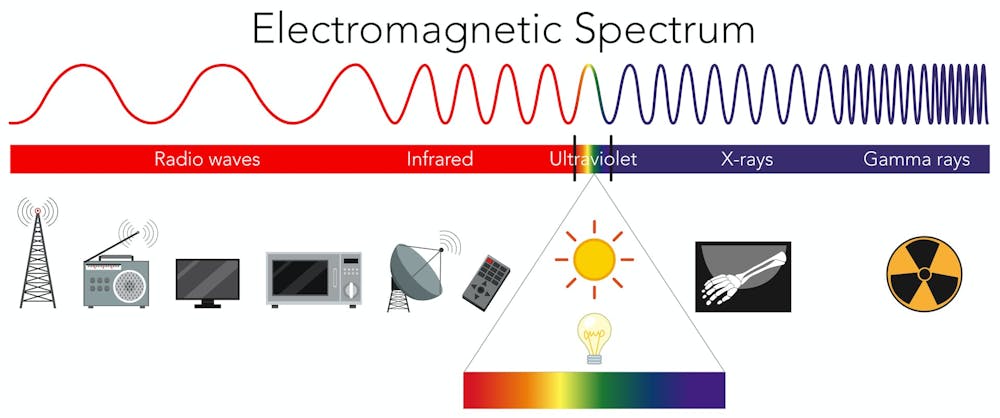
Light is just a type of energy, travelling through space. There are many different types of light we can’t physically see, but can detect and even use. For example, ultraviolet light that comes from our Sun is why you have to wear sunscreen – so the light doesn’t hurt your skin.
The electromagnetic spectrum includes all types of electromagnetic radiation – that is, energy. The bit in the middle with a rainbow and a sun symbol on it marks visible light. Shutterstock
It’s important for us to remember that just because light doesn’t have mass, it still is very much a physical thing in our universe, following physical laws.
The neat thing is, no matter what type of light, it all follows the same physical laws in the universe. One rule is that light always wants to travel in a straight line through space.
This is where we now need to break down gravity, and what space is made of.
2) What is gravity?
Gravity is the force that keeps us safe here on Earth. It also keeps Earth circling around (orbiting) our Sun. But what causes gravity?
Many scientists in history pondered this question, and came up with all sorts of theories. But when Albert Einstein presented his theory on general relativity in 1915, we started to really understand exactly what gravity was, and how it affects our universe.
Einstein had mathematically worked out that we exist in something called “spacetime”. You can picture this as the fabric of our universe. Like a fabric, it can bend and stretch. I like to picture space like a trampoline. When you put something heavy (like a bowling ball) in the middle of a trampoline, the fabric underneath it bends and sinks down.
A trampoline being bent by a bowling ball is not unlike spacetime being bent by something heavy. This is how gravity works. Sara Webb, CC BY
Now imagine a universe-sized trampoline, and we place our Sun on it. The dip in that trampoline represents the gravity of the Sun. And we can do this with every object that has mass.
When spacetime is bent by that mass, the lines that would normally be straight become slightly curved – you can see that in the picture below. This is most extreme around the really massive objects we call black holes.
Spacetime bending around the Sun compared to a black hole. Note the lines that once would have been straight are bent and curved under the gravity. Sara Webb/Wikimedia Commons, CC BY
Black holes are, in my opinion, one of the coolest things we’ve ever discovered in the universe. Black holes are regions of space so dense, nothing can escape.
They are usually formed when very large stars get too heavy and collapse (implode) on themselves. Astronomers think all the mass in the black hole is actually squished into a single point in the middle.
Black holes get a bad reputation for eating “anything that is near them”, which is just not true. Black holes do have a distance from their centre, which we mark as the point of no return. This is called the event horizon.
But farther away from this point, light and matter can circle around a black hole for a very long time.
So how can a black hole pull in light?
Now we’ve broken down those three key things, we can answer the great question asked by Will: how can a black hole pull in light?
When light is travelling near a black hole, it is still trying to travel in a straight line. As it gets closer to the black hole where spacetime is bent, the light will follow those bends.
When light gets very close to the black hole, it can be trapped circling around and around it. That’s because the fabric of spacetime is bent to the extreme. As you’ll remember, light is indeed a physical thing and is affected by spacetime.
Possibly my favourite part about this fact is it doesn’t just apply to black holes.
Anything with enough mass can make light bend around it, even our Sun. This was how scientists first confirmed Einstein’s theory of gravity was likely correct in 1919.
Something really heavy, like a whole group of galaxies clumped together, can bend space so much, it works like a magnifying glass and shows zoomed-in pictures of the stars behind it.
Sara Webb does not work for, consult, own shares in or receive funding from any company or organisation that would benefit from this article, and has disclosed no relevant affiliations beyond their academic appointment.
Source: The Conversation (Au and NZ) – By Kate C. Prickett, Director of the Roy McKenzie Centre for the Study of Families and Children, Te Herenga Waka — Victoria University of Wellington
By introducing four weeks of paid parental leave for partners if re-elected, the Labour Party would move New Zealand out of an undesirable and tiny club of OECD nations. Only the United States and Israel would then not offer something similar after the birth (or adoption) of a baby.
But that’s not to say New Zealand might become a world leader in paid parental leave. In fact, the promised four weeks would move New Zealand into the middle of the OECD rankings on length of leave available.
Furthermore, the proposed reimbursement rate would pay the leave at below the current minimum wage. This puts New Zealand back towards the bottom third of the OECD when it comes to the average number of weeks a parental partner’s actual income is replaced under such a scheme.
Nonetheless, the prime minister was correct to note the policy was the “right thing to do”, and that it will ease the financial burden on families that would otherwise take unpaid leave.
Partner’s leave will also provide crucial support during those early days with a newborn, when extra hands and sleep are in short supply – especially for those families for whom taking unpaid leave would be prohibitively expensive. Whether it is adequate is another question, however.
Duration and remuneration matter
The research evidence suggests a myriad social and economic benefits for families. Reserved leave quotas for fathers have been shown to increase the likelihood of men taking any parental leave after the birth of a child. (Most research in this area focuses just on new fathers, rather than a wider sample of non-birth parents.)
Importantly, paid paternity leave is also associated with better outcomes for the child, such as their cognitive development, both in the short term and later in life.
Such policies have also been shown to improve mothers’ incomes and career trajectories over time, because they can return to work sooner or take on hours they might not have been able to. Overall, families are financially better off in the long term.
However, many of these studies – while extremely rigorous and using statistical methods that can make the case for a causal impact – are using data from countries with much more generous partner and parental leave systems than New Zealand’s, even if Labour gets to introduce its new policy.
Positive effects of partner and paternal leave have been found in countries where the leave duration is longer. Wage reimbursement is also much closer to the parents’ actual work income – up to a certain amount, but typically capped at a rate that is higher than the median wage.
In Norway, for example, new parents are entitled to nearly one year of paid parental leave, at full wage compensation (capped, but still at a very high amount). Those 49 weeks’ leave can be shared however parents like.
A similar scheme exists in Denmark and Sweden. To encourage non-birth partners to take up parental leave, some countries operate a “bonus” leave scheme: if partners take leave, mothers or the birth parent qualify to take even more.
Baby steps
There may not be the political or public appetite in New Zealand to move closer to the gold standard of the Scandinavian models. But less generous entitlements risk being still too expensive for families to take up. And this threatens the universality of the policy – available to everyone, regardless of income.
The proposed reimbursement rate would mean many New Zealand partners who take up the leave would receive an income below the minimum wage. While this is technically better than unpaid leave, it amounts to an effective pay cut many families will not be able to afford – especially during a cost of living crisis.
There may be unintended consequences, too. Families that could always afford to take unpaid parental leave will be disproportionately more likely to take advantage of the new allowance compared to lower- and middle-income families. And a number of families will be omitted in the first place, such as children with sole parents.
None of this is to suggest paid partner leave is not a necessary and important step towards better supporting families during a crucial period in their lives, one that has been shown to be critically important for child development and shaping longer term wellbeing.
If implemented, it would help ensure New Zealand doesn’t continue to fall behind other nations in its commitment to strong families. But the scope and generosity of the policy on offer falls well short of the evidence-backed benefits that appropriately funded partner leave can have for children and their families.
Kate C. Prickett is the Director of the Roy McKenzie Centre for the Study of Families and Children, which has previously received research funding from the Ministry of Social Development and the Department of Prime Minister and Cabinet.
A GPs advocacy group says that practices learned from the covid-19 pandemic, like staying home when sick or wearing masks in health facilities, should remain in place to halt the spread of infectious diseases.
As of August 15, the mandates ended for the seven-day isolation period and masks in health settings, with the Health Minister Dr Ayesha Verrall saying wastewater testing showed little trace of the virus.
Dr Verrall acknowledged many would still feel vulnerable.
“So it is on all of us to think well if we’re visiting an aged residential care home for example, that we do follow the recommended procedures there.
“Te Whatu Ora will continue to encourage people to wear masks when they go to hospital — they won’t be mandated.”
Covid cases accounted for just over 2 percent of hospital admissions, Dr Verrall said.
Last step on wind down Prime Minister Chris Hipkins told RNZ Morning Report this was the last step in winding down covid-19 restrictions.
“We waited until after the winter peak period. The health system overall, while it’s been under pressure and it’s still under pressure, had a much better winter this winter than last winter.”
He said it was on the advice of the director-general of health and there was never a perfect time to make changes to health settings.
General Practice New Zealand chair Dr Bryan Betty said practices like mask wearing and self-isolation should be encouraged for all viruses, not just Covid.
He told Morning Report people needed to continue with the lessons that were learnt from covid but which were applicable to all viruses that were spread from person-to-person such as influenza and RSV.
“Voluntarily staying at home if you do have a flu or a cold so you don’t spread it, and I think masking in public areas of health facilities voluntarily is something we should still keep in play.”
Health providers should consider ensuring masks were worn in places where sick people gathered such as hospitals or GPs’ waiting areas, Dr Betty said.
Vaccination still important Vaccination would still play an important part in reducing infection and re-infection, he said.
“We do that every year for influenza, we are potentially going forward going to be recommending that for covid, especially for vulnerable populations.”
Employers should be considering how to support workers so they do not come into work sick, he said.
Employers should give people with colds, the flu or Covid the opportunity to work from home if they can to avoid spreading the illness around the workplace, he said.
University of Otago epidemiologist Professor Michael Baker also urged people to stay home when they were sick with covid-19, even though all of the health restrictions had been lifted.
Professor Baker told Morning Report that covid had transitioned from a pandemic threat to an endemic infectious disease.
“Unfortunately that means it’s there the whole time, it is still in New Zealand among the infectious diseases, the leading cause of death and hospitalisation and we know that those infections and reinfections are going to add to that burden of long covid.”
Still vital to isolate People must remember that it was still vital to isolate when they were sick and not go to work or school or socialise which spread the virus, he said.
People should also continue to wear masks in medical facilities and in poorly ventilated indoor spaces, he said.
New Zealand had come through its fourth wave of infection for the Omicron variant, he said.
“We are going to see new subvariants or lineage of the virus arrive, they will be better at escaping from our immunity, our immunity will wane of course unless you get boosted.”
The government needed to look at how to reinforce those behaviours that prevented covid from spreading now that the mandates had been removed, he said.
“I mean this could be running media campaigns or developing codes of practice say with employers, Business New Zealand, I mean this is a chance for them really to show leadership about how they’re going to support the workforce in New Zealand, self-isolating when they are sick.”
Hospitilisations and mortality rates showed that covid-19 continued to have an impact and watching those rates would indicate whether the mandates had been removed too early, he said.
Integrated approach needed New Zealand needed to develop a coherent, integrated approach to dealing with all respiratory infections which were the infectious diseases that had the biggest impact, he said.
“They have a big drain on our health resources and so we do need to look at better surveillance for these infections that will tell us what’s happening and also really it’s just having a culture of limiting transmission of these infections.”
That meant staying home when sick and using masks in indoor environments with poor ventilation, he said.
Auckland Council disability strategic advisory group chair Dr Huhana Hickey said getting rid of masks at health care centres was extremely dangerous for immunocompromised people.
“The problem for immune-compromised people is we’re frequent flyers, but we’re being asked to go into a situation that puts us all at risk of not just dealing with what’s making us sick but risking getting covid, which could kill us.”
Hickey said scrapping the seven-day compulsory isolation period could result in more workers returning while still infectious, which she believed would mean immunocompromised people were likely to stay home.
“If they cannot stay home and employers require them to work, they’re going to spread covid as well, so that means I don’t go to restaurants now because I don’t know if the waiter’s sick, I don’t know if the chef’s sick.”
Minimal impact of numbers University of Auckland mathematics professor and covid-19 modeller Michael Plank expected the lack of mask and isolation requirements to have a minimal impact on case numbers.
He said the main drivers of infection were people who were asymptomatic cases or had not tested yet.
“I’m not sure than an isolation mandate is going to have a particularly large effect on infection rates in the long term.
“If we look at other countries that removed isolation mandates, like Australia, there’s really no evidence of a surge in numbers.”
Restaurant owners embraced the government’s decision.
The Restaurant Association surveyed more than 200 of its members, and 84 percent said they supported the idea.
But many planned to introduce their own requirements, chief executive Marisa Bidois said.
“Thirty nine percent of the respondents said they intended to mandate a five day isolation period for their employees,” she said.
“So that’s something they’re going to implement themselves as an internal policy.”
Many hospitality workers would also be expected to test themselves proactively.
“We also had 42 percent of respondents planning to require employees with any symptoms to undergo testing before returning to work.”
This article is republished under a community partnership agreement with RNZ.
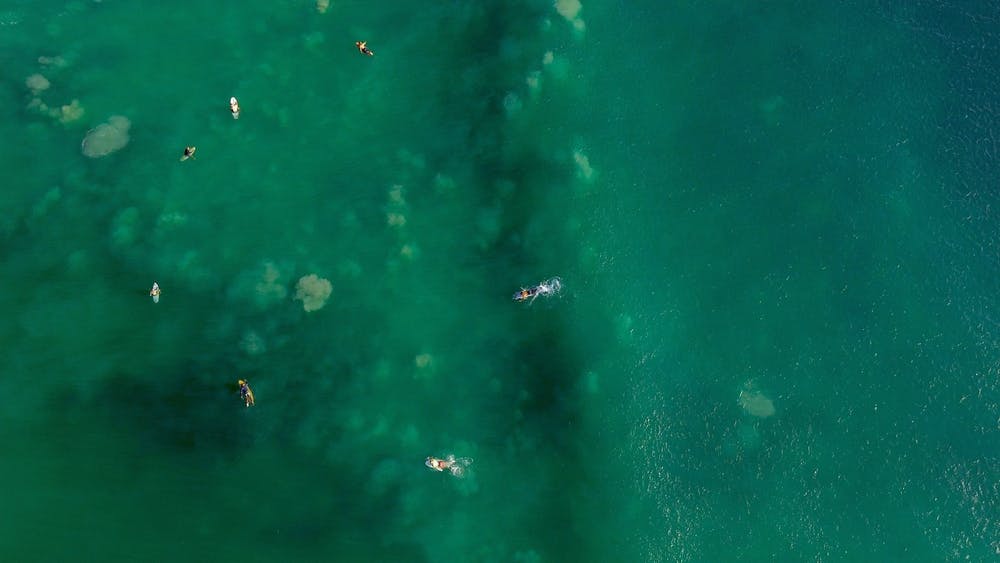
News that four Australians and two Indonesian crew members have been found alive after going missing on Sunday from a boat trip off the coast of Aceh in Indonesia has made headlines around the world.
The group, which was on a surfing trip, was found “bobbing around on their surfboards”, according to media reports quoting the father of one of the Australian surfers.
Our research in the Extreme Environments Laboratory at the University of Portsmouth focuses on how humans survive and respond to adverse environments.
So what does it take to survive such gruelling conditions?
Without air you only survive for a matter of minutes. Without sufficient warmth you only survive hours. Without sufficient drinking water you can survive up to six or seven days in a maritime environment. Without food you can survive 40–60 days.
So, those who survive more than a few hours are almost always in warm air or water.
Because you can eventually cool even in water that is relatively warm, you are better off out of the water than in it. Being on top of a surfboard is a step in the right direction.
When the water and air are warm, the primary problem is dehydration.
Death due to dehydration occurs when you lose about 15–20% of your body weight in fluid.
Even at 5% dehydration you can get headaches, become irritable and feel lightheaded. At 10% you may be dizzy, feel faint, have a rapid pulse and rapid shallow breathing. Thereafter, hallucinations and delirium are common.
To survive longer than six or seven days, when dehydration is your major threat, you must do two important things.
First, try to find fresh water. The absolute minimum you need to find is 110–220 millilitres a day, although 400mL per day is safer.
If you were prepared, you may have taken water with you as you embarked on your survival voyage.
If you are lucky, it might rain and you may be able to collect some rainwater in suitable, uncontaminated containers.
Surfers are unlikely to have devices such as a solar still or a reverse osmosis pump available to purify water for safe drinking. But other sources of useful fluids include fish “lymph” squeezed from the flesh of fish. This has about the same salt concentration as human body fluid (0.9%), so is only helpful if you are very dehydrated.
What you must not do, despite what becomes an overwhelming urge, is drink the seawater that surrounds you.
Seawater has an average salt concentration of 3.5%, so drinking it adds to the salt load of the body.
You should also not drink urine in this situation, because it will also contribute to salt building up in your body.
Bobbing around on a surf board is better than paddling in it and getting hot and sweaty. Shutterstock
Conserving fluids
The second important factor is to conserve body fluid.
The body of a 75kg person contains nearly 50 litres of water, and in a survival situation where dehydration is your greatest threat, conserving this water is crucial.
The body helps. With a body fluid loss of 1% of body weight and consequent decrease in blood volume and increase in salt concentration, the body increases the production of the anti-diuretic hormone that lowers urine production by the kidneys.
You can provoke this response by drinking nothing in the first 24 hours of a survival voyage.
At the same time, it is important to do as little as possible. Try to minimise heat production by the body, which will mean less sweating.
So “bobbing around” on a surfboard is better than paddling it and getting hot and sweaty.
Normally, you would seek or make shade on your survival craft and rest during the hottest parts of the day. This is not possible on a surfboard, but periodic wetting from waves may keep you cool and help reduce sunburn (which can impair your ability to control your body temperature) by cooling the skin and covering it periodically.
The longer-term challenge is starvation – but this is a less pressing problem than dehydration.
Survival at sea depends on knowing how your body works and what it needs, and then doing the right things.
Experience helps. Being used to the sea means you remain more relaxed in a crisis and are less likely to become seasick (which can accelerate dehydration, impair body temperature regulation and destroy morale).
Being with others helps morale and decision-making. Young and fit people, such as many surfers, are less likely to have other health-related problems that may compromise their survival prospects.
Vanuatu’s Parliament is scheduled to meet tomorrow to debate a motion of no confidence against Prime Minister Ishmael Kalsakau’s government.
A political stalemate persists, with both the government and the opposition having the support of 25 MPs each.
The mover of the motion, opposition leader and a former prime minister Bob Loughman, requires the backing of at least 27 members to unseat Kalsakau.
However, Kalsakau also needs a majority in the House if he is to be able to pass legislation going forward.
Last Thursday, the government side boycotted a special sitting of Parliament to avoid the no-confidence motion.
Kalsakau told local media on Monday that the opposition’s attempts to unseat him was “irresponsible” and “a big waste of resources at a time when we are trying to rebuild our nation”.
Another former PM and head of the Reunification Movement for Change, Charlot Salwai, urged politicians to “unite and come out of this political crisis”.
Time for MPs to ‘find a solution’ “Vanuatu has experienced consequences of no-confidence motions over the past years and it is time for the MPs to come together and find a solution.
“The country and people are suffering because of our attitudes,” Salwai said.
There are 52 seats in the Vanuatu Parliament. One is vacant and one empty.
Both sides are claiming a National United Party MP, Bruno Leingkone, who is receiving medical attention abroad, is on their side.
According to the Vanuatu Daily Post, Loughman said Leingkone was expected to vote for the motion of no trust in PM Kalsakau virtually.
The first-ever law to regulate political parties has been tabled in the 2nd Extraordinary Session summoned 2 weeks ago to start next week. Then last week a motion of no confidence was tabled to be debated before those Bills can be tabled. Vanuatu’s perpetual political “Catch-22” https://t.co/UMzQoO0zxN
RNZ Pacific’s Vanuatu correspondent Hilaire Bule said “the situation will be [clearer] when the Parliament is in session on Wednesday”.
“But the target of the government at the moment is to make sure that the opposition must not have 27 [MPs],” he told RNZ Pacific Waves.
“If the opposition reach 27 in the Parliament, the opposition will pass its motion against Prime Minister Kalsakau.”
Bule said the Parliament could not be dissolved as was the case last year, which resulted in a snap election.
“We have ended up in the political crisis because the Council of Ministers cannot request the President of the Republic to dissolve the Parliament because our constitution says that Parliament must have one year before a majority of members of Parliament or Council of Ministers can apply for dissolution of the Parliament,” he said.
“That one year of Parliament will be only on December this year.”
Bule said people had become accustomed to facing political crisis in the country and it was “part of their life”.
This article is republished under a community partnership agreement with RNZ.
This open letter to En Avant Toute and journalists at France 24 and France Info marked the International Day of the World’s Indigenous Peoples last week. It has been sent to Asia Pacific Report and Pacific Media Watch.
A controversial report by a French metropolitan not-for-profit about sexual and sexist violence in France’s overseas territories — including Kanaky New Caledonia — has had its findings reported in mainstream French media, stirring strong criticism by Kanak social justice and human rights advocates.
The report has led to a condemnation and accusations of “colonialism and racism” in an open letter directed at the NGO, En Avant Toute(s), and two mainstream media outlets that carried news about the findings, France 24 and France Info.
“It is really about journalism, feminism, and decolonisation of knowledge production,” says an Pacific Media Watch correspondent about the issue.
The controversial En Avant Toutes report on Kanaky New Caledonia . . . no on-the-ground research. Image: En Avant Toutes/APR screenshot
“The problem is the organisation didn’t actually travel to New Caledonia. Instead, they conducted phone interviews with a select, small group of NGOs in New Caledonia’s Southern Province, leading to comments in the media about Kanak tradition and sexual abuse which were wrong.”
The open letter, sent to Asia Pacific Report, says:
Our approach is first rooted in our need to denounce the severity of the lies that have been mediatised and to minimise the harm done, but also to educate on the struggles of Indigenous peoples and the fight against sexual and sexist oppression, specifically in a colonial context, and so that the tools and resources that are deployed in these struggles serve the people who are affected first and foremost.
We are Indigenous, Kanak, French, women, men, people from Kanaky/New Caledonia committed to social justice in our country at a personal level, professional level, but also as volunteers, advocates and militants in associations.
This report was produced by the French association named En Avant Toute(s) and it attempts to explore the contexts of the French overseas territories when it comes to sexual and sexist violence against women and LGBTQIA+ people.
It also assesses the needs for their chat service, currently mostly operating in hexagonal France. We are alarmed by two main points: 1/ Misinformation in the media; 2/ How weak the report is as well as its colonial approach, which shows a lack of understanding of French overseas territories, and of Kanaky/New Caledonia more specifically, since that is what affects us.
The France 24 report on the alleged Kanaky “silence” over sexual violence . . . one of the criticised articles in the open letter. Image: France 24/APR screenshot
“What will the victims turn to? Customary law or common law?… It is not the same text. Customary law is based on ancestral practices. Sometimes, victims must apologize to their perpetrator to settle conflicts within a clan.’”
This information is shared once again in an interview published on July 29, 2023 by France 24 in which Garnier-Brun indicates that “in New Caledonia, the co-existence of common law and customary law can represent a risk factor for women in terms of their exposure to violence” and that “some Kanak tribes have traditions which demand that the victims of violence ask their perpetrators’ for forgiveness”.
We would like to ask you the following questions: What are these allegations based on? This is a scoop that Kanak women and men are finding out about with surprise and horror from our dear islands on which you have not had the pleasure to set foot on to conduct your research.
What do you know about our traditions, about Kanak culture, about the stakes at play in the coexistence of customary and common law? What do you even know about violence against women in Kanaky/New Caledonia to draw such dangerous conclusions, make them into statements easily shareable by French media, which don’t even seriously fact check the information, especially when we know how important and worrying the topic of violence against women is?
Kanak custom condemns violence against women, and does not protect perpetrators, contrary to what is suggested in these interviews.
Then, in an interview published on July 18, 2023 by Causette magazine, la Case Juridique Kanak (ACJK) is described as a “local religious community”. For your information, the ACJK is an association of volunteer lawyers who are mobilised around questions of customary law. Therefore, it is not a “local religious community” as the interview suggests.
It is clear, and we regret it, that these declarations belong to a time we wished was in the past, but apparently persists since it is resurfacing through your narrative. It is part of a discourse that suggests that Indigenous and colonised peoples, including the Kanak people, supposedly have backward traditions, unaligned with Western civilisation, which is seen as the reference, given that it is supposedly more advanced on the question of gender equality.
The mediatisation of this type of discourse is an insult, an example of colonial ignorance, a major contribution to misinformation and the reproduction of a backward, discriminatory, racist and colonial vision of the French overseas territories. Consequently, this misinformation makes us question:
Firstly, the legitimacy of the En Avant Toute(s) representatives to speak about sexual and sexist violence in the overseas territories, and more specifically, in Kanaky/New Caledonia;
Secondly, the fact that this information is shared by French media without any control or verification with knowledge holders in the country.
The production of colonial knowledge En Avant Toute(s) is clear in its motivations. As is indicated in a publication made on the association’s Linkedin page, one of the objectives of the report was to analyze the situation in the overseas territories to think about the implementation of their chat service Commentonsaime.fr in our territories.
En Avant Toute(s) did not travel to our countries but spoke to some associations through videoconferences. When it comes to Kanaky/New Caledonia, En Avant Toute(s) was in contact with two associations: Le Relais and Centre d’Information Droit des Femmes et Egalité (CIDFE), both associations based and funded by the Southern Province, one of the three provinces in the country.
According to us, having only spoken to a small number of associations, En Avant Toute(s) is not in a position to produce an empirical, informed and critical report, which would allow a better understanding of violence perpetrated against young women and the LGBTQIA+ community in Kanaky/New Caledonia.
For this to be the case, they should have been in conversation with many more actors and partners across the country, to have a more extensive and representative sample.
Looking at the lack of sufficient data and the primary aim which was to analyse different overseas contexts to assess the possible implementation of the chat service, it seems that calling the document a “report” is a little ambitious, if not inappropriate.
The approach does not come from our territories and is not led or co-produced with local populations or associations. It would be more appropriate to speak of the beginning of a market research or a feasibility survey. Here, words matter, since the publication of a report confers authority and suggests expertise.
However, in our context, we do not think that En Avant Toute(s) is able to speak about sexual or sexist violence in Kanaky/New Caledonia in the media, nor to produce a report on the topic. We would like to invite the members of En Avant Toute(s) who have participated to this survey as well as the media who have participated to its legitimisation to think about the conditions that authorise individuals who have never set foot on, nor are implicated in, our territories, to publish “reports” and be interviewed by national media as experts of our contexts.
In addition, we condemn that the launch of the so-called report took place in hexagonal [mainland] France and that many associations committed to the struggle against sexual and sexist violence in our country were not invited to participate.
Indeed, we only learnt about this study through the media. We denounce this type of colonial practices, where resources are extracted from our territories so that organisations, companies, associations in France can benefit from them, without us being directly implicated.
We understand that the stakes are the possible implementation of a tool which would complement what is already in place to tackle sexual and sexist violence in our territories, and that the intention is commendable. Nevertheless, without any real collaboration with the most affected and informed people, we remain sceptical of its possible results.
We also cannot be convinced of the efficacy of such a tool when we have no information regarding the performance of the chat service in hexagonal France, nor any about the ways in which En Avant Toute(s) would adapt it to our territories.
Faced with these alarming observations and in order to minimise the harm done to the Kanak people in the name of tribal Kanak women, whose voices are absent from the report and in the media, here are our demands:
A statement written by En Avant Toute(s) to be published on all their social media platforms and on their website, which would refute the declarations made in relation to a so-called Kanak tradition that would require victims of sexual violence to ask their perpetrators for forgiveness in some tribes;
The deletion of this misinformation in the interviews published by France Info and France 24, with an explanatory note; and
A right of reply in the media that published this information, France Info and France 24, in order to deny these harmful declarations and enable the women who are involved in the struggle against sexist and sexual violence in Kanaky/New Caledonia to have their voices heard nationally.
Our primary aim remains social justice in our country, and it is only attainable if we pay attention to all the axes of oppression, including the ways in which colonialism and racism play a significant role in the oppression of women.
Racism and colonialism also impact [on] our relations as militants, advocates, members of feminist associations, and particularly when it comes to North/South and Hexagone/Overseas territories relations.
This requires that for all collaborative work with associations, groups and collective that are not based in our territories, there is a shared understanding of our historical and political contexts and of the power dynamics at play, an attention paid to not reproducing harmful discourses which participate in the silencing of colonised women, and the consideration of people who are involved in and from our territories as the most suitable to speak about the issues they face and struggle against.
Signatories La Pause Décoloniale (Kanaky/Nouvelle-Calédonie) Union des Femmes Francophones d’Océanie (UFFO) NC (Kanaky/Nouvelle-Calédonie) Arnaud Chollet-Leakava, Porte-Parole du Mouvement des Océaniens Indépendantistes (MOI) (Kanaky/Nouvelle-Calédonie) Oriane Trolue, Chargée de la condition féminine de politique décoloniale du Mouvement des Océaniens Indépendantistes (MOI) (Kanaky/Nouvelle-Calédonie) Hugues Vhemavhe, Sénateur Coutumier de l’Aire Hoot Ma Whaap (Kanaky/Nouvelle-Calédonie) Rolande Trolue, feminist and resource person (Kanaky/Nouvelle-Calédonie) Fara Caillard, Marche Mondiale des Femmes (Kanaky/Nouvelle-Calédonie) Billy Wete, pastor (Kanaky/Nouvelle-Calédonie) Morgane Lepeu ép. Goromoedo (Kanaky/Nouvelle-Calédonie) Denis Pourawa, Kanak poet-writer (Kanaky/Nouvelle-Calédonie) Teva Avae, artist (Kanaky/Nouvelle-Calédonie) Ronny Kareni, West Papua Merdeka Support Network & Rise of the Morning Star (West Papua) Florenda Nirikani, Militante Éducation Populaire CEMEA Pwârâ Wâro (Kanaky/Nouvelle-Calédonie) Virginie Murcia, president of the Union des Groupements Parents d’Élèves UGPE (Kanaky/Nouvelle-Calédonie) Doriane Nonmoira, Union des Femmes Francophone d’Océanie (Kanaky/Nouvelle-Calédonie) Wendy Nonke, Mouvement pour un Souriant Village Mélanésien (Kanaky/Nouvelle-Calédonie) Patrick Tara (Kanaky/Nouvelle-Calédonie) Justine-Rose Boaé Kéla (Kanaky/Nouvelle-Calédonie) Swänn Iché (Kanaky/Nouvelle-Calédonie) Laurent Lhermitte, Les Insoumis du Pacifique (Kanaky/Nouvelle-Calédonie) Raïssa Weiri (Kanaky/Nouvelle-Calédonie) Marie-Rose Yakobo, student (Kanaky/Nouvelle-Calédonie) Yvette Danguigny, Association Natte Kanak (Kanaky/Nouvelle-Calédonie) Nathanaëlle Maleko (Kanaky/Nouvelle-Calédonie) David Robert, Union Calédonienne (Kanaky/Nouvelle-Calédonie) Alexia Babin (Kanaky/Nouvelle-Calédonie) Pierre Chanel Nonmoira, customary leader (Kanaky/Nouvelle-Calédonie) Gladys Nekiriai (Kanaky/Nouvelle-Calédonie) Sabrina Pwéré (Kanaky/Nouvelle-Calédonie) Xavier Nonmoira, young Kanak revolutionary (Kanaky/Nouvelle-Calédonie) Adeline Babin (Kanaky/Nouvelle-Calédonie) Ghislaine Pwapy (Kanaky/Nouvelle-Calédonie) Valentin Nemia (Kanaky/Nouvelle-Calédonie) Célestine Beleouvoudi (Kanaky/Nouvelle-Calédonie) Mériba Karé (Kanaky/Nouvelle-Calédonie) Présence Kanak (Kanaky/Nouvelle-Calédonie) Jacques Guione, Association Djors (Kanaky/Nouvelle-Calédonie) Ludmila Jean, Association Djors (Kanaky/Nouvelle-Calédonie) Yvette Poma (Kanaky/Nouvelle-Calédonie) Marie-Madeleine Guioné, Kanak woman (Kanaky/Nouvelle-Calédonie) Augusta Nonmoira, Kanak woman (Kanaky/Nouvelle-Calédonie) Lucien Sawaza (Kanaky/Nouvelle-Calédonie) Monique Poma (Kanaky/Nouvelle-Calédonie) Jean Rock Uhila (Kanaky/Nouvelle-Calédonie) Vaïana Tiaore, Corail Vivant Terre des Hommes (Kanaky/Nouvelle-Calédonie) Laurie Anne Le Pen (France) Aaron Houchard Mitride (Kanaky/Nouvelle-Calédonie) Roger Nemia (Kanaky/Nouvelle-Calédonie) Atrune Palene (Kanaky/Nouvelle-Calédonie) Amandine Tieoue (Kanaky/Nouvelle-Calédonie) Iouanna Gopoea (Kanaky/Nouvelle-Calédonie) Sylviany M’boueri (Kanaky/Nouvelle-Calédonie) Valentine Wakanengo (Kanaky/Nouvelle-Calédonie) Simane (Kanaky/Nouvelle-Calédonie) Jacinthe Kaichou (Kanaky/Nouvelle-Calédonie) Romain Purue (Kanaky/Nouvelle-Calédonie)
New research shows that more than half of New Zealanders are struggling financially.
The annual survey by the Retirement Commission found the number of people in financial difficulty increased by 17 percent since their first survey in 2021.
A total of 55 percent reported being in a financially difficult position – including many Pacific Islanders.
Of those surveyed, 51 percent reported they were “starting to sink” or “treading water”, while a further 3.5 percent reported they were “sinking badly”.
Personal Finance lead Tom Hartmann said women, Māori and Pacific Peoples were being hit the hardest.
The survey found 61 percent of women were financially struggling in contrast to 48 percent of men.
Sixty percent of Māori and 58 percent of Pacific Peoples also reported feeling financially stressed. Those aged 18-34 were also more likely to experience financial stress.
Hartmann said it was concerning that so many New Zealanders were feeling the pressures of cost increases.
Long-term consequences “We have now tipped into more than half the population feeling squeezed financially. This significantly reduces people’s ability to grow their money for tomorrow, which has long-term consequences for their future financial well-being,” he said.
The survey found that more people were borrowing money, but also that more people were budgeting and saving.
It also reported that the gap was widening for women compared to men in terms of optimism, financial sentiment, personal savings and savings for retirement.
The main source of data for the information came from the Retirement Commission’s online population survey of New Zealanders aged over 18 which is run by market research agency TRA. The commission said the sample was nationally representative of New Zealand based on age, gender and region.
This article is republished under a community partnership agreement with RNZ.
Earth is warming and the signs of climate change are everywhere. We’ve seen it in the past few weeks as temperatures hit record highs around the world – both in the Northern Hemisphere and the warm Australian winter.
Global warming is caused by humanity’s greenhouse gas emissions, which continue at near-record pace. These emissions are predominantly generated by people in the world’s wealthiest regions.
Our world-first analysis, published today, examines the experience of global warming over the lifetimes of people around the world: young and old, rich and poor. We sought to identify who has perceived warmer temperatures most keenly.
We found middle-aged people in equatorial regions have lived through the most perceptible warming in their lifetimes. But many young people in lower-income countries could experience unrecognisable changes in their local climate later in life, unless the world rapidly tackles climate change.
Measuring the climate change experience
We examined temperature data and population demographics information from around the world.
Key to our analysis was the fact that not all warming is due to human activity. Some of it is caused by natural, year-to-year variations in Earth’s climate.
These natural ups and downs are due to a number of factors. They include variations in the energy Earth receives from the sun, the effects of volcanic eruptions, and transfers of heat between the atmosphere and the ocean.
This variability is stronger in mid-to-high-latitude parts of the world (those further from the equator) than in low-latitude areas (in equatorial regions). That’s because the weather systems further away from the equator draw in hot or cold air from neighbouring areas, but equatorial areas don’t receive cold air at all.
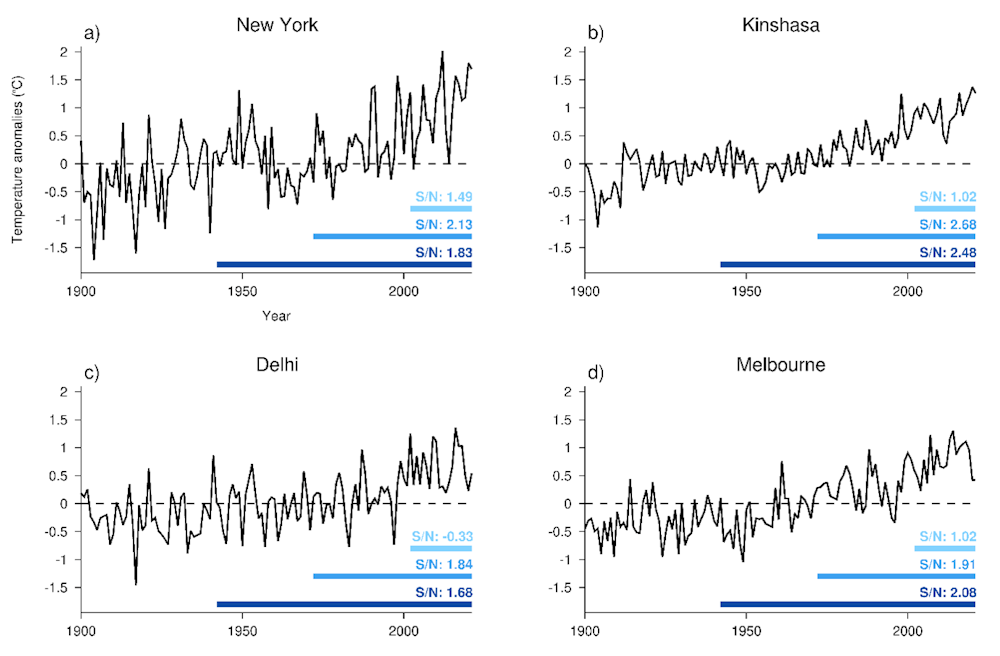
That’s why, for example, the annual average temperature in New York is naturally more variable than in the city of Kinshasa (in the Democratic Republic of Congo).
To account for this, we applied what’s known as the “signal-to-noise ratio” at each location we studied. That allowed us to separate the strength of the climate change “signal” from the “noise” of natural variability.
Making this distinction is important. The less naturally variable the temperature, the clearer the effects of warming. So warming in Kinshasa over the past 50 years has been much more perceptible than in New York.
Our study examined two central questions. First, we wanted to know, for every location in the world, how clearly global warming could be perceived, relative to natural temperature variability.
Second, we wanted to know where this perceived change was most clear over human lifetimes.
Annual-average temperatures at four major cities with signal-to-noise ratios shown for 20, 50 and 80 years up to 2021. Author provided
Our results
So what did we find? As expected, the most perceptible warming is found in tropical regions – those near the equator. This includes developing parts of the world that constitute the Global South – such as Africa, Latin America and the Caribbean, and Asia.
Household incomes in the Global South are typically lower than in industrialised nations (known as the Global North). We might, then, conclude people in the poorest parts of the world have experienced the most perceptible global warming over their lifetimes. But that’s not always the case.
Why? Because most parts of the Global South have younger populations than wealthier regions. And some people under the age of 20, including in northern India and parts of Sub-Saharan Africa, haven’t experienced warming over their lifetimes.
In these places, the lack of recent warming is likely down to a few factors: natural climate variability, and the local cooling effect of particles released into the atmosphere from pollution and changes in land use.
There’s another complication. Some populated regions of the world also experienced slight cooling in the mid-20th century, primarily driven by human-caused aerosol emissions.
So, many people born earlier than the 1950s have experienced less perceptible warming in their local area than those born in the 1960s and 1970s. This may seem counter-intuitive. But a cooling trend in the first few decades of one’s life means the warming experienced over an entire lifespan (from birth until today) is smaller and less detectable.
So what does all this mean? People in equatorial areas born in the 1960s and 1970s – now aged between about 45 and 65 – have experienced more perceptible warming than anyone else on Earth.
Our findings also raise significant issues of fairness and equity.
Humanity will continue to warm the planet until we reach global net-zero emissions. This means many young people in lower-income countries may, later in life, experience a local climate that is unrecognisable to that of their youth.
Of course, warming temperatures are not the only way people experience climate change. Others include sea-level rise, more intense drought and rainfall extremes. We know many of these impacts are felt most acutely by the most vulnerable populations.
Cumulative greenhouse gas emissions are much higher in the Global North, due to economic development. To address this inequality, rich industrialised nations must take a leading role in reducing emissions to net-zero, and helping vulnerable countries adapt to climate change.
Source: The Conversation (Au and NZ) – By Adrian Beaumont, Election Analyst (Psephologist) at The Conversation; and Honorary Associate, School of Mathematics and Statistics, The University of Melbourne
Dean Lewins/AAP
A federal Resolve poll for Nine newspapers, conducted August 9–13 from a sample of 1,603, gave Labor 37% of the primary vote (down two since the July Resolve poll), the Coalition 33% (up three), the Greens 11% (steady), One Nation 5% (down one), the UAP 2% (up one), independents 10% (up one) and others 2% (steady).
Resolve does not give two party estimates until close to elections, but applying 2022 election preference flows to these primary votes gives Labor about a 56–44 lead, a 2.5-point gain for the Coalition since July. Resolve has easily been Labor’s most favourable pollster since the 2022 election.
Anthony Albanese’s ratings were 44% good and 42% poor, for a net approval of only +2, down 14 points since July. Peter Dutton’s net approval was up two points to -13. Albanese led Dutton by 46–25 as preferred PM, a nine-point narrowing from 51–21 in July.
In a forced choice question on the Indigenous Voice to parliament, “no” led by 54–46 (a 52–48 “no” lead in July). Initial preferences were 45% “no” (up three), 37% “yes” (up one) and 18% undecided (down four).
This is Albanese’s worst net approval, Labor’s lowest primary vote and implied two party lead and the worst result for “yes” in Resolve polls conducted since the May 2022 election.
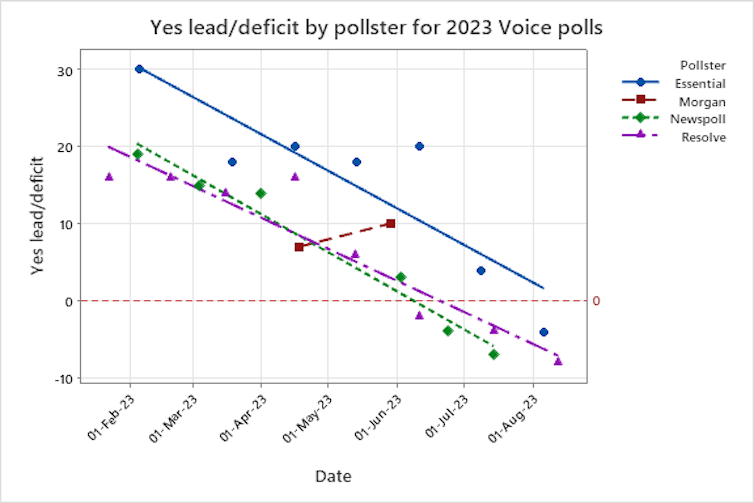
Here is an updated graph of 2023 Voice polls that I first posted in July. As the referendum has approached, the polling has become worse and worse for the Voice.
2023 Voice polls.
State breakdowns combined the July and August Resolve polls for a total sample size of 3,213. The overall “no” lead in the combined poll would have been about 53–47. Victoria and Tasmania were the only two states with a “yes” lead (51–49 in Victoria and 55–45 in Tasmania).
“No” led by 54–46 in New South Wales, 54–46 in South Australia, 56–44 in Western Australia and 59–41 in Queensland. In this poll, four states were below the national result of 53–47 “no”, so even if “yes” were able to win a national majority, winning majorities in the required four of six states would be difficult.
In this Resolve poll, the Liberals led Labor by 33–32 on economic management, reversing a Labor lead of 35–31 in July. Labor still led by 30–26 on keeping the cost of living low, down from a 31–24 lead in July.
The poll report attributes Albanese’s ratings slump to opposition to the Voice, but it may also be due to concerns over high interest rates and inflation.
But on July 26 the Australian Bureau of Statistics reported that inflation rose 0.8% in the June quarter, a slowdown from 1.4% in March and 1.9% in December last year. The Reserve Bank did not increase rates at its meeting on August 1.
Morgan’s weekly consumer confidence index was up to 78.4 last fortnight, its highest since late April, but it dropped to 75.0 last week before rebounding to 78.2 this week. This index has reached a record 24 weeks below the 80-point mark. Economic pessimism that has made it more difficult for Labor has not yet eased.
Newspoll’s absence
A Newspoll is usually published by The Australian every three weeks on Sunday night, but it has now been over four weeks since the last Newspoll. YouGov is the pollster that conducts Newspoll.
The Poll Bludger said on Monday that two of YouGov’s senior staff had recently departed to start their own pollster. Perhaps this explains the delay in producing a new Newspoll.
Fadden byelection preference flows
The final results for the July 15 federal Fadden byelection gave the Liberal National Party a 63.4–36.6 win over Labor, a 2.7% swing to the LNP since the 2022 federal election. Primary votes were 49.1% LNP (up 4.5%), 22.1% Labor (down 0.3%), 8.9% One Nation (up 0.2%), 7.2% Legalise Cannabis (new) and 6.2% Greens (down 4.6%). The UAP (6.6% in 2022) did not contest.
Preference flows from One Nation were 77–23 to the LNP, while Legalise Cannabis were 57.5–42.5 to Labor and the Greens were 79–21 to Labor. At the federal election in Fadden, One Nation and UAP preference flows were both about 66–34 to the LNP, while Greens’ preferences were 78–22 to Labor.
This preference flow data suggests there has been an 11-point gain in LNP preferences from One Nation since the 2022 election. If this were applied nationally, the Coalition would be doing just under one point better after preferences in polls, with One Nation in the high single figures. The data also suggest that Legalise Cannabis voters are only modestly left-wing.
One Nation’s preference flow may have changed since the last election over opposition to Labor’s agenda, particularly the Voice.
Victorian and NSW news
Labor will not contest the Victorian state byelection for the seat of Warrandyte on August 26. The Liberals won Warrandyte by a 54.2–45.8 margin against Labor at the 2022 state election. They should hold easily with their most prominent opponent likely to be the Greens (11.7% in Warrandyte in 2022).
One Nation federal leader Pauline Hanson on Monday dumped Mark Latham as New South Wales leader. Latham claimed he remained leader of One Nation’s three NSW upper house MPs.
Hanson said One Nation’s vote at the March NSW election dropped by 14%. One Nation’s upper house vote was actually 5.9% (down 1.0% since 2019). Hanson is using the relative decline from 6.9% in 2019. One Nation was expected to win at least two upper house seats at this election, but only won one.
Adrian Beaumont does not work for, consult, own shares in or receive funding from any company or organisation that would benefit from this article, and has disclosed no relevant affiliations beyond their academic appointment.
This month has seen the release of the second series of Good Omens, the comedic tale of an unlikely friendship between a Biblical angel and a demon who join forces to save the world. It’s based on the book of the same name written by Terry Pratchett and Neil Gaiman, and is a huge hit with critics (and presumably audiences, although Amazon Prime do not publish viewing figures).
Following Netflix’s Sandman, the show marks the second successful screen adaptation of Gaiman in the last 12 months, yet the same cannot be said of Pratchett, despite him being the better selling author.
Why the lack of screen success? What is it about the books of Terry Pratchett that make them so difficult to adapt?
Terry Pratchett and the Discworld novels
When you delve into the world of literature, few names shine as brightly as Terry Pratchett’s. Despite his early death, the prolific British author continues to enchant readers with his Discworld book series, a fantasy universe that satirises our own with clever wit and insightful humour.
His social commentary is so astute, in fact, that his fictional measure that truly measured the nuances of financial inequality has recently been taken up by a real anti-poverty campaign in the United Kingdom.
In short, he is one of the greatest novelists of all time.
Yet despite Pratchett having written more than 40 novels, the odds are that most people reading this will either not have read him, nor even heard of him. One reason could be that he worked almost exclusively in the realm of fantasy. Most likely it’s because there is yet to be a genuinely successful or definitive screen adaptation of his solo work that would bring him to a more mainstream audience.
Sir Terence David John Pratchett OBE (28 April 1948 – 12 March 2015) was an English humorist, satirist, and author of fantasy novels, especially comical works. He is best known for his Discworld series of 41 novels. Wikipedia
Screen Adaptations
Including Good Omens, there have been 11 small screen adaptations of Pratchett’s work in 32 years, both animated and live action (from very low to quite medium budget), although intriguingly none yet for the silver screen.
Seven have been set in his legendary Discworld. Some have been incredibly faithful adaptations – Hogfather (2006) pretty much replicates every scene in the book in order. Others have taken varying levels of artistic licence, the most controversial being The Watch (2022) which completely reimagined character, setting and tone.
What they all have in common is that none have cut through into the public consciousness. We’re still waiting for that Terry Pratchett adaptation. Where is his BBC version of Pride & Prejudice? His Fight Club? His Lord of the Rings?
A clash of cultures
It appears to be the age-old issue that plagues all screen adaptations of the written word: narration.
Pratchett’s writing style is whimsical, all sharp satire wrapped in well-observed humour. But most of this is contained not in the dialogue or dramatic situation, but the narration. The choice of word, the turn of phrase, or even CAPITALISATION (the main character of Death only SPEAKS IN CAPTIALS) all contribute to the uniqueness of Pratchett’s voice and joy of the stories.
Contrast this with how screen practitioners, mostly notably screenwriters and directors, are taught to consider their craft. As influential script guru Robert McKee famously stated, voiceover is an “indolent practice”, the last hope of a truly desperate filmmaker. As cinema evolved from photography it is often (erroneously) thought of as a completely visual medium, whereby the perfect film would be one that required no dialogue at all.
The issue is that film and television are not purely visual mediums. Just ask John Williams. Moving pictures may be the dominant technique, but the art form relies on so many others. Film was famously referred to as the seventh art, and is the only one able to encompass the other six (architecture, sculpture, painting, music, poetry and dance).
Voiceover is a very easy technique to get both right or wrong. You repeat what we see on screen (bad), you add to it or counterpoint it (good). It is unfortunate the most famous voice-overs are the ones maligned for being awful, the go-to proof of their inadequacy being the original cut of Blade Runner (1982). However, the film is ironically heralded today as the definitive Philip K. Dick adaptation, even though the author disliked that the film completely reversed the central thematic idea his novel.
Yet for every Blade Runner, there is a Trainspotting (1996). The opening voiceover is an oft-repeated classic, as are those from Apocalypse Now (1979) and Sunset Boulevard (1950).
But when we come to any screen adaptation of Pratchett, there is almost no narration, either in voice or text form. No searingly funny footnotes giving satirical background or new perspective.
This is a problem, as it is this narration that is the soul of his books, and when removed wholesale all that is left is a series of events that have been robbed of their context. The adventures may be fun, the characters eccentrically diverting, but little more.
Interestingly, this was an accusation aimed at The Watch (2022), the most recent adaptation that deviated so far from the original work that it not only removed narration, it essentially removed Pratchett. His daughter Rihanna did not criticise the show but did note that it “shares no DNA with my father’s Watch”. A more direct critic was Neil Gaiman, pointing out that “it’s not Batman if he’s now a news reporter in a yellow trenchcoat with a pet bat”.
This returns us to Good Omens. It uses neither voiceover nor text, yet is a successful adaptation and represents a huge leap forward for Pratchett on screen. However, it is based on a source novel that is as equally Gaiman’s as Pratchett’s, with the screen version even more so as Gaiman served as showrunner.
This means we’re still waiting for the definitive Pratchett on the big or small screen. But there is hope in sight. Rihanna Pratchett is currently working with screen partners to create “truly authentic […] prestige adaptations that remain absolutely faithful to (his) original, unique genius”.
Does this mean that there will be narration and footnotes? Let’s hope so.
Darren Paul Fisher does not work for, consult, own shares in or receive funding from any company or organisation that would benefit from this article, and has disclosed no relevant affiliations beyond their academic appointment.
Roughly one in three Australians rent their homes. It’s Australia’s fastest-growing tenure, but renting is increasingly unaffordable. From 2020 to 2022, our research found a large increase in the proportion of renters who said their housing was unaffordable.
Change in Australian renters’ assessments of affordability from 2020 to 2022. Baker, Daniel, Beer, et al, forthcoming, The Australian Housing Conditions Dataset, doi:10.26193/SLCU9J, ADA Dataverse
Australians are concerned about the pace of rent rises. Prime Minister Anthony Albanese says increasing housing supply and affordability is the “key priority” for tomorrow’s national cabinet meeting.
The crisis has impacts well beyond affordability. The rental sector is where the worst housing accommodates the poorest Australians with the worst health.
it’s often insecure – the average lease is less than 12 months, and less than a third of formal rental agreements extend beyond 12 months
rental housing quality is often very poor – 45% of renters rate the condition of their dwelling as “average, poor, or very poor”
poor housing conditions put the health of renters at risk – 43% report problems with damp or mould, and 35% have difficulty keeping their homes warm in winter or cool in summer
compounding these health risks, people with poorer health are over-represented in the rental sector. Renters are almost twice as likely as mortgage holders to have poorer general health.
Measures that potentially restrict the supply of lower-cost rental housing – such as rent caps – will worsen these impacts. More households will be left searching in a shrinking pool of affordable housing.
Fixing the rental crisis needs more than a single focus on private rental housing. The movement between households over time between renting and buying homes means the best solutions are those that boost the supply of affordable housing generally. No one policy can provide all the answers.
Governments should be looking at multiple actions, including:
requiring local councils to adopt affordable housing strategies as well as mandating inclusionary zoning, which requires developments to include a proportion of affordable homes
improving land supply through better forecasting at the national, state and local levels
giving housing and planning ministers the power to deliver affordable housing targets by providing support for demonstration projects, subsidised land to social housing providers and access to surplus land
boosting the recruitment and retention of skilled construction workers from both domestic and international sources.
More than 1 million Australians claim a net rent loss (negative gearing) each year. Even though negative gearing is focused on rental investment losses, it is not strictly a housing policy as it applies to many types of investment.
The impact of negative gearing on the housing system is untargeted and largely uncontrolled. As a result, it’s driving outcomes that are sometimes at odds with the need to supply well-located affordable housing.
The most impactful action the Australian government could take to deliver more affordable rental housing nationwide would involve refining negative-gearing arrangements to boost the supply of low-income rentals. These measures may involve
limiting negative gearing to dwellings less than ten years old
introducing a low-income tax credit scheme similar to the one in the United States.
We can learn much from the US, where the Low-Income Housing Tax Credit (LIHTC) scheme subsidises the acquisition, construction and renovation of affordable rental housing for tenants on low to moderate incomes. Since the mid-1990s, the program has supported the construction or renovation of about 110,000 affordable rental units each year. That adds up to over 2 million units at an estimated annual cost of US$9billion (A$13.8billion).
This scheme is much less expensive per unit of affordable housing delivered than Australia’s system of negative gearing.
Closer to home, the previous National Rental Affordability Scheme showed the value of targeted financial incentives in encouraging affordable housing. This scheme, available to private and disproved investors, generated positive outcomes for tenants. The benefits included better health for low-income tenants who were able to moved into quality new housing.
Short-term measures such as rent caps or eviction bans will not provide a solution in the near future or even the medium or long term. Instead, these are likely to worsen both the housing costs and health of low-income tenants.
Reform focused on ongoing needs is called for. Solutions that can be implemented quickly include the tighter targeting of negative gearing and the introduction of a low-income housing tax credit.
Talking about change, as the national cabinet is doing, will begin that process of transformation, but it must be backed up by a range of measures to boost the supply of affordable housing. This, in turn, will improve the housing market overall as affordable options become more widely available.
Andrew Beer receives funding from the National Health and Medical Research Council, the Australian Research Council, the OECD, and the Australian Housing and Research Institute. He is a member of the Board of the South Australian Housing Trust and is the Executive Dean of UniSA Business.
Emma Baker receives funding from the Australian Research Council, the National Health and Medical Research Council and The Australian Housing and Urban Research Institute. She is affiliated with the University of Adelaide.
Prime Minister Anthony Albanese is right about one thing when it comes to public holidays.
Should the Matildas win the World Cup, any decision to grant an extra public holiday is one for the states and territories. The Fair Work Act specifies only eight national public holidays. Any others have to be “declared or prescribed by or under a law of a state or territory”.
The prime minister doesn’t get a look in. Yet he says he will put forward the idea of a public holiday for a Matildas win at Wednesday’s meeting of national cabinet, and expects the premiers and chief ministers to “fold like tents”.
One already has. NSW Premier Chris Minns says should the Matildas win in Sydney on Wednesday, and go on to win Sunday’s final in Sydney, he’ll not only arrange a statewide holiday but also a massive parade to celebrate “what would be an amazing life-changing and unbelievable event in the state’s history”.
Some people claim such a holiday could cost us A$2 billion. But my own calculation – based on very recent global research – shows it could be significantly lower.
‘Imagine the kind of energy’
It wouldn’t be the first public holiday for a sporting event. Melbourne has a public holiday for the Melbourne Cup, South Australia (improbably) for the Adelaide Cup, and all of Victoria for the eve of the AFL grand final.
But it wouldn’t happen on the Monday following the game. Minns says it takes seven days to gazette a public holiday.
To critics concerned about the cost of an extra day off, Minns asks:
can you imagine the kind of energy, economic excitement? It would be an explosion of economic activity, particularly for the CBD.
It is unconscionable to talk about the cost of a public holiday without also talking about the benefit – what the Productivity Commission describes as the “genuine social benefit associated with widespread community engagement in events, especially on days of cultural or spiritual significance”.
These benefits are deeper and richer than those of ordinary annual leave, in which individuals or families are away from work – but not the entire city or country.
The commission – no fan of unlimited days off – points to evidence that “more shared days of leisure enrich the relationships of people with their friends and acquaintances, which then improves the quality of leisure on other days”.
No hit to productivity
It’s easy to imagine that happening should the Matildas win. A national holiday would bring the nation together, at a cost. And very new international research makes it pretty clear that cost would be small.
One thing it wouldn’t do, despite loose talk, is dent productivity.
Productivity is usually defined as production per hour worked. If the number of hours worked is cut, production per hour worked is likely to stay the same, or even increase if people work a bit harder the next day to catch up.
It’s what Prime Minister Bob Hawke was getting at the morning Australia won the America’s Cup in 1983. He famously declared “any boss who sacks anyone for not turning up today is a bum!”. But far fewer people remember what Hawke then added: “You have to work a bit harder the next day to make up.”
Prime Minister Bob Hawke when Australia won the America’s Cup in 1983. ABC
Far more of us are able to work a bit harder to make up than when Hawke made the suggestion. Back then, one in six Australians worked in manufacturing, often on production lines that moved at a constant pace without the ability to catch up. These days it’s just 6%. More of us work at desks.
A back-of-the-envelope estimate of the production that would be lost – quoted as if it is authoritative by Opposition Leader Peter Dutton – is $2 billion.
But while some businesses will produce less, and perhaps sell less, if there’s an extra public holiday, others will sell more (as Minns has pointed out).
And if they have to pay penalty rates to do it, that’s not actually an economic cost. In the language of economists, it’s a transfer from employers and their customers to employees.
A better estimate of public holiday costs
Working out the net effect of an extra public holiday on gross domestic product requires ingenuity, because it’s hard to know what would have happened to GDP without it.
Late last year, two economists from Harvard University and the University of Chile, Rodrigo Wagner and Lucas Rosso, presented a solution.
Some years have more public holidays than others. Shutterstock
They took advantage of the fact that, in many countries, certain holidays aren’t moved when they fall on weekends. This means in some years those countries have fewer days off work from holidays than others.
Examining data from more than 200 countries over the two decades leading up to COVID, they determined the net dent to GDP from an extra public holiday was only 20% of the GDP that would have been produced that day.
As they put it, this means “an 80% recovery with respect to the GDP that would have been lost if the effect were exactly proportional”.
An awful lot of us do a bit more work to catch up after a holiday, or are in jobs where that doesn’t matter, or get more business because it is a holiday.
As Wagner and Rosso expected, the effects varied by industry. In manufacturing, only about half of the expected losses were recovered. In agriculture, which continues regardless of holidays, all the expected losses were recovered.
More like $1 billion – with some real benefits
What does their research mean here in Australia?
I did my own back-of-the-envelope calculations, applying Wagner and Rosso’s 200-plus nation results to Australia’s GDP.
The result? It suggests a hit to production of as low as $1 billion from an extra holiday.
It is worth saying again that’s not a $1 billion loss. In return, we would get extra leisure, and a good deal more besides.
Wagner and Rosso also used their data to examine other things. They found that self-reported happiness climbed in the years there were extra holidays, while deaths (mainly from job-related accidents) fell.
Like most of the things we like, holidays do have costs. But they are probably lower than we have thought, and – at least in the case of a Matildas celebration – would be offset by rather nice benefits.
Peter Martin does not work for, consult, own shares in or receive funding from any company or organisation that would benefit from this article, and has disclosed no relevant affiliations beyond their academic appointment.
The National Party’s promised ban on cellphones in schools has been touted by leader Christopher Luxon as a “common sense” and “practical” way to address New Zealand’s poor academic achievement.
And his claim that “phones are a massive disturbance and distraction” seems credible on the face of it. A recent UNESCO report found the intensive use of devices had negative impacts on student performance and increased disruption in the classroom.
App notifications throughout the day were found to be distracting students from their learning, affecting focus, recall and comprehension.
But international research suggests a blanket ban would make only a small difference to grades. A focus on phones risks shifting attention from other reasons students may be underachieving.
Current interpretations of the UNESCO report, including how it is being used in the political argument, seem to focus on phones as the main source of distraction for students.
But these interpretations fail to acknowledge the broader context of the report’s findings. The report looks at smartphones as part of a wider suite of information communications technology (ICT) used during the school day, including personal laptops and tablets. These devices can also lead to distraction and lower student engagement.
Students need to learn the risks and opportunities that come with technology, develop critical skills, and understand to live with and without technology. Shielding students from new and innovative technology can put them at a disadvantage. It is important to look at these issues with an eye on the future and be ready to adjust and adapt as the world changes.
Learning from overseas bans
Almost one in four countries have laws and policies banning smartphones in schools, most commonly in Central and South Asia.
According to the Swedish research, “mobile phone bans have no impact on student performance, and we can reject even very small effects of banning mobile phones in the Swedish setting”.
The UNESCO report itself suggests a ban would be little more than a blunt approach to what is a much more complex problem.
Beyond the politics
While the evidence supporting a ban continues to be evaluated, the approach will appeal to many New Zealand parents and teachers who have concerns about children’s phone use and the impact of phones in the classroom and at home. These concerns make a ban an easy political win for National.
But schools, which operate as self-governing institutions through a board of trustees, currently implement their own policies on phone use. A blanket ban will undermine their ability to choose what is best for their community.
Decisions about a phone policy would benefit from community consultation supported by sound evidence. These consultations should involve all those with a stake in students’ learning, including the students themselves – 90% of whom have a cellphone by their first year of high school.
And we should be putting faith in our students. In my study on teenage girls and social media, students reported varying degrees of self-regulation and high self-awareness of the impact of social media on their wellbeing. They were able to enact their own boundaries to mitigate the negative effects of new technologies.
Perhaps what is needed here is an educational approach, rather than a ban. We could give young people the resources to develop the necessary critical thinking strategies and self-awareness to engage reflectively with these new technologies.
Addressing what really hurts student achievement
What remain strikingly absent from the discussion are the various other pressures causing lower student achievement, such as the ongoing impact of the pandemic on student learning.
We need to be looking at the effects of truancy and what support schools are receiving to turn this around. We also need to address what the cost-of-living crisis is doing to families and their ability to meet the basic needs of their children.
There is clearly a crisis in the education sector and these other pressures on young people’s engagement need be taken seriously. Instead of a blanket ban on cellphones in the classroom, efforts should be put towards getting children to school and keeping them there.
Eunice Gaerlan does not work for, consult, own shares in or receive funding from any company or organisation that would benefit from this article, and has disclosed no relevant affiliations beyond their academic appointment.
There is a lot of health buzz around the term “inflammation” right now. From new scientific discoveries to celebrities and social media influencers, it seems like everyone is talking about this important bodily process and its potential impact on our health.
“Inflammaging” is a specific term you may also have seen. It’s an age-related increase in persistent, low-grade inflammation in blood and tissue, which is a strong risk factor for many conditions and diseases.
So, can an anti-inflammatory diet help reduce inflammation? Let’s take a look.
When our body becomes injured or encounters an infection, it activates defence mechanisms to protect itself. It does this by instructing our cells to fight off the invader. This fighting process causes inflammation, which often presents as swelling, redness and pain.
In the short-term, inflammation is a sign your body is healing, whether from a grazed knee or a cold.
The relationship between food and inflammation is well recognised. Overall, some food components may activate the immune system by producing pro-inflammatory cytokines (small proteins important in cell signaling) or reducing the production of anti-inflammatory cytokines.
A “pro-inflammatory diet” may increase inflammation in the body over the long term. Such diets are usually low in fresh produce like fruits, vegetables and wholegrains, and high in commercially baked goods, fried foods, added sugars and red and processed meats.
In contrast, an “anti-inflammatory” diet is associated with less inflammation in the body. There is no single anti-inflammatory diet. Two well-recognised, evidence-backed examples are the Mediterranean diet and the Dietary Approaches to Stop Hypertension (DASH) diet.
Anti-inflammatory diets typically include the following elements:
1. high in antioxidants. These compounds help the body fight free radicals or unstable atoms, that in high quantities are linked to illnesses such as cancer and heart disease. The best way to consume antioxidants is by eating lots of fruits and vegetables. Research shows frozen, dried and canned fruits and vegetables can be just as good as fresh
2. high in “healthy”, unsaturated fatty acids. Monounsaturated fats and omega-3-fatty acids are found in fish (sardines, mackerel, salmon and tuna), seeds, nuts, and plant-based oils (olive oil and flaxseed oil)
3. high in fibre and prebiotics. Carrots, cauliflower, broccoli and leafy greens are good sources of fibre. Prebiotics promote the growth of beneficial microorganisms in our intestines and can come from onions, leeks, asparagus, garlic, bananas, lentils and legumes
4. low in processed foods. These contain refined carbohydrates (pastries, pies, sugar-sweetened beverages, deep-fried foods and processed meats).
You can’t really go wrong by including more fruit and vegetables in your diet. Pexels
There is mixed evidence for the role of anti-inflammatory diets in rheumatoid arthritis pain management. A recent 2021 systematic review (where researchers carefully group and examine the available evidence on a topic) found eating an anti-inflammatory diet likely leads to significantly lower pain in people with rheumatoid arthritis when compared with other diets.
However, the 12 studies included in the review had a high risk of bias – likely because people knew they were eating healthy foods – so the confidence in the evidence was low.
Inflammation is strongly implicated in the development of neurodegenerative diseases like Alzheimer’s disease and related dementia and evidence suggests anti-inflammatory diets might help to protect the brain.
A 2016 review showed an anti-inflammatory diet may be protective against cognitive impairment and dementia, but that further large randomised controlled trials are needed. A 2021 study followed 1,059 people for three years and observed their diet. They reported those with a greater pro-inflammatory diet had an increased risk of developing dementia.
Inflammation has also been linked with mental health, with people eating a pro-inflammatory diet reporting more symptoms of depression. Diet is the fundamental element of lifestyle approaches to managing anxiety and mental health.
More broadly, a 2021 review paper examined recent research related to anti-inflammatory diets and their effect on reducing inflammation associated with ageing. It found compounds commonly found in anti-inflammatory diets could help alleviate the inflammatory process derived from diseases and unhealthy diets.
A favourite on social media and vitamin shelves, turmeric is promoted as having anti-inflammatory benefits. These are linked to a specific compound called curcumin, which gives turmeric its distinctive yellow colour.
Turmeric – and the curcumin it contains – is often touted as anti-inflammatory. Shutterstock
Research suggests curcumin might act as an anti-inflammatory agent in the body but high-quality clinical trials in humans are lacking. Most of the existing studies have been conducted in lab settings using cells or in animals. So it’s unclear how much curcumin is needed to see anti-inflammatory benefits or how well we absorb it.
Overall, adding turmeric to your food may provide your body with some health benefits, but don’t rely on it to prevent or treat disease on its own.
Inflammation is a major factor in the link between diet and many health conditions.
Eating an anti-inflammatory diet is considered safe, likely to support health and to prevent future chronic conditions. If you are looking for tailored dietary advice or an anti-inflammatory meal plan, it’s best to speak with an accredited practising dietitian.
Lauren Ball works for The University of Queensland and receives funding from the National Health and Medical Research Council, Queensland Health and Mater Misericordia. She is a Director of Dietitians Australia, a Director of the Darling Downs and West Moreton Primary Health Network and an Associate Member of the Australian Academy of Health and Medical Sciences.
You probably know about the Tasmanian devil. You might even know about its smaller, less-famous relative, the spotted-tailed quoll.
But these are far from the only meat-eating marsupials. Australia is home to a suite of other carnivorous and insectivorous pouched mammals as well, some of them the size of a mouse or smaller.
Tiniest of all are the planigales, some of which weigh less than a teaspoonful of water. Despite their size, these fierce predators often take on prey as big as themselves.
To date, there are four known species of planigale found across Australia. We have recently discovered another two species, both inhabitants of the Pilbara region of northwest Western Australia: the orange-headed Pilbara planigale (Planigale kendricki) and the cracking-clay Pilbara planigale (P. tealei).
How many kinds of planigale are there?
The name planigale translates to “flat weasel”, an allusion to their extremely flat heads, which allow them to shelter in small cracks in rocks and clay soils. Planigales are among Australia’s smallest mammals, with some weighing an average of 4–6 grams (and measuring around 11cm in length), and other species a bit larger at 8–17 grams (and 13cm long).
Scientific studies from the late 1970s onward using body-shape and DNA data have suggested there are many more planigale species than we think.
We put these theories to the test, and found that planigales in the Pilbara display unique body shapes and are genetically unrelated to any of the four known planigale species.
Why have these species only been described now?
The process of describing these two new species was actually started more than 20 years ago, by scientists who were working at the Western Australian Museum at the time.
Their work began after ecologists conducting surveys for developing mines in the Pilbara were capturing planigales that didn’t really fit the descriptions of the known species. For want of a better option, they were still usually identified as either the common planigale (P. maculata) or the long-tailed planigale (P. ingrami).
Scientists led by taxonomist Ken Aplin began examining specimens held in the WA Museum and sequencing their DNA. These studies helped to confirm the discovery of two new species.
Sadly, Ken fell ill and passed away in 2019. This is where we stepped in.
Through support from the Australian Biological Resources Study and the Queensland University of Technology we were able to finish off Ken’s species descriptions and submit the research for publication. This is a crucial step in taxonomy – the species description has to be published before the new name can be considered official.
What do we know about the new species?
Both new species occur in the Pilbara and surrounding areas. The orange-headed Pilbara planigale is the larger of the two, weighing an average of 7g (up to 12g for large males) with a longer, pointier snout and bright orange colouring on the head.
The cracking-clay Pilbara planigale (P. tealei) has only been found on cracking-clay soils. Linette Umbrello, CC BY-SA
The cracking-clay Pilbara planigale is much smaller, averaging just 4g with darker colouration and a shorter face. It has only been found on cracking clay soils, hence its name.
The orange-headed Pilbara planigale has been found on rocky and sandy soils as well, but both species require a dense cover of native grasses to persist. Both species actively forage during the night, while taking shelter during the day.
This means the two widespread species, the common planigale and the long-tailed planigale, do not occur in the Pilbara or on neighbouring Barrow Island, as was previously thought.
There is still a lot more work for us to do as there remain two “species complexes” of planigales. These are groups where genetic data suggests a species is comprised of multiple different forms.
We’ll be following up on this with more analysis to define more of Australia’s tiniest mammals.
Linette Umbrello receives funding from the Australian Biological Resources Study program and the Queensland University of Technology. Linette is a Research Associate at the Western Australian Museum.
Andrew M. Baker receives funding from the Australian Biological Resources Study Program.
Kenny Travouillon receives funding from the Australian Biological Resources Study Program, and is an adjunct at Curtin University.
Everyone knows that arithmetic is true: 2 + 2 = 4.
But surprisingly, we don’t know why it’s true.
By stepping outside the box of our usual way of thinking about numbers, my colleagues and I have recently shown that arithmetic has biological roots and is a natural consequence of how perception of the world around us is organised.
Our results explain why arithmetic is true and suggest that mathematics is a realisation in symbols of the fundamental nature and creativity of the mind.
Thus, the miraculous correspondence between mathematics and physical reality that has been a source of wonder from the ancient Greeks to the present — as explored in astrophysicist Mario Livio’s book Is God a mathematician? — suggests the mind and world are part of a common unity.
Why is arithmetic universally true?
Humans have been making symbols for numbers for more than 5,500 years. More than 100 distinct notation systems are known to have been used by different civilisations, including Babylonian, Egyptian, Etruscan, Mayan and Khmer.
Different cultures have developed their own symbols for numbers, but they all use addition and multiplication. Wikimedia Commons, CC BY-SA
The remarkable fact is that despite the great diversity of symbols and cultures, all are based on addition and multiplication. For example, in our familiar Hindu-Arabic numerals: 1,434 = (1 x 1000) + (4 x 100) + (3 x 10) + (4 x 1).
Why have humans invented the same arithmetic, over and over again? Could arithmetic be a universal truth waiting to be discovered?
To unravel the mystery, we need to ask why addition and multiplication are its fundamental operations. We recently posed this question and found that no satisfactory answer – one that met standards of scientific rigour – was available from philosophy, mathematics or the cognitive sciences.
The fact that we don’t know why arithmetic is true is a critical gap in our knowledge. Arithmetic is the foundation for higher mathematics, which is indispensable for science.
Consider a thought experiment. Physicists in the future have achieved the goal of a “theory of everything” or “God equation”. Even if such a theory could correctly predict all physical phenomena in the universe, it would not be able to explain where arithmetic itself comes from or why it is universally true.
Answering these questions is necessary for us to fully understand the role of mathematics in science.
Bees provide a clue
We proposed a new approach based on the assumption that arithmetic has a biological origin.
Many non-human species, including insects, show an ability for spatial navigation which seems to require the equivalent of algebraic computation. For example, bees can take a meandering journey to find nectar but then return by the most direct route, as if they can calculate the direction and distance home.
Bees can integrate their zig-zag flight path to calculate the straightest route back to the hive. Nicola J. Morton, CC BY-SA
How their miniature brain (about 960,000 neurons) achieves this is unknown. These calculations might be the non-symbolic precursors of addition and multiplication, honed by natural selection as the optimal solution for navigation.
Arithmetic may be based on biology and special in some way because of evolution’s fine-tuning.
To probe more deeply into arithmetic, we need to go beyond our habitual, concrete understanding and think in more general and abstract terms. Arithmetic consists of a set of elements and operations that combine two elements to give another element.
In the universe of possibilities, why are the elements represented as numbers and the operations as addition and multiplication? This is a meta-mathematical question – a question about mathematics itself that can be addressed using mathematical methods.
In our research, we proved that four assumptions – monotonicity, convexity, continuity and isomorphism – were sufficient to uniquely identify arithmetic (addition and multiplication over the real numbers) from the universe of possibilities.
Monotonicity is the intuition of “order preserving” and helps us keep track of our place in the world, so that when we approach an object it looms larger but smaller when we move away.
Convexity is grounded in intuitions of “betweenness”. For example, the four corners of a football pitch define the playing field even without boundary lines connecting them.
Continuity describes the smoothness with which objects seem to move in space and time.
Isomorphism is the idea of sameness or analogy. It’s what allows us to recognise that a cat is more similar to a dog than to a rock.
Thus, arithmetic is special because it is a consequence of these purely qualitative conditions. We argue that these conditions are principles of perceptual organisation that shape how we and other animals experience the world – a kind of “deep structure” in perception with roots in evolutionary history.
In our proof, they act as constraints to eliminate all possibilities except arithmetic – a bit like how a sculptor’s work reveals a statue hidden in a block of stone.
What is mathematics?
Taken together, these four principles structure our perception of the world so that our experience is ordered and cognitively manageable. They are like coloured spectacles that shape and constrain our experience in particular ways.
When we peer through these spectacles at the abstract universe of possibilities, we “see” numbers and arithmetic.
These four principles structure our perception of the world and, collectively, point to arithmetic as an abstract symbol system that reflects that structure. Psychological Review, CC BY-SA
Thus, our results show that arithmetic is biologically-based and a natural consequence of how our perception is structured.
Although this structure is shared with other animals, only humans have invented mathematics. It is humanity’s most intimate creation, a realisation in symbols of the fundamental nature and creativity of the mind.
In this sense, mathematics is both invented (uniquely human) and discovered (biologically-based). The seemingly miraculous success of mathematics in the physical sciences hints that our mind and the world are not separate, but part of a common unity.
The arc of mathematics and science points toward non-dualism, a philosophical concept that describes how the mind and the universe as a whole are connected, and that any sense of separation is an illusion. This is consistent with many spiritual traditions (Taoism, Buddhism) and Indigenous knowledge systems such as mātauranga Māori.
Randolph Grace receives funding from the Marsden Fund, administered by the Royal Society of New Zealand.
Changes to the management of Pauline Hanson’s One Nation Party in NSW reaffirm an unchanging rule of politics. Opponents be damned. The fiercest fighting is reserved for colleagues.
The party’s federal leader, Hanson, confirmed her national executive’s decision to replace its NSW division and declare Latham’s position as NSW parliamentary leader vacant.
A spokesperson for Hanson said a decline in the party’s performance at the March 2023 NSW election warranted a review of the “relationship between the organisation and parliamentary wings of the party”.
Latham challenged the decision, arguing if electoral “under-performance” was the rationale for replacing the NSW executive, then Hanson should “buy a mirror”. The party’s wider fortunes are the real issue, he observed, noting recent dips in support nationally and in Queensland.
Insisting he remains the leader of the One Nation NSW parliamentary team, Latham alleges the national intervention is really about control of the party’s finances. He committed to saying more on that issue when parliament next sits.
Discord is not new to the party. ABC electoral analyst Antony Green observes of One Nation’s 35 state and federal parliamentarians over time, just “seven members have lasted long enough to face re-election”.
This latest conflict follows Hanson’s condemnation, in April, of Latham’s highly graphic social media post about independent NSW MP Alex Greenwich. Hanson labelled the post “disgusting”, asking Latham to issue an apology. He refused.
It is unlikely Latham and his One Nation parliamentary colleagues, Tania Mihailuk and Rod Roberts, will remain with the party. While their terms are assured – Latham’s expires in 2031 and his colleagues’ in 2027 – it is unclear what electoral traction they may have without Hanson’s backing.
Hanson’s return as leader ahead of the 2016 federal election proved pivotal in One Nation’s resurgence after a period of decline. However, direct support for Hanson in NSW has proven elusive, with her 2011 bid for election to the state’s upper house falling short.
Latham, on the other hand, has forged a sizeable support base in NSW. His profile was sufficient for him to resign mid-term from the Legislative Council position he secured in 2019, to successfully extend his term by eight years at the 2023 poll.
The party’s ambitions to secure lower house representation at this year’s NSW election went unfulfilled, but it did secure significant levels of support. In some seats in Sydney’s west, backing for One Nation eclipsed the Greens’ third-party status.
In Camden, One Nation attracted 13.8% of the primary vote. In Campbelltown, 11.5%. At Hawkesbury, 10.3%. In Badgerys Creek, Londonderry and Penrith, the party drew 8.2%, and in Leppington it secured 7.5%.
It was not quite a “Teal wave”, but the beginnings of third-party support that could afford One Nation strategic leverage over time. Many of these emerging subregions of support for the party overlay areas of mortgage, rental and cost-of-living stress.
While the NSW Labor government is yet to feel significant political pressure from the housing crisis and rising interest rates, a degree of negative sentiment is emerging over frustrated wage negotiations. Discontent is particularly apparent among many education, health and comparable public sector workers. A significant proportion of them reside in Sydney’s west and helped restore Labor’s electoral fortunes in a crucial battleground.
The test for Latham, Mihailuk and Roberts will be their capacity to navigate this episode of party turmoil, remain unified, and position themselves to build on proven levels of support for their brand of politics, whatever banner it falls under.
The trio have over three years to do so. It’s not an impossible task, particularly given Latham’s capacity to rally support, and the “severe challenges” predicted to constrain the upcoming NSW budget.
Complicating any scenario for Latham and co is a national leader, in Hanson, who likely shares their awareness of One Nation’s potential brand growth in one of the fastest-growing regions in Australia, and the motivation to grasp it.
If the ferocity of internal conflict is a marker of true politics, then One Nation might be about to remind us of some home truths about NSW party politics and its infamous, albeit recently becalmed, penchant for volatility.
Andy Marks does not work for, consult, own shares in or receive funding from any company or organisation that would benefit from this article, and has disclosed no relevant affiliations beyond their academic appointment.
New Zealand Parliament Buildings, Wellington, New Zealand.
New Zealand Politics Daily is a collation of the most prominent issues being discussed in New Zealand. It is edited by Dr Bryce Edwards of The Democracy Project.
Keith Rankin, trained as an economic historian, is a retired lecturer in Economics and Statistics. He lives in Auckland, New Zealand.
Essay by Keith Rankin.
Keith Rankin, trained as an economic historian, is a retired lecturer in Economics and Statistics. He lives in Auckland, New Zealand.
Fresh vegetables and fruit – quality foods – are what economists call a merit good, like primary health care, education and urban public transport. By contrast, ‘junk food’ – rich in sugar – is a demerit good. We in New Zealand and many other countries have a problem: too much unhealthy junk food is consumed, and too few quality foods are eaten.
Economics 101 has a simple textbook solution which I am sure all economists would agree with. To encourage increased consumption of vegetables and fruit, these foods should be subsidised. Just as we subsidise the other merit goods mentioned above.
We should note that subsidies incentivise production as well as consumption. Indeed it is entirely beneficial to society for such a subsidy to benefit market gardeners, orchardists and greengrocers (ie not only consumers). In particular, such a subsidy might have an impact on land use; a significant part of the ‘cost of living’ problem we face is the loss of good horticultural land close to our cities.
We could set a rate of subsidy at 15 percent, knowing that if the policy achieves its goals of incentivising consumption and production of fresh and unprocessed horticultural products, then there would be a future option to increase the rate of subsidy.
Instead of such an obvious and simple policy, we are having a restricted debate about a convoluted and inefficient ‘tax cut’. As an economist – albeit a retired economist – I agree with the professional consensus that the Labour Party’s tax policy is inefficient and regressive. Nevertheless, I found this item on RNZ this morning somewhat problematic: Tax experts slam GST-free fruit and vegetables policy.
The college of economists interviewed have downplayed the central ‘merit good’ issue. They emphasise the ‘income effect’ over the ‘substitution effect’, whereas tax specialists in the past have generally emphasised the ‘substitution effect’ over the ‘income effect’, especially with respect to labour supply. (This is manifest by their emphasis on marginal tax rates over average tax rates.) And they seem to think that the only suppliers of note of vegetables and fruits are supermarkets, who they insinuate will suddenly become even more greedy than they allegedly already are. They are being disingenuous. Most problematic was the suggestion by one of these ‘leading’ economists – a popular label used by much of the media applied to the people they talk to – that an economist who breaks rank from groupthink does not deserve to be called an economist.
Labour’s reasons for not subsidising vegetables and fruit are, at first sight, quite puzzling. But we must remember that party policy is discussed in a political context, and that groups of like-minded people in a committee tend to advocate partial rather than imaginative solutions. (While subsidising vegetables and fruits is hardly an imaginative solution, nevertheless almost nobody seems to have imagined it!) My guess is that the bigger reason why Labour have chosen their GST-meddling ‘tax’ policy is that it is needed as a fig-leaf to mask their absence of a tax policy.
Subsidise unprocessed vegetables and fruit! Such an incentivisation policy would be popular with both the public and the economists. Good economics and good politics.
*******
Keith Rankin (keith at rankin dot nz), trained as an economic historian, is a retired lecturer in Economics and Statistics. He lives in Auckland, New Zealand.
Social media platforms have become the “digital town squares” of our time, enabling communication and the exchange of ideas on a global scale. However, the unregulated nature of these platforms has allowed the proliferation of harmful content such as misinformation, disinformation and hate speech.
Regulating the online world has proven difficult, but one promising avenue is suggested by the European Union’s Digital Services Act, passed in November 2022. This legislation mandates “trusted flaggers” to identify certain kinds of problematic content to platforms, who must then remove it within 24 hours.
Will it work, given the fast pace and complex viral dynamics of social media environments? To find out, we modelled the effect of the new rule, in research published in the Proceedings of the National Academy of Sciences.
Our results show this approach can indeed reduce the spread of harmful content. We also suggest some insights into how the rules can be implemented in the most effective way.
Understanding the spread of harmful content
We used a mathematical model of information spread to analyse how harmful content is disseminated through social networks.
In the model, each harmful post is treated as a “self-exciting point process”. This means it draws more people into the discussion over time and generates further harmful posts, similar to a word-of-mouth process.
The intensity of a post’s self-propagation decreases over time. However, if left unchecked, its “offspring” can generate more offspring, leading to exponential growth.
Social media posts spread online through a process much like word of mouth. Robynne Hu / Unsplash
The potential for harm reduction
In our study, we used two key measures to assess the effectiveness of the kind of moderation set out in the Digital Services Act: potential harm and content half-life.
A post’s potential harm represents the number of harmful offspring it generates. Content half-life denotes the amount of time required for half of all the post’s offspring to be generated.
We found moderation by the rules of the Digital Services Act can effectively reduce harm, even on platforms with short content half-lives, such as X (formerly known as Twitter). While faster moderation is always more effective, we found that moderating even after 24 hours could still reduce the number of harmful offspring by up to 50%.
The role of reaction time and harm reduction
The reaction time required for effective content moderation increases with both the content half-life and potential harm. To put it another way, for content that is longer-lived and generates large numbers of harmful offspring, intervening later can still prevent many harmful subsequent posts.
This suggests the approach of the Digital Services Act can effectively combat harmful content, even on fast-paced platforms like X.
We also found the amount of harm reduction increases for content with greater potential harm. While apparently counterintuitive, this indicates moderation is effective when it targets the offspring of offspring generation – that is, when it breaks the word-of-mouth cycle.
Making the most of moderation efforts
Prior research has shown tools based on artificial intelligence struggle to detect online harmful content. The authors of such content are aware of the detection tools, and adapt their language to avoid detection.
The Digital Services Act moderation approach relies on manual tagging of posts by “trusted flaggers”, who will have limited time and resources.
To make the most of their efforts, flaggers should focus their efforts on content with high potential harm for which our research shows that moderation is most effective. We estimate the potential harm of a post at its creation by extrapolating its expected number of offspring from previously observed discussions.
Implementing the Digital Services Act
Social media platforms already employ content moderation teams, and our research suggests the major platforms at least already have enough staff to enforce the Digital Services Act legislation. There are, however, questions about the cultural awareness of the existing staff as some of these teams are based in different countries to the majority of content posters they are moderating.
The success of the legislation will lie in appointing trusted flaggers with sufficient cultural and language knowledge, developing practical reporting tools for harmful content, and ensuring timely moderation.
Our study’s framework will provide policymakers with valuable guidance in drafting mechanisms for content moderation that prioritise efforts and reaction times effectively.
A healthier and safer digital public square
As social media platforms continue to shape public discourse, addressing the challenges posed by harmful content is crucial. Our research on the effectiveness of moderating harmful online content offers valuable insights for policymakers.
By understanding the dynamics of content spread, optimising moderation efforts, and implementing regulations like the Digital Services Act, we can strive for a healthier and safer digital public square where harmful content is mitigated, and constructive dialogue thrives.
Marian-Andrei Rizoiu receives funding from Australian Department of Home Affairs, the Defence Science and Technology Group and the Defence Innovation Network
Philipp Schneider does not work for, consult, own shares in or receive funding from any company or organization that would benefit from this article, and has disclosed no relevant affiliations beyond their academic appointment.
When Sophie was pregnant with her first baby, she had an oral glucose tolerance blood test. A few days later, the hospital phoned telling her she had gestational diabetes.
Despite having only a slightly raised glucose (blood sugar) level, Sophie describes being diagnosed as affecting her pregnancy tremendously. She tested her blood glucose levels four times a day, kept food diaries and had extra appointments with doctors and dietitians.
She was advised to have an induction because of the risk of having a large baby. At 39 weeks her son was born, weighing a very average 3.5kg. But he was separated from Sophie for four hours so his glucose levels could be monitored.
Sophie is not alone. About one in six pregnant women in Australia are now diagnosed with gestational diabetes.
That was not always so. New criteria were developed in 2010 which dropped an initial screening test and lowered the diagnostic set-points. Gestational diabetes diagnoses have since more than doubled.
Gestational diabetes rates more than doubled after the threshold changed. AIHW, Author provided
But recentstudies cast doubt on the ways we diagnose and manage gestational diabetes, especially for women like Sophie with only mildly elevated glucose. Here’s what’s wrong with gestational diabetes screening.
The glucose test is unreliable
The test used to diagnose gestational diabetes – the oral glucose tolerance test – has poor reproducibility. This means subsequent tests may give a different result.
In a recent Australian trial of earlier testing in pregnancy, one-third of the women initially classified as having gestational diabetes (but neither told nor treated) did not have gestational diabetes when retested later in pregnancy. That is a problem.
Usually when a test has poor reproducibility – for example, blood pressure or cholesterol – we repeat the test to confirm before making a diagnosis.
Much of the increase in the incidence of gestational diabetes after the introduction of new diagnostic criteria was due to the switch from using two tests to only using a single test for diagnosis.
Women with only mildly elevated glucose levels are being diagnosed with gestational diabetes. Shutterstock
The thresholds are too low
Despite little evidence of benefit for either women or babies, the current Australian criteria diagnose women with only mildly abnormal results as having “gestational diabetes”.
Recent studies have shown this doesn’t benefit women and may cause harms. A New Zealand trial of more than 4,000 women randomly assigned women to be assessed based on the current Australian thresholds or to higher threshold levels (similar to the pre-2010 criteria).
The trial found no additional benefit from using the current low threshold levels, with overall no difference in the proportion of infants born large for gestational age.
However, the trial found several harms, including more neonatal hypoglycaemia (low blood sugar in newborns), induction of labour, use of diabetic medications including insulin injections, and use of health services.
The study authors also looked at the subgroup of women who were diagnosed with glucose levels between the higher and lower thresholds. In this subgroup, there was some reduction in large babies, and in shoulder problems at delivery.
But there was also an increase in small babies. This is of concern because being small for gestational age can also have consequences for babies, including long-term health consequences.
NEJM, Author provided
Testing too early
Some centres have begun testing women at higher risk of gestational diabetes earlier in the pregnancy (between 12 and 20 weeks).
However, a recent trial showed no clear benefit compared with testing at the usual 24–28 weeks: possibly fewer large babies, but again matched by more small babies.
There was a reduction in transient “respiratory distress” – needing extra oxygen for a few hours – but not in serious clinical events.
Impact on women with gestational diabetes
For women diagnosed using the higher glucose thresholds, dietary advice, glucose monitoring and, where necessary, insulin therapy has been shown to reduce complications during delivery and the post-natal period.
However, current models of care can also cause harm. Women with gestational diabetes are often denied their preferred model of care – for example, midwifery continuity of carer. In rural areas, they may have to transfer to a larger hospital, requiring longer travel to antenatal visits and moving to a larger centre for their birth – away from their families and support networks for several weeks.
Women say the diagnosis often dominates their antenatal care and their whole experience of pregnancy, reducing time for other issues or concerns.
Women from culturally and linguistically diverse communities find it difficult to reconcile the advice given about diet and exercise with their own cultural practices and beliefs about pregnancy.
Some women with gestational diabetes become extremely anxious about their eating and undertake extensive calorie restrictions or disordered eating habits.
Some pregnant women become extremely anxious after being diagnosed with gestational diabetes. Unsplash/Jordan Bauer
Time to reassess the advice
Recent evidence from both randomised controlled trials and from qualitative studies with women diagnosed with gestational diabetes suggest we need to reassess how we currently diagnose and manage gestational diabetes, particularly for women with only slightly elevated levels.
It is time for a review to consider all the problems described above. This review should include the views of all those impacted by these decisions: women in childbearing years, and the GPs, dietitians, diabetes educators, midwives and obstetricians who care for them.
Source: The Conversation (Au and NZ) – By Joe Duggan, PhD Candidate, Fenner School of Environment and Society, Australian National University, Australian National University
Negative emotional responses such as anger, fear, sadness and despair recorded in children and young people are also felt by climate scientists. But positive emotions such as hope are also part of the picture.
Anxiety is a natural response to these conflicting emotions. The consequences range from trouble sleeping, to difficulty working and socialising. Climate anxiety can also exacerbate or trigger other mental health problems.
In our new research, we explored using group therapy to create a safe space for scientists to share their feelings. Such safe spaces are vital for people to understand and process their emotions and ultimately find the strength and resilience to continue their important work.
How do you deal with climate anxiety? (ABC TV – BTN High)
Anxiety can trigger action
Climate anxiety has not been classified as a mental health disorder. Some researchers warn against calling it a disease, because this implies it’s caused by some type of dysfunction within the individual, requiring therapeutic intervention, perhaps even medication.
Rather, they argue climate anxiety can be a catalyst for action. It is also a reasonable response to what is a significant existential risk.
We also know negative emotions such as guilt are less motivating than positive emotions. The limitations of fear as a motivator are well documented.
A fly on the wall
Over two days, seven environmental scientists participated in intensive group therapy facilitated by a qualified psychologist. They shared their feelings about climate change, discussed academic pressures, and how their individual identities intersected with their professional roles and research.
We analysed transcripts from these sessions and found:
1. Deep awareness of the climate crisis puts scientists at greater risk of mental health problems. As one participant said,
It’s very easy to fall into this vortex, right? Of thinking about climate change as a problem and not just climate change, but […] global environmental change, ecological loss.
2. The nature of academia means climate emotions overlap with “intersectionality” (the interconnected nature of race, class, gender and so on) to worsen their experience. According to one scientist,
I always tell students you have to do experiments in pairs, documented, because as a person of colour, I would be doubted, you know, if we made that great discovery.
3. Scientists do not talk about the emotional toll of their working knowledge. As one said:
How do you talk to your colleagues [about climate change] We don’t talk about it. We don’t talk about how [climate change] is making us feel. And I didn’t know if that was just me, but I was also like, why don’t we talk about it?
4. Safe spaces such as group therapy can have an immediate valuable cathartic effect. One participant observed:
I’m privileged to be sitting here with an amazing group of people. I think what came out of this conversation, [from] the way things have been framed and reframed and picked apart and put back together again, is incredibly useful.
Our findings support the value of group therapy as a cathartic outlet for climate emotions among environmental scientists. But further research is needed before this intervention is offered routinely within research institutions, among existing colleagues and peers.
In this case the scientists were strangers from across the United States, brought together by a Swedish documentary film crew. That may have made them more inclined to open up and share their emotions.
We also need to know how long this cathartic effect lasts, and what long-term support might be necessary to foster lasting benefits.
Different generations and groups experience a wide range of different climate emotions. Equally, a wide range of solutions must be made available to help people, particularly environmental scientists, deal with the negative emotions affecting their daily lives.
Group therapy is not a silver bullet, but it does show promise. The tool allows people to share their emotions, realise they are not alone, and gain a sense of community and catharsis from spending dedicated time with others who find themselves in similar situations.
As the climate crisis continues to worsen, more people will be exposed to harm. Even more will be exposed to reports and news coverage discussing our increasingly uncertain future. As a result, climate anxiety is likely to become more prolific, perhaps most so in climate scientists. This presents a real and urgent need to explore how we manage and process climate anxiety.
While collective and individual action offer ways to reduce climate anxiety indirectly, we also need more platforms for knowledge sharing, more safe spaces and more research into managing the mental health impacts that we are all clearly already feeling.
The authors do not work for, consult, own shares in or receive funding from any company or organisation that would benefit from this article, and have disclosed no relevant affiliations beyond their academic appointment.
For most of the world’s population, the end of the second world war was a glorious day. This was not necessarily the case for Japanese-Australians, who faced repatriation to Japan after being interned by their home country, Australia.
Shortly after Japan entered the war in December 1941, 1,141 Japanese people living in Australia were seized and transferred to “enemy” camps – accounting for 98% of the total Japanese population in Australia. This was much higher than the proportion of Italians and Germans sent to Australian internment camps.
At the camps, such as those located in Loveday in South Australia, Tatura in Victoria and Hay and Cowra in New South Wales, Japanese internees were treated by Australian guards according to the Geneva Convention. But there was little contemporary Australian press coverage of these camps, and many Australians did not know about them – even if they lived locally.
In my newly published research, I have been exploring the forgotten experiences of Japanese-Australians during the second world war.
One of the only pieces of contemporary news reporting on the internment of Japanese people followed the Cowra breakout in August 1944, when captured prisoners of war tried to escape. Four Australians and 231 Japanese soldiers were killed.
Even after the war, most of the media coverage focused on these POWs rather than the interred Australian residents.
Japanese POWs followed the Senjinkun military code, by which “a soldier was expected not to survive to suffer the dishonour of capture”.
This was encouraged by cultural critiques, artists and poets, exemplified by a surviving poem by Sonosuke Sato. Japanese soldiers were brainwashed to believe the chance to die was an honour.
A poem about the Senjinkun military code. Digital Collection Database of 我樂多齋:鄭世璠文庫日治藝文期刊 (Wo Le Duo Zhai: Zheng Shi Fan Wen Ku Ri Zhi Yi Wen Qi Kan), Special Collections Center, National Chengchi University Libraries, Taiwan
Common to Australian media publications on this breakout is a tendency to treat the Japanese as “others”. A clear distinction exists between “us” and “them”. It was difficult for Australians to understand the motives of the fatal military decision to escape the camp where they had been treated humanely.
In contrast, media reports did not mention the experiences of the civilian Japanese living in Australia and therefore free from the Japanese military mindset.
Japanese-Australians
In pre-war Australia, many Japanese-Australians were working as pearl divers. There were also a hundred or so Japanese elites working for banks and trading companies in Sydney and Melbourne.
Many Japanese had departed Australia in the 1930s when an unofficial trade war erupted between Australia and Japan. More left as the threat of war grew and Japanese residents faced increasing discrimination and fewer business opportunities.
Funeral of Yasukichi Murakami at Tatura Camp, Victoria, June 1944. Libraries & Archives NT
Not every Australian with a Japanese background associated themselves with the community, or identified strongly with their heritage. But when Japan joined the war, Australia captured the “Japanese”, even those who had lived in the country for decades or were born in Australia.
One of them was Cairns-born Samuel Nakashiba, raised as an Australian without Japanese language fluency. Nevertheless, he was captured and imprisoned as “Japanese”.
Nakashiba lodged his first application for release in June 1942. He was not released until May 1945, when the relevant authority found a job for him in an isolated place in Queensland.
Yet Nakashiba was still lucky. He was one of only around 200 Japanese permitted to remain in Australia after the war. The rest were deported to Japan, even those with no or few ties to the country.
Repatriation to Japan
Hikotaro Wada, a laundryman, was arrested in Kalgoorlie in December 1941.
Arriving in Australia in 1891 when he was 21, he briefly visited Japan in the 1920s, when he discovered he had no family left there and immediately came back.
He applied for release during the war but was unsuccessful. He was sent back to Japan in 1946 after having lived in Australia for 50 years. His fate after repatriation is unknown.
Shigeru Yamaguchi, born in Broome, was listed as “Australian-born Japanese” in the official camp record. He stayed in the camp until the end of war and was then repatriated to Japan.
Prior to his arrest in January 1942, Yamaguchi had made a life as the owner of a vegetable garden in Geraldton, Western Australia. After the war, a major at Loveday camp “advised” him to leave for Japan, believing his prospects would be better there.
In 1947, while serving as an interpreter for the Allied Forces in Tokyo, Yamaguchi requested a re-entry permit to Australia. He was not granted permission to return. His fate after 1947 is also unknown.
In the 1950s, some Japanese divers who had worked in pre-war Broome returned to Australia. As a farmer, Yamaguchi was unlikely to have been in this party. My research on Yamaguchi ended here; Japan has highly restrictive privacy laws that block access to official individual records by anyone other than direct offspring.
During the United States’ involvement in the war, 112,000 “Japanese” were placed in internment camps. Some chose to move to Japan after the ill treatment by the US government.
Japanese-Americans began the redress movement in the 1960s. President Ronald Reagan signed an act to grant reparations for the internment of Japanese-Americans in 1988. In 1991, President George Bush senior stated: “The internment of Americans of Japanese ancestry was a great injustice, and it will never be repeated.”
Japanese internees in Tatura, Victoria, lining up for a dental parade 1943. Australian War Memorial
By contrast, in Australia no apology has been made to the “Japanese” people who were captured or repatriated, even when Australia was their home.
In the same way stories of diggers and soldiers are Australian stories, experiences of the Japanese-Australians who were unfairly labelled as enemy aliens at our own internment camps should also be regarded as Australian stories.
Have we listened to their stories? And can we say sorry?
This work by Tets Kimura was initially supported by the National Library of Australia’s Asia Study Grant. He also received the History Trust of South Australia’s South Australian History Fund to visit former camp sites in South Australia, and the Australian Institute of Art History’s Art History Research Grant to visit Cowra, New South Wales. An earlier draft was presented at the 2022 symposium “The Art and Creativity of Japanese People Incarcerated in World War II in Australasia and the Pacific” which was funded by the Toshiba International Foundation—before the full academic article was published in the Journal of Australian Studies. https://doi.org/10.1080/14443058.2023.2209594
International environmental campaign group Greenpeace’s flagship Rainbow Warrior is currently sailing across the Pacific, calling at ports and collecting evidence to present to the International Court of Justice (ICJ) — the World Court — during a historic hearing in The Hague next year.
Rainbow Warrior staff and crew will be joined by Pasifika activists sailing across the blue waters of the Pacific, campaigning to take climate change to the globe’s highest court.
Their latest six-week campaign voyage started in Cairns, Australia, on July 31 and will call on Vanuatu, Tuvalu, and Fiji. Currently, they are on a port call in Suva.
Greenpeace Australia’s Pacific general council member Katrina Bullock told IDN: “Part of what we really wanted to do during the ship tour was to bring together climate leaders from different parts of the world to talk and share their experiences because climate impacts might look different in different parts of the world.”
Staff and volunteers at Greenpeace’s iconic campaign vessel have been welcoming local people here, especially youth, to speak to their campaign staff about what they do and why climate justice campaigns are important to save the pristine environment in the region that is facing a multitude of problems due to climate crisis.
“Everybody is sharing the same struggles, so we had Uncle Pabai and Uncle Paul (indigenous Torres Straits Islanders from Australia) who came with us to Vanuatu, where they joined up with some terrific activists from the Philippines who are also looking at holding their government accountable,” Bullock said.
“If we become climate refugees, we will lose everything — our homes, community, culture, stories, and identity,” says Uncle Paul whose ancestors have lived on the land for 65,000 years.
‘Our country will disappear’ “We can keep our stories and tell our stories, but we won’t be connected to country because country will disappear”.
Pacific climate voyage . . . A South African crew member on the bridge of the Rainbow Warrior briefing Fiji visitors on board. Image: Kalinga Seneviratne/IDN
That is why he is taking the government to court, “because I want to protect my community and all Australians before it’s too late.”
The two indigenous First Nations leaders from the Guda Maluyligal in the Torres Strait are plaintiffs in the Australian Climate Case suing the Australian government for failing to protect their island homes from climate change.
They are training other Pacific islanders on activism to hold their governments to account.
The UN General Assembly on 29 March 2023 adopted by consensus a resolution requesting an advisory opinion from the ICJ on the obligations of states in respect of climate change.
This opinion aims to clarify the legal obligations of states in addressing climate change and its consequences, particularly regarding the rights and interests of vulnerable nations — and people.
It is the first time the General Assembly has requested an advisory opinion from the ICJ with unanimous state support.
This Pacific-led resolution has been hailed as a “turning point in climate justice” and a victory for the Pacific youth who spearheaded the campaign.
The ICJ is the principal judicial organ of the United Nations, entrusted with settling legal disputes between states. It entertains only two types of cases: contentious cases and requests for advisory opinions.
“We have been collecting evidence from across the Pacific of climate impacts to take to the world’s highest court as part of the ICJ initiative,” Bullock said.
“We have also had the opportunity to mobilise communities and bring the leaders from all parts of the world together to share their experiences and do some community training.”
The Rainbow Warrior has a long history of daring activism and fearless campaigning and has been sailing the world’s oceans since 1978, fighting various environment destroyers and polluters.
In 1985, the first Rainbow Warrior ship was sunk by a terrorist bombing at New Zealand’s Auckland port by French security agents with the death of a Greenpeace photographer, Fernando Pereira, on board because the ship and its crew were fearlessly campaigning against French nuclear testing in the Pacific.
The ship’s crew also evacuated the people of Rongelap Atoll in the Marshall Islands who were irradiated by US nuclear testing and moved them to a safer atoll.
Modern sailing ship Today’s Rainbow Warrior is a sophisticated modern sailing ship with a multinational crew that includes Indians, Chileans, South Africans, Australians, Fijians, and many other nationalities.
Last week they were sharing their stories of environmental destruction with local youth and children to take the fight further with the help of stories collected from people in the Pacific.
According to Bullock, the shared stories were filled with trauma and loss as they went from island to island.
“We were in Vanuatu, and some of the women shared their experiences of what it was like after a cyclone to lose lots of herbal medicine and the plants that you rely on as a community, and what that means to them and why Western pharmacies aren’t a substitute.”
The Rainbow Warrior activists were shown the loss of land and gravesites and collected many stories they believe will make an impact. While they are berthed in Fiji, students and community members were given guided tours on the boat and informed on their work – including how they navigate the high seas.
One such group was the students and teachers from a local primary school, Vashistmuni Primary School in Navua, who were excited and fascinated to learn about the work the Rainbow Warrior does.
Their teacher said that while it is part of their curriculum to learn about climate change and global warming, “it was good to bring the kids out and witness firsthand what a climate warrior looks like and its importance.
‘Hopefully, they take action’ “Hopefully, they go back and take action in their local communities.”
For Ani Tuisausau, Fijian activist and core focal point of the climate justice working group in Fiji, her choice to take this up was personal.
“I am someone who is constantly going to my dad’s island, so compared to how it was then to how it is now, it is different,” she told IDN.
“There are some places where I used to swim. They are polluted, and then, of course, the sea level rises. I don’t want my kids growing up and missing out on the beauty of our beaches and what I experienced when I was younger.
“For that to happen, there needs to be a change in mindsets,” argues Tuisausau, “and this is the best opportunity on board the Rainbow Warrior — they get to hear the stories of what is happening in the Pacific and compare and relate to what is happening in our backyard.”
The Rainbow Warrior’s stories include intense stories and dignified climate migration but also the loss of culture and land. The team is confident that collecting these stories will give them a fighting chance at the ICJ.
Bullock says that when she started with the Rainbow Warrior five years ago, she thought facts and figures were a way to change mindsets.
“But now I realise that while facts and figures are important, stories are crucial because they touch hearts and move people to action”.
Rainbow Warrior leaves Suva tomorrow and heads back to Australia via Tuvalu and Vanuatu.
Sera Sefeti is a Wansolwara journalist at the University of the South Pacific. This article was produced as a part of the joint media project between the non-profit International Press Syndicate Group and Soka Gakkai International in consultation with ECOSOC on 13 August 2023. IDN is the flagship agency of IPS and the article is republished by Asia Pacific Report as part of a collaboration.
Qantas is providing travel for the Yes23 campaign and the Uluru Dialogue teams “so they can engage with regional and remote Australians”.
The airline is also decorating three planes with special “yes” campaign livery.
Outgoing Qantas chief Alan Joyce appeared on Monday with Prime Minister Anthony Albanese and Indigenous figures for the unveiling of the livery. It will be on a Qantas Boeing 737, a QantasLink Dash 8 Turboprop and a Jetstar Airbus A320.
Joyce has previously been a strong campaigner, notably on the same sex marriage issue.
The Qantas travel donation might invite some controversy, given the recent reaction against the airline and Joyce over high fares and late and cancelled flights.
Recently there has also been criticism of the apparent closeness between Albanese and Qantas and its CEO.
The government has refused Qatar Airways additional flights into Australia. It said it was acting in the “national interest”, referring variously to climate change and protecting local jobs.
Qantas opposed the additional flights. So did women who are taking legal action over a 2020 incident in which they were taken off a Qatar Airways aircraft and subjected to intimate searches after a newborn baby was found abandoned in Doha airport. The Australian government protested strongly at the time. It says the incident has not driven the refusal of extra flights.
The PM would have faced questions on these issues had he spoken to reporters after the Qantas event, but he did not do so.
Asked by The Conversation for the total dollar value of the travel Qantas is providing for the “yes” campaigners, and who would be eligible, the airline only said it would be fairly modest.
Apart from the specific example of Qantas, there is now some feeling that corporates’ involvement in the referendum may alienate rather than persuade some voters.
Joyce said support for an Indigenous Voice continued Qantas’s “long commitment to reconciliation and, more broadly, the notion of a ‘fair go’”.
We’re supporting the Yes23 campaign because we believe a formal voice to government will help close the gap for First Nations people in important areas like health, education and employment.
We know there are a range of views on this issue, including amongst our customers and employees, and we respect that. I encourage people to find out more, to listen to First Nations voices, and to make their own decisions.
Albanese paid tribute to Qantas’s “fine history of having a long-standing commitment to the cause of reconciliation”.
I do remember the impact in the mid 1990s, when you first unveiled the first of your fleet, decked out in an Indigenous design, the striking red of the Wunala dreaming, an unmistakable sight against the vivid blue sky that defines our continent.
For 100 years Qantas has shown the importance of extending ourselves, of reaching higher.
This Yes livery is a worthy addition to that tradition.
Meanwhile, Resources Minister Madeleine King, speaking in Perth, thanked the “long list” of resource companies that had come out for the Voice.
King said Western Australia was “a perfect example for the whole nation of how
listening to Aboriginal people only makes us better.”
Michelle Grattan does not work for, consult, own shares in or receive funding from any company or organization that would benefit from this article, and has disclosed no relevant affiliations beyond their academic appointment.
Source: The Conversation (Au and NZ) – By Jocelyne Basseal, Associate Director, Sydney Infectious Diseases Institute (Sydney ID), Faculty of Medicine and Health, University of Sydney
When the COVID pandemic hit, epidemiologist Professor Emeritus Mary-Louise McLaws AO became the go-to expert for many journalists across the media spectrum. With new research being released daily, access to calm, reliable and knowledgeable experts like Mary-Louise – or “ML” as she was known to her friends – became paramount for them and many Australians.
Her manner was friendly and unassuming for someone so highly regarded in scientific circles. She had a gentle and calm presence on camera and a way of cutting through scientific terms and jargon to get to the heart of what really mattered to viewers, readers and listeners.
Yet she was also not afraid to question whether authorities were making the correct decisions. She expressed concerns that too few measures were being taken to stop the virus spreading through the air and about the time it took for rapid antigen tests to become publicly and freely available.
And when Mary-Louise spoke, the audience listened. Yet, she never resorted to hyperbole or exaggeration. When Australians needed someone to explain what at times seemed inexplicable, she knew all the right words. She had a unique way of taking her understanding of diseases such as COVID and being able to tell audiences exactly what they needed to hear.
Mary-Louise passed away on Saturday aged 70, some 18 months after her diagnosis with brain cancer. We had the privilege of collaborating with Mary-Louise, including on a paper to be published today about communicating health and science to the public. We hope to continue her legacy of building trust in science, even as it unfolds.
Unique skills
A reputable scientist – she spent 36 years in the University of NSW Medicine and Health Faculty – she was able to adeptly translate research findings into language the public could understand. Mary-Louise had the confidence to work with journalists and the media during a public health emergency. Along with countless interviews, she wrote 180 scientific papers and was made an Officer of the Order of Australia in 2022 for distinguished service to epidemiology and infection prevention. As she told ABC radio listeners just over a year ago:
My tone should always be – I’m not political but I will tell you what I think as an epidemiologist and as a global epidemiologist as well and what the [World Health Organization] and others are trying to achieve.
She was passionate about ensuring scientists and academic researchers develop public engagement and science communication skills to allow them to become influential champions and to rebuild trust in science.
We mourn the passing of a UNSW academic who was locally grown and became a superstar while remaining tenacious, humble, hardworking and caring. We are grateful for all she did for UNSW and Australia, she will not be forgotten.
Mary-Louise responded quickly to the media, respecting their deadlines. She often said that journalists have a difficult job to do. When she was diagnosed with a brain tumor, she thanked the media for helping her spread knowledge.
We hope her legacy will help pave the way for universities to encourage and train their scientists and academics to work confidently with journalists to communicate their research to the public.
A calm voice
To the Australian public, Mary-Louise was a calm voice who graced our lounge rooms daily via the ABC, sometimes signing off with “stay safe”. She wrote for and spoke to media outlets including The Conversation before and during the pandemic.
To her colleagues at UNSW, on the WHO Health Emergencies Program Expert Advisory Panel and the NSW COVID Infection Prevention and Control taskforce, she was a credible, well-regarded and respected epidemiologist and infection prevention and control expert and extended her expertise globally with many appointments.
To her students, Mary-Louise was devoted and while she demanded the highest quality of work from her doctoral students, she provided much more than just academic guidance – she was gentle, thought-provoking and always available.
To her friends and family, Mary-Louise was a nurturer, a kind, loving mother and devoted wife. Her Jewish heritage was important to her and she embraced diversity, culture and enjoyed travelling around the world experiencing all that it had to offer.
For all of us feeling her loss, there is some comfort knowing Mary-Louise’s life penetrated so many hearts and that her legacy will continue, forever.
Jocelyne Basseal is the President for the Australasian Medical Writers Association.
Sharon Salmon and Sophie Scott do not work for, consult, own shares in or receive funding from any company or organisation that would benefit from this article, and have disclosed no relevant affiliations beyond their academic appointment.
Who would profit most from Labour’s GST-exemption policy? It won’t be those struggling with the cost of living – the average shopper is unlikely to see any real change in supermarket prices if Chris Hipkins was to implement his tax-off fresh and frozen fruit and vegetables.
The real winner would be the supermarket company duopoly who will pocket most of the GST exemption, along with supermarket lobbyists, the lawyers, accountants and public servants who would be in demand to administer and fight over the tax rules. Even if there is a trickle-down in reduced fruit and vege prices, economists say most of this will be disproportionately enjoyed by wealthier shoppers.
What’s more, Hipkins has reiterated there would be no new capital gains or wealth taxes, and he’s announced that income tax rates also won’t be changed by Labour.
This all comes in the context of heightened concern and awareness about the massive inequalities and dysfunction in the tax system and economy. Hence although Labour thinks it has just announced a big and popular election policy that will help those struggling, for many it will serve to reinforce that Labour has spent six years in power doing little but helping the wealthy and Wellington professional managerial class look themselves.
Why GST off fresh food will help the rich more than the poor
Labour is budgeting $500m per year on this tax cut. But how much of that will end up in consumer pockets? And how much will end up with poorer citizens?
The consensus amongst economists seems to be that when such tax exemptions are introduced, companies avoid passing the bulk of the savings onto consumers. Labour’s own 2018 Tax Working Group concluded that only about 30 per cent of tax cut normally gets passed on. The rest goes into increased profits.
There are plenty of overseas examples of this. Today, economist Brad Olsen told Newshub: “We’ve seen when the UK, for example, removed their version of GST off eBooks, you go forward a few years, eBooks are more expensive than they were before, there was no actual reduction in that tax… We saw as well the likes of period products in the UK when they had their GST rating changed, again, only about 20 percent of the change was actually passed on to consumers.”
The Herald has calculated that the average household would save just $2.21 a week, or $115 a year, from Labour’s tax cut.
Labour’s answer to this is the establishment of a “Grocery Commissioner” who can essentially patrol the aisles checking that the GST discount is really being passed on to consumers. But such a promise has done little to impress commentators who can’t see it being effective, but instead just more bureaucracy.
Economists also say that where GST savings are passed onto consumers, this benefits the rich, who spend more on fresh fruit and vegetables. Again, Olsen explained this today: “We know removing GST removes it for everyone, millionaires, people who obviously don’t need that support and because those households actually spend a lot more dollar for dollar on the likes of fruit and vegetables, those upper-income households actually get a lot more from this policy on a dollar basis”.
For this reason, Labour’s tax cut is being criticised by poverty and public health experts. Economist Susan St John of Child Poverty Action Group says the tax cut is “rather meaningless” because it gives the least benefit to those who need it the most. Likewise, Dr Sally Mackay, a food expert at Health Coalition Aotearoa is reported as believing “the policy was not evidence-based, gave a negligible level of saving and was unlikely to alter spending choices.”
Economists say if Labour really wanted to make a difference to those who are struggling, they could much more effectively and efficiently just give the $500m to the poor.
There’s nothing progressive about making the tax system more complex
Labour has promised to establish a working group which will adjudicate on what fruit and vegetable products should be exempt from tax. There will be plenty of debates, and possibly legal battles, over what should qualify under Labour’s rules.
And, of course, there will be greater debate about what the rules should be. At the moment, Labour has decided not to include other foods. Bread and butter, for example, are excluded from the tax cut, despite their symbolism for Labour’s “bread and butter” approach under Hipkins. Likewise, milk and meat are left out. Apparently, the reasoning for keeping the grocery tax cut to unprocessed fruit and vegetables is simply a matter of cost for Labour.
But in the future, some commentators foresee that Labour’s policy would set a precedent for further necessities to have GST removed – what about electricity, canned food, medicines, local government rates, and period products? The list goes on.
Enabling more super-supermarket profits
There is no doubt that Labour’s grocery tax cut could be electorally very popular. After all, households are hurting badly with cost-of-living expenses – over just the last three years fresh fruit and vegetables have gone up 23 per cent.
There was hope the Labour Government would help turn this around with bold reform of the supermarket sector, where consumer costs have been incredibly high due to just two companies – Foodstuffs and Woolworths – controlling the market. This largely unregulated duopoly has been allowed to continue despite Labour’s working groups, and thousands of words and promises to fix the uncompetitive market.
It’s in this context that Labour’s tax cut on fruit and veges is being made. And with the track record of these supermarkets and their price gouging, who would trust that giving supermarkets the power to decide whether to pass on the discounts is a good idea? If Labour had properly reformed this sector and made it competitive, then a drop of GST would have made more sense, as the chances of it being passed on would be greater. But Labour has failed to act on this.
It’s not just the supermarket retailers that are likely to pocket Labour’s tax cut. There will also be nothing to stop suppliers from increasing their costs. Again, without the Government implementing any great reform in this area, few consumers or economists can have faith that the food supply system is fit for purpose and able to pass the full cost of a tax cut onto consumers.
Working for Families tinkering
Labour also released another “cost of living” policy yesterday – to make Working for Families more generous via increasing the weekly in-work tax credit by $25 and the abatement threshold to $50,000, to take into account inflation and wage growth.
Again, critics have been rather underwhelmed by this announcement. Child Poverty Action Group said that such changes would do “nothing to help 200,000 of the country’s most impoverished children” because it won’t go to beneficiary families.
Others criticised Labour for holding back the abatement change until 2026. According to the Herald, Susan St John argues “the increase to the abatement threshold was insufficient now and was likely to be even more inadequate when the policy would be introduced in 2026 if wages increased further.”
The Electoral cynicism of this tax cut might rebound on Labour
Maybe none of the criticisms from experts really matter. Labour is trumpeting that the policy has cut through with voters. The party employed the polling and lobbying company Talbot Mills to get out information on the appeal of the policy before it was launched yesterday. Talbot Mills released their research to media, showing the policy had the support of two-thirds of the public. What’s more, the policy was shown to be especially effective in its appeal to swing voters, and even National supporters.
In contrast, the commentary on the new policy has been almost entirely negative, with many political journalists suggesting that the policy reflects poorly on the health and integrity of the Labour Government. Such verdicts could prove to be incredibly damaging to the party as it goes into the two-month campaign for re-election. When you lose the respect of virtually all opinion leaders – and potentially many party activists – a party risks a narrative forming that it’s time for a change of government. The smell of desperation isn’t attractive.
For example, the political editor of Stuff, Luke Malpass, is scathing today about Labour’s “craven desperation”, saying the tax cut “will be a contender for being the stupidest and most principle-free decision of a major party of this election campaign.”
And the political editor of Newshub, Jenna Lynch, sums up GST policy as Hipkins choosing “choosing tinkering over transformation”.
Today’s Otago Daily Times editorial is equally tough, saying that “Labour, disappointingly, is pumping for pure populism over sensible policy.” The newspaper’s editorial is titled “Desperate and disappointing Labour”, and accuses Labour and Hipkins of having “stooped to a disappointing low” in the “worst traditions of former prime minister Robert Muldoon”. They ask: “In the end, what does any party stand for if it is driven by polls and focus groups?”
Similarly today, Newsroom political journalist Marc Daalder says: “One has to wonder whether the Labour Party has replaced all of its policy staff with the reckons of a ChatGPT bot that has been fed a steady diet of Talbot Mills polling numbers and focus group transcripts.” Daalder suggests that Hipkins is now something of a hollow man, who will support any policy that helps him retain office, but that this makes him look “like any other cynical career politician.”
The GST announcement by itself wouldn’t be so damaging if it came after other transformative progress by Labour over the last six years. In particular, the fact that they are ruling out any other progressive tax reform, gives the GST policy a pathetic look. For those who wanted bigger and bolder changes, yesterday’s announcement will be demoralising and disappointing. And because it looks like a “subsidy for supermarkets”, it risks reminding many that Labour hasn’t carried out the thorough reform of this broken sector that was expected.
Herald business journalist Jenée Tibshraeny tweeted yesterday that the supermarket tax move is yet another example of New Zealand having to rely on broken markets to deliver the Government’s objectives: “Our heavy reliance on banks to stimulate, and now cool the economy via interest rate changes, is contributing towards their large profits. Now Labour wants to rely on supermarkets, which operate in an even more concentrated market, to deliver cost of living support”.
That sums up the situation – we still have very broken markets. And Labour is adding to this problem rather than fixing them. So yes, Labour’s GST policy might be electorally clever, but it’s also somewhat pathetic. Hence, what Labour might hope will save them, is more likely to help finish them off in government.
The Sixth Labour Government looks like it will end, not with a bang but with a failed Phil Goff policy from 2011. Unfortunately for Labour, the GST “supermarket subsidy” has the timidity to disappoint the left and is flawed enough to win the disdain of voters in the Centre.
Aboriginal and Torres Strait Islander readers are advised this article names and references deceased persons.
This month the Victorian government announced it’s establishing a permanent “sobering up” centre as part the state’s decriminalisation of public drunkenness.
Instead of arresting or fining you, police can take you to a “sobering up” centre if there is one in the area.
This is in line with a general move to treat alcohol and other drug problems, such as intoxication, as a health rather than policing issue. Most other states and territories (including Western Australia, the Northern Territory, South Australia and Queensland) have established sobering-up centres.
So what happens in these centres, and who will benefit from them?
Sobering-up centres
Sobering-up centres are safe places where people who are too intoxicated to look after themselves can go to recover.
It’s safer than being in a police cell because there are health professionals who can provide health care if someone is sick or injured.
Sobering-up centres provide something to eat, a shower, clean clothes and a laundry service. There are beds so people can rest or sleep, usually for up to 24 hours but sometimes longer.
The centre’s health workers are usually alcohol and drug workers, case workers or Aboriginal health workers. They sometimes include nurses and counsellors. The workers assess and monitor the person’s level of intoxication while they are at the centre and can arrange medical intervention if needed.
When some people stop drinking, they can become very unwell as the alcohol leaves their body so they may need to be moved to a hospital withdrawal setting. This can happen just a few hours after they stop drinking. Some people have seizures, severe shaking, hallucinations and dangerously high blood pressure during withdrawal.
The centres can also provide access to help and support, including referral to treatment, such as withdrawal and rehabilitation services, once the person is feeling better. They also may offer on-the-spot brief counselling about the person’s alcohol use or other issues, and provide harm-reduction information so next time they drink they have a better chance of avoiding being in risky situations.
When someone has a problem with alcohol, the first step is to reduce immediate harm because it can sometimes be a slow process to change longstanding drinking behaviours. Think about how hard it is to stick to those New Year’s resolutions we have all made. Even when people are really motivated to make changes it can be difficult and they may have several goes before they achieve progress.
Sobering-up centres are effective at reducing the harms caused by alcohol including accidents, self-harm and harm to others. One evaluation of the use of sobering-up centres in WA over a 15-year period found the use of these centres, compared with traditional police lockups, resulted in:
reductions in police time and resources previously involved in detaining and monitoring intoxicated people in lockups
reduced use of court time and resources
reduced levels of domestic violence and other problems associated with alcohol abuse
reduced burden on hospitals because of fewer hospitalisations for alcohol-related illnesses and accidents.
Surveys of law enforcement overseas indicate strong support by police for the use of sobering-up centres, over traditional arrest, for non-violent individuals who are publicly inebriated.
Public drunkenness laws disproportionately affect Aboriginal and Torres Strait Islander Peoples and homeless people, partly because they are more likely to be in a public place when drinking, and partly because of overpolicing of these populations.
The Victorian government committed to decriminalising public drunkenness in 2019 during the coronial inquest into the death of Yorta Yorta woman Tanya Day. She was arrested for public drunkenness in 2017 and died while in custody after hitting her head on the concrete wall of her cell. The coroner said her death was preventable.
There have been five more Aboriginal deaths in custody in Victoria since 2020. The death in custody rate for Aboriginal people in Australia is disproportionately high compared with the rate for non-Aboriginal people, representing one in five custody deaths.
Sobering-up centres are a more effective and less harmful response to Aboriginal and Torres Strait Islander people found intoxicated in public places than a police cell.
There has been a general shift in both policy and community sentiment away from criminal justice approaches to alcohol and other drugs, and towards health and welfare approaches. More people in the community endorse spending on education (41.2%) and treatment (32.1%) to address alcohol issues than law enforcement (26.7%). Support for harm-reduction measures for illicit drugs is showing the same trend.
A US study found every dollar spent on drug and alcohol treatment saves the community $7 by reducing use and criminal behaviour, and improving health, wellbeing, and participation in the community and employment.
Shifting alcohol and other drug responses from law enforcement to health and welfare reduces the harms associated with coming into contact with the criminal justice system, saves money that can be reinvested into effective prevention programs, and increasingly has the support of the general community.
Nicole Lee is CEO at Hello Sunday Morning and also works as a consultant in the alcohol and other drug sector and a psychologist in private practice. She has previously been awarded funding by Australian and state governments, NHMRC and other bodies for evaluation and research into alcohol and other drug prevention and treatment.
Jarryd Bartle does not work for, consult, own shares in or receive funding from any company or organisation that would benefit from this article, and has disclosed no relevant affiliations beyond their academic appointment.
Amid Australia’s housing crisis, land-supply slogans are once again dominating discussions about the solutions. Governments and private developers often blame housing crises on lack of land for new housing. Their solution? Rezone farmland for housing on the suburban fringe.
Earlier this year, the South Australian government announced the state’s largest ever release of land for housing. Some 23,700 houses are to be built on the fringe of Adelaide. SA Premier Peter Malinauskas has even said urban sprawl “is not a dirty word”.
Support for the creation of fringe suburbs, while still business as usual in Australia, reflects outdated views. [Evidence] of the need to halt urban sprawl is now overwhelming. The spruiking of these greenfield developments as affordable and good for young families with children is at odds with their experiences of these developments.
Greenfield developments are often attractive to young families due to the perception of affordable housing and promises of local schools, childcare, shops and public transport. However, these neighbourhoods rarely live up to such expectations. Instead, they often entrench disadvantage due to the neglect of transport costs when assessing how affordable suburban housing is.
Families in Truganina and Tarneit in Melbourne’s west exemplify the daily struggles of outer suburban life. Nearly a decade after moving in, the promises of local schools and public transport had failed to materialise.
Likewise, in the outer suburbs of Western Sydney, Brisbane and Adelaide, families with children struggle to get to the services they need without a car. In South Australia, the Thrive by Five alliance cites transport as the second-biggest barrier (after attendance costs) to early learning.
These suburbs all provide stark reminders to governments of the problems associated with the suburban sprawl they have encouraged.
Long after moving into their new houses, Tarneit residents are paying the price for the lack of promised services. Shutterstock
Suburban sprawl and car dependence go hand in hand
The defining feature of suburban sprawl is car dependence. It’s linked with most of the social and economic downsides of sprawl. Continuing with such developments signals an acceptance of car dependence and the growing social and economic burdens it imposes on future generations.
Life on the fringe without a private car is particularly difficult for families with children due to their complex travel patterns. For example, trip chaining between children’s schools, extra-curricular activities and parents’ workplaces is common.
The harmful impacts of these car-centric suburbs disproportionally affect children.
To start with, road deaths are the leading cause of death for children and young adults globally. It’s easily one of the most underestimated issues in our world.
Concerns for children’s safety in car-dominated neighbourhoods and other accessibility issues make the private car “a must use tool” in outer suburbs. We know the rest: the vicious cycle of car dependence and more and more driving.
So suburban sprawl leads to more high-speed roads, longer distances between centres of daily activity and more time in cars. All these factors increase the risk of road deaths and injuries.
Car-dependent neighbourhoods deprive children of opportunities essential for their health and wellbeing. They miss out on physical activity, unstructured play, social interaction and developing social networks. In addition, traffic noise and air pollution expose them to a wide range of environmental and health problems.
Having a backyard doesn’t meet all children’s needs
What does a truly child-friendly neighbourhood look like? It allows for safe and convenient active travel – walking, cycling and “wheeling” (using mobility devices) – as well as public transport, to conduct daily activities. Child-friendliness is embedded in the everyday places, in streets, parks, square and public transport.
But all too often children’s play opportunities are reduced to the tiny backyards that are now common in fringe suburbs. These suburban restrictions are at odds with globally recognised principles of child-friendliness. Backyards alone cannot make up for the lack of access to child care, schools, shops, recreation and health services.
How can we develop better planning policies to create neighbourhoods that properly meet families’ needs? Some policies already exist, such as 15-minute or 20-minute neighbourhoods, to reduce private car use for daily activities. But these policies get sidelined when governments promote suburban sprawl and build more freeways.
These governments should not dismiss the suitability of higher-density living in well-serviced neighbourhoods for families with children. Yes, some densification policies have been blind to the needs of children and their families. However, when done well, high-density settings can be wonderful communities for such families.
With careful planning, many more families could be housed in established areas without having to significantly increase building heights.
Car-centric planning dates back to the 1950s. Since then, Australian suburban fringe development has largely failed to create child-friendly neighbourhoods. Given the pro-sprawl political advocacy, the prospects of Adelaide’s largest ever greenfield development being good for children are rather poor, despite some encouraging steps by the government to ensure the new suburbs get adequate infrastructure.
Using aspirations of families with children to justify suburban sprawl is exploitative and misleading. It’s an approach that ignores the real-life challenges residents experience and distracts from government’s responsibility for proper planning.
If governments are serious about the needs of families with children, they could start by acknowledging children’s needs and rights to be able to get to their daily destinations without a car. To deliver neighbourhoods that make this possible, governments need to be bold and decisive in their planning.
Suburban sprawl and car dependence go hand in hand. Our politicians must commit to urban planning where cars are no longer privileged. Otherwise we deny our children basic rights to learn, play and socialise safely in their own neighbourhoods.
The authors do not work for, consult, own shares in or receive funding from any company or organisation that would benefit from this article, and have disclosed no relevant affiliations beyond their academic appointment.
Tune into news from about any part of the planet, and there will likely be a headline about extreme weather. While these stories will be specific to the location, they all tend to include the amplifying effects of climate change.
Flooding in Slovenia recently left three people dead and caused an estimated €500 million in damage. At the same time, rainfall in Beijing has exceeded a 140-year record, causing wide-scale flooding and leaving 21 dead.
These northern hemisphere summer events mirror what happened last summer in Auckland, classified as a one-in-200-year event, and elsewhere in the North Island. So far this year, rainfall at Auckland Airport has surpassed all records dating back to 1964.
Given more rainfall is one of the likeliest symptoms of a changing climate, the new report from the Helen Clark Foundation – Sponge Cities: Can they help us survive more intense rainfall? – is a timely (and sobering) reminder of the urgency of the challenge.
The “sponge city” concept is gaining traction as a way to mitigate extreme weather, save lives and even make cities more pleasant places to live.
This is particularly important when existing urban stormwater infrastructure is often already ageing and inadequate. Auckland has even been cutting spending on critical stormwater repairs for at least the past two years.
Politically at least, this isn’t surprising. Stormwater infrastructure, as it is currently built and planned, is costly to develop and maintain. As the Clark Foundation report makes clear, New Zealand’s pipes simply “were not designed for the huge volumes they will have to manage with rising seas and increasing extreme rainfall events”.
The country’s current combined stormwater infrastructure involves a 17,000 kilometre pipe network – enough to span the length of the country ten times. The cost of upgrading the entire water system, which encompasses stormwater, could reach NZ$180 billion.
This contrasts starkly with the $1.5 billion councils now spend annually on water pipes. The report makes clear that implementing sponge city principles won’t wholly solve flooding, but it can significantly reduce flood risks.
Trees and green spaces
The real bonus, though, lies in the potential for sponge city design to reduce dependence on expensive and high-maintenance infrastructure.
There are already examples in Auckland’s Hobsonville Point and Northcote. Both communities have incorporated green infrastructure, such as floodable parks and planted wetlands, which kept nearby homes from flooding.
But the report’s recommendations are at odds with some of the current political rhetoric around land use policy – in particular “greenfields” development that encourages urban sprawl.
The report urges that cities be built upwards rather than outwards, and pushes back on residential infill development encouraged by the Medium Density Residential Standards.
Citing a recent report on green space from the Parliamentary Commissioner for the Environment, the Clark Foundation report argues for the preservation of urban green spaces – like backyards – as part of the flood mitigation approach.
Preserving tree cover is another urgent priority. Trees help absorb rainfall, reduce erosion and provide essential shade and cooling in urban areas – counteracting the dangerous urban “heat island” effect. Citing data from Global Forest Watch, the report states:
Auckland has lost as much as 19% of its tree cover in the past 20 years, Dunedin a staggering 24%, Greater Wellington around 11% and Christchurch 13%.
Making Aotearoa New Zealand more resilient to extreme weather, the report says, need not break the bank.
It recommends raising the national minimum standards governing the percentage of the total area of new developments that must be left unsealed. This would ensure the implementation of sponge city concepts, and see buildings clustered to maximise preserved green space.
The government should also require local councils to plan for and provide public green spaces, and to develop long-term sponge city plans – just as they do for other types of critical infrastructure.
Neighbourhoods could be retrofitted to include green roofs, permeable pavements and unsealed car parks. Land use and zoning could also encourage more vertical development, rather than sprawl or infill housing.
The government could also provide incentives and education for homeowners to encourage minimising sealed surfaces, unblocking stormwater flow paths, and replacing lawns with native plants and rain gardens.
More extreme weather and intense rainfall is a matter of when, not if. As the Clark Foundation report makes clear, spending future billions is less of a priority than acting urgently now.
Timothy Welch does not work for, consult, own shares in or receive funding from any company or organisation that would benefit from this article, and has disclosed no relevant affiliations beyond their academic appointment.
Invertebrates are vulnerable to rising global temperatures. In response to climate change, many are moving to cooler areas, be that across land towards the poles, or upward in elevation.
But not all invertebrates have that option. In Australia, invertebrates already living at the highest possible elevation – on mountain summits – have nowhere higher to go. So how will they cope? And how can we help them?
Answering these questions is important. Invertebrates underpin Earth’s ecosystems – so if their numbers decline, the ecological damage will be felt far and wide.
Most of our alpine invertebrates are found nowhere else If we don’t look after them they’re gone forever. And each species extinction is like losing a rivet in an aeroplane wing; eventually whole ecosystems will crash.
Warmer temperatures can affect invertebrates in many ways. For example, pollinating insects that collect nectar may hatch before plants flower – creating issues for both the insects and the plants. Species that rely on wet or damp conditions may find their habitat dried out. Less harsh, cold conditions may also bring new predators and competitors into their habitats.
Overseas, where mountain ranges are typically much higher, animals have been moving up in elevation to survive. But Australia’s mountains are small – less than half the height of many key mountain ranges overseas. This leaves little room to move higher.
Alpine invertebrates tend to live in small, isolated populations on mountain tops. This limits their genetic diversity and therefore the potential that offspring can survive and adapt to changing conditions.
What’s more, many invertebrates don’t have wings, so can’t fly away to a more hospitable place. And being trapped on mountain tops also makes them vulnerable to devastating local threats such as unusually severe or extensive bushfires.
Some species might seem to be moving higher up the Australian Alps. For example, it seems bogong moths inhabit low elevation caves less frequently than they once did. But this probably just shows the species’ habitat is shrinking upward.
In 2021, bogong moths were listed as endangered because the availability of their summer habitat is declining.
Bogong moths bring an incredibly important influx of nutrients to the alps. They provide food for many animals, including the adorable, critically endangered mountain pygmy possum, as well as many types of birds.
The Taungurung people refer to the bogong moth as “Deberra”. The annual concentration of Deberra in the alps is culturally significant to the Taungurung and other traditional custodians.
Deberra have a high fat content and were harvested by Taungurung and other groups for eating. During the harvest, large gatherings of many Aboriginal nations were held and cultural business was conducted.
So Deberra offers not only a rich source of food, but also connection with deeply significant cultural landscapes. They are an important element in the cyclical movement of people and exchange of knowledge within and between Indigenous nations.
For Traditional Owners, Deberra is, like all things, part of the interrelated web of Country. When Deberra travels, human and non-human entities follow. It supports energy flows of many kinds.
The decline of Deberra is a sign that Country is sick. Sick Country tells us the land is not being managed well.
The adults of many alpine invertebrate species live for just a single summer, lay their eggs, then die. They include skyhoppers, a group of alpine grasshoppers unique to Australia, many species of which are threatened.
Skyhoppers rely on a thick snow layer to protect their eggs in winter. But Australia’s snow cover is becoming increasingly unreliable as the planet warms.
Until recently, five skyhopper species were known to science. But when researchers walked the entire 655-kilometre Australian Alps walking track, they discovered 15 species of skyhopper exist – each separated by the rugged mountain landscape.
The true biodiversity of the alps is unknown. What we do know is that it is heavily fragmented. What may look like one species across the alps is likely to be many species each occupying small areas. This means they’re even more vulnerable than currently recognised.
Much of the Australian Alps region is contained in national parks, but this alone is not adequate protection for our alpine biodiversity.
Greenhouse gas emissions to date have put our alpine biodiversity on a knife’s edge. Australian and international governments must swiftly undertake far more ambitious climate action to cool the alps.
And more effort is needed to give our alpine ecosystems the best chance of coping with climate change. This includes allowing Traditional Owners to connect to and manage Country and removing threats such as feral species, disease and habitat destruction.
Kate Umbers is based at the School of Science at Western Sydney University and receives funding from the Australian Research Council, NSW Government, Hermon Slade Foundation. She works for Invertebrates Australia, a not-for-profit environmental conservation charity. She is affiliated with the IUCN and the Biodiversity Council.
Jaana Dielenberg is based at The University of Melbourne and works for the Biodiversity Council. She is a member of Invertebrates Australia and the Ecological Society of Australia. She previously worked for the now ended Threatened Species Recovery Hub of the Australian Government’s National Environmental Science Program.
Matthew Shanks works for Taungurung Land and Waters Council and receives funding from the Department of Energy, Environment and Climate Action. He is affiliated with the Biodiversity Council and Back to Country.
Regulation was once a dirty word in tech companies around the world. They argued that if people wanted better smartphones and flying cars, we had to look past dusty old laws dreamed up in the pre-internet era.
But something profound is afoot. First a whisper, and now a roar: the law is back.
Ed Husic, Australia’s federal minister responsible for tech policy, is leading a once-in-a-generation review of Australian law, asking Australians how our law should change for the AI era. He recently told the ABC, “I think the era of self-regulation is over.”
Sure, there were caveats. Husic made clear that regulation for AI should focus on “high-risk elements” and “getting the balance right”. But the rhetorical shift was unmistakable: if we had allowed the creation of some kind of digital wild west, it must end.
Tech companies demand regulation – but why?
One moment might sum up the dawn of this new era. On May 16, Sam Altman – chief executive of OpenAI, the company responsible for ChatGPT – declared in the US Congress, “regulation of AI is essential”.
On its face, this seems like a stunning transformation. Less than a decade ago, Facebook’s motto was “move fast and break things”. When its founder, Mark Zuckerberg, uttered those words he spoke for a generation of Silicon Valley tech bros who saw the law as a handbrake on innovation.
Reform is urgent, and so we need to seize this moment. But first we should ask why the tech world has suddenly become enamoured with regulation.
One explanation is tech leaders can see that, without more effective regulation, the threats associated with AI could overshadow its positive potential.
We have recently had tragic reminders of the value of regulation. Think of OceanGate, the company behind the Titanic-seeking submersible that disintegrated earlier this year, killing everyone on board. OceanGate avoided safety certification because “bringing an outside entity up to speed on every innovation before it is put into real-world testing is anathema to rapid innovation”.
Maybe there has been a genuine change of heart: tech companies certainly know their products can harm as well as help. But something else is also at play. When tech companies call for governments to make laws for AI, there is an unstated premise: currently, there are no laws that apply to AI.
But this is plain wrong.
Existing laws already apply to AI
Our current laws make clear that no matter what form of technology is used, you cannot engage in deceptive or negligent behaviour.
Say you advise people on choosing the best health insurance policy, for example. It doesn’t matter whether you base your advice on an abacus or the most sophisticated form of AI, it’s equally unlawful to take secret commissions or provide negligent advice.
A significant part of the problem in the AI era is not the content of our law, but the fact it is not consistently enforced when it comes to the development and use of AI. This means regulators, courts, lawyers and the community sector need to up their game to ensure human rights and consumer protections are being enforced effectively for AI.
This will be a big job. In our submission to the government’s AI review, we at the University of Technology Sydney Human Technology Institute call for the creation of an AI Commissioner – an independent expert advisor to government and the private sector. This body would cut through the hype and white noise, and give clear advice to regulators and to businesses on how to use AI within the letter and spirit of the law.
Australia needs to catch up with the world
Australia has experienced a period of extreme policy lethargy on the AI front. While the European Union, North America and several countries in Asia (including China) have been creating legal guardrails, Australia has been slow to act.
In this context, the review of regulation for AI is crucial. We shouldn’t mindlessly copy other jurisdictions, but our law should ensure parity of protection for Australians.
This means the Australian parliament should adopt a legal framework that is suitable for our political and legal system. If this means departing from the EU draft AI Act, all well and good, but our law must protect Australians from the risks of AI at least as effectively as people are protected in Europe.
Personal information is the fuel for AI, so the starting point should be to update our privacy law. The Attorney-General’s Department has published a review that would modernise our privacy law, but we are yet to see any commitment for change.
Reform is particularly urgent for high-risk uses of AI, such as facial recognition technology. A series of investigations by CHOICE has shown companies are increasingly using this tech in shopping centres, sports stadiums and in the workplace – without proper protection against unfairness or mass surveillance.
There are clear reform solutions that enable safe use of facial recognition, but we need political leadership.
Government needs to get AI right
Government must also set a good example. The Robodebt Royal Commission showed in harrowing detail how the federal government’s automated system of recovering debts in the welfare system went horribly wrong, with enormous and widespread harm to the community.
The lesson from this experience isn’t that we should throw out all the computers. But it does show we need clear, strong guardrails that ensure government leads the way in using AI safely and responsibly.
The authors do not work for, consult, own shares in or receive funding from any company or organisation that would benefit from this article, and have disclosed no relevant affiliations beyond their academic appointment.
New Zealand Parliament Buildings, Wellington, New Zealand.
New Zealand Politics Daily is a collation of the most prominent issues being discussed in New Zealand. It is edited by Dr Bryce Edwards of The Democracy Project.
Content note: this article mentions genocide and acts of colonial violence against Aboriginal people.
How long do you think stories can be passed down, generation to generation?
Hundreds of years? Thousands?
Today, we publish new research in the Journal of Archaeological Science demonstrating that traditional stories from Tasmania have been passed down for more than 12,000 years. And we use multiple lines of evidence to show it.
Within months of establishing a colonial outpost on the island in 1803, British officials had committed several acts of genocide against Aboriginal Tasmanian (Palawa) people. By the mid-1820s, soldiers, convicts, and free settlers had taken up arms to fight what became known as the “Black War”, aimed at capturing or killing Palawa and dispossessing them of their Country.
Tasmania’s colonial government appointed George Augustus Robinson to “conciliate” with the Palawa. From 1829 to 1835, Robinson travelled with a small group of Palawa, including Trukanini and her husband, Wurati. By 1832, Robinson’s “friendly mission” had turned to forced removals.
A postcard showing the (so-called) ‘Friendly Mission’, led by George Augustus Robinson (1941), colourised version. State Library of Victoria
Robinson kept a daily journal, which included records of Palawa languages and traditions. Over time, Palawa men and women slowly began to share some of their knowledge, explaining how their ancestors came to Tasmania (Lutruwita) by land from the far north, before the sea formed and turned their home into an island. They also spoke about the Sun-man, the Moon-woman, and a bright southern star.
These stories are of immense importance to today’s Palawa families who survived the devastating impact of colonisation, and who continue to share these unique creation stories. Through careful investigation of colonial records, and collaborating with Palawa knowledge-holders, we found something remarkable.
Rising seas and the formation of Lutruwita
Over the past 65,000 years, Australia’s First Peoples witnessed natural disasters and significant changes to the land, sea and sky. Volcanoes spewed fire, earthquakes shook the land, tsunamis inundated the coastlines, droughts plagued the continent, meteorites fell to the earth, and the stars shifted in the night sky.
Some 20,000 years ago, the world was in the grip of an ice age. Australia was conspicuously drier than it is today, and the ocean was significantly lower. All of that sea water was bound up in glaciers that swathed vast tracts of land, particularly across the Northern Hemisphere, and polar ice caps much larger than ours today.
As time passed, temperatures gradually rose and the ice began to melt. After 10,000 years, the sea level had risen 125 metres; a process that dramatically transformed coastlines and submerged landscapes that had been ancestral Country for thousands of generations. This forced humans to change where and how they lived.
During the ice age, both Lutruwita and Papua New Guinea were connected to mainland Australia by dry land, forming a landmass called Sahul. As the seas rose, Tasmania’s connection gradually narrowed to form what geologists call the Bassian Land Bridge.
A topographic map of the Bass Strait, showing the conditions before the Bassian Land Bridge was submerged. The yellow shaded area represents geography of the land bridge, while the broken red line indicated the last vestige of a continuous Bassian Land Bridge between Tasmania and the mainland. Patrick Nunn, Author provided
People continued to live on this “land bridge”, but by 12,700 years ago it had narrowed to just 5 kilometres wide (lime-green shading on the map above). Habitable land was gradually reduced as the sea closed in. Less than 300 years later, the “land bridge” was gone and Lutruwita was completely surrounded by water.
Palawa traditions from that time survived hundreds of generations of retelling, forming part of a larger canon of Aboriginal and Torres Strait Islander stories around Australia. They described rising seas and submerging coastlines as the ice sheets melted before levelling off around 7,000 years ago. Stories of similar antiquity are known from other parts of the world.
Aboriginal and Torres Strait Islander cultures developed rich and complex knowledge systems about the stars, which are still used today. They describe the movements of the Sun, Moon, and stars, as well as rare cosmic events, such as eclipses, supernovae, and meteorite impacts.
In the 1830s, a Palawa Elder spoke about a time when the star Moinee was near the south celestial pole. He laid down a pair of spears in the sand and drew a few reference stars to triangulate its position.
Colonists seemed perplexed about the presence of an antipodean counterpart to Polaris, as no southern pole star exists today. Some tried to identify the stars on the star map, but seemed confused and labelled them incorrectly, as they were unaware of an important astronomical process called axial precession.
As the Earth rotates, it wobbles on its axis like a spinning top. This shifts the location of the celestial poles, tracing out a large circle every 26,000 years. As thousands of years pass by, the positions of the stars in the sky slowly change.
Long ago, Canopus was at its southernmost point in the sky. Lying just over 10 degrees from the south celestial pole, it appeared to always hover in the southern skies each night. That last occurred 14,000 years ago, before rising seas turned Lutruwita into an island.
Stars in the southern sky as they would have appeared 14,000 years ago, accounting for precession, nutation, and proper motion. Canopus is very close to the south celestial pole (SCP). Stellarium, CC BY
Exciting collaborative futures
We can see through independent lines of evidence that Palawa stories have been passed down for more than twelve millennia. We also find here the only example in the world of an oral tradition describing a star’s position as it would have appeared in the sky over 10,000 years ago.
Our investigation of colonial records that record traditional systems of knowledge has demonstrated a powerful cross-cultural way of better understanding deep human history. This also recognises the immense value of Aboriginal and Torres Strait Islander traditions today.
This research was co-authored by graduate Michelle Gantevoort from RMIT University, and student researchers Ka Hei Andrew Law from the University of Melbourne and Mel Miles from Swinburne University of Technology.
Duane W. Hamacher receives funding from the Australian Research Council and the Lady Foundation.
Greg Lehman receives funding from the Australian Research Council.
Patrick D. Nunn receives funding from the Australian Research Council, the Asia-Pacific Network, and the British Academy
Rebe Taylor receives funding from Australian Research Council.
Source: The Conversation (Au and NZ) – By Marija Taflaga, Lecturer, School of Political Science and International Relations, Australian National University
The Coalition is attempting to claim it supports a legislated Voice to Parliament because it “is important in the way it may close the gap and the way it may improve the lives of indigenous people”, but that a Voice protected by the Constitution – on which Australians will vote in a referendum later this year – is dangerous and will wreak chaos.
The opposition has struggled to articulate what precisely it thinks the risks are, and recent off-the-record backgrounding indicates the aim appears to be to damage Prime Minister Anthony Albanese’s standing, in the hope this will extend to voters’ general faith in the government.
Perhaps the party leadership feels this is the only viable strategy given their political position, but it comes with risks.
This logic rests on several assumptions:
that the prime minister, and not the opposition, would be blamed for the yes campaign’s failure
that Labor will oblige the opposition by tearing itself apart
that politics is zero-sum and every vote lost from Labor is one for the Coalition.
The first two factors are unknowable. But it is worth noting that Albanese’s biggest downside risk is in being seen to have shied away from his heartfelt commitment. That is because it goes to his authenticity and trustworthiness. Losing after standing up for a point of principle is a different calculus. It is also an empirical fact that more prime ministers have lost referendums than won them.
It is possible Labor will turn on itself in the wake of a referendum defeat and a looming economic crisis. Both the ill-discipline and lack of nerve of the Whitlam and Rudd-Gillard governments made it possible for the extreme negative politics of the Snedden-Fraser and Abbott oppositions to succeed.
However, the government has so far shown itself to be composed largely of tough-minded pragmatists in economically ill-favoured times.
The idea that Australian electoral seats end up with either Labor or Coalition was an article of faith in Australian politics. It was underwritten by very high levels of party loyalty and our compulsory, preferential voting system.
But the conditions that buttressed this orthodoxy have been in decline for decades, and have been shaping election outcomes for some time. There are now multiple viable political alternatives, and while it is not possible to predict whether voters will continue to abandon the major parties, offering voters more of what they just rejected is unlikely to be a winning strategy.
The strategy could backfire and the Coalition may reinforce a perception that its approach to politics remains cynical and tactical, rather than focused on finding solutions to longstanding problems and building a better future.
The electoral rout in 2022 was the Liberal party’s worst ever. While some of that is attributable to the unpopularity of former prime minister Scott Morrison, much of it was also the result of long-term trends, including voter dealignment and a growing generational gap in ideological outlook.
Why have voters abandoned the major parties, and young people and women in particular turned their backs on the Coalition? The reasons are complex, but can be summarised as a growing sense that politicians don’t listen, don’t act in the national interest, and pursue partisan aims over the wider public good. The result is that governments appear unwilling to solve a growing number of pressing problems – and voters have rationally sought alternatives.
Virtually every royal commission we’ve had has come about because governments failed (often wilfully) to listen to those affected or those in a position to give good advice.
The Liberals’ approach to the Voice is illustrative of the party’s ongoing commitment to negative campaigning with a minimal positive agenda.
But the response so far has been largely backward-looking – reheating old policies, invoking old platitudes and, in the case of the Voice, reviving arguments and language from the 1990s.
First-term oppositions typically aren’t imaginative, but they are usually reflective on some level. After all, they have just lost an election.
The Liberals have made much of their claims to being a “broad church”. In reality, this refrain has been a useful tool to quickly end discussions about how much internal debate the party should allow. The party has always consisted of two irreconcilable political traditions – after all, Liberals and Conservatives were the government and opposition of the 19th century.
The Liberal party, like other hybrid Conservative-Liberal parties, has managed this dilemma by having one faction dominate the other. What was different in the past was the degree to which the party was prepared to tolerate differences of opinion in open forums.
Debate within the Liberal Party has been in decline for decades. Genuine debate has been eroded by message discipline and the centralisation of power with party leaders.
These are worldwide trends facing all parties. But the Liberal Party now also faces the dilemma of having lost a significant number of its moderate flank.
There are simply far fewer countervailing voices in today’s Liberal party room.
The 2022 election saw many of the party’s most able political leaders, capable of articulating a centre-right vision of the good life in the 21st century, exit parliament. Many of the remaining moderates are in the shadow cabinet, where discipline means they cannot publicly articulate the range of views that would truly denote the “broad church” that has historically so successfully appealed to Australian voters.
The Liberal Party is not going anywhere. It draws on considerable institutional buffers, including public funding and electoral and administrative laws that protect established parties from some competition. Significantly, it retains the support of more than one-third of the electorate.
But with public movement away from both major parties now an established trend, and the party’s seemingly entrenched backward-looking focus, it remains an open question as to how long will remain in the wilderness – and whether it will choose to remain, permanently, a smaller and narrower party.
Marija Taflaga receives funding from the Australian Research Council.
Private health insurance is under review, with proposals to overhaul everything from rebates to tax penalty rules.
One proposal is for higher-income earners who don’t have private health insurance to pay a larger Medicare Levy Surcharge – an increase from 1.25% or 1.5%, to 2%. And if they want to avoid that surcharge, they’d need to take out higher-level hospital cover than currently required.
Encouraging more people to take up private health insurance like this might seem a good way to take pressure off the public hospital system.
But our research shows these proposals may not achieve this. These may also be especially punitive for people with little to gain from buying private health insurance, such as younger people and those living in regional areas who do not have access to private hospitals.
The Medicare Levy Surcharge was introduced in 1997 to encourage high-income earners to buy health insurance. People earning above the relevant thresholds need to buy “complying” health insurance, or pay the levy.
This surcharge is in addition to the Medicare levy, which applies to most taxpayers.
The surcharge varies depending on your income bracket, and the rate is different for families.
For instance, to avoid paying the surcharge currently, a single person living in Victoria earning A$108,001 can buy basic hospital cover. The lowest annual premium for someone under 65 is about $1,100, after rebates. That varies slightly between states and territories.
Not buying private health insurance and paying the Medicare Levy Surcharge instead would cost even more, at $1,350 (1.25% of $108,001).
The report, by Finity Consulting and commissioned by the federal health department, reviews a range of health insurance incentives.
It recommends increasing the Medicare Levy Surcharge to 2% for those with an income above $108,001 for singles, and $216,001 for families.
People on higher incomes without private health insurance need to pay the Medicare Levy Surcharge via the taxation system. Shutterstock
The definition of a “complying” private health insurance policy would also change.
Rather than having basic hospital cover as is required now, someone would need to buy silver or gold cover to avoid the surcharge.
Under the proposed changes, people who pay the 2% surcharge would also no longer receive any rebate, which currently reduces premiums by about 8% for people earning $108,001-$144,000.
So, for a single person under 65, earning $108,001 and living in Victoria, the annual cost of buying complying hospital cover would be at least $1,904 (without the rebate). Again, that varies slightly between states and territories.
But the cost of not insuring and paying the Medicare Levy Surcharge instead would go up to $2,160 (2% of $108,001).
However, our research, out earlier this year, suggests increasing the Medicare Levy Surcharge will not meaningfully increase take-up of private health insurance. We’ve shown that people do not respond as strongly to the surcharge as theory would predict.
For example, when the surcharge kicks in, we found the probability of insuring only increases modestly from about 70% to 73% for singles, and about 90% to 91% for families.
It is generally cheaper to buy private health insurance than to pay the surcharge. However, we found about 15% of single people with an income of $108,001 or above don’t insure despite it being cheaper than paying the Medicare Levy Surcharge.
We don’t know precisely why. Maybe people are not sure of the financial benefit due to changes in their income, or if they are, cannot be bothered, or do not have time, to explore their options.
Some people may choose to pay more tax for public services including Medicare. Shutterstock
Maybe, as anecdotal reports suggest, rather than buying private health insurance, some people would rather support the public system by paying the Medicare Levy Surcharge.
The point is, people who are not buying private health insurance appear to be highly resistant to financial incentives. So stronger penalties might have little effect.
Instead, we propose the Medicare Levy Surcharge be better targeted to true high-income earners. We can do that by increasing income thresholds for the surcharge to kick in, which are then indexed annually to reflect changes in earnings.
How about needing more expensive cover?
Requiring people to choose silver level cover or above would address criticisms about people buying “junk” private health insurance they never intend to use.
However, people may be buying this type of product because private health insurance has little value to them. Requiring them to spend even more on a product they don’t want is a roundabout way of taking pressure off the public system.
So we propose keeping the current level of hospital cover required to avoid the surcharge, rather than increasing it.
Who loses?
Taken together, the cost of these proposed changes would disproportionately fall on people with little to gain from private health insurance. These include younger people, those living in regional areas who do not have access to private hospitals, or those who prefer to support the public system directly.
These groups are the least likely to use private insurance so have the least to gain from upgrading their cover.
The report also recommends keeping health insurance rebates (a government contribution to your premiums), the Lifetime Health Cover loading (to encourage people to take out hospital cover while younger), as well as the Medicare Levy Surcharge.
We also support keeping these three in the short to medium term.
But we recommend gradually reducing public support for private health insurance.
We believe the ultimate goal of reforming private health insurance is to optimise the overall efficiency of the health-care system (both public and private systems) and improve population health while saving taxpayers’ money.
The goal should not be merely increasing the take-up of private health insurance, which is the focus of the current report.
So, as well as our recommendation to better target the Medicare Levy Surcharge, we need to:
lower income thresholds for insurance rebates, especially targeting those on genuinely low incomes. This means lower premiums only for the people who can least afford private health care
remove rebates based on age as higher rebates for older people do not encourage more to insure. Rebates should be tied to just income, which is a better indicator of financial means.
Yuting Zhang receives funding from the Australian Research Council, Department of Veterans’ Affairs, the Victorian Department of Health, and National Health and Medical Research Council. In the past, Professor Zhang has received funding from several US institutes including the US National Institutes of Health, Commonwealth fund, Agency for Healthcare Research and Quality, and Robert Wood Johnson Foundation. She has not received funding from for-profit industry including the private health insurance industry.
Nathan Kettlewell does not work for, consult, own shares in or receive funding from any company or organization that would benefit from this article, and has disclosed no relevant affiliations beyond their academic appointment.